January 17, 1966
Concerts
Sands, Las Vegas, Nevada (January 5 - February 1)
Count Basie Orchestra
Conducted by Quincy Jones
Sands, Las Vegas, Nevada (January 5 - February 1)
Count Basie Orchestra
Conducted by Quincy Jones
Sands, Las Vegas, Nevada (January 5 - February 1)
Count Basie Orchestra
Conducted by Quincy Jones
Sands, Las Vegas, Nevada (January 5 - February 1)
Count Basie Orchestra
Conducted by Quincy Jones
Sands, Las Vegas, Nevada (January 5 - February 1)
Count Basie Orchestra
Conducted by Quincy Jones
1975 Caesars Palace, Las Vegas, Nevada (16-22)
Woody Herman Orchestra Conducted By: Bill Miller
1. The Lady Is A Tramp
2. Bad, Bad Leroy Brown
3. Let Me Try Again
4. My Kind Of Town
5. medley: Last Night When We Were Young / Violets For Your Furs /
Here's That Rainy Day
6. monologue
7. Something
8.. You Are The Sunshine Of My Life
9. My Way
10. Strangers In The Night
11. Send In The Clowns
12. I Have Dreamed
13. I've Got You Under My Skin
Notes: TT 52mins.
Sands, Las Vegas, Nevada (January 5 - February 1)
Count Basie Orchestra
Conducted by Quincy Jones
Sands, Las Vegas, Nevada (January 5 - February 1)
Count Basie Orchestra
Conducted by Quincy Jones
Sands, Las Vegas, Nevada (January 5 - February 1)
Count Basie Orchestra
Conducted by Quincy Jones
Sands, Las Vegas, Nevada (January 5 - February 1)
Count Basie Orchestra
Conducted by Quincy Jones
Sands, Las Vegas, Nevada (January 5 - February 1)
Count Basie Orchestra
Conducted by Quincy Jones
Sands, Las Vegas, Nevada (January 5 - February 1)
First Show
Count Basie & His Band
Quincy Jones Conducting
Bill Miller piano for saloon songs
Engineer: Lowell Frank
A&R Sonny Burke
1. Come Fly With Me
2. I've Got A Crush On You
3.. I've Got You Under My Skin
4. September Of My Years
5.. Street Of Dreams
6. You Make Me Feel So Young
7. The Shadow Of Your Smile
8. Fly Me To The Moon
Monologue
9. It Was A Very Good Year
10. Don't Worry 'Bout Me
11. My Kind Of Town
Sands, Las Vegas, Nevada (January 5 - February 1)
Second Show
Count Basie & His Band
Quincy Jones Conducting
Bill Miller piano for saloon songs
Engineer: Lowell Frank
A&R Sonny Burke
1. Come Fly With Me
2. I've Got A Crush On You
3. I've Got You Under My Skin
4. September Of My Years
5. Street Of Dreams
6. You Make Me Feel So Young
7. The Shadow Of Your Smile
8. Fly Me To The Moon
Monologue
9. It Was A Very Good Year
10. Don't Worry 'Bout Me
11. One For My Baby (second show) w/ Bill Miller
12. My Kind Of Town
Ed O'Brien:
Reprise recorded 10 shows during Frank's last week of a four week engagement at the Sands. Two shows a night were taped on 1/26, 1/27, 1/28, 1/29 and 2/1.
Sands, Las Vegas, Nevada (January 5 - February 1)
First Show
Count Basie & His Band
Quincy Jones Conducting
Bill Miller piano for saloon songs
Engineer: Lowell Frank
A&R Sonny Burke
1. Come Fly With Me
2. I've Got A Crush On You
3. I've Got You Under My Skin
4. September Of My Years
5. Street Of Dreams
6. You Make Me Feel So Young
7. The Shadow Of Your Smile
8. Fly Me To The Moon
Monologue
9. It Was A Very Good Year
10. Don't Worry 'Bout Me
11. My Kind Of Town
Sands, Las Vegas, Nevada (January 5 - February 1)
Second Show
Count Basie & His Band
Quincy Jones Conducting
Bill Miller piano for saloon songs
Engineer: Lowell Frank
A&R Sonny Burke
1. Come Fly With Me
2. I've Got A Crush On You
3. I've Got You Under My Skin
4. September Of My Years
5. Street Of Dreams
6. You Make Me Feel So Young
7. The Shadow Of Your Smile
8. Fly Me To The Moon
Monologue
9. It Was A Very Good Year
10. Don't Worry 'Bout Me
11. One For My Baby (second show) w/ Bill Miller
12. My Kind Of Town
Sands, Las Vegas, Nevada (January 5 - February 1)
Count Basie Orchestra
Conducted by Quincy Jones
First show:
1. Come Fly With Me
2. I've Got A Crush On You
3. I've Got You Under My Skin
4. The September Of My Years
5. Street Of Dreams
6 Fly Me To The Moon
7 Monologue
8 You Make Me Feel So Young
9. The Shadow Of Your Smile
10. Get Me To The Church On Time*
11 It Was A Very Good Year
12 My Kind Of Town
13 Monologue 2
14 My Kind Of Town (Reprise)
* performed on first shows only the 28th and
the 1st and on both shows the 29th
note:
"Angel Eyes" was done on the second shows
of 1/28 and 29.
"Where Or When" only on the 2nd show of 1/28
"Don't Worry 'Bout Me" not performed on the 28th,
2nd show only on the 29th and 1st
"One For My Baby" was done on the 2nd show of
1/26 and 27th and last show on the 1st
"Luck Be A Lady" was done on the 2nd show only
the last three nights of the engagement.
Reprise recorded 10 shows from 1/26
thru 2/1. Frank was dark on 1/30 and 1/31.
That's it.
Ed
2nd show:
1. Come Fly With Me
2. I've Got A Crush On You
3. I've Got You Under My Skin
4. The September Of My Years
5. Street Of Dreams
6 Angel Eyes
7 Fly Me To The Moon
8 Monologue
9 You Make Me Feel So Young
10 The Shadow Of Your Smile
11 Luck Be A Lady
12 It Was A Very Good Year
13 Where or When
14 My Kind Of Town
15 Monologue 2
16 My Kind Of Town (Reprise)
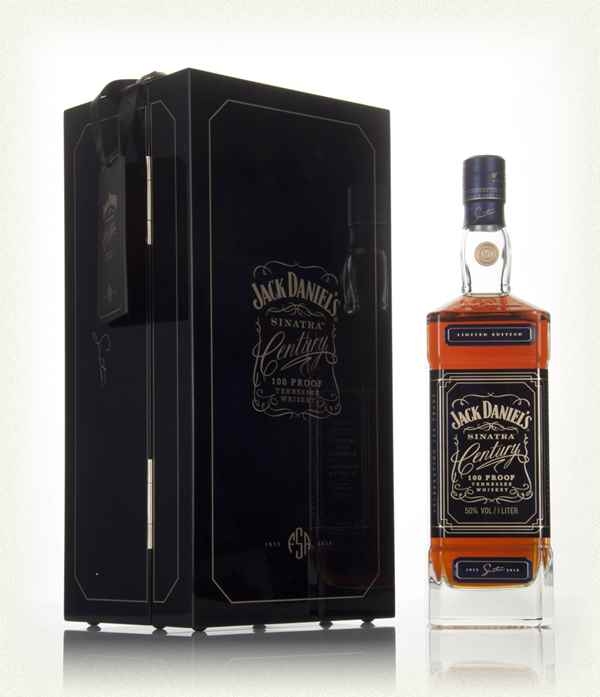
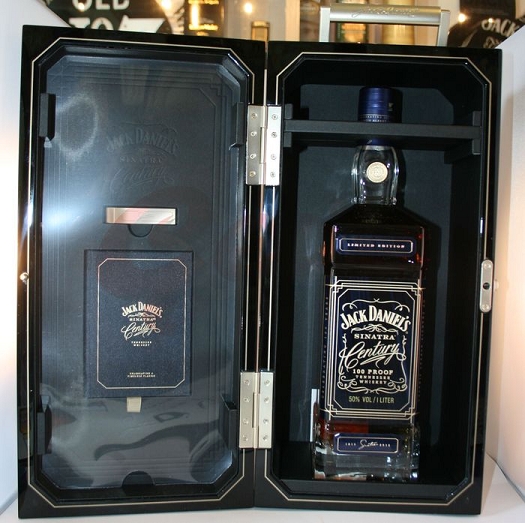
(Concert first officially released on a USB flash drive in a special box containing "Jack Daniel's Sinatra Century" whiskey
and then released again as part of "Frank Sinatra, Standing Room Only")
Sands, Las Vegas, Nevada (January 5 - February 1)
Count Basie Orchestra
Conducted by Quincy Jones
2nd show:
(Concert first officially released on a USB flash drive in a special box containing "Jack Daniel's Sinatra Century" whiskey
and then released again as part of "Frank Sinatra, Standing Room Only")
A limited edition bottling from Jack Daniel's, celebrating what would have been Frank Sinatra's 100th birthday.
It was drawn from 100 barrels and bottled at 100 proof, and each bottle comes with a USB stick featuring
an unreleased concert recording of Frank at The Sands Hotel and Casino in 1966.
© 1997-2026 The Sinatra Archive
This calendar, or any parts thereof, may not be reproduced in any fashion
whatsoever without the prior written permission of the publisher (The
Sinatra Archive)
Sands, Las Vegas, Nevada (January 5 - February 1)
Count Basie Orchestra
Conducted by Quincy Jones
Arrangements by Billy Byers and Quincy Jones
O.A. Pat Cooper
First show:
1. Come Fly With Me
2. I've Got A Crush On You
3. I've Got You Under My Skin
4. The September Of My Years
5. Street Of Dreams
6 Fly Me To The Moon
7 Monologue
8 You Make Me Feel So Young
9. The Shadow Of Your Smile
10. Get Me To The Church On Time
11 It Was A Very Good Year
12 My Kind Of Town
13 Monologue 2
14 My Kind Of Town (Reprise)
Second Show
1. Come Fly With Me
2. I've Got A Crush On You
3. I've Got You Under My Skin
4. The September Of My Years
5. Street Of Dreams
6 Angel Eyes
7 Fly Me To The Moon
8 Monologue
9 You Make Me Feel So Young
10. The Shadow Of Your Smile
11. Get Me To The Church On Time
12.. Luck Be A Lady
13 It Was A Very Good Year
14. Don't Worry 'Bout Me
15. My Kind Of Town
16 Monologue 2
17 My Kind Of Town (Reprise)
note: A greater portion, possibly all of the Sands show available on
"Frank Sinatra Vegas," is from this performance. Frank mentions it is Saturday night, says "good morning" and the order is perfect. The only song omitted is "Angel Eyes." Reprise only did two tapings of the Matt Dennis song - one is available on "Sinatra -Standing Room Only)
(1-28- 2nd show ). There may have been a problem with the 1/29 taping.
Ed
Sands, Las Vegas, Nevada (January 5 - February 1)
Count Basie Orchestra
Conducted by Quincy Jones
Frank was dark on the 30th and Dean subbed for him on 1/31.
--Ed
Sands, Las Vegas, Nevada (January 5 - February 1)
Count Basie Orchestra
Conducted by Quincy Jones
Frank was dark on Mondays during the four week engagement. Dean Martin flew in and did two shows all four Mondays. Frank did not perform on 1/30. After getting the Reprise work sheets, I called and asked why they did not tape the shows on the 30th. He may have had Vegas throat or a benefit.
Ed
[Blowup at Mia's apartment before her birthday]
Kaplan: Shortly before the Chasen's party, Mia suggested to Frank that they live together before marrying. He refused, saying it would embarrass his family. According to a friend of Farrow's, she threw a lamp at him, narrowly missing his head, and he grabbed her by the throat as if to strike her before she told him to leave.
Source: James Kaplan, "Sinatra: The Chairman" (2015)
[Dorothy Manners observes Mia's alienation]
Dorothy Manners: Columnist Dorothy Manners watched Mia sit apart doing needlepoint at one of the Palm Springs parties rather than mingling. When dinner was called, Frank found her still finishing a row and asked, with strained patience, whether she planned to join them 'or eat that stool.'
Source: James Kaplan, "Sinatra: The Chairman" (2015)
[Hedda Hopper's last column mentions Mia]
Hedda Hopper: In one of her final columns before her death that February, Hedda Hopper noted spotting Mia Farrow at 5 a.m. in the Sands dining room eating ham and eggs with her sister-in-law, remarking that with her short haircut nobody recognized her.
Source: James Kaplan, "Sinatra: The Chairman" (2015)
[Mia hosts parties during golf tournament]
Kaplan: In the first week of February, Mia Farrow played hostess at several parties Frank threw for Palm Springs friends and pro golfers during the Bob Hope Desert Classic, a jarring mix of golf-crowd conservatism and her own bohemian style.
Source: James Kaplan, "Sinatra: The Chairman" (2015)
[February 1966 Manhattan Grand Jury Subpoena]
Sinatra was subpoenaed to appear before a federal grand jury in Manhattan to answer questions related to wagering; what exactly was sought from him was never made public.
Source: George Carpozi Jr., Frank Sinatra: Is This Man Mafia? (New York: Manor Books, 1979).
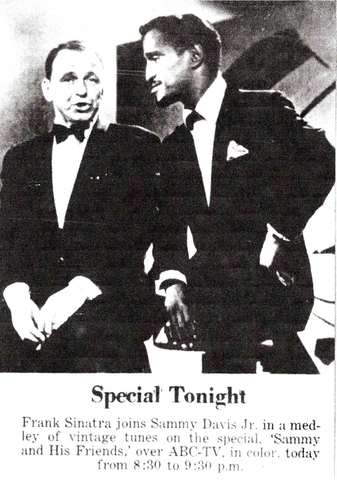
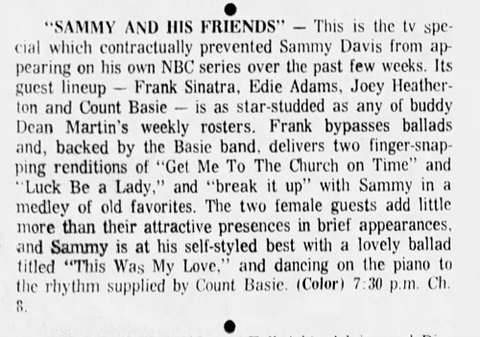
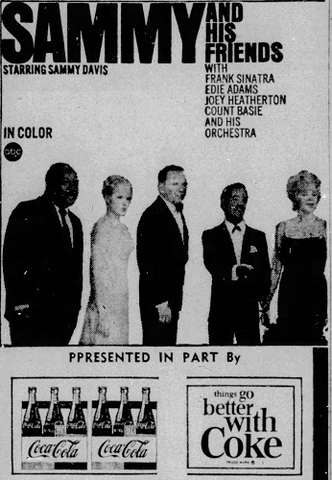
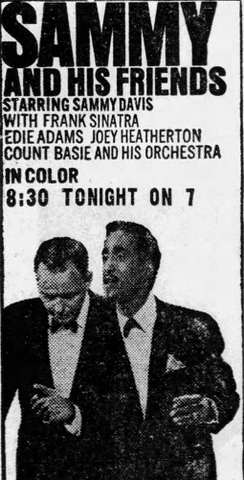
Sammy & His Friends (ABC)
Guests: Frank Sinatra, Count Basie, William B. Willams, Joey Heatherton,
Edie Adams
1. Get Me To The Church On Time
2. Luck Be A Lady
3. Medley w/Sammy: Don't Get Around Much
Anymore / The Song Is You / Them There
Eyes / Wrap Your Troubles In Dreams
4. Take The A Train
5. You're Nobody Till Somebody Loves You
Notes: 50 min. According to Ed O'Brien, this program was taped at the same time he did the Hollywood Palace taping in September.
When Sammy and Frank do the medley, you get to hear the latter do the chorus of "Don't Get Around Much Anymore," and "Take the A Train."
They are simply wonderful and contradict Sinatra's belief that he couldn't bring much to them for the Ellington album.
Billy May told O'Brien that Frank felt that way and avoided the Ellington signature tunes when planning the collaboration.
Sands, Las Vegas, Nevada (January 5 - February 1)
Count Basie Orchestra
Conducted by Quincy Jones
Bill Miller piano for saloon songs
Engineer: Lowell Frank
A&R Sonny Burke
Two Shows A Night
1. Come Fly With Me
2. I've Got A Crush On You
3. I've Got You Under My Skin
4. September Of My Years
5. Street Of Dreams
6. You Make Me Feel So Young
7. The Shadow Of Your Smile
8. Fly Me To The Moon
Monologue
9. Get Me To The Church On Time
10. It Was A Very Good Year
11. My Kind Of Town
Second Show
1. Come Fly With Me
2. I've Got A Crush On You
3. I've Got You Under My Skin
4. September Of My Years
5. Street Of Dreams
6. One For My Baby w/ Bill Miller on piano
7. Fly Me To The Moon
Monologue
8. You Make Me Feel So Young
9. The Shadow Of Your Smile
10. Luck Be A Lady
11. It Was A Very Good Year
12. Don't Worry 'Bout Me
13. My Kind Of Town note: Closing night of a four-week engagement. Reprise taped 10 shows during Frank's fourth week..
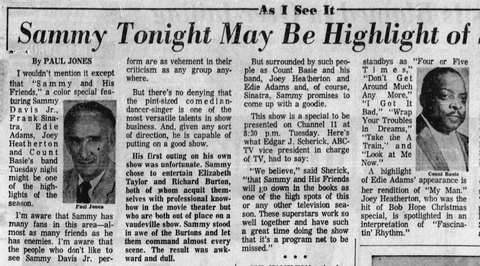
Sammy & His Friends (ABC)
In the fall of 1965, Sammy taped two hour specials for ABC.
One was aired and other was set for a December time slot.
Meanwhile, Sammy signed to do a series of musical hours
with NBC. The show was set to debut on 1-7-66 with Elizabeth
Taylor and Richard Burton. ABC then announced they would
air Sammy & Friends on 2-1-66. Sammy begged them to stay
with the originally scheduled date. The network refused and
invoked a clause in Sammy's contract, prohibiting him from
appearing on another network 21 days prior and 21 days
following the broadcast. The 1-7-66 was shown and proved
to be a disaster. Sammy's next three NBC airings did not
have him appearing. Johnny Carson, Sean Connery and
Jerry Lewis appeared in lieu of the star. Sammy's second
hour broadcast was aired on 2-11-66. Despite a valiant
effort by all involved, the show never was able to capture
a sizable following. There were 15 shows aired that winter
and spring.
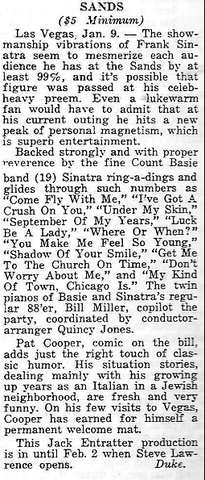
Sands, Las Vegas, Nevada (January 5 - February 1)
Variety
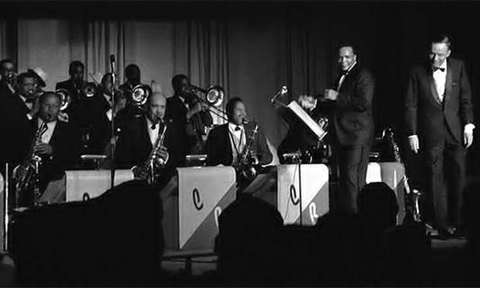
BASIE
BAND
QUINCY JONES FRANK
SINATRA
[Mia's 21st birthday party at Chasen's]
Sinatra threw Mia a 21st-birthday party at Chasen's in West Hollywood, hiring two bands. He was the only guest who never danced -- an early sign, in hindsight, that something was wrong between them.
Source: James Kaplan, "Sinatra: The Chairman" (2015).
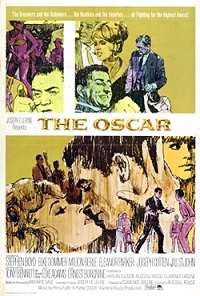
"The Oscar" (US Film Release: February 15, 1966)
Starring: Stephen Boyd, Elke Sommer, Jill St. John, Milton Berle, Eleanor Parker, Joseph Cotten, Tony Bennett
Cameos By: Bob Hope, Hedda Hopper, Merle Oberon, Frank Sinatra, Nancy Sinatra
Produced by: Clarence Greene
Directed by: Russell Rouse
Snotty Hollywood actor, Frank Fane (Stephen Boyd) becomes even more full of himself after he's nominated for the Academy Award for Best Actor. Merle Oberon (playing herself) announces the winner of the Best Actor Oscar as Frank Sinatra who comes up to receive his award.
(DVD & Blu-Ray Release date: 2020-02-04)
"The Oscar"
The Oscar, in which Sinatra plays himself in a film-closing cameo, was the first of his three 1966 film releases. Directed by Russell Rouse and based on Richard Sale's novel (screenplay by Harlan Ellison, Clarence Greene, and Rouse), Santopietro calls it a camp classic and an inadvertent forerunner to 1967's Valley of the Dolls, chronicling the rise and fall of fictional Hollywood heel Frankie Fane (Stephen Boyd), narrated by his pal Hymie Kelly (Tony Bennett).
Source: Tom Santopietro, "Sinatra in Hollywood" (2008).
"The Oscar"
The Oscar marked Tony Bennett's one and only starring film role, billed "AND INTRODUCING TONY BENNETT." Bennett -- whom Sinatra called his favorite singer -- later wrote in his autobiography that he had repeatedly turned down earlier film offers because he was only ever asked to play gangsters.
Source: Tom Santopietro, "Sinatra in Hollywood" (2008).
"The Oscar"
Santopietro contrasts Sinatra's natural, confident screen body language (even in his earliest films) with Tony Bennett's visibly uncomfortable, hunched-over film presence in The Oscar, concluding Bennett simply wasn't ready to act on film at that point, though he would mature into a top-rank interpretive vocal artist in later decades.
Source: Tom Santopietro, "Sinatra in Hollywood" (2008).
"The Oscar"
In the film's climax, Merle Oberon appears as herself to announce the Best Actor Oscar; when she reads out the name "Frank," the fictional Frankie Fane leaps up expecting to have won, only to hear the surname "Sinatra" -- at which point Sinatra himself bounds onstage to accept the award and sings a line of "All the Way" while Fane has an onscreen breakdown of jealous, clapping despair.
Source: Tom Santopietro, "Sinatra in Hollywood" (2008).
"The Oscar"
Richard Schickel (Life magazine): Critic Richard Schickel's review in Life magazine memorably called The Oscar a movie that achieves "a perfection of ineptitude quite beyond the power of words to describe," concluding "you have to see it to disbelieve it."
Source: Tom Santopietro, "Sinatra in Hollywood" (2008).
"The Oscar"
Santopietro grades this a D, noting Frank's brief cameo as himself in a campy Hollywood picture.
Source: Tom Santopietro, "Sinatra in Hollywood" (2008).
"The Oscar"
Santopietro (Filmography): Cameo appearance. Greene-Rouse Productions/Paramount Pictures. Produced by Clarence Greene, directed by Russell Rouse, screenplay by Harlan Ellison, Greene and Rouse, musical score by Percy Faith. Starred Stephen Boyd as Frankie Fane, with Sinatra appearing as himself alongside Bob Hope, Hedda Hopper, Merle Oberon and Nancy Sinatra.
Source: Tom Santopietro, "Sinatra in Hollywood" (2008).
Forwarded Message -----
From: Ed O'Brien <eob101@aol.com>
To: eob101@aol.com <eob101@aol.com>
Sent: Friday, February 23, 2024 at 11:16:45 AM EST
Subject: MIAMI HERALD 2-20-66
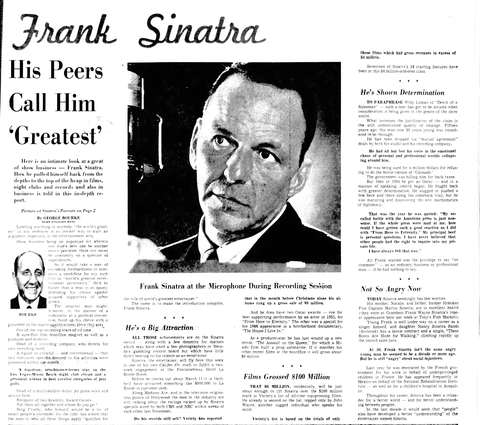
[Dorothy Manners reports Sinatra-Farrow breakup]
Dorothy Manners: Ten days after the birthday party, Dorothy Manners wrote that Sinatra and Farrow had apparently split, noting the couple were never really headed for marriage given the 29-year age gap, though the breakup was amicable enough that party guests hadn't suspected anything was wrong.
Source: James Kaplan, "Sinatra: The Chairman" (2015).
Fontainebleau, Miami Beach, Florida (February 24 - March 10) with County Basie and his Orchestra
Also featuring: Eddie "Lockjaw" Davis, Al Grey, Marhsall Royal, Freddie Green, Bill Henderson, and the Magid Triplets
Fontainebleau, Miami Beach, Florida (February 24 - March 10)
© 1997-2026 The Sinatra Archive
This calendar, or any parts thereof, may not be reproduced in any fashion whatsoever without the prior written permission of the publisher (The Sinatra Archive)
[image referenced in source but could not be recovered]
[image referenced in source but could not be recovered]
[image referenced in source but could not be recovered]
Fontainebleau, Miami Beach, Florida (February 24 - March 10)
© 1997-2026 The Sinatra Archive
This calendar, or any parts thereof, may not be reproduced in any fashion whatsoever without the prior written permission of the publisher (The Sinatra Archive)
[image referenced in source but could not be recovered]
[image referenced in source but could not be recovered]
[image referenced in source but could not be recovered]
Fontainebleau , Miami Beach , Florida (February 24 - March 11) With Count Basie
Also: The Magid Triplets
Fontainebleau, Miami Beach, Florida (February 24 - March 10) Sinatra was out with the flu February 26, 27, & 28th
Fontainebleau, Miami Beach, Florida (February 24 - March 10) Sinatra was out with the flu February 26, 27, & 28th
February 27th.
I have subsequent articles extending his absence through to the 28th. --Scott
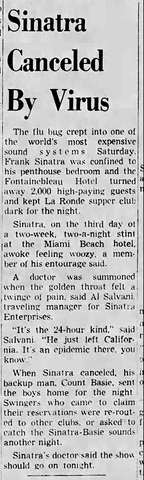
Fontainebleau , Miami Beach , Florida (February 24 - March 10) Sinatra was out with the flu February 26-28
Fontainebleau, Miami Beach , Florida (February 24 - March 11)
Sinatra was out with the flu February 26-28
Fontainebleau , Miami Beach , Florida (February 24 - March 10) Sinatra was out with the flu February 26-28
The Miami Herald (Miami, Florida) · 1 Mar 1966
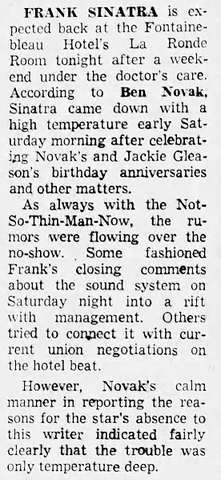
Fontainebleau, Miami Beach , Florida (February 24 - March 10) Sinatra was out with the flu February 26-28
Fontainebleau , Miami Beach , Florida (February 24 - March 11) Sinatra was out with the flu February 26-28
Fontainebleau, Miami Beach, Florida (February 24 - March 11) Sinatra was out with the flu February 26-28
Fontainebleau , Miami Beach , Florida (February 24 - March 11) Sinatra was out with the flu February 26-28
Fontainebleau , Miami Beach , Florida (February 24 - March 11)
Fontainebleau , Miami Beach , Florida (February 24 - March 11)
Fontainebleau , Miami Beach , Florida (February 24 - March 11)
Fontainebleau , Miami Beach , Florida (February 24 - March 11)
Fontainebleau, Miami Beach, Florida (February 24 - March 11)
Fontainebleau , Miami Beach , Florida (February 24 - March 11)
Fontainebleau , Miami Beach , Florida (February 24 - March 11)
Fontainebleau , Miami Beach , Florida (February 24 - March 11)
At the Grammy Awards, Sinatra won three: Album of the Year for September of My Years, Best Male Vocal Performance for "It Was a Very Good Year," and the Grammy Lifetime Achievement Award. Source: Sinatra, Nancy. Frank Sinatra: An American Legend. 1998. (via sinatra.com/frank-sinatra-timeline)
"Cast A Giant Show" (Premiere: March 30, 1966)
Starring: Kirk Douglas, Senta Berger, Stathis Giallelis, James Donald, , Yul Brynner, Frank Sinatra, John Wayne, Angie Dickinson, Chaim Topol, Michael Hordern
Produced & Directed by: Melville Shavelson
An American Army officer (Douglas) is recruited by Jews in Palestine to help them form an army. The surrounding Arab countries are opposed to the creation of the state of Israel. He is made commander of the Israeli forces just before the war begins. Frank Sinatra portrays Vince Talmadge, an expatriate American pilot who takes part in what becomes a suicide mission to bomb Arab positions. (DVD Release date: 2002-02-05 -- Blu-Ray Release: 2014-08-26)
"Cast a Giant Shadow"
One month after The Oscar, Sinatra appeared in another cameo in Cast a Giant Shadow, a much more substantial 1948-set film about the founding of Israel, written and directed by Melville Shavelson and starring Kirk Douglas as American Jewish soldier Mickey Marcus, with John Wayne (whose Batjac company produced it for United Artists) and Yul Brynner in supporting roles.
Source: Tom Santopietro, "Sinatra in Hollywood" (2008).
"Cast a Giant Shadow"
A lifelong sympathizer with Jewish causes who had enjoyed his 1962 concerts in Israel and felt attached to the Frank Sinatra International Youth Center he'd opened there, Sinatra insisted on filming his cameo on location in Israel rather than the originally planned Rome. After three days of filming, he donated his entire $50,000 fee to the Youth Center.
Source: Tom Santopietro, "Sinatra in Hollywood" (2008).
"Cast a Giant Shadow"
Sinatra played Spence, a mercenary pilot nicknamed the "Pride of Passaic," who is given seltzer bottles to drop as fake bombs since the fledgling Israeli army lacked real ammunition; his character's plane is then shot down. Santopietro notes Sinatra, at 51, looked more youthful and vibrant here than he had 15 years earlier in Meet Danny Wilson.
Source: Tom Santopietro, "Sinatra in Hollywood" (2008).
"Cast a Giant Shadow"
Melville Shavelson: Director Melville Shavelson later reflected that using recognizable movie stars like Sinatra undercut the film's realism, saying it might have worked better with an unknown actor in the role because audiences believed real events were 'phony' when played by famous faces.
Source: Tom Santopietro, "Sinatra in Hollywood" (2008).
"Cast a Giant Shadow" unnamed critics (quoted by Santopietro): Reviews of Cast a Giant Shadow were mixed-to-negative: one review praised Sinatra's youthful energy as a "soldier of fortune flier" while criticizing the film overall; another called it "an embarrassing movie"; a third dismissed it as a biopic overshadowed by star Kirk Douglas.
Source: Tom Santopietro, "Sinatra in Hollywood" (2008).
"Cast a Giant Shadow"
Santopietro grades this a C, calling it a cameo as a pilot, saying "somewhere in there is a good film."
Source: Tom Santopietro, "Sinatra in Hollywood" (2008).
"Cast a Giant Shadow"
Santopietro (Filmography): Cameo appearance. Batjac-Lleuroc-Mirisch Productions/United Artists. Produced and directed by Melville Shavelson, screenplay by Shavelson based on Ted Berkman's book. Starred Kirk Douglas as Colonel Mickey Marcus, with John Wayne and Yul Brynner, and Sinatra appearing as Vince Talmadge.
Source: Tom Santopietro, "Sinatra in Hollywood" (2008).
[Sinatra still seething over "commie" label]
A decade after being cleared, Sinatra commissioned a public-relations man to determine "the identity of the 'S.O.B.' who had 'tagged' Sinatra as a 'commie,'" according to a memo from FBI official D. J. Brennan Jr. to W. C. Sullivan. An Army liaison explained that Sinatra had been denied overseas USO clearance in 1950, 1952, and 1954 over the subversion allegations, was finally cleared in 1962, and that clearance had lapsed unused in 1966. The go-between described Sinatra as "temperamental, vindictive and moody" and prone to dwelling on old grievances. The bitterness stood in curious contrast to Sinatra's mood at the time: less than two weeks later he recorded "Strangers in the Night."
Source: Kuntz and Kuntz, The Sinatra Files, ch. 3.
[Bowen rushes Strangers acetates to radio]
Kaplan: After the session, Bowen ran an all-night mastering session and pressed a couple dozen acetates. Sinatra, eager to beat Jack Jones's competing version, had Reprise pay couriers and airline stewardesses cash to rush copies to program directors across the country, including Chicago.
Source: James Kaplan, "Sinatra: The Chairman" (2015)
[Harrison Carroll column on Mia and Nichols]
Harrison Carroll: Columnist Harrison Carroll reported in mid-April that Mia Farrow had spent her vacation in Rome as a guest of Elizabeth Taylor and Richard Burton, and had also been seen around town with director Mike Nichols; he added that Farrow was reportedly quitting Peyton Place in June for a one-picture-a-year deal with 20th Century-Fox.
Source: James Kaplan, "Sinatra: The Chairman" (2015)
[Mia and Mike Nichols travel to Rome and Venice]
Kaplan: During her Easter break from Peyton Place, Mia -- newly involved with director Mike Nichols, fresh off Who's Afraid of Virginia Woolf? -- traveled with him to Rome and Venice.
Source: James Kaplan, "Sinatra: The Chairman" (2015)
[quote on career/material]
Frank Sinatra: In an April 1966 interview with Peter Bart, Sinatra, then turning fifty, described spending evenings reading scripts and novels searching for feature material, acknowledging the shortcomings of some recent pictures came down to a lack of better material being available at the time.
No corresponding dated entry could be identified in the chronology for this film/context.
Source: Tom Santopietro, "Sinatra in Hollywood" (2008), The Rat Pack (pt. 2)
[Bowen learns of rival Strangers in the Night cut]
Jimmy Bowen: On a Sunday night at Martoni's restaurant, Reprise producer Jimmy Bowen ran into singer Jack Jones, who excitedly described his own newly recorded version of 'Strangers in the Night,' already mailed to radio stations. Bowen recalled feeling his heart pound and immediately phoned Sinatra, who said he didn't care who else had recorded it -- 'we're gonna do it.'
Source: James Kaplan, "Sinatra: The Chairman" (2015).
Hollywood
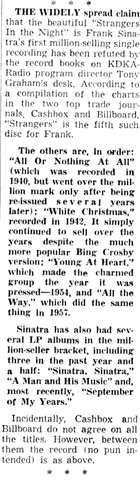
J4195 Strangers In The Night (2:35)
(Bert Kaempfert/Charles Singleton/Eddie Snyder)
Champion Music/EMI Screen Gems Music Inc. (BMI)
Arranged & Conducted by Ernie Freeman
45: Reprise 0470
LP: FS1017
CD: The Complete Reprise Studio Recordings 46013-2
Ed O'Brien:
This was the song that put Sinatra in a different stratosphere.
He was in his 51st year when this recording exploded all over the world. A megahit that would reach #1 in 77 countries including The United States. The follow up album would sell 13 million copies worldwide. Frank would win a Grammy for best male vocal performance and suddenly he could fill large arenas in every corner of the globe.Lee Herschberg told me it required only three takes. An incredible vocal performance.
Frank hated this song. Hated. During the concert in the Dominican Republic, 8-20-82, Frank, while singing "Strangers," yells to Vinnie that it is the
"worst f..king song I ever heard." Millions of people around the world did not agree. Disney
Channel ran a series of Frank's shows including
Altos de Chavon from 82. They didn't catch the F bomb in the aside to Vinnie.. Probably the only time that word was ever heard on
Walt's station. During a 1983 concert in Philly,
Sinatra, after singing "Strangers," told his audience that if they liked that song they would love pineapple yogurt..
--Ed
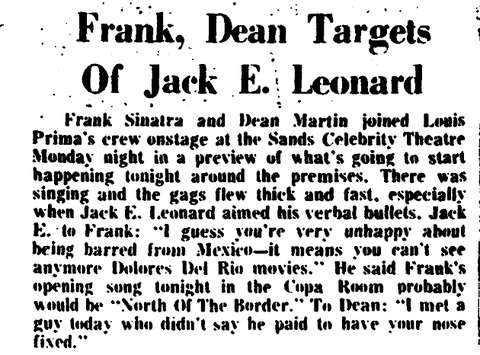
Sands, Las Vegas, Nevada
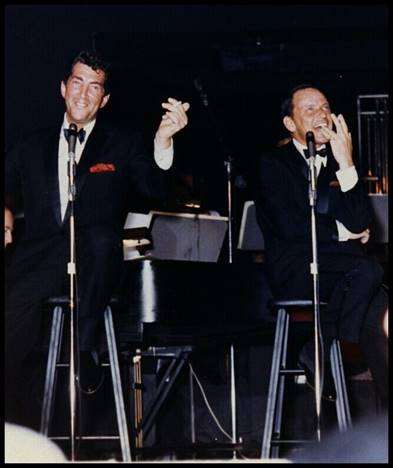
Frank and Dean joined Louis Prima and Jack E. Leonard on stage for songs and gags.
Hollywood
J4195 Strangers In The Night (2:35)
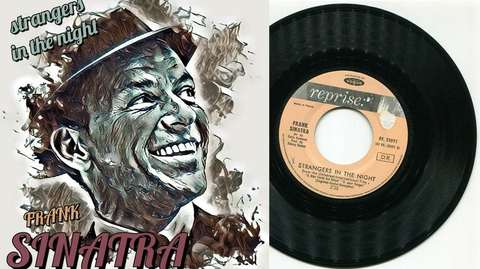
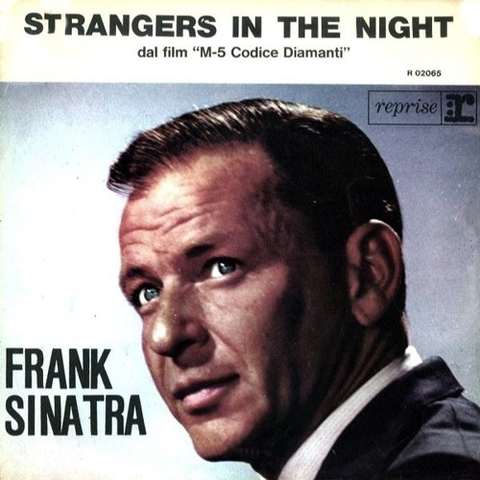
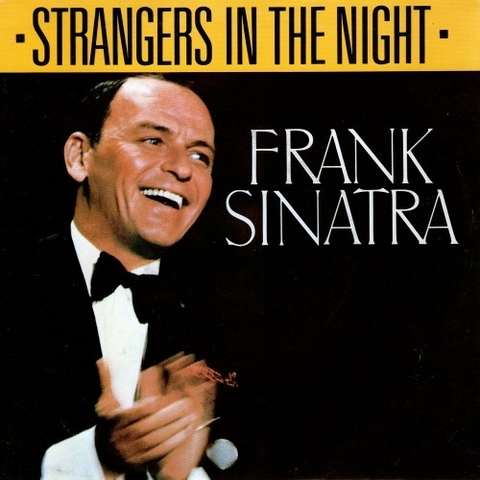
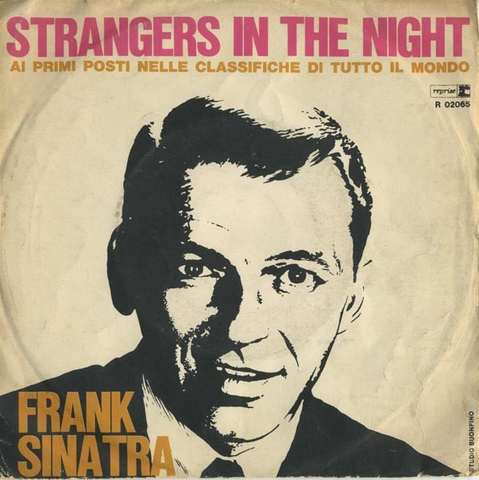
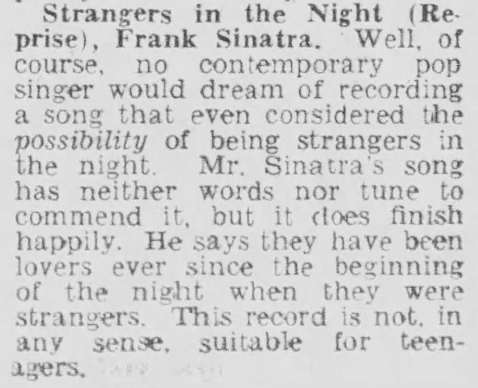
Sands, Las Vegas Nevada
Frank and Dean joined Louis Prima and Jack E. Leonard on stage for songs and gags.
The session comes as Frank's relationship with 20-year-old Mia Farrow was deepening; "Strangers in the Night" would go on to knock the Beatles' "Paperback Writer" from number one on July 2, 1966, becoming Reprise's third chart-topping single. Source: J. Randy Taraborrelli, Sinatra: Behind the Legend.
[Sinatra records 'Strangers in the Night']
The recording session for 'Strangers in the Night,' arranged by Ernie Freeman, was set at United Recording. Sinatra, who initially hated the song, worked out a tricky key-change modulation with Bowen's help (cutting to a bell tone before the new key) and completed the track with Glen Campbell on rhythm guitar.
Source: James Kaplan, "Sinatra: The Chairman" (2015).
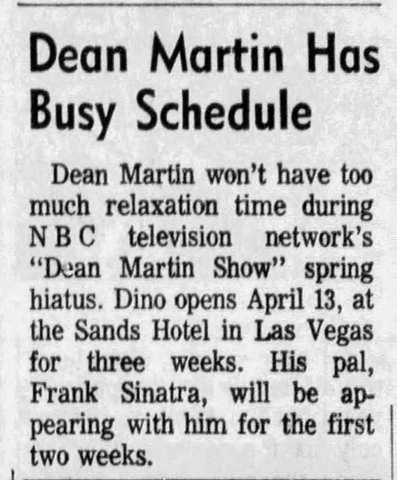
Sands, Las Vegas, Nevada (April 13 - May 3) w/Dean Martin & Joey Bishop
Ed notes:
Dean Martin was on the bill with Sinatra. I was told by people who worked at the Sands back then, that Dino was a bigger draw in the spring of 1966.
A little tune recorded two days prior to the opening changed all that very quickly.
Sands, Las Vegas, Nevada (April 13 - May 3) w/Dean Martin & Joey Bishop
Las Vegas Sun, April 13, 1966
Dean Martin, Joey Bishop, and Sinatra
(Original Caption) Las Vegas, Nevada: Dean Martin and his friends, Frank Sinatra and Joey Bishop, opened a three-week engagement at the Sands Hotel in Las Vegas, April 13, determined that their songs, patter and assorted hijinks qualify them as "The Men from SPREE," (Society for the Prevention of Routine Entertainment Events.)
note: Sinatra had agreed to do two weeks. He left the show on 4/28
Reno Gazette News
4-19-66 note: Frank missed the two shows on Monday, 4/18.
Bishop did not appear on 4/18 and Dino did a
1/2 hour - hence the outrage.
[image referenced in source but could not be recovered]
[image referenced in source but could not be recovered]
[image referenced in source but could not be recovered]
[image referenced in source but could not be recovered]
[image referenced in source but could not be recovered]
[image referenced in source but could not be recovered]
[image referenced in source but could not be recovered]
[image referenced in source but could not be recovered]
Sands, Las Vegas, Nevada (April 13 - May 3) w/Dean Martin & Joey Bishop
[Baseball Game at Dodger Stadium]
Sinatra attended an Orioles-versus-Dodgers game at Dodger Stadium with Mia Farrow, Tina, and Nancy, remaining friendly with Farrow after their divorce.
Source: Charles Pignone, "Frank Sinatra 100" (2015).
[Marriage to Mia Farrow]
Sinatra marries Mia Farrow in Las Vegas, stages the Inaugural Gala for California Governor Edmund "Pat" Brown, and wins Grammys for Album of the Year ("Sinatra: A Man and His Music") and Record of the Year ("Strangers in the Night"), which also becomes a #1 single and album. He appears in "Cast a Giant Shadow," "The Oscar," and "Assault on a Queen."
Source: Nancy Sinatra, "Frank Sinatra, My Father" (1985).
[Nancy Sinatra's Breakthrough Year With Her Father]
Nancy Sinatra, having scored a run of hits with producer Lee Hazlewood, appeared on her father's TV special and scored a major hit duet with him, 'Somethin' Stupid,' the same year.
Source: The Rough Guide to Frank Sinatra, chapter "I Want to Be a Part of It, 1971-98."
[Sinatra's First Live Album]
Sinatra at the Sands, recorded with Quincy Jones and Billy Byers arranging, was Frank's very first live recording, capturing twenty songs and two monologues with the Basie band.
Source: Nancy Sinatra, "Frank Sinatra, My Father" (1985).
["Strangers in the Night" Hits Number One Despite Frank's Dislike]
Producer Jimmy Bowen's push toward the pop charts paid off: the Strangers in the Night album went to Number One and the title single won two Grammys, for Best Solo Vocal and Record of the Year, even though, Nancy notes, her father didn't even like the song.
Source: Nancy Sinatra, "Frank Sinatra, My Father" (1985).
[Tina Meets Mia Farrow]
Early in 1966, Tina met Mia Farrow for the first time when she stopped by her father's rented Holmby Hills house and he mentioned Mia was coming over; Tina found her striking and the two quickly became close.
Source: Tina Sinatra, "My Father's Daughter: A Memoir" (2000).
['These Boots Are Made For Walkin'' Tops Charts]
In 1966, as Vietnam War controversy grew, Nancy's single "These Boots Are Made for Walking," produced by Lee Hazlewood with arranger Billy Strange, reached number one in three weeks -- a speed then matched only by the Beatles' "I Wanna Hold Your Hand." It sold over four million copies and earned three Grammy nominations, losing to Barry Sadler's "The Ballad of the Green Berets."
Source: Nancy Sinatra, "Frank Sinatra, My Father" (1985).
['Strangers in the Night' tops UK charts]
Kaplan: In Britain, 'Strangers in the Night' sat atop the singles chart for three weeks that summer.
Source: James Kaplan, "Sinatra: The Chairman" (2015)
[Dexter fired from The Naked Runner]
Kaplan: After Sinatra abandoned the Copenhagen shoot to fly home for a Pat Brown fundraiser and refused to return, his lawyer Mickey Rudin ordered production wrapped without him. Producer Brad Dexter defied orders to hand over the footage, finishing the film with a double and delivering the print to Jack Warner himself about two months later; he was subsequently fired from Sinatra's operation and never received the balance of his fee.
Source: James Kaplan, "Sinatra: The Chairman" (2015)
[Frank and Mia Farrow marry]
Consiglio: Frank and Mia Farrow married in 1966, prompting widespread comment about their roughly thirty-year age gap. Consiglio says Frank knew the relationship might not last but was genuinely in love.
Source: Tony Consiglio (as told to Franz Douskey), "Sinatra and Me: The Very Good Years" (2012)
[Harper made with Paul Newman instead of Sinatra]
Kaplan: Before Brad Dexter's partnership with Sinatra collapsed, Dexter had tried to revive Frank's film career with a William Goldman script called 'Harper,' but negotiations with producers Elliott Kastner and Jerry Gershwin fell through and the movie was made instead with Paul Newman, becoming an artistic and box-office hit in 1966.
Source: James Kaplan, "Sinatra: The Chairman" (2015)
[Mo Ostin and the Gunga Din single]
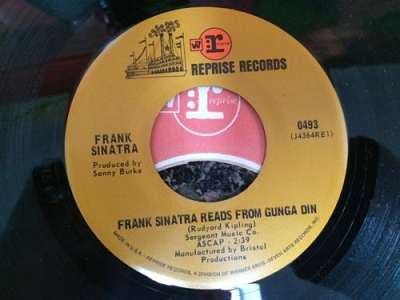
Mo Ostin: Mo Ostin recalled trying to quietly shelve the 'Gunga Din' single, only for Sinatra to angrily call him mid-golf-game, shouting 'I own this fucking company!' The record was ultimately distributed only privately to friends.
Source: James Kaplan, "Sinatra: The Chairman" (2015)
[Nancy Jr.'s hit records with Lee Hazlewood]
Consiglio: It took Nancy Jr. a few years after her divorce to break through, which she did with producer Lee Hazlewood on million-selling songs like "These Boots Are Made for Walkin'" and "How Does That Grab You?" Hazlewood, also known for producing Duane Eddy and the early concept album Trouble Is a Lonesome Town, helped establish Nancy as a star in her own right.
Source: Tony Consiglio (as told to Franz Douskey), "Sinatra and Me: The Very Good Years" (2012)
[O.C. Smith's record inspires 'That's Life']
Kaplan: A record of 'That's Life' by soul singer O. C. Smith caught Sinatra's attention that spring; he played it for Jimmy Bowen and proposed they cut their own version, which Bowen enthusiastically endorsed.
Source: James Kaplan, "Sinatra: The Chairman" (2015)
[Peter Lawford divorces Pat Kennedy]
Consiglio: Peter Lawford divorced Pat Kennedy in 1966, which effectively ended his ties to the Kennedy family. Combined with his falling-out with Frank, it left him without his old circle of friends like Dean Martin and Sammy Davis Jr.
Source: Tony Consiglio (as told to Franz Douskey), "Sinatra and Me: The Very Good Years" (2012)
[Sinatra expands Palm Springs compound]
Kaplan: Around this period Sinatra added a two-bedroom bungalow and a four-bedroom New England-style cottage to his Palm Springs property, bringing its capacity to twenty-two guests; friends called him 'the Innkeeper' for how meticulously he ran the place, down to stocked bathrooms and on-call cars.
Source: James Kaplan, "Sinatra: The Chairman" (2015)
[Sinatra films of 1966]
Consiglio: Cast a Giant Shadow, The Oscar, and Assault on a Queen were released in 1966, capping a stretch Consiglio describes as a particularly strong period in Frank's film career.
Source: Tony Consiglio (as told to Franz Douskey), "Sinatra and Me: The Very Good Years" (2012)
[Sinatra's contempt for Ronald Reagan]
Kaplan: Sinatra had long disliked Ronald Reagan and his wife Nancy Davis, dating back to the 1940s. A former girlfriend of Jimmy Van Heusen's recalled that Sinatra would leave any party the Reagans attended, complaining he couldn't stand Reagan's folksy, bore-ish manner.
Source: James Kaplan, "Sinatra: The Chairman" (2015)
[Sinatra's fury derails Naked Runner shoot]
Kaplan: During UK filming of The Naked Runner, after a helicopter got lost in fog and made him forty-five minutes late to set, Sinatra flew into a rage and demanded production move to Palm Springs; when he refused to work, director Sidney Furie burst into tears and sped off in his jeep. Brad Dexter had to smooth things over to finish the UK shoot.
Source: James Kaplan, "Sinatra: The Chairman" (2015)
[Sinatra's nervousness before Count Basie shows]
Ed Walters: Walters, prompted by listening to the Count Basie Live at the Sands album, describes Sinatra being visibly more nervous before shows with Count Basie's band than with any other performer, since Basie was one of the few acts Sinatra considered his equal. Unlike the house band (which started only after Sinatra began singing), Basie's band played a full instrumental intro and Sinatra had to time his entrance; Walters says he saw Sinatra miss his cue a couple of times, with Basie smiling and restarting the intro, while Jilly Rizzo kept people away from Frank as he prepared.
Source: Ed Walters, pit boss reminiscences (compiled by Kraus, Sinatra mailing list)
[personal life]
Sinatra married Mia Farrow, his third wife, on July 19, 1966. Santopietro notes the marriage was short-lived but the two remained lifelong friends afterward.
No corresponding dated entry could be identified in the chronology for this film/context.
Source: Tom Santopietro, "Sinatra in Hollywood" (2008), The Rat Pack (pt. 2)
[Frank marries Mia Farrow in a five-minute Vegas ceremony]
Frank abruptly skipped a planned return to London filming and instead flew to Las Vegas, marrying Mia Farrow in a brief ceremony held in Jack Entratter's suite at the Sands. The couple honeymooned in Palm Springs; no family members from either side had been invited.
Source: Richard Havers, "Sinatra" (Dorling Kindersley, 2007).
[Life magazine calls Sinatra 'a happening']
In a December 1966 Life magazine piece, writer Jose M. Ferrer described Sinatra as having a rare, almost mystical ability to fascinate audiences wherever he went.
Source: Richard Havers, "Sinatra" (Dorling Kindersley, 2007).
[Petula Clark sits in on Sinatra's awkward 'Downtown' session]
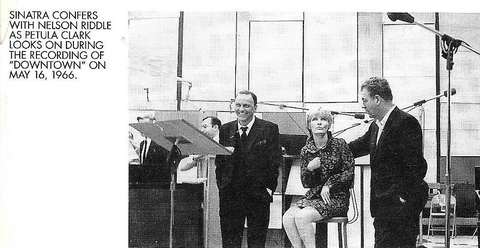
According to songwriter Tony Hatch, Sinatra invited Petula Clark, the original artist behind 'Downtown,' to watch him record his version. Riddle's odd pseudo-oriental arrangement embarrassed Frank with her present, so rather than fight it he leaned into camp, adding a vocal 'yuk' before the title word.
Source: Richard Havers, "Sinatra" (Dorling Kindersley, 2007).
[Reprise later signs the Electric Prunes]
The book notes, somewhat ironically given Frank's original wish for creative control, that by 1966 Reprise had signed psychedelic rock band the Electric Prunes -- a sign of how far the label evolved from his original vision.
Source: Richard Havers, "Sinatra" (Dorling Kindersley, 2007).
[Sinatra jokingly introduces himself as 'Nancy's father']
During a booking at his Miami Beach house, the Fontainebleau, not long after his daughter Nancy's chart success, Sinatra took to introducing himself as Nancy's father.
Source: Richard Havers, "Sinatra" (Dorling Kindersley, 2007).
[Tony Hatch's aborted "Sinatra Sings Tony Hatch" album]
Composer Tony Hatch describes being commissioned to write and produce a full album of new songs for Sinatra to record in London. Sessions were repeatedly booked and cancelled by Sinatra himself until the musicians union would no longer allow further rescheduling, so the songs were only ever demoed by singer Mike Redway and later picked up by other artists.
Source: Richard Havers, "Sinatra" (Dorling Kindersley, 2007).
["The Last Blast of the Blasted Bugler" -- private spoken-word recording made at Sinatra's Palm Springs home -- critical commentary]
A bizarre 1962 ABC-Paramount spoken-word/novelty 45 (credited to Phil Cammarata, narrated by Sonny Gianotta) dramatized the climactic 'Gunga Din' battle scene with old-time-radio sound effects. On June 10, 1966, Sinatra rerecorded the single at his Palm Springs home, adding his own voice to the introductory narration over the same 1962 sound effects. Friedwald notes it has only surfaced on two rare semiprivate collector CDs (Frankly Different, Sinatra Unreleased) and states plainly it 'is not a performance that merits wide release.'
Source: Will Friedwald, "Sinatra! The Song Is You: A Singer's Art" (2018 revised edition), Ch. 7, "With Billy May" (1953-1979)
[Assault on a Queen (1966 film, scored by Duke Ellington at Sinatra's arrangement) -- critical commentary]
Sinatra arranged for Ellington to write the score to his film Assault on a Queen -- Friedwald calls it 'perhaps the only notable aspect of that forgettable thriller.'
Source: Will Friedwald, "Sinatra! The Song Is You: A Singer's Art" (2018 revised edition), Ch. 7, "With Billy May" (1953-1979)
[Moonlight Sinatra -- critical commentary]
Granata's discography entry: Moonlight Sinatra, arranged by Nelson Riddle, released March 1966.
Source: Charles L. Granata, "Sessions with Sinatra: Frank Sinatra and the Art of Recording" (1999/2003), Afterword & Appendices A-D
[Strangers in the Night -- critical commentary]
Sinatra landed a surprise hit with 'Strangers in the Night' despite being 'especially vocal in expressing his dislike' of the song; he and producer Sonny Burke built a full album around it that immediately overshadowed the title track.
Source: Will Friedwald, "Sinatra! The Song Is You: A Singer's Art" (2018 revised edition), Ch. 6, "With Nelson Riddle" (1953-1979)
[Strangers in the Night -- critical commentary]
Granata's discography entry: Stranger in the Night, arranged by Nelson Riddle and Ernie Freeman, released May 1966.
Source: Charles L. Granata, "Sessions with Sinatra: Frank Sinatra and the Art of Recording" (1999/2003), Afterword & Appendices A-D
[personnel -- critical commentary]
Jimmy Bowen: Motivated by the commercial success of daughter Nancy Sinatra's 1966 hit 'These Boots Are Made for Walkin',' Sinatra hired young producer Jimmy Bowen (on staff at Reprise since 1963, formerly a rock and roller and demo writer) to help update his image. Bowen recalls getting hired via a phone call in which Sinatra simply said, 'James? Glad to have you aboard...click.'
Source: Charles L. Granata, "Sessions with Sinatra: Frank Sinatra and the Art of Recording" (1999/2003), Part IV: The Reprise Years
Nancy Sinatra's "These Boots Are Made for Walkin'," produced by Lee Hazlewood, who reportedly told her to record it like "one for the truck drivers," reached No. 1 on the US Hot 100, having already topped the UK charts a week earlier. (Source: Richard Havers, "Sinatra" (Dorling Kindersley, 2007).)
Sands, Las Vegas, Nevada (April 13 - May 3) w/Dean Martin & Joey Bishop
Sands, Las Vegas, Nevada (April 13 - May 3) w/Dean Martin & Joey Bishop
Sands, Las Vegas, Nevada (April 13 - May 3) w/Dean Martin & Joey Bishop
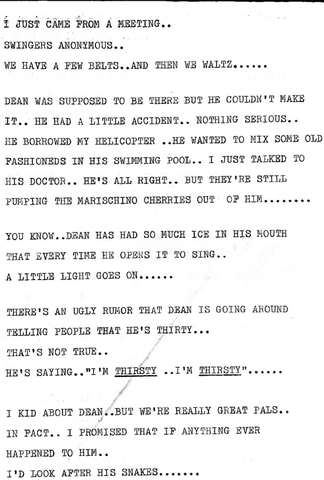
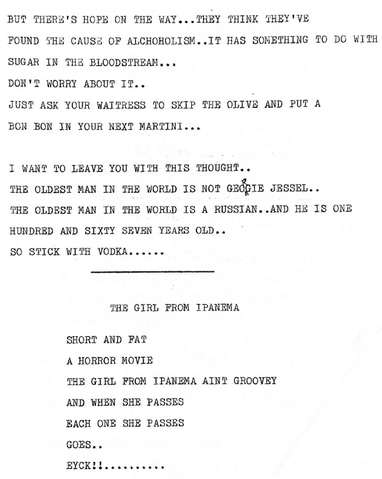
Segment of Frank's monologue:
Sands, Las Vegas, Nevada (April 13 - May 3) w/Dean Martin & Joey Bishop
Sands, Las Vegas, Nevada (April 13 - May 3) w/Dean Martin & Joey Bishop
Sands, Las Vegas, Nevada (April 13 - May 3) w/Dean Martin & Joey Bishop
Sands, Las Vegas, Nevada (April 13 - May 3) w/Dean Martin & Joey Bishop
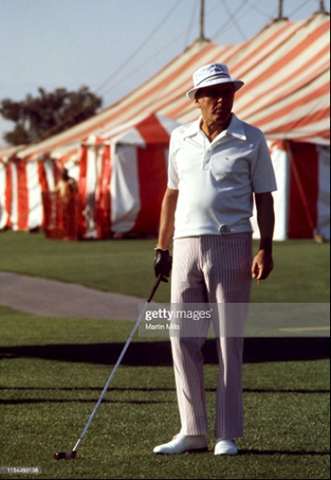
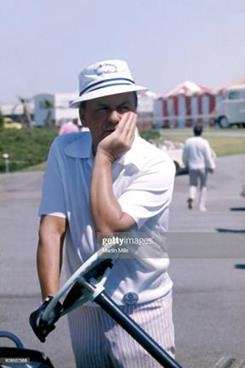
April 19, 1969 Chuck Connors 3rd Annual Charity Invitational Golf Tournament Dinner Party Palm Springs Racquet Club in Palm Springs, California
Sands, Las Vegas, Nevada (April 13 - May 3) w/Dean Martin & Joey Bishop
Sands, Las Vegas, Nevada (April 13 - May 3) w/Dean Martin & Joey Bishop
Sands, Las Vegas, Nevada (April 13 - May 3) w/Dean Martin & Joey Bishop
Sands, Las Vegas, Nevada (April 13 - May 3) w/Dean Martin & Joey Bishop
Sands, Las Vegas, Nevada (April 13 - May 3) w/Dean Martin & Joey Bishop
Sands, Las Vegas, Nevada (April 13 - May 3) w/Dean Martin & Joey Bishop
Sands, Las Vegas, Nevada (April 13 - May 3) w/Dean Martin & Joey Bishop
Sands, Las Vegas, Nevada (April 13 - May 3) w/Dean Martin & Joey Bishop
Sands, Las Vegas, Nevada (April 13 - May 3) w/Dean Martin & Joey Bishop
Earl Wilson column
Sands, Las Vegas, Nevada (April 13 - May 3) w/Dean Martin & Joey Bishop
Earl Wilson column
4-29-66
note: Frank was mad about Mia Farrow. She didn't like Vegas and Frank did. He missed shows during his two weeks at the Sands and one night there was a near riot. The Sands had to refund more than 500 very miffed customers. Marquee was changed to "Dean Martin, Joey Bishop and maybe . . . Frank."
Ed
------------------------------------------------------
© 1997-2026 The Sinatra Archive
This calendar, or any parts thereof, may not be reproduced in any fashion whatsoever without the prior written permission of the publisher (The Sinatra Archive)

Sands, Las Vegas, Nevada (April 13 - May 3) w/Dean Martin & Joey Bishop
Sands, Las Vegas, Nevada (April 13 - May 3) w/Dean Martin & Joey Bishop
Sands, Las Vegas, Nevada (April 13 - May 3) w/Dean Martin & Joey Bishop
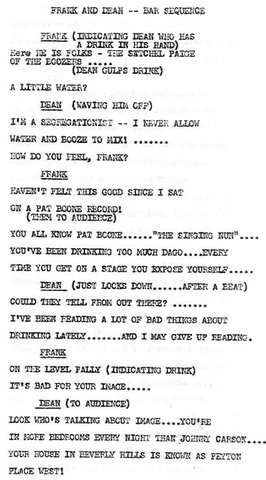
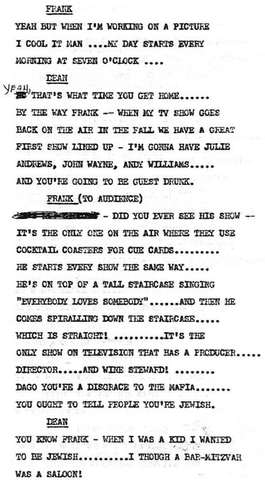
Segment of Frank-Dean comedy routine
[Jack O'Brian reports Mia and Nichols reunion]
Jack O'Brian: Early in May, columnist Jack O'Brian wrote that Mike Nichols and Mia Farrow had resumed seeing each other as soon as he returned from Europe, spotted at the Cocoanut Grove and the Daisy Club. Sinatra, an avid gossip-column reader, told a friend at Jilly's he'd have to 'straighten this out' with Mia.
Source: James Kaplan, "Sinatra: The Chairman" (2015)
[Sinatra and Riddle record their last full album]
Kaplan: In May, Sinatra and Nelson Riddle recorded what turned out to be their final complete album together, rushed into production to capitalize on the success of the 'Strangers in the Night' single and eventually released under that title, subtitled 'Frank Sinatra Sings for Moderns.' Highlights included 'Summer Wind' and a remade 'All or Nothing at All'; the album hit number one and stayed on the charts 73 weeks, Sinatra's biggest LP success since 1958's Only the Lonely.
Source: James Kaplan, "Sinatra: The Chairman" (2015)
Sands, Las Vegas, Nevada (April 13 - May 3) w/Dean Martin & Joey Bishop
Sands, Las Vegas, Nevada (April 13 - May 3) w/Dean Martin & Joey Bishop
Sands, Las Vegas, Nevada (April 13 - May 3) w/Dean Martin & Joey Bishop
['Strangers in the Night' hits the charts]
'Strangers in the Night' entered the Billboard charts alongside new entries by Simon & Garfunkel, the Lovin' Spoonful, and Dean Martin.
Source: James Kaplan, "Sinatra: The Chairman" (2015).
Hollywood
J4234 My Baby Just Cares For Me
(Walter Donaldson/Gus Kahn)
Ann-Rachel Music Corp./Donaldson Publishing Co./Tobago Music Co./ The Songwriters Guild (ASCAP)
Arranged & Conducted by Nelson Riddle
-5 (2:31) CD: 46013-2 The Complete Reprise Studio Recordings Disc 10
CD: 1017-2 Strangers In The Night
LP: FS1017Strangers In The Night
J4235 Yes Sir, That's My Baby
(Walter Donalson/Gus Kahn)
Donaldson Publishing Co./Gus Kahn International (ASCAP) Arranged & Conducted by Nelson Riddle
-4 (2:09) CD: 46013-2 The Complete Reprise Studio Recordings Disc 10
CD: 1017-2Strangers In The Night
LP: FS1017Strangers In The Night
J4236 You're Driving Me Crazy!
(Walter Donaldson)
Anne-Rachel Music Corp./Donaldson Publishing Co./Tobago Music Co. (ASCAP) Arranged & Conducted by Nelson Riddle
-3 (2:16) CD: 46013-2 The Complete Reprise Studio Recordings Disc 10
CD: 1017-2Strangers In The Night
LP: FS1017Strangers In The Night
J4237 The Most Beautiful Girl In The World
(Richard Rodgers/Lorenz Hart)
Lorenz Hart Publishing Co./Williamson Music Co. (ASCAP) Arranged & Conducted by Nelson Riddle
-7 (2:24) CD: 46013-2 The Complete Reprise Studio Recordings Disc 10
CD: 1017-2Strangers In The Night
LP: FS1017Strangers In The Night
6-18-66
In two sessions with Nelson Riddle, Frank recorded nine songs for the Strangers in the Night album, including a heartfelt new version of 'All or Nothing at All.'
Source: Nancy Sinatra, Frank Sinatra: An American Legend, 1995.
Hollywood
J4238 Summer Wind
(Heinz Meier/Hans Bradtke/Johnny Mercer)
M. Witmark & Sons (ASCAP/GEMA)
Arranged & Conducted by Nelson Riddle
-7 (2:54) CD: 46013-2 The Complete Reprise Studio Recordings Disc 10
CD: 9-26340-2The Reprise Collection
CD: 1017-2Strangers In The Night
LP: FS1025Frank Sinatra's Greatest Hits
LP: FS1017Strangers In The Night
45: 0509
J4239 All Or Nothing At All
(Arthur Altman/Jack Lawrence)
MCA Inc. (ASCAP/ZIMRA)
Arranged & Conducted by Nelson Riddle
-5 (3:57) CD: 46013-2 The Complete Reprise Studio Recordings Disc 10
CD: 9-26340-2The Reprise Collection
CD: 1017-2Strangers In The Night
LP: FS1017Strangers In The Night
J4240 Call Me
(Tony Hatch)
Duchess Music Corp. (BMI)
Arranged & Conducted by Nelson Riddle
-6 (2:46) CD: 46013-2 The Complete Reprise Studio Recordings Disc 10
CD: 1017-2Strangers In The Night
LP: FS1017Strangers In The Night
J4241 On A Clear Day (You Can See Forever)
( Alan Jay Lerner/Burton Lane )
Chappell & Co. Inc. (ASCAP)
Arranged & Conducted by Nelson Riddle
-9 (3:18) CD: 46013-2 The Complete Reprise Studio Recordings Disc 10
CD: 1017-2Strangers In The Night
LP: FS1017Strangers In The Night
J4242 Downtown
(Tony Hatch)
MCA Inc. (ASCAP/PRS Ltd.)
Arranged & Conducted by Nelson Riddle
-4 (2:09) CD: 46013-2 The Complete Reprise Studio Recordings Disc 10
CD: 1017-2Strangers In The Night
LP: FS1017Strangers In The Night
note: Lee Hershberg told me this was the brainchild of Jimmy Bowen.
He did not want a stereo recording. AM radio would offer a
mono sound of Frank and the orchestra that would almost
guarantee a smash hit. Bowen felt it would be that compelling.
I'll bet even Sinatra was amazed at how well the idea worked.
Lee told me to play "Strangers" and then listen to the stereo
sound that track two offered, "Summer Wind." Quite a difference.
Ed
Hollywood
J4238 Summer Wind
J4239 All Or Nothing At All
J4240 Call Me
J4241 On A Clear Day (You Can See Forever)
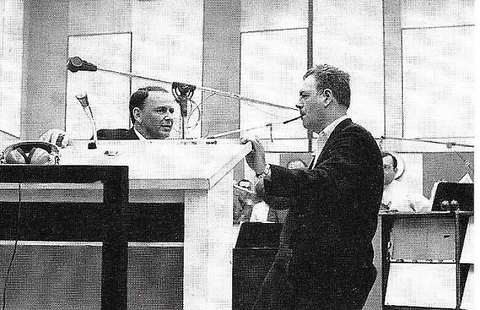
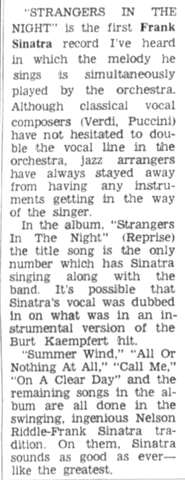
"On a Clear Day (You Can See Forever)"
Frank Sinatra: During the session, Sinatra instructed the orchestra: 'Let it lay back now. Don't push any phrases, let 'em linger.' Riddle picks up on the Basie tradition of stop-time and rests (associated with Thad Jones, Ernie Wilkins, Neal Hefti), pausing the whole ensemble before Sinatra's entrances, then surging in at double volume; the repeating coda pays tribute to Wild Bill Davis's iconic 'April in Paris' arrangement, evoking Basie's 'One more time' / 'One more once!'
Source: Will Friedwald, "Sinatra! The Song Is You: A Singer's Art" (2018 revised edition).
"Summer Wind"
'Summer Wind,' immediately following the title track, is described as the last masterpiece collaboration of Sinatra and Riddle -- reached only #25 on the pop chart (#1 easy listening) but became a deeply beloved 'turntable hit,' like 'Fly Me to the Moon,' known by everyone despite modest chart placement; it later featured in The Pope of Greenwich Village (1984) and remained a perennial concert request. The song originated in Germany with a melody by Henry Mayer (also known for 'My Melody of Love,' also recorded by Sinatra) and was a hit for Danish vocalist Grethe Ingmann; Johnny Mercer's English lyric was introduced in the US in 1965 by Bobby Vinton and Perry Como, both in a countrified 'slip note' Floyd Cramer piano style (Como's version, otherwise dull, includes the rare unsung-by-Sinatra second verse).
Source: Will Friedwald, "Sinatra! The Song Is You: A Singer's Art" (2018 revised edition).
['Gunga Din' novelty record]
Kaplan: Three days after the Polo Lounge beating of Frederick Weisman, while effectively hiding from the law in Palm Springs, Sinatra recorded a bizarre comedy record based on Kipling's poem 'Gunga Din,' inspired by a comic bit he'd seen performer Jimmy Komack do on TV.
Source: James Kaplan, "Sinatra: The Chairman" (2015)
[Assault on a Queen released to poor reception]
Kaplan: Sinatra's film Assault on a Queen was released in mid-June to a tepid response from both audiences and critics.
Source: James Kaplan, "Sinatra: The Chairman" (2015)
[Entratters keep vigil with Sinatra in Palm Springs]
Corinne Entratter: Mia Farrow flew to Palm Springs to be with Sinatra, along with Jack Entratter and his wife Corinne, during the anxious weeks after the Weisman beating. Corinne Entratter recalled it as the only time she saw Sinatra truly scared, with the group staying in and Mia learning backgammon to pass the time.
Source: James Kaplan, "Sinatra: The Chairman" (2015)
[Police chief publicly targets Sinatra]
Clinton Anderson: In the aftermath of the Weisman beating, Beverly Hills police chief Clinton Anderson told reporters Sinatra had been in hiding but that police would 'get him' to determine the cause of the fight and Weisman's condition.
Source: James Kaplan, "Sinatra: The Chairman" (2015)
[Sinatra denies striking Weisman]
Frank Sinatra: Sinatra called Chief Anderson directly and insisted the fight was Weisman's fault, claiming Weisman cursed at him and struck first before falling, and that he 'certainly did not' hit him. Privately, Sinatra told a friend he was terrified: 'If this guy croaks, I'm fucking finished.'
Source: James Kaplan, "Sinatra: The Chairman" (2015)
[Sinatra tapes 'That's Life' for TV special]
Kaplan: In June, Sinatra recorded 'That's Life' with a Nelson Riddle arrangement for his second Man and His Music special with Nancy, giving the soul tune a tough, canny reading with orchestra and jumpy blues organ.
Source: James Kaplan, "Sinatra: The Chairman" (2015)
[Weisman regains consciousness]
Kaplan: Weisman regained consciousness roughly seventy-two hours after being struck, though his condition remained serious.
Source: James Kaplan, "Sinatra: The Chairman" (2015)
[Frank and Nancy Jr. tape TV special]
On June 5 and 6, Frank and Nancy Sinatra Jr. taped their second joint TV special, 'A Man and His Music Part II,' at NBC Studios in Burbank, with both Nelson Riddle and Gordon Jenkins conducting segments.
Source: James Kaplan, "Sinatra: The Chairman" (2015).
[Dean Martin's 49th birthday and the Weisman incident begins] Late on Dean Martin's 49th birthday, Sinatra took a party of ten, including Jilly Rizzo and Richard Conte, to the Polo Lounge at the Beverly Hills Hotel. When businessman Frederick Weisman, seated nearby with Franklin Fox, asked the group to quiet down, Sinatra told him he was 'out of line' and reportedly made an anti-Semitic remark.
Source: James Kaplan, "Sinatra: The Chairman" (2015).
[Weisman struck and hospitalized]
As Sinatra's party was leaving the Polo Lounge, Frank returned to Weisman's table; accounts differ on exactly what happened -- a thrown telephone, a beating by Jilly Rizzo, or a blow from Sinatra himself -- but Weisman ended up with a fractured skull and was rushed to Cedars-Sinai's intensive care unit, not expected to survive. Sinatra and Martin had left before police arrived.
Source: James Kaplan, "Sinatra: The Chairman" (2015).
Hollywood
J4364 Gunga Din (spoken word) (N/R)
Note: This odd recording is in private circulation
NOTE: Sinatraphile Rich Warwick reports that Stan Cornyn, in his book "Exploding," says that Sinatra was determined to put out this recording as a follow-up to "Strangers in the Night." Cornyn writes that Sinatra would not listen to reason no matter how long Mo Ostin delayed its release. Finally, Sinatra called Ostin and demanded it be released, saying that he (Sinatra) owned the record company.
According to Cornyn, it was released for a brief period, but the reaction was so negative that Sinatra relented and agreed to have it pulled from the market.
Ed O'Brien strongly recommends reading the Cornyn book, pointing out that it contains lots of fascinating stories about Sinatra during the early Reprise years. O'Brien says that the Sinatra recording of the Kipling poem has to be heard to be believed. Actually, O'Brien says, the recording was only released to radio stations as a demo recording and was recalled shortly thereafter at radio's request.
Sinatraphile Jim White agrees that Cornyn's book contains a lot of stories about Sinatra during the early Reprise years, but it tell us one hell of a lot more about the nature, the raucousness, and the competitiveness and duplicity of the music recording business as it expanded so very, very rapidly later in the 60's, 70's, and 80's. Some of it's very astonishing to a man like me who enjoys a lot of recorded music solely for pleasure, White gasps!
Liner Notes: STRANGERS IN THE NIGHT
Strangers in the Night was assembled quickly, built around the runaway success of its title single -- a song Sinatra reportedly did not even particularly like, dismissing it in later years as "a piece of shit," even as it became his first number-one single in over a decade and won him the Grammy for Record of the Year. The album around it was recorded fast, in a matter of weeks, to capitalize on the single's momentum, with arrangements split between Ernie Freeman and Nelson Riddle.
Whatever Sinatra's private reservations about the title track, the record surrounding it holds together as a solid, professionally assembled pop album for the mid-1960s -- "Summer Wind," arranged by Riddle, would go on to become one of the more enduringly popular tracks in Sinatra's entire catalogue, its slightly melancholic sway a better showcase, many would argue, for what Sinatra could still do with a contemporary pop song than the title track itself.
Commercially, the album was an unambiguous triumph, reaching number one and cementing Sinatra's continued relevance at a moment when rock and roll had supposedly rendered singers of his generation obsolete. It is, in its own contradictory way, one of the more instructive records in his catalogue -- an album Sinatra didn't entirely believe in that nonetheless proved he could still win.
Written by Claude (Anthropic), commissioned for this chronology, 2026.
"Assault On A Queen" (USA Release: June
15, 1966)
Starring: Frank Sinatra, Virna Lisi,
Anthony Franciosa, Richard Conte, Alf Kjellin, Reginald Denny, Errol John, Murray Matheson, John Warburton
Screenplay by Rod Serling, Based on "Assault On A Queen" by Jack Finney
Produced by: William Goetz
Directed by: Jack Donohue
A World War II-era German submarine missing for 20 years is retrieved in the Bahamas by diver Mark Brittain (Frank Sinatra) and his partner Linc Langley (Errol John), and hired by the wealthy Rosa Lucchesi (Lisi) and her partner Vic Rossiter (Franciosa), who have been searching for sunken Spanish galleons. The recovery of the submarine results in a plot devised by Eric Lauffnauer Kjellin), a U-boat officer during the war, to pull a daring million-dollar heist on the British ocean liner Queen Mary, which he and the others plan to rob on the high seas while the liner is making a transatlantic crossing.
--DVD & Blu-Ray Release: 2012-03-27
[The Cinematic Legacy of Frank Sinatra — Assault on a Queen (1966)]
David Wills's 2015 photo history The Cinematic Legacy of Frank Sinatra devotes a section to Assault on a Queen (1966), illustrated with 2 behind-the-scenes and publicity photographs (posters, lobby cards, and on-set/on-location shots) filed here.
Source: David Wills, The Cinematic Legacy of Frank Sinatra (St. Martin's Press, 2015), pp. 251–253.
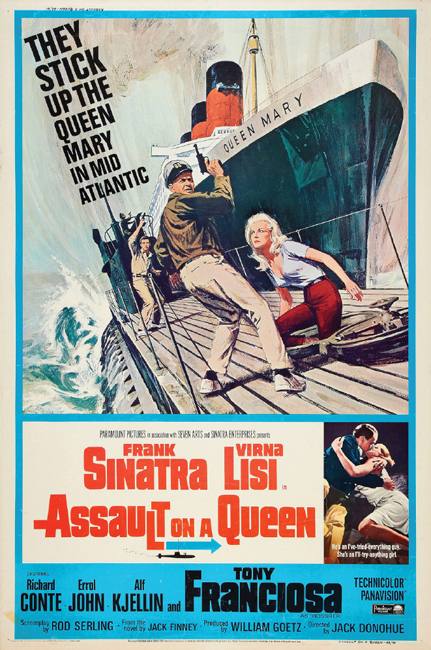
One sheet poster, Assault on a Queen, 1966. / “… the cameras were rolling again, Virna Lisi / was leaning toward Sinatra in the sand, and / then he pulled her down close to him. The / camera now moved in for a close-up of their (Photo: The Cinematic Legacy of Frank Sinatra, David Wills, 2015.)
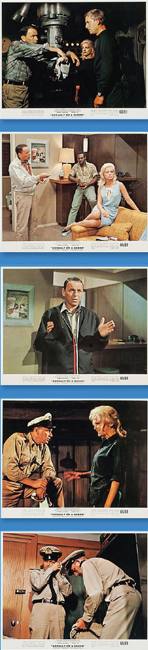
Lobby cards. (Photo: The Cinematic Legacy of Frank Sinatra, David Wills, 2015.)
"Assault on a Queen"
Assault on a Queen continued Sinatra's affiliation with Paramount (following Come Blow Your Horn and For Those Who Think Young). Based on a novel by Jack Finney, it was produced by William Goetz (close to Sinatra at the time, along with wife Edie, L.B. Mayer's daughter), shot by William Daniels, scripted by Rod Serling, and scored by Duke Ellington -- talent Santopietro says was wasted on a formulaic caper resembling a smaller, less interesting nautical Ocean's Eleven.
Source: Tom Santopietro, "Sinatra in Hollywood" (2008).
"Assault on a Queen"
Sinatra plays Mark Brittain, a cynical WWII ex-submarine commander turned charter fisherman, recruited by villainous Vic Rossiter (Anthony Franciosa) and love interest Rosa Lucchesi (Virna Lisi) into a scheme to raise a sunken German U-boat and use it to rob the Queen Mary.
Source: Tom Santopietro, "Sinatra in Hollywood" (2008).
"Assault on a Queen"
Virna Lisi: Co-star Virna Lisi (or her publicist) offered admiring comments on Sinatra, describing him as embodying what she wanted the American male to be -- "magnetic, animal, sensuous" -- saying that quality came through both in his singing and in his screen love scenes.
Source: Tom Santopietro, "Sinatra in Hollywood" (2008).
"Assault on a Queen"
Frank Sinatra: Sinatra jokingly returned Lisi's compliment with a crack referencing persistent Mafia rumors about him, saying that if Lisi had been in the Mafia, he'd never have torn up his membership card.
Source: Tom Santopietro, "Sinatra in Hollywood" (2008).
"Assault on a Queen"
Eight days before the film's July 1966 release, Sinatra married Mia Farrow. Santopietro notes that while neither the marriage nor the film ultimately fared well, Sinatra and Farrow remained friends for the rest of his life.
Source: Tom Santopietro, "Sinatra in Hollywood" (2008).
"Assault on a Queen"
Monthly Film Bulletin: The film was panned by Britain's Monthly Film Bulletin, which likened it to watching "plastic boats in the bath." Its weak box office made it Sinatra's second consecutive box-office disappointment, a slump that would extend to a third with The Naked Runner.
Source: Tom Santopietro, "Sinatra in Hollywood" (2008).
"Assault on a Queen"
Santopietro grades this a C, calling it "Ocean's Eleven at sea"—a leaky vessel. Golden Laurel Award nomination: Top Male Star of the Year.
Source: Tom Santopietro, "Sinatra in Hollywood" (2008).
"Assault on a Queen"
Santopietro (Filmography): Seven Arts/Sinatra Enterprises. Produced by William Goetz, directed by Jack Donohue, screenplay by Rod Serling based on the Jack Finney novel, musical score by Duke Ellington. Sinatra played Mark Brittain opposite Virna Lisi and Anthony Franciosa.
Source: Tom Santopietro, "Sinatra in Hollywood" (2008).
[Photograph: Strangers in the Night enters the charts amid a crowded debut week. From Richard Havers, "Sinatra" (Dorling Kindersley, 2007), p.297.]
[Photograph: Strangers in the Night enters the charts amid a crowded debut week. From Richard Havers, "Sinatra" (Dorling Kindersley, 2007), p.297.]
The week Frank's single first charted, eight other songs also debuted on Billboard, including Simon and Garfunkel's 'I Am a Rock' and Dean Martin's 'Come Running Back.' Seven weeks later Frank reached No. 1, dethroning the Beatles' 'Paperback Writer,' which had itself just displaced the Rolling Stones. (Source: Richard Havers, "Sinatra" (Dorling Kindersley, 2007).)
[Weisman questioned by police]
By June 27, Weisman was able to speak with police about the incident but said he remembered nothing after the moment he was struck.
Source: James Kaplan, "Sinatra: The Chairman" (2015).
[DA closes Weisman investigation]
Citing conflicting accounts and lack of evidence -- and, per one source, threatening phone calls -- Weisman's family chose not to pursue charges. On June 30, the Los Angeles district attorney closed the investigation. George Jacobs claimed Sinatra paid Weisman millions in hush money, though Weisman's brother publicly said there was 'nothing to settle.'
Source: James Kaplan, "Sinatra: The Chairman" (2015).
[Sinatra Marries Mia Farrow in Las Vegas]
Following a brief courtship, Sinatra married actress Mia Farrow in Las Vegas in July 1966.
Source: Charles Pignone, "Frank Sinatra 100" (2015).
[Dexter warns Sinatra against marrying Mia]
Brad Dexter: In London, after gambling at George Raft's Colony club, Brad Dexter bluntly told Sinatra the 30-year age gap with Mia didn't make sense and suggested he see a psychiatrist. Furious, Sinatra trashed his Grosvenor Square apartment, then called Jack Entratter in Las Vegas to arrange an immediate wedding.
Source: James Kaplan, "Sinatra: The Chairman" (2015)
[Learjet cake proposal]
Kaplan: Flying east with Mia before leaving for Europe, Sinatra had a pear-shaped diamond engagement ring hidden under cake dessert aboard his Learjet, then told her which finger to put it on.
Source: James Kaplan, "Sinatra: The Chairman" (2015)
[Newlyweds dine with Dolly and Marty in Fort Lee]
Dolly Sinatra: Frank brought Mia to his parents' home in Fort Lee, New Jersey, where Dolly had cooked for two days. Guests included Toots Shor, Joe E. Lewis, Jilly Rizzo, and Liza Minnelli. Mia ate only salad and said little; Dolly, unimpressed, told a friend afterward, 'This one don't talk. She don't eat. What's she do?' and privately told George Jacobs, 'She's a little nothing. Is that the best he can do?'
Source: James Kaplan, "Sinatra: The Chairman" (2015)
[Sinatra buys an $85,000 engagement ring]
Kaplan: Sinatra went to Billy Ruser's jewelry store in Beverly Hills -- the same shop where he'd bought Ava Gardner earrings in 1953 -- and paid $85,000 for a nine-carat diamond ring, before departing to film The Naked Runner in Europe, his last picture for Warner Bros.
Source: James Kaplan, "Sinatra: The Chairman" (2015)
[Sinatra flies to London without Mia]
Kaplan: After the Cerfs' visit, Sinatra flew on to London with George Jacobs, Jimmy Van Heusen, and Brad Dexter (producer of The Naked Runner) to begin filming, leaving Mia behind.
Source: James Kaplan, "Sinatra: The Chairman" (2015)
[Sinatra proposes to Mia in Palm Springs]
Kaplan: With relief following the closed investigation, Sinatra one morning led Mia outside in Palm Springs, took her hands, and asked her to marry him.
Source: James Kaplan, "Sinatra: The Chairman" (2015)
"Strangers in the Night," recorded April 11, 1966, tops the Billboard chart, knocking the Beatles' "Paperback Writer" from the number-one spot. It became Reprise's third chart-topper, following Dean Martin's "Everybody Loves Somebody" and Nancy Sinatra's "These Boots Are Made for Walkin'." Source: J. Randy Taraborrelli, Sinatra: Behind the Legend.
[Fourth of July weekend at the Cerfs']
Christopher Cerf: Frank and Mia spent the Fourth of July weekend at the Cerf family's home in Mount Kisco, New York. Christopher Cerf recalled Sinatra as very attentive to Mia, though without an obvious burning passion.
Source: James Kaplan, "Sinatra: The Chairman" (2015).
[Mia announces leaving Peyton Place]
On July 7, Mia Farrow announced she was leaving Peyton Place and signing with 20th Century Fox, seeking $200,000 for a starring movie role.
Source: James Kaplan, "Sinatra: The Chairman" (2015).
[Mia flashes her ring at P.J. Clarke's]
Mia Farrow: On a Sunday night, Mia arrived at P.J. Clarke's in New York on crutches, having cut her leg on scissors, but flashed a large diamond ring, telling reporters coyly it was 'a friendship ring from Frank.'
Source: James Kaplan, "Sinatra: The Chairman" (2015).
[Maureen O'Sullivan announces the engagement]
Maureen O'Sullivan: After phoning Sinatra in London to press him on his intentions and getting only a vague promise of a wedding sometime between Thanksgiving and Christmas, Mia's mother Maureen O'Sullivan publicly announced the engagement to the Associated Press, saying she couldn't be more delighted and that the age difference didn't matter.
Source: James Kaplan, "Sinatra: The Chairman" (2015).
By phone -- she in Los Angeles, he in London finishing The Naked Runner -- Frank and Mia Farrow settle on marrying the next day in Las Vegas, ending months of on-and-off talk about their future. Source: J. Randy Taraborrelli, Sinatra: Behind the Legend.
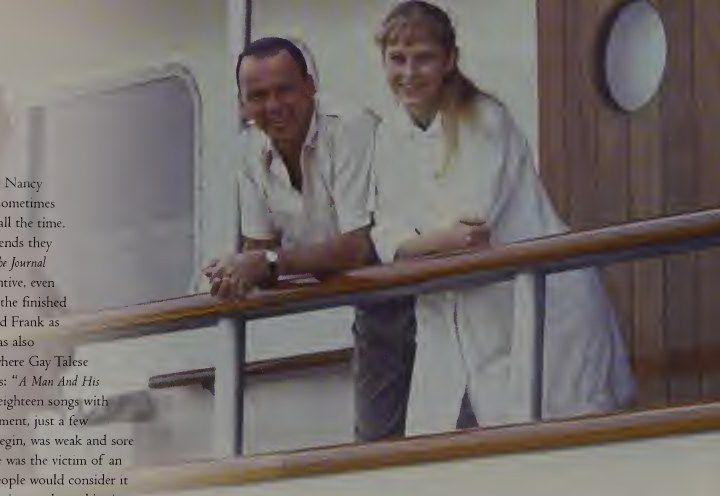
Fifty-two-year-old Frank takes a third wife, Mia, just twenty-one, on July 19, 1966, at the Sands Hotel in Las Vegas. Their marriage would last two stormy years. Source: photo and caption from J. Randy Taraborrelli, Sinatra: Behind the Legend (mptvimages.com).
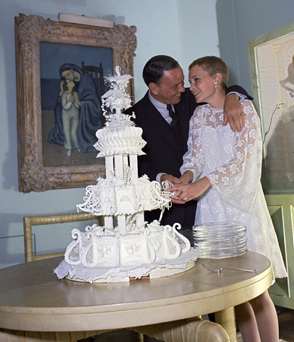
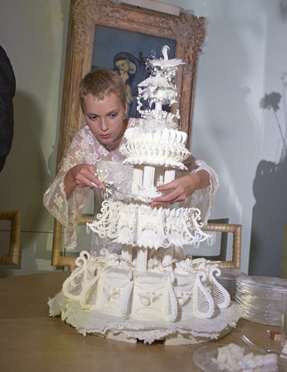
Mia on her wedding day. She has said that the marriage was, in some ways, “more like an adoption.” Source: photo and caption from J. Randy Taraborrelli, Sinatra: Behind the Legend (mptvimages.com).
[Wedding date leaks to the press]
Las Vegas Review-Journal managing editor Don Digilio learned from a source that the Sinatra-Farrow wedding, contrary to Frank's public Thanksgiving-to-Christmas timeline, would actually take place that evening at the Sands. The news broke on front pages the morning of the nineteenth, drawing the world's press to Las Vegas.
Source: James Kaplan, "Sinatra: The Chairman" (2015).
[Sinatra and Farrow marry at the Sands]
Frank Sinatra: The civil ceremony, presided over by Judge William Compton, took place at 5:30 p.m. in Jack Entratter's Sands suite and lasted about four minutes. Bill and Edie Goetz served as best man and matron of honor; Entratter gave the bride away. Both were visibly nervous; afterward Sinatra told photographers, 'This is a big day, fellas... it seemed right, and we're in love, and it was logical.'
Source: James Kaplan, "Sinatra: The Chairman" (2015).
[Red Skelton's wife shot same day as wedding]
The morning of the wedding, a .38 pistol accidentally discharged in performer Red Skelton's Sands suite, wounding his wife Georgia in the chest; no charges were filed. Skelton, performing at the Sands, attended the Sinatra-Farrow ceremony regardless.
Source: James Kaplan, "Sinatra: The Chairman" (2015).
[Sinatra tells Tina of the wedding via Dean Martin]
Tina Sinatra: At the moment of the ceremony, Dean Martin pulled Tina Sinatra aside at his home to tell her, 'your dad is marrying Mia as we speak.' Tina was hurt at being excluded; when Frank called later that night asking for her blessing, she refused, telling him she was too busy resenting him.
Source: James Kaplan, "Sinatra: The Chairman" (2015).
[Ava Gardner learns of the wedding]
Accounts differ on how Ava Gardner learned of the marriage -- possibly a call from George Jacobs, or, per one source, a call from Sinatra himself just before the ceremony in which he told her 'It's too late, baby. The judge is standing right there' but that he'd always love her. All accounts agree that when Ava heard, she cried and couldn't stop.
Source: James Kaplan, "Sinatra: The Chairman" (2015).
[Wedding reception at the Goetzes']
To throw off the press, the newlyweds announced they were flying to New York but instead went to a rented Holmby Hills house, then to a reception at the Goetzes', attended by guests including Katharine Hepburn, Spencer Tracy, Edward G. Robinson, and Dean Martin -- but no Sinatra family members and no Maureen O'Sullivan.
Source: James Kaplan, "Sinatra: The Chairman" (2015).
Frank Sinatra, 50, marries Mia Farrow, 21, in a small, secretive ceremony in Las Vegas; comedian Red Skelton was among the few witnesses. Farrow wore a white silk dress with caftan sleeves and kept her hair cropped nearly as short as Frank's own. Source: J. Randy Taraborrelli, Sinatra: Behind the Legend.
United Recording Studio - Hollywood
4 to 7 P.M.
Arranged & Conducted by Ernie Freeman
Lee Herschberg Engineer
Jimmy Bowen Producer and A&R Rep
J-4410 She Believes In Me 2:42
J-4412 That's Life 3:02
Ed O'Brien:
An orchestral session. There were 40 musicians.
Buddy Greco and Sammy Davis Jr. would do over- dubs on "She Believes In Me." "That's Life" would be rejected. On October 18, 1966 Sinatra would record "That's Life" with a new arrangement and a female vocal trio. The 40 musicians at this session included the great Ray Brown on bass and Michael
Melvoin was on the organ. The track from 7-25 would be mixed with the Sinatra vocal from 10-18 and released on the Japanese bonus disc of "Ultimate Sinatra"( 2015).
note: Frank was set to record at this session but there was
just too much going on in his life. He flew to London on
July 5th and the filming of "The Naked Runner" got underway.
Then he flew back to L.A. and married Mia on 7/19. They wanted
more time together so the vocal session was cancelled. Then the
two-some headed back to London and the film production, arriving on 7-25.
[Sinatra punches a photographer at '21']
The newlyweds, feted by the Cerfs and Leland Hayward at '21' in New York, were approached by New York Post photographer Jerry Engel as they left; Sinatra slugged him, knocking off his glasses.
Source: James Kaplan, "Sinatra: The Chairman" (2015).
This heist film, scored with Duke Ellington's music, was released and quickly labeled a low-budget failure. Aside from Frank, the cast had no names likely to draw an audience. (Source: Richard Havers, "Sinatra" (Dorling Kindersley, 2007).)
[Naked Runner filming moves to Copenhagen]
Kaplan: At the end of August, filming of The Naked Runner relocated to Copenhagen, with production back on schedule after the earlier turmoil.
Source: James Kaplan, "Sinatra: The Chairman" (2015)
[Sinatra at the Sands (live album with Count Basie) -- critical commentary]
Billy Byers (quoted) / Friedwald (analysis): Friedwald traces the buildup: Sinatra brought the Basie band on tour to build rapport (two-week Sands run Nov-Dec 1964), then a 1965 tour including a prison outside D.C. (April), a CBS documentary shoot in PA and Detroit (July), the Rat Pack reunion with Sammy Davis Jr. and Dean Martin at the Kiel Opera House in St. Louis (June 20, 1965), Sinatra's only Newport Jazz Festival appearance (July 4, 1965), three nights at Forest Hills tennis stadium in Queens, the Arie Crown Theater in Chicago (July 18), and the Hollywood Palace TV broadcast (videotaped Sept 26, aired Oct 16, 1965). Sinatra opened at the Sands January 9, 1966 after further rehearsals, then waited until the band's chemistry peaked, recording the final five nights (two sets each) beginning January 26, culling ten sets into the 76-minute double LP. Arranger Billy Byers told Friedwald in a March 1995 interview that arranging for stars like Sinatra and Basie was like being 'half psychologist and half tailor -- and even then, the pants don't always fit,' but on Sands 'everything fits perfectly.'
Source: Will Friedwald, "Sinatra! The Song Is You: A Singer's Art" (2018 revised edition), Ch. 9, "Looking for the Hook" (1960-1971)
[Ava Gardner interviewed in New York]
Ava Gardner: Ava Gardner came to New York at the end of September for the premiere of The Bible. Interviewed by Rex Reed while drinking heavily, she gave a curt 'no comment' about Sinatra and an unprintable remark about Mia Farrow, later bowdlerized for publication. Sinatra himself was reportedly in New York that same weekend, without Farrow.
Source: James Kaplan, "Sinatra: The Chairman" (2015)
[Newlyweds buy Bel Air house]
Kaplan: House-hunting that September distressed Mia, who couldn't picture herself in the Beverly Hills mansions they toured. The couple settled on a five-bedroom English Tudor-style house on Copa de Oro Road in Bel Air, previously owned by Dick Powell and June Allyson; Frank remarked to Dean Martin before the wedding that he only expected 'one or two good years' from the marriage.
Source: James Kaplan, "Sinatra: The Chairman" (2015)
Civic Auditorium, San Francisco
Benefit for the re-election of Governor Pat Brown
Frank Sinatra, Dean Martin, Ella Fitzgerald, Trini Lopez, Joe Bishop, Rowan & Martin
Sinatras songs:
1. I've Got The World On A String
2. Fly Me To The Moon
3. The Shadow On Your Smile (With Help From A Friend)
4. I've Got You Under My Skin
5. It Was A Very Good Year
6. You Make Me Feel So Young
Civic Auditorium, San Francisco
Benefit for the re-election of Governor Pat Brown
Frank Sinatra, Dean Martin, Ella Fitzgerald, Trini Lopez

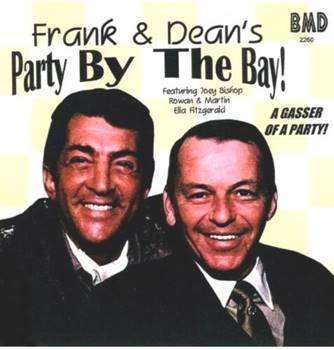
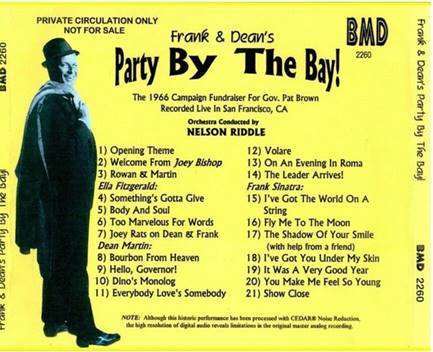
[Sinatra hosts Pat Brown fundraiser]
Barbara Bladen: Sinatra hosted a fundraiser for California governor Pat Brown at San Francisco's Civic Auditorium, with Joey Bishop emceeing and Dean Martin, Connie Francis, Trini Lopez, and Ella Fitzgerald on the bill. Outside, anti-war protesters demonstrated; a local columnist noted Mia Farrow's cropped hair drew applause 'probably for having snagged The Leader.'
Source: James Kaplan, "Sinatra: The Chairman" (2015).
Hollywood
J4569 That's Life
w/Chorus
(Dean Kay Thompson/Kelly Gordon)
PolyGram International Publishing Co. Inc. (ASCAP)
Arranged & Conducted Ernie Freeman
-3 (3:06) CD: 46013-2 The Complete Reprise Studio Recordings Disc 11
CD: 9-26340-2The Reprise Collection
CD: 1020-2 That's Life
LP: FS1025 Franks Sinatra's Greatest Hits
LP: FS1020 That's Life
45: 0531
Evening Standard
[Sinatra records 'That's Life' single]
Jimmy Bowen: The single session for 'That's Life' took place at Western Recorders' new eight-track studio. After technical delays, an impatient Sinatra sang the song twice; producer Jimmy Bowen, unsatisfied with a too-gentle rhythm section, pushed for a third, harder take despite Sinatra's visible irritation. The tougher take was used, and Sinatra called Bowen the next day to say it was 'just brilliant.'
Source: James Kaplan, "Sinatra: The Chairman" (2015).
[That's Life -- critical commentary]
Jimmy Bowen (quoted) / Friedwald (analysis): Sinatra discovered the song himself (unlike 'Softly' or 'Strangers'), probably from soul singer O.C. Smith's record. He originally had Nelson Riddle write a swinging, bluesy chart with Hammond organ (debuted on TV special A Man and His Music Part II) but didn't bring that chart to the studio, instead giving the song to Bowen and Freeman, who added a gospel-style choir. Recording took place at a new studio where most mics weren't working; Bowen used only two mics (on Sinatra and rhythm section) and planned to overdub horns/strings/backup singers and a keyboard part by Mike Melvoin later. Bowen recounted: Sinatra sang a take everyone thought was 'the one'; Bowen said, 'Frank said, "Boy! That's a hit, isn't it?" And I said, "Well, no. If you want a hit, you're going to have to do it one more time." Everybody got real quiet, and he gave me the coldest look an artist ever gave me. But he went right out, and instead of singing it hip -- he was pissed now -- he bit it! That's when he sang "That's Life"!' Bowen believed getting Sinatra genuinely angry was key to capturing the soul feeling, likening the result to Ray Charles-style crossover with pseudo-Raelettes backing.
This song/context matches multiple dated entries in the chronology; the specific date Friedwald is referring to could not be determined with confidence.
Source: Will Friedwald, "Sinatra! The Song Is You: A Singer's Art" (2018 revised edition), Ch. 9, "Looking for the Hook" (1960-1971)
[That's Life -- critical commentary]
Granata's discography entry: That's Life, arranged by Ernie Freeman, released November 1966.
This song/context matches multiple dated entries in the chronology, or lacked a sufficiently precise date; the specific date could not be determined with confidence.
Source: Charles L. Granata, "Sessions with Sinatra: Frank Sinatra and the Art of Recording" (1999/2003), Afterword & Appendices A-D
Sports Arena, Los Angeles, CA
Night of Stars Benefit for Ed Brown for Governor
Frank Sinatra, Dean Martin, Joey Bishop, Trini Lopez, Danny Kaye, Keely Smith, Danny Thomas and others
Sports Arena, Los Angeles, CA
Night of Stars Benefit for Ed Brown for Governor
Frank Sinatra, Dean Martin, Joey Bishop, Trini Lopex, Danny Kaye, Keely Smith, Danny Thomas and others
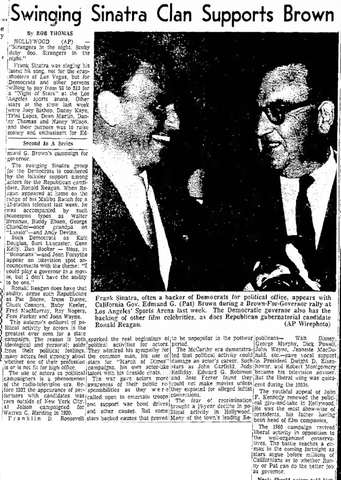
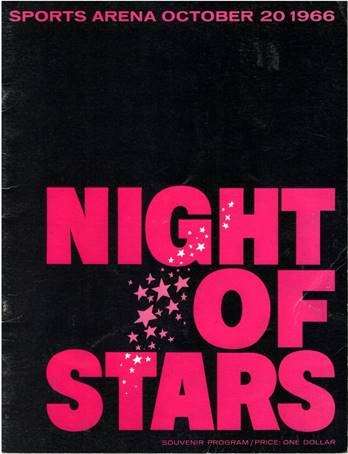
Sands, Las Vegas
25th Wedding Anniversary of Rosalind Russell and Frederick Brison
Note: This had previously been reported as October 29, 1966 but the event was held on Saturday, October 22, 1966 and ended in the wee small hours of Sunday October 23rd. Sinatra also sang a parody of "Love and Marriage" to the happy couple.
When Frank Sinatra and Mia Farrow hosted Rosalind Russell and Frederick Brisson’s 25th wedding anniversary in Las Vegas, Russell wrote the itinerary: “6PM Meet at Chez Brisson with bag and baggage. Sweet punch and salted nuts will be served…7PM Leave in Howard Hughes’ wooden flying boat. Dancing in the aisle to Ina Ray Hutton’s [all-woman] band. Free gum and Kleenex….”
Farrow & Sinatra At Party At the bar in the Sands Hotel, American actress Mia Farrow plays a violin, watched by her husband, singer, actor, and entertainer Frank Sinatra (1915 - 1998) (center right) and two unidentified men, Las Vegas, Nevada, October 1966. The couple were in attendance at a party for actress Rosalind Russell and her husband Freddie Brisson. (Photo by Charles Bonnay/The LIFE Images Collection via Getty Images/Getty Images)
Apparently there was more to this story:
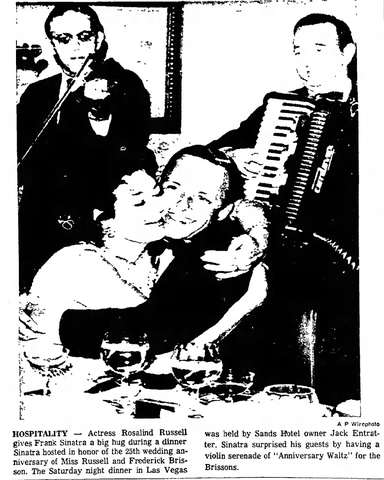
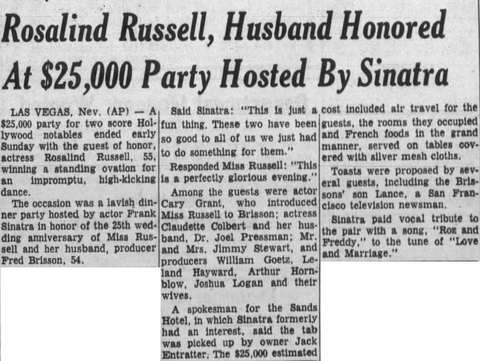
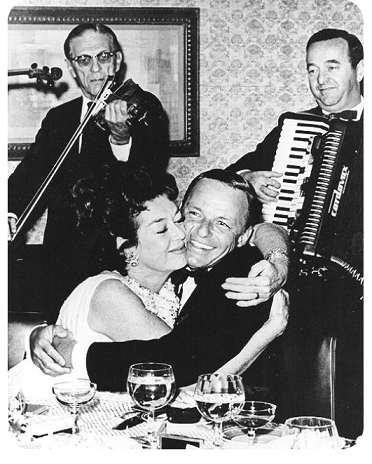
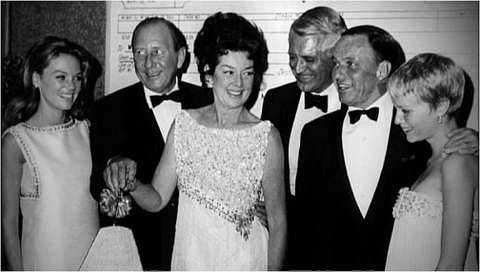
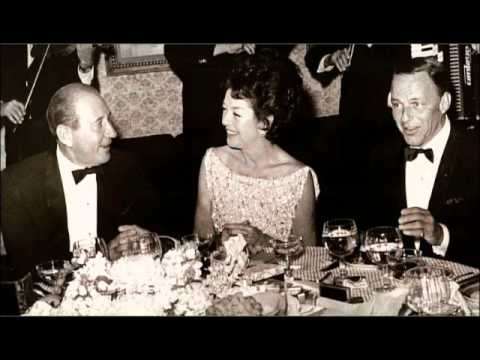
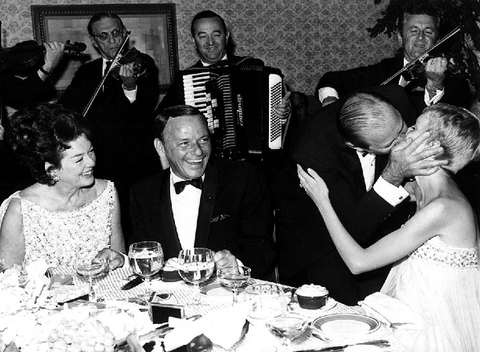
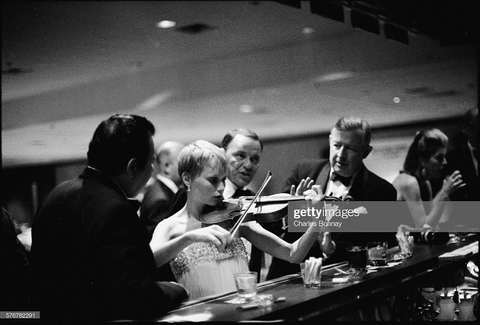
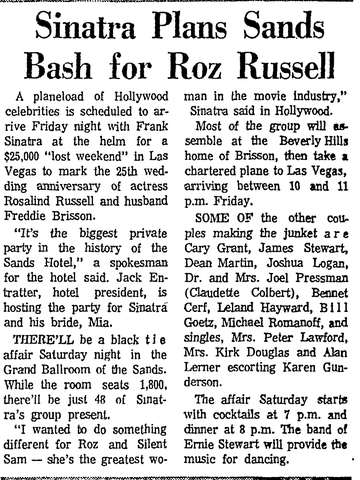
Sands, Las Vegas
25th Wedding Anniversary of Rosalind Russell and Frederick Brison
Excerpt from "Life is a Banquet" by Rosalind Russell:
Saturday evening; the climax of the weekend getaway Frank Sinatra had thrown for Roz and Freddie for their 25th Anniversary. Tonight, Roz was dazzling in a white, beaded crystal gown Galanos had especially designed for her.
Forty-one of them arrived at the special anniversary party at a sectioned off area of the grand ballroom, which were filled with white flowers in baskets. As they arrived, each signed the Brissons' wedding book from 25 years ago. Cary Grant, who had introduced Roz and Freddie, and who was best man at the wedding, signed: "What happiness, my dears... I did it and I'm glad... Your, Cary." Tonight, he added: "And we all head for the next 25 filled with love. Cary—who will be there in 1991, too."
An eight-piece orchestra kept the night filled with music as guests dined at six tables covered in white tablecloths. Overlaid silver mesh kept up the theme. Place cards "were silver double picture frames. In the left-hand frame was a picture of Freddie and me as bride and groom; in the right-hand frame, a picture of the guest couple." To pull this off without their knowledge, Roz sourced them from her own scrapbooks or from other friends. Guests had to look for their own photos to find their seats, and when they saw photos, some of them they'd never seen before, went up to Roz, asking: "Where in the world did you get this picture of me?"
Roz recalled: "Frank had bought silver cigarette boxes for everyone, inscribed '25th—Roz and Freddie.' The ladies were given silver bags stuffed with twenty-five silver dollars for gambling [I doubt any of the guests used them for "gambling"!]. Frank had arranged with the bank to get dollars stamped with the dates of the wedding and anniversary years, 1941 and 1966.
Dinner began at 9:45PM with a brief but warm welcome by Frank. Then guests toasted the Brissons with aquavit from Danish flacons. "Ours was a family table. Freddie and I sat there, along with Lance, who'd brought a young lady, Freddie's mother, Frank and Mia, our best man, Gary, and his wife Dyan Cannon. (I think that marriage was already on the rocks; Cary did nothing but cry all evening.)
John McClain got up and said he'd investigated the Brisson marriage and found that we'd never even had a license [he wished the couple a happy "first anniversary" instead], but that just before this party we'd made a quick trip to Mexico and straightened everything out. At our table, Lance made the speech. (How young he looks in the pictures, his hair so close-cropped his head seems shaved.) He was adorable, very nervous, and he drank lots of water.
"I stared at the tablecloth and said a little prayer that Lance could get through it, because he was decidedly pale.
"He talked about gratitude, the derivation of the word, what it meant to him, how he felt gratitude for his parents. Freddie and I were moved and charmed.
"When it was time for me to speak, I said, 'Frank, I'm afraid I'm going to be inarticulate.' 'That'll be the day when you can't talk,' he said, so I tried. 'Twenty-five years is a very long time,' I said, 'but it is also a very short time when you love someone.' I felt throughout the entire room a feeling of love which circled back to us."
It was clearly one of Roz's most cherished memories, being surrounded by her dearest friends, celebrating her marriage to the love of her life. Nedda Logan, one of Roz's oldest friends, summed it up: "I want to freeze this night in my mind forever. I'll never get over it. I don't think any of us ever really will."
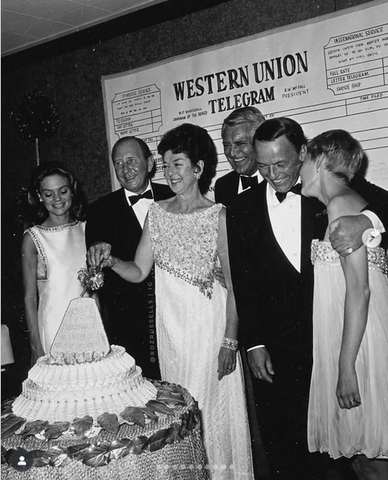
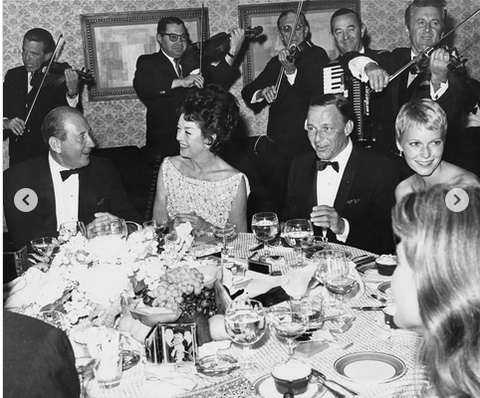
['That's Life' album recorded]
Jimmy Bowen: The That's Life album was recorded over two nights in mid-November, built entirely around the modern, harder-edged sound of the hit single rather than Riddle's classic style; Bowen felt it necessary to fully commit to the new direction rather than mixing old and new styles.
Source: James Kaplan, "Sinatra: The Chairman" (2015)
['That's Life' single climbs the charts]
Kaplan: About a month after the October session, 'That's Life' entered a Billboard chart crowded with the Supremes, the Beach Boys, and the Monkees, and climbed to number four.
Source: James Kaplan, "Sinatra: The Chairman" (2015)
[Farrow's alienation from Vegas life]
Sheilah Graham: Around this Sands engagement, columnist Sheilah Graham watched Sinatra gamble heavily while Mia waited on the sidelines; when she finally touched his arm and said 'Let's go,' he flung her hand off and snapped at her not to try to change him.
Source: James Kaplan, "Sinatra: The Chairman" (2015)
[Mia requests 'The Impossible Dream' for the album]
Rob Fentress: Session attendee Rob Fentress recalled that 'The Impossible Dream,' included on the That's Life album despite Sinatra disliking the song, was recorded at Mia's request.
Source: James Kaplan, "Sinatra: The Chairman" (2015)
[Refusing to attend Sinatra's LA recording sessions]
Ed Walters: Prompted by listening to a CD of Sinatra's May and November 1966 recording sessions, Walters recalls repeatedly declining Sinatra's invitations in the mid-1960s to fly to LA and watch him record, dismissively telling Frank he already heard him sing every night at work. Sinatra, egged on by friends at the 21 table, tried to explain the sessions took two or three days of hard, repetitive work, but Walters (suspicious Frank was trying to trap him into some multi-day escapade, as he reportedly did with others) refused to go, prompting Frank to call him young and stupid. Walters says he only later realized, from hearing the session tapes decades afterward, how much genuine work went into the recordings.
Source: Ed Walters, pit boss reminiscences (compiled by Kraus, Sinatra mailing list)
[Sinatra first meets Hubert Humphrey]
Norman Sherman: Frank and Mia paid a courtesy call on Vice President Hubert Humphrey and his wife Muriel at the Waldorf Towers in New York, where Sinatra and Humphrey bonded reminiscing about big bands and boxing; Mia sat quietly beside Frank throughout, according to Humphrey press secretary Norman Sherman.
Source: James Kaplan, "Sinatra: The Chairman" (2015)
[Sinatra heckles Jackie Mason at the Aladdin]
Kaplan / Sinatra quoted: Catching Joe E. Lewis's late show at the Aladdin, where comedian Jackie Mason (who had been mocking Sinatra's hair transplants and his marriage to Mia) was also playing, Sinatra heckled from the audience, saying he'd come to see Mason and that he'd 'bite him on the neck' if Mason came onstage.
Source: James Kaplan, "Sinatra: The Chairman" (2015)
[Thanksgiving trip to New York]
Kaplan: Frank and Mia traveled to New York for Thanksgiving to see Dolly and Marty and do Christmas shopping; Sinatra bought Farrow a long gray mink coat as an early, unspoken apology gift.
Source: James Kaplan, "Sinatra: The Chairman" (2015)
Sands, Las Vegas,
Nevada (2-15)
Antonio Morelli Orchestra Conducted By: Gordon Jenkins (34-piece which included 21 strings)
Key Musicians: Bill Miller (piano)
Comedian: Bob Melvin
note: Sands engagement was originally set to open on Tuesday (11/1)
Frank had a scheduling conflict and pushed the opening to Wednesday (2).
Bob Melvin was his opening act the first week. Kessler Twins replaced him
for the second week. Frank was dark on Mondays (7 &14). He had his plane
bring in Johnny Prophet from Reno to sub. After the 11/7 off-day, Sinatra told
Jack Entratter he needed to close on Tuesday, the 15th. "That's Life" was a huge
hit and he needed to get an album in the can. Sessions were scheduled for the 17th
and 18th of the month. Dick Shawn was set to open on 11/18 for a week. Entratter
called and told him he was opening on the 16th.
ED
Sands, Las Vegas, Nevada (2-15)
Antonio Morelli Orchestra Conducted By: Gordon Jenkins (34-piece which included 21 strings)
Key Musicians: Bill Miller (piano)
Comedian: Bob Melvin
FRANK IN LAS VEGAS
Las Vegas: Frank Sinatra opened here on Nov 2. The leader of the "Clan" is at the Sands, playing to turn-away crowds.
Sinatra walked onto the stage at the Sands and received a standing ovation before he even sang a note. There was an extra treat because Gordon Jenkins and a 35-piece re- cording orchestra, including 20 strings, backed
Sinatra.
He sang all the songs he is so famous for in- cluding "Autumn Leaves," "It Was A Very Good
Year,' "The Shadow Of Your Smile," "Foggy Day,'
"I've Got You Under My Skin," "September Of
My Years" and "Yes Sir, That's My Baby."
Sinatra, causing the usual excitement in town, is here for only two weeks. Sinatra doesn't have too much chatter with the audience. He offers a joke or two.
He forgot the words to "Strangers In The Night," the recording hit which has sold over two million copies.
But he joked his way out, then introduced some of the opening night audience including his wife, Mia.
Don Gigilio
Billboard
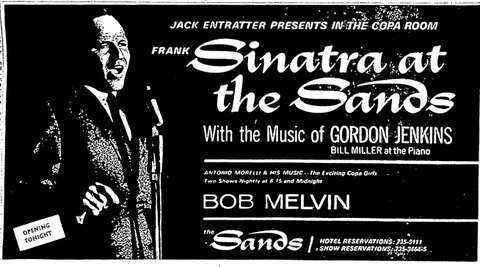
© 1997-2025 The Sinatra Archive
This calendar, or any parts thereof, may not be reproduced in any fashion whatsoever without the prior written permission of the publisher (The Sinatra Archive)
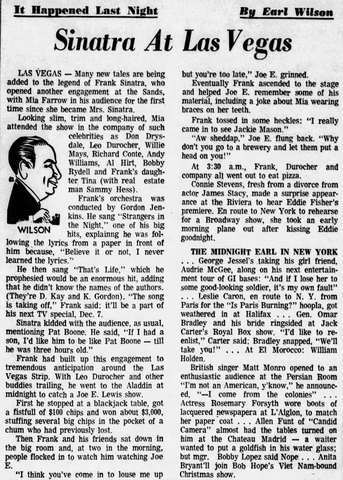
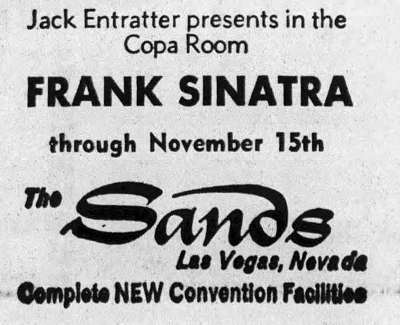
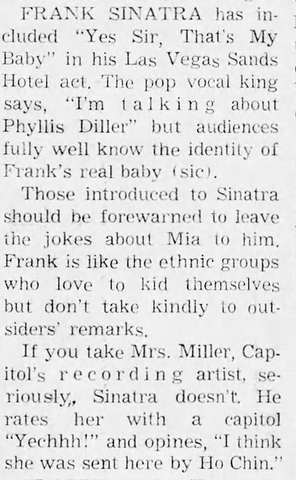
Sands, Las Vegas,
Nevada (2-15)
Antonio Morelli Orchestra Conducted By: Gordon Jenkins (34-piece which included 21 strings)
Key Musicians: Bill Miller (piano)
Comedian: Bob Melvin
FRANK IN LAS VEGAS
Las Vegas: Frank Sinatra opened here on Nov 2. The leader of the "Clan" is at the Sands, playing to turn-away crowds.
Sinatra walked onto the stage at the Sands and received a standing ovation before he even sang a note. There was an extra treat because Gordon Jenkins and a 35-piece re- cording orchestra, including 20 strings, backed
Sinatra.
He sang all the songs he is so famous for in- cluding "Autumn Leaves," "It Was A Very Good
Year,' "The Shadow Of Your Smile," "Foggy Day,'
"I've Got You Under My Skin," "September Of
My Years" and "Yes Sir, That's My Baby."
Sinatra, causing the usual excitement in town, is here for only two weeks. Sinatra doesn't have too much chatter with the audience. He offers a joke or two.
He forgot the words to "Strangers In The Night," the recording hit which has sold over two million copies.
But he joked his way out, then introduced some of the opening night audience including his wife, Mia.
Don Gigilio
Billboard
© 1997-2025 The Sinatra Archive
This calendar, or any parts thereof, may not be reproduced in any fashion
whatsoever without the prior written permission of the publisher (The
Sinatra Archive)
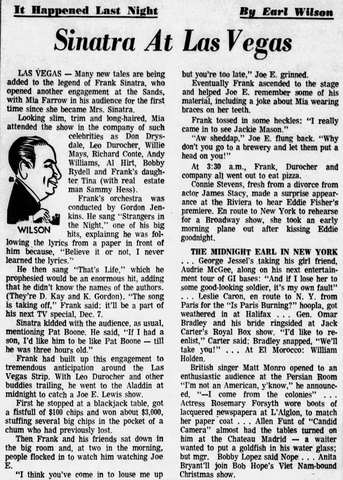
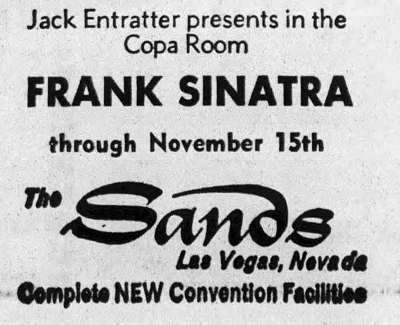
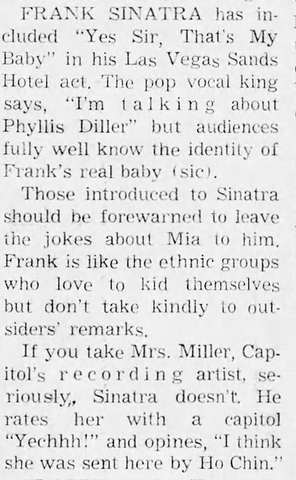
Sands, Las Vegas , Nevada (2-15)
Antonio Morelli Orchestra Conducted By: Gordon Jenkins (34-piece which included 21 strings)
Key Musicians: Bill Miller (piano)
Comedian: Bob Melvin
1. The Shadow Of Your Smile
2. Yes Sir, That's My Baby
3. Autumn Leaves
4. It Was A Very Good Year
5. A Foggy Day
6. This Is All I Ask
7. Strangers In The Night
8. I've Got You Under My Skin
9. September of My Years
10. That's Life
note: Sinatra was riding a new wave of immense popularity when he opened at the Sands in November of 1966. He had three albums in the Billboard Top 100,
"That's Life" was a breakout hit single, "Man & His Music II" would air on CBS,12-7-66, placing #13 in the Nielsen ratings for the week, and he would record the album "That's Life" immediately after the Sands engagement. That album would sell a million records in nine days. Heady times for a veteran entertainer.
Antonio Morelli's orchestra backed Sinatra at the Sands.
The comedian Bob Melvin was the opening act. Frank also sang "This Is All I Ask," "My Kind Of Town" and "That's Life."
"Shadow Of Your Smile" had acquired a Riddle string arrange- ment. A studio recording was penned in at a future session.
Frank's appearance at the Sands was his 28th engagement there over a period of 14 years.
Sands, Las Vegas , Nevada (1-15)
Variety 11-09-66
[Sinatra opens at the Sands, first since marrying Mia]
Sinatra began a two-week engagement at the Sands with Antonio Morelli's orchestra and Gordon Jenkins conducting -- his 28th Copa Room opening and his first since marrying Mia Farrow. He opened with 'The Shadow of Your Smile,' looking directly at his bride in the audience.
Source: James Kaplan, "Sinatra: The Chairman" (2015).
[Sinatra's crude joke embarrasses Mia onstage]
Frank Sinatra: During the Sands show, after introducing Mia to applause, Sinatra joked to the audience that he'd gotten married because he'd 'finally found a broad I can cheat on' -- a line that visibly stung Farrow in front of the crowd before he tried to recover by singing again.
Source: James Kaplan, "Sinatra: The Chairman" (2015).
[Sinatra's Watts joke about Sammy Davis]
Frank Sinatra: At the same Sands show, Sinatra told a crude joke about Sammy Davis Jr. opening a gas station in Watts called 'Whitey's,' selling 'regular, ethyl, and burn, baby, burn' -- a reference to the 1965 Watts riots, delivered in what Kaplan notes was still a racially unenlightened Las Vegas.
Source: James Kaplan, "Sinatra: The Chairman" (2015).
Sands, Las Vegas, Nevada (1-17)
Antonio Morelli Orchestra Conducted By: Gordon Jenkins (34-piece which included 21 strings)
Key Musicians: Bill Miller (piano)
Comedian: Bob Melvin
Sands, Las Vegas, Nevada (2-15)
Antonio Morelli Orchestra Conducted By: Gordon Jenkins (34-piece which included 21 strings)
Key Musicians: Bill Miller (piano)
Comedian: Bob Melvin
Sands, Las Vegas, Nevada (2-15)
Antonio Morelli Orchestra Conducted By: Gordon Jenkins (34-piece which included 21 strings)
Key Musicians: Bill Miller (piano)
Sands, Las Vegas, Nevada (2-15)
Antonio Morelli Orchestra Conducted By: Gordon Jenkins (34-piece which included 21 strings)
Key Musicians: Bill Miller (piano)
Comedian: Bob Melvin
Sands, Las Vegas, Nevada (1-17)
Antonio Morelli Orchestra Conducted By: Gordon Jenkins (34-piece which included 21 strings)
Key Musicians: Bill Miller (piano)
Comedian: Bob Melvin
[Reagan elected governor of California]
Ronald Reagan was elected governor of California, defeating Pat Brown by nearly a million votes, despite Sinatra's fundraising efforts on Brown's behalf.
Source: James Kaplan, "Sinatra: The Chairman" (2015).
Sands, Las Vegas, Nevada (November 2-15)
Antonio Morelli Orchestra Conducted By: Gordon Jenkins (34-piece which included 21 strings)
Key Musicians: Bill Miller (piano)
Comedian: Bob Melvin
Sands, Las Vegas, Nevada (November 2-15)
Antonio Morelli Orchestra Conducted By: Gordon Jenkins (34-piece which included 21 strings)
Key Musicians: Bill Miller (piano)
Comedian: Bob Melvin
Sands, Las Vegas, Nevada (November 2-15)
Antonio Morelli Orchestra Conducted By: Gordon Jenkins (34-piece which included 21 strings)
Key Musicians: Bill Miller (piano)
Comedian: Bob Melvin
Sands, Las Vegas, Nevada (November 1-17)
Antonio Morelli Orchestra Conducted By: Gordon Jenkins (34-piece which included 21 strings)
Key Musicians: Bill Miller (piano)
Comedian: Bob Melvin
Sands, Las Vegas, Nevada (November 2-15)
Antonio Morelli Orchestra Conducted By: Gordon Jenkins (34-piece which included 21 strings)
Key Musicians: Bill Miller (piano)
Comedian: Bob Melvin
Sands, Las Vegas, Nevada (November 2-15)
Antonio Morelli Orchestra Conducted By: Gordon Jenkins (34-piece which included 21 strings)
Key Musicians: Bill Miller (piano)
Comedian: Bob Melvin
Sands, Las Vegas, Nevada (November 2-15)
Antonio Morelli Orchestra Conducted By: Gordon Jenkins (34-piece which included 21 strings)
Key Musicians: Bill Miller (piano)
Comedian: Bob Melvin
Riviera, Las Vegas
Nite of Stars
Benefit for St. Jude's Children's Research Center
Frank Sinatra, Bob Hope, Jack Benny, Connie Francis and others
Riviera, Las Vegas
Night of Stars
Benefit for St. Jude's Children's Research Center
Frank Sinatra, Bob Hope, Jack Benny, Connie Francis and others
The following quote comes from the St. Jude's website ( https://stjudesranch.org/about-us/):
Claudine and Shelby Williams assisted with fundraising and organized a successful gala called the “Nite of Stars.”
With the help of Forrest Duke, the entertainment columnist at the Las Vegas Review Journal, they convinced stars
including Jack Benny, Shecky Greene, Bob Hope and Frank Sinatra to perform.
Held November 15, 1966, at the Riviera Hotel, the event was a great success, raising more than $30,000.
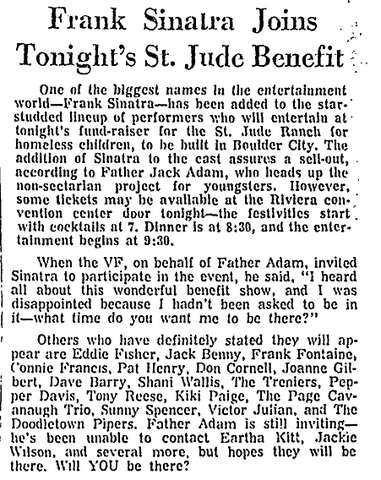
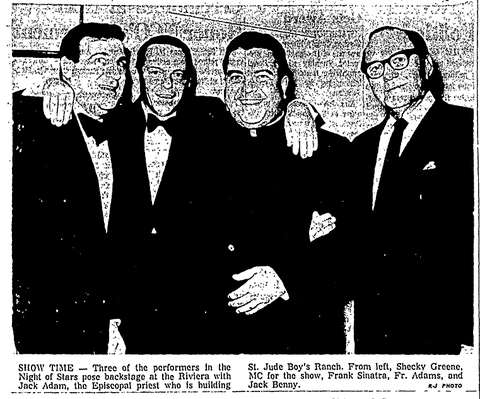
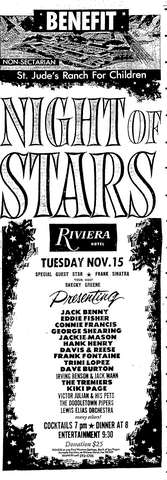
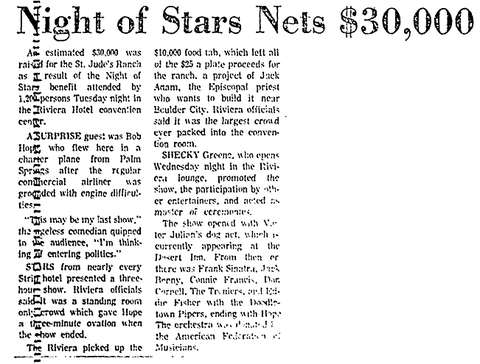
Sands, Las Vegas , Nevada (November 1-17)
Antonio Morelli Orchestra Conducted By: Gordon Jenkins (34-piece which included 21 strings)
Key Musicians: Bill Miller (piano)
Comedian: Bob Melvin
Hollywood
J4661 Give Her Love w/Chorus
(James Harbert)
WB Music Corp. (ASCAP)
Arranged & Conducted Ernie Freeman
-9 (2:11) CD: 46013-2 The Complete Reprise Studio Recordings Disc 11
CD: 1020-2That's Life
LP: FS1020That's Life
45: 0561
J4662 What Now My Love? w/Chorus
(Gilbert Becaud/Carl Sigman/Pierre Leroyer)
Remick Music Corp. (ASCAP/SACEM)
Arranged & Conducted Ernie Freeman
-11 (2:29) CD: 46013-2 The Complete Reprise Studio Recordings Disc 11
CD: 1020-2That's Life
LP: FS1020That's Life
J4663 Somewhere My Love
(Paul Francis Webster/Maurice Jarre)
Webster Music Co./EMI Robbins Catalog inc. (ASCAP)
Arranged & Conducted Ernie Freeman
-7 (2:16) CD: 46013-2 The Complete Reprise Studio Recordings Disc 11
CD: 1020-2That's Life
LP: FS1020That's Life
J4664 Winchester Cathedral
(Geoff Stephens)
Southern Music Publishing Co. Inc. (ASCAP/PRS Ltd.)
Arranged & Conducted Ernie Freeman
-5 (2:35) CD: 46013-2 The Complete Reprise Studio Recordings Disc 11
CD: 1020-2That's Life
LP: FS1020That's Life
NOTE: Author Ed O'Brien points out that before the final take, Sinatra announced to all those attending the session, "We're going to put down the world with this mother."
--Fank DeVito subbed for Hal Blaine on drums during this session. The AFM sheets shows Eddie Brackett Jr, but Frank sent me his own private sheet of this session. He did session work with Frank at Capitol including the, 5-20-57, when "Witchcraft" was recorded. Frank did the June 57 tour with Sinatra and sent me a sheet of the rehearsal Sinatra called, at Columbia Records, 5-31-57,( Friday ). Frank told me the 11/17 session for the "That's Life" album was very interesting. Sinatra was selling a lot of albums and there was a palpable excitement running through the studio that afternoon. --Ed
P.S. Eddie Brackett was the engineer for both the 11/17 and 11/18 sessions.
Sands, Las Vegas, Nevada (November 1-17)
Antonio Morelli Orchestra Conducted By: Gordon Jenkins (34-piece which included 21 strings)
Key Musicians: Bill Miller (piano)
Comedian: Bob Melvin
Hollywood
J4665 I Will Wait For You w/Chorus
(Michel Legrand/Jacques Louis Demy/Norman Gimbel)
Songs Of Poly-Gram international/Gimbel Music (BMI/SACEM) Arranged & Conducted Ernie Freeman
-11 (2:16) CD: 46013-2 The Complete Reprise Studio Recordings Disc 11
CD: 1020-2 That's Life
LP: FS1020 That's Life
45: 0561
J4666 You're Gonna Hear From Me
(Andre Previn/Dory Previn)
Remick Music Corp. (ASCAP)
Arranged & Conducted Ernie Freeman
-4 (2:56) CD: 46013-2 The Complete Reprise Studio Recordings Disc 11
CD: 1020-2That's Life
LP: FS1020That's Life
J4667 Sand And Sea
(Gilbert Becaud/Maurice Vidalin/Mack David)
(SACEM)
Arranged & Conducted Ernie Freeman
-3 (2:26) CD: 46013-2 The Complete Reprise Studio Recordings Disc 11
CD: 1020-2That's Life
LP: FS1020That's Life
J668 The Impossible Dream
(Joe Darion/Mitch Leigh)
Helena Music Co./Andrew Scott Music (ASCAP)
Arranged & Conducted Ernie Freeman
-5 (2:31) CD: 46013-2 The Complete Reprise Studio Recordings Disc 11
CD: 1020-2That's Life
LP: FS1020That's Life
Hollywood
J4665 I Will Wait For You
J4666 You're Gonna Hear From Me
J4667 Sand And Sea
J668 The Impossible Dream
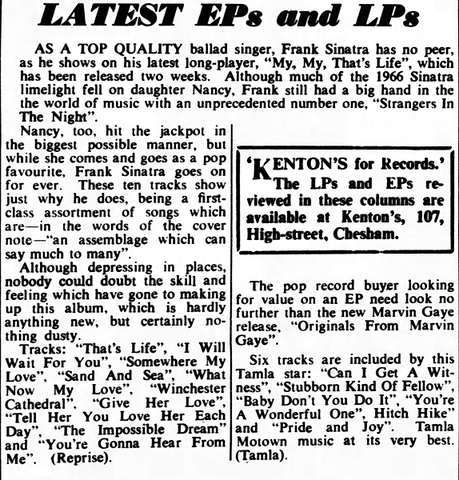
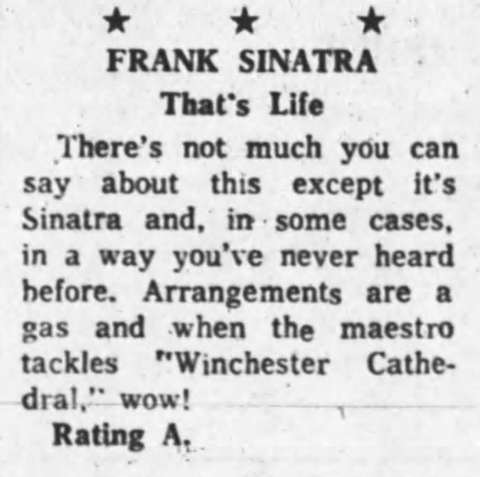
"The Impossible Dream"
Jimmy Bowen (quoted) / Friedwald (analysis): Friedwald calls this a template for 'My Way,' noting Sinatra apparently disliked it and, per collector gossip, only included it as a gift for third wife Mia Farrow, who loved it. Producer Bowen confirmed Sinatra couldn't sing it in one full take: 'We didn't cut it twenty-seven times or anything like that. We broke it up into three or four sections. Then we just recorded the sections, and I edited it together. That was a crazy song to sing, plus he was not in great voice that particular week. I was afraid if we tried to get a whole take, it'd turn into agony, and he'd throw it out. He had promised somebody to do it, so he wasn't going to throw it out, but I didn't find that out until later.'
Source: Will Friedwald, "Sinatra! The Song Is You: A Singer's Art" (2018 revised edition).
What's My Line (CBS)
Network: CBS
Host: John Charles Daly.
Note: Sinatra Is The "Mystery Guest." He then joins the panel and Mia Farrow is the "Mystery Guest." 28 min.
What's My Line (CBS)
Network: CBS
Host: John Charles Daly.
Note: Sinatra Is The "Mystery Guest." He then joins the panel and Mia Farrow is the "Mystery Guest." 28 min.
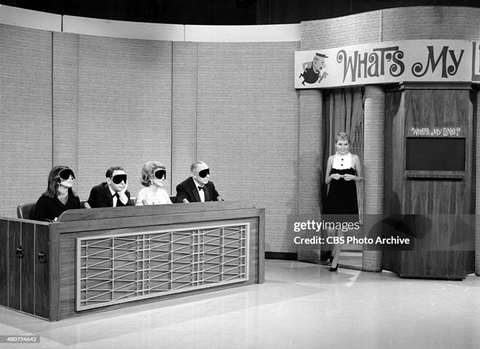
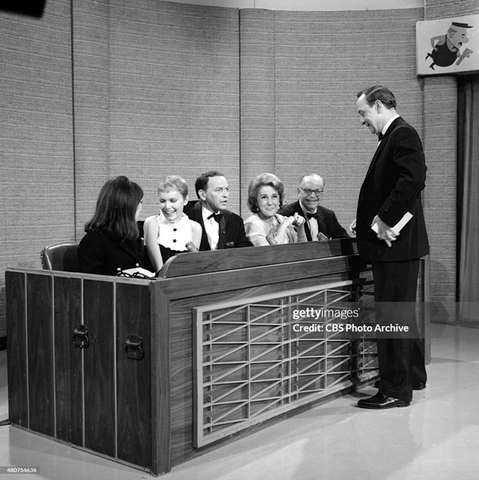
[Howard Hughes moves into the Desert Inn]
Kaplan / Michael Drosnin: Early in the morning, the same day Mia and Frank appeared on 'What's My Line?,' Howard Hughes moved into the blacked-out ninth-floor penthouse of the Desert Inn, where he would remain secluded for four years, having just been forced to sell his majority stake in TWA and now worth $1.5 billion.
Source: James Kaplan, "Sinatra: The Chairman" (2015).
[Truman Capote's Black and White Ball]
Frank and Mia attended Truman Capote's famous Black and White Ball at the Plaza Hotel, one of 480 guests hand-picked from society's elite, including Katharine Graham, Rose Kennedy, and Alice Roosevelt Longworth. Christopher Cerf danced with Mia; Peter Lawford, also invited, was easily avoided by Sinatra amid the crowd and masks.
Source: James Kaplan, "Sinatra: The Chairman" (2015).
[Sinatra phones Jobim in Rio]
Jobim (via Kaplan): While having beers with friends at his favorite Rio de Janeiro bar, Antonio Carlos Jobim was brought a telephone call from Frank Sinatra, who told the songwriter he wanted to make an album with him. Jobim, in awe of Sinatra, immediately agreed, calling it an honor.
Source: James Kaplan, "Sinatra: The Chairman" (2015)
The Dean Martin Show
Network: NBC
Guests: Eddy Arnold, Arthur Godfrey, Elaine Dunne, Dom Deluise, Frank Sinatra
1. Dean: opening
2. show credits
3. Dean: I'm Gonna Change Everything That Holds A Memory Of You
4. Dean: comedy
5. Authur Godfrey: "Broadway number"
6. Dean & Godfrey: Tiny Bubbles
7. psychiatry skit with Don Deluise and Dean
8. Dean: Just Friends w/Ken Lane
9. Elaine Dunne: song/dance number
10. Dunne & Dean: You're Nobody Till Somebody Love You
11. Eddy Arnold Medley: Cotton Fields - Sittin' On Top Of The World
12. Eddy Arnold: Tip Of My Fingers
13. Arnold & Martin Medley:
14. Authur Godfrey, Dom Deluise & Dean Martine: musical number
15. Sinatra walk-on segment closes show
Notes: color 52mins. Sinatra is a surprise walk-on. Wins the mystery singer contest, gets bleeped and closes the show. No songs performed.
The Dean Martin Show
Network: NBC
Guests: Eddy Arnold, Arthur Godfrey, Elaine Dunne, Dom Deluise, Frank Sinatra
Sinatra is a surprise walk-on. Wins the mystery singer contest, gets bleeped and closes the show. No songs performed.
[image referenced in source but could not be recovered]
A Man And His Music Part II (CBS)
Guest: Nancy Sinatra
Taped June 5-6, 1966 at NBC in Burbank
1. Fly Me To The Moon
2. The Most Beautiful Girl In The World
3. Moonlight In Vermont
4. You're Nobody 'Til Somebody Loves You
5. Yes Sir That's My Baby w/ Nancy
6. medley w/ Nancy: Downtown / These Boots Are Made For Walkin'
7. medley: Just One Of Those Things / My Heart Stood
Still / But Beautiful / When Your Lover Has Gone
8. Luck Be A Lady
9. That's Life
10. Granada
11. My Kind Of Town
12. Put Your Dreams Away
Ed O'Brien added:
For my money, the most exciting and brilliant opening of any Sinatra TV special. Frank down in the pit with the orchestra. Closest we ever got to the raw energy of a Sinatra recording session with the band surrounding the singer. Love the way Riddle employed that organ throughout the segment.
Frank filmed it just a little more than six months after the first "Man & His Music" was completed. Timeless entertainment.
Film
Never So Few, (US Film Release: December 7, 1959)
Starring: Frank Sinatra, Gina Lollobrigida, Peter Lawford, Steve McQueen, Brian Donlevy, Dean Jones, Charles Bronson
(Directed by John Sturges and Produced by Edmund Grainger) Sinatra plays Captain Tom Reynolds. During WW2, the American OSS mounts covert operations with the native Kachin against the Japanese army in the jungles of Burma. (1st DVD Release date: 2005-05-31- Blu-Ray released 2018-08-07)
Alternate Title: Sacred and Profane
Release Date: December 7, 1959
Production Date:mid May--mid Jul 1959
The working title for the film was Sacred and Profane. With the exception of Frank Sinatra and Gina Lollobrigida, the onscreen cast were presented in the opening credits with brief clips from the film. According to a HR Nov 1956 news item, M-G-M purchased Tom Chamales' novel Never So Few before its publication. A HR item from that same month and year noted that Sam Zimbalist would produce the film. A Dec 1958 DV item stated that screenwriter Millard Kaufman was being considered to direct. Other news items indicated that John Sturges was in long-pending negotiations to direct. An Oct 1958 HR casting note stated that Roger Moore was being considered for the role of "Maj. Danny De Mortimer." A modern source claims that Sinatra initially had a role rewritten to accommodate Sammy Davis, Jr., but after the two quarreled, Sinatra had the part reworked for Steve McQueen. HR items from Sep and Dec 1958 revealed that shooting had been approved in Burma (now known as Myanmar) by the local government, but by Apr 1959 a LAT item indicated the film was to be shot in Hawaii. The Var review noted, however, that the bulk of the film was shot on the M-G-M Culver City, CA lot and other domestic sites, highlighted by location footage in Burma, Ceylon (now Sri Lanka) and India. The HR review stated that Chamales was a member of the famed "Merrill's Marauders," a unit that served with distinction in Burma during World War II. According to the HR review, the plot point within Never So Few which shows the anti-Communist Chinese government of Chiang Kai-shek providing authorization for warlords to cross borders and kill indiscriminately during World War II was based on fact. Chamales had made the same accusation in a non-fiction article, "Betrayal in China," published in True Magazine in Jan 1958. The review related that the Los Angeles Consul General for the Republic of China vehemently denied the accusation, and the reviewer was unable to substantiate it in his own research.
A Man And His Music Part II (CBS) note: Budweiser made this album available to their executives throughout the country. Reprise edited the length of some recordings on the album. A collector's item strictly for the cover.
Ed
Chicago Tribune
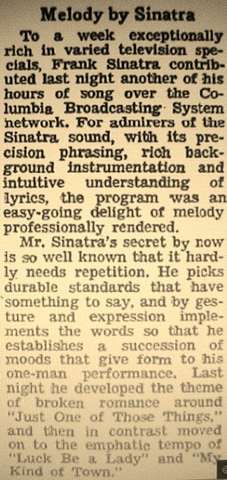
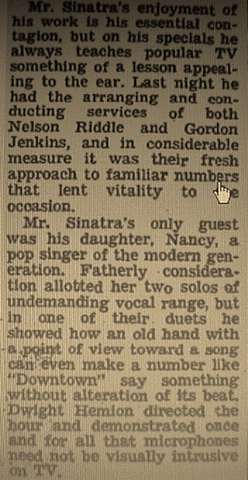
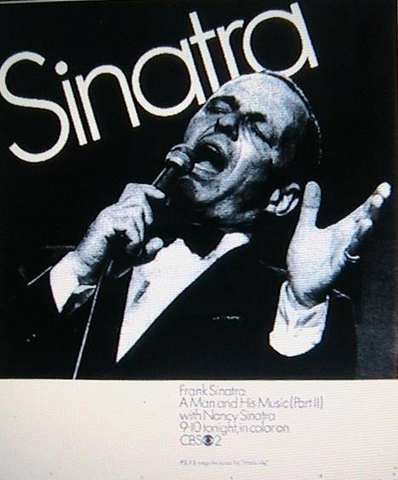
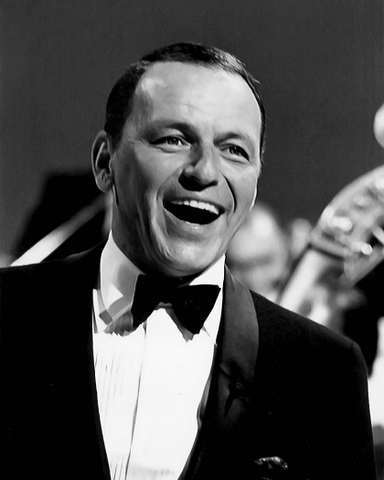
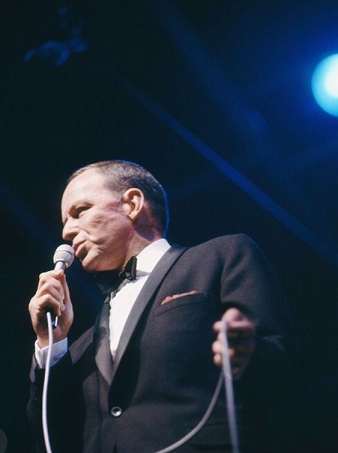
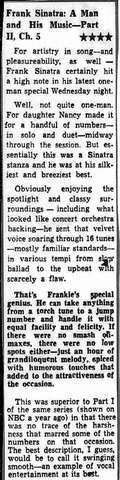
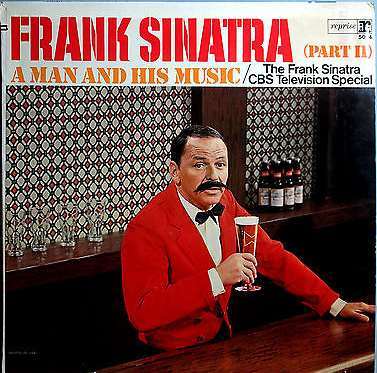
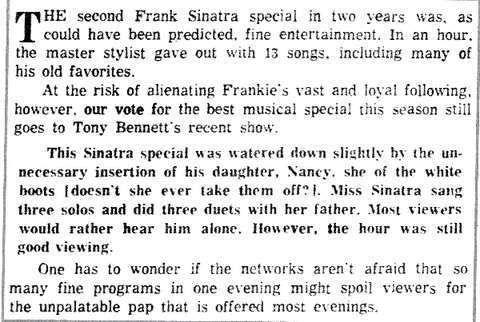
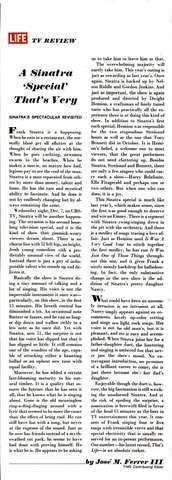
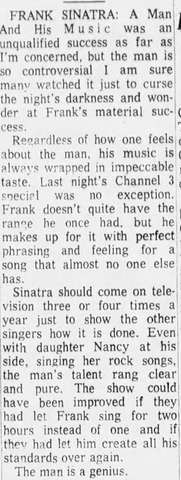
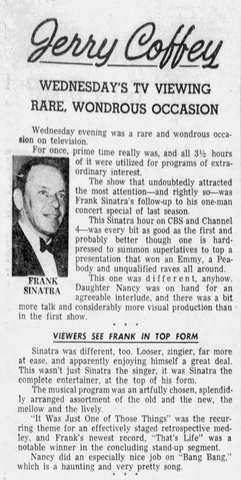
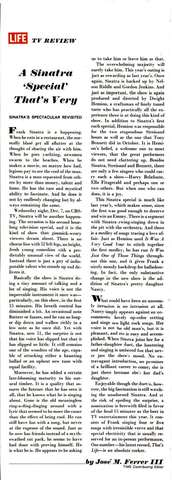
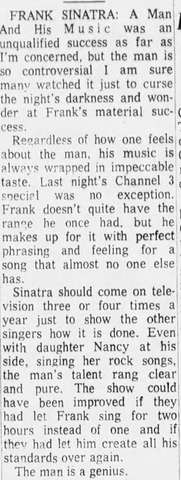
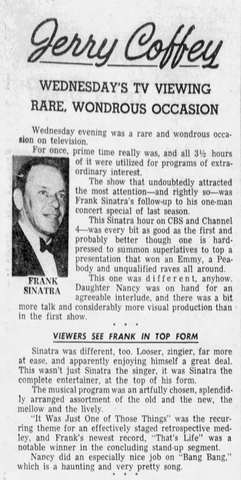
"Granada"
Written in 1932 by Agustin Lara, the song had previously been treated dramatically by Frankie Laine and later became a Stan Kenton orchestral showpiece via Bill Holman arranger; Friedwald argues only Sinatra and May realized an arch, humorous approach made the song's overwrought elements palatable. Two edits exist (3:38 and 2:45); an unissued alternate take ends with Sinatra shouting 'Ole!' while his 1966 TV performance on A Man and His Music, Part II ends with him chanting 'cha-cha-cha!' May, inspired by a recent mock-mambo Capitol album he'd made, closed the studio chart with the band cha-cha-chanting a phrase borrowed from 'South of the Border.'
Source: Will Friedwald, "Sinatra! The Song Is You: A Singer's Art" (2018 revised edition).
"Just One of Those Things" / "My Heart Stood Still" / "But Beautiful" / "When Your Lover Has Gone" A year after the 1965 special's Jenkins-arranged medley, Sinatra and Jenkins devised an equally moving segment for the 1966 special A Man and His Music, Part II, built around a new Jenkins treatment of "Just One of Those Things" framing "My Heart Stood Still," "But Beautiful," and "When Your Lover Has Gone."
Source: Will Friedwald, "Sinatra! The Song Is You: A Singer's Art" (2018 revised edition).
['That's Life' album released]
Sinatra's album 'That's Life' was released on the last day of 1966 and rose to number 6; it would be the last Sinatra album to hit a single-figure chart position until 'Duets' and 'Duets II' in 1993 and 1994.
Source: James Kaplan, "Sinatra: The Chairman" (2015).
[A Stalker Threatens Nancy at Home]
When Nancy was twenty-seven, a man came to her home claiming to be her brother and threatened to kill her if she didn't come to the door; police reached him before he could act.
Source: Nancy Sinatra, "Frank Sinatra, My Father" (1985).
[A Hushed Session for the Jobim Album]
Recording the bossa nova album with Antonio Carlos Jobim, arranger Claus Ogerman worked to strip the sound of every stray click or noise, and Frank sang so softly he joked he hadn't sung that quietly since he'd had laryngitis; one trombonist muffled his horn with a felt hat.
Source: Nancy Sinatra, "Frank Sinatra, My Father" (1985).
[Christmas with the Martins and Sinatras]
A 1967 photograph shows the Sinatra family celebrating Christmas together with the Martin family.
Source: Charles Pignone, "Frank Sinatra 100" (2015).
[Frank and Nancy Sinatra Record 'Somethin' Stupid']
Sinatra and his daughter Nancy are shown recording their duet 'Somethin' Stupid' in 1967.
Source: Charles Pignone, "Frank Sinatra 100" (2015).
[Nancy Sinatra Records Three Movie Title Songs]
Around the time of Tony Rome, Nancy Sinatra notes that her recordings were becoming international hits and she was asked to sing three film title songs in this period: one for her own picture The Last of the Secret Agents, one for the James Bond film You Only Live Twice, and one for Tony Rome. She calls being asked "very honored."
Source: Nancy Sinatra, "Frank Sinatra, My Father" (1985).
[Nancy Named Top Female Box Office Personality]
In both 1967 and 1968, motion picture exhibitors named Nancy the Top Female Box Office Personality, a title she attributes to her having appeared, somewhat by accident, in an Elvis Presley film (Speedway) and in the cult film The Wild Angels with Peter Fonda.
Source: Nancy Sinatra, "Frank Sinatra, My Father" (1985).
[National Chairman of Anti-Defamation League; "Something Stupid" Hits #1]
Sinatra is named National Chairman of the American Italian Anti-Defamation League and scores a #1 hit, "Something Stupid," his duet with daughter Nancy; he appears in "The Naked Runner" and "Tony Rome."
Source: Nancy Sinatra, "Frank Sinatra, My Father" (1985).
[Nancy's USO Tour Of Vietnam]
Nancy joined singer Jimmy Boyd and the group the Gordian Knot for a 1967 USO tour of Vietnam, declining offers to make it a TV special because she felt using the war for profit would be wrong. She called her father for advice beforehand, and he told her to "be aware" -- the same phrase inscribed on a St. Christopher medal he had once given her.
Source: Nancy Sinatra, "Frank Sinatra, My Father" (1985).
[Rosemary's Baby Scheduling Conflict]
A scheduling clash arose when Sinatra wanted Mia to co-star in his film The Detective, but she was committed to finishing Roman Polanski's Rosemary's Baby, which ran over schedule; the standoff badly strained their marriage.
Source: Tina Sinatra, "My Father's Daughter: A Memoir" (2000).
[Recording "Something Stupid" With Nancy]
In 1967 Sarge Weiss brought Nancy a duet to record with her father, tacked onto the end of an Antonio Carlos Jobim recording session. Despite Reprise president Mo Ostin betting two dollars the song would flop, the loose two-take recording of "Something Stupid" became a multimillion-selling number-one hit that some disc jockeys nicknamed "the incest song."
Source: Nancy Sinatra, "Frank Sinatra, My Father" (1985).
["Somethin' Stupid" duet with Nancy Jr.]
Consiglio: Around the same period as Nancy Jr.'s solo success, she and Frank recorded the duet "Somethin' Stupid," another huge hit that had both father and daughter on the charts simultaneously.
Source: Tony Consiglio (as told to Franz Douskey), "Sinatra and Me: The Very Good Years" (2012)
[The Knights Of Malta Knight Sinatra In 1967]
Nancy Sinatra: The Sovereign Knights of Malta recognized Sinatra with an honor for what they called his "Aristocracy of Deeds," formally knighting him.
Source: Nancy Sinatra, Frank Sinatra: An American Legend, 1995.
['The World We Knew' single tops easy-listening chart]
Kaplan: The Bert Kaempfert-penned title track 'The World We Knew,' arranged by Ernie Freeman and produced by Jimmy Bowen, was released as a single later in 1967 and spent five weeks atop Billboard's easy-listening chart.
Source: James Kaplan, "Sinatra: The Chairman" (2015)
[Backstage at Caesars, lie about the records]
Ed Walters: After Sinatra left the Sands (around September 1967), Walters visited him backstage a few years later at Caesars Palace. Frank asked if Walters still had those records and Walters, not wanting to explain or disappoint him, lied and said yes. Walters later regretted the lie, believing Sinatra -- who had stressed honesty to him -- would actually have been proud to learn the records went to dying hospice patients rather than angry. Walters decided to finally tell this story publicly at a FrankFest event in Atlantic City (1999).
Source: Ed Walters, pit boss reminiscences (compiled by Kraus, Sinatra mailing list)
[Frank kicks in a car radio over 'Light My Fire']
George Jacobs: According to valet George Jacobs, Sinatra kicked in a car radio with his heel after the Doors' 'Light My Fire' turned up on three stations in a row that summer, reflecting his frustration with the new rock era and his fading cultural dominance.
Source: James Kaplan, "Sinatra: The Chairman" (2015)
[Frank loses $75,000, credit cut off at the Sands]
Consiglio: In 1967, after Howard Hughes bought the Sands and Jack Entratter lost control, Frank lost $75,000 playing chemin de fer. When he asked for his credit marker to be raised, new Sands vice president Carl Cohen refused (on Hughes's orders), and Frank stormed back to his suite furious. Not long afterward, Frank stopped performing at the Sands and moved to Caesars Palace, taking Sammy Davis, Dean Martin, and Peter Lawford with him.
Source: Tony Consiglio (as told to Franz Douskey), "Sinatra and Me: The Very Good Years" (2012)
[Gena Rowlands recalls easy Tony Rome shoot]
Gena Rowlands: Gena Rowlands, who had never met Sinatra before, recalled the 'Tony Rome' shoot as enjoyable and easy, saying Frank came prepared, showed no temper, did complicated scenes in one take, and was polite and helpful on set, including on the boat scenes.
Source: James Kaplan, "Sinatra: The Chairman" (2015)
[Giancana calls Greene after the beating]
Shecky Greene: Fearing Sam Giancana's reaction, both Sinatra and Fischetti begged Shecky Greene not to tell the exiled Mob boss about the beating; Giancana nonetheless phoned Greene from Mexico offering to have 'Milwaukee Phil' retaliate, but Greene insisted he had merely fallen down the stairs.
Source: James Kaplan, "Sinatra: The Chairman" (2015)
[Nighttime Frank during Tony Rome shoot]
Dan Lewis / Kaplan: While shooting 'Tony Rome' during the day and performing nightly at the Fontainebleau (with Shecky Greene opening), Sinatra drank heavily after hours; Dan Lewis's newspaper story described the Fontainebleau's fourteenth floor, where Frank stayed, as an armed camp thick with bodyguards Frank called his 'Dago Secret Service.'
Source: James Kaplan, "Sinatra: The Chairman" (2015)
[Palm Springs holiday gathering]
Mia Farrow (Photoplay): Frank invited twenty-seven guests, mostly older, wealthy Hollywood and society figures (the Deutsches, Goetzes, Brissons, Cerfs, Hornblows, Haywards, Brynners, Garson Kanin and Ruth Gordon, among others), to Palm Springs for the holidays, with Mia present after asking to be included; she later told Photoplay it was a 'fun crowd' though privately found Frank withdrawn and stern.
Source: James Kaplan, "Sinatra: The Chairman" (2015)
[Records donated to hospice]
Ed Walters: Later in 1967, Walters accompanied a Sands cocktail waitress, Norma Boyles, to visit her dying aunt at a newly opened hospice in Las Vegas. He found the patients treasured a single badly scratched Sinatra record. Moved by this, Walters brought the box of Reprise records Frank had given him to the hospice and left them there for the patients; the woman who owned the original scratched record died before hearing the new ones.
Source: Ed Walters, pit boss reminiscences (compiled by Kraus, Sinatra mailing list)
[Rosemary's Baby shoot strains Farrow marriage]
Consiglio: Frank and Mia had planned to co-star in The Detective, but Mia's work on Rosemary's Baby in New York ran long. Frank, waiting in Los Angeles, grew frustrated and demanded she drop the film and come back; when she refused to abandon it, the standoff became a serious rift, with Frank insisting she choose between her career and him.
Source: Tony Consiglio (as told to Franz Douskey), "Sinatra and Me: The Very Good Years" (2012)
[Sammy Davis Jr. explains onstage racial joking]
Ed Walters: In 1967, in the 21 pit in the early morning, Sammy Davis Jr. told Walters that the joking about his race, religion, and size in the Rat Pack shows was deliberate — a way of addressing what wasn't otherwise being discussed, and of ensuring people wouldn't forget he was Black and Jewish. He credited Sinatra's leadership with teaching him he had standing as a citizen and not just an entertainer, which Walters connects to Sammy's later 'peace and love' gestures.
Source: Ed Walters, pit boss reminiscences (compiled by Kraus, Sinatra mailing list)
[Sammy Davis explains the racial joking to Walters]
Ed Walters: In 1967, Sammy Davis Jr. told Walters in the 21 pit that the onstage racial and religious jokes with Sinatra were deliberate: "The kidding about my color and religion and size is for them, the audience... I ain't going to let them forget that I'm colored and Jewish and all the rest." Sammy credited Sinatra's example with teaching him he was not just an entertainer but also a citizen with a stake in social issues.
Source: Ed Walters, pit boss reminiscences (compiled by Kraus, Sinatra mailing list)
[Sammy stayed at Sands after Sinatra-Cohen fight]
Ed Walters: Walters notes that when Sinatra had his well-known altercation with Carl Cohen in late 1967 and left the Sands, Sammy Davis Jr. notably did not leave with him, staying on at the Sands for another year or two — evidence, in Walters's view, that by then Sammy was very much his own man rather than simply following Sinatra's lead.
Source: Ed Walters, pit boss reminiscences (compiled by Kraus, Sinatra mailing list)
[Shecky Greene beaten by Fischetti and bodyguards]
Shecky Greene: After refusing Sinatra's offer to make him a star ('If being a big star means being like you, then I don't want it'), Shecky Greene was attacked in the hotel lobby at 4 a.m. by Joe Fischetti and Sinatra bodyguards Ed Pucci and Andy Celentano; Fischetti hit him with a blackjack, and Greene, fighting back, ended up hospitalized with a concussion and gash on his temple.
Source: James Kaplan, "Sinatra: The Chairman" (2015)
[Shecky Greene carries drunk Sinatra to his room]
Shecky Greene: After a girl was reportedly beaten up, Shecky Greene, matching Sinatra drink for drink, hoisted the very drunk Sinatra over his shoulder and carried him to his suite; Sinatra, though extremely drunk, remembered the incident and warned Greene ominously, 'You're gonna get it.'
Source: James Kaplan, "Sinatra: The Chairman" (2015)
[Sinatra abandons the party for Acapulco]
Mia Farrow: At a New Year's Eve party in Los Angeles, after Alan Jay Lerner and Joshua Logan told Mia she was fantastic in dailies of 'Rosemary's Baby' and floated her for 'Paint Your Wagon,' a silent Sinatra abruptly announced he was leaving; he drove Mia home to Bel Air and departed for Acapulco to visit Merle Oberon and her husband, without his wife.
Source: James Kaplan, "Sinatra: The Chairman" (2015)
[Sinatra begins Detective location work in New York]
Mia Farrow: Frustrated by the slow pace of the 'Rosemary's Baby' shoot, Frank went to New York to do several weeks of location work on 'The Detective,' with Mia flying out on weekends to see him; he made clear he expected her to satisfy her commitment to join his film even if it meant leaving 'Rosemary's Baby' unfinished.
Source: James Kaplan, "Sinatra: The Chairman" (2015)
[Sinatra cancels shows, meets Caesars Palace owners]
Kaplan: On Labor Day, the casino's biggest night, Sinatra abruptly canceled both shows claiming strep throat and flew to Palm Springs; over the next three days, with Sammy Davis Jr. filling in for him, Frank secretly met with the owners of the still Mob-run Caesars Palace about jumping ship, with a Cal-Neva buyout among his conditions.
Source: James Kaplan, "Sinatra: The Chairman" (2015)
[Sinatra consoles himself with electric trains]
George Jacobs: In Palm Springs following the separation, a desolate Sinatra, feeling he had 'no one, nothing' according to valet George Jacobs, consoled himself by playing with his elaborate set of electric trains housed in its own cottage at the Wonder Palms compound, a hobby he shared with his old mentor Tommy Dorsey.
Source: James Kaplan, "Sinatra: The Chairman" (2015)
[Sinatra has an affair with Lee Remick]
Kaplan: In Mia's absence during the 'Rosemary's Baby' shoot, Sinatra began a halfhearted affair with his 'The Detective' co-star Lee Remick, born of loneliness and boredom on set; word of it got back to Mia.
Source: James Kaplan, "Sinatra: The Chairman" (2015)
[Sinatra sends Reprise records as reconciliation]
Ed Walters: A few days after their casino argument (early 1967), a box was delivered to Walters's house containing all of Sinatra's Reprise recordings, with a note reading roughly: If you're going to sit around and do nothing, then maybe you can listen to these... Get back to work, kid. Walters returned to work; the next time he saw Frank in the casino, Sinatra simply smiled and Walters nodded back, ending the rift without further discussion.
Source: Ed Walters, pit boss reminiscences (compiled by Kraus, Sinatra mailing list)
[Sinatra's fight with Carl Cohen and departure]
Ed Walters: Walters notes that when Sinatra had his well-known fight with Sands executive Carl Cohen in late 1967 and left the Sands, Sammy Davis Jr. did not follow him, staying on at the Sands for another year or two -- evidence, in Walters' view, that by then Sammy was fully his own man rather than simply Sinatra's follower.
Source: Ed Walters, pit boss reminiscences (compiled by Kraus, Sinatra mailing list)
[Sinatra's reconciliation gift of records]
Ed Walters: A few days after their argument, a box containing all of Sinatra's Reprise recordings was delivered to Walters's house with a note telling him that if he was going to sit around doing nothing he might as well listen to these, signed 'get back to work, kid.' Walters returned to work and the tension passed without further discussion; the next time Sinatra passed him in the casino he simply smiled.
Source: Ed Walters, pit boss reminiscences (compiled by Kraus, Sinatra mailing list)
[Sinatra's records donated to a hospice]
Ed Walters: Later that year, Walters visited a newly opened Las Vegas hospice with cocktail waitress Norma Boyles, whose aunt was dying there; patients were listening to one badly worn Sinatra record, the only one they had. Walters brought the box of records Sinatra had given him to the hospice and left them there, though the woman who owned the original scratched record died before hearing the new ones.
Source: Ed Walters, pit boss reminiscences (compiled by Kraus, Sinatra mailing list)
[The London taxi gift incident]
Mia Farrow: For Christmas, Mia gave Frank a London taxi she'd had converted to U.S. specifications during her 'A Dandy in Aspic' shoot; Yul Brynner staged an elaborate presentation ceremony, but a grumpy Sinatra, irritated at being told to put on a sweater beforehand, humiliated Mia by making her go back inside and button it up in front of all the guests before he would proceed. He turned out to dislike the boxy Austin.
Source: James Kaplan, "Sinatra: The Chairman" (2015)
[Tiffany Bolling affair begins]
Tiffany Bolling / Kaplan: Twenty-one-year-old actress Tiffany Bolling, who had a small speaking role in 'Tony Rome,' met Frank at a small dinner he hosted (and cooked) at the Fontainebleau's Gigi Room; the two began an affair, and Bolling soon moved into his penthouse there.
Source: James Kaplan, "Sinatra: The Chairman" (2015)
[Tony Rome]
Seeking a change of pace, Sinatra next moved into detective films starting with 1967's Tony Rome, a role Santopietro says fit his tough, cynical-but-hopeful screen persona perfectly; from 1967 to 1980 Sinatra would play a detective in five of his final six starring vehicles, the sole exception being the Western Dirty Dingus Magee, marking a final sustained resurgence of his movie-star popularity.
No corresponding dated entry could be identified in the chronology for this film/context.
Source: Tom Santopietro, "Sinatra in Hollywood" (2008), A Waste of Talent
[Tony Rome]
During filming of Tony Rome in 1967, costar Jill St. John (playing Ann Archer) was rumored to be a real-life romantic partner of Sinatra's.
No corresponding dated entry could be identified in the chronology for this film/context.
Source: Tom Santopietro, "Sinatra in Hollywood" (2008), Knight-Errant (pt. 1)
[Tony Rome]
Murf (Variety): Variety's reviewer 'Murf' credited Sinatra's style and the production values for carrying the film even though the mystery plot itself wasn't especially compelling to audiences by the end.
No corresponding dated entry could be identified in the chronology for this film/context.
Source: Tom Santopietro, "Sinatra in Hollywood" (2008), Knight-Errant (pt. 1)
[Tony Rome]
Santopietro grades this a B, calling it the first and best of the private-eye flicks, with Frank in his element. Golden Laurel Award nomination: Top Male Star of the Year.
No corresponding dated entry could be identified in the chronology for this film/context.
Source: Tom Santopietro, "Sinatra in Hollywood" (2008), Career Scorecard
[Tony Rome / The Detective / Lady in Cement / Contract on Cherry Street / The First Deadly Sin]
Santopietro frames the late-career detective films Sinatra began shooting in 1967 (through the 1980 TV guest spot on Magnum, P.I.) as the culmination of Sinatra's screen persona: a paternalistic 'knight-errant' loner who bends the rules, loses money and power, but keeps his personal honor. This lone-wolf archetype, Santopietro argues, became the film image most identified with the offscreen Sinatra.
This film/context matches multiple dated entries in the chronology; the specific date Santopietro is referring to could not be determined with confidence.
Source: Tom Santopietro, "Sinatra in Hollywood" (2008), Knight-Errant (pt. 1)
[Walters and Sinatra's blackjack chip argument]
Ed Walters: Early one morning in 1967, Sinatra approached the 21 pit and gave his usual two-finger signal for $200 in chips, but Walters was distracted and made small talk instead of properly reading what Sinatra wanted. Sinatra erupted in cursing, the two shouted at each other in the near-empty casino, and pit boss Bucky Harris had to intervene. Carl Cohen later told Walters he'd 'missed something' — Sinatra used specific hand signals (two fingers, five fingers, etc.) to indicate different chip amounts and situations, and Walters had failed to read the cue correctly that night.
Source: Ed Walters, pit boss reminiscences (compiled by Kraus, Sinatra mailing list)
[Yelling match with Sinatra in 21 pit]
Ed Walters: Walters recounts a late-night blowup with Sinatra in the 21 pit, around early 1967. Frank came to play and Walters misjudged how to handle him (failing to correctly read his mood/chip signal), leading Frank to start cursing at him. Both men yelled at each other in front of a nearly empty casino; floormen stayed out of it, and Bucky Harris (running the casino in Carl Cohen's absence) tried unsuccessfully to get Walters to leave the pit, even warning it could cost him his job. Walters eventually walked away to the lobby and drove home. The next day Carl Cohen called asking what happened, telling Walters he'd missed something.
Source: Ed Walters, pit boss reminiscences (compiled by Kraus, Sinatra mailing list)
[Frank and Mia's temporary Christmas reconciliation, then Mia leaves for India]
Frank and Mia spent Christmas 1967 together in what proved only a brief reunion. Soon after, Mia flew to Rishikesh, India with her sister Prudence to study meditation with the Maharishi alongside the Beatles, Mike Love of the Beach Boys, and Donovan.
Source: Richard Havers, "Sinatra" (Dorling Kindersley, 2007).
[Howard Hughes buys the Sands, ending Frank's 14-year run]
Midway through this troubled engagement, Howard Hughes purchased the Sands, whose shareholders had included Dean Martin, Jack Entratter, and Frank's old Cal-Neva partner Sanford Waterman. It marked the end of Frank's fourteen-year association with the hotel; he never performed there again.
Source: Richard Havers, "Sinatra" (Dorling Kindersley, 2007).
[Third A Man and His Music special taped with Jobim and Ella Fitzgerald]
Frank taped his third A Man and His Music TV special featuring Antonio Carlos Jobim and Ella Fitzgerald. He performed 'Ol' Man River' solo accompanied only by pianist Bill Miller, flubbing the order of 'cotton' and 'taters' in the lyric but leaving the mistake in the broadcast.
Source: Richard Havers, "Sinatra" (Dorling Kindersley, 2007).
[Mexico's Interior Ministry Bars Sinatra]
Mexico's Interior Ministry issued a circular barring Sinatra from entering the country, in retaliation for the film "Marriage on the Rocks," which Mexican officials felt mocked the country's quickie-divorce system; Mexico also boycotted his records.
Source: George Carpozi Jr., Frank Sinatra: Is This Man Mafia? (New York: Manor Books, 1979).
[Francis A. & Edward K. (1967) -- how May got the assignment -- critical commentary]
Billy May: Sinatra had long planned for Billy Strayhorn to arrange the Ellington collaboration album, but Strayhorn (one month older than Sinatra) died after a long illness on May 31, 1967; it's been said Sinatra helped pay part of his medical expenses. Billy May, brought in as replacement, said: 'I felt very flattered that they asked me after Billy died.'
Source: Will Friedwald, "Sinatra! The Song Is You: A Singer's Art" (2018 revised edition), Ch. 7, "With Billy May" (1953-1979)
[Francis A. & Edward K. -- actual recording sessions -- critical commentary]
Lee Herschberg; Milt Bernhart: Engineer Lee Herschberg recalled real doubt over whether the band (playing gigs the night before) would even show up; once underway, 'they were just such an incredible band, it was like they were joined at the base of the skull by some invisible thing.' Trombonist Milt Bernhart, working in an adjoining studio, described Ellington sidemen Hodges and Gonsalves as visibly disengaged -- 'thinking about what they were going to have for dinner that night' -- and that Sinatra also 'wasn't really thrilled'; a birthday cake was wheeled in mid-session (it was Sinatra's birthday, December 12).
Source: Will Friedwald, "Sinatra! The Song Is You: A Singer's Art" (2018 revised edition), Ch. 7, "With Billy May" (1953-1979)
[Francis A. & Edward K. -- pre-session rehearsal at Western Recorders -- critical commentary]
Billy May: A rare pre-session rehearsal was scheduled with May conducting and Ellington at the piano. May discovered the band never looked at the charts again after that day. In a 1982 interview with Stanley Dance he recalled the trumpet section 'wasn't making it' at the actual session but it 'wasn't my place to say so' -- session ace Al Porcino was added to the section, and pianist Jimmy Jones reportedly filled in for Ellington on much of the album.
Source: Will Friedwald, "Sinatra! The Song Is You: A Singer's Art" (2018 revised edition), Ch. 7, "With Billy May" (1953-1979)
[Francis A. & Edward K. rehearsal, Seattle -- critical commentary]
Billy May: May and Bill Miller flew to Seattle to rehearse the Ellington band (without Sinatra) during a club engagement at DJs. May found the sight-reading 'terrible,' recalling drummer Sam Woodyard couldn't read music at all and instead cued off a saxophonist's foot movements marked in his part: 'It was all shit like that.'
Source: Will Friedwald, "Sinatra! The Song Is You: A Singer's Art" (2018 revised edition), Ch. 7, "With Billy May" (1953-1979)
[Somethin' Stupid -- critical commentary]
Billy Strange / Nancy Sinatra / Jimmy Bowen: Arranger-conductor Billy Strange called working with Nancy and Frank on 'Somethin' Stupid' the most fun he'd had in a studio; the session was loose and spontaneous. Producers Jimmy Bowen (for Frank) and Lee Hazlewood (for Nancy) co-produced. Nancy recalled Frank goofing around with a Daffy Duck-style delivery that spoiled the first take, requiring two or three total takes.
Source: Charles L. Granata, "Sessions with Sinatra: Frank Sinatra and the Art of Recording" (1999/2003), Part IV: The Reprise Years
[Somethin' Stupid -- critical commentary]
Frank Sinatra / Granata: 'Somethin' Stupid' became a number one hit and Frank Sinatra's second gold record, staying on the charts thirteen weeks (four at number one) -- the first number-one father-daughter duet. Reprise president Mo Ostin had bet Nancy $2 the song would flop and lost; Nancy kept the framed $2 bill as a keepsake. Sinatra reportedly gloated, 'The silly bastard bet me two dollars it would be a bomb!'
Source: Charles L. Granata, "Sessions with Sinatra: Frank Sinatra and the Art of Recording" (1999/2003), Part IV: The Reprise Years
[The Voice (Columbia, 1945) and Francis Albert Sinatra & Antônio Carlos Jobim (Reprise, 1967) -- critical commentary]
Claus Ogerman: Friedwald credits The Voice (1945) as pop music's first true concept album, predating Bing Crosby's compilations. Arranger Claus Ogerman recalled arriving early at Western Studios in Los Angeles before the first Jobim-album session, intending to finish writing his charts, only to find Sinatra already there rehearsing the tunes with Bill Miller -- explaining, Ogerman said, why Sinatra needed only one or two takes: 'he works on all the stuff beforehand. I found it remarkable.'
Source: Will Friedwald, "Sinatra! The Song Is You: A Singer's Art" (2018 revised edition), Ch. 1, "Night and Day" (Sinatra style overview)
[engineering/personnel -- critical commentary]
Phil Ramone: Engineer Phil Ramone went to great lengths preparing for Sinatra's New York session, including pre-rehearsing the band before Sinatra arrived, setting up dual vocal microphones as insurance, laying a red carpet and velvet ropes from control room to studio, and personally staying until safety tapes were made and stored off-site before he could relax.
Source: Charles L. Granata, "Sessions with Sinatra: Frank Sinatra and the Art of Recording" (1999/2003), Part IV: The Reprise Years
[label history -- critical commentary]
The Sinatra-Ellington album was the last 'traditional' studio album Sinatra made for twelve years, until 1979's Trilogy.
Source: Charles L. Granata, "Sessions with Sinatra: Frank Sinatra and the Art of Recording" (1999/2003), Part IV: The Reprise Years
[personnel -- critical commentary]
Billy May augmented the Ellington orchestra with a few dependable studio musicians, including pianist Milt Raskin (who reportedly subbed for Ellington on some tunes) and trumpeter Al Porcino.
Source: Charles L. Granata, "Sessions with Sinatra: Frank Sinatra and the Art of Recording" (1999/2003), Part IV: The Reprise Years
[recording session/location -- critical commentary]
Jimmy Bowen / Granata: The World We Knew marked the first time in nearly fifteen years Sinatra recorded in New York -- excepting the 1962 London sessions, every Sinatra recording session from his last Columbia date (September 1952) through this point had taken place in Hollywood. The session was held at A&R Studios (formerly Columbia's 30th Street building), engineered by Phil Ramone, with Jimmy Bowen producing and Billy Strange conducting.
Source: Charles L. Granata, "Sessions with Sinatra: Frank Sinatra and the Art of Recording" (1999/2003), Part IV: The Reprise Years
[session location/personnel -- critical commentary]
Session time for Duets was booked at Capitol's Studio A on Vine Street. Ramone, remembering the red-carpet treatment Sinatra had received on their first record date together at A&R Studios in 1967, made a point of similarly welcoming Sinatra back to his old home at the Capitol Tower.
Source: Charles L. Granata, "Sessions with Sinatra: Frank Sinatra and the Art of Recording" (1999/2003), Part V: Capitol Revisited
[Sinatra and Mia in the Caribbean]
Kaplan: After the Joe E. Lewis party, the Sinatras went island-hopping in their private jet, staying at Claudette Colbert's place on Barbados, and returned a week later with Mia denying pregnancy rumors and announcing she would star in 'A Dandy in Aspic.'
Source: James Kaplan, "Sinatra: The Chairman" (2015)
[Sinatra subpoenaed in Miami]
Kaplan: Soon after Frank landed in Miami from the Caribbean trip, he was handed a subpoena to testify before a federal grand jury investigating profit skimming at Nevada gambling casinos.
Source: James Kaplan, "Sinatra: The Chairman" (2015)
[Sinatra hosts Joe E. Lewis birthday party]
Earl Wilson: On Thursday night, Frank gave a sixty-fifth birthday party for comedian Joe E. Lewis at Jilly's South in Miami Beach; columnist Earl Wilson called it 'the wettest party I ever attended,' not mentioning that Lewis had recently suffered a mild stroke. Mia Farrow, the hostess, sat on Frank's knee and the couple greeted all 150 guests together.
Source: James Kaplan, "Sinatra: The Chairman" (2015).
[Sinatra testifies before grand jury]
Kaplan (AP): Frank took a side trip to Las Vegas to testify in a closed-door hearing before the federal grand jury investigating casino skimming, appearing relaxed and confident as he stepped from a limousine with attorney Mickey Rudin, according to the Associated Press. The grand jury handed down no indictments and Sinatra's testimony remained sealed.
Source: James Kaplan, "Sinatra: The Chairman" (2015).
Hollywood
K4807 Baubles, Bangles And Beads w/Antonio Carlos Jobim
(Robert C. Wright/George Forrest/Alexandre Borodin)
Scheffel Music Corp. (ASCAP)
Arranged & Conducted by Claus Ogerman
-7 (2:32) CD: 46013-2 The Complete Reprise Studio Recordings Disc 11
CD: 1021-2 Francis Albert Sinatra & Antonio Carlos Jobim
LP: FS1021Francis Albert Sinatra & Antonio Carlos Jobim
K4808 I Concentrate On You w/Antonio Carlos Jobim
(Cole Porter)
Chappell 7 Co. Inc. (ASCAP)
Arranged & Conducted by Claus Ogerman
-4 (2:36) CD: 46013-2 The Complete Reprise Studio Recordings Disc 11
CD: 9-26340-2The Reprise Collection
CD: 1021-2Francis Albert Sinatra & Antonio Carlos Jobim
LP: FS1021Francis Albert Sinatra & Antonio Carlos Jobim
K4809 Dindi
(Ray Gilbert/Antonio Carlos Jobim/Aloysio de Oliveria)
Ipanema Music Corp. (ASCAP)
Arranged & Conducted by Claus Ogerman
-9 (3:27) CD: 46013-2 The Complete Reprise Studio Recordings Disc 11
CD: 9-26340-2 The Reprise Collection
CD: 1021-2 Francis Albert Sinatra & Antonio Carlos Jobim (Unedited)
LP: FS1021 Francis Albert Sinatra & Antonio Carlos Jobim
K4810 Change Partners w/Al Viola on Guitar
(Irving Berlin)
Williamson Music Co. (ASCAP)
Arranged & Conducted by Claus Ogerman
-2 (2:40) CD: 46013-2 The Complete Reprise Studio Recordings Disc 11
CD: 1021-2Francis Albert Sinatra & Antonio Carlos Jobim
LP: FS1021Francis Albert Sinatra & Antonio Carlos Jobim
NOTE: Sinatra Scholar Ed O'Brien notes that the Sinatra/Jobim album is now over 50 years old. It is the finest work that Sinatra did at Reprise. The truly great ones are timeless and this album is as exciting and fresh as it was in 1967. The first session was done with a 24-piece orchestra at Western Recorders studio from 8 to11:30 P.M. Sonny Burke, the producer, in an interview described how Frank went into training prior to the sessions, He swam hundreds of laps under water, cut back on his drinking and smoking and got lots of rest. He knew how demanding the sets would be and wanted to be ready.
I would say, without much fear of contradiction, that Frank laid down one definitive track after another at the sessions, O'Brien exclaims. His reading of Cole Porter's "I Concentrate on You" is a minor masterpiece. Aloysia deOliveira, lyricists for "Dindi," dissolved into tears at the session, Sinatra's reading of that song was so perfect and the author knew it. Berlin's "Change Partners" never had nor would sound as romantic as it did that night. Magnificent Sinatra!
In response to Sinatraphile John Brown, O"Brien says he'll never forget the first time he saw the cover of the album. I knew it was a great album before putting it on the turntable. It just had the perfect look to it.. At that time, I bought all my LPs at a now long gone record store, called Dauber's. They had a number of Sinatra collectors including a female professor from Russell Sage College . She had heard about the Jobim and came in one Friday afternoon to purchase it and then rush right home. Well, she decided to take a bath, little wine on the side and Sinara-Jobim on the phonograph very loud. She hopped into the tub and got ready to hear the sublime album, Unfortunately, Reprise had a slight problem with product control. Instead of the Sinatra-Jobim, the LP was the new Jimi Hendrix guitar set. Sol Dauber loved telling the story and her fury upon returning with the album!
K4812 If You Never Come To Me
(Antonio Carlos Jobim/Ray Gilbert/Aloysio de Oliveira)
Ipanema Music Corp. (ASCAP)
Arranged & Conducted by Claus Ogerman
-1 N/R No Final Master
Hollywood
K4807 Baubles, Bangles And Beads
K4808 I Concentrate On You
K4809 Dindi
K4810 Change Partners
Dayton News The State 4-16-67 4-2-67
Huddersfield Daily, Huddersfield, West Yorkshire, England 5-26-67
The Courier Journal
4-30-67 note: I had a wonderful conversation with Champlin about 25 years ago. We talked about his L.A. Times review of Sinatra at the Sands in January of 1966 and his liner notes for "Sinatra & Company" in
1971. He very much admired Sinatra and thought that his Reprise recordings in the late 1960 were outstanding.
This article is a real keeper. Champlin gives us a real inside look at Sinatra the recording artist. We learn that Frank did "Dindi" in four takes and the same number on the rejected "If You Never Come To Me." A most interesting discovery is Colin Bailey on drums for the 1/30 session. And "Somethin' Stupid" required eight takes.
Ed
[image referenced in source but could not be recovered]
[image referenced in source but could not be recovered]
[image referenced in source but could not be recovered]
[image referenced in source but could not be recovered]
[image referenced in source but could not be recovered]
"Change Partners"
Al Viola: Sinatra engaged German arranger Claus Ogerman in late 1966 for the bossa nova collaboration with Antonio Carlos Jobim, and the pair entered the studio in January 1967 for Francis Albert Sinatra and Antonio Carlos Jobim. Guitarist Al Viola, originally hired just to help Jobim (whose English was limited), ended up secretly playing uncredited guitar on 'Change Partners' when Jobim struggled with what Sinatra wanted, at Sinatra's direction ('Let Al play it').
Source: Charles L. Granata, "Sessions with Sinatra: Frank Sinatra and the Art of Recording" (1999/2003).
[Sinatra-Jobim recording sessions begin]
Ogerman/Herschberg: Sinatra walked into Western Recorders to begin the sessions for the Jobim album. Engineer Lee Herschberg and arranger Claus Ogerman recalled Sinatra's total preparation and command of the material, while Jobim, in awe of his idol, gradually relaxed in the sparse, quiet studio atmosphere (ten violins, four cellos, one trombone, three flutes, piano, bass, drums, and Jobim on guitar).
Source: James Kaplan, "Sinatra: The Chairman" (2015).
Hollywood
K4811 Quiet Nights Of Quiet Stars ( Corcovado )
(Antonio Carlos Jobim/Gene lees)
Duchess Music Corp. (BMI)
Arranged & Conducted by Claus Ogerman
(2:42) CD: 46013-2 The Complete Reprise Studio Recordings Disc 11
CD: 1021-2Francis Albert Sinatra & Antonio Carlos Jobim
LP: FS1021Francis Albert Sinatra & Antonio Carlos Jobim
NOTE: Sinatra Scholar Ed O'Brien indicates that the first song done at this session was Once I Loved. Frank did some takes but just couldn't get into it. It was put aside and done the following evening. Quiet Nights was next up and Gene Lees, the lyricist, was at the session and here are his thoughts on Frank's recording of his song:
I tense up like a watch spring, I wrote this lyric and no singer has ever sung it absolutely accurately, a problem that has bugged Jobim and me for five years. They start, and I barely breathe. As Jobim had said earlier, This man is Mount Everest for a songwriter. If he gets it right, we can quit worrying. He does, and I realize that what I've heard about Sinatra's respect for a songwriter's intentions is quite correct. They do it again to raise the level even further, and at last there satisfied.
K4812 If You Never Come To Me
(Antonio Carlos Jobim/Ray Gilbert/Aloysio de Oliveira)
Ipanema Music Corp. (ASCAP)
Arranged & Conducted by Claus Ogerman
(2:08) CD: 46013-2 The Complete Reprise Studio Recordings Disc 11
CD: 1021-2Francis Albert Sinatra & Antonio Carlos Jobim
LP: FS1021Francis Albert Sinatra & Antonio Carlos Jobim
Ed O'Brien:
I have Morgana King's debut album at Reprise from 1965, "It's A Quiet Thing."
Torrie Zito arranged, Jimmy Bowen was the producer and Phil Ramone was the
engineer. The third track in on side one was a huge surprise. There are a few lyrics
that differ, but, essentially, "Useless Landscape" and "If You Never Come
To Me." are one and the same. Jobim-Gilbert-Oliveira receive credit
for both. I wonder why it was changed? Sinatra's decision or the song-
writer's?
K4813 The Girl From Ipanema
w/Antonio Carlos Jobim
(Antonio Carlos Jobim/Norman Gimbel/Vinicius De Moraes)
Duchess Music Corp./New Thunder Music (BMI)
Arranged & Conducted by Claus Ogerman
(3:13) CD: 46013-2 The Complete Reprise Studio Recordings Disc 11
CD: 1021-2 Francis Albert Sinatra & Antonio Carlos
Jobim(Unedited)
LP: FS1021Francis Albert Sinatra & Antonio Carlos Jobim
K4814 Meditation (Meditago)
(Antonio Carlos Jobim/Norman Gimbel/ Newton Mendonca)
Duchess Music Corp./New Thunder Music (BMI)
Arranged & Conducted by Claus Ogerman
(2:52) CD: 46013-2 The Complete Reprise Studio Recordings Disc 11
CD: 1021-2Francis Albert Sinatra & Antonio Carlos Jobim
LP: FS1021Francis Albert Sinatra & Antonio Carlos Jobim
Hollywood
K4811 Quiet Nights Of Quiet Stars ( Corcovado )
K4812 If You Never Come To Me
K4813 The Girl From Ipanema
K4814 Meditation (Meditago)
(Antonio Carlos Jobim/Norman Gimbel/ New
Evening Post and News, Nottingham, Nottinghamshire, England
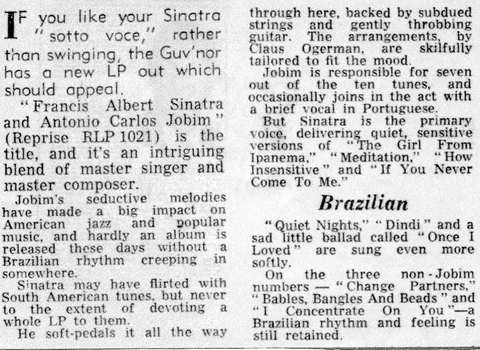
© 1997-2026 The Sinatra Archive
This calendar, or any parts thereof, may not be reproduced in any fashion
whatsoever without the prior written permission of the publisher (The
Sinatra Archive)
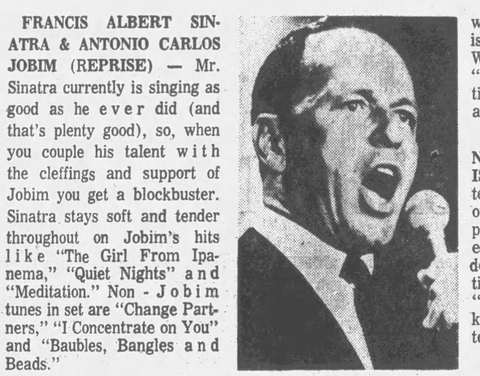
© 1997-2026 The Sinatra Archive
This calendar, or any parts thereof, may not be reproduced in any fashion
whatsoever without the prior written permission of the publisher (The
Sinatra Archive)
[Jackie Mason continues Sinatra jokes in Miami]
Jackie Mason: Appearing at the Saxony Hotel in Miami after receiving a phone threat and hiring a bodyguard, Jackie Mason kept making Sinatra jokes, later saying he'd been warned all week by anonymous callers to shut up about Sinatra.
Source: James Kaplan, "Sinatra: The Chairman" (2015)
[Mia departs for A Dandy in Aspic]
Earl Wilson / Kaplan: As Frank prepared to open a two-week stand at the Fontainebleau, Mia flew to London to begin shooting the spy thriller 'A Dandy in Aspic' opposite Tom Courtenay and Laurence Harvey, marking the first real separation of their marriage.
Source: James Kaplan, "Sinatra: The Chairman" (2015)
Hollywood
K4815 Once I Loved (O Amor En Paz)
(Antonio Carlos Jobim/Ray Gilbert/Vinicius De Moraes)
Duchess Music Corp./New Thunder Music (BMI)
Arranged & Conducted by Claus Ogerman
-10 (2:36) CD: 46013-2 The Complete Reprise Studio Recordings Disc 11
CD: 9-26340-2The Reprise Collection
CD: 1021-2Francis Albert Sinatra & Antonio Carlos Jobim
LP: FS1021Francis Albert Sinatra & Antonio Carlos Jobim
K4816 How Insensitive (Insensatez) w/Antonio Carlos Jobim
(Antonio Carlos Jobim/Norman Gimbel/Vinicius De Moraes) Duchess Music Corp./New Thunder Music (BMI)
Arranged & Conducted by Claus Ogerman
-7 (3:15) CD: 46013-2 The Complete Reprise Studio Recordings Disc 11
CD: 9-26340-2The Reprise Collection
CD: 1021-2Francis Albert Sinatra & Antonio Carlos Jobim
LP: FS1021Francis Albert Sinatra & Antonio Carlos Jobim
K4817 Drinking Again
(Johnny mercer/Doris Tauber)
M. Witmark & Sons (ASCAP)
Arranged & Conducted by Claus Ogerman
-6 (3:10) CD: 46013-2 The Complete Reprise Studio Recordings Disc 11
CD: 1022-2The World We Knew
CD: 9-26340-2The Reprise Collection
LP: FS1022The World We Knew
K4818 Somethin' Stupid w/Nancy Sinatra
(Carson C. Parks)
Greenwood Music (BMI)
Arranged by Billy Strange
Conducted by Claus Ogerman
-2 (2:38) CD: 46013-2 The Complete Reprise Studio Recordings Disc 11
CD: 1022-2The World We Knew
CD: 9-26340-2The Reprise Collection
LP: FS1025Frank Sinatra's Greatest Hits
LP: FS1022The World We Knew
45: 056 IT
note: Song required 10 takes. There is in circulation a tape with just Frank's vocal. It is very interesting.
--Ed
Notes: Frank completed the Jobim album and then did a simply fabulous recording of the great Johnny Mercer-Doris Tauber saloon song, "Drinking Again." The piano work by Bill Miller is exquisite and Sinatra improvised on the lyrics until he got just what he wanted on Take 6. A few friends were lucky enough to catch Frank doing this gem in concert settings, They have assured O'Brien that you would hear a pin drop the audience was so attentive throughout. There should have been an album built around this beauty.
Later, several other Sinatraphiles expressed their wonder why Sinatra did not perform "Drinking Again" more often. Regarding the recording session itself, Jack Tomsky reports that after Take Two, Sonny Burke told Miller that the piano was too percussive and asked him to play lighter. After Take Four, Frank asked Miller to lower it an octave and Burke repeated his request regarding the percussive problem. After listening to two more alternate takes, I wonder how much of the master take was Mercer and how much was Frank adding and subtracting lyrics.
O'Brien, in response, recalls that Sinatra had Bill Miller play his piano accompaniment an octave lower. Or was it the other way around?
Eugene Lo Curto suggests that the fade out at the end of the recording may be a reason why the recording become one of Frank's chief saloon songs. Another reason? It was included on an album that sold poorly
Ed Spiefel asks: "Who knows?" There are countless possibilities, but it would have been a killer of a saloon song done live!"
Hollywood
K4815 Once I Loved (O Amor En Paz)
K4816 How Insensitive (Insensatez)
K4817 Drinking Again
K4818 Somethin' Stupid
REVIEW
Revisiting A Masterpiece: When Frank Sinatra
Collaborated With Antonio Carlos
Jobim
NATE
CHINEN
FROM
Frank Sinatra and Antonio Carlos Jobim in the studio.
Courtesy of Frank Sinatra Enterprises
Frank Sinatra was well into his Rat Pack era, the reigning American embodiment of masculine suavity and aplomb, when he teamed up with a maestro of Brazilian music to make one of the most exquisitely tender albums of his career. That album, Francis Albert Sinatra & Antonio Carlos Jobim, has lost none of its luster since it was first released 50 years ago. In fact, a newly remastered anniversary edition extracts additional depth from Claus Ogerman's orchestrations, which frame Sinatra's voice like a Rolex on a velvet cushion.
Jobim, a pianist and guitarist as well as a composer, was the beating heart at the center of a worldwide bossa nova craze, following the success of Getz/Gilberto. A joint effort of the American tenor saxophonist Stan Getz and the Brazilian guitarist and singer João Gilberto, that album also served as a showcase for Jobim's songs, including "The Girl From Ipanema," a runaway smashThe album, recorded in Hollywood in the winter of 1967, captures both Sinatra and Jobim at an apex, flush with creative and popular success. Sinatra was coming off a knockout run of albums on his Reprise label including Sinatra at the Sands, recorded with the Count Basie Orchestra; That's Life, a Top 10; and Strangers in the Night, whose title track became an unstoppable hit.
Frank Sinatra with Antonio Carlos Jobim in 1967.
Ed Thrasher/Courtesy of Frank Sinatra Enterprises
The 50th anniversary edition of Francis Albert Sinatra & Antonio Carlos Jobim has just been released in various formats, including two vinyl packages. And along with the music from the original album, it includes two previously unreleased tracks: A live medley from a television special, and part of a session reel for "The Girl From Ipanema," which Sinatra and Jobim sing as a duet.
"Don't let it run away, fellas, with the tempo," Sinatra cautions at the top of the first take. "Just hold it down, let it settle down. Because it's got a lot of it's got a gang of words." After the take is finished, he caalls for another one, "right away." His decisive brusqueness strikes a jarring contrast to the singing, which is as delectably airy as a soufflé.
The commercial relevancy of bossa nova is one way to explain Sinatra's keen interest in Jobim: He was aware of his tenuous position within a cultural moment increasingly defined by The Beatles. But his treatment of this music belies any charge of opportunism. While bossa nova presented a new angle for him as a singer "I haven't sung so soft since I had the laryngitis," he quipped during the sessions he clearly regarded the style as ssomething more than a novelty.
"No other American pop star would so thoroughly immerse himself in the world of bossa," writes Will Friedwald in his fine critical biography Sinatra! The Song is You: A Singer's Art. "He not only recorded two whole albums' worth of the stuff but sacrificed his signature stylistics in order to more smoothly fit into the new vernacular."
Consider the sensitivity of Sinatra's phrasing on "Quiet Nights of Quiet Stars," a version of Jobim's "Corcovado" with
English lyrics by the critic Gene Lees.
The balance of voice and orchestration is so impeccably calibrated that it has effectively been canonized: When Diana Krall made her own bossa nova album in 2009, she named it Quiet Nights, enlisting Ogerman as arranger (who won a Grammy for his efforts).
In its original iteration, Francis Albert Sinatra & Antonio Carlos Jobim broke into the Top 20 and spent 28 consecutive weeks on the Billboard album chart. According to Michael Bourne, the host of Singers Unlimited on WBGO, it marked another layer of validation for bossa nova in the American pop mainstream. "Even after the album Getz/Gilberto won a Grammy as album of the year," said
Bourne, "the Sinatra/Jobim album was a musical apotheosis, a blessing of Jobim's songs from America's musical Pope."
There was, however, one distinction that eluded the album. Sinatra had won album of the year at the previous two Grammy Awards for September of My Years (1965) and A Man and His Music (1966) but he wasn't destined for a threepeat. While Francis Albert Sinatra & Antonio Carlos Jobim was nominated, and perhaps even the frontrunner, the top honor went to another album that has stood the test of time:
Sgt. Pepper's Lonely Hearts Club
Band.
Sydney Morning Herald, New South Wales, Australia


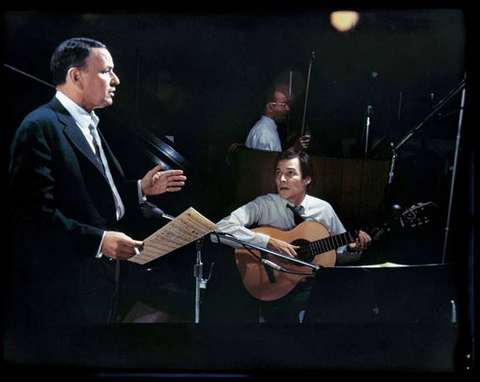
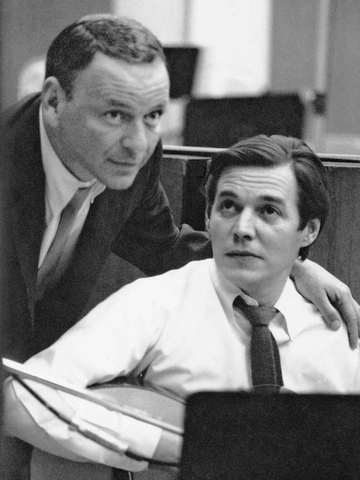
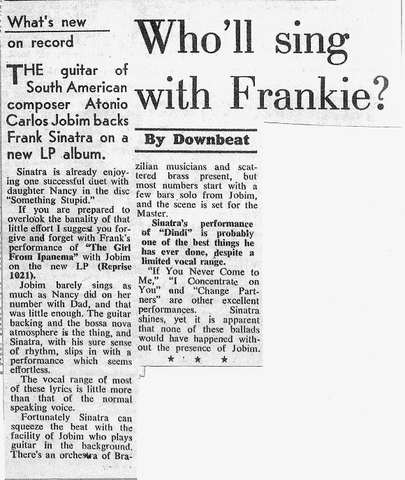
K4818 Somethin' Stupid
w/Nancy Sinatra
(Carson C. Parks)
Greenwood Music (BMI)
Arranged by Billy Strange
Conducted by Claus Ogerman
-2 (2:38) CD: 46013-2 The Complete Reprise Studio Recordings Disc 11
CD: 1022-2The World We Knew
CD: 9-26340-2The Reprise Collection
LP: FS1025Frank Sinatra's Greatest Hits
LP: FS1022The World We Knew
45: 056 IT
Frank and Nancy Sinatra recording "Somethin' Stupid" on February 1, 1967
Note, that Glenn Campbell played on this session.
Glen Campbell was on the cusp on superstardom
in 1967. He backed Frank on the Strangers In The Night"
session ( April 66 ), Jobim and a July 67 session. Frank's
singing on the Jobim project garnered him a best male
vocal performance. He lost to Campbell's vocal for "By
The Time I Get To Phoenix."
--Ed
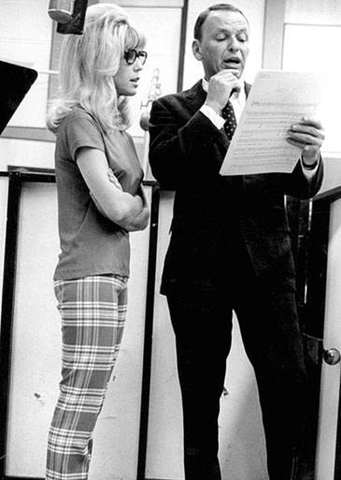
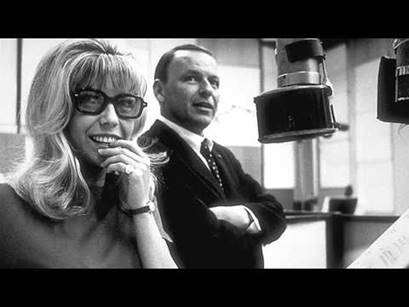
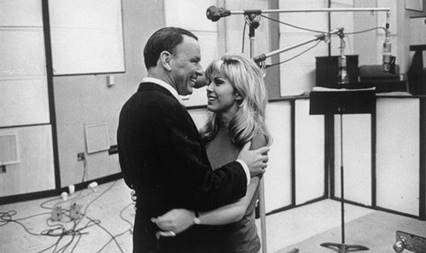
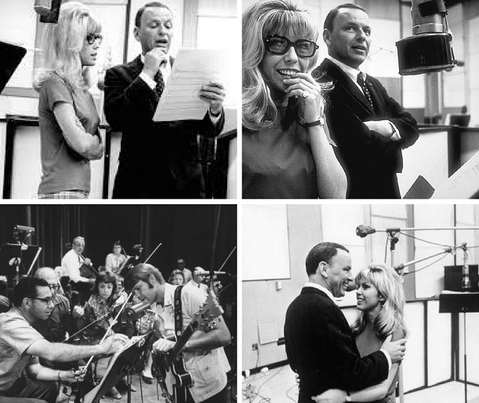
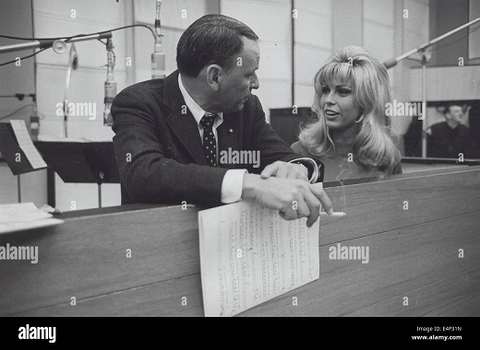
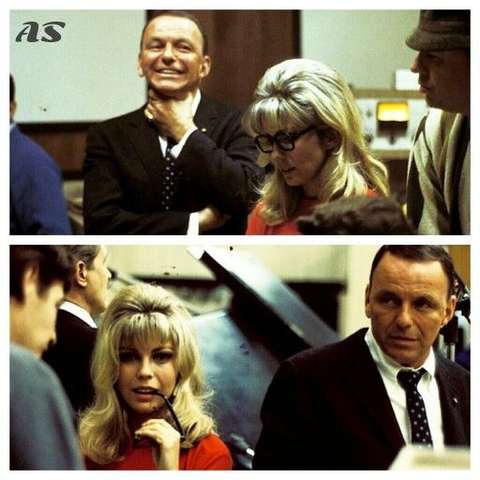
Nancy Sinatra and Frank record their hit single “Something Stupid” in March 1967. Source: photo and caption from J. Randy Taraborrelli, Sinatra: Behind the Legend (mptvimages.com).
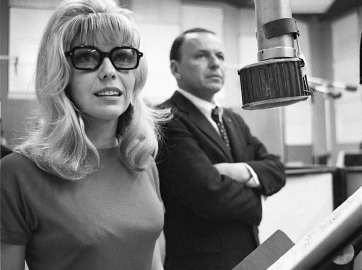
Nancy could always bring a smile to Frank’s face. Source: photo and caption from J. Randy Taraborrelli, Sinatra: Behind the Legend (mptvimages.com).
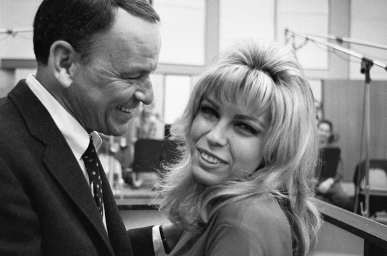
"Once I Loved" / "How Insensitive" / "Drinking Again"
The final bossa nova session took place the evening of February 1, 1967 at Western Recording Studio 1. In under two hours Sinatra recorded the last two Jobim album tracks ('Once I Loved,' 'How Insensitive') plus 'Drinking Again' (Ogerman arrangement) for the upcoming album The World We Knew.
Source: Charles L. Granata, "Sessions with Sinatra: Frank Sinatra and the Art of Recording" (1999/2003).
"Somethin' Stupid"
Nancy Sinatra: Immediately after the Jobim session wrapped that same evening, the string players and Sinatra's regular rhythm section left and the Hollywood 'wrecking crew' session players moved in for Nancy Sinatra to join her father on 'Somethin' Stupid.' Nancy recalled that songwriter Sarge Weiss brought her the song and her father agreed to 'tack it on the end of the Jobim date.'
Source: Charles L. Granata, "Sessions with Sinatra: Frank Sinatra and the Art of Recording" (1999/2003).
[Drinking Again -- critical commentary]
Will Friedwald: Cited as an example of the Sinatra-Miller 'saloon song' duet format, with Ogerman draping a light, Riddle-like sheen of strings behind what is otherwise all voice and piano.
This song/context matches multiple dated entries in the chronology; the specific date Friedwald is referring to could not be determined with confidence.
Source: Will Friedwald, "Sinatra! The Song Is You: A Singer's Art" (2018 revised edition), Ch. 1, "Night and Day" (Sinatra style overview)
[Drinking Again -- critical commentary]
Frank Sinatra / Claus Ogerman (quoted) / Friedwald (analysis): Arranger Claus Ogerman, at a meeting with Sinatra at his Warner Bros. office to pick the key, sat at the piano and started noodling 'very modern jazz harmonies'; Sinatra announced to those present, 'Listen, this guy isn't from Germany, he's from Brooklyn. He's just faking with that accent.' Ogerman told Friedwald he had known the song's composer, Doris Tauber (also composer of 'Them There Eyes'), from New York: 'She worked for many years as a staff pianist and song demonstrator for [music publisher] Harms Inc., which is the job Gershwin had earlier. She was practically Gershwin's successor [at that firm].' Friedwald calls the resulting performance 'stunning even by his own Olympian standards' -- a perfect cocktail of tragedy and noir comedy, a buried gem on an otherwise 'ballad rock' album.
This song/context matches multiple dated entries in the chronology; the specific date Friedwald is referring to could not be determined with confidence.
Source: Will Friedwald, "Sinatra! The Song Is You: A Singer's Art" (2018 revised edition), Ch. 9, "Looking for the Hook" (1960-1971)
Kiel Opera House, St. Louis, Missouri
Teamster Charity Show
Sinatra, Dean Martin, Milton Berle, Connie Francis
Sinatra segment:
1. Shadow Of Your Smile
2. Summer Wind
3. Yes Sir, That's My Baby
4. It Was A Very Good Year
5. My Kind Of Town
6. This Is All I Ask
7. That's Life
Kiel Opera House, St. Louis, Missouri
Teamster Charity Show
Sinatra, Dean Martin, Milton Berle, Connie Francis
--A video of this show has survived. A friend of mine
saw a showing about 10 years ago
Ed
© 1997-2026 The Sinatra Archive
This calendar, or any parts thereof, may not be reproduced in any fashion
whatsoever without the prior written permission of the publisher (The
Sinatra Archive)
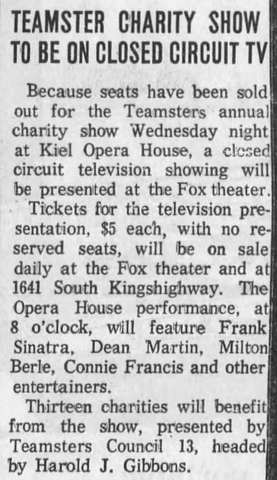
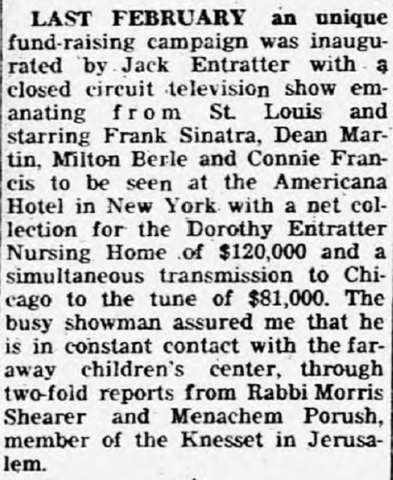
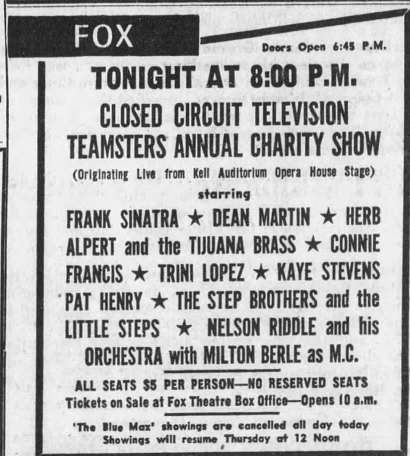
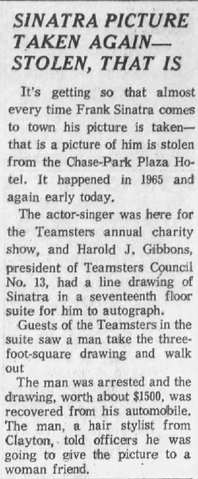
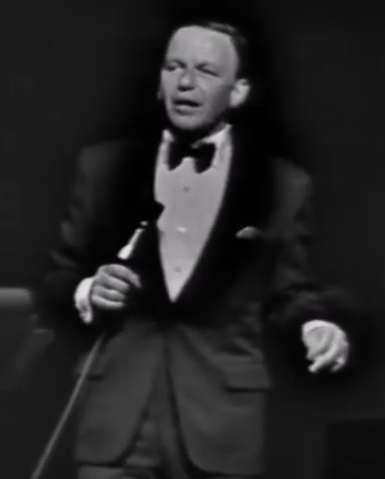
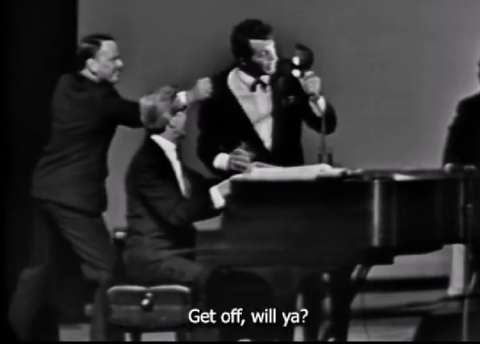
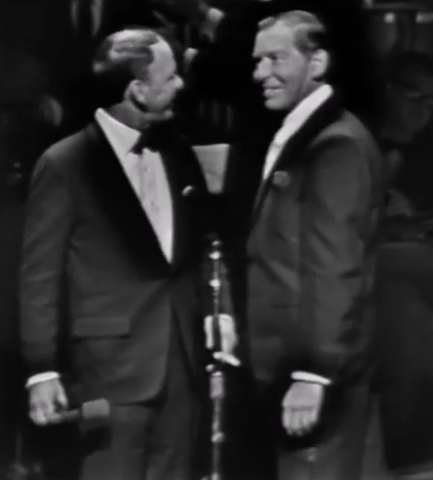
Hi Scott,
A video of this show has survived. A friend of mine
saw a showing about 10 years ago
Ed
On Thursday, March 14, 2024 at 10:23:12 AM EDT, Scott Henderson <scott@falseducks.com> wrote:
Here's an interesting one I came across:
February 8, 1967, Kiel Opera House, St. Louis, Missouri
Teamster Charity Show
Sinatra, Dean Martin, Milton Berle, Connie Francis
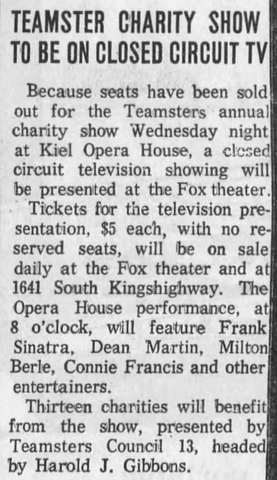
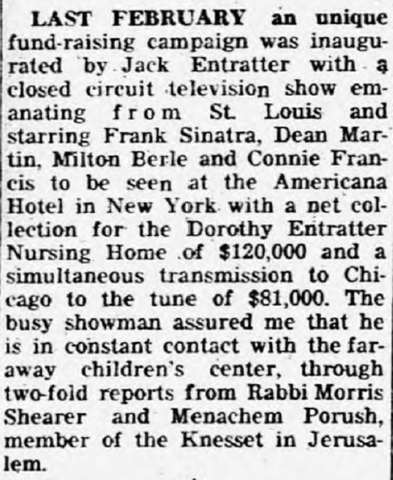
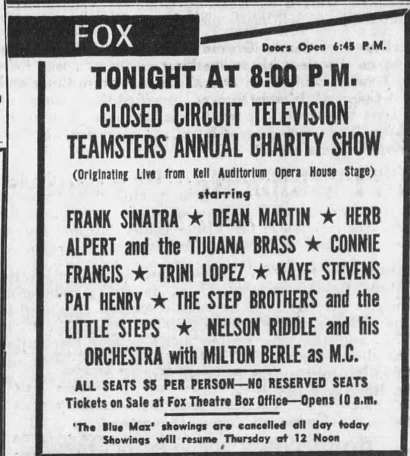
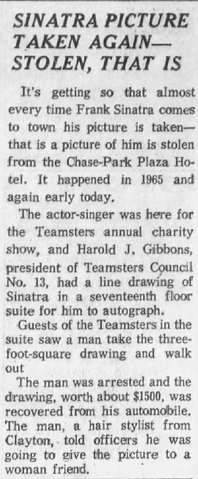
Here's an interesting one I came across:
February 8, 1967, Kiel Opera House, St. Louis, Missouri
Teamster Charity Show
Sinatra, Dean Martin, Milton Berle, Connie Francis
University of Southern California
Sunday evening
Friends of the Library 100 trustees
A Tribute to Cole Porter built around George Eells new biography "The Life That Late He Led," published on 1-1-67.
126 minutes
Ethel Merman, Fred Astaire, Gene Kelly, Frank Sinatra, James Stewart, Roger Edens, Alan Jay Lerner and moderated by Garson Kanin.
1. Anything Goes Ethel Merman
2. I Get A Kick Out Of You Ethel Merman
3. I've Got You Under My Skin (ballad version) Frank Sinatra
4. Let's Do It Frank Sinatra
5. Night And Day Fred Astaire
6.. You're The Top Ethel Merman
7. Down In The Depths Ethel Merman
8. It's All Right With Me Frank Sinatra
9. I Love Paris Frank Sinatra
10. Make It Another Old Fashioned Ethel Merman
11. Be A Clown Gene Kelly
12. Easy To Love James Stewart
13. I Concentrate On You Frank Sinatra
14. Friendship Frank, Fred, Ethel, Gene, Jimmy, Alan, Roger and Garson.
Stupendous is the first word that comes to mind in trying to describe that incredible evening 43 years ago tonight.
Kanin opened the show by introducing the performers on stage. What ensued after that was nothing short of magnificent. The discussions that took place on stage among the performers was pure magic. Sinatra and Astaire got into a friendly disagreement over whether or not Porter was a snob. The audience learned that Cole called Merman "The Divine Ethel." She told wonderful stories about the music he wrote for her. They all read from Eells new bio. Frank told of the debacle he had with Porter at the Rustic Cabin in 1938. There was a great deal of back and forth on the merits of Porter's great work. Astaire told the audience that Frank was the first one at the rehearsal earlier in the day. Stewart was very funny in describing his singing of the song Cole wrote for him. Kelly fondly remembered working with Porter. Lerner discussed the creative process with Astaire and others.Roger Edens provided the sole musical support with his piano backings. Ethel drowned out the rest of the singers on the closing number "Friendship. " Frank yelled to her, "What the hell are you hollering about ? You got the job." A great, great evening in the history of show business.
Notes: Ed O'Brien supplied the notes and listing above.
University of Southern California
Sunday evening
Friends of the Library 100 trustees
A Tribute to Cole Porter built around George Eells new biography "The Life That Late He Led," published on 1-1-67.
126 minutes
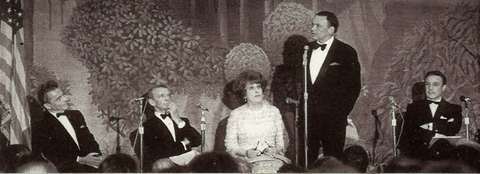
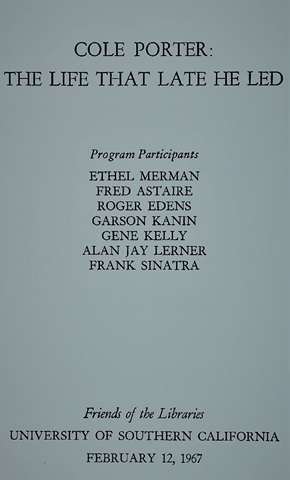
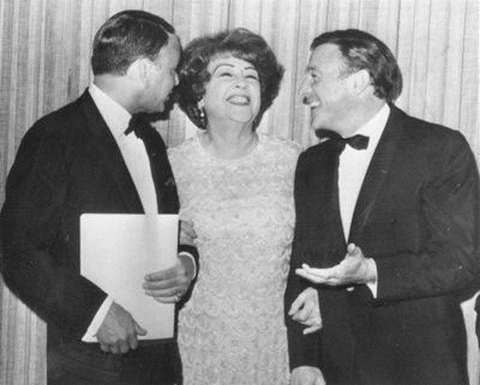
[Jackie Mason assaulted near the Saxony]
Jackie Mason: At 5:00 a.m., while sitting in his car with a female friend a few blocks from the Saxony Hotel, Jackie Mason was punched in the face by an assailant who broke his nose and cut him with a ring; he was hospitalized. He later said the attacker told him, 'This is not the worst that can happen if you don't keep your mouth shut about Frank Sinatra.' Sinatra arrived in Miami two days later.
Source: James Kaplan, "Sinatra: The Chairman" (2015).
Fontainebleau, Miami Beach, Florida (February 16 - March 1) Lenny Dawson Orchestra
Musical Director: Gordon Jenkins
Comedy by Shecky Greene
Also: Cook & Brown - Comedy Tap Team
Strangers In The Night ( opens behind the scrim and then walks out singing ) Summer Wind
A Foggy Day
The Shadow Of Your Smile ( Riddle string arg. )
Autumn Leaves
My Kind Of Town
This Is All I Ask
Quiet Night
Dindi
I Concentrate On You w/ Al Viola
Drinking Again
It Was A Very Good Year
That's Life
note: Sinatra was a sensation. He opted to accept an offer to extend his engagement until March 5.
Found some great reviews. Will post later today. Years ago I mentioned that
Frank sang "Drinking Again" and Dindi" in his act. A friend saw him during the two plus weeks at the hotel. Both are mentioned in one of the reviews.
Ed
A friend caught Frank's show during this engagement. Among the songs he sang, "Dindi" and "Drinking Again" were two my pal still remembers.
--Ed
Fontainebleau, Miami Beach, Florida (February 16 - March 1)
Lenny Dawson Orchestra
Musical Director: Gordon Jenkins
Comedy by Shecky Greene
Also: Cook & Brown - Comedy Tap Team
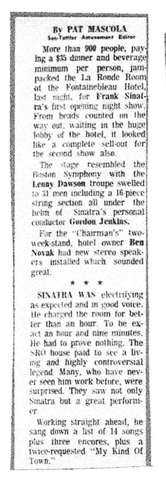
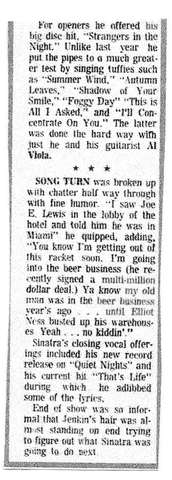
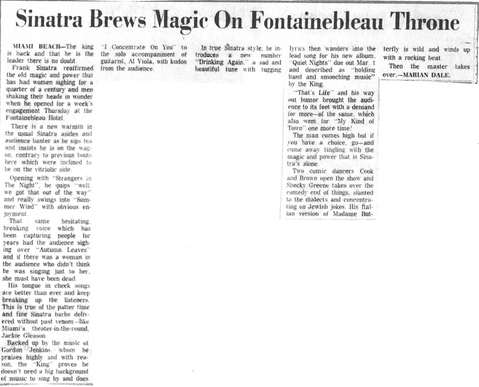
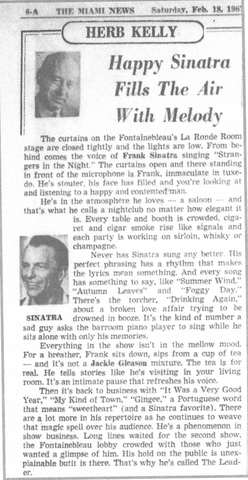
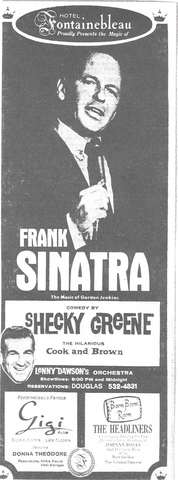
Fontainebleau, Miami Beach, Florida (February 16 - March 1) Lenny Dawson Orchestra
Musical Director: Gordon Jenkins
Comedy by Shecky Greene
Also: Cook & Brown - Comedy Tap Team
Fontainebleau, Miami Beach, Florida (February 16 - March 1)
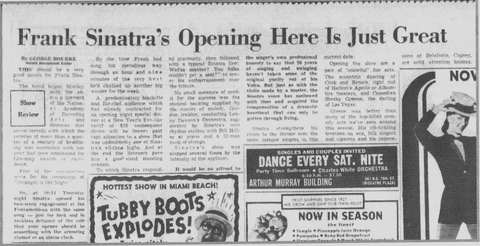
Fontainebleau, Miami Beach, Florida (February 16 - March 1)
Fontainebleau, Miami Beach, Florida (February 16 - March 1)
Fontainebleau, Miami Beach, Florida (February 16 - March 1)
Fontainebleau, Miami Beach, Florida (February 16 - March 1)
Fontainebleau, Miami Beach, Florida (February 16 - March 4)
Fontainebleau, Miami Beach, Florida (February 16 - March 1)
Fontainebleau , Miami Beach , Florida (February 16 - March 1)
Fontainebleau, Miami Beach, Florida (February 16 - March 1)
Fontainebleau , Miami Beach , Florida (February 16 - March 1)
Fontainebleau , Miami Beach , Florida (February 16 - March 4)
Fontainebleau , Miami Beach , Florida (February 16 - March 1) Scott,
Frank extended both engagements.
The 66 w/Basie closed on Friday night 3/11.
The 67 was extended three days and closed on Saturday, 3/4.
Ben Novack asked for a four day extension. Frank agreed but changed his mind. The closing night shows were a sensation.
Ed
Fontainebleau , Miami Beach , Florida (February 16 - March 4)
Fontainebleau, Miami Beach, Florida (February 16 - March 4)
[Sinatra's big Grammy night]
Frank had his best night ever at the Grammys, winning Record of the Year and Best Male Vocal Performance for 'Strangers in the Night' and Album of the Year for 'A Man and His Music.'
Source: James Kaplan, "Sinatra: The Chairman" (2015).
Fontainebleau , Miami Beach , Florida (February 16 - March 4)
Fontainebleau, Miami Beach, Florida (February 16 - March 4)
[Rosemary's Baby novel published]
Ira Levin's horror novel 'Rosemary's Baby' was published and immediately became a best-seller; by month's end Paramount had bought the film rights for producer William Castle and hired director Roman Polanski.
Source: James Kaplan, "Sinatra: The Chairman" (2015).
[Column notes Sinatra marriage and Bel Air remodel]
Harrison Carroll: Columnist Harrison Carroll wrote that Mia Farrow flew back from England to see Frank on every possible occasion, noting Frank's planned film 'Shamus' (later 'Tony Rome') would start around April 1 in Florida and that crews were rushing to finish redecorating the couple's new Bel Air home.
Source: James Kaplan, "Sinatra: The Chairman" (2015).
['Somethin' Stupid' released]
Frank and Nancy Sinatra's duet 'Somethin' Stupid,' quickly nicknamed the Incest Song for its 'I love you' lyric, was released and would soon top the Billboard singles chart.
Source: James Kaplan, "Sinatra: The Chairman" (2015).
[Hughes approved to buy the Desert Inn]
On the last day of March, Howard Hughes received permission from the Nevada Gaming Commission to purchase the Desert Inn's operations for $13 million, with the Clark County Gaming License Board also approving his casino license.
Source: James Kaplan, "Sinatra: The Chairman" (2015).
[Director Anthony Mann dies during Dandy shoot]
Kaplan: Director Anthony Mann died of a heart attack at the end of April during production of 'A Dandy in Aspic'; Laurence Harvey completed the picture in his place.
Source: James Kaplan, "Sinatra: The Chairman" (2015)
[Harvey boasts of scenes with Mia]
Laurence Harvey: Laurence Harvey boasted to columnist Leonard Lyons about having 'hot love scenes' with Mia Farrow in 'A Dandy in Aspic,' fueling press attention to their on- and off-screen chemistry.
Source: James Kaplan, "Sinatra: The Chairman" (2015)
[Sinatra enraged by Mia-Harvey photo]
Kaplan: After a bodyguard handed him a newspaper photo of Mia closely entwined with Laurence Harvey while dancing, Sinatra, already sensitive about gibes over his age and Mia's youth, called Mia in Berlin in the middle of the night and screamed at her for nearly an hour; she flew to Miami to placate him.
Source: James Kaplan, "Sinatra: The Chairman" (2015)
[Tony Rome begins shooting in Miami]
'Tony Rome,' the first of Sinatra's three detective films for 20th Century Fox, began shooting in Miami, with Frank as the title character, Richard Conte as a police lieutenant, and Jill St. John, Gena Rowlands, and Sue Lyon co-starring. Billy May wrote the score and Gordon Douglas directed.
Source: James Kaplan, "Sinatra: The Chairman" (2015).
Fontainebleau, Miami Beach, Florida (April 7-29)
Lenny Dawson and his Orchestra
Comedy by Shecky Greene
Frank did one show a night from Tuesday to Saturday
Fontainebleau, Miami Beach, Florida (April 7-29)
Miami Herald 3-7-67
Gordon Jenkins was not with him this time.
Frank did one show a night from Tuesday to Saturday. "Shamus" was retitled "Tony Rome." There were plans to do a seconf film right after this one. Didn't happen. Frank was also set to play the Amphitheater, in Miami, 7-11-67, as part of the tour with Buddy Rich.
Last week I posted the song list from the February 67 opening night. I knew one song was missing. It was "Yes Sir, That's My Baby." Frank's closing night of the first 67 engagementm at the Fontainebleau, 3-4, was a sensation. Audience would not let him leave the stage. He wound up doing 20 songs.
--Ed
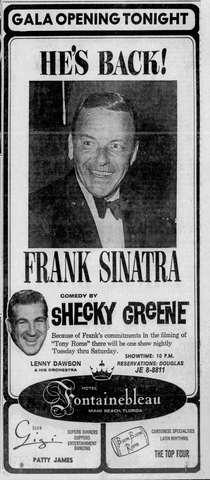
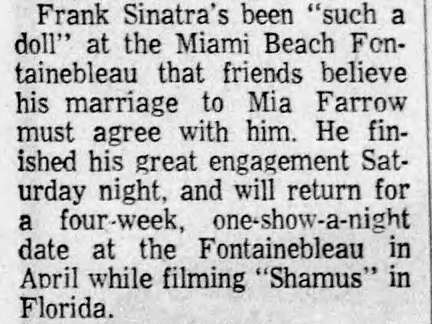
Fontainebleau, Miami Beach, Florida (April 7-29)
Lenny Dawson and his Orchestra
Comedy by Shecky Greene
Fontainebleau, Miami Beach, Florida (April 7-29)
Lenny Dawson and his Orchestra
Comedy by Shecky Greene
Fontainebleau, Miami Beach, Florida (April 7-29)
Lenny Dawson and his Orchestra
Comedy by Shecky Greene
Fontainebleau, Miami Beach, Florida (April 7-29)
Lenny Dawson and his Orchestra
Comedy by Shecky Greene
Fontainebleau, Miami Beach, Florida (April 7-29)
Lenny Dawson and his Orchestra
Comedy by Shecky Greene
Fontainebleau, Miami Beach, Florida (April 7-29)
Lenny Dawson and his Orchestra
Comedy by Shecky Greene
Fontainebleau, Miami Beach, Florida (April 7-29)
Lenny Dawson and his Orchestra
Comedy by Shecky Greene
note: Throughout this engagement Frank had the biggest selling single in the country. "Somethin'
Stupid" was the #1 song on the Billboard charts for four consecutive weeks and also dominated the Adult Contemporary list that April.
Ed
Fontainebleau, Miami Beach, Florida (April 7-29)
Lenny Dawson and his Orchestra
Comedy by Shecky Greene
"Somethin' Stupid," the father-daughter duet with Nancy Sinatra recorded the previous February during sessions for the album The World We Knew, reaches number one on the Billboard chart, where it would remain for four weeks. Source: J. Randy Taraborrelli, Sinatra: Behind the Legend.
['Somethin' Stupid' hits number one]
'Somethin' Stupid' reached number 1 on the Billboard Hot 100, Sinatra's second number-one hit in two years with a song he didn't think much of.
Source: James Kaplan, "Sinatra: The Chairman" (2015).
Fontainebleau, Miami Beach, Florida (April 7-29)
Lenny Dawson and his Orchestra
Comedy by Shecky Greene
Fontainebleau, Miami Beach, Florida (April 7-29)
Lenny Dawson and his Orchestra
Comedy by Shecky Greene
[Sinatra kicks in a TV set]
Two nights after the chart news, while watching the premiere of Joey Bishop's ABC late-night talk show at Harry Mufson's Miami Beach house with Shecky Greene, Jilly Rizzo, and Joe Fischetti, Sinatra stood up and kicked in the television screen the moment Bishop introduced his first guest, Governor Ronald Reagan.
Source: James Kaplan, "Sinatra: The Chairman" (2015).
Fontainebleau, Miami Beach, Florida (April 7-29)
Lenny Dawson and his Orchestra
Comedy by Shecky Greene
Fontainebleau, Miami Beach, Florida (April 7-29)
Lenny Dawson and his Orchestra
Comedy by Shecky Greene
Fontainebleau, Miami Beach, Florida (April 7-29)
Lenny Dawson and his Orchestra
Comedy by Shecky Greene
Fontainebleau, Miami Beach, Florida (April 7-29)
Lenny Dawson and his Orchestra
Comedy by Shecky Greene
Fontainebleau, Miami Beach, Florida (April 7-29)
Lenny Dawson and his Orchestra
Comedy by Shecky Greene
Fontainebleau, Miami Beach, Florida (April 7-29)
Lenny Dawson and his Orchestra
Comedy by Shecky Greene
Fontainebleau, Miami Beach, Florida (April 7-29)
Lenny Dawson and his Orchestra
Comedy by Shecky Greene
Fontainebleau, Miami Beach, Florida (April 7-29)
Lenny Dawson and his Orchestra
Comedy by Shecky Greene
Fontainebleau, Miami Beach, Florida (April 7-29)
Lenny Dawson and his Orchestra
Comedy by Shecky Greene
Fontainebleau, Miami Beach, Florida (April 7-29)
Lenny Dawson and his Orchestra
Comedy by Shecky Greene
Fontainebleau, Miami Beach, Florida (April 7-29)
Lenny Dawson and his Orchestra
Comedy by Shecky Greene
Fontainebleau, Miami Beach, Florida (April 7-29)
Lenny Dawson and his Orchestra
Comedy by Shecky Greene
[Anti-Defamation League names Sinatra chairman]
Kaplan: The American-Italian Anti-Defamation League named Frank national chairman of a campaign to discourage identifying Italian-Americans with the Mafia, a move critics found ironic given Sinatra's recently revoked Nevada gaming license.
Source: James Kaplan, "Sinatra: The Chairman" (2015)
[Billy Strayhorn dies]
Terry Teachout: Duke Ellington's longtime collaborator and arranger Billy Strayhorn died in May 1967, leaving the sixty-eight-year-old bandleader increasingly out of step with contemporary music, according to biographer Terry Teachout.
Source: James Kaplan, "Sinatra: The Chairman" (2015)
[Mia on the cover of Life]
Mia Farrow appeared on the cover of Life magazine as 'A Dandy in Aspic' put her on the map, though she still needed a breakthrough starring role.
Source: James Kaplan, "Sinatra: The Chairman" (2015).
[O'Brian questions League's choice]
Jack O'Brian: Columnist Jack O'Brian asked why the Anti-Defamation League chose Sinatra for the headlines when it could have picked a Joe DiMaggio or Perry Como.
Source: James Kaplan, "Sinatra: The Chairman" (2015).
[Salerno criticizes Sinatra's Mafia ties in NYT]
Ralph Salerno: Former NYPD detective and Mafia authority Ralph Salerno told the New York Times that Sinatra's associations with known Mafia figures across several cities hardly matched the wholesome image the Anti-Defamation League sought to project; League president Ross J. Di Lorenzo fired back defending Sinatra's record with 'world leaders.'
Source: James Kaplan, "Sinatra: The Chairman" (2015).
[Beck reports on Mia's retirement talk]
Marilyn Beck: Columnist Marilyn Beck wrote that there was talk Mia Farrow would retire to become a full-time wife after her taste of stardom, noting she had already turned down several film offers.
Source: James Kaplan, "Sinatra: The Chairman" (2015).
[Lyons announces Mia's next film]
Leonard Lyons: Columnist Leonard Lyons announced that Mia Farrow's next movie would be 'The Severed Head,' co-starring Richard Burton and Elizabeth Taylor (a project that ultimately did not happen for her).
Source: James Kaplan, "Sinatra: The Chairman" (2015).
[Rehearsals begin for Johnny Belinda]
Kaplan: Rehearsals for the TV movie 'Johnny Belinda,' starring Mia Farrow, began in the first week of June.
Source: James Kaplan, "Sinatra: The Chairman" (2015)
[Susskind describes Mia's bruises]
David Susskind: Worried about losing his star, David Susskind flew to see Mia Farrow and later told Kitty Kelley he found her badly bruised, with red gashes and marks on her arms, shoulders, and throat as if she'd been beaten; Farrow insisted on continuing with the role despite his concern. Farrow herself later, in 1986, denied that Sinatra had ever mistreated her.
Source: James Kaplan, "Sinatra: The Chairman" (2015)
[The World We Knew sessions begin in New York]
Kaplan: Sinatra began recording a new album, 'The World We Knew,' with the first session held in New York, his first recording date in the city in almost fifteen years; the LP involved five arrangers including Gordon Jenkins, Claus Ogerman, and Ernie Freeman, and was produced in part by Jimmy Bowen, with no Nelson Riddle charts.
Source: James Kaplan, "Sinatra: The Chairman" (2015)
[Graham reports on Mia's competing film offers]
Sheilah Graham: Sheilah Graham's column reported Mia Farrow was poised to sign for 'Rosemary's Baby' at Paramount when George Cukor requested her for 'Nine Tiger Man' at 20th Century Fox, and speculated Sinatra might insist on keeping his wife closer to home.
Source: James Kaplan, "Sinatra: The Chairman" (2015).
[Mia cast in Johnny Belinda TV movie]
Newspapers reported that Mia Farrow would play the starring role in the ABC television movie remake of 'Johnny Belinda,' a project her own memoir later omits, muddling the true timeline of that period in her marriage.
Source: James Kaplan, "Sinatra: The Chairman" (2015).
Rally For Israel's Survival
Hollywood Bowl, Los Angeles
2 Hour Special
KLAC 2pm
Rally For Israel's Survival
Hollywood Bowl, Los Angeles
5PM
Broadcast in Color
[image referenced in source but could not be recovered]
Rally For Israel's Survival, Hollywood Bowl, Los Angeles Sinatra appeared along with Joey Bishop, Ernest Borgnine, Judy Garland, Kathryn Grayson, Danny Kaye, Ross Martin, Agnes Moorhead, Carl Reiner, Edward G. Robinson, Eva Marie Saint, Peter Sellers, Dinah Shore, Jan Sterling, Barbara Streisand, and Robert Vaughan and others.
Hollywood Bowl
All Star Rally for Israel
A "Support Israel" rally and benefit attended by many movie stars an singers, held at the Hollywood Bowl. Singing the "Star Spangled Banner" is actress Kathryn Grayson. Standing from left: Actors, Nehemiah Persoff, Ernest Borgnine, Dinah Shore, Joey Bishop, Frank Sinatra and Peter Sellers (partial view).
[image referenced in source but could not be recovered]
[image referenced in source but could not be recovered]
[image referenced in source but could not be recovered]
Frank served as a pallbearer at the funeral of Spencer Tracy in Los Angeles.
Source: Nancy Sinatra, Frank Sinatra: An American Legend, 1995.
[Mia hospitalized at Cedars-Sinai]
Jim Mahoney: Reuters reported that Mia Farrow was under observation at Cedars-Sinai Medical Center; press agent Jim Mahoney told reporters she was 'just run down' and resting after a strenuous film role in England.
Source: James Kaplan, "Sinatra: The Chairman" (2015).
New York City
K5296 You Are There
(Harry Sukman/Paul Francis Webster)
WB Music Corp. (ASCAP)
Arranged & Conducted by Gordon Jenkins
-4 (3:27) CD: 46013-2 The Complete Reprise Studio Recordings Disc 11
CD: 1022-2 The World We Knew
LP: FS1022 The World We Knew
45: 0610
K5297 The World We Knew (Over And Over) w/Chorus
(Burt Kaempfert/Herb Rehbein/Carl Sigman)
EMI Screen Gems Music inc. (BMI)
Arranged by Ernie Freeman
Conducted by Billy Strange
-5/6 (2:46) CD: 46013-2 The Complete Reprise Studio Recordings Disc 11
CD: 1022-2The World We Knew
LP: FS1025Frank Sinatra's Greatest Hits
LP: FS1022The World We Knew
45: 0610
K5298 This Town
(Lee Hazlewood)
Remick Music Corp. (ASCAP)
Arranged & Conducted by Billy Strange
-2 N/R
NOTE: Sinatra Scholar Ed O'Brien writes that "You Are There" was the theme for "The Naked Runner" movie. Sinatra used a 60-piece orchestra and did four takes. The musicians on the session included many exciting newcomers as well as some old hands. An additional 13-piece section was added for "The World We Knew" and "This Town." Sinatra did five takes on the former plus six intercuts and two takes on the unissued "This Town." The re-do on July 24, 1967 also had two takes and can be heard on the recent film "Ocean's 13."
When the single of "World/You Are There" was issued in July 1967, O'Brien says he fell in love with the B side of the record, "You Are There." Playing it over and over for days!
Sinatra employed a two and a quarter octave range on "World We Knew." O'Brien believes that a strong argument can be made that the closest Sinatra ever came to making a great rock 'n' roll record was "This Town."
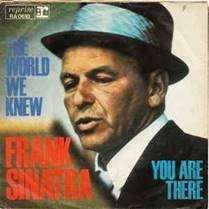
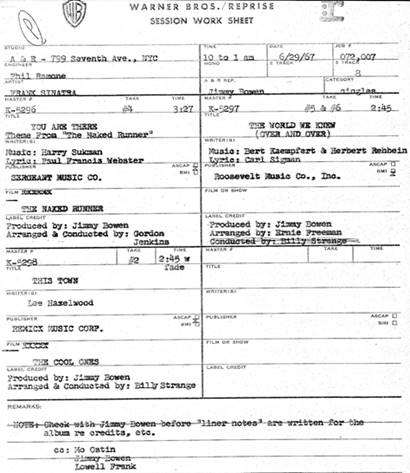
New York City
K5296 You Are There
K5297 The World We Knew (Over And Over) w/Chorus
note: When I was working on my 1991 book, Reprise was a great help to me. I came to know many of the people who were involved in packaging and selling Sinatra for many years. Sinatra was a hot property in 1967. Five of his previous seven albums had gone gold and all charted on the Top 10 Billboard lists. I asked why "The World We Knew" failed to make the Top 20 and only charted for 23 weeks. The consensus at Reprise was the album cover left a lot to be desired. It just wasn't very attractive. They also felt the label had bet on the wrong horse. "World We Knew" peaked at 23 on the chart and was around for a brief seven weeks. "This Town" reached "53 and charted for five weeks. I was told "Something Stupid" was a huge smash. Not only did it make the top of the charts, it stayed at # 1 for five weeks. Sinatra wasn't crazy about the song and it was not hyped like "Strangers" or "That's Life." People are spoke to felt the decision not to emphasis such a smash recording was a terrible mistake.
Here are some reviews of the album from 1967.
Ed
[image referenced in source but could not be recovered]
[image referenced in source but could not be recovered]
[image referenced in source but could not be recovered]
[image referenced in source but could not be recovered]
"The World We Knew (Over and Over)"
Will Friedwald (analysis): Friedwald frames this Bert Kaempfert 'power ballad' (a follow-up attempt to 'Strangers in the Night,' English lyrics by Carl Sigman) as stylistically alien to Sinatra's natural repertoire, more of an 'anthemic' belt number than the contemplative 'big number' style of Ol' Man River or September of My Years. Yet Friedwald argues Sinatra invests real feeling in it, conjecturing that Sinatra is essentially mourning a vanished world -- one where Cole Porter and Rodgers were pop hits and Tommy Dorsey, not the Beatles, led the most popular band -- rather than singing about literal lost romance as the lyric intends.
Source: Will Friedwald, "Sinatra! The Song Is You: A Singer's Art" (2018 revised edition).
[Hughes negotiates to buy the Sands]
Kaplan: Throughout July, Howard Hughes negotiated with the Sands' eighteen official owners, including Jack Entratter, Carl Cohen, and Dean Martin (but not Sinatra, who no longer held a stake), to purchase the casino that had been Sinatra's Vegas headquarters for fifteen years; Hughes rebuffed Sinatra's overture to also buy Sinatra's Cal-Neva stake.
Source: James Kaplan, "Sinatra: The Chairman" (2015)
[Paramount formally offers Mia Rosemary's Baby]
Mia Farrow: Paramount officially offered Mia Farrow the starring role in 'Rosemary's Baby'; she recalled the timing was terrible given she was mid-rehearsal for 'Johnny Belinda' and recently hospitalized for exhaustion. Sinatra, reading the script in bed in Palm Springs, said he could not see her in the role, but did not forbid her from taking it, and she accepted despite misgivings.
Source: James Kaplan, "Sinatra: The Chairman" (2015)
[Sinatra tours the heartland]
Kaplan: Sinatra toured Pittsburgh, Cleveland, Madison, Detroit, Chicago, Philadelphia, and Baltimore with the Buddy Rich Orchestra opening, along with comedian Pat Henry and Sergio Mendes; the tour was an unprecedented success, with Frank sticking mostly to classics like 'Day In, Day Out' and 'Moonlight in Vermont' alongside newer hits.
Source: James Kaplan, "Sinatra: The Chairman" (2015)
Civic Arena, Pittsburgh, Pennsylvania
Sunday
4:30 PM first show -- only afternoon performance of the tour 8:30 PM second show
O.A. Sergio Mendes & Brasil 66
Pat Henry
Buddy Rich Orchestra augmented with a string section
"Summer Wind,"
"Yes Sir, That's My Baby
"At Long Last Love,"
"Day In, Day Out,"
"The Shadow of Your Smile,"
"Moonlight in Vermont,"
"A Foggy Day,"
"This Is All I Ask,"
"Fly Me to the Moon,"
"I've Got You Under My Skin,"
"Nancy (With the Laughing Face),"
"You're Nobody Till Somebody Loves You,"
"Ol' Man River,"
"Quiet Nights of Quiet Stars,"
"My Kind of Town,"
"That's Life,"
"Strangers in the Night,"
"The Lady Is a Tramp,"
"That's Life." (reprise) note: Here is the 18 song program done at both shows. Frank sold out the two performances. In all, he performed in front of almost 27,000 paying customers. Big selling point was Frank's last appearance, in Pittsburgh, at the Stanley Theatre (July 3 thru 9, 1942). It was exactly 25 years, when he was closing the show as part of the Dorsey band: Sinatra warms them up with "Without A Song" and then goes into "This Love Of Mine" with obbligato by the four trombones, has the Pied Pipers with him in "Just As Though You Were Here," a recent recording, and tears down the stretch with "South Of The Border," a comedy novelty as done here, and "Poor You."
Variety
7-8-42
Ed O'Brien:
Frank Sinatra was riding a wave of phenomenal popularity during this tour. His records -- both singles and albums - - were flying off the record store shelves. He was a major movie star about to begin shooting "The Detective." His "Man & His Music" TV shows were brilliantly conceived and executed ( the third entry with Ella Fitzgerald and Antonio Carlos Jobim would be taped the first week of October in 1967 ). Sinatra was the most in-demand night- club performer in the world. The audiences who saw him that July, 55 years ago this month, were ecstatic throughout his hour on stage. A very heady time in the career of Francis Albert Sinatra.
note: Before the first show, Sinatra was telling people in his dressing room how much he missed Spencer Tracy. The great actor had passed away on 6-10-67. They had been great friends and Frank was still in mourning.
Ed
Civic Arena, Pittsburgh, Pennsylvania
Sunday
4:30 PM first show -- only afternoon performance of the tour 8:30 PM second show
O.A. Sergio Mendes & Brasil 66
Pat Henry
Buddy Rich Orchestra augmented with a string section
Dylan reveals his first Sinatra concert was here
By Scott Mervis
Pittsburgh Gazette
Pittsburgh Post-Gazette
A new piece of Pittsburgh lore is revealed in a wideranging interview with Bob Dylan posted on his website Wednesday. Dylan, who will release "Triplicate," his third straight collection of American standards (this one a three-disc collection) on Friday, talks about his appreciation for Frank Sinatra, who so majestically sang many of those standards. Interviewer Bill Flanagan asks Dylan when he first saw Sinatra, to which he responds, "Pittsburgh, maybe "67 or "68 at the Civic Arena. He sang " Summer Wind," "Day In, Day Out," " Moonlight in Vermont." " It was, in fact, July 2, 1967, and it was Sinatra"s first time performing at the arena and his first time in Pittsburgh since playing the Stanley Theatre at the height of the bobbysoxer era in 1942. Remember, in the postWar World II era, Sinatra was a has-been in his mid30s. "He went out of popularity," recalls Pittsburgh promoter Pat DiCesare. "It wasn"t until "53 when "From Here to Eternity" came out and he beggged to do it that he made his comeback." And in those days, he was holed up in Vegas at his playground the Sands, where, in 1966, he married Mia Farrow and recorded his first live album, "Sinatra at the Sands.." (He would leave the Sands the following year when new owner Howard Hughes pushed him out.) Mr. DiCesare says he tried to lure Sinatra and the Rat Pack out of Vegas during that time to do a week at the Stanley, but his manager asked, "What is Frank going to do in Pittsburgh for a week?" Mr. DiCesare suggested he could fly back and forth to New York each day, but that didn"t, well, fly with Frank. In the mid-"60s, despite the British Invasion wiping out the vocal groups, Sinatra was in the midst of a career renaissance, recording some of the finest material of his career, including the albums "September of My Years" (1965), "Strangers in the Night" and "That"s Life" (1966). ("Strangers in the Night" won the record of the year Grammy in 1967.) No wonder Dylan wanted to see him. The strange thing is that, no, Dylan was not also performing in Pittsburgh on July 2, 1967. He wasn"t even touring in 1967. He was in his self-imposed exile period, post-motorcycle accident, in Woodstock, N.Y., holed up in the basement of Big Pink with The Band recording "The Basement Tapes," so he made a special trip here to see Sinatra. Pittsburgh was the start of a nine-city swing that included Cleveland, Madison, Wis., Baltimore and Philadelphia. The concert was self-promoted by Sinatra"s management and the $12.50 tickets were sold via mail order. The show set a new single-day attendance record at the arena of 23,484 for two shows (4:30 and 8:30 p.m.).. He was backed by Buddy Rich and his Orchestra, and the show also featured Brasil "66 and comedian Pat Henry. The Pittsburgh Press review, subtitled "Frankie Boy Sets Records in Attendance, Box Office," was written by Kaspar Monahan, who recalled the teenagers drowning him out with screams at the Stanley, and noted, "Last evening, many of these self-same screaming girls, now plump and fortyish, sat entranced at the Arena and let their daughters and nieces do the screaming." He wrote of Sinatra, at 50, that "the voice is still golden, his technique much smoother and his frame, alas, considerably plumper." Of course, there is no mention of Dylan being there, nor did it ever pop up again in those pages. Dylan"s memory is true. Sinatra started the concert with "Summer Wind" and played all three of those songs mentioned, according the setlist.fm. Mr. Flanagan also asks Dylan about being invited, along with Bruce Springsteen, to Sinatra"s house for dinner around the time they did a TV tribute to him, which would have been in 1995 for Sinatra"s 80th birthday celebration. Here is the exchange: "Had you met him before? Did you feel like he knew your stuff?" "Not really. I think he knew "The Times They Are a-Changin"" and "Blowin" in the Wind." I know he liked "Forever Young," he told me that. He was funny, we were standing out on his patio at night and he said to me, "You and me, pal, we got blue eyes, we"re from up there," and he pointed to the stars. "These other bums are from down here." I remember thinking that he might be right."
-Thanks to Ed O for passing along the Dylan article.
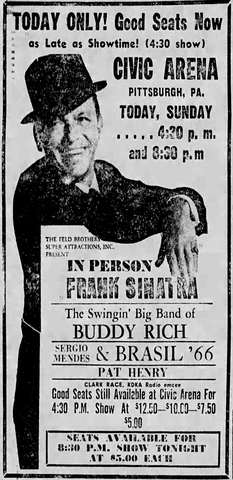
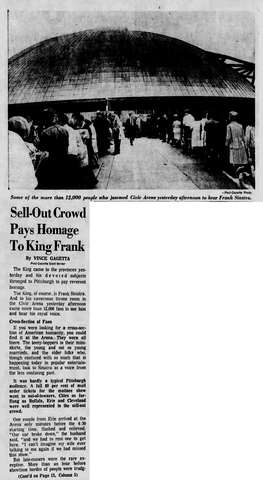
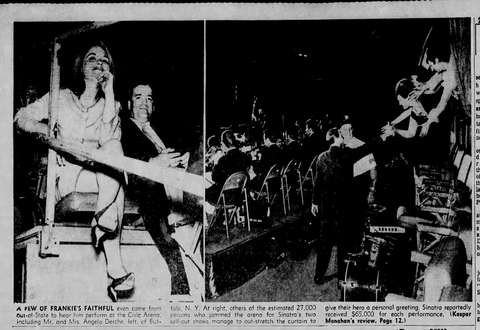
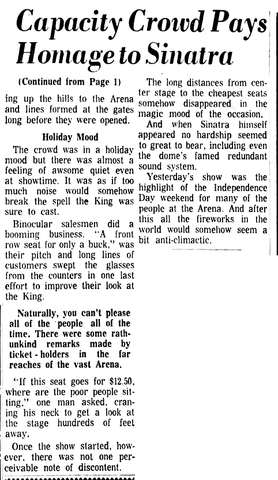
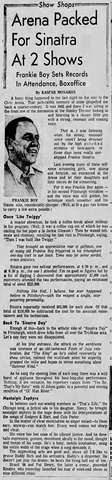
General & Lizette Sarnoff Anniversary Party
1. Intro to: Sammy Cahn
2. Lizzett: Sammy
3. Lizzett (parody): Sammy
4. The Lady Is A Tramp (parody) - But Beautiful (parody)
5. "Toast": Frank
6. Anniversary Waltz: Orchestra
NOTE: Ed O'Brien reports that a fabulous tape exists of this evening. Sammy Cahn wrote a song for Lizette Sarnoff and he insists on singing it. He tells a few jokes and introduces Sinatra. The parodies are well done with just piano and Sinatra introduces the Sarnoffs on their 50th anniversary. They then dance the "Anniversary Waltz." Sarnoff was the long-time head of NBC.
Ed O'Brien:
Sarnoff was the founder of RCA in 1919 and ran it for most of his life. Mrs. Sarnoff's first name was Lizette
Sammy wanted to write a tribute song to both Sarnoffs, but a rhyme for David was impossible.
Public Hall, Cleveland, Ohio
O.A. Sergio Mendes & Brasil 66
Pat Henry
Buddy Rich Orchestra augmented with a string section
Bill Miller conducting
Song List (for 67' tour):
Summer Wind
Yes Sir, That's My Baby
At Long Last Love
Day In, Day Out
The Shadow Of Your Smile Riddle string arrangement
Moonlight In Vermont
A Foggy Day
This Is All I Ask
Fly Me To The Moon
I've Got You Under My Skin
Nancy
You're Nobody 'Til Somebody Loves You
Ol' Man River
Quiet Nights
My Kind Of Town
That's Life
Strangers In The Night
The Lady Is A Tramp
That's Life -- reprise
Public Hall, Cleveland, Ohio
O.A. Sergio Mendes & Brasil 66
Pat Henry
Buddy Rich Orchestra augmented with a string section
Bill Miller conducting
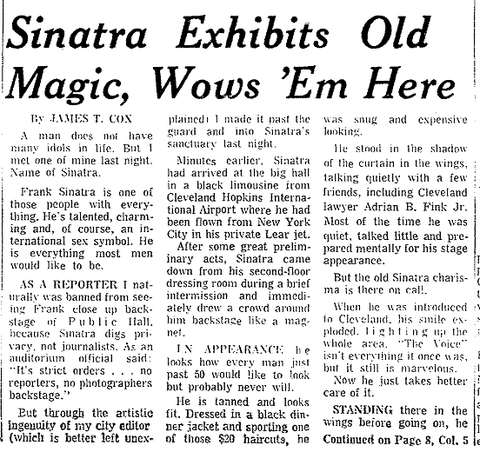
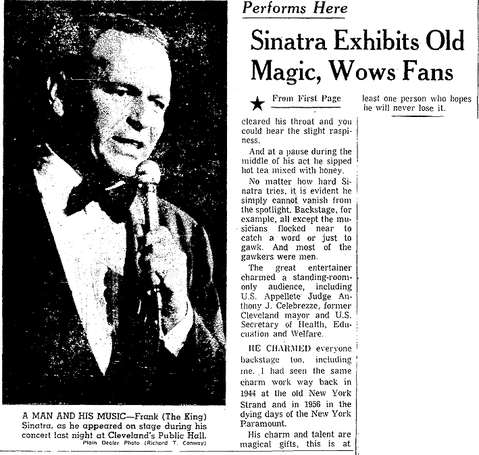
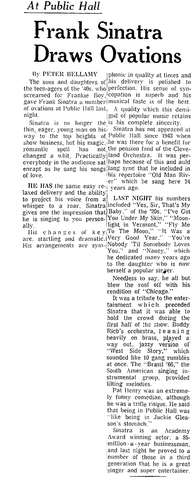
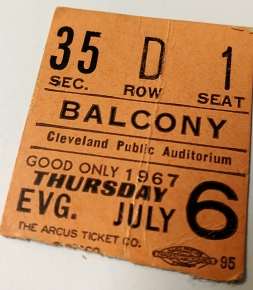
Dane County Memorial Coliseum, Madison, WI two shows: 6:30 and 9:30 pm.
Buddy Rich, Sergio Mendes, Pat Henry
1. Summer Wind
2. At Long Last Love
3. Day In, Day Out
4. The Shadow of Your Smile
5. Moonlight in Vermont
6. A Foggy Day
7. This Is All I Ask
8. Fly Me to the Moon
9. I've Got You Under My Skin
10. Nancy (With the Laughing Face)
11. You're Nobody Till Somebody Loves You
12. Ol' Man River
13. Quiet Nights of Quiet Stars
14. My Kind of Town
15. That's Life
16. Strangers in the Night
17. The Lady Is a Tramp
18. That's Life
tickets: top price 12.50
Note: By June 30th they still had 5000 of the 19,000 ticket left.
Dane County Memorial Coliseum, Madison, WI two shows: 6:30 and 9:30 pm.
Buddy Rich, Sergio Mendes, Pat Henry
[image referenced in source but could not be recovered]
[image referenced in source but could not be recovered]
[image referenced in source but could not be recovered]
[image referenced in source but could not be recovered]
[image referenced in source but could not be recovered]
Cobo Arena, Detroit, Michigan
Time: 8:00 P.M. w/Buddy Rich, Sergio Mendes, Pat Henry
1. Summer Wind
2. At Long Last Love
3. Day In, Day Out
4. The Shadow of Your Smile
5. Moonlight in Vermont
6. A Foggy Day
7. This Is All I Ask
8. Fly Me to the Moon
9. I've Got You Under My Skin
10. Nancy (With the Laughing Face)
11. You're Nobody Till Somebody Loves You
12. Ol' Man River
13. Quiet Nights of Quiet Stars
14. My Kind of Town
15. That's Life
16. Strangers in the Night
17. The Lady Is a Tramp
18. That's Life
note: Frank did 11 concerts in seven cities on this tour with Buddy Rich. Someone figured out that he netted $58,000 per hour
Cobo Arena, Detroit, Michigan
Time: 8:00 P.M. w/Buddy Rich, Sergio Mendes, Pat Henry
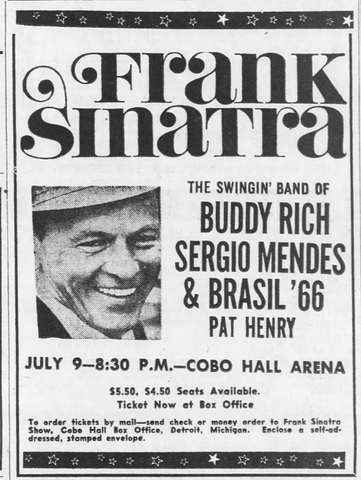
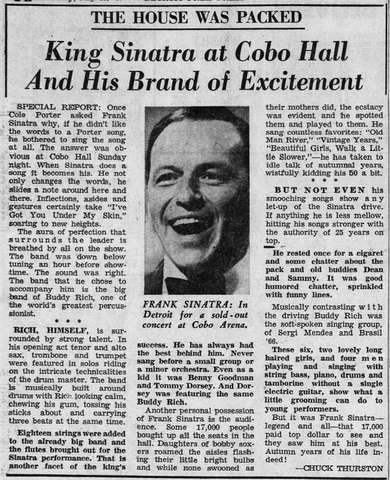
The International Amphitheater, Chicago, Illinois (10-11)
Time: 8:30 P.M
Buddy Rich, Sergio Mendes, Pat Henry
Notes: held 16,000. Leo Durocher attended.
1. Summer Wind
2. At Long Last Love
3. Day In, Day Out
4. The Shadow of Your Smile
5. Moonlight in Vermont
6. A Foggy Day
7. This Is All I Ask
8. Fly Me to the Moon
9. I've Got You Under My Skin
10. Nancy (With the Laughing Face)
11. You're Nobody Till Somebody Loves You
12. Ol' Man River
13. Quiet Nights of Quiet Stars
14. My Kind of Town
15. That's Life
16. Strangers in the Night
17. The Lady Is a Tramp
18. That's Life
The International Amphitheater, Chicago, Illinois (10-11)
Time: 8:30 P.M
Buddy Rich, Sergio Mendes, Pat Henry
Notes: held 16,000. Leo Durocher attended.
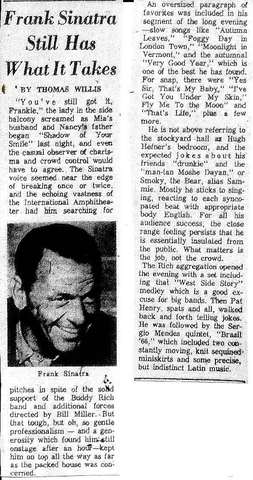
The International Amphitheater, Chicago, Illinois (10-11)
Time: 8:30 P.M
Buddy Rich, Sergio Mendes, Pat Henry
Notes: held 16,000. Leo Durocher attended.
1. Summer Wind
2. At Long Last Love
3. Day In, Day Out
4. The Shadow of Your Smile
5. Moonlight in Vermont
6. A Foggy Day
7. This Is All I Ask
8. Fly Me to the Moon
9. I've Got You Under My Skin
10. Nancy (With the Laughing Face)
11. You're Nobody Till Somebody Loves You
12. Ol' Man River
13. Quiet Nights of Quiet Stars
14. My Kind of Town
15. That's Life
16. Strangers in the Night
17. The Lady Is a Tramp
18. That's Life
Convention Hall, Philly (13-14)
Buddy Rich and his band with
Bill Miller conducting.
8:30 P.M.
Rich introduced Frank as the "Chairman of the Board."
1. Summer Wind
2. At Long Last Love
3. Day In, Day Out
4. The Shadow of Your Smile (Riddle chart with strings)
5. Moonlight in Vermont
6. A Foggy Day
7. This Is All I Ask
8. Fly Me To the Moon
9. I've Got You Under My Skin
10. Nancy
11. You're Nobody Till Somebody Loves You
12. Ol' Man River
13. Quiet Nights
14. My Kind of Town
15. That's Life
16. Strangers in the Night
17. The Lady Is A Tramp
18.. That's Life (reprise)
Philadelphia Daily News
Convention Hall, Philly (13-14)
Buddy Rich and his band with
Bill Miller conducting.
8:30 P.M.
SINATRA 'SENDS' 3 GENERATIONS
The bobby-soxers of yesteryear -- now plump and fortyish -- joined
their mini-skirted daughters and rushed the stage of Civic Center Con-
vention Hall on Thursday night, trying to get their hands on Frank
Sinatra.
While harried policemen and ushers tried to stem the tide of three
generations, hundreds of women in the crowd of more than 12,000 leaped
from their seats and pressed to the stage, many of them screaming the
way they did 25 years ago.
Thousands more climbed on their chairs, on the main floor and in
the balconies, snapping fingers, clapping hands and generally behaving
just as Sinatraphiles have been since the early 1940s and the heyday
of the Earle, the Paramount, Steel Pier and the Glen Island Casino.
" Honey, he's the best," gushed Mrs. Loretta Quinto, 51, of 1507
S. st.. "My husband and I met at the Million Dollar Pier while
Frankie was sing ""Moonlight In Vermont," and we're hoping he does
tonight." He did.
Mrs. Quinto was pulling her husband Jesse, and their
20-year-old
daughter, Clarissa, into the crowd pressing on the stage and ignoring
the entreaties of the people in the $12 seats to sit down.
The Buddy Rich Band, and a special 12-string supplement from
New York, gave Sinatra the famous "big sound" that has been his trade-
mark, and he made good, it seemed, for everyone with hopes he would
sing " that certain song."
Carl Dubois and his wife, Lorraine, said above the noise that they
flew down from Montreal for the concert. "We're hoping he sings ' Fly
Me To The Moon," said Dubois, a contractor who explained he had
met his wife at a Sinatra record session in Canada.
Sinatra came through with their song.
Order eventually was restored and the crowd settled back, but every
so often, when he belted another nostalgic tune like " A Foggy Day,"
restlessness swept the audience and those squeals were just below
the surface.
There were some dissenters. "I think he is overrated, always has
been," said Michael Sinn, of 124 S. Orange st., Scranton. Sinn
said his daughter, Madeline, 16, " made me buy the tickets."
Edward Barker, 22, of 1449, S. Sharp rd., West Chester, said
he had seven Sinatra albums.
"He can handle vocals better than anybody, and doesn't have to
wear long hair to prove it.," said Barker. His girl friend, Sheila Gibbon,
of Bryn Mawr, agreed.
A pretty blonde, Mrs, Ruth Stone, of 2534 Welsh rd., said she liked
Sinatra purely and simply because "he's sexy."
FINGERS CROSSED
There were many "mother-daughter" duos in the audience, among
them Mrs Kathryn Sherman, of 625 Haverford rd., Wynnewood, and
her 21-year-old daughter, Nina.
Mrs. Sherman, who "used to dance to Sinatra with my husband,
Max," was keeping her fingers crossed that he would sing "It Was A
Very Good Year" - - - - - and he did.
Frank Lisa and his wife, Frances, of White Horse pike,
Chesil-
hurst, N.J., who spent many a Sunday in the summers of the early
1940s, dancing to Tommy Dorsey, Frank Sinatra and The Pied Pipers,
were holding hands in the audience.
PRIVATE JET
Sinatra appeared on stage shortly after 10:PM, after flying in to
International Airport in his private jet, Christina, III.
His actress wife, Mia Farrow, 21, was with him, and joined him
later at a private dinner. Philadelphia was the sixth city of a seven
city tour.that has been turning out capacity crowds.
Among those who were in the Civic Center were two men who
traveled more than 3000 miles for the event. Phil Napier, 32, and
Ed Nunn, 28, members of a Sinatra fan club, flew from their home
in London for the performance.
Carlo M. Sardella of the Inquirer Staff
July 14, 1967
AT CIVIC
CENTER
SINATRA DRAWS VAST CROWD OF YESTERYEAR
It was like a crowd that use to storm the Earle Theatre -- only
four times bigger and many years older.
Twelve thousand adoring fans riveting their attention on the
meticulously dressed vocalist bathed in the white spotlight on
the Civic Center stage. Middle-aged Philadelphia turned out in
full force, eager to let loose their inhibitions and shriek their
welcome to Frank Sinatra, America's king of song.
THINNER ON TOP
Like most of his reverent listeners, he is several pounds
heavier, thinner on top, and a little less clear vocally, but
not one ounce of the charisma that has made him a favorite
here and everywhere for 30 years has been lost.
But Sinatra said it himself, to the delight of his audience:
"I use to look like Twiggy then, and had 40 pounds of hair
like Phyllis Diller."
He came on solemnly, letting the screams sweep around
him as he walked across the stage, his arms raised in the
gesture of a champion, an assured man unruffled by the noise
and the flashbulbs popping like lightning. Amateur photographers
pressed into the aisles until police had to be called to usher
them back to their seats.
Then Sinatra gave a signal to Buddy Rich's band to begin
and the crowd got what it had waited for patiently, a medley
of songs from today and yesterday. All were done with the
special Sinatra touch, many of them with a swinging style
in keeping with the times, unlike the slow crooning vocals
of his earlier years.
"Summer Wind" was his opener and he finished it by
using his hand mike to bless his audience, a smile playing
at his lips as her listened to the pleasure he had stirred.
As if in appreciation he moved uninterruptedly though
"At Long Last Love," "Day In, Day Out," "The
Shadow Of
Your Smile," treating it introspectively ; "Moonlight In
Vermont," inviting the audience "on a little trip to one of
our beautiful States, particularly at this time of the year";
"A Foggy Day," Gordon Jenkins' "This Is All I Ask,"
"Fly
Me To The Moon, " and "I've Got You Under My Skin,"
which he was made to reprise.
BREATH CONTROL
While a husky quality is occasionally evident in his
voice, the years have not diminished his great breath
control, the effortlessness with which he delivers a
song and his amazing articulation, amazing because
so many of his numbers seem to be sung through
clenched teeth.
Taking a brief rest for some amusing repartee
and nostalgic remembrances of Philadelphia, he
soon launched again into another medley, each
song greeted by a louder ovation. "Nancy," which
he had first done at the Earle in 1944: "Yes Sir, That's
My Baby," "It Was A Very Good Year," "You're
Nobody Till Somebody Loves You," "Ol' Man River,"
singing it while perched on a stool, and "My Kind
Of Town, Chicago Is." It was all lovely, lovely, lovely.
And Sinatra's forces hardly minded the hour of warm
up entertainment until their hero came on.
But that was an hour of some pretty lively music
and humor, furnished by Buddy Rich's swinging big
and brassy band playing a torrid suite from "West
Side Story" ; Sergio Mendes and his ingratiating
Brasil 66, and comedian Pat Henry, who observed
that Civic Center is "a nice place. I feel I'm playing
in Jackie Gleason's stomach."
Barbara L. Wilson of the Inquirer Staff
Friday morning
July 14, 1967
© 1997-2025 The Sinatra Archive
This calendar, or any parts thereof, may not be reproduced in any fashion
whatsoever without the prior written permission of the publisher (The
Sinatra Archive)
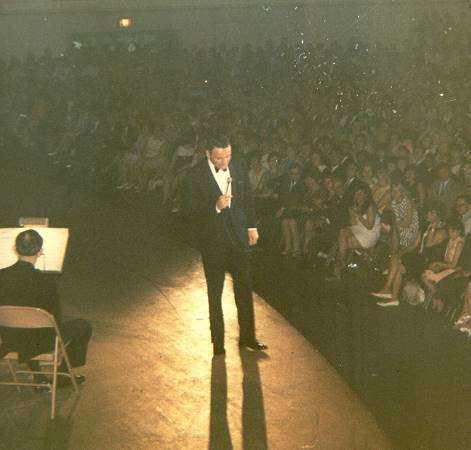
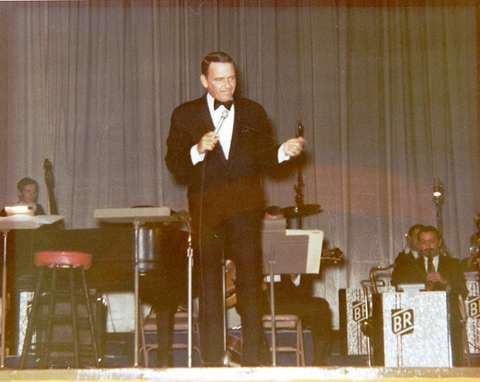
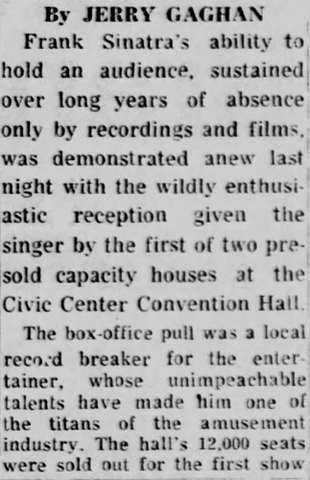
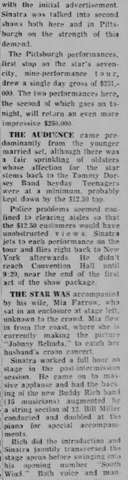
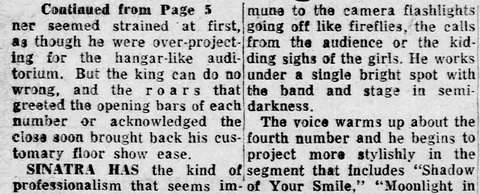
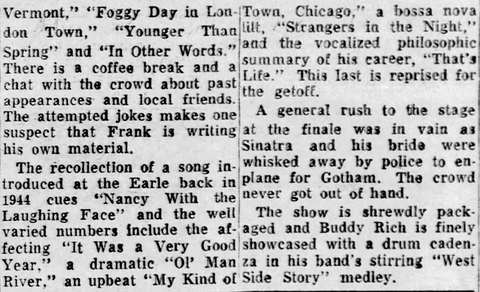
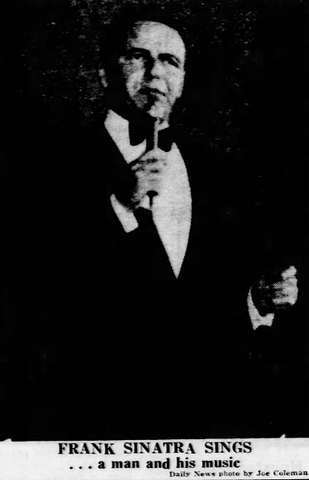
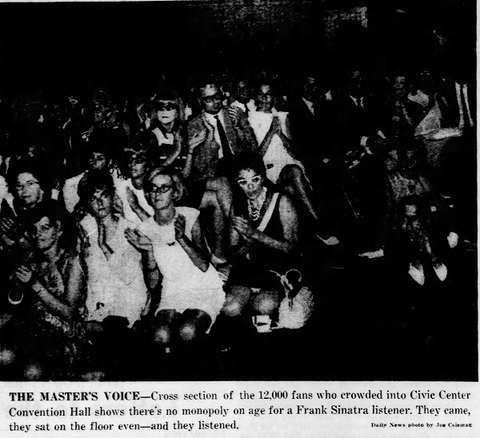
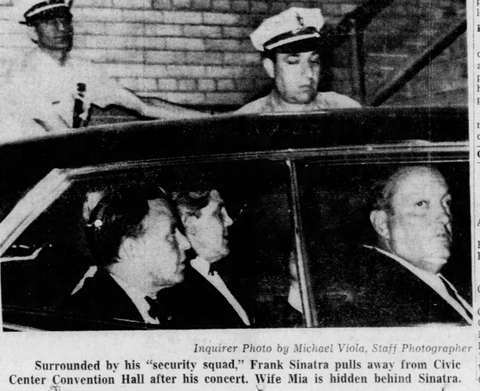
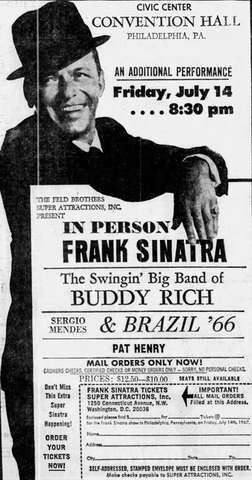
[Sinatra performs 'That's Life' twice in Philadelphia]
Richard Apt: At Philadelphia's Convention Hall, Sinatra sang 'That's Life' twice, once as a concert-closing reprise, before an audience that included Mia Farrow, who cheered after every song; Sinatra archivist Richard Apt recalled Frank playfully blowing her kisses throughout the show.
Source: James Kaplan, "Sinatra: The Chairman" (2015).
Convention Hall, Philly (13-14)
Buddy Rich and his band with
Bill Miller conducting.
8:30 P.M.
Civic Center, Baltimore, MD
Saturday
w/Buddy Rich
1. Summer Wind
2. At Long Last Love
3. Day In, Day Out
4. The Shadow of Your Smile
5. Moonlight in Vermont
6. A Foggy Day
7. This Is All I Ask
8. Fly Me to the Moon
9. I've Got You Under My Skin
10. Nancy (With the Laughing Face)
11. You're Nobody Till Somebody Loves You
12. Ol' Man River
13. Quiet Nights of Quiet Stars
14. My Kind of Town
15. That's Life
16. Strangers in the Night
17. The Lady Is a Tramp
18. That's Life
The Aegis
Civic Center, Baltimore, MD
Saturday w/Buddy Rich
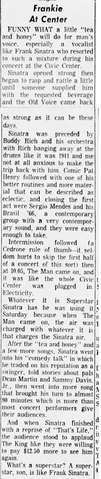
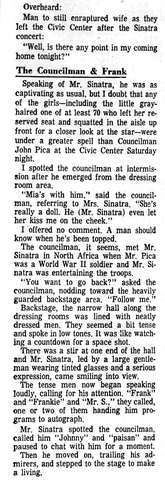
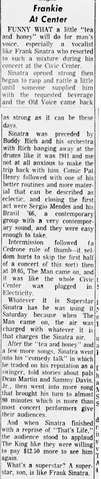
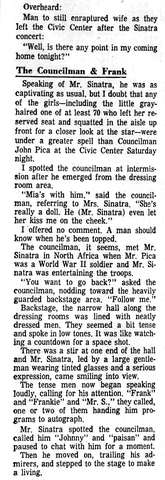
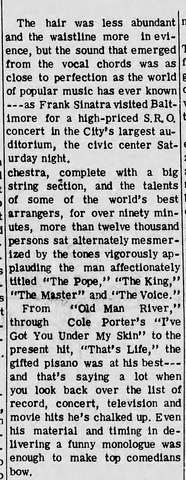
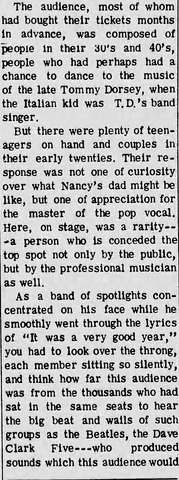
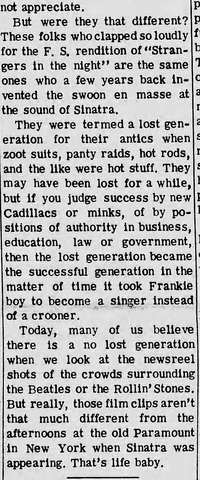

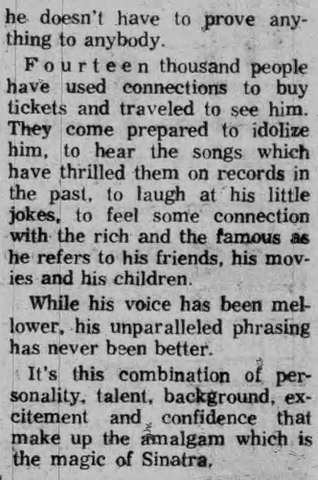
"The Naked Runner" (USA Release: July 19,
1967)
Starring: Frank Sinatra, Peter Vaughan, Derren Nesbitt, Nadia
Gray, Michael Newport
Produced by: Brad Dexter
Directed by: Sidney J. Furie
Sam Laker (Sinatra) is an American industrialist, working in Britain, who has just been awarded an international award for industrial design. He is planning to travel to East Germany to attend a trade show and show off his invention, taking his 10 year old son with him for a holiday. Meanwhile a British Intelligence officer (Vaughan) who served with Laker in the Second World War decides to use the opportunity of Laker's trip and his lack of an intelligence profile to coerce him into carrying out an assassination. To ensure his cooperation, his son (Newport) is kidnapped.
DVD Released as "Colpo Su Colpo" in Italy in March 2019 with English Track -- also released in Spain as "Atrapado" without an English track
Note: VHS Released in 1995
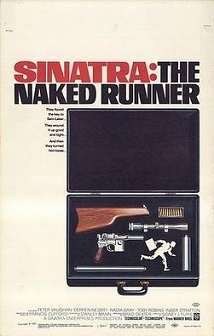
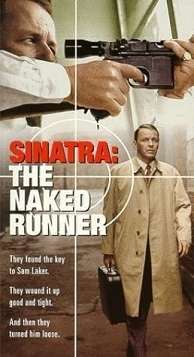
[The Cinematic Legacy of Frank Sinatra — The Naked Runner (1967)]
David Wills's 2015 photo history The Cinematic Legacy of Frank Sinatra devotes a section to The Naked Runner (1967), illustrated with 5 behind-the-scenes and publicity photographs (posters, lobby cards, and on-set/on-location shots) filed here.
Source: David Wills, The Cinematic Legacy of Frank Sinatra (St. Martin's Press, 2015), pp. 254–257.
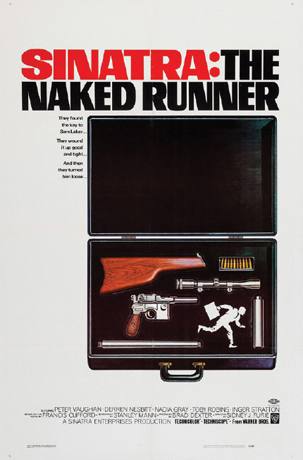
One sheet and half sheet posters, The Naked Runner, 1967. (Photo: The Cinematic Legacy of Frank Sinatra, David Wills, 2015.)
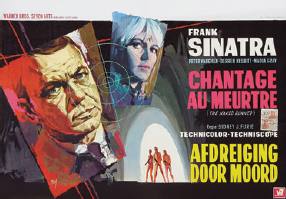
One sheet and half sheet posters, The Naked Runner, 1967. (Photo: The Cinematic Legacy of Frank Sinatra, David Wills, 2015.)
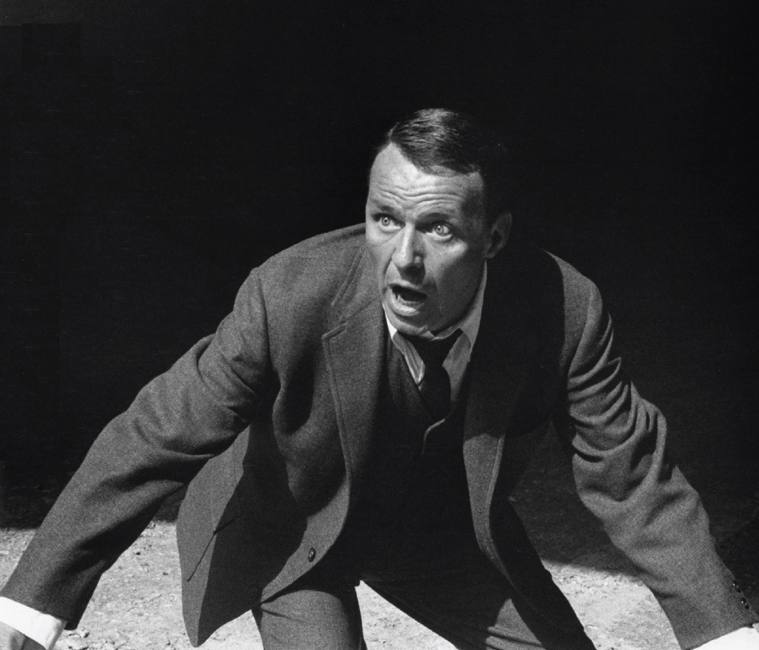
The Naked Runner. (Photo: The Cinematic Legacy of Frank Sinatra, David Wills, 2015.)
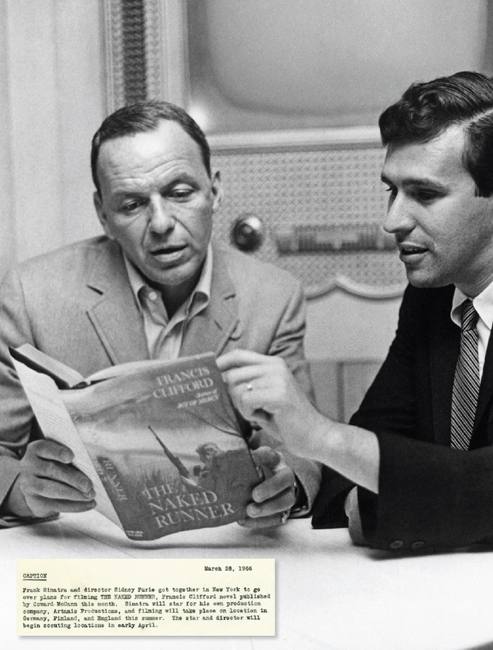
With director Sidney Furie, The Naked Runner. (Photo: The Cinematic Legacy of Frank Sinatra, David Wills, 2015.)
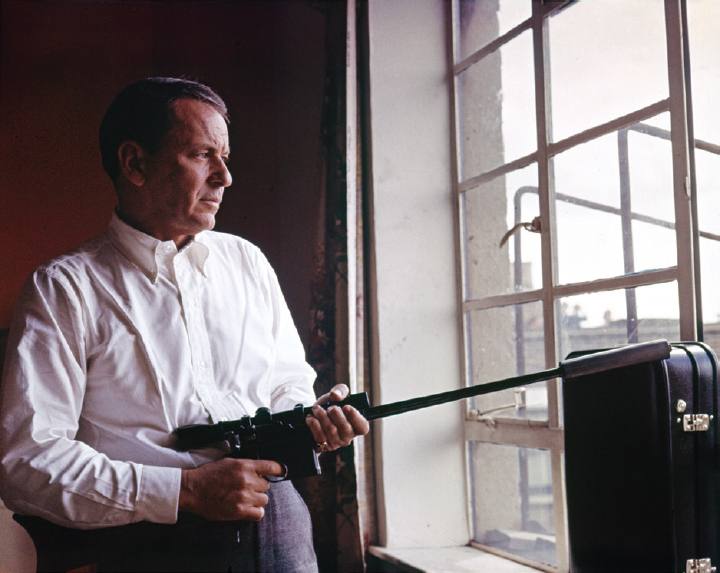
As Sam Laker, The Naked Runner. / “Of Sinatra, it must be said that even in this / undemonstrative rendition of undistinguished / material, he commands the screen. Given the / plot there must have been a temptation to / shout, moan and chew the scenery. He put the / temptation down, way down, and un (Photo: The Cinematic Legacy of Frank Sinatra, David Wills, 2015.)
"The Naked Runner" (USA Release: July 19,
1967)
Starring: Frank Sinatra, Peter Vaughan, Derren Nesbitt, Nadia
Gray, Michael Newport
Note: DVD Released as "Colpo Su Colpo" in Italy in March
2019 with English Track -- also released in Spain as "Atrapado" without an English track
Movie tie in paperback:
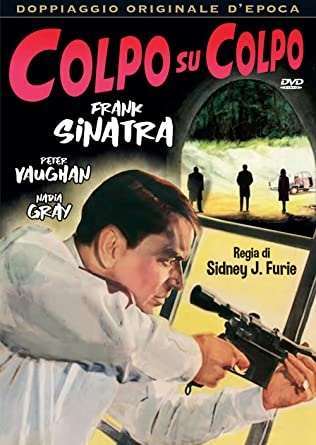
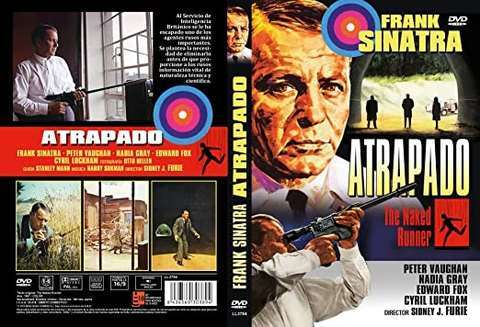
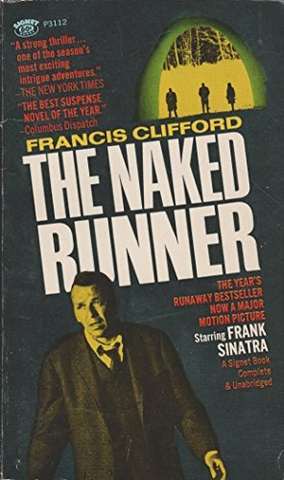
"The Naked Runner"
The Naked Runner came to Sinatra through Brad Dexter, then executive VP of production at Sinatra Enterprises. Dexter had first pushed William Goldman's script for Harper, but when that deal collapsed he brought Sinatra The Naked Runner instead -- based on the Francis Clifford novel, directed by Sidney J. Furie, screenplay by Stanley Mann.
Source: Tom Santopietro, "Sinatra in Hollywood" (2008).
"The Naked Runner"
Sinatra plays Sam Laker, a former WWII sharpshooter living quietly in England for twenty years, who is manipulated by British intelligence officer Martin Slattery (Peter Vaughan) into assassinating a defector by having his own son Patrick (Michael Newport) falsely believed kidnapped by the disguised British agent posing as Colonel Hartmann (Derren Nesbitt).
Source: Tom Santopietro, "Sinatra in Hollywood" (2008).
"The Naked Runner"
Santopietro praises specific wordless moments of Sinatra's performance as effective -- his hand slackening upon hearing his son is dead, his sweat-drenched near-death reaction in the forest scene -- as evidence of real acting skill within an otherwise flawed, overdirected film.
Source: Tom Santopietro, "Sinatra in Hollywood" (2008).
"The Naked Runner"
Sinatra actually halted production partway through shooting in order to marry Mia Farrow in Las Vegas -- so determined to avoid press coverage that he didn't even tell his own daughters about the wedding, and asked Farrow not to tell her mother either. The marriage news broke worldwide once discovered.
Source: Tom Santopietro, "Sinatra in Hollywood" (2008).
"The Naked Runner"
At a party thrown by Bill and Edie Goetz for the newlyweds, the generational gap in the Sinatra-Farrow marriage was already visible: aside from a couple of Mia's siblings, the guest list was almost entirely older Hollywood royalty (George Cukor, Katharine Hepburn, Spencer Tracy, Edward G. Robinson, Ruth and Garson Kanin) -- all roughly Sinatra's age, none of them Mia's peers.
Source: Tom Santopietro, "Sinatra in Hollywood" (2008).
"The Naked Runner"
Beyond the marital turmoil, production was plagued by temper: Sinatra reportedly refused to travel to filming locations by car, insisting on helicopters, and director Sidney Furie had his own flashes of temper as well.
Source: Tom Santopietro, "Sinatra in Hollywood" (2008).
"The Naked Runner"
George Jacobs: Sinatra's longtime valet George Jacobs recalled that Sinatra hated London's 1960s Carnaby Street "Mod" scene so much that he essentially abandoned the production, returning to Los Angeles and leaving the producers to assemble the film from whatever footage they had.
Source: Tom Santopietro, "Sinatra in Hollywood" (2008).
"The Naked Runner"
Brad Dexter (as recounted by Santopietro): Per Brad Dexter's account, Sinatra returned to California mid-shoot to campaign at a rally for Governor Edmund Brown (running against Sinatra's soon-to-be friend Ronald Reagan), then sent attorney Mickey Rudin to inform Dexter he would not return to the Copenhagen location and would finish his scenes on an LA soundstage instead. Furie and Dexter completed the film without him, using a double where needed; Dexter was subsequently fired from Sinatra Enterprises.
Source: Tom Santopietro, "Sinatra in Hollywood" (2008).
"The Naked Runner"
Pauline Kael (The New Republic): The Naked Runner was Sinatra's third box-office flop in a row (after Marriage on the Rocks and Assault on a Queen), released in July 1967 to negative reviews, most famously Pauline Kael's New Republic dismissal that it "might be a good movie to read by if there were light in the theater."
Source: Tom Santopietro, "Sinatra in Hollywood" (2008).
"The Naked Runner"
Charles Champlin (Los Angeles Times): In contrast to Kael, Charles Champlin of the Los Angeles Times praised Sinatra's restraint in the role, writing that even given the temptation to overplay the material, Sinatra held the histrionics in check, conveying "a sense of power held in check, of power wasted."
Source: Tom Santopietro, "Sinatra in Hollywood" (2008).
"The Naked Runner"
Bosley Crowther (New York Times): Bosley Crowther's New York Times review of The Naked Runner observed it was curious how often Sinatra played men involved in gun violence -- gangsters, soldiers, assassins -- noting he seemed drawn to stories where his character is called upon to kill. Santopietro adds that Sinatra played armed characters (crook, soldier, assassin, detective) in at least twenty-two of his films.
Source: Tom Santopietro, "Sinatra in Hollywood" (2008).
"The Naked Runner"
Santopietro grades this a C, saying it starts out well but turns into a mess.
Source: Tom Santopietro, "Sinatra in Hollywood" (2008).
"The Naked Runner"
Santopietro (Filmography): Sinatra Enterprises/Artanis/Warner Bros. Pictures. Produced by Brad Dexter, directed by Sidney J. Furie, screenplay by Stanley Mann based on the Francis Clifford novel. Sinatra played Sam Laker opposite Peter Vaughan and Derren Nesbitt.
Source: Tom Santopietro, "Sinatra in Hollywood" (2008).
[Hughes buys the Sands]
It was announced that Howard Hughes had purchased the Sands, property and operations, for an estimated $15 million (later revealed to be $23 million); a Hughes spokesman promised no changes to the successful operation.
Source: James Kaplan, "Sinatra: The Chairman" (2015).
United Recording Studio - Hollywood
Monday evening
7 to 9:PM
49 piece orchestra including a 30 piece string section
Al Hendrickson on guitar
K6108 Born Free
12 takes
(Don Black/John Barry)
EMI Screen Gems Music inc. (BMI)
Arranged & Conducted by Gordon Jenkins
(2:02) CD: 46013-2 The Complete Reprise Studio Recordings Disc 11
CD: 1022-2The World We Knew
LP: FS1022The World We Knew
K6109 This Is My Love
3 Takes
(James Harbert)
St. Lawrence Music Inc. (BMI)
Arranged & Conducted by Gordon Jenkins
(3:33) CD: 46013-2 The Complete Reprise Studio Recordings Disc 11
CD: 1022-2The World We Knew
LP: FS1022The World We Knew
45: 0631
K6110 This Is My Song
(Charles Chaplin)
5 takes
MCA Inc. (ASCAP/PRS Ltd.)
Arranged & Conducted by Ernie Freeman
(2:26)Â CD: 46013-2 The Complete Reprise Studio Recordings Disc 12
CD: 1022-2The World We Knew
LP: FS1022The World We Knew
note: I posted this last year.
Here are the correct takes for the session: "Born Free" has 12, "This Is My Love" required 3 and Chaplin's song was done in 5. -- Ed
Second session
10::PM to 12:AM
34 piece orchestra including Glen Campbell as one of four guitarists female choral group (6) vocal overdub on 7-27-67
K6111 Don't Sleep In The Subway w/Chorus
4 takes
(Tony Hatch/Jackie Trent)
Duchess Music Corp./ATV Music (BMI)
Arranged & Conducted by Ernie Freeman
(2:17) CD: 46013-2 The Complete Reprise Studio Recordings Disc 12
CD: 1022-2The World We Knew
LP: FS1022The World We Knew
K6112 Some Enchanted Evening
4 takes OD
(Richard Rodgers/Oscar Hammerstein II)
Williamson Music Co. (ASCAP)
Arranged & Conducted by H..B. Barnum
(2:34) CD: 46013-2 The Complete Reprise Studio Recordings Disc 12
CD: 1022-2The World We Knew
LP: 1022The World We Knew
K6113 This Town
2 takes
(Lee Hazlewood)
Remick Music Corp. (ASCAP)
Arranged & Conducted by Billy Strange
(2:59) CD: 46013-2 The Complete Reprise Studio Recordings Disc 12
CD: 1022-2The World We Knew
LP: FS1025Frank Sinatra's Greatest Hits
LP: FS1022The World We Knew
45: 0631
note: there were orchestral overdubs done for the Hazelwood song on 6-30 and 7/27.
[This Is My Love / Born Free / You Are There -- critical commentary]
Jenkins arranged three tracks on 1967's The World We Knew: "This Is My Love" (a remake of Sinatra's earlier "This Was My Love" from eight years prior), the movie theme "Born Free" (whose melody was reused a decade later as the Star Wars main theme), and "You Are There," from Sinatra's own film The Naked Runner. Friedwald credits Jenkins's 'inflationary tactics' with elevating fairly meager source material.
This song/context matches multiple dated entries in the chronology; the specific date Friedwald is referring to could not be determined with confidence.
Source: Will Friedwald, "Sinatra! The Song Is You: A Singer's Art" (2018 revised edition), Ch. 8, "Gordon Jenkins" (1956-1981)
[Wilson floats a Sinatra-Farrow pairing]
Earl Wilson: Earl Wilson's column suggested 20th Century Fox planned to pair Frank Sinatra and Mia Farrow onscreen in both 'The Detective' and 'The Chairman' (which never happened for Mia in the latter, ultimately made with Gregory Peck); 'The Detective' was set to begin shooting in mid-October, with Mia's work starting November 17.
Source: James Kaplan, "Sinatra: The Chairman" (2015).
8-12-15
[Rosemary's Baby production kicks off with hair-cutting stunt] At a Paramount publicity event on a soundstage, hairstylist Vidal Sassoon ceremonially trimmed Mia Farrow's already-short hair by one inch in front of reporters and photographers, marking the start of 'Rosemary's Baby' production.
Source: James Kaplan, "Sinatra: The Chairman" (2015).
Mia Farrow filed for divorce from Sinatra in Juarez, Mexico, citing incompatibility as the sole ground.
Source: George Carpozi Jr., Frank Sinatra: Is This Man Mafia? (New York: Manor Books, 1979).
Sands, Las Vegas, Nevada (August 30 - September 8)
Buddy Rich & His Orch.
Pat Henry
Sammy Davis Jr. did a segment of both shows with Frank opening night
1. Summer Wind
2. Ol' Man River
3. You're Nobody Till Somebody Loves You
4. You Are There
5. Moonlight In Vermont
6. The World We Knew
7. Day In, Day Out
8. Don't Sleep In The Subway
9. That's Life
10. Some Enchanted Evening
11. monologue
12. I've Got You Under My Skin
13. It Was A Very Good Year
14. Strangers In The Night
15. My Kind Of Town
16. Fly me To The Moon
17. The Lady Is A Tramp
18. Change Partners
SINATRA SCORES AT SANDS WITH 'STUFFED HORN'
LAS VEGAS -- Frank Sinatra made his 29th appearance at the Sands Hotel Wednesday night(30) to a capacity crowd.
Sinatra, who had a sore throat, received medication through- out the day and within minutes of showtime, appeared on stage and sang eight songs. including "Moonlight In Vermont," "Don't Sleep In The Subway, Darling," and brought the house down with a swinging version of his recording "That's Life."
Describing his cold as a "stuffed horn," Sinatra joked about Howard Hughes who recently bought the Sands.
Sinatra spent about 40 minutes on stage, with Sammy Davis unexpectedly spelling him for about 15 minutes. Sinatra and Davis closed the show with a version of "The Lady Is A Tramp."
Buddy Rich and his 16 piece band, conducted by Bill Miller, backed Sinatra. Also on the bill is comedian Pat Henry.
Don DiGilio
Billboard
September 16, 1967
note: Frank's last stand at the Sands. He first appeared there in October of 1953. Over the next 15 years Sinatra would average two engagements a year at the club. SRO crowds would be the norm throughout his reign as the most popular artist in Vegas..
In the mid-1970s, the city would pick Frank the greatest performer to ever play the Strip. And he attracted the big gamblers. The city had a special buzz when Sinatra was in town.
Ed O'Brien:
Sinatra opened at the Sands the same week the Frank-Ella album was canceled at the last minute.The choice of songs was found wanting. Sonny Burke, producer of the project, sought better material and a suitable time to reschedule the sessions.
The Sands appearance, with Buddy Rich's band, opened on 8-30. It was a four week engagement.. Alas! it was not to be. Frank recovered from his sore throat by the weekend, but his problems with the new owner, Howard Hughes, were about to boil over. There was a show on Wednesday, 9/6, Sinatra cancelled on Thursday( 7), and he did two shows on Friday (8). He cancelled on Saturday and flew back to Palm Springs. During this period he was in serious negotiations with Caesars Palace. A tentative agreement was reached prior to that weekend. He would move over to Caesars after a 15 year association with the Sands. Frank's credit had been cutoff that week by Mr. Hughes. Sinatra was furious.
He flew back to Vegas on Sunday(10) and demanded an explanation. By early Monday morning the situation was way out of hand. Sinatra insisted on a meeting with Carl Cohen, an executive at the hotel. It did not go well. Frank knocked a table over, spilling coffee on Cohen, who then proceeded to punch Frank in the mouth. He knocked two caps off Sinatra's front teeth. There was some additional damage to the area around Frank's mouth. He walked out of the room with bloody face. He would dissolve all ties with the Sands immediately.
His years at the Sands was a time when Vegas grew into a vast entertainment capital. And Sinatra was the king of The Strip. His shows were sold out way in advance of his engagements for years. He would bring with him Nelson Riddle,
or Billy May, or Gordon Jenkins, and the latest material from his concept albums would be performed. The second show of September 8, 1967 marked the end of an era.
Ed
Sands, Las Vegas, Nevada (August 30 - September 8)
Buddy Rich & His Orch.
Pat Henry
Sammy Davis Jr. did a segment of both shows with Frank opening night
Variety
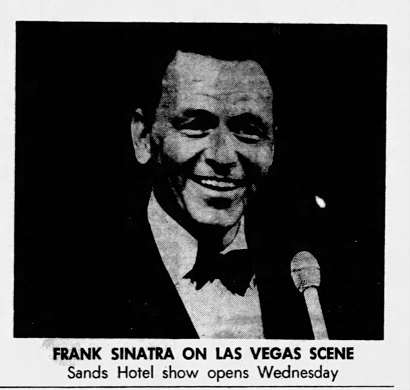
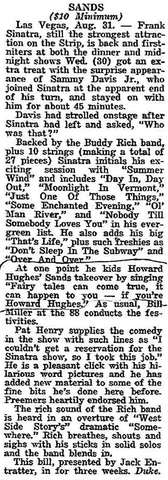
Frank's three week engagement lasted one week. Frank did 14 shows.
Sammy subbed for him on Labor Day and Tuesday and Wednesday of the
first week in September..
Here is a list of some of the parodies Frank sang during the engagement.
He checked off the ones he wanted to perform.
Ed
© 1997-2025 The Sinatra Archive
This calendar, or any parts thereof, may not be reproduced in any fashion
whatsoever without the prior written permission of the publisher (The
Sinatra Archive)
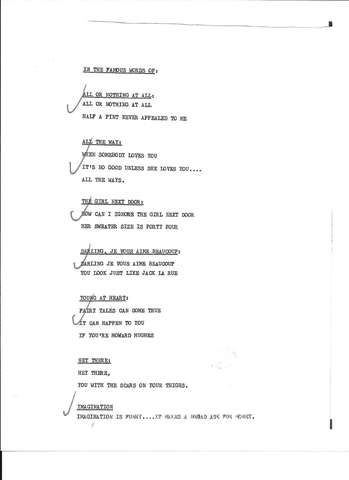
[Sinatra opens 29th Sands engagement]
Variety / Kaplan: As Labor Day weekend began, Frank opened at the Sands for the twenty-ninth time since 1952, drawing strong reviews from Variety even as he joked pointedly about Howard Hughes's new ownership of the casino ('Howard Hughes bought it' in place of a drink joke).
Source: James Kaplan, "Sinatra: The Chairman" (2015).
Sands, Las Vegas, Nevada (August 28 - September 8)
[Hughes regime disrupts the Sands]
Ed Walters: Pit boss Ed Walters recalled that after Hughes's takeover, his mostly Mormon staff of accountants and lawyers stopped all casino transactions, audited everything, and imposed strict new credit rules, treating longtime staff 'like mobsters and gamblers'; retired Air Force general Edward Nigro oversaw the new operation as casino manager.
Source: James Kaplan, "Sinatra: The Chairman" (2015)
Sands, Las Vegas, Nevada (August 31 - September 17)
Sands, Las Vegas, Nevada (August 31 - September 17)
Sands, Las Vegas, Nevada (August 31 - September 17)
Sands, Las Vegas , Nevada (August 31 - September 17)
Sands, Las Vegas, Nevada (August 31 - September 17)
Sands, Las Vegas , Nevada (August 31 - September 17)
[Sands cuts off Sinatra's credit]
Eleanor Roth: Casino manager General Nigro decided to cut off Frank's gambling credit at the Sands because he hadn't settled his debt; Carl Cohen informed Jack Entratter, whose assistant Eleanor Roth later felt Entratter should have quietly deducted the markers from Sinatra's salary rather than embarrass him, and that Entratter lacked the nerve to tell Frank directly.
Source: James Kaplan, "Sinatra: The Chairman" (2015).
Sands, Las Vegas, Nevada (August 31 - September 8)
note: Sinatra opened at the Sands the same week the Frank-Ella album was canceled at the last minute.The choice of songs was found wanting. Sonny Burke, producer of the project, sought better material and a suitable time to reschedule the sessions. The Sands appearance, with Buddy Rich's band, opened on 8-30. It was a four week engagement.. Alas! it was not to be. Frank recovered from his sore throat by the weekend, but his problems with the new owner, Howard Hughes, were about to boil over. There was a show on Wednesday, 9/6, Sinatra cancelled on Thursday( 7), and he did two shows on Friday (8). He cancelled on Saturday and flew back to Palm Springs. During this period he was in serious negotiations with Caesars Palace. A tentative agreement was reached prior to that weekend. He would move over to Caesars after a 15 year association with the Sands. Frank's gambling credit had been cutoff that week by Mr. Hughes.Sinatra was furious. He flew back to Vegas on Sunday(10) and demanded an explanation. By eary Monday morning the situation was way out of hand. Sinatra insisted on a meeting with Carl Cohen, an executive at the hotel. It did not go well. Frank knocked a table over, spilling coffee on Cohen, who then proceeded to punch Frank in the mouth. He knocked two caps off Sinatra's front teeth. There was some additional damage to the area around Frank's mouth. He walked out of the room with bloody face. He would dissolve all ties with the Sands immediately. His years at the Sands was a time when Vegas grew into a vast entertainment capital. And Sinatra was the king of The Strip. His shows were sold out way in advance of his engagements for years. He would bring with him Nelson Riddle, or Billy May, or Gordon Jenkins, and the latest material from his concept albums would be performed. The second show of September 8, 1967 marked the end of an era.
Ed
During this closing engagement, Sands executive vice president Carl Cohen cuts off Frank's gambling credit after Frank lost roughly $50,000 at the tables and refused to cash out; the rejection, delivered in front of a group of Apollo astronauts Frank had invited to his show, humiliated him. A furious Frank confronted Cohen, and in the ensuing altercation Cohen punched him, knocking out two of his front teeth. Frank finished his shows that night, but the incident ended his friendship with Sands boss Jack Entratter and kept him off a Las Vegas stage for nearly a year and a half, until he returned at Caesars Palace in November 1968. Source: J. Randy Taraborrelli, Sinatra: Behind the Legend.
[Sinatra denied chips at blackjack]
Ed Walters: Early Friday morning, Sinatra asked for $200 in chips at a blackjack table; pit boss Ed Walters told him of the new credit rules, and Sinatra walked away seeming annoyed but not furious, keeping his anger in check for the moment.
Source: James Kaplan, "Sinatra: The Chairman" (2015).
[Astronauts attend Sinatra's show, credit denied again]
Eleanor Roth: Six Apollo astronauts (Jack Swigert, Gene Cernan, Tom Stafford, Walt Cunningham, Wally Schirra, and Ron Evans) attended Sinatra's midnight Copa Room show; afterward, when Frank took them to the baccarat table and asked for credit, he was refused, a humiliation in front of the astronauts that enraged him, according to Eleanor Roth.
Source: James Kaplan, "Sinatra: The Chairman" (2015).
[The golf cart incident]
Mia Farrow (memoir): In the early hours, Sinatra, wearing a shoe box on his head to block the sunlight, suddenly swerved a golf cart toward the Sands lobby's plate-glass window, sideswiping it; both he and Mia Farrow were uninjured. He then went into the casino, piled up chairs, and tried unsuccessfully to set them ablaze with his cigarette lighter before casino guards arrived.
Source: James Kaplan, "Sinatra: The Chairman" (2015).
[Maheu memos Hughes about Sinatra's rampage]
Robert Maheu: In a memo to Howard Hughes, Robert Maheu described two successive nights of Sinatra behaving badly in the casino, driving a golf cart through a plate-glass window while drunk, and reported that Carl Cohen had cut off his credit after Sinatra had taken out over $30,000 in cash and lost roughly $50,000; Sinatra told Maheu by phone that he was walking away from the engagement.
Source: James Kaplan, "Sinatra: The Chairman" (2015).
[Dinner at Trader Vic's precedes the Vegas blowup]
Mia Farrow: Mia Farrow recalled that she, Frank, Nancy Sinatra Jr., and Jimmy Bowen had dinner at Trader Vic's in Beverly Hills before Frank, well lubricated, abruptly decided to fly to Las Vegas alone that night, later calling Mia the next morning to tell her about the fight and his broken teeth.
Source: James Kaplan, "Sinatra: The Chairman" (2015).
[Sinatra confronts Carl Cohen]
Robert Maheu / Kaplan: Sinatra returned to the Sands, smashed his hand on the bell captain's desk demanding to see Carl Cohen, and threatened staff; Cohen agreed to meet him in the Garden Room, where Sinatra shouted that he'd built the hotel 'from a sand pile' and could tear it down again.
Source: James Kaplan, "Sinatra: The Chairman" (2015).
[Carl Cohen breaks Sinatra's teeth]
Kaplan (various sources): After Sinatra cursed at him, threatened to have him killed, and called him 'a kike,' Carl Cohen punched Sinatra in the mouth, smashing the caps off his front teeth and knocking him to the floor; Sinatra then threw a chair (which hit a security guard instead) and ordered Jilly Rizzo, 'Get him, Jilly!'—but Rizzo wisely stood down rather than confront Cohen.
Source: James Kaplan, "Sinatra: The Chairman" (2015).
[UPI reports Sinatra's abrupt Sands departure]
UPI: UPI reported that a Sands spokesman had no explanation for why Sinatra broke off his engagement 'without explanation'; Sinatra, who had opened his 29th Sands engagement on August 30 for a run through September 20, left for his Hollywood home the prior Saturday night before the first show, with Frankie Avalon booked to complete the run.
Source: James Kaplan, "Sinatra: The Chairman" (2015).
[The Sands brawl behind Sinatra's abrupt exit]
An FBI memo relayed by SAC Dean Elson filled in what UPI's report of Sinatra's unexplained Sands departure left out: Sinatra, after his wife Mia Farrow lost $20,000 gambling and his own credit was subsequently cut off by new Sands owner Howard Hughes, tore up his hotel room, drove a golf cart around the property, and threw casino chips in manager Carl Cohen's face -- whereupon Cohen "really decked him," knocking out at least two front teeth. A later FBI summary speculated the incident may have been engineered to break Sinatra's Sands contract so he could move to the Mafia-linked Caesars Palace, where -- per Kitty Kelley's biography -- he had in fact signed a $3 million contract that same day.
Source: Kuntz and Kuntz, The Sinatra Files, ch. 8.
[Vegas fight and Caesars defection hit front pages]
UPI / Kaplan: The story of Sinatra's fight with Carl Cohen finally broke publicly, alongside news of his defection to Caesars Palace and Caesars' purchase of Sinatra's Cal-Neva stake for $2.5 million; a Sinatra spokesman told UPI, 'We can't deny any of what happened...We can't even deny his teeth were knocked out.' His longtime dentist, Dr. Abe B. Weinstein, flew from Connecticut to repair the damage.
Source: James Kaplan, "Sinatra: The Chairman" (2015).
Hollywood
K6159 Younger Than Springtime
(Richard Rodgers/Oscar Hammerstein II)
Williamson Music Co. (ASCAP)
Arranged & Conducted by Billy Strange
-8 (2:41) CD: 46013-2 The Complete Reprise Studio Recordings Disc 12
LP: FS5250 (Italy)
LP: RS6277Movin' With Nancy
NOTE: Sinatra Scholar Ed O'Brien writes that discographies always credit Sinatra with eight takes on this tune.
But the released recording is not the eighth take on "Movin' with Nancy ." It seems certain that Sinatra did additional takes.
Hollywood
K6159 Younger Than Springtime
(Richard Rodgers/Oscar Hammerstein II)
Williamson Music Co. (ASCAP)
Arranged & Conducted by Billy Strange
-8 (2:41) CD: 46013-2 The Complete Reprise Studio Recordings Disc 12
LP: FS5250 (Italy)
LP: RS6277Movin' With Nancy
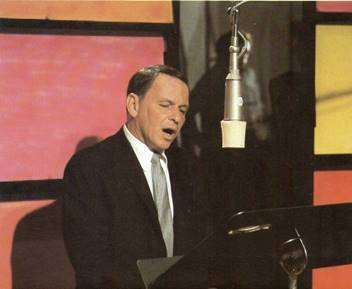
[Television Taping With Antonio Carlos Jobim]
Sinatra taped a television appearance with bossa nova pioneer and 'The Girl From Ipanema' composer Antonio Carlos Jobim; producer Sonny Burke called their first joint session one of his favorites.
Source: Charles Pignone, "Frank Sinatra 100" (2015).
[Leonard Lyons on Jilly's damaged reputation]
Leonard Lyons: Columnist Leonard Lyons wrote that the Sands fight had destroyed Jilly Rizzo's reputation as a tough guy, since he stood by and watched Sinatra get knocked down without raising a finger.
Source: James Kaplan, "Sinatra: The Chairman" (2015)
Taping of "A Man & His Music + Ella + Jobim"
Ed O'Brien:
What many consider to be Sinatra's finest TV effort --
"A Man & His Music + Ella + Jobim" - was taped at the NBC Burbank Studio on 10-1-2-3- 67. Musicians who worked on the special told me the rehearsal time and taping was extensive over the three days. After each taping, Ella-Riddle and Sinatra traveled over to Western Recorder studios and rehearsed the
Frank-Ella album scheduled to be recorded on
October 9/10 ( Monday and Tuesday). Mr Granz demanded, at the eleventh hour, there be two two albums recorded -- one at Reprise and one at Verve. Frank was enraged and the sessions were canceled.
St. Paul Auditorium, St. Paul, Minnesota
Benefit for Hubert Humphrey
Frank Sinatra, Nancy Sinatra, Trini Lopez, Milton Berle, Pat Henry, The 5th Dimension, Buddy Rich and his Orchestra
Note: Dean Martin was scheduled to appear but did not.
St. Paul Auditorium, St. Paul, Minnesota
Benefit for Hubert Humphrey
Frank Sinatra, Nancy Sinatra, Trini Lopez, Milton Berle, Pat Henry, The 5th Dimension, Buddy Rich and his Orchestra
Note: Dean Martin was scheduled to appear but did not.
Star Tribune
October 9, 1967 note: A fund raiser for a ticket that did not survive the unrest in America
-------------------------------------------------------
© 1997-2025 The Sinatra Archive
This calendar, or any parts thereof, may not be reproduced in any fashion whatsoever without the prior written permission of the publisher (The Sinatra Archive)
[image00213911.jpg] image00213911.jpg
[image00311181.jpg] image00311181.jpg
[image0152591.jpg] image0152591.jpg
[image0058581.jpg] image0058581.jpg
[image0067781.jpg] image0067781.jpg
[image0076981.jpg] image0076981.jpg
[image0086661.jpg] image0086661.jpg
[image0095641.jpg] image0095641.jpg
[image0104961.jpg] image0104961.jpg
[image0162381.jpg] image0162381.jpg
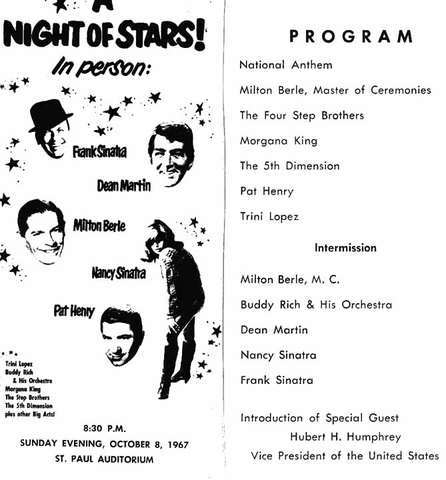
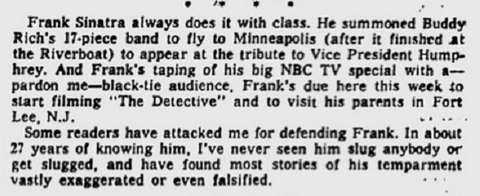
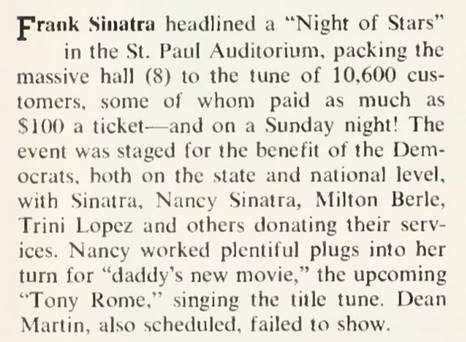
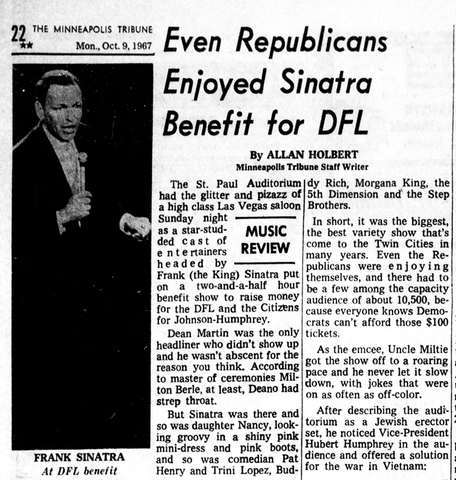
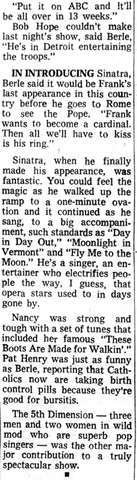
[Sinatra headlines Humphrey benefit in St. Paul]
Variety: Out of friendship for Vice President Hubert Humphrey, Sinatra donated his services for a one-night 'Evening of Stars' benefit at St. Paul Auditorium to raise funds for the Citizens for Johnson-Humphrey Committee, lining up Nancy Sinatra, Dean Martin, Milton Berle, Pat Henry, the Step Brothers, and the Fifth Dimension for the bill.
Source: James Kaplan, "Sinatra: The Chairman" (2015).
[Wilson reports on Mia's planned India trip]
Earl Wilson / Maureen O'Sullivan: Earl Wilson's column, headlined 'Sinatra Approves Mia Trip to India,' quoted Mia's mother Maureen O'Sullivan saying she and Frank both approved of Mia and her sister Prudence Farrow going to India to study with the Maharishi Mahesh Yogi, and that marital relations were 'just fine.'
Source: James Kaplan, "Sinatra: The Chairman" (2015).
Filming begins on The Detective, the 20th Century-Fox drama based on Roderick Thorp's novel, with Sinatra in the lead. The production later collided with Mia Farrow's overrunning schedule on Rosemary's Baby, which Frank pressed her to abandon; she refused, and Paramount declined to force her off the picture. Source: J. Randy Taraborrelli, Sinatra: Behind the Legend.
Felt Forum, Madison Square Garden, New York City
Thursday Evening
Benefit For Italian American League
Sammy Davis Jr introduced Frank Sinatra
1. At Long Last Love
2. Day In, Day Out
3. Moonlight In Vermont
4. Fly Me To The Moon
5. I've Got You Under My Skin
6. The Lady Is A Tramp w/Sammy
note: A video of this show is in circulation among collectors.
Frank was ushered on stage surrounded by his bodyguards.
They led him off at the conclusion of his performance.
Felt Forum, Madison Square Garden, New York City
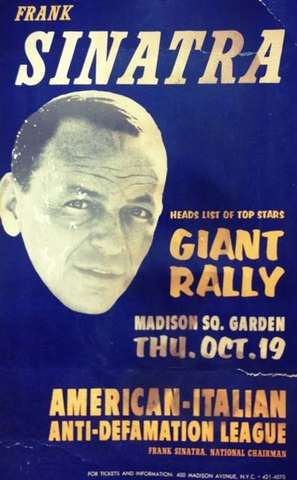
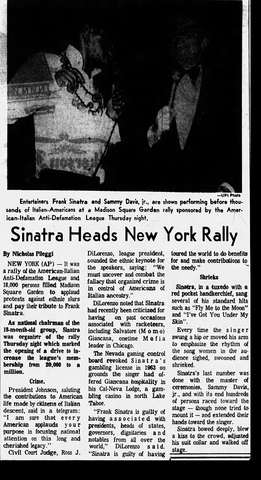
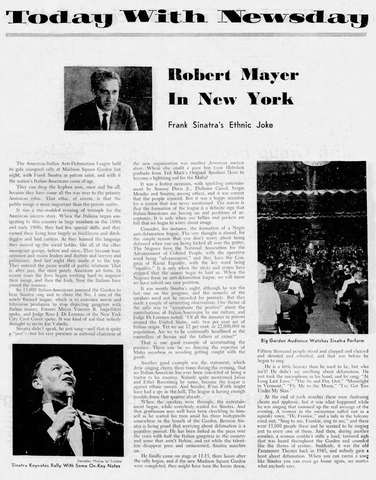
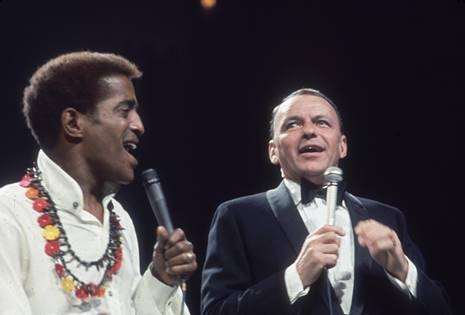
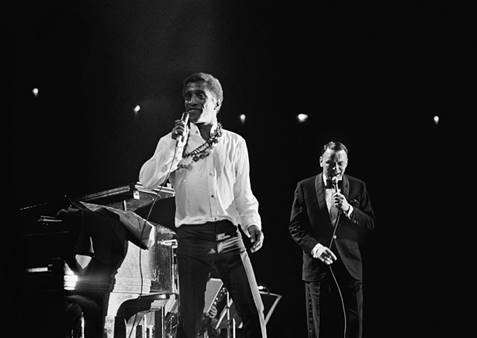
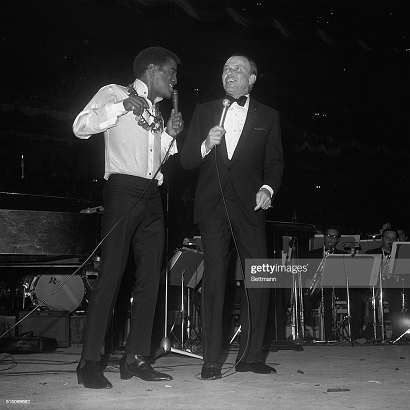
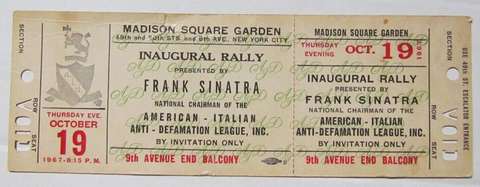
[Rosemary's Baby]
Mia Farrow: While still filming Rosemary's Baby in November 1967, Mia Farrow was served divorce papers on set by Sinatra's attorney Mickey Rudin -- the first indication their marriage was ending. Farrow recalled signing every page without reading it, telling Rudin she would do whatever they wanted and needed no lawyer of her own.
No corresponding dated entry could be identified in the chronology for this film/context.
Source: Tom Santopietro, "Sinatra in Hollywood" (2008), Knight-Errant (pt. 1)
[Tony Rome]
Tony Rome, released November 1967 by Twentieth Century-Fox and based on Marvin H. Albert's novel, reunited Sinatra with Robin and the 7 Hoods director Gordon Douglas and cinematographer Joseph Biroc. Score by Billy May; the title song was sung by daughter Nancy Sinatra, with an odd lyric warning mothers to lock up their daughters because of her own father's character.
No corresponding dated entry could be identified in the chronology for this film/context.
Source: Tom Santopietro, "Sinatra in Hollywood" (2008), Knight-Errant (pt. 1)
[Tony Rome]
Santopietro (Filmography): Arcola-Millfield/Twentieth Century-Fox. Produced by Aaron Rosenberg, directed by Gordon Douglas, screenplay by Richard L. Breen based on the Marvin H. Albert novel, musical score by Billy May, title song by Lee Hazlewood sung by Nancy Sinatra. Sinatra played private eye Tony Rome opposite Jill St. John, Richard Conte and Gena Rowlands.
No corresponding dated entry could be identified in the chronology for this film/context.
Source: Tom Santopietro, "Sinatra in Hollywood" (2008), Filmography
A Man And His Music + Ella + Jobim
Guests: Ella Fitzgerald, Antonio Carlos Jobim
Toronto Star
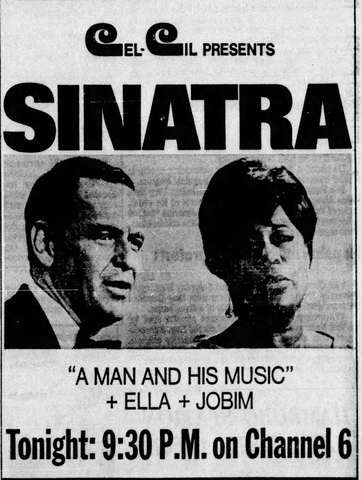
Toronto Star
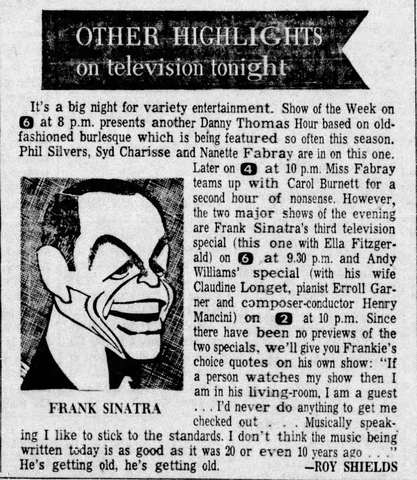
Telegraph Journal New Brunswick, Canada
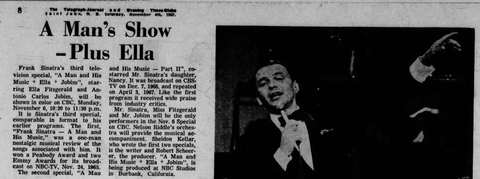
A Man And His Music + Ella + Jobim
Guests: Ella Fitzgerald, Antonio Carlos Jobim
Taped October 1-3, 1967
1. Day In Day Out
2. Get Me To The Church On Time
3. What Now My Love
4. Ol' Man River
5. medley w/Ella: How Hight The Moon / Up, Up And Away / Look Out For
Jimmy Valentine / Theme To Tony Rome / Goody Goody / Don't Cry Joe / Ode To Billy Joe / Goin Out Of My Head 6. Medley w/Jobim: Change Partners / I Concentrate On You / The Girl From Ipanema
7. medley w/Ella: The Song Is You / They Can't Take That Away From Me /
Stopin' At The Savoy / At Long Last Love
8. The Lady Is A Tramp w/Ella
9. Put Your Dreams Away
Notes: 60 min.
Ed O'Brien considers this to be, arguably, Sinatra's finest hour on television. Al Porcino was lead trumpet on the show. He told Ed that it was the best gig ever with Frank. They did a lot of rehearsal work before it was right. The original concept offered a dramatically different show. Frank and Ella's segment opened with "Oh, Lonesome Me."
There was a tribute to the Mamas and Papas with special lyrics. Then they sang "I Dig Rock n' Roll Music" and "Feelin'
Groovy." Next up was Frank singing "Don't Sleep in the Subway." The second medley opened with Frank singing
"Slap Dab in the Middle" and then Ella joined in. Later in the medley they sang "It Don't Mean a Thing if it Ain't Got That Swing." Frank did "That's Life" before
"Tramp." Eventually they ironed out all the problems and songs were dropped while others were added. Porcino loved all the extra pay during those
long rehearsals.
After reading O'Brien comments, Sinatraphile Mary Jane Smetanka says she watched the show, not having seen it for some time. She says she hasn't seen as much of Sinatra's TV shows as others have, but this one is her favorite. The Frank/Jobim medley is classic and Frank is in gorgeous voice. Frank and Ella on screen together is a dream come true for me, she writes.
It is interesting, she continues, that with all the rehearsals Ella seems so nervous during the scripted dialogue. She has heard that Ella was disastrous in the one or two movies she did. She looks terribly uncomfortable and stiff during the nonsense talk that precedes the 1960s song medley. Their voices sounded wonderful together, and I am so sorry they did not make that album together.
I love the 60s medley, she emphasizes. They seem to be having a great time in the final song and it always makes me laugh to see gray Bill Miller pounding away at the piano, poker-faced like he's in a room by himself. In the final songs together, there's a line where Frank sings something like "You rest now" and Ella looks rather thrown.
Does anyone know if that was scripted or a real effort to cover a faux pas? she asks.
In response, no one indicated they knew the answer to Mary Jane's question, but Ed O'Brien sent along two comprehensive reviews of the video and the DVD of this show, but he doesn't remember their source. [NOTE: Neither review is included in this post, because of their length and my temporarily "tired fingers." Sorry! Jim
White
Sinatraphile Dick Bellach claims that the closing rendition of "Lady is a Tramp" ranks as one of the best moments in the history of American popular song ever captured on film. He says he'll go one step further and say "It's not "One of . . ." I think it ranks as the best, he insists.
Sinatraphile Bill Brent asks if all the FAS/Jobim have been released on reoordings. Ed O'Brien responds that Sinatra recorded 20 songs with Jobim. The first 10 in January/February 1967 and the rest in February of
1969. All are available in the 20-cd boxed set released in 1995. Robert
Quartin worked on the second album which was released piecemeal. He sent O'Brien a list of the 16 songs that were originally intended for the album. Unfortunately, the project was whittled down to ten. Roberto told O'Brien that Jobim was very disappointed because he felt the unrecorded songs were perfect for Sinatra. Sinatra told Roberto, during the '69 sessions, that the album from '67 was the best controlled singing he had even done in a studio.
Sinatraphile Ed Spiegel wanted to know the title of the six songs that were not recorded, but O'Brien said he'd have to look for the list that Quartin had sent him.
[The Cinematic Legacy of Frank Sinatra — Tony Rome (1967)]
David Wills's 2015 photo history The Cinematic Legacy of Frank Sinatra devotes a section to Tony Rome (1967), illustrated with 3 behind-the-scenes and publicity photographs (posters, lobby cards, and on-set/on-location shots) filed here.
“Tony Rome is lively and entertaining and for this we must thank both the capable Mr. Sinatra and the persistent ghost of Mr. Bogart.… Frank Sinatra has been a talent in search of a role ever since The Manchurian Candidate, and, at last, in Tony Rome.” —Hollis Alpert
Source: David Wills, The Cinematic Legacy of Frank Sinatra (St. Martin's Press, 2015), pp. 259–261.
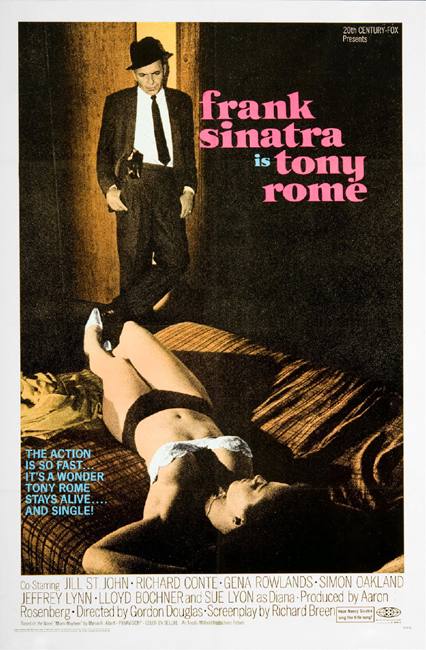
One sheet poster, Tony Rome, 1967. (Photo: The Cinematic Legacy of Frank Sinatra, David Wills, 2015.)
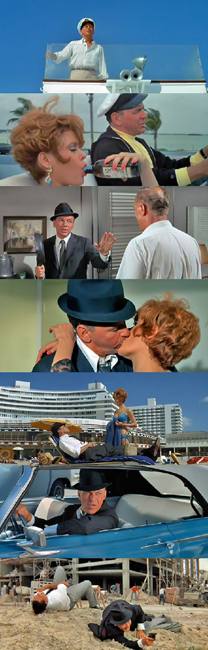
Tony Rome. / “For those who like their screen detective / recognizable and raw, and their mystery / melodramas seamy and colloquial, this thing / with Mr. Sinatra should satisfy their taste. It is (Photo: The Cinematic Legacy of Frank Sinatra, David Wills, 2015.)
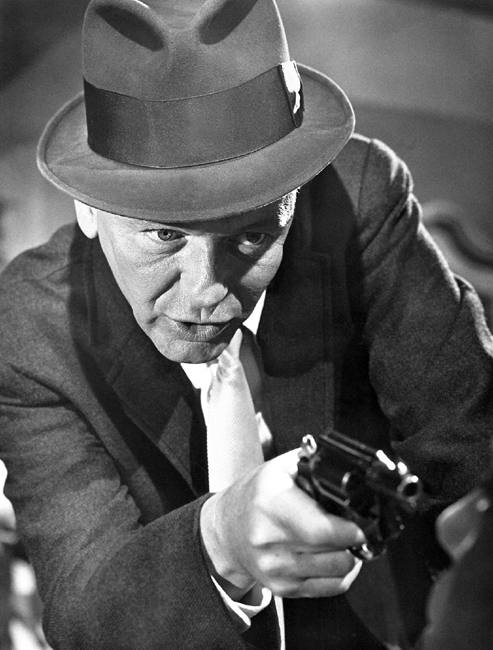
brassy, trashy, vulgar and Miami Beach / colorful.” / As Tony Rome. (Photo: The Cinematic Legacy of Frank Sinatra, David Wills, 2015.)
Forwarded Message -----
From: Ed O'Brien <eob101@aol.com>
To: ed obrien <eob101@aol.com>
Sent: Wednesday, November 12, 2025 at 04:48:40 PM EST
Subject: 11-13-67
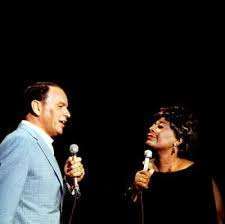
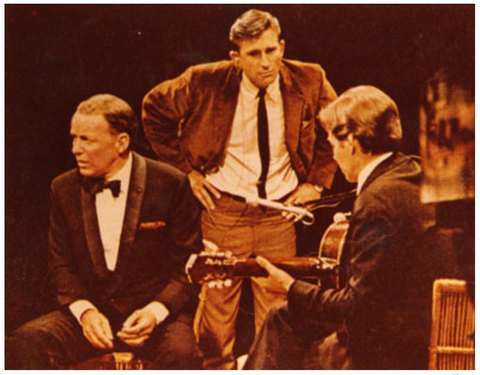
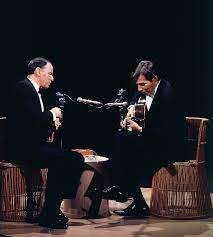
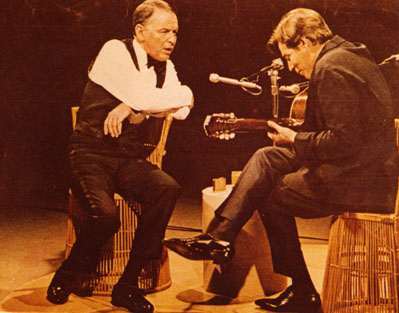
A Man And His Music + Ella + Jobim
Guests: Ella Fitzgerald, Antonio Carlos Jobim
Taped October 1-3, 1967
Rehearsal photos from October 1967
Chicago Tribune
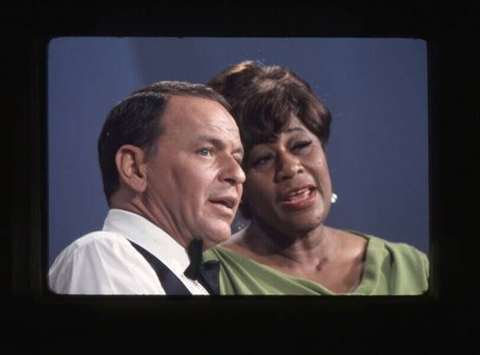
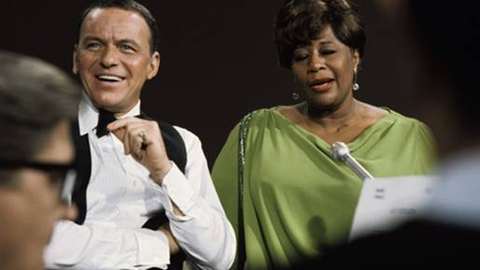
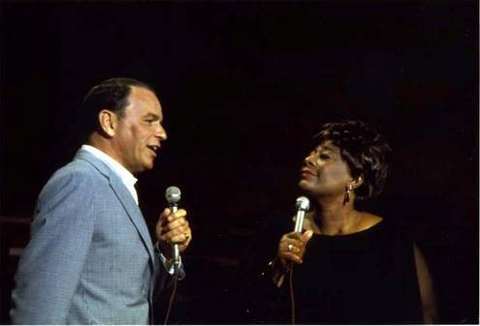
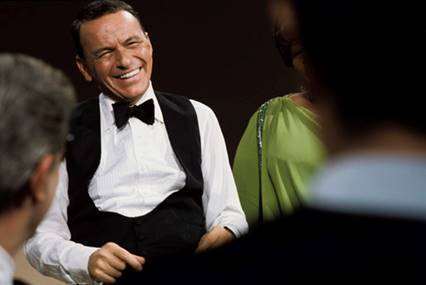
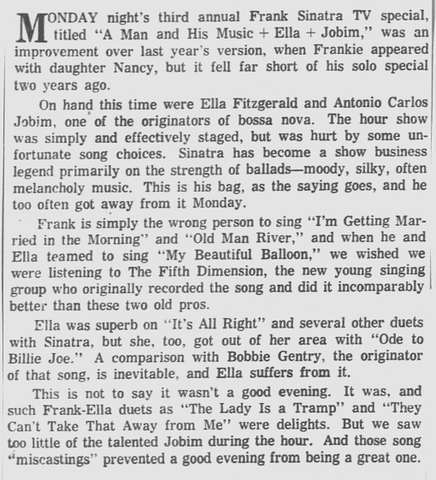
November 13th 1972 - Palm Springs, CA: Sinatra gave the bride away Desert Sun, 15 November 1972 Beau Wheat And Ken Venturi Wed At Four O’Clock
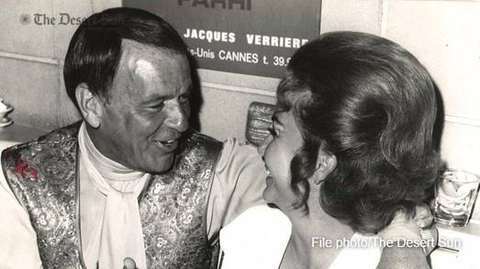

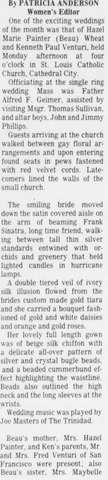
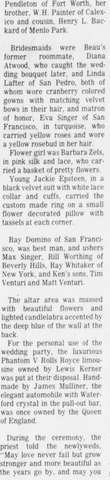
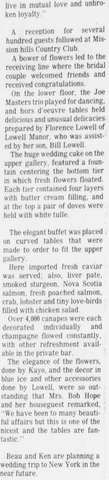
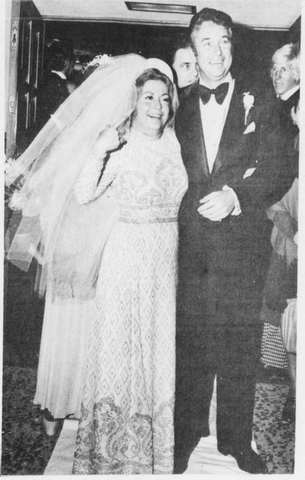

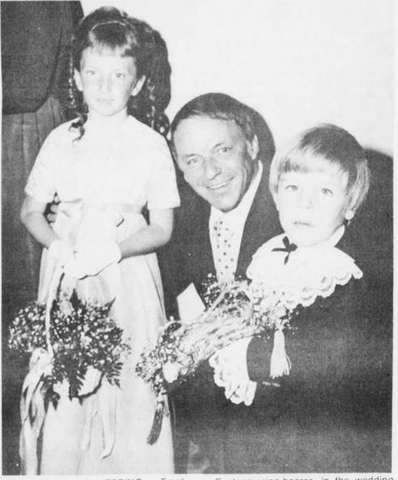
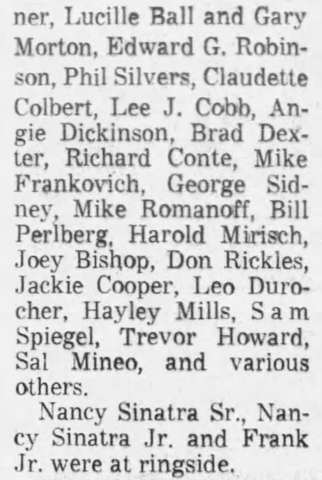

[Mia dances with Robert Kennedy at the Factory]
Kaplan (AP): At a benefit fashion show by Andre Courreges at the Factory nightclub, attended by much of Hollywood as well as Robert F. Kennedy and his wife Ethel, Mia Farrow danced repeatedly with Bobby Kennedy in front of hundreds of guests, including many of Frank's friends; word got back to Sinatra quickly.
Source: James Kaplan, "Sinatra: The Chairman" (2015).
[Mia fails to report for The Detective]
The date Mia was due to join the cast of 'The Detective' came and went without her appearing, and production on the film shut down because its star, Sinatra, was too upset to work.
Source: James Kaplan, "Sinatra: The Chairman" (2015).
The day before Thanksgiving, Frank's attorney Mickey Rudin arrives on the Rosemary's Baby set and hands Mia Farrow a set of pre-filled divorce papers, telling her simply to sign. She had no prior warning that Frank intended to end the marriage. That evening, Frank's publicist Jim Mahoney announced to the press that the couple, married just over a year, had "agreed to a separation." Source: J. Randy Taraborrelli, Sinatra: Behind the Legend.
[Rudin delivers Sinatra's divorce papers to Mia]
Mia Farrow: The day before Thanksgiving, Mickey Rudin appeared on the 'Rosemary's Baby' set at Paramount and handed Mia Farrow, in her dressing room, an application for divorce from Frank Sinatra; blindsided, she signed without reading it and told Rudin she would not hire her own lawyer.
Source: James Kaplan, "Sinatra: The Chairman" (2015).
[Polanski recalls Mia's devastation]
Roman Polanski: Director Roman Polanski found Mia Farrow sobbing in her dressing room after being served divorce papers, recalling that what hurt her most was that Sinatra hadn't told her himself but sent Rudin instead, 'like firing a servant.'
Source: James Kaplan, "Sinatra: The Chairman" (2015).
[UPI announces Sinatra-Farrow trial separation]
UPI: UPI reported that Frank Sinatra and Mia Farrow spent Thanksgiving apart by mutual agreement, the start of a trial separation ending sixteen months of marriage; Sinatra was in seclusion in Palm Springs and Farrow at their guarded Bel Air mansion, with Sinatra's publicist stating there would be no further comment from either party.
Source: James Kaplan, "Sinatra: The Chairman" (2015).
[Jacqueline Bisset replaces Mia in The Detective]
Richard Zanuck / UPI: 20th Century Fox production chief Richard Zanuck announced that twenty-three-year-old British newcomer Jacqueline Bisset would replace Mia Farrow in 'The Detective,' with her role of Norma MacIver cut down considerably; the production remained shut down pending Sinatra's return from Palm Springs.
Source: James Kaplan, "Sinatra: The Chairman" (2015).
[Recording Francis A. & Edward K. With Ellington]
Sinatra and Duke Ellington recorded their 1968 album Francis A. & Edward K.; arranger Billy May recalled being flattered to work with both men as a replacement for the recently deceased Billy Strayhorn, with Count Basie and Harry "Sweets" Edison among the musicians who stopped by the sessions.
Source: Charles Pignone, "Frank Sinatra 100" (2015).
[recording session/personnel -- critical commentary]
Billy May: In December 1967 Sinatra recorded Francis A. & Edward K. with Duke Ellington's band. Billy Strayhorn, originally slated to write the charts, died just before the album began; Billy May stepped in on short notice, flying to Seattle with pianist Bill Miller for a rushed rehearsal with a band May found to be poor sight-readers, though by the actual session everything came together.
Source: Charles L. Granata, "Sessions with Sinatra: Frank Sinatra and the Art of Recording" (1999/2003), Part IV: The Reprise Years
The NME reported plans for singer Long John Baldry to star in thirteen colour TV episodes playing a show-business tycoon modeled on Sinatra, according to his manager Simon Napier-Bell. The project never materialized, but Havers cites it as evidence of how Frank was perceived within the entertainment world by this point. (Source: Richard Havers, "Sinatra" (Dorling Kindersley, 2007).)
Hollywood
K6319 All I Need Is The Girl w/Duke Ellington & His Orchestra
(Stephen Sondheim/Jule Styne)
Stratford Music Corp./Williamson Music Co. (ASCAP)
Arranged & Conducted by Billy May
(4:59) CD: 46013-2 The Complete Reprise Studio Recordings Disc 12
CD: 9-26340-2 The Reprise Collection
CD: 1024-2Francis A. And Edward K.
LP: FS1024Francis A. And Edward K.
K6320 Yellow Days w/Duke Ellington & His Orchestra
(Alarcon Carrillo/Alan Bernstein)
E.B. Marks Music (BMI)
Arranged & Conducted by Billy May
(4:57) CD: 46013-2 The Complete Reprise Studio Recordings Disc 12
CD: 1024-2Francis A. And Edward K.
LP: FS1024Francis A. And Edward K.
K6321 Indian Summer w/Duke Ellington & His Orchestra
(Victor Herbert/Al Dubin)
Harms Inc. (ASCAP)
Arranged & Conducted by Billy May
(4:11) CD: 46013-2 The Complete Reprise Studio Recordings Disc 12
CD: 9-26340-2The Reprise Collection
CD: 1024-2Francis A. And Edward K.
LP: FS1024Francis A. And Edward K.
K6322 Come Back To Me w/Duke Ellington & His Orchestra
(Alan Jay Lerner/Burton Lane)
Chappell & Co. Inc. (ASCAP)
Arranged & Conducted by Billy May
(3:22) CD: 46013-2 The Complete Reprise Studio Recordings Disc 12
CD: 1024-2Francis A. And Edward K.
LP: FS1024Francis A. And Edward K.
1967
Duke EllingtonFrank Sinatra FRANCIS A. & EDWARD K.Reprise FS FS1024: Follow Me; Sunny; All 1 Need Is the Girl; Indian Summer; I Like the Sunrise; Yellow Days; Poor Butterfly; Come Back to Me.
Personnel: Sinatra, vocals; Cat Anderson, Mercer Ellington, Cootie Williams. Herbie Jones. Sweets Edison, Al Porcino, trumpets; Lawrence Brown. Chuck Connors, Buster Cooper, trombones; Russell Procopc, Johnny Hodges, Jimmy Hamilton, Paul Gonsalves, Harry Carney, reeds; Ellington, piano; John Lamb, bass; Sani Woodyard, drums; Billy May, arranger.
Rating: ****
At first hearing, this much heralded summit meeting is a bit disappointing, but it grows on youat least it did on me. To begin with the negatives: it seems odd indeed that only one Ellington piece (Sunrise) was included, and perhaps even odder that the album was not arranged by Ellington himself. Let me hasten to add, however, that Billy May has done a great job. Always an Ellington admirer (older listeners may recall his many Dukish charts for Charlie Barnet in the '40s), he must have relished this assignment, and at times (especially on Yellow Days) his touch is uncannily close to the master's. Two ringers were brought in to beef up the trumpet section, currently the band's weakest link. Everybody was on best behavior, it seemsthe band sounds tight and together at all times. The superb recording brings out the full flavor of the magnificent Ellington sound; the reeds, in particular, are opulent. To put it bluntly, this would have been a great album if Sinatra had been in top voice. On a few tracks, he is; at other times, one can sense that he is holding back. But he is nothing if not an old pro. and his mastery of phrasing overcomes all potential pitfalls. Relaxed tempi predominate to the point that the final selection, a way-up romp, comes as a positive relief. Why was it saved for that particular spot? Don't ask me. Quite a bit of space has been granted the band and its key soloists, and the tracks are thus longer than is customary on vocal albums. Cootie Williams, Gonsalves, and Hodges are most frequently .spotlighted, and make their impact felt. Indian Summer is the album's masterpiece, and one of Sinatra's most impressive efforts in recent years. The mood is bittersweet, the reeds add lovely touches, Ellington makes the most of his keyboard presence, and Hodges' touching solo is a perfect extension of the mood set by the singer. This one makes Ihe whole venture worlh the effort. Come Back, the aforementioned swinger, also finds Sinatra in peak form. Few singers could sustain such a tempo, but he never loses his firm grip on the melody and the lyric. The band shouts and romps, with brilliant work from the trumpets, a glimpse of Gonsalves, and superb Woodyard. (The drummer, consistently low rated by critics, does a sterling job throughout.) Sunrise, though well sung and scored, and enhanced by comments from Cootie and Gonsalves, does not measure up to the Al Hibbler original. The song's range, it appears, is more suitable for a voice deeper than Sinatra's, though it was his own choice. Butterfly and Girl are set in a mold that recalls the Sinatra-Basie collaborations, and the former could have stood a few solo comments. The final chorus, however, is top-drawer singing. The cover, featuring photographs of the Iwo protagonists at a tender age, is a cute touch. Young Edward Kennedy already had that regal air, while young Francis Albert (with bangs) hadn't yet found his groove. But then, he seems to be about 5 or so, while Duke must have been at least 8. Dan Morgensternn DOWNBEAT April 18, 1968
note: I was not familiar with his review. I must say it was a pleasant surprise. Morgenstern gives the album a very fair review and much of what he has to say rings true to what I know about the album. Ed
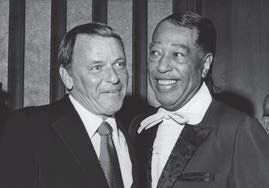
Movin' With Nancy
NBC
Monday Evening
8:00 p.m. - 9:00 p.m.
1. Gotta Get Out Of The Town
2. Younger Than Springtime
Guests: Frank Sinatra, Sammy Davis Jr., Dean Martin, Frank Sinatra Jr.
Ed O'Brien:
Frank's segment was filmed at a Reprise recording session on 9-20-67. You hear take
8 of "Younger Than Springtime." It is not the released recording, but an alternate.
"Yellow Days"
Adapted from Mexican composer Alvaro Carrillo's 'Se te olvida.' A standout Johnny Hodges solo leads into an extension section styled after Ellington's own habit of adding sections beyond standard song form (as in 'Cotton Tail'), though the 'extra' section is actually built from the original Carrillo tune -- an example of May's mastery of what Strayhorn called 'the Ellington Effect.'
Source: Will Friedwald, "Sinatra! The Song Is You: A Singer's Art" (2018 revised edition).
"Indian Summer"
Granata includes 'Indian Summer' among the fifty recordings he considers essential to understanding Sinatra's artistry (arranged by with Duke Ellington, recorded 1967, Reprise); the song was chosen for its musical/interpretive value rather than commercial popularity.
Source: Charles L. Granata, "Sessions with Sinatra: Frank Sinatra and the Art of Recording" (1999/2003).
[Sinatra-Ellington recording session]
Kaplan / Billy May: Sinatra and Duke Ellington's band, with arrangements by Billy May, recorded together at Western Recorders; the Ellington band, notoriously poor sight-readers who barely rehearsed the charts, had to be reinforced with 'ringer' studio musicians including trumpeter Al Porcino and keyboardists Jimmy Jones and Milt Raskin. Highlights included Johnny Hodges's solo on 'Indian Summer' (later called Nelson Riddle's favorite Sinatra chart) and Paul Gonsalves's solo on the closer 'Come Back to Me.'
Source: James Kaplan, "Sinatra: The Chairman" (2015).
Hollywood
K6324 Sunny w/Duke Ellington & His Orchestra
(Bobby Hebb)
Portable/Unichappel l Music (BMI)
Arranged & Conducted by Billy May
(4:11) CD: 46013-2 The Complete Reprise Studio Recordings Disc 12
CD: 1024-2Francis A. And Edward K.
LP: FS1024Francis A. And Edward K.
K6325 I Like The Sunrise w/Duke Ellington & His Orchestra
(Duke Ellington)
Duke Ellington Music (ASCAP)
Arranged & Conducted by Billy May
(4:59) CD: 46013-2 The Complete Reprise Studio Recordings Disc 12
CD: 1024-2Francis A. And Edward K.
LP: FS1024Francis A. And Edward K.
K6326 Follow Me w/Duke Ellington & His Orchestra
(Alan Jay Lerner/Frederick Loewe)
Chappell & Co. Inc. (ASCAP)
Arranged & Conducted by Billy May
(3:54) CD: 46013-2 The Complete Reprise Studio Recordings Disc 12
CD: 1024-2Francis A. And Edward K.
LP: FS1024Francis A. And Edward K..
K6323 Poor Butterfly w/Duke Ellington & His Orchestra
(Raymond Hubbell/John Golden)
Harms Inc. (ASCAP)
Arranged & Conducted by Billy May
(4:26) CD: 46013-2 The Complete Reprise Studio Recordings Disc 12
CD: 1024-2Francis A. And Edward K.
LP: FS1024Francis A. And Edward K.
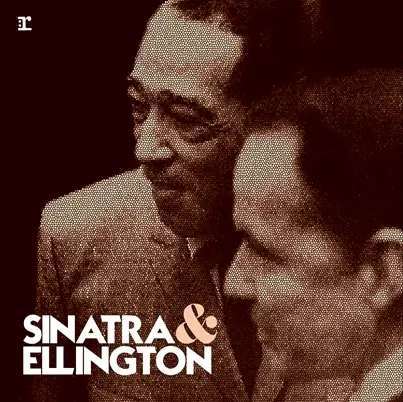
Hollywood
K6324 Sunny
K6325 I Like The Sunrise
K6326 Follow Me
K6323 Poor Butterfly
----------------------------------------------------
Air Date 1-3-80
December 12, 1979 Caesar's Palace, Las Vegas, Nevada
"The First 40 Years" Celebration
Orchestra Conducted By: Don Costa
1. New York, New York
2. It Was A Very Good Year
3. The Best Is Yet To Come
4. monologue
5. I've Got You Under My Skin
6. I've Got The World On A String
Notes: FS receives the ASCAP Pied Piper Award
Sinatra Scholar Ed O'Brien writes that Sinatra was simply sensational on this, his 64th birthday. He sang five songs: New York, New York; It Was a Very Good Year; I've Got You under my Skin; I've Got the World on a String; and The Best is Yet to Come. Actor Darren McGavin was near the stage and the camera filming Sinatra picks up the absolute glee of McGavin as he watches Sinatra give a masterful lesson in the art of popular singing. Only wish he could have done more songs.
Ed O'Brien:
Here is the NBC ad for the TV broadcast on 1-3-80. Caesars gala ran over 3 hours. TV show was a two hour event from 9 to11 p.m.
-----------------------------------------------------------------
© 1997-2025 The Sinatra Archive
This calendar, or any parts thereof, may not be reproduced in any fashion whatsoever without the prior written permission of the publisher (The Sinatra Archive)
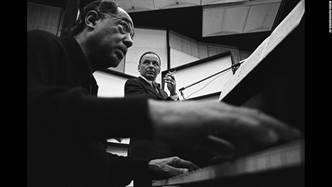
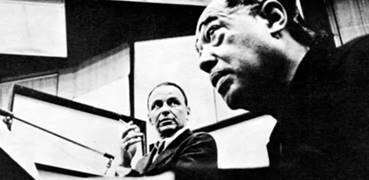
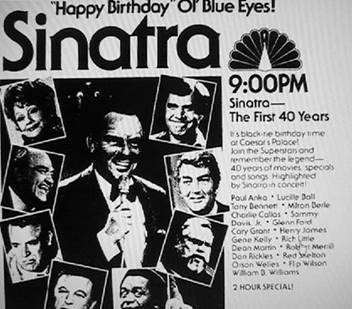
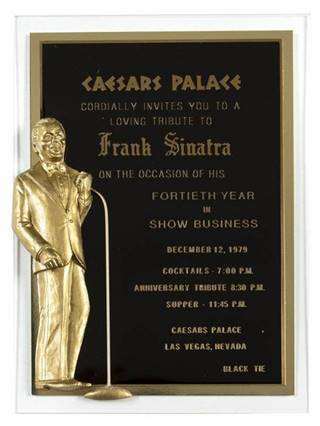
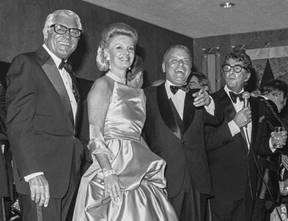
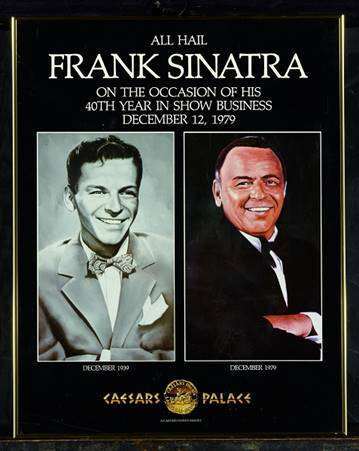
[Sinatra's 52nd birthday, subdued mood]
Milt Bernhart / Lee Herschberg: The night after the Ellington session was Frank's fifty-second birthday; he told friends he wasn't in the mood for a party, and Milt Bernhart recalled him seeming unenthusiastic even as a birthday cake was wheeled in, though his spirits picked up when associates arrived with two women as a 'birthday present,' according to Lee Herschberg.
Source: James Kaplan, "Sinatra: The Chairman" (2015).
[Mia returns to New York to finish Rosemary's Baby]
Earl Wilson: Earl Wilson's column noted that 'Mia Farrow Sinatra slipped quietly into town to finish filming Rosemary's Baby,' as she worked to complete her final location scenes before Christmas.
Source: James Kaplan, "Sinatra: The Chairman" (2015).
Dean Martin Show
Taped September 23, 1967
NBC
Thursday evening
10 - 11 PM
Guests: Frank Sinatra & Family + Dean Martin's family
Produced and directed by Greg Garrison
Ken Lane on piano
1. Everybody Loves Somebody Dean sings a few words of his hit and then slides down the
firepole, crashing right through the floor. Frank climbs up out of cellar and tells us not to worry
because "Dean fell in the wine cellar." Opening credits
2. Marshmallow World - Dean & Frank with chorus
3. It's A Most Unusual Day/Santa Claus Is Comin' To Town/Boots( parody) -
Gail Martin & Nancy Sinatra
4. We Wish You The Merriest/More I Cannot Wish You - Frank, Dean,
Gail, Nancy
5. How Do Talk To Your Dad/How Do You Talk To Your Kid - Frank,
Dean, Frank Jr., Dean Jr.
6. Do-Re-Mi - Frank, Dean, Deana Martin, Tina Sinatra
7. Dean and Frank read children's letters to Santa
8. Dean sings parodies of Christmas songs while Ken Lane plays the piano.
Dean opens the closet. Surprise guest is
Sammy Davis, Jr.
9. I'll Be Home For Christmas - Dean
10. Medley introduced by Gail, Tina, Deana, Nancy
I Can't Give You Anything But Love/Too Marvelous For
Words/Pennies From Heaven/A Foggy Day/Embraceable
You/The Lady Is A Tramp/Where Or When/I've Got The
World On A String/Hey Marie!/All Of Me/When You're Smiling - Frank and Dean
11. Sinatra/Martin families sing medley of Christmas songs:
Home For The Holidays/Let It Snow, Let It Snow/The Christmas Song
12. White Christmas Gail sings the verse. Dean does the chorus
13. Have Yourself A Merry Little Christmas - Frank
14. Second medley by families: Deck The Halls/ O' Little Town Of
Bethlehem/Joy To The World
15. Silent Night Dean and Frank Families join in for second chorus
16. Families announce destination of toys, donated by manufacturers, to children's hospitals around the country
17. We Wish You A Merry Christmas and A Happy New Year - Frank,
Dean and their Families
18. Closing credits
note: Show pulled in 75% of all viewers that evening from 10 to 11.
Scott Henderson:
My children argue every year about what specials or Christmas movies to
watch during this season but whenever I suggest the Sinatra-Martin Families
Christmas they are unanimous on it. They love it and it's become a bit of
a tradition to watch this together. Here's hoping a DVD will come soon now
that they have worked out some of the rights issues to the Dean Martin shows.
Dean Martin Show
Daily News (New York, New York), December 22, 1967
© 1997-2024 The Sinatra Archive
This calendar, or any parts thereof, may not be reproduced in any fashion whatsoever without the prior written permission of the publisher (The Sinatra Archive)
Dean Martin Show
Daily News (New York, New York), December 22, 1967
© 1997-2024 The Sinatra Archive
This calendar, or any parts thereof, may not be reproduced in any fashion
whatsoever without the prior written permission of the publisher (The
Sinatra Archive)
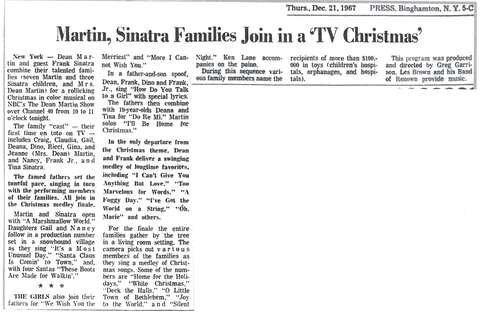
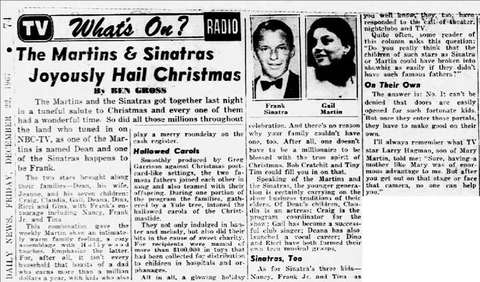
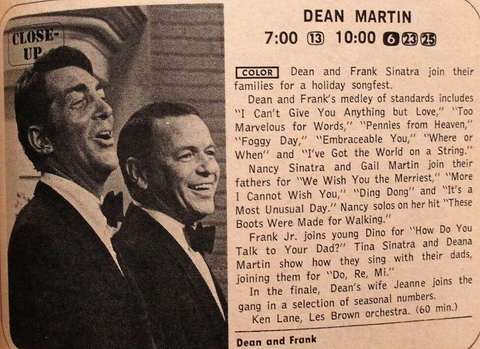
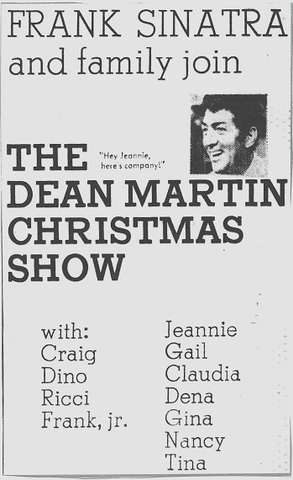
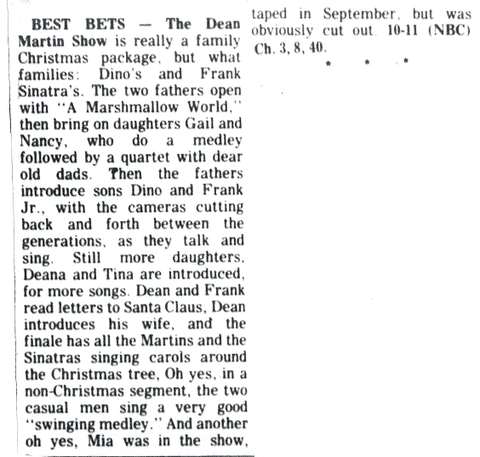
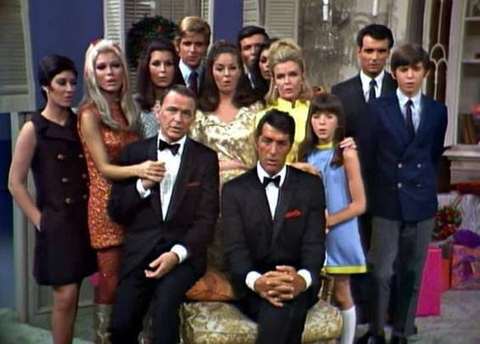
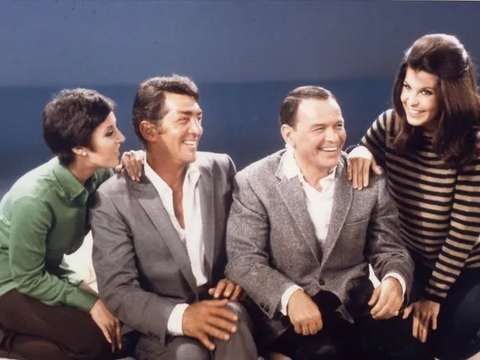
Though father and son had a difficult relationship, despite it all they had an abiding love for one another. Frank Jr. and Sr. at a taping of The Dean Martin Show in 1967. Source: photo and caption from J. Randy Taraborrelli, Sinatra: Behind the Legend (mptvimages.com).
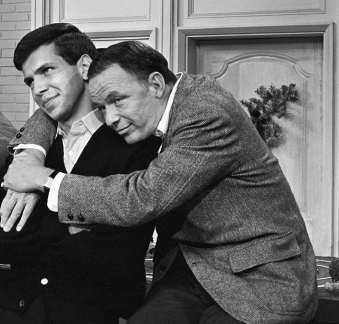
[Campaigns for Hubert Humphrey]
Sinatra actively campaigned for Hubert Humphrey's presidential run, explaining that he believed Humphrey to be a decent man who cared about people others tended to overlook.
Source: Nancy Sinatra, "Frank Sinatra, My Father" (1985).
[Frank Steps Back to Help a Nervous Raquel Welch]
Director Gordon Douglas recalled that during Lady in Cement, Frank noticed young co-star Raquel Welch was nervous rehearsing a scene, so he deliberately stayed out of sight until she relaxed. He then told Douglas to relax too, predicting Welch would become a big star. Welch later said Frank trusted Nancy Sinatra Sr. completely because she had known him before fame.
Source: Nancy Sinatra, "Frank Sinatra, My Father" (1985).
[Nancy "Produces" the Title Track of Cycles]
At her father's request, Nancy oversaw the New York rerecording of the title song for Cycles so that arranger Don Costa "could be in the room with me." She felt her father's trust meant more than any of her own gold records.
Source: Nancy Sinatra, "Frank Sinatra, My Father" (1985).
[Nancy Sinatra's Hit Streak Ends]
Nancy Sinatra's run of chart hits dried up, though she continued with TV specials and albums before retiring from performing in the early 1970s to raise a family.
Source: The Rough Guide to Frank Sinatra, chapter "I Want to Be a Part of It, 1971-98."
[Playboy Hall of Fame; "My Way" Sets British Chart Record]
Sinatra is inducted into the Playboy Hall of Fame, and "My Way" becomes the longest-running single in British chart history to that point, at 120 weeks; he appears in "The Detective" and "Lady in Cement."
Source: Nancy Sinatra, "Frank Sinatra, My Father" (1985).
[Sinatra's 1968 Statement Against Racial Slurs]
In 1968 Frank publicly argued that society had mostly grown past slurs once used against Italian Americans, and warned that continuing to tolerate racist language toward Black Americans threatened everyone's future together.
Source: Nancy Sinatra, "Frank Sinatra, My Father" (1985).
[Tina Moves to Germany for TV Role]
In 1968, seeking distance from Los Angeles and her mother, Tina accepted a part in a European television miniseries and relocated to Germany, which became her base for the next two years.
Source: Tina Sinatra, "My Father's Daughter: A Memoir" (2000).
[Bennett Cerf's dinner for Rod McKuen]
Bennett Cerf: Random House editor Bennett Cerf gave a dinner for poet-songwriter Rod McKuen at '21,' with guests including Ed Sullivan, Walter Cronkite, and the Steinbecks. Cerf recalled that the most important guest to McKuen was Frank Sinatra, who agreed that night to listen to McKuen's songs.
Source: James Kaplan, "Sinatra: The Chairman" (2015)
[Diane McCue sent to Sinatra as 'gift']
Kaplan: The 'Ingalill Klippinger' story was fabricated: she was actually Diane McCue, a runaway from a troubled Pittsburgh family working as a stripper on Baltimore's 'the Block.' A Baltimore club owner, Sammy Goldstein (a friend of Jilly Rizzo's), sent her to New York as a gift for Sinatra that summer; she was met at JFK Airport and taken to Jilly's. Kaplan notes she was not quite fifteen when she met Frank.
Source: James Kaplan, "Sinatra: The Chairman" (2015)
[Fentress compares Caesars to Sands intimacy]
Rob Fentress: Longtime Sinatra observer Rob Fentress recalled that Caesars' 1,100-plus-seat Circus Maximus lacked the intimacy of the Sands' 350-seat Copa Room: 'The electricity of the Sands days was not there. And his voice was not the same.'
Source: James Kaplan, "Sinatra: The Chairman" (2015)
[George Jacobs takes Mia dancing in London]
Consiglio: While Frank was in England staying at the Dorchester Hotel, their houseboy George Jacobs took Mia to a discotheque; word of it got back to Frank, who took it as confirmation his marriage was over. Consiglio suspects Frank may have engineered the outing himself as a pretext to end things, since Frank never fired Jacobs over it.
Source: Tony Consiglio (as told to Franz Douskey), "Sinatra and Me: The Very Good Years" (2012)
[Graham on Sinatra's film contract terms]
Sheilah Graham: Columnist Sheilah Graham noted Sinatra received a million dollars plus a percentage for each film and got ownership of the negative after seven years -- a deal she said only Cary Grant also had -- while speculating he wasn't actually rich given how lavishly he spent.
Source: James Kaplan, "Sinatra: The Chairman" (2015)
[Haber skewers Sinatra's smog excuse]
Joyce Haber: Columnist Joyce Haber noted Sinatra didn't actually have a nose-and-throat doctor, and wryly omitted mention of his two-pack-a-day unfiltered Camels habit. She reported he was selling his LA house(s), keeping his desert home plus new places in Manhattan and San Francisco.
Source: James Kaplan, "Sinatra: The Chairman" (2015)
[Jilly Rizzo opens Palm Springs bar]
Kaplan: Jilly Rizzo opened a Palm Springs branch of his nightclub Jilly's.
Source: James Kaplan, "Sinatra: The Chairman" (2015)
[Lady in Cement]
Raquel Welch, cast as femme fatale Kit Forrest, is criticized by Santopietro as visually striking but unable to act -- delivering lines flatly and lacking the 'insolence and smoldering heat' the role needed, unlike the young Lauren Bacall or Sinatra's own ex-wife Ava Gardner, whom the film's dialogue explicitly references.
This film/context matches multiple dated entries in the chronology; the specific date Santopietro is referring to could not be determined with confidence.
Source: Tom Santopietro, "Sinatra in Hollywood" (2008), Knight-Errant (pt. 1)
[Lady in Cement]
Vincent Canby / Charles Champlin: Lady in Cement did fairly well at the box office with mixed reviews: new NYT critic Vincent Canby called it 'consistently crude,' The Hollywood Reporter found it fun rather than leering, and Charles Champlin of the LA Times praised Sinatra's blend of insouciance, cynicism, and 'battered but surviving idealism.'
This film/context matches multiple dated entries in the chronology; the specific date Santopietro is referring to could not be determined with confidence.
Source: Tom Santopietro, "Sinatra in Hollywood" (2008), Knight-Errant (pt. 1)
[Lady in Cement / Tony Rome]
Lady in Cement, Sinatra's first R-rated film, returned him to the Tony Rome character, retaining producer Aaron Rosenberg and cinematographer Joseph Biroc, with a script by Marvin H. Albert and Jack Guss. Santopietro singles out Hugo Montenegro's score as the film's weak link -- a jokey Bacharach-lite sound that undercuts tense moments, in contrast to Jerry Goldsmith's moody Detective score.
This film/context matches multiple dated entries in the chronology; the specific date Santopietro is referring to could not be determined with confidence.
Source: Tom Santopietro, "Sinatra in Hollywood" (2008), Knight-Errant (pt. 1)
[MLK and RFK assassinations]
Consiglio: Consiglio reflects that when Martin Luther King Jr. and Bobby Kennedy were killed by assassins in the spring of 1968, whatever hope remained for the country's future seemed to end for many Americans.
Source: Tony Consiglio (as told to Franz Douskey), "Sinatra and Me: The Very Good Years" (2012)
[Mia Farrow's trip to study with the Maharishi]
Consiglio: Amid the marital tension, Mia told Frank she wanted to go to India to study Transcendental Meditation with Maharishi Mahesh Yogi, whose profile had risen after the Beatles visited his ashram. When Mia insisted she was going whether Frank liked it or not, he told her simply, "Good. Go!" -- effectively ending the marriage.
Source: Tony Consiglio (as told to Franz Douskey), "Sinatra and Me: The Very Good Years" (2012)
[Mia's summer fling with Peter Sellers]
Kaplan: After finishing Secret Ceremony and reconnecting with old friends, Mia Farrow had a summer fling with Peter Sellers that made the gossip columns; Frank read about it.
Source: James Kaplan, "Sinatra: The Chairman" (2015)
[Polk appointed MGM studio chief]
Kaplan: After Seagram's Edgar Bronfman bought a controlling interest in MGM in 1966, he appointed thirty-eight-year-old Louis Polk, a Harvard MBA and former General Mills executive with little film-industry experience, as studio chief.
Source: James Kaplan, "Sinatra: The Chairman" (2015)
[Sinatra cites scheduling conflicts for film exit]
Kaplan: Sinatra's stated excuse for dropping The Only Game in Town was scheduling conflicts with an October 30 Teamsters benefit concert in St. Louis and a November 22 opening at Caesars Palace, though Kaplan notes a determined star could have worked around both.
Source: James Kaplan, "Sinatra: The Chairman" (2015)
[Sinatra dates young actresses post-divorce]
Kaplan: Following his divorce, Sinatra was seen dating a string of young actresses, including Carol Lynley, 23-year-old Irene Tsu, and 27-year-old Quinn O'Hara.
Source: James Kaplan, "Sinatra: The Chairman" (2015)
[Sinatra demands to see Godfather manuscript]
Kaplan: After Paramount optioned the still-unpublished Godfather manuscript, Sinatra, concerned about the Mafia-linked singer character Johnny Fontane, had attorney Mickey Rudin demand to see pages. Putnam refused.
Source: James Kaplan, "Sinatra: The Chairman" (2015)
[Sinatra drops out of Only Game in Town]
Kaplan: Sinatra was scheduled to begin shooting 20th Century Fox's The Only Game in Town with Elizabeth Taylor and director George Stevens in Paris in early September, but dropped out after Taylor postponed the start date for health reasons. The role went to Warren Beatty; the film flopped.
Source: James Kaplan, "Sinatra: The Chairman" (2015)
[personal life]
Shortly after the Farrow divorce, Ava Gardner came to Florida after reports Sinatra was gravely ill with pneumonia; his illness proved less severe than advertised and old tensions flared, but the visit marked a turning point -- Sinatra and Gardner resumed a routine of late-night calls, though (per the book) their physical relationship, which had continued intermittently since their divorce, did not resume.
No corresponding dated entry could be identified in the chronology for this film/context.
Source: Tom Santopietro, "Sinatra in Hollywood" (2008), Knight-Errant (pt. 1)
[Cycles -- critical commentary]
Nancy Sinatra: Nancy Sinatra recalls being invited by her father to produce from the control booth during the New York session for 'Cycles' in 1968, so that Don Costa could work with him directly in the studio; she was nervous when she had to stop a take because of a mistake.
Source: Charles L. Granata, "Sessions with Sinatra: Frank Sinatra and the Art of Recording" (1999/2003), Afterword & Appendices A-D
[Cycles -- critical commentary]
Granata's discography entry: Cycles, arranged by Don Costa, released November 1968.
Source: Charles L. Granata, "Sessions with Sinatra: Frank Sinatra and the Art of Recording" (1999/2003), Afterword & Appendices A-D
[Francis A. and Edward K. -- critical commentary]
Granata's discography entry: Francis A. and Edward K. (with Duke Ellington), arranged by Billy May, released January 1968.
Source: Charles L. Granata, "Sessions with Sinatra: Frank Sinatra and the Art of Recording" (1999/2003), Afterword & Appendices A-D
[The Sinatra Family Wish You a Merry Christmas -- critical commentary]
Granata's discography entry: The Sinatra Family Wish You a Merry Christmas, arranged by Nelson Riddle and Don Costa, released September 1968.
Source: Charles L. Granata, "Sessions with Sinatra: Frank Sinatra and the Art of Recording" (1999/2003), Afterword & Appendices A-D
[Judy Garland's Late-Night Police Scare]
Nancy Sinatra: While Sinatra was performing in Miami, Tony Bennett got an emergency call from a hysterical Judy Garland claiming someone was threatening her life. Sinatra used his contacts among New York police, developed while filming The Detective, to flood her block with officers; Garland then called Bennett back to joke that she now had a thousand police and about five hundred lawyers crowded into her apartment, followed by a deadpan check-in call from Sinatra himself asking if she was now all right.
Source: Nancy Sinatra, Frank Sinatra: An American Legend, 1995.
[Frank tells Mia it's over]
Kaplan: A few days after the false reconciliation report, Frank phoned Mia and said he couldn't stop thinking about her but that it was over between them. He offered her all the money she wanted; she said she wanted only him.
Source: James Kaplan, "Sinatra: The Chairman" (2015)
[Mia departs for India ashram]
Mia Farrow: Mia Farrow flew to New York to join her sister Prudence, then traveled to the Himalayan foothills to meditate with Maharishi Mahesh Yogi. At Kennedy Airport, seated beside the guru, a nervous Mia told the Associated Press, 'I want to be a better person.' The guru said she hadn't mentioned her husband.
Source: James Kaplan, "Sinatra: The Chairman" (2015)
[Muir reports Sinatra-Farrow reconciliation]
Syndicated columnist Florabel Muir wrote that Frank and Mia's post-New Year reconciliation had 'taken,' claiming Mia was giving up acting to be a full-time housewife and had abandoned a planned trip to India to meet the Beatles' guru. Kaplan notes it was pure fiction; Muir, nearly eighty, was fed a false story.
Source: James Kaplan, "Sinatra: The Chairman" (2015).
[Ava Gardner visits sick Sinatra in Miami]
Ava Gardner / Lee Server: While finishing Mayerling, Ava Gardner got a call that Frank had pneumonia and was asking for her repeatedly. She flew to Miami with her maid Reenie Jordan, a secretary, and 29 pieces of luggage, was taken by private elevator to his penthouse, and -- stressed and jet-lagged -- screamed at him for being a 'selfish prick' before leaving the next day.
Source: James Kaplan, "Sinatra: The Chairman" (2015)
[Frank feuds with Sammy, Leonard, Wilson]
Kaplan: Sick and mad simultaneously, Sinatra was furious at Sammy Davis Jr. (who'd gone to London to film Salt and Pepper with Peter Lawford), nearly came to blows with comedian Jack E. Leonard at the Fontainebleau's Club Gigi over continued Mia jokes, and turned on Earl Wilson, his longtime friend among columnists.
Source: James Kaplan, "Sinatra: The Chairman" (2015)
[Lady in Cement production begins]
Kaplan: Sinatra was booked for an unprecedented six weeks at the Fontainebleau's La Ronde Room, two shows nightly, six days a week, while simultaneously shooting the Tony Rome sequel Lady in Cement during the day with the same production team (producer Aaron Rosenberg, director Gordon Douglas, cinematographer Joseph Biroc). Richard Conte returned, Dan Blocker played villain Waldo Gronsky, and Raquel Welch got second billing.
Source: James Kaplan, "Sinatra: The Chairman" (2015)
[Sammy Davis dropped from Lady in Cement]
Kaplan: Sammy Davis Jr., originally cast as Tony Rome's sidekick, was abruptly dropped from Lady in Cement -- Variety called it 'forced to bow out' -- and replaced by Sinatra's warm-up comic Pat Henry at a lower salary.
Source: James Kaplan, "Sinatra: The Chairman" (2015)
[Sinatra hospitalized with pneumonia]
George Jacobs: Sinatra was too sick to open on February 16 or 23; valet George Jacobs recalled he was briefly hospitalized, looking frail, old, and helpless, his skin sallow and green, too weak even to insist on wearing his hairpiece.
Source: James Kaplan, "Sinatra: The Chairman" (2015)
[Wilson reports Sinatra flu, rumors]
Earl Wilson: Columnist Earl Wilson reported Sinatra was 'causing talk in Miami Beach' amid rumors he'd punched Eddie Fisher and was refusing Mia Farrow's calls -- probably untrue, Wilson wrote -- and that his Fontainebleau opening was postponed because he was in bed with a 102-degree flu.
Source: James Kaplan, "Sinatra: The Chairman" (2015)
[Fontainebleau opening postponed]
Sinatra's Fontainebleau opening, originally set for Friday, February 9 to honor his parents' anniversary, was postponed, then postponed again, as something was clearly wrong with Frank.
Source: James Kaplan, "Sinatra: The Chairman" (2015).
[Wilson retracts Eddie Fisher rumor]
Earl Wilson: Earl Wilson retracted the rumor that Sinatra had punched Eddie Fisher, explaining that when Fisher had to drop out of his own Fontainebleau show sick, Frank (also sick) had Pat Henry cover for him, then lent Eddie and Connie Stevens his jet for a rest trip.
Source: James Kaplan, "Sinatra: The Chairman" (2015).
[Mahoney denies Mexico divorce rumor]
Sinatra publicist Jim Mahoney denied a broadcast rumor that Frank had divorced Mia in Mexico. The same day, a front-page Variety story cited rumors Sinatra 'wasn't ill, just mad,' but Fontainebleau physician Dr. Ralph Robbins confirmed the singer had pneumonia.
Source: James Kaplan, "Sinatra: The Chairman" (2015).
Filming began in Miami for Lady in Cement. Director Gordon Douglas recalled Frank noticing a nervous young co-star (Raquel Welch) and deliberately staying out of view so as not to add to her nerves, reassuring the director she would be fine and predicting she'd become a big star.
Frank Sinatra (quoted): "Relax, she'll be fine... She's also going to be a big star."
Source: Nancy Sinatra, Frank Sinatra: An American Legend, 1995.
[Wilson on Sinatra's continued illness]
Earl Wilson: Earl Wilson noted that Sinatra 'remains weak -- and unusually quiet' from his pneumonia, and that Fontainebleau boss Ben Novack couldn't say whether he'd open as announced that Friday.
Source: James Kaplan, "Sinatra: The Chairman" (2015).
[Nancy Visits Her Grieving Father in Miami During Mia Split]
Nancy Sinatra: During his separation from Mia Farrow, Sinatra told his daughter that older people build a protective wall around themselves so painful things hurt less. The two later watched President Johnson's television announcement that he would not seek reelection, after which Sinatra explained his belief that Hubert Humphrey privately opposed the Vietnam War but could not say so publicly while serving as Johnson's vice president.
Source: Nancy Sinatra, Frank Sinatra: An American Legend, 1995.
[Beatles arrive at Rishikesh ashram]
Mia Farrow: The Beatles arrived at Maharishi Mahesh Yogi's Rishikesh ashram in February 1968 (delayed from an October 1967 plan by manager Brian Epstein's death), led by true-believer George Harrison. Mia Farrow, who had found the ashram cold and monotonous, was transformed by their presence; songs written there, including 'Dear Prudence' (about her sister), later appeared on The White Album.
Source: James Kaplan, "Sinatra: The Chairman" (2015)
[Kazan converted watching Sinatra perform]
Raquel Welch: Raquel Welch recalled bringing a reluctant Elia Kazan, who badmouthed Sinatra's one-take demands all evening, to see Frank's Fontainebleau show. Watching Sinatra perform, Kazan turned to her mid-song and declared, 'This fuckin' guy is the best actor I've ever seen in my life... He's a genius.'
Source: James Kaplan, "Sinatra: The Chairman" (2015)
[Mia flees ashram after Maharishi incident]
Mia Farrow: During a private meditation session in the Maharishi's cave, he suddenly embraced Mia Farrow with 'surprisingly hairy arms.' She fled the cave, the ashram, and the country, deciding to take a role in Secret Ceremony with director Joseph Losey, Elizabeth Taylor, and Robert Mitchum.
Source: James Kaplan, "Sinatra: The Chairman" (2015)
[Nancy comforts father in Miami]
Nancy Sinatra: Nancy Sinatra traveled to Miami to comfort her father after his illness and Mia's departure. 'He was sad. He was hurting,' she recalled.
Source: James Kaplan, "Sinatra: The Chairman" (2015)
[Sinatra returns to stage, new look]
George Bourke: Sinatra returned to the La Ronde Room stage in a new, hippie-inspired look -- white turtleneck and pendant instead of a tux. Miami Herald critic George Bourke, under the headline 'Sinatra Comes On with the Old Gusto,' noted he was 14 pounds lighter and still sang an hour and ten minutes with defiant skill despite lingering throatiness from his illness.
Source: James Kaplan, "Sinatra: The Chairman" (2015)
[Sinatra slaps Pat Henry on set]
Al Algiro: During the tense Lady in Cement shoot, an extra named Al Algiro recalled that after Pat Henry flubbed his lines through three takes, an irritated Sinatra slapped him in the face and told him to shape up.
Source: James Kaplan, "Sinatra: The Chairman" (2015)
[Wilson devastated by Sinatra ban]
Earl Wilson: Earl Wilson called being barred by Sinatra one of the saddest moments of his career, writing that he felt shame and dejection at being treated like all of Frank's other estranged friends, unable to believe it would happen to him too.
Source: James Kaplan, "Sinatra: The Chairman" (2015)
Fontainebleau, Miami Beach, Florida (March 1 - April 6) Lenny Dawson's Orchestra
Opening Act: Pat Henry
Songs performed during this engagement:
--The Lady Is A Tramp
--All or Nothing At All
--I'm Going Out of My Head
--That's Life
--Ol' Man River
--It Was A Very Good Year
Fontainebleau, Miami Beach, Florida (March 1 - April 6)
Lenny Dawson's Orchestra
Opening Act: Pat Henry
note: Frank was set to open at the La Ronde Room for a six week
engagement, beginning on 2/9/68. He became quite ill just before
opening night and pushed the opening a week ahead. Unfortunately
his condition deteriorated and a hospital stay was necessary. He
had a fever of 104 and a bad viral infection in his lung. He still
insisted an opening would take place on 2/16. It did not. Then 1/23
was also canceled. Ava and Mia both came to visit him. Recovering
in his suite, at the hotel, many of his friends became very concerned
at how sick he appeared to be. Near the end of the month there was
a sudden improvement and the 3/1 date( Friday) was set for the Fontain-
bleau. Then Frank announced he would not perform if the columnist Earl
Wilson was in the room. Wilson agreed to be a no-show and the
engagement finally got under way(date usually given for the opening
is 3/3 -- a Sunday. Have no idea why). Frank was not fully recovered
and there were some tough nights over the first few weeks of the en-
gagement.There is a tape of the 3/5 show in circulation( another mystery,
for years the accepted date was 5-4-68) "Lady In Cement" had Frank filming
his first scenes on 3/4.. Frank's opening act, Pat Henry, had inherited the role
originally intended for Sammy Davis Jr. in the film. Film took less than six
weeks to complete. Frank did not like the final results. Through the years,
he would threaten to run a copy if his guests, at the Palm Springs house,
stayed up too late.
Here is the basic song list for the engagement:
I've Got You Under My Skin
Goin' Out Of My Head
Nancy
i Get A Kick Out Of You
That's Life
Day In, Day Out
In The Still Of The Night
The Lady Is A Tramp
All Or Nothing At All
Moonlight In Vermont
I Have Dreamed
This Is All I Ask
Ol' Man River
It Was A Very Good Year
All I Need Is The Girl
My Kind Of Town
Angel Eyes
You're Nobody Till Somebody Loves You
The Miami Herald (Miami, Florida) 1 Mar 1968, Fri :
Review:
note: Sammy Davis preceded Frank's appearance at the Fontainbleau.
The minimum to see him during the week was $6.00 and $7.50 on
weekends. Frank cost you a cover of $17.50 plus a $10.00 minimum
every night with the exception of opening night. Sammy was one of
the biggest nightclub draws in the early 1960s. And yet the cost
to see Frank was roughly four times as much. There was no other
performer who could ask for $27.00 and still fill every seat.. He easily
the biggest attraction in clubs and the most expensive to see.
Ed
Variety
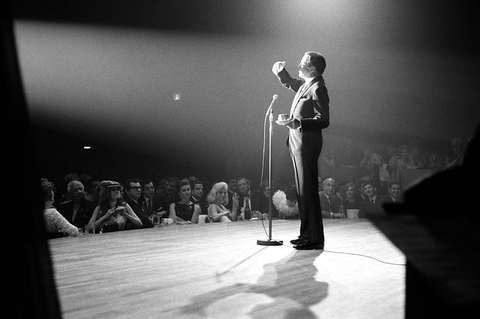
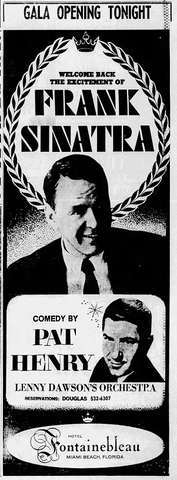
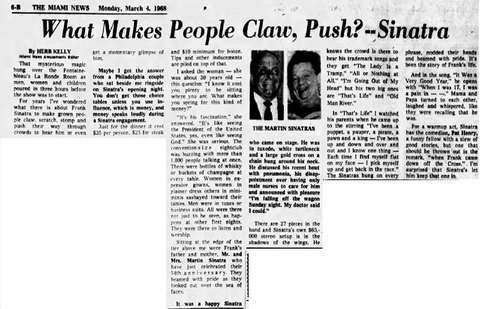
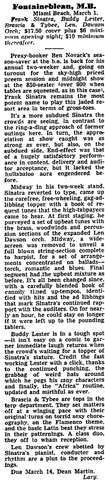
[Wilson announces Fontainebleau opening]
Earl Wilson: Earl Wilson wrote that the 'Jet Set rush to Miami Beach' would be on with Frank Sinatra 'definitely opening' at the Fontainebleau that Friday; Wilson and his wife packed for the trip, only to be told on arrival that Sinatra wouldn't perform if Wilson was in the audience.
Source: James Kaplan, "Sinatra: The Chairman" (2015).
Fontainebleau, Miami Beach, Florida (March 1 - April 6) Lenny Dawson's Orchestra
Opening Act: Pat Henry
Songs performed during this engagement:
--The Lady Is A Tramp
--All or Nothing At All
--I'm Going Out of My Head
--That's Life
--Ol' Man River
--It Was A Very Good Year
Fontainebleau, Miami Beach, Florida (March 1 - April 6) Lenny Dawson's Orchestra
Opening Act: Pat Henry
Songs performed during this engagement:
--The Lady Is A Tramp
--All or Nothing At All
--I'm Going Out of My Head
--That's Life
--Ol' Man River
--It Was A Very Good Year
Fontainebleau , Miami Beach , Florida (March 1 - April 6) O.A. Pat Henry
Lenny Dawson’s Orchestra
Conductor: Bill Miller
Monday evening
Introduction
1. I Get A Kick Out Of You
2. In The Still Of The Night
3. I Have Dreamed
4. The Lady Is A Tramp
5.This Is All I Ask
6. All Or Nothing At All Riddle chart from 1966
7. That's Life
8. Ol' Man River monologue
9.Angel Eyes Bill Miller on piano
10. All I Need Is The Girl
11. Moonlight In Vermont
12. It Was A Very Good Year
13. You're Nobody Til' Somebody Loves You
14. My Kind Of Town
note: I've been doing some research on Frank's 68 appearance at the Fontainbleau and the filming of "Lady In Cement." For lo these many years, the only tape to surface from Frank's time in Miami has been the 5-4-68 show. Never happened. He wasn't there. The correct date of the show is 3-4-68. Frank was supposed to open on 2-11-68, but he developed a very serious case of pneumonia. So serious that Mia and later Ava flew down to be by his side. The film got underway on 2-26 with Frank's first big scene shot on 3-5. Movie was a six week production. Frank did one show a night at the hotel. The average gross per night was between 90 and 100 thousand dollars. It would be Sinatra's last major engagement at the hotel. Opening night he barred Earl Wilson from seeing the show. Wilson's wife got in to see him accompanied by Joe E. Lewis. Frank picked up there tab.
[Sinatra bars Earl Wilson from show]
Variety reported that Sinatra refused to open his Fontainebleau engagement if columnist Earl Wilson was in the audience, upset over two recent items in Wilson's column. Wilson was barred and the show went on as planned.
Source: James Kaplan, "Sinatra: The Chairman" (2015).
Fontainebleau , Miami Beach , Florida (March 1 - April 6) O.A. Pat Henry
Lenny Dawson’s Orchestra
Conductor: Bill Miller
Fontainebleau , Miami Beach , Florida (March 1 - April 6) O.A. Pat Henry
Lenny Dawson’s Orchestra
Conductor: Bill Miller
Ed O'Brien:
While filming "Lady In Cement" during the day, Frank did one show a night at the Fontainebleau for five weeks. Frank had jumped from the Sands to Caesars Palace in Las Vegas.
The contract called for a singing commercial to be played leading up to his Caesars debut in November of that year.
Frank decided to use the full orchestra at the Fontainebleau for the recording session in a local studio. The session involved two rehearsal run throughs and three takes. Billy May did an uptempo chart and Frank sailed through the
45 minute session. I would hazard a guess that Sammy
Cahn probably wrote the special lyrics.
Fontainebleau , Miami Beach , Florida (March 1 - April 6) O.A. Pat Henry
Lenny Dawson’s Orchestra
Conductor: Bill Miller
Fontainebleau, Miami Beach, Florida (March 1 - April 6)
O.A. Pat Henry
Lenny Dawson’s Orchestra
Conductor: Bill Miller
Fontainebleau , Miami Beach , Florida (March 1 - April 6) O.A. Pat Henry
Lenny Dawson's Orchestra
Conductor: Bill Miller
[Mia sneaks into Fontainebleau to see Frank]
At 1:30 a.m. on Saturday, March 9, Mia Farrow slipped into the Fontainebleau via the tennis courts and basement to watch Frank's show, having just escaped a London clinic where she'd been checked in after a breakdown. She watched the rest of his set unseen, then went up to the penthouse with him.
Source: James Kaplan, "Sinatra: The Chairman" (2015).
Fontainebleau , Miami Beach , Florida (March 1 - April 6) O.A. Pat Henry
Lenny Dawson's Orchestra
Conductor: Bill Miller
Fontainebleau, Miami Beach, Florida (March 3 - April 6)
Fontainebleau, Miami Beach, Florida (March 3 - April 6) Lenny Dawson's Orchestra
Opening Act: Pat Henry
Fontainebleau, Miami Beach, Florida (March 3 - April 6) Lenny Dawson's Orchestra
Opening Act: Pat Henry
Fontainebleau, Miami Beach, Florida (March 3 - April 6)
Lenny Dawson's Orchestra
Opening Act: Pat Henry
Fontainebleau, Miami Beach, Florida (March 3 - April 6) Lenny Dawson's Orchestra
Opening Act: Pat Henry
Fontainebleau, Miami Beach, Florida (March 3 - April 6) Lenny Dawson's Orchestra
Opening Act: Pat Henry
Fontainebleau, Miami Beach, Florida (March 3 - April 6) Lenny Dawson's Orchestra
Opening Act: Pat Henry
Fontainebleau, Miami Beach, Florida (March 3 - April 6) Lenny Dawson's Orchestra
Opening Act: Pat Henry
Fontainebleau, Miami Beach, Florida (March 3 - April 6) Lenny Dawson's Orchestra
Opening Act: Pat Henry
Fontainebleau, Miami Beach, Florida (March 3 - April 6) Lenny Dawson's Orchestra
Opening Act: Pat Henry
Fontainebleau, Miami Beach, Florida (March 3 - April 6) Lenny Dawson's Orchestra
Opening Act: Pat Henry
Fontainebleau, Miami Beach, Florida (March 3 - April 6) Lenny Dawson's Orchestra
Opening Act: Pat Henry
Fontainebleau, Miami Beach, Florida (March 3 - April 6) Lenny Dawson's Orchestra
Opening Act: Pat Henry
Fontainebleau, Miami Beach, Florida (March 3 - April 6) Lenny Dawson's Orchestra
Opening Act: Pat Henry
Fontainebleau, Miami Beach, Florida (March 3 - April 6) Lenny Dawson's Orchestra
Opening Act: Pat Henry
Fontainebleau, Miami Beach, Florida (March 3 - April 6) Lenny Dawson's Orchestra
Opening Act: Pat Henry
Fontainebleau, Miami Beach, Florida (March 3 - April 6) Lenny Dawson's Orchestra
Opening Act: Pat Henry
Fontainebleau, Miami Beach, Florida (March 3 - April 6) Lenny Dawson's Orchestra
Opening Act: Pat Henry
Fontainebleau, Miami Beach, Florida (March 3 - April 6) Lenny Dawson's Orchestra
Opening Act: Pat Henry
Fontainebleau, Miami Beach, Florida (March 3 - April 6) Lenny Dawson's Orchestra
Opening Act: Pat Henry
Fontainebleau, Miami Beach, Florida (March 3 - April 6) Lenny Dawson's Orchestra
Opening Act: Pat Henry
[LBJ withdrawal announcement watched with Nancy]
Nancy Sinatra: On the night of March 31, Frank and his daughter Nancy watched from his Fontainebleau penthouse as President Johnson announced he would not seek reelection. Afterward they discussed Vietnam and the election; Frank said he felt strongly Hubert Humphrey should run, though Nancy, a Bobby Kennedy supporter, pushed back on Humphrey's silence on the war.
Source: James Kaplan, "Sinatra: The Chairman" (2015).
[Rudin dismisses Herald subpoena]
Mickey Rudin: Sinatra's attorney Mickey Rudin called the Miami Herald's subpoena of his client 'simply an attempt to harass and an unsuccessful effort to embarrass' Sinatra about his Fontainebleau ties.
Source: James Kaplan, "Sinatra: The Chairman" (2015)
[Sinatra jokes about Herald subpoena onstage]
Frank Sinatra: Amid the Miami Herald's $10 million libel suit against the Fontainebleau (over a story alleging Mob ownership), Sinatra, facing a subpoena for testimony about his ties to the hotel, joked to his audience, 'We're having a wonderful time in Miami Beach. Get a subpoena every day.' He was served the next day and ordered to appear or risk jail.
Source: James Kaplan, "Sinatra: The Chairman" (2015).
[MLK assassination amid Sinatra's Miami troubles]
On April 4, while Sinatra was preoccupied with his subpoena troubles in Miami, Martin Luther King Jr. was assassinated in Memphis, triggering riots in Washington, Baltimore, Kansas City, and Chicago -- though not in Miami.
Source: James Kaplan, "Sinatra: The Chairman" (2015).
[Lady in Cement wraps filming]
Sinatra wrapped filming of Lady in Cement in Miami on April 5, having completed the picture as quickly as he'd wanted.
Source: James Kaplan, "Sinatra: The Chairman" (2015).
[Sinatra finishes Fontainebleau run]
Sinatra completed his Fontainebleau engagement the night after wrapping Lady in Cement, then skipped town.
Source: James Kaplan, "Sinatra: The Chairman" (2015).
[Sinatra leaves Florida to avoid testifying]
The Associated Press reported that Sinatra had 'abruptly left Florida' to avoid testifying under oath about his relationship with the Fontainebleau's owners and operators.
Source: James Kaplan, "Sinatra: The Chairman" (2015).
[Fontainebleau libel suit testimony on Fischetti]
Variety reported hotel executive VP Frank Margulies testified Sinatra hadn't been paid for his six-week Fontainebleau engagement, that Ben Novack handled Sinatra's arrangements, and that Joe Fischetti (Al Capone's cousin) was instrumental in them. Records showed the hotel paid Fischetti $1,080 a month between 1959 and 1962; Fischetti took the Fifth at his deposition.
Source: James Kaplan, "Sinatra: The Chairman" (2015).
[Miami Herald retracts Fontainebleau story]
The Miami Herald suddenly retracted its Mob-ownership accusations against the Fontainebleau, and Ben Novack just as suddenly dropped his libel suit against the paper, which ran a front-page statement saying the hotel was 'not owned or controlled by any gangsters or any underworld characters.'
Source: James Kaplan, "Sinatra: The Chairman" (2015).
[Humphrey announces candidacy]
Hubert Humphrey announced his presidential candidacy in Washington, D.C.
Source: James Kaplan, "Sinatra: The Chairman" (2015).
[Sinatra returns to Washington DC]
Three days after Humphrey's announcement, Frank Sinatra returned to Washington for the first time since JFK's inaugural gala, ostensibly to give a Big Brothers of America benefit concert but actually to reenter the political kingmaking business.
Source: James Kaplan, "Sinatra: The Chairman" (2015).
[Pearson cocktail party, Sinatra meets Humphrey]
Frank and Hubert Humphrey both attended a cocktail party at columnist Drew Pearson's Georgetown house; invitations read 'To meet Frank Sinatra and his candidate.' Sinatra had already gone on record saying he didn't think Bobby Kennedy was qualified to be president.
Source: James Kaplan, "Sinatra: The Chairman" (2015).
[Pearson column welcomes Sinatra]
Drew Pearson: In his May 1 column, Drew Pearson welcomed Sinatra to Washington and refuted the old rumor that Frank had dodged the WWII draft, without disclosing his own Big Brothers presidency or that the vice president would speak at the upcoming benefit.
Source: James Kaplan, "Sinatra: The Chairman" (2015).
[Cheshire overhears Dorfman's Hoffa pardon remark]
Maxine Cheshire: At Pearson's party, Washington Post columnist Maxine Cheshire cornered Chicago businessman Allen Dorfman -- a close Hoffa associate -- and asked if he was there to broker a Humphrey pardon for Jimmy Hoffa in exchange for help getting elected. Dorfman replied, 'Yeah, honey, we're here to buy everybody in town who's for sale. What's your price?'
Source: James Kaplan, "Sinatra: The Chairman" (2015).
[Cheshire follows Sinatra to Georgetown dinner]
Maxine Cheshire: Cheshire followed Sinatra to the Rive Gauche restaurant, where his dinner companions were Teamsters figures Harold Gibbons and Allen Dorfman and Mrs. Jimmy Hoffa. Her questions about a Humphrey-Hoffa pardon deal went unanswered; Mrs. Hoffa stayed tight-lipped.
Source: James Kaplan, "Sinatra: The Chairman" (2015).
Shoreham, Washington, DC
Big Brothers Dinner Honoring Drew Pearson
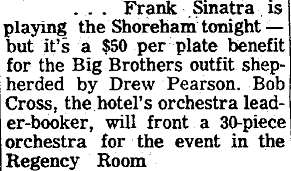
Washington, DC
Big Brothers Dinner Honoring Drew Pearson
© 1997-2026 The Sinatra Archive
This calendar, or any parts thereof, may not be reproduced in any fashion whatsoever without the prior written permission of the publisher (The Sinatra Archive)
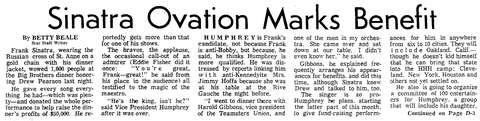
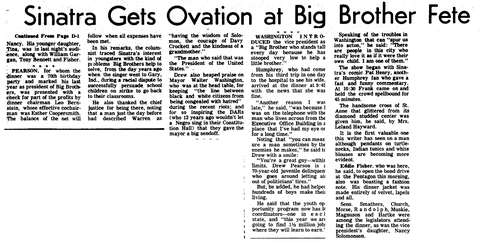
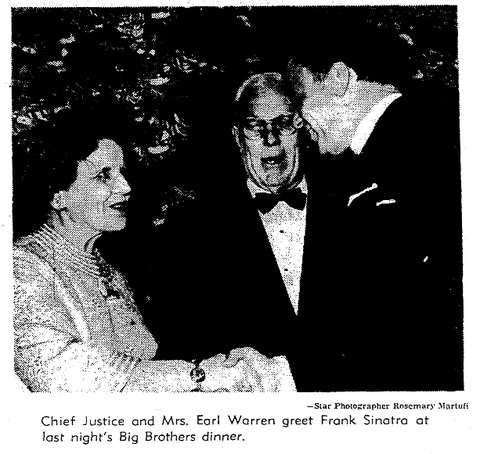
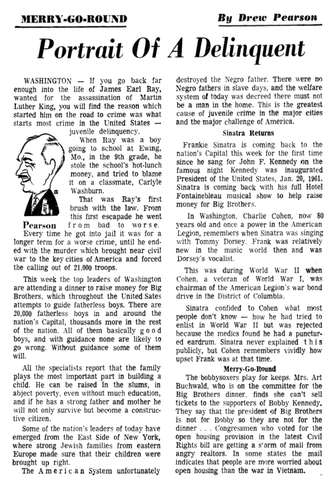

Washington, DC
Big Brothers Dinner Honoring Drew Pearson
© 1997-2026 The Sinatra Archive
This calendar, or any parts thereof, may not be reproduced in any fashion
whatsoever without the prior written permission of the publisher (The
Sinatra Archive)
[Sinatra's Shoreham benefit concert]
Betty Beale / Hubert Humphrey: Sinatra gave a Big Brothers of America benefit concert at the Shoreham Hotel in Washington, wowing 1,600 attendees and raising $50,000. Vice President Humphrey, watching, exclaimed, 'He's the king, isn't he?' Columnist Betty Beale gushed over his diamond cross, a gift from Mrs. Leland Hayward.
Source: James Kaplan, "Sinatra: The Chairman" (2015).
[Sinatra offers help with DC unrest]
Frank Sinatra: At the Shoreham dinner, Sinatra told DC Mayor Walter Washington that during the Poor People's Campaign march he would come back on short notice to help keep the peace if needed. He also told Betty Beale he planned to headline Humphrey fundraisers in six to ten cities and organize a hundred-entertainer committee for the candidate.
Source: James Kaplan, "Sinatra: The Chairman" (2015).
[Awkward White House visit with LBJ]
After midnight, Humphrey, Pearson, and Sinatra arrived uninvited in the Lincoln Bedroom, finding Lady Bird Johnson in bed and the president being massaged. LBJ ignored Sinatra, then handed him a White House souvenir booklet ('I don't suppose you read, but this has lots of pictures') and a lipstick souvenir ('It'll make a big man of you with your women'). Sinatra left without a word.
Source: James Kaplan, "Sinatra: The Chairman" (2015).
Frank flies to Washington, D.C. to attend a party for Vice President Hubert Humphrey hosted by columnist Drew Pearson in Georgetown, accompanied by Allen Dorfman, an associate of Jimmy Hoffa's; afterward he has dinner with Mrs. Jimmy Hoffa and Teamsters vice president Harold Gibbons. A Washington Post reporter began asking whether the relationship among Dorfman, Sinatra, and Humphrey involved a possible pardon for Hoffa in exchange for Sinatra's endorsement. Source: J. Randy Taraborrelli, Sinatra: Behind the Legend.
Emmy Awards
Sunday Evening
NBC
10:00 P.M. - 11:30 P.M.
Host: Frank Sinatra ( Hollywood)
Host: Dick Van Dyke ( New York City) note: show ran to midnight.
NOTE: Ed O'Brien reports that Sinatra was the host in Los Angeles and Dick
Van Dyke did the honors in New York. This bicoastal event had Sinatra open the show singing "Luck Be a Lady" while he walked from table to table nodding to the celebrities in attendance. He did a comedy routine with Dan Rickles, who savaged Dick Haymes. Sinatra was set to close with "That's Life" but he passed and said a quick goodnight.
Following O'Brien mention of Dick Haymes, Sinatraphile Vance Adair said he hated how Haymes career tanked and never really came back. He was a talent. Adair loves his two Capitol albums. They're masterpieces and were recently released on EMI. His career took a nosedive about the same time Sinatra's did, but Haymes never made it back. He appeared on Johnny Carson late in his life and made two excellent albums in the later 70's. His singing was still superb then. He died in 1980.
Emmy Awards
Sunday Evening
NBC
10:00 P.M. - 11:30 P.M.
Host: Frank Sinatra ( Hollywood)
Host: Dick Van Dyke ( New York City) note: show ran to midnight.
Emacs!
Get Smart,' 'Mission: Impossible' among Emmy winners 50 years a
Emacs!
Emacs!
Emacs!
Emacs!
Oakland Coliseum, California
Hubert Humphrey Fund Raiser
1. Day In, Day Out
2. I Get A Kick Out Of You
3. Moonlight In Vermont
4. The Lady Is A Tramp
5. I Have Dreamed
6. I've Got You Under My Skin
7. That's Life
8. Ol' Man River
9. All I Need Is The Girl
10. This Is All I Ask
11. I've Got The World On A String
12. Willow Weep For Me
13. Goin' Out Of My Head
14. Nancy
15. Fly Me To The Moon
16. It Was A Very Good Year
17. My Kind Of Town
Note: Arguably, he emphasizes, this is the best of Sinatra concerts ever to circulate among collectors.
As Frank Foster used to say, "He was in the pocket" and was he ever! Sensational singing on song after song. Best "Moonlight in Vermont" ever. "All I Need is a Girl" is better than the recording with Ellington. Although this recording has never been released commercially, it is a professional recording. One can hope that someday it will be issued.
Ed O'Brien:
This is the concert I would want on that proverbial desert island. By 1968 Sinatra had become The concert performer in the world of pop music. He so commanded a stage and on this particular night his singing was as good as it gets. What a missed opportunity when this beauty was not given a commercial release.
Ed O'Brien (2013)
Forty-five years ago this evening, Sinatra gave this magnificent performance at the Oakland Coliseum. I never tire of singing the praises of this incredible show. By 1968 Frank had become the consummate in-person performer and his singing on 5-22-68 is as good as it is ever going get. What a treasure for any Sinatra collector to have.
Oakland Coliseum, California
Hubert Humphrey Fund Raiser
1. Day In, Day Out
2. I Get A Kick Out Of You
3. Moonlight In Vermont
4. The Lady Is A Tramp
5. I Have Dreamed
6. I've Got You Under My Skin
7. That's Life
8. Ol' Man River
9. All I Need Is The Girl
10. This Is All I Ask
11. I've Got The World On A String
12. Willow Weep For Me
13. Goin' Out Of My Head
14. Nancy
15. Fly Me To The Moon
16. It Was A Very Good Year
17. My Kind Of Town
note: A great concert that only drew 7,918 and raised $128,500.
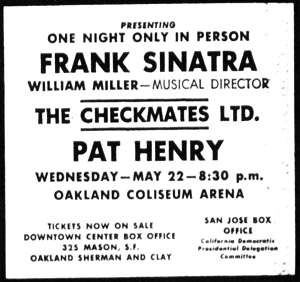
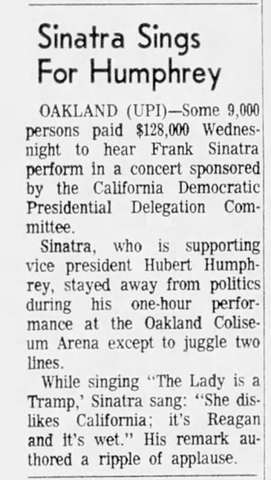
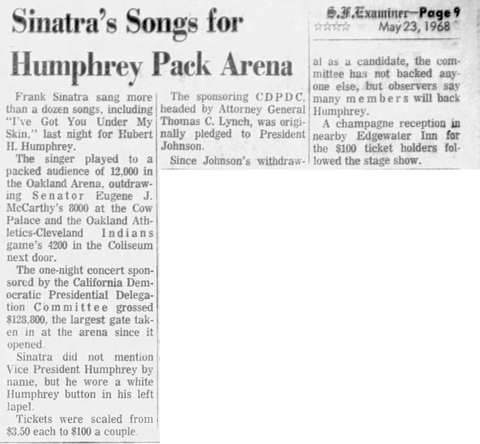
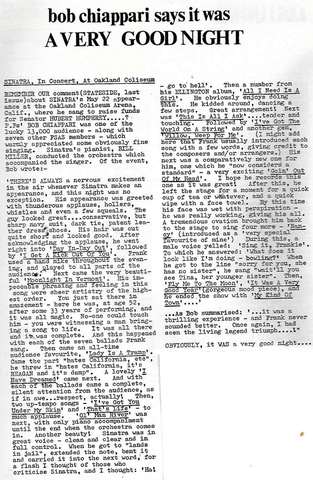
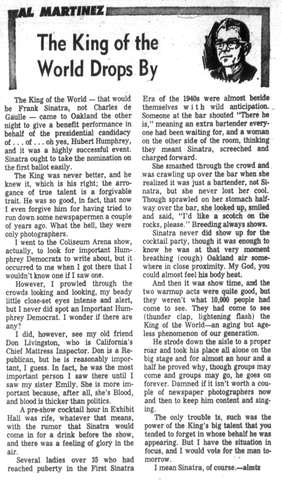
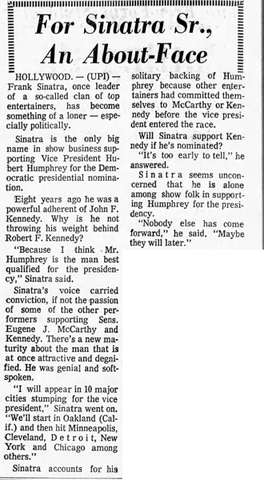
Oakland Coliseum, California
Hubert Humphrey Fund Raiser
[Sinatra's Oakland benefit for Humphrey]
Al Martinez: Sinatra gave a benefit concert for Humphrey in Oakland; local columnist Al Martinez dubbed him 'The King of the World' and joked Sinatra could win the Democratic nomination more easily than Humphrey.
Source: James Kaplan, "Sinatra: The Chairman" (2015).
"The Detective" (USA Release: May 28, 1968)
Starring: Frank Sinatra, ,Lee Remick, Jacqueline Bisset, Ralph Meeker, Jack Klugman, Horace McMahon, Lloyd Bochner, William Windom, Tony Musante, Al Freeman, Jr
Produced by: Aaron Rosenberg
Directed by: Gordon Douglas
Based on the book by Roderick Thorp
Police detective Joe Leland investigates the murder of a gay man. While investigating, he discovers links to official corruption in New York City in this drama that delves into a world of sex and drugs. (DVD Release date: 2005-05-24 -- Blu-Ray Release: 2015-12-08)
Note: The Detective was also issued on Beta, VHS, Laserdisc, as well as excerpts on Super 8mm.
Note: Frank's only film to receive an X rating.
--Ed
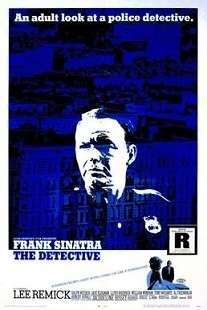
[The Cinematic Legacy of Frank Sinatra — The Detective (1968)]
David Wills's 2015 photo history The Cinematic Legacy of Frank Sinatra devotes a section to The Detective (1968), illustrated with 4 behind-the-scenes and publicity photographs (posters, lobby cards, and on-set/on-location shots) filed here.
Source: David Wills, The Cinematic Legacy of Frank Sinatra (St. Martin's Press, 2015), pp. 262–266.
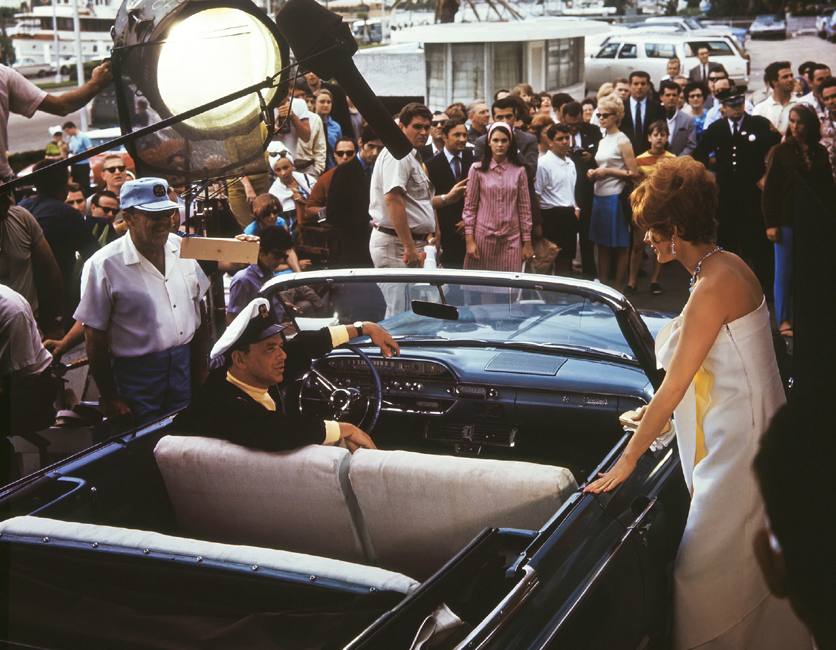
On location in Miami, with director Gordon Douglas and costar Jill St. John, Tony Rome. / “Sinatra is always an interesting / actor … and in The Detective he / has mellowed into a genuinely / convincing cop. He is weary and / wise and tough and cynical in the / way Bogart used to be, and (Photo: The Cinematic Legacy of Frank Sinatra, David Wills, 2015.)
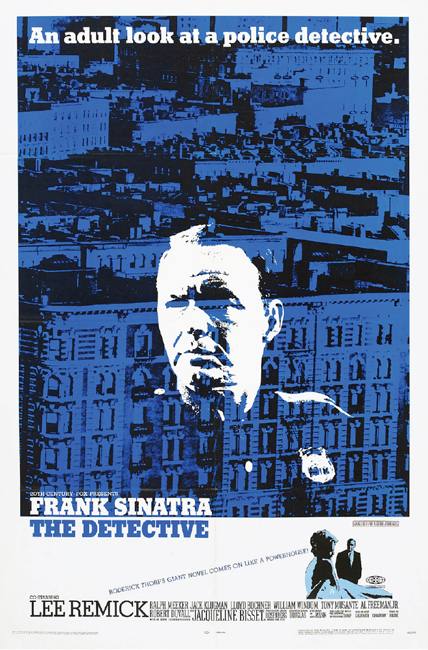
One sheet poster, The Detective, 1968. (Photo: The Cinematic Legacy of Frank Sinatra, David Wills, 2015.)
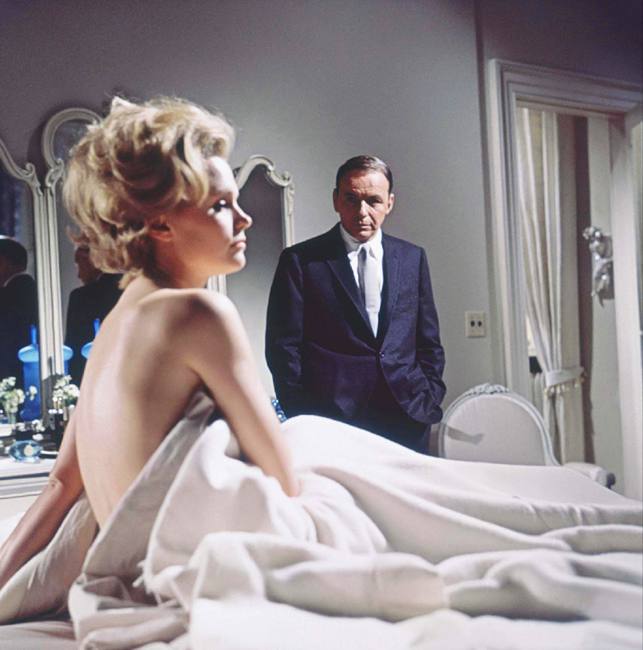
With costar Lee Remick (Photo: The Cinematic Legacy of Frank Sinatra, David Wills, 2015.)
The Detective. Lobby Cards. (Photo: The Cinematic Legacy of Frank Sinatra, David Wills, 2015.)
"The Detective" (USA Release: May 28, 1968)
Starring: Frank Sinatra, ,Lee Remick, Jacqueline Bisset, Ralph Meeker, Jack Klugman, Horace McMahon, Lloyd Bochner, William Windom, Tony Musante, Al Freeman, Jr
Produced by: Aaron Rosenberg
Directed by: Gordon Douglas
Based on the book by Roderick Thorp
Police detective Joe Leland investigates the murder of a gay man. While investigating, he discovers links to official corruption in New York City in this drama that delves into a world of sex and drugs. (DVD Release date: 2005-05-24 -- Blu-Ray Release: 2015-12-08)
Production 10-16 to 12-11-1967
HISTORY
The film rights to Roderick Thorp's 1966 novel, The Detective, were sold to independent producer and former actor Robert Evans, who intimated that he might himself "tackle the controversial role"ť of New York Police Department Detective Sergeant "Joe Leland,"ť the 1 Jun 1966 Var announced. Nearly five months later, however, the book's option was picked up by producer Fred Kohlmar and director Mark Robson for Twentieth Century-Fox Film Corp., according to the 28 Oct 1966 DV.. Abby Mann was writing the screenplay, a starting date was set for the following summer, and Frank Sinatra was signed to play Leland. By the following year, the 22 May 1967 DV and 24 May 1967 Var broke the news that producer Aaron Rosenberg had taken over the project from Kohlmar, and Gordon Douglas would replace Robson as director if prior commitments could be rescheduled. Sinatra and Robson, who had previously worked together, reportedly did not see "eye-to-eye."ť The Rosenberg-Douglas-Sinatra team had recently finished Twentieth Century-Fox's private eye caper, Tony Rome (1967, see entry), with Sinatra in the title role, and were planning to shoot its sequel, The Lady in Cement (1968, see entry), as soon as they finished The Detective. By then, as noted in the 26 Apr 1967 Var, The Detective was a hot property because Roderick Thorp's hardcover novel had sold 300,000 copies and Avon Books had just printed a first run of 800,000 paperbacks. Twentieth Century-Fox signed Frank Sinatra's wife, Mia Farrow, to co-star with him and Lee Remick in The Detective as soon as she finished her role in Paramount Pictures' Rosemary's Baby (1968, see entry), which was set to begin shooting 21 Aug, according to the 15 Aug 1967 DV. Meanwhile, as reported in the 30 Aug 1967 Var, Rosenberg and Douglas were going to scout New York City locations in preparation for six weeks of filming there in Oct and Nov 1967, followed by four weeks of shooting interiors at Twentieth Century-Fox Studios in Los Angeles, CA. Abby Mann, known for writing socially conscious films such as Judgment at Nuremberg (1961, see entry), told the 29 Nov 1967 Var that as part of his deal, he would be on the set every day to revise or create new dialogue if needed. He added that his screenplay "differs sharply from the original novel."ť Changing private eye Joe Leland to a police detective, Mann said, gave him "the opportunity to make several statements about the police and about society that were not in the novel."ť Mann warned the 24 Sep 1967 LAT that the film had "shocking scenes in it, things that have never been seen in a film, things that have never been shown in a film before."ť The 18 Oct 1967 Var announced that principal photography had begun two days earlier in New York City. That day's NYT visited a location on East Sixty-Seventh Street, between Lexington and Third Avenue, where Joe Leland's precinct headquarters were located in an old New York Police Department (NYPD) station house. In the scene, which required a dozen takes, Frank Sinatra escorted a "homosexual murderer"ť through a mob of reporters to a waiting car. "Of course, we're just shooting little bits of dialogue at a time,"ť he told a real reporter. "It'd be different trying to do a big dramatic scene. You couldn't do Hamlet [on the street]."ť The article indicated that Hollywood restaurateur "Prince"ť Mike Romanoff, who was in the crowd, was the film's "assistant producer."ť Aaron Rosenberg mentioned that the company would be in New York for six weeks, spending $1.4 million of the film's $5.5-million budget there. Within a month, the 22 Nov 1967 Var reported that Rosenberg needed to shut down the picture at the end of the month until Mia Farrow finished Rosemary's Baby. The 6 Nov 1967 LAT had already run an item on Sinatra losing his patience over his wife's absence. The Detective was twelve days ahead of schedule, while director Roman Polanski's Rosemary's Baby was three weeks behind. Sinatra pressured his wife to "walk off the lot,"ť but she had no "stop date"ť in her Paramount contract and could legally be detained as long as necessary. Rosenberg had already finished shooting in New York and was currently completing all scenes without Farrow in Los Angeles. The news broke in the 23 Nov 1967 LAT that Frank Sinatra and Mia Farrow had agreed to "a trial separation."ť A week later, the 30 Nov 1967 NYT announced Farrow's replacement in The Detective by English actress Jacqueline Bisset. The 11 Dec 1967 DV announced that filming had ended the previous Friday, 8 Dec 1967, except for a day's work by actor William Windom the following Monday. The Detective had its premiere in New York on 28 May 1968 and opened around the city the following day, according to a review in the 29 May 1968 NYT. Six weeks later, the 20 Jun 1968 LAT noted that The Detective would open in Hollywood, CA, on 26 Jun 1968. The NYT was unimpressed with Gordon Douglas's "weak, unimaginative direction"ť and the film's mix of "the real and the fake."ť The 26 Jun 1968 LAT considered The Detective nothing more than a "tasteless"ť sequel to Tony Rome, the only difference being that it was filmed in New York instead of Miami, FL, with boxer Sugar Ray Robinson replacing boxer Rocky Graziano from the earlier movie. The 29 May 1968 Var mostly praised the film as being commercially "hot,"ť but criticized Abby Mann's "sprawling, untidy, badly-structured"ť script, especially the twenty-four minutes of flashbacks in which Sinatra's character relived his "unstable married life."ť
AFI REPORT
Die Hard's John McClane role had to be offered to 70-year-old Frank Sinatra Ian Sandwell
23 December 2021
Die Hard made a movie star of Bruce Willis and introduced the world to John McClane, who, despite some dodgy later sequels, remains an iconic action hero.
However, as you settle into your festive rewatch of Die Hard (it is a Christmas movie, don't @ us), you might not be aware that the producers originally had to offer the role to Frank Sinatra, who was then 70 years old.
Sinatra turned down the role of John McClane of course, and in reality he was never going to star in Die Hard, but the producers were contractually obliged to offer Ol' Blue Eyes the role after he had starred in Die Hard's 'prequel', The Detective.
Let's rewind a bit. In case you weren't already aware, Die Hard is based on Roderick Thorp's novel Nothing Lasts Forever, which sees retired detective Joe Leland take on some terrorists in the headquarters of the Klaxon Oil Corporation on Christmas Eve.
The movie version obviously made some changes (including removing the bleak ending where Leland's daughter falls to her death), but the structure remains the same and there are nods to the original novel, such as Holly's maiden name Gennaro.
Nothing Lasts Forever was the sequel to Thorp's 1966 novel The Detective which was also adapted as a movie of the same name. The movie saw Sinatra play Joe Leland as the detective investigating a supposed suicide.
The Detective was one of the biggest box-office hits of Sinatra's movie career and became one of the highest-grossing movies of 1968.
While Die Hard wasn't a direct sequel to The Detective and the character name differed, the role of John McClane had to be offered to Sinatra anyway because it was a (loose) adaptation of The Detective's sequel novel.
Sinatra declined the role, but it's not like the producers then went straight to Bruce Willis. At the time, he was largely known for his role on TV comedy Moonlighting and not as a movie star.
The role of John McClane was offered to a variety of names, including Arnold Schwarzenegger (who turned it down because he wanted to get into comedy), Sylvester Stallone, Clint Eastwood, Mel Gibson, James Caan, Richard Gere and more.
When it did get offered to Willis, even he turned it down first time around because of his obligation to Moonlighting. However, his co-star Cybill Shepherd became pregnant and the show took a break from filming, freeing up Willis for the Die Hard role.
And the rest, as they say, is history. Ho ho ho.
MAY 28, 1968: Premiere of movie "The Detective" staring Frank Sinatra and co-star Jacqueline Bisset arrive at Forum Theatre on Broadway and 47th Street.
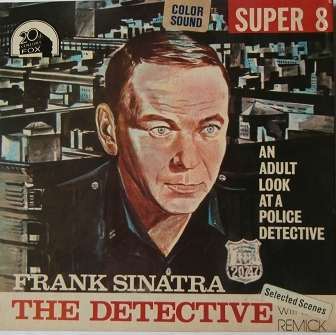
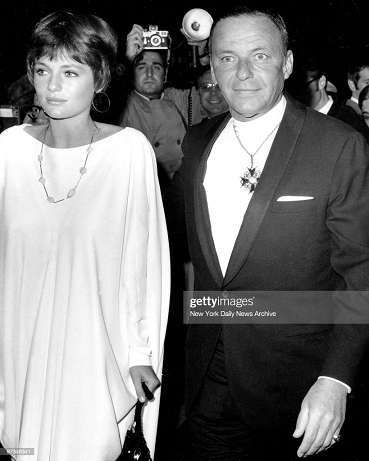
"Rosemary's Baby" / "The Detective"
Sinatra's marriage to Mia Farrow never recovered after Farrow chose to honor her contractual commitment to finish shooting Rosemary's Baby rather than comply with Sinatra's demand that she leave the production to join him for the filming of The Detective.
Source: Tom Santopietro, "Sinatra in Hollywood" (2008).
"The Detective"
The Detective (1968, Fox), based on Roderick Thorp's novel, had a rocky preproduction: the rights were originally held by producer Robert Evans, and Mia Farrow (then Mrs. Sinatra) was initially cast as Norma Maclver.
Source: Tom Santopietro, "Sinatra in Hollywood" (2008).
"The Detective" / "Rosemary's Baby"
Tina Sinatra: Farrow's role in The Detective fell through because her prior film, Roman Polanski's Rosemary's Baby, ran behind schedule and overlapped with The Detective's start date. When Farrow would not leave the Polanski film at Sinatra's demand, she was dropped from The Detective. Daughter Tina Sinatra said Frank felt an obligation to the studio and was 'professionally embarrassed in front of his crew.'
Source: Tom Santopietro, "Sinatra in Hollywood" (2008).
"The Detective"
After Farrow's departure, Jacqueline Bisset was cast as Norma Maclver in The Detective, in what Santopietro calls a rather perfunctory performance.
Source: Tom Santopietro, "Sinatra in Hollywood" (2008).
"The Detective"
The Detective reteamed Sinatra with producer Aaron Rosenberg and director Gordon Douglas, with a bluesy score by Jerry Goldsmith. Sinatra plays police Sergeant Joe Leland investigating the grisly murder of a wealthy businessman's gay son -- far grimmer material than Tony Rome.
Source: Tom Santopietro, "Sinatra in Hollywood" (2008).
"The Detective"
Frank Sinatra: Sinatra said he prepared for the role of Sergeant Leland by talking with veteran NYPD detective Johnny Broderick about his idiosyncrasies, trying to fold in small authentic details while keeping 'a little tenderness' in the character.
Source: Tom Santopietro, "Sinatra in Hollywood" (2008).
"The Detective"
Santopietro highlights The Detective as surprisingly sympathetic toward gay characters for a major 1968 Hollywood film -- Leland responds to a doctor's disgust with 'I've got my own bag' -- even though he notes the film's gay characters are still ultimately depicted as killers or hysterics.
Source: Tom Santopietro, "Sinatra in Hollywood" (2008).
"The Detective"
Lee Remick played Leland's wife Karen, portrayed via flashback as alternately warm and distant; a memorable exchange has her ask why he's so tough, and he snaps back, 'I am tough.'
Source: Tom Santopietro, "Sinatra in Hollywood" (2008).
"The Detective"
Santopietro faults Tony Musante's performance as murder suspect Felix Tesla for overdoing the hysteria in his confession scene, and blames director Gordon Douglas for failing to rein him in -- calling it the film's first real misstep.
Source: Tom Santopietro, "Sinatra in Hollywood" (2008).
"The Detective"
A notably showy directorial choice in The Detective: director Gordon Douglas frames Tesla's electrocution by intercutting images of his electrocuted body on either side of Leland's face -- an unusually heavy-handed touch for the normally restrained Douglas.
Source: Tom Santopietro, "Sinatra in Hollywood" (2008).
"The Detective"
The Detective performed well at the box office and Sinatra's performance was praised, but critics generally felt the film buckled under its own self-consciously 'serious' ambitions, cramming in too many taboo topics (murder, homosexuality, nymphomania) at once.
Source: Tom Santopietro, "Sinatra in Hollywood" (2008).
"The Detective"
Santopietro grades this a B, calling it tough but overly ambitious.
Source: Tom Santopietro, "Sinatra in Hollywood" (2008).
"The Detective"
Santopietro (Filmography): Arcola-Millfield/Twentieth Century-Fox. Produced by Aaron Rosenberg, directed by Gordon Douglas, screenplay by Abby Mann based on the Roderick Thorp novel, musical score by Jerry Goldsmith. Sinatra played Sergeant Joe Leland opposite Lee Remick, Jacqueline Bisset and Robert Duvall, with boxer Sugar Ray Robinson in the cast.
Source: Tom Santopietro, "Sinatra in Hollywood" (2008).
[Ava Gardner's hysterectomy]
Ava Gardner: Ava Gardner, then 45 and haunted by her mother's death from uterine cancer, underwent a hysterectomy at St. Joseph's Hospital in Burbank after a fibroid tumor was detected. She recuperated at her sister Bappie's house and recalled watching Robert Kennedy's assassination on TV from her sickbed, followed by vertigo and a deep depression.
Source: James Kaplan, "Sinatra: The Chairman" (2015)
[Rosemary's Baby becomes #1 film]
Kaplan: Rosemary's Baby opened about ten days after The Detective and quickly became the number one picture in the country, making Mia Farrow a star in her own right -- her box-office triumph over Frank felt like the final blow to their marriage.
Source: James Kaplan, "Sinatra: The Chairman" (2015)
[Sinatra family unites behind Humphrey]
Nancy Sinatra: Nancy Sinatra recalled her father being quiet for a while after RFK's assassination. She then joined him in supporting Hubert Humphrey; Frank told her he believed Humphrey was a decent man who cared about people others ignored.
Source: James Kaplan, "Sinatra: The Chairman" (2015)
[The Detective opens to mixed reviews]
Vincent Canby: The Detective opened nationwide to mixed reviews. Vincent Canby of the New York Times panned the film's direction and called Sinatra's performance waxy and blank, dismissing his toupee even while conceding it was 'the best money can buy.'
Source: James Kaplan, "Sinatra: The Chairman" (2015).
[RFK wins primary, then assassinated]
Robert Kennedy won the California and South Dakota primaries on June 4, but shortly after midnight, after addressing supporters at the Ambassador Hotel in Los Angeles, he was shot as he walked through the hotel kitchen.
Source: James Kaplan, "Sinatra: The Chairman" (2015).
[Sinatra reacts to RFK shooting at Jilly's]
Ken Roberts: Sinatra was drinking at Jilly's in Manhattan with concert promoter Ken Roberts when a hat-check girl reported Kennedy had been shot. Thinking she was joking, Sinatra callously said, 'I hope they shot him in the fuckin' head.' When confirmed, he turned white, panicked that he himself might be a target while performing.
Source: James Kaplan, "Sinatra: The Chairman" (2015).
Robert F. Kennedy is shot at the Ambassador Hotel in Los Angeles while celebrating primary victories; he dies the next day. Frank, who had grown close to RFK after his help during the 1963 kidnapping of Frank Sinatra Jr., was hit hard by the death, which also revived the grief he still felt over JFK's assassination. Source: J. Randy Taraborrelli, Sinatra: Behind the Legend.
With his divorce from Mia Farrow still pending and unresolved, Frank asks longtime valet George Jacobs to look after Ava Gardner during a short visit to Los Angeles. While waiting for her at a Beverly Hills nightclub, the Candy Store, Jacobs is seen dancing with Mia, who was there with musician John Phillips; gossip columnist Rona Barrett reported the sighting on the air about a week later. Though Jacobs had worked for Frank without incident for fifteen years, Frank had the locks changed and had Mickey Rudin deliver a letter of dismissal to Jacobs's home before noon the same day the report aired, terminating him with no severance. Source: J. Randy Taraborrelli, Sinatra: Behind the Legend.
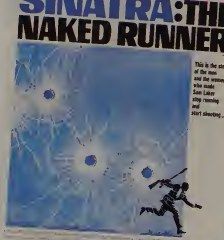
[Photograph: Frank tours fundraisers for Hubert Humphrey. From Richard Havers, "Sinatra" (Dorling Kindersley, 2007), p.307.]
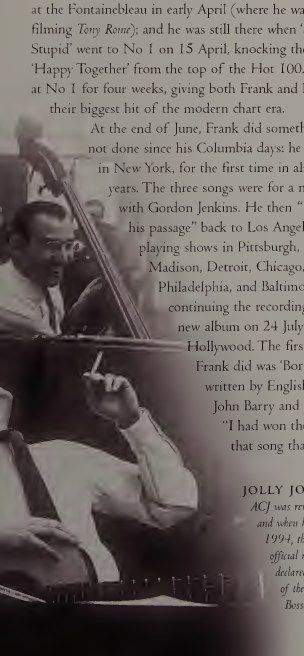
[Photograph: Frank tours fundraisers for Hubert Humphrey. From Richard Havers, "Sinatra" (Dorling Kindersley, 2007), p.307.]
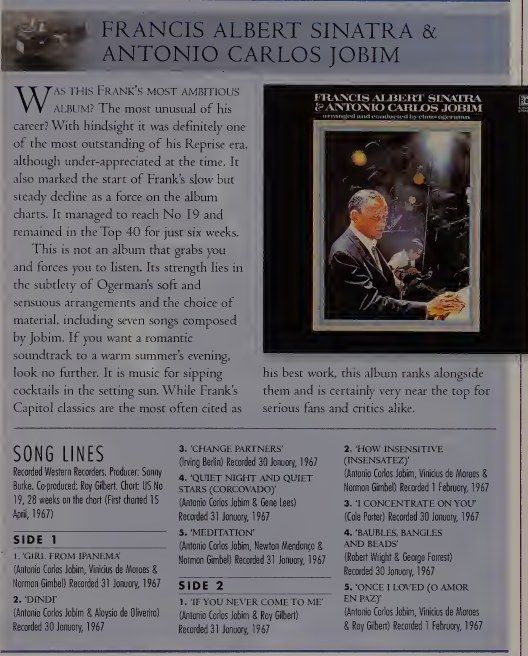
[Photograph: Frank tours fundraisers for Hubert Humphrey. From Richard Havers, "Sinatra" (Dorling Kindersley, 2007), p.307.]
In the wake of Bobby Kennedy's assassination, Frank continued campaigning for Humphrey with fundraisers in Cleveland, Minneapolis, Baltimore, Detroit, and Philadelphia. (Source: Richard Havers, "Sinatra" (Dorling Kindersley, 2007).)
Public Hall, Cleveland, OH
Sinatra, Frank Valli and The Four Seasons, Pat Henry songs included:
--Goin' Out of My Head Over You
--I've Got You Under My Skin
--That's Life
--Willow Weep For Me
--Fly Me To The Moon
Public Hall, Cleveland, OH
Sinatra, Frank Valli and The Four Seasons, Pat Henry
© 1997-2026 The Sinatra Archive
This calendar, or any parts thereof, may not be reproduced in any fashion
whatsoever without the prior written permission of the publisher (The
Sinatra Archive)
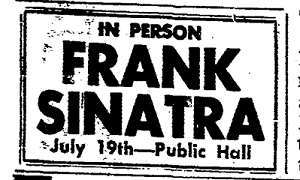
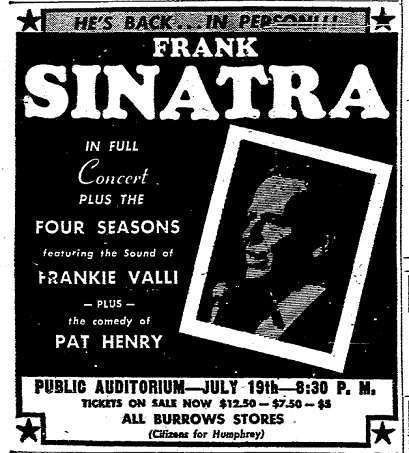
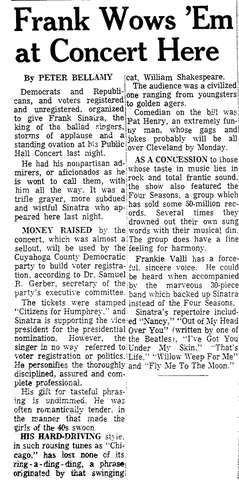
Public Hall, Cleveland, OH
Sinatra, Frank Valli and The Four Seasons, Pat Henry
© 1997-2026 The Sinatra Archive
This calendar, or any parts thereof, may not be reproduced in any fashion
whatsoever without the prior written permission of the publisher (The
Sinatra Archive)
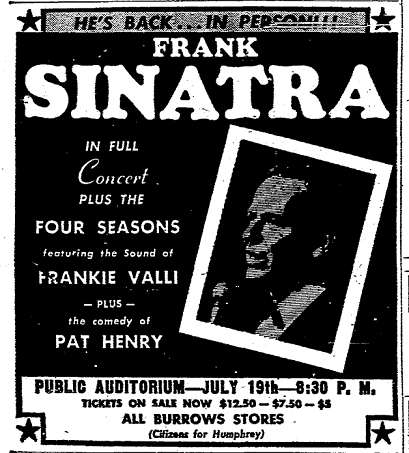
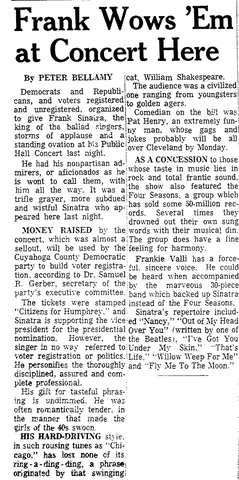
New York City
L5401 My Way Of Life
(Bert Kaempfert/Herb Rehbein/Carl Sigman)
EMI Screen Gems Music Inc. (BMI)
Arranged & Conducted by Don Costa
(3:06) CD: 46013-2 The Complete Reprise Studio Recordings Disc 12
CD: 1027-2Cycles
LP: FS1027Cycles
45: 0764
L5402 Cycles w/Chorus
(Judith Caldwell)
Irving Music Inc. (BMI)
Arranged & Conducted by Don Costa
(3:10) CD: 46013-2 The Complete Reprise Studio Recordings Disc 12
CD: 1027-2Cycles
CD: 2275-2Frank Sinatra's Greatest Hit's Vol.2
LP: FS1034Frank Sinatra's Greatest Hits Vol.3
LP: FS1027Cycles
45: 0764
L5403 Whatever Happened To Christmas? w/Chorus
(Jimmy Webb)
Audio Arts Publishing Co./kayTeeKay Music Inc. (ASCAP)
Arranged & Conducted by Don Costa
(3:03) CD: 46013-2 The Complete Reprise Studio Recordings Disc 12
LP: FS1026The Sinatra Family Wish You A Merry Christmas
45: 0790
NOTE: Ed O'Brien reports that Sinatra devoted two and a half hours recording "My Way of Life." Musicians at the sessions told O'Brien that Sinatra almost busted a gut trying to get it right in take after take.
"Cycles,' however, took only twenty minutes and two takes. The latter was the hit record. Go figure!
Nick Perito conducted some of the session and also played accordion on one track. Teddy Randazzo told O'Brien that he wrote the arrangements for "Cycles." Jonathan Schwartz remembers meeting one of the sidemen a few days after the session. He told Schwartz that Sinatra laid down a bluesy Christmas song.
Danny Faux:
Did Randazzo told you that he wrote the arrangements for "Cycles"?. I've thought for many years that Don Costa had written a rather " busy" chart for the song, and Nancy, who was in the studio, helped out in stripping down the orchestration to an almost bare minimum. I also read that Lee Hazlewood was involved at some point. Could you please bring some light regarding what really happened and who was really the arranger of the song?. A song I´ve always loved from the moment I got the white label, promo single back in´68.
Ed O'Brien:
Hi Danny,
He told me the song was originally conceived as an a la Jimi Hendrick via Sinatra. Nancy and Costa did not think it would work. As the session progressed, Costa and Randazzo tried different ideas. Finally, according to Teddy, the C&W chart was written by him. Costa received credit for it. Randazzo didn't mind. He was very close to Don and was happy to help. He was also at the sessions for "Sinatra & Strings." Costa agonized over how to write charts for "Stardust" and "Come Rain Or Come Shine." Teddy told me he urged Don to write a sweeping chart for the Carmichael classic. Don came up with the driving chart for "Shine." "Cycles" was a surprise hit. I also like, just as much if not more, "Wandering" by the same composer, Gayle Caldwell. Frank certainly liked it better than "My Way," but he was still uneasy about singing such songs. During the May 75 London concerts, he told his audience it was a little country but not much. At Caesars, in 68, Sinatra mentioned that it was never the type of song he thought of singing.. But here he was singing it. Not exactly a ringing endorsement either time. And it charted better than "My Way."
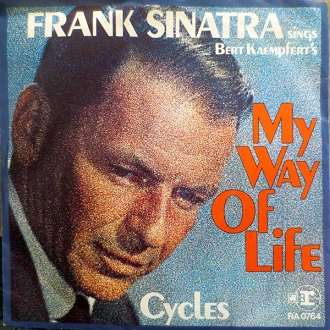
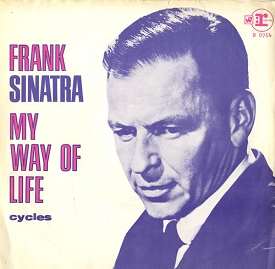
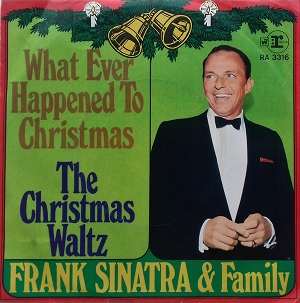
"Whatever Happened to Christmas"
Granata includes 'Whatever Happened to Christmas' among the fifty recordings he considers essential to understanding Sinatra's artistry (arranged by Don Costa, recorded 1968, Reprise); the song was chosen for its musical/interpretive value rather than commercial popularity.
Source: Charles L. Granata, "Sessions with Sinatra: Frank Sinatra and the Art of Recording" (1999/2003).
[Sinatra records 'My Way of Life'/'Cycles']
Sinatra stepped into a New York recording studio for the first time in seven months, cutting the Don Costa-arranged Bert Kaempfert tune 'My Way of Life' as the A-side, and, as the B-side, his first folk-rock foray: 'Cycles,' written by former New Christy Minstrels singer Gayle Caldwell, arranged by Teddy Randazzo.
Source: James Kaplan, "Sinatra: The Chairman" (2015).
Frank embarks on a stumping concert tour for Hubert Humphrey's presidential campaign, performing in Cleveland, Baltimore, Minneapolis, Detroit, and Philadelphia. Around the same time, Wall Street Journal reporter Nicholas Gage published a scathing exposé again linking Sinatra to organized crime, prompting some Humphrey aides to urge distance from the entertainer; Humphrey would go on to lose narrowly to Richard Nixon that November. Source: J. Randy Taraborrelli, Sinatra: Behind the Legend.
In only his second New York session in nearly sixteen years, Frank recorded three Don Costa-arranged songs including the title track for his next album, 'Cycles,' and Jimmy Webb's 'Whatever Happened to Christmas?'. (Source: Richard Havers, "Sinatra" (Dorling Kindersley, 2007).)
Metropolitan Sports Center, Bloomington, Minnesota
Sinatra, Pat Henry, Frankie Valli & The Four Seasons
Metropolitan Sports Center, Bloomington, Minnesota
Sinatra, Pat Henry, Frankie Valli & The Four Seasons
[Manners reports on Mia's dating life]
Dorothy Manners: Columnist Dorothy Manners reported Mia Farrow was seeing both Peter Sellers and young realtor Sammy Hess, with the 'jolly threesome' spotted around town, including at a screening of Sellers's I Love You, Alice B. Toklas.
Source: James Kaplan, "Sinatra: The Chairman" (2015).
[Sinatra and Mia Farrow Divorce]
Sinatra's marriage to Mia Farrow ended in divorce in August 1968, amid the broader social upheavals of the decade.
Source: Charles Pignone, "Frank Sinatra 100" (2015).
[Humphrey distances himself after DOJ probe news]
Kaplan: Humphrey's special counsel Martin McNamara learned Sinatra was part of a new Justice Department investigation into ties between the entertainment industry and the Cosa Nostra, and wrote his own warning memo. Soon after, Humphrey stopped returning Frank's calls.
Source: James Kaplan, "Sinatra: The Chairman" (2015)
[Sinatra skips Democratic Convention]
Kaplan: Sinatra had been scheduled to emcee a luncheon for Muriel Humphrey and appear at a gala for Mayor Richard Daley at the Democratic National Convention in Chicago. On the Sunday before, he abruptly canceled, citing a nonexistent 'pressing recording commitment,' and instead stayed in California halfheartedly romancing 26-year-old actress Carol Lynley.
Source: James Kaplan, "Sinatra: The Chairman" (2015)
[Winchell reports on Ava's recovery, Sinatra's help]
Walter Winchell: Walter Winchell's column reported -- nearly two months late -- that Ava Gardner was recovering from major surgery, having been flown by Sinatra's private plane to St. Joseph's Hospital and then to his Palm Springs home to convalesce, with Frank reportedly covering her $8,000 hospital bill.
Source: James Kaplan, "Sinatra: The Chairman" (2015)
[personal life]
Sinatra and Farrow's Mexican divorce was finalized in August 1968. When asked what she wanted in the settlement, Farrow said only 'your respect and friendship.' The two remained close for the rest of Sinatra's life -- Farrow spoke with him or his daughters nearly daily late in his life, attended his funeral at Nancy Jr.'s request, and later named an adopted Vietnamese daughter Frankie Minh in his honor.
No corresponding dated entry could be identified in the chronology for this film/context.
Source: Tom Santopietro, "Sinatra in Hollywood" (2008), Knight-Errant (pt. 1)
Civic Center, Baltimore, MD
Hubert Humphrey Campaign Benefit
Orchestra Conducted By: Bill Miller
1. Day In, Day Out
2. I Get A Kick Out Of You
3. Moonlight In Vermont
4. The Lady Is A Tramp
5. I Have Dreamed
6. I've Got You Under My Skin
7. That's Life
8. Ol' Man River
9. All I Need Is The Girl
10. This Is All I Ask
11. I've Got The World On A String
12. Nancy
13. Willow Weep For Me
14. Goin' Out Of My Head
15. My Kind Of Town
Civic Center, Baltimore, MD
Hubert Humphrey Campaign Benefit
Orchestra Conducted By: Bill Miller
Cobo Hall, Detroit, Michigan
Humphry Fundraiser with/Trini Lopez and Pat Henry
1. Day In, Day Out
2. I Get a Kick Out of You
3. Moonlight in Vermont
4. The Lady Is a Tramp
5. I Have Dreamed
6. I've Got You Under My Skin
7. That's Life
8. Ol' Man River
9. All I Need Is the Girl
10. This Is All I Ask
11. I've Got the World on a String
12. Nancy (With the Laughing Face)
13. Willow Weep for Me
14. Goin' Out of My Head
15. My Kind of Town
Cobo Hall, Detroit, Michigan
Humphry Fundraiser
with/Trini Lopez and Pat Henry
The Spectrum, Philadelphia, Pennsylvania
Fund Raiser for Hubert Humphrey
Frank Sinatra w/Buddy Rich and his Orchestra
1. Day In, Day Out
2. I Get a Kick out of You
3. Moonlight in Vermont
4. The Lady is a Tramp
5. I Have Dreamed
6. I've Got You under my Skin
7. That's Life
8. Ol' Man River
9. Goin' Out of my Mind
10. This is All I Ask
11. I've Got the World on a String
12. Nancy
13. My Kind of Town
note: Sinatra also sang "Stay With Me" from "The
Cardinal."
Through the years I have heard many Sinatra fans
express a sense of wonder over Frank's performance
in Oakland on 5-22-68. There is no question he was
wonderful that night, but Frank is just as good in Philly
and Baltimore in early August.. That is not the case
at Caesars in Nov/Dec of that year. I think the two
shows nightly, in a smoked filled room, took its toll
on his voice. Just an observation.
Ed
The Spectrum, Philadelphia, Pennsylvania
Fund Raiser for Hubert Humphrey
Frank Sinatra w/Buddy Rich and his Orchestra
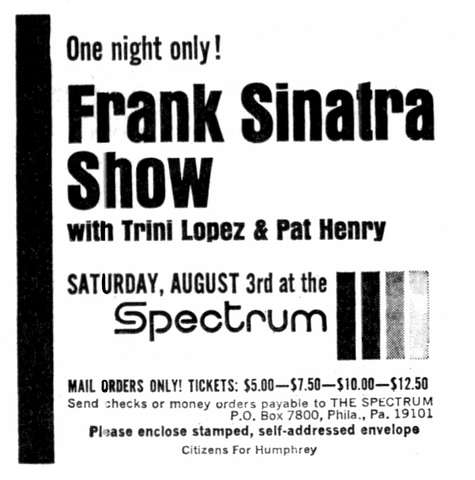
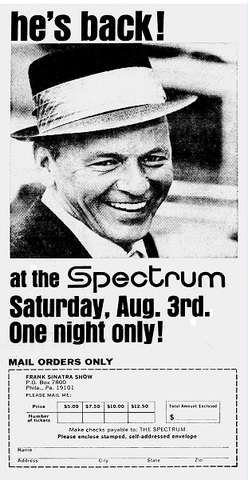
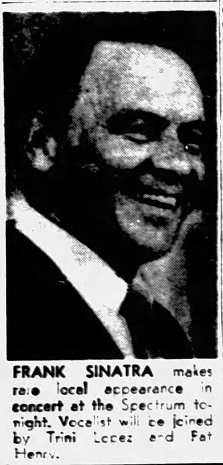
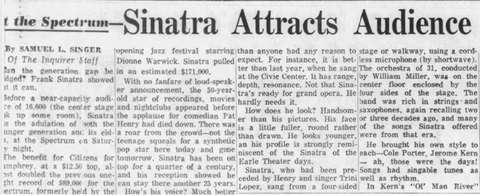
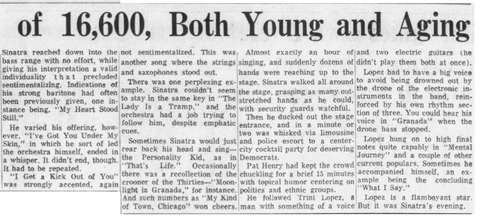
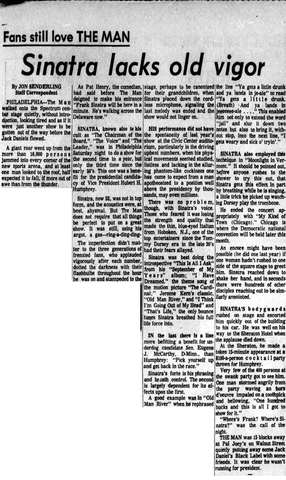
Hollywood
L6755 The Twelve Days Of Christmas w/Frank Jr, Nancy & Tina
(Traditional, adapted by Sammy Cahn and Jimmy Van Heusen) WB Music Corp./The Songwriters Guild (ASCAP)
Arranged & Conducted by Nelson Riddle
(4:27)Ă‚ CD: 46013-2 The Complete Reprise Studio Recordings Disc 12
LP: FS1026The Sinatra Family Wish You A Merry Christmas
L6756 The Bells Of Christmas(Greensleeves) w/Frank Jr, Nancy & Tina
(Traditional, adapted by Sammy Cahn and Jimmy Van Heusen) WB Music Corp./The Songwriters Guild (ASCAP)
Arranged & Conducted by Nelson Riddle
(3:39) CD: 46013-2 The Complete Reprise Studio Recordings Disc 12
LP: FS1026The Sinatra Family Wish You A Merry Christmas
L6757 I Wouldn't Trade Christmas w/Frank Jr, Nancy & Tina
(Sammy Cahn/Jimmy Van Heusen)
WB Music Corp./The Song Writers Guild (ASCAP)
Arranged & Conducted by Nelson Riddle
(2:51) CD: 46013-2 The Complete Reprise Studio Recordings Disc 12
LP: FS1026The Sinatra Family Wish You A Merry Christmas
45: 0790
L6758 The Christmas Waltz
(Sammy Cahn/Jule Styne)
WB Music Corp./Chappell & Co. Inc. (ASCAP)
Arranged & Conducted by Nelson Riddle
(3:10) CD: 46013-2 The Complete Reprise Studio Recordings Disc 12
LP: FS1026The Sinatra Family Wish You A Merry Christmas
Note: Jr. dubbed his vocals on August 19, 1968
NOTE: Ed O'Brien points out that this was an afternoon session with a
39-piece orchestra and the Jimmy Joyce Singers. O'Brien has interviewed six of the musicians on this session plus Nelson Riddle. Not many of them could recall any outstanding moments. "Christmas Waltz" was Sinatra's third-time around on the Styne-Cahn holiday tune. It would have been nice if Sinatra had opted to do "Winter Wonderland" or "Sleigh Ride" instead of a tune that had been done so well during the Capitol years.
Posing for the cover of their 1968 Christmas album, The Sinatra Family Wish You a Merry Christmas: (l-r) Tina, Frank, Nancy, and Frank Jr. Source: photo and caption from J. Randy Taraborrelli, Sinatra: Behind the Legend (mptvimages.com).
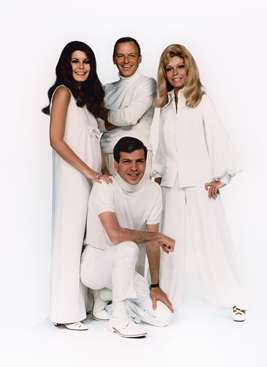
[Sinatra family Christmas album session]
Tina Sinatra: Frank made it to Los Angeles to join daughters Nancy and Tina in recording The Sinatra Family Wish You a Merry Christmas (Frank Jr. would dub in vocals later while touring county fairs). Nelson Riddle and Don Costa arranged; it marked Tina Sinatra's only recorded vocal, which she said she performed 'in a coma' with fear.
Source: James Kaplan, "Sinatra: The Chairman" (2015).
Sinatra does taping for "FRANCIS ALBERT SINATRA DOES HIS THING"
Baubles, Bangles and Beads
Frank taping "FRANCIS ALBERT SINATRA
DOES HIS THING" NBC BURBANK
AIRED ON CBS 11-25-68
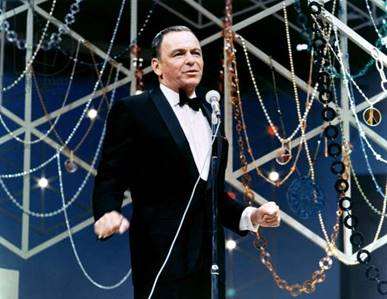
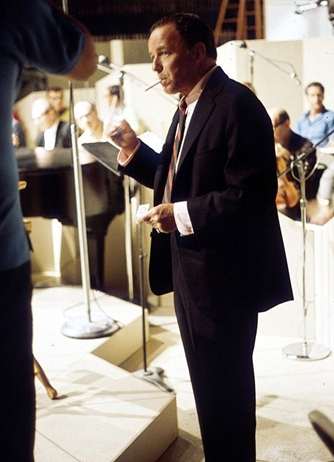
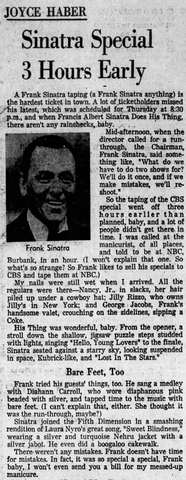
[Jacobs dances with Mia at the Daisy]
George Jacobs: The night before her divorce was finalized, valet George Jacobs ran into Mia Farrow -- accompanied by John Phillips of the Mamas and the Papas -- at the Daisy nightclub. She seemed high and insisted on dancing with him for what felt like an eternity while Phillips lingered in the men's room.
Source: James Kaplan, "Sinatra: The Chairman" (2015).
[Farrow finalizes Mexican divorce]
Vernon Scott (UPI): Mia Farrow flew with Mickey Rudin to Juarez, Mexico, and finalized her divorce from Sinatra before Judge Lorenzo Holguin Seniceros. She testified her life with Sinatra 'had been unbearable' and that they hadn't lived as husband and wife since December 1967; wire reports described her hands trembling as she signed.
Source: James Kaplan, "Sinatra: The Chairman" (2015).
[Sinatra learns of divorce during CBS taping]
Nancy Sinatra: While the divorce was finalized in Mexico, Frank was taping the TV special Francis Albert Sinatra Does His Thing at CBS Television City with Don Costa, Diahann Carroll, and the Fifth Dimension. Jilly Rizzo told him mid-taping that Rudin had called to confirm the divorce was complete; Sinatra opted to air the dress rehearsal rather than redo the performance, saying, 'Let's go with the dress. I can't do it again now.'
Source: James Kaplan, "Sinatra: The Chairman" (2015).
[Mia declines divorce settlement]
Mia Farrow refused any financial settlement from the divorce, leaving the Bel Air house with only the jewelry Frank had given her, their forty-eight-place silverware set, and her stuffed animals.
Source: James Kaplan, "Sinatra: The Chairman" (2015).
[Rona Barrett item leads to Jacobs's firing]
George Jacobs: The night of the divorce, gossip columnist Rona Barrett made an on-air insinuation about Mia's dance with George Jacobs at the Daisy. Furious, Sinatra locked himself in his room and had Mickey Rudin fire Jacobs after fourteen years of service, believing his valet had slept with his ex-wife.
Source: James Kaplan, "Sinatra: The Chairman" (2015).
Frank and Mia Farrow's divorce is finalized in Juarez, Mexico. Mia, accompanied by Mickey Rudin, made a brief court appearance; Frank did not attend. Source: J. Randy Taraborrelli, Sinatra: Behind the Legend.
[WSJ publishes Sinatra Mafia expose]
Nicholas Gage: The Wall Street Journal ran a front-page investigative story by Nicholas Gage detailing Sinatra's decades of friendships with organized-crime figures including Willie Moretti, Lucky Luciano, the Fischetti brothers, and Sam Giancana, and his forced exit from the casino and racetrack businesses. Publicist Jim Mahoney's rebuttal called the reports 'rumors and vicious, unnecessary attacks.'
Source: James Kaplan, "Sinatra: The Chairman" (2015).
[Gage links Sinatra to Gambino associate visit]
Nicholas Gage: The Journal piece also reported that the previous October, after speaking in New York for the American-Italian Anti-Defamation League, Sinatra had driven to Turnbull, Connecticut, to visit Dave Iacovetti, identified by police as a member of the Gambino crime family.
Source: James Kaplan, "Sinatra: The Chairman" (2015).
[McMillin column on Sinatra-Humphrey liability]
Miles McMillin: Columnist Miles McMillin wrote in the Madison Capital Times that Republicans were laying groundwork to attack Humphrey over Sinatra's role in his campaign, comparing Nixon's law-and-order rhetoric to 'Matt Dillon running against Billy the Kid.'
Source: James Kaplan, "Sinatra: The Chairman" (2015).
[Columnist previews The Godfather]
Jack O'Brian: Columnist Jack O'Brian wrote that Putnam would publish Mario Puzo's The Godfather, featuring 'an internationally known male singer as a prominent fictionalized character,' disparagingly comparing it to the earlier fictionalized Sinatra novel The King.
Source: James Kaplan, "Sinatra: The Chairman" (2015)
[Wiedrich reports on Sinatra's 'Klippinger' romance]
Robert Wiedrich: Chicago Tribune columnist Robert Wiedrich reported Sinatra's name being linked overseas to a 20-year-old Swedish blonde named Ingalill Klippinger, whom he supposedly met at a London gambling club.
Source: James Kaplan, "Sinatra: The Chairman" (2015).
[Jilly's West grand opening with McCue]
Diane McCue: Frank and Diane McCue arrived by stretch limo at the grand opening of Jilly's West in Palm Springs. McCue recalled a female star (later identified as Lucille Ball) whispering to David Janssen that she 'looks a little like Mia.'
Source: James Kaplan, "Sinatra: The Chairman" (2015).
[Orr covers Jilly's West opening]
Robin Orr: Oakland Tribune society columnist Robin Orr covered the Jilly's West opening, noting host Danny Schwartz (whose Lear jet Natilus was named for his wife) and roughly 400 attendees including Sinatra, Lucille Ball, her husband Gary Morton, and Jilly Rizzo.
Source: James Kaplan, "Sinatra: The Chairman" (2015).
[Sinatra's Teamsters benefit, St. Louis]
Sinatra performed a benefit concert for the Teamsters in St. Louis.
Source: James Kaplan, "Sinatra: The Chairman" (2015).
Fox Theater, St. Louis, Missouri
Teamster Charity Show
Sinatra, Dean Martin, Ella Fitzgerald, Nancy Sinatra, Trini Lopez, and others
!
© 1997-2025 The Sinatra Archive
This calendar, or any parts thereof, may not be reproduced in any fashion whatsoever without the prior written permission of the publisher (The Sinatra Archive)
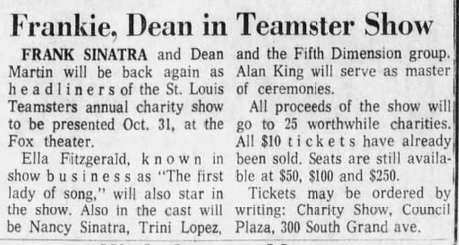
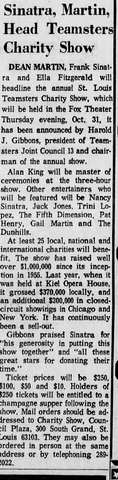
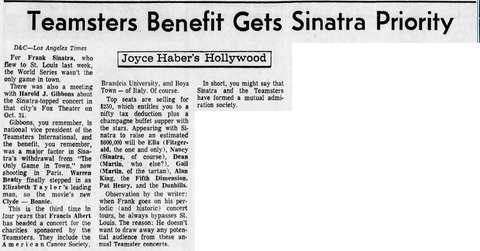
[Sinatra And Don Costa At Reprise Session]
A photograph shows Sinatra with arranger-conductor Don Costa at a Reprise recording session in November 1968, one of two such sessions pictured together around that time.
Source: Charles Pignone, "Frank Sinatra 100" (2015).
[Sinatra announces leaving Los Angeles]
Frank Sinatra: After UCLA School of Medicine professors warned of dangerous smog levels and urged residents to leave the city, Sinatra announced he was leaving Los Angeles, his home of 25 years, declaring, 'The air isn't fit to breathe, so I'm moving out,' and claiming (falsely, per columnist Joyce Haber) that he saw a doctor three times a week for it.
Source: James Kaplan, "Sinatra: The Chairman" (2015)
[Sinatra opens at Caesars Palace]
Kaplan: Two days before Thanksgiving, Sinatra opened at Caesars Palace's Circus Maximus, backed by the Harry James Orchestra, with Jose Feliciano, the Fifth Dimension, and Pat Henry also on the bill.
Source: James Kaplan, "Sinatra: The Chairman" (2015)
[Cycles -- critical commentary]
Bill Boggs (anecdote) / Friedwald (analysis): Songwriter Gayle Caldwell, per an interview cited by Friedwald, wrote the song for herself but her publisher thought it sounded more like a 'guy' song, so a New Christy Minstrels baritone sang the demo that reached Sinatra's office. Friedwald analyzes the lyric's cyclical, waltz-time (3/4) structure matching its message that hardship passes. Footnote: Sinatra fan Bill Boggs recalled taking a lady friend who'd just lost her job to a 1975 Garden State Arts Center Sinatra show and being moved by 'Cycles'; he sent Sinatra a note, and that Labor Day at the Jerry Lewis telethon Sinatra asked him, 'How's your friend doing? The one who got fired?'
Source: Will Friedwald, "Sinatra! The Song Is You: A Singer's Art" (2018 revised edition), Ch. 9, "Looking for the Hook" (1960-1971)
[Sinatra rallies for Humphrey at Astrodome]
Two days before the presidential election, Sinatra performed at a rally for Hubert Humphrey at the Houston Astrodome.
Source: James Kaplan, "Sinatra: The Chairman" (2015).
Hubert Humphrey Telethon, Los Angeles
Monday night election eve
Ed O'Brien:
Frank Sinatra, Burt Lancaster, Vincent Price and a slew of other celebrities manned the phones and asked that you support their candidate.
Humphrey and Edmund Muskie took calls from their supporters.
L.A. Times called it "a marathon four hour rally."
Film
The Tender Trap, (US Film Release: November 4, 1955)
Starring: Frank Sinatra,Debbie Reynolds, David Wayne, Celeste Holm
Directed by Charles Walters.
Sinatra plays Charlie Reader, a 35-year-old theatrical agent in New York City, living a seemingly idyllic life as a bachelor with numerous women who come and go, cleaning and cooking for him until one day Charlie meets singer-actress Julie Gillis (Debbie Reynolds) and his bachelor life is put to the test. (1st DVD Release date: 2008-05-13)
This was one of Frank's most satisfying film experiences The production was first rate and he had returned to MGM after being banished by Louie B. Mayer in 1950. The film cost $1,274,000 to make. Filming got underway in May of 1955. Frank was very comfortable with cast and crew and it shows in the final product. His association with the songwriting team of Cahn & Van Heusen got it start with the title track from this movie (Frank would record it at MGM, Capitol and Reprise). The song received an Oscar nomination and was sung at the award ceremony by Dean Martin..Sinatra had full publishing rights to the tune. The British arranger/conductor Jeff Alexander was reunited with Frank for this film. He had worked with Sinatra on the NBC Light Up Time series in 1949-50. Frank was 39 years old during the two month shoot at MGM and Debbie Reynolds was 23. One day he asked Debbie to have lunch with him. She was, at the time, engaged to Eddie Fisher, Frank tried to dissuade her from marrying Eddie. He told Debbie that singers made terrible husbands. Debbie ignored his advice and we all know how that worked out. Released the day after "Guys & Dolls," in a few major cities, the film received far better reviews and Sinatra got rave notices. The general release would be on 11/17. It was a box office success, pulling in almost four and a half million dollars. Frank was becoming a major movie star and his services were in great demand after this performance. And he was about to accept the most challenging role of his career, playing Frankie Machine in "The Man With The Golden Arm." --Ed
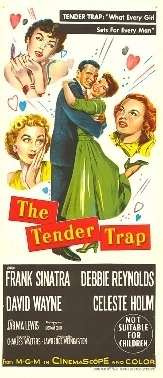
Hubert Humphrey Telethon, Los Angeles
Monday night election eve
Ed O'Brien:
Frank Sinatra, Burt Lancaster, Vincent Price and a slew of other celebrities manned the phones and asked that you support their candidate.
Humphrey and Edmund Muskie took calls from their supporters.
L.A. Times called it "a marathon four hour rally."
Hubert Humphrey Telethon, Los Angeles
Monday night election eve
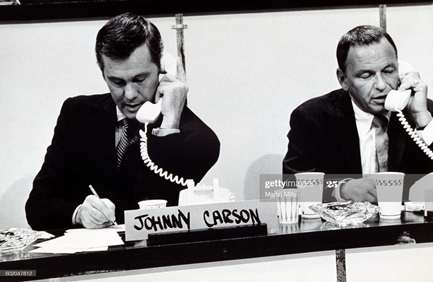
[Nixon defeats Humphrey]
On Tuesday, November 5, Richard Nixon defeated Hubert Humphrey for the presidency by roughly half a million popular votes, a campaign damaged by the Chicago convention chaos, the ongoing Vietnam trauma, and George Wallace's independent run.
Source: James Kaplan, "Sinatra: The Chairman" (2015).
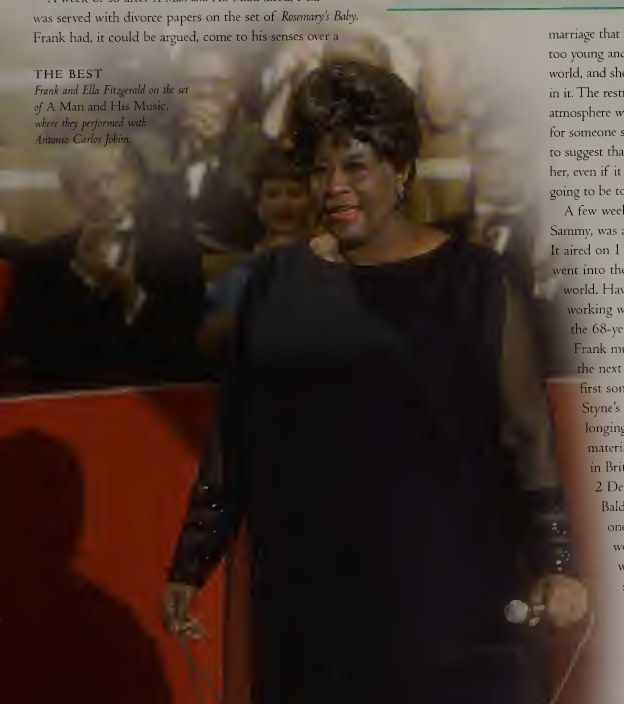
[Photograph: Humphrey narrowly loses to Nixon. From Richard Havers, "Sinatra" (Dorling Kindersley, 2007), p.309.]
Despite Frank's fundraising efforts, Hubert Humphrey was narrowly defeated by Richard Nixon in the presidential election. (Source: Richard Havers, "Sinatra" (Dorling Kindersley, 2007).)
Hollywood
L6927 Blue Lace
(Riz Ortolani/Bill Jacob/Patty Jacob)
Warmer-Tamerlane Publishing Corp. (BMI)
Arranged & Conducted by Nelson Riddle
(2:42) CD: 46013-2 The Complete Reprise Studio Recordings Disc 13
LP: FS1032 Frank Sinatra's Greatest Hits Vol.2 ( England )
45: 0817
L6928 Star!
(Sammy Cahn/Jimmy Van Heusen)
Twentieth Century-Fox Music Corp. (ASCAP)
Arranged & Conducted by Nelson Riddle
(2:34) CD: 46013-2 The Complete Reprise Studio Recordings Disc 13
CD: 9-26723-2Sinatra Sings The Songs Of Van Heusen & Cahn
CD: 2275-2Frank Sinatra's Greatest Hits Vol.2
LP: FS1034Frank Sinatra's Greatest Hits Vol.3
45: 0798
[Sinatra's last 1960s session with Nelson Riddle]
Sinatra recorded two singles, the ballad 'Blue Lace' and the title theme from the Julie Andrews film Star!, with Nelson Riddle at Western Recorders -- neither man knew it would be their last studio collaboration for eight years, as Don Costa had become Frank's go-to arranger for Top 40 attempts.
Source: James Kaplan, "Sinatra: The Chairman" (2015).
Hollywood
L6929 Little Green Apples N/R
(Bobby Russell)
Poly-Gram International Publishing Co. Inc. (ASCAP)
Arranged by Don Costa
Orchestra Conducted by Bill Miller
L6930 Gentle On My Mind
(John Hartford)
Ensign Music (BMI)
Arranged by Don Costa
Orchestra Conducted by Bill Miller
(3:21) CD: 46013-2 The Complete Reprise Studio Recordings Disc 13
CD: 1027-2Cycles
LP: FS1027Cycles
L6931 By The Time I Get To Phoenix
(Jimmy Web)
Charles Koppelman Music/Jonathon Three Music Co./Martin Bandier Music (BMI)
Arranged by Don Costa
Orchestra Conducted by Bill Miller
(3:55) CD: 46013-2 The Complete Reprise Studio Recordings Disc 13
CD: 1027-2Cycles
LP: FS1027Cycles
[Cycles album sessions, Harrison visits]
George Harrison: Sinatra began recording the Cycles album over three nights (November 12-14) with Bill Miller conducting Don Costa's arrangements. George Harrison and his wife Pattie attended one session; Harrison, impressed by Sinatra's efficiency, reportedly asked, 'How do you do it? It takes us months just to do one album.'
Source: James Kaplan, "Sinatra: The Chairman" (2015).
[By the Time I Get to Phoenix / Wandering / Little Green Apples / Rain in My Heart -- critical commentary]
Don Costa's arranged album Cycles demonstrates Sinatra's ability to strip away the superficiality of contemporary songs like 'By the Time I Get to Phoenix' and 'Little Green Apples' and find their real emotional core, according to Granata.
This song/context matches multiple dated entries in the chronology, or lacked a sufficiently precise date; the specific date could not be determined with confidence.
Source: Charles L. Granata, "Sessions with Sinatra: Frank Sinatra and the Art of Recording" (1999/2003), Part IV: The Reprise Years
Hollywood
L6929 Little Green Apples
(Bobby Russell)
Poly-Gram International Publishing Co. Inc. (ASCAP)
Arranged by Don Costa
Orchestra Conducted by Bill Miller
(4:57) CD: 46013-2 The Complete Reprise Studio Recordings Disc 13
CD: 1027-2Cycles
LP: FS1027Cycles
L6932 Moody River
w/Chorus
(Gary D. Bruce)
Gary Bruce Music/Gil Music (BMI)
Arranged by Don Costa
Orchestra Conducted by Bill Miller
(2:31) CD: 46013-2 The Complete Reprise Studio Recordings Disc 13
CD: 1027-2Cycles
LP: FS1027Cycles
L6933 Pretty Colors
w/Chorus
(Al Gorgoni/Chip Taylor)
EMI Blackwood Music Inc. (BMI)
Arranged by Don Costa
Orchestra Conducted by Bill Miller
(2:34) CD: 46013-2 The Complete Reprise Studio Recordings Disc 13
CD: 1027-2Cycles
LP: FS1027Cycles
[Little Green Apples / Gentle on My Mind / By the Time I Get to Phoenix -- critical commentary]
Friedwald (analysis): Friedwald notes all three (Bobby Russell, John Hartford, Jimmy Webb respectively) were hits for Glen Campbell, the session guitarist who played on Sinatra dates. Sinatra sings all in a sing-songy folk voice with understated dynamics. Friedwald calls 'By the Time I Get to Phoenix' the underappreciated gem of the album, an 'Angel Eyes' for a later era, noting the remarkable compassion Sinatra conveys for the woman being left, since the lyric never explains why he's leaving -- calling it 'about as close as we get in this era to truly classic Frank,' more so than 'Strangers in the Night' or 'My Way.'
This song/context matches multiple dated entries in the chronology; the specific date Friedwald is referring to could not be determined with confidence.
Source: Will Friedwald, "Sinatra! The Song Is You: A Singer's Art" (2018 revised edition), Ch. 9, "Looking for the Hook" (1960-1971)
Hollywood
L6934 Rain In My Heart
(Teddy Randazzo/Victoria Pike)
Aldor Music (BMI)
Arranged by Don Costa
Orchestra Conducted by Bill Miller
(3:20) CD: 46013-2 The Complete Reprise Studio Recordings Disc 13
CD: 1027-2Cycles
LP: FS1027Cycles
45: 0798
L6935 Wandering
(Judith Caldwell)
Irving Music, Inc. (BMI)
Arranged by Don Costa
Orchestra Conducted by Bill Miller
(2:45) CD: 46013-2 The Complete Reprise Studio Recordings Disc 13
CD: 1027-2Cycles
LP: FS1027Cycles
L6937 (From) Both Sides, Now
(Joni Mitchell)
Siquomb Publishing Corp. (BMI)
Arranged by Don Costa
Orchestra Conducted by Bill Miller
(2:55) CD: 46013-2 The Complete Reprise Studio Recordings Disc 13
CD: 1027-2Cycles
LP: FS1027Cycles
NOTE: Ed O'Brien says that Tony Randazzo told him that Sinatra thought he had another "Strangers in the Night" with "Rain in my Heart." Tony was astonished by the amount of work done by Sinara to get just the sound he wanted. O'Brien says he personally prefers "Wandering" and loves the line "Now in November, I think of July and a warm sky." Reprise made a big mistake not releasing "Both Sides Now" on a single, he indicates. It has a dynamite vocal by Sinatra and Costa's chart is the perfect compliment to the vocal.
Danny Faux:
I also think " Both Sides Now " should have been released as a single. Joni Mitchell wrote this song when she was 24 years old and had recently divorced. The lyrics show a maturity of a much older person than her age at the time. Frank's rendition is beauti- fully controlled and understated. Loved it from the first time I've listened to the " Cycles " album. Costa's chart is very good too, complementing Frank perfectly. I also think that Sinatra does a great reading of the album title song. I remember getting the Reprise white label promo 45rpm single and listening a whole afternoon to the song over and over. I believe that originally " Cycles " was the "b" side, but was the tune that got me me immediately.
Ed O'Brien:
"Cycles" was so superior to the flipside of that 45. Frank devoted two and a half hours to recording "My Way Of Life." The Gayle Caldwell song was done in 20 minutes. I also like her other song for Frank, "Wandering." Frank really nailed "Both Sides Now." Don't know what Reprise was thinking not to release it on a single.
Danny Faux:
I think you're right about " Wondering ". Lovely song and tender reading by Frank. Just a thought; have you heard the song " Wait by the fire " recorded for the " Cycles " album or was the master destroyed?.
Ed O'Brien:
It wasn't recorded. Song was run down. Sinatra felt it just wasn't right.
Danny Faux:
Thanks for the info. Really surprising. The copy of the " Cycles " LP I had back then even had the title of that song printed in its cover. Or so I remember it.
Ed O'Brien:
You are correct; it was printed on the cover. The liner notes explained that Frank acted the perfectionist in deciding to scrap a not quite right "Wait By The Fire." I have the Reprise session work sheets for the three sessions done that November. It is not listed. Often a song not recorded would still make the sheet for a particular session. Nada. I also have the master files. Nil. There are songs listed that Sinatra was set to record, ran down once, etc. It did not make the cut at all.
Danny Faux:
I suppose that even Frank did a run-down of Gordon Lightfoot's " If You Could Read My Mind " in the mid-seventies - with the presence of the cana- dian singer-songwriter in the recording booth - no evidence on tape has survived. Again, could you please shed some light on the going-ons of this session?. Thanks.
Ed O'Brien:
Great story: Lee Herschberg was the engineer at the 5-21-74 session.
He greatly admired Lightfoot's song. When Lee learned that "If You Could Read My Mind" was set to be done, he clued in Lightfoot. The session had 39 musicians and five songs were set to be recorded. Lee told me Lightfoot was very nervous and paced in the control booth. His song was the last to be done that evening. According to Lee, Costa's chart for the song was sensational. Frank ran it down once, looked up at the booth and said, "too many words." And he was gone. Lightfoot's jaw dropped about a mile. And that was it. I asked Lee if a master was done of the rehearsal take. Frank's run through was rather perfunctory, a sort of feeling out process. There was nothing to master.
"Both Sides, Now"
Friedwald (analysis): Friedwald calls this Joni Mitchell song a major missed opportunity -- Sinatra and Costa 'completely misread it,' approaching it like 'Somethin' Stupid': quick, folksy, and sing-songy, a minor throwaway. He contrasts it with Mitchell's own 2000 re-recording, which extracted considerable drama and wisdom, comparing that later version to a companion piece to 'Send in the Clowns.' Footnote: the Cycles track is mistitled 'From Both Sides, Now,' and Sinatra actually recorded his version before Judy Collins's famous 1967 recording made it known and before Mitchell's own 1969 Clouds recording.
Source: Will Friedwald, "Sinatra! The Song Is You: A Singer's Art" (2018 revised edition).
[Lady in Cement released]
Lady in Cement was released to mixed-to-positive reviews. The New York Times's Vincent Canby gave an ambivalent so-bad-it's-good notice, while the Los Angeles Times's Charles Champlin praised Sinatra's evident enjoyment of the role; the film proved more profitable and better received than The Detective.
Source: James Kaplan, "Sinatra: The Chairman" (2015).
[The Cinematic Legacy of Frank Sinatra — Lady in Cement (1968)]
David Wills's 2015 photo history The Cinematic Legacy of Frank Sinatra devotes a section to Lady in Cement (1968), illustrated with 5 behind-the-scenes and publicity photographs (posters, lobby cards, and on-set/on-location shots) filed here.
“Sinatra's Tony Rome is a fusion of insouciance, cynicism, battered but surviving idealism, wisecrackery, courage, libido, thirst, and all the more interesting hungers. He clearly enjoys the role.” —Charles Champlin
Source: David Wills, The Cinematic Legacy of Frank Sinatra (St. Martin's Press, 2015), pp. 267–272.
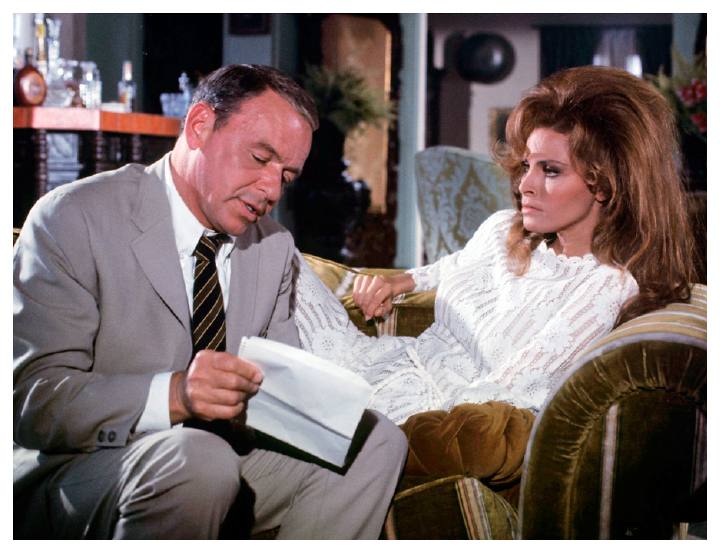
With costar Raquel Welch, Lady in Cement, 1968. / “He has the most raw talent and / magnetism of any man I've met. / While we were filming, Frank was / working at the Fontainebleau, and it / was a complete revelation to see him / in front of an audience. To (Photo: The Cinematic Legacy of Frank Sinatra, David Wills, 2015.)
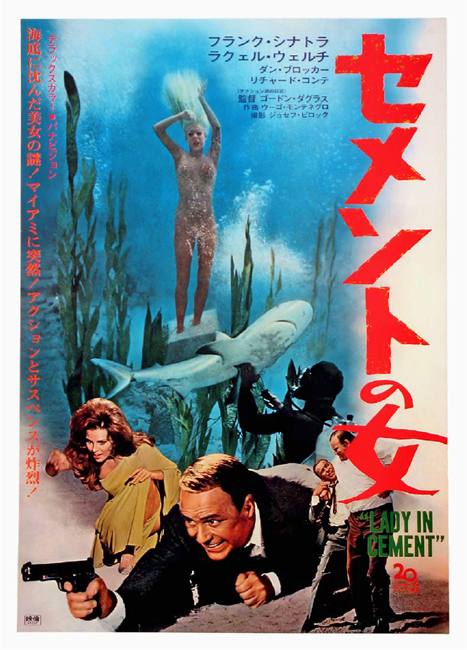
completely hold people the way he / did is a remarkable thing.” / One sheet poster, Lady in Cement. (Photo: The Cinematic Legacy of Frank Sinatra, David Wills, 2015.)
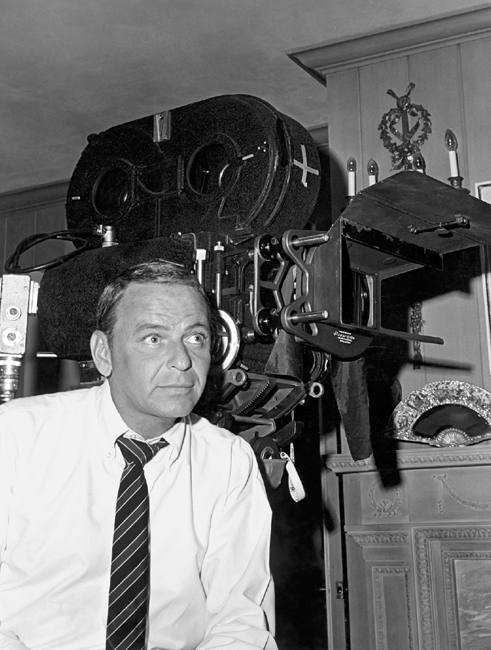
On set, Lady in Cement, 1968. / “I had been continually rehearsing a / scene with a young actress who had / little experience and understandably (Photo: The Cinematic Legacy of Frank Sinatra, David Wills, 2015.)
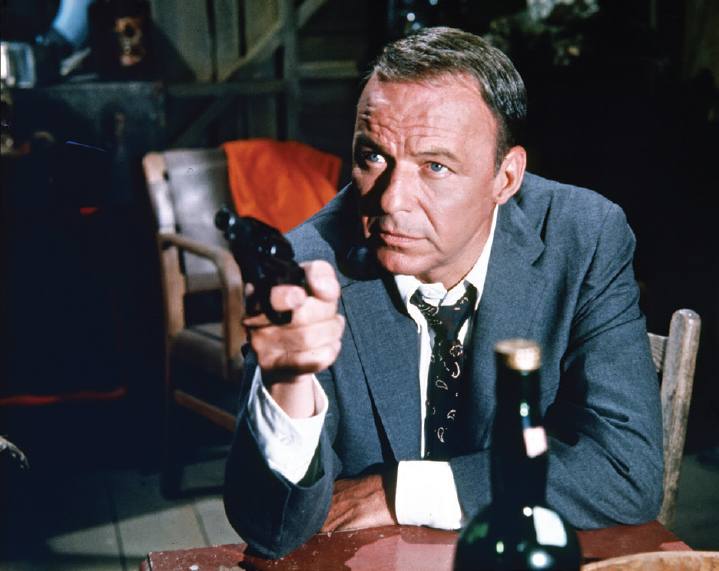
As Tony Rome, Lady in Cement. / “Sinatra's Tony Rome is a fusion of insouciance, / cynicism, battered but surviving idealism, / wisecrackery, courage, libido, thirst, and all the / more interesting hungers. He clearly enjoys the / role.” / (Los Angeles Times, review, Lady in Cement) (Photo: The Cinematic Legacy of Frank Sinatra, David Wills, 2015.)
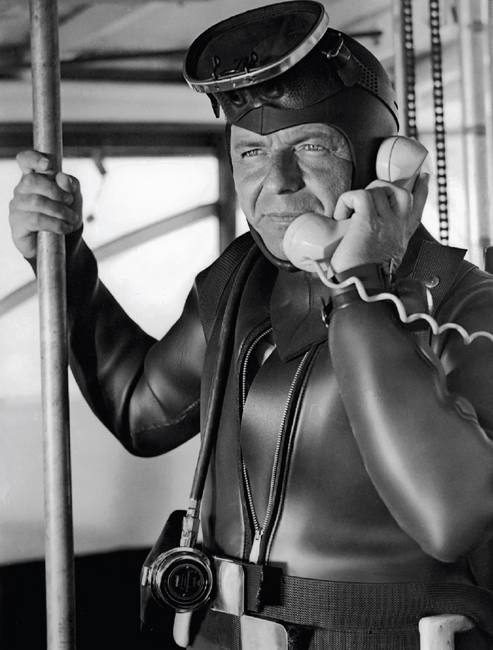
As Tony Rome, Lady in Cement. / “I was a stage-struck bobby soxer when he was / singing at the Paramount in New York City. I / remained a tongue-tied fan of his … He was / such a gifted singer—and then grew into a fine (Photo: The Cinematic Legacy of Frank Sinatra, David Wills, 2015.)
Caesars Palace, Las Vegas, NV (11-22 to 12-19-1968)
Frank Sinatra
Jose Feliciano, The Fifth Dimension,
Pat Henry
Harry James & His Orchestra
note: After an almost 15 month hiatus from the Vegas strip, Frank Sinatra returned with his inaugural engagement at Caesars Palace.
On opening night he sang a special parody composed by Cahn & Van Heusen plus "All Or Nothing At All," w/H. James, "By The Time
I Get To Phoenix," "Little Green Apples," "Please Be Kind" and a long medley of his hits. Bill Miller conducted the 33 piece orchestra
and did a few numbers with Frank during the show. The one month appearance would be the first of many at Caesars over the next
15 years.
Ed
MARQUEE 11-22-68
Decorative metal sign for the engagement
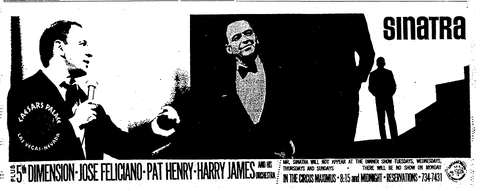
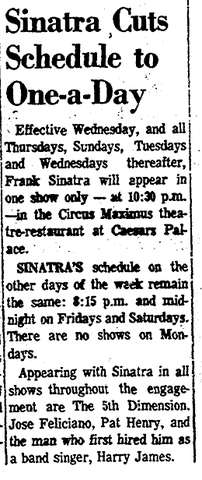
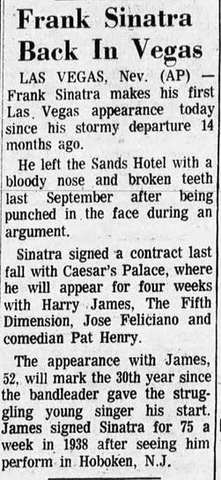
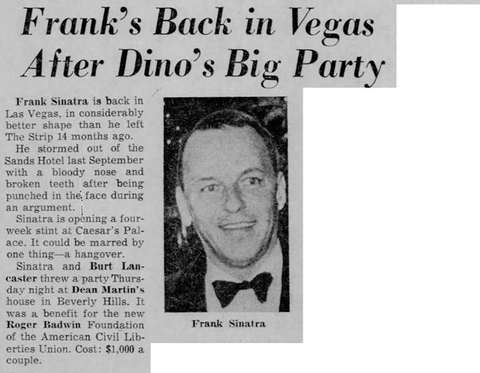
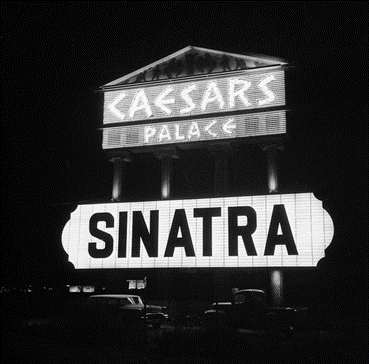
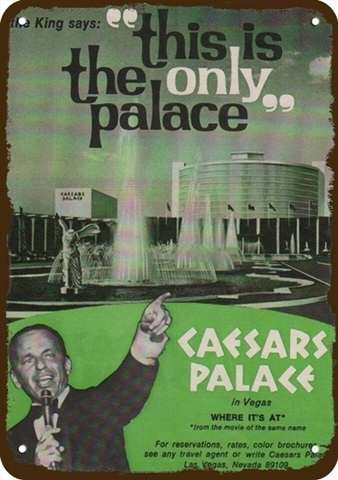
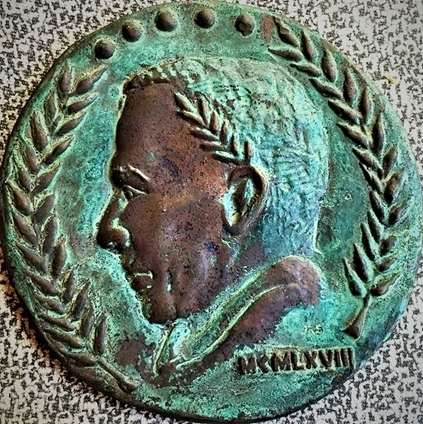
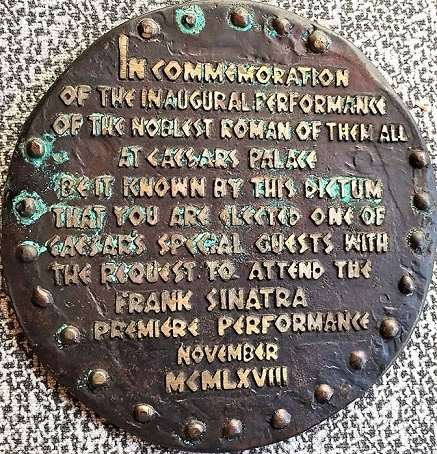
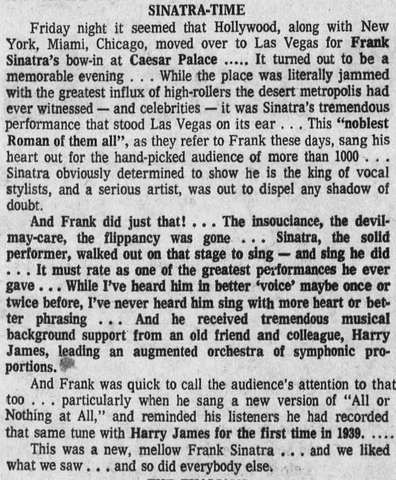
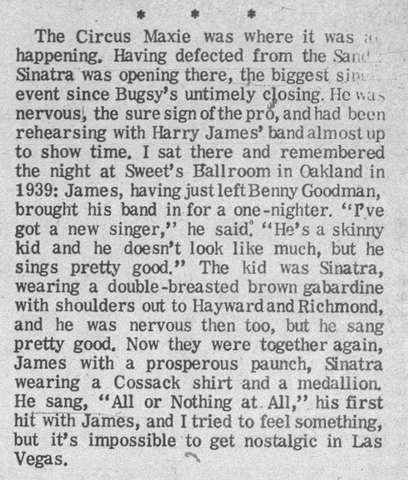


Caesars Palace, Las Vegas, NV (11-22 to 12-19-1968)
Frank Sinatra
Jose Feliciano, The Fifth Dimension,
Pat Henry
Harry James & His Orchestra
Caesars Palace, Las Vegas, NV (11-22 to 12-19-1968)
Frank Sinatra
Jose Feliciano, The Fifth Dimension,
Pat Henry
Harry James & His Orchestra
FRANCIS ALBERT SINATRA DOES HIS THING
Taped August 16, 1968 (Dress Rehearsal Used)
Monday Evening
9:00 p.m - 10:00 p.m.
CBS-TV
Arranged and Conducted by Don Costa
Guests: Diahann Carroll & The Fifth Dimension
1. Hello Young Lovers
2. Baubles, Bangles And Beads
3. Cycles
4. medley w/Diahann: Diane / Sometime I Feel Like A Motherless Child / Lonesome Road / Nobody Knows The Trouble I've Seen / Amen
5. medley: Glad To Be Unhappy / Here's That Rainy Day / It Never Entered My Mind / Gone With The Wind
6. Sweet Blindness w/5th Dimension
7. Nice And Easy
8. How Little We Know
9. Lost In The Stars
10. Angel Eyes
11. Put Your Dreams Away
Notes: 50 min.
Caesars Palace, Las Vegas, NV (11-22 to 12-19-1968)
Frank Sinatra
Jose Feliciano, The Fifth Dimension,
Pat Henry
Harry James & His Orchestra
Note: Frank was dark on this day
--Ed
Caesars Palace, Las Vegas, NV (11-22 to 12-19-1968)
Frank Sinatra
Jose Feliciano, The Fifth Dimension,
Pat Henry
Harry James & His Orchestra
© 1997-2025 The Sinatra Archive
This calendar, or any parts thereof, may not be reproduced in any fashion
whatsoever without the prior written permission of the publisher (The
Sinatra Archive)
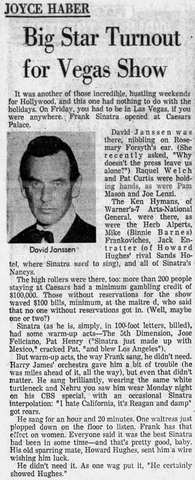
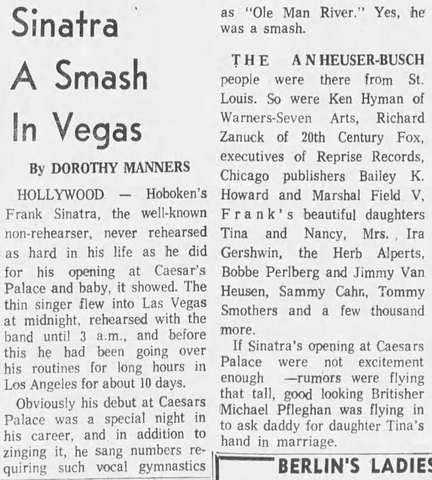
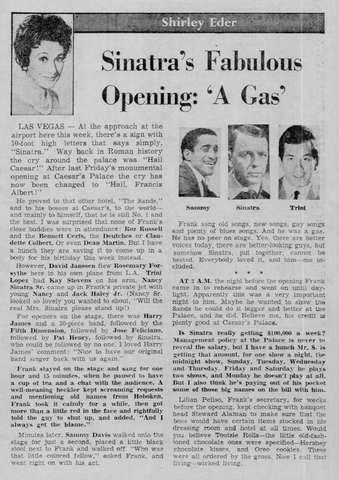
Frank and the Fifth Dimension rehearsing "Sweet Blindness"
TV GUIDE NOVEMBER 23-29, 1968
Baubles, Bangles & Beads
Sweet Blindness
Ed O'Brien:
On the evening of November 25, 1968 (Monday),at 9:PM EST, CBS aired
the one hour musical special "Francis Albert Sinatra Does His Thing."
Frank's guests were Diahann Carroll and the 5th Dimension.
The show was taped in Studio 4 at NBC Burbank on August 14th and 15th.
The producer-writer team of Saul Ilson and Ernest Chambers( Smothers
Brothers Comedy Hour) put the show together. Don Costa was the
arranger/conductor and Frank used a 47 piece orchestra, including 16 strings
and three guitars.
His constant sidemen Bill Miller, Al Viola and Irv Cottler were part of the
biggest band Frank had ever employed for a TV special, and there was also
a choral group of six backing him on some numbers.
The Wednesday taping(14) was done without a studio audience. The
singer arrived at 2:30 P.M. for the saloon segment of the show. Titled
"The Rainy Day Spot," Frank stood in a motel room setting, looking into
a mirror,singing.the verse of Rodgers & Hart's "Glad To Be Unhappy,"
followed by a very interesting Costa chart on "Here's That Rainy Day."
(a song Sinatra often called "the daddy of all the saloon songs."). The
great Rodger's & Hart classic "It Never Entered My Mind" was sung
as Frank left the motel room and wandered around the back yard
of the motel set..A rather loud chorus joined him on"Gone With The Wind"
and then the segment was concluded with a reprise of "Rainy Day,"as
Frank walked through the rain and got into his 1968 Pontiac.and drove
away.
Thursday's schedule included a run-through at 12:30, dress rehearsal
at 5:30 and then the actual taping of the show at 8:30, with an audience
made up of Budweiser dealers from throughout the country. The run-
through went smoothly and Sinatra retired to his dressing room. Around
mid-afternoon Frank received a phone call from Juarez, Mexico. Mia
was seeking a quickie divorce and there was urgent news. Ilson and
Chambers were summoned and told that the dress rehearsal would
be the show.The guests were told to give it everything because it
would be a one-shot deal.Frank needed to be elsewhere that evening.
At exactly 5:30, with the audience in place, the taping began. Frank
opened the show with a finger-snapping uptempo chart on Rodgers
& Hammerstein's "Hello Young Lovers." The choral backing, an attempt
to capture a more contemporary sound, continued as Frank sang "Baubles,
Bangles And Beads." He then introduced the show and made some funny
remarks about "his thing" and how the record buyers kept him in mad
money in case he got the urge again." He sang the Country and Western
tune "Cycles," still with chorus (At the time Lee Hazelwood was putting
together a C&W project for Frank and Jimmy Webb had been asked to write
an album for him. This search for a modern sound would eventually lead to
Frank's most unconventional work, "Watertown").
Diahann Carroll was introduced and sang two numbers.Frank joined her
for a medley of quasi gospel tunes including "Lonesome Road" and "Amen."
Then the 5th Dimension did their segment with the 6th Dimension joining
them on Laura Nyro's tune "Sweet Blindness." Sinatra was dressed in a natty
blue and white outfit for the number. As it concluded, he said, "Don't look now
Francis Albert but your generation gap is showing.."
Two very attractive young ladies helped him don beads and a Nehru jacket
for the Riddle segment of the show. Frank sang "Nice N' Easy," "How Little
We Know"( the more uptempo Reprise chart from 1963) and closed it out with
a big production treatment of the Kurt Weill-Maxwell Anderson standard "Lost
In The Stars.".Costa conducted the large orchestra.
The show closed with Sinatra singing the first few lines of "Angel Eyes,"
with a few altered lyrics to fit the occasion, a big thank you to his guests, and
a gorgeous rendition of the Riddle arranged Sinatra theme song "Put Your
Dreams Away." And he was gone.
The Budweiser executives, arriving for what they thought would be the "air
play" show were given the choice of attending a Jerry Lewis taping or watching
the rehearsal on TV monitors.
"Francis Albert Sinatra Does His Thing" is unique among the many TV specials
Sinatra did over a period of 35 years. The previous.year NBC had offered the
magnificent "A Man & His Music + Ella + Jobim", and the following year the Nehru
and beads were gone for "Sinatra 69." The attempt to bridge the generation gap,
speak in the patois of the 60s counter-culture and be hippie-hip was gone.
The show is certainly entertaining with some fine singing. Frank wore a
very modest wig and it looked great on him. He was very comfortable with
his guests, there are some fine one time arrangements by Costa and the
set decoration was very bright and attractive. Not a bad hour of television.
note: After three years of watching Frank's one hour specials and waiting for
the rerun in the spring, I decided in November 1968 to try and preserve
the audio. Got myself a very nice tape recorder, high performance tape
and alligator clips. The latter attached very nicely to the speaker inside
the TV. What I was able to do thrilled me. A line recording of the full hour
show. It was the equivalent of two Sinatra albums. I listened to that tape
many times through the years.
Ed
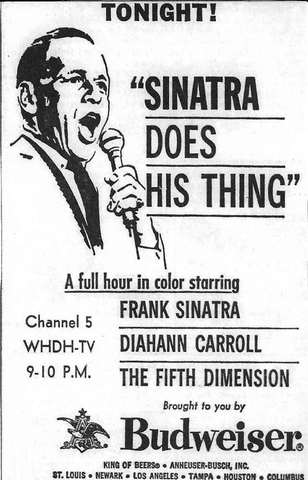
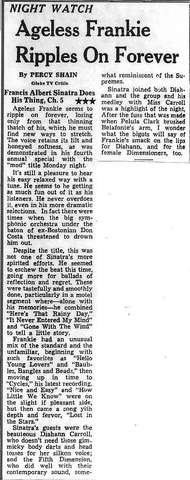
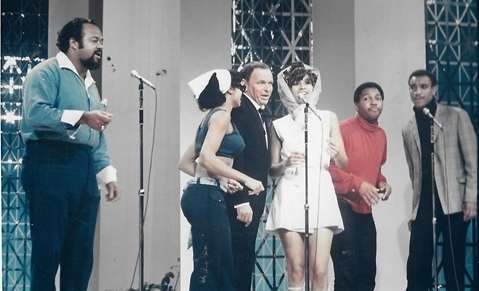
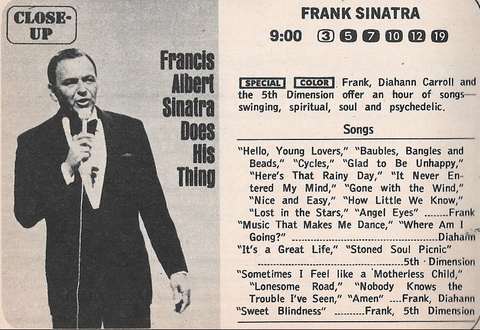
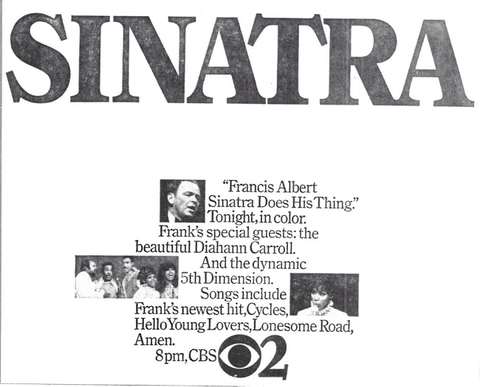
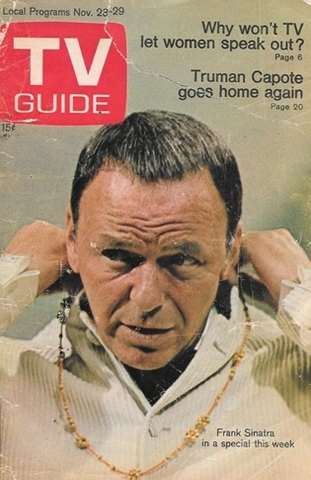
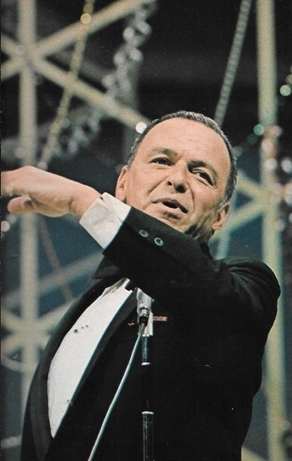
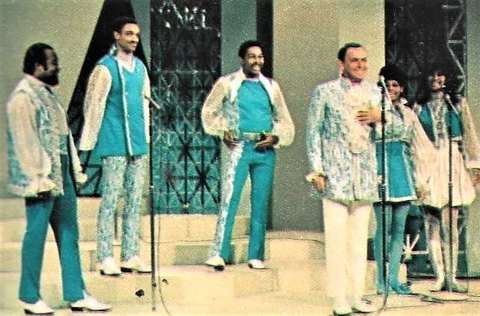
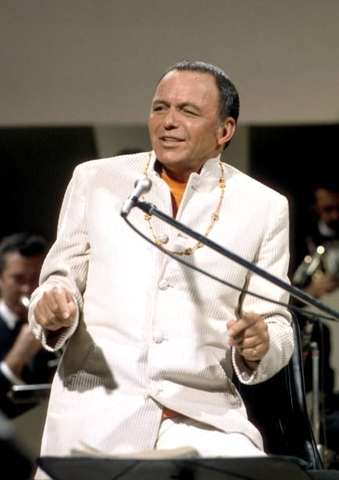
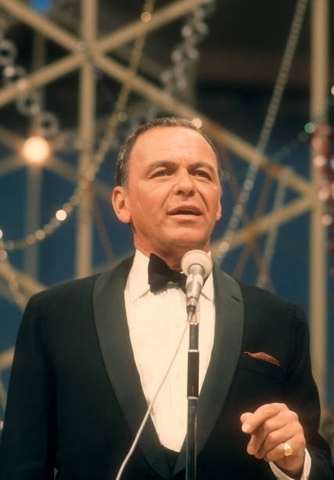
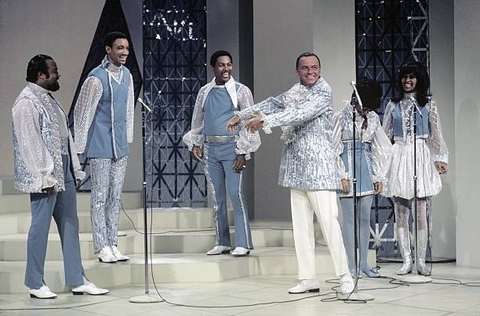
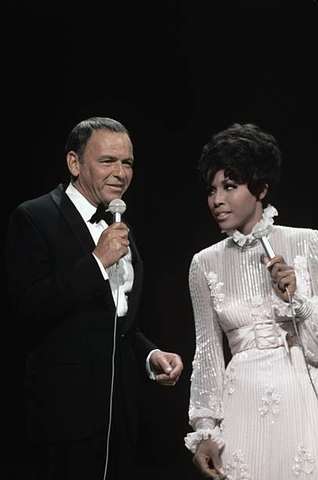
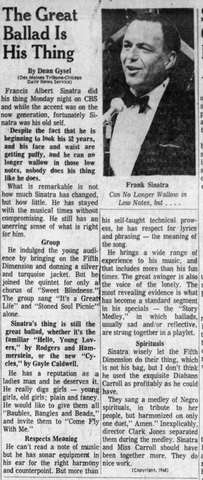
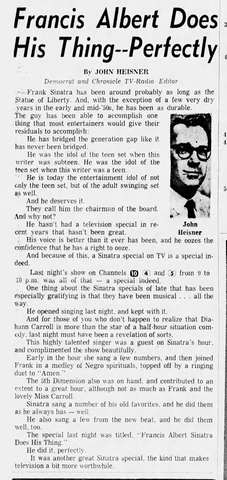
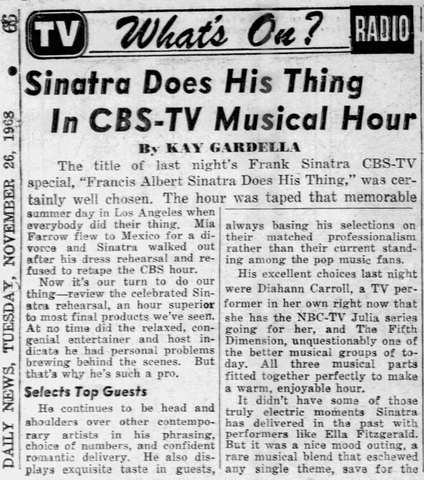
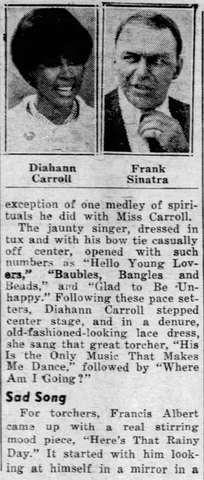
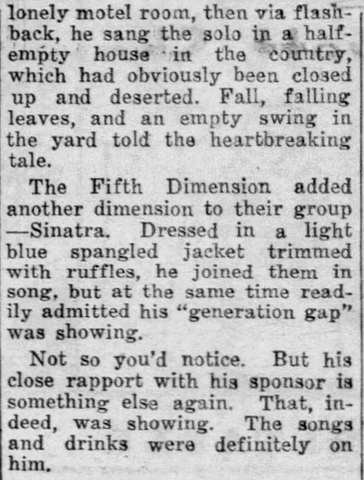
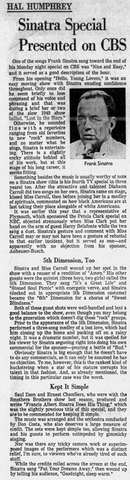
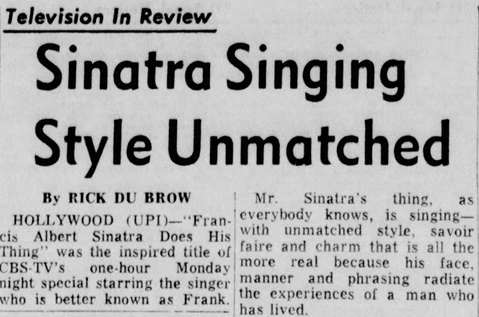
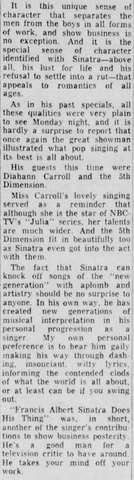
Caesars Palace, Las Vegas, NV (11-22 to 12-19-1968)
Frank Sinatra
Jose Feliciano, The Fifth Dimension,
Pat Henry
Harry James & His Orchestra
1. I've Got The World On A String
2. Day In, Day Out
3. You Make Me Feel So Young
4. Cycles
5. Please Be Kind
6. Monologue
7. By The Time I Get To Phoenix
8. All Or Nothing At All
9. This Is All I Ask
10. I've Got You Under My Skin
11. Medley: Strangers In The Night / Young At Heart / Nancy / It Was A Very Good Year / All The Way / That's Life / My Kind Of Town
12. Little Green Apples
13. The Lady Is A Tramp
14. Chaser "12 O'clock Jump"
15. Intro: Frank Sinatra Jr. & Good Night
note: Frank opened his first engagement at Caesars on 11-22-68. Celebrities were his main audience that night. Frank sang 30 songs including "Soliloquy" and a special parody written by Sammy Cahn, telling how his appearance at Caesars came to be. The three week stay was extended another, because Frank became ill the second week in December.Closing night was 12/19. Frank did one show a night except on Friday and Saturday. --Ed
Caesars Palace, Las Vegas, Nevada (November 22 - December 19) w/Harry James, The Fifth Dimension, Jose Feliciano, Pat Henry
Caesars Palace, Las Vegas, Nevada (November 22 - December 19) w/Harry James, The Fifth Dimension, Jose Feliciano, Pat Henry note: Frank was dark on 11/25,12/2-9-16
--Ed
Caesars Palace, Las Vegas, Nevada (November 22 - December 19) w/Harry James, The Fifth Dimension, Jose Feliciano, Pat Henry
Caesars Palace, Las Vegas, Nevada (November 22 - December 19) w/Harry James, The Fifth Dimension, Jose Feliciano, Pat Henry
[Sinatra spotted with the Marxes]
Kaplan: A December 1968 social-column item placed Sinatra at the Beachcomber nightclub with a party that included Barbara and Zeppo Marx and Jilly Rizzo.
Source: James Kaplan, "Sinatra: The Chairman" (2015)
Caesars Palace, Las Vegas, Nevada (November 22 - December 19) w/Harry James, The Fifth Dimension, Jose Feliciano, Pat Henry
Caesars Palace, Las Vegas, Nevada (November 22 - December 19) w/Harry James, The Fifth Dimension, Jose Feliciano, Pat Henry
Note: Sinatra was dark this night
Caesars Palace, Las Vegas, Nevada (November 22 - December 19) w/Harry James, The Fifth Dimension, Jose Feliciano, Pat Henry
Caesars Palace, Las Vegas, Nevada (November 22 - December 19) w/Harry James, The Fifth Dimension, Jose Feliciano, Pat Henry Thursday evening
1. I've Got The World On A String
2. You Make Me Feel So Young
3. This Is All I Ask
4. Cycles
5. Please Be Kind
6. monologue
7. By The Time I Get To Phoenix
8. All Or Nothing At All ( Riddle 66 arg. H. James on trumpet)
9. Moonlight In Vermont
10. I've Got You Under My Skin
11. medley : Strangers In The Night/Young At Heart/Nancy/ It Was A Very Good Year/All The Way/That's Life/My Kind Of Town
12. Little Green Apples
13. The Lady Is A Tramp note: When Frank did his introductions of celebs in the audience, he tells the audience that Cyd Charisse's legs go all the way up.
Caesars Palace, Las Vegas, Nevada (November 22 - December 19) w/Harry James, The Fifth Dimension, Jose Feliciano, Pat Henry
Caesars Palace, Las Vegas, Nevada (November 22 - December 19) w/Harry James, The Fifth Dimension, Jose Feliciano, Pat Henry Cancelled due to the flu (7-9)
Caesars Palace, Las Vegas, Nevada (November 22 - December 19) w/Harry James, The Fifth Dimension, Jose Feliciano, Pat Henry Cancelled due to the flu (7-9)
Caesars Palace, Las Vegas, Nevada (November 22 - December 19) w/Harry James, The Fifth Dimension, Jose Feliciano, Pat Henry Cancelled due to the flu (6-9)
Caesars Palace, Las Vegas, Nevada (November 22 - December 19) w/Harry James, The Fifth Dimension, Jose Feliciano, Pat Henry
Caesars Palace, Las Vegas, Nevada (November 22 - December 19) w/Harry James, The Fifth Dimension, Jose Feliciano, Pat Henry
Caesars Palace, Las Vegas, Nevada (November 22 - December 19) w/Harry James, The Fifth Dimension, Jose Feliciano, Pat Henry
Caesars Palace, Las Vegas, Nevada (November 22 - December 19) w/Harry James, The Fifth Dimension, Jose Feliciano, Pat Henry
Caesars Palace, Las Vegas, Nevada (November 22 - December 19) w/Harry James, The Fifth Dimension, Jose Feliciano, Pat Henry
Caesars Palace, Las Vegas, Nevada (November 22 - December 19) w/Harry James, The Fifth Dimension, Jose Feliciano, Pat Henry
Caesars Palace, Las Vegas, Nevada (November 22 - December 19) w/Harry James, The Fifth Dimension, Jose Feliciano, Pat Henry
Caesars Palace, Las Vegas, Nevada (November 22 - December 19) w/Harry James, The Fifth Dimension, Jose Feliciano, Pat Henry Wednesday Night
Harry James Orchestra Conducted By: Bill Miller
Caesars Palace, Las Vegas, Nevada (November 22 - December 19) w/Harry James, The Fifth Dimension, Jose Feliciano, Pat Henry Wednesday Night
Harry James Orchestra Conducted By: Bill Miller
Partial song-list:
1. I've Got The World On A String
2. Day In, Day Out
3. Cycles
4. Please Be Kind
5. monologue
6. By The Time I Get To Phoenix
7. All Or Nothing At All
8. Moonlight In Vermont
9. I've Got You Under My Skin
10. Little Green Apples
11. medley: Strangers In The Night / Young At Heart / Nancy / All The Way / That's Life / My Kind Of Town
12. The Lady Is A Tramp
Ed O'Brien notes:
Frank's penultimate show of a three week engagement.
His first ever appearance at Caesars opened on 11-22-68 with Harry James fronting a 40 piece orchestra and Bill Miller conducting. Opening night Frank sang 30 songs including "Soliloquy" The rest of the shows were scaled back quite dramatically.
The opening act was Mr. James followed by Jose Feliciano, The Fifth Dimension, Pat Henry and then Sinatra.
After singing "Cycles," Frank told the audience, with an air of resignation, he never thought he would be singing such material, but he was doing it.
Caesars Palace, Las Vegas, Nevada w/Harry James, The Fifth Dimension, Jose Feliciano, Pat Henry Harry James Orchestra Conducted By: Bill Miller
Hollywood
L7053 My Way
(Paul Anka/Jacques Revaux/Gilles Thibault/Claude Francois) Chrysalis Standards Inc. (BMI)
Arranged & Conducted by Don Costa
(4:35) CD: 46013-2 The Complete Reprise Studio Recordings Disc 13
CD: 9-26340-2The Reprise Collection
CD: 2275-2Frank Sinatra's Greatest Hits Vol.2
CD: 1029-2My Way
LP: FS1034Frank Sinatra's Greatest Hits Vol.3
LP: FS1029My Way
45: 0817
"My Way" began life as a French song, "Comme d'Habitude," with English lyrics written by a young Paul Anka specifically with Sinatra in mind; Anka later said Frank brought more to the song than he ever could have himself. Despite becoming his signature anthem, Frank reportedly disliked the song throughout his career, telling audiences on more than one occasion, "I hate this song." It was only a modest hit on the U.S. charts when released in 1969, peaking at number twenty-seven, though it became a phenomenon in the United Kingdom, charting for 122 weeks. Source: J. Randy Taraborrelli, Sinatra: Behind the Legend.
"My Way"
Friedwald (analysis): Friedwald states bluntly, 'It's not particularly good Sinatra record -- there, I said it! -- but it proved to be a career milestone nonetheless,' promising fuller discussion of its later impact in the next chapter (covering the post-retirement period).
Source: Will Friedwald, "Sinatra! The Song Is You: A Singer's Art" (2018 revised edition).
"My Way"
The title track 'My Way' (English lyrics by Paul Anka) was recorded in December 1968. Sinatra's longtime pianist Bill Miller was unable to play on the session because he had recently been injured in a mudslide that destroyed his LA home and killed his wife; jazz pianist Lou Levy filled in.
Source: Charles L. Granata, "Sessions with Sinatra: Frank Sinatra and the Art of Recording" (1999/2003).
[Sinatra records 'My Way' in one take]
Frank Sinatra: In a rare afternoon session on the second-to-last day of the year, with Bill Miller conducting a forty-piece orchestra, Sinatra recorded 'My Way' in one take. Paul Anka had adapted the melody from the French 'Comme d'habitude,' writing lyrics he imagined Frank would say. Sinatra later admitted the song 'had nothing to do with my life whatsoever' and that he gritted his teeth over its boastfulness each time he sang it, despite loving its success.
Source: James Kaplan, "Sinatra: The Chairman" (2015).
[My Way -- critical commentary]
Milt Bernhart: Don Costa arranged and Bill Miller conducted (Lou Levy on piano) the December 30, 1968 session that cut 'My Way' in under half an hour after just two takes. Trombonist Milt Bernhart, noting only one chart on the stand, joked to the band it was a Christmas present since they'd finish fast. Bud Brisbois played the demanding Maynard Ferguson-style lead trumpet part. Bernhart believed the released master is a composite of the two takes, pointing to an audible, unnatural vocal-quality splice right before the line 'I've loved, I've laughed and cried' -- Sinatra drops from a big voice to a small one faster than seems humanly possible, and he never quite reproduced that transition live.
This song/context matches multiple dated entries in the chronology; the specific date Friedwald is referring to could not be determined with confidence.
Source: Will Friedwald, "Sinatra! The Song Is You: A Singer's Art" (2018 revised edition), Ch. 10, "Concert Years" (1973-1994)
[My Way -- critical commentary]
Paul Anka: Paul Anka optioned the English rights to the French song 'Comme d'habitude' in 1967 after hearing it in Paris ('I thought it was a shitty record, but there was something in it'). In 1969, after a Florida dinner with Sinatra and several 'mob guys' where Frank announced he was quitting the business, Anka went home to New York and at 1 a.m. sat at an IBM electric typewriter asking himself 'If Frank were writing this, what would he say?' He said he used phrases he'd never normally use, like 'I ate it up and spit it out,' influenced by the mobster talk at dinner. He called Sinatra in Vegas at 5 a.m. to play it for him, and Sinatra agreed to record it immediately.
This song/context matches multiple dated entries in the chronology; the specific date Friedwald is referring to could not be determined with confidence.
Source: Will Friedwald, "Sinatra! The Song Is You: A Singer's Art" (2018 revised edition), Ch. 10, "Concert Years" (1973-1994)
[My Way -- critical commentary]
Will Friedwald: Friedwald notes 'My Way,' with its hard-to-remember melodic line, occasionally caused Sinatra to lose his bearings in concert (as in an otherwise excellent March 1992 set), yet in May 1994 he delivered one of the best renditions of his career: 'Haughty, arrogant, aggressive, and irresistible, it was everything that Frank Sinatra singing "My Way" ought to be.'
This song/context matches multiple dated entries in the chronology; the specific date Friedwald is referring to could not be determined with confidence.
Source: Will Friedwald, "Sinatra! The Song Is You: A Singer's Art" (2018 revised edition), Ch. 10, "Concert Years" (1973-1994)
[My Way / Didn't We / If You Go Away / All My Tomorrows / Mrs. Robinson -- critical commentary]
Sinatra completed the My Way album in February 1969, mixing introspective Costa-arranged ballads ('Didn't We,' 'If You Go Away,' a strong remake of 'All My Tomorrows') with more incongruous contemporary covers like Simon and Garfunkel's 'Mrs. Robinson.'
This song/context matches multiple dated entries in the chronology, or lacked a sufficiently precise date; the specific date could not be determined with confidence.
Source: Charles L. Granata, "Sessions with Sinatra: Frank Sinatra and the Art of Recording" (1999/2003), Part IV: The Reprise Years
[My Way / In the Wee Small Hours of the Morning -- critical commentary]
Alan Livingston: Alan Livingston, who signed Sinatra to Capitol in 1953, said 'My Way' is 'absolutely Frank' because Sinatra's own lived experience of divorces, lost women, and career collapse gave him the credibility to interpret and phrase the lyric convincingly, just as he understood 'In the Wee Small Hours of the Morning' from personal experience. Friedwald contrasts Paul Anka's original English lyric (to a French melody) as inherently self-aggrandizing text that made other interpreters -- Sid Vicious deliberately, Elvis Presley unintentionally -- sound like pretentious egomaniacs, unlike classic Porter/Berlin songs that flattered everyone who sang them. Sinatra reportedly disliked the song every time he sang it.
This song/context matches multiple dated entries in the chronology; the specific date Friedwald is referring to could not be determined with confidence.
Source: Will Friedwald, "Sinatra! The Song Is You: A Singer's Art" (2018 revised edition), Ch. 1, "Night and Day" (Sinatra style overview)
[My Way / Put Your Dreams Away -- critical commentary]
Tony Bennett (to Friedwald): Tony Bennett told me that when he did his album Perfectly Frank in 1992, he wanted to include only great standards, and deliberately avoid signature themes like “My Way” and “Put Your Dreams Away.”
This song/context matches multiple dated entries in the chronology; the specific date Friedwald is referring to could not be determined with confidence.
Source: Will Friedwald, "Sinatra! The Song Is You: A Singer's Art" (2018 revised edition), Ch. 4, "With Axel Stordahl" (1943-1948)
[A Man Alone Made During a Painful Year]
Poet Rod McKuen wrote and produced A Man Alone for Frank during a difficult period, after his split from Mia Farrow and while his own father was ill. Frank pulled the song "Happy Birthday Me" from the album because it hit too close to home, and McKuen recalled Frank arriving an hour early to every session, something he'd never seen him do before.
Source: Nancy Sinatra, "Frank Sinatra, My Father" (1985).
[First Hearing "My Way" at Caesar's Palace]
Frank first played Nancy the original French version of what would become "My Way" at Caesar's Palace, and they both sensed it would be important; Paul Anka later wrote the English lyric. At fifty-four, Frank was still young enough to sing its near-morbid closing lines without it depressing him, though by the time of Nancy's writing, sixteen years later, she preferred not to hear it.
Source: Nancy Sinatra, "Frank Sinatra, My Father" (1985).
[Frank Sinatra Jr. Given His Own TV Special]
Frank Sinatra Jr., who had pursued a singing career in a swing style much like his father's despite Frank Sr.'s comment at his birth that there would be 'no following in Dad's footsteps,' was given his own television special.
Source: The Rough Guide to Frank Sinatra, chapter "I Want to Be a Part of It, 1971-98."
[Marty Sinatra's Death and Funeral]
In January 1969, after years of emphysema, Frank's father Marty suffered heart failure; Frank flew him to Houston for emergency surgery by Dr. Michael DeBakey, but it was too late. Thousands of New Jersey residents lined the funeral procession route, and firemen saluted as the motorcade passed. Frank was visibly grief-stricken, later calling his father "a helluva guy" who had been tough on him.
Source: Tina Sinatra, "My Father's Daughter: A Memoir" (2000).
[Named Honorary Alumnus of UCLA]
UCLA names Sinatra an Honorary Alumnus.
Source: Nancy Sinatra, "Frank Sinatra, My Father" (1985).
[A Man Alone recorded]
Kaplan: Three weeks after completing the My Way album, Sinatra returned to the studio to record A Man Alone, an album composed entirely of Rod McKuen songs and spoken pieces, arranged by Don Costa.
Source: James Kaplan, "Sinatra: The Chairman" (2015)
[Barbara Marx becomes a compound regular]
Kaplan: By 1969, Barbara Marx, wife of Zeppo Marx and nearly forty, had become a regular visitor to Sinatra's Palm Springs compound, ready to leave her older husband and trade up.
Source: James Kaplan, "Sinatra: The Chairman" (2015)
[Death of Frank's father Marty]
Consiglio: Marty Sinatra died of asthma in 1969 at the Fort Lee, New Jersey home Frank had bought his parents, the last house they owned.
Source: Tony Consiglio (as told to Franz Douskey), "Sinatra and Me: The Very Good Years" (2012)
[Dirty Dingus Magee]
Nancy Sinatra Jr.: Santopietro suggests Sinatra took on the broad comic Western Dirty Dingus Magee partly to distract himself after his father Marty's death from heart disease on January 24, 1969. Nancy Sinatra Jr. wrote that 'something snapped' in her father after Grandpa died and that he needed the silliness of the project.
This film/context matches multiple dated entries in the chronology; the specific date Santopietro is referring to could not be determined with confidence.
Source: Tom Santopietro, "Sinatra in Hollywood" (2008), Knight-Errant (pt. 1)
[Dirty Dingus Magee creative team assembled]
Kaplan: MGM signed director Burt Kennedy (fresh off Support Your Local Sheriff), screenwriting brothers Tom and Frank Waldman, and novelist Joseph Heller (of Catch-22) to adapt David Markson's comic novel The Ballad of Dingus Magee for the screen.
Source: James Kaplan, "Sinatra: The Chairman" (2015)
[Dupuytren's contracture origin]
Kaplan: Sinatra's chronic right-hand pain stemmed from Dupuytren's contracture, a tissue disorder triggered when he karate-chopped a table while filming The Manchurian Candidate; it would keep him from making movies for roughly the next two years.
Source: James Kaplan, "Sinatra: The Chairman" (2015)
[Earl Wilson on Sinatra's fears]
Earl Wilson: Columnist Earl Wilson wrote that in his down periods Sinatra feared he'd 'had it' professionally, physically, and politically, confiding that his voice tired after three straight nights of singing, and that pain in his right hand—the mic hand—genuinely scared him.
Source: James Kaplan, "Sinatra: The Chairman" (2015)
[Edie Goetz on her romance with Sinatra]
Edith Mayer Goetz: Edith Mayer Goetz recalled that Sinatra 'took such good care of me' after her husband's death, traveling with her to Palm Springs and New York, and giving her an elaborate Christmas gift including a gold box engraved 'To Edie, With Much Love—Noel. Francis.'
Source: James Kaplan, "Sinatra: The Chairman" (2015)
[Frank pressures Dolly to move to Palm Springs]
Kaplan: After Marty's death, Frank tried to get Dolly to relocate to Palm Springs, offering to build her a house and buy her a condo near a racetrack. She resisted over the heat, her friends, and Marty's untended grave; Frank offered to move Marty's remains to Desert Memorial Park in Cathedral City. It took over a year for her to agree.
Source: James Kaplan, "Sinatra: The Chairman" (2015)
[Gaudio and Holmes pitch Watertown]
Bob Gaudio: After their concept album The Genuine Imitation Life Gazette flopped, Bob Gaudio and lyricist Jake Holmes wrote new songs for Sinatra, then pitched him on recording them as a full concept album, Watertown, about a small-town man abandoned by his wife.
Source: James Kaplan, "Sinatra: The Chairman" (2015)
[Gay Talese encounters Sinatra at a party]
Gay Talese: At a small summer party for Rod McKuen at Bennett and Phyllis Cerf's Mount Kisco home, Gay Talese was surprised to find Sinatra among the guests; Frank never acknowledged him, instead listening loudly to a baseball game on a radio.
Source: James Kaplan, "Sinatra: The Chairman" (2015)
[Jobim sessions for unreleased album]
Kaplan: Over three nights, Sinatra recorded ten new Antonio Carlos Jobim compositions with young Brazilian arranger Eumir Deodato and conductor Morris Stoloff, intended for an album to be called Sinatra-Jobim, including 'One Note Samba,' 'Wave,' 'Drinking Water (Aqua de Beber),' and 'Song of the Sabia.'
Source: James Kaplan, "Sinatra: The Chairman" (2015)
[Kinney buys Warner-Reprise for $400 million]
Kaplan: In 1969 Steve Ross's Kinney National Company would buy Warner-Reprise, by then called Warner Bros.-Seven Arts, for $400 million, vindicating Sinatra's one-third stake.
Source: James Kaplan, "Sinatra: The Chairman" (2015)
[Marty Sinatra dies]
Consiglio: Frank's father, Marty Sinatra, died in 1969 after his asthma worsened into emphysema; Frank had sent him to Houston to be treated by Dr. Michael DeBakey, but it was too late. Consiglio wasn't present but heard that Frank never left his father's side during his final days.
Source: Tony Consiglio (as told to Franz Douskey), "Sinatra and Me: The Very Good Years" (2012)
[Mrs. Robinson cover angers Paul Simon]
Phil Ramone: Sinatra recorded a satirical cover of Paul Simon's 'Mrs. Robinson' with altered lyrics referencing Jilly Rizzo and Dean Martin. Producer Phil Ramone recalled that Simon was initially upset enough to consider suing over the changed lyrics.
Source: James Kaplan, "Sinatra: The Chairman" (2015)
[Ostin's rise and Sinatra's fading sales]
Mo Ostin: By 1969, Mo Ostin, soon to become Warner/Reprise president, was signing rock and folk-rock acts like Jimi Hendrix, Joni Mitchell, and the Grateful Dead, and was less deferential to Sinatra, whose pop recordings—including the McKuen album—were not selling well.
Source: James Kaplan, "Sinatra: The Chairman" (2015)
[Served with New Jersey subpoena]
Kaplan: While relaxing off Atlantic Highlands, New Jersey, aboard his yacht, Sinatra was served with a subpoena to appear before a committee investigating organized crime in the state; he had Mickey Rudin handle it.
Source: James Kaplan, "Sinatra: The Chairman" (2015)
[Sinatra overdubs Watertown vocals in L.A.]
Lee Herschberg: Unusually for Sinatra, who disliked recording without a live band, he had the Watertown tapes shipped to Los Angeles to overdub new vocal tracks rather than remain in New York, where he was also being served legal papers. Engineer Lee Herschberg said he 'never really connected with that project.'
Source: James Kaplan, "Sinatra: The Chairman" (2015)
[Sinatra promises McKuen an album]
Rod McKuen: Rod McKuen recalled that after years of trying to reach Sinatra, once they met, Frank promised him an entire album of his songs rather than just one or two—something Sinatra had never done for any other songwriter.
Source: James Kaplan, "Sinatra: The Chairman" (2015)
[Sinatra proposes to Edie Goetz]
Kaplan: One night in the library of the Goetz mansion on Delfern Drive, Frank proposed marriage to Edie Goetz. She was taken aback, telling him, 'Why, Frank, I couldn't marry you... you're nothing but a hoodlum.' He got up and walked out, never speaking to her again.
Source: James Kaplan, "Sinatra: The Chairman" (2015)
[Sinatra watches Apollo 11 launch]
Kaplan: During his cruise, Sinatra watched the Apollo 11 launch at Cape Kennedy, took the Cerfs to visit the William Styrons on Martha's Vineyard, and sailed to Vero Beach, Florida, with comedian Phil Harris.
Source: James Kaplan, "Sinatra: The Chairman" (2015)
[Sinatra's barber killed in Manson murders]
Kaplan: Frank's barber, Jay Sebring, was among the four people murdered along with Sharon Tate during the Manson Family killings.
Source: James Kaplan, "Sinatra: The Chairman" (2015)
[Sinatra-Jobim album shelved]
Lee Herschberg: Despite having album cover art made, Reprise never released Sinatra-Jobim. Engineer Lee Herschberg recalled that the 'Desafinado' duet, in which Frank and Jobim traded romantic-sounding lines to each other, alarmed someone over its implications, though it was 'a wonderful take.'
Source: James Kaplan, "Sinatra: The Chairman" (2015)
[The Pride and the Passion / The Kissing Bandit / Johnny Concho]
On his November 3, 1969 TV special titled Sinatra, Frank included a self-deprecating comedy sequence mocking his own worst movies, singling out The Kissing Bandit, Johnny Concho, and The Pride and the Passion (all 'outdoor' films). He mocked The Pride and the Passion again on his 1973 comeback special Ol' Blue Eyes Is Back.
This film/context matches multiple dated entries in the chronology; the specific date Santopietro is referring to could not be determined with confidence.
Source: Tom Santopietro, "Sinatra in Hollywood" (2008), The Peak Years (pt. 2)
[Tina Sinatra on Frank's grief]
Tina Sinatra: Tina Sinatra recalled that after their father's death, Frank 'became a little more quiet, a little less ebullient... as though a piece of him had been chipped away.'
Source: James Kaplan, "Sinatra: The Chairman" (2015)
[music/career]
Frank Sinatra: Discussing his 1969 Rod McKuen song-cycle album A Man Alone, Sinatra explained his singing philosophy: 'Real singing is acting. I sang well because I felt the lyrics here [head], here [heart], and here [gut].'
No corresponding dated entry could be identified in the chronology for this film/context.
Source: Tom Santopietro, "Sinatra in Hollywood" (2008), Knight-Errant (pt. 1)
[Sammy Davis Jr stars in Bob Fosse's Sweet Charity]
In the 1960s Sammy Davis Jr appeared with Frank in Ocean's Eleven, Sergeants Three, and Robin and the Seven Hoods, and starred in Bob Fosse's 1969 musical Sweet Charity.
Source: Richard Havers, "Sinatra" (Dorling Kindersley, 2007).
[The Godfather echoes the Sinatra-Dorsey contract legend]
Mario Puzo's 1969 novel The Godfather contains a storyline echoing rumors that Sinatra's gangster associates strong-armed Tommy Dorsey into releasing him from his contract; Puzo claimed he based it on stories he had heard. The book's author considered the more mundane account of lawyer Henry Jaffe and MCA negotiating the exit far more credible than the mob-pressure legend.
Source: Richard Havers, "Sinatra" (Dorling Kindersley, 2007).
[Landslide at Bill Miller's House]
A landslide struck pianist Bill Miller's Los Angeles home, killing his wife; Sinatra paid the hospital bills, set him up in a new apartment and bought him new clothes. The My Way album, recorded around this time, was the only Sinatra record not to feature Miller until Trilogy a decade later.
Source: Rough Guide to Frank Sinatra (Rough guide 7.pdf), chapter "The Inner Circle."
[Mrs. Robinson -- critical commentary]
Friedwald (analysis): Friedwald offers extended analysis of this Paul Simon song as a generational battleground, comparing Sinatra/Costa's swinging Basie-style 4/4 treatment (with a lusty tenor solo probably by Nino Tempo) to Ella Fitzgerald's contemporaneous scat-style Beatles covers. He notes Sinatra 'zings back' at Simon's generational dig ('Where have you gone, Joe DiMaggio?' -- notable since DiMaggio was a close Sinatra friend) by substituting Jilly Rizzo's name for Jesus in the lyric: 'Here's to you, Mrs. Robinson, Jilly loves you more than you will know.'
Source: Will Friedwald, "Sinatra! The Song Is You: A Singer's Art" (2018 revised edition), Ch. 9, "Looking for the Hook" (1960-1971)
[The Song of the Sabia -- critical commentary]
Granata includes 'The Song of the Sabia' among the fifty recordings he considers essential to understanding Sinatra's artistry (arranged by Eumir Deodato, recorded 1969, Reprise); the song was chosen for its musical/interpretive value rather than commercial popularity.
Source: Charles L. Granata, "Sessions with Sinatra: Frank Sinatra and the Art of Recording" (1999/2003), Afterword & Appendices A-D
[Marty Sinatra Treated By Dr. Michael DeBakey In Houston]
Frank Sinatra rushed his father Marty to renowned heart surgeon Dr. Michael DeBakey in Houston for treatment of an aortic aneurysm, but Marty, weakened by longstanding asthma that had progressed to emphysema, worsened over five days and could not be operated on; DeBakey later told Nancy he had never seen such devotion from a son.
Source: Nancy Sinatra, "Frank Sinatra, My Father" (1985).
[Dolly's grief at Marty's funeral]
Kaplan: At the funeral, Dolly Sinatra grieved without restraint, trying to throw herself on the casket while screaming for Marty not to leave her; Frank and Jilly had to hold her back, and an annoyed Frank urged the priest, Father Robert Perrella, to hurry through the service.
Source: James Kaplan, "Sinatra: The Chairman" (2015)
[Marty Sinatra hospitalized]
Kaplan: Marty Sinatra, 76, was hospitalized with an aortic aneurysm. When his condition worsened, Frank had him rushed to Methodist Hospital in Houston, home of heart-transplant surgeon Dr. Michael DeBakey, but Marty's lifelong asthma had progressed to emphysema and little could be done.
Source: James Kaplan, "Sinatra: The Chairman" (2015)
[Marty Sinatra's chaotic funeral]
Joey D'Orazio: Marty Sinatra's funeral at Holy Name Cemetery in Jersey City turned into what Nancy Sinatra called 'pure bedlam,' with celebrities, twenty-five limousines, bodyguards, and reporters. Frank's boyhood friend Joey D'Orazio blamed the chaos on Dolly, who had publicized too many funeral details.
Source: James Kaplan, "Sinatra: The Chairman" (2015)
[Wake at Dolly's house]
Nancy Sinatra: After the funeral, the family's 'Uncle Vincent' (Vincent Mazzola, Marty's cousin from Sicily) served food to roughly sixty mourners in Marty's beloved basement bar. Nancy Sinatra wrote that something in her father 'snapped' when Marty died.
Source: James Kaplan, "Sinatra: The Chairman" (2015)
[Suzy Knickerbocker column on Palm Springs Christmas]
Society columnist Suzy Knickerbocker (Aileen Mehle) published a lavish column describing Sinatra's Palm Springs Christmas house party at his 'five-house desert pleasure dome,' with guests including the Bennett Cerfs, the Armand Deutsches, Freddie Brisson and Rosalind Russell, the William Goetzes, Claudette Colbert, and the Hornblows. She noted his Christmas gift of twin Sicilian donkeys, which he named Cosa and Nostra.
Source: James Kaplan, "Sinatra: The Chairman" (2015).
With his father Marty gravely ill from an aortic aneurysm complicated by emphysema, Frank flies his parents to Houston to see cardiologist Dr. Michael DeBakey at Methodist Hospital, then stays at his father's side for the last days of his life. Nancy Sinatra recalled DeBakey telling her he had never seen a son so devoted to a dying parent. Source: J. Randy Taraborrelli, Sinatra: Behind the Legend.
Rowan and Martin's Laugh-In
Guests: Frank Sinatra
Martin "Marty" Sinatra, Frank's father and a retired member of the Hoboken Fire Department, dies. At the funeral at Fort Lee's Madonna Church and burial at Jersey City's Holy Name Cemetery, a grief-stricken Dolly Sinatra tried to throw herself onto the casket; Frank and Jilly Rizzo held her back as mourners, police, and reporters turned the procession into a public spectacle. Source: J. Randy Taraborrelli, Sinatra: Behind the Legend.
While Nancy Sinatra was hosting a Kraft Music Hall TV special taping, Frank and Jilly Rizzo arrived unexpectedly; Frank, visibly shaken, asked her to call her grandfather (Marty Sinatra), who was gravely ill. She was unable to take the callback in time because she was mid-wardrobe change, and deeply regretted missing it before her grandfather became too ill to speak.
Frank Sinatra (quoted): "Please call your grandfather."
Source: Nancy Sinatra, Frank Sinatra: An American Legend, 1995.
[Death of Marty Sinatra]
Anthony Martin 'Marty' Sinatra, Frank's father, died. Born Saverio Antonino Martino Sinatra in Lercara Friddi, Sicily, in 1894, he had been a Hoboken fire captain and former bantamweight boxer who took years to approve of his son's singing career but came to be proud of him.
Source: James Kaplan, "Sinatra: The Chairman" (2015).
[Sinatra And Don Costa At Second Reprise Session]
A companion photograph shows Sinatra with Don Costa at another Reprise recording session in February 1969.
Source: Charles Pignone, "Frank Sinatra 100" (2015).
[Reprise Session for My Way]
A low camera angle captured Sinatra in a sound booth during a Reprise recording session for the My Way album.
Source: Charles Pignone, "Frank Sinatra 100" (2015).
[Frank's father Marty dies at 74]
Marty Sinatra was flown to Houston with Dolly to consult heart specialists but his heart gave out and he died at age 74. His funeral in New Jersey drew a large crowd of celebrity watchers and huge floral tributes, requiring 75 limousines to transport guests.
Source: Richard Havers, "Sinatra" (Dorling Kindersley, 2007).
Hollywood
M7141 One Note Samba (Samba De Uma Nota So) w/Antonio Carlos Jobim
(Antonio Carlos Jobim/Newton Mendonca)
Duchess Music Corp. (BMI)
Arranged by Eumir Deodato
Conducted by Morris Stoloff
-6 (2:19) CD: 46013-2 The Complete Reprise Studio Recordings Disc 13
CD: 1033-2Sinatra & Company
LP: FS1033Sinatra & Company
M7142 Don't Ever Go Away (Por Causa De Voce)
(Ray Gilbert/Delores Duran/Antonio Carlos Jobim)
Devon Music, Inc. (BMI)
Arranged by Eumir Deodato
Conducted by Morris Stoloff
(2:27) CD: 46013-2 The Complete Reprise Studio Recordings Disc 13
CD: 1033-2Sinatra & Company
LP: FS1033Sinatra & Company
M7143 Wave
(Antonio Carlos Jobim)
Corcovado Music Corp. (BMI)
Arranged by Eumir Deodato
Conducted by Morris Stoloff
(3:18) CD: 46013-2 The Complete Reprise Studio Recordings Disc 13
CD: 1033-2Sinatra & Company
CD: 9-26340-2The Reprise Collection
LP: FS1033Sinatra & Company
M7145 Bonita
(Antonio Carlos Jobim/Ray Gibert/Gene Lees)
Corcovado Music Corp./Hollis Music Inc./VM Enterprises/Corcovado Music Corp. (BMI) Arranged by Eumir Deodato
Conducted by Morris Stoloff
N/R
Ed O'Brien notes:
Many years after the sessions for the Sinatra/Jobim album , Antonio was a guest on Jonathan Schwatz's radio show. He told Jonathan how Sinatra had insisted on rehearsing for the album. He had to learn all 10 Jobim songs, including one in Portuguese. At one point during the process, Sinatra told Jobim that he still loved recording, doing concerts and nightclub work and even occasional TV appearances, but he hated rehearsing.Frank told Jobim that when a new album project came up he tried to get a couple of "chestnuts" into the mix so there was less rehearsal time.
I mentioned this to Skitch Henderson a few years ago and he told me Frank got it from Crosby. During the forties, according to Skitch, Sinatra was tremendously influenced by Der Bingle and tried in many ways to emulate him. Skitch remembered how much of an impression Crosby's antipathy to rehearsing influenced Sinatra's attitude toward this aspect of performing.
Hollywood
M7141 One Note Samba (Samba De Uma Nota So) w/Antonio Carlos Jobim
M7142 Don't Ever Go Away (Por Causa De Voce)
M7143 Wave
(Antonio Carlos Jobim)
M7145 Bonita
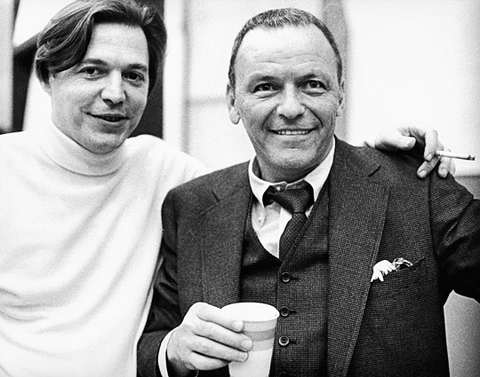
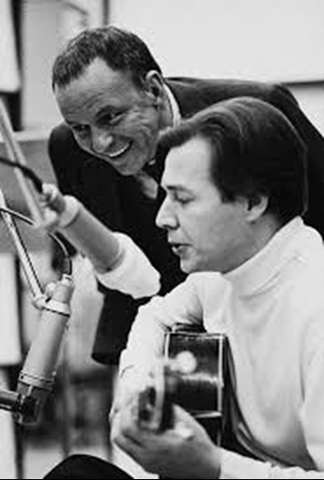
[Bonita / Song of the Sabia (Sabiá) -- critical commentary]
Milt Bernhart (quoted) / Friedwald (analysis): Trombonist Milt Bernhart, who played on the dates, told Friedwald: 'I'm not sure what was on his mind. He was unhappy because there were a couple of very difficult songs. These weren't just ballads, these were art songs that Jobim had written. He fought that one because it was very hard. It just was not reading right.' Bernhart nonetheless named 'Sabia' one of the most gorgeous things he ever heard Sinatra sing; Friedwald calls it beautifully gnomic and likens Jobim to 'a Brazilian Billy Strayhorn.' The 1969 Sinatra-Jobim album was completed in three sessions (Feb 11, 12, 13, 1969) yielding ten masters, but was pulled from release after a cover was already designed (Sinatra in front of a Greyhound bus); seven tracks eventually surfaced on Sinatra & Company (1970), with the full set finally issued complete in 2010 as Sinatra/Jobim: The Complete Reprise Recordings.
This song/context matches multiple dated entries in the chronology; the specific date Friedwald is referring to could not be determined with confidence.
Source: Will Friedwald, "Sinatra! The Song Is You: A Singer's Art" (2018 revised edition), Ch. 9, "Looking for the Hook" (1960-1971)
[One Note Samba / This Happy Madness / Wave / Drinking Water (Água De Beber) / Triste / Don't Ever Go Away (Por Causa de Você) -- critical commentary]
Friedwald (analysis): Friedwald describes the second Jobim collaboration as brassier and higher-powered than Ogerman's softer 1967 charts. 'Drinking Water' gives Sinatra the extra kick of singing several lines in Portuguese; 'Triste' creates an ineffable melancholy despite the dance beat; 'Wave' may be the dramatic apex of the whole Sinatra-Jobim cycle, with Sinatra diving to a spectacular low note an octave beneath the tonic.
This song/context matches multiple dated entries in the chronology; the specific date Friedwald is referring to could not be determined with confidence.
Source: Will Friedwald, "Sinatra! The Song Is You: A Singer's Art" (2018 revised edition), Ch. 9, "Looking for the Hook" (1960-1971)
Hollywood
M7162 Someone To Light Up My Life
(Antonio Carlos Jobim/Gene Lees/Vinicus De Maraes)
Hollis Music inc./VM Enterprises/ Corcovado Music Corp. (BMI) Arranged by Eumir Deodato
Conducted by Morris Stoloff
(2:36) CD: 46013-2 The Complete Reprise Studio Recordings Disc 13
CD: 1033-2Sinatra & Company
LP: FS1033Sinatra & Company
M7163 Desafinado (Off Key) w/Antonio Carlos Jobim
(Jon Hendricks/Antonio Carlos Jobim/Newton Mendonca)
Bendig Music Corp./Hollis Music inc./Corcovado Music Corp.. (BMI) Arranged by Eumir Deodato
Conducted by Morris Stoloff
(2:58) CD: 46013-2 The Complete Reprise Studio Recordings Disc 13
NOTE: Sinatra Scholar Ed O'Brien wonders what others on Sinatraphiles think of this duet with Jobim. He reports that Sinatra got it in his head that the song had homosexual overtones and didn't want it released. O'Brien says that he has talked with many Sinatra collectors who regard it as bizarre.. Personally, O'Brien writes, I like it and wish Reprise 1028 had been issued in album form with all 10 tracks.
Wow! Rich Rosenberg reacts. The guy who has been with Ava Gardner, Marilyn Monroe and a cast of thousands was worried about sounding gay? And, if it did, who would dare say anything about it? That was not long after the time when, after Jackie Mason joked about Frank and Mia, he ended up getting a rather substantial beating. I'm not saying Frank had something to do it, but it would tend to make one restrain one's comments about him. The song doesn't sound homosexual to me. Musically, it's not among my favorites of the bossa nova numbers, Rich emphasizes.
Rich adds that Mason's joke was that he didn't know who did it, but the guy was singing doobie dobbie do as he walked away!
Sinatraphile Mary Jane Smetanka says recalling this gives her a laugh. A few years ago on another song list, someone commented on the "unusual intimacy" of the Sinatra/Jobim duet on "Man and His Music" and asked for reaction. No one replied, she says. She loves that segment of the show.â It's a true duet, in some of the other filmed d duets I've seen, Sinatra seems to be doing his own thing at the expense of his partner, but FS and Jobim are really in sync.
"Sinatra-Jobim" was set to be release in March and then September of 1969. Reprise decided to release "My Way" and then "A Man Alone" instead. Finally, in January 1970, the album was issued. The initial release was in the form of an 8-Track tape. But, at the same time, their was a meeting at Reprise. Sinatra, Mo Ostin and others decided that "Watertown" had tremendous potential and the "Jobim" was pulled from circulation. But all plans at the time included "Off- Key." Sinatra was on board and had no problem with the recording. The commer- cial release got around and that is when the gay question started to rear its ugly head. Frank was not happy that "Strangers In The Night" was embraced by the gay community. Frank was far too, too heterosexual to have credibility and in- fluential people asked Johnny Mathis to record the song. He did and it became a much played jukebox song in gay bars. Frank was then burned again when ""Somethin' Stupid" was dubbed the "incest song." In the late 1990s, Roberto Quartin, who had worked on the session dates for Rep 1028, was asked to put out the two Jobim sets in one package. It would be released in Brazil. One afternoon, Roberto received a call from Sinatra. He had listened to the masters and complimented Roberto for doing a fine job. But, Frank did not want "Off-Key" issued. When Roberto asked why, Frank would not not ex- plain. Roberto thought it was a terrible mistake. A few days after the call, Roberto contacted Sinatra and begged him to reconsider. Frank would not budge. The set contains "A Day In The Life Of A Fool" in lieu of the Jobim duet.
Roberto had put together, a few years earlier, a two LP set titled "Lonely At The Top." When Frank learned of the forthcoming project, he called Roberto and asked him to include "Together" from the "All Alone" album. He was very proud of his vocal and thought it was a perfect selection for the concept being planned.
--Ed
M7164 Drinking Water (Aqua De Beber) w/Antonio Carlos Jobim
(Antonio Carlos Jobim/Vinicius De Moraes/Norman Gimbel) Butterfield Music (BMI)
Arranged by Eumir Deodato
Conducted by Morris Stoloff
(2:34) CD: 46013-2 The Complete Reprise Studio Recordings Disc 13
CD: 1033-2Sinatra & Company
LP: FS1033Sinatra & Company
M7145 Bonita
(Antonio Carlos Jobim/Ray Gibert/Gene Lees)
Corcovado Music Corp./Hollis Music Inc./VM Enterprises/ Corcovado Music Corp. (BMI) Arranged by Eumir Deodato
Conducted by Morris Stoloff
(3:39) CD: 46013-2 The Complete Reprise Studio Recordings Disc 13
LP: K64039 Portrait Of Sinatra (England)
Scott Henderson:
I think Bonita is a beautiful song. There was a foreign Reprise issued LP called "The Most Beautiful Songs of Frank Sinatra". I think Dindi, Bonita, & Song of the Sabia should have been on it.
I remember when I tracked down "Portrait of Sinatra", it was a joy to finally hear Bonita. I felt the same way about Song of The Sabia when I finally tracked down the Schlagers LP.
I know there was a February 11th version of Bonita but to my knowledge, it's never been released. Anyone know if it's on a bootleg somewhere?
Ed O'Brien:
Wasn't recorded. Frank ran it down and decided to push it ahead one day.
Hollywood
M7162 Someone To Light Up My Life
(Antonio Carlos Jobim/Gene Lees/Vinicus De Maraes)
Hollis Music inc./VM Enterprises/ Corcovado Music Corp. (BMI) Arranged by Eumir Deodato
Conducted by Morris Stoloff
(2:36) CD: 46013-2 The Complete Reprise Studio Recordings Disc 13
CD: 1033-2Sinatra & Company
LP: FS1033Sinatra & Company
Thanks to Ed for the above images
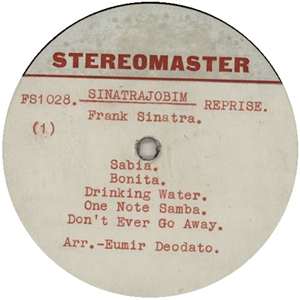
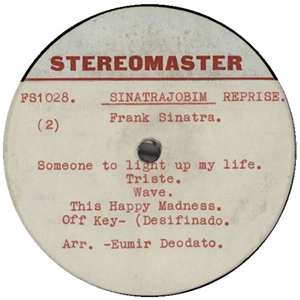
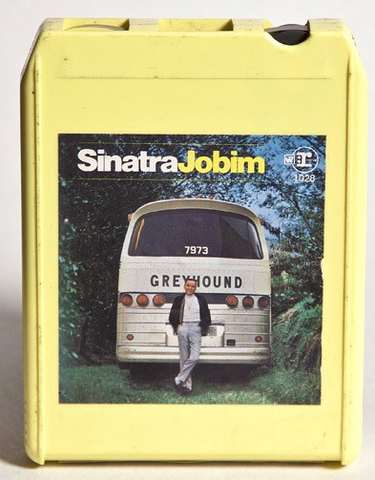
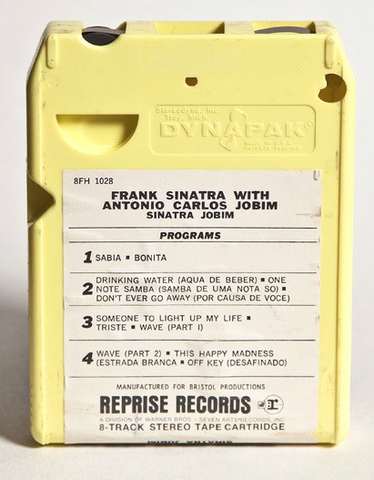
Photo session for the My Way album, 1969. “I think we all see now how timeless the music is,” observed Frank’s daughter Nancy. “His songs, hopefully the great American songbook, will live forever.” Source: photo and caption from J. Randy Taraborrelli, Sinatra: Behind the Legend (mptvimages.com).
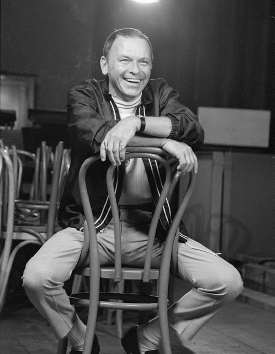
"Desafinado"
Friedwald (analysis): Friedwald finds the 1969 studio duet of 'Desafinado' (new English lyric by Gene Lees, replacing Jon Hendricks's disliked 1962 lyric) awkward and 'almost could be mistaken for a homoerotic love song,' unlike the TV duet of 'Girl from Ipanema' which he calls 'sheer magic.' He speculates Sinatra would have redone it solo with Jobim in the background given more time, and footnotes his suspicion that the 'strangely homoerotic nature of Desafinado' contributed to the shelving of the second Jobim album.
Source: Will Friedwald, "Sinatra! The Song Is You: A Singer's Art" (2018 revised edition).
"Duets I"
Granata's discography entry: Duets I, arranged by Patrick Williams, released November 1993 on Capitol Records.
Source: Charles L. Granata, "Sessions with Sinatra: Frank Sinatra and the Art of Recording" (1999/2003).
Hollywood
M7165 Song Of The Sabia
(Antonio Carlos Jobim/Norman Gimbel/ Chico Buarque)
Duchess Music Corp. (BMI)
Arranged by Eumir Deodato
Conducted by Morris Stoloff
(3:37) CD: 46013-2 The Complete Reprise Studio Recordings Disc 13
LP: K64039 Portrait Of Sinatra ( England )
45: 0970
NOTE: Sinatra Scholar Ed O'Brien recalls that Warner-Reprise put out a two LP set titled "Schlagers!" (hits, pop songs) in 1969. They offered it to members receiving their newsletter for $1.25. O'Brien knew about the Jobim sessions from February 1969 and was thrilled to see "Sabia" was on the set. They also had Ella, Petula Clark and many more. When the set arrived, O'Brien said he'll bet he played the Sinatra track 50 times. He loved it then and still loves it now. He says he has always thought of it as "Frank's existential song."
M7166 This Happy Madness (Estrada Branca) w/Antonio Carlos Jobim
(Antonio Carlos Jobim/Gene Lees/Vinicius De Moraes)
Hollis Music inc./Bendig Music Corp. (BMI)
Arranged by Eumir Deodato
Conducted by Morris Stoloff
(2:53) CD: 46013-2 The Complete Reprise Studio Recordings Disc 13
CD: 1033-2 Sinatra & Company
LP: FS1033 Sinatra & Company
M7167 Triste
(Antonio Carlos Jobim)
Corcovado Music Corp. (BMI)
Arranged by Eumir Deodato
Conducted by Morris Stoloff
(2:39) CD: 46013-2 The Complete Reprise Studio Recordings Disc 13
CD: 1033-2 Sinatra & Company
LP: FS1033 Sinatra & Company
Hollywood
M7165 Song Of The Sabia
(Antonio Carlos Jobim/Norman Gimbel/ Chico Buarque)
Duchess Music Corp. (BMI)
Arranged by Eumir Deodato
Conducted by Morris Stoloff
M7166 The Happy Madness (Estrada Branca) w/Antonio Carlos Jobim
(Antonio Carlos Jobim/Gene Lees/Vinicius De Moraes)
Hollis Music inc./Bendig Music Corp. (BMI)
Arranged by Eumir Deodato
Conducted by Morris Stoloff
M7167 Triste
(Antonio Carlos Jobim)
Corcovado Music Corp. (BMI)
Arranged by Eumir Deodato
Conducted by Morris Stoloff
note: An album that was almost released three times. The first issue was scheduled for March 69, but "My Way" got the nod instead. A second attempt took place in September of 69, but the McKuen album was considered a safer bet and finally in January of 1970 when the 8 track was issued in Northern California and withdrawn the next day. This time "Watertown" was the choice over Sinatra-Jobim.
note: Al Porcino told me the first album Sinatra did with Basie was an equal billing, but the second was with Basie. Seems the same billing occurred with the second Jobim. Interesting. Ed
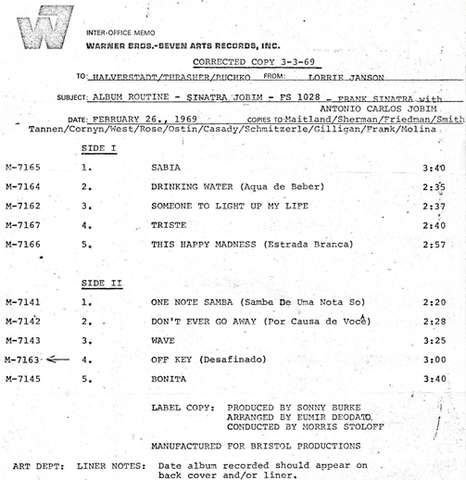
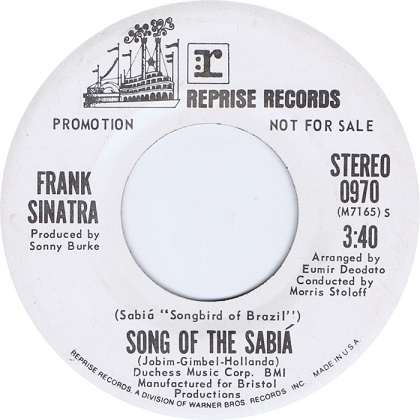
Hollywood
M7180 All My Tomorrows
(Sammy Cahn/Jimmy Van Heusen)
Maraville Music Corp. (ASCAP)
Arranged & Conducted By Don Costa
(4:37) CD: 46013-2 The Complete Reprise Studio Recordings Disc 14
CD: 1029-2My Way
LP: FS1029My Way
M7181 Didn't We?
(Jimmy Webb)
Jobete Music Co. Inc. (ASCAP)
Arranged & Conducted By Don Costa
(2:55) CD: 46013-2 The Complete Reprise Studio Recordings Disc 14
CD: 1029-2My Way
LP: FS1029My Way
Hollywood
M7180 All My Tomorrows
M7181 Didn't We?
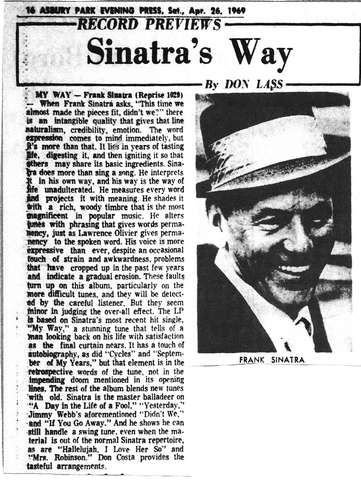
[All My Tomorrows -- critical commentary]
Friedwald (analysis): Friedwald says the 1969 reading is a full minute longer and ten years darker/deeper than the 1958 original, noting Sinatra makes 'arms that cling at all' into 'an incredibly potent, not to mention clinging, verb' at the climactic high note.
This song/context matches multiple dated entries in the chronology; the specific date Friedwald is referring to could not be determined with confidence.
Source: Will Friedwald, "Sinatra! The Song Is You: A Singer's Art" (2018 revised edition), Ch. 9, "Looking for the Hook" (1960-1971)
[Didn't We -- critical commentary]
Jimmy Webb (quoted) / Friedwald (analysis): Songwriter Jimmy Webb told Friedwald about his technique for pitching songs to stars like Sinatra: 'If I may say so, I used to be a damn good at it. I didn't think of myself as much of a performer or a singer, but I did think that I was a hell of a pitcher! In fact, we used to deliberately sing songs in a kind of half-assed way, because we knew that the ego [not only of Sinatra but other stars] we were dealing with was so huge, that their frustration level would build to the point that they would say "Oh shut up! Let me sing this song! Just get out of here and leave me the lead sheet, I'll sing it!"' Friedwald calls this maybe the best of the four Webb songs Sinatra recorded, praising how Sinatra stretches a single chorus over three minutes as a slow torch song rather than a genre piece.
This song/context matches multiple dated entries in the chronology; the specific date Friedwald is referring to could not be determined with confidence.
Source: Will Friedwald, "Sinatra! The Song Is You: A Singer's Art" (2018 revised edition), Ch. 9, "Looking for the Hook" (1960-1971)
Hollywood
M7182 A Day In The Life Of A Fool
(Luiz Bonfa/Carl Sigman/Antonio Mariz)
Anne-Rachel Music Corp. (ASCAP/SACEM)
Arranged & Conducted By Don Costa
(3:00) CD: 46013-2 The Complete Reprise Studio Recordings Disc 14
CD: 1029-2My Way
LP: FS1029My Way
M7183 Yesterday
(John Lennon/Paul McCartney)
Maclen Music (BMI)
Arranged & Conducted By Don Costa
(3:55) CD: 46013-2 The Complete Reprise Studio Recordings Disc 14
CD: 1029-2My Way
LP: FS1029My Way
VANCE ADAIR commented: What a solemn arrangement FS had to experiment with on 'Yesterday.'
It should have been a gift.
The fabled FS phrasing seems strangely inadequate here. In fact he seems to demonstrate considerable difficulty phrasing the title itself!
FS sounds mannered and insincere. A rare claim, indeed.
Ed O'Brien responded:
I fervently wish Riddle had done the "My Way" album. I can hear his work on "A Day In The Life Of A Fool,"
"Watch What Happens," "Yesterday" and so on.
I have often wondered why Sinatra let the
"saiddddd... " go on the released take of "Yesterday."
In concert, he never once had that problem with his vocal control on the song. Tis' a mystery.
Vance responds:
Ah, yes! One can only marvel at what might have happened there.
I can think of a clutch of Lennon/McCartney tunes that could have been reworked beautifully by Riddle - even more so with a chamber orchestra.
The title song of the album, however, was made for a
Don Costa treatment. The sentiment may be schlock, but
Costa's cosmetic surgery on the tune was expertly done.
M7220 If You Go Away
(Jacques Brel/Rod McKuen)
(SACEM)
Arranged & Conducted By Don Costa
(3:31) CD: 46013-2 The Complete Reprise Studio Recordings Disc 14
CD: 1029-2My Way
LP: FS1029My Way
"Yesterday"
Friedwald (analysis): Friedwald compares the 53-year-old Sinatra's rendition (slower than the Beatles' string-quartet original) to McCartney's own performance (written when McCartney was 22, coincidentally the same age Jimmy Webb was when he wrote 'Didn't We'): 'McCartney's yesterdays seem more vague and symbolic when he sings about them, compared to Sinatra's yesterdays, which are tangible and concrete -- you can actually feel their weight.'
Source: Will Friedwald, "Sinatra! The Song Is You: A Singer's Art" (2018 revised edition).
Hollywood
M7221 Watch What Happens
M7222 For Once In My Life
M7224 Hallelujah, I Love her So
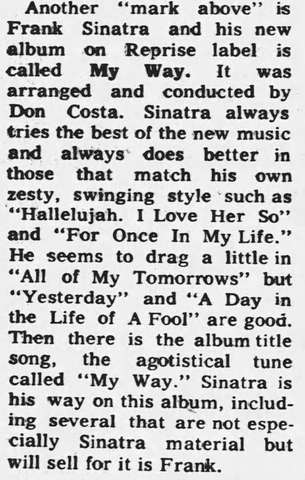
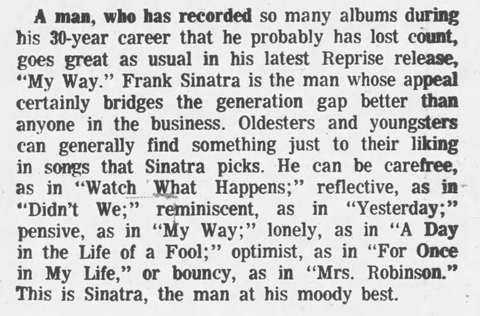
Hollywood
M7221 Watch What Happens
(Norman Gimbel/Michel Legrand/Jacques Louis Demy)
Songs Of PolyGram International/Gimbel Music (BMI)
Arranged & Conducted By Don Costa
(2:18) CD: 46013-2 The Complete Reprise Studio Recordings Disc 14
CD: 1029-2My Way
LP: FS1029My Way
M7222 For Once In My Life
(Ronald Miller/Orlando Murden)
Jobete Music Co. Inc. (ASCAP)
Arranged & Conducted By Don Costa
(2:50) CD: 46013-2 The Complete Reprise Studio Recordings Disc 14
CD: 1029-2My Way
LP: FS1029My Way
M7223 Mrs. Robinson
(Paul Simon)
Paul Simon Music (BMI)
Arranged & Conducted By Don Costa
(2:53) CD: 46013-2 The Complete Reprise Studio Recordings Disc 14
CD: 1029-2My Way
LP: FS1029My Way
M7224 Hallelujah, I Love her So
(Ray Charles)
Unchappell Music (BMI)
Arranged & Conducted By Don Costa
(2:48) CD: 46013-2 The Complete Reprise Studio Recordings Disc 14
CD: 1029-2My Way
LP: FS1029My Way
On February 24, 1946, a special CBS radio program was broadcast to mark the beginning of National Negro Newspaper Week (February 24–March 2, 1946) and to celebrate the 119th anniversary of the Black press.
[Georgia Historic Newspapers]Georgia Historic Newspapers
Here are the key details regarding this special broadcast:
Broadcast Details: The CBS network program aired on Sunday, February 24, 1946, at 11:30 p.m. EST.Theme: The broadcast focused on the role of the Negro newspaper in the postwar world, with a central theme that the establishment of democracy is the concern of every man.Participants & Highlights:Helen Hayes: The acclaimed actress served as the mistress of ceremonies.Josh White: The renowned folk singer and guitarist appeared on the program.General Dwight D. Eisenhower: Scheduled to appear on the program.Other Guests: The broadcast featured national, military, and artistic leaders.Organizers: The program was arranged by a committee headed by Dowdal H. Davis of the Kansas City Call, under the auspices of the Negro Newspaper Publishers Association (NNPA).Context: This was part of a larger, week-long observance that included an essay contest for high school students on "The Negro Newspaper in the Postwar World" and was followed by an NBC broadcast on March 2, 1946.
[Georgia Historic Newspapers]Georgia Historic Newspapers +3
This 1946 observance aimed to highlight the achievements of the Black press and its fight for democracy at home, paralleling the efforts of Black soldiers fighting for freedom abroad.
[Georgia Historic Newspapers]Georgia Historic Newspapers +1
note:Afro-America has Frank on the 2-24 show and the Atlanta Daily World
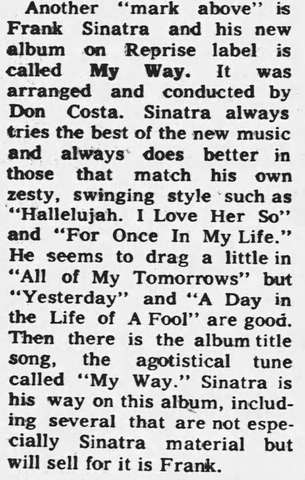
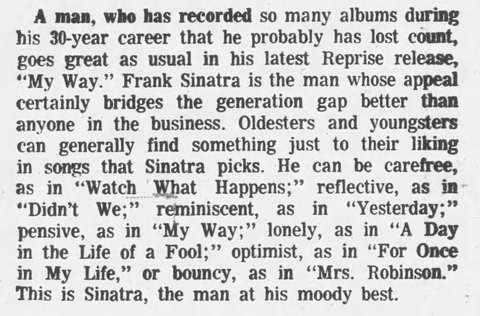
['My Way' hits the charts]
Kaplan: The single 'My Way' hit the Billboard charts at the end of March 1969 and eventually rose to number 27; the My Way album, released around the same time, reached number 11. Both did notably better in England.
Source: James Kaplan, "Sinatra: The Chairman" (2015)
["My Way" enters the Billboard chart]
'My Way' debuted on the Billboard chart at No. 69, the week's highest new entry, though it would ultimately stall at No. 27 in the US despite becoming a much bigger and longer-running hit in Britain.
Source: Richard Havers, "Sinatra" (Dorling Kindersley, 2007).
[The Godfather published]
The Godfather was published and went straight to number one on the best-seller lists, competing with Philip Roth's Portnoy's Complaint for the top spot; readers widely assumed the Johnny Fontane character was based on Sinatra.
Source: James Kaplan, "Sinatra: The Chairman" (2015).
Hollywood
M7263 I've Been To Town
(Rod McKuen)
Almo Music Corp. (ASCAP)
Arranged & Conducted By Don Costa
(3:10) CD: 46013-2 The Complete Reprise Studio Recordings Disc 14
CD: 1030-2A Man Alone
LP: FS1030A Man Alone
M7264 Empty Is
(Rod McKuen)
Editions Chanson Music (ASCAP)
Arranged & Conducted By Don Costa
(2:42) CD: 46013-2 The Complete Reprise Studio Recordings Disc 14
CD: 1030-2A Man Alone
LP: FS1030A Man Alone
M7265 The Single Man
(Rod McKuen)
Editions Chanson Music (ASCAP)
Arranged & Conducted By Don Costa
(2:59) CD: 46013-2 The Complete Reprise Studio Recordings Disc 14
CD: 1030-2A Man Alone
LP: FS1030A Man Alone
M7266 Lonesome Cities
(Rod McKuen)
Editions Chanson Music (ASCAP)
Arranged & Conducted By Don Costa
(3:15) CD: 46013-2 The Complete Reprise Studio Recordings Disc 14
CD: 1030-2A Man Alone
LP: FS1030A Man Alone
Ed Notes:
Frank Sinatra spent a great deal of time in recording studios in 1969. He began the year with Mr Jobim and their second album of bossa nova songs-- this time all Jobim com- positions. He then laid down the "My Way" album, then the McKuen and finally "Watertown." There were also a few singles sessions. In all, he recorded 39 songs plus he read four poems by Mr. McKuen. Although I much prefer "Sinatra- Jobim," "A Man Alone" is the finest singing done by Frank that year. As a matter of fact, he would never sound this good again. The vocal timbre is so rich and reedy here.
The album only sold 60,000 copies and was dismissed by a number of music critics because of the content. They may have been right. But I find the vocals so damn good throughout, the work is really required listening if you are a Sinatra fan.
Larry Crawford:
I agree with you, I quite like " A Man Alone". I like all the FS recording done in 1969. I think it was a very good year indeed.
Danny Faux:
I agree too. I like " A Man Alone ", " Watertown " and " Sinatra- Jobim 2 ". And some tracks of " My Way " as well. " I love " All My Tomorrows ", - the arrangement by Costa is excellent, and Frank's vocal has a hauntingly quality I find heart-wrenching in a way I can't quite describe in words. The same song he recorded in 1959, the same lyrics, but you can feel the wistful nuances in his delivery, we can actually feel that he doubts its original hopeful message. Maybe all his tomorrow didn't quite turn the way he had believed. Hey, maybe I am reading too much out of the recording, but that is what I felt when I listened to it for the first time in the lp. Having said that, I love both recordings of "All My Tomorrows ". 1959 was a very good year indeed...
And I believe that the " B" side of the " My Way " single is a real beauty too. A Riz Ortola- ni lovely tune, " Blue Lace "
Ed O'Brien:
We have Tony Bennett to thank for Frank's marvelous recording of "All My Tomorrows" in 1969. Tony did a very intelligent, gentle reading for his 1965 "Songs for the Jet Set" with Don Costa. Frank was knocked out by it. He realized his 1958 effort had missed the mark. He more than rectified that misstep with his definitive effort with Mr. Costa. It is in my "Sinatra 101" book.
"Blue Lace" is a lovely recording Riddle gave Frank a great backing and the bittersweet memory piece is one of my favorite Sinatra recordings. Frank and Nelson would only work together on three more sessions after that evening in November of 1968.
Hollywood
M7263 I've Been To Town
M7264 Empty Is
M7265 The Single Man
M7266 Lonesome Cities note: Fold-out edition of the album: note: In December of 1969, Rod McKuen issued a limited edition hardcover book( 500 ) as a companion piece with the Sinatra Reprise album.
Amazon has two copies available this morning. Reprise also issued a limited pressing of a fold-out edition of the album. It contained McKuen's ode to Frank and some photos of the session.
Ed
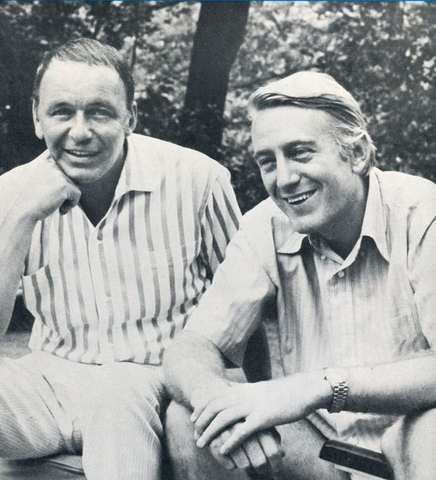
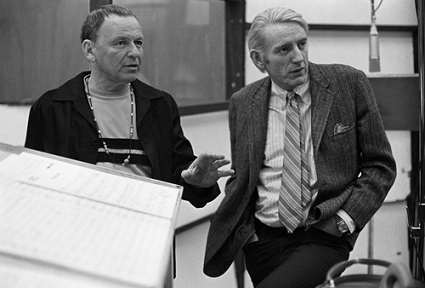
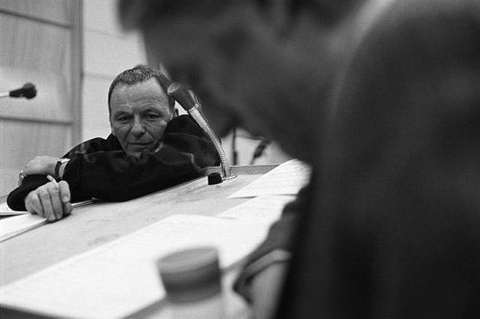
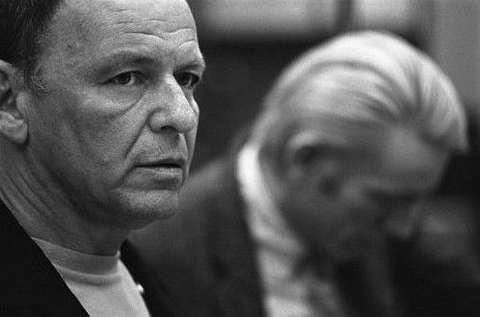
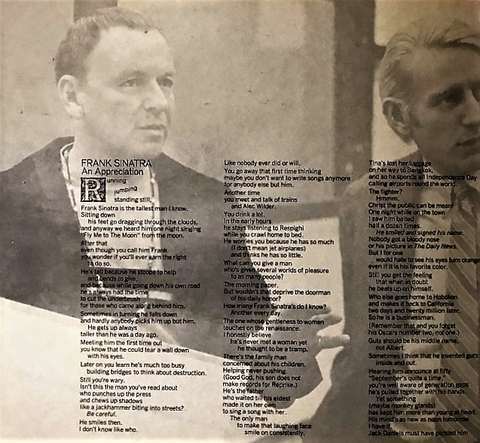
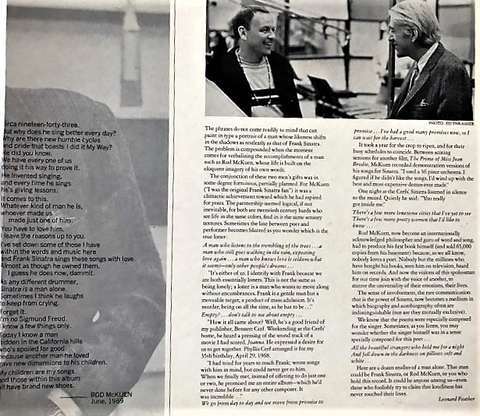
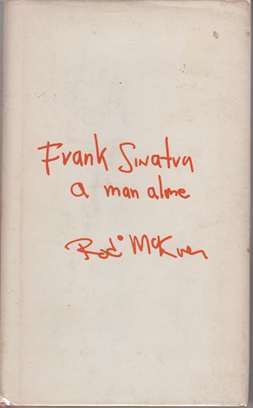
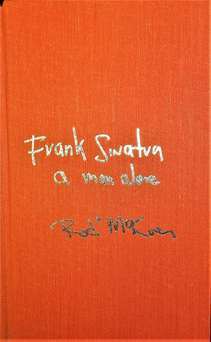
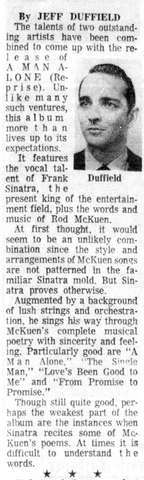
Hollywood
M7267 The Beautiful Strangers
(Rod McKuen)
Editions Chanson Music (ASCAP)
Arranged & Conducted By Don Costa
(2:38) CD: 46013-2 The Complete Reprise Studio Recordings Disc 14
CD: 1030-2 A Man Alone
LP: FS1030 A Man Alone
M7268 A Man Alone
(Rod McKuen)
Editions Chanson Music (ASCAP)
Arranged & Conducted By Don Costa
(3:44) CD: 46013-2 The Complete Reprise Studio Recordings Disc 14
CD: 1030-2 A Man Alone
CD: 9-26340-2 The Reprise Collection
CD: 2275-2 Frank Sinatra's Greatest Hits Vol.2
LP: FS1034 Frank Sinatra's Greatest Hits Vol.3
LP: FS1030 A Man Alone
45: 0852
M7269 A Man Alone (Reprise)
(Rod McKuen)
Editions Chanson Music (ASCAP)
Arranged & Conducted By Don Costa
(1:29) CD: 46013-2 The Complete Reprise Studio Recordings Disc 14
CD: 1030-2 A Man Alone
LP: FS1030 A Man Alone
M7270 Love's Been Good To Me
(Rod McKuen)
Almo Music Corp. (ASCAP)
Arranged & Conducted By Don Costa
(3:23) CD: 46013-2 The Complete Reprise Studio Recordings Disc 14
CD: 1030-2 A Man Alone
CD: 2275-2 Frank Sinatra's Greatest Hits Vol.2
LP: FS1034 Frank Sinatra's Greatest Hits Vol.3
LP: FS1030 A Man Alone
45: 0852
Hollywood
M7267 The Beautiful Strangers
M7268 A Man Alone
M7269 A Man Alone (Reprise)
(Rod McKuen)
M7270 Love's Been Good To Me
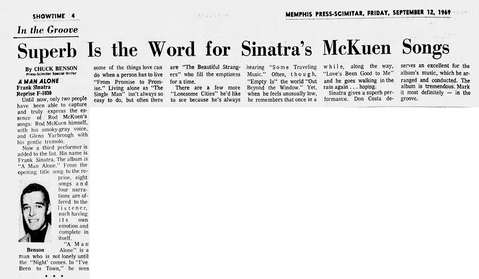
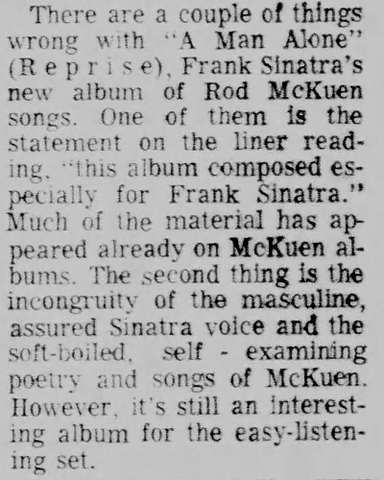
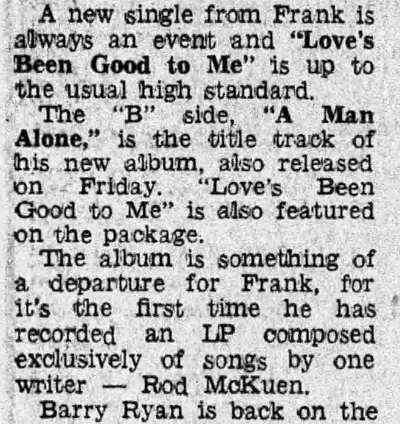
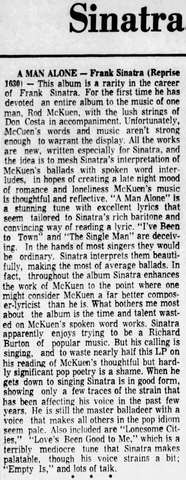
[A Man Alone / The Single Man / Lonesome Cities / Love's Been Good to Me / Out Beyond the Window / Some Traveling Music -- critical commentary]
Rod McKuen (quoted) / Burton Kittay (anecdote) / Friedwald (analysis): McKuen told Leonard Feather (around the time of the album): 'I had tried for years to reach Frank; wrote songs with him in mind, but could never get to him... When we finally met, instead of just offering to do just one or two [of my songs], he promised me an entire album, which he'd never done before for any other composer. It was incredible.' Friedwald frames the album's template as Glenn Yarbrough's 1966 RCA album The Lonely Things (spoken poetry + songs over strings, arr. Mort Garson) -- crediting Chuck Granata for pointing this out. Friedwald analyzes 'Love's Been Good to Me' as structurally akin to Ervin Drake's 'It Was a Very Good Year' (ABABAB folk-derived form), with Sinatra making McKuen's fictional 'October Hill' feel like a real, vital place. He calls 'Some Traveling Music' -- referencing a phrase from 'the sainted philosopher Jackie Gleason' -- an example of McKuen becoming Sinatra's 'ghostthinker' (comparing it to Mike Shore's 1963 Playboy interview ghostwriting), quoting the lyric: 'One day, I'm gonna find me an island, a think place / Go there with a mess of records and a ukulele. / Just sit strumming, I might even do some thinking.' Footnote: fan Burton Kittay told Friedwald he met McKuen at an AIDS benefit and told him A Man Alone was his favorite Sinatra album; McKuen started to cry and asked for a hug.
This song/context matches multiple dated entries in the chronology; the specific date Friedwald is referring to could not be determined with confidence.
Source: Will Friedwald, "Sinatra! The Song Is You: A Singer's Art" (2018 revised edition), Ch. 9, "Looking for the Hook" (1960-1971)
Hollywood
M7271 Out Beyond The Window
(Rod McKuen)
Editions Chanson Music (ASCAP)
Arranged & Conducted By Don Costa
(2:41) CD: 46013-2 The Complete Reprise Studio Recordings Disc 14
CD: 1030-2A Man Alone
LP: FS1030A Man Alone
M7272 Night
(Rod McKuen)
Editions Chanson Music (ASCAP)
Arranged & Conducted By Don Costa
(2:22) CD: 46013-2 The Complete Reprise Studio Recordings Disc 14
CD: 1030-2A Man Alone
LP: FS1030A Man Alone
M7273 Some Traveling Music
(Rod McKuen)
Editions Chanson Music (ASCAP)
Arranged & Conducted By Don Costa
(2:33) CD: 46013-2 The Complete Reprise Studio Recordings Disc 14
CD: 1030-2A Man Alone
LP: FS1030A Man Alone
M7274 From Promise To Promise
(Rod McKuen)
Editions Chanson Music (ASCAP)
Arranged & Conducted By Don Costa
(1:28) CD: 46013-2 The Complete Reprise Studio Recordings Disc 14
CD: 1030-2A Man Alone
LP: FS1030A Man Alone
M7264 Empty Is - Spoken Introduction
(Rod McKuen)
Arranged & Conducted By Don Costa
CD: 1030-2
LP: FS1030
Notes
Ed O'Brien:
Lee Herschberg, engineer at this session, told me it took
Frank 45 minutes to complete the poetry reading for the McKuen
album.
Ed
[Out Beyond the Window / A Man Alone / Didn't We / Forget to Remember -- critical commentary]
Friedwald (analysis): Friedwald describes the ballad segment: Sinatra, presented as a lonely man in an apartment set wearing a turtleneck, opens with the spoken 'Out Beyond the Window,' sings 'A Man Alone,' then moves into Jimmy Webb's 'Didn't We' and Teddy Randazzo's 'Forget to Remember' (previously a single), calling it 'exactly what Sinatra was going for: a sequence of songs that's at once classic and contemporary.'
This song/context matches multiple dated entries in the chronology; the specific date Friedwald is referring to could not be determined with confidence.
Source: Will Friedwald, "Sinatra! The Song Is You: A Singer's Art" (2018 revised edition), Ch. 9, "Looking for the Hook" (1960-1971)
Los Angeles
M7225 In The Shadow Of The Moon
(Earl Brown/Heinz Kessling)
Ebron Music/ASCAP/ Ingo Music/Claus Ogerman Productions (BMI/GEMA) Arranged by Don Costa
Conducted by Sonny Burke
(2:54) CD: 46013-2 The Complete Reprise Studio Recordings Disc 14
LP: W54093 I Sing The Songs Vol.2 (Italy)
Los Angeles
M7225 In The Shadow Of The Moon
Ed O'Brien:
"Romeo and Juliet 70'' was Tina Sinatra's first film appearance. The German production was shot in Munich in June of 1968. Michael Pfleghar directed both this film and "Frank Sinatra A Man & His Music + Ella + Jobim." He had a close personal relationship with Tina and was a great admirer of her father. Frank paid a visit to the set during the filming. Heinz Keissling( German composer) and Earl Brown wrote "In The Shadow Of The Moon" for the TV miniseries. Frank liked it enough to record it at Reprise on 3-25-69. The session ran from 3 to 6 PM at Western Recorders Studio. The Tuesday afternoon recording featured a 41 piece orchestra including the great Joe Pass on guitar. The song was on the soundtrack of the miniseries and was also released as a single in West Germany. The picture sleeve photo from the session was quite striking and the flipside was "Mrs. Robinson." The film also had Frank's 'That's Life" on the s/t. "In The Shadow Of The Moon" was finally released in this country in 1995 on the 20 CD "Complete Reprise Studio Recordings." The song has never been issued in stereo.
There was an eclectic group of well known personalities in the series including Ray Charles, BeeGees, Hugh Hefner, Richard Nixon, Jerry Lewis, Eartha Kitt and Timothy Leary. Hampton Fancher was Romeo to Tina's Juliet. The series falls into the genre of fantasy. Flying Frankie set to sing for Hubert
Stars and Stripes June 23, 1968
FRANKFURT "You do what I think everyone ought to do: Pick a man and then try to get him elected. If he's not elected, you wait until the next time." Not a civic leader or civics teacher, but Frank Sinatra it was who laid these words on newsmen Friday at Frankfurt International Airport as he explained why he was jetting back to New York to "get ready to do some campaigning for Mr. (Hubert) Humphrey." Sinatra, 52, had just finished a 48-hour winging to Europe, which included a short stop in London Wednesday for a meeting with estranged wife Mia Farrow ("We have no plans for a reconciliation.") and a surprise visit to daughter Tina in Munich to celebrate her 20th birthday. Tina's first move in show business is a two-part TV show, "The Year of the Joker, or Romeo and Juliet 1970," now being filmed in the Bavarian capital. She was "astounded when I showed up at her Munich hotel last night. It wasn't easy to keep it a secret with all the people involved," said the man show business calls "The Chairman of the Board" or "The Boss." Asked what his work for Humphrey involved, Sinatra explained that they have appeared together. "I sing and he speaks. The money is used to get people to register to vote. That's the only way you get a truly free election when as many people as possible go to the polls."
Back to Munich and Tina: "It was a simple party. We just had a cake with some of the cast. Tina's very happy and Michael (the director of the show, Michael Pfleghar) thinks she's doing very well."
Will she sing, make records? "Not at the moment, at least. When she's in a joking mood, she claims the reason is that there's too much competition in the family. She wants to be an actress but she does sing a little." For the non-American press "Yes, she likes Germany and the Germans and she's trying to learn the language." He was equally enthusiastic about his two other children and emphatic about both singers having made their own way in show business: "Both Nancy and Frank (Jr.) have had little advice from me. I think it's just great. They had their own ideas and are doing their own things. Frank's working in Las Vegas if you happen to be around there." When asked if Bing Crosby had had any influence on his singing, and on his career, a relaxed, laughing Sinatra answered: "Yes, he did. He had a very basic influence. When I heard him, I thought: `If he can do it, so can I.'"
Desert Circus, Big Top Ball, Las Flores Ballroom, El Mirador Hotel
Palm Springs, California
Benefit for the United Fund
Don Rickles, Bill Miller and Frank Sinatra.
The date has been reported as March 29th, 1969 but the Desert Circus, Big Top Ball, was on March 28th, 1969
41st Academy Awards, The Dorothy Chandler Pavilion, Los Angeles Monday evening
Time: 7:00 PM - 12:00 AM
Network: ABC
Hosts: The Friends of Oscar - Burt Lancaster, Ingrid Bergman, Jane Fonda, Rosalind Russell, Tony Curtis, Walter Matthau, Diahann Carroll, Natalie Wood, Sidney Poitier and Frank Sinatra.
1. Star
Ed O'Brien:
Frank sang the Oscar nominated song "Star,' then sat on the lip of the stage and read the five nominees for Best Supporting Actor and presented the Oscar to Jack Albertson.. He also, later on in the show, presented the writing awards with Roz Russell; presented Best Song "The
Windmills of Your Mind." When Burt Lancaster announced Cliff Robertson as Best Actor, Frank accepted on his behalf.
Although Sinatra appeared on many Oscar shows, he only sang a nominated song(s) on the 1946 and 1969 broadcasts. Although he introduced many of the tunes nominated in the 50's and 60's, other vocalists sang them for Oscar.
41st Academy Awards, The Dorothy Chandler Pavilion, Los Angeles
Frank 4-14-69 at the Academy Awards ceremony
[image referenced in source but could not be recovered]
[image referenced in source but could not be recovered]
Caesars Palace, Las Vegas, Nevada (May 9-25)
1. Mrs. Robinson
2. Please Be Kind
3. Cycles
4. My Way
5. The Lady Is a Tramp
6. Lost in the Stars
7. Didn't We
8. Try a Little Tenderness
9. I've Got You Under My Skin
10. Medley: Medley: Strangers in the Night / Young at Heart / Nancy / It Was a Very Good Year /
All the Way / That's Life / My Kind of Town
Caesars Palace, Las Vegas, Nevada (May 9-25)
Beard was not a hit. It was gone by the first weekend.
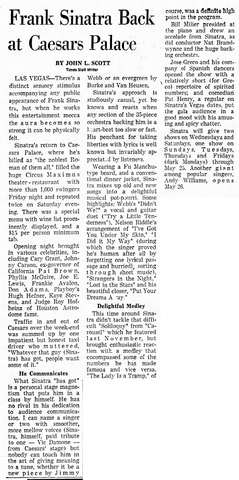
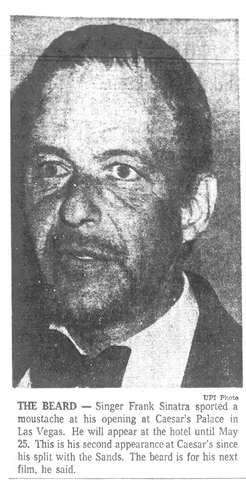
Caesars Palace , Las Vegas , Nevada (May 9-25)
First Show
Caesars Palace , Las Vegas , Nevada (May 9-25)
Second Show
1. Mrs. Robinson
2. Please Be Kind
3. Cycles
4. The Lady Is a Tramp
5. Lost in the Stars
6. Didn't We
7. Try a Little Tenderness
8. I've Got You Under My Skin
9. Medley: Medley: Strangers in the Night / Young at Heart / Nancy / It
Was a Very Good Year / All the Way / That's Life / My Kind of Town
Caesars Palace, Las Vegas, Nevada (May 9-25)
1. Mrs. Robinson
2. Please Be Kind
3. Cycles
4. The Lady Is a Tramp
5. Lost in the Stars
6. Didn't We
7. Try a Little Tenderness
8. I've Got You Under My Skin
9. Medley: Medley: Strangers in the Night / Young at Heart / Nancy / It Was a Very Good Year / All the Way / That's Life / My Kind of Town
Caesars Palace, Las Vegas, Nevada (May 9-25)
Caesars Palace, Las Vegas, Nevada (May 9-25)
1. Mrs. Robinson
2. Please Be Kind
3. Cycles
4. The Lady Is a Tramp
5. Lost in the Stars
6. Didn't We
7. Try a Little Tenderness
8. I've Got You Under My Skin
9. Medley: Medley: Strangers in the Night / Young at Heart / Nancy / It Was a Very Good Year / All the Way / That's Life / My Kind of Town
Caesars Palace, Las Vegas, Nevada (May 9-25)
(Two Shows)
Caesars Palace, Las Vegas, Nevada (May 9-25)
1. Mrs. Robinson
2. Please Be Kind
3. Cycles
4. The Lady Is a Tramp
5. Lost in the Stars
6. Didn't We
7. Try a Little Tenderness
8. I've Got You Under My Skin
9. Medley: Medley: Strangers in the Night / Young at Heart / Nancy / It Was a Very Good Year / All the Way / That's Life / My Kind of Town
Caesars Palace, Las Vegas, Nevada (May 9-25)
1. Mrs. Robinson
2. Please Be Kind
3. Cycles
4. The Lady Is a Tramp
5. Lost in the Stars
6. Didn't We
7. Try a Little Tenderness
8. I've Got You Under My Skin
9. Medley: Medley: Strangers in the Night / Young at Heart / Nancy / It Was a Very Good Year / All the Way / That's Life / My Kind of Town
Caesars Palace, Las Vegas, Nevada (May 9-25)
1. Mrs. Robinson
2. Please Be Kind
3. Cycles
4. The Lady Is a Tramp
5. Lost in the Stars
6. Didn't We
7. Try a Little Tenderness
8. I've Got You Under My Skin
9. Medley: Medley: Strangers in the Night / Young at Heart / Nancy / It Was a Very Good Year / All the Way / That's Life / My Kind of Town
Caesars Palace, Las Vegas, Nevada (May 9-25)
Caesars Palace, Las Vegas, Nevada (May 9-25)
Caesars Palace, Las Vegas, Nevada (May 9-25)
Ed O'Brien reports that Sinatra opened his
Caesars engagement with "Mrs. Robinson."
Caesars Palace, Las Vegas, Nevada (May 9-25)
Caesars Palace, Las Vegas, Nevada (May 9-25)
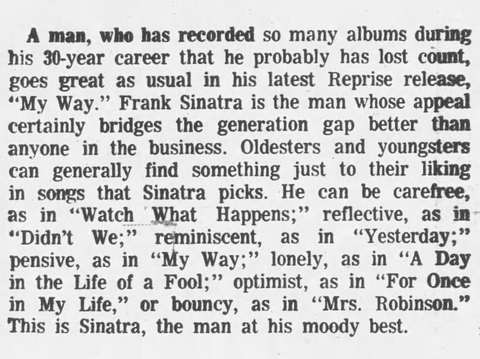
Caesars Palace, Las Vegas, Nevada (May 9-25)
Home visiting for her 21st birthday, Tina was told her father had been called away on an emergency and missed her party. During dinner, a procession of violinists in tuxedos filed into the garden to serenade the guests - with Frank himself disguised as the fifth violinist in line, having secretly flown in to surprise her. (Source: Tina Sinatra, "My Father's Daughter: A Memoir" (2000).)
Home visiting for her 21st birthday, Tina was told her father had been called away on an emergency and missed her party. During dinner, a procession of violinists in tuxedos filed into the garden to serenade the guests - with Frank himself disguised as the fifth violinist in line, having secretly flown in to surprise her. (Source: Tina Sinatra, "My Father's Daughter: A Memoir" (2000).)
[recording session -- critical commentary]
By July 1969, Sinatra had completed two experimental albums: A Man Alone, set to poetry by Rod McKuen, and Watertown, produced by Four Seasons arranger Charles Callello -- both admired by Granata for their ambition despite mixed commercial reception.
Source: Charles L. Granata, "Sessions with Sinatra: Frank Sinatra and the Art of Recording" (1999/2003), Part IV: The Reprise Years
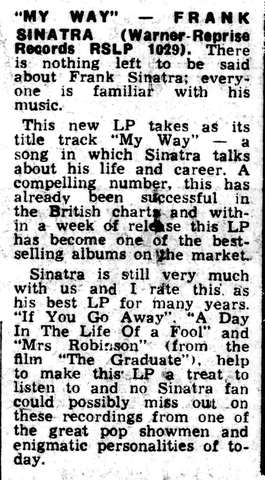
THE JOURNAL
7-10-69
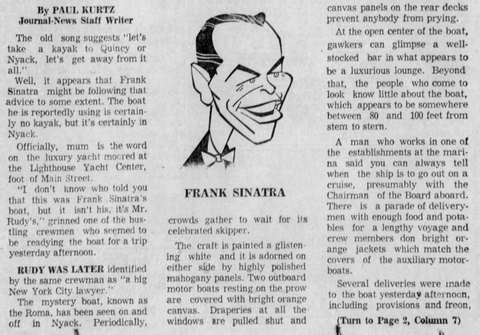
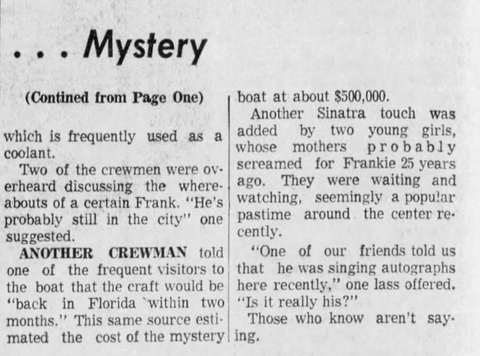
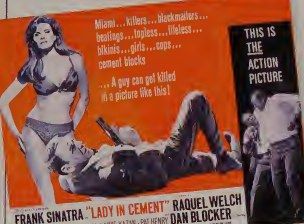
[Photograph: Watertown orchestral sessions begin. From Richard Havers, "Sinatra" (Dorling Kindersley, 2007), p.312.]
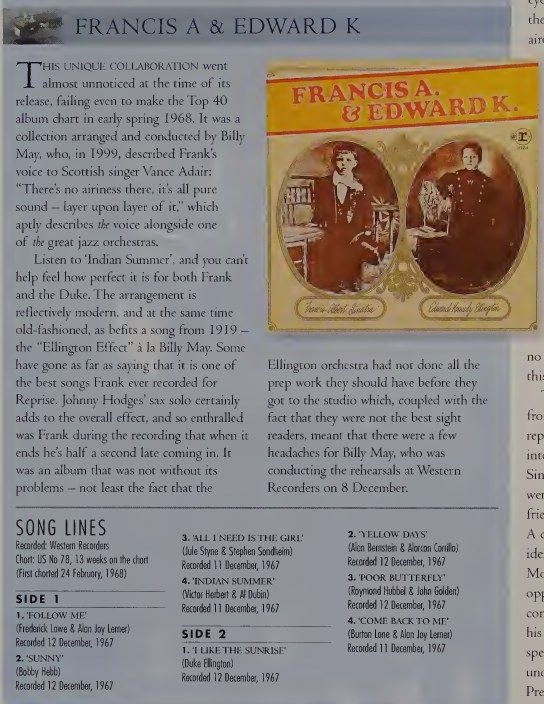
[Photograph: Watertown orchestral sessions begin. From Richard Havers, "Sinatra" (Dorling Kindersley, 2007), p.312.]
[Photograph: Watertown orchestral sessions begin. From Richard Havers, "Sinatra" (Dorling Kindersley, 2007), p.311.]
[Photograph: Watertown orchestral sessions begin. From Richard Havers, "Sinatra" (Dorling Kindersley, 2007), p.311.]
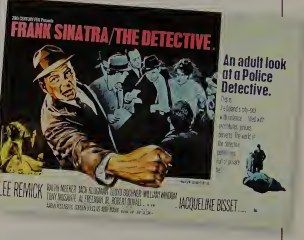
[Photograph: Watertown orchestral sessions begin. From Richard Havers, "Sinatra" (Dorling Kindersley, 2007), p.311.]
[Photograph: Watertown orchestral sessions begin. From Richard Havers, "Sinatra" (Dorling Kindersley, 2007), p.311.]
Work began on the orchestral tracks for Watertown, a concept album written entirely by young songwriters Bob Gaudio and Jake Holmes about a small-town man whose wife has left him. Singing against a pre-recorded backing track was unusual for Frank and made the sessions especially demanding. (Source: Richard Havers, "Sinatra" (Dorling Kindersley, 2007).)
Astronauts Neil Armstrong, Buzz Aldrin, and Michael Collins brought the Sinatra/Basie/Quincy Jones recording of "Fly Me to the Moon" aboard Apollo XI on this date; Nancy calls hearing her father's voice broadcast from Mission Control one of the great thrills of the family's lives. Source: Nancy Sinatra, "Frank Sinatra, My Father" (1985).
[Three Singing Sinatras Play Las Vegas Simultaneously]
In August 1969, Nancy, Frank Sinatra, and Frank Sinatra Jr. all performed in Las Vegas at the same time -- Nancy at the International Hotel, Frank Sr. at Caesars Palace, and Frank Jr. at the Frontier -- and Frankie Jr. hosted a buffet breakfast for all three bands and crews.
Source: Nancy Sinatra, "Frank Sinatra, My Father" (1985).
[Death of Bill Goetz]
Kaplan: Producer Bill Goetz, husband of Edith Mayer Goetz (daughter of MGM founder Louis B. Mayer) and a friend of Sinatra's for nearly fifteen years, died of cancer. After a discreet interval, Frank began courting the widowed Edie Goetz.
Source: James Kaplan, "Sinatra: The Chairman" (2015)
[Extended yacht cruise on the Roma]
Kaplan: From June through mid-August 1969, Sinatra took one of his longest breaks, cruising the East Coast on his new eighty-five-foot yacht, the Roma, this time with a mystery blonde instead of Mia Farrow.
Source: James Kaplan, "Sinatra: The Chairman" (2015)
[Watertown sessions in New York]
Will Friedwald: Sinatra recorded three New York sessions for Watertown with arrangers Charles Calello and Joe Scott at the end of August 1969, but was dissatisfied with his own singing.
Source: James Kaplan, "Sinatra: The Chairman" (2015)
Astrodome, Houston, Texas All Star Tribute to Apollo 11 astronauts
1. The Lady is a Tramp
2. Fly Me to the Moon
3. God Bless America
NOTE: Sinatraphile Jim White writes: "Hey, folks, I was there and helped organize the downtown parade which preceded the Astrodome gala. And I found a place in the parade, too! By the time of the Astrodome show, I was too high to remember much that went on, but Sinatra acted pretty much as M.C. and didn't sing many songs or, rather, not as many songs I would have liked for him to have sung. Driving my brand new orange Camaro convertible with white racing stripes that evening, I had a very, very hard (and scary) time finding my way home afterwards! God or Someone Up There was looking out for this Sinatra fan and all who could have gotten in his way as well, I guess!
Reading this, Ed O'Brien responded: "Oh, the folly of our youth! Really enjoyed reading your memories of that historic evening.
Astrodome, Houston, Texas All Star Tribute to Apollo 11 astronauts
.
August 16, 1970 Hollywood Bowl, California
Benefit for Nosotros
Orchestra Conducted By: Bill Miller
Sinatra At The Bowl
LOS ANGELES - AUGUST 16: Singer Frank Sinatra arrives at a benefit concert for the Lartino arts foundation 'Nosotros' at The Hollywood Bowl on August 16, 1970 in Los Angeles, California.
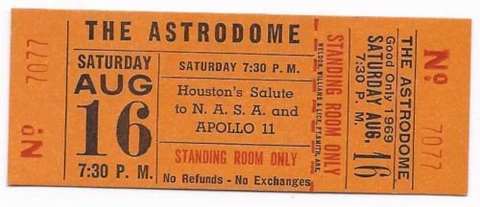
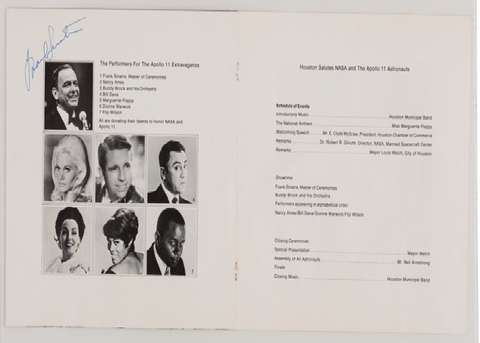
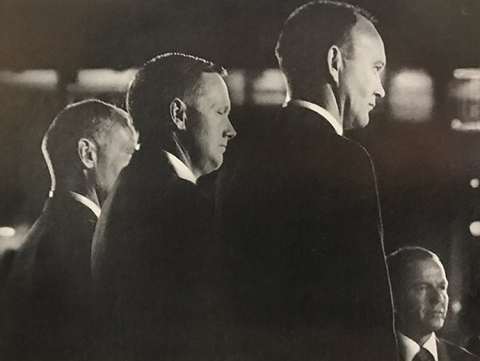
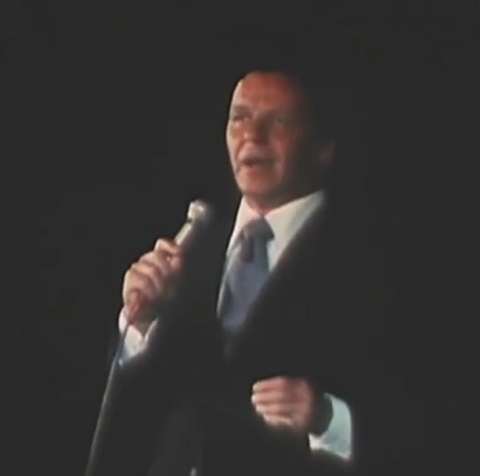
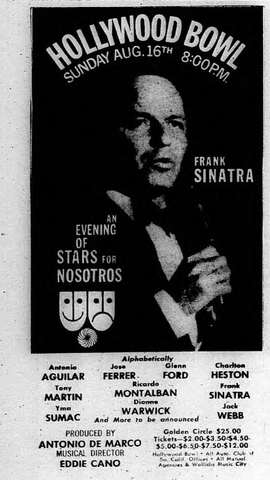
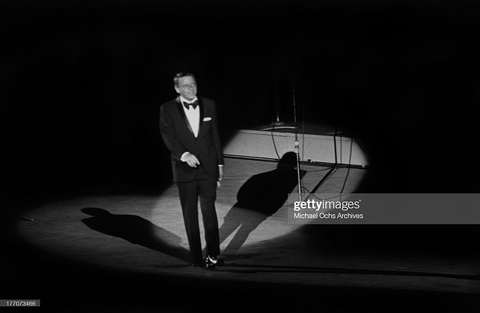
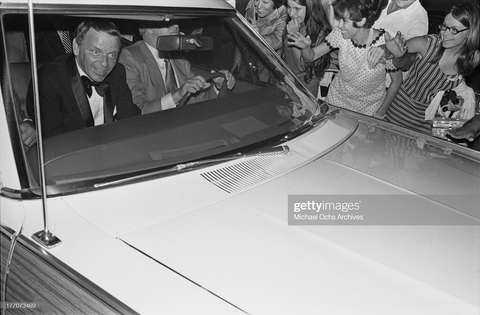
"My Way"
Granata's discography entry: My Way, arranged by Don Costa, released August 1969.
Source: Charles L. Granata, "Sessions with Sinatra: Frank Sinatra and the Art of Recording" (1999/2003).
[Emcees Apollo 11 astronaut tribute]
Sinatra flew to Houston to emcee a tribute to the Apollo 11 astronauts at the Astrodome; he was delighted that Armstrong, Aldrin, and Collins had listened to his and Basie's 'Fly Me to the Moon' on a live feed from space.
Source: James Kaplan, "Sinatra: The Chairman" (2015).
Hollywood
M17431 Forget To Remember
(Teddy Randazzo/Victoria Pike)
Aldor Music (BMI)
Arranged & Conducted By Don Costa
(2:57) CD: 46013-2 The Complete Reprise Studio Recordings Disc 14
CD: 9-26340-2The Reprise Collection
45: 0865
note: The Randazzo/Pike song in my "101" book is "Forget To Remember." Over the past 15 years I have received more mail regarding the selection of this song in "Sinatra 101" than all the others combined. The vast majority of the letters thanked me for making the collector aware of this fine recording. Teddy Randazzo told me how it came to be written and how he much preferred the version done for "Sinatra 69." Teddy admired the session effort but thought Sinatra had a much better handle on the song for the TV special. I agreed with him. Frank sang this song on stage in 1968.
--Ed
M17432 Goin' Out Of My Head
(Teddy Randazzo/Bobby Weinstein)
Songs Of PolyGram International (BMI)
Arranged & Conducted By Don Costa
(2:45) CD: 46013-2 The Complete Reprise Studio Recordings Disc 14
CD: 2275-2Frank Sinatra's Greatest Hits Vol.2
LP: FS1034Frank Sinatra's Greatest Hits Vol.3
45: 0865
NOTE: Author Richard Havers points out that in May 1968 Sinatra was in Oakland for a fund raising event for Senator Hubert Humphrey at the Oakland Coliseum. Sinatra gave a wonderful performance that night, running through the usual selection of Capitol classics, along with "Nancy" and "Ol' Man River" from the 1940s.
There was a clutch of Reprise era songs including one of his newest recordings, the wonderful "All I Need is the Girl" from the Duke Ellington sessions. And, unusually, Sinatra sang a song he had not yet recorded, "Goin' Out of My Head" by Randazzo and Weinstein. It had been a big hit for Little Anthony and The Imperials in 1964. The Lettermen, a close harmony group on Capitol, covered it and had a Top Ten hit in early 1968 when they combined it in a medley with "Can't Get Used to Losing You."
Sinatra introduced the song as being arranged by Nelson Riddle and gave an impassioned reading of this very sensual song. At the show's end, Sinatra said, "Ladies and gentlemen, I am quite grateful for your attendance and your applause and your reason for being here. I hope that in the near future I will be back here with the candidate." Havers says he absolutely loves Sinatra singing this song at the Oakland concert. It is a joy!
Sinatra Scholar Ed O'Brien, in response to Havers' comments, reports that one night in Las Vegas with Sinatra, Terry Randazzo had been invited to attend the opening show at Caesars Palace and Sinatra did a rousing rendition of "Goin' Out of My Head." Randazzo went backstage after the show and Sinatra asked him what he thought of his version of the song. Randazzo told him that it was terrific, but Sinatra did not believe him. Had great doubts about his ability to sing it correctly. Randazzo was amazed that an artist of Sinatra's stature suffered from such insecurity. The flip side of the "Goin’ Out of My Head" 45 rpm was "Forget to Remember." Sinatra had Teddy and Victoria Pike write the tune shortly after the breakup with Mia.
[Recording session for 'Goin' Out of My Head']
Sinatra returned to Western Recorders for the first time since March, recording Teddy Randazzo's forgettable 'Forget to Remember' and the previously-hit 'Goin' Out of My Head,' which would chart at a modest number 79 on Billboard for him.
Source: James Kaplan, "Sinatra: The Chairman" (2015).
[Sinatra misses postponed NJ deadline]
Mickey Rudin had obtained a month's postponement of Sinatra's required appearance before the New Jersey State Commission of Investigation to August 19, 1969, but Frank did not appear.
Source: James Kaplan, "Sinatra: The Chairman" (2015).
Hollywood
M51586 I Would Be In Love (Anyway)
(Bob Gaudio/Jack Holmes)
Seasons Music Company/WB Music Corp. (ASCAP)
Arranged & Conducted By Joseph Scott
(2:31) CD: 46013-2 The Complete Reprise Studio Recordings Disc 15
LP: FS1031Watertown
45: 0895
M51587 The Train
(Bob Gaudio/Jake Holmes)
Devalbo Inc./WB Music Corp. (ASCAP)
Arranged & Conducted By Joseph Scott
(3:25) CD: 46013-2 The Complete Reprise Studio Recordings Disc 15
LP: FS1031 Watertown
45: 0920
M51594 She Says w/Chorus
(Bob Gaudio/Jake Holmes)
Devalbo Inc./WB Music Corp. (ASCAP)
Arranged & Conducted By Joseph Scott
(1:50) CD: 46013-2 The Complete Reprise Studio Recordings Disc 15
LP: FS1031Watertown
M51637 Lady Day
(Bob Gaudio/Jake Holmes)
Devalbo Inc./WB Music Corp. (ASCAP)
Arranged by Charles Calello
Conducted By Joseph Scott
(2:47) CD: 46013-2 The Complete Reprise Studio Recordings Disc 15
CD: 45689-2
M51636 For A While N/R
(Bob Gaudio/Jake Holmes)
Devalbo Inc../WB Music Corp. (ASCAP)
Arranged by Charles Calello
Conducted By Joseph Scott
Note: The Orchestral tracks were pre-recorded for these sessions from July 14-17, 1969.
NOTE: Sinatraphile Jim White wants all Sinatraphiles to know that Sinatra Scholar Ed O'Brien, who makes such valuable contributions to the THIS DATE IN SINATRA HISTORY series, is also the author of the program notes of the Reprise compact disc re-issue of WATERTOWN. He wrote the essay, "Watertown Redux And More." The program notes also feature "a conversation" that O'Brien had with Bob Gaudio, the composer who wrote the music of WATERTOWN .
Ed responded:
I also did extensive interviews with the lyricist Jake Holmes.
His willingness to explain how every song was composed really brought a lot to the reissue. I loved chatting with both men.
I have a great deal of affection for the "Watertown" project and jumped at the chance to finally explain what it was all about. Actually, I did just a little in that department. I let the two men who conceived the story of "Watertown" tell us how it happened.
Ed also notes:
The vocals were recorded in Hollywood. I interviewed Frank Laico, engineer in N.Y.C. and Lee Herschberg, engineer in Hollywood. Orchestrals done in N.Y.
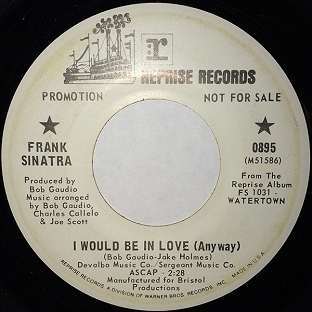
Hollywood
M51589 Watertown
(Bob Gaudio/Jake Holmes)
Devalbo Inc./WB Music Corp. (ASCAP)
Arranged & Conducted by Charles Calello
(3:35) CD: 46013-2 The Complete Reprise Studio Recordings Disc 15
LP: FS1031Watertown
45: 0895
M51591 Elizabeth N/R
(Bob Gaudio/Jake Holmes)
Devalbo Inc./WB Music Corp. (ASCAP)
Arranged & Conducted by Charles Calello
M51592 Michael And Peter N/R
(Bob Gaudio/Jake Holmes)
Devalbo Inc./WB Music Corp. (ASCAP)
Arranged & Conducted by Charles Calello
M51596 What's Now Is Now
(Bob Gaudio/Jake Holmes)
Devalbo Inc./WB Music Corp. (ASCAP)
Arranged by Joseph Scott
Conducted by Charles Calello
(4:02) CD: 46013-2 The Complete Reprise Studio Recordings Disc 15
CD: 2275-2Frank Sinatra's Greatest hits Vol.2
LP: FS1031 Watertown
45: 0920
Note: The Orchestral tracks were pre-recorded for these sessions from July 14-17, 1969.
NOTE: Sinatra Scholar Ed O'Brien writes that when he did the liner notes for the CD issue of "Watertown," finding Bob Gaudio, Jake Holmes, Charles Calello, Frank Laico, Lee Herschberg, Al Viola, and others was relatively easy. But he could not locate Joseph Scott. None of the participants in the project had the slightest idea where Mr. Scott resided. O'Brien checked the musicians locals in the major cities, did a phone search, contacted people who had worked with him. Zilch! He's still wondering where Scott is.
Hollywood
M51589 Watertown
M51591 Elizabeth N/R
M51592 Michael And Peter N/R
M51596 What's Now Is Now
[Watertown -- critical commentary]
Charles Calello: Calello recounted meeting Sinatra for the first time at the session: 'Came the night of the date, he was supposed to be there at seven o'clock. Three minutes after seven, the orchestra is playing, and Frank walks in the back door. As he walked in, I felt the air in the studio change... He taps me on the leg, because I was elevated, and says, "You Calello?" [I] turned around to go shake hands with him and say hello, but nothing came out of my mouth. Literally, nothing came out, I was so intimidated!' Calello also noted longtime NYC reed player Phil Bodner is unmistakable on the title track.
This song/context matches multiple dated entries in the chronology; the specific date Friedwald is referring to could not be determined with confidence.
Source: Will Friedwald, "Sinatra! The Song Is You: A Singer's Art" (2018 revised edition), Ch. 9, "Looking for the Hook" (1960-1971)
[Watertown -- critical commentary]
Granata's discography entry: Watertown, arranged by Charles Callelo, released March 1970.
This song/context matches multiple dated entries in the chronology, or lacked a sufficiently precise date; the specific date could not be determined with confidence.
Source: Charles L. Granata, "Sessions with Sinatra: Frank Sinatra and the Art of Recording" (1999/2003), Afterword & Appendices A-D
Hollywood
M51588 Goodbye (She Quietly Says)
(Bob Gaudio/Jake Holmes)
Devalbo Inc./WB Music Corp. (ASCAP)
Arranged by Joseph Scott
Conducted by Charles Calello
(3:06) CD: 46013-2 The Complete Reprise Studio Recordings Disc 15
LP: FS1031Watertown
M51638 What A Funny Girl (You Used To Be)
(Bob Gaudio/Jake Holmes)
Devalbo Inc./WB Music Corp. (ASCAP)
Arranged & Conducted by Charles Calello
(2:56) CD: 46013-2 The Complete Reprise Studio Recordings Disc 15
LP: FS1031Watertown
Anaheim Bulletin
Hollywood
M51588 Goodbye (She Quietly Says)
M51638 What A Funny Girl (You Used To Be)
Tracks
1. Watertown (Gaudio/Holmes) - 3:36
2. Goodbye (She Quietly Says) (Gaudio/Holmes) - 3:06
3. For a While (Gaudio/Holmes) - 3:09
4. Michael and Peter (Gaudio/Holmes) - 5:10
5. I Would Be in Love (Anyway) (Gaudio/Holmes) - 2:31
6. Elizabeth (Gaudio/Holmes) - 3:38
7. What a Funny Girl (You Used to Be) (Gaudio/Holmes) - 3:00
8. What's Now Is Now (Gaudio/Holmes) - 4:04
9. She Says (Gaudio/Holmes) - 1:51
10. The Train (Gaudio/Holmes) - 3:26
11. Lady Day (Gaudio/Holmes) - 2:47
Interview About Watertown
These interviews were conducted by Ed O'Brien. In the first, Jake Holmes (lyricist for Watertown) comments on each song, and in the second Bob Gaudio (composer/producer) has his say. Jake Holmes:
"Everything evolved from that piece ('Goodbye'). It was such an interesting concept- a man left by his wife. He has two young boys. The story really intrigued me. It was Bob's (Gaudio) idea to call it Watertown. He got it off a map of New York State."
WATERTOWN: "I had in mind a model of 'Lazy Afternoon.' I wanted a languid feeling. If we had done the TV special, it would have opened it up, with the credits going by."
GOODBYE: "I love the idea of those kinds of goodbyes that people have where nothing is happening emotionally. It knocks me out when there is nothing on the surface."
FOR A WHILE: "I've always felt that there is that moment in your life, when you forget about something that is really terrible. For five minutes the sun is shining and everything is beautiful. Then all of a sudden you realize that the person you cared about is gone, and it all comes back...one of those little holes in grief when it becomes even more painful."
MICHAEL & PETER: "Gaudio's kids were the models for that song. I put it in letter form, because it was the only way the guy could articulate those sentiments to her."
I WOULD BE IN LOVE (ANYWAY): "It's that you can't regret where you are even if life takes you someplace where you don't want to be...it was this guy trying to let go of this woman without being angry with her...he was never really angry at her. He kind of understood; she had to go."
ELIZABETH: "I just love that name. I just imagined a girl named Elizabeth and wrote words that were a tribute to her."
WHAT A FUNNY GIRL (YOU USED TO BE): "It was a retrospective song. I also wanted to indicate in the song that they had been childhood sweethearts. They were probably kids together...had gone to school together...had fallen in love and married quite young."
WHAT'S NOW IS NOW: "...an indication that she had obviously gone with somebody else. She has had a relationship, and he hadn't been able to accept it. That is partly what drove her off to the big city. There is a guilt theme in that song. It is the song that opens up the story."
SHE SAYS: "He is suspicious of the small talk. The kids are echoing his fears. Why is she sending this letter? It is such good news; they can't believe it and they don't trust it. The twist is her saying, 'She's comin' home.' They don't trust that either.
THE TRAIN: "...is the story. We find out that he really didn't communicate anything to her, and she isn't coming back. Although we're getting all of this story from him, she never got any of this. If she had heard this album, she might have come home. She never saw this side of him. It gives the story a very deep resonance."
LADY DAY: "I saw this woman as someone who had talent. She wanted to be an artist or a singer. He was a hometown person. His whole orientation was family and business. He was the kind of guy who really lived in Watertown. She was more restless- a more contemporary woman. She wanted to do other things. She wasn't liberated enough to tell him, and she didn't think he'd understand. He was basically a good guy, but she wanted more. She abandoned her family and went for a career. The postscript was whether or not she got it and was it worth it."
Bob Gaudio:
"My partner, Frankie (Valli)...made the suggestion that Frank and I should meet and talk about doing something contemporary, something maybe a little different and unusual, something he hadn't done before. I was out in Vegas for a couple of weeks and went to see all of Frank's shows. We hung out, but it was about a year or year and a half before the writing and recording. "To launch the project, we had envisioned a one-man TV show. Jake (Holmes) and I discussed what would be an interesting thing to do for Sinatra. What we could do that he hadn't done before. We just hit on putting him in a small town. Having a small-town approach and taking it down as much as we could to basic life in Middle America. We tried to strip all of the gloss and sheen off of it. We were asked to come up with something unusual, something different, a concept album if you will. I did a demo record for Frank. Then Sarge (Weiss) called and said, 'He wants to do all of them.' Apparently, Frank was just expecting to get ten or so songs. I don't think he was expecting it to be what it was, which was a story. He fell in love with something. I don't think he looked at it as being contemporary commercial. It was pretty obvious that it wasn't one hit song after another. I didn't want it to be like every other album that Sinatra had done. I felt that the songs needed to be treated a little more introspectively. Like the character. This was a man in a small town- a very simple, unfortunate slice of life. I wanted to create as haunting a sound as possible...it does have a lot of space, and air, and unusual things. Raw is a perfect description for Frank's interpretations. I had asked Frank to overdub. It was such a unique sound for him. I felt we needed tight controls. Overdubbing gave us that aspect. He wasn't all that comfortable with the concept, but he agreed to do it. He didn't feel he was in his best voice for some of the sessions, but he just forged ahead until he got it right. To be honest, I was astonished by the results. Frank loved it (the final product)." O'Brien asks why FS didn't follow up with the TV special. Gaudio's response: "He just wasn't happy with his singing at the time and he didn't want to do any television or films. He made very few personal appearances. Unfortunately, he didn't want to hold the album back. In retrospect, we would have been better off sitting on it for as long as it took. We needed a launching pad and never got it." Review of Watertown
Watertown is Frank Sinatra's most ambitious concept album, as well as his most difficult record. Not only does it tell a full-fledged story, it is his most explicit attempt at rock-oriented pop. Since the main composer of Watertown is Bob Gaudio, the author of the Four Seasons' hits "Can't Take My Eyes Off of You," "Walk Like a Man," and "Big Girls Don't Cry," that doesn't come as a surprise. With Jake Holmes, Gaudio created a song cycle concerning a middle-aged, small-town man whose wife had left him with the kids. Constructed as a series of brief lyrical snapshots that read like letters or soliloquies, the culminating effect of the songs is an atmosphere of loneliness, but it is a loneliness without much hope or romance -- it is the sound of a broken man. Producer Charles Calello arranged musical backdrops that conveyed the despair of the lyrics. Weaving together prominent electric guitars, keyboards, drum kits, and light strings, Calello uses pop/rock instrumentations and production techniques, but that doesn't prevent Sinatra from warming to the material. In fact, he turns in a wonderful performance, drawing out every emotion from the lyrics, giving the album's character depth. ~ Stephen Thomas Erlewine, All Music Guide Interview with Jake about Watertown: "Writing for Frank was an Education," by Royston Eldridge Sinatra's visit to London this week [May 1970] and the release of his new album [Jake Holmes]has focused attention on the talents of Jake Holmes, the young Californian singer composer responsible for the lyrics of "Watertown." Holmes has been here for the past few weeks promoting his own album which Polydor have just released. During his stay he talked about his career and how he got to write the somewhat controversial lyrics for the Guv'nor's latest album. "I started writing about ten years ago . . . I was writing comedy songs with a girl called Kay Reynolds who I used to do a folk act with. That lasted for about two and a half to three years before I decided it was better to be rich than ethnic! "I went back to performing as a single and worked with Joan Rivers who had her own television show in which she did a pop comedy revue type thing, where I was always the straight man for them. "About five months before the Byrds started and right when the Beatles were beginning, Tim Rose and I worked together. I played electric bass and we used to do updates of folk songs, things like 'Oh Susan' and 'Morning Dew.' "That lasted for about a year and I did some work on my own for a while before finally deciding that I wasn't getting anywhere by working so I stopped work and began to write. My manager at the time was handling the Four Seasons who wanted to change their image. "Bob Gaudio wrote [actually, Jake wrote it] them a song called 'Genuine Imitation Life' which was recorded here by Jackie Lomax. We did an album together for them which was 'Genuine Imitation Life Gazette' which was a little too esoteric for them, I think." Although the album wasn't a tremendous success for the Four Seasons, it earned Gaudio and Jake a reputation which led to the Sinatra album. "Frankie Valli took the Seasons album to Sinatra about a year-and-half to two years ago, he liked it and asked Bob and myself to write an album for him. "It took us about a year to write it. Sinatra didn't know we were going to do a concept album but we didn't want to write a rock and roll album for him and we didn't want to do something like 'Frank Sinatra Sings Jake Holmes and Bob Gaudio' so we tried the concept." The lyric tells of a man whose wife leaves him for another man and goes off to live in a strange city where she has twins. A story based on Sinatra's relationship with Mia Farrow. "I think he liked it very much although I was never an eye witness at the recording sessions where he wanted to be alone apart from the engineers on the session. I don't think he didn't like the lyrics . . . he sang the songs with a lot of feeling." The Sinatra album has established Holmes as a writer. His own album, recorded last summer in Nashville, establishes him as a singer of ability too. "The Sinatra album was a great education. Learning to write for someone else is harder, it makes you stretch out. I'd like to write for other people too especially Tom Jones and Elvis Presley." [SOURCE: Melody Maker 45 (May 9, 1970), p. 10.
A UK music-paper review by Rodney Collins argued the album ranked with Sinatra's best Capitol-era work, noting that recent Sinatra LPs had lacked some of the old magic of songs like "I've Got You Under My Skin" but that Watertown recaptured it; some listeners, Collins wrote, took the record as a song cycle Sinatra dedicated to Mia Farrow, and he praised the fusion of Jake Holmes's lyrics and Bob Gaudio's arrangements on "Goodbye," "Michael and Peter," and "What a Funny Girl (You Used to Be)." Source: Rodney Collins, period music-press review (Sinatraphiles "This Date in Sinatra History" mailing).
A UPI wire review by William D. Laffler described Watertown as a "place where very little is going on" and "everyone knows the perfect crime, killing time," crediting Gaudio and Holmes with stringing a loose continuity of ballads into a narrative that Sinatra, as "the finest balladeer of our time," sang with both hope and regret; Laffler singled out "Michael and Peter" as one of the standout tracks and, despite calling the record's surface "almost monotonous," heard in it "the seeds of psychedelic sound." Source: William D. Laffler, United Press International, syndicated review (Sinatraphiles "This Date in Sinatra History" mailing).
CS 082 (Ed O'Brien's "Watertown: The Creative Process" liner interviews with Bob Gaudio and Jake Holmes, Reprise reissue booklet) fills in how the Gaudio-Holmes writing partnership began and how the album itself came together: Holmes said he and Gaudio shared the same manager and had previously performed together in a folk trio called Jim, Jake and Joan; Gaudio later asked him to help write material, and the two went on to collaborate on the Four Seasons' "Genuine Imitation Life Gazette" before Gaudio picked Holmes as Watertown's lyricist. Gaudio said the two of them wrote the album in about three or four weeks, working around the clock at his home in Montclair, California, with Holmes moving in for the duration; the whole album, he said, "only took about six weeks" start to finish. Arrangers Charlie Callelo and Joe Scott were chosen, per Gaudio, because "they understood the work we were doing and the sound we were looking for."
['The Night of the Thousand Sinatras']
Billed as 'The Night of the Thousand Sinatras,' Frank was booked at Caesars Palace, Frank Jr. at the Frontier, and Nancy made her first nightclub appearance at Kirk Kerkorian's newly opened International, then the largest hotel in the world.
Source: James Kaplan, "Sinatra: The Chairman" (2015).
Frank taped his one-man show "Sinatra 69" on this date
at the CBS studio in L.A. Air date was, 11-5-69.
Frank opened this show singing "Mrs. Robinson." It did
not make the final master cut for the show. You can find
a rehearsal of "For Once In My Life" on the 50th
Anniversary
"My Way" CD.
Circus Maximus at Caesars Palace, Las Vegas, NV (September 19-October 8) with Pat Henry & Jose Greco
Note: Sinatra was dark on Mondays September 22, 29, October 6)
Circus Maximus at Caesars Palace, Las Vegas, NV (September 19-October 8) with Pat Henry & Jose Greco
Note: Sinatra was dark on Mondays September 22, 29, October
6)
LAS VEGAS
CAESARS PALACE
SEPT 19
Frank Sinatra, Jose Greco & Co., Pat Henry,
Stanley Myron Handelman, Nat Brandwynne
Orch (40); produced by Dave Victorson; $15 minimum.
On Frank Sinatra's opening night, he was in fine vocal fettle, and it was obvious he was having a ball entertaining the receptive audience. The fact that his tones were perfect from all angles magnified the magnetism of the man and the legend.
This is Sinatra's fourth return to Circus Maximus, and he has a good package which will be excellent when some of the time is trimmed from his supporting acts..
Jose Greco and Co. open the show after the announcement, "
Ladies and gentlemen, welcome to Sinatra's Palace and the Caesars show." Greco, high lama of the flamenco terpers, is as usual splendiferous with his gracefully punctuated footwork and his classy cohorts
( four femmes, four males, plus featured Nana Lorca) blend in a colorful splash of stylized choreo. About 10 minutes editing of the repetitious patterns would improve the turn.
Stanley Myron Handelman is at his best when he interrupts Sinatra, portraying a backstage coffee and sandwich man. Straight man Sinatra triggers the yocks from the comedian, who with prop eyeglasses and boy cap looks like a comrdian. Solo, Handelman does about 15 minutes which could be shaved for better show pacing.
Pat Henry, Sinatra's show warmer for three years, brings in new material this time, and he socks it across with splendid timing and delivery. Preemers socked back laughs at every line
--- some topical and some up-to-the-minute lampoons of ringsiding celebs. Proving he is a major leaguer in the standup humor fraternity. Henry know exactly how much time to do before bringing out Sinatra.
Initiating his 14-song program with
"Fly Me To The Moon" illustrated by blown-up color slides of the moonlanding. Sinatra smoothly segues into "Street Of Dreams," following with about half a dozen well-received uppers, downers and mediumers before doing the bit with Handelman. He mixes the standards with freshies and has a powerful Don Costa arrangement of Teddy Randazzo's "Goin' Out Of My Head," following immediately with
Randazzo's "Forget To Remember."
Preemers gave Sinatra two standing ovations( Save that for Wayne Newton -- I'm too old that stuff ), because ":April In Paris" and "I've Got You Under My Skin" came after what was thought to be exit tune. Bill Miller batons the excellent Nat Brandwynne orch (40) for
Sinatra, who is doing one show per night except Wednesdays and Saturdays ( Mondays off) until Tony Bennett, Louis Bellson and Stu Gilliam arrive Oct. 9.
Duke
Variety
September 24, 1969
Note: Sinatra had recorded the "Watertown" album three weeks before opening at Caesars
( He would redo two of the songs in October), I asked Al Viola if Frank did any of the songs at this engagement. Al checked his logs and told me Frank waited until his April 70 shows at Caesars before introducing songs from the Gaudio-Holmes project ( He did four songs from the album.). The September-October 69 engagement featured "My Way" in its infancy as a concert number. Teddy Randazzo attended the opening night performance.
After the show Frank asked him what he thought of his rendition of "Goin' Out Of My Head."
Teddy told me he loved the way Frank sang his song. Frank didn't believe he was doing it right. Randazzo was amazed that Sinatra so doubted himself.
Frank was at Caesars from 9-19 to
10-8.
Song List For Engagement:
Fly Me To The Moon
Street Of Dreams
For Once In My Life
Didn't We
Little Green Apples
Mrs. Robinson
Goin' Out Of My Head
Angel Eyes
Love's Been Good To Me
Cycles
I've Got The World On A String
Forget To Remember
April In Paris
I've Got You Under My Skin
Yesterday
My Way
The Lady Is A Tramp
Ed
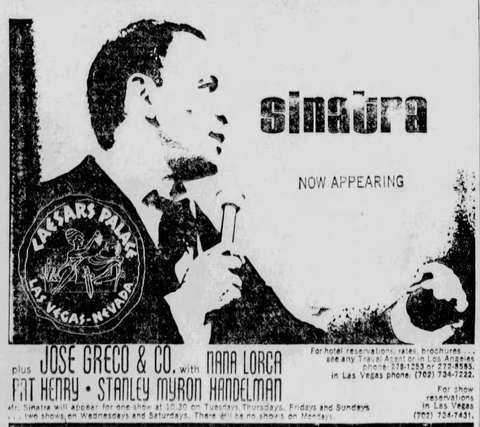

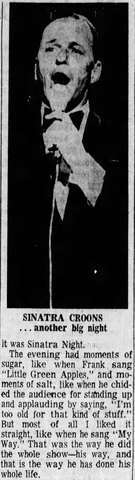
Anaheim Bulletin
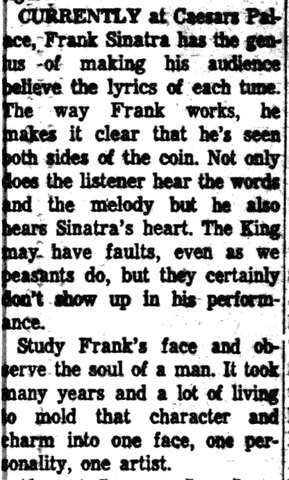
The Houston Post
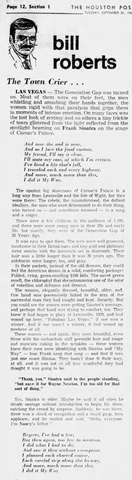
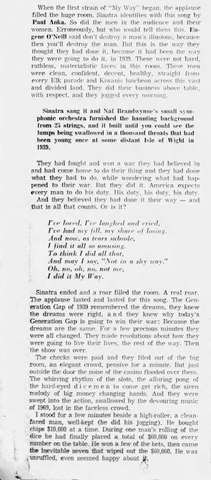
The Times
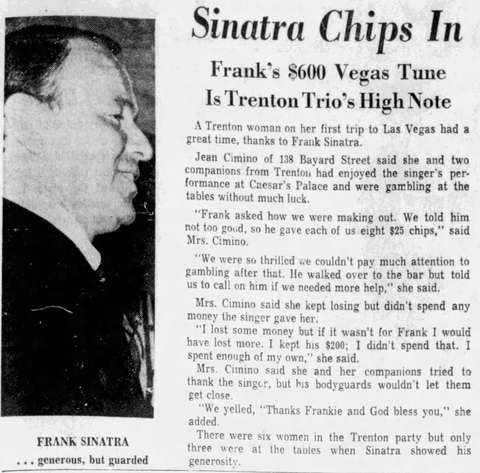
Circus Maximus at Caesars Palace, Las Vegas, NV (September 19-October 8) with Pat Henry & Jose Greco
Note: Sinatra was dark on Mondays September 22, 29, October 6)
Note: Sinatra closed on the 9th ( Thursday ) 22 day engagement
Corpus Christi Caller Times
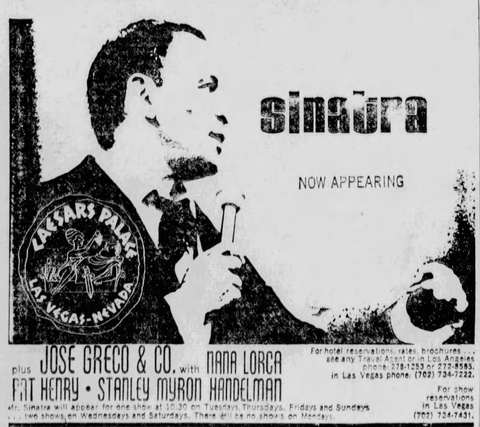

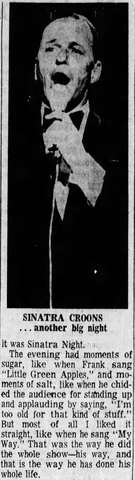
[Sinatra opens at Caesars instead of testifying]
Rather than appear before the New Jersey commission in Trenton, Sinatra opened at Caesars Palace's Circus Maximus.
Source: James Kaplan, "Sinatra: The Chairman" (2015).
Circus Maximus at Caesars Palace, Las Vegas, NV (September 19-October 9) with Pat Henry & Jose Greco
Note: Sinatra was dark on Mondays September 22, 29, October 6)
Circus Maximus at Caesars Palace, Las Vegas, NV (September 19-October 9) with Pat Henry & Jose Greco
Note: Sinatra was dark on Mondays September 22, 29, October 6)
Circus Maximus at Caesars Palace, Las Vegas, NV (September 19-October 9) with Pat Henry & Jose Greco
Note: Sinatra was dark on Mondays September 22, 29, October 6)
Circus Maximus at Caesars Palace, Las Vegas, NV (September 19-October 9) with Pat Henry & Jose Greco
Note: Sinatra was dark on Mondays September 22, 29, October 6)
Circus Maximus at Caesars Palace, Las Vegas, NV (September 19-October 9) with Pat Henry & Jose Greco
Note: Sinatra was dark on Mondays September 22, 29, October 6)
Circus Maximus at Caesars Palace, Las Vegas, NV (September 19-October 9) with Pat Henry & Jose Greco
Note: Sinatra was dark on Mondays September 22, 29, October 6)
Circus Maximus at Caesars Palace, Las Vegas, NV (September 19-October 9) with Pat Henry & Jose Greco
Note: Sinatra was dark on Mondays September 22, 29, October 6)
Circus Maximus at Caesars Palace, Las Vegas, NV (September 19-October 9) with Pat Henry & Jose Greco
Note: Sinatra was dark on Mondays September 22, 29, October 6)
Circus Maximus at Caesars Palace, Las Vegas, NV (September 19-October 9) with Pat Henry & Jose Greco
Note: Sinatra was dark on Mondays September 22, 29, October 6)
[News of Mia Farrow's pregnancy]
Kaplan: Around the same time, newspapers reported Mia Farrow was expecting a child with conductor André Previn; the two would marry the following September.
Source: James Kaplan, "Sinatra: The Chairman" (2015)
[Sinatra located in the Bahamas]
Kaplan: The Associated Press located Sinatra in Freeport, Bahamas, staying in an eight-room suite at the Lucayan Beach Hotel, yachting and gambling at casinos while brushing aside reporters asking about the New Jersey subpoena.
Source: James Kaplan, "Sinatra: The Chairman" (2015)
[Sinatra's public statement on the NJ inquiry]
Frank Sinatra: Sinatra issued a statement from Los Angeles saying he was tired of being subpoenaed whenever Italian names came up in an inquiry, and refused to appear before the New Jersey commission, calling it a 'three-ring circus,' while denying any knowledge of organized crime.
Source: James Kaplan, "Sinatra: The Chairman" (2015)
Circus Maximus at Caesars Palace, Las Vegas, NV (September 19-October 9) with Pat Henry & Jose Greco
Note: Sinatra was dark on Mondays September 22, 29, October 6)
Frank was subpoenaed by a New Jersey organized-crime investigating committee while on a boat that had stopped in New Jersey waters; his lawyer Mickey Rudin described it as an investigator opportunistically filling out and serving a subpoena on the spot.
Source: Nancy Sinatra, Frank Sinatra: An American Legend, 1995.
Circus Maximus at Caesars Palace, Las Vegas, NV (September 19-October 9) with Pat Henry & Jose Greco
Note: Sinatra was dark on Mondays September 22, 29, October 6)
Circus Maximus at Caesars Palace, Las Vegas, NV (September 19-October 9) with Pat Henry & Jose Greco
Note: Sinatra was dark on Mondays September 22, 29, October 6)
Circus Maximus at Caesars Palace, Las Vegas, NV (September 19-October 9) with Pat Henry & Jose Greco
Note: Sinatra was dark on Mondays September 22, 29, October 6)
Circus Maximus at Caesars Palace, Las Vegas, NV (September 19-October 9) with Pat Henry & Jose Greco
Note: Sinatra was dark on Mondays September 22, 29, October 6)
Felt Forum, New York, NY
Channel 7 11:30 PM
Gala for Re-election of Mayor John Lindsay
Frank Sinatra, Barbara Streisand, Ethel Merman, Harry Belafonte, Helen Hayes, and others The last two hours of the show (including Streisand's three songs) was televised on New York's Channel 7 beginning at 11:30 p.m.
Felt Forum, New York, NY
Gala for Reelection of Mayor John Lindsay
Frank Sinatra, Barbara Streisand, Ethel Merman, Harry Belafonte, Helen Hayes, and others
Felt Forum, New York, NY
Gala for Reelection of Mayor John Lindsay
Frank Sinatra, Barbara Streisand, Ethel Merman, Harry Belafonte, Helen Hayes, and others
John Lindsay, the mayor of New York city, was running for his second term in 1969.
On Saturday, October 11th, celebrities who backed the Mayor participated in a $150-a-ticket gala at the Felt Forum at Madison Square Garden. Sarah H. Goddard, in charge of ticket sales for the event, told The New York Times that “somewhere between half and three-quarters of the 3,850 seats were sold” for the event, which was characterized as “the main fund-raising event of the campaign.”
The last two hours of the show (including Streisand's three songs) was televised on New York's Channel 7 beginning at 11:30 p.m.
The headlining celebrities who were referenced in the show's title (Who's That With John Lindsay ... Alan, Barbra, Frank, and Harry) were: Alan King, Streisand, Frank Sinatra, and Harry Belafonte.
“There was Frank Sinatra and Judy Collins (guitar and all), and Ethel Merman and Harry Belafonte and Barbra Streisand, Helen Hayes, Robert Ryan, Sidney Poitier, and of course the new graduate, Dustin Hoffman,” wrote Victor Riesel for the Las Vegas Sun (referencing Hoffman's big movie hit, The Graduate.)
Other celebrities who participated that evening were Woody Allen, Alan Arkin, Leonard Bernstein, Julie Harris, James Earl Jones, Jerry Orbach, Robert Redford, George Segal and Eli Wallach.
Why support Lindsay? Belafonte told The New York Times, “He's the only one who has shown a sensitivity and understanding of the complex problems facing all people, both the minorities and the Establishment.”
Merv Griffin, who hosted the evening, told the Times, “John Lindsay is a committed man, plus he has imagination, vitality and national stature.”
Streisand offered a more jovial reason for supporting Lindsay: “He's good-looking,” she stated.
© 1997-2025 The Sinatra Archive
This calendar, or any parts thereof, may not be reproduced in any fashion
whatsoever without the prior written permission of the publisher (The
Sinatra Archive)
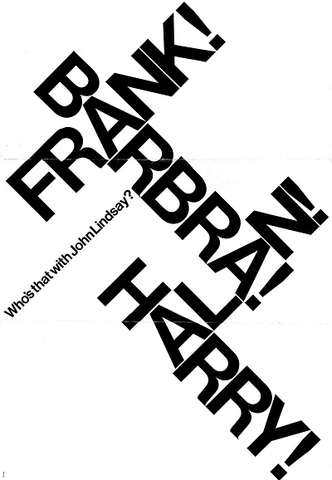
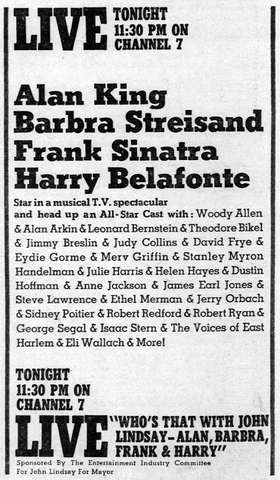
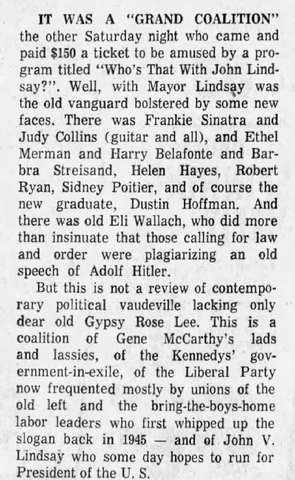
FRANK SINATRA JR, with FAMILY & FRIENDS
CBC BROADCAST(Canada) 9:30 P.M. -10:30 P.M.
GUESTS: Frank Sinatra, Nancy Sinatra, Jack Benny, Sammy Davis, Jr, Jack E. Leonard & others
[NJ contempt warrant issued]
Jim Mahoney: Superior court judge Frank J. Kingfield issued a warrant, enforceable only in New Jersey, charging Sinatra with contempt for failing to appear before the state investigation commission. Publicist Jim Mahoney said in Beverly Hills that Sinatra, in the Caribbean, was as yet unaware.
Source: James Kaplan, "Sinatra: The Chairman" (2015).
Frank Sinatra Jr. and His Family and Friends (CBS)
CBS-TV
9 TO 10 PM
Sunday Evening
Sponsored By Monsanto Night
MPC Production
Las Vegas
Billy Strange conductor
Guests:
Jack Benny doing his Vegas act
Sammy Davis Jr "Child of Fantasy"
Doodletown Pipers "The Happening/Cool Water/Goin' Out of My Head" Nancy Sinatra "Light My Fire
Frank Sinatra "All Or Nothing At All" duet with Frank Jr.
Frank Jr. "I Know A Place," "Beautiful Things," "Can't Take My Eyes Off Of You," ""Quiet Nights."
Other guests:
Arte Johnson, Jack E. Leonard, Wayne Cochran & C.C. Riders, Ireland's Royal Show Band, Larry O'Brien Septet, The Playmate Dancers & The USAF Thunderbirds
[CBS special with Frank Jr.]
As his legal battle with New Jersey raged, Sinatra appeared with his son on the CBS special Frank Sinatra Jr. with Family and Friends.
Source: James Kaplan, "Sinatra: The Chairman" (2015).
Hollywood
M51591 Elizabeth
(Bob Gaudio/Jake Holmes)
Devalbo Inc./WB Music Corp. (ASCAP)
Arranged & Conducted by Charles Calello
(3:37) CD: 46013-2 The Complete Reprise Studio Recordings Disc 15
LP: FS1031 Watertown
M51592 Michael And Peter
(Bob Gaudio/Jake Holmes)
Devalbo Inc./WB Music Corp. (ASCAP)
Arranged & Conducted by Charles Calello
(5:05) CD: 46013-2 The Complete Reprise Studio Recordings Disc 15
LP: FS1031 Watertown
M51636 For A While
(Bob Gaudio/Jake Holmes)
Devalbo Inc./WB Music Corp. (ASCAP)
Arranged & Conducted by Charles Calello
(3:08) CD: 46013-2 The Complete Reprise Studio Recordings Disc 15
LP: FS1031 Watertown
Note: The Orchestral tracks were re-recorded for this session on October 13, 1969
Liner Notes: WATERTOWN
Watertown is the strangest and most singular album Sinatra ever released -- a full concept record, written by Bob Gaudio of the Four Seasons and Jake Holmes, telling the story of a small-town man whose wife has left him and their children behind. There are no standards here, no jazz swing, no Riddle or May brass; instead, a soft-rock chamber-pop sound entirely alien to Sinatra's prior catalogue, and a narrative sustained across the whole album rather than a mood.
Sinatra's vocal performance is correspondingly restrained -- understated, almost conversational, a deliberate departure from the theatrical command of his classic ballad style, better suited to a story told in the plain language of a man writing letters he may never send. Songs like "Elizabeth" and "What's Now Is Now" work less as standalone performances than as scenes in an unfolding, unresolved domestic drama.
Watertown was a commercial disaster on release, reportedly selling only a few thousand copies and reaching no higher than 101 on the Billboard chart -- the worst-performing album of Sinatra's career. And yet it has been rehabilitated by critics and devoted listeners in the decades since as one of his most genuinely ambitious and emotionally honest records, a concept album that took the form Sinatra himself had helped invent fifteen years earlier and pushed it somewhere he never went again.
Written by Claude (Anthropic), commissioned for this chronology, 2026.
Sinatra
1. For Once In My Life
2. Please Be Kind
3. My Way
4.. The Tender Trap
5. Little Green Apples
6. Out Beyond The Window
7. A Man Alone
8. Didn't We
9. Forget To Remember
10. Fly Me To The Moon
11. Street Of Dreams
12. Love's Been Good To Me
13. Goin' Out Of My Head
14. My Kind Of Town
Sinatra
1. For Once In My Life
2. Please Be Kind
3. My Way
4.. The Tender Trap
5. Little Green Apples
6. Out Beyond The Window
7. A Man Alone
8. Didn't We
9. Forget To Remember
10. Fly Me To The Moon
11. Street Of Dreams
12. Love's Been Good To Me
13. Goin' Out Of My Head
14. My Kind Of Town
Notes: 60 min
"Mrs. Robinson" was taped for this show and cut at the last minute. Ed O'Brien:
The opening number at the 8-31 taping, in L.A., was "Mrs. Robinson." Song was deleted from the
11-5 broadcast.
Below is a promo sheet CBS sent to its affiliates a few days before the broadcast. note: Local anchor of CBS affiliate gave me the above ad that was shown that day on his station. --ED ..
August 31, 1969
Frank taped his one-man show "Sinatra 69" on this date at the CBS studio in L.A. Air date was, 11-5-69.
Frank opened this show singing "Mrs. Robinson." It did not make the final master cut for the show. You can find a rehearsal of "For Once In My Life" on the 50th Anniversary "My Way" CD.
November 5, 1971
From left to right are L.A. Supervisor Warren Dorn, Frank Sinatra and Danny Thomas. The plaque, which has the words "County of Los Angeles printed on it, was being presented to Sinatra. All three are laughing here. Dated November 5, 1971.
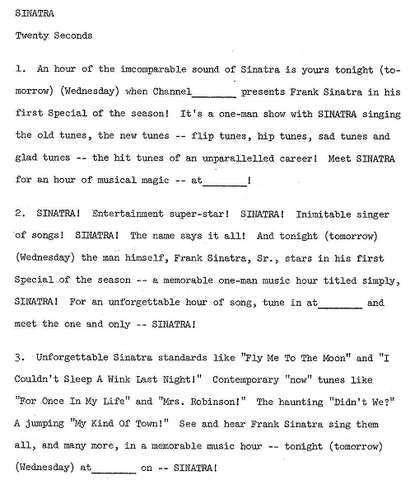
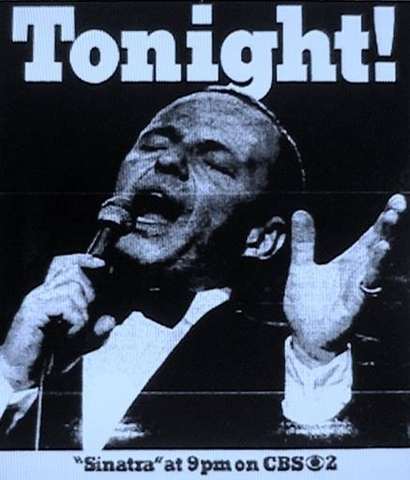
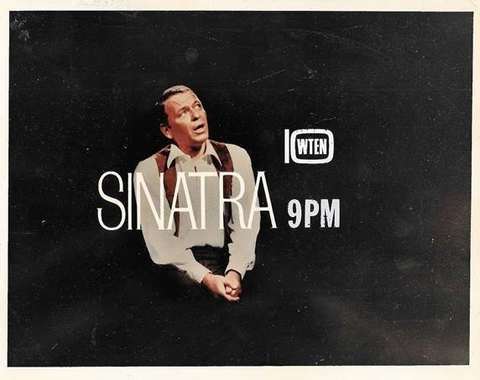
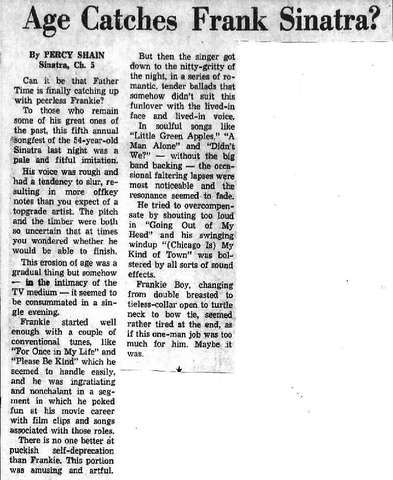
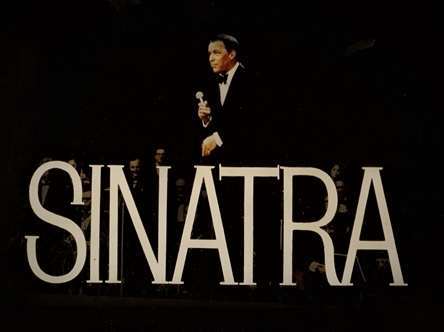
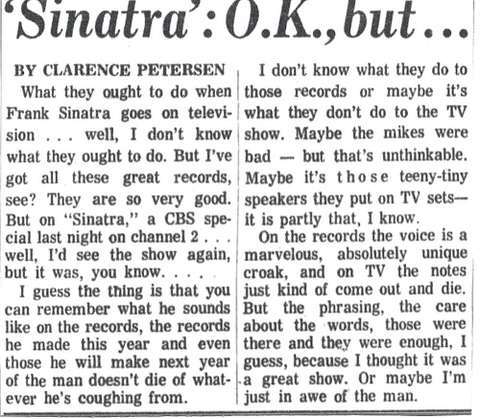
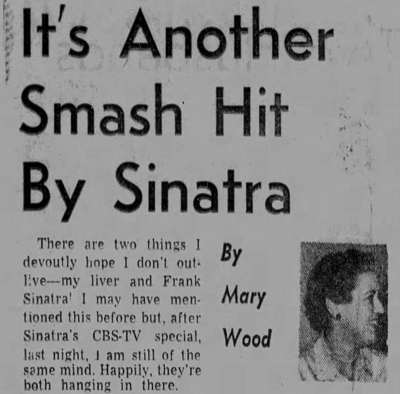

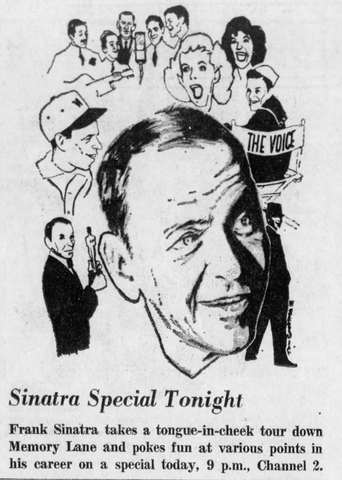


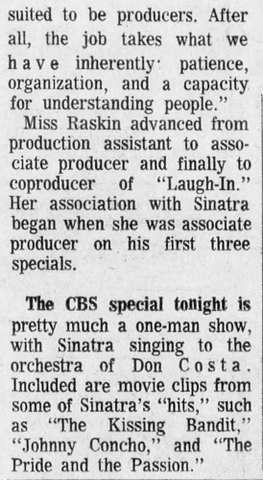
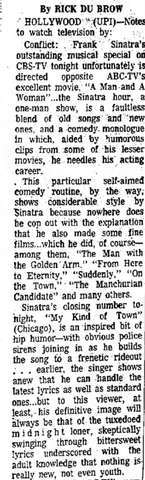
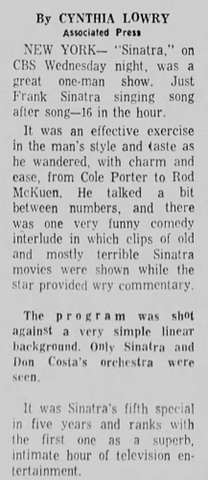
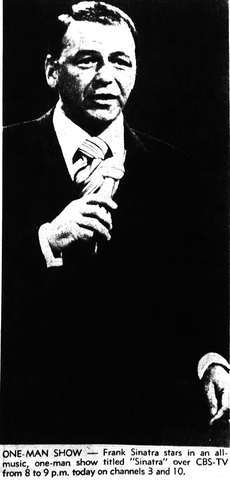
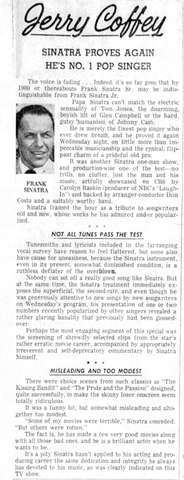
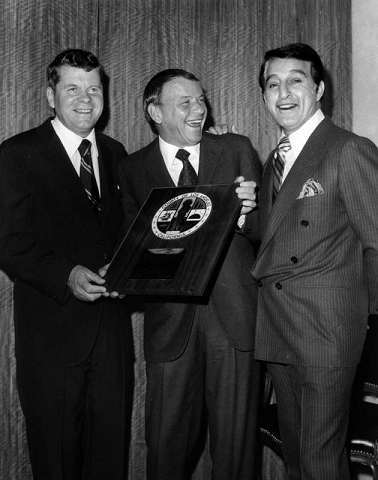
Hollywood
M17803 Lady Day
(Bob Gaudio/Jake Holmes)
Devalbo Inc./WB Music Corp. (ASCAP)
Arranged by Don Costa
(3:40) CD: 46013-2 The Complete Reprise Studio Recordings Disc 15
CD: 1033-2Sinatra & Company
LP: FS1033Sinatra & Company
45: 0970
"Lady Day"
Charles Calello (quoted): Calello told Friedwald the song's title was coincidental: 'Gaudio didn't know they referred to Billie Holiday as Lady Day. It was a coincidence, because Gaudio was not a jazz lover, and he didn't really know who Billie Holiday was.' Sinatra decided to make it a Billie Holiday tribute and re-recorded it with a more opulent Don Costa arrangement, releasing it on Sinatra & Company.
Source: Will Friedwald, "Sinatra! The Song Is You: A Singer's Art" (2018 revised edition).
Stage One, Warner Brothers Studio, Burbank, CA
Tribute to Jack Warner
Sinatra was Master of Ceremonies
Ted Ashley, Jack L. Warner, and Frank Sinatra (left to right) admire plaque presented Mr. Warner at a tribute dinner in his honor, November 20. More than a thousand guests attended the fete, many of them associated with the nostalgia of bygone days. Mr. Warner recently retired as head of the studio. Mr. Ashley is currently the chief executive officer.
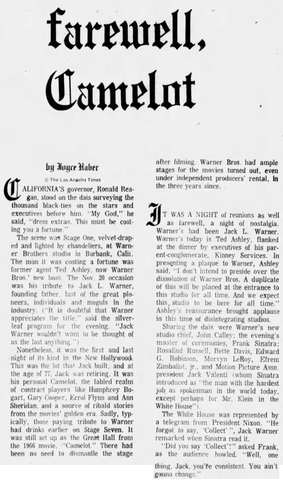
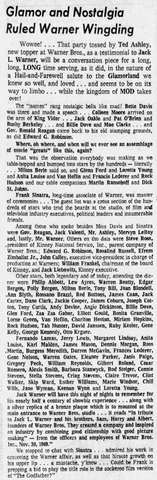
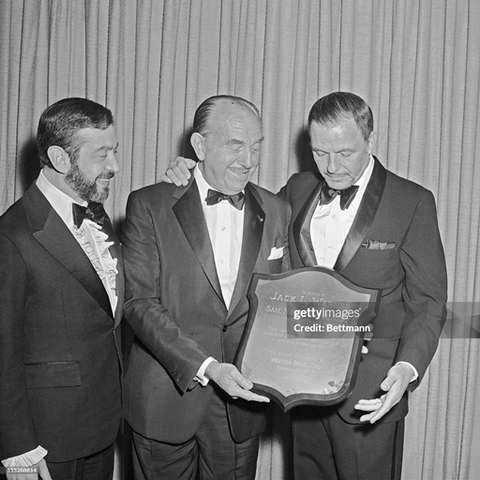
[Family Christmas trip to Hawaii]
Norma Lee Browning: Over the Christmas holidays, the entire Sinatra family—Frank, Frankie, Nancy Sr., Nancy Jr., Tina, and Dolly—vacationed together in Hawaii. Columnist Norma Lee Browning noted it wasn't a reconciliation with Nancy Sr., but it was the first time in years Frank hadn't spent the holiday with a wife or steady girlfriend.
Source: James Kaplan, "Sinatra: The Chairman" (2015)
[Sinatra signs to play Dingus Magee]
Kaplan: A few days before his fifty-fourth birthday, Sinatra signed to play the title role in Dirty Dingus Magee, unusually forgoing his standard $1 million fee for a larger percentage of the box-office gross.
Source: James Kaplan, "Sinatra: The Chairman" (2015)
[Sinatra's 54th birthday party]
Nancy Sinatra Jr. threw her father a fifty-fourth-birthday party.
Source: James Kaplan, "Sinatra: The Chairman" (2015).
[Helicopter Ride Ahead Of Royal Festival Hall Concerts With Basie]
To avoid London traffic, Sinatra took a Bell Jet Ranger helicopter to Battersea before his celebrated concerts with Count Basie at the Royal Festival Hall on May 7 and 8, 1970.
Source: Charles Pignone, "Frank Sinatra 100" (2015).
[Nancy Jr.'s Wedding to Hugh Lambert]
In 1970, Sinatra attended daughter Nancy Jr.'s marriage to Hugh Lambert in Rancho Mirage, California, pictured alongside daughter Tina and Nancy Sr.
Source: Charles Pignone, "Frank Sinatra 100" (2015).
[Sinatra Plays It for Laughs After His Father's Death]
Nancy notes that her father, seen clowning in longjohns for the Western comedy Dirty Dingus Magee, needed this bit of silliness in the wake of his father's ('Grandpa's') recent death.
Source: Nancy Sinatra, "Frank Sinatra, My Father" (1985).
[Sinatra Backs Reagan's 1970 Reelection Bid]
Sinatra publicly supported Ronald Reagan's 1970 campaign for reelection as California governor, though he advised Reagan to move toward the political center; the endorsement upset his more liberal daughter Tina.
Source: Nancy Sinatra, "Frank Sinatra, My Father" (1985).
[Sinatra Builds His Mother a House in Palm Springs]
Nancy Sinatra: Sinatra had a home constructed for his mother Dolly within the family's Palm Springs compound.
Source: Nancy Sinatra, Frank Sinatra: An American Legend, 1995.
[Tina's Ovarian Surgery and Miscarriage]
Returning to California for good in late 1970, Tina went to family friend and gynecologist Red Krohn, who found a mass on her ovary requiring surgery. During the procedure he discovered she was also pregnant, and - with abortion not a legal option at the time - induced a miscarriage at home, a grueling five-hour process. Frank visited her every day afterward without a word of judgment.
Source: Tina Sinatra, "My Father's Daughter: A Memoir" (2000).
[Dirty Dingus Magee]
In an unusual and, per Santopietro, poor business decision, Sinatra waived his $1 million film fee for Dirty Dingus Magee in exchange for a larger percentage of box-office gross.
This film/context matches multiple dated entries in the chronology; the specific date Santopietro is referring to could not be determined with confidence.
Source: Tom Santopietro, "Sinatra in Hollywood" (2008), Knight-Errant (pt. 1)
[Dirty Dingus Magee]
Frank Sinatra: At the time of filming, Sinatra praised the role itself even while acknowledging he looked bad in it: 'As a person, I look pretty bad, but as for the part, I think it's one of the best-looking I've ever had.' Santopietro notes he was dead wrong about the film's quality.
This film/context matches multiple dated entries in the chronology; the specific date Santopietro is referring to could not be determined with confidence.
Source: Tom Santopietro, "Sinatra in Hollywood" (2008), Knight-Errant (pt. 1)
[Dirty Dingus Magee]
Kevin Thomas / Arthur Knight / Roger Greenspun: Dirty Dingus Magee was panned by critics: Kevin Thomas of the LA Times called it 'disgusting,' Arthur Knight in The Saturday Review said Sinatra seemed 'ineffably bored and totally uncommitted,' and Roger Greenspun in the NYT dismissed it as a pointless, dreadful parody Western.
This film/context matches multiple dated entries in the chronology; the specific date Santopietro is referring to could not be determined with confidence.
Source: Tom Santopietro, "Sinatra in Hollywood" (2008), Knight-Errant (pt. 1)
[Dirty Dingus Magee]
Santopietro grades this a D, calling it terrible—"the less said, the better."
This film/context matches multiple dated entries in the chronology; the specific date Santopietro is referring to could not be determined with confidence.
Source: Tom Santopietro, "Sinatra in Hollywood" (2008), Career Scorecard
[Private Slovik / The Execution of Private Slovik]
Sinatra's canceled Private Slovik film project was eventually made in 1970 as a television movie, The Execution of Private Slovik, starring Martin Sheen, by which point the blacklist controversy was moot amid the Vietnam War era.
No corresponding dated entry could be identified in the chronology for this film/context.
Source: Tom Santopietro, "Sinatra in Hollywood" (2008), The Rat Pack (pt. 1)
[Sinatra flees Caesars, Waterman arrested]
Ralph Lamb: Sinatra flew home to Palm Springs, abruptly ending his engagement after three days. Waterman was arrested for assault with a deadly weapon and released without bail; Las Vegas Sheriff Ralph Lamb publicly threatened to jail Sinatra if he caused trouble, saying he was 'tired of him intimidating waiters, waitresses, starting fires and throwing pies.'
Source: James Kaplan, "Sinatra: The Chairman" (2015)
[Sinatra offers to play the Godfather for Coppola]
Frank Sinatra: Weeks after the Chasen's incident, after Paramount named Francis Ford Coppola director of The Godfather, Coppola ran into Sinatra at a club; Frank warmly embraced him and said he'd play the Godfather for Coppola, though not 'for those guys at Paramount.'
Source: James Kaplan, "Sinatra: The Chairman" (2015)
[Sinatra vows never to return to Vegas]
Frank Sinatra: Per columnist Joyce Haber, Sinatra told friends after the Waterman incident that he would never go back to Nevada; he in fact would not play the Las Vegas Strip again for over three years.
Source: James Kaplan, "Sinatra: The Chairman" (2015)
[Sinatra's famous altercation at Caesars Palace]
Ed Walters: While describing his brief stint at Caesars Palace during the period the property was being sold to Lum's and the mob-run era was ending, Walters alludes in passing to "the famous fight with Sinatra," though he can't recall the other man's name in the moment -- likely a reference to Sinatra's well-known clash with a Caesars executive over a gambling marker/credit dispute.
Source: Ed Walters, UNLV Table Games Management Oral History (2015)
[Watertown's poor sales]
Mo Ostin: Watertown sold only about thirty-five thousand units, the worst sales of any Sinatra album to date. Mo Ostin called it 'unheard-of.'
Source: James Kaplan, "Sinatra: The Chairman" (2015)
[career analysis]
Santopietro links Sinatra's defensive, grudge-holding persona (rooted in the Cal-Neva controversy) to his eventual choice to essentially retire from films after Dirty Dingus Magee received scathing reviews in 1970.
No corresponding dated entry could be identified in the chronology for this film/context.
Source: Tom Santopietro, "Sinatra in Hollywood" (2008), The Rat Pack (pt. 2)
[personal life]
About a year after his father Marty's death, Sinatra moved his mother Dolly to Palm Springs to live near him; the two lived in close proximity, alternately loving and squabbling, until Dolly's later death in a plane crash.
No corresponding dated entry could be identified in the chronology for this film/context.
Source: Tom Santopietro, "Sinatra in Hollywood" (2008), Knight-Errant (pt. 1)
[political]
Frank Sinatra: While searching for his next film role after Lady in Cement, longtime Democrat Sinatra publicly backed Republican Ronald Reagan's reelection bid for California governor, saying he shared 'the same desires as the Governor for the welfare of the state of America' and praising Reagan's 'guts and fortitude' -- marking the start of a lasting friendship and political realignment.
No corresponding dated entry could be identified in the chronology for this film/context.
Source: Tom Santopietro, "Sinatra in Hollywood" (2008), Knight-Errant (pt. 1)
[Bill Miller predicts Sinatra would avoid big stadium shows]
Pianist Bill Miller recalled that Frank would never want to play a big stadium, because doing so would sacrifice intimacy with the audience. The prediction proved wrong, as arena and stadium concerts became the financial backbone of Frank's later career.
Source: Richard Havers, "Sinatra" (Dorling Kindersley, 2007).
[Dean Martin earns $7 million for Airport]
Dean Martin earned $7 million for his role in the disaster film Airport in 1970, after which his film work continued but with diminishing substance.
Source: Richard Havers, "Sinatra" (Dorling Kindersley, 2007).
[Frank campaigns for Reagan's re-election]
Frank performed three benefit shows in Los Angeles, San Francisco, and San Diego supporting Ronald Reagan's re-election bid, formally marking his political shift to the right. Reagan personally introduced him at the shows, and Frank included the song 'Nancy' in honor of Nancy Reagan.
Source: Richard Havers, "Sinatra" (Dorling Kindersley, 2007).
[Appeals court rejects Sinatra's challenge]
Kaplan: The U.S. Court of Appeals for the Third Circuit turned down Sinatra's request to have a special panel hear his constitutional challenge to the New Jersey investigation commission, sending the case to the U.S. Supreme Court.
Source: James Kaplan, "Sinatra: The Chairman" (2015)
[Back on the Dingus Magee set]
Kaplan: A week after his Trenton testimony, Sinatra was in Arizona in long johns, back at work shooting Dirty Dingus Magee.
Source: James Kaplan, "Sinatra: The Chairman" (2015)
[Sinatra cancels Truman tribute]
Don Rickles: Sinatra canceled a scheduled appearance emceeing a Democratic National Committee gala tribute to Harry Truman in Miami Beach because of the New Jersey commitment; Don Rickles joked onstage that Frank 'had an engagement in Newark.'
Source: James Kaplan, "Sinatra: The Chairman" (2015)
[Sinatra performs at White House gala]
Kaplan: Sinatra flew to Washington to entertain at a White House fund-raiser for a congressional research center honoring the late Senator Everett Dirksen, with President and Mrs. Nixon as honorary co-chairs—his first White House visit since a 1968 encounter with Lyndon Johnson.
Source: James Kaplan, "Sinatra: The Chairman" (2015)
[Supreme Court rules against Sinatra]
The U.S. Supreme Court ruled against Sinatra's challenge to the New Jersey commission, with liberal justices Hugo Black, William Douglas, and Thurgood Marshall dissenting; Justice William Brennan recused himself, reportedly because his son was a New Jersey state investigator.
Source: James Kaplan, "Sinatra: The Chairman" (2015).
Riviera Hotel and Country Club, Palm Springs, California.
Police Athletic League Benefit
Frank Sinatra, Nancy Sinatra, Bob Hope, Danny Thomas, Dinah Shore and others
Riviera Hotel and Country Club, Palm Springs, California.
Police Athletic League Benefit
Frank Sinatra, Nancy Sinatra, Bob Hope, Danny Thomas, Dinah Shore and others
Sinatra also received the Outstanding Citizen Award
Taping Session As Archived
February 7 Taping Session
John Denver And Friend
Air date: March 29, 1976
Taped February 6-7, 1976
Location: ABC Television Center, Hollywood, California
Network: ABC
Sponsor: Timex
Guests: Frank Sinatra, Count Basie, Harry James & Orchestra, Tommy
Dorsey Orchestra
Produced BY: George Schlatter
Directed By: Bill Davis
Written By: Digby Wolfe, George Schlatter
Musical Director: Nelson Riddle
Executive Producer: Jerry Weintraub
1. audience prep - John Denver
2. I've Got You Under My Skin - Frank Sinatra
3. dialogue - Frank Sinatra & John Denver
4. Guys And Dolls - Frank Sinatra & John Denver
5. dialogue - Frank Sinatra & John Denver
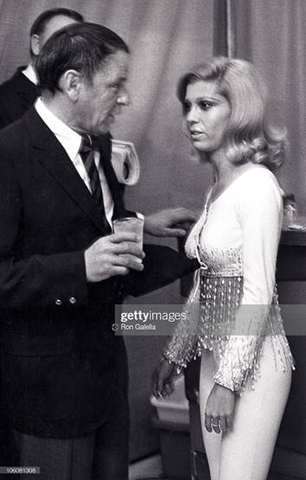
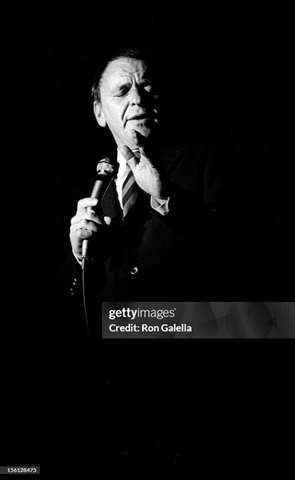
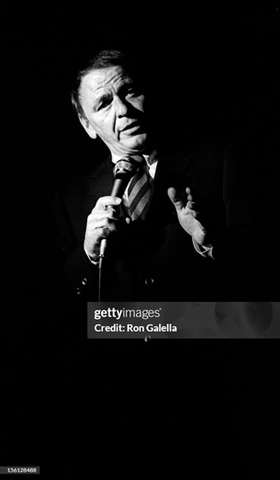
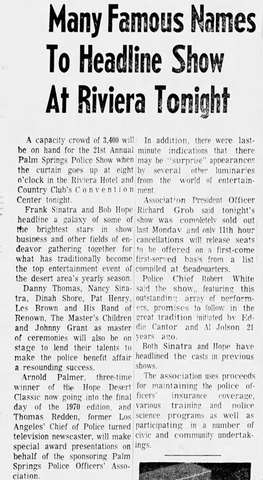
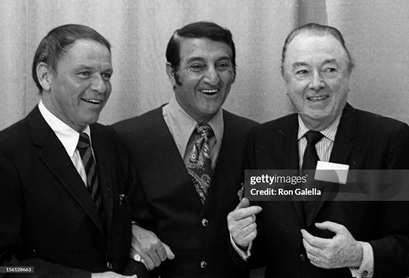
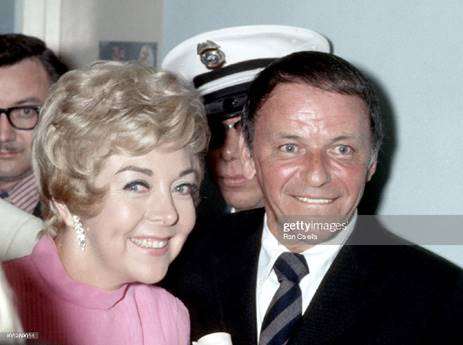
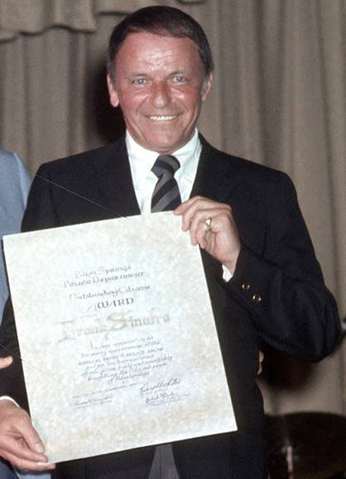
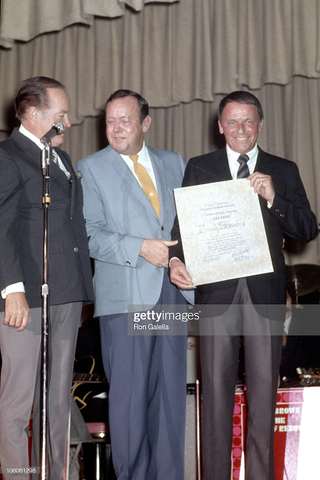
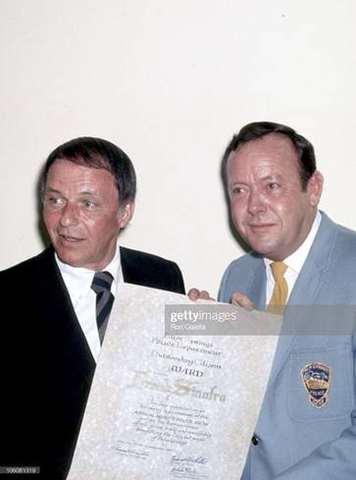
After exhausting his appeals, including one rejected by the U.S. Supreme Court, Frank submits to a secret midnight session in Trenton before the New Jersey State Commission of Investigation, answering questions under oath about organized crime. He repeatedly denied any knowledge of Mafia figures, including Sam Giancana, testimony that only deepened public suspicion when it leaked to the press. Source: J. Randy Taraborrelli, Sinatra: Behind the Legend.
[Sinatra testifies before NJ commission]
Ronald Sullivan: Sinatra flew into Mercer County Airport and testified for over an hour before a closed session of the New Jersey State Commission of Investigation in Trenton, questioned by commissioners Glen B. Miller Jr. and James T. Dowd. The New York Times reported he 'abandoned his customary breezy demeanor and appeared apprehensive.'
Source: James Kaplan, "Sinatra: The Chairman" (2015).
[Sinatra's testimony transcript]
Frank Sinatra: In a transcript later obtained by Kitty Kelley, Sinatra denied knowing whether he'd met Willie Moretti, denied any knowledge of Skinny D'Amato, Sam Giancana, Joseph Fischetti, or Lucky Luciano as organized-crime figures, and denied knowing anyone in the Mafia or 'the mob,' though he admitted having met Meyer Lansky, whom he said he knew only as 'an undesirable.'
Source: James Kaplan, "Sinatra: The Chairman" (2015).
[NJ commission drops contempt charges]
The morning after Sinatra's testimony, the New Jersey commission announced it was satisfied and dropped its contempt charges; an anonymous commission official later said the real point of forcing Sinatra to appear had been the publicity it generated.
Source: James Kaplan, "Sinatra: The Chairman" (2015).
[Photograph: Location filming begins for Dirty Dingus Magee. From Richard Havers, "Sinatra" (Dorling Kindersley, 2007), p.314.]
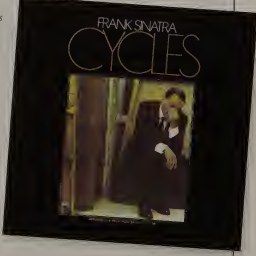
[Photograph: Location filming begins for Dirty Dingus Magee. From Richard Havers, "Sinatra" (Dorling Kindersley, 2007), p.313.]
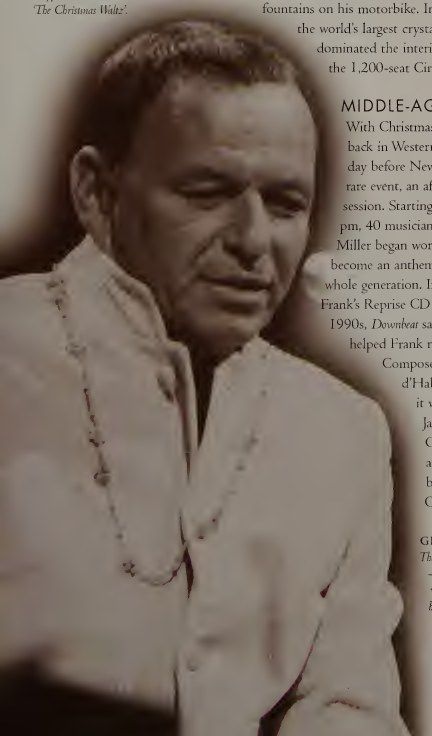
[Photograph: Location filming begins for Dirty Dingus Magee. From Richard Havers, "Sinatra" (Dorling Kindersley, 2007), p.313.]
Frank began location filming in Tucson, Arizona, then broke away to appear at a White House tribute to the late Senator Everett Dirksen, a moment Havers frames as an early sign of Frank's political shift toward the Republicans. (Source: Richard Havers, "Sinatra" (Dorling Kindersley, 2007).)
White House, Washington DC
Tribute to Senator Everett Dirksen
Among the songs sung by Frank was a Dirksen favorite, "Smoke Gets In Your Eyes."
--Ed & Fred
White House, Washington DC
Tribute to Senator Everett Dirksen
Among the songs sung by Frank was a Dirksen favorite, "Smoke Gets In Your Eyes."
[image referenced in source but could not be recovered]
[Cue magazine interview]
Frank Sinatra: On two hours' sleep on the Dingus Magee set, Sinatra gave an expansive interview to Cue's William Wolf, discussing his indifference to aging ('I never think about it'), his cigarette habit, his love of The Man with the Golden Arm, and his wish to make a film with songs alongside Barbra Streisand.
Source: James Kaplan, "Sinatra: The Chairman" (2015)
[FBI supplies dossier to Scotland Yard]
Kaplan: FBI official A. Rosen supplied a memo to Scotland Yard citing Sinatra's associations with Willie Moretti, Skinny D'Amato, and Sam Giancana, and referenced a 1955 security investigation linking Sinatra's name to roughly sixteen Communist-front organizations in the 1940s, while noting the investigation found no actual Communist Party membership.
Source: James Kaplan, "Sinatra: The Chairman" (2015)
[Sinatra on 'amorality' in America]
Frank Sinatra: In the same Cue interview, Sinatra dismissed the idea that Italian-Americans were upset about Mafia associations, saying the bigger problem was 'amorality' and 'rebellion without a cause' among protesters.
Source: James Kaplan, "Sinatra: The Chairman" (2015)
Friar's Club Dinner for Danny Thomas
[image referenced in source but could not be recovered]
[image referenced in source but could not be recovered]
[image referenced in source but could not be recovered]
[image referenced in source but could not be recovered]
Friar's Club Dinner for Danny Thomas
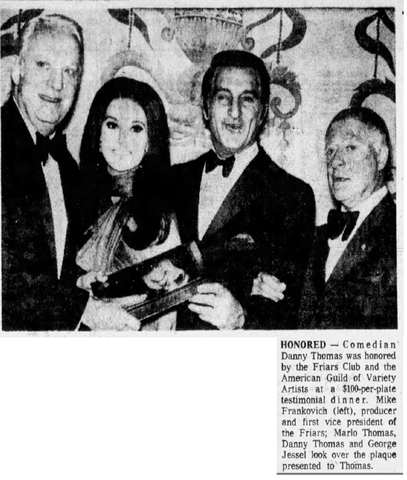
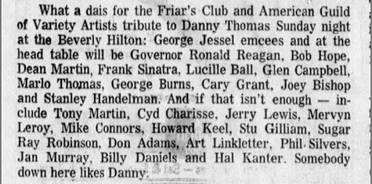
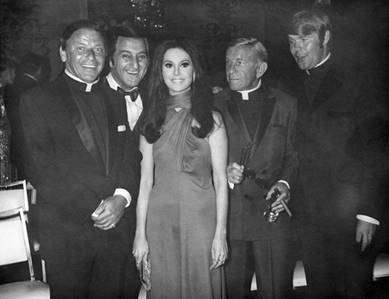
[FBI cable about Sinatra's London concerts]
FBI Director J. Edgar Hoover received an urgent cable from a legal attaché in London: Scotland Yard's commissioner was worried about the Royal Family potentially attending Sinatra's upcoming Royal Festival Hall charity concerts (May 7-8), given the recent publicity over his New Jersey Mafia-related testimony.
Source: James Kaplan, "Sinatra: The Chairman" (2015).
Riviera Hotel, Palm Springs, CA
Frank & Nancy Sinatra
United Jewish Appeal
An Evening With Frank Sinatra
Riviera Hotel, Palm Springs, CA
Frank & Nancy Sinatra
United Jewish Appeal
An Evening With Frank Sinatra
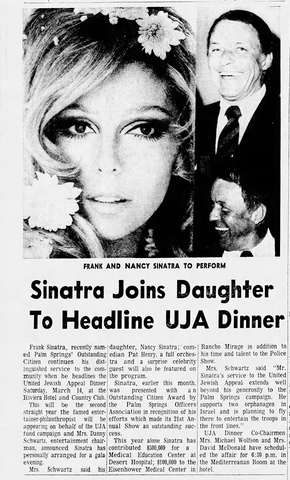
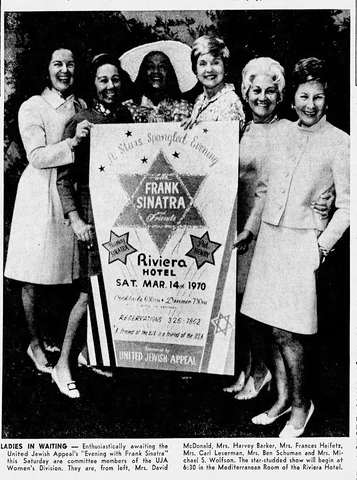
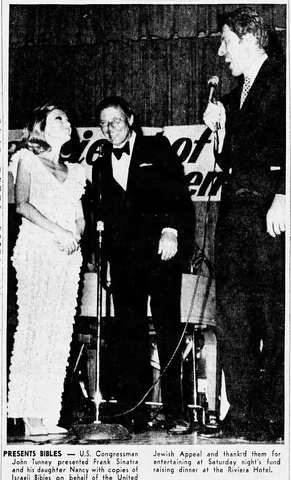
[Nixon expands Vietnam War into Cambodia]
Kaplan: President Nixon announced the expansion of the Vietnam War into Cambodia, triggering massive campus protests across the country; the flag-burning and anti-government rhetoric that followed deeply bothered Sinatra.
Source: James Kaplan, "Sinatra: The Chairman" (2015)
FORTY-FIFTH ANNUAL ACADEMY AWARDS
Dorothy Chandler Pavilion
Los Angeles
7 to 11:30 pm
ABC-TV
Honorary Oscar for Cary Grant presented by Frank Sinatra
FORTY-FIFTH ANNUAL ACADEMY AWARDS
Dorothy Chandler Pavilion
Los Angeles
7 to 11:30 pm
ABC-TV
Honorary Oscar for Cary Grant presented by Frank Sinatra
Apr 7, 1977: Frank Sinatra sings the National Anthem at Dodger Stadium.
Frank Sinatra sang the National Anthem at the Dodgers home opener to celebrate the 20th season of the Dodgers and Giants playing on the West Coast.
This photo was taken at Candlestick Park, 4-15-77, as Frank threw the first pitch on Frisco's home opener. Here is a photo of Frank right after he finished singing the national anthem in Dodgers Stadium, 4-7-77 --ED
French Le Figaro Magazine with Frank on cover from Dodgers Stadium (Thanks to Michel Macaire
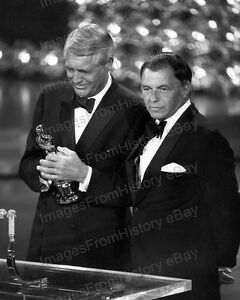
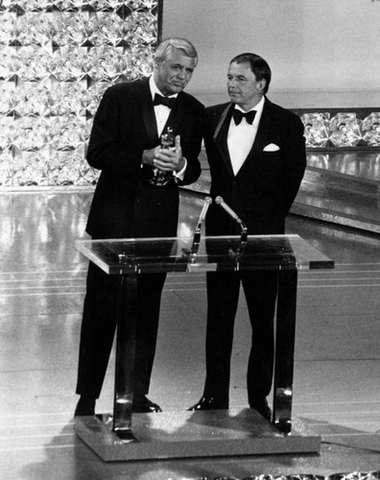
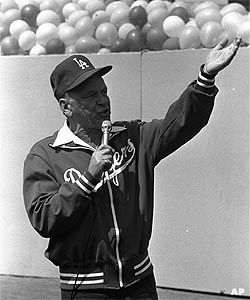
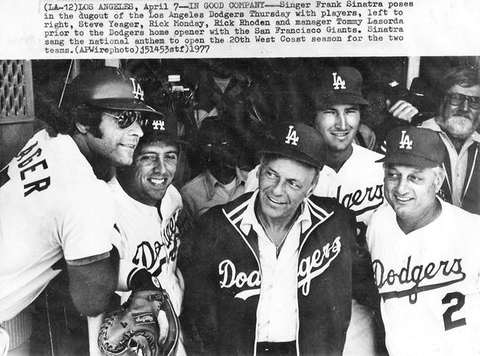
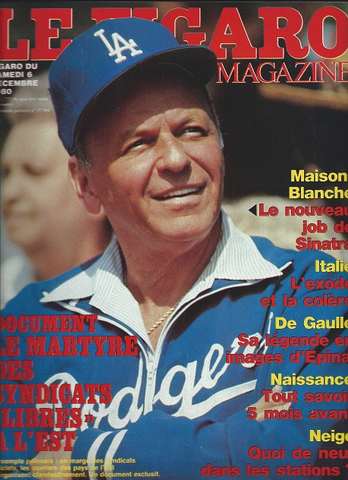
[Paul McCartney announces Beatles breakup]
Paul McCartney formally announced his departure from the Beatles, confirming the group's breakup after John Lennon had privately told his bandmates months earlier he was leaving.
Source: James Kaplan, "Sinatra: The Chairman" (2015).
Caesars Palace, Las Vegas, Nevada (21-26)
Orchestra Conducted By: Bill Miller
1. I've Got the World on a String
2. This Is All I Ask
3. A Foggy Day
4. On the Road to Mandalay
5. Fly Me to the Moon
6. Angel Eyes
7. Lady Day
8. Don't Worry 'Bout Me
9. For Once in My Life
10. Ol' Man River
11. My Way
Caesars Palace, Las Vegas, Nevada (21-26)
Orchestra Conducted By: Bill Miller
---------------------------------------------
© 1997-2026 The Sinatra Archive
This calendar, or any parts thereof, may not be reproduced in any fashion whatsoever without the prior written permission of the publisher (The Sinatra Archive)
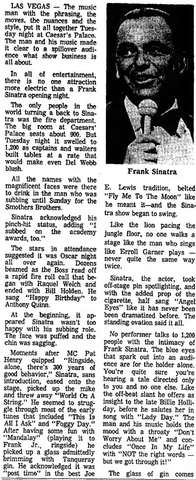
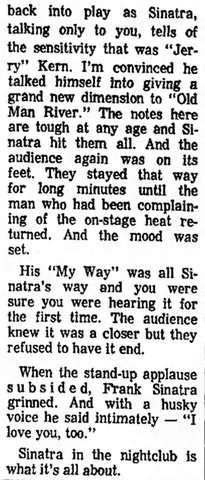
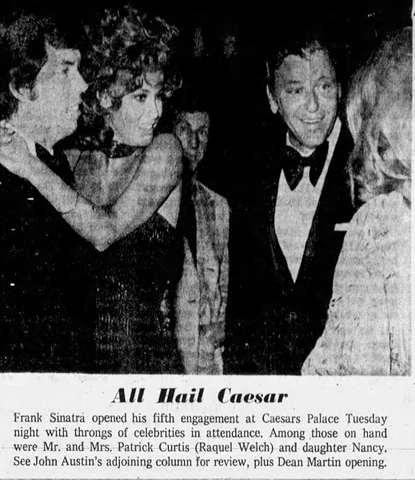
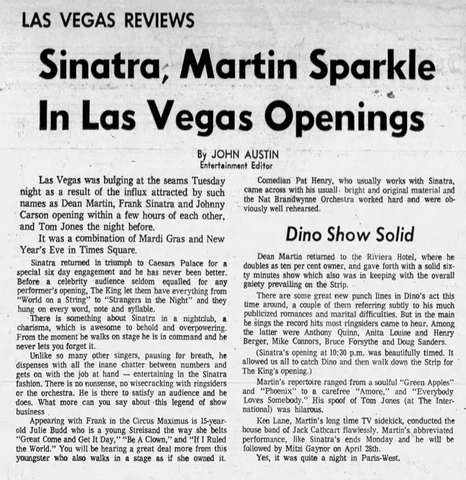
During a week at Caesars in Las Vegas, Frank's right hand began bothering him; he was later diagnosed with Dupuytren's contracture, which required surgical correction.
Source: Nancy Sinatra, Frank Sinatra: An American Legend, 1995.
Caesars Palace, Las Vegas, Nevada (21-26)
Orchestra Conducted By: Bill Miller
1. I've Got the World on a String
2. This Is All I Ask
3. A Foggy Day
4. On the Road to Mandalay
5. Fly Me to the Moon
6. Angel Eyes
7. Lady Day
8. Don't Worry 'Bout Me
9. For Once in My Life
10. Ol' Man River
11. My Way
12. I Get A Kick Out Of You
13. Strangers In The Night
14. At Long Last Love
note: I've added additional songs performed opening night.
Julie Budd opened for Frank and then Pat Henry followed her. Frank was backed by a 40 piece orchestra.
He subbed for the Smothers Brothers. Engagement was from Tuesday thru Sunday ( 4-21 to 4-26. ).
Ed
[The Cinematic Legacy of Frank Sinatra — Dirty Dingus Magee (1970)]
David Wills's 2015 photo history The Cinematic Legacy of Frank Sinatra devotes a section to Dirty Dingus Magee (1970), illustrated with 1 behind-the-scenes and publicity photograph (posters, lobby cards, and on-set/on-location shots) filed here.
Source: David Wills, The Cinematic Legacy of Frank Sinatra (St. Martin's Press, 2015), p. 273.
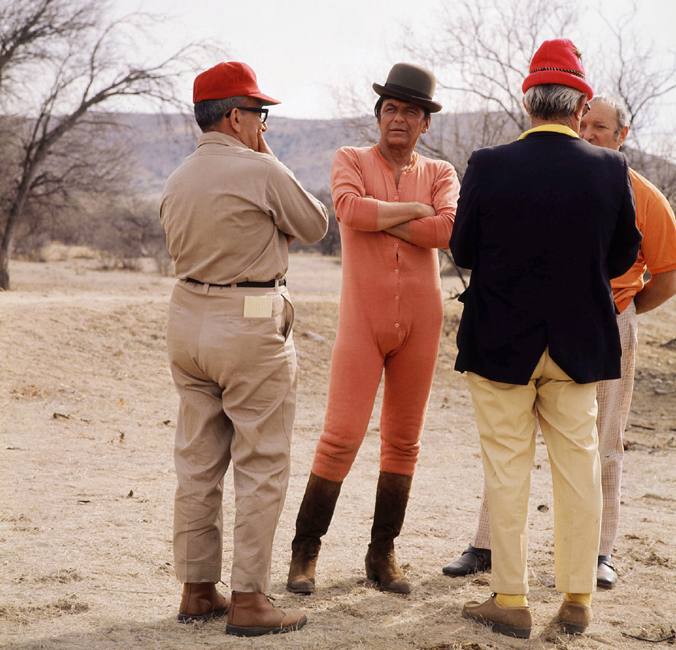
actor … I just remember having fun working / with him. He's a very generous man … and has / never outgrown his ability to beguile.” / (Costar, Dirty Dingus Magee, 1970) / On location in Tuscon, Arizona, Dirty Dingus Magee, 1970. (Photo: The Cinematic Legacy of Frank Sinatra, David Wills, 2015.)
Caesars Palace, Las Vegas, Nevada (21-26)
Orchestra Conducted By: Bill Miller
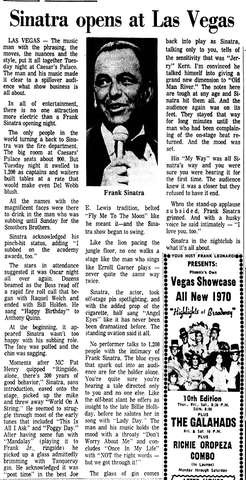
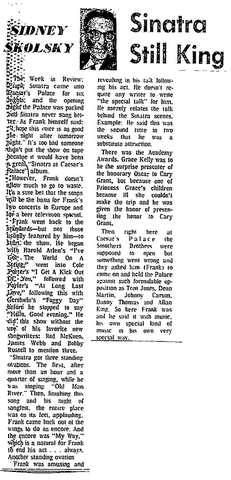
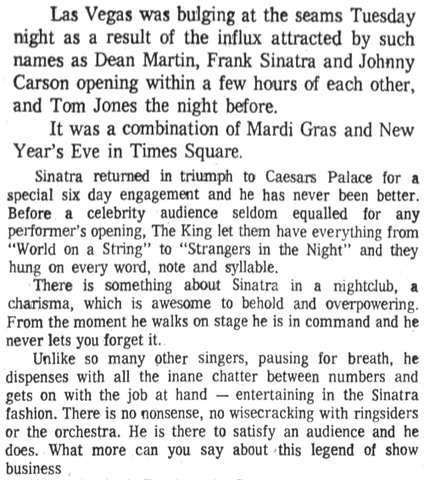
[Caesars Palace premiere reviewed]
After wrapping Dirty Dingus Magee, Sinatra opened a six-night Caesars Palace engagement; Variety's reviewer wrote that as a 'cabaret blockbuster' Sinatra's ascent showed no sign of coasting.
Source: James Kaplan, "Sinatra: The Chairman" (2015).
Caesars Palace, Las Vegas, Nevada (21-26)
Orchestra Conducted By: Bill Miller
1. I've Got the World on a String
2. This Is All I Ask
3. A Foggy Day
4. On the Road to Mandalay
5. Fly Me to the Moon
6. Angel Eyes
7. Lady Day
8. Don't Worry 'Bout Me
9. For Once in My Life
10. Ol' Man River
11. My Way
Caesars Palace, Las Vegas, Nevada (21-26)
Orchestra Conducted By: Bill Miller
First Show
1. I've Got the World on a String
2. This Is All I Ask
3. A Foggy Day
4. On the Road to Mandalay
5. Fly Me to the Moon
6. Angel Eyes
7. Lady Day
8. Don't Worry 'Bout Me
9. For Once in My Life
10. Ol' Man River
11. My Way
Caesars Palace, Las Vegas, Nevada (21-26)
Orchestra Conducted By: Bill Miller
Second Show
1. I've Got the World on a String
2. This Is All I Ask
3. A Foggy Day
4. On the Road to Mandalay
5. Fly Me to the Moon
6. Angel Eyes
7. Lady Day
8. Don't Worry 'Bout Me
9. For Once in My Life
10. Ol' Man River
11. My Way
[Greenspun editorial praises Sinatra]
Hank Greenspun: Las Vegas Sun publisher Hank Greenspun wrote an editorial calling a Sinatra engagement at Caesars Palace 'equivalent to booking a 25,000-delegate convention'; Caesars later reprinted the quote as a full-page Variety ad.
Source: James Kaplan, "Sinatra: The Chairman" (2015).
Caesars Palace, Las Vegas, Nevada (21-28)
Orchestra Conducted By: Bill Miller
First Show
1. I've Got the World on a String
2. This Is All I Ask
3. A Foggy Day
4. On the Road to Mandalay
5. Fly Me to the Moon
6. Angel Eyes
7. Lady Day
8. Don't Worry 'Bout Me
9. For Once in My Life
10. Ol' Man River
11. My Way
Caesars Palace, Las Vegas, Nevada (21-26)
Orchestra Conducted By: Bill Miller
Second Show
1. I've Got the World on a String
2. This Is All I Ask
3. A Foggy Day
4. On the Road to Mandalay
5. Fly Me to the Moon
6. Angel Eyes
7. Lady Day
8. Don't Worry 'Bout Me
9. For Once in My Life
10. Ol' Man River
11. My Way
Note: Al Viola told me Frank did songs from "Watertown" during this one-week engagement. Al remembered him singing "For A While," "Michael & Peter" and I
Would Be In Love Anyway." And "Lady Day" was also written for "Watertown." According to Al, the
Caesars orchestra could not recreate the sound of the album and Frank dropped them after a few shows.
Ed
Caesars Palace, Las Vegas, Nevada (21-26)
Orchestra Conducted By: Bill Miller
1. I've Got the World on a String
2. This Is All I Ask
3. A Foggy Day
4. On the Road to Mandalay
5. Fly Me to the Moon
6. Angel Eyes
7. Lady Day
8. Don't Worry 'Bout Me
9. For Once in My Life
10. Ol' Man River
11. My Way
Caesars Palace, Las Vegas, Nevada (21-28)
Orchestra Conducted By: Bill Miller
Caesars Palace, Las Vegas, Nevada (21-28)
Orchestra Conducted By: Bill Miller
[Signing Autographs Outside Royal Festival Hall]
Sinatra signed autographs for fans outside the Royal Festival Hall during a London trip to perform two benefit concerts with Count Basie's orchestra, which he later described as possibly his finest two nights on stage.
Source: Charles Pignone, "Frank Sinatra 100" (2015).
['Lady Day' performed in London]
Kaplan: At the Royal Festival Hall shows, Sinatra performed 'Lady Day,' a song left off Watertown that had been written by Bob Gaudio and Jake Holmes about the album's fictional runaway wife, but which Sinatra insisted on treating as a tribute to Billie Holiday.
Source: James Kaplan, "Sinatra: The Chairman" (2015)
[Sinatra calls London shows his 'finest hour']
Daryl Runswick: Shortly after the London concerts, Sinatra said 'those two nights could have been my finest hour, really.' British bassist Daryl Runswick recalled being struck by how hard and flawlessly Sinatra worked, and that Frank quipped it might be his last London performance.
Source: James Kaplan, "Sinatra: The Chairman" (2015)
[Kent State shootings]
The Ohio National Guard opened fire on protesters at Kent State University, killing four students, amid the wave of unrest following Nixon's Cambodia announcement that troubled Sinatra.
Source: James Kaplan, "Sinatra: The Chairman" (2015).
The luxury interior of Sinatra's private Gulfstream jet was photographed at Gatwick Airport around the time of a London concert engagement. Source: Charles Pignone, "Frank Sinatra 100" (2015).
Royal Festival Hall, London, England
Benefit
Count Basie Orchestra Conducted By: Bill Miller
1. I've Got The World On A String
2. I Get A Kick Out Of You
3. At Long Last Love
4. Don't Worry ‘Bout Me
5. Fly Me To The Moon
6. Street Of Dreams
7. Pennies From Heaven
8. My Kind Of Town
9. Autumn Leaves
10. Yesterday
11. This Is All I Ask
12. I Would Be In Love Anyway
13. Try A Little Tenderness
14. Lady Day
15. Ol' Man River
16. Moonlight In Vermont
17. Angel Eyes
18. You Make Me Feel So Young
19. I've Got You Under My Skin
20. Please Be Kind
21. The Lady Is A Tramp
22. On The Road To Mandalay
23. My Way
Notes: TT 75mins.
NOTE: According to Ed O'Brien, Sinatra appeared on the Paul Compton show, June 5, 1970. He discussed the second Jobim album and "Watertown." When Compton asked him about the two London shows from May 1970, Sinatra told him they were probably his "finest hour."
O'Brien points out that Sinatra had just finished filming "Dirty Dingus McGee" and the film had required considerable physical activity. Frank had lost 12 pounds and was in great shape. From the first note opening night he was in the pocket and never wavered a moment. Through the years, O'Brien writes, I have posted a number of reviews from the English press. The critics struggled to find superlatives that could do justice to what they had seen those two evenings at the RFH.
Ed O'Brien:
The concert Frank considered his finest hour had an audience of 3,000 on the morning of May 8, 1970. Although the official date has always been 5-7-70, Sinatra did not appear on stage until 1 A.M of the next day. The evening concert on May 8th had a much earlier start. The average ticket price was $63.00 per seat, although some lucky attendees paid scalpers five times that amount for a choice seat. The concerts raised $240,000 for the National Society for the Prevention of Cruelty to Children and the Alexandra Rose charities. Sinatra was not paid for his performances and he covered all the costs for the Basie band. It had been almost eight years since Frank had played in London. And the ex- citement was palpable. The London Evening News described the arrival of Sinatra as the "loudest welcome since Winston Churchill took his V-Day tribute." The singer did not dis- appoint. His performance electrified the crowd and the thousands standing outside Festival Hall. Sinatra was told that over 100,000 fans had tried for tickets and been turned away. He insisted a sound system be set up for the mass of adoring fans standing outside the Hall. The critic for the London Evening Standard was simply stunned by the interpretative powers of the 54 year old singer. He wrote, "Sinatra possesses a remarkable gift, an actor's gift. You find yourself sitting forward in your seat waiting for the end of a line which you've heard thousands of times before, but which takes on new shades of meaning when shaped by him." After the concert, Frank invited concert attendees Princess Margaret and Lord Snowdon to a party at the Savoy Hotel. They politely declined, but Frank and friends stayed up to dawn drinking champagne and eating kippers, eggs, sausage and strawberries. He would never again reach such a sustained level of excellent on a concert stage. The London Times summed up his triumphant return to the British Isles in proclaiming that he had all of London on a string.
Royal Festival Hall, London, England
Benefit
Count Basie Orchestra Conducted By: Bill Miller
Note: Although officially cited as 5-7 and 8, the shows were actually presented at midnight both evenings. -ED
Note: Frank crossed out "A Foggy Day" on the song list and passed on "That Life." "Strangers" was omitted during the encore segment of his program.
--Ed
Note: I have a number of reviews of this concert, but I thought for the 50th anniversary this is the one that really captures the impact Frank had that evening.
--Ed
[image referenced in source but could not be recovered]
[image referenced in source but could not be recovered]
[image referenced in source but could not be recovered]
[image referenced in source but could not be recovered]
[image not recovered — source caption: “imageimage”]
Royal Festival Hall, London, England
Benefit: Alexandra Day
Time: 12:00 AM Midnight
Count Basie Orchestra Conducted By: Bill Miller
1. I've Got The World On A String
2. At Long Last Love
3. Don't Worry 'Bout Me
4. Pennies From Heaven
5. Street Of Dreams
6. Fly Me To The Moon
7. Autumn Leaves
8. April in Paris
9. Yesterday
10. This Is All I Ask
11. I Would Be In Love Anyway
12. Try A Little Tenderness
13. Lady Day
14. Angel Eyes
15. Moonlight In Vermont
16. Ol' Man River
17. You Make Me Feel So Young
18. I've Got You Under My Skin
19. Please Be Kind
20. The Lady Is A Tramp
21. On The Road To Mandalay
22. My Way
Note: Ed O'Brien points out that both evenings were benefit performances. A huge crowd gathered outside both nights, so Frank requested that the RFH run speakers outside for all who weren't lucky enough to get tickets. When he realized how good he had been, his people contacted the Perfectly Frank Society in London, requesting any audience tapes that might have been recorded. A lovely gentleman by the name of Fred May sent Sinatra copies of both shows. Frank reciprocated by sending May an engraved lighter. Truly a shame that the shows were not recorded with professional equipment, because Frank was brilliant. TT 80mins
Fred J Wadsworth:
I was at the concerts with my mate Fred May and helped with the recording the concerts. I also got an engraved lighter and tickets for the next London Concert of November 16 of the same year from Frank. A few years later we (my wife and I) stayed with a friend and Sinatra fan, Ray Boland of Huntington Beach California and gave the lighter to him as a present for the friendship he and his wife showed us when we stayed with them.
Royal Festival Hall, London, England
Benefit: Alexandra Day
Time: 12:00 AM Midnight
Count Basie Orchestra Conducted By: Bill Miller
New York Times, May 9, 1970
[image referenced in source but could not be recovered]
[image referenced in source but could not be recovered]
[image referenced in source but could not be recovered]
Coliseum, Memphis, Tennesee
Benefit for St. Jude's Children's Research Center - The Shower Of Stars
Other Performers: Danny Thomas
Sinatra:
I've Got The World On A String
Fly Me To The Moon
The Lady Is A Tramp
My Way
7 more
Note: On May 30, 1970, Sinatra headlined the
"Shower of Stars," with Jerry Lewis and Dinah Shore among those on the bill. Sinatra also brought in, at his own expense, his conductor and drummer from Los
Angeles. They rehearsed an excellent 27-piece orchestra of Memphis musicians for two-and-a-half hours on the day of the performance. It was time well-spent because after the rehearsal, someone stole the conductor’s sheet music. Sinatra raised so much money for St. Jude and enjoyed the experience so greatly that he did another concert on May 29 the following year, this time with Bob Hope and Sammy Davis Jr.
--Scott
Coliseum, Memphis, Tennessee
Benefit for St. Jude's Children's Research Center - The Shower Of Stars
Other Performers: Danny Thomas
L to R: Danny Thomas, Frank Sinatra, Marlo Thomas and Jerry Lewis are shown backstage waiting for the Shower of Stars benefit concert to begin at the Mid-South Coliseum on May 30, 1970.
May 30, 1972 Frank Sinatra receives honorary Cathedral City Mayorship
from United States Senator John Tunney, a long time friend of both the singer
and the Kennedy family
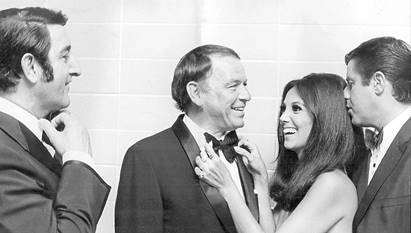
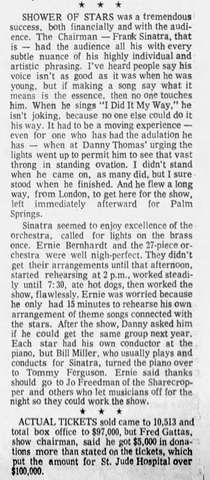
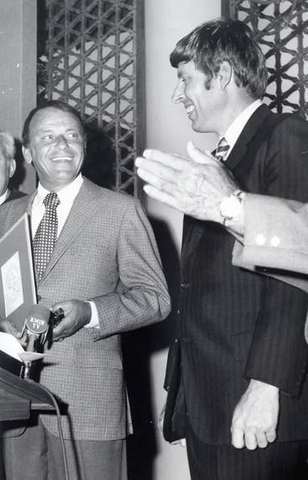
Commercial Appeal
Coliseum, Memphis, Tennesee
Benefit for St. Jude's Children's Research Center - The Shower Of Stars
Other Performers: Danny Thomas, Jerry Lewis, Marlo Thomas, Dinah Shore
Sinatra:
I've Got The World On A String
Fly Me To The Moon
The Lady Is A Tramp
My Way
7 more
Memphis Press
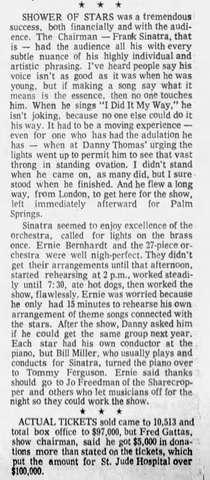
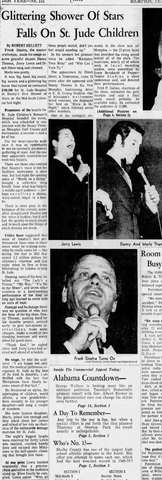
[Sinatra's hand surgery]
Frank Sinatra: About two weeks before the Haber interview, Sinatra underwent surgery to alleviate the Dupuytren's contracture in his right hand, later telling Haber, 'It looks like I held a cherry bomb in my hand.'
Source: James Kaplan, "Sinatra: The Chairman" (2015)
Paul Comptom, KGIL Radio
Paul Comptom interviews Sinatra
27 mins.
NOTE: Ed O'Brien says this is a "great interview" and points out that Sinatra called his London concerts in May of 1970 "his finest hour."
He also discusses the second Sinatra-Jobim album, the Watertown album, more work with Gaudio and Holmes, and the "Lady Day" album with Lennie Hayton.
Television
None
Alexander Day Charity Appeal
Wednesday
BBC-radio
Ed O'Brien:
Sinatra is heard on tape from the Royal
Festival Hall after his concerts in May of that year. He urges Londoners to buy roses on Alexander Rose Day, 6-23, for the more than 700 charities supported by the Alexandra Day funds.
Television
None
Exactly a year after the violinist surprise, Frank appeared unannounced at the door of Tina's Munich hotel room, having slipped away from public notice for a day. He later joined her cast-and-crew party, causing a stir among the crowd. (Source: Tina Sinatra, "My Father's Daughter: A Memoir" (2000).)
Exactly a year after the violinist surprise, Frank appeared unannounced at the door of Tina's Munich hotel room, having slipped away from public notice for a day. He later joined her cast-and-crew party, causing a stir among the crowd. (Source: Tina Sinatra, "My Father's Daughter: A Memoir" (2000).)
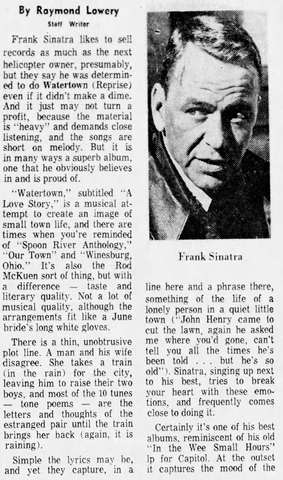
[Awkward Dinah Shore talk-show announcement]
Kaplan: NBC's publicity department prematurely announced Sinatra would be the first guest on Dinah Shore's new daytime talk show in early August; he was reluctant to appear on camera with his hand still bandaged.
Source: James Kaplan, "Sinatra: The Chairman" (2015)
[Haber interview on the Reagan switch]
Frank Sinatra: Los Angeles Times columnist Joyce Haber interviewed Sinatra by phone about his Reagan endorsement; he admitted Democratic nominee Jess Unruh's role in 'hurting my man badly in Chicago' (Humphrey's 1968 loss) was 'a damn good reason' for backing Reagan.
Source: James Kaplan, "Sinatra: The Chairman" (2015)
[Sinatra's cold feet on Preminger film]
Frank Sinatra: Sinatra told columnist Marilyn Beck he wasn't looking forward to shooting Where the Dark Streets Go, in which he was to play a priest investigating a murder, in New York during winter.
Source: James Kaplan, "Sinatra: The Chairman" (2015)
[Sinatra endorses Reagan]
Frank Sinatra: Sinatra announced he was joining the campaign to reelect Ronald Reagan as California governor, accepting the co-chairmanship of Reagan's campaign committee and calling it his 'duty as a citizen' to set aside partisanship.
Source: James Kaplan, "Sinatra: The Chairman" (2015).
Lifelong Democrat Frank Sinatra announces his surprise support for Republican Ronald Reagan's reelection bid as California governor, against Reagan's opponent Jesse Unruh, a Bobby Kennedy protege. Sinatra's political allegiances scattered across party lines that year, and he would go on to form a notably close friendship with Vice President Spiro Agnew. Source: J. Randy Taraborrelli, Sinatra: Behind the Legend.
[Nancy Jr.'s Circus Maximus debut]
Marking both Caesars Palace's fourth anniversary and Nancy Sinatra Jr.'s Circus Maximus premiere, Frank threw his daughter two lavish galas: a Friday cocktail party and a Saturday black-tie 'coming out' cotillion produced by her fiancé, Hugh Lambert.
Source: James Kaplan, "Sinatra: The Chairman" (2015).
Civic Opera House, Chicago, Illinois
Benefit for Villa Scalabrini
Orchestra Conducted By: Bill Miller
1. I've Got the World on a String
2. I Get a Kick Out of You
3. Fly Me to the Moon
4. Pennies From Heaven
5. The Lady Is a Tramp
6. I Get Along Without You Very Well
7. Angel Eyes
8. You Make Me Feel So Young
9. I've Got You Under My Skin
10. My Kind of Town
11. My Way
Frank Sinatra and Tony Bennett
August 15, 1970
Civic Opera House
Mortgage Burning Benefit for Villa Scalabrini
Italian-American Community of Chicago
Tony introduces the "greatest entertainer in the whole world."
Frank and his quartet- Jim Hughart, bass, Al Viola, guitar,
Irv Cottler, drums, Bill Miller, piano
1. I've Got The World On A String
2. At Long Last Love
3. Don't Worry 'Bout Me
4. Fly Me To The Moon
5. Angel Eyes
6. Try A Little Tenderness
7. My Kind Of Town
Solid silver plaque is presented to Frank
Frank introduces Tony "I've said it publicly
and I'll say it again, he is the greatest singer
in the world today. Tony is my man."
Tony sings with full orchestra
1. If I Ruled The World dedicated to the great Frank Sinatra
2. They All Laughed
3. Get Happy
4. Something
5. Here, There and Everywhere
6 The Shadow Of Your Smile
7. What The World Need Now ( Is Love )
note: Frank would do a benefit for Mexican-Americans
the next afternoon at the Hollywood Bowl.
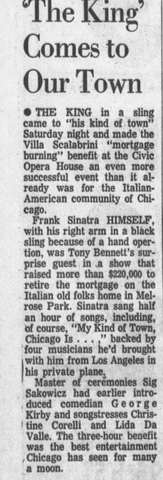
Hollywood Bowl, California
Benefit for Nosotros
Orchestra Conducted By: Bill Miller
1. I've Got the World on a String
2. I Get a Kick Out of You
3. Fly Me to the Moon
4. Pennies From Heaven
5. The Lady Is a Tramp
6. I Get Along Without You Very Well (Except Sometimes)
7. Angel Eyes
8. You Make Me Feel So Young
9. I've Got You Under My Skin
10. My Kind of Town
11. My Way
Civic Hall, Richmond, Indiana
Benefit for the family of Dan Mitrione
Orchestra Conducted By: Bill Miller
Other Performers: Jerry Lewis
1. I've Got the World on a String
2. I Get a Kick out of You
3. Close to You
4. Don't Worry 'Bout Me
5. Fly Me to the Moon
6. Pennies from Heaven
7. The Lady is a Tramp
8. Autumn Leaves
9. Yesterday
10. This is all I Ask
11. I Get Along without you very Well
12. Moonlight in Vermont
13. Ol' Man River
14. Angel Eyes
15. You Make Me Feel so Young
16. I've Got You Under My Skin
17. My Kind of Town
18. My Way
NOTE: Last year Author Ed O'Brien sent us a lengthy review of this concert taken from the
DAYTON DAILY NEWS of August 31, 1970. It emphasized the very prominent instrumentalists playing in the orchestra and the details of
Sinatra's presentations of almost every individual song. The reviewer, identified only as
B. W., wrote in the concluding paragraph of the review: We all were almost ashamed of what we had witnessed. An almost entire life had been bared in song. Voluntarily. Unstintingly. The song was endedâ but the memory lingered on. The e show was over. Sinatra disappeared. So did we.
Into the welcome shadows of a sultry August night in Indiana.
Sinatraphile John G. wanted to know if the "Close
To You" in the program was the Carpenter's tune.
O'Brien responded: "Yes. Sinatra sang their big hit tune with an uptempo Don Costa chart, but the recording done just a few months later received a ballad treatment from both Sinatra and Costa."
My friend, John Brady, attended this concert. He told me the auditorium was like an oven. The audience was there for Sinatra and had little interest in Mr. Lewis. When Frank appeared the crowd went wild with expectation and Frank delivered for 70 minutes. The singing of the 18 numbers was done with perfection and Frank's comments regarding Dan Mitrione were heartfelt and moved many to tears. John would see Frank many times after this evening, including the 74 sessions for "Some
Nice Things I Missed"( he did the liner notes), but he never heard him sing at this level again.
Ed
Civic Hall, Richmond, Indiana
Benefit for the family of Dan Mitrione
Orchestra Conducted By: Bill Miller
Other Performers: Jerry Lewis
The benefit engineered by Frank Sinatra for the family of Dan A.
Mitrione, former Richmond, Ind., chief of police who was slain by guerrillas in Montevideo recently while on a mission for the U.S. State Department, pulled a jam- packed S.R.O. crowd to the 4.200 -seat Civic Hall, Richmond, Saturday night (29). Tickets were scaled at $15, $20 and $25, with entertainment furnished by Sinatra, Jerry Lewis and a 22 -piece orchestra flown in from Hollywood: BILL SACHS
Billboard
Sinatra takes notice
Days later, the Richmond Area Chamber of Commerce took a surprise phone call from a celebrity who had heard Mitrione's story and wanted to help make sure his nine children would get an education.
Frank Sinatra said he would perform at a benefit concert to be held in Richmond and would bring his friend comedian Jerry Lewis along.
"I believe it is important to show the world that someone cares about Mitrione as a peace officer, a father and most importantly, an American citizen," Sinatra said, according to Palladium-Item archives.
More than 4,200 people crammed into Civic Hall on Saturday, Aug. 29 despite the 110-degree heat inside. After initial act Orange Colored Sky performed and Lewis ran through his routine, Sinatra sang many of his hits, concluding with "I Did It My Way."
Sinatra donated 450 tickets to servicemen at regional bases and bought tickets for Richmond police and firefighters and their families as well as 100 Richmond High School football players whose season-opening jamboree was moved up an hour to accommodate the concert.
The event raised more than $70,000 that was put in a trust fund for the Mitrione children.
© 1997-2025 The Sinatra Archive
This calendar, or any parts thereof, may not be reproduced in any fashion
whatsoever without the prior written permission of the publisher (The
Sinatra Archive)
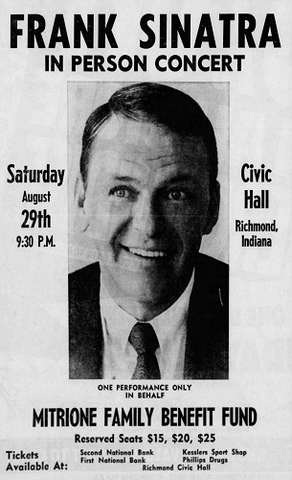

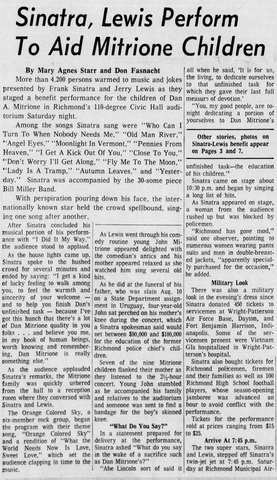
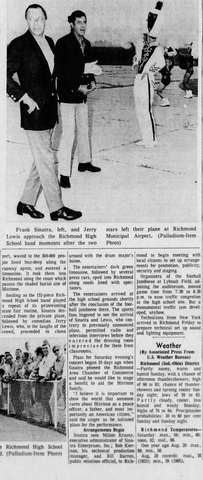
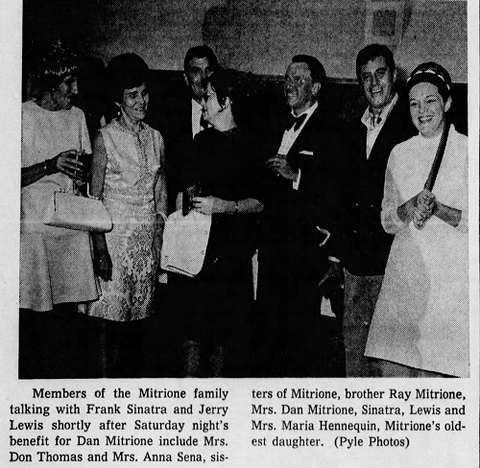
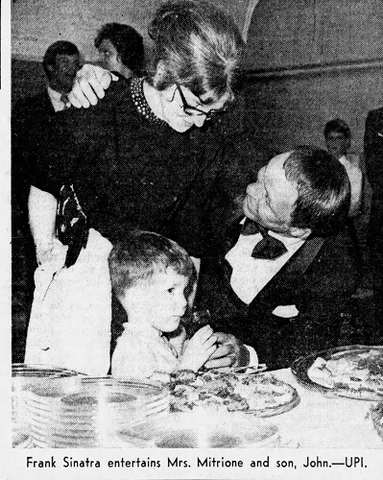
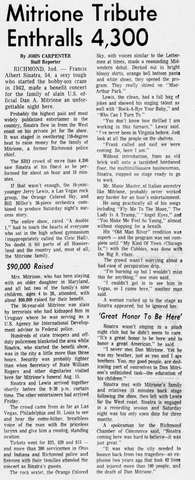
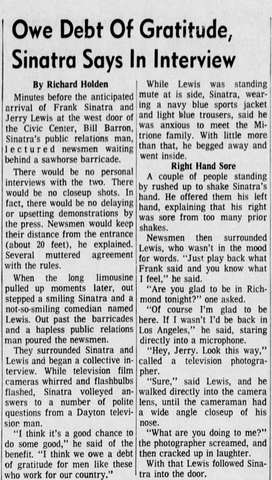
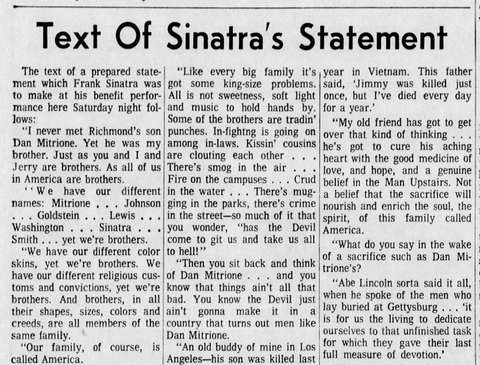
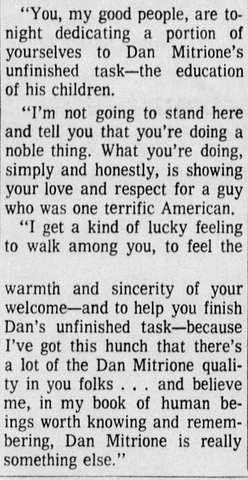
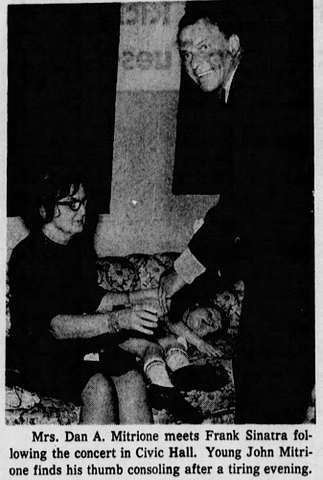
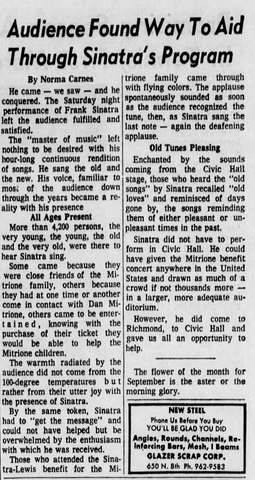
[Dinah Shore links Sinatra to Agnew]
Peter Malatesta: Dinah Shore, a tennis partner of Vice President Spiro Agnew, told Agnew aide Peter Malatesta that 'Frank Sinatra also admired the Vice President and respected him for being so forthright in his views.'
Source: James Kaplan, "Sinatra: The Chairman" (2015)
[Mario Puzo's humiliating encounter with Sinatra]
Mario Puzo: At a birthday party at Chasen's, when a mutual acquaintance tried to introduce novelist Mario Puzo to Sinatra, Frank refused twice, saying 'I don't want to meet him.' After Puzo tried to apologize and was misunderstood, Sinatra shouted abuse, calling him a pimp, and yelled 'Choke. Go ahead and choke' as Puzo walked out.
Source: James Kaplan, "Sinatra: The Chairman" (2015)
[Sinatra drops out of Dirty Harry]
Kaplan: Sinatra signed with Warner Bros. to star in a planned police thriller, Dirty Harry, but soon dropped out for medical reasons; Clint Eastwood took the role and built a career on it.
Source: James Kaplan, "Sinatra: The Chairman" (2015)
[Sinatra's UPI interview on the incident]
Frank Sinatra: About two weeks after the confrontation, Sinatra gave United Press International his own account, denying any threats about 'the mob' and claiming he'd actually been at a blackjack table, not playing baccarat, when Waterman confronted him.
Source: James Kaplan, "Sinatra: The Chairman" (2015)
[Steve Allen's open letter]
Steve Allen: Talk-show host Steve Allen published an open letter to Sinatra criticizing his Reagan endorsement as inconsistent with his liberal past, suggesting it stemmed from lingering resentment toward Bobby Kennedy, and offering him TV airtime to respond. Sinatra never took him up on it.
Source: James Kaplan, "Sinatra: The Chairman" (2015)
Caesars Palace, Las Vegas , Nevada (September 3-5)
Ed O'Brien:
Frank followed his daughter into Caesars. Nancy had just set a new one-week attendance record at the hotel. Frank was set for a three-week run at the hotel (3 to 23). doing eight shows a week. He only made it through the first three nights. In the wee hours of Monday morning( 6th), Frank was playing baccarat for $8,000 a hand, Sinatra would keep the money he won. When he lost and needed money, he would sign a marker for an additional $10,000. This was house money. Frank's argument was, same one he made at the Sands, in September 1967, he drew high rollers to the baccarat table, so the casino was making much more than the little he was losing. The casino didn't see it that way. At 5:a.m, the casino boss, Sandy Waterman, confronted Sinatra and demanded a return of the $10,000. A heated argument ensued until Waterman pulled out a .38 caliber pistol and waved it in Frank's face. Jilly quickly disarmed Waterman Frank left the casino and flew home to Palm Springs.
The engagement at Caesars was finished. A Palm Springs columnist Norma Lee Browning, interviewed Frank on 10-24. He told her that Vegas would never see him again. Caesars finally lured him back in January of 1974.
Caesars Palace, Las Vegas , Nevada (September 3-5)
----------------------------------------
1979 Resorts International, Atlantic City, New Jersey (September 3-9)
Orchestra Conducted By: Vincent Falcone, Jr.
Key Musicians: Irv Cottler, Charles Turner, Gene Cherico, Al Viola, Joe Malin
O.A. Pat Henry
-------------------------------------
© 1997-2025 The Sinatra Archive
This calendar, or any parts thereof, may not be reproduced in any fashion whatsoever without the prior written permission of the publisher (The Sinatra Archive)
_
Caesars Palace, Las Vegas , Nevada (September 3-5)
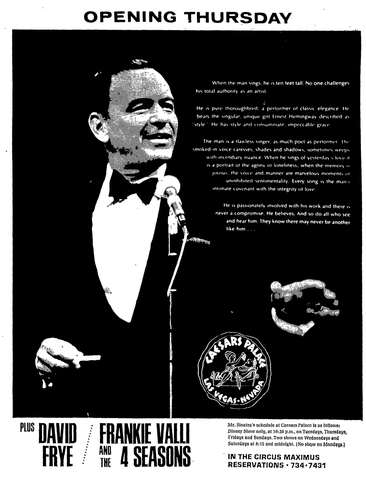
['HE'S HERE' engagement opens]
Sinatra opened his sixth engagement at Caesars Palace's Circus Maximus; the marquee, which once read 'GUESS WHO,' now simply said 'HE'S HERE,' and guests received medallions reading 'HAIL SINATRA THE NOBLEST ROMAN IS AT CAESARS PALACE.'
Source: James Kaplan, "Sinatra: The Chairman" (2015).
Caesars Palace , Las Vegas, Nevada (September 3-6)
Ed O'Brien: Frank only performed through the first weekend (9/ 6 ). The same problem that caused him to leave the Sands four years earlier came up again. Frank liked to gamble after a show and thought the house should extend him credit. When Caesars executive Sanford Waterman refused to extend more credit a heated exchange ensued. Waterman pulled a gun on Sinatra. He was arrested, but the sheriff, Ralph Lamb, sided with him and had very harsh words for Frank. Enraged by the event, Sinatra announced he would no longer appear in Las Vegas. He stayed away until January of 1974.
Caesars Palace, Las Vegas, Nevada (September 3-6)
Caesars Palace, Las Vegas , Nevada (September 3-6)
During this Caesars Palace engagement, a dispute over Frank's usual casino credit turns ugly when he and casino manager Sanford Waterman trade ethnic slurs and Waterman draws a gun on him; Jilly Rizzo wrestled the weapon away. Frank walked off and vowed never to play Caesars again, while Clark County's district attorney publicly threatened to question Sinatra about his underworld ties, reviving familiar Mafia-association headlines. Source: J. Randy Taraborrelli, Sinatra: Behind the Legend.
[Waterman pulls a gun on Sinatra]
In the early hours of Sunday, September 6, 1970, casino manager Sanford Waterman, alerted by an undercover IRS agent that Sinatra's entourage was treating the cashier's cage as petty cash, confronted Frank at the baccarat table over an unpaid marker. The two traded ethnic slurs before Waterman pulled a .38 pistol on Sinatra; Jilly Rizzo reportedly wrestled it away.
Source: James Kaplan, "Sinatra: The Chairman" (2015).
Dinah's Place (NBC)
Guest: Frank Sinatra, Cooking segment.
1. Fly Me To The Moon
2. They Can't Take That Away From Me w/Dina
Notes: 30 min.
Sinatra Scholar Ed O'Brien reports that this is a fascinating half-hour of Sinatra singing, cooking, bossing Dinah, reminiscing about his apprentice years,eating and chatting with Dinah about the difficulty young performers have in 1970 learning their craft along with other subjects. "Fly Me to the Moon" had an interesting arrangement. Sinatra had undergone surgery on his hand a few weeks prior to the show and his hand was in a cast.
Brian Chearno points out this is Sinatra's craziest wig ever! Coal black and huge!
Scott Henderson:
I really liked the Dinah's Place. Sinatra's hair!? It looked like somebody had colored it on with a black magic marker.
Ed O'Brien (2015):
Hard to believe this was 45 years ago. Frank and Dinah were ar WNEW together, back in the late 1930s, swapped guest appearances on radio and later on TV. Frank would entertain at Dinah's Golf Tournament dinners and other benefits.
They even made a few records together at Columbia. A very long friendship.
Dinah's Place (NBC)
Guest: Frank Sinatra, Cooking segment.
© 1997-2024 The Sinatra Archive
This calendar, or any parts thereof, may not be reproduced in any fashion whatsoever without the prior written permission of the publisher (The Sinatra Archive)
Dinah's Place (NBC)
Guest: Frank Sinatra, Cooking segment.
Dinah's Place (NBC)
Guest: Frank Sinatra, Cooking segment.
© 1997-2024 The Sinatra Archive
This calendar, or any parts thereof, may not be reproduced in any fashion whatsoever without the prior written permission of the publisher (The Sinatra Archive)
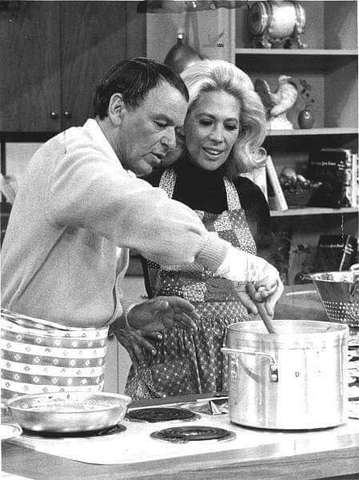
[DA declines to charge Waterman]
George Franklin: Clark County District Attorney George Franklin announced he would not charge Sanford Waterman with assault, noting Sinatra's finger marks were reportedly still visible on Waterman's throat when questioned. Through publicist Jim Mahoney, Sinatra denied ever touching Waterman.
Source: James Kaplan, "Sinatra: The Chairman" (2015).
[Sinatra campaigns for Reagan]
Kaplan: Sinatra performed three benefit concerts for Reagan's reelection campaign in Los Angeles, San Francisco, and San Diego, drawing Dean Martin, Bob Hope, and John Wayne to the Los Angeles event at the Ambassador Hotel's Cocoanut Grove.
Source: James Kaplan, "Sinatra: The Chairman" (2015)
[Sinatra records 'Bein' Green']
Kaplan: Sinatra recorded 'Bein' Green,' the Kermit the Frog song written by Joe Raposo, whom Bennett Cerf and his son Chris had recently introduced to him; Sinatra grew fond of the young composer, mistakenly believing him to be Italian-American.
Source: James Kaplan, "Sinatra: The Chairman" (2015)
Coconut Grove, Ambassador Hotel, Los Angeles, CA
Benefit for Ronald Reagan's Gubernatorial Campaign
Frank Sinatra, John Wayne, Bob Hope, Dean Martin
Sinatra sang 10 songs including:
· Angel Eyes
· Chicago
· That’s Life
· Don’t Worry ‘Bout
Me
· My Way
Coconut Grove, Ambassador Hotel, Los Angeles, CA
Benefit for Ronald Reagan's Gubernatorial Campaign
Frank Sinatra, John Wayne, Bob Hope, Dean Martin
© 1997-2025 The Sinatra Archive
This calendar, or any parts thereof, may not be reproduced in any fashion
whatsoever without the prior written permission of the publisher (The
Sinatra Archive)
__._,_.___
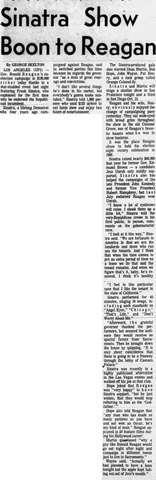
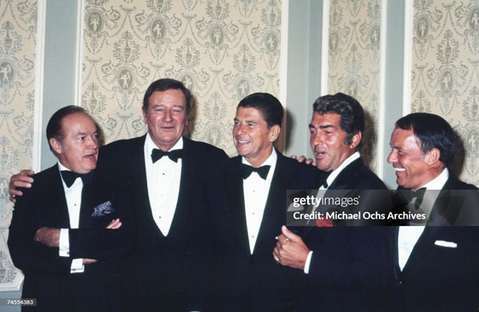
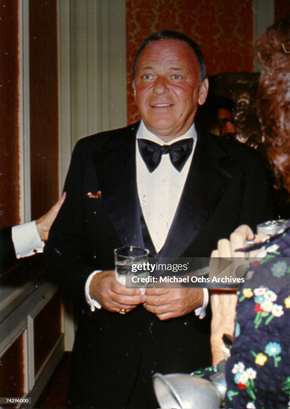
Hilton Hotel, San Francisco, California
Reagan Fundraiser
Orchestra Conducted By: Bill Miller
1. I've Got You Under My Skin
2. I Get A Kick Out Of You
3. Pennies From Heaven
4. Don't Worry 'bout Me
5.. I Get Along Without You Very Well
6. Spring Is Here
7. Angel Eyes
8. That's Life
9. You Make Me Feel So Young
10. My Kind of Town
11. Nancy
12. My Way
13. Introduction: Ronald Reagan
14. Reagan Speech
Notes: Rough audience tape. Track 14 included in 13. TT 60mins.
Hilton Hotel, San Francisco, California
Reagan Fundraiser
Orchestra Conducted By: Bill Miller
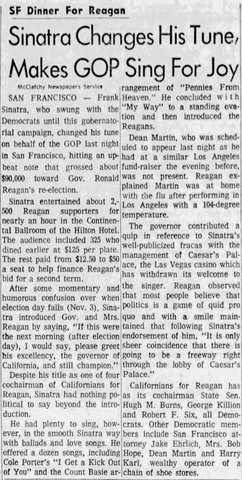
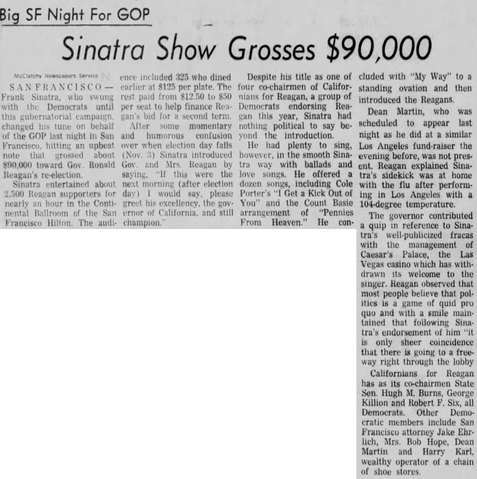
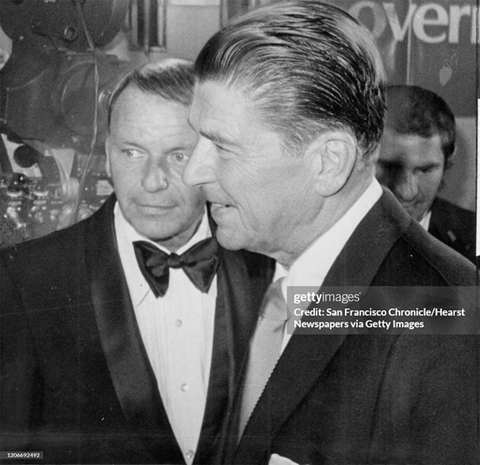
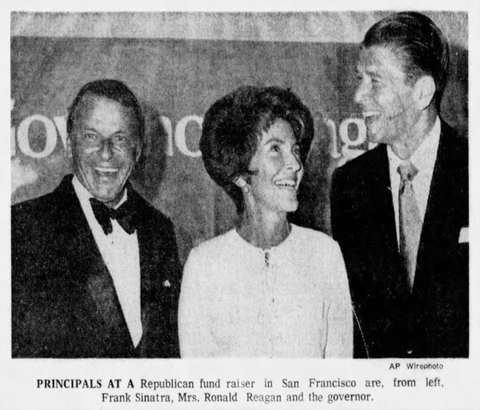
Civic Theater, San Diego, CA
Reagan Fundraiser
Frank Sinatra & Dean Martin
Civic Theater, San Diego, CA
Reagan Fundraiser
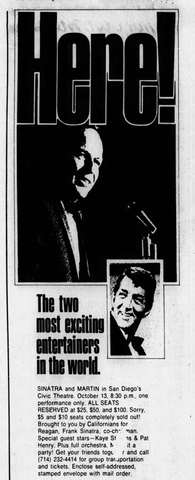
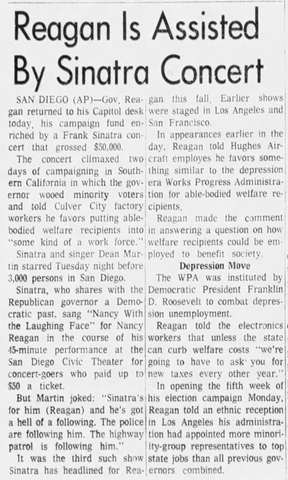
['Never play Vegas again' interview]
Frank Sinatra: Columnist Norma Lee Browning reported Sinatra telling her flatly, 'Absolutely never,' regarding playing Las Vegas again, citing 'indignities' he'd suffered there, and revealing he was scheduled for more hand surgery that might force cancellation of his upcoming Preminger film.
Source: James Kaplan, "Sinatra: The Chairman" (2015).
Hollywood
N19254 I Will Drink The Wine
w/Chorus
(Paul Ryan)
Paul Ryan Music, Inc. (BMI)
Arrang ed & Conducted by Don Costa
(3:28) CD: 46013-2 The Complete Reprise Studio Recordings Disc 15
CD: 1033-2 Sinatra & Company
LP: FS1033 Sinatra & Company
N19255 Bein' Green
(Joe Raposo)
Jonico Music, INC. (BMI)
Arranged & Conducted by Don Costa
(2:58) CD: 46013-2 The Complete Reprise Studio Recordings Disc 15
CD: 1033-2Sinatra & Company
CD: 2275-2Frank Sinatra's Greatest Hits Vol.2
LP: FS1034Frank Sinatra's Greatest Hits Vol.3
LP: FS1033Sinatra & Company
45: 0981
[Return to Western Recorders]
Sinatra returned to Western Recorders for the first time in nearly a year, recording the second side of Sinatra & Company and several singles, including contemporary pop songs by Paul Ryan, John Denver, and Burt Bacharach and Hal David.
Source: James Kaplan, "Sinatra: The Chairman" (2015).
Hollywood
N19261 Sunrise In The Morning
(Paul Ryan)
Paul Ryan Music, Inc. (BMI)
Arranged & Conducted by Don Costa
(2:50) CD: 46013-2 The Complete Reprise Studio Recordings Disc 15
CD: 1033-2 Sinatra & Company
LP: FS1033 Sinatra & Company
NOTE: Sinatra Scholar Ed O'Brien says that this session was done in the afternoon from 2 to 5:30 p.m. with a 33 piece orchestra and a vocal chorus of eight.
Note: Sinatra and the Rhythm Section: Bill Miller (p) Tommy Tedesco & Al Viola (g), Max Bennett (g), Irv Cottler (d) recorded the basic track on October 27, 1970 at Western Records in Hollywood (from 1 to 4pm). The full orchestra including the musicians who had recorded on October 27 recorded on 5/6 November 1970 (from 10am to 1:30 am) at the same studio. The vocal group recorded their part on November 6, 1970. --Fred W
Hollywood
N19267 I'm Not Afraid
(Rod McKuen/Jacques Brel/Gerard Jouannest)
Unchappell Music/Editions Pouchenel (BMI)
Arranged & Conducted by Lennie Hayton
(3:38) CD: 46013-2 The Complete Reprise Studio Recordings Disc 15
CD: 2275-2Frank Sinatra's Greatest Hits Vol.2
LP: FS1034Frank Sinatra's Greatest Hits Vol.3
45: 1011
NOTE: Sinatraphile Vance Adair writes that "I'm Not Afraid" is a guilty pleasure of his. Apart from the excellent vocals, he says that he also likes the arrangement.
Sinatra Scholar Ed O'Brien responded to Adair's observation: Guitarist Al Viola told me that Sinatra could hardly stand up for the final take. The vocal effort was so all encompassing that he was using the music stand for support.
Jonathan Schwartz, O'Brien continues, was driving to Manhattan when he first heard the recording on WNEW. He drove up on the sidewalk and sat there listening. A few days later he had a discussion with a fellow DJ who dismissed Sinatra's effort because it was a Rod McKuen song. Jonathan responded with, "It's the singing; it's the singing." " ‘Tis true ‘tis true,” O'Brien agrees.
Adair thanked O'Brien for this information and then added: The singing is indeed superb and Sinatra's exhaustion was well worth the effort. The arrangement may be a hair's breath short of campy old nonsense, yet it is a tune that I come back to frequently. Entrusted to any other singer, it would almost certainly have been a case of undiluted bombast.
Speaking of supercharged vocal, Adair continues, I have just returned from a singing engagement in Riga , Latvia. A bar close to my hotel looped late 40s Sinatra every evening. “ It always ended with his operatic rendition of "Lover." And always just before I was about to sing! There really is such a thing as an act you can't follow”, Adair exclaims.
N19268 Something
(George Harrison)
Zero Productions (BMI)
Arranged & Conducted by Lennie Hayton
(3:30) CD: 46013-2 The Complete Reprise Studio Recordings Disc 15
CD: 2275-2Frank Sinatra's Greatest Hits Vol.2
LP: FS1034 Frank Sinatra's Greatest Hits Vol.3
45: 0981
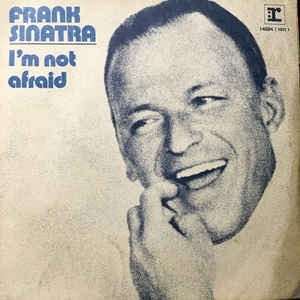
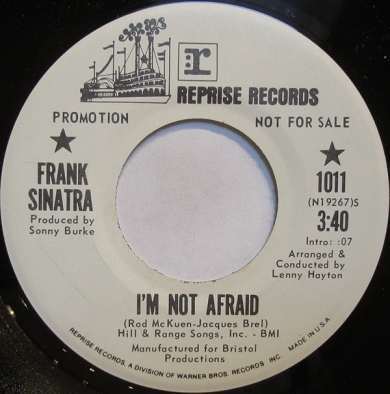
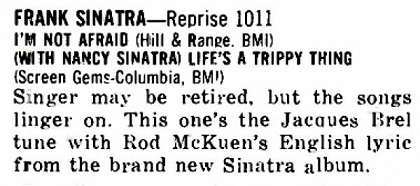
[Recording 'Something' and 'I'm Not Afraid']
Frank Sinatra: Sinatra recorded two singles arranged by Lennie Hayton: the Brel/McKuen waltz 'I'm Not Afraid' and George Harrison's 'Something,' which Sinatra would later praise in concert as 'one of the best love songs to be written in fifty or a hundred years.'
Source: James Kaplan, "Sinatra: The Chairman" (2015).
[I'm Not Afraid / Something -- critical commentary]
Rod McKuen (paraphrased) / Friedwald (analysis): Rod McKuen recalled (in a 2012 blog post cited by Friedwald) that Sinatra had Lennie Hayton rewrite the 'I'm Not Afraid' arrangement three times until both were satisfied; the song was a follow-up to 'If You Go Away,' another Jacques Brel/McKuen text. Friedwald compares Brel to Alec Wilder as a writer of dark, depressing songs. 'Something' (George Harrison) was the first of two Sinatra recordings of the song; Friedwald says hearing the Hayton chart makes clear why Sinatra later commissioned a superior Nelson Riddle chart for Trilogy in 1979.
This song/context matches multiple dated entries in the chronology; the specific date Friedwald is referring to could not be determined with confidence.
Source: Will Friedwald, "Sinatra! The Song Is You: A Singer's Art" (2018 revised edition), Ch. 9, "Looking for the Hook" (1960-1971)
Hollywood
N19269 Leaving On A Jet Plane
(John Denver)
Cherry Lane Music Publishing Co. Inc. (ASCAP)
Arranged & Conducted by Don Costa
(2:25) CD: 46013-2 The Complete Reprise Studio Recordings Disc 15
CD: 1033-2Sinatra & Company
LP: FS1033Sinatra & Company
N19270 Close To You
(Hal David/Burt Bacharach)
Casa David/Feadbach Music (ASCAP)
Arranged & Conducted by Don Costa
(2:33) CD: 46013-2 The Complete Reprise Studio Recordings Disc 15
CD: 1033-2Sinatra & Company
LP: FS1033Sinatra & Company
[Finishing the Sinatra & Company sessions]
Sinatra finished the Sinatra & Company recording sessions on Thursday, October 29, laying down 'Leaving on a Jet Plane' and 'Close to You.'
Source: James Kaplan, "Sinatra: The Chairman" (2015).
[Close to You -- critical commentary]
Will Friedwald: Friedwald notes Nelson Riddle hated recording without concertmaster Felix Slatkin on first violin and Eleanor Slatkin on lead cello, and that the reason comes through in Eleanor Slatkin's cello solo on 'Close to You.'
This song/context matches multiple dated entries in the chronology; the specific date Friedwald is referring to could not be determined with confidence.
Source: Will Friedwald, "Sinatra! The Song Is You: A Singer's Art" (2018 revised edition), Ch. 1, "Night and Day" (Sinatra style overview)
[Close to You -- critical commentary]
Only the very first Sinatra Columbia item, “Close to You,” was an unaffiliated song, and Sinatra had a special reason for recording it. Earlier that season, “Close to You” (the same song that would later title one of his best albums for Capitol Records) had initiated the multidecade personal and business relationship between Sinatra and Ben Barton. An ex-vaudevillian determined to get into music publishing, Barton had brought the newly written “Close to You” backstage to Sinatra at the Paramount. The singer took to both Barton and the song so much that he decided to publish it as the first copyrighted work for Barton Music.
This song/context matches multiple dated entries in the chronology; the specific date Friedwald is referring to could not be determined with confidence.
Source: Will Friedwald, "Sinatra! The Song Is You: A Singer's Art" (2018 revised edition), Ch. 4, "With Axel Stordahl" (1943-1948)
[Close to You -- critical commentary]
Likewise, the 1943 live orchestral versions of “Close to You” (including one very different treatment in which Sinatra not only includes the verse but also scats for a few bars) as well as the 1956 Nelson Riddle remake paint a similar picture. Here, Sinatra underscores that the title of the song that launched his solo recording career could have served as a perfect metaphor for his developing style: it’s all about intimacy and closeness.
This song/context matches multiple dated entries in the chronology; the specific date Friedwald is referring to could not be determined with confidence.
Source: Will Friedwald, "Sinatra! The Song Is You: A Singer's Art" (2018 revised edition), Ch. 4, "With Axel Stordahl" (1943-1948)
[Close to You -- critical commentary]
In early 1956, inspired by Riddle's semi-classical ballad writing and the intimacy of Wee Small Hours, Sinatra engaged Riddle to arrange a set of songs recorded with the Hollywood String Quartet (Felix Slatkin and Paul C. Shure, violins; Alvin Dinkin, viola; Eleanor Slatkin, cello) for the album Close to You.
This song/context matches multiple dated entries in the chronology, or lacked a sufficiently precise date; the specific date could not be determined with confidence.
Source: Charles L. Granata, "Sessions with Sinatra: Frank Sinatra and the Art of Recording" (1999/2003), Part III: The Capitol Years, 1953-1962
[Close to You -- critical commentary]
Granata / Paul Shure: Close to You (Capitol W789) was panned by critics on release and was not a big seller, but Granata and musicians involved (Paul Shure, Leonard Slatkin) regard it as one of Sinatra's most artistically respected recordings, with Riddle's use of a string quartet as the primary orchestral voice considered one of his most daring achievements.
This song/context matches multiple dated entries in the chronology, or lacked a sufficiently precise date; the specific date could not be determined with confidence.
Source: Charles L. Granata, "Sessions with Sinatra: Frank Sinatra and the Art of Recording" (1999/2003), Part III: The Capitol Years, 1953-1962
[Close to You -- critical commentary]
'Close to You,' the Close to You album's title track, had been one of Sinatra's favorite songs since he published/introduced it in 1943; it was in fact his very first Columbia recording, done a cappella with the Bobby Tucker Singers.
This song/context matches multiple dated entries in the chronology, or lacked a sufficiently precise date; the specific date could not be determined with confidence.
Source: Charles L. Granata, "Sessions with Sinatra: Frank Sinatra and the Art of Recording" (1999/2003), Part III: The Capitol Years, 1953-1962
[My Sweet Lady / Leaving on a Jet Plane / Close to You / Sunrise in the Morning / I Will Drink the Wine / Bein' Green -- critical commentary]
Friedwald (analysis): Friedwald surveys these late tracks: two John Denver songs ('My Sweet Lady,' later a hit for Cliff DeYoung, and the marvelously cheerful 'Leaving on a Jet Plane,' previously a hit for Peter, Paul and Mary); Bacharach's 'Close to You'; two songs by young English songwriter Paul Ryan (son of British TV star Marion Ryan), whom Sinatra introduced from the stage at his November 16, 1970 Royal Festival Hall concert as the son of 'very dear friends' -- 'I Will Drink the Wine' reads as a mean-spirited jab at flower-child culture ('I'll give you back your flowers / and I will take the land'), which Friedwald links to Sinatra's brief friendship with Spiro Agnew at the time. 'Bein' Green,' Sinatra's first Joe Raposo song (written for Kermit the Frog on Sesame Street), has Sinatra internalizing the lyric as 'It's not easy bein' me,' singing with a deliberately confined, childlike quality that Friedwald says works better than his other folk-influenced efforts except 'Somethin' Stupid.'
This song/context matches multiple dated entries in the chronology; the specific date Friedwald is referring to could not be determined with confidence.
Source: Will Friedwald, "Sinatra! The Song Is You: A Singer's Art" (2018 revised edition), Ch. 9, "Looking for the Hook" (1960-1971)
Beverly Hilton, Beverly Hills, California
Friars Club event honoring American film producer MJ Frankovich (Mike Frankovich)
[Agnew and Sinatra meet in Palm Springs]
Peter Malatesta: Over Thanksgiving, Vice President Spiro Agnew and his wife Judy visited Palm Springs; Peter Malatesta arranged a golf outing where Sinatra, unable to play due to hand surgery, rode along in a cart, followed by Frank hosting the Agnews at his compound with ex-wife Nancy Sinatra Sr. as hostess.
Source: James Kaplan, "Sinatra: The Chairman" (2015)
[Dirty Dingus Magee]
Dirty Dingus Magee, released November 1970, was produced and directed by Burt Kennedy from a script by Tom Waldman, Frank Waldman, and Joseph Heller (of Catch-22 fame), adapting David Markson's novel The Ballad of Dingus Magee -- whose title character was written as nineteen years old, though Sinatra was fifty-four during filming.
This film/context matches multiple dated entries in the chronology; the specific date Santopietro is referring to could not be determined with confidence.
Source: Tom Santopietro, "Sinatra in Hollywood" (2008), Knight-Errant (pt. 1)
[Dirty Dingus Magee]
Santopietro (Filmography): Metro-Goldwyn-Mayer. Produced and directed by Burt Kennedy, screenplay by Tom Waldman, Frank Waldman and Joseph Heller based on David Markson's novel 'The Ballad of Dingus Magee,' musical score by Jeff Alexander and Billy Strange. Sinatra played the title outlaw opposite George Kennedy and Anne Jackson.
This film/context matches multiple dated entries in the chronology; the specific date Santopietro is referring to could not be determined with confidence.
Source: Tom Santopietro, "Sinatra in Hollywood" (2008), Filmography
[Nixon aide's memo about courting Sinatra]
Dwight Chapin: About two months before Sinatra's Tunney fundraiser, White House aide Dwight Chapin sent a memo to Mrs. Nixon's chief of staff Connie Stuart noting Sinatra's Reagan endorsement, his declining to attend a Diaz Ordaz state dinner (though he flew in for the reception), and his golf outing with Vice President Agnew. Chapin floated the idea, via Laugh-In producer Paul Keyes, of Sinatra performing an evening at the White House, weighing the publicity value against objections from Nixon's entertainment-world critics.
Source: James Kaplan, "Sinatra: The Chairman" (2015)
[Speculation Sinatra will retire]
Norma Lee Browning: Just before Thanksgiving, Norma Lee Browning's column '"Dirty Dingus" May Be Last for Retirement-Bent Sinatra' reported insiders believed Frank might retire from performing into a business role at National General Corporation, in which he held a stake with partners Danny Schwartz and Mickey Rudin.
Source: James Kaplan, "Sinatra: The Chairman" (2015)
[Where the Dark Streets Go canceled]
Kaplan: About a month after his Browning interview, Sinatra and director Otto Preminger pulled the plug on Where the Dark Streets Go, officially citing story problems, including difficulty casting a plausible love interest.
Source: James Kaplan, "Sinatra: The Chairman" (2015)
[Noel Coward's "pitiful youth" quip to Frank]
Princess Grace of Monaco introduced Frank at his charity shows at the Festival Hall, which the BBC taped for broadcast. Frank recounted visiting his ailing friend Noel Coward in hospital, who, on learning Frank was about to turn 55, retorted that he was a "pitiful youth."
Source: Richard Havers, "Sinatra" (Dorling Kindersley, 2007).
Hollywood
N19276 Feelin' Kinda Sunday
w/Nancy Sinatra & Vocal Chorus
(Nino Tempo/Annette Tucker/Kathleen Wakefield)
Don Costa Productions (BMI)
Arranged & Conducted by Don Costa
(2:51) CD: 46013-2 The Complete Reprise Studio Recordings Disc 15
LP: FS5250 (Italy)
45: 0980
N19277 Life's A Trippy Thing
w/Nancy Sinatra & Vocal Chorus
(Linda Laurie/Howard Greenfield)
EMI Screen Gems Music Inc. (BMI)
Arranged & Conducted by Don Costa
(2:42) CD: 46013-2 The Complete Reprise Studio Recordings Disc 15
LP: FS5250 (Italy)
45: 1011
N19278 The Game Is Over
(John Denver)
Cherry Lane Music Publishing Co. inc. (ASCAP)
Arranged & Conducted by Don Costa
(2:37) CD: 46013-2 The Complete Reprise Studio Recordings Disc 15
Hollywood
N19276 Feelin' Kinda Sunday
w/Nancy Sinatra & Vocal Chorus
(Nino Tempo/Annette Tucker/Kathleen Wakefield)
Don Costa Productions (BMI)
Arranged & Conducted by Don Costa
(2:51) CD: 46013-2 The Complete Reprise Studio Recordings Disc 15
LP: FS5250 (Italy)
45: 0980
N19277 Life's A Trippy Thing
w/Nancy Sinatra & Vocal Chorus
(Linda Laurie/Howard Greenfield)
EMI Screen Gems Music Inc. (BMI)
Arranged & Conducted by Don Costa
(2:42) CD: 46013-2 The Complete Reprise Studio Recordings Disc 15
LP: FS5250 (Italy)
45: 1011
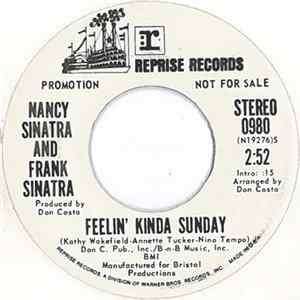
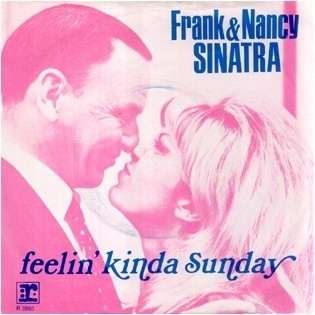
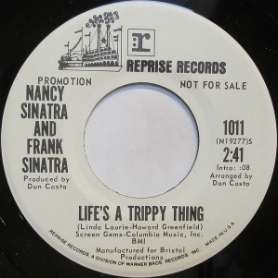
"The Game Is Over"
Friedwald (analysis): Friedwald reads this quiet, brief (2:30) John Denver song -- recorded right after two lightweight Nancy duets -- as Sinatra effectively singing to his own pop-music audience, personified as a departing lover: 'Time, there was a time you could talk to me without speaking, / You would look at me, and I'd know all there is to know.' He calls it 'an understated gem' that meant 'ending with a whimper rather than a bang,' in a period when grandiose bombast prevailed.
Source: Will Friedwald, "Sinatra! The Song Is You: A Singer's Art" (2018 revised edition).
"Feelin' Kinda Sunday" / "Life's a Trippy Thing" / "The Game Is Over"
Frank Sinatra: On November 2, 1970, Sinatra held what he believed at the time was his final recording session, including two more duets with Nancy ('Feelin' Kinda Sunday,' 'Life's a Trippy Thing') and the solo single 'The Game Is Over.' He announced his retirement from performing shortly after, telling LIFE reporter Thomas Thompson he planned to do 'nothing at all for eight months... maybe a year.'
Source: Charles L. Granata, "Sessions with Sinatra: Frank Sinatra and the Art of Recording" (1999/2003).
[Duets with Nancy and final 1970 recordings]
Returning to the studio on a Monday night, Sinatra recorded three singles including two father-daughter duets with Nancy Sinatra, 'Feelin' Kinda Sunday' and 'Life's a Trippy Thing,' an attempt to recapture the success of 'Somethin' Stupid.'
Source: James Kaplan, "Sinatra: The Chairman" (2015).
[Sinatra's last recording before hiatus]
The last song Sinatra recorded that night, John Denver's 'The Game Is Over,' would not be released for a quarter century, appearing only on a 1995 Reprise box set; it marked Sinatra's last studio recording for two and a half years.
Source: James Kaplan, "Sinatra: The Chairman" (2015).
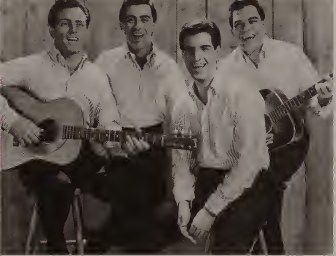
[Photograph: Bobby Lamb's account of Frank silently appearing at rehearsal. From Richard Havers, "Sinatra" (Dorling Kindersley, 2007), p.316.]
[Photograph: Bobby Lamb's account of Frank silently appearing at rehearsal. From Richard Havers, "Sinatra" (Dorling Kindersley, 2007), p.316.]
While a mostly British band rehearsed with Bill Miller for upcoming London charity shows, saxophonist Bobby Lamb recalled the room's atmosphere suddenly changing; Frank was standing quietly nearby, said "Hi guys," and walked back out. (Source: Richard Havers, "Sinatra" (Dorling Kindersley, 2007).)
Royal Festival Hall, London
United World Colleges Fund Benefit - Night Of Nights
Second Show
Orchestra Conducted By: Bill Miller
Opening Act: Bob Hope
Introduction By: Princess Grace
Full Set List:
1. You Make Me Feel So Young
2. Pennies From Heaven
3. I've Got You Under My Skin
4. Something
5. The Lady Is A Tramp
6. I Get Along Without You Very Well
7. Didn't We
8. One For My Baby
9. A Foggy Day
10. I Will Drink The Wine
11. I Have Dreamed
12. My Kind Of Town
13. "Thanks & Story"
14. My Way
Notes: Concert was broadcast November 22, 1970 worldwide through the BBC. Edited concert on Video The Reprise Collection vol.5, Video: The Sinatra Collection Vol. 6. TT 60mins.
Ed O'Brien:
The complete show was broadcast on the BBC, 11-22-70. The recent release in the "London Set" restored "A Foggy Day," but Sinatra's comments, on Noel Coward, Richard Harris and others, are still missing. Hi Ed,
I don't know if you are aware of the re-broadcast by the BBC of the show in 1998, including Foggy Day. It was decided, after Frank's death, to show the concert again. However, the producer in charge was given a time slot of only 45 minutes instead of 55 minutes. He then edited the master tape and decided to include Foggy Day. There is also some difference in the dialogues of the two versions. "Something" , "Didn't We" and "I will drink the Wine" were edited out. --Dick Schwartz
Dick,
I am aware of the show. I put up a post concerning the broadcast some time ago. Bill Miller told of the reaction the English musicians had to "I Will Drink The Wine" during the rehearsal . They were baffled as to why Sinatra was singing it.
I wonder if the complete show will ever be shown or released.
--Ed
Jack Benny Show
Guests: Frank Sinatra
Ed O'Brien says that Sinatra arrived by helicopter and did a fabulous "I Get a Kick out of You." note: Benny called Sinatra and asked him to be on the show. Frank asked if Jack's wife, Mary Livingston, would be a guest. Jack wasn't sure. Frank told him it had to be a package deal. If Mary was on, he would be there. President Nixon called Jack and wished him a happy 20th year on TV. Then he asked if Mary would appear. She felt it was a command per- formance and reluctantly agreed to be part of the show.
Ed
Royal Festival Hall, London
United World Colleges Fund Benefit - Night Of Nights
Orchestra Conducted By: Bill Miller
Opening Act: Bob Hope
Introduction By: Princess Grace
Full Set List:
First show:
1. You Make Me Feel So Young
2. Pennies From Heaven
3. I've Got You Under My Skin
4. Something
5. The Lady Is A Tramp
6. I Get Along Without You Very Well
7. This Love Of Mine
8 Spring Is Here
9.. Didn't We
10. One For My Baby
11. A Foggy Day w/ Costa chart
12. I Will Drink The Wine
13. I Have Dreamed
14. My Kind Of Town
15. My Way
Royal Festival Hall, London
United World Colleges Fund Benefit - Night Of Nights
Second Show
Orchestra Conducted By: Bill Miller
Opening Act: Bob Hope
Introduction By: Princess Grace
Full Set List:
1. You Make Me Feel So Young
2. Pennies From Heaven
3. I've Got You Under My Skin
4. Something
5. The Lady Is A Tramp
6. I Get Along Without You Very Well
7. Didn't We
8. One For My Baby
9. A Foggy Day
10. I Will Drink The Wine
11. I Have Dreamed
12. My Kind Of Town
13. "Thanks & Story"
14. My Way
Notes: Concert was broadcast November 22, 1970 worldwide through the BBC. Edited concert on Video The Reprise Collection vol.5, Video: The Sinatra Collection Vol. 6. TT 60mins.
Eugene Lo Curto:
I've heard hundreds of hours of live performances by Francis Albert Sinatra, and it's come to my conclusion that he never sounded better in his life than at RFH, 11-16-70. Truly a magnificent evening. Jack Tomsky:
Especially "I Get Along Without You Very Well". Sid Mark once played back-to-back the versions from Wee Small Hours (1955) and Royal Festival Hall (1970) and it was clear which version was the better one.
Vance Adair:
Interestingly, FS nominated his performance at the RFH seven months earlier as his greatest live perfromance. Ed O'Brien:
I agree that Sinatra was in fine form for the two shows on 11-16-70. His reading of "I Have Dreamed" is singing of a very high order. But the two shows from 5-7-8-70 are non- pareil. Possibly the greatest singing ever done in a concert setting by any performer. Sinatra knew how magical those two evenings were. He had his people track down a Perfectly Frank member who taped the shows. He wanted them that badly. note: Frank visited with Coward just before the concerts on 11-16. He told the RFH audience that Coward was fine. Although hospitalized, the man had not lost his sharp wit. Frank told Noel that he would be 55 years old in less than a month. Coward responded, "You pitiful toddler, you."
Royal Festival Hall, London
United World Colleges Fund Benefit - Night Of Nights
Second Show
Orchestra Conducted By: Bill Miller
Opening Act: Bob Hope
Introduction By: Princess Grace
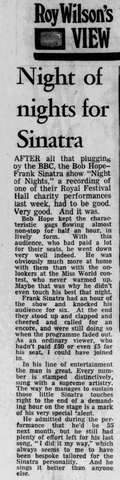
Jack Benny Show
Guests: Frank Sinatra
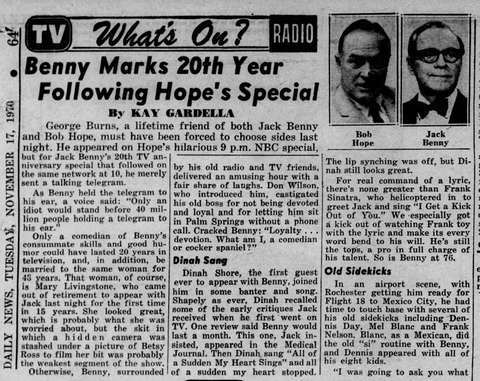
Make Room For Grandaddy (ABC)
Sinatra Invites Danny Thomas To Be His House Guest.
1. All The Way
2. Baa Baa Black Sheep
Notes: 24 mins.
Make Room For Grandaddy
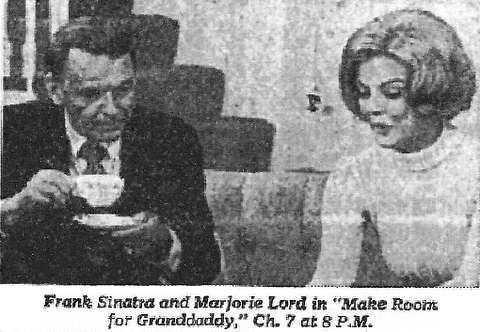
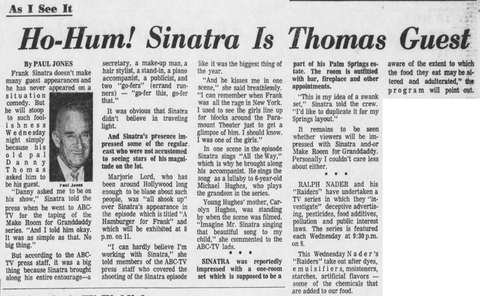
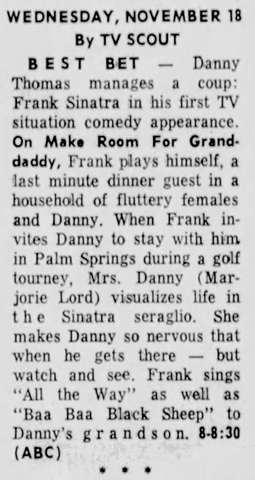
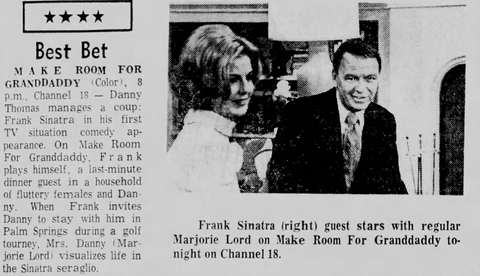
[Dirty Dingus Magee premieres]
Roger Ebert: Dirty Dingus Magee premiered a week before Thanksgiving. Roger Ebert's Chicago Tribune review was harshly critical of the film and, in particular, of Sinatra, faulting him for 'not really caring about his movies.'
Source: James Kaplan, "Sinatra: The Chairman" (2015).
Madison Square Garden, New York City
Fund-raiser for the Italian-American Civil Rights League
Orchestra Conducted By: Bill Miller
Others: Jerry Vale, Ross Martin, The Four Seasons, Connie Francis, Guy Marks, Vic Damone, The P.J.'s, Moty Storm, Triny Lopez, Pat Henry, Sammy Davis Jr
M.C.: Ed Mahon
1. You Make Me Feel So Young
2. Pennies From Heaven
3. I Get Along Without You Very Well
4. I Have Dreamed
5. Nancy
6. Something
7. My Way
Note: Date Confirmed!
Madison Square Garden, New York City
Fund-raiser for the Italian-American Civil Rights League
NEW YORK CITY - NOVEMBER 20: Singer Frank Sinatra attends Italian American Civil Rights League Benefit Concert
on November 20, 1970 at Madison Square Garden in New York City.
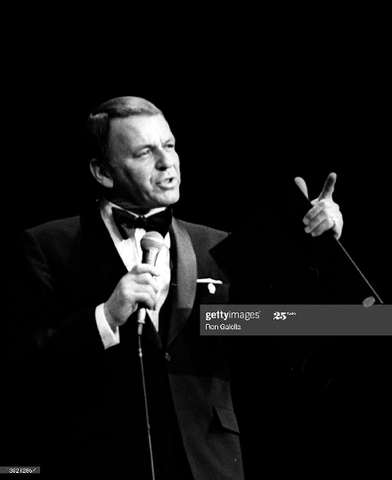
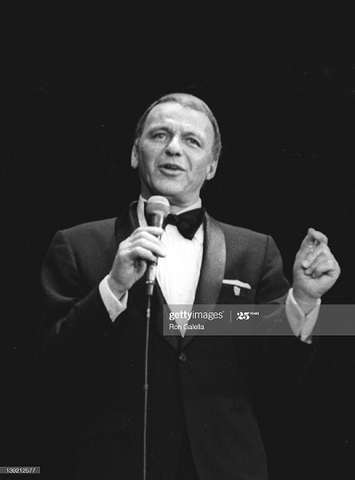
[Rumors and Hope Lange sighting]
Marilyn Beck: Amid rumors of an Ava Gardner sighting in the desert and a supposed engagement to Aileen Mehle (denied by both), columnist Marilyn Beck reported Sinatra dining at a Palm Springs restaurant with actress Hope Lange, foreshadowing a relationship that would surface publicly during her 1971 divorce from director Alan Pakula.
Source: James Kaplan, "Sinatra: The Chairman" (2015)
[Nancy Jr. marries Hugh Lambert]
On Frank's fifty-fifth birthday, Nancy Sinatra Jr. married Hugh Lambert at St. Louis Catholic Church in Cathedral City. When Frank learned the church had been closed to its regular Mexican-American congregation for the wedding, he angrily ordered the doors reopened, letting the townsfolk fill the pews alongside the sixty invited guests.
Source: James Kaplan, "Sinatra: The Chairman" (2015).
[Nationwide FBI/IRS gambling raids]
On the same day as Nancy Jr.'s wedding, FBI and IRS agents staged simultaneous raids on illegal sports-betting operations in twenty-six cities, arresting two Caesars Palace executives—including Sanford Waterman—on racketeering charges and finding $400,000 cash in Waterman's personal lockbox.
Source: James Kaplan, "Sinatra: The Chairman" (2015).
[Dinner with the Agnews before New Year's]
Peter Malatesta: Peter Malatesta and the Agnews dined with Frank at his Palm Springs compound before helicoptering to Bob Hope's new Hollywood estate for a New Year's Eve party.
Source: James Kaplan, "Sinatra: The Chairman" (2015).
Frank And Dean New Years Eve
Thursday evening
Network: NBC
Time 10:00 PM - 11:00 PM EST
Guests: Frank Sinatra, Ruth Buzzi, The Goldigger
Frank & Dean medley: Love Is Just Around The Corner/My Kind Of
Girl/But Beautiful/ L.O.V.E./I Get A Kick Out Of You/Goody Goody/Guys And Dolls
Frank & Dean medley: What Is This Thing Called Love/Did You Ever See
A Dream Walking/ I Can't Give You Anything But Love
Dean & Ruth Buzzi sketch
Dean song parodies
Jimmy Durante is the mystery guest behind the door
Dean Young At Heart
Frank Something (Lennie Hayton arg.)
Frank, Dean, Ruth Buzzi,Kay Medford New Year's Eve sketch
Frank, Dean, Ruth do impressions of famous stars
Frank, Dean & Golddiggers medley
Welcome To My World/Now Is The Hour/So Long, It's Been
Good To Know You/Auld Lang Syne
Dean signs off
Frank And Dean New Years Eve
TV Guide Ad
--Ed
© 1997-2024 The Sinatra Archive
This calendar, or any parts thereof, may not be reproduced in any fashion
whatsoever without the prior written permission of the publisher (The
Sinatra Archive)
Frank And Dean New Years Eve
TV Guide Ad
--Ed
© 1997-2024 The Sinatra Archive
This calendar, or any parts thereof, may not be reproduced in any fashion
whatsoever without the prior written permission of the publisher (The
Sinatra Archive)
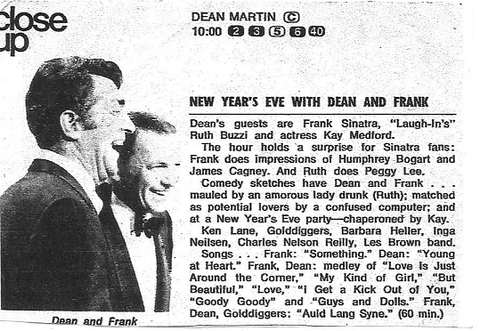
[Bing Crosby Marvels At Frank's Punishing Schedule]
Nancy Sinatra: Writing to Sinatra around the time of his announced 1971 retirement, Bing Crosby remarked that the frantic pace Sinatra had kept up professionally and socially for twenty-five years would have put him, Crosby, in traction long before.
Source: Nancy Sinatra, Frank Sinatra: An American Legend, 1995.
[FBI Memo Wrongly Reports Frank Has Terminal Cancer]
A 1971 FBI New York field office memo to J. Edgar Hoover erroneously reported that Sinatra had been diagnosed with terminal cancer and given only a couple of months to live.
Source: Tina Sinatra, "My Father's Daughter: A Memoir" (2000).
[Sinatra Announces His Retirement]
Sinatra stepped back from performing in 1971 after years of near-daily singing, though he later said the break felt less like a true retirement and more like a long vacation.
Source: Charles Pignone, "Frank Sinatra 100" (2015).
[Sinatra & Company Emerges From Shelved Jobim Album]
A cover photo was shot on the Warner's backlot for a Sinatra-Jobim album that went unreleased under its planned catalog number; the material was later reworked and retitled, finally coming out as Sinatra & Company.
Source: Charles Pignone, "Frank Sinatra 100" (2015).
[Family feels whole again]
Nancy Sinatra Jr.: Nancy Sinatra Jr. wrote that after her own marriage she felt closer than ever to her father, who seemed more introspective and relaxed; with Frank, Big Nancy, and Dolly all nearby, the family felt reunited. Still, touring wore on Frank, who kept repeating, "Will somebody please get me the hell off the road?"
Source: James Kaplan, "Sinatra: The Chairman" (2015)
[Frank Sinatra's first retirement]
Consiglio: Frank retired from performing for the first time in 1971; afterward Consiglio went to work as an aide to Larry O'Brien.
Source: Tony Consiglio (as told to Franz Douskey), "Sinatra and Me: The Very Good Years" (2012)
[Jobim tracks finally released]
Kaplan: Two years later, Reprise released seven of the ten 1969 Jobim session tracks on the A-side of an album called Sinatra & Company, pairing them with Don Costa-arranged soft-pop tracks on the B-side.
Source: James Kaplan, "Sinatra: The Chairman" (2015)
[Juggling three relationships]
Kaplan: During this period Sinatra was simultaneously involved with actress Hope Lange, his Dingus Magee co-star Lois Nettleton, and, increasingly and secretly, Barbara Marx -- attentive and romantic with each before moving on to the next.
Source: James Kaplan, "Sinatra: The Chairman" (2015)
[Monday night football with the DOM club]
Kaplan: Frank and pals including Jilly Rizzo, Jimmy Van Heusen, and Ruby's Dunes proprietor Irwin "Ruby" Rubenstein gathered on Monday evenings at Dominick's restaurant in Palm Springs to watch ABC football; Frank had hats and jackets made with the initials DOM ("Dirty Old Men") for the group, echoing the old Turk's Palace jackets from decades earlier.
Source: James Kaplan, "Sinatra: The Chairman" (2015)
[Sinatra's retirement]
Consiglio: Frank tried retirement starting in 1971, but it lasted only about a year. Consiglio says Sinatra couldn't stay away from performing, recording, and acting -- it was his life -- so he went back into the studio.
Source: Tony Consiglio (as told to Franz Douskey), "Sinatra and Me: The Very Good Years" (2012)
[Skepticism the retirement would stick]
Kaplan: Despite the announcement, some in Las Vegas and Beverly Hills were reportedly taking odds on how long Sinatra's retirement would actually last, with one newspaper writer suggesting the pull of show business would prove too strong to resist -- a prediction that, Kaplan notes, was truer than anyone then knew.
Source: James Kaplan, "Sinatra: The Chairman" (2015)
[awards]
Sinatra's 1971 retirement was followed by a wave of career-honoring awards: the Jean Hersholt Humanitarian Award at the 1971 Academy Awards (for his charity fundraising) and the 1972 Screen Actors Guild Award for career achievement.
No corresponding dated entry could be identified in the chronology for this film/context.
Source: Tom Santopietro, "Sinatra in Hollywood" (2008), Knight-Errant (pt. 1)
[career/retirement]
Less than a year after Dirty Dingus Magee flopped, Sinatra announced his retirement from show business, staging a star-studded farewell concert with Barbra Streisand as the opening act and ending with a whispered final line of 'Angel Eyes' before walking off into darkness.
No corresponding dated entry could be identified in the chronology for this film/context.
Source: Tom Santopietro, "Sinatra in Hollywood" (2008), Knight-Errant (pt. 1)
[political]
Sinatra later produced Ronald Reagan's first presidential inaugural gala. A photo from Reagan's 1971 gubernatorial inaugural gala shows Sinatra alongside Reagan, Vikki Carr, Nancy Reagan, John Wayne, Dean Martin, Jack Benny, and Jimmy Stewart.
No corresponding dated entry could be identified in the chronology for this film/context.
Source: Tom Santopietro, "Sinatra in Hollywood" (2008), Knight-Errant (pt. 1)
[Sinatra headlines fundraiser for Democrat Tunney]
Kaplan: Two weeks after the Palm Springs dedication, Sinatra headlined a Beverly Hills fundraiser for 36-year-old Senate candidate John Tunney, a Democrat, turning down astronaut Alan Shepard's personal invitation to watch the Apollo 14 launch in order to do so. An unnamed friend told columnist Dorothy Manners that Frank was "married to the Democrats" and merely "having an affair" with Republicans.
Source: James Kaplan, "Sinatra: The Chairman" (2015)
Memorial Auditorium Sacramento, Los Angeles, California Gala for Governor Reagan
Monday
Jimmy Stewart introduces Sinatra states that he is the best ever
1. You Make Me Feel So Young
2. Pennies From Heaven
3. I've Got You Under My Skin
4. The Lady Is A Tramp
5. I Get Along Without You Very Well
6. monologue
7. Didn't We
8. One For My Baby
9. At Long Last Love
10. Something
11. I Have Dreamed
12. Nancy
13. My Kind Of Town
14. My Way
Ed O'Brien noted: There was a pre-entertainment gala with drinks served.
Frank had more than a few and was a little tipsy during the concert. He milks it for all it is worth. Definitely would have made Dean Martin envious. Slips off the stool. Mentions that he has definitely imbibed too much. Funny and unusual for him.
Memorial Auditorium Sacramento, Los Angeles, California
Redlands Daily Facts (Redlands, California) . 5 Jan 1971: Emacs!
Emacs!
Emacs!
Emacs!
Invitation to the Inaugural Gala:
Emacs!
C 1997-2023 The Sinatra Archive
This calendar, or any parts thereof, may not be reproduced in any fashion whatsoever without the prior written permission of the publisher (The Sinatra Archive)
[Reagan second inauguration dinner]
Sinatra flew to Sacramento for Ronald Reagan's second gubernatorial inauguration, dispelling any doubt about his political shift to the right. That evening he dined at 6 p.m. with Governor and Nancy Reagan and a large Republican-leaning group including Nancy Reagan's parents Dr. and Mrs. Loyal Davis, two of the Reagan children, Rev. Donn Moomaw, Jack Benny, James and Gloria Stewart, Vikki Carr, Robert Cummings, the Buddy Ebsens, the Audrey Meadowses, and the John Waynes. Jilly Rizzo was notably absent.
Source: James Kaplan, "Sinatra: The Chairman" (2015).
[Sinatra headlines inaugural gala]
That night Sinatra produced and closed a $500-a-couple inaugural gala for Reagan at San Francisco's War Memorial Auditorium before five thousand people, also featuring John Wayne, Jack Benny, Vikki Carr, Buddy Ebsen, and Dean Martin. Introduced by Jimmy Stewart, he sang "You Make Me Feel So Young," "Pennies from Heaven," "I've Got You Under My Skin," and "My Way," plus a flirtatious rendition of "Nancy" as a tribute to Nancy Reagan, who a friend said had long been infatuated with him.
Source: James Kaplan, "Sinatra: The Chairman" (2015).
The Martin Anthony Sinatra Medical Education Center, funded personally by Frank and dedicated to his late father's memory, is dedicated in Palm Springs. "He's here," Sinatra said at the ceremony, pointing to his head, "and here," pointing to his heart. Source: J. Randy Taraborrelli, Sinatra: Behind the Legend.
[Sinatra Medical Education Center dedicated]
Frank underwrote the entire $805,000 cost of the Martin Anthony Sinatra Medical Education Center at Palm Springs Desert Hospital, named for his late father, and attended its dedication with Vice President Agnew present. At the ribbon cutting Frank pointed to his head and then his heart, saying "He's here...And here." The mayor of Palm Springs declared it Frank Sinatra Day.
Source: James Kaplan, "Sinatra: The Chairman" (2015).
[Dolly Sinatra's emotional remarks]
Dolly Sinatra: At the medical center dedication, Dolly Sinatra -- present along with Nancy Sr., Nancy Jr., Frankie, and Tina -- told columnist Norma Lee Browning it had been "a wonderful day -- but sad, too," praising Frank as her only child and expressing love for both his ex-wife Nancy Sr. and her grandchildren, with tears in her eyes.
Source: James Kaplan, "Sinatra: The Chairman" (2015).
[Honorary Doctor of Medicine title]
At a private luncheon following the dedication, Dr. Daniel Kaplan named Frank an Honorary Doctor of Medicine and honorary member of the Desert Hospital medical staff, presenting him with a black doctor's bag. When someone asked if that meant he could operate, Kaplan quipped that Frank had "been operating for years."
Source: James Kaplan, "Sinatra: The Chairman" (2015).
Beverly Hills, California
Sen. John Tunney fund raiser
Orchestra Conducted By: Bill Miller
Beverly Hills, California
Sen. John Tunney fund raiser
Orchestra Conducted By: Bill Miller
[image referenced in source but could not be recovered]
[image referenced in source but could not be recovered]
[Frank Drafts His Retirement Statement]
In March 1971, Tina found her fifty-five-year-old father poolside at the Compound writing out a retirement statement describing his need for reflection and rest. He announced it publicly a few days later, telling a stunned Tina he would finally have more free time for family.
Source: Tina Sinatra, "My Father's Daughter: A Memoir" (2000).
New York City
Songwriters Guild Hall Of Fame Awards
Sinatra presented an award to Richard Rodgers
70 WRITERS NAMED TO CLEFFER HALL OF FAME NEW YORK -Ten songwriters were ushered into the Songwriters Hall of Fame March 8 at the first annual Hall of Fame Awards Banquet, held at the New York Hilton. Harold Arlen, Hoagy Carmichael, Duke Ellington, Dorothy Fields, Rudolph Friml, Ira Gershwin, Alan lay Lemer, Johnny Mercer, Jimmy Van Heu sen and Harry Warren were named by the ballots of the 1,400 members. Also named to the Hall were 50 deceased writers. These nominations were made by the Hall of Fame board of directors. The banquet included presentations of tunes by the 30 composers listed as nominees on the original Hall of Fame Ballots. Presentations of the statuettes commemorating the event for the new entrants were made by a contemporary group of composers including Hal David, Sheldon Harnick, Jerry Bock, Kris Kris - tofferson, Carol Hall, Charles Strouse, Norman Gimbel and Jackie DeShannon. The 600 attendees were treated also to a special award presented to Richard Rodgers by Frank Sinatra, who was elected to the Hall of Fame last year by acclamation of the board of directors. Eubie Blake, 88- year -old pianist and composer, presented the commemorating statuette to Rudolph Friml, 92. The last event was the singing of "Say It With Music" in honor of Irving Berlin, who became a Hall member by acclamation. BILLBOARD
MARCH 20, 1971
[image referenced in source but could not be recovered]
Madison Square Garden
Monday evening
The Fight of the Century
Heavyweight Title At Stake
Muhammed Ali ( 31-0) vs Joe Frazier (26-0)
Ed O'Brien:
One of the most iconic moments in the history of sports
A who's who of celebrities was in attendance including
Woody Allen, Norman Mailer, Diana Ross and a host of others. A good seat went for $150.00. Ali and Frazier were both guaranteed 2.5 million dollars. Both would earn more that night than Sugar Ray Robinson did for his 200 bouts, over a period of 26 years.
The closed circuit telecast earned well over $10 million dollars. Don Dunphy was the announcer and the color commentary was shared by Burt Lancaster and the great Archie Moore.
Life magazine had the temerity to assign an amatuer photographer the job of covering this momentous event. This fellow did ok. The issue of 3-19-71 had a number of photos by him including a terrific one on the cover. Underneath the shot the credit read "photo by Frank Sinatra." Four days later he announced his retirement from show biz. But he never really made it as a photographer and went back to singing in less than two years.
Probably just as well.
After Frazier's grueling 15 round decision over Ali, the managers of both men had them hospitalized. Ali had a swollen jaw and was treated and released. Frazier's medical problem was far more serious. His BP had spiked to 240/150. This was considered life threatening. During the wee hours, it was reported that Smokin' Joe had died. Ali was aghast and announced he would retire from the ring. As we all know, the report was not accurate and the two men would meet in the ring for two more epic struggles. Ali would prevail in both meetings. Forty years have passed since that titanic struggle, and those of us old enough to remember the moment, will tell you it was really some- thing. Sinatra would later call it one of the most exciting nights of his life. I'm sure it was.
Archie Moore Burt Lancaster Amateur Photographer
Frank Burt Lancaster Archie Moore
Hard to believe this epic fight took place 50 years. I saw a closed circuit broadcast that evening Ernie Terrell was right in front of me. We agreed to score the fight. I gave it to Frazier 9-5-1, Ernie scored it 8-6-1 for Smokin' Joe. As we were leaving the theater, I told Ernie that if Ali got his legs back he would win any future fight against Frazier. Ernie agreed. Ed
[image not recovered — source caption: “Frank Sinatra Once Photographed Muhammad Ali and Joe Frazier”]
[image not recovered — source caption: “SINATRA: Sinatra Life Magazine Photographer Ali Frazier Fight N”]
[image not recovered — source caption: “Ali, Frazier, Sinatra, et al.â�Boxing & C”]
[image not recovered — source caption: “Robert Edward Auctions - The Premiere Sports Auction House”]
[image referenced in source but could not be recovered]
New York City
Songwriters Guild Hall Of Fame Awards
Sinatra presented an award to Richard Rodgers
70 WRITERS NAMED TO CLEFFER HALL OF FAME NEW YORK -Ten songwriters were ushered into the Songwriters Hall of Fame March 8 at the first annual Hall of Fame Awards Banquet, held at the New York Hilton. Harold Arlen, Hoagy Carmichael, Duke Ellington, Dorothy Fields, Rudolph Friml, Ira Gershwin, Alan lay Lemer, Johnny Mercer, Jimmy Van Heu sen and Harry Warren were named by the ballots of the 1,400 members. Also named to the Hall were 50 deceased writers. These nominations were made by the Hall of Fame board of directors. The banquet included presentations of tunes by the 30 composers listed as nominees on the original Hall of Fame Ballots. Presentations of the statuettes commemorating the event for the new entrants were made by a contemporary group of composers including Hal David, Sheldon Harnick, Jerry Bock, Kris Kris - tofferson, Carol Hall, Charles Strouse, Norman Gimbel and Jackie DeShannon. The 600 attendees were treated also to a special award presented to Richard Rodgers by Frank Sinatra, who was elected to the Hall of Fame last year by acclamation of the board of directors. Eubie Blake, 88- year -old pianist and composer, presented the commemorating statuette to Rudolph Friml, 92. The last event was the singing of "Say It With Music" in honor of Irving Berlin, who became a Hall member by acclamation.
BILLBOARD
MARCH 20, 1971
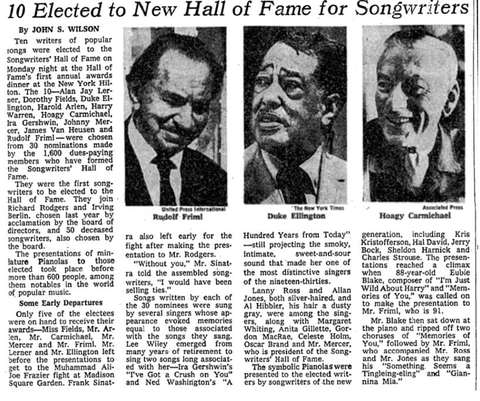
Madison Square Garden
Monday evening
The Fight of the Century
Heavyweight Title At Stake
Muhammed Ali ( 31-0) vs Joe Frazier (26-0)
Ed O'Brien:
One of the most iconic moments in the history of sports
A who's who of celebrities was in attendance including
Woody Allen, Norman Mailer, Diana Ross and a host of
others. A good seat went for $150.00. Ali and Frazier were
both guaranteed 2.5 million dollars. Both would earn more
that night than Sugar Ray Robinson did for his 200 bouts,
over a period of 26 years.
The closed circuit telecast earned well over $10 million dollars.
Don Dunphy was the announcer and the color commentary
was shared by Burt Lancaster and the great Archie Moore.
Life magazine had the temerity to assign an amatuer photographer
the job of covering this momentous event. This fellow did ok. The
issue of 3-19-71 had a number of photos by him including a
terrific one on the cover. Underneath the shot the credit read
"photo by Frank Sinatra." Four days later he announced his
retirement from show biz. But he never really made it as a
photographer and went back to singing in less than two years.
Probably just as well.
After Frazier's grueling 15 round decision over Ali, the managers
of both men had them hospitalized. Ali had a swollen jaw and was
treated and released. Frazier's medical problem was far more serious.
His BP had spiked to 240/150. This was considered life threatening.
During the wee hours, it was reported that Smokin' Joe had died. Ali
was aghast and announced he would retire from the ring. As we all
know, the report was not accurate and the two men would meet in the
ring for two more epic struggles. Ali would prevail in both meetings.
Forty years have passed since that titanic struggle, and those of us
old enough to remember the moment, will tell you it was really some-
thing. Sinatra would later call it one of the most exciting nights of his
life. I'm sure it was.
Archie Moore Burt Lancaster Amateur Photographer
Frank Burt Lancaster Archie Moore
Hard to believe this epic fight took place 50 years. I saw a closed circuit broadcast that evening
Ernie Terrell was right in front of me. We agreed to score the fight. I gave it to Frazier 9-5-1,
Ernie scored it 8-6-1 for Smokin' Joe. As we were leaving the theater, I told Ernie that if Ali
got his legs back he would win any future fight against Frazier. Ernie agreed.
Ed
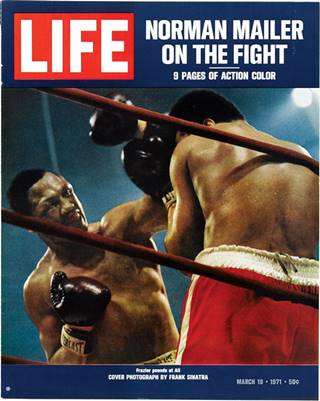
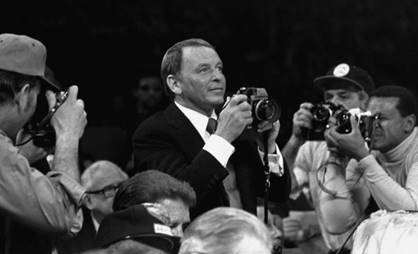
[Sinatra photographs the Fight of the Century]
Sinatra worked as a photographer for Life at the Muhammad Ali-Joe Frazier "Fight of the Century" at Madison Square Garden, having taken the assignment mainly because he couldn't get a ringside seat any other way. His photos turned out strong, including a shot of Frazier hitting Ali.
Source: James Kaplan, "Sinatra: The Chairman" (2015).
Retirement rumor first surfaces
Los Angeles Times gossip columnist Joyce Haber first floated the rumor that Sinatra was planning to retire from show business in her column on this date; she confirmed it two weeks later, writing that "the King of Them All" had announced his retirement from movies, TV specials, nightclub engagements, and recording. The formal announcement followed later in the month, on March 23, 1971 (see entry).
Source: Arnold Shaw, "Sinatra, the Entertainer" (1982).
Hynes Civic Auditorium, Boston, MA
Frank Fontaine Benefit
Orchestra Conducted By: Bill Miller
1. You Make Me Feel So Young
2. Pennies From Heaven
3. Don't Worry 'Bout Me
4. Didn't We?
5. Angel Eyes
6. My Kind Of Town
7. My Way
Notes: TT 27mins.
Hynes Civic Auditorium, Boston, MA
Frank Fontaine Benefit
The Boston Globe (Boston, Massachusetts) 19 Mar 1971, Fri Pages 19 & 21 The Boston Globe (Boston, Massachusetts) 19 Mar 1971, Fri Page 13 Fontaine played the Paramount with Frank in March/April 1952 and was a guest on his CBS-TV series four times that winter/spring..
Ed
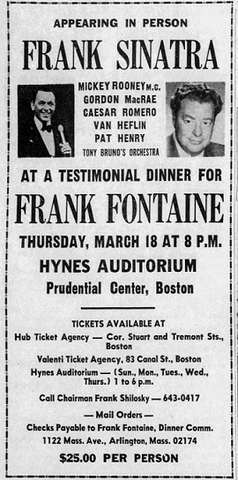
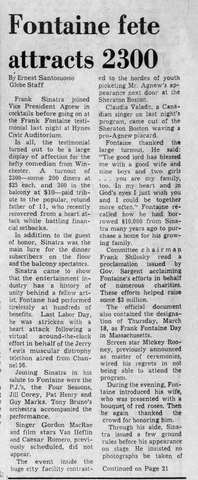
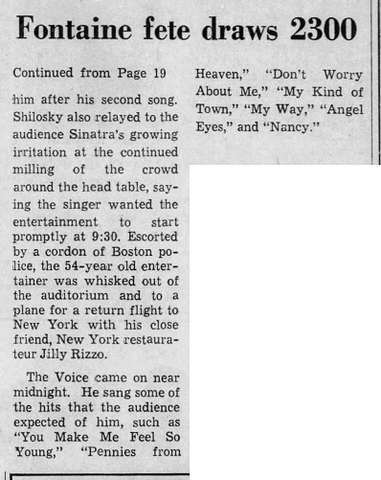
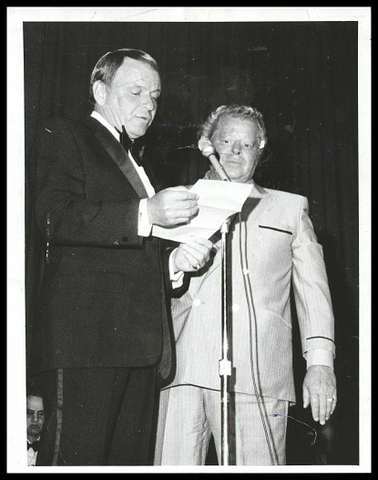
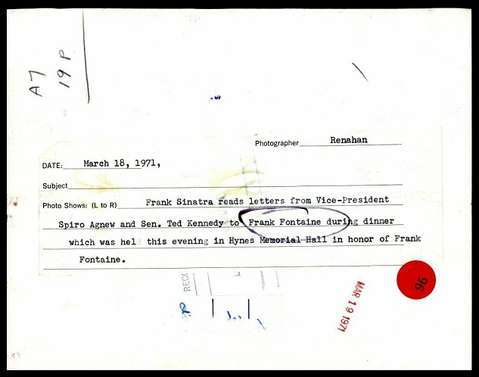
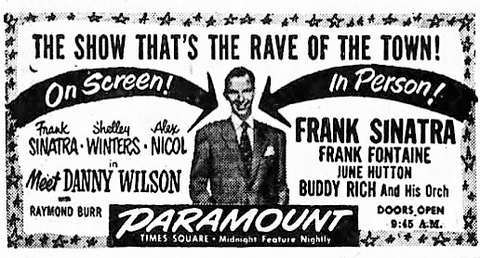
[Life magazine fight photo spread]
Life's March 19 issue put one of Sinatra's Ali-Frazier fight photos on the cover and ran an eight-page spread of his images alongside Norman Mailer's essay "Ego." Kaplan notes the irony that Mailer, absorbed in the essay's grand themes, apparently never registered that the small man with the camera nearby was himself one of the most famous people in the building that night.
Source: James Kaplan, "Sinatra: The Chairman" (2015).
[Sinatra's LIFE magazine cover photo of Ali-Frazier]
Consiglio: The March 19, 1971 cover of LIFE magazine, showing Muhammad Ali fighting Joe Frazier, was photographed by Frank Sinatra, who was given ringside press access at the fight.
Source: Tony Consiglio (as told to Franz Douskey), "Sinatra and Me: The Very Good Years" (2012).
Special Sinatra Announcement
"I wish to announce, effective immediately, my retirement from the entertainment
world and public life. For over three decades I have had the great and good fortune to enjoy
a rich, rewarding and deeply satisfying career as an entertainer and public figure..
Through the years people have been wonder- fully warm and generous in their acceptance
of my efforts. My work has taken me to almost every corner of the world and privileged me to
learn by direct experience how alike all people really are ---the common bonds that tie all men
and women of whatever color, creed, religion, age or social status to one another; the things man-
kind has in common that the language of music, perhaps more than any other , communicates
and evokes.
It has been a fruitful, busy, uptight, loose sometimes boisterous, occasionally sad, but
always exciting three decades.
There has been little time for reflection, reading, self-explanation, and that need every man has
for a fallow period, a long phase in which to seek better understanding of the vast transforming
changes now taking place everywhere in the world."
Frank Sinatra
March 23, 1971
Pete Hamill's column that followed Sinatra's announced intention to retire:
[Sinatra announces retirement]
Frank Sinatra: Sinatra issued a statement announcing his immediate retirement from entertainment and public life after more than three decades, reflecting on his career's reach and expressing a wish for a period of reflection -- time with family and friends, some writing, perhaps teaching.
Source: James Kaplan, "Sinatra: The Chairman" (2015).
[Industry reaction to retirement news]
Mo Ostin: Publicist Jim Mahoney had carefully shaped the retirement statement, and the family already knew; Nancy Jr. wrote she wasn't surprised. Warner executive Mo Ostin recalled that Sinatra's record sales were falling and his films weren't doing well either. Columnist Norma Lee Browning, who had predicted it, was stung that Frank gave the story first to Suzy Knickerbocker for an exclusive in the New York Daily News, and mourned the announcement as the end of an era for Hollywood.
Source: James Kaplan, "Sinatra: The Chairman" (2015).
Entertainment columnist Suzy (Aileen Mehle) broke the exclusive news that Sinatra planned to retire from show business at age fifty-five, the day after his formal announcement. Source: Charles Pignone, "Frank Sinatra 100" (2015).
Academy Awards
Gregory Peck Presents Frank Sinatra With the Jean Hersholt Humanitarian Award
Academy Awards
Gregory Peck Presents Frank Sinatra With the Jean Hersholt Humanitarian Award
© 1997-2026 The Sinatra Archive
This calendar, or any parts thereof, may not be reproduced in any fashion whatsoever without the prior written permission of the publisher (The Sinatra Archive)
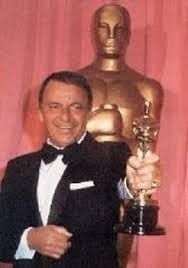
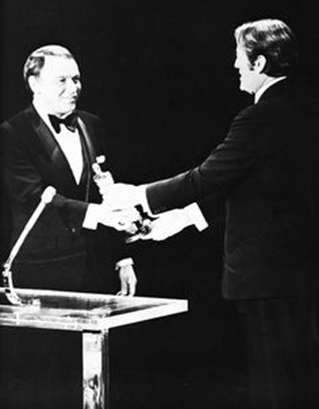
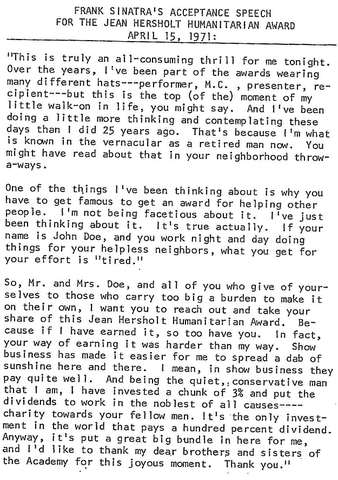
Academy Awards
Gregory Peck Presents Frank Sinatra With the Jean Hersholt Humanitarian Award
© 1997-2026 The Sinatra Archive
This calendar, or any parts thereof, may not be reproduced in any fashion whatsoever without the prior written permission of the publisher (The Sinatra Archive)
[Sinatra receives third Oscar]
At the Academy Awards at the Dorothy Chandler Pavilion -- a ceremony where Patton won Best Picture and Woodstock won Best Documentary -- Gregory Peck presented Sinatra with the Jean Hersholt Humanitarian Award, effectively his third Oscar, framed partly as a farewell. Peck cited Sinatra's charitable works stemming from his 1962 world tour and called back to his 1953 Best Supporting Actor win for From Here to Eternity, declaring him "a man who pays his dues."
Source: James Kaplan, "Sinatra: The Chairman" (2015).
[Sinatra's Oscar acceptance speech]
Frank Sinatra: Accepting the Hersholt Award, a stammering Sinatra reflected on his career, then broke into his Amos 'n' Andy "Kingfish" impression to joke he was now "re-tired," drawing uncomfortable laughter given Coretta Scott King's presence in the audience. He mused on why fame should be required to be honored for helping others, held up the statuette, and told the crowd their own quiet generosity mattered as much as his -- ending by thanking the Academy as Nancy Jr., Tina, and Jilly Rizzo applauded.
Source: James Kaplan, "Sinatra: The Chairman" (2015).
Mid-South Coliseum, Memphis, TN,
Saturday evening
Benefit for St Jude's children's cancer research - "SHOWER OF STARS"
Orchestra Conducted By: Bill Miller
Danny Thomas gives Frank a marvelous introduction
1. That's Life
2. Fly Me To The Moon
3. Ol' Man River
4. Nancy
5. My Way
6. My Kind Of Town
7. One For My Baby Miller on piano more praise from Thomas
Notes: TT 30mins.
Ed O'Brien noted:
When Sinatra announced his retirement on 3-23-71, there were a few concert commitments still on his schedule.
Here is the penultimate concert date.
Sinatra was in fabulous voice. One wonders why he was not planning extensive recordings instead of retiring. Voice had matured and had a marvellously deep reed sound.
The "Lady Day" album that was shelved that year would have been sensational.
Mid-South Coliseum, Memphis, TN,
Saturday evening
Benefit for St Jude's children's cancer research - "SHOWER OF STARS"
Orchestra Conducted By: Bill Miller
Danny Thomas gives Frank a marvelous introduction
1. That's Life
2. Fly Me To The Moon
3. Ol' Man River
4. Nancy
5. My Way
6. My Kind Of Town
7. One For My Baby Miller on piano more praise from Thomas
Mid-South Coliseum
May 29, 1971
May 29, 1971 - Frank Sinatra was the headline performer at the St. Jude Shower of Stars at the Mid-South Coliseum. Also performing for the benefit of St. Jude Children's Research Hospital were Danny Thomas, Bob Hope, Sammy Davis Jr., Vikki Carr and Tennessee Ernie Ford.
Tickets sold: 12,069
Gross receipts: $172,316
Source: Dave Darnell / The Commercial Appeal
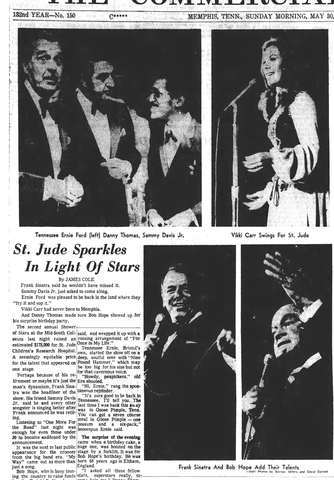
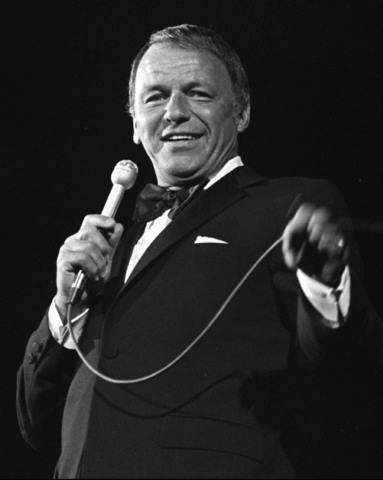
:
Mid-South Coliseum
May 29, 1971
May 29, 1971 - Frank Sinatra was the headline performer at the St. Jude Shower of Stars at the Mid-South Coliseum. Also performing for the benefit of St. Jude Children's Research Hospital were Danny Thomas, Bob Hope, Sammy Davis Jr., Vikki Carr and Tennessee Ernie Ford.
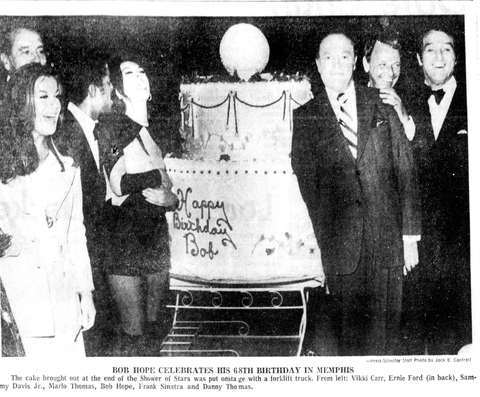
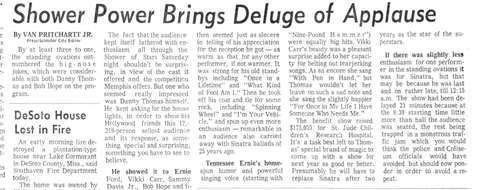
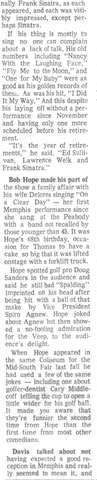
:
Mid-South Coliseum
May 29, 1971
May 29, 1971 - Frank Sinatra was the headline performer at the St. Jude Shower of Stars at the Mid-South Coliseum. Also performing for the benefit of St. Jude Children's Research Hospital were Danny Thomas, Bob Hope, Sammy Davis Jr., Vikki Carr and Tennessee Ernie Ford.
:
Mid-South Coliseum
May 29, 1971
May 29, 1971 - Frank Sinatra was the headline performer at the St. Jude Shower of Stars at the Mid-South Coliseum. Also performing for the benefit of St. Jude Children's Research Hospital were Danny Thomas, Bob Hope, Sammy Davis Jr., Vikki Carr and Tennessee Ernie Ford.
"Lady Day"
Irv Cottler: Discussing Don Costa's strengths and weaknesses as a ballad writer versus a jazz writer, drummer Irv Cottler singled out 'Lady Day' on Sinatra & Company as 'a beautiful chart,' while criticizing Costa's jazz writing generally as overwritten: 'His jazz writing is like trying to push a Mack truck with four flats uphill. Unlike Nelson, he doesn't know what to leave out.'
Source: Will Friedwald, "Sinatra! The Song Is You: A Singer's Art" (2018 revised edition).
[Tina First Meets Barbara in Monte Carlo]
In June 1971, roughly two weeks after Frank's farewell concert, Barbara joined him in Monaco for a rendezvous, and this was the trip on which Tina first met her - Dad hadn't mentioned in advance that Barbara would be there. Over four days together Tina found nothing alarming, though she sensed the two behaved more like casual companions than a couple in love.
Source: Tina Sinatra, "My Father's Daughter: A Memoir" (2000).
UCLA, Los Angeles
Monday evening
Annual Sinatra Music Awards
Frank presented the awards
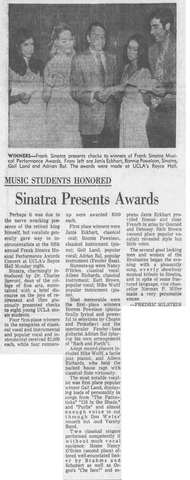
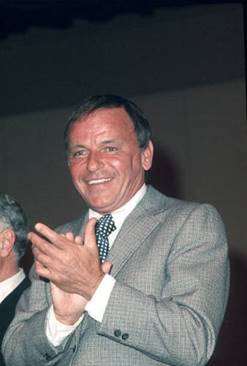
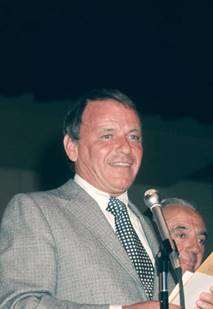
Dorothy Chandler Pavilion, Los Angeles
(30 minutes and the first show Sinatra did that night)
1. All or Nothing at All
2. I've Got You Under My Skin
3. I'll Never Smile Again
4. Ol' Man River
5. The Lady is a Tramp
6. My Way
7. That's Life
8. Angel Eyes
Ahmanson Theatre, Los Angeles
Sinatra's Retirement Concert (and the second show Sinatra did that night!)
The Motion Picture And Television Relief Fund 50th Anniversary Benefit
Orchestra Conducted By: Bill Miller
Introduction By Rosalind Russell
1. All Or Nothing At All
2. I've Got You Under My Skin
3. I'll Never Smile Again
4. Ol' Man River
5. That's Life
6. Try A Little Tenderness
7. Fly Me To The Moon
8. Nancy
9. My Way
10. The Lady Is A Tramp
11. Angel Eyes
Notes: 45 mins.
FRANCIS ALBERT RETIRES
Frank Sinatra was abruptly retiring after a tumultuous 32-year career. The "Swoon
Kid" was hanging it all up. As a singer he was "The King,"
"The Chairman of the
Board," "Mr. Class." And as a man the archetype pf every man's fantasies.
Producer Gregory Peck announces a black tie benefit concert before Sinatra
announces his retirement. The names on the program are the best of
Hollywood: Pearl
Bailey, Jack Benny, Mitzi Gaynor, Cary Grant, Bob Hope, Barbra Streisand and Sinatra.
People were willing to put down as much as $250 for a ticket, all proceeds going to the
motion picture relief fund charity. Then Frank announces his retirement decision and the
evening becomes Sinatra's farewell. People suddenly scramble, eager to pay $5,000 for a ticket.
The show is at the Ahmanson and Pavilion in downtown Los Angeles, June 13, 1971.
David Frost introduces Barbra Streisand. She does five numbers and leaves the remainder
of the evening to Frank. The audience is enthusiastic even though the show had run four hours.
Rosalind Russell, glamorous in white crepe, cries as she introduces Sinatra, her buddy.
Sinatra comes on waving a finger before his his face and cautions, "Don't you cry."
The audience stands in reverence to "The Leader."
Sinatra sings. Memories, plateaus in his life. Lush, green days, flat on back times, loves
of now and then. Lyrics that made sense. The crowd listened and remembered.
"This was the beginning," Sinatra tells the crowd and he sings "All Or Nothing At All."
Sinatra talks: "Cole Porter's shining hour and Nelson Riddle's wonderful arrangement of
'I've Got You Under My Skin.' "His voice caresses the lyrics.
"I'll Never Smile Again," brings tears not only to Sinatra's eyes but to the audience. Written
by Ruth Lowe after her husband died and recorded by Sinatra, May 23,
1940. It is his first big record.
"Ol' Man River." Sinatra had sung it in 1944. Almost 18 years later he records it for "The
Concert Sinatra." Then the ring-a-ding swinger uptempos it with "Fly Me To The Moon."
Barely able to control the tears, Sinatra sings "Nancy With the Laughing Face."
He has always given more than the best of himself. Power, no excuses, proud, never
turn back. The emotional "My Way," and the crowd stands up for another ovation.
Ahmanson Theatre, Los Angeles
Sinatra's Retirement Concert (and the second show Sinatra did that night!)
The Motion Picture And Television Relief Fund 50th Anniversary Benefit
Orchestra Conducted By: Nelson Riddle
LIFE MAGAZINE
JUNE 25, 1971
Frank Sinatra's Retirement Concert (1971)June 1971 to
Los Angeles Ca with Vice President Agnew
On June 13, 1971 – at a concert in Holllywood to raise money for the Motion Picture and TV Relief Fund – att the age of 55, Frank Sinatra announced that he was retiring, bringing to an end his 36-year career in show business. This concert was held at the Dorothy Chandler Pavilion and the Ahmanson Theater in Los Angles. I had no idea when I left San Clemente that I would be supporting this event all that I knew was that Vice President was coming to Los Angeles. I was sent there to support Vice President Agnew, his staff and the United States Secret Service, who would be attending a concert at the Ahmanson Theater.
Although we would have to work that night, dress rehearsal took place that afternoon and we were able to sit in front row seats and watch them. Dean Martin and the Gold-diggers, Bob Hope, Jack Benny, Don Rickles, Mitzi Gaynor, Barbra Streisand, Nancy Sinatra, Joe Namath, and Bobby Sherman. I was lucky to have saved the Program which helped me remember everyone who performed at this concert because there were so many. Although I do not remember Frank at the dress rehearsal, I was able to see his entire performance that evening!
The Program began with Princess Grace of Monaco (the former Grace Kelly) giving the opening remarks followed by the concert. Frank Sinatra was introduced by Rosalind Russell and began his performance by singing "
All Or Nothing at All", followed by “I’ve Got You Under My Skin†, I’ll Never Smile Again, a moving rendition of Ol’ Man River, That's Life Try A Little Tenderness, Fly Me To The Moon , Nancy , My Way, The
Lady Is A Tramp and concluding his performance with Angel Eye. His performance was fabulous by far the best of the evening.
The great thing about the concert was that all of the best known entertainers of the time were on the program, not to mention celebrities like Robert Wagner, Lucile Ball, David Jansen and Don Knotts that would be in the audience
© 1997-2026 The Sinatra Archive
This calendar, or any parts thereof, may not be reproduced in any fashion
whatsoever without the prior written permission of the publisher (The
Sinatra Archive)
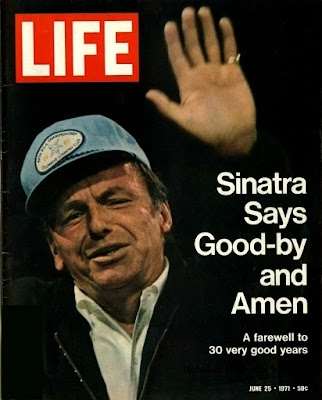
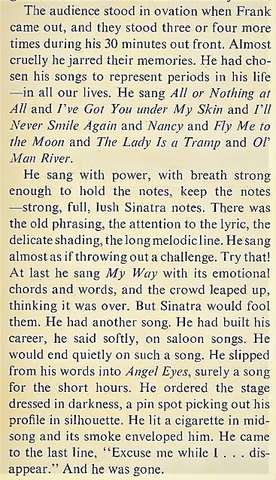
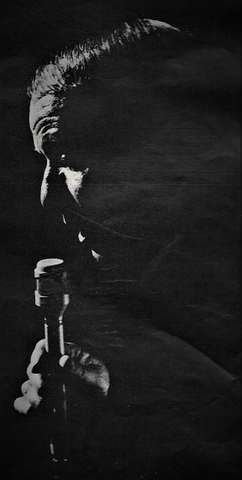
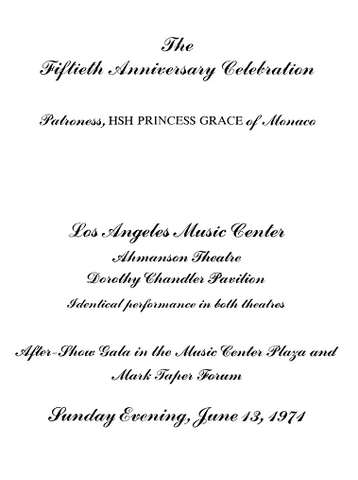
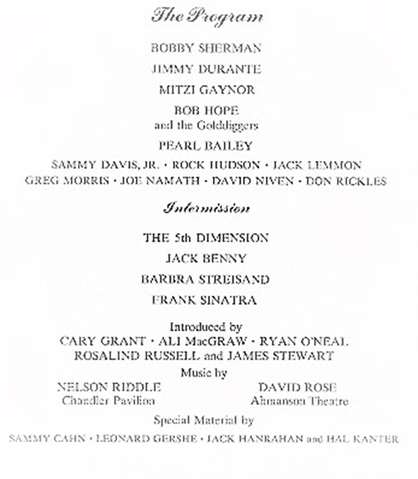
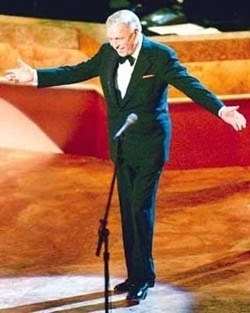
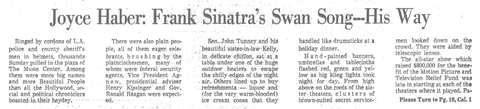
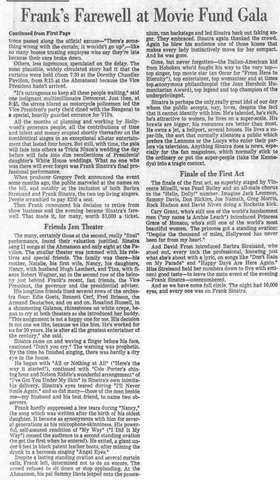
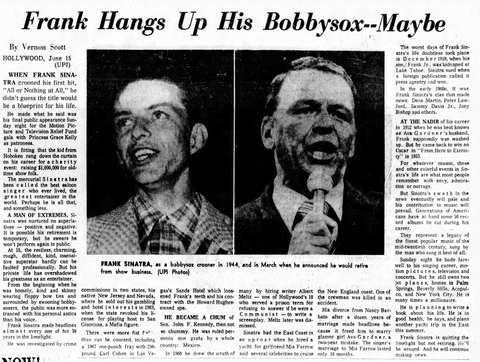
Sinatra closed the show with a stripped-down, spotlit rendition of "Angel Eyes," lighting a cigarette mid-song before delivering its final line, "Excuse me while I... disappear," and walking off stage -- a moment Life magazine's Tommy Thompson called the most stunning he had ever witnessed. Backstage afterward, twenty-seven-year-old Frank Jr. told his father, "The world's not gonna let Frank Sinatra just disappear," doubting the retirement would stick; Frank, his first wife Nancy at his side, insisted he meant it. Sinatra would in fact return to performing publicly within about two years. Source: J. Randy Taraborrelli, Sinatra: Behind the Legend.
"All or Nothing at All" / "I've Got You Under My Skin" / "The Lady Is a Tramp" / "I'll Never Smile Again" / "Nancy" / "Ol' Man River" / "Try a Little Tenderness" / "Fly Me to the Moon" / "My Way" / "That's Life" / "Angel Eyes" Rosalind Russell (quoted) / Frank Sinatra (quoted) / Friedwald (analysis): Rosalind Russell's introduction is quoted at length: 'This assignment is not a happy one for me. Our friend has made a decision... it's time to put back the Kleenex and stifle the sob. For we still have the man, we still have the blue eyes... for one last time we have the man, the greatest entertainer of the twentieth century.' Nelson Riddle conducted. Sinatra opened with Riddle's 1966 arrangement of 'All or Nothing at All,' saying over the vamp, 'This was the beginning.' Friedwald details the set: an intimate 'Ol' Man River' with just Bill Miller, 'Try a Little Tenderness' with only Al Viola's guitar, the Basie/Byers chart of 'Fly Me to the Moon,' and non-Riddle versions of 'My Way' and 'That's Life' (the latter stripped of choir and organ) that Friedwald says Sinatra and Riddle made sound better live than on record. The show closed not with 'My Way' but with 'Angel Eyes,' the spotlight narrowing to a pin spot as Sinatra, accompanied only by Bill Miller and a cigarette, delivered the final line 'Scuse me while I disappear' as the stage went black.
Source: Will Friedwald, "Sinatra! The Song Is You: A Singer's Art" (2018 revised edition).
[Two farewell concerts staged in one night]
On Sunday night, June 13, at the Los Angeles Music Center, Sinatra performed what all who attended understood to be his final two concerts, officially a benefit for the Motion Picture and Television Relief Fund. The first show was in the 3,200-seat Dorothy Chandler Pavilion; the second, more intimate one for family and friends was in the Ahmanson Theatre. Gregory Peck produced, with Jack Benny, Bob Hope, Sammy Davis Jr., Pearl Bailey, Don Rickles, Mitzi Gaynor, and Barbra Streisand also performing before Sinatra closed.
Source: James Kaplan, "Sinatra: The Chairman" (2015).
[Backstage before the farewell show]
Tommy Thompson: Life writer Tommy Thompson, reporting a cover story, observed a nervous Sinatra in his dressing room between shows, obsessively reviewing his 14-song set list, then doodling a house on paper and blacking out its windows and doors with a felt pen -- an image Kaplan reads as a portrait of Sinatra's unconscious. Guitarist Al Viola came in to rehearse their planned duet on "Try a Little Tenderness."
Source: James Kaplan, "Sinatra: The Chairman" (2015).
[Cary Grant's backstage visit]
Cary Grant, who had quietly retired from acting five years earlier to raise his young daughter, stopped by Sinatra's dressing room before the farewell show -- one retiring performer visiting another.
Source: James Kaplan, "Sinatra: The Chairman" (2015).
[Jack Benny's copycat telegram bit]
Jack Benny: Backstage, 77-year-old Jack Benny did a comic bit with his violin, recalling that when he endorsed Reagan for governor a day after Sinatra had, Frank sent him a one-word telegram reading "COPYCAT." Benny then joked that he too would like to retire, "only... I can't," leaving Sinatra doubled over laughing.
Source: James Kaplan, "Sinatra: The Chairman" (2015).
[Sinatra's dressing-room interview on retiring]
Frank Sinatra: Asked by Tommy Thompson if he was really quitting, Sinatra insisted he was serious, saying he couldn't make an idle statement like that. He described plans to do nothing for eight months to a year, roam the desert photographing cactus, hang the pictures at his Palm Springs hospital wing, read Plato, grow petunias, and maybe paint, while doubting he'd write a memoir. He denied his voice was failing, insisting physically it was "a long way from going" -- he simply no longer wanted to perform.
Source: James Kaplan, "Sinatra: The Chairman" (2015).
[Rosalind Russell's emotional introduction]
Rosalind Russell: After midnight, following Barbra Streisand's set, Rosalind Russell introduced Sinatra's final number, struggling to keep her composure as she told the crowd their friend had made a decision they didn't like but had to honor after his thirty years of work, before recovering to praise "those wonderful blue eyes" one last time.
Source: James Kaplan, "Sinatra: The Chairman" (2015).
[Farewell concert setlist and finale]
The audience, including Princess Grace, Governor and Nancy Reagan, the Agnews, and Henry Kissinger, gave Sinatra a standing ovation as Nelson Riddle returned to conduct, opening with "All or Nothing at All." Over roughly thirty minutes Sinatra sang career highlights including "I'll Never Smile Again," "I've Got You Under My Skin," "Ol' Man River," "The Lady Is a Tramp," "Try a Little Tenderness," "Nancy," and "Fly Me to the Moon," closing with "My Way," an encore of "That's Life," and finally "Angel Eyes," ending the song by lighting a cigarette and vanishing into the dark as the spotlight closed -- performed this way twice that night, at both the Chandler Pavilion and the Ahmanson.
Source: James Kaplan, "Sinatra: The Chairman" (2015).
[After-party limousine reflections]
Frank Sinatra: Riding to Roz Russell and Freddie Brisson's house afterward with Tommy Thompson and others, an exhausted Sinatra reminisced about doing five shows a night at the Jersey Shore as a young singer, walking home at dawn, and doing ten or eleven shows a day at the Paramount in New York. After improvising a few lines to a song on the car radio, he joked, sinking back with his eyes closed, that it was "the last time Frank Sinatra will open his mouth" -- a line Kaplan notes was, in fact, far from true.
Source: James Kaplan, "Sinatra: The Chairman" (2015).
U.S. Senate tribute
Following his retirement announcement, Sinatra traveled to Washington, D.C. with a group of friends, including the Gregory Pecks and the Bennett Cerfs, and sat in the Senate's family gallery while nine senators rose to pay tribute to him on the Senate floor: Democrat John V. Tunney of California, who organized the tribute, Republicans Jacob Javits of New York and Charles Percy of Illinois, and Democrats Birch Bayh, Hubert Humphrey, Alan Cranston, Howard Cannon, Edmund Muskie, and Claiborne Pell. The roughly 45-minute tribute praised Sinatra's humanitarian work and artistry; Javits called him "a master of the performing arts," and Sinatra later told a reporter he had "never" been so moved by any honor, including his Oscars. Afterward Tunney hosted a private luncheon for Sinatra and his party.
Source: Arnold Shaw, "Sinatra, the Entertainer" (1982).
In Paris, Frank accepted the Award of the Century.
Source: Nancy Sinatra, Frank Sinatra: An American Legend, 1995.
[Fundraiser Appearance During Retirement]
Despite having announced his retirement, Sinatra sang about a dozen songs at a fundraising event for the Italian-American Civil Rights League. Otherwise he spent the period painting, playing charity golf, and taking long holidays.
Source: The Rough Guide to Frank Sinatra, chapter "I Want to Be a Part of It, 1971-98."
Frank hosts Vice President Spiro Agnew and his family for a three-day Thanksgiving-weekend visit, cementing a friendship that led Sinatra to campaign for Agnew's future presidential prospects and, when Nixon considered dropping Agnew from the 1972 ticket, to organize a letter-writing campaign that helped keep him on it. Source: J. Randy Taraborrelli, Sinatra: Behind the Legend.
[Congressional Mafia Inquiry Draws Frank to France]
In the summer of 1972, while another congressional committee probed his alleged Mafia ties, Frank was in France and invited Tina's mother and sister to join him. On the morning of their departure he called, weary and homesick, saying he wished he were headed home instead - but he chose to stay and face the committee.
Source: Tina Sinatra, "My Father's Daughter: A Memoir" (2000).
[Frank Checks on Tina During the Eagleton Crisis]
When the Thomas Eagleton scandal threw the McGovern campaign into turmoil, Frank called Tina simply to make sure she was doing okay, prioritizing her feelings over politics.
Source: Tina Sinatra, "My Father's Daughter: A Memoir" (2000).
[Frank Endorses Nixon, Angering Tina]
Despite Tina's efforts to learn his intentions, Frank kept his vote private until the news broke that he had endorsed Richard Nixon - a jarring reversal for a lifelong Democrat. Tina confronted him angrily by phone, and he calmly replied that it was a free country and invited her down to talk it out.
Source: Tina Sinatra, "My Father's Daughter: A Memoir" (2000).
[Medallion of Valor from Israel]
The State of Israel awards Sinatra the Medallion of Valor, and the Screen Actors Guild gives him its Highest Achievement Award.
Source: Nancy Sinatra, "Frank Sinatra, My Father" (1985).
[Sinatra Switches Allegiance To Nixon]
Having completed his political shift from Democrat to Republican, Sinatra publicly backed Richard Nixon's re-election bid, to the dismay of his daughter Tina, who was campaigning for Nixon's opponent George McGovern. After Nixon won, Sinatra turned down an invitation to stage the inaugural ball, unlike the arrangement he had made for JFK, reportedly because he no longer wished to be treated merely as a performer.
Source: The Rough Guide to Frank Sinatra, chapter "I Want to Be a Part of It, 1971-98."
[Tina's 'Got One!' Game With Vice President Agnew]
Nancy Sinatra: During a party at the Sinatras' Palm Springs guesthouse, which the family had nicknamed Agnew House after its frequent occupants, Tina Sinatra ran around registering Democratic voters ahead of the 1972 election, shouting "Got one!" each time she succeeded while Vice President Spiro Agnew looked on and laughed.
Source: Nancy Sinatra, Frank Sinatra: An American Legend, 1995.
[Tina Confronts Her Father Over the Nixon Endorsement]
Nancy Sinatra: Tina Sinatra recalled that her father publicly endorsed Richard Nixon on what she believed was a Friday afternoon, undercutting her own months of campaign work for George McGovern. Furious, she drove to Palm Springs to confront him; he told her that everyone had to fight for what they believed in, and that he had to go public with his own choice just as she had with hers.
Source: Nancy Sinatra, Frank Sinatra: An American Legend, 1995.
[1972 Democratic National Convention, Miami]
Consiglio: Consiglio attended the 1972 Democratic National Convention in Miami with Larry O'Brien, staying again at the Fontainebleau, this time without Sinatra. He watched candidates including George McGovern and Hubert Humphrey strategize in O'Brien's suite, arranged a TV set for Ted Kennedy's trailer, and rounded up boxes of Kentucky Fried Chicken for O'Brien's group. McGovern won the nomination and lost to Nixon in a landslide.
Source: Tony Consiglio (as told to Franz Douskey), "Sinatra and Me: The Very Good Years" (2012)
[O'Brien becomes Democratic Party chairman]
Consiglio: In 1972 Larry O'Brien served as Democratic National Committee chairman during the Watergate affair and Richard Nixon's re-election campaign.
Source: Tony Consiglio (as told to Franz Douskey), "Sinatra and Me: The Very Good Years" (2012)
[Rosalind Russell praises Sinatra]
Ed Walters: Around 1972-73, actress Rosalind Russell was playing blackjack in the Sands 21 pit before heading to see Sinatra's show at Caesars. When a fellow player asked if the show was any good, she stood and declared Sinatra the single greatest talent she'd seen in a lifetime that included Jolson and Durante. She also told a newlywed couple at the table to play a Sinatra record whenever they fought, then treated them as her guests to see Sinatra perform.
Source: Ed Walters, pit boss reminiscences (compiled by Kraus, Sinatra mailing list)
[Rosalind Russell praises Sinatra at the tables]
Ed Walters: Around 1972-73, actress Rosalind Russell, playing blackjack at the Sands, told a fellow player that Sinatra was "the singularly greatest talent I have seen in my lifetime," having seen entertainers like Jolson and Durante. She then invited a young newlywed couple at the table to be her guests to see Sinatra's show at Caesars that night.
Source: Ed Walters, pit boss reminiscences (compiled by Kraus, Sinatra mailing list)
[legal/media]
Frank Sinatra: During his retirement, admitted killer Joseph Barboza alleged Sinatra fronted hotel interests for New England Mafia boss Raymond Patriarca; Patriarca denied ever meeting Sinatra. Sinatra testified before a House committee, angrily calling Barboza 'this bum' and insisting, 'I'm not a second-class citizen. All I'm asking is for somebody to be fair about it.'
No corresponding dated entry could be identified in the chronology for this film/context.
Source: Tom Santopietro, "Sinatra in Hollywood" (2008), Knight-Errant (pt. 1)
[media]
Frank Sinatra: Five days after his House testimony, Sinatra published an op-ed in The New York Times ('We Might Call This the Politics of Fantasy,' July 24, 1972) accusing even liberals of bigotry against Italian-Americans for believing 'scurrilous tales' linking him to organized crime.
No corresponding dated entry could be identified in the chronology for this film/context.
Source: Tom Santopietro, "Sinatra in Hollywood" (2008), Knight-Errant (pt. 1)
[Sinatra buys the rights to The Manchurian Candidate]
Sinatra purchased the rights to his own 1962 film "The Manchurian Candidate" in 1972.
Source: Richard Havers, "Sinatra" (Dorling Kindersley, 2007).
['The Candy Man' becomes Sammy Davis Jr's biggest hit]
Sammy Davis Jr scored his biggest hit with 'The Candy Man,' from the film Willy Wonka and the Chocolate Factory, which topped the charts even as his broader career was beginning to wane.
Source: Richard Havers, "Sinatra" (Dorling Kindersley, 2007).
[Frank grows closer to the Nixon administration]
Frank traveled to Washington and deepened his ties with the Nixon White House, continuing a rightward political shift that had begun with his support for Reagan.
Source: Richard Havers, "Sinatra" (Dorling Kindersley, 2007).
Americana Hotel, New York City
Friars Club Dinner for George Burns & Jack Benny
1. Love And Marriage (parody)
2. But Beautiful (parody)
Note: Frank was in retirement. He was very careful in his singing that evening.
--Ed
[image referenced in source but could not be recovered]
[image referenced in source but could not be recovered]
Lyric Theatre, Baltimore, Maryland
Salute To Spirow Agnew
1. The Gentleman Is A Champ (parody) - w/Bill Miller (piano)
2. But Beautiful (parody) - w/Bill Miller (piano)
Vice President Agnew was the guest of honor tonight at a gala show in Baltimore starring Bob Hope and
Frank Sinatra. The event was aimed at bolstering the Maryland state Republican campaign treasury.
Seats for the show ranged from $100 to $250 at a
Salute to Ted Agnew night.
NYT
5-20-72
Opening number:
"Your Kind Of Man, Ted Agnew Is" sung by choral group
Donald Schaefer - Mayor of Baltimore - introduces Tricia Nixon Cox speech - introduces master of ceremonies,
Bob Hope comedy monologue
Ethel Ennis
1. Shooting High
2. Falling Leaves ( request from VP Agnew )
3. You've Got A Friend
4. Help Me Make It Through The Night
Hope introduces celebrities in the audience:
James Stewart - Chuck Connors - James Drury -
Atty General John Mitchell - Jimmy Van Heusen
Senator John Tower ( Texas } addresses audience
Pat Henry stand up comedy routine
Frankie Avalon
1. For Once In My Life
2. MacArthur Park
Hope introduces more celebs:
Eva Gabor - Terry Moore - Don Defore-
Gary Collins - Mary Ann Mobley - Ruta Lee
Ray Bolger
1. Dance routine to music from "Tea For Two"
2. I'm Glad I'm Not Young Anymore
3. Once In Love With Amy
4. Tribute to Judy Garland "Isn't It Wonderful To Be So Great, You Will Always Be Remembered."
Mr Hope continues introducing famous people
Cesar Romero - Robert Fuller - Secretary of Labor, Glen Bell Senator Charles Mathias - Jock Mahoney - Kathy Garber
Kelly Garrett
1. I Got Love
2. Bridge Over Trouble Water ( tells gathering that Paul Simon made $25 million on this one song, suggests that the GOP think about writing songs instead of doing fundraisers.
3. I Believe In Music, I Believe In Love
Hugh O'Brian reads part of Teddy Roosevelt's "In the Arena" speech -- compares VP to him.
Bob Hope introduces famed sports figures sitting in the audience: George Allen - John Mackey - Jerry Kramer - Willie Davis - Gordie Howe - Henry Jordan - Fuzzy Thurston - Tom Matty - Buddy Young
Nelson Riddle - he tells Bob that he has arranged and will conduct a song composed by the Vice President
Bob introduces Lyn Meyerhoff short speech
Bob Hope: "Next fellow, we are bringing out of retirement - one of the super greats."
Frank Sinatra --fumbles with the mike- "You would think I would know how to use one. I haven't worked in a year. This is ridiculous."
1. The Gentleman Is A Champ ( 6:04)
2. But Beautiful ( parody) ( 3:10 )
Hope introduces Agnew Family
V.P. speech Thanks Bob Hope and Frank Sinatra - calls them out on stage
Hope wraps up the two hour show
Nelson Riddle conducts closing number "I Believe In You."
Middleman Agnew does it his way AGNEW: After the Fall
By Dan Fesperman
Baltimore Sun
•
Mar 07, 1993
Excerpt:
When Mr. Nixon mulled dumping Mr. Agnew from the ticket in 1972, Mr. Sinatra rushed to the rescue with a letter-writing campaign that climaxed with a fund-raiser at Baltimore's Lyric Theatre. Bob Hope was master of ceremonies, and Mr. Sinatra strode out of retirement to sing "The Gentleman is a Champ" to the tune of "The Lady is a Tramp."
Bulletin weekly organ of the workers league, September 3, 1973:
Convicted mob enforcer Joseph "The Baron" Barboza testified before the House Select Committee on Crime that Sinatra had fronted for the mob in ownership of the Fontainebleau Hotel; committee chairman Claude Pepper later produced an affidavit from the hotel's actual owner refuting the claim, and Sinatra denounced Barboza's testimony as indecent and untrue.
Source: George Carpozi Jr., Frank Sinatra: Is This Man Mafia? (New York: Manor Books, 1979), citing House Select Committee on Crime testimony.
[Congressional Committee Questions Sinatra On Television]
A congressional committee sought to question Sinatra on television about his earlier racetrack investment and his acquaintance with mobster Tommy Lucchese. Sinatra gave evasive answers and bristled when pressed on whether he knew Lucchese was a mobster, telling the panel it was not his concern.
Source: The Rough Guide to Frank Sinatra, chapter "I Want to Be a Part of It, 1971-98."
UCLA
Monday evening
Annual Frank Sinatra Music Awards
Ed O'Brien:
Although in retirement Sinatra appeared at the college to give out the awards named in his honor.
June 5, 1977
Sunday Evening
Sinatra Passes Up A Chance To Sing
WASHINGTON -- A singer is expected to sing, but a singer who has been promoted to "great cultural leader" and "outstanding humanitarian and patron of the arts" shouldn't have to.
That's just what Frank Sinatra decided just before the Israel Independence Ball. on Sunday night here. He had been scheduled to entertain as well as to receive Israel's Cultural Award.
But while he confined his performance to an impassioned speech about Israel, he also supplied the substitute singer free ----------- opera star Robert Merrill. Merrill said Sinatra called him on Saturday night , asking him to fill in for him so he could "relax." Having caught Merrill with the request on his birthday, Sinatra led the audience in singing "Happy Birthday, dear Robert" before leaving the stage. ( Merrill, who donated his time, said he hasn't received the Cultural Award). The ball, which drew 1,150 people, celebrated the 29th anniversary of Israel's inde- pendence, and is the 15th such event to be held in Washington. Only once was there no entertainment or music at the ball --- in 1967, when it fell at the end of the Six Day War. There is no charge for tickets, but the guests consist of people who have bought over $3,500 worth of Israel Bonds during the year. The ball's coordinator, Stanley Segal, said the people in the ballroom had spent approximately $5 million for bonds. Sinatra's contributions to the Israel bond program were cited with his award, as were his having endowed an International Student at Hebrew University, and having presented concerts benefiting Israeli health and welfare programs.
"I love your nation!" he replied to the presentation by Israeli Ambassador Simcha Dinitz. "I love the dreams of Israel, the very idea of Israel. If Israel loves me, it's a per- fect wedding.."
Calling Israel "the United States of our generation," he declared, "if they ever need me, I have yarmulke and will travel."
--Judith Martin
Washington Post
June 6, 1977
[Ghostwritten Op-Ed Attacks Investigation Process]
Still angry about the public spectacle of the congressional hearing, Sinatra had journalist Pete Hamill ghostwrite an essay published in The New York Times criticizing investigative procedures that mixed fact with rumor and could destroy reputations before large audiences.
Source: The Rough Guide to Frank Sinatra, chapter "I Want to Be a Part of It, 1971-98."
Frank Sinatra testified before the U.S. House Select Committee on Crime regarding his investment in the Berkshire Downs racetrack in Massachusetts, denying any association with organized-crime figures including Gaetano “Three-Finger Brown” Lucchese and Raymond Patriarca — testimony Kelley describes as conflicting with prior 1968 statements to Florida regulators by a Berkshire Downs associate, Salvatore Rizzo. Note: This account comes solely from Kelley's book, which is widely regarded as containing embellished or unverified claims; it is not independently corroborated elsewhere in this chronology. Source: Kitty Kelley, "His Way: An Unauthorized Biography of Frank Sinatra" (1986).
In a published New York Times letter, Frank wrote about his testimony before the Senate Select Committee on Crime, criticizing the process as an invasion of a private citizen's rights and connecting the media's treatment of him to bigotry against Italian-Americans.
Frank Sinatra (quoted): "My privacy had been robbed from me."
Source: Nancy Sinatra, Frank Sinatra: An American Legend, 1995.
Arie Crown Theatre, McCormick Place, Chicago, Illinois
Young Voters for Nixon Rally
1. My Kind Of Town
2. Fly Me To The Moon
3. The Lady Is A Tramp (parody) / But Beautiful (parody)
Arie Crown Theatre, McCormick Place, Chicago, Illinois
Young Voters for Nixon Rally
Daily News (New York, New York) 22 Oct 1972
Galesburg Register-Mail (Galesburg, Illinois) · 21 Oct 1972:
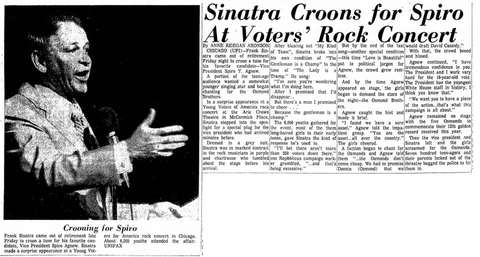
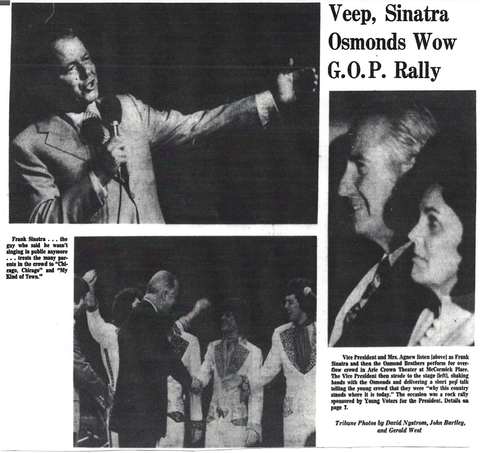
On November 1, 1972, Sinatra appeared at an event that raised $6.5 million in bond pledges for the State of Israel. Source: Nancy Sinatra, "Frank Sinatra, My Father" (1985).
[Barbara Files for Divorce From Zeppo]
By December 1972, after months of increasingly frequent visits to the Compound with Zeppo, Barbara filed for divorce from her seventy-two-year-old husband. She soon moved into a nearby condo that Frank paid for.
Source: Tina Sinatra, "My Father's Daughter: A Memoir" (2000).
[Barbara Marx Files For Divorce]
Barbara Marx, wife of Marx Brother Zeppo and a near neighbour of Sinatra's in Palm Springs, filed for divorce from her husband. She and Sinatra soon began appearing together regularly.
Source: The Rough Guide to Frank Sinatra, chapter "I Want to Be a Part of It, 1971-98."
President Nixon commuted the prison sentence of Angelo “Gyp” DeCarlo, a New York Mafia underboss whom Kelley describes as a “distant relative” of Sinatra's, officially on grounds of DeCarlo's terminal cancer. The FBI reportedly investigated, then dismissed, allegations that a Sinatra campaign contribution to Nixon helped secure the commutation. Note: This account comes solely from Kelley's book, which is widely regarded as containing embellished or unverified claims; it is not independently corroborated elsewhere in this chronology. Source: Kitty Kelley, "His Way: An Unauthorized Biography of Frank Sinatra" (1986).
Barbara Marx sues her husband, comedian Zeppo Marx, for divorce, ending their thirteen-year marriage, shortly before accompanying Frank to the Nixon presidential inaugural. She and Frank had begun an affair on a trip to Monaco while she was still married to Marx. Source: J. Randy Taraborrelli, Sinatra: Behind the Legend.
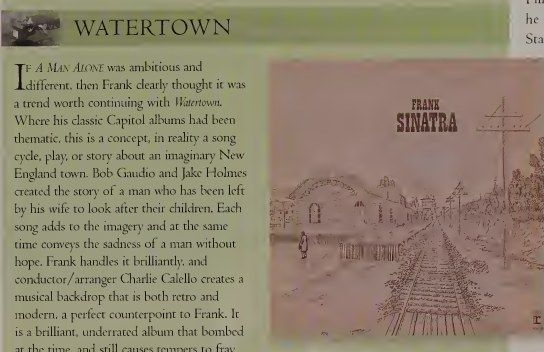
[Photograph: Barbara Marx publicly appears with Frank. From Richard Havers, "Sinatra" (Dorling Kindersley, 2007), p.318.]
Barbara Marx, then 42, made her first public appearance with Frank on New Year's Eve, though daughter Tina later said the two had already traveled together to Monaco back in June 1971. Barbara filed for divorce from Zeppo Marx four days before publicly attending a party with Frank at Walter Annenberg's Palm Springs home. (Source: Richard Havers, "Sinatra" (Dorling Kindersley, 2007).)
[Frank Ends His Retirement]
In 1973, Frank announced he was returning to work and came back in dramatic fashion, moving from intimate club dates to massive venues, including Madison Square Garden and a stadium show in Rio de Janeiro before roughly 175,000 people.
Source: Tina Sinatra, "My Father's Daughter: A Memoir" (2000).
[Frank Publicly Rebukes Barbara at Jilly's]
During a late night in 1973 at Jilly Rizzo's New York club, Barbara joined a political conversation among Frank's friends, and the table reacted as if she'd said something foolish. Frank snapped at her to stay quiet unless asked a question, and she complied without protest.
Source: Tina Sinatra, "My Father's Daughter: A Memoir" (2000).
[Ends Retirement with "Ol' Blue Eyes Is Back"]
Sinatra ends his retirement with the TV special "Ol' Blue Eyes Is Back" and is named Entertainer of the Century by the Songwriters of America.
Source: Nancy Sinatra, "Frank Sinatra, My Father" (1985).
[Ol' Blue Eyes Is Back Ends a Two-Year Retirement]
Frank returned to recording with Ol' Blue Eyes Is Back after taking two years off following his father's death, reportedly explaining simply that he figured he'd do some work since there was no fun hitting golf balls at eight at night.
Source: Nancy Sinatra, "Frank Sinatra, My Father" (1985).
[Sinatra Returns To The Recording Studio]
Encouraged by President Nixon and some 30,000 fan letters urging him back to work, Sinatra returned to the studio with arrangers Gordon Jenkins and Don Costa, producing the album and TV special that he dubbed Ol' Blue Eyes Is Back. Critical reaction was mixed, with some outlets delighted at his return and others judging that his voice had lost flexibility and control.
Source: The Rough Guide to Frank Sinatra, chapter "I Want to Be a Part of It, 1971-98."
[White House Performance For Italian PM Andreotti]
Easing back into performing, Sinatra staged a few benefits and appeared at the White House in 1973 for Italian Prime Minister Giulio Andreotti before resuming full album and touring work.
Source: Charles Pignone, "Frank Sinatra 100" (2015).
[Ol' Blue Eyes Is Back album]
Consiglio: Sinatra came out of retirement in 1973 with the album Ol' Blue Eyes Is Back, wearing a T-shirt with that slogan. Consiglio says Frank came back bigger than ever.
Source: Tony Consiglio (as told to Franz Douskey), "Sinatra and Me: The Very Good Years" (2012)
[awards]
Even while turning down film roles, Sinatra stayed connected to the industry, co-hosting the Academy Awards for the third time in 1973, signaling he remained an active, engaged Oscar-winning star.
No corresponding dated entry could be identified in the chronology for this film/context.
Source: Tom Santopietro, "Sinatra in Hollywood" (2008), Knight-Errant (pt. 2) / That's Life
[Lawsuit Over Jilly Rizzo's Rough Treatment of an Insurance Salesman]
An insurance salesman sued Sinatra for assault after alleging that Jilly Rizzo and another Sinatra aide beat him up following an incident at a restaurant; the case was decided in Sinatra's favor, but Rizzo was ordered to pay $100,000 in damages.
Source: Rough Guide to Frank Sinatra (Rough guide 7.pdf), chapter "The Inner Circle."
[Ol' Blue Eyes Is Back -- critical commentary]
Granata's discography entry: Ol' Blue Eyes Is Back, arranged by Gordon Jenkins and Don Costa, released September 1973.
Source: Charles L. Granata, "Sessions with Sinatra: Frank Sinatra and the Art of Recording" (1999/2003), Afterword & Appendices A-D
[Sinatra's April 1973 White House concert -- critical commentary]
Nelson Riddle: Sinatra performed at the White House in honor of Italian PM Giulio Andreotti, with Nelson Riddle -- who had conducted his June 1971 retirement concert -- leading the United States Marine Band. It was his first full concert in two years and reveals the deeper, 'later' Sinatra voice rather than the lighter 1971-and-earlier sound. After Nixon led a standing ovation, Riddle reportedly told Sinatra, dryly, 'You can't do much better than that,' a remark credited with helping prompt Sinatra to reconsider retirement.
Source: Will Friedwald, "Sinatra! The Song Is You: A Singer's Art" (2018 revised edition), Ch. 10, "Concert Years" (1973-1994)
[Cheshire Incident At Nixon's Pre-Inaugural Parties]
Sinatra and Barbara Marx were conspicuously seen together at Richard Nixon's pre-inaugural events in Washington. There, Sinatra clashed angrily with Washington Post society reporter Maxine Cheshire after she pressed Barbara about her marital status, and he insulted her and thrust money into her hand.
Source: The Rough Guide to Frank Sinatra, chapter "I Want to Be a Part of It, 1971-98."
[The 'Chicken Sinatra' Dinner Leak]
Nancy Sinatra: While staying in Washington and offering to cook dinner for the Agnews, Sinatra prompted a call from a friend of Agnew's asking what he planned to prepare. Girlfriend Barbara Marx jokingly answered that it might be his father's recipe for "Chicken Sinatra," a quip that gossip columnist Maxine Cheshire then printed in the Washington Post, annoying Sinatra because he felt Cheshire had used Marx to get information for a column targeting Agnew.
Source: Nancy Sinatra, Frank Sinatra: An American Legend, 1995.
At a Washington party hosted by Republican committeewoman Louise Gore, Washington Post columnist Maxine Cheshire presses Frank, then Barbara Marx, about her marital status and Frank's underworld associations. Furious, Sinatra publicly berated Cheshire with an obscene insult and stuffed cash into her drink, telling her to "go home and take a bath." He later offered a mock apology onstage, calling her "a one-dollar whore" instead of the term he'd used before. The incident, which unsettled Nixon and Agnew, reportedly drew Barbara and Frank closer together. Source: J. Randy Taraborrelli, Sinatra: Behind the Legend.
Plaza Hotel, New York
Eighth Annual Thomas A. Dooley Foundation Fundraising Dinner
Sinatra received a "Splendid American Award
Judy Agnew (L) and Frank Sinatra appear onstage during a Thomas Dooley Foundation
event at the Plaza Hotel in New York City on March 28, 1973
© 1997-2026 The Sinatra Archive
This calendar, or any parts thereof, may not be reproduced in any fashion
whatsoever without the prior written permission of the publisher (The
Sinatra Archive)
[Frank Sings at the Nixon White House]
In April 1973, President Nixon invited Frank to perform at a state dinner honoring Italian Prime Minister Andreotti - the first time Sinatra had ever sung at the White House, despite decades of supporting Democrats.
Source: Tina Sinatra, "My Father's Daughter: A Memoir" (2000).
[career milestone -- critical commentary]
Sinatra's 1971 retirement proved short-lived: by April 1973 he had returned to the recording studio to begin a comeback album that would launch the touring-arena phase of his career.
Source: Charles L. Granata, "Sessions with Sinatra: Frank Sinatra and the Art of Recording" (1999/2003), Part IV: The Reprise Years
Dinah Shore Golf Classic, Palm Springs
Frank Sinatra at the Dinah Shore Golf Classic - April 10, 1973 in Palm Springs, California
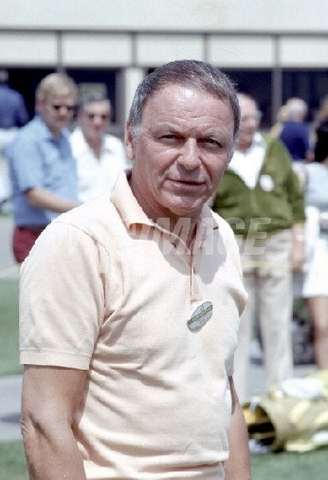
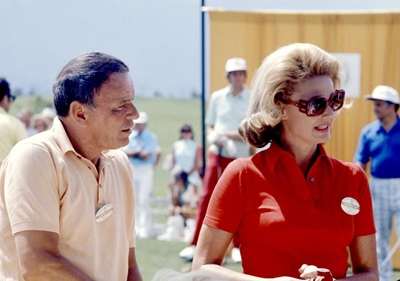
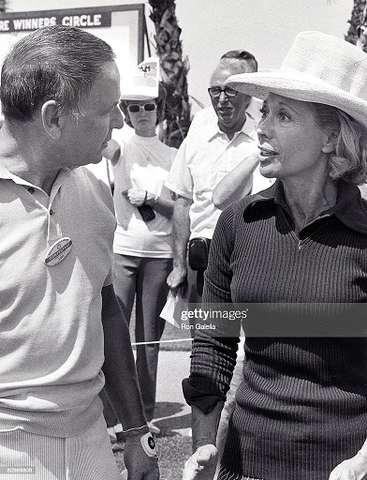
The White House, East Ballroom, Washington D.C.
Presidential Gala To The Honour Of: Gulio Andreotti, Prime Minister Of Italy
Key Musicians: Bill Miller, Al Viola.
The President's Marine Band Conducted By: Nelson Riddle
1. intro by President Nixon
2. You Make Me Feel So Young
3. Moonlight In Vermont
4. One For My Baby
5. I've Got You Under My Skin
6. I Have Dreamed
7. Fly Me To The Moon
8. Try A Little Tenderness
9. Ol' Man River
10.. I've Got The World On A String
11. The House I Live In
12. Thanks By President Nixon
Notes: TT 43mins.
Ed O'Brien:
A state dinner that evening for the Italian Prime Minister Giulio Andreotti, at which Frank Sinatra sang for two hundred guests, including Kissinger and Nixon. Another recording is from later that evening. A little before midnight, Nixon telephoned Kissinger:
P: Did you stay for the entertainment?
H.A.K.: Yes, it was moving. One of the most moving things I've heard. P: You know, Frank's voice is gone, as he told me before he came. But by gosh, you know, the emotion in the room was just unbelievable. I think some of the people were crying. H.A.K.: Unbelievable.
P: Did you feel that way?
H.A.K.: Oh yes, and also the tremendous dignity with which he did it, the way he spoke of you and of the Presidency was really a great evening. You said it very wellthhat we could have such an evening. P: Yeah.
H.A.K.: [The Louisiana Congressman F. Edward Hébert was sitting in front of me, and he was in fact crying at the end. And [the Rhode Island Senator John] Pastore was sitting next to me, and he's just beside himself.
Nixon had told the guests, "Once in a while there is magic in a room and a great performer is able to capture the room, Frank Sinatra has done that, and we thank him."ť Later, Kissinger would compare the mood to the half-aware calm of passengers on the Titanic..
Rich W.:
It's hard to believe that Sinatra told the President his voice was shot. He may not have sounded like he did in his prime but I thought he sounded fine during this memorable concert!
Ed O'Brien:
Bill Miller mentioned in more than one interview how neurotic Sinatra was about his voice. He would often play down the expectations to calm his nerves. His singing at the W.H. was superb. The recordings done for "OBIB" and "SNTIM" are another story. It took him five years to regain the vocal skill he had on 6-13-71. During the two-year layoff, Frank did not vocalize and his vocal muscles atrophied.
Still officially retired, Sinatra performed at this White House gala honoring visiting Italian Prime Minister Giulio Andreotti; President Nixon's warm, unscripted tribute to him reportedly moved Sinatra to tears. Source: Derek Jewell, Frank Sinatra: A Celebration (New York: Applause Books, 1999).
Hollywood
****** Nobody Wins
(Kris Kristofferson)
Resaca Music (BMI)
Arranged & Conducted by Don Costa
****** Noah
(Joe Raposo)
Instructional Children's Music Inc./WB Music Corp. (ASCAP) Arranged & Conducted by Don Costa
Note: Masters were destroyed. No numbers assigned.
NOTE: John Morell was the guitarists on Frank's first post-retirement session, according to Ed O'Brien. He said Sinatra walked into the MGM studio, smiled, and said, "The Chairman of the Board is back." The seven musicians, Don Costa, and the studio personnel cracked up. Morell remembers that it was a very funny moment that reduced any tension there may have been in the room. The singing done that night was essentially a feeling-out process by Sinatra. He was rusty, knew it, and needed to limber up under real session conditions..
Noah has to be one of Sinatra' s most eccentric and ill advised song choices. Similarly, I remember upon first hearing the Kristofferson song how poorly suited FS was to the country idiom. The clunky grammar of the first line of the song is bad enough but hearing Sinatra sing vernacular and contracted words like ˜injurin' " was particularly jarring.
- Vance
Sinatra was determined to remain contemporary when he came out of retirement in the spring of 1973, He had his people search for new material that would fit his style of singing. He dabbled in country music but could not bring himself to record the planned album with Snuff Garrett. A single was recorded in March of 1975 but the album was twice scheduled ( April and December 75) and cancelled both times at the last moment by Frank.
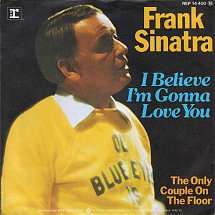
Sinatra's comeback album Ol' Blue Eyes Is Back began with a session at Goldwyn Studios on April 30, 1973 -- exactly the twentieth anniversary of his first recording session with Nelson Riddle. At Sinatra's request, the tapes from this first session were destroyed.
Source: Charles L. Granata, "Sessions with Sinatra: Frank Sinatra and the Art of Recording" (1999/2003).
At the Trinidad Hotel in Palm Springs, Sinatra, Jilly Rizzo, and singer Jerry Arvenitas were involved in an altercation with a Salt Lake City insurance broker named Weinstock, who was beaten after allegedly directing a slur at Rizzo.
Source: George Carpozi Jr., Frank Sinatra: Is This Man Mafia? (New York: Manor Books, 1979).
Comeback discussions reported in the trade press
Variety reported that Sinatra and producer Howard W. Koch were in discussions about teaming for a "many-sided comeback" spanning television and film, part of his gradual return from retirement following his April 1973 White House performance for President Nixon. Days later, columnist Joyce Haber reported that Sinatra had met with singer-songwriter Neil Diamond at his Goldwyn lot office as part of a series of meetings with prospective songwriters for a planned comeback album, a project that would lead to that November's "Ol' Blue Eyes Is Back" television special and album.
Source: Arnold Shaw, "Sinatra, the Entertainer" (1982).
[FBI links Sinatra to a mob associate's commutation]
An FBI brief prepared for Acting Director William Ruckelshaus reported that mobster Angelo DeCarlo's December 1972 sentence commutation was attributed by his associates to Sinatra's intervention, allegedly channeled through Sinatra's friendship with Vice President Spiro Agnew. A separate informant told the U.S. Attorney's office that the request had originated with singer Frankie Valli (contacted by DeCarlo from prison), was relayed through Mrs. Sinatra to Frank Sinatra, and that Sinatra had turned over $100,000 in unrecorded cash to Nixon fundraiser Maurice Stans before later making a formal $50,000 campaign contribution -- after which DeCarlo's release followed. The memo noted, separately, that Sinatra had skipped Nixon's inaugural ball that January after a reported profanity-laced clash with columnist Maxine Cheshire.
Source: Kuntz and Kuntz, The Sinatra Files, ch. 7.
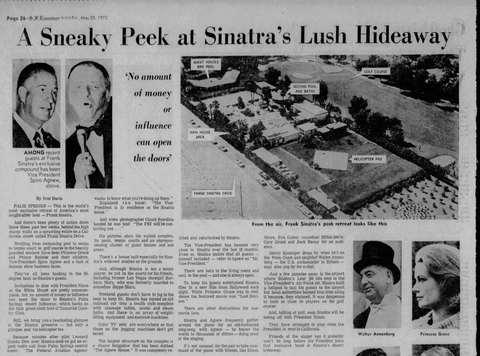
The Songwriters of America named Frank Sinatra Entertainer of the Century, reflecting his gradual return to public performing.
Source: Nancy Sinatra, Frank Sinatra: An American Legend, 1995.
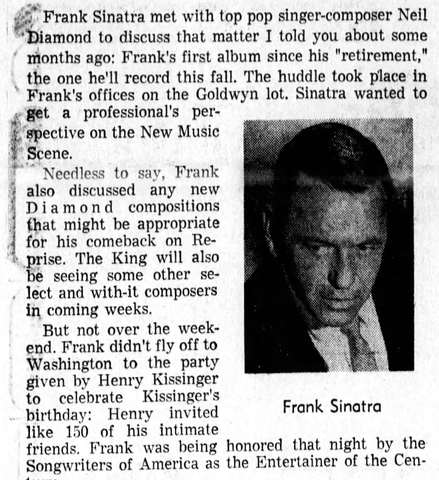
Century Plaza, Beverly Hills, California
Salute to Governor Reagan
Orchestra Conducted By: Don Costa
"This is the first time Sinatra ever asked to be quoted," quipped William Dozier at the $500 a plate
Republican fund raiser honoring Gov. and Mrs. Ronald
Reagan. And it was virtually true. Sinatra had just finished singing special lyrics to "Love And Marriage" written by Sammy Cahn. Like "By any test ( the Reagans are ) the best/ And if the press is here please quote me/Nancy's beam is like a lighthouse/ Cause she sees her Ronnie in the White House." Jimmy Stewart introduced Sinatra, explaining, "With the price of food the way it is today, even Frank has to sing for his supper." The King did, while his Barbara Marx looked on from Nancy Reagan's table. "Those of you who didn't catch my name, may I introduce myself," said Sinatra, who always had pretty good comedy material. "I'm the new mayor,Tom Bradley.
I just wore all that dark makeup to bug Sam Yorty. I asked Sammy Davis to come, but he's at Bradley's picking out the Cabinet."
Sinatra left the stage to a standing ovation and a grin plus a handshake from the governor.
June 1, 1973
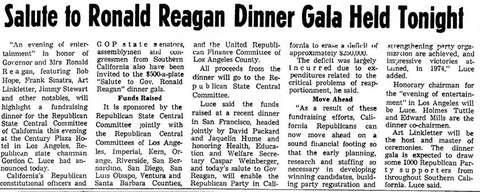
[Ol' Blue Eyes Is Back Gets Its Title]
Nancy Sinatra: While choosing a title for his comeback album, Nancy suggested calling it Let Me Try Again, but her father brushed off the idea, already having his own title in mind. When he told her his choice, she thought it was awful, but he went with it anyway, and Ol' Blue Eyes Is Back became a lasting piece of American slang.
Source: Nancy Sinatra, Frank Sinatra: An American Legend, 1995.
Hollywood
RCA4011 Bang, Bang (My Baby Shot Me Down)
(Sonny Bono)
Cotillion Music/Chris Mare Music (BMI)
Arranged & Conducted by Gordon Jenkins
(3:35) CD: 46013-2 The Complete Reprise Studio Recordings Disc 16
Note: Jonathan Schwartz told me this story a long time ago:
He was in Palm Springs a few weeks after Frank recorded Sonny Bono's
song. On an extraordinarily hot morning, he and his girlfriend at the time,
Margot Kidder (Lois Lane ), had stopped into a 24 hour convenience store.
While they were waiting in line, J.S. spotted Bono in another line. He went
over and told him that Frank Sinatra had just recorded "Bang, Bang." Bono
looked at him in amazement. Jonathan introduced himself and Bono dropped
the items in his arms and ran out of the store.
Jonathan was surprised that the Sinatra office had not notified Bono.
Teddy Randazzo told me a similar story. Frank asked Teddy to write a song
about family life for him in May of 1977. Randazzo got it done in a few weeks
and submitted to Frank "All The Way Home." When Frank recorded the song
in January of 1983, Teddy was not notified.
--Ed
RCA4012 You Will Be My Music
(Joe Raposo)
Intstructional Children - Music Inc./WB Music Corp. (ASCAP)
Arranged & Conducted by Gordon Jenkins
(3:51) CD: 46013-2 The Complete Reprise Studio Recordings Disc 16
CD: 2155-2 Ol' Blue Eyes Is Back
LP: FS2155 Ol' Blue Eyes Is Back
45: S1190
RCA4013 Noah
w/Chorus
(Joe Raposo)
Intstructional Children's Music Inc./WB Music Corp. (ASCAP)
Arranged & Conducted by Gordon Jenkins
(4:23) CD: 46013-2 The Complete Reprise Studio Recordings Disc 16
CD: 2155-2 Ol' Blue Eyes Is Back
LP: FS2155 Ol' Blue Eyes Is Back
NOTE: Thirty six years ago this evening, Sinatra's return as an active performer began in earnest, Sinatra Scholar Ed O'Brien observes. The recording session at Goldwyn Studios started at 7:00 p.m. Gordon Jenkins conducted a 45-piece orchestra.
There was a 27-piece string section plus John Morell and Alvin Casey on guitar and Terry Trotter and Bill Miller on piano. Lee Herschberg was the engineer. A vocal chorus of eight would be overdubbed later in the month for "Noah" and a seven piece orchestra would augment the finished recordings during a session in late July, again at MGM.
The session ran four hours and a new beginning was underway. Sinatra had not done any studio work since November of 1970, except a warm-up attempt at the MGM Studios on April 30, 1973.
That evening he had recorded "Nobody Wins" and "Noah." Both efforts were scrapped. In a September 1979 interview with Thomas Hoving, Sinatra admitted that the long layoff had taken a toll on his vocal chords. A great deal of vocalizing was required to recapture the sound Sinatra desired for both studio and in-person performances,
During these sessions for the comeback album Ol' Blue Eyes Is Back, Frank records "You Will Be My Music" with Barbara Marx present in the studio; he later told her it was "our story, baby." Source: J. Randy Taraborrelli, Sinatra: Behind the Legend.
Hollywood
RCA4014 Nobody Wins
(Kris Kristofferson)
Resaca Music (BMI)
Arranged & Conducted by Gordon Jenkins
(5:11) CD: 46013-2 The Complete Reprise Studio Recordings Disc 16
CD: 2155-2O1 Blue Eyes Is Back
LP: FS2155Ol Blue Eyes Is Back
RCA4015 The Hurt Doesn't Go Away
(Joe Raposo)
Instructional Children's Music Inc./WB Music Corp. (ASCAP) Arranged & Conducted by Gordon Jenkins
(2:50) CD: 46013-2 The Complete Reprise Studio Recordings Disc 16
LP: W54093 I Sing The Songs Vol.2
45: S1327
NOTE: Sinatra Scholar Ed O'Brien interviewed pianist Bill Miller during which Miller discussed the "Ol' Blue Eyes is Back" album. During the rehearsals for the early June sessions, the musicians could not fathom why Sinatra was using Gordon Jenkins for a contemporary comeback album in 1973. They were quite impressed with some of the tunes but couldn't understand the marriage of singer-arranger- song selection.
O'Brien also reports that "Hurt Doesn't Go Away" was going to be on "Ol' Blue Eyes is Back," but Sinatra decided against it after realizing there would be five songs by Raposo on the album. It certainly wasn't meant to be a tribute album to one composer, so it was left off. Later on, it was released on a 45. The CD release didn't happen until it was included in the boxed set in 1995.
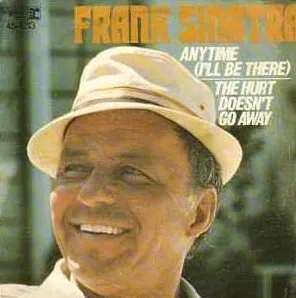
"Ol' Blue Eyes Is Back"
Sinatra ended his retirement with the 1973 TV special and album Ol' Blue Eyes Is Back. The hour featured a single guest, Gene Kelly, with film clips shown from Anchors Aweigh, Take Me Out to the Ball Game, and On the Town; the highlight was the two performing 'We Can't Do That Anymore' together.
Source: Tom Santopietro, "Sinatra in Hollywood" (2008).
Hollywood
RCA4026 Winners
(Joe Raposo)
Instructional Children's Music Inc./WB Music Corp. (ASCAP)
Arranged by Don Costa
Conducted by Gordon Jenkins
(2:52) CD: 46013-2 The Complete Reprise Studio Recordings Disc 16
CD: 2155-2Ol' Blue Eyes Is Back
LP: FS2155Ol' Blue Eyes Is Back
45: S1190
RCA4027 Let Me Try Again
(Music by Claude Vasori, French lyric by Michel Jourdon/Romoval Fiquier)
(English version by Paul Anka/Sammy Cahn)
MAM Corp. (ASCAP)/Chrysalis Standards inc. (BMI/SACEM)
Arranged by Don Costa
Conducted by Gordon Jenkins
(3:30) CD: 46013-2 The Complete Reprise Studio Recordings Disc 16
CD: 2155-2Ol' Blue Eyes Is Back
LP: FS2155Ol' Blue Eyes Is Back
45: S1181
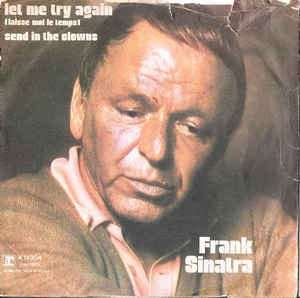
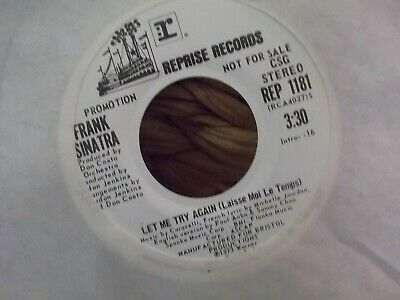
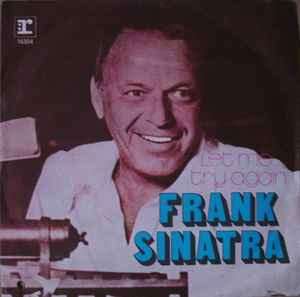
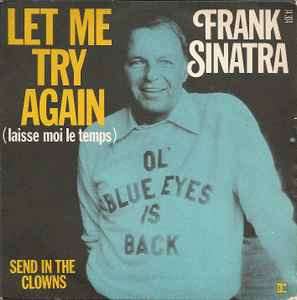
Hollywood
RCA4028 Empty Tables
(Johnny Mercer/Jimmy Van Heusen)
Mercer Music/WB Music Corp./The Song Writers Guild (ASCAP) Arranged & Conducted by Gordon Jenkins
(3:02) CD: 46013-2 The Complete Reprise Studio Recordings Disc 16
LP: W54093I Sing The Songs Vol.2
45: S1343
RCA4029 Walk Away
(Elmer Bernstein/Carolyn Leigh)
Carwin Music Inc. (ASCAP)
Arranged & Conducted by Gordon Jenkins
(2:56) CD: 46013-2 The Complete Reprise Studio Recordings Disc 16
RCA4030 Send In The Clowns
(Stephen Sondheim)
Revelation Music Publishing Corp./Rilting Music, Inc. (ASCAP) Arranged & Conducted by Gordon Jenkins
-25 (4:10) CD: 46013-2 The Complete Reprise Studio Recordings Disc 16
CD: 2155-2Ol' Blue Eyes Is Back
LP: FS2155Ol' Blue Eyes Is Back
45: S1181
RCA4031 There Used To Be A Ballpark
(Joe Raposo)
Instructional Children's Music Inc./WB Music Corp. (ASCAP) Arranged & Conducted by Gordon Jenkins
(3:35) CD: 46013-2 The Complete Reprise Studio Recordings Disc 16
CD: 9-26340-2The Reprise Collection
CD: 2155-2Ol' Blue Eyes Is Back
LP: FS2155Ol' Blue Eyes Is Back
NOTE: Sinatra Scholar Ed O'Brien says that this was a session devoted to two albums. Sinatra was working on a "Saloon" LP and his "come-back" album. The former was scheduled for release in 1974, but was not completed. The first two songs from this session were done for that project, while the latter two songs were done for "Ol' Blue Eyes is Back."
O'Brien has an interview with Gordon Jenkins who told how Sinatra adored "Clowns." Determined to get it right, Sinatra did a full rehearsal a few days prior to the sessions. Takes 19 and 25 were mastered. The latter was released on the album. There are marvelous live recordings of both "Blue Eyes" tracks on the Carnegie Hall concert of April 8, 1974.
Sinatraphile Vance Adair considers "There Used to be a Ballpark" one of the very finest pieces of work of Sinatra's post retirement period. The arrangement and lyrics enjoy a perfect marriage and Sinatra had rarely exercised his gifts as a storyteller more effectively or poignantly than here. It is a performance that has grown in reputation over the years, and rightly so, Adair feels.
Radio
June 22, 1940 Live Remote: Hotel Astor, New York City Saturday Morning
1:00 a.m. - 1:30 a.m.
NBC Red & Blue Networks
WEAF(Red) & WJZ(Blue)
Tommy Dorsey And His Orchestra
1 .I'm Getting Sentimental Over You TD & Orch.
2. (What Can I Say Dear) After I Say I'm Sorry Pied Pipers
3. Fools Rush In Frank Sinatra
4. Lights Out, Hold Me Tight Connie Haines
5. Fable Of The Rose Frank Sinatra
6. I'll Never Smile Again Frank Sinatra & Pied Pipers
7. Hawaiian War Chant ( Buddy Rich on drums) TD & Orch.
8. Closing Theme TD & Orch.
Hollywood
RCA4028 Empty Tables
RCA4029 Walk Away
RCA4030 Send In The Clowns
RCA4031 There Used To Be A Ballpark
[image referenced in source but could not be recovered]
[image referenced in source but could not be recovered]
[image referenced in source but could not be recovered]
[image referenced in source but could not be recovered]
[image referenced in source but could not be recovered]
[Send in the Clowns -- critical commentary]
Frank Sinatra (to Bill Boggs): In a 1975 interview with Bill Boggs, Sinatra explained his interpretive process specifically regarding 'Send in the Clowns' (and, he implies, everything he ever sang): 'I try to transpose my thoughts about the song into a person who might be saying that to somebody else... he's making his case. In other words, for himself.' He traced this approach back to his earliest days working small joints before and during the Tommy Dorsey years.
This song/context matches multiple dated entries in the chronology; the specific date Friedwald is referring to could not be determined with confidence.
Source: Will Friedwald, "Sinatra! The Song Is You: A Singer's Art" (2018 revised edition), Ch. 1, "Night and Day" (Sinatra style overview)
[Send in the Clowns -- critical commentary]
Granata includes 'Send in the Clowns' among the fifty recordings he considers essential to understanding Sinatra's artistry (arranged by Gordon Jenkins, recorded 1973, Reprise); the song was chosen for its musical/interpretive value rather than commercial popularity.
This song/context matches multiple dated entries in the chronology, or lacked a sufficiently precise date; the specific date could not be determined with confidence.
Source: Charles L. Granata, "Sessions with Sinatra: Frank Sinatra and the Art of Recording" (1999/2003), Afterword & Appendices A-D
[Send in the Clowns / Empty Tables -- critical commentary]
Milt Bernhart; Gordon Jenkins: Milt Bernhart on the Jenkins arrangement of "Send in the Clowns": 'That arrangement... was easy to play, but it didn't do much for the song.' Friedwald disagrees, calling the Jenkins chart (sung at Carnegie Hall in 1974) an underappreciated gem that restores European Grand Guignol formality, versus the folkier Judy Collins-style treatments most singers used. Jenkins himself called Sondheim's song 'the best song [written] in the last twenty-five years.' Friedwald judges the Jenkins arrangement of "Empty Tables" (Van Heusen/Mercer) less successful, with an alto-sax obbligato that sounds atypical of Jenkins.
This song/context matches multiple dated entries in the chronology; the specific date Friedwald is referring to could not be determined with confidence.
Source: Will Friedwald, "Sinatra! The Song Is You: A Singer's Art" (2018 revised edition), Ch. 8, "Gordon Jenkins" (1956-1981)
[Send in the Clowns / I Won't Dance -- critical commentary]
Sid Cooper: This August 20, 1982 pay-TV concert with the Buddy Rich Orchestra captured Sinatra's touring band at its peak; Friedwald singles out the Sinatra-Mottola performance of 'Send in the Clowns' as possibly its finest version, and the resuscitation of the 1961 Neal Hefti/Basie 'I Won't Dance' to swinging effect. Sax player Sid Cooper noted Rich's own band, while exciting as an opener, couldn't handle Sinatra's reed charts, so Cooper spent a week teaching them the parts -- yet was not invited on the subsequent South American tour.
This song/context matches multiple dated entries in the chronology; the specific date Friedwald is referring to could not be determined with confidence.
Source: Will Friedwald, "Sinatra! The Song Is You: A Singer's Art" (2018 revised edition), Ch. 10, "Concert Years" (1973-1994)
TV special was "Ol' Blue Eyes Is Back," broadcast 11-18-73
All-American Collegiate Golf Foundation
John F. Kennedy Award to: Frank Sinatra
Ed O'Brien:
On this date in 1973 there was a golf award dinner at the Waldorf Astoria in N.Y.C. Sinatra was honored as man of the year. There were many famous golf pros at the dinner.
Ken Venturi praised Sinatra. Frank's speech was very gracious. There has been a line recording of the dinner in circulation for years.
Terence Cardinal Cooke, Archbishop of New York, left and Frank Sinatra shake hands after Sinatra delivered an address at the All-American Golf Foundation dinner in New York, July 31, 1973
Rehearsal for "Ol' Blue Eyes Is Back' TV special
Show would be taped on 9-20-73
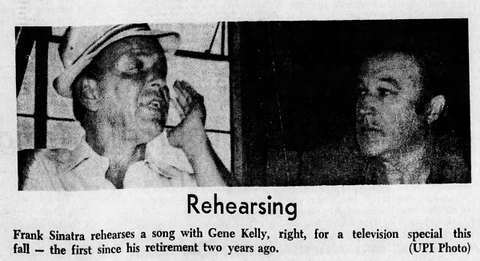
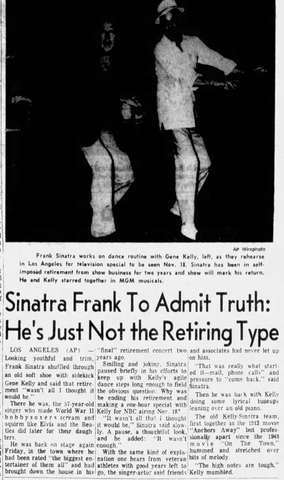
Hollywood
RCA4188 You're So Right (For What's Wrong In My Life)
(Victoria Pike/Teddy Randazzo/Roger Joyce)
Night Fighter Music (ASCAP)/Aldor Music (BMI)
Arranged & Conducted by Gordon Jenkins
(4:05) CD: 46013-2 The Complete Reprise Studio Recordings Disc 16
CD: 2155-2 Ol' Blue Eyes Is Back
LP: FS2155 Ol' Blue Eyes Is Back
RCA4189 Dream Away
(John Williams/Paul Williams)
Almo Music Corp. (ASCAP)
Arranged by Don Costa
Conducted by Gordon Jenkins
(4:17) CD: 46013-2 The Complete Reprise Studio Recordings Disc 16
CD: 2155-2 Ol' Blue Eyes Is Back
LP: FS2155 Ol' Blue Eyes Is Back
NOTE: Ed O'Brien points out that this session employed a 47 piece orchestra. Teddy Randazzo told O'Brien that "You're So Right. . ." was the easiest of all the songs he wrote for Sinatra. Listen carefully to the recording and you can hear the effects of Sinatra's two-year lay-off. He has a tough time extending the longer passages. "Dream Away"ť is a very lovely song.
ABC Wide World Of Sports
Interviewed during Ali - Norton fight
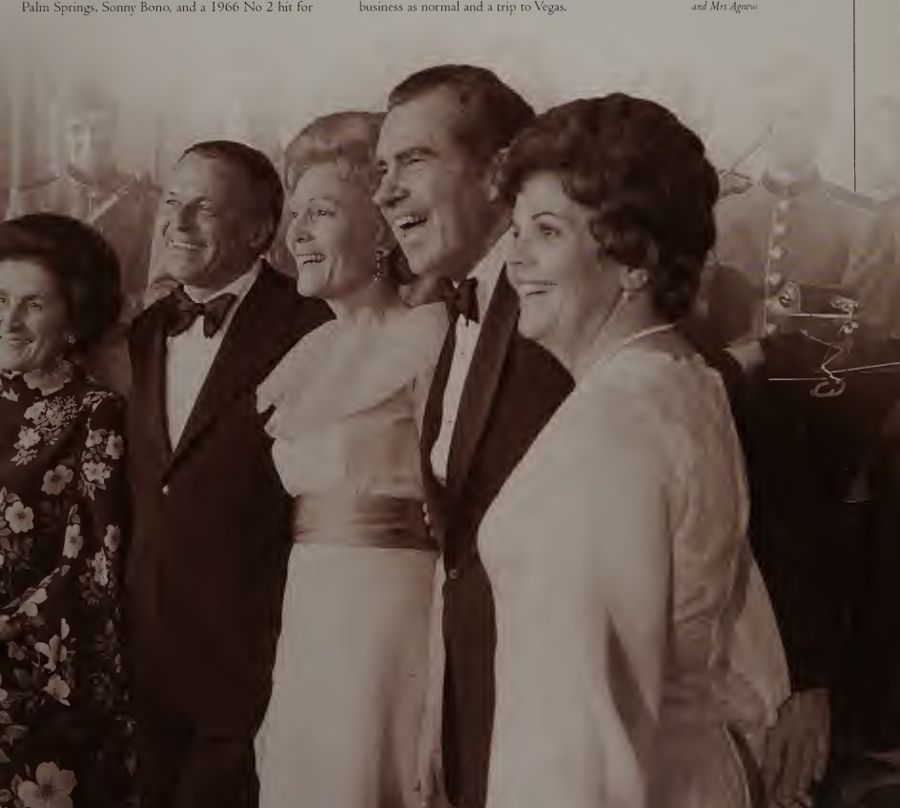
[Photograph: Taping of the Ol' Blue Eyes Is Back TV special. From Richard Havers, "Sinatra" (Dorling Kindersley, 2007), p.323.]
Frank took voice lessons from opera singer Robert Merrill to prepare, then taped the NBC comeback special in Hollywood before an invited audience. Special guest Gene Kelly joined him for shared film numbers, and Frank sang a mix including Sondheim's 'Send in the Clowns.'. (Source: Richard Havers, "Sinatra" (Dorling Kindersley, 2007).)
Dorothy Chandler Pavilion, Los Angeles, California
Stars Night III - Benefit
Other Performers: Sammy Davis Jr, Carol Lawrence
MC: Bob Hope
1. I've Got The World On A String
2. I Have Dreamed
3. monologue
4. Here's That Rainy Day
5. I Get A Kick Out Of You
Notes: Sinatra portion TT 20mins.
Dorothy Chandler Pavilion, Los Angeles, California
Stars Night III - Benefit
Other Performers: Sammy Davis Jr, Carol Lawrence
MC: Bob Hope
© 1997-2025 The Sinatra Archive
This calendar, or any parts thereof, may not be reproduced in any fashion whatsoever without the prior written permission of the publisher (The Sinatra Archive)
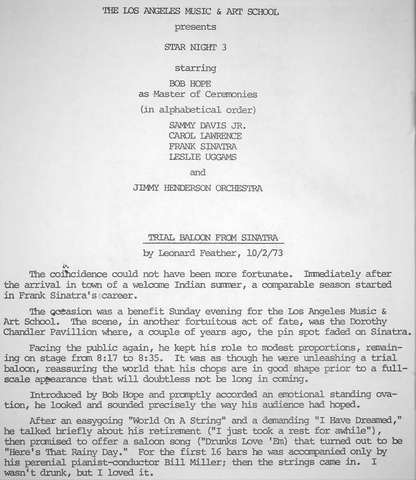
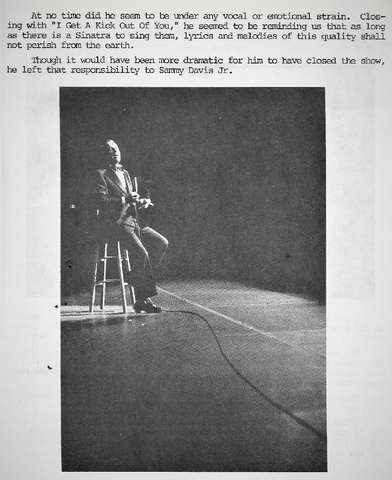
Vice President Spiro Agnew resigns, pleading no contest to one count of income tax evasion amid separate bribery and kickback allegations. Frank, a close friend, stood by him, dispatching Mickey Rudin to look into the matter and later paying Agnew's $30,000 tax penalty himself. Source: J. Randy Taraborrelli, Sinatra: Behind the Legend.
[Ol' Blue Eyes Is Back TV Special Airs]
The November 1973 television special "Ol' Blue Eyes Is Back," choreographed by Hugh Lambert with guest star Gene Kelly, marked Sinatra's return to performing; the title, which Nancy initially disliked, entered American popular culture. Sinatra had recently been named "Entertainer of the Century" by the Songwriters of America.
Source: Nancy Sinatra, "Frank Sinatra, My Father" (1985).
Ol' Blue Eyes Is Back (NBC)
Guest: Gene Kelly
Taped September 20, 1973, Burbank, California
1. You Will Be My Music
2. I Get A Kick Out Of You
3. Street Of Dreams
4. I've Got You Under My Skin
5. I've Got The World On A String
6. Medley: Last Night When We Were Young / Violets For Your Furs / Here's That Rainy Day
7. Gene Kelly intro
8. Medley w/Gene Kelly: We Can't Do That Anymore / Take Me Out To The Ballgame / For Me And My Gal / Private Skinny
9. Nice And Easy w/Gene Kelly
10. Let Me Try Again
11. Send In The Clowns
12. You Will Be My Music
Notes: 51 mins.
Ed O'Brien says Reprise was responsible for mastering the sound and the files show that the "Saloon Trilogy" was taped on September 18, 1973. Files show the rehearsal time put in by all involved was quite intense. Would love to see a DVD issued with the restored "Come Fly With Me" and "Noah." Latter was a major production number. To O'Brien, Sinatraphile Richard Warwick says he agrees. He says he has often wondered why Sinatra sang "You Will Be My Music" twice. When he started to sing it the second time he says that we didn't quite get the first time. But, in reality, he sang it all the way through twice. Could it be that because "Noah" was dropped they needed another song to fill out the program and so they chose to do the opening number again? Ed O'Brien:
I have additional information on the making of this show. The show was put together over a period of three days. The first day ( 9-18-73) was devoted to rehearsals. Sinatra ran through the pop standards and Saloon medley plus the new songs. Gene Kelly and Frank rehearsed "Can't Do That Anymore" and "Nice 'N' Easy." Reprise mastered all of the rehearsals. The following day Kelly and Sinatra taped their segment on a closed set. On the evening of the 20th(Thursday), the actual taping of the show took place. Here is how it was shot:
Gordon Jenkins and Don Costa took turns conducting the NBC orchestra Introduction
1. You Will Be My Music
Opening remarks and Standards
2. Come Fly With Me deleted from the master tape
3. Street Of Dreams
4. I've Got You Under My Skin
5. I Get A Kick Out Of You
6. I've Got The World On A String
7. Saloon Medley: Last Night When We Were Young/ Violets For Your Furs/
Here's That Rainy Day problems ensued and retakes were done.
Frank introduced Kelly to the all-star audience. Kelly had a few words to say Frank talked about the future and sang four songs from his "Ol' Blue Eyes Is Back" album.
8. Let Me Try Again
9. Noah ( choral group joined Frank onstage) deleted from master tape
10. Send In The Clowns
11 You Will Be My Music
Goodnight remarks
Reprise has a master of the entire taping. Master numbers are B-3027 thru 3043 Film
The Kissing Bandit, (New York City Film Release: November 18, 1948)
Starring: Frank Sinatra,Kathryn Grayson, J. Carroll Naish
Directed by Laslo Benedek. Produced by Joe Pasternak
Sinatra plays Ricardo, the milquetoast son of a Mexican bandit, who would rather lead a quiet life in Boston. But the family would rather that he follow in his father's footsteps and become "The Kissing Bandit". (1st DVD Release date: 2008-05-13)
Dirty Dingus Magee
(U.S. Film Release: November 18, 1970)
Starring: Frank Sinatra,George Kennedy, Anne Jackson, Michele Cary
Produced and Directed by Burt Kennedy
Sinatra plays Dirty Dingus Magee who with his old rival Hoke Birdsill (George Kennedy) take turns at being either lawman or outlaw and being rivals or partners in crime, depending on the circumstances. (1st DVD Release date: 2011-08-09)
Note: It's odd that both "The Kissing Bandit" & "Dirty Dingus Magee" both share November 18th as their initial released dates although 22 years apart.
Sinatra would often joke about "The Kissing Bandit" being one of his worse films while "Dirty Dingus Magee" is often considered his worst film. Me, I like them both --Scott
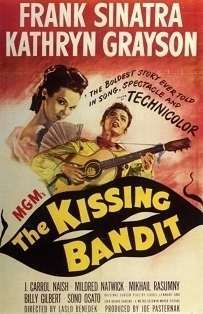
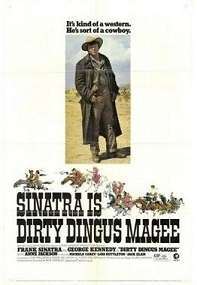
Ol' Blue Eyes Is Back (NBC)
Guest: Gene Kelly
Sinatra: Ol' Blue Eyes is back; Frank Sinatra returns in one of his specials that so often seem to air around Thanksgiving. This time, he really is back, coming out of retirement to appear with special guest star Gene Kelly. (Sunday,
7:30 p.m., NBC) Frank tells Dwight Whitney that he enjoyed retirement; "I just loved doing nothing. . . I got to see friends I hadn't seen in a long time. I got to travel without workâ ”which is so hectic. I got time to delve into art. I did what came to me when I woke up." And yet he can't resist the pull of those who want to see him one more time, or who never had the chance. In addition to his old hits, Frank sings some new songs, including "Send in the Clowns," "Let Me Try Again," and "You Will Be My Music." But it's hard to see Sinatra at home with the new music, as he himself admits. "Rock? It's influenced music but not me. Some of it I absolutely loathe. Now I see a shining light at the end of the tunnel. A lot of young composers like Neil Diamond, Joe Raposo, Jimmy Webb and Kris Kristofferson are writing a lot of wonderful things a la Larry Hart."
Chicago Tribune
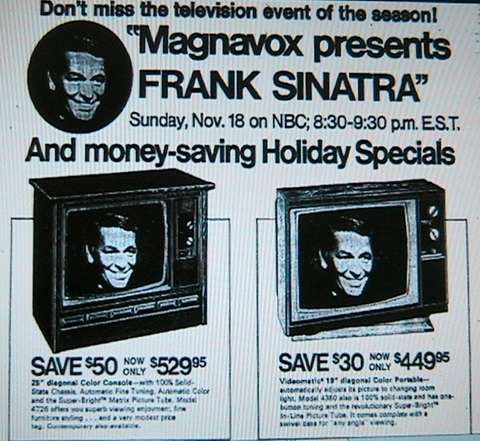
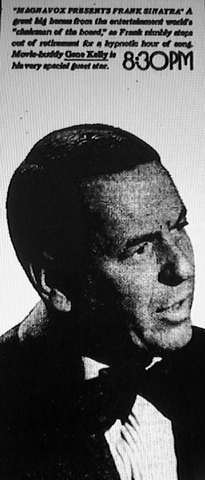
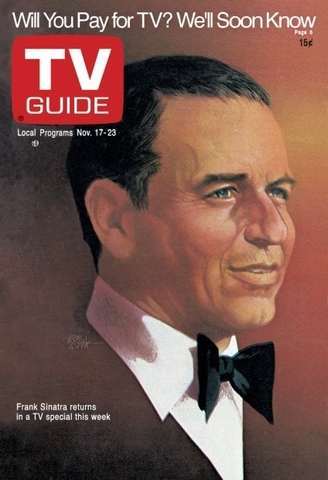
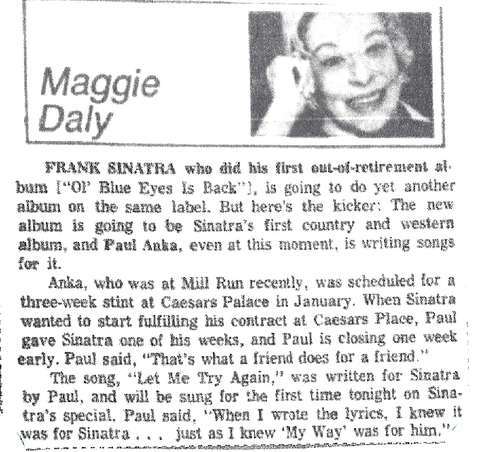
note: When I interviewed Snuff Garrett, he never mentioned a C&W project in 1973. This must have involved other players. I can't imagine Anka writing songs for such an album. Obviously nothing came of of it. Interesting to learn that Anka gave Frank that last week in January 74 at Caesars.
Ed
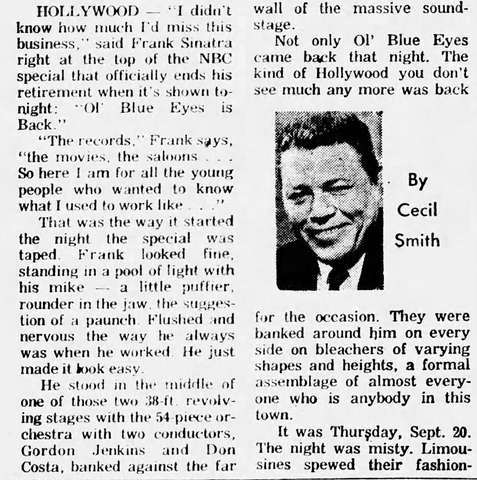
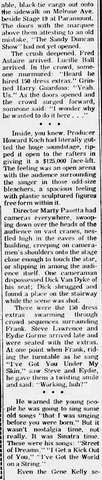
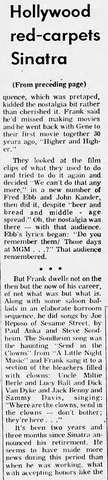
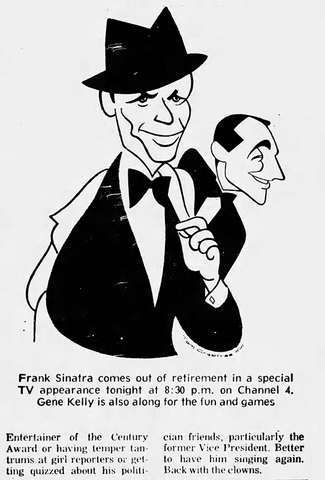
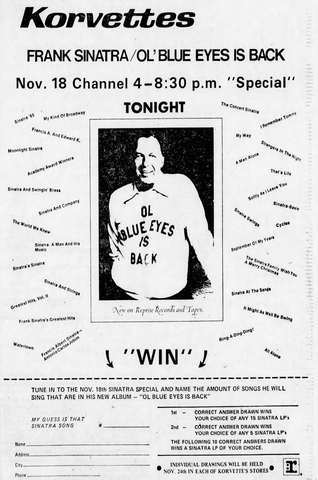
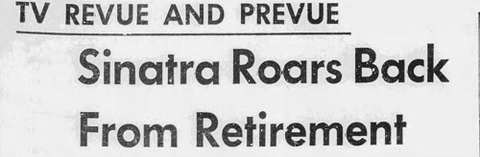
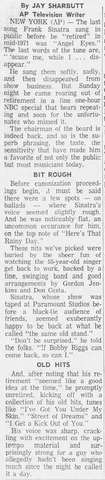
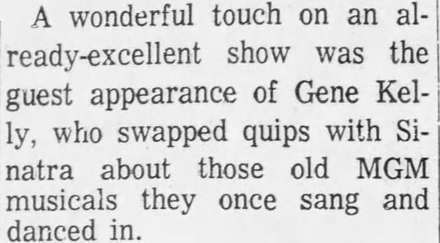
Hollywood
RCA4523 Bad, Bad Leroy Brown w/Chorus
(Jim Croce)
MCA Inc./Denjac Music Co. (ASCAP)
Arranged & Conducted by Don Costa
(2:49) CD: 46013-2 The Complete Reprise Studio Recordings Disc 16
CD: 2195-2Some Nice Things I Missed
LP: FS2195Some Nice Things I Missed
45: S1196
RCA4524 I'm Gonna Make It All The Way
(Floyd Huddleston)
Popoosa Music/WB Music Corp. (ASCAP)
Arranged & Conducted by Don Costa
(2:51) CD: 46013-2 The Complete Reprise Studio Recordings Disc 16
CD: 2195-2Some Nice Things I Missed
LP: FS2195Some Nice Things I Missed
45: S119
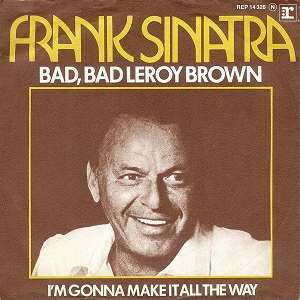
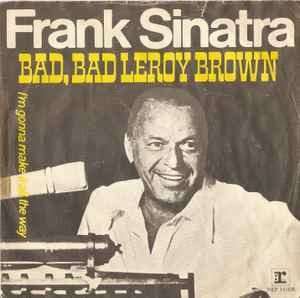
Nancy Sinatra, pregnant with her first child, and husband Hugh Lambert flew with Frank from a Las Vegas show to Palm Springs late at night, arriving to a small welcoming crowd including a mariachi band playing 'Jingle Bells.' On Christmas Day (also Dolly Sinatra's birthday), Dolly refused to join the family trip to the mountain house, leading to a small family standoff.
Frank Sinatra (quoted): "I'm not going up that goddamn mountain."
Source: Nancy Sinatra, Frank Sinatra: An American Legend, 1995.
On Christmas Day 1973, which was also Dolly Sinatra's birthday, the family planned to celebrate at the Sinatra mountain house above Palm Springs, but Dolly refused to make the trip, leading to a small standoff between her and Frank before the rest of the family went on without her. Source: Nancy Sinatra, "Frank Sinatra, My Father" (1985).
Paul Compton, KGIL Radio
Paul Comptom interviews Sinatra 5 mins.
Paul Comptom, KGIL Radio
Paul Comptom interviews Sinatra 5 mins.
[A University Promise Kept a Decade Later]
Nancy Sinatra: Sinatra paid for an entire benefit concert's orchestra, supporting acts and travel expenses out of his own pocket to help a Santa Clara college build a gymnasium, fulfilling an offhand promise he had made to a university official roughly a decade earlier.
Source: Nancy Sinatra, Frank Sinatra: An American Legend, 1995.
[A Three-Week-Old Grandchild Surprises Dad on Father's Day]
Nancy Sinatra: For Sinatra's first Father's Day as a grandfather, Nancy and her husband flew to Las Vegas with the baby's nanny, planted three-week-old Angela Jennifer in her bassinet outside his suite door, rang the bell and hid. When he opened the door to find her cooing up at him, he scooped her up and called out to staff and musicians up and down the hallway to come meet her.
Source: Nancy Sinatra, Frank Sinatra: An American Legend, 1995.
[Buck Buchwach's Life-Saving Phone Calls]
Nancy Sinatra: Learning that his old friend, Honolulu newspaperman Buck Buchwach, had heart trouble, Sinatra ordered him to fly to Houston to see Dr. Michael DeBakey, who performed a double bypass the following day. During Buchwach's recovery, Sinatra called him nearly every afternoon from wherever he was to check in, joke with him and boost his spirits, calls Buchwach later credited as more restorative than any medicine.
Source: Nancy Sinatra, Frank Sinatra: An American Legend, 1995.
[First Grandchild, Angela Jennifer Lambert, Is Born]
Sinatra's first grandchild, Angela Jennifer Lambert, is born in Los Angeles; Sinatra hosts the American Film Institute's Salute to James Cagney, tours Japan and Australia, and stars in the live TV special "The Main Event" from Madison Square Garden.
Source: Nancy Sinatra, "Frank Sinatra, My Father" (1985).
[Las Vegas Names Sinatra Man Of The Year]
To mark his comeback engagements, guests at his shows received medallions proclaiming his return, and the city of Las Vegas honoured him with its Man of the Year award.
Source: The Rough Guide to Frank Sinatra, chapter "I Want to Be a Part of It, 1971-98."
[Recording Sessions While Nancy Awaits Her First Child]
Nancy was in Palm Springs with her mother and stepfather Hugh, in the final weeks of a difficult pregnancy, while her father recorded Some Nice Things I've Missed. At one session's end he asked a priest to say a prayer for her, remarking that he was about to become a grandfather.
Source: Nancy Sinatra, "Frank Sinatra, My Father" (1985).
[Sinatra Honors Bennett During The Main Event]
During Sinatra's 1974 televised concert special The Main Event, he singled out and praised Bennett's singing on air. Bennett's terminally ill mother heard the tribute from home, which he believes helped her live several more months.
Source: Charles Pignone, "Frank Sinatra 100" (2015).
[Sinatra Cancels German Tour Over 'Super-Gangster' Coverage]
After German newspapers labeled him a 'super-gangster,' an angry Sinatra cancelled his planned tour of the country and vented on stage at London's Royal Albert Hall, pointedly referencing the Nazi era in his tirade against the coverage.
Source: The Rough Guide to Frank Sinatra, chapter "I Want to Be a Part of It, 1971-98."
[Sinatra Breaks Off Relationship With Barbara]
Worn down by his mother Dolly's open hostility toward Barbara and by Barbara's wish to marry, Sinatra ended the relationship. The couple reconciled not long afterward, following a reported dalliance between Sinatra and Jackie Onassis.
Source: The Rough Guide to Frank Sinatra, chapter "I Want to Be a Part of It, 1971-98."
[Press Tirade Derails Australian Tour]
Irritated by hostile press coverage ahead of his arrival, Sinatra insulted Australian journalists in coarse terms from the stage of Melbourne's Festival Hall. Journalists, stagehands, waiters and transport unions then refused to service his shows, forcing him to cancel the tour and issue a grudging semi-retraction just to be allowed to leave the country.
Source: The Rough Guide to Frank Sinatra, chapter "I Want to Be a Part of It, 1971-98."
[Some Nice Things I've Missed Released]
Sinatra released Some Nice Things I've Missed, which turned out to be his only other studio album of the 1970s besides his comeback record, effectively confirming that his strongest recording years were behind him.
Source: The Rough Guide to Frank Sinatra, chapter "I Want to Be a Part of It, 1971-98."
[Tina Sinatra Marries Wes Farrell]
Tina Sinatra married record executive Wes Farrell in Frank's penthouse apartment at Caesars Palace. Walking her down the aisle, Frank calmed her nerves by joking she could always get a divorce.
Source: Nancy Sinatra, "Frank Sinatra, My Father" (1985).
[Two Decades Of Near-Constant Touring]
From 1974 through the end of 1994, Sinatra spent roughly two decades almost continuously performing in nightclubs, arenas, concert halls, and theaters for audiences worldwide.
Source: Charles Pignone, "Frank Sinatra 100" (2015).
[Bud Abbott dies broke; Sinatra pays for funeral]
Consiglio: Bud Abbott died in Arizona in 1974, largely forgotten and broke despite his earlier fame. When Sinatra heard, he paid for the funeral.
Source: Tony Consiglio (as told to Franz Douskey), "Sinatra and Me: The Very Good Years" (2012)
[Consiglio introduces Mary to Sinatra]
Consiglio: In 1974, before marrying her, Consiglio brought his future wife Mary and some friends backstage to meet Sinatra after a performance at the Civic Center in Providence, Rhode Island. After talking with Mary, Sinatra told Consiglio she was the right one for him.
Source: Tony Consiglio (as told to Franz Douskey), "Sinatra and Me: The Very Good Years" (2012)
[awards]
Sinatra hosted the American Film Institute's televised lifetime achievement tribute to James Cagney; in the process, Cagney told him that his famous "you dirty rat" Cagney impersonation was the worst he'd ever heard.
No corresponding dated entry could be identified in the chronology for this film/context.
Source: Tom Santopietro, "Sinatra in Hollywood" (2008), Knight-Errant (pt. 2) / That's Life
[controversy]
A 1974 dustup with journalists in Australia drew worldwide attention after Sinatra railed against them as "bums and parasites" and insulted female reporters as "hookers"; the fallout led Australian stagehands and maintenance workers to strike until Sinatra issued a grudging apology so his plane could depart. Lauren Bacall likened him to Don Quixote tilting at windmills.
No corresponding dated entry could be identified in the chronology for this film/context.
Source: Tom Santopietro, "Sinatra in Hollywood" (2008), Knight-Errant (pt. 2) / That's Life
[Sinatra's 'bunch of fags' remark sparks Australian union standoff]
During the Australian tour, Barbara Marx accompanied Frank, reportedly displeasing his mother Dolly. After a hostile press conference, Frank branded the Australian press with a slur, prompting union leader (and future PM) Bob Hawke to threaten Frank would not leave the country without an apology, with unions refusing to refuel his plane until Frank's lawyer Mickey Rudin negotiated a joint statement.
Source: Richard Havers, "Sinatra" (Dorling Kindersley, 2007).
[Waldorf-Astoria Dinner for Governor Hugh Carey]
At a $5,000-a-plate dinner honoring New York Governor Hugh Carey at the Waldorf-Astoria, Sinatra performed and made joking political remarks about Ronald Reagan, Gerald Ford, and Jimmy Carter.
Source: George Carpozi Jr., Frank Sinatra: Is This Man Mafia? (New York: Manor Books, 1979).
[Australia tour incident, first concert -- critical commentary]
Billy Byers / Irv Cottler: At the July 9, 1974 Australia concert (opening the postretirement Pacific Rim tour after Budokan Hall dates on July 2-3 and a USS Midway show on July 5), Sinatra exploded at the press over an incident where reporters bribed his driver to drop the band at the bottom of a hill rather than the rehearsal hall at the top, forcing an aging Sinatra to run uphill away from photographers; he called one reporter a 'whore.' The Australian labor unions then boycotted him, stranding him without fuel to leave the country. Trombonist Billy Byers believed the episode was engineered by a politician seeking headlines; drummer Irv Cottler insisted 'Frank was one hundred percent right,' claiming the public marched in Sydney with signs reading 'We want Sinatra! Down with the press!'
Source: Will Friedwald, "Sinatra! The Song Is You: A Singer's Art" (2018 revised edition), Ch. 10, "Concert Years" (1973-1994)
[The Main Event (televised concert, Madison Square Garden) -- critical commentary]
Tony Bennett: In his foreword, Tony Bennett recalls watching the televised 1974 Main Event concert with his bedridden mother and hearing Sinatra tell the audience, between songs, that he considered Bennett the only singer to extend his musical heritage. Bennett calls it one of the great moments of both their lives. (Exact broadcast date per standard discography is October 13, 1974, Madison Square Garden.)
Source: Will Friedwald, "Sinatra! The Song Is You: A Singer's Art" (2018 revised edition), Ch. 1, "Night and Day" (Sinatra style overview)
Caesars Palace, Las Vegas, Nevada (25-31)
First Show
Nat Brandwynne Orchestra Conducted By: Gordon Jenkins
OA: Pat Henry & Joey Heatherton
1. Come Fly With Me
2. I Get A Kick Out Of You
3.. Bad, Bad Leroy Brown
4. You Will Be My Music
5. You Make Me Feel So Young
6. medley: Last Night When We Were Young / Violets For Your Furs /
Here's That Rainy Day
7. monologue
8. Let Me Try Again
9. My Kind Of Town
10. Send In The Clowns
11. I've Got You Under My Skin
12. The Summer Knows
13. That's Life
14. If
15. I've Got The World On A String
Notes: TT 66mins.
Caesars Palace, Las Vegas, Nevada (25-31)
Second Show
Nat Brandwynne Orchestra Conducted By: Gordon Jenkins
TALENT REVIEW:
SINATRA BACK;
STOUT STARTER
LAS VEGAS:Frank Sinatra made his long awaited return to the Strip. Opening the bill was Joey Heatherton. Her last engagemnts at Caesars Palace, Sahara- Tahoe and the Riviera were semi-disasters. This time she was better, but consistently fails to let her talent work for her. She tries so terribly hard to be sexy that she looks foolish. Being the only girl on the bill was to her advantage. Comedian Pat Henry has "been carrying Frank for years" and always in fine style. Sinatra walked on stage Friday and immediately received a standing ovation. He was there to sing. The crowd was black tie, star dusted, champagne drinking and would have awarded him a standing ovation had he decided to play the kazoo. He received too many standing ovations to count and considering the majority of the audience knew Frank it didn't mean too much.
Sinatra was nervous and tense. It became apparent that even more than the crowd wanting Sinatra back, was Sinatra's desire to be back. It was his own personal triumph. The most impressive thing about his presentation was the obvious amount of thought and hard work that went into the song selections and arrangements. Some of Sinatra's notes weren't what they once were. He looks his age and he looks good. He picked songs which were reflective, romantic and fitting his age. Songs whose lyrics were perhaps even more effective when a note cracked or had a rasping edge. He is careful with the up-beat tunes. Sinatra knows exactly why he has selected a song. "Bad, Bad Leroy Brown" allowed Sinatra's own sassy personality to guide and enhance the meaning.
Mid-way through he sat down on a stool and began to relax. He became the Sinatra whose singing knows no peer. A pinpoint spot and the audience in emotional silence as they finally began to actually listen and really appreciate what they heard. Saloon song medley and mood songs. Paul Anka and Sammy Cahn's "Let's Me Try Again," the poignant "Send in the Clowns" and "You Will Be My Music.
Sinatra at perfection.
Sinatra re-visited Sunday midnight show was an experience. The crowd was again 'special' in that you had to have the juice to get it. But it wasn't the show biz see-the- girl-I'm-with-and-her-new-dress group. These were Sinatra fans, many of whom had never before seen him in person. It was an in control, class, sensitive Sinatra from start to finish. Gone was the tense, nervous, fidgeting man of opening night. It was the "That's Life" Sinatra full of sass, assurance, belting out the fantastic Gordon Jenkins charts. Sinatra brought the audience to an emotional high the minute he walked out on stage and never once let them down. When they awarded him a standing ovation it was from the heart and well-earned.
Sinatra is a good now as he ever was, if anything his lyric interpretation is better. The show's logo is "When the Man Sings the Whole World Is in Love" and so it is. Enormous credit to Gordon Jenkins for his flawless arrangements and conducting of the Nat Brandwynne Orchestra.
Laura Deni
Billboard
Early February 1974
Shows reviewed: January 25 and 27(late show), 1974 note: Frank's first engagement after coming out retirement.
The opening night crowd was a who's who of Hollywood celebrities including Gregory Peck, Kirk Douglas and Natalie Wood. The show got underway at 10:PM and Frank sang 16 songs. He did two shows on the 26th and 27th. A case of Vegas throat forced him to cancel both the 28th and 29th appearances. Frank did one show on the 30th and closed the engagement with two shows on the 31st. In all there were eight shows. The song selection included numbers Sinatra had not performed before in concert.. "Bad,Bad Leroy Brown," "If," "Let Me Try Again," You Will Be My Music" and "Send In The Clowns" would be introduced at Caesars and sung many times over the next few years. Frank would also offer a stunning "Saloon" medley that would often be the highlight of an evening's performance. The only concert performance of "Bang, Bang," with the big Jenkins arrangement, was done at the first show on the 26th. Frank would also sing "The Summer Knows" on the 25th and 30th. The Bergman-Legrand tune would never be done again on stage but a recording was laid down along with "If" on May 7, 1974. Every show during the engagement was SRO.
Frank agreed to another week starting on March first, but throats problems caused another cancellation. He did play a two week engagement in June with Ella Fitzgerald and the Count Basie band. Over the next 20 years Sinatra would do countless nightclub and concert performances throughout the world.
Extra note: Frank's daughter, Tina, would marry Wes Farrell before the first show on the 26th. The newlyweds would attend that show and be introduced by Frank. Tony Bennett was also in the audience.
Caesars Palace, Las Vegas, Nevada (25-31)
Nat Brandwynne Orchestra Conducted By: Gordon Jenkins
OA: Pat Henry & Joey Heatherton
CAESARS MEDALLION
This was a special giveaway during a performance marking Franks return, and the beginning of the "Ol' Blue eyes is back!" era.
------------------------------------------------
© 1997-2026 The Sinatra Archive
This calendar, or any parts thereof, may not be reproduced in any fashion whatsoever without the prior written permission of the publisher (The Sinatra Archive)
[image referenced in source but could not be recovered]
[image referenced in source but could not be recovered]
[image referenced in source but could not be recovered]
[image referenced in source but could not be recovered]
[image referenced in source but could not be recovered]
[image referenced in source but could not be recovered]
Frank had vowed never to play Caesars Palace again after casino manager Sanford Waterman pulled a gun on him there in 1970, but returned for this comeback engagement after Waterman was indicted for racketeering. Source: J. Randy Taraborrelli, Sinatra: Behind the Legend.
Caesars Palace, Las Vegas, Nevada (25-31)
First Show
Nat Brandwynne Orchestra Conducted By: Gordon Jenkins
1. Come Fly With Me
2. Bad, Bad Leroy Brown
3. You Will Be My Music
4. You Make Me Feel So Young
5. Send In The Clowns
6. My Kind Of Town
7. monologue
8. Let Me Try Again
9. Bang, Bang
10. I've Got You Under My Skin
11. If
12. That's Life
13. I've Got The World On A String
14. The House I Live In
Notes: TT 62mins. Tina Sinatra marries Wes Farrell in Las Vegas.
Ed O'Brien:
Sinatra would record Sonny Bono's "Bang, Bang," 6-4-73, with a 45 piece orchestra, and, 4-8-81, with a 52 piece orchestra. In the winter-spring of 1982, Frank would sing the song in concert with just Tony Mottola backing him on guitar. There would be close to two dozen performances. But the huge Jenkins chart would only be sung at the first show at Caesars Palace, 1-26-74.
Caesars Palace, Las Vegas, Nevada
Second Show
Nat Brandwynne Orchestra Conducted By: Gordon Jenkins
1. Come Fly With Me
2. Bad, Bad Leroy Brown
3. You Will Be My Music
4. You Make Me Feel So Young
5. medley: Last Night When We Were Young / Violets For Your Furs /
Here's That Rainy Day
6. monologue
7. My Kind Of Town
8. Let Me Try Again
9. Send In The Clowns
10. I've Got You Under My Skin
11. If
12. That's Life
13. I've Got The World On A String
14. The House I Live In
Notes: TT 63mins.
Caesars Palace, Las Vegas, Nevada
Nat Brandwynne Orchestra Conducted By: Gordon Jenkins
Original Caesars Palace – Las Vegas – program signed by FRANK SINATRA. Signed by Sinatra in black felt-tip ink on January 26, 1974.
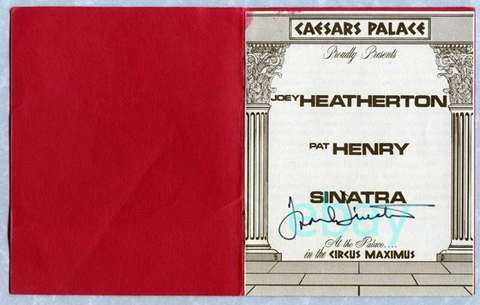
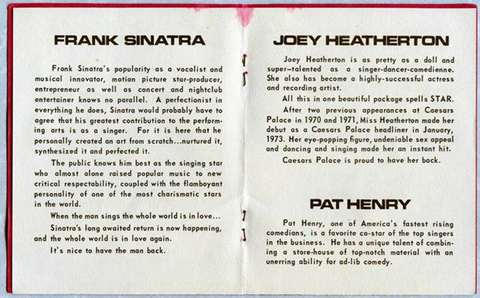
Frank gave away his daughter Tina at her wedding to record executive Wes Farrell at Caesars Palace. As they walked down the aisle and Tina grew anxious, Frank joked to ease the tension.
Frank Sinatra (quoted): "Don't worry, Pigeon, you can always get a divorce."
Source: Nancy Sinatra, Frank Sinatra: An American Legend, 1995.
Caesars Palace, Las Vegas, Nevada (25-31)
First Show
Nat Brandwynne Orchestra Conducted By: Gordon Jenkins
1. Come Fly With Me
2. Bad, Bad Leroy Brown
3. You Will Be My Music
4. You Make Me Feel So Young
5. medley: Last Night When We Were Young / Violets For Your Furs /
Here's That Rainy Day
6. My Kind Of Town
7. Let Me Try Again
8. I've Got You Under My Skin
9. If
10. That's Life
11. monologue
12. I've Got The World On A String
13. The House I Live In
Notes: TT 60mins.
Caesars Palace, Las Vegas, Nevada
Second Show
Nat Brandwynne Orchestra Conducted By: Gordon Jenkins
1. Come Fly With Me
2. Bad, Bad Leroy Brown
3. You Will Be My Music
4. You Make Me Feel So Young
5. medley: Last Night When We Were Young / Violets For Your Furs /
Here's That Rainy Day
6. monologue
7. My Kind Of Town
8. Let Me Try Again
9. Send In The Clowns
10. I've Got You Under My Skin
11. If
12. That's Life
13. I've Got The World On A String
14. The House I Live In
Notes: TT 62mins.
Caesars Palace, Las Vegas, Nevada (25-31)
Notes: Both shows cancelled due to sore throat.
Caesar's Palace, Las Vegas, Nevada (25-31)
Notes: show cancelled due to sore throat.
Caesars Palace, Las Vegas, Nevada
Nat Brandwynne Orchestra Conducted By: Gordon Jenkins
1. Come Fly With Me
2. Bad, Bad Leroy Brown
3. You Will Be My Music
4. I Get A Kick Out Of You
5. medley: Last Night When We Were Young / Violets For Your Furs /
Here's That Rainy Day
6. monologue
7. Let Me Try Again
8. My Kind Of Town
9. Send In The Clowns
10. I've Got You Under My Skin
11. The Summer Knows
12. That's Life
13. If
14. I've Got The World On A String
15. The House I Live In
Notes: TT 68mins.
Ed' Obrien:
Frank did one show on the 25th, two shows on the 26th and the 27th. A case of Vegas throat forced him to cancel both the 28th and the 29th appearances. Frank did one show on the 30th and closed the engagement with two shows on the 31st.
In all there were eight shows.
Caesars Palace, Las Vegas, Nevada
First Show
Nat Brandwynne Orchestra Conducted By: Gordon Jenkins
1. Come Fly With Me
2. Bad, Bad Leroy Brown
3. If
4. I Get A Kick Out Of You
5. Send In The Clowns
6. My Kind Of Town
7. Let Me Try Again
8. monologue
9. I've Got You Under My Skin
10. medley: Last Night When We Were Young / Violets For Your Furs /
Here's That Rainy Day
11. That's Life
12. I've Got The World On A String
13. The House I Live In
Notes: TT 80mins.
Caesars Palace, Las Vegas, Nevada
Second Show
Nat Brandwynne Orchestra Conducted By: Gordon Jenkins
1. Come Fly With Me
2. Bad, Bad Leroy Brown
3. If
4. I Get A Kick Out Of You
5. Send In The Clowns
6. My Kind Of Town
7. Let Me Try Again
8. monologue
9. I've Got You Under My Skin
10. medley: Last Night When We Were Young / Violets For Your Furs /
Here's That Rainy Day
11. That's Life
12. I've Got The World On A String
13. The House I Live In
Notes: TT 68mins.
Ed O'Brien:
Frank's closing night of the Caesars engagement. He told the audience it was his first club dates in more than three years. He added a coda to "Leroy Brown" that was repeated three times: " You better believe it." Repeated "told" in the verse to "I Get A Kick Out Of You, " then threw in the aside "Tune up, Frank." Commented on missing some shows with the following " I lost 14 lbs for this engagement, didn't drink, didn't smoke, got a terrible sore throat, never gonna do that again." Audience begged him to sing "My Way" throughout the show. After singing "Let Me Try Again," he credits Anka and mentions "My Way." Let's the crowd know he has no intention of doing it. His pipes are just about out of gas and he still needs to get out of town. At the end of "That's Life," he thrills the crowd when he says "Bet your 'blank' Ol' Blue Eyes Is Back." The beginnings for many, many nightclub appearances over the next 20 plus years.
Civic Auditorium, San Jose, California
Santa Clara University Benefit
Orchestra Conducted By: Gordon Jenkins
1. Come Fly With Me
2. I Get A Kick Out Of You
3. You Will Be My Music
4. Bad Bad Leroy Brown
5. Send In The Clowns
6. I've Got You Under Skin
7. Let Me Try Again
8. My Kind Of Town
Notes: TT 41mins.
Civic Auditorium, San Jose, California
Santa Clara University Benefit
Orchestra Conducted By: Gordon Jenkins
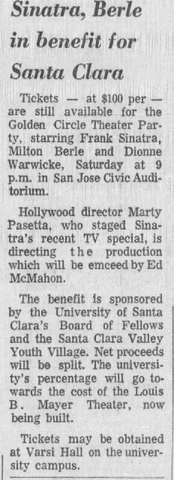
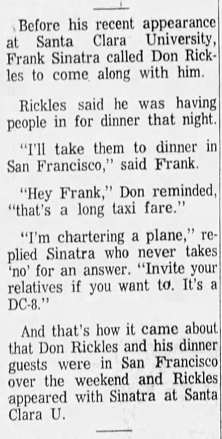
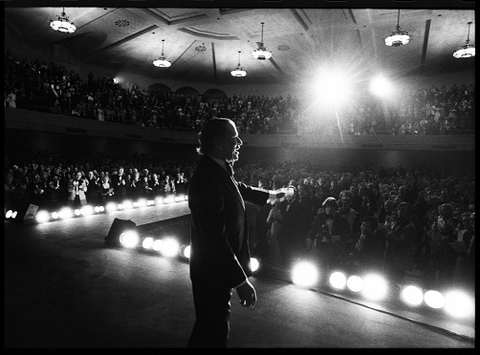
Frank gave a benefit concert in Santa Clara, California, raising over $200,000 for a college gymnasium, personally covering the orchestra and travel costs himself because he had once casually promised a university official he'd help raise money someday.
Source: Nancy Sinatra, Frank Sinatra: An American Legend, 1995.
American Film Institute Salutes James Cagney
Network: CBS
Monday
Host: Frank Sinatra
Guests: Charlton Heston, Bob Hope, John Wayne, George C. Scott, Doris Day, Jack Lemmon, Shirley MacLaine, Cicely Tyson, George Stevens Jr., Ronald Reagan, Frank Gorshin, George Segal
Taped March 13, 1974
1. My Way (Parody)
Notes: 75 min.
Ed O'Brien:
It would top the Nielsen ratings for the week. Sinatra would sing a parody of "My Way," with Nelson Riddle conducting the studio orchestra and Sammy Cahn supplying the special lyrics.
American Film Institute Salutes James Cagney
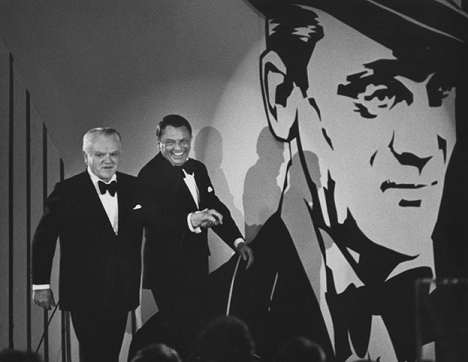
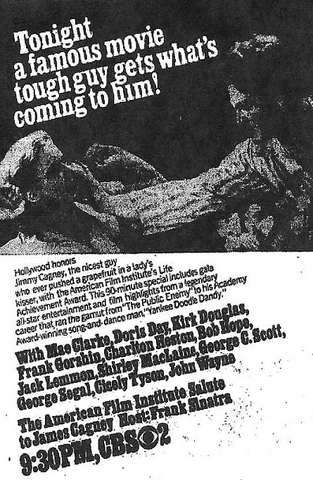
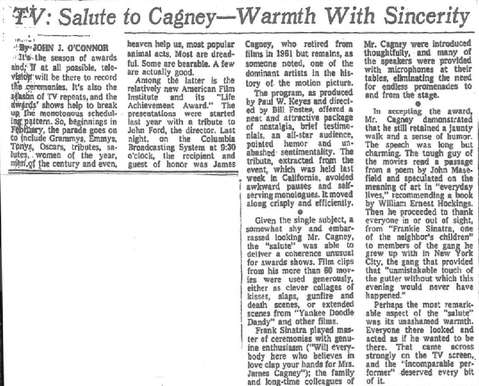
Fontainebleau, Miami, Florida
The Miracle Ball - St. Judes Benefit
Orchestra Conducted By: Gordon Jenkins
Introduced By: Danny Thomas
1. Come Fly With Me
2. I Get A Kick Out Of You
3. Bad, Bad Leroy Brown
4. If
5. medley: Last Night When We Were Young / Violets For Your Furs /
Here's That Rainy Day
6. monologue
7. Let Me Try Again
8. My Kind Of Town
9. Send In The Clowns
10. I've Got You Under My Skin
11.. That's Life
12. I've Got The World On A String
Notes: TT 69mins.
Fontainebleau, Miami, Florida
The Miracle Ball - St. Judes Benefit
Orchestra Conducted By: Gordon Jenkins
Introduced By: Danny Thomas
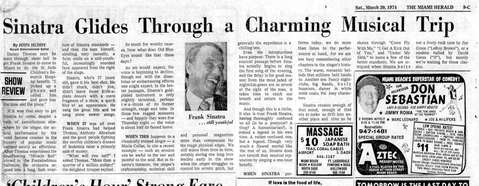
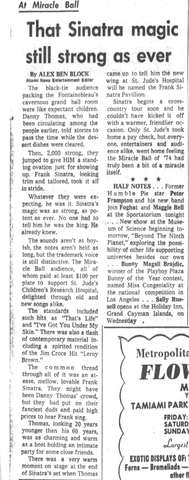
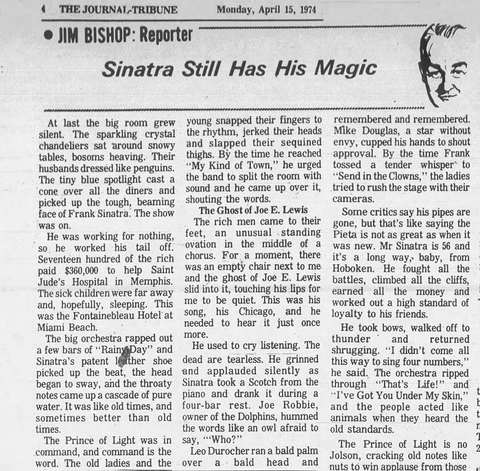
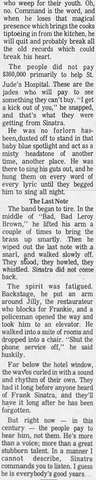
Carnegie Hall, New York City
Variety Clubs Int. Benefit
Key Musicians: Irv Cottler (drums), Al Viola (guitar), George Duvivier (bass), Joe Malin (concertmaster), Bill Miller (piano).
Orchestra Conducted By: Bill Miller
1. overture
2. Come Fly With Me
3. I Get A Kick Out Of You
4. Don't Worry 'Bout Me
5.. If
6. Bad, Bad, Leroy Brown
7. saloon medley: Last Night When We Were Young / Violets For Your Furs / Here's That Rainy Day
8. monologue
9.. My Way
10.. You Will Be My Music
11. I've Got You Under My Skin
12. Send In The Clowns
13. That's Life
14. There Used To Be A Ballpark
15. My Kind Of Town
16. chaser "My Way"
Notes: This Was Recorded By Reprise. It was to be used on the unfinished 2LP Sinatra SRO.. For more information about this project see the "Lost Projects" section in the Studio Recordings sections. TT 72mins.
NOTE: In response to an inquiry Sinatraphile J. Daniels as to why Reprise did not release the recording, Ed O'Brien reports that Frank stopped in the middle of Come Fly With Me, blew some of the lyrics on I Get a Kick out of You and My Way. Reprise taped more of that April tour and put together a 20 song two LP set titled "Sinatra SRO." Sinatra listened to a tape of it and wasn't pleased enough to allow a release. Reprise did master and make available to Music of Your Life the Saloon Triology from Carnegie.
In the fall of 74, O'Brien continues, Reprise taped Sinatra in Boston, Philadelphia, Pittsburgh, New York, and Buffalo. The Main Event is culled from those performances. Lee Herschberg told O'Brien how excited everyone was when Reprise decided to tape the Retirement Concert, June 13, 1971. Unfortunately, the orchestral mike went dead early in the show. Wally Heider, who taped many a Sinatra performance, worked with Lee that night and was screaming for someone to do something. Lee contacted the AFI and tried to splice in to the Reprise, but the sound was much too different for a decent released.
O'Brien says he loves Sinatra's tribute to Hank Aaron at Carnegie Hall. He sang There Used to Be a Ballpark in honor of Aaron doing his thing and as a reminder of the teams that had left New York. O'Brien is sure that with a little bit of work that show could be issued on CD.
Ed O'Brien:
When this concert was finally issued in 2009, the glitches remained intact. There was some editing of Frank's remarks regarding a few TV journalists and other comments, but that was it. When Sinatra listened to the Reprise recording of this concert, back in early May of 1974, he rejected the idea of it being released.
Ed O'Brien (2014):
It seems impossible that 40 years have flown by since that rainy night at Carnegie Hall. Frank had only made a few appearances at the hollowed hall prior to 4-8-74. In all, he would play there 66 times in his career. And, of course, the great Henry Aaron broke the record that would never be broken. Standing on the stage in Carnegie Hall, Sinatra honored Mr Aaron by singing Joe Raposo's haunting metaphor for all that we lose, "There Use To Be A Ballpark."
Carnegie Hall, New York City
Variety Clubs Int. Benefit
Key Musicians: Irv Cottler (drums), Al Viola (guitar), George
Duvivier (bass), Joe Malin (concertmaster), Bill Miller (piano).
Orchestra Conducted By: Bill Miller
Frank Sinatra and Jilly Rizzo attend a party at 21 in New York City following Frank Sinatra's concert at Carnegie Hall on April 8, 1974.
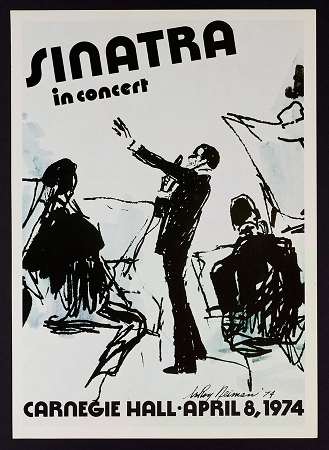
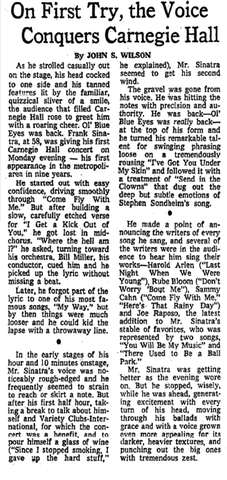
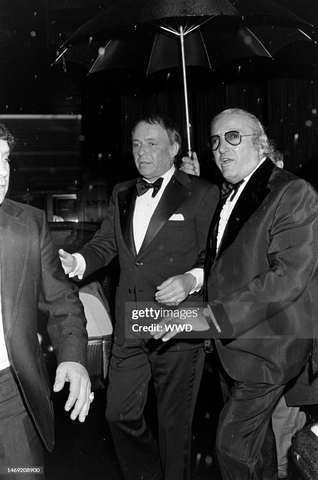
Nassau Coliseum, Uniondale, New York
Variety Clubs Int. Benefit
Key Musicians: Irv Cottler (drums), Al Viola
(guitar), George Duvivier (bass), Joe Malin
(concertmaster), Bill Miller (piano).
Musicians: Joe Ferronte, John Frosk, Dick Perry,
Marvin Stamm (trumpets), Bob Alexander, Wayne
Andre, Sy Berger, Paul Faulesa (trombones), John
Camoo, Sid Cooper, Lewis Del Gotto, Bernie Kaufman (reeds), Al Klink(sax) Orchestra (32 piece) Conducted By: Bill Miller
Opening Act: The Lockers
Opening Comedian: Pat Henry
1. Come Fly With Me
2. I Get A Kick Out Of You
3. Don't Worry 'Bout Me
4. If
5. Bad, Bad Leroy Brown
6. saloon medley: Last Night When We Were Young / Violets For Your
Furs / Here's That Rainy Day
7. My Way
8. monologue
9. You Will Be My Music
10. I've Got You Under My Skin
11. Send In The Clowns
12. That's Life
13. There Used To Be A Ballpark
14. My Kind Of Town
Notes: This Was Recorded By Reprise But Has Not
Been Released. It was to be used on the unfinished 2LP Sinatra SRO. For more information about this project see the
"Lost Projects" section in the Studio Recordings sections. TT 60mins.
Nassau Coliseum, Uniondale, New York
Nassau Coliseum, Uniondale, New York
Variety Clubs Int. Benefit
Key Musicians: Irv Cottler (drums), Al Viola (guitar), George Duvivier (bass), Joe Malin (concertmaster), Bill Miller (piano).
Orchestra Conducted By: Bill Miller
1. I Get A Kick Out Of You
2. Don't Worry 'Bout Me
3. If
4.. Bad, Bad Leroy Brown
5. saloon medley: Last Night When We Were Young / Violets For Your
Furs / Here's That Rainy Day
6. My Way
7. You Will Be My Music
8. I've Got You Under My Skin
9. monologue
10. Send In The Clowns
11. My Kind Of Town
Notes: This Was Recorded By Reprise But Has Not Been Released. It was to be used on the unfinished 2LP Sinatra SRO)
Ed O'Brien:
Sinatra introduced Stephen Sondheim after "Clowns."
He apologized for not getting the lyric letter perfect. He told Sondheim that he was a little nervous with him there.
Nassau Coliseum, Uniondale, New York
Variety Clubs Int. Benefit
Key Musicians: Irv Cottler (drums), Al Viola (guitar), George Duvivier (bass), Joe Malin (concertmaster), Bill Miller (piano).
Orchestra Conducted By: Bill Miller
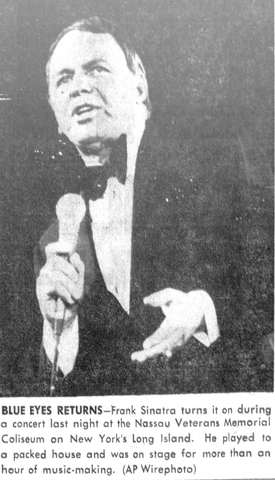
Nassau Coliseum, Uniondale, New York
Variety Clubs Int. Benefit
Key Musicians: Irv Cottler (drums), Al Viola (guitar), George Duvivier (bass), Joe Malin (concertmaster), Bill Miller (piano).
Orchestra Conducted By: Bill Miller
1. I Get A Kick Out Of You
2. Don't Worry 'Bout Me
3. If
4. Bad, Bad Leroy Brown
5. saloon medley: Last Night When We Were Young / Violets For Your
Furs / Here's That Rainy Day
6. My Way
7. monologue
8. You Will Be My Music
9. I've Got You Under My Skin
10. Send In The Clowns
11. My Kind Of Town
Notes: This Was Recorded By Reprise But Has Not Been Released. It was to be used on the unfinished 2LP Sinatra SRO.
For more information about this project see the "Lost Projects" section in the Studio Recordings sections.. TT 55mins.
The Omni, Atlanta, GA
Variety Clubs Int. Benefit
Key Musicians: Irv Cottler (drums), Al Viola (guitar), George Duvivier (bass), Joe Malin (concertmaster), Bill Miller (piano).
Orchestra Conducted By: Bill Miller
1. I Get A Kick Out Of You
2. Don't Worry 'Bout Me
3. I've Got You Under My Skin
4.. Bad, Bad Leroy Brown
5. saloon medley: Last Night When We Were Young / Violets For Your
Furs / Here's That Rainy Day
6. My Way
7. You Will Be My Music
8. If
9. Send In The Clowns
10. My Kind Of Town
11. Nancy
12. I've Got The World On A String
Civic Center, Providence, Rhode Island
Variety Clubs Int. Benefit
Key Musicians: Irv Cottler (drums), Al Viola (guitar), George Duvivier (bass), Joe Malin (concertmaster), Bill Miller (piano).
Orchestra Conducted By: Bill Miller
1. I Get A Kick Out Of You
2. Don't Worry 'Bout Me
3. If
4. Bad, Bad Leroy Brown
5. saloon medley: Last Night When We Were Young / Violets For Your
Furs / Here's That Rainy Day
6. My Way
7. monologue
8. Nancy
9. You Will Be My Music
10. I've Got You Under My Skin
11. Send In The Clowns
12. My Kind Of Town
Notes: This Was Recorded By Reprise But Has Not Been Released. It was to be used on the unfinished 2LP Sinatra SRO.
For more information about this project see the "Lost Projects" section in the Studio Recordings sections.
Civic Center, Providence, Rhode Island
Variety Clubs Int. Benefit
Key Musicians: Irv Cottler (drums), Al Viola (guitar), George Duvivier (bass), Joe Malin (concertmaster), Bill Miller (piano).
Orchestra Conducted By: Bill Miller
note: Here is the evening edition of the 4-16-74 Boston Globe. Same reviewer, same paper, same day, but an interesting rewrite:
[image referenced in source but could not be recovered]
[image referenced in source but could not be recovered]
Civic Center, Providence, Rhode Island
Variety Clubs Int. Benefit
Key Musicians: Irv Cottler (drums), Al Viola (guitar), George Duvivier (bass), Joe Malin (concertmaster), Bill Miller (piano).
Orchestra Conducted By: Bill Miller
1. I Get A Kick Out Of You
2. Don't Worry 'Bout Me
3. If
4. Bad, Bad Leroy Brown
5. saloon medley: Last Night When We Were Young / Violets For Your
Furs / Here's That Rainy Day
6. monologue
7. My Way
8. monologue II
9. You Will Be My Music
10. I've Got You Under My Skin
11. Send In The Clowns
12. My Kind Of Town
Notes: This Was Recorded By Reprise But Has Not Been Released. It was to be used on the unfinished 2LP Sinatra SRO. For more information about this project see the "Lost Projects" section in the Studio Recordings sections.
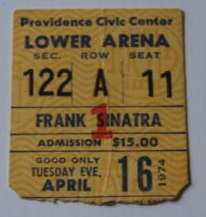
Olympia Stadium, Detroit, Michigan
Variety Clubs Int. Benefit
Key Musicians: Irv Cottler (drums), Al Viola (guitar), George Duvivier
(bass), Joe Malin (concertmaster), Bill Miller (piano).
Orchestra Conducted By: Bill Miller
1. I Get A Kick Out Of You
2. Don't Worry 'Bout Me
3. If
4. Bad, Bad Leroy Brown
5. saloon medley: Last Night When We Were Young / Violets For Your
Furs / Here's That Rainy Day
6. monologue
7. My Way
8. I've Got The World On A String
9. Nancy
10. I've Got You Under My Skin
11. Send In The Clowns
12. My Kind Of Town
Notes: This Was Recorded By Reprise But Has Not Been Released. It was to be used on the unfinished 2LP Sinatra SRO.
Olympia Stadium, Detroit, Michigan
Variety Clubs Int. Benefit
Key Musicians: Irv Cottler (drums), Al Viola (guitar), George Duvivier
(bass), Joe Malin (concertmaster), Bill Miller (piano).
Orchestra Conducted By: Bill Miller
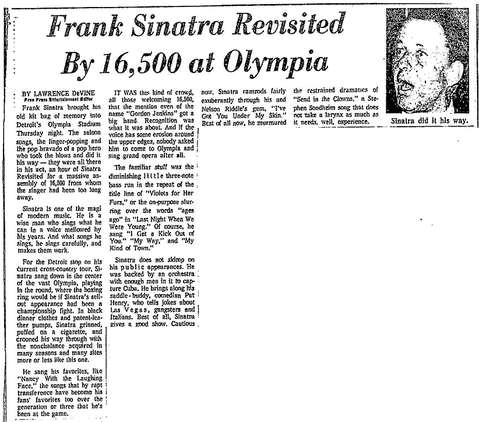
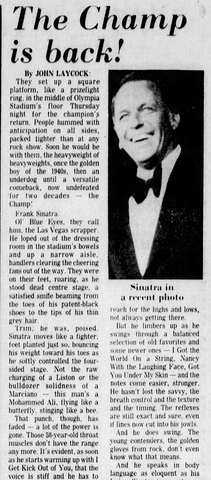
The Spectrum, Philadelphia, PA
Variety Clubs Int. Benefit
Key Musicians: Irv Cottler (drums), Al Viola (guitar), George Duvivier (bass), Joe Malin (concertmaster), Bill Miller (piano).
Orchestra Conducted By: Bill Miller
1. I Get A Kick Out Of You
2. Bad, Bad Leroy Brown
3. If
4. Don't Worry 'Bout Me
5. saloon medley: Last Night When We Were Young / Violets For Your Furs / Here's That Rainy Day
6. My Way
7. Nancy
8. I've Got You Under My Skin
9. Send In The Clowns
10. My Kind Of Town
note: Reprise did not record this show. The Lockers opened the show, followed by Pat Henry
The Spectrum, Philadelphia, PA
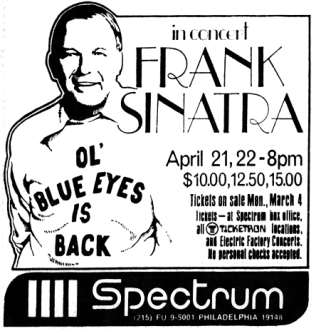
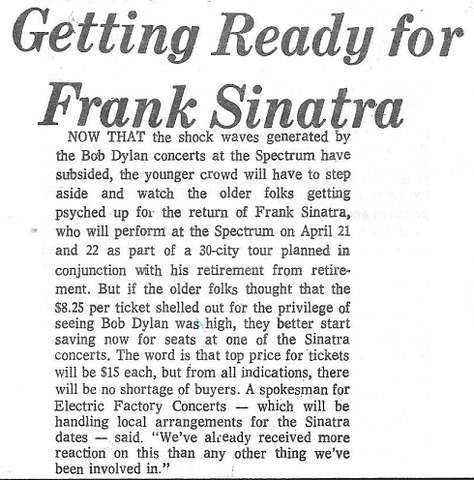
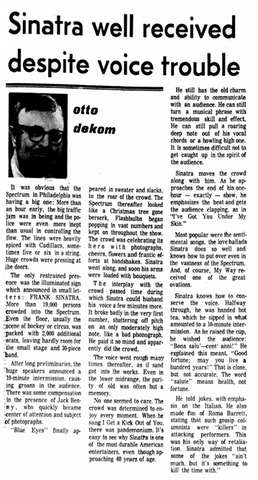


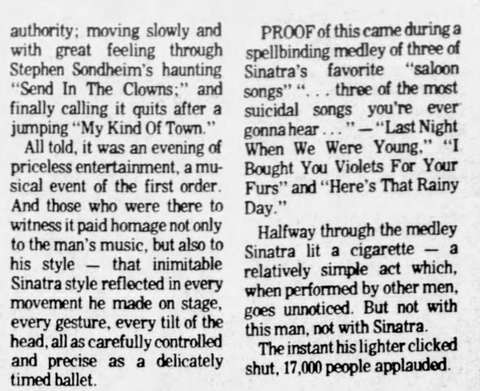
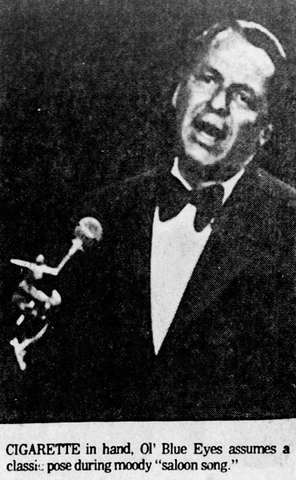
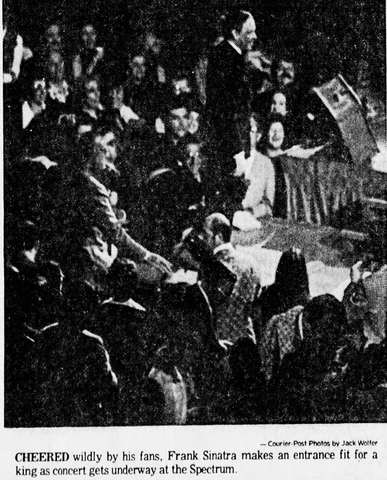
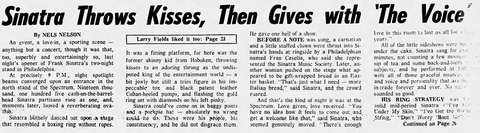
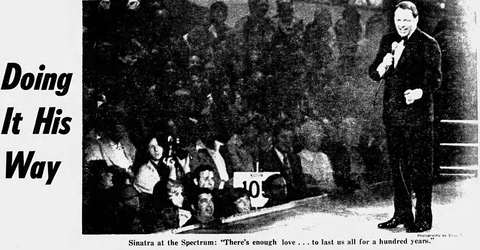
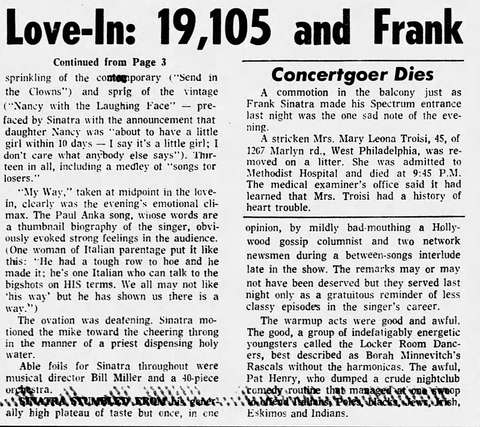
The Spectrum, Philadelphia, PA
Variety Clubs Int. Benefit
Key Musicians: Irv Cottler (drums), Al Viola (guitar), George Duvivier (bass), Joe Malin (concertmaster), Bill Miller (piano).
Orchestra Conducted By: Bill Miller
1. I Get A Kick Out Of You
2. Bad, Bad Leroy Brown
3. If
4. Don't Worry 'Bout Me
5. saloon medley: Last Night When We Were Young / Violets For Your
Furs / Here's That Rainy Day
6. The House I Live In
7. monologue
8. Nancy
9. I've Got The World On A String
10. I've Got You Under My Skin
11. Send In The Clowns
12. My Kind Of Town
13. My Way
Notes: This Was Recorded By Reprise But Has Not Been Released. It was to be used on the unfinished 2LP Sinatra SRO.
The Spectrum, Philadelphia, PA
Variety Clubs Int. Benefit
Key Musicians: Irv Cottler (drums), Al Viola (guitar), George Duvivier (bass), Joe Malin (concertmaster), Bill Miller (piano).
Orchestra Conducted By: Bill Miller


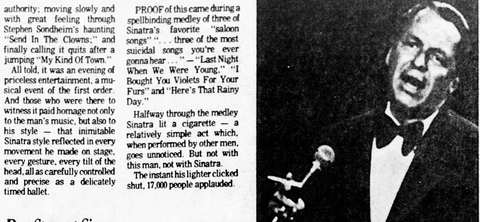
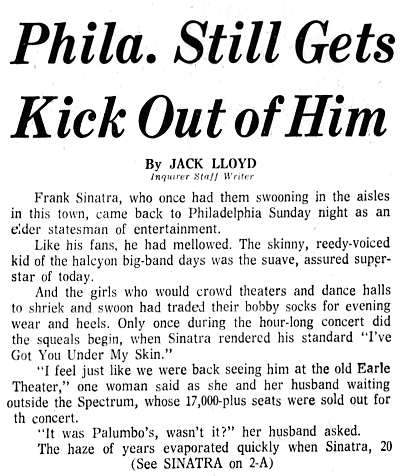
Capital Centre, Landover, MD
Variety Clubs Int. Benefit
Key Musicians: Irv Cottler (drums), Al Viola (guitar), George Duvivier (bass), Joe Malin (concertmaster) , Bill Miller (piano).
Orchestra Conducted By: Bill Miller
1. I Get A Kick Out Of You
2. Bad, Bad Leroy Brown
3. If
4. Don't Worry 'Bout Me
5. saloon medley: Last Night When We Were Young / Violets For Your
Furs / Here's That Rainy Day
6. monologue
7. My Way
8. Nancy
9. I've Got The World On A String
10. I've Got You Under My Skin
11. Send In The Clowns
12. My Kind Of Town
13. The House I Live In
Notes: This Was Recorded By Reprise But Has Not Been Released. It was to be used on the unfinished 2LP Sinatra SRO.
Capital Centre, Landover, MD
Variety Clubs Int. Benefit
Key Musicians: Irv Cottler (drums), Al Viola (guitar), George Duvivier (bass), Joe Malin (concertmaster) , Bill Miller (piano).
Orchestra Conducted By: Bill Miller
Chicago Stadium, Chicago, Illinois
Variety Clubs Int. Benefit
Key Musicians: Irv Cottler (drums), Al Viola (guitar), George Duvivier (bass), Joe Malin (concertmaster), Bill Miller (piano).
Orchestra Conducted By: Bill Miller
1. Come Fly With Me
2. I Get A Kick Out Of You
3. Don't Worry 'Bout Me
4. Bad, Bad Leroy Brown
5. saloon medley: Last Night When We Were Young / Violets For Your Furs / Here's That Rainy Day
6. monologue
7. My Way
8. I've Got The World On A String
9. Nancy
10. I've Got You Under My Skin
11. Send In The Clowns
12. My Kind Of Town
Notes: This Was Recorded By Reprise But Has Not Been Released. It was to be used on the unfinished 2LP Sinatra SRO.
Chicago Stadium, Chicago, Illinois
Variety Clubs Int. Benefit
Key Musicians: Irv Cottler (drums), Al Viola (guitar), George Duvivier
(bass), Joe Malin (concertmaster), Bill Miller (piano).
Orchestra Conducted By: Bill Miller

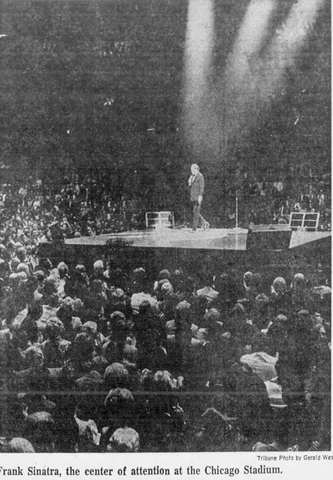
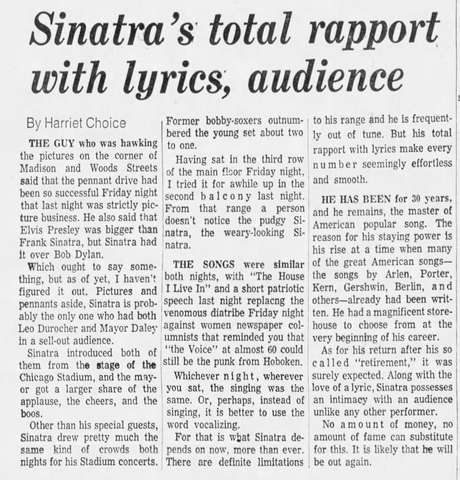
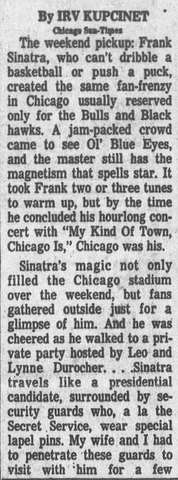

Chicago Stadium, Chicago, Illinois
Variety Clubs Int. Benefit
Key Musicians: Irv Cottler (drums), Al Viola (guitar), George Duvivier (bass), Joe Malin (concertmaster), Bill Miller (piano).
Orchestra Conducted By: Bill Miller
1. Come Fly With Me
2. I Get A Kick Out Of You
3. Don't Worry 'Bout Me
4. Bad, Bad Leroy Brown
5. saloon medley: Last Night When We Were Young / Violets For Your Furs / Here's That Rainy Day
6. monologue
7. My Way
8. The House I Live In
9. I've Got The World On A String
10. I've Got You Under My Skin
11. Nancy
12. My Kind Of Town
Notes: This Was Recorded By Reprise But Has Not Been Released. It was to be used on the unfinished 2LP Sinatra SRO.
Chicago Stadium, Chicago, Illinois
Variety Clubs Int. Benefit
Key Musicians: Irv Cottler (drums), Al Viola (guitar), George Duvivier (bass), Joe Malin (concertmaster), Bill Miller (piano).
Orchestra Conducted By: Bill Miller
note: When I was working on my 1992 book, I got to know people at Reprise. I was told that the initial idea was to release Sinatra at Carnegie Hall ( 4/8 ) in its entirety. Unfortunately, there were some serious glitches and a two LP titled "Sinatra SRO" would be culled from the entire April tour. I wasn't told anything about a planned Chicago release.
Ed
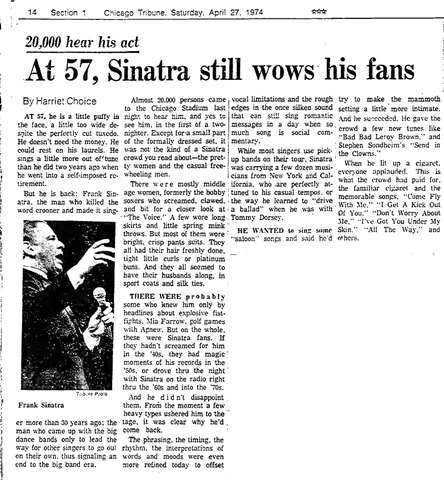
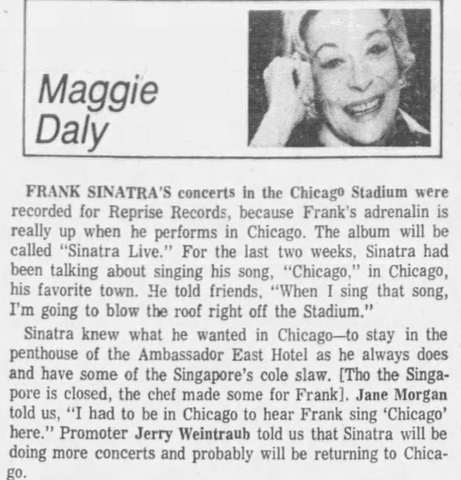
Hollywood
SCA4720 Empty Tables
(Johnny Mercer/Jimmy Van Heusen)
Mercer Music/WB Music Corp./The Songwriters Guild (ASCAP) Arranged & Conducted by Gordon Jenkins
-9 N/R
SCA4721 If
(David Gates)
Colgems EMI Music Inc. (ASCAP)
Arranged & Conducted by Gordon Jenkins
-2 (3:07) CD: 46013-2 The Complete Reprise Studio Recordings Disc 16
CD: 2195-2Some Nice Things I Missed
LP: FS2195Some Nice Things I Missed
SCA4722 The Summer Knows
(Alan Bergman/Marilyn Bergman/Michel Legrand)
WB Music Corp. (ASCAP)
Arranged & Conducted by Gordon Jenkins
-18 (2:40) CD: 46013-2 The Complete Reprise Studio Recordings Disc 16
CD: 2195-2Some Nice Things I Missed
LP: FS2195Some Nice Things I Missed
NOTE: Sinatra Scholar Ed O'Brien writes that Sinatra had a sibilant problem at this session. He was coming off the first extensive concert tour in years and the voice was tired. You can hear it in the two tracks that were issued from this session. After doing nine takes on a re-do of "Empty Tables" on June 22, 1973, he did 18 takes and two intercuts on "Summer Knows." He wasn't comfortable with a section of the songs, so a phone call was made to Alan and Marilyn Bergman in New York. A 45-minute conversation ensued, but they would not alter the lyrics. "if" required two takes.
Vance Adair noted:
'The Summer Knows' is a great Legrand melody - but alas this is one of the few occasions when the Bergmans didn't match him with lyrics. Frank's vocal certainly sounds labored.
note: "Empty Tables" was one of the songs intended for the "Saloon" album. Frank was worked on this project from 1973 to 1975.He did nine takes on this recording with just Bill Miller as accompaniment. --Ed
Hollywood
SCA4720 Empty Tables
SCA4721 If
SCA4722 The Summer Knows
[image referenced in source but could not be recovered]
[image referenced in source but could not be recovered]
[Empty Tables / One for My Baby / Send in the Clowns -- critical commentary]
Will Friedwald: In February 1976 Sinatra and Bill Miller recorded 'Empty Tables,' completing a three-song cycle of Johnny Mercer-style saloon songs reconceived as duets (with 'One for My Baby'), then in the same session recorded a voice-and-piano treatment of 'Send in the Clowns' (with a spoken monologue introduction). Both 'Empty Tables' and 'Clowns' had previously been recorded with full Gordon Jenkins arrangements; Jenkins considered his chart for 'Clowns' the best he ever wrote for Sinatra. Friedwald contrasts the formal Jenkins versions with the raw, dramatic intimacy of the Miller duo versions.
This song/context matches multiple dated entries in the chronology; the specific date Friedwald is referring to could not be determined with confidence.
Source: Will Friedwald, "Sinatra! The Song Is You: A Singer's Art" (2018 revised edition), Ch. 1, "Night and Day" (Sinatra style overview)
[Empty Tables / Send in the Clowns -- critical commentary]
Will Friedwald: On February 5, 1976, after recording 'I Sing the Songs,' Sinatra kept only Bill Miller in the studio (dismissing the rest of the orchestra) to cut intimate duo readings of 'Empty Tables' and 'Send in the Clowns,' songs he'd already recorded with Jenkins in 1973-74 with full string arrangements. Friedwald ranks these Sinatra-Miller duets among his most marvelous saloon-song performances, noting Sinatra was likely motivated by Johnny Mercer's terminal illness (he died that June) and Jimmy Van Heusen's retirement from songwriting -- 'Empty Tables' would be one of the last new Van Heusen songs Sinatra sang.
This song/context matches multiple dated entries in the chronology; the specific date Friedwald is referring to could not be determined with confidence.
Source: Will Friedwald, "Sinatra! The Song Is You: A Singer's Art" (2018 revised edition), Ch. 10, "Concert Years" (1973-1994)
Hollywood
SCA4840 Sweet Caroline
(Neil Diamond)
Sony Tunes Inc. (ASCAP)
Arranged & Conducted by Don Costa
(2:40) CD: 46013-2 The Complete Reprise Studio Recordings Disc 16
CD: 2195-2Some Nice Things I Missed
LP: FS2195Some Nice Things I Missed
NOTE: Sinatra Scholar Ed O'Brien reports that Sinatra sang Diamond's song in concert a number of times, but never once remembered all of the lyrics. He was doing the songs of the times, but O'Brien doesn't think his heart was in it.
SCA4841 You Turned My World Around
(Bert Kaempfert/Herbert Rehbein/Kim Carnes/Dave Ellingson) EMI Screen Gems Music inc. (BMI)
Arranged & Conducted by Don Costa
(2:45) CD: 46013-2 The Complete Reprise Studio Recordings Disc 16
CD: 2195-2Some Nice Things I Missed
LP: FS2195Some Nice Things I Missed
45: S1208
Note: Frank sang this song during his one week engagement at the
South Shore Room, Harrah's, Lake Tahoe, 9-4 thru 9-10 -74. He also performed it in the Boston Garden, 10-2-74. It was listed on the Main Event program, 10-13-74, but not performed.
Ed
Hollywood
SCA4840 Sweet Caroline
SCA4841 You Turned My World Around
[image referenced in source but could not be recovered]
[image referenced in source but could not be recovered]
Hollywood
SCA4842 You Are The Sunshine Of My Life (N/R)
(Stevie Wonder)
Jobete Music Co. Inc./Black Bull Music, Inc. (ASCAP)
Arranged & Conducted by Don Costa
NOTE: Sinatra Scholar Ed O'Brien reports that this session for three hours. There were 13 takes and then 12 intercuts. Another aborted attempt was made on May 21 and then the third time was the charm when a vocal overdub was done on May 24. O'Brien feels that this was not a Sinatra song. Sinatra devoted a great deal of precious time to a song that wasn't worth the effort.
EddieGen adds:
I agree with Ed. "Sunshine of My Life" was a waste of time. It never worked in concert either. I used to cringe when he ended the song with, "light my fire" repeatedly. It was almost as bad as him barking at the end of "The Best is Yet to Come". I guess he attempted to be contemporary. He never had to try to keep up with contemporary singers. He was in a class of his own.
I suppose it was one of the few contemporary songs where the melody successfully worked in a swing treatment. But the words are dreck, not least the achingly bad elongated stress on the second syllable of "rescue". All that effort in the early 70s when FS confined himself to only one foray into the Sondheim songbook. I'd sell my house to have heard Sinatra'stake on "Being Alive" or "Losing My Mind".
--Vance
Sinatra toyed with the idea of doing an album of Sondheim songs. He told Jonathan it wasn't commercial enough.
Jonathan gave him the sheet music for "Anyone Can Whistle."
Same story, not commercial. Bennett did a wonderful recording
of "Losing My Mind." Vinnie told me that Frank got the music to "Merrily We Roll Along" while touring in South America ( Aug 81 )
He fell in love with "Good Thing Going," but after running it down, he rejected "Not A Day Goes By." I think it might have cut too
close to the bone.
Ed
[You Are the Sunshine of My Life -- critical commentary]
Will Friedwald: Friedwald calls Stevie Wonder's 'You Are the Sunshine of My Life' the most successful up-tempo track on Some Nice Things I've Missed and the one contemporary cover that stayed in Sinatra's concert book for decades. Costa's arrangement is described as radically reworking Wonder's relaxed funky backbeat into straight-ahead 4/4 swing reminiscent of Les Brown's Band of Renown, essentially a late-1940s-style swing chart applied to a 1973 pop hit.
This song/context matches multiple dated entries in the chronology; the specific date Friedwald is referring to could not be determined with confidence.
Source: Will Friedwald, "Sinatra! The Song Is You: A Singer's Art" (2018 revised edition), Ch. 10, "Concert Years" (1973-1994)
Hollywood
SCA4842 You Are The Sunshine Of My Life (N/R)
(Stevie Wonder)
Jobete Music Co. Inc./Black Bull Music, Inc. (ASCAP)
Arranged & Conducted by Don Costa
SCA4849 What Are You Doing The Rest Of Your Life?
(Alan Bergman/Marilyn Bergman/Michel Legrand)
EMI U Catalog Inc. (ASCAP)
Arranged & Conducted by Don Costa
-7 (4:01) CD: 46013-2 The Complete Reprise Studio Recordings Disc 16
CD: 2195-2Some Nice Things I Missed
CD: 9-26340-2The Reprise Collection
LP: FS2195Some Nice Things I Missed
SCA4850 Tie A Yellow Ribbon Round The Ole Oak Tree
(Russell Brown/Irwin Levine)
Larball Publishing Co. Inc./Irwin Levine Music (BMI)
Arranged & Conducted by Don Costa
(3:03) CD: 46013-2 The Complete Reprise Studio Recordings Disc 16
CD: 2195-2Some Nice Things I Missed
LP: FS2195Some Nice Things I Missed
SCA4851 Satisfy Me One More Time
(Floyd Huddleston)
Popoosa Music/WB Music Corp. (ASCAP)
Arranged & Conducted by Don Costa
(2:19) CD: 46013-2 The Complete Reprise Studio Recordings Disc 16
CD:2195Some Nice Things I Missed
LP: FS2195Some Nice Things I Missed
45: S1208
NOTE: Sinatra Scholar Ed O'Brien reports that, for whatever reason, Sinatra had a tough time getting a handle on "You Are the Sunshine of My Life." He finally nailed it on the third try on May 24 in a vocal overdub. "What Are You Doing . . ." also posed problems. The seventh note in the song kept coming up flat. After seven tries, they gave up and simply added reverb. "Tie a Yellow Ribbon . . ." didn't thrill Sinatra. He was about to give up when Don Costa ran out in the hall and quickly added the "whole damn bus" coda. "Satisfy Me . . ." was very demanding because of the rapid tempo. Years later Sinatra would do it in concert and handle it easier than he did here.
Finally, Sinatra ran down "If I Could Read Your Mind." Gordon Lightfoot was in the control booth with Lee Herschberg and others. Lee told O'Brien that Lightfoot's jaw almost hit the floor when Sinatra suddenly said "too many words" and was gone.
[Bad, Bad Leroy Brown / What Are You Doing the Rest of Your Life -- critical commentary]
Some Nice Things I've Missed (1974) is regarded by Granata as containing some of the weakest recordings of Sinatra's career (covers like 'Bad, Bad Leroy Brown' and 'Tie a Yellow Ribbon Round the Old Oak Tree'), but also strong tracks like 'What Are You Doing the Rest of Your Life' and two sorrowful Gordon Jenkins arrangements, 'Just as Though You Were Here' and 'Everything Happens to Me.'
This song/context matches multiple dated entries in the chronology, or lacked a sufficiently precise date; the specific date could not be determined with confidence.
Source: Charles L. Granata, "Sessions with Sinatra: Frank Sinatra and the Art of Recording" (1999/2003), Part IV: The Reprise Years
[What Are You Doing the Rest of Your Life? -- critical commentary]
Granata includes 'What Are You Doing the Rest of Your Life?' among the fifty recordings he considers essential to understanding Sinatra's artistry (arranged by Don Costa, recorded 1974, Reprise); the song was chosen for its musical/interpretive value rather than commercial popularity.
This song/context matches multiple dated entries in the chronology, or lacked a sufficiently precise date; the specific date could not be determined with confidence.
Source: Charles L. Granata, "Sessions with Sinatra: Frank Sinatra and the Art of Recording" (1999/2003), Afterword & Appendices A-D
Nancy Sinatra's first daughter, Angela Jennifer ('A.J.'), was born at Cedars of Lebanon Hospital in Los Angeles; Frank was deeply moved holding his first grandchild, and remarked it gave him his first real link to the future.
Frank Sinatra (quoted): "I said a silent prayer that the world would be as good to this little angel as it's been to me."
Source: Nancy Sinatra, Frank Sinatra: An American Legend, 1995.
Tina Sinatra recalled that when Frank learned by phone (while dining with promoter Jerry Weintraub) that Nancy had given birth to A.J., he immediately abandoned a resolution to stop drinking and ordered thirty thousand clams to celebrate becoming a grandfather.
Frank Sinatra (quoted): "Yes I can, I am a grandfather and I want thirty thousand clams."
Source: Nancy Sinatra, Frank Sinatra: An American Legend, 1995.
Hollywood
SCA4842 You Are The Sunshine Of My Life
(Stevie Wonder)
Jobete Music Co. Inc./Black Bull Music, Inc. (ASCAP)
Arranged & Conducted by Don Costa
(2:34) CD: 46013-2 The Complete Reprise Studio Recordings Disc 17
CD: 2195-2 Some Nice Things I Missed
LP: FS2195 Some Nice Things I Missed
Note: The orchestra was pre-recorded on May 21, 1974
Note: Frank's first attempt to record Wonder's song was done on
5-9-74.
There were 13 takes and 12 intercuts. It has never been issued. A new
chart was written for the 5-21 session. it was the first tune recorded
that evening with a different ensemble of studio musicians. Quite a few
takes were done, but Frank wasn't happy with the results. Finally, the
5/24 overdub was done. Three sessions were devoted to this one tune
the first and the last there were no other recordings attempted -- and
a rewrite and vocal overdub were required before Frank was satisfied.
My favorite Sinatra vocal, with a Riddle chart, was done on the "All-Star
Tribute to John Wayne, broadcast on ABC, 11-26-76.
--Ed
Concern Foundation Benefit, Alfred Hart Estate, Los Angeles, CA
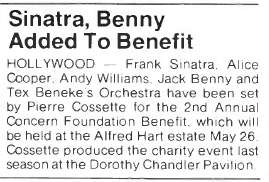
Concern Foundation Benefit, Alfred Hart Estate, Los Angeles, CA
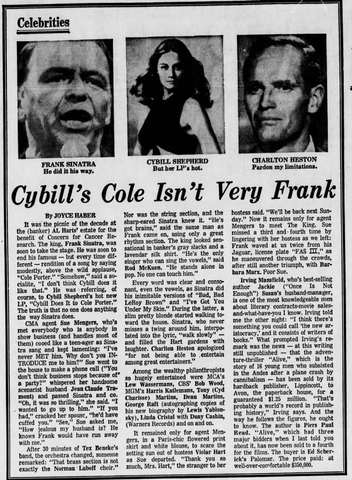
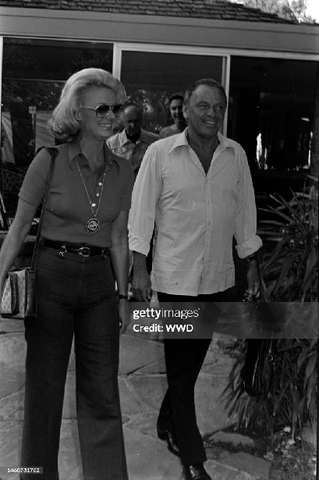
[Sinatra Returns To Las Vegas Stages]
More than three years after Sinatra had stormed out of Las Vegas, the man who had banned him from Caesars Palace, Sanford Waterman, was fired, clearing the way for Sinatra's return. He played engagements there in January and June, drawing capacity crowds.
Source: The Rough Guide to Frank Sinatra, chapter "I Want to Be a Part of It, 1971-98."
Caesars Palace, Las Vegas, Nevada
June 6 thru 19, 1974 (dark on the 10th)
Frank Sinatra, Ella Fitzgerald, Count Basie & His Orchestra Pat Henry
Key Musicians: Emil Richard (vibes), Gene Cherico (bass), Al Viola (guitar), Irv Cottler (drums), Bill Miller (piano).
Orchestra Conducted By: Bill Miller
1. Bad, Bad Leroy Brown
2. Pennies From Heaven
3. Don't Worry 'Bout Me
4. If
5. I Get A Kick Out Of You
6. Here's That Rainy Day
7. monologue
8. I've Got You Under My Skin
9. My Way
10. Sweet Caroline
11. The Lady Is A Champ - w/Ella Fitzgerald
Caesars Palace, Las Vegas, Nevada
June 6 thru 19, 1974 (dark on the 10th)
Frank Sinatra, Ella Fitzgerald, Count Basie & His Orchestra
Pat Henry
Key Musicians: Emil Richard (vibes), Gene Cherico (bass), Al Viola
(guitar), Irv Cottler (drums), Bill Miller (piano).
Orchestra Conducted By: Bill Miller
Booklet handed out during the engagement:
Frank Sinatra sings onstage at Caesars Palace during a June 1974 performance.
Sinatra began performing at Caesars in 1968, after Howard Hughes' 1967 purchase
of the Sands lead to a violent dispute with Sands hotel management over Sinatra's
credit at the casino.
Billboard
June 22, 1974
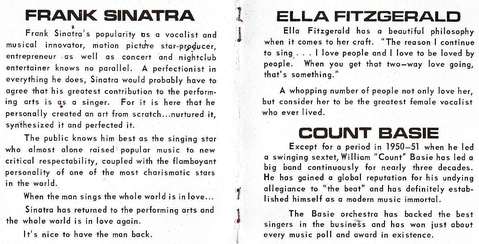
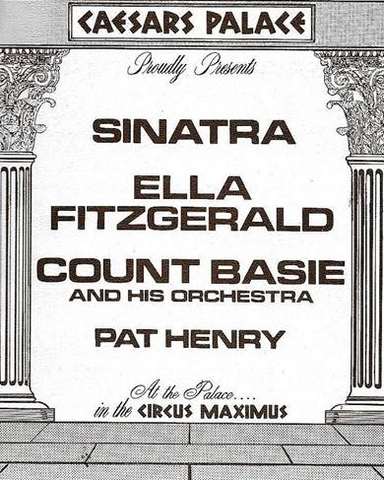
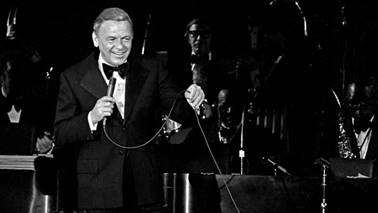
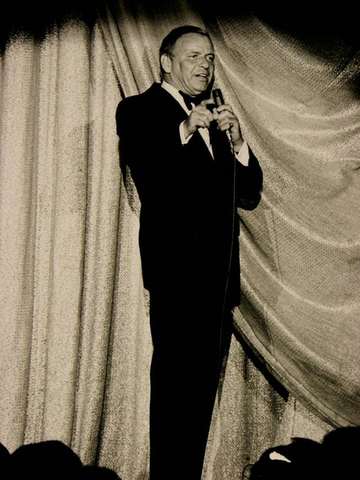
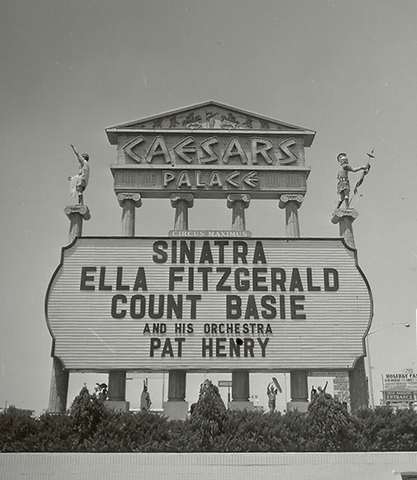
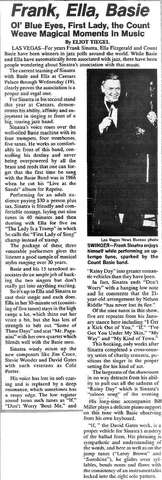

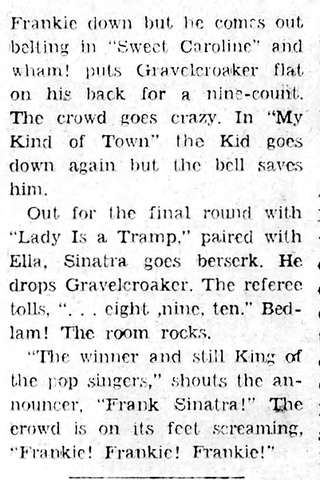
Caesars Palace, Las Vegas, Nevada
First Show
Key Musicians: Eimille Richard (vibes), Gene Cherico (bass), Al Viola (guitar), Irv Cottler (drums), Bill Miller (piano).
Orchestra Conducted By: Bill Miller
1. Bad, Bad Leroy Brown
2. Pennies From Heaven
3. Don't Worry 'Bout Me
4. If
5. I Get A Kick Out Of You
6. monologue
7. Here's That Rainy Day
8. I've Got You Under My Skin
9. My Way
10. Sweet Caroline
11. My Kind Of Town
12. The Lady Is A Champ - w/Ella Fitzgerald
Notes: TT 49mins.
Caesars Palace, Las Vegas, Nevada
Second Show
Key Musicians: Eimille Richard (vibes), Gene Cherico (bass), Al Viola (guitar), Irv Cottler (drums), Bill Miller (piano).
Orchestra Conducted By: Bill Miller
1. Bad, Bad Leroy Brown
2. Pennies From Heaven
3. Don't Worry 'Bout Me
4. If
5. My Kind of Town
6. Sweet Caroline
7. Here's That Rainy Day
8. I've Got You Under My Skin
9. My Way
10. The Lady Is a Tramp
Caesars Palace, Las Vegas, Nevada
First Show
Key Musicians: Eimille Richard (vibes), Gene Cherico (bass), Al Viola (guitar), Irv Cottler (drums), Bill Miller (piano).
Orchestra Conducted By: Bill Miller
1. Bad, Bad Leroy Brown
2. Pennies From Heaven
3. Don't Worry â Bout Me
4. If
5. My Kind Of Town
6. . monologue
7. Sweet Caroline
8. Here's That Rainy Day
9. I've Got You Under My Skin
10. My Way
11. The Lady Is A Champ - w/Ella Fitzgerald
Notes: TT 64mins.
Caesars Palace, Las Vegas, Nevada
Second Show
Key Musicians: Eimille Richard (vibes), Gene Cherico (bass), Al Viola (guitar), Irv Cottler (drums), Bill Miller (piano).
Orchestra Conducted By: Bill Miller
1. Bad, Bad Leroy Brown
2. Pennies From Heaven
3. Don't Worry â Bout Me
4. If
5. monologue
6. . Sweet Caroline
7. Here's That Rainy Day
8. I've Got You Under My Skin
9. My Way
10. The Lady Is A Champ - w/Ella Fitzgerald
Notes: TT 55mins.
Ed O'Brien:
This wasn't much of a show. Sinatra was averaging nine or 10 songs a show, including
"Leroy Brown" and "Sweet Caroline." I can't remember the cover but I'll bet Frank only did 45 to 50 minutes most nights.
Caesars Palace, Las Vegas, Nevada
Key Musicians: Eimille Richard (vibes), Gene Cherico (bass), Al Viola (guitar), Irv Cottler (drums), Bill Miller (piano).
Orchestra Conducted By: Bill Miller
Opening Acts: Ella Fitzgerald, Count Basie Orchestra
Opening Comedian: Pat Henry
1. Bad, Bad Leroy Brown
2. Pennies From Heaven
3. Don't Worry â Bout Me
4. If
5. . monologue
6. Sweet Caroline
7. Send In The Clowns
8. I've Got You Under My Skin
9. My Way
10. The Lady Is A Champ - w/Ella Fitzgerald
Notes: TT 52mins.
Caesars Palace, Las Vegas, Nevada
Key Musicians: Eimille Richard (vibes), Gene Cherico (bass), Al Viola (guitar), Irv Cottler (drums), Bill Miller (piano).
Orchestra Conducted By: Bill Miller
Opening Acts: Ella Fitzgerald, Count Basie Orchestra
1. Bad, Bad Leroy Brown
2. Pennies From Heaven
3. Don't Worry â Bout t Me
4. If
5. monologue
6. My Kind Of Town
7. Sweet Caroline
8. Send In The Clowns
9. I've Got You Under My Skin
10. My Way
11. The Lady Is A Champ - w/Ella Fitzgerald
Notes: TT 55mins.
Ed O'Brien:
Frank was dark on Mondays during this engagement (10th & 17th).
Ella Fitzgerald and Count Basie & his orchestra plus Pat Henry were on the bill with Frank. Basie & band backed both singers. Miller was the sole accompaniment on "Send In The Clowns." Al Viola was featured on "If.."
Caesars Palace, Las Vegas, Nevada
First Show
Key Musicans: Eimille Richard (vibes), Gene Cherico (bass), Al Viola
(guitar), Irv Cottler (drums), Bill Miller (piano).
Orchestra Conducted By: Bill Miller
Opening Acts: Ella Fitzgerald, Count Basie Orchestra
1. Bad, Bad Leroy Brown
2. Pennies From Heaven
3. Don't Worry 'Bout Me
4. If
5. My Kind Of Town
6. The Lady Is A Champ - w/Ella Fitzgerald
7. monologue
8. You Are The Sunshine Of My Life
9. Here's That Rainy Day
10. I've Got You Under My Skin
11. My Way
Notes: TT 47mins.
Caesars Palace, Las Vegas, Nevada
Second Show
Key Musicans: Eimille Richard (vibes), Gene Cherico (bass), Al Viola (guitar), Irv Cottler (drums), Bill Miller (piano).
Orchestra Conducted By: Bill Miller
Opening Acts: Ella Fitzgerald, Count Basie Orchestra
1. Bad, Bad Leroy Brown
2. Pennies From Heaven
3. Don't Worry 'Bout Me
4. If
5. My Kind Of Town
6. Chicago
7. The Lady Is A Champ - w/Ella Fitzgerald
8. monologue
9. You Are The Sunshine Of My Life
10. Here's That Rainy Day
11. I've Got You Under My Skin
12. My Way
Notes: TT 45mins.
Caesars Palace, Las Vegas, Nevada
Opening Acts: Ella Fitzgerald, Count Basie Orchestra
Michel M sent the above image along.
© 1997-2026 The Sinatra Archive
This calendar, or any parts thereof, may not be reproduced in any fashion
whatsoever without the prior written permission of the publisher (The
Sinatra Archive)
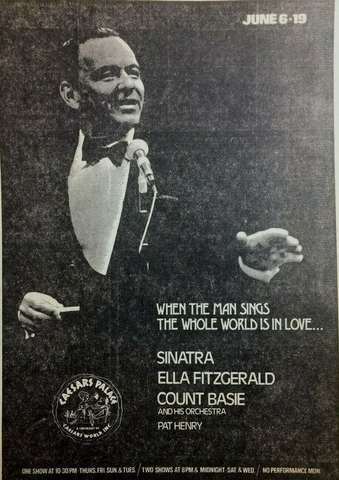
Caesars Palace, Las Vegas, Nevada
Key Musicians: Eimille Richard (vibes), Gene Cherico (bass), Al Viola (guitar), Irv Cottler (drums), Bill Miller (piano).
Orchestra Conducted By: Bill Miller
Opening Acts: Ella Fitzgerald, Count Basie Orchestra
1. Bad, Bad Leroy Brown
2. Pennies From Heaven
3. Don't Worry 'Bout Me
4. talk
5. If - w/Al Viola
6. My Kind Of Town monologue
7. You Are The Sunshine Of My Life
8. Send In The Clowns
9. I've Got You Under My Skin
10. introductions
11. My Way
12. The Lady Is A Tramp - w/Ella Fitzgerald
Caesars Palace, Las Vegas, Nevada
Key Musicians: Eimille Richard (vibes), Gene Cherico (bass), Al Viola (guitar), Irv Cottler (drums), Bill Miller (piano).
Orchestra Conducted By: Bill Miller
Opening Acts: Ella Fitzgerald, Count Basie Orchestra
1. Bad, Bad Leroy Brown
2. Pennies From Heaven
3. Don't Worry â Bout Me
4. If
5. My Kind Of f Town
6. The Lady Is A Champ - w/Ella Fitzgerald
7. monologue
8. You Are The Sunshine Of My Life
9. Here's That Rainy Day
10. I've Got You Under My Skin
11. My Way
Notes: TT 48mins.
note: The Lady Is A Champ" was the closing number throughout the engagement.
--Ed
Caesars Palace, Las Vegas, Nevada
First Show
Key Musicians: Eimille Richard (vibes), Gene Cherico (bass), Al Viola
(guitar), Irv Cottler (drums), Bill Miller (piano).
Orchestra Conducted By: Bill Miller
Opening Acts: Ella Fitzgerald, Count Basie Orchestra
1. Bad, Bad Leroy Brown
2. Pennies From Heaven
3. Don't Worry ‘Bout Me e
4. If
5. My Kind Of Town
6. monologue
7. You Are The Sunshine Of My Life
8. Send In The Clowns
9. I've Got You Under My Skin
10. My Way
11. The Lady Is A Champ - w/Ella Fitzgerald
Notes: TT 55mins.
Caesars Palace, Las Vegas, Nevada
Second Show
Key Musicians: Eimille Richard (vibes), Gene Cherico (bass), Al Viola
(guitar), Irv Cottler (drums), Bill Miller (piano).
Orchestra Conducted By: Bill Miller
Opening Acts: Ella Fitzgerald, Count Basie Orchestra
1. Bad, Bad Leroy Brown
2.. Pennies From Heaven
3. Don't Worry ‘Bout Me
4. If
5. My Kind Of Town
6. . monologue
7. You Are The Sunshine Of My Life
8. Send In The Clowns
9. I've Got You Under My Skin
10. My Way
11. The Lady Is A Champ - w/Ella Fitzgerald
Notes: TT 50mins.
Caesars Palace, Las Vegas, Nevada
Key Musicians: Eimille Richard (vibes), Gene Cherico (bass), Al Viola (guitar), Irv Cottler (drums), Bill Miller (piano).
Orchestra Conducted By: Bill Miller
Opening Acts: Ella Fitzgerald, Count Basie Orchestra
1974 Las Vegas, Caesars Palace, Nevada
Key Musicians: Emil Richard (vibes), Gene Cherico (bass),
Al Viola (guitar), Irv Cottler (drums), Bill Miller (piano).
Orchestra Conducted By: Bill Miller
Opening Acts: Pat Henry, Ella Fitzgerald, Count Basie Orchestra
1. Bad, Bad Leroy Brown
2. Pennies From Heaven
3. Don't Worry 'Bout Me
4. If
5. My Kind Of Town
6. monologue
7. You Are The Sunshine Of My Life
8. Send In The Clowns
9. I've Got You Under My Skin
10. My Way
11. The Lady Is A Champ - w/Ella Fitzgerald
Ed O'Brien:
There's a line recording of this show that has been in circulation for years.
Brian Chearno:
And it circulates under three different June dates!
Ed O'Brien:
The engagement ran from 6/6 to 6/19. Frank mentions that he has two nights left during the 6/16 show. He was dark on the 17th. Simple math gives us the correct date. I was told, years ago, that the tape came from a member of the Basie band.
Caesars Palace, Las Vegas, Nevada
Key Musicians: Eimille Richard (vibes), Gene Cherico (bass), Al Viola (guitar), Irv Cottler (drums), Bill Miller (piano).
Orchestra Conducted By: Bill Miller
Opening Acts: Ella Fitzgerald, Count Basie Orchestra
1. Bad, Bad Leroy Brown
2. Pennies From Heaven
3. Don't Worry 'Bout Me
4. If
5. My Kind of Town
6. You Are the Sunshine of My Life
7. Send in the Clowns
8. I've Got You Under My Skin
9. My Way
10. The Lady Is a Tramp
Caesars Palace, Las Vegas, Nevada
Closing night of a two-week engagement.
Key Musicians: Eimille Richard (vibes), Gene Cherico (bass), Al Viola (guitar), Irv Cottler (drums), Bill Miller (piano).
Orchestra Conducted By: Bill Miller
Opening Acts: Ella Fitzgerald, Count Basie Orchestra
Notes:
Las Vegas, Nevada
Sheriff's Department Benefit
Orchestra Conducted By: Bill Miller
Notes: Sinatra sang five songs.
After his last Caesars Palace show of the run, Frank raised a toast to his newborn granddaughter A.J. from the stage, wishing her a hundred times the fun he'd had.
Frank Sinatra (quoted): "I wish her a hundred times the fun I've had—and one hundred times as many guys as I've had broads."
Source: Nancy Sinatra, Frank Sinatra: An American Legend, 1995.
"That's Entertainment" (USA Release: June 21, 1974)
That's Entertainment! is a 1974 American compilation film released by Metro-Goldwyn-Mayer to celebrate the studio's 50th anniversary. The success of the retrospective prompted a 1976 sequel, the related 1985 film That's Dancing!, and That's Entertainment III in 1994. Various segments were hosted by a succession of the studio's legendary stars: Frank Sinatra, Gene Kelly, Fred Astaire, Peter Lawford, Debbie Reynolds, Bing Crosby, James Stewart, Elizabeth Taylor, Mickey Rooney, Donald O'Connor, and Liza Minnelli representing her mother Judy Garland. Written, Produced, & Directed by: Jack Haley Jr.
--DVD Release: 2004-10-12 -- Blu-Ray Release 2007-12-18 That's Entertainment commences with a film clip of the song "Singin' in the Rain," as performed by Cliff "Ukelele Ike" Edwards in The Hollywood Revue of 1929 . Frank Sinatra, who opens and closes That's Entertainment , notes that the tune became an M-G-M theme song, a sentiment illustrated by several clips featuring other M-G-M stars singing the same song, ending with a rendition from the 1952 production, Singin' in the Rain . Sinatra, who is shown standing on the steps of M-G-M's Thalberg Building, states that the studio's filmmakers were "the champions" of the movie musical format, providing "fantasy trips" for their audiences in the simple, romantic plots. In Sinatra's words, the musical may not have expressed "where our heads were at, but certainly"¦where are hearts were at." Sinatra explains that it all started with M-G-M's first musical, The Broadway Melody (1929), from which a clip is shown. He then states that the form came of age in a few short years, evolving into a "cinematic spectacular," like the production, Rosalie (1937), starring Eleanor Powell, who is seen dancing to the title number. Other examples feature Jeanette MacDonald and Nelson Eddy singing "Indian Love Call" in Rose-Marie (1936) and the extravagant "Wedding Cake" sequence featuring Dennis Morgan in the production number, "A Pretty Girl Is Like a Melody" from The Great Ziegfeld (1936). In another number, Powell and Fred Astaire, in their only film pairing, dance exuberantly to Cole Porter's tune, "Begin the Beguine," in Broadway Melody of 1940 .
"That's Entertainment" (USA Release: June 21, 1974)
Premiere Information :Los Angeles opening: 17 May 1974; New York opening: 23 May 1974
In celebration of its fiftieth anniversary, M-G-M produced this compilation film showcasing approximately one hundred movie musicals made between 1929 and 1958. The film is divided into several segments highlighting specific themes, which in most cases, is the work of a particular M-G-M performer. Each segment is narrated by a top M-G-M star from the era of the movie musical, with the exception of Liza Minnelli, who represents her mother, Judy Garland, who had died in 1969. Narrators are shown walking around the M-G-M studio sets and soundstages, which by the 1970s had become dilapidated from age and neglect. As the narrators reminisce about their own experiences at M-G-M, they provide historical perspective to the film clips presented. Prior to the opening credits, a picture of a red curtain is shown during the overture. The red curtain also appears under the exit music. A special M-G-M golden anniversary logo with the tagline "Beginning Our Next 50 Years..." is shown after the overture. Next, as a prologue, Frank Sinatra provides offscreen narration about the song, "Singin' in the Rain." In addition to the performance by Cliff "Ukelele Ike" Edwards, film clips from three different decades show Jimmy Durante, Judy Garland and the trio Gene Kelly, Debbie Reynolds and Donald O'Conner singing the song, in excerpts from Speak Easily (1932), Little Nellie Kelly (1940) and Singin' in the Rain (1952), respectively. To learn what happened to musicals between the advent of sound and the 1950s, Sinatra urges the audience to "sit back and find out." The film's title and credits commence after the prologue. As the opening credits conclude, there is a written statement that reads: "Over the years, under the leadership of Louis B. Mayer and others, Metro-Goldwyn-Mayer produced a series of musical films whose success and artistic merit remain unsurpassed in motion picture history. There were literally thousands of people...artists, craftsmen and technicians...who poured their talents into the creation of the great MGM musicals. This film is dedicated to them." Jack Haley, Jr.'s onscreen credit reads: "Written, produced and directed by." The end credits contain an acknowledgement of the "gifted individuals who helped give so many of those [M-G-M musicals] films their special style and sound:" Saul Chaplin, Betty Comden, Adolph Deutsch, Roger Edens, Adolph Green, John Green, Lennie Hayton, Andre Previn, Conrad Salinger, Georgie Stoll , Herbert Stothart and Kay Thompson." These people served as conductors, music department heads, arrangers and orchestrators at M-G-M. In the written statement that follows, Arthur Freed is credited as "the producer of the most outstanding series of musicals in motion picture history." Freed, originally a songwriter who wrote the lyrics for "Singin' in the Rain" and "Broadway Melody" among others, was promoted to producer at M-G-M in 1939 and headed a production unit of writers, directors, musicians and actors that produced musicals until the late 1950s that came to be known as the "Freed Unit." After the acknowledgement for Freed, there is a scrolling list of M-G-M composers and lyricists. This list contains some of the composer, lyricists, orchestrators and arrangers whose music appeared in M-G-M productions, among them: Lew Brown, B. G. DeSylva, Vernon Duke, Sammy Fain, Mack Gordon, Ray Henderson, Victor Herbert, Gus Kahn, Bronislau Kaper, Frank Loesser, Harry Revel, Sigmund Romberg, David Rose and Paul Francis Webster . Although they are not listed in the onscreen credits, studio publicity materials provide a long list of performers who appear in film clips and other footage. In publicity materials and reviews, the narrators, whose presentations were filmed especially for That's Entertainment, were often referred to as "live" performers. That's Entertainment erroneously credits The Hollywood Revue of 1929 as being "the first "˜all talking, all singing, all dancing'" M-G-M production, but The Broadway Melody (1929) was the film advertised with that slogan and, as mentioned in That's Entertainment, was M-G-M's first musical and the first musical to win an Academy Award for Outstanding Picture of the year. Although Sinatra mentions at the end of the film that M-G-M made over two hundred films musical during its first fifty years, that estimate includes short films as well as some dramatic films that included two or more songs. According to studio publicity materials, the making of That's Entertainment was a two-year project for Haley that involved selecting, integrating and assembling "musical moments" from over two hundred musicals in the M-G-M library. As noted in the HR review, composer Henry Mancini adapted additional music to connect the various movie themes from the film clips. Reviews reported minor variations in the duration of That's Entertainment. A 23 Oct 1973 LAT article listed a 1:40 running time for a rough-cut preview that was screened at the M-G-M Studio Theater several months before the film's premiere. In addition to presenting excerpts from feature-length films, according to studio publicity materials, That's Entertainment also contained clips from five movie shorts: Starlit Days at the Lido, Pirate Party on Catalina (both 1935), See If, La Fiesta de Santa Barbara (1935) and Every Sunday (1936). The latter two shorts featured a young Garland, performing with her sisters, known as The Gumm Sisters, and with Deanna Durbin, respectively. That's Entertainment also contains footage of the studio at its height during a 1949, twenty-fifth anniversary luncheon celebration, in which the camera scans past several tables of M-G-M stars. Rare footage and stills of the studio lot also appear in the film. Other films sequences appear in That's Entertainment but are not mentioned in the summary above, among them: Charles King singing the title song and dancing with chorus girls in The Broadway Melody (1929); Garland in The Harvey Girls (1946) and adding Roger Edens' special lyrics to "You Made Me Love You--I Didn't Want to Do It" as she sings to the photograph of Clark Gable in Broadway Melody of 1938; Fred Astaire with Jack Buchanan in The Band Wagon (1953); Durante and Sinatra in It Happened in Brooklyn (1947); Mickey Rooney's first M-G-M appearance at the age of ten in Broadway to Hollywood (1933); two sequences from Royal Wedding (1951), one showing Astaire dancing with a coat rack as his partner and the famous "dancing on the ceiling" number; Kelly dancing with M-G-M cartoon character "Jerry the Mouse" in Anchors Aweigh (1945), Liza Minnelli, aged three, appearing briefly with Garland and Van Johnson in the finale of In the Good Old Summertime (1949); and Esther Williams in On an Island with You (1948) and This Time for Keeps (1947). Occasionally, a series of cameo shots from different films are shown in montage, such as Williams swimming with a succession of leading men (including cartoon characters "Tom and Jerry" ). Another series of brief film excerpts presents Garland and Rooney in a succession of films that points humorously at the similarities of those movies' plots and dialogue. In a film clip featuring the "Wedding Cake" number from The Great Ziegfeld (1936), it appears that actor Dennis Morgan, who was then known as Stanley Morner, is singing "A Pretty Girl Is Like a Melody," but the voice is that of Allan Jones, who originally had been cast in the film and recorded the number. (See the note for The Great Ziegfeld for additional information.) A 3 Jul 1974 DV article reported that production costs of That's Entertainment were approximately $1,100,000. According to a 17 Oct 1973 HR article, M-G-M pledged a percentage of the profits in perpetuity and other monies from That's Entertainment to the Motion Picture and Television Relief Fund. In addition to receiving five percent of the net profits, according to a 29 Mar 1974 DV news item, the Fund would also share with two other entertainment oriented charities, The Thalians and Variety Clubs, in the profits raised at the film's 17 May 1974 Los Angeles premiere benefit. The multi-charity benefit dinner included after-dinner stage appearances by Astaire and his long-retired sister and former dance partner, Adele, Ginger Rogers, Kelly, and other major stars. The 3 Jul 1974 DV article reported that the film was already doing well at the box office in New York and Los Angeles before going nationwide. Reviews of the film were favorable, although some, like the LAT review, pointed out that while Bing Crosby performed for M-G-M, most of his films were made at Paramount Studio. Although Astaire, who is featured prominently in That's Entertainment, made many films at M-G-M, ten of his eleven pictures with Ginger Rogers were made for RKO. For their work on the film, Bud Friedgen and David E. Blewitt won an Eddie for Best Edited Documentary from the American Cinema Editors. Shortly after the release of the film, Haley, son of Jack Haley, who portrayed "The Tin Man" in The Wizard of Oz, wed Liza Minelli, to whom he was married until 1979. A 21 Jan 1976 HR news item reported that, after a two-day meeting with American Federation of Musicians Local 47, M-G-M decided to pay the union $150,000 for the musicians whose work was included in the film clips featured in That's Entertainment and it's 1976 sequel, That's Entertainment, Part II. The decision, according to the news item, was based on M-G-M's violation of the soundtrack regulations in the theatrical motion picture agreement. According to a 21 Sep 1976 HR news item, Williams filed suit against M-G-M, claiming that sequences used without her consent in the film and in its sequel were in violation of a 1951 agreement. No other information has been found on the lawsuit, but Williams appeared in the second sequel, That's Entertainment! III, as a narrator. In a 16 Sep 2004 LAT news item about a thirtieth anniversary screening of the remastered digital copy of the film, Roger Mayer, president of Turner Entertainment, gave partial credit to That's Entertainment for the revived interest in old films and subsequent concern with film preservation. In 1976, Kelly directed a sequel, That's Entertainment, Part II and, in 1994, Friedgen and Michael J. Sheridan, who served as apprentice film editor on That's Entertainment, directed That's Entertainment! III. The original film was also the inspiration for the 1990 independent documentary, That's Black Entertainment.
As noted in That's Entertainment, filmmakers of a later era prefer to shoot on location, rather than on a studio lot. Many of the sets revisited in That's Entertainment have since been torn down, and the backlot was sold to developers. Besides being a film compilation and documentary, reviewer Roger Ebert would later describe That's Entertainment as, among other things, a "eulogy for an art form that will never be again," as well as a "celebration of a time and place in American movie history when everything came together to make a new art form." For more information on all of the films featured in That's Entertainment
AFI
"That's Entertainment!"
Sinatra returned to the screen appearing as himself in MGM's tribute to its own musicals, That's Entertainment!, produced by Jack Haley Jr. and shot on the MGM lot; it combined classic musical clips with new introductory narration from MGM stars including Elizabeth Taylor and Gene Kelly.
Source: Tom Santopietro, "Sinatra in Hollywood" (2008).
"That's Entertainment!"
Santopietro attributes the film's surprise box-office success to two factors: pre-home-video audiences got a rare chance to revisit classic musical clips otherwise seen only on late-night TV, and the depth of talent on display gave the film real cultural resonance, fittingly bookended by Sinatra as MGM's most successful all-around musical star.
Source: Tom Santopietro, "Sinatra in Hollywood" (2008).
"That's Entertainment!"
Santopietro argues that by "cannibalizing" past treasures, That's Entertainment! was unwittingly functioning as a eulogy for the movie musical, announcing that the genre was dead even as it charmed critics and audiences at the time.
Source: Tom Santopietro, "Sinatra in Hollywood" (2008).
"That's Entertainment!"
Released in 1974 with the tagline "Boy, do we need it now," That's Entertainment! was the last film shot on the already-crumbling MGM back lot, whose remaining sets were bulldozed shortly afterward for real estate development. Originally planned as a TV special for MGM's fiftieth anniversary, writer/producer/director Jack Haley Jr. expanded it into a full theatrical release once he saw the wealth of material available.
Source: Tom Santopietro, "Sinatra in Hollywood" (2008).
"That's Entertainment!"
Frank Sinatra: As the film's opening narrator, describing MGM's 1929 Hollywood Revue as the first "all-talking, all-singing, all-dancing" film, Sinatra reflects on how much the studio and Hollywood have changed, closing with the line that musicals "may not tell us where our heads were at, but they certainly tell us where our hearts were at."
Source: Tom Santopietro, "Sinatra in Hollywood" (2008).
"That's Entertainment!"
Santopietro praises Sinatra's understated hosting style, contrasted with Elizabeth Taylor's more emotional segment, highlighting his wry description of the Hollywood Revue chorus line and the Fred Astaire/Eleanor Powell "Begin the Beguine" number as the segment's highlight, with Sinatra remarking audiences will "never see the likes of this again."
Source: Tom Santopietro, "Sinatra in Hollywood" (2008).
"That's Entertainment!"
Nora Sayre: Critic Nora Sayre of The New York Times wrote of the film, "This isn't nostalgia, it's history."
Source: Tom Santopietro, "Sinatra in Hollywood" (2008).
"That's Entertainment!" / "That's Entertainment, Part II"
Santopietro ranks Fred Astaire, Gene Kelly, and Judy Garland as the film's standout talents, with Sinatra landing a bit behind them here -- though factoring in his dramatic films and recording career, his overall body of work is staggering; in the 1976 sequel, by contrast, it is Sinatra who registers most strongly of all the stars featured.
Source: Tom Santopietro, "Sinatra in Hollywood" (2008).
"That's Entertainment"
Santopietro grades this an A, with Frank as one of the hosts of a brilliant musical compilation.
Source: Tom Santopietro, "Sinatra in Hollywood" (2008).
"That's Entertainment!"
Santopietro (Filmography): Metro-Goldwyn-Mayer documentary retrospective. Produced and directed by Jack Haley Jr., who also wrote it. Sinatra was one of the celebrity hosts/narrators alongside Fred Astaire, Bing Crosby, Gene Kelly, Liza Minnelli, Debbie Reynolds, Mickey Rooney, James Stewart and Elizabeth Taylor.
Source: Tom Santopietro, "Sinatra in Hollywood" (2008).
[Second Australian Tour Sparks Controversy]
During a second Australian tour, exhaustion and press friction after the long flight led to sharp exchanges from the stage, prompting some unions to refuse to work his concerts or service his plane. Attorney Mickey Rudin negotiated a truce and a nationally televised farewell concert.
Source: Nancy Sinatra, "Frank Sinatra, My Father" (1985).
Budokan, Tokyo, Japan
Key Musicians: Al Viola (guitar), Irv Cottler (drums), Gene Cherico (bass), Billy Byers (trombone), Marvin Stamm (trumpet), Bud Shank (saxophone), Bill Miller (piano).
Orchestra Conducted By: Don Costa
Budokan, Tokyo, Japan
Key Musicians: Al Viola (guitar), Irv Cottler (drums), Gene Cherico (bass), Billy Byers (trombone), Marvin Stamm (trumpet), Bud Shank (saxophone), Bill Miller (piano).
Orchestra Conducted By: Don Costa
1. Come "Fry" With Me
2. I Get A Kick Out Of You
3. I've Got The World On A String
4. You Will Be My Music
5. Bad, Bad, Leroy Brown
6. If
7. You Are The Sunshine Of My Life
8. Don't Worry 'Bout Me
9. Ol' Man River
10. I've Got You Under My Skin
11. Angel Eyes
12. My Kind Of Town
13. Let Me Try Again
14. The Lady Is A Tramp
15. My Way
Notes: Concert broadcast on Television in Japan. TT 60mins.
Naval Base Aboard U.S.S. Midway, Yokosuka Naval Base, Tokyo, Japan
Small Combo: Bill Miller (piano), Al Viola (guitar), Irv Cottler (drums), Gene Cherico(bass), Billy Byers(trombone), Marvin Stamm (trumpet), Bud Shank (saxophone)
Orchestra Conducted By: Bill Miller
1. You Are The Sunshine Of My Life
2. Sweet Caroline
3. I Get A Kick Out Of You
4. Bad, Bad Leroy Brown
5. If 6. I've Got You Under My Skin
7. The Lady Is A Tramp
8. Nancy
9. My Way
Notes: All Arrangements Revised For Small Combo Ed O'Brien points out that Sinatra was on the carrier, USS Midway, with his sextet. He wore a wild jacket and absolutely murdered "Sweet Caroline."
He apologized for not knowing the song to the assembled military personnel. It is interesting hearing him sing "My Way," "If," "Leroy Brown" with the small group sound.
Naval Base Aboard U.S.S. Midway, Yokosuka Naval Base, Tokyo, Japan
Small Combo: Bill Miller (piano), Al Viola (guitar), Irv Cottler (drums), Gene Cherico(bass), Billy Byers(trombone), Marvin Stamm (trumpet), Bud Shank (saxophone)
Orchestra Conducted By: Bill Miller
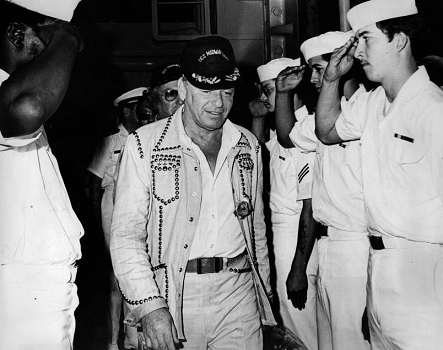
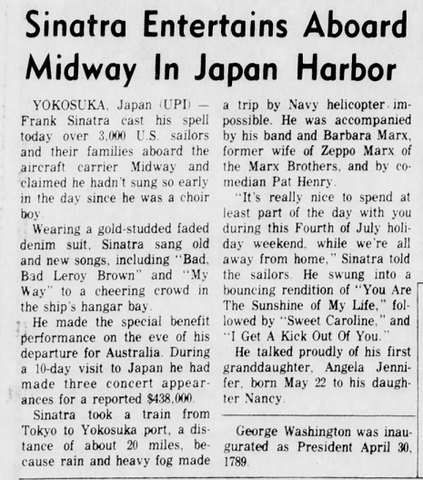
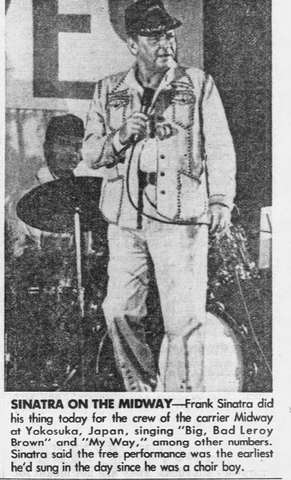
Frank toured the Far East including Tokyo and Australia, but the Melbourne leg turned into an international incident after a public relations woman claimed he had verbally abused her; Australian unions then refused to service his concerts or plane, requiring his lawyer Mickey Rudin to negotiate a resolution and a televised farewell concert.
Frank Sinatra (quoted): "I like coming here and I like the people. I love your attitude."
Source: Nancy Sinatra, Frank Sinatra: An American Legend, 1995.
Sinatra arrived in Australia with Barbara Marx for a concert tour; at Melbourne's Festival Hall his bodyguards seized a photographer who tried to take their picture, an incident that fed into the tour's later press controversy.
Source: George Carpozi Jr., Frank Sinatra: Is This Man Mafia? (New York: Manor Books, 1979).
Festival Hall, Melbourne, Australia
Key Musicians: Al Viola (guitar), Irv Cottler (drums), Gene Cherico (bass), Billy Byers (trombone), Marvin Stamm (trumpet), Bud Shank (saxophone), Bill Miller (piano).
Orchestra Conducted By: Don Costa
1. overture
2. I Get A Kick Out Of You
3. You Are The Sunshine Of My Life
4. You Will Be My Music
5. Don't Worry 'Bout Me
6. If
7. Bad, Bad, Leroy Brown
8. Ol' MannRiver
9. "Famous Monologue"
10. saloon medley: Last Night When We Were Young / Violets For Your Furs - Here's That Rainy Day
11. I've Got You Under My Skin
12. My Kind Of Town
13. Let Me Try Again
14. The Lady Is A Tramp
15. My Way
16. chaser "My Way"
The Sydney Morning Herald
Festival Hall, Melbourne, Australia
Key Musicians: Al Viola (guitar), Irv Cottler (drums), Gene Cherico (bass), Billy Byers (trombone), Marvin Stamm (trumpet), Bud Shank (saxophone), Bill Miller (piano).
Orchestra Conducted By: Don Costa
The Age (Melbourne, Victoria, Australia) · 11 Jul 1974
The Sydney Morning Herald
7-10-74 note: Nice to have a review of the concert without all the conflict. Ed
MELBOURNE, AUSTRALIA
JULY 9, 1974
'He was almost legless': How Bob Hawke and a bottle of brandy saved Frank Sinatra from tour disaster
ABC RN
By James Vyver for The History Listen
Frank Sinatra (centre) with Robert Raymond and Gough Whitlam during the scandal-riddled 1974 tour.(ABC Archives )
Frank Sinatra was many things: musical genius, cultural icon, magnet for power. But when it came to the women's liberation movement, he was more of a 'do it my way' kind of guy.
And during a 1974 tour to Australia, he said the wrong thing to the wrong people at the wrong time.
"The broads who work in the press are the hookers of the press. I might give them a buck-and-half, I'm not sure," Sinatra told a crowd at Melbourne's Festival Hall. The on-stage slur set in motion a bizarre series of events that sparked a lengthy siege and was only resolved thanks to some clever peace-brokerinng by future Australian prime minister Bob Hawke.
Ol' Blue Eyes is Back... in Australia
By the 1970s, Frank Sinatra was insecure about his appearance and voice, a biographer says(Getty: Art Zelin)
Sinatra arrived in Australia in July 1974, having removed the shackles of a short but uncomfortable retirement from showbusiness.
He was back in the game, but his 59 years on earth showed.
His levels of alcohol consumption were gargantuan often two bottles of Jack Daniels a day ” and he smoked at a similar ar rate.
"He was insecure, about his looks, about his voice," Sinatra biographer James Kaplan says.
"And he didn't like the way the world was."
'A complete frenzy'
As Ol' Blue Eyes was battling his demons, women in Australia were exorcising theirs. Feminism was in the ascendency, and the women's liberation movement had begun dismantling the social constructs of the workplace.
"I think all female journalists were feminists, you had to be," says former ABC journalist Margot Marshall.
Sinatra refused to talk to the media, of either sex, while in Australia. There would be no interviews, no press conferences.
Obliged to cover the tour even without hearing from the man himself, the press hounded Sinatra.
"The media were determined to get to him," says Sinatra's Australian concert producer Robert Raymond.
"It was a complete frenzy."
The media chased his motorcade, mobbed his hotel, corralled him at concert venues and generally made sure Sinatra's team of bodyguards were earning their dime. Media reporting of the tour covered the usual Sinatra fodder ” mob connections and ex-wives. In general, there was a sense of cutting the tall poppy down to size. By the time he took the stage for the first time at Melbourne's Festival Hall, Sinatra was ready to unload.
"They're parasites. They're bums and they're always going to be bums," he said of the press.
"They're pimps, they're just crazy. A pox on them."
Then he rolled out his line about female journalists being hookers.
That was the turning point.
A superstar gets blacklisted
Frank's comments were poisonous, but they were also mistimed. You just couldn't publicly put women down in that way anymore.
Margot Marshall was an ABC journalist who remembers Frank Sinatra as a man with an ego.(ABC Archives)
"What an ego!" says Marshall, who remembers one fellow journalist calling him a pig.
"Our backs got up and we thought 'we're not going to put up with this!'" The unions also read the room. They knew it was feminism, not chauvinism, that was the prevailing social movement of the day.
Workers from the Australian Theatrical and Amusement Employees Association, who controlled the lighting, staging and musicians for Sinatra's tour, announced they would strike until they got an apology from the crooner.
It was not forthcoming.
Listen to the program
The History Listen charts the extraordinary tale of Frank Sinatra under siege in Australia. Read more
"Unless within 15 minutes Mr Sinatra had an apology for '15 years of shit' from the Australian press, he would be leaving the country within the hour," was the response given to the unions after a meeting with Sinatra's lawyer.
The Transport Workers Union joined the fray the next day, refusing to fuel any jet private or commercial that Sinatra attempted to fly soon.
This soon expanded to a total black ban from every union that mattered.
Sinatra was grounded and under siege.
The strikes coincided with Sinatra's second show in Melbourne, scheduled for that same day.
But with no musicians, no stage, no drivers, room service, the show would not go on. Sinatra somehow flew back to Sydney that night some media reported his private jet had enough leftover fuel to make the trip, while other reports have him sneaking onto an Ansett flight under an assumed name.
Hawke swoops in to broker peace
The following night, at the 11th hour, an expert negotiator was called in. "There's only one man who can solve this for you," then prime minister Gough Whitlam said in a phone call to the Sinatra hotel suite.
"Bob Hawke."
Mr Hawke was indeed the man for the job.
When some Sinatra fans turned up to his second cancelled Melbourne show, they were met with a pre-recorded apology.(ABC Archives )
As president of the Australian Council of Trade Unions, he was sent in to try to broker a deal to lift the black ban.
Mr Raymond took the future PM up to the suite.
"I noticed that the dining table had on it a bottle of Courvoisier and a box of cigars. That was it! No papers or anything," Mr Raymond says.
After many drafts of a 'statement of regret', and many draughts of the brandy, Mr Hawke and Sinatra's lawyer Micky Rudin managed to hammer out a deal.
Mr Hawke had negotiated hard.
"He was half pissed, almost legless," Mr Raymond says.
"Micky knew how to get to Bob Hawke: that bottle of Courvoisier.
Ultimately, the joint statement of regret from the crooner and unionists read bby Mr Hawke on the steps of Sinatra's hotel in effect agreed to diisagree. It was not an apology per se from Sinatra, nor journalists or unions; more a statement that both had a job to do and could, within reason, say whatever they pleased. A concession from Sinatra's lawyer was that to televise one of his Sydney's shows as a gesture of good will to fans who missed out in Melbourne.
It was a draw; neither side had much to gain by Sinatra leaving. The unions had their PR win, while Sinatra was keen to complete his payday and maintain the momentum of his comeback tour.
So the tour went on and Sinatra sang to adoring crowds in Sydney before leaving Australia.
"His feathers were ruffled while he was in Australia, but the minute he was back in the United States his feet were being kissed again by everybody in sight," Kaplan says.
Sinatra performed at Madison Square Garden in New York later that year.
"Ol' Blue Eyes is back", he told the audience.
"Or as they say in Australia, 'Ol' Big Mouth is back!'"
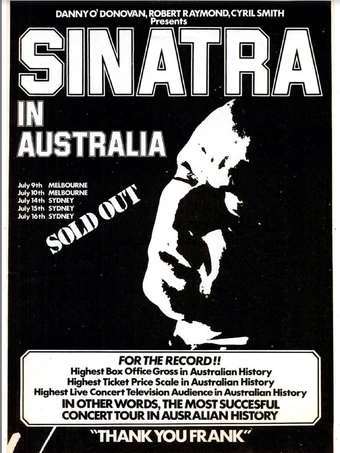
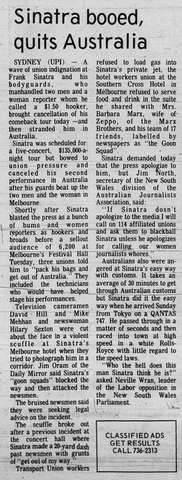
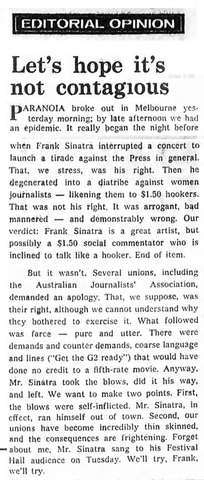
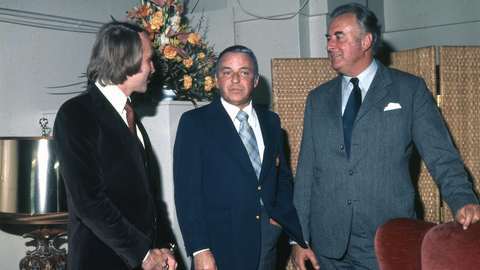
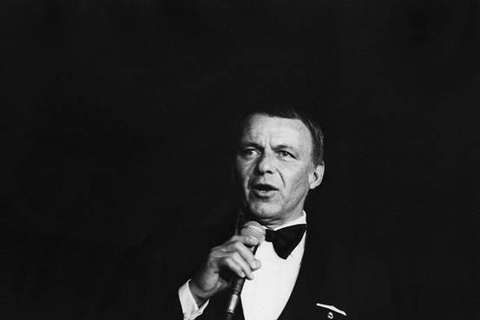
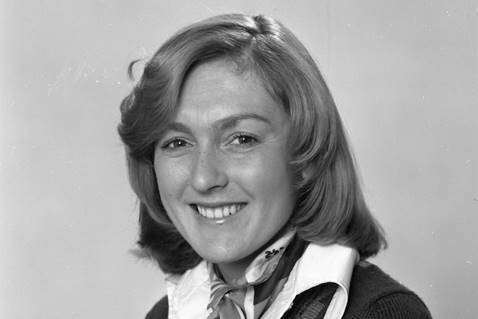
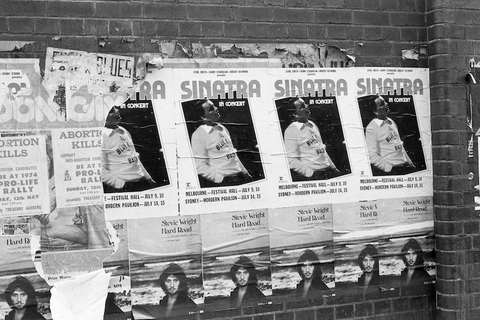
Festival Hall, Melbourne, Australia
Notes: FS cancels this performance due to his famous clash with the press and unions.
Horden Pavilion, Sydney, Australia
Key Musicians: Al Viola (guitar), Irv Cottler (drums), Gene Cherico (bass), Billy Byers (trombone), Marvin Stamm (trumpet), Bud Shank (saxophone), Bill Miller (piano).
Orchestra Conducted By: Don Costa
Partial Set List:
1. Come Fly With Me
2. I Get A Kick Out Of You
3. Don't Worry 'Bout Me
4. saloon medley: Last Night When We Were Young / Violets For Your Furs /Here's That Rainy Day
5. I've Got The World On A String
6. Nancy
7. I've Got You Under My Skin
8. Send In The Clowns
9. My Kind Of Town
Horden Pavilion, Sydney, Australia
Key Musicians: Al Viola (guitar), Irv Cottler (drums), Gene Cherico
(bass), Billy Byers (trombone), Marvin Stamm (trumpet), Bud Shank (saxophone), Bill Miller (piano).
Orchestra Conducted By: Don Costa
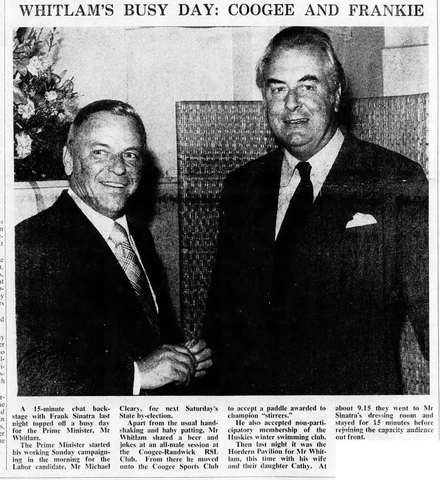
Horden Pavillion, Sydney, Australia
Key Musicians: Al Viola (guitar), Irv Cottler (drums), Gene Cherico (bass), Billy Byers (trombone), Marvin Stamm (trumpet), Bud Shank (saxophone), Bill Miller (piano).
Orchestra Conducted By: Don Costa
1. overture
2. You Will Be My Music (walk on instrumental)
3, I Get A Kick Out Of You
4. You Are The Sunshine Of My Life
5. You Will Be My Music
6. Don't Worry 'Bout Me
7. If
8. Bad, Bad Leroy Brown
9. Ol' Man River
10. monologue I
11. saloon medley: Last Night When We Were Young / Violets For Your Furs / Here's That Rainy Day
12. I've Got You Under My Skin
13, My Kind Of Town
14. monologue II
15. Let Me Try Again
16. Send In The Clowns
17. The Lady Is A Tramp
18. introductions
19. My Way (gap at end)
Notes: TT 79mins.
NOTE: Ed O'Brien says this was a very good performance. Sinatra had a few comments about his problems with the Australian press and unions but most of the 85 minute show was devoted to singing and Sinatra was in fine form. The following evening, the final concert of the three night engagement, was televised throughout Australian and Sinatra was not in good musical form at all.
Indeed, he wasn't, Sinatraphile Lo Curto agrees. Throughout the concert, he sounds like a man who had been screaming at the top of his lungs for a couple of days, which indeed he had been. Lo Curto says he has often wondered why a video tape of this concert has yet to surface. You'd think that in all of Australia there'd be one wealthy Sinatraphile who owned a VCR in 1974.
O'Brien responded by pointing out that BETA video was introduced in April of 1975 and VHS in May of 1976. Australia did not have either until the late 70s. O'Brien doesn't believe the VU Max was available Down Under in 1974. Sinatra's lawyer insisted the tape of the show be erased within 24 hours of the broadcast. Of course, Thorton Wilder had the same provision for "Our Town" in September of 1955, but it was ignored.
Lo Curto wondered, then, how the line tap surfaced. O'Brien explained that it was taped from the TV broadcast.
Horden Pavilion, Sydney, Australia
Key Musicians: Al Viola (guitar), Irv Cottler (drums), Gene Cherico (bass), Billy Byers (trombone), Marvin Stamm (trumpet), Bud Shank (saxophone), Bill Miller (piano).
Orchestra Conducted By: Don Costa
1. walk on music
2. I Get A Kick Out Of You
3. You Are The Sunshine Of My Life
4. Let Me Try Again
5. If
6. Bad, Bad Leroy Brown
7. Angel Eyes
8. I've Got You Under My Skin
9. My Kind Of Town
10. Send In The Clowns w/Bill Miller, piano
11. Nancy
12. The Lady Is A Tramp
13. My Way
14. chaser: "My Way"
Notes: TT 76mins. This concert was televised by the Australian TV.
Harrah's, Lake Tahoe, Nevada (September 4-10) w/Frank jr. & Nancy
1. The Lady Is a Tramp
2. I Get a Kick Out of You
3. Bad, Bad Leroy Brown
4. Send in the Clowns
5. Let Me Try Again
6. My Kind of Town
7. Angel Eyes
8. I've Got You Under My Skin
9. My Way
Harrah's, Lake Tahoe, Nevada (September 4-10) w/Frank jr. & Nancy
[image referenced in source but could not be recovered]
[image referenced in source but could not be recovered]
Harrah's, Lake Tahoe, Nevada (September 4-10
The Veterans
Pat Henry
Woody Herman and the New Thundering Heard
Frank Sinatra Jr.
Introduction
1. My Favorite Things
2. I Can See Clearly Now
3. (Has Anybody Seen) My Sweet Gypsy Rose
Frank Sinatra
1. Bad, Bad Leroy Brown
2. I Get A Kick Out Of You
3. If
4. Let Me Try Again
5. Don't Worry 'Bout Me
6. Monologue
7. You Turned My World Around
8. My Kind Of Town ( new Riddle chart )
9. Send In The Clowns w/Bill Miller
10. I've Got You Under My Skin
11. My Way note: Frank Jr tells the audience that
Nancy is under the weather because of the very demanding rehearsals.
Ed
Harrah's, Lake Tahoe, Nevada (September 4-10)
The Veterans
Pat Henry
Frank Sinatra Jr.
Woody Herman & His New Thundering Herd
Nancy Sinatra
Frank Sinatra
1. Bad, Bad Leroy Brown
2. I Get a Kick Out of You
3. Don't Worry 'Bout Me
4.. Send in the Clowns w/Bill Miller
5. Let Me Try Again
6. Monologue
7. If
8. My Kind Of Town
9.Angel Eyes
10. I've Got You Under My Skin
11. My Way
Harrah's, Lake Tahoe, Nevada (September 4-10)
The Veterans
Pat Henry
Frank Sinatra Jr.
Woody Herman & His New Thundering Herd
Nancy Sinatra
Frank Sinatra
Review of this show:
FRANK SINATRA and FAMILY
WOODY HERMAN
Harrah's Tahoe
For the first time, The Voice cum offspring are an attraction, with the kids the opening act.
The offspring are not so divinely gifted as the father. Frank Jr. looks Ike and sings like an ex-Marine. Nancy, overweight and overdressed, sang some nice but soulless tunes. at times with husband Hugh Lambert, who was credited with production and direction of the show.
Ol' Blue Eyes was a different story. It was the first time the reporter had been exposed to the
Sinatra magic in person, and suffice to say that by the end of the Sept. 6 show, which concluded with "My Way," (the "national anthem." as Sinatra put it) I had been reduced to a helpless mass of emotional protoplasm.
Sinatra's voice, awesome in its depth, coloring and subtlety, paints a world of love. independence and determination in the most intimate and torchlike fashion. Sinatra is the incarnation of every impulse of lust, passion or love that has ever passed through the air of any bar or lounge in America since 1940.
He is a perfect mirror of his particular social environment. He drinks and smokes his way through songs just as the people in his songs
(himself usually as a main character), and the people watching him also drink and smoke their way through the memories he sings about.
He mirrors his environments in other ways:
Chicago, for instance, is something more for being Frank's kind of town.
Sinatra stuck pretty close to the same pro - gression of songs during this seven night en - gagement: "Leroy Brown," "I Get Kick Out of
You," "Don't Worry About Me," "Let Me Try
Again," Steven Sondheim's "Send In the
Clowns," (which moved me more than any other song except "My Way "), "My Kind of Town,"
"I've Got You Under My Skin."
Woody Herman and the New Thundering
Herd backed Sinatra with power and verve after having 10 minutes of their own between Frank
Jr. and Nancy. I doubt that I have ever heard anyone come off the line at zero and do 10 min. of more concentrated, calculated and convincing heat.
Needless to say, every performance at the somewhat small (about 1,000) South Shore
Room was sold out (at $20 minimum per) and the week grossed over $300,000. The same show went to Vegas the week following.
JACK MCDONOUGH
Billboard
September 28, 1974
Harrah's, Lake Tahoe, Nevada (September 4-10)
w/Frank jr. & Nancy
Early Show:
1. The Lady Is a Tramp
2. I Get a Kick Out of You
3. Bad, Bad Leroy Brown
4. Send in the Clowns
5. Let Me Try Again
6. My Kind of Town
7. Angel Eyes
8. I've Got You Under My Skin
9. My Way
Harrah's, Lake Tahoe, Nevada (September 4-10) w/Frank jr. & Nancy
Late Show:
1. The Lady Is a Tramp
2. I Get a Kick Out of You
3. Bad, Bad Leroy Brown
4. Send in the Clowns
5. Let Me Try Again
6. My Kind of Town
7. Angel Eyes
8. I've Got You Under My Skin
9. My Way
Harrah's, Lake Tahoe, Nevada (September 4-10)
w/Frank jr. & Nancy
© 1997-2025 The Sinatra Archive
This calendar, or any parts thereof, may not be reproduced in any fashion
whatsoever without the prior written permission of the publisher (The
Sinatra Archive)
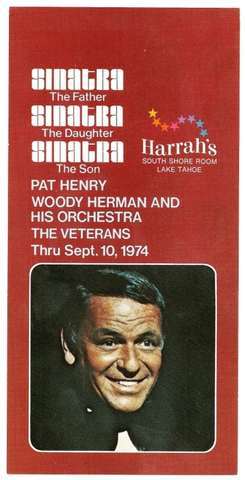
Harrah's, Lake Tahoe, Nevada (September 4-10)
w/Frank jr. & Nancy
© 1997-2025 The Sinatra Archive
This calendar, or any parts thereof, may not be reproduced in any fashion
whatsoever without the prior written permission of the publisher (The
Sinatra Archive)
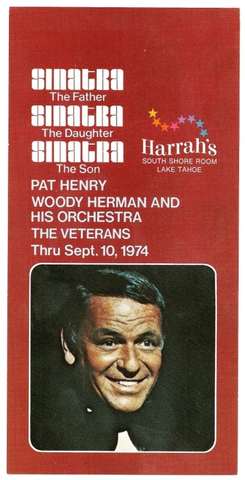
Harrah's, Lake Tahoe, Nevada (September 4-10) w/Frank jr. & Nancy
Woody Herman & His Thundering Herd
Songs:
1. Bad, Bad Leroy Brown
2. I Get A Kick Out Of You
3. Don't Worry 'Bout Me
4. Send In The Clowns w/Bill Miller
5. Let Me Try Again monologue
6. My Kind Of Town
7. Angel Eyes w/Bill Miller
8. I've Got You Under Skin
9. My Way
10. Side By Side By Side w/Frank Jr. & Nancy
note: Here is the song list for both the dinner and late show on 9-8-74. Beginning on this date, Frank and Family closed the show with
Stephen Sondheim's "Side By Side By Side" from the Broadway musical "Company."
--Ed
Harrah's, Lake Tahoe, Nevada (4-9)
Woody Herman Orchestra Conducted By: Don Costa
Opening Act: Frank Sinatra,jr., Nancy, jr.
Early Show:
1. The Lady Is a Tramp
2. I Get a Kick Out of You
3. Bad, Bad Leroy Brown
4. Send in the Clowns
5. Let Me Try Again
6. My Kind of Town
7. Angel Eyes
8. I've Got You Under My Skin
9. My Way
Late Show:
1. The Lady Is a Tramp
2. I Get a Kick Out of You
3. Bad, Bad Leroy Brown
4. Send in the Clowns
5. Let Me Try Again
6. My Kind of Town
7. Angel Eyes
8. I've Got You Under My Skin
9. My Way
note: Frank, Frank Jr, Nancy and Hugh Lambert closed both shows singing Sondheim's "Side By Side." Not sure when "Tramp" became the opening number. He did sing it on both shows September 10th.
Ed
Harrah's, Lake Tahoe, Nevada
Orchestra: Woody Herman & His Thundering Herd
Conductor: Don Costa
Dinner show:
1 The Lady Is A Tramp (Billy Byers arg.)
2. I Get A Kick Out Of You (Riddle arg.)
3. Bad, Bad Leroy Brown
4. Send In The Clowns w/ Bill Miller on piano
5. Let Me Try Again monologue
6. My Kind Of Town ( new Nelson Riddle arg.)
7. Chicago
8. Angel Eyes (Riddle arg. w/full orchestra)
9. I've Got You Under My Skin
10. My Way
Midnight show:
1 The Lady Is A Tramp (Billy Byers arg.)
2. I Get A Kick Out Of You (Riddle arg.)
3. Bad, Bad Leroy Brown
4. Send In The Clowns w/ Bill Miller on piano
5. Let Me Try Again monologue
6. My Kind Of Town ( new Nelson Riddle arg.)
7. Angel Eyes (Riddle arg. w/full orchestra
8 I've Got You Under My Skin
9. My Way
Frank Sinatra's last appearance in Lake Tahoe, prior to this engagement, was on September 5, 1963.
The 1974 engagement turned out to be a family affair.
Frank Jr. opened the show and also acted as M.C. throughout.
Nancy followed him and the comedy dance team The Veterans provided 20 minutes of entertainment. Pat Henry preceded the main attraction ( "Don't leave, there's another act."). Nancy's husband, Hugh Lambert, produced the show.
Caesars Palace, Las Vegas, Nevada (September 12-18)
Woody Herman Orchestra Conducted By: Don Costa
(opening night - one show only)
OA: Pat Henry
1. The Lady Is A Tramp
2. I Get A Kick Out Of You
3. Bad, Bad Leroy Brown
4. Send In The Clowns
5. Let Me Try Again
6. monologue
7. My Kind Of Town
8. Chicago
9. Angel Eyes
10. I've Got You Under My Skin
11. My Way
12. Side By Side, By Side - w/Frank Sinatra, jr. & Nancy
Notes: TT 49mins.
note: The engagement ran from 9-12 thru 9-18. There were
two shows a night and 14 shows in all.
Here is an article from the 12-28-74 Billboard.
The Sinatra Family
minimum was a new high in Vegas.
While patrons in Las Vegas paid $35 minimums to see Sinatra and
Family at Caesars Palace in September, the same show could have
been seen a week earlier at Harrah's -Tahoe for $17.50.
Caesars Palace, Las Vegas, Nevada
Woody Herman Orchestra Conducted By: Don Costa
(opening night - one show only)
OA: Pat Henry
Caesars Palace, Las Vegas, Nevada
First Show
Woody Herman Orchestra Conducted By: Don Costa
1. The Lady Is A Tramp
2. I Get A Kick Out Of You
3. Bad, Bad Leroy Brown
4. Send In The Clowns
5. Let Me Try Again
6. My Kind Of Town
7. monologue
8. Angel Eyes
9. I've Got You Under My Skin
10. My Way
11. Side By Side, By Side - w/Frank Sinatra, jr. & Nancy
Notes: TT 46mins.
Caesars Palace, Las Vegas, Nevada
Second Show
Woody Herman Orchestra Conducted By: Don Costa
1. The Lady Is A Tramp
2. I Get A Kick Out Of You
3. Bad, Bad Leroy Brown
4. Send In The Clowns
5.. Let Me Try Again
6. My Kind Of Town
7. monologue
8. Angel Eyes
9. I've Got You Under My Skin
10. My Way
11.. Side By Side, By Side - w/Frank Sinatra, jr. & Nancy
Notes: TT 43mins.
Two days before the Madison Square Garden taping, Hank Sanicola, one of Frank's oldest friends and most important figures in his career, died. The two had never fully reconciled after a falling out over Sam Giancana, but the loss reportedly hit Frank hard. (Source: Richard Havers, "Sinatra" (Dorling Kindersley, 2007).)
[Weinstock Civil Trial Verdict]
In a federal civil trial in Los Angeles, a jury found Jilly Rizzo liable for assault and battery against a Salt Lake City insurance broker named Weinstock, awarding $101,000 in damages, but exonerated Sinatra and singer Jerry Arvenitas of any liability.
Source: George Carpozi Jr., Frank Sinatra: Is This Man Mafia? (New York: Manor Books, 1979).
Caesars Palace, Las Vegas, Nevada
First Show
Woody Herman Orchestra Conducted By: Don Costa
1. The Lady Is A Tramp
2. I Get A Kick Out Of You
3. Bad, Bad Leroy Brown
4. Send In The Clowns
5. Let Me Try Again
6. My Kind Of Town
7. monologue
8. Angel Eyes
9. I've Got You Under My Skin
10. My Way
11. Side By Side, By Side - w/Frank Sinatra, jr. & Nancy
Notes: TT 43mins.
Caesars Palace, Las Vegas, Nevada
Second Show
Woody Herman Orchestra Conducted By: Don Costa
1. The Lady Is A Tramp
2. I Get A Kick Out Of You
3. Bad, Bad Leroy Brown
4. Send In The Clowns
5. Let Me Try Again
6. My Kind Of Town
7.. monologue
8. Angel Eyes
9. I've Got You Under My Skin
10. My Way
11. Side By Side, By Side - w/Frank Sinatra, jr. & Nancy
Notes: TT 46mins.
Caesars Palace, Las Vegas, Nevada
First Show
Woody Herman Orchestra Conducted By: Don Costa
1. The Lady Is A Tramp
2. I Get A Kick Out Of You
3. Bad, Bad Leroy Brown
4. monologue
5. Send In The Clowns
6. Let Me Try Again
7. monologue
8. My Kind Of Town
9. Angel Eyes
10. I've Got You Under My Skin
11. My Way
12. Side By Side, By Side - w/Frank Sinatra, jr. & Nancy
Notes: TT 45mins.
Caesars Palace, Las Vegas, Nevada
Second Show
Woody Herman Orchestra Conducted By: Don Costa
1. The Lady Is A Tramp
2. I Get A Kick Out Of You
3. Bad, Bad Leroy Brown
4. Send In The Clowns
5. Let Me Try Again
6. My Kind Of Town
7. monologue
8. Angel Eyes
9. I've Got You Under My Skin
10. My Way
11. Side By Side, By Side - w/Frank Sinatra, jr. & Nancy
Notes: TT 45mins.
Caesars Palace, Las Vegas, Nevada
First Show
Woody Herman Orchestra Conducted By: Don Costa
1. The Lady Is A Tramp
2. I Get A Kick Out Of You
3. Bad, Bad Leroy Brown
4. Send In The Clowns
5. Let Me Try Again
6. My Kind Of Town
7. monologue
8. Angel Eyes
9. I've Got You Under My Skin
10. My Way
11. Side By Side, By Side - w/Frank Sinatra, jr. & Nancy
Notes: TT 44mins.
Caesars Palace, Las Vegas, Nevada
Second Show
Woody Herman Orchestra Conducted By: Don Costa
1. The Lady Is A Tramp
2. I Get A Kick Out Of You
3. Bad, Bad Leroy Brown
4. Send In The Clowns
5. Let Me Try Again
6. My Kind Of Town
7. monologue
8. Angel Eyes
9. I've Got You Under My Skin
10. Nancy
11. My Way
12. Side By Side, By Side - w/Frank Sinatra, jr. & Nancy
Notes: TT 42mins.
Caesars Palace, Las Vegas, Nevada
First Show
Woody Herman Orchestra Conducted By: Don Costa
1. The Lady Is A Tramp
2. I Get A Kick Out Of You
3. Bad, Bad Leroy Brown
4. If
5. Let Me Try Again
6. monologue
7. My Kind Of Town
8. Send In The Clowns
9. I've Got You Under My Skin
10. My Way
11. Side By Side, By Side - w/Frank Sinatra, jr. & Nancy
Notes: TT 45mins.
Caesars Palace, Las Vegas, Nevada
Second Show
Woody Herman Orchestra Conducted By: Don Costa
1. The Lady Is A Tramp
2. I Get A Kick Out Of You
3. Bad, Bad Leroy Brown
4. Let Me Try Again
5. monologue
6. My Kind Of Town
7. Send In The Clowns
8. I've Got You Under My Skin
9. My Way
10. Side By Side, By Side - w/Frank Sinatra, jr. & Nancy
Notes: TT 42mins.
Caesars Palace, Las Vegas, Nevada
First Show - Closing Night
Woody Herman Orchestra Conducted By: Don Costa
1. The Lady Is A Tramp
2. I Get A Kick Out Of You
3. Bad, Bad Leroy Brown
4. Let Me Try Again
5. monologue
6. My Kind Of Town
7. Send In The Clowns
8. I've Got You Under My Skin
9. My Way
10. Side By Side, By Side - w/Frank Sinatra, jr. & Nancy
Notes: TT 46mins.
Caesars Palace, Las Vegas, Nevada
Second Show - Closing Night
Woody Herman Orchestra Conducted By: Don Costa
1. The Lady Is A Tramp
2. I Get A Kick Out Of You
3, Bad, Bad Leroy Brown
4. Send In The Clowns
5. Let Me Try Again
6. My Kind Of Town
7. monologue
8. Angel Eyes
9. I've Got You Under My Skin
10. My Way
11. Side By Side, By Side - w/Frank Sinatra, jr. & Nancy
Notes: TT 44mins.
Hollywood
SCA5053 Everything Happens To Me
(Tom Adair/Matt Dennis)
Music Sales Corp. (ASCAP)
Arranged & Conducted by Gordon Jenkins
(3:41) CD: 46013-2 The Complete Reprise Studio Recordings Disc 17
-- Listen to this recording and then the one from 4-8-81. In 74, Frank was
nearing the end of his bel canto singing days. He realized that something had
to be done. Robert Merrill taught him how to sing from his bellows. What a difference
it made.
-Ed
SCA5052 Just As Though You Were Here
(Eddie De Lange/John Benson Brooks)
Music Sales Corp./Scarsdale Music Corp. (ASCAP)
Arranged & Conducted by Gordon Jenkins
(4:21) CD: 46013-2 The Complete Reprise Studio Recordings Disc 17
CD: 9-26340-2The Reprise Collection
SCA5051 The Saddest Thing Of All- N/R
(Michel Legrand/Pierre Leroyer/Edward Ruault/Carl Sigman)
(ZIMRA/SACEM)
Arranged & Conducted by Gordon Jenkins
NOTE: Sinatra Scholar Ed O'Brien says that these recordings were done at the Warner Burbank Studio with a 43-piece orchestra.. "Everything Happens to Me" had new lyrics from Tom Adair. Third time around for Sinatra on this one. He did with Dorsey at RCA and with Riddle at Capitol. The effort here is okay but the fourth time proved to be the charm for the updated version.
"Saddest Thing . . ." is a dirge. The re-do in August of 1975 was a better vocal and a livelier chart. But "Just As Though You Were Here" is a great, great recording. The 1942 effort with Dorsey is quite nice but this beauty is Sinatra at his absolute best in the post-retirement phase of his career. O'Brien says he will never forget the first time he heard it and wishes that Sinatra had built an album around it.
"Everything Happens to Me" / "Just as Though You Were Here"
In September 1974, with Tommy Dorsey evidently on his mind, Sinatra and Jenkins cut superlative new versions of "Everything Happens to Me" and "Just as Though You Were Here," charts that could have fit on All Alone or Where Are You? These recordings sat unreleased until The Complete Reprise Studio Recordings box, while lesser new material like "Noah" was rushed out at the time -- a contrast Friedwald calls emblematic of a 'bass-ackwards' period.
Source: Will Friedwald, "Sinatra! The Song Is You: A Singer's Art" (2018 revised edition).
[Everything Happens to Me -- critical commentary]
Granata includes 'Everything Happens to Me' among the fifty recordings he considers essential to understanding Sinatra's artistry (arranged by Gordon Jenkins, recorded 1981, Reprise); the song was chosen for its musical/interpretive value rather than commercial popularity.
This song/context matches multiple dated entries in the chronology, or lacked a sufficiently precise date; the specific date could not be determined with confidence.
Source: Charles L. Granata, "Sessions with Sinatra: Frank Sinatra and the Art of Recording" (1999/2003), Afterword & Appendices A-D
[Just as Though You Were Here -- critical commentary]
Zeke Zarchy: "Tommy knew he had something hot," said lead trumpeter Zeke Zarchy, "because Frank was far and away the best band vocalist of the day when he was singing in bands." On a July 1942 broadcast Dorsey even emitted a sarcastic mock-swoon as he introduced Sinatra on "Just as Though You Were Here."
This song/context matches multiple dated entries in the chronology; the specific date Friedwald is referring to could not be determined with confidence.
Source: Will Friedwald, "Sinatra! The Song Is You: A Singer's Art" (2018 revised edition), Ch. 3, "With Tommy Dorsey" (1940-1942)
[Just as Though You Were Here / Street of Dreams / It Started All Over Again / There Are Such Things -- critical commentary]
What it took to revive the original "Smile Again" sound was strings. As it happened, Sinatra’s first date with strings (since his 1939 demo of "Our Love") turned out to be his own premiere solo session, the Bluebird date of January 1942. In fact, according to a Down Beat clipping from early 1942 ("Dorsey Will Sweeten Brass with Fiddles"), the results of the Sinatra-Stordahl session put the idea in Dorsey’s mind; and when Artie Shaw broke up his band to join the service, Dorsey seized the opportunity to annex his former rival’s entire violin section en masse. The strings support the Sinatra-Pipers combo suitably on their last four outings, "Just as Though You Were Here," "Street of Dreams," "It Started All Over Again," and what was to be both their last number-one hit (as well as Tommy Dorsey’s), "There Are Such Things." The strings, at last, give the Sentimentalists a sound that is inarguably Sentimental; those who know the normally snappy "It Started All Over Again" will be surprised by the stateliness of this ballad reading. Dorsey was taking the fiddles very seriously, even bringing in light-classicist David Rose to score "By the Sleepy Lagoon" and "Melody in A." for the enlarged band. The sound of the strings dominates much more than Dorsey’s trombone, heard only in brief instrumental breaks between the vocal choruses. Still, the lightness the strings and voices apply behind Sinatra on "Just as Though You Were Here" is appropriate, considering how that song was to be treated with increasing dramatics as the war went on. The strings have the opposite effect on "Street of Dreams," treating the melody grandly, but making the text seem naively light-headed. [Footnote:] Sinatra would later claim that he might never have left James for Dorsey if the latter didn’t have a string section. Time plays tricks on memory: Dorsey didn’t actually add strings until 1942, two years after Sinatra joined, and James would add strings a whole year earlier than Dorsey, in 1941.
This song/context matches multiple dated entries in the chronology; the specific date Friedwald is referring to could not be determined with confidence.
Source: Will Friedwald, "Sinatra! The Song Is You: A Singer's Art" (2018 revised edition), Ch. 3, "With Tommy Dorsey" (1940-1942)
Universal Amphitheater, Los Angeles, California
Frank Sinatra in Concert with His Friends Benefit
Orchestra Conducted By: Bill Miller
1. The Lady Is A Tramp
2. I Get A Kick Out Of You
3. Bad, Bad Leroy Brown
4. Let Me Try Again
5. Send In The Clowns
6. My Kind Of Town
7. Ol' Man River
8. monologue
9. Don't Worry 'Bout Me
10. If
11. Angel Eyes
12. You Are The Sunshine Of My Life
13. My Way
Notes: TT 50mins.
Mike Agron:
I have special memories associated with attending the Friday evening benefit on 9.27.74 to see "Sinatra in Concert With His
Friends" , where his friend Cary Grant was the MC, and other friend, Jack Benny did a cameo by playing his violin in the orchestra and then I think a short bit onstage .this was just a few short months before JB passed away, and the first act was Helen Reddy.
In 1974, the Universal Amphitheater had not yet been remodeled with a "roof" . This was truly an open air venue with the stars above and nice warm breeze of the San Fernando valley as part of the ambience.
The benefit was for the a fund raiser to build the "newâ Cedars Sinai Medical Center, which I think then Universal Chairman Lew Wasserman was spearheading and recruited his good friend, Sinatra and his friends. It was a great concert performance to be sure with the opening number Tramp, using what became his signature arrangement, sounding very different than the studio recording. While we weren't sitting up front and center, it was still an enjoyable location to enjoy the concert.
What has kept this concert fresh in my mind all of these years later, was a very special gift one of my staff gave me.
Without my knowing it, she found the ticket stub on my desk one day (which in addition to having printed on it that I was in Section 9, Row R, Seat 8, had a great drawing of Sinatra in his iconic style singing holding the mike in one hand and his right hand gesturing up in the air), and had it enlarged poster size and framed, and then she surprised me by giving it to me for my birthday.. It still hangs in my family room.
Note that in 1974, the ticket price was $20 with $10 being counted as the tax deductible contribution. Couldn't imagine what that would cost today in 2014 dollars.
As Ed often says, this was one for the ages.
Ed O'Brien:
Jack Benny did a long introduction of Sinatra that evening.
He began by explaining that his appearance with the orchestra was a
misunderstanding. He thought Frank wanted him to perform with
the musicians. Frank only wanted him to do the introduction. Benny
then complained that Frank didn't bother to ask anyone to introduce
him. He went on about his stature as a performer in radio, TV, movies
and concerts. The idea of retiring didn't appeal to him because he
had no hobbies like Frank. And Frank had a lot of hobbies, most of
them being young ones. He finishes his remarks by telling the audience
that in his humble opinion Frank is the greatest performer in the world.
Intro runs more than four minutes, much to the delight of the audience.
Mr. Benny introduced Sinatra at the Paramount on 12-30-42. That was
the night it all happened for Frankie. The two men would become very
close friends. In my humble opinion, Jack Benny was a very, very funny
man.
Universal Amphitheater, Los Angeles, California
Frank Sinatra in Concert with His Friends Benefit
Orchestra Conducted By: Bill Miller
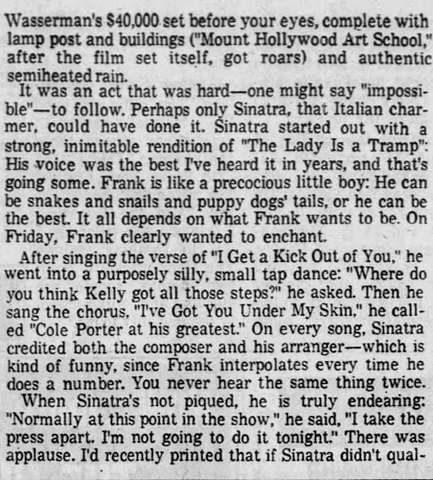

[Jerry Weintraub Tricks Sinatra Into 'The Main Event']
Nancy Sinatra: Producer Jerry Weintraub recalled that Sinatra initially resisted doing a live television special, so Weintraub pitched the idea of staging it as a boxing-style event at Madison Square Garden with Howard Cosell announcing. Sinatra warmed up only once Weintraub cast him as "the main event" himself, and later, sensing Weintraub's panic backstage before the live broadcast, reassured him by saying Weintraub had gotten him into it and Sinatra would get him out of it.
Source: Nancy Sinatra, Frank Sinatra: An American Legend, 1995.
The Garden, Boston, Mass.
"THE MAIN EVENT" tour
Benefit
Orchestra Woody Herman & The Young Thundering Conducted By: Bill Miller
1. The Lady Is A Tramp
2. I Get A Kick Out Of You
3. Bad, Bad Leroy Brown
4. Let Me Try Again
5.Send In The Clowns
6. My Kind Of Town monologue
7. Ol' Man River
8. Don't Worry 'Bout Me
9. If
10. I Got You Under My Skin
11. Angel Eyes
12. You Turned My World Around
13. I Get Along Without You Very Well
14. You Are The Sunshine Of My Life
15. The House I Live In'
16. My Way
Frank did 16 songs that night. "You Turned My World
Around" and "I Get Along Without You Very Well." were not included in the final Reprise master
TV Guide coverage of "Main Event, "10-13-74, has "Turned My World" scheduled for that performance.
Here is a excerpt of the Boston Globe review from 10-3-74.
Ed
Ed O'Brien points out that this was the opening concert of an Eastern tour. The acoustics in the Garden were terrible. In future concerts, Sinatra would comment on just how bad the sound was that evening. He never played the Garden again.
Notes: "The House I Live In" & "My Way" Appear On The CD The Main Event
(Reprise). The Complete Concert Was Recorded By Reprise It Remains Unreleased. TT 66mins.
Greg Palter writes:
Being from Boston this was my 1st Sinatra concert as I was 11 years old and went with my dad...I also agree that the acoustics at Boston Garden were terrible...my dad and I through the years drove to other states to see the Man...the Providence Civic Center was better...not by much...but better+ --
Later in the tour, Frank had some comments to make about the acoustics that night at The Garden. Never played there again.
Ed
The Garden, Boston, Mass.
"THE MAIN EVENT" tour
Benefit
Orchestra Woody Herman & The Young Thundering Conducted By: Bill Miller
Memorial Auditorium, Buffalo, New York
"THE MAIN EVENT" tour
Orchestra Woody Herman & The Young Thundering Conducted By: Bill Miller
Opening Act: The Young Thundering Herd
1. The Lady Is A Tramp
2. I Get A Kick Out Of You
3. Bad, Bad, Leroy Brown
4. Let Me Try Again
5. Send In The Clowns
6. My Kind Of Town
7. Ol' Man River
8. If
9. I've Got You Under My Skin
10. Angel Eyes
11. Autumn In New York
12. You Are The Sunshine of My Life
13. The House I Live In
14. My Way
Notes: "I've Got You Under My Skin" & "Angel
Eyes" appear on the CD : The Main Event (Reprise). The complete concert was recorded by Reprise it remains unreleased. TT 69mins.
Frank Sinatra, Oct. 4, 1974: Sinatra was on his "The Main Event" tour when he played to a full house at the Aud. He opened with "The Lady Is a Tramp," and proceeded through a 70-minute set that included jazz-age classics ("I've Got You Under My Skin"), maudlin pop hits ("Send in the Clowns") and the dramatic ballads he'd become increasingly associated with ("My Way") as he made his way through the September of his touring years. Sinatra would return to the Aud on Oct. 8, 1976, and May 8, 1982.
Ed O'Brien reports that October 4, 1974 was a very cold Friday night in Buffalo . On the way into the War Memorial Auditorium, I told my wife that the perfect song for Sinatra to sing would be "Autumn in New York ." I also told her the odds were very slim because he hadn't sung it in years.
We had seats that placed us about 5 or 6 feet away from the rather small circle-in-the- round stage. Sinatra was carried onto the stage and was wearing a Buffalo Bills jacket. He had a gorgeous grey suit and looked very fit.
He opened with "Tramp" and it was immediately obvious that the voice was in great shape. I realized that he was almost close enough to touch. The fifth number was "Send in the Clowns." Sinatra sat on a stool, lit a cigarette and the ashes landed on my pants just above my right knee. I never moved a muscle and no harm was done. Jilly and Jerry Weintraub were kneeling next to me in the aisle. You have no idea what it was like to be sitting 3 feet away from Frank Sinatra when he sang "Ol' Man River." Thrilling doesn't begin to describe it.
His reading of "I've Got You under My Skin" and "Angel
Eyes" were simply magical. At the end of "Skin," a woman in the audience screamed and Sinatra asked "Where does it hurt you, baby?" (That's on the released Reprise LP. At the Main Event, October 13, he sang "That Old Black Magic" as a coda to "Skin." He then told the 24,000 in attendance that it was the perfect time of the year and, lo and behold, did sing "Autumn in New York ." A lady in the crowd asked for "Satisfy Me One More Time." He told her he didn't do "dirty songs."
The penultimate song was a rousing "The House I Live In" and then the much expected and often demanded "My Way."
Sinatra was on stage for 70 minutes and did 14 songs. As the lights came up, I suddenly realized Sinatra was coming down the three steps right next to me. I stepped in front of him and held out my hand. He grabbed it with a hand that felt like Gucci leather. I told him how great he had been and he thanked me. I told him again and he thanked me and said that he was glad that I enjoyed it. I remember being very surprised at how short in stature he was. I guess his height was around 5 feet and 7 /½ inches. I am amazed that 35 years have flown by since that wonderful evening. Sinatra, that evening, looked and sounded indestructible.
Ed O'Brien (2011):
Thirty-seven years ago this evening, I sat a few feet away from Sinatra and
witnessed a remarkable performance. After all these years, I am still struck by how superior
his vocals efforts were in relationship to the much heralded but vastly inferior Main Event
on 10-13-74. Listening to the hodge-podge Reprise LP, a bogus effort claiming to be that
evening's performance, titled "The Main Event," I marvel at his singing on "Skin" and "Angel
Eyes," both from the Buffalo concert. Reprise should have released the 10-4 show. The master
is sitting at Reprise. Why not release it ?
Memorial Auditorium, Buffalo, New York
"THE MAIN EVENT" tour
Orchestra Woody Herman & The Young Thundering Conducted By: Bill Miller
Opening Act: The Young Thundering Herd note: Here is a photo of Frank at the Memorial Auditorium that evening.
The local promoters of the concert, posing with him, are Corey Berger, on his right, and Harvey Weinstein to his left.
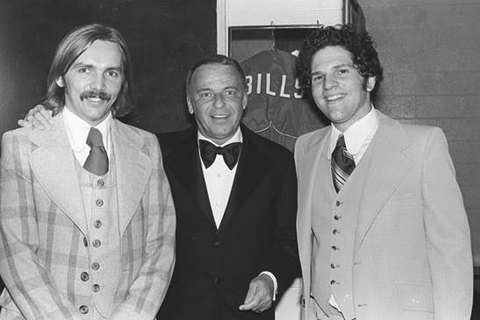
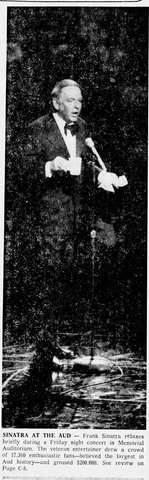
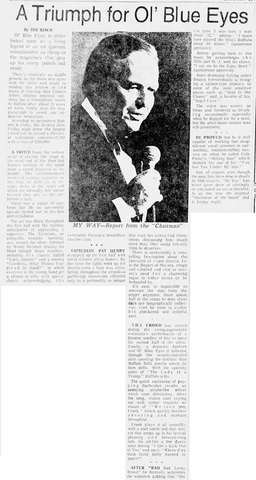
The Main Event, Philadelphia , PA
With Woody Herman And The Young Thundering Herd
Conducted By: Bill Miller
1. The Lady is a Tramp
2. I Get a Kick out of You
3. Let me try Again
4. My Kind of Town
5. Ol' Man River
6. monologue
7. I Get Along Without You Very Well
8. I've Got You Under my Skin
9. Send in the Clowns
10. If
11. You Are the Sunshine of my Life
12. What Are you doing the rest of Your Life
13. My Way
Notes: The verse of "I Get A Kick Out Of You" and the song "Let Me Try Again" Appear On The CD: The Main Event (Reprise).
(The Philly concert was released as part of the "Standing Room Only" three-CD set issued in 2018--Ed)
The Main Event, Philadelphia , PA
With Woody Herman And The Young Thundering Herd
Conducted By: Bill Miller
The mob ticket heist that may have produced an incredible Frank Sinatra show at the Spectrum
A new Sinatra recording uncovers an incredible story about the ticket heist that made it happen.
An enthusiastic audience watches Frank Sinatra perform during an October 7, 1974 concert at the Spectrum.
PHILADELPHIA INQUIRER
by Jonathan Takiff, For the Inquirer
Published May. 3, 2018, 4:29 p.m. ET
No, Frank Sinatra never commissioned Kander and Ebb to "start spreading the news" or paid Sammy Cahn and Jimmy Van Heusen to write a musical homage to our kind of ring-a-ding rocking town.
But listening to the first authorized concert recording of Sinatra captured locally at the Spectrum part of the three-show package dubbed Standing Room Only (Universal Music www.sinatra.com) it's clear that Philadelphians held a special place in the pop icon's heart. Back atcha, fella. On Oct. 7, 1974, the collective South Philly crowd cheered for his overtured entry so intensely, "we physically felt it, the sonic pressure pushing us back like a strong headwind," remembers Sid Mark, the veteran 61 years! host of Sinatra radio shows (now Sunday morning/mid-day on WPHT 1210-AM), who walked Frank up the ramp to the Spectrum stage that evening.
And that roar wouldn't quit. You'll then hear Frank's lavish 40-piece orchestra Woody Herman's Young Thundering Herd vamping through the opening intro to "Tramp" (a.k.a. "The Lady is a Tramp") a crazy six times over. Finally, the singer finds an opening to jump in with his swinging homage to that free-spirited scamp who never "dishes the dirt" or "bothers with people she hates."
That was just for starters. The level of excitement and fevered response is equally palpable and unprecedented around Sinatra performances of the jazzy, finger-snapping "My Kind of Town" and "I've Got You Under My Skin." Even more so when he takes on grand ballads that show off his pop-operatic flair. Like on the "not heard much" anymore "Ol' Man River" and almost as demanding "Send in the Clowns." It all underscored that the artist, then 58, hadn't lost of speck of his skill set or his empathy for the downtrodden and brokenhearted. Advertisement
Several times over, Sinatra pauses to remark about "the great love in the room" and declares, "This is the most fantastic welcome. We've been playing other towns and I can tell you, with all due respect, they're marvelous in other towns, but they're like a cookie sale. When you holler, you really holler here. I'm telling you something … [they're] nothing like this." And while Sinatra is often exuding the brash and mercurial playboy persona who has all the answers slamming the press "bums" (Rex Reed, Rona Barrett) and comically squelching a chatterbox there's one moment during the Philly date where the veneer breaks, emotion gets the better of him. The man's on the verge of verklempt.
A fitting tribute timed to the 20th anniversary of his passing at age 82, the Spectrum show release is bookended in this career-arcing package with a swinging, "I've just turned 50" 1966 show from Sinatra's stronghold at the Sands Hotel-Casino in Las Vegas, backed by the walloping Count Basie Big Band, and conducted by Quincy Jones. On the other side, there's a performance from Dallas in 1987, where The Voice shows weathering but the spirit remains strong. Even ragged notes are turned to dramatic advantage. The only technical/theatrical aids he's needing are those still dazzling band charts, a serious sound system, and a low-slung teleprompter screen keeping song lyrics in his sights. Yeah, the man was slammed for bringing that cheatin' TV tool to the stage. Today, virtually every arena artist uses a teleprompter as a security blanket.
But that middle-of-the-package Philly show is really one for the books for reasons mostly, although not totally, grand. The recording captures Sinatra on the comeback trail with the Ol' Blue Eyes is Back album and tour, marking his return after a cut-short retirement "to spend time with the family and paint" that "quickly drove the guy nuts," mused Mark. "He missed the excitement, missed the music."
And the fan base was now extra hot to fox-trot with the legend in concert. A marketing strategy milked by his national tour producer Jerry Weintraub and manager/attorney Mickey Rudin with a total of three '74 shows in Philly. The first two in April (21-22) were part of a tour ostensibly benefiting Variety International, an entertainers-founded charity for children (known locally for its summer camp) that had honored Sinatra as its Man of the Year. Then came the Oct. 7 show that was a warm-up (and backup recording date) for "The Main Event," a televised Madison Square Garden concert that took place six nights later, famously pumped like a championship prize fight by show announcer Howard Cosell.
"I can't believe we're back here so soon, but here we are," Sinatra told the crowd surrounding him with love at that October Spectrum show. That's the utterance wherein he's almost losing it. "Frank liked a center stage to get him closer to the crowd," recalls another longtime local DJ pal, Jerry Blavat. "Plus, in the round, he could pack in more people and sell more ringside seats."
At the time, this fledgling music critic/reporter for the Philadelphia Daily News believed there was another reason Frank Sinatra had returned here so quickly. Namely, as an apologetic "make-good" date for the devotees who had been first in line to buy tickets to the April shows but oddly wound up with distant seat locations. So maybe that's why we hear the fans yelling so aggressively on this October night?
First whispered in my ear way back when by agitated principals in the Spectrum organization, the story was that self-proclaimed "friends" of Sinatra classic tough guys had shown up at the South Philly arena's offices and forcefully demanded preferred status to buy the best seats in the house, weeks before the tickets were offered to the public. Not a few dozen ducats, not a few hundred, but several thousand, which they would then resell on the street and through ticket brokers at greatly marked-up prices.
My informants were reluctant to go on the record and name names or affiliations, fearing for their "health." But their concerns were later verified when tickets went on sale and first-in-line-buyers called me to complain how they'd been stiffed, sold seats 20 rows back. Or worse.
Ever protective of the Sinatra legacy, Mark, 84, still says "I don't believe that happened." Blavat, 77, acknowledges "Mickey Rudin held back tickets for Frank's friends to buy, but 50 or a hundred per show, at the most 500." As for the thought that Mafia mobsters might have engaged in a major ticket heist, the Geator scoffs, "That's BS. It was always rumored, but I was with him close to 30 years, and traveled with Junior [now deceased Frank Sinatra Jr.] for much of his life. There were no such people around."
So then we got in touch with Larry Magid, the seasoned Philly promoter whose Electric Factory Concerts aligned with Weintraub to produce the local Sinatra dates. And he finally spilled the complete story, guarded for 44 years.
"Frankie Flowers [D'Alfonso] a big-time bookmaker and florist who I casually knew called and asked for tickets for 'friends of Frank,'" Magid related. "I said I was willing to sell him four. I think the top price was $12.50. Maybe $15. Then that Saturday he came to my office with this other beefy guy who said he was with the Teamsters. 'Four tickets won't do, we want to buy 2,500,' Frankie told me in a soft 'good cop' voice. I told him we couldn't do this, that it would look bad to the public. And over the years we'd learned that if you say 'no' to mobsters when they try to shake you down, they usually back off."
Not this day. "Suddenly, the other guy threw himself across my desk, grabbed me by the throat, and started squeezing, choking, yelling he's going to kill me if they don't get the tickets," Magid remembers with a bitter laugh. "So now I'm starting to figure out what 'friends of Frank' really means. Still, I told them that it wasn't in my control to sell them that many tickets, as the distribution was under the Spectrum's control, which is why they then went and paid a 'social call' to the Spectrum people and put the scare on them."
But before blood was spilt, Sinatra's consigliere Rudin got in on the act. He phoned Magid and repeated the mantra – "'They're Frank's friends, just sell 'em the tickets to the April shows. Whatever they want, he wants.' So finally, reluctantly, we did," acknowledges the promoter. "And then, of course, took heat for it from the press and even on radio, surprisingly, from [WFIL DJ] Long John Wade."
As for the wild exuberance of the crowd at that Oct. 7, 1974, Standing Room Only show, Mark has an alternative and equally plausible explanation. "The day before the concert, on my 'Sunday with Sinatra' radio show, I told listeners 'If you're going, I want you to be on your feet when the orchestra starts playing. Then I want to hear the loudest ovation ever, even before he sings the first note. Bless 'em, they all came through."
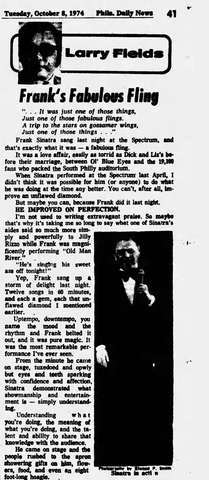
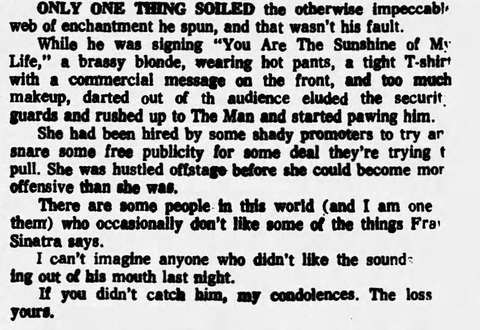
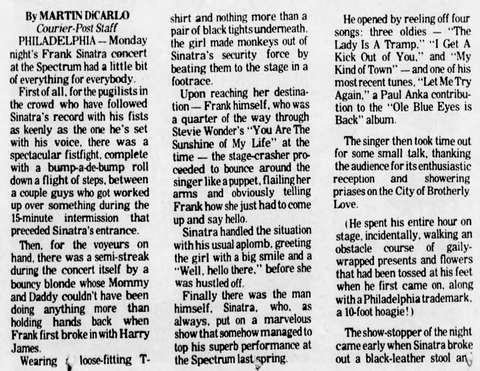
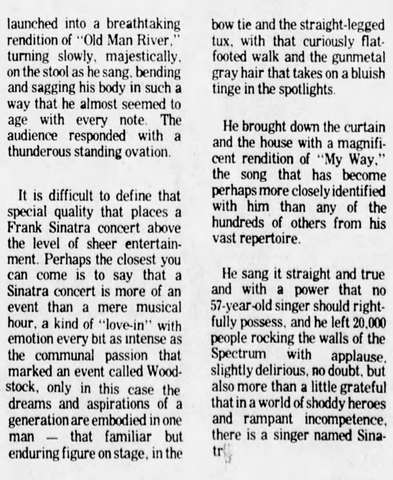
The Main Event, Philadelphia , PA
With Woody Herman And The Young Thundering Herd
Conducted By: Bill Miller
1. The Lady is a Tramp
2. I Get a Kick out of You
3. Let me try Again
4. My Kind of Town
5. Ol' Man River
6. monologue
7. I Get Along Without You Very Well
8. I've Got You Under my Skin
9. Send in the Clowns
10. If
11. You Are the Sunshine of my Life
12. What Are you doing the rest of Your Life
13. My Way
Philadelphia Daily News
October 8, 1974
Courier Post
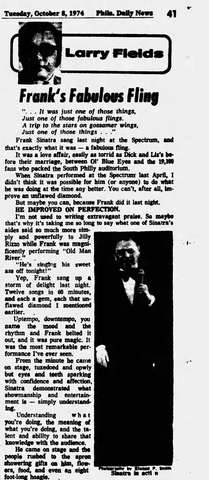
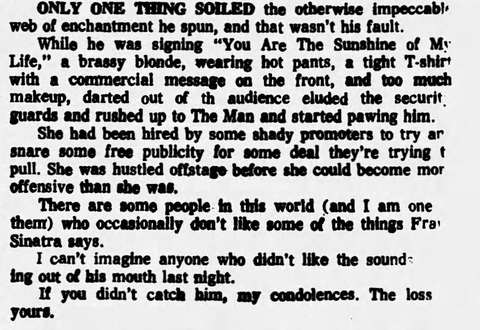
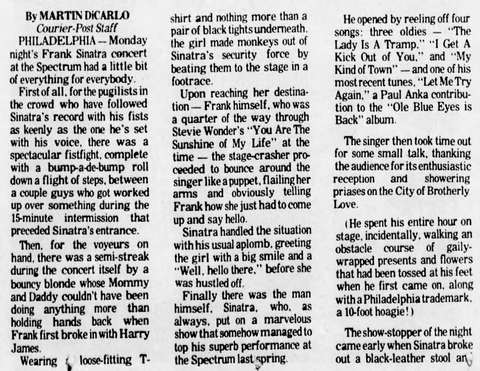
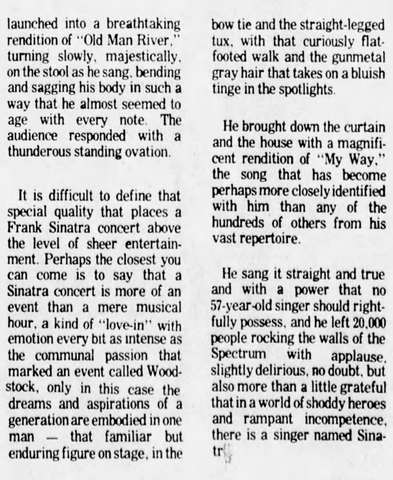
The Main Event, Civic Arena, Pittsburgh, PA
"THE MAIN EVENT" tour
Orchestra Woody Herman & The Young Thundering Conducted By: Bill Miller
1. The Lady Is A Tramp
2. I Get A Kick Out Of You
3. Let Me Try Again
4. My Kind Of Town
5. Ol' Man River
6. Angel Eyes
7. I've Got You Under My Skin
8. Send In The Clowns
9. If
10. You Are The Sunshine Of My Life
11. Nancy
12. My Way
Notes: This concert was recorded by Reprise. It has not been released.
The Main Event, Civic Arena, Pittsburgh, PA
"THE MAIN EVENT" tour
----------------------------------------------------
October 9, 1976 Broome Veteran's Memorial Arena, Binghamton, NY (Cancelled)
[image referenced in source but could not be recovered]
[image referenced in source but could not be recovered]
[image referenced in source but could not be recovered]
[image referenced in source but could not be recovered]
[image referenced in source but could not be recovered]
The Main Event, Madison Square Garden, New York City
Woody Herman and The Young Thundering Herd
Conducted By: Bill Miller
1. The Lady Is A Tramp
2. I Get A Kick Out Of You
3.. What Are You Doing The Rest Of Your Life
4. Bad Bad Leroy Brown
5. Let Me Try Again
6. Send In The Clowns
7. My Kind Of Town
8. Autumn In New York
9. If
10. I've Got You Under My Skin
11. Angel Eyes
12. The House I Live In
13. You Are The Sunshine Of My Life
14. My Way
Note: "Autumn In New York" appears on the CD: The Main Event (Reprise). This concert was recorded by Reprise. Edited concert is available in the "Frank Sinatra: New York" set from Reprise ( R2 520602 ), released in 2009.
NOTE: Sinatra Scholar Ed O'Brien points out that "Let Me Try Again" is from October 13 until 1:51 and there is an intercut and the rest of the song is from October 12‚ O'Brien remarks that the October 12 performance is outstanding in relationship to the October 13 show. ABC taped October 12 as insurance in case Sinatra couldn't perform October 13.
Sinatraphile Vance Adair, in response, points out that "The Main Event" has always both fascinated and amused him. Leaving aside the intercuts, substitutions, apologies, and tantrums I, too, look forward to the day when Reprise releases the other dates recorded around this time. Sinatra, he explains, was very much out of sorts on this date‚ His onstage behavior during the commercials (especially apropos New Jersey ) is revealing indeed. He has spoken with some of the musicians who performed on this date. By these accounts, Sinatra was in less than stellar voice and he knew it. And do did Reprise.‚ There are several far superior line-tap recordings decaying in the vaults from this period that merit an official release. He feels that the Carnegie Hall date from April of 1974 is an undiluted gem of a concert.
Sinatraphile Jack Tomsky say he agrees that this show is far superior to the televised show of the following night. One of the amusing things is that when Sinatra introduced Howard Cosell, the audience booed. Ed O'Brien says that Sinatra didn't like that and came to Cosell's defense. But the booing got louder!
O'Brien says that it took Sinatra five years to live down The Main Event. He has review after review, from all over the world, in the writer would compare an outstanding performance with that evening in Madison Square Garden.
People involved with the album's release told O'Brien that the full page ad in the New York Times on the day of the concert, announcing the forthcoming LP release, was the only reason it was issued. They couldn't figure out a way to make it disappear. Listen to "Skin" and "Angel Eyes" from that night and then compare them to the Buffalo tracks on the released album. Really the difference between night and day!
Carnegie Hall from April, O'Brien observes, was recorded with the intent of commercial release. Problem was Sinatra didn't finish the opening song and blew the lyrics on two others. Reprise did put together a two LP set titled "Sinatra SRO" from the April tour. Sinatra listened to it but didn't like what he heard. The Saloon Trilogy from Carnegie was mastered and playeD on Music of Your Life. Really quite marvelous.
These would make a nice CD set, O'Brien points out: Sinatra's 1971 Retirement Concert, The White House in 1973, and Carnegie Hall 1974 with a few substitutes culled from that tour.
review
Daily News
review of 10-12-74
NEWSDAY
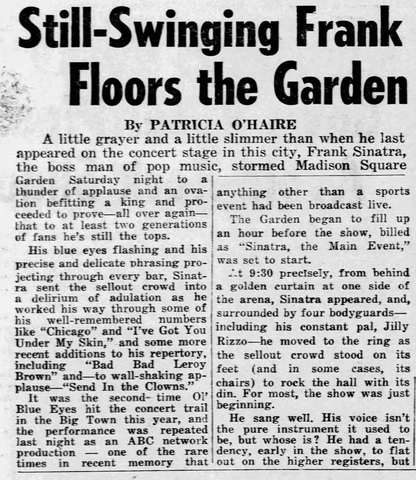

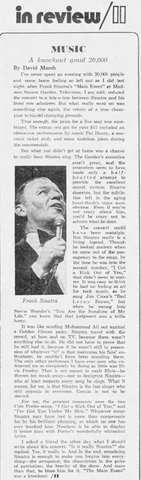
CONCERT REVIEW
Washington Post review of 10-13-74
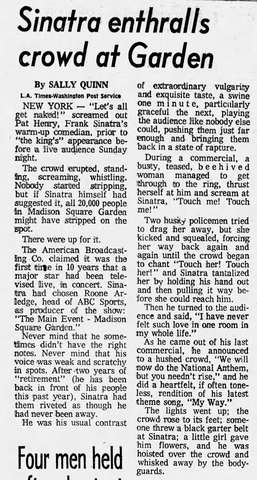
REVIEW OF 10-13-74
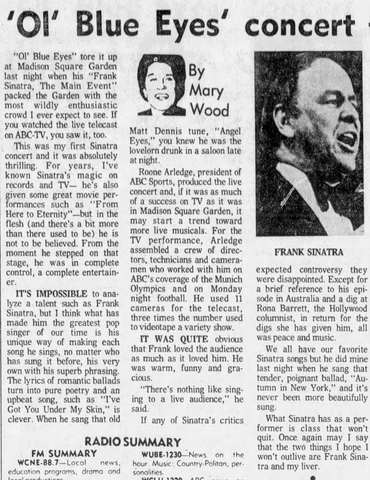
Sinatra The Main Event
Introduction: Howard Cosell
1. The Lady Is A Tramp
2. I Get A Kick Out Of You
3. Let Me Try Again
4. Autumn In New York
5. I've Got You Under My Skin
6. Bad, Bad Leroy Brown
7. Angel Eyes
8. You Are The Sunshine Of My Life
9. The House I Live In
10. My Kind Of Town
11. My Way
Notes: 50 min.
Madison Square Garden, New York City
"THE MAIN EVENT" tour
ABC TV Sponsor: Ford Motor Company
Orchestra Woody Herman & The Young Thundering Conducted By: Bill Miller
Introduction: Howard Cosell
1. overture
2. introduction: Howard Cosell
3. The Lady Is A Tramp
4. I Get A Kick Out Of You
5. Let Me Try Again
6. Autumn In New York
7. I've Got You Under My Skin
8.. Bad, Bad Leroy Brown
9. Angel Eyes
10. You Are The Sunshine Of My Life
11. The House I Live In
12. My Kind Of Town
13. My Way
Notes: The complete concert is on the video :The Reprise Collection Vol
6. Filmed for television by WABC. The following tracks from this concert appear on the Reprise CD: The Main Event: "Orchestral
Overture", Introduction by Howard Cosell, "The Lady Is A Tramp", The chorus of "I Get A Kick Out Of You", "Bad
Bad Leroy Brown", "You Are The Sunshine Of My Life" &
"My Kind Of Town." TT 60mins.
Ed O'Brien:
"Let Me Try Again" is from 10-13 until 1:51. Then there is an intercut and the rest of the song is from the 10-12 show at the Garden.
Frank sang 11 songs at the Main Event. The Reprise LP offers four complete songs from that night and two partials.
Madison Square Garden, New York City
"THE MAIN EVENT" tour
ABC TV Sponsor: Ford Motor Company
Orchestra Woody Herman & The Young Thundering Conducted By: Bill Miller
Introduction: Howard Cosell
Washington Post
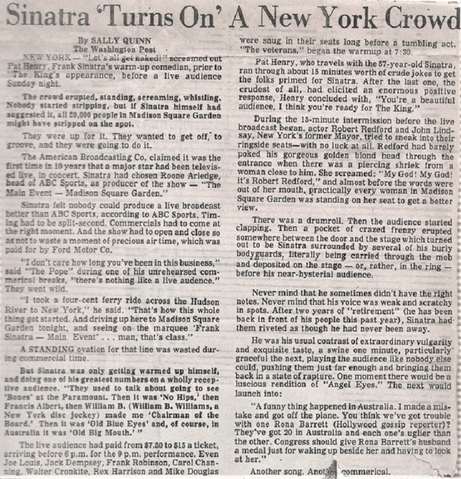
Sinatra in Top of Form at the Garden
New York Times, October 13, 1974
Frank Sinatra, by now long removed from his supposed retirement of just last year, rmains the consummate showman. He made his comeback last January in Las Vegas, and at his first New York concert, April 8, there were reportedly signs of rustiness. But last night at Madison Square Garden, as part of a nine city national tour tha began Oct. 2 in Boston, Mr. Sinatra seemed on top of his present day form.
The voice, always an idiosyncratic instrument technically, shows its age: especially in sustained song, it has a quick vibrato that threatens to break the line unless pushed. But that same flaw can become a moving metaphor for frailty, and in the uptempo songs Mr. Sinatra still snaps his tunes out with engaging authority.
As is his custom in stadium concerts, Mr. Sinatra worked in the round, on top of a disguised, ropeless boxing rink in the middle of the floor that had “Sinatra The Main Event” printed on it. He worked all four sides of the ring industriously, singing a 70 minute program that ranged from old favorites (he ended with “My Way,” naturally enough) to Stevie Wonder's “You Are the Sunshine of My Life.”
The over all format, with Mr. Sinatra in black tie and accompanied by a 40 piece orchestra, seated on one side, will be used tonight from 9 to 10 in a live ABC TV special from the Garden, although Mr. Sinatra, in encouraging last night's audience to watch tonight, promised some changes in his selection of songs.
But for those of us who like Ito to look at popular culture, what was even more extraordinary about last night's concert than the music was Mr. Sinatra's relation to his audience. For all the talk of New York as a sin city full of leftist super sophisticates, last night's concert brought out the middle Americans among us, and they were in rapture.
Mr. Sinatra may have his private failings, and certainly his image in the nonmusical press has been a little lurid of late. But in a concert like last night's he projects the image of someone warm and real. At one point he asked his audience to pretend that the gloomy vastness of the Garden was a little nightclub, and his artistry and practiced casualness were such that after monetary laughter, it was possible to do so. Mr. Sinatra is not just a singer; he's an actor, too, and the skill of his acting makes his private life irrelevant in the face of his public artistry.
In introducing “My Way” at the end, Mr. Sinatra called it “a national anthem, but you needn't rise.” People did rise at the end, of course, pushing up yearningly to the edge of the ring, reaching out and acting in general as if it were 30 years ago. For some singers, to call your highly personalized theme song a national anthem even in self parody, might seem egomaniacal. But for a certain generation, it also comes close to the truth.
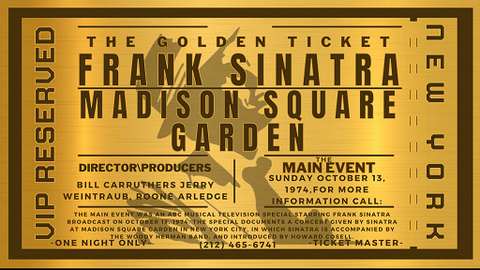
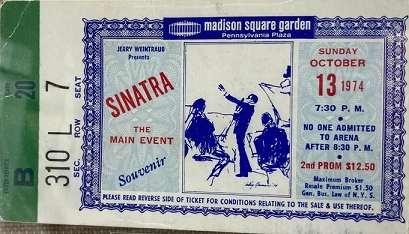
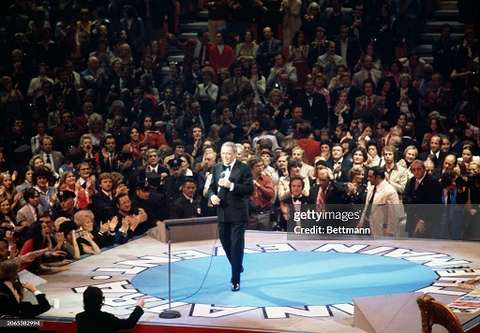
“Frankly Speaking, Enough is Enough,” published in the New York Daily News on October 24, 1974. By Rex Reed
NEW YORK — Somebody should do something about Frank Sinatra. His public image is uglier than a first-degree burn. His appearance is sloppier than a Porky Pig. His manners are more appalling than a subway sandhog's and his ego is bigger than the Sahara (the desert, not the hotel in Las Vegas, although either comparison applies).
All of which might be tolerable if he could still sing. But saddest part of all is the hardest part to face about this once-great idol now living on former glory: the grim truth is Frank Sinatra has had it. His voice has been manhandled beyond recognition, bringing with its parched croak only a painful memory of burned-out yesterdays. Frank Sinatra has become a bore.
You wouldn't know that from the attention he demands and still gets. He insults the press, makes patronizing remarks about women and oppressed minorities, bullies everyone from bellboys to room-service waiters and offers nothing in return in the way of talent or quality entertainment. Yet his blindly loyal fans laugh off his sick jokes and tolerate his bad temper and suffer the shoves of his bodyguards, repaying him with applause even when he deserves none.
He got away with his debacle in Australia when they should have run him out of the country. He gets away with nastily spitting, libelous insults at the female members of the press when he should be arrested. And he gets away with ill-prepared, under-rehearsed, slovenly personal appearances at prices that would pay the national debt when he should really be investigated by the Better Business Bureau.
We should really be ignoring Frank Sinatra to death, but instead we are doing him an even greater disfavor by feeding his colossal ego. By forgiving him everything, we have allowed him to think he rules the world. He's become the Genghis Khan of Tin Pan Alley, and Frankly, it's getting nauseating.
A FEW WEEKS AGO, Frank Sinatra thundered into New York like Rommel invading Africa. In one weekend, 42,000 people clawed, scratched, pushed, shoved and punched their way into Madison Square Garden like monkeys in heat to see the man who used to be one of the greatest popular singers in the world make a fool of himself. He never even said thank you. At scalper's prices of $200 a ticket, the people who love him the most and forgive him anything deserve something better than what they got. They deserve, at the very least, a simple thank-you.
If you saw “Frank Sinatra: The Main Event” telecast “live” on ABC-TV, you know how bad it was. But you should have been there. It was worse. There were so many garlic-breath mafioso types shoving people around it looked like a mob scene from “The Godfather.”
If you did get to your seat without a concussion, you had to suffer through an atrociously bad tumbling act that lasted 10 minutes but seemed like 10 hours. Then Woody Herman's band played two noisy, dissonant arrangements of “Early Autumn” and “Caledonia” that sounded like a sanitation truck at dawn. That lasted another 20 minutes. Then Pat Henry came on like a stoned Henry Aldrich and did some dumb Sinatra jokes, followed by Nixon jokes, Women's Lib jokes, Watergate jokes, Italian jokes and Polish jokes. It was too early for mastectomy jokes. Dismally exhausting.
An hour of discomfort droned on, and the restless audience began to yell, “Bring on Sinatra!” When they finally did, they should've brought him on in a paper bag. Thirty years later, the teen throb they used to call “the bargain basement Crosby” sauntered in with his sagging dewlaps and transplanted hair, wearing a baggy tuxedo out of “It Happened in Brooklyn” that looked slept in. When you looked into the ol' blue eyes, you saw the River Styx.
HIS FANS BELLOWED and screamed. Aging women, who should've been home serving meat loaf, were trying to get some youth back, jitterbugging in the aisles in their bobby sox, throwing teddy bears and loaves of bread at a paunchy little man with bags under his eyes. He stumbled his way through petrified arrangements of some old tunes like “The Lady Is A Tramp” and “I've Got You Under My Skin” and performed a tonsillectomy on some new tunes like “Send in the Clowns.”
The audience booed Howard Cosell, who introduced him for some baffling reason nobody explained, but they didn't boo Sinatra, who looked rather like Howard Cosell on a bad day at Stillman's Gym. They cheered him when he was flat, and he was flat a good deal of the time. Then they cheered him when he couldn't hit the notes at all, which made up the rest of the time. It was all rather pitiful, and don't ask me how they plan to release the album.
Warned in advanced to cancel all derogatory, defamatory remarks about the press in order not to offend the public conscience on network television. Sinatra saved his high-school pranks for the commercial breaks. What you didn't see at home was his blistering indictment of the Australian Women's Press Corps as “nickel and dime garbage dealers who make Rona Barrett look like a nun.” The came the expected Rona Barrett Jokes, most of them unprintable: “First the good news -- Rona's been fired. Now the bad news - I've got to find 10 new minutes to fill the time that used to be taken up with Rona jokes. What an ugly broad. When she was born, the doctor slapped her in the face.”
Not funny, just desperate. Then he managed to offend just about everybody else with Polish jokes and Negro jokes so old they were hairy, and a devastatingly embarrassing “Angel Eyes” in which he pretended to be a drunk falling off a barstool. He didn't look like he needed props.
THE FINAL AND ULTIMATE insult to the nation occurred however, when the biggest Nixon-Agnew supporter of them all yawned his way through a mushily-sentimental patriotic song called “The House I Live In” while the stage hands lowered an American flag as a tawdry backdrop, then announced the “national anthem,” which turned out to be “My Way.” So much for bad taste. When the TV show was over, so was the concert. Frank Sinatra turned his back on the audience that yelled for more, and walked out without saying goodbye. They should've thrown more then teddy bears.
I've got news for Frank Sinatra. He smokes too much and inhales too much and drinks too much and it has ruined his voice. He should either learn some new material, stop butchering the old material, or retire.
The national anthem was written by Francis Scott Key, not Paul Anka. With his money, he should hire a tailor to design a dinner jacket that doesn't make him look like Elmer Fudd. And he's doing Rona Barrett a favor. He's making her a household name.
(He laid off Barbara Walters this time: he was on her home turf in New York. Even Sinatra, I guess, knows when he's licked.)
Frank Sinatra is not the greatest popular singer in the world. Jack Jones out-sings him, Mel Torme out-swings him and Tony Bennett outclasses him. All of them have grown and perfected their craft and they never appear in anything less than perfect condition. Sinatra is self-destructive, petulant and bored, and it shows. A man who tries to do his best and fails can be forgiven. But Sinatra didn't even try.
The world must agree. He turned up down at No. 40 in the ratings, outranked throughout the country by everything from “Kojak” to the Late Show to reruns of “Father Knows Best.” Which proves he's not as important to the unwashed masses as he thinks he is. When a man is rated number forty for a once-in-a-lifetime event “live” at Madison Square Garden, he's been making apathy and arrogance a lifestyle too long.
Frank Sinatra won't go away, leaving us with unblemished memories of what it was like to be the best of everything. He just keeps proving for posterity he's not really the Tiffany solitaire we thought he was. He's just a Woolworth rhinestone now.
A third press notice on the Main Event: Martha Weinman Lear's reminiscence, published under the headline "The Bobby Sox Have Wilted, but the Memory Remains Fresh," recalled her own teenage swooning at the RKO-Boston ("'Frankie!' we screamed from the balcony") before describing how the gravity of seeing Sinatra again, decades later, was undiminished: "the blue eyes still burn," and "what's left of the voice still gets to me like no other voice, and it always will." Howard Cosell's full on-air introduction that night has also been preserved: "Live from New York . . . a city that pulsates always . . . and in the heart of the metropolis the great arena, Madison Square Garden, which has created and housed so many champions . . . the most enduring champion of them all, Frank Sinatra, comes to the entire Western Hemisphere live with the Main Event: Frank Sinatra in concert." Source: David Lehman, Sinatra's Century.
Convention Center, Las Vegas, Nevada
Rally for Roy Woofter
Also Dean Martin, Steve & Eydie, Wayne Newton, Foster Brooks
Note: Woofter was the City Commissioner in Vegas and at one time he served as D.A. Frank must have thought highly of him to travel to Vegas during his October 74 tour with the Woody Herman band. Ed
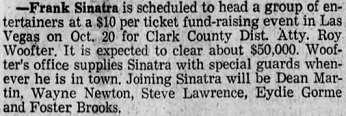
Convention Center, Las Vegas, Nevada
Rally for Roy Woofter
Also Dean Martin, Steve & Eydie, Wayne Newton, Foster Brooks
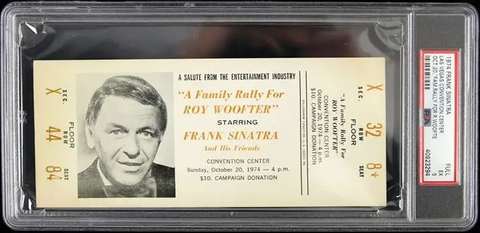
Richfield Coliseum, Cleveland, Ohio
"THE MAIN EVENT" Tour
Orchestra Woody Herman & The Young Thundering Conducted By: Bill Miller
1. The Lady Is A Tramp
2. I Get A Kick Out Of You
3. Let Me Try Again
4. Bad, Bad Leroy Brown
5. If
6. You Are The Sunshine Of My Life
7. Send In The Clowns
8. My Kind Of Town
9. monologue
10. Angel Eyes
11. I've Got You Under My Skin
12. Ol' Man River
13. I've Got The World On A String
14. Nancy
15. My Way
Notes: TT 67mins.
Richfield Coliseum, Cleveland, Ohio
Carl Rasmussen also sent along the following regarding the Richfield, Ohio, Oct. 26, 1974 concert:
Memorabilia from Frank Sinatra concert opening night at Coliseum, Richfield, Ohio, Oct. 26, 1974- including 2 gold medallions and 3 tickets
October 26, 1974
With the Cavaliers in New Orleans winning their third straight, Frank Sinatra christens the Richfield Coliseum as only he can – opening with “The Lady is a Tramp” and bringing down the (brand new) house with “My Way.”
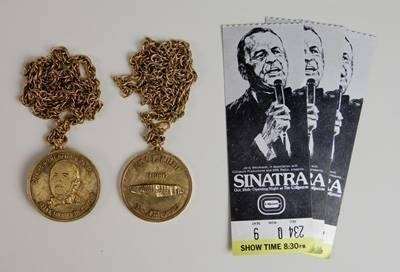
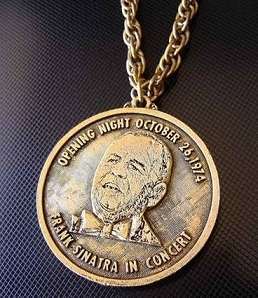
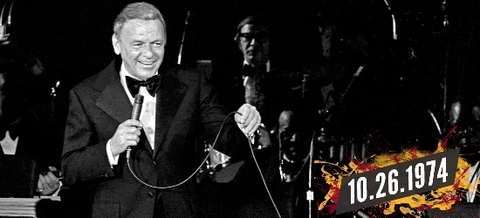
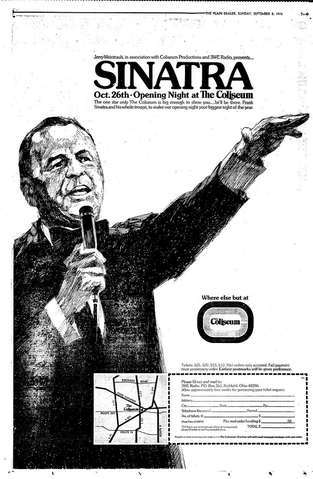
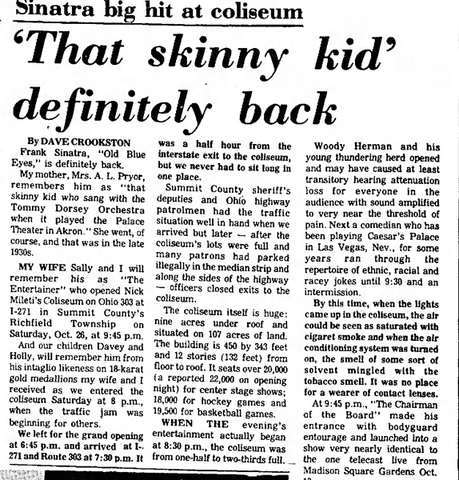

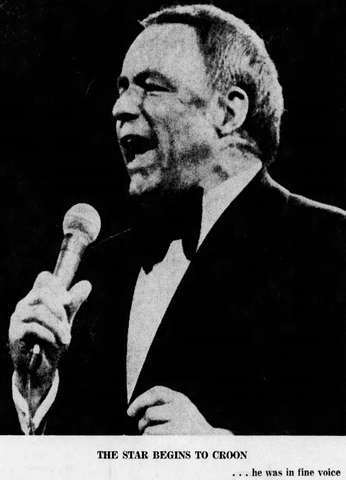
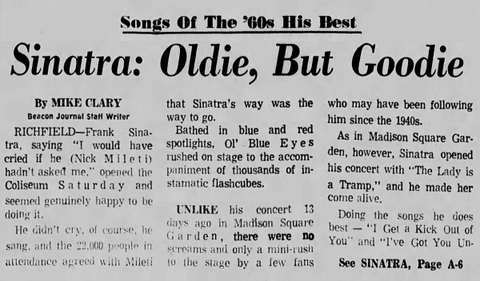
Hofheinz Pavilion, Houston, Texas
"THE MAIN EVENT" Tour
Orchestra Woody Herman & The Young Thundering Conducted By: Bill Miller
1. The Lady Is A Tramp
2. I Get A Kick Out Of You
3. Let Me Try Again
4. Bad, Bad Leroy Brown
5. If
6. You Are The Sunshine Of My Life
7. Send In The Clowns
8. My Kind Of Town
9. monologue
10. Angel Eyes
11. I've Got The World On A String
12. Nancy
13. I've Got You Under My Skin
14. What Are You Doing The Rest Of Your Life
15. My Way
Houston Chronicle
Memorial Auditorium, Dallas, Texas
Orchestra Conducted By: Bill Miller
1. The Lady Is A Tramp
2. I Get A Kick Out Of You
3. Let Me Try Again
4. Bad, Bad Leroy Brown
5. If
6. You Are The Sunshine Of My Life
7. Send In The Clowns
8. My Kind Of Town
9. monologue
10. Nancy
11. One For My Baby
12. I've Got You Under My Skin
13. What Are You Doing The Rest Of Your Life?
14. I've Got The World On A String
15. My Way
Notes: TT 68mins.
Madison Square Garden, New York City
Rally for Governor Hugh Carey
1. I've Got the World on a String
2. What are you Doing the Rest of your Life – better than the record
3. Let Me Try Again
4. Bad, Bad Leroy Brown
5. Saloon Trilogy: Last Night when we were Young/Violets for Your Furs/Here's That Rainy Day
6. The Lady is a Tramp
note: Sinatra's reading of "What Are You Doing The Rest Of Your Life" is not just better than the record. It is hands down the best ever. Period. --Ed
NOTE: Eighteeen days after the Main Event, Sinatra did a benefit performance at Madison Square Garden to Hugh Carey. There is no relationship between the performance here and the Main Event effort, Ed O'Brien emphasizes, on October 13, 1974. At the Carey Rally one heard a great singer mesmerize a sold out house.
Vance Adair points out that "What Are You Doing the Rest of Your Life" is a song that should have been a perfect assignment for Sinatra. The arrangement was a little overblown for my liking and the layers of echo on the studio recording does not help matters. I have never heard a concert version of this song. How frequently did it appear in concert around this time?
O'Brien answers that Sinatra sang it at the Garden the night before the "Main Event" , did it again in Dallas and at the Carey Rally at The Garden. All were superior to the studio recording. The October 12, 1974 performance was recorded by Reprise. The fellow who did the liner notes for "Some Things I've Missed," John Brady, was at the May 1974 session. He told me Sinatra kept going flat on the seventh note. He did seven takes with seven flat notes. This is the reason the reverb was added. O'Brien agrees regarding the arrangement. Less is more would have worked nicely that evening.
Ed Spiegel says he attended the Madison Square Garden event for the campaign of Democratic Governor Hugh Carey. Sinatra's performance of "What are You Doing the Rest of Your Life" was superb, surpassing the fine studio recording which for him was the highlight of the album.
Madison Square Garden, New York City
Rally for Governor Hugh Carey
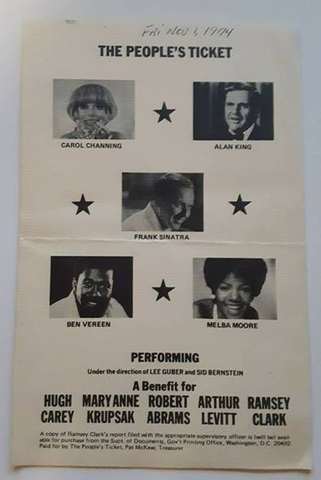
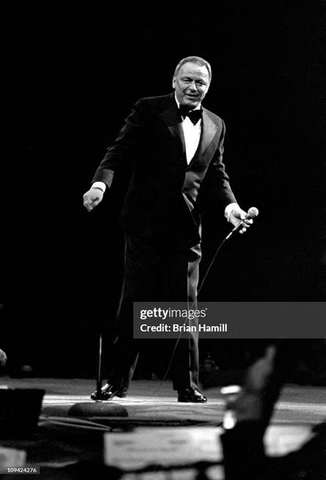
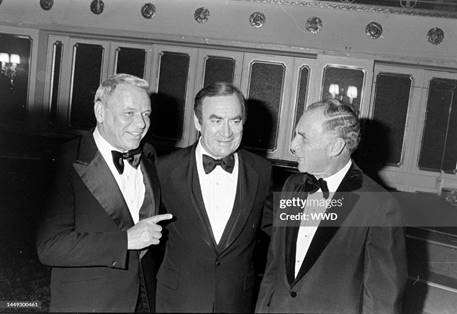
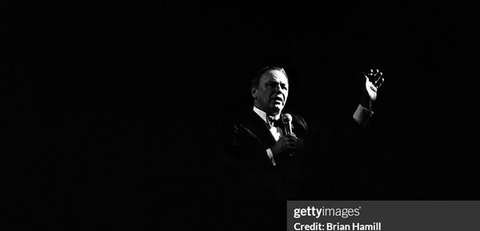
Dorothy Chandler Pavilion, Los Angeles, California
L.A. PHILHARMONIC 107 piece orchestra under the direction of Zubin Mehta.
1. Something N. Riddle arg.
2. What Are You Doing The Rest Of Your Life D. Costa arg.
3. Send In The Clowns D. Costa arg.
4. You Are The Sunshine Of My Life D. Costa arg. ( quintet)
5. I've Got The World On A String N. Riddle arg. (quintet)
6. I Get Along Without You Very Well N. Riddle arg.
7. I Have Dreamed N. Riddle arg.
BIRTHDAY FETE
Philharmonic Backs Sinatra
LOS ANGELES -- Offer some powerful Italian and Spanish music, add a tinge of comedy and top with an energetic Frank
Sinatra and voila: that's the way the Los Angeles Music Center celebrated its tenth birthday Sunday (10) with a charity concert in the Dorothy Chandler Pavilion.
It was classical music, authentic and ersatz for the sellout audience of 3,217 which also proved warm and receptive to comic
Danny Kaye and balladeer Sinatra.
Zubin Mehta led the 107-piece Los Angeles Philharmonic through spirited and invigorating excerpts from "Carmen" and a sweeping overture from Verdi's "La Forza Del Destino."
After Kaye had tripped on the podium, "led" the orchestra, sang several ditties and left the audience in a generally festive mood, it was time for Sinatra.
Fresh off the road from his series of concerts, the veteran vocalist looked comfortably ensconced on the massive stage in front of the Philharmonic with his own five-piece band in stage center. Sinatra sang for 30 minutes, working through seven tunes with combinations of Philharmonic and his own tight band, which included vibes, easing into each other.
While Sinatra has sung with lush string sections on records before - his series of works with Gordon Jenkins stand the test of time as masterpieces -- there is nothing to compare with the beauty, sweep and dramatic power of a symphonic orchestra's violins, cellos and basses.
The overpowering sound of all these string instruments provided Sinatra's own warm tones with a captivating undercoating under Mehta's direction.
"Something," the opening number, done slowly and in a reserved manner, drew smiles from Sinatra as he listened to the dark, brooding cello tones.
Sinatra chose his program carefully so as not to duplicate what he had done a month previous on his nationally televised concert from Madison Square Garden.
The repertoire covered many decades and was slanted toward an adult audience which obviously favored classical music.
"What Are You Doing The Rest Of Your Life" proved an example of power and majesty as Sinatra reached for and obtained the heights he sought while the orchestra was expansive and sweeping in its presentation of the Don
Costa arrangement.
There was one masterpiece: "Send In The Clowns" from "A Little Night
Music," tendered by Sinatra with only pianist
Bill Miller providing the backing.
Singing in the proper mid-range, Sinatra was in his finest form of the evening, his every word grasping and holding the audience's complete attention, his interpretation of the words full of picture-clean meaning.
Nothing he did came close to touching the brilliance of this song. When he changed the mood to jump a little with only his band behind him, things got a bit loose; he fell behind the beat on "You Are The Sunshine Of My Life" and strayed a bit from the melody on "I've Got The World On A String."
Hoagy Carmichael's "I Get Along Without You Very Well" and Nelson Riddle's arrangement were all he needed to get back on the proper track. He sang the words and phased the music with the flair of a seasoned communicator.
"I Have Dreamed" from "The King And I," closing out his participation, was rampant with gusto as Sinatra used all of his lung power - as if to say to this hometown audience that he means it when he says he's back and he's able. He did push some of his words faster than he's done with this song in the past.
When Sinatra sings slow ballads or doesn't strain for high notes he's got a song under his will. And when he sings with strings, it's a romantically wonderful experience.
Perhaps the symphonic orchestra can be tomorrow's studio band for this everlasting performer.
Sinatra helped make the birthday party for the city's downtown three-theater complex a memorable bash.
--Eliot Tiegel
Billboard
November 23, 1974
Ed O'Brien:
A long ago evening in L.A. that has never been documented by any Sinatra database. Frank singing with a 107 piece orchestra under the direction of
Zubin Mehta.
Nelson Riddle was asked to write the symphonic orchestration for George Harrison's "Something." I have an interview with Riddle in which he described the orchestral rehearsal for the evening's festivities. Watching Mehta con- duct the huge symphony orchestra, rehearsing the arrangement for "Something," brought tears to Riddle's eyes. He had never heard anything more beautiful in his entire life. Sinatra would record the song with Riddle's chart on December 3, 1979. A 65 piece orchestra was used.
Dorothy Chandler Pavilion, Los Angeles, California
L.A. PHILHARMONIC 107 piece orchestra under the direction of Zubin Mehta.
Larger version of article:
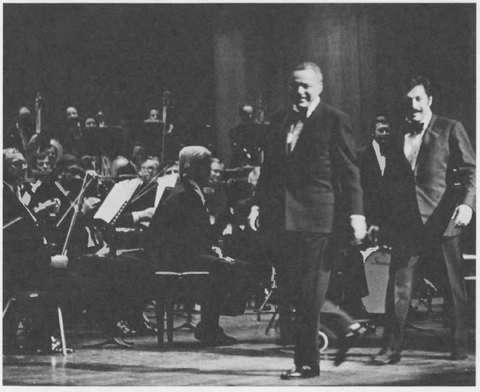
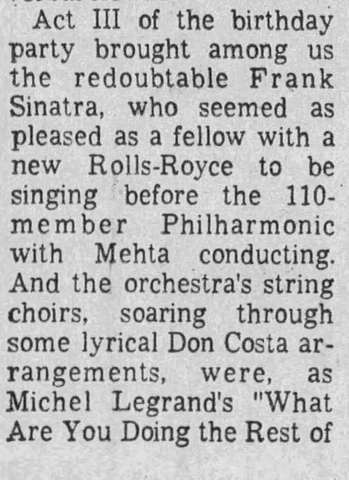
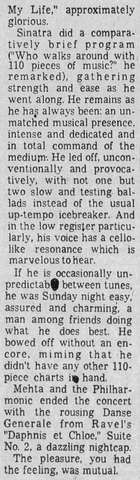
Jack Benny died; Frank served as a pallbearer at his funeral.
Source: Nancy Sinatra, Frank Sinatra: An American Legend, 1995.
Diplomat Hotel, Hollywood, Florida
"Irv Cowan's Main Event"
Orchestra Conducted By: Bill Miller
1. Bad, Bad Leroy Brown
2. At Long Last Love
3. I Get A Kick Out Of You
4. If
5. The Lady Is A Tramp
6. Don't Worry 'Bout Me
7. I Have Dreamed
8. I've Got You Under My Skin
9. Here's That Rainy Day
10. My Kind Of Town
11. monologue
12. You Are The Sunshine Of My Life
13. What Are You Doing The Rest Of Your Life?
14. I've Got The World On A String
15. My Way
Notes: TT 49mins.
note: This was a tough gig for Frank Sinatra.
Jack Benny, a man Frank loved dearly, had died the day after Christmas. A very somber
Sinatra was a pallbearer at his funeral on 12-29-74. If his New Year's Eve show had been in Vegas, Sinatra probably would have canceled the date. But the Diplomat was in
Florida and the show was a sell-out. Frank knew he had to make an appearance. He did 14 songs, was uncharacteristically quiet between numbers and the monologue was brief. And there was no "Auld Lang Syne." Sinatra, the pro, gave his audience a solid 50 minutes of his best singing. --Ed
Diplomat Hotel, Hollywood, Florida
"Irv Cowan's Main Event"
Orchestra Conducted By: Bill Miller
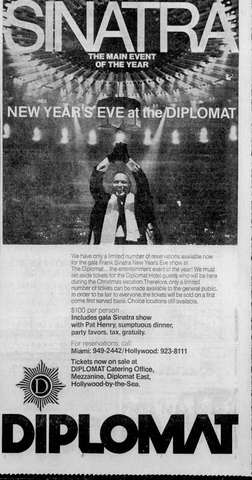
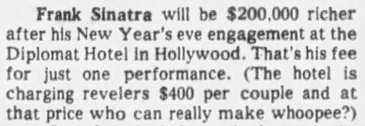
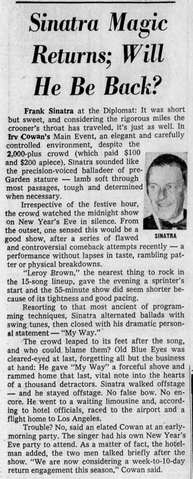
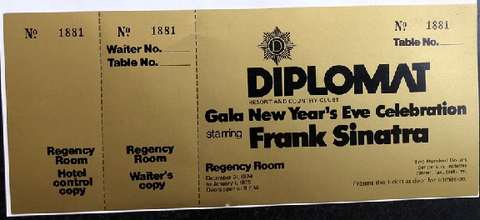
[A Grueling Touring Schedule]
Sinatra performed in New York with Count Basie and Ella Fitzgerald and at the London Palladium with Basie and Sarah Vaughan, where roughly 350,000 ticket requests came in for 15,000 available seats. Across the year he gave 140 performances in 105 days.
Source: Nancy Sinatra, "Frank Sinatra, My Father" (1985).
[American, Canadian, and European Tours; Cecil B. DeMille Award]
Sinatra tours the U.S., Canada, and Europe, performs on Broadway with Basie and Ella Fitzgerald and at the London Palladium with Basie and Sarah Vaughan, gives charity concerts for the Jerusalem Center for Arab and Jewish Children, receives the Cecil B. DeMille Award at the Golden Globes, is named Honorary Citizen of Chicago, and sees the dedication of the Frank Sinatra Child Care Unit at St. Jude's Children's Research Center in Memphis.
Source: Nancy Sinatra, "Frank Sinatra, My Father" (1985).
[At The Uris Theatre With Basie And Fitzgerald]
Sinatra performed at Broadway's Uris Theatre in 1975, with Bill Miller conducting Count Basie's orchestra, which also backed Ella Fitzgerald on the same bill.
Source: Charles Pignone, "Frank Sinatra 100" (2015).
[Mom and Dad's Secret Retreat at the Mountain House]
Just before Easter, Tina discovered her parents had quietly gone off together for four or five days at the Mountain House retreat near the Compound. When she called and asked to speak to her mother, Frank brusquely told her to mind her own business.
Source: Tina Sinatra, "My Father's Daughter: A Memoir" (2000).
[Bill Boggs interview, father's ultimatum]
Frank Sinatra: In a 1975 television interview with Bill Boggs, Sinatra recalled the morning his father Marty, fed up with his son singing for free at night instead of looking for work, told him to 'get out' of the house; Sinatra said his mother was nearly in tears, but they agreed a departure might be for the best, and he packed a small suitcase and left for New York.
Source: James Kaplan, "Frank: The Voice" (2010)
[awards]
Sinatra returned the following year to host the AFI's salute to Orson Welles, and in that same year, 1975, received the Cecil B. DeMille Golden Globe Award for lifetime achievement.
No corresponding dated entry could be identified in the chronology for this film/context.
Source: Tom Santopietro, "Sinatra in Hollywood" (2008), Knight-Errant (pt. 2) / That's Life
[Berlin show cancelled after kidnap threat]
Frank cancelled a planned Berlin concert following a kidnap threat, but the German press was unimpressed, suggesting instead it was due to poor ticket sales, noting his other German dates hadn't sold out either.
Source: Richard Havers, "Sinatra" (Dorling Kindersley, 2007).
[Sinatra's Royal Albert Hall shows draw ecstatic reviews]
Returning to London for two nights at the Royal Albert Hall, Frank received glowing reviews, including from Ray Wright in the Evening Standard, who wrote that predictions of vocal decline had proven premature. Both shows sold out, with £30 tickets reselling for up to eight times face value.
Source: Richard Havers, "Sinatra" (Dorling Kindersley, 2007).
[Unusual bookings in Tehran and Israel with Spiro Agnew]
Frank's most unusual bookings of 1975 were in Tehran, where he flew with Spiro Agnew for a charity show, and Jerusalem, where he played two concerts benefiting Jewish and Arab children.
Source: Richard Havers, "Sinatra" (Dorling Kindersley, 2007).
[Killing of Sam Giancana]
Sam Giancana was gunned down in his home shortly before he was due to give evidence on CIA-Mafia complicity in attempts to assassinate Fidel Castro; his relationship with Sinatra had already cooled years earlier after the 1963 Cal-Neva incident and Sinatra's declining of his help during the Frank Sinatra Jr. kidnapping.
Source: Rough Guide to Frank Sinatra (Rough guide 7.pdf), chapter "The Inner Circle."
Frank Sinatra Special
NBC
Friday Evening
10 to 11:PM note: On 1-10-75 NBC reran "Ol' Blue Eyes Is Back" with a new title. Magnavox was again the sponsor.
Harrah's, Lake Tahoe, Nevada (10-22)
Friday evening opening night
1. The Lady Is A Tramp
2. At Long Last Love
3.. If
4. Bad, Bad Leroy Brown
5. Let Me Try Again (ballad version)
6. monologue
7. Here's That Rainy Day
8. You Are The Sunshine Of My Life
9. Lonely Town
10. I've Got You Under My Skin
11. My Way
12. Send In The Clowns w/ Bill Miller
13. I Get A Kick Out Of You
Harrah's, Lake Tahoe, Nevada (10-12)
Two Shows A Night
Brian Farnon Orchestra
O/A Pat Henry
During his three day engagement, Sinatra told his audience that he
liked playing Tahoe much more than Vegas. The latter gave him the
much feared "Vegas Throat." The crisp, clean air coming off the lake
was so soothing to his vocal chords.
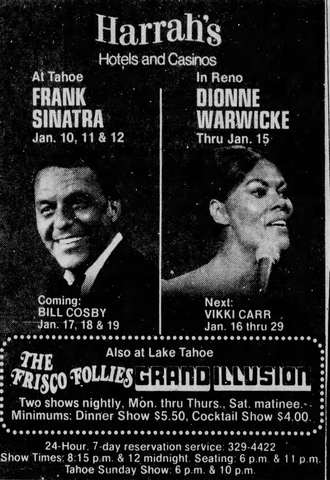
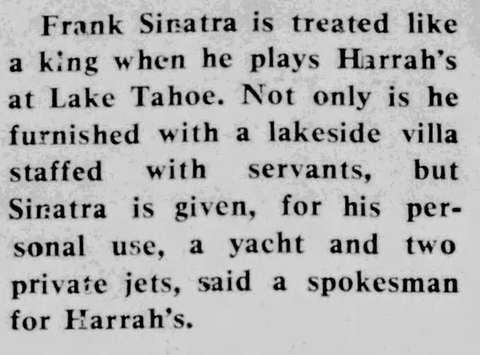
Harrah's, Lake Tahoe, Nevada (10-12)
Notes: TT 45mins.
note: Engagement ran for three days , 10 to 12.
Frank opened at Caesars Palace on the 16th
Bill Miller conducted the Woody Herman band.
Pat Henry opened for Frank. There were 13 songs including "Lonely Town.."
Harrah's, Lake Tahoe, Nevada (10-22)
Harrah's, Lake Tahoe, Nevada (10-22)
Harrah's, Lake Tahoe, Nevada (10-22)
Harrah's, Lake Tahoe, Nevada (10-22)
Woody Herman Orchestra Conducted By: Bill Miller
1. The Lady Is A Tramp
2. Bad, Bad Leroy Brown
3. Let Me Try Again
4. My Kind Of Town
5. medley: Last Night When We Were Young / Violets For Your Furs /
Here's That Rainy Day
6. monologue
7. Something
8. You Are The Sunshine Of My Life
9. My Way
10. Send In The Clowns
11. I've Got You Under My Skin
Notes: TT 45mins.
Harrah's, Lake Tahoe, Nevada (10-22)
Woody Herman Orchestra Conducted By: Bill Miller
Engagement was stictly for a single weekend, ( 10 to 12 )
Frank did two shows a night at 8:30 and midnight.
Brian Farnon band supported Sinatra.
San Francisco Chronicle
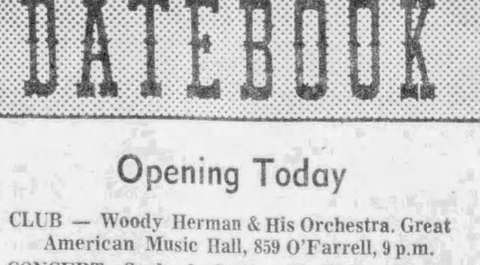
Caesars Palace, Las Vegas, Nevada (16-22)
Woody Herman Orchestra Conducted By: Bill Miller
1. The Lady Is A Tramp
2.. Bad, Bad Leroy Brown
3. Let Me Try Again
4. My Kind Of Town
5. medley: Last Night When We Were Young / Violets For Your Furs / Hereâ s That Rainy Day
6. mo monologue ue
7. Something
8. You Are The Sunshine Of My Life
9. My Way
10. Strangers In The Night
11. Send In The Clowns
12. I Have Dreamed
13. I've Got You Under My Skin
Notes: TT 51mins.
Caesars Palace, Las Vegas, Nevada (16-22)
Woody Herman Orchestra Conducted By: Bill Miller
O.A. Pat Henry
Woody Herman and His Thundering Herd opened at the London House, in Chicago. on 1/21 for a five day run.
Caesars Palace, Las Vegas, Nevada (16-22)
First Show
Woody Herman Orchestra Conducted By: Bill Miller
1. The Lady Is A Tramp
2. Bad, Bad Leroy Brown
3. Let Me Try Again
4. My Kind Of Town
5. medley: Last Night When We Were Young / Violets For Your Furs /
Here's That Rainy Day
6. monologue
7. Something
8. You Are The Sunshine Of My Life
9. My Way
10. Send In The Clowns
11. I've Got You Under My Skin
Notes: TT 45mins.
Caesars Palace, Las Vegas, Nevada (16-22)
Second Show
Woody Herman Orchestra Conducted By: Bill Miller
1. The Lady Is A Tramp
2. Bad, Bad Leroy Brown
3. Let Me Try Again
4. My Kind Of Town
5. medley: Last Night When We Were Young / Violets For Your Furs /
Here's That Rainy Day
6. monologue
7. Something
8. You Are The Sunshine Of My Life
9. My Way
10. Strangers In The Night
11. Send In The Clowns
12. I've Got You Under My Skin
Notes: TT 48mins.
CBS Don Rickles w/John Wayne, Dean Martin, Frank Sinatra, Bob Newhart, Loretta Swit, Jack Klugman, and more 52 minutes
Caesars Palace, Las Vegas, Nevada (16-22)
Woody Herman Orchestra Conducted By: Bill Miller
1. The Lady Is A Tramp
2. Bad, Bad Leroy Brown
3. Let Me Try Again
4. My Kind Of Town
5. medley: Last Night When We Were Young / Violets For Your Furs /
Here's That Rainy Day
6. monologue
7. Something
8. You Are The Sunshine Of My Life
9. My Way
10. Send In The Clowns
11. I've Got You Under My Skin
Notes: TT 45mins.
CBS Don Rickles w/John Wayne, Dean Martin, Frank Sinatra, Bob Newhart, Loretta Swit, Jack Klugman, and more 52 minutes
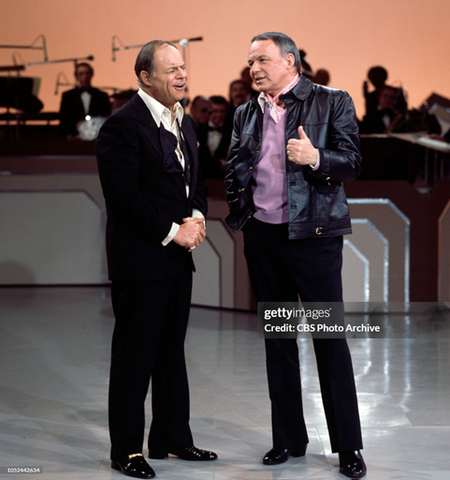
Caesars Palace, Las Vegas, Nevada (16-22)
Woody Herman Orchestra Conducted By: Bill Miller
1. The Lady Is A Tramp
2. Bad, Bad Leroy Brown
3. Let Me Try Again
4. My Kind Of Town
5. medley: Last Night When We Were Young / Violets For Your Furs / Here's That Rainy Day
6. monologue
7. Something
8. You Are The Sunshine Of My Life
9. My Way
10. Send In The Clowns
11. I Have Dreamed
12. I've Got You Under My Skin
Notes: TT 54mins.
Caesars Palace, Las Vegas, Nevada (16-22)
First Show
Woody Herman Orchestra Conducted By: Bill Miller
1. The Lady Is A Tramp
2. Bad, Bad Leroy Brown
3. Let Me Try Again
4. My Kind Of Town
5. medley: Last Night When We Were Young / Violets For Your Furs /
Hereā s That at Rainy Day
6. monologue
7. Something
8. You Are The Sunshine Of My Life
9. My Way
10. Send In The Clowns
11. Iā ve Got You Under My Skin
Notes: TT TT 45mins.
Caesars Palace, Las Vegas, Nevada (16-22)
Second Show
Woody Herman Orchestra Conducted By: Bill Miller
1. The Lady Is A Tramp
2. Bad, Bad Leroy Brown
3. Let Me Try Again
4. My Kind Of Town
5. medley: Last Night When We Were Young / Violets For Your Furs /
Here’s That Rainy Day
6. monologue
7. Something
8. You Are The Sunshine Of My Life
9. My Way
10. Send In The Clowns
11. I Have Dreamed
12. I’ve Got You Under My Skin
Notes: TT 45mins.
Century Plaza Hotel, Century City, CA
Sinatra hosts Third Annual American Film Institute Achievement Awards Honoring Orson Welles
[image referenced in source but could not be recovered]
[image referenced in source but could not be recovered]
[image referenced in source but could not be recovered]
Los Angeles
TCA5292 Anytime (I'll Be There) N/R w/Vocal Chorus
(Paul Anka)
Chrysalis Standards inc. (BMI)
Arranged by Don Costa
Conducted by Bill Miller
Note: The orchestral track was pre-recorded on February 4, 1975
Ed O'Brien:
Frank's vocal overdub was done at the MGM studio from 2 to 4 P.M. He did a number of takes but just wasn't satisfied. The orchestral track featured 25 musicians. After the session, Frank and Costa decided a vocal chorus was needed on the recording. The trio of backup vocalists laid down their contribution on consecutive Wednesdays in Las Vegas, 2-12-19-75, at the Las Vegas Recording Studio. Costa wrote parts for four guitars and 16 strings. Frank would do the released overdub at Cherokee Studios, on 3-5, another Wednesday. It was done in less than an hour. When he opened in Vegas that month, the vocal trio recording accompanied Frank when he sang Anka's ditty.
Harrah's, Lake Tahoe, Nevada
Opening Night
Brian Farnon Orchestra Conducted By: Bill Miller
Harrah's, Lake Tahoe, Nevada
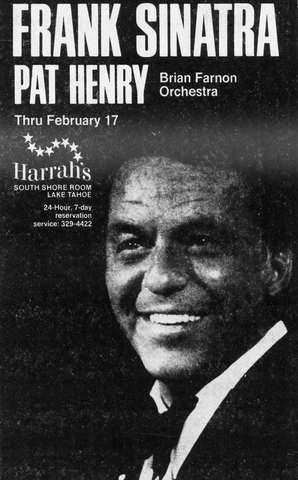
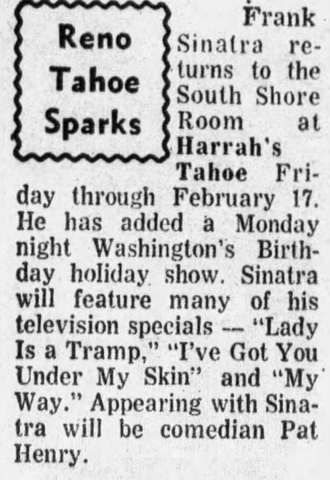
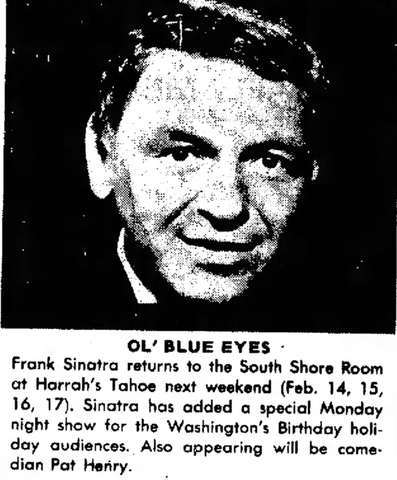
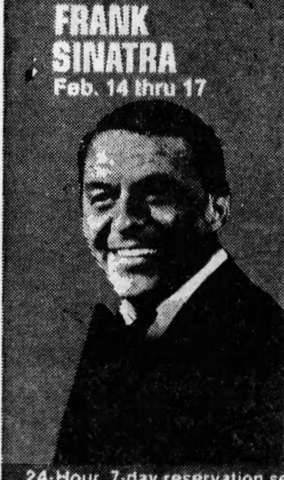
Harrah's, Lake Tahoe, Nevada
Opening Night
Feb 14 thru 17
O.A. Pat Henry
Brian Farnon Orchestra Conducted By: Bill Miller
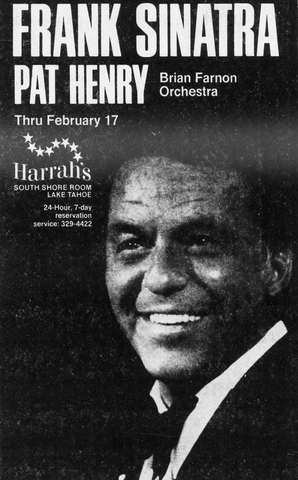
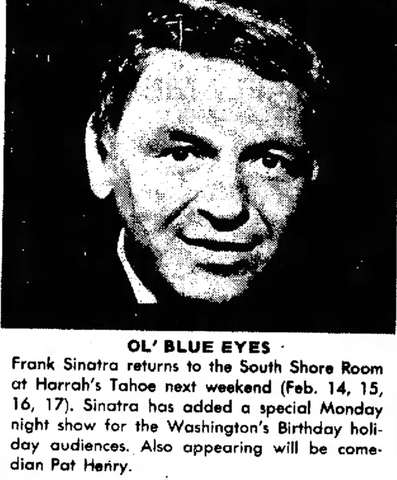
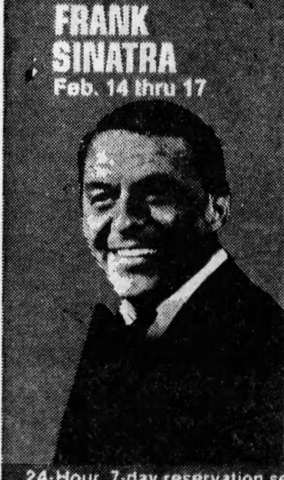
Harrah's, Lake Tahoe, Nevada
Brian Farnon Orchestra Conducted By: Bill Miller
1. The Lady Is A Tramp
2. Bad, Bad Leroy Brown
3. Let Me Try Again
4. My Kind Of Town
5. medley: Last Night When We Were Young / Violets For Your Furs /
Here's That Rainy Day
6. monologue
7. My Way
8. You Are The Sunshine Of My Life
9. Send In The Clowns
10. I Have Dreamed
11. I've Got You Under My Skin
Notes: TT 57mins.
Harrah's, Lake Tahoe, Nevada
Brian Farnon Orchestra Conducted By: Bill Miller
1. The Lady Is a Tramp
2. Bad, Bad Leroy Brown
3. Let Me Try Again
4. My Kind of Town
5. Last Night When We Were Young / Violets for Your Furs / Heres That Rainy Day
6. My Way
7. You Are the Sunshine of My Life
8. Send in the Clowns
9. I Have Dreamed
10. I've Got You Under My Skin
Filmmaker's Institute Salute To Orson Wells (CBS)
Host: Frank Sinatra
Guests: Charlton Heston, Ingrid Bergman, Natalie Wood, Janet Leigh, Johnny Carson, Edgar Bergan, Joseph Cotton
Taped February 9, 1975
1. The Gentleman Is A Champ
Notes: 75 min.
Harrah's, Lake Tahoe, Nevada
Brian Farnon Orchestra Conducted By: Bill Miller
Filmmaker's Institute Salute To Orson Wells (CBS)
__._,_.___
[image referenced in source but could not be recovered]
[image referenced in source but could not be recovered]
Los Angeles
TCA5325 The Only Couple On The Floor N/R w/Vocal Chorus
(John Durrill/Irving Daine)
Tequila Music (BMI)
Arranged by Don Costa
Conducted by Bill Miller
Note: The orchestral track was pre-recorded on February 4, 1975
Ed O'Brien added the Billboard portion and notes below:
Snuff is concerned about a word he believes Frank mispronounced. "You sang a different lyric, did you know that ?" he asks. "You sang when the music stopped." Frank: "I guess you didn't hear the s in here. I probably didn't articulate because I wouldn't say the music stopped. I don't think so." On an impulse Frank sings, "The music stopped and we went on dancing. That was some song." Snuff: So was 'Hey-Ba-Ba-Re- Bop."
Which causes Frank to start singing that oddball title as the people in the control room laugh. "What's another one like that?" Frank asks. " 'Three Little Fishes,' " answers Snuff. "No," Frank says. "I did another one. ' Do The Huckle- buck.' That was my thrilling record. Another one was " 'Lean Baby' " which Snuff knows and he starts to sing the words. It's name that tune time.
While they're listening to the tapes. Frank moves close to the control panel as he has obviously done hundreds of times. The rows and rows of buttons and switches, many lit up, prompt him to comment, " I wonder if I could fly one of these things?" "Get it off the ground and we'll go forever," Snuff replies. After take six has been played Snuff emphasizes he loves the cut. "I do too," the boy singer says "Only one problem," Snuff notes. "That one word where you left out...does that bother y'all?" "No it doesn't bother me," Frank says. They run back the tape to where Snuff thinks Frank left something out. "Do y'all hear it or is it just me?" Snuff asks. "No," Frank says. "It's smooth." The tape is played again and the producer tells the artist, "I think that's a hell of a take. I don't think we can do much better than that." The two harmonize on some of the words.9:25 and all agree that is the take. It has taken them 75 minutes to record the song. Someone in the control room blurts out that was fast. As Frank gets up to go back into the studio he comments, "Listen, if we hurry we catch the last set of Zukerman, the great violin player down at the Music Center."
It's time for Frank to hear the orchestra play "I Believe I'm Gonna Love You." Al Capps, who did the arrangement, is conducting. Bill Miller is at the piano. Capps is on the podium snapping out the beat with his fingers. There is something familiar about this melody.Frank catches it too as he stands near the guitarists it hits him. "I know what it reminds me of," and he sings "If a face could launch a thousand ships." The violins are soaring in a haunting fashion.. The melody line is enticing. Frank goes over the lyrics once. This song is as good or better than the first one. It should be legitimate," he telsl Snuff. "It's a hymnal kind of thing." The run-through is short. "That's a beautiful chart," Frank tells Capps. "I'm all straight.' Frank asks Snuff to send him a copy of the orchestra track to work with.
Once he's had a chance to "get into the song" he'll be back to record his part. The session halts momentarily as Sinatra makes ready to drive back to Palm Springs. Don Blocker leans over and whispers that one reason that they got done so fast is that Snuff is a pro and never goes overtime. The other reason, quite obviously, is that of all the people in the studio Frank Sinatra is the protean professional, the consummate master. It is his skill and willingness to cooperate with his new producer that makes the session flow so smoothly.
Billboard
March 8, 1975
Note: no vocals were released from this session Snuff told me he was dissatisfied with the final results and asked Frank to redo his vocal. On 3-5-75, at Larrabee Studios, Sinatra did vocal overdubs for "Only Couple On The Floor" and "I Believe I'm Gonna Love You." A single was was issued in July of 1975, with "I Believe I'm Gonna Love You" the A side. It reached #47 on the Billboard chart and charted for 6 weeks .
It charted at # 52 on the Cash Box chart and stayed on the chart for 6 weeks. Billboard Adult Contemporary chart saw "I Believe..." reach # 2 on 8-2-75 and chart for 12 weeks. The C&W album was scheduled to be recorded in April of 1975. On the eve of the first session, Sinatra called Snuff and told him how upset he was over the death of his good friend Richard Conte. He also told Snuff that he recorded in colors.
The only color he was seeing was black so the sessions were being cancelled. The Nashville Brass had been flown out to L.A. for the sessions. They were to make the trip again in December of that year when the sessions were rescheduled. Again, Sinatra cancelled.
Ed O'Brien:
The rich piano sound at the outset of this recording comes from the very talented Pete Jolly. He was the piano player on the November 68 sessions for the "Cycles" album and most famously for "New York, New York.." Vinnie was the piano player on the unissued version of that song from 8-20-79, done in NYC, but Frank asked Vinnie to conduct the session of 9-19-79, so Pete got the gig. The sessions for "Only Couple On The Floor" featured John Morell, Al Viola, James Burton, Albert Vescovo and Tommy Tedesco on guitars. Snuff Garrett was determined to give Frank a new sound that offered a real country flavor.
Hollywood
TCA5292 Anytime (I'll Be There) w/Vocal Chorus
(Paul Anka)
Chrysalis Standards Inc. (BMI)
Arranged by Don Costa
Conducted by Bill Miller
(3:20) CD: 46013-2 The Complete Reprise Studio Recordings Disc 17 45: S1327
LP: W54093 I Sing The Songs Vol.2 ( Italy )
TCA5325 The Only Couple On The Floor w/Vocal Chorus
(John Durrill/Irving Daine)
Tequila Music (BMI)
Arranged by Don Costa
Conducted by Bill Miller
(3:10) CD: 46013-2 The Complete Reprise Studio Recordings Disc 17
LP: W54093 I Sing The Songs Vol.2 (Italy)
45: S1335
TCA5326 I Believe I'm Gonna Love You w/Vocal Chorus
(Harry Lloyd/Gloria Sklerov)
Senor Music/WB Music Corp. (ASCAP)
Arranged by Al Capps
Conducted by Bill Miller
(2:47) CD: 46013-2 The Complete Reprise Studio Recordings Disc 17
LP: W54093 I Sing The Songs Vol.2 (Italy)
45: S1335
Note: The orchestral tracks were pre-recorded. TCA5292 & 5325 were done on February 4, 1975. TCA5326 on February 20, 1975.
Ed O'Brien notes:
Frank Sinatra and the 70's recording process:
The difficulty in producing these three recordings is an example of how uneasy Sinatra was with overdubbing. "Anytime" was recorded on 2-10-75 at Western Studio in L.A. There was no vocal chorus backing Sinatra. The orchestral track had been laid down on 2-4-75. "Only Couple On The Floor" was recorded on 2-20-75( 6 takes) with the orchestral track from 2-4-75. At the 2-20-75 session there were orchestral tracks done for "Only Couple" and "I Believe I'm Gonna Love You." The sessions of 3-5-75 were done at two studios.
The first session from 3 to 4:pm was at Cherokee Studios and Frank recorded "Anytime." The orchestral was now a combination of sessions from 2-4, 2-17-2-18 and 2-19. The latter was done in Vegas adding the vocal chorus (3). The session for "Only Couple" and "Believe I'm Gonna" was done at Larrabee Studios on 3-5-75 from 4 to 6:pm. The orchestral track was done on 2-20 and a chorus of seven added their voices on 2-21.
The "Anytime(I'll Be There") was released on 4-8-75. The B side of the single was "The Hurt Doesn't Go Away"(deleted at the last minute from "Ol' Blue Eyes Is Back" in October of 73). "Anytime" reached #75 on the Billboard Hot 100 ( six weeks on the charts) and peaked at #10 on the Billboard Adult Contemporary singles chart. It charted for 10 weeks. "I Believe I'm Gonna You " and "The Only Couple On The Floor" were released on 7-7-75. The latter did not chart. The former turned out to be Frank's highest charting single in the 1970s, reaching #47 on the Top 100( six weeks on the charts) and #2 on the Adult Contemporary. It stayed on the Billboard charts for 12 weeks.
The three recordings released from the vocal overdubbing session on 3-5-75 evolved from eight sessions including orchestral and choral dates. The Sinatra vocals from 2-10 and 2-20-75 have never been released.
VANCE ADAIR added:
Goodness. What a tortuous process it was, and utterly counter intuitive to the way that FS usually recorded a song. He must have been phased by this. Matters are compounded by the fact that these tunes really did not merit the expenditure of his efforts.
John "Rochester" Brown responded:
The efforts were great, but the songs, quite forgettable.
Paul Anka's work has always been, at best, convoluted.
"Havin' my baby..." Barf.
Vance Adair:
Although FS dabbled with C&W tunes throughout his career, they never quite worked. Como and Chet Atkins, on the other hand, produced some successful recordings that were largely pleasing to the ear. ‚ For me, the unsuitability of Frank's voice to C&W is moot and goes to the heart of his success as our finest interpreter of popular music. Interestingly, all of it hearkens back to some old fashioned Greek principles regarding 'showing' (diegesis) and 'telling' (exegesis). The largely corn-proof lyrics of Gershwin, Porter, Hart et al requires the singer to 'show' the emotional register of a song through the subtle and inventive interpretation of a lyric. C&W, on the other hand, 'tells' the listener so much it requires the singer merely to be a cipher rather than a distinctive interpreter of the story. Can one imagine a singer less suited to this task than FS?
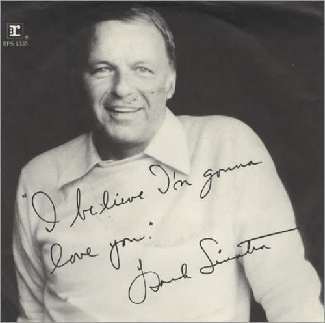
Hollywood
TCA5292 Anytime (I'll Be There)
w/Vocal Chorus
(Paul Anka)
Chrysalis Standards Inc. (BMI)
Arranged by Don Costa
Conducted by Bill Miller
(3:20) CD: 46013-2 The Complete Reprise Studio Recordings Disc 17
45: S1327
LP: W54093 I Sing The Songs Vol.2 ( Italy )
© 1997-2026 The Sinatra Archive
This calendar, or any parts thereof, may not be reproduced in any fashion
whatsoever without the prior written permission of the publisher (The
Sinatra Archive)
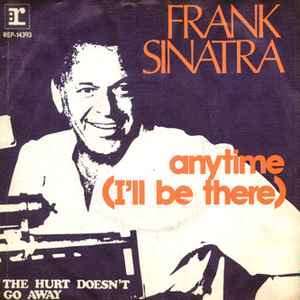
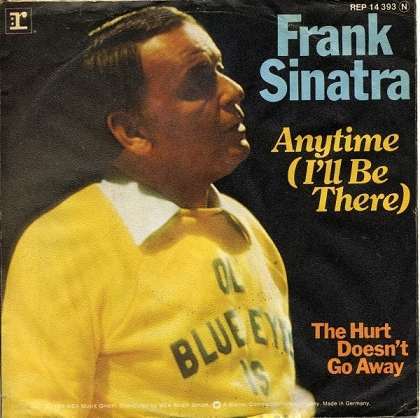
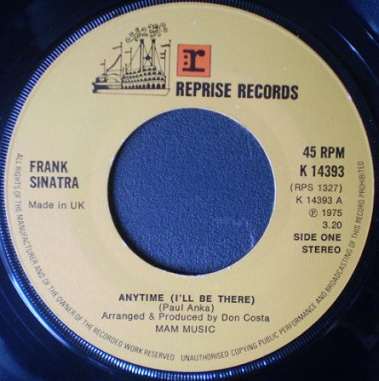
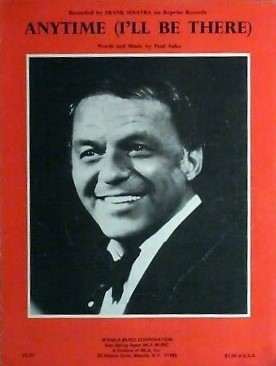
Dionne Warwick Special
Network: none (syndicated)
Guests: Wayne Newton, Danny Thomas, Frank Sinatra, Christopher George, Lynda Day George, Greg Morris
Note: Ed O'Brien provided these additional details. Dionne Warwicke taped a special in Lake Tahoe, in early January 1975. The show was syndicated and aired throughout most of the country on 3-9-75 (Sunday evening).
Her guests were Wayne Newton, Danny Thomas and Frank Sinatra. The latter did a comedy skit with her while sitting in a bar at a Tahoe resort.
Dionne Warwick Special
Network: none (syndicated)
Guests: Wayne Newton, Danny Thomas, Frank Sinatra, Christopher George, Lynda Day George, Greg Morris
Note: Ed O'Brien provided these additional details. Dionne Warwicke taped a special in Lake Tahoe, in early January 1975. The show was syndicated and aired throughout most of the country on 3-9-75 (Sunday evening).
Her guests were Wayne Newton, Danny Thomas and Frank Sinatra. The latter did a comedy skit with her while sitting in a bar at a Tahoe resort.
Dionne remembers the "magnificent" heyday of Vegas when it attracted legendary performers such as Elvis Presley, Frank Sinatra and Sammy Davis Jr. She said: "I start my residency in September. I don't know if I could say I'm excited. Vegas has changed so drastically.
"I did a month in April and it went exceptionally well so they asked me to do a true residency.
"I'm going to try it, see how I feel and see how long I stay."
"It is no longer the Vegas I knew. I look at the names now and think, "˜Who is that?' It's not a place I'd want to see someone. If I want to see a show with dancing girls and boys, I go to New York, to Broadway."
The swing, swagger and style of Sinatra helped cement Vegas's reputation as a glamorous playground for grown-ups
He put Warwick on the path to greatness. She would also be championed and mentored by Dean Martin, Lena Horne, Ella Fitzgerald and Sarah Vaughan.
Dionne said: "I was their baby. They very much looked out for me. They gave me everything I needed. They loved me." Sinatra was 25 years older than Dionne. Both were born on December 12.
She said: "I would call him Papi. He was a magnificent man and exceptionally talented.
"He was just one of those very giving people. He was always there for me. It was a wonderful relationship. I adored him."
© 1997-2026 The Sinatra Archive
This calendar, or any parts thereof, may not be reproduced in any fashion
whatsoever without the prior written permission of the publisher (The
Sinatra Archive)
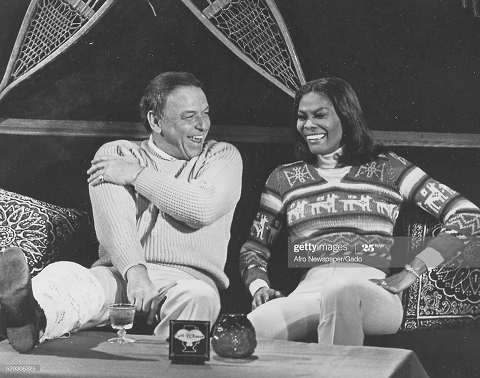
Hollywood
TCA5342 Oh Babe, What Would You Say? N/R
Arranged & Conducted by Don Costa
TCA5343 You Are The Sunshine Of My Life N/R
(Stevie Wonder)
Jobete Music Co. Inc./Black Bull Music, Inc. (ASCAP)
Arranged & Conducted by Don Costa
TCA5344 That Old Black Magic N/R
Arranged & Conducted by Don Costa
NOTE: Sinatra Scholar Ed O'Brien points out that Sinatra did not record these songs. It was an orchestral track session.
note: I interviewed four of the eight men who
made up the octet for this session. Seven of
the eight would open at Caesars with Sinatra,
for a one week run, beginning on 3-20-75.
Frank wanted to do a jazz album with this
small group. He lost interest somewhere
along the way. Was an interesting concept.
OCTET
Bud Brisbois trumpet
Nino Tempo tenor sax
Bill Miller piano
Charles Shoemake vibes
John Morell guitar
Gene Cherico bass
Irv Cottler drums
Francisco Aquabella bongos
Hollywood
TCA5342 Oh Babe, What Would You Say? N/R
Arranged & Conducted by Don Costa
TCA5343 You Are The Sunshine Of My Life N/R
(Stevie Wonder)
Jobete Music Co. Inc./Black Bull Music, Inc. (ASCAP)
Arranged & Conducted by Don Costa
TCA5344 That Old Black Magic N/R
Arranged & Conducted by Don Costa
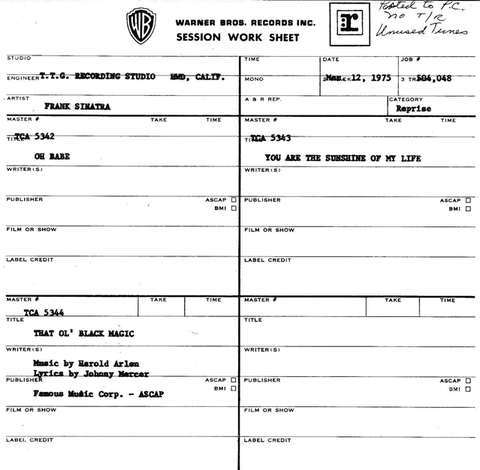
Caesars Palace, Las Vegas, Nevada
First Show
Key Musicians: Gene Cherico (bass), Al Viola (guitar), Irv Cottler (drums), Charlie Turner (trumpet), Bill Miller (piano), Charles Shoemaker (vibes), Pat Rizzo (alto sax), Nino Tempo (tenor sax), Francisco Aquabella(bongos).
Nat Brandwynne Orchestra Conducted By: Don Costa
Opening Act: Sam Butera & The Witnesses featuring Sandy Williams.
1. You Are The Sunshine Of My Life (new Costa chart)
2. Oh Babe, What Would You Say? (Costa arg.)
3. Bad, Bad Leroy Brown
4. But Beautiful (Riddle arg.)
5. I See Your Face Before Me (Riddle arg.)
6. Something (Costa arg.)
7. Nice 'N' Easy
8. My Way
9. monologue
10. Angel Eyes
11. Anytime (prerecorded vocal chorus piped into the sound system behind Sinatra)
12. The Saddest Thing Of All
13. My Kind Of Town
14. Send In The Clowns
15. I've Got You Under My Skin
16. Put Your Dreams Away
Notes: TT 56mins.
Caesars Palace, Las Vegas, Nevada
Second Show
Key Musicians: Gene Cherico (bass), Al Viola (guitar), Irv Cottler (drums), Charlie Turner (trumpet), Bill Miller (piano), Charles Shoemaker (vibes), Pat Rizzo (alto sax), Nino Tempo (tenor sax), Francisco Aquabella(bongos).
Nat Brandwynne Orchestra Conducted By: Don Costa
Opening Act: Sam Butera & The Witnesses featuring Sandy Williams.
1. You Are The Sunshine Of My Life ( new Costa chart)
2. Oh Babe, What Would You Say?(Costa arg.)
3. Bad, Bad Leroy Brown
4. But Beautiful (Riddle arg.)
5. I See Your Face Before Me (Riddle arg.)
6. Something (Costa arg.)
7. Nice 'N' Easy
8. My Way
9. monologue
10. Angel Eyes
11. Anytime (prerecorded vocal chorus piped into the sound system behind Sinatra)
12. The Saddest Thing Of All
13. My Kind Of Town
14. Send In The Clowns
15. I've Got You Under My Skin
16. Put Your Dreams Away
Notes: TT 60mins.
note: Don Costa put together an overture of Sinatra hits that were heard at each show. Pat Henry was the comedian throughout the engagement. Near the end of the second show, Frank introduced, from the audience, the president of Mexico and his wife. --Ed
Ed Notes:
Sinatra was working on a jazz album with a small group
On 3-12-75 at T.T.G. Recording Studio there were three orchestral tracks laid down for the album ( "Oh Babe, What Would You Say,"
"You Are The Sunshine Of My Life" and "That Old Black Magic.").
At the Caesars engagement, Frank had an octet backing plus Bill Miller on piano. Don Costa conducted the Nat Brandwynne Orchestra. The show opened with the singer at the back of the stage and the scrim down. Miller played piano as Sinatra sang a very slow ballad opening on Stevie Wonder's "You Are The Sunshine Of My Life."
The octet backed him on the first three numbers with a real jazzy sound. The musicians were Nino Tempo on tenor sax( he told me there was a lot of rehearsal and Sinatra worked very hard to get the sound he was after), Charles Shoemaker on vibes( he was dis- appointed the project was abandoned), Francisco Aquabella playing bongos, Charlie Turner on trumpet, Pat Rizzo on alto sax, Gene Cherico on bass, Al Viola played guitar and Irv Cottler was the drummer. In all there were 12 shows done during the week's engagement.
I interviewed four members of the octet. They all remembered how exciting it was to work with
Frank in a nightclub and how eager he was to record the jazz album with the small group.
Caesars Palace, Las Vegas, Nevada
First Show
Key Musicians: Gene Cherico (bass), Al Viola (guitar), Irv Cottler (drums), Charlie Turner (trumpet), Bill Miller (piano), Charles Shoemaker (vibes), Pat Rizzo (alto sax), Nino Tempo (tenor sax), Francisco Aquabella(bongos).
Nat Brandwynne Orchestra Conducted By: Don Costa
Opening Act: Sam Butera & The Witnesses featuring Sandy Williams.
note: Frank' played two weeks at Caesars, closing on 4-2-75
The title of the engagement was "A Man And His Music."
A 61 piece orchestra backed Frank. His show opened with
a jazz sextet supporting him, then a large string section backed
him on some ballads, then a brass section and then all three
sections came together. Frank liked to do one show a night
during the week and two shows on weekends. But for
the first time ever, he did two shows every night. Las Vegas
Sun reported that Frank, Elvis and Dino were being paid
$250,000 a week ( today that would be $1,477, 518.00 ).
A new record was set when Caesars asked a cover of
$40.00 for Frank's dinner show and #35.00 for the late
show. In the mid 1950s, you could see Sinatra for less
than $4.00. Even the veterans on the Vegas Strip were
amazed at Sinatra's drawing power. Local papers felt
the cover charge to see the big names was out of control.
They questioned whether people would continue to pay
such outlandish prices.
--Ed
Variety
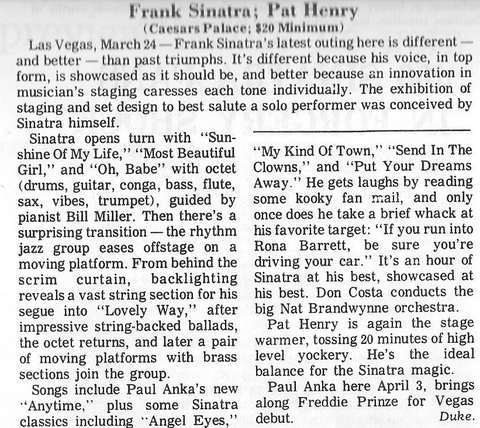
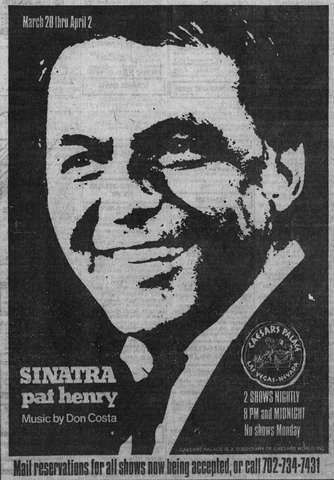
© 1997-2024 The Sinatra Archive
This calendar, or any parts thereof, may not be reproduced in any fashion whatsoever without the prior written permission of the publisher (The Sinatra Archive)
__._,_.___
© 1997-2024 The Sinatra Archive
This calendar, or any parts thereof, may not be reproduced in any fashion whatsoever without the prior written permission of the publisher (The Sinatra Archive)
__._,_.___
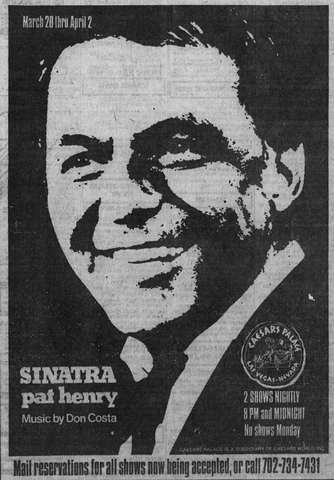
Caesars Palace, Las Vegas, Nevada
First Show
Key Musicians: Gene Cherico (bass), Al Viola (guitar), Irv Cottler
(drums), Charlie Turner (trumpet), Bill Miller (piano)
Nat Brandwynne Orchestra Conducted By: Don Costa
Opening Act: Sam Butera & The Witnesses featuring Sandy
Williams.
1. You Are The Sunshine Of My Life
2. Oh Babe, What Would You Say?
3. Bad, Bad Leroy Brown
4. But Beautiful
5. I See Your Face Before Me
6. Something
7. Nice 'N' Easy
8. My Way
9. monologue
10. Anytime
11. My Kind Of Town
12. I've Got You Under My Skin
13. Put Your Dreams Away
Notes: TT 46mins.
Caesars Palace, Las Vegas, Nevada
Second Show
Key Musicians: Gene Cherico (bass), Al Viola (guitar), Irv Cottler (drums), Charlie Turner (trumpet), Bill Miller (piano)
Nat Brandwynne Orchestra Conducted By: Don Costa
Opening Act: Sam Butera & The Witnesses featuring Sandy Williams.
1. You Are The Sunshine Of My Life
2. Oh Babe, What Would You Say?
3. Bad, Bad Leroy Brown
4. But Beautiful
5. I See Your Face Before Me
6.. Something
7. Nice 'N' Easy
8. My Way
9. monologue
10. Anytime
11. The Saddest Thing Of All
12. My Kind Of Town
13. Send In The Clowns
14. I've Got You Under My Skin
15. Put Your Dreams Away
Notes: TT 54mins
Caesars Palace, Las Vegas, Nevada
First Show
Key Musicians: Gene Cherico (bass), Al Viola (guitar), Irv Cottler
(drums), Charlie Turner (trumpet), Bill Miller (piano)
Nat Brandwynne Orchestra Conducted By: Don Costa
Opening Act: Sam Butera & The Witnesses featuring Sandy
Williams.
1. You Are The Sunshine Of My Life
2. Oh Babe What Would You Say?
3. Bad Bad Leroy Brown
4. But Beautiful
5. Didn't We
6. Something
7. Nice 'N' Easy
8. My Way
9. monologue
10. Anytime
11. The Saddest Thing Of All
12. My Kind Of Town
13. Send In The Clowns
14. I've Got You Under My Skin
15. Put Your Dreams Away
Notes: TT 59mins..
Caesars Palace, Las Vegas, Nevada
Second Show
Key Musicians: Gene Cherico (bass), Al Viola (guitar), Irv Cottler (drums), Charlie Turner (trumpet), Bill Miller
Nat Brandwynne Orchestra Conducted By: Don Costa
Opening Act: Sam Butera & The Witnesses featuring Sandy Williams.
1. You Are The Sunshine Of My Life
2. Bad, Bad Leroy Brown
3. But Beautiful
4. Didn't We?
5. Something
6. Nice 'N' Easy
7. My Way
8. monologue
9. Angel Eyes
10. Anytime
11. The Saddest Thing Of All
12. My Kind Of Town
13. Send In The Clowns
14. I've Got You Under My Skin
15. Put Your Dreams Away
Notes: TT 61mins.
Tropicana Hotel, Las Vegas, Nevada
Easter Seals Telethon
Time: 2:00 AM
1. You Are The Sunshine Of My Life
2. Bad, Bad Leroy Brown
Notes: TT 10mins.
Caesars Palace, Las Vegas, Nevada
First Show
Key Musicians: Gene Cherico (bass), Al Viola (guitar), Irv Cottler (drums), Charlie Turner (trumpet), Bill Miller (piano)
Nat Brandwynne Orchestra Conducted By: Don Costa
Opening Act: Sam Butera & The Witnesses featuring Sandy Williams.
1. You Are The Sunshine Of My Life
2. Bad, Bad Leroy Brown
3. But Beautiful
4. Didn't We?
5. Something
6. Nice 'N' Easy
7. My Way
8. monologue
9. Anytime
10. The Saddest Thing Of All
11. My Kind Of Town
12. Send In The Clowns
13. I've Got You Under My Skin
14. Put Your Dreams Away
Notes: TT 58mins.
Caesars Palace, Las Vegas, Nevada
Second Show
Key Musicians: Gene Cherico (bass), Al Viola (guitar), Irv Cottler (drums), Charlie Turner (trumpet), Bill Miller (piano)
Nat Brandwynne Orchestra Conducted By: Don Costa
Opening Act: Sam Butera & The Witnesses featuring Sandy Williams.
1. You Are The Sunshine Of My Life
2. Bad, Bad Leroy Brown
3. Didn't We?
4. In The Wee Small Hours Of The Morning
5. Something
6. Nice 'N' Easy
7. My Way
8. monologue
9. Angel Eyes
10. Anytime
11. The Saddest Thing Of All
12. My Kind Of Town
13. Send In The Clowns
14. I've Got You Under My Skin
15. Put Your Dreams Away
Notes: TT 60mins.
Caesars Palace, Las Vegas, Nevada
Key Musicians: Gene Cherico (bass), Al Viola (guitar), Irv Cottler (drums),
Charlie Turner (trumpet), Bill Miller (piano)
Nat Brandwynne Orchestra Conducted By: Don Costa
Opening Act: Sam Butera & The Witnesses featuring Sandy Williams.
Caesars Palace, Las Vegas, Nevada
First Show
Key Musicians: Gene Cherico (bass), Al Viola (guitar), Irv Cottler (drums), Charlie Turner (trumpet), Bill Miller (piano)
Nat Brandwynne Orchestra Conducted By: Don Costa
Opening Act: Sam Butera & The Witnesses featuring Sandy Williams.
Caesars Palace, Las Vegas, Nevada
Second Show
Key Musicians: Gene Cherico (bass), Al Viola
(guitar), Irv Cottler (drums), Charlie Turner (trumpet), Bill Miller (piano) Nat Brandwynne Orchestra Conducted By: Don Costa
Opening Act: Sam Butera & The Witnesses featuring Sandy Williams.
1. You Are The Sunshine Of My Life
2. Bad, Bad Leroy Brown
3. But Beautiful
4. Didn't We?
5. Something
6. Nice 'N' Easy
7. My Way
8. monologue
9. Angel Eyes
10. Anytime
11. The Saddest Thing Of All
12. My Kind Of Town
13. Send In The Clowns
14. I've Got You Under My Skin
15. Put Your Dreams Away
Notes: TT 60mins.
Caesars Palace, Las Vegas, Nevada
First Show
Key Musicians: Gene Cherico (bass), Al Viola (guitar), Irv Cottler (drums), Charlie Turner (trumpet), Bill Miller (piano)
Nat Brandwynne Orchestra Conducted By: Don Costa
Opening Act: Sam Butera & The Witnesses featuring Sandy Williams.
Caesars Palace, Las Vegas, Nevada
Second Show
Key Musicians: Gene Cherico (bass), Al Viola (guitar), Irv Cottler (drums),
Charlie Turner (trumpet), Bill Miller (piano)
Nat Brandwynne Orchestra Conducted By: Don Costa
Opening Act: Sam Butera & The Witnesses featuring Sandy Williams.
Wednesday evening
1. You Are The Sunshine Of My Life(Costa arg. for small jazz LP)
2. The Most Beautiful Girl In The World
3. Bad, Bad Leroy Brown
4. But Beautiful (Riddle arg.)
5. Didn't We
6. Something( Costa arg.)
7. Nice 'N' Easy
8. My Way monologue
9. Angel Eyes Miller on piano
10. Anytime(I'll Be There) w/ piped in choral backing
11. The Saddest Thing Of All
12. My Kind Of Town
13. Send In The Clowns w/B. Miller
14. I've Got You Under My Skin
15. Put Your Dreams Away
Ed O'Brien notes: I interviewed six of the musicians who were part of the octet. They remembered how hard Frank worked putting together the program for this engagement. They also recalled his great enthusiasm for the planned small jazz album.
Caesars Palace, Las Vegas, Nevada (March 20 – April 2)
Key Musicians: Gene Cherico (bass), Al Viola (guitar), Irv Cottler (drums), Charlie Turner (trumpet), Bill Miller (piano)
Nat Brandwynne Orchestra Conducted By: Don Costa
Opening Act: Sam Butera & The Witnesses featuring Sandy Williams.
Caesars Palace, Las Vegas, Nevada (March 20 April 2)
Key Musicians: Gene Cherico (bass), Al Viola (guitar), Irv Cottler (drums), Charlie Turner (trumpet), Bill Miller (piano)
Nat Brandwynne Orchestra Conducted By: Don Costa
Opening Act: Sam Butera & The Witnesses featuring Sandy Williams.
note: I found a number of articles attesting to Sinatra's drawing power in the early spring of 1975. Pat Henry had some jokes about a man in his 60th year pulling in such large crowds. Irv Kupincet , Chicago columnist, was in Vegas the last week in March. Elvis and Frank were pulling in huge crowds every night. Kupincet was amazed by Frank's fantastic popularity.
I knew a devoted Frank follower back then. Her name was Pam Douglas and she ,lived in Vancouver, B.C. Pam was in Vegas at the time but could not get in to see Frank. She had no problem getting a table at the Hilton to see Elvis. After many attempts to see him, the management found a spot for her at Caesars.
Ed
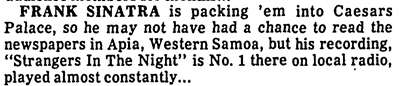
Caesars Palace, Las Vegas, Nevada (March 20 April 2)
Key Musicians: Gene Cherico (bass), Al Viola (guitar), Irv Cottler (drums), Charlie Turner (trumpet), Bill Miller (piano)
Nat Brandwynne Orchestra Conducted By: Don Costa
Opening Act: Sam Butera & The Witnesses featuring Sandy Williams.
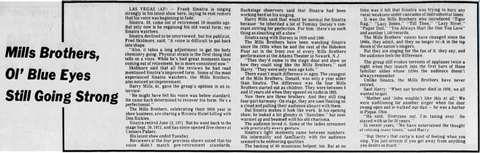
47th Annual Academy Awards, The Dorothy Chandler Pavilion, Los Angeles, CA Tuesday evening
Time: 7:00 - 12:00 PM
Hosts: Sammy Davis Jr, Shirley MacLaine, Bob Hope and Frank Sinatra
Ed O'Brien provided the following details:
A very politically charged evening with the old guard strongly opposing statements they deemed inappropriate for the Oscar telecast. Bob Hope was particularly offended by a remark made during the first half-hour of the telecast. He wrote a statement that was essentially a disclaimer. Sinatra read it to the audience. The producer, Howard Koch, was shocked. He said he had never seen or heard such controversy at an Oscar ceremony.
Sammy Davis paid a heartfelt tribute to the greatest of all the song and dance men, Mr. Fred Astaire.. Aretha Franklin, Jack Jones and Frankie Laine sang the five nominated songs The winner was "We May Never Love Like This Again." from "Towering Inferno." Nelson Riddle won the Song Score Award for "The Great Gatsby."
Sinatra presented the Jean Hersholt Humanitarian Award to Arthur B. Krim The four hosts closed the show singing the Schwartz-Dietz classic "That's Entertainment.. "
Civic Arena, San Francisco, California
Orchestra Conducted By: Don Costa
1. You Are The Sunshine Of My Life
2. The Most Beautiful Girl In The World
3. Bad, Bad Leroy Brown
4. But Beautiful
5. Didn't We?
6. Something
7. Nice 'N' Easy
8. My Way
9. medley: Last Night When We Were Young / Violets For Your Furs /
Here's That Rainy Day
10. Anytime
11. Cycles
12. Granada
13. Send In The Clowns
14. Let Me Try Again
15. My Kind Of Town
16. The Saddest Thing Of All
17. If
18. I've Got You Under My Skin
19. Put Your Dreams Away
Notes: TT 93 mins.
Civic Arena, San Francisco, California
Orchestra Conducted By: Don Costa
----------------------------------------
April 24, 1980, Variety International Humanitarian Award Honoring Frank Sinatra Cary Grant, Barbara and Frank Sinatra, and Princess Grace of Monaco.
---------------------------------------
April 24, 1981, Beverly Hilton Hotel, Beverly Hills, CA
A Gala Evening in Monaco benefiting the Dubnoff Center of North Hollywood, California.
BEVERLY HILLS, California - April 26, 1981
It was billed as A Gala Evening in Monaco when Grace Kelly, Princess of Monaco was honored at a benefit party for the Dubnoff Center in the International Ballroom of the Beverly Hilton.
Mrs. Jean Louis was the moving force that brought the evening about. She is very concerned for people who have learning disabilities, especially dyslexia (which the Dubnoff Center aids). She brought in Countess Donina Cicogna and Dr. Aldo Gucci, who assisted in the underwriting of the dinner, and Gianfranco Ferre, who underwrote the cocktail party. Margaret Ponty and Marianne Rogers were co-chairmen of the benefit, and Mrs. Dennis Stanfill was dinner chairman.
Some more involved were Burt Bacharach, the Ernest Borgnines, Mrs. Bing Crosby, Mr. and Mrs. Sammy Davis, Jr., the Mike Douglases, Irene Dunne, former president Gerald and Betty Ford, the Cary Grants, the Paul Gregorys, the Charlton Hestons, the Bob Hopes, the Jack Lemmons, the Mervyn LeRoys, Mary Martin, the Gregory Pecks, the Kenny Rogers, the Frank Sinatras, the James Stewarts, Michael York and Loretta Young.
© 1997-2026 The Sinatra Archive
This calendar, or any parts thereof, may not be reproduced in any fashion whatsoever without the prior written permission of the publisher (The Sinatra Archive)
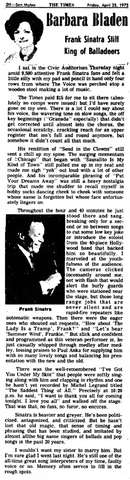
San Francisco Examiner
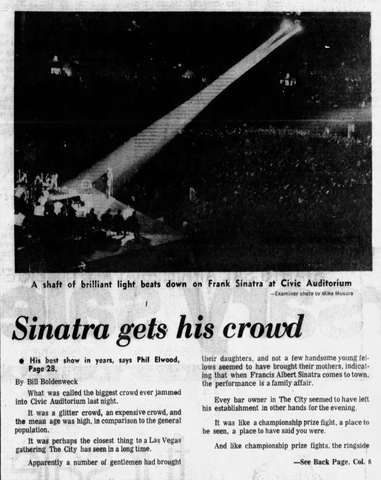

Civic Arena, San Francisco, California
Orchestra Conducted By: Don Costa
1. You Are The Sunshine Of My Life
2. The Most Beautiful Girl In The World
3. Bad, Bad Leroy Brown
4. But Beautiful
5. Didn't We?
6. Something
7. Nice 'N' Easy
8. My Way
9. medley: Last Night When We Were Young / Violets For Your Furs /
Here's That Rainy Day
10. Anytime
11. Cycles
12. Granada
13. Send In The Clowns
14. Let Me Try Again
15. My Kind Of Town
16. The Saddest Thing Of All
17. If
18. I've Got You Under My Skin
19. Put Your Dreams Away
The Times
Memorial Coliseum, Portland, Oregon
Orchestra Conducted By: Don Costa
1. You Are the Sunshine of My Life
2. Bad, Bad Leroy Brown
3. But Beautiful
4. Didn't We
5. Something
6. Nice 'n' Easy
7. My Way
8. Just One of Those Things / It Never Entered My Mind / When Your Lover Has Gone
9. Cycles
10. Granada
11. Send in the Clowns
12. Let Me Try Again
13. My Kind of Town
14. If
15. I've Got You Under My Skin
16. Put Your Dreams Away (For Another Day)
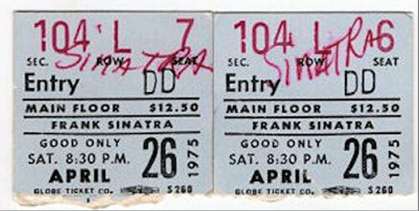
Memorial Coliseum, Portland, Oregon
Orchestra Conducted By: Don Costa

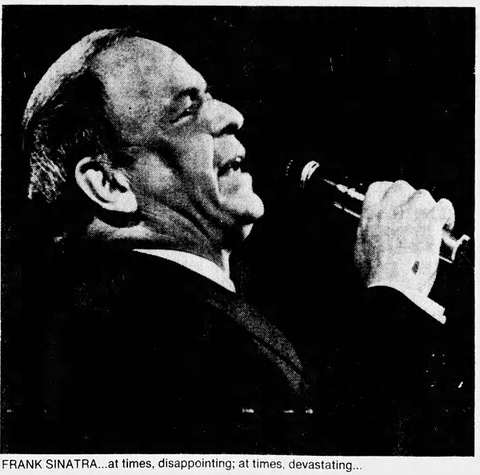
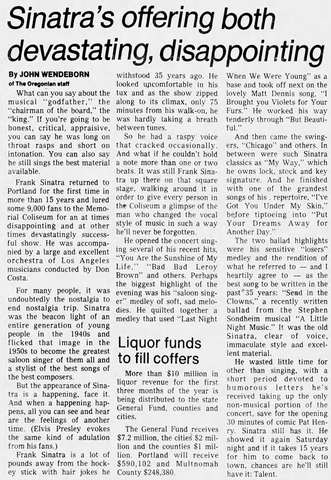
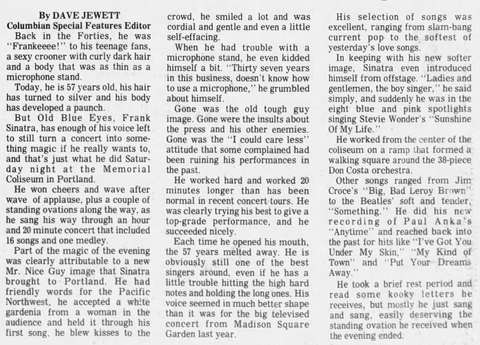
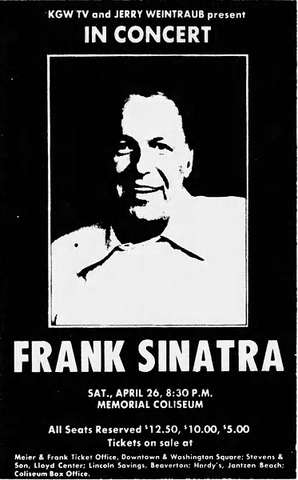

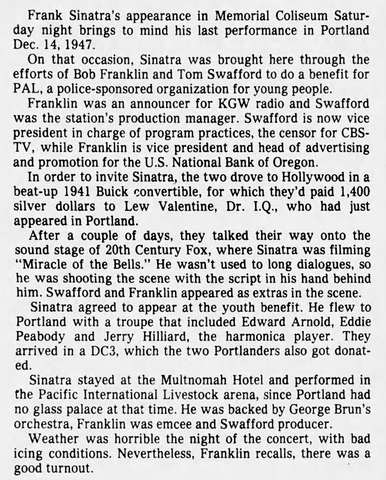
Center Arena, Seattle, Washington
Orchestra Conducted By: Don Costa
1. You Are The Sunshine Of My Life
2. Bad, Bad Leroy Brown
3. But Beautiful
4. Didn't We?
5. Something
6. Nice 'N' Easy
7. My Way
8. monologue
9. medley: Last Night When We Were Young / Violets For Your Furs / Here's That Rainy Day
10. Let Me Try Again
11. My Kind Of Town
12. If
13. Send In The Clowns
14. I Have Dreamed
15. I've Got You Under My Skin
16.. Put Your Dreams Away
Center Arena, Seattle, Washington
Orchestra Conducted By: Don Costa
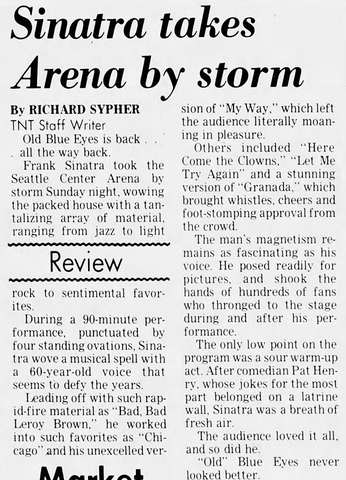
[O'Brien named NBA commissioner]
Consiglio: Larry O'Brien became commissioner of the National Basketball Association on April 30, 1975, serving until 1984; the NBA championship trophy was later named the Larry O'Brien Trophy in his honor.
Source: Tony Consiglio (as told to Franz Douskey), "Sinatra and Me: The Very Good Years" (2012).
Denver Coliseum, Denver, Colorado
Orchestra Conducted By: Don Costa
1. You Are the Sunshine of My Life
2. Bad, Bad Leroy Brown
3. But Beautiful
4. Didn't We
5. This Love of Mine
6. Something
7. Nice 'n' Easy
8. My Way
9. Last Night When We Were Young / Violets for Your Furs / Here's That
Rainy Day
10. Cycles
11. Granada
12. Send in the Clowns
13. Let Me Try Again
14. My Kind of Town
15. If
16. I've Got You Under My Skin
17. Put Your Dreams Away (For Another Day)
Denver Coliseum, Denver, Colorado
Orchestra Conducted By: Don Costa
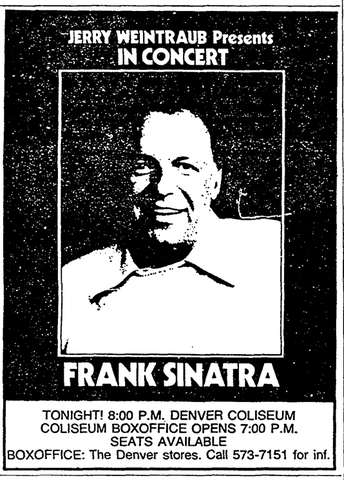
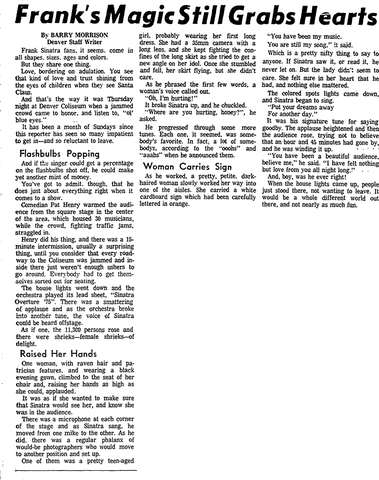
Chicago Stadium, Chicago, Illinois
Orchestra Conducted By: Don Costa
1. overture
2. You Are The Sunshine Of My Life
3. Bad, Bad Leroy Brown
4. But Beautiful
5. Didn't We?
6. This Love Of Mine
7. Something
8. Nice N' Easy
9. My Way
10. monologue
10. medley: Just One Of Those Things / It Never Entered My Mind / When Your Lover Has Gone
11. Cycles
12. Granada
13. Send In The Clowns
14. Let Me Try Again
15. My Kind Of Town
16. If
17. I've Got You Under My Skin
18. Put Your Dreams Away
Notes: TT 80mins.
Chicago Stadium, Chicago, Illinois
Orchestra Conducted By: Don Costa
Howard Reich, Entertainment writer CHICAGO TRIBUNE
Now this could only happen to a guy like me,
And only happen in a town like this.
So may I say to each of you most gratefully,
As I throw each one of you a kiss, this is
My kind of town, Chicago is ...
''My Kind of Town,'' lyrics by Sammy Cahn
You can bet that when Frank Sinatra sings those glorious words Sunday night at the packed World Music Theatre, the screams from the audience will be loud enough to wake the neighbors.
For Sinatra, though, the song is more than just a sure-fire score whenever he sings it here or anywhere else in the world.
When he hits those high notes on ''one town that won`t let you down,''
when he swings into ''my kind of razzmatazz,'' he`s telling us precisely what Chicago has meant to his life and career.
''Chicago is without doubt one of the greatest music cities in the world- in fact, Chicago was one of the turning points in my career,'' says Sinatra on the eve of his return here.
Although Sinatra was already a remarkably accomplished singer by the late `30s, it was Chicago-then, as now, overflowing with jazz and other swinging forms of nightlife-that helped launch him to stardom.
''I was with Harry James` band, and we were playing the Sherman Hotel`s Panther Room, and Jimmy Hilliard, with CBS records, came to hear a few sets,'' Sinatra recalls. ''One thing led to another, and Hilliard told Tommy Dorsey about me. Tommy saw me another time in Chicago, and we talked.
''I still had time on my contract with Harry, but he was wonderful,''
releasing Sinatra from the contract so he could switch to Dorsey`s legendary group.
''The Dorsey band was the dream of every singer then,'' adds Sinatra,
''and it was a terrific shot. I stayed in Chicago with the Dorsey band, and seeing Harry and the guys leave was one of the hardest things I`ve ever been through.''
It must have been, considering that Sinatra made his first record, ''All or Nothing at All,'' with James` fledgling band in 1939.
By 1943, when CBS reissued that recording, it became Sinatra`s first No. 1 hit, signaling the end of Bing Crosby`s reign as America`s foremost singer. Crosby realized a dynamic new force had exploded onto the music scene, once saying that he never even considered Sinatra a rival ''because I think he sings a good deal better than I ever did'' and adding that ''he`s the greatest entertainer we have.''
But in the late `30s, Sinatra was still hustling in Chicago and elsewhere, and ''when I first appeared here at the Sherman House,'' he once joked, ''I was 122 pounds, that`s with a topcoat, and walked the boulevard with an anchor.''
In fact, even before his stints with James and Dorsey, Sinatra had been a Chicago regular. In 1935, having won the ''Major Bowes Amateur Hour'' contest on the East Coast, he came to Chicago with the Hoboken Four, a vocal group that sang any date it could get.
Just a few years later, Sinatra would be Dorsey`s biggest star, thanks to the vocal sheen and impeccable phrasing of his ballads. He was creating a sensation anywhere he sang-or even appeared.
In 1944, for instance, the Chicago Tribune reported that ''Frank Sinatra, who passed through Chicago yesterday en route to New York, lost his bow tie and almost his shirt to his fans. To avoid just such a catastrophe, he left the Santa Fe Chief at 14th Street and took a Clark Street car, where surprised passengers recognized but did not maul him.
''The lad the bobby socks swoon for went to Henrici`s (restaurant), but his public, evidently knowing his habits and disappointed at the station, was there to greet him.
''Sinatra tried to leave by the back way, but a truck driver obligingly blocked the alley, detaining the Sinatra taxi and giving the Sinatra fans time to tear off the famous bow tie and rip the Sinatra shirt.''
Sealed with a movie
Clearly, Chicago was smitten, but the moment that probably sealed the love affair came in the early `60s, when he filmed ''Robin and the 7 Hoods'' here..
With his career slump of the late `40s ended by his brilliant, Oscar-winning performance in ''From Here to Eternity'' (1953), Ol` Blue Eyes was back on top. In rapid succession, he starred in such dramatic tours de force as ''Suddenly'' (1954) and ''The Man With the Golden Arm'' (1955) and such ebullient musicals as ''Guys and Dolls'' (1955) and ''High Society'' (1956).
None of these, however, was half so rambunctious as ''Robin and the 7 Hoods,'' with Sinatra, Sammy Davis Jr., Peter Falk and even der Bingle raising Cain in a Robin Hood story set in Prohibition Chicago. Booze halls, poolrooms, shootouts, brawls, even Sammy Davis tap-dancing on a bar while firing off his pistols-the film was as freewheeling as its stars.
What was it like making the film here?
''An experience,'' says Sinatra, with characteristic understatement.
''There is no doubt in my mind that Dean, Sammy and that gang and I together had more laughs and got into more trouble than any group of people anywhere.
''That string of films, `Robin and the 7 Hoods` and the ones we did in Vegas, were fun, and I am sure we had more fun making the pictures than the audiences did seeing each movie.
''And the film gave the city a national anthem: `My Kind of Town.` Great talent-like music by Jimmy Van Heusen, lyrics by Sammy Cahn, and Nelson Riddle doing arrangements and conducting-is pretty much a gift, and that`s what we got with `My Kind of Town.`
''Sammy`s words got into the soul of the city. The song was a collaboration by people who loved the city; it is one of the best band songs I`ve ever had.''
Yet it was Sinatra`s hard-driving, hard-swinging performance of the tune in the film`s final sequence, on his commercial recording and in concert ever since that made ''My Kind of Town'' an international hit.
To this day, ''Sinatra can`t go anywhere in the world without singing it,'' says Cahn, who wrote the song with Van Heusen in ''about an hour, an hour and a half, including interruptions.''
Title comes first
''First we came up with the title, because I wouldn`t write a song called `Chicago`-I have respect for other people`s titles.'' Fred Fisher`s
''Chicago (That Toddlin` Town)'' was written in 1922.
''So we came up with `My Kind of Town.` Right away, when we finished writing the song, it had a quality that you knew this was correct. It sounded as if it was written with ease, which it was, but I didn`t think it would become that big a standard.
''I wouldn`t say I necessarily heard Sinatra`s voice when we were working on the song, but he was in the room, so to speak.
''See, the song has an energy, right from the first note, just like Chicago itself.''
While Sinatra and the gang were in town making the movie, their high-rolling good times spilled over to the long-gone Villa Venice, where they put on some of the most thrilling live shows this city has seen.
''The Rat Pack is in town-the Leader and all-for the first and possibly the only time, and night life is explosively exciting on the banks of the Des Plaines River at Milwaukee Avenue,'' wrote the late William Leonard in 1962, the Tribune`s nightlife critic in that era.
''The ancient Villa Venice,'' continued Leonard, ''has hit the jackpot with Frank Sinatra, Dean Martin and Sammy Davis Jr., who croon, carol, caper and clown to the biggest cabaret audience this town has seen in 30 years.
''Martin opens with 20 minutes of drinking songs, Sinatra fools everyone by coming on ahead of Davis with a quarter hour of old Frankie favorites that cause the ladies to whimper with audible delight. Davis does the impossible by making the next 10 minutes an electrical follow up. Then the three unite for nearly an hour of corny comedy and swinging music. ...
''Outside, throngs show up about sundown looking for autographs or glimpses of the Leader or his clan. Hundreds line up waiting for the next show, many of them looking for scalpers.''
From that moment on, virtually every Sinatra performance in Chicago has been not only a concert, but a kind of pop-culture event that crossed boundaries of generation, musical taste and politics.
Middle-aged bobby soxers
Singing at the Chicago Stadium in 1974, during his comeback tour after a brief retirement, Sinatra drew middle-aged women who ''screamed, clawed and bit for a closer look at `The Voice,''` in the words of one writer.
''If they hadn`t screamed for him in the `40s, they had magic moments of his records in the `50s, or drove through the night with Sinatra on the radio right through the `60s and into the `70s.''
So it was no surprise that when Sinatra returned to the Chicago Stadium in 1975, his performance of ''My Kind of Town'' drew incredible shrieks, inspiring him to tell the audience, ''I accept the nomination.''
Naturally, almost every Chicago visit included a stopover at his favorite hangout.
''I probably spent more time in the Ambassador East`s Pump Room than any other place in Chicago-I`m sure of that,'' says Sinatra today.
''It is still a wonderful room and a great place to unwind at the end of the evening. The last time we played Chicago we naturally stopped by the Pump Room, and there was a prom night celebration-the room was jumping. I`m delighted to see the room remains an important part of the city`s celebrations and special events.''
So does Sinatra, witness his historic performance for the reopening of the refurbished Chicago Theatre in 1986.
Perhaps the chemistry between Chicago and Sinatra has something to do with the particular personality of each.
''Sinatra has a certain menace about him, which is tremendously exciting,'' says Cahn, a Sinatra friend for half a century.
''It`s like I always say: I`ll give anyone $100,000 if they can answer three questions about Frank Sinatra. They`re simple questions that you could ask about anybody: How`s Frank? Where`s Frank? Will he be here?
''In other words, there`s a menace about him, a sense of danger that is quite exciting, and it`s an excitement that Chicago has always had.''
For Sinatra`s part, ''I adore the city and do so because it`s a big city with the heart of a small town.
''As I mentioned earlier, it was always a great city for good music, lots of clubs and wonderfully talented people. I have many terrific friends in Chicago.''
Maybe millions.
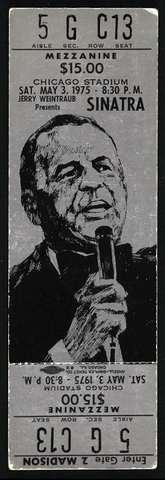
Auditorium, Minneapolis, MN
Orchestra Conducted By: Don Costa
1. You Are the Sunshine of My Life
2. Bad, Bad Leroy Brown
3. But Beautiful
4. Didn't We
5. This Love of Mine
6. Something
7. Nice 'n' Easy
8. My Way
9. Angel Eyes
10. Cycles
11. Granada
12. Send in the Clowns
13. Let Me Try Again
14. My Kind of Town
15. If
16. Nancy (With the Laughing Face)
17. I've Got You Under My Skin
18. Put Your Dreams Away (For Another Day)
Auditorium, Minneapolis, MN
Orchestra Conducted By: Don Costa
[image referenced in source but could not be recovered]
Market Square Arena, Indianapolis, Indiana
Orchestra Conducted By: Don Costa
1. overture
2. You Are The Sunshine Of My Life
3. Bad, Bad Leroy Brown
4. But Beautiful
5. Didn't We?
6. This Love Of Mine
7. Something
8. Nice 'N' Easy
9. My Way
10. monologue
11. medley: Last Night When We Were Young / Violets For Your Furs / Here's That Rainy Day
12. Cycles
13. Granada
14. Send In The Clowns
15. Let Me Try Again
16. My Kind Of Town
17. If
18. I've Got You Under My Skin
19. Put Your Dreams Away
Notes: TT 75mins.
Market Square Arena, Indianapolis, Indiana
Orchestra Conducted By: Don Costa
[image referenced in source but could not be recovered]
[image referenced in source but could not be recovered]
Kiel Auditorium, St. Louis, Missouri
Orchestra Conducted By: Don Costa
1. You Are The Sunshine Of My Life
2. Bad, Bad Leroy Brown
3. But Beautiful
4. Didn't We?
5. This Love Of Mine
6. Something
7. Nice 'N' Easy
8. My Way
9. monologue
10. Angel Eyes
11. Cycles
12. Granada
13. Send In The Clowns
14. Let Me Try Again
15. My Kind Of Town
16. If
17. Nancy
18. I've Got You Under My Skin
19. Put Your Dreams Away
Notes: TT 73mins. Sinatraphile Richard Warwick was at this concert at the Kiel Auditorium in St. Louis. He supplied us with the song list.
[image referenced in source but could not be recovered]
Kiel Auditorium, St. Louis, Missouri
Orchestra Conducted By: Don Costa
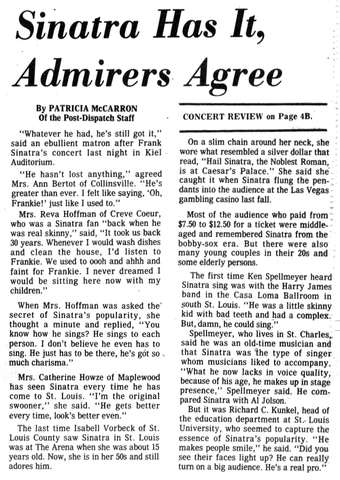
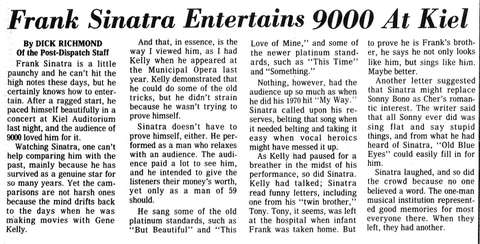
Montreal Forum, Montreal, Canada
Orchestra Conducted By: Don Costa
1. overture
2. You Are The Sunshine Of My Life
3. Bad, Bad Leroy Brown
4. But Beautiful
5. Didn't We
6. This Love Of Mine
7. Something
8. Nice 'N' Easy
9. My Way
10. monologue
11. saloon medley: Last Night When We Were Young / Violets For Your Furs / Here's That Rainy Day
12. Cycles
13. Granada
14. Send In The Clowns
15. Let Me Try Again
16. My Kind Of Town
17. The Saddest Thing Of All
18. I've Got You Under My Skin
19. Put Your Dreams Away
20. chaser "This Is A Lovely Way To Spend An Evening"
Notes: TT 77mins.
Montreal Forum, Montreal, Canada
Orchestra Conducted By: Don Costa
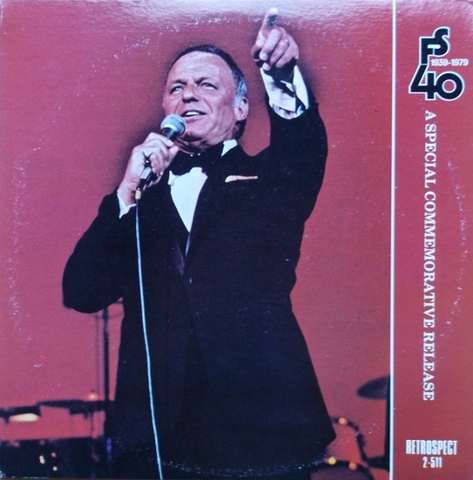
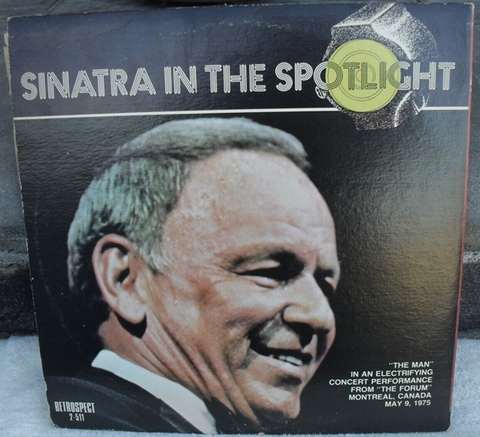
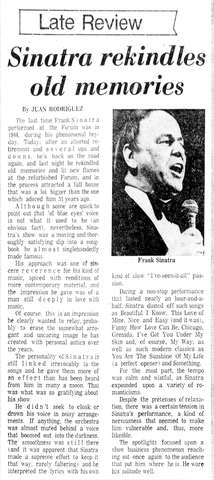
Maple Leaf Gardens, Toronto, Ontario
First Show
Orchestra Conducted By: Don Costa
1. You Are The Sunshine Of My Life
2. Bad, Bad Leroy Brown
3. But Beautiful
4. Didn't We?
5. Something
6. Nice 'N' Easy
7. My Way
8. monologue
9. Angel Eyes
10. Cycles
11. Granada
12. Send In The Clowns
13. Let Me Try Again
14. My Kind Of Town
15. If
16. I've Got You Under My Skin
17. Nancy
18. Put Your Dreams Away
Notes: TT 81mins.
Maple Leaf Gardens, Toronto, Ontario
Second Show
Orchestra Conducted By: Don Costa
1. You Are The Sunshine Of My Life
2. Bad, Bad Leroy Brown
3. But Beautiful
4. Didn't We?
5. Something
6. Nice 'N' Easy
7. My Way
8. monologue
9. medley: Last Night When We Were Young / Violets For Your Furs / Here's
That Rainy Day
10. Cycles
11. Granada
12. Send In The Clowns
13. Let Me Try Again
14. My Kind Of Town
15. If
16. I've Got You Under My Skin
17. Nancy
18. Put Your Dreams Away
Notes: TT 76mins.
NOTE: Sinatra Scholar Ed O'Brien says that press coverage of the Toronto appearance was extensive, but here are the highlights: (1) Sinatra drew over 40,000 fans for the two shows; (2) he earned $400,000 for his efforts and picked up $250,000 for his May 9th concert at the Montreal Forum.
Maple Leaf Gardens, Toronto, Ontario
First Show
Maple Leaf Gardens, Toronto, Ontario
Second Show
note: There was one sentence I could not completely salvage. Tells that Frank was onstage for 75 minutes
and repeats the earlier mention of how much he earned for the two shows.
Ed
Variety
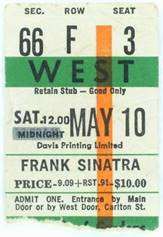
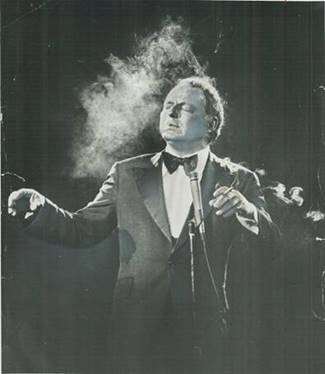
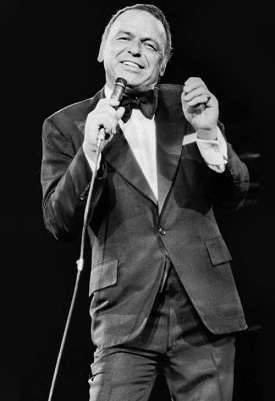
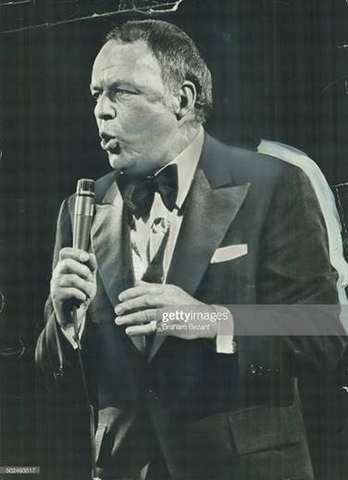
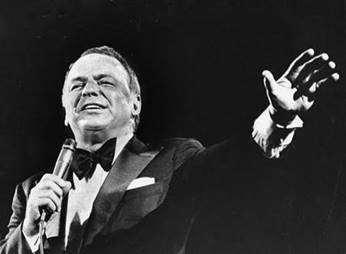
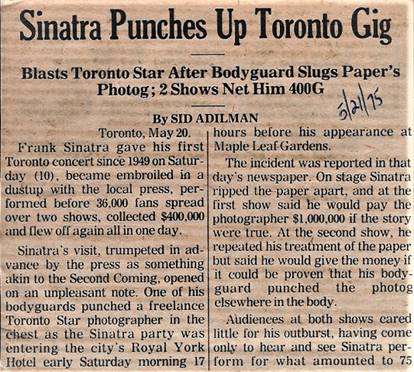
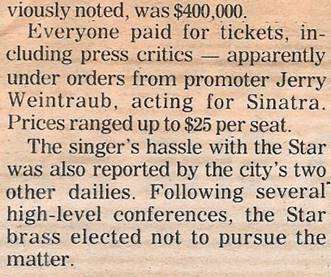
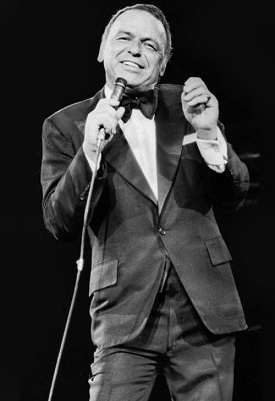
Civic Center, Providence, Rhode Island
Orchestra Conducted By: Don Costa
1. You Are The Sunshine Of My Life
2. Bad, Bad Leroy Brown
3. But Beautiful
4. Didn't We?
5. This Love Of Mine
6. Something
7. Nice 'N' Easy
8. My Way
9. monologue
10. medley: Just One Of Those Things / It Never Entered My Mind / When Your Lover Has Gone
11. Cycles
12. Granada
13. Send In The Clowns
14. My Kind Of Town
15. If
16. I've Got You Under My Skin
17. Nancy
18. Put Your Dreams Away
Notes: TT 75mins.
Civic Center, Providence, Rhode Island
Orchestra Conducted By: Don Costa
[image referenced in source but could not be recovered]
Veterans Memorial Coliseum, New Haven, CT
Orchestra Conducted By: Don Costa
1. You Are The Sunshine Of My Life
2. Bad, Bad Leroy Brown
3. But Beautiful
4. Didn't We?
5. Something
6. Nice 'N' Easy
7. My Way
8. monologue
9. Angel Eyes
10. Cycles
11. Send In The Clowns
12. Let Me Try Again
13. My Kind Of Town
14. If
15. I've Got You Under My Skin
16. Put Your Dreams Away
Notes: TT 64mins.
Veterans Memorial Coliseum, New Haven, CT
Orchestra Conducted By: Don Costa
[image referenced in source but could not be recovered]
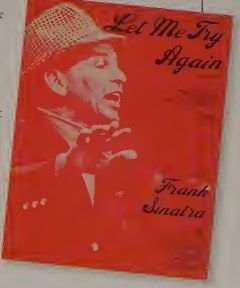
[Photograph: Sinatra arrives in London for European tour rehearsals. From Richard Havers, "Sinatra" (Dorling Kindersley, 2007), p.327.]
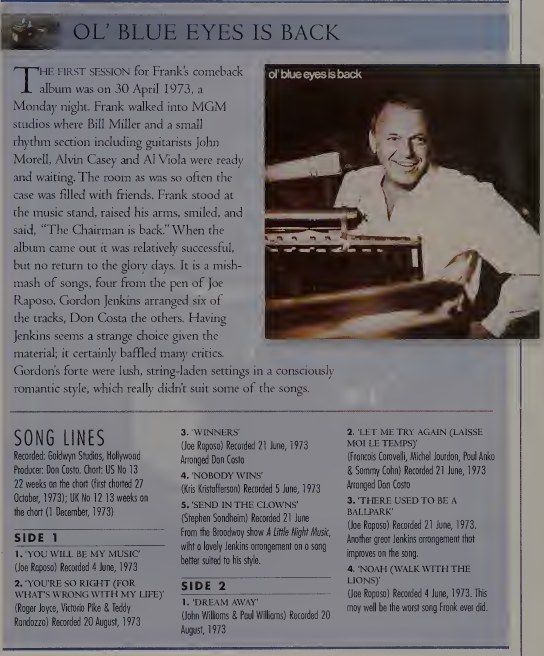
[Photograph: Sinatra arrives in London for European tour rehearsals. From Richard Havers, "Sinatra" (Dorling Kindersley, 2007), p.327.]
Frank arrived in London ahead of a European tour, staying at Claridges after having sold his London flat. British saxophonist Vic Ash, one of Frank's regular touring musicians, later recalled rehearsals as warm, professional, and free of Frank's supposed bad temper. (Source: Richard Havers, "Sinatra" (Dorling Kindersley, 2007).)
Before beginning rehearsals with Don Costa and British musicians, Frank went to 10 Downing Street to meet Prime Minister Harold Wilson. (Source: Richard Havers, "Sinatra" (Dorling Kindersley, 2007).)
Sporting Club, Monte Carlo
Red Cross Gala Benefit
Key Musicians: Gene Cherico (bass), Irv Cottler (drums), Al Viola (guitar),
Bill Miller (piano).
Orchestra Conducted By: Don Costa
1. You Are The Sunshine Of My Life
2. Bad, Bad Leroy Brown
3. But Beautiful
4. Didn't We?
5. I See Your Face Before Me
6. Something
7. Nice 'N' Easy
8. My Way
9. monologue
10. medley: Last Night When We Were Young / Violets For Your Furs / Here's
That Rainy Day
11. Cycles
12. Strangers In The Night
13. Send In The Clowns
14. Let Me Try Again
15. If
16. I've Got You Under My Skin
17. The Lady Is A Tramp
18. Put Your Dreams Away
Sporting Club, Monte Carlo
Red Cross Gala Benefit
Key Musicians: Gene Cherico (bass), Irv Cottler (drums), Al Viola (guitar), Bill Miller (piano).
Orchestra Conducted By: Don Costa
[image referenced in source but could not be recovered]
[image referenced in source but could not be recovered]
Palais des Congrès, Paris, France
Orchestra Conducted By: Don Costa
1. You Are The Sunshine Of My Life
2. Bad, Bad Leroy Brown
3. But Beautiful
4. Didn't We?
5. This Love Of Mine
6. Something
7. Nice 'N' Easy
8. My Way
9. monologue
10. Angel Eyes
11. The Saddest Thing Of All
12. Strangers In The Night
13. Let Me Try Again
14. Send In The Clowns
15. If
16. The Lady Is A Tramp
17. I've Got You Under My Skin
18. My Kind Of Town
19. Put Your Dreams Away
Notes: TT 76mins.
Palais des Congrès, Paris, France
Orchestra Conducted By: Don Costa
From Michel Macaire:
"Here is what I can say about this concert :
It was the first one I attended in Paris and the first time I saw Frank on stage.
As always the price of seats was very high - between 500 and 200 french francs the equivalent of today $ 400 to 150 - When the ticket office opened a sign said "no check only cash".
I got for a place at 400 francs ($ 300) which was about half of my monthly salary but did not have such sum with me. The cashier kindly accepted that I go to a nearby bank. In addition, the ticket was not issued immediately but to be collected only the day before the concert. Why ? Maybe to avoid a sale on the black market...a little ridiculous because only an elite was in financial capacity to attend the event.
The intermission was very long and Frank arrived very in late (for weather reasons with his plane I think). When the lights went out Claude François one of the author of Comme d'Habitude/My Way came to sit right in front of me.
Below my ticket"
--Michel
May 20, 1978, SHARE Inc. Boomtown Benefit, Santa Monica Civic Auditorium. Los Angeles,
Frank Sinatra, Dean Martin & Sammy Davis Jr.
1. The Oldest Established (Permanent Floating Crap Game In New
York)
Stadthalle, Vienna, Austria
Orchestra Conducted By: Don Costa
1. You Are The Sunshine Of My Life
2. Bad, Bad Leroy Brown
3. But Beautiful N. Riddle arg.
4. Didn't We
5. Something
6. Nice "N" Easy
7. My Way monologue
8. Saloon Trilogy: Last Night When We Were Young/
Violets For Your Furs/Here's That Rainy Day
9. Cycles
10. Strangers In The Night
11. Let Me Try Again ballad version
12. If
13. The Lady Is A Tramp
14. I've Got You Under My Skin
15. My Kind Of Town
16. Put Your Dreams Away
Olympiahalle, Munich, Germany
Orchestra Conducted By: Don Costa
1. You Are the Sunshine of My Life
2. Bad, Bad Leroy Brown
3. But Beautiful
4. Didn't We
5. Something
6. Nice 'n' Easy
7. My Way
8. Last Night When We Were Young / Violets for Your Furs / Here's That Rainy Day
9. Cycles
10. Strangers in the Night
11. Let Me Try Again
12. Send in the Clowns
13. If
14. The Lady Is a Tramp
15. I've Got You Under My Skin
16. My Kind of Town
17. Put Your Dreams Away (For Another Day)
Olympiahalle, Munich, Germany
Orchestra Conducted By: Don Costa
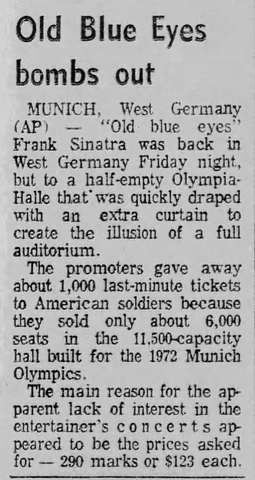
Festhalle, Frankfurt, Germany
Orchestra Conducted By: Don Costa
1. You Are The Sunshine Of My Life
2. Bad, Bad Leroy Brown
3. But Beautiful
4. Didn't We?
5. Something
6. Nice 'N' Easy
7. My Way
8. monologue
9. medley: Just One Of Those Things / It Never Entered My Mind / When Your Lover Has Gone
10. Cycles
11. Strangers In The Night
12. Let Me Try Again
13. If
14. The Lady Is A Tramp
15. I've Got You Under My Skin
16. My Kind Of Town
17. Put Your Dreams Away
Notes: TT 70mins.
Deutschlandhalle, Berlin (Cancelled)
Deutschlandhalle, Berlin (Cancelled)
The two posters below list the shows in Munich on May 23, Frankfurt May 25, and the cancelled show on May 26
© 1997-2026 The Sinatra Archive
This calendar, or any parts thereof, may not be reproduced in any fashion whatsoever without the prior written permission of the publisher (The Sinatra Archive)
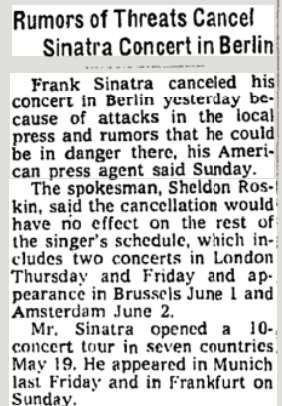
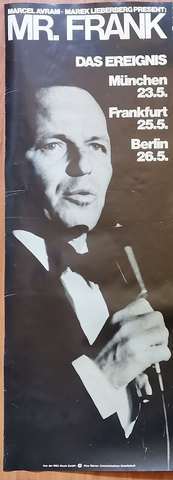
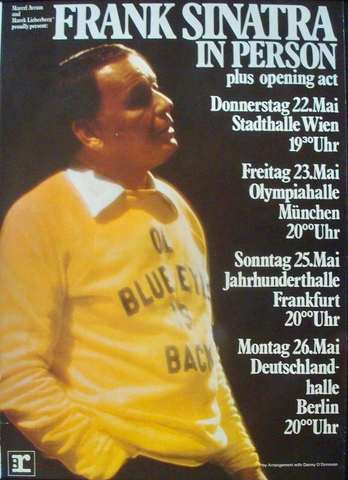
Royal Albert Hall, London, England
Orchestra Conducted By: Bill Miller
1. overture
2. You Are The Sunshine Of My Life
3. Bad, Bad, Leroy Brown
4. But Beautiful
5. Didn't We
6. I See Your Face Before Me
7. Something
8. Nice 'N' Easy
9. My Way
10. monologue
11. saloon Medley: Violets For Your Fur / Last Night / When We Were
Young / Here's That Rainy Day
11. Cycles
12. Strangers In The Night
13. Send In The Clowns
14. Let Me Try Again
15. If
16. I've Got You Under My Skin
17. My Kind Of Town
18. The Lady Is A Tramp
19. Put Your Dreams Away
20. chaser "This Is A Lovely Way To Spend An Evening"
Notes: TT 81mins.
NOTE: Ed O"Brien says that this is a terrific show from a period when Sinatra was definitely struggling vocally, The two nights at the RAH were magical. Ava and Mia attended along wth many other celebrities. "But Beautiful,", "Face Before Me," "Saloon Medley", "Cycles," "Clowns"ť and "If" all beautifully sung. Sinatra verbally trashed "Stranger," but did a fine vocal. And his closing three swingers were just a perfect way to end the evening.
Vance Adair states that he loves this RAH concert. It was less than a vintage year for Sinatra vocally, but,still, he turned out some great performances and was very audibly energized by the reception he received from the audience and the British press.
He would revisit the RAH (for the last time) 17 years later, Adair observes, who was present at two of these concerts. He was astonished by the rhythmic vitality, wit, and the care that Sinatra was able to communicate at the age of 76. Once again, he appeared to be both energized and visibly awed by the affection displayed by British audiences.
Royal Albert Hall, London, England
Orchestra Conducted By: Bill Miller
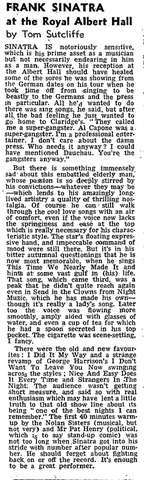
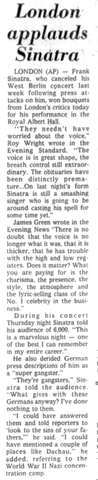
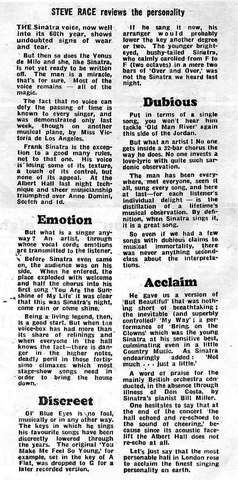
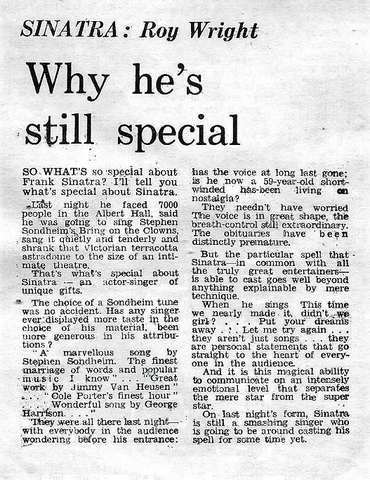
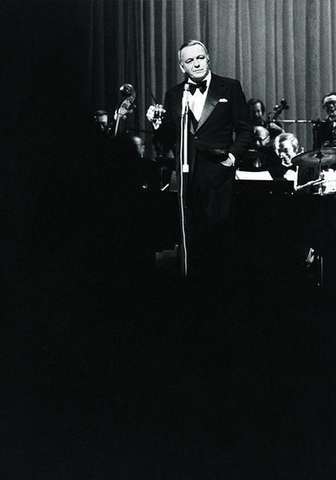
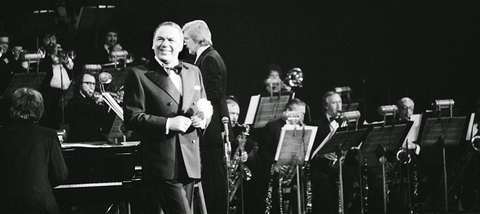
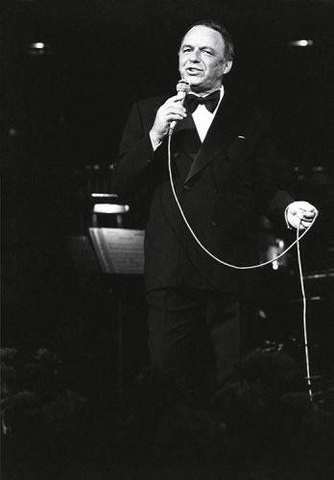
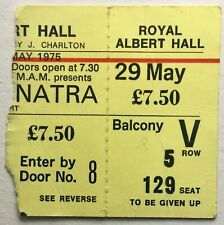
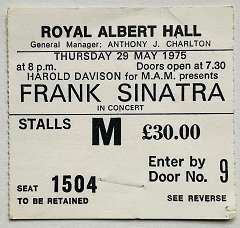
This Royal Albert Hall show was Sinatra's first London concert since 1970; the roughly 7,000-strong audience included Princess Margaret, Princess Anne, Princess Grace of Monaco, Ava Gardner, and Mia Farrow, and British reviews were warm just days after harsher treatment from the German press. Source: Derek Jewell, Frank Sinatra: A Celebration (New York: Applause Books, 1999).
Royal Albert Hall, London, England
Orchestra Conducted By: Bill Miller
Musicians: Al Viola (Guitar), Gene Cherico (Bass), Irv Cottler (Drums)
1. You Are The Sunshine Of My Life
2. That's Life
3.. Bad, Bad Leroy Brown
4. But Beautiful
5. Didn't We
6. I See Your Face Before Me
7. Something
8. Nice â N Easy y
9. My Way
10. monologue
11. Angel Eyes
12. Cycles (gap at start on master)
13. Strangers In The Night
14. Send In The Clowns
15. Let Me Try Again
16. If
17. I Have Dreamed
18. I've Got You Under My Skin
19. My Kind Of Town
20. introductions
21. The Lady Is A Tramp
22. Put Your Dreams Away
23. Chaser "This Is A Lovely Way To Spend An Evening"
Notes: TT 86mins.
Foret National, Bruxelles, Belgium
Orchestra Conducted By: Bill Miller
1. You Are The Sunshine Of My Life
2. Bad, Bad Leroy Brown
3. But Beautiful
4. Didn't We?
5. Something
6. Nice 'N, Easy
7. My Way
8. medley: Last Night When We Were Young / Violets For Your Furs /
Here's That Rainy Day
9. Cycles
10. Strangers In The Night
11. Send In The Clowns
12. Let Me Try Again
13. If
14. I Have Dreamed
15. Nancy
16. I've Got You Under My Skin
17. My Kind Of Town
18. The Lady Is A Tramp
Concertgebouw, Amsterdam
Orchestra Conducted By: Bill Miller
1. You Are The Sunshine Of My Life
2. Bad, Bad, Leroy Brown
3. But Beautiful
4. Didn't We
5. Something
6. Nice And Easy
7. My Way
8. medley: Last Night When We Were Young / Violets For Your Furs /
Here's That Rainy Day
9. Cycles
10. Strangers In The Night
11. Send In The Clowns
12. Let Me Try Again
13. If
14. I Have Dreamed
15. Nancy
16. I've Got You Under My Skin
17. My Kind Of Town
18. The Lady Is A Tramp
Notes: TT 90mins.
Concertgebouw, Amsterdam
Orchestra Conducted By: Bill Miller
On June 2, 1975 Sinatra was for the first time in Holland in the Concertgebouw Amsterdam. It was also the first time I saw him live. An unforgettable event.
There was a lot of excitement in our country, because his stay in Germany was a failure and Sinatra was angry. So, would he come anyway? The audience was excited and so was Sinatra, he was cheerful and very happy with the Amsterdam reception, a long standing ovation. He was all joy. Many well-known Dutch people were seated in the hall, including Elisabeth Taylor and her then Dutch boyfriend Henri Wijnberg. And that also created some tension, which text will he sing in Nancy: “keep Audrey Hepburn and Liz Taylor” or “Betty Grable , Lamour and Turner”?. He chose the latter. I thought it was special that he sang Nancy only accompanied by Bill Miller. I Don’t recall hearing it in this form before.
Some additions:
After 7. My Way
FS: “You’re some kind of an audience, I want to tell you something buddy.
Now I know I am glad we didn’t go to Berlin. I think I shall buy West Berlin and make ke a parking lot I had another word, but I didn’t want to say it.” 11 Send In The Clowns - w/piano Bill Miller
13 If - w/guitar Al Viola 15 Nancy - w/piano Bill Miller 18 The Lady Is A Tramp
Note: At the end of the European tour, he thanks the musicians (’marvelous players’) from London and his own quartet: Bill Miller, Gene Cherico, Al Viola, Irv Cottler.
19 Reprise The Lady Is A tramp
Reviews in Dutch papers:
“Old-fashioned ovations for Frank Sinatra”
“A big Triumph”
“Sinatra came, saw and conquered”
“Amsterdam has come to love him even more than it already did”
--Cor Franc
[image referenced in source but could not be recovered]
[image referenced in source but could not be recovered]
CP Telethon
1. My Kind Of Town
2. They Can't Take That Away From Me w/Carol Lawrence
3. "Happy Father's Day"
Notes: 30 min.
NOTE: Sinatra Scholar Ed O'Brien reports that Sinatra wings it with the orchestra on "My Kind of Town" and then does a duet with Lawrence on "They Can't Tale that away from Me." The emcee, Dennis James, was knocked out by Sinatra's singing without charts and the two clobbered together improvisations with the studio band. Sinatra even sings "Happy Father's Day" to all the fathers in the television audience.
Sinatraphile Vance Adair adds that the orchestra (not surprisingly) didn't anticipate the key change. Sinatra urges them to change into the key of G. It was a daring thing to do for such a high profile performer and Adair asks, "Can you imagine Streisand ever doing something like this?"
O'Brien replied with this story: In July 1969 Sinatra was in NYC rehearsing the songs for "Watertown." Jake Holmes was shocked at how raw Sinatra's voice sounded. He mentioned it to Bob Gaudio and they approached Sinatra with the idea of enriching the orchestral background to lessen the harsh tones. Sinatra immediately rejected the concept. He told them that he was deliberately working in an atonal sound to convey more powerfully the pain of the storyteller. Holmes told O'Brien, who wrote the program notes for "Watertown," that he was shocked that a singer of Sinatra's stature would take such a risk. He then named singers who wouldn't even consider taking such a daring risk.
Caesars Palace, Las Vegas, Nevada
First Show
Orchestra Conducted By: Bill Miller
1. Where Or When
2. You Are The Sunshine Of My Life
3. My Kind Of Town
4. In The Wee Small Hours Of The Morning
5. Didn't We?
6. Something
7. Nice 'N' Easy
8. My Way
9. monologue
10. Anytime (I'll Be There) choral backing on tape*
11.. Send In The Clowns
12. Cycles
13. Granada
14. If
15. I've Got You Under My Skin
16. The Lady Is A Tramp
17. Put Your Dreams Away
Notes: TT 66mins.
Ed O'Brien:
Frank was a last minute replacement for Diana Ross. He subbed for her from 6/19 thru 7/2. He did two shows a night and was dark on Mondays. Twenty-four shows during the two week engagement. Pat Henry opened for him and Bill Miller conducted the Nat Brandwynne Orchestra.
Caesars Palace, Las Vegas, Nevada
Second Show
Orchestra Conducted By: Bill Miller
1. Where Or When
2. You Are The Sunshine Of My Life
3. My Kind Of Town
4. In The Wee Small Hours Of The Morning
5. Didn't We?
6. Something
7. Nice 'N' Easy
8. My Way
9. monologue
10. Send In The Clowns
11. Cycles
12. Granada
13. If
14. I've Got You Under My Skin
15. The Lady Is A Tramp
16. Put Your Dreams Away
Notes: TT 60mins.
Caesars Palace, Las Vegas, Nevada
First Show
Orchestra Conducted By: Bill Miller
Variety
6-25-75
Review of 6-21-75 show note: There certainly was a metamorphosis in June of 1975. When I saw Sinatra in Buffalo, 10-4-74, he stood on a stage and sang his songs. He would whip the mike cord a few times and do some hand gesture as he sang. But by the summer of 75, Frank had adjusted to his diminished vocal authority. The hand and body gestures dominated a performance. He sold the song with an intense physical involvement with the lyric and the driving beat of the orchestra. I saw him that summer in Saratoga. He had redefined Frank Sinatra. There was more engagement with his audience and a more leisurely approach to the way he communicated his story in song. Even the monologue possessed more intimacy with an audience. When he had regained much of his previous vocal form, in 78-79, the shadings became less critical and we saw again more of the Sinatra of old. I prefer the latter, but the performer in the mid-70s adjusted and entertained with more than enough magic.
--Ed
[image referenced in source but could not be recovered]
Caesars Palace, Las Vegas, Nevada
First Show
Orchestra Conducted By: Bill Miller
1. Where Or When
2. You Are The Sunshine Of My Life
3. My Kind Of Town
4. But Beautiful
5. Didn't We?
6. Something
7. Nice 'N' Easy
8. My Way
9. monologue
10. Send In The Clowns
11. Cycles
12. Granada
13. If
14. I've Got You Under My Skin
15. The Lady Is A Tramp
16. Put Your Dreams Away
Notes: TT 59mins.
Caesars Palace, Las Vegas, Nevada
Second Show
Orchestra Conducted By: Bill Miller
1. Where Or When
2. You Are The Sunshine Of My Life
3. My Kind Of Town
4. But Beautiful
5. Didn't We?
6. Something
7. Nice 'N' Easy
8. My Way
9. monologue
10. Send In The Clowns
11. Cycles
12. Granada
13. If
14. I've Got You Under My Skin
15. The Lady Is A Tramp
16. Put Your Dreams Away
Notes: TT 65mins.
Over breakfast that afternoon in his Caesars Palace suite, following the previous night's successful opening, Frank learns that Sam Giancana has been murdered in his Chicago home -- shot once in the back of the head, once in the mouth, and five times under the chin -- just as Senate investigators were set to question him about the CIA's Castro assassination plots. "I guess you live by the sword, you die by the sword," Frank said of his former friend, with whom he'd had little contact since the Cal-Neva incident. Source: J. Randy Taraborrelli, Sinatra: Behind the Legend.
Caesars Palace, Las Vegas, Nevada
Orchestra Conducted By: Bill Miller
Caesars Palace, Las Vegas, Nevada
Orchestra Conducted By: Bill Miller
Caesars Palace, Las Vegas, Nevada
Orchestra Conducted By: Bill Miller
Caesars Palace, Las Vegas, Nevada
Orchestra Conducted By: Bill Miller
Caesars Palace, Las Vegas, Nevada
Orchestra Conducted By: Bill Miller
Caesars Palace, Las Vegas, Nevada
Orchestra Conducted By: Bill Miller
Caesars Palace, Las Vegas, Nevada
Orchestra Conducted By: Bill Miller
Caesars Palace, Las Vegas, Nevada
Orchestra Conducted By: Bill Miller
Caesars Palace, Las Vegas, Nevada
Orchestra Conducted By: Bill Miller
Caesars Palace, Las Vegas, Nevada
Orchestra Conducted By: Bill Miller
Caesars Palace, Las Vegas, Nevada
Orchestra Conducted By: Bill Miller
Caesars Palace, Las Vegas, Nevada
Orchestra Conducted By: Bill Miller
Tina recalled flying to meet her father in Monte Carlo after he promised a big surprise; as her plane approached Nice, fireworks lit the sky. She later learned the display wasn't Frank's doing at all, but France's Bastille Day celebration. Source: Nancy Sinatra, "Frank Sinatra, My Father" (1985).
Dorothy Chandler Pavilion, Los Angeles, CA
Ira Gerswin Tribute.
Frank Sinatra, Liza Minelli, Ethel Merman, Tony Bennett and others 1) A Foggy Day
2) They Can't Take That Away From Me
Dorothy Chandler Pavilion, Los Angeles, CA
Ira Gerswin Tribute.
Frank Sinatra, Liza Minelli, Ethel Merman, Tony Bennett and others 1) A Foggy Day
2) They Can't Take That Away From Me
© 1997-2026 The Sinatra Archive
This calendar, or any parts thereof, may not be reproduced in any fashion whatsoever without the prior written permission of the publisher (The Sinatra Archive
Harrah's, Lake Tahoe, Nevada
Orchestra Conducted By: Bill Miller
Denver did the dinner show
Sinatra the late show
Pat Henry opened for Frank
Bill Miller conducted
1. Where Or When
2. My Kind Of Town
3. Let Me Try Again (first time sung with Costa's uptempo chart)
4. You Are The Sunshine Of My Life
5. But Beautiful ( Riddle arg.)
6. Didn't We
7. Something ( Costa arg.)
8. Nice 'N' Easy
9. monologue
10. Send In The Clowns w/ Bill Miller
12. I Believe I'm Gonna Love You
13. Cycles
14. Ol' Man River
15. I Concentrate On You w/Al Viola
16. I've Got You Under My Skin
17. The Lady Is A Tramp
18. Put Your Dreams Away
Notes: TT 62mins.
Ed O'Brien says that Harrah's received 650,000 requests for tickets and were able to accommodate about 40,000. Sinatra and Denver, however, did not perform together as they would in their engagement in 1976.
J. Daniels asked:
"How did the FS/John Denver this come to be? whats the history behind it?"
Ed O'Brien responded:
Jerry Weintraub managed both Denver and Sinatra's concert tours. He had been Denver's manager since 1970. The idea of putting the two men on the same bill was his. The 75 Harrah's was a great success and in September of 1976 Sinatra and
Denver broke every house record with their
"September To Remember" at Harrah's in Tahoe. The latter engagement showcased the two men together singing each other's hits plus "September Song."
Harrah's, Lake Tahoe, Nevada
Orchestra Conducted By: Bill Miller
Denver did the dinner show
Sinatra the late show
Pat Henry opened for Frank
Bill Miller conducted
Denver -Sinatra Superb Contrast At Lake Tahoe By ELIOT TIEGEL LAKE TAHOE
-John Denver. "Mr. Outdoorsman," and Frank Sinatra, the venerable king of show business-
indoors or out -proved a solid boxoffice attraction back -to -back at Harrah's Aug. 1 -7.
Their seven -day stand at Harrah's here indicates that Denver's debut into the hotel nightclub
circuit with his program of ecology flavored tunes doesn't turn off the Scotch drinking crowd.
The teaming of Denver with Sinatra by sharp packager Jerry Weintraub in which each played
a separate show (to different audiences), also established some interesting show business marks.
For one, while the idea of an artist doing one show in any of Nevada's hotel -casinos has been tossed
around for the past three years by performers (principally in Las Vegas). only Sinatra has been able to
accomplish and retain this cherished concept. His playing the midnight show here solidified his role as
the most powerful entertainer in show business as he is the only performer in Las Vegas to he able to
work one show a night. Sinatra has accomplished what Dean Martin and Bob Hope (who is yet to debut
in Las Vegas) have sought. Since switching over from the Sands to Caesars Palace in 1968. Sinatra on
occasion has done one show a night at IO p.m. He's also done eight shows a week (two on Wednesday
and Saturday, the one show at 10 p.m. on Thursday. Friday and Sunday with Mondays off). Denver's
introduction to the nightclub field here with a one -show status, also places him in a vaunted position
among superstars, contemporary or evergreen. Harrah's officials say there was a general audience
turnover for the Denver dinner and Sinatra cocktail shows. Most people calling in for reservations were
told they could see one or the other. It cost a couple $40 Contrasting Denver -Sinatra plus tax to see one
show and the hotel's South Shore room was jammed for both performances. The room holds 850 for dinner:
1.100 for cocktails. For Bill Harrah. who bought Weintraub's concept of two hot names. it marked the first time
in his long show business association that he has booked a split bill. Split bills are also uncommon in Las Vegas.
although the hotels play two name acts for the same show. Caesars had Judy Garland in her last appearance there
in 1967 playing one show with Lou Rawls the other. The other hotels. it's claimed. haven't had any superstar split bills.
While there was speculation Denver and Sinatra would do some numbers together, they didn't and wisely so. Their styles
are so different it wouldn't have worked. In fact. Sinatra jabbed at Denver's clean cut image during his set thusly: "A star is
born in the nightclub field. I may have to teach him to drink and fool around ... by the time I get to Denver he'll be Sicilian."
Then Sinatra acknowledged the gambit: "It's a daring idea to bring the two of us in at the same time." The opening Friday (1)
prompted two Lake Tahoe radio stations KOWL and KOH to program extensively material by the two singers. Denver's opening
also lured 12 RCA executives. led by president Ken Glancy. away from their desks in New York and Los Angeles. Glancy indicated
there was business being done between himself and Weintraub's Management III over Denver's Windsong label which RCA will
distribute. Denver remains on the RCA label. Unlike Las Vegas which adds Hollywood star glitter to a Sinatra opening. there was
none of that on opening night, but Sinatra's film colony friends came up during the week. So minus the show business freebie list,
the shows were indeed for the people. And there was a special show at 2:30 a.m. Wednesday (6) for Harrah's employees as a gesture
of thanks from the entertainers.
Denver's 80 minutes maintained the natural high he sings about. spiced by 26 musicians plus Denver's own sextet all led by Lee Holdridge.
His 16 songs all done with great zest and enthusiasm. were heightened by film footage in a center screen plus slides on two side screens.
The visuals added the dimension of color and movement to Denver's songs about growing up on a Kansas farm ("Matthew."): the beauty of
Canada's mountains ( "Rocky Mountain Suite "): Jacques
Cousteau's undersea explorations ( "Calypso "), and the majesty of two powerful birds
( "Eagle And Hawk "). Film footage for the last three were originally done for TV specials and Denver wisely excerpted segments which blend with
his word pictures. He worked with four guitars (six and 12- string) and while he generally is fixed in position before a stationary mike (unlike Sinatra
who moves and grooves with the sexiness and confidence of a warrior of many emotional battles). Denver's sweet. gentle voice is all he needs to
hold an audience. Denver's quasi -country style, his folk- oriented material about the land and its people. engulfed the audience to where they sang
along with him and clapped in joyous unison - much like they do on college campuses or large venues where he now plays. "Boy this is pretty far out."
he exclaimed. "It's a far cry from the old Cellar Door in Washington. D.C. and the Golly Wag lounge in Minneapolis."
"Rocky Mountain High" set the
high level of artistry which ran through "Summer."
"Spring." "Back Home Again." "Annie's
Song," "Country Roads," "Country Boy" and
"This Ole Guitar."
For levity there was Tom Paxton's acidic "Forest Lawn" and Denver's own "Toledo."
During Sinatra's show, Denver and members of his band sat in the audience. This was Sinatra's fourth appearance at Harrah's Lake Tahoe hotel and
he's due back again for one week Oct. 17 -23. For the past six months he has been girdling the globe doing concerts and his performance in this lovely
resort community saw him in sharp. finely honed condition. His 65- minute set was a widely imaginative collage of new and old favorites and he worked
as hard for this crowd as any in his career. There were a number of surprises. His opening number (one of the nine old faves) "Where Or When" was done
in a comfortably slow tempo with just five saxes. four trumpets and four trombones plus rhythm. The strings were not to appear until four numbers later.
"Chicago" and "Let Me Try Again" picked up the pace.
Sinatra's voice strong and assertive although one now acknowledges that it has worn thin after all
these years. But the Sinatra voice remains a distinct instrument which is still a powerful communicator providing he's not over-extending himself with the
wrong kind of material. And this act allows him all the security he needs in knowing he is master of his material. "You Are The Sunshine Of My Life" was given
an added bounce with the injection of the line "you are the pizza of my life." "But Beautiful" (an old fave) was given a lush treatment with the addition of 21 strings.
Sinatra toasted Don Costa's orchestrations for this and other works. Bill Miller, Sinatra's long-time associate, conducted the orchestra with a formal hand while
Sinatra moved with a grace and confidence and informal, snazzy air onstage, his left hand making circles and accents. Citing his awareness for contemporary
composers besides Paul Antra ( "Let Me Try Again "), Sinatra sang Jim Webb's "This Time" and George Harrison's
"Something" (called "probably the best love song
ever written "). There were two magical highlights: a moving new arrangement for "Ol' Man River" with Bill Miller's piano the sole instrument for three-quarters of the
"recitation" and then the entire orchestra building to the crescendo. Sinatra's voice was magnificently soft and strong, leaden and free, enslaved and enlightened.
The second masterpiece was "Send In The Clowns" which is now included among the roster of his "saloon songs" which means spotlight. stool, cigarette in hand.
concentration. I have heard Sinatra sing this song twice before during the past year and this version is the most dramatic for he has lived with the words and gives them
the clarity of their bittersweet significance. The remaining evergreen faves included "Nice And Easy," "I Concentrate On
You," "I've Got You Under My Skin." "The Lady's
A Tramp" (interchanged with champ) and his ageless theme. "Put Your Dreams Away." He also introduced his new country flavored ballad single, "I Believe I'm Gonna Love
You," referring to the lyric sheet twice because he admitted he hadn't memorized the words completely. It was a minor thing. The pacing. arrangements. all ingredients in the
performance gassed the audience to where people heading toward the casino were talking about Frank Sinatra and not about what lay ahead of them.
Billboard
note: This is the longest review I have ever seen in Billboard.
Ed
Billboard Ad for engagement.
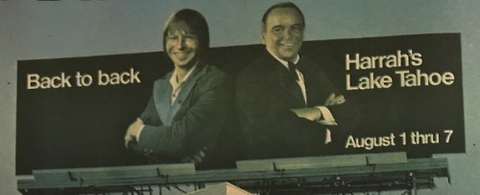
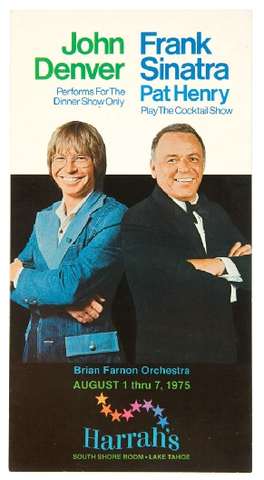
Harrah's, Lake Tahoe, Nevada
Brian Farnon Orchestra Conducted By: Bill Miller
1. Where Or When
2. You Are The Sunshine Of My Life
3. Let Me Try Again
4. My Kind Of Town
5. But Beautiful
6. Didn't We?
7. Something
8. Nice 'N' Easy
9. My Way
10. monologue
11. Send In The Clowns
12. I Believe I'm Gonna Love You
13. Cycles
14.. Ol' Man River
15. I Concentrate On You
16. I've Got You Under My Skin
17. The Lady Is A Tramp
18. Put Your Dreams Away
Notes: TT 65mins.
Harrah's, Lake Tahoe, Nevada
Brian Farnon Orchestra Conducted By: Bill Miller
South Shore Room, Harrah's, Lake Tahoe, Nevada
Brian Farnon Orchestra Conducted By: Bill Miller
1. Where or When
2. You Are the Sunshine of My Life
3. Let Me Try Again
4. My Kind of Town
5. But Beautiful
6. Didn't We
7. Something
8. Nice ''N' Easy
9. Monologue
10. Send in the Clowns
11. I Believe I'm Gonna' Love You
12. Cycles
13. I Concentrate on You w/Al Viola on guitar
14. I've Got You under my Skin
15. The Lady is a Tramp
16. Put Your Dreams Away
NOTE: Again, we are grateful to Ed O'Brien who provided the song program. TT 61mins.
Harrah's, Lake Tahoe, Nevada
Orchestra Conducted By: Bill Miller
Frank Sinatra program:
1. Where or When
2. You Are the Sunshine of my Life
3. Let Me Try Again
4. My Kind of Town
5. But Beautiful
6. Didn't We
7. Something
8. Nice 'N' Easy
9. monologue
10. Send in the Clowns
11. Cycles
12. Ol' Man River
13. I Concentrate on You w/Al Viola on guitar
14.. I've Got You Under my Skin
15. The Lady is a Tramp
16. Put Your Dreams Away
NOTE: We are grateful to Ed O'Brien who provided the above song program. TT 55mins.
Harrah's, Lake Tahoe, Nevada
Orchestra Conducted By: Bill Miller
1. Where Or When
2. You Are The Sunshine Of My Life
3. Let Me Try Again
4. My Kind Of Town
5. But Beautiful
6. Didn't We?
7. Something
8. Nice 'N' Easy
9. monologue
10. medley: Just One Of Those Things / It Never
Entered My Mind / When Your Lover Has Gone
11. Cycles
12. Ol' Man River
13. I've Got You Under My Skin
14. The Lady Is A Tramp
15. Put Your Dreams Away
Notes: TT 56mins.
Harrah's, Lake Tahoe, Nevada
Orchestra Conducted By: Bill Miller
Frank Bill Harrah John
Lake Tahoe August 75
Harrah's, Lake Tahoe, Nevada
Brian Farnon Orchestra Conducted By: Bill Miller
1. Where or When
2. You Are the Sunshine of My Life
3. Let Me Try Again
4. My Kind of Town
5. But Beautiful
6. Didn't We
7. Something
8. Nice 'n' Easy
9. Just One of Those Things / It Never Entered
My Mind / When Your Lover Has Gone
10. I Believe I'm Gonna Love You
11. Cycles
12. Ol' Man River
13. I've Got You Under My Skin
14. The Lady Is a Tramp
15. Put Your Dreams Away (For Another Day)
note: After Frank's midnight show, there was an hour lull before Denver did a second show and Frank followed with another show. They were both in-house for all the workers in the hotel and casino. It was Denver's idea and
Frank loved it. A big thank you for a sensational week.
Ed
Harrah's, Lake Tahoe, Nevada
Brian Farnon Orchestra Conducted By: Bill Miller
© 1997-2025 The Sinatra Archive
This calendar, or any parts thereof, may not be reproduced in any fashion whatsoever without the prior written permission of the publisher (The Sinatra Archive)
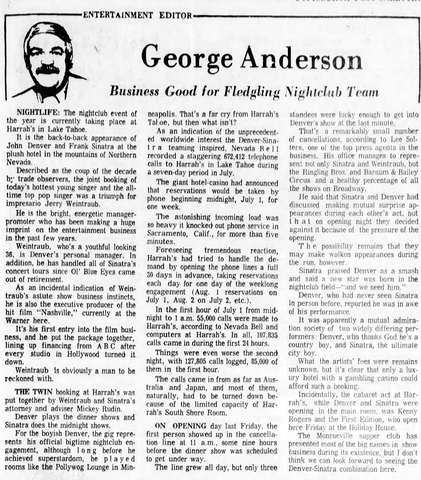
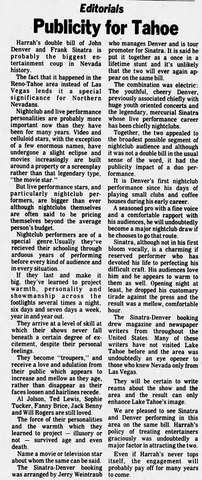
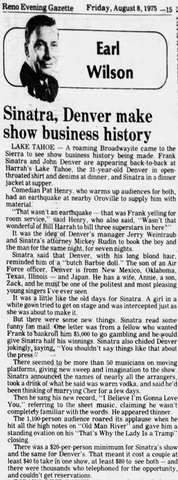
Harrah's, Lake Tahoe, Nevada
Brian Farnon Orchestra Conducted By: Bill Miller
© 1997-2026 The Sinatra Archive
This calendar, or any parts thereof, may not be reproduced in any fashion whatsoever without the prior written permission of the publisher (The Sinatra Archive)
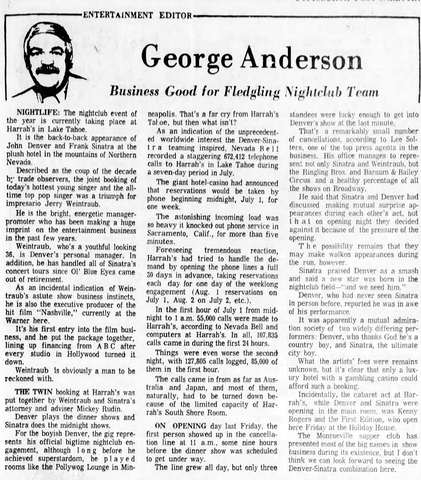
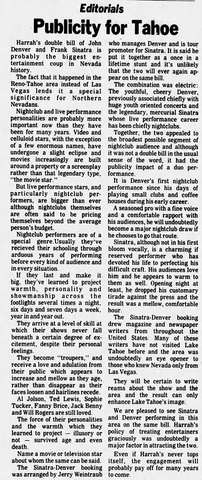
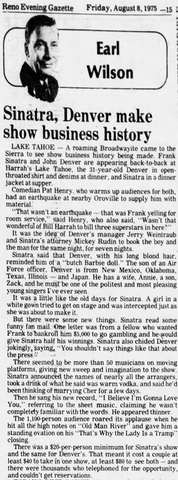
Harrah's, Lake Tahoe, Nevada
Orchestra Conducted By: Bill Miller
1. Where or When
2. You Are the Sunshine of My Life
3. Let Me Try Again
4. My Kind of Town
5. But Beautiful
6. Didn't We
7. Something
8. Nice 'n' Easy
9. Send In The Clowns
10. I Believe I'm Gonna Love You
11. Cycles
12. Ol' Man River
13. I've Got You Under My Skin
14. The Lady Is a Tramp
15. Put Your Dreams Away (For Another Day)
Harrah's, Lake Tahoe, Nevada
Orchestra Conducted By: Bill Miller
© 1997-2025 The Sinatra Archive
This calendar, or any parts thereof, may not be reproduced in any fashion
whatsoever without the prior written permission of the publisher (The
Sinatra Archive)
Harrah's, Lake Tahoe, Nevada
Orchestra Conducted By: Bill Miller
© 1997-2026 The Sinatra Archive
This calendar, or any parts thereof, may not be reproduced in any fashion whatsoever without the prior written permission of the publisher (The Sinatra Archive)
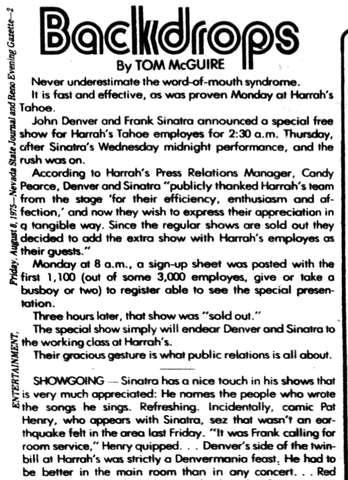
Pine Knob Music Theatre, Clarkston, MI
Orchestra Conducted By: Bill Miller
1. Where or When
2. You Are the Sunshine of My Life
3. Let Me Try Again
4. My Kind of Town
5. But Beautiful
6. Didn't We
7. Something
8. Nice 'n' Easy
9. My Way
10. Last Night When We Were Young / Violets for Your Furs / Here's That
Rainy Day
11. I Believe I'm Gonna Love You
12. Cycles
13. Send in the Clowns
14. Ol' Man River
15. I've Got You Under My Skin
16. The Lady Is a Tramp
17. Put Your Dreams Away (For Another Day)
Pine Knob Music Theatre, Clarkston, MI
Orchestra Conducted By: Bill Miller
© 1997-2026 The Sinatra Archive
This calendar, or any parts thereof, may not be reproduced in any fashion
whatsoever without the prior written permission of the publisher (The
Sinatra Archive)
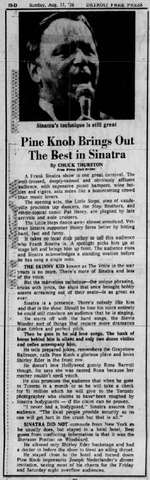
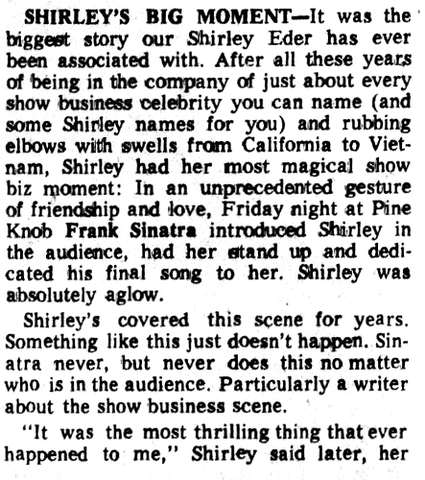
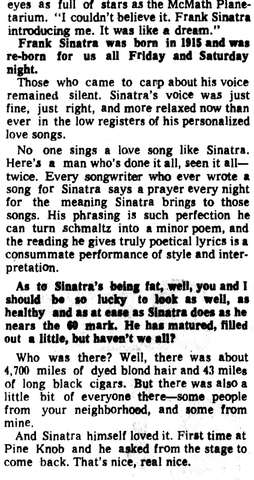
Pine Knob Music Theatre, Clarkston, MI
Orchestra Conducted By: Bill Miller
© 1997-2025 The Sinatra Archive
This calendar, or any parts thereof, may not be reproduced in any fashion whatsoever without the prior written permission of the publisher (The Sinatra Archive)
Pine Knob Music Theater, Clarkston Michigan
1. Where or When
2. You Are the Sunshine of My Life
3. Let Me Try Again
4. My Kind of Town
5. But Beautiful
6. Didn't We
7. Something
8. Nice 'n' Easy
9. My Way
10. Just One of Those Things / It Never Entered My Mind / When Your Lover
Has Gone
11. I Believe I'm Gonna Love You
12. Cycles
13. Ol' Man River
14. I've Got You Under My Skin
15. The Lady Is a Tramp
16. Put Your Dreams Away (For Another Day)
New York City
TCA5601 The Saddest Thing Of All
(Michel Legrand/Pierre Leroyer/Edward Ruault/Carl Sigman) (ZIMRA/SACEM)
Arranged & Conducted by Gordon Jenkins
(3:27) CD: 46013-2 The Complete Reprise Studio Recordings Disc 17
LP: W54093 I Sing The Songs Vol.2 ( Italy )
45: S1343
TCA5602 Merry Christmas Little Angel - N/R
Arranged & Conducted by Gordon Jenkins
Note: The orchestral tracks were pre-recorded on August 4, 1975.
Ed O'Brien considers "The Saddest Thing of All" to be a dirge. "Merry Christmas, Little Angel" is not a complete recording. Files at Reprise show an incomplete master of a Christmas song.
note: I have always wondered why there is no information on where Sinatra recorded "The Saddest Thing Of All," other than it was done in New York. Well, thanks to Vance Adair, I now know. Vance sent me a very informative article by Glenn Berger, who worked the session and treasured the opportunity of seeing Sinatra record. There is no Reprise work sheet for the, 8-18-75, vocal overdub. But there is one for the orchestral tracks done at Warners TTG Studio in Hollywood, 8-4-75. I am enclosing a copy in this post. The session took place at the old Columbia Studio at 799-7th Ave. from 4 to 6 P.M. At the time, it was A & R Recording Studios. Frank did the recording in Studio A-1. Don Costa was the producer and was in attendance. The engineer was Rich Blakin. Frank did a sound check run through for the control booth and then nailed the overdub in one take. He did not attempt to record "Merry Christmas Little Angel." He was at the 8/4 session and that may explain the incomplete recording at Reprise, although I doubt it. Look at the session sheet and you will see there is no credit given to whoever wrote the song. According to Mr. Berger, Frank needed less than half-an-hour to complete his work that afternoon.
There was a recording done of the LeGrand song on 9-24-74. It has never been released. That session had a 43 piece orchestra and the Jenkins chart is just too much for the vocal. The redo in August 75 had a 33 piece orchestra including Pete Jolly (piano), John Morell ( guitar), Lyle Ritz ( bass ) and George Green on drums.
The song was issued on 1-7-76 as the B-side of a single. The flip-side was "Empty Tables," recorded on 6-22-73. The A-side did not make the Billboard Top 100, but it did chart on the Adult Contemporary, peaking at #43 and charting for six weeks.
Ed
Note: The orchestral tracks were pre-recorded on August 4, 1975.
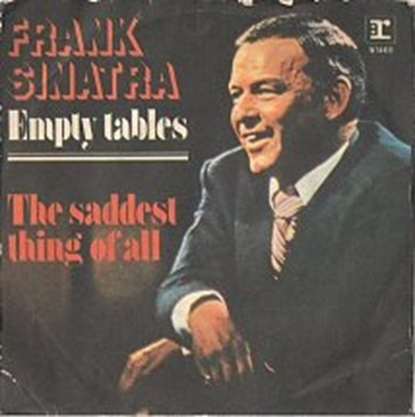
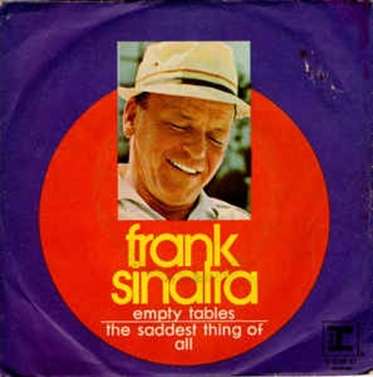
New York City
TCA5601 The Saddest Thing Of All
(Michel Legrand/Pierre Leroyer/Edward Ruault/Carl Sigman) (ZIMRA/SACEM)
Arranged & Conducted by Gordon Jenkins
(3:27) CD: 46013-2 The Complete Reprise Studio Recordings Disc 17
LP: W54093 I Sing The Songs Vol.2 ( Italy )
45: S1343
TCA5602 Merry Christmas Little Angel - N/R
Arranged & Conducted by Gordon Jenkins
© 1997-2026 The Sinatra Archive
This calendar, or any parts thereof, may not be reproduced in any fashion whatsoever without the prior written permission of the publisher (The Sinatra Archive)
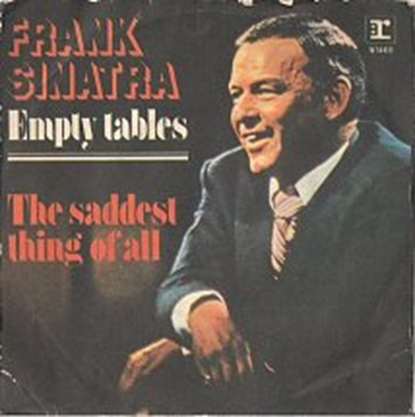
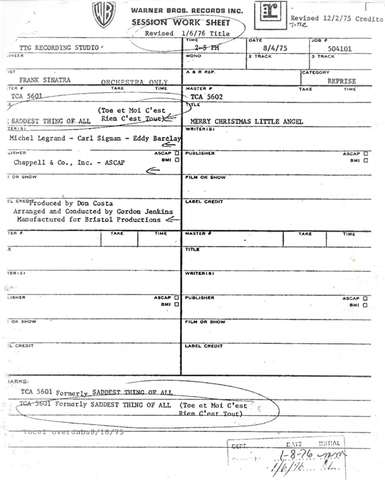
Merriweather Post Pavilion, Columbia, Maryland
Orchestra Conducted By: Bill Miller
1. Where Or When
2. You Are The Sunshine Of My Life
3. Let Me Try Again
4. My Kind Of Town
5. But Beautiful
6. Didn't We?
7. Something
8. Nice 'N' Easy
9. monologue
10. My Way
11. medley: Last Night When We Were Young / Violets For Your Furs / Here's That Rainy Day
12. I Believe I'm Gonna Love You
13. Cycles
14. Send In The Clowns
15. Ol' Man River
16. I've Got You Under My Skin
17. The Lady Is A Tramp
18. Put Your Dreams Away
Notes: TT 83mins.
Merriweather Post Pavilion, Columbia, Maryland
Orchestra Conducted By: Bill Miller
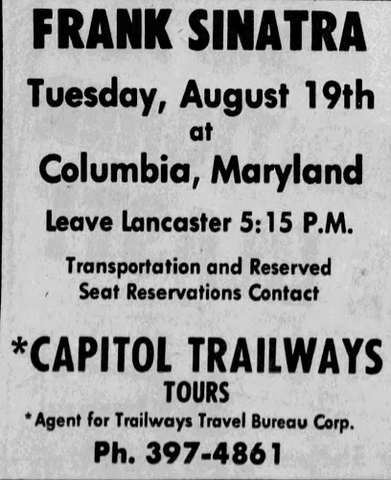
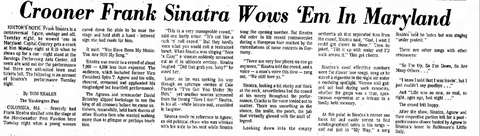
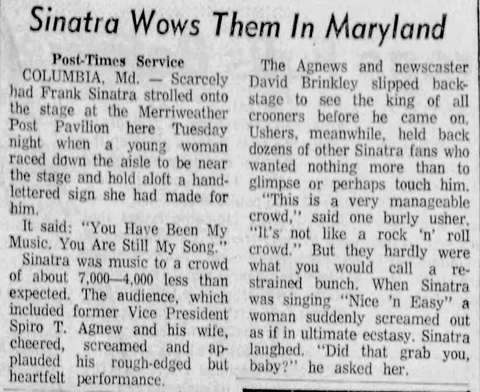
Canadian National Exhibition Grandstand, Toronto, Canada
Orchestra Conducted By: Bill Miller
1. Where or When
2. You Are the Sunshine of my Life
3. Let Me Try Again
4. My Kind of Town
5. But Beautiful (Riddle arrangement)
6. Didn't We
7.. Something (Costa arrangement)
8. Nice 'N' Easy
9. monologue
10. My Way
11. saloon trilogy: Last Night When We were Young / Violets for your Furs / Here's That Rainy Day
12. I Believe I'm Gonna Love You
13. Cycles
14. Ol' Man River
15. I've Got You Under My Skin
16. The Lady is a Tramp
17. Put Your Dreams Away
Notes: TT 72mins.
Canadian National Exhibition Grandstand, Toronto, Canada
Orchestra Conducted By: Bill Miller
[image referenced in source but could not be recovered]
[image referenced in source but could not be recovered]
[image referenced in source but could not be recovered]
[image referenced in source but could not be recovered]
Garden State Arts Center, Holmdel, New Jersey
Orchestra Conducted By: Bill Miller
1. Where Or When
2.. You Are The Sunshine Of My Life
3. Let Me Try Again
4. My Kind Of Town
5. But Beautiful
6. Didn't We
7. Something
8. Nice 'N' Easy
9. My Way
10. saloon medley: It Was Just One Of Those Things / It Never Entered My
Mind / When You Lover Has Gone
11. I Believe I'm Gonna Love You
12. Cycles
13. Send In The Clowns
14. Ol' Man River
15. I've Got You Under My Skin
16. Nancy
17. The Lady Is A Tramp
18. Put Your Dreams Away
Notes: TT 88mins.
Garden State Arts Center, Holmdel, New Jersey
Orchestra Conducted By: Bill Miller

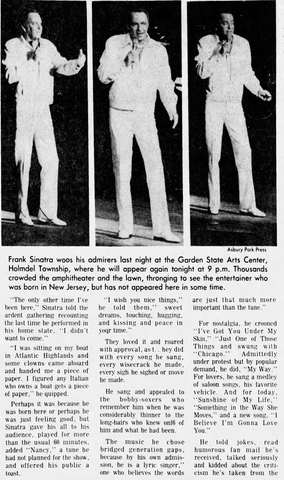
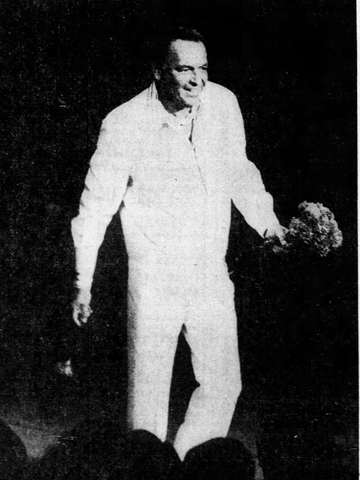
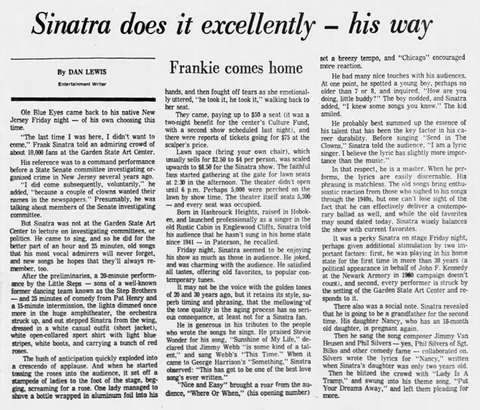
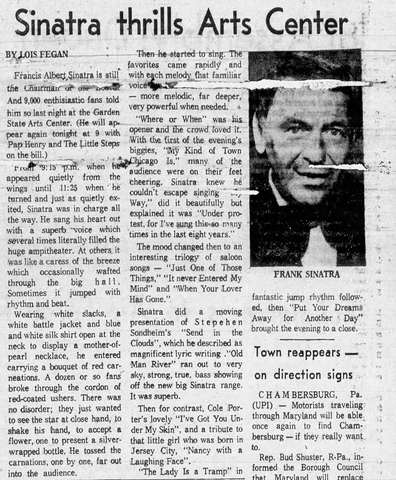
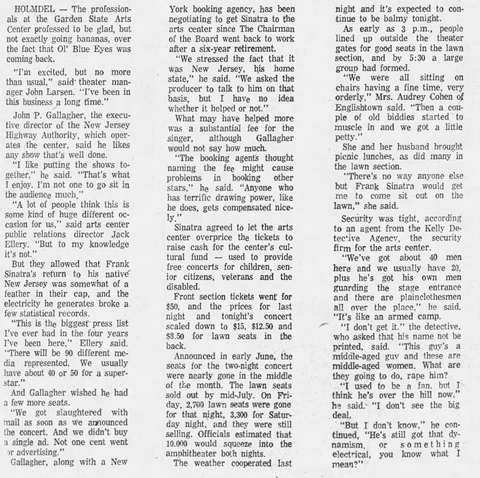
Garden State Arts Center, Holmdel, New Jersey
Orchestra Conducted By: Bill Miller
1. Where Or When
2. Let Me Try Again
3. My Kind Of Town
4. But Beautiful
5. Didn't We
6. Something
7. Nice 'N' Easy
8. My Way
9. Angel Eyes
10. I Believe I'm Gonna Love You
11. Cycles
12. I Concentrate On You
13. I've Got You Under My Skin
14. Nancy
15. My Kind Of Town
16. Put Your Dreams Away
Notes: TT 78mins.
Performing Arts Center, Saratoga, New York
Orchestra Conducted By: Bill Miller
1. Where Or When
2. Let Me Try Again
3. My Kind Of Town
4. But Beautiful
5. Didn't We?
6. Something
7. Nice 'N' Easy
8. My Way
9. monologue
10. Angel Eyes
11. I Believe I'm Gonna Love You
12. Cycles
13. I Concentrate On You
14. I've Got You Under My Skin
15. Nancy
16. Send In The Clowns
17. The Lady Is A Tramp
18. Here's That Rainy Day
19. Put Your Dreams Away
Notes: TT 88mins.
NOTE: According to Ed O'Brien, it was a dark and stormy night. Sinatra was appearing at the Performing Arts Center for the first time. There was a great deal of hype leading up to the show. O'Brien reports that he was sitting about five rows back in the center section.
Comedian Pat Henry came on for 20 minutes. He told the audience that if they loved Albany, they would hate Paris. Ouch! Sinatra opened tentatively with "Where or When." O'Brien remembers being surprised at how much weight Sinatra had gained since seeing him in the fall of 1974. "Let Me Try Again" was done with the new Don Costa swing arrangement. Sinatra then did "My Kind of Town," "But Beautiful" (Riddle chart), and a very quiet "Didn't We."
Sinatra then introduced George Harrison's "Something," telling the audience it was the greatest ballad ever written. After "Nice 'N' Easy" and a big-throated "My Way." Sinatra did his monologue and a violent thunderstorm competed for the attention of the crowd. The Saratoga Center was open on both sides and those unfortunate to be sitting on the sides received an unwanted shower.
As we waited for the storm to subside, we were treated to an acting performance that equaled the vocal on "Angel Eyes." Sinatra then said he would do a little country and offered up "I Believe I'm Gonna' Love You" and "Cycles." Al Viola then joined him at center stage and Cole Porter's "I Concentrate on You" received a beautiful reading with guitar accompaniment. It was Porter again on the great Sinatra signature song "I've Got You Under My Skin." He then did a quiet reading of "Nancy" before giving Sondheim's "Send in the Clowns" a lavish introduction. The vocal was stunning, with just Bill Miller on the piano.
Sinatra then sang the great chestnut "The Lady is a Tramp." He then introduced the band and his sidemen. During the introduction, he was startled to discover that Jimmy Van Heusen was sitting in the front row. (Van Heusen had a lovely home on Brant Lake and spent many a summer there.) Sinatra said, "Chester , they didn't tell me you were here." He walked over to the piano and whispered to Bill Miller. We then heard the absolute highlight of the evening: Van Heusen's "Here's That Rainy Day." Sinatra then thanked his audience and closed the show with Ruth Lowe's "Put Your Dreams Away."
[Jackie Onassis Attends Sinatra's New York Show]
During a period when Sinatra and Barbara Marx were briefly apart, Jackie Kennedy Onassis had dinner with Sinatra and attended his performance at New York's Uris Theatre, reportedly staying the night afterward at his suite in the Waldorf Towers. Their rapprochement did not last, and she later froze him out.
Source: The Rough Guide to Frank Sinatra, chapter "I Want to Be a Part of It, 1971-98."
MDA Telethon
1. You Are The Sunshine Of My Life
2. Bad, Bad, Leroy Brown
3. In The Wee Small Hours
4. I Believe I'm Gonna Love You (1)
5. They Can't Take That Away From Me
6. The Lady Is A Tramp
7. Nice 'N' Easy
8. Let Me Try Again
9. I Believe I'm Gonna Love You (2)
10. But Beautiful
11. Where Or When
12. My Kind Of Town
13. Something
14. I Believe I'm Gonna Love You (3)
15. This Love Of Mine
16. Send In The Clowns
17. I've Got You Under My Skin
Notes: Three appearances. 83 min.
Ed O'Brien points out that Sinatra was in town for his big Uris Theatre engagement with Ella Fitzgerald and Count Basie. He had never done Lewis' telethon and decided it would be the perfect time to make an appearance. The first mini-concert was at midnight and Sinatra sang six songs including a very interesting Costa-charted "They Can't Take That Away from Me." The second appearance, in a leisure suit, was at 10 in the morning and he did six more songs including lovely readings on "This Love of Mine" and "Send in the Clowns." He sang "I Believe I'm
Gonna' Love You" at all three appearances and at one he did a straight version with extending the syllables. Lewis estimated they raised an additional $5 million because of Frank.
Scott Henderson added:
It's funny this post should come up. I just finished watching the 3 mini
concerts from the 1975 telethon. They were marvelous and Frank was really
into them. The only comment my wife could offer was that he was great but
didn't like the leisure suits. She said she missed the tux.
Uris Theater, New York City (September 8-20) w/Ella Fitzgerald and Count Basie
1. Where or When
2. Let Me Try Again (Uptempo)
3. My Kind of Town
4. But Beautiful
5. Didn't WE
6. How Deep is the Ocean - Sinatra's close friend Bill Green asked for him to sing Berlin's tune)
7. Something
8. Nice 'N' Easy
9. I Believe I'm Gonna Love You
10. Send in the Clowns
11. Please be Kind
12. I've Got You under my Skin
13. The Song is You w/Ella
14. They Can't Take That Away from Me w/Ella
15. Come Rain or Come Shine w/Ella
16. At Long Last Love
17. The Lady is a Tramp w/Ella
NOTE: Ed O'Brien points out that Sinatra, Ella, and Basie did 16 sold out shows during this engagement.
Sinatra had put on a lot of weight since coming out of retirement in 1973 and he was at his heaviest during the Uris engagement. He needed a few songs to warm up the vocal cords but once he got going the shows were real crowd pleasers.
Uris Theater, New York City (September 8-20) w/Ella Fitzgerald and Count Basie
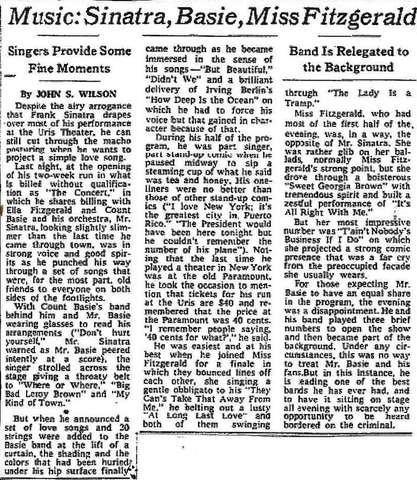
Uris Theater, New York City
Key Musicians: Gene Cherico (bass), Al Viola (guitar), Irv Cottler (drums), Bill Miller (piano) and a 20 piece string section in addition to the basie band.
Count Basie Orchestra Conducted By: Bill Miller
1. Where Or When
2. Bad, Bad Leroy Brown
3. Let Me Try Again
4. My Kind Of Town
5. But Beautiful
6. Didn't We?
7. How Deep Is The Ocean?
8. Something
9. Nice 'N' Easy
10. monologue
11. medley: Just One Of Those Things / It Never Entered My Mind / When
Your Lover Has Gone
12. I Believe I'm Gonna Love You
13. Pennies From Heaven
14. Send In The Clowns
15. Please Be Kind
16. I've Got You Under My Skin
17. medley w/Ella: The Song Is You (w/Ella) / They Can't Take That
Away From Me (w/Ella) / Come Rain Or Come Shine (Ella) / At Long Last Love (Frank) / The Lady Is A Champ (w/Ella)
Notes: TT 75mins.
Sinatraphile Vance Adair wanted to know if they inadvertently doubled the time of "Let Me Try Again" or was it a new swing arrangement. Either way this HAS to be a collector's piece.
Ed O'Brien responded: Don Costa wrote a brand new uptempo chart. Sinatra sang it on the Jerry Lewis Telethon in 1975. For years, Jonathan Schwartz would call O'Brien and when he answered the phone, Jonathan would sing "Let me . . . try again" a la Sinatra. Ballad version is a bit much, so he was thrilled with the irreverent treatment Frank was according the tune.
Uris Theater, New York City
Key Musicians: Gene Cherico (bass), Al Viola (guitar), Irv Cottler (drums), Bill Miller (piano) and a 20 piece string section in addition to the basie band.
Count Basie Orchestra Conducted By: Bill Miller
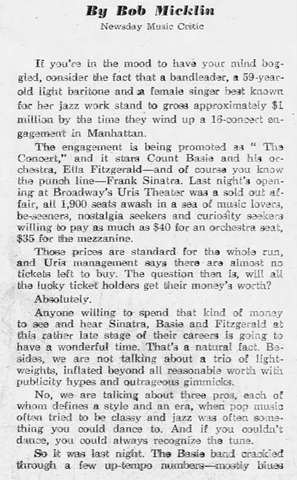
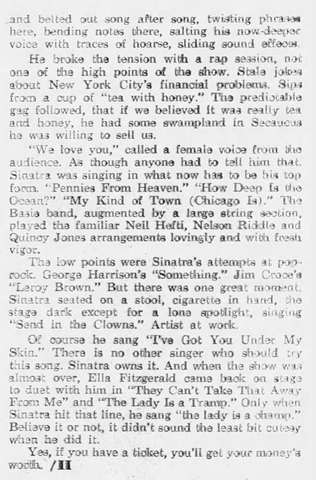
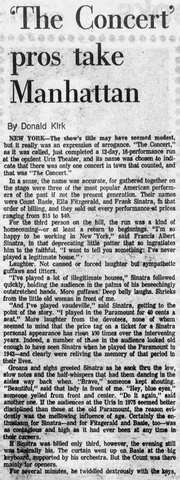
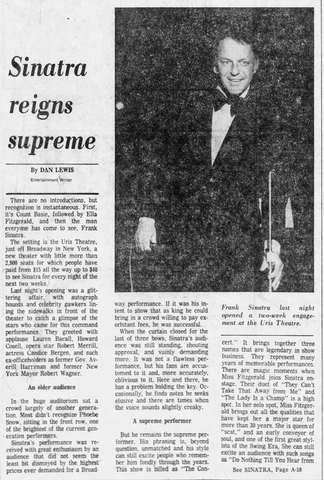
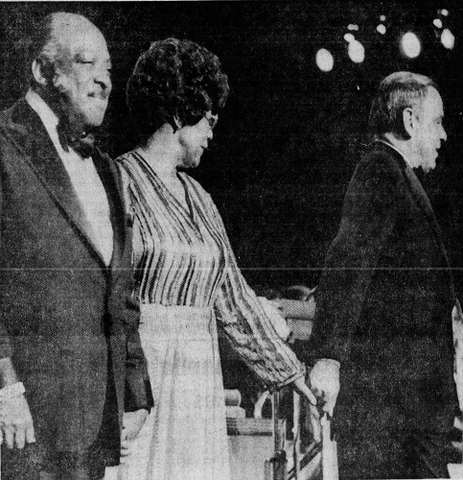
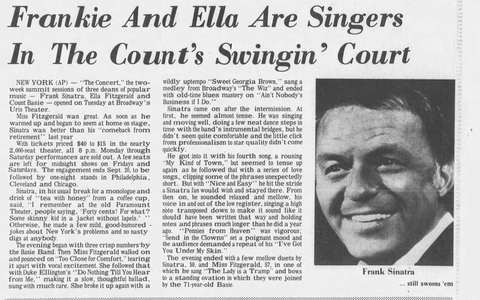
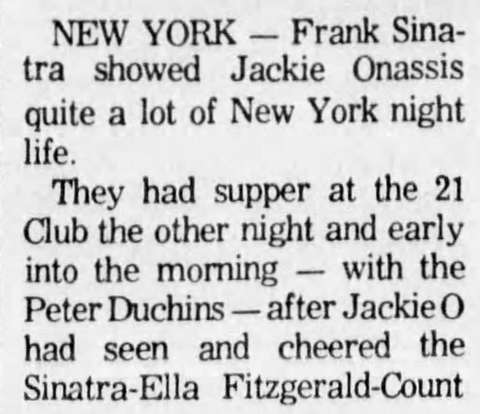
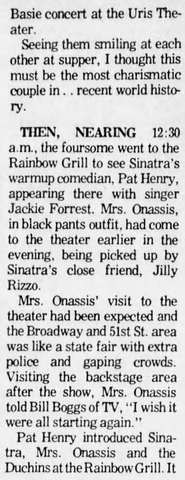
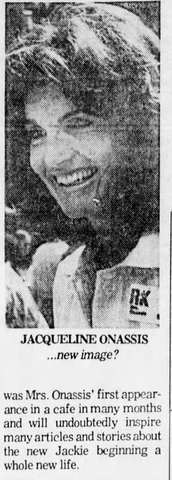
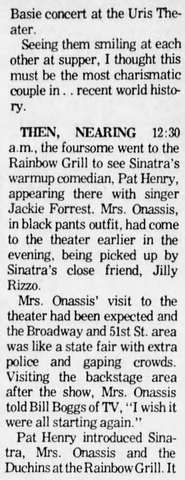
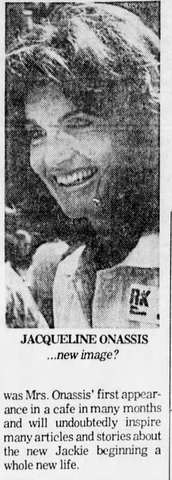
Uris Theater, New York City
Key Musicans: Gene Cherico (bass), Al Viola (guitar), Irv Cottler (drums), Bill Miller (piano) and a 20 piece string section in addition to the basie band.
Count Basie Orchestra Conducted By: Bill Miller
1. Where Or When
2. Bad, Bad Leroy Brown
3. Let Me Try Again
4. My Kind Of Town
5. But Beautiful
6. Didn't We?
7. Something
8. Nice 'N' Easy
9. monologue
10. medley: Last Night When We Were Young / Violets For Your Furs /
Here's That Rainy Day
11. I Believe I'm Gonna Love You
12. Pennies From Heaven
13. Send In The Clowns
14. Please Be Kind
15. I've Got You Under My Skin
16. medley w/Ella: The Song Is You (w/Ella) / They Can't Take That
Away From Me (w/Ella) / Come Rain Or Come Shine (Ella) / At Long Last Love (Frank) / The Lady Is A Champ (w/Ella)
Notes: TT 77mins.
Uris Theater, New York City
Key Musicians: Gene Cherico (bass), Al Viola (guitar), Irv Cottler (drums),
Bill Miller (piano)
Count Basie Orchestra Conducted By: Bill Miller
1. Where Or When
2. Bad, Bad Leroy Brown
3. Let Me Try Again
4.. My Kind Of Town
5. But Beautiful
6. Didn't We?
7. Something
8. Nice 'N' Easy
9. monologue
10. medley: Just One Of Those Things / It Never Entered My Mind / When
Your Lover Has Gone
11. I Believe I'm Gonna Love You
12. Pennies From Heaven
13. Send In The Clowns
14. I've Got You Under My Skin
15. medley w/Ella: The Song Is You (w/Ella) / They Can't Take That
Away From Me (w/Ella) / Come Rain Or Come Shine (Ella) / At Long Last Love (Frank) / The Lady Is A Champ (w/Ella)
Notes: TT 66mins.
Uris Theater, New York City
First Show
Key Musicians: Gene Cherico (bass), Al Viola (guitar), Irv Cottler (drums), Bill Miller (piano)
Count Basie Orchestra Conducted By: Bill Miller
1. Where Or When
2. Bad, Bad Leroy Brown
3. Let Me Try Again
4. My Kind Of Town
5. But Beautiful
6. Didn't We?
7. Something
8. Nice 'N' Easy
9. monologue
10.. medley: Just One Of Those Things / It Never Entered My Mind / When
Your Lover Has Gone
11. I Believe I'm Gonna Love You
12. Pennies From Heaven
13. Send In The Clowns
14. I've Got You Under My Skin
15. My Way
16. medley w/Ella: The Song Is You (w/Ella) / They Can't Take That
Away From Me (w/Ella) / Come Rain Or Come Shine (Ella) / At Long
Last Love (Frank) / The Lady Is A Champ (w/Ella)
Notes: TT 69mins.
Uris Theater, New York City
Second Show
Key Musicians: Gene Cherico (bass), Al Viola (guitar), Irv Cottler (drums),
Bill Miller (piano)
Count Basie Orchestra Conducted By: Bill Miller
1. Where Or When
2. Bad, Bad Leroy Brown
3. Let Me Try Again
4. My Kind Of Town
5. But Beautiful
6. Didn't We?
7. Something
8. Nice 'N' Easy
9. monologue
10. I Believe I'm Gonna Love You
11. Pennies From Heaven
12. Send In The Clowns
13. Please Be Kind
14. My Way
15. I've Got You Under My Skin
16. medley w/Ella: The Song Is You (w/Ella) / They Can't Take That
Away From Me (w/Ella) / Come Rain Or Come Shine (Ella) / At Long Last Love (Frank) / The Lady Is A Champ (w/Ella)
Uris Theater, New York City
First Show
1. Where or When
2. Bad, Bad Leroy Brown
3. Let Me Try Again (Uptempo)
4. My Kind of Town
5. But Beautiful
6. Didn't We
7. Something
8. Nice 'N' Easy
9. Monologue
10. Saloon Trilogy: Just One of Those
Things/Never Entered my Mind/When Your Lover has Gone (Gordon Jenkins arg.)
11. I Believe I'm Gonna Love You
12. Pennies from Heaven
13. Send in the Clowns
14. Please Be Kind
15. I've Got You under my Skin
16. The Song is You w/Ella
17. They Can't Take that away from Me w/Ella
18. Come Rain or Come Shine w/Ella
19. At Long Last Love
20. The Lady is a Tramp w/Ella
Second Show
1. Where or When
2. Bad, Bad Leroy Brown
3. Let me Try Again (Uptempo)
4. My Kind of Town
5. But Beautiful
6. Didn't We
7. Something
8. Nice 'N' Easy
9. Monologue
10. Saloon Trilogy: Last Night when we were
Young/Violets for Your Furs/Here's that Rainy Day (Gordon Jenkins arg.)
11. I Believe I'm Gonna Love You
12. Pennies from Heaven
13. Send in the Clowns
14. Please Be Kind
15. My Way
16. The Song is You w/Ella
17. They Can't Take that Away from Me w/Ella
18. Come Rain or Come Shine w/Ella
19. At Long last Love
20. The Lady is a Tramp w/Ella
Notes: Show was dark on the 14th. TT 72mins.
Uris Theater, New York City
Key Musicians: Gene Cherico (bass), Al Viola (guitar), Irv Cottler (drums), Bill Miller (piano)
Count Basie Orchestra Conducted By: Bill Miller
1. Bad, Bad Leroy Brown
2. Let Me Try Again
3. My Kind Of Town
4. But Beautiful
5. Didn't We?
6. Something
7. Nice 'N' Easy
8. monologue
9. medley: Just One Of Those Things / It Never Entered My Mind / When
Your Lover Has Gone
10. I Believe I'm Gonna Love You
11. Pennies From Heaven
12. Send In The Clowns
13. Please Be Kind
14. I've Got You Under My Skin
15. medley w/Ella: The Song Is You (w/Ella) / They Can't Take That
Away From Me (w/Ella) / Come Rain Or Come Shine (Ella) / At Long Last Love (Frank) / The Lady Is A Champ (w/Ella)
Notes: TT 64mins.
Uris Theater, New York City
Key Musicians: Gene Cherico (bass), Al Viola (guitar), Irv Cottler (drums), Bill Miller (piano)
Count Basie Orchestra Conducted By: Bill Miller
1. Where Or When
2. Bad, Bad Leroy Brown
3. Let Me Try Again
4. My Kind Of Town
5. But Beautiful
6. Didn't We?
7. Something
8. Nice 'N' Easy
9. monologue
10. medley: Last Night When We Were Young / Violets For Your Furs /
Here's That Rainy Day
11. I Believe I'm Gonna Love You
12. Pennies From Heaven
13. Send In The Clowns
14. Please Be Kind
15. I've Got You Under My Skin
16. medley w/Ella: The Song Is You (w/Ella) / They Can't Take That
Away From Me (w/Ella) / Come Rain Or Come Shine (Ella) / At Long Last Love (Frank) / The Lady Is A Champ (w/Ella)
Notes: TT 74mins.
Uris Theater, New York City
Key Musicians: Gene Cherico (bass), Al Viola
(guitar), Irv Cottler (drums), Bill Miller (piano)
Count Basie Orchestra Conducted By: Bill Miller
1. Where Or When
2. Bad, Bad Leroy Brown
3. Let Me Try Again
4. My Kind Of Town
5. But Beautiful
6. Didn't We?
7. Something
8. Nice 'N' Easy
9. monologue
10. medley: Last Night When We Were Young / Violets For Your Furs /
Here's That Rainy Day
11. I Believe I'm Gonna Love You
12. Pennies From Heaven
13. Send In The Clowns
14. Please Be Kind
15. I've Got You Under My Skin
16. medley w/Ella: The Song Is You (w/Ella) / They Can't Take That
Away From Me (w/Ella) / Come Rain Or Come Shine (Ella) / At Long Last Love (Frank) / The Lady Is A Champ (w/Ella)
Notes: TT 77mins.
Uris Theater, New York City
Key Musicians: Gene Cherico (bass), Al Viola (guitar), Irv Cottler (drums), Bill Miller (piano)
Count Basie Orchestra Conducted By: Bill Miller
September 17, 1975 note: Mrs. Onassis was hired by Viking Press in 1975. She was a consulting editor and landing Sinatra's autobio would have been a sensational way to start her career in book publishing. After their night on the town, Frankie promised to think about finally penning his life story. But he never seriously considered sharing a tell all with the world.
Ed
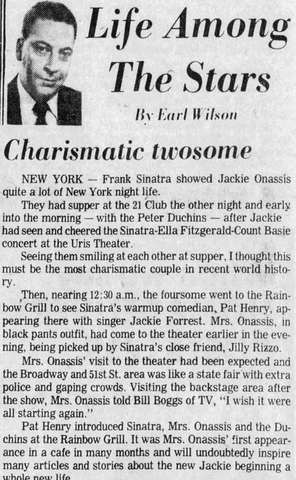
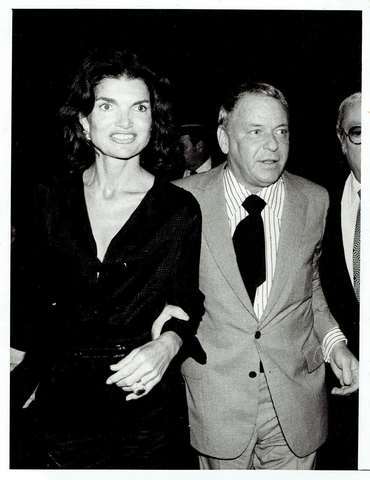
Uris Theater, New York City
Key Musicians: Gene Cherico (bass), Al Viola (guitar), Irv Cottler (drums), Bill Miller (piano) and a 20 piece string section in addition to the basie band.
Count Basie Orchestra Conducted By: Bill Miller
1. Bad, Bad Leroy Brown
2. Where Or When
3. Let Me Try Again
4. My Kind Of Town
5. But Beautiful
6. Didn't We?
7. Something
8. Nice 'N' Easy
9. monologue
10. Angel Eyes
11. I Believe I'm Gonna Love You
12. Pennies From Heaven
13. Send In The Clowns
14. Please Be Kind
15. I've Got You Under My Skin
16. medley w/Ella: The Song Is You (w/Ella) / They Can't Take That
Away From Me (w/Ella) / Come Rain Or Come Shine (Ella) / At Long Last Love (Frank) / The Lady Is A Champ (w/Ella)
Notes: TT 71mins.
Uris Theater, New York City (September 8-20)
w/Ella Fitzgerald and Count Basie
Key Musicians: Gene Cherico (bass), Al Viola (guitar), Irv Cottler (drums), Bill Miller (piano) and a 20 piece string section in addition to the basie band.
Count Basie Orchestra Conducted By: Bill Miller
First show
1. Where Or When
2. Bad, Bad Leroy Brown
3. Let Me Try Again
4. My Kind Of Town
5. But Beautiful
6. Didn't We?
7. Something
8. Nice 'N' Easy
9. monologue
10. Just One Of Those Things/It Never Entered My Mind/When Your Lover Has Gone
11. I Believe I'm Gonna Love You
12. Pennies From Heaven
13. Send In The Clowns
14. I've Got You Under My Skin
15. medley w/Ella: The Song Is You (w/Ella) / They Can't Take That
Away From Me (w/Ella) / Come Rain Or Come Shine (Ella) / At Long
Last Love (Frank) / The Lady Is A Champ (w/Ella)
Uris Theater, New York City (September 8-20) w/Ella Fitzgerald and Count Basie
Key Musicians: Gene Cherico (bass), Al Viola (guitar), Irv Cottler (drums), Bill Miller (piano) and a 20 piece string section in addition to the basie band.
Count Basie Orchestra Conducted By: Bill Miller
Second show
1 Bad, Bad Leroy Brown
2. Let Me Try Again
3. My Kind Of Town
4. But Beautiful
5. Didn't We?
6. Something
7. Nice 'N' Easy
8. monologue
9. Here's That Rainy Day
10. I Believe I'm Gonna Love You
11. Pennies From Heaven
12. Send In The Clowns
13. I've Got You Under My Skin
14. medley w/Ella: The Song Is You (w/Ella) / They Can't Take That
Away From Me (w/Ella) / Come Rain Or Come Shine (Ella) / At Long Last Love (Frank) / The Lady Is A Champ (w/Ella)
Howard Cosell Show
Guest: Frank Sinatra
NOTE: Ed O'Brien points out that this was Sinatra's closing night at the Uris Theatre and Cosell's opening night on ABC, a show that had but a brief run.
Uris Theater, New York City (September 8-20)
(First Show) w/Ella Fitzgerald and Count Basie
(First Show) w/Ella Fitzgerald and Count Basie
1. Where Or When
2. Bad, Bad, Leroy Brown
3. Let Me Try Again
4. My Kind Of Town
5. But Beautiful
6. Didn't We
7. Something
8. Nice 'N' Easy
9. Monologue
10. Just One Of Those Things/It Never Entered My Mind/When Your Lover Has Goned
11. I Believe I'm Gonna Love You
12. Pennies From Heaven
13. Send In The Clowns
14. I've Got You Under My Skin
15. The Song Is You (Frank & Ella)
16. They Can't Take That Away From Me (Frank & Ella)
17. Come Rain Or Come Shine (Ella)
18. At Long Last Love
19. The Lady Is A Tramp (Frank & Ella)
Uris Theatre, New York City
Closing Night-Second Show w/Ella Fitzgerald and Count Basie
1. Where Or When
2. Bad, Bad, Leroy Brown
3. Let Me Try Again
4. My Kind Of Town
5. But Beautiful
6. Didn't We
7. Something
8. Nice 'N' Easy
9. Monologue
10. Medley: Last Night When We Were Young - Violets For Your Furs - Here's That Rainy Day
11. I Believe I'm Gonna Love You
12. Pennies From Heaven
13. Send In The Clowns
14. I've Got You Under My Skin
15. The Song Is You (Frank & Ella)
16. They Can't Take That Away From Me (Frank & Ella)
17. Come Rain Or Come Shine (Ella)
18. At Long Last Love
19. The Lady Is A Tramp (Frank & Ella)
Uris Theater, New York City (September 8-20)
w/Ella Fitzgerald and Count Basie
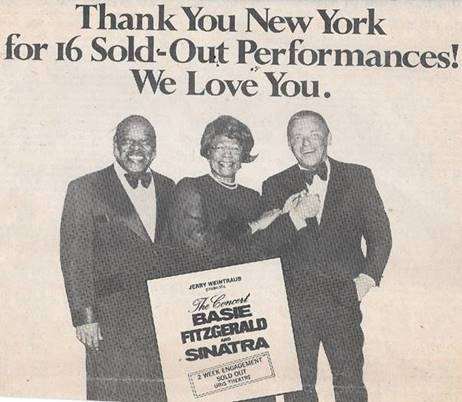
Howard Cosell Show
Guest: Frank Sinatra
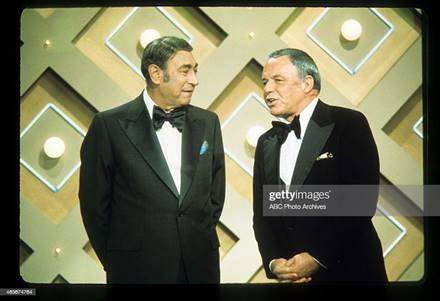
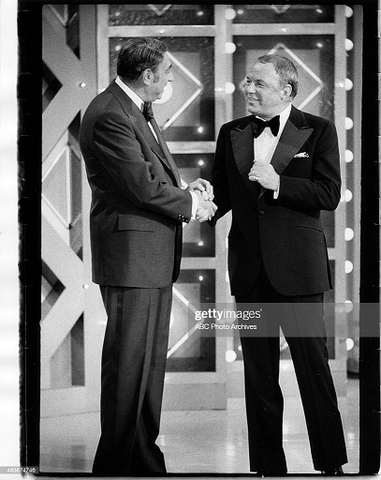
The Spectrum, Philadelphia, PA w/Ella Fitzgerald and Count Basie
Monday evening
Ella sang for 30 mimutes
Frank appeared after intermission
Bill Miller conducting and on piano
Al Viola on guitar
Gene Cherico on bass
Irv Cottler on drums
1 Where Or When ( B. Byers arg.)
2. Bad, Bad Leroy Brown
3. My Kind Of Town
4. But Beautiful ( N. Riddle arg.)
5. Didn't We
6. Something (D. Costa arg.)
7. Nice 'N' Easy monologue
8. Just One Of Those Things/It Never Entered My Mind/When Your Lover Has Gone
9. I Believe I'm Gonna Love You
10. Pennies From Heaven
11. Send In The Clowns w/ B. Miller on piano
12.I've Got You Under My Skin
13. The Song Is You w/ Ella
14. They Can't Take That Away w/ Ella
15. Come Rain Or Come Shine Ella
16. At Long Last Love Frank
17. The Lady Is A Tramp w/ Ella
18. The Lady Is A Tramp (reprise) w/ Ella
The Spectrum, Philadelphia, PA w/Ella Fitzgerald and Count Basie
Monday evening
© 1997-2025 The Sinatra Archive
This calendar, or any parts thereof, may not be reproduced in any fashion . whatsoever without the prior written permission of the publisher (The Sinatra Archive)
[image referenced in source but could not be recovered]
[image referenced in source but could not be recovered]
[image referenced in source but could not be recovered]
The Spectrum, Philadelphia, PA w/Ella Fitzgerald and Count Basie
Monday evening
© 1997-2025 The Sinatra Archive
This calendar, or any parts thereof, may not be reproduced in any fashion . whatsoever without the prior written permission of the publisher (The Sinatra Archive)
[image referenced in source but could not be recovered]
[image referenced in source but could not be recovered]
[image referenced in source but could not be recovered]
Richfield Coliseum, Cleveland, Ohio w/Ella Fitzgerald and Count Basie
Tuesday evening
Ella sang for 30 mimutes
Frank appeared after intermission
Bill Miller conducting and on piano
Al Viola on guitar
Gene Cherico on bass
Irv Cottler on drums
1. Bad, Bad Leroy Brown
2. Where Or When ( B. Byers arg.)
3. My Kind Of Town
4. But Beautiful ( N. Riddle arg.)
5. Didn't We
6. Something (D. Costa arg.)
7. Nice 'N' Easy monologue
8. Angel Eyes
9. I Believe I'm Gonna Love You
10. Pennies From Heaven
11. Send In The Clowns w/ B. Miller on piano
12. My Way
13. I've Got You Under My Skin
14. The Song Is You w/ Ella
15. They Can't Take That Away w/ Ella
16. Come Rain Or Come Shine Ella
17. At Long Last Love Frank
18. The Lady Is A Tramp w/ Ella
19. The Lady Is A Tramp (reprise) w/ Ella
Richfield Coliseum, Cleveland, Ohio
w/Ella Fitzgerald and Count Basie
Tuesday evening
The Plain Dealer
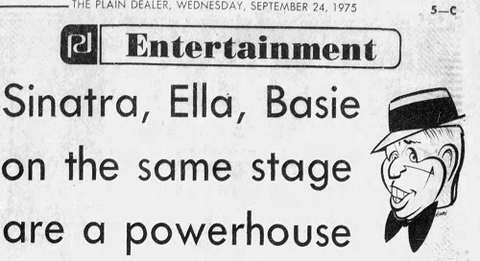
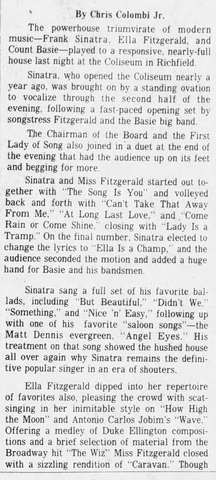
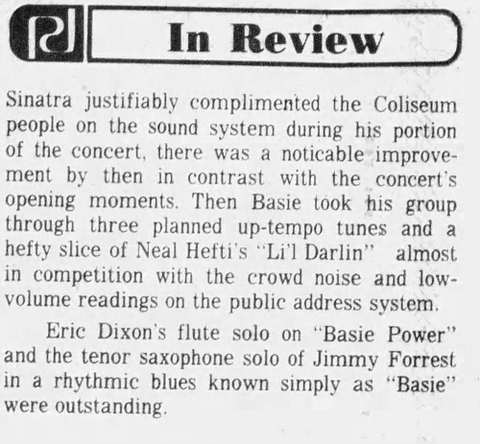
The Cleveland Press
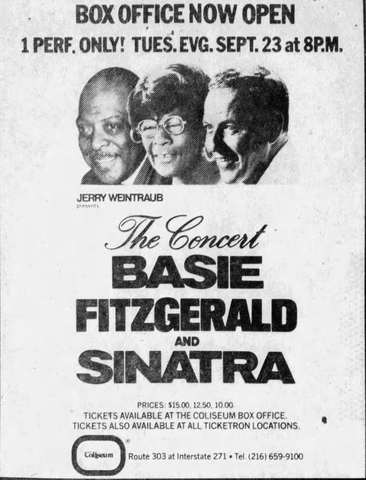
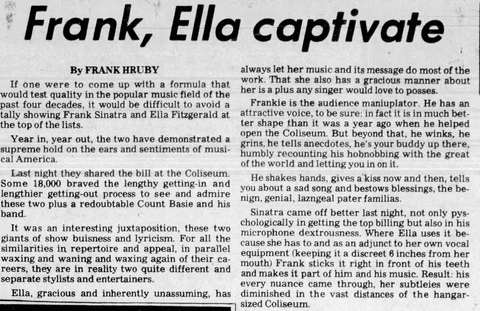
Chicago Stadium, Chicago, Illinois
Count Basie Orchestra Orchestra Conducted By: Bill Miller
1. Where Or When
2. Let Me Try Again
3. Bad, Bad Leroy Brown
4. But Beautiful
5. Didn't We?
6. Something
7. Nice 'N' Easy
8. medley: Just One Of Those Things / It Never Entered My Mind / When Your
Lover Has Gone
9. I Believe I'm Gonna Love You
10. Pennies From Heaven
11. Send In The Clowns
12. My Way
13. My Kind Of Town
14. The Song Is You - w/Ella
15. They Can't Take That Away From Me - w/Ella
16. At Long Last Love
17. The Lady Is A Champ - w/Ella
Notes: Also listed as 9/25. TT 55mins.
Chicago Stadium, Chicago, Illinois
Count Basie Orchestra Orchestra Conducted By: Bill Miller
This week in history: Frank Sinatra, honorary Chicagoan
Did you know the famed Rat Pack singer, born Dec. 12, 1915, became an honorary Chicago citizen? Here's how it went down.
By Alison Martin Dec 9, 2020, 10:23am EDT
Frank Sinatra in Mayor Richard Daley's office in Chicago.
Frank Sinatra visits Mayor Richard Daley's office. Sinatra was made an honorary citizen of Chicago on Sept. 24, 1975 and presented with a gold medallion.
John Tweedle/Chicago Sun-Times
As reported in the Chicago Sun-Times and its sister publication, the Chicago Daily News:
New York may have been the city Frank Sinatra wanted to wake up in, but Chicago would always be his kind of town.
And in 1975, it became his town officially. Mayor Richard Daley made Ol' Blue Eyes, who was born Dec. 12, an honorary Chicago citizen on Sept. 24, 1975, bestowing upon him a gold medallion and a framed proclamation naming him an "ambassador of goodwill for our city"ť for popularizing the Second City with "My Kind of Town."ť
The next day's edition of the Chicago Sun-Times and the Chicago Daily News provided a recap of not only Sinatra's award ceremony, but also his concert at Chicago Stadium, where listeners "indicated that he's always been their kind of guy."ť
Sinatra's appearance outside the fifth-floor mayor's office at City Hall caused an "enormous commotion,"ť the Sun-Times reported. About 150 people including "the most clout-heavy departmental city secretaries"ť and a number of plainclothes police officers and bodyguards crowded thee room.
A Daily News reporter noted Daley introduced Sinatra to several of his colleagues, including city consumer sales commissioner Jane Byrne, who would go on to serve as Chicago's mayor herself. She said she thought the singer "looked pretty good."ť
"Hello Jane, how are the markets?"ť Sinatra asked her upon their introduction.
If anyone felt nervous that day, it was likely Daley. On his way to hand Sinatra the medal, Daley dropped it at the rostrum but "quickly recovered it,"ť the Sun-Times reported.
The "genial, gracious crooner"ť told reporters, "I'm delighted. This is a marvelous moment. I have been coming to your city for many years now... and have always had a good time I don't mean in the sense of rah-rah good time "” but in the sense of being accepted warmly by everybody in the audience and having lots of friends privately and in the sense of being accepted as a human being."ť
Later, Sinatra showed he "still has what it takes to turn on an audience"ť when he performed that night, along with Count Basie and Ella Fitzgerald, the Sun-Times said. One woman nearly fell over a balcony trying to touch him while others handed him flowers on stage.
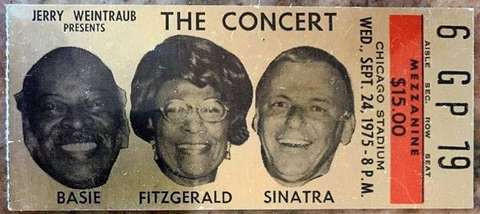
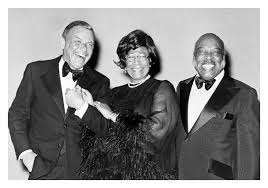
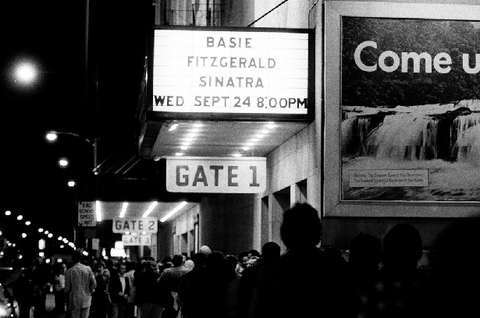
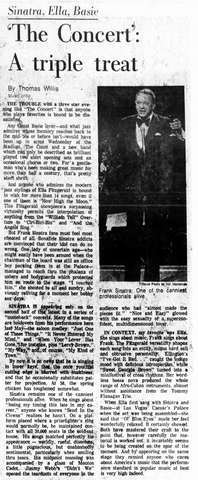
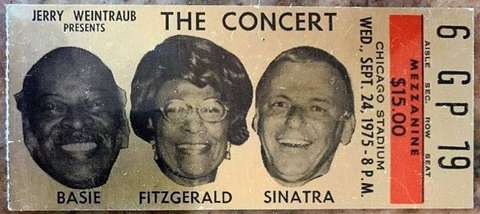
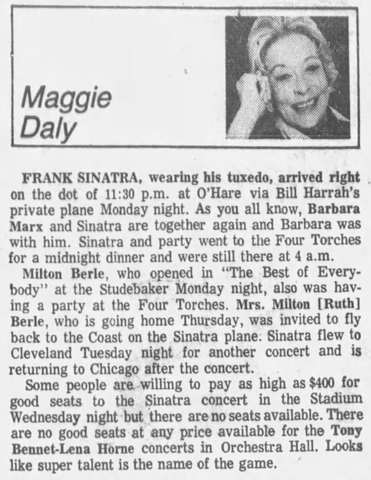
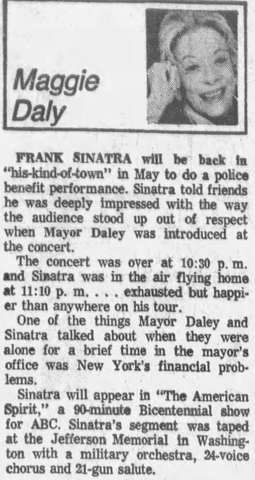
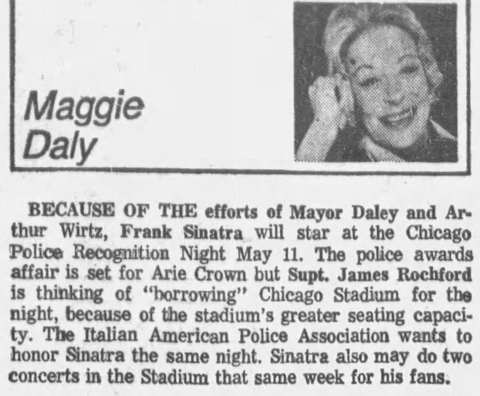
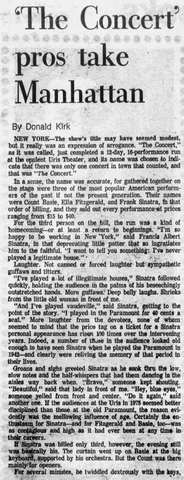
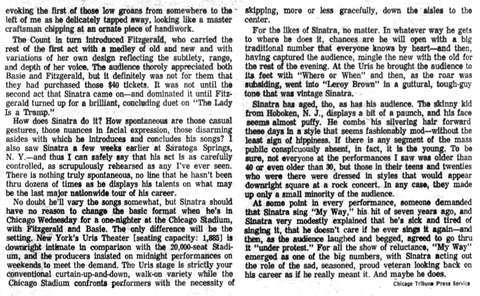
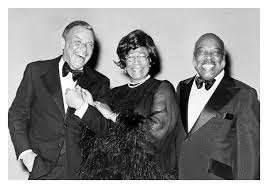
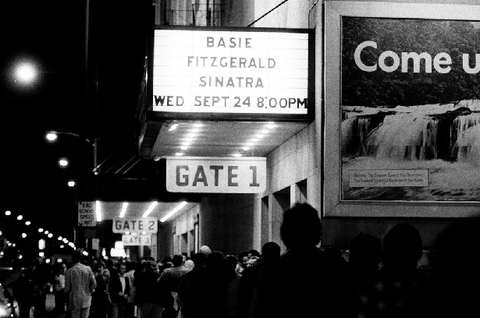
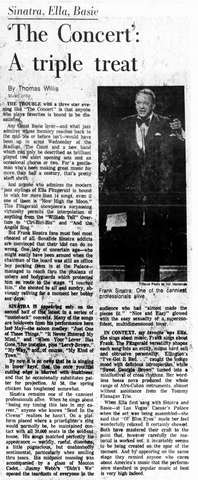
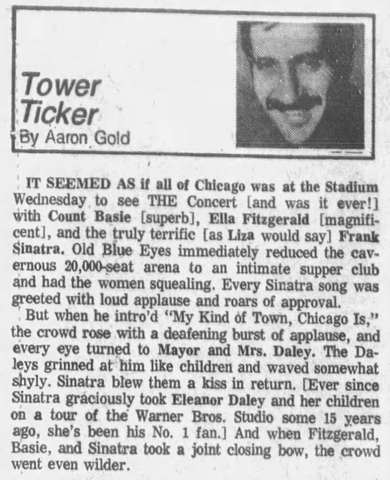
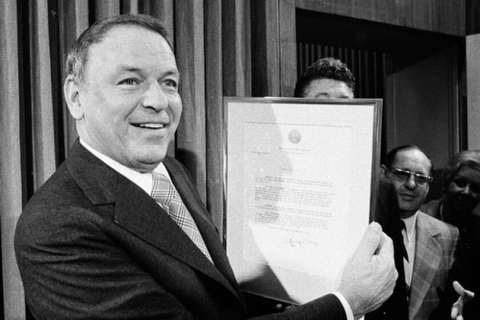
Chicago Stadium, Chicago, Illinois
Count Basie Orchestra Orchestra Conducted By: Bill Miller
1. Where Or When
2. Let Me Try Again
3. Bad, Bad Leroy Brown
4. But Beautiful
5. Didn't We?
6. Something
7. Nice 'N' Easy
8. medley: Just One Of Those Things / It Never Entered My Mind / When Your
Lover Has Gone
9. I Believe I'm Gonna Love You
10. Pennies From Heaven
11. Send In The Clowns
12. My Way
13. My Kind Of Town
14. The Song Is You - w/Ella
15. They Can't Take That Away From Me - w/Ella
16. At Long Last Love
17. The Lady Is A Champ - w/Ella
Notes: Also listed as 9/25. TT 55mins.
note: All of the articles ran in the Chicago Tribune, the week Frank and Co.
went on the road after closing at the Uris.
The long essay nicely sums up what happened that September that
is now 50 years removed from today.
Ed
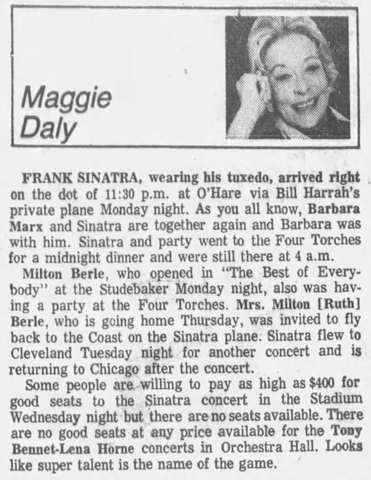
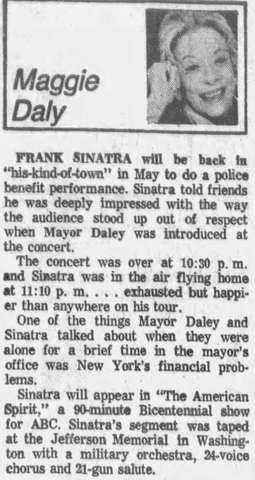
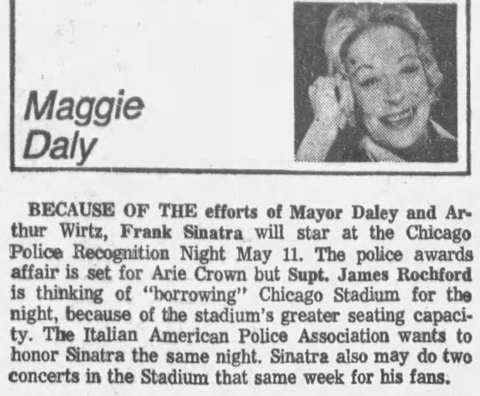
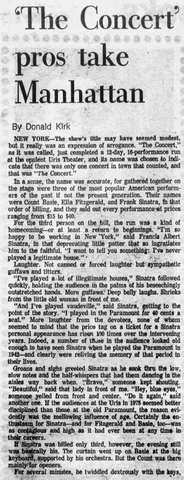
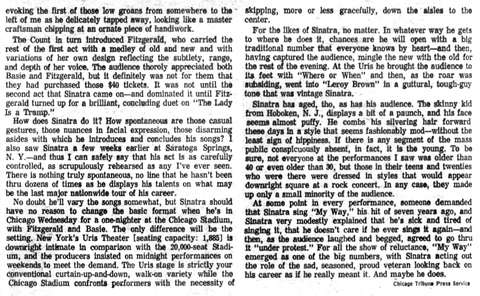
Century Plaza, Los Angeles, CA
Testimonial Dinner Honoring Danny Thomas
Sinatra, Liza Minnelli, Bob Hope, Carol Burnett, Lucille Ball, Jack Lemmon and others Sinatra performed with the David Rose Orchestra.
Songs included:
Something
Where Or When
Century Plaza, Los Angeles, CA
Testimonial Dinner Honoring Danny Thomas
Sinatra, Liza Minnelli, Bob Hope, Carol Burnett, Lucille Ball, Jack Lemmon and others
Sinatra performed with the David Rose Orchestra.
Did not appear: