January 8, 1954
Radio
To Be Perfectly Frank
Network: NBC
Show: 18
Time: 8:15 p.m
Host: Frank Sinatra
Announcer: Edward King
1. South Of The Border - Frank Sinatra
2. Don't Ask Me Why - Eileen Barton
3. Palsy Walsy (instrumental) - George Siravo
4. My One And Only Love - Frank Sinatra
Concerts
Copacabana, New York City (December 23, 1954 - January 12, 1955) Three week engagement
SRO every show
January 9, 1954
Concerts
Copacabana, New York City (December 23, 1954 - January 12, 1955) Three week engagement
SRO every show
January 12, 1954
Radio
Rocky Fortune, "Rodeo Murder"
Network: NBC
Episode: 14
Time: 9:35 p.m.- 10 p.m.
Performers: Frank Sinatra, Don Diamond, Tony Barrett.
Writers: Ernest Kinoy
Directors: Andrew C. Love
Announcer: Edward King
Description: When a murder happens at a rodeo, Rocky is framed for that murder.
To Be Perfectly Frank
Network: NBC
Show: 19
Time: 8:15 p.m
Host: Frank Sinatra
Announcer: Edward King
1. Don't Forget Tonight Tomorrow - Frank Sinatra
2. Full Moon And Empty Arms - Frank Sinatra
3. Lover Come Back To Me - Nat King Cole
4. Birth Of The Blues - Frank Sinatra
January 15, 1954
Radio
To Be Perfectly Frank
Network: NBC
Show: 20
Time: 8:15 p.m
Host: Frank Sinatra
Announcer: Edward King
1. If I Could Be With You - Frank Sinatra
2. For Dancers Only (instrumental) - Jimmy Lunceford
3. I'll Always Be In Love With You - Kay Starr
4. One Finger Melody - Frank Sinatra
January 17, 1954
Television
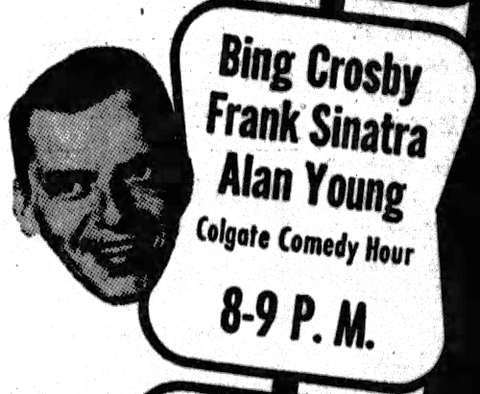
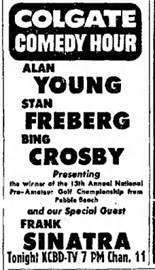
Colgate Comedy Hour
NBC-TV
Sunday Evening
8:00 p.m -9:00 p.m.
Live From Hollywood
Episode 16 (1953-54 season)
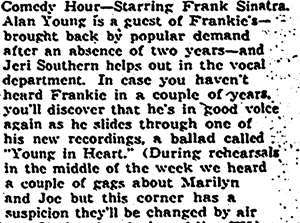
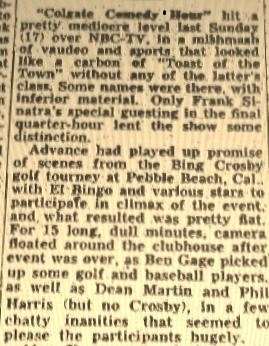
First -half was telecast from the
Bing Crosby Pro-Am Golf Tournament in Pebble Beach, California
Guests: Dean Martin, Phil Harris, and others
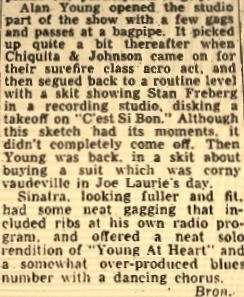
Alan Young was the host.
Guests: Frank Sinatra, Stan Freberg, Chiquita & Johnson
1. Young At Heart
2. Blues Number
Notes: Second half of the show is coverage of the Bing Crosby Pro-Am from Pebble Beach, California. note: Frank's first performance of "Young At Heart" outside the Capitol session in December of 53. Capitol released the single the following day. It would peak at #2 on the Billboard Chart and sell over a million records. Jack
Warner loved the song and insisted a film be built around the song. He got his wish.
Ed
[The Cinematic Legacy of Frank Sinatra — Young at Heart (1954)]
David Wills's 2015 photo history The Cinematic Legacy of Frank Sinatra devotes a section to Young at Heart (1954), illustrated with 7 behind-the-scenes and publicity photographs (posters, lobby cards, and on-set/on-location shots) filed here.
“… despite Frank's sure and rather cocky exterior, I always felt there was a sad vulnerability about him. I liked him. We had a fine relationship. There were many lovely things about him that I admired.” —Doris Day (Costar, Young at Heart, 1954)
Source: David Wills, The Cinematic Legacy of Frank Sinatra (St. Martin's Press, 2015), pp. 98–247.
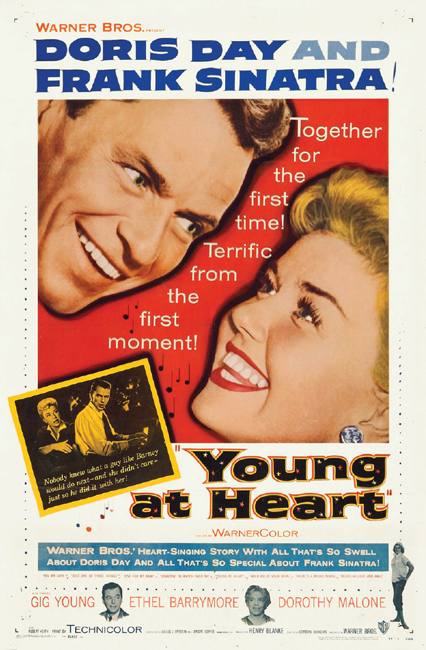
One sheet poster, Young at Heart, 1954. (Photo: The Cinematic Legacy of Frank Sinatra, David Wills, 2015.)
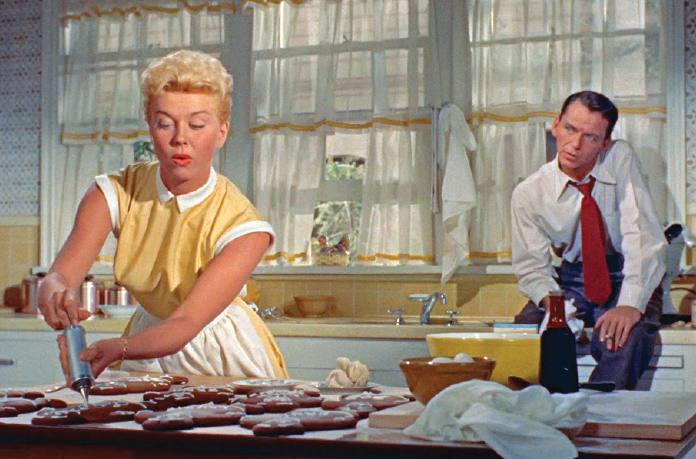
With costar Doris Day. / “… despite Frank's sure and rather / cocky exterior, I always felt there / was a sad vulnerability about him. I / liked him. We had a fine / relationship. There were many lovely / things about him that I admired.” (Photo: The Cinematic Legacy of Frank Sinatra, David Wills, 2015.)
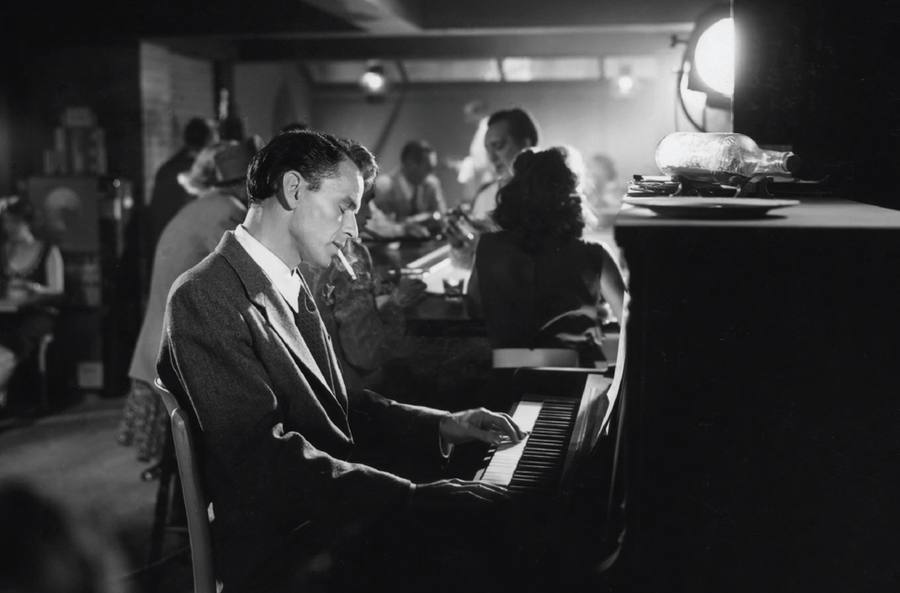
As Barney Sloan, Young at Heart. (Photo: The Cinematic Legacy of Frank Sinatra, David Wills, 2015.)
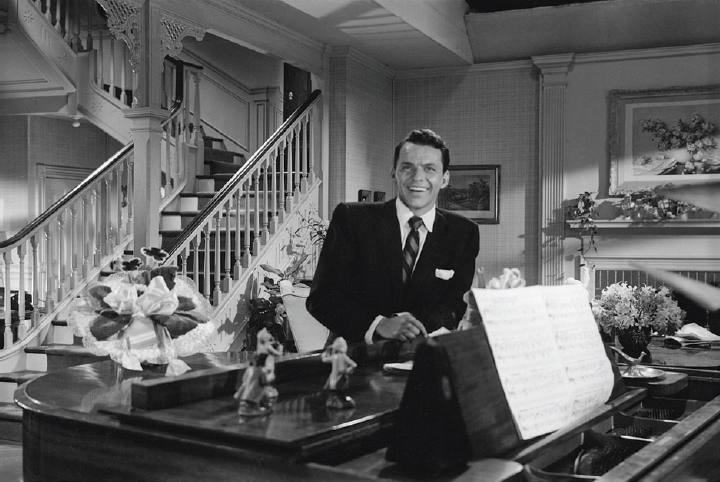
Young at Heart, 1954. / [Doris, teary-eyed at the 75th / birthday Frank arranged for Ethel / Barrymore, called for a tissue and / was hit in the forehead by a box of / Kleenex tossed by a stagehand.] / “Frank lunged for the guy, scolding, (Photo: The Cinematic Legacy of Frank Sinatra, David Wills, 2015.)
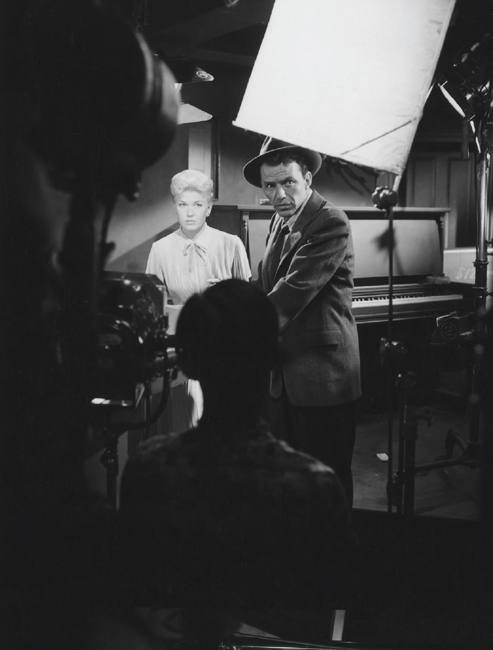
the years whenever I pull a Kleenex / out of a box, I think of Frank.” / On set with costar Doris Day. (Photo: The Cinematic Legacy of Frank Sinatra, David Wills, 2015.)
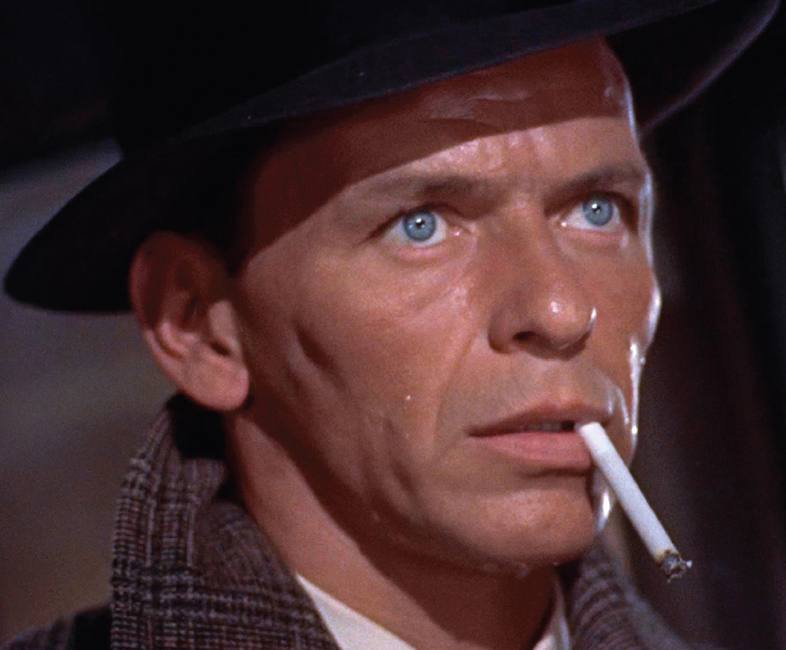
Young at Heart, 1954. (Photo: The Cinematic Legacy of Frank Sinatra, David Wills, 2015.)
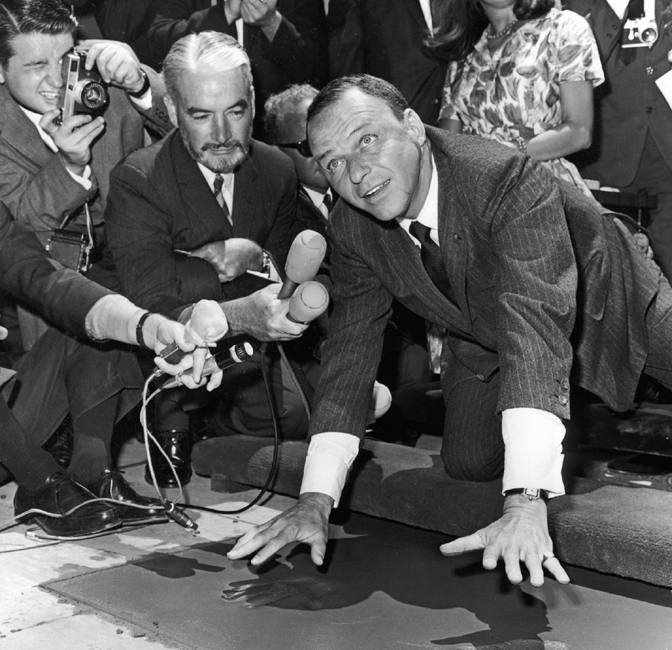
Grauman's Chinese Theater, July 20, 1965. (Photo: The Cinematic Legacy of Frank Sinatra, David Wills, 2015.)
Colgate Comedy Hour
Ed O'Brien:
Frank's first public performance of "Young At
Heart." Capitol had not released it yet. Song would
not chart in Billboard until 2-13-54. Would love to
know title of the "Blues" number Frank sang with
the dancing chorus.
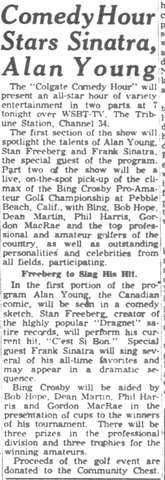
[Sinatra performs 'Young at Heart' on television]
Frank returned to The Colgate Comedy Hour on January 17, 1954, singing 'Young at Heart' and 'The Birth of the Blues' and bantering about Joe DiMaggio and Marilyn Monroe's elopement, which had delayed the Pink Tights production he was slated to co-star in.
Source: James Kaplan, "Frank: The Voice" (2010).
January 19, 1954
Radio
Rocky Fortune, "The Museum Murder"
Network: NBC
Episode: 15
Time: 9:35 p.m.- 10 p.m.
Performers: Frank Sinatra, Dick Beals, Barney Phillips, June Foray.
Writers: George Lefferts
Directors: Howard Wiley
Announcer: Edward King
Description: Rocky's finds a corpse in a mummy case while running a tour through a New York museum.
To Be Perfectly Frank
Network: NBC
Show: 21
Time: 8:15 p.m
Host: Frank Sinatra
Announcer: Edward King
1. Young At Heart - Frank Sinatra
2. Forever Yours - Vicki Young
3. In The Mood (instrumental) - Ray Anthony
4. I Don't Know Why - Frank Sinatra
January 22, 1954
Radio
To Be Perfectly Frank
Network: NBC
Show: 22
Time: 8:15 p.m
Host: Frank Sinatra
Announcer: Edward King
1. I've Got My Love To Keep Me Warm - Frank Sinatra
2. Undecided - Ella Fitzgerald
3. This Love Of Mine - Tommy Dorsey Orchestra
4. From Here To Eternity - Frank Sinatra
January 26, 1954
Radio
To Be Perfectly Frank
Network: NBC
Show: 23
Time: 8:15 p.m
Host: Frank Sinatra
Announcer: Edward King
1. Somebody Loves Me - Frank Sinatra
2. A Woman A Woman - Johnny Desmond
3. Gimme Gimme John - Eydie Gorme
4. Take A Chance - Frank Sinatra
Rocky Fortune, "Hauling Nitro"
Network: NBC
Episode: 16
Time: 9:35 p.m.- 10 p.m.
Performers: Frank Sinatra, Frank Gerstle, Lynn Allen.
Writers: George Lefferts
Directors: Andrew C. Love
Announcer: Edward King
Description: Rocky's job is driving a truckload of nitroglycerine.
January 29, 1954
Radio
To Be Perfectly Frank
Network: NBC
Show: 24
Time: 8:15 p.m
Host: Frank Sinatra
Announcer: Edward King
1. On The Sunny Side Of The Street - FS w Symphonette
2. Poco Loco In The Coco - Eileen Barton
3. Heart Of My Heart - Johnny Long, Alan Dale, Don Cornell, and Johnny Desmond
4. I Guess I'll Hang My Tears Out To Dry
January 30, 1954
Frank appeared on his last episode of the Rocky Fortune radio show.
Source: Nancy Sinatra, Frank Sinatra: An American Legend, 1995.
February 1954
[Ava coldly receives the coconut cake]
Lauren Bacall: After Bogart failed to pass along the cake, Bacall personally delivered it to Ava's crowded dressing room on the Contessa set in Rome. Ava, surrounded by her sister, secretary, and Dominguín, showed no gratitude, simply gesturing where to set it down, an indifference Bacall later understood as Ava being finished with Frank.
Source: James Kaplan, "Frank: The Voice" (2010)
[Ava tells reporter she wants a baby and normal marriage]
Ava Gardner: Syndicated columnist Laura Lee interviewed Ava in Rome and found her in regretful spirits, saying what she wanted most was children and a normal, happy marriage, someday. Ava also complained bitterly about the movie business, saying she had no home, no car, and worked only for the money.
Source: James Kaplan, "Frank: The Voice" (2010)
[Bacall carries a coconut cake to Ava in Rome]
Lauren Bacall: As Lauren Bacall prepared to join Bogart in Rome for the Barefoot Contessa shoot, Frank asked her to deliver a gift to Ava: an orange-and-coconut cake, Ava's favorite, from Greenberg's Bakery on Madison Avenue. Bacall carried the boxed cake by car and plane across the Atlantic.
Source: James Kaplan, "Frank: The Voice" (2010)
[Frank earns from Pink Tights suspension and Beachcomber gig]
Earl Wilson: Columnist Earl Wilson reported Frank was collecting $50,000 for not working on the stalled Pink Tights while also earning $23,000 for nine nights at Miami's Beachcomber club.
Source: James Kaplan, "Frank: The Voice" (2010)
[Nightclubs compete for Sinatra's New York booking]
Kaplan: Earl Wilson also reported a bidding war between La Vie en Rose and the Copacabana for Frank's next New York engagement, with La Vie's Monte Proser threatening to quit the business if Sinatra didn't honor a promised appearance, while the larger Copacabana offered roughly double the pay.
Source: James Kaplan, "Frank: The Voice" (2010)
February 2, 1954
Radio
To Be Perfectly Frank
Network: NBC
Show: 27
Time: 8:15 p.m - 8:30 P.M.
Host: Frank Sinatra
Announcer: Edward King
1. You Must Have Been A Beautiful Baby w/ Sinatra Symphonette
2. Dancing In The Dark Ray Anthony & His Orchestra
3. You've Changed Richard Heyman
4. Changing Partners Dinah Shore
5. A Hundred Years From Today w/ Sinatra Symphonette
Rocky Fortune, "Football Fix"
Network: NBC
Episode: 17
Time: 9:35 p.m.- 10 p.m.
Performers: Frank Sinatra, Jack Mather, Lou Krugman, Vivi Janniss.
Writers: Doc Sanford
Directors: Andrew C. Love
Announcer: Edward King
Description: Rocky is hired to protect a football player who won't take a bribe.
February 5, 1954
Radio
To Be Perfectly Frank
Network: NBC
Show: 26
Time: 8:15 p.m
Host: Frank Sinatra
Announcer: Edward King
1. Take A Chance Capitol recording
2. A Village In Peru Vic Damone
2. South Of The Border Capitol recording
4. I'm In The Mood For Love w/ Sinatra Symphonette
5. I've Got My Love To Keep Me Warm w/ Sinatra Symphonette
February 8, 1954
Concerts
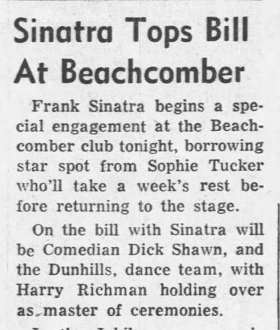
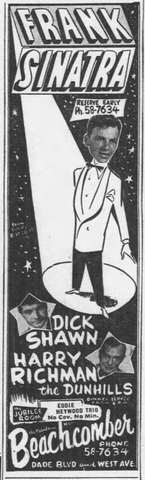
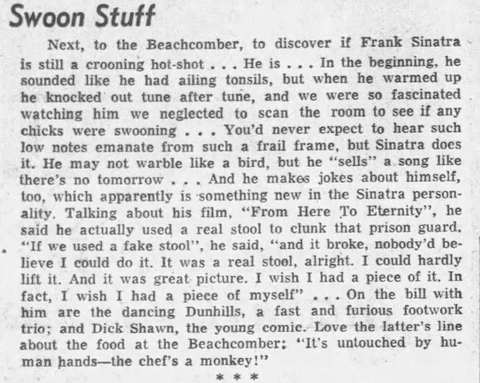
Beachcomber Club, Miami Beach, Florida (8 - 14)
Opened on the 8th, Closed on the 14th.
On The Bill: Frank Sinatra, Dick Shawn (comedian), The
Dunhills (dance team), Harry Richman (m.c.)
Frank subbed for Sophie Tucker
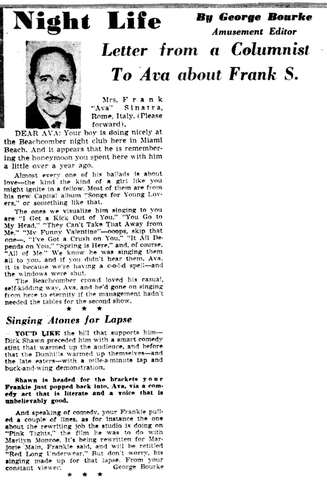
Ed O'Brien: note: Found the following information in the Billboard of 2-27-54. Article is about the breakout business in Miami Beach in February of that year.
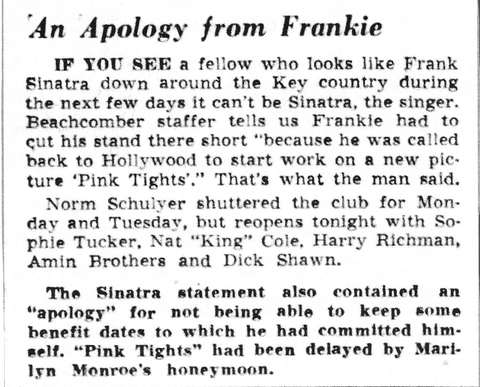
MIAMI, Feb. 20, "Frank Sinatra at Beachcomber in Miami. Two days before engagement ended, he departed by mutual consent with the management. Claim was he was called back to Hollywood for a movie, but turned up at the Plantation Yacht Harbor on Plantation Key ( 60 miles south of Miami ) for three days of fishing."
Article mentions he was doing so-so business. Nat Cole followed to sold out shows every night.
"Songs For Young Lovers" and the single "Young At Heart" had been out a few weeks when Frank took this engagement. He was coming back but wasn't completely there yet. By the fall of 1954, Frank Sinatra was the hottest performer in show business.
Ed
Beachcomber Club, Miami Beach, Florida (8 - 14)
note: Frank was set to open on 2/6 ( Saturday ) but was unable to get ready, so the opening took place on Monday, 2/8.
Initially the demand to see him was more than expected. But by the weekend, the excitement had worn off and
there were empty seats. Frank did not want the local papers printing articles on his inability to draw a full house.
He decided not to finish out the gig, canceling the last two nights ( 15 & 16 ). And he headed down to the Keys,
for a three day fishing trip. The story about "Pink Tights' was not accurate. Twentieth-Century had given up on
Marilyn and were considering Sheree
North as a replacement. Frank was set to make an appearance at an all-star
fund raiser for Miami Children's
Hospital on 2/16. He apologized for not being there. On the 17th, Frank headed
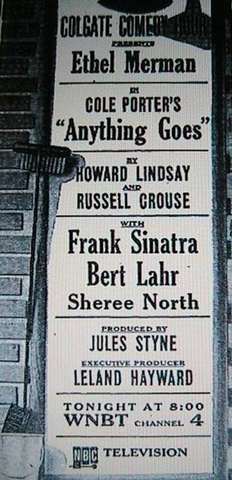
out to Hollywood. He was set to appear opposite Ethel Merman in the Colgate Comedy Hour adaptation of Cole
Porter's "Anything Goes."
The production would be broadcast live by NBC from the El Capitan Theatre on
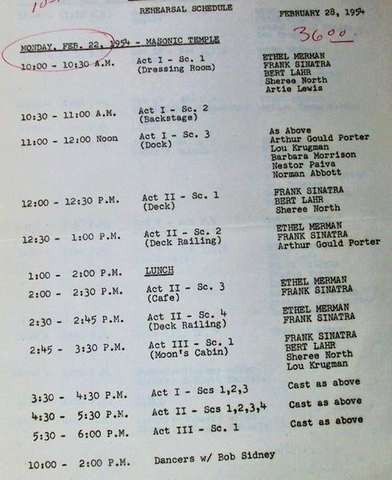
Hollywood Boulevard. The cast rehearsed for a week prior to the February 28th airing. Sheree North played
Bonnie. It certainly didn't help her chances with 20th Century. They shut down production of "Pink Tights"
and took the loss.
Ed
P.S While researching this time in
Frank's life, I came across an article that was downright scary. Goldwyn Studios
reached an agreement with Clark Gable to star as Sky Masterson in "Guys & Dolls." He would do his own
singing. The studio wanted Frank to co-star as Nathan Detroit. And they were, according to the article, willing
to give him some of the songs Gable was set to warble. Oh my ! Sinatra loved to tell his audience that the
actual film was the worst casting in the history of Hollywood. In retrospect, it looks like a major step up from
the idea floating around in February 1954.
© 1997-2026 The Sinatra Archive
This calendar, or any parts thereof, may not be reproduced in any fashion
whatsoever without the prior written permission of the publisher (The
Sinatra Archive)
February 9, 1954
Radio
To Be Perfectly Frank
Network: NBC
Show: 27
Time: 8:15 p.m
Host: Frank Sinatra
Announcer: Edward King
1. What Can I Say After I Say I'm Sorry w/ Sinatra Symphonette
2. You Alone Perry Como
3 How Lovely Cooks The Meat Frankie Laine and Doris Day
4. Body And Soul Columbia recording
Rocky Fortune, "Catskills Cover-Up"
Network: NBC
Episode: 18
Time: 9:35 p.m.- 10 p.m.
Performers: Frank Sinatra, Barney Phillips.
Writers: George Lefferts, Norm Sickel, Robert Senadella (story), Ernest Kinoy, Doc Sanford
Directors: Andrew C. Love, Fred Weihe, Howard Wiley
Announcer: Edward King
Description: Rocky becomes a social director to help a man involved in a post office robbery.
Concerts
Beachcomber Club, Miami Beach, Florida (8-14)
Opened on the 8th, Closed on the 14th.
On The Bill: Frank Sinatra, Dick Shawn (comedian), The
Dunhills (dance team), Harry Richman (m.c.)
Frank subbed for Sophie Tucker
February 10, 1954
Concerts
Beachcomber Club, Miami Beach, Florida (8 - 14)
Opened on the 8th, Closed on the 14th.
On The Bill: Frank Sinatra, Dick Shawn (comedian), The
Dunhills (dance team), Harry Richman (m.c.)
Frank subbed for Sophie Tucker
February 11, 1954
Concerts
Beachcomber Club, Miami Beach, Florida (8 - 14)
Opened on the 8th, Closed on the 14th.
On The Bill: Frank Sinatra, Dick Shawn (comedian), The
Dunhills (dance team), Harry Richman (m.c.)
Frank subbed for Sophie Tucker
February 12, 1954
Radio
To Be Perfectly Frank
Network: NBC
Show: 28
Time: 8:15 p.m
Host: Frank Sinatra
Announcer: Edward King
1. Take A Chance Capitol recording
2. Please Understand Pied Pipers
3. The Story Of Three Loves Richard Heyman
4. I'll String Along With You w/ Sinatra Symphonette
Concerts
Beachcomber Club, Miami Beach, Florida (8 - 14)
Opened on the 8th, Closed on the 14th.
On The Bill: Frank Sinatra, Dick Shawn (comedian), The
Dunhills (dance team), Harry Richman (m.c.)
Frank subbed for Sophie Tucker
February 13, 1954
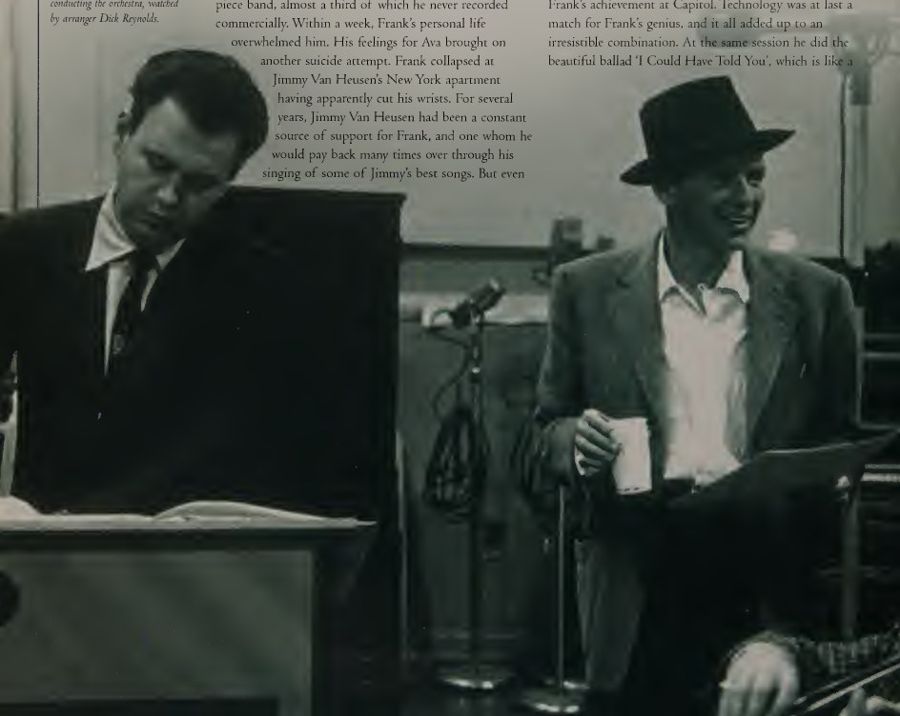
[Photograph: Young at Heart enters the Billboard chart. From Richard Havers, "Sinatra" (Dorling Kindersley, 2007), p.188.]
Concerts
Beachcomber Club, Miami Beach, Florida (8 - 14)
Opened on the 8th, Closed on the 14th.
On The Bill: Frank Sinatra, Dick Shawn (comedian), The
Dunhills (dance team), Harry Richman (m.c.)
Frank subbed for Sophie Tucker
"Young at Heart" entered the Billboard chart and reached the Top 10 within two weeks, eventually climbing as high as No. 2 and selling over a million copies before leaving the Top 10 in late June. (Source: Richard Havers, "Sinatra" (Dorling Kindersley, 2007).)
February 14, 1954
Concerts
Beachcomber Club, Miami Beach, Florida (8 - 14)
Opened on the 8th, Closed on the 14th.
On The Bill: Frank Sinatra, Dick Shawn (comedian), The
Dunhills (dance team), Harry Richman (m.c.)
Frank subbed for Sophie Tucker
[Frank's Valentine's Day cable and card-game breakdown] On Valentine's Day, a Sunday, Frank sent Ava a cable saying he loved and missed her, then got drunk. During a card game with friends that night he retreated to the den to drink alone in front of a photo of Ava, then smashed the framed picture, tore it up, and later obsessively reassembled the torn pieces, panicking when he couldn't find the piece with her nose (found only when a liquor delivery boy's arrival blew it into view, prompting Frank to give the boy his gold wristwatch).
Source: James Kaplan, "Frank: The Voice" (2010).
February 15, 1954
[From Here to Eternity earns 13 Oscar nominations]
The day after Frank's Valentine's Day breakdown, nominations for the 1953 Academy Awards were announced: From Here to Eternity received thirteen nominations, including Best Picture, Best Director, Best Actress (Deborah Kerr), Best Actor (Montgomery Clift and Burt Lancaster), Best Supporting Actress (Donna Reed), and Best Supporting Actor (Frank Sinatra).
Source: James Kaplan, "Frank: The Voice" (2010).
[Ava nominated for Mogambo]
Ava Gardner was also nominated, for Best Actress in Mogambo; hearing the news in Rome, she reportedly laughed out loud.
Source: James Kaplan, "Frank: The Voice" (2010).
[Frank begins praying at Good Shepherd Church]
The Monday the Oscar nominations were announced, Frank drove to Good Shepherd Catholic Church on Bedford and Santa Monica in Beverly Hills and knelt alone in a pew to pray, a visit he repeated several times in the following weeks though he rarely attended church otherwise.
Source: James Kaplan, "Frank: The Voice" (2010).
February 16, 1954
Radio
To Be Perfectly Frank
Network: NBC
Show: 29
Time: 8:15 p.m
Host: Frank Sinatra
Announcer: Edward King
1. The One I Love Belongs To Somebody Else w/ Sinatra Symphonette
2. That's Amore Dean Martin
3. Our Love Is Here To Stay w/ Sinatra Symphonette
4. Lover Come Back To Me Nat King Cole
Notes: Sinatra songs only. Full list to be completed.
Rocky Fortune, "Too Many Husbands"
Network: NBC
Episode: 19
Time: 9:35 p.m.- 10 p.m.
Performers: Frank Sinatra, Betty Lou Gerson, Barney Phillips, John Stevenson, Maurice Hart.
Writers: Norm Sickel
Directors: Andrew C. Love
Announcer: Edward King
Description: Rocky is hired by a beautiful woman to kill her husband...
Note: The show appears on the officially released CD set: 60 Greatest Old Time Radio Shows " Frank Sinatra & Friends"
[Press names Walter Chiari a rival for Ava]
A Daily News piece datelined Rome, headlined 'Quadrangle: Rome Comic Sinatra's Top Rival,' reported that Italian comedian Walter Chiari, seen frequently with Ava, was blocking a Frank-Ava reconciliation, and that an Italian paper claimed Chiari had split from Miss Italy 1947 Lucia Bosé because of Ava.
Source: James Kaplan, "Frank: The Voice" (2010).
February 19, 1954
Radio
To Be Perfectly Frank
Network: NBC
Show: 30
Time: 8:15 p.m
Host: Frank Sinatra
1. Should I w/ Sinatra Symphonette
2. Forever Yours Vicki Young
3. C'est Si Bon Stan Freberg
4. Body And Soul (Columbia Recording)
4. This Can't Be Love w/Sinatra Symphonette
February 23, 1954
Radio
To Be Perfectly Frank
Network: NBC
Show: 31
Time: 8:15 p.m
Host: Frank Sinatra
Announcer: Edward King
1. It's Only A Paper Moon w/Sinatra Symphonette
2. Take Me In Your Arms Jo Stafford
3. They Can't Take That Away From Me Capitol Recording
4. Little Girl Blue Capitol Recording
5. Don't Ask Me Why Eileen Barton
Miami Herald
2-23-54 note: I found one last week that was the wrong date. Songs listed were done on the next Perfectly Frank.
Ed
[image referenced in source but could not be recovered]
Rocky Fortune, "Decoy For Death"
Network: NBC
Episode: 20
Time: 9:35 p.m.- 10 p.m.
Performers: Frank Sinatra, Kay Stewart.
Writers: George Lefferts
Directors: Andrew C. Love
Announcer: Edward King
Description: A "Organ Grinder" has broken out of jail and sets out to get Rocky who set him up.
February 26, 1954
Radio
To Be Perfectly Frank
Network: NBC
Show: 32
Time: 8:15 p.m
Host: Frank Sinatra
Announcer: Edward King
1. Take A Chance - FS
2. Ricochet - Teresa Brewer
3. My Friend The Ghost - Dorsey Brothers
4. One Hundred Years From Today - FS
[Sinatra and Artie Shaw's chilly encounter]
Walter Winchell: Columnist Walter Winchell reported that Frank Sinatra and Artie Shaw (Ava's ex-husband) crossed paths in Lindy's revolving door in New York at 2 a.m., exchanged a cool five-second look, and walked away without speaking.
Source: James Kaplan, "Frank: The Voice" (2010).
February 28, 1954
Television
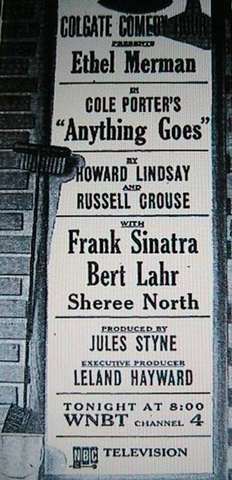
Colgate Comedy Hour
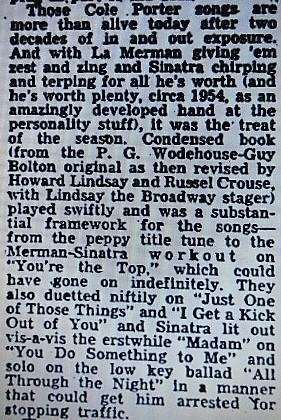
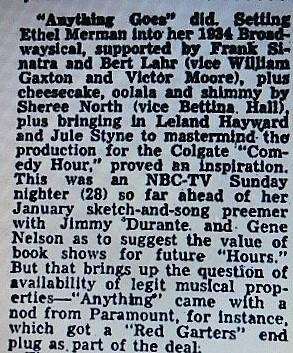
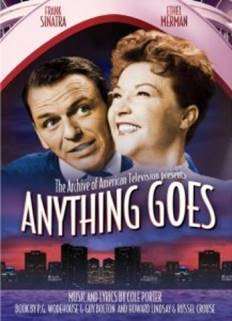
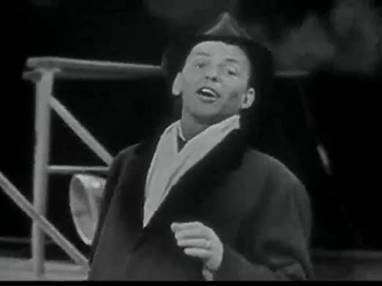
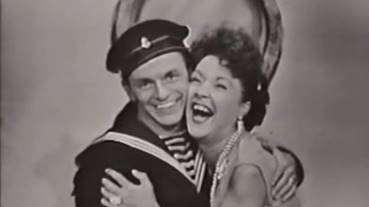
Musical: Anything Goes
Network: NBC
Episode Number: 144 Season Num: 4
Music and Lyrics by Cole Porter
Original Book by Guy Bolton and P.. G. Wodehouse
Written for television by Herbert Baker
Produced by Jule Styne
Executive Producer: Leland Hayward
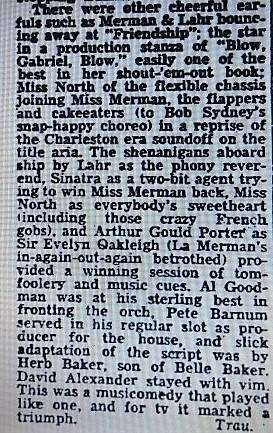
Production Staged by David Alexander
Directed by Sid Smith
Musical Director: Al Goodman
Vocal Supervision: Eliot Daniel
Production Designed by Furth Ullman
Orchestrations by Buddy Bregman and Nelson Riddle
Performer: Ethel Merman, Frank Sinatra, Bert Lahr, Sheree North,
Sunday Evening
8 -9:pm
Hollywood
1. Opening Credits and Overture
2. Anything Goes Ethel Merman
3. You Do Something To Me Ethel Merman & Frank Sinatra
4. Anything Goes E. Merman
5. I Get A Kick Out Of You E. Merman
6. I Get A Kick Out Of You F. Sinatra
7. You're The Top E. Merman & F. Sinatra
8. Just One Of Those Things F. Sinatra
9. Blow Gabriel, Blow E. Merman
10. All Through The Night F.. Sinatra
11.. Friendship Bert Lahr & E. Merman
12. I Get A Kick Out Of You E. Merman & F. Sinatra
13. Anything Goes E. Merman, F. Sinatra & B. Lah
14. Closing credits
Ed O'Brien:
According to Buddy Bregman Sinatra was early for rehearsal throughout the week prior to the actual telecast.
Buddy loves to tell how he got to arrange "Just One Of
Those Things" for Frank. Leland Hayward interrupted
Frank halfway through a run down of the Porter classic.
Hayward, Riddle and Bregman were sitting in the theatre watching Frank sing it on stage. Hayward announced he wanted a Broadway sound for the Porter classic. He rejected Nelson's swinging chart and assigned the chart to Mr. Bregman, who is still thrilled about it to this day.
Show was live and there was time to kill at the end. Ethel got Frank and Bert to wing "Anything Goes" to close out the hour. Sinatra's stunning version of "All Through The Night" is the highlight of the hour. Riddle gave him a wonderful arrangement. Absolutely nothing like the excitement and energy of live television.
Colgate Comedy Hour
tv ad
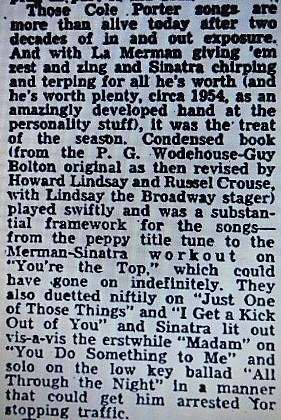
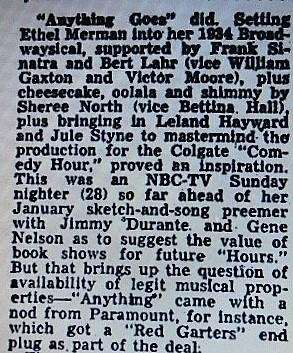
Review:
Variety
3-3-54
Ed O'Brien:
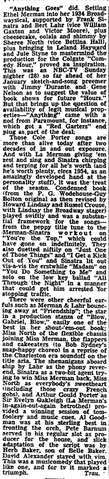
What a great review. The critics were starting to pay attention again to the kid from Hoboken. I love the rapt appreciation accorded Frank's glorious reading of Porter's "All Through The Night." note: Buddy Bregman told me Frank was early every day for the rehearsals. During the lunch break, Sinatra would address Buddy with the laudatory "Genius" sobriquet. Buddy was never sure if it was meant as a compliment or sarcasm. He told me Ethel and Frank got along famously. Ed
Variety
3-3-54
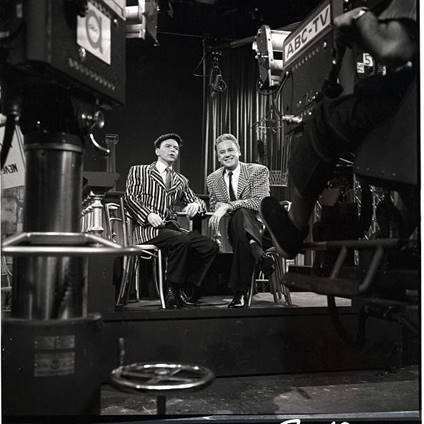
1958 Frank Sinatra Show
Network: ABC
Show #20
Sponsors: Chesterfield Cigarettes, Bulova Watch Company
Guest: Van Johnson
Photo:
Ed O'Brien:
What a great review. The critics were starting to pay attention again to the kid from Hoboken. I love the rapt appreciation accorded Frank's glorious reading of Porter's "All Through The Night." note: Buddy Bregman told me Frank was early every day for the rehearsals. During the lunch break, Sinatra would address Buddy with the laudatory "Genius" sobriquet. Buddy was never sure if it was meant as a compliment or sarcasm. He told me Ethel and Frank got along famously.
Ed
Variety
tv ad
Review:
Variety
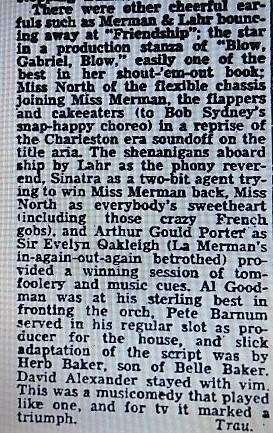
"Anything Goes"
Ahead of his feature-film follow-up to Eternity, Sinatra starred in a live NBC television broadcast of Anything Goes on February 28, 1954, alongside Ethel Merman (reprising her original Broadway role) and Bert Lahr. Merman's stage-scaled, camera-oblivious performance style dominated the hour and largely reduced Sinatra to a good-humored straight man.
Source: Tom Santopietro, "Sinatra in Hollywood" (2008).
"Anything Goes"
Santopietro grades this a C, describing it as a wacky live television musical pairing Frank with Ethel Merman as lovebirds.
Source: Tom Santopietro, "Sinatra in Hollywood" (2008).
March 1954
[Frank skips Look and Photoplay awards for a New York trip]
Kaplan: Louella Parsons complained that Frank missed the Look and Photoplay Magazine awards, citing 'business in New York,' while other columnists like Jimmie Fidler speculated (incorrectly) that he was actually flying to Rome to escort Ava to the Oscars.
Source: James Kaplan, "Frank: The Voice" (2010)
[Nightly dinners at La Scala before the Oscars]
Kaplan: In the days before flying home for the Academy Awards, Frank ate dinner five nights in a row at La Scala on West 54th Street in New York with Hank Sanicola, Jimmy Van Heusen, and music publisher Jackie Gale, closing the restaurant each night; his friends repeatedly told him he'd win the Oscar.
Source: James Kaplan, "Frank: The Voice" (2010)
[Oscars reunion rumor fizzles]
Kaplan: Gossip columnists speculated that Ava Gardner, herself nominated for Best Actress for Mogambo, would attend the Academy Awards and reunite with Frank, but she remained in Spain with Dominguín instead.
Source: James Kaplan, "Sinatra: The Chairman" (2015)
[Parsons reports on Sinatra's movements before the Oscars]
Louella Parsons: Two weeks before the Oscars, Louella Parsons reported that Frank was back in Los Angeles from Palm Springs and would appear on Bing Crosby's radio show, adding that planned New York and Rome trips were canceled, though he in fact still took a trip to New York shortly after.
Source: James Kaplan, "Frank: The Voice" (2010)
[Pegler revives old Sinatra mob associations]
Kaplan: When mob-linked figure Jimmy Tarantino, co-founder with Hank Sanicola of the defunct scandal sheet Hollywood Nite Life, arrived at San Quentin after conviction for extortion, columnist Westbrook Pegler took a last swipe at Sinatra, dredging up his old ties to Lucky Luciano and mob figure Willie Moretti, though the public showed little interest.
Source: James Kaplan, "Frank: The Voice" (2010)
March 1, 1954
Studio
KHJ Studios. Hollywood
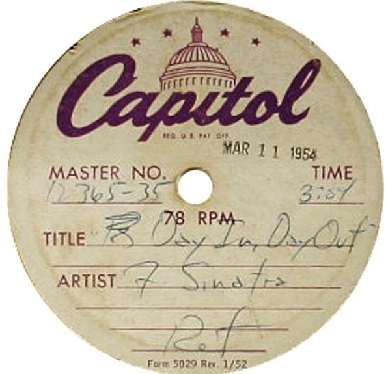
12365 Day In, Day Out
Arranged & Conducted by Nelson Riddle
CD: CDP 7-96827-2 Nice 'n' Easy
EP: EPA 590 Melody Of Love
12366 Last Night When We Were Young
(Harold Arlen/E.Y. Harburg)
Arranged & Conducted by Nelson Riddle
-30 CD: CDP 7-96826-2 In The Wee Small Hours
LP: W581 In The Wee Small Hours
Ed O'Brien:
A couple of mysterious recordings. Frank recorded "Day In, Day Out" at his first Capitol session on 4-2-53. He used the arrangement Stordahl did for him in 1951. He would perform the song during his extended European tour in the spring and summer of 1953. There was also a marvelous reading done on the BBC Showband show, 7-16-53. The Riddle arranged recording, from the above session, is also quite spectacular, but the song was stuck on an obscure EP and then forgotten about for the next 20 years. "Last Night When We Were Young" is a stunning tour de force. Frank did thirty takes. The song would be part of the magnificent "Wee Small Hours" LP, released the following year on 4-15-55 Was he already planning the "Wee Small" in March of 1954? Was it for another project that fell by the wayside? I asked Riddle why it was done a year before the rest of the album was recorded. He couldn't remember the circumstances surrounding the recording. When Capitol first issued "Wee Small" on CD, they deleted "Last Night .. ." I asked Riddle why Frank needed 30 takes. His answer is something I will always remember: "He had voice to burn."
12367 Three Coins In A Fountain
(J. Styne/S. Cahn)
Chappell & Co./Cahn Music Company (ASCAP)
Arranged & Conducted by Nelson Riddle
-4 (3:04) CD: CDP 724383595228 Sinatra 80th "All The Best"
CD: C2 724383808922 The Complete Capitol Singles
CD: C2-94777 The Capitol Years
CD: CDP 7-92160-2 Frank Sinatra Collector's Series
LP: T768 This Is Sinatra!
45: 2816
Musicians - Reeds: Bart Caldarell, Mahlon Clark, Morton Friedman, Harry Klee, Warren Webb, James Williamson; Trombone: Francis Howard, Tommy Pederson; French Horns: John Cave, John Graas; Violins: Victor Bay, Alex Beller, Harry Bluestone, Walter Edelstien, George Kast, Paul Nero, Nathan Ross, Mischa Russell, Eudice Shapiro, Paul Shure, Felix Slatkin; Violas: Stanley Harris, Maxine Johnson, Paul Robyn; Cellos: Cy Bernard. Edgar Lustgarten, Eleanor Slatkin; Piano: Bill Miller; Bass: Joe Comfort, Edward Gilbert; Drums: Frank Carlson; Guitar: Bobby Gibbons; Harp: Kathryn Julye
Session Producer: Voyle Gilmore
KHJ Studios. Hollywood
12365 Day In, Day Out
Arranged & Conducted by Nelson Riddle
CD: CDP 7-96827-2 Nice 'n' Easy
EP: EPA 590 Melody Of Love
"Last Night When We Were Young"
Will Friedwald (analysis); Jonathan Schwartz (anecdote re: Tibbett): Recorded a full year before the rest of the album's fifteen tracks; Sinatra may not have known its eventual destination when he and Riddle cut it. Friedwald calls it possibly the most powerful performance on the set -- a dramatic, operetta-styled Harold Arlen ballad in the vein of Kern's 'Yesterdays' or Romberg's 'Lover, Come Back to Me' -- sung without belting, its classical resonance anticipating Only the Lonely. A footnote adds that when someone later played the Sinatra record for baritone Lawrence Tibbett (who had recorded but never released the song for the 1935 film Metropolitan), Tibbett reportedly said 'I see,' meaning that's how it should be sung.
Source: Will Friedwald, "Sinatra! The Song Is You: A Singer's Art" (2018 revised edition).
"Last Night When We Were Young"
Granata includes 'Last Night When We Were Young' among the fifty recordings he considers essential to understanding Sinatra's artistry (arranged by Nelson Riddle, recorded 1954, Capitol); the song was chosen for its musical/interpretive value rather than commercial popularity.
Source: Charles L. Granata, "Sessions with Sinatra: Frank Sinatra and the Art of Recording" (1999/2003).
[Capitol session produces 'Day In, Day Out' and 'Three Coins in the Fountain'] On Monday, March 1, 1954, Sinatra recorded three numbers with Riddle at Capitol: 'Day In, Day Out,' 'Last Night When We Were Young,' and the Sammy Cahn-Jule Styne title theme 'Three Coins in the Fountain' for the forthcoming film of the same name.
Source: James Kaplan, "Frank: The Voice" (2010).
March 2, 1954
Radio
To Be Perfectly Frank
Network: NBC
Show: 33
Time: 8:15 p.m
Host: Frank Sinatra
Announcer: Edward King
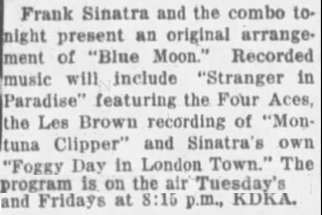
1. A Foggy Day Capitol Recording
2. That's Good Enough For Me Pearl Bailey
3. Montoona Clipper Les Brown & His Orch.
4. From Here To Eternity Capitol Recording
Rocky Fortune, "The Doctor's Dilemma"
Network: NBC
Episode: 21
Time: 9:35 p.m.- 10 p.m.
Performers: Frank Sinatra, Raymond Burr, Maurice Hart, Jack Carroll, Georgia Ellis, Barney Phillips.
Writers: Norm Sickel,
Directors: Andrew C. Love
Announcer: Edward King
Description: Rocky pretends he's a blackmailer and lays a trap for a doctor's son that has stolen $25,000 worth of narcotics from his father's office
March 4, 1954
Sinatra and arranger Nelson Riddle recorded the Harold Arlen–Yip Harburg standard "Last Night When We Were Young" for the album In the Wee Small Hours.
Source: Frank Sinatra: The Man, the Music, the Legend, ed. Jeanne Fuchs and Ruth Prigozy (Rochester, NY: University of Rochester Press / Boydell & Brewer, 2007), essay "Hanging on a String of Dreams" by Joseph Fioravanti.
March 5, 1954
Radio
To Be Perfectly Frank
Network: NBC
Show: 34
Time: 8:15 p.m
Host: Frank Sinatra
Announcer: Edward King
1. Take A Chance Capitol Recording
2. Marie Four Tunes
3. Napoli Allan Dale
4. My Blue Heaven Columbia Recording
5. I Don't Know Why w/ Sinatra Symphonette
Television
None
March 9, 1954
Radio
To Be Perfectly Frank
Network: NBC
Show: 35
Time: 8:15 p.m
Host: Frank Sinatra
Announcer: Edward King
1. I've Got The World On A String - (FS record)
2. Don't Ask Me Why - Eileen Barton
3. Serenata - Leroy Anderson
4. My Funny Valentine - (FS record)
5. It All Depends On You - FS with Symphonette
Notes: Ms. Barton told me that Sinatra was very loyal to her. He saw to it she got club dates and played her records on his P.F. and Bobbi shows.
Ed
Rocky Fortune, "Incident In A Bar"
Network: NBC
Episode: 22
Time: 9:35 p.m.- 10 p.m.
Performers: Frank Sinatra, Paul Frees, Barney Phillips, Jack Nessler, George Pirrone, Eda Reiss Merin.
Writers: George Lefferts
Directors: Andrew C. Love
Announcer: Edward King
Description: The vice president of an insurance company confesses to Rocky that he has strangled his blonde girlfriend.
March 12, 1954
Radio
To Be Perfectly Frank
Network: NBC
Show: 36
Time: 8:15 p.m
Host: Frank Sinatra
Announcer: Edward King
1. Wrap Your Troubles In Dreams - FS (with Symphonette)
2. Violets For Your Furs - FS (record)
3. Yellow Dog Blues - Paul Lingle
4. Somebody Else Is Taking My Place - Vicki Young
3. Anytime Anywhere - FS (record)
Television
None
[Coconut cake joke item runs in Leonard Lyons' column]
Leonard Lyons' March 12, 1954 column led with a likely publicist-planted item claiming Ava had eaten the entire coconut cake Frank sent, searching in vain for a hidden diamond, joking she'd only found she couldn't fit into her costume the next day.
Source: James Kaplan, "Frank: The Voice" (2010).
March 15, 1954
.
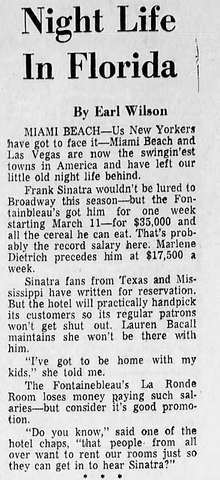
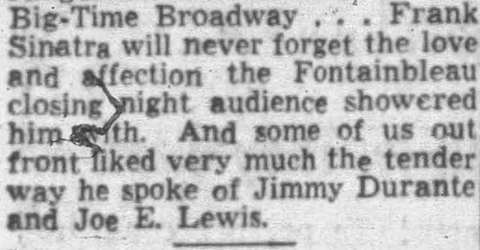
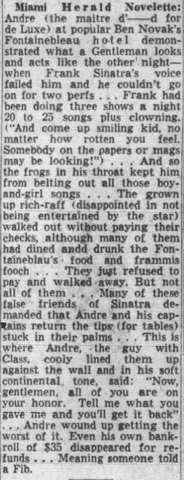
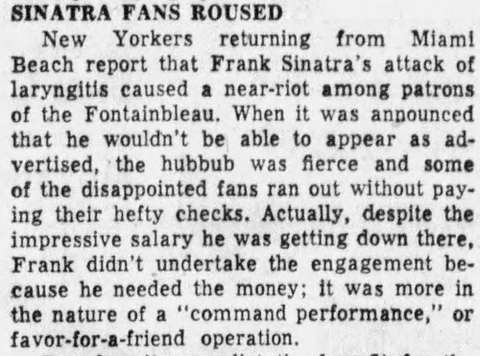
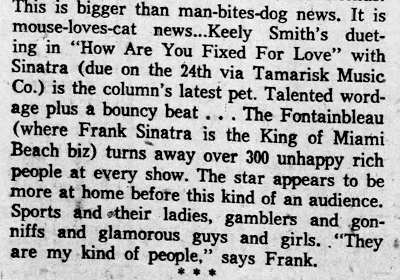
Frank opened at the Fontainbleau on 3-11 for a 12 day run. Variety reviewed the Saturday night show(15).
Frank did two shows a night during the week and three on the weekend dates.
I think this reviewer captured Sinatra's impact in a nightclub perfectly at the absolute apex of his career.The excitement is palpable throughout his description of
Sinatra on a stage, in his prime, electrifying the audience for an hour.
"Witchcraft," "I've Got You Under
My Skin," "When Your Lover Has Gone,"
"April In Paris," "Violets For Your Furs," "My
Funny Valentine, "One For My Baby," "Come
Fly With Me," "On The Road To Mandalay,"
"All The Way," "Chicago." were some of the songs done that night. He usually did 18 per per show. And sometimes he took requests.
--Ed note: Frank was unable to perform for at least two nights due to laryngitis. Joe E. Lewis and George DeWitt subbed for him.
Ed
.
Frank opened at the Fontainbleau on 3-11 for a 12 day run. Variety reviewed the Saturday night show(15).
Frank did two shows a night during the week and three on the weekend dates.
I think this reviewer captured Sinatra's impact in a nightclub perfectly at the absolute apex of his career.The excitement is palpable throughout his description of
Sinatra on a stage, in his prime, electrifying the audience for an hour.
"Witchcraft," "I've Got You Under
My Skin," "When Your Lover Has Gone,"
"April In Paris," "Violets For Your Furs," "My
Funny Valentine, "One For My Baby," "Come
Fly With Me," "On The Road To Mandalay,"
"All The Way," "Chicago." were some of the songs done that night. He usually did 18 per per show. And sometimes he took requests.
--Ed note: Frank was unable to perform for at least two nights due to laryngitis. Joe E. Lewis and George DeWitt subbed for him.
Ed
.
Frank opened at the Fontainbleau on 3-11 for a 12 day run. Variety reviewed the Saturday night show(15).
Frank did two shows a night during the week and three on the weekend dates.
I think this reviewer captured Sinatra's impact in a nightclub perfectly at the absolute apex of his career.The excitement is palpable throughout his description of
Sinatra on a stage, in his prime, electrifying the audience for an hour.
"Witchcraft," "I've Got You Under
My Skin," "When Your Lover Has Gone,"
"April In Paris," "Violets For Your Furs,"
"My
Funny Valentine, "One For My Baby," "Come
Fly With Me," "On The Road To Mandalay,"
"All The Way," "Chicago." were some of the songs done that night. He usually did 18 per per show. And sometimes he took requests.
--Ed
.
Frank opened at the Fontainbleau on 3-11 for a 12 day run. Variety reviewed the Saturday night show(15).
Frank did two shows a night during the week and three on the weekend dates.
I think this reviewer captured Sinatra's impact in a nightclub perfectly at the absolute apex of his career.The excitement is palpable throughout his description of
Sinatra on a stage, in his prime, electrifying the audience for an hour.
"Witchcraft," "I've Got You Under
My Skin," "When Your Lover Has Gone,"
"April In Paris," "Violets For Your Furs,"
"My
Funny Valentine, "One For My Baby," "Come
Fly With Me," "On The Road To Mandalay,"
"All The Way," "Chicago." were some of the songs done that night. He usually did 18 per per show. And sometimes he took requests.
--Ed note: Frank was unable to perform for at least two nights due to laryngitis.
Joe E.
Lewis and George DeWitt subbed for him.
Ed
.
Frank opened at the Fontainbleau on 3-11 for a 12 day run. Variety reviewed the Saturday night show(15).
Frank did two shows a night during the week and three on the weekend dates.
I think this reviewer captured Sinatra's impact in a nightclub perfectly at the absolute apex of his career.The excitement is palpable throughout his description of
Sinatra on a stage, in his prime, electrifying the audience for an hour.
"Witchcraft," "I've Got You Under
My Skin," "When Your Lover Has Gone,"
"April In Paris," "Violets For Your Furs,"
"My
Funny Valentine, "One For My Baby," "Come
Fly With Me," "On The Road To Mandalay,"
"All The Way," "Chicago." were some of the songs done that night. He usually did 18 per per show. And sometimes he took requests.
--Ed note: Frank was unable to perform for at least two nights due to laryngitis.
Joe E.
Lewis and George DeWitt subbed for him.
Ed
.
Frank opened at the Fontainbleau on 3-11 for a 12 day run. Variety reviewed the Saturday night show(15).
Frank did two shows a night during the week and three on the weekend dates.
I think this reviewer captured Sinatra's impact in a nightclub perfectly at the absolute apex of his career.The excitement is palpable throughout his description of
Sinatra on a stage, in his prime, electrifying the audience for an hour.
"Witchcraft," "I've Got You Under
My Skin," "When Your Lover Has Gone,"
"April In Paris," "Violets For Your Furs,"
"My
Funny Valentine, "One For My Baby," "Come
Fly With Me," "On The Road To Mandalay,"
"All The Way," "Chicago." were some of the songs done that night. He usually did 18 per per show. And sometimes he took requests.
--Ed note: Frank was unable to perform for at least two nights due to laryngitis.
Joe E.
Lewis and George DeWitt subbed for him.
Ed
.
Frank opened at the Fontainbleau on 3-11 for a 12 day run. Variety reviewed the Saturday night show(15).
Frank did two shows a night during the week and three on the weekend dates.
I think this reviewer captured Sinatra's impact in a nightclub perfectly at the absolute apex of his career.The excitement is palpable throughout his description of
Sinatra on a stage, in his prime, electrifying the audience for an hour.
"Witchcraft," "I've Got You Under
My Skin," "When Your Lover Has Gone,"
"April In Paris," "Violets For Your Furs,"
"My
Funny Valentine, "One For My Baby," "Come
Fly With Me," "On The Road To Mandalay,"
"All The Way," "Chicago." were some of the songs done that night. He usually did 18 per per show. And sometimes he took requests.
--Ed
.
Frank opened at the Fontainbleau on 3-11 for a 12 day run. Variety reviewed the Saturday night show(15).
Frank did two shows a night during the week and three on the weekend dates.
I think this reviewer captured Sinatra's impact in a nightclub perfectly at the absolute apex of his career.The excitement is palpable throughout his description of
Sinatra on a stage, in his prime, electrifying the audience for an hour.
"Witchcraft," "I've Got You Under
My Skin," "When Your Lover Has Gone,"
"April In Paris," "Violets For Your Furs,"
"My
Funny Valentine, "One For My Baby," "Come
Fly With Me," "On The Road To Mandalay,"
"All The Way," "Chicago." were some of the songs done that night. He usually did 18 per per show. And sometimes he took requests.
--Ed note: Frank was unable to perform for at least two nights due to laryngitis.
Joe E.
Lewis and George DeWitt subbed for him.
Ed
.
Frank opened at the Fontainbleau on 3-11 for a 12 day run. Variety reviewed the Saturday night show(15).
Frank did two shows a night during the week and three on the weekend dates.
I think this reviewer captured Sinatra's impact in a nightclub perfectly at the absolute apex of his career.The excitement is palpable throughout his description of
Sinatra on a stage, in his prime, electrifying the audience for an hour.
"Witchcraft," "I've Got You Under
My Skin," "When Your Lover Has Gone,"
"April In Paris," "Violets For Your Furs,"
"My
Funny Valentine, "One For My Baby," "Come
Fly With Me," "On The Road To Mandalay,"
"All The Way," "Chicago." were some of the songs done that night. He usually did 18 per per show. And sometimes he took requests.
--Ed note: Frank was unable to perform for at least two nights due to laryngitis.
Joe E.
Lewis and George DeWitt subbed for him.
Ed
.
Frank opened at the Fontainbleau on 3-11 for a 12 day run. Variety reviewed the Saturday night show(15).
Frank did two shows a night during the week and three on the weekend dates.
I think this reviewer captured Sinatra's impact in a nightclub perfectly at the absolute apex of his career.The excitement is palpable throughout his description of
Sinatra on a stage, in his prime, electrifying the audience for an hour.
"Witchcraft," "I've Got You Under
My Skin," "When Your Lover Has Gone,"
"April In Paris," "Violets For Your Furs,"
"My
Funny Valentine, "One For My Baby," "Come
Fly With Me," "On The Road To Mandalay,"
"All The Way," "Chicago." were some of the songs done that night. He usually did 18 per per show. And sometimes he took requests.
--Ed note: Frank was unable to perform for at least two nights due to laryngitis.
Joe E.
Lewis and George DeWitt subbed for him.
Ed
.
Frank opened at the Fontainbleau on 3-11 for a 12 day run. Variety reviewed the Saturday night show(15).
Frank did two shows a night during the week and three on the weekend dates.
I think this reviewer captured Sinatra's impact in a nightclub perfectly at the absolute apex of his career.The excitement is palpable throughout his description of
Sinatra on a stage, in his prime, electrifying the audience for an hour.
"Witchcraft," "I've Got You Under
My Skin," "When Your Lover Has Gone,"
"April In Paris," "Violets For Your Furs,"
"My
Funny Valentine, "One For My Baby," "Come
Fly With Me," "On The Road To Mandalay,"
"All The Way," "Chicago." were some of the songs done that night. He usually did 18 per per show. And sometimes he took requests.
--Ed
.
Frank opened at the Fontainbleau on 3-11 for a 12 day run. Variety reviewed the Saturday night show(15).
Frank did two shows a night during the week and three on the weekend dates.
I think this reviewer captured Sinatra's impact in a nightclub perfectly at the absolute apex of his career.The excitement is palpable throughout his description of
Sinatra on a stage, in his prime, electrifying the audience for an hour.
"Witchcraft," "I've Got You Under
My Skin," "When Your Lover Has Gone,"
"April In Paris," "Violets For Your Furs,"
"My
Funny Valentine, "One For My Baby," "Come
Fly With Me," "On The Road To Mandalay,"
"All The Way," "Chicago." were some of the songs done that night. He usually did 18 per per show. And sometimes he took requests.
--Ed
March 16, 1954
Radio
To Be Perfectly Frank
Network: NBC
Show: 37
Time: 8:15 p.m
Host: Frank Sinatra
Announcer: Edward King
1. Take A Chance Capitol Recording
2. April In Paris Sauter Finegan
3. I Get So Lonely The Four Knights
4 The Girl Next Door Capitol Recording
5. Sunny Side of The Street w/Sinatra Symphonette
Rocky Fortune, "Psychological Murder"
Network: NBC
Episode: 23
Time: 9:35 p.m.- 10 p.m.
Performers: Frank Sinatra, Maurice Hart, Frank Gerstle, Betty Lou Gerson, Marvin Miller.
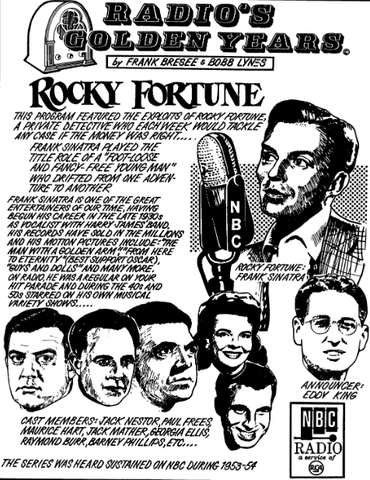
Writers: Norm Sickel,
Directors: Andrew C. Love
Announcer: Edward King
Description: Rocky witnesses the execution of the will of a wealthy woman who thinks that she's going insane.
Rocky Fortune, "Psychological Murder"
Network: NBC
Episode: 23
Time: 9:35 p.m.- 10 p.m.
Performers: Frank Sinatra, Maurice Hart, Frank Gerstle, Betty Lou Gerson, Marvin Miller.
Writers: Norm Sickel,
Directors: Andrew C. Love
Announcer: Edward King
Description: Rocky witnesses the execution of the will of a wealthy woman who thinks that she's going insane.
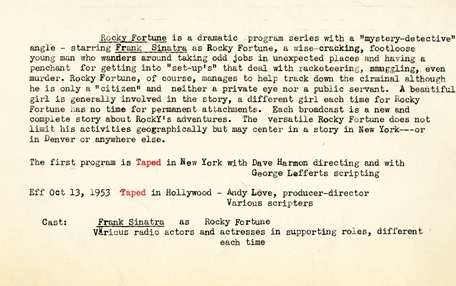
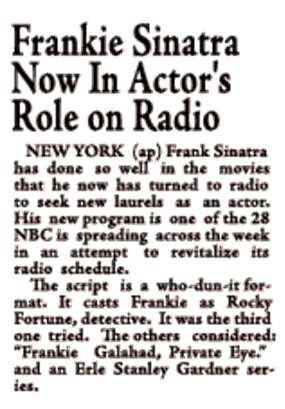
note: A pilot was done of "Frankie Galahad."
March 19, 1954
Radio
To Be Perfectly Frank
Network: NBC
Show: 38
Time: 8:15 p.m
Host: Frank Sinatra
Announcer: Edward King
1. I Can't Believe Your In Love With Me w/Sinatra Symphonette
2. Forever Yours Vicki Young
3. Anytime, Anywhere Capitol Recording
4. Cross Over The Bridge Patti Page
5. Montoona Clipper Les Brown
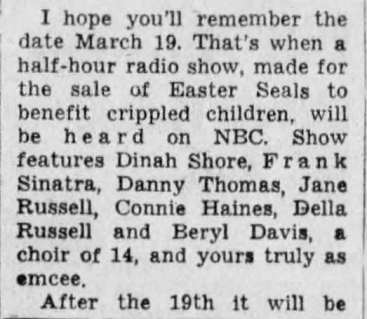
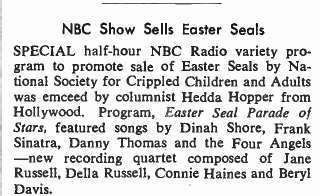
Easter Seals Parade of Stars
Frank Sinatra, Dinah Shore, Danny Thomas, Jane Russell, Connie Haines and others Television
NONE
Easter Seals Parade of Stars
Frank Sinatra, Dinah Shore, Danny Thomas, Jane Russell, Connie Haines and others
© 1997-2026 The Sinatra Archive
This calendar, or any parts thereof, may not be reproduced in any fashion whatsoever without the prior written permission of the publisher (The Sinatra Archive)

March 21, 1954
Radio
The Bing Crosby Show
Network: CBS
Sponsor: General Electric
Guests: Frank Sinatra
John Scott Trotter And His Orchestra
Announcer: Ken Carpenter
Producers: Bill Morrow, Murdo McKenzie
Transcriber: Murdo McKenzie
1. opening
2. Jones Boy - Bing Crosby
3. comedy - Bing Crosby & Ken Carpenter
4. Granada - Bing Crosby
5. Sinatra intro and discussion of "From Here To Eternity"
6. Young At Heart - Frank Sinatra
7. medley: Among My Souvenirs / September Song / As Time Goes By - Frank
Sinatra & Bing Crosby
8. G.E. Annual Report "commercial" disscusion - Bing Crosby
& Ken Carpenter
9. Wanted - Bing Crosby
10. closing
Note: The show appears on the officially released CD set: 60 Greatest
Old Time Radio Show "Frank Sinatra & Friends." TT: 30mins.
Audio Condition: Excellent.
March 23, 1954
Radio
To Be Perfectly Frank
Network: NBC
Show: 39
Time: 8:15 p.m
Host: Frank Sinatra
Announcer: Edward King
1. They Can't Take That Away From Me Capitol Recording
2. Come Over And Say Hello Connie Russell
3. The Doodle Town Fifers Sauter Finegan
4. Birth Of The Blues Columbia Recording
[image referenced in source but could not be recovered]
Rocky Fortune, "Rocket Racket"
Network: NBC
Episode: 24
Time: 9:35 p.m..- 10 p.m.
Performers: Frank Sinatra, Howard Culver, Don Diamond, Dan Riss, Edith Terry, William Oyler.
Writers: George Lefferts
Directors: Andrew C. Love
Announcer: Edward King
Description: Rocky signs to ride a rocket to the moon and the job pays $10,000!
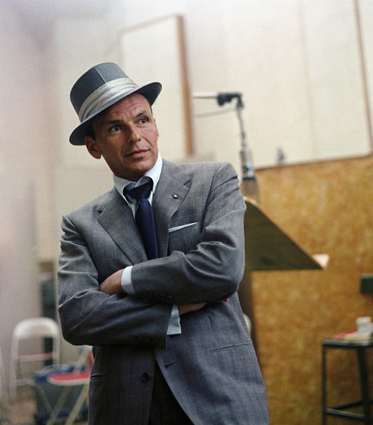
Sinatra during a recording session at Capitol Records in 1954. “I like recording late at night,” he once said. “The later the better. My voice was not meant for daytime use.” Source: photo and caption from J. Randy Taraborrelli, Sinatra: Behind the Legend (mptvimages.com).
March 24, 1954
[Frank flies from New York to Los Angeles before the Oscars]
Frank Sinatra: In the early hours of March 24, 1954, Frank left La Scala for Teterboro Airport and flew to Van Nuys aboard Van Heusen's plane, telling a well-wisher at dinner, 'I'm gettin' it,' about the Oscar.
Source: James Kaplan, "Frank: The Voice" (2010).
[Family dinner and the St. Genesius medal]
Frank drove straight from the airport to his former family home at 320 North Carolwood for an Italian dinner with Nancy and the kids. After dinner they presented him with a small white box: a gold medal of St. Genesius, patron saint of actors, on a chain, inscribed 'To Daddy—all our love from here to eternity,' a gift arranged by Big Nancy. Frank was moved to tears and wore it under his shirt collar.
Source: James Kaplan, "Frank: The Voice" (2010).
March 25, 1954
Frank Sinatra won the Academy Award for Best Supporting Actor for From Here to Eternity, presented at the Pantages Theatre with ex-wife Nancy and son Frank Jr. at his side — Nancy had given him a gold medallion inscribed “Dad, all our love, from here to eternity” at a birthday dinner earlier that day. Accepting the Oscar, a stunned Sinatra said, “I'm a song-and-dance type... I really don't know what to say.” The film swept eight Academy Awards including Best Picture, tying a record then held by Gone with the Wind; Variety called Sinatra's comeback “the greatest... in theater history.” Ava Gardner, also nominated (for Mogambo) but not a winner, sent a telegram rather than call, fearing her voice might spoil the moment for him. Source: J. Randy Taraborrelli, Sinatra: Behind the Legend.
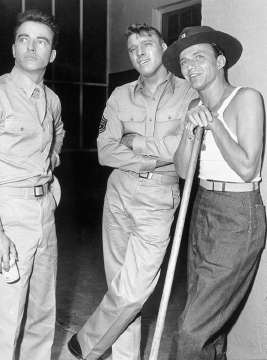
Frank stands with fellow actors Montgomery Clift (left) and Burt Lancaster between scenes on the set of From Here to Eternity. Sinatra’s performance won him an Oscar as best supporting actor in 1953. Source: photo and caption from J. Randy Taraborrelli, Sinatra: Behind the Legend (mptvimages.com).
[Sinatra wins Best Supporting Actor at the 26th Academy Awards] At the 26th Academy Awards at the Pantages Theatre, presenter Mercedes McCambridge announced Frank Sinatra as Best Supporting Actor for From Here to Eternity, beating Eddie Albert, Brandon De Wilde, Jack Palance, and Robert Strauss. Frank, seated with his children Nancy and Frankie Jr., trotted down the aisle to accept, kissing McCambridge and giving a brief, unprepared speech in which he joked he hadn't been asked to sing that night.
Source: James Kaplan, "Frank: The Voice" (2010).
[Greenson predicts Sinatra won't need him anymore]
Ralph Greenson: Watching the Oscar win on television in Santa Monica, psychiatrist Ralph Greenson told his wife, 'That's it. We'll never see him again,' correctly predicting that Frank's therapy would end now that he'd achieved this validation.
Source: James Kaplan, "Frank: The Voice" (2010).
[Sinatra credits Montgomery Clift backstage]
Frank Sinatra: At the post-ceremony press conference, alongside Harry Cohn, Buddy Adler, Fred Zinnemann, and Best Supporting Actress winner Donna Reed, Sinatra expressed regret that the absent Montgomery Clift hadn't won Best Actor, saying he'd learned more about acting from Clift than from anyone, comparing it to what he'd learned about musicals from Gene Kelly.
Source: James Kaplan, "Frank: The Voice" (2010).
[Sinatra walks Beverly Hills alone with his Oscar]
Frank Sinatra: After the ceremony, Frank skipped a congratulatory party Jule Styne had thrown at his apartment, instead driving alone through Beverly Hills, parking under a streetlight to hold and examine his statuette. He later recalled a police officer stopped him, uncertain whether he'd stolen it, until the officer's partner confirmed his identity.
Source: James Kaplan, "Frank: The Voice" (2010).
[Best Supporting Actor Oscar win]
At the Academy Awards ceremony, Sinatra won Best Supporting Actor for From Here to Eternity, launching what Kaplan calls the greatest comeback in show-business history, virtually overnight.
Source: James Kaplan, "Sinatra: The Chairman" (2015).
March 26, 1954
Radio
To Be Perfectly Frank
Network: NBC
Show: 40
Time: 8:15 - 8:30 p.m
Host: Frank Sinatra
Announcer: Edward King
1. From Here To Eternity Capitol Recording
2. Lovin' Spree Eartha Kitt
3. Boogie-Woogie Machine Ames Brothers
4. I'm A Fool To Want You Columbia Recording
5. Should I? w/ Sinatra Symphonette.
March 28, 1954
Radio
The Bing Crosby Show
Network: CBS
Sponsor: General Electric
Guests: Frank Sinatra.
John Scott Trotter And His Orchestra
Announcer: Ken Carpenter
Producers: Bill Morrow, Murdo McKenzie
Transcriber: Murdo McKenzie
1. opening
2. Oh Baby Mine - Bing Crosby
3. comedy - Bing Crosby & Ken Carpenter
4. Imagination - Bing Crosby
5. "Oscar" talk - Frank Sinatra & Bing Crosby
6. Take A Chance - Frank Sinatra
7. medley: Till We Meet Again / Meet Me Tonight in Dreamland / There's A
Long Long Trail - Frank Sinatra & Bing Crosby
8. G.E. "commercial" public vs private enterprise - Bing Crosby & Ken
Carpenter
9. The Breeze and I - John Scott Trotter And His Orchestra
10. If You Love Me (Really Love Me) - Bing Crosby
11. closing
Note: The show appears on the officially released CD set: 60 Greaest Old
Time Radio Show "Frank Sinatra & Friends" TT: 30mins. Audio Condition: Excellent.
Ed O'Brien:
Sinatra's reading of "Till We Meet Again," on Crosby's 3-28-54 show, is exquisite.
March 30, 1954
Radio
To Be Perfectly Frank
Network: NBC
Show: 41
Time: 8:15 p.m
Host: Frank Sinatra
Announcer: Edward King
1. Between The Devil And The Deep Blue Sea - Sinatra & Symphonette
2. Nancy - Columbia Recording
3. Pipe Dreams - Eileen Barton
4. Young At Heart - Capitol Recording
Rocky Fortune, "Boarding House Doublecross"
Network: NBC
Episode: 25
Time: 9:35 p.m.- 10 p.m.
Performers: Frank Sinatra,
Writers: George Lefferts
Directors: Andrew C. Love
Announcer: Edward King
Description: Rocky rents a room and finds himself in a boarding house doublecross.
Note: The show appears on the officially released CD set: 60 Greatest Old
Time Radio Show " Frank Sinatra & Friends."
March 31, 1954
Studio
20TH CENTURY FOX
THREE COINS IN THE FOUNTAIN
Arranged and conducted by Victor Young
Wednesday
5 to 6:15 PM
Three Coins In The Fountain
Ed O'Brien:
Sinatra's first recording of the Cahn/Styne tune was at Capitol on 3-1-54. Nelson Riddle employed a 34 piece orchestra. His Reprise recording with Riddle, done on 1-27-64, used a 35 piece orchestra.
But the one in the middle, recorded for the film and played over the opening credits, is the gem. Young used a 50 piece orchestra. I much preferred his arrangement. There is less of a string sound and Sinatra simply soars. He hits an incred- ibly high last note on "mine." The edited version heard on the soundtrack only runs 1:30, but the recording has a running time of 3:40. Great Sinatra.
note: There is a fourth recording that was actually the first one laid down in mid-January of 1954. Done at the behest of Cahn and Styne, the demo record was presented to 20th Century Fox for consideration as the opening song over the credits of the film. The Capitol recording ( 3-1-54 ) reached #4 on the Billboard Hot 100 and charted for 13 weeks. It required 4 takes. I would bet the one done on the sound stage of 20th Century demanded more than that from Sinatra. Frank sang the song on TV and in his concert appearances.
Ed
20TH CENTURY FOX
THREE COINS IN THE FOUNTAIN
Arranged and conducted by Victor Young
Wednesday
5 to 6:15 PM
Three Coins In The Fountain
[image referenced in source but could not be recovered]
[image referenced in source but could not be recovered]
April 1954
[Swing Easy! recorded]
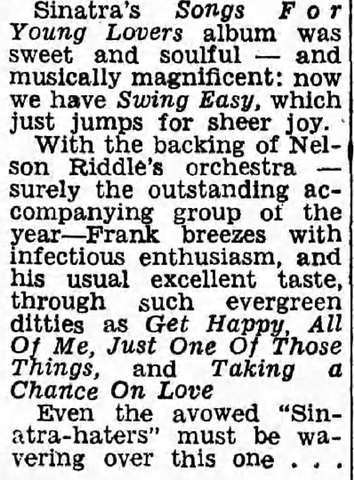
Kaplan: Sinatra's second Capitol album, Swing Easy!, was recorded in April 1954 and was far more thoroughly a Riddle collaboration than Songs for Young Lovers had been.
Source: James Kaplan, "Sinatra: The Chairman" (2015)
April 2, 1954
Studio
KHJ Studios, Hollywood
12511 The Sea Song (By The Beautiful Sea)
(Arthur Schwartz - Dorothy Fields)
Conducted by Nelson Riddle
(2:56) CD: C2 724383808922 The Complete Capitol Singles
LP: ST26784 The Rarities - Volume One (Australian Capitol Release)
Mannie Klein, Conrad Gozzo (tpt); Joe Howard, Tommy Pederson (tbn); John Graas, Vincent DeRosa (fr·h); Skeets Herfurt, Jules Kinsler, Jules Jacob, Arthur Fleming (sax/wwd); Felix Slatkin, Paul Shure, Emanuel Moss, Victor Bay, Alex Beller, Mischa Russell (vln); Cy Bernard (vie); Kathryn Julye (harp); Bill Miller, Paul Smith (p); Allan Reuss (g); Mike Rubin (b); Lou Singer (d); Lee Gotch, Clark Yocum, Allan Davies, Charles Schrouder, Marie Vernon, Eileen Neeley, Jana Ekelund, Dorothy McCarty (vocal).
Note: The song is from the Broadway musical "By The Beautiful Sea." The show opened at the Majestic Theatre, in New York, on 4-8-54.
Frank was hoping the show would be a hit and the song would be carried along with it. He was a great admirer of both Arthur Schwartz and Dorothy Fields. The story takes place at Coney Island in 1907 and Shirley Booth was the star. She sang "The Sea Song" and her performance received rave reviews. The critics gave the story and score less than enthusiastic reviews. It ran for 270 performances and this was credited to the star power of Ms. Booth.
Nelson Riddle wrote a chart that captures the mood of the early music of the century. The 23 piece orchestra and the vocal octet surround Sinatra with that nostalgic sound. Capitol didn't see the song as a viable single and it was put on the back burner. It escaped on an Australian LP in the mid-1970s and was finally released in this country on "The Complete Singles" - 4 CD set in 1996. It was a bonus track on the fourth disc.
Arthur Schwartz's son, Jonathan, has put up with my ribbing about the recording for well over 45 years. He did tell me his father thought Frank did a terrific vocal. Jonathan liked playing it when he was on WNEW, because the recording was very rare for many years. --Ed
Radio
To Be Perfectly Frank
Network: NBC
Show: 42
Time: 8:15 p.m
Host: Frank Sinatra
Announcer: Edward King
1. Love Is Just Around The Corner FS (with Symphonette)
2. For Dancers Only - Jimmie Lunceford
3. I'll Always Be In Love With You - Kay Starr
4. Y'all Come - Bing Crosby
5. Take A Chance - FS (Record)
Television
None
Frank recorded songs for the Swing Easy! album, including 'All of Me' and 'Taking a Chance on Love,' along with 'Just One of Those Things,' which he considered the saddest song ever written despite its up-tempo arrangement.
Source: Nancy Sinatra, Frank Sinatra: An American Legend, 1995.
April 5, 1954
[Maggio letter to "Lew"]
Frank Sinatra: Eleven days after his Oscar win, Sinatra typed a note on Paramount stationery to a friend addressed "dear lew," written entirely in lowercase and in the third person, in character as PFC Angelo Maggio, signed "maggio." Kaplan notes Kitty Kelley claimed the letter was addressed to producer Leland Hayward and held at the NYPL, but a search found no such document there; a scanned copy from a Sinatra archivist clearly reads "Dear Lew," possibly director Lewis Allen or Lewis Milestone.
Source: James Kaplan, "Sinatra: The Chairman" (2015).
April 6, 1954
Radio
To Be Perfectly Frank
Network: NBC
Show: 43
Time: 8:15 p.m
Host: Frank Sinatra
Announcer: Edward King
Script By: Bob Smith
Directed By: Andy Love
1. opening
2. Sposin' - Frank Sinatra
3. The Night We Called It A Day - Frank Sinatra
4. I Want A Sunday Kind Of Love - Ella Fitzgerald
3. Put Your Dreams Away - Frank Sinatra
4. closing
5. PSA spot
April 7, 1954
Studio
KHJ Studios, Hollywood
12430 Sunday
(Miller/Krueger/ Conn/Styne)
Arranged & Conducted by Nelson Riddle
(2:31) EP: Capitol EAP-528 Swing Easy!
LP: W-587 Swing Easy!
CD: CDP 48470 Songs For Young Lovers & Swing Easy
12431 Just One Of Those Things
(Cole Porter)
Arranged & Conducted by Nelson Riddle
(3:14) EP: Capitol EAP-528 Swing Easy!
LP: W-587 Swing Easy!
CD: CDP 48470 Songs For Young Lovers & Swing Easy
12432 I'm Gonna Sit Right Down And Write Myself A Letter
(Fred E Ahlert/Joe Young)
Arranged & Conducted by Nelson Riddle
(2:29) EP: Capitol EAP-528 Swing Easy!
LP: W-587 Swing Easy!
CD: CDP 48470 Songs For Young Lovers & Swing Easy
12433 Wrap Your Trouble In Dreams
(Barris/Moll/ Koehler)
Arranged & Conducted by Nelson Riddle
(2:17) EP: Capitol EAP-528 Swing Easy!
LP: W-587 Swing Easy!
CD: CDP 48470 Songs For Young Lovers & Swing Easy
note: I was stunned when Riddle told me this was the best work he did with
Sinatra. He felt the idea behind this album was perfectly realized. Frank
wanted swinging songs that fit his nightclub performances. Frank and
Nelson redefined the eight songs and they were a huge addition to his
act for many years.
Ed
KHJ Studios, Hollywood
12430 Sunday
12431 Just One Of Those Things
12432 I'm Gonna Sit Right Down And Write Myself A Letter
12433 Wrap Your Trouble In Dreams
KHJ Studios, Hollywood
12430 Sunday
(Miller/Krueger/ Conn/Styne)
Arranged & Conducted by Nelson Riddle
(2:31) EP: Capitol EAP-528 Swing Easy!
LP: W-587 Swing Easy!
CD: CDP 48470 Songs For Young Lovers & Swing Easy
12431 Just One Of Those Things
(Cole Porter)
Arranged & Conducted by Nelson Riddle
(3:14) EP: Capitol EAP-528 Swing Easy!
LP: W-587 Swing Easy!
CD: CDP 48470 Songs For Young Lovers & Swing Easy
12432 I'm Gonna Sit Right Down And Write Myself A Letter
(Fred E Ahlert/Joe Young)
Arranged & Conducted by Nelson Riddle
(2:29) EP: Capitol EAP-528 Swing Easy!
LP: W-587 Swing Easy!
CD: CDP 48470 Songs For Young Lovers & Swing Easy
12433 Wrap Your Trouble In Dreams
(Barris/Moll/ Koehler)
Arranged & Conducted by Nelson Riddle
(2:17) EP: Capitol EAP-528 Swing Easy!
LP: W-587 Swing Easy!
CD: CDP 48470 Songs For Young Lovers & Swing Easy
note: Riddle told me this was the best
album he did with Sinatra. Frank wanted
songs he could sing in saloons and Nelson
was very proud of the final results.
Ed
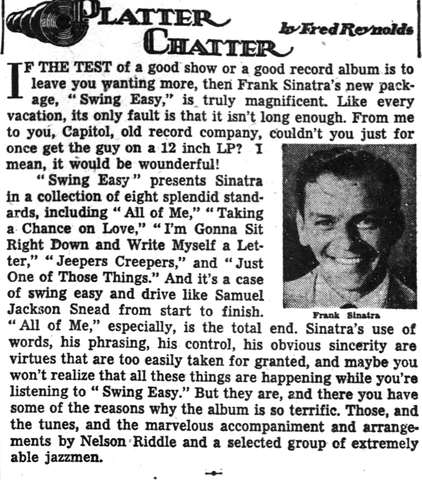
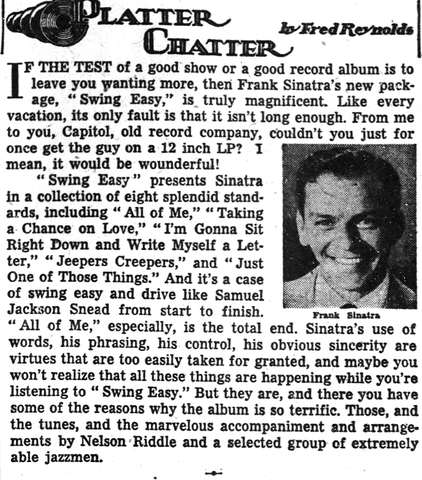
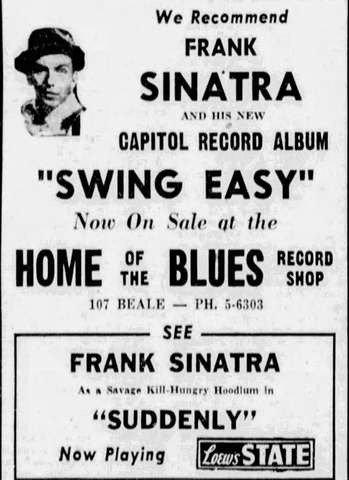
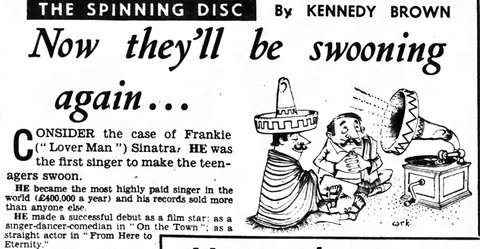
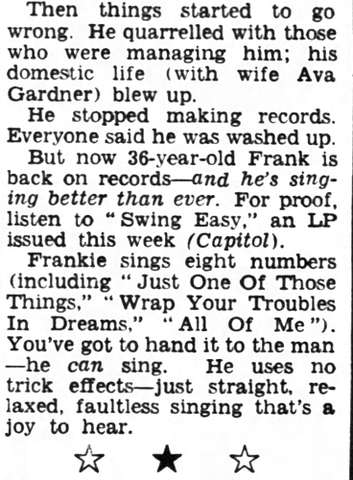
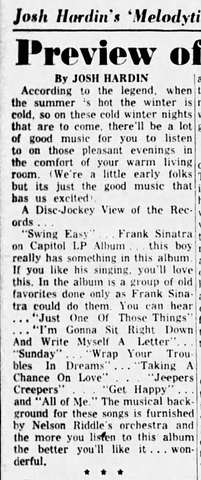
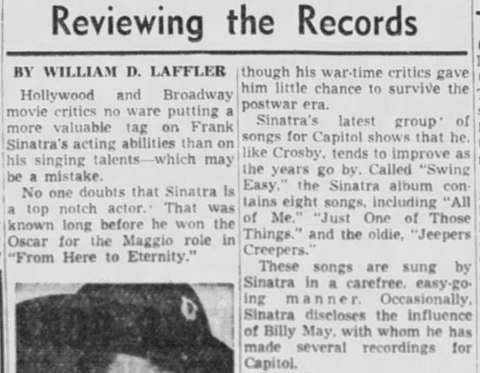
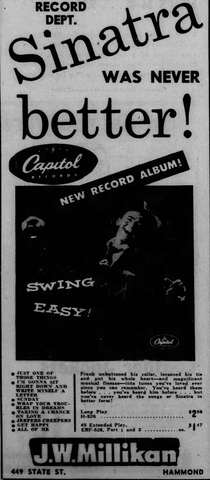
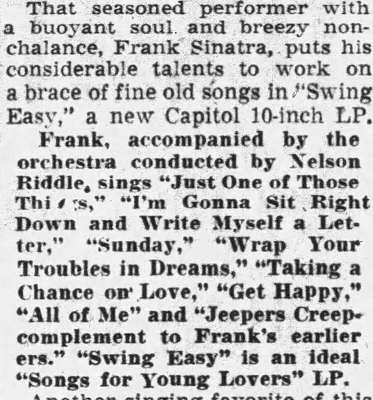
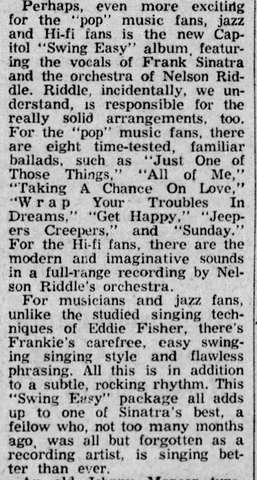
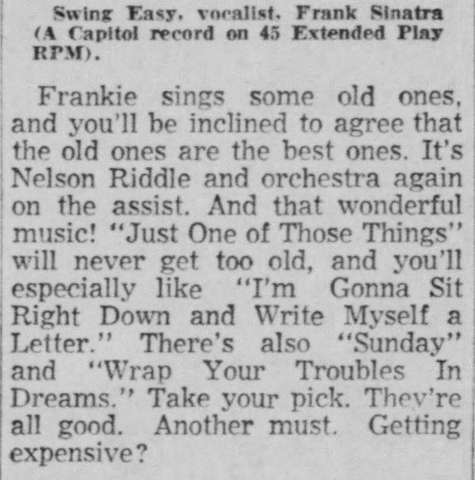
Here is a vintage review:
Chicago Tribune
April 9, 1954
Radio
To Be Perfectly Frank
Network: NBC
Show: 44
Time: 8:15 p.m
Host: Frank Sinatra
Announcer: Edward King
Script By: Bob Smith
Directed By: Andy Love
1. opening
2. I Love You - Frank Sinatra (Capitol)
3. Don't Blame Me - Frank Sinatra
4. Baubles, Bangles And Beads - Georgia Gibbs
5. I Dream Of You - Frank Sinatra (Columbia)
6. closing
7. PSA spot
Television
None
April 10, 1954
Returning to the scene of his first big break, Frank made a brief appearance on the Major Bowes Amateur Hour, the show that had launched the Hoboken Four years earlier.
Source: Nancy Sinatra, Frank Sinatra: An American Legend, 1995.
April 13, 1954
Radio
To Be Perfectly Frank
Network: NBC
Show: 45
Time: 8:15 p.m
Host: Frank Sinatra
Announcer: Edward King
1. Take A Chance Capitol Recording
2. A Foggy Day Capitol Recording
3. The Gypsy Louis Armstrong
4. Blue Moon w/ Sinatra Symphonette
5. If I Could Be With You w/Sinatra Symphonette
April 16, 1954
Radio
To Be Perfectly Frank
Network: NBC
Show: 46
Time: 8:15 p.m
Host: Frank Sinatra
Announcer: Edward King
1. Just You, Just Me --w/Sinatra Symphonette
2. Young At Heart -- Capitol Recording
3. Bell-Bottom Blues -- Teresa Brewer
4. Lamplighters Serenade --RCA Recording
5. Please Understand --The Pied Pipers
Television
None
April 19, 1954
Studio
KHJ Studios, Hollywood
12564 All Of Me
(S. Simons/G. Marks)
Bourne Co. (ASCAP)
Arranged & Conducted by Nelson Riddle
-16 (2:07) CD: C2-94777 The Capitol Years
CD: CDP 7-48470-2 Songs For Young Lovrs/Swing Easy
LP: W1429 Swing Easy
12565 Jeepers Creepers
(Harry Warren/Johnny Mercer)
Arranged & Conducted by Nelson Riddle
CD: CDP 7-48470-2 Songs For Young Lovers/Swing Easy
LP: W1429 Swing Easy
12566 Get Happy
(Ted Koehler/Harold Arlen)
Arranged & Conducted by Nelson Riddle
CD: CDP 7-48470-2 Songs For Young Lovers/Swing Easy
LP: W1429 Swing Easy
12567 Taking A Chance On Love
(Duke/LaTouche/ Fetter)
SBK Miller Catalog Inc. (ASCAP)
Arranged & Conducted by Nelson Riddle
-5 (2:19) CD: C2-94777 The Capitol Years
CD: CDP 7-48470-2 Songs For Young Lovers/Swing Easy
LP: W1429 Swing Easy
Ed O'Brien notes:
What great, great recordings. A perfect example
of the magic of Sinatra/Riddle.
When I asked Riddle what was the best thing he ever did
with Sinatra, he shocked me by naming "Swing Easy." Riddle
explained to me that they were trying to create a small combo
sound that Frank could use in his nightclub performances. He
felt they had redefined the songs done for "Swing Easy" and
perfectly realized the concept they had in mind. Sinatra
obviously agreed because the tunes were a staple of his
stage work for many years.
KHJ Studios, Hollywood
12564 All Of Me
12565 Jeepers Creepers
12566 Get Happy
12567 Taking A Chance On Love
[Louella Parsons on Sinatra's comeback]
Louella Parsons: In her syndicated column, Louella Parsons wrote that "the whole world is changing for Frank Sinatra," noting he now had so many job offers he could pick and choose, particularly in film.
Source: James Kaplan, "Sinatra: The Chairman" (2015).
[Jeepers Creepers / Just One of Those Things / Get Happy / Taking a Chance on Love / Wrap Your Troubles in Dreams -- critical commentary]
Al Viola; Will Friedwald (analysis): Friedwald's track-by-track reading of Sinatra's second Capitol (ten-inch) album, arranged entirely by Riddle: on 'Just One of Those Things' Sinatra fashions a mock twelve-bar-blues out of 'good-bye and amen'; on 'Get Happy' he repeats the opening line under a fadeout like an echoed horn lick; guitarist Al Viola noted Sinatra was 'still a crooner... but now he was also the swinger,' citing 'the Lady Is a Tramp' as an example of the new style; Sinatra sings 'I'm in the groove again' in 'Taking a Chance on Love' meaningfully. The remake of 'Wrap Your Troubles in Dreams' (a year after the aborted overbusy 1953 chart) is clean and streamlined, with a hot chase chorus between clarinetist Eddie Miller and trombonist Ray Sims, and Sinatra's vocal closer than ever to early-1940s Billie Holiday. 'Jeepers Creepers' features a trombone hocket passage Friedwald likens to Ellington's 1938 'Braggin' in Brass,' plus a Harry Edison solo.
This song/context matches multiple dated entries in the chronology; the specific date Friedwald is referring to could not be determined with confidence.
Source: Will Friedwald, "Sinatra! The Song Is You: A Singer's Art" (2018 revised edition), Ch. 6, "With Nelson Riddle" (1953-1979)
April 20, 1954
Radio
To Be Perfectly Frank
Network: NBC
Show: 47
Time: 8:15 p.m
Host: Frank Sinatra
Announcer: Edward King
1. S' Wonderful w/Sinatra Symphonette
2. Young At Heart Capitol Recording
3. Answer Me Nat King Cole
4. They Can't Take That Away Capitol Recording
5. The Lost Chord Jimmy Durante
April 23, 1954
Radio
To Be Perfectly Frank
Network: NBC
Show: 48
Time: 8:15 p.m
Host: Frank Sinatra
Announcer: Edward King
1. Them There Eyes
2. Heart Of My Heart - Les Elgart
3. Where Can I Go Without You - Peggy Lee's
4. Put Your Dreams Away
Television
NONE
April 27, 1954
Radio
To Be Perfectly Frank
Network: NBC
Show: 49
Time: 8:15 p.m
Host: Frank Sinatra
Announcer: Edward King
1. Everything Happens To Me live performance with symphonette
2. Serenata Leroy Anderson
3. 'Deed I Do Lena Horne
4. Violets For Your Furs Frank Sinatra Capitol recording
April 28, 1954
Radio
Amos 'N' Andy Music Hall
Hollywood
Starring Freeman Gosden and Charles Correll
CBS
Wednesday evening
Sponsored by Campbell's Soup
Johnson & Johnson
GE
30 minutes
Guest: Frank Sinatra
Birth Of The Blues ( Col. recording)
Frank is introduced by Amos 'N' Andy and is interviewed by them Young At Heart ( Cap. recording)
Amos N' Andy also play songs by
Nat Cole, Jo Stafford and others.
Ed O'Brien: Amos 'N' Andy became a very controversial show. I found it to be a very funny back in the late forties, early fifties. Sapphire and Kingfish would leave me howling with their marvellous antics.
As a child, I certainly wasn't aware of the racial element that appalled many at the time. In the innocence of childhood, it was just a very funny radio show with memorable characters.
Amos 'N' Andy Music Hall
Hollywood
Starring Freeman Gosden and Charles Correll
CBS
Wednesday evening
Sponsored by Campbell's Soup
Johnson & Johnson
GE
30 minutes
Guest: Frank Sinatra
Birth Of The Blues ( Col. recording)
Frank is introduced by Amos 'N' Andy and is interviewed by them Young At Heart ( Cap. recording)
Amos N' Andy also play songs by
Nat Cole, Jo Stafford and others.
Ed O'Brien: Amos 'N' Andy became a very controversial show. I found it to be a very funny back in the late forties, early fifties. Sapphire and Kingfish would leave me howling with their marvellous antics.
As a child, I certainly wasn't aware of the racial element that appalled many at the time. In the innocence of childhood, it was just a very funny radio show with memorable characters.
note: This show was a pilot for a projected Monday through Friday broadcast. Amos "n" Andy would spin records and do comedy skits with Kingfish. Pilot was taped on 4-28-54. Gosden and Correll went out of there way with the commercial spots. I can find no evidence that the show was ever aired. CBS did pick it up as a sustainer and it had its debut on 9-13-54. The 9/15 show included an edited version of Sinatra's appear- on the audition tape. It quite obvious Frank was not in the studio for the pilot program. He answered a bunch of questions similar to the "Meet Danny Wilson" and "From Here To Eternity" broad- casts. Ask by Kingfish if he is married to Zsa Zsa Gabor, Frank tells him he is married to Ava Gardner. The September show has no response from Frank. Harlow Wilcox is the announcer on both programs. Songs on April taping: 1. Oh ! Baby Mine ( I Get So Lonely ) The Four Knights 2. Make Love To Me Jo Stafford 3. A Little Bird Told Me Evelyn Knight 4. Answer Me, My Love Nat King Cole 5. Birth Of The Blues* Frank Sinatra 6. Young At Heart Frank Sinatra 7. Cross Over The Bridge Patti Page * Only about five seconds of "Birth of the Blues" is played. Amos 'n' Andy asked Frank to bring along a record. The pilot has "Young At Heart" and the Sept. broadcast has "Birth of the Blues.." Correll states that Frank considers it to be his finest recording. In the fall of 54, CBS could not find a sponsor for the show. Finally, in early 55, CBS started selling Columbia TVs on the show. Ed
April 30, 1954
Radio
To Be Perfectly Frank
Network: NBC
Show: 50
Time: 8:15 p.m
Host: Frank Sinatra
Announcer: Edward King
1. Taking A Chance On Love w/live symphonette
2. Easy Come, Easy Go Sarah Vaughan
3. Frere Jacques Nelson Riddle
4. Bright Eyed And Bushy Tailed Eileen Barton
5. This Love Of Mine w/ live symphonette
Television
NONE
May 1954
[Hopper reports Sinatra eyed for Sky Masterson]
Kaplan (citing Hedda Hopper): A Hedda Hopper column of early May 1954 reported Goldwyn wanted Sinatra for the Sky Masterson role (which she referred to via actor Guy Madison) in Guys and Dolls, before Goldwyn and Mankiewicz began pursuing Brando for the part instead.
Source: James Kaplan, "Sinatra: The Chairman" (2015)
[Shooting Suddenly in Newhall]
Kaplan: That April and May, Sinatra shot the black-and-white noir film Suddenly in Newhall, California, playing a would-be presidential assassin armed with a rifle -- the only out-and-out villain role of his career.
Source: James Kaplan, "Sinatra: The Chairman" (2015)
[Wood meets Sinatra at Warner Bros. commissary]
Kaplan (citing Suzanne Finstad): Cast in a small role in The Silver Chalice, fifteen-year-old Natalie Wood met Sinatra at the Warner Bros. commissary while he was preparing Young at Heart; her stage mother, Maria "Mud" Gurdin, encouraged the acquaintance for career advancement, and Frank invited them to a party at his house.
Source: James Kaplan, "Sinatra: The Chairman" (2015)
[Romance with Mona Freeman]
Sinatra was linked to a new romance, actress Mona Freeman, around the time Ava Gardner returned to New York.
Source: George Carpozi Jr., Frank Sinatra: Is This Man Mafia? (New York: Manor Books, 1979).
May 4, 1954
Radio
To Be Perfectly Frank
Network:
Show: 51
Time:
Host: Frank Sinatra
Announcer: Edward King
1. Thou Swell (with the Sinatra Symphonette)
2. Peachtree Street (record - Sinatra & Rosemary Clooney)
3. The Anything Can Happen Mambo - Mel Torme
4. I Concentrate On You (record - Sinatra)
5. I Can't Believe That Your In Love With Me (with the Sinatra Symphonette)
Ed O'Brien:
"Thou Swell" and "I Can't Believe You're In Love With Me" are both live studio tracks with the Sinatra Symphonette. Rosie Clooney is Frank's duet partner on "Peachtree Street." Frank received a writer's credit on ditty Dinah Shore refused to record with him.
May 7, 1954
Radio
To Be Perfectly Frank
Network:
Show: 52
Time:
Host: Frank Sinatra
Announcer: Edward King
1. You Took Advantage Of Me - with Sinatra Symphonette
2. Bop Goes My Heart - Instrumental
3. It's Nice To Have You Home - Margaret Whiting
4. September Song - with just Bill Miller on piano
5. What Is This Thing Call Love - with Sinatra Symphonette
Television
None
May 11, 1954
Radio
To Be Perfectly Frank
Network:
Show: 53
Time:
Host: Frank Sinatra
Announcer: Edward King
1. Let's Fall In Love - Sinatra & Symphonette
2. Where Can I Go Without You - Peggy Lee
3. Almost Like Being In Love - Nat King Cole
4. Embraceable You - Sinatra's Columbia recording
Ed O'Brien:
Terrific vocal by Sinatra on "Let's Fall In Love."
And so different from the treatment given this gem on "RADD."
May 13, 1954
Studio
KHJ Studios. Hollywood
12642 The Gal That Got Away
(H. Arlen/I. Gershwin)
Arranged & Conducted by Nelson Riddle
CD: C2 724383808922 The Complete Capitol Singles
LP: T768 This Is Sinatra!
45: 2864
NOTE: This song is much more closely associated with Judy Garland, Sinatra Scholar Ed O'Brien reminds us, but Sinatra actually had a slightly bigger hit back in 1954 and he sang it in concert for many years. The 1981 recording is simply the 1954 arrangement slowed down. Sinatra also did a memorable performance of the song on the Hollywood Palace in 1965.
12643 Half As Lovely (Twice As True)
(L. Spence/S. Gallop)
Arranged & Conducted by Nelson Riddle
CD: C2 724383808922 The Complete Capitol Singles
LP: W982 This Is Sinatra Vol.2
45: 2864
12644 It Worries Me
(Schulz/Reichel/ Sigman)
Arranged & Conducted by Nelson Riddle
CD: C2 724383808922 The Complete Capitol Singles
CD: CDP 7-91209-2 Where Are You?
LP: W1432 Songs For Young Lovers
45: 2922
Ed O'Brien:
Frank loved the lyrics Lew Spence wrote for this song. He asked Lew to write more tunes for him. Lew obliged and wrote "If I Had Three Wishes." Spence was at the session , 3-7-55, when Frank laid it down. After getting a master take, Frank gave Lew an earful. Wanted to know why he wrote such a damn difficult song to sing after "Half As Lovely" was so easy.
Lew told me the musicians started laughing and that broke Frank up. Lew would do six more songs for Sinatra during the Capitol years.
Musicians - Reed: Mahlon Clark, Chuck Gentry, Arthur "Skeets" Herfurt, Arthur Kafton, Ted Nash, Warren Webb; Trumpet: Conrad Gozzo, Rubin "Zeke" Zarchy; Trombones: Dick Noel, Tommy Pederson; Brass Trombone: George Roberts; Violins: Victor Bay, Harry Bluestone, Walter Edelstein, George Kast, Nick Pisani, Mischa Russell, Eudice Shapiro, Paul Shure, Felix Slatkin; Violas: Maxine Johnson, Paul Robyn; Cellos: Cy Bernard, Eleanor Slatkin; Piano: Bill Miller; Bass: Joe Comfort; Guitar: Bobby Gibbions; Drums: Alvin Stoller; Harp: Kathryn Julye
Session Producer: Voyle Gilmore
KHJ Studios. Hollywood
12642 The Gal That Got Away
12643 Half As Lovely (Twice As True)
12644 It Worries Me
------------------------------------
May 13, 1960 SHARE, Inc. benefit party at the Moulin Rouge, Los Angeles
Frank Sinatra & girlfriend Juliet Prowse in costume at the SHARE, Inc. benefit party at the Moulin Rouge, Los Angeles, May 13, 1960
[image referenced in source but could not be recovered]
[image referenced in source but could not be recovered]
[image referenced in source but could not be recovered]
[image referenced in source but could not be recovered]
[image referenced in source but could not be recovered]
[image referenced in source but could not be recovered]
[image referenced in source but could not be recovered]
[Riddle session: torch songs for Ava]
With Nelson Riddle conducting a twenty-nine-piece orchestra, Sinatra recorded three songs seemingly addressed to Ava Gardner: "The Gal That Got Away," "Half as Lovely (Twice as True)," and "It Worries Me."
Source: James Kaplan, "Sinatra: The Chairman" (2015).
[The Gal That Got Away / It Never Entered My Mind -- critical commentary]
Vinnie Falcone: The one non-Jenkins track on She Shot Me Down was a medley, 'The Gal That Got Away/It Never Entered My Mind,' a Don Costa arrangement melding two original Nelson Riddle charts. Falcone conducted the orchestral portion, then dismissed the band and privately recorded the piano-vocal section with Sinatra in the booth.
This song/context matches multiple dated entries in the chronology, or lacked a sufficiently precise date; the specific date could not be determined with confidence.
Source: Charles L. Granata, "Sessions with Sinatra: Frank Sinatra and the Art of Recording" (1999/2003), Part IV: The Reprise Years
May 14, 1954
Radio
To Be Perfectly Frank
Network:
Show: 54
Time:
Host: Frank Sinatra
Announcer: Edward King
1. My Blue Heaven w/ Sinatra symphonette
2. Jesse James Eileen Barton
3. It Happened Once Before The Four Freshmen
4. My Funny Valentine Capitol recording
5. I'm Gonna Live Till I Die Frankie Laine
Ed O'Brien
Frank and Frankie Laine both recorded "I'm Gonna
Live Till I Die." And on different labels. It was very generous of Mr. Sinatra to give Mr Laine's a spin.
Television
None
TV Guide published a feature headlined "Can Frank Sinatra Make Good in TV," questioning whether Sinatra's moody, mercurial temperament suited the relaxed, easygoing manner television audiences expected of a variety-show host.
Source: Albert Auster, "Frank Sinatra: The Television Years–1950–1960," Journal of Popular Film and Television, 26:4 (1999), 166-174.
May 15, 1954
"Young at Heart" reached its chart peak of No. 2 before drifting down over the following weeks. Havers calls it the record that "consummated" Frank's musical partnership with Nelson Riddle. (Source: Richard Havers, "Sinatra" (Dorling Kindersley, 2007).)
May 18, 1954
Radio
To Be Perfectly Frank
Network:
Show: 55
Time:
Host: Frank Sinatra
Announcer: Edward King
1. Out Of Nowhere Sinatra and Symphonette
2. I Get So Lonely Four Knights
3. Bright Eyed And Bushy Tailed Eileen Barton
4..Where Or When Sinatra and Symphonette
5. Montoona Clipper Les Brown and His Band Of Renown
May 21, 1954
Radio
To Be Perfectly Frank
Network:
Show: 56
Time:
Host: Frank Sinatra
Announcer: Edward King
1. Three Coins In A Fountain ( Capitol recording)
2. A String Of Pearls Glenn Miller & His Orchestra
3. Rain ( Capitol recording)
4. Tenderly Bill Miller on piano
NOTE: Jonathan Schwartz told Ed O'Brien that he won a number of bets on Sinatra's recording of the Walter Gross classic, "Tenderly." Bar patron after bar patron was absolutely certain that there was a Sinatra commercial recording of it. There is not.
Television
None
May 25, 1954
Radio
To Be Perfectly Frank
Network:
Show: 57
Time:
Host: Frank Sinatra
Announcer: Edward King
1. I'm Confessin' w/ symphonette
2. No One But You Connie Russell
3. Don't Worry 'bout Me Capitol recording
4. As Time Goes By* w/symphonette
5. The Story Of Three Loves Richard Heyman
* On the Frank Sinatra Bobbi Show, 3-16-55, Frank sang the classic from "Casablanca" with just Bill Miller backing him on piano..
Ed O'Brien reports that two of these songs were done with the Sinatra Symphonette. "I'm Confessin'" is terrific with castanets and "As Time Goes By" is quiet and lovely.
May 28, 1954
Radio
To Be Perfectly Frank
Network:
Show: 58
Time:
Host: Frank Sinatra
Announcer: Edward King
1. If I Had You w/ Sinatra symphonette
2. Marie Tommy Dorsey & His Orchestra
3. These Foolish Things Columbia recording
4. From This Day Forward Columbia recording
May 31, 1954
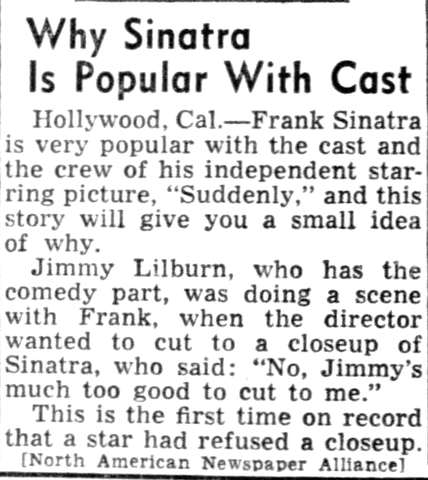
June 1954
[Three Coins in the Fountain premieres]
Kaplan: The film Three Coins in the Fountain, starring Louis Jourdan and Jean Peters, premiered in June 1954; Kaplan judges Sinatra's title-song vocal over the credits the best part of an otherwise insipid picture.
Source: James Kaplan, "Frank: The Voice" (2010)
[Wilson reports Sinatra now wanted for Nathan Detroit]
Kaplan (citing Earl Wilson): By June 1954, columnist Earl Wilson was reporting that Goldwyn wanted Sinatra to play Nathan Detroit instead of Sky Masterson.
Source: James Kaplan, "Sinatra: The Chairman" (2015)
[Wood-Sinatra affair suspected]
Kaplan: Wood frequented Sinatra's apartment through May and June 1954, and her close friends believed the two were having an affair; Kaplan notes the bond continued off and on, including periodic romantic contact, until Wood's death at age forty-three in 1981.
Source: James Kaplan, "Sinatra: The Chairman" (2015)
June 1, 1954
Radio
To Be Perfectly Frank
Network:
Show: 59
Time:
Host: Frank Sinatra
Announcer: Edward King
1. Taking A Chance On Love w/ Sinatra Symphonette
2. I Have But One Heart Columbia recording
3. Too Little Time Wally Stott
4. Deep Night Columbia recording
Ed O'Brien:
Wally Stott did the orchestral arrangement for Frank's recording of "Have Yourself A Merry Little Christmas," heard in "The Victors." (1963)
June 4, 1954
Radio
To Be Perfectly Frank
Network:
Show: 60
Time:
Host: Frank Sinatra
Announcer: Edward King
1. That Old Black Magic w/ Sinatra Symphonette
2. The Jersey Bounce Ray Anthony & Orch.
3. That's Good Enough For Me Pearl Bailey
4. Under A Blanket Of Blue w/ Sinatra Symphonette
NOTE: Ed O'Brien says that Sinatra's reading of the Bing Crosby classic "Under a Blanket of Blue" is a real highlight from the Perfectly Frank series of broadcasts.
Television
None
June 8, 1954
Radio
To Be Perfectly Frank
Network:
Show: 61
Time:
Host: Frank Sinatra
Announcer: Edward King
1. Them There Eyes w/ Sinatra Symphonette
2. I Get So Lonely Four Knights
3. Don't Blame Me w/ Sinatra Symphonette
4. Change Partners Kay Starr
5. She's Funny That Way Columbia Recording
NOTE: Ed O'Brien exclaims, "What a show!" Two of the three songs Sinatra never recorded and the small group sound fit him perfectly in 1954.
June 9, 1954
Concerts
Sands Hotel, Las Vegas
Frank Sinatra & Ziegfeld Follies
[The Cinematic Legacy of Frank Sinatra — Suddenly (1954)]
David Wills's 2015 photo history The Cinematic Legacy of Frank Sinatra devotes a section to Suddenly (1954), illustrated with 5 behind-the-scenes and publicity photographs (posters, lobby cards, and on-set/on-location shots) filed here.
“Frank was very conscious of his lack of [acting] training; he was never sure that he would be able to reproduce an effect more than once or twice because he had to rely on emotion more than craft.” —Robert Wagner
Source: David Wills, The Cinematic Legacy of Frank Sinatra (St. Martin's Press, 2015), pp. 86–97.
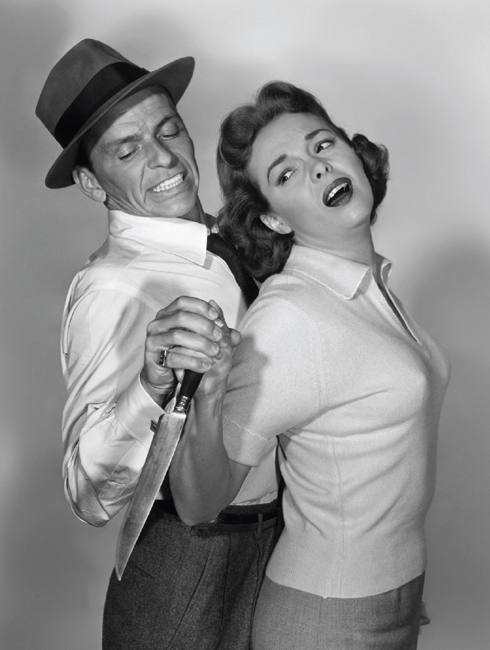
With costar Nancy Gates, Suddenly, 1954. / “He holds the screen and commands / it with ease, authority and skill that / is, obviously, the result of care, (Photo: The Cinematic Legacy of Frank Sinatra, David Wills, 2015.)
study, work, and an intelligent / mind.” / Lobby cards, Suddenly. (Photo: The Cinematic Legacy of Frank Sinatra, David Wills, 2015.)
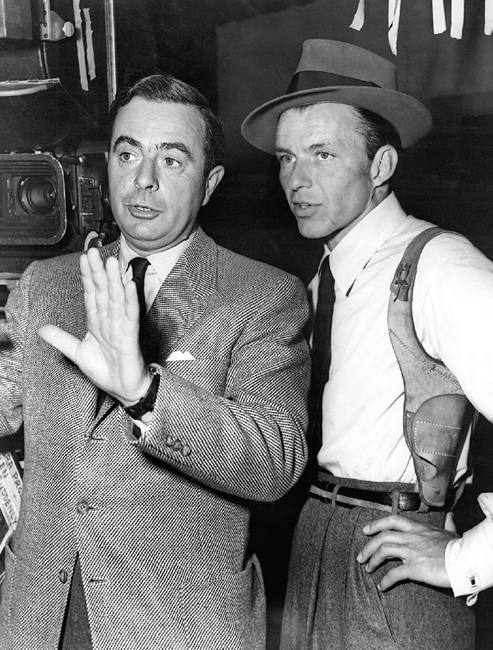
With director Lewis Allen on the set of Suddenly. (Photo: The Cinematic Legacy of Frank Sinatra, David Wills, 2015.)
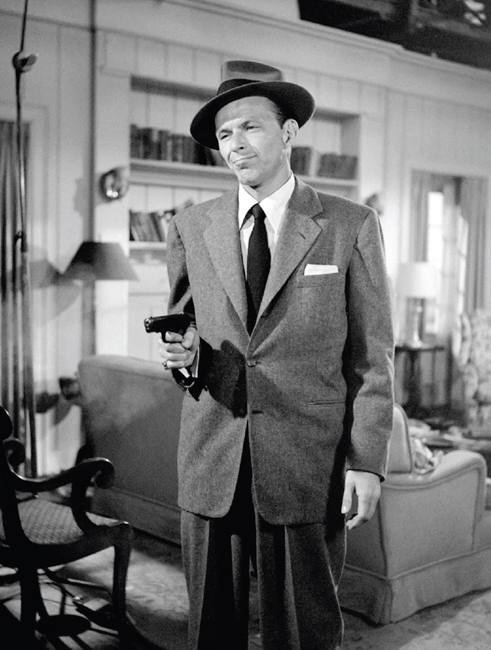
As John Baron, Suddenly (Photo: The Cinematic Legacy of Frank Sinatra, David Wills, 2015.)
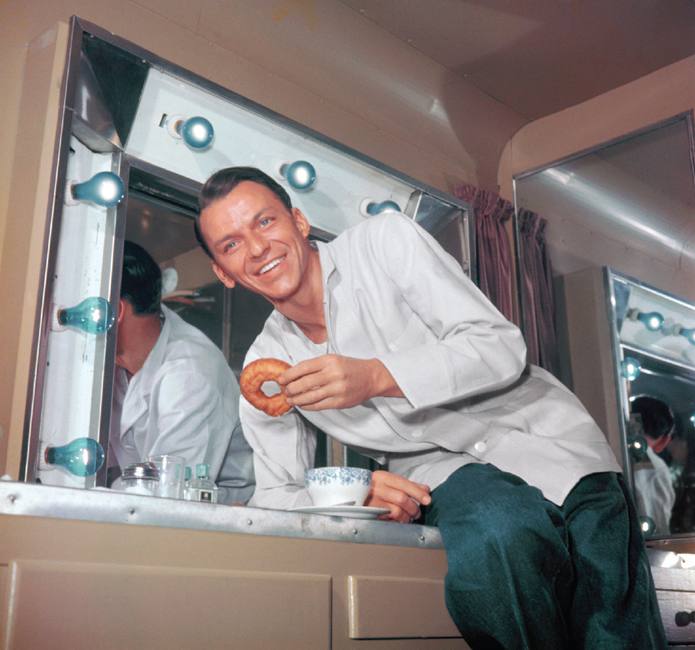
c. 1954. (Photo: The Cinematic Legacy of Frank Sinatra, David Wills, 2015.)
Sands Hotel, Las Vegas (Part 1)
Frank Sinatra & Ziegfeld Follies
note: Here is the complete program for the Ziegfeld Follies presentation
at the Sands in June/July 1954.
Song Sinatra sang in the "Rainbow Blues" segment:
note: The show opened on 6-9-54 and continued into July. Sam Levenson and Frances Langford
replaced Sinatra on 7-14-54. I have the reviews of their opening night.. Frank was still in Vegas
as of 7/9. He invited all the stars on the strip to attend a sneak preview of his new movie "Suddenly,"
on Friday morning, 7/9, at the Huntridge Theatre, at 2: A.M.
Ed
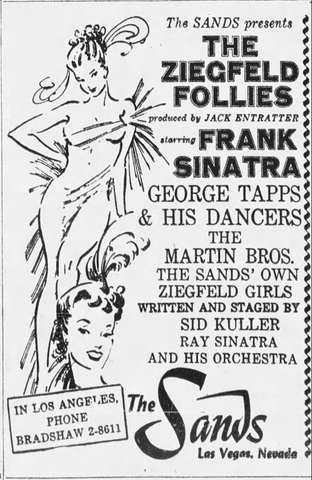
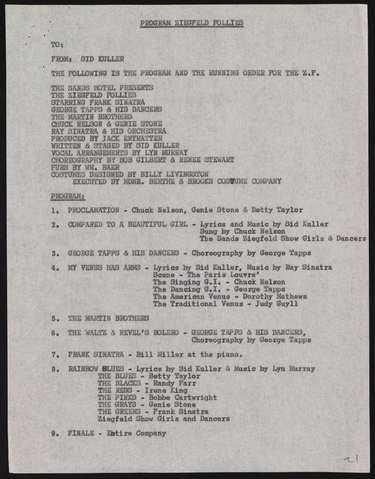
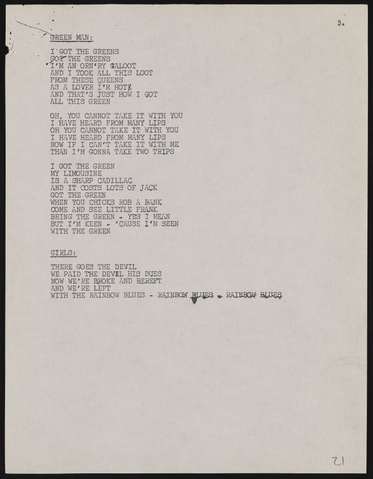
note: Wilson names a few of the songs
Frank was
singing and does a good job capturing Frank's
upbeat mood and tells how a three week gig
was extended into five. --Ed
Sands Hotel, Las Vegas (Part 2)
Frank Sinatra & Ziegfeld Follies
The Copa Girls rehearsing with Frank with Jack Entratter looking on June 1954
FRANK SINATRA at the SANDS
A FEW MONTHS BEFORE THIS UNIQUE PRESS PHOTO was taken, FRANK SINATRA [Dec. 12, 1915-May 14, 1998]
had received a career boost when he won the Oscar for From Here to Eternity. Sinatra holds the hands of two show girls.
Dated June 10, 1954, the caption reads: Wynn Terry (seated, left) and Gladys Gardner (in front of her), Ziegfeld Girls prior to 1930, watch Frank Sinatra dance with their 1954 counterparts in a revival of the Ziegfeld Follies at the Sands Hotel in Las Vegas, Nev.. Miss Gardner starred from 1913 to 1919, and is "Dean" of the Ziegfeld Girls. [from Steve Crum's showbiz memorabilia collection]
note: Frank was introducing the great recordings done with Riddle
in April/May of 54 plus he was singing"String" and other early Capitol songs. He also did special material with the Ziegfeld Girls. The song medley was titled "Rainbow Blues." Frank dressed all
in green, including the hat, sang a song titled "Green" and a few
more.You'll notice a little nepotism with the orchestra leader.
Hey ! Frank now owned 2% of the Sands. Entratter knew what he
was doing.
I have a couple of color shots and the length of the engagement.
Somewhere. Will try and find them.
--Ed
Gladys Gardner ( blonde hair) danced in Ziegfeld's show in 1913
note: Frank opened on 6-9-54. Jack Entratter's brain child -- Ziegfeld Follies Starring Frank Sinatra --. I have a review
of the opening. Will post tomorrow. The second night featured a number of former Ziegfeld Girls as guests of the Sands. Gladys was a
tad overcome. Love the photo. Art Linkletter is right in the center of the photo.
--Ed
frank rehearsing for ziegfeld follies
What an outfit. Frank dressed all in green. Another Italian who wanted
to be Irish. Can't say I blame him. I have a similar shot in color. Can
not locate -ED
Daily News
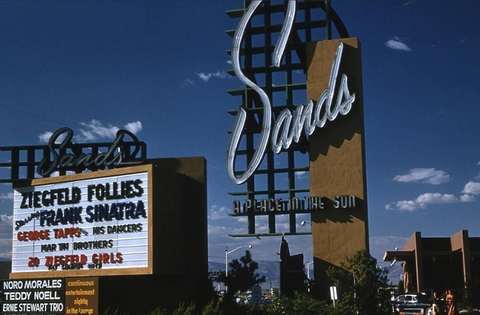
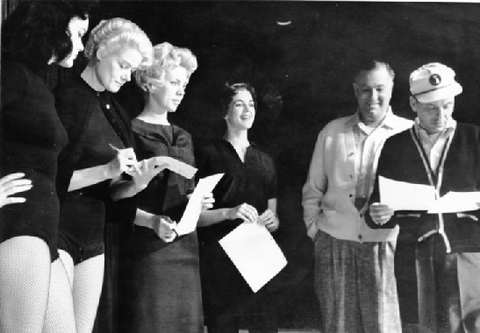
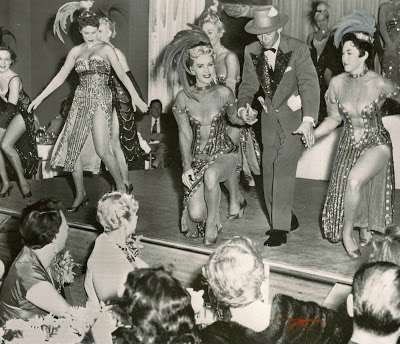
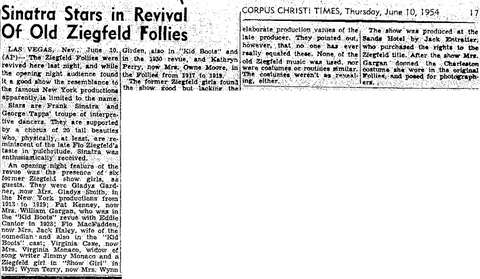
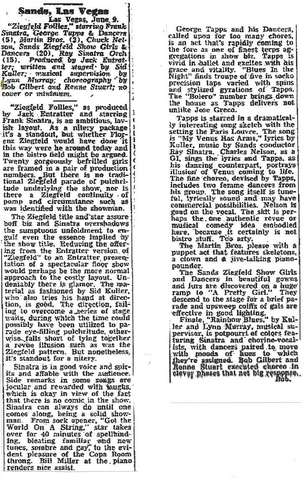
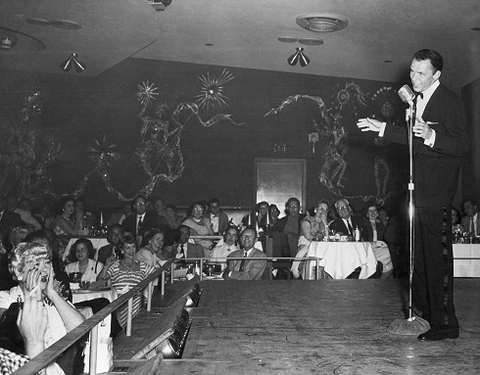
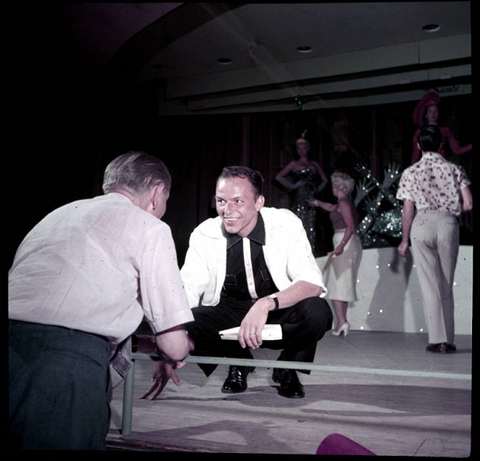
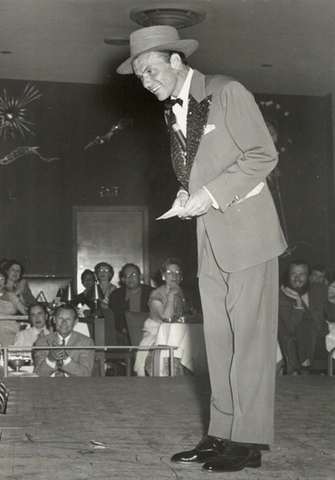
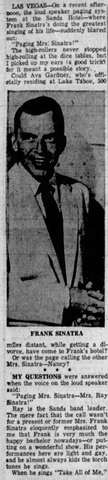
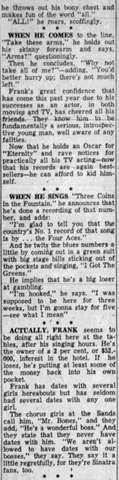
June 10, 1954
Concerts
Sands Hotel, Las Vegas
Frank Sinatra & Ziegfeld Follies
George Tapps, Chuck Belson,
Dorothy Matthews, The Martin
Brothers and The Copa Girls
Special lyrics for the production Sid Kuller
Choreography Bob Gilbert and Renee Stewart
Arranged and Conducted by Ray Sinatra
June 11, 1954
Radio
To Be Perfectly Frank
Network:
Show: 62
Time:
Host: Frank Sinatra
Announcer: Edward King
1. You Do Something To Me w/ Sinatra Symphonette
2. My Funny Valentine Capitol recording
3. How About You Les Brown and His Orchestra
4. If You Are But A Dream Columbia recording
5. I've Got My Love To Keep Me Warm w/ Sinatra Symphonette
Concerts
Sands Hotel, Las Vegas
Frank Sinatra & Ziegfeld Follies
George Tapps, Chuck Belson,
Dorothy Matthews, The Martin
Brothers and The Copa Girls
Special lyrics for the production Sid Kuller
Choreography Bob Gilbert and Renee Stewart
Arranged and Conducted by Ray Sinatra
note: Jack Entratter's Ziegfeld Follies, with Sinatra, opened on 6-9-54. Frank was set to be there through the 28th of the month.
Vic Damone would then come in for two weeks and
Sam Levenson and Frances Langford would complete the six week run, opening on 7/14. Damone dropped out and Frank agreed to do two more weeks. I have the
Variety review of the 7/14 opening and the WB work sheets for "Young At Heart." Frank was on the set as the production got underway Monday, 7/12. Did he close at the Sands on 7/11 ? Certainly seems reasonable, but I don't know for sure.
--Ed
Sands Hotel, Las Vegas
Frank Sinatra & Ziegfeld Follies
George Tapps, Chuck Belson,
Dorothy Matthews, The Martin
Brothers and The Copa Girls
Special lyrics for the production Sid Kuller
Choreography Bob Gilbert and Renee Stewart
Arranged and Conducted by Ray Sinatra
[image referenced in source but could not be recovered]
June 12, 1954
Concerts
Sands Hotel, Las Vegas
Frank Sinatra & Ziegfeld Follies
George Tapps, Chuck Belson,
Dorothy Matthews, The Martin
Brothers and The Copa Girls
Special lyrics for the production Sid Kuller
Choreography Bob Gilbert and Renee Stewart
Arranged and Conducted by Ray Sinatra
[Ava arrives in Lake Tahoe for divorce residency]
Ava Gardner arrived in Lake Tahoe to begin the six-week Nevada residency required for her divorce from Sinatra, avoiding Las Vegas where Frank was playing the Sands (and where both her ex-husbands, Mickey Rooney and Artie Shaw, also happened to be performing).
Source: James Kaplan, "Sinatra: The Chairman" (2015).
June 13, 1954
Concerts
Sands Hotel, Las Vegas
Frank Sinatra & Ziegfeld Follies
June 14, 1954
Concerts
Ben Church Memorial Field, Henderson, Nevada
Youth Center Victory Show
Purpose of the event was to raise funds for the local Youth Center. Frank Sinatra, Ink Spots, Artie Shaw, Sophie Tucker and Others
Ben Church Memorial Field, Henderson, Nevada
Youth Center Victory Show
Purpose of the event was to raise funds for the local Youth Center.
Frank Sinatra, Ink Spots, Artie Shaw, Sophie Tucker and Others
Henderson Youth Center and Fundraiser. Entertainer Frank Sinatra performing at the Youth Center Victory Show in Henderson, Nevada.
© 1997-2026 The Sinatra Archive
This calendar, or any parts thereof, may not be reproduced in any fashion
whatsoever without the prior written permission of the publisher (The
Sinatra Archive)
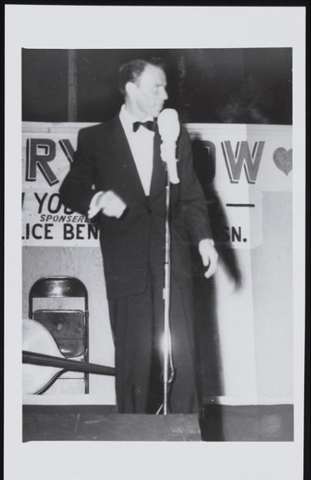
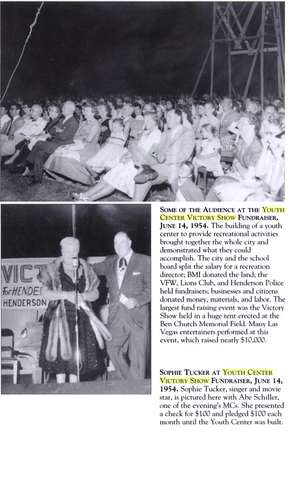
June 15, 1954
Radio
To Be Perfectly Frank
Network:
Show: 63
Time:
Host: Frank Sinatra
Announcer: Edward King
1. I've Got A Crush On You w/ Sinatra Symphonette
2. Three Coins In A Fountain Capitol Recording
3. The Anything Can Happen Mambo Mel Torme
4. Night And Day w/ Sinatra Symphonette
5. Wrap Your Troubles In Dreams w/ Sinatra Symphonette
Notes:
Concerts
Sands Hotel, Las Vegas (June 9-July 11)
Frank Sinatra & Ziegfeld Follies
Note: Sinatra was dark on Mondays
Ben Church Memorial Field, Henderson, Nevada
Youth Center Victory Show
Purpose of the event was to raise funds for the local Youth Center. Frank Sinatra, Ink Spots, Artie Shaw, Sophie Tucker and Others
"Night and Day"
Will Friedwald: Sinatra performed a radically different, breakneck-tempo Latin-jazz version of 'Night and Day' exactly once, on his final radio series (sources place it in either June or October 1954). Friedwald judges the tempo too fast to convey the song's emotional content properly -- noting that only scat singing or a nonsense number could really work at that speed -- and treats it as an early, not-quite-successful signal of Sinatra's coming uptempo direction.
Source: Will Friedwald, "Sinatra! The Song Is You: A Singer's Art" (2018 revised edition).
June 16, 1954
Concerts
Sands Hotel, Las Vegas (June 9-July 11)
Frank Sinatra & Ziegfeld Follies
Note: Sinatra was dark on Mondays
June 17, 1954
Concerts
Sands Hotel, Las Vegas (June 9-July 11)
Frank Sinatra & Ziegfeld Follies
Note: Sinatra was dark on Mondays
June 18, 1954
Radio
To Be Perfectly Frank
Network:
Show: 64
Time:
Host: Frank Sinatra
Announcer: Edward King
1. Sometimes I'm Happy w/ Sinatra Symphonette
2. Little Girl Blue Capitol Recording
3. Honey Jug Sauter Finegan
4 A Foggy Day Capitol Recording
5. It's Only A Paper Moon w/Sinatra Symphonette
Television
None
Concerts
Sands Hotel, Las Vegas (June 9-July 11)
Frank Sinatra & Ziegfeld Follies
Note: Sinatra was dark on Mondays
June 19, 1954
Concerts
Sands Hotel, Las Vegas (June 9-July 11)
Frank Sinatra & Ziegfeld Follies
Note: Sinatra was dark on Mondays
June 20, 1954
Concerts
Sands Hotel, Las Vegas (June 9-July 11)
Frank Sinatra & Ziegfeld Follies
Note: Sinatra was dark on Mondays
Sands Hotel, Las Vegas (June 9-July 11)
Frank Sinatra & Ziegfeld Follies
Note: Sinatra was dark on Mondays
Rehearsal with the 1954 version of the Follies Girls plus Jack Entratter and Frank
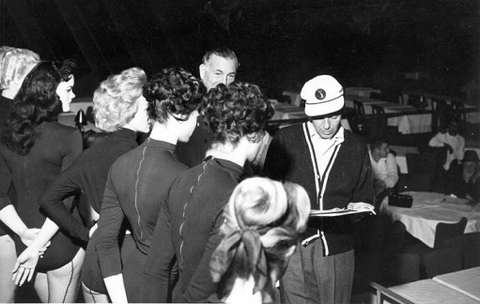
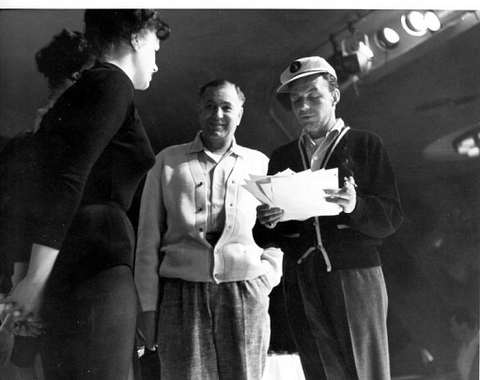
June 22, 1954
Studio
To Be Perfectly Frank
Network:
Show: 65
Time:
Host: Frank Sinatra
Announcer: Edward King
1. Love Me Or Leave Me w/Sinatra Symphonette
2. The Girl Next Door Capitol Recording
3. Lemon Twist Billy May
4. Birth Of The Blues Columbia Recording
NOTE: Ed O'Brien loves "Love Me or Leave Me" as sung here by Frank Sinatra.. It has a great sound and the tempo is perfect.
June 25, 1954
Radio
To Be Perfectly Frank
Network:
Show: 66
Time:
Host: Frank Sinatra
Announcer: Edward King
1. Should I w/ Sinatra Symphonette
2. Marie 4 Tunes
3..Don't Worry 'Bout Me Capitol Recording
4. It's Only A Paper Moon Ella Fitzgerald
5. Hello Young Lovers w/ Bill Miller on piano
June 29, 1954
Radio
To Be Perfectly Frank
Network:
Show: 67
Time:
Host: Frank Sinatra
Announcer: Edward King
1. Just One Of Those Things w/ Sinatra Symphonette
2. I'm A Fool To Want You Columbia Recording
3. Undecided* Ella Fitzgerald
4. The Doodle Town Pipers Sauter Finegan
Notes: Ed O'Brien *Frank would sing "Undecided" on his 11-27-51 TV show. I would guess the chart was done by George Siravo.
July 1954
[Ava misses divorce court date]
Kaplan: At the end of July 1954, Ava Gardner failed to appear for her scheduled divorce court date; the couple were at an impasse partly over money she'd lent Frank during his slump, which he refused to repay.
Source: James Kaplan, "Sinatra: The Chairman" (2015)
[Parsons on Sinatra's Sands triumph]
Louella Parsons: Louella Parsons wrote that she had never seen Sinatra in better form during his June 1954 show at the Sands, and declared he had gotten Ava "completely out of his system" -- written around the same time Frank made a fruitless trip to Tahoe to try to win her back.
Source: James Kaplan, "Sinatra: The Chairman" (2015)
July 2, 1954
Radio
To Be Perfectly Frank
Network:
Show: 68
Time:
Host: Frank Sinatra
Announcer: Edward King
1. Castle Rock Columbia Recording
2. I Want A Boy Connie Russell
3. Dancing In The Dark Ray Anthony & His Orchestra
4. That Old Black Magic Columbia Recording
5. I'm In The Mood For Love w/Sinatra Symphonette
Notes:
Ed O'Brien notes that the last song is another classic pop song not recorded by Sinatra but performed on the "Perfectly Frank" radio show.
Television
None
July 6, 1954
Radio
To Be Perfectly Frank
Network:
Show: 69
Time:
Host: Frank Sinatra
Announcer: Edward King
1. Wrap Your Trouble In Dreams w/ Sinatra Symphonette
2. Rain Capitol Recording
3. The Gypsy Louis Armstrong
4. You're The One Columbia Recording
Notes:
July 7, 1954
Concerts
Sands Hotel, Las Vegas (June 9-July 11)
Frank Sinatra & Ziegfeld Follies
Note: Sinatra was dark on Mondays
July 8, 1954
Concerts
Sands Hotel, Las Vegas (June 9-July 11)
Frank Sinatra & Ziegfeld Follies
Note: Sinatra was dark on Mondays
Sahara Hotel, Las Vegas
Frank Sinatra subbed for Martha Raye’s second show
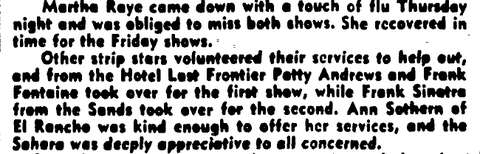
July 9, 1954
Concerts
Sands Hotel, Las Vegas (June 9-July 11)
Frank Sinatra & Ziegfeld Follies
Note: Sinatra was dark on Mondays
July 12, 1954
Concerts
Sands Hotel, Las Vegas (June 9-July 11)
Frank Sinatra & Ziegfeld Follies
July 13, 1954
Studio
WARNER BROS. - Los Angeles, California
YOUNG AT HEART
"Just One Of Those Things"
LP Release: 50 Years Of Film Music - Warner Bros
3XX-2736
Required two sessions. Started on the 13th and completed on the 14th.
Frank was backed by a jazz quartet and Bill Miller.
Radio
To Be Perfectly Frank
Network:
Show: 71
Time:
Host: Frank Sinatra
Announcer: Edward King
1. Everything Happens To Me w/ Sinatra Symphonette
2. Serenata Leroy Anderson
3. 'Deed I Do Lena Horne
4. Violets For Your Furs Capitol Recording
Television
NONE
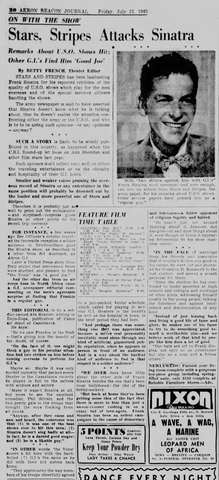
July 14, 1954
Studio
WARNER BROS. - Los Angeles, California
YOUNG AT HEART
Wednesday afternoon
3 to 4:40 PM
Arranged and conducted by Ray Heindorf
52 piece orchestra including Bill Miller and Alvin Stoller
You My Love
Additional vocal work done on "Just One Of Those Things
orchestral track done for "Someone To Watch Over Me."
Bill Miller was paid $48.21 per session
Doris Day recorded from 1:30 to 4:35 PM
Frank and Doris rehearsed during this session
Ed O'Brien provided the Young At Heart" session info above.
July 16, 1954
Radio
To Be Perfectly Frank
Network:
Show: 72
Time:
Host: Frank Sinatra
Announcer: Edward King
1. Taking A Chance On Love
2. This Love Of Mine
Notes: Sinatra songs only. Full list to be completed.
Television
NONE
August 1954
[Gossip item on Nancy and reconciliation]
Kaplan: A gossip column reported in August 1954 that Nancy Sinatra insisted there was no chance of reconciliation once Ava's Nevada divorce residency concluded.
Source: James Kaplan, "Sinatra: The Chairman" (2015)
August 2, 1954
Swing Easy!, Frank's first 10-inch LP for Capitol, was released.
Source: Nancy Sinatra, Frank Sinatra: An American Legend, 1995.
August 11, 1954
Studio
Warner Bros. Soundstage 12 - Los Angeles, California film "Young at Heart"
Frank Sinatra with Bill Miller at the piano
Four takes
One for my Baby
NOTE: Thanks go to Ed O'Brien, who supplied the information on this soundstage recording session.
August 12, 1954
AP Article
8-12-54
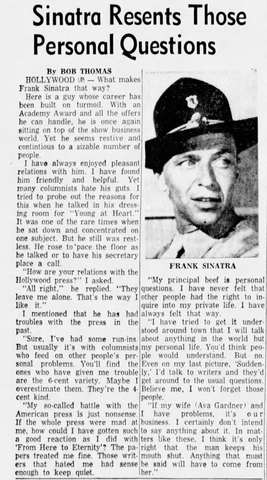
August 15, 1954
Radio
Gary Crosby Show
Note: The show appears on the officially released CD set: 60 Greatest
Old Time Radio Show "Frank Sinatra & Friends"
NOTE: Ed O'Brien calls this a very interesting show. We get to hear
Sinatra sing "Half as Lovely.. Twice as True" with a modified John Scott Trotter turn of the Riddle chart. Sinatra then joins Gary in a duet of "Sam's Song.
Gary Crosby Show
Photo from the broadcast
August 18, 1954
Red Skelton Revue (air date: August 18, 1954)
NBC
Johnny Carson was the substitute host while Red recovered from a concussion. The guests were to have been Frank Sinatra, Cab Calloway and dancer Georgia Tapps.
Note: Less than an hour before the broadcast, during rehearsal, Red Skelton was seriously injured when a breakaway wall in a prison sketch failed to break.
Red received a concussion, was hospitalized, and was unable to perform. At the last minute, Johnny Carson substituted for Red as guest host, writing his monologue as he drove in to the studio. Sinatra also cancelled at the last minute.
Sinatra was to have performed "The Gal That Got Away." "Foggy Day" and "Half as Lovely."
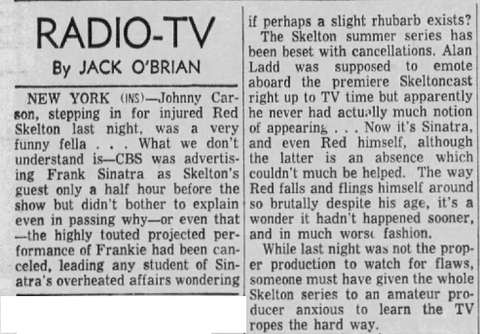
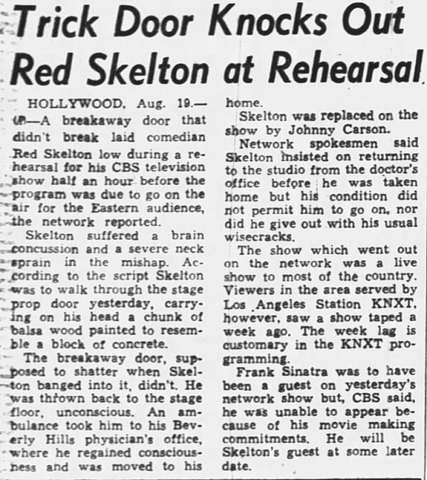
August 23, 1954
Studio
12644 The Christmas Waltz
w/Vocal Chorus
(J. Styne/S. Cahn)
Arranged & Conducted by Nelson Riddle
CD: C2 724383808922 The Complete Capitol Singles
CD: CDP 7-48329-2 The Sinatra Christmas Album
45: 2954
News
August 25, 1954
Studio
WARNER BROS. Los Angeles
YOUNG AT HEART
Wednesday afternoon
Arranged and conducted by Ray Heindorf
You My Love
Frank Sinatra & Doris Day
Ed O'Brien:
Pre-recording was music spot #18
Recording was done on Warner Soundstage #9 from 2 to 4 p.m. There were three takes Heindorf was paid $120.52 for his efforts. There were 52 musicians in the orchestra On this date production was five days behind schedule. It was the 30th day of filming and 41 days had been allotted. Estimated finish date was revised on this day to 9-14-54. Film had 98 scenes in the original script and 44 had been completed prior to 8/25. Two scenes were shot from 9 to 11 A.M. Tuttle living room scene (music spot #5) and Doris Day filmed "There's A Rising Moon" (music spot #14). There was one dog on the set with trainer Frank Weatherwax. No animals were harmed during the shoot (a little humor, folks).
Doris Frank Ray Heindorf
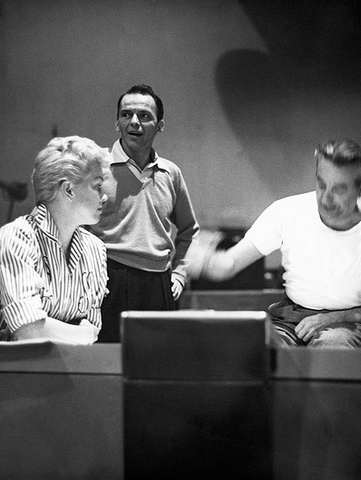
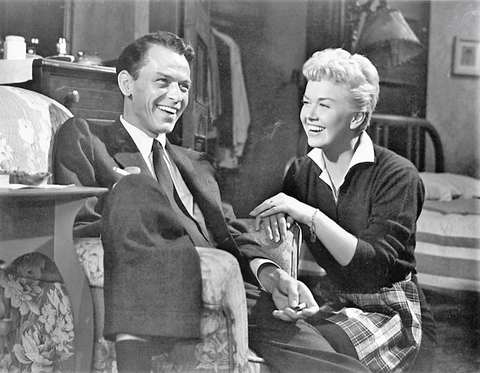
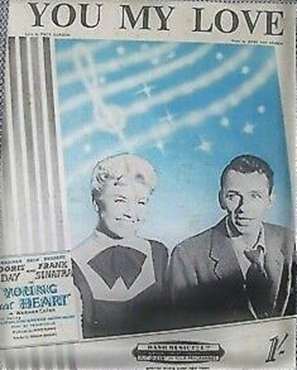
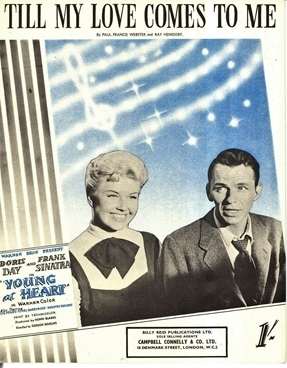
September 1954
[Jule Styne moves out]
Kaplan: Songwriter Jule Styne, Sinatra's housemate, moved out in September 1954, unable to tolerate Frank's middle-of-the-night brooding over his lost marriage to Ava.
Source: James Kaplan, "Sinatra: The Chairman" (2015)
September 1, 1954
Radio
The Frank Sinatra Show
Network: NBC
Show Number: 1
Time 8:15 p.m. - 8:30 p.m.
Sponsor: Bobbi Home Permanet, White Rain Shampoo, Deep Magic Face lotion
Host: Frank Sinatra
Writers: Norm Sickel
Announcer: Maurice Hart
Producer: Andrew C. Love
1. Just One Of Those Things - Frank Sinatra.
2. Hey There - Rosemary Clooney.
3. Young At Heart - Frank Sinatra
An FBI memo from around this time recorded a meeting between Sinatra and three army generals to discuss the military's continued denial of clearance for him to entertain troops in Korea (he had already been turned down twice). General E. Kastner told him "a serious question exists with Mr. Sinatra's sympathies in respect to Communism"; Sinatra replied that he despised Communism and would go to the attorney general to clear his name. It would be his last formal attempt to win over the establishment that regarded him as a draft dodger. Source: Michael Sheridan & David Harvey, Sinatra and the Jack Pack.
September 3, 1954
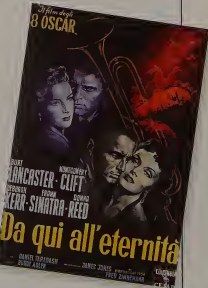
[Photograph: To Be Perfectly Frank returns on Armed Forces Radio. From Richard Havers, "Sinatra" (Dorling Kindersley, 2007), p.193.]
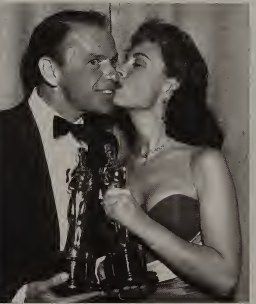
[Photograph: To Be Perfectly Frank returns on Armed Forces Radio. From Richard Havers, "Sinatra" (Dorling Kindersley, 2007), p.193.]
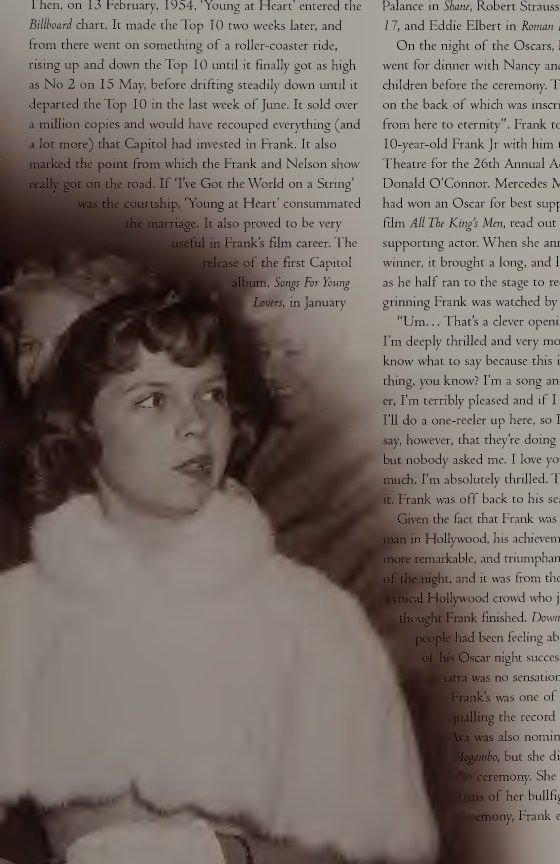
[Photograph: To Be Perfectly Frank returns on Armed Forces Radio. From Richard Havers, "Sinatra" (Dorling Kindersley, 2007), p.193.]
Radio
To Be Perfectly Frank
1. I'm Gonna Sit Right Down And Write Myself A Letter
2. This Can't Be Love
3. Half As Lovely
Television
None
Frank's radio show To Be Perfectly Frank returned after its summer break, broadcasting on Armed Forces Radio—an irony given the Army's cold treatment of Frank that would surface two weeks later over his bid to entertain troops in Korea. (Source: Richard Havers, "Sinatra" (Dorling Kindersley, 2007).)
September 8, 1954
Radio
To Be Perfectly Frank
1. Jeepers Creepers
2. It All Depends On You
3. The Gal That ot Away
September 10, 1954
Radio
The Frank Sinatra Show
Network: NBC
Show Number: 4
Time 8:15 p.m. - 8:30 p.m.
Sponsor: Bobbi Home Permanet, White Rain Shampoo, Deep Magic Face lotion
Host: Frank Sinatra
Writers: Norm Sickel
Announcer: Maurice Hart
Producer: Andrew C. Love
1. Taking A Chance On Love - Frank Sinatra.
2. I Cried - Patti Page.
3. Don't Worry 'bout Me - Frank Sinatra.
September 15, 1954
Radio
The Frank Sinatra Show
Network: NBC
Show Number: 5
Time 8:15 p.m. - 8:30 p.m.
Sponsor: Bobbi Home Permanent, White Rain Shampoo, Deep Magic Face lotion
Host: Frank Sinatra
Writers: Norm Sickel
Announcer: Maurice Hart
Producer: Andrew C. Love
1. Get Happy - Frank Sinatra.
2. Sway - Eileen Barton.
3. When I Stop Loving You - Frank Sinatra.
Amos 'N' Andy Music Hall
CBS
Wednesday Evening
9:30 p.m. - 9:55 p.m. third show of the season
Guest: Frank Sinatra
Note: The show appears on the officially released CD set: 60 Greatest Old Time Radio Show "Frank Sinatra & Friends"
September 17, 1954
Radio
The Frank Sinatra Show
Network: NBC
Show Number: 6
Time 8:15 p.m. - 8:30 p.m.
Sponsor: Bobbi Home Permanet, White Rain Shampoo, Deep Magic Face lotion
Host: Frank Sinatra
Writers: Norm Sickel
Announcer: Maurice Hart
Producer: Andrew C. Love
1. Taking A Chance On Love - Frank Sinatra.
2. I'm A Fool To Care - Les Paul and Mary Ford.
3. Half As Lovely (Twice as true) Frank Sinatra.
Television
NONE
Film
"Suddenly" (September 17, 1954)
Starring: Frank Sinatra, Sterling Hayden, James Gleason, Nancy
Gates, Kim Charney, Willis Bouchey, Paul Frees, Christopher Dark, James Lilburn
Produced by: Robert Basslet
Directed by: Lewis Allen
The tranquility of a small town is marred only by sheriff Tod Shaw's (Sterling Hayden) unsuccessful courtship of widow Ellen Benson (Nancy Gates), a pacifist who can't abide guns and those who use them. But violence descends on Ellen's household when the U.S. President passes through town... and slightly psycho hired assassin John Baron (Frank Sinatra) finds the Benson home ideal for an ambush.
--Blu-Ray Release: 2012-12-04
"Suddenly" / "Young at Heart" / "Not as a Stranger" / "The Tender Trap" / "Guys and Dolls" / "The Man with the Golden Arm" Flush with Oscar success, Sinatra threw himself into an unprecedented run of six major film roles across 1954-55, spanning wildly different genres: a presidential assassin (Suddenly), a pianist/composer (Young at Heart), a doctor (Not as a Stranger), a theatrical agent (The Tender Trap), a singing gangster (Guys and Dolls), and a heroin addict (The Man with the Golden Arm). Santopietro calls it a nearly unmatched display of range for any male star of the era.
Source: Tom Santopietro, "Sinatra in Hollywood" (2008).
"Suddenly"
Frank Sinatra: For his post-Eternity feature follow-up, Sinatra chose the low-budget black-and-white thriller Suddenly (United Artists, released October 1954), playing a hired assassin plotting to kill the president. He said he was drawn to the role because playing so consistently brutal a character was "a challenge."
Source: Tom Santopietro, "Sinatra in Hollywood" (2008).
"Suddenly"
Suddenly marked the beginning of Sinatra's long working relationship with United Artists, which would eventually span nine films.
Source: Tom Santopietro, "Sinatra in Hollywood" (2008).
"Suddenly"
Suddenly was directed by Lewis Allen and shot by cinematographer Charles G. Clarke. Though not strict film noir, Santopietro argues it shares noir's postwar paranoia and claustrophobia, with nearly the entire film confined to one house set.
Source: Tom Santopietro, "Sinatra in Hollywood" (2008).
"Suddenly"
Newsweek: Newsweek's review praised Sinatra's performance as "one of the most repellent killers in American screen history," calling the film "as simple and startling as a good scream."
Source: Tom Santopietro, "Sinatra in Hollywood" (2008).
"Suddenly"
M.A. Schmidt: New York Times Hollywood correspondent M.A. Schmidt, observing Sinatra on the Suddenly set, noted his physical tension came "from concentration, not uncertainty," and that his whole body "seemed to melt into relaxation" once a take ended.
Source: Tom Santopietro, "Sinatra in Hollywood" (2008).
"Suddenly"
Daniel O'Brien: Per Sinatra chronicler Daniel O'Brien, around 1970 Sinatra learned that Lee Harvey Oswald had reportedly watched Suddenly just days before assassinating President Kennedy on November 22, 1963. Disturbed by the parallel and growing more politically conservative, Sinatra pulled the film from circulation; it stayed off network television until the late 1980s.
Source: Tom Santopietro, "Sinatra in Hollywood" (2008).
"Suddenly"
Despite strong reviews for Sinatra's acting, Suddenly's deeply unpleasant, unsympathetic lead character contributed to the film's failure at the box office.
Source: Tom Santopietro, "Sinatra in Hollywood" (2008).
"Suddenly" / "Meet Danny Wilson" / "From Here to Eternity"
Cue magazine: Cue magazine's review of Suddenly credited Sinatra's dramatic gifts as building steadily -- from what he'd first shown in Meet Danny Wilson through their fuller flowering in From Here to Eternity -- concluding his talent was richer than many critics had suspected.
Source: Tom Santopietro, "Sinatra in Hollywood" (2008).
"Suddenly" / "Reservoir Dogs"
Santopietro notes that Quentin Tarantino later paid homage to Suddenly's chilling line "Let's go to work," delivered by Sinatra's character before the climax, reusing it ahead of the robbery sequence in Reservoir Dogs.
Source: Tom Santopietro, "Sinatra in Hollywood" (2008).
"Suddenly"
Santopietro grades this an A, calling it "tough, taut suspense."
Source: Tom Santopietro, "Sinatra in Hollywood" (2008).
"Suddenly"
Santopietro (Filmography): Libra/United Artists. Produced by Robert Bassler, directed by Lewis Allen, screenplay by Richard Sale. Sinatra starred as would-be assassin John Baron opposite Sterling Hayden, James Gleason and Nancy Gates. No Sinatra songs are credited.
Source: Tom Santopietro, "Sinatra in Hollywood" (2008).
[Army denies Sinatra clearance for Korea USO tour]
An Army memorandum for the record described a meeting the day before at which Brig. Gen. Alfred E. Kastner told Sinatra his request to entertain troops in the Far East over Christmas was denied because press items over the years -- including in the Daily Worker -- had "identified the latter with the communist line." Sinatra told the generals, "I hated and despised everything that pertained to communism," recalling that when a reporter once asked his views he'd replied, "I am just as communistic as the Pope" -- a line the reporter told him wasn't printable. A follow-up New York FBI memo (October 18, 1954) reported that Sinatra's attorney Henry Jaffe believed the Army's denial stemmed from information supplied by the FBI via a Lee Mortimer newspaper column; Hoover's handwritten reaction: "Nail this down promptly. H." A subsequent October 22, 1954 review by headquarters found the Army's file consisted only of newspaper clippings, with no FBI files ever cited to Sinatra directly.
Source: Kuntz and Kuntz, The Sinatra Files, ch. 3 (Army memo of September 17, 1954; FBI memos of October 18 and 22, 1954).
September 22, 1954
Radio
To Be Perfectly Frank
1. All Of Me --Frank Sinatra
2. When My Dreamboat Comes Home --Kay Starr
2. They Can't Take That Away From Me --Frank Sinatra
4. If I Give My Heart To You --Connee Boswell
3. When I Stop Loving You --Frank Sinatra
Television
None
September 23, 1954
Studio
KHJ Studios. Hollywood
12707 Don't Change Your Mind About Me w/Virginia Maxey adn The Modernaires
( I. Carpenter/L. Adelson)
Arranged & Conducted by Nelson Riddle
CD: C2 724383808922 The Complete Capitol Singles
LP: SYS 5637 Sinatra Like Never Before
45: 3050
NOTE: Sinatraphile Robert Freed asked if it were really June Hutton and the Pied Pipers on this recording, reckoning that Hutton and the Pipers were long parted from Capitol by 1954 and pointing out that the Silva discography lists Virginia Maxey and four gentlemen who he believes were The Modernaires (Alan Campbell, John Drake, Francis Scott, and Hal Dickinson) for the vocal on this.
In addition, Sinatraphile Craig Poff wanted to know, personally, the identification of the gal who gets that wonderful solo line 'don't change your mind about me, after the chorus starts "I can see it through, as long as you . . ."ť He says that gal can sing him to sleep any night..... Wonderful record!
To these inquiries, Ed O'Brien confirms that Capitol definitely attributes the backup vocal to Hutton and the Pied Pipers. Hutton left the group in 1950 and started a solo career. Capitol Records released her efforts up into the mid-1950s. She worked with Sinatra in the 40s on his radio show and was a regular on his CBS-TV show in 1951-52. She married Alex Stordahl in 1951 and they made many records throughout the 50s.
When O'Brien received information from Capitol back in 1991, Hutton was credited on the song and he used that information in his 1992 book. But AFM sheets don't lie and it is NOT Hutton on the record. O'Brien is very familiar with that smoky voice and it is not Hutton.
It has to be Virginia Maxey. He listened to the recording and the group certainly doesn't have the signature sound of The Pipers. A search for the history of The Modernaires shows Maxey and Copeland as occasional contributors to recordings with the group. Hal Dickinson free-lanced on sessions while not singing with The Modernaires. O'Brien would guess it was a call-up from Capitol and these particular singers were available. The original Modernaires did two sessions with Sinatra at Columbia with Paula Kelly providing the vocals with the group.
Robert Freed thanked O'Brien for the confirmation. He says he thought the same when listening to the track, even though virtually every source in existence credits June Hutton and Pied Pipers. He suspects Capitol put their names on the recording to bolster sales of the single. Hutton (who was married to Axel Stordahl and associated with Sinatra from radio and TV) was under contract to Capitol, and Virginia Maxey was probably unknown to the general public.
Freed finds it interesting that Capitol credited Hutton and The Pipers for 'Don't Change Your Mind" in The Complete Capitol Singles Collection 4-cd set of 1996. He wonders if there's a credit on the 1973 Longines Symphonette Society's '"Sinatra Like Never Before" set or "The Rarities, Vol. 2" from Australia. He believes the former was the first time the track appeared on an LP.
O'Brien says 'Nope on all the issues.' He checked the Longines, Australian Vol. 2, and the UK 's 'Look Over Your Shoulder.' There is no mention of a chorus let alone Hutton and The Pipers.
12703 Someone To Watch Over Me
(G. Gershwin/ I. Gershwin)
WB Music Corp (ASCAP)
Arranged & Conducted by Nelson Riddle
-20 (2:56) CD: CDP 724383595228 Sinatra 80th 'All The Best'
CD: C2 724383808922 The Complete Capitol Singles
CD: CDP 7-96827-2 Nice â n' Easy
CD: : C2-94777 The Capitol Years
LP: W1432 Songs For Young Lovers
45: 2993
12704 You, My Love
(J. Van Heusen/M. Gordon)
Arranged & Conducted by Nelson Riddle
CD: C2 724383808922 The Complete Capitol Singles
LP: W1164 Look To Your Heart
45: 2993
Musicians: Reeds: Mahlon Clark, John Hacker, Jules Kinsler, Harry Klee, Waren Webb; Trombone: Milton Bernhart; Bass Trombone: George Roberts; French Horns: John Cave, Vincent De Rosa; Violins: Victor bay, Alex Beller, Harry Bluestone, Walter Edelstein, Eudice Shapiro, Marshall Sosson, Gerald Vinci; Violas: Stanley Harris, Maxine Johnson, David Sterkin; Cellos: Cy Bernard, Eleanor Slatkin; Piano: Bill Miller; Bass: Joe Comfort; Guitar: Allan Reuss; Drums: Alvin Stoller; Harp: Kathryn Julye
Session Producer: Voyle Gilmore
NOTE: Ed O'Brien reports that he interviewed four of the musicians from this date. He says he always goes through all the sessions an individual played on with Sinatra. All remembered one song from this date: 'Someone to Watch Over Me.' They told O'Brien that it didn't come easy (20 takes) but the final result was a great recording.
KHJ Studios. Hollywood
12707 Don't Change Your Mind About Me w/Virginia Maxey adn The Modernaires
( I. Carpenter/L. Adelson)
Arranged & Conducted by Nelson Riddle
CD: C2 724383808922 The Complete Capitol Singles
LP: SYS 5637 Sinatra Like Never Before
45: 3050
San Francisco Chronicle
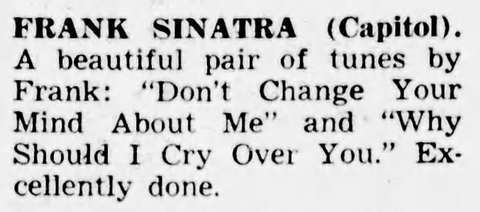
[Recording session without Riddle]
Sinatra recorded "Someone to Watch over Me," "Don't Change Your Mind About Me," and the Young at Heart duet with Doris Day, "You, My Love"; afterward he and Riddle barely worked together for the rest of the year.
Source: James Kaplan, "Sinatra: The Chairman" (2015).
[Someone to Watch Over Me -- critical commentary]
Will Friedwald (analysis): Friedwald singles out this 1954 single reading as unusually album-worthy quality among Sinatra's Capitol singles output, which otherwise generally used lesser-known songs rather than top-shelf standards.
This song/context matches multiple dated entries in the chronology; the specific date Friedwald is referring to could not be determined with confidence.
Source: Will Friedwald, "Sinatra! The Song Is You: A Singer's Art" (2018 revised edition), Ch. 6, "With Nelson Riddle" (1953-1979)
September 24, 1954
Radio
The Frank Sinatra Show
Network: NBC
Show Number: 8
Time 8:15 p.m. - 8:30 p.m.
Sponsor: Bobbi Home Permanet, White Rain Shampoo, Deep Magic Face lotion
Host: Frank Sinatra
Writers: Norm Sickel
Announcer: Maurice Hart
Producer: Andrew C. Love
1. Sunday - Frank Sinatra.
2. Tell Me Tell Me - June Valli.
3. I Could Have Told You - Frank Sinatra
Television
NONE
Frank starred as a ruthless assassin in the film Suddenly, proving his dramatic range beyond his Oscar-winning turn in Eternity.
Source: Nancy Sinatra, Frank Sinatra: An American Legend, 1995.
September 29, 1954
Radio
The Frank Sinatra Show
Network: NBC
Show Number: 9
Time 8:15 p.m. - 8:30 p.m.
Sponsor: Bobbi Home Permanet, White Rain Shampoo, Deep Magic Face lotion
Host: Frank Sinatra
Writers: Norm Sickel
Announcer: Maurice Hart
Producer: Andrew C. Love
1. Wrap Your Troubles In Dreams - Frank Sinatra
2. That Was My Heart You Heard - Betty Madigan
3. From Here To Eternity - Frank Sinatra
Michel Macaire sent these photos to me:
Jack Warner called the premiere of the film, and the party that followed
at the Cocoanut Grove, "the single greatest night in the history of Hollywood."
Sinatra sat at the main table with Judy, Bogie, Bacall, Warner. He did not wear
his toupee and graciously agreed to hold the mic while Warner read a thank
letter to all the people involved with the making of the film.
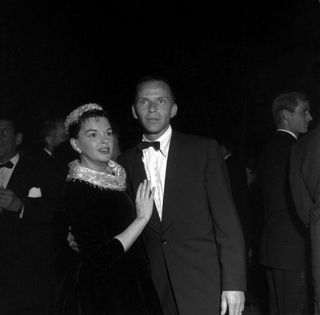
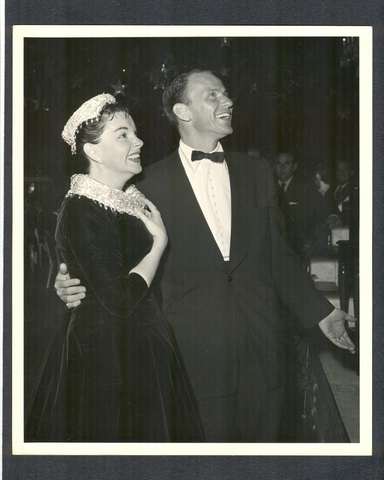
Jack Warner called the premiere of the film, and the party that followed
at the Cocoanut Grove, "the single greatest night in the history of Hollywood."
Sinatra sat at the main table with Judy, Bogie, Bacall, Warner. He did not wear
his toupee and graciously agreed to hold the mic while Warner read a thank
letter to all the people involved with the making of the film.
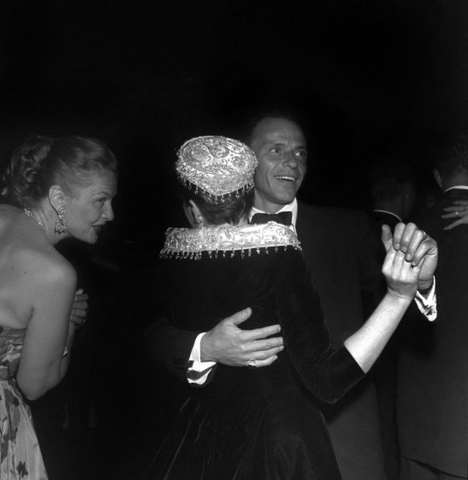
A Star Is Born
LOS ANGELES - SEPTEMBER 29: Frank Sinatra listens in as actress and singer Judy Garland, comedienne Sophie Tucker and actress Lauren Bacall share a joke at the party celebrating the premiere of the Warner Bros film 'A Star Is Born' on September 29, 1954 in Los Angeles, California. (Photo by Earl Leaf/ Michael Ochs Archives/Getty Images
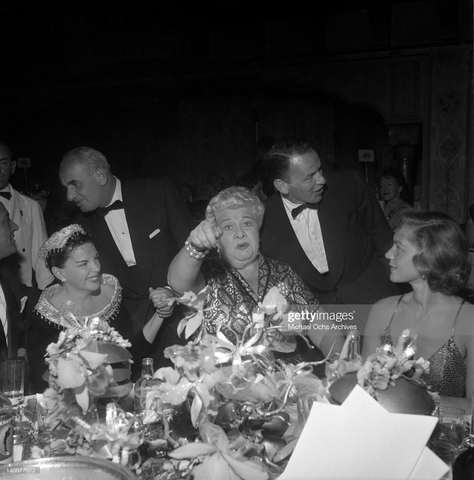
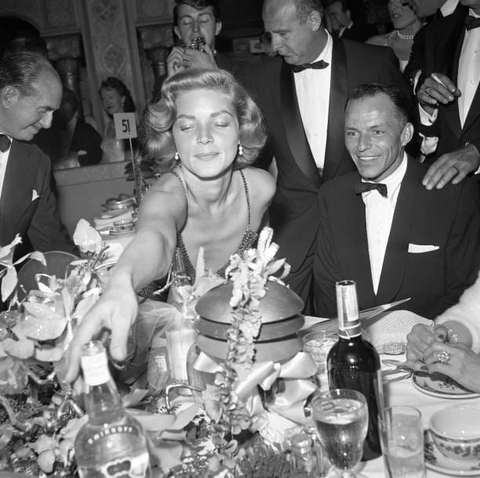
October 1954
[DiMaggio-Monroe divorce hearing]
Kaplan: Joe DiMaggio and Marilyn Monroe's initial divorce hearing took place at the end of October 1954, leaving DiMaggio publicly humiliated and despondent.
Source: James Kaplan, "Sinatra: The Chairman" (2015)
October 1, 1954
Radio
The Frank Sinatra Show
Network: NBC
Show Number: 10
Time 8:15 p.m. - 8:30 p.m.
Sponsor: Bobbi Home Permanet, White Rain Shampoo, Deep Magic Face lotion
Host: Frank Sinatra
Writers: Norm Sickel
Announcer: Maurice Hart
Producer: Andrew C. Love
1. South Of The Border - Frank Sinatra
2. All There Is And Then Some - Margaret Whiting
3. It Worries Me - Frank Sinatra
To Be Perfectly Frank
Network:
Show: 94
Time: 13 mins
Host: Frank Sinatra
Announcer: Edward King
1. It's Only A Paper Moon w/ Sinatra Symphonette
2. Take Me In Your Arms Jo Stafford
3. It Happened Once Before The Four Freshmen
4. All I Want And Then Some Margaret Whiting
5. It Worries Me Capitol Recording
note:The NBC series of this show ran from 11/3/53 until 7/2/54. In all there were 70 shows aired on Tuesdays and Fridays of each week. A follow up in September of 54 was simply titled the "Frank Sinatra Show" and was sponsored by Toni Home Permanent. The show ran from 9-1-54 through 6-25-55.. There were 86 broadcasts on Wednesdays and Fridays.
All of the PF. broadcasts after 7-2-54 are AFRS shows culled from the series. There were 128 made available to our armed forces.
Ed
October 6, 1954
Radio
The Frank Sinatra Show
Network: NBC
Show Number: 11
Time 8:15 p.m. - 8:30 p.m.
Sponsor: Bobbi Home Permanent, White Rain Shampoo, Deep Magic Face lotion
Host: Frank Sinatra
Writers: Norm Sickel
Announcer: Maurice Hart
Producer: Andrew C. Love
1. Take A Chance - Frank Sinatra.
2. Fortune In Dreams - Kay Starr.
3. When I Stop Loving You - Frank Sinatra.
To Be Perfectly Frank
Network:
Show: 95
Time:
Host: Frank Sinatra
Announcer: Edward King
1. Take A Chance Capitol Recording
2. Let's Try Again Tony Martin
3. A Fortune In Dreams Kay Starr
2. When I Stop Loving You Capitol Recording
note: There were 70 Perfectly Frank shows broadcast on NBC. But there were 127 AFRS versions of the show. If you look above at the "Frank Sinatra Show, " sponsored by Bobbi, it becomes quite apparent that AFRS used the Bobbi Shows for the continuation of the PF series. They borrowed from 57 of the 86 broadcasts NBC aired in 1954-55.
Frank was not overly fond of his smash 1954 hit "Young At Heart." He much preferred the single's flip-side "Take A Chance." Eight of the PF/Bobbi shows opened with "Take A Chance" and a measly one featured "Young At Heart" as the opener.
Ed
October 8, 1954
Radio
The Frank Sinatra Show
Network: NBC
Show Number: 12
Time 8:15 p.m. - 8:30 p.m.
Sponsor: Bobbi Home Permanet, White Rain Shampoo, Deep Magic Face lotion
Host: Frank Sinatra
Writers: Norm Sickel
Announcer: Maurice Hart
Producer: Andrew C. Love
1. I've Got The World On A String - Frank Sinatra
2. Let's Try Again - Tony Martin
3. My Funny Valentine - Frank Sinatra
This is an AFRS show culled from the Frank Sinatra Bobbi Show.
The last PF broadcast on NBC was 7-2-54. Bobbi got underway on 9-1-54, on NBC. --Ed
October 13, 1954
Radio
The Frank Sinatra Show
Network: NBC
Show Number: 13
Time 8:15 p.m. - 8:30 p.m.
Sponsor: Bobbi Home Permanet, White Rain Shampoo, Deep Magic Face lotion
Host: Frank Sinatra
Writers: Norm Sickel
Announcer: Maurice Hart
Producer: Andrew C. Love
1. They Can't Take That Away From Me - Frank Sinatra
2. High And The Mighty - Les Baxter
3. Half As Lovely (Twice As True) - Frank Sinatra
October 15, 1954
Radio
The Frank Sinatra Show
Network: NBC
Show Number: 14
Time 8:15 p.m. - 8:30 p.m.
Sponsor: Bobbi Home Permanet, White Rain Shampoo, Deep Magic Face lotion
Host: Frank Sinatra
Writers: Norm Sickel
Announcer: Maurice Hart
Producer: Andrew C. Love
1. A Foggy Day - Frank Sinatra
2. Never Underestimate - Dinah Shore
3. The Girl Next Door - Frank Sinatra
Television
None
October 17, 1954
Radio
The Glenn Miller Era
NBC
Time 6:30 p.m. - 8:00 p.m.
Notes: Volume 2 of the RCA collection of Glenn Miller recordings is played. There are brief interviews with several musicians and Frank Sinatra.
Television
None
October 20, 1954
Radio
The Frank Sinatra Show
Network: NBC
Show Number: 15
Time 8:15 p.m. - 8:30 p.m.
Sponsor: Bobbi Home Permanet, White Rain Shampoo, Deep Magic Face lotion
Host: Frank Sinatra
Writers: Norm Sickel
Announcer: Maurice Hart
Producer: Andrew C. Love
1. I Get A Kick Out Of You - Frank Sinatra
2. If I Give My Heart To You - Denise Lor
3. When I Stop Loving You - Frank Sinatra
October 22, 1954
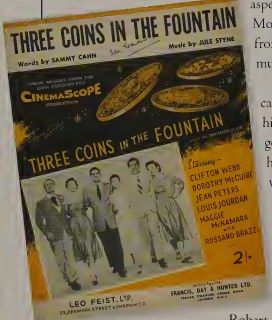
[Photograph: Frank cancels a session the day Brando lands the Waterfront role. From Richard Havers, "Sinatra" (Dorling Kindersley, 2007), p.194.]
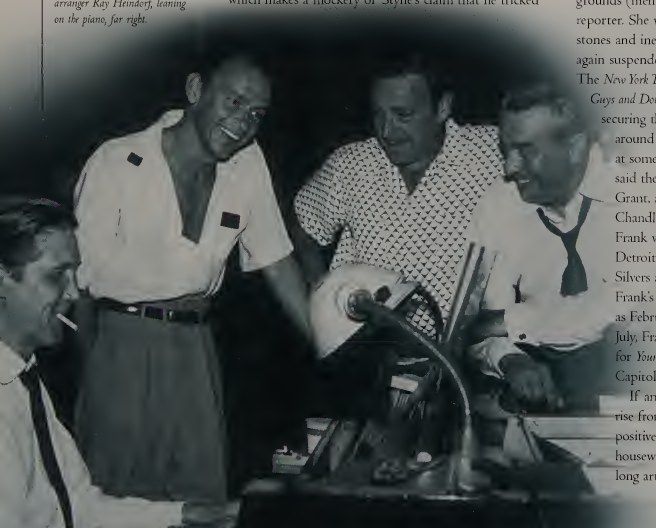
[Photograph: Frank cancels a session the day Brando lands the Waterfront role. From Richard Havers, "Sinatra" (Dorling Kindersley, 2007), p.194.]
Radio
Frank Sinatra Show
Friday Evening
NBC -Radio
8:15 P.M. - 8:30 P.M.
Sponsor: Bobbi Home Permanent
1. Wrap Your Troubles In Dreams F.S.
2. Smile Sunny Gale
3. The Gal That Got Away F.S.
Television
None
Classic Frank, 1954. “There was a tremendous level of excitement—an air of expectation—every time he recorded,” recalled his son, Frank Sinatra Jr. Source: photo and caption from J. Randy Taraborrelli, Sinatra: Behind the Legend (mptvimages.com).
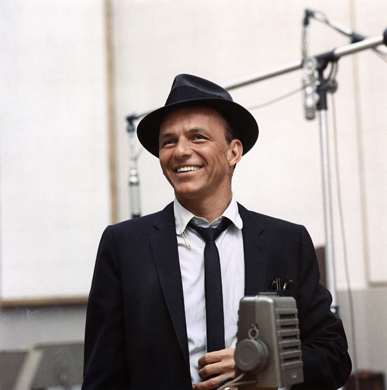
Frank cancelled a scheduled KHJ recording session the same day Marlon Brando was offered the lead in On the Waterfront—a Hoboken-set role Frank had lobbied hard for. He was further stung when a supporting priest role in the same film that he also wanted went to Karl Malden; he later sued and settled out of court five years afterward. (Source: Richard Havers, "Sinatra" (Dorling Kindersley, 2007).)
October 24, 1954
Marilyn Monroe's nine-month marriage to Joe DiMaggio ended in divorce, an event the book recounts as background to DiMaggio and Sinatra's later "Wrong Door Raid."
Source: George Carpozi Jr., Frank Sinatra: Is This Man Mafia? (New York: Manor Books, 1979).
October 27, 1954
Radio
The Frank Sinatra Show
Network: NBC
Show Number: 17
Time 8:15 p.m. - 8:30 p.m.
Sponsor: Bobbi Home Permanet, White Rain Shampoo, Deep Magic Face lotion
Host: Frank Sinatra
Writers: Norm Sickel
Announcer: Maurice Hart
Producer: Andrew C. Love
1. I'm Gonna Sit Right Down A Right Myself A Letter Capitol recording
2. If I Give My Heart To You - Denise Law
3. C'est Si Bon - Stan Freberg
4. Half As Lovely - Capitol recording
Television
NONE
October 29, 1954
Radio
The Frank Sinatra Show
Network: NBC
Show Number: 18
Time 8:15 p.m. - 8:30 p.m.
Sponsor: Bobbi Home Permanent, White Rain Shampoo, Deep Magic Face lotion
Host: Frank Sinatra
Writers: Norm Sickel
Announcer: Maurice Hart
Producer: Andrew C. Love
1. Taking A Chance On Love - Frank Sinatra
2. It's All Right With Me - Frank Sinatra w/Bill Miller, piano
3. Half As Lovely (Twice as True) - Frank Sinatra
Television
NONE
November 1954
While performing in Las Vegas with the Will Mastin Trio, Sammy Davis Jr. was severely injured in a car accident that cost him his left eye. Frank Sinatra, initially absent from the hospital, finally arrived to a hero's welcome from staff and gave Davis an encouraging bear hug, later arranging for him to recuperate at his Palm Springs home; when a tabloid ran a fabricated story linking Davis romantically to Ava Gardner, Sinatra brushed it off entirely. “You're gonna be fine,” Frank told him. “You'll come outta this thing bigger than ever.” About four months later Sinatra introduced Davis back onstage at Ciro's in Hollywood to a standing ovation from a room full of stars. Source: J. Randy Taraborrelli, Sinatra: Behind the Legend.
[Sinatra Supports Sammy Davis Jr. After His Car Accident]
Nancy Sinatra: After Sammy Davis Jr. lost an eye in a car crash, Sinatra took him in at Palm Springs, kept him laughing through the crisis, sent him a joke eye chart, and gave him half a pair of binoculars paired with the other half for Jilly Rizzo, whose bad eye was on the opposite side.
Source: Nancy Sinatra, Frank Sinatra: An American Legend, 1995.
[Cindy Bayes confronts Sinatra over hospital visit]
Cindy Bayes: Sinatra's girlfriend, model Cindy Bayes, pressed him to visit the hospitalized Sammy Davis Jr.; when he came home drunk at 5 a.m. instead, he broke down sobbing about the mess he'd made of his life. The next day roughly two hundred flowers arrived for Bayes, and Sinatra finally went to the hospital, telling Sammy he would recuperate at his Palm Springs house.
Source: James Kaplan, "Sinatra: The Chairman" (2015)
[Kilgallen item on Vanderbilt's social reversal]
Dorothy Kilgallen: Dorothy Kilgallen's column noted that Gloria Vanderbilt Stokowski, once nearly reclusive after her marriage, was now frequently out at Sardi's; the same column speculated Sinatra and Ava Gardner might reconcile.
Source: James Kaplan, "Sinatra: The Chairman" (2015)
[Sammy Davis Jr.'s car accident and Frank's hospital visit]
Consiglio: After Sammy Davis Jr. lost his left eye in a car accident, Frank -- normally terrified of hospitals -- went to visit him despite breaking into a cold sweat from the smells and white halls. Frank reassured Sammy he'd be fine and offered him use of his Palm Springs house to recuperate before returning to the road.
Source: Tony Consiglio (as told to Franz Douskey), "Sinatra and Me: The Very Good Years" (2012)
[Shooting Not as a Stranger]
Kaplan: Sinatra spent October and November 1954 shooting the medical melodrama Not as a Stranger, directed by Stanley Kramer, alongside Robert Mitchum, Broderick Crawford, and other notoriously heavy-drinking co-stars.
Source: James Kaplan, "Sinatra: The Chairman" (2015)
November 3, 1954
Radio
The Frank Sinatra Show
Network: NBC
Show Number: 19
Time 8:15 p.m. - 8:30 p.m.
Sponsor: Bobbi Home Permanet, White Rain Shampoo, Deep Magic Face lotion
Host: Frank Sinatra
Writers: Norm Sickel
Announcer: Maurice Hart
Producer: Andrew C. Love
1. Sunday - Frank Sinatra
2. Love, You Didn't Do Right By Me - Peggy Lee
3. Violets For Your Furs - Frank Sinatra
November 5, 1954
Radio
The Frank Sinatra Show
Network: NBC
Show Number: 20
Time 8:15 p.m. - 8:30 p.m.
Sponsor: Bobbi Home Permanet, White Rain Shampoo, Deep Magic Face lotion
Host: Frank Sinatra
Writers: Norm Sickel
Announcer: Maurice Hart
Producer: Andrew C. Love
1. Get Happy - Frank Sinatra
2. Someone To Watch Over Me - Frank Sinatra; Bill Miller, piano
3. When I Stop Loving You - Frank Sinatra
Notes: Frank plugs the movie "Suddenly."
[Dinner at Villa Capri precedes Wrong-Door Raid]
On Friday night, November 5, 1954, Sinatra and Lee Marvin joined Robert Mitchum and screenwriter Edward Anhalt for dinner at the Villa Capri; a newly separated, despondent Joe DiMaggio was drinking at the bar, and after much alcohol the group resolved to help him track down Marilyn Monroe.
Source: James Kaplan, "Sinatra: The Chairman" (2015).
[The Wrong-Door Raid]
A drunken group led by Sinatra and DiMaggio -- including Mitchum, Lee Marvin, Broderick Crawford, private detective Barney Ruditsky and his operative Phil Irwin -- broke down the door of the wrong Hollywood apartment at Waring Avenue and Kilkea Drive, terrifying resident Florence Kotz, while Marilyn Monroe (actually next door with vocal coach Hal Schaefer) fled into the night. A photographer present took a flash photo mistaken by Kotz for an ax.
Source: James Kaplan, "Sinatra: The Chairman" (2015).
November 7, 1954
Television
Max Liebman Presents: Fanfare
Sunday Night
7:30 to 9:00 pm
NBC
Color Broadcast
Sponsors: Sunbeam & Hazel Scott Cosmetics
Season 1, Episode 5
Host: Steve Allen
Guests: Frank Sinatra, Judy Holiday, Dick Shawn, Jacques Tati
Hollywood Segment:
Director: Bob Banner
Writers: Don McGuire
Musical Director: Ray Sinatra
Choreographer: Al White
"Songs For Young Lovers"
Frank segment opens with him singing "Young At Heart" with a visual recreation of the cover of the famous Capitol album built around his segment.
1. Gal That Got Away
2. I Get A Kick Out Of You
3. When I Stop Loving You w/chorus
4. Chat plus skit with young girl
5. Get Happy
6. Put Your Dreams Away -- orchestral only note: Frank's segment was in black & white.
The NBC affiliate in L.A. lacked the ability to broadcast in color.
Max Liebman Presents: Fanfare
Variety
review was by Donald Kirkley and appeared in the Baltimore Sun November 10, 1954
An excellent example of bias overriding
the obvious: Sinatra was fantastic that night. He
was at the beginning of his great years with Capitol
and was in total command throughout his segment
of the show. Marvelous singing and the visual recreation
of the "Songs For Young Lovers" was a very nice
opening.
Ed
Billboard posted a somewhat better review:
November 10, 1954
Radio
The Frank Sinatra Show
Network: NBC
Show Number: 21
Time 8:15 p.m. - 8:30 p.m.
Sponsor: Bobbi Home Permanet, White Rain Shampoo, Deep Magic Face lotion
Host: Frank Sinatra
Writers: Norm Sickel
Announcer: Maurice Hart
Producer: Andrew C. Love
1. I'm Gonna Sit Right Down And Write Myself A Letter - Frank Sinatra
2. Anyone Can Fall In Love - Doris Day
3. Like Someone In Love - Frank Sinatra
Television
NONE
Film
Tony Rome (US Film Release: November 10, 1967)
Starring: Frank Sinatra, Jill St. John, Sue Lyon and Gena Rowlands
(Directed by Gordon Douglas. Produced by Aaron Rosenberg) The story follows the adventures of Miami private investigator Tony Rome (Sinatra) in his quest to locate a missing diamond pin that belongs to a wealthy heiress. (1st DVD Release date: 2005-05-24)
(Blu-Ray Released on August 16, 2016 by Twilight Time with "Lady In Cement", limited to 3,000)
Note: Sinatra would play Tony Rome again in 1968's "Lady In Cement"
The Sands, Las Vegas, NV
November 10 -16 dinner & late show
Frank Sinatra
Borrah Minevitch Harmonica Rascals w/ Johnny Puleo (6)
Nanci Crompion
Copa Girls (12)
Antonio Morelli & His Orch. (18) no cover or minimum note: I put this up some years back. Looking for a story on "Young At Heart," I stumbled on it again. Billy Eckstine followed Sinatra, opening on the 17th for a two week run. Variety reviewer felt Eckstine had a tough act to follow.
Sinatra had completed "Swing Easy" at Capitol
(Riddle's pick as the best work he did with Frank), on 11/5&6, then the Fanfare appearance on 11/7(he had received rave reviews) when Entratter asked him to do a week at the Sands. Following his SRO week,
Frank began recording songs from "Finian's
Rainbow" for the John and Faith Hubley animated cartoon project. He would do two singles sessions at Capitol with Riddle, the second week in December, and then fly to New York and close out the year with a sensational engagement at the Copa. He truly had made the greatest comeback in the history of show business. And the best was yet to come.
Variety
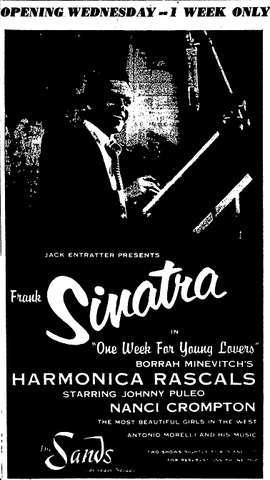
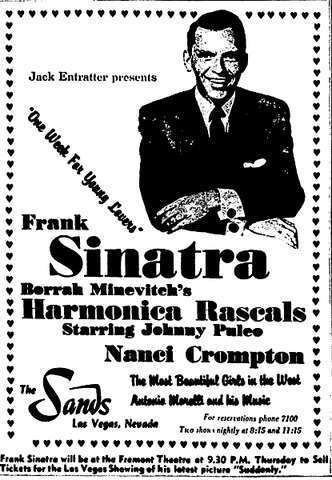
The Sands, Las Vegas, NV (November 10 - 16)
dinner & late show
Frank Sinatra
Borrah Minevitch Harmonica Rascals
w/ Johnny Puleo (6)
Nanci Crompion
Copa Girls (12)
Antonio Morelli & His Orch. (18)
FRIARS DINNER
NOVEMBER 10, 1955
BEVERLY HILTON HOTEL, HOLLYWOOD
$100.00 A PLATE DINNER
HONOREE: SAMMY DAVIS JR.
Dais: Jack Benny( toastmaster)
Frank Sinatra, Eddie Cantor,
George Burns, Tony Martin
Jerry Lewis, Cole Porter,
Pearl Bailey, Ronald Reagan,
Jeff Chandler, Humphrey Bogart,
Gary Cooper, Noel Coward
note: Sammy was the first African-
American to be honored by the Friars
Eddie Cantor got the evening under-
way with the following comment: "The Friars
have reached a new level of maturity
they have never had before."
There were a thousand people in attend-
ance. Sinatra was the last performer to
speak before Sammy was introduced.
Marilyn Monroe and Eddie Fisher were
seated at a front table.
© 1997-2025 The Sinatra Archive
This calendar, or any parts thereof, may not be reproduced in any fashion
whatsoever without the prior written permission of the publisher (The
Sinatra Archive)
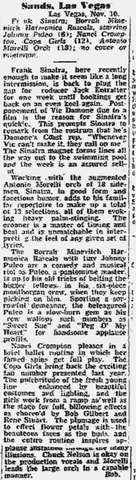
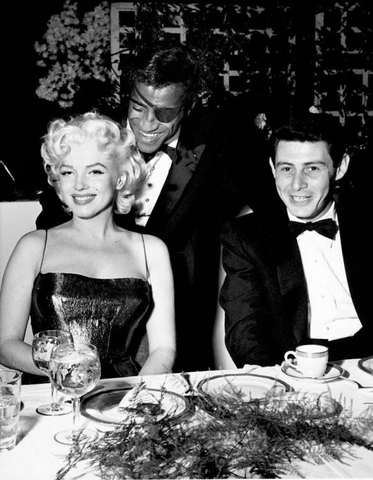
November 11, 1954
Concerts
The Sands, Las Vegas, NV (November 10 -16)
Frank Sinatra
Borrah Minevitch Harmonica Rascals w/ Johnny Puleo (6)
Nanci Crompion
Copa Girls (12)
Antonio Morelli & His Orch. (18) no cover or minimum
November 12, 1954
Radio
The Frank Sinatra Show
Network: NBC
Show Number: 22
Time 8:15 p.m. - 8:30 p.m.
Sponsor: Bobbi Home Permanent, White Rain Shampoo, Deep Magic Face lotion
Host: Frank Sinatra
Writers: Norm Sickel
Announcer: Maurice Hart
Producer: Andrew C. Love
1. Jeepers Creepers - Frank Sinatra
2. Sisters - Rosemary Clooney and Betty Clooney
3. The Girl Next Door - Frank Sinatra
Notes: Frank plugs his movie "Suddenly." note: Jerry Lawrence was the announcer and did the commercials with Sinatra.
Frank opened every show singing
"Young At Heart." He also did sing- ing commercials for the products being offered and closed the show with "Put Your Dreams Away."
Maurice Hart would replace Lawrence in January of 1955.
--Ed
Concerts
The Sands, Las Vegas, NV (November 10 -16)
Frank Sinatra
Borrah Minevitch Harmonica Rascals w/ Johnny Puleo (6)
Nanci Crompion
Copa Girls (12)
Antonio Morelli & His Orch. (18) no cover or minimum
November 13, 1954
Concerts
The Sands, Las Vegas, NV (November 10 -16)
Frank Sinatra
Borrah Minevitch Harmonica Rascals w/ Johnny Puleo (6)
Nanci Crompion
Copa Girls (12)
Antonio Morelli & His Orch. (18) no cover or minimum
November 14, 1954
Concerts
The Sands, Las Vegas, NV (November 10 -16)
Frank Sinatra
Borrah Minevitch Harmonica Rascals w/ Johnny Puleo (6)
Nanci Crompion
Copa Girls (12)
Antonio Morelli & His Orch. (18) no cover or minimum
November 15, 1954
Concerts
The Sands, Las Vegas, NV (November 10 -16)
Frank Sinatra
Borrah Minevitch Harmonica Rascals w/ Johnny Puleo (6)
Nanci Crompion
Copa Girls (12)
Antonio Morelli & His Orch. (18) no cover or minimum
November 16, 1954
Concerts
The Sands, Las Vegas, NV (November 10 -16)
Frank Sinatra
Borrah Minevitch Harmonica Rascals w/ Johnny Puleo (6)
Nanci Crompion
Copa Girls (12)
Antonio Morelli & His Orch. (18) no cover or minimum
November 17, 1954
Radio
The Frank Sinatra Show
Network: NBC
Show Number: 23
Time 8:15 p.m. - 8:30 p.m.
Sponsor: Bobbi Home Permanet, White Rain Shampoo, Deep Magic Face lotion
Host: Frank Sinatra
Writers: Norm Sickel
Announcer: Maurice Hart
Producer: Andrew C. Love
1. All Of Me - Frank Sinatra
2. Teach Me Tonight - The De Castro Sisters
3. I'm A Fool To Want You - Frank Sinatra
Television
NONE
November 19, 1954
Radio
The Frank Sinatra Show
Network: NBC
Show Number: 24
Time 8:15 p.m. - 8:30 p.m.
Sponsor: Bobbi Home Permanet, White Rain Shampoo, Deep Magic Face lotion
Host: Frank Sinatra
Writers: Norm Sickel
Announcer: Maurice Hart
Producer: Andrew C. Love
1. South Of The Border - Frank Sinatra
2. Mr. Sandman - The Chordettes
3. The Gal That Got Away - Frank Sinatra
[Sammy Davis Jr.'s car crash]
Driving his new Cadillac from Las Vegas to Los Angeles, Sammy Davis Jr. swerved to avoid a collision and struck another car; the steering wheel ornament destroyed his left eye. Many stars visited him at Community Hospital in San Bernardino, but Sinatra notably stayed away.
Source: James Kaplan, "Sinatra: The Chairman" (2015).
November 20, 1954
Studio
Goldwyn Soundstage
Saturday afternoon,
Time: 2:30 PM - 5:30 PM
Frank Sinatra recorded two songs for the animated cartoon soundtrack "Finian's Rainbow."
Placid Productions
Orchestra Conducted By: Lyn Murray
1. Ad-Lib Blues - scat song with Louis Armstrong
2. Necessity - with Ella Fitzgerald
Ed O'Brien adds:
Manager at the session was Robert Helfer
The songs were recorded with a jazz trio:
Guitar: Howard Roberts
Bass: Philip Stephens
Drums: Frank Flynn
They would be the only studio recordings Frank did with two of the giants of 20th century popular music.
I interviewed many of the participants and the entire project is a fascinating story. Mike Shore, Burton Lane and Faith Hubley regaled me with background details from this lost project.
No question 11-20-54 was a historical moment in the history of American music.
Looking at the AFM sheet, it amazes me the hourly wage of the men who backed these great artists.
Murray was paid $96.42
The three musicians received $48.21 each
Helfer walked away with $72.32.
Frank Flynn was also paid $9.12 for a drum cartridge
Goldwyn Soundstage
Saturday afternoon,
Time: 2:30 PM - 5:30 PM
Frank Sinatra recorded two songs for the animated cartoon soundtrack"Finian's Rainbow."
Placid Productions
Orchestra Conducted By: Lyn Murray
Ad-Lib Blues - scat song with Louis ArmstrongNecessity - with Ella Fitzgerald
Ed O'Brien adds:
Manager at the session was Robert Helfer
The songs were recorded with a jazz trio:
Guitar: Howard Roberts
Bass: Philip Stephens
Drums: Frank Flynn
EXTRA:: November 1962
Variety reviewed Sammy Davis' opening at the Villa Venice in Chicago ( 11/20 )
The club had opened the week before with Eddie Fisher as the headliner. Sammy
was having trouble filling up the 965 seats every night. But the cavalry was riding
to his rescue. On the 26th of the month, Dean Martin and Frank Sinatra joined
Sammy and Chicago came out to see the dynamic threesome. They would play
through 12/2. Variety declared that there was not one empty seat during the seven
day run. Dinah Shore would follow with a week in early December.
-ED
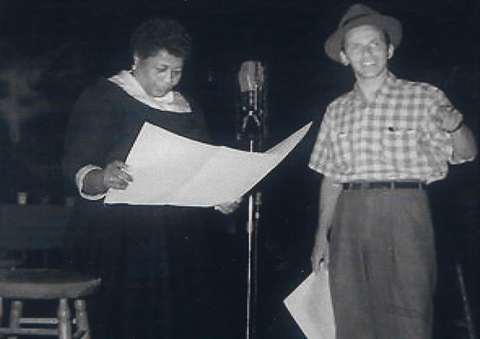
November 24, 1954
Radio
The Frank Sinatra Show
Network: NBC
Show Number: 25
Time 8:15 p.m. - 8:30 p.m.
Sponsor: Bobbi Home Permanent, White Rain Shampoo, Deep Magic Face lotion
Host: Frank Sinatra
Writers: Norm Sickel
Announcer: Maurice Hart
Producer: Andrew C. Love
1. I've Got The World On A String - Frank Sinatra
2. Blame It On Yourself - Fran Warren
3. America The Beautiful - Frank Sinatra
November 26, 1954
Radio
The Frank Sinatra Show
Network: NBC
Show Number: 26
Time 8:15 p.m. - 8:30 p.m.
Sponsor: Bobbi Home Permanet, White Rain Shampoo, Deep Magic Face lotion
Host: Frank Sinatra
Writers: Norm Sickel
Announcer: Maurice Hart
Producer: Andrew C. Love
Notes: show unconfirmed
Note: “My Sweetie Went Away” was by Teresa Brewer.
Ed O'Brien:
LOC has 79 of the 86 shows from this series. This is one they are lacking. It was broadcast on that Friday evening in 1954.
[image referenced in source but could not be recovered]
[image referenced in source but could not be recovered]
December 1954
[Finian's Rainbow soundtrack recorded, then shelved]
Kaplan: In November and December 1954 Sinatra recorded soundtrack songs for a planned animated film of Finian's Rainbow, alongside Ella Logan, Louis Armstrong, Ella Fitzgerald, and the Oscar Peterson Trio (Riddle contributed charts for two numbers). The $300,000 project collapsed after lyricist Yip Harburg and director John Hubley refused to testify before HUAC and Chemical Bank pulled its financing.
Source: James Kaplan, "Sinatra: The Chairman" (2015)
[Jill Corey spotted at Copacabana]
Jill Corey: During the Christmas-New Year's 1954-55 engagement at the Copacabana, 19-year-old singer Jill Corey attended Sinatra's show on a date with singer Richard Hayes. Sinatra spotted her from the stage and kept turning his attention back to her throughout the show, leaving her flustered.
Source: James Kaplan, "Sinatra: The Chairman" (2015)
[Nightly outings with Vanderbilt]
Kaplan: For about three weeks before Sinatra left for Australia, he and Vanderbilt saw each other almost nightly, chaperoned for propriety by Jimmy Cannon and Joan Blondell, riding around Manhattan in a limousine.
Source: James Kaplan, "Sinatra: The Chairman" (2015)
[Not as a Stranger wraps; Kramer vows never again]
Kaplan: Not as a Stranger wrapped a couple of days after the Ray Anthony session; director Stanley Kramer swore he would never work with Sinatra again, though he did not extend the same complaint to Mitchum, Marvin, or Crawford.
Source: James Kaplan, "Sinatra: The Chairman" (2015)
[Sammy Davis Jr.'s 29th birthday party]
Kaplan: About three weeks after his accident, a recovering Sammy Davis Jr. celebrated his 29th birthday at his new Hollywood Hills house, wearing an eye patch; Sinatra attended along with a heavily pregnant Judy Garland and others.
Source: James Kaplan, "Sinatra: The Chairman" (2015)
[Sinatra brawls with press agent James Byron]
Kaplan: After the birthday party, Sinatra reluctantly joined a group at the Crescendo jazz club to see Mel Tormé; leaving after closing with drinks hidden under coats, the group was confronted by Tormé's press agent James Byron over the identity of a companion. A heated exchange escalated into a fistfight in the parking lot, with Sinatra later claiming he landed a left hook that knocked Byron down.
Source: James Kaplan, "Sinatra: The Chairman" (2015)
[Vanderbilt moves out of Gracie Square]
Kaplan: Within about a week of her first date with Sinatra, Vanderbilt moved out of the Gracie Square penthouse she'd shared with Stokowski, taking her sons to a Park Avenue hotel; papers soon announced the couple's separation.
Source: James Kaplan, "Sinatra: The Chairman" (2015)
[Year-end honors for Sinatra]
Kaplan: In December 1954 Sinatra won Billboard's disc jockey poll for best single ("Young at Heart") and best LP (Swing Easy!), and Down Beat and Metronome both named him top male vocalist of the year; he took out a full-page Billboard ad signed "Busy, busy, busy -- Frank."
Source: James Kaplan, "Sinatra: The Chairman" (2015)
December 1, 1954
Radio
The Frank Sinatra Show
Network: NBC
Show Number: 27
Time 8:15 p.m. - 8:30 p.m.
Sponsor: Bobbi Home Permanet, White Rain Shampoo, Deep Magic Face lotion
Host: Frank Sinatra
Writers: Norm Sickel
Announcer: Maurice Hart
Producer: Andrew C. Love
1. Someone To Watch Over Me - Frank Sinatra
2. One For My Baby - Frank Sinatra w/Bill Miller, piano
3. You, My Love - Frank Sinatra.
Notes: Frank promotes his songs from the Warner Bros. release "Young At Heart."
Hi There !
" This is young at heart Sinatra welcoming you to our Wednesday, December
1st, Bobbi classroom."
" 'One For My Baby,' another song from
'Young At Heart.' Barney Sloan, that's me, sings it in the picture and it is almost a character study of the guy. Cause, Barney is bitter about one thing: himself. He looked in the mirror one day and found a reflection as shoddy as the world he lives in. He sits and plays the piano and sings at a local saloon, dropping cigarette ashes and dreams, all over the place. Mr. Kanobi, sir, the scene is set, so let's grab off another take on 'One
For My Baby.' " note: The first Bobbi show in December 54 was built around the soon to be released
Warner Brother film "Young At Heart." Show opened with an edited recording of the
Gershwin's "Someone To Watch Over Me."
Frank devoted time to explaining what made his character in the film tick and then sang
"One For My Baby" with Bill Miller backing him on piano. "You My Love" closed the show.
--Ed
December 2, 1954
Studio
GOLDWYN STUDIOS
FINIAN'S RAINBOW PLACID PRODUCTIONS
Thursday 2 to 6:PM
Orchestra conducted by Lynn Murray
Arrangement by Nelson Riddle
Producer Robert Helfer
Old Devil Moon (8:26) with Ella Logan and Jazz All-Stars: Red Norvo (vibraharp), Ray Brown (bass), Herb Ellis (guitar), Frank Flynn (drums), Oscar Peterson (piano)
Ed O'Brien supplied the session above and added:
AFM sheet reveals that Murray was paid $128.56
Helfer received $96.42 and the five legendary musicians were compensated to the tune of $60.26 each after taxes.
Faith Hubley told me that the great jazz riff was completely improvised after Norvo and Peterson challenged each other.
Sinatra and Logan stepped back and watched in amazement.
[image referenced in source but could not be recovered]
December 3, 1954
Radio
The Frank Sinatra Show
Network: NBC
Show Number: 28
Time 8:15 p.m. - 8:30 p.m.
Sponsor: Bobbi Home Permanent, White Rain Shampoo, Deep Magic Face lotion
Host: Frank Sinatra
Writers: Norm Sickel
Announcer: Maurice Hart
Producer: Andrew C. Love
1. My Blue Heaven - Frank Sinatra
2. That's All I Want From You - Jaye P. Morgan
3. It Worries Me - Frank Sinatra
Television
NONE
December 6, 1954
Radio
Christmas Seals Show
1. I'm Gonna Sit Right Down And Right Myself A Letter
2. A Foggy Day
3. Violets For Your Furs
4. They Can't Take That Away From Me
5. Put Your Dreams Away
Note: TT: 15 mins.
Ed O'Brien:
Essentially the Bobbi format sans the commercials. Excellent copy in circulation.
December 8, 1954
Radio
The Frank Sinatra Show
Network: NBC
Show Number: 29
Time 8:15 p.m. - 8:30 p.m.
Sponsor: Bobbi Home Permanet, White Rain Shampoo, Deep Magic Face lotion
Host: Frank Sinatra
Writers: Norm Sickel
Announcer: Maurice Hart
Producer: Andrew C. Love
1. Saturday Night - Frank Sinatra
2. Celeste - Frank Sinatra w/Bill Miller, piano and celeste
3. When I Stop Loving You - Frank Sinatra
December 9, 1954
Studio
Goldwyn Studios
FINIAN'S RAINBOW PLACID PRODUCTIONS
Thursday 1 to 4 PM
36 piece orchestra and children's choral group
Orchestra conducted by Lynn Murray
Arranged by Albert Sendry
Producer Robert Helfer
--If This Isn't Love
Ed O'Brien Notes: Faith Hubley remembered how gentle Frank was with the children who made up the choral group at this session. She told me he put them completely at ease and was very patient throughout the session.
December 10, 1954
Studio
FINIAN'S RAINBOW PLACID PRODUCTIONS
Goldwyn Studios
1 to 4 PM Friday
Orchestra conducted by Lynn Murray
Arrangement by Nelson Riddle
36 piece orchestra
Necessity
Ed O'Brien notes: Faith Hubley remembered a wonderful story involving Frank and Ella at one of the sessions for the "Finian's recordings." Ella had agreed to record Walter Gross' "Tenderly" for another Hubley project. For some reason the sheet music would not stay on the stand. Frank volunteered to be the holder of the music sheets and the page turner. Faith told me the entire room was mesmerized by the scene and applauded both performers after the final take.
Notes
- Information from: "Jazz on the Screen" by David Meeker. Used with permission. (Source) - Feature film (over 60 minutes).
- "How are things in Glocca Morra?", "Look to the rainbow" sung by Ella Logan; "Begin the begat", "Lonesome man blues" sung by Louis Armstrong; "Ad-lib blues" sung by Frank Sinatra, Louis Armstrong; "Necessity" performed by Ella Fitzgerald, Frank Sinatra; "Old devil moon" performed by Frank Sinatra, Oscar Peterson; "That great come-and-get-it day", "If this isn't love" performed by Frank Sinatra and Children's Chorus. (Songs) - Unfinished animated version of the fantasy for which numerous music tracks were pre-recorded at Goldwyn Studios in November and December 1954. - Inc: Ray Linn, Pete Candoli, Cecil Read, trumpet; Milt Bernhart, Al Anderson, Elmer Smithers, Seymour Zeldin, trombone; Paul Sarmento, tuba; Phil Sobel, Jack Dumont, reeds; André Previn, Oscar Peterson, Bill Miller, piano; Red Norvo, vibraphone; Howard Roberts, Herb Ellis, guitar; Ray Brown, Phil Stephens, acoustic double bass; Frank Flynn, Lee Perrin, drums, percussion; Ella Logan, Ella Fitzgerald, Frank Sinatra, Louis Armstrong, vocal; + strings. (Soundtrack Personnel) - Jazz on the Screen is a reference work of filmographic information and does not point to digitized versions of the items described.. The Library of Congress may or may not own a copy of a particular film or video. To request additional information Ask a Librarian ( http://www.loc.gov/rr/askalib/ask-record.html). Form motion picture
Description motion picture | Feature film (over 60 minutes). "How are things in Glocca Morra?", "Look to the rainbow" sung by Ella Logan; "Begin the begat", "Lonesome man blues" sung by Louis Armstrong; "Ad-lib blues" sung by Frank Sinatra, Louis Armstrong; "Necessity" performed by Ella Fitzgerald, Frank Sinatra; "Old devil moon" performed by Frank Sinatra, Oscar Peterson; "That great come-and-get-it day", "If this isn't love" performed by Frank Sinatra and Children's Chorus. (Songs). Unfinished animated version of the fantasy for which numerous music tracks were pre-recorded at Goldwyn Studios in November and December 1954. Inc: Ray Linn, Pete Candoli, Cecil Read, trumpet; Milt Bernhart, Al Anderson, Elmer Smithers, Seymour Zeldin, trombone; Paul Sarmento, tuba; Phil Sobel, Jack Dumont, reeds; André Previn, Oscar Peterson, Bill Miller, piano; Red Norvo, vibraphone; Howard Roberts, Herb Ellis, guitar; Ray Brown, Phil Stephens, acoustic double bass; Frank Flynn, Lee Perrin, drums, percussion; Ella Logan, Ella Fitzgerald, Frank Sinatra, Louis Armstrong, vocal; + strings. (Soundtrack Personnel). Motion Picture (Form).
note: There are some omissions that need to be added:
The marvelous eight minute plus recording of "Ol' Devil Moon" featured the jazz greats Oscar Peterson, Red Norvo, Herb Ellis, Ray Brown, Frank Flynn. Vocals by Frank Sinatra and Ella Logan. Frank also did a 58 second segment of
"How Are Things In Glocca Morra" with Ella Logan. She did a wonderful reading of "The Idle Rich" and "Susan's Dance" is credited to "Harmonica."
Ed
Radio
The Frank Sinatra Show
Network: NBC
Show Number: 30
Time 8:15 p.m. - 8:30 p.m.
Sponsor: Bobbi Home Permanet, White Rain Shampoo, Deep Magic Face lotion
Host: Frank Sinatra
Writers: Norm Sickel
Announcer: Maurice Hart
Producer: Andrew C. Love
1. The Gal That Got Away - Frank Sinatra
2. Without Love - Eileen Barton
3. The Christmas Waltz - Frank Sinatra
Television
None
December 11, 1954
Studio
Goldwyn Studios
FINIAN'S RAINBOW PLACID PRODUCTIONS
Saturday
6:30 to 9:45 PM
34 piece orchestra
Orchestra conducted by Lynn Murray
Arranged by Nelson Riddle
Produced By Robert S. Helfer
Great Come And Get It Day
Ed O'Brien notes: There was an earlier session for 1:00 to 4:15 with Andre Previn on piano. Sinatra was not a participant. Albery Sendry arranged for the afternoon recordings.
December 13, 1954
Studio
KHJ Studios. Hollywood
13141 Melody Of Love
w/Ray Anthony & His Orchestra
(H. Engelmann/T. Glazer)
Arranged by Dick Reynolds
Conducted by Ray Anthony
-15 CD: CDP 724383595228 Sinatra 80th All The Best
CD: C2 724383808922 The Complete Capitol Singles
CD: CDP 7-92160-2 Frank Sinatra Collectors Series
LP: T2602 Forever Frank
45: 3018
13302 I’m Gonna Live Till I Die
w/Ray Anthony & His Orchestra
(Hoffman/Kent/Curtis)
Arranged by Dick Reynolds
Conducted by Ray Anthony
CD: C2 724383808922 The Complete Capitol Singles
LP: W1164 Look To Your Heart
45: 3018
Concerts
Sands Hotel
Las Vegas
KHJ Studios. Hollywood
Melody Of Love/Im Gonna Live Till I Die
:
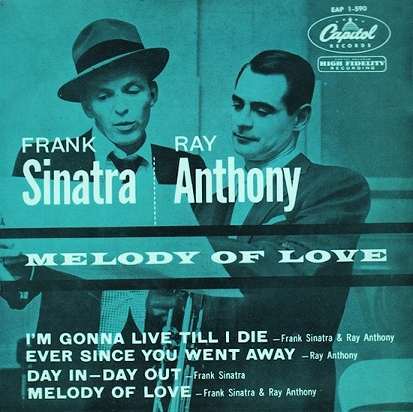
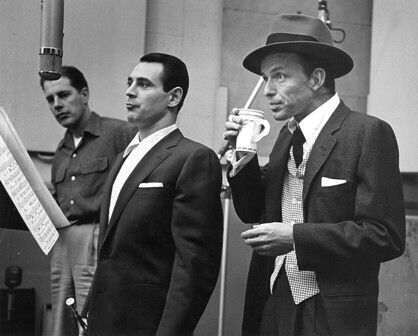
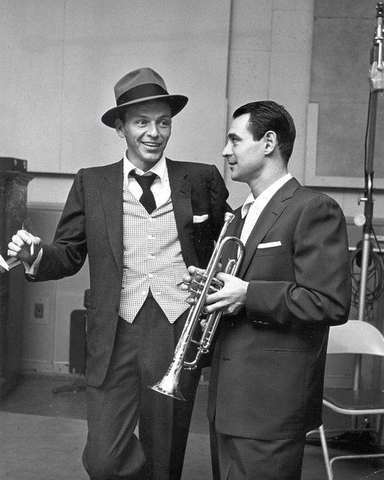
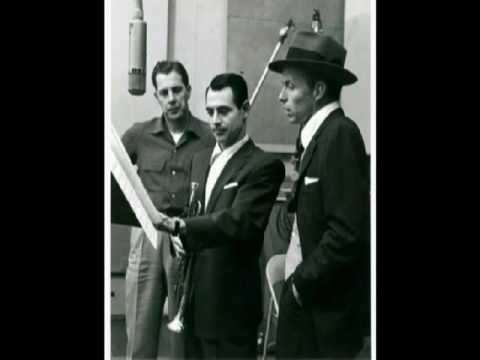
[Recording session with Ray Anthony's band]
Sinatra recorded two songs, "I'm Gonna Live till I Die" and "Melody of Love," with Ray Anthony's orchestra and arranger Dick Reynolds rather than Nelson Riddle -- part of what Kaplan frames as Sinatra's restless habit of seeking out other collaborators even as he depended on Riddle.
Source: James Kaplan, "Sinatra: The Chairman" (2015).
[I'm Gonna Live till I Die / Melody of Love -- critical commentary]
Will Friedwald (analysis): Friedwald cites this Riddle-less date as proof of how much Sinatra needed Riddle: 'I'm Gonna Live till I Die' is a generic Vegas-style opener; 'Melody of Love' (a 1903 waltz) overtaxes Sinatra's range with too little emotional payoff, seemingly a track 'without any kind of dramatic content or even a climactic moment.'
This song/context matches multiple dated entries in the chronology; the specific date Friedwald is referring to could not be determined with confidence.
Source: Will Friedwald, "Sinatra! The Song Is You: A Singer's Art" (2018 revised edition), Ch. 6, "With Nelson Riddle" (1953-1979)
December 15, 1954
Radio
The Frank Sinatra Show
Network: NBC
Show Number: 31
Time 8:15 p.m. - 8:30 p.m.
Sponsor: Bobbi Home Permanet, White Rain Shampoo, Deep Magic Face lotion
Host: Frank Sinatra
Writers: Norm Sickel
Announcer: Maurice Hart
Producer: Andrew C. Love
1. Should I - Frank Sinatra
2. Make Yourself Comfortable - Sarah Vaughan
3. You, My Love - Frank Sinatra
December 17, 1954
Radio
The Frank Sinatra Show
Network: NBC
Show Number: 32
Time 8:15 p.m. - 8:30 p.m.
Sponsor: Bobbi Home Permanet, White Rain Shampoo, Deep Magic Face lotion
Host: Frank Sinatra
Writers: Norm Sickel
Announcer: Maurice Hart
Producer: Andrew C. Love
1. Castle Rock - Frank Sinatra
2. Mambo Italiano - Rosemary Clooney
3. Melody Of Love - Frank Sinatra.
Television
none
December 19, 1954
Television
Toast of the Town
Season 8, Episode #339
Host: Ed Sullivan
Live From New York Performers: The Chordettes, Patti Page, Julius LaRosa, Sam Levenson, Mata & Hari
On Film Guests: Olivia De Havilland, Frank Sinatra, Broderick Crawford, Gloria Grahame, Charles Bickford, Robert Mitchum, Stanley Kramer, James Mason
Announcer: Art Hannes
Note: Ed appears on film with the cast of Not As A Stranger
December 21, 1954
[Sinatra and Vanderbilt's first date]
Arranged through mutual friend Jule Styne, Sinatra took Gloria Vanderbilt on a date at 7:30 p.m., attending the Broadway musical The Pajama Game at the St. James Theater; a photographer secretly captured the pair, Frank appearing distracted and Vanderbilt shooting a look of fury at the flash.
Source: James Kaplan, "Sinatra: The Chairman" (2015).
December 22, 1954
Radio
The Frank Sinatra Show
Network: NBC
Show Number: 33
Time 8:15 p.m. - 8:30 p.m.
Sponsor: Bobbi Home Permanet, White Rain Shampoo, Deep Magic Face lotion
Host: Frank Sinatra
Writers: Norm Sickel
Announcer: Maurice Hart
Producer: Andrew C. Love
1. Take A Chance - Frank Sinatra
2. Five Little Angels - The Mellomen
3. You'll Never Walk Alone - Frank Sinatra
December 23, 1954
Concerts
Copacabana, New York (Dec. 23, 1954 - Jan. 12, 1955)
Thursday Evening
Richard Jones Conducting
Bill Miller on Piano
1. I've Got The World On A String
2. I Get A Kick Out Of You
3. When I Stop Loving You
4. Taking A Chance On Love
5. Violets For Your Furs
6. I'm Gonna Sit Right Down A Write Myself A Letter
7. Just One Of Those Things
8. One For My Baby w/ Miller on piano
9. The Gal That Got Away monologue
10. Young At Heart
11. A Foggy Day
12. My Funny Valentine
13. They Can't Take That Away From Me
14. It's All Right With Me
15. Don't Worry 'Bout Me
16. All Of Me
NIGHT CLUB
SINATRA THRILLS COPA WITH MATURE BRILLIANCE
This was a mature Frank Sinatra who was caught at the Copacabana Thursday (23) night. All the promise he has given in the past came to full growth before an overflow audience. This was no Sinatra idol of the bobby sox brigade. This was a brilliant actor giving blood and guts to lyrics with such a masterful touch that the aud- ience sat hushed at one point and exploded into wild applause at another.
The saga of Sinatra is well known in the trade, his legal hassles, agency differences, explosive temper- ament, etc. But despite his mistakes, and he even invented some, he's come out of it a great performer.
His big comeback started with the flick "From Here
To Eternity," then came his Capitol disk "Young At
Heart," followed by his Capitol album "Songs For
Young Lovers." And now he is better than ever and more firmly established as a singer who can act.
His routine at the Copa demonstrated each facet of the Sinatra genius. He was intense and moody with "One For My Baby," reminiscently nostalgic with "Gal That Got Away" and pulled the heartstrings with "Young At Heart." His tremulous smile, his tiptoe finishes, his thrilling phrasing en- raptured the house. We have caught Sinatra too many times to count. As our swan song with The
Billboard, we can't think of a better way to say goodbye and thanks for being such a pleasant assignment.
Joey Bishop, working in the middle, threw most of his set routine away and went into in character ad libs. A couple of more shows under his suspenders and Bishop will get the howls he deserves.
The Five DeMarco Sisters were pleasant in the opening slot.
The production numbers and production singers and dancers remained the same.
Bill Smith
Billboard
January 1, 1955
note: Sinatra played a three week engagement at the Copa from December 23, 1954 thru January 12, 1955. I have talked to people who saw him during this run. I've been told that night after night he thrilled the audience with his stunning performances. Here is a list of the songs he was doing in concert at the time, plus the three numbers mentioned in the review.
I've Got The World On A String
I Get A Kick Out Of You
My Funny Valentine .
Taking A Chance On Love
Three Coins In The Fountain
She's Funny That Way
Just One Of Those Things
A Foggy Day
All Of Me
Nancy .
They Can't Take That Away From Me
Ol' Man River
Try A Little Tenderness
My Blue Heaven
This Love Of Mine
I'll Never Smile Again
COPACABANA (Dec. 23, 1954 - Jan. 12, 1955)
Variety
12-29-54
--------------------------------------------
"What Christmas Means To Me"
12-23-55
What Christmas Means To Me. December 24, 1955. NBC net. Sustaining. A unique Christmas program, as people around the world tell, "What Christmas Means To Me.". Leif Eid (from Paris), Frank Bourgholtzer (from Bonn), Roy Rogers, Dale Evans, Tallulah Bankhead (reads a Christmas Story), Ronald Colman (reads from "Revelations"), Tyrone Power (from Pittsburgh), Jim Jordan, Marian Jordan, Phil Leslie (writer), Merrill Mueller (from Rome), Dylan Thomas (reads from his "A Child's Christmas In Wales"), Edwin Newman (from London), Ben Grauer (from Fifth Avenue, New York City: a vivid description; good radio), Helen Hayes (speaks on behalf of The Salvation Army), George Thomas Folster (? from Tokyo), Gregory Peck (reads a Christmas story by George Tazewell), Carmen Dragon and His Orchestra, Alvin Rosenfeld (from Jerusalem), Edwin C. Hill (gives a "word portrait" of Jesus), Bob Mauer (from The Bowery, New York City), Gene Hamilton (from a "foster home"), Frank Sinatra, Fred Collins (announcer), Irving R. Levine (from Moscow), Noel Digby (from Nashville, Tennessee), Norman Vincent Peale.
----------------------------------------------
note: A combined review of two albums recorded in December. The Capitol effort in 1958 and Frank's first album on Reprise in 1960.
Ed
© 1997-2024 The Sinatra Archive
This calendar, or any parts thereof, may not be reproduced in any fashion whatsoever without the prior written permission of the publisher (The Sinatra Archive)
December 24, 1954
Radio
The Frank Sinatra Show
Network: NBC
Show Number: 34
Time 8:15 p.m. - 8:30 p.m.
Sponsor: Bobbi Home Permanet, White Rain Shampoo, Deep Magic Face lotion
Host: Frank Sinatra
Writers: Norm Sickel
Announcer: Maurice Hart
Producer: Andrew C. Love
1. The Christmas Waltz - Frank Sinatra
2. The Night Before Christmas Song - Eileen Barton
3. White Christmas - Frank Sinatra
Concerts
COPACABANA (Dec. 23, 1954 - Jan. 12, 1955)
Richard Jones Conducting
Bill Miller on Piano
December 25, 1954
Concerts
Copacabana, New York City (Dec. 23, 1954 - Jan. 12, 1955) Richard Jones Conducting
Bill Miller on Piano
Note: Most likely there was no show on this date.
December 26, 1954
Concerts
Copacabana, New York City (Dec. 23, 1954 - Jan. 12, 1955) Richard Jones Conducting
Bill Miller on Piano
--If you look at the ads for this engagement, there is nothing indicating Frank did not play the club on both the 25th and 26th..
Ed
December 27, 1954
Concerts
COPACABANA (Dec. 23, 1954 - Jan. 12, 1955)
Richard Jones Conducting
Bill Miller on Piano
December 28, 1954
Concerts
Copacabana, New York City (Dec. 23, 1954 - Jan. 12, 1955) Richard Jones Conducting
Bill Miller on Piano
December 29, 1954
Radio
The Frank Sinatra Show
Network: NBC
Show Number: 35
Time 8:15 p.m. - 8:30 p.m.
Sponsor: Bobbi Home Permanet, White Rain Shampoo, Deep Magic Face lotion
Host: Frank Sinatra
Writers: Norm Sickel
Announcer: Maurice Hart
Producer: Andrew C. Love
1. They Can't Take That Away From Me - Frank Sinatra
2. Let Me Go Lover - Teresa Brewer
3. Something Old, Something New - Frank Sinatra
Television
none
Concerts
Copacabana, New York City (Dec. 23, 1954 - Jan. 12, 1955) Richard Jones Conducting
Bill Miller on Piano
December 30, 1954
Concerts
Copacabana, New York City (Dec. 23, 1954 - Jan. 12, 1955) Richard Jones Conducting
Bill Miller on Piano
December 31, 1954
Radio
The Frank Sinatra Show
Network: NBC
Show Number: 36
Time 6:15 p.m. - 6:30 p.m.
Sponsor: Bobbi Home Permanet, White Rain Shampoo, Deep Magic Face lotion
Host: Frank Sinatra
Writers: Norm Sickel
Announcer: Maurice Hart
Producer: Andrew C. Love
1. Get Happy - Frank Sinatra
2. Funny Thing - Tony Bennett
3. You, My Love - Frank Sinatra
Concerts
Copacabana, New York City (Dec. 23, 1954 - Jan. 12, 1955) Richard Jones Conducting
Bill Miller on Piano
[New Year's Eve at the Sherry-Netherland]
At a New Year's Eve party in his Sherry-Netherland penthouse suite, after other guests left, Sinatra took Vanderbilt to the window overlooking snow-covered Central Park and traced a heart with their initials, FS & GV, in the frost.
Source: James Kaplan, "Sinatra: The Chairman" (2015).
1955
[Australian Press Turns on Sinatra]
During the 1955 Australian tour, the local press was unexpectedly hostile, criticizing Sinatra for failing to make audiences swoon and even blaming him for a false fire alarm, Nancy's first exposure to press cruelty toward her father.
Source: Nancy Sinatra, "Frank Sinatra, My Father" (1985).
[Bronx Fans Confront Borgnine Over Killing Sinatra's Character]
While later filming "Marty" on location in the Bronx, Ernest Borgnine was confronted by a group of young men upset that his "Eternity" character had killed Sinatra's Maggio; Borgnine, speaking Italian, defused the situation before the group instead brought him pizza and wine.
Source: Nancy Sinatra, "Frank Sinatra, My Father" (1985).
[Fourteen-Year-Old Nancy Joins the Australian Tour]
In 1955, the year of the Time cover, fourteen-year-old Nancy joined her father's touring troupe on a concert swing through Australia, beginning with a stopover in a still-paradisical Honolulu and a refueling stop on tiny Canton Island.
Source: Nancy Sinatra, "Frank Sinatra, My Father" (1985).
[Dunes Hotel Opening Camel Stunt]
Dressed as a sultan and riding a camel, Sinatra helped celebrate the opening of the Dunes Hotel in 1955.
Source: Charles Pignone, "Frank Sinatra 100" (2015).
[Guys and Dolls Lobby Card and Set Photo]
A US lobby card and set photo with Marlon Brando accompany the 1955 film Guys and Dolls; Sinatra later called the stage version one of the best Broadway shows he'd seen but felt the film adaptation was poorly cast, though he praised the score and nicknamed Brando "Mumbles."
Source: Charles Pignone, "Frank Sinatra 100" (2015).
[Frank Warns Debbie Reynolds About Marrying A Singer]
Nancy Sinatra: While filming The Tender Trap together, Sinatra took the young Debbie Reynolds to lunch and urged her to think hard before marrying Eddie Fisher, warning her that a singer's way of life could make married life very difficult; she later admitted she wished she'd listened.
Source: Nancy Sinatra, Frank Sinatra: An American Legend, 1995.
[Lee J. Cobb On Frank's Support After His Heart Attack]
Nancy Sinatra: Actor Lee J. Cobb recalled that after a heart attack left him divorced, isolated, and convinced his career was over, Sinatra flooded him with books, flowers and delicacies and reassured him about the acting still ahead of him.
Source: Nancy Sinatra, Frank Sinatra: An American Legend, 1995.
[Sinatra Relaxes Backstage]
A candid photo shows Sinatra relaxing backstage with a donut around 1955, a period the book describes as him having "the world on a string."
Source: Charles Pignone, "Frank Sinatra 100" (2015).
[Sinatra Boating with Friends]
A 1955 photo shows Sinatra at the helm during a boating outing with friends; Angie Dickinson recalled that Sinatra especially enjoyed such trips with Humphrey Bogart.
Source: Charles Pignone, "Frank Sinatra 100" (2015).
[Recording Session for In the Wee Small Hours]
Nelson Riddle runs down an arrangement with the orchestra while Sinatra confers with band members during a 1955 recording session at KHJ Studios in Hollywood for the album In the Wee Small Hours.
Source: Charles Pignone, "Frank Sinatra 100" (2015).
[Robert Mitchum On Sparring With Sinatra Over A Scene]
Nancy Sinatra: Robert Mitchum said he once had to fight Sinatra over how a scene should be played, describing Frank as fearless enough to take on anyone and the one man in town Mitchum would be afraid to actually fight.
Source: Nancy Sinatra, Frank Sinatra: An American Legend, 1995.
[Sinatra-Gardner Divorce Finalized]
The divorce between Frank Sinatra and Ava Gardner was finally granted in 1955, ending a marriage that had been unraveling for years.
Source: Nancy Sinatra, "Frank Sinatra, My Father" (1985).
[Spearing a Shark Off Sydney]
While boating off Sydney's shark-plagued coast during the 1955 tour, Sinatra speared a shark, generating local headlines.
Source: Nancy Sinatra, "Frank Sinatra, My Father" (1985).
['Last Night When We Were Young' released]
Kaplan: 'Last Night When We Were Young,' recorded March 1, 1954, eventually appeared on Sinatra's 1955 album In the Wee Small Hours.
Source: James Kaplan, "Frank: The Voice" (2010)
[Affair with Gloria Vanderbilt]
Kaplan: Around this same period, Sinatra was romancing heiress Gloria Vanderbilt, reportedly tracing their initials together on the window of his penthouse suite at New York's Sherry-Netherland hotel.
Source: James Kaplan, "Sinatra: The Chairman" (2015)
[Ava returns to MGM for Bhowani Junction]
Dave Hanna: Over the spring and summer of 1955, Ava Gardner returned to MGM to shoot interior scenes for Bhowani Junction, and she and Sinatra were occasionally seen together in public. Her press agent Dave Hanna said being back in Hollywood reminded her fondly of Frank, whose records she played constantly and whom she called the one dependable person in her life.
Source: James Kaplan, "Sinatra: The Chairman" (2015)
[Cahn and Van Heusen preview Our Town songs for Frank]
Sammy Cahn: That summer, Cahn and Van Heusen first played the new Our Town songs for Sinatra at the home of his ex-wife Nancy, where he'd gone for a home-cooked meal. He listened intently, stroking his lower lip in thought, and afterward gave his understated highest praise: 'Gee, it's good.'
Source: James Kaplan, "Sinatra: The Chairman" (2015)
[Carl Cohen hired at the Sands]
Kaplan: Casino manager Carl Cohen was hired away from El Rancho Vegas in 1955 to run the Sands casino operations.
Source: James Kaplan, "Sinatra: The Chairman" (2015)
[Carousel]
Santopietro calls Sinatra's abandoned role as Billy Bigelow in Carousel the single biggest missed opportunity of his film career. Sinatra began rehearsing and prerecording songs from August 15 to 20, 1955, and underwent costume fittings, telling costar Shirley Jones he was so eager for the part that he'd gone back to see the stage show five nights in a row. He was signed for a fee of $150,000.
No corresponding dated entry could be identified in the chronology for this film/context.
Source: Tom Santopietro, "Sinatra in Hollywood" (2008), The Peak Years (pt. 1)
[EMI acquires Capitol]
Kaplan: The London-based EMI conglomerate had bought 96 percent of Capitol Records, its American label, in 1955.
Source: James Kaplan, "Sinatra: The Chairman" (2015)
[Guys and Dolls]
Santopietro grades this a C, saying it "should have been better."
This film/context matches multiple dated entries in the chronology; the specific date Santopietro is referring to could not be determined with confidence.
Source: Tom Santopietro, "Sinatra in Hollywood" (2008), Career Scorecard
[In the Wee Small Hours as first 12-inch LP]
Kaplan: In the Wee Small Hours was Sinatra's first twelve-inch LP, containing sixteen songs and over forty-eight minutes of music (also issued in 10-inch double-disc and 45 rpm EP formats); Kaplan notes Sinatra later called it his "Ava album."
Source: James Kaplan, "Sinatra: The Chairman" (2015)
[JFK's Mayflower Hotel suite]
Kaplan: FBI files state that beginning in mid-1955, Senator John Kennedy kept a private suite -- room 812 -- at Washington's Mayflower Hotel, and that Sinatra was among the guests at parties held there.
Source: James Kaplan, "Sinatra: The Chairman" (2015)
[Jack E. Leonard heckles Sinatra at the 500 Club]
Consiglio: Consiglio recalls a night at the 500 Club in Atlantic City in 1955 when comedian Jack E. Leonard shouted from the wings, "Hey, Frank, I've lost more weight than you weigh," interrupting one of Sinatra's ballads mid-song and breaking him into laughter onstage.
Source: Tony Consiglio (as told to Franz Douskey), "Sinatra and Me: The Very Good Years" (2012)
[Late-night Capitol serenade for Kim Novak]
Paul Tanner: Trombonist Paul Tanner recalled being phoned near 11pm on a weeknight by Nelson Riddle to assemble a full orchestra at Capitol's studios on short notice at triple scale pay. Some two dozen musicians, including Harry 'Sweets' Edison, ran through eight to ten tunes with nothing ever recorded -- Sinatra was simply serenading Kim Novak, seated in back with publisher Frank Military, and afterward thanked everyone and left with her.
Source: James Kaplan, "Sinatra: The Chairman" (2015)
[Meets Peggy Connelly]
Kaplan: Sinatra met young singer Peggy Connelly in 1955; for close to three years she became one of the people closest to him at the height of his career.
Source: James Kaplan, "Frank: The Voice" (2010)
[Origin of the Rat Pack name]
Lauren Bacall: The Rat Pack name originated one late night at Romanoff's when Lauren Bacall looked around at Bogart, Sinatra, and other drinking companions and remarked, 'I see the rat pack is all here.' Bogart, amused, proposed formalizing it as a club devoted to nonconformity, drinking, and staying up late.
Source: James Kaplan, "Sinatra: The Chairman" (2015)
[Our Town]
Santopietro grades this a B, calling Frank miscast but the television musicalization smooth.
No corresponding dated entry could be identified in the chronology for this film/context.
Source: Tom Santopietro, "Sinatra in Hollywood" (2008), Career Scorecard
[Our Town]
Santopietro (Filmography): NBC Television live broadcast on 'Producers' Showcase.' Directed by Delbert Mann, teleplay by David Shaw based on the Thornton Wilder play, score by James Van Heusen and Sammy Cahn, orchestrations by Nelson Riddle. Sinatra played the Stage Manager opposite Paul Newman as George Gibbs and Eva Marie Saint as Emily Webb.
No corresponding dated entry could be identified in the chronology for this film/context.
Source: Tom Santopietro, "Sinatra in Hollywood" (2008), Filmography
[Patience with Kim Novak; sends her Thomas Wolfe]
Otto Preminger: During Golden Arm filming, Sinatra was noted for his patience with 22-year-old, inexperienced co-star Kim Novak, sometimes shooting short scenes as many as 35 times without complaint. When the ordeal became too much for her, he sent her the complete works of Thomas Wolfe.
Source: James Kaplan, "Sinatra: The Chairman" (2015)
[Phyllis Kirk replaces Vanderbilt]
Kaplan: After Vanderbilt's exit -- with an Associated Press item claiming she'd withdrawn because her part 'wasn't big enough' -- the role of Mary Dark in Johnny Concho went to actress Phyllis Kirk, and the film was shot in a fast five weeks.
Source: James Kaplan, "Sinatra: The Chairman" (2015)
[Preminger casts Sinatra over Brando]
Otto Preminger: Director Otto Preminger initially considered both Marlon Brando and Sinatra for the lead in Golden Arm. When his agent reported Sinatra 'likes it very much,' Preminger offered to send the rest of the not-yet-finished script, but was told Frank wanted to commit without reading it.
Source: James Kaplan, "Sinatra: The Chairman" (2015)
[Recording sessions during Golden Arm shoot]
Kaplan: During the Golden Arm shoot, Sinatra did only two nighttime recording sessions: a standard three-song date with Nelson Riddle, and a session with Elmer Bernstein for a Cahn-Van Heusen title song that ultimately went unused in the film.
Source: James Kaplan, "Sinatra: The Chairman" (2015)
[Robert Kennedy named subcommittee counsel]
Kaplan: By mid-1955, 29-year-old Robert Kennedy had been appointed chief counsel of the Senate Permanent Subcommittee on Investigations under its new chairman John McClellan, putting the Kennedy brothers increasingly in the Washington headlines.
Source: James Kaplan, "Sinatra: The Chairman" (2015)
[Sinatra and JFK meet at rally]
Kaplan: Other sources place Sinatra and Kennedy's first meeting at a 1955 Democratic Party rally, where Sinatra argued passionately against the notion that entertainers should stay out of politics, saying he'd give up his career for a cause he believed in.
Source: James Kaplan, "Sinatra: The Chairman" (2015)
[Sinatra meets Peggy Connelly]
Kaplan: One night in spring 1955 at the Villa Capri, Sinatra, seated with Jimmy Van Heusen, met twenty-three-year-old singer Peggy Connelly, who had accompanied a friend hoping to meet him; Sinatra instead asked Connelly to dinner the following Thursday, beginning a three-year relationship.
Source: James Kaplan, "Sinatra: The Chairman" (2015)
[Sinatra pairs Cahn and Van Heusen for The Tender Trap]
Kaplan: In spring 1955, having signed with MGM to co-star with Debbie Reynolds in The Tender Trap, Sinatra suggested Sammy Cahn and Jimmy Van Heusen -- both between songwriting partners -- team up to write the theme song, forming a partnership that would go on to write some forty songs for him, including "Come Fly with Me."
Source: James Kaplan, "Sinatra: The Chairman" (2015)
[Sinatra prerecords songs for Carousel film, then quits]
Kaplan: In 1955 Sinatra prerecorded 'Soliloquy' and three other songs for the film version of Carousel, then walked off the picture, leaving the tapes in legal limbo; only his duet with Shirley Jones on 'If I Loved You' has since surfaced.
Source: James Kaplan, "Sinatra: The Chairman" (2015)
[Sinatra tops Down Beat and Metronome polls]
Kaplan: For 1955, Sinatra won both the Down Beat and Metronome year-end polls as top male vocalist, the same year he emerged as a major dramatic film star through The Man with the Golden Arm.
Source: James Kaplan, "Sinatra: The Chairman" (2015)
[Sinatra-Brando tension on Guys and Dolls set]
Frank Sinatra: During filming, Sinatra -- known as "one-take Charlie" -- grew impatient with Brando's extensive rehearsing (Sinatra nicknamed him Mumbles), telling director Mankiewicz, "Don't put me in the game, Coach, until Mumbles is through rehearsing."
Source: James Kaplan, "Sinatra: The Chairman" (2015)
[Sinatra-Loesser clash over "Sue Me"]
Kaplan (citing Frank Loesser's daughter): During Guys and Dolls production, songwriter Frank Loesser, frustrated by Sinatra's crooning approach to Nathan Detroit's songs, tried to arrange a rehearsal to coach him on "Sue Me"; the encounter, per Loesser's daughter's memoir, escalated into a shouting match in Sinatra's crowded dressing room, after which both men vowed never to work together again.
Source: James Kaplan, "Sinatra: The Chairman" (2015)
[The Tender Trap]
The Tender Trap, Sinatra's first film back at MGM in five years and the first film to cast him as a romantic comedy leading man, opened on November 17, 1955, just three days after the premiere of Guys and Dolls.
This film/context matches multiple dated entries in the chronology; the specific date Santopietro is referring to could not be determined with confidence.
Source: Tom Santopietro, "Sinatra in Hollywood" (2008), The Peak Years (pt. 1)
[The Tender Trap]
Santopietro grades this a D, dismissing it as "annoying nonsense."
This film/context matches multiple dated entries in the chronology; the specific date Santopietro is referring to could not be determined with confidence.
Source: Tom Santopietro, "Sinatra in Hollywood" (2008), Career Scorecard
[The Tender Trap released]
Kaplan: MGM's The Tender Trap (1955) gave Sinatra his first top-billed comedy role, as bachelor theatrical agent Charlie Reader, opposite Celeste Holm and Debbie Reynolds. Despite the movie's dated, hooey-laden plot, critic Bosley Crowther -- no fan of Sinatra's recent films -- praised it as vastly beguiling entertainment.
Source: James Kaplan, "Sinatra: The Chairman" (2015)
[Time magazine's fabricated Sinatra quote]
Kaplan: A 1955 Time cover story on Sinatra ended with a quote — "I'm going to do as I please. I don't need anybody in the world. I did it all myself" — that Sinatra had never actually said; an editor invented it to cap the piece, souring Sinatra permanently on the magazine and its correspondent Ezra Goodman.
Source: James Kaplan, "Sinatra: The Chairman" (2015)
[Vanderbilt's account of an early Ocean's 11 deal]
Kaplan: Gloria Vanderbilt maintained that Sinatra also signed her around the same time to star in another planned project -- an early version of a heist story called Ocean's 11 that Peter Lawford had brought to him -- which would suggest Sinatra and Lawford had reconciled earlier than most other accounts claim.
Source: James Kaplan, "Sinatra: The Chairman" (2015)
[Wrong-Door Raid aftermath]
Kaplan: In the raid's aftermath, Hal Schaefer -- followed and threatened anonymously for six months -- attempted suicide by swallowing sleeping pills, Benzedrine, and typewriter cleaning fluid; Florence Kotz pursued her complaint with the LAPD until the case was closed for lack of evidence about a year later.
Source: James Kaplan, "Sinatra: The Chairman" (2015)
[Young at Heart and Wee Small Hours success]
Kaplan: By 1956 Sinatra's commercial power at Capitol had grown substantially: 'Young at Heart' was a million-seller, and In the Wee Small Hours went gold, reaching number 2 on Billboard's 1955 album chart.
Source: James Kaplan, "Sinatra: The Chairman" (2015)
[quote on directing ambitions]
Frank Sinatra: As early as a 1955 interview with Joe Hyams, Sinatra had already spoken of wanting to direct; asked what qualified him, he simply said it was the same confidence that made him think he could sing and act.
No corresponding dated entry could be identified in the chronology for this film/context.
Source: Tom Santopietro, "Sinatra in Hollywood" (2008), The Rat Pack (pt. 2)
[Billy May's own record climbs to No. 7 pre-Sinatra]
Before becoming one of Frank's key arrangers, Billy May had chart success of his own, with his album Sorta-May reaching No. 7 in 1955.
Source: Richard Havers, "Sinatra" (Dorling Kindersley, 2007).
[Origins of the Ocean's Eleven story idea]
The idea for Ocean's Eleven traced back to 1955, when Peter Lawford first heard the story pitch from small-time Hollywood director Gilbert Kay; three years later Kay sold Lawford the idea outright for $10,000, with Lawford having to borrow half the sum from his wife.
Source: Richard Havers, "Sinatra" (Dorling Kindersley, 2007).
[Sinatra earns $80,000 on Australian tour]
During the tour, Sinatra performed six shows in Melbourne, two nights in Sydney, then five final shows back in Melbourne, earning $80,000 for the return engagement. His set mixed hits like 'Young at Heart' and 'Three Coins in the Fountain' with older Columbia-era songs and his 'Ol' Man River'/'Ol' Man Crosby' parody bit.
Source: Richard Havers, "Sinatra" (Dorling Kindersley, 2007).
[Villa Capri Bon Voyage Party for the D'Amores]
At a bon voyage party held at the Villa Capri, one of Sinatra's favorite Hollywood hangouts, for owners Patsy and Rose D'Amore, Sinatra and Nat King Cole broke into an impromptu duet as the celebration grew festive. Among the other guests that night were Sammy Davis Jr., Lauren Bacall, Dean Martin, and James Dean.
Source: Andrew Howick, Sinatra: The Photographs (New York: Abrams, 2015).
[In the Wee Small Hours -- critical commentary]
Henry Pleasants: Pleasants also observed that Sinatra sometimes deliberately avoided vocal "covering" to preserve an impression of vulnerability and sincerity rather than polished artifice, pointing to the exposed way he sings the word "call" on the 1955 recording "In the Wee Small Hours" as an example of achieving a sense of pain through that choice.
Source: Charles L. Granata, "Sessions with Sinatra: Frank Sinatra and the Art of Recording" (1999/2003), Part I: The Big Band Years, 1937-1942
[In the Wee Small Hours -- critical commentary]
In the Wee Small Hours (1955) was issued on two 10-inch discs that were soon combined into one 12-inch LP, after which 12-inch albums became the standard; it was Sinatra and Riddle's first fully sustained concept album, built around melancholy small-group arrangements of songs like 'Ill Wind,' 'Glad to Be Unhappy,' and 'Mood Indigo.'
Source: Charles L. Granata, "Sessions with Sinatra: Frank Sinatra and the Art of Recording" (1999/2003), Part III: The Capitol Years, 1953-1962
[In the Wee Small Hours -- critical commentary]
Granata's discography entry: In the Wee Small Hours, 10- and 12-inch LP, arranged by Nelson Riddle, released April 1955.
Source: Charles L. Granata, "Sessions with Sinatra: Frank Sinatra and the Art of Recording" (1999/2003), Afterword & Appendices A-D
[Sinatra describing what he learned from Dorsey, to George Simon and elsewhere -- critical commentary]
Sinatra (to George Simon): Around this time Sinatra described Dorsey to George Simon as "a guy who was a real education to me in every possible way. I learned about dynamics and phrasing and style from the way he played his horn, and I enjoyed my work because he saw to it that a singer is always given a perfect setting." In 1955 he elaborated: "Tommy set me up beautifully in the band—the arrangements featured me. Tommy’s tempo was always right for singing, never too fast or too slow."
Source: Will Friedwald, "Sinatra! The Song Is You: A Singer's Art" (2018 revised edition), Ch. 3, "With Tommy Dorsey" (1940-1942)
[history -- critical commentary]
Alan Livingston: Capitol began building its new 'Tower' office/studio complex at Hollywood and Vine in 1955, designed by architect Welton Beckett in a cylindrical shape resembling a stack of records, with a spire light spelling 'Hollywood' in Morse code; Alan Livingston recalled Beckett proposing the round design himself.
Source: Charles L. Granata, "Sessions with Sinatra: Frank Sinatra and the Art of Recording" (1999/2003), Part III: The Capitol Years, 1953-1962
[personnel -- critical commentary]
Alvin Stoller / Granata: Drummer Irv Cottler began playing regularly with Sinatra in late 1955, starting with the first session for Songs for Swingin' Lovers, after subbing for the ailing Alvin Stoller's father in New York; Cottler's steady, rock-solid beat contrasted with Stoller's looser, big-band feel.
Source: Charles L. Granata, "Sessions with Sinatra: Frank Sinatra and the Art of Recording" (1999/2003), Part III: The Capitol Years, 1953-1962
[reception/analysis -- critical commentary]
Nelson Riddle: In a 1955 Time interview, Nelson Riddle observed that Sinatra's voice had become 'more interesting,' newly separated into distinct low, middle, and high registers compared to its more even quality years earlier, which Riddle attributed to age and life experience.
Source: Charles L. Granata, "Sessions with Sinatra: Frank Sinatra and the Art of Recording" (1999/2003), Part III: The Capitol Years, 1953-1962
January 1955
[Nancy Jr.'s Desk-Drawer Discovery On The Australia Tour]
Nancy Sinatra: At fourteen, touring Australia with her father, Nancy Jr. went looking for stationery in his hotel room and instead found intimate women's clothing belonging to the tour's girl singer; the discovery quietly shattered her image of him and she stopped writing in her travel diary.
Source: Nancy Sinatra, Frank Sinatra: An American Legend, 1995.
[Australian tour begins in Sydney]
Kaplan: Sinatra landed in Sydney with his fourteen-year-old daughter Nancy for an Australian tour of fifteen shows over ten nights, for a fee of $80,000 (roughly $700,000 in modern terms), and was warmly received by the press and crowds.
Source: James Kaplan, "Sinatra: The Chairman" (2015)
[Kilgallen on Sinatra's velvet rope]
Dorothy Kilgallen: Dorothy Kilgallen reported that the roster of celebrities denied access to Sinatra was almost as glittering as those who got through, naming Zsa Zsa Gabor, playboy Porfirio Rubirosa, and Marlon Brando among recent rejects.
Source: James Kaplan, "Sinatra: The Chairman" (2015)
[Nancy Jr. discovers her father's affair on tour]
Kaplan: During the Australian tour, Sinatra's daughter Nancy, keeping a travel diary, found intimate women's apparel in her father's hotel desk drawer and realized he'd been seeing vocalist Ann McCormack, a singer in the touring show staying in the room next door; she was so upset she stopped writing in her diary.
Source: James Kaplan, "Sinatra: The Chairman" (2015)
[Sinatra tracks down Jill Corey]
Jill Corey: About two weeks after spotting Corey at the Copa, Sinatra had people searching for her and telephoned her at a Pittsburgh club engagement, brusquely asking where she'd been and when she'd be back in New York.
Source: James Kaplan, "Sinatra: The Chairman" (2015)
[Sinatra's chauffeured date with Corey]
Jill Corey: Sinatra had his chauffeur collect Jill Corey after her live TV appearance on Stop the Music and bring her to his Copacabana show; afterward he led her through the club's kitchen to change clothes at the Hotel Fourteen, then took her for a drive and dinner at the Harwyn Club.
Source: James Kaplan, "Sinatra: The Chairman" (2015)
[Small combo backs Australian tour]
Kaplan: For the Australian tour Sinatra brought a small combo of regulars -- saxophonist Bud Shank, guitarist Nick Bonney, drummer Max Albright -- with Bill Miller playing piano and conducting the local Dennis Collinson orchestra.
Source: James Kaplan, "Sinatra: The Chairman" (2015)
[Vanderbilt rehearses; farewell dinner]
Kaplan: Vanderbilt began rehearsals for The Time of Your Life; Sinatra watched and mentioned a possible role for her in his planned Western Johnny Concho. The couple had a farewell dinner at Le Pavillon before he departed for his Australian tour.
Source: James Kaplan, "Sinatra: The Chairman" (2015)
January 1, 1955
Film
"Young At Heart" (US Film
Release: January 1st, 1955)
Starring: Frank Sinatra, Doris Day, Gig Young, Ethel Barrymore,
Dorothy Malone, Elisabeth Fraser, Robert Keith, Alan Hale Jr., and Lonny Chapman
Produced by Henry Blanke
Directed by Gordon Douglas
The lives and romances of three sisters in a musical family; the youngest daughter's (Day) life is complicated by the subsequent arrival of a charming composer and a cynical music arranger played by Frank Sinatra.
(DVD Release date: 2002-01-15 -- Blu-Ray Release:
2014-04-08)
Warner Brothers decided to pyramid the Day-Sinatra film. The movie opened at the Chicago Theater on 12-16-54. First week gross was
$54,000 and it exceeded that figure the second week. Film replaced "A Star Is Born." Don Cornell helmed an ice show onstage during
the holiday run. Film opened in St Louis on 12/28 and then was slowly expanded across the country. The New York premier, at the Para-
mount, did not happen until 1-19-55. The reviews were mixed but Sinatra's performance was highly praised by many critics. Frank and
Doris were the winners of the Billboard poll for top vocalists in 1954, published in January of 55. The movie would earn a profit of 2.5
million dollars in 1955. Frank was in three movies that made the Variety Top Grossing list that year. Surprisingly, "Young At Heart" was
the least successful. "Not As A Stranger" was a huge success, finishing in the top five grossers for the year, and "The Tender Trap"
earned 3 million dollars.
Frank was looking for a musical role after the disappointment surrounding "Pink Tights." When Marilyn Monroe walked off the set, 12-15-53,
Frank and Dan Dailey were kept on the payroll through January of 1954. Marilyn could not come to terms with 20th Century and the projected first musical
in cinemascope was canceled. WB had decided to do a musical remake of the 1938 drama "Four Daughters." Sinatra was
their first choice to play Barney Sloan. During the negotiations, Frank let it be known that he had no intention of dying in the film. The
[The Cinematic Legacy of Frank Sinatra — The Tender Trap (1955)]
David Wills's 2015 photo history The Cinematic Legacy of Frank Sinatra devotes a section to The Tender Trap (1955), illustrated with 3 behind-the-scenes and publicity photographs (posters, lobby cards, and on-set/on-location shots) filed here.
Source: David Wills, The Cinematic Legacy of Frank Sinatra (St. Martin's Press, 2015), pp. 117–120.
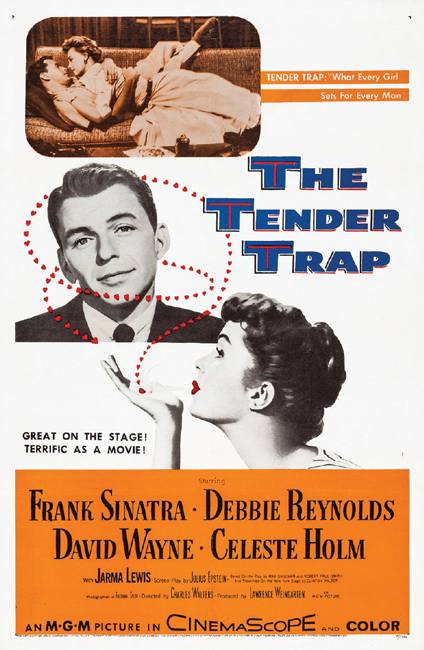
One sheet poster, The Tender Trap, 1955. / “Tender Trap is a cinch for top / attendances everywhere; it's a great, / GREAT comedy, magnificently (Photo: The Cinematic Legacy of Frank Sinatra, David Wills, 2015.)
Lobby cards, The Tender Trap. (Photo: The Cinematic Legacy of Frank Sinatra, David Wills, 2015.)
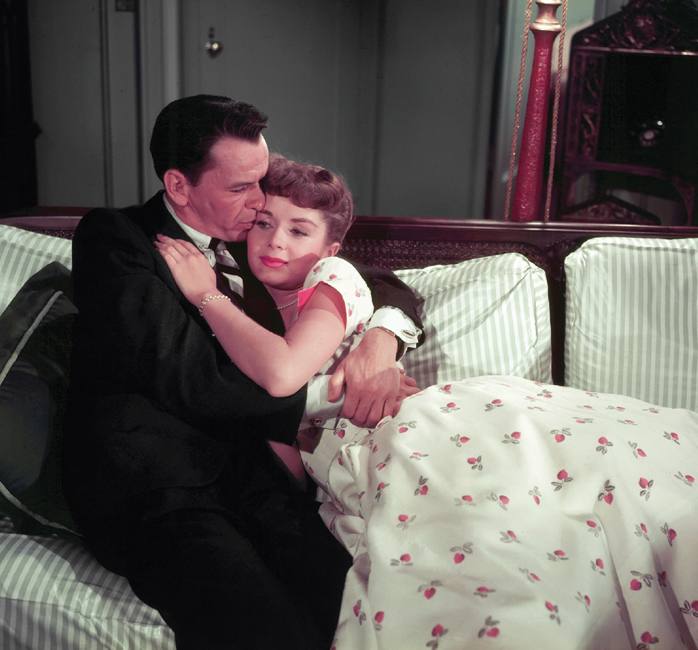
With costar Debbie Reynolds, The Tender Trap. / “… his performance is well-nigh a / perfect demonstration of the sort of / flippant, frantic thing he can do best. / It catches the nervous, restless (Photo: The Cinematic Legacy of Frank Sinatra, David Wills, 2015.)
"Young at Heart"
Santopietro frames Young at Heart as a musical remake of the John Garfield film Four Daughters, pairing Sinatra with Doris Day just as both were entering their peak years of the mid-to-late 1950s. Day, in her last film under her Warner Bros. contract, received top billing over Sinatra, and the film was produced by her husband, Martin Melcher.
Source: Tom Santopietro, "Sinatra in Hollywood" (2008).
"Young at Heart"
Doris Day: Sinatra developed an intense dislike of producer Martin Melcher (Doris Day's husband), refusing to work if Melcher was anywhere on the lot. Day recounted in her 1975 autobiography that Sinatra once sat through an entire meeting hiding behind a newspaper, speaking only to her.
Source: Tom Santopietro, "Sinatra in Hollywood" (2008).
"Young at Heart"
Doris Day: Day's autobiography describes Sinatra's chronic lateness during Young at Heart's production, sometimes not showing up until the afternoon. She acknowledged actors have off days, but felt Sinatra was indifferent to how his absences affected the rest of the crew.
Source: Tom Santopietro, "Sinatra in Hollywood" (2008).
"Young at Heart"
Doris Day: Early in filming, Sinatra demanded that Academy Award-winning cinematographer Charles Lang be replaced; Warner Bros. complied and brought in Ted McCord, who had shot Day's Young Man with a Horn. According to Day, Lang was a meticulous, 'fussy' craftsman about lighting, and the restless Sinatra refused to wait around for him -- Day framed it as ultimately 'Lang or Sinatra.'
Source: Tom Santopietro, "Sinatra in Hollywood" (2008).
"Young at Heart"
Santopietro's overall verdict is that Young at Heart is a 'curiously lumpy' remake of Four Daughters -- a glossy 1930s-style soap opera dressed up with musical numbers -- with real flashes of brilliance from its two stars but too much syrupy plotting, leaving audiences wistful for what could have been.
Source: Tom Santopietro, "Sinatra in Hollywood" (2008).
"Young at Heart"
Santopietro notes that Sinatra's entrance thirty-five minutes into the film as arranger Barney Sloan is a genuine star entrance -- gaunt, unsmiling, cigarette dangling -- and that for the first time on film Sinatra appears older than his actual age of thirty-nine, which Santopietro attributes partly to the toll of the Ava Gardner relationship and hard living.
Source: Tom Santopietro, "Sinatra in Hollywood" (2008).
"Young at Heart"
Santopietro identifies Barney Sloan's line about being killed by lightning ('Pow! D-e-d, dead!') as the first onscreen instance of Sinatra's playful misspelling-of-words verbal tic, a bit he would repeat memorably in Pal Joey.
Source: Tom Santopietro, "Sinatra in Hollywood" (2008).
"Young at Heart"
Doris Day: Santopietro highlights a wordless scene where Day silently watches Sinatra sing 'Someone to Watch over Me' in a bar; he quotes Day's own reflection that despite Sinatra's cocky exterior she always sensed 'a sad vulnerability about him' that earned her compassion and admiration.
Source: Tom Santopietro, "Sinatra in Hollywood" (2008).
"Young at Heart"
Sinatra was given the film's well-known standards (by Porter, the Gershwins, Mercer, with piano solos by Andre Previn) while Day was limited to new, less distinguished songs written for the film -- possibly because Melcher tried to control publishing rights, a practice easier to pull off with lesser-known songwriters, which Day speculated may have fueled Sinatra's dislike of Melcher.
Source: Tom Santopietro, "Sinatra in Hollywood" (2008).
"Young at Heart"
Unlike the original Four Daughters, where John Garfield's character dies, Sinatra's character survives in this remake. Day felt in her memoir that his death would have added dimension to the performance; Santopietro speculates Sinatra may have refused because he'd already died onscreen in From Here to Eternity and Suddenly and didn't want to be typecast dying a third time in a row.
Source: Tom Santopietro, "Sinatra in Hollywood" (2008).
"Young at Heart"
Despite its flaws, Young at Heart proved a major box-office hit for Sinatra and Day.
Source: Tom Santopietro, "Sinatra in Hollywood" (2008).
"Young at Heart"
Santopietro grades this a B, calling it an interesting mismatch with Doris Day, with an excellent Frank performance.
Source: Tom Santopietro, "Sinatra in Hollywood" (2008).
"Young at Heart"
Santopietro grades this a B, calling it a surprisingly touching TV movie, with Frank ending his film career as he began it, playing himself.
Source: Tom Santopietro, "Sinatra in Hollywood" (2008).
"Young at Heart"
Santopietro (Filmography): Arwin/Warner Bros. Pictures. Produced by Henry Blanke, directed by Gordon Douglas, screenplay by Liam O'Brien adapted from Lenore J. Coffee and Julius J. Epstein's earlier script, based on the story 'Sister Act' by Fannie Hurst. Sinatra played Barney Sloan opposite Doris Day, Gig Young and Ethel Barrymore, singing 'Young at Heart,' 'One for My Baby (And One More for the Road)' and other standards.
Source: Tom Santopietro, "Sinatra in Hollywood" (2008).
"Young at Heart"
Santopietro (Filmography): Cameo appearance in a TV movie (unrelated to the 1955 feature of the same title). TS Productions/CBS Television. Executive produced by Tina Sinatra, directed by Allan Arkush, teleplay by Judith Paige Mitchell. Starred Philip Bosco, Olympia Dukakis and Joe Penny, with Frank Sinatra appearing as himself.
Source: Tom Santopietro, "Sinatra in Hollywood" (2008).
January 5, 1955
Radio
The Frank Sinatra Show
Network: NBC
Show Number: 37
Time 8:15 p.m. - 8:30 p.m.
Sponsor: Bobbi Home Permanet, White Rain Shampoo, Deep Magic Face lotion
Host: Frank Sinatra
Writers: Norm Sickel
Announcer: Maurice Hart
Producer: Andrew C. Love
1. Just One Of Those Things - Frank Sinatra
2. Tenderly - Frank Sinatra w/Bill Miller, pianoà à Ã
3. When I Stop Loving You - Frank Sinatra
Television
None
January 7, 1955
Radio
Radio: An episode of Sinatra's radio series The Frank Sinatra Show, sponsored by Bobbi Home Permanent, was broadcast this date, with Sinatra's recordings of "All Of Me" and "You're Too Beautiful." Source: sinatradiscography.com, Radio Transcriptions Database.
[Monroe visits Sinatra's Copa show]
On January 7, 1955, a newly platinum-blonde Marilyn Monroe, accompanied by photographer Milton Greene and his wife, arrived at Sinatra's sold-out Copacabana show; Frank stopped the show and winked at her.
Source: James Kaplan, "Sinatra: The Chairman" (2015).
January 10, 1955
Concerts
Copacabana, New York City (December 23, 1954 - January 12, 1955) Three week engagement
SRO every show
Two Shows
Staring: Frank Sinatra, Joey Bishop, The Petticoats, Copa Girls, Ron Beattie, Dori Anne Gray, Bud Spencer, Kathi Dean Michael Durso and Copacabana Orchestra Frank Marti and Copa Samba Band
Staged By: Douglas Coudy
Music And Lyrics By: Micheal Durso, Mel Mitchell, Marvin Kahn
Orchestrations By: Deac Eberhard
Jewelry By: Coro
Colffures By: Larry Matthews
[Sinatra's sworn passport affidavit triggers year-long probe]
Applying for a passport ahead of an Australian tour, Sinatra swore in an affidavit for the State Department's Passport Division that he had "never been a member of the Communist Party, any so-called Communist Front organizations, or any other group or organization of a subversive character." Suspecting perjury, the State Department asked the FBI to investigate possible criminal fraud; Assistant Attorney General William F. Tompkins formally requested a prosecutorial investigation on March 7, 1955, and Hoover authorized a major inquiry on March 18, dispatching agents to at least eight field offices. Interviews with informants in Philadelphia, Chicago, Detroit, Newark, New York, Salt Lake City, Las Vegas, and Los Angeles -- filed through the autumn of 1955 -- turned up nothing but hearsay and vague recollections; the Los Angeles office's November 4, 1955 twenty-eight-page report concluded there was no evidence connecting Sinatra to the Communist Party beyond his 1946 ICCASP membership. Hoover closed the matter in a December 21, 1955 memo to Tompkins, noting no further investigation would proceed "in the absence of a specific request."
Source: Kuntz and Kuntz, The Sinatra Files, ch. 3 (memos of January 10, February 21, March 7, and December 21, 1955; Los Angeles report of November 4, 1955).
January 11, 1955
Concerts
Copacabana, New York City (December 23, 1954 - January 12, 1955) Three week engagement
SRO every show
Two Shows
Staring: Frank Sinatra, Joey Bishop, The Petticoats, Copa Girls, Ron Beattie, Dori Anne Gray, Bud Spencer, Kathi Dean Michael Durso and Copacabana Orchestra Frank Marti and Copa Samba Band
Staged By: Douglas Coudy
Music And Lyrics By: Micheal Durso, Mel Mitchell, Marvin Kahn
Orchestrations By: Deac Eberhard
Jewelry By: Coro
Colffures By: Larry Matthews
Statler Hotel, New York, NY
Dorsey Brothers 20th Anniversary Show
Frank Sinatra sang three songs:
1. I'll Never Smile Again
2. Oh, Look At Me Now
3. This Love of Mine
Frank's penultimate night at the Copa was preceded by his appearance at the Hotel Statler. The Dorsey Brothers were celebrating their 20th Anniversary with a big show at the hotel. Martin Block was allowed to tape the event. Block celebrated his 20th Anniversary of the WNEW "Make Believe Ballroom" with a seven and a half hour extravaganza, broadcast over WABC-TV and radio from the Manhattan Center, 2-3-55.
The broadcast ran from 2:30 to 10: P.M. TV segments ran for three hours. The Sinatra segment from 1-11-55 was part of the broadcast.
Frank sang "I'll Never Smile Again," 'Oh, Look At Me" and "This Love Of Mine." Dorsey had the temerity to ask Frank to sing. Frank readily agreed and expressed regret he couldn't do more, but he had to get over to the Copa for his first show that night.
The Sinatra segment is on the "New York" 4 CD + DVD set.
--Ed
Statler Hotel, New York, NY
Dorsey Brothers 20th Anniversary Show
Frank Sinatra sang three songs:
1. I'll Never Smile Again
2. Oh, Look At Me Now
3. This Love of Mine
Frank's penultimate night at the Copa was preceded by his appearance at the Hotel Statler. The Dorsey Brothers were celebrating their 20th Anniversary with a big show at the hotel. Martin Block was allowed to tape the event. Block celebrated his 20th Anniversary of the WNEW "Make Believe Ballroom" with a seven and a half hour extravaganza, broadcast over WABC-TV and radio from the Manhattan Center, 2-3-55.
The broadcast ran from 2:30 to 10: P.M. TV segments ran for three hours. The Sinatra segment from 1-11-55 was part of the broadcast.
Frank sang "I'll Never Smile Again," 'Oh, Look At Me" and "This Love Of Mine." Dorsey had the temerity to ask Frank to sing. Frank readily agreed and expressed regret he couldn't do more, but he had to get over to the Copa for his first show that night.
The Sinatra segment is on the "New York" 4 CD + DVD set.
--Ed
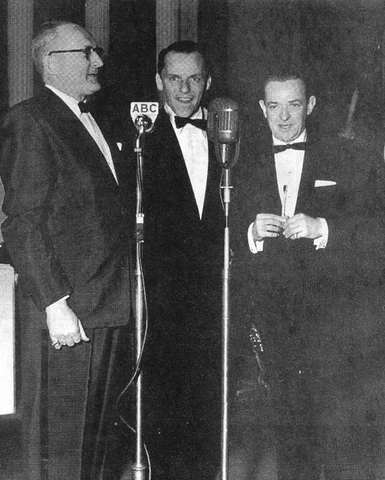
[Dorsey brothers' anniversary gala]
On the night of January 11, 1955, between Copa sets, Sinatra took Vanderbilt to the Statler Hotel for a celebration marking roughly twenty years since Tommy and Jimmy Dorsey formed the Dorsey Brothers Orchestra; Frank sang "I'll Never Smile Again" and "Oh! Look at Me Now" for the crowd, reminiscing fondly about his years in Tommy Dorsey's band (1939-1942).
Source: James Kaplan, "Sinatra: The Chairman" (2015).
January 12, 1955
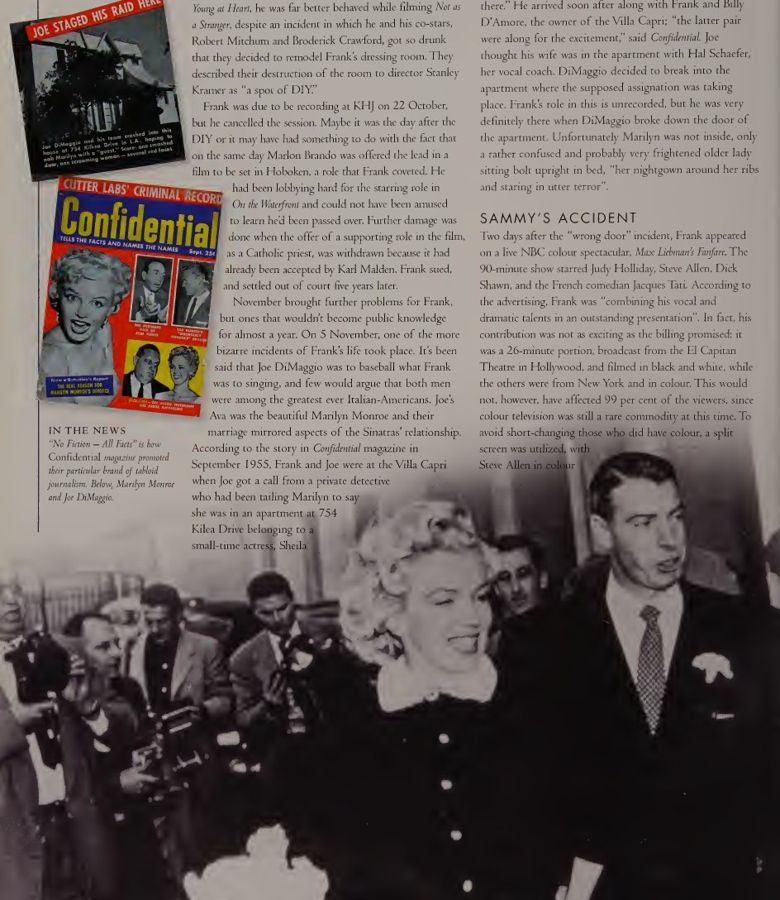
[Photograph: Downbeat reviews Young at Heart on release. From Richard Havers, "Sinatra" (Dorling Kindersley, 2007), p.198.]
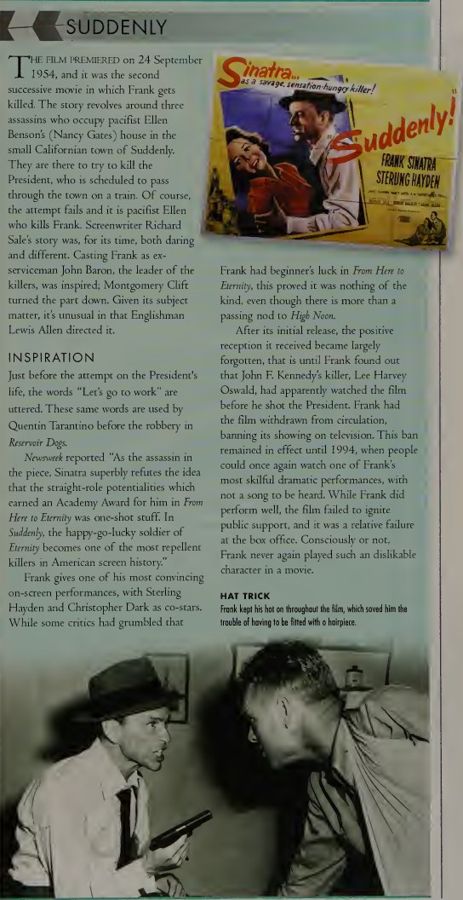
[Photograph: Downbeat reviews Young at Heart on release. From Richard Havers, "Sinatra" (Dorling Kindersley, 2007), p.197.]
Radio
The Frank Sinatra Show
Network: NBC
Show Number: 39
Time 8:15 p.m. - 8:30 p.m.
Sponsor: Bobbi Home Permanet, White Rain Shampoo, Deep Magic Face lotion
Host: Frank Sinatra
Writers: Norm Sickel
Announcer: Maurice Hart
Producer: Andrew C. Love
1. I'm Gonna Sit Right Down And Write Myself A Letter - Frank Sinatra
2. My Own True Love - Margaret Whiting
3. Full Moon And Empty Arms - Frank Sinatra
Concerts
Copacabana, New York City (December 23, 1954 - January 12, 1955) Three week engagement
SRO every show
Two Shows
Staring: Frank Sinatra, Joey Bishop, The Petticoats, Copa Girls, Ron Beattie, Dori Anne Gray, Bud Spencer, Kathi Dean Michael Durso and Copacabana Orchestra Frank Marti and Copa Samba Band
Staged By: Douglas Coudy
Music And Lyrics By: Micheal Durso, Mel Mitchell, Marvin Kahn
Orchestrations By: Deac Eberhard
Jewelry By: Coro
Colffures By: Larry Matthews
Downbeat's review of Young at Heart praised Sinatra as the film's real draw even while judging the plot shaky. The trade paper called the underlying story "pretty wobbly" but singled out Sinatra's star power. (Source: Richard Havers, "Sinatra" (Dorling Kindersley, 2007).)
January 14, 1955
Radio
The Frank Sinatra Show
Network: NBC
Show Number: 40
Time 8:15 p.m. - 8:30 p.m.
Sponsor: Bobbi Home Permanet, White Rain Shampoo, Deep Magic Face lotion
Host: Frank Sinatra
Writers: Norm Sickel
Announcer: Maurice Hart
Producer: Andrew C. Love
1. Sunday - Frank Sinatra
2. Hello Young Lovers - Frank Sinatra w/Bill Miller, piano
3. My Funny Valentine - Frank Sinatra
Television
None
January 15, 1955
Frank delivered a heartfelt dramatic performance opposite Doris Day in the Warner Bros. musical Young at Heart, their first project together since Your Hit Parade in 1949.
Source: Nancy Sinatra, Frank Sinatra: An American Legend, 1995.
January 17, 1955
Concerts
West Melbourne Stadium, Melbourne, Australia (January 17-20) 6pm 8:45pm Shows
Other performers: Anne McCormack, actress/dancer Lois Raye and comedian Frank D'Amor
On this tour Sinatra was backed by the local Dennis Collinson Orchestra, augmented by his regular American sidemen Bud Shank (saxophone), Max Albright (drums), Nick Bonny (guitar) and Bill Miller (piano)
West Melbourne Stadium, Melbourne, Australia
January 17, 18, 19 & 20
6pm & 8:45pm
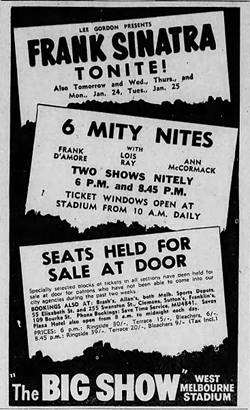
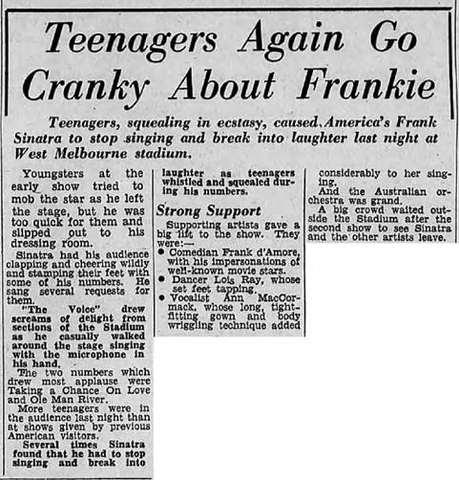
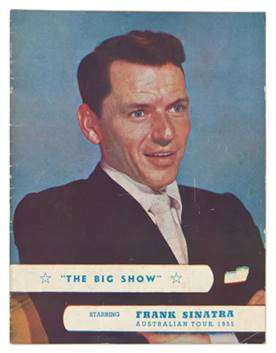
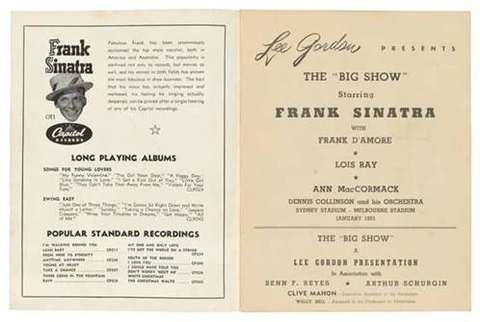
January 18, 1955
Concerts
West Melbourne Stadium, Melbourne, Australia (January 17-20) 6pm 8:45pm Shows
Other performers: Anne McCormack, actress/dancer Lois Raye and comedian Frank D'Amor
On this tour Sinatra was backed by the local Dennis Collinson Orchestra, augmented by his regular American sidemen Bud Shank (saxophone), Max Albright (drums), Nick Bonny (guitar) and Bill Miller (piano)
January 19, 1955
Radio
The Frank Sinatra Show
Network: NBC
Show Number: 41
Time 8:15 p.m. - 8:30 p.m.
Sponsor: Bobbi Home Permanet, White Rain Shampoo, Deep Magic Face lotion
Host: Frank Sinatra
Writers: Norm Sickel
Announcer: Maurice Hart
Producer: Andrew C. Love
1. I'm Gonna Live Till I Die - Frank Sinatra
2. You've Changed - Connie Russell
3. You, My Love - Frank Sinatra
Notes: Frank plugs his current movie "Young at heart."
Concerts
West Melbourne Stadium, Melbourne, Australia (January 17-20) 6pm & 8:45pm Shows
Other performers: Anne McCormack, actress/dancer Lois Raye and comedian Frank D'Amor
On this tour Sinatra was backed by the local Dennis Collinson Orchestra, augmented by his regular American sidemen Bud Shank (saxophone), Max Albright (drums), Nick Bonny (guitar) and Bill Miller (piano) First Show
1. Frank D'Amor into to Frank
2. I've Got The World On A String
3. I Get A Kick Out Of You
4. My Funny Valentine
5. Taking A Chance On Love
6.. Three Coins In A Fountain
7. She's Funny That Way
8. Just One Of Those Things
9. A Foggy Day
10. All Of Me
11. Young At Heart
12. Nancy
13.. They Can't Take That Away
14. Ol' Man River
Ed Notes:
Frank arrived in Australia on 1-17-55 with his daughter Nancy and some great jazz sidemen. He was making his first appearances Down Under in Sydney and Melbourne. There was a brief interview at the airport. Prior to his concert at West Melbourne Stadium, 1-19, he was interviewed by Tom Jones, star of the radio show Metropolis Today. Frank discussed his budding film career, his excitement at finally playing in Australia and his great teacher and long time friend John Quinlan. Frank told Jones that it was a dream of his to bring John back to his home country when he finally made it to Australia. Unfortunately Quinlan had passed away the previous year. Frank expressed great regret. Jones asked him if he found it daunting to play in large stadiums like West Melbourne. Frank assured him that it did not. He was use to it because of the many large stadiums in The States.
[Famous breath-control moment in Melbourne]
At his January 19, 1955 show at West Melbourne Stadium, Sinatra closed with "Ol' Man River," displaying legendary breath control by holding and dropping the note on "jail" and continuing seamlessly into the next phrase for over twenty seconds on a single breath.
Source: James Kaplan, "Sinatra: The Chairman" (2015).
January 20, 1955
Concerts
West Melbourne Stadium, Melbourne, Australia (January 17-20) 6pm 8:45pm Shows
Other performers: Anne McCormack, actress/dancer Lois Raye and comedian Frank D'Amor
On this tour Sinatra was backed by the local Dennis Collinson Orchestra, augmented by his regular American sidemen Bud Shank (saxophone), Max Albright (drums), Nick Bonny (guitar) and Bill Miller (piano)
West Melbourne Stadium, Melbourne, Australia (January 17-20) 6pm 8:45pm Shows
Other performers: Anne McCormack, actress/dancer Lois Raye and comedian Frank D'Amor
On this tour Sinatra was backed by the local Dennis Collinson Orchestra, augmented by his regular American sidemen Bud Shank (saxophone), Max Albright (drums), Nick Bonny (guitar) and Bill Miller (piano)
Ken Wolfe was an Australian rules umpire when he first saw Sinatra sing in 1955: "I can remember this bloke with a funny name, and when he sings all the girls go crazy." Promoter Michael Chugg fell under his spell as a tyke in Tasmania, "when I was a couple of years old, I reckon". Forty years later, Chugg would bring his hero out on his penultimate tour. For Tom Burlinson, it began as a child, enchanted by the fellow pictured on his mother's albums: "The man in the hat." Decades later, Burlinson wrote a song called just that, a fan's tribute that revealed a singing voice so eerie in its echo of the Sinatra tone that a teary Tina Sinatra hired Burlinson to re-create her father's early hits for a TV mini-series.
Frank Sinatra arrives in Sydney with his daughter Nancy in January 1955. CREDIT:K. REDSHAW
The common thread: Sinatra is for life. Another common refrain: to note the influence he had beyond the affection he inspired. We can safely take musician Paul Kelly's word for it as he waxes lyrical about the intensity of the connection. "His singing," Kelly tells Good Weekend, "is still a deep mystery to me."
A deep mystery. With that, Kelly perhaps explains the loyalty of the bond and the endurance of our fascination – that even after all thesee years, we're still trying to work Sinatra out. God knows, we spent enough time trying.
At Melbourne airport, 1955.CREDIT:GEORGE LIPMAN
Bob Horsfall w/ Frank 1/55
01|55: THE FIRST DATE
"Hello, and welcome to Melbourne, Frank Sinatra."
"Thank you, and I'm very happy to be here."
Bob Horsfall can add this to the many feathers in his cap: the media man who did the first and possibly last relaxed and civil interview with Frank Sinatra in Australia. His first question: "Were your parents musical?" Sinatra: "Actually, no." A pioneering showbiz reporter for Melbourne radio, Horsfall cottoned on quickly: if you asked Sinatra about the work rather than, say, the wives, he was putty in your hands. "He was bloody great. He was like we are now, just chatting. But keep away from asking a question about himself, he didn't like it. But we talked about music all the time."
For Horsfall, and many others, it was thrilling. This was Robert Menzies' Australia: dull, isolated, insecure. Ken Wolfe recalls, "It was incredible just that he was here. In those days, nobody like that came." Sinatra was then 39, in fine form on stage and friendly form off it. "We were great mates from the start," says Horsfall, whose musical rapport had roots in his own talents as founder of the band the Tune Twisters, who would tour and play with Sinatra on his third tour, six years later. But in 1955, it was enough to meet and greet and see the man live. Ken Wolfe was at the first concert, too: West Melbourne Stadium, January 17, 1955. "Amazing. Frank Sinatra, here. He was like a god appearing before us. Just magnificent."
--------------------------------------------
© 1997-2026 The Sinatra Archive
This calendar, or any parts thereof, may not be reproduced in any fashion whatsoever without the prior written permission of the publisher (The Sinatra Archive)
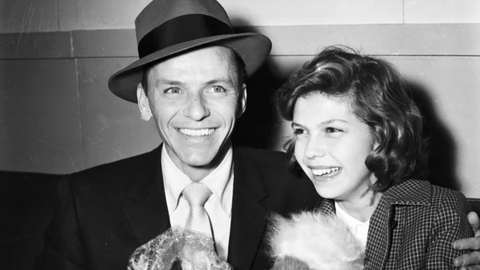
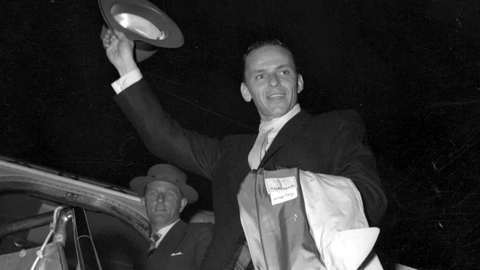
January 21, 1955
Radio
The Frank Sinatra Show
Network: NBC
Show Number: 42
Time 8:15 p.m. - 8:30 p.m.
Sponsor: Bobbi Home Permanet, White Rain Shampoo, Deep Magic Face lotion
Host: Frank Sinatra
Writers: Norm Sickel
Announcer: Maurice Hart
Producer: Andrew C. Love
1. Get Happy - Frank Sinatra
2. Bring Back My Baby To Me - Ella Mae Morse
3. Half As Lovely (Twice As True) - Frank Sinatra
Television
None
Concerts
Sydney Stadium, Sydney, Australia (January 21-22 & January 26-29) The Big Show
6pm & 8:45pm shows and Matinees 2:30pm Saturdays (January 22 & 29)
Sydney Stadium, Sydney, Australia (January 21-22 & January 26-29) The Big Show
Crowd scene at the Frank Sinatra concert at The Stadium in Sydney on 21 January 1955.
Credit:Fairfax Archives
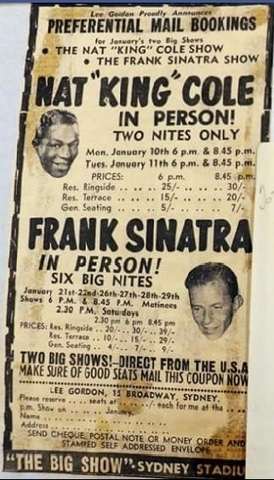
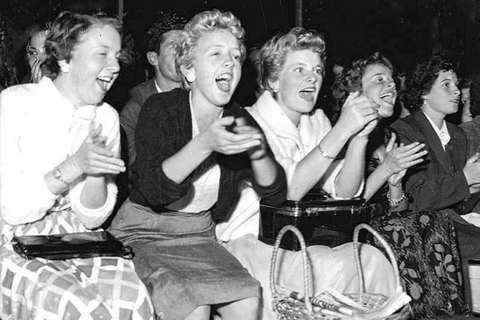
January 22, 1955
Concerts
Sydney Stadium, Sydney, Australia (January 21-22 & January 26-29) The Big Show
6pm & 8:45pm shows and Matinees 2:30pm Saturdays (January 22 & 29)
January 24, 1955
Concerts
Melbourne Town Hall, Melbourne, Australia (January 24-25) 2 shows 6pm and 8:45pm
Note: January 24th and 25th were to have been at West Melbourne Stadium but had to be held at the Melbourne Town Hall, because the old Melbourne Stadium was destroyed by fire in the early hours of January 24th,
1. I've Got The World On A String
2. I Get A Kick Out Of You
3. My Funny Valentine
4. Taking A Chance On Love
5. Three Coins In A Fountain
6. She's Funny That Way
7. Just One Of Those Things
8. A Foggy Day
9. All Of Me
10. Monologue
11. Young At Heart
12. Nancy
13. They Can't Take That Away
14. Ol' Man River
TT: 42min.
Melbourne Town Hall, Melbourne, Australia (January 24-25) 2 shows 6pm and 8:45pm
Note: January 24th and 25th were to have been at West Melbourne Stadium but had to be held at the Melbourne Town Hall, because the old Melbourne Stadium was destroyed by fire in the early hours of January 24th,
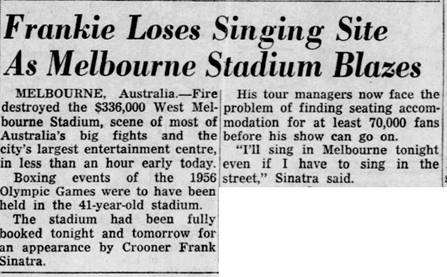
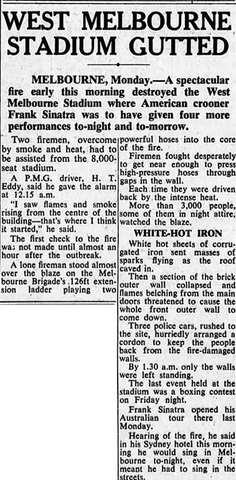
January 25, 1955
Concerts
Melbourne Town Hall, Melbourne, Australia (January 24-25) 2 shows 6pm and 8:45pm
Note: January 24th and 25th were to have been at West Melbourne Stadium but had to be held at the Melbourne Town Hall, because the old Melbourne Stadium was destroyed by fire in the early hours of 24 January,
Melbourne Town Hall, Melbourne, Australia (January 24-25) 2 shows 6pm and 8:45pm
Note: January 24th and 25th were to have been at West Melbourne Stadium but had to be held at the Melbourne Town Hall, because the old Melbourne Stadium was destroyed by fire in the early hours of 24 January,
[image referenced in source but could not be recovered]
January 26, 1955
Radio
The Frank Sinatra Show
Network: NBC
Show Number: 43
Time 8:15 p.m. - 8:30 p.m.
Sponsor: Bobbi Home Permanet, White Rain Shampoo, Deep Magic Face lotion
Host: Frank Sinatra
Writers: Norm Sickel
Announcer: Maurice Hart
Producer: Andrew C. Love
1. South Of The Border - Frank Sinatra
2. You'd Be So Nice To Come Home To - Frank Sinatra w/Bill Miller, piano
3. When I Stop Loving You - Frank Sinatra
Concerts
The Big Show, Sydney Stadium, Sydney, Australia (January 21-22 & January 26-29) 6pm & 8:45pm shows and Matinees 2:30pm Saturdays (January 22 & 29)
Other performers: Anne McCormack, actress/dancer Lois Ray and comedian Frank D'Amor
On this tour Sinatra was backed by the local Dennis Collinson Orchestra, augmented by his regular American sidemen Bud Shank (saxophone), Max Albright (drums), Nick Bonny (guitar) and Bill Miller (piano)
January 27, 1955
Concerts
The Big Show, Sydney Stadium, Sydney, Australia (January 21-22 & January 26-29) 6pm & 8:45pm shows and Matinees 2:30pm Saturdays (January 22 & 29)
Other performers: Anne McCormack, actress/dancer Lois Ray and comedian Frank D'Amor
On this tour Sinatra was backed by the local Dennis Collinson Orchestra, augmented by his regular American sidemen Bud Shank (saxophone), Max Albright (drums), Nick Bonny (guitar) and Bill Miller (piano)
January 28, 1955
Radio
The Frank Sinatra Show
Network: NBC
Show Number: 44
Time 8:15 p.m. - 8:30 p.m.
Sponsor: Bobbi Home Permanet, White Rain Shampoo, Deep Magic Face lotion
Host: Frank Sinatra
Writers: Norm Sickel
Announcer: Maurice Hart
Producer: Andrew C. Love
1. Jeepers Creepers - Frank Sinatra
2. Our Future Has Only Just Begun - Denise Lor
3. From Here To Eternity - Frank Sinatra
Notes: Confirmed aired on WCBS
Concerts
The Big Show, Sydney Stadium, Sydney, Australia (January 21-22 & January 26-29) 6pm & 8:45pm shows and Matinees 2:30pm Saturdays (January 22 & 29)
Other performers: Anne McCormack, actress/dancer Lois Ray and comedian Frank D'Amor
On this tour Sinatra was backed by the local Dennis Collinson Orchestra, augmented by his regular American sidemen Bud Shank (saxophone), Max Albright (drums), Nick Bonny (guitar) and Bill Miller (piano)
January 29, 1955
Concerts
The Big Show, Sydney Stadium, Sydney, Australia (January 21-22 & January 26-29) 6pm & 8:45pm shows and Matinees 2:30pm Saturdays (January 22 & 29)
Other performers: Anne McCormack, actress/dancer Lois Ray and comedian Frank D'Amor
On this tour Sinatra was backed by the local Dennis Collinson Orchestra, augmented by his regular American sidemen Bud Shank (saxophone), Max Albright (drums), Nick Bonny (guitar) and Bill Miller (piano)
February 1, 1955
Radio
Heart To Heart #4
Sponsored By: American Heart Association fund appeal.
Syndicated.
Host: Frank Sinatra.
Guest : Lauritz Melchior
1. Young At Heart
2. All Of Me
3. I Have But One Heart
4. I'm Gonna Sit Right Down And Write Myself A Letter
Note: TT: 15 mins. Sound Excellent
note: This is a good show. A lighthearted competition
between Frank's pop music and Melchior's long hair
music.--Ed
February 2, 1955
Radio
The Frank Sinatra Show
Network: NBC
Show Number: 45
Time 8:15 p.m. - 8:30 p.m.
Sponsor: Bobbi Home Permanet, White Rain Shampoo, Deep Magic Face lotion
Host: Frank Sinatra
Writers: Norm Sickel
Announcer: Maurice Hart
Producer: Andrew C.. Love
Television
none
February 4, 1955
Radio
The Frank Sinatra Show
Network: NBC
Show Number: 46
Time 8:15 p.m. - 8:30 p.m.
Sponsor: Bobbi Home Permanet, White Rain Shampoo, Deep Magic Face lotion
Host: Frank Sinatra
Writers: Norm Sickel
Announcer: Maurice Hart
Producer: Andrew C. Love
February 8, 1955
Studio
KHJ Studios, Hollywood
13556 Dancing On The Ceiling
(Richard Rodgers/Lorenz Hart)
Arranged by Nelson Riddle
Conducted by Bill Miller
CDP 7-46571-2 In The Wee Small Hours
LP: W581 In The Wee Small Hours
13557 Can't We Be Friends?
(Kay Swift/Paul James)
Arranged by Nelson Riddle
Conducted by Bill Miller
CDP 7-46571-2 In The Wee Small Hours
LP: W581 In The Wee Small Hours
13558 Glad To Be Unhappy
(Richard Rodgers/Lorenz Hart)
Arranged by Nelson Riddle
Conducted by Bill Miller
CDP 7-46571-2 In The Wee Small Hours
LP: W581 In The Wee Small Hours
13559 I'll Be Around
(Alec Wilder)
Arranged by Nelson Riddle
Conducted by Bill Miller
CDP 7-46571-2 In The Wee Small Hours
LP: W581 In The Wee Small Hours
NOTE: Sinatraphile Rich Warwick exclaims "What a session." "Glad to be Unhappy" was the only song included in Ed O'Brien's book SINATRA 101, THE 101 BEST RECORDINGS AND THE STORIES BEHIND THEM (Boulevard Books 1996), but Rich suspects he would have liked to include all four songs. Actually probably every song from the album could be included! If only the session material for this album had surfaced over the years!
Sinatraphile Jack Tomsky says that the only session number he knows of is "What Is This Thing Called Love?."
Sinatra Scholar Ed O'Brien agrees with both Rich and Jack and says he fervently wishes Sinatra had done about 200 sessions with the little group present at the KHJ Studios that evening.
1. Bill Miller, piano[
2. Paul Smith, celeste
3. George Van Eps, guitar
4. Phil Stephens, bass
5. Alvin Stoller, drums
Drummer Stoller told O'Brien that Sinatra was all business for the "Wee Small" sessions. Many years later Alan Livingston and George Jacobs expanded on what Stoller told O'Brien with even more amazing information. Livingston told O'Brien the entire concept including song selection, musicians, arrangements and even song sequence on the finished product was all thought out and controller by Sinatra.
Have you ever heard more exquisite singing than what he did on February 8,1955? Jacobs told O'Brien that Frank and Bill would spend hours going over note of each tune. Frank perfected every nuance, shading, pause until he was totally sure that it was exactly right. The results is arguably the finest album ever recorded. In recent months there have been lists published by Time, Rolling Stone, and others on the greatest albums ever recorded. "Wee Small" was an automatic pick. How could it not be!
Sinatra did a number of albums lamenting the consequences of unrequited love, O'Brien continues, but never, never was there one with such a seamless selection of tunes, exploring the pain and loneliness that comes in the wee small hour. What he created in February and March of 1955 is the very best American music has to offer. "Wee Small . . ." is the album to play and play again.
KHJ Studios, Hollywood
13556 Dancing On The Ceiling
13557 Can't We Be Friends?
13558 Glad To Be Unhappy
13559 I'll Be Around
This is from the original liner notes the album that many consider to be
Frank Sinatra's finest, and never a truer word spoken.
In The Wee Small
Hours is a record that creates a mood of stark loneliness and it’ss one that has become the soundtrack for countless
failed love affairs. Sinatra sets out his stall from the very moment the album begins. "In the wee small hours of the morning, while the whole
wide world is asleep, you lie awake and think about the girl…"
DOWNBEAT
JUNE 1, 1955
Variety
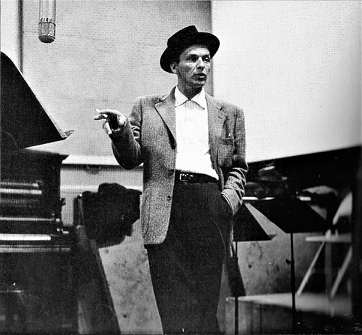
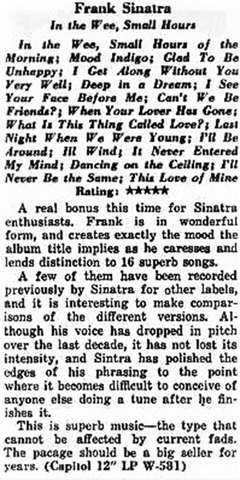
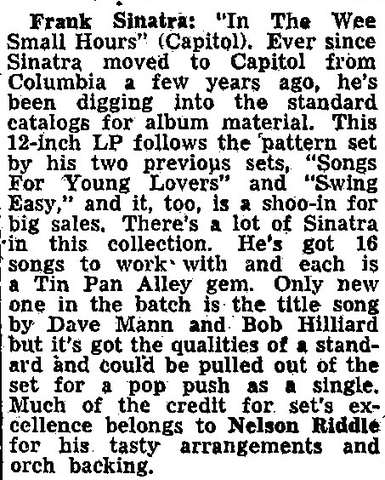
Billboard
April 1955
Record Town
Citizens News,
Hollywood
Cincinnati
Post
Hartford Courant
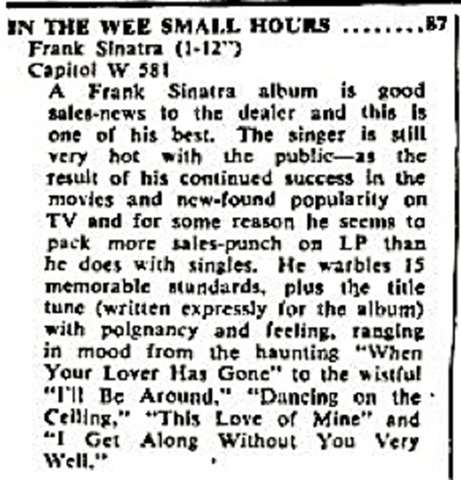
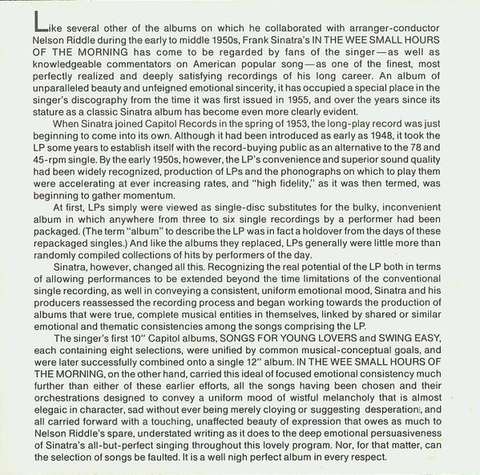
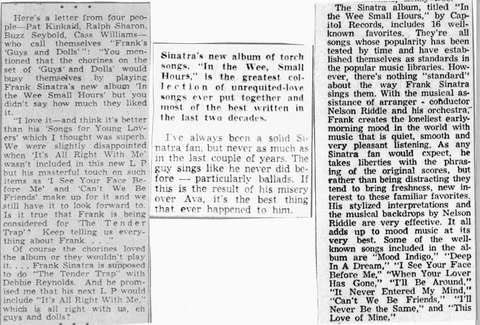
7-26-55
7-5-55
"Glad to Be Unhappy"
Richard Rodgers (paraphrased): Friedwald recounts that when someone asked Richard Rodgers whether his late partner Lorenz Hart was being autobiographical in writing this song, Rodgers said Hart wasn't 'glad' about his unhappiness at all -- he was genuinely miserable, 'unhappy to be unhappy.' Friedwald contrasts this with Sinatra's 1955 definitive recording, in which Sinatra positively celebrates his own unhappiness rather than merely enduring it.
Source: Will Friedwald, "Sinatra! The Song Is You: A Singer's Art" (2018 revised edition).
[Wee Small Hours session at KHJ]
Around 8:00 p.m. on Tuesday, Sinatra arrived at KHJ Radio Studios with producer Voyle Gilmore and a small combo (Bill Miller, Paul Smith on celesta, George Van Eps, Phil Stephens, Alvin Stoller) to record four songs for his new album -- "Dancing on the Ceiling," "Glad to Be Unhappy," "Can't We Be Friends?," and "I'll Be Around" -- using stripped-down, string-and-horn-free arrangements Riddle had written but was not present to conduct; Miller led instead.
Source: James Kaplan, "Sinatra: The Chairman" (2015).
February 9, 1955
Radio
The Frank Sinatra Show
Network: NBC
Show Number: 47
Time 8:15 p.m. - 8:30 p.m.
Sponsor: Bobbi Home Permanet, White Rain Shampoo, Deep Magic Face lotion
Host: Frank Sinatra
Writers: Norm Sickel
Announcer: Maurice Hart
Producer: Andrew C. Love
Television
None
February 11, 1955
Radio
The Frank Sinatra Show
Network: NBC
Show Number: 48
Time 8:15 p.m. - 8:30 p.m.
Sponsor: Bobbi Home Permanet, White Rain Shampoo, Deep Magic Face lotion
Host: Frank Sinatra
Writers: Norm Sickel
Announcer: Maurice Hart
Producer: Andrew C. Love
1. I Got A Crush On You - Frank Sinatra
2. Celeste - Frank Sinatra w/Bill Miller, piano
3. Melody Of Love - Frank Sinatra
Ed O'Brien notes:
Celeste was the name of the Bobbi Permanent Girl.
Song was written for the show and Frank performed it twice, both efforts with just Bill Miller on piano.
February 16, 1955
Studio
KHJ Studios, Hollywood
13457 What Is This Thing Called Love?
(Cole Porter)
Warner Bros. Inc. (ASCAP)
Arranged & Conducted by Nelson Riddle
-21 (2:35) CD: CDP 724383595228 Sinatra 80th "All The Best"
CD: CDP 7-96611-2 Sings The Select Cole Porter
CD: C2-94777 The Capitol Years
CDP 7-46571-2 In The Wee Small Hours
LP: W581 In The Wee Small Hours
"What Is This Thing Called Love("Take 1) was issued in 2015 on the Bonus Disc on the Ultimate Sinatra in Japan. --Fred W
NOTE: Sinatra Scholar Ed O'Brien reports that he had the great privilege of interviewing Mahlon Clark.
He is the featured clarinet solo on Take One and did additional work throughout including that great introduction. Sinatra did 21 takes and Mahlon told O'Brien it was a remarkable session. Sinatra loved the chart Nelson Riddle wrote for the Porter tune.
Note: A number of musicians, who worked Sinatra sessions, concerts, TV shows, told me that Frank never warmed to Riddle.
They worked well together but that is where it ended. Frank was much closer with Jenkins and May. The latter told me stories about their friendship through the years. Vinnie told me that Riddle was never a real insider. Mahlon Clark gave some real understanding as to why when we discussed the 2-16-55 session. Frank and Nelson were standing next to each other, listening to the final playback of "What Is This Thing Called Love." When it ended, Frank turned to him and said, "You're a gas, Nels." Riddle replied with "likewise." Mahlon told me there was collective cringe from all the musicians.
Ed
Sinatraphile Vance Adair says he loves the solo on "What Is This Thing."
13458 Ill Wind
(Harold Alren/Ted Koehler)
Arranged & Conducted by Nelson Riddle
CDP 7-46571-2 In The Wee Small Hours
LP: W581 In The Wee Small Hours
13459 I See Your Face Before Me
(Arthur Schwartz/Howard Dietz)
Arranged & Conducted by Nelson Riddle
CDP 7-46571-2 In The Wee Small Hours
LP: W581 In The Wee Small Hours
NOTE: Ed O'Brien reports that Jonathan Schwartz, son of the composer, told him that Arthur Schwartz wasn't thrilled with the note Frank sang on it, wasn't the one he wrote for the song. Later on, Jonathan convinced his father that it was wonderful regardless.
Sinatraphile Vance Adair finds the Schwartz song interesting and asks if Sinatra had pitching problems or did he choose to "modify" the note. It is indeed a very tricky melody to sing.
O'Brien responds by reporting that Jonathan told him that Riddle wrote the chart with the note that Frank sang. Riddle thought it was an improvement. Arthur didn't agree.
Paul Marinaro:
Having learned "I See Your Face Before Me" from Sinatra, I'm curious what the "wrong" note is. Anyone?
Ed O'Brien:
The first note on the word "I," Arthur had written as a string of identical notes to accommodate the title - in the key of C, for example, that note would be an E, the words "I See Your Face Before Me" all landing on that E, depending on it before the melody ascended to F and G. Sinatra had begun by placing the word "I" on the low G before jumping up to the intended E. Arthur took exception.
13523 Mood Indigo
(Duke Ellington/Irving Mills/Barney Bigard)
Arranged & Conducted by Nelson Riddle
CDP 7-46571-2 In The Wee Small Hours
LP: W581 In The Wee Small Hours
NOTE: Ed O'Brien reports that there are some great photos from this session.
Personnel:
Harry Sweets Edison trumpet
Mahlon Clark, Skeets Herfurt, Champ Webb, Babe Russin, Ted Nash (saxaphones/woodwinds) Felix Slaxin, Paul Shure, Harry Bluestone, Mischa Russell ( violins ) Alvin Dinkin, Eleanor Slatkin (violas)
Kathryn Julye (harp)
Bill Miller (piano)
Paul Smith (celeste)
George Van Eps ( guitar)
Phil Stephens (bass)
Alvin Stoller (drums)
note: I interviewed six of the musicians on this session. I already shared a bit of what Mahlon Clark had to say. Paul Smith forgot he had played the sessions. I sent him some material and then we chatted again. Riddle liked the idea of a celeste and Frank loved it. Listen to "What Is This Thing Called Love" and you'll hear just how inventive Riddle was and how talented those L.A. musicians were back then.
Ed
Radio
The Frank Sinatra Show
Network: NBC
Show Number: 49
Time 8:15 p.m. - 8:30 p.m.
Sponsor: Bobbi Home Permanet, White Rain Shampoo, Deep Magic Face lotion
Host: Frank Sinatra
Writers: Norm Sickel
Announcer: Maurice Hart
Producer: Andrew C. Love
Notes: unconfirmed show
Television
None
[What Is This Thing Called Love? -- critical commentary]
Granata calls 'What Is This Thing Called Love?' from In the Wee Small Hours emblematic of what may be Sinatra's vocal zenith, citing its expressive vocal shading as reason the album could stand alone as a definition of Sinatra's artistry.
This song/context matches multiple dated entries in the chronology, or lacked a sufficiently precise date; the specific date could not be determined with confidence.
Source: Charles L. Granata, "Sessions with Sinatra: Frank Sinatra and the Art of Recording" (1999/2003), Part III: The Capitol Years, 1953-1962
February 17, 1955
Studio
KHJ Studios, Hollywood
13460 I Get Along Without You Very Well
(Hoagy Carmichael)
Arranged & Conducted by Nelson Riddle
CDP 7-46571-2 In The Wee Small Hours
LP: W581 In The Wee Small Hours
13461 In The Wee Small Hours Of The Morning
(D. Mann/B. Hilliard)
(Redd Evans Music Company (ASCAP)
Arranged & Conducted by Nelson Riddle
-13 (2:59) CD: CDP 724383595228 Sinatra 80th "All The Best"
CD: C2-94777 The Capitol Years
CD: CDP 7-46571-2 In The Wee Small Hours
LP: W581 In The Wee Small Hours
13573 When Your Lover Has Gone
(E.A. Swan)
Arranged & Conducted by Nelson Riddle
CD: CDP 7-46571-2 In The Wee Small Hours
LP: W581 In The Wee Small Hours
Ed O'Brien notes: I was told by musicians, who played on this session, that Frank was in tears listening to the final playback of "When Your Lover Has Gone."
Note: Frank loved this song. He sang it for more than 40 years. He always accorded the song the greatest respect in his concert and club performances.
--Ed
13574 This Love Of Mine
(Sol Parker/Henry Sanicola/Frank Sinatra)
Arranged & Conducted by Nelson Riddle
CD: CDP 7-46571-2 In The Wee Small Hours
LP: W581 In The Wee Small Hours
IN THE WEE SMALL HOURS
Frank Sinatra ( 1-12" )
Capitol W 581
A Frank Sinatra album is good sales-news to the dealer and this is one of his best. The singer is still very hot with the public -- as the result of his continued success in the movies and new-found popularity on TV and for some reason he seems to pack more sales-punch on LP than he does with singles. He warbles
15 memorable standards, plus the title tune
( written expressly for the album ) with poignancy and feeling, ranging in mood from the haunting
"When Your Lover Has Gone" to the wistful "I'll
Be Around," "Dancing On The Ceiling," "This Love
Of Mine" and "I Get Along Without You Very Well."
Billboard
May 14, 1955
note: Sinatra's finest album was released by Capitol on April 15,1955. Billboard Top LP list had it charting at #2 for 18 consecutive weeks. Nelson Riddle's goal, in writing charts for Frank back then, was to achieve a timeless quality that would endure for ever. Years later he told George Robert, bass trombonist on many sessions with Nelson and Frank, that he felt that had happened with his work on "Wee Small Hours."
In my interviews with musicians, arrangers, songwriters, "Wee Small . . ." is always the album they rank as Frank's greatest. Neal Hefti, Al Porcino,
Vince DeRosa, Teddy Randazzo and others not only sang the praises for this monumental work but told me how many copies they wore out through the years.
According to George Jacobs, Frank referred to it as the "Ava album." From that tumultuous relationship, the artist channeled his agony into a masterwork that explored the desolation and despair of unrequited love. He sang each of the marvelous 16 songs with a shattering honesty that will always resonant with anyone who comes upon this remarkable work.
Ed
Sinatra in studio on February 17, 1955. Sheet music is for "I Get Along Without You Very Well"
[image referenced in source but could not be recovered]
[In the Wee Small Hours of the Morning -- critical commentary]
Dave Mann: Songwriter Dave Mann recalled that he and lyricist Bob Hilliard, walking in New York, spotted Sinatra and Nelson Riddle on the street and showed them their new song 'In the Wee Small Hours of the Morning'; Sinatra liked it immediately and used it as the title track of the album then in progress. Capitol commissioned cover art of Sinatra at 3 a.m. against a lamppost to match the song.
This song/context matches multiple dated entries in the chronology, or lacked a sufficiently precise date; the specific date could not be determined with confidence.
Source: Charles L. Granata, "Sessions with Sinatra: Frank Sinatra and the Art of Recording" (1999/2003), Part III: The Capitol Years, 1953-1962
[In the Wee Small Hours of the Morning -- critical commentary]
Granata includes 'In the Wee Small Hours of the Morning' among the fifty recordings he considers essential to understanding Sinatra's artistry (arranged by Nelson Riddle, recorded 1955, Capitol); the song was chosen for its musical/interpretive value rather than commercial popularity.
This song/context matches multiple dated entries in the chronology, or lacked a sufficiently precise date; the specific date could not be determined with confidence.
Source: Charles L. Granata, "Sessions with Sinatra: Frank Sinatra and the Art of Recording" (1999/2003), Afterword & Appendices A-D
[This Love of Mine -- critical commentary]
Matt Dennis: "Frank asked me if I wouldn’t mind checking out the melody and lyrics [of ‘This Love of Mine’]," Matt Dennis remembered, "so I got a hold of Tom [Adair] one day and we sat down, and in a couple of hours, we made some minor, minor changes. I remember changing the melody for two or three measures, and Tom did make some minor alterations to the lyric. Anyhow, Frank liked what we did, and that’s how they recorded it. Frank was so proud. And the strangest thing happened, for all these years, every time I hear ‘This Love of Mine’ I feel like I’m hearing one of my own songs. And all I did was change a little bit of it, as a favor to Tommy and Frank." Sinatra would later record the song again, to even greater effect, with Nelson Riddle in the classic 1955 album In the Wee Small Hours.
This song/context matches multiple dated entries in the chronology; the specific date Friedwald is referring to could not be determined with confidence.
Source: Will Friedwald, "Sinatra! The Song Is You: A Singer's Art" (2018 revised edition), Ch. 3, "With Tommy Dorsey" (1940-1942)
February 18, 1955
Radio
The Frank Sinatra Show
Network: NBC
Show Number: 50
Time 8:15 p.m. - 8:30 p.m.
Sponsor: Bobbi Home Permanet, White Rain Shampoo, Deep Magic Face lotion
Host: Frank Sinatra
Writers: Norm Sickel
Announcer: Maurice Hart
Producer: Andrew C.. Love
Television
None
February 23, 1955
Studio
KHJ Studios, Hollywood
13470 Soliloquy N/R
Arranged & Conducted by Richard Jones
Ed O'Brien notes:
I was puzzled for years about this recording,
Why was it incomplete? Frank was in the process of recording the great "Wee Small Hours" in February of 55. What happened? Well, Vince DeRosa, the
French horn player, told me. As the session progressed that evening, Sinatra became less and less thrilled with the Richard Jones arrangement. They tried to work it out, but to no avail. Session was then scrapped.
Radio
The Frank Sinatra Show
Network: NBC
Show Number: 51
Time 8:15 p.m. - 8:30 p.m.
Sponsor: Bobbi Home Permanet, White Rain Shampoo, Deep Magic Face lotion
Host: Frank Sinatra
Writers: Norm Sickel
Announcer: Maurice Hart
Producer: Andrew C. Love
Notes: unconfirmed show
Television
None
"Soliloquy"
Bill Miller: When Sinatra was briefly attached to the 1955 film Carousel, he began a "Soliloquy" arranged by former Dorsey arranger Richard Jones (then Capitol's classical A&R head), using early tape-splicing to record it in segments. Bill Miller said Sinatra 'wanted to give him a job' by letting Jones arrange it, but called the chart merely 'a stock arrangement' -- though Sinatra sings exceptionally well on the surviving incomplete version (issued on the Rhino Frank Sinatra in Hollywood boxed set). The session was abandoned when the movie deal collapsed.
Source: Will Friedwald, "Sinatra! The Song Is You: A Singer's Art" (2018 revised edition).
February 24, 1955
KHJ Studios, Hollywood
13585 Deep In A Dream (Orchestral Track)
(Jimmy Van Heusen/Eddie De Lange)
Arranged & Conducted by Nelson Riddle
13586 I'll Never Be The Same (Orchestral Track)
(Matty Malneck/Frank Signorelli/Gus Kahn)
Arranged & Conducted by Nelson Riddle
Ed O'Brien Notes:
There were no vocals done at this session.
Riddle conducted and the orchestral tracks were laid down.
-----------------------------------------
February 24, 1959, Beverly Hilton Hotel, Los Angeles
Testimonial Banquet Honoring George Jessel
[image referenced in source but could not be recovered]
February 25, 1955
Radio
The Frank Sinatra Show
Network: NBC
Show Number: 52
Time 8:15 p.m.. - 8:30 p.m.
Sponsor: Bobbi Home Permanent, White Rain Shampoo, Deep Magic Face lotion
Host: Frank Sinatra
Writers: Norm Sickel
Announcer: Maurice Hart
Producer: Andrew C. Love
1. I'm Gonna Live Till I Die - Frank Sinatra
2. Try A Little Tenderness - Frank Sinatra w/Bill Miller, piano
3. Birth Of The Blues - Frank Sinatra
March 1955
[Sinatra Sends Bela Lugosi A Get-Well Basket]
Nancy Sinatra: When horror star Bela Lugosi checked into a hospital to treat heroin addiction, he was surprised to receive a kind note and a basket of gourmet food from Sinatra, whom he had never met.
Source: Nancy Sinatra, Frank Sinatra: An American Legend, 1995.
[Erskine Johnson on Sinatra's calls to Ava]
Erskine Johnson: In March 1955, columnist Erskine Johnson reported that despite his public dates with Gloria Vanderbilt, Sinatra was still placing frequent long-distance calls to Ava Gardner across Europe, night after night.
Source: James Kaplan, "Sinatra: The Chairman" (2015)
March 1, 1955
Studio
Los Angeles, SAMUEL GOLDWYN STUDIOS
GUYS AND DOLLS
Orchestra conducted by Jay Blackton
Arrangements by Nelson Riddle
The Oldest Established Floating Crap Game In New York*
Frank Sinatra, Stubby Kaye, Johnny Silver & Chorus
*On 5-27-55 (Friday), Sinatra would do a vocal pickup
Guys And Dolls
Frank Sinatra, Stubby Kaye and Johnny Silver
Sinatra's first stereo recordings
March 2, 1955
Radio
The Frank Sinatra Show
Network: NBC
Show Number: 53
Time 8:15 p.m. - 8:30 p.m.
Sponsor: Bobbi Home Permanet, White Rain Shampoo, Deep Magic Face lotion
Host: Frank Sinatra
Writers: Norm Sickel
Announcer: Maurice Hart
Producer: Andrew C. Love
1. Why Should I Cry Over You? - Frank Sinatra
2. Everlovin' - Patti Page
3. Don't Change Your Mind About Me - Frank Sinatra
Television
NONE
March 4, 1955
Studio
KHJ Studios. Hollywood
13486 It Never Entered My Mind
(Richard Rodgers/Lorenz Hart)
Arranged & Conducted by Nelson Riddle
CD: CDP 7-46571-2 In The Wee Small Hours
LP: W581 In The Wee Small Hours
13487 Not As A Stranger
(J. Van Heusen/B. Kaye)
Arranged & Conducted by Nelson Riddle
CD: C2 724383808922 The Complete Capitol Singles
LP: W1164 Look To Your Heart
45: 3130
13585 Deep In A Dream
(Jimmy Van Heusen/Eddie De Lange)
Arranged & Conducted by Nelson Riddle
CD: CDP 7-46571-2 In The Wee Small Hours
LP: W581 In The Wee Small Hours
13585 I'll Never Be The Same
(Matty Malneck/Frank Signorelli/Gus Kahn)
Arranged & Conducted by Nelson Riddle
CD: CDP 7-46571-2 In The Wee Small Hours
LP: W581 In The Wee Small Hours
Musicians - French Horns: John Cave, Joseph Eger, Richard Perissi, Vincent De Rosa; Flute: Arthur Gleghorn, Luella Howard, Jules Kinsler, George Pooole; Violins: Victor Bay, Alex bay, Alex Beller, Harry Bluestone, Nathan Ross, Mischa Russell, Paul Shure, Felix Slatkin, Marshall Sosson; Cellos: James Arkatov, Cy Bernard, Armand Kaproff, Ray Kramer, Edgar Lustgarten, Kurt Reher, Joseph Saxon, Eleanor Slatkin; Piano: Bill Miller; Bass: Phil Stephens; Drums: Lou Singer; Guitar: George Van Eps; Harp: Kathryn Julye
Session Producer: Voyle Gilmore
note: The four sessions that make up 15 of the 16 songs, for the "Wee Small Hours", were done in February/March of 1955.
Each sessions had very different orchestrations. This was Frank's idea. The first session was done with a quintet( 2/8); the second one used 18 musicians including Harry "Sweets" Edison on trumpet and Mahlon Clark playing clarinet; plus four violins, the third (2/17) had 26 musicians including 12 violins and the final session(3/4) used four French horns, four flutes plus 22 additional players. Riddle immediately understood that Sinatra had different ideas for the sounds surrounding each vocal. And the songs were recorded in the order that fit the concepts that Sinatra envisioned.
Ed
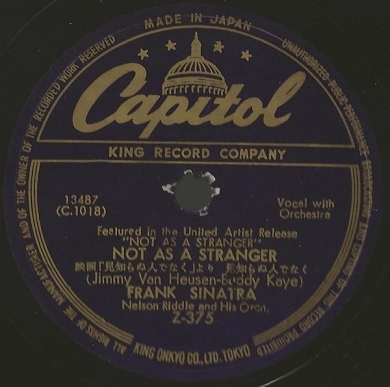
Radio
The Frank Sinatra Show
Network: NBC
Show Number: 54
Time 8:15 p.m. - 8:30 p.m.
Sponsor: Bobbi Home Permanet, White Rain Shampoo, Deep Magic Face lotion
Host: Frank Sinatra
Writers: Norm Sickel
Announcer: Maurice Hart
Producer: Andrew C. Love
1. Get Happy - Frank Sinatra
2. That's All I Want From You - Jaye P. Morgan
3. Melody Of Love - Frank Sinatra
KHJ Studios. Hollywood
13486 It Never Entered My Mind
(Richard Rodgers/Lorenz Hart)
Arranged & Conducted by Nelson Riddle
CD: CDP 7-46571-2 In The Wee Small Hours
LP: W581 In The Wee Small Hours
13585 Deep In A Dream
(Jimmy Van Heusen/Eddie De Lange)
Arranged & Conducted by Nelson Riddle
CD: CDP 7-46571-2 In The Wee Small Hours
LP: W581 In The Wee Small Hours
13585 I'll Never Be The Same
(Matty Malneck/Frank Signorelli/Gus Kahn)
Arranged & Conducted by Nelson Riddle
CD: CDP 7-46571-2 In The Wee Small Hours
LP: W581 In The Wee Small Hours
Musicians - French Horns: John Cave, Joseph Eger, Richard Perissi, Vincent De Rosa; Flute: Arthur Gleghorn, Luella Howard, Jules Kinsler, George Pooole; Violins: Victor Bay, Alex bay, Alex Beller, Harry Bluestone, Nathan Ross, Mischa Russell, Paul Shure, Felix Slatkin, Marshall Sosson; Cellos: James Arkatov, Cy Bernard, Armand Kaproff, Ray Kramer, Edgar Lustgarten, Kurt Reher, Joseph Saxon, Eleanor Slatkin; Piano: Bill Miller; Bass: Phil Stephens; Drums: Lou Singer; Guitar: George Van Eps; Harp: Kathryn Julye
Session Producer: Voyle Gilmore note: The four sessions that make up 15 of the 16 songs, for the "Wee Small Hours", were done in February/March of 1955.
Each sessions had very different orchestrations. This was Frank's idea. The first session was done with a quintet( 2/8); the second one used 18 musicians including Harry "Sweets" Edison on trumpet and Mahlon Clark playing clarinet; plus four violins, the third (2/17) had 26 musicians including 12 violins and the final session(3/4) used four French horns, four flutes plus 22 additional players. Riddle immediately understood that Sinatra had different ideas for the sounds surrounding each vocal. And the songs were recorded in the order that fit the concepts that Sinatra envisioned.
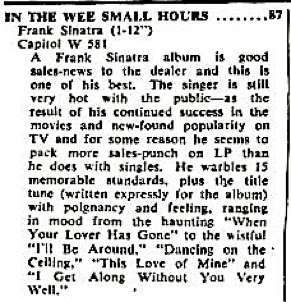
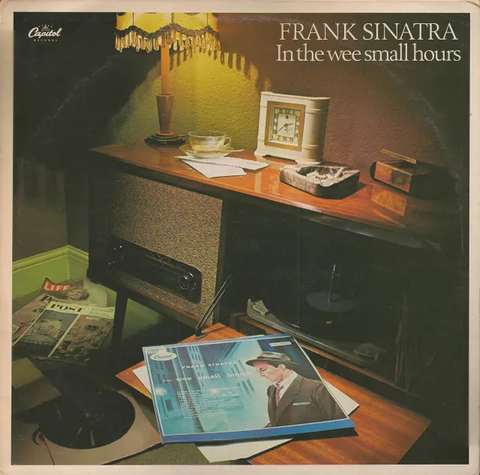
Liner Notes: IN THE WEE SMALL HOURS
Every singer has a record that critics eventually call definitive, and for Frank Sinatra that record is this one. In the Wee Small Hours arrived at the end of a brutal stretch in Sinatra's personal life -- the collapse of his marriage to Ava Gardner chief among the wounds -- and the album makes no effort to hide it. Across sixteen tracks, more than any prior pop album had attempted to sustain in a single mood, Sinatra and Nelson Riddle built a nocturne of loneliness: strings kept low and spare, tempos slowed to something closer to breathing than dancing.
The title song, composed for the album by David Mann and Bob Hilliard, sets the terms immediately -- a hushed meditation on the hour when memory does its worst work. What follows is not a set of sad songs so much as a single sustained argument about heartbreak, built from standards by Rodgers and Hart, Harold Arlen, and Duke Ellington, each one bent slightly toward melancholy by Riddle's arrangements and Sinatra's phrasing.
Critics have spent seven decades trying to explain why this album still lands as hard as it does. Part of the answer is craft -- the pacing, the unbroken tonal control, the way Riddle's strings seem to circle Sinatra's voice rather than accompany it. But part of it is simply that Sinatra sounds like he means it, and audiences have never stopped believing him.
Written by Claude (Anthropic), commissioned for this chronology, 2026.
March 7, 1955
Studio
KHJ Studios. Hollywood
13594 If I Had Three Wishes
(C. Baum/L. Spence)
Arranged & Conducted by Nelson Riddle
CD: C2 724383808922 The Complete Capitol Singles
LP: W1164 Look To Your Heart
45: 3102
NOTE: Sinatra Scholar Ed O'Brien points out that Sinatra had recorded
"Half as Lovely" in May of 1954.
He really liked it and asked Lew Spence to write another song for him. Lew told O'Brien that he was at the session
for "If I Had Three Wishes." Frank turned to Lew and said, "Why didn't you write another easy song instead of this?"
13595 How Could You Do A Thing Like That To Me?
(T. Gleen/A. Roberts)
Arranged & Conducted by Nelson Riddle
CD: C2 724383808922 The Complete Capitol Singles
CD: CDP 7-94520-2 Come Swing From Me
LP: W1429 Swingin' Easy
45: 3130
13596 Two Hearts, Two Kisses (Make One Love)
w/The Nuggets
(H. Stone/O. Williams)
Arranged by Dave Cavanaugh
Conducted by Nelson Riddle
CD: C2 724383808922 The Complete Capitol Singles
LP: T2602 Forever Frank
45: 3084
13597 From The Bottom To The Top
w/The Nuggets
(Gee Wilson )
Arranged by Dave Cavanaugh
Conducted by Nelson Riddle
CD: C2 724383808922 The Complete Capitol Singles
LP: T2602 Forever Frank
45: 3084
Musicans - Reeds: Chuck Gentry, Arthur "Skeets" Herfurt, Plas
Johnson, Babe Russin, Willie Schwartz; Trumpets: Harry "Sweets"
Edison, Conrad Gozzo, Emanuel Klein, Vito "Mickey" Mangano;
Trombones: Walter Benson, Ed Kusby, Dick Noel, Tommy Pederson; Piano: Ray
Johnson, Bill Miller; Guitar: Jack Marshall; Drums: Alvin Stoller;
Marimba: Max Albright (on 13594 & 13595 only)
Session Producer: Voyle Gilmore
Variety
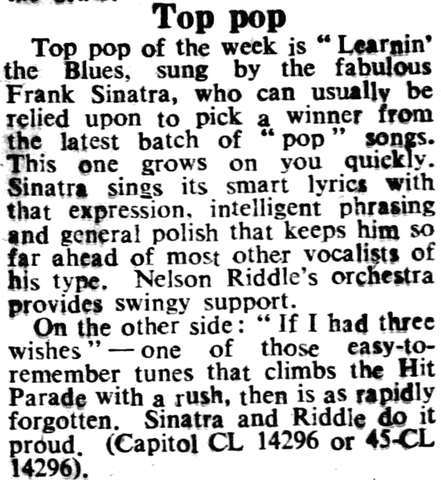

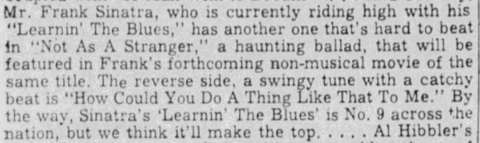
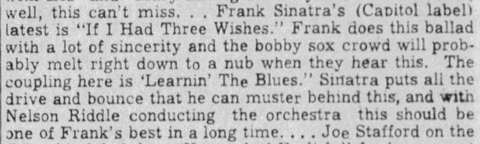
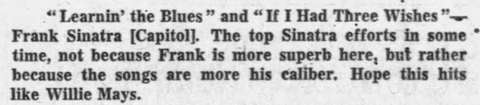
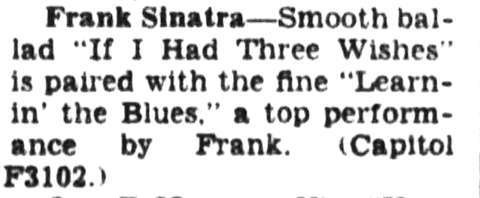
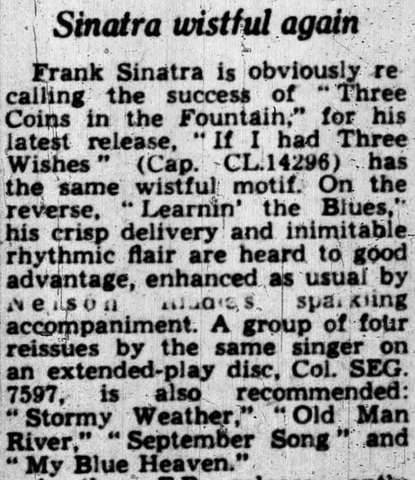
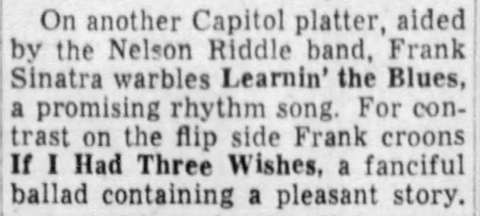
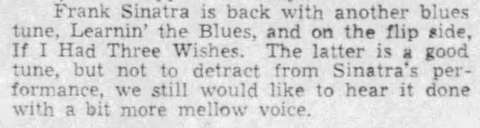
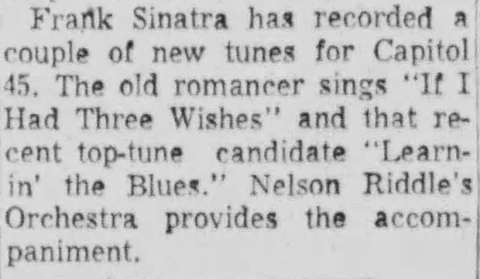
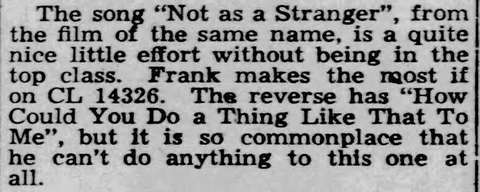

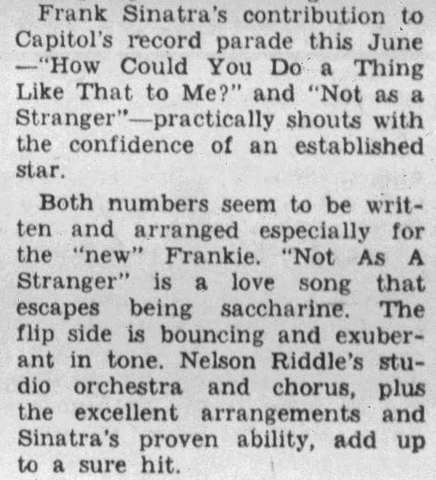
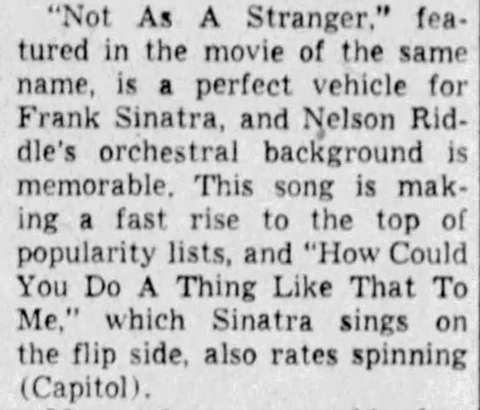
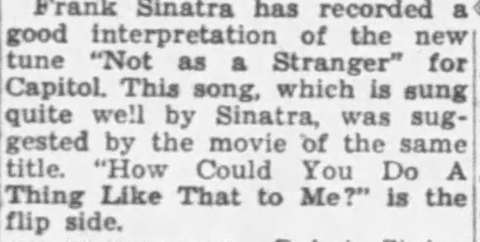
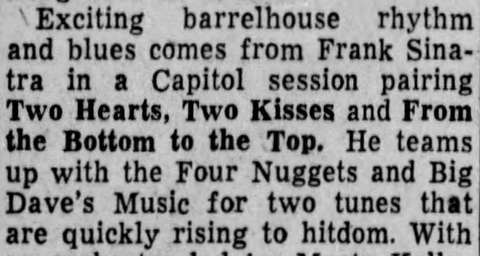
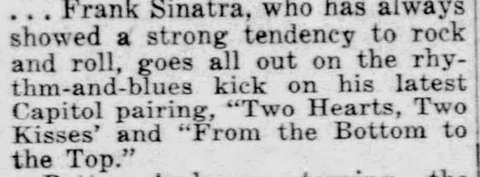
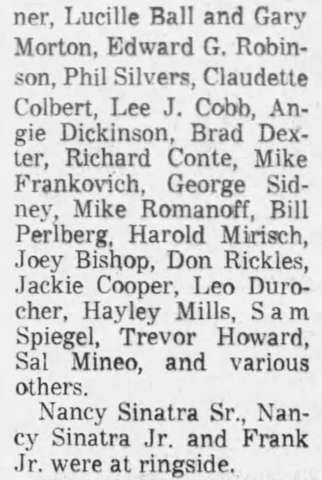


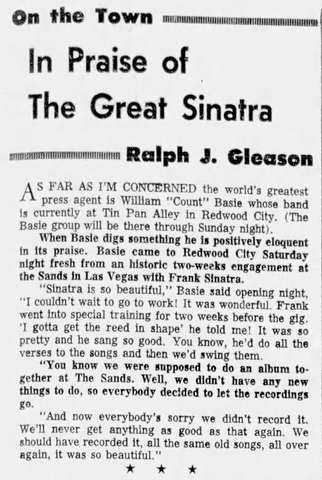
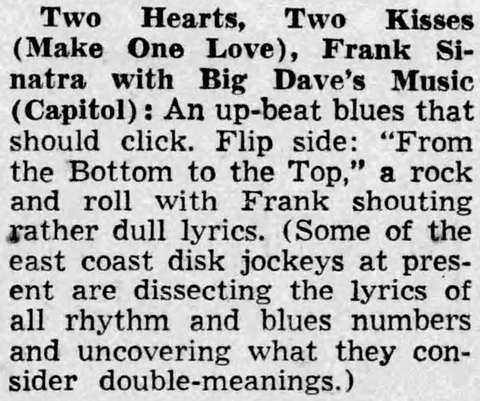
"How Could You Do a Thing Like That to Me?"
Written by Ellingtonian trombonist Tyree Glenn and based on the melody of his 1947 Ellington-band piece 'Sultry Serenade.'
Source: Will Friedwald, "Sinatra! The Song Is You: A Singer's Art" (2018 revised edition).
Capitol released the album Songs for Young Lovers.
Source: Nancy Sinatra, Frank Sinatra: An American Legend, 1995.
[Two Hearts, Two Kisses / From the Bottom to the Top -- critical commentary]
Will Friedwald (analysis): Sinatra's early, unusual attempt to court the kiddie-pop/nascent rock 'n' roll market, cut with a quartet called the Nuggets -- so early that Elvis Presley was still under contract to Sun Records at the time.
This song/context matches multiple dated entries in the chronology; the specific date Friedwald is referring to could not be determined with confidence.
Source: Will Friedwald, "Sinatra! The Song Is You: A Singer's Art" (2018 revised edition), Ch. 6, "With Nelson Riddle" (1953-1979)
March 9, 1955
Studio
GOLDWYN STUDIOS
GUYS AND DOLLS
Orchestra conducted by Jay Blackton
Arrangement by Nelson Riddle
Sue Me w/ Vivian Blaine
vocal pickup was done on the song 5-27-55
Radio
The Frank Sinatra Show
Network: NBC
Show Number: 55
Time 8:15 p.m. - 8:30 p.m.
Sponsor: Bobbi Home Permanent, White Rain Shampoo, Deep Magic Face lotion
Host: Frank Sinatra
Writers: Norm Sickel
Announcer: Maurice Hart
Producer: Andrew C. Love
1. I've Got The World On A String - Frank Sinatra
2. Hands Across The Table - Frank Sinatra w/Bill Miller, piano
3. The Girl Next Door - Frank Sinatra
March 11, 1955
Studio
GOLDWYN STUDIOS, Los Angeles
GUYS AND DOLLS
Orchestra conducted by Jay Blackton
Arrangements by Nelson Riddle
Adelaide* 1:35
Adelaide (reprise with chorus) :54
*Frank Loesser wrote the song for the film
Radio
The Frank Sinatra Show
Network: NBC
Show Number: 56
Time 8:15 p.m. - 8:30 p.m.
Sponsor: Bobbi Home Permanet, White Rain Shampoo, Deep Magic Face lotion
Host: Frank Sinatra
Writers: Norm Sickel
Announcer: Maurice Hart
Producer: Andrew C. Love
1. Castle Rock - Frank Sinatra
2. Lullaby Of Birdland - Ella Fitzgerald
3. If I Loved You - Frank Sinatra
March 13, 1955
Radio
"The Life and Times Of A Musician: The Kenton Era", Biography In Sound (NBC)
Narrator: Frank Sinatra
Announcer: Fred Collins
Time 7:00 p.m. - 7:55 p.m.
Robert Wogan, Ted Levan, Stan Kenton, Romney Weaver, Frank Bourgholtzer, Robert Wogan, Don Gillis, Leith Stevens.
Note: TT: 56 mins. Sound Very good.
"The Life and Times Of A Musician: The Kenton Era", Biography In Sound (NBC)
Narrator: Frank Sinatra
Announcer: Fred Collins
Time 7:00 p.m. - 7:55 p.m.
Robert Wogan, Ted Levan, Stan Kenton, Romney Weaver, Frank Bourgholtzer, Robert Wogan, Don Gillis, Leith Stevens.
Note: TT: 56 mins. Sound Very good.
March 16, 1955
Radio
The Frank Sinatra Show
Network: NBC
Show Number: 57
Time 8:15 p.m.. - 8:30 p.m.
Sponsor: Bobbi Home Permanet, White Rain Shampoo, Deep Magic Face lotion
Host: Frank Sinatra
Writers: Norm Sickel
Announcer: Maurice Hart
Producer: Andrew C. Love
1. Why Should I Cry Over You? - Frank Sinatra
2. As Time Goes By - Frank Sinatra w/Bill Miller, piano
3. You, My Love - Frank Sinatra
Notes: Frank plugs his movie "Young at heart."
Television
NONE
March 18, 1955
Radio
The Frank Sinatra Show
Network: NBC
Show Number: 58
Time 8:15 p.m. - 8:30 p.m.
Sponsor: Bobbi Home Permanet, White Rain Shampoo, Deep Magic Face lotion
Host: Frank Sinatra
Writers: Norm Sickel
Announcer: Maurice Hart
Producer: Andrew C. Love
1. I'm Gonna Live Till I Die - Frank Sinatra
2. Malaguena - Caterina Valente
3. Don't Change Your Mind About Me - Frank Sinatra
March 23, 1955
Studio
KHJ Studios. Hollywood
13628 Learnin' The Blues
(Delores Silver)
Barton Music Corp. (ASCAP)
Arranged & Conducted by Nelson Riddle
-31 (3:00) CD: CDP 724383595228 Sinatra 80th "All The Best"
CD: C2 724383808922 The Complete Capitol Singles
CD: C2-94777 The Capitol Years
CD: CDP 7-92160-2 Frank Sinatra Collector's Series
LP: T768 This Is Sinatra
45: 3102
Musicians - Reeds: Chuck Gentry, Plas Johnson, Babe Russin, Willie Schwartz, George Smith; Trumpets: Harry â Sweetsâ Edison, Conrad Gozzo, zo, Emanuel Klein, Vito â Mickeyâ Mangano; Trombones: George Benson, Francis Howard, Ed Kusby; Bass Trombone: George Roberts; Piano: Bill Miller; Guitar: Alton Hendrickson; Marimba: Frank Fynn
Session Producer: Voyle Gilmore
Ed notes:
An 18 piece orchestra, 31 takes, a great Riddle chart and the only # 1 single for Frank at Capitol. Dolores Vicki Silvers, from Philadelphia, wrote the song and submitted it to Frank's people. She was an amateur songsmith, who wrote a tremendous pop song. George Roberts told me that take three was a real gem. He was very surprised that Sinatra wasn't satisfied. George wishes Cap. would dig out that take and release it.
Radio
The Frank Sinatra Show
Network: NBC
Show Number: 59
Time 8:15 p.m. - 8:30 p.m.
Sponsor: Bobbi Home Permanet, White Rain Shampoo, Deep Magic Face lotion
Host: Frank Sinatra
Writers: Norm Sickel
Announcer: Maurice Hart
Producer: Andrew C. Love
1. When You're Smiling - Frank Sinatra
2. Where Or When - Lena Horne
3. Put Your Dreams Away - Performed by Frank Sinatra
KHJ Studios. Hollywood
13628 Learnin' The Blues
(Delores Silver)
Barton Music Corp. (ASCAP)
Arranged & Conducted by Nelson Riddle
-31 (3:00) CD: CDP 724383595228 Sinatra 80th "All The Best"
CD: C2 724383808922 The Complete Capitol Singles
CD: C2-94777 The Capitol Years
CD: CDP 7-92160-2 Frank Sinatra Collector's Series
LP: T768 This Is Sinatra
45: 3102
\
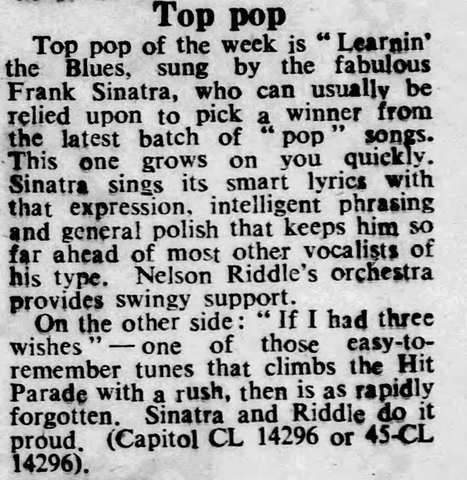
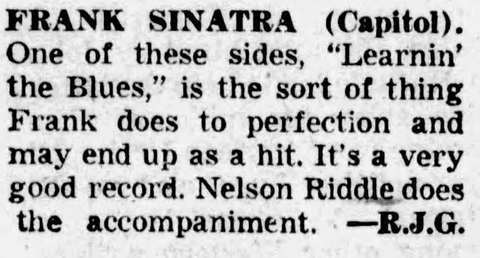
March 25, 1955
Radio
The Frank Sinatra Show
Network: NBC
Show Number: 60
Time 8:15 p.m. - 8:30 p.m.
Sponsor: Bobbi Home Permanet, White Rain Shampoo, Deep Magic Face lotion
Host: Frank Sinatra
Writers: Norm Sickel
Announcer: Maurice Hart
Producer: Andrew C. Love
1. You Do Something To Me - Frank Sinatra
2. Can't We Be Friends - Frank Sinatra w/Bill Miller, piano and organ
3. My Funny Valentine - Frank Sinatra
COMMENT: Sinatra does a fascinating version of
"Can't We Be Friends" on his NBC Bobbi show of March 25, 1955.
Bill Miller provides the musical accompaniment and Frank closes the song with a different ending:
I should have seen the signal to stop
What a flop
This is how the story ends
I let her turn me down and say
Can't we be just friends.
NOTE: Sinatra Scholar Ed O'Brien, who provided the above information, points out that the Frank
Sinatra Bobbi radio show was Frank's last radio series.
It had 86 shows beginning September 1, 1954 and concluding on June 29, 1955. It was broadcast on
NBC from 8:15 to 8:30 p.m. on Wednesday and Friday.
Seventy-nine shows have survived.
Sinatra knocked Eddie Fisher off the top of Downbeat's disc jockey poll for Top Recording Personality of the Year, with Perry Como second and Fisher third. Nelson Riddle placed No. 2 in the Best Conductor of a Studio Orchestra category. (Source: Richard Havers, "Sinatra" (Dorling Kindersley, 2007).)
March 30, 1955
Radio
The Frank Sinatra Show
Network: NBC
Show Number: 61
Time 8:15 p.m. - 8:30 p.m.
Sponsor: Bobbi Home Permanet, White Rain Shampoo, Deep Magic Face lotion
Host: Frank Sinatra
Writers: Norm Sickel
Announcer: Maurice Hart
Producer: Andrew C. Love
1. It All Depends On You - Frank Sinatra
2. Celeste - Frank Sinatra w/Bill Miller, piano and organ
3. You, My Love - Frank Sinatra
Television
Academy Award Ceremonies
Wednesday evening
RKO Pantages Theatre in Hollywood and NBC Century Theatre in New York Hosts:
Bob Hope in Hollywood
Thelma Ritter in N.Y.
Ed O'Brien:
Frank Sinatra presented the Best Supporting
Actress award. Eva Marie Saint won for "On The
Waterfront." A very pregnant Miss Saint accepted the award in N.Y., warning the audience that she just might have the baby right there. Dean Martin sang "Three Coins In The Fountain." It proved to be the winning song that year.
Academy Award Ceremonies
Wednesday evening
Note: Here is a rare photo of a very tender moment at a post Oscar party. Grace Kelly had won the Best
Actress award for her portrayal of the long suffering wife in "The Country Girl. -ED
Party after 55 Oscars show
When Frank ended his engagement to Lauren Bacall in 1957, it broke her heart. “But Frank did me a great favor,” she would say. “He saved me from the complete disaster our marriage would have been.” The two are seen here at a party after the Academy Awards on March 30, 1955. Source: photo and caption from J. Randy Taraborrelli, Sinatra: Behind the Legend (mptvimages.com).
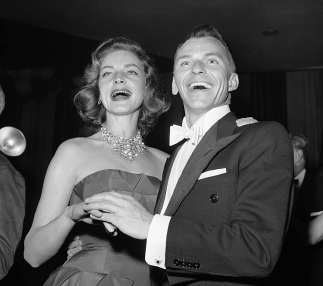
[Sinatra presents an Oscar at the Pantages]
A year and five days after his own Oscar win, Sinatra returned to the stage of the Pantages Theater to present the Best Supporting Actress award to Eva Marie Saint for On the Waterfront, the night's big winner; Brando won Best Actor over the favored Bing Crosby.
Source: James Kaplan, "Sinatra: The Chairman" (2015).
April 1955
[Bob Thomas interviews Sinatra on his marriage]
Frank Sinatra: Columnist Bob Thomas asked Sinatra about his marriage to Ava Gardner; Frank called it "a stalemate," said she'd established Nevada residence but never filed divorce papers, and declared he had no plans to remarry, joking about the "penalty for bigamy" regarding rumors about Gloria Vanderbilt. He also mentioned a new five-year, five-picture deal with United Artists and interest in playing the interpreter role in Teahouse of the August Moon (a part that went to Brando).
Source: James Kaplan, "Sinatra: The Chairman" (2015)
[Sinatra on marriage, to a columnist]
Frank Sinatra: Sinatra told a newspaper columnist, "I'm not going to get married. If I feel the need for company, I call up for a date and go out somewhere."
Source: James Kaplan, "Sinatra: The Chairman" (2015)
April 1, 1955
Radio
Music From Hollywood, Wallich's Auditorium
1. Don't Change You Mind About Me
2. Why Should I Cry Over You
3. Three Coins In The Fountain
4. I'm Gonna Live Till I Die
5. You My Love
6. The Gal That Got Away
7. Someone To Watch Over Me
8. Young At Heart
Note: Sinatra Plays DJ to some of his recent songs. TT: 30 mins.
Ed O'Brien notes:
Music From Hollywood was a BBC radio program.
Sinatra was at Wallich's Auditorium in Hollywood and he introduced and then played eight of his Capitol recordings.
The auditorium was owned by Capitol Records and Glenn
Wallich was one of the original owners of the company.
Basically, the show was a great half-hour of Frank promoting his Capitol singles.
The Frank Sinatra Show
Network: NBC
Show Number: 62
Time 8:15 p.m. - 8:30 p.m.
Sponsor: Bobbi Home Permanet, White Rain Shampoo, Deep Magic Face lotion
Host: Frank Sinatra
Writers: Norm Sickel
Announcer: Maurice Hart
Producer: Andrew C. Love
1. Learnin' The Blues - Frank Sinatra
2. Fools Rush In - Frank Sinatra
3. I'm A Fool To Want You - Frank Sinatra
April 6, 1955
Radio
The Frank Sinatra Show
Network: NBC
Show Number: 63
Time 8:45 p.m. - 9:00 p.m.
Sponsor: Bobbi Home Permanet, White Rain Shampoo, Deep Magic Face lotion
Host: Frank Sinatra
Writers: Norm Sickel
Announcer: Maurice Hart
Producer: Andrew C.. Love
1. I'm Gonna Live Till I Die - Frank Sinatra
2. Idle Gossip - Sarah Vaughan
3. Don't Change Your Mind About Me - Frank Sinatra
April 8, 1955
Radio
The Frank Sinatra Show
Network: NBC
Show Number: 64
Time 8:15 p.m. - 8:30 p.m..
Sponsor: Bobbi Home Permanet, White Rain Shampoo, Deep Magic Face lotion
Host: Frank Sinatra
Writers: Norm Sickel
Announcer: Maurice Hart
Producer: Andrew C. Love
1. Lean Baby - Frank Sinatra
2. The Year We Fell In Love - Eileen Barton
3. Melody Of Love - Frank Sinatra
April 9, 1955
Radio
Radio: An episode of Sinatra's radio series The Frank Sinatra Show, sponsored by Bobbi Home Permanent, was broadcast this date, with Sinatra's recordings of "I've Got The World On A String," "Hands Across The Table," and "The Girl Next Door." Source: sinatradiscography.com, Radio Transcriptions Database.
April 13, 1955
Radio
The Frank Sinatra Show
Network: NBC
Show Number: 65
Time 8:15 p.m. - 8:30 p.m.
Sponsor: Bobbi Home Permanet, White Rain Shampoo, Deep Magic Face lotion
Host: Frank Sinatra
Writers: Norm Sickel
Announcer: Maurice Hart
Producer: Andrew C. Love
1. Learnin' The Blues - Frank Sinatra
2. Love Me Or Leave Me - Lena Horne
3. If I Had Three Wishes - Frank Sinatra
All-Star Review From Hollywood for the American Cancer Society
Wednesday
Announcer: John Daly
Sinatra-Crosby medley from Bing's GE show, 3-21-54.
April 15, 1955
Radio
The Frank Sinatra Show
Network: NBC
Show Number: 66
Time 8:15 p.m. - 8:30 p.m.
Sponsor: Bobbi Home Permanet, White Rain Shampoo, Deep Magic Face lotion
Host: Frank Sinatra
Writers: Norm Sickel
Announcer: Maurice Hart
Producer: Andrew C. Love
1. I'm Gonna Live Till I Die - Frank Sinatra
2. Don't Blame Me - Frank Sinatra w/Bill Miller, piano
3. Hello Young Lovers - Frank Sinatra
Notes: Maurice Hart plugs Frank's article in the April issue of Coronet, "I love secretaries."
April 16, 1955
Concerts
Sands, Las Vegas, Nevada (16-17)
Sinatra subbed for Danny Thomas for 2 nights after Thomas' brother was killed in an auto accident
Sands, Las Vegas, Nevada (16-17)
Sinatra subbed for Danny Thomas for 2 nights after Thomas' brother was killed in an auto accident
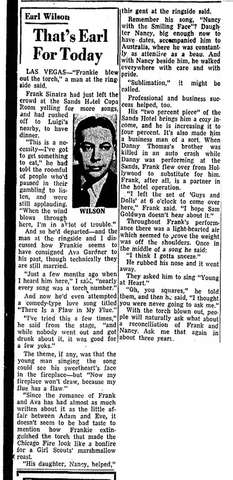
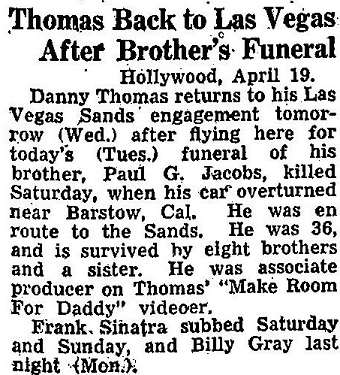
April 17, 1955
Concerts
Sands, Las Vegas, Nevada (16-17)
Sinatra subbed for Danny Thomas for 2 nights after Thomas' brother was killed in an auto accident
April 20, 1955
Radio
The Frank Sinatra Show
Network: NBC
Show Number: 67
Time 8:15 p.m. - 8:30 p.m.
Sponsor: Bobbi Home Permanet, White Rain Shampoo, Deep Magic Face lotion
Host: Frank Sinatra
Writers: Norm Sickel
Announcer: Maurice Hart
Producer: Andrew C. Love
1. Learnin' The Blues - Frank Sinatra
2. Over The Rainbow - Judy Garland
3.. The Gal That Got Away - Frank Sinatra
April 22, 1955
Radio
The Frank Sinatra Show
Network: NBC
Show Number: 68
Time 8:15 p.m. - 8:30 p.m.
Sponsor: Bobbi Home Permanet, White Rain Shampoo, Deep Magic Face lotion
Host: Frank Sinatra
Writers: Norm Sickel
Announcer: Maurice Hart
Producer: Andrew C. Love
1. South Of The Border - Frank Sinatra
2. Empty Ballroom - Ella Fitzgerald
3. Half As Lovely (Twice As True) - Frank Sinatra
Television
NONE
April 24, 1955
Television
Max Liebman Presents Kaleidoscope
Network: NBC
Season:1 Episode: 14
Host: Judy Holiday
Guest Star: Frank Sinatra, Dick Shawn, George S. Irving, Robert Gallagher, Beatrice Arthur, George Kluge, Peggy Castle, Craig Timberlake, Eleanor Williams, Rod Alexander, Bambi Linn
Announcer: Don Pardo
1. I'm Gonna' Live Till I Die
2. When Your Lover Has Gone
3. Learnin' the Blue
4. Wrap Your Troubles in Dreams
5. A skit with several songs included
Ed O'Brien observes: A great (albeit small) selection of tunes, beautifully sung. A joy to watch, too.
Notes: Revue program with music, comedy skits and song & dance. 77mins.
note: Sinatra appeared on Liebman's 11-7-54 show. The N.Y.C. segment was broadcast in "living color" over NBC. Frank's 20 minute segment was live from the El Capitan Theatre in Hollywood. NBC did not have color capability on the west coast. By the time the 4-24-55 show was broadcast, NBC was able to beam their color throughout the land. Frank's new single had just been released and the initial reaction was even better than "Young At Heart." The song had not yet cracked the Billboard Top 30 in late April, but Frank had the perfect opportunity to deliver a great rendition on Kaleidoscope and he certainly did.
Max Liebman Presents Kaleidoscope
Network: NBC
Season:1 Episode: 14
Host: Judy Holiday
Guest Star: Frank Sinatra, Dick Shawn, George S. Irving, Robert Gallagher, Beatrice Arthur, George Kluge, Peggy Castle, Craig Timberlake, Eleanor Williams, Rod Alexander, Bambi Linn
Announcer: Don Pardo
Variety
4-27-55
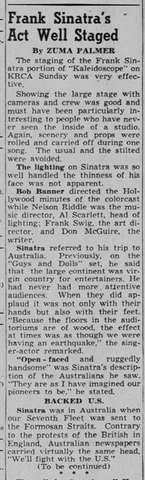
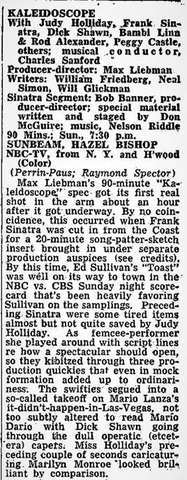
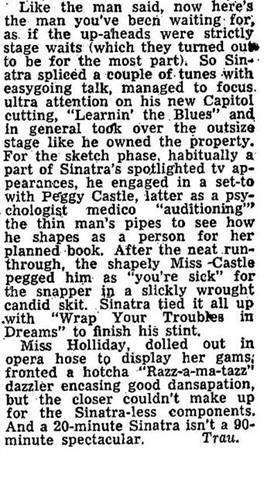
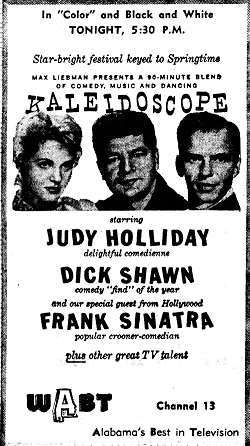
April 25, 1955
“Frankie’s on a campaign now to land the lead in Carousel at 20th – that’s one he wanted to do for a long time.”
[Sinatra campaigns for the role of Billy Bigelow]
Columnist Hedda Hopper reported that Sinatra was actively campaigning to land the lead role of Billy Bigelow in 20th Century Fox's forthcoming film adaptation of Rodgers and Hammerstein's “Carousel.”
Hedda Hopper, Buffalo Courier-Express, April 25, 1955, quoted in Will Friedwald, "Sinatra and Carousel: A Very Deep Dive" (2023-2024, sinatracentury.substack.com).
April 27, 1955
Radio
The Frank Sinatra Show
Network: NBC
Show Number: 69
Time 8:15 p.m. - 8:30 p.m.
Sponsor: Bobbi Home Permanet, White Rain Shampoo, Deep Magic Face lotion
Host: Frank Sinatra
Writers: Norm Sickel
Announcer: Maurice Hart
Producer: Andrew C. Love
1. Two Hearts, Two Kisses - Frank Sinatra.
2. Come Rain Or Come Shine - Frank Sinatra w/Bill Miller, piano
3. If I Had Three Wishes - Frank Sinatra
Television
NONE
April 29, 1955
Radio
The Frank Sinatra Show
Network: NBC
Show Number: 70
Time 8:15 p.m. - 8:30 p.m.
Sponsor: Bobbi Home Permanet, White Rain Shampoo, Deep Magic Face lotion
Host: Frank Sinatra
Writers: Norm Sickel
Announcer: Maurice Hart
Producer: Andrew C. Love
1. Learnin' The Blues - Frank Sinatra
2. Young And Foolish - June Valli
3. You, My Love - Frank Sinatra
May 1955
[Learnin' the Blues hits #2]
Kaplan: In May 1955, Sinatra's recording of 'Learnin' the Blues,' written by newcomer Dolores Vicki Silvers, reached number 2 on the Billboard singles chart.
Source: James Kaplan, "Sinatra: The Chairman" (2015)
May 4, 1955
Radio
The Frank Sinatra Show
Network: NBC
Show Number: 71
Time 8:15 p.m. - 8:30 p.m.
Sponsor: Bobbi Home Permanet, White Rain Shampoo, Deep Magic Face lotion
Host: Frank Sinatra
Writers: Norm Sickel
Announcer: Maurice Hart
Producer: Andrew C. Love
1. Sunday - Frank Sinatra
2. I Don't Want To Walk Without You - Helen Forrest
3. When I Stop Loving You - Frank Sinatra
Notes: LOC copy of program opening is missing.
Television
None
May 6, 1955
Radio
The Frank Sinatra Show
Network: NBC
Show Number: 72
Time 8:15 p.m. - 8:30 p.m.
Sponsor: Bobbi Home Permanet, White Rain Shampoo, Deep Magic Face lotion
Host: Frank Sinatra
Writers: Norm Sickel
Announcer: Maurice Hart
Producer: Andrew C. Love
1. I'm Gonna Live Till I Die - Frank Sinatra
2. As Time Goes By - Frank Sinatra w/Bill Miller, piano
3. Guess I'll Hang My Tears Out To Dry - Frank Sinatra
Television
None
May 11, 1955
Radio
The Frank Sinatra Show
Network: NBC
Show Number: 73
Time 8:15 p.m. - 8:30 p.m.
Sponsor: Bobbi Home Permanet, White Rain Shampoo, Deep Magic Face lotion
Host: Frank Sinatra
Writers: Norm Sickel
Announcer: Maurice Hart
Producer: Andrew C. Love
1. Two Hearts, Two Kisses - Frank Sinatra
2. Nothing At All - Jeri Southern
3. Learnin' The Blues - Frank Sinatra
May 12, 1955
“I have analyzed everything and I believe that Frank Sinatra will win another Academy award in CAROUSEL. I think that he was born to play this role. He has all of the necessary larceny and yet he has the tenderness and he has developed into a remarkable actor, which has already won him one Academy award. He is hounding me because he has so many other offers and he wants to leave free time in case we decide to take him. I think perhaps if we played him opposite the young girl you have in OKLAHOMA this might be an ideal combination.”
[Zanuck champions Sinatra for the role of Billy Bigelow]
20th Century Fox studio head Darryl F. Zanuck wrote to Oscar Hammerstein II strongly advocating for Sinatra to play Billy Bigelow in the film version of “Carousel,” also suggesting pairing him with “Oklahoma!” ingenue Shirley Jones.
Darryl F. Zanuck to Oscar Hammerstein II, May 12, 1955, published in “The Letters of Oscar Hammerstein II,” ed. Mark Eden Horowitz (Oxford University Press, 2022), quoted in Will Friedwald, "Sinatra and Carousel: A Very Deep Dive" (2023-2024, sinatracentury.substack.com).
May 13, 1955
Radio
The Frank Sinatra Show
Network: NBC
Show Number: 74
Time 8:15 p.m. - 8:30 p.m.
Sponsor: Bobbi Home Permanet, White Rain Shampoo, Deep Magic Face lotion
Host: Frank Sinatra
Writers: Norm Sickel
Announcer: Maurice Hart
Producer: Andrew C. Love
1. It All Depends On You - Frank Sinatra
2. The Man I've Been Looking For - Denise Lor
3. You're The One - Frank Sinatra
May 17, 1955
“Regarding Sinatra, both Dick and I are inclined to agree with you that he would be a very interesting and off-beat approach to the casting of Billy Bigelow. Neither of us would object to your signing him. We think, however, that you ought to take one look at Gordon MacRae in ‘Oklahoma!’ ... The idea of Shirley Jones (the lead in ‘Oklahoma!’) is a very good one.”
[Hammerstein agrees to Sinatra casting, suggests Shirley Jones]
Oscar Hammerstein II replied to Zanuck endorsing Sinatra as Billy Bigelow while also floating Gordon MacRae as a fallback, and agreeing that Shirley Jones would make a good Julie Jordan.
Oscar Hammerstein II to Darryl F. Zanuck, May 17, 1955, published in “The Letters of Oscar Hammerstein II,” ed. Mark Eden Horowitz (Oxford University Press, 2022), quoted in Will Friedwald, "Sinatra and Carousel: A Very Deep Dive" (2023-2024, sinatracentury.substack.com).
May 18, 1955
Radio
The Frank Sinatra Show
Network: NBC
Show Number: 75
Time 8:15 p.m. - 8:30 p.m.
Sponsor: Bobbi Home Permanet, White Rain Shampoo, Deep Magic Face lotion
Host: Frank Sinatra
Writers: Norm Sickel
Announcer: Maurice Hart
Producer: Andrew C. Love
1. All Of Me - Frank Sinatra.
2. Love Is Here To Stay - Frank Sinatra w/Bill Miller, piano and organ
3. If I Had Three Wishes - Frank Sinatra.
May 20, 1955
Radio
The Frank Sinatra Show
Network: NBC
Show Number: 76
Time 8:15 p.m. - 8:30 p.m.
Sponsor: Bobbi Home Permanet, White Rain Shampoo, Deep Magic Face lotion
Host: Frank Sinatra
Writers: Norm Sickel
Announcer: Maurice Hart
Producer: Andrew C. Love
1. Learnin' The Blues - Frank Sinatra
2. Moon Nocturne (instrumenta) - Neal Hefti
3. From Here To Eternity - Frank Sinatra
Television
None
“I am delighted that both Dick and you like the idea of Frank Sinatra as much as we do for CAROUSEL. I think it would be a terrible mistake for us to use the same cast that you have in OKLAHOMA ... It is my opinion that the ideal cast for CAROUSEL would be Frank Sinatra and Jean Simmons.”
[Zanuck proposes Sinatra and Jean Simmons as the Carousel leads]
Zanuck wrote back agreeing that Sinatra should star, floating Jean Simmons (fresh off “Guys and Dolls”) opposite him as Julie rather than reusing the “Oklahoma!” cast, and projected rehearsals could begin by late July or August 1955.
Darryl F. Zanuck to Oscar Hammerstein II, May 20, 1955, published in “The Letters of Oscar Hammerstein II,” ed. Mark Eden Horowitz (Oxford University Press, 2022), quoted in Will Friedwald, "Sinatra and Carousel: A Very Deep Dive" (2023-2024, sinatracentury.substack.com).
May 25, 1955
Radio
The Frank Sinatra Show
Network: NBC
Show Number: 77
Time 8:15 p.m. - 8:30 p.m.
Sponsor: Bobbi Home Permanet, White Rain Shampoo, Deep Magic Face lotion
Host: Frank Sinatra
Writers: Norm Sickel
Announcer: Maurice Hart
Producer: Andrew C. Love
1. Take A Chance - Frank Sinatra
2. I'll Remember April - Miltha Tilton
3. In The Wee Small Hours Of The Morning - Frank Sinatra
Notes: "Sinatra introduces his new album "In the wee small hours."
On the next ten shows he plays one track per program following the sequencing on the album. On 6/29/55, the final program of the series, he plays the last track on the album, This love of mine, a tune that goes back to the Tommy Dorsey days."
Television
none
May 26, 1955
Here's a photo supposedly from this date in 1955:
Frank Sinatra, who fancies himself something of a pugilist, squares off with the world's heavyweight champion, Rocky Marciano, but you can tell from the stance that it's all in fun. The horseplay occurred while Marciano visited the "Guys and Dolls" movie set in Hollywood, May 26, 1955. (AP Photo)
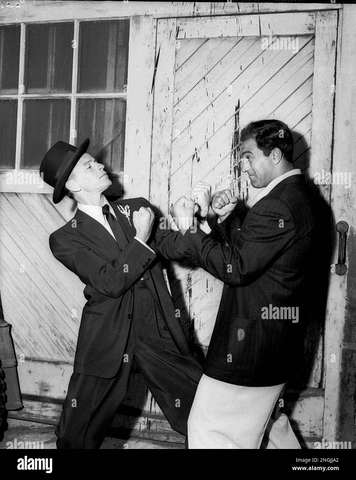
“Your ideas for casting ‘Carousel’ sound very good to both of us. It also seems to me that Henry King, from his many and varied credits, would be a very good prospect for the directing job.”
[Hammerstein approves Henry King as director]
Hammerstein wrote back to Zanuck endorsing the casting plans and suggesting Henry King -- who would go on to direct the film, to mixed results -- for the director's chair.
Oscar Hammerstein II to Darryl F. Zanuck, May 26, 1955, published in “The Letters of Oscar Hammerstein II,” ed. Mark Eden Horowitz (Oxford University Press, 2022), quoted in Will Friedwald, "Sinatra and Carousel: A Very Deep Dive" (2023-2024, sinatracentury.substack.com).
May 27, 1955
Studio
Goldwyn Studios - Los Angeles
GUYS & DOLLS
Friday
Orchestra conducted by Jay Blackton
Arrangements by Nelson Riddle
Sinatra did vocal pickups on:
The Oldest Established Permanent Floating Crap Game
Sue Me
Radio
The Frank Sinatra Show
Network: NBC
Show Number: 78
Time 8:15 p.m. - 8:30 p.m.
Sponsor: Bobbi Home Permanet, White Rain Shampoo, Deep Magic Face lotion
Host: Frank Sinatra
Writers: Norm Sickel
Announcer: Maurice Hart
Producer: Andrew C. Love
1. Learnin' The Blues - Frank Sinatra
2. It's All Right With Me - Frank Sinatra w/Bill Miller, piano
3. Mood Indigo - Frank Sinatra
June 1955
[Chartered planes to Las Vegas]
Dorothy Manners: In June 1955, columnist Dorothy Manners (filling in for Louella Parsons) reported Sinatra chartered two planes to fly a group of friends -- including Humphrey Bogart and Lauren Bacall, Judy Garland and Sid Luft, songwriter Sylvia Fine, Mike Romanoff and his wife, Jimmy Van Heusen, and Peter and Pat Lawford -- from Los Angeles to Las Vegas to catch Rosemary Clooney's Sands closing, Noel Coward's Desert Inn opening, and a new revue.
Source: James Kaplan, "Sinatra: The Chairman" (2015)
[Sinatra-Lawford-Kennedy social circle origins]
Kaplan / George Jacobs: Though some writers (and valet George Jacobs) date Sinatra and Pat Lawford's mutual attraction to a Gary Cooper party in summer 1958, Kaplan notes the Sinatra-Lawford social circle went back to at least June 1955 -- around the same time Frank and Jack Kennedy first met at a Democratic fund-raiser.
Source: James Kaplan, "Sinatra: The Chairman" (2015)
[Sinatra pays Lee J Cobb's hospital bills after heart attack]
After actor Lee J Cobb suffered a serious heart attack and faced bankruptcy, partly due to lost work following his entanglement with the House Un-American Activities Committee, Sinatra paid his hospital bills, set him up in an apartment to recover, and spent time talking with him about his fear of death.
Source: Richard Havers, "Sinatra" (Dorling Kindersley, 2007).
[Starring Sammy Davis Jr tops album chart]
Sammy Davis Jr's solo album Starring Sammy Davis Jr reached the top of the Billboard album chart and stayed there for six weeks, confirming his arrival as a star in his own right after his accident.
Source: Richard Havers, "Sinatra" (Dorling Kindersley, 2007).
June 1, 1955
Radio
The Frank Sinatra Show
Network: NBC
Show Number: 79
Time 8:15 p.m. - 8:30 p.m.
Sponsor: Bobbi Home Permanent, White Rain Shampoo, Deep Magic Face lotion
Host: Frank Sinatra
Writers: Norm Sickel
Announcer: Maurice Hart
Producer: Andrew C. Love
Television
None
June 3, 1955
Radio
The Frank Sinatra Show
Network: NBC
Show Number: 80
Time 8:15 p.m. - 8:30 p.m.
Sponsor: Bobbi Home Permanent, White Rain Shampoo, Deep Magic Face lotion
Host: Frank Sinatra
Writers: Norm Sickel
Announcer: Maurice Hart
Producer: Andrew C. Love
1. I've Got The World On A String - Frank Sinatra
2. Kiss And Kill Me With Love - Fran Warren
3. I Get Along Without You Very Well - Frank Sinatra
June 6, 1955
Radio
Radio: An episode of Sinatra's radio series The Frank Sinatra Show, sponsored by Bobbi Home Permanent, was broadcast this date, with Sinatra's recordings of "Learnin' The Blues," "I Could Write A Book," and "Deep In A Dream." Source: sinatradiscography.com, Radio Transcriptions Database.
June 7, 1955
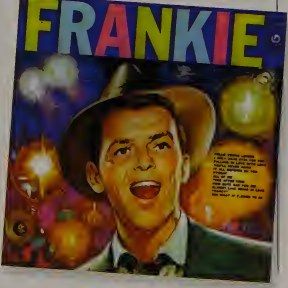
[Photograph: Noel Coward's Sands debut a surprise hit. From Richard Havers, "Sinatra" (Dorling Kindersley, 2007), p.203.]
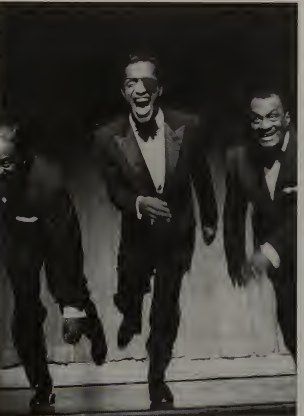
[Photograph: Noel Coward's Sands debut a surprise hit. From Richard Havers, "Sinatra" (Dorling Kindersley, 2007), p.203.]
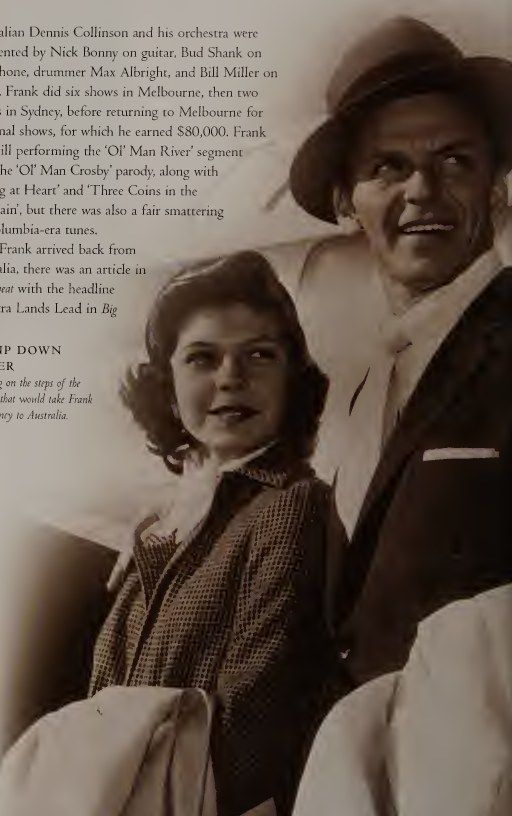
[Photograph: Noel Coward's Sands debut a surprise hit. From Richard Havers, "Sinatra" (Dorling Kindersley, 2007), p.202.]
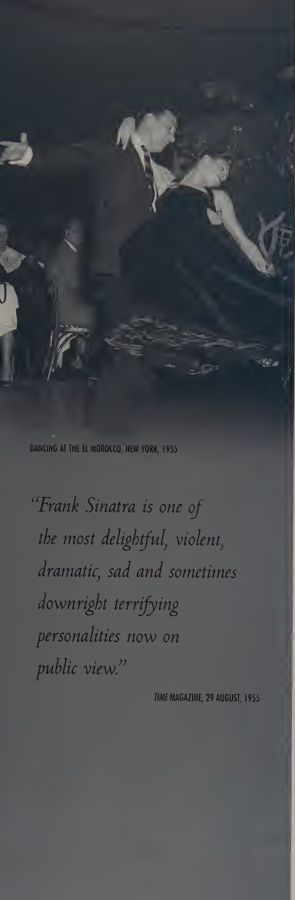
[Photograph: Noel Coward's Sands debut a surprise hit. From Richard Havers, "Sinatra" (Dorling Kindersley, 2007), p.202.]
Sinatra joined the Bogarts, Judy Garland, and Joan Fontaine to see Noel Coward's Las Vegas debut at the Sands. Despite privately viewing the audience with disdain, Coward's four-week run earned him $160,000 and secured his finances. (Source: Richard Havers, "Sinatra" (Dorling Kindersley, 2007).)
June 8, 1955
Radio
The Frank Sinatra Show
Network: NBC
Show Number: 81
Time 8:15 p.m. - 8:30 p.m.
Sponsor: Bobbi Home Permanent, White Rain Shampoo, Deep Magic Face lotion
Host: Frank Sinatra
Writers: Norm Sickel
Announcer: Maurice Hart
Producer: Andrew C. Love
1. Learnin' The Blues - Frank Sinatra
2. I Could Write A Book - Frank Sinatra
3. Deep In A Dream - Frank Sinatra
Notes: LOC lists this shows as June 6. Most likely a typo but could have been broadcast on the 6th.
Television
None
June 10, 1955
Radio
The Frank Sinatra Show
Network: NBC
Show Number: 82
Time 8:15 p.m. - 8:30 p.m.
Sponsor: Bobbi Home Permanet, White Rain Shampoo, Deep Magic Face lotion
Host: Frank Sinatra
Writers: Norm Sickel
Announcer: Maurice Hart
Producer: Andrew C. Love
1. Sunday - Frank Sinatra
2. No Letter Today - Les Paul and Mary Ford
3. I See Your Face Before Me - Frank Sinatra
Television
NONE
June 15, 1955
Radio
The Frank Sinatra Show
Network: NBC
Show Number: 83
Time 8:15 p.m. - 8:30 p.m.
Sponsor: Bobbi Home Permanet, White Rain Shampoo, Deep Magic Face lotion
Host: Frank Sinatra
Writers: Norm Sickel
Announcer: Maurice Hart
Producer: Andrew C. Love
1. My Blue Heaven - Frank Sinatra
2. It Might As Well Be Spring - Margaret Whiting
3. Can't We Be Friends - Frank Sinatra
June 17, 1955
Radio
The Frank Sinatra Show
Network: NBC
Show Number: 84
Time 8:15 p.m. - 8:30 p.m.
Sponsor: Bobbi Home Permanet, White Rain Shampoo, Deep Magic Face lotion
Host: Frank Sinatra
Writers: Norm Sickel
Announcer: Maurice Hart
Producer: Andrew C. Love
1. Why Should I Cry Over You? - Frank Sinatra
2. September Song - Frank Sinatra w/Bill Miller, piano
3. When Your Lover Has Gone - Frank Sinatra
June 22, 1955
Studio
The Frank Sinatra Show
Network: NBC
Show Number: 85
Time 8:15 p.m. - 8:30 p.m.
Sponsor: Bobbi Home Permanet, White Rain Shampoo, Deep Magic Face lotion
Host: Frank Sinatra
Writers: Norm Sickel
Announcer: Maurice Hart
Producer: Andrew C. Love
1. Should I - Frank Sinatra
2. Keep Me In Mind - Patti Page
3. What Is This Thing Called Love - Frank Sinatra
Television
NONE
June 24, 1955
Radio
The Frank Sinatra Show
Network: NBC
Show Number: 86
Time 8:15 p.m. - 8:30 p.m.
Sponsor: Bobbi Home Permanet, White Rain Shampoo, Deep Magic Face lotion
Host: Frank Sinatra
Writers: Norm Sickel
Announcer: Maurice Hart
Producer: Andrew C. Love
1. Learnin' The Blues - Frank Sinatra
2. Not As A Stranger - Frank Sinatra
3. Last Night When We Were Young - Frank Sinatra
Television
None
The Frank Sinatra Show
Network: NBC
Show Number: 86
Time 8:15 p.m. - 8:30 p.m.
Sponsor: Bobbi Home Permanet, White Rain Shampoo, Deep Magic Face lotion
Host: Frank Sinatra
Writers: Norm Sickel
Variety
Note: Norm Sickel was a man of many talents.
He wrote scripts for both radio and TV, was
an actor and a poet. Frank had him work on
Perfectly Frank, Rocky Fortune and the Frank
Sinatra Show( Bobbi). Sickel also appeared
in four of the R.F. episodes. One day he
showed Frank some of the poetry he had
written and suggested a unique Capitol album
project. Frank was intrigued and discussed
the concept with Felix and Eleanor Slatkin.
They enlisted the aid of Nelson Riddle, Billy
May, Alec Wilder, Victor Young, Gordon Jenkins,
Andre Previn, Elmer Bernstein and Jeff Alexander.
They wrote orchestral compositions based on the
dominant color in Norm's poems. Frank then conducted
the studio sessions for "Tone Poems In Color."
I just discovered this Variety piece from late
October of 1955. What happened to the TV project is
not known. I will continue doing research on another
Sinatra series that never came to fruition.
-- Ed
© 1997-2026 The Sinatra Archive
This calendar, or any parts thereof, may not be reproduced in any fashion
whatsoever without the prior written permission of the publisher (The
Sinatra Archive)
"Last Night When We Were Young"
George Van Eps: Guitarist George Van Eps recalled recording 'Last Night When We Were Young' for In the Wee Small Hours: Sinatra, noticing a problem with the brief guitar coda, quietly warned Van Eps in advance that he was going to ask Riddle to slow the passage down, rather than going over the guitarist's head directly to Riddle.
Source: Charles L. Granata, "Sessions with Sinatra: Frank Sinatra and the Art of Recording" (1999/2003).
"Last Night When We Were Young"
Nelson Riddle: Nelson Riddle told radio host Jonathan Schwartz that 'Last Night When We Were Young' required about thirty takes, partly due to his own inexperience conducting for a vocalist at the time; Sinatra, despite having 'voice to burn' in those years, remained extremely patient through the process.
Source: Charles L. Granata, "Sessions with Sinatra: Frank Sinatra and the Art of Recording" (1999/2003).
June 25, 1955
Radio
Radio: Sinatra appeared as a guest on Top Tunes Of The Week this date, hosted by Andre Baruch, alongside Eddie Fisher, Georgia Gibbs, The McGuire Sisters, and Sarah Vaughan, broadcast by special arrangement with the Your Hit Parade survey. Source: sinatradiscography.com, Radio Transcriptions Database.
“Jane Powell was set to play Julie” and that Rodgers and Hammerstein were currently considering Sinatra “as Jane's co-star.”
[Trade press links Sinatra to Carousel casting]
The Hollywood Reporter announced that Jane Powell had been set to play Julie Jordan in the Carousel film, with Sinatra under consideration as her co-star (Powell was ultimately not cast; Shirley Jones played the role).
Hollywood Reporter, June 25, 1955, quoted in Will Friedwald, "Sinatra and Carousel: A Very Deep Dive" (2023-2024, sinatracentury.substack.com).
June 27, 1955
Television
Matt Dennis Show
NBC-TV
7:30 -7:45 P.M. EST
GUEST: FRANK SINATRA
Matt Dennis Show
NBC-TV
7:30 -7:45 P.M. EST
GUEST: FRANK SINATRA
June 27, 1957, Statler Hotel, Los Angeles
65th Birthday Salute of Eddie Cantor
Frank Sinatra, Dinah Shore, Shelly Winters, Edward G. Robinson, George Jessel
© 1997-2026 The Sinatra Archive
This calendar, or any parts thereof, may not be reproduced in any fashion
whatsoever without the prior written permission of the publisher (The
Sinatra Archive)
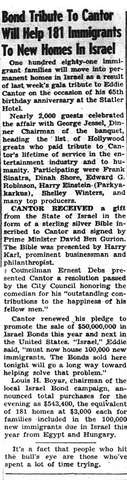
June 28, 1955
Film
"Not As A Stranger" (USA Release: June 28,
1955)
Starring: Olivia de Havilland, Robert Mitchum, Frank Sinatra,
Gloria Grahame, Broderick Crawford, Charles Bickford, Lon Chaney, Jesse White, Harry Morgan, Lee Marvin
Produced and Directed by: Stanley Kramer
Lucas Marsh (Robert Mitchum) is a brilliant and dedicated medical student who turns into an ego-driven, aspiring physician intolerant of the weaknesses of others, especially those closest to him. In order to get the needed tuition money to finish medical school, Lucas marries an older nurse, Kristina "Kris" Hedvigson (Olivia de
Havilland), who has substantial savings. Although Kris loves Lucas and helps him in a variety of ways, he is indifferent towards her and considers her "stupid" though she is an excellent nurse. Lucas cares only about doing excellent medical work, and frequently clashes with other doctors who he considers incompetent, including his wealthy best friend Alfred Boone (Frank Sinatra). Kris, Alfred, and Lucas' mentor Dr. Aarons (Broderick Crawford) try to humanize him and teach him that all doctors sometimes make mistakes.
--DVD Release: 2011-03-29 & Blu-Ray Release:
2018-01-29
The film's opening title cards read: "Stanley Kramer Pictures Corporation Presents A United Artists Release Morton Thompson's Not As a Stranger." Thompson died a few weeks before the publication of his novel. A Var news item of 3 Feb 1954 revealed that producer Stanley Kramer made a pre-publication deal to purchase the screen rights in early Dec 1953 for $75,000. The novel subsequently became a bestseller. According to a 20 May 1954 HR news item, Kramer followed the "same book-plugging campaign used on The Caine Mutiny" by visiting book editors in large cities and making personal appearances at bookstores in order to publicize the novel and create a larger audience for the film.
Not As a Stranger marked longtime producer Kramer's first film as a director. On 17 Feb 1954, LAT reported that Kramer wanted Montgomery Clift for the role of "Lucas Marsh" and Ingrid Bergman for "Kristina Hedvigson." A 21 Sep 1954 HR news item noted that Olivia de Havilland observed two surgical operations at Cedars-Sinai Hospital to prepare for her role. Although HR news items add the following actors to the cast, their appearance in the completed film has not been confirmed: John Goddard, David Alpert, Tamar Cooper, Jo Gilbert, Stafford Repp, Darren Dublin, Tyler McVey, Israel Garcia, Lynn Kevin, Heidi Dublin, Mimi Doyle, Jo Anne Davis, John Raven, Gail Bonney, Marlo Dwyer, Michael Free, Stephen Wooton, Don C. Harvey , Gertrude W. Hoffman, Dave White, Susan Hamilton, Donald Kerr, Art Lewis, Dorothy Newmann, Claire Carleton, Kate McKenna, Alan Nixon , Jimmy Hawkins, Peggy Campbell, Pattee Chapman, Rankin Mansfield, Mack Williams, Richard Emory, Kay Stewart, Aloha Wray, Harry Lauter, Marlene Felton, John Lehman and Harlan Warde.
Buildings on the University of
California, Los Angeles campus served as exteriors for the medical school. A 5 Nov 1954 HR news item adds Whitman Air Field in the San Fernando Valley as another shooting location. According to an 8 Sep 1954 HR news item, Dmitri Tiomkin was originally set to write and direct the film's music score but dropped out due to "conflicting commitments." Although James Van Heusen and Buddy Kaye are credited onscreen with the song "Not As a Stranger," and it was recorded by Frank Sinatra in 1955, only the instrumental version was used in the released picture. A 20 Jan 1955 HR news item noted that Eddie Fisher was also scheduled to record the song. Sinatra's recording of the song was released in 1959 on his "Look to Your Heart" album.
On 10 Mar 1955, HR reported that
"the biggest ad, publicity and exploitation budget in United Artists' history" at least $1,000,000 was to be spent publicizing the picture. Other HR news items noted that a special five-minute trailer, featuring Kramer explaining the film's story and how the cast was selected, and showing clips of the stars’ makeup tests and performances, was to be shown on television and in movie theaters. The film's West Coast premiere, held on 28 Jun 1955 in Los Angeles, raised over $30,000 for the new Mt. Sinai Hospital. Not As a Stranger received an Academy Award nomination for Best Sound Recording.
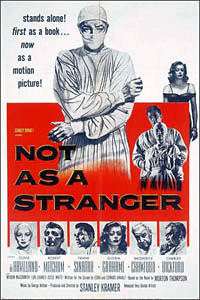
[The Cinematic Legacy of Frank Sinatra — Not As a Stranger (1955)]
David Wills's 2015 photo history The Cinematic Legacy of Frank Sinatra devotes a section to Not As a Stranger (1955), illustrated with 2 behind-the-scenes and publicity photographs (posters, lobby cards, and on-set/on-location shots) filed here.
Source: David Wills, The Cinematic Legacy of Frank Sinatra (St. Martin's Press, 2015), pp. 104–106.
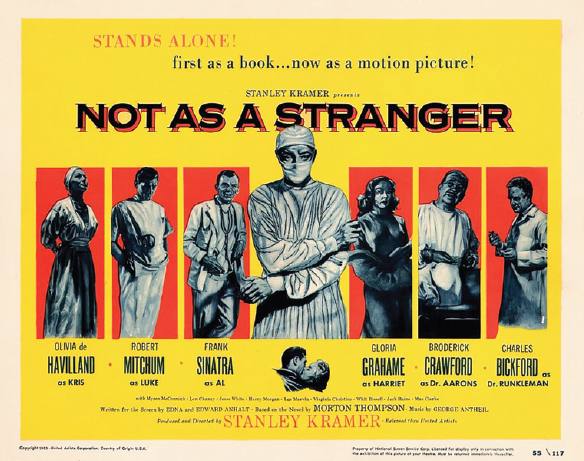
Half sheet poster, Not As a Stranger, 1955. / “One of his scenes … is a piece of satire on the / medical profession, performed in front of his / med school classmates between classes, while / they await the arrival of their professor. He and / I talked beforehand about the need for some / comic reli (Photo: The Cinematic Legacy of Frank Sinatra, David Wills, 2015.)
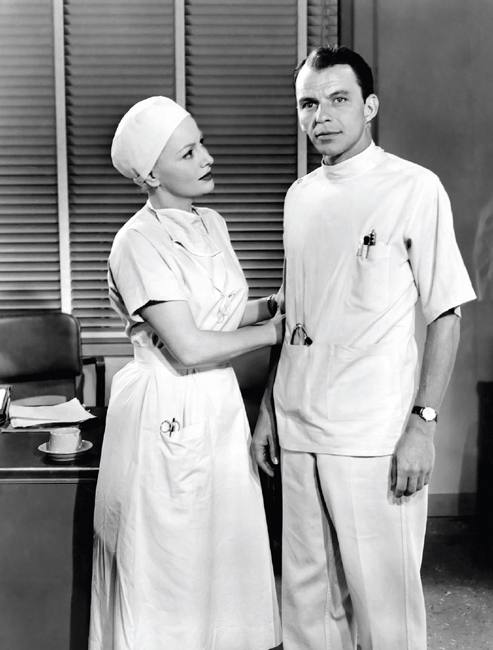
With costar Olivia de Havilland. (Photo: The Cinematic Legacy of Frank Sinatra, David Wills, 2015.)
"Not as a Stranger"
Sinatra followed Young at Heart with Stanley Kramer's directorial debut Not as a Stranger, an adaptation of Morton Thompson's novel, taking a third-billed supporting role as Dr. Alfred Boone behind Olivia de Havilland and Robert Mitchum. Santopietro questions why Sinatra took the part at all, speculating it may have been to keep working on A-list productions or out of fear of boredom.
Source: Tom Santopietro, "Sinatra in Hollywood" (2008).
"Not as a Stranger"
Santopietro observes that Sinatra was purposely photographed to look dwarfed next to costars Robert Mitchum and Lee Marvin (playing fellow medical interns), visually setting him up as the film's comic-relief character.
Source: Tom Santopietro, "Sinatra in Hollywood" (2008).
"Not as a Stranger"
Robert Mitchum: Robert Mitchum was quoted saying Sinatra was the man he'd least like to fight, because 'every time I'd knock him down, he'd get right back up until one of us would have to get killed' -- a comment Santopietro links to the same scrappy resilience Sinatra brought to his Oscar-winning Maggio in From Here to Eternity.
Source: Tom Santopietro, "Sinatra in Hollywood" (2008).
"Not as a Stranger"
Jack Moffitt (The Hollywood Reporter): Jack Moffitt of The Hollywood Reporter praised Sinatra's work in the film, writing that Sinatra 'seems to become a better actor with each successive part' and was 'simply terrific' -- contrasting favorably with Santopietro's view that Mitchum gave a stiff, emotionless performance.
Source: Tom Santopietro, "Sinatra in Hollywood" (2008).
"Not as a Stranger"
Santopietro's overall assessment is that Not as a Stranger is not among Sinatra's worst films but is a fairly pointless choice for him, a stolid melodrama that wastes his 'edgy' strengths as an actor; Sinatra himself, however, comes off best of the three leads.
Source: Tom Santopietro, "Sinatra in Hollywood" (2008).
"Not as a Stranger"
Santopietro grades this a C, dismissing it as a "medical soap opera." BAFTA Film Award nomination: Best Foreign Actor.
Source: Tom Santopietro, "Sinatra in Hollywood" (2008).
"Not as a Stranger"
Santopietro (Filmography): Stanley Kramer Picture Corp/United Artists. Produced and directed by Stanley Kramer, screenplay by Edna Anhalt and Edward Anhalt based on the Morton Thompson novel. Sinatra played Alfred Boone opposite Olivia de Havilland, Robert Mitchum, Gloria Grahame and Broderick Crawford. No Sinatra songs are credited.
Source: Tom Santopietro, "Sinatra in Hollywood" (2008).
June 29, 1955
Radio
The Frank Sinatra Show
Network: NBC
Show Number: 87
Time 8:15 p.m. - 8:30 p.m.
Sponsor: Bobbi Home Permanet, White Rain Shampoo, Deep Magic Face lotion
Host: Frank Sinatra
Writers: Norm Sickel
Announcer: Maurice Hart
Producer: Andrew C. Love
1, I'm Gonna Live Till I Die - Frank Sinatra
2. Blue Star - Felicia Sanders
3. This Love Of Mine - Frank Sinatra
Notes: This is the final broadcast of the series.
Television
NONE
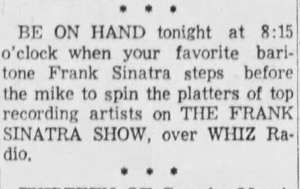
San Francisco Examiner
6-29-55
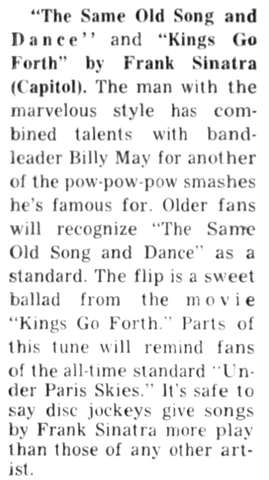
[Last Frank Sinatra Show broadcast]
On June 29, 1955, Sinatra broadcast the last of his twice-weekly Frank Sinatra Show television program, sponsored by Bobbi home permanents.
Source: James Kaplan, "Sinatra: The Chairman" (2015).
June 30, 1955
Studio
KHJ Studios, Hollywood
14158 I Thought About You (N/R)
Arranged & Conducted by Nelson Riddle
NOTE: Sinatra Scholar Ed O'Brien calls this a mysterious recording. Why hasn't it been officially released? Why did Sinatra re-do the song on January 9, 1956? The June 30, 1955 recording, listed here, was done with a 17-piece orchestra and no string section. The January 9, 1956 recording had a 35-piece orchestra and abundant strings. O'Brien says he loves both efforts and Riddle's charts are terrific both times around. The 1955 effort is jazzier and eminently deserves to be heard by Sinatra lovers everywhere, O'Brien asserts.
Scott Henderson:
You are right. I love this version of I thought About You. Very jazzy.
"I Thought About You"
Will Friedwald (analysis): One of the rare Van Heusen/Johnny Mercer collaborations, this ABAB-form song got a discarded trial arrangement at a June 30, 1955 session, opening with a big ensemble intro, Edison behind Sinatra's first 16 bars, then Juan Tizol featured for the instrumental section. The eventual January 1956 arrangement instead opens quietly with a Harry Klee flute intro continuing behind Sinatra's first eight bars; the second chorus is ingeniously divided between Riddle/Edison-led instrumental A sections and Sinatra's vocal B section, ending with a Basie-style tag. Friedwald: less hot than 'Skin' or 'Lady Is a Tramp,' but gives the effect of starting as a ballad and finishing as a flag-waver.
Source: Will Friedwald, "Sinatra! The Song Is You: A Singer's Art" (2018 revised edition).
[Records I Thought About You]
The night after his final Bobbi Show broadcast, on June 30, 1955, Sinatra recorded 'I Thought About You' at Hollywood's KHJ Radio Studios, with a Riddle arrangement and a hint of his Hoboken accent slipping through.
Source: James Kaplan, "Sinatra: The Chairman" (2015).
July 1955
[Shirley Jones signed for Carousel]
Louella Parsons: In a July 1955 column, Louella Parsons reported Sinatra was more excited about Carousel than anything he'd undertaken, and that 21-year-old Shirley Jones, fresh off Oklahoma!, had been signed to play Julie Jordan opposite his Billy Bigelow.
Source: James Kaplan, "Sinatra: The Chairman" (2015)
[Wraps Tender Trap, begins Carousel prep]
Kaplan: After wrapping The Tender Trap at the end of July 1955, Sinatra went straight to 20th Century Fox to begin rehearsals and costume fittings for Carousel.
Source: James Kaplan, "Sinatra: The Chairman" (2015)
July 2, 1955
Frank delivered an acclaimed performance as a dedicated surgeon in Stanley Kramer's Not As a Stranger.
Source: Nancy Sinatra, Frank Sinatra: An American Legend, 1995.
July 4, 1955
The screenplay was finished, Sinatra was firmly cast in the lead role, and location shooting was about to begin.
[Trade press confirms Sinatra cast, location shoot imminent]
The Hollywood Reporter reported that the Carousel screenplay was complete, Sinatra was firmly cast as Billy Bigelow, and location filming in Maine was about to begin.
Hollywood Reporter, July 4, 1955, quoted in Will Friedwald, "Sinatra and Carousel: A Very Deep Dive" (2023-2024, sinatracentury.substack.com).
July 6, 1955
The screenplay was finished, Sinatra was firmly cast in the lead role, and location shooting was about to begin.
[Variety confirms Sinatra's Carousel casting]
Variety likewise reported that Sinatra was cast as Billy Bigelow in the Carousel film adaptation, with production about to begin on location.
Variety, July 6, 1955, quoted in Will Friedwald, "Sinatra and Carousel: A Very Deep Dive" (2023-2024, sinatracentury.substack.com).
July 9, 1955
[Rock Around the Clock hits #1; Guys and Dolls wraps]
On July 9, 1955, Bill Haley's 'Rock Around the Clock' displaced Sinatra's 'Learnin' the Blues' from number 1 on the Billboard singles chart; the same day, filming wrapped on Guys and Dolls.
Source: James Kaplan, "Sinatra: The Chairman" (2015).
July 10, 1955
Buffalo News
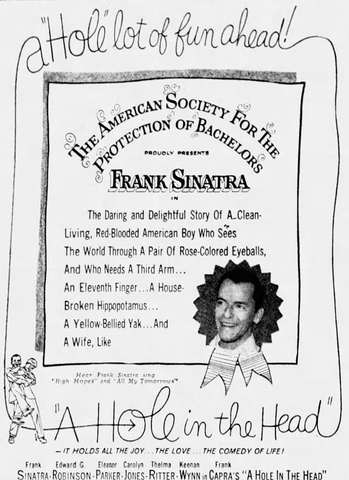
July 11, 1955
[Chartered bus to Judy Garland concert]
On July 11, 1955, Sinatra chartered a bus with an onboard bar to take a large group -- Bogart, Bacall, Dean Martin, Sammy Davis Jr., Van Johnson, June Allyson, Eddie Fisher, Debbie Reynolds, Jack Entratter, and Mike Romanoff -- to a Judy Garland concert in Long Beach; Garland introduced Frank from the stage, but he declined to sing.
Source: James Kaplan, "Sinatra: The Chairman" (2015).
July 12, 1955
Radio
Here's To The Vets #437
Note: TT: 15 mins
Here are the Capitol recordings by Frank Sinatra used in this broadcast: Young at Heart
All of Me
When I Stop Loving You
You My Love
Television
NONE
July 15, 1955
Studio
MGM studio soundstage
Recording session for the movie "The Tender
Trap"
Orchestra conducted by Jeff Alexander
1. Bow Ye Faithful 2 takes, runs 50 seconds, not used in film.
2. The Tender Trap Bill Miller, solo piano accompaniment - Seven takes, runs 2:04.
1. The Tender Trap - Debbie Reynolds, 7 takes, runs
1:13
2. The Tender Trap - Lena Horne, 1 take, runs 1:50, not used in film. Including orchestral intros 7:54 was recorded in 2 hrs and 55 mins.
Johnny Green was the producer
[Vocal tracks for The Tender Trap]
On July 15 and 27, 1955, Sinatra laid down his vocal tracks for The Tender Trap.
Source: James Kaplan, "Sinatra: The Chairman" (2015).
July 17, 1955
Television
Dateline: Disneyland
Season: 1 Episode #26
Disneyland Opening The live special of the opening of the park. If you have never seen this, it is one of the most blooper-filled programs ever aired. If it could go wrong, it did. Abrupt closing as the show was running long. Features Bob Cummings, Art Linkletter, and Ronald Reagan as hosts with guest appearances by Johnny Greene, Irene Dunne, Bonita Granville, Danny Thomas, Bobby Driscoll, Margaret Whiting, Barbara Whiting, Gale Storm, Ken Murray, Julie Bishop, Don DeFore, Jeanne Crain, Frank Sinatra, Sammy Davis Jr., Alan Young, Jerry Colonna, and more 90 minutes Ed O'Brien:
The perils of live TV. This broadcast is a panic. The wind was a factor and the obvious lack of rehearsal and/or having no idea what was next added to the chaos.
Brian Chearno:
One word to describe this show, Pointless.
Dateline: Disneyland
Season: 1 Episode #26
Frank Sinatra and Frank Jr. on Autopia. July 17, 1955
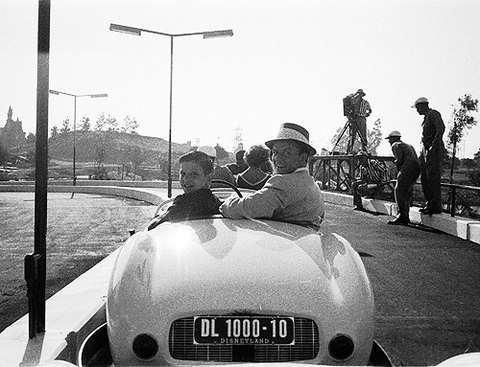
July 27, 1955
Studio
MGM - Los Angeles
THE TENDER TRAP
Wednesday afternoon
Arranged & conducted by Jeff Alexander
End Title alternate verse w/ Celeste Holm, Debbie Reynolds, David Wayne,
Frank Sinatra, Johnny Green
Three takes .47 secs.
Prologue & Main Title bars 1 thru 56
Frank Sinatra
Fourteen takes 1:58
Usable recording time 2:45 done over a period of 3 hours & 20 minutes. Johnny Green produced the session
Production #1681
July 29, 1955
Studio
KHJ Studios. Hollywood
14286 Same Old Saturday Night
(F. Reardon/S. Cahn)
Arranged & Conducted by Nelson Riddle
-13 CD: CDP 724383595228 Sinatra 80th "All The Best"
CD: C2 724383808922 The Complete Capitol Singles
CD: CDP 7-92160-2 Frank Sinatra Collector's Series
LP: CAP 1164 Look To Your Heart
45: 3218
14287 You Forgot All The Words (N/R)
Arranged & Conducted by Nelson Riddle
14288 Fairy Tale
(J. Livingston/D. Stanford)
Arranged & Conducted by Nelson Riddle
CD: C2 724383808922 The Complete Capitol Singles
LP: CAP 1164 Look To Your Heart
45: 3218
Musicians: Reeds: Mahlon Clark, Justin Gordon, Jerome Kasper, Babe
Russin, Willie Schwartz; Trumpets: Frank Beach, Harry :Sweets: Edison, Clarence :Shorty: Sherock, Rubin :Zeke: Zarchy; Trombones: Raymond Klein, James Priddy, Simon Zentner; Bass Trombone: George Roberts; Violin: Victor bay, Alex Beller, Harry Bluestone, Henry Hill, Erno Shapiro, Marshall Sosson; Viola: Stanley Spiegelman, David Sterkin; Cellos: Armand Kaproff, Ray Kramer, Edgar Lustgarten; Piano: Bill Miller; Bass: Joe Comfort, Drums: Max Albright; Guitar: Jack Marshall; Vibraphone; Frank Flynn; Harp: Kathryn Julye
Session Producer: Voyle Gilmore
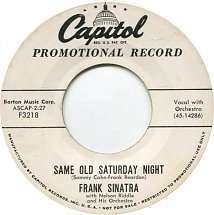
KHJ Studios. Hollywood
14286 Same Old Saturday Night
14288 Fairy Tale
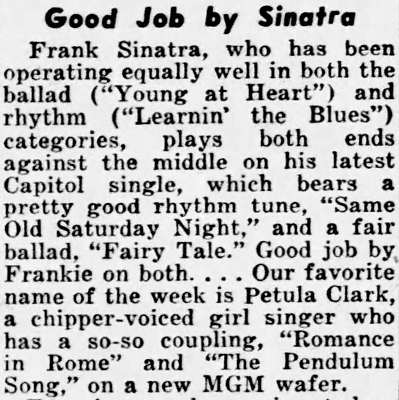
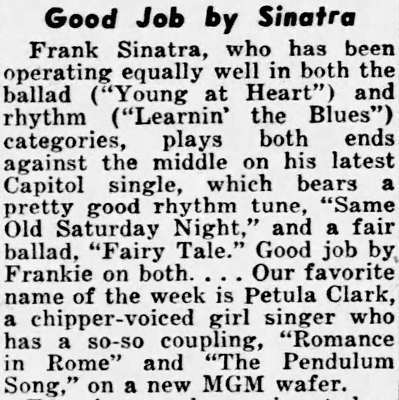
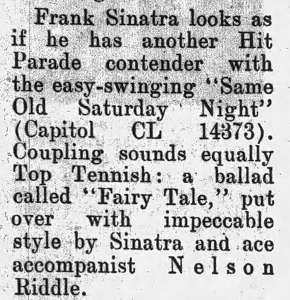
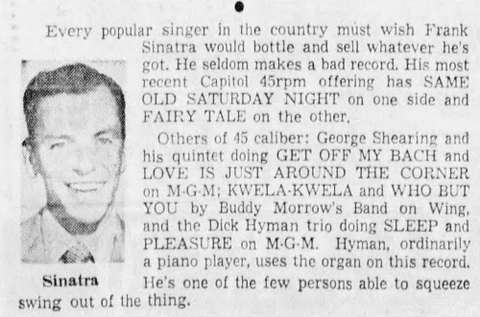
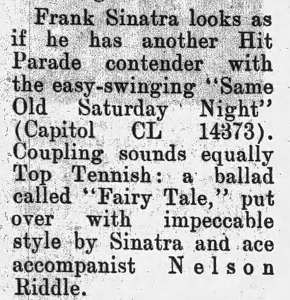
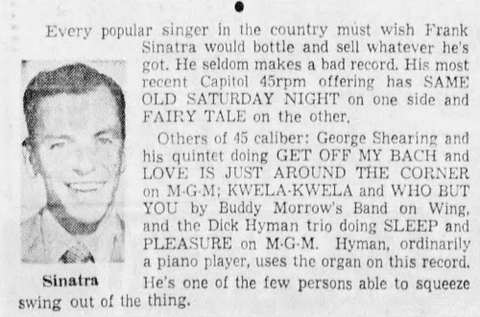
[Records Same Old Saturday Night]
On July 29, 1955, with Riddle arranging and conducting, Sinatra recorded the single 'Same Old Saturday Night,' credited to Sammy Cahn and the pseudonymous composer Frank Reardon.
Source: James Kaplan, "Sinatra: The Chairman" (2015).
[Same Old Saturday Night -- critical commentary]
Will Friedwald: Friedwald calls this obscure single, a follow-up to Cahn/Styne's 1944 'Saturday Night (Is the Loneliest Night of the Week),' perhaps the most extreme example of Sinatra's mood-mixing skill: a joyful, happy-go-lucky melody paired with a melancholy lyric about loneliness. He details how Sinatra phrases solidly on the beat like a nursery rhyme for most of the song, then relaxes into legato at the end (on the added tag line 'Only your face / Can help me erase'), shifting from staccato defeat to legato passion within one track -- delivering sadness and elation simultaneously in a way Friedwald says no other singer matched.
This song/context matches multiple dated entries in the chronology; the specific date Friedwald is referring to could not be determined with confidence.
Source: Will Friedwald, "Sinatra! The Song Is You: A Singer's Art" (2018 revised edition), Ch. 1, "Night and Day" (Sinatra style overview)
August 1955
Frank Sinatra appeared on the cover of Time magazine, which called him “just about the hottest item in show business today” and noted that, four months shy of forty, he was in the midst of a second career that promised to eclipse even his bobby-soxer heyday. Source: J. Randy Taraborrelli, Sinatra: Behind the Legend.
Frank and his very good Rat Pack friend Sammy Davis Jr. at Ciro’s nightclub in Hollywood, August 1, 1955. Actress Lauren Bacall is visible in the background. Source: photo and caption from J. Randy Taraborrelli, Sinatra: Behind the Legend (mptvimages.com).
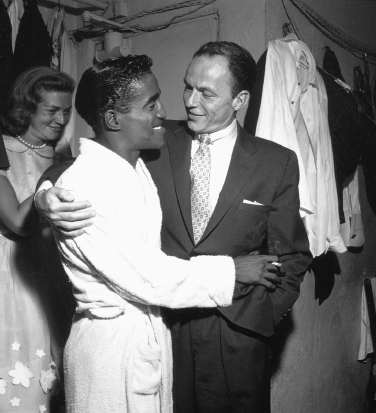
[Fox sues Sinatra for $1 million]
Kaplan: After Sinatra's departure from Carousel, 20th Century Fox sued him for $1 million; he eventually settled by agreeing to make another unspecified film for the studio, which ironically never released Carousel in the 55mm format anyway.
Source: James Kaplan, "Sinatra: The Chairman" (2015)
[Gordon MacRae replaces Sinatra]
Kaplan: Gordon MacRae, who had co-starred with Shirley Jones in Oklahoma!, was rushed in on short notice from a Lake Tahoe nightclub gig to replace Sinatra as Billy Bigelow in Carousel.
Source: James Kaplan, "Sinatra: The Chairman" (2015)
[Sinatra walks off Carousel]
Kaplan: Arriving in Maine for Carousel's location shoot, Sinatra learned the studio planned to shoot scenes in both standard CinemaScope and a new 55mm process, meaning some scenes would be shot twice. Objecting that he'd signed for one movie, not two, he got back in his car and returned to the airport, walking off the picture within days of arriving.
Source: James Kaplan, "Sinatra: The Chairman" (2015)
[Sinatra's dressing-room talk with Shirley Jones]
Shirley Jones: During Carousel pre-production, Sinatra summoned Shirley Jones to his dressing room, where -- wrapped only in a towel after a shower -- he spoke earnestly and at length about how thrilled he was to play Billy Bigelow and sought her thoughts as a veteran of Rodgers and Hammerstein's Oklahoma!.
Source: James Kaplan, "Sinatra: The Chairman" (2015)
[Time magazine cover story income]
Kaplan: Time's cover story on Sinatra estimated his annual income at close to $1,000,000, an astronomical sum for the mid-1950s, reflecting his dramatic career comeback.
Source: James Kaplan, "Sinatra: The Chairman" (2015)
August 11, 1955
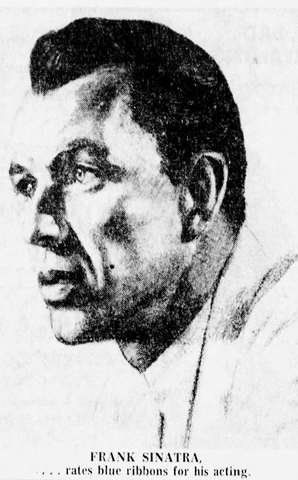
August 15, 1955
Studio
KHJ Studios, Hollywood
14118 Look To Your Heart w/Chorus
(S. Cahn/J.. Van Heusen)
Arranged & Conducted by Nelson Riddle
CD: C2 724383808922 The Complete Capitol Singles
LP: W1164 Look To Your Heart
EP: EPA 673 Our Town
14119 Love And Marriage w/Band Chorus
(J. Van Heusen/S. Cahn)
Barton Music Corp. (ASCAP)
Arranged & Conducted by Nelson Riddle
-5 (2:38) CD: CDP 724383595228 Sinatra 80th - All The Best
CD: C2 724383808922 The Complete Capitol Singles
CD: C2-94777 The Capitol Years
CD: CDP 7-92160-2 Frank Sinatra Collector’s Series
LP: T768 This Is Sinatra!
45: 3260
14120 The Impatient Years
(J. Van Heusen/S. Cahn)
Arranged & Conducted by Nelson Riddle
CD: CDP 724383595228 Sinatra 80th - All The Best
CD: C2 724383808922 The Complete Capitol Singles
LP: W1164 Look To Your Heart
45: 3260
14121 Our Town
(Sammy Cahn/Jimmy Van Heusen)
Barton Music Corp. (ASCAP)
Arranged & Conducted by Nelson Riddle
-3 (3:15) CD: C2-94777 The Capitol Years
LP: W1164 Look To Your Heart
EP: EPA 673 Our Town
Musicians - Reeds: Harry Klee, Ted Nash, Joseph Palange, Willie Schwartz, Warren Webb; Trombone: Francis Howard; Bass Trombones: George Roberts; French Horns: John Cave, James Decker, Vincent De Rosa; Voilins: Victor Bay, Alex Beller, Harry Bluestone, Alex Murray, Erno Neufeld, Nick Pisani, Nathan Ross, Mischa Russell, Paul Shure, Felix Slatkin, Marshall Sosson, Gerald Vinci; Violas: Alvin Dinkin, Stanley Speigelman, David Sterkin; Cellos: Armand Kaproff, Edgar Gilbert; Drums: Max Albright; Guitar: Alton Hendrickson; Vibaphone: Frank Flynn; Harp: Kathryn Julye
Chorus - Sweet Blair, Vince Degen, Jack Gruberman, John Gustavson, Ray Linn Jr., Gil Mershon, Robert Namlin, Charles Parlato, William Reeve, Robert Wacker, Allan Wattson, Norma Zimmer
Session Producer: Vole Gilmore
NOTE: Sinatra Scholar Ed O'Brien points out that Sinatra was getting ready for the musical adaptation of Thorton Wilder's "Our Town" on Producer's Showcase on September 19, 1955 on NBC-TV. O'Brien hasn't looked it up, but wonders if there was a session prior to this where Sinatra did this many songs by the same writing team. Sammy Cahn often said that the TV production of Wilder's play was Sinatra's greatest live performance. O'Brien believes that Cahn and Van Heusen outdid themselves with the music numbers for this show. note: Cahn & Van Heusen wrote "The Tender Trap" for Frank prior to the "Our Town" songs. He recorded the former at MGM on 7-15 and 27. But the 8-15 at Capitol was the first commercial effort Frank did by this newly formed duo.
--Ed
20th Century Fox Soundstage - Hollywood , California
Recording for the film adaptation of Rodgers and Hammerstein's "Carousel"
"Blow High, Blow Low"
Vocal: Frank Sinatra, as Billy Bigelow
Conductor: Alfred Newman w/Urban Thielman on piano
NOTE: Ed O'Brien reports that in the summer of 1955, Sinatra did extensive wardrobe tests for the lead role of Billy Bigelow in the 20th Century Fox film adaptation of the Rodgers and Hammerstein musical "Carousel." He also pre-recorded three songs on the soundstage of the film studio on August 15, 16, and 17, 1955. And there were on location in Booth Bay Harbor, Maine recordings done on August 20, 21, and 22, 1955.
On August 15, 1955, on the soundstage, Sinatra did "Blow Hard, Blow Low" with Alfred Newman conducting a 57 piece orchestra including Urban Thielman on piano. (AFM sheets reveals a payment of $64.28 for five hours work.)
KHJ Studios, Hollywood
14118 Look To Your Heart
14119 Love And Marriage
14120 The Impatient Years
14121 Our Town
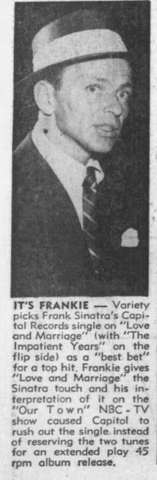
Morning Sentinel
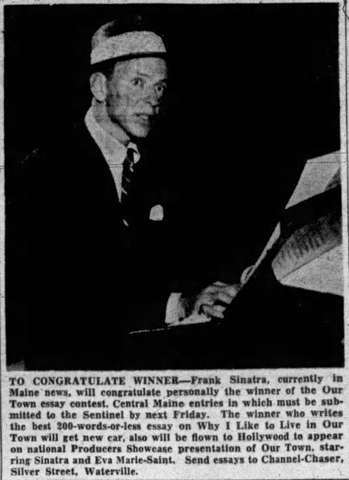
Pasadena Independent
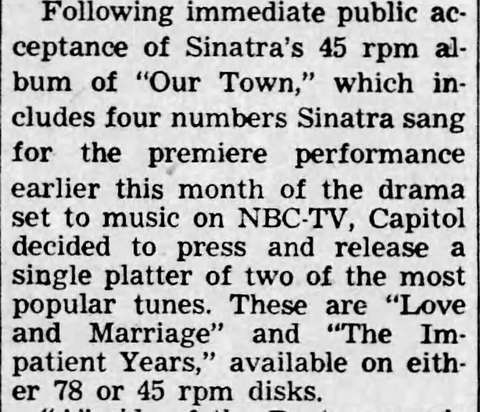
Sunday Oregonian

The Times
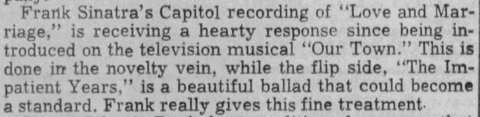
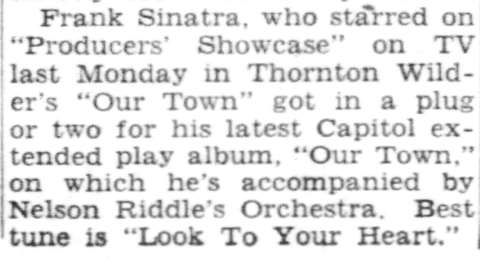
[Records four Our Town songs]
On the night of August 15, 1955, Sinatra recorded all four Cahn-Van Heusen songs written for the Our Town TV musical: the title song, 'Look to Your Heart,' 'The Impatient Years,' and 'Love and Marriage.'
Source: James Kaplan, "Sinatra: The Chairman" (2015).
[Prerecords Blow High, Blow Low]
On August 15, 1955 -- the same day as the Our Town sessions -- Sinatra and co-star Cameron Mitchell prerecorded the sea chantey 'Blow High, Blow Low' for Carousel; the master tape was later lost, a casualty of Sinatra's abrupt withdrawal from the film.
Source: James Kaplan, "Sinatra: The Chairman" (2015).
August 16, 1955
Studio
20th Century Fox Soundstage - Hollywood, California
For proposed film adaptation of Rodgers and Hammerstein's "Carousel"
Alfred Newman conducting 57 piece orchestra
"If I Loved You" - Frank Sinatra and Shirley Jones
NOTE: Sinatra Scholar Ed O'Brien reports that in the summer of
1955, Sinatra pre-recorded three songs from "Carousel" on the soundstage of the film studio. O'Brien considers this particular recording to be one of Sinatra's great studio recordings.
Shirley Jones was interviewed by Prof Richard Brown on AMC some years back. She told him that the film was very good but would have been great if Sinatra had not dropped out.
She also stated that the reason Sinatra gave for leaving the production "filming in both 35mm and Cinemascope 55" was not, in her opinion, why he left. O'Brien has a marvelous letter from Marty Ingels describing what he found at the studio when Shirley and he made the R&H documentary for A&E. He very much wanted to issue the material.
20th Century Fox Soundstage - Hollywood, California
For proposed film adaptation of Rodgers and Hammerstein's "Carousel"
Alfred Newman conducting 57 piece orchestra
"If I Loved You" - Frank Sinatra and Shirley Jones

“Then we got a message from Skouras and Zanuck. We were to make two Carousels — one on thirty-five millimeter film, which was CinemaScope, and another in fifty-five millimeter that Skouras planned to road show... Frank blew all six takes [of 'Soliloquy']. There was mild panic in the recording room... 'Let's try it another time,' he said. 'I've had it for tonight.'”
[Why Sinatra ultimately quit Carousel]
Producer Henry Ephron's 1977 memoir “We Thought We Could Do Anything” recounts that on this same soundstage date, Sinatra also attempted -- and failed after six takes -- to re-record “Soliloquy,” and that around this time he learned the studio intended to shoot the picture twice (once in CinemaScope, once in a 55mm roadshow format), which he had not agreed to and which became the immediate cause of his walking off the production days later in Maine.
Henry Ephron, “We Thought We Could Do Anything” (1977), quoted in Will Friedwald, "Sinatra and Carousel: A Very Deep Dive" (2023-2024, sinatracentury.substack.com).
August 17, 1955
Studio
20th Century Fox Soundstage - Hollywood
For proposed film adaptation of Rodgers and Hammerstein's musical "Carousel"
"You'll Never Walk Alone" --Frank Sinatra
Alfred Newman conducting 57 piece orchestra
NOTE: Ed O'Brien points out that in the summer of 1955, Sinatra pre-recorded three songs from "Carousel" on the soundstage of the film studio. On August 17th, Sinatra did "You'll Never Walk Alone"
Sinatraphile Larry Crawford asked O'Brien why, in his opinion, Sinatra dropped out of the filming. O'Brien responded: "I think he was uncomfortable playing the big roustabout, carny Billy Bigelow. Role called for a John Rait or Gordon McRae, not a skinny little guy who was barely over 5 feet 7 inches. Shirley Jones has hinted at just that in different interviews. But I believe Sinatra would have been great in the role and the physical stature question would have been of little consequence once Sinatra established the character. I agree with Shirley Jones, the film would have been great with Sinatra."
Sinatraphile Ed Speigel agrees that the film would have been great with Sinatra. Speigel points out that in recent "Carousel" productions, Billy has not been a big bruiser and that includes the acclaimed Broadway revival of some years back. From my first hearing of Sinatra's Columbia version of "Solilquoy," I cast him in the role in my mind. When he announced for the part, I was thrilled. The movie was all right, McRae has a big baritone and looked good. But he was not much of an actor. Frank, at that time, was at the peak of his thespic powers and could have brought so much to the character. The segments of Frank's "Solilquoy" that are included in the Sinatra Hollywood box are spectacular. In my opinion, they go even beyond his great 1953 version. If Sinatra had stuck around, done the work he was capable of, we'd have a musical for the ages instead of merely a respectable version of the musicalized Liliom."
Speigel adds: Further on this topic, Fred Zimmerman got more out of
McRae in "Oklahoma" than Henry King was able to do in
"Carousel." Zimmerman, of course, had directed Frank earlier in "From Here to Eternity."
note: MacRae was a cousin of mine on my mother's side of the family. Having seen film of Raitt's performance, I think 20th Century made a mistake with
the replacement for Sinatra. Skitch Henderson told me Frank was in awe of Raitt's singing during the Broadway run of "Carousel." Frank and Skitch
caught the show many times. If you have never heard it, Frank has fun singing a parody, during the Dean Martin Friars Trib, 11-8-59, in which he
mentions his replacement in the film.
--Ed
August 29, 1955
Frank made the cover of Time magazine, which detailed his enormous wardrobe of 100 suits and reported he carried nothing smaller than a $100 bill.
Source: Nancy Sinatra, Frank Sinatra: An American Legend, 1995.
September 1955
[Begins The Man with the Golden Arm]
Kaplan: At the end of September 1955, Sinatra began his fifth film of the year, The Man with the Golden Arm, shooting at RKO's Culver City studios under director Otto Preminger; for the six-week shoot he worked on no other film, TV, or radio projects.
Source: James Kaplan, "Sinatra: The Chairman" (2015)
[Confidential exposes the Wrong-Door Raid]
Kaplan: The scandal magazine Confidential published an exposé in September 1955 titled "The Real Reason for Marilyn Monroe's Divorce," revealing inconsistencies in Sinatra's account of the November 1954 Wrong-Door Raid and prompting the later state and grand jury investigations.
Source: James Kaplan, "Sinatra: The Chairman" (2015)
[Confidential's Wrong-Door Raid story]
Kaplan: The September 1955 issue of Confidential magazine ran a cover story alleging Sinatra had been an active participant, not merely a bystander as he'd told police, in the previous November's Wrong-Door Raid connected to Marilyn Monroe's divorce.
Source: James Kaplan, "Sinatra: The Chairman" (2015)
[Sinatra on the Carousel walkout to Bob Thomas]
Frank Sinatra: In a Bob Thomas column that ran alongside the Dunes photo, Sinatra gave his account of the Carousel walkout, saying the two-camera process wasn't how he worked and that he'd wanted to do the picture for seven years; he also joked he'd have been insulted if Fox had sued him for less than $1 million.
Source: James Kaplan, "Sinatra: The Chairman" (2015)
September 9, 1955
Concerts
Dunes Hotel, Las Vegas, Nevada (September 9-11)
Dunes Hotel, Las Vegas, Nevada (September 9-11)
The hotel failed a few months after its original opening. Owners of the Sands took over and held second premiere. In August 1955, an agreement was reached for Sands Hotel Corporation, owner of the Sands Hotel and Casino, to lease and operate the struggling Dunes. To mark the management change, a three-day celebration was held starting on September 9, 1955. Singer Frank Sinatra headlined the ceremony and entered on a camel. "Las Vegas, the glittering Monte Carlo of America, has so changed that even Frank Sinatra climbed aboard a camel to try to lure customer back to one of the dying hotels." 1955 Dunes Hotel, Las Vegas, Nevada (September 9-11)
Hedda Hopper note: Frank's appearance was done in an attempt to rescue the new Dunes. I found a number of articles detailing the general lack of interest in another hotel. Entratter had signed a number of major stars but there were very few reservation. Frank received part ownership in the Dunes and despite a heavy work load, including "Our Town," 9-19, he agreed to do the three days on the weekend.
Ed
Dunes Hotel, Las Vegas, Nevada (September 9-11)
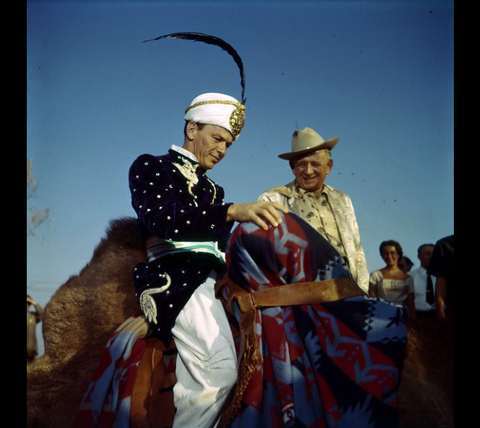
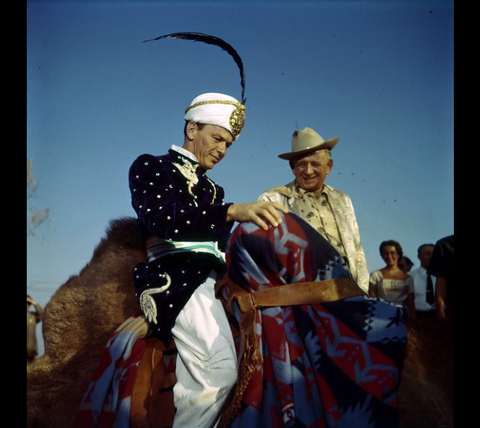
September 10, 1955
Concerts
Dunes Hotel, Las Vegas, Nevada (September 9-11)
Dunes Hotel, Las Vegas, Nevada (September 9-11) note: Interesting to know that Frank was singing songs from the upcoming TV production of "Our Town."
Ed
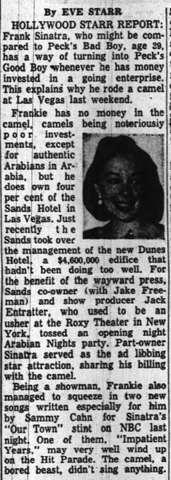
[Reopens the Dunes on a camel]
On September 10, 1955, Sinatra reopened the Dunes hotel-casino in Las Vegas, riding in on a camel dressed in a jeweled turban and sultan's costume, surrounded by women dressed as harem girls, in a widely printed Associated Press photo captioned 'He gets paid for this.'
Source: James Kaplan, "Sinatra: The Chairman" (2015).
September 11, 1955
Concerts
Dunes Hotel, Las Vegas, Nevada (September 9-11)
September 13, 1955
Studio
KHJ Studios, Hollywood
14429 (Love Is) The Tender Trap
From the film "The Tender Trap"
(S. Cahn/J. Van Heusen)
Barton Music Corp. (ASCAP)
Arranged & Conducted by Nelson Riddle
-12 (2:57) CD: CDP 724383595228 Sinatra 80th "All The Best"
CD: C2 724383808922 The Complete Capitol Singles
CD: C2-94777 The Capitol Years
CD: CDP 7-92160-2 Frank Sinatra Collector's Series
LP: T768 This Is Sinatra!
45: 3290
14430 You'll Get Yours
(J. Van Heusen/D. Stanford)
Arranged & Conducted by Nelson Riddle
CD: C2 724383808922 The Complete Capitol Singles
LP: T2602 Forever Frank
45: 3350
14431 Weep They Will -N/R
(C. Fischer/B. Carey)
Arranged & Conducted by Nelson Riddle
Musicians: Reeds: Mahlon Clark, Chuck Gentry, Harry Klee, Ted Nash, Warren Webb; Trumpets: Frank Beach, Walter Candoli, Emanuel Klein, Vito "Mickey" Mangano; Trombones: Francis Howard, Dick Noel, James Priddy; Bass Trombone: George Roberts; Violins: Victor Bay, Alex Beller, Anatol Kaminsky, Nathan Ross, Mischa Russell, Paul Shure, Felix Slatkin, Marshall Sosson; Violas: Alvin Dinkin, Virginia Majewski, Stanley Spiegelman; Cellos: Armand Kaproff, Ray Kramer, Eleanor Slatkin; Piano: Bill Miller; Bass: Joe Comfort; Drums: Max Albright; Guitar: Nick Bonney; Harp: Kathryn Julye
Session Producer: Vole Gilmore
NOTE: Sinatra Scholar Ed O'Brien reports that Van Heusen wrote a high F note for "Trap." Musicians he interviewed on this session told him that Sinatra and Chester Babcock (Van Heusen's real name) did quite a bit of teasing over that particular note, but Sinatra easily soared when he needed to hit that high F.
"Weep They Will" is Tony Bennett's favorite Sinatra recording. The released one, from October of 1955, has an incredible falsetto segment that is simply sublime.
September 18, 1955
Television
The Colgate Variety Hour
NBC-TV
Sunday Evening
8:00 p.m. -- 9:00 p.m.
Hosts: Dean Martin & Jerry Lewis.
Guest: Frank Sinatra (heard only on recording)
1. Sinatra: Yetta ( I Can't Forget Her)
Notes: At the end of the show, Dean and Jerry plug Sinatra's appearance on Producer's Showcase the next night. Two copies. One with original commercials and one cleaner without commercials.
Ed O'Brien:
Scene takes place in a pool hall. Frank comes on the radio singing "Yetta." Simply amazing that he recorded the entire song. note: According to Variety, Jerry Lewis wrote "Yetta."
Ed
The Colgate Variety Hour
NBC-TV
Sunday Evening
8:00 p.m. -- 9:00 p.m.
Hosts: Dean Martin & Jerry Lewis.
Guest: Frank Sinatra (heard only on recording)
1. Sinatra: Yetta ( I Can't Forget Her)
Notes: At the end of the show, Dean and Jerry plug Sinatra's appearance on Producer's Showcase the next night. Two copies. One with original commercials and one cleaner without commercials.
note: According to Variety, Jerry Lewis wrote "Yetta."
Ed

[Colgate Comedy Hour's Yetta sketch]
On Sunday, September 18, 1955, Sinatra's voice (but not his live presence) appeared on a Colgate Comedy Hour episode with Dean Martin and Jerry Lewis: in a sketch, Lewis's character 'writes' a goofy song called 'Yetta, I Can't Forget Her,' which then plays on a radio sung by Sinatra.
Source: James Kaplan, "Sinatra: The Chairman" (2015).
September 19, 1955
Television
Producers' Showcase Presents A Musical Adaptation Of Thornton Wilder's Our Town NBC-TV
Monday Evening
8:00 p.m. - 9:30 p.m.
Stars: Frank Sinatra, Eva Marie Saint, Paul Newman, Ernest Truex, Paul Hartman
Music Composed by James Van Heusen
Lyrics by Sammy Cahn
Fifty Piece Orchestra Conducted by Nelson Riddle
Arrangements by Nelson Riddle
Produced by Fred Coe
Directed by Delbert Mann
1. Our Town Frank Sinatra
2. Grovers Corners Frank Sinatra & Chorus
3. The Impatient Years Frank Sinatra
4. Love And Marriage* Frank Sinatra
5. My Dad's Advice
6. The Wedding Song
7. Look To Your Heart Frank Sinatra
* To this day "Love And Marriage" has the distinction of being the only song to win an Emmy
Notes: 77 mins. Originally aired in Color. Survives on kinescope
NOTE: Sinatra Scholar Ed O'Brien considers this one of Sinatra's greatest moments on TV. Sammy Cahn considered it Sinatra's finest "live" performance. Sinatra didn't show for rehearsals and the director, Delbert Mann, was less than thrilled. But Sinatra's performance was superb and he sang like an angel. Saint and Newman were also outstanding.
O'Brien also sent along the complete review of the "Our Town" TV production from the September 20, 1955 edition of the New York Times written by Jay P. Stanley and headlined OUR TOWN IS STILL ENTERTAINING Music Added to Prize Play on "Showcase.' Here is that review:
Thornton Wilder's bittersweet masterpiece, "Our Town," transferred to the television screen last night, provided ninety minutes of magnificent entertainment. The "Producer's Showcase" presentation of Mr. Wilder's inspired study of life, love and death in a New Hampshire hamlet was a challenging undertaking for video. Fred Coe, the producer, and members of his staff and cast did not try to find a facile way to translate the 1938 Pulitizer Prize play into terms that would be acceptable on television.
Instead, it was decided to add music to the story. The gamble was risky. "Our Town" was already established as a modern classic on stage and in motion pictures. The addition of a score and lyrics might have resulted in an elaborate corruption of a theme beloved because of its basic simplicity and purity.
But Mr. Coe, Delbert Mann, the director, and the others did their work remarkably well. The tender narrative of joy and sorrow in the hearts of unspectacular Americans lost none of its charm in the television adaptation by David Shaw.Ă And it was complimented splendidly with songs by James Van Heusen and lyrics by Sammy Cahn.
Eve Marie Saint, playing the role of Emily Webb, the editor's daughter, was responsible for a major share of the production's fine quality. Miss Saint, who received her basic training in a series of television appearances, was obviously at home before the camera. She performed brilliantly in a role that demands a great range of acting talent.Ă It is difficult to say at what point Miss Saint achieved her most impressive effect. It was perhaps in a delightful second-act scene with Paul Newman, as George Gibbs, the doctor's son from next door.
This was at the point at which Emily had decided the time had come to win George as a husband. Miss Saint was disturbingly wonderful as she broke down the flimsy resistance that remained with her quarry as she said with just the proper air of helplessness: "It's not as easy for a girl to be as perfect as a man because girls are more nervous."
The key role of the Stage Manager, who narrates the story and occasionally moves into it, was played by Frank Sinatra.
There are bound to be exceptions to Mr. Sinatra's portrayal. It can be argued that he was not a seasoned enough performer for the role and that he never was believable as the down-Easterner, who philosophizes as he lounges and observes life in Grover's Corners.
It is true that Mr. Sinatra was occasionally less at ease than he might have been.Ă And his unconcealed Hobokenese would betray him as an outsider in any part of New England .
But he was effectively unobtrusive and his songs were an important contribution to the success of the presentation. He was particularly winning when he sang the bright number called "Love and Marriage." Miss Saint, Mr. Newman, and Ernest Truex had opportunities to sing during the show. It mattered not at all that their voices were untrained. One would have bee upset to hear pear-shaped tones from all the plain people of Mr. Wilder's town.
Some notice should be taken, too, of "Wasn't It a Wonderful Wedding?" sung and danced with style and spirit.
On the stage, "Our Town" dispensed with scenery. Last night, skeletonized backgrounds were used with impressive effects. In fact, just about everything connected with the adaptation was impressive. "Our Town" seen through a new medium continued to be a fascinating community.
Producers' Showcase Presents A Musical Adaptation Of Thornton Wilder's Our Town
Frank rehearsing songs for "Our Town" production
Frank
Paul
Variety
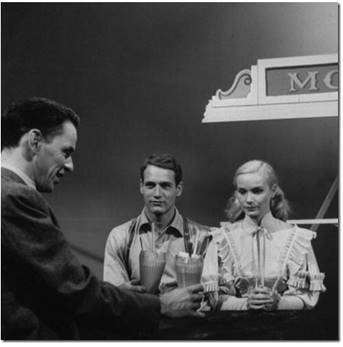
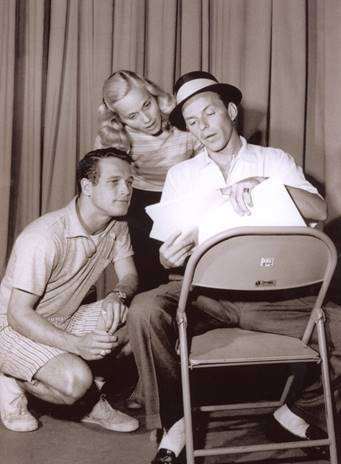
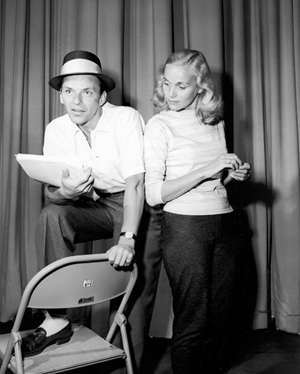
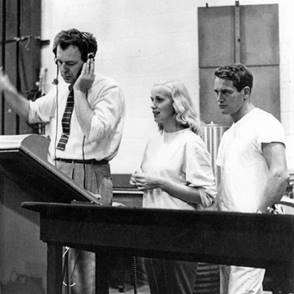
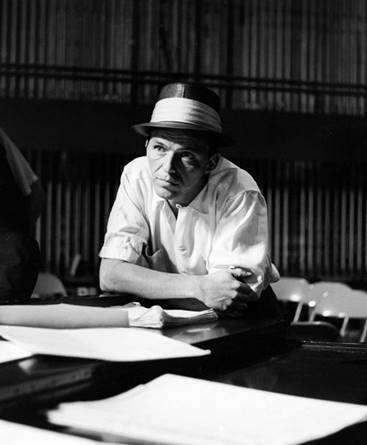
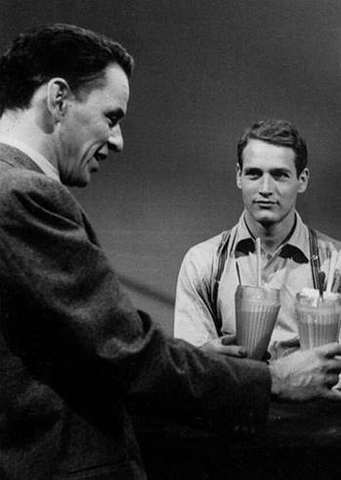
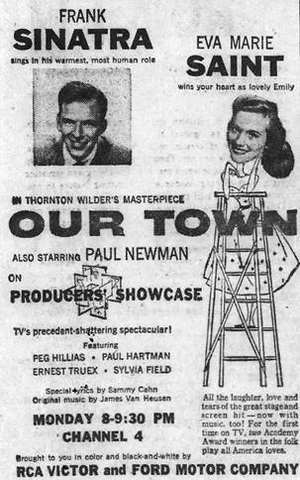
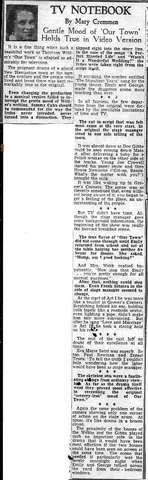
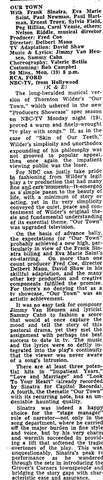
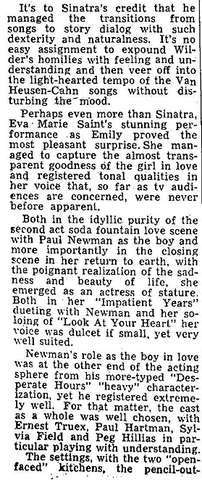
note: Here are the Nielsen Ratings for the week of 9/11 to 24, 1955 NUMBER OF TV HOMES REACHED
## program Network homes
1. $64,000 Question CBS 19,302,000
2. Ford Star Jubilee CBS 15,667,000
3. Toast of the Town CBS 12,764,000
4. Disneyland ABC 12,363,000
5. Colgate Variety Hour NBC 12,190,000
6. Martha Raye Show NBC 11,687,000
7. Producers Showcase NBC 11,193,000
8. Climax CBS 11,001,000
9. Those Whiting Girls CBS 10,906,000
10. Color Spread NBC 10,847,000
Frank was paid $25,000 for his role of Stage Manager
Boston Globe
Variety
On the set of "Can Can" September 19, 1959 during
Khrushchev's visit
Frank Sinatra Greets Nikita Khrushchev
ORIGINAL CAPTION: Frank Sinatra greets then Soviet Premier Nikita
Khrushchev on the set of "Can Can" September 19, 1959 during Khrushchev's visit to the U.S. Also in photo are actor Louis Jourdan (L) and actress Shirley Maclaine.
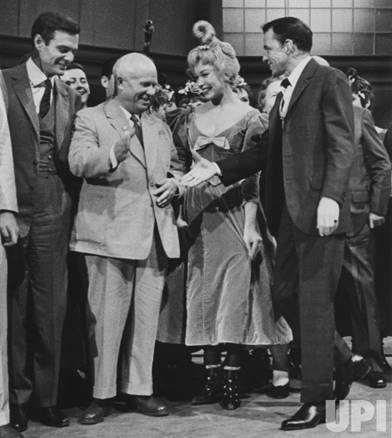
[Our Town TV musical airs]
The Our Town television musical starring Sinatra as the Stage Manager aired on NBC on September 19, 1955; Thornton Wilder reportedly disliked the result so much that no official copy was preserved, though a partial kinescope survives.
Source: James Kaplan, "Sinatra: The Chairman" (2015).
September 20, 1955
New York Times critic J.P. Shanley reviewed NBC's television production of "Our Town," in which Sinatra played the Stage Manager, describing his performance as "effectively unobtrusive."
Source: Albert Auster, "Frank Sinatra: The Television Years–1950–1960," Journal of Popular Film and Television, 26:4 (1999), 166-174.
September 23, 1955
12703 Someone To Watch Over Me
(G. Gershwin/ I. Gershwin)
WB Music Corp (ASCAP)
Arranged & Conducted by Nelson Riddle
-20 (2:56) CD: CDP 724383595228 Sinatra 80th 'All The Best'
CD: C2 724383808922 The Complete Capitol Singles
CD: CDP 7-96827-2 Nice â n' Easy
CD: : C2-94777 The Capitol Years
LP: W1432 Songs For Young Lovers
45: 2993
Glamorgan Gazette
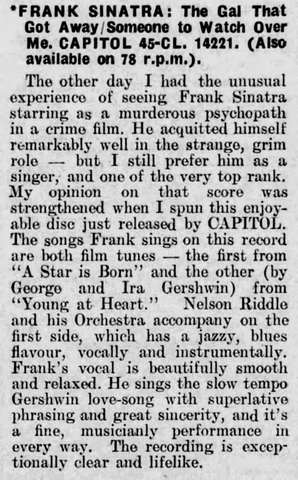
U.K. release
12704 You, My Love
(J. Van Heusen/M. Gordon)
Arranged & Conducted by Nelson Riddle
CD: C2 724383808922 The Complete Capitol Singles
LP: W1164 Look To Your Heart
45: 2993
Leicester Chronicle
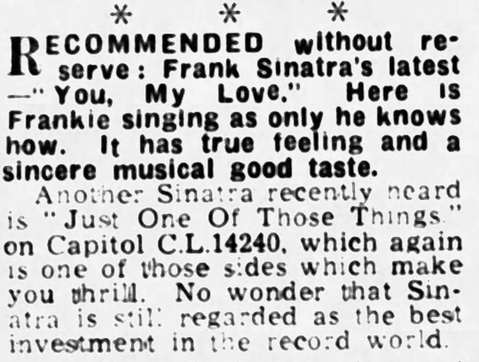
South Wales Argus
October 1955
[Vanderbilt signed for Johnny Concho announced]
Kaplan: In late October 1955, newspapers announced Kent Productions had signed Gloria Vanderbilt to co-star in Johnny Concho, though the actual signing had reportedly taken place earlier in the year -- before Sinatra learned she had moved in with director Sidney Lumet.
Source: James Kaplan, "Sinatra: The Chairman" (2015)
October 17, 1955
Studio
KHJ Studios, Hollywood
14287 You Forgot All The Words (While I Still Remember The Tune) (B. Wayne/E.H. Jay)
Arranged & Conducted by Nelson Riddle
CD: C2 724383808922 The Complete Capitol Singles
CD: CDP 7-94519-2 No One Cares
LP: 982 This Is Sinatra Vol..2
45: 3552
14633 Love Is Here To Stay
(George Gershwin/Ira Gershwin)
Arranged & Conducted by Nelson Riddle
CD: CDP 7-46570-2 Songs For Swingin' Lovers
LP: W653 Songs For Swingin' Lovers
14634 Weep They Will
(C. Fischer/B. Carey)
Sam Weiss Music, Inc. (ASCAP)
Arranged & Conducted by Nelson Riddle
-11 (3:16) CD: C2 724383808922 The Complete Capitol Singles
CD: C2-94777 The Capitol Years
LP: T1919 Tell Her You Love Her
45: 3290
Musicians - Alto Sax: Mahlon Clark, Willie Schwartz; Tenor Sax: Justin Gordon, Warren Webb; Baritone Sax: Robert Lawson; Trumpets: John Best, Harry "Sweets" Edison, Clarence "Shorty" Sherock, Rubin "Zeke" Zarchy; Trombones: Dick Noel, James Pridy, Paul Tanner; Bass Trombone: George Roberts; Violins: Victor Bay, Alex Beller, Samuel Cytron, Robert Gross, Henry Hill, Dan Lube, Alex Murray, Paul Nero, Erno Neufeld, Mischa Russell; Violas: Maxine Johnson, Paul Robyn, David Sterkin; Cellos: Ennio Bolognni, Ray Kramer, Eleanor Slatkin; Piano: Bill Miller; Bass: Joe Comfort; Drums: Irv Cottler; Guitar: George Van Eps; Vibraphone: Frank Flynn; Harp: Kathryn Julye
Session Producer: Vole Gilmore
[Weep They Will -- critical commentary]
Granata includes 'Weep They Will' among the fifty recordings he considers essential to understanding Sinatra's artistry (arranged by Nelson Riddle, recorded 1955, Capitol); the song was chosen for its musical/interpretive value rather than commercial popularity.
This song/context matches multiple dated entries in the chronology, or lacked a sufficiently precise date; the specific date could not be determined with confidence.
Source: Charles L. Granata, "Sessions with Sinatra: Frank Sinatra and the Art of Recording" (1999/2003), Afterword & Appendices A-D
October 18, 1955
[Harrison Carroll on Golden Arm wrap, Johnny Concho next]
Harrison Carroll: On October 18, 1955, columnist Harrison Carroll reported Sinatra planned only a few days' rest at his Palm Springs home after finishing Golden Arm before starting work on his own Western production, Johnny Concho, through his company Kent Productions, with United Artists distributing and entourage member Don McGuire directing.
Source: James Kaplan, "Sinatra: The Chairman" (2015).
October 22, 1955
Billboard noted that since Sinatra's Our Town TV appearance, his recording of 'Love and Marriage' had been selling steadily, with Boston and New York both placing it in their Top 10, even though Sinatra reportedly didn't much care for the song. (Source: Richard Havers, "Sinatra" (Dorling Kindersley, 2007).)
October 23, 1955
Concerts
Beverly Hilton, Los Angeles, CA
City of Hope Award Dinner
Sinatra, Dinah Shore, Bob Hope, The Skylarks
October 28, 1955
Concerts
University High School, Los Angeles, CA
Sinatra appears at his daughter Nancy's High School
Sinatra sang a few songs including "Love and Marriage" and a duet with Nancy on "Side By Side" Songs included:
--Learnin' The Blues
--It Wat Just One Of Those Things
--Love And Marriage
--A Foggy Day
--I Get A Kick Out Of You
University High School, Los Angeles, CA
Sinatra appears at his daughter Nancy's High School
Sinatra sang a few songs including "Love and Marriage" and a duet with Nancy on "Side By Side"
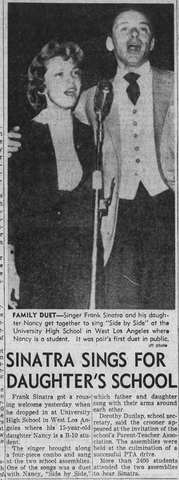
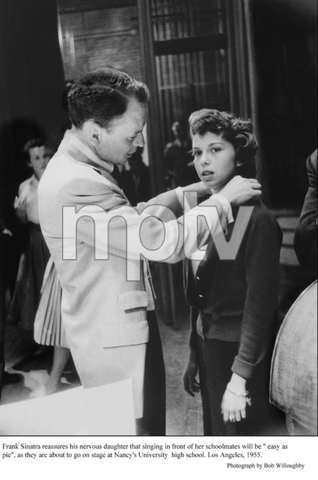
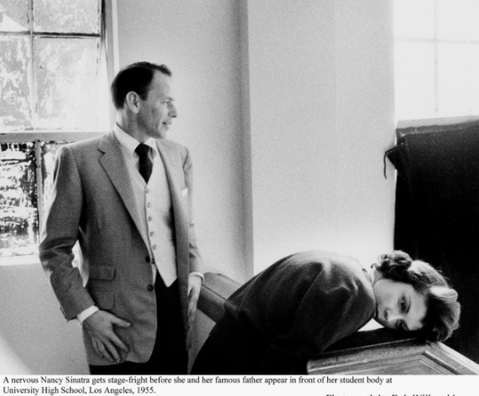
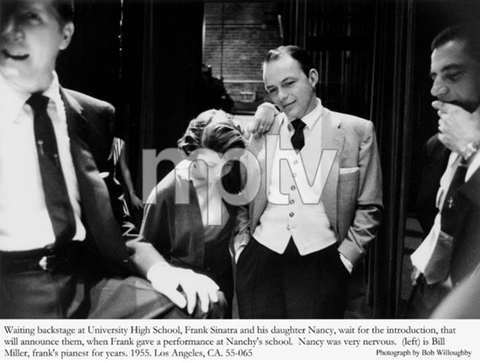
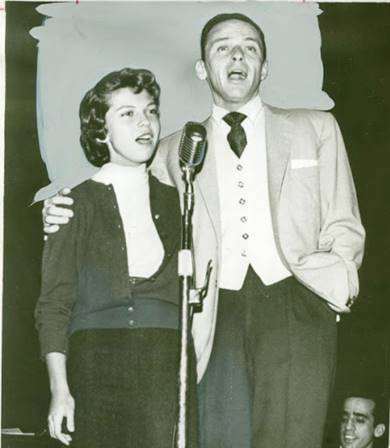
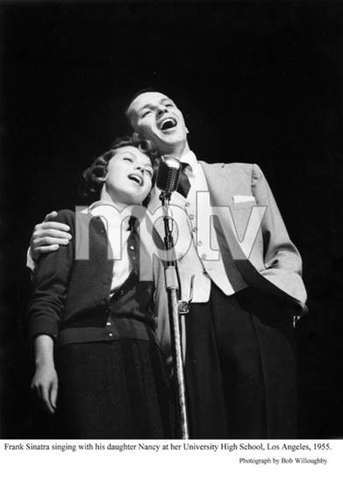
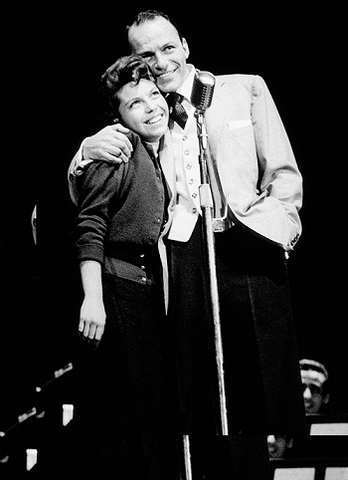
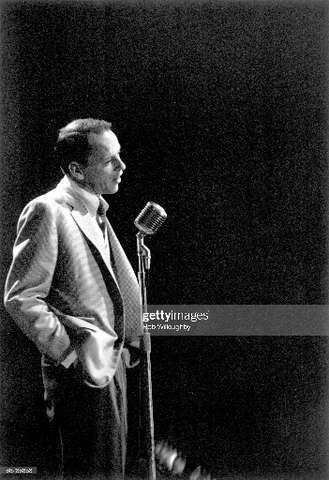
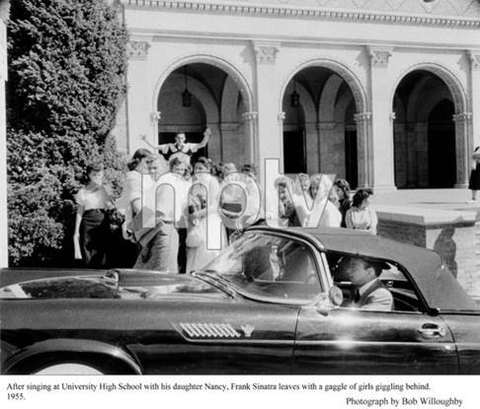
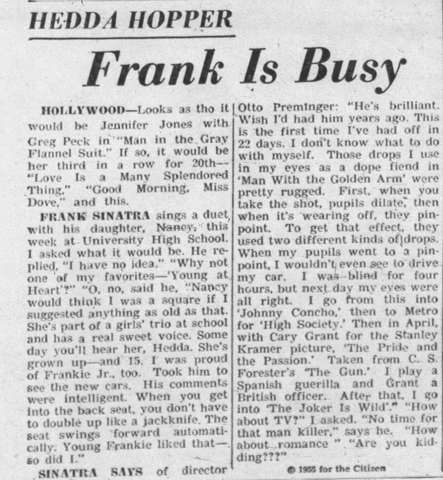
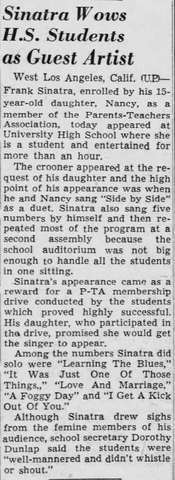
note: Interesting song selection
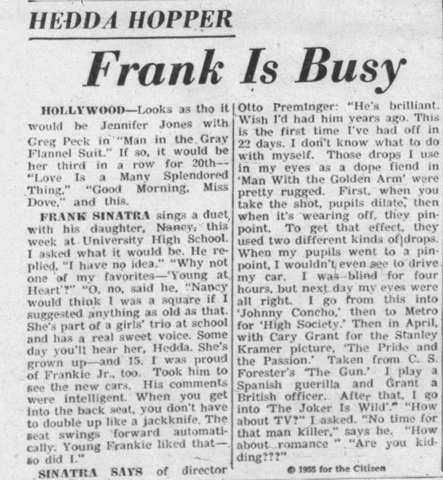
October 31, 1955
Studio
UNITED ARTISTS - Los Angeles
THE MAN WITH THE GOLDEN ARM
Monday evening
8:30 to 11:30 PM
Capitol KHJ Studios
Arranged and conducted by Elmer Bernstein
25 piece orchestra
The Man With The Golden Arm ( trailer song) 3:21 ( Cahn & Van Heusen) Issued on "Frank Sinatra In Hollywood - Disc 5" & "Frank Sinatra The Soundtrack Sessions, Bravura BRCD7106"
Note: Although the recording was done at Capitol Records, it was produced by Carlyle Productions for the film of the same name. Otto Preminger, Kim Novak and others associated with the film were at the session. Meant for the film trailer, the song was not released and the famous Bernstein jazz instrumental ( recorded on 10-28-55 with a 17 piece orchestra. Elmer Bernstein conducted and played piano) was used. Bernstein was paid $96.42 for his work with Sinatra. Robert S. Helfer was the manager. He was paid the royal sum of $72.32 for his three hours of work. The musicians were paid $48.21 each. The violinist, David Frisina, was the concertmaster at the session. Bill Miller was the pianist, Shelly Manne on drums, Ralph Pena on bass, Howard Roberts on guitar and Harry "Sweets" Edison played the trumpet. There is a note on the session sheet pointing out that there were two "William Millers" on the date. They were identified on withholding slips by their respective instruments, violin and piano. The entire pay out for the session was $1, 398.10.
UNITED ARTISTS - Los Angeles
THE MAN WITH THE GOLDEN ARM
!
F.S Otto and Kim behind glass Elmer Bernstein !
!
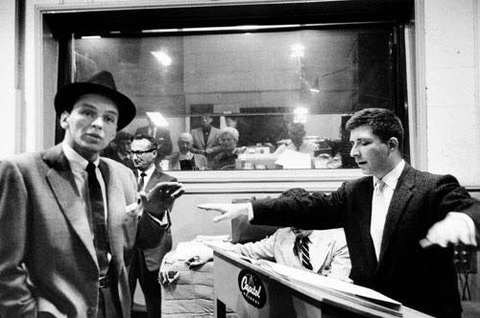
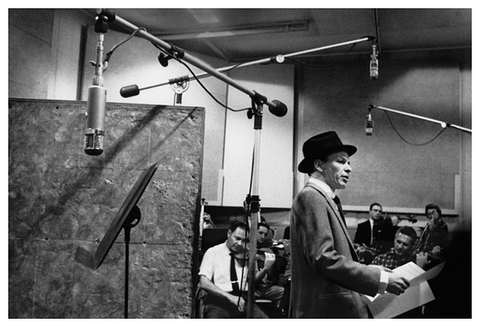
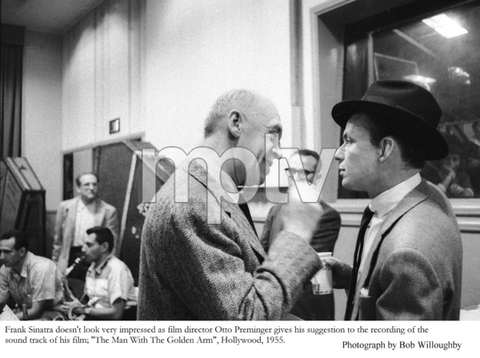
"The Man with the Golden Arm"
The Man with the Golden Arm was, remarkably, Sinatra's fifth major film release in 1955 alone (alongside Young at Heart, Not as a Stranger, Guys and Dolls, and The Tender Trap), plus the aborted Carousel and the Our Town television special -- a workload Santopietro says no other leading man in modern Hollywood has matched in a single year.
Source: Tom Santopietro, "Sinatra in Hollywood" (2008).
"The Man with the Golden Arm"
Santopietro grades this a B, calling it an uneven film with a brilliant Frank performance. Academy Award nomination: Best Actor in a Leading Role; BAFTA Film Award nomination: Best Foreign Actor; New York Film Critics nomination: Best Actor.
Source: Tom Santopietro, "Sinatra in Hollywood" (2008).
"The Man with the Golden Arm"
Santopietro (Filmography): Carlyle/United Artists. Produced and directed by Otto Preminger, screenplay by Walter Newman, Lewis Meltzer and Ben Hecht based on the Nelson Algren novel, musical score by Elmer Bernstein, titles by Saul Bass. Sinatra played heroin addict Frankie Machine opposite Eleanor Parker, Kim Novak and Arnold Stang. No Sinatra songs are credited.
Source: Tom Santopietro, "Sinatra in Hollywood" (2008).
November 1955
[Love and Marriage charts]
Kaplan: 'Love and Marriage,' the standout song from the Our Town sessions, hit number 5 on the Billboard charts in November 1955.
Source: James Kaplan, "Sinatra: The Chairman" (2015)
[Sinatra threatens to quit over Ava casting]
Louella Parsons: By November 1955, according to Louella Parsons, Sinatra told Pride and the Passion director Stanley Kramer he would quit the picture if Kramer kept trying to cast Ava Gardner as the female lead opposite him -- even though it was reportedly Ava, not Frank, holding out against appearing together.
Source: James Kaplan, "Sinatra: The Chairman" (2015)
[The Tender Trap]
Santopietro (Filmography): Metro-Goldwyn-Mayer. Produced by Lawrence Weingarten, directed by Charles Walters, screenplay by Julius J. Epstein based on the Broadway play. Sinatra played Charlie Reader opposite Debbie Reynolds, David Wayne and Celeste Holm, singing the title song by Jimmy Van Heusen and Sammy Cahn.
This film/context matches multiple dated entries in the chronology; the specific date Santopietro is referring to could not be determined with confidence.
Source: Tom Santopietro, "Sinatra in Hollywood" (2008), Filmography
November 3, 1955
Guys and Dolls had its New York premiere at the Capitol Theatre and grossed $250,000 in its first ten days, a theatre record. At an earlier press preview, Montgomery Clift reportedly talked loudly through the opening scenes and walked out before the film ended, unimpressed. (Source: Richard Havers, "Sinatra" (Dorling Kindersley, 2007).)
November 4, 1955
note Another big b.o. hit for Frank. Crowds were three deep around the block
at Radio City Music Hall in N.Y.C.
The Tender Trap, (US Film Release: November 4, 1955)
Starring: Frank Sinatra,Debbie Reynolds, David Wayne, Celeste Holm
Directed by Charles Walters.
Sinatra plays Charlie Reader, a 35-year-old theatrical agent in New York City, living a seemingly idyllic life as a bachelor with numerous women who come and go, cleaning and cooking for him until one day Charlie meets singer-actress Julie Gillis (Debbie Reynolds) and his bachelor life is put to the test.
(1st DVD Release date: 2008-05-13)
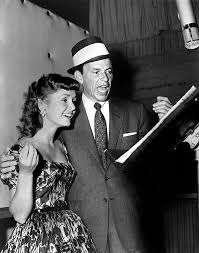
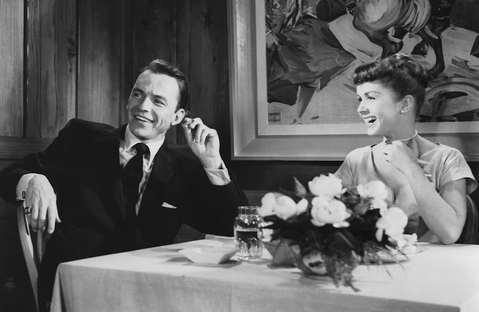
November 12, 1955
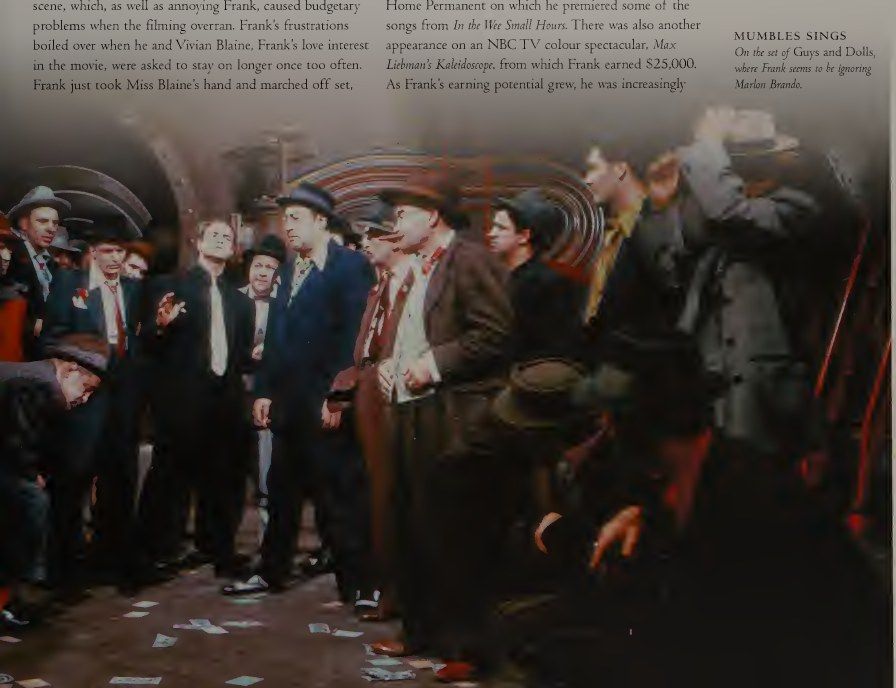
[Photograph: Sinatra debuts on Billboard's first Top 100. From Richard Havers, "Sinatra" (Dorling Kindersley, 2007), p.205.]
[Vanderbilt arrives in Los Angeles]
Gloria Vanderbilt: Gloria Vanderbilt arrived in Los Angeles on November 12, 1955, with her two young sons and their nanny, to begin work on Johnny Concho. Sinatra failed to meet her at the airport and was 'very cool' on the phone, though he sent flowers to her room at the Beverly Hills Hotel.
Source: James Kaplan, "Sinatra: The Chairman" (2015).
When Billboard launched its new consolidated Top 100 chart, Sinatra sat at No. 16 with 'Love and Marriage,' having entered the prior bestseller list at No. 23 the week before. The chart's first-ever No. 1 was 'Love Is a Many Splendoured Thing' by the Four Aces. (Source: Richard Havers, "Sinatra" (Dorling Kindersley, 2007).)
November 14, 1955
[Guys and Dolls premiere with Deborah Kerr]
On the night of November 14, 1955, while Gloria Vanderbilt was in town for Johnny Concho, Sinatra attended the Hollywood premiere of Guys and Dolls with actress Deborah Kerr as his date.
Source: James Kaplan, "Sinatra: The Chairman" (2015).
[The Cinematic Legacy of Frank Sinatra — Guys and Dolls (1955)]
David Wills's 2015 photo history The Cinematic Legacy of Frank Sinatra devotes a section to Guys and Dolls (1955), illustrated with 10 behind-the-scenes and publicity photographs (posters, lobby cards, and on-set/on-location shots) filed here.
“He got very quiet and seemed to be very, very far away and all of a sudden he sat back, and Brando, the great actor, said—you could barely hear him—“Boy, to be able to sing like that.” —Henry Silva (Actor)
“… the Detroit role is a breeze for Sinatra, and he plays it as casually as if he were eating a banana split.” —Louella Parsons (Columnist)
Source: David Wills, The Cinematic Legacy of Frank Sinatra (St. Martin's Press, 2015), pp. 107–116.
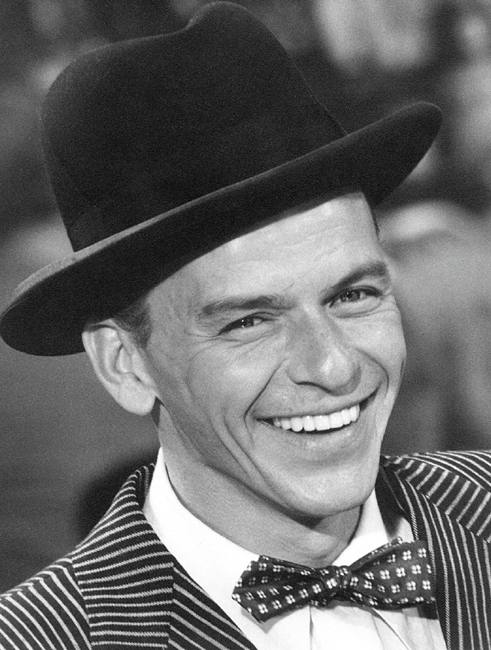
As Nathan Detroit, Guys and Dolls, 1955. (Photo: The Cinematic Legacy of Frank Sinatra, David Wills, 2015.)
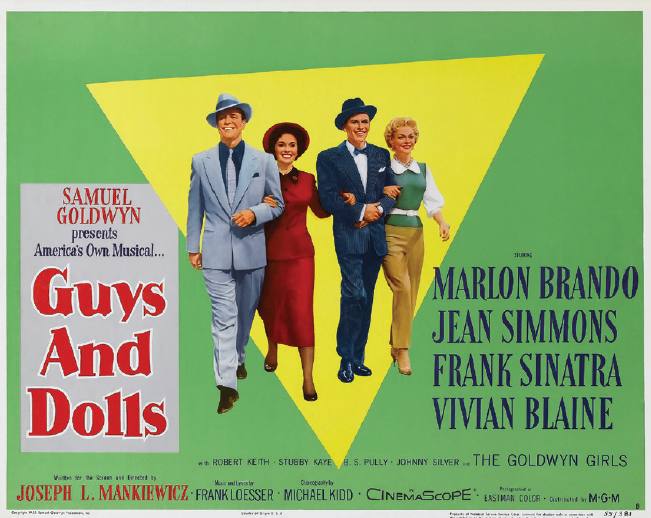
Half sheet poster, Guys and Dolls. / “Never knocking himself out for a laugh, he / plays the gambler as an earnest, worried man, / with a peculiar idiom that comes naturally to / him. He takes great pride in trivialities and his / mind is forever seeking angles. He is always a / man and never a buff (Photo: The Cinematic Legacy of Frank Sinatra, David Wills, 2015.)
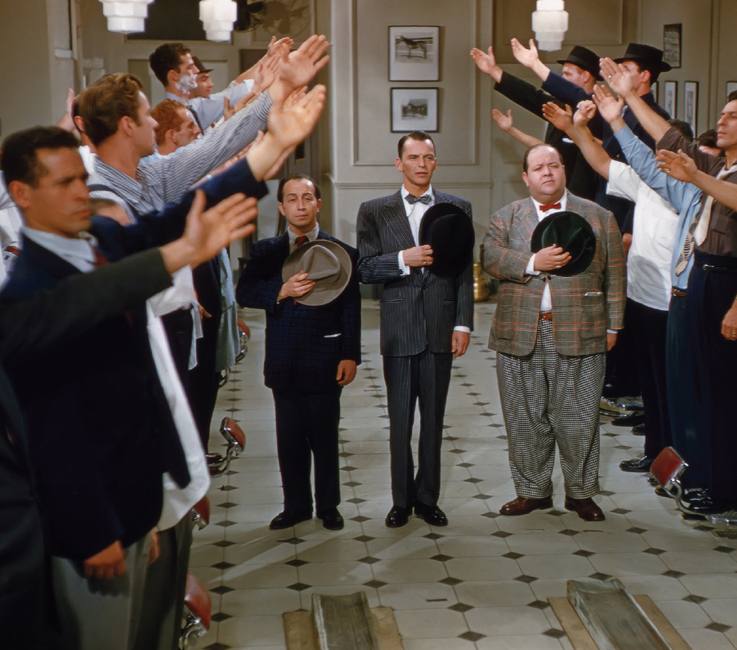
(The Hollywood Reporter, review, Guys and Dolls, 1955) / “… the Detroit role is a breeze for / Sinatra, and he plays it as casually as / if he were eating a banana split.” / With costars Johnny Silver and Stubby Kaye, Guys and Dolls. (Photo: The Cinematic Legacy of Frank Sinatra, David Wills, 2015.)
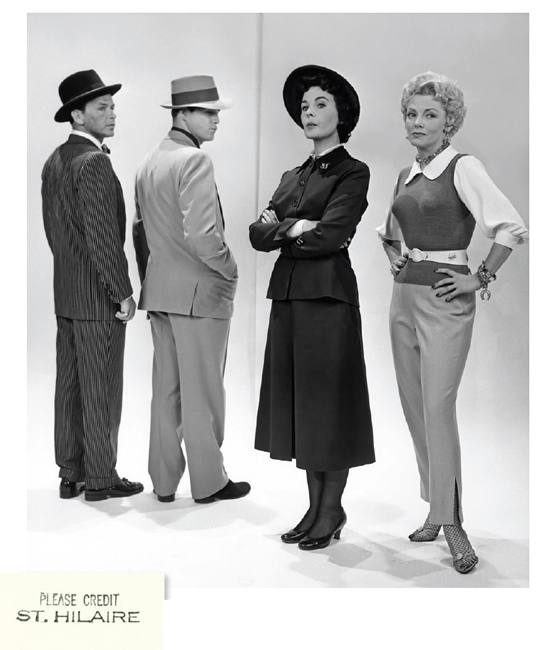
With costars Marlon Brando, Jean Simmons, and Vivian Blaine, Guys and Dolls. (Photo: The Cinematic Legacy of Frank Sinatra, David Wills, 2015.)
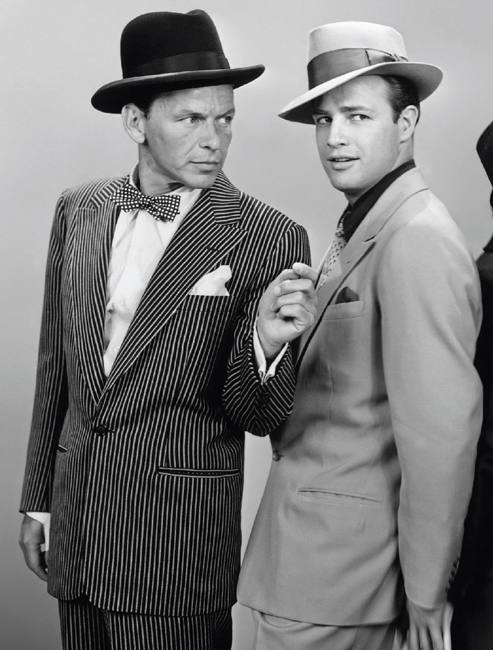
With costar Marlon Brando. (Photo: The Cinematic Legacy of Frank Sinatra, David Wills, 2015.)
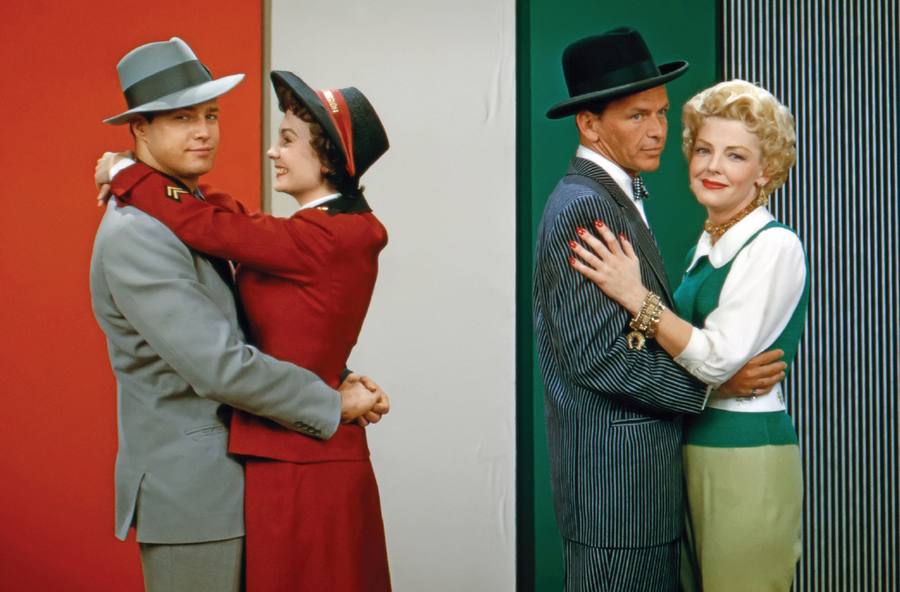
With costars Marlon Brando, Jean Simmons, and Vivian Blaine. Photos by St. Hilaire. (Photo: The Cinematic Legacy of Frank Sinatra, David Wills, 2015.)
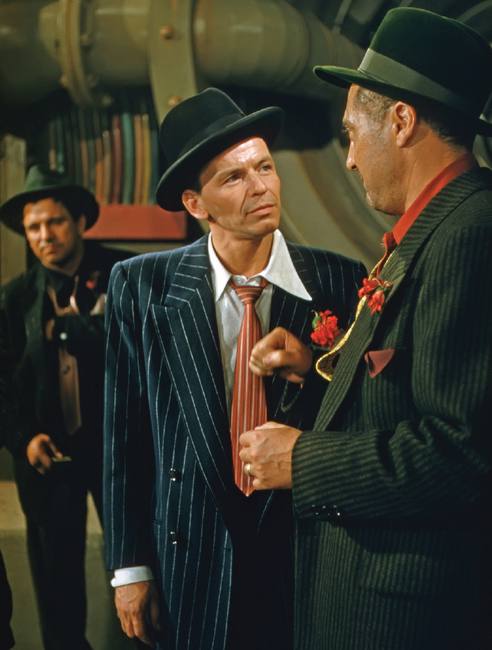
With costar Sheldon Leonard, Guys and Dolls, 1955. (Photo: The Cinematic Legacy of Frank Sinatra, David Wills, 2015.)
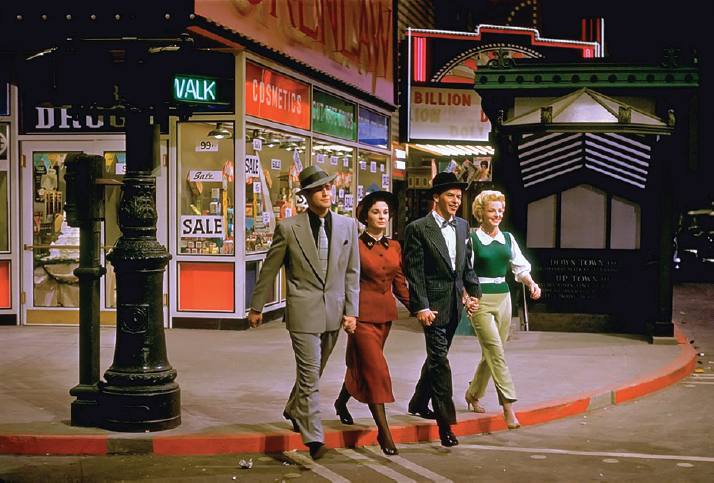
With costars Marlon Brando, Jean Simmons, and Vivian Blaine. / “He got very quiet and seemed to be / very, very far away and all of a / sudden he sat back, and Brando, the / great actor, said—you could barely / hear him—“Boy, to be able to sing / like that.” (Photo: The Cinematic Legacy of Frank Sinatra, David Wills, 2015.)
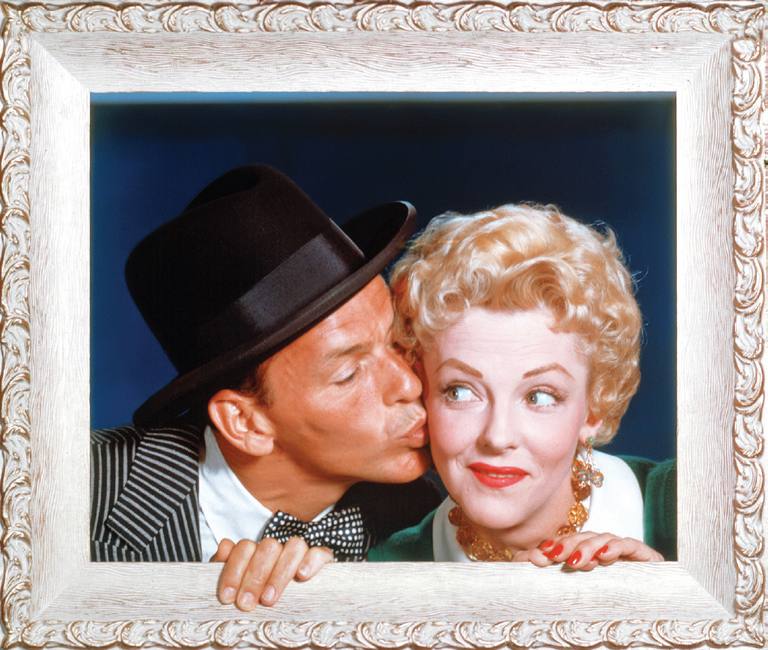
With costar Vivian Blaine, Guys and Dolls, 1955. (Photo: The Cinematic Legacy of Frank Sinatra, David Wills, 2015.)
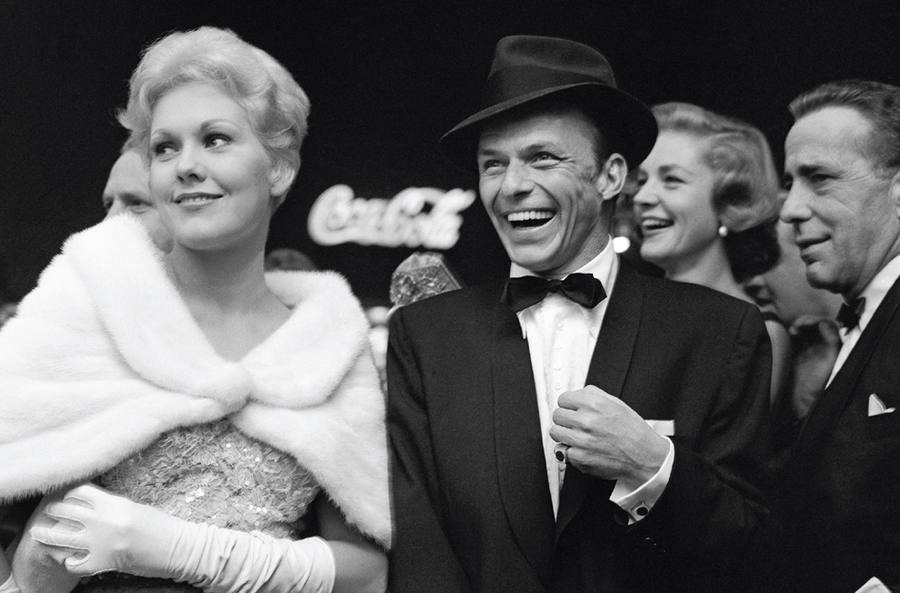
With Kim Novak, Lauren Bacall and Humphrey Bogart, at the premier of The Desperate / Hours, Los Angeles, October 10, 1955. (Photo: The Cinematic Legacy of Frank Sinatra, David Wills, 2015.)
November 17, 1955
[Vanderbilt returns to New York]
Gloria Vanderbilt: Unhappy with director Don McGuire's condescending treatment of her on the Johnny Concho set, Gloria Vanderbilt left Los Angeles and returned to New York on November 17, 1955, just five days after arriving; she and Sinatra would not see each other again for ten years.
Source: James Kaplan, "Sinatra: The Chairman" (2015).
Frank starred opposite Debbie Reynolds in The Tender Trap; Nancy felt they made such a good comic pair it was a shame they never worked together again.
Source: Nancy Sinatra, Frank Sinatra: An American Legend, 1995.
November 19, 1955
Frank guested on the Milton Berle television show.
Source: Nancy Sinatra, Frank Sinatra: An American Legend, 1995.
November 22, 1955
Television
KTLA Coverage of the Charity premier of "Guys And Dolls"
8pm to 8:30PM
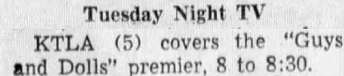
Hollywood Paramount, Los Angeles, CA
Charity premier of "Guys And Dolls"
Singer and actor Frank Sinatra poses with co-star Jean Simmons and
husband Stewart Granger at the premiere of the film 'Guys and Dolls' on November 22, 1955 in Los Angeles, California.
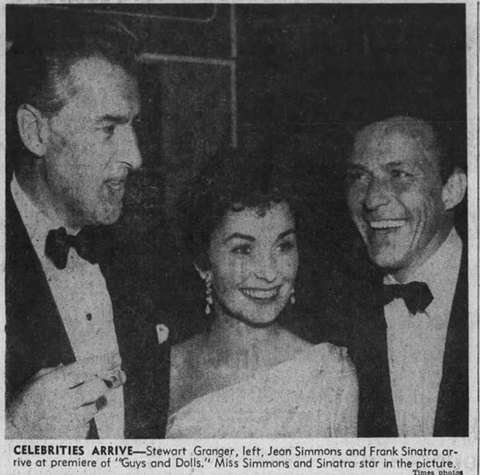
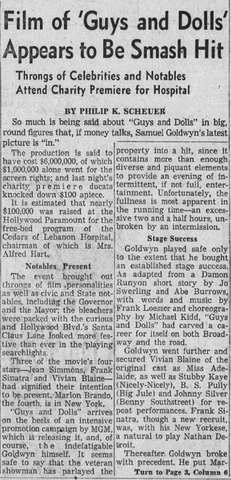
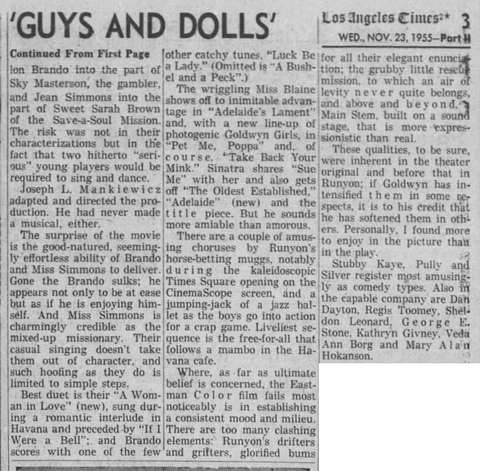
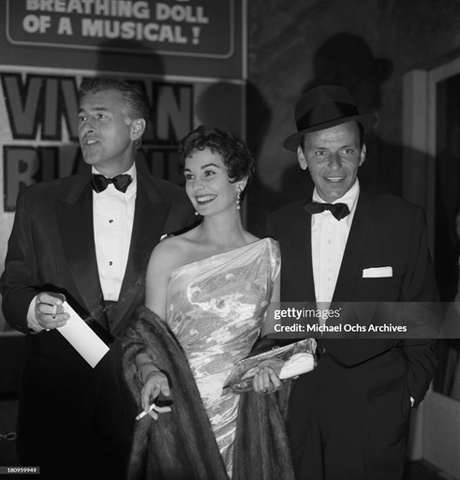
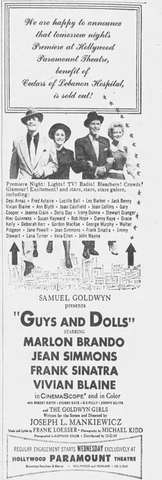
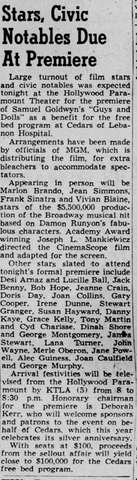
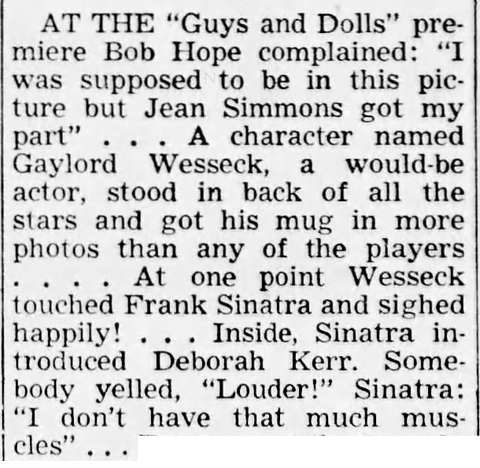
"Guys and Dolls"
Santopietro (Filmography): Goldwyn/Metro-Goldwyn-Mayer. Produced by Samuel Goldwyn, directed by Joseph L. Mankiewicz, screenplay by Mankiewicz and Ben Hecht based on the Abe Burrows/Jo Swerling Broadway musical, score by Frank Loesser. Sinatra played Nathan Detroit opposite Marlon Brando's Sky Masterson, Jean Simmons and Vivian Blaine, singing 'The Oldest Established,' 'Guys and Dolls,' 'Adelaide' and 'Sue Me.'
Source: Tom Santopietro, "Sinatra in Hollywood" (2008).
November 29, 1955
Television
Milton Berle Show
Season: 8, Episode: 294
Host: Jan Murray
Guests: Gale Storm, Vic Damone
Note: Sinatra does not appear on this show.. He is shown in a clip from September 29, 1950.
Comedian Jan Murray fills in for Berle, who fell ill at the last minute.
Ed O'Brien:
The clip is from the 9-29-53 Texaco Star Theatre.
It was a skit with Tallulah Bankhead and Miltie.
Show was Berle's first broadcast for the 1953-54 season. I have an interesting review. Sinatra was sensational. He had closed at the Bill Miller Riviera on 9/22.
December 1955
[Chevrolet convertible for Nancy's Christmas]
Kaplan: For Christmas 1955, Sinatra gave his 15-year-old daughter Nancy a gift-wrapped Chevrolet convertible, on one of his rare stops at his ex-wife's Holmby Hills house on Carolwood Drive that year.
Source: James Kaplan, "Sinatra: The Chairman" (2015)
[Critics praise Sinatra's Golden Arm performance]
Arthur Knight: Despite mixed reception for the film, acclaim for Sinatra's acting was nearly universal: the Los Angeles Times ran the headline 'Sinatra's Acting Redeems Sordid Film on Drug Habit,' and Saturday Review critic Arthur Knight called it a 'truly virtuoso performance,' praising Sinatra's instinct for conveying tenderness, uncertainty, and despair.
Source: James Kaplan, "Sinatra: The Chairman" (2015)
[Sinatra dodges Ava question]
Frank Sinatra: Asked by Bob Thomas whether he'd see Ava Gardner while filming in Spain, given rumors of a reconciliation, Sinatra deflected, saying only 'I don't know about that situation.'
Source: James Kaplan, "Sinatra: The Chairman" (2015)
December 4, 1955
Television
Dave Garroway's Wide Wide World Show
Network: NBC
Guest: Frank Sinatra
1. The Tender Trap
2. Love And Marriage
Note: Frank was at poolside at The Sands in Vegas with Bill Miller on piano. SA is searching for this program.
Ed' O'Brien added this info: NBC broadcast "Wide, Wide World" on Sunday afternoons from 4 to 5:30 in color. The correct date is 12-4-55. Last year I contacted the Library Of Congress and asked a librarian to look at the show for me. Here is her description of the Sinatra segment: Frank Sinatra appeared "live" while rehearsing with an orchestra next to the outdoor pool of the Sands Hotel in Las Vegas. He is first heard in a fragment from "Same Old Saturday Night" as the camera approaches the setting. Next, he answers a few questions from host Dave Garroway (who is in the studio) about an international goodwill tour planned for Spring of the following year, then sings "The Tender Trap" in its entirety. As he starts "Love and Marriage," the camera moves away and this concludes the segment. As to the musicians, the only clue is the NBC press release of 11/25/1955 which states that "Sinatra will do his singing to the accompaniment of Antonio Morelli and the Sands Orchestra." note: Nat Cole was also set to appear and sing some numbers. But was a no-show.
Las Vegas, Nevada Nov 29) Six live cameras will project a rain of entertainment produced by Jack Entratter and starring singers Frank Sinatra and Nat King Cole right from the grounds of the Sands Hotel here to 35,000,000 viewer* on 144 stations of the NBC-TV network as a featured segment of the 90-minute spectacular program "Wide, Wide World" this Sunday, December 4, between 1 and 2:30 P. M, Las vegas time. The program will feature American music, and the live pickup from the Sands will Include various types of the American Rhapsody as portrayed by Frank Sinatra, Nat King Cole, Freddy Bell and the Bellboys, aad Antonio Morelli and the Sands orchestra. The 6 cameras with a crew of 20 will pick up the Sands entertainment scene from the Lounge bandstand, from the Copa Room stage, and from poolside where Frank Sinatra will be shown rehearsing for his overseas goodwill tour scheduled for next spring* Also featured on the program will be the Copa Girls with a full dress rehearsal of a new production staged by Bob Gilbert and Ren** Stewart, with music by Torrls Bread's orchestra. The public is invited to attend the show and be televised in the Lounge. Casino, Copa Room and pool side at the Sands on Sunday.
note: Nat Cole canceled and Frank did not do the overseas tour.
Ed
Dave Garroway's Wide Wide World Show
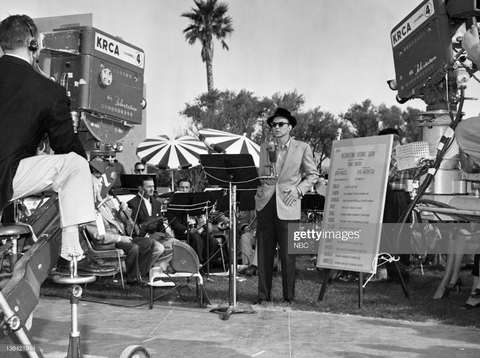
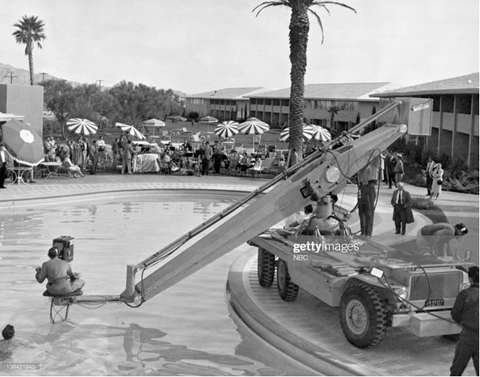
December 12, 1955
Frank Sinatra turned forty. It capped a banner year that had included the Capitol concept album In the Wee Small Hours — dubbed the “Ava Songs” by some critics for its collection of love-gone-wrong ballads — and the release of The Man with the Golden Arm, in which his one-take, unrehearsed heroin-withdrawal scene would earn him a Best Actor Oscar nomination. “I've been there and back,” he said of the emotional well he drew on for his music at this point in his life. Source: J. Randy Taraborrelli, Sinatra: Behind the Legend.
[Sinatra's 40th birthday on Johnny Concho set]
Jim Mahoney: Sinatra marked his 40th birthday on December 12, 1955, on the set of Johnny Concho, cutting a cake as director Don McGuire and Phyllis Kirk looked on and cast and crew sang. Columnist Jim Mahoney (later Frank's own publicist) reported Frank admitted he was starting to want to forget birthdays, and was scouting Beverly Hills property to build a home.
Source: James Kaplan, "Sinatra: The Chairman" (2015).
[Sinatra's upcoming film slate]
Frank Sinatra: Around his 40th birthday, Sinatra outlined upcoming projects: High Society, shooting in January 1956 in Newport, Rhode Island with Bing Crosby and Grace Kelly; The Pride and the Passion, starting in Spain in April 1956 with Cary Grant; and a planned Joe E. Lewis biopic for the fall.
Source: James Kaplan, "Sinatra: The Chairman" (2015).
[Sinatra's international goodwill tour idea]
Frank Sinatra: In a birthday-season interview with AP's Bob Thomas, Sinatra described his pet project: an international goodwill tour with stars like Gary Cooper and Marilyn Monroe, performing benefit shows in world capitals for children -- including, if it could be arranged, Moscow.
Source: James Kaplan, "Sinatra: The Chairman" (2015).
December 15, 1955
The Man With The Golden Arm (US Film Release: December 15, 1955)
Starring: Frank Sinatra, Eleanor Parker, Kim Novak, Arnold Stang, and Darren McGavin
(Directed & Produced by Otto Preminger)
Sinatra gives a powerful performance as "Frankie Machine", a skilled card dealer and one-time heroin addict. When he returns home from jail, he struggles to find a new livelihood and to avoid slipping back into addiction. Frankie returns home to his wife Zosh (Eleanor Parker), who is supposedly wheelchair-bound after a car crash some years earlier that was caused by Frankie driving drunk. Zosh is secretly fully recovered, but pretends to be unable to walk in order to keep making Frankie feel guilty so he will stay with her. Frankie thinks he has what it takes to play drums for a big band. While calling to make an appointment, he bumps into an old flame, Molly (Kim Novak) who works in a local strip joint as a hostess and lives in the apartment below Frankie's. Unlike Zosh, Molly encourages his dream of becoming a drummer.
Release Date:January 1956Premiere Information:New York opening: 15 Dec 1955; Los Angeles opening: 26 Dec 1955; Chicago, IL opening: 28 Dec 1955
Production Date:26 Sep--early Nov 1955 at RKO-Pathe Studios
The film's opening title credits, designed by Saul Bass, feature white lines breaking up a black background. The lines form a crooked arm over the last credit, that of producer-director Otto Preminger. The crooked arm became the film's symbol and was used extensively in its advertising. According to a 3 Nov 1949 HR news item, the screen rights to Nelson Algren's best-selling novel, which was the first book to win the National Book Award, were purchased by producer Bob Roberts as a starring vehicle for John Garfield. Information in the film's file in the MPAA/PCA Collection at the AMPAS Library reveals that Paul Trivers was to write the screenplay for Roberts, with Robert Aldrich scheduled to direct. Roberts first submitted a screenplay to the PCA in Feb 1950, and in Mar 1950, was told by PCA director Joseph I. Breen that the basic story was "unacceptable under the provisions of the Production Code" because of the Code's prohibition against showing drug addiction and illegal drug traffic. Breen further stated: "In view of the fact that this dope addiction problem is basic to this story, we suggest you dismiss any further consideration of this material for a motion picture to be made within the Code." Roberts continued to consult with the PCA in hopes of preparing an acceptable script, but was repeatedly discouraged by the Breen office, which warned him that not only would the subject fail to receive PCA approval, it would also receive condemnation from the National Catholic Legion of Decency, the U.S. Treasury Dept., the Bureau of Narcotics and "state and municipal censor boards, both in this country and abroad." In late Mar 1950, Pandro S. Berman, then a producer at M-G-M, expressed interest in making a film based on the novel, and was also told by the PCA that it would be impossible for the picture to receive a Production Code seal, without which many movie theaters of the time refused to exhibit films. According to modern sources, Roberts was acting on Garfield's behalf in purchasing the book's screen rights from Algren, who purportedly thought that Garfield would be ideal to play "Frankie Machine," and Garfield himself owned the rights. Garfield, who had been under great strain due to questioning by the House Un-American Activities Committee, died of a heart attack on 21 May 1952. Although Trivers and Algren himself worked on a screenplay for Garfield's project, it is unlikely that they contributed to the Preminger film. In Mar 1955, NYT and HR reported that Preminger had purchased the rights to Algren's book from Garfield's estate and entered into a deal with United Artists to produce and distribute The Man with the Golden Arm. According to a Sep 1955 HR news item, a clause in the contract between Preminger and UA allowed UA to withdraw from distribution if the film did not receive a Code seal. At that time, Preminger, who had produced and directed The Moon Is Blue (see entry), which failed to obtain a Code seal prior to its 1953 release, indicated that he would set up his own company to distribute The Man with the Golden Arm if necessary. A 24 Mar 1955 LAEx news item reported that Preminger was hoping to persuade William Holden to star in the picture, while modern sources add that Marlon Brando was considered for the role of Frankie. According to Jul 1955 HR news items, Barbara Bel-Geddes was under consideration for one of the female leads, but her participation in the project was contingent upon her being able to obtain a four-week leave from her role in the stage production of Cat on a Hot Tin Roof. In Aug 1955, HR's "Rambling Reporter" column stated that Preminger was "torn" between casting either Ray Middleton or Raymond Burr as "Zero Schwiefka." Eleanor Parker was borrowed from M-G-M for the production, and Kim Novak was borrowed from Columbia. HR news items include Arvle Miller, Jay Lawrence, Robert Paquin, Diane DeLayne, Ursula Fimbers, Libby Jones, Bene Marten, Jack Mulhall, Mahin Shahriver and David White, Frank Sinatra's stand-in, in the cast, although their appearance in the finished picture has not been confirmed. In Aug 1955, HR noted that Preminger had contemplated shooting the picture in color and CinemaScope, but decided that black-and-white with a 1.85:1 ratio would be "more suitable." According to a 29 Aug 1955 HR news item, background footage was shot on location in Chicago, IL. A 4 Oct 1955 HR news item noted that the dog "Rumdum" was played by "Mike," a dog rescued from a pound by noted animal trainers Frank and Rudd Weatherwax. HR news items and the film's pressbook noted that drummer Shelly Manne taught Sinatra how to play drums; magician Charles E. Miller served as the technical advisor on the poker sequences; Tom Bailey, a retired Los Angeles police officer, was the technical advisor on the jail scenes; Jack Entratter, a director of the Sands casino in Las Vegas, acted as a technical advisor; and an unnamed physician supervised narcotics sequences. Although the drug to which Frankie is addicted is never specified in the finished movie, most contemporary and modern sources assume that it is heroin. In the book, however, Frankie takes morphine, to which he became addicted during his military service in World War II. After being wounded while fighting in the South Pacific, Frankie began taking morphine and became addicted. In the film, only a very brief mention is made of Frankie's wartime service, and no connection is made between it and his addiction. Other notable differences between the novel and the movie are that in the book, Frankie, not "Zosh," kills Louie, and Zosh is not feigning her paralysis, although it is partially psychosomatic. At the end of the book, Zosh is committed to an insane asylum, "Molly Novotny" is arrested by the police for harboring Frankie and Frankie, who has run from Molly's apartment, commits suicide by hanging himself in a flophouse. Preminger continued to have problems with the PCA throughout the film's production, and he decided to release The Man with the Golden Arm without a Code seal. According to Nov 1955 trade paper and NYT news items, after viewing a rough cut of the picture, United Artists, which had also released The Moon Is Blue, decided to release The Man with the Golden Arm, even though the action could result in the company being fined $25,000 by the MPAA. UA president Arthur Krim called the film "one of the most important productions ever handled by the company" and expressed the hope that the PCA would reverse its decision because of the film's "immense potential for public service." A modern source states that UA invested $1,000,000 in the film's production. A 13 Nov 1955 NYT article reported that the film's release would mark "the first time that a company has made public its intention to go forward with the release of a controversial picture in advance of its submission for a Code seal." The film also received several advance bookings in Nov and early Dec 1955, before the issue of the Code seal had been settled. Although numerous contemporary sources speculated that the PCA would make an exception for The Man with the Golden Arm, after the film was submitted for final approval in early Dec 1955, the PCA denied it a Code seal. Their decision was upheld by the appeals board of the MPAA on 6 Dec 1955 in a meeting in which the MPAA board also declined to revise PCA guidelines governing the depiction of drug use. In order to protest the censorship battle, UA resigned from the MPAA on 7 Dec 1956, although the company rejoined later in the 1950s. Even though the PCA refused to approve the film, the influential National Catholic Legion of Decency awarded it a "B," or "morally objectionable in part for all," rating. According to a 31 Dec 1955 Har news item, The Man with the Golden Arm marked the first time that the Legion did not give a "C," or condemned, rating to a film not passed by the PCA. Several contemporary sources indicate that the schism between the Legion and PCA was one of the contributing factors to the revision of the Code. Controversy over the MPAA's decision to uphold the PCA's ban on the film forced MPAA president Eric Johnston to launch a four-man committee to investigate Production Code provisions and methods of appeal in Jan 1956. A 25 Jan 1956 NYT article about the investigation noted that one of the major reasons for the need to revise the Production Code was the "refusal, for the first time, of the Loew's theatres and other large circuits to abide by a Production ban." Loew's and other large theater chains were then exhibiting The Man with the Golden Arm despite its lack of a Code seal. In Dec 1956, NYT announced that the committee's recommendation to change several provisions of the Production Code had been accepted, and that "the film industry has revised and relaxed its code of morals and taboos for the first time since the code was adopted in 1930." In addition to revising restrictions about the portrayals of prostitution, abortion, kidnapping and miscegenation, the MPAA eliminated the absolute prohibition of subjects having to do with narcotics. The first film to benefit from the PCA's revisions about the depiction of drug addiction was the 1957 Twentieth Century-Fox release A Hatful of Rain (see entry). The Man with the Golden Arm received mostly laudatory reviews upon its release, with many critics commenting on its success in dealing with the controversial subject matter. The Var reviewer declared: "Fortunately this is a gripping, fascinating film, expertly produced and directed by Preminger and performed with marked conviction by Frank Sinatra as the drug slave." In conclusion, the Var critic stated: "It makes for a powerful condemnation of the use of narcotics merciless in its display of the cruelties of the habit. This is the kind of message that should be spread, not suppressed." Several critics did complain about the film's contrived happy ending, however, stating that it was both inaccurate and potentially harmful to show an addict recovering completely in such a short time period. As noted by NYT reviewer Bosley Crowther, in order to satisfy censor requirements, the sequence in which Frankie receives a "fix" from "Louie" was shortened, to prevent the details of Louie's preparations of the drug from being shown. Crowther concluded, "either way, what you see or what you don't see is not likely to create anythingoutside of the hardened addicttsbut a revulsion toward the habit of drugs." According to a 14 Dec 1955 DV news item, the short sequence was deleted at the insistence of the New York State Censor Board, although Preminger deleted the footage from all prints of the film, not just those shown in New York. In Feb 1956, HR noted that censors in Maryland, Atlanta, GA and Milwaukee, WI threatened either to ban the film outright or demand cuts, but that Preminger was determined to fight them and allow the film to be shown in the same version that was then being distributed. In Jul 1956, Var reported that after several court decisions in its favor, United Artists was able to exhibit the film uncut throughout the world except in Spain, which had banned the picture. According to the news item, Spanish officials declared that they did not want the film to "give the people ideas" about narcotics use. According to information in the MPAA/PCA Collection, the film received an "X" rating in Great Britain, which restricted admission to adults only. Even though Preminger claimed in several contemporary sources that the MPAA was exerting pressure on exhibitors not to play the film, UA stated in a 12 Feb 1961 NYT article that the film had been a "spectacular" success at the box office. The article concluded that the film's achievements were partially due to the "considerable publicity" surrounding its censorship battles. The Man with the Golden Arm received Academy Award nominations for Best Art Direction (Black and White) and Best Music (Scoring of a Dramatic or Comedy Picture) and a BAFTA nomination for Best Film from Any Source. The film's score, which was Elmer Bernstein's first jazz score, became a best-selling soundtrack record and is considered by many sources to be one of the most important film scores of the 1950s. The McGuire Sisters released a vocal version of the distinctive main theme, called "Delilah Jones," with lyrics by Sylvia Fine. A title song, written by Sammy Cahn and James Van Heusen, was recorded by Sammy Davis, Jr., and their "Molly-O" was recorded by The Gaylords and The Naturals. According to a Nov 1955 HR news item, Sinatra himself was to record a version of the title song for Capitol Records. A Sinatra discography notes that Sinatra's version of the song was never officially released, but did appear on a bootleg album entitled "On the Town and Others." Sinatra, who received many positive reviews for his work in the film, was nominated for a Best Actor Academy Award as well as a Best Foreign Actor BAFTA award. The SatRev critic stated that Sinatra gave "a truly virtuoso performance," and HR reviewer Jack Moffit proclaimed that he achieved "a tortured realistic masterpiece as the drug addict." According to several biographies of Sinatra, the actor considered his performance in The Man with the Golden Arm to be his finest work. According to Nov 1955 DV and NYT reports, screenwriter Walter Newman protested the joint credit that he and writer Lewis Meltzer were to receive, claiming that he alone should be credited with the film's screenplay. After the Writers Guild of America (WGA) denied his petition, Newman attempted to take his case to Los Angeles Superior Court, a first in WGA history. Newman's attempt was denied by Judge Arnold Prager, according to the NYT article. In mid-Dec 1955, DV reported that the Screen Writers Branch of the WGA protested the print advertising of The Man with the Golden Arm, stating that the overly prominent emphasis on Preminger in the ads mistakenly led people to believe that he wrote as well as directed and produced the picture. In Apr 1956, Algren filed a lawsuit against Preminger, UA, Carlyle Productions and several other individuals and companies, according to a 24 Apr 1956 HR news item. Algren asked that profits from the picture be held in trust and that the profits from the distribution of the theme song be accounted for and held in trust, in addition to asking for an injuction "restraining Preminger, UA and others from "˜passing off' the plaintiff's work as that of Preminger." According to Algren's lawsuit, the agreement under which he had sold the screen rights to Roberts stipulated that he would receive a percentage of the film's profits or a percentage of Roberts' profits if he sold the rights, but the agreement had not been upheld. Algren also claimed that the title song was "not up to the literary and artistic standards set by the novel," according to a May 1956 SatRev article. The disposition of the suit has not been determined. As reported by various contemporary sources, the film was granted a Production Code seal on 14 Jun 1961. According to a 31 Jul 1961 NYT article, UA applied for the seal in order to re-issue the film, along with The Moon Is Blue, which was also granted a seal, and to sell it for television broadcast. In Jan 1965, Preminger contracted with Allied Artists for The Man with the Golden Arm and The Moon Is Blue to be re-released theatrically as a double bill. [A Jul 1980 NYT article confirmed that the rights to both films had reverted to Preminger in 1965.] In Dec 1966, Preminger leased television broadcast rights to The Man with the Golden Arm to ABC. The network was to be allowed to show the film twice during the following two years, according to a 28 Dec 1966 NYT article, and Preminger had obtained the previously unheard-of concessions that the film was to be shown uncut in any way, and that he himself would be allowed to decide where the seven commercial breaks would be inserted. An 18 Jan 1967 Var item reported that Sinatra would receive a percentage of the fee Preminger received for the broadcast rights. Although a Jul 1986 HR news item announced that Preminger was agreeing to allow Hal Roach Studios to colorize the picture, along with three other of his works, the colorization was never completed. AFI Catalog
Sinatra Preminger Novak
-----------------------------------------
© 1997-2025 The Sinatra Archive
This calendar, or any parts thereof, may not be reproduced in any fashion whatsoever without the prior written permission of the publisher (The Sinatra Archive)
[image referenced in source but could not be recovered]
[image referenced in source but could not be recovered]
[image referenced in source but could not be recovered]
[image referenced in source but could not be recovered]
[The Man with the Golden Arm opens in New York]
The Man with the Golden Arm opened in New York on December 15, 1955, its production schedule having been accelerated by Preminger so it would qualify for the 1955 Academy Awards; it had been denied a Production Code seal over its drug-addiction content.
Source: James Kaplan, "Sinatra: The Chairman" (2015).
[Crowther's tepid Golden Arm review]
Bosley Crowther: Reviewing Golden Arm on its December 15, 1955 opening, the New York Times' Bosley Crowther -- who had raved over Sinatra a month earlier for The Tender Trap -- was unimpressed by the film, calling it unimaginative and Sinatra's performance merely 'plausible.'
Source: James Kaplan, "Sinatra: The Chairman" (2015).
[Rat Pack's first meeting reported]
Joe Hyams: Columnist Joe Hyams reported in the December 15, 1955 New York Herald Tribune that the 'Holmby Hills Rat Pack' had held its first annual meeting at Romanoff's restaurant, electing Sinatra 'pack master,' Judy Garland first vice-president, Lauren Bacall 'den mother,' Humphrey Bogart 'rat-in-charge-of-public-relations,' and Irving Lazar recording secretary and treasurer.
Source: James Kaplan, "Sinatra: The Chairman" (2015).
[The Cinematic Legacy of Frank Sinatra — The Man With the Golden Arm (1955)]
David Wills's 2015 photo history The Cinematic Legacy of Frank Sinatra devotes a section to The Man With the Golden Arm (1955), illustrated with 16 behind-the-scenes and publicity photographs (posters, lobby cards, and on-set/on-location shots) filed here.
“When I read the script, I thought this is a great piece of work and it's going to be tough to do. I got permission to watch a kid who was in the dryout position in a padded cell. The little guy must have weighed about ninety pounds, they were drying him out and he was trying to knock the walls down. I watched through a peephole, even though it was against the law. The poor kid was out of his head. I couldn't handle it, I walked away, I couldn't control myself. To see the actual thing was scary, but it helped me when we started shooting. I knew what I wanted to do.” —Frank Sinatra
“I would tease [Preminger] tremendously and he really loved it because nobody wanted to get involved with him because they were afraid he would chew you up. I had a lot of fun with Otto about his wonderful Vienna or Berlin accent.… I would ape him and he would say, 'Vy, vy you talk, I don't talk that vay, vy are you speaking that vay vith me.'” —Frank Sinatra
Source: David Wills, The Cinematic Legacy of Frank Sinatra (St. Martin's Press, 2015), pp. 126–142.
The Man With the Golden Arm, 1955. / “A truly virtuoso performance. / [Sinatra] has an incredible instinct / for the look, the gesture, the shading (Photo: The Cinematic Legacy of Frank Sinatra, David Wills, 2015.)
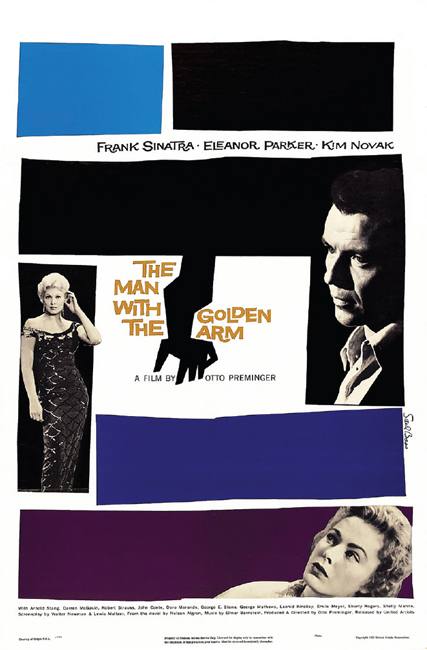
of the voice that suggests tenderness, / uncertainty, weakness, fatigue, / despair.” / Golden Arm, 1955) (Photo: The Cinematic Legacy of Frank Sinatra, David Wills, 2015.)
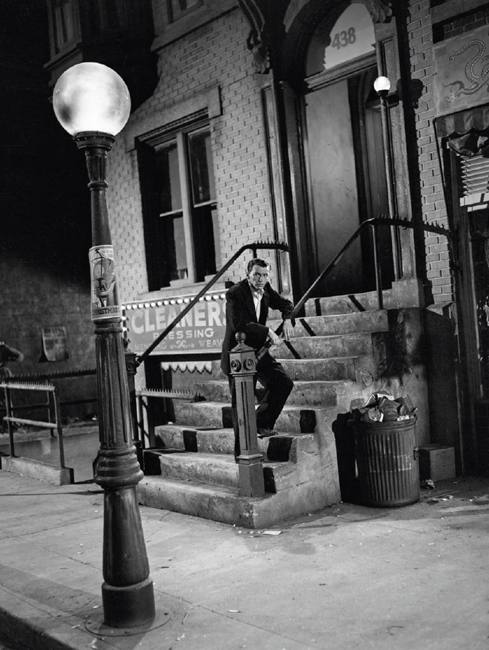
One sheet poster. / As Frankie Machine, The Man With the Golden Arm, 1955. (Photo: The Cinematic Legacy of Frank Sinatra, David Wills, 2015.)
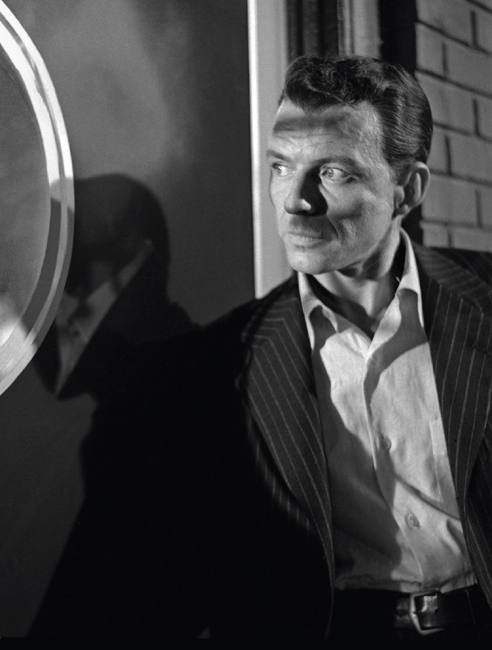
As Frankie Machine, The Man With the Golden Arm, 1955. (Photo: The Cinematic Legacy of Frank Sinatra, David Wills, 2015.)
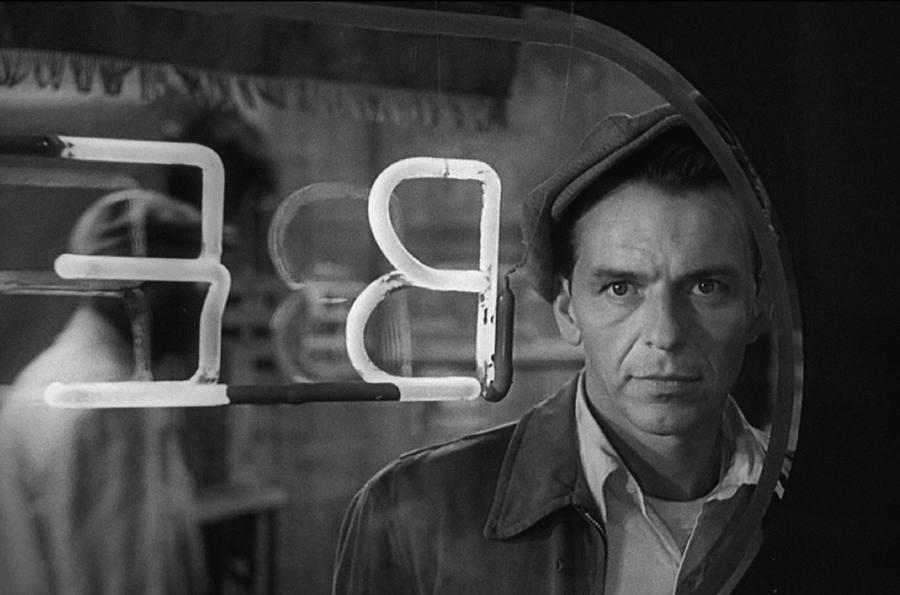
As Frankie Machine, The Man With the Golden Arm, 1955. / “I was afraid that nobody out there / could play it and that Preminger / would crap it up. But Sinatra was / Frankie Machine, just the way I / wrote him in the book.” (Photo: The Cinematic Legacy of Frank Sinatra, David Wills, 2015.)
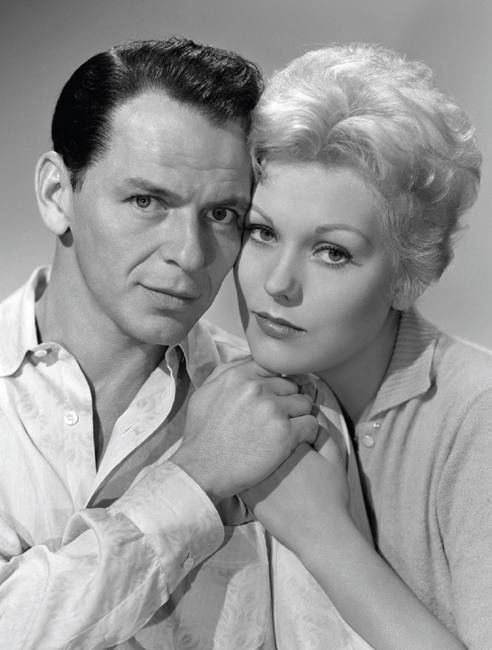
With costar Kim Novak, The Man With the Golden Arm. (Photo: The Cinematic Legacy of Frank Sinatra, David Wills, 2015.)
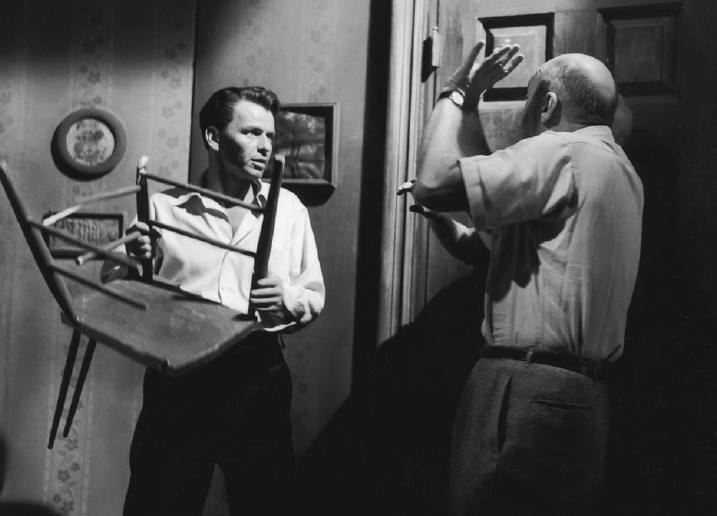
With director Otto Preminger. / “My feeling toward Frank is one of admiration. / He has seen so much that it is very interesting / to be with him—and with his friends. They're / bright, alert and sharp—just as he is. The only / way I could work with him on Man With the / Golden Arm … was to know him (Photo: The Cinematic Legacy of Frank Sinatra, David Wills, 2015.)
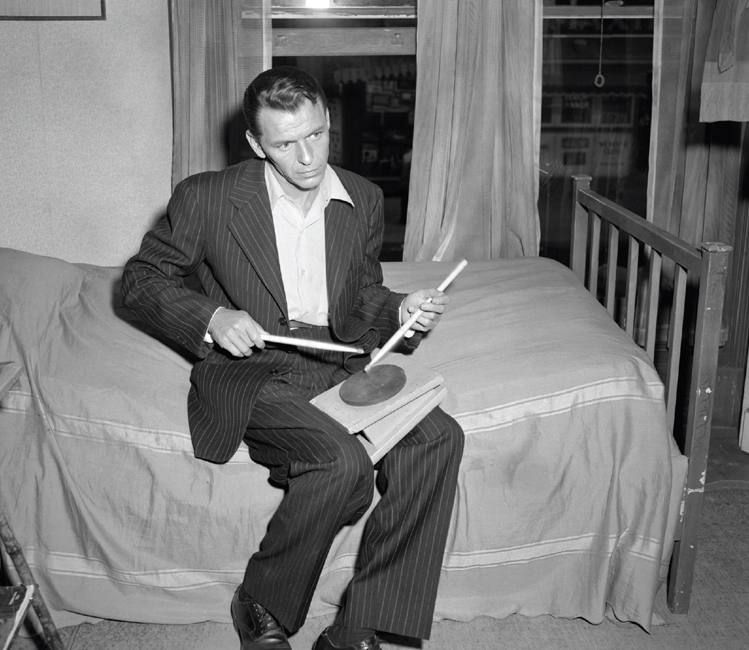
The Man With the Golden Arm. (Photo: The Cinematic Legacy of Frank Sinatra, David Wills, 2015.)
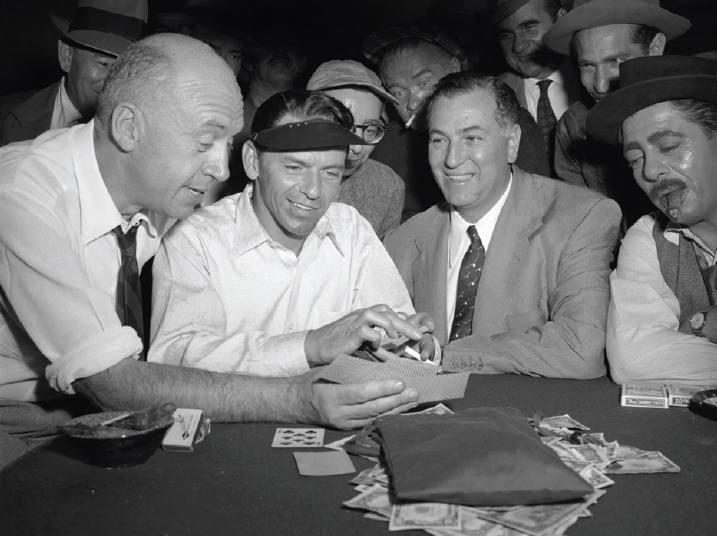
With director Otto Preminger, Sands casino owner and technical advisor Jack Entratter, / and Robert Strauss, The Man With the Golden Arm. / “I would tease [Preminger] tremendously and / he really loved it because nobody wanted to get / involved with him because they were afraid he / would chew you u (Photo: The Cinematic Legacy of Frank Sinatra, David Wills, 2015.)
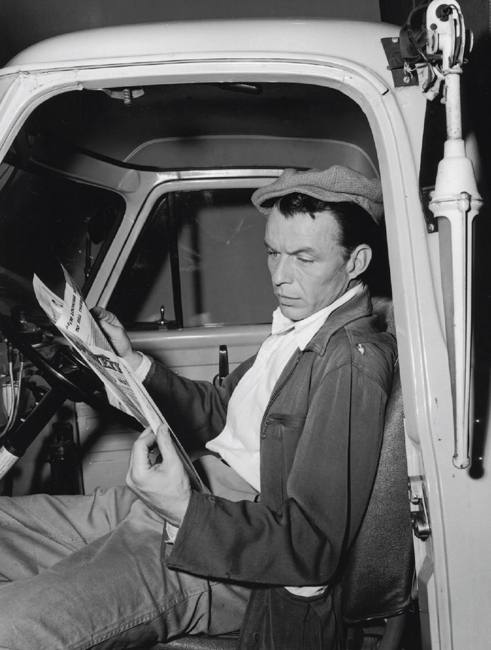
Between takes, The Man With the Golden Arm. (Photo: The Cinematic Legacy of Frank Sinatra, David Wills, 2015.)
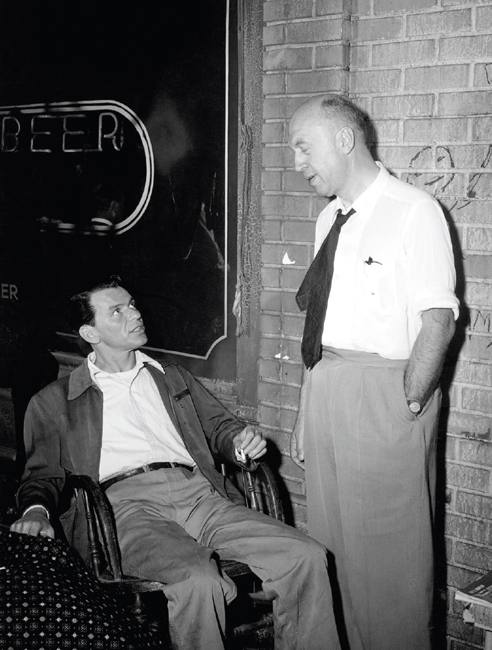
On set with director Otto Preminger, The Man With the Golden Arm. / “He was very compassionate / about Kim's nervousness. He (Photo: The Cinematic Legacy of Frank Sinatra, David Wills, 2015.)
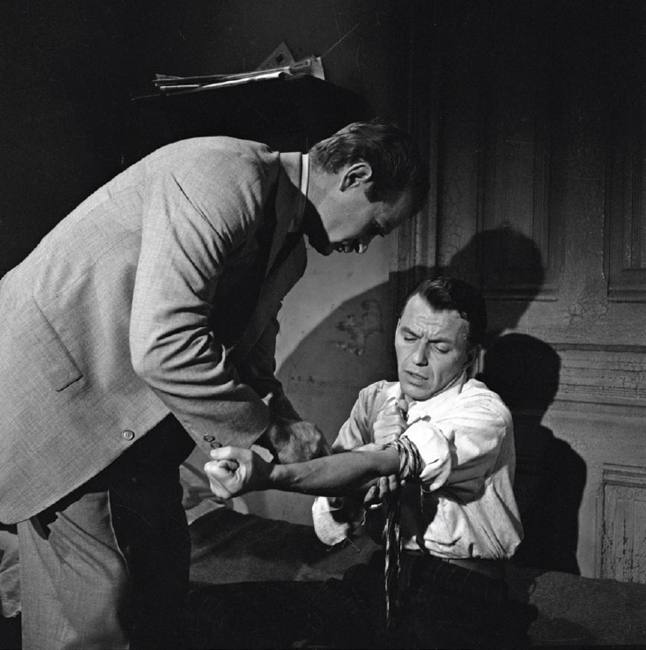
With costar Darren McGavin (Photo: The Cinematic Legacy of Frank Sinatra, David Wills, 2015.)
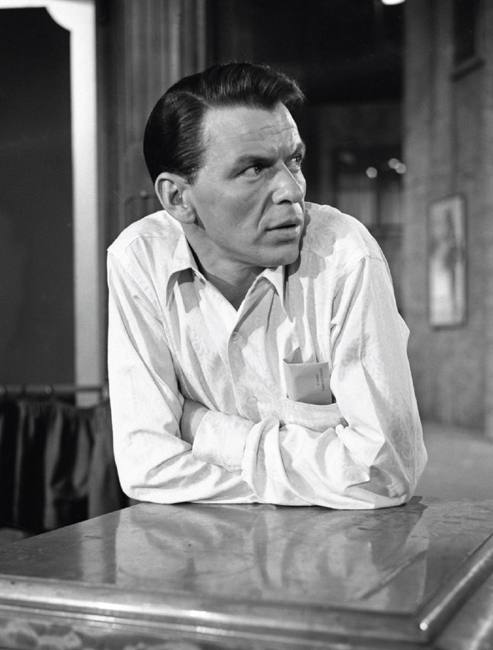
The Man With the Golden Arm. (Photo: The Cinematic Legacy of Frank Sinatra, David Wills, 2015.)
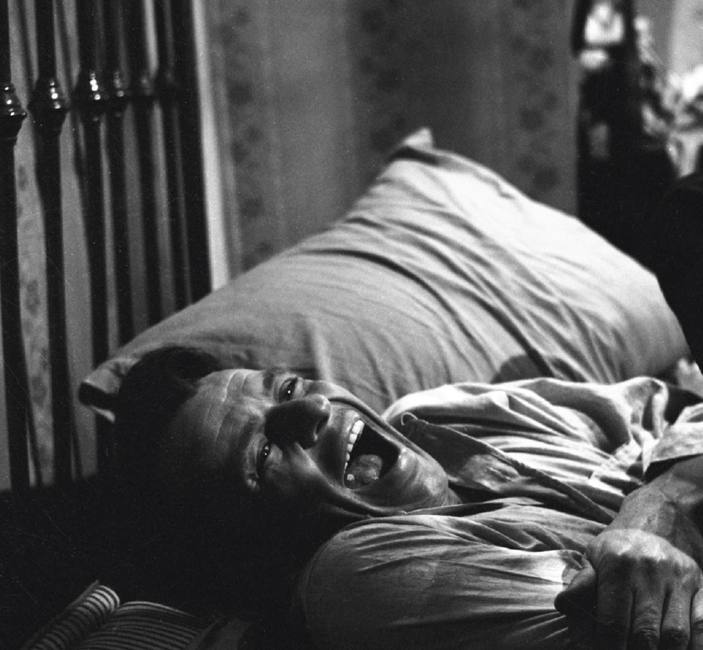
The Man With the Golden Arm. (Photo: The Cinematic Legacy of Frank Sinatra, David Wills, 2015.)
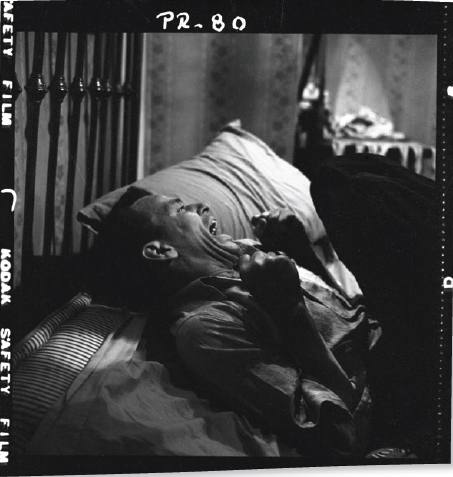
The Man With the Golden Arm. / “When I read the script, I thought this is a great piece of / work and it's going to be tough to do. I got permission to / watch a kid who was in the dryout position in a padded cell. / The little guy must have weighed about ninety pounds, they / were drying him out an (Photo: The Cinematic Legacy of Frank Sinatra, David Wills, 2015.)
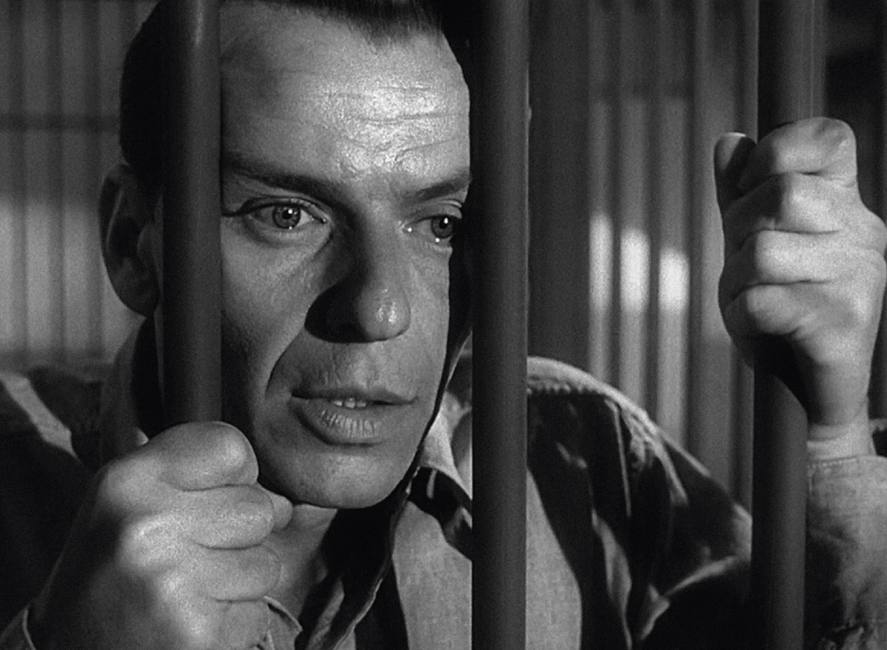
The Man With the Golden Arm. (Photo: The Cinematic Legacy of Frank Sinatra, David Wills, 2015.)
December 23, 1955
Radio
"What Christmas Means To Me"
12-23-55
NBC
8:00 P.M - 10:00 P.M
Writer: Jack C. Wilson
Producer/Director: Robert Wogan
Guests: Helen Hayes, Tallulah
Bankhead, Tyrone Power, Ben
Grauer, Fibber McGee & Molly,
Roy Rogers & Dale Evans, Irving
R. Levine, Alan Young, Gregory
Peck, Ronald Colman, Dylan Thomas,
Edwin C. Hill, Norman Vincent Peale,
Frank Sinatra note: Show's highlights included a recording of Thomas reading "A Child's Christmas In Wales," Bankhead reading a story written by Heywood Broun in 1929, Colman reading from The New Testament and Frank Sinatra's reading of Rodgers & Hammerstein's "HappyChristmas, Little Friend."
--Ed
1956
[A Golfer Drives A Cart Into Sinatra's Pool]
Nancy Sinatra: One of Sinatra's Palm Springs homes sat so close to a golf course that players could see into his living room, and on one occasion a golfer actually drove a golf cart straight into his swimming pool.
Source: Nancy Sinatra, Frank Sinatra: An American Legend, 1995.
[Bennett Meets Sinatra Backstage]
Tony Bennett recalls first meeting Sinatra backstage at the Paramount Theatre in New York in 1956, seeking advice after NBC cut the budget for his new summer replacement show. Sinatra reassured him that audiences would only support him more if they saw him nervous.
Source: Charles Pignone, "Frank Sinatra 100" (2015).
[Bobby Kennedy Vows to Start Working on 1960 the Moment 1956 Ends]
Sinatra recalled sitting with the Kennedy circle at the 1956 Democratic Convention and hearing Bobby Kennedy declare, the instant that year's ticket was set, that it was time to start working toward the 1960 race. Frank was struck by the relentless, years-ahead political focus.
Source: Nancy Sinatra, "Frank Sinatra, My Father" (1985).
[Campaigning for Adlai Stevenson]
Sinatra campaigned for Democratic presidential candidate Adlai Stevenson both in 1952 and again in 1956, a period Nancy remembers as full of parties and pretty girls.
Source: Nancy Sinatra, "Frank Sinatra, My Father" (1985).
[Filming The Joker Is Wild]
Sinatra filmed The Joker Is Wild in 1956, playing comedian Joe E. Lewis, and the two men formed a close real-life friendship, later performing comic bits together onstage at the Sands.
Source: Nancy Sinatra, "Frank Sinatra, My Father" (1985).
[Lunch With Grace Kelly on the High Society Set]
In 1956, while filming High Society, Sinatra took Nancy to lunch and introduced her to a young, pale, pretty costar he called "Gracie" -- Grace Kelly, whom he continued to call that even after she became Princess of Monaco.
Source: Nancy Sinatra, "Frank Sinatra, My Father" (1985).
[Martin and Lewis Split]
The comedy duo Martin and Lewis split in 1956, though Sinatra remained close friends with both men afterward.
Source: Charles Pignone, "Frank Sinatra 100" (2015).
['Hey! Jealous Lover' chart success]
Kaplan: 'Hey! Jealous Lover,' written by Sammy Cahn, Kay Twomey, and Bee Walker and recorded April 9, 1956, went to number 6 on the Billboard chart that fall.
Source: James Kaplan, "Sinatra: The Chairman" (2015)
[Ava Gardner's tell-all Look profile]
Ava Gardner: Ava Gardner sat for a two-part Look magazine profile ("The Private Hell of Ava Gardner" and "Ava Gardner: In Search of Love"). Hedda Hopper later alleged that writer Joe Hyams secretly recorded Gardner's car conversation, in which she complained Sinatra had "double-crossed" her and made her "the heavy."
Source: James Kaplan, "Sinatra: The Chairman" (2015)
[Carousel production collapses in Maine]
Consiglio: Frank was set to film Carousel in Boothbay Harbor, Maine in 1956. Unhappy to learn the studio planned to shoot with two separate cameras (standard and CinemaScope), Frank sent Consiglio at 2 a.m. to inspect the equipment before deciding whether to proceed.
Source: Tony Consiglio (as told to Franz Douskey), "Sinatra and Me: The Very Good Years" (2012)
[Cole Porter recalls the Rustic Cabin night]
Kaplan: Two decades after the incident, while working on the film High Society, Cole Porter reportedly recalled the night Sinatra forgot the lyrics to 'Night and Day' in his honor, and smiled.
Source: James Kaplan, "Frank: The Voice" (2010)
[Connelly finds evidence of Ava's visit]
Peggy Connelly: Returning to Spain after weeks away, Peggy Connelly entered the Castellana Hilton suite to find the bed unmade and Ava Gardner still there, having clearly spent the night. Connelly deliberately walked in to retrieve her mail and size up her rival, exchanging only a terse remark with Gardner before leaving.
Source: James Kaplan, "Sinatra: The Chairman" (2015)
[Consiglio arrested checking Carousel cameras]
Consiglio: While secretly inspecting the covered movie cameras on the Carousel set at 2:30 a.m. in Boothbay Harbor, Maine, Consiglio was caught by a security guard and arrested for trespassing. Frank loudly told the 'Mickey Mouse cops' by phone to release him, which only made them hold him longer; Hank eventually came to the station and got the charges dropped.
Source: Tony Consiglio (as told to Franz Douskey), "Sinatra and Me: The Very Good Years" (2012)
[Ella Fitzgerald Sings the Cole Porter Song Book released]
Kaplan: Ella Fitzgerald's first Verve album, the Granz-produced Ella Fitzgerald Sings the Cole Porter Song Book, became one of the best-selling jazz records of all time.
Source: James Kaplan, "Sinatra: The Chairman" (2015)
[Fitzgerald and Granz's songbook series]
Kaplan: Between 1956 and 1959, Fitzgerald and Granz followed the Cole Porter songbook with four more acclaimed songbook albums devoted to Rodgers and Hart, Duke Ellington, Irving Berlin, and George and Ira Gershwin.
Source: James Kaplan, "Sinatra: The Chairman" (2015)
[Frank and Ava's Spain reunion dinner]
Richard Condon: Sinatra finally had dinner with Ava Gardner in Spain, accompanied by two "beards," Richard Condon and visiting director Otto Preminger. Condon recalled the couple held hands and gazed at each other all night without speaking to their companions, then left together; Ava's biographer Lee Server offers a milder account in which they parted respectfully but Frank later sang to her on the phone until she came to his suite.
Source: James Kaplan, "Sinatra: The Chairman" (2015)
[Frank gives Consiglio inscribed Omega watch]
Consiglio: A few months before Humphrey Bogart's death, Frank gave Consiglio an Omega wristwatch at the Copacabana, inscribed 'To My Dear Friend, Tony, From Frank, 1956,' and told him the watch ran on the pulse of his arm and would stop if he died.
Source: Tony Consiglio (as told to Franz Douskey), "Sinatra and Me: The Very Good Years" (2012)
[Frank quits Carousel, dramatic airport exit]
Consiglio: After the camera dispute, Frank decided not to make Carousel and had Consiglio drive him, Hank, and Jimmy Cannon to the Portland, Maine airport the next morning through a crowd of press. Consiglio bribed the airport manager to let his car drive across the airfield up to the plane to shield Frank from photographers, though one still got a shot of Frank boarding.
Source: Tony Consiglio (as told to Franz Douskey), "Sinatra and Me: The Very Good Years" (2012)
[Garland's lucrative New Frontier run]
Kaplan: Judy Garland's 1956 engagement at the New Frontier paid her $55,000 a week (over $470,000 in today's dollars), though she and Sid Luft's high living and debts consumed the money as fast as it came.
Source: James Kaplan, "Sinatra: The Chairman" (2015)
[Giancana visits Sinatra in Palm Springs]
George Jacobs: According to valet George Jacobs, Sam Giancana paid a visit to Sinatra's Palm Springs house, and Sinatra treated him like visiting royalty, hiring a mariachi band and obsessing over every detail; Sinatra deferentially followed Giancana around the golf course and absorbed his lectures on the casino business.
Source: James Kaplan, "Sinatra: The Chairman" (2015)
[Ground broken on Bowmont Drive house]
Kaplan: Sinatra decided to build a bachelor pad from scratch on a hilltop site at 2666 Bowmont Drive above Coldwater Canyon, hiring African-American architect Paul Revere Williams to design a small, elegantly modern two-bedroom house with an Oriental motif and his favorite color, orange. Construction ground was broken in early spring.
Source: James Kaplan, "Sinatra: The Chairman" (2015)
[Kennedy's rising profile at convention]
Kaplan: At the 1956 Democratic convention, thirty-nine-year-old Senator John F. Kennedy, picked by MGM's Dore Schary to narrate a party history film, received a standing ovation and was described by the New York Times as coming before the convention "as a movie star." Kennedy nonetheless lost the vice-presidential nomination to Estes Kefauver on the third ballot.
Source: James Kaplan, "Sinatra: The Chairman" (2015)
[Lester Young's tribute to Sinatra]
Lester Young: Basie tenor saxophonist Lester Young told critic Nat Hentoff in 1956 that if he could build his ideal band, Frank Sinatra would be the singer, calling Sinatra his 'main man' -- a striking endorsement given years before the eventual Sinatra-Basie collaboration.
Source: James Kaplan, "Sinatra: The Chairman" (2015)
[Madrid confession to Connelly]
Peggy Connelly: While in Madrid shooting a film he disliked (spring 1956), Sinatra sat with Peggy Connelly in a nightclub; when she touched his damaged left ear he flinched, and he confided the story of his brutal forceps birth (he weighed thirteen and a half pounds), telling her bitterly that his family had focused only on saving his mother and 'tossed him aside.' Connelly recalled it as an unusually vulnerable moment, with lingering bitterness rather than open emotional outburst.
Source: James Kaplan, "Frank: The Voice" (2010)
[Martin and Lewis breakup]
Kaplan: Martin and Lewis broke up in 1956; Dean Martin scored the hit "Memories Are Made of This" that year. Conventional wisdom held that Jerry Lewis would thrive solo while Martin, seen as merely his straight man, would fade.
Source: James Kaplan, "Sinatra: The Chairman" (2015)
[Mia Farrow first meets Sinatra as a child]
Kaplan: Farrow first met Sinatra eight years before their 1964 romance began, at age eleven, having dinner with her father at Romanoff's restaurant; Sinatra joked "Pretty girl," and John Farrow replied, half-jokingly, telling him to stay away from her.
Source: James Kaplan, "Sinatra: The Chairman" (2015)
[Nicknames on High Society set]
Kaplan: During the filming of High Society, the crew nicknamed the sedate Crosby 'Nembutal' and the restless, hyperactive Sinatra 'Dexedrine,' reflecting Frank's habit of staying constantly busy that year.
Source: James Kaplan, "Sinatra: The Chairman" (2015)
[Norman Granz founds Verve Records]
Kaplan: Norman Granz founded Verve Records in 1956, building a roster of top jazz artists including Bill Evans, Stan Getz, Billie Holiday, Oscar Peterson, Ben Webster, and Lester Young, with Ella Fitzgerald as the label's central figure.
Source: James Kaplan, "Sinatra: The Chairman" (2015)
[Prince Rainier and Grace Kelly visit Sands engagement]
Consiglio: After filming High Society with Grace Kelly, Sinatra had a two-week engagement at the Sands Hotel and invited Kelly and her fiance Prince Rainier of Monaco as guests for two or three days, shortly before their wedding in Monaco. Sinatra kept Consiglio close by to help entertain the couple throughout the run.
Source: Tony Consiglio (as told to Franz Douskey), "Sinatra and Me: The Very Good Years" (2012)
[Sinatra meets Shirley MacLaine]
Kaplan: Sinatra first met Shirley MacLaine, then 24, in 1956 while doing a cameo in Around the World in Eighty Days; his makeup man Beans Ponedel later said the two had a fling.
Source: James Kaplan, "Sinatra: The Chairman" (2015)
[Sinatra with the Kennedys at convention]
Kaplan: Sinatra was with Jack and Bobby Kennedy and their families at the 1956 convention when Estes Kefauver won the vice-presidential nomination on the third ballot. Bobby Kennedy reportedly said, "Okay. That's it. Now we go to work for the next one," referring to the 1960 presidential race — a remark that impressed Sinatra.
Source: James Kaplan, "Sinatra: The Chairman" (2015)
[Sinatra's last top-10 single before 1966]
Kaplan: Sinatra hadn't reached the upper tier of the singles charts since 1956's 'Hey! Jealous Lover,' which peaked at number six.
Source: James Kaplan, "Sinatra: The Chairman" (2015)
[Sinatra's seven-year Capitol contract]
Kaplan: Sinatra had signed a seven-year recording contract with Capitol in 1956, which was central to the 1959-60 standoff over control of his career.
Source: James Kaplan, "Sinatra: The Chairman" (2015)
[Telegram from Spain to Skinny D'Amato]
Frank Sinatra: While unhappily filming The Pride and the Passion in Spain in summer 1956, Sinatra sent Skinny D'Amato a telegram simply asking, 'How about August 24, 25, 26, 27?' and signed it 'El Dago,' booking his return to the 500 Club.
Source: James Kaplan, "Sinatra: The Chairman" (2015)
[Tommy Dorsey's death]
Kaplan: Tommy Dorsey died in 1956 at age fifty-one, choking to death on his own vomit in his sleep after a heavy meal.
Source: James Kaplan, "Frank: The Voice" (2010)
[Tommy Dorsey's death]
Consiglio: While on the set of one of Frank's films in 1956, Consiglio got a phone call reporting that Tommy Dorsey had died choking on a piece of steak. The news devastated Frank, who quit filming for the day and withdrew alone for hours, despite some accounts that Dorsey had exploited Frank's early contract.
Source: Tony Consiglio (as told to Franz Douskey), "Sinatra and Me: The Very Good Years" (2012)
[Twenty-one recording sessions in 1956]
Kaplan: Sinatra went into the recording studio twenty-one times in 1956, his most sessions since 1947.
Source: James Kaplan, "Sinatra: The Chairman" (2015)
[Vocal fears during Close to You]
Kaplan: Around the time of recording the album Close to You, Sinatra privately feared he was losing his voice altogether; only his inner circle knew the full extent of his 1956 vocal problems.
Source: James Kaplan, "Sinatra: The Chairman" (2015)
[career]
Santopietro notes that in the same 1956-57 period when Sinatra's films Pal Joey, The Joker Is Wild, and The Pride and the Passion were released, he was also releasing landmark albums (Close to You, A Swingin' Affair!, plus the High Society and Pal Joey soundtracks), and argues Sinatra's unmatched recording success is partly why his film work has often been unfairly underrated by comparison.
No corresponding dated entry could be identified in the chronology for this film/context.
Source: Tom Santopietro, "Sinatra in Hollywood" (2008), The Peak Years (pt. 2)
[personal life / political idol]
On his 1956 Person to Person TV interview with Edward R. Murrow, one of the first things Sinatra showed off on camera was a framed, signed photo of his political idol Franklin Delano Roosevelt -- displayed even before he showed his two Oscars.
No corresponding dated entry could be identified in the chronology for this film/context.
Source: Tom Santopietro, "Sinatra in Hollywood" (2008), The Boy Next Door / A Paesano Onscreen
[Dick Haymes marries Fran Jeffries]
Dick Haymes married his nightclub singing partner Fran Jeffries in 1956; the marriage lasted six years, during which he relocated to Ireland.
Source: Richard Havers, "Sinatra" (Dorling Kindersley, 2007).
[Frank dreams up the title A Swingin' Affair in bed]
Frank later recalled that the title A Swingin' Affair came to him one night while lying in bed, and he had a hunch the phrase would work.
Source: Richard Havers, "Sinatra" (Dorling Kindersley, 2007).
[Sinatra sends recorded message to NME Poll Winners' Concert]
Unable to travel to London for the New Musical Express Poll Winners' Concert due to filming commitments, Sinatra sent a recorded greeting to British fans that drew ecstatic cheers. It would in fact be six years before he next performed in Britain.
Source: Richard Havers, "Sinatra" (Dorling Kindersley, 2007).
[This Is Sinatra greatest hits album released]
Capitalizing on Sinatra's chart resurgence, Capitol released the greatest-hits compilation This Is Sinatra in time for Christmas 1956; it reached No. 8 on the album chart and stayed charted for six months.
Source: Richard Havers, "Sinatra" (Dorling Kindersley, 2007).
[Vic Damone's 'On the Street Where You Live' becomes biggest hit in years]
Vic Damone had his biggest hit in several years when 'On the Street Where You Live' reached No. 4 on Billboard, staying on the chart for 25 weeks; it topped the UK bestseller list two years later.
Source: Richard Havers, "Sinatra" (Dorling Kindersley, 2007).
[London Property Settlement with Ava Gardner]
Frank and Ava met in London not to reconcile but to sign a property settlement in preparation for their eventual divorce.
Source: George Carpozi Jr., Frank Sinatra: Is This Man Mafia? (New York: Manor Books, 1979).
[Green (Tone Poems of Color) -- critical commentary]
Tone Poems of Color, Sinatra's instrumental album inspired by Norman Sickel's poetry, was recorded in February and March 1956 to inaugurate Capitol's new Hollywood tower studios and marked only Sinatra's second outing as a conductor. Gordon Jenkins's contribution, the somber, Tchaikovsky-esque "Green," was the very first time Sinatra worked directly with Jenkins in the studio, though Sinatra had previously sung Jenkins's pop hits like "San Fernando Valley" on radio. The track's one-finger piano solo (played by Bill Miller) simulates Jenkins's own minimalist keyboard style and is instantly identifiable as Jenkins on a 'blindfold test.'
Source: Will Friedwald, "Sinatra! The Song Is You: A Singer's Art" (2018 revised edition), Ch. 8, "Gordon Jenkins" (1956-1981)
[Nelson Riddle's account of a personal weekend visit to Tommy Dorsey in Connecticut, tied to the 1956 Johnny Concho engagement where Riddle's Capitol charts were played by TD's band behind Sinatra -- critical commentary]
Nelson Riddle: "The reason I went was that I had never seen him other than as an employee," Riddle told Robert Windeler on a radio profile. "I wanted to see what he was like just as a fella. I went up there and found that things were not too swell between him and his wife [the former Jane Carl New]—things were very tense.
"We had dinner in this formal dining room, and there were just the three of us. And Tommy said, ‘I like the things that you’ve been doing with Frank very much.’ I said, ‘To tell you the truth, much of the skill and ability to do these came from you.’ And you know, that touched him. He started to cry. Maybe it was the rather jagged emotional times he was going through, but that touched him. I went over and put my arm around him and said, ‘That’s true, you’re the one that steered me.’ At that moment the very romantic Mrs. Dorsey piped up and said, ‘I hope you mean it.’ I said, ‘Yeah, I mean it.’"
Source: Will Friedwald, "Sinatra! The Song Is You: A Singer's Art" (2018 revised edition), Ch. 3, "With Tommy Dorsey" (1940-1942)
[Purple (Tone Poems of Color) -- critical commentary]
Billy May: Billy May composed and orchestrated 'Purple' for Sinatra's 1956 conducted orchestral album, placed right after Gordon Jenkins's 'Green.' It opens somberly but includes lighter episodes with drastic tempo shifts aided by a Latin percussion section, unusual for a symphonic piece. May recalled that some pieces got too tempo-complicated for Sinatra to conduct competently, so violinist Felix Slatkin (playing first violin) stepped in to help guide him through it.
Source: Will Friedwald, "Sinatra! The Song Is You: A Singer's Art" (2018 revised edition), Ch. 7, "With Billy May" (1953-1979)
[Sinatra and Dorsey's final joint performance, on the same bill with Sinatra's film Johnny Concho at the New York Paramount -- critical commentary]
Frank Military: "The Voice That Is Thrilling Millions" and the "Sentimental Gentleman of Swing" worked together for the last time in the summer of 1956, a few months before Dorsey died, on the same bill with Sinatra’s new movie, Johnny Concho, at the New York Paramount. Although the picture itself was forgettable (the star himself incessantly put it down in the stage show, and for many years thereafter), the engagement marked a triumphant reunion of the bandleader and singer at the venue of their greatest triumphs. For the trombonist, the gig also extended the unfortunately brief reunification of the Dorsey Brothers Orchestra. Far from holding a grudge against Dorsey, Frank Military recalled, "Frank insisted on using Tommy and his band. They were very close."
Source: Will Friedwald, "Sinatra! The Song Is You: A Singer's Art" (2018 revised edition), Ch. 3, "With Tommy Dorsey" (1940-1942)
[Sinatra's final Paramount Theatre engagement, sharing the bill with his film Johnny Concho -- critical commentary]
Will Friedwald (editorial footnote): Editorial footnote to Tony Bennett's foreword states that Sinatra's final run at the Paramount Theatre -- and his last reunion on stage with Tommy Dorsey's orchestra -- lasted a week beginning August 15, 1956, in support of his latest film, Johnny Concho. This is offered as background to Bennett's account of seeking Sinatra out backstage at the Paramount for career advice around the same period (Bennett's own summer-replacement TV show for Perry Como ran five Saturdays beginning August 11, 1956).
Source: Will Friedwald, "Sinatra! The Song Is You: A Singer's Art" (2018 revised edition), Ch. 1, "Night and Day" (Sinatra style overview)
[Sinatra's friendship with Lester Young, and Young's admiration of Sinatra -- critical commentary]
Frank Sinatra; Lester Young (via Nat Hentoff); Robert Sherrick: Sinatra told Arlene Francis, 'I knew Lester well. We were close friends, and we had a mutual admiration society... I took from what he did, and he took from what I did.' Lester Young told Nat Hentoff in 1956, 'If I could put together exactly the kind of band I wanted, Frank Sinatra would be the singer... Really, my main man is Frank Sinatra.' Archivist Robert Sherrick recalled Young visiting a NYC record store in 1955 to hear Sinatra's new 'When Your Lover Has Gone' from Wee Small Hours, becoming visibly moved: his 'eyes were getting, like, a little watery.'
Source: Will Friedwald, "Sinatra! The Song Is You: A Singer's Art" (2018 revised edition), Ch. 9, "Looking for the Hook" (1960-1971)
[Songs for Swingin' Lovers -- critical commentary]
John Palladino: For the crowded Songs for Swingin' Lovers sessions, Palladino positioned Sinatra on the studio floor about four feet below the main stage in Studio A at Melrose for better isolation from the large band -- a setup also used successfully for Billy May's dance-band records; the same trick worked poorly once sessions moved to the newer Vine Street studio, where the sound 'slapped right back.'
Source: Charles L. Granata, "Sessions with Sinatra: Frank Sinatra and the Art of Recording" (1999/2003), Part III: The Capitol Years, 1953-1962
[Songs for Swingin' Lovers -- critical commentary]
Granata's discography entry: Songs for Swingin' Lovers, arranged by Nelson Riddle, released March 1956.
Source: Charles L. Granata, "Sessions with Sinatra: Frank Sinatra and the Art of Recording" (1999/2003), Afterword & Appendices A-D
[Songs for Swingin' Lovers / A Swingin' Affair! -- critical commentary]
Songs for Swingin' Lovers and its follow-up A Swingin' Affair! (both 1956) are cited by Granata as bringing the Sinatra-Riddle collaboration to its zenith and cementing Sinatra's 'swinger' image.
Source: Charles L. Granata, "Sessions with Sinatra: Frank Sinatra and the Art of Recording" (1999/2003), Part III: The Capitol Years, 1953-1962
[Tone Poems of Color -- critical commentary]
Mitchell Lurie: The new Capitol Tower Studio A had serious acoustic problems at its first-ever session (Tone Poems of Color): clarinetist Mitchell Lurie recalled the room sounding 'dead as hell,' though engineers compensated on the mixing board so the released recording sounded fine.
Source: Charles L. Granata, "Sessions with Sinatra: Frank Sinatra and the Art of Recording" (1999/2003), Part III: The Capitol Years, 1953-1962
[Wait Til You See Her -- critical commentary]
A Close to You session outtake, 'Wait Til You See Her,' featuring a flute solo by Harry Klee, was recorded but excluded from the original album.
Source: Charles L. Granata, "Sessions with Sinatra: Frank Sinatra and the Art of Recording" (1999/2003), Part III: The Capitol Years, 1953-1962
[album history -- critical commentary]
Sinatra's taste for conducting continued beyond Columbia: he later conducted three instrumental albums of his own (Tone Poems of Color, 1956; Frank Sinatra Conducts Music from Pictures and Plays, 1962; What's New?, 1983) and conducted orchestras for albums by Peggy Lee (1957), Dean Martin (1958), and Sylvia Syms (1982, the last album ever scored by Don Costa).
Source: Charles L. Granata, "Sessions with Sinatra: Frank Sinatra and the Art of Recording" (1999/2003), Part II: The Columbia Years, 1943-1952
[technical/financial -- critical commentary]
In 1956, LA Musicians Local 247 scale was $41.25 per musician for a three-hour session (also paid to the contractor); the conductor earned double scale ($82.50); an arranger like Nelson Riddle received roughly $525 per orchestration; the copyist was paid $303.70. A typical 35-piece Sinatra date cost roughly $4,000 in musician fees plus at least $1,500 in overhead; Sinatra's advance was 10%, or $300 per song, of which $30 went to his agent.
Source: Charles L. Granata, "Sessions with Sinatra: Frank Sinatra and the Art of Recording" (1999/2003), Part III: The Capitol Years, 1953-1962
[technique/anecdote -- critical commentary]
Carson Taylor: Capitol engineer Carson Taylor recalled being one of the few engineers willing to work on early stereo transcriptions around 1956, despite a company vice president berating him for 'wasting his time' on what he considered a passing fad.
Source: Charles L. Granata, "Sessions with Sinatra: Frank Sinatra and the Art of Recording" (1999/2003), Part III: The Capitol Years, 1953-1962
January 1956
[High Society production begins]
Kaplan: Sinatra and Crosby teamed on-screen for the first time (despite years of joint radio and TV appearances) in MGM's High Society, a musical remake of The Philadelphia Story with Grace Kelly and Louis Armstrong, and a new Cole Porter score.
Source: James Kaplan, "Sinatra: The Chairman" (2015)
[Re-records I Thought About You for Swingin' Lovers]
Kaplan: Sinatra and Riddle would improve on their June 1955 recording of 'I Thought About You,' which was never officially released, the following January during sessions for the album Songs for Swingin' Lovers!.
Source: James Kaplan, "Sinatra: The Chairman" (2015)
January 1, 1956
Concerts
Sands, Las Vegas, Nevada (Dec. 20 thru January 1/2)
Note: Sinatra's last show was actually January
1st, 1957 with a midnight show extending to January 2nd.
[Palm Springs New Year's party]
Noel Coward: Sinatra threw a raucous New Year's Eve party at his Palm Springs home that spilled into New Year's Day 1956. Visiting playwright Noel Coward described the chaotic scene in his journal -- a bongo band, guests including the Danny Kayes and Lucille Ball, Bogart and Irving Lazar pushing each other into the pool -- with Sinatra at the center, 'cheerful and unflagging,' making sure everyone had drinks and was looked after.
Source: James Kaplan, "Sinatra: The Chairman" (2015).
[Coward on Sinatra, Bacall, and loneliness]
Lauren Bacall: In the same New Year's Day 1956 journal entry, Coward noted an unnamed blonde 'installed' with Sinatra whom everyone found boring, and alluded to the open secret that Sinatra and Bacall had eyes for each other. Bacall later recalled Frank looking forlorn and begging them to stay for dinner that night, but Bogart insisted they had 'a life of our own' and drove home instead.
Source: James Kaplan, "Sinatra: The Chairman" (2015).
January 9, 1956
Studio
KHJ Studios, Hollywood
14605 You Brought A New Kind Of Love To Me
(Fain/Kahal/ Norman)
Arranged & Conducted by Nelson Riddle
CD: CDP 7-46570-2 Songs For Swingin' Lovers
LP: W653 Songs For Swingin' Lovers
14606 I Thought About You
(Jimmy Van Heusen/Johnny Mercer)
20th Century Music Corp./Lewis Music Publishing Co. Inc. (ASCAP) Arranged & Conducted by Nelson Riddle
-10 (2:36) CD: C2-94777 The Capitol Years
CD: CDP 7-46570-2 Songs For Swingin' Lovers
LP: W653 Songs For Swingin' Lovers
14607 You Make Me Feel So Young
(J. Myrow/M. Gordon)
WB Music Corp. (ASCAP)
Arranged & Conducted by Nelson Riddle
-12 (2:54) CD: CDP 724383595228 Sinatra 80th "All The Best"
CD: C2-94777 The Capitol Years
CD: CDP 7-46570-2 Songs For Swingin' Lovers
LP: W653 Songs For Swingin' Lovers
14608 Memories Of You
(E. Blake/A. Razaf)
Shapiro, Bernstein & Co., Inc. (ASCAP)
Arranged & Conducted by Nelson Riddle
-16 (2:53) CD: C2-94777 The Capitol Years
[Songs for Swingin' Lovers session begins]
On a Monday night, Sinatra arrived at KHJ Radio Studios in Studio A to begin recording songs for what would become Songs for Swingin' Lovers! He typically arrived around 8:00 p.m. with an entourage including Jimmy Van Heusen, Hank Sanicola, director Don McGuire, and Rat Pack members. The session recorded three up-tempo songs for the album -- "You Brought a New Kind of Love to Me," "I Thought About You," and "You Make Me Feel So Young" -- plus a slower number, "Memories of You," that ultimately did not make the album.
Source: James Kaplan, "Sinatra: The Chairman" (2015).
Recording with Nelson Riddle, Frank made the album Songs for Swingin' Lovers, adding a last-minute arrangement of 'I've Got You Under My Skin' on the way to the studio; the orchestra reportedly gave arranger Nelson Riddle a standing ovation after the take, and fans later voted it Frank's best-ever recording.
Source: Nancy Sinatra, Frank Sinatra: An American Legend, 1995.
[You Make Me Feel So Young -- critical commentary]
Will Friedwald: Cited as Friedwald's example of Sinatra raising emotional and musical pitch within a single track -- modulating from mere cheerfulness to exalted rapture so overpoweringly that, as Friedwald puts it, it 'could make a statue want to fall in love.'
This song/context matches multiple dated entries in the chronology; the specific date Friedwald is referring to could not be determined with confidence.
Source: Will Friedwald, "Sinatra! The Song Is You: A Singer's Art" (2018 revised edition), Ch. 1, "Night and Day" (Sinatra style overview)
[You Make Me Feel So Young / The Lady Is a Tramp / Luck Be a Lady -- critical commentary]
Will Friedwald: At the April 18, 1985 Nippon Budokan concert (nearing his 70th birthday), Sinatra was in excellent voice, indulging in playful vocal mannerisms: a Daffy Duck-style lisp on 'You Make Me Feel So Young' (a habit throughout the '70s), a country-style twang on the last word of a phrase in 'The Lady Is a Tramp' (inspired by Elvis, Cher, or both), and here even sang the line as 'Ruck be a Rady.'
This song/context matches multiple dated entries in the chronology; the specific date Friedwald is referring to could not be determined with confidence.
Source: Will Friedwald, "Sinatra! The Song Is You: A Singer's Art" (2018 revised edition), Ch. 10, "Concert Years" (1973-1994)
January 10, 1956
Studio
KHJ Studios, Hollywood
14613 Pennies From Heaven
(Arthur Johnston/Johnny Burke)
Arranged & Conducted by Nelson Riddle
CD: CDP 7-46570-2 Songs For Swingin' Lovers
LP: W653 Songs For Swingin' Lovers
14614 How About You?
(Burton Lane/Ralph Freed)
Arranged & Conducted by Nelson Riddle
CD: CDP 7-46570-2 Songs For Swingin' Lovers
LP: W653 Songs For Swingin' Lovers
14615 We'll Be Together Again N/R
(Carl Fischer/Frankie Laine)
Arranged & Conducted by Nelson Riddle
14616 You're Getting To Be A Habit With Me
(H. Warren/A. Dubin)
Arranged & Conducted by Nelson Riddle
CD: CDP 7-46570-2 Songs For Swingin' Lovers
LP: W653 Songs For Swingin' Lovers
January 11, 1956
Peanuts For the 1956 March of Dimes
Frank Sinatra and his daughter Nancy, set the stage for a nation-wide sale of peanuts for the 1956 March of Dimes. More than a million teenagers across every state participated in a "shell out for polio" program. Featured with the Sinatra's is four-year-old Debbie Hunt, a Los Angeles polio victim, on January 11th, 1956.
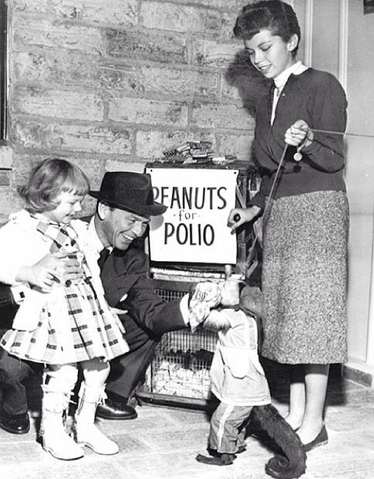
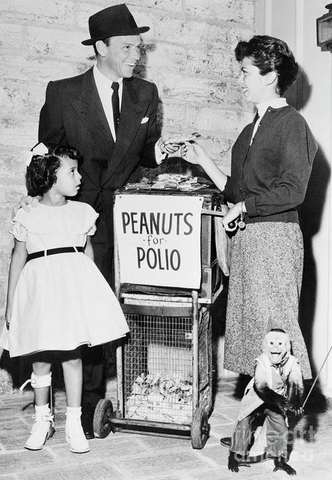
[Second Swingin' Lovers session ends]
Frank Sinatra Jr.: According to Frank Sinatra Jr., his father finished the second recording session of the week in the early hours of Wednesday, planning to fly to Palm Springs the next day and rest before the final Swingin' Lovers session set for the following Monday, the 16th.
Source: James Kaplan, "Sinatra: The Chairman" (2015).
[Capitol adds extra session, Gilmore's late call]
Kaplan / Frank Sinatra Jr.: Producer Voyle Gilmore phoned Sinatra at 1:00 a.m. to say Capitol VP Alan Livingston had decided to add three more songs to the Swingin' Lovers LP, requiring an extra recording session the next day. Frank was displeased but called Riddle at home to arrange three songs overnight; Riddle worked through the night and into the next afternoon, at one point finishing an arrangement in the back of his station wagon using a dining-table leaf as a desk while his wife Doreen drove.
Source: James Kaplan, "Sinatra: The Chairman" (2015).
January 12, 1956
Studio
KHJ Studios, Hollywood
14940 It Happened In Monterey
(Mabel Wayne/Billy Rose)
Arranged & Conducted by Nelson Riddle
CD: CDP 7-46570-2 Songs For Swingin' Lovers
LP: W653 Songs For Swingin' Lovers
14941 Swingin' Down The Lane
(Isham Jones/Gus Kahn)
Arranged & Conducted by Nelson Riddle
CD: CDP 7-46570-2 Songs For Swingin' Lovers
LP: W653 Songs For Swingin' Lovers
14942 Flowers Mean Forgiveness w/Chorus
(White/Frisch/Wolfson)
Arranged & Conducted by Nelson Riddle
CD: C2 724383808922 The Complete Capitol Singles
LP: T2602 Forever Frank
45: 3350
14943 I've Got You Under My Skin
(Cole Porter)
Chappell Music (ASCAP)
Arranged & Conducted by Nelson Riddle
-22 (3:43) CD: CDP 724383595228 Sinatra 80th "All The Best"
CD: CDP 7-96611-2 Sings The Select Cole Porter
CD: C2-94777 The Capitol Years
CD: CDP 7-46570-2 Songs For Swingin' Lovers
LP: W653 Songs For Swingin' Lovers
Cover when album first came out.
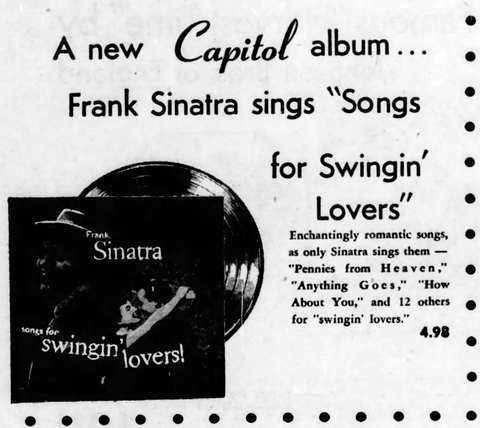
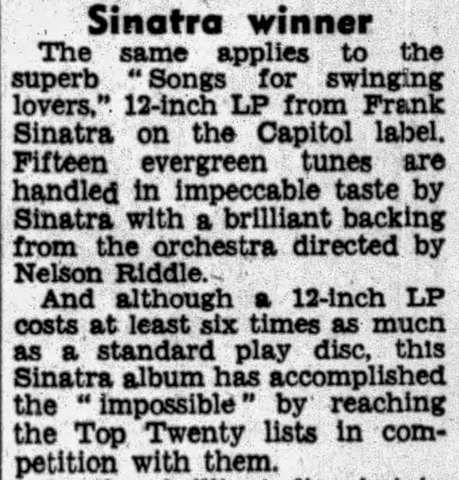
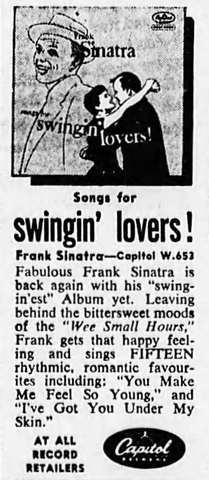
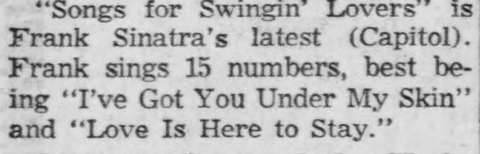
"I've Got You Under My Skin"
Nelson Riddle: Sinatra decided at the last minute to include 'Skin' on this session, forcing Riddle to write it overnight under pressure ('it was a work of pressure because I had to stay up quite late one night and finish it'). Sinatra's only direction was 'I want a long crescendo' -- Riddle recalled 'I don't think he was aware of the way I was going to achieve that crescendo, but he wanted an instrumental interlude that would be exciting and carry the orchestra up and then come on down where he would finish out the arrangement vocally.'
Source: Will Friedwald, "Sinatra! The Song Is You: A Singer's Art" (2018 revised edition).
"I've Got You Under My Skin"
Nelson Riddle; George Roberts: Riddle modeled the crescendo on Ravel's Bolero, calling it 'the most calculatingly orchestrated crescendo,' its 'absolutely tantalizing slow addition of instruments... is really the message of Bolero, and it is excruciating in its deliberately slow addition of pressure. Now that's sex in a piece of music.' Stuck on the specific pattern, Riddle called bass trombonist George Roberts for an Afro-Cuban rhythmic idea; Roberts suggested stealing the pattern from Stan Kenton's 1952 '23 Degrees North, 82 Degrees West' (composed by Bill Russo) and sang him the opening trombone lines, which Riddle expanded into the famous crescendo. Riddle: 'I remembered a Stan Kenton record, and that trombone back-and-forth thing. I was always fascinated by it. I tried to find an equivalent to use behind singers, and that was my version.'
Source: Will Friedwald, "Sinatra! The Song Is You: A Singer's Art" (2018 revised edition).
"I've Got You Under My Skin"
Milt Bernhart; Nelson Riddle: Bernhart recalled Sinatra and Riddle both sensing this would be a special track, willing to do many takes though Sinatra normally limited himself to four or five. By take ten, engineers wanted the trombone closer to a mic mounted on a high riser; when Bernhart said he wasn't tall enough to reach it, Sinatra himself fetched a box for Bernhart to stand on. Bernhart, feeling silly on the box, believed he'd run out of gas several takes before the one that was used -- yet that solo became one of the most famous trombone solos ever recorded. He later learned Riddle had built the whole instrumental sequence on the chords to the bridge of 'Skin.' The take was met with the musicians standing and applauding -- one of the few times this happened at a Sinatra session. Riddle: 'I know the evening that we did it, he expressed considerable enthusiasm for the arrangement, and I guess later on, when he took the tape home and played it, he was even [more impressed]' [passage continues into next file].
Source: Will Friedwald, "Sinatra! The Song Is You: A Singer's Art" (2018 revised edition).
[Extra session: three more Swingin' Lovers tracks]
At the added Thursday session, Sinatra recorded 'It Happened in Monterey' and 'Swingin' down the Lane' while copyists finished the last arrangement, then cut a standalone single, 'Flowers Mean Forgiveness,' before returning to record 'I've Got You Under My Skin' for the album.
Source: James Kaplan, "Sinatra: The Chairman" (2015).
[Sinatra asks Riddle for a long crescendo]
Sinatra (via Nelson Riddle): With only a day's notice to arrange 'I've Got You Under My Skin,' Sinatra told Riddle, 'I want a long crescendo,' envisioning an exciting instrumental interlude before he finished the song vocally.
Source: James Kaplan, "Sinatra: The Chairman" (2015).
[Riddle's Bolero-inspired arrangement]
Stuck for how to build the crescendo, Riddle thought of Ravel's Bolero. On the phone for advice, trombonist George Roberts suggested he borrow the pattern from Stan Kenton's Latin-flavored 1952 hit '23 Degrees North, 82 Degrees West.' Riddle didn't copy it directly but wrote a long crescendo for Roberts's bass trombone and strings, sketching eight bars of chord symbols at the bridge for trombonist Milt Bernhart to improvise a solo over.
Source: James Kaplan, "Sinatra: The Chairman" (2015).
[Recording 'I've Got You Under My Skin']
Kaplan / Milt Bernhart / Bob Bain: 'I've Got You Under My Skin' was the last song recorded that night, possibly crossing into the early hours of Friday the 13th. The band ran through it once for Sinatra, Riddle, Voyle Gilmore, and engineer John Palladino in the booth, and the musicians gave Riddle an ovation for the rush arrangement. Sinatra, unusually, pushed for take after take -- reaching take twenty-two -- with Milt Bernhart, drenched in sweat from his trombone solo, finally out of gas; at one point Sinatra himself fetched a box so the too-short Bernhart could reach a high microphone riser.
Source: James Kaplan, "Sinatra: The Chairman" (2015).
[I've Got You Under My Skin -- critical commentary]
Will Friedwald: Friedwald's landmark example of Sinatra's mood-mixing: sensitive to Cole Porter's intimate lyric one moment, swaggeringly indifferent to it the next. He discusses Sinatra's famous ad-lib line 'it repeats -- how it yells -- in my ear,' noting Sinatra simultaneously kids the text and underscores it, and that these genuinely spontaneous interjections varied from performance to performance rather than being fixed shtick.
This song/context matches multiple dated entries in the chronology; the specific date Friedwald is referring to could not be determined with confidence.
Source: Will Friedwald, "Sinatra! The Song Is You: A Singer's Art" (2018 revised edition), Ch. 1, "Night and Day" (Sinatra style overview)
[I've Got You Under My Skin -- critical commentary]
Will Friedwald: Friedwald notes this track is famous for the unusual number of takes Sinatra required -- discographies list twenty-two -- though he cautions many were likely false starts that didn't survive past the first thirty seconds, making the true number of complete takes impossible to determine.
This song/context matches multiple dated entries in the chronology; the specific date Friedwald is referring to could not be determined with confidence.
Source: Will Friedwald, "Sinatra! The Song Is You: A Singer's Art" (2018 revised edition), Ch. 1, "Night and Day" (Sinatra style overview)
[I've Got You Under My Skin -- critical commentary]
It took twenty-two takes to satisfy Sinatra on Cole Porter's 'I've Got You Under My Skin' for Songs for Swingin' Lovers; the song was added to the album's song list only shortly before the session, and the recording became regarded as the turning point of the Sinatra-Riddle era.
This song/context matches multiple dated entries in the chronology, or lacked a sufficiently precise date; the specific date could not be determined with confidence.
Source: Charles L. Granata, "Sessions with Sinatra: Frank Sinatra and the Art of Recording" (1999/2003), Part III: The Capitol Years, 1953-1962
[I've Got You Under My Skin / Hello, Young Lovers -- critical commentary]
Will Friedwald (analysis): Friedwald contrasts 1940s Sinatra (object of teenage adoration) with the more mature, aggressive 1950s Sinatra. 'Hello, Young Lovers' (recorded 1951) purports to give advice to the lovelorn but is really Sinatra lending his seductive power to budding romances; 'Skin' by contrast shows an aggressive, masculine Sinatra 'the warrior with a conscience' who speaks to men more directly than football or locker-room talk.
This song/context matches multiple dated entries in the chronology; the specific date Friedwald is referring to could not be determined with confidence.
Source: Will Friedwald, "Sinatra! The Song Is You: A Singer's Art" (2018 revised edition), Ch. 6, "With Nelson Riddle" (1953-1979)
[I've Got You Under My Skin / It's a Lonesome Old Town / One for My Baby (and One More for the Road) -- critical commentary]
Will Friedwald (analysis); Sinatra (phrase 'saloon song'): Friedwald notes 'Skin' is one of sixteen performances cut in Oct 1955/Jan 1956 for Swingin' Lovers!, which he calls Sinatra's definitive up-tempo album, paralleled by Only the Lonely (1958) as his best downer album. While 'One for My Baby' is Sinatra's most iconic 'saloon song' in his own words, Friedwald argues the lesser-known 'It's a Lonesome Old Town' best reflects Sinatra's growth as a balladeer, calling it possibly the 'unkindest cut' among songs considered (but ultimately dropped) for Only the Lonely.
This song/context matches multiple dated entries in the chronology; the specific date Friedwald is referring to could not be determined with confidence.
Source: Will Friedwald, "Sinatra! The Song Is You: A Singer's Art" (2018 revised edition), Ch. 6, "With Nelson Riddle" (1953-1979)
January 15, 1956
Frank gave one of his most acclaimed performances as heroin addict Frankie Machine in Otto Preminger's The Man with the Golden Arm, earning a Best Actor Oscar nomination; he later said he felt he deserved to win the Oscar for this role rather than for Eternity.
Frank Sinatra (quoted): "I did the finest work I ever did in my life on that film."
Source: Nancy Sinatra, Frank Sinatra: An American Legend, 1995.
January 16, 1956
Studio
KHJ Studios, Hollywood
14956 Makin' Whoopee
(Walter Donaldson/Gus Kahn)
Arranged & Conducted by Nelson Riddle
CD: CDP 7-46570-2 Songs For Swingin' Lovers
LP: W653 Songs For Swingin' Lovers
14957 Old Devil Moon
( Burton Lanes/E. Y. Harburg)
Arranged & Conducted by Nelson Riddle
CD: CDP 7-46570-2 Songs For Swingin' Lovers
LP: W653 Songs For Swingin' Lovers
14958 Anything Goes
(Cole Porter)
Arranged & Conducted by Nelson Riddle
CD: CDP 7-96611-2 Sings The Select Cole Porter
CD: CDP 7-46570-2 Songs For Swingin' Lovers
LP: W653 Songs For Swingin' Lovers
14959 Too Marvelous For Words
(R. Whiting/Johnny Mercer)
Famous Music Corporation (ASCAP)
Arranged & Conducted by Nelson Riddle
-7 (2:27) CD: C2-94777 The Capitol Years
CD: CDP 7-46570-2 Songs For Swingin' Lovers
LP: W653 Songs For Swingin' Lovers
14960 We'll Be Together Again
(Carl Fischer/Frankie Laine)
Arranged & Conducted by Nelson Riddle
CD: CDP 7-46570-2 Songs For Swingin' Lovers
LP: W653 Songs For Swingin' Lovers
Ed O'Brien:
"Songs For Swingin' Lovers" was completed with this session date. Riddle used a 35 piece orchestra on that Monday night fifty-four years ago. The date ran from 8:PM to 12:AM. Sinatra and friends then celebrated the completion of this great masterwork by partying to dawn. Frank was scheduled to record "Well Did You Evah," with Mr. Crosby, at noon on 1/17.
Bing arrived early and waited patiently until 12:30. He was walking out as Sinatra was walking into the studio. Frank apologized and explained the reason for his late arrival. He also promised to have a demo of the album sent to Bing's home ASAP. The two men would spend the greater part of that afternoon laying down a remarkable vocal duet that would be the highlight of the film "High Society." Bing's favorite film.
KHJ Studios, Hollywood
14956 Makin' Whoopee
14957 Old Devil Moon
14958 Anything Goes
14959 Too Marvelous For Words
14960 We'll Be Together Again
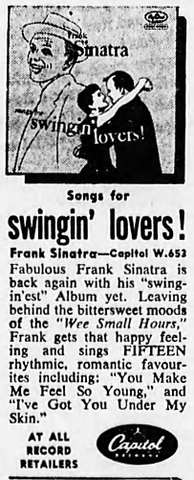
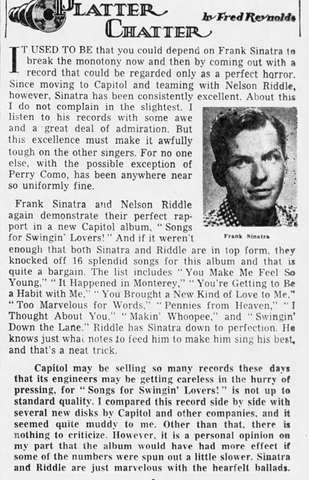
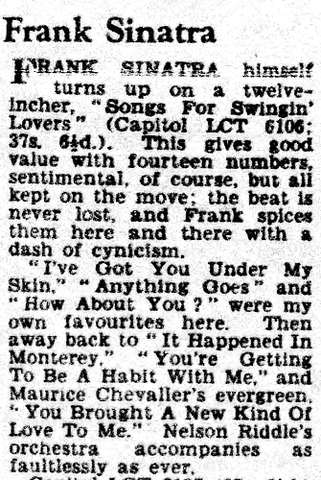
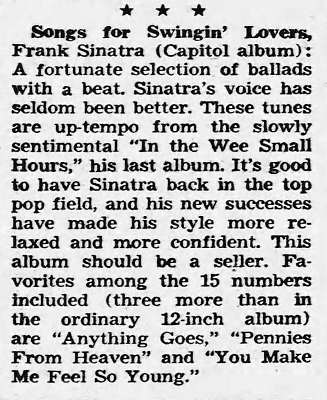
"I Whistle a Happy Tune" / "Anything Goes"
Will Friedwald: Friedwald notes it is easier to list the rare Sinatra performances that sit squarely on the beat -- citing parts of 'I Whistle a Happy Tune' and his original spoken coda to 'Anything Goes' ('may I say before this record spins to a close?') -- than to catalog the countless times he pushed or dragged the beat for dramatic effect.
Source: Will Friedwald, "Sinatra! The Song Is You: A Singer's Art" (2018 revised edition).
"Makin' Whoopee" / "How Deep Is the Ocean?"
Granata / George Roberts: George Roberts's melodic bass trombone solos on 'Makin' Whoopee' (Songs for Swingin' Lovers, 1956) and 'How Deep Is the Ocean?' (Nice 'n Easy, 1960) exemplify his approach of playing the instrument 'melodically,' as if it were a second vocalist matching Sinatra's phrasing.
Source: Charles L. Granata, "Sessions with Sinatra: Frank Sinatra and the Art of Recording" (1999/2003).
Liner Notes: SONGS FOR SWINGIN' LOVERS!
If In the Wee Small Hours is the record that proved Sinatra could break your heart, Songs for Swingin' Lovers! is the one that proved he could just as easily put it back together and take it dancing. Recorded in the same eighteen-month window with the same arranger, the album flips the emotional register entirely -- brisk tempos, brass that struts rather than broods, a vocal performance shot through with wit and swagger.
"You Make Me Feel So Young" opens the record at a gallop and never really lets up; "I've Got You Under My Skin," arranged by Nelson Riddle with a trombone solo from Milt Bernhart that has since become one of the most celebrated eight bars in American recording history, closes side one with a performance so charged that engineers reportedly had to ask the studio's air conditioning be shut off mid-session so its hum wouldn't bleed onto the tape.
Together, the two albums -- one grave, one buoyant -- announced a singer who had figured out, at Capitol, that there was no contradiction between vulnerability and command. Songs for Swingin' Lovers! remains the sound most people conjure when they picture Sinatra at his coolest: hat tipped back, tie loosened, utterly in control of the room.
Written by Claude (Anthropic), commissioned for this chronology, 2026.
[Ain't That a Kick in the Head? / Old Devil Moon -- critical commentary]
Will Friedwald (factual/analysis): Norvo and Sinatra first worked together on the uncompleted animated Finian's Rainbow (1954), for which Norvo (with Oscar Peterson) played an extended jazz instrumental passage on 'Old Devil Moon.' They also appeared together in Sinatra's 1958 film Kings Go Forth and in a memorable 1960 Ocean's 11 sequence with Dean Martin introducing 'Ain't That a Kick in the Head?' (Cahn/Van Heusen).
This song/context matches multiple dated entries in the chronology; the specific date Friedwald is referring to could not be determined with confidence.
Source: Will Friedwald, "Sinatra! The Song Is You: A Singer's Art" (2018 revised edition), Ch. 9, "Looking for the Hook" (1960-1971)
January 17, 1956
Studio
Capitol Studio A, Hollywood
E15468 Well Did You Evah?
w/Bing Crosby
(Cole Porter)
Arranged by Skip Martin
Conducted by Johnny Green
-5 CD: CDP 724383595228 Sinatra 80th "All The Best"
LP: SW750 High Society (Unedited)
45: 3507 (Edited)
Ed O'Brien notes:
The noon session started at 2:45 and
they did 5 takes plus a few quick sweeteners.
Session ran over 3 hours. The recording is
sensational. Just about all the Sinatra recordings
in 1956 were sensational.
note: Done at the MGM Studio. There was a seven piece
orchestra. The additional instrumentation was done piecemeal
at a number of sessions. I have both the MGM session sheets
and the Capitol. The latter show the assigning of master numbers -
two were given to this recording. The LP version is E15468 and
the single version is E15721. Capitol, in Japan, released a two CD
set (1989) "All The Way/Frank Sinatra Hit Collection." The recording
of the Crosby-Sinatra is in fabulous stereo and runs 3:46.
Ed
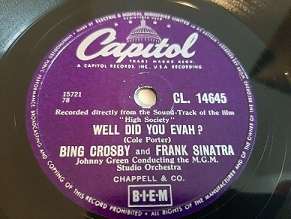
Capitol Studio A, Hollywood
E15468 Well Did You Evah?
w/Bing Crosby
(Cole Porter)
Arranged by Skip Martin
Conducted by Johnny Green
note: reviews of the single referred to this Porter effort as a new song.
Porter composed it for the 1940 Broadway musical "Dubarry Was
A Lady." Song was sung by Betty Grable and Charles Walters. The
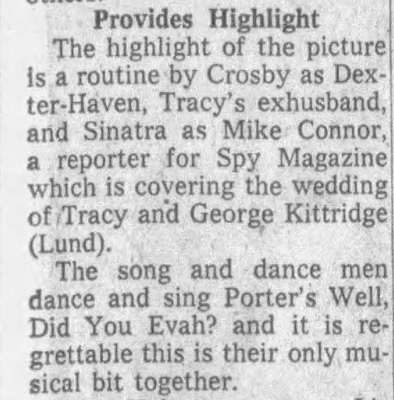
January 19, 1956
Television
SHOWER OF STARS
COLOR PRESENTATION
CBS STUDIOS
HOLLYWOOD
1-19-56
8:30 TO 9:30 P.M.'
Host: Jack Benny
Guests: George Burns - Quentin Reynolds - Shirley MacLaine, Red Skelton - Frank Sinatra - Rochester
SHOWER OF STARS
COLOR PRESENTATION
CBS STUDIOS
HOLLYWOOD
[image referenced in source but could not be recovered]
[image referenced in source but could not be recovered]
[image referenced in source but could not be recovered]
SHOWER OF STARS
COLOR PRESENTATION
CBS STUDIOS
HOLLYWOOD
1-19-56
8:30 TO 9:30 P.M.'
Host: Jack Benny
Guests: George Burns - Quentin Reynolds - Shirley MacLaine, Red Skelton - Frank Sinatra - Rochester
Red Skelton and Frank Sinatra 1-19-56 CBS Studio Hollywood Variety
1-25-56
note: Frank completed "Songs For Swingin Lovers" on 1-16-56 and did the recordings for "High Society" on 1-17 and 1-20 -56
--------------------------------------------------
© 1997-2026 The Sinatra Archive
This calendar, or any parts thereof, may not be reproduced in any fashion whatsoever without the prior written permission of the publisher (The Sinatra Archive)
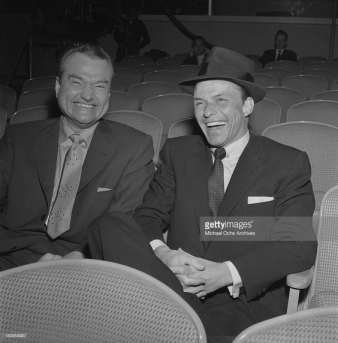
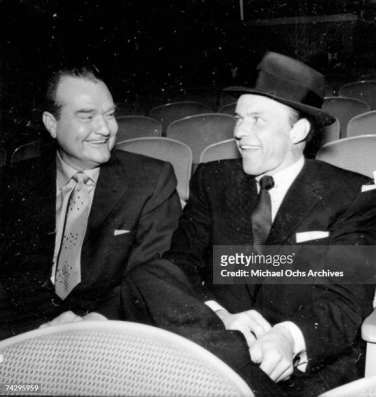
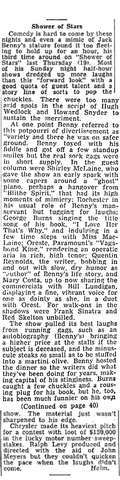
note: Frank completed "Songs For Swingin Lovers" on 1-16-56 and did the
recordings for "High Society" on 1-17 and 1-20 -56
© 1997-2024 The Sinatra Archive
This calendar, or any parts thereof, may not be reproduced in any fashion whatsoever without the prior written permission of the publisher (The Sinatra Archive)
6
January 20, 1956
Studio
Capitol Studio A, Hollywood
You're Sensational
(Cole Porter)
Arranged by Nelson Riddle
Conducted by Johnny Green
CD: Sinatra In Hollywood
Note There were 13 takes. --Ed
E15407 Mind If I Make Love To You?
(Cole Porter)
Arranged by Nelson Riddle
Conducted by Johnny Green
-7 CD: CDP 7-96611-2 Sings The Select Cole Porter
LP: SW750 High Society
45: 3508
E15406 Who Wants To Be A Millionaire? w/Celeste Holm
(Cole Porter)
Arranged by Conrad Salinger
Conducted by Johnny Green
-11 LP: SW750 High Society
45: 3508
note: I don't know how I missed this one. Session was done at the MGM Studio. An afternoon affair with a 52 piece orchestra, Johnny Green conducted and the session ran four hours. I have the MGM session sheets.
Ed
NOTE: Sinatra Scholar Ed O'Brien points out that discographies before his 1992 book, SINATRA: THE MAN AND HIS MUSIC . . . The Recording Artistry of Francis Albert Sinatra, 1939-1992 (with Scott P. Sayers, Jr.) always credited the "High Society" to Capitol sessions in April and May 1956. When he got the MGM sheets, they clearly showed everything had been done in January on the soundstage. He called Capitol and informed them that they were disseminating misinformation. Well, they insisted that O'Brien was wrong while he insisted that he wasn't and had the session sheets to prove it.
After some back and forth over the phone, someone at Capitol realized that a little research was needed. They finally found some 3x5 cards showing the correct dates and revealing that only the master numbers were assigned in the spring.
O'Brien also notes that the listing above indicates that "You're Sensational" was not issued. It's true that Frank did redo it on April 5, 1956 and that it was on both the single and LP release, but the MGM track was used in the film and has been issued on the VHS, Laser, and DVD releases. Sinatra did 13 takes and O'Brien likes it better than the later effort at Capitol.
Capitol Studio A, Hollywood
You're Sensational
(Cole Porter)
Arranged by Nelson Riddle
Conducted by Johnny Green
CD: Sinatra In Hollywood
Note There were 13 takes. --Ed
Notice the misspelling of the word "Sensational" on the single.
[image referenced in source but could not be recovered]
[image referenced in source but could not be recovered]
[image referenced in source but could not be recovered]
January 24, 1956
Taking control of his film career, Frank formed his own production company, Kent Productions, to finance and produce Johnny Concho, his first release as producer, in which he starred as a western gunslinger.
Source: Nancy Sinatra, Frank Sinatra: An American Legend, 1995.
January 28, 1956
Elvis Presley made his television debut on the Dorsey brothers' TV show, performing 'Blue Suede Shoes' and 'Heartbreak Hotel' -- a symbolic passing of the torch, given that rock and roll would soon help finish off the Big Band era. (Source: Richard Havers, "Sinatra" (Dorling Kindersley, 2007).)
Elvis Presley's television debut came on CBS's Stage Show, hosted by big-band veterans Tommy and Jimmy Dorsey. He initially avoided performing his soon-to-be-released 'Heartbreak Hotel,' singing Big Joe Turner covers instead, and didn't perform it on air until his third Dorsey appearance in mid-February. (Source: Richard Havers, "Sinatra" (Dorling Kindersley, 2007).)
February 16, 1956
Studio
Temple Israel, Los Angeles, CA
Rally to celebrate "Histadrut Week"
February 16, 1956 Temple Israel, Los Angeles, CA
Rally to celebrate "Histadrut Week"
Source: sinatraphiles digest (date extracted from item text; originally routed to appendix for review).
February 1956
Humphrey Bogart was diagnosed with cancer of the esophagus. Frank Sinatra, one of Bogart's closest friends and the informally anointed “Pack Master” of the loose circle of Hollywood friends the Bogarts had dubbed the Rat Pack, became a steady, reassuring presence for Bogart and his wife, Lauren “Betty” Bacall, during the illness — even quietly paying an assistant $175 a week to look in on Bacall and make sure she was resting and taking her medication. Source: J. Randy Taraborrelli, Sinatra: Behind the Legend.
[Capitol Records Tower opens]
Kaplan: In February 1956 Capitol Records' new cylindrical headquarters tower, designed by architect Welton Becket at Hollywood and Vine to resemble a stack of records (ground broken in 1955 after Capitol's purchase by EMI), officially opened, complete with a sixty-foot spire blinking 'Hollywood' in Morse code and three ground-floor recording studios.
Source: James Kaplan, "Sinatra: The Chairman" (2015)
[Kilgallen's 'Real Frank Sinatra Story' series begins]
Dorothy Kilgallen: About a week after Sinatra's Oscar nomination, columnist Dorothy Kilgallen's syndicated Sunday series 'The Real Frank Sinatra Story' began running in Hearst newspapers, opening with the line that success hadn't changed Sinatra and calling him 'a Jekyll and Hyde dressed in sharpie clothes.' The pieces named numerous romantic partners, both famous (Ava Gardner, Lana Turner, Anita Ekberg, Gloria Vanderbilt, Kim Novak, Jill Corey) and lesser-known.
Source: James Kaplan, "Sinatra: The Chairman" (2015)
Mid-February 1956
Sinatra's recording sessions this month inaugurated the studios at the newly built Capitol Records Building in Hollywood, backed by a 56-piece symphonic orchestra. Of the material cut there, biographer Charles L. Granata singled out “Night and Day,” “Oh! Look at Me Now,” and “From This Moment On” for their “powerful sexual overtones,” achieved through the tension and release of Sinatra's phrasing. Source: Wikipedia, “Frank Sinatra.”
February 13, 1956
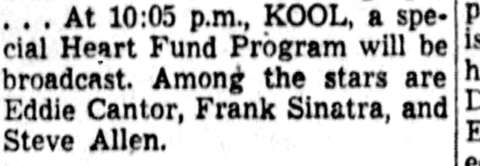
February 19, 1956
[Sinatra's Best Actor Oscar nomination]
Sinatra was nominated for the Best Actor Academy Award for The Man with the Golden Arm, competing against Ernest Borgnine (Marty), James Cagney (Love Me or Leave Me), James Dean (East of Eden), and Spencer Tracy (Bad Day at Black Rock). He expected to win.
Source: James Kaplan, "Sinatra: The Chairman" (2015).
February 22, 1956
Studio
Los Angeles
Sinatra's first session at the new Capitol Tower
Wednesday evening
8 to 11:30: P.M.
54 piece orchestra
Conducted by Frank Sinatra
TONE POEMS OF COLOR concept inspired by the poetry of Norman Sickel
He was the writer on many of Sinatra's radio shows.
1. Black arranged by Victor Young
2. Orange arranged by Nelson Riddle
3. White arranged by Victor Young
4. Brown arranged by Jeff Alexander
Note: George Roberts played bass-trombone on the four sessions that made up the recordings for "Tone Poems." He told me the musicians knocked themselves out for Sinatra. They wanted him to succeed because the music was so lovely.
George thought Frank did a great job conducting a large orchestra.. Sinatra loved the way Victor
Young worked. There is an interview where he talks about Young paying very close attention to the lyrics as he conducted. Trying to support the vocalist during the recording process.
Ed O'Brien supplied the above session info.
"Tone Poems of Color"
On February 22, 1956, Sinatra conducted (rather than sang on) the inaugural recording session in the new Capitol Tower's Studio A, leading a full orchestra through Tone Poems of Color, an album of color-themed vignettes composed by arrangers including Nelson Riddle, Andre Previn, Gordon Jenkins, Victor Young, Alec Wilder, and Elmer Bernstein; Sinatra had told Riddle 'I'm really a frustrated conductor.'
Source: Charles L. Granata, "Sessions with Sinatra: Frank Sinatra and the Art of Recording" (1999/2003).
February 26, 1956
The Los Angeles Examiner, a Hearst paper, ran Dorothy Kilgallen's front-page exposé, which ran over six days and accused Sinatra of a Jekyll-and-Hyde personality and a Napoleon complex while dredging up old scandals. Sinatra retaliated by sending Kilgallen a tombstone bearing her name and mocking her appearance in his stage act. (Source: Richard Havers, "Sinatra" (Dorling Kindersley, 2007).)
February 29, 1956
[Bogart diagnosed with esophageal cancer]
On leap day, Humphrey Bogart was diagnosed with esophageal cancer, then considered a death sentence. Sinatra was devastated by the news.
Source: James Kaplan, "Sinatra: The Chairman" (2015).
March 1956
[Sinatra plays the Sands]
Kaplan: For most of March, Sinatra played an engagement at the Sands in Las Vegas, commuting back and forth to Los Angeles.
Source: James Kaplan, "Sinatra: The Chairman" (2015)
March 1, 1956
Studio
Capitol Studio A, Hollywood
E15127 Don't Like Goodbyes N/R
Arranged & Conducted by Nelson Riddle
[First Close to You session]
Back at Capitol, where engineers had been working to improve studio acoustics, Sinatra and Riddle recorded 'Don't Like Goodbyes' (from Harold Arlen and Truman Capote's House of Flowers) with the Hollywood String Quartet and additional musicians for Close to You.
Source: James Kaplan, "Sinatra: The Chairman" (2015).
March 3, 1956
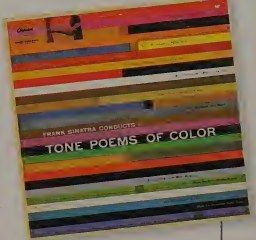
[Photograph: Elvis's 'Heartbreak Hotel' debuts one spot behind Sinatra. From Richard Havers, "Sinatra" (Dorling Kindersley, 2007), p.217.]
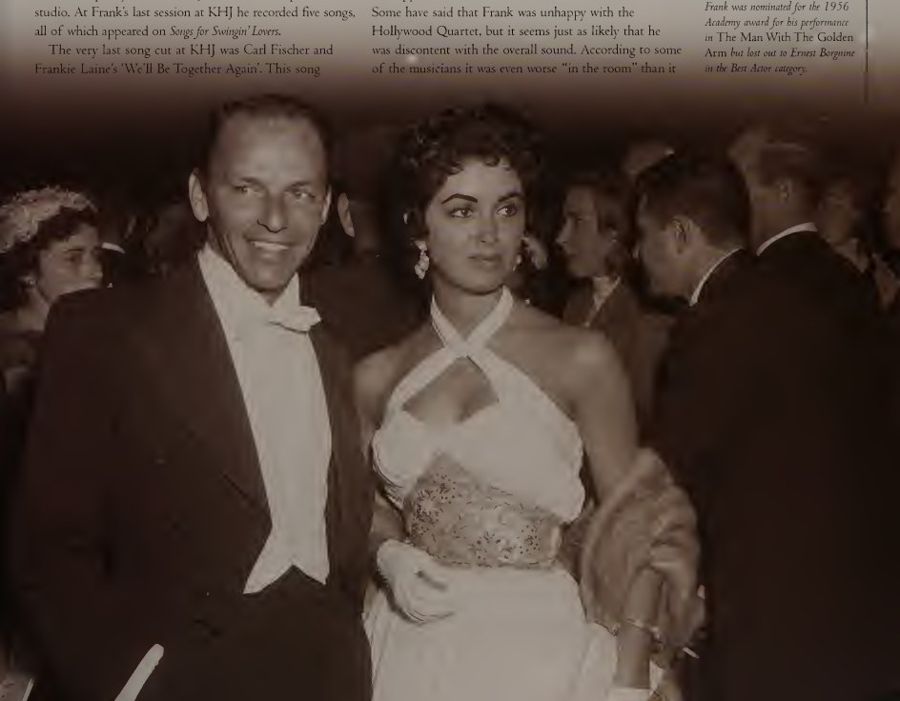
[Photograph: Elvis's 'Heartbreak Hotel' debuts one spot behind Sinatra. From Richard Havers, "Sinatra" (Dorling Kindersley, 2007), p.217.]
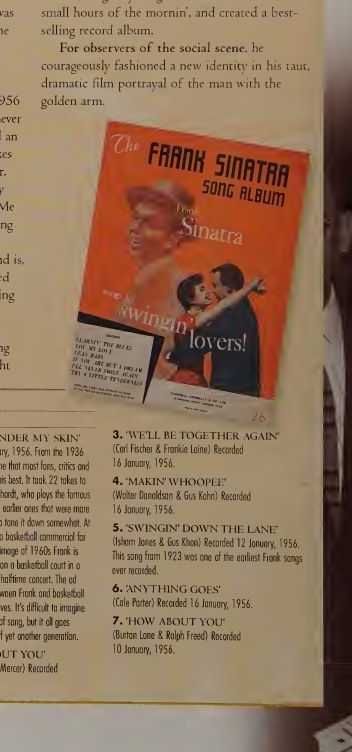
[Photograph: Elvis's 'Heartbreak Hotel' debuts one spot behind Sinatra. From Richard Havers, "Sinatra" (Dorling Kindersley, 2007), p.216.]
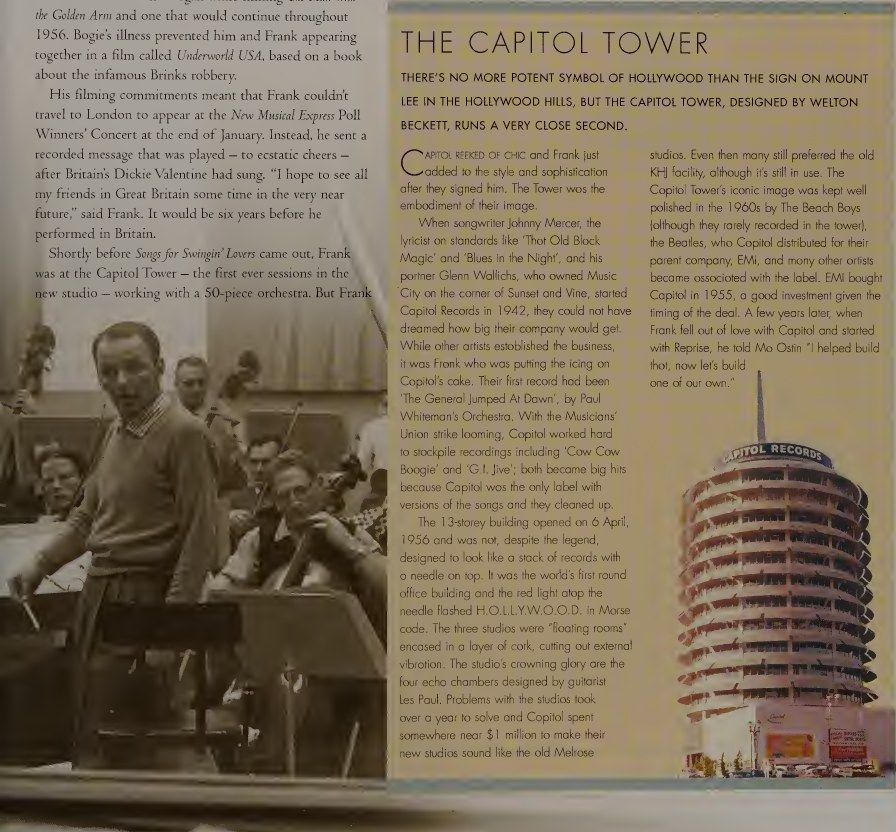
[Photograph: Elvis's 'Heartbreak Hotel' debuts one spot behind Sinatra. From Richard Havers, "Sinatra" (Dorling Kindersley, 2007), p.215.]
Elvis Presley's first national chart entry, 'Heartbreak Hotel,' debuted at No. 68, one place below Sinatra's single 'You'll Get Yours' at No. 67. Two months later Elvis reached No. 1 for six weeks while Sinatra's record stalled at No. 67 and faded. (Source: Richard Havers, "Sinatra" (Dorling Kindersley, 2007).)
March 8, 1956
Studio
Capitol Studio A, Hollywood
E15185 If It's The Last Thing I Do w/ The Hollywood String Quartet
Arranged & Conducted by Nelson Riddle
CD: CDP 7-46572-2 Close To You
LP: T2602 Forever Frank
E15186 Don't Like Goodbyes w/ The Hollywood String Quartet
(H. Arlen/T. Capote)
Harwin Music Co. (ASCAP)
Arranged & Conducted by Nelson Riddle
-4 (4:50) CD: C2-94777 The Capitol Years
CD: CDP 7-46572-2 Close To You
LP: W789 Close To You
E15187 P.S. I Love You w/ The Hollywood String Quartet
Arranged & Conducted by Nelson Riddle
CD: CDP 7-46572-2 Close To You
LP: W789 Close To You
E15188 Love Locked Out w/ The Hollywood String Quartet
Arranged & Conducted by Nelson Riddle
CD: CDP 7-46572-2 Close To You
LP: W789 Close To You
This was Sinatra's first full vocal session at the new Capitol Tower. He had tried to lay down "Don't Like Goodbyes" on 3-1-56, but it was an aborted session.
I was lucky enough to interview five of the musicians who worked on the "Close To You" album. To a man they will tell you it was the finest sustained singing Sinatra ever did in a studio setting. They remembered the meticulous approach by Sinatra and Riddle throughout the making of the album. Every nuance, phrase, note was planned to perfection. "Wee Small Hours" was certainly a superior concept, but Sinatra in 1956 had reached a level of perfection that very few artists ever obtain. Backed by 13 sidemen on the 3/8 session, Sinatra's ability to sing an intimate phrase was really not of this world.
Has anyone ever sung better than what he did on that evening 55 years ago tonight? The seasoned veterans who worked many, many sessions with Frank don't think so. You must hear these recordings in their original pristine mono sound. I don't believe there has ever been a better sound offered by a record company. There is a stunning purity and clarity in every note.
Here is the list of musicians who worked the session:
Vince DeRosa French horn
Mahlon Clark clarinet
Harry Klee flute
Paul Shure, Felix Slatkin, Israel Baker violin
Alvin Dinkin viola
Eleanor Slatkin vfioloncello
Kathryn Julye harp
Bill Miller piano
George Van Eps guitar
Mike Rubin bass
Irv Cottler drums
Concerts
Capitol Studio A, Hollywood
E15185 If It's The Last Thing I Do
E15186 Don't Like Goodbyes
E15187 P.S. I Love You
E15188 Love Locked Out
On this day Irish Singer Ruby Murrey and Norrie Paramor where in the studio to meet Frank
Ruby Murray on the left and Norrie Paramor on the right.
[image referenced in source but could not be recovered]
[image referenced in source but could not be recovered]
[image not recovered — source caption: “popmusic_4340_3”]
Capitol Studio A, Hollywood
E15185 If It's The Last Thing I Do
E15186 Don't Like Goodbyes
E15187 P.S. I Love You
E15188 Love Locked Out
On this day Irish Singer Ruby Murrey and Norrie Paramor where in the studio to meet Frank
Ruby Murray on the left and Norrie Paramor on the right.
[Second Close to You session succeeds]
A week after the first Close to You date, with a reshuffled instrumental lineup (quartet plus clarinet, French horn, flute, harp, extra violin, and rhythm section), Riddle and Sinatra successfully recorded four songs including 'If It's the Last Thing I Do,' 'P.S. I Love You,' and 'Love Locked Out.'
Source: James Kaplan, "Sinatra: The Chairman" (2015).
March 9, 1956
Film
"Meet Me In Las Vegas" (US Film Release: March 9, 1956)
Starring: Dan Dailey, Cyd Charisse, Agnes Moorehead
There are brief appearances by Jerry Colonna, Paul Henreid, Lena Horne, Frankie Laine, and Mitsuko Sawamura. Cameo appearances include Frank Sinatra, Debbie Reynolds, Vic Damone, Pier Angeli, Peter Lorre, and Tony Martin.
Produced by: Joe Pasternak
Directed by: Roy Rowland
In 1950s Las Vegas, a gambling rancher (Dailey) and a ballerina (Charisse) discover that some people have luck at cards while others have luck at love. (DVD Release date: 2011-04-12)
"Meet Me In Las Vegas" (US Film Release: March 9, 1956)
Starring: Dan Dailey, Cyd Charisse, Agnes Moorehead
There are brief appearances by Jerry Colonna, Paul Henreid, Lena Horne, Frankie Laine, and Mitsuko Sawamura. Cameo appearances include Frank Sinatra, Debbie Reynolds, Vic Damone, Pier Angeli, Peter Lorre, and Tony Martin.
Produced by: Joe Pasternak
Directed by: Roy Rowland
In 1950s Las Vegas, a gambling rancher (Dailey) and a ballerina (Charisse) discover that some people have luck at cards while others have luck at love.
(DVD Release date: 2011-04-12)
Budget $2,495,000
Box office $3,714,000
The working titles for the film were Weekend at Las Vegas and Viva Las Vegas. Preceeding the opening credits, members of the musical group "The Four Aces" appear onscreen, with each framed by a playing card, singing the title song. The opening onscreen cast credits differ in order from the closing credits. A written prologue following the opening credits reads: "In the early days of our country's history, the West was a place from which men took vast quantities of gold. Now--at least--they're bringing it all back." Although onscreen credit is given to Eastman Color, Aug and Sep 1955 HR production charts list Ansco Color.
Throughout Meet Me in Las Vegas, lead actress Cyd Charisse performs a variety of dancing styles including ballet, modern, country western, can-can and jazz. According to a 1 Sep 1955 HR news item, conductor and pianist Pete Rugolo, who is credited in the onscreen as "Conductor," performed with his 20-piece orchestra in all floor show and dance numbers seen in the film. Sammy Davis, Jr., who sang the lyrics for the "Frankie and Johnny" number, was heard but not seen onscreen. Several guest stars who had brief appearances in the film as audience members for the casino shows or casual casino patrons, but were not credited onscreen, included: Pier Angeli, Vic Damone, Debbie Reynolds, Frank Sinatra, Elaine Stewart, Dewey Martin, Jeff Richards and Tony Martin, who is married to Cyd Charisse. Actress Henny Backus, who played "bossy wife," was the wife of Jim Backus, who played "Tom Culdane."
Although a 3 Oct 1955 HR news item adds Marlene Dietrich and Jimmy Durante to the cast, they did not appear in the released film. A 6 Oct 1955 HR news item adds the following dancers to the cast: Herman Boden, Buddy Bryan, Gene Dailey, Ward Ellis, Dick Humphreys, Maurice Kelly, Clark Lee, Roy Palmer, Frank Radcliffe, Frank Reynolds, Jerry Rush and Buddy Spencer, but the appearance of these dancers and actors in the released film has not been confirmed. Other 1955 HR news items add Gay Gallagher, Charles Campbell and Ken McClure to the cast. Modern sources adds Steve Forrest to the cast but he was not discernible in the viewed print. Modern sources also add Robert Fuller as a dancer and Jerry Velasco, as the piano player accompanying Lena Horne. Portions of the film were shot on location at the Sands Hotel in Las Vegas, NV.
Meet Me in Las Vegas received an Academy Award nomination for Best Scoring of a Musical Picture, but lost to The King and I. AA 16 Feb 1956 HR news item reported that on the eve of the film's world premiere in Las Vegas, The Milton Berle Show was to broadcast an hour-long television tribute to Pasternak and the film.
Alternate Titles:
Viva Las Vegas
Weekend at Las Vegas
Release Date:
9 March 1956
Premiere Information:
World premiere in Las Vegas, NV: 21 Feb 1956
Production Date:
2 Aug--mid Oct 1955
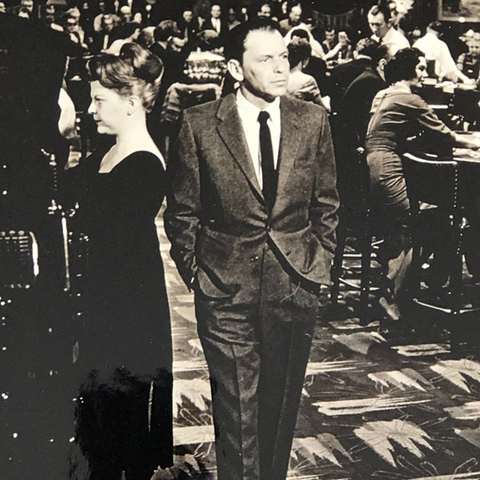
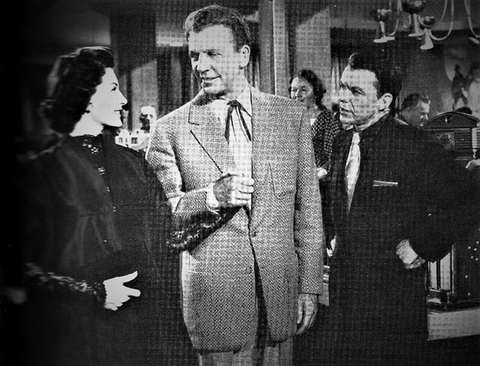
"Meet Me in Las Vegas"
After The Man with the Golden Arm, Sinatra made a brief, unbilled, wordless cameo in the MGM musical Meet Me in Las Vegas, appearing as an unidentified slot-machine player who hits a jackpot; Santopietro reads it partly as a plug for the Sands Hotel, Sinatra's real-life Vegas headquarters.
Source: Tom Santopietro, "Sinatra in Hollywood" (2008).
"Meet Me in Las Vegas"
The same film also features a cameo by singer Frankie Laine, then outselling Sinatra on the singles charts. Santopietro contrasts Laine's broad, theatrical stage-style singing on camera with Sinatra's more subtle, camera-calibrated acting-through-song technique, arguing the difference explains why Sinatra became a major film star and Laine did not.
Source: Tom Santopietro, "Sinatra in Hollywood" (2008).
"Meet Me in Las Vegas"
Santopietro grades this a C, noting it's just a "minuscule cameo."
Source: Tom Santopietro, "Sinatra in Hollywood" (2008).
"Meet Me in Las Vegas"
Santopietro (Filmography): Cameo appearance. Metro-Goldwyn-Mayer. Produced by Joe Pasternak, directed by Roy Rowland, screenplay by Isobel Lennart. Starred Dan Dailey, Cyd Charisse, Agnes Moorehead, Lena Horne and Frankie Laine, with Sinatra making a cameo appearance.
Source: Tom Santopietro, "Sinatra in Hollywood" (2008).
March 15, 1956
Studio
Capitol Tower, Los Angeles
Thursday evening
8 to 11::P.M.
53 piece orchestra
Conducted by Frank Sinatra
TONE POEMS OF COLOR
concept inspired by the poetry of Norman Sickel
He was the writer on many of Sinatra's radio shows.
Gold
arranged by Nelson Riddle
Purple
arranged by Billy May
Ed O'Brien notes:
The final session for Frank's first work at the new Capitol
Tower. The album was the first work recorded at the new tower.
He would go on to conduct memorable albums for Peggy
Lee and Dean Martin at Capitol.
Kathryn Julye is the harpist Andre Previn is on Sinatra's left.
Photo was taken at the 2-28-56 session. Previn composed and arranged the "Red" composition
Nelson Riddle is to Frank's left in the upper frame
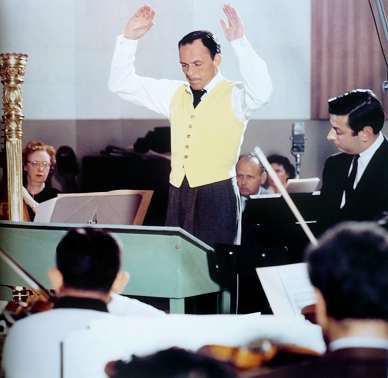
[Final Tone Poems of Color session]
On March 15, Sinatra conducted the last recording session for Frank Sinatra Conducts Tone Poems of Color.
Source: James Kaplan, "Sinatra: The Chairman" (2015).
March 18, 1956
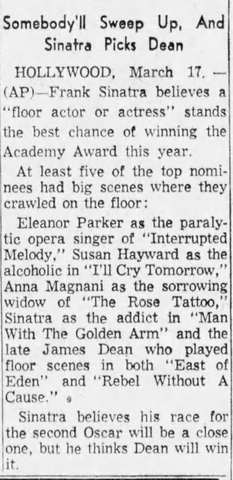
March 21, 1956
Television
Academy Award Ceremonies
Location: RKO Pantages Theatre, Hollywood
Network: NBC
Wednesday evening
Time 7:30 PM - 12:00 AM
Sinatra presented the scoring awards
Dean Martin sang the Oscar nominated tune "The Tender Trap."
Note: Sinatra was also nominated for a Best Actor Award for his role in “The Man with the Golden Arm” as Frankie "Dealer" Machine. The Award went to Ernest Borgnine for “Marty”
Academy Award Ceremonies
Location: RKO Pantages Theatre, Hollywood
Network: NBC
Wednesday evening
Time 7:30 PM - 12:00 AM
Sinatra presented the scoring awards
Frank Sinatra and Jerry Lewis during the presentation of the scoring awards
Singer and actor Frank Sinatra relaxes backstage at the 28th Academy Awards
at the RKO Pantages Theatre on March 21, 1956 in Los Angeles, California
Hollywood: Frank Sinatra, nominated for best actor for his role in "The Man With the Golden Arm,"
arrives with Peggy Connelly at the 28th Annual Academy Award Presentations here March 21st.
The "Oscar" for best actor was won by Ernest Borgnine for his performance as the lonely butcher in "Marty."
MARCH 21, 1993: Frank Sinatra is in attendance when Barbara Sinatra receives the 1993 Women in Show Business Award at the Beverly Hilton Hotel in Beverly Hills, California
American Singer Frank Sinatra, Jillie Mack, actor Tom Selleck and Barbara Sinatra attend Ceremony
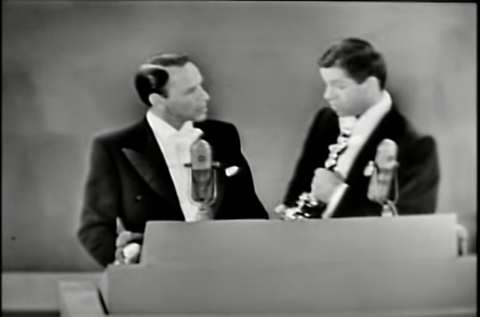
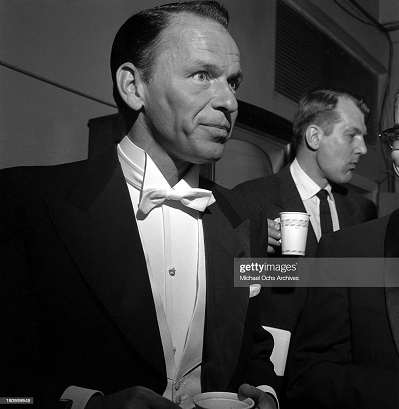
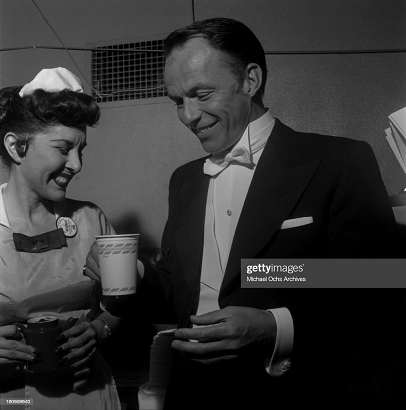
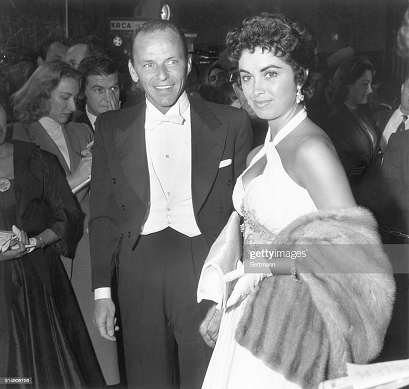
[Sinatra loses Best Actor Oscar to Borgnine]
Peggy Connelly: On the night of the 28th Academy Awards at the Pantages Theater, Sinatra attended with Peggy Connelly expecting to win Best Actor. After presenting the Best Score award to Alfred Newman, he watched Ernest Borgnine win Best Actor for Marty instead. Sinatra was devastated; Connelly recalled that after the ceremony they skipped the parties and went straight home, where he sat alone in the dark until she came in to comfort him, and he told her that winning the Oscar 'would've done' a lot for his career.
Source: James Kaplan, "Sinatra: The Chairman" (2015).
March 24, 1956
Concerts
Palm Springs Police Show at High School Pavilion
Palm Springs, California
Among the Performers: Frank Sinatra, Eddie Cantor, Joan Davis, Jimmy Van
Heusen, Bob Hope, Desi Arnez,
Gary Crosby, Les Brown and his Band of Renown
Note: Thanks to Fred W for sending this one along.
March 29, 1956
Sands, Las Vegas (March 29-April 3)
"Thursday" was March 29th.
March 29, 1958 Police Show, Palm Springs, California
Benefit for Police Department
Frank Sinatra and Peggy Lee:
Frank Sinatra, Peggy Lee and Jimmy Van Heusen backstage: Thanks to Carl R for sending the above photos.
Second photo -- Frank is speaking to Bill Miller.
--Ed
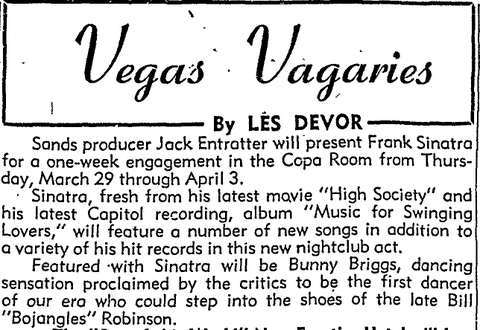
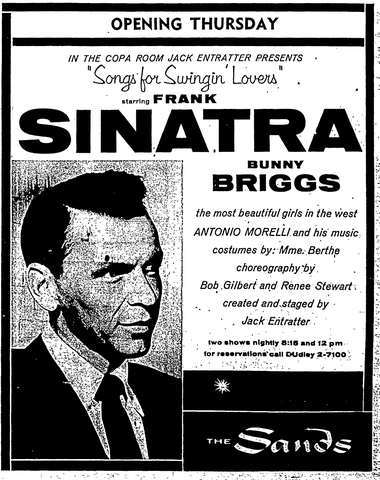
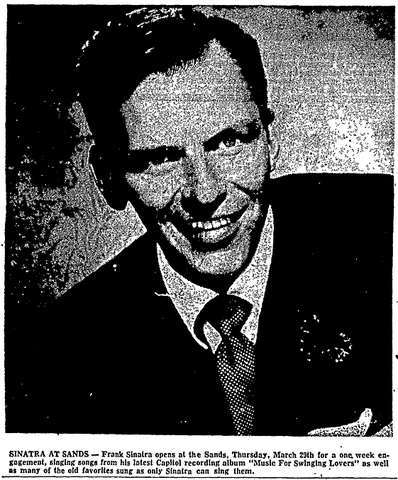
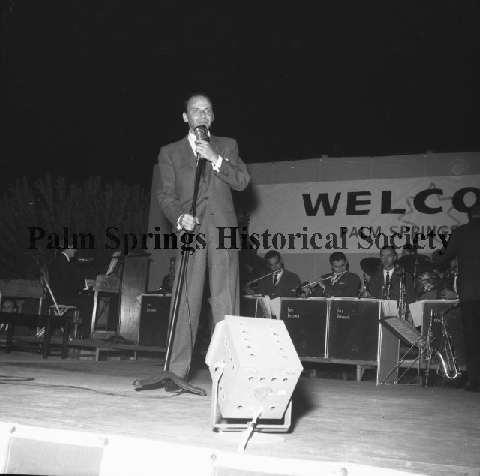
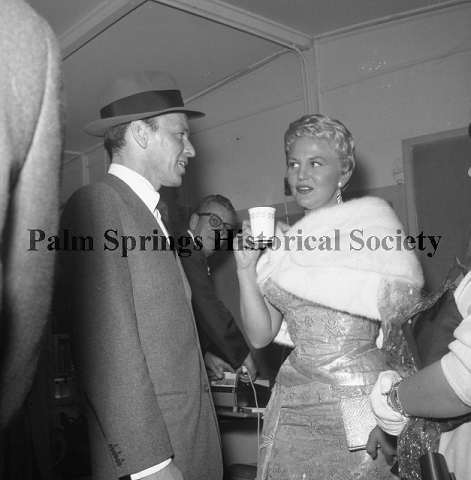
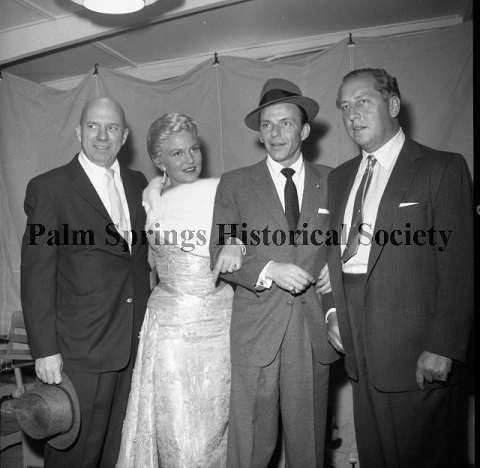
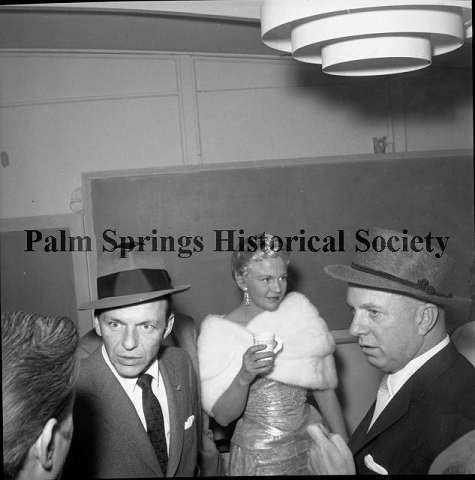
March 30, 1956
Concerts
Sands, Las Vegas (March 29-April 3)
Sinatra took over the last week of a Martin & Lewis engagement
Sands, Las Vegas (March 29-April 3) O.A. Bunny Briggs, Linda Lawson, Sandmen, Copa Girls ( 12 )
Antonio Morrelli Orch.
Sinatra took over the last week of a Martin & Lewis engagement
Sands, Las Vegas (March 29-April 3)
Sinatra and Audrey Hepburn, Sands, Las Vegas, March 30, 1956
Audrey Mike Romanoff Frank Mel Ferrer
© 1997-2026 The Sinatra Archive
This calendar, or any parts thereof, may not be reproduced in any fashion whatsoever without the prior written permission of the publisher (The Sinatra Archive)
[image referenced in source but could not be recovered]
[image referenced in source but could not be recovered]
March 31, 1956
Concerts
Sands, Las Vegas (March 29- April 3)
Songs for Swingin' Lovers entered the US chart at the end of March 1956 and reached No. 2, staying charted for fifty weeks; it was Sinatra's last album recorded at KHJ Studios and was later inducted into the Grammy Hall of Fame in 2000. (Source: Richard Havers, "Sinatra" (Dorling Kindersley, 2007).)
April 1956
[Pride and the Passion contract terms]
Kaplan: Sinatra signed to star in The Pride and the Passion, a Stanley Kramer-produced epic to be shot in Spain over spring and summer 1956, for a $250,000 salary (roughly $2 million in today's money). His contract stipulated no other cast member could have better accommodations, plus $10,000/week, $25/day for tips and incidentals, and a baggage allowance.
Source: James Kaplan, "Sinatra: The Chairman" (2015)
[Sinatra meets Sophia Loren]
Kaplan: At a party thrown by a Spanish movie magazine, Sinatra met co-star Sophia Loren for the first time; he knew Cary Grant already from the Hollywood circuit. There was little spark between Sinatra and the shy, English-limited Loren, who reportedly had eyes for Grant instead.
Source: James Kaplan, "Sinatra: The Chairman" (2015)
[Sinatra's complaint letter to Alec Wilder]
Frank Sinatra: Just before starting the sixteen-week Pride and the Passion shoot, Sinatra wrote a self-pitying, lowercase-typed letter of complaint to composer Alec Wilder at the Algonquin Hotel, grumbling about the long shoot and declaring "i guess i have finally reached the stage in life when work becomes a labor of you know what, and man this aint it."
Source: James Kaplan, "Sinatra: The Chairman" (2015)
April 1, 1956
Concerts
Sands, Las Vegas (March 29-April 3)
April 2, 1956
Concerts
Sands, Las Vegas (March 29-April 3)
April 3, 1956
Concerts
Sands, Las Vegas (March 29-April 3)
April 4, 1956
Studio
Capitol Studio A, Hollywood
E15310 I've Had My Moments
(Walter Donaldson - Gus Kahn) w/ The Hollywood String Quartet
Arranged & Conducted by Nelson Riddle
(3:50) CD: CDP 7-46572-2 Close To You and More
EP: EAP-3-789 (Close To You Part 3), EBF2-78 (Close To You Part 3 & 4)
LP: W/DW-789 Close To You
E15311 Blame It On My Youth
(Oscar Levant - Edward Heyman) w/ The Hollywood String Quartet
Arranged & Conducted by Nelson Riddle
(3:00) CD: CDP 7-46572-2 Close To You and More
EP: EAP-4-789 (Close To You Part 4), EBF2-78 (Close To You Part 3 & 4)
LP: W/DW-789 Close To You
E15312 Everything Happens To Me
(Matt Dennis - Tom Adair) w/ The Hollywood String Quartet
Arranged & Conducted by Nelson Riddle
(3:22) CD: CDP 7-46572-2 Close To You and More
EP: EAP-3-789 (Close To You Part 3), EBF2-78 (Close To You Part 3 & 4)
LP: W/DW-789 Close To You
E15313 Wait Till You See Her
(Richard Rodgers - Lorenz Hart) w/ The Hollywood String Quartet
Arranged & Conducted by Nelson Riddle
(3:09) CD: CDP 7-46572-2 Close To You and More
LP: W/DW-1825 Frank Sinatra Sings Rodgers And Hart
Ed O'Brien noted:
Sinatra, Riddle, Hollywood String Quartet augmented with nine great L.A. musicians.
Magnificent singing. Just magnificent.
Capitol Studio A, Hollywood
E15310 I've Had My Moments
E15311 Blame It On My Youth
E15312 Everything Happens To Me
E15313 Wait Till You See Her
Frank at Capitol session for "Close To You: album
© 1997-2025 The Sinatra Archive
This calendar, or any parts thereof, may not be reproduced in any fashion
whatsoever without the prior written permission of the publisher (The
Sinatra Archive)
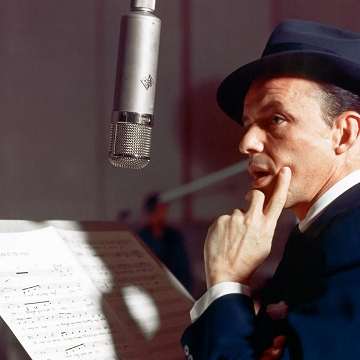
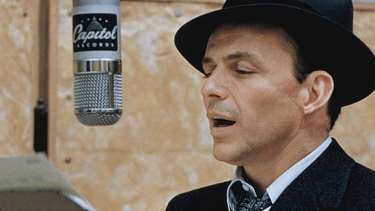
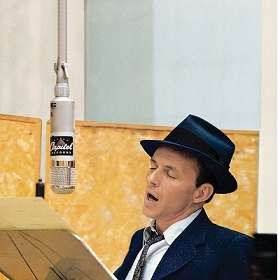
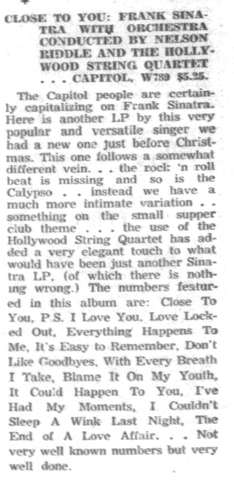
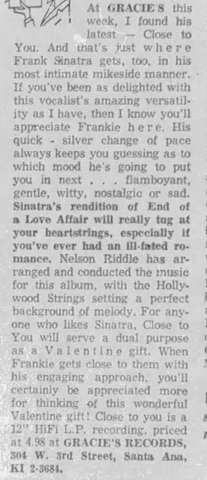
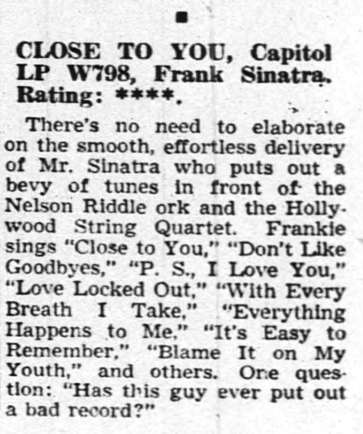
"Everything Happens to Me"
From start to finish, "Everything Happens to Me" features not hint one of Dorsey’s presence, or even the slightest indication that this is a big band record rather than what were then called "personality" records. It opens with sympathetically sighing brass and ominous baritone sax (somewhat tongue-in-cheek); here, Stordahl’s arrangement shows the influence of Oliver. Sinatra’s part encompasses a full verse ("black cats creep across my path") and chorus ("I make a date for golf") and a half, followed by a tag. ... Certainly the 1956 "Everything Happens to Me" is a more moving experience. Sinatra is now able to delineate the full ironic range of the text. Sinatra takes the Close to You album version considerably slower: the two readings are equally long, but the original still has time for an extra outchorus worth of lyrics ("I’ve never won a sweepstakes . . .").
Source: Will Friedwald, "Sinatra! The Song Is You: A Singer's Art" (2018 revised edition).
In a second round of marathon recording sessions with Nelson Riddle during an especially prolific year, Frank recorded 15 songs including 'It Could Happen to You' and 'Hey Jealous Lover'; he would record 63 songs total in 1956.
Source: Nancy Sinatra, Frank Sinatra: An American Legend, 1995.
[If It's the Last Thing I Do / Wait till You See Her -- critical commentary]
Sammy Cahn's 'If It's the Last Thing I Do' and Rodgers and Hart's 'Wait till You See Her' (called perhaps Close to You's best track) were cut from the original LP because the twelve chosen tracks already ran over 45 minutes; all three extra songs were restored on the 1987 CD edition.
This song/context matches multiple dated entries in the chronology; the specific date Friedwald is referring to could not be determined with confidence.
Source: Will Friedwald, "Sinatra! The Song Is You: A Singer's Art" (2018 revised edition), Ch. 6, "With Nelson Riddle" (1953-1979)
April 5, 1956
Studio
Capitol Studio A, Hollywood
E15278 The End Of A Love Affair
(Edward C. Redding) w/ The Hollywood String Quartet
Arranged & Conducted by Nelson Riddle
(4:09) CD: CDP 7-46572-2 Close To You and More
EP: EAP-1-789 (Close To You Part 1), EBF1-78 9(Close To You Part 1 & 2)
LP: W/DW-789 Close To You
E15296 It Could Happen To You
(James Van Heusen & Johnny Burke) w/ The Hollywood String Quartet
Arranged & Conducted by Nelson Riddle
(3:16) CD: CDP 7-46572-2 Close To You and More
EP: EAP-3-789 (Close To You Part 3), EBF2-789 (Close To You Part 3 & 4)
LP: W/DW-789 Close To You
E15314 There's A Flaw In My Flue w/ The Hollywood String Quartet
Arranged & Conducted by Nelson Riddle
2:43) CD: CDP 7-46572-2 Close To You and More
LP: SYS 5637 Sinatra Like Never Before - Longines Symphonette Society
E15360 With Every Breath I Take w/ The Hollywood String Quartet
Arranged & Conducted by Nelson Riddle
(3:41) CD: CDP 7-46572-2 Close To You and More
EP: EAP-2-789 (Close To You Part 2), EBF1-789 (Close To You Part 1 & 2)
LP: W/DW-789 Close To You
E15315 (How Little It Matters) How Little We Know
Take 12 (2:39)
(P. Springer/C. Leigh)
Tamir Music/Carwin Music Inc.. (ASCAP)
Arranged & Conducted by Nelson Riddle
CD: CDP 92160 The Capitol Collector's Series (with session material)
CD: CDP 94318 The Capitol Years
45: Capitol 5-3423
LP: W/DW-982 This Is Sinatra Volume 2
E15316 Wait For Me
(From the Movie "Johnny Concho") w/Chorus
(N. Riddle/D. Stanford)
Arranged & Conducted by Nelson Riddle
(2:51) CD: CDP 35953 Sinatra 80th All The Best
CD: CDP 38091 The Complete Capitol Singles Collection
45: Capitol 5-3469
LP: W-982 This Is Sinatra Volume 2
E15317 You're Sensational
Take 7
(Cole Porter)
Buxton Hill Music Corporation (ASCAP)
Arranged & Conducted by Nelson Riddle
(2:16) CD: C2-94777 The Capitol Years (Edited)
(2:16) 45: Capitol 5-3469 (Edited)
(3:54) CD: CDP 38091 The Complete Capitol Singles Collection (3:54) LP: SW-750 High Society (Soundtrack)
Musicians (Partial List) - Oboe: Warren Webb; Trumpet: Harry "Sweets" Edison; French Horn: Vince De Rosa; Violins: Paul Shure, Felix Slatkin, Gerald Vince; Viola: Alvin Dinkin; Cello: Eleanor Slatkin; Piano: Bill Miller; Bass: Sam R. Cheifetz; Guitar: Bob Bain; Drums: Alvin Stoller; Harp: Kathryn Julye
Session Producer: Voyle Gilmore
Ed Notes:
There were two sessions that day. Frank recorded the tunes for "Close To You" in the afternoon from 3 to 6:PM The musicians you list played on that session. He did the first four tunes you list.
The evening session featured a 32 piece orchestra and ran from 8 to 11:PM. Norma Zimmer was the background vocal on "Wait For Me."
A very interesting day of Sinatra recordings. The afternoon session began with one of his absolutely best ever saloon songs. "End Of A Love Affair" is exquisitely rendered. He did the song as part of the 62 pre-recordings for the 57-58 ABC TV series. "Frank was singing "It Could Happen To You" as early as 1944. But this is the only recording. "There's A Flaw In My Flue" was sung on the radio and TV, plus he did it in concert and, finally, unbelievably, a recording was done. Tis' a mystery. We have a radio version of "With Every Breath I Take" from a January 1950 Light Up Time. Sinatra's recording at Capitol is one of his most intimate interpretations of a love song. An astonishing example of the vocal control and phrasing he possessed in the mid-fifties. "How Little We Know" has a wonderfully complex Carolyn Leigh lyric. The great concept work overshadowed so many of the fine singles recordings Sinatra did at Capitol. "Wait For Me" is a hauntingly pretty song from a very bad movie. Frank was no cowboy. "You're Sensational" is another mystery. The recording done at MGM, 1-20-56, is outstanding. Frank did 13 takes and it can be heard on the "Sinatra in Hollywood" set. The recording done at Capitol ( 7 takes) is in no way superior. Adding insult to injury, the latter is a mono recording. So, when the S/T of "High Society" was issued, Capitol juiced up the Porter tune with their god-awful duophonic sound. But, all in all, a very memorable day of two Sinatra sessions in which a number of definitive recordings were made by the master storyteller.
Brian Chearno adds:
A year earlier (April 55) from the stage Sinatra described "Flaw" this way: "I've tried this a few times and while nobody went out and got drunk on it, it was good for a few yoks."
He obviously viewed it as a comedy piece. His quote alone, shoots down the silly reason people floated about the making of the Capitol recording years ago.
Ed O'Brien:
The "Flaw" sung on "Perfectly Frank" received the same type of introduction and even more scathing commentary after it was sung. The Capitol story was ridiculous.
Eleanor:
What was the Capitol story about it?
Ed O'Brien:
Claim was Frank recorded the song as a practical joke.. He wanted to see if they would put it on the "Close To You" album. They did, and he had to intervene at the last moment to stop it from being released. Alan Livingston told me it was never seriously considered to be a candidate for release. Really makes no sense. The album is Frank's great art work of all his concept efforts. Sinatra sang the song on both his radio and TV shows plus concert performances. It was a throwaway meant to amuse his audience
Frank's intro on P.F.
"Johnny Burke and Jimmy Van Heusen have written a list of hits as long as your arm and mine together. But what tunes do you think Jimmy bends your ear about?
A little list he calls his flop parade. He not only bent my ear the last time, he twisted my arm, too. So I'm booked to lead off your flop parade with a little pudding that mixes up like this ( sings 'A Flaw in My Flue'). 'The ushers will now pass among you with beakers of air-wick and restorative elixirs."
Audition for Perfectly Frank radio show on
NBC, 9-22-53.
Capitol Studio A, Hollywood
E15316 Wait For Me
(From the Movie "Johnny Concho") w/Chorus
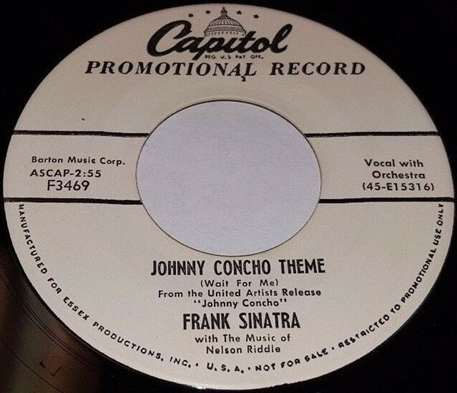
E15316 Wait For Me
(From the Movie "Johnny Concho") w/Chorus
(N. Riddle/D. Stanford)
Arranged & Conducted by Nelson Riddle
(2:51) CD: CDP 35953 Sinatra 80th All The Best
CD: CDP 38091 The Complete Capitol Singles Collection
45: Capitol 5-3469
LP: W-982 This Is Sinatra Volume 2
7-7-56
E15317 You're Sensational
Take 7
(Cole Porter)
Buxton Hill Music Corporation (ASCAP)
Arranged & Conducted by Nelson Riddle
(2:16) CD: C2-94777 The Capitol Years (Edited)
(2:16) 45: Capitol 5-3469 (Edited)
(3:54) CD: CDP 38091 The Complete Capitol Singles Collection (3:54) LP: SW-750 High Society (Soundtrack)
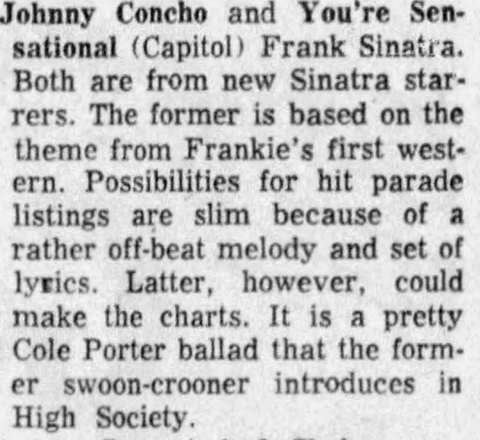
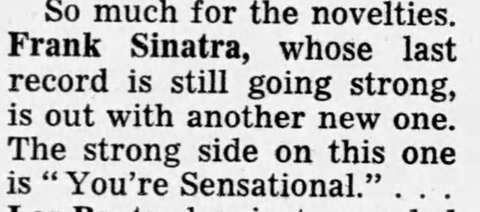
7-21-56
"There's a Flaw in My Flue"
As a prank aimed at Capitol executives he felt weren't paying attention to the music, Sinatra had Riddle score the joke song 'There's a Flaw in My Flue' (Van Heusen/Burke) with full seriousness and got producer Voyle Gilmore to slip it onto test pressings of Close to You sent to executives; no one noticed, and it nearly made the commercial release before Sinatra revealed the joke. It was officially released about fifteen years later.
Source: Charles L. Granata, "Sessions with Sinatra: Frank Sinatra and the Art of Recording" (1999/2003).
"With Every Breath I Take"
Granata includes 'With Every Breath I Take' among the fifty recordings he considers essential to understanding Sinatra's artistry (arranged by Nelson Riddle, recorded 1956, Capitol); the song was chosen for its musical/interpretive value rather than commercial popularity.
Source: Charles L. Granata, "Sessions with Sinatra: Frank Sinatra and the Art of Recording" (1999/2003).
[Close to You session including 'Flaw in My Flue']
Sinatra recorded more Close to You tracks including 'The End of a Love Affair,' 'It Could Happen to You,' 'With Every Breath I Take,' and a comic Burke-Van Heusen parody number, 'There's a Flaw in My Flue,' originally written for a wartime Bing Crosby radio broadcast; the song was ultimately shelved from the album at the last minute.
Source: James Kaplan, "Sinatra: The Chairman" (2015).
April 6, 1956
[Photograph: Capitol Tower opens. From Richard Havers, "Sinatra" (Dorling Kindersley, 2007), p.211.]
[Photograph: Capitol Tower opens. From Richard Havers, "Sinatra" (Dorling Kindersley, 2007), p.210.]
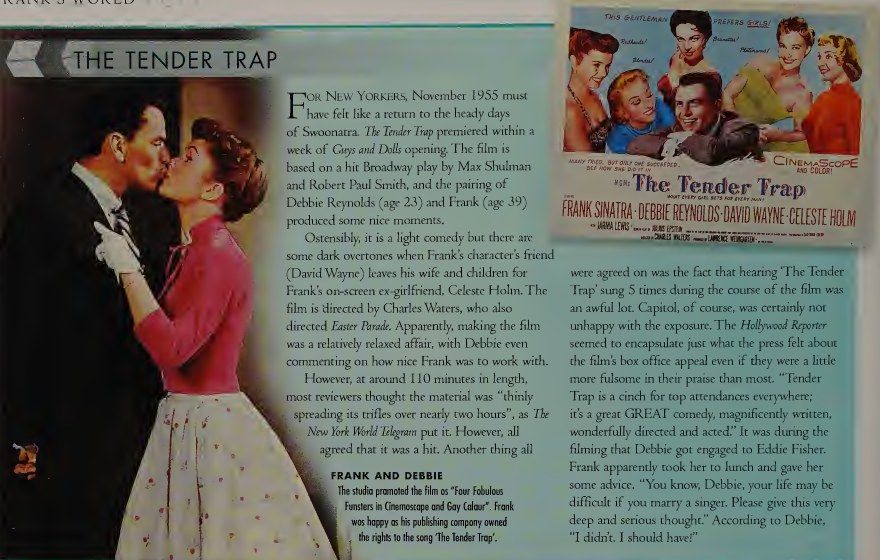
[Photograph: Capitol Tower opens. From Richard Havers, "Sinatra" (Dorling Kindersley, 2007), p.210.]
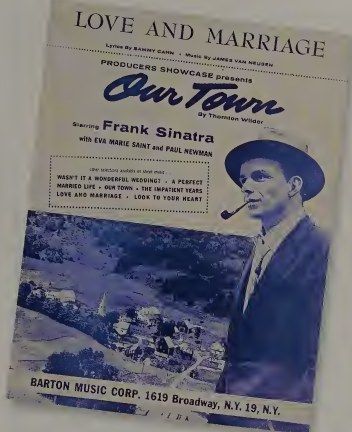
[Photograph: Capitol Tower opens. From Richard Havers, "Sinatra" (Dorling Kindersley, 2007), p.209.]
The 13-story Capitol Tower opened, becoming the world's first round office building; contrary to legend it wasn't designed to resemble a stack of records, though its rooftop light did flash "HOLLYWOOD" in Morse code. Its four echo chambers were designed by guitarist Les Paul, and it took Capitol roughly a year and $1 million to match the old KHJ studio's sound. (Source: Richard Havers, "Sinatra" (Dorling Kindersley, 2007).)
April 9, 1956
Studio
Capitol Studio A, Hollywood
E15331 Five Hundred Guys w/Chorus
(I. Kosloff/D. Cantor)
Arranged & Conducted by Nelson Riddle
(2:50) 45: Capitol 5-3423
LP: SYS 5637 - Longines Symphonette Society - Sinatra Like Never Before
CD: CDP 38091 The Complete Capitol Singles Collection
Capitol Studio A, Hollywood
E15332 Hey Jealous Lover Take 6 (2:21)
Hank Sanicola convinced Frank to record "Hey, Jealous
Lover." Sinatra did not hold out much hope for it. To his great and pleasant surprise, the song reached #3 on the Billboard chart, 10-
27-56. Ad above ran in the 11-10-56 Billboard.
Ed
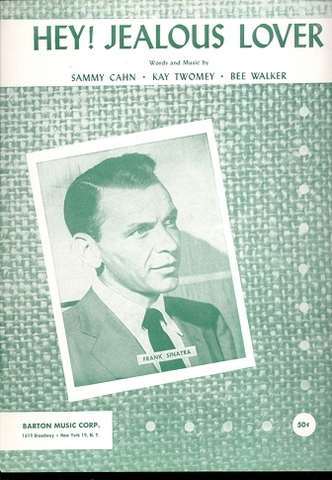
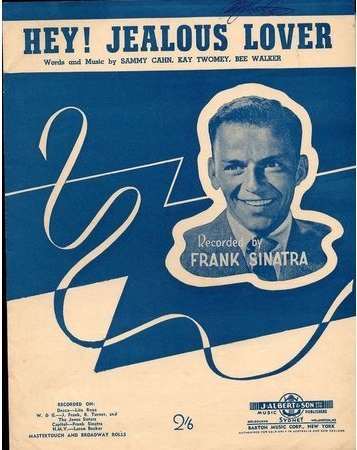
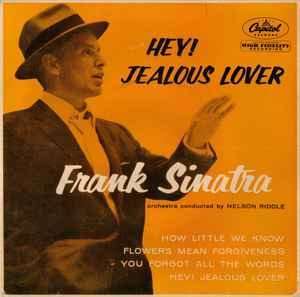
"A Swingin' Affair!"
Granata's discography entry: A Swingin' Affair!, arranged by Nelson Riddle, released May 1957.
Source: Charles L. Granata, "Sessions with Sinatra: Frank Sinatra and the Art of Recording" (1999/2003).
[Non-Close to You session at Capitol]
On a Monday night, Sinatra recorded with Riddle, a twenty-seven-piece orchestra, and a chorus: the blues number 'No One Ever Tells You,' the ballad 'Something Wonderful Happens in Summer,' and two R&B-flavored singles, 'Five Hundred Guys' (fourteen takes) and 'Hey! Jealous Lover.'
Source: James Kaplan, "Sinatra: The Chairman" (2015).
April 10, 1956
[Nat King Cole attacked onstage in Birmingham]
In Birmingham, Alabama's Municipal Auditorium, members of a group calling itself the North Alabama Citizens' Council (soon renamed Original Ku Klux Klan of the Confederacy) stormed the stage and attacked Nat King Cole while he performed 'Little Girl' before an all-white audience, apparently intending to kidnap him. Police subdued the attackers; Cole was examined by a doctor and performed a brief second show for an all-black audience.
Source: James Kaplan, "Sinatra: The Chairman" (2015).
[Sinatra consoles Nat King Cole]
As soon as Sinatra heard about the attack on Nat King Cole, he called Cole to console him and phoned Cole's wife to assure her Nat would be flown safely home to Chicago -- which happened the next morning via a diverted commercial flight.
Source: James Kaplan, "Sinatra: The Chairman" (2015).
April 14, 1956
[Sinatra visits Bowmont construction site]
On a cold, drizzly Saturday morning, Sinatra rose early and drove to the Bowmont Drive site to watch the foundation being laid, then drove to Columbia Pictures for a meeting with studio president Harry Cohn about his upcoming film Pal Joey.
Source: James Kaplan, "Sinatra: The Chairman" (2015).
[Pal Joey deal terms discussed with Cohn]
Sinatra: Sinatra's deal for Pal Joey, backed partly by his own Essex Productions, guaranteed him $150,000 plus 25 percent of net box-office receipts, a stark contrast to the roughly $8,000-$10,000 he'd earned for From Here to Eternity. At the Cohn meeting Sinatra resolved studio nervousness over billing among himself, Rita Hayworth, and Kim Novak by joking he didn't mind being 'in the middle of that sandwich': Hayworth/Sinatra/Novak.
Source: James Kaplan, "Sinatra: The Chairman" (2015).
[Dinner with Nancy Sr. and the children]
George Jacobs: That night, Sinatra had his near-weekly dinner with ex-wife Nancy Barbato Sinatra and their children -- almost-sixteen-year-old Nancy Sandra, twelve-year-old Frank Jr., and seven-year-old Tina -- at 320 North Carolwood. Valet George Jacobs described these visits as touchingly awkward 'special events,' with Frank affectionate but always leaving the kids' longing unresolved; Sinatra called his children every day at 6:00 p.m. before their dinner.
Source: James Kaplan, "Sinatra: The Chairman" (2015).
[Hedda Hopper interview before Spain trip]
Sinatra / Hedda Hopper: After the family dinner, Sinatra stopped by Hedda Hopper's house for a last-minute interview ahead of his departure for Spain in three days to shoot The Pride and the Passion. They discussed his new house and the Columbia meeting, and he repeated his sandwich joke about Hayworth and Novak. Asked whether he'd see Ava Gardner in Spain, Sinatra said if he did it would be brief and public, and that reconciliation would require a complete change he didn't think possible.
Source: James Kaplan, "Sinatra: The Chairman" (2015).
April 17, 1956
Sinatra flew to Spain with actress Peggy Connelly to begin filming The Pride and the Passion, cast as a Spanish cobbler's son turned Napoleonic War hero. He stayed at Madrid's Castellana Hotel throughout, driving long distances to reach over twenty filming locations, and saw Ava Gardner while there, though their relationship remained effectively over. (Source: Richard Havers, "Sinatra" (Dorling Kindersley, 2007).)
April 18, 1956
[Sinatra arrives in Madrid]
Sinatra, Jimmy Van Heusen, and Peggy Connelly arrived in Madrid on the same day as Grace Kelly's wedding to Prince Rainier in Monaco. Though invited to the royal wedding, Sinatra avoided it because he knew Ava Gardner would attend.
Source: James Kaplan, "Sinatra: The Chairman" (2015).
April 22, 1956
[Parsons column on Sinatra's Spain dread]
Louella Parsons: Louella Parsons's column, headlined "Sinatra Dreads Trip to Spain for Film," reported that Sinatra had cabled Stanley Kramer trying to get out of The Pride and the Passion, speculating that his reluctance stemmed from dreading a confrontation with Ava Gardner, who was then living in Spain.
Source: James Kaplan, "Sinatra: The Chairman" (2015).
[Pride and the Passion shooting begins]
Filming on The Pride and the Passion began in El Escorial, a hilly region thirty miles from Madrid, after Sinatra had a minor dispute with Kramer's staff over installing a hi-fi system in his hotel suite (it was installed).
Source: James Kaplan, "Sinatra: The Chairman" (2015).
May 5, 1956
["Heartbreak Hotel" hits number 1]
While Sinatra was in Spain, Elvis Presley's "Heartbreak Hotel" hit number 1 on the Billboard chart, displacing Les Baxter's "The Poor People of Paris." The record, recorded in an echoey Nashville hallway, had already become a sensation, reaching British teenagers like John Lennon, George Harrison, and Keith Richards via Radio Luxembourg.
Source: James Kaplan, "Sinatra: The Chairman" (2015).
May 12, 1956
The Esca Club of the Bronx honored Sinatra with its 1956 award at a dinner-dance held at the Hotel Commodore.
Source: George Carpozi Jr., Frank Sinatra: Is This Man Mafia? (New York: Manor Books, 1979).
May 30, 1956
[Kilgallen notes Sinatra's treatment of Connelly]
Dorothy Kilgallen: Dorothy Kilgallen's column reported that after being sent away from Spain, Peggy Connelly was treated by Sinatra to stays in Paris and London, then installed at the Waldorf-Astoria in New York with tickets to top Broadway shows.
Source: James Kaplan, "Sinatra: The Chairman" (2015).
July 1956
[Christmas album session at Capitol Towers]
Consiglio: In July of 1956 or 1957, Consiglio went with Frank and daughter Nancy to Capitol Records' round Capitol Towers building in Hollywood, where Frank recorded Christmas songs including 'White Christmas' and 'Silent Night' in the middle of summer so the album (A Jolly Christmas from Frank Sinatra) could be pressed in time for the holidays.
Source: Tony Consiglio (as told to Franz Douskey), "Sinatra and Me: The Very Good Years" (2012)
July 1, 1956
[Sinatra tells Kramer he's leaving Spain early]
Frank Sinatra: Sinatra informed Stanley Kramer he would leave Spain on July 25, three weeks short of his contracted sixteen weeks, declaring "Hot or cold, Thursday I'm leaving." Kramer insisted he stay until August 1; after a barrage of transatlantic cables between lawyers and agents, no agreement was reached.
Source: James Kaplan, "Sinatra: The Chairman" (2015).
July 11, 1956
Film
"Johnny Concho" (USA Release: July 11, 1956)
Starring: Frank Sinatra, Keenan Wynn, William Conrad, Phyllis Kirk
Produced by: Henry W. Sanicola
Directed by: Don McGuire
The mean and boastful Johnny Concho (Sinatra) is also a coward, but the people of Cripple Creek, Arizona, let him have his way. They know that Johnny's brother, who doesn't live in town, is the notorious gunfighter Red Concho, someone they truly fear. When 2 desperadoes take a town hostage, former bad boy Johnny Concho must find the courage to save it. --DVD Release: There have been no DVD or Blu-Ray releases of Johnny Concho
"Johnny Concho" (USA Release: July 11, 1956)
Starring: Frank Sinatra, Keenan Wynn, William Conrad, Phyllis Kirk
Produced by: Henry W. Sanicola
Directed by: Don McGuire
Variety
7-11-56 note: "Johnny Concho" had a limited release on 7-11-56. Variety predicted, based on the initial b.o. in Detroit, Chicago, Kansas City, Hartford and St. Paul, a decent hit for Sinatra. But it was not to be. Word of mouth quickly ended any hope of a successful run. But everything is relative, as we know. "Concho" pulled in $1.9 million over the summer. Variety also reviewed in the same issue "The Iron Petticoat" with Bob Hope and Katherine Hepburn It was claimed for years that the film was never released. It barely escaped, but there was a very limited release. Hope was a huge b.o star at the time, but nothing could save this doozy. "Johnny Concho" would not open in N.Y.C until 8-15-56. Frank joined The Dorsey Brothers on stage at the Paramount with the movie as the screen fare.
Release Date:
1 July 1956
Production Date: began 28 Nov 1955 at California Studios
Johnny Concho marked Frank Sinatra's first film as a producer, the first and only film made by his own company, Kent Productions, Inc., and his first Western. The film's pressbook reports that, one week prior to production, Phyllis Kirk replaced Gloria Vanderbilt in the role of "Mary Dark." Although a 6 Dec 1955 HR news item includes Juney Ellis in the cast, her appearance in the completed film has not been confirmed. In Jun 1960, DV reported that Jack Broder's Realart Productions had sold the rights to David P. Harmon's original story to Sinatra's company and was suing to obtain a share of the profits. Broder alleged that he was owed between $20,000 to $60,000 for the film, which had been theatrically re-released in 1960. The disposition of the suit has not been determined. note: "Johnny Concho" opened in Toronto two weeks before the America release on 7/11. It played at four theatres in the city: Colony, Danforth, Fairlawn and Odeon. Variety called the first week gross of $23,000 "lofty." The second week wasn't far from lofty, taking in $22,000. Variety explained that Canada's Dominion Day fell on a Sunday (7/1) and the theatres ran a third showing late at night. The take both weeks was greater than the initial weeks in the U.S. I don't know if other Canadian cities such as Montreal, Ottawa, Vancouver also had showings. Here are some additional articles:
I went looking and found that Johnny Concho was actually playing in England in April 1956. Here’s a review from the Evening Standard
London, England, Apr 26, 1956.
For Canada:
June 29th, 1956 Vancouver, Edmonton, Toronto
July 6th, 1956 Calgary
I did some research and found out a few things of interest.
Previews of the film had very poor audience feedback. It was decided to pyramid the film in the hopes of generating some excitement. A few of the ads I posted last week went in that direction. Frank agreed to bring the film into N.Y.C. after it had been released around the country in July. Here are the b.o. results after Frank's onstage appearances with Dorsey. Take a look at the gross "High Society" pulled at RCMH in its first two weeks.
--ED
Variety
8-22-56
Film was finishing its third and final week in L.A. Gross was $7,300. Ouch ! Second week at the Paramount in N.Y., sans Frank, film took in a mild $29,000. Theatre had option for third week. They passed and brought in "Ambassador's Daughter."
I wish there was a way of verifying any additional Canadian cities in late June- early July. Toronto was certainly a success. Variety only reported on that one city in Canada.
I was thinking about the four westerns Frank made in his career. What a wash- out they all were. What a waste of time and waste of his great talent. "Johnny Concho" has never been issued in video form. And I doubt it ever will be. Ed
July 11, 1976, Frank Sinatra marries Barbara Marx
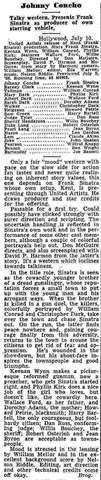
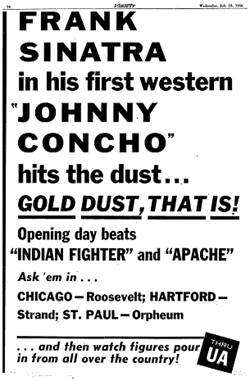
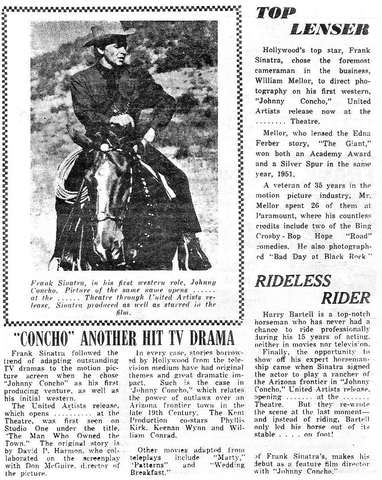
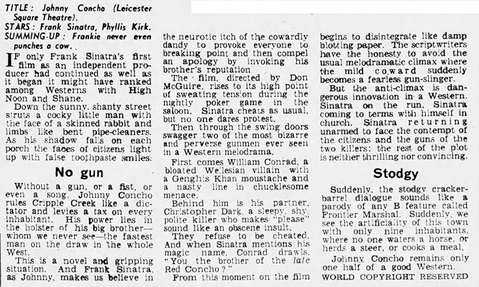
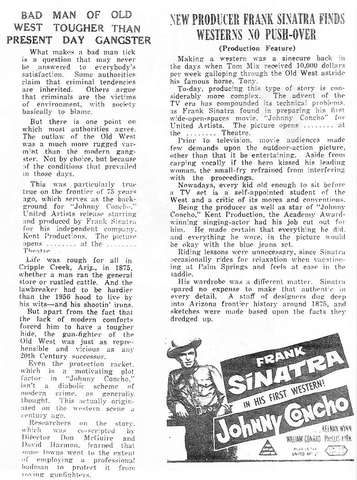
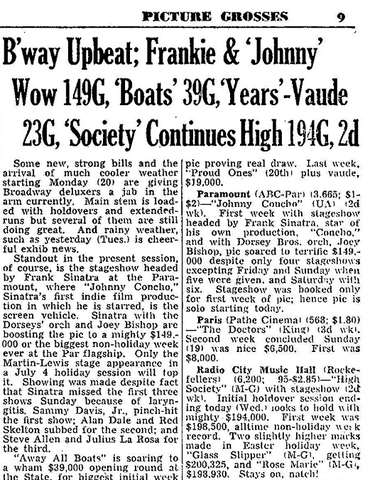
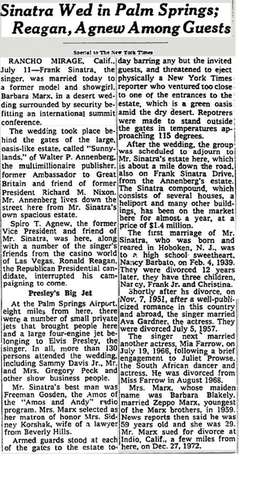
"Johnny Concho"
Johnny Concho, a low-key 1956 United Artists Western, was the first film produced by Sinatra's own production company, Kent Productions. It opened in the UK before the US and made little impact with critics or audiences, but Santopietro finds it an interesting, underrated entry that shows the range of projects Sinatra was willing to try once he had creative control.
Source: Tom Santopietro, "Sinatra in Hollywood" (2008).
"Johnny Concho"
Johnny Concho was written by David Harmon and Sinatra's friend Don McGuire (who also wrote Meet Danny Wilson), scored by Nelson Riddle, associate produced by Sinatra aide Hank Sanicola, and directed by McGuire. As producer, Sinatra had final creative control for the first time in his career.
Source: Tom Santopietro, "Sinatra in Hollywood" (2008).
"Johnny Concho"
Santopietro notes Johnny Concho was the second of Sinatra's five Western films (following The Kissing Bandit and preceding Sergeants 3, 4 for Texas, and Dirty Dingus Magee), and that all five were poorly received -- his conclusion being that Sinatra simply didn't work well in Western settings.
Source: Tom Santopietro, "Sinatra in Hollywood" (2008).
"Johnny Concho"
Santopietro argues Sinatra was drawn to Westerns from childhood and, knowing he didn't fit the physical mold of the traditional Western hero, used his 'sense of otherness' to invert the genre: Johnny Concho is a cowardly, skinny 'runt' who hides behind his brother's fearsome reputation, a striking risk for a star of Sinatra's stature even though the film never fully pays off.
Source: Tom Santopietro, "Sinatra in Hollywood" (2008).
"Johnny Concho"
Johnny Concho, based on the story 'The Man Who Owned the Town' by David P. Harmon, is a black-and-white Western set in Arizona territory. Its production is extremely bare-bones -- so sparse it looks more like a 1950s 'golden age' TV drama than a feature film, reminiscent of the stylized sets of Our Town. This isn't surprising since the story originated as an episode of the TV anthology series Studio One.
Source: Tom Santopietro, "Sinatra in Hollywood" (2008).
"Johnny Concho"
Phyllis Kirk played love interest Mary Dark, but the role was reportedly first cast with Gloria Vanderbilt, then Sinatra's girlfriend, who was let go quickly once her lack of acting experience became apparent.
Source: Tom Santopietro, "Sinatra in Hollywood" (2008).
"Johnny Concho"
Nelson Riddle composed the score for Johnny Concho and would go on to score several more Sinatra films (Ocean's Eleven, Robin and the 7 Hoods), but Santopietro argues Riddle was a competent, rarely inspired film composer whose true genius lay in arranging for Sinatra's voice rather than in original scoring.
Source: Tom Santopietro, "Sinatra in Hollywood" (2008).
"Johnny Concho"
New York Times (quoted by Santopietro): The film premiered at New York's Paramount Theater with a singing appearance reuniting Sinatra with the combined Dorsey brothers' bands, but this could not meaningfully boost box office. The New York Times panned it, suggesting 'Mr. Sinatra, the actor, might mention to the producer, who happens to be Mr. Sinatra, that he needs better writing and direction than he gets here.'
Source: Tom Santopietro, "Sinatra in Hollywood" (2008).
"Johnny Concho"
Johnny Concho was Sinatra's maiden venture as a film producer, and despite Sinatra riding high on the record charts at the time (Songs for Swingin' Lovers and This Is Sinatra both top-ten LPs), the film's box-office flop still stung.
Source: Tom Santopietro, "Sinatra in Hollywood" (2008).
"Johnny Concho"
Santopietro grades this a C, calling it an interesting Western misfire.
Source: Tom Santopietro, "Sinatra in Hollywood" (2008).
"Johnny Concho"
Santopietro (Filmography): Kent Productions/United Artists. Produced by Frank Sinatra himself, directed by Don McGuire, screenplay by McGuire and David P. Harmon, original score by Nelson Riddle, titles by Saul Bass. Sinatra starred as the title character opposite Keenan Wynn, William Conrad and Phyllis Kirk.
Source: Tom Santopietro, "Sinatra in Hollywood" (2008).
July 15, 1956
"A Hole In The Head" (USA Release: July 15,
1959)
Starring: Frank Sinatra, Edward G. Robinson, Eleanor Parker,
Keenan Wynn, Carolyn Jones, Thelma Ritter, Dub Taylor, Ruby Dandridge, Joi Lansing, Eddie Hodges
Produced & Directed by: Frank Capra
Alternate Title:
All My Tomorrows
Release Date:
July 1959
Premiere Information:
New York and Los Angeles openings: 14 Jul 1959
Production Date: 10 Nov 1958--early Jan 1959 at Samuel Goldwyn
Studios
The film's working title was All My Tomorrows. According to various contemporary news items, the play went through a number of transformations before opening on Broadway: Arthur Schulman first wrote it in a playwriting course as a one-act piece entitled "The Dragon's Head" in the late 1940s, and later expanded it to a full-length play entitled My Fiddle Has Three Strings, which was tried out in Westport, CT in 1949. He then wrote a new version, which was never produced, and rewrote it as a television play which ran on Playwright's '56.
When Garson Kanin expressed an interest in producing the play, Schulman revised it again, and it opened on Broadway as A Hole in the Head in Feb 1957, starring Paul Douglas. After a preview of the film, Schulman wrote a novelization of the story, which, he said, contained material not found in any previous version. According to news items and information in the press book on the film, Frank
Sinatra saw the play on Broadway and in 1957 paid a reported $200,000 to the author for the screen rights. Sinatra hired Schulman to write the screenplay, then contacted
Frank
Capra, who agreed to direct.
According to Capra's autobiography, with a handshake, Sinatra and Capra formed SinCap Productions in which he held one-third interest, while Sinatra retained two-thirds. Because of Sinatra's previous commitments, production was not scheduled until late
1958. According to his autobiography, Capra, in the meantime, planned to make a film for Columbia Pictures, but when Columbia president Harry Cohn died, the project was cancelled. As noted in several reviews, A Hole in the Head was Capra's first feature film since his 1951 Paramount release Here Comes the Groom (see entry).
According to news items and the film's press book, after having seen
Eddie
Hodges on the television quiz show Name That Tune, Capra introduced the young actor, who was then appearing in The Music Man on Broadway, to Sinatra, and they agreed to hire him. A Hole in the Head marked Hodges' feature-film debut.
Connie
Sawyer, in her screen debut, reprised her role as "Miss Wexler" from the Broadway production. The character of "Jerry Marks" was newly created for the film. As noted in some reviews, the principal characters, who were Jewish in the play, had been changed to Italian Americans in the film. The LAT reviewer commented that the change seemed to be "more of a loss than a gain. As it is,
Edward
G. Robinson, called Mario Manetta... makes little effort to disguise the ethnically Jewish humor of the character originally known as Max."
Much of the filming was done in locations at Miami Beach, including the Fontainebleau Hotel, West Flagler Dog Track, the Cardozo Hotel, which doubled for the fictional "Garden of Eden" hotel, and the South Beach oceanfront area.
The company also had one day of shooting at Hollywood Beach near Oxnard, CA. Interiors were shot at the
Samuel Goldwyn Studios, and after most of the crew returned to California from Florida, a second unit remained in Miami Beach to shoot the opening credit sequence, which has the cast names preceding the title, as well as the title, in letters connected to 300 feet of netting pulled by the Goodyear blimp.
According to the film's press book, director of photography William Daniels used the new high-speed Panatar lens developed by Panavision for color photography, which allowed outdoor night scenes to be shot with one-tenth the lighting that was normally required. According to a news item in Var, shooting in Miami occasioned two lawsuits against the producing company, and filming, which was supposed to take three to four weeks in Miami Beach, was stopped after an aborted two weeks. HCN notes that the party scene at the Fontainebleau Hotel included water skiers from Cypress Gardens, two orchestras, wild birds and "some 85 beauties, most of them hired locally."
The film contains a gag Capra used in The Strong Man, starring Harry Langdon, which he directed in 1927 (see AFI Catalog of Feature Films, 1921-30). In both films, the protagonist carries a woman up a flight of stairs while walking backward and without realizing it continues climbing up the steps of a ladder before falling. The song "High Hopes" won the Academy Award for Best Song. On 10 Jun 1959, just prior to the release of A Hole in the Head, Capra appeared as the honoree on Ralph Edwards' popular television biography program This Is Your Life.
According to Capra's autobiography, problems on the set occurred because he found that Sinatra's acting suffered from repeated rehearsals, while Robinson needed them. Although at first Robinson resented Capra's insistence that they film without rehearsals, Robinson soon accepted the situation and gave a performance which DV called "the comedy stand-out of the film."
Although in the late 1950s the South
Beach area of Miami, where the film was set, was overshadowed by the more glamorous areas surrounding large hotels like the Fontainebleau, beginning in the mid-1980s the South Beach was revitalized. The 1939, art deco Cardozo Hotel, which appeared as the Garden of Eden in the picture, was completely renovated and subsequently reopened as a small, luxury hotel, in keeping with the now trendy South Beach neighborhood in which it is located. The "Florida Disneyland" that "Tony
Manetta" dreams of building in the film, eventually became Disney World, which opened near Orlando, FL in Oct 1971.
Italian Poster
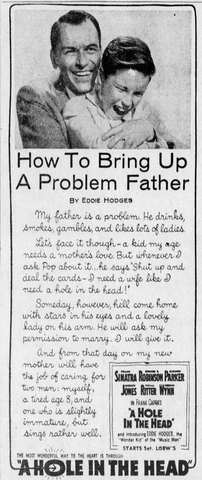
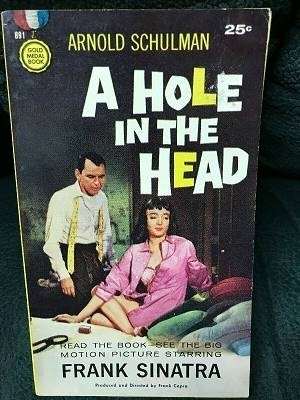
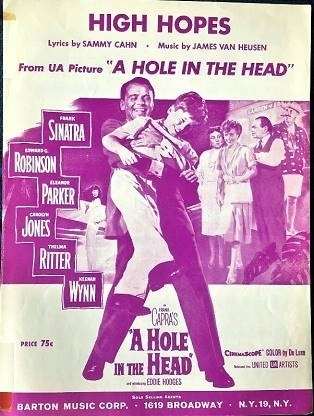
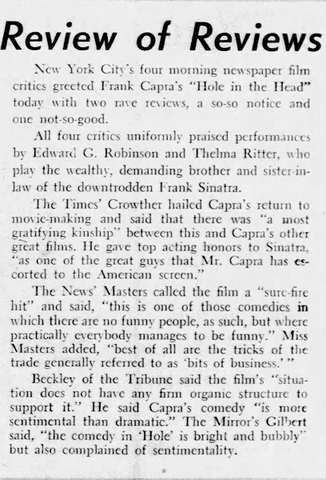
July 17, 1956
Film
"High Society" (USA Release: July 17,
1956)
Starring: Bing Crosby, Grace Kelly, Frank Sinatra, Celeste
Holm, John Lund, Louis Calhern, Louis Armstrong and his Band
Produced by: Sol C. Siegel
Directed by: Charles Walters
C.K. Dexter-Haven (Crosby), a successful popular jazz musician, lives in a mansion near his ex-wife's Tracy Lord's (Kelly) family estate. She is on the verge of marrying a man (Lund) blander and safer than Dex, who tries to win Tracy's heart again. Mike Connor, (Sinatra) an undercover tabloid reporter, also falls for Tracy while covering the nuptials for Spy magazine. Tracy must choose between the three men .
(Remake of "The Philadelphia Story")
--DVD Release: 2003-04-22 Blu-Ray Release
2025-06-24
"High Society" (USA Release: July 17,
1956)
Starring: Bing Crosby, Grace Kelly, Frank Sinatra, Celeste
Holm, John Lund, Louis Calhern, Louis Armstrong and his Band
Louis Armstrong delivers an impromptu concert on the set of High Society [1956] with Grace Kelly and Bing Crosby among the admirers.
#Jazz
Grace Kelly and Frank Sinatra behind the scenes of High Society, 1956
Note: Another complicated release schedule: MGM was most impressed by the success of the
sneak preview concept behind the promotion of "Somebody Up There Likes Me." They decided to
schedule numerous sneak peeks of "High Society, starting on 7/11-56.Variety caught it in N.Y.C. that
day and did their review( a rave ). The following week it was shown in 48 theaters throughout the country.
The Pantages, in L.A. opened with the first extended run on 8/1. Film earned $36,000 the first week.
Radio City Music Hall, in N.Y.C., had the east coast premiere on 8/9. The b.o. at RCMH shocked the
execs at MGM, earning $200,000 the first week. At the time it was a record for a non-holiday release.
Film also opened in eight other major cities on the 9th of August. The final tally for the year was
$8, 200,000. MGM's biggest grosser that year and the fourth highest moneymaker of 1956. MGM spent
$2.7 million on the production. Frank received a quarter of a million for his efforts.
Filming got under way the week of the 15th in January 56, It was a wrap on 3-6. The majority
of the work was done at MGM, but there was a segment done at the Clarendon Court in Newport, Rhode
Island. Bing Crosby was 53 at the time, Sinatra 40 and Grace Kelly 26. Sinatra was thrilled to be making
a film with his idol and it would be Kelly's last film before becoming a real princess. Louis Armstrong
would open and close the film with his great jazz group and Celeste Holm, John Lund, Sidney Blackmer
and Louis Calhern would round out the main players. The latter would pass away a few months after
completing his role in the movie.
Cole Porter's score included a song done for the three stars ( "Let's Vocalize) and a duet for
Messrs Sinatra & Crosby ( "So What"). They were rehearsed but not recorded. The sensational duet they
did, "Well Did You Evah," was originally written in 1939 for "DuBarry Was A Lady." Porter did a quick re-
write for "High Society." The session was done on 1-17-56 at MGM. Sinatra was late for the noon studio
work. Crosby, who was always very punctual, was leaving when Frank finally arrived. Seems Frank had
gone out partying the previous night to celebrate his new album, completed that evening. He promised
to get an acetate to der Bingle within days. Album was titled "Songs For Swingin' Lovers." I'll just bet
Mr. Crosby was thrilled. Session with a 50 piece went smoothly. There was a rehearsal and five takes.
Bing and Grace recorded "True Love" and it became a smash hit for Capitol Records. It would be Bing's
last # 1 hit and would sell over a million records. Crosby always insisted "High Society" was the personal
favorite of all his screen appearances.
Critics gave "High Society" mixed reviews. Some felt it did not come close to the original.
film "The Philadelphia Story" and many were not comfortable with the age gap between Crosby and
Kelly. Sinatra received excellent reviews. He would be a major figure in three of the top 20 grossing
films of the year and that would make him one the Top 10 Box Office Stars.
Back in 1991, I contacted Scott Perry, MGM archivist, and asked for help with my Sinatra
research. Scott gave me all of the MGM worksheets for Frank's films at that studio (All the information
I offer on takes, personnel and dates comes from those sheets). At the time we were in touch, Scott
was working on a digital remaster of "High Society." He wasn't sure it could be done. The nitrate
film, which was inherently unstable, had badly decomposed. Scott was very nervous. MGM wanted
to issue a wide screen laser disc version. Scott promised to call me after the process was completed.
Well, the nitrate fell apart as they fed it through the machine, for what turned out to be a one-shot
attempt. They got it and discarded the original master film. Scott also did a digital remix of the
stereophonic recordings, which were also in terrible condition. Film has also been issued on a
VHS tape and a DVD. And, of course, there is the Capitol soundtrack album issued in stereo.. I
understand the CD is a rare item today.
Finally, "High Society" was nominated for Best Score and Best Original song ( 'True
Love."). The Academy also gave it a Best Picture nod and Best Writing. The picture nod was
quickly withdrawn when the Academy learned the film was not eligible because the rule at the
time disqualified a remake. The writing nomination presented a bigger problem. The writers,
Elwood Ullman and Edward Bernds, had written a screenplay for "High Society." Unfortunately,
it was a Bowery Boy film with the same title. The writers graciously wrote to the Academy, asking
that their names be removed from consideration.
--Ed
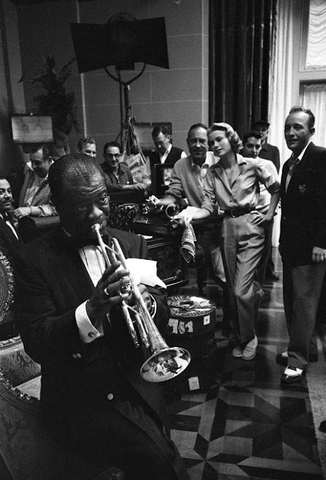
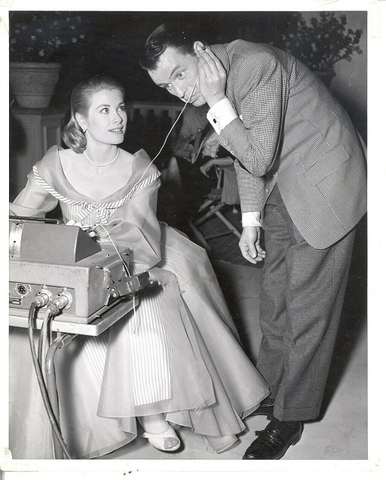
"High Society"
The chapter uses the Sinatra/Bing Crosby duet "Well, Did You Evah!" from High Society as an epigraph, and later contrasts the two men's on-screen singing styles in that same film: Crosby sings "True Love" to Grace Kelly almost self-containedly, barely acknowledging her, while Sinatra's "You're Sensational" is delivered as a direct, erotically charged personal address to Kelly -- illustrating Sinatra's need to connect intimately with his scene partner and audience versus Crosby's more self-sufficient style.
Source: Tom Santopietro, "Sinatra in Hollywood" (2008).
"High Society"
For High Society, an all-star MGM musical remake of The Philadelphia Story, Sinatra was billed third alphabetically after Bing Crosby and Grace Kelly and received a fee of $230,000, playing the James Stewart role of reporter Mike Connor opposite Crosby (in the Cary Grant role) and Kelly (in the Katharine Hepburn role).
Source: Tom Santopietro, "Sinatra in Hollywood" (2008).
"High Society"
Grace Kelly's upcoming real-life wedding to Prince Rainier of Monaco caused production on High Society to be sped up, and the film marked her premature retirement from acting.
Source: Tom Santopietro, "Sinatra in Hollywood" (2008).
"High Society"
On set, the relaxed Bing Crosby was nicknamed 'Nembutal' while the more manic Sinatra was nicknamed 'Dexedrine' -- a shorthand for their contrasting temperaments.
Source: Tom Santopietro, "Sinatra in Hollywood" (2008).
"High Society"
The 'Well, Did You Evah!' number (a Cole Porter song originally from the 1939 Broadway musical Du Barry Was a Lady) became one of the most fondly remembered Sinatra/Crosby moments on film, staged by Charles Walters and arranged by Nelson Riddle and Conrad Salinger, with Sinatra and Crosby trading ad-libbed lines ('Don't dig that kind of crooning, chum' / 'You must be one of the newer fellows').
Source: Tom Santopietro, "Sinatra in Hollywood" (2008).
"High Society"
Jeanine Basinger: Film historian Jeanine Basinger, in The Star Machine, detailed how demanding the seemingly effortless 'Well, Did You Evah!' number actually was: Sinatra and Crosby had to sing, dance, hit camera marks, deliver Porter's sophisticated lyrics, stay in character, act slightly drunk, keep time with the playback orchestra, and navigate a tightly choreographed set that had to look improvised -- all while playing onscreen rivals.
Source: Tom Santopietro, "Sinatra in Hollywood" (2008).
"High Society"
Cole Porter's ballad 'True Love,' sung by Bing Crosby to Grace Kelly in the film, won the Academy Award for Best Song.
Source: Tom Santopietro, "Sinatra in Hollywood" (2008).
"High Society"
High Society received a mixed critical reception but was popular with audiences, becoming Sinatra's sixth hit out of his last seven films (Johnny Concho being the only box-office failure). It helped Sinatra reclaim a spot among the top ten moneymaking stars of the year in the Motion Picture Herald poll.
Source: Tom Santopietro, "Sinatra in Hollywood" (2008).
"High Society"
Santopietro grades this a B, calling it breezy fun with a great Frank.
Source: Tom Santopietro, "Sinatra in Hollywood" (2008).
"High Society"
Santopietro (Filmography): Metro-Goldwyn-Mayer. Produced by Sol C. Siegel, directed by Charles Walters, screenplay by John Patrick based on 'The Philadelphia Story,' songs by Cole Porter, orchestrations by Nelson Riddle and Conrad Salinger. Sinatra played Mike Connor opposite Bing Crosby, Grace Kelly and Louis Armstrong, singing 'You're Sensational,' 'Well, Did You Evah!' and 'Mind If I Make Love to You?'
Source: Tom Santopietro, "Sinatra in Hollywood" (2008).
July 21, 1956

July 28, 1956
[Sinatra departs Spain, defying producers]
Sinatra left Spain on July 28, daring Stanley Kramer and United Artists to suspend him. With so much footage already shot, the studio couldn't retaliate; his remaining scenes were later shot at Universal Studios in Hollywood using fake backdrops ("potted palms," as Kramer put it).
Source: James Kaplan, "Sinatra: The Chairman" (2015).
July 30, 1956
Frank conducted his first album for Capitol, Tone Poems in Color, commissioning eight composers including Nelson Riddle, Billy May, and Gordon Jenkins to each write a piece based on a color.
Source: Nancy Sinatra, Frank Sinatra: An American Legend, 1995.
July 31, 1956
From Rome, Ava Gardner announced she had signed the papers finalizing her divorce from Sinatra, the same day he returned to the United States after a visit with her in Spain. Source: Derek Jewell, Frank Sinatra: A Celebration (New York: Applause Books, 1999).
August 1956
[Crowther reviews Johnny Concho and Paramount show]
Bosley Crowther: New York Times critic Bosley Crowther panned Johnny Concho but reported that Sinatra's in-person Paramount appearance drew a capacity, enthusiastic crowd reminiscent of his 1940s bobby-soxer heyday, with fans lined up down the block and placards reading "We Love Frankie" and "Sinatra for President."
Source: James Kaplan, "Sinatra: The Chairman" (2015)
[Riddle and Dorsey's emotional reunion]
Jane Dorsey: Staying at Dorsey's New Jersey house before the Paramount gig, Nelson Riddle told Dorsey's wife Jane that Tommy had taught him everything he knew about arranging. At dinner the next night, when Riddle repeated this to Tommy directly, Dorsey began to cry and Riddle embraced him; Dorsey then begged Riddle to make sure Sinatra wouldn't embarrass him in front of his musicians.
Source: James Kaplan, "Sinatra: The Chairman" (2015)
[Sinatra booked for Democratic convention]
Kaplan: A newspaper item in early August reported that Sinatra had been booked to sing the Democratic Party's 1956 campaign song at the Democratic National Convention. He was in fact chosen to sing "The Democratic March" and open the event with "The Star-Spangled Banner" at the International Amphitheatre in Chicago in mid-August.
Source: James Kaplan, "Sinatra: The Chairman" (2015)
[Sinatra develops laryngitis at Paramount]
George Evans: Three nights into the Paramount run, doing four shows a day with twenty-four songs each, Sinatra came down with laryngitis. His former publicist George Evans had once observed that emotional tension always attacked Sinatra's throat: "Germs were never the cause unless there are guilt germs." Kaplan speculates the trigger was either lingering guilt over Ava or worry about the terminally ill Humphrey Bogart.
Source: James Kaplan, "Sinatra: The Chairman" (2015)
[Sinatra plays Paramount with Dorsey band]
Kaplan: After the convention, Sinatra went to New York for a weeklong stand at the Paramount Theatre with the Tommy and Jimmy Dorsey Orchestra — his first engagement with Tommy Dorsey since leaving the band fourteen years earlier, this time with Sinatra as the boss. Screenings of Johnny Concho played between his sets.
Source: James Kaplan, "Sinatra: The Chairman" (2015)
[Tommy Dorsey's mixed pride over Riddle]
Tino Barzie: When Tommy Dorsey learned his former trombonist Nelson Riddle would join Sinatra in New York to supervise arrangements, he bristled, telling manager Tino Barzie, "I conduct the orchestra. It's my orchestra." Yet Barzie recalled Dorsey proudly listening to Sinatra-Riddle hits like "You Make Me Feel So Young" on his car radio, calling Sinatra "the greatest singer ever."
Source: James Kaplan, "Sinatra: The Chairman" (2015)
August 1, 1956
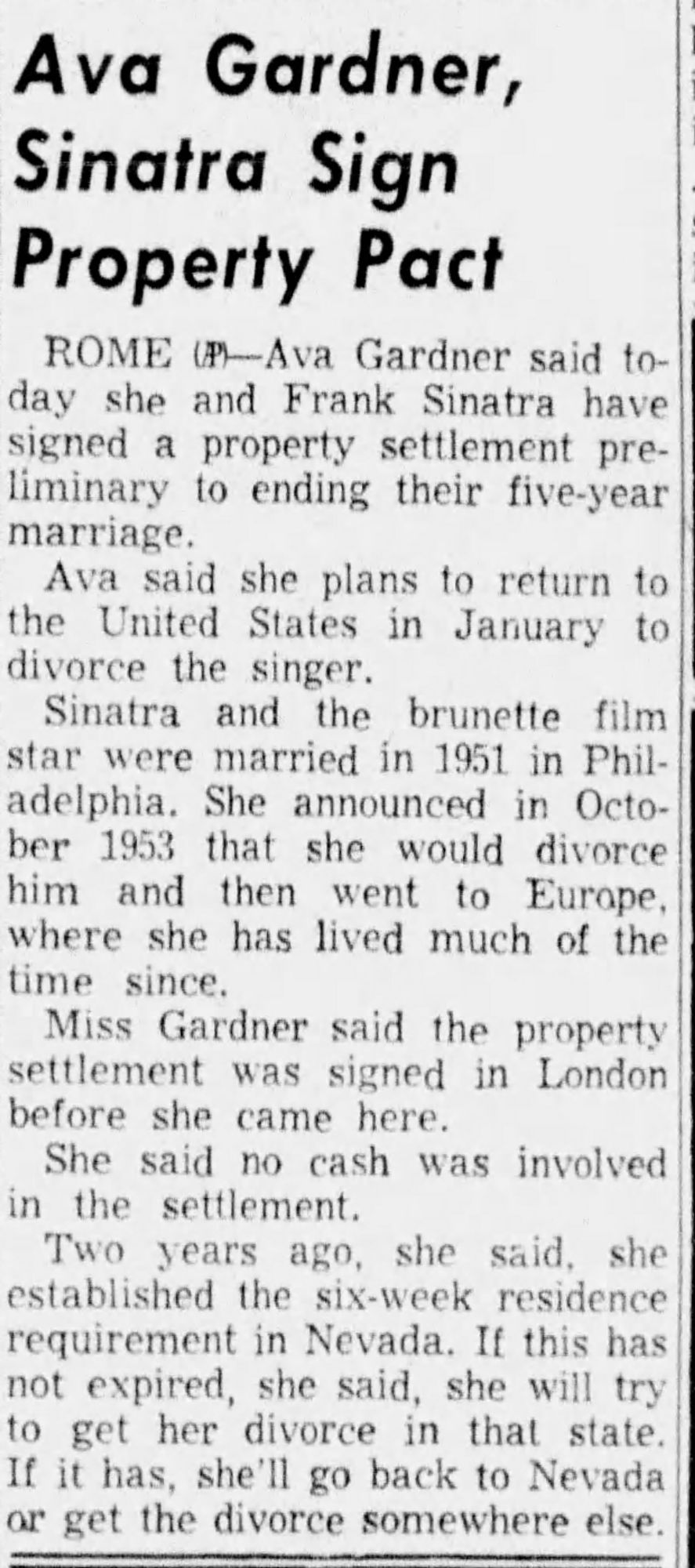
The Columbia Record, August 1, 1956.
August 9, 1956
Back at MGM, Frank starred with Bing Crosby in High Society; their duet 'Well, Did You Evah?' was a highlight, and on set Frank was nicknamed 'Dexedrine' for his energy while Bing was 'Nembutal' for his laid-back style. The film also marked the start of a close friendship with co-star Grace Kelly.
Source: Nancy Sinatra, Frank Sinatra: An American Legend, 1995.
August 12, 1956
After a reception for Eleanor Roosevelt in Chicago, Frank sang the National Anthem at the Democratic Convention that nominated Adlai Stevenson; watching with the Kennedy family as the nomination was locked up, he was struck by Bobby Kennedy's immediate focus on the next presidential race, four years off.
Source: Nancy Sinatra, Frank Sinatra: An American Legend, 1995.
August 13, 1956
Democratic National Convention, Chicago, Illinois
1. National Anthem
NOTE: It is Ed O'Brien's understanding that a tape exists of this performance. He would love to hear Sinatra singing our National Anthem in 1956.
A Stevenson supporter, Sinatra had been asked to sing the national anthem for the delegates and watched from the wings as the young Massachusetts senator, drafted in to narrate the party's history film and then given the honor of formally nominating Stevenson, nearly captured the vice-presidential nomination on the convention floor, ultimately losing a close third ballot to Estes Kefauver. It was Sinatra's first sight of Jack Kennedy in the flesh. His own Democratic ties ran back to his mother Dolly's work for the Hoboken party machine, an association with the party's leading lights that had begun with a 1944 invitation to tea at the Roosevelt White House. Source: Michael Sheridan & David Harvey, Sinatra and the Jack Pack.
[Alleged Rayburn incident at convention]
Per a 1957 Look magazine account by Bill Davidson, Speaker of the House Sam Rayburn allegedly put a hand on Sinatra's shoulder after his performance and asked if he'd sing "The Yellow Rose of Texas," to which Sinatra supposedly snapped, "Take the hand off the suit, creep." The story was likely false — Rayburn sent Sinatra a supportive telegram when he denied it, and Sinatra sued Look for libel over $2 million.
Source: James Kaplan, "Sinatra: The Chairman" (2015).
August 14, 1956
[Pegler's column attacking Sinatra]
Westbrook Pegler: Columnist Westbrook Pegler devoted an entire syndicated column to attacking Sinatra ahead of the convention, dredging up his police record, alleged Mob ties (Willie Moretti, Frank Costello), the Ava Gardner affair and divorce, and his past bankrolling of scandal sheet publisher Jimmy Tarantino, wrapping it into a broader diatribe against civil rights and the Democratic Party's northern wing.
Source: James Kaplan, "Sinatra: The Chairman" (2015).
August 15, 1956
Concerts
Paramount, New York City (15 - 21) w/Tommy & Jimmy Dorsey
On Screen: Johnny Concho
NOTE: Sinatraphile Ed Speigel points out that Sinatra did not complete the week at the Paramount because of laryngitis. Speigel says he was a kid at the time and attended the Saturday, August 18, 1956 show. Speigel comments on the August 18th show will be presented on that day here on THIS DATE IN SINATRA HISTORY.
Ed O'Brien sends along commentary on the Paramount appearance from the August 14, 1956 issue of Downbeat magazine. It was written by Leonard Feather:
Maybe you can turn back the clock at that. When the Paramount Theatre revived stage shows (even if only for a week) and united Tommy Dorsey and Frank Sinatra plus Jimmy Dorsey on hand as co-leader, you could almost feel the 1942 breezes wafting through the hall.
You could, that is, until you saw the bald patch on the dome of a fellow who was one of the audience on both occasions, and a teenager then, a businessman now. And you wonder whether the girl who paraded outside the Paramount this morning carrying a Sinatra for President banner is the daughter of one of those who might have behaved similarly three or four elections ago. One thing for sure: It was a great show, and dyed in the years members of the audience loved it as much as the youngsters. Under the Sinatra spell, they were helpless as he scored his biggest hit with "I've Got You under My Skin," and struck a match, lit a cigarette, and breathed out "One for My Baby."
The ushers, too, were helpless when, as Sinatra begged the crowd to take his arms, he'll never use them, a young woman leaped past all obstructions to rush up onstage and throw her arms around him in a fitting why-not-take- all-of-me mood. [That's not fair!, remonstrated Frankie.]
The Dorseys were well represented with "Well Git It" as the opener, Lynn Roberts looking lovelier than ever and singing capably, and a medley of TD and JD hits.
At the closing show on opening night, Walter Winchell was behind the footlights to introduce the six-year old Miss Universe of 1970 and a couple of others who, when intoduced, proved to be absent. But only one thing really mattered. Sinatra was present, and for thousands who came, saw, and were conquered during this wonderful nostalgic week Sinatra was President.
Ed O'Brien also posted a review offering further comment on Walter Winchell's announcements, the movie, and the absence of Jackie Gleason, who was supposed to be introduced by Winchell.
Eddie Gen (2013):
56 years ago my mother, rest her soul, took her 7 and 11 year old sons to the Paramount in NYC to see Frank Sinatra because she said that this man will be the most important and prolific entertainer of our lifetimes. Thus began my appreciation of the music of Sinatra. I believe the movie that played with his appearance was "Johnny Concho". Thanks mom.
Paramount, New York City (15 - 21)
w/Tommy & Jimmy Dorsey
On Screen: Johnny Concho
Frank Sinatra with women from the Philadelphia Chapter of his fan club, surrounding him at the Paramount Theatre, New York City. Sinatra was making appearances for the opening of director Don McGuire's film, 'Johnny Concho,' in which he starred. Sinatra also opened there, along with the Tommy and Jimmy Dorsey Orchestras, on August 15, 1956
THEY'RE SCREAMIN' AGAIN
Frankie Brings Back Swing Panic to Paramount
NEW YORK - Frank Sinatra was an overwhelming success on stage at the Paramount Theater here last week, and the thunderous audience acclaim he received at every show should go a long way toward helping the singer forget the lukewarm reception he was accorded in the same theater only four years ago. At that time, Sinatra made trade history when he stopped in the middle of a ballad and with wistful irony remarked, "This is where they used to scream." They were the basis of the first two-day grosses (over $20,000 each day) the Paramount Theater expected the seven -day run to break the house record for a non-holiday week. On opening day, the line began to form at sunrise and was well around the block by 8 a.m. At the peak of his career performance-wise. Sinatra's skillful showmanship, sock phrasing and powerful personal magnetism on stage had almost a physical impact on the Paramount audience Wednesday (15). His aptly titled opener-"You Make Me Feel So Young' -set the mood for a nostalgic, yet basically timeless half hour of great old ballads and swingy rhythm tunes, including "Just One of Those Things,"
"Little Girl Blue," "I Get a Kick Out of You" and
"My Funny Valentine." Sinatra did from 14 to 15 numbers at each show. Solid backing was provided by Tommy and Jimmy Dorsey and a 25 -piece band, including an eight - man string section. Earlier in the show the Dorseys scored with a medley of their old hits -"Green Eyes," "I’ll Never Smile Again," t; etc., which pulled a surprising response from teenagers in the audience as well as from patrons old enough to recall the Swing Era personally. Sinatra went into the Paramount to plug his first Western, "Johnny Concho" (a Sinatra production), on the screen. However, he should also make quite a pile on the deal since his contract calls for a giant - size share of the gross.
June Bundy.
Billboard
August 25, 1956
Variety
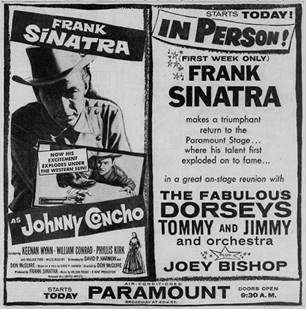
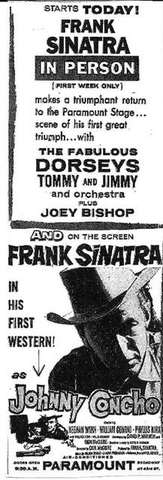
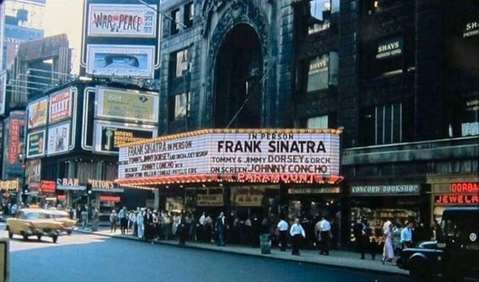
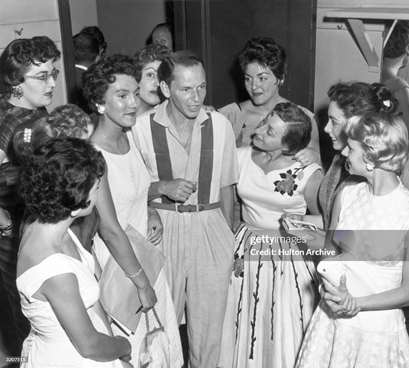
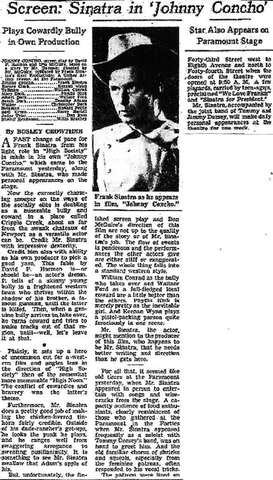
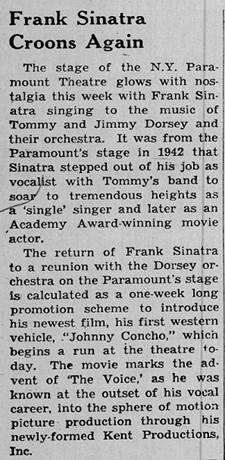
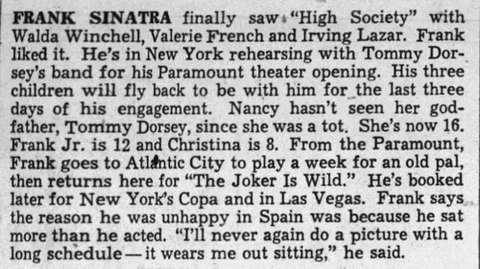
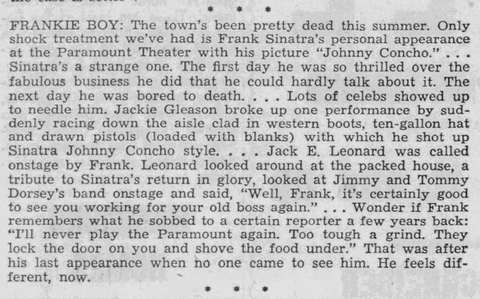
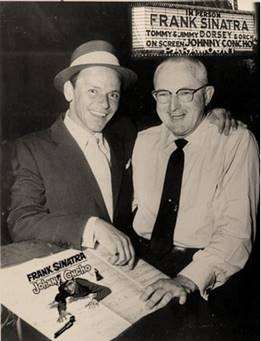

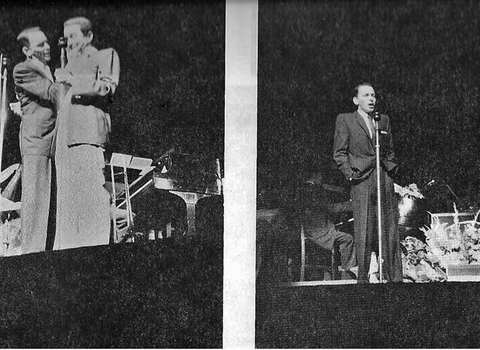
Frank and
Perry onstage at the
Paramount
Paramount 1956
Paramount, New York City (15 - 21)
w/Tommy & Jimmy Dorsey
On Screen: Johnny Concho
August 16, 1956
Concerts
Paramount, New York City (15 - 21)
w/Tommy & Jimmy Dorsey
Kenny Lucas:
FS sang many songs from the Capitol era he supposedly sang " Little Girl Blue, " I have heard that he sang Johnny Concho Theme and "Like Someone In Love" . Can anyone verify.
Ed O'Brien:
He definitely sang "Little Girl Blue." I have posted in recent years the reviews from DOWNBEAT, The New Yorker, Billboard and The New York Times. You could look at them in the archives. The reviews do list songs performed.
Paramount, New York City (15 - 21)
w/Tommy & Jimmy Dorsey
Frank at the
Paramount August ‘56
Frank and Bill Miller at The Paramount August ‘56
Tommy
Dorsey
Frank
Sinatra
Paramount August 1956
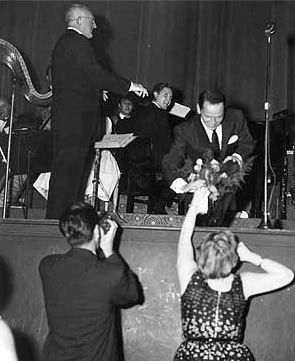
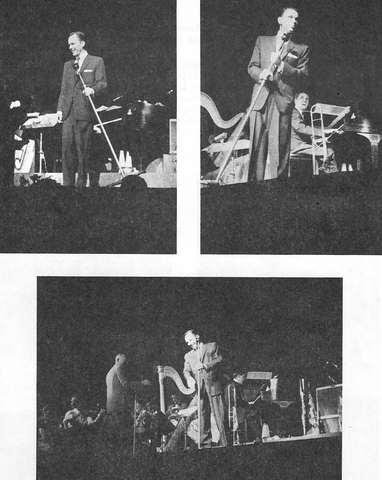
Paramount, New York City (15 - 21) w/Tommy & Jimmy Dorsey
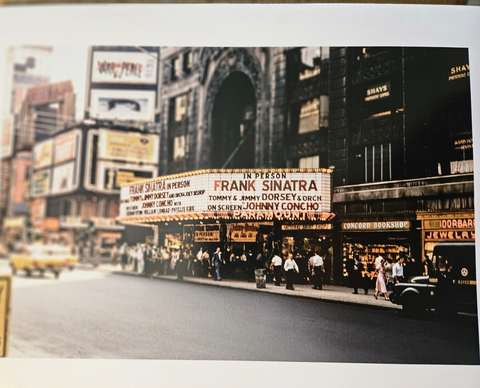
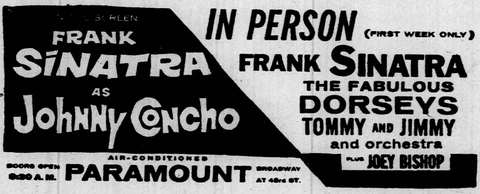
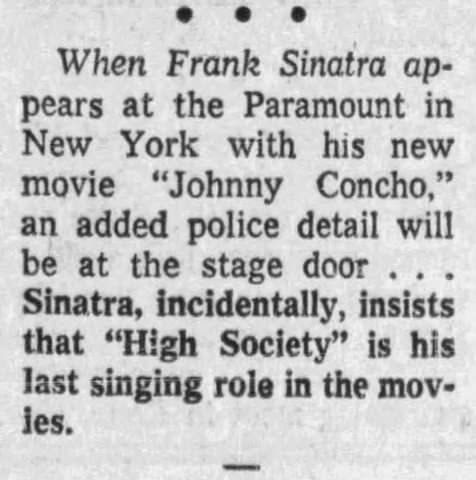
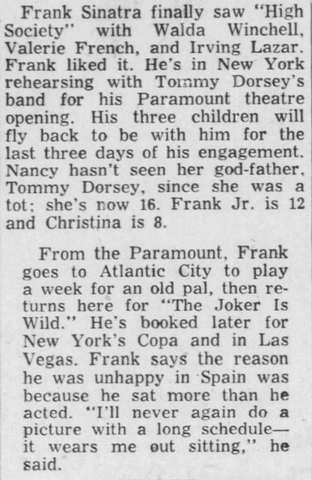
August 17, 1956
Concerts
Paramount, New York City (15 - 21) w/Tommy & Jimmy Dorsey
Ed O'Brien:
Frank opened at the Paramount on August 15,
1956, with the Tommy and Jimmy
Dorsey orchestras. Nelson Riddle conducted the 25 piece orchestra.. The engagement was scheduled to run through 8/21.
Frank only made it through 8/18. A bout of laryngitis rendered him silent except for his appearances on Ed Sullivan and Steve Allen,
8/19. Both shows were live and Frank did the
Allen first and then Sullivan. Both shows aired that Sunday night between 8 to 9 PM. The
Paramount appearance included the first N.Y. run of "Johnny Concho." If you check the archives, you will find reviews I posted from
DOWNBEAT, The New Yorker, Variety and
Billboard. Frank was singing a combination of his early hits with Dorsey and the songs from his Capitol albums including "All Of Me,"
"Skin," "Little Girl Blue," "When Your Lover
Has Gone," "Taking A Chance On Love," etc. He also did "One For My Baby." Perry Como joined him on stage during one of the 8/16 shows.
He did three or four shows a day and the running time of each was about 40 minutes .
Eddiegen:
This was my introduction to Frank Sinatra. My mother took my brother and me to see him. She told us to take notice, because you're going to see the greatest entertainer of all time. As always, mom was correct. It's funny, but I remember Sinatra walking on stage and my mother abandoning a 7 year old and an 11 year old alone in their seats as she ran up to the stage screaming. I also remember Johnny Concho. Could we have seen it twice? Maybe. Thanks mom!
August 18, 1956
Concerts
Paramount, New York City (15 - 21) w/Tommy & Jimmy Dorsey
NOTE: Sinatraphile Ed Speigel points out that Sinatra did not complete the week at the Paramount because of laryngitis. Speigel says he was a kid at the time and attended the Saturday, August 18, 1956 show. He says the Paramount was packed and he saw at the concert the Dorsey brothers, Joey Bishop, a girl singer whose name he doesn't recall, and Sinatra.
As an opener, Speigel writes, Sinatra trotted out to overwhelming applause and cheers, sang "You Make Me Feel so Young" and other songs mostly from the first four Capitol albums and Capitol singles. He watched the movie, "Johnny Concho," stayed for a second concert, saw the movie a second time, and saw Frank's set a third time. By the third Sinatra set, he was right down front. Each time Sinatra wore a different outfit, opened with "You Make Me Feel so Young," but did vary the song mix a bit. He remembers it well it was the first time he had seen Sinatra in person.
He was sounding a little raw and that turned out to be his final day. Julius LaRosa filled in for him from Sunday, August 19th, on. Speigel likes LaRosa but he bets there were a helluva lot of disappointed people who showed up expecting to see Frank. Frank was scheduled to appear and, Speigel believes, sing on both the Steve Allen and Ed Sullivan TV shows Sunday night. The programs were live opposite each other on NBC and CBS. Sinatra made it to both programs but did not sing, just talked with the hosts because of his voice problems.
Paramount, New York City (15 - 21) w/Tommy & Jimmy Dorsey
He was sounding a little raw and that turned out to be his final day. Julius LaRosa filled in for him from Sunday, August 19th, on. Speigel likes LaRosa but he bets there were a helluva lot of disappointed people who showed up expecting to see Frank. Frank was scheduled to appear and, Speigel believes, sing on both the Steve Allen and Ed Sullivan TV shows Sunday night. The programs were live opposite each other on NBC and CBS. Sinatra made it to both programs but did not sing, just talked with the hosts because of his voice problems.
note:
What Ed Spiegel states here has been the accepted story since 1956. I have seen it repeated time and time again in biographies and in on line discussions. The truth of what happened is very different. Frank missed three shows on 8/19. That was it. He did four or five shows a day from the 15th through the 21st. Averaging 14 songs per show. On the day in question, he also did the final two shows . That was a lot of singing in seven days. I uncovered what really happened by finding articles in the New York Times and Variety. Here is the Times story from 8-20-56.
Ed
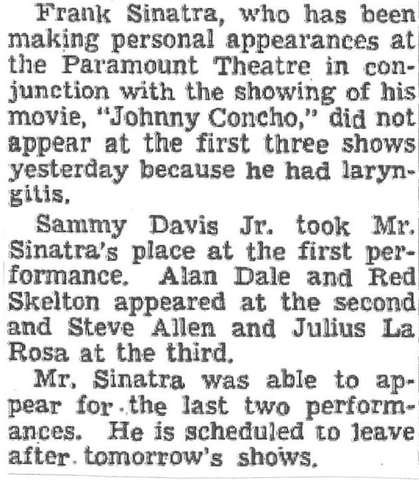
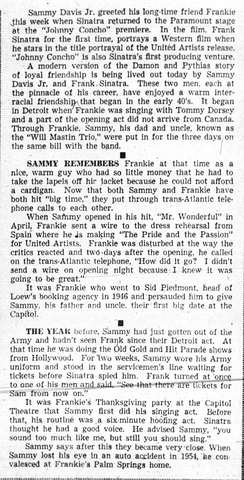
August 19, 1956
Television
The Steve Allen Show (CBS)
Season 1, Episode 7
Guest: Frank Sinatra, Don Adams, Julius LaRosa, Mamie Van Doren, Augie &
Margo (dance team)
Promoting Johnny Concho
Note: Sinatra did not sing due to laryngitis
The Ed Sullivan Show
Guest: Frank Sinatra
Red Skelton was Guest Host
Note: Sinatra did not sing due to laryngitis
Famous Film Festival
Hosted by Don Woods
Concerts
Paramount, New York City (15 - 21) w/Tommy & Jimmy Dorsey
Note: Sinatra did not perform. Julius LaRosa subbed.
He was sounding a little raw and that turned out to be his final day. Julius LaRosa filled in for him from Sunday, August 19th, on. Speigel likes LaRosa but he bets there were a helluva lot of disappointed people who showed up expecting to see Frank. Frank was scheduled to appear and, Speigel believes, sing on both the Steve Allen and Ed Sullivan TV shows Sunday night. The programs were live opposite each other on NBC and CBS. Sinatra made it to both programs but did not sing, just talked with the hosts because of his voice problems.
note:
What Ed Spiegel states here has been the accepted story since 1956. I have seen it repeated time and time again in biographies and in on line discussions. The truth of what happened is very different. Frank missed three shows on 8/19. That was it. He did four or five shows a day from the 15th through the 21st. Averaging 14 songs per show. On the day in question, he also did the final two shows . That was a lot of singing in seven days. I uncovered what really happened by finding articles in the New York Times and Variety. Here is the Times story from 8-20-56.
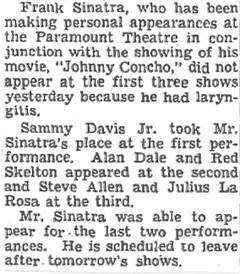
The Steve Allen Show (CBS)
Season 1, Episode 7
Guest: Frank Sinatra, Don Adams, Julius LaRosa, Mamie Van Doren, Augie & Margo (dance team)
Promoting Johnny Concho
Note: Sinatra did not sing due to laryngitis
Popular American entertainer Frank Sinatra (1915 - 1998), with a stetson hanging around his neck and a pistol in his hand, talks with several unidentified men about an upcoming skit backstage during the filming of an episode of the television variety program . 'The Steve Allen Show,' New York, New York, August 19, 1956.
Backstage with Gene Rayburn
The Steve Allen Show
(Net)
NBC -TV, Sunday (19), 8-9 p.m., EDT
(Caught again).
The Steve Allen Show, counting heavily on Frank Sinatra's appearance, was left in a rather 'weakened state when its top star suffered an attack of laryngitis.
Allen, in a frank pitch to the TV audience, explained that they would have to "wing" it and hope for the best. The spot with Sinatra included a rather stilted interview about his new picture and' the spinning of one of his recordings; with Allen providing the comic mime. It was a tough spot to be in, and Allen must be commended for his outward good grace about it all.
Other guests included Eddie
Lawrence, who supplied the funniest bit with a comedy monolog called "Never Give Up"; Victor
Riesel, who reconstructed the acid - hurling tragedy; Julius La Rosa, who tried real hard but didn't quite make it, and John Adams, comedian, with a rather dull court- room comedy routine. Mamie Van
Doren was there, too.
Charlotte Summers.
Billboard
9-1-56
Frank Pockets
A Cool 75G
NEW YORK - Frank Sinatra walked off with $75,000 for his
Paramount Theater stage stint here last week. Figure is believed to be highest fee ever paid to an entertainer for a single week's engagement.
At the same time Sinatra was responsible for his movie, "Johnny
Concho," chalking up a record box
- office gross of $149,000, biggest non -holiday week in the history of the theater, Only Martin and
Lewis' July 4 holiday appearance topped it.
Billboard
9-1-56
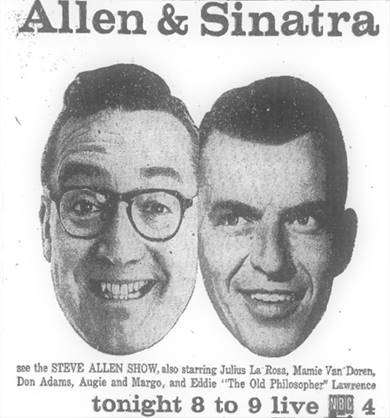
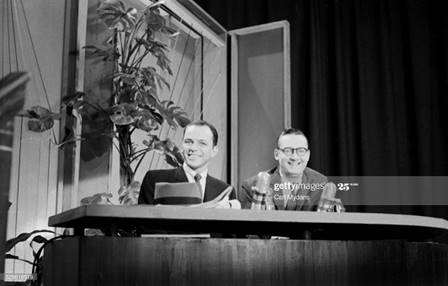
The Ed Sullivan Show
Guest: Frank Sinatra
Red Skelton was Guest Host
Note: Sinatra did not sing due to laryngitis
Pop singer Frank Sinatra greets guest host Red Skelton on the Ed Sullivan Show on August 19, 1956 in New York City,
Variety
8-22-56
NYT
8-17-56
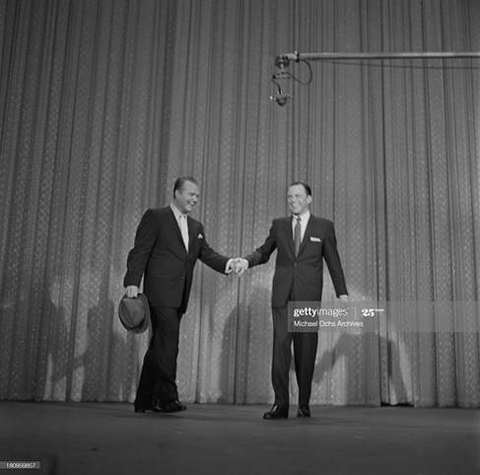
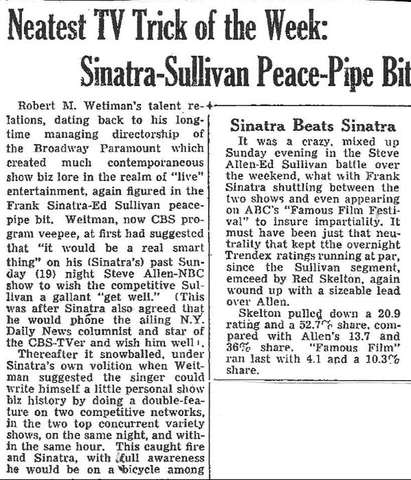
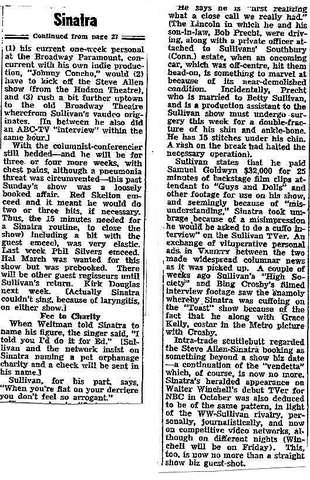

Famous Film Festival
Hosted by Don Woods
---------------------------------------------
© 1997-2025 The Sinatra Archive
This calendar, or any parts thereof, may not be reproduced in any fashion whatsoever without the prior written permission of the publisher (The Sinatra Archive)
Famous Film Festival
Hosted by Don Woods
---------------------------------------------
© 1997-2025 The Sinatra Archive
This calendar, or any parts thereof, may not be reproduced in any fashion whatsoever without the prior written permission of the publisher (The Sinatra Archive)
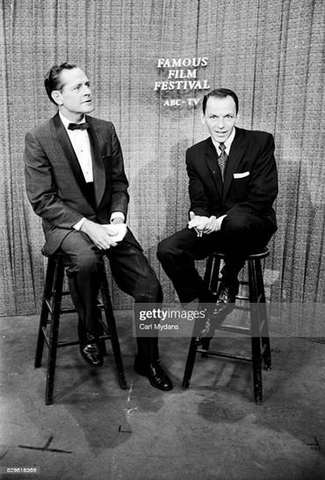
Paramount, New York City (15 - 21), w/Tommy & Jimmy Dorsey
Hedda Hopper syndicated column (Daily News, Aug. 17, 1956 edition; column dated 8-19-56), on Sinatra's Paramount Theatre engagement with Tommy and Jimmy Dorsey.
Famous Film Festival
Hosted by Don Woods
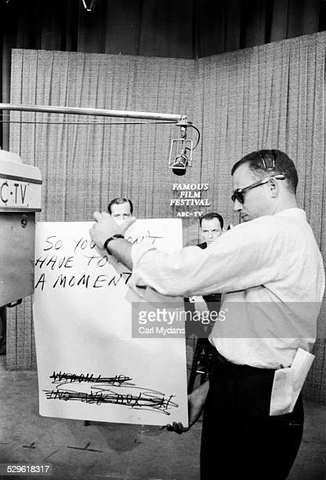
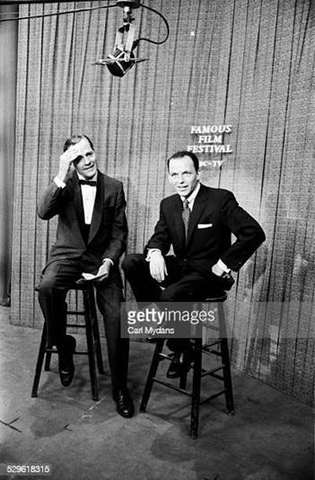
August 20, 1956
Concerts
Paramount, New York City (15 - 21) w/Tommy & Jimmy Dorsey
August 21, 1956
Concerts
Paramount, New York City (15 - 21) w/Tommy & Jimmy Dorsey
August 22, 1956
Paramount, New York City (15 - 21), w/Tommy & Jimmy Dorsey
Los Angeles Evening Citizen-News clipping (Aug. 23, 1956 edition; dated 8-22-56), on Sinatra's Paramount Theatre engagement with Tommy and Jimmy Dorsey.
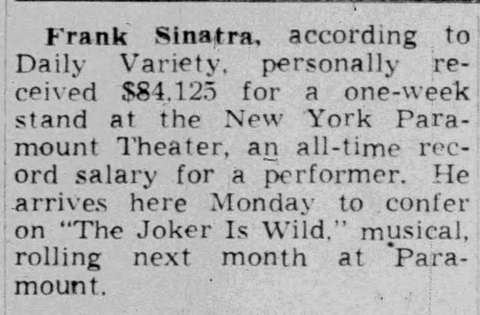
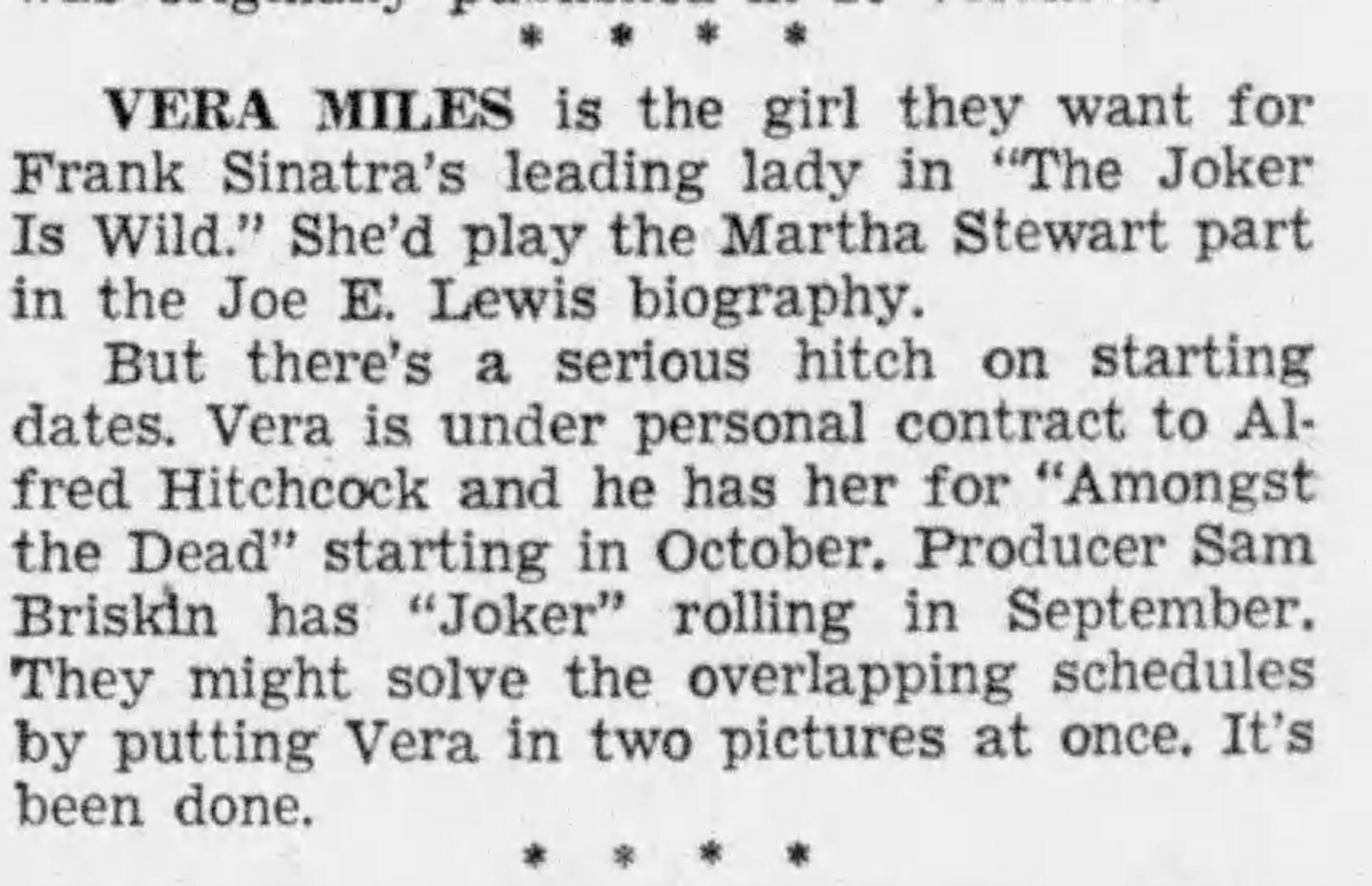
The Solano-Napa News Chronicle, August 22, 1956.
August 23, 1956
Concerts
500 Club, Atlantic City, New Jersey (23 - 26)
( 14 shows)
Joe Frasetto Orch. + Sinatra sidemen including
Bill Miller on piano
O.A. Joan Walker, Boots McKenna Dancers
w/Danny Carroll, Jack Curtis
Joey Bishop( comedian)
500 Club, Atlantic City, New Jersey (23 - 26)
( 14 shows)
Joe Frasetto Orch. + Sinatra sidemen including
Bill Miller on piano
O.A. Joan Walker, Boots McKenna Dancers
w/Danny Carroll, Jack Curtis
Joey Bishop( comedian)
August 23, 1963 Life Magazine
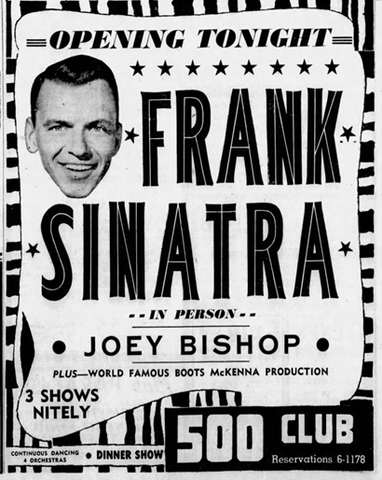
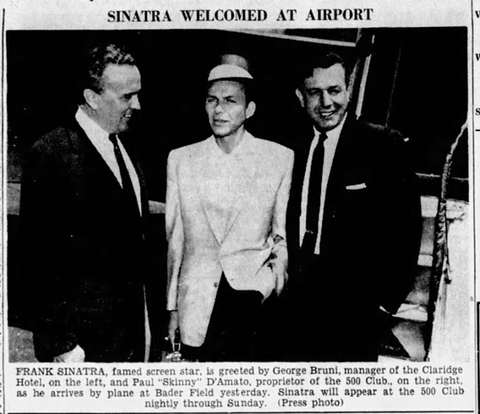


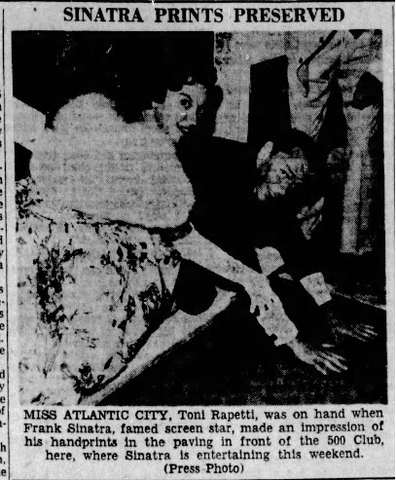
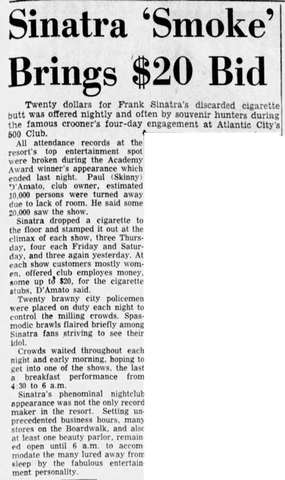
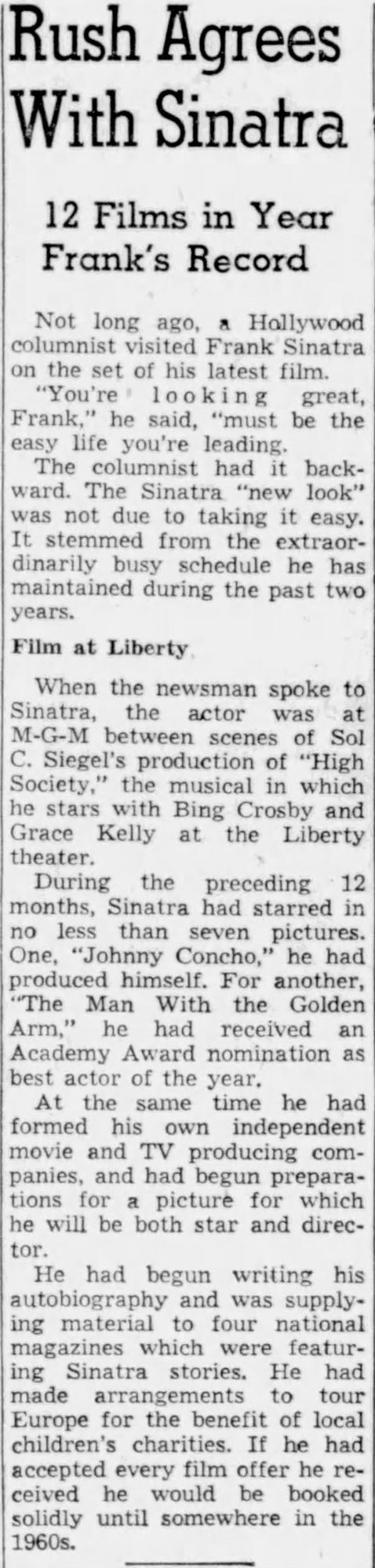
The Oregonian, August 23, 1956.
August 24, 1956
Concerts
500 Club, Atlantic City, New Jersey (23 - 26)
( 14 shows)
Joe Frasetto Orch. + Sinatra sidemen including
Bill Miller on piano
O.A. Joan Walker, Boots McKenna Dancers w/Danny Carroll, Jack Curtis
Joey Bishop( comedian)
500 Club, Atlantic City, New Jersey (23 - 26)
( 14 shows)
Joe Frasetto Orch. + Sinatra sidemen including
Bill Miller on piano
Los Angeles Evening Citizen News, August 24, 1956.
August 25, 1956
Concerts
500 Club, Atlantic City, New Jersey (23 - 26)
( 14 shows)
Joe Frasetto Orch. + Sinatra sidemen including
Bill Miller on piano
O.A. Joan Walker, Boots McKenna Dancers w/Danny Carroll, Jack Curtis
Joey Bishop( comedian)
500 Club, Atlantic City, New Jersey (23 - 26)
( 14 shows)
Joe Frasetto Orch. + Sinatra sidemen including
Bill Miller on piano
O.A. Joan Walker, Boots McKenna Dancers w/Danny Carroll, Jack Curtis
Joey Bishop( comedian)
note: Frank became the first major performer to do four
shows a night. This was accomplished on the 23rd
and 24th. The sidewalks, in front of the 500, had
hundreds of people waiting to get in to the next
performance. Red Norvo was right: There was
nothing more exciting than Sinatra at the 500 Club.
August 26, 1956
Concerts
500 Club, Atlantic City, New Jersey (23 - 26)
( 14 shows)
Joe Frasetto Orch. + Sinatra sidemen including
Bill Miller on piano
O.A. Joan Walker, Boots McKenna Dancers w/Danny Carroll, Jack Curtis
Joey Bishop( comedian)
September 1956
[Ava's Christmas and divorce plans reported]
Ava Gardner: Ava Gardner told Louella Parsons she planned to spend Christmas with family in North Carolina, then pick up her divorce papers from Sinatra in Reno.
Source: James Kaplan, "Sinatra: The Chairman" (2015)
September 6, 1956
Cooks Fashion, Minneapolis, Minnesota (cancelled appearance)
September 12, 1956
Concerts
Sands, Las Vegas, Nevada (September 12-October 2) also: Joey Bishop & The Beachcombers
Sands, Las Vegas, Nevada (September 12-October 2) also: Joey Bishop & The Beachcombers
REVIEW SINATRA AT THE SANDS 9-12-56
Variety
Variety
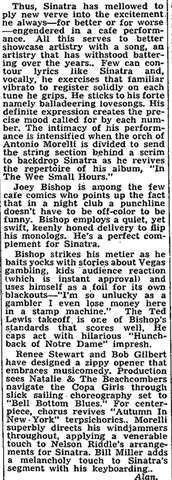
September 12, 1963
From left, Frank Sinatra, Jr., Frank Sinatra, at the Americana Hotel in New York, September 12, 1963
Billboard September 14th 1963:
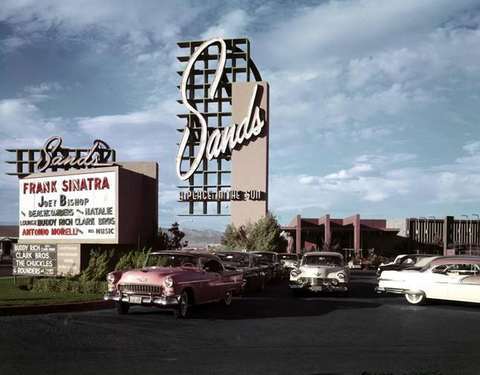
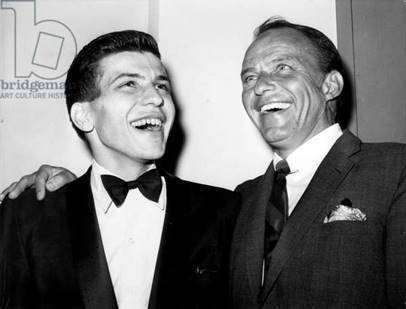
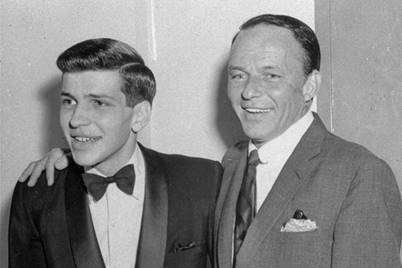
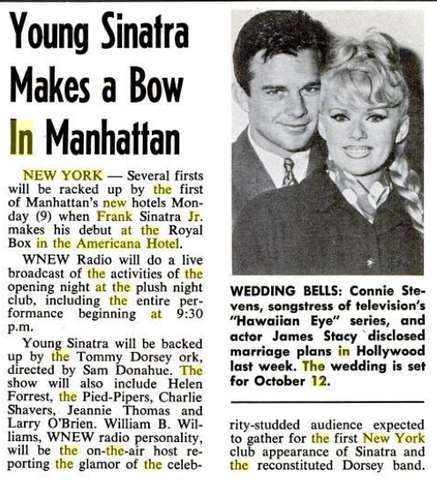
[Parsons previews Sands opening]
Louella Parsons: Louella Parsons reported that Sinatra's upcoming Sands opening would draw Lauren Bacall, Kim Novak, the Durochers, the Riddles, Jimmy Van Heusen, and Mr. and Mrs. William Goetz. Sinatra sent a car for Kim Novak (who refused to fly), phoned Peggy Connelly three times about her Blue Angel opening, and planned a birthday party for Bacall.
Source: James Kaplan, "Sinatra: The Chairman" (2015).
September 13, 1956
Concerts
Sands, Las Vegas, Nevada (September 12-October 2) also: Joey Bishop & The Beachcombers
September 14, 1956
Television
Person To Person
Host: Edward R. Morrow
CBS-TV
Friday Evening
10:30 p.m. - 11:00 p.m.
Guests: Frank Sinatra and Joseph Welch
Ed O'Brien calls this show "gem." Sinatra flew in from Las Vegas to chat with Murrow and it is a fascinating 15 minutes.
Sinatra shows off his new home, chats about his work schedule, shows Murrow some of his treasured collectibles
including a Picasso and a photo FDR sent him in April of 1945 shortly before FDR's death. Sinatra was at his peak as an entertainer.
Concerts
Sands, Las Vegas, Nevada (September 12-October 2) also: Joey Bishop & The Beachcombers
Person To Person
Host: Edward R. Morrow
CBS-TV
Friday Evening
10:30 p.m. - 11:00 p.m.
Guests: Frank Sinatra and Joseph Welch note: Show has been erroneously dated 9-15-56 for many years.
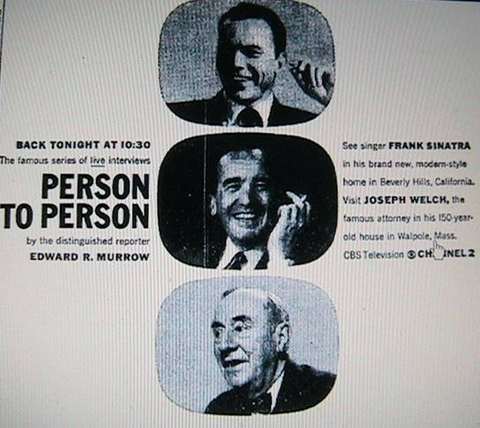
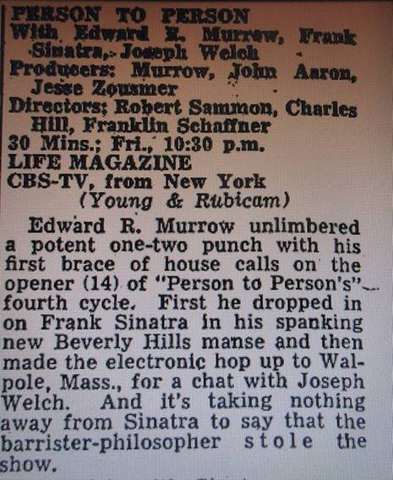
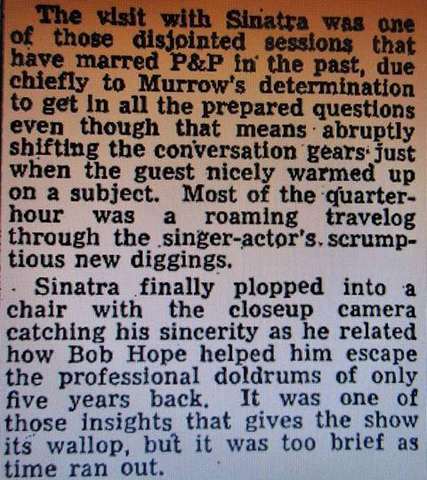
Sands, Las Vegas, Nevada (September 12-October 2)
Las Vegas, NV (September 14, 1956): Frank Sinatra sings on the stage of the Sands Hotel.
At the tables in the front are (left to right) Jack Benny, several unidentified people, Kim Novak (in profile), Cole Porter, and Lauren Bacall.
Las Vegas, NV (September 14, 1956): Lauren Bacall, Frank Sinatra and Kim Novak at the Sands Hotel
–they were about to slice into a cake in honor of Lauren’s upcoming birthday (September 16)–”Happy Birthday Betty Queen Mother”.
© 1997-2025 The Sinatra Archive
This calendar, or any parts thereof, may not be reproduced in any fashion
whatsoever without the prior written permission of the publisher (The
Sinatra Archive)
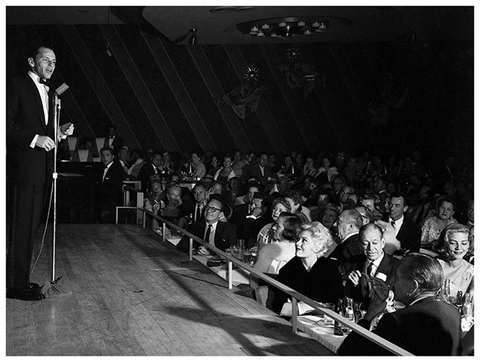
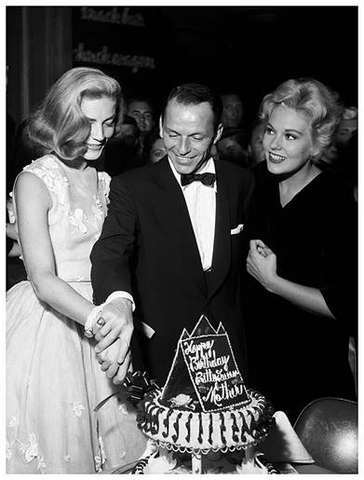
[Sinatra on Person to Person]
Edward R. Murrow's live CBS interview show Person to Person broadcast the season's first episode from Sinatra's newly built Coldwater Canyon house. The awkward segment showed Sinatra knotting his tie, touring his home (including a Roosevelt portrait and his two Oscars), and growing visibly flustered when Murrow raised his Best Supporting Actor win versus being passed over for The Man with the Golden Arm.
Source: James Kaplan, "Sinatra: The Chairman" (2015).
September 15, 1956
Concerts
Sands, Las Vegas, Nevada (September 12-October 2) also: Joey Bishop & The Beachcombers
[Al Jolson Memorial Award]
During the Person to Person broadcast, Sinatra unveiled a huge trophy — the first Al Jolson Memorial Award, "Entertainer of the Era" — which he was to formally receive the following night at a ceremony at the Cocoanut Grove, awarded by the Al Jolson Chapter of the Los Angeles B'nai B'rith.
Source: James Kaplan, "Sinatra: The Chairman" (2015).
September 16, 1956
Concerts
Sands, Las Vegas, Nevada (September 12-October 2) also: Joey Bishop & The Beachcombers
[Bacall's birthday party at the Sands]
Sinatra threw Lauren Bacall a 32nd birthday party at the Sands, attended by Kim Novak, the Durochers, the Riddles, the Goetzes, Van Heusen, Cole Porter, the Nivens, the Romanoffs, Swifty Lazar, the Jack Bennys, George Burns and Gracie Allen, and Louella Parsons. He gave Bacall a two-tiered cake reading "Happy Birthday Den Mother" and a stuffed horse, and sang "Happy Birthday" to her onstage.
Source: James Kaplan, "Sinatra: The Chairman" (2015).
[Bogart skips Bacall's party, phones instead]
Lauren Bacall: Humphrey Bogart, gravely ill with esophageal cancer, chose to spend the weekend on his sailboat Santana with his young son rather than attend Bacall's Sands birthday party, though he called to wish her happy birthday. Bacall later described him as jealous of Sinatra upon her return, partly believing Frank was in love with her.
Source: James Kaplan, "Sinatra: The Chairman" (2015).
September 17, 1956
Concerts
Sands, Las Vegas, Nevada (September 12-October 2) also: Joey Bishop & The Beachcombers
September 18, 1956
Concerts
Sands, Las Vegas, Nevada (September 12-October 2) also: Joey Bishop & The Beachcombers
September 19, 1956
Concerts
Sands, Las Vegas, Nevada (September 12-October 2) also: Joey Bishop & The Beachcombers
September 20, 1956
Concerts
Sands, Las Vegas, Nevada (September 12-October 2) also: Joey Bishop & The Beachcombers
September 21, 1956
Concerts
Sands, Las Vegas, Nevada (September 12-October 2) also: Joey Bishop & The Beachcombers
September 22, 1956
Concerts
Sands, Las Vegas, Nevada (September 12-October 2) also: Joey Bishop & The Beachcombers
September 23, 1956
Concerts
Sands, Las Vegas, Nevada (September 12-October 2) also: Joey Bishop & The Beachcombers
September 24, 1956
Concerts
Sands, Las Vegas, Nevada (September 12-October 2) also: Joey Bishop & The Beachcombers
Sinatra: A Philadelphia Inquirer article covering CBS testimony before a House Judiciary subcommittee on broadcasting quoted a Sinatra telegram claiming that before Mitch Miller's arrival he had enjoyed creative freedom that brought him success, but that Miller began pushing 'inferior' songs that curiously bore the BMI (rather than ASCAP) publishing label, implying collusion between CBS's broadcast and recording arms.
Source: Charles L. Granata, "Sessions with Sinatra: Frank Sinatra and the Art of Recording" (1999/2003).
September 25, 1956
Concerts
Sands, Las Vegas, Nevada (September 12-October 2) also: Joey Bishop & The Beachcombers
September 26, 1956
Concerts
Sands, Las Vegas, Nevada (September 12-October 2) also: Joey Bishop & The Beachcombers
September 27, 1956
Concerts
Sands, Las Vegas, Nevada (September 12-October 2) also: Joey Bishop & The Beachcombers
September 28, 1956
Concerts
Sands, Las Vegas, Nevada (September 12-October 2) also: Joey Bishop & The Beachcombers
September 29, 1956
Concerts
Sands, Las Vegas, Nevada (September 12-October 2) also: Joey Bishop & The Beachcombers
September 30, 1956
Concerts
Sands, Las Vegas, Nevada (September 12-October 2) also: Joey Bishop & The Beachcombers
October 1956
[Sinatra Telegrams Joe Hyams About Jackie Coogan's Birthday]
In an October 1956 telegram to columnist Joe Hyams, Sinatra arranged a surprise 42nd-birthday luncheon at the Paramount commissary for actor Jackie Coogan, his co-star in The Joker Is Wild, marking Coogan's 40th year in show business.
Source: Charles Pignone, "Frank Sinatra 100" (2015).
[Production begins on The Joker Is Wild]
Kaplan: About ten days after the Dinah Shore appearance, Sinatra began work on The Joker Is Wild, a Joe E. Lewis biopic he optioned while still in galleys and sold to Paramount for $400,000, with himself earning $125,000 plus 25 percent of profits and the power to ban unwanted reporters from the set.
Source: James Kaplan, "Sinatra: The Chairman" (2015)
[Sinatra on The Dinah Shore Chevy Show]
Kaplan: In early October, back from the Sands, Sinatra earned $40,000 appearing on The Dinah Shore Chevy Show on NBC, performing a dozen songs including duets with Shore, a longtime on-and-off romantic partner of his despite her marriage to actor George Montgomery.
Source: James Kaplan, "Sinatra: The Chairman" (2015)
October 1, 1956
Concerts
Sands, Las Vegas, Nevada (September 12-October 2) also: Joey Bishop & The Beachcombers
October 2, 1956
Concerts
Sands, Las Vegas, Nevada (September 12-October 2) also: Joey Bishop & The Beachcombers
October 3, 1956
Studio
PARAMOUNT PICTURES - LOS ANGELES
THE JOKER IS WILD
Wednesday
7:00 -10:05 PM
Orchestra conducted by Victor Young
Arrangements by Nelson Riddle
Session manger: Phil Kahgan
Forty-eight piece orchestra including
Frank's sidemen Bill Miller(piano) , Sam Weiss(drums) and Barney Kessel (guitar)
All The Way (2:03)
At Sundown (1:35)
I Cried For You (1:33)
If I Could Be With You (1:09)
All The Way (2:07)
Frank's sidemen received $52.23 each for a little over three hours of session work.
October 5, 1956
Television
THE CHEVY SHOW
Location: NBC BURBANK STUDIO
FRIDAY EVENING
9 -10: PM
NBC
w/ Dinah Shore, Frank Sinatra, Dizzy Dean,
The Skylarks, Johnny Silvers & Harry Zimmerman Orchestra
Premiere Show
DS Get Out And Get Under
FS DS & DD Ding, Dong, Ding
DS & SL Medley: We Are Here To Please
Tonight You Belong To Me/Don't Be Cruel/
Canadian Sunset
FS & SL Hey! Jealous Lover
DD & DS Wabash Cannonball
DS Something Wonderful
FS/DS &DD Smack, Dab In The Middle
FS/DS Two Sleepy People
FS/DS Remember me
Medley:
Frank & Dinah
FS You Make Me Feel So Young/
DS ThemThere Eyes /
FS A Foggy Day /
DS I've Got You Under My Skin
FS Taking A Chance On Love
DS They Can't Take That Away From Me
FS All Of Me
FS/DS You Must Have Been A Beautiful Baby
Frank & Dinah Tea For Two.
FS DD & DS Smack Dab In The Middle
Ed O'Brien:
Dinah's first hour show. She would go on to
win numerous Emmies over the next five years.
Frank would appear on her 1-26-58 and 12-9-62
specials. They would reprise the same long medley
on the 1958 special and on Manie & Friends on
ABC, 3-3-59.
THE CHEVY SHOW
Location: NBC BURBANK STUDIO
FRIDAY EVENING
9 -10: PM
NBC w/ Dinah Shore, Frank Sinatra, Dizzy Dean,
The Skylarks, Johnny Silvers & Harry Zimmerman Orchestra Premiere Show
AD FOR D. SHORE 10-5-56.JPG
SEEN AND HEARD
Dinah Shore's new Chevy Show series on
NBC -TV (hour -long program scheduled for 10 telecasts during the 1956 -57 season, on Fridays or Sundays) got off to a great start Oct. 5, when Dinah and her guest,
Frank Sinatra, put on the best song exchange to regale the tv audience since the famed
Ethel Merman -Mary Martin ditty duel on the Ford 50th Anniversary telecast in June of 1953 (if it's permissible to mention Ford in commenting on the Chevy Show). Sure, the comedy was weak, despite a good try by
Dizzy Dean, but who cared as long as Dinah and Frankie were in good voice?
Variety
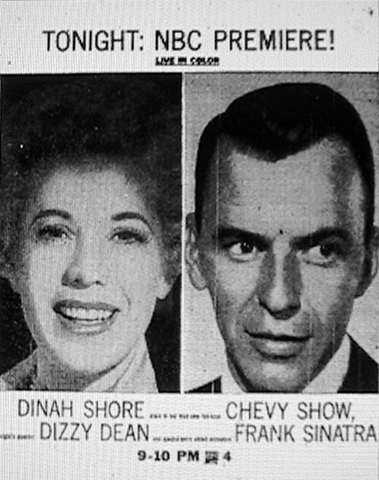
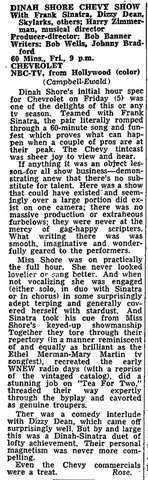
note: For Dinah's first one-hour TV special, she asked for and got
Frank
Sinatra as her special guest. He re- ceived $40,000 for his services.
They were sensational together.
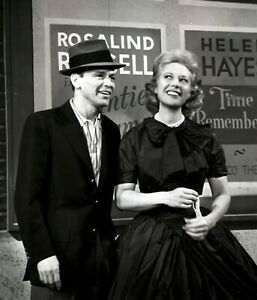
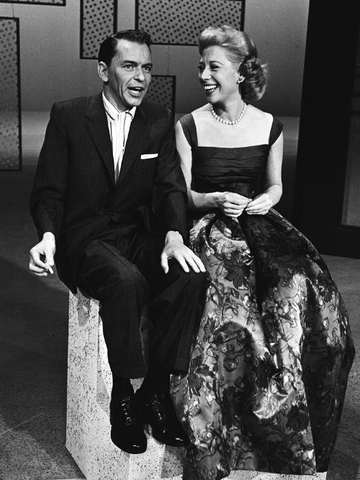
October 10, 1956
Sinatra was the guest star on a television special for his longtime friend Dinah Shore, in which the two recreated the early days of their friendship at New York radio station WNEW in the late 1930s.
Source: Frank Sinatra: The Man, the Music, the Legend, ed. Jeanne Fuchs and Ruth Prigozy (Rochester, NY: University of Rochester Press / Boydell & Brewer, 2007), essay "Sinatra Meets Television" by Ron Simon.
October 17, 1956
Film
Around the World in 80 Days (Film Release: October 17, 1956) (DVD Release date: 2004-05-18)
Starring: David Niven, Cantinflas, Shirley MacLaine, Robert Newton
Directed by MIchael Anderson, Produced by Michael Todd
Sinatra is revealed as the honky-tonk piano player in a San Francisco saloon. (DVD Release date: 2003-01-14)
Note: In the 2014, biographical film "Cantinflas", there's a recreation of a scene where Cantinflas, David Niven, Marlene Dietrich, and Frank Sinatra, all in their costumes for the film, pose for the cover of Verité. Sinatra is portrayed in the scene by Rafael Amaya.
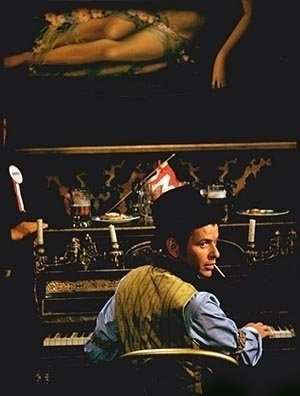
Around the World in 80 Days (Film Release: October 17, 1956 )
Sinatra is fifth from the left on the bottom.
"Around the World in Eighty Days"
Following High Society's box-office rebound, Sinatra took a cameo in producer Mike Todd's all-star Around the World in Eighty Days: he appears briefly, without dialogue, as a saloon piano player in a Western honky-tonk scene alongside Marlene Dietrich as the madam.
Source: Tom Santopietro, "Sinatra in Hollywood" (2008).
"Around the World in Eighty Days"
Around the World in Eighty Days, produced by Mike Todd with three credited screenwriters and directors, won the Academy Award for Best Picture. Santopietro argues its sprawling all-star cameo format (nearly fifty stars, including Sinatra) could only have won in that era, before television made such travelogue spectacle obsolete.
Source: Tom Santopietro, "Sinatra in Hollywood" (2008).
"Around the World in Eighty Days"
Santopietro grades this a B, calling it overstuffed, with Frank in a wordless cameo. Quigley Top 10 Money Makers Poll: #10.
Source: Tom Santopietro, "Sinatra in Hollywood" (2008).
"Around the World in Eighty Days"
Santopietro (Filmography): Cameo appearance. Michael Todd Productions/United Artists. Produced by Mike Todd, directed by Michael Anderson (with Sidney Smith directing the documentary sequence), screenplay by James Poe, John Farrow and S. J. Perelman based on the Jules Verne novel. Starred David Niven and Cantinflas, with a parade of star cameos including Sinatra as a piano player.
Source: Tom Santopietro, "Sinatra in Hollywood" (2008).
October 31, 1956
While trick-or-treating with the Wanger family, Tina was brought into a darkened den where she unknowingly met an ailing Humphrey Bogart and his wife Lauren Bacall, who struck her as glamorous and devoted to her husband. (Source: Tina Sinatra, "My Father's Daughter: A Memoir" (2000).)
October 31, 1956
While trick-or-treating with the Wanger family, Tina was brought into a darkened den where she unknowingly met an ailing Humphrey Bogart and his wife Lauren Bacall, who struck her as glamorous and devoted to her husband. (Source: Tina Sinatra, "My Father's Daughter: A Memoir" (2000).)
November 1956
[Close to You - recording schedule and critical assessment -- critical commentary]
Paul Shure: It took longer to record Close to You than any other Sinatra album before Trilogy -- five sessions stretched over eight months, March to November 1956. On the first date Sinatra attempted only one tune and rejected it, suggesting he and Riddle hadn't yet found the right sound. Paul Shure called it 'musically speaking... the greatest album that Sinatra ever did,' with Friedwald noting Sinatra's singing here is his most intimate and delicate, contrasted with the broader emotional strokes of Only the Lonely and No One Cares -- 'Close to You could have been rendered with an eyebrow pencil.'
Source: Will Friedwald, "Sinatra! The Song Is You: A Singer's Art" (2018 revised edition), Ch. 6, "With Nelson Riddle" (1953-1979)
November 1, 1956
Studio
Capitol Studio A, Hollywood
E16159 I Couldn't Sleep A Wink Last Night w/ The Hollywood String Quartet
Arranged & Conducted by Nelson Riddle
CD: CDP 7-46572-2 Close To You
LP: W789 Close To You
E16160 It's Easy To Remember w/ The Hollywood String Quartet
Arranged & Conducted by Nelson Riddle
CD: CDP 7-46572-2 Close To You
LP: W789 Close To You
E16161 Close To You w/ The Hollywood String Quartet
(Hoffman/Livingston /Lampi)
Barton Music Corp. (ASCAP)
Arranged & Conducted by Nelson Riddle
-4 (3:56) CD: CDP 7-46572-2 Close To You
CD: C2-94777 The Capitol Years
LP: W789 Close To You
NOTE: Sinatraphile Vance Adair emphasizes that herein begins the "Close To You" sessions. Elsewhere the voice has been bigger, smaller, smoother, softer, edgier, and happier. And yet this has to be the most sustained effort of sublimely beautiful singing that Sinatra has ever summoned forth in a studio. Every time I listen to this extraordinary recording, I am absolutely spellbound.
Exquisite indeed! Sinatraphile Ed Spiegel exclaims. Along the same lines is Sinatra's first album of comparable intimate ballad singing, "The Voice" on Columbia, the concept album that started it all. The CD version on Columbia Legacy is an expanded version of the original album.
Sinatra Scholar Ed O'Brien agrees. The sense of intimacy of the great Columbia recordings is very much in evidence. What remains so magnificent about the voice here, though, is that it crystallizes the beautiful clarity of the Capitol sound as well as foreshadowing the darker Reprise voice. If there was an album where one could heat a distillation of the Sinatra sound (Columbia, Capitol, and Reprise) – then this it it
On most occasions, O'Brien observes, it is really rather invidious to nominate a "great" Sinatra recording – especially since there are different features oof the voice that compete for our attention throughout all the recording periods. And yet, for me, this album comes perilously close to being indubitably great in every respect. I also happen to think that (both technically and artistically) his singing on this disc is impeccable. Sinatra Eugene Lo Curto joins in, writing that he also think this is the most intimate singing Sinatra ever did. My favorite track from this album is "Don't Like Goodbyes." Heartbreaking performance.
Adair agrees that is is heartbreaking. He also thinks it is a marvelous song as well. Tony Bennett revisited his much neglected tune on his "Art of Romance" CD from a few years ago, but he blew it when it was yoked onto another lackluster tune. The Sinatra version, to me, is definitive.
Adair explains that he doesn't dislike the studio version. He just thinks it could have had a more intimate setting. He's a big fan of the Bergmans and although Sinatra did a few of their songs over the years, it would have been great to hear him get his chops around some of their lesser known tunes, His fabulous rendition of "Summer Me, Winter Me" proved that the voice was still very much up to the task. (Incidentally, this also happens to be my second favorite Costa arrangement. )
Sinatraphile Jim White asserts that "Close to You" is far and away his favorite Sinatra album. First, the song selection is perfect. Second, the quality of Sinatra's voice is exquisite. Third, the fine focus of the recording itself is outstanding. Fourth, the Nelson Riddle arrangements are intimately matched with the music. And, lastly, the Hollywood String Quartett and the few other musicians participating are truly outstanding.
The Hollywood String Quartet was organized by violinist and conduct Felix Slatkin and his wife, cellissst Eleanor Slatkin, the parents of the now well-known classical conductor Leonard Slatkin. They were close to Sinatra over the years, playing in various groups accompanying Sinatra's recordings. The other two members were second violinist Paul Shure and violist Alvin Dinkin.
By 1956, the group was so well-known not only among serious music devotees but in regular music circles as well – even in Hollywood where thhe serious musicians in the midst of the movie-making community were often neglected – that they were asked to participate in the recording of Sinatra's "Close to You" of 1957.
"Close to You" was a unique project, a scaled-down approach to popular music conceived by Sinatra and Riddle and it remains among their best recordings and among the highlights of the Quartet's history, including the 1958 Grammy Award for the Best Classical Performance- Chamber Music for their recording of Beethoven's String Quartet No. 13.
The other musicians playing on the "Close to You" album were Mitchell Lurie, clarinet; Vincent DeRosa, French horn; Warren Webb, oboe; Harry Klee, flute; Bill Miller, piano; Bob Bain, guitar; Mike Rubin, bass; Irb Cottler, drums; and Katryne Styne, harp.
O'Brien adds some further information: Sinatra started the project in March and April of 1956 and then completed the project in November of that year. The album was released in January of 1957 and reached a peak position of #5 on the Billboard Hot 100 LPs but only charted for 14 weeks. This gives it the distinction of being the least successful commercial LP of all the great Capitol efforts. Riddle told O'Brien that Sinatra was no concerned about how many units it sold. He felt compelled to do what is without question – an art album of quiiet eloquence.
A few centuries earlier, one could imagine Sinatra and the string quartet doing marvelous chamber work throughout Europe. O'Brien says he has had the good fortune to interview some of the marvelous musicians who participated in the recordings for this timeless work.
The guitarist Bob Bain was on two of the sessions and he gave O'Brien a detailed account of how the album came to be and the rehearsal process that took place. First, Riddle isolated the Hollywood String Quartet and went over every note before each session. Then he added the sidemen who best augmented the Quartet for each song during the four major sessions required to complete the album. Bain remembered Riddle brought in the two best clarinetists in the business (Mahlon Clark and Mitchell Lewis) and added Mike Rubin on bass. The latter was considered a serious musician who worked many sessions playing "long hair" music.
A serious concept required the best in the business. Vince DeRosa, the great French horn player, had tremendous admiration for what all the parties involved were trying to accomplish. Vince worked three of the sessions and had vivid memories of how hard Sinatraa worked to achieve perfect recordings. Paul Shure, the last surviving member of the Hollywood String Quartet, worked on most of the great sessions at both Capitol and Reprise. Here is a little of what "Close To You." I think it was probably the greatest work that Nelson Riddle ever did. It was the finest singing Sinatra did."
Sinatra, in 1956, was at his absolute peak vocally, O'Brien asserts. He was a perfectionist in a recording studio and "Close to You" was the finest singing he ever did. Listening to it for the last fifty-two years has been one of life's great pleasures for me and I'm sure for many, many others.
[Recording Close to You title track]
Sinatra returned to Capitol on November 1 to finish his Close to You album with the Hollywood String Quartet, recording the title track last that night — a song he had first recorded for Columbia in 1943, now reinterpreted with a middle-aged sensibility and Felix Slatkin's violin work.
Source: James Kaplan, "Sinatra: The Chairman" (2015).
November 8, 1956
Studio
Capitol Studio A, Hollywood
E16184 Stars Fell On Alabama - N/R
(F. Perkins/M. Parish)
Mills Music, Inc. (ASCAP)
Arranged & Conducted by Nelson Riddle
E16185 I Got Plenty O' Nuttin' N/R
(Hayward/Gershwin/ Gershwin)
Gershwin Publishing Corporation (ASCAP)
Arranged & Conducted by Nelson Riddle
note: There were 7 takes on "Star Fell On Alabama,
including 3 that were complete.
"I Got Plenty O' Nuttin' " required 6 takes - one
was complete.
Ed
NOTE: Ed O'Brien points out that these two unreleased recordings are the beginning of the "Swingin' Affair" sessions. Sinatra did some sensational singing on November 8, 1956. He was backed by a 34 piece orchestra and two very exciting Riddle charts.
The chart for "I Got Plenty o' Nuttin'" is more in keeping with the original sound written by George Gershwin. Sinatra wasn't satisfied and a week later to the day he redid both tunes with new arrangements by Riddle. The redos have more of the Sinatra swingin' sound of 1956 but the earlier efforts are also distinguished efforts by all involved.
Sinatraphile Vance Adair says he was surprised to learn that there is an alternative earlier arrangement. "Swingin' Affair" is his favorite swing album and he has long been an admirer of the chart for "I Got Plenty o' Nuttin'".
Vance also added:
I apologize in advance to the old timers out there who have heard me wax lyrical about this before: it is my conviction that 'Swingin' Affair' is the most sustained thrilling hour of swing vocals that I have heard from any singer.
Ella, Anita, Carmen, Sarah and FS did numerous songs from different albums that, at an individual level, easily approximate to the standard here.
However, when considered as a complete 'project' it really doesn't come any better than this.
November 15, 1956
Studio
Capitol Studio A, Hollywood
E16192 I Got Plenty O' Nuttin'
(Hayward/Gershwin/Gershwin)
Gershwin Publishing Corporation (ASCAP)
Arranged & Conducted by Nelson Riddle
-21 (3:14) CD: CDP 7-94518-2 A Swingin' Affair
CD: C2-94777 The Capitol Years
LP: W803 A Swingin' Affair
E16193 I Won't Dance
(Kern/McHugh/Hammerstein II/Harbach/Fields)
Arranged & Conducted by Nelson Riddle
CDP 7-94518-2 A Swingin' Affair
LP: W803 A Swingin' Affair
E16194 Stars Fell On Alabama
(F. Perkins/M. Parish)
Mills Music, Inc. (ASCAP)
Arranged & Conducted by Nelson Riddle
-7 (2:35) CD: CDP 7-94518-2 A Swingin' Affair
CD: C2-94777 The Capitol Years
LP: W803 A Swingin' Affair
[First session for A Swingin' Affair!]
Don Raffell: Saxophonist Don Raffell recalled the first full recording session for A Swingin' Affair! on November 15, 1956: Sinatra arrived dressed all in black like a gangster, warned the band not to fool around, and demanded single takes on every track, calling himself "an evil mother."
Source: James Kaplan, "Sinatra: The Chairman" (2015).
Capitol released This Is Sinatra, a compilation album featuring '(Love Is) The Tender Trap' and 'Young at Heart.'
Source: Nancy Sinatra, Frank Sinatra: An American Legend, 1995.
November 19, 1956
Studio
PARAMOUNT
"THE JOKER IS WILD"
Monday and Tuesday (19th and 20th)
Orchestra conducted by Irvin Talbot received $96.42
Arrangements by Nelson Riddle
Phil Kahgan managed the sessions received $72.32
Frank recorded the parodies sung by Lewis in the film.
The 11-19 session ran 3 hours from 1 to 4:pm
The 11-20 session was also three hours from 9:45 am to 12:45 pm
Out Of Nowhere
Swingin' On A Star
All The Way
Martha, Martha
All The Way
Musicians: Sam Weiss (drums), Bill Miller (piano)
November 20, 1956
Studio
Capitol Studio A, Hollywood
E16196 At Long Last Love
(Cole Porter)
Arranged & Conducted by Nelson Riddle
CD: CDP 7-94518-2 A Swingin' Affair
LP: W803 A Swingin' Affair
E16197 I Guess I'll Have To Change My Plan
Arranged & Conducted by Nelson Riddle
CD: CDP 7-94518-2 A Swingin' Affair
E16198 I Wish I Were In Love Again
(R. Rodgers/L. Hart)
Chappel Music (ASCAP)
Arranged & Conducted by Nelson Riddle
-9 (2:28) CD: CDP 7-94518-2 A Swingin' Affair
CD: C2-94777 The Capitol Years
LP: W803 A Swingin' Affair
E16199 Nice Work If You Can Get It
(George Gershwin/Ira Gershwin)
Arranged & Conducted by Nelson Riddle
CD: 7-94518-2 A Swingin' Affair
LP: W803 A Swingin' Affair
November 25, 1956
[Tommy Dorsey's death]
Tommy Dorsey, depressed over his health, finances, and an impending divorce, and taking barbiturates to sleep, choked on his own vomit and died in his bed in Greenwich, Connecticut, on the night of November 25, 1956.
Source: James Kaplan, "Sinatra: The Chairman" (2015).
November 26, 1956
Studio
Capitol Studio A, Hollywood
E16205 The Lady Is A Tramp
(Richard Rogers/L. Hart)
Chappell & Co. (ASCAP)
Arranged & Conducted by Nelson Riddle
-17 (3:14) CD: CDP 724383595228 Sinatra 80th "All The Best"
CD: CDP 7-94518-2 A Swingin' Affair (alt. take)
CD: CDP 7-91249-2 Pal Joey (alt. take)
LP: W912 Pal Joey (alt take)
CD: C2-94777 The Capitol Years
LP: W1825 Sinatra Sings Rodgers & Hart
The great Rodgers & Hart song was recorded for the "Swingin' Affair" LP. If you purchased an initial pressing of the album, the song was listed as track one on side two. I have seen a couple of copies through the years. Frank's electrifying performance of the song in "Pal Joey" convinced Capitol to release "Tramp" on the s/t LP for the film. A very good move by them. Sinatra fans wanted the recording and shelled out the extra money for an album with six Sinatra tracks. Capitol did throw
in "Bewitched." The film only offered a few lines of that gem.
E16206 Night And Day
(Cole Porter)
Warner Bros., Inc. (ASCAP)
Arranged & Conducted by Nelson Riddle
-5 (3:59) CD: CDP 724383595228 Sinatra 80th "All The Best"
CD: CDP 7-96611-2 Sings The Select Cole Porter
CD: CDP 7-94518-2 A Swingin' Affair
CD: C2-94777 The Capitol Years
LP: W803 A Swingin' Affair
E16207 The Lonesome Road
(N. Shilkret/G. Austin)
Paramount Music Corporation (ASCAP)
Arranged & Conducted by Nelson Riddle
-7 (3:53) CD: CDP 7-94518-2 A Swingin' Affair
CD: C2-94777 The Capitol Years
LP: W803 A Swingin' Affair
E16208 If I Had You
(Shapiro/Campbell/Connelly)
Robbins Music Corporation (ASCAP)
Arranged & Conducted by Nelson Riddle
-10 (2:35) CD: CDP 7-94518-2 A Swingin' Affair
CD: C2-94777 The Capitol Years
LP: W803 A Swingin' Affair
Capitol Studio A, Hollywood
E16205 The Lady Is A Tramp
E16206 Night And Day
E16207 The Lonesome Road
E16208 If I Had You
[image referenced in source but could not be recovered]
[Session recording "The Lady Is a Tramp"]
On November 26, 1956, Sinatra recorded "Night and Day," "Lonesome Road," "If I Had You," and, for the first time, "The Lady Is a Tramp" (later used in Pal Joey). He was reportedly in superb voice and relaxed despite having learned that morning of Tommy Dorsey's death the night before.
Source: James Kaplan, "Sinatra: The Chairman" (2015).
Liner Notes: A SWINGIN' AFFAIR!
Recorded in the same extraordinary year that produced Close to You and its own share of classic singles, A Swingin' Affair! is Sinatra and Nelson Riddle returning to the territory of Songs for Swingin' Lovers! -- and, in the view of more than a few critics, matching it. The record leans harder into pure big-band drive: "Night and Day" stretched out to nearly five minutes, "I Won't Dance" taken at a tempo that seems to dare the band to keep up, "From This Moment On" delivered with an unshakeable rhythmic confidence.
What sets this album apart from its more famous predecessor is a slightly rougher, more muscular sound -- the band digs in harder, the brass hits with more weight, and Sinatra's vocal is correspondingly more assertive. It is the sound of a singer who, by late 1956, knew precisely what he and his arranger could do together and had stopped needing to prove it so much as simply doing it.
History has been kind to A Swingin' Affair! in a quiet way -- it rarely tops best-of lists the way Songs for Swingin' Lovers! does, but musicians and serious listeners have long treated it as, if anything, the more purely satisfying of the two swing albums, the one where the band sounds most entirely like itself.
Written by Claude (Anthropic), commissioned for this chronology, 2026.
[Night and Day -- critical commentary]
Will Friedwald: Friedwald calls this concert rendition, from a generally unfortunate Blackpool engagement, an 'extremely disappointing' performance -- marking the transition point between Sinatra's young Stordahl-era sound and his mature Riddle-era style.
This song/context matches multiple dated entries in the chronology; the specific date Friedwald is referring to could not be determined with confidence.
Source: Will Friedwald, "Sinatra! The Song Is You: A Singer's Art" (2018 revised edition), Ch. 1, "Night and Day" (Sinatra style overview)
[Night and Day -- critical commentary]
Will Friedwald: Friedwald compares this TV performance favorably to the Capitol studio recording, noting the broadcast extends the opening pause after 'Night and day...' into a true fermata before the orchestra's 'POW!' re-entrance, making the opening more suspenseful than the record.
This song/context matches multiple dated entries in the chronology; the specific date Friedwald is referring to could not be determined with confidence.
Source: Will Friedwald, "Sinatra! The Song Is You: A Singer's Art" (2018 revised edition), Ch. 1, "Night and Day" (Sinatra style overview)
[Night and Day / I've Got You Under My Skin -- critical commentary]
Will Friedwald: Friedwald calls Riddle's up-tempo 1956 arrangement a direct outgrowth of 1955's 'I've Got You Under My Skin,' reusing similar bouncing brass and swinging strings, with valve trombonist Juan Tizol's solo (an Ellington alumnus known for exotica pieces like 'Caravan') winking at the song's supposed Middle Eastern origin. He notes the paradox that the 1942 Stordahl 'ballad' and 1956 Riddle 'swinger' are, timed out, only marginally different in tempo.
This song/context matches multiple dated entries in the chronology; the specific date Friedwald is referring to could not be determined with confidence.
Source: Will Friedwald, "Sinatra! The Song Is You: A Singer's Art" (2018 revised edition), Ch. 1, "Night and Day" (Sinatra style overview)
[Night and Day / Too Marvelous for Words / That Old Feeling -- critical commentary]
Lillian Clarke; analysis by Will Friedwald: Friedwald catalogs Sinatra's pioneering (for the era) use of Black studio musicians on 1956 sessions despite the still-segregated musicians' union: Ellingtonians Willie Smith (alto sax) and Juan Tizol (valve trombone, notably on the 1956 'Night and Day'), Plas Johnson on 'That Old Feeling,' and King Cole Trio bassist Joe Comfort supplying the bass breaks on 'Too Marvelous for Words' as a nod to Ellington's 'Ko-Ko.' Background singer Lillian Clarke (wife of arranger Sy Oliver) said Sinatra never got enough credit for fighting segregation: 'He was really in the forefront... he just got publicity for all the bad news but none of the good deeds.'
This song/context matches multiple dated entries in the chronology; the specific date Friedwald is referring to could not be determined with confidence.
Source: Will Friedwald, "Sinatra! The Song Is You: A Singer's Art" (2018 revised edition), Ch. 1, "Night and Day" (Sinatra style overview)
[Ol' Mac Donald / The Lady Is a Tramp -- critical commentary]
Bill Miller: Bill Miller recalled that Nelson Riddle had originally scored an orchestral introduction for 'Ol' Mac Donald,' but on hearing the chart Sinatra decided to open more simply with just the rhythm section, similar to 'The Lady Is a Tramp.' Riddle disliked having his work altered ('Nelson didn't like that at all') but conceded Sinatra's instinct was correct.
This song/context matches multiple dated entries in the chronology; the specific date Friedwald is referring to could not be determined with confidence.
Source: Will Friedwald, "Sinatra! The Song Is You: A Singer's Art" (2018 revised edition), Ch. 1, "Night and Day" (Sinatra style overview)
November 28, 1956
Studio
Capitol Studio A, Hollywood
E16209 I Got It Bad And That Ain't Good
Arranged & Conducted by Nelson Riddle
CD: CDP 7-94518-2 A Swingin' Affair
LP: W803 A Swingin' Affair
E16210 From This Moment On
(Cole Porter)
Arranged & Conducted by Nelson Riddle
CD: CDP 7-96611-2 Sings The Select Cole Porter
CD: CDP 7-94518-2 A Swingin' Affair
LP: W803 A Swingin' Affair
E16211 Oh! Look At Me Now
(Joe Bushkin/J. De Vries)
Arranged & Conducted by Nelson Riddle
CD: CDP 7-94518-2 A Swingin' Affair
LP: W803 A Swingin' Affair
E16212 You'd Be So Nice To Come Home To
(Cole porter)
Arranged & Conducted by Nelson Riddle
CD: CDP 7-96611-2 Sings The Select Cole Porter
CD: CDP 7-94518-2 A Swingin' Affair
LP: W803 A Swingin' Affair
Ed O'Brien:
No question 1956 was the apex of Sinatra
sessions at Capitol. The 11-28 concluded the "Swingin'
Affair" LP. This is the great companion work with "Swingin'
Lovers," done that year. In all there would be 31 songs
laid down that year for the two albums ( I'm not counting
redos or different charts). All but one, "Tramp," would
appear on the albums. But if you bought an early copy
of "Swingin'Affair, " "Tramp" was listed. He also did the
great "Close To You" album that year plus the recordings
for "High Society" and "The Joker Is Wild," a few single
sessions and even conducted "Tone Poems Of Color."
We would never again see as high a level of sustained
artistry over any one year period.
Vance Adair added:
This trio from '56 - 'A Swingin' Affair', 'Songs for Swinging Lovers' and 'Close To You' - are albums of unimpeachable greatness.
I can think of just a couple of singers who produced even one disc that comes anywhere near this quality.
I never cease to marvel at the fact that FS produced THREE such albums - and all in one extraordinary year.
"From This Moment On"
Granata includes 'From This Moment On' among the fifty recordings he considers essential to understanding Sinatra's artistry (arranged by Nelson Riddle, recorded 1956, Capitol); the song was chosen for its musical/interpretive value rather than commercial popularity.
Source: Charles L. Granata, "Sessions with Sinatra: Frank Sinatra and the Art of Recording" (1999/2003).
Liner Notes: CLOSE TO YOU
Close to You is the outlier in Sinatra's mid-1950s run -- not a big-band showcase like the album that immediately preceded it, but a chamber record, built around the Hollywood String Quartet and arranged by Nelson Riddle with a restraint that borders on austerity. Where Songs for Swingin' Lovers! filled a room, Close to You empties one out, leaving Sinatra's voice and a handful of strings alone in the frame.
The song selection leans toward the wistful and the lesser-known -- "With Every Breath I Take," "It Could Happen to You," "P.S. I Love You" -- material chosen less for its familiarity than for how well it could sustain the album's hushed, chamber-music intimacy. Riddle's writing for the quartet is careful almost to a fault, each phrase given space to resonate before Sinatra enters.
It never achieved the commercial or critical profile of its siblings, and Sinatra himself reportedly had reservations about the record's austerity. But heard today, Close to You plays like an experiment that paid off on its own quiet terms -- proof that the Sinatra-Riddle partnership could work in miniature as convincingly as it worked at full orchestral scale.
Written by Claude (Anthropic), commissioned for this chronology, 2026.