November 29, 1956
[Sinatra skips Dorsey's funeral, signs ABC deal]
Sinatra did not attend Tommy Dorsey's funeral in New York on November 29, 1956, reportedly telling associates privately "I didn't like him." That same day, he signed a lucrative TV deal with ABC for a new series beginning in 1957 — 36 half-hour episodes, $3 million up front, and 60 percent of residuals; ABC also bought stock in his Kent Productions.
Source: James Kaplan, "Sinatra: The Chairman" (2015).
November 30, 1956
Concerts
Hungarian Relief Benefit, Shrine Auditorium, Los Angeles, CA Friday Evening
Host: George Murphy
Small Jazz Combo
Dean Martin
1. All Of Me
2. Inamorata
3. Is It True What They Say About Dixie?
Frank Sinatra
1. I Get A Kick Out Of You
2. They Can't Take That Away From Me
3. When Your Lover Has Gone w/ Bill Miller on piano
4. You Make Me Feel So Young
Ed O'Brien:
Benefit took place at the Shrine Auditorium in Los Angeles.
In December of 1979, Sinatra would record the third album of "Trilogy" at the Shrine.
Hungarian Relief Benefit, Shrine Auditorium, Los Angeles, CA Friday Evening
Host: George Murphy
© 1997-2025 The Sinatra Archive
This calendar, or any parts thereof, may not be reproduced in any fashion whatsoever without the prior written permission of the publisher (The Sinatra Archive)
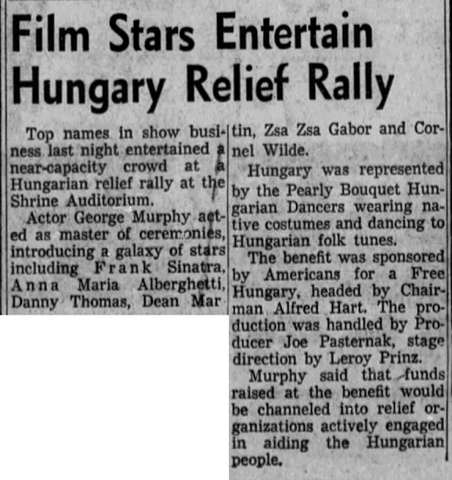
Hungarian Relief Benefit, Shrine Auditorium, Los Angeles, CA
Friday Evening
Host: George Murphy
© 1997-2025 The Sinatra Archive
This calendar, or any parts thereof, may not be reproduced in any fashion
whatsoever without the prior written permission of the publisher (The
Sinatra Archive)
December 1956
[Sinatra Sends Holiday Telegram to Joe Hyams]
A December 1956 telegram from Sinatra thanked columnist Joe Hyams for his help that year and wished him a merry Christmas and happy new year, part of what the book describes as a lifelong friendship between the two, begun through an introduction by Humphrey Bogart.
Source: Charles Pignone, "Frank Sinatra 100" (2015).
[Undistinguished year-end Riddle sessions]
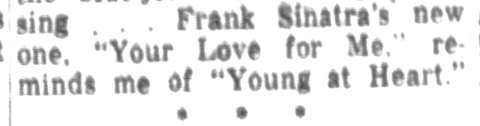
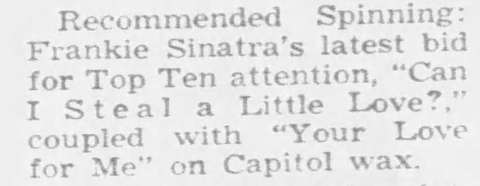
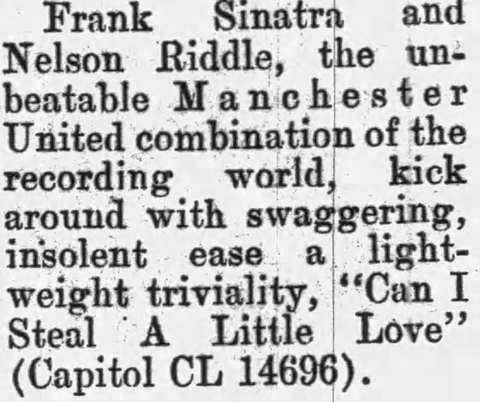
Kaplan: In early December 1956, Sinatra and Nelson Riddle closed out the year on a weak note, recording the derivative "Your Love for Me" and the superficial "Can I Steal a Little Love?" — not considered among Riddle's best arranging work.
Source: James Kaplan, "Sinatra: The Chairman" (2015)
[Reporter questions Frank about Ava and Walter Chiari]
During his Sands run, a reporter pressed Frank about Ava Gardner's affair and rumored marriage to Italian comedian Walter Chiari. He replied that he loved Ava too much to "harass her happiness," though he was clearly drained, at one point reported as singing listlessly.
Source: Richard Havers, "Sinatra" (Dorling Kindersley, 2007).
December 2, 1956
[Gleason's TV tribute to Dorsey]
Jackie Gleason's CBS memorial tribute to Tommy Dorsey aired on December 2, 1956, in place of his regular variety show. Sinatra declined to appear, officially citing back and neck pain.
Source: James Kaplan, "Sinatra: The Chairman" (2015).
December 3, 1956
Studio
Capitol Studio A, Hollywood
E16217 Your Love For Me
(Barry Parker)
Arranged & Conducted by Nelson Riddle
CD: C2 724383808922 The Complete Capitol Singles
LP: T2602 Forever Frank
45: 3608
E16218 Can I Steal A Little Love?
(Phil Tuminello)
Arranged & Conducted by Nelson Riddle
-6 CD: C2 724383808922 The Complete Capitol Singles
CD: CDP 7-92160-2 Frank Sinatra Collector's Series
LP: T2602 Forever Frank
45: 3608
December 12, 1956
[Sinatra turns forty-one]
Frank Sinatra's forty-first birthday fell on December 12, 1956.
Source: James Kaplan, "Sinatra: The Chairman" (2015).
December 13, 1956
[Sinatra at Anastasia premiere]
Frank Sinatra: The night after his 41st birthday, Sinatra attended the Hollywood premiere of Ingrid Bergman's comeback film Anastasia with eighteen-year-old actress Joan Blackman. When asked her name by a reporter, he jokingly answered "Ezzard Charles," prompting a mocking follow-up item the next day.
Source: James Kaplan, "Sinatra: The Chairman" (2015).
December 14, 1956
[Sands anniversary gala and voice crack]
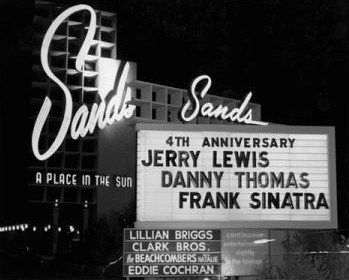
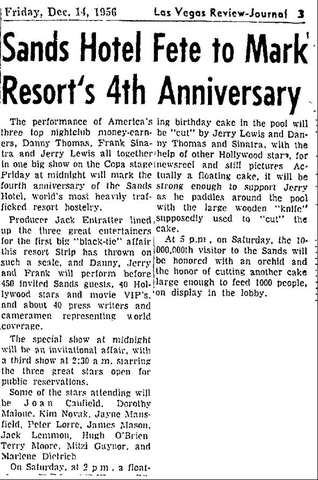
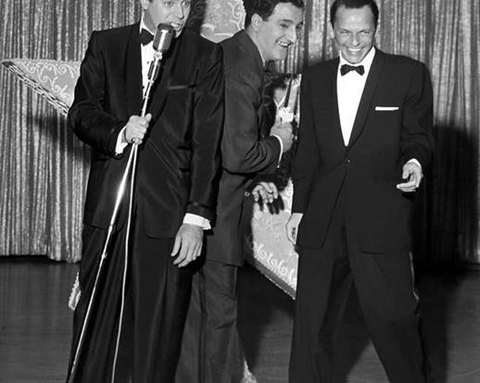
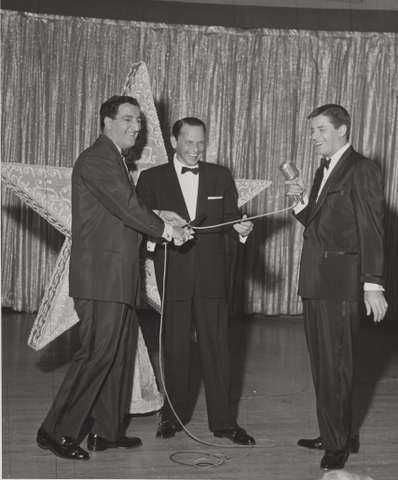
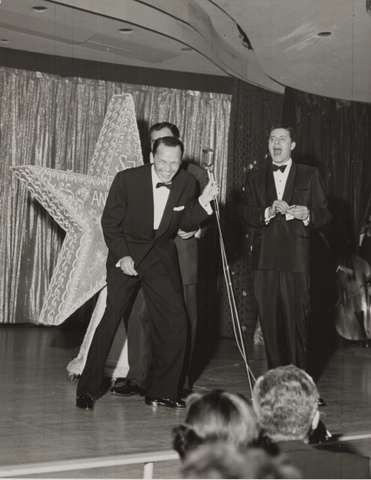
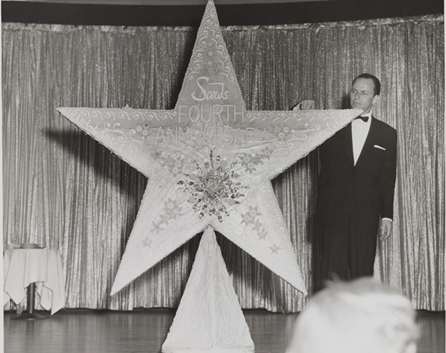
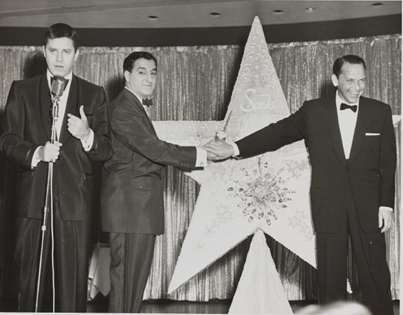
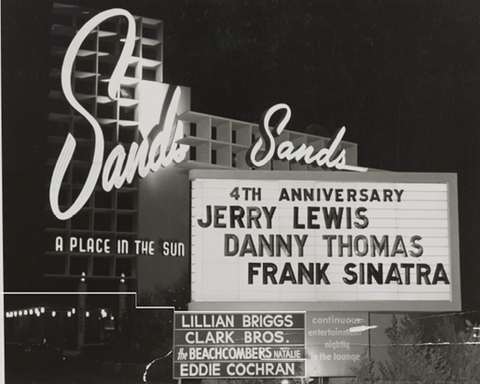
On December 14, 1956, Sinatra performed at a gala marking the Sands' fourth anniversary (he owned a 4% stake), with Jerry Lewis and Danny Thomas. During the 1 a.m. show his voice cracked with apparent laryngitis; he sat out the 4:15 a.m. second show at the bar and skipped the anniversary cake-cutting.
Source: James Kaplan, "Sinatra: The Chairman" (2015).
December 15, 1956
Concerts
Sands Hotel 4th Anniversary, Las Vegas, NV (December 15th, 1956) Frank Sinatra, Danny Thomas, Jerry Lewis
The special show at midnight was an invitational affair, with a third show at 2:30am starring Sinatra, Thomas, and Lewis for public reservations
Sands Hotel 4th Anniversary, Las Vegas, NV (December 15th, 1956)
Frank Sinatra, Danny Thomas, Jerry Lewis
The special show at midnight was an invitational affair,
with a third show at 2:30am starring Sinatra, Thomas, and Lewis for public reservations
December 19, 1956
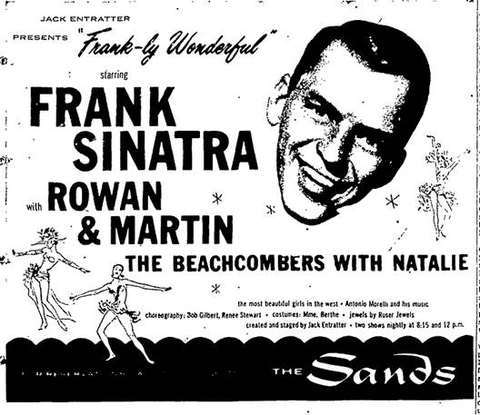
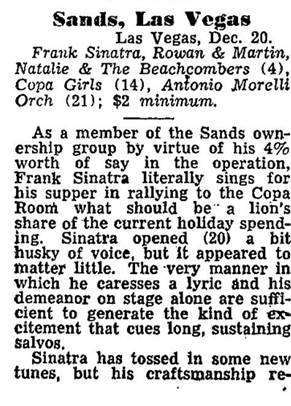
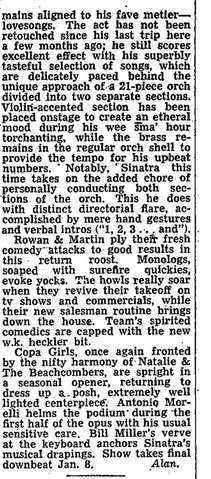
Frank opened a three-week engagement at the Sands, capping a hugely successful year despite the rising competition from rock and roll's young performers. (Source: Richard Havers, "Sinatra" (Dorling Kindersley, 2007).)
December 20, 1956
Concerts
Sands, Las Vegas, Nevada (Dec. 20 thru Jan. 10)
Sands, Las Vegas, Nevada (Dec. 20 thru Jan. 10)
Variety
December 21, 1956
Concerts
Sands, Las Vegas, Nevada (Dec. 20 -31st)
December 22, 1956
Concerts
Sands, Las Vegas, Nevada (Dec. 20 -31st)
December 23, 1956
Concerts
Sands, Las Vegas, Nevada (Dec. 20 thru December 31st)
December 24, 1956
Concerts
Sands, Las Vegas, Nevada (Dec. 20 thru Dec 31st)
December 25, 1956
Concerts
Sands, Las Vegas, Nevada (Dec. 20 thru Dec 31st)
December 26, 1956
Concerts
Sands, Las Vegas, Nevada (Dec. 20 thru Dec 31st)
December 27, 1956
Concerts
Sands, Las Vegas, Nevada (Dec. 20 thru December 31)
December 28, 1956
Concerts
Sands, Las Vegas, Nevada (Dec. 20 thru December 31st)
December 29, 1956
Concerts
Sands, Las Vegas, Nevada (Dec. 20 thru December 31st)
December 30, 1956
Concerts
Sands, Las Vegas, Nevada (Dec. 20 thru December 31st)
December 31, 1956
Concerts
Sands, Las Vegas, Nevada (Dec. 20 thru January 1/2)
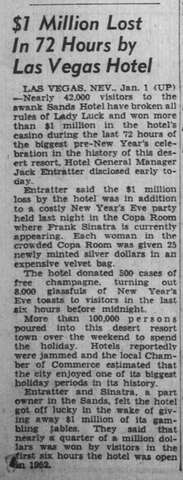
Frank's closing night was New Year's Eve.
All the ladies that night, in the Copa Room, received
25 newly minted silver dollars. Frank went home to
rest for a week before flying to New York for his January
10th opening at the Copa. Jack Entratter was a terrific
business man. He made Frank a part owner at the Sands
and signed him to a life time contract. The lure of the Sinatra
magic made the Sands the hottest attraction on the strip for
years. And you never knew when Sinatra might be a surprise
guest when Sammy or Dino was headlining.
--Ed
Note: Sinatra's last show was actually January 1st, 1957 with a midnight show extending to January 2nd.
Sands, Las Vegas, Nevada (Dec. 20 thru January 1/2)
Frank's closing night was New Year's Eve.
All the ladies that night, in the Copa Room, received
25 newly minted silver dollars. Frank went home to
rest for a week before flying to New York for his January
10th opening at the Copa. Jack Entratter was a terrific
business man. He made Frank a part owner at the Sands
and signed him to a life time contract. The lure of the Sinatra
magic made the Sands the hottest attraction on the strip for
years. And you never knew when Sinatra might be a surprise
guest when Sammy or Dino was headlining.
--Ed
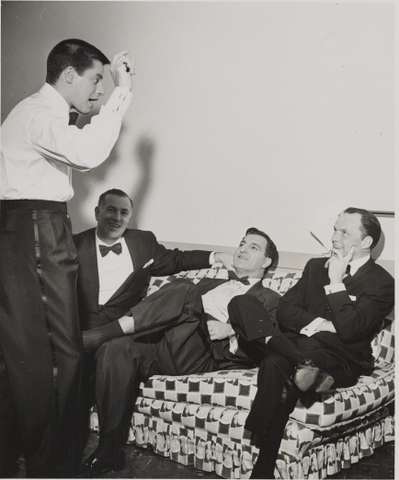
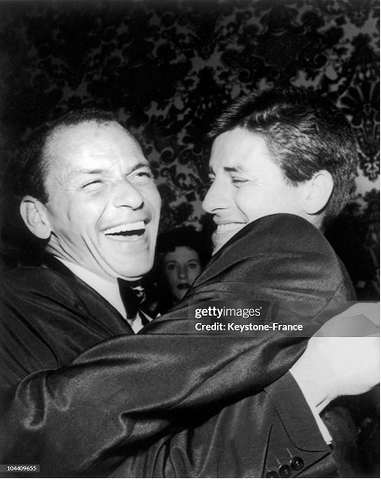
Jerry Lewis And Frank Sinatra In 1958UNITED STATES -
DECEMBER 31: On December the 31st 1958, singer Frank SINATRA and comedian Jerry LEWIS, amused their fellow guest at a Hollywood party by inventing a routine of a couple meeting at an average filmland party.
[New Year's Eve at the Copa Room]
Sinatra closed out 1956 hosting a gala New Year's Eve party at the Sands' Copa Room, where every woman present received twenty-five silver dollars in a velvet bag.
Source: James Kaplan, "Sinatra: The Chairman" (2015).
1957
["Come Fly with Me" Released]
"Come Fly with Me" was released in December 1957; Frank Jr. recalled a top Los Angeles disc jockey playing an entire side of the album during morning drive-time, an unprecedented move.
Source: Nancy Sinatra, "Frank Sinatra, My Father" (1985).
[Coveting the Thunderbird Junior]
A battery-powered toy Thunderbird became the must-have item among Tina's Holmby Hills peers, and she longed for one of her own.
Source: Tina Sinatra, "My Father's Daughter: A Memoir" (2000).
[Lauren Bacall And Frank's First Date After Bogart's Death]
Nancy Sinatra: Lauren Bacall recalled that she and Sinatra were drawn together after Humphrey Bogart's death, and their first outing, a quiet closed-circuit broadcast of a Sugar Ray Robinson prizefight, still ended up photographed and splashed in newspapers worldwide.
Source: Nancy Sinatra, Frank Sinatra: An American Legend, 1995.
[Photographed at the Peak of Fame]
Director George Sidney photographed Sinatra in 1957 at a moment when he topped the polls and charts and seemed to be everywhere at once.
Source: Nancy Sinatra, "Frank Sinatra, My Father" (1985).
[Signs with ABC-TV]
Sinatra signs a contract with ABC-TV, is named Top Male Vocalist by Playboy and "Mr. Personality" by Metronome, and appears in "The Pride and the Passion," "The Joker Is Wild," and "Pal Joey."
Source: Nancy Sinatra, "Frank Sinatra, My Father" (1985).
[Sinatra Signs Three-Million-Dollar ABC Television Deal]
That same year, Sinatra signed a lucrative contract with ABC worth roughly three million dollars to star in a series of Friday-night musical and drama programs sponsored by Bulova and Chesterfield.
Source: Charles Pignone, "Frank Sinatra 100" (2015).
[Sinatra Rehearses ABC Series with Peggy Lee]
A photo caption places Sinatra rehearsing with Peggy Lee for his 1957 ABC television series.
Source: Charles Pignone, "Frank Sinatra 100" (2015).
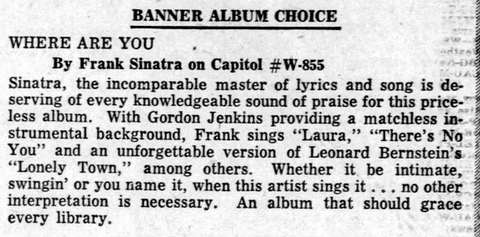
[Sinatra and Gordon Jenkins Record Where Are You?]
Sinatra worked with composer-arranger Gordon Jenkins at a Capitol session for the 1957 album Where Are You?; Jenkins praised Sinatra's conviction in interpreting a song regardless of its quality.
Source: Charles Pignone, "Frank Sinatra 100" (2015).
[Sammy Cahn Auditions 'All The Way' Before Breakfast]
Nancy Sinatra: Sammy Cahn recalled being summoned to sing "All the Way" for Sinatra at what Frank considered breakfast time, four in the afternoon, and receiving only a curt "let's eat" in response before the song went on to win an Oscar.
Source: Nancy Sinatra, Frank Sinatra: An American Legend, 1995.
[The Joker Is Wild Filmed with Vidor and Briskin]
Sinatra worked with director Charles Vidor and producer Samuel J. Briskin on The Joker Is Wild, a 1957 film dramatizing the life of nightclub performer Joe E. Lewis; Sinatra said he loved the film because of his affection for Lewis as a person.
Source: Charles Pignone, "Frank Sinatra 100" (2015).
[Abbott and Costello split up]
Consiglio: Comedy duo Bud Abbott and Lou Costello, famous for the "Who's on First" routine, split up in 1957 to pursue separate careers, though neither was as funny alone.
Source: Tony Consiglio (as told to Franz Douskey), "Sinatra and Me: The Very Good Years" (2012)
[Ava's Mexico divorce headline breaks during Joker Is Wild shoot]
Consiglio: While filming The Joker Is Wild in Hollywood in 1957, Consiglio saw a newspaper headline reading 'Ava Flies to Mexico to Divorce Frank' and had to break the news to Frank on set. Frank read the article, said he was done working for the day, and had Consiglio tell director Charles Vidor he was going home sick.
Source: Tony Consiglio (as told to Franz Douskey), "Sinatra and Me: The Very Good Years" (2012)
[Charlie Morrison's death and Mocambo benefit]
Kaplan: Charlie Morrison, the colorful owner of the Sunset Strip club Mocambo — site of Sinatra's 1943 Los Angeles solo debut — died in early 1957.
Source: James Kaplan, "Sinatra: The Chairman" (2015)
[Conceiving Come Fly with Me]
Kaplan: In fall 1957, wanting to branch out artistically, Sinatra conceived a travel-themed album, calling on Billy May to arrange and commissioning Sammy Cahn and Jimmy Van Heusen to write a title song and closer; the album and opening number were both titled Come Fly with Me.
Source: James Kaplan, "Sinatra: The Chairman" (2015)
[Costello jailed for contempt]
Kaplan: Frank Costello was sentenced to thirty days in jail for refusing to cooperate with a grand jury investigating his shooting, reportedly partly out of fear of IRS scrutiny into gambling finances.
Source: James Kaplan, "Sinatra: The Chairman" (2015)
[Dean Martin cast in The Young Lions]
Kaplan: That spring, to general surprise, Dean Martin landed a serious dramatic role alongside Marlon Brando and Montgomery Clift in the World War II film The Young Lions, which would boost his career when released the following year.
Source: James Kaplan, "Sinatra: The Chairman" (2015)
[Dick Clark invites Sinatra onto Bandstand]
Consiglio: A few months after the Bogart night, Dick Clark called Consiglio at the Hampshire House during another Copa engagement, asking to have Sinatra appear on American Bandstand. Consiglio relayed the request; Sinatra said he'd think about it and never called back, Consiglio's way of describing Sinatra's polite refusal.
Source: Tony Consiglio (as told to Franz Douskey), "Sinatra and Me: The Very Good Years" (2012)
[Entratter and Sinatra back Sammy Davis staying at the Sands]
Ed Walters: Around 1957-58, when a dispute arose over Sammy Davis Jr. being allowed to stay and move around the Sands hotel (rather than being confined to the Moulin Rouge on the west side like other black entertainers), Walters says Jack Entratter first stood up for Sammy, and Sinatra, hearing about pushback from other owners, flew in and insisted Sammy be allowed to stay at the hotel, ending up in one of the Sands' back bungalows.
Source: Ed Walters, pit boss reminiscences (compiled by Kraus, Sinatra mailing list)
[Frank Jr. causes a scene at Pride and the Passion screening]
Consiglio: In 1957, when Frank Jr. was twelve or thirteen, Consiglio took him to see The Pride and the Passion, Frank's film with Cary Grant and Sophia Loren. During a scene where Frank's character spits at a crowd, Frank Jr. shouted excitedly that it was his father, causing a commotion that forced the theater manager to have them leave.
Source: Tony Consiglio (as told to Franz Douskey), "Sinatra and Me: The Very Good Years" (2012)
[Kim Novak scandal and Fischetti intervention]
William Read Woodfield: When Sammy Davis Jr.'s romance with Kim Novak threatened to become a scandal, studio head Harry Cohn allegedly used his Mob ties (including gangster Johnny Rosselli) to have Davis threatened by hoodlums. Davis turned to Sinatra, who reportedly called his Chicago contact Joe Fischetti to resolve the threat, per photographer William Read Woodfield's account.
Source: James Kaplan, "Sinatra: The Chairman" (2015)
[Look magazine recounts Pegler incident]
Bill Davidson (Look magazine): A 1957 Look magazine profile of Sinatra by Bill Davidson included an account from a man claiming to have been Pegler's aide, describing Pegler taunting Sinatra through his hotel door and Sinatra destroying furniture in his own suite afterward.
Source: James Kaplan, "Frank: The Voice" (2010)
[November Capitol session with Riddle]
Kaplan: Three days before Thanksgiving, Sinatra returned to Capitol Studio A and recorded four singles with Nelson Riddle conducting: updated versions of "I Believe," "It's the Same Old Dream," and "Time After Time" (all previously recorded with Axel Stordahl in the 1940s), plus "Everybody Loves Somebody," a song Dean Martin would take to number one seven years later.
Source: James Kaplan, "Sinatra: The Chairman" (2015)
[Pal Joey made in place of Carousel]
Consiglio: To honor his contract after backing out of Carousel, Frank instead made Pal Joey with Rita Hayworth and Kim Novak; Carousel was later made with Gordon MacRae and Shirley Jones. Pal Joey produced hit songs including 'There's a Small Hotel' and 'The Lady Is a Tramp.'
Source: Tony Consiglio (as told to Franz Douskey), "Sinatra and Me: The Very Good Years" (2012)
[Pal Joey production and Sinatra's billing quip]
Frank Sinatra: Sinatra happily ceded top billing on Pal Joey to co-stars Rita Hayworth and Kim Novak, joking, "It's okay to make it Hayworth/Sinatra/Novak. I don't mind being in the middle of that sandwich." Tom Santopietro later called the film "the last great musical of his career."
Source: James Kaplan, "Sinatra: The Chairman" (2015)
[Peggy Connelly marries Dick Martin]
Kaplan: Sinatra's former girlfriend Peggy Connelly had by this point married comedian Dick Martin, having moved on from her relationship with Frank.
Source: James Kaplan, "Sinatra: The Chairman" (2015)
[Pegler denies the Waldorf incident]
Westbrook Pegler: In response to the 1957 Look article, Westbrook Pegler wrote the editors denying he was ever confronted at his hotel room door that night and denying any aide had made such a statement; Look stood by its story.
Source: James Kaplan, "Frank: The Voice" (2010)
[Sadie Vimmerstedt's letter inspires song]
Kaplan: Youngstown, Ohio grandmother Sadie Vimmerstedt, angered when Sinatra left his first wife for Ava Gardner and pleased when Gardner later left him, wrote a fan letter with a song concept to "Johnny Mercer, Songwriter, New York, NY"; the Manhattan post office forwarded it to ASCAP, which delivered it to Mercer, eventually resulting in "I Wanna Be Around."
Source: James Kaplan, "Sinatra: The Chairman" (2015)
[Sammy Davis Jr. and hotel segregation]
Ed Walters: Walters recounts that Sands entertainment boss Jack Entratter booked top Black performers like Lena Horne from the hotel's opening, but Black entertainers still had to live off-property, often at the Moulin Rouge, since they weren't allowed to room or roam freely at the hotel. Around 1957-58 a dispute arose over Sammy Davis Jr. wanting to stay at the Sands itself; by Walters's account, Entratter and Sinatra pushed back against hotel staff who wanted Black performers kept out of the casino, and Sammy was allowed to stay in one of the hotel's back bungalows (Belmont).
Source: Ed Walters, pit boss reminiscences (compiled by Kraus, Sinatra mailing list)
[Sinatra forces Ezra Goodman off Pal Joey set]
Ezra Goodman: When Time correspondent Ezra Goodman showed up on the Pal Joey set to interview Kim Novak, Sinatra spotted him and demanded through director George Sidney that either he or Goodman leave. Goodman left, but Sinatra also walked off the set anyway that day, costing Columbia a day's shooting.
Source: James Kaplan, "Sinatra: The Chairman" (2015)
[Sinatra insists on Capra for Hole in the Head]
Kaplan: Sinatra decided he wanted Frank Capra, and only Capra, to direct A Hole in the Head, a package deal arranged by Bert Allenberg of William Morris; Sinatra's production company would own two-thirds of the picture to Capra's one-third, terms Capra had little choice but to accept.
Source: James Kaplan, "Sinatra: The Chairman" (2015)
[Sinatra turns to Gordon Jenkins]
Kaplan: In early 1957, seeking a new sound after years with Nelson Riddle, Sinatra began collaborating with veteran arranger Gordon Jenkins on the album Where Are You?, drawn to Jenkins's lush, string-heavy, old-fashioned sentimentality — a style Sinatra had admired since 1946 in Jenkins's work for Judy Garland and, more recently, Nat King Cole.
Source: James Kaplan, "Sinatra: The Chairman" (2015)
[Sinatra's libel suit against Look]
Kaplan: Against his lawyers' advice, Sinatra filed a $2.3 million libel lawsuit against Bill Davidson and Look magazine over the profile, which had described him as a "neurotic, depressed, and tormented person with suicidal tendencies and a libertine."
Source: James Kaplan, "Sinatra: The Chairman" (2015)
[Yankees 'brawl' at the Copacabana]
Consiglio: During a Sammy Davis Jr. engagement at the Copa (with Joey Bishop opening), Yankees Hank Bauer, Mickey Mantle, Yogi Berra, Johnny Kucks and Billy Martin were at the club celebrating Martin's birthday when a heckler made racist remarks at Davis. A Copa bouncer, not Bauer, knocked the heckler out, but papers ran headlines blaming the Yankees for a brawl; several players were fined $200 by club president George Weiss, and Billy Martin was soon traded to the Kansas City A's.
Source: Tony Consiglio (as told to Franz Douskey), "Sinatra and Me: The Very Good Years" (2012)
[Young Frankie performs for Louella Parsons]
Kaplan: At a 1957 dinner party given by his mother, the thirteen-year-old Frank Sinatra Jr. played piano for Louella Parsons and other guests, holding forth on his distaste for rock 'n' roll and his love of the standards.
Source: James Kaplan, "Sinatra: The Chairman" (2015)
[personal life]
Between the release of The Pride and the Passion and The Joker Is Wild, Ava Gardner was granted a divorce from Sinatra in Mexico City, finalized after repeated cycles of reconciliation and fighting.
No corresponding dated entry could be identified in the chronology for this film/context.
Source: Tom Santopietro, "Sinatra in Hollywood" (2008), The Peak Years (pt. 2)
[Bogart's death interrupts Frank's Copacabana run]
Frank opened at New York's Copacabana but had done only a couple of shows when word reached him that his close friend Humphrey Bogart had died at 57. He cancelled five shows, skipped the funeral, then later returned to finish the run performing two shows nightly.
Source: Richard Havers, "Sinatra" (Dorling Kindersley, 2007).
[Playboy review may hold first "chairman of the board" mention]
A Playboy review of Close to You in May 1957 praised Frank's handling of the album's material, and the book suggests this may be the earliest print use of "chairman of the board," a nickname that stuck with him for the rest of his career.
Source: Richard Havers, "Sinatra" (Dorling Kindersley, 2007).
[A Jolly Christmas from Frank Sinatra -- critical commentary]
Granata's discography entry: A Jolly Christmas from Frank Sinatra, arranged by Gordon Jenkins, released September 1957.
Source: Charles L. Granata, "Sessions with Sinatra: Frank Sinatra and the Art of Recording" (1999/2003), Afterword & Appendices A-D
January 1957
[Audience member's account of Copa show]
Harry Agoratus: Staten Island attendee Harry Agoratus recalled Sinatra in excellent voice at a January 1957 Copacabana show, casually being handed a drink from a nearby table mid-performance and holding the crowd in total silence during his songs, with women standing on tables for a better view.
Source: James Kaplan, "Sinatra: The Chairman" (2015)
[Earl Wilson on Copacabana show and Kilgallen jibe]
Earl Wilson: Columnist Earl Wilson reported that Sinatra sang for about an hour at the Copacabana and cracked jokes borrowed from Joe E. Lewis's act; Sinatra also ad-libbed a dig at absent columnist Dorothy Kilgallen, joking she was "out shopping for a new chin," which drew rebukes from Walter Winchell and Louis Sobol the next day.
Source: James Kaplan, "Sinatra: The Chairman" (2015)
[Humphrey Bogart's death, Copa]
Consiglio: In the early hours of a January morning in 1957, while Sinatra and Consiglio were staying at the Hampshire House during a Copacabana engagement, a woman called their suite (possibly Lauren Bacall) to say Bogart had died. Sinatra told Consiglio he was in no shape to perform that night and that Consiglio would have to cover his two Copa shows.
Source: Tony Consiglio (as told to Franz Douskey), "Sinatra and Me: The Very Good Years" (2012)
[Jazz singer Abbey Lincoln visits Sinatra]
Consiglio: The night Bogart died, after Sinatra and Consiglio had dinner in their suite, a singer who gave her name as Abbey Lincoln called up from the lobby and Sinatra invited her up; she stayed until the next day.
Source: Tony Consiglio (as told to Franz Douskey), "Sinatra and Me: The Very Good Years" (2012)
[Sammy Davis and Jerry Lewis fill in at Copa]
Consiglio: The night Bogart died, Consiglio scrambled to find replacements for Sinatra's Copa shows. He reached Sammy Davis Jr. (then appearing in Mr. Wonderful on Broadway), whose conductor said Sammy would cover the midnight show, and Jerry Lewis, playing the Palace Theater, agreed to do the early show.
Source: Tony Consiglio (as told to Franz Douskey), "Sinatra and Me: The Very Good Years" (2012)
[Sinatra and Consiglio watch American Bandstand]
Consiglio: The afternoon Bogart died, a grieving Sinatra stayed in his hotel room with Consiglio and, after waking from a nap, watched Dick Clark's American Bandstand for the first time -- an hour of teenagers dancing to early rock 'n' roll by Elvis, Buddy Holly, Chuck Berry and Little Richard.
Source: Tony Consiglio (as told to Franz Douskey), "Sinatra and Me: The Very Good Years" (2012)
January 2, 1957
Radio
Sands, Las Vegas, Nevada (Dec. 20, 1956 - January 1st/2nd 1957)
Sinatra's last show started at midnight, technically January 2nd.
Vic Damone with Rowan & Martin opened on the evening of January 2nd, 1957.
January 10, 1957
Concerts
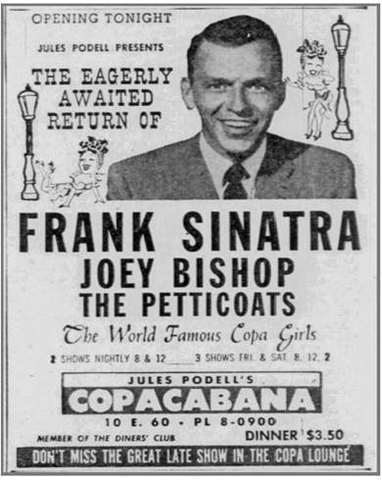
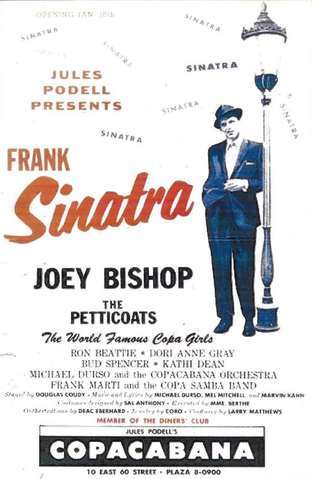
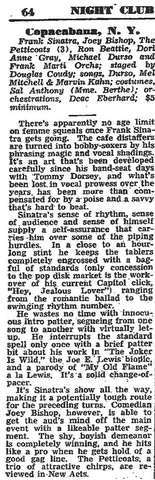
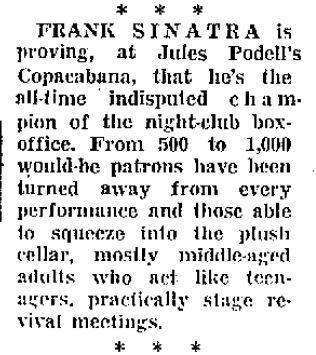
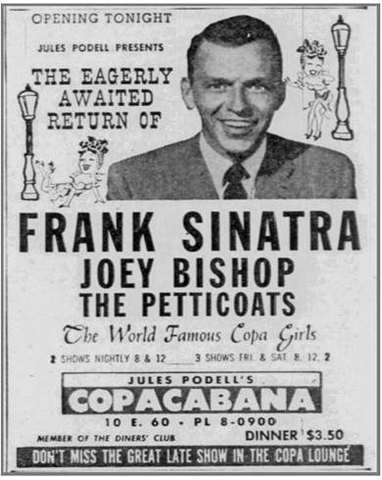
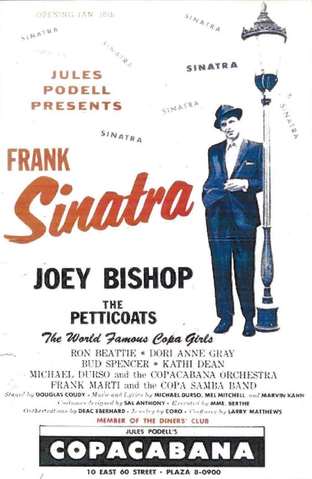
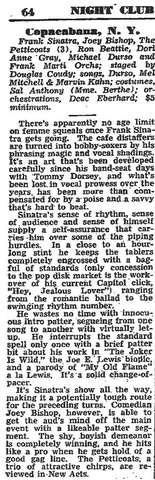
Copacabana, New York City (January 10-23)
Staring: Frank Sinatra, Joey Bishop, The Petticoats, Ron Beattie,
Dori Anne Gray, Michael Durso and Frank Marti Orchs
Staged by Douglas Coudy;
Music and Lyrics By: Michael Durso, Mel Mitchell & Marvin
Kahn
Costumes: Sal Anthony (Mme. Berthe)
Jewelry By: Coro
Colffures By: Larry Matthews
Orchestrations by Deac Eberhard
Notes: No show January 14 due to the death of Humphrey Bogart
note: Frank was at The Copa for two weeks, He closed on 1/23. The death of Bogart, 1/14,
caused him to cancel that night. According to Variety, Frank was the hottest act in New York
that January. All of his shows were SRO. I have an article on what happened 1/14. Will post on
that date.
--Ed
Copacabana, New York City (January 10-23)
Copacabana, New York City (January 10-23)
January 16, 1957
Earl Wilson
Wilsons Mark 21st Anniversary
By Attending Sinatra's Opening
NEW York - Twenty-one years
married! Hey, that's not bad in
our league. As Andre Baruch said.
"That's the MAJOR leagues!"
Wonder if we can make it 25-in
[Sinatra opens at the Copacabana]
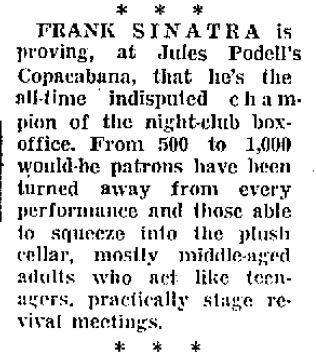
Sinatra opened a stand at the Copacabana in bitterly cold New York weather, drawing a star-studded crowd including Joe DiMaggio, Judy Garland, Sammy Davis Jr., and Marlene Dietrich. Joey Bishop, opening for him, quipped about the audience, "Are all these people out of work?"
Source: James Kaplan, "Sinatra: The Chairman" (2015).
[Sammy Davis Jr. on Sinatra's solitary walk]
Sammy Davis Jr.: Before his Copacabana opening, Sinatra went for a solitary walk to steady himself; Sammy Davis Jr. recalled being told by Hank Sanicola that Frank had gone out alone, and reflected on having seen Sinatra walking anonymously through Times Square during his career slump just a few years earlier.
Source: James Kaplan, "Sinatra: The Chairman" (2015).
January 11, 1957
Concerts
Copacabana, New York City (January 10-23)
Staring: Frank Sinatra, Joey Bishop, The Petticoats, Ron Beattie, Dori Anne Gray, Michael Durso and Frank Marti Orchs
Staged by Douglas Coudy;
Music and Lyrics By: Michael Durso, Mel Mitchell & Marvin Kahn
Costumes: Sal Anthony (Mme. Berthe)
Jewelry By: Coro
Colffures By: Larry Matthews
Orchestrations by Deac Eberhard
Notes: No show January 14 due to the death of Humphrey Bogart.
January 12, 1957
Concerts
Copacabana, New York City (January 10-23)
Staring: Frank Sinatra, Joey Bishop, The Petticoats, Copa Girls, Ron Beattie, Dori Anne Gray, Bud Spencer, Kathi Dean Michael Durso and Copacabana Orchestra Frank Marti and Copa Samba Band
Staged By: Douglas Coudy
Music And Lyrics By: Micheal Durso, Mel Mitchell, Marvin Kahn
Orchestrations By: Deac Eberhard
Jewelry By: Coro
Colffures By: Larry Matthews
Notes: No show January 14 due to the death of Humphrey Bogart.
Copacabana, New York City (January 10-23)
Staring: Frank Sinatra, Joey Bishop, The Petticoats, Copa Girls, Ron Beattie, Dori Anne Gray, Bud Spencer, Kathi Dean Michael Durso and Copacabana Orchestra Frank Marti and Copa Samba Band
Staged By: Douglas Coudy
Music And Lyrics By: Micheal Durso, Mel Mitchell, Marvin Kahn
Orchestrations By: Deac Eberhard
Jewelry By: Coro
Colffures By: Larry Matthews
Daily News
1-12-57
[image referenced in source but could not be recovered]
January 13, 1957
Concerts
Copacabana, New York City (January 10-23)
Staring: Frank Sinatra, Joey Bishop, The Petticoats, Copa Girls, Ron Beattie, Dori Anne Gray, Bud Spencer, Kathi Dean Michael Durso and Copacabana Orchestra Frank Marti and Copa Samba Band
Staged By: Douglas Coudy
Music And Lyrics By: Micheal Durso, Mel Mitchell, Marvin Kahn
Orchestrations By: Deac Eberhard
Jewelry By: Coro
Colffures By: Larry Matthews
Notes: No show January 14 due to the death of Humphrey Bogart.
January 14, 1957
Concerts
Copacabana, New York City (January 10-23) (Cancelled)
Notes: No show January 14 due to the death of Humphrey
Bogart
1-16-57
Copacabana, New York City (Cancelled)
SINATRA MISSES ONE COPA STINT AT PEAK SRO RUN;
LARYNGITIS-BOGART SLANTS
Frank Sinatra's current trip at the Copacabana, N.Y., is probably the heaviest sellout in the history of the cafe, with no reservations available for the two-week run. However, the nitery had a hard time Monday (14) when the swooner reportedly got a touch of laryngitis.
Throat ailment came so suddenly, according to a manage- ment spokesman, that there was no time to advertise the fact.
Fortunately, Jerry Lewis, rehearsing for his NBC-TV video show due Saturday (19), was in the audience dining with Shap Shapiro of Look mag and was prevailed upon to go on ad-lib. For the supper trade, Sammy Davis Jr. was recruited. Sinatra was said to be sufficiently recovered to go on last night (Tues).
Situation was complicated by the fact that Sinatra had expressed himself as wanting to go to the Coast for Humphrey Bogart's funeral, and that Sinatra's laryngitis may have been aggravated by the announcement of the actor's death.
There was another report, based on Sinatra's penchant for quick decisions, that he had flown to the Coast to pay his respects, figuring to come back in time for last night's performance. Copa management said that Sinatra's plans to go to the Coast for the funeral were now off.
Thus inadvertently, the Copa had two major nitery debuts the same evening. As a single, Lewis thus made his N.Y. cafe "bow," though he is slated to be there in June, and Davis made his N.Y. preem without the services of the other members of the Will Mastin Trio.
The Copa lost no business because of Sinatra's absence .. It said no announcement was possible for the first show, and for the second display, a sign in front of the cafe announced Davis' pinchhitting. VARIETY
January 16, 1957
Des Moines Tribune (Des Moines, Iowa) · 15 Jan 1957, Tue
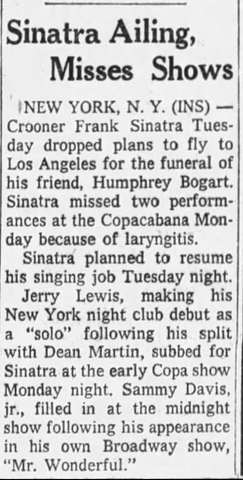
Humphrey Bogart died of esophageal cancer three weeks after his fifty-seventh birthday. Frank Sinatra, performing at the Copacabana at the time, canceled five shows — Jerry Lewis and Sammy Davis Jr. filled in — saying he was too devastated to go on, though true to form he skipped the funeral itself, preferring, as he often put it, to remember friends surrounded by laughter rather than tears. In the aftermath, newly widowed Lauren “Betty” Bacall increasingly leaned on Sinatra for companionship, a friendship that would grow into a brief, ultimately doomed romance. Source: J. Randy Taraborrelli, Sinatra: Behind the Legend.
[Bogart's death and Sinatra's canceled show]
Frank Sinatra: Humphrey Bogart died in the early morning hours of January 14, 1957. Sinatra learned the news just before he was to perform at the Copa that night and canceled, telling agent Abe Lastfogel, "I can't go on. I'm afraid I wouldn't be coherent." Jerry Lewis and Sammy Davis Jr. filled in for the two shows.
Source: James Kaplan, "Sinatra: The Chairman" (2015).
January 15, 1957
Concerts
Copacabana, New York City (January 10-23)
Staring: Frank Sinatra, Joey Bishop, The Petticoats, Copa Girls, Ron Beattie, Dori Anne Gray, Bud Spencer, Kathi Dean Michael Durso and Copacabana Orchestra Frank Marti and Copa Samba Band
Staged By: Douglas Coudy
Music And Lyrics By: Micheal Durso, Mel Mitchell, Marvin Kahn
Orchestrations By: Deac Eberhard
Jewelry By: Coro
Colffures By: Larry Matthews
January 16, 1957
Concerts
Copacabana, New York City (January 10-23)
Staring: Frank Sinatra, Joey Bishop, The Petticoats, Copa Girls, Ron
Beattie, Dori Anne Gray, Bud Spencer, Kathi Dean Michael Durso and Copacabana Orchestra Frank Marti and Copa Samba Band
Staged By: Douglas Coudy
Music And Lyrics By: Micheal Durso, Mel Mitchell, Marvin Kahn
Orchestrations By: Deac Eberhard
Jewelry By: Coro
Colffures By: Larry Matthews
January 17, 1957
Concerts
Copacabana, New York City (January 10-23)
Staring: Frank Sinatra, Joey Bishop, The Petticoats, Copa Girls, Ron Beattie, Dori Anne Gray, Bud Spencer, Kathi Dean Michael Durso and Copacabana Orchestra Frank Marti and Copa Samba Band
Staged By: Douglas Coudy
Music And Lyrics By: Micheal Durso, Mel Mitchell, Marvin Kahn
Orchestrations By: Deac Eberhard
Jewelry By: Coro
Colffures By: Larry Matthews
[Parsons reports Sinatra will miss funeral]
Louella Parsons: Louella Parsons's column reported that Sinatra would be unable to attend Bogart's funeral because "his doctors won't let him fly."
Source: James Kaplan, "Sinatra: The Chairman" (2015).
January 18, 1957
Concerts
Copacabana, New York City (January 10-23)
Staring: Frank Sinatra, Joey Bishop, The Petticoats, Copa Girls, Ron Beattie, Dori Anne Gray, Bud Spencer, Kathi Dean Michael Durso and Copacabana Orchestra Frank Marti and Copa Samba Band
Staged By: Douglas Coudy
Music And Lyrics By: Micheal Durso, Mel Mitchell, Marvin Kahn
Orchestrations By: Deac Eberhard
Jewelry By: Coro
Colffures By: Larry Matthews
[Bogart's funeral]
Humphrey Bogart's funeral was held at All Saints' Episcopal Church in Beverly Hills, drawing thousands outside and two hundred Hollywood luminaries inside, including Hepburn, Tracy, Gregory Peck, and Ronald Reagan; John Huston gave the eulogy. Sinatra did not attend, sending Peggy Connelly in his place.
Source: James Kaplan, "Sinatra: The Chairman" (2015).
January 19, 1957
Concerts
Copacabana, New York City (January 10-23)
Staring: Frank Sinatra, Joey Bishop, The Petticoats, Copa Girls, Ron Beattie, Dori Anne Gray, Bud Spencer, Kathi Dean Michael Durso and Copacabana Orchestra Frank Marti and Copa Samba Band
Staged By: Douglas Coudy
Music And Lyrics By: Micheal Durso, Mel Mitchell, Marvin Kahn
Orchestrations By: Deac Eberhard
Jewelry By: Coro
Colffures By: Larry Matthews
January 20, 1957
Concerts
Copacabana, New York City (January 10-23)
Staring: Frank Sinatra, Joey Bishop, The Petticoats, Copa Girls, Ron Beattie, Dori Anne Gray, Bud Spencer, Kathi Dean Michael Durso and Copacabana Orchestra Frank Marti and Copa Samba Band
Staged By: Douglas Coudy
Music And Lyrics By: Micheal Durso, Mel Mitchell, Marvin Kahn
Orchestrations By: Deac Eberhard
Jewelry By: Coro
Colffures By: Larry Matthews
Copacabana, New York City (January 10-23)
Staring: Frank Sinatra, Joey Bishop, The Petticoats, Copa Girls, Ron Beattie, Dori Anne Gray, Bud Spencer, Kathi Dean Michael Durso and Copacabana Orchestra Frank Marti and Copa Samba Band
Staged By: Douglas Coudy
Music And Lyrics By: Micheal Durso, Mel Mitchell, Marvin Kahn
Orchestrations By: Deac Eberhard
Jewelry By: Coro
Colffures By: Larry Matthews
Band 1-20-57
Philadelphia Inquirer
Thursday, 1-24-57
January 21, 1957
Concerts
Copacabana, New York City (January 10-23)
Staring: Frank Sinatra, Joey Bishop, The Petticoats, Copa Girls, Ron Beattie, Dori Anne Gray, Bud Spencer, Kathi Dean Michael Durso and Copacabana Orchestra Frank Marti and Copa Samba Band
Staged By: Douglas Coudy
Music And Lyrics By: Micheal Durso, Mel Mitchell, Marvin Kahn
Orchestrations By: Deac Eberhard
Jewelry By: Coro
Colffures By: Larry Matthews
[Close to You album released]
Close to You was released the Monday after Bogart's funeral, with Capitol ad copy calling it "A New High in Intimate Song Styling." Playboy praised Sinatra's handling of the material but faulted the Hollywood String Quartet's lack of rhythmic swing; the album peaked at number 5 on Billboard but was a commercial disappointment after Songs for Swingin' Lovers!
Source: James Kaplan, "Sinatra: The Chairman" (2015).
Capitol released the top-10 album Close to You, which included a track recorded purely as an in-house joke on Capitol executives, 'There's a Flaw in My Flue,' never meant for release.
Source: Nancy Sinatra, Frank Sinatra: An American Legend, 1995.
January 22, 1957
Concerts
Copacabana, New York City (January 10-23)
Staring: Frank Sinatra, Joey Bishop, The Petticoats, Copa Girls, Ron Beattie, Dori Anne Gray, Bud Spencer, Kathi Dean Michael Durso and Copacabana Orchestra Frank Marti and Copa Samba Band
Staged By: Douglas Coudy
Music And Lyrics By: Micheal Durso, Mel Mitchell, Marvin Kahn
Orchestrations By: Deac Eberhard
Jewelry By: Coro
Colffures By: Larry Matthews
January 23, 1957
Concerts
Copacabana, New York City (January 10-23)
Staring: Frank Sinatra, Joey Bishop, The Petticoats, Copa Girls, Ron Beattie, Dori Anne Gray, Bud Spencer, Kathi Dean Michael Durso and Copacabana Orchestra Frank Marti and Copa Samba Band
Staged By: Douglas Coudy
Music And Lyrics By: Micheal Durso, Mel Mitchell, Marvin Kahn
Orchestrations By: Deac Eberhard
Jewelry By: Coro
Colffures By: Larry Matthews
[FBI synopsis for Look magazine libel inquiry]
After Look magazine reporter Bill Davidson wrote Hoover aide Louis Nichols on January 20, 1957 asking the Bureau to verify rumors that Sinatra had been arrested for rape in the 1930s, that his mother Dolly had been arrested as an abortionist, and that his uncles had been bootleggers, headquarters ordered up a full synopsis of the Sinatra files. It confirmed a single 1937 arrest of "Dolly" Sinatra on an abortion charge (no disposition on record) and Sinatra's own 1938 seduction/adultery arrests, while finding no record connecting his uncles to bootlegging. Davidson's subsequent three-part Look series that year prompted libel and invasion-of-privacy suits from Sinatra, later dropped.
Source: Kuntz and Kuntz, The Sinatra Files, ch. 2.
February 1957
[Martin's post-breakup film flops]
Kaplan: Dean Martin's first film after splitting with Jerry Lewis, Ten Thousand Bedrooms, co-starring Anna Maria Alberghetti, was a box-office failure with tepid reviews; Variety called him merely "an affable leading man."
Source: James Kaplan, "Sinatra: The Chairman" (2015)
February 1, 1957
[Parsons profiles Frank Sinatra Jr.]
Louella Parsons: Louella Parsons devoted a column to thirteen-year-old Frank Sinatra Jr., calling him near-prodigy after he played piano at a Nancy Sinatra buffet dinner; the boy dismissed rock 'n' roll and Elvis Presley, saying Elvis "came up too suddenly" compared to his father, Bing Crosby, and Perry Como.
Source: James Kaplan, "Sinatra: The Chairman" (2015).
February 6, 1957
[Far East tour scuttled in Honolulu]
In Honolulu on February 6, 1957, Sinatra's planned tour of Australia, the Philippines, Hong Kong, and Japan collapsed over a dispute about sleeping berths on a Qantas flight; he turned the whole party around and flew back to Los Angeles, later paying $75,000 for lost bookings and compensating his musicians. The Sydney Daily Mirror ran the headline "'Cranky Frankie' Gives Us the Big Brushoff."
Source: James Kaplan, "Sinatra: The Chairman" (2015).
February 14, 1957
FRIARS CLUB, Hollywood, California
Thursday evening
1. Heart Fund benefit
2. Valentine's Day
3. Jack Benny Dinner celebrating
24th anniversary of his 39th birthday
Don Wilson introduces
Barry Mirkin
George Jessel M.C.
Adm, J..B. Pierson Jr.
Irene Dunne
Ronald Reagan
Isaac Stern
George Burns
Deborah Kerr
California Governor: Goodwin T. Knight
Edgar Bergen
Dean Martin sings parody of "On The Street Where You Live" / "Mr. Wonderful"(S. Cahn) Frank Sinatra - Jessel introduces him as the entertainer who finds himself in greater demand since the halcyon days of the great Al Jolson Frank reads a poem that is a valentine to Jack composed by Frank and Henry Wilson) Calls him the most wonderful man he has ever known in his life. He then proposes a toast and exits the dinner. Tony Martin sings "Love In Bloom"(Jack' s theme song)
Bob Hope
Art Linkletter
Jack Benny
Frank at Benny's tribute dinner.
Jessel , Dino and in the bottom photo John Raitt
George Jessel, Sinatra, Dean Martin
From left Tony Martin, Irene Dunne and Frank Sinatra at testimonial dinner given Jack Benny by the Frizes Club on February 14, 1957 in Hollywood, Calif. (AP Photo) ASSOCIATED PRESS
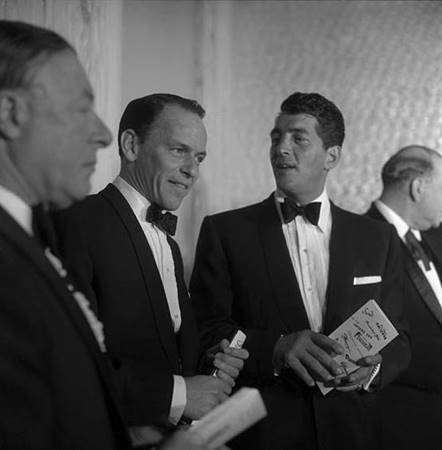
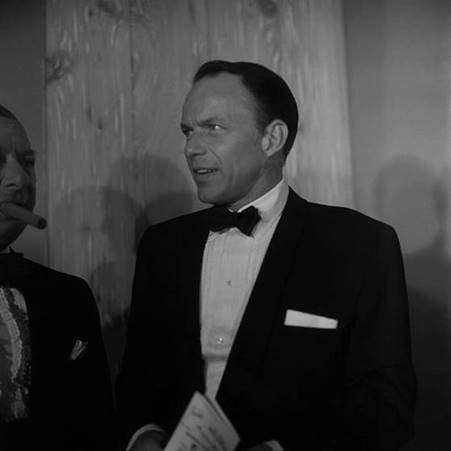
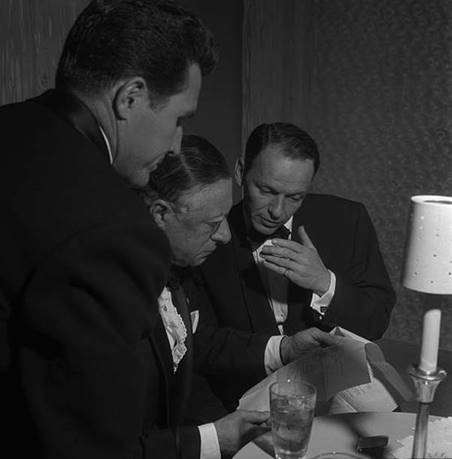
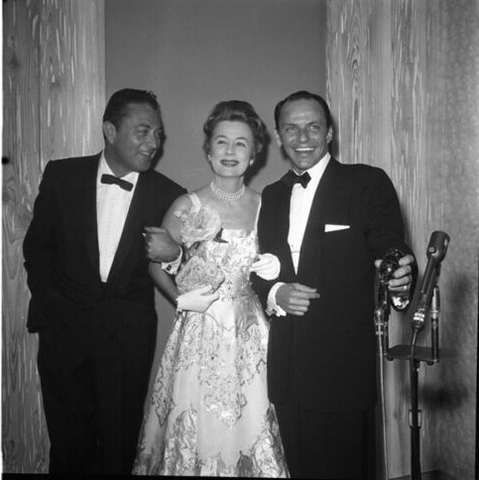
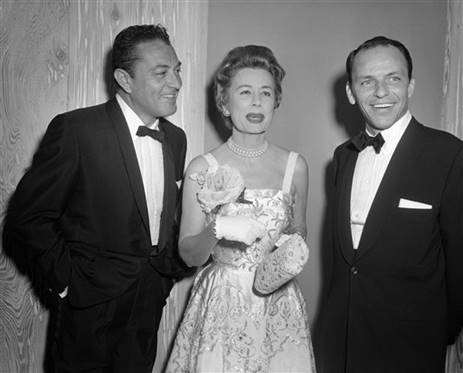
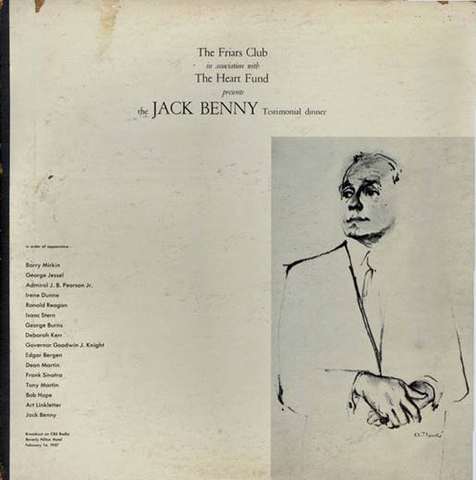
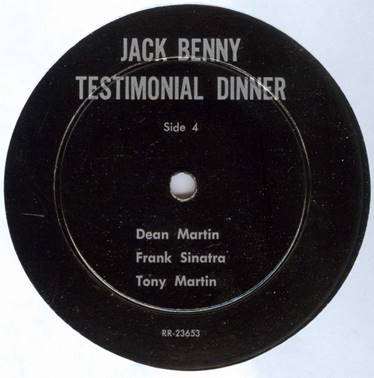
[Sinatra drinks heavily at Benny benefit]
At a Friars birthday benefit for Jack Benny at the Beverly Hilton on Valentine's Day 1957, Sinatra sat on the dais and drank most of a bottle of Scotch in front of eight hundred guests, including Bob Hope, George Burns, and Dean Martin.
Source: James Kaplan, "Sinatra: The Chairman" (2015).
February 16, 1957
[Late-night subpoena in Palm Springs]
Frank Sinatra: In the early hours of February 16, 1957, LAPD detectives roused Sinatra at his Palm Springs house — a policewoman had first tried calling out as if drunk — to serve a subpoena requiring him to testify before a state senate committee about the 1954 Wrong-Door Raid. Sinatra quipped, "It's a good thing I was asleep, or you could have gotten a bullet in you."
Source: James Kaplan, "Sinatra: The Chairman" (2015).
February 28, 1957
[Sinatra testifies before Kraft Committee]
Sinatra testified before state senator Fred H. Kraft's committee about the November 1954 Wrong-Door Raid, denying he had joined Joe DiMaggio in breaking into the apartment where they mistakenly expected to find Marilyn Monroe, and insisting under oath he had stayed by his car the whole time. He was flip with questioners, e.g. joking about which DiMaggio brother he meant.
Source: James Kaplan, "Sinatra: The Chairman" (2015).
[Sinatra served second subpoena leaving hearing]
As he left the Kraft Committee hearing on February 28, 1957, Sinatra was handed another summons by an LAPD bunko squad lieutenant to appear before the county grand jury's separate probe into the Wrong-Door Raid.
Source: James Kaplan, "Sinatra: The Chairman" (2015).
March 1957
[Grand jury testimony, no indictment]
Frank Sinatra: During fifty minutes of testimony before the county grand jury in March 1957, Sinatra deflected the contradiction with Phil Irwin's account, quipping, "Who are you going to believe, me or a guy who makes his living kicking down bedroom doors?" The district attorney declined to seek an indictment, citing insufficient evidence of perjury.
Source: James Kaplan, "Sinatra: The Chairman" (2015)
[Martin opens at the Sands Copa Room]
Kaplan: The month after his film flopped, Dean Martin opened in the Copa Room at the Sands to much better notices; Variety predicted he'd remain a strong Vegas headliner even if wider stardom eluded him.
Source: James Kaplan, "Sinatra: The Chairman" (2015)
March 4, 1957
Because Frank was committed to begin filming Pal Joey on March 4th, he could not simply wait for a later flight after the Van Heusen incident, so the whole Australian tour was delayed. The promoter had to refund $50,000 in tickets, and Frank paid his musicians for their lost earnings. (Source: Richard Havers, "Sinatra" (Dorling Kindersley, 2007).)
March 8, 1957
Frank was subpoenaed by a Los Angeles grand jury investigating private detectives and scandal magazines connected to the 1954 wrong-door raid; as before, no indictments resulted.
Source: Nancy Sinatra, Frank Sinatra: An American Legend, 1995.
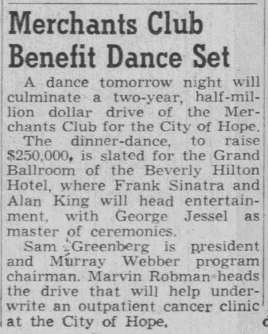
March 9, 1957
Concerts
Beverly Hilton Hotel, Los Angeles, CA
Merchant Club's 22nd Annual Dinner & Dance
Frank Sinatra, George Jessel, and Alan King
Beverly Hilton Hotel, Los Angeles, CA
Merchant Club's 22nd Annual Dinner & Dance
Frank Sinatra, George Jessel, and Alan King
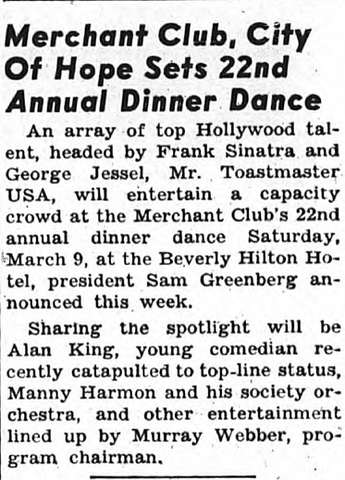
March 14, 1957
Studio
E16732 Crazy Love
(S. Cahn/P. Tuminello)
Arranged & Conducted by Nelson Riddle
CD: C2 724383808922 The Complete Capitol Singles
LP: W982 This Is Sinatra Vol.2
45: 3703
5-5-57
4-20-57
4-5-57
[Sinatra records minor Sammy Cahn tunes]
On March 14, 1957, after not recording since December, Sinatra laid down "So Long, My Love" and "Crazy Love," both with Sammy Cahn lyrics but unremarkable music by Lew Spence and Phil Tuminello.
Source: James Kaplan, "Sinatra: The Chairman" (2015).
In another prolific recording year, Frank recorded 56 new songs including 'Autumn Leaves,' 'Witchcraft,' and 'Come Fly with Me,' along with a rerecording of 'I'm a Fool to Want You' that he sang for Ava.
Source: Nancy Sinatra, Frank Sinatra: An American Legend, 1995.
April 1957
["Lonely Town" session with Gordon Jenkins]
Jonathan Schwartz: In a crucial April 1957 session for the new album Where Are You?, Sinatra recorded "Lonely Town" by Leonard Bernstein, Betty Comden, and Adolph Green — a song cut from his 1949 film On the Town that he'd long wanted to record. Per Jonathan Schwartz, Sinatra, secretly worried about losing his voice, listened alone to the playback afterward and was relieved and grateful to hear he was "even better" than before.
Source: James Kaplan, "Sinatra: The Chairman" (2015)
[Peggy Lee Records The Man I Love with Sinatra Producing]
Peggy Lee recorded the album The Man I Love in an April 1957 session Sinatra conceived and produced; she recalled that he selected the songs, hired Nelson Riddle to arrange and conducted the sessions himself, and personally oversaw the cover art down to small details of her appearance.
Source: Charles Pignone, "Frank Sinatra 100" (2015).
[Ten-night charity stand at Mocambo]
Kaplan: In late April 1957, Sinatra performed a ten-night stand at the Mocambo free of charge to benefit Charlie Morrison's widow and help keep the struggling club open, a gesture that also helped shift public opinion following the Wrong-Door Raid hearings.
Source: James Kaplan, "Sinatra: The Chairman" (2015)
[Dean Martin debuts his boozy lounge persona]
Dean Martin premiered his new stage persona—a genial drunk act modeled partly on Joe E. Lewis—at the Sands Hotel in Las Vegas in April 1957, a reinvention that proved a huge success.
Source: Richard Havers, "Sinatra" (Dorling Kindersley, 2007).
[Sam Giancana's 1957 Arrest]
Chicago crime boss Sam Giancana, a Sinatra associate, was arrested and photographed handcuffed to a chair.
Source: Rough Guide to Frank Sinatra (Rough guide 7.pdf), chapter "The Inner Circle."
April 2, 1957
[Bacall seen out with Sinatra's circle]
An anonymous Hollywood gossip column reported on April 2, 1957 that Lauren Bacall was starting to be seen socially again, spotted at the Peacock Lane with Adolph Green, Irving Lazar, and Frank Sinatra listening to pianist Errol Garner — though it wasn't yet appropriate for Bacall and Sinatra to be seen alone together.
Source: James Kaplan, "Sinatra: The Chairman" (2015).
April 5, 1957
Television
The Bob Hope Show
Guests: Frank Sinatra, Natalie Wood
1. Everything Happens To Me
2. The Lady Is A Tramp
Ed O'Brien:
"Tramp" was sung for the first time on a TV program.
And it is a wonderful vocal. The really great recording for the film would be laid down at the Columbia Studio on 5-23-57.
Miller's piano work on that recording is remarkable. "Everything Happens To Me" doesn't have the "Close To You" intimacy but is nicely done.
Concerts
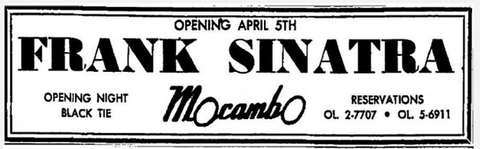
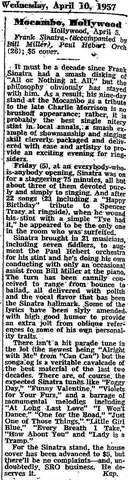
Mocambo, Hollywood, California (April 5-14)
The Paul Hebert Orchestra augmented by 21 extra musicians brought by Sinatra Songs during the engagement included
Foggy Day
Funny Valentine
Violets For Your Furs
At Long Last Love
I Won't Dance
One For My Baby
Just One of Those Things
Little Girl Blue
Every Breath I Take
How About You
Lady Is A Tramp
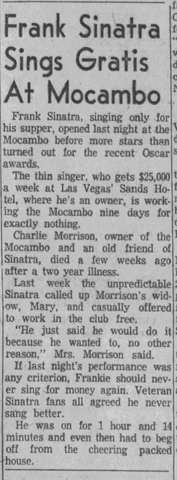
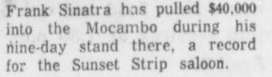
Sinatra opened on April 5, 1957 and would appear free to help out Mary Morrison, the widow of Charlie Morrison who had owned the Mocambo. --Scott The stars, at Frank's behest, came out to see him.. --Ed
Mocambo, Hollywood, California
Valley Times (North Hollywood, California) 6 Apr 1957, Sa Variety
The Bob Hope Show
Guests: Frank Sinatra, Natalie Wood
Variety
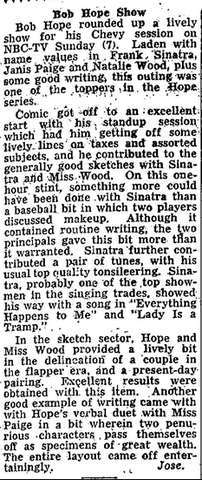
Note: Review states nine day run but I was told it ran
10 . Sinatra, in a private interview the next year, considered his performances during that stint to be the best he had done. Told the interviewer that his benefit efforts were always his finest singing. He wasn't sure exactly why.
I chose "With Every Breath I Take" as one of Frank's
101 finest recordings. I can only imagine what it must have been like to hear it sung at the Mocambo in April of 57. He had such vocal control at that stage of his career.
Ed
Note: The owner of the Mocambo, Charlie Morrison, died in January of
1957. His widow was left with much debt and little hope of keeping the club open. Frank played a 10 day engagement, 4-5-14-57, for free. He picked up all the expenses along the way. In July of the following year, in a private interview, he stated that it was the finest singing he had ever done in a club or concert setting.
The Mocambo was located in North Hollywood at 8588 Sunset Blvd on the Sunset Strip. Ella had a very famous engagement there starting on March 15, 1955.
Ed
Los Angeles Citizen News
April 8, 1957
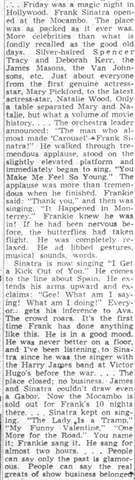
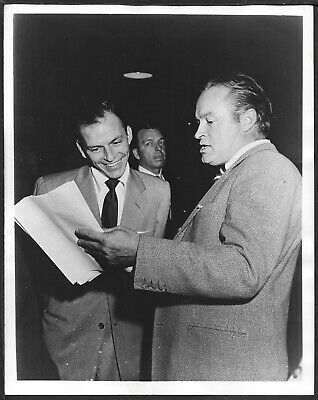
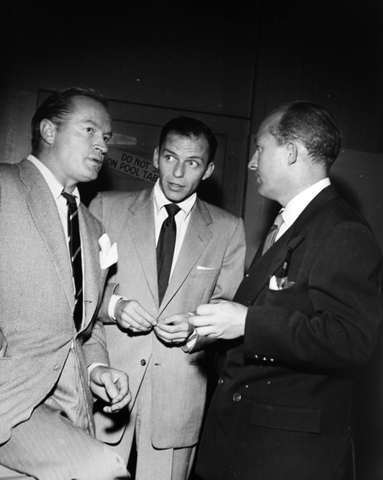
"The Lady Is a Tramp"
Nelson Riddle: Analysis of the arrangement's incremental build (Bill Miller's piano opening, then violins, horns, Edison and Klee's flute fills), summarizing the three prior swing albums in one track. Discusses Sinatra's device of singing a phrase a cappella for emphasis ('She's broke... but it's oke!') with the band crashing and pausing around him. Riddle said of Sinatra's delivery: '[Frank] seemed to take a particular delight in [Tramp]. He always sang that song with a certain amount of salaciousness. He savored it. He had some cute tricks with the lyric, which made it especially his.' Friedwald singles out a TV performance on the Bob Hope Chevy Show of April 8, 1957 (tied to the Pal Joey promotional push) as possibly the most exciting live version, where Sinatra silently shrugs instead of singing 'but it's oke.'
Source: Will Friedwald, "Sinatra! The Song Is You: A Singer's Art" (2018 revised edition).
"Close to You"
Granata's discography entry: Close to You, arranged by Nelson Riddle, released January 1957.
Source: Charles L. Granata, "Sessions with Sinatra: Frank Sinatra and the Art of Recording" (1999/2003).
April 6, 1957
Concerts
Mocambo, Hollywood, California (April 5-14)
The Paul Hebert Orchestra augmented by 21 extra musicians brought by Sinatra Songs during the engagement included
Foggy Day
Funny Valentine
Violets For Your Furs
At Long Last Love
I Won't Dance
One For My Baby
Just One of Those Things
Little Girl Blue
Every Breath I Take
How About You
Lady Is A Tramp
Sinatra opened on April 5, 1957 and would appear free to help out Mary Morrison, the widow of Charlie Morrison who had owned the Mocambo. --Scott
April 7, 1957
Concerts
Mocambo, Hollywood, California (April 5-14)
The Paul Hebert Orchestra augmented by 21 extra musicians brought by Sinatra Songs during the engagement included
Foggy Day
Funny Valentine
Violets For Your Furs
At Long Last Love
I Won't Dance
One For My Baby
Just One of Those Things
Little Girl Blue
Every Breath I Take
How About You
Lady Is A Tramp
Sinatra opened on April 5, 1957 and would appear free to help out Mary Morrison, the widow of Charlie Morrison who had owned the Mocambo. --Scott
Frank made another guest appearance on The Bob Hope Show.
Source: Nancy Sinatra, Frank Sinatra: An American Legend, 1995.
April 8, 1957
Studio
Capitol Towers Hollywood
Monday evening
6 to 9:30 PM
Peggy Lee vocals
31 piece orchestra
Conducted by Frank Sinatra
Arranged by Nelson Riddle
If I Should Lose You
Then I'll Be Tired Of You
Just One Way To Say I Love You
My Heart Stood Still
This was the final session for Peggy Lee's "The Man
I Love" album. She would always say this was the
best album of her career. At the Society of Singers
Sinatra Tribute, 12-3-90, Peggy sang a parody of the
title track thanking Frank for the marvelous work
he did for her during the making of the album. Vince
DeRosa worked on the album. He told me Frank was very
attentive to Peggy's every need throughout the project.
It was Frank's idea, according to an interview I have
with Miss Lee, to put the drops in Peggy's eyes
for the cover shot.. In the event you didn't know,
the guy she is hugging is the album's conductor.
Concerts
Mocambo, Hollywood, California (April 5-14)
The Paul Hebert Orchestra augmented by 21 extra musicians brought by Sinatra Songs during the engagement included
Foggy Day
Funny Valentine
Violets For Your Furs
At Long Last Love
I Won't Dance
One For My Baby
Just One of Those Things
Little Girl Blue
Every Breath I Take
How About You
Lady Is A Tramp
Sinatra opened on April 5, 1957 and would appear free to help out Mary Morrison, the widow of Charlie Morrison who had owned the Macombo. --Scott
Capitol Towers Hollywood
Monday evening
6 to 9:30 PM
Peggy Lee vocals
31 piece orchestra
Conducted by Frank Sinatra
Arranged by Nelson Riddle
If I Should Lose You
Then I'll Be Tired Of You
Just One Way To Say I Love You
My Heart Stood Still

April 9, 1957
Concerts
Mocambo, Hollywood, California (April 5-14)
The Paul Hebert Orchestra augmented by 21 extra musicians brought by Sinatra Songs during the engagement included
Foggy Day
Funny Valentine
Violets For Your Furs
At Long Last Love
I Won't Dance
One For My Baby
Just One of Those Things
Little Girl Blue
Every Breath I Take
How About You
Lady Is A Tramp
Sinatra opened on April 5, 1957 and would appear free to help out Mary Morrison, the widow of Charlie Morrison who had owned the Mocambo. --Scott
April 10, 1957
Studio
Capitol Studio A, Hollywood
E16820 Where Is The One?
(Alec Wilder/Edwin Finckel)
Arranged & Conducted by Gordon Jenkins
(3:12) CD: CDP 91209 Where Are You
LP: Capitol W/SW-855 Where Are You
E16821 There's No You
(Adair/Hopper/ Durgom)
Arranged & Conducted by Gordon Jenkins
(3:45) CD: CDP 91209 Where Are You
LP: Capitol W/SW-855 Where Are You
E16822 The Night We Called It A Day
(Matt Dennis/Tom Adair)
Arranged & Conducted by Gordon Jenkins
(3:27) CD: CDP 91209 Where Are You
LP: Capitol W/SW-855 Where Are You
E16823 Autumn Leaves
(Kasma/Prevert/ Mercer)
Arranged & Conducted by Gordon Jenkins
(2:51) CD: CDP 91209 Where Are You
LP: Capitol SW-855 Where Are You
Alt Take: Capitol W-855 Where Are You (Mono)
Ed O'Brien:
Sinatra's first session with Gordon Jenkins.
Frank would record 98 songs with arrangements
by Jenkins. There would be 34 sessions over a
span of 24 years. They would make eight albums
together. The most successful would be "September
Of My Years." It would win multiple Grammies including
the coveted album of the year award. My personal
favorite is the glorious "A Jolly Christmas." A timeless
masterwork that brings much joy every year. Jenkins
would always employ a large orchestra with an ample
string section. The two men were dear friends. Sinatra's
singing moved Jenkins to tears many times during their
recording session, and Gordon's charts inspired the
great interpretative skills Sinatra possessed in abundance.
Concerts
Mocambo, Hollywood, California (April 5-14)
The Paul Hebert Orchestra augmented by 21 extra musicians brought by Sinatra Songs during the engagement included
Foggy Day
Funny Valentine
Violets For Your Furs
At Long Last Love
I Won't Dance
One For My Baby
Just One of Those Things
Little Girl Blue
Every Breath I Take
How About You
Lady Is A Tramp
Sinatra opened on April 5, 1957 and would appear free to help out Mary Morrison, the widow of Charlie Morrison who had owned the Mocambo. --Scott
Capitol Studio A, Hollywood
E16820 Where Is The One?
(Alec Wilder/Edwin Finckel)
Arranged & Conducted by Gordon Jenkins
(3:12) CD: CDP 91209 Where Are You
LP: Capitol W/SW-855 Where Are You
E16821 There's No You
(Adair/Hopper/ Durgom)
Arranged & Conducted by Gordon Jenkins
(3:45) CD: CDP 91209 Where Are You
LP: Capitol W/SW-855 Where Are You
E16822 The Night We Called It A Day
(Matt Dennis/Tom Adair)
Arranged & Conducted by Gordon Jenkins
(3:27) CD: CDP 91209 Where Are You
LP: Capitol W/SW-855 Where Are You
E16823 Autumn Leaves
(Kasma/Prevert/ Mercer)
Arranged & Conducted by Gordon Jenkins
(2:51) CD: CDP 91209 Where Are You
LP: Capitol SW-855 Where Are You
Alt Take: Capitol W-855 Where Are You (Mono)
10-5-57
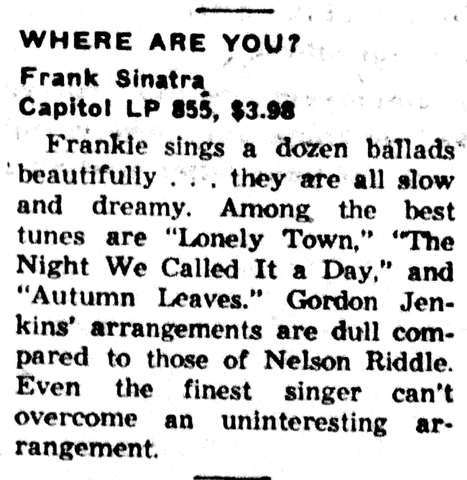
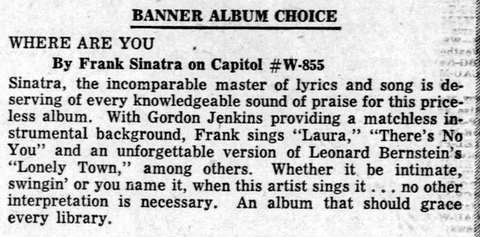
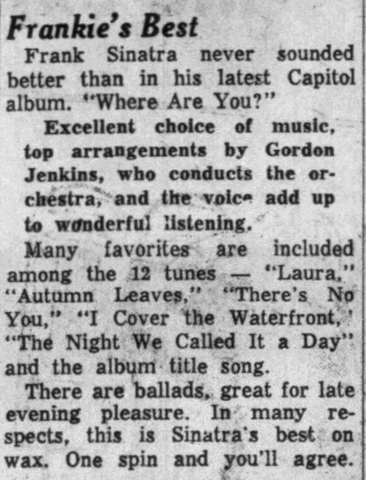
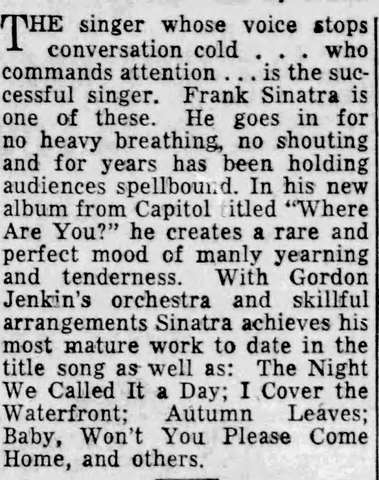
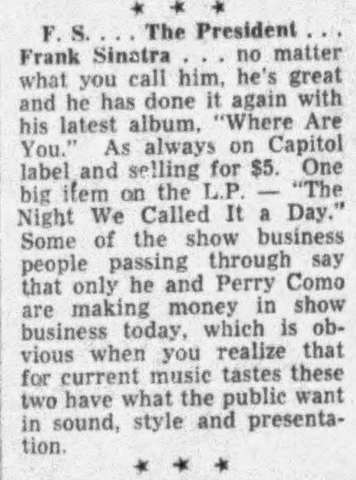
note: Asked many years later, what song with Jenkins was the best recording, Sinatra did not hesitate in naming "Laura."
--ED
Capitol Studio A, Hollywood
E16820 Where Is The One?
E16821 There's No You
E16822 The Night We Called It A Day
E16823 Autumn Leaves
Altoona Tribune
April 11, 1957
Concerts
Mocombo, Hollywood, California (April 5-14)
The Paul Hebert Orchestra augmented by 21 extra musicians brought by Sinatra Songs during the engagement included
Foggy Day
Funny Valentine
Violets For Your Furs
At Long Last Love
I Won't Dance
One For My Baby
Just One of Those Things
Little Girl Blue
Every Breath I Take
How About You
Lady Is A Tramp
Sinatra opened on April 5, 1957 and would appear free to help out Mary Morrison, the widow of Charlie Morrison who had owned the Mocambo. --Scott
April 12, 1957
Concerts
Mocambo, Hollywood, California (April 5-14)
The Paul Hebert Orchestra augmented by 21 extra musicians brought by Sinatra Songs during the engagement included
Foggy Day
Funny Valentine
Violets For Your Furs
At Long Last Love
I Won't Dance
One For My Baby
Just One of Those Things
Little Girl Blue
Every Breath I Take
How About You
Lady Is A Tramp
Sinatra opened on April 5, 1957 and would appear free to help out Mary Morrison, the widow of Charlie Morrison who had owned the Mocambo. --Scott
April 13, 1957
Concerts
Mocambo, Hollywood, California (April 5-14)
The Paul Hebert Orchestra augmented by 21 extra musicians brought by Sinatra Songs during the engagement included
Foggy Day
Funny Valentine
Violets For Your Furs
At Long Last Love
I Won't Dance
One For My Baby
Just One of Those Things
Little Girl Blue
Every Breath I Take
How About You
Lady Is A Tramp
Sinatra opened on April 5, 1957 and would appear free to help out Mary Morrison, the widow of Charlie Morrison who had owned the Mocambo. --Scott
April 14, 1957
Concerts
Mocambo, Hollywood, California (April 5-14)
The Paul Hebert Orchestra augmented by 21 extra musicians brought by Sinatra Songs during the engagement included
Foggy Day
Funny Valentine
Violets For Your Furs
At Long Last Love
I Won't Dance
One For My Baby
Just One of Those Things
Little Girl Blue
Every Breath I Take
How About You
Lady Is A Tramp
Sinatra opened on April 5, 1957 and would appear free to help out Mary Morrison, the widow of Charlie Morrison who had owned the Mocambo. --Scott
April 23, 1957
[Unbylined praise for Mocambo shows]
A non-bylined piece on April 23, 1957 praised Sinatra's Mocambo performances, noting his voice was "past its prime" but his phrasing and style had never been better; Sinatra had reportedly barred several journalists from attending over old grudges.
Source: James Kaplan, "Sinatra: The Chairman" (2015).
April 29, 1957
Studio
Capitol Studio A, Hollywood
E17008 I Cover The Waterfront
(Johnny Green/Edward Heyman)
Arranged & Conducted by Gordon Jenkins
CD: CDP 7-91209-2 Where Are You?
LP: SW855 Where Are You?
E17009 Lonely Town
(Bernstein/Comden/ Green)
Arranged & Conducted by Gordon Jenkins
CD: CDP 7-91209-2 Where Are You?
LP: SW855 Where Are You?
E17010 Laura
(David Raksin/Johnny Mercer)
Arranged & Conducted by Gordon Jenkins
CD: CDP 7-91209-2 Where Are You?
LP: SW855 Where Are You?
E17011 Baby Won't You Please Come Home?
(Charles Warfield/Clarence Williams)
Arranged & Conducted by Gordon Jenkins
CD: CDP 7-91209-2 Where Are You?
LP: SW855 Where Are You?
"Lonely Town"
Will Friedwald: Given as an example of Sinatra passing along a specific, ingenious structural idea to an arranger other than Nelson Riddle -- here providing the outline for the introduction to 'Lonely Town.'
Source: Will Friedwald, "Sinatra! The Song Is You: A Singer's Art" (2018 revised edition).
"Lonely Town"
Betty Comden: Betty Comden (co-writer with Adolph Green) recalled that Sinatra's character Chip was denied "Lonely Town" in the 1949 MGM film On the Town (the song had been written for Gene Kelly's Gabey), and that Sinatra was furious on the last day of shooting to learn it was cut: 'He said, "Well, where's my song? When do I do 'Lonely Town'?" And they just said to him, "It's out. You're not doing it." And he was very, very angry.'
Source: Will Friedwald, "Sinatra! The Song Is You: A Singer's Art" (2018 revised edition).
"Lonely Town"
Gordon Jenkins; John Cave; Frank Sinatra (to Sid Mark, 1984): Asked to name his favorite Sinatra performance, Jenkins said: "For many years, [Frank's] and my favorite were the same. He thought that 'Lonely Town' was the best record he ever made, and I did, too. Now I think it would be a toss-up for me between 'Lonely Town,' 'Laura,' and 'Send in the Clowns.' 'Lonely Town' has such a feel to it: the orchestration, the way he sings it... so well!" French hornist John Cave described Jenkins's love of the instrument: 'Gordon Jenkins was a horn maniac. He just loved horn!' The song's French horn intro (probably played by Vince DeRosa) was suggested by Sinatra himself, who recalled to Sid Mark in 1984 that a symphonic recording had inspired the idea, which Jenkins 'liked... and used.' Jenkins also confessed to slipping in 'a few free bars of "Never Leave Me"' from his own Manhattan Tower at the end.
Source: Will Friedwald, "Sinatra! The Song Is You: A Singer's Art" (2018 revised edition).
[Baby, Won't You Please Come Home? -- critical commentary]
Sinatra closed Where Are You? with Clarence Williams's blues ballad "Baby, Won't You Please Come Home?"; he also sang it with Bing Crosby on The Edsel Show (CBS TV, October 13, 1957). Friedwald describes both performances as Sinatra stepping outside himself to observe and bask in his own singing, balancing the song's earthy blues roots against Jenkins's epic string writing -- 'a perfect way to end a Sinatra album.'
No corresponding dated entry could be identified in the chronology for this song/context.
Source: Will Friedwald, "Sinatra! The Song Is You: A Singer's Art" (2018 revised edition), Ch. 8, "Gordon Jenkins" (1956-1981)
May 1957
[Frank Costello assassination attempt]
Kaplan: Mob boss Frank Costello was shot and wounded (grazing his scalp) by hit man Vincent "the Chin" Gigante in New York in May 1957; a crumpled note found in his pocket detailing Tropicana casino skim figures became key evidence of the Mob's Vegas skimming operation.
Source: James Kaplan, "Sinatra: The Chairman" (2015)
May 1, 1957
Studio
Capitol Studio A, Hollywood
E16863 Where Are You?
(J. McHugh/H. Adamson)
Leo Feist, Inc. (ASCAP)
Arranged & Conducted by Gordon Jenkins
-12 (3:29) CD: CDP 7-91209-2 Where Are You?
CD: C2-94777 The Capitol Years
LP: SW855 Where Are You?
E16869 I Think Of You
(Jack Elliot/Don Marcotte)
Arranged & Conducted by Gordon Jenkins
CD: CDP 7-91209-2 Where Are You?
LP: SW855 Where Are You?
E16867 I'm A Fool To Want You
(Wolf/Herron/ Sinatra)
Integrity Music Corp./Sergent Music Co./Barton Music Corp. (ASCAP)
Arranged & Conducted by Gordon Jenkins
-5 (4:50) CD: CDP 7-91209-2 Where Are You?
CD: C2-94777 The Capitol Years
LP: SW855 Where Are You?
E16868 Maybe You'll Be There
(Rube Bloom/Sammy Gallop)
Arranged & Conducted by Gordon Jenkins
CD: CDP 7-91209-2 Where Are You?
LP: SW855 Where Are You?
I love the vocals on all the tracks - but especially like Maybe You’ll Be There. Interestingly, this tune also gave Jenkins his first chart success in 1948.
-Vance
Hi Vance,
Frank was also quite taken with the song in 1948.
In the fall of that year, he sang it on 11 Hit Parade broadcasts.
Ed
"I'm a Fool to Want You"
Friedwald offers a minority opinion that Sinatra's 1957 Jenkins remake of "I'm a Fool to Want You" (co-written by Sinatra himself) is more moving than the original six years earlier, dropping the melodramatic choir for a more dramatic extra outchorus. He notes the coincidence that Sinatra recorded the song once in the year he married Ava Gardner and again the year they divorced.
Source: Will Friedwald, "Sinatra! The Song Is You: A Singer's Art" (2018 revised edition).
Liner Notes: WHERE ARE YOU?
Where Are You? marks Sinatra's first full album with Gordon Jenkins, and the pairing announces itself immediately as a different kind of collaboration than the one with Nelson Riddle. Jenkins's arrangements are lush, almost symphonic, built on long unbroken string lines rather than Riddle's sharper rhythmic punctuation -- a sound better suited, as it turns out, to the album's theme of longing and lost love.
It was also Sinatra's first album recorded in stereo, and the technical milestone suits the material: the depth of the soundstage gives Jenkins's arrangements room to breathe in a way earlier mono recordings could not fully capture. Songs like "I Cover the Waterfront" and "Maybe You'll Be There" unfold at a stately, unhurried pace, Sinatra's voice floating over strings that seem to stretch to the horizon.
Where the Riddle albums often work through wit and swing, Where Are You? works through sheer scale -- grand, unhurried, unembarrassed by its own melancholy. It set the template for the Jenkins collaborations that would follow across the rest of Sinatra's career, from No One Cares to the final side of Trilogy more than two decades later.
Written by Claude (Anthropic), commissioned for this chronology, 2026.
[I'm a Fool to Want You -- critical commentary]
Al Hibbler: Sinatra personally called Al Hibbler in 1961 to propose a comeback album (arranged by Gerald Wilson) and, through Hibbler, tried again to recruit Billy Strayhorn to arrange it. Hibbler recalled: 'When I went with Sinatra to Reprise, Frank asked me, "Can you get Strayhorn?" I said, "I doubt it, man!" I asked Strayhorn, and Strayhorn went and told Duke.' Ellington confronted Hibbler: 'Man, I don't appreciate you trying to take my arranger! You took what you could get from me, and now you're tryin' to break up my band!' The resulting Hibbler album (featuring much of Sinatra's own rhythm section -- Bill Miller, Al Viola, Joe Comfort) included a harrowing reading of Sinatra's own torch song 'I'm a Fool to Want You.'
This song/context matches multiple dated entries in the chronology; the specific date Friedwald is referring to could not be determined with confidence.
Source: Will Friedwald, "Sinatra! The Song Is You: A Singer's Art" (2018 revised edition), Ch. 7, "With Billy May" (1953-1979)
[I'm a Fool to Want You -- critical commentary]
Granata includes 'I'm a Fool to Want You' among the fifty recordings he considers essential to understanding Sinatra's artistry (arranged by Axel Stordahl, recorded 1951, Columbia); the song was chosen for its musical/interpretive value rather than commercial popularity.
This song/context matches multiple dated entries in the chronology, or lacked a sufficiently precise date; the specific date could not be determined with confidence.
Source: Charles L. Granata, "Sessions with Sinatra: Frank Sinatra and the Art of Recording" (1999/2003), Afterword & Appendices A-D
[Where Are You? -- critical commentary]
Granata's discography entry: Where Are You?, arranged by Gordon Jenkins, released September 1957.
This song/context matches multiple dated entries in the chronology, or lacked a sufficiently precise date; the specific date could not be determined with confidence.
Source: Charles L. Granata, "Sessions with Sinatra: Frank Sinatra and the Art of Recording" (1999/2003), Afterword & Appendices A-D
[Where Are You? / Come Fly with Me -- critical commentary]
By April 1957 Capitol had firmly committed to stereo; Sinatra's first two stereo albums were Where Are You? (with Gordon Jenkins, recorded April-May 1957) and Come Fly with Me (with Billy May, recorded October 1957) -- the sessions that brought Jenkins and May into Sinatra's core arranging team alongside Riddle.
This song/context matches multiple dated entries in the chronology, or lacked a sufficiently precise date; the specific date could not be determined with confidence.
Source: Charles L. Granata, "Sessions with Sinatra: Frank Sinatra and the Art of Recording" (1999/2003), Part III: The Capitol Years, 1953-1962
[Where Are You? / No One Cares -- critical commentary]
Frank Sinatra / Granata: Sinatra called working with Gordon Jenkins 'like being back in the womb' for its beautiful simplicity, and said Jenkins was the one arranger he felt he could largely leave alone; their two albums Where Are You? (1957, sweeter, upper-register strings) and No One Cares (1959, darker, emphasizing lower strings and woodwinds) are markedly different in mood despite the same silken Jenkins string-writing style.
This song/context matches multiple dated entries in the chronology, or lacked a sufficiently precise date; the specific date could not be determined with confidence.
Source: Charles L. Granata, "Sessions with Sinatra: Frank Sinatra and the Art of Recording" (1999/2003), Part III: The Capitol Years, 1953-1962
May 3, 1957
Radio
Guest Star
Frank Sinatra appeared on this date's episode of the syndicated Guest Star anthology series (which ran 783 episodes between March 23, 1947 and March 25, 1962). The liner notes for this box set do not identify the specific songs or additional cast for this later episode.
Source: Radio Spirits 42252, "Frank Sinatra and Friends: 60 Greatest Old-Time Radio Shows" [30CD box] liner-note booklet.
May 6, 1957
The top-10 album A Swingin' Affair, arranged by Nelson Riddle, was released.
Source: Nancy Sinatra, Frank Sinatra: An American Legend, 1995.
May 7, 1957
Look magazine ran a three-part cover story on Frank titled 'Talent, Tantrums and Torment'; he sued for libel and, separately, invasion of privacy, but both suits were eventually dropped on the advice of his attorneys.
Source: Nancy Sinatra, Frank Sinatra: An American Legend, 1995.
May 14, 1957
[First part of Davidson's Look profile]
The first installment of Bill Davidson's three-part Look magazine profile of Sinatra ran on May 14, 1957. Davidson had written the piece without ever speaking directly to Sinatra, who had frozen him out after Davidson tried to revive a stalled Look book-collaboration project with sportswriter Jimmy Cannon.
Source: James Kaplan, "Sinatra: The Chairman" (2015).
May 20, 1957
Studio
Capitol Studio A, Hollywood
E17069 Witchcraft
(C. Coleman/C. Leigh)
Notable Music/Morley Music Co., Inc. (ASCAP)
Arranged & Conducted by Nelson Riddle
-14 (2:52) CD: CDP 724383595228 Sinatra 80th "All The
Best"
CD: C2 724383808922 The Complete Capitol Singles
CD: C2-94777 The Capitol Years
CD: CDP 7-92160-2 Frank Sinatra Collector's Series
CD: CDP 7-91150-2 All The Way
LP: SW1538 All The Way
45: 3859
Frank DeVito was the drummer at the Capitol session
that featured "Witchcraft"( 5-20-57 ). While listening to the playback
of take 13, Sinatra gesticulated to Frank that he wanted him to
hit the drum fills more aggressively. Frank did and take 14 is the
record.
Ed
E17070 Something Wonderful Happens In Summer
(J. Bushkin/J. Devries)
Sands Music Corp. (ASCAP)
Arranged & Conducted by Nelson Riddle
-11 (3:12) CD: C2 724383808922 The Complete Capitol Singles
CD: C2-94777 The Capitol Years
LP: W982 This Is Sinatra Vol.2
45: 3744
E17071 Tell Her You Love Her
(Parker/Deniso/ Halliday)
Arranged & Conducted by Nelson Riddle
CD: C2 724383808922 The Complete Capitol Singles
LP: T1919 Tell Her You Lover Her
45: 3859
E17072 You're Cheatin' Yourself (If You're Cheatin' On Me)
(A. Hoffman/D. Manning)
Arranged & Conducted by Nelson Riddle
CD: C2 724383808922 The Complete Capitol Singles
LP: W982 This Is Sinatra Vol.2
45: 3744
Musicians - Reeds: Buddy Collette, Harry Klee, Joseph Koch, Willie
Schwartz, Warren Webb; Trumpets: Harry "Sweets" Edison, Conrad Gozzo, Vito "Mickey" Mangano, Clarence "Shorty"
Sherock; Trombones: Dick Noel, James Priddy, Juan Tizol; Bass Trombone: George Roberts; Violins: Alex Beller, Harry Bluestone, Robert Cross, Walter Edelstein, Ben Gill, Paul Nero, Mischa Russell, Marshall Sosson, Gerald Vinci; Viola: Maxine Johnson, Barbara Simon; Cellos: Cy Bernard, Edgar Lustgarten, Eleanor Slatkin; Piano: Bill Miller; Bass: Joe Comfort;
Guitar: Nick Bonney; Drums: Frank DiVito; Harp: Kathryn Julye
Session Producer: Voyle Gilmore
Capitol Studio A, Hollywood
E17069 Witchcraft
(C. Coleman/C. Leigh)
Notable Music/Morley Music Co., Inc. (ASCAP)
Arranged & Conducted by Nelson Riddle
E17071 Tell Her You Love Her
(Parker/Deniso/ Halliday)
Arranged & Conducted by Nelson Riddle
"Witchcraft"
Frank Military; Cy Coleman: Frank Military recounted how producer Voyle Gilmore brought a foot-high stack of demo records for Sinatra to choose a new single from during Pal Joey filming. Sinatra told him to just pick one; Gilmore played 'Witchcraft.' After playing it twice and consulting arranger Hank (Sanicola?), Sinatra said, 'This is the song I want to record. You guys put whatever songs you like on the rest of the session, but this song I like.' It took two and a half hours to record. Composer Cy Coleman called it a 'good marriage' of words and melody: 'the words belong to the melody... You can't pull them apart.' The song began when lyricist Carolyn Leigh (who'd written 'Young at Heart') came up with the phrase 'It's witchcraft'; Coleman initially wrote a different, more exotic melody, but stumbled on the eventual tune while noodling at the piano.
Source: Will Friedwald, "Sinatra! The Song Is You: A Singer's Art" (2018 revised edition).
[Recording "Witchcraft" with Riddle]
On May 20, 1957, having patched things up with Nelson Riddle, Sinatra spent two and a half hours of a session recording Cy Coleman and Carolyn Leigh's "Witchcraft," a track later regarded as one of the sexiest and most perfectly realized recordings of his career.
Source: James Kaplan, "Sinatra: The Chairman" (2015).
May 23, 1957
Studio
COLUMBIA PICTURES - Los Angeles
PAL JOEY
Orchestra conducted by Morris Stoloff
Arrangements by Nelson Riddle
Thursday
1PM - 6:05 PM
44 piece orchestra
I Didn't Know What Time It Was
The Lady Is A Tramp
Ed O'Brien notes:
Studio recording sheets show that George
Greeley was the pianist on the first number and Fred Karger on the second..
"Tramp" is the definitive studio recording by
Sinatra. Capitol effort pales in comparison.
As a matter of fact, I have never heard a concert version that rivals this recording.
Sinatra had a six month gap between the
Cap recording and the pre-recording for the film. He performed the song in con- cert and really knew the tune by May of 57.
Stolloff, the manager, David Klein, and the
44 musicians were paid a combined salary of $2,271.91 for five hours of work.
VANCE ADAIR added:
I agree about this being the definitive recording of 'Tramp.' Incidentally how many arrangements for Frank has there been of this tune? There is Byers, Riddle and Pat Williams. Am I missing any?
Dick Schwarz responded:
We need to add Neil Hefti who did the arrangements for the sextet and small groups. And I did think that on Duets, the arrangement by Bill Byers was used, not Pat Williams.
Larry Crawford:
I really enjoyed Sinatra's rendition of " Lady Is a Tramp" from the 1974 concert from Madison Square Garden with the Woody Herman band. Who did that arrangement ? That wasn't a great concert, or even great Sinatra that night, but I sure enjoyed his performance of that song that night. Maybe it was the Woody Herman Band that I enjoyed so much, they really swung hard that night, and were great with Sinatra. Wish he had worked with them again.
Ed O'Brien:
Billy Byers wrote the chart for "Tramp.."
May 28, 1957
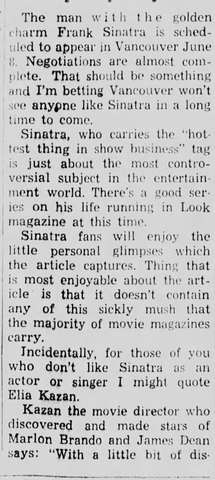
June 1957
[Ava Gardner filming in Mexico]
Kaplan: Ava Gardner was in Mexico City finishing The Sun Also Rises, playing Lady Brett Ashley opposite Errol Flynn, Tyrone Power, and a young Robert Evans in his first major role; Walter Chiari accompanied her on location.
Source: James Kaplan, "Sinatra: The Chairman" (2015)
[Ava files for divorce]
Kaplan: While in Mexico, Ava Gardner filed divorce papers against Sinatra, charging desertion and absence of more than six months. He did not contest the charges.
Source: James Kaplan, "Sinatra: The Chairman" (2015)
[Bacall joins Sinatra's tour]
Kaplan: Lauren Bacall was an attentive audience member when Sinatra's concert tour hit Salt Lake City in mid-June; the local Deseret News speculated about a romance between them, which Hollywood columnists denied.
Source: James Kaplan, "Sinatra: The Chairman" (2015)
[Seven-city concert tour]
Kaplan: Nelson Riddle and twenty-six top studio musicians accompanied Sinatra on a seven-city concert tour, playing El Paso, Albuquerque, Salt Lake City, Vancouver, Seattle, Portland, and San Francisco.
Source: James Kaplan, "Sinatra: The Chairman" (2015)
[Ava's divorce finalized; photographed with future mogul Robert Evans]
Frank and Ava Gardner's divorce was finalized in June 1957. Around that time she was photographed at New York's Harwyn Club with "textile millionaire" Robert Evans, who later became a major Hollywood studio executive.
Source: Richard Havers, "Sinatra" (Dorling Kindersley, 2007).
June 1, 1957
Concerts
Civic Auditorium, Albuquerque, New Mexico
Saturday Afternoon 2:30 PM (began 30 minutes late 3PM)
Orchestra (29 piece) Conducted by: Nelson Riddle
Partial Personnel: Bill Miller (piano), Buddy Collette (reed), Harry (Sweets) Edison (trumpet), Murray McEaehern (trombone), George Roberts (trombone), Harry Klee (flute)
Performers: Frank Sinatra, Frankie de Amor, Hal Roman, Greg Brown & dance troupe
Partial Set list (sang 19 songs):
1. My Funny Valentine
2. A Foggy Day
3. Hey! Jealous Lover
4. Old Man River
Notes: 2700 in attendance. Auditorium held 6000.
Ed O'Brien adds to the headline above:
Amazing. Sinatra in June of 1957 was easily the biggest star in the firmament. He was the #5 box office draw in films that year. Capitol Records had three of his albums on the Billboard Top 100 LP list including "Swingin' Affair" at # 3 that week. If you wanted to see him at the Sands in Vegas, the hotel required reservations six months in advance. And he had just signed a contract worth $3 million to star in his own variety series on ABC-TV. I'll bet if the concerts had been on the east coast, they would have all been SRO. Sinatra in N.Y, Philly, Boston, Baltimore, etc. would have been, to quote Variety, "socko biz."
Denver Auditorium, Denver Colorado
Saturday Evening
Orchestra (29 piece) conducted by Frank Sinatra
Partial Personnel: Bill Miller (piano), Buddy Collette (reed),
Harry (Sweets) Edison (trumpet), Murray McEaehern (trombone), George Roberts (trombone), Harry Klee (flute), Frank DeVito ( drums )
Performers: Frank Sinatra, Frankie D' Amore, Hal Roman, Greg Brown
& dance troupe
Denver Auditorium, Denver Colorado
Saturday Evening
Orchestra (29 piece) conducted by Frank Sinatra
Partial Personnel: Bill Miller (piano), Buddy Collette (reed),
Harry (Sweets) Edison (trumpet), Murray McEaehern (trombone), George Roberts (trombone), Harry Klee (flute), Frank DeVito ( drums )
Performers: Frank Sinatra, Frankie D' Amore, Hal Roman, Greg Brown
& dance troupe
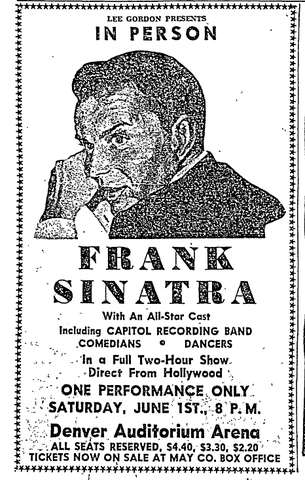
Civic Auditorium, Albuquerque, New Mexico
Saturday Afternoon 2:30 PM (began 30 minutes late 3PM)
Orchestra (29 piece) Conducted by: Nelson Riddle
Partial Personnel: Bill Miller (piano), Buddy Collette (reed), Harry (Sweets) Edison (trumpet), Murray McEaehern (trombone), George Roberts (trombone), Harry Klee (flute)
Performers: Frank Sinatra, Frankie de Amor, Hal Roman, Greg Brown & dance troupe
[image] .
[image referenced in source but could not be recovered]
[image referenced in source but could not be recovered]
[image referenced in source but could not be recovered]
[image referenced in source but could not be recovered]
[image referenced in source but could not be recovered]
[image referenced in source but could not be recovered]
[image referenced in source but could not be recovered]
[image referenced in source but could not be recovered]
June 2, 1957
Concerts
Coliseum, El Paso, Texas
2pm Show
Orchestra (29 piece) Conducted by: Nelson Riddle
Partial Personnel: Bill Miller (piano), Buddy Collette (reed), Harry (Sweets) Edison (trumpet), Murray McEaehern (trombone), George Roberts (trombone), Harry Klee (flute)
Performers: Frank Sinatra, Frankie de Amor, Hal Roman, Greg Brown & dance troupe
Phoenix Coliseum, Phoenix Arizona,
8:30 pm Show
Orchestra (29 piece) Conducted by: Nelson Riddle
Partial Personnel: Bill Miller (piano), Buddy Collette (reed), Harry (Sweets) Edison (trumpet), Murray McEaehern (trombone), George Roberts (trombone), Harry Klee (flute)
Performers: Frank Sinatra, Frankie de Amor, Hal Roman, Greg Brown & dance troupe
Songs included:
--I Get A Kick Out Of You
--Just One Of Those Things
--Foggy Day In London Town
--Hey, Jealous Lover
--I've Got You Under My Skin
--My Funny Valentine
--One For My Baby
Coliseum, El Paso, Texas
2pm Show
Orchestra (29 piece) Conducted by: Nelson Riddle
Partial Personnel: Bill Miller (piano), Buddy Collette (reed), Harry (Sweets) Edison (trumpet), Murray McEaehern (trombone), George Roberts (trombone), Harry Klee (flute)
Performers: Frank Sinatra, Frankie de Amor, Hal Roman, Greg Brown & dance troupe
Note: El Paso Herald, 5-31-57 :
El Paso Times (El Paso, El Paso, Texas) 9 Jun 1957
Frank DeVito was the drummer for the June 57 weekend concert tours. He gave me the names of a few more musicians who were part of the tour: Joe Comfort, bass Shorty Sherock, trumpet. Nick Bonney Guitar. According to Frank, there was only the 2: p.m. show at the El Paso Coliseum. I checked the El Paso Herald which confirmed Frank's recollection of that day in the Lone Star State. --Ed
Frank did not do well in El Paso. A very small crowd came out to see him. The promoter had promised a huge turn out. On the plane after the show, Hank Sanicola went after the promoter. Frank was afraid of a plane crash. He got Hank to calm down, reassuring him that he could take care of the guy when they landed. Bill Miller loved to tell that story.. Nelson Riddle was never part of the tour. The conducting was done by Frank. He was filming "Pal Joey" during the week and flying from show to show on the weekends.
--Ed
[image referenced in source but could not be recovered]
[image referenced in source but could not be recovered]
[image referenced in source but could not be recovered]
[image referenced in source but could not be recovered]
[image referenced in source but could not be recovered]
[image referenced in source but could not be recovered]
[image referenced in source but could not be recovered]
Phoenix Colliseum, Phoenix Arizona,
8:30 pm Show
Orchestra (29 piece) Conducted by: Nelson Riddle
Partial Personnel: Bill Miller (piano), Buddy Collette (reed), Harry (Sweets) Edison (trumpet), Murray McEaehern (trombone), George Roberts (trombone), Harry Klee (flute)
Performers: Frank Sinatra, Frankie de Amor, Hal Roman, Greg Brown & dance troupe
Note: "The Phoenix Show Palace was constructed in 1956 and named The Phoenix Coliseum. It was built as an indoor ice skating rink and multipurpose venue for trade shows, concerts and sporting events. The inaugural event at the Phoenix Coliseum was a Bob Hope Concert on September 28, 1956. Several other concerts, trade shows and sporting events were held at the Phoenix Coliseum before it ran into financial problems, the final concert to be held before bankruptcy was the June 2, 1957 concert by Frank Sinatra. Plagued by several problems the Phoenix Coliseum never reached its intended potential; poor acoustics, difficult street access and finally a lack of air conditioning condemned the facility to failure. By June 25, 1957 the Phoenix Coliseum filed for bankruptcy. For a period of time after declaring bankruptcy, concerts and other events continued to be held at the Phoenix Coliseum. By 1961 the Phoenix Coliseum had been converted to discount retail space"
Arizona Republic (Phoenix, Maricopa, Arizona, United States of America) 24 May 1957
[image referenced in source but could not be recovered]
[image referenced in source but could not be recovered]
[image referenced in source but could not be recovered]
June 8, 1957
Concerts
The Stampede Corral, Calgary, Alberta
(Cancelled)
The Vancouver Forum, Vancouver, British Columbia
Two Shows
Orchestra Conducted by: Nelson Riddle
Partial Personnel: Bill Miller (piano), Buddy Collette (reed), Harry (Sweets) Edison (trumpet), Murray McEaehern (trombone), George Roberts (trombone), Harry Klee (flute)
Performers: Frank Sinatra, Frankie de Amor, Hal Roman, Greg Brown & dance troupe
1. introduction
2. You Make Me Feel So Young
3. It Happened In Monterey
4. At Long Last Love
5. I Get A Kick Out Of You
6. Just One Of Those Things
7. A Foggy Day
8. The Lady Is A Tramp
9. The Lady Is A Tramp (Full Reprise)
10. They Can't Take That Away From Me
11. I Won't Dance
12. monologue
13. When You're Lover Has Gone
14. Violets For Your Furs
15. My Funny Valentine
16. Glad To Be Unhappy
17. One For My Baby
18. The Lonesome Road
Notes: "The Lonesome Road" is not in circulation.
NOTE: Ed O'Brien points out that the June 9, 1957 Seattle concert is better known and certainly has the superior sound.
Nevertheless, Sinatra was in better voice at the Vancouver show the day before. O'Brien says he can't think of another show through the years in which Sinatra did two full readings of the same song in concert. Sinatra sometimes had false starts and moved on, but the two "Tramp" vocals at this show was a very unusual occurrence. Lonesome Road ,as shown in the above listing, was the final song in the concert, O'Brien reports, not "One for my Baby." Ed O'Brien:
This was the afternoon show. Sinatra also did an evening show. There was a last minute switch. Originally Sinatra was set to play Calgary in the afternoon and then fly to Vancouver for an evening concert. The tickets sales in Calgary were so poor the promoters switched at the last minute. Sinatra told the afternoon audience in Vancouver that he was sure the Calgary fans were awfully mad at the switch.. Someone shouted back that they were glad and Frank thanked them.
Scott:
Canadian media gave a different reason for the cancellation of the Calgary show. Air regulations regarding chartered planes was cited as the reason Sinatra could not fly into Calgary. See the Extra section below. 2,000 advance seats had been sold for the Calgary show.
The Vancouver Forum, Vancouver, British Columbia
Two Shows
Orchestra Conducted by: Nelson Riddle
Partial Personnel: Bill Miller (piano), Buddy Collette (reed), Harry (Sweets) Edison (trumpet), Murray McEaehern (trombone), George Roberts (trombone), Harry Klee (flute)
Performers: Frank Sinatra, Frankie de Amor, Hal Roman, Greg Brown & dance troupe
Scott: The Vancouver 1957 date represents one of the most iconic concerts that Sinatra performed in Canada.
Due to a bootleg recording that exists of the matinee concert, it has become a favorite among Sinatra fans.
He is in good form and seems to be having a wonderful time. The addition of the matinee show was a result of the cancellation
of the Calgary matinee for that date. This was Sinatra’s first trip back to Vancouver since appearing at the Orpheum in 1935 as a member of the Hoboken Four.
Sinatra would not return again to perform in Vancouver until 1976.
The Vancouver Sun, May 25, 1957 -- At that time only the evening performance had been scheduled.
The Vancouver Sun, (Vancouver, British Columbia), May 28, 1957
The matinee performance was finally announced in the Vancouver Sun on June 6, 1957.
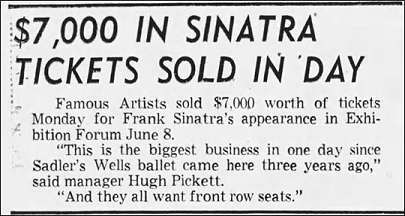
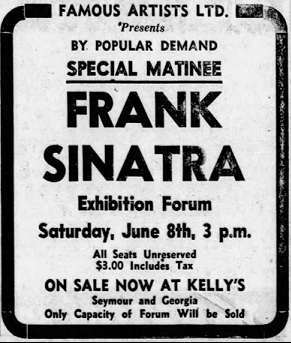
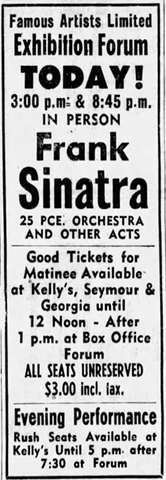
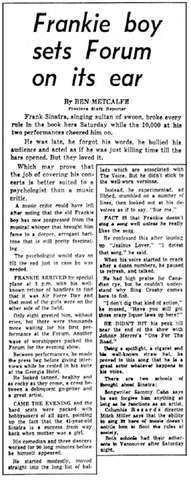
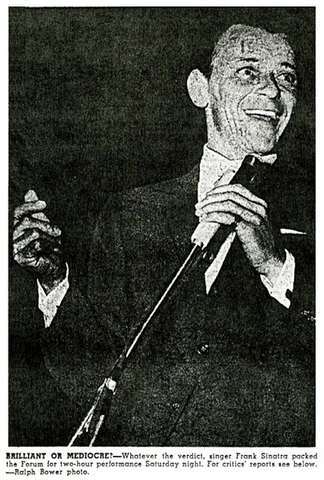
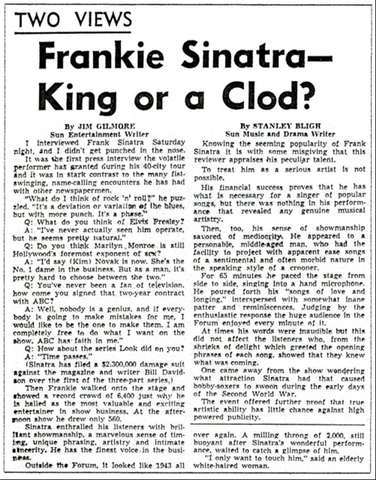
The Stampede Corral, Calgary, Alberta
(Cancelled)
This advertisement would appear in the Calgary Herald June 1st, 3rd, 4th, and 5th. There was no paper on Sunday June 2nd. The advertisement would eventually be replaced with the following one which appeared June 6th, 1957:
.
The same day the new poster advertisement appeared minus Sinatra, the article below appeared in the Calgary Herald and explained the reason for the cancellation. For years it has been believed that the concert was cancelled due to poor ticket sales. This story seems to refute that notion and even notes that 2,000 advance seats had been sold for the show. The article below, from the Vancouver Sun, the day previous, June 5th, 1957 backs up the same claim that the concert was cancelled due to issues related to Sinatra’s plane and air regulations. Note that the Calgary Herald did not announce the cancellation until a day after it was announced in the Vancouver Sun.
Note:
4,500 were in attendance for Sonny James and Gene Vincent on June 8th
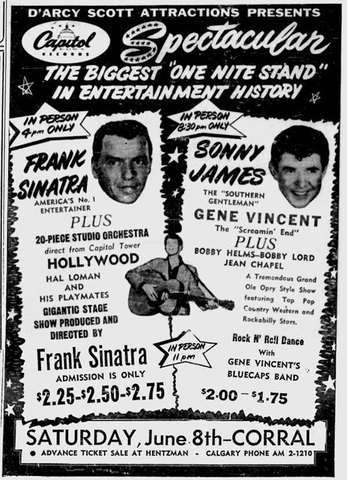
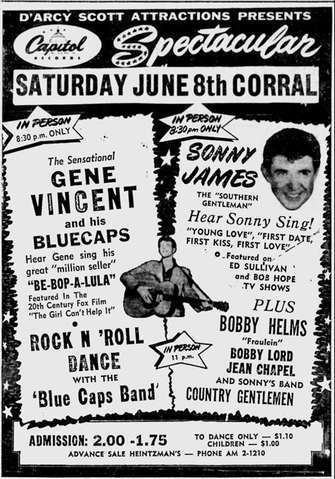
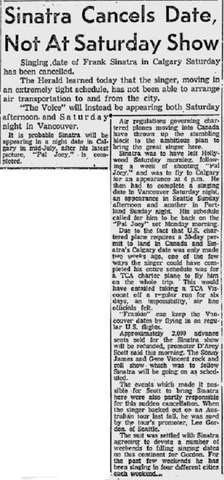
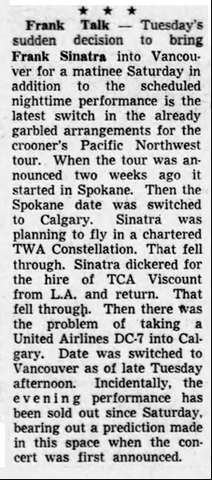
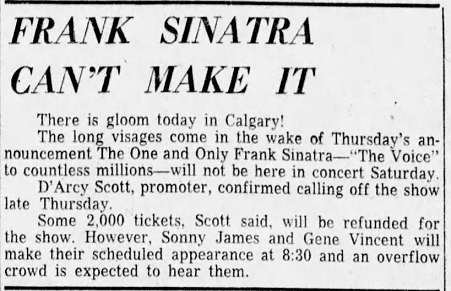
June 9, 1957
Concerts
Auditorium, Portland, Oregon
Time: 2:15 PM PST
Partial Personnel: Bill Miller (piano), Buddy Collette (reed), Harry (Sweets) Edison (trumpet), Murray McEaehern (trombone), George Roberts (trombone), Harry Klee (flute)
Performers: Frank Sinatra, Frankie de Amor, Hal Roman, Greg Brown & dance troupe
1. You Make Me Feel So Young
2. It Happened In Monterey
3. Play VideoAt Long Last LoveAt Long Last Love
4. I Get A Kick Out Of You
5. Play VideoJust One Of Those Things
6. A Foggy Day
7. The Lady Is A Tramp
8. They Can't Take That Away From Me
9. I Won't Dance
10. When Your Lover Has Gone
11. Play VideoViolets For Your Furs
12. My Funny Valentine
13. Glad To Be Unhappy
14. One For My Baby
15. The Tender Trap
16. Lonesome Road
17. I've Got You Under My Skin
18. Oh ! Look At Me Now
Civic Auditorium, Seattle, Washington
Partial Personnel: Bill Miller (piano), Buddy Collette (reed), Harry (Sweets) Edison (trumpet), Murray McEaehern (trombone), George Roberts (trombone), Harry Klee (flute)
Performers: Frank Sinatra, Frankie de Amor, Hal Roman, Greg Brown & dance troupe
On Location Engineer Wally Heider
Assistant Engineer: Mike Wolfe
1. You Make Me Feel So Young
2. It Happened In Monterey
3. At Long Last Love
4. I Get A Kick Out Of You
5. Just One Of Those Things
6. A Foggy Day
7. The Lady Is A Tramp
8. They Can't Take That Away From Me
9. I Won't Dance
10. monologue
11. When You're Lover Has Gone
12. Violets For Your Furs
13. My Funny Valentine
14. Glad To Be Unhappy
15. One For My Baby
16. The Tender Trap
17. Hey Jealous Lover
18. I've Got You Under My Skin
19. Oh Look At Me Now
20. Night And Day
Notes: TT: 64 min. "Night And Day" is not in circulation
NOTE: Ed O'Brien reports that Wally Heider recorded this concert and did a truly magnificent job.
When that recording first circulated among collectors, the stereo separation was incredible. The sound of the band came out on the left track and Sinatra was solo on the right channel. If you set up your system perfectly and positioned yourself in the middle of the room, the sound you heard was stereo at its very best. Bass trombonist George Roberts was part of that tour and he told O'Brien that the singer, the band, the arranger/conductor, and the audience all had a blast.
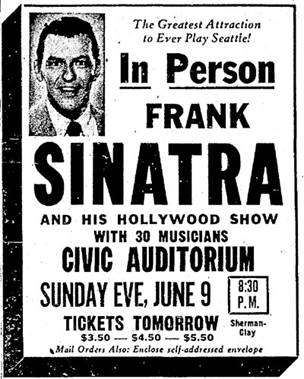
Auditorium, Portland, Oregon
Time: 2:15 PM PST
Partial Personnel: Bill Miller (piano), Buddy Collette (reed), Harry
(Sweets) Edison (trumpet), Murray McEaehern (trombone), George Roberts (trombone), Harry Klee (flute)
Performers: Frank Sinatra, Frankie de Amor, Hal Roman, Greg Brown & dance troupe
Stunning black and white capture of the famous jazz singer and musician Frank Sinatra while in Portland, 1957.
This portrait features the star sitting on a bench on a dock, leaning back.
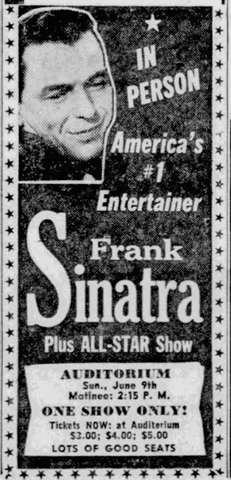
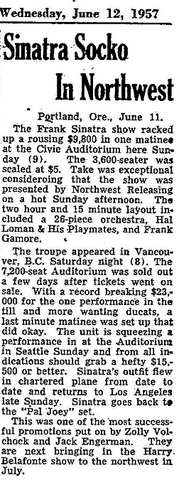
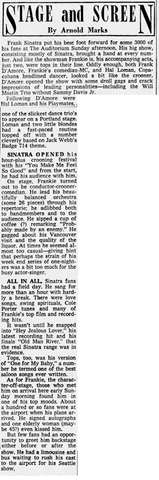
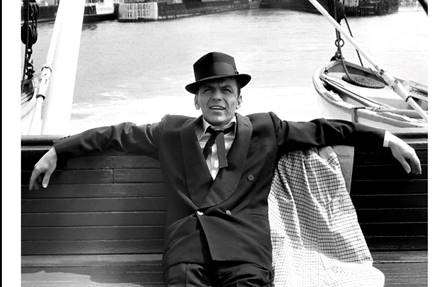
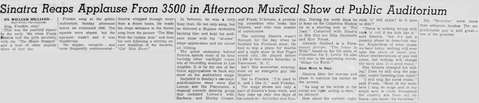
Civic Auditorium, Seattle, Washington
Partial Personnel: Bill Miller (piano), Buddy Collette (reed), Harry
(Sweets) Edison (trumpet), Murray McEaehern (trombone), George Roberts (trombone), Harry Klee (flute)
Performers: Frank Sinatra, Frankie de Amor, Hal Roman, Greg Brown & dance troupe
A few of the different LP and CD issues on the Seattle concert:
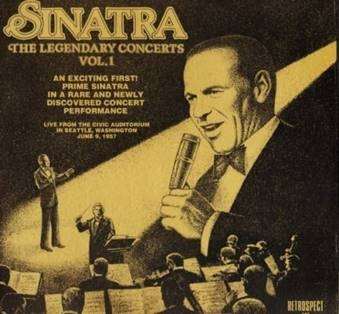
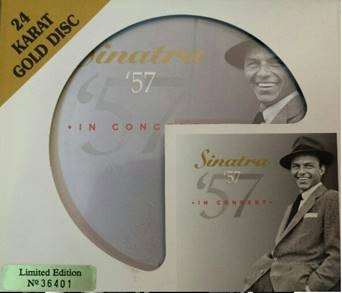
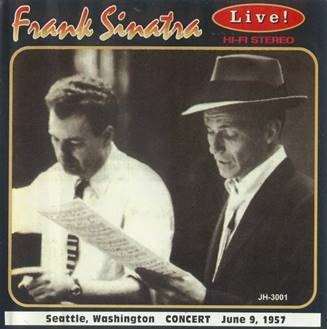
[Seattle Civic Auditorium concert]
A recording of the second show that Sunday night at Seattle's Civic Auditorium captures Sinatra in fine spirits but visibly nervous about his voice; he takes a swig from a glass mid-song, jokes with the audience about "getting larger," and later his voice audibly cracks on the high note of "My Funny Valentine."
Source: James Kaplan, "Sinatra: The Chairman" (2015).
[Seattle show stage patter]
During the Seattle concert Sinatra bantered with the crowd, joked about needing "a shot glass stuck in my throat," ribbed pianist Bill Miller for coming in early on "Tender Trap," and declared he "absolutely and unequivocably" detested his hit single "Hey! Jealous Lover." He closed strong with an ecstatic rendition of the Dorsey-era swinger "Oh! Look at Me Now," reminiscing about his Dorsey days.
Source: James Kaplan, "Sinatra: The Chairman" (2015).
June 11, 1957
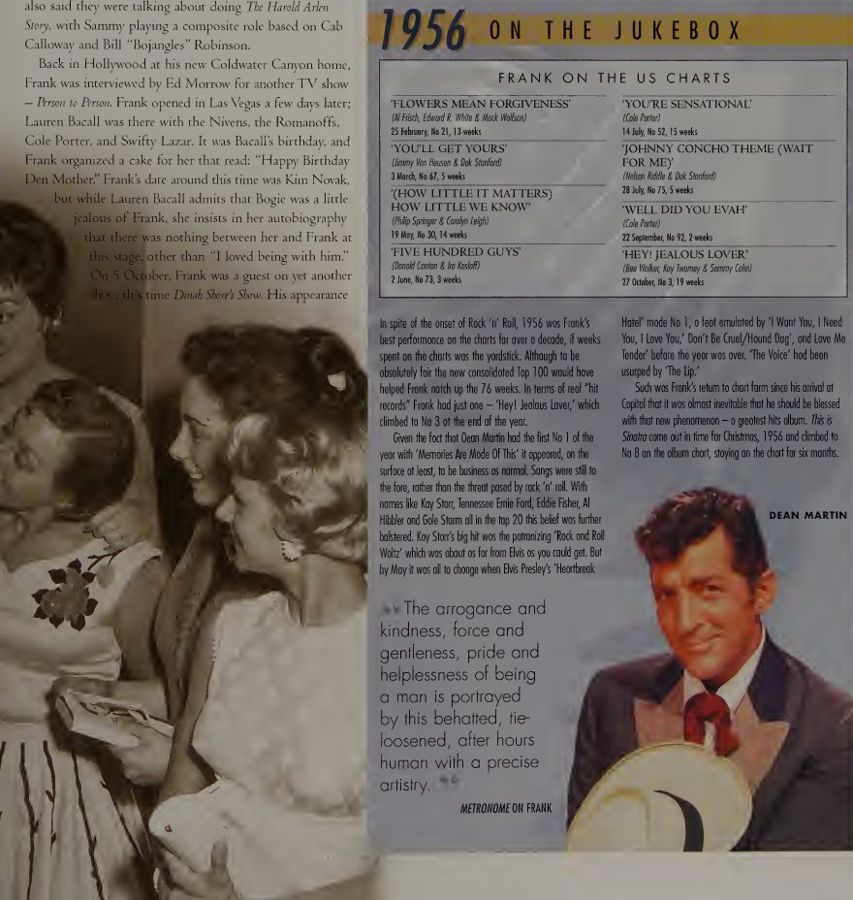
[Photograph: Friend describes Frank's revolving-door romances. From Richard Havers, "Sinatra" (Dorling Kindersley, 2007), p.225.]
An unnamed friend of Frank's was quoted in Look magazine comparing his habit of changing girlfriends to changing cufflinks, joking that he seemed to pick women to match the color of his tie. (Source: Richard Havers, "Sinatra" (Dorling Kindersley, 2007).)
June 12, 1957
Jimmy Dorsey outlived his brother Tommy by only about six months, dying in June 1957. (Source: Richard Havers, "Sinatra" (Dorling Kindersley, 2007).)
June 14, 1957
Studio
Columbia Pictures - Los Angeles
PAL JOEY
Friday
Arrangements by Nelson Riddle
Conducted by Morris Stoloff
There's A Small Hotel
I Could Write A Book w/Trudy Erwin
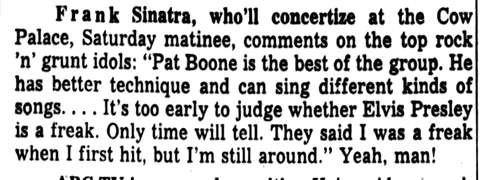
Frank's attorneys filed for divorce from Ava in Mexico City after years of an on-again, off-again relationship.
Source: Nancy Sinatra, Frank Sinatra: An American Legend, 1995.
June 15, 1957
Concerts
Civic Auditorium, San Jose, California
Saturday Afternoon 2:30 PM
Orchestra (29 piece)
Partial Personnel: Bill Miller (piano), Buddy Collette (reed), Harry
"Sweets" Edison (trumpet), Shorty Sherock (trumpet), Murray McEaehern (trombone), George Roberts (trombone), Harry Klee (flute), Frank DeVito (drums), Joe Comfort (bass), Nick Bonney (Guitar)
Performers: Frank Sinatra, Frankie de Amor, Hal Roman, Greg Brown & dance troupe
Fairgrounds Coliseum, Salt Lake City, Utah
Saturday Evening 8:15 PM
Orchestra (29 piece)
Partial Personnel: Bill Miller (piano), Buddy Collette (reed), Harry
"Sweets" Edison (trumpet), Shorty Sherock (trumpet), Murray McEaehern (trombone), George Roberts (trombone), Harry Klee (flute), Frank DeVito (drums), Joe Comfort (bass), Nick Bonney (Guitar)
Performers: Frank Sinatra, Frankie de Amor, Hal Roman, Greg Brown & dance troupe
Partial Setlist:
1. You Make Me Feel So Young
2. Glad To Be Unhappy
3. Violets For Your Furs
4. Old Man River
5. The Lonesome Road
Civic Auditorium, San Jose, California
Saturday Afternoon 2:30 PM
Orchestra (29 piece)
Partial Personnel: Bill Miller (piano), Buddy Collette (reed), Harry
"Sweets" Edison (trumpet), Shorty Sherock (trumpet),
Murray McEaehern (trombone), George Roberts (trombone), Harry Klee (flute), Frank DeVito (drums), Joe Comfort (bass), Nick Bonney (Guitar)
Performers: Frank Sinatra, Frankie de Amor, Hal Roman, Greg Brown & dance troupe
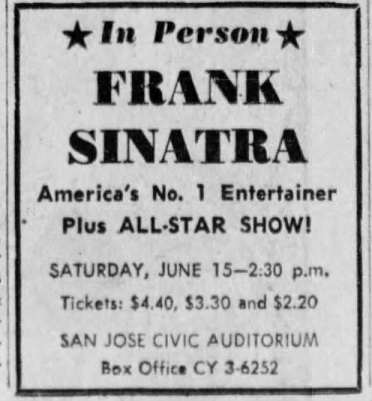

Fairgrounds Coliseum, Salt Lake City, Utah
Saturday Evening 8:15 PM
Orchestra (29 piece)
Partial Personnel: Bill Miller (piano), Buddy Collette (reed), Harry
"Sweets" Edison (trumpet), Shorty Sherock (trumpet),
Murray McEaehern (trombone), George Roberts (trombone), Harry Klee (flute), Frank DeVito (drums), Joe Comfort (bass), Nick Bonney (Guitar)
Performers: Frank Sinatra, Frankie de Amor, Hal Roman, Greg Brown & dance troupe
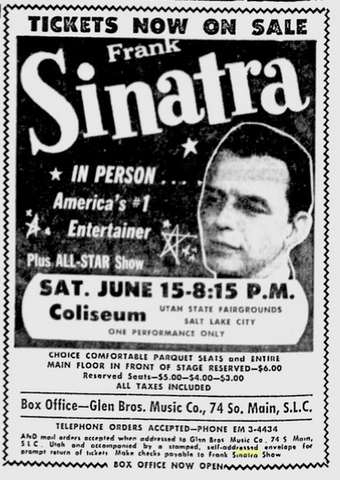
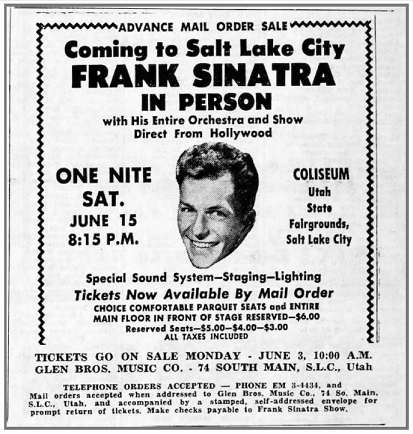
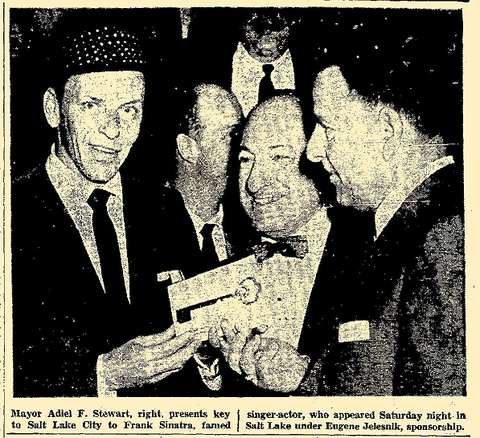
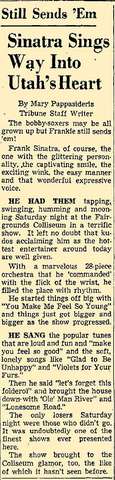
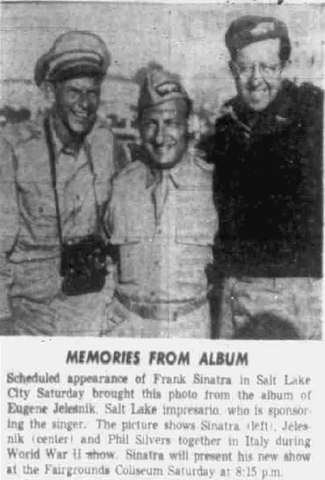
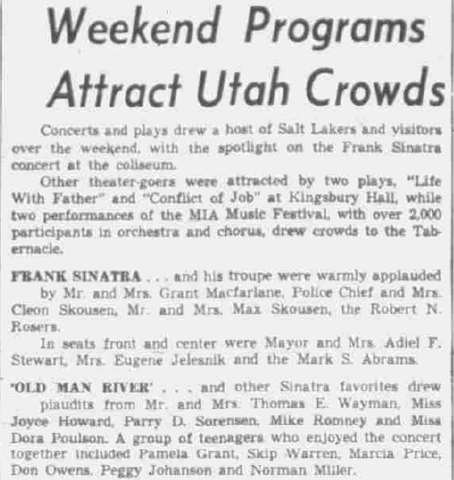
June 16, 1957
Concerts
Cow Palace, San Francisco, California
Sunday Afternoon 2:30 PM
Orchestra (29 piece)
Partial Personnel: Bill Miller (piano), Buddy Collette (reed), Harry "Sweets" Edison (trumpet), Shorty Sherock (trumpet), Murray McEaehern (trombone), George Roberts (trombone), Harry Klee (flute), Frank DeVito (drums), Joe Comfort (bass), Nick Bonney (Guitar)
Performers: Frank Sinatra, Frankie de Amor, Hal Roman, Greg Brown & dance troupe
Partial List (sang 17 songs):
1. You Make Me Feel So Young
2. It Happened In Monterey
3. A Foggy Day
4. Lonesome Road
5. Hey Jealous Lover ( partial )
6. My Funny Valentine
7. Violets For Your Furs
8. Glad To Be Unhappy
9. They Can't Take That Away From Me
10. When You Lover Has Gone
11. I Won't Dance
12. Just One Of Those Things
13. I've Got You Under My Skin
14. One For My Baby
15. Oh, Look At Me Now
Notes: less than 4,500 in attendance. Cow Palace held 17,000.
Ed O'Brien:
Frank DeVito was the drummer for the June 57 tour. Frank is an amazing guy with excellent recall. He told me so many interesting stories about the tour. The real shocker was the news that Nelson Riddle was not there for any of the concerts. I asked Frank who conducted. He told me it was mainly Sinatra with Bill Miller taking over a couple of times. If you read the Ralph Gleason review, I put up a few days ago, he describes Frank's skill leading the orchestra. Mr DeVito vividly recalled the folding chairs in the Cow Palace. The band couldn't stop laughing when they saw the chairs. Sinatra was less than thrilled by such a Mickey Mouse arrangement and was appalled by the acoustics in the Cow Palace. According to Frank, the Sunday afternoon performance in S.F. was the best individual show of the three-weekends. Frank gave me the song list done that day. He kept a log and is sending me more information that documents what transpired on those three weekends in June 1957.
Memorial Auditorium, Sacrameto, California
Sunday Evening
Orchestra (29 piece)
Partial Personnel: Bill Miller (piano), Buddy Collette (reed), Harry "Sweets" Edison (trumpet), Shorty Sherock (trumpet), Murray McEaehern (trombone), George Roberts (trombone), Harry Klee (flute), Frank DeVito (drums), Joe Comfort (bass), Nick Bonney (Guitar)
Performers: Frank Sinatra, Frankie de Amor, Hal Roman, Greg Brown & dance troupe
Cow Palace, San Francisco, California
[image referenced in source but could not be recovered]
[image referenced in source but could not be recovered]
[image referenced in source but could not be recovered]
[image referenced in source but could not be recovered]
[image referenced in source but could not be recovered]
[image referenced in source but could not be recovered]
[image referenced in source but could not be recovered]
[image referenced in source but could not be recovered]
[image referenced in source but could not be recovered]
Memorial Auditorium, Sacrameto, California
Sunday Evening
[image referenced in source but could not be recovered]
[image referenced in source but could not be recovered]
[image referenced in source but could not be recovered]
[image referenced in source but could not be recovered]
[image referenced in source but could not be recovered]
[image referenced in source but could not be recovered]
Cow Palace, San Francisco, California (contd.)
Ed O'Brien:
San Francisco Chronicle published this piece (below) on 6-17-57. A friend sent me the original that his sister cut out at the time. She attended the afternoon concert and thought Frankie was beyond great. Hard to believe that this is the 60th anniversary of that memorable tour.
[image referenced in source but could not be recovered]
[image referenced in source but could not be recovered]
[image referenced in source but could not be recovered]
June 17, 1957
Frank left for 16 weeks of location shooting in Spain, co-starring with Cary Grant and Sophia Loren in Stanley Kramer's The Pride and the Passion.
Source: Nancy Sinatra, Frank Sinatra: An American Legend, 1995.
June 20, 1957
On her ninth birthday, Tina didn't receive the Thunderbird Junior she wanted, but was given her first real diamond necklace instead, a gift Frank was clearly thrilled to present. (Source: Tina Sinatra, "My Father's Daughter: A Memoir" (2000).)
June 20, 1957
On her ninth birthday, Tina didn't receive the Thunderbird Junior she wanted, but was given her first real diamond necklace instead, a gift Frank was clearly thrilled to present. (Source: Tina Sinatra, "My Father's Daughter: A Memoir" (2000).)
June 26, 1957
Film
"The Pride and the Passion" (Hollywood Premiere: June 26, 1957)
Starring: Cary Grant, Frank Sinatra, Sophia Loren
Produced and Directed by: Stanley Kramer
Based on the novel, "The Gun" by C.S. Forester
During the Napoleonic Wars, a British captain (Grant) is sent to Spain to help prevent the French from stealing a powerful cannon. A huge cannon, perhaps the largest in the world at that time, is discarded by the army as they retreat from the French invaders. A "ragtag" group of Spanish loyalists find "The Gun" and begin to restore it so they may tow it across Spain to the French stronghold in Avila and use it to open the giant walls for an invasion. Luckily Britain has sent someone to retrieve the cannon for England so they can have it to fight the French also AND to make sure that the French don't get the gun! A guerrilla band led by the French-hating Miguel (Sinatra) and his girl friend (Loren) are the leaders of the peasants trying to get the gun to Avila. --DVD Release: 2002-05-07 & Blu-Ray Release: 2016-08-16
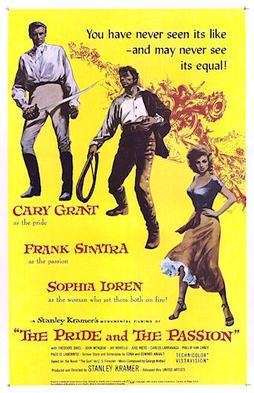
"The Pride and the Passion" (Hollywood Premiere: June 26, 1957)
Actress Sophia Loren and Frank Sinatra attend the Hollywood premiere of 'The Pride And The Passion' on June 26, 1957.
© 1997-2025 The Sinatra Archive
This calendar, or any parts thereof, may not be reproduced in any fashion whatsoever without the prior written permission of the publisher (The Sinatra Archive)
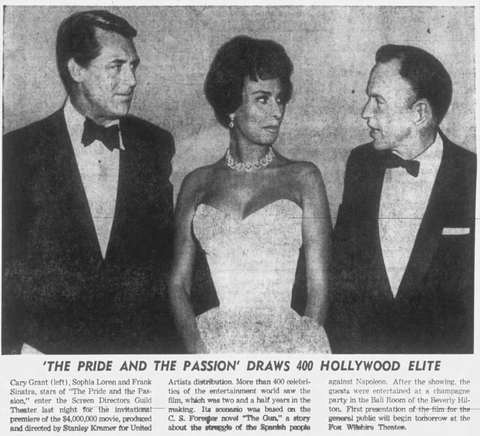
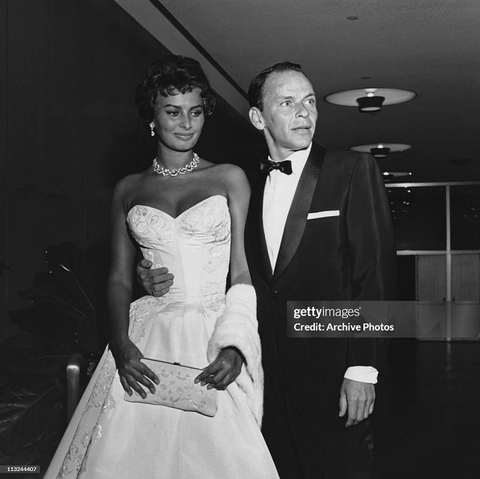
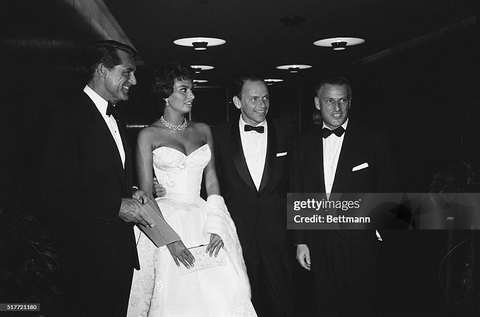
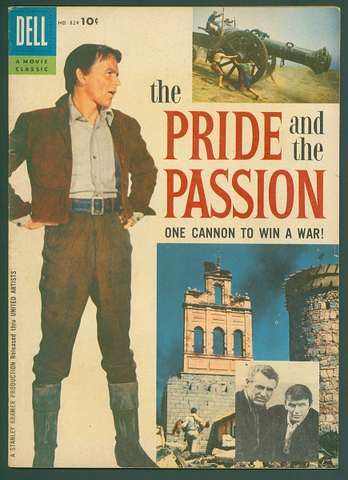
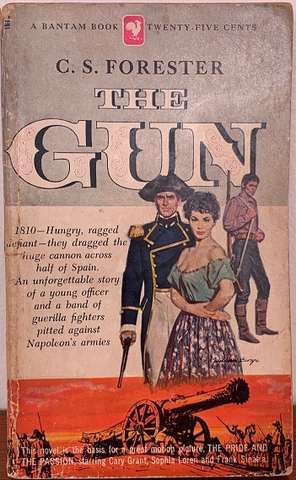
"The Pride and the Passion" (Hollywood Premiere: June 26, 1957)
Actress Sophia Loren and Frank Sinatra attend the Hollywood premiere of 'The Pride And The Passion' on June 26, 1957.
The stars and producer director of the new film "The Pride of and the Passion" poses for photographer at the premier of the motion picture here June 26th. Left to right are Cary Grant, Sophia Loren, and Stanley Kramer, who produced and directed the film which was based on a C. S. Forester story.
© 1997-2026 The Sinatra Archive
This calendar, or any parts thereof, may not be reproduced in any fashion whatsoever without the prior written permission of the publisher (The Sinatra Archive)
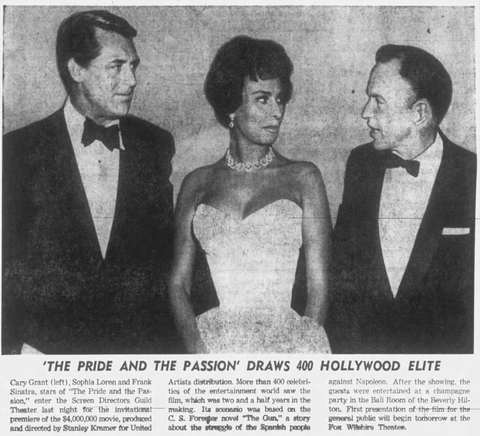
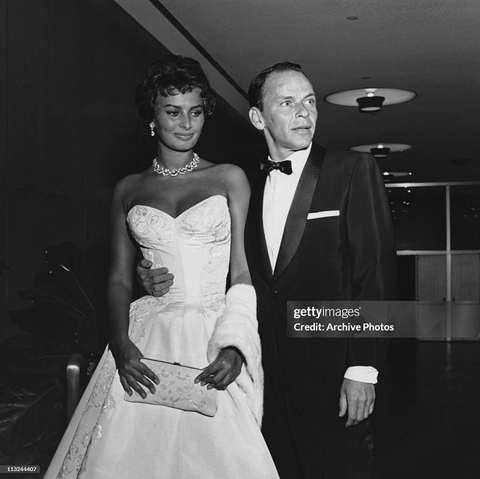
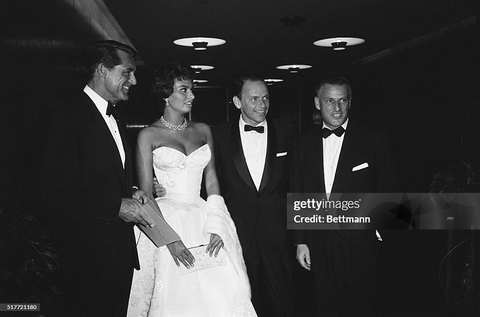
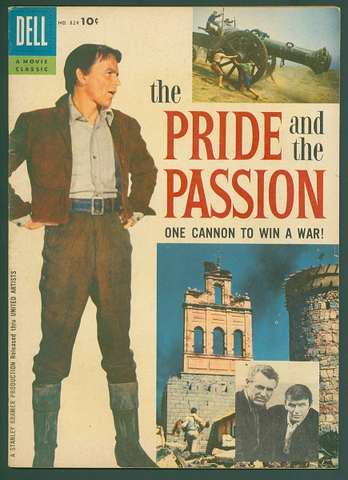
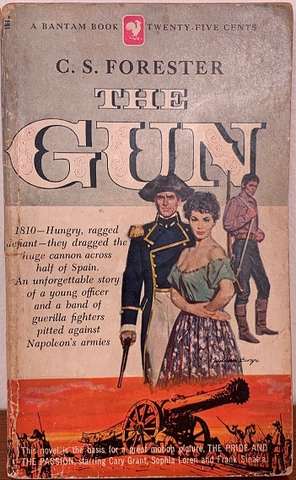
"The Pride and the Passion"
The Pride and the Passion was a lavish MGM Technicolor epic (based on C.S. Forester's novel The Gun) about Spanish peasants hauling a giant cannon against French occupiers, involving a budget of nearly $4 million, a production crew of 400, and 9,400 extras. Sinatra took second billing after Cary Grant and ahead of Sophia Loren, receiving $250,000.
Source: Tom Santopietro, "Sinatra in Hollywood" (2008).
"The Pride and the Passion"
Sinatra arrived on location in Spain still embroiled in conflict with Ava Gardner, who was furious he'd shown up with young singer Peggy Connolly. He refused to stay near the location, insisting on the Hilton in Madrid (a three-hour trip away), reportedly more concerned about his contractual $25/day tip allowance than his role. He quit the location at the end of July 1956 with several weeks of shooting remaining and flew back to the U.S.; his remaining scenes were shot on a noticeably phony-looking soundstage.
Source: Tom Santopietro, "Sinatra in Hollywood" (2008).
"The Pride and the Passion"
Stanley Kramer: Director/producer Stanley Kramer, recalling his troubles with Sinatra decades later at an AFI seminar, said of handling difficult actors like Sinatra: 'You don't. There is no resolution... Once he said to me, in the middle of Europe, "Hot or cold, Thursday I'm leaving." I had seven weeks left to shoot. So he left. That's a problem. It was solved by two days' work back in a studio with potted palms.'
Source: Tom Santopietro, "Sinatra in Hollywood" (2008).
"The Pride and the Passion"
Stanley Kramer: Years later, writing a tribute to Spencer Tracy, Stanley Kramer recalled that Tracy found it amusing that Sinatra once 'made a company rebuild all its sets in California because he didn't want to go to Madrid' -- Kramer noted the same thing had happened to him, referring to Sinatra walking off The Pride and the Passion.
Source: Tom Santopietro, "Sinatra in Hollywood" (2008).
"The Pride and the Passion"
Daniel O'Brien / Stanley Kramer: Biographer Daniel O'Brien wrote that the Pride and the Passion walkout 'reaffirmed his reputation as a difficult talent whose bad moods and lack of commitment did a lot more harm than merely upsetting his co-workers.' Kramer himself later remarked, 'If Sinatra really wanted to work, prepare for a role, research it, he'd be the best in the world.'
Source: Tom Santopietro, "Sinatra in Hollywood" (2008).
"The Pride and the Passion"
Cary Grant, Sinatra's costar, proposed marriage to Sophia Loren during filming of The Pride and the Passion (she declined), though onscreen he appeared bored by their romantic scenes.
Source: Tom Santopietro, "Sinatra in Hollywood" (2008).
"The Pride and the Passion"
It was reported that Sinatra worked with his musician friend Victor Gomez to develop a convincing Spanish accent for his role as Miguel, but the results were widely considered unconvincing, sounding closer to a New Jersey-inflected caricature.
Source: Tom Santopietro, "Sinatra in Hollywood" (2008).
"The Pride and the Passion"
Pauline Kael / Norman Jewison: Critic Pauline Kael, no fan of Stanley Kramer's filmmaking, bluntly said 'Stanley Kramer runs for office in the arts.' Fellow director Norman Jewison offered a milder verdict: 'Stanley was a better producer than he was a director.'
Source: Tom Santopietro, "Sinatra in Hollywood" (2008).
"The Pride and the Passion"
Bosley Crowther: Bosley Crowther's New York Times review was scathing, comparing the film unfavorably even to The Ten Commandments for its 'casual disregard for plausibility' and noting Sinatra as the Spanish leader shows 'an evident inner fire that glows but fitfully.'
Source: Tom Santopietro, "Sinatra in Hollywood" (2008).
"The Pride and the Passion"
Cary Grant: Cary Grant, reflecting after filming, offered a rare piece of insight into Sinatra's appeal: 'Frank fascinates the curious... hoping to discover those qualities responsible for the man's personal appeal. Well, I think I know the quality. It's truth. Simple truth. Without artifice.'
Source: Tom Santopietro, "Sinatra in Hollywood" (2008).
"The Pride and the Passion"
Santopietro grades this a D, calling it "turgid; endless."
Source: Tom Santopietro, "Sinatra in Hollywood" (2008).
"The Pride and the Passion"
Santopietro (Filmography): Stanley Kramer Productions/United Artists. Produced and directed by Stanley Kramer, screenplay by Edna Anhalt, Edward Anhalt and Earl Felton based on C. S. Forester's novel 'The Gun,' musical score by George Antheil. Sinatra played Miguel opposite Cary Grant and Sophia Loren.
Source: Tom Santopietro, "Sinatra in Hollywood" (2008).
July 1957
[Sinatra and Ava Gardner Divorce]
Sinatra and Ava Gardner's marriage ended in divorce in July 1957, around the time his personal difficulties were weighing on him.
Source: Charles Pignone, "Frank Sinatra 100" (2015).
[Brando's Paris tea incident]
Kaplan: While filming The Young Lions in Europe, Dean Martin and Marlon Brando were sitting in a Paris hotel café when Brando spilled scalding tea in his lap, burning himself badly enough to require brief hospitalization.
Source: James Kaplan, "Sinatra: The Chairman" (2015)
[Recording A Jolly Christmas]
Kaplan: Sinatra returned to Capitol Studio A in July to record a Christmas album with Gordon Jenkins conducting and arranging, backed by a twenty-two-piece orchestra and the twenty-five-member Ralph Brewster Singers chorus. Critic Will Friedwald felt Sinatra recaptured the innocent sound of his earlier Christmas album with Axel Stordahl.
Source: James Kaplan, "Sinatra: The Chairman" (2015)
[Sinatra options A Hole in the Head]
Kaplan: While on the Baja cruise, Sinatra read the script of the Broadway comedy A Hole in the Head, about a widower struggling to run a Miami hotel. On returning to Los Angeles he had his William Morris agent, Bert Allenberg, option the play for $200,000.
Source: James Kaplan, "Sinatra: The Chairman" (2015)
[A Jolly Christmas -- critical commentary]
Frank Military: After completing A Jolly Christmas in July 1957, Sinatra threw an elaborate, catered 'Christmas in July' party for the musicians and technicians, according to friend Frank Military.
Source: Charles L. Granata, "Sessions with Sinatra: Frank Sinatra and the Art of Recording" (1999/2003), Part III: The Capitol Years, 1953-1962
July 4, 1957
[Baja cruise with Bacall]
Sinatra and a group of friends set sail from the Fourth of July on the chartered 102-foot yacht Celeste for a cruise down the Baja California coast, kept out of the press. Lauren Bacall was aboard; she later recalled it was during this cruise that their relationship turned romantic, despite Sinatra getting drunk and abusive with a waiter at one port, which she shrugged off as par for the course.
Source: James Kaplan, "Sinatra: The Chairman" (2015).
July 5, 1957
[Sinatra-Gardner divorce finalized]
A Mexican court issued the divorce decree ending Sinatra and Ava Gardner's marriage. The news generated little attention in the American press. Gardner would never remarry.
Source: James Kaplan, "Sinatra: The Chairman" (2015).
July 10, 1957
Studio
Capitol Studio A, Hollywood
E17289 It Came Upon A Midnight Clear w/The Ralph Brewster Singsers
Arranged & Conducted by Gordon Jenkins
CD: CDP 7-48329-2 The Sinatra Christmas Album
LP: W984 A Jolly Christmas
E17290 O Little Town Of Bethlehem w/The Ralph Brewster Singsers
Arranged & Conducted by Gordon Jenkins
CD: CDP 7-48329-2 The Sinatra Christmas Album
LP: W984 A Jolly Christmas
E17291 Hark The Herald Angels Sing w/The Ralph Brewster Singsers
Arranged & Conducted by Gordon Jenkins
CD: CDP 7-48329-2 The Sinatra Christmas Album
LP: W984 A Jolly Christmas
E17292 Adeste Fideles (O Come All Ye Faithful) w/The Ralph Brewster Singsers
Arranged & Conducted by Gordon Jenkins
CD: CDP 7-48329-2 The Sinatra Christmas Album
LP: W984 A Jolly Christmas
NOTE: Sinatraphile Jim White calls attention to the 2007 release of the 50th Anniversary edition of "A Jolly Christmas from Frank Sinatra," which includes, as a bonus, a Christmas Seals Public Announcement track recorded by Sinatra. This 50th Anniversary edition is not included in the above listing provided by Brian Chearno and his Sinatra Archive. The CD is numbered 509995 00016 20.
July 16, 1957
Studio
Capitol Studio A, Hollywood
E17331 Jingle Bells
w/The Ralph Brewster Singers
Arranged & Conducted by Gordon Jenkins
CD: CDP 7-48329-2 The Sinatra Christmas Album
LP: W984 A Jolly Christmas
CD: A Jolly Christmas From Frank Sinatra [50th Anniversary Edition]
(2007) Capitol 509995 00016 20
E17332 The First Noel
w/The Ralph Brewster Singers
Arranged & Conducted by Gordon Jenkins
CD: CDP 7-48329-2 The Sinatra Christmas Album
LP: W984 A Jolly Christmas
CD: A Jolly Christmas From Frank Sinatra [50th Anniversary Edition]
(2007) Capitol 509995 00016 20
E17333 Have Yourself A Merry Little Christmas
w/The Ralph Brewster Singers
Arranged & Conducted by Gordon Jenkins
CD: CDP 7-48329-2 The Sinatra Christmas Album
LP: W984 A Jolly Christmas
CD: A Jolly Christmas From Frank Sinatra [50th Anniversary Edition]
(2007) Capitol 509995 00016 20
E17334 The Christmas Waltz
w/The Ralph Brewster Singers
(J. Styne/S. Cahn)
Arranged & Conducted by Gordon Jenkins
CD: C2 724383808922 The Complete Capitol Singles
CD: CDP 7-48329-2 The Sinatra Christmas Album
LP: W984 A Jolly Christmas
45: 3900
CD: A Jolly Christmas From Frank Sinatra [50th Anniversary Edition]
(2007) Capitol 509995 00016 20
Musician - Violins: Victor Arno, Harry Bluestone, Walter Edelstein,
Sol Kindler, Joseph Livoti, Nick Pisani, Joseph Quadri, Lou Raderman, Mischa Russell, Marshall Sosson; Violas: William Baffa, Louis Kievman, Paul Robyn, David Sterkin; Cellos: Cy Bernard, Armand Kaproff; Piano: Bill Miller; Bass: Nathan Gangursky, John Ryan; Guitar: Allen Reuss;
Harp: Kathryn Thompson
Chorus: Sue Allen, Betty Allen, Ralph Brewster, Peggy Clark, Barbara
Ford, Lee Gotch, Beverly Jenkins, Jimmy Joyce, Gene Lanham, Bill Lee, Ray Linn, Jr., John Mann, Thora Mathiason, Dorothy McCarty, Loulie Jean Norman, Betty Noves, The Ralph Brewster Singers: Thurl Ravenscroft, Ginny Roos, Max Smith, Bob Stevens, Bill Thompson, Bob Wacker, Betty Wand, Gloria Wood, Norma Zimmer
Session Producer: Voyle Gilmore
Philadelphia Inquirer
Capitol Studio A, Hollywood
E17331 Jingle Bells
E17332 The First Noel
E17333 Have Yourself A Merry Little Christmas
E17334 The Christmas Waltz
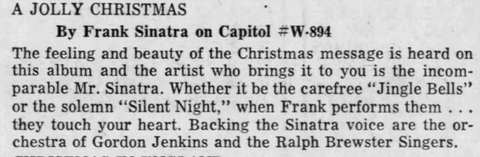
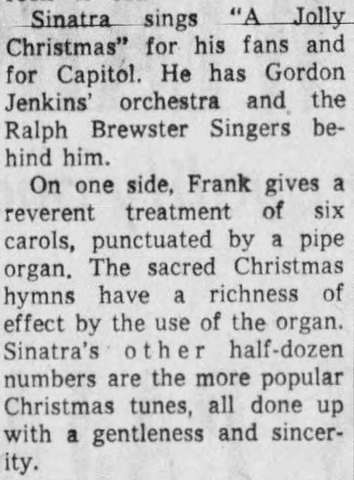
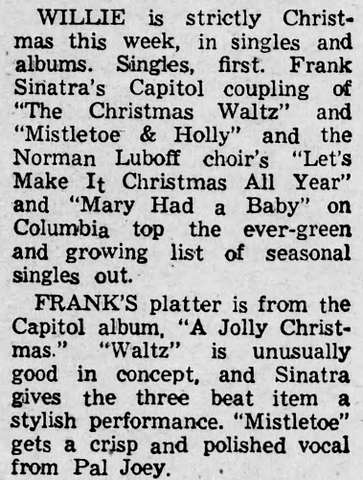
July 17, 1957
Studio
Capitol Studio A, Hollywood
E17339 Mistletoe And Holly
w/The Ralph Brewster Singers
(Stanford/Sanicola/ Sinatra)
Arranged & Conducted by Gordon Jenkins
CD: C2 724383808922 The Complete Capitol Singles
CD: CDP 7-48329-2 The Sinatra Christmas Album
LP: W984 A Jolly Christmas
45: 3900
E17340 The Christmas Song
w/The Ralph Brewster Singers
Arranged & Conducted by Gordon Jenkins
CD: CDP 7-48329-2 The Sinatra Christmas Album
LP: W984 A Jolly Christmas
E17341 Silent Night
w/The Ralph Brewster Singers
Arranged & Conducted by Gordon Jenkins
CD: CDP 7-48329-2 The Sinatra Christmas Album
LP: W984 A Jolly Christmas
E17342 I'll Be Home For Christmas
w/The Ralph Brewster Singers
Arranged & Conducted by Gordon Jenkins
CD: CDP 7-48329-2 The Sinatra Christmas Album
LP: W984 A Jolly Christmas
Nottingham Evening News
"I'll Be Home for Christmas"
Nick Fatool; Gordon Jenkins; Eleanor Slatkin: Friedwald notes Jenkins largely withheld his signature 'moaning strings' sound on A Jolly Christmas, building suspense instead; "I'll Be Home for Christmas" contains the album's sole brief glimmer of that sound. At the close of the third and final session, in the Capitol Tower in July 1957, Sinatra threw a full-scale party for musicians, singers, and staff. Nick Fatool recalled Jenkins as a taskmaster who wanted musicians to 'just play what he wrote'; concertmaster dispute (Jenkins favored David Frisina, Sinatra insisted on Felix/Eleanor Slatkin) resolved peacefully -- Jenkins later said, of their fear of a public row, 'We have never had a cross word.'
Source: Will Friedwald, "Sinatra! The Song Is You: A Singer's Art" (2018 revised edition).
[A Jolly Christmas wrapped, party thrown]
Frank Military: Sinatra completed A Jolly Christmas from Frank Sinatra and threw a lavish "Christmas in July" party for everyone involved, with catered food and drinks, according to Frank Military.
Source: James Kaplan, "Sinatra: The Chairman" (2015).
August 1957
[Dean Martin's welcome-home party]
Kaplan: Sinatra threw a surprise homecoming party for Dean Martin at Villa Capri after his return from Europe. Sammy Cahn wrote parody songs for the occasion, including "Tea in Gay Paree" (to the tune of "Tea for Two"), riffing on Brando's scalding-tea mishap; Sinatra sang it himself to raucous laughter, and the party broke up at 4:00 a.m.
Source: James Kaplan, "Sinatra: The Chairman" (2015)
August 7, 1957
WELCOME HOME DEAN PARTY
AT THE VILLA CAPRI
Wednesday evening
Ed O'Brien:
Dean Martin had just returned from
Paris, after filming Irwin Shaw's
"The Young Lions," with Marlon Brando and Montgomery Clift.
Jeannie Martin organized the Villa Capri welcome and Sammy Cahn knocked out a bunch of parodies.
Bill Miller's Quartet was conducted by Paul
Weston.
Sammy got the evening underway and the first performer was Dino. He sang a parody of "Alone."
Jo Stafford followed with special lyrics to "Easy
To Remember." Sammy sang his special version of "Poor People Of Paris" and Eddie Fisher sang fun lyrics to the Van Heusen tune "Love And Marriage."
Howard Keel turned Porter's "I Love Paris" upside down with a tenorous declaration "I Hate Paris." Gloria Cahn and Jackie Gershwin sang a parody, telling the gathering that while in Paree, Dino "Didn't Know What Time It Was."
Martin's pal, 'Mack Gray,' sang "But Not For Me," coached throughout by Messrs Sinatra and Fisher. Frank then described Mr. Brando's headline making tea adventure, while in Paris, with special, and very funny lyrics, to "Tea For Two." Sammy closed out the evening and the Miller
Quartet provided music for the assembled guests.
August 13, 1957
Studio
E17469 Bewitched
(Richard Rodgers/Lorenz Hart)
Arranged & Conducted by Nelson Riddle
CD: CDP 7-91249-2 Pal Joey
LP: SM912 Pal Joey
Toronto Star
In an interview with the New York World-Telegram, Sinatra explained his insistence on full creative control over his new ABC television series, telling the paper: "If I fall on my face, I want to be the cause."
Source: Albert Auster, "Frank Sinatra: The Television Years–1950–1960," Journal of Popular Film and Television, 26:4 (1999), 166-174.
August 23, 1957
[The Joker Is Wild premiere incident]
Bacall was Sinatra's date at the gala Las Vegas premiere of The Joker Is Wild. As newsreel cameras rolled, Frank tried to lead a horse ridden by Joe E. Lewis into the theater; the horse balked and defecated, prompting Lewis's quip, "Everybody's a critic these days."
Source: James Kaplan, "Sinatra: The Chairman" (2015).
[Sinatra snubs Joe E. Lewis]
At the post-premiere party at El Rancho Vegas, Joe E. Lewis invited Sinatra onstage to sing, breaking a prior promise not to ask him to perform there (Sinatra's contract barred him from performing at any Vegas hotel but the Sands). Sinatra rose, helped Bacall from her chair, and walked out, publicly rebuffing Lewis.
Source: James Kaplan, "Sinatra: The Chairman" (2015).
[Late-night breakfast at the Sands]
After leaving El Rancho Vegas, Sinatra took over the Sands cocktail lounge for an Italian breakfast that lasted until 6:15 a.m., with Bacall seated at his right, fueling rumors about the couple.
Source: James Kaplan, "Sinatra: The Chairman" (2015).
September 1957
[Bacall on her marriage prospects]
Lauren Bacall: Amid the marriage speculation, Bacall told Hedda Hopper she wanted to marry again and, asked to name her suitors, joked: "No. 1, Frank Sinatra; No. 2, Frank Sinatra; No. 3, Frank Sinatra," before laughing that no one knew what Sinatra would do in six months.
Source: James Kaplan, "Sinatra: The Chairman" (2015)
September 2, 1957
Frank's album Where Are You?, a collaboration with arranger Gordon Jenkins full of sweet, romantic ballads, was released.
Source: Nancy Sinatra, Frank Sinatra: An American Legend, 1995.
September 9, 1957
Frank sent a telegram to Senator George Smathers accusing Columbia producer Mitch Miller of accepting payola from songwriters; Smathers introduced a related FCC amendment, which failed to pass.
Source: Nancy Sinatra, Frank Sinatra: An American Legend, 1995.
September 11, 1957
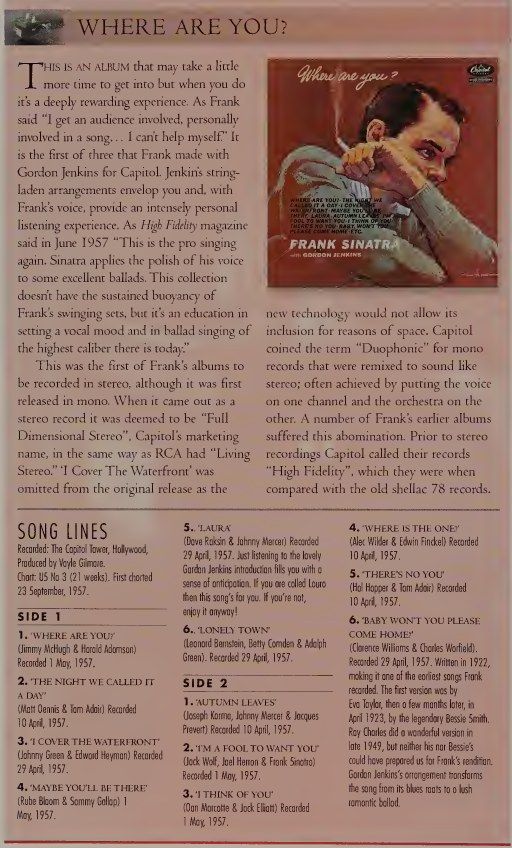
[Photograph: Pal Joey draws strong reviews from Variety and NYT. From Richard Havers, "Sinatra" (Dorling Kindersley, 2007), p.234.]
Variety predicted the film "can't miss being a blockbuster," while the New York Times later praised Frank's bouncy, likeable performance in an unusual role, and by the time it reached Britain in January 1958, critics judged that he dominated the picture from start to finish. (Source: Richard Havers, "Sinatra" (Dorling Kindersley, 2007).)
September 14, 1957
[British columnist predicts Sinatra-Bacall marriage]
Thomas Wiseman: London Evening Standard columnist Thomas Wiseman reported, without real sourcing, that Sinatra and Bacall would marry within six months "barring an act of providence or Ava Gardner," claiming Sinatra would deny it but that the denial shouldn't be believed.
Source: James Kaplan, "Sinatra: The Chairman" (2015).
September 23, 1957
[Sinatra and Bacall's public coming-out]
Sinatra and Bacall attended a closed-circuit broadcast of the Sugar Ray Robinson-Carmen Basilio middleweight title fight at a Hollywood theater; photographers were waiting when they emerged, and the resulting images of the couple ran in newspapers worldwide, marking their effective public debut as a couple.
Source: James Kaplan, "Sinatra: The Chairman" (2015).
Where Are You?, Frank's first album with Gordon Jenkins for Capitol, was also the first of his records made available in stereo, though initially released only in mono; the stereo edition dropped 'I Cover the Waterfront' because the new format's wider grooves left less room per side. (Source: Richard Havers, "Sinatra" (Dorling Kindersley, 2007).)
September 25, 1957
Studio
Capitol Studio A, Hollywood
E17553 I Didn't Know What Time It Was
(Richard Rodgers/Lorenz Hart)
Arranged by Nelson Riddle
Conducted by Morris Stoloff
CD: CDP 7-91249-2 Pal Joey
LP: SM912 Pal Joey
E17561 What Do I Care For A Dame? w/Chorus
(Richard Rodgers/Lorenz Hart)
Arranged by Nelson Riddle
Conducted by Morris Stoloff
CD: CDP 7-91249-2 Pal Joey
LP: SM912 Pal Joey
note: An unusual Capitol session. Riddle had a 67 piece orchestra plus a choral group of 24. The recordings done here would be used in the film and released on the Capitol S/T of "Pal Joey."
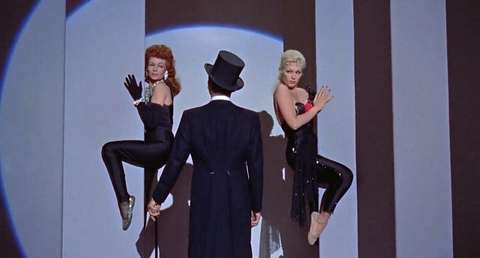
September 26, 1957
Film
"The Joker Is Wild" (New York Premiere September 26, 1957)
Starring: Frank Sinatra, Mitzi Gaynor, Jeanne Crain, Eddie Albert, Beverly Garland, Jackie Coogan
Cameo by Sophie Tucker
Produced by: Samuel J. Briskin
Directed by: Charles Vidor
Frank Sinatra plays Joe E. Lewis, a famous comedian of the 1930s-50s. When the movie opens, Lewis is a young, talented singer who performs in speakeasies. When he bolts one job for another, the mob boss who owns the first speakeasy has his thugs try to kill Lewis. Lewis survives, but his vocal cords are cut and he cannot sing. Several years later, his buddy Austin Mack (Eddie Albert) tracks him down and tries to help him with little success. That attempt, though, leads to Lewis meeting Letty Page (Jeanne Crain). They fall in love and she inspires him to follow up on an offer to become a comedian (a result of his buddy's failed attempt to rejuvenate his singing career). Lewis has problems, though. The assault that nearly cost him his life also helped turn him into an alcoholic and an inveterate gambler. These two character defects become the basis for his act and help to make him a smash success. Unfortunately, they also work to wreak havoc in his personal life with Letty and then with his wife Martha (Mitzi Gaynor). -- DVD release in Italy as "il Jolly E Impazzito
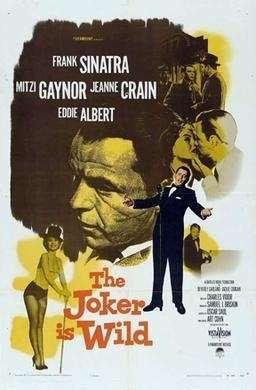
"The Joker Is Wild" (New York Premiere September 26, 1957)
Starring: Frank Sinatra, Mitzi Gaynor, Jeanne Crain, Eddie Albert, Beverly Garland, Jackie Coogan
--DVD release has been issued in Italy as "il Jolly E Impazzito (with English audio)
Frank Sinatra loved Joe E. Lewis. He considered Lewis one of the funniest men who had ever lived.
In the summer of 1955, Sinatra learned of a forthcoming biography of the comedian written by Art Cohn.
Frank moved quickly to get the bio "The Story Of Joe Lewis" while it was still in galleys form. MGM was
also aware of the book and immediately offered Lewis $150,000 for the rights. He turned them down
after Frank indicated he wanted to star in it for his brand new company Bristol Productions. The
company would own 25% of the film and a large share of the gross profits. Paramount Pictures
worked out a deal with Frank, Joe E.. Charles Vidor (director) and Cohn. Each man would receive
$400,000 dollars plus split 75% of the studio's profits.
Filming got underway on October 15, 1956. The shooting schedule accommodated Sinatra's
way of life with most of the work being done in the afternoon and early evening. Mitzi Gaynor,
Jeanne Crain and Eddie Albert were cast in major roles. Cahn & Van Heusen were asked to write
the music including parodies, Nelson Riddle would arrange the numbers and Walter Scharf would
write the score and conduct. The film would be shot in VistaVision and in black and white. Frank
decided not to pre-record the songs. They were sung as the scenes were being shot on the set.
Frank wanted the excitement and noise of a nightclub setting. Cahn & Van Heusen submitted a
song titled "The Greatest Little Sign In The World" and Oakland/Maxwell submitted "The Bird Song."
Both were rejected as too sexually suggestive. Another Cahn/Van Heusen attempt, titled "All The Way"
was deemed acceptable. The production went very smoothly until 11/27 when Frank was told
Tommy Dorsey had died. He was unable to continue filming for the rest of the day. Frank
was very busy recording during the making of the movie. He completed "Close To You" and
also laid down "A Swingin'Affair." The film was completed in mid-December at a cost of
$2,000,000.
The world premiere took place at the El Portal Theatre in Las Vegas on 8-23-57. Joe E.
Lewis rode a horse, led by Frank Sinatra in a tux, wearing a jockey's cap, to the theatre.
An attempt to ride right into the movie house failed when the horse balked. Lewis quipped
that everyone was a critic. Film got underway at 11: P.M.. After all the Vegas stars did their
late show, a party got underway at four in the morning. The New York opening took place
on 9-26 at the Capitol Theatre and the L.A.showing opening at the Pantages the same
day with Frank attending with his date Lauren Bacall. The critical response was very
positive with Sinatra receiving raves for his powerful depiction of Lewis's run in with
gangsters and his alcoholism. The film grossed more than $3,000,000 dollars and
"All The Way" won the Oscar for best song of 1957. Subsequent releases saw the
film retitled "All The Way." The working title during the filming was simply "The Joker."
Although the film was out of print for many years because of a problem with the Lewis
Estate. Here is a copy available on ebay. It is my understanding the quality is good,
but not up to the highest standards of today's releases. The enclosed case offers the original poster that
Scott posted plus some stills .
Ed
FRANK SINATRA is reportedly a friend of the comedian, Joe E. Lewis, and the Capitol's new picture yesterday shouldn't change things. Paramount's "The Joker Is Wild," has Mr. Sinatra portraying his pal, in a frankly affectionate valentine, based on a biography by Art Cohn, with a nice supporting cast that includes Eddie Albert, Mitzi Gaynor and Jeanne Crain. This is the story of a cocky young Prohibition-era singer, almost ruined by a gangster, who switches to comedy, and drinks his way to night-club renown, as two loving ladies lose him to show-business legend. To get right down to cases (along with Mr. Lewis), the valentine is disarmingly personable and realistic for about two-thirds of the way. Sentiment it hasalso salt. Unfortunately, and witth all respect to Mr. Lewis, a very likable hero, as Mr. Sinatra plays him, he eventually turns into a flabby, tippling night owl vaguely promising to perk up. Methodically tapering off, the picture ends on this indulgently listless note. Backing up, there is plenty to be said for a show-business tribute as trimly organized, well-acted and honest as this one. Mr. Saul has snugly ticket off a series of admirably lean vignettes for Mr. Sinatra that carry him from a bleak Chicago hole-in-the-wall to his present-day club eminence. Charles Vidor's direction is as alert and flavorsome as the generally smoky backgrounds of Samuel J. Briskin's production. Mr. Albert, as a loyal accompanist; Beverly Garland, as his wife; Miss Crain, as the society belle who leaves the hero, and Miss Gaynor, as the bouncy chorine who bravely is married to himthese people all rate bows. But perhaps thhe brightest thing about the picture is the excellent dialoguepeppeery, amusing and sensitive in turn. Add, certainly, the consistently fine acting of Mr. Sinatra, on view virtually every minute, armed to the hilt with period songs. Mr. Lewis' friend has made him seem such a winning guy, it's too bad we have to leave him methodically wearing a bottle, like a tired albatross.
The Cast THE JOKER IS WILD, screen play by Oscar Saul, from a book by Art Cohn; directed by Charles Vidor; produced by Samuel J. Briskin for Paramount Pictures. At the Capitol. Joe E. Lewis . . . . . Frank Sinatra Austin Mack . . . . . Eddie Albert Martha Stewart . . . . . Mitzi Gaynor Letty page . . . . . Jeanne Crain Cassie Mack . . . . . Beverly Garland. . . Swifty Morgan . . . . . Jackie Coogan Georgie Parker . . . . . Ted deCorsia
NYT
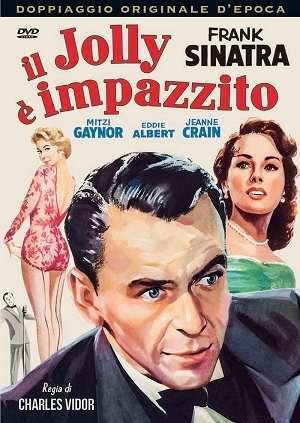
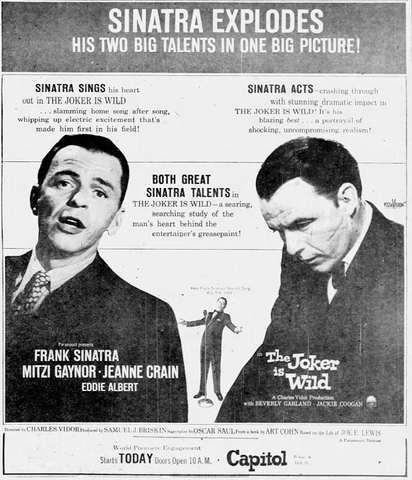
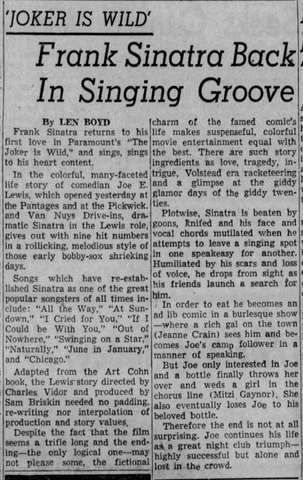
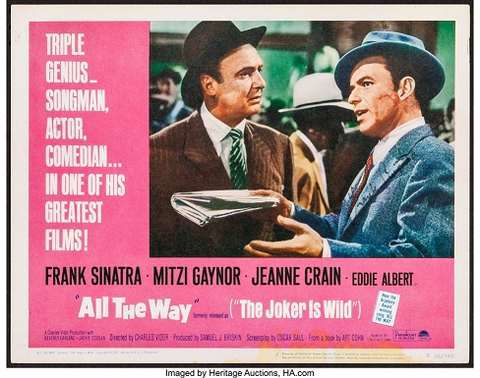
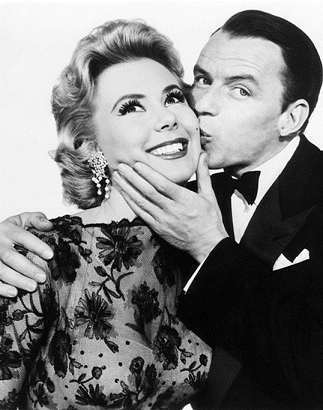
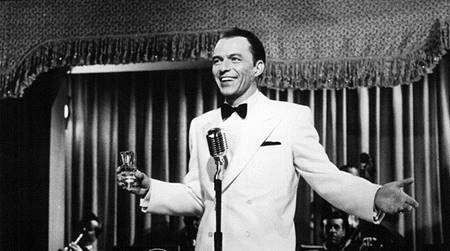
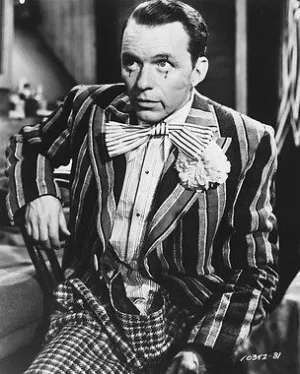
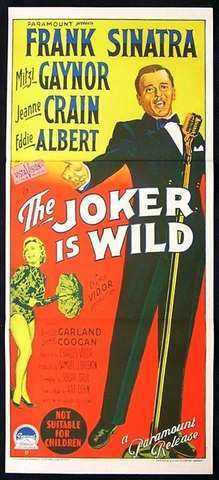
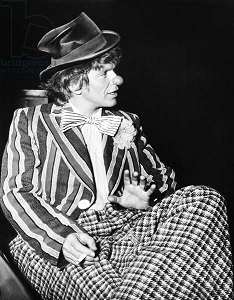
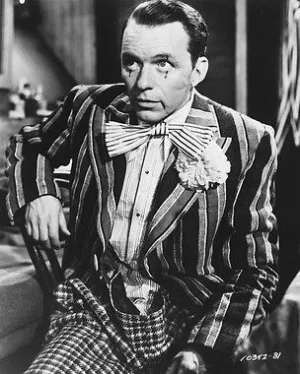
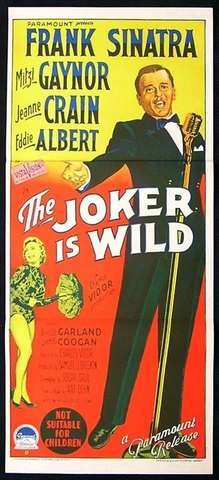
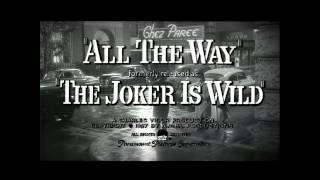
"The Joker Is Wild"
Sinatra bought the film rights to Art Cohn's book The Joker Is Wild (a biography of comic Joe E. Lewis) while it was still in galleys, then formed a deal with Cohn, Lewis himself, and director Charles Vidor, selling the package to Paramount. Sinatra took the largest share: a $120,000 fee plus 25 percent of the profits.
Source: Tom Santopietro, "Sinatra in Hollywood" (2008).
"The Joker Is Wild"
The Van Heusen/Cahn song 'All the Way,' written especially for The Joker Is Wild, won the Academy Award for Best Song and spent longer on the Billboard charts than any other single in Sinatra's recording career.
Source: Tom Santopietro, "Sinatra in Hollywood" (2008).
"The Joker Is Wild"
Nelson Riddle provided the orchestrations for the film's songs, with Walter Scharf (who later worked with Streisand on Funny Girl) serving as musical director. Director Charles Vidor had previously shown a similar deft handling of the show-business/gangster milieu two years earlier in Love Me or Leave Me.
Source: Tom Santopietro, "Sinatra in Hollywood" (2008).
"The Joker Is Wild"
The film's atmospheric black-and-white cinematography was by Daniel L. Fapp, who would go on to shoot another Sinatra film, Kings Go Forth.
Source: Tom Santopietro, "Sinatra in Hollywood" (2008).
"The Joker Is Wild"
Philip K. Scheuer: Los Angeles Times critic Philip K. Scheuer noted the difference between Sinatra and the real Joe E. Lewis: 'When Lewis, highball in hand, is reciting [the drunk monologues] his natural clown's grin takes the curse off their cynicism; from Sinatra the gags come out bitter and barbed.'
Source: Tom Santopietro, "Sinatra in Hollywood" (2008).
"The Joker Is Wild"
Charles Vidor: Director Charles Vidor called Sinatra 'the greatest natural actor I've ever worked with,' notable praise from the man who had also directed James Cagney's celebrated performance in Love Me or Leave Me.
Source: Tom Santopietro, "Sinatra in Hollywood" (2008).
"The Joker Is Wild"
William Weaver: Motion Picture Herald critic William Weaver praised Sinatra's transformation in the role, writing that somewhere between the start ('all-Sinatra') and end ('all-Lewis') of the picture, 'he gets a firm hand on the character he's re-creating and, at the same time, the audience he's creating it for. This is the essence of show-business.'
Source: Tom Santopietro, "Sinatra in Hollywood" (2008).
"The Joker Is Wild"
Joe E. Lewis: Joe E. Lewis, whose life the film dramatized, told Sinatra: 'You had more fun playing my life than I had living it.'
Source: Tom Santopietro, "Sinatra in Hollywood" (2008).
"The Joker Is Wild"
Santopietro grades this a B: solid Frank, with a brilliant first half that then drops off noticeably.
Source: Tom Santopietro, "Sinatra in Hollywood" (2008).
"The Joker Is Wild"
Santopietro (Filmography): AMBL Productions/Paramount Pictures. Produced by Samuel J. Briskin, directed by Charles Vidor, screenplay by Oscar Saul based on Art Cohn's biography of Joe E. Lewis, original songs by James Van Heusen and Sammy Cahn. Sinatra played comedian Joe E. Lewis opposite Mitzi Gaynor and Jeanne Crain, singing 'All the Way,' 'At Sundown' and other numbers.
Source: Tom Santopietro, "Sinatra in Hollywood" (2008).
September 30, 1957
A Jolly Christmas from Frank Sinatra was released; Nancy considered it simply the best Christmas album ever made.
Source: Nancy Sinatra, Frank Sinatra: An American Legend, 1995.
October 1957
[Ava Gardner's bullring accident in Spain]
Kaplan: While visiting a bull breeder's ranch in Andalusia, Ava Gardner, after heavy drinking, rode a horse into a bullring to playact as a banderillero; the horse reared as the bull charged, throwing her hard enough to leave a lasting bruise and bump on her cheekbone. Sinatra called to console her when he heard.
Source: James Kaplan, "Sinatra: The Chairman" (2015)
[Critical reception of the ABC premiere]
Kaplan: Reviews of the Frank Sinatra Show premiere were mixed: John Crosby of the Herald Tribune called it a triumph when Sinatra sang; Jack Gould of the New York Times praised the singing but faulted the writing and the Bob Hope/Kim Novak sketch; Variety unfavorably compared it to his Edsel Show appearance; critic Jack O'Brian preferred the more relaxed Sinatra of the Edsel special.
Source: James Kaplan, "Sinatra: The Chairman" (2015)
[Elvis Presley responds to Sinatra]
Elvis Presley: The day after Sinatra's rock 'n' roll denunciation made headlines, Elvis Presley responded graciously to reporters, saying he admired Sinatra and defended his right to his opinion, though he disagreed and considered rock the greatest music trend.
Source: James Kaplan, "Sinatra: The Chairman" (2015)
[George Martin signs Jeremy Lubbock]
Kaplan: Impressed by witnessing Sinatra's session, George Martin returned to England and within twelve days signed London singer-pianist Jeremy Lubbock to Parlophone, hoping to find "a British Frank Sinatra."
Source: James Kaplan, "Sinatra: The Chairman" (2015)
[Kirk Browning's staircase opening concept]
Kaplan: Director Kirk Browning devised the premiere's opening: a tight shot of Sinatra's hand snapping the tempo for "Lonesome Road," pulling back to reveal him atop a grand staircase amid a starry backdrop; Sinatra loved the idea and initially approved everything in rehearsals.
Source: James Kaplan, "Sinatra: The Chairman" (2015)
[Sinatra denounces rock and roll]
Frank Sinatra: In a piece written for the Paris magazine Western World, Sinatra denounced rock 'n' roll as "the most brutal, ugly, degenerate, vicious form of expression," calling it phony, sung by "cretinous goons," and blaming it for corrupting youth, while praising American music generally.
Source: James Kaplan, "Sinatra: The Chairman" (2015)
[Sinatra upends the show before airing]
Kirk Browning: Days before the premiere, Sinatra abruptly declared he didn't like the show and changed the numbers, set, order, and tone daily during final rehearsals, unsettling even Bob Hope, according to director Kirk Browning.
Source: James Kaplan, "Sinatra: The Chairman" (2015)
October 1, 1957
Studio
Capitol Studio A, Hollywood
E17639 On The Road To Mandalay
(Oley Speaks/Rudyard Kipling)
Arranged & Conducted by Billy May
CD: CDP 7-48469-2 Come Fly With Me
LP: SW920 Come Fly With Me
E17640 Let's Get Away From It All
(M. Dennis/T. Adair)
Dorsey Brother Music (a division of Music Sales Corporation) (BMI) Arranged & Conducted by Billy May
-7 (2:09) CD: CDP 7-48469-2 Come Fly With Me
CD: C2-94777 The Capitol Years
LP: SW920 Come Fly With Me
E17641 Isle Of Capri
(Will Grosz/Jimmy Kennedy)
Arranged & Conducted by Billy May
CD: CDP 7-48469-2 Come Fly With Me
LP: SW920 Come Fly With Me
Cincinnati Post
Capitol Studio A, Hollywood
E17639 On The Road To Mandalay
E17640 Let's Get Away From It All
E17641 Isle Of Capri
This album was issued by United Airlines as part of an ad campaign. I wonder who picked "The House I Live In." Album is a compilation of Capitol and Reprise recordings.
Frank went after Kipling's granddaughter after she succeeded in getting "Mandalay" banned from any UK releases. He went out of his way to sing the song whenever he was performing in any part of the UK.
Ed
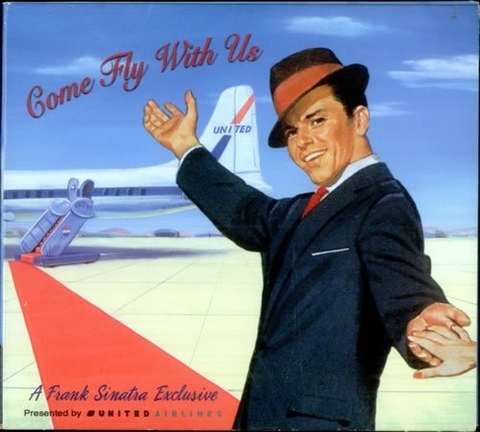
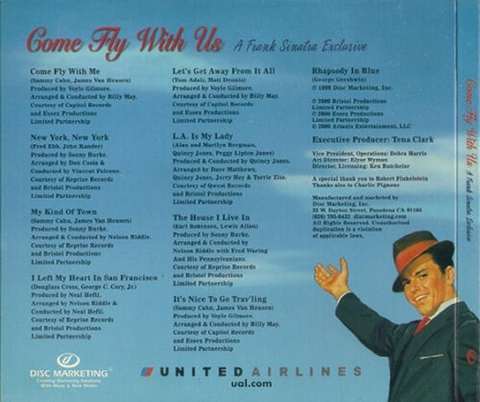
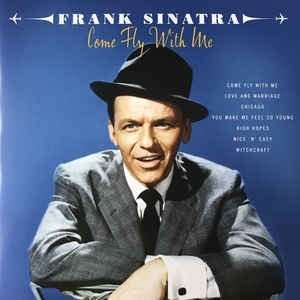
[First Come Fly with Me session]
The opening session for Come Fly with Me, deliberately fiddle-free, featured a brass, reed, rhythm, and harp lineup backing Sinatra on "On the Road to Mandalay," "Let's Get Away from It All," and "Isle of Capri"; "Flying Down to Rio" was rehearsed but not recorded.
Source: James Kaplan, "Sinatra: The Chairman" (2015).
[On the Road to Mandalay -- critical commentary]
Frank Flynn: On 'On the Road to Mandalay,' Frank Flynn recalled Billy May's arrangement called for a large gong hit on the line 'the dawn comes up like thunder'; during a take, Sinatra decided to end the song abruptly right after the gong rather than continuing through the written second half, which the band judged worked well musically.
This song/context matches multiple dated entries in the chronology, or lacked a sufficiently precise date; the specific date could not be determined with confidence.
Source: Charles L. Granata, "Sessions with Sinatra: Frank Sinatra and the Art of Recording" (1999/2003), Part III: The Capitol Years, 1953-1962
October 3, 1957
Studio
Capitol Studio A, Hollywood
E17647Autumn In New York
(Vernon Duke)
Warner Bros., Inc. (ASCAP)
Arranged & Conducted by Billy May
-3 (4:35) CD: CDP 7-48469-2 Come Fly With Me
CD: C2-94777 The Capitol Years
LP: SW920 Come Fly With Me
E17648 London By Night
(Carroll Coates)
Arranged & Conducted by Billy May
CD: CDP 7-48469-2 Come Fly With Me
LP: SW920 Come Fly With Me
E17649 April In Paris
(Vernon Duke/E.Y. Harburg)
Arranged & Conducted by Billy May
CD: CDP 7-48469-2 Come Fly With Me
LP: SW920 Come Fly With Me
E17650 Moonlight In Vermont
(Karl Suessdorf/John Blackburn)
Arranged & Conducted by Billy May
CD: CDP 7-48469-2 Come Fly With Me
LP: SW920 Come Fly With Me
Atlanta Daily World
Capitol Studio A, Hollywood
E17647Autumn In New York
E17648 London By Night
E17649 April In Paris
E17650 Moonlight In Vermont
Frankie Flies
COME FLY WITH ME featuring FRANK SINATRA with Billy May Orchestra.
Come Fly With Me: Around The World; Isle Of Capri; Moonlight In Vermont;
On The Road To Mandalay; April In Paris: Brazil & 5 others.
Capitol W 920.
Frank Sinatra is the King of popular singers (by singers he's a singer, as well as by fans) these days. There is no one to whom he must give way on any count. The selection of tunes to perform is a continuing indication of his good taste; the manner in which he performs them is the envy of singers the world over and the delight of his countless fans. The basic qualities in Sinatra's voice which make him so superior are sincerity and the ability to phrase a song and sing its lyrics as though he himself had written them. In previous LPs he has usually been accompanied by the Nelson .Riddle orchestra, but this time Billy May is used for a change of pace. It is a good choice, for the clean-sounding, lightly swinging band is excellently suited to Sinatra's voice and the arrangements are bright and provocative, particularly the unex- pected ending on "Road to Mandalay." The LP benefits from Capitol's painstaking re- cording technique.
R.J.G.
Hi-Fi And Music Review
May 1958
"April in Paris" / "Moonlight in Vermont"
Granata analyzes 'April in Paris' and 'Moonlight in Vermont' from Come Fly with Me as showcases of Sinatra's breath control and legato phrasing (especially the seamless held transition from 'trees' to 'April'), paired with Billy May's little-noted skill at string writing.
Source: Charles L. Granata, "Sessions with Sinatra: Frank Sinatra and the Art of Recording" (1999/2003).
"April in Paris"
Granata includes 'April in Paris' among the fifty recordings he considers essential to understanding Sinatra's artistry (arranged by Billy May, recorded 1957, Capitol); the song was chosen for its musical/interpretive value rather than commercial popularity.
Source: Charles L. Granata, "Sessions with Sinatra: Frank Sinatra and the Art of Recording" (1999/2003).
[April in Paris / Come Fly with Me -- critical commentary]
Granata notes this album was the first Sinatra-Billy May collaboration and contains the 1957 version of 'April in Paris' along with the original, superior recording of the Cahn-Van Heusen title song 'Come Fly with Me.'
This song/context matches multiple dated entries in the chronology, or lacked a sufficiently precise date; the specific date could not be determined with confidence.
Source: Charles L. Granata, "Sessions with Sinatra: Frank Sinatra and the Art of Recording" (1999/2003), Afterword & Appendices A-D
[Moonlight in Vermont -- critical commentary]
This became May's best-known ballad arrangement; Sinatra sang it at countless concerts for the rest of his life, memorably duetting on it with Ella Fitzgerald on a 1958 television appearance.
This song/context matches multiple dated entries in the chronology; the specific date Friedwald is referring to could not be determined with confidence.
Source: Will Friedwald, "Sinatra! The Song Is You: A Singer's Art" (2018 revised edition), Ch. 7, "With Billy May" (1953-1979)
October 8, 1957
Studio
Capitol Studio A, Hollywood
E17696 Blue Hawaii
(Leo Robin/Ralph Rainger)
Arranged & Conducted by Billy May
CD: CDP 7-48469-2 Come Fly With Me
LP: SW920 Come Fly With Me
E17697 Come Fly With Me
(Sammy Cahn/Jimmy Van Heusen)
Maraville Music Corp./Cahn Music Co. (ASCAP)
Arranged & Conducted by Billy May
-6 (3:17) CD: CDP 724383595228 Sinatra 80th "All The Best"
CD: CDP 7-48469-2 Come Fly With Me
CD: C2-94777 The Capitol Years
LP: SW920 Come Fly With Me
note: Sammy Cahn wrote some great lyrics for Frank Sinatra and Jimmy Van Heusen contributed some great melodies. You can easily run off 25 to 30 songs that became a treasured part of the Sinatra canon. We have heard them thousands of times and they still resonate today. But I would argue this is the best song they wrote for him. Frank sang it in clubs, concert hall and arenas for five decades. Frank sang the song with such exuberance. He embraced the joyous hedonism of the lyrics with a total sense of joie de vivre. This is the Sinatra who was filled with the thrill and excitement of being alive. Billy May wrote an arrangement that so complements the singer. And Madison Avenue has helped to make his recording timeless with many ads featuring the Sinatra vocal. I feel the song continues to hold up 65 years after the great Capitol recording. Just marvelous.
Ed
E17698 Around The World
(Victor Young/Harold Adamson)
Arranged & Conducted by Billy May
CD: CDP 7-48469-2 Come Fly With Me
LP: SW920 Come Fly With Me
NOTE: Sinatraphile John G. says that "Around the World" is one of his favorite songs and wishes that Sinatra would have sung it in concert. Sinatra Scholar Ed O'Brien responds that Billy May told him that it was his favorite of all the recordings he did with Sinatra. May felt the song had a lovely melody and Sinatra got all there was to get from the lyrics.
E17699 It's Nice To Go Trav'ling
(Sammy Cahn/James Van Heusen)
Arranged & Conducted by Billy May
CD: CDP 7-48469-2 Come Fly With Me
LP: SW920 Come Fly With Me
E17700 Brazil
(Ary Barrosa/Bob Russell)
Arranged & Conducted by Billy May
CD: CDP 7-48469-2 Come Fly With Me (unedited)
LP: SW920 Come Fly With Me
Sacramento Bee
"Blue Hawaii"
Friedwald calls this the only comparatively indistinct chart on the album, suggesting it might have benefited from May indulging in more raucous mock-island effects.
Source: Will Friedwald, "Sinatra! The Song Is You: A Singer's Art" (2018 revised edition).
"Brazil"
Ray Breem: Radio host Ray Breem, present at the final session for the Come Fly with Me album (stereo recording was just being introduced), recalled Sinatra doing two takes of 'Brazil,' then refusing to do a requested third take over a balance issue, grabbing his jacket and leaving with the line 'Whatever you've got is all you're gonna get.'
Source: Charles L. Granata, "Sessions with Sinatra: Frank Sinatra and the Art of Recording" (1999/2003).
"Come Fly with Me"
Frank Flynn: Percussionist Frank Flynn recalled Billy May writing two full arrangements, including the title track 'Come Fly with Me,' in the roughly four hours between a 4pm radio rehearsal and the start of the evening's October 8, 1957 Sinatra session.
Source: Charles L. Granata, "Sessions with Sinatra: Frank Sinatra and the Art of Recording" (1999/2003).
"Brazil"
Granata includes 'Brazil' among the fifty recordings he considers essential to understanding Sinatra's artistry (arranged by Billy May, recorded 1957, Capitol); the song was chosen for its musical/interpretive value rather than commercial popularity.
Source: Charles L. Granata, "Sessions with Sinatra: Frank Sinatra and the Art of Recording" (1999/2003).
[Final Come Fly with Me session, English visitors]
At the third and final Come Fly with Me session, English visitors Ron Goodwin (composer-arranger) and George Martin (a thirty-one-year-old EMI/Capitol record producer) observed Sinatra record five tracks including the title song. Sinatra also blew up over the album's artwork showing him with a TWA plane, suspecting a kickback arrangement.
Source: James Kaplan, "Sinatra: The Chairman" (2015).
Liner Notes: COME FLY WITH ME
Come Fly with Me is Sinatra's first album built around a theme rather than a mood -- travel, and the romance of distant places, realized through a partnership with arranger Billy May that would prove nearly as important to his Capitol years as the one with Nelson Riddle. May's charts are brassier and more brash than Riddle's, full of sliding trombones and playful exaggeration, a sound perfectly matched to a concept this literally larger than life.
The title track, written specifically for the album by Sammy Cahn and Jimmy Van Heusen, sets the itinerary: Peru, Hawaii, Vermont, Capri, each stop rendered with its own musical postcard. It is a purely joyful record, one of the few in Sinatra's catalogue with almost no shadow in it at all, and it became one of his most enduringly popular albums, reaching number one on the Billboard chart and staying there for five weeks.
Come Fly with Me also marks the point where the concept album, barely three years old as a form Sinatra himself had helped invent, became something closer to a genre convention -- a organizing idea strong enough to carry an entire LP. Sinatra would return to the travel theme, and to May, more than once in the years that followed.
Written by Claude (Anthropic), commissioned for this chronology, 2026.
[Come Fly with Me -- critical commentary]
Granata's discography entry: Come Fly with Me, arranged by Billy May, released January 1958.
This song/context matches multiple dated entries in the chronology, or lacked a sufficiently precise date; the specific date could not be determined with confidence.
Source: Charles L. Granata, "Sessions with Sinatra: Frank Sinatra and the Art of Recording" (1999/2003), Afterword & Appendices A-D
October 13, 1957
Television
Bing Crosby's The Edsel Show
Guests: Frank Sinatra, Louis Armstrong, Rosemary Clooney
NOTE: Sinatra Scholar Ed O'Brien writes that Edsel was one of the biggest mistakes ever made in Corporate America. But the CBS show on Sunday evening in October of 1957 was a winner all the way. Crosby, Sinatra, Armstrong, and Clooney looked better than the Braves beating the Yankees a week earlier. Sinatra did a medley of his hits, sang some duets with Crosby. Rosie and Sinatra did a marvelous15 minute medley to close the show‚ These three pros giving a seamless performance! To other Siinatra highlights: Sinatra and Armstrong singing "Birth of the Blues" with Louis doing some nifty horn work and Sinatra singing "The Sweetheart of Sigma Chi."
Ed O'Brien:
I happened upon the following information earlier this week. In June of 1957 Ford Motor Co was locked in serious negotiations regarding the
TV special that would herald the debut of their exciting new middle priced Edsel. They had offered two of the biggest names in show business a lot of money and an open format for the proposed one hour broadcast.
And it wasn't Bing and Frank. Ford wanted
Marlon Brando and Cary Grant to co-host the show. It certainly is interesting to imagine what the two men would have done with that hour. By going with Bing and Frank, Ford probably avoided two disasters that year.
Ed O'Brien:
The Edsel Show was broadcast live to the eastern part of the United States from Studio 33 in CBS Television City in Hollywood.
CBS made a videotape of the show and aired it three hours after the live broadcast to the western part of the country. The videotape was the first ever for CBS. They were so uncertain of the technology a kinescope of the show was lined up next to the tape in the event of a sudden failure. Everything went smoothly and a vastly improved method of rebroadcast became available.
The Edsel show pulled an estimated audience of 53 million viewers. The reviews of the show were very favorable. Not so for the Edsel, though. One viewer described Ford's new auto as "looking like an Oldsmobile sucking a lemon."
There was an early afternoon rehearsal the day of the broadcast. Ford gave Edsels to the stars of the show. Rosie Clooney would later describe an embarrassing moment for Ford. Leaving the rehearsal, she went to open the car door in the parking lot and the handle fell off. Obviously an omen of things to come. Hailed as the single greatest infomercial ever aired on TV, the enormous ratings failed to generate any real interest in the Edsel.
Bing Crosby's The Edsel Show
Guests: Frank Sinatra, Louis Armstrong, Rosemary Clooney
Variety
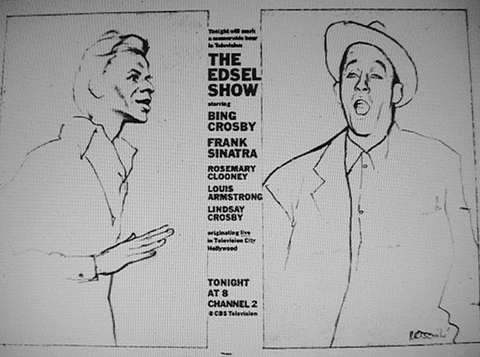
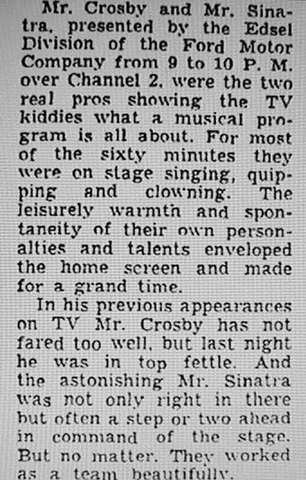
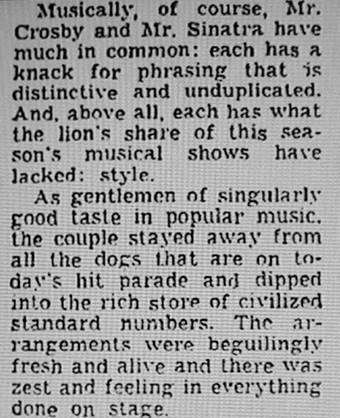
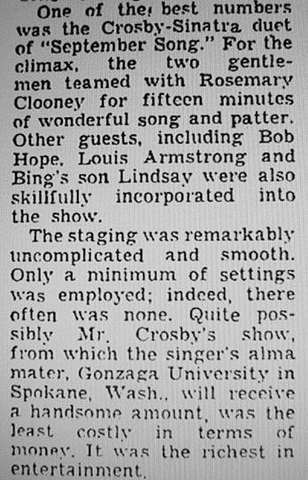
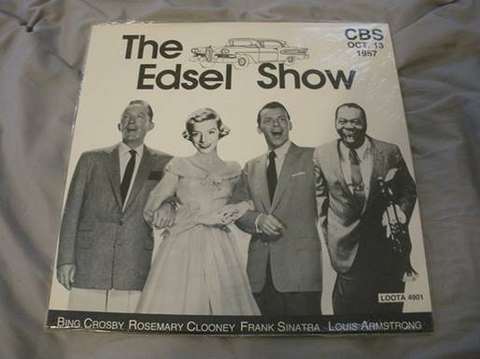
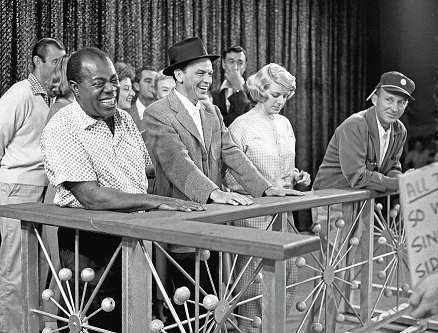
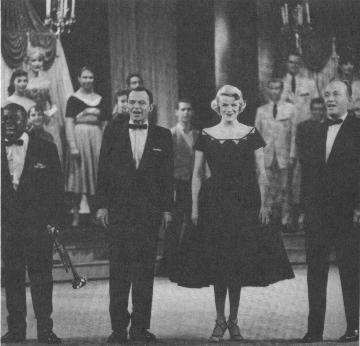
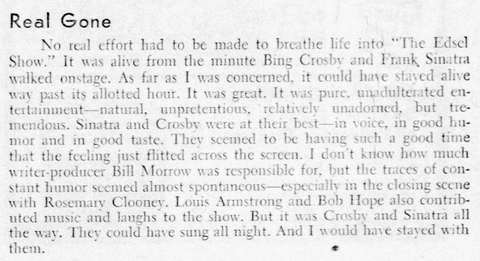
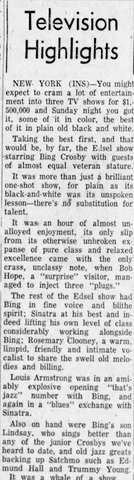
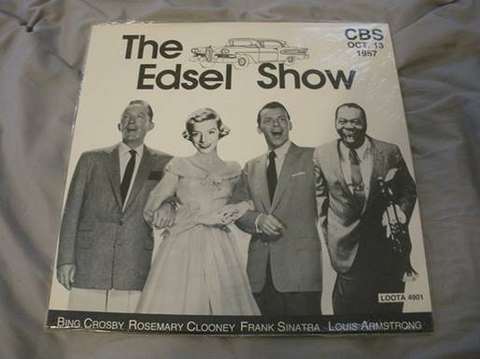
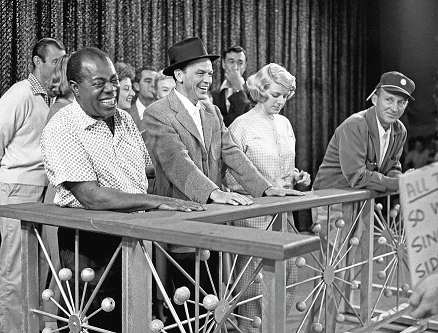
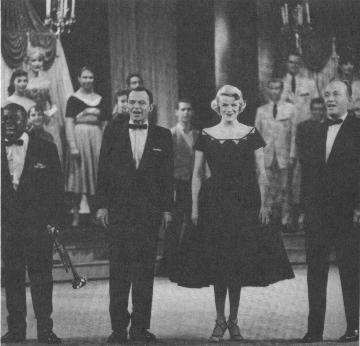
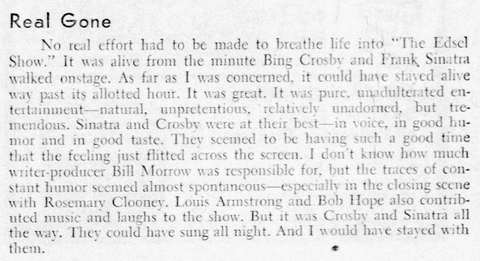
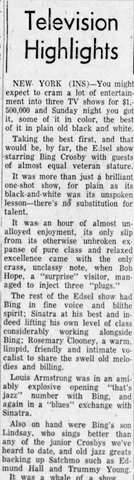
[Guest appearance on The Edsel Show]
Sinatra guest-starred with Rosemary Clooney, Louis Armstrong, the Norman Luboff Choir, the Four Preps, and a surprise Bob Hope walk-on, on Bing Crosby's CBS special The Edsel Show, promoting Ford's new Edsel model. It aired live on the East Coast, replacing The Ed Sullivan Show that Sunday.
Source: James Kaplan, "Sinatra: The Chairman" (2015).
[Sinatra flubs live medley on Edsel Show]
Rosemary Clooney: Sinatra skipped rehearsal for The Edsel Show; during the live medley he started "Blues in the Night" a cappella in the wrong key from the band, then shrugged it off with a joke ("The note's somewhere in there") and the audience loved it, per Rosemary Clooney's account.
Source: James Kaplan, "Sinatra: The Chairman" (2015).
October 14, 1957
The soundtrack album from Pal Joey was released, including 'The Lady Is a Tramp' and 'I Could Write a Book.'
Source: Nancy Sinatra, Frank Sinatra: An American Legend, 1995.
October 18, 1957
Television
Frank Sinatra Show (ABC)
Guests: Bob Hope, Kim Novak, Peggy Lee
Premier Show
Friday Nights
21 half hour musicals
10 half hour dramas
Sponsors Chesterfield Cigarettes, Bulova Watch Company
1. The Lonesome Road
2. I Get A Kick Out Of You
3. I Could Write A Book
4. The Lady Is A Tramp
5. Autumn Leaves
6. All The Way
7. Bewitched
8. Put Your Dreams Away
Notes: 60 mins.
"Autumn Leaves" was a part of a comedy skit with Bob Hope. There was no serious attempt to sing the song.
NOTE: Ed O'Brien points out that this was Sinatra's premier show for ABC-TV. There were 21 half-hour musical shows.
. It was televised live from Studio E in Hollywood . Riddle conducted a 27 piece orchestra during the one hour presentation.
note: A series that did not live up to the high expectations predicted by people in the industry. In the last year, I have posted a number of articles that were in Variety and other publications, leading up to this premiere. The opening show offered up a Sinatra who never sang better on live TV. But the skits were lame and so unnecessary. The follow up shows were done without a studio audience -- Sinatra needed to feed off of the electricity provided by audience reaction to his singing. The ratings, after the initial show, plummeted dramatically. The 11-29 show, with Dean Martin, was live, but then there were two-dramas in early December before the Christmas show with Crosby -- another show minus an audience. Alas and alack, the series never recovered, despite going live in 1958. George Roberts told me that the pre-recorded songs had to be married to the 27 piece ABC orchestra. Riddle had a very difficult time getting it right. And on a few he did not. William Self, the series producer, stated publicly that Frank was too busy with his films, night- club appearances, recordings and private life to tackle such a demanding project back then. I believe the show would have fared better in the Sunday night slot at 9:00 P.M. ---Ed
.
Frank Sinatra Show (ABC)
rehearsal for premiere show
George Roberts told me that the pre-recorded songs had to be married
to the 27 piece ABC orchestra. Riddle had a very difficult time getting it right. And on a few he did
not. William Self, the series producer, stated publicly that Frank was too busy with his films, night-
club appearances, recordings and private life to tackle such a demanding project back then. I believe
the show would have fared better in the Sunday night slot at 9:00 P.M. --ED
note: Here is a picture showing Frank and the small jazz combo pre-recording for the series
"Autumn Leaves" was a part of a comedy skit with Bob Hope.
There was no serious attempt to sing the song.
Variety
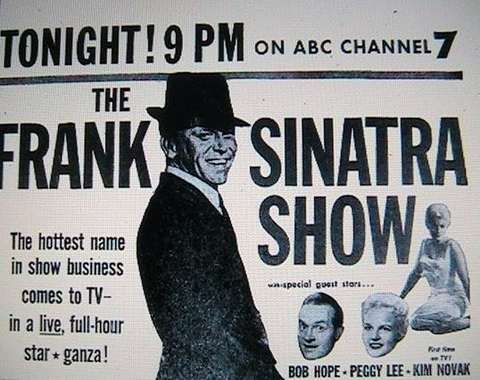
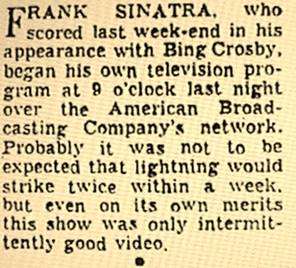
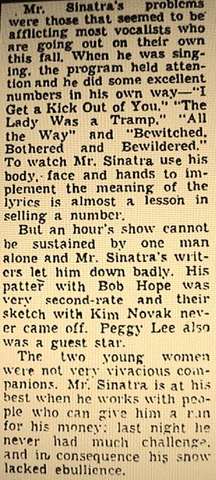
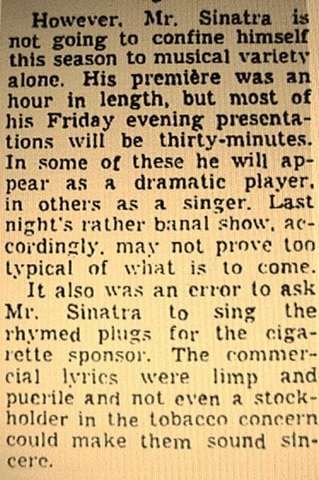
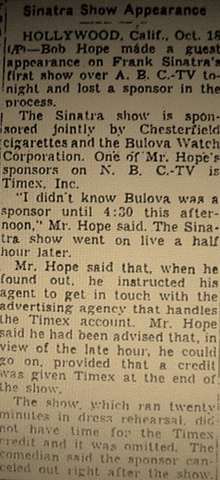
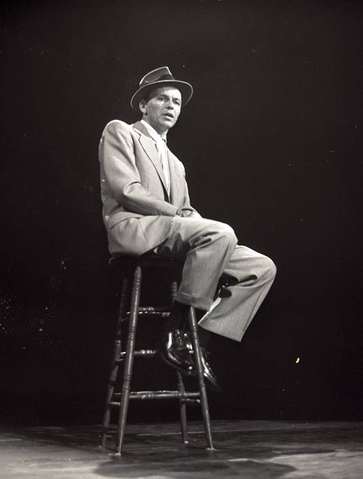
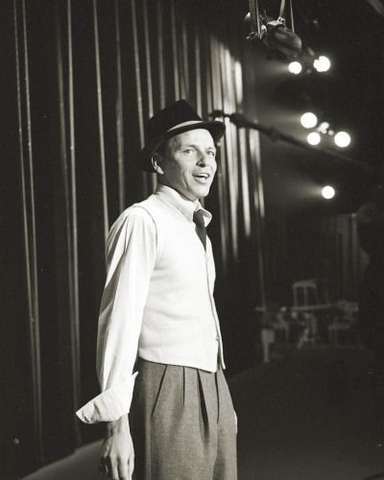
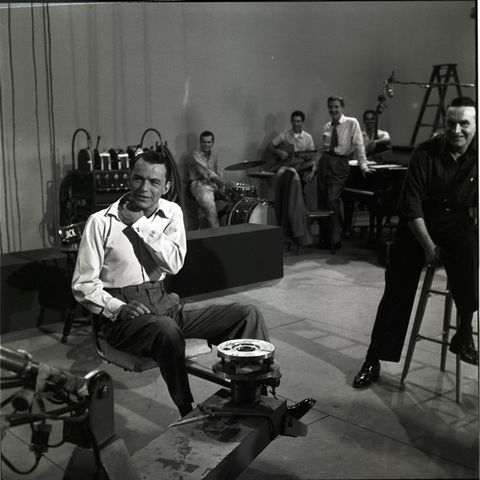
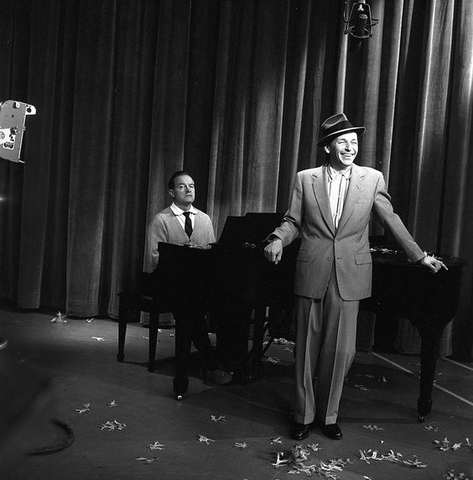
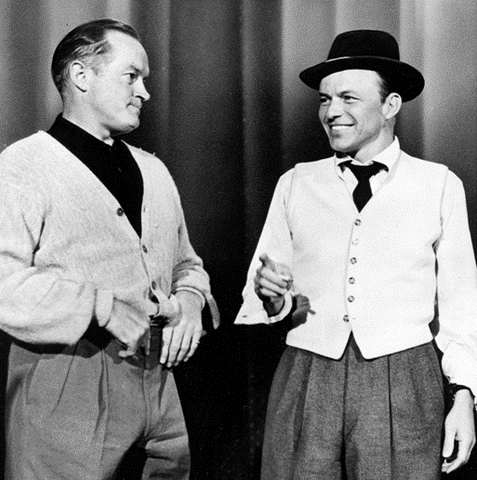
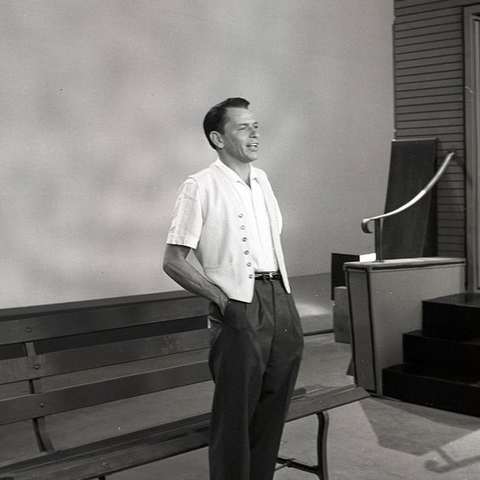
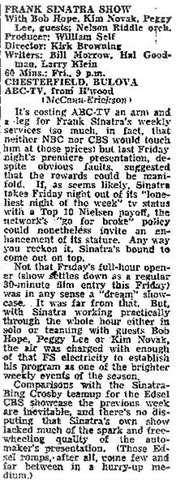
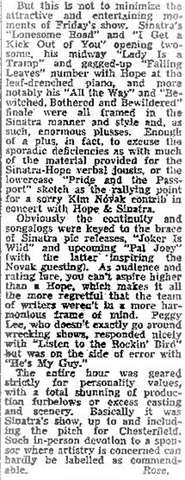
[New Frank Sinatra Show premieres on ABC]
Frank Sinatra: The new Frank Sinatra Show premiered live on ABC as an hour-long musical variety special, sponsored by Bulova and Chesterfield, guest-starring Bob Hope, Peggy Lee, and Kim Novak. Sinatra executive produced and told the press, "If I fall on my face, I want to be the cause."
Source: James Kaplan, "Sinatra: The Chairman" (2015).
[Sinatra vanishes before live airtime]
Kirk Browning: Minutes before the live premiere was to begin, Sinatra could not be found; he reappeared through a side door twenty seconds before air and calmly walked up the staircase to hit his mark exactly at the 9:00 p.m. cue, per director Kirk Browning's account.
Source: James Kaplan, "Sinatra: The Chairman" (2015).
October 19, 1957
New York Herald Tribune critic John Crosby reviewed the premiere of Sinatra's second television series, declaring him "the hottest thing in Show Business."
Source: Albert Auster, "Frank Sinatra: The Television Years–1950–1960," Journal of Popular Film and Television, 26:4 (1999), 166-174.
October 25, 1957
Television
Frank Sinatra Show
Network: ABC
Show #02
Sponsors: Chesterfield Cigarettes, Bulova Watch Company
Drama: "That Man Hogan"
Starring: Frank Sinatra, Jesse White, Reba Waters
Ed O'Brien writes that Sinatra starred as a lonely cabdriver whose friends play matchmaker for him.
Later in the series Jesse White would have a recurring role in an attempt to offer comic relief.
"Frank Sinatra should be more careful. On his opening hour musical jamboree, he got caught in a mesh of tired comedics, and in his followup session, a switch to half-hour straight film play, he floundered in hokey dramatics.
It was a road company Runyonesque yarn whipped up by Hal Goodman and Larry Klein. Titled "That Man Hogan," it concern- ed itself with a tough talking but soft hearted cabbie sans wife] and in charge of two French orphans. Plot on the part of the kiddies and neighbors is to get the bachelor married. It works when he mistakes a school-teacher for a floozie with whom he had been blinddated.
Sinatra handled his role in an effortless and smooth style but his two Gallic wards, Reba Waters and Johnny Crawford, were too sticky for credibility. Others in the cast, Jesse White, as a policeman-neighbor, Susan Cummings and Peggy Maley as the date, had little to do.
Aside from watching Sinatra glide through the yarn, it had little to offer in dialog or plot twists. The Sinatra club rates more than a hack job."
Gros
Variety
Film
Pal Joey (World Premiere: October 25, 1957)
Starring: Frank Sinatra, Rita Hayworth, and Kim Novak
Produced by Fred Kohlmar
Directed by George Sidney
Sinatra plays Joey Evans a charming, handsome, funny, talented a-1st class, A-N°.1... heel of a nightclub singer caught between a rich widow played by Hayworth and a chorus line mouse played by Novak. (1st DVD Release date: 1998-03-24 - BluRay Release date: 2012-02-21)
Note: Pal Joey had a world premiere in Los Angeles, Chicago, and New York on October 25, 1957
Note: When Harry Cohn acquired the film rights to "Pal Joey," he searched for many years to find his perfect cast. In 1952,
Cohn thought he had the dream combination of Marlon Brando, Marlene Dietrich and Rita Hayworth. Eventually Brando dropped out and Cohn replace him with a young Jack Lemmon. That was too much for Dietrich and the project ground to a halt. Sinatra agreed to play the lead in early 1957. Hayworth was now too old to play Linda, but Cohn wanted her in the film. He also insisted Kim Novak, under contract, play the role originally intended for Rita. The film's budget was approximately $3 million. Sinatra insisted, even though he was a much bigger star in 1957, Hayworth receive top billing. When asked why, Frank said "for years she was Columbia Pictures." The filming began in late March and was concluded in early June. The location shooting in San Francisco was done in very cold weather. Hayworth actually turned blue during one scene. Frank was on the set for 19 days.
"Pal Joey" was the fourth highest grossing film of 1957, taking in $6,700,000. Raul Perez, Columbia Pictures archivist, told me the original stereo recordings have been lost. Film received decent reviews and Frank won the Golden Globe as best actor in a comedy or musical.
Time has not been good to it. Today it has a 78% rating from the critics and the audience favorability comes in at 61%.
Sinatra was then and still is the main reason to see the film. He is the quintessential Joey Evans and the absolute highlight of the film is his unforgettable singing of "The Lady Is A Tramp." Frank's finest musical number on film.
Here is an excerpt from the Variety review:
Frank Sinatra is potent. He's almost ideal as the irreverent, free-wheeling, glib Joey, delivering the rapid-fire cracks in a fashion that wrings out the full deeper-than-pale blue comedy potentials. Point might be made, though, that it's hard to figure why all the mice fall for this rat. Kim Novak is one of the mice (term refers to the nitery gals) and rates high as ever in the looks department but her turn is pallid in contrast with the forceful job done by Sinatra. Hayworth, no longer the ingenue, moves with authority as Joey's sponsor and does the Zip' song visuals in such fiery, amusing style as to rate an encore. Standout of the score is â Lady Is a Tramp'. It's a wham m arrangement and Sinatra gives it powerhouse delivery. --Ed
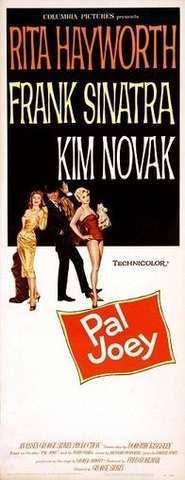
Pal Joey (World Premiere: October 25, 1957)
Starring: Frank Sinatra, Rita Hayworth, and Kim Novak
Produced by Fred Kohlmar
Directed by George Sidney
Sinatra plays Joey Evans a charming, handsome, funny, talented a-1st class, A-N°.1... heel of a nightclub singer caught between a rich widow played by Hayworth and a chorus line mouse played by Novak.
(1st DVD Release date: 1998-03-24 - BluRay Release date: 2012-02-21)
Note: Pal Joey had a world premiere in Los Angeles, Chicago, and
New York on October 25, 1957
From Ed:
Frank had become a very successful movie star by then. He had "Joey" and "Joker Is Wild" in the Top 10 for weeks
"Joey" was held up for two weeks after the initial release before opening in S.F., Philly, Pittsburgh and other major cities. The
smaller cities and towns would see it come in late Nov. and early Dec.
Excerpt of Time review:
"Almost everything that could be done wrong the moviemakers have done wrong in this production, and yet the picture comes
out remarkably right."
Pal Joey was based on the John O'Hara novel of the same name (New York, 1940). Portions of the novel had previously appeared as a short stories in The New Yorker . According to a May 1957 LAT news item, Columbia purchased the screen rights to the O'Hara, Lorenz Hart and Richard Rodgers play in 1941. In 1951, an Oct 1951 DV news item noted that Jerry Bresler was assigned to produce a film based on the play, which was to star Gene Kelly as "Joey," the role he originated on Broadway. When Kelly's studio, M-G-M demanded an exorbitant fee for his loan out, the project was shelved.
The LAT news item notes that the project was then postponed for years due censorship problems in adapting the play to film. One of difficulties arose from the racy song lyrics. Several of the more suggestive songs--"In Our Little Den of Iniquity," "Happy Hunting Horn," and "Take Him (But
Don't Ever Take Him to Heart)" --were eliminated from the film.
Three other songs with racy lyrics--
"You Mustn't Kick It Around," "Plant You Now, Dig You
Later" and "Do It the Hard Way" --are heard in the film as instrumentals only. Although a May 1957 LAT article stated that the song "What Do I Care for a Dame?" was eliminated from the motion picture, Frank Sinatra performs it in the film. A Jan 1957 HR news item adds that some of the more suggestive lyrics from the stage production were toned down for the picture. The following Rodgers and Hart songs from the 1930s were included in the film but were not performed in the Broadway version of Pal Joey : "I Didn't Know What Time It Was," "The Lady Is a Tramp," "There's a Small
Hotel" and "My Funny Valentine." In the film, the character of Joey was changed from a dancer to a singer and the setting was changed from Chicago to San Francisco. In addition, Joey's character was softened by the inclusion of the last act in which Joey is reconciled with "Linda." Various locations throughout San Francisco were utilized for the film, including Telegraph Hill, according to a May 1957 Var news item.
According to an Apr 1956 HR news item, Barbara Stanwyck was considered for the role of "Vera Simpson." Although a Nov 1956 HR news item noted that Janis Paige was to perform in the "Zip" strip number, Paige does not appear in the released film. A Mar 1956 HR news item adds that if Sinatra had refused the role of Joey, Columbia studio chief Harry Cohn would have considered Kirk Douglas for the part. According to a May 1957 HR news item, Flamenco dancer Carmen Amaya coached Novak on some dance steps. A May 1957 HR news item noted that the film's shooting schedule ran from noon until 8 p.m., a departure from the normal 9 a.m. until 6 p.m. schedule. The change was made to allow the cast to sleep later, thus improving their performances. Although a Jun 1957 HR news item stated that Jack Entratter, the general manager of the Sands Hotel in Las Vegas, was to appear as an assistant head waiter at Chez Joey, his appearance in the released film has not been confirmed. HR news items and production charts add Charles Aldrich, Slim Duncan, Mark Power, and Cosmo Sardo to the cast, but their appearance in the released film has not been confirmed. Modern sources mention a wide variety of actors that were considered for various roles in the films, but this information has not been verified.
Pal Joey marked the only production of Essex-George Sidney Productions, a production unit formed by George Sidney and Frank Sinatra. Pal Joey was nominated for the following
Academy Awards: Best Art Direction, Best Costume Design, Best Film
Editing and Best Sound Recording. Sinatra won the Golden Globe Award for Best Actor for his performance in the film.
Sinatra and Bacall at L.A. Premiere for "Pal Joey."
Sinatra at the Egyptian Theatre premier.
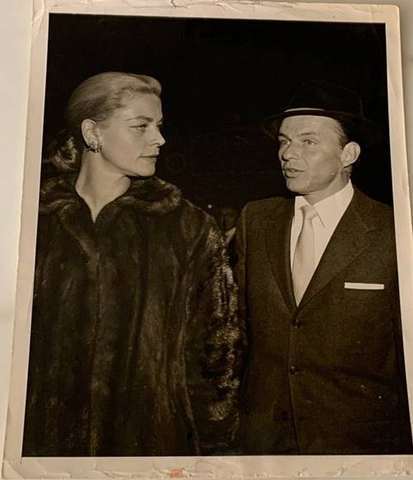
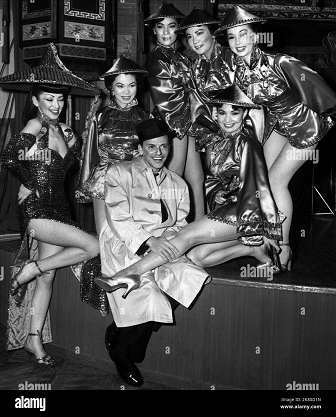
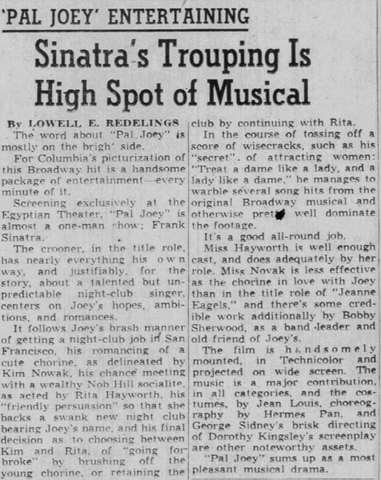
Frank Sinatra Show
Network: ABC
Show #02
Sponsors: Chesterfield Cigarettes, Bulova Watch Company
Drama: "That Man Hogan"
Starring: Frank Sinatra, Jesse White, Reba Waters
Ed O'Brien writes that Sinatra starred as a lonely cabdriver whose friends play matchmaker for him. Later in the series Jesse White would have a recurring role in an attempt to offer comic relief.
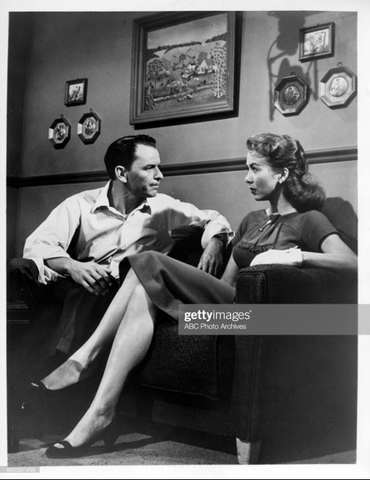
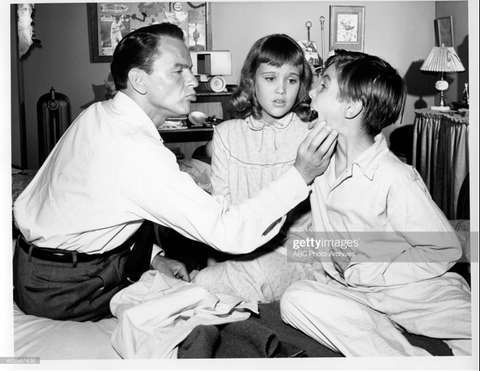
"Pal Joey"
Sinatra's second ABC television series debuted one week before Pal Joey's October premiere. ABC paid Sinatra $3 million upfront plus a share of profits and bought stock in his production company Kent Productions; the deal called for thirty-six half-hour episodes with 60 percent of residuals to Sinatra, though only thirty-two were ultimately produced.
Source: Tom Santopietro, "Sinatra in Hollywood" (2008).
"Pal Joey"
On Broadway, the role of Joey Evans was originated by Gene Kelly. A 1940s film reunion of Cover Girl stars Kelly and Rita Hayworth fell through when MGM's loan-out price for Kelly proved too high. A 1950s Broadway revival revived film interest, with an aborted version planned to star Marlon Brando (and, oddly, Mae West) under director Billy Wilder; Marlene Dietrich was also considered for the role of Vera Simpson before Rita Hayworth was cast.
Source: Tom Santopietro, "Sinatra in Hollywood" (2008).
"Pal Joey"
Sinatra's production company Essex Productions negotiated a deal for Pal Joey giving Frank $150,000 plus 25 percent of the film's net receipts. Despite his star power, he gallantly suggested he take second billing behind costars Rita Hayworth and Kim Novak.
Source: Tom Santopietro, "Sinatra in Hollywood" (2008).
"Pal Joey"
The film version of Pal Joey changed Joey Evans from a dancer (as on stage) to a singer to suit Sinatra's talents, and relocated the story's setting from New York City to San Francisco.
Source: Tom Santopietro, "Sinatra in Hollywood" (2008).
"Pal Joey"
Rita Hayworth's singing voice in Pal Joey was dubbed by Jo Ann Greer; the film was her first in three years and her last under contract to Columbia Pictures. Choreographer Hermes Pan staged her 'Zip' number as a deliberate homage to her famous 'Put the Blame on Mame' striptease number from Gilda eleven years earlier.
Source: Tom Santopietro, "Sinatra in Hollywood" (2008).
"Pal Joey"
Kim Novak, saddled with the press nickname 'the lavender girl' and made to wear purple throughout the film, had her singing voice dubbed by Trudy Erwin; Santopietro judges her not naturally musical but effective at conveying vulnerability, better suited to a role like Vertigo.
Source: Tom Santopietro, "Sinatra in Hollywood" (2008).
"Pal Joey"
Sinatra won the Golden Globe Award for Best Actor in a Comedy or Musical for Pal Joey; Santopietro singles out the 'The Lady Is a Tramp' sequence, sung directly to Rita Hayworth, as Sinatra's single finest moment on film.
Source: Tom Santopietro, "Sinatra in Hollywood" (2008).
"Pal Joey"
Look magazine: Look magazine praised the film despite its softened ending: 'the story has a "happy ending." But its bite remains... Frank Sinatra plays Joey with all the brass the role demands. He has a gleam in his eye and a chip on his shoulder... He tosses off both dames and songs with equal artistry, and almost singlehandedly makes Pal Joey a wonderfully entertaining movie.'
Source: Tom Santopietro, "Sinatra in Hollywood" (2008).
"Pal Joey"
The film's ending was changed from the original Broadway play, in which Joey loses both Linda and Vera; the softened Hollywood ending (Joey and Linda walk off together) was, in Santopietro's view, a concession to 1950s morality that undercut the story's tougher setup.
Source: Tom Santopietro, "Sinatra in Hollywood" (2008).
"Pal Joey"
Santopietro grades this an A, calling it iconic Sinatra and a career peak with "The Lady Is a Tramp." Golden Globe Award: Best Motion Picture Actor, Musical or Comedy; Golden Laurel Award: Top Male Musical Performance; Quigley Top 10 Money Makers Poll: #5.
Source: Tom Santopietro, "Sinatra in Hollywood" (2008).
"Pal Joey"
Santopietro (Filmography): Essex-Sidney/Columbia Pictures. Produced by Fred Kohlmar, directed by George Sidney, screenplay by Dorothy Kingsley based on John O'Hara's play, songs by Richard Rodgers and Lorenz Hart. Sinatra played Joey Evans opposite Rita Hayworth and Kim Novak, singing 'I Didn't Know What Time It Was,' 'The Lady Is a Tramp' and 'I Could Write a Book.'
Source: Tom Santopietro, "Sinatra in Hollywood" (2008).
October 28, 1957
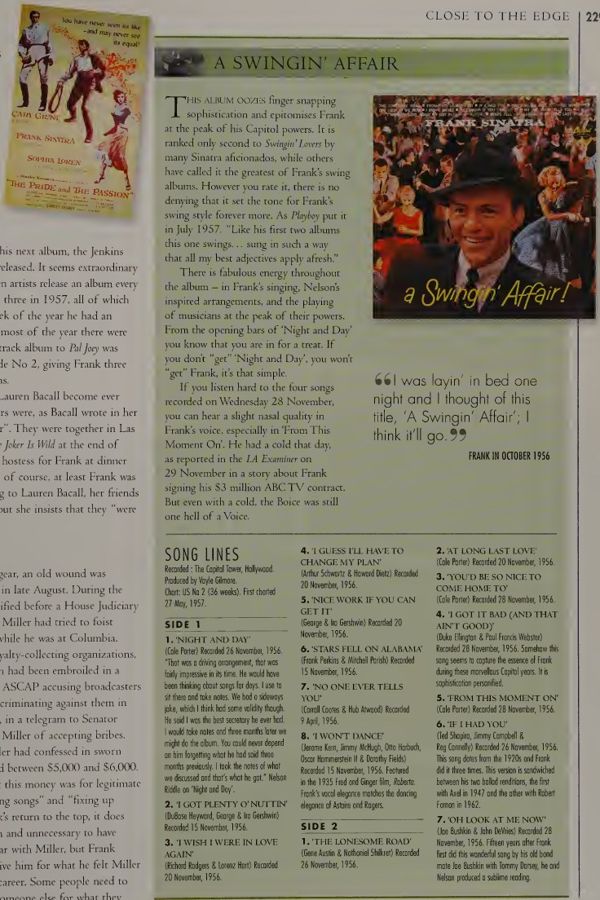
[Photograph: Elvis responds graciously to Frank's rock and roll attack. From Richard Havers, "Sinatra" (Dorling Kindersley, 2007), p.233.]
After Frank publicly derided rock and roll, Elvis Presley told reporters he admired Frank and respected his right to his opinion, adding that he thought Frank shouldn't have said what he did and noting he'd faced similar criticism when he was starting out. (Source: Richard Havers, "Sinatra" (Dorling Kindersley, 2007).)
Variety reviewed "The Hogan Man," a dramatic episode of Sinatra's ABC series about a cab driver who adopts war orphans, judging the outing "a weak opener" for the show's dramatic ambitions.
Source: Albert Auster, "Frank Sinatra: The Television Years–1950–1960," Journal of Popular Film and Television, 26:4 (1999), 166-174.
November 1957
[Sinatra's finances behind the TV endorsements]
Kaplan: Despite his substantial income, Sinatra genuinely needed money: he was still paying off back taxes, maintained two residences, several cars, a private plane and helicopter, supported his ex-wife Nancy and three children, and spent freely on himself and others.
Source: James Kaplan, "Sinatra: The Chairman" (2015)
[Variety criticizes Sinatra's commercial pitches]
Kaplan: Variety ran a piece headlined "SINATRA: SINGER OR SALESMAN?" criticizing Sinatra's personal on-air endorsements for Bulova and Chesterfield as excessive "commercial prostitution" for a star of his stature.
Source: James Kaplan, "Sinatra: The Chairman" (2015)
November 1, 1957
Television
Frank Sinatra Show (ABC)
Guests: Nancy Sinatra Jr. (Tri-Tones)
1. You'd Be So Nice to come Home To
2. The Girl Next Door
3. I've Got You Under My Skin
4. Exactly Like You – Nancy Sinatra, Girls from University High School
5. Side by Side – Frank, Nancy, and Girls from University High Schoool
6. All the Way
7. Violets For Your Furs
8. The Lonesome Road
NOTE: Ed O'Brien laments that pre-recorded songs and lack of a studio audience seriously hobbled Sinatra's best efforts.
Frank Sinatra Show (ABC)
© 1997-2025 The Sinatra Archive
This calendar, or any parts thereof, may not be reproduced in any fashion whatsoever without the prior written permission of the publisher (The Sinatra Archive)
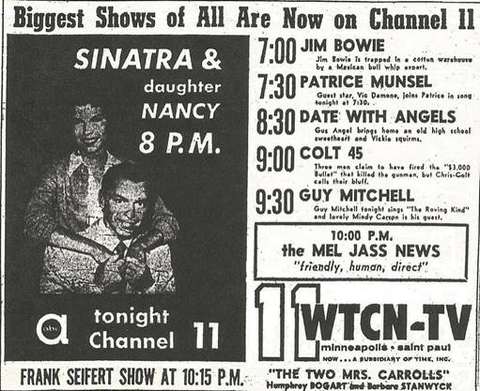
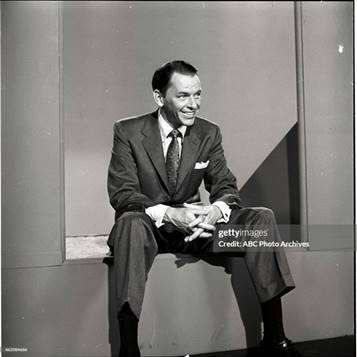
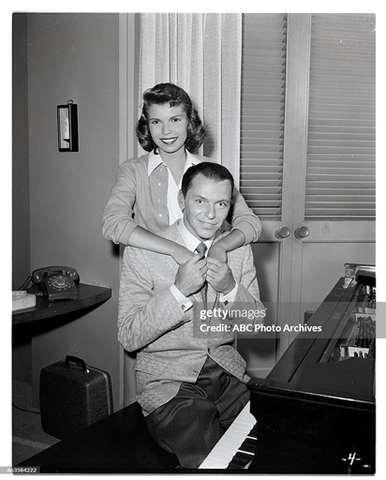
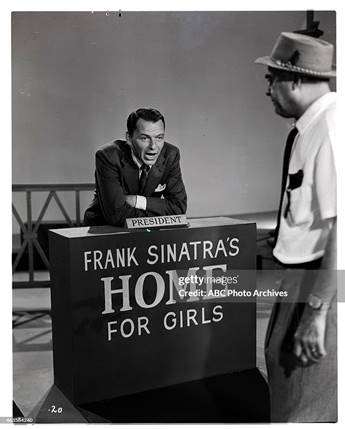
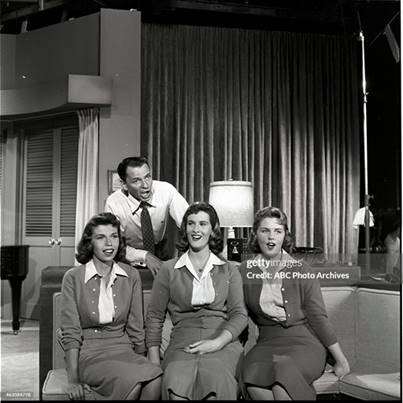
Frank Sinatra Show (ABC)
© 1997-2025 The Sinatra Archive
This calendar, or any parts thereof, may not be reproduced in any fashion
whatsoever without the prior written permission of the publisher (The
Sinatra Archive)
[Nancy Sinatra's TV singing debut]
Seventeen-year-old Nancy Sinatra made her television singing debut on The Frank Sinatra Show with two high-school friends, Belinda Burrell and Jane Ross, performing as the Tri-Tones; they sang "Exactly Like You" and "Side by Side," with Frank joining in on the latter.
Source: James Kaplan, "Sinatra: The Chairman" (2015).
November 8, 1957
Television
Frank Sinatra Show
Network: ABC
Show #04
Sponsors: Chesterfield Cigarettes, Bulova Watch Company
Guests: Peggy Lee
Pennies from Heaven
Autumn Leaves
Old Devil Moon (Lee)
Nice Work if you can get it (Lee and Sinatra)
That's All (Lee)
Love is Here to Stay (Sinatra and Lee)
I Thought About You
I'll Be Seeing You
Ed O'Brien notes:
"Some wonderful singing was done on this show, but it needed an audience. Done in a studio with just a crew, it lacks energy. Sinatra needed real live people to really cook."
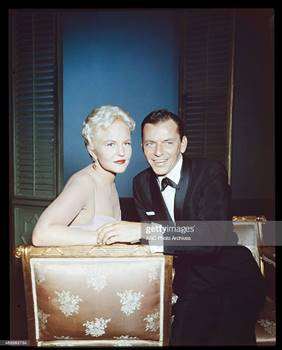
Frank Sinatra Show
Network: ABC
Show #04
Sponsors: Chesterfield Cigarettes, Bulova Watch Company
Guests: Peggy Lee
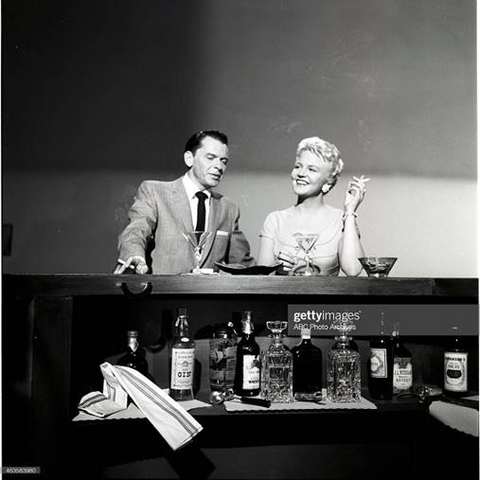
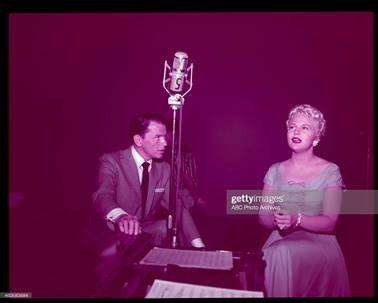
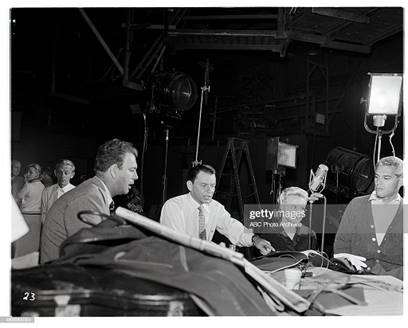
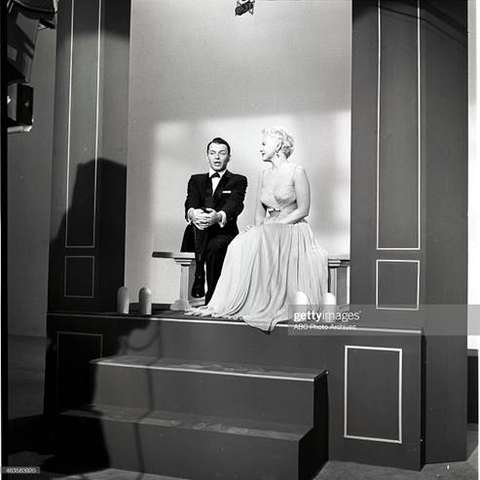
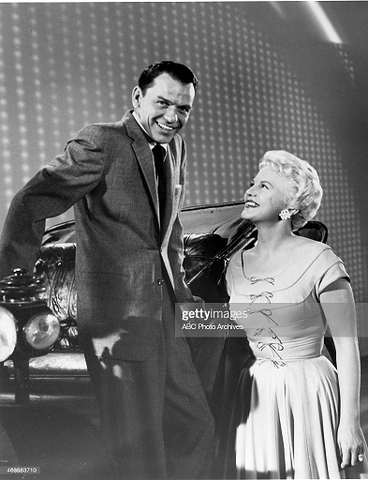
November 10, 1957
A New York Times Magazine profile estimated Frank's annual income at about $4 million, calling him possibly the highest-paid performer in show business history.
Source: Nancy Sinatra, Frank Sinatra: An American Legend, 1995.
November 15, 1957
Television
Frank Sinatra Show
Network: ABC
Show #05
Sponsors: Chesterfield Cigarettes, Bulova Watch Company
Guests: The Mcguire Sisters
No Audience
Friday evening
9 -9:30 PM
Nelson Riddle arranged and conducted
27 piece orchestra
1. From This Moment On ( vocal pre-recorded)
2. Three Coins In The Fountain (vocal pre-recorded)
3. Where Are You ( vocal pre-recorded)
4. I Got It Bad And That Ain't Good (vocal pre-recorded)
5. I'm In The Mood For Love The McGuire Sisters
7. Something's Gotta Give w/ The McGuire Sisters
8. Them There Eyes The McGuire Sisters
9. Baby Won't You Please Come Home ( vocal pre-recorded)
Ed O'Brien:
Sinatra pre-recorded 62 songs for the ABC-TV series
George Roberts told me Riddle had to marry the Sinatra vocal to the ABC studio orchestra and his arrangement. The technology of the day made this a very arduous task. The finished product was then incorporated into the show. The lack of a studio audience proved to be a big mistake. Despite the marvelous singing, the shows were absolutely flat. The ratings bottomed out very quickly. Frank went live with the 11-29-57 show (Dean Martin was the guest), but the show never captured the audience ABC had hoped for at the outset.
Frank Sinatra Show
Sinatra with The Mcguire Sisters
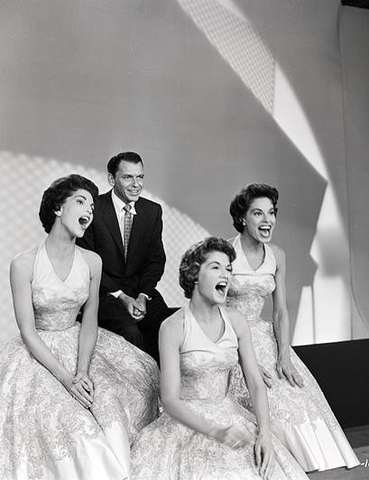
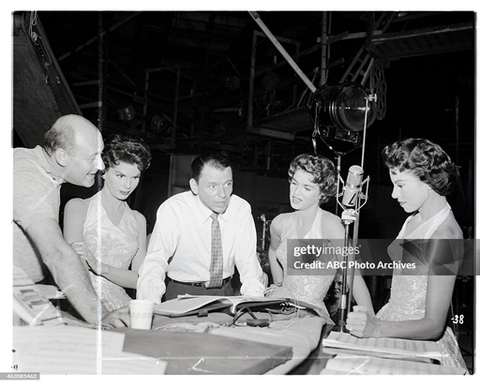
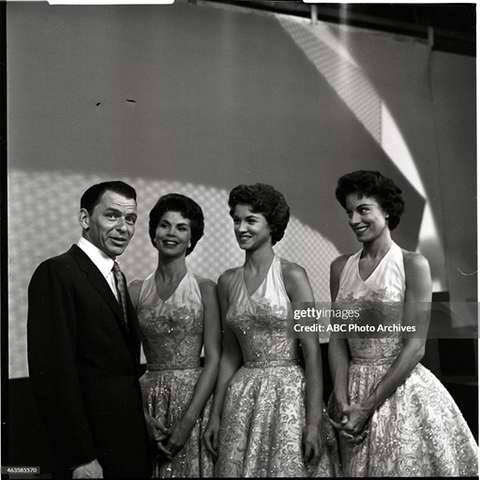
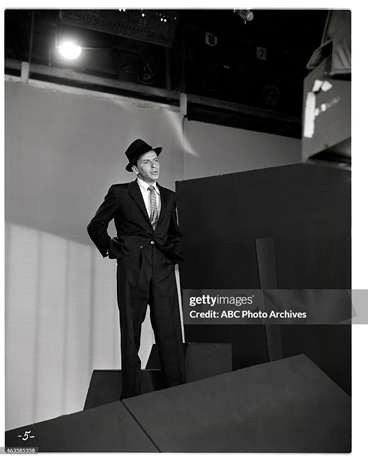
November 22, 1957
Television
Frank Sinatra Show
Network: ABC
Show #06
Sponsors: Chesterfield Cigarettes, Bulova Watch Company
Guests: Erin O' Brien
1. Wrap Your Troubles in Dreams
2. Everything Happens to Me
3. My Funny Valentine
4. Let's Get Away from it All w/Erin O'Brien (They even do a reprise.)
5. I Wish I Were in Love Again
6. I'm Glad There is You w/Erin O'Brien
7. I'm Gonna' Sit Right Down and Write Myself a Letter
8. She's Funny that Way (Better than his recordings!)
note: Erin sang "I'm Glad There Is You" strictly solo.
She is still with us and going strong at 86.
--Ed
Update: Erin O’Brien passed away May 20, 2021 at the age of 87.
Frank Sinatra Show
Network: ABC
Show #06
Sponsors: Chesterfield Cigarettes, Bulova Watch Company
Guests: Erin O' Brien
Erin O'Brien and Frank 11-22-57
© 1997-2025 The Sinatra Archive
This calendar, or any parts thereof, may not be reproduced in any fashion
whatsoever without the prior written permission of the publisher (The
Sinatra Archive)
__._,_.___
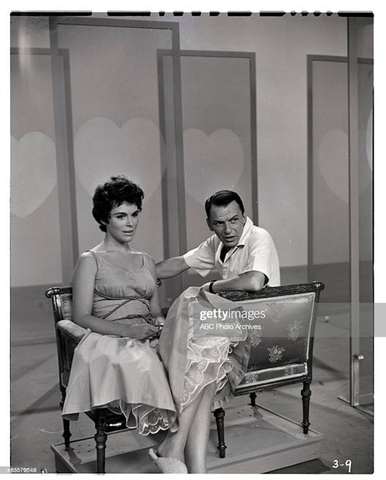
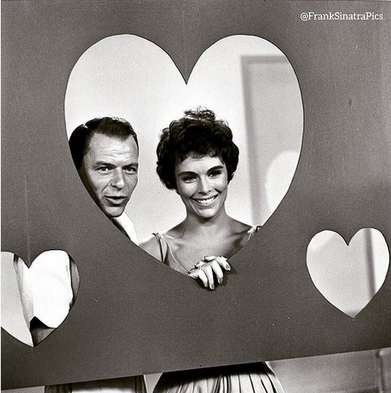
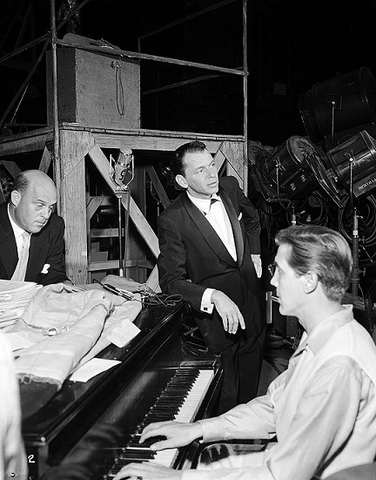
"I Wish I Were in Love Again"
Will Friedwald: Friedwald identifies this Rodgers and Hart track, with Nelson Riddle's 4/4 dance beat, as the record that hooked him on Sinatra as a teenager. He analyzes the lyric's sophisticated-yet-naive optimism about wanting to fall in love again despite knowing the pain involved, and singles out the throwaway line 'a faint aroma of performing seals' as emblematic of the song's odd, winning specificity. He calls it one of his two favorite Sinatra tracks (with 'Same Old Saturday Night').
Source: Will Friedwald, "Sinatra! The Song Is You: A Singer's Art" (2018 revised edition).
November 23, 1957
Television
Texaco Command Performance & Texaco Star Theater
TRIBUTE TO ETHEL BARRYMORE'S 65 YEARS IN THE THEATER
NBC-TV
Saturday Evening
10-11 PM EST
Sponsor: The Texaco Company thru Cunningham & Walsh
Producer: Burt Shavalove
Director: Paul Harrison
Music: Paul Weston
Special Material: Ralph Blane
Produced By Henry Jaffa Enterprises, Inc.
Honoree: Miss Ethel Barrymore
Guests: Claudette Colbert, Katharine Hepburn, Dolores Gray, Joseph
Cotton, Orson Welles, David Niven,
Hoagy Carmichael, Keith Andes, Carl Reiner, Betty Garrett, Ethel Barrymore Miglietti, Larraine Day, Leo
Durocher, Fred Haney, Casey Stengel, Roy Campanella and surprise guest Frank Sinatra
There were many highlights in this hour show: A telegram was read by David Niven from
Winston Churchill ( Ethel spurned Winston's marriage proposal many years early. She didn't think
he had much of a future), Joseph Cotton and Claudette Colbert did a rundown of her great theatrical
triumphs, Carl Reiner did a skit and sang "An Actor's Life For Me," Dolores Gray sang "Ill
Wind" and I've Got The World On A String," Hoagy Carmichael sang a parody of "In The Cool,
Cool, Cool of the Evening, some of baseball's elite, including Fred Haney, manager of the World
Champion Milwaukee Braves, made an appearance ( Ethel was a great fan of the National Pastime ),
Orson Welles gave a stirring tribute " Something imperial invests that fierce beauty -- something of
the eagle," Katharine Hepburn paid homage near the end of the show. There were a few other skits
and songs and then Ethel, very surprised by an unexpected guest, said " Frankie! How wonderful."
Mr Sinatra strode to the center of the stage, leaned against the piano, and with only that instrument
for accompaniment, sang Ralph Blane's special lyrics for "I've Grown Accustomed To Her Face."
"We've grown accustomed to your face,
The face we've loved through all the years,
We've grown accustomed to the glow,
You've brought to every role,
The warmth, the heart, and, yes, the soul,
We've grown accustomed to your grace,
And the majesty you wear,
There may others who aspire,
To the glory and the fame,
And they'll have the stardust,
But it cannot be the same,
That's why you'll always stand alone,
And that's why we grown accustomed to your face."
Ed O'Brien : Fifty-six years ago last night (2013), I watched the Texaco show.
To be honest, my main reason for watching was to see the baseball
segment. I was a devoted fan of the Milwaukee Braves. A month earlier
they had surprised the heavily favored New York Yankees, winning the
World Series in seven games. Fred Haney, manager of the Braves, was
one of the baseball dignitaries honoring Miss Barrymore. Roy Campanella
presented to Ethel season tickets to the Dodgers first season in Los Angeles.
Sinatra walked out unannounced. Ethel was thrilled to see him. I cannot
remember if Ralph Blane or Bill Miller was the piano player backing Frankie
that evening. I remember how entertaining the hour was and how quickly it
flew by. Barrymore's last film was "Young At Heart."
Note: Barrymore's last film was actually "Johnny Trouble"
1957.
Note: Some sources say it was Jule Styne accompanying Sinatra on the piano.
Extra Note:
Brother, Can You Spare a Rhyme?: 100 Years of Hit
Songwriting" by Spencer Leigh. An excerpt of an interview with
Sammy Cahn:"Do any other “special lyrics for special occasions” spring to mind?"
"Yes. Many years ago Frank Sinatra was going to do a special television programme with Ethel Barrymore, the legendary Ethel Barrymore. She had an incredible face, and Sinatra’s face and hers would look great together. I said, “It would be marvellous if you sang ‘I’ve Grown Accustomed To Her Face’, so why don't you call Alan Jay Lerner and ask him to write a special lyric for you.” He called Alan and he said, “C’mon, Frank, don't bother me with this. Let Sammy do a special lyric for you.” So that’s what I did and I rather like: (Sings)
“You’re all the lovely things I've known
And that is why I've grown
Accustomed to your face.”
Frank can call me any time, day or night, and I'll do special lyrics for him."
Texaco Command Performance & Texaco Star Theater
TRIBUTE TO ETHEL BARRYMORE'S 65 YEARS IN THE THEATER
Variety
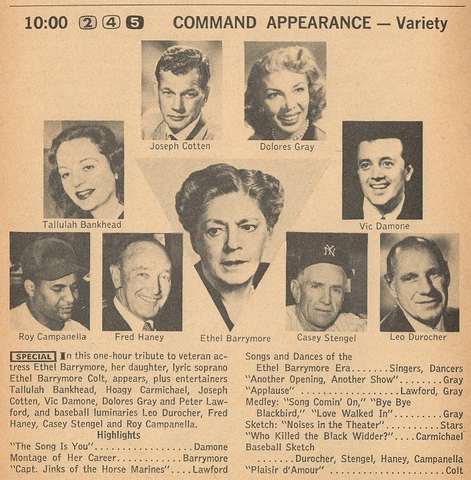

note: Katherine Hepburn gave a wonderful tribute to Barrymore near the end of the show. Critic does not mention her.
Ed
November 25, 1957
Studio
Capitol Studio A, Hollywood
E17974 I Believe
(J. Styne/S. Cahn)
Arranged & Conducted by Nelson Riddle
CD: C2 724383808922 The Complete Capitol Singles
LP: W982 This Is Sinatra Vol.2
E17975 Everybody Loves Somebody
( I. Taylor/K. Lane )
Sands Music Corp. (ASCAP)
Arranged & Conducted by Nelson Riddle
-4 (3:42) CD: C2-94777 The Capitol Years
LP: W982 This Is Sinatra Vol.2
E17976 It's The Same Old Dream
(J. Styne/S. Cahn)
Sands Music Corp. (ASCAP)
Arranged & Conducted by Nelson Riddle
-5 (3:02) CD: C2-94777 The Capitol Years
LP: W982 This Is Sinatra Vol.2
E17977 Time After Time
(J. Styne/S. Cahn)
Arranged & Conducted by Nelson Riddle
CD: CDP 724383595228 Sinatra 80th "All The Best"
CD: C2 724383808922 The Complete Capitol Singles
LP: W982 This Is Sinatra Vol.2
45: 4155
Musicians - Reeds: Buddy Collette, Joe Cook, Harry Klee, Babe Russin; Trumpets: Harry "Sweets" Edison, Conrad Gozzo, Vito "Mickey" Mangano, Clarence "Shorty" Sherock; Trombones: Ed Kusby, James Priddy, Juan Tizol; Bass Trombone: George Roberts; Violins: Victor Arno, Victor Bay, Alex Beller, Ben Gill, Paul Nero, Mischa Russell, Paul Shure, Felix Slatkin, Marshall Sosson, Gerald Vinc; Violas: Alvin Dinkin, Stanley Harris, David Sterkin; Cellos: Edgar Lustgarten, Eleanor Slatkin; Piano: James Rowles; Bass: Joe Comfort; Guitar: Bob Bain, Drums: Alvin Stoller; Harp: Kathryn Julye
Session Producer: Voyle Gilmore
Ed O'Brien notes:
Frank went back to the Columbia era for the tunes done at this session. Cahn & Styne wrote a wonderful musical score for "It Happened In Brooklyn." Easily the best tunes written for a Sinatra vehicle at MGM. "It's The Same Old Dream," "I Believe" and the best of the lot "Time After Time" were recorded by Frank at MGM and then for Columbia Records. "I Believe" was a Top 10 hit for him. The Columbia tracks had 40+ musicians and the one session added a vocal group( Four Hits & A Miss).
"Everybody Loves Somebody" was written for Frank by Ken Lane. Recorded by Sinatra in early December of 1947, it was released on a single in the summer of 1948 and charted for exactly one week. Nevertheless, it was a quality tune and both recordings are outstanding.
The Capitol session had a 33 piece backing including the great jazz pianist Jimmy Rowles plus Alvin Stoller on drums, Joe Comfort on bass and Bob Bain on guitar. Obviously Sinatra liked the tunes and wanted to make definitive recordings at Capitol.
November 29, 1957
Television
Frank Sinatra Show
Friday Evening
ABC-TV
9:00 p.m. - 9:30 p.m.
Show #07
Sponsors: Chesterfield Cigarettes, Bulova Watch Company
Guest: Dean Martin.
Night And Day F.S.
They'll Never Believe Me D.M.
Bulova Ad
That Old Devil Moon F.S.
Medley: Sunday, Monday Or Always/Saturday Night Is The Loneliest
Night Of The Week/The Girl That I Marry ( smell of provolone)/I've Got A Crush On You/Don't Cry Joe F.S. & D.M.
Commercial
The House I Live In F.S. new Riddle chart
Put Your Dreams Away F.S.
Ed O'Brien:
Frank was in trouble. ABC was expecting great things when the show had its debut on 10-18-57. Done before a studio audience, it looked like a real winner. The next five airings, including a drama, were filmed on a closed set, using songs Sinatra had pre-recorded for the series. The ratings were dismal. The show with Dean went back to an audience format in an attempt to bolster the ratings.
"I've Got a Crush on You"
Close to You brought closure to a project Sinatra launched with his first album The Voice of Frank Sinatra (1946), where he and Axel Stordahl combined a four-piece swing rhythm section with a classical string quartet, occasionally adding horn soloists -- e.g., cornetist Bobby Hackett on 'I've Got a Crush on You.' A decade later Sinatra built Close to You around the same four-rhythm-plus-string-quartet format, this time with the Hollywood String Quartet.
Source: Will Friedwald, "Sinatra! The Song Is You: A Singer's Art" (2018 revised edition).
[Live broadcast with Dean Martin]
Sinatra did the November 29 broadcast of his show live for the first time since the premiere, in front of a studio audience, with Dean Martin as his guest; the two sat at a bar in tuxedos singing a medley and clowning, with Martin's easy charisma outshining an eager-to-please Sinatra on camera.
Source: James Kaplan, "Sinatra: The Chairman" (2015).
December 1957
[Critic notes Dean Martin stole the show]
Jack O'Brian: Critic Jack O'Brian wrote that the live Frank Sinatra Show with Dean Martin "seemed to be more a Dean Martin show," with Martin taking charge and out-casualing Sinatra; Kaplan calls the broadcast the unheralded birth of the new Rat Pack.
Source: James Kaplan, "Sinatra: The Chairman" (2015)
[Natalie Wood and Robert Wagner marry]
Kaplan: At the end of December 1957, nineteen-year-old Natalie Wood married twenty-seven-year-old Robert Wagner in a small Hollywood wedding, despite the disapproval of Wood's mother. Sinatra and Tony Curtis, Wood's Kings Go Forth co-stars, attended; Sinatra's date was Lauren Bacall.
Source: James Kaplan, "Sinatra: The Chairman" (2015)
[Ocean's Eleven project announced]
Hedda Hopper: Hedda Hopper reported that Sinatra would produce a picture he and Peter Lawford had bought called Ocean's Eleven, wanting Dean Martin and Sammy Davis Jr. as stars. The concept originated from a beach pitch to Lawford by aspiring director Gilbert Kay, about WWII veterans robbing five Las Vegas casinos simultaneously.
Source: James Kaplan, "Sinatra: The Chairman" (2015)
[Sinatra visits Ava in New York]
Kaplan: In December, Ava Gardner flew to New York to consult a plastic surgeon Sinatra had recommended after her bullring injury. Shortly after his birthday party, and after dining with Bacall and the David Nivens at Mocambo, Sinatra flew east to see his ex-wife, displeasing Bacall.
Source: James Kaplan, "Sinatra: The Chairman" (2015)
December 6, 1957
Television
Frank Sinatra Show
Network: ABC
Show #08
Sponsors: Chesterfield Cigarettes, Bulova Watch Company
Drama: "A Gun At His Back"
Starring: Frank Sinatra, Pat Crowley, Harold Stone, Sean McClory
Notes: New York cabbie is not satisfied with the progress made by the police department in locating his stolen cab. He decides to take matters into his own hands.
Frank Sinatra Show
Network: ABC
Show #08
Sponsors: Chesterfield Cigarettes, Bulova Watch Company
Drama: "A Gun At His Back"
Starring: Frank Sinatra, Pat Crowley, Harold Stone, Sean McClory
Notes: New York cabbie is not satisfied with the progress made by the police department in locating his stolen cab. He decides to take matters into his own hands.
[image referenced in source but could not be recovered]
[image referenced in source but could not be recovered]
December 11, 1957
Studio
Capitol Studio A, Hollywood
E18052 You'll Always Be The One I Love
(T. Freeman/S. Skyler)
Arranged & Conducted by Nelson Riddle
CD: C2 724383808922 The Complete Capitol Singles
LP: W982 This Is Sinatra Vol.2
45: 4466
E18053 If You Are But A Dream
(Jaffe/Fulton/Bonx)
Arranged & Conducted by Nelson Riddle
LP: W982 This Is Sinatra Vol.2
E18054 Put Your Dreams Away
(Mann/Weiss/Lowe)
Anne-Rachel Music/TRO-Cromwell Music Inc. (ASCAP)
Arranged & Conducted by Nelson Riddle
-4 (3:12) CD: C2-94777 The Capitol Years
LP: W982 This Is Sinatra Vol.2
Musicians - Reeds: Joe Cook, William Green, Authur “Skeets” Herfurt, Harry Klee, Babe Russin; Trumpets: Walter Candoli, Harry “Sweets” Edison, Conrad Gozzo, Clarence “Shorty” Sherock; Trombones: Russell Brown, Dick Noel, James Priddy, Juan Tizol; Violins: Israel Baker, Victor Bay, Alex Beller, David Frisina, Ben Gil, Henry Hill, Murray Kellner, Pual Nero, Paul Shure, Felix Slatkin; Violas: Alvin Dinkin, Stanley Harris, David Sterkin; Cellos: Kurt Reher, Eleanor Slatkin; Piano: Bill Miller; Bass: Joe Comfort; Guitar: Bobby Gibbons; Drums: Bill Richmond; Harp: Kathryn Julye
Session Producer: Voyle Gilmore
[Put Your Dreams Away -- critical commentary]
A photo caption notes Axel Stordahl's original orchestration for 'Put Your Dreams Away' (one of Sinatra's favorite theme songs) survives from circa 1945.
This song/context matches multiple dated entries in the chronology, or lacked a sufficiently precise date; the specific date could not be determined with confidence.
Source: Charles L. Granata, "Sessions with Sinatra: Frank Sinatra and the Art of Recording" (1999/2003), Part II: The Columbia Years, 1943-1952
December 12, 1957
At Sinatra's forty-second birthday party at Hollywood's Villa Capri, Dean Martin sang "He's the Wop" to the tune of Cole Porter's "You're the Top" -- the start of a running bit the two would keep batting back and forth at each other over the years, according to Deana Martin. Source: David Lehman, Sinatra's Century.
[Sinatra's 42nd birthday party]
An all-star group including Dean Martin, Bing Crosby, Jack Benny, Tony Curtis, Eddie Fisher, Debbie Reynolds, Vic Damone, Jack Entratter, Leo Durocher, Mike Romanoff, Jimmy Van Heusen, and Sammy Cahn threw Sinatra a 42nd birthday party at Villa Capri, with Cahn serving as emcee and writing a dozen special parody songs, taped for posterity.
Source: James Kaplan, "Sinatra: The Chairman" (2015).
Frank starred in The Joker Is Wild, based on the true story of his close friend, nightclub comedian Joe E. Lewis, whose throat had been cut in a mob dispute.
Frank Sinatra (quoted): "Frankie enjoyed playing my life more than I enjoyed living it."
Source: Nancy Sinatra, Frank Sinatra: An American Legend, 1995.
December 13, 1957
Television
Frank Sinatra Show
Network: ABC
Show #09
Sponsors: Chesterfield Cigarettes, Bulova Watch Company
Drama: "Take Me To Hollywood"
Starring: Frank Sinatra, Celia Lovsky, Maurice Manson, Sidney Smith
Notes: A talent scout is handed an urgent assignment by the head of the studio. A young actress who was given a million-dollar buildup for a costly picture now in production has disappeared, and the scout must find her.
Frank Sinatra Show
Network: ABC
Show #09
Sponsors: Chesterfield Cigarettes, Bulova Watch Company
Drama: "Take Me To Hollywood"
Starring: Frank Sinatra, Celia Lovsky, Maurice Manson, Sidney Smith
Notes: A talent scout is handed an urgent assignment by the head of the studio. A young actress who was given a million-dollar buildup for a costly picture now in production has disappeared, and the scout must find her.
December 14, 1957
Concerts
Moulin Rouge, Los Angeles, California
Friars' Christmas Party
1. When Your Lover Has Gone
2. Little Girl Blue
3. My Funny Valentine
4. One For My Baby
5. The Lonesome Road
6. On The Road To Mandalay
7. A Foggy Day
8. I've Got You Under My Skin
9. Bewitched, Bothered and Bewildered
10. monologue
11. All The Way
12. They Can't Take That Away From Me
13. You Make Me Feel So Young
Moulin Rouge, Los Angeles, California
Friars' Christmas Party
December 20, 1957
Television
Frank Sinatra Show
Network: ABC
Show #10
Show Title: "Happy Holidays With Bing And Frank"
Sponsors: Chesterfield Cigarettes, Bulova Watch Company
Filmed in color
1. Mistletoe And Holly - Frank Sinatra w/chorus
2. Happy Holiday - Frank Sinatra
3. Deck The Halls - Frank Sinatra & Bing Crosby w/chorus
4. God Rest Ye Merry Gentlemen - Frank Sinatra & Bing Crosby w/chorus
5.. Adeste Fideles - Frank Sinatra & Bing Crosby w/chorus
6. Hark! The Herald Angels Sing - Frank Sinatra & Bing Crosby
7. Jingle Bells - Frank Sinatra & Bing Crosby
8. It Came Upon A Midnight Clear - Frank Sinatra
9. Always In A Manger - Bing Crosby
10. O Little Town Of Bethlehem - Frank Sinatra & Bing Crosby w/chorus
11. Rudolph The Red Nosed Reindeer - Bing Crosby
12. Santa Claus Is Comin' To Town - Frank Sinatra
13. The Christmas Song - Frank Sinatra
14. White Christmas Frank Sinatra & Bing Crosby
Notes: Complete 35mm color print above released officially on DVD.
DVD has a very poor transfer. No color restoration done.
Frank's ABC-TV debut was originally set for 10-4-57 with
Mr. Crosby as the guest. It would have been an hour special
Ford Motor Co. was none too pleased with the idea. Bing and
Frank were set to do the Edsel Show on 10-13-57. The two
men had never appeared together on a Variety special and
Ford was paying a lot of money to promote their new middle
priced car. Frank's new series was put off until 10-18 and
the Crosby guest appearance became a Christmas show,
directed by Mr. Sinatra. Bing pre-recorded his vocals, Frank
opted to sing on the show. Lynne and I watch it every year.
Love the a cappella segment with the choral group.
Ed
Note: Ed O'Brien points out that this is the Christmas show with Bing
Crosby. Frank opens with "Mistletoe and Holly."
Frank and Bing do a wonderful segment of a capella singing. They sing traditional songs, ditties like "Santa Claus is Coming to Town"
and "Rudolph, The Red-nosed Reindeer." They close the show duetting on "The Christmas Song" and "White
Christmas."
This is easily the most heard of all the Sinatra TV appearances. Through the years, many LPs and then DVDs of this show have been available.
Frank Sinatra Show
Network: ABC
Show #10
Show Title: "Happy Holidays With Bing And Frank"Sponsors: Chesterfield Cigarettes, Bulova Watch Company
Filmed in color
Lynne and I watched this show while having breakfast this morning. She loves how attractive the sets look in color and, of course, the music. Frank directed the show. Andy Williams' brother is part of the choral group.
--ED
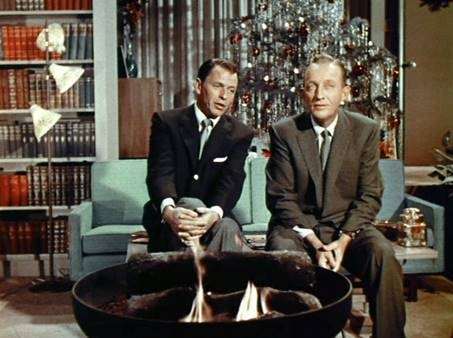
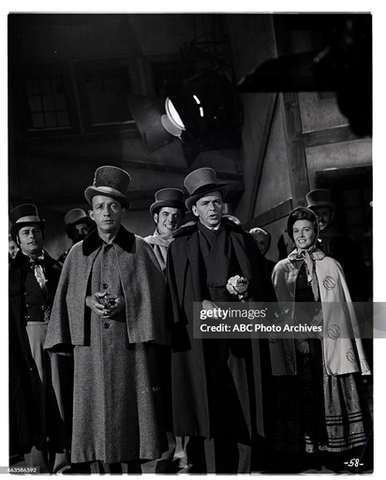
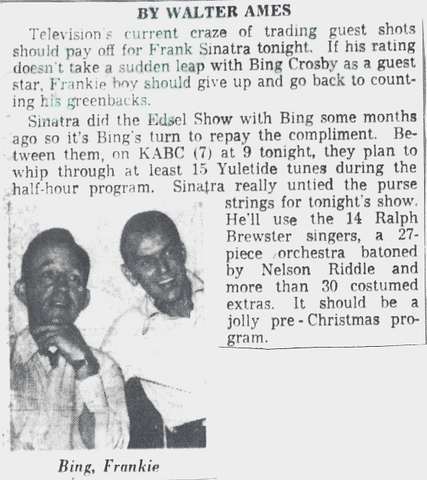
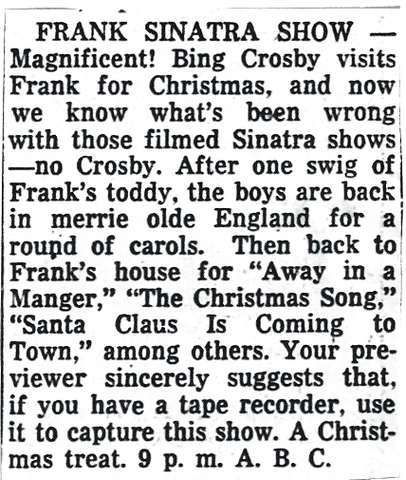
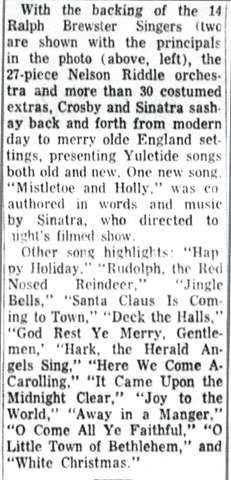
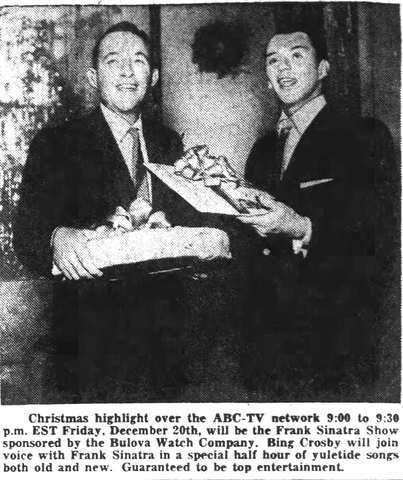
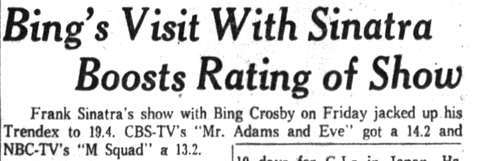
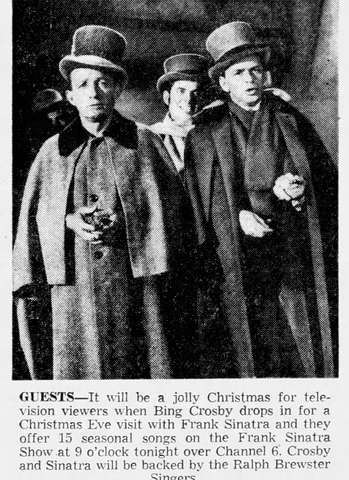
Review of opening night 12-20-56
December 24, 1957
[Christmas Eve with Bacall]
Lauren Bacall: Bacall recalled having "a lovely Christmas eve" at Sinatra's house, with the couple planning to host over fifty friends together for New Year's Eve in Palm Springs.
Source: James Kaplan, "Sinatra: The Chairman" (2015).
December 26, 1957
Variety criticized the writing on Sinatra's television series, singling out dialogue meant to be sophisticated in-jokes that came across instead as forced and mannered.
Source: Albert Auster, "Frank Sinatra: The Television Years–1950–1960," Journal of Popular Film and Television, 26:4 (1999), 166-174.
December 27, 1957
Television
Frank Sinatra Show
Network: ABC
Show #11
Sponsors: Chesterfield Cigarettes, Bulova Watch Company
Drama:
Host: Frank Sinatra
Starring: David Wayne, Janice Rule, Sydney Smith,
Hugh Sanders, Dodie Wright, Benny Rubin
Notes: A frozen-food salesman who wants to be a writer, and a secretary who yearns to be an artist, meet while both are feeding pigeons in Central
Park. Soon they are consoling each other.
December 31, 1957
[New Year's Eve freeze-out]
Lauren Bacall: At Sinatra's Palm Springs New Year's Eve party with over fifty guests, Sinatra suddenly iced Bacall out, drinking heavily and behaving as though she weren't there; she called it a "nightmare" and the first time he truly "dropped the curtain" on her.
Source: James Kaplan, "Sinatra: The Chairman" (2015).
January 1958
[The Gong That Made 'The Road To Mandalay']
Nancy Sinatra: Arranger Billy May recalled that during a late-night session, percussionist Lou Singer struck an enormous gong for "The Road to Mandalay" with such force it rang on and on; Sinatra loved the effect so much he insisted they let it ring at the record's close.
Source: Nancy Sinatra, Frank Sinatra: An American Legend, 1995.
[Deep freeze reported by Parsons]
Louella Parsons: Columnist Louella Parsons reported that Sinatra and Bacall were "in the deep freeze romantically," not having seen each other in ten days after previously being inseparable.
Source: James Kaplan, "Sinatra: The Chairman" (2015)
[Sinatra visits dying Manie Sacks]
Kaplan: While shooting Kings Go Forth on location in France, Sinatra took time off to fly to Philadelphia to sit at the bedside of Emanuel "Manie" Sacks, the Columbia Records executive who had signed him decades earlier and was now dying of leukemia; Sinatra paid for the resulting lost production days.
Source: James Kaplan, "Sinatra: The Chairman" (2015)
January 3, 1958
Television
Frank Sinatra Show
Network: ABC
Show #12
Sponsors: Chesterfield Cigarettes, Bulova Watch Company
Guest: Dinah Shore
1. Come Fly With Me
2. April In Paris
3. Far Away Places - D. Shore
4. London By Night
5. Autumn In New York - Frank and Dinah
6. On The Road To Mandalay
7 It's Nice To Go Trav'ling - Frank and Dinah
Ed O'Brien noted: Whenever anyone asks what shows from the 57-58 TV series should be issued on DVD, I always mention 3 off the top of my head:
Ella, 5-9-58, Jo Stafford, 1-24-58 (Dorsey trib) and the 1-3-58 with Dinah.
There was a theme that evening and what a theme it was.
Frank introduced the "Come Fly With Me" album. Hell of a show.
Frank Sinatra Show
Ed O'Brien:
Frank's TV series was in serious trouble. The ratings were a huge disappointment and ABC was pulling out all the stops to save it. Above ad emphasis the new and, more importantly, live broadcast from Hollywood.
January 5, 1958
Concerts
Sands, Las Vegas, Nevada (January 5-28)
Notes: In response to an inquiry from Sinatraphile Tom Adam, Ed
O'Brien points out that Sinatra was doing "Come Fly With Me."
January 1958 featured two renditions of that song in TV appearances plus Isle of Capri . Sinatra dedicated the full half-hour of
his opening TV show in 1958 to the "Come Fly With Me" lp. Teddy Randazzo and George Jacobs told O'Brien that Sinatra would
bring the arranger of his most recent album into the Sands around the time of its release. Randazzo also told him that
Billy May was with him when their albums came out. O'Brien doubts that Sinatra did any of the songs from "Only The Lonely,"
with the one exception being "One for My Baby," which had become a concert staple after mid-1952.
Sinatra did a few of the "Come Fly . . ." songs on his TV show into the Spring of 1958, O'Brien continues. Unfortunately, there is no
documentation of just what he sang at the Sands in January, but here is the list from Monte Carlo , June 14, 1958.
Curious that he did only one song from the legendary May 29 session and it wasn't a track from "Only The Lonely."
1. Come Fly With Me
2. I Get a Kick out of You
3. I've Got You Under My Skin
4. Where or When (ballad recording done September 11, 1958)
5. Moonlight in Vermont
6. On the Road to Mandalay
7. When Your Lover has Gone
8. April in Paris
9. All the Way
10. Monique (song from "Kings Go Forth ")
11. Bewitched
12. Lady is a Tramp
13. You Make Me Feel so Young
These, O'Brien says, are essentially the gems that would be Sinatra's concert repertoire for the next four decades..
He is willing to bet that some enterprising soul could dig up some reviews from the trade papers and possibly
Vegas papers covering the entertainment on The Strip.
Source: sinatraphiles digest (date extracted from item text; originally routed to appendix for review).
January 6, 1958
[Come Fly with Me released; income report]
Come Fly with Me was released the same day the New York Times ran a piece on movie stars incorporating for tax purposes, estimating Sinatra's gross annual income from movies, records, and television at about $4,000,000; the article did not count his Sands casino stake.
Source: James Kaplan, "Sinatra: The Chairman" (2015).
Come Fly with Me, Frank's first stereo album, hit number one on the charts and marked his first collaboration with arranger Billy May, including the memorable gong-punctuated ending of 'The Road to Mandalay.'
Source: Nancy Sinatra, Frank Sinatra: An American Legend, 1995.
January 10, 1958
Television
Frank Sinatra Show
Network: ABC
Show #13
Sponsors: Chesterfield Cigarettes, Bulova Watch Company
Guests: Robert Mitchum
1. I Won't Dance
2. All The Way
3. Witchcraft
4. Hey! Jealous Lover
5. If You Are But A Dream
6. Put Your Dreams Away
Ed O'Brien:
Mitchum's son, Jim, was also a guest on this show. They talked Frank into auditioning at Jim's high school. He sang
"Hey! Jealous Lover," but the kids didn't really dig him. Sinatra and Mitchum sang "Hey! Mister
Mitchum, Hey! Mr. Sinatra" Show was broadcast from the El Captain Theatre in Hollywood. Riddle conducted a 27 piece ABC Studio orchestra. All of the arrangements on this show were done by him.
Sammy Cahn supplied the special lyrics.
Frank Sinatra Show
Network: ABC
Show #13
Sponsors: Chesterfield Cigarettes, Bulova Watch Company
Guests: Robert Mitchum
January 10, 1969, NY State Dinner Honors Apollo 8 Astronauts , Waldorf Hotel in New York City, New York,
Mrs. Bennett Cerf, Frank Sinatra, and Miss George Moore Jr. (Photo by Ron Galella/Ron Galella Collection via Getty Images)
-----------------------------------------------------------
January 10, 1975 Frank Sinatra Special
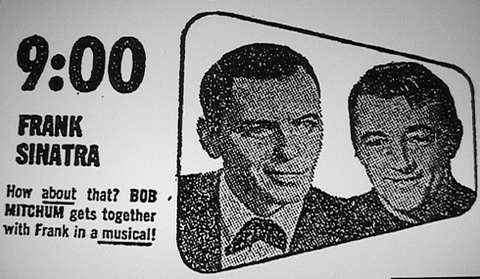
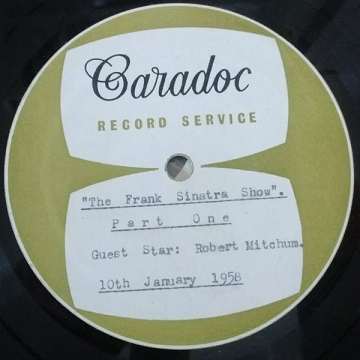
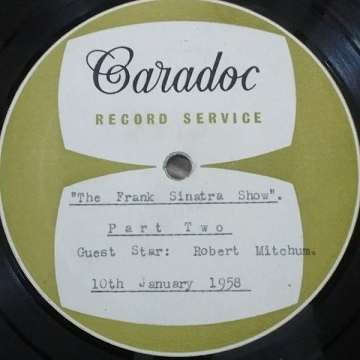
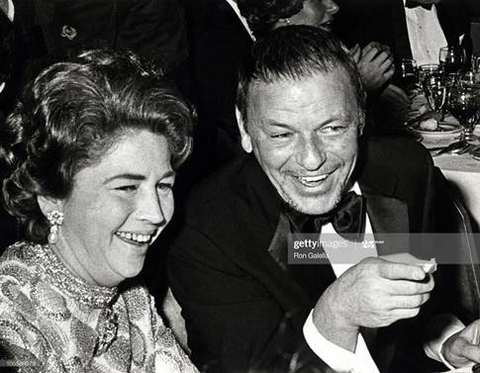
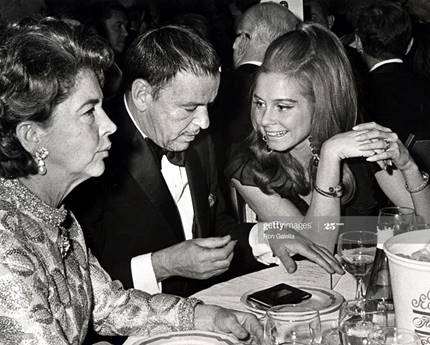
[Sammy Davis Jr.'s hasty marriage]
Sammy Davis Jr. married singer Loray White at the Sands's Emerald Room. Sinatra, who had been expected to be best man, called from Los Angeles to say he couldn't make it; Harry Belafonte stood in instead. The marriage, a sham arranged to defuse the scandal of Davis's affair with Kim Novak, would last nine months.
Source: James Kaplan, "Sinatra: The Chairman" (2015).
January 15, 1958
Frank played a two-week engagement at the Sands.
Source: Nancy Sinatra, Frank Sinatra: An American Legend, 1995.
January 17, 1958
Television
Frank Sinatra Show
Network: ABC
Show #14
Sponsors: Chesterfield Cigarettes, Bulova Watch Company
Guests: Louis Prima, Keely Smith
1. I'm An Old Cowhand --FS
2. Pennies From Heaven --Louis Prima & Keely Smith
3. Birth Of The Blues --FS & Keely Smith
4. Bewitched --FS
5. When Day Is Done --Keely Smith
6. I Can't Believe That Your In Love With Me --FS w/Louis Prima & Keely Smith
Ed notes:
A few weeks ago I mentioned the need to release on DVD some of the ABC-TV shows from 1958, including the ones with Ella, Jo Stafford and Dinah Shore. I would also include the above show as an absolute must.
Frank opened the show with a swinging version of Johnny Mercer's "I'm An Old Cowhand." Louie and Keely did a very funny "Pennies From Heaven" and then Frank and Keely got together and sang "Birth Of The Blues" ( Frank did duets of this song with Louis Armstrong, Judy Garland, Dean Martin and Sammy Davis Jr. The one with Keely is arguably the best of the lot). Frank then sang Rodgers and Harts "Bewitched," followed by "When Day Is Done" by Keely. The show closed with the three of them doing a frenetic vocal on "I Can’t Believe That You're In Love With Me." Some show, it was.
Frank Sinatra Show
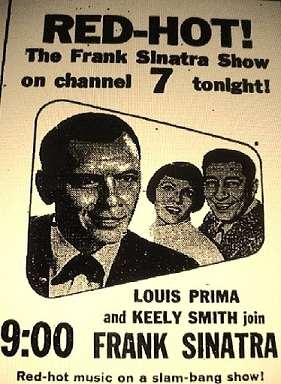
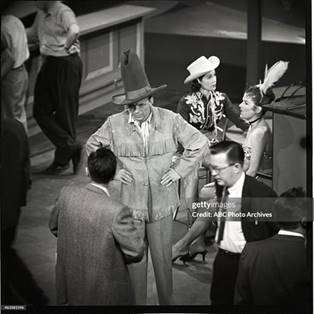
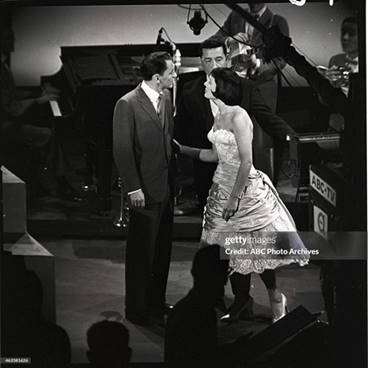
January 18, 1958
Television
Club Oasis
Saturday Evening
Network: NBC
Time: 9:00 - 9:30 P.M.
Sponsor: Club Oasis Cigarettes
Host: Frank Sinatra
Guests: Pat Suzuki, Stan Freberg, Hy Gardner
SONGS:
I've Got The World On A String
All The Way
Just One Of Those Things P. Suzuki
Don't Get Around Much Anymore P. Suzuki
Tell Her You Love Her
Come Fly With Me
Note: 2025: Pat Suzuki is still with us at the age of
95. An amazing singer.
Club Oasis
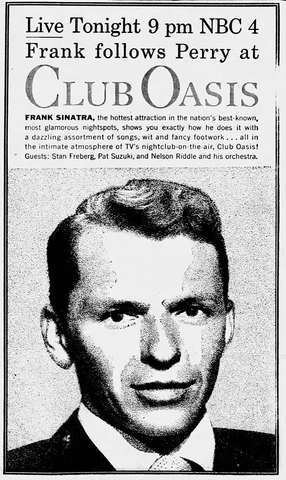
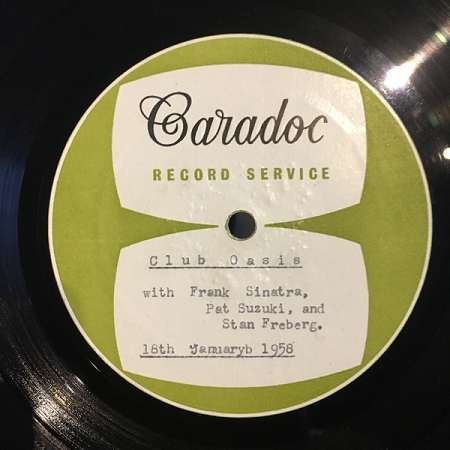
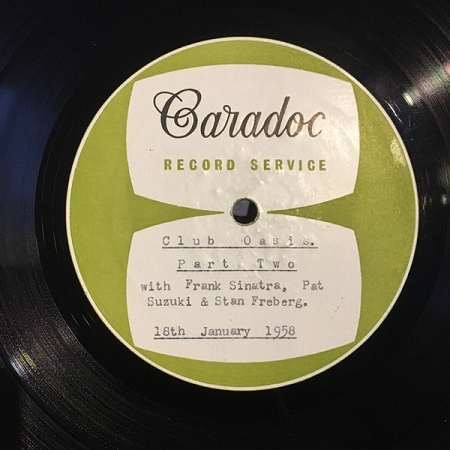
January 24, 1958
Television
Frank Sinatra Show
Network: ABC
Show #15
Sponsors: Chesterfield Cigarettes, Bulova Watch Company
Theme Of Show: Tribute To Tommy Dorsey
Guest: Jo Stafford
1. Wrap Your Troubles In Dreams
2. This Love Of Mine
3. I'll Never Smile Again w/Jo So Stafford
4. These Foolish Things
5. medley w/Jo Stafford: Street Of Dreams / Violets For Your Furs /
The One I Love / Yes Indeed
6. Our Love Is Here To Stay
NOTE: This TV show and the 1951 Meet Frank Sinatra radio show are both terrific, according to Sinatra Scholar Ed O'Brien. The 1951 radio shows has Jule Styne as a guest and he backs Sinatra on a medley of hits he wrote with Sammy Cahn. The 1958 TV show is a tribute to Tommy Dorsey. One of the Pied Pipers, the magnificent Jo Stafford, joins Frank for a wonderful half-hour down memory lane: Frank opens with "Wrap Your Troubles in Dreams," and then Jo sings "St. Louis Blues." Then there is the Dorsey segment with Frank singing "This Love of Mine" and joining Jo on "I'll Never Smile Again." After a commercial, they did a medley of Dorsey song and then Frank closes shop with "Love is Here to Stay." A very nice 25 minutes of entertainment. Jo told Ed that she loved doing the show.
note: Sinatra pre-recorded 62 songs for his ABC series. They were done with a trio or just Bill Miller on piano. Riddle was responsible for joining the recordings to the live 27 piece ABC orchestra. I thought you might like to see how the pre-recording set up looked.
note: 1/24 show was done in front of a live audience.
Ed
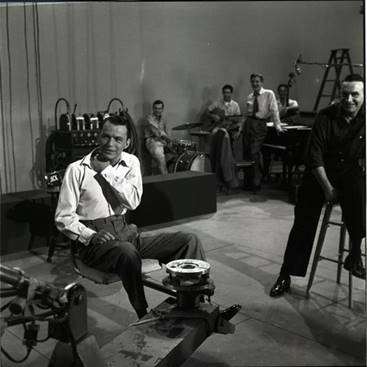
Frank Sinatra Show
January 24, 1958 L-R: BILL MILLER;BENNY BAKER;FRANK SINATRA
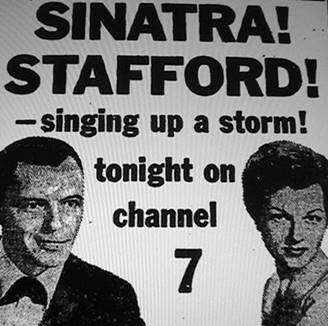
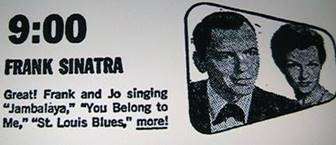
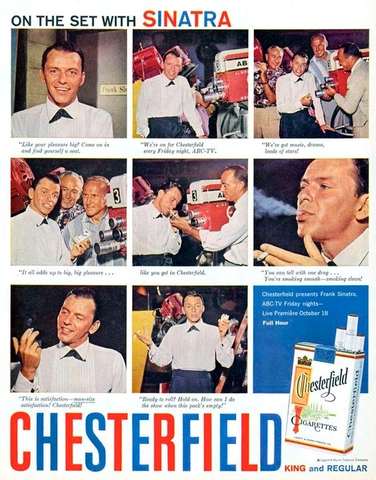
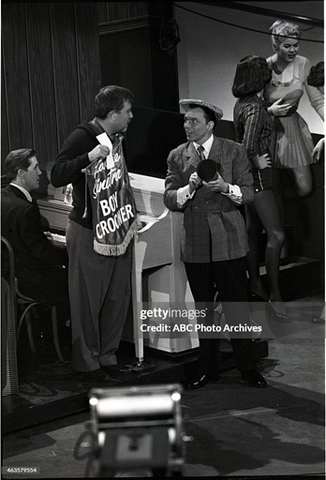
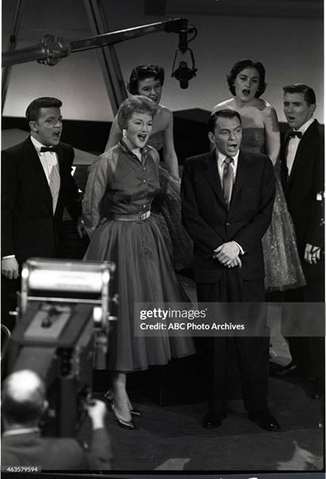
"I'll Never Smile Again"
The groundbreaking "I’ll Never Smile Again" came to life in many guises: a duet with former bandmate Jo Stafford on their joint television tribute to TD in 1958; with the Hi-Lo’s standing in for the Pied Pipers on a 1959 Sinatra show; in a full-blown Gordon Jenkins treatment on No One Cares in that same year; in a medley with Dean Martin on the latter’s program in 1960; in an exact Sentimentalist-style remake for the Man and His Music album in 1965; and in a 1971 concert.
Source: Will Friedwald, "Sinatra! The Song Is You: A Singer's Art" (2018 revised edition).
January 26, 1958
Television
The Dinah Shore Show
Network: NBC
Time: 9:00 P.M. - 10:00 P.M.
Sponsor: Cheverlot
Harry Zimmerman and His Orchestra
Guests: Frank Sinatra, Peter Lawford, Steiner Brothers
1. All The Way
2. Tea For Two w/Dinah
3. medley with Dinah: You Make Me Feel So You / Them There Eyes (DS) / A Foggy Day / I've Got You Under My Skin (DS)
/ Taking A Chance On Love / They Can't Take That Away From Me (DS) / All Of Me / Daddy (DS) / I Can't Give You Anything But Love / Side By Side / I Never Left Your Arms
Ed Notes the following:
Frank did some comedy skits with Shore and Lawford.
He sang "All The Way" and then did a duet with Dinah on "Tea For Two. He did more comedy skits and then reprised the medley done with Dinah on her 10-5-56 show. Lawford joined them for a rousing "Memphis Blues" and then Frank and Dinah sang her Chevy song to close the show.
The Dinah Shore Show
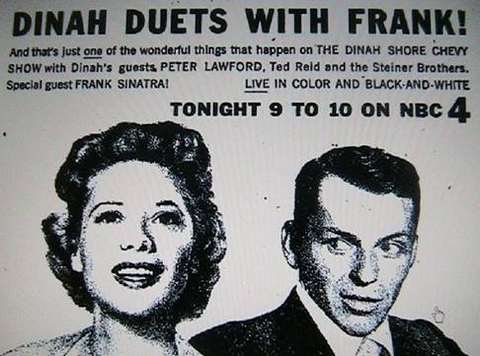
January 31, 1958
Television
Frank Sinatra Show
Network: ABC
Show #16
Sponsors: Chesterfield Cigarettes, Bulova Watch Company
Guests: Sammy Davis Jr.
1. The Isle Of Capri
2. You Make Me Feel So Young
3. Tell Her You Love Her
4. Me And My Shadow w/Davis
5. I've Got You Under My Skin
Notes: 30 mins. (Vid Known)
Frank Sinatra Show
Guests: Sammy Davis Jr.
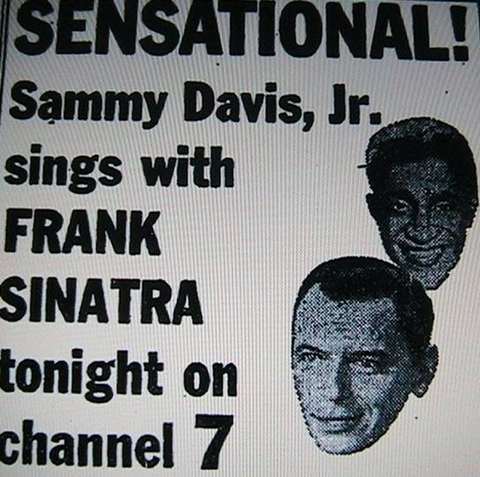
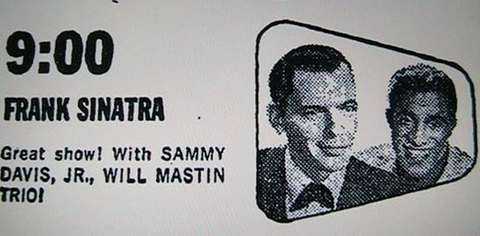
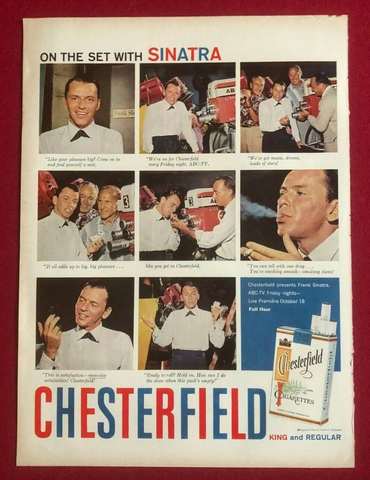
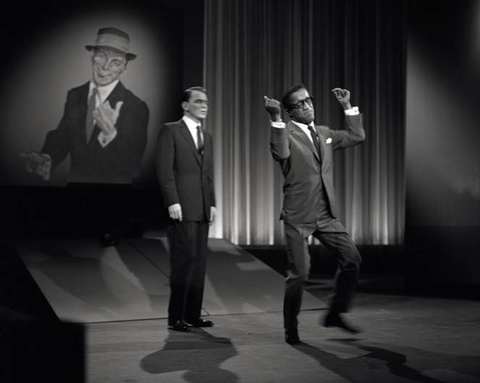
February 1958
[Boris Karloff's Acting Lesson For Sinatra]
Nancy Sinatra: While Sinatra filmed Kings Go Forth in France, Boris Karloff served as his unofficial acting coach and gave him advice Frank called invaluable: to learn to act with his voice as well as his face.
Source: Nancy Sinatra, Frank Sinatra: An American Legend, 1995.
[A cluster of deaths]
Kaplan: February 1958 brought several deaths in Sinatra's orbit: Manie Sacks, Nelson Riddle's infant daughter (of bronchial asthma), and studio boss Harry Cohn, who died of a heart attack on February 27.
Source: James Kaplan, "Sinatra: The Chairman" (2015)
[Engagement shared with Swifty Lazar]
Kaplan: At the Imperial Gardens restaurant, Sinatra and Bacall told agent Swifty Lazar about their engagement plan; Sinatra had Bacall sign an autograph for a fan as "Betty Sinatra." Lazar initially didn't take the plan seriously.
Source: James Kaplan, "Sinatra: The Chairman" (2015)
[Reconciliation in New York]
Lauren Bacall: While in New York for Manie Sacks's funeral, Sinatra called Bacall (who was there promoting a film) and invited her to dinner as though nothing had happened; they reconnected warmly, and he was "wildly attentive" during the visit.
Source: James Kaplan, "Sinatra: The Chairman" (2015)
[Sinatra proposes to Bacall]
Lauren Bacall: The night Bacall returned to California from New York, Sinatra came to see her, apologized for feeling "trapped" and "chicken," and asked her to marry him; she accepted after a long, ecstatic pause.
Source: James Kaplan, "Sinatra: The Chairman" (2015)
February 1, 1958
Television
The Dean Martin Club Oasis Show
Network: NBC
Saturday Evening
Time: 9:00 P.M. - 10:00 P.M.
Host: Dean Martin.
Guests: Frank Sinatra, Danny Thomas. Jill St. John
Sponsor Oasis Cigarettes
1. It Was Much Better Last Week - Cast
2. When Your Smiling - Dean
3. Getting To Know You - Frank & Danny
4. All Alone - Dean
5. Last Night When We Were Young - Frank
6. I Love To Love - Frank & Dean
7. Academy Award Nominee Medley: I Fall In Love Too
Easily / Tender Trap / Three Coins In A Fountain / An
Affair To Remember / All The Way / Jailhouse Rock
8. It Was Much Better Last Week - Cast
Club Oasis ads
Variety
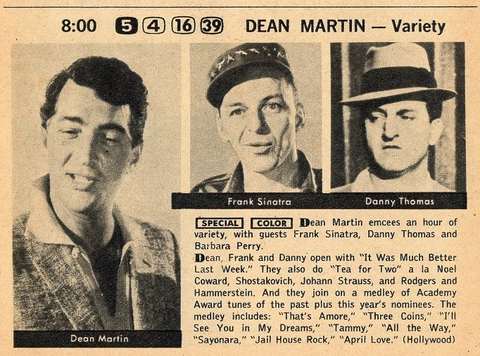
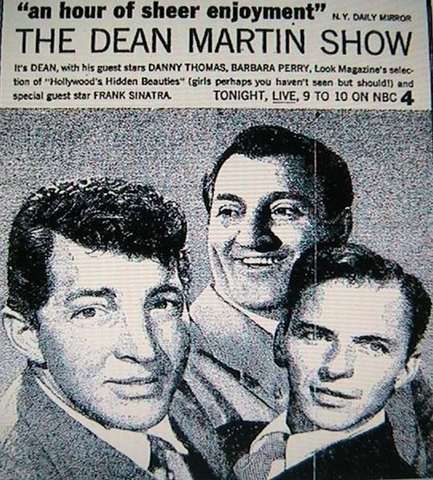
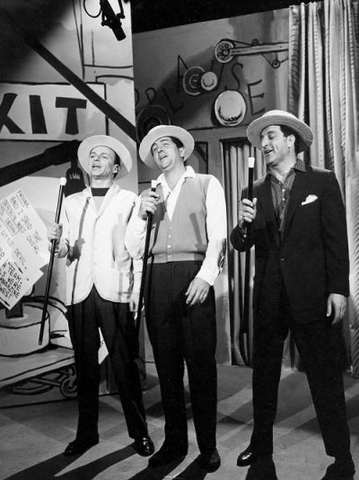
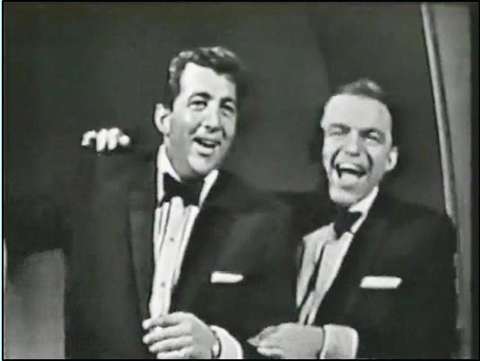
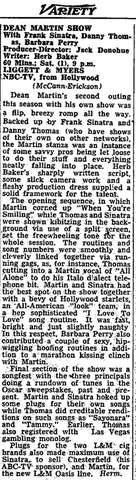
February 3, 1958
[Rickles photographed heckling Sinatra]
A photograph in the February 3 issue of Life caught comedian Don Rickles in the act of insulting Sinatra at the Slate Brothers club on La Cienega Boulevard, predating the more famous "Murray Franklin's" origin story of their friendship.
Source: James Kaplan, "Sinatra: The Chairman" (2015).
February 4, 1958
Concerts
Moulin Rouge, Los Angeles
Frank Sinatra subs for Sammy Davis Jr.
32 piece Orchestra directed by Nelson Riddle
Bill Miller on Piano
Moulin Rouge, Los Angeles
Frank Sinatra subs for Sammy Davis Jr.
32 piece Orchestra directed by Nelson Riddle
Bill Miller on Piano
In an interview that year, Frank talked about doing benefits or subbing for a fellow entertainer. He could not explain it, but his performance was far better than when he was doing it for a living. Absolutely baffled him.
--Ed
© 1997-2026 The Sinatra Archive
This calendar, or any parts thereof, may not be reproduced in any fashion whatsoever without the prior written permission of the publisher (The Sinatra Archive)
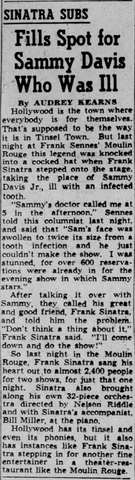
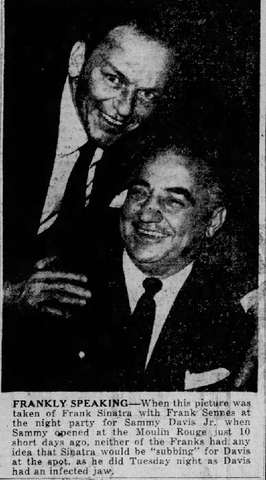
February 7, 1958
Television
Frank Sinatra Show
Network: ABC
Show #17
Sponsors: Chesterfield Cigarettes, Bulova Watch Company
Guest: Jeannie Carson, Jesse White
1. South of the Border
2. They Can't Take That Away from Me
3. From This Moment On
4. Witchcraft
Notes: (Vid Known) NOTE: Sinatra Scholar Ed O'Brien reports that the skits with Jeannie Carson didn't work at all. Simply not funny. But Frank did some wonderful singing.
Frank Sinatra Show
Jeannie
Carson
Jesse
White
Frank
Sinatra is autographing the Pal Joey soundtrack
February 7, 1960, Convention Center, Las Vegas
Benefit for the Cathedral of the Four Chaplains
5PM
Frank, Dean, Sammy, Joey, and Peter
Joan Collins is pictured at the right with Kirk Douglas and his wife Anne Buydens sitting to the left during the Four Chaplains memorial event. Others in photograph unidentified. Jack Entratter and the Sands Hotel hosted the event at the Las Vegas Convention Center on Four Chaplains Day, Sunday, February 7, 1960. The event featured Frank Sinatra, Dean Martin, Sammy Davis, Jr., Peter Lawford and Joey Bishop.
Site Name: Las Vegas Convention Center (Las Vegas, Nev.); Sands Hotel and
Casino
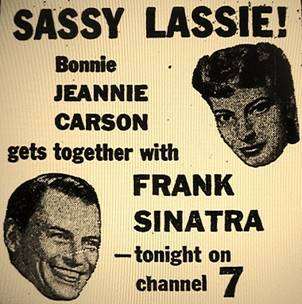
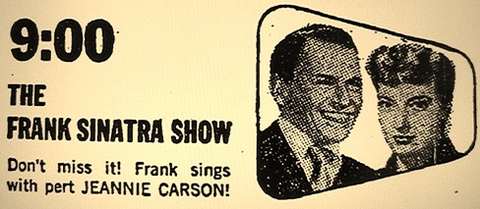
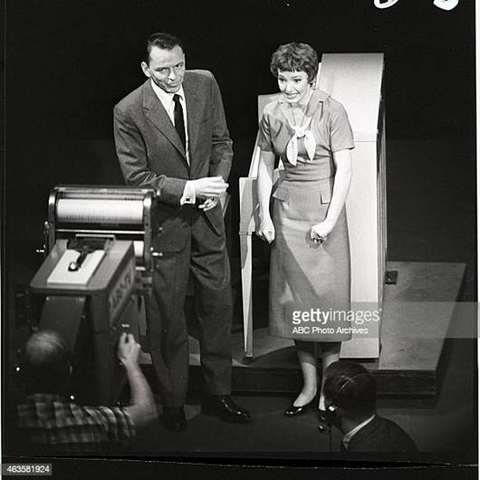
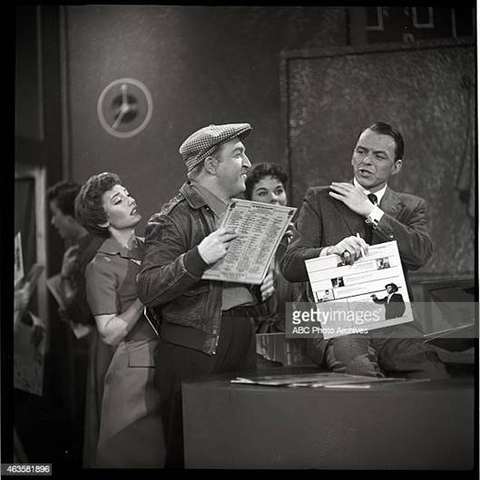
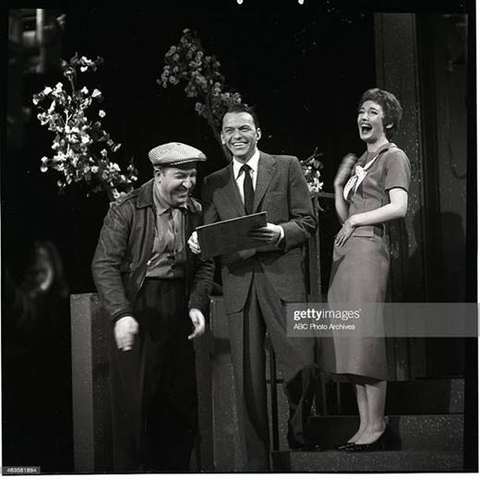
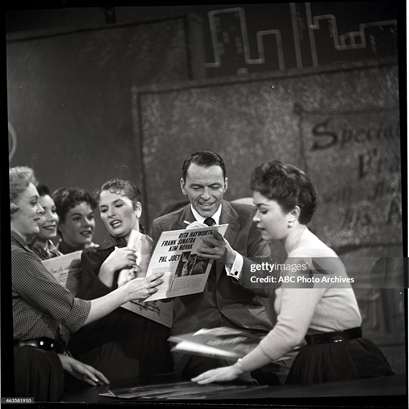
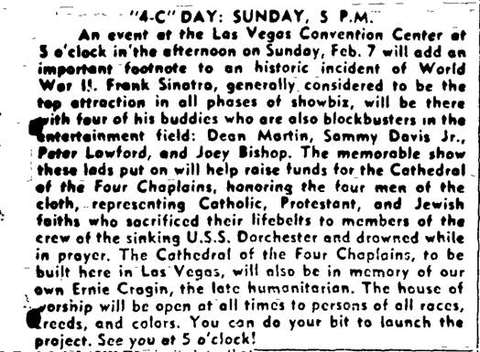
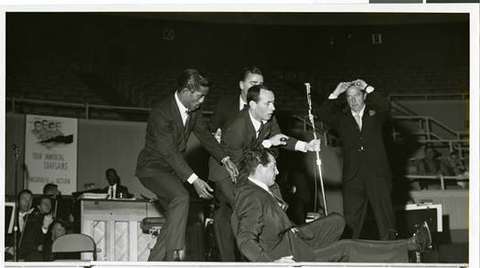
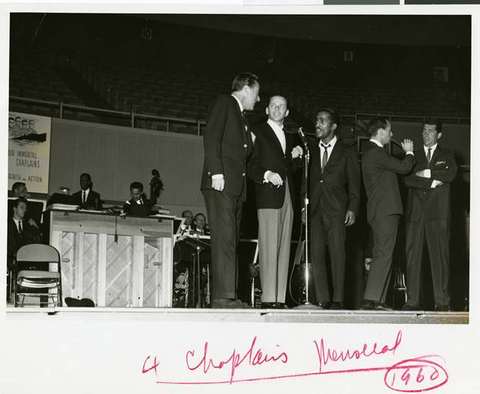
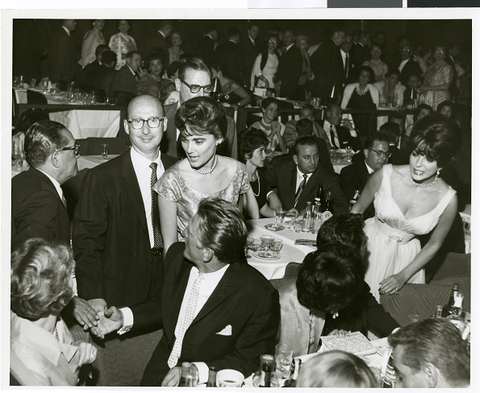
February 8, 1958
On learning that mentor Manie Sacks was dying of leukemia, Frank shut down production of Kings Go Forth for two days at his own expense and flew to Philadelphia to be at his bedside; Sacks died the next day.
Source: Nancy Sinatra, Frank Sinatra: An American Legend, 1995.
February 9, 1958
Manie Sacks, the Columbia and RCA executive who had been one of Frank Sinatra's closest friends and champions since the early 1940s, died of leukemia at fifty-six after concealing his illness from Frank for two years. Sinatra was overwhelmed with grief; in a conversation with Dinah Shore soon afterward about wanting more out of life than his career, she encouraged him to propose to Lauren Bacall, telling him, “If you live your life like Manie, you can't lose.” Source: J. Randy Taraborrelli, Sinatra: Behind the Legend.
[Death of Manie Sacks]
Emanuel "Manie" Sacks, a father-figure mentor to Sinatra since his early Columbia Records days, died at age fifty-six. Sinatra, back in Los Angeles, flew east for the funeral.
Source: James Kaplan, "Sinatra: The Chairman" (2015).
February 14, 1958
Television
Frank Sinatra Show
Network: ABC
Show #18
Sponsors: Chesterfield Cigarettes, Bulova Watch Company
Guests: Shirley Jones, Nancy Sinatra
NOTE: Sinatra Scholar Ed O'Brien reports that Shirley Jones did a memorable duet with Sinatra on "If I Loved You" and did a lovely reading of Mercer's wonderful lyrics from "P.S. I Love You." Frank also sang the Archer-Thompson tune "I Love You" and "My Funny Valentine." Frank was going to sing the Rodgers & Hart classic to his daughter Tina. She developed a case of stage fright and Nancy subbed for her.
Concerts
Chi- Chi Starlite Room, Palm Springs, CA
Valentine's Day Dinner
EMCEE: Phil Harris
650 in attendance
Performers: Frank Sinatra, Bing Crosby, Joe Bushkin, Duke Ellington & His Orchestra and local entertainers
Chi- Chi Starlite Room, Palm Springs, CA
Valentine's Day Dinner
EMCEE: Phil Harris
650 in attendance
Performers: Frank Sinatra, Bing Crosby, Joe Bushkin, Duke Ellington & His Orchestra and local entertainers
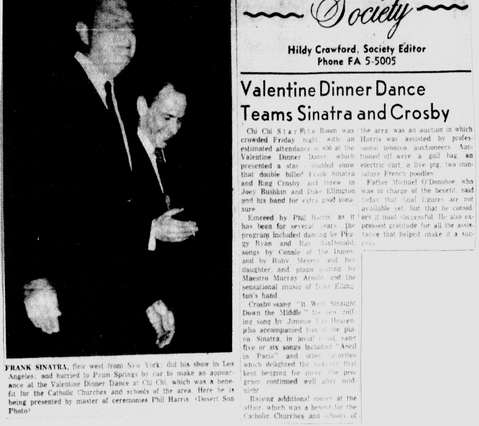
Frank Sinatra Show
Frank and Shirley Jones did a memorable duet with Sinatra on "If I Loved You"
Frank
Shirley
Jesse
Sinatra, Alice Pearce, Jesse White
Note: Alice Pearce appeared with Sinatra in “On The Town”
Frank and Nancy
© 1997-2026 The Sinatra Archive
This calendar, or any parts thereof, may not be reproduced in any fashion
whatsoever without the prior written permission of the publisher (The
Sinatra Archive)
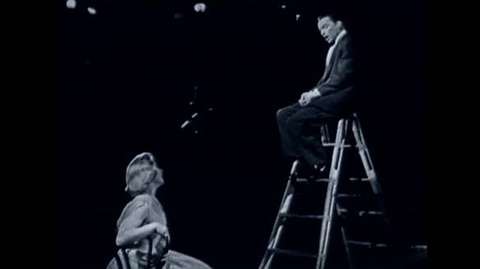
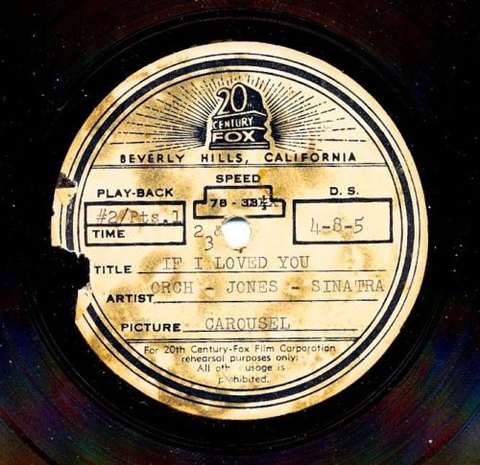
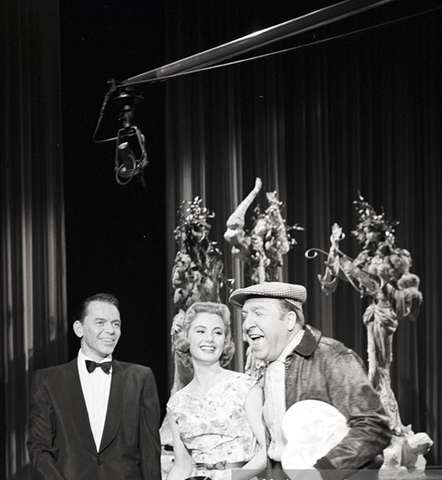
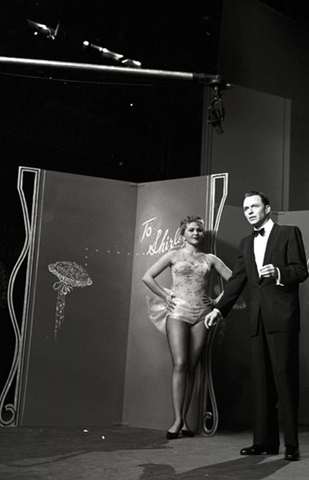
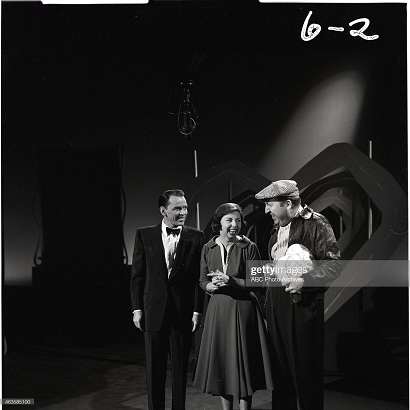
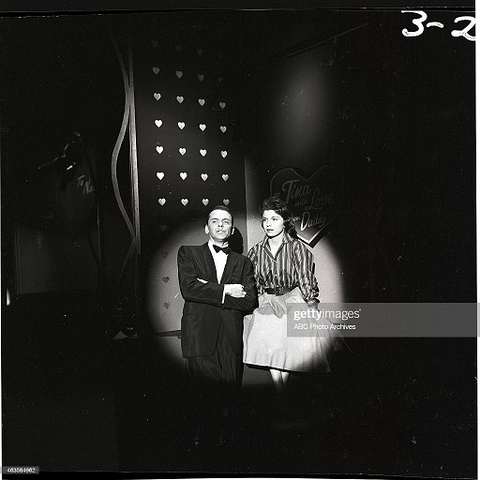
February 17, 1958
Concerts
Moulin Rouge, Los Angeles, CA
Egyptian Temple of the Shriners Benefit
Frank Sinatra, Bob Hope, Rosemary Clooney, Ella Fitzgerald, Danny Thomas, Jerry Lewis, Mickey Rooney and others
February 21, 1958
Television
Frank Sinatra Show
Network: ABC
Show #19
Sponsors: Chesterfield Cigarettes, Bulova Watch Company
Drama: "A Time To Cry"
Host: Frank Sinatra
Starring: Anne Bancroft, Lloyd Bridges, John Archer, Ray Teal
Notes: A gunman holds a woman captive in a deserted frontier cabin while her husband lies dying from a bullet wound in the next room.
February 28, 1958
Television
Frank Sinatra Show
Network: ABC
Show #20
Sponsors: Chesterfield Cigarettes, Bulova Watch Company
Guest: Van Johnson
Friday evening
9 - 9:30 pm est
1. Come Fly With Me
2. Cigarette ad
3. There's No You
4. Cigarette ad
5. Skit w/ V. Johnson
6. I Could Write A Book
7. Nothing In Common w/V. Johnson (Special lyrics from Mr. Cahn)
8. Cigarette ad
9. At Long Last Love
10. Put Your Dreams Away
Frank Sinatra Show
Network: ABC
Show #20
Sponsors: Chesterfield Cigarettes, Bulova Watch Company
Guest: Van Johnson
Photo:
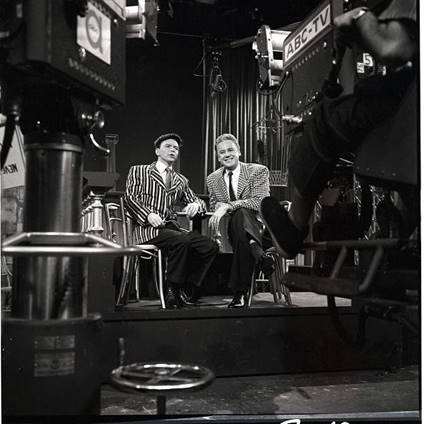
1958
The Italian ambassador named Sinatra the Italian-American Man of the Year; Joe DiMaggio was on hand to bestow the "Star of Italian Solidarity" on his friend, not long before the two men's friendship soured for good over Sinatra's role in Marilyn Monroe's affairs. Source: David Lehman, Sinatra's Century.
[A Secret Pinball Machine for Eleanor Parker's Kids]
While filming Hole in the Head in late fall 1958, Sinatra promised costar Eleanor Parker he'd get her children a mail-order pinball machine for Christmas, then, after weeks of delay, had a fully assembled one delivered to her door a week before the holiday.
Source: Nancy Sinatra, "Frank Sinatra, My Father" (1985).
[Barbara and Frank's First Kiss at the Compound]
By Barbara's own account, her first romantic spark with Frank came one spring evening at the Compound when Zeppo stayed home. After some mutual flirting, Frank pulled her into the kitchen and kissed her.
Source: Tina Sinatra, "My Father's Daughter: A Memoir" (2000).
[Breaks Nightclub Records at the Fontainebleau]
Sinatra breaks all existing American nightclub attendance records at the Fontainebleau in Miami Beach, receives B'nai B'rith's Al Jolson Entertainer of the Year Award, and sees his album "Only the Lonely" reach #1 and stay on the charts for 120 weeks; he appears in "Kings Go Forth" and "Some Came Running."
Source: Nancy Sinatra, "Frank Sinatra, My Father" (1985).
[Flying Dean Martin to Lake Tahoe in the "Interim"]
In 1958 Sinatra invited Dean Martin to work a week at Lake Tahoe on a handshake deal, flying him there in his cramped private jet, nicknamed the Interim, and only handing him his paycheck once they were airborne so he couldn't back out.
Source: Nancy Sinatra, "Frank Sinatra, My Father" (1985).
[Manie Sacks Dies]
When Manie Sacks died in 1958, Sinatra wept, later saying there was "a little bit of Manie in everything good" that had ever happened to him.
Source: Nancy Sinatra, "Frank Sinatra, My Father" (1985).
[Recording "Only the Lonely"]
In 1958 Sinatra and Nelson Riddle recorded "Only the Lonely," an album Frank Jr. calls the greatest blues record ever made -- so bleak that a photographer stopped playing it during portrait sessions because no one could smile to it.
Source: Nancy Sinatra, "Frank Sinatra, My Father" (1985).
[Eddie Hodges recalls Sinatra's studio perfectionism]
Eddie Hodges: Former child actor Eddie Hodges recalled attending a late-1958 Capitol session where Sinatra halted a take mid-song, furious at the string section's weak playing ('You sound like a bunch of girls!... Why don't you play it with some balls?'), and got the take he wanted on the next try.
Source: James Kaplan, "Sinatra: The Chairman" (2015)
[Frank and Peter Lawford grow close]
Consiglio: Frank knew Peter Lawford only casually until 1958, when Peter and then-Senator Jack Kennedy came to the Sands and stayed up late with Frank in the nightclub scene, cementing the friendship. Consiglio notes it wasn't until working the campaign trail that he realized Kennedy was married.
Source: Tony Consiglio (as told to Franz Douskey), "Sinatra and Me: The Very Good Years" (2012)
[Harwyn Club altercation with photographer]
Kaplan: Leaving Manhattan's Harwyn Club with Joe E. Lewis, David Niven, and Nan Whitney, Sinatra angrily rebuffed a reporter and photographer Mel Finkelstein, shouting profanities and ordering his driver to run down photographers as he sped off in a limousine with an illegal siren blaring, knocking Finkelstein down; the photographer was hospitalized for X-rays.
Source: James Kaplan, "Sinatra: The Chairman" (2015)
[Idlewild Airport cab driver story]
Consiglio: In 1958, arriving in New York from California, Sinatra and Consiglio found their limo driver absent at Idlewild Airport and took a cab instead. Sinatra had Consiglio tip the driver a full hundred-dollar bill and refuse change, making the cabbie's day.
Source: Tony Consiglio (as told to Franz Douskey), "Sinatra and Me: The Very Good Years" (2012)
[JFK's first visit to Palm Springs]
George Jacobs: Jack Kennedy made his first visit to Sinatra's Palm Springs home in the summer of 1958, beginning a friendship in which, per George Jacobs, Kennedy's main interest was Sinatra's access to Hollywood women and celebrity gossip rather than politics.
Source: James Kaplan, "Sinatra: The Chairman" (2015)
[Joe Kennedy at Cal-Neva]
Kaplan: Ambassador Joseph P. Kennedy, Pat Lawford's father, took breaks from managing son Jack's Senate reelection and presidential groundwork to relax at Cal-Neva in June and July, visiting with the Lawfords and Sinatra; around this time he also secretly bought a stake in the resort behind a front, gambler Bert "Wingy" Grober.
Source: James Kaplan, "Sinatra: The Chairman" (2015)
[Later attempt at Lush Life]
Kaplan: In 1958, Sinatra would similarly struggle attempting Billy Strayhorn's demanding tone poem 'Lush Life,' echoing the difficulty he'd had recording Carousel's 'Soliloquy' in 1955.
Source: James Kaplan, "Sinatra: The Chairman" (2015)
[Never So Few casting power play]
Kaplan: In the waning months of 1958, Frank was developing Never So Few, a WWII Burma drama and the next film on his three-picture MGM contract, co-produced by his own company. As star and co-producer he pressured MGM to cast Peter Lawford at ten times the studio's original offer, and got Sammy Davis Jr. cast at $75,000 despite a producer's objection that there had been no Black soldiers in the Burma theater; Sinatra replied, 'There are now.'
Source: James Kaplan, "Sinatra: The Chairman" (2015)
[Only the Lonely hits number 1]
Kaplan: Two weeks after its mid-September release, Only the Lonely hit number 1 and remained on the Billboard chart for 120 weeks.
Source: James Kaplan, "Sinatra: The Chairman" (2015)
[Second public snub in Palm Springs]
Lauren Bacall: Months later, after a Sinatra concert in Palm Springs, Bacall found herself face to face with him; he again showed no flicker of recognition before getting into his car, leaving her feeling sick with humiliation.
Source: James Kaplan, "Sinatra: The Chairman" (2015)
[Sinatra and Quincy Jones first collaborate]
Kaplan: Quincy Jones, then a 25-year-old arranger-bandleader, first worked with Sinatra conducting the Barclay Disques house band at Princess Grace's Monaco benefit; Sinatra, who prized his own ear for talent, had sought Jones out after hearing his work.
Source: James Kaplan, "Sinatra: The Chairman" (2015)
[Sinatra seeks ownership of his masters]
Kaplan: As his commercial power grew — with A Jolly Christmas going platinum and Come Fly with Me going gold — Sinatra pushed Capitol for a bigger profit share and, crucially, ownership of his own master recordings, a right no major recording artist then held.
Source: James Kaplan, "Sinatra: The Chairman" (2015)
[Sinatra's stake in the Sands grows]
Kaplan: By the start of 1958, Sinatra's ownership stake in the Sands had grown from two points to nine, reportedly through the generosity of the hotel's owners, some say a gift from mobster Vincent "Jimmy Blue Eyes" Alo.
Source: James Kaplan, "Sinatra: The Chairman" (2015)
[Sinatra-JFK friendship accelerates]
Kaplan: Sinatra's relationship with the Lawfords, and his friendship with Pat Lawford's brother Jack Kennedy, deepened in 1958 as Frank developed Ocean's 11 with Peter Lawford and took a strong interest in JFK's presidential prospects.
Source: James Kaplan, "Sinatra: The Chairman" (2015)
[Some Came Running filmed in Indiana]
Consiglio: Some Came Running was shot on location in Madison, Indiana. It was the first time Frank and Shirley MacLaine worked together, and the start of a close friendship; afterward Frank always made sure Shirley was invited to his parties and show closings. During a scene where MacLaine's character dies, Frank had someone hide the pillow Consiglio was supposed to use as a prop, forcing him to improvise with his own jacket while MacLaine tried not to break character laughing.
Source: Tony Consiglio (as told to Franz Douskey), "Sinatra and Me: The Very Good Years" (2012)
[Wrap-party arrest after Some Came Running]
Consiglio: After finishing Some Came Running, the cast held a fireworks party at the studio-rented house that drew repeated police visits. When the cast fled by limousine as police returned a second time, Consiglio was left behind and arrested for disturbing the peace. Hank paid the police five hundred dollars at the station and the charges were dropped.
Source: Tony Consiglio (as told to Franz Douskey), "Sinatra and Me: The Very Good Years" (2012)
[Billy May wins a Grammy for Big Fat Brass]
After forming his own recording band in 1951 and developing a signature glissando saxophone sound, Billy May won a Grammy in 1958 for his album Big Fat Brass.
Source: Richard Havers, "Sinatra" (Dorling Kindersley, 2007).
[Catholic Youth Center warns against rock 'n' roll records]
A 1958 warning in the Catholic Youth Center's newspaper Contacts urged teens to destroy records seen as promoting a 'pagan culture' and to vet music played at parties and dances, reflecting growing establishment anxiety about rock 'n' roll.
Source: Richard Havers, "Sinatra" (Dorling Kindersley, 2007).
[Frank records Jenkins' 'Goodbye' — arranged by Nelson Riddle]
Gordon Jenkins' composition 'Goodbye,' which had become Benny Goodman's closing theme, was recorded by Frank in 1958, arranged and conducted, somewhat ironically, by rival arranger Nelson Riddle rather than Jenkins himself.
Source: Richard Havers, "Sinatra" (Dorling Kindersley, 2007).
[Frank's Cadillac later resold to the officer who once stopped him]
Early in 1958, a California patrolman pulled Frank over as he drove his new Cadillac Eldorado home. Years later, when the car came up for sale, the patrolman's brother, a car collector, bought it for $120,000 and gave it to his retired-officer sibling.
Source: Richard Havers, "Sinatra" (Dorling Kindersley, 2007).
[Sammy Davis Jr appears in Porgy and Bess]
Sammy Davis Jr resumed his film career in Porgy and Bess, playing the character Sportin' Life.
Source: Richard Havers, "Sinatra" (Dorling Kindersley, 2007).
[Benefit Performance at the 500 Club]
Sinatra sidetracked a vacation to perform at friend Paul "Skinny" D'Amato's struggling 500 Club in Atlantic City, taking only expenses in salary to help put it back in the black.
Source: George Carpozi Jr., Frank Sinatra: Is This Man Mafia? (New York: Manor Books, 1979).
["Frank Destroys Money" Christmas Party]
Sinatra threw a Christmas party for more than 100 guests with a gift under the tree for every attendee, prompting Joe DiMaggio's remark that "Frank destroys money."
Source: George Carpozi Jr., Frank Sinatra: Is This Man Mafia? (New York: Manor Books, 1979).
[Failed Essex-as-subsidiary-label negotiations with Capitol chairman Glenn Wallichs; Capitol exec Alan Livingston's account -- critical commentary]
Alan Livingston; Frank Sinatra: Livingston recounted Wallichs refusing Sinatra's demand to make Essex a genuine subsidiary: 'If I give it to you, Frank, I've got to give it to Nat Cole... You're disrupting our whole business.' Sinatra reportedly responded, 'Screw you. I won't record anymore. You can't make me sing,' and staged a de facto recording ban between finishing No One Cares (May 1959) and starting Nice 'n' Easy (March 1960), aside from Can-Can soundtrack sessions.
Source: Will Friedwald, "Sinatra! The Song Is You: A Singer's Art" (2018 revised edition), Ch. 9, "Looking for the Hook" (1960-1971)
[Mandalay -- critical commentary]
Frank Sinatra: At his June 1958 Monte Carlo concert, Sinatra sarcastically complained onstage about the British ban of 'Mandalay': 'Kipling's daughter had the nerve to ban that in England. How dare she? Of course, she drinks a little bit, so we'll forgive her!'
Source: Will Friedwald, "Sinatra! The Song Is You: A Singer's Art" (2018 revised edition), Ch. 7, "With Billy May" (1953-1979)
[Mandalay -- critical commentary]
Sinatra performed the 'Mandalay' arrangement on a May 1958 episode of his ABC-TV series; guest Ella Fitzgerald took it upon herself to sing the closing line, 'out of China, 'cross the bay.'
Source: Will Friedwald, "Sinatra! The Song Is You: A Singer's Art" (2018 revised edition), Ch. 7, "With Billy May" (1953-1979)
[Only the Lonely (1958) - first session, huge orchestra -- critical commentary]
Al Viola: Guitarist Al Viola, recalling the first Only the Lonely session decades later: 'We had so many musicians that when I got to the first date, I thought it was a union meeting! I thought a whole bunch of guys had gotten together to talk about an election or something. But no, all these musicians were actually there to work.' Nearly fifty musicians were present -- ten classical woodwinds, three French horns, twenty-one strings plus harp, one trumpet (Pete Candoli), three trombones, and a fully doubled rhythm section (jazz and classical player in each chair: Bill Miller/Harry Sukman on piano, Joe Comfort/Mike Rubin on bass, Frank Flynn/Bill Richmond percussion) -- making it sound more like a classical album with jazz/blues overtones than vice versa.
Source: Will Friedwald, "Sinatra! The Song Is You: A Singer's Art" (2018 revised edition), Ch. 6, "With Nelson Riddle" (1953-1979)
[Only the Lonely (Capitol, 1958) -- critical commentary]
Nelson Riddle: Nelson Riddle, half-joking in his usual caustic manner, named Only the Lonely his favorite Sinatra album because he was given an entire week to work on the arrangements -- far more time than usual.
Source: Will Friedwald, "Sinatra! The Song Is You: A Singer's Art" (2018 revised edition), Ch. 1, "Night and Day" (Sinatra style overview)
[Only the Lonely - Felix Slatkin brought in to conduct the tempo-less charts -- critical commentary]
Eleanor Slatkin; Al Viola; Nelson Riddle: Sinatra brought in Felix Slatkin to conduct rather than Riddle, possibly to spare Riddle's feelings (Riddle was booked touring Canada with Nat Cole that summer). Eleanor Slatkin: 'Felix was always available for Frank... Frank just called and said, "I want you to do an album with me." And of course, Felix was thrilled.' Al Viola: 'Felix was top-notch. I mean, that was really conducting because this wasn't in dance tempo. This was almost like a mini-symphony, the way Nelson wrote it.' Riddle himself: 'I wrote all the arrangements, but Felix Slatkin, a fine violinist and fine conductor, did the session, [while] I was up in Edmonton, Alberta, or one of those places.'
Source: Will Friedwald, "Sinatra! The Song Is You: A Singer's Art" (2018 revised edition), Ch. 6, "With Nelson Riddle" (1953-1979)
[Only the Lonely - origin as a planned Gordon Jenkins project; comparison to Jenkins' style -- critical commentary]
Sinatra originally conceived Only the Lonely as a follow-up to 1956's Where Are You? with Gordon Jenkins, but Jenkins was busy in Las Vegas, so Sinatra turned to Riddle for full-scale 'concert music.' Friedwald contrasts what a Jenkins version would have sounded like (more Tchaikovsky) versus Riddle's actual work (more Stravinsky, citing the oboe intro to 'Goodbye' evoking Le Sacre du printemps). The project started May 5, 1958 with Riddle himself conducting; three songs were attempted but nothing was usable.
Source: Will Friedwald, "Sinatra! The Song Is You: A Singer's Art" (2018 revised edition), Ch. 6, "With Nelson Riddle" (1953-1979)
[Quincy Jones's first meeting/collaboration with Sinatra, Monte Carlo charity concert -- critical commentary]
Quincy Jones: Sinatra hired 25-year-old Quincy Jones, then working in Europe, to assemble and direct his orchestra for a Monte Carlo benefit concert (promoting Kings Go Forth and raising money for Princess Grace's refugee-children charity). Jones recalled the encounter: 'Somebody told me once that Ava Gardner had told him about me... I was scared to death. I was so in awe of him at the time that I hardly said a thing. Our first meeting was really quite brief.' Bebop drummer Kenny Clarke reportedly played the show, which Friedwald says is audible in the unusually bebop-inflected drum breaks on the Monte Carlo recording of 'Come Fly with Me.'
Source: Will Friedwald, "Sinatra! The Song Is You: A Singer's Art" (2018 revised edition), Ch. 9, "Looking for the Hook" (1960-1971)
[Sinatra's Capitol contract discontent / formation of Essex Productions; move to producer Dave Cavanaugh -- critical commentary]
Frank Sinatra (to Robin Douglas-Home); Billy May: Sinatra told Robin Douglas-Home that dissatisfaction with Capitol affected his work: 'Some of my [later] work for Capitol lacked the spark that it might have had... You can't give your best when you're not happy with the people you're working for.' Billy May felt Sinatra's switch from producer Voyle Gilmore to Dave Cavanaugh was 'a change for the better' since Cavanaugh, a former saxophonist, 'wasn't on Frank's shit list.'
Source: Will Friedwald, "Sinatra! The Song Is You: A Singer's Art" (2018 revised edition), Ch. 9, "Looking for the Hook" (1960-1971)
March 1958
[Frank Proposes To Lauren Bacall On A Paper Napkin]
Nancy Sinatra: Lauren Bacall recalled that Sinatra proposed marriage after they had drinks with agent Swifty Lazar, and when a young autograph-seeker approached, Frank handed Bacall the pen and had her sign her new name, "Betty Sinatra," on the girl's napkin.
Source: Nancy Sinatra, Frank Sinatra: An American Legend, 1995.
[The Press Leak That Ended Bacall's Engagement To Sinatra]
Nancy Sinatra: According to Lauren Bacall, their secret engagement collapsed after Swifty Lazar apparently leaked it to Louella Parsons; when Bacall saw the headline in an early edition, Frank stopped calling for days and later coldly told her the press pressure was too much for him to handle.
Source: Nancy Sinatra, Frank Sinatra: An American Legend, 1995.
[Billboard criticizes Garland's act]
Kaplan: A Billboard reviewer described watching Judy Garland perform that spring as "a disheartening, somewhat nerve wracking, experience," reflecting her decline amid weight gain, alcoholism, and pill addiction.
Source: James Kaplan, "Sinatra: The Chairman" (2015)
[Engagement leaked to the press]
Kaplan: During intermission at Noël Coward's Nude with Violin, Louella Parsons pressed Bacall (there with Swifty Lazar) about marrying Sinatra. Lazar later confirmed the engagement to Parsons himself; that night's early edition ran the headline "SINATRA TO MARRY BACALL," alarming Bacall.
Source: James Kaplan, "Sinatra: The Chairman" (2015)
[Lord Beatty sues for divorce]
Kaplan: Lord Beatty sued Adelle for divorce on grounds of adultery; the suit went undefended, leaving her with her title and a substantial settlement.
Source: James Kaplan, "Sinatra: The Chairman" (2015)
[Sinatra fires producer Voyle Gilmore]
Kaplan: Returning from Miami in March, Sinatra stopped in Chicago for the Robinson-Basilio boxing rematch and discovered local DJs hadn't received his new single "How Are Ya' Fixed for Love?" Furious, he had lawyer Mickey Rudin pressure Capitol president Glenn Wallichs to replace producer Voyle Gilmore, who was swapped for Dave Cavanaugh.
Source: James Kaplan, "Sinatra: The Chairman" (2015)
[Sinatra's angry final call to Bacall]
Lauren Bacall: A few nights after the engagement leak, Sinatra called Bacall demanding to know why she'd told the press; she denied responsibility. He said the press was besieging him and that they'd need to lay low and not see each other for a while — it turned out to be their last phone call as a couple.
Source: James Kaplan, "Sinatra: The Chairman" (2015)
[Vocal trouble at Fontainebleau]
Kaplan: Near the end of his Fontainebleau engagement in Miami, Sinatra had to cancel a couple of shows because of vocal difficulties, possibly from overuse and possibly from the strain of the Bacall breakup. No substitute performed; customers were refunded.
Source: James Kaplan, "Sinatra: The Chairman" (2015)
March 3, 1958
Studio
Capitol Studio A, Hollywood
E18522 Nothing In Common w/Keely Smith
(J. Van Heusen/S. Cahn)
Arranged & Conducted by Billy May
CD: C2 724383808922 The Complete Capitol Singles
CD: CDP 7-48468-2 Come Dance With Me
45: 3952
E18523 How Are Ya' Fixed For Love? w/Keely Smith
(J. Van Heusen/S. Cahn)
Arranged & Conducted by Billy May
CD: CDP 724383595228 Sinatra 80th "All The Best"
CD: C2 724383808922 The Complete Capitol Singles
CD: CDP 7-48468-2 Come Dance With Me
45: 3952
Note: When a single was released of the above two songs, Frank was in Chicago on a business trip.
He was shocked to learn that none of the radio stations in that toddlin' town had a promo copy.
Voyle Gilmore had produced Frank's great Cap. album up to then. Frank blamed him for the lack of product and Dave Cavanaugh became
Frank's producer, starting with "OTL.' I recently heard an interview with Gilmore. He had nothing to do with the distribution end at Capitol.
Ed
E18524 Same Old Song And Dance
(Cahn/Van Heusen/Worth)
Arranged & Conducted by Billy May
CD: C2 724383808922 The Complete Capitol Singles
CD: CDP 7-48468-2 Come Dance With Me
LP: T2602 Forever Frank
45: 4003
E18525 Here Goes
(lyrics unknown/ composer: Otto Cesana)
Publisher Unkown
Arranged & Conducted by Billy May
-2 (2:42) CD: C2-94777 The Capitol Years
note: Sammy Cahn was the lyricist.
Scott Henderson:
Why is it there is so little known about this song from this date and it was relatively unknown until The Capitol Years CD set came out. Yet, what a great swinging tune.
Ed O'Brien:
Billy May could not remember it. And he arranged it. I also asked others involved with that session. Al Hendrickson remembered there were a few takes of a song. Alvin Stoller had no memory of it. There were only two takes. The first attempt was a false start. I did find out who wrote it. Thought I put it up on the list. Can't find it in the archives. Honestly don't remember author's name, but most likely have it saved on a disc. Will look. I like it. Frank didn't like songs with too many words.. That might have been the problem. I'll bet it was probably one of Hank Sanicola's discoveries. He was always finding tunes for Frank.
Musicians - Reeds: Joe Cook, Fred Fallensby, Arthur "Skeets"ť Herfurt, Babe Russin, Willie Smith; Trumpets: Frank Beach, John Best, Harry "Sweets"ť Edison, Conrad Gozzo; Trombones: Ed Kusby, Dick Noel, Tommy Pederson, Bill Schaefer; Piano: Bill Miller; Bass: Joe Mondragon; Guitar: Alton Hendrickson; Drums: Alvin Stoller
Session Producer: Voyle Gilmore
Capitol Studio A, Hollywood
E18525 Here Goes
(lyrics unknown/ composer: Otto Cesana)
Publisher Unkown
Arranged & Conducted by Billy May
-2 (2:42) CD: C2-94777 The Capitol Years note: Sammy Cahn was the lyricist.
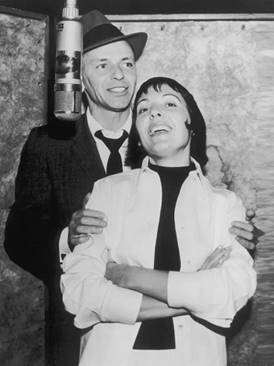
Capitol Studio A, Hollywood
E18522 Nothing In Common w/Keely Smith
E18523 How Are Ya' Fixed For Love? w/Keely Smith
[image referenced in source but could not be recovered]
[image referenced in source but could not be recovered]
[image referenced in source but could not be recovered]
[image referenced in source but could not be recovered]
[First 1958 Capitol session, with Billy May]
Sinatra's first Capitol studio session of 1958 was with Billy May, not Nelson Riddle. He recorded four upbeat tunes, including two charming duets with Keely Smith, "Nothing in Common" and "How Are Ya' Fixed for Love?," plus the breakneck-tempo closer "Here Goes."
Source: James Kaplan, "Sinatra: The Chairman" (2015).
March 4, 1958
Reviewing an episode of Sinatra's series featuring guest Dean Martin, Variety observed that Sinatra still lacked a well-defined personal approach to the television medium.
Source: Albert Auster, "Frank Sinatra: The Television Years–1950–1960," Journal of Popular Film and Television, 26:4 (1999), 166-174.
March 7, 1958
Television
Frank Sinatra Show (ABC)
Guests: Eydie Adams, Stan Freberg.
1. I'm Gonna Live Till I Die
2. This Can't Be Love
3. All Of Me
4. One For My Baby
Notes: 30 min.
NOTE: Ed O'Brien says Frank sang the Rodgers & Hart classic "This Can't Be Love" in concert, early TV appearances and on radio. Riddle gave him a dynamite arrangement for this show but he never recorded it.
Frank Sinatra Show (ABC)
Guests: Edie Adams, Stan Freberg.
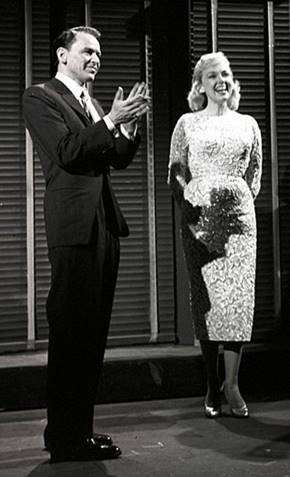
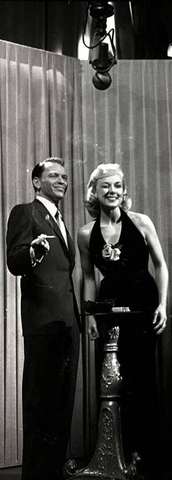
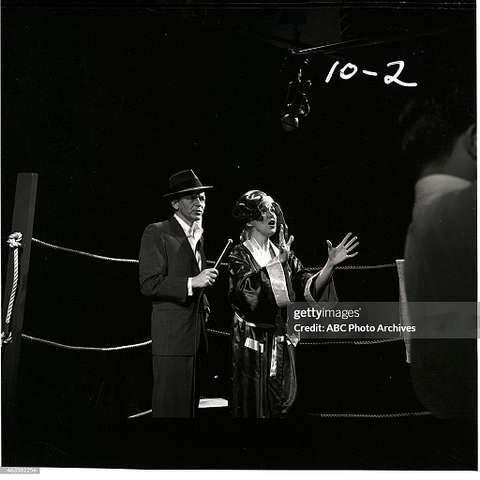
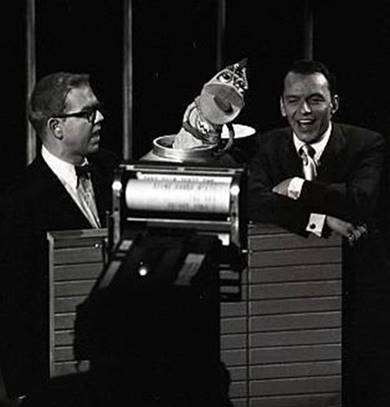
March 11, 1958
Concerts
Fontainebleau, Miami Beach, Florida (11-17)
Jack Stuart and his Orchestra
Also appearing: Maria Neglia & Sacasas and his Latin American Orchestra
Frankie 'Could Have Sung All Night" At La Ronde by Charles Roberts
Frank Sinatra, La Ronde, Fontainbleau, Miami Beach, March 13
No longer the bashful boy of his Dorsey vocalist days, nor the brash cocksure youth of a few years later, Frank Sinatra completely won his audience at this top M.B. swankery in the first eight bars of his opening number "Come Fly With Me."
His first five tunes were all of the upbeat variety and with fine swing- ing backing by Seagasus' augmented 18-piece house ork, Sinatra soon had this sophisticated audience snapping fingers and beating feet in tempo. Highlighted in this group were his click disk renditions of "Witchcraft" and "I've Got You Under My Skin."
Sinatra then offered such ballad standards as "April In Paris," "When Your Lover Has Gone," 'Violets For Your Furs" and "My Funny Valentine." Sinatra then featured a great version of "One More For The Road" with a piano-only accompaniment by Bill Miller. Thence a return to up tempo for nine more songs, including "All The Way," "Just One Of Those Things" and "Road To Mandalay."
Vocally, Sinatra has never been better, and with his magnificent swinging beat and sense of times, he could have been on all night. As it was, he did 18 songs and left them screaming for more after a full hour on stage. Billboard
March 17, 1958
Ed O'Brien:
Frank's decade long association with the Fontainbleau got underway with this week long engagement ( 11-17 ). There was not one empty seat in the La Ronde room during his seven-day stay.
Fontainebleau, Miami Beach, Florida (11-17) note" Notice the ad mentions the engagement includes two shows on Monday night. Frank liked Monday night off. But it was only a week, so he agreed to do it. Ed
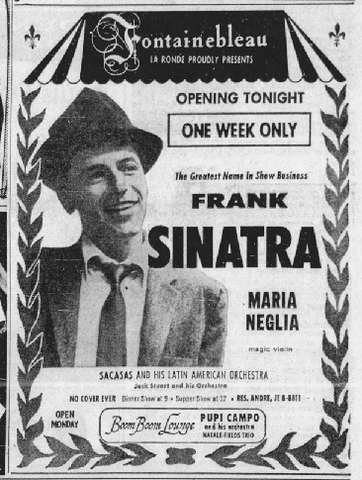
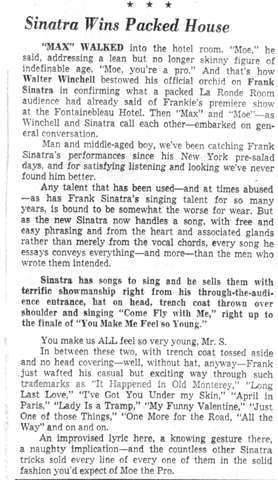
Frank Sinatra proposed marriage to Lauren “Betty” Bacall at the Imperial Gardens restaurant on the Sunset Strip, with agent Swifty Lazar the only other guest in on the secret; she accepted immediately. Sinatra swore Bacall to secrecy before leaving for a Miami engagement the next day, but Lazar let it slip to columnist Louella Parsons, who ran a “Sinatra to Marry Bacall” headline within days. The leak — and Bacall's inability to control the fallout — soured Frank on the engagement almost immediately; within two weeks he had gone cold on her entirely, canceling their plans one by one without ever formally ending things. Source: J. Randy Taraborrelli, Sinatra: Behind the Legend.
[Fontainebleau opening]
Sinatra opened a twelve-night engagement at the Fontainebleau hotel in Miami Beach, greeted at his sold-out opening by mob associates Joe Fischetti and Sam Giancana.
Source: James Kaplan, "Sinatra: The Chairman" (2015).
March 12, 1958
Concerts
Fontainebleau, Miami Beach, Florida (11-17)
Jack Stuart and his Orchestra
Also appearing: Maria Neglia & Sacasas and his Latin American Orchestra
March 13, 1958
Concerts
Fontainebleau, Miami Beach, Florida (11-17)
Jack Stuart and his Orchestra
Also appearing: Maria Neglia & Sacasas and his Latin American Orchestra
March 14, 1958
Television
Frank Sinatra Show
Network: ABC
Show #22
Sponsors: Chesterfield Cigarettes, Bulova Watch Company
Guests: Eydie Gorme, Joey Bishop
Ed notes:
Good show.
Frank opened with "It Happened In Monterey," did a lovely vocal on "Moonlight In Vermont," a duet with Eydie on "How About You" and closed with "Saturday Night."
Concerts
Fontainebleau, Miami Beach, Florida (11-17)
Jack Stuart and his Orchestra
Also appearing: Maria Neglia & Sacasas and his Latin American Orchestra
Frank Sinatra Show
Network: ABC
Show #22
Sponsors: Chesterfield Cigarettes, Bulova Watch Company
Guests: Eydie Gorme, Joey Bishop
© 1997-2026 The Sinatra Archive
This calendar, or any parts thereof, may not be reproduced in any fashion
whatsoever without the prior written permission of the publisher (The
Sinatra Archive)
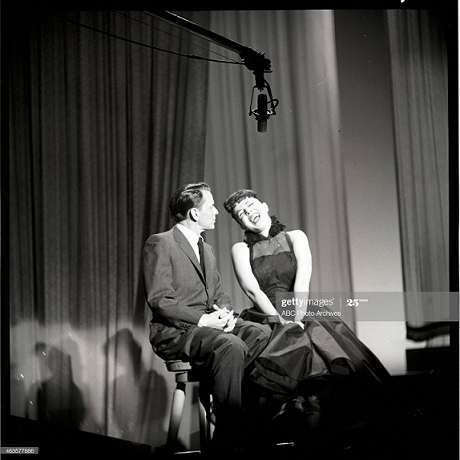
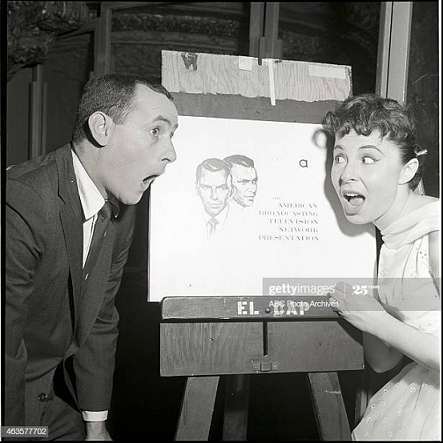
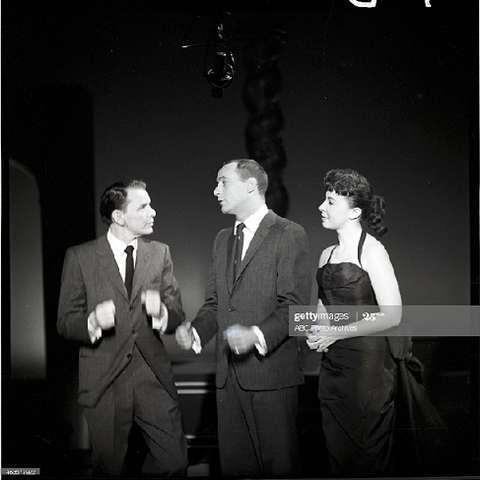
March 15, 1958
Concerts
Fontainebleau, Miami Beach, Florida (11-17)
Jack Stuart and his Orchestra
Also appearing: Maria Neglia & Sacasas and his Latin American Orchestra
Fontainebleau, Miami Beach, Florida (11-17)
Jack Stuart and his Orchestra
VARIETY REVIEW: FONTAINBLEAU MARCH 15, 1958:
note: Frank's first engagement at the
La Ronde Room of the Fontainbleau,
in Miami Beach. A far cry from his previous
appearance at the Beachcomber in February
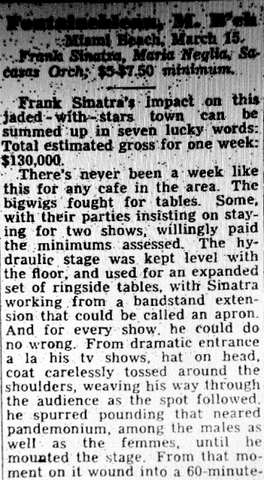
March 16, 1958
Concerts
Fontainebleau, Miami Beach, Florida (11-17)
Jack Stuart and his Orchestra
Also appearing: Maria Neglia & Sacasas and his Latin American Orchestra
March 17, 1958
Concerts
Fontainebleau, Miami Beach, Florida (11-17)
Jack Stuart and his Orchestra
Also appearing: Maria Neglia & Sacasas and his Latin American Orchestra
March 19, 1958
[Winchell on Fontainebleau crowds]
Walter Winchell: Walter Winchell's column reported the Fontainebleau was turning away over 300 people at every Sinatra show, quoting Frank calling the crowd of "sports and their ladies, gamblers and gonniffs" his kind of people.
Source: James Kaplan, "Sinatra: The Chairman" (2015).
Frank starred in the first of Dean Martin's four Timex specials on NBC, among the earliest shows recorded on videotape rather than kinescope film.
Source: Nancy Sinatra, Frank Sinatra: An American Legend, 1995.
The FCC approved Frank's Essex Corporation's purchase of three radio stations in Portland, Seattle, and Spokane for $2 million.
Source: Nancy Sinatra, Frank Sinatra: An American Legend, 1995.
March 21, 1958
Television
Frank Sinatra Show
Network: ABC
Show #23
Sponsors: Chesterfield Cigarettes, Bulova Watch Company
Drama: "The Man On The Stairs"
Host Frank Sinatra
Starring: Marisa Pavan, Michael Rennie
March 25, 1958
Frank Sinatra abruptly canceled plans to attend a Sugar Ray Robinson fight in Chicago with Lauren Bacall — one of several engagements he called off as he retreated from public view after their still-secret engagement leaked to columnist Louella Parsons. Furious and already having second thoughts about the marriage, encouraged toward caution by his new attorney Mickey Rudin, Sinatra told Bacall they needed to “lay low” — the beginning of a cold, unexplained withdrawal that effectively ended the engagement without either of them ever formally calling it off. Source: J. Randy Taraborrelli, Sinatra: Behind the Legend.
March 28, 1958
Television
Frank Sinatra Show
Network: ABC
Time: 9:00 PM - 9:30 PM
Show #24
Sponsors: Chesterfield Cigarettes, Bulova Watch Company
Guests: Eddie Fisher
1. Taking A Chance On Love F.S.
2. I Wish I Were In Love Again E.F.
3. Time After Time F.S.
4. You Are Too Beautiful E.F.
5. Medley of Hits E.F. & F.S.
6. It's Nice To Go Trav'ling E.F.. & F.S.
7. A Foggy Day F.S.
Note: song-list supplied by Ed O'Brien
Shemmy Mashiah:
Have never seen this show Is it available somewhere?
Dick Schwarz:
Don't know this show,
Ed O'Brien:
No complete video. There is an excellent audio in circulation.
Brian Chearno:
Update, Show is in circulation.
Frank Sinatra Show
Guests: Eddie Fisher
March 29, 1958
Concerts
Palm Springs, California
Benefit for Police Department
Performers: Frank Sinatra, Peggy Lee, Dean Martin,
Eddie Cantor, Cyd Charisse, Ritz Brothers,
Tony Martin, Marilyn Maxwell, Phil Harris, Rose Marie
April 1958
[Sinatra publicly freezes out Bacall]
Lauren Bacall: About a month after the breakup, at a party hosted by Bill and Edie Goetz, Sinatra sat near Bacall at dinner but never acknowledged her, looking through her as if her chair were empty, leaving her humiliated.
Source: James Kaplan, "Sinatra: The Chairman" (2015)
April 2, 1958
[Winchell reports on Ava statue]
Walter Winchell: Walter Winchell's column, filed while traveling with Sinatra, reported that Frank kept a nude statue of Ava Gardner (a prop from The Barefoot Contessa) on the lawn of his Coldwater Canyon house.
Source: James Kaplan, "Sinatra: The Chairman" (2015).
April 4, 1958
Television
Frank Sinatra Show
Network: ABC
Show #25
Sponsors: Chesterfield Cigarettes, Bulova Watch Company
Guests: Spike Jones, Helen Greco
Nelson Riddle conducting 27 piece ABC Orchestra
1. You Brought A New Kind Of Love To Me
2. All The Way/ Tammy/ You Don't Know What Love Is Helen Greco
3. Baby, Won't You Please Come Home
4. Chloe with Spike & His Gang
5. Too Marvelous For Words
6. Put Your Dreams Away
Ed O'Brien:
Frank also sang a comedy duet of "Chloe" with Spike & His Gang.
Frank Sinatra Show
Network: ABC
Show #25
Sponsors: Chesterfield Cigarettes, Bulova Watch Company
Guests: Spike Jones, Helen Greco
Spike
Jones
Frank
Helen Greco
Walter Winchell
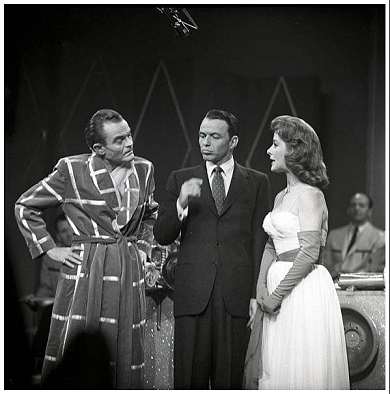
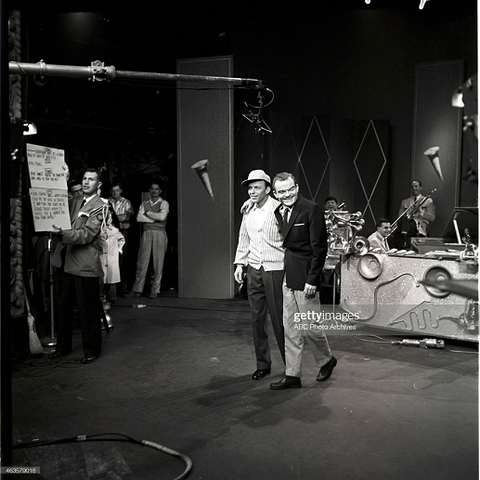
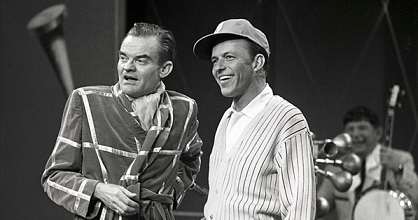
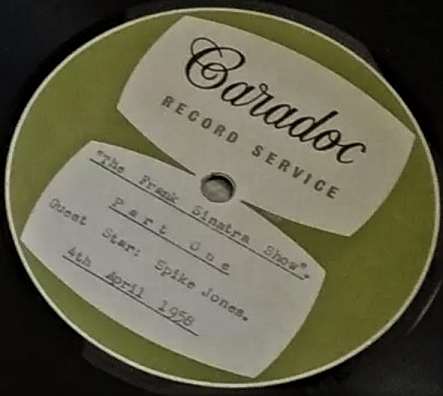
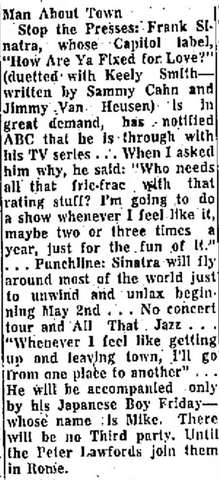
note: William Self, producer of the show, could not understand why Frank
had any interest in a three year contract with ABC-TV. Self knew
Frank was far too busy and far too impatient to devote the time
to such an onerous project. Same day as the Winchell column,
there was an announcement that ABC was toying with the idea
of having Frank do a bi-weekly hour show and having Sid Caesar's
show as the other bi-weekly entry.
This would have been for the
59 season. Eventually, Frank reached an agreement with the
network to do four hour specials during the 1959-60 season. We
can only guess how much of the
$3,000,000 Frank received for
his one full season, in 57-58, and the four specials.
Ed
April 9, 1958
Concerts
Sands, Las Vegas, Nevada (April 9-27)
Opening Act: Bennett & Patterson
Two shows a night
Sands, Las Vegas, Nevada (April 9-27)
Opening Act: Bennett & Patterson
Two shows a night
Variety 4/15/58 review
Brigitte was a no show. The death of Mike Todd, in a plane crash, 3/22, rein-
forced her fear of flying.
Frank was set to be Winchell's partner at a golf tournament in Vegas for the
Damon Runyon Cancer Fund. The match play had them facing Crosby and
Hope. Date was 4/23.
Frank's daughter, Nancy, joined her father at the Sands for the second week-
end of the engagement ( 19/20 ). They sang a song together at one of the
shows.
--ED
April 10, 1958
Concerts
Sands, Las Vegas, Nevada (April 9-29)
Opening Act: Bennett & Patterson
Two shows a night
April 11, 1958
Concerts
Sands, Las Vegas, Nevada (April 9-29)
Opening Act: Bennett & Patterson
Two shows a night
April 12, 1958
Concerts
Sands, Las Vegas, Nevada (April 9-27)
Opening Act: Bennett & Patterson
Two shows a night
April 13, 1958
Concerts
Sands, Las Vegas, Nevada (April 9-27)
Opening Act: Bennett & Patterson
Two shows a night
April 14, 1958
Concerts
Sands, Las Vegas, Nevada (April 9-27)
Opening Act: Bennett & Patterson
Two shows a night
April 15, 1958
Concerts
Sands, Las Vegas, Nevada (April 9-29)
Opening Act: Bennett & Patterson
Two shows a night
April 16, 1958
Concerts
Sands, Las Vegas, Nevada (April 9-29)
Opening Act: Bennett & Patterson
Two shows a night
April 17, 1958
Concerts
Sands, Las Vegas, Nevada (April 9-29)
Opening Act: Bennett & Patterson
Two shows a night
April 18, 1958
Television
Frank Sinatra Show
Network: ABC
Show #26
Sponsors: Chesterfield Cigarettes, Bulova Watch Company
Drama: "The Brownstone Indicent"
Starring: Frank Sinatra, Cloris Leachman, Anne Seymour
Notes: There was no show April 11, 1958
Ed O'Brien:
Sinatra-Leachman portrayed a married couple arguing over an apartment.
The 1-17-58 show with Louie Prima & Keely Smith was rerun on 4-11-58
Concerts
Sands, Las Vegas, Nevada (April 9-29)
Opening Act: Bennett & Patterson
Two shows a night
Frank Sinatra Show
Network: ABC
Show #26
Sponsors: Chesterfield Cigarettes, Bulova Watch Company
Drama: "The Brownstone Indicent"
Starring: Frank Sinatra, Cloris Leachman, Anne Seymour
Notes: There was no show April 11, 1958
Ed O'Brien:
Sinatra-Leachman portrayed a married couple arguing over
an apartment.
Sinatra and Cloris Leachmen
APRIL 18, 1962 SINATRA'S ARRIVAL IN
TOKYO
Thanks to Ed O. for the above photo
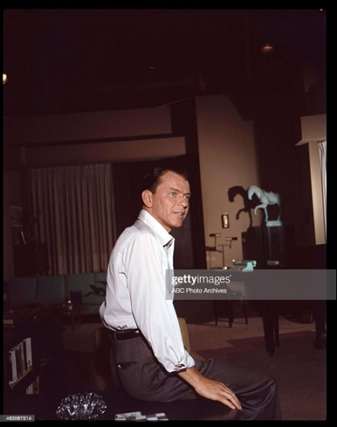
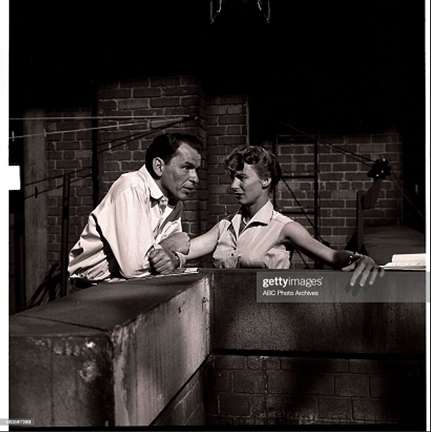
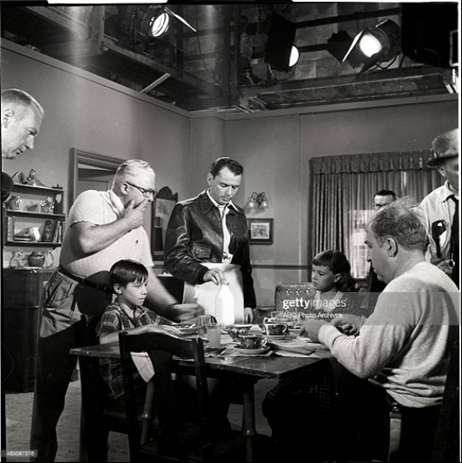
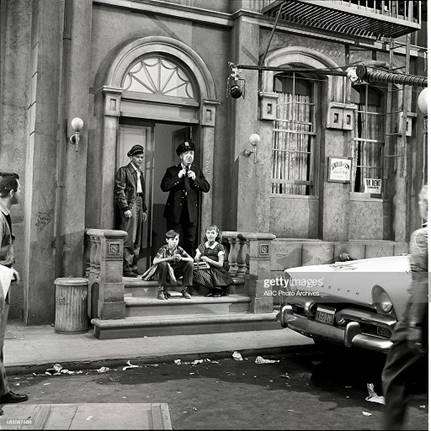
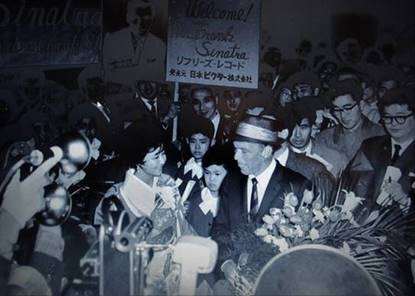
April 19, 1958
Concerts
Sands, Las Vegas, Nevada (April 9-29)
Opening Act: Bennett & Patterson
Two shows a night
Sands, Las Vegas, Nevada (April 9-29)
Opening Act: Bennett & Patterson
Two shows a night
April 1958
"Las Vegas: Frank Sinatra's voice, poise and other song-magic were never in such rare form (at) the Sands Hotel stage, where Jack Entratter's girl show is always delicious … A large pattycake to Annttonio Morelli and his crew, who conducts Frank's sweet-and-sad love songs … On the same bill is a new team titled Bennett & PatterssonÂthe most refreshing and amusing male duet since Martin & Lewis"- 4/17/58
Review
Variety
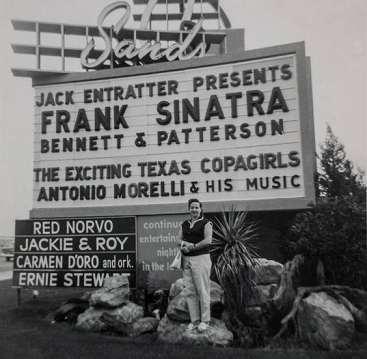
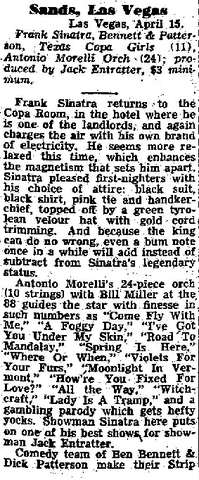
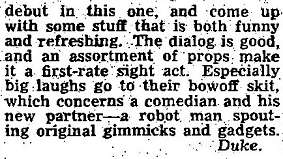
note: A bit of a mystery: Nat Cole closed at the Sands on Friday, 4/3/58.
Frank is credited with opening on 4/9. Was the Sands dark that
weekend ? Frank closed on 4/27 and Danny Thomas opened on
4/29.
Ed
I checked the Las Vegas Review Journal and they had Nat Cole closing on the 8th and Sinatra opening on the 9th.
Here's he Ad from the 8th:
--Scott
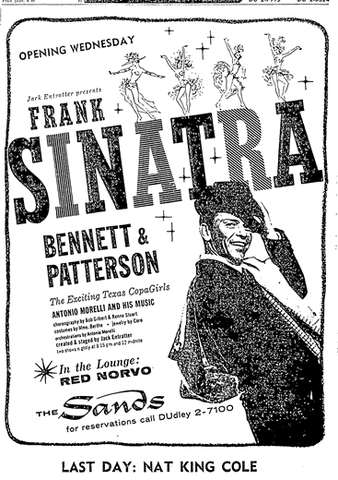
April 20, 1958
Concerts
Sands, Las Vegas, Nevada (April 9-29)
Opening Act: Bennett & Patterson
Two shows a night
April 21, 1958
Concerts
Sands, Las Vegas, Nevada (April 9-29)
Opening Act: Bennett & Patterson
Two shows a night
April 22, 1958
Concerts
Sands, Las Vegas, Nevada (April 9-29)
Opening Act: Bennett & Patterson
Two shows a night
April 23, 1958
Concerts
Sands, Las Vegas, Nevada (April 9-29)
Opening Act: Bennett & Patterson
Two shows a night
April 24, 1958
Concerts
Sands, Las Vegas, Nevada (April 9-29)
Opening Act: Bennett & Patterson
Two shows a night
April 25, 1958
Television
Frank Sinatra Show
Network: ABC
Show #27
Sponsors: Chesterfield Cigarettes, Bulova Watch Company
Guests: Ethel Merman, Jesse White
1. Your Getting To Be A Habit With Me
2. I Get A Kick Out Of You
3. Just One Of Those Things
4. You're The Top w/Ethel Merman
Notes: Merman opened this show with "Zing! Went the Strings of My Heart." Sinatra Scholar Ed O'Brien says FAS and Merman enjoyed working together and they do a terrific send-up of the Edward R. Morrow "Person to Person" interview show. They also do a duet on the Cole Porter classic "You're The Top."
Concerts
Sands, Las Vegas, Nevada (April 9-29)
Opening Act: Bennett & Patterson
Two shows a night
Frank Sinatra Show
Network: ABC
Show #27
Sponsors: Chesterfield Cigarettes, Bulova Watch CompanyGuests: Ethel
Merman, Jesse White
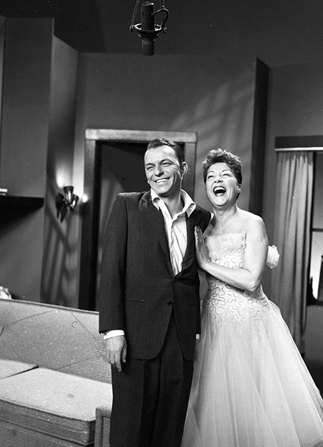
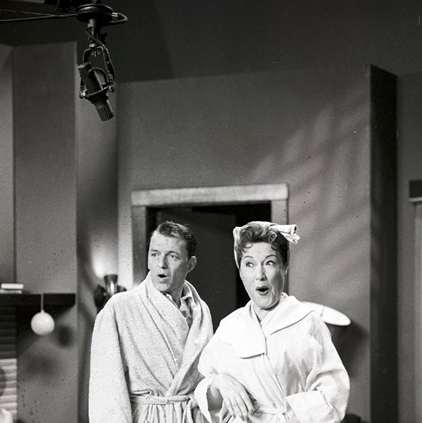
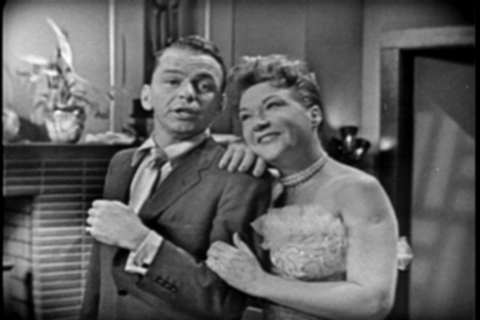
April 26, 1958
Concerts
Sands, Las Vegas, Nevada (April 9-29)
Opening Act: Bennett & Patterson
Two shows a night
April 27, 1958
Concerts
Sands, Las Vegas, Nevada (April 9-29)
Opening Act: Bennett & Patterson
Two shows a night
April 28, 1958
Concerts
Sands, Las Vegas, Nevada (April 9-29)
Opening Act: Bennett & Patterson
Two shows a night
April 29, 1958
Concerts
Sands, Las Vegas, Nevada (April 9-29)
Opening Act: Bennett & Patterson
Two shows a night
May 1958
[Granz and Sinatra clash on Frank's TV show]
Lou Levy: When Ella Fitzgerald guest-starred on Sinatra's ABC television show (in one account May 1958, in another the December 1959 Timex special), her manager Norman Granz accompanied her and began suggesting duet numbers; Sinatra, resenting the interference, had Granz thrown out of the studio. Pianist Lou Levy recalled that neither man would ever be 'on top' of the other.
Source: James Kaplan, "Sinatra: The Chairman" (2015)
[Riddle's personal grief during Only the Lonely]
Nelson Riddle: While arranging Only the Lonely, Nelson Riddle was mourning his infant daughter's recent death and watching his mother die of terminal cancer; he told Jonathan Schwartz that house-painting served as therapy, offsetting the small, jerky motions of arranging with long sweeping strokes.
Source: James Kaplan, "Sinatra: The Chairman" (2015)
[Sinatra cancels Asia trip]
Kaplan: Tired out after two weeks of standing-room-only double shows at the Sands, Sinatra canceled a planned trip to the Far East and Monte Carlo (with Peter and Pat Lawford) in early May, announcing instead that he would rest in Palm Springs. The cancellation spawned rumors of a Bacall reconciliation, a Lawford rift, and a throat hemorrhage.
Source: James Kaplan, "Sinatra: The Chairman" (2015)
[Some Came Running deal announced]
Kaplan: Sinatra announced that his first film under a new three-picture MGM deal would be an adaptation of James Jones's novel Some Came Running, which he was also co-producing; he stipulated that Dean Martin, his frequent running mate, would co-star.
Source: James Kaplan, "Sinatra: The Chairman" (2015)
May 5, 1958
Studio
Capitol Studio A, Hollywood
E18953 Guess I'll Hang My Tears Out To Dry
Arranged & Conducted by Nelson Riddle
(S. Cahn/J. Styne)
Chappell Music (ASCAP)
Arranged & Conducted by Nelson Riddle
CD: The Ultimate Sinatra 4CD (2015)
CD: Capitol B0028411 - 02 "Only The Lonely" 60th Anniversary
Ed O'Brien:
There was only one take done on the Cahn/Styne classic.
The recording, such as it is, was finally issued last year on the "Ultimate Sinatra" deluxe set. If you listen carefully, you'll hear Frank's voice break twice during the song.
E18954 Ebb Tide (N/R)
(R. Maxwell/C. Sigman)
SBK Robbins Catalog Inc. (ASCAP)
Arranged & Conducted by Nelson Riddle
E18955 Angel Eyes
(M. Dennis/E. Brent)
Bradshaw Music, Inc. (BMI)
Arranged & Conducted by Nelson Riddle
CD: Capitol B0028411 - 02 "Only The Lonely" 60th Anniversary
Note: "Angel Eyes" was released in its entirety on the 60th anniversary issue of "Only The Lonely."
I mean by entirety all nine takes. "Guess I'll Hang My Tears Out To Dry" was also included. There is a funny moment between Cahn and Sinatra before Frank sang that song.. --Ed
NOTE: Guitarist Al Viola told Sinatra Scholar Ed O'Brien that there were problems at this session with the difficult chords Nelson Riddle had written for the guitar.
Sinatra wasn't happy with the sound and, at the next session (May 29), Al himself became the guitar player and would play on most of Sinatra's sessions for the next 22 years.
"It Never Entered My Mind" / "Guess I'll Hang My Tears Out to Dry" / "Have Yourself a Merry Little Christmas" In contrast, he communicates rich, multilayered emotional states in “It Never Entered My Mind,” one of the most subtle torch songs ever written, and “Guess I’ll Hang My Tears Out to Dry.” Even a “simple” Christmas song becomes a vehicle for emotional depth: he elevates “Have Yourself a Merry Little Christmas” into an enticingly complex happy-sad ode that can stand beside Judy Garland’s iconic version from Meet Me in St. Louis. In “Guess I’ll Hang My Tears,” lyricist Cahn presents us with a protagonist who is determined not to show the world his pain. He feebly attempts to distract us from it with a series of deliberately cheap-shot jokes, beginning with a title that equates love with laundry, deploying humor as a Woody Allen character might—as a defense mechanism. Does it work? The ruse only serves to magnify the intensity of his anguish. Sinatra would do better by “Tears” on the Only the Lonely album (with Al Viola’s guitar taking the place of the harp), but even by 1946, Sinatra, at the age of thirty, is already a master.
Source: Will Friedwald, "Sinatra! The Song Is You: A Singer's Art" (2018 revised edition).
"Only the Lonely"
Unlike the usual three-consecutive-night recording schedule, Only the Lonely was recorded across four sessions spread over a month and a half. The first, on May 5, 1958 in Studio A at the Capitol Tower, yielded 'Guess I'll Hang My Tears Out to Dry,' 'Ebb Tide,' and 'Angel Eyes,' but Sinatra deemed the results unacceptable and had them re-recorded later.
Source: Charles L. Granata, "Sessions with Sinatra: Frank Sinatra and the Art of Recording" (1999/2003).
"Guess I'll Hang My Tears Out to Dry"
Al Viola: Guitarist Al Viola recalled that on the May 5, 1958 take of 'Guess I'll Hang My Tears Out to Dry,' George Van Eps struggled with a difficult low F-sharp pedal-point guitar figure Riddle had written; the song was re-recorded May 29 with Viola instead, who solved the same passage by retuning his low E string up to F-sharp so it could ring open rather than be fingered.
Source: Charles L. Granata, "Sessions with Sinatra: Frank Sinatra and the Art of Recording" (1999/2003).
"Guess I'll Hang My Tears Out to Dry"
Granata includes 'Guess I'll Hang My Tears Out to Dry' among the fifty recordings he considers essential to understanding Sinatra's artistry (arranged by Nelson Riddle, recorded 1958, Capitol); the song was chosen for its musical/interpretive value rather than commercial popularity.
Source: Charles L. Granata, "Sessions with Sinatra: Frank Sinatra and the Art of Recording" (1999/2003).
[False-start Only the Lonely session]
On the night of May 5, Sinatra and a 38-piece orchestra recorded "Guess I'll Hang My Tears Out to Dry," "Ebb Tide," and "Angel Eyes" for Only the Lonely, but the takes were scrapped after Sinatra objected to the guitar accompaniment; it turned out Riddle had written chords too difficult for guitarist George Van Eps to play, requiring a rewrite.
Source: James Kaplan, "Sinatra: The Chairman" (2015).
[Discarded recording session]
A recording session on this date was scrapped, likely due to Nelson Riddle's awkward arrangement writing for guitar and possibly also Sinatra's insufficiently recovered vocal cords.
Source: James Kaplan, "Sinatra: The Chairman" (2015).
[Angel Eyes -- critical commentary]
Frank Sinatra (spoken intro, paraphrased by Friedwald): Friedwald discusses Sinatra's standard spoken monologue before 'Angel Eyes' -- a lonely drunk who, after days of solitary drinking following a breakup, stumbles into a bar not for the liquor but to talk to somebody, wanting no answers, just an ear. Friedwald uses this to argue Sinatra never offered wisdom to listeners, only empathy, positioning himself as a fellow sufferer (like Billie Holiday) rather than a guru (like Mabel Mercer).
This song/context matches multiple dated entries in the chronology; the specific date Friedwald is referring to could not be determined with confidence.
Source: Will Friedwald, "Sinatra! The Song Is You: A Singer's Art" (2018 revised edition), Ch. 1, "Night and Day" (Sinatra style overview)
[Angel Eyes / One for My Baby / The Lady Is a Tramp / At Long Last Love / All of Me / I've Got You Under My Skin / Mandalay / Night and Day -- critical commentary]
Red Norvo; Jerry Dodgion: Friedwald calls the taped Melbourne concert (released 1997) 'by far the most important live recording of Sinatra from the Capitol era,' with Sinatra offering a more aggressive brand of jazz singing anticipating his 1960s Basie albums. Highlights include intimate duo readings of 'Angel Eyes' and 'One for My Baby' (just Sinatra and Bill Miller), swinging 'The Lady Is a Tramp' and 'At Long Last Love,' and 'All of Me' performed with Norvo, whose earlier work inspired the Riddle arrangement on Swing Easy. On 'I've Got You Under My Skin' Sinatra ad-libs 'Get your hand off that broad!' in homage to Fats Waller. Norvo: 'I don't think he ever sang any better in his life than on that tape... he was right on top of everything we were doing. He just melted into it... He gave us the feeling he was part of the group.' Jerry Dodgion noted the small-group format let Sinatra vary programs nightly: 'He could be different every night, which is more in keeping with a jazz group.'
This song/context matches multiple dated entries in the chronology; the specific date Friedwald is referring to could not be determined with confidence.
Source: Will Friedwald, "Sinatra! The Song Is You: A Singer's Art" (2018 revised edition), Ch. 9, "Looking for the Hook" (1960-1971)
May 9, 1958
Television
Frank Sinatra Show
Network: ABC
Show #28
Sponsors: Chesterfield Cigarettes, Bulova Watch Company
Guests: Ella Fitzgerald
Notes: There was no show May 2, 1958.
NOTE: Ed O'Brien calls this Frank's finest half-hour on television. He opened with "Jeepers Creepers" and, after a commercial, he introduced Ella. She did "April in Paris" and Frank sand "On the Road to Mandalay." After another commercial break, Ella sang "Angel Eyes" and Frank outsang Frank on "We'll Be Together Again." The latter is better than the Capitol recording. Ella sang "When You're Smiling" before joining Sinatra for a sensational "Moonlight in Vermont." They were backed by Lou Levy on piano and a small jazz group. They closed the show with "I May Be Wrong," "Party Blues," and Ella joined in as Frank sang "Put Your Dreams Away." One can only wonder how well the series would have don if the guests had been Nat Cole, June Christy, Sarah Vaughn, Mel Torme, the Four Freshmen, Billie Holiday.
note: At the conclusion of this show, Frank returned to the stage and lauded Ella. He told the studio audience how truly great a singer the First Lady of Song truly was in his opinion.
--ED
May 11, 1958
May 16, 1958
Television
Frank Sinatra Show
Network: ABC
Show #29
Sponsors: Chesterfield Cigarettes, Bulova Watch Company
Drama: "The Green Grass Of St. Terese"
Host: Frank Sinatra
Starring: Wally Cox, Frank Albertson, Tim Butler, Anne Barton,
May 23, 1958
Television
Frank Sinatra Show
Network: ABC
Show #30
Sponsors: Chesterfield Cigarettes, Bulova Watch Company
Guests: Pat Suzuki, Natalie Wood
1. Night And Day
2. Lonely Town
3. I Believe
4. Them There Eyes - Frank and Natalie
5. How Are You Fixed For Love
NOTE: This was the last of the half-hour musicals from the 1957-58 ABC series, Ed O'Brien points out.
After "Night and Day," Sinatra introduces Pat Suzuki who sings Cole Porter's "From This Moment On" and then returns the favor by announcing that Sinatra will sing "Lonely Nights." Obviously he didn't know the song because he sang "Lonely Town" instead. Suzuki then sang "Something's Gotta' Give," Sinatra did a very nice "I Believe," and then Natalie Wood joined him with a very tongue-in-cheek bit on Hollywood's leading men. Sinatra closed the show and the series with a dynamite reading of "How Ya' Fixed for Love," which O'Brien prefers to the duet done with Keely Smith.
Frank Sinatra Show
Network: ABC
Show #30
Sponsors: Chesterfield Cigarettes, Bulova Watch Company
Guests: Pat Suzuki, Natalie Wood
1. Night And Day
2. Lonely Town
3. I Believe
4. Them There Eyes - Frank and Natalie
5. How Are You Fixed For Love
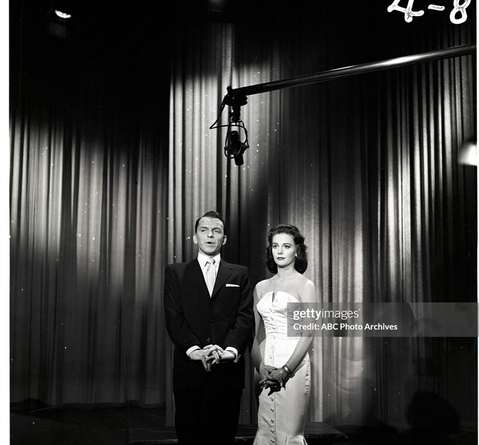
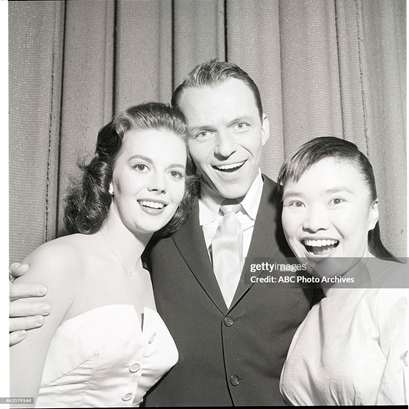
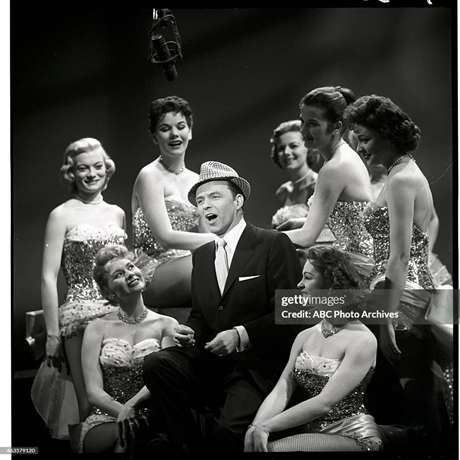
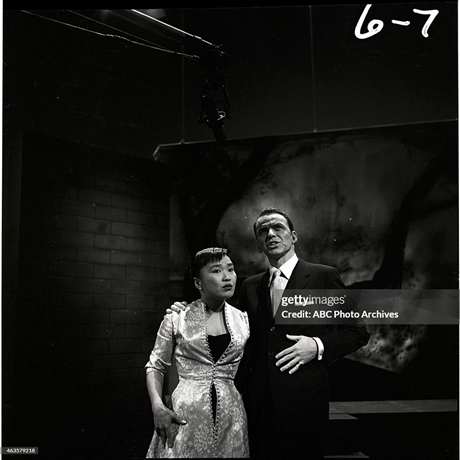
[Last musical Sinatra Show episode airs]
The final musical installment of The Frank Sinatra Show aired, with guests Natalie Wood and Pat Suzuki.
Source: James Kaplan, "Sinatra: The Chairman" (2015).
May 29, 1958
Studio
Capitol Studio A, Hollywood
E19239 Monique
(from the film "Kings Go Forth"ť)
(S. Cahn/E. Bernstein)
Arranged & Conducted by Felix Slatkin
CD: C2 724383808922 The Complete Capitol Singles
LP: SW1729 Sinatra Sings Of Love And Things
45: 4003
E19240 Ebb Tide
(R. Maxwell/C. Sigman)
SBK Robbins Catalog Inc. (ASCAP)
Arranged by Nelson Riddle
Conducted by Felix Slatkin
-4 (3:18) CD: C2-94777 The Capitol Years
CD: CDP 7-48471-2 Only The Lonely
CD: Frank Sinatra Sings For Only The Lonely (60th Anniversary Edition) Capitol Records B0028602-02
LP: SW1053 Only The Lonely
E19241 Angel Eyes
(M. Dennis/E. Brent)
Bradshaw Music, Inc. (BMI)
Arranged by Nelson Riddle
Conducted by Felix Slatkin
-3 (3:44) CD: C2-94777 The Capitol Years
CD: CDP 7-48471-2 Only The Lonely
CD: Frank Sinatra Sings For Only The Lonely (60th Anniversary Edition) Capitol Records B0028602-02
LP: SW1053 Only The Lonely
E19242 Spring Is Here
Arranged by Nelson Riddle
Conducted by Felix Slatkin
CD: CDP 7-48471-2 Only The Lonely
CD: Frank Sinatra Sings For Only The Lonely (60th Anniversary Edition) Capitol Records B0028602-02
LP: W1053 Only The Lonely
E19255 Guess I"ll Hang My Tears Out To Dry
(S. Cahn/J. Styne)
Chappell Music (ASCAP)
Arranged by Nelson Riddle
Conducted by Felix Slatkin
-4 (3:59) CD: CDP 724383595228 Sinatra 80th "All The Best"
CD: C2-94777 The Capitol Years
CD: CDP 7-48471-2 Only The Lonely
CD: Frank Sinatra Sings For Only The Lonely (60th Anniversary Edition) Capitol Records B0028602-02
LP: SW1053 Only The Lonely
E19256 Only The Lonely
(Sammy Cahn/Jimmy Van Heusen)
Maraville Music Corp./Cahn Music Co. (ASCAP)
Arranged by Nelson Riddle
Conducted by Felix Slatkin
-9 (4:31) CD: C2-94777 The Capitol Years
CD: CDP 7-48471-2 Only The Lonely
CD: Frank Sinatra Sings For Only The Lonely (60th Anniversary Edition) Capitol Records B0028602-02
LP: SW1053 Only The Lonely
E19257 Lush Life
Arranged by Nelson Riddle
Conducted by Felix Slatkin
Incomplete 4:04
CD: Frank Sinatra Sings For Only The Lonely (60th Anniversary Edition) Capitol Records B0028602-02
E19258 Willow Weep For Me
(Ann Ronell)
Arranged by Nelson Riddle
Conducted by Felix Slatkin
-2 CD: CDP 7-48471-2 Only The Lonely
CD: Frank Sinatra Sings For Only The Lonely (60th Anniversary Edition) Capitol Records B0028602-02
LP: SW1053 Only The Lonely
Musicians - Trumpet: Pete Candoli; Trombones: Milton Bernhart, Tommy Pederson, Kenneth Shroyer; French Horns: John Cave, James Decker, Vincent DeRosa; Clarinet: Mahlon Clark, Mitchell Lurie; Bassoons: Don Christlieb, Jack Marsh; Oboes: Arnold Koblentz, Warren Webb; Bass Clarinet: Charles Buttler, Chuck Gentry; Flute: Arthur Gleghorn, Harry Klee; Violins: Victor Arno, Israel Baker, Victor Bay, Alex Beller, Arnold Belnick, David Frisina, James Getzoff, Henry Hill, Daniel Karpilkowsky, Erno Neufeld, Paul Shure, Marshall Sosson; Violas: Alvin Dinkin, Stanley Harris, Paul Robyn, David Sterkin; Cellos: James Arkatov, Armand Karproff, Kurt Reher, Eleanor Slatkin; Piano: Bill Miller, Harry Sukman; Bass: Joe Comfort, Mike Rubin; Guitar: Al Viola; Percussion: Frank Flynn, Bill Richmond; Accordion: Dominic Frontiere; Harp: Kathryn Julye
Session Producer: Dave Cavanaugh
NOTE: Sinatra Scholar Ed O"Brien feels that this is probably the single most talked about session of Sinatra"s career. The first part got under way at 2 p.m. and ran until 5 p.m. in the afternoon. Sinatra recorded "Monique," "Ebb Tide," "Angel Eyes," and "Spring is Here."
The second part ran 3 hours, from 8:30 p.m. to 11:30 p.m. He recorded "Guess I"ll Hang My Tears Out to Dry," Only the Lonely," "Lush Life" (three incomplete takes), and "Willow Weep for Me" (five takes).
O"Brien has interviewed a number of musicians who worked on the sessions. Much to his amazement they said that Sinatra was not in good voice through much of the afternoon and evening. He had to struggle mightily to get it right. But get it right he did. Certainly an argument could be made that they are all definitive recordings. Four of the songs would be sung in concert many times through the years.
Sinatraphile Vance Adair observes that it is quite extraordinary to reflect that the "Only The Lonely" sessions found Sinatra in less than perfect voice. He certainly hangs on consonants a little longer than he otherwise would do in these sessions and yet this approach seems entirely simpatico with the emotional texture of the album.
Sinatraphile Jim White calls attention to the recently-released Mobile Fidelity Sound Lab "Original Master Recording" of "Frank Sinatra Sings for Only The Lonely." It is UDCD 792. It is a " 24-karat gold" disc using the Ultradisc !! process. It is not in the above listing of recordings but can be obtained from those selling cds A great reproduction of this music.
Ed O'Brien
For years I have been told by people who worked with Sinatra, that "Lush Life" would have been done if ONLY Riddle had been at the session. The most convincing of all who told me was Mr Riddle himself. He assured me it would have been done. Maybe not at that session, but it certainly would have been on the album. Riddle told me that Frank and he had often encountered problems similar to "Lush Life," and a rewrite solved the problem.
But where was Riddle? How could he skip an important Sinatra recording date? Well, I've learned he was touring with Nat King Cole. On the evening in question, they played the Orpheum Theatre in Seattle. Wally Heider recorded the show for posterity. Nat Cole and Riddle had become very close friends and loved working together. Riddle and Sinatra never had that kind of rapport. So - - a close friendship trumped a recording session in late May of 1958.
Note: The 4:04 incomplete session for Lush Life was finally issued on the CD: Frank Sinatra Sings For Only The Lonely (60th Anniversary Edition) Capitol Records B0028602-02
--Scott
"Monique" / "Lush Life"
Friedwald argues Sinatra deliberately scheduled the toughest, most tempo-free charts for the Slatkin-conducted date, making May 29 a double session (2:00-5:00pm, then 8:30-11:30pm) to bank the hardest numbers while he had a tactful excuse to avoid Riddle as conductor. Eight songs were run down that day: six used on Only the Lonely, plus 'Monique' (Elmer Bernstein theme, lyric by Cahn, arrangement credited to Slatkin, from Kings Go Forth), and one unissued track, 'Lush Life.' A footnote cites discographer Luiz Carlos do Nascimento Silva's claim that 'Lush Life' was attempted as Capitol master E 19257, but after three takes the matrix number was reassigned to 'Sleep Warm,' recorded September 11, 1958.
Source: Will Friedwald, "Sinatra! The Song Is You: A Singer's Art" (2018 revised edition).
"Lush Life"
Bill Miller; Nelson Riddle; Frank Sinatra: Sinatra attempted Strayhorn's difficult ballad with a Nelson Riddle chart pairing Bill Miller's deliberately out-of-tune piano against Copland-esque strings, but abandoned it. Bill Miller said this was the only time in years of interviews he ever accused Sinatra of being unprepared: 'Frank didn't take the trouble to learn it properly.' Riddle said, 'It's a rather complicated song, and I think Frank would have been momentarily put off by all the changes that had to go on... Not that he couldn't have sung it with ease and beautifully had he tried a couple more times.' On the surviving partial take, Sinatra gets through the out-of-tempo verse but breaks down in the refrain, jokes in a 'Kingfish' voice (from Amos 'n' Andy) that he'll 'put that one aside for about a year,' and later told Miller he'd 'leave that one for Nat Cole.'
Source: Will Friedwald, "Sinatra! The Song Is You: A Singer's Art" (2018 revised edition).
"Only the Lonely"
At the May 29, 1958 Only the Lonely session -- conducted by Felix Slatkin rather than an absent Nelson Riddle, who was on tour with Nat Cole -- Sinatra completed seven full songs, more than double a normal three-hour session's yield, to make up for the discarded May 5 material.
Source: Charles L. Granata, "Sessions with Sinatra: Frank Sinatra and the Art of Recording" (1999/2003).
"Lush Life"
An eighth song attempted at the marathon May 29, 1958 session, Billy Strayhorn's 'Lush Life,' was left incomplete after three partial takes; surviving tapes capture Sinatra struggling with its difficult, out-of-meter structure and abandoning it for 'Willow Weep for Me' instead.
Source: Charles L. Granata, "Sessions with Sinatra: Frank Sinatra and the Art of Recording" (1999/2003).
"Willow Weep for Me"
Granata includes 'Willow Weep for Me' among the fifty recordings he considers essential to understanding Sinatra's artistry (arranged by Nelson Riddle, recorded 1958, Capitol); the song was chosen for its musical/interpretive value rather than commercial popularity.
Source: Charles L. Granata, "Sessions with Sinatra: Frank Sinatra and the Art of Recording" (1999/2003).
[Major Only the Lonely session]
On May 29, with Nelson Riddle in London and first violinist Felix Slatkin conducting in his place, Sinatra recorded six songs and part of a seventh for Only the Lonely, including "Monique" (from Kings Go Forth), the re-recorded May 5 numbers, the title song, "Spring Is Here," and "Willow Weep for Me."
Source: James Kaplan, "Sinatra: The Chairman" (2015).
[Sinatra abandons "Lush Life"]
During the May 29 session, Sinatra attempted Billy Strayhorn's difficult "Lush Life" but abandoned it partway through the third take, barking "Hol' it!" and joking about the song's tricky range before telling Slatkin to "put it aside for about a year"; he never attempted the song again.
Source: James Kaplan, "Sinatra: The Chairman" (2015).
[Only the Lonely -- critical commentary]
Sinatra and Riddle regarded 1958's Only the Lonely, a companion to Close to You built around aching, understated ballad orchestrations with sparing woodwind and brass color, as among the finest work of their partnership.
This song/context matches multiple dated entries in the chronology, or lacked a sufficiently precise date; the specific date could not be determined with confidence.
Source: Charles L. Granata, "Sessions with Sinatra: Frank Sinatra and the Art of Recording" (1999/2003), Part III: The Capitol Years, 1953-1962
[Only the Lonely -- critical commentary]
Nelson Riddle: Riddle told Jonathan Schwartz that his mother's death from cancer (she was hospitalized at Sinai Hospital) during the making of Only the Lonely, along with the earlier loss of a daughter, contributed to the album's somber mood; he said painting his house was a therapeutic counterbalance to the small, precise motions of arranging.
This song/context matches multiple dated entries in the chronology, or lacked a sufficiently precise date; the specific date could not be determined with confidence.
Source: Charles L. Granata, "Sessions with Sinatra: Frank Sinatra and the Art of Recording" (1999/2003), Part III: The Capitol Years, 1953-1962
[Only the Lonely / In the Wee Small Hours -- critical commentary]
Frank Sinatra (to Ed Walker): Washington, DC deejay Ed Walker asked Sinatra in 1983 to name his favorite albums; Sinatra answered, 'The ones that stick in my mind are the ones where I think the orchestrator's work and my work came together closely, for instance, Only the Lonely, Wee Small Hours, and one of the jazz things with Billy May' -- then paused, unable to recall further titles. Friedwald notes the irony that fans have memorized these albums note for note while Sinatra himself had largely moved on.
This song/context matches multiple dated entries in the chronology; the specific date Friedwald is referring to could not be determined with confidence.
Source: Will Friedwald, "Sinatra! The Song Is You: A Singer's Art" (2018 revised edition), Ch. 1, "Night and Day" (Sinatra style overview)
May 30, 1958
Television
Frank Sinatra Show
Network: ABC
Show #31
Sponsors: Chesterfield Cigarettes, Bulova Watch Company
Drama: "A Face Of Fear"
Host: Frank Sinatra
Starring: Glynis Johns, Michael Pate, Katherine Warren
Ed O'Brien:
Last first run episode of the Frank Sinatra 1957-58 TV series.
Frank introduced the show and did the sign-off. The series would then re-run dramas through 6-27-58. The last show if you are counting reruns was a repeat of "The Feeling Is Mutual," which originally aired on 12-27-57 There were 22 musicals and 10 dramas. Twenty-one of the musical shows were aired. Frank and Peggy Lee taped a show that was never broadcast.
Nelson Riddle conducted a 27 piece ABC-TV band. Frank pre-recorded 62 songs for the shows. George Roberts told me Riddle had a tough time marrying the orchestra to Frank's vocals with a trio or just piano. If you watch some of the shows, there is some- times a little click that cued the orchestra on when to come in. There are a few of the pre-recordings with just the trio in circulation. Frank stood on a bare stage, one he has his foot on a ladder, and did the numbers. The background was all filled in during the show's taping. The first four half-hour musicals were done without an audience. A total ratings disaster. The 11-29-59 show with Dean Martin was done before an audience. But then there two dramas before the Christmas show with Crosby. Again, no audience. The show never recovered. Frank starred in four of the dramas: "That Man Hogan," 10-25-57, " A Gun At His Back," 12-6-57, "Take Me To Hollywood," 12-13-57" and "The Brownstone Incident," 4-18-58. William Self, show's producer, stated that Frank was much too busy doing films, recordings and nightclub appearances to star in a weekly TV series. No question Self was right.
June 1958
[Hedda Hopper confirms Rome reunion]
Hedda Hopper: Columnist Hedda Hopper wrote that Sinatra had indeed seen Ava Gardner in Rome and spent one evening with her, though she doubted the old flame was rekindled.
Source: James Kaplan, "Sinatra: The Chairman" (2015)
[Sinatra duets with Ella at the Copa]
Kaplan: Returning to Los Angeles for Nancy Jr.'s high school graduation via a New York stopover, Sinatra caught Ella Fitzgerald's set at the Copa and joined her onstage for a duet of "Moonlight in Vermont," a song they had recently performed together on a May episode of The Frank Sinatra Show, delighting a prom-night crowd.
Source: James Kaplan, "Sinatra: The Chairman" (2015)
[Sinatra lands in London for Monaco trip]
Kaplan: Sinatra arrived in London en route to Monaco, angrily rebuffing a reporter's shouted question about his relationship status with Lauren Bacall.
Source: James Kaplan, "Sinatra: The Chairman" (2015)
[Sinatra visits Ava Gardner in Rome]
Kaplan: Sinatra flew to Rome, ostensibly on a chance TWA encounter with Betty Furness but actually to see Ava Gardner, who was in Rome awaiting the start of filming on The Naked Maja and had specifically asked him to visit. Accounts of a dramatic ring-return scene at the Hotel Hassler (from biographer Lee Server and valet George Jacobs) are contradicted by timeline problems, since the supposed rival, Lady Adelle Beatty, did not enter Sinatra's life until that fall.
Source: James Kaplan, "Sinatra: The Chairman" (2015)
June 1, 1958
[Wire report of throat injury]
A wire-service report made front pages claiming Sinatra had suffered a ruptured blood vessel in his throat and was seriously ill at home, with a prominent New York specialist supposedly summoned.
Source: James Kaplan, "Sinatra: The Chairman" (2015).
June 3, 1958
[Entratter downplays illness report]
Jack Entratter: Two days after the alarming wire report, a piece quoted a Sinatra agency representative saying he laughed off the illness rumor, while Jack Entratter said Frank had "made six records last Thursday" and that strained vocal cords had actually occurred about a month earlier, with Sinatra recuperating mostly in Palm Springs since.
Source: James Kaplan, "Sinatra: The Chairman" (2015).
June 6, 1958
Television
Frank Sinatra Show
Network: ABC
Show #32
Sponsors: Chesterfield Cigarettes, Bulova Watch Company
Drama: "The Seedling Doubt"
Starring: Phyliss Thaxter
Last Show
Notes: After three months of treatment in a mental hospital, Jean Armstrong returns to her home and husband.
She has been home only a short time when she begins questioning not only her sanity but the identity of her own husband.
Sinatra wanted to do a dramatic television series, while the ABC television network wanted him to host a variety show. The star and the network compromised - 13 variety episodes, 13 dramatic programs starring Sinatra and 10 dramatic episodes hosted by Sinatra. Due to the unpopularity of the dramatic episodes the format of the aired episodes changed to 22 variety episodes, four dramas starring Sinatra and six episodes hosted by Sinatra. The remaining four episodes on the contract were canceled.
[Final dramatic Sinatra Show episode airs]
The last dramatic episode of The Frank Sinatra Show, "The Seedling Doubt," co-starring Phyllis Thaxter and Macdonald Carey, aired, ending the series. Sinatra had delivered 31 of 36 contracted episodes under his $3 million ABC deal and would fulfill the remainder with four musical specials in 1959-1960.
Source: James Kaplan, "Sinatra: The Chairman" (2015).
June 7, 1958
Frank performed at a Monaco benefit for Princess Grace's favorite charity and the United Nations Fund for Refugee Children.
Source: Nancy Sinatra, Frank Sinatra: An American Legend, 1995.
June 13, 1958
Television
FRANK SINATRA SHOW
RERUN OF 12-6-57 DRAMA
A GUN AT HIS BACK
Hosted by Frank Sinatra starring
Frank Sinatra ........ Sam Hatten
Pat Crowley ........ Grace Hatten
Ray Ferrell ........... Roy Hatten
Sean McClory ..... Otis Chance
Harold J. Stone ... Lt. Garrow
Irene Seidner
Synopsis 1:
A New York cabbie is not satisfied with the progress made by the police department in locating his stolen cab. So he decides to take matters into his own hands.
The story of a tough New York cabdriver who becomes involved with city's detective bureau and politicians when searching for a stolen cab.
June 14, 1958
Concerts
The Sporting Club, Monaco
Benefit for the United Nations Fund for Refugee Children
Orchestra Conducted by: Eddie Barclay
1. Intro by Noel Coward
2. Come Fly With Me
3. I Get A Kick Out Of You
4. I've Got You Under My Skin
5. Where Or When
6. Moonlight In Vermont
7. On The Road To Mandalay
8. When You're Lover Has Gone
9. April In Paris
10. All The Way
11. Monique - conducted by Quincy Jones
12. Bewitched
13. The Lady Is A Tramp
14. You Make Me Feel So Young
TT: 42min.
(2015) Hello Sinatraphiles,
Giving proper credit, That's one of the things our work is about. Through the years one person has claimed credit for conducting the concert on this day in 1958. He's also told several inaccuracies about the concert. Today we give the proper credit and finally correct the record. Quincy Jones conducted one song, "Monique" only one song. Eddie Barclay conducted the show. Sinatra had no idea who either of them was. Princess Grace contacted and arranged for them to back Sinatra. Why people make up things, which then get printed in various Sinatra tombs is beyond me.
Best,
Brian
NOTE: Ed O'Brien points out that Sinatra was between sessions for the "Only The Lonely" album. His performance for Princess Grace is simply great. Wish it could have run for another half-hour, he laments.
Ed O'Brien:
This show has many highlights but the best came at the end. "Tramp" was supposed to be the closing number. Frank left the stage but Princess Grace asked Frank if he would sing "You Make Me Feel So Young." Frank ran back onstage. Here are his remarks before singing the song: "We have a wonderful request. We didn't rehearse this particular number. As a matter of fact, we planned to finish right there. But we have a request, from our lovely lady of the evening, for 'You Make Me Feel So Young.' Well, just read it. Don't get nervous fellows everything will be cool. You blow this one, you're out of the team."
The Sporting Club , Monaco
Benefit for the United Nations Fund for Refugee Children
Orchestra Conducted by: Eddie Barclay
Eddie Barclay, Quincy Jones & Frank Sinatra, 1958
Q. Jones(far left) Eddie Barclay Richard
Jones F.S.
Thanks to Carl R for sending along the above 3 photos.
Boston Globe
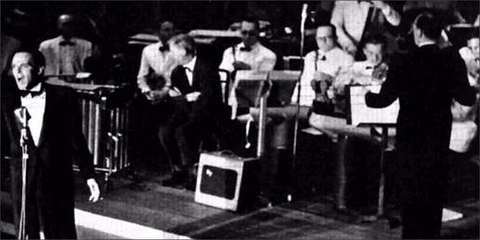
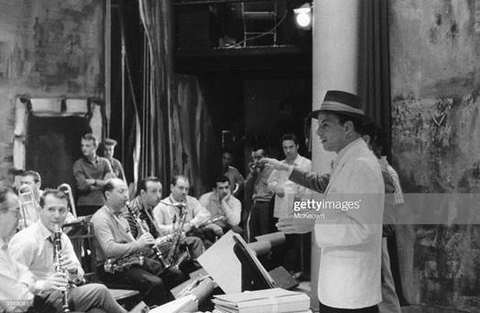
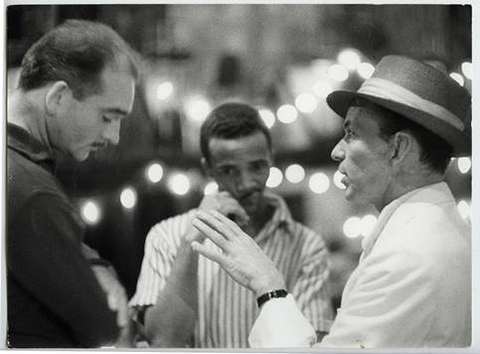
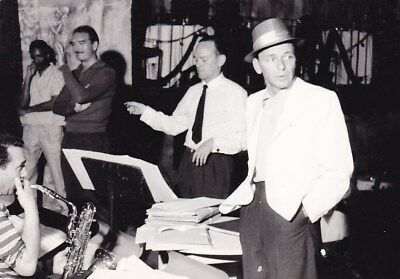
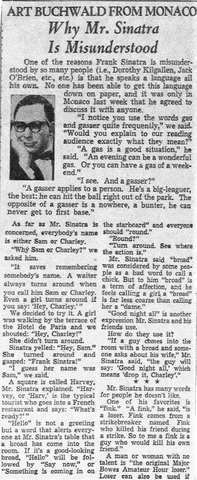
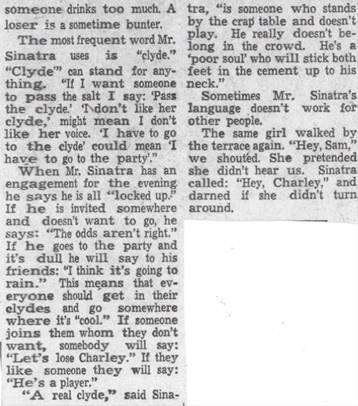
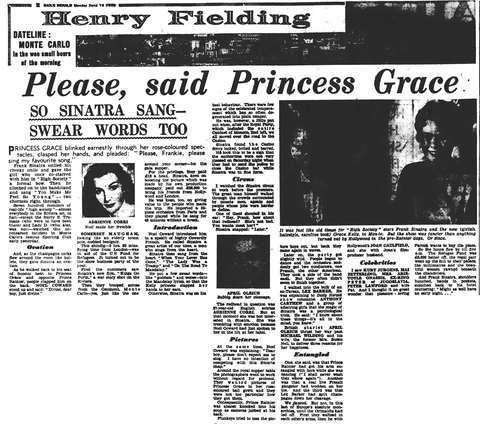
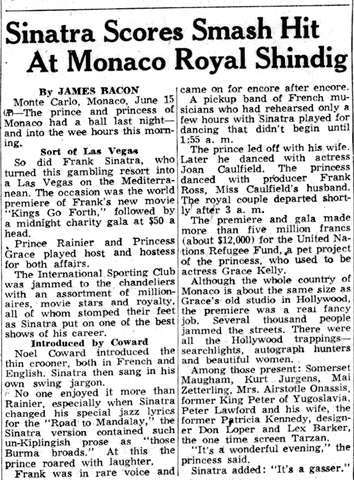
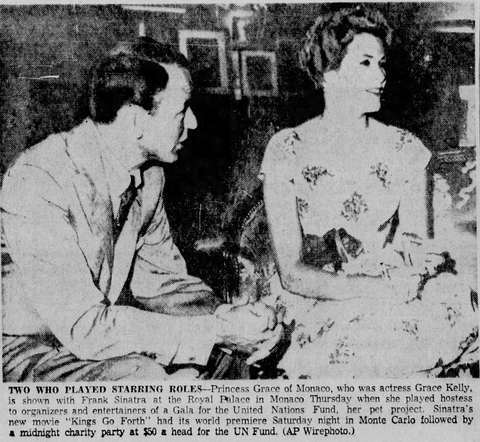
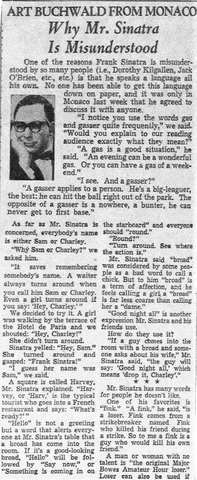
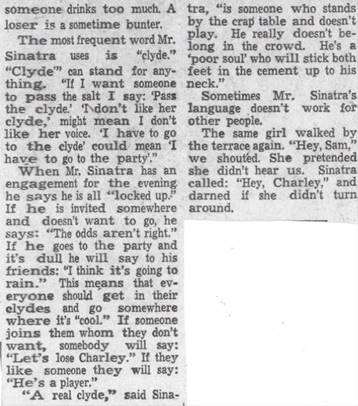
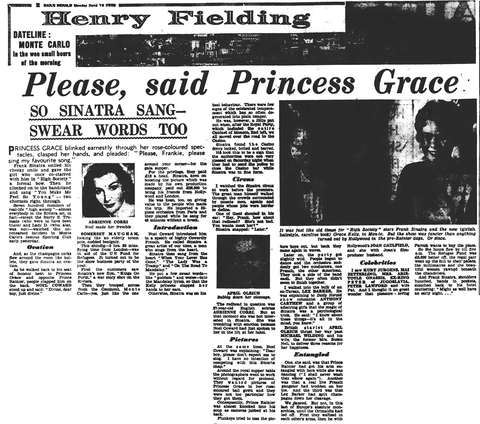
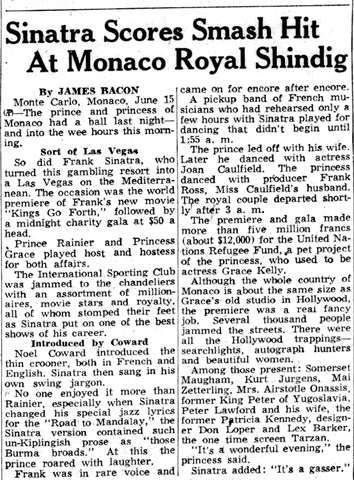
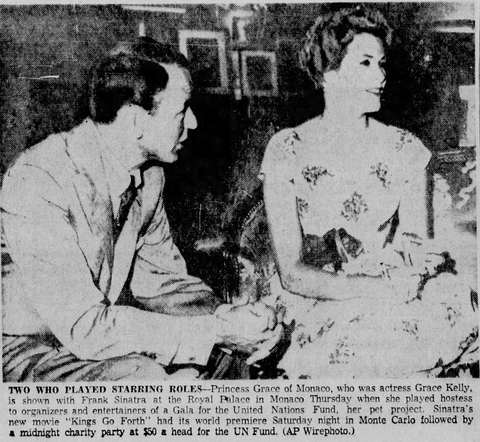
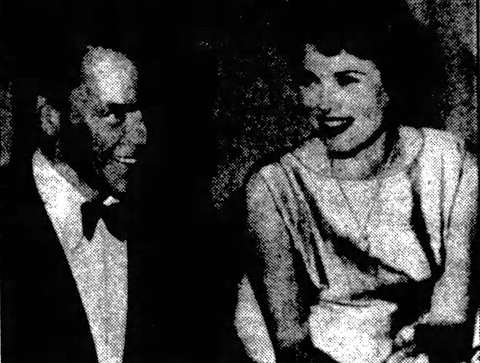
[Sinatra performs at Monte Carlo benefit]
Sinatra performed at a benefit for Prince Rainier and Princess Grace at the Monte Carlo Sporting Club, backed by the 55-piece Barclay Disques house band (including Stéphane Grappelli, Kenny Clarke, Don Byas, and Lucky Thompson) conducted by a 25-year-old Quincy Jones, then a Paris-based expatriate arranger for the label.
Source: James Kaplan, "Sinatra: The Chairman" (2015).
[Coward introduces Sinatra at Sporting Club]
Quincy Jones: At the Monte Carlo benefit, Noël Coward introduced Sinatra in English and French, an unusual concession for a performer who preferred unannounced entrances. Sinatra then delayed his entrance, mingling with Yul Brynner, Cary Grant, and Grace Kelly in the back of the room while conductor Quincy Jones anxiously stalled the orchestra, before Sinatra made a slow, cigarette-lighting walk to the stage as the crowd's applause built for several minutes.
Source: James Kaplan, "Sinatra: The Chairman" (2015).
June 22, 1958
[Rickles ribs Sinatra's voice]
A wire-service report on Rickles replacing the controversial Lenny Bruce at the Slate Brothers/La Cienega club noted Rickles had recently cracked to Sinatra, "Remember the good old days, Frank, when you had a voice?" -- a toothless jab given Sinatra's voice was in fine form.
Source: James Kaplan, "Sinatra: The Chairman" (2015).
June 24, 1958
Studio
Capitol Studio A, Hollywood
E19478 Blues In The Night
(H. Arlen/J. Mercer)
Arranged & Conducted by Nelson Riddle
CD: CDP 724383595228 Sinatra 80th "All The Best"
CD: CDP 7-48471-2 Only The Lonely
LP: SW1053 Only The Lonely
E19479 What's New?
(Bob Haggart/Johnny Burke)
Arranged & Conducted by Nelson Riddle
CD: CDP 7-48471-2 Only The Lonely
LP: SW1053 Only The Lonely
E19480 Gone With The Wind
(Allie Wrubel/Herb Magidson)
Arranged & Conducted by Nelson Riddle
CD: CDP 7-48471-2 Only The Lonely
LP: SW1053 Only The Lonely
E19422A One For My Baby w/Piano Accompaniment by Bill Miller
(Harold Arlen/Johnny Mercer)
Harwin Music Co. (ASCAP)
-1 (4:04) CD: CDP 7-48471-2 Only The Lonely
note: There were 12 songs on the mono release and only 10 on the stereo.
Kansas City Star
Capitol Studio A, Hollywood
E19478 Blues In The Night
E19479 What's New?
E19480 Gone With The Wind
E19422A One For My Baby
[image referenced in source but could not be recovered]
[image referenced in source but could not be recovered]
[image referenced in source but could not be recovered]
[image referenced in source but could not be recovered]
[image referenced in source but could not be recovered]
"One for My Baby"
Bill Miller: At the end of the June 24 session, Sinatra recorded 'One for My Baby' with just Bill Miller (the other musicians having adjourned to a nearby bar); this take was finally issued in 1990. Riddle added a light string sheen and alto sax obbligato by Gus Bivona for the officially issued June 25 take. Bill Miller: 'We did it in one take. We were in the key of E, which puts the alto in C sharp or D flat. A dumb key, but it worked.' Friedwald calls the piano-only June 24 version stunning but understands why Sinatra preferred the shimmering-strings June 25 version, calling the finished track 'the finest piece of musical acting Sinatra has ever turned in.'
Source: Will Friedwald, "Sinatra! The Song Is You: A Singer's Art" (2018 revised edition).
"What's New?"
Warren Webb: Woodwind player Warren 'Champ' Webb singled out 'What's New?', recorded at the Only the Lonely session of June 24, 1958, as an example of Riddle's clever orchestration, noting the unusual pairing of two trombones (Ray Simms and Tommy Pederson) trading embellished and rhythmic lines under the melody.
Source: Charles L. Granata, "Sessions with Sinatra: Frank Sinatra and the Art of Recording" (1999/2003).
[Rehearsal take of One for My Baby]
Sinatra recorded a spare rehearsal version of "One for My Baby," accompanied only by pianist Bill Miller, at Capitol during the Only the Lonely sessions. This piano-only take, not the later orchestral one, became the version that stuck with him as a signature number.
Source: James Kaplan, "Sinatra: The Chairman" (2015).
June 25, 1958
Studio
Capitol Studio A, Hollywood
E19420 Goodbye
Arranged & Conducted by Nelson Riddle
CD: CDP 7-48471-2
LP: SW 1053
E19422 It's a Lonesome Old Town
Arranged & Conducted by Nelson Riddle
CD: CDP 7-48471-2
LP: SW 1053
E19422 One For My Baby w/Piano Solo by Bill Miller
(Harold Arlen/Jphnny Mercer)
Harwin Music Co. (ASCAP)
Arranged & Conducted by Nelson Riddle
-1 CD: CDP 7-48471-3
LP: SW 1053
NOTE: Sinatra Scholar Ed O'Brien reports that the American Federation of Musicians (AFM) sheets show that Sinatra concluded the sessions for "Only The Lonely" on this date, not June 26th. Hence, the correct listing above.
O'Brien adds that a story emerged from the session that Sinatra had all the lights turned off, save one shining on his face, when he did one take on "One For My Baby." Years later, pianist Bill Miller stated in an interview that the story was apocryphal. Miller remembered the session and dismissed the story. He told the interviewer that the studio set-up would not have permitted such an effort.
Capitol Studio A, Hollywood
E19420 Goodbye
E19422 It's a Lonesome Old Town
E19422 One For My Baby
--------------------------------------------------
Life Magazine Cover, June 25, 1971
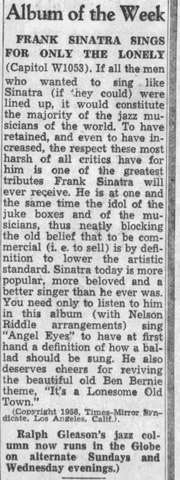
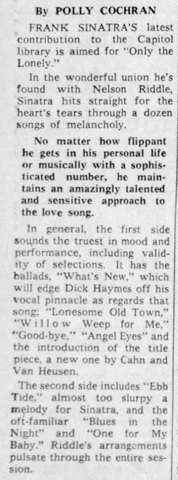
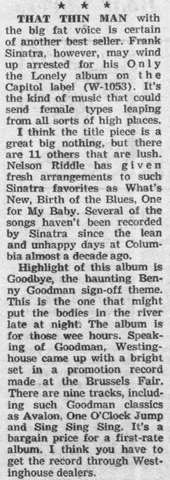
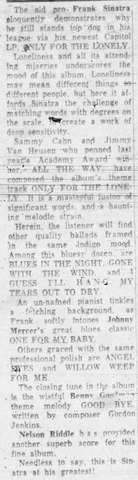
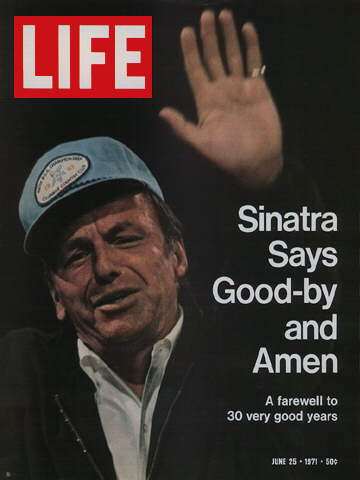
"It's a Lonesome Old Town"
Will Friedwald (analysis): Friedwald details the song's history as Ben Bernie's ('The Old Maestro') radio theme song since 1930, carrying corny, schmaltzy associations (like Guy Lombardo/Ted Lewis). Rather than parody it (as Spike Jones or Dean Martin might), Sinatra and Riddle stripped its sentimentality and rebuilt it as serious musical drama.
Source: Will Friedwald, "Sinatra! The Song Is You: A Singer's Art" (2018 revised edition).
"It's a Lonesome Old Town"
Will Friedwald (analysis): Friedwald's extended reading: Riddle's modernist textures expand the lyric's scope so Sinatra isn't just singing about a town grown old and lonesome, but confronting a whole universe of despair; Sinatra and trombonist Ray Sims (his 'shadow') wander an interstellar abyss of emptiness, their warmth underscoring an unending vacuum -- 'we are all merely Lucky Strike Extras in the vast Hit Parade of existence.'
Source: Will Friedwald, "Sinatra! The Song Is You: A Singer's Art" (2018 revised edition).
"It's a Lonesome Old Town"
The Kentonesque arrangement of the 1930 torch song suggests, per Friedwald, 'a barroom ballad of the twenty-first century; a ballad for broken hearts in outer space.'
Source: Will Friedwald, "Sinatra! The Song Is You: A Singer's Art" (2018 revised edition).
[Orchestral One for My Baby recorded]
On the second Only the Lonely session night (sometimes dated the 26th because it ran past midnight), Sinatra recorded the subtly orchestra-backed album track of "One for My Baby," along with other songs recorded over the two nights: "Gone with the Wind," "Blues in the Night," "What's New?," Gordon Jenkins's "Goodbye," and "It's a Lonesome Old Town."
Source: James Kaplan, "Sinatra: The Chairman" (2015).
June 28, 1958
Film
"Kings Go Forth" (USA Release: June 28,
1958)
Starring: Frank Sinatra, Tony Curtis, Natalie Wood
Produced by: Frank Ross
Directed by: Delmer Daves
The Allies have landed in France, set up in a coastal town, where Lt. Sam Loggins (Frank Sinatra), falls hard for Monique Blair (Natalie Wood), an American raised in France. Loggins' sergeant, Britt Harris (Tony Curtis), a playboy from Jersey, also finds Monique attractive. Monique falls in love with Britt and the two plan to marry but after disclosing her father was an African-American, Britt has a change of heart and a resulting feud ensues between Britt and Loggins. Both soldiers are sent on a covert operation but only Loggins survives, losing an arm in the mission. After many months in the hospital, Loggins is reunited with Monique in Nice where she is now heading up a school for war orphans.
--DVD Release: 2002-02-05 & Blu-Ray Release:
2015-12-15
Pre-release items include Zina Provendie, Romney Brent and Lili Valenty in the cast, but their appearance in the released film has not been confirmed. The pickup band in the film's bistro scenes featured several well-known jazz musicians. According to the film's pressbook, some exterior scenes were filmed on location in Nice and along the Côte d'Azur , and film comedian Harold Lloyd's Southern California estate, Greenacres, was used as the set of the "Blair" villa. Some combat scenes were filmed near Carmel, CA, according to a Dec 1957 NYT article. In that article, producer Frank Ross revealed that "the film had drawn considerable interest from the Negro community."
Ross, who admitted in the article that "he was not in favor of miscegenation," explained his decision to cast white actress Natalie Wood in the role of the half-black "Monique" by stating that "the picture would lose its dramatic kick if the girl were Negro."
Although Ross asserted that he and distributor United Artists did not plan to exploit the interracial love theme in the film's advertising, some ads did exploit it. One ad included the line: "Last night she was good for you...last night her skin was white enough for you." A. S. Young, the film's publicist, was the first African American press agent to work on a Hollywood production, according to the Dec 1957 NYT article. According to the film's pressbook, Frank Sinatra recorded a special spot announcement aimed at African American audiences. The film had its world premiere in Monte Carlo on 14 Jun 1958, according to modern sources. Kings Go Forth was awarded the 1958 Los Angeles Urban League Award as the "motion picture that does most for the promotion of better race relations and understanding."
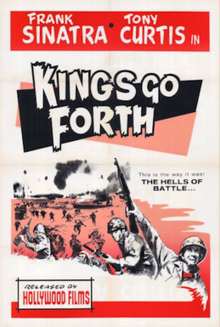
"Kings Go Forth"
Sinatra was drawn to Kings Go Forth partly for its literary pedigree -- the theatrical trailer showed him in a book-lined study alongside copies of From Here to Eternity and The Man with the Golden Arm -- and partly because its stand against racial prejudice suited his liberal instincts; the film reunited him with producer Frank Ross, who had produced Sinatra's 1945 anti-prejudice short The House I Live In.
Source: Tom Santopietro, "Sinatra in Hollywood" (2008).
"Kings Go Forth"
Kings Go Forth marked Sinatra's first true venture into a combat-oriented war movie (as opposed to films like Anchors Aweigh or On the Town where the war stays in the background), spending as much screen time on Sinatra's romance with Natalie Wood's character as on the combat mission.
Source: Tom Santopietro, "Sinatra in Hollywood" (2008).
"Kings Go Forth"
Boris Karloff: During location filming in the south of France, Sinatra received informal acting coaching from Boris Karloff, a longtime favorite actor of his who happened to be in the area at the same time. Karloff's key advice: 'You must learn to act with your voice as well as your face.'
Source: Tom Santopietro, "Sinatra in Hollywood" (2008).
"Kings Go Forth"
Boris Karloff: Boris Karloff's terse acting philosophy -- 'Say your lines. Hit your mark. Get out.' -- closely echoed that of another of Sinatra's acting heroes, Spencer Tracy, and Santopietro suggests it summed up Sinatra's own approach to filmmaking.
Source: Tom Santopietro, "Sinatra in Hollywood" (2008).
"Kings Go Forth"
Kings Go Forth, directed by Delmer Daves, is set in the south of France in 1944 shortly after the liberation of Paris. Sinatra narrates and stars as Lieutenant Sam Loggins, a tough combat veteran who clashes with a wealthy newcomer, Corporal Britt Harris, played by Tony Curtis; Natalie Wood costars.
Source: Tom Santopietro, "Sinatra in Hollywood" (2008).
"Kings Go Forth"
Natalie Wood was cast as Monique, a young woman revealed to be biracial (half African-American), a choice Santopietro argues never feels authentic since nothing about Wood suggests mixed racial heritage. To secure Wood for the role, Warner Bros. (her home studio) was paid $75,000 for her ten weeks of work, plus a promise that Sinatra would make a future film at Warners -- a promise later fulfilled by Ocean's Eleven.
Source: Tom Santopietro, "Sinatra in Hollywood" (2008).
"Kings Go Forth"
Santopietro praises a scene in which Monique's mother delivers a lengthy monologue about the girl's racial background while Sinatra remains completely silent and motionless, arguing this restrained, wordless reaction achieves a moving effect and shows how far his dramatic instincts had developed.
Source: Tom Santopietro, "Sinatra in Hollywood" (2008).
"Kings Go Forth"
Los Angeles Mirror-News (quoted by Santopietro): The Los Angeles Mirror-News criticized the film's herky-jerky storytelling, writing that Kings Go Forth 'doesn't come close to having the guts of the book' by Joe David Brown and is 'all surface and little depth.'
Source: Tom Santopietro, "Sinatra in Hollywood" (2008).
"Kings Go Forth"
Wanda Hale: New York Daily News critic Wanda Hale wrote that Sinatra 'may not be the best actor in the world, but there is none more interesting to watch,' a review Santopietro cites as capturing how Sinatra alone rescues the film's soap-opera excesses.
Source: Tom Santopietro, "Sinatra in Hollywood" (2008).
"Kings Go Forth"
Santopietro notes that Sinatra's on-screen missing right arm (his character Sam Loggins loses it in combat and spends seven months in rehab) is portrayed very convincingly.
Source: Tom Santopietro, "Sinatra in Hollywood" (2008).
"Kings Go Forth"
Santopietro grades this a C, calling it "mixed up but interesting."
Source: Tom Santopietro, "Sinatra in Hollywood" (2008).
"Kings Go Forth"
Santopietro (Filmography): Ross-ETON/United Artists. Produced by Frank Ross, directed by Delmer Daves, screenplay by Merle Miller based on the Joe David Brown novel, musical score by Elmer Bernstein. Sinatra played First Lieutenant Sam Loggins opposite Tony Curtis and Natalie Wood.
Source: Tom Santopietro, "Sinatra in Hollywood" (2008).
[Norvo trio's on-screen cameo]
In the Fall of 1957, when Sinatra needed musicians for a sequence in "Kings Go Forth," he hired Red Norvo along with the trio's guitarist Jimmy Wyble and bassist Red Wooten to appear in the film; Norvo also hired Pete Candoli (who was also engaged to ghost trumpet for Tony Curtis's character) to play a trumpet-tooting sergeant, and to show Curtis how to hold the horn convincingly on camera.
Source: Will Friedwald, liner notes to "Frank Sinatra with the Red Norvo Quintet: Live in Australia, 1959" (Blue Note/Capitol CDP 7243 8 37513 2 7, 1997).
July 1958
[Sinatra On Friendships Across Racial Lines, In Ebony]
Nancy Sinatra: Responding in Ebony magazine to speculation about his friendships with Black entertainers, Sinatra said he didn't favor people according to race or religion any more than he disliked them for it, and argued that more friendships crossing color lines was the surest way to erase the divisions between people.
Source: Nancy Sinatra, Frank Sinatra: An American Legend, 1995.
[Cal-Neva party for Prima and Smith]
Kaplan: Sinatra hosted a large party -- including the Lawfords, Harry James, Betty Grable, and Jimmy Van Heusen -- for Louis Prima and Keely Smith's opening at the Cal-Neva Lodge on Lake Tahoe, straddling the California-Nevada border.
Source: James Kaplan, "Sinatra: The Chairman" (2015)
[Garland's comeback at Cocoanut Grove]
Kaplan: Judy Garland clawed back her confidence with a spectacular opening at Los Angeles's Cocoanut Grove, though husband Sid Luft had to take out a loan to redeem her costumes from hock.
Source: James Kaplan, "Sinatra: The Chairman" (2015)
[Invitation to Monte Carlo]
Before starting Some Came Running, Sinatra filmed a brief cameo appearance (playing himself) in the British short featurette Invitation to Monte Carlo, a lightweight travelogue about an orphan girl chosen to present a kitten to Princess Caroline. Sinatra took the role as a favor to Princess Grace of Monaco, having just given a Monte Carlo concert in July 1958 to benefit the United Nations Refugee Fund. Written, produced and directed by Euan Lloyd, the 46-minute film also featured Prince Rainier and Princess Grace playing themselves.
No corresponding dated entry could be identified in the chronology for this film/context.
Source: Tom Santopietro, "Sinatra in Hollywood" (2008), The Peak Years (pt. 3)
July 2, 1958
Concerts
"A Night With Sinatra", Los Angeles, California
Benefit for the Cedars Of Lebanon
"A Night With Sinatra", Los Angeles, California
Benefit for the Cedars Of Lebanon
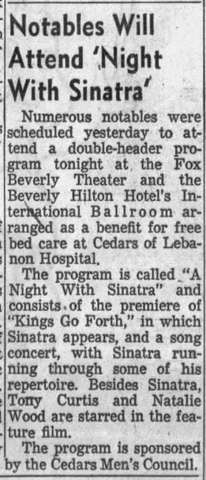
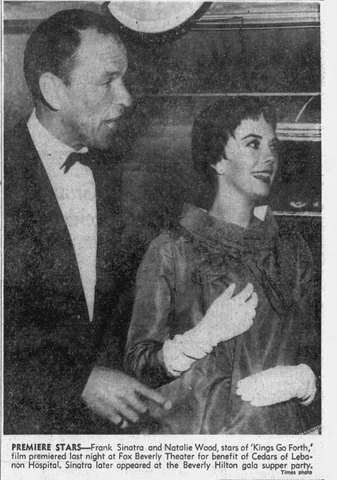
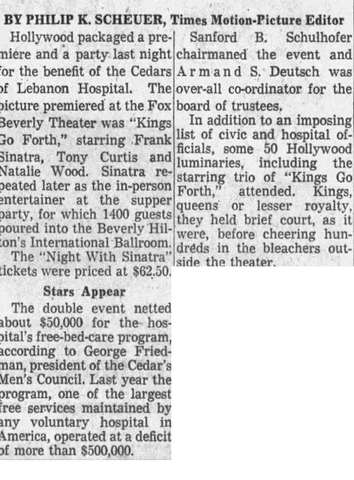
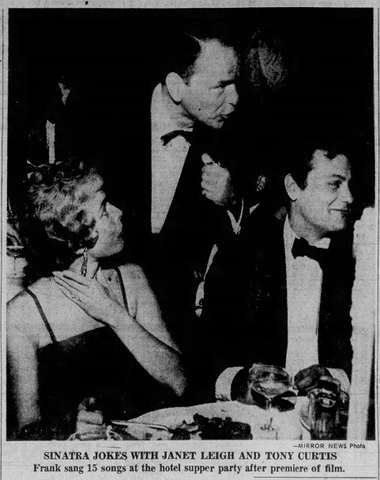
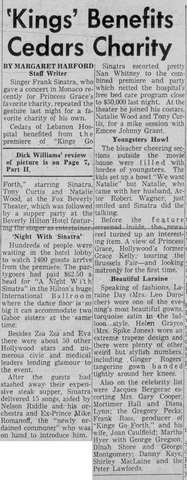
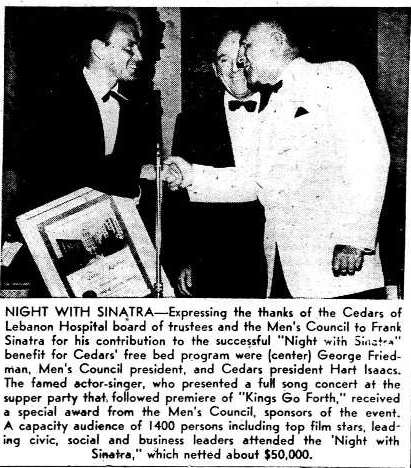
Frank headlined 'A Night with Sinatra' benefiting Cedars of Lebanon hospital in Los Angeles and attended the world premiere of Kings Go Forth the same day; he spoke publicly that month about racial tolerance in Ebony magazine.
Frank Sinatra (quoted): "I simply like people, a lot of them."
Source: Nancy Sinatra, Frank Sinatra: An American Legend, 1995.
July 4, 1958
[Photograph: Kings Go Forth premieres in Los Angeles. From Richard Havers, "Sinatra" (Dorling Kindersley, 2007), p.243.]
Kings Go Forth, which had its European premiere in Monaco the night of Frank's benefit concert, opened in Los Angeles three weeks later. (Source: Richard Havers, "Sinatra" (Dorling Kindersley, 2007).)
July 6, 1958
Television
The Ed Sullivan Show
Episode #522 Season: 11
Broadcast from Las Vegas
Guests: Frank Sinatra
Note: Sinatra on film in Monte Carlo, Monaco Concerts
July 7, 1958
[Rackets Committee names Giancana]
A wire-service dispatch reported that Robert F. Kennedy, chief counsel for the Senate Rackets Committee investigating Mob control of Chicago's restaurant industry, said investigators were seeking several hoodlum witnesses including Gus Alex, Joey Aiuppa, Sam Battaglia, and Sam Giancana (also known as Tom Mooney).
Source: James Kaplan, "Sinatra: The Chairman" (2015).
August 1958
Sinatra and Peter Lawford, who had not spoken in the five years since Sinatra threatened to have his legs broken over a false rumor linking Lawford to Ava Gardner, ended their feud by chance at a dinner party thrown by Gary Cooper and his wife Rocky; Lawford's wife Patricia (Joe Kennedy's daughter) had already been seated with Sinatra when Lawford arrived. Frank's opening line -- "You know I don't speak to your old man" -- broke the ice, and the reconciliation opened Sinatra's innermost circle, and eventually the Kennedy family, to Lawford. Source: Michael Sheridan & David Harvey, Sinatra and the Jack Pack.
[Filming moves to MGM soundstages]
Kaplan: At the end of August, Sinatra returned to Los Angeles, where Some Came Running filming continued on MGM soundstages -- the studio where he'd been a contract player from 1944 to 1951, though the studio system had faded since founder Louis B. Mayer's death in late 1957. By Sinatra's fiat, the new shooting schedule ran noon to 8 p.m.
Source: James Kaplan, "Sinatra: The Chairman" (2015)
[Giancana visits the Madison bungalow]
Shirley MacLaine: Among visitors to Sinatra's rented Madison bungalow were Jimmy Van Heusen, Leo Durocher, imported women from Los Angeles, and Sam Giancana with Chicago associates, who told a puzzled Shirley MacLaine they were "on the lam," likely from the Senate Rackets Committee.
Source: James Kaplan, "Sinatra: The Chairman" (2015)
[MacLaine's gin game with Giancana]
Shirley MacLaine: Shirley MacLaine recalled playing gin rummy with Sam Giancana in the Madison bungalow kitchen while wearing sunglasses to hide her cards; Giancana was secretly reading her cards' reflection. When she jokingly pointed a toy water pistol at him, he drew a real .38 from a shoulder holster, and Frank and Dean walked in to find the standoff, laughing it off.
Source: James Kaplan, "Sinatra: The Chairman" (2015)
[Sinatra's Madison misbehavior]
Kaplan: During the Madison, Indiana shoot, Sinatra drank heavily, ripped a phone from a hotel wall believing his calls were monitored, smashed a TV screen with a beer bottle, and, with Dean Martin's manager Mack Gray, physically manhandled an elderly hotel desk clerk over a hamburger order mix-up, prompting Frank and Dean to move to a rented house.
Source: James Kaplan, "Sinatra: The Chairman" (2015)
[Some Came Running shoots in Madison, Indiana]
Frank Sinatra: Filming began in the small southern Indiana town of Madison in stifling summer heat. Sinatra was quickly bored and openly scornful of the town and its residents, calling it "worse than skid row in Los Angeles" and mocking extras through the bus-arrival scene's soundproof glass.
Source: James Kaplan, "Sinatra: The Chairman" (2015)
August 4, 1958
The first-ever Billboard Hot 100 chart was published on 4 August 1958; fittingly, given his pivot away from singles toward albums, Frank was not represented on it. (Source: Richard Havers, "Sinatra" (Dorling Kindersley, 2007).)
August 10, 1958
[FBI notes Sinatra-Accardo meeting]
According to Sinatra's FBI file, the day before Some Came Running began shooting, he was met at Chicago's Midway Airport by former Chicago hoodlum Joe Fischetti and taken to the Ambassador Hotel; afterward Sinatra, Fischetti, and Dean Martin were driven by a Chicago police contact to the River Forest home of mob boss Anthony Accardo, where they gave a "command performance."
Source: James Kaplan, "Sinatra: The Chairman" (2015).
September 1958
[Frankie sent to boarding school]
Frank Sinatra Jr.: Frank Sinatra Jr. was sent to a college preparatory boarding school in the San Jacinto Mountains west of Palm Springs. He later said his life had felt normal until then, and that once outside the family's inner circle, his position within it was never re-established.
Source: James Kaplan, "Sinatra: The Chairman" (2015)
[Sinatra rekindles with Lady Beatty]
Kaplan: Sinatra renewed his acquaintance with Lady Adelle Beatty, a former Oklahoma beauty queen turned English peeress, at a Hollywood party as Some Came Running production wound down. He had known her casually for years; she was now 40 and recently divorced from Lord David Beatty.
Source: James Kaplan, "Sinatra: The Chairman" (2015)
September 11, 1958
Studio
Capitol Studio A, Hollywood
E30096 Mr. Success
(Grienes/Sinatra/ Sanicola)
Arranged & Conducted by Nelson Riddle
CD: C2 724383808922 The Complete Capitol Singles
LP: SW1729 Sings Of Love And Things
45: 4070
E30097 Sleep Warm
(Spence/Keith/ Bergman)
Arranged & Conducted by Nelson Riddle
CD: C2 724383808922 The Complete Capitol Singles
CD: CDP 7-91150-2 All The Way
CD: CDP 7-48471-2 Only The Lonely
LP: SW1538 All The Way
45: 4070
E30099 Where or When
Arranged & Conducted by Nelson Riddle
CD: CDP 7-48471-2 Only The Lonely
Musicans - Reeds: William Green, Harry Klee, Joseph Koch, Willie Schwartz, Warren Webb; Trumpets: Pete Candoli, Conrad Gozzo, Carroll Lewis, Vito â Mickeyâ ť Mangano; Trombones: es: Dick Noel, Tommy Pederson, Juan Tizol; Bass Trombone: George Roberts; Violins: Victor Bay, Alex Beller, Harold Dicterow, David Frisina, Ben Gill, Murray Kellner, Lisa Minghetti, Eudice Shapiro, Felix Slatkin, Marshall Sooson; Violas: Stanley Harris, David Sterkin; Cellos: Victor Gottlieb, Elizabeth Greenschpoon, Eleanor Slatkin; Piano: Bill Miller; Bass: Joe Comfort; Drums: Alvin Stoller; Guitar: Al Viola; Harp: Kathryn Juyle
Session Producer: Dave Cavanaugh
NOTE: Sinatra Scholar Ed O'Brien has a funny story on the recording of "Mr. Success."ť It was the first song laid down at this September 11, 1958 session. After a quick rehearsal take, Sinatra shot a glare at Dave Cavanaugh and wanted to know who wrote such a piece of crap and why he was wasting his time with it. Cavanaugh informed him that it had Frank Sinatra's name listed as a lyricist. Sinatra was quiet for a few moments, then said. "Touché" and did a dynamite recording.
Composer Lew Spence was not pleased with Sinatra's effort on "Sleep Warm." Spence told O'Brien that some of the notes were not sung correctly, but what bothered him much more was a lyric slip-up. Sinatra sang "Sleep warm, sleep well" early in the song. It should have occurred in the second eight bars to rhyme with Let dreams weave you a spell."ť He asked Sinatra to do another take, but to no avail.
"Where or When"ť was an attempt to create a "saloon song" for live performances. It didn't work out as expected and the song languished in the Capitol vault for 15 years. There were seven takes done 51 years ago this evening. A magnificent vocal tour de force regardless of the original intention.
Scott: I just listened to "Where or When" this morning, September 11, 2020, 62 years later and what an amazing experience. Absolutely stunning.
Frank and his best friend, Dean Martin, at a 1958 recording session at Capitol Records in Hollywood for Martin’s album Sleep Warm, which Sinatra conducted. Source: photo and caption from J. Randy Taraborrelli, Sinatra: Behind the Legend (mptvimages.com).
"Only the Lonely"
Granata's discography entry: Only the Lonely, arranged by Nelson Riddle, released September 1958.
Source: Charles L. Granata, "Sessions with Sinatra: Frank Sinatra and the Art of Recording" (1999/2003).
[Recording session with Nelson Riddle]
Sinatra rejoined Nelson Riddle at the Capitol Records Tower to record three tracks: the up-tempo "Mr. Success"; the ballad "Sleep Warm" by Alan Bergman, Marilyn Keith, and Lew Spence; and a new version of Rodgers and Hart's "Where or When," which he had last recorded in 1945.
Source: James Kaplan, "Sinatra: The Chairman" (2015).
Liner Notes: ONLY THE LONELY
If In the Wee Small Hours is Sinatra's first great statement of loneliness, Only the Lonely is its more accomplished, more devastating sequel -- the album many critics, including Will Friedwald, have called the finest of his career. Reunited with Nelson Riddle after the brighter, brassier records that came between, Sinatra returns to torch-song territory with an interpretive depth that had only deepened with time.
The album closes with "One for My Baby (and One More for the Road)," recorded near the very end of the sessions and delivered as something closer to a spoken confession set to music than a conventional vocal performance -- a barroom monologue of heartbreak and self-pity, sung to a bartender who, the song makes clear, has heard it all before. It became one of the defining performances of Sinatra's entire career.
Only the Lonely reached number one on the Billboard album chart and stayed on the list for over two years, a commercial validation of just how far Sinatra could push an audience into genuinely difficult emotional territory and still bring them along. It remains, alongside Wee Small Hours, the truest measure of what Sinatra and Riddle could do when the subject was sorrow.
Written by Claude (Anthropic), commissioned for this chronology, 2026.
September 19, 1958
Frank Sinatra and Jerry Lewis were photographed together.
Source: Andrew Howick, Sinatra: The Photographs (New York: Abrams, 2015).
September 29, 1958
On the day Only the Lonely reached number one, Frank was in the studio conducting the orchestra for Dean Martin's album Sleep Warm, which featured his first recording of a song by soon-to-marry songwriters Alan Bergman and Marilyn Keith. (Source: Richard Havers, "Sinatra" (Dorling Kindersley, 2007).)
September 30, 1958
Studio
Capitol Studio A, Hollywood
E30211 Just In Time
(Styne/Comden/ Green)
Arranged & Conducted by Billy May
CD: Ultimate Sinatra (4-CD Set)
E30212 The Song Is You
(Jerome Kern/Oscar Hammerstein II)
Arranged & Conducted by Billy May
LP: The Rare Sinatra Capitol Records E-ST 24311 (UK Release)
E30213 It All Depends On You
Arranged & Conducted by Billy May
LP: The Rare Sinatra Capitol Records E-ST 24311 (UK Release)
LP: Like Never Before - Longines Symphonette Society – SYS 5637
-4 CD: CDP 7-48468-2 Come Dance With Me
Note: Billy May told me it evolved into a jazzier concept that would become the "Come Dance With Me" LP, recorded in December 1958
"Just In Time" was finally issued in the fall of 2015 on the "Ultimate Sinatra" CD set. "The Song Is You" is on the "Rare Sinatra" LP issued in England. "It All Depends On You" is also on the "Rare Sinatra." and "Like Never Before" (rare LP from Longines Symphonette The version issued on "Come Dance With Me" was a mistake by Capitol.
They inadvertently put on the CD the recording Frank did with Riddle for the "Swingin' Session" LP ( 8-23-60). There is at the end of both Frank singing four "wahs." ( on the original CD of "Swingin' Session" the wahs are missing, although the song runs a little longer. Haven't checked, but it may be an alternate take). "The 9-30-58 version is quite a bit different. The session for that song has been in circulation for many years.
Al Porcino intensely disliked Billy May. He told me that the driving arrangements Billy wrote sent guys like Gozzo and Candoli to early graves. Listening today to the tracks from this session, I couldn't help but think what Al told me many years ago.
Ed
In response to Shemmy's question for clarification of Capitol making a mistake with "Come Dance With Me", Ed further added the following:
Capitol intended to release, on "Come Dance With Me," the 9-30 recording but issued the 8-23-60 from "Swingin' Session." They released a version that has Frank winding down the song with four "wahs."
When they reissued "Swingin' Session," with a 20 bit master, the "wah" stayed in the recording. I have listened to both and compared them with the original "Swingin' Session" CD release. It is the same take until the "wah" segment. It is obviously an intercut from a different take. The 9/30 is available on the Longines Symphonette "Like Never Before" and "Rare Sinatra" LPs. Easy way to tell the difference between the 9/30 and 8/23: On the former, Frank, when he comes in after the orchestral interlude, sings "I can save a 'gang' of money."
I hope this helps.
Ed
October 1958
[Beatty flees to Zurich]
Kaplan: After Sinatra publicly wooed then rebuked Lady Beatty at the Satire Club, she fled to Zurich, where a psychotherapist diagnosed her with nervous exhaustion; Sinatra sent a friend to bring her back to London amid continued press frenzy.
Source: James Kaplan, "Sinatra: The Chairman" (2015)
[Garland opens at the Sands]
Kaplan: Judy Garland began her first engagement at the Sands, arriving ten days early to rehearse; Sinatra, her former lover, deliberately stayed away from her opening and first nights to let her establish the show on her own.
Source: James Kaplan, "Sinatra: The Chairman" (2015)
[London tabloid frenzy over Beatty romance]
Kaplan: Within minutes of checking into the Dorchester, Sinatra rushed to Lady Beatty's South Kensington home; the pair were then trailed constantly by London tabloids, with the Daily Mail predicting marriage and the Daily Express running a daily photo of the couple.
Source: James Kaplan, "Sinatra: The Chairman" (2015)
[Sinatra conducts for Dean Martin's Sleep Warm]
Kaplan: Over three nights in mid-October, Sinatra conducted the orchestra for Dean Martin's new Capitol LP Sleep Warm (arranged by Pete King), a friendship gift; the sleepy-themed album, credited to "Dean Martin with Orchestra Conducted by Frank Sinatra," nonetheless never charted.
Source: James Kaplan, "Sinatra: The Chairman" (2015)
[Sinatra denies marriage plans at premiere]
Frank Sinatra: At the Me and the Colonel charity premiere, Sinatra took the stage before introducing Danny Kaye and the cast to publicly declare he had come to London only for the film and the charity, not to get married.
Source: James Kaplan, "Sinatra: The Chairman" (2015)
[Sinatra publicly endorses JFK]
Frank Sinatra: By October 1958, having told the press 'Senator Kennedy is a friend of mine,' Sinatra had endorsed John F. Kennedy for the presidency.
Source: James Kaplan, "Sinatra: The Chairman" (2015)
[Frank on hiring Black musicians for his sessions]
In October 1958, Frank told Melody Maker that his recording orchestras were chosen purely on musical merit, which was why Black musicians like trumpeter Harry Edison and saxophonist Buddy Collette were regularly included and can be heard on his recording of 'Witchcraft.'
Source: Richard Havers, "Sinatra" (Dorling Kindersley, 2007).
October 1, 1958
Wednesday, October 1, 1958, Sands, Las Vegas, Nevada
Opening night for Judy Garland at the Sands,
Sinatra hired a train to bring celebrities for Judy's opening night. He and Dean would also join her on stage. The following image is supposedly from that evening:
[image referenced in source but could not be recovered]
[image referenced in source but could not be recovered]
[image referenced in source but could not be recovered]
[image referenced in source but could not be recovered]
October 10, 1958
[Sinatra brings 70 friends to see Garland]
Sinatra took roughly 70 friends -- including the Dean Martins, David Nivens, Natalie Wood and Robert Wagner, Shirley MacLaine, the Sammy Cahns, and Jimmy Van Heusen -- via private railroad car to Las Vegas to support Judy Garland's Sands engagement.
Source: James Kaplan, "Sinatra: The Chairman" (2015).
[Frank and Dean join Garland onstage]
Robert Wagner: During Garland's Sands show, Dean Martin heckled from his seat in his drunk persona, Sinatra joined in, and Garland eventually summoned both men onstage, where they clowned around and upstaged her to the crowd's delight -- an event later cited as a possible origin of the Rat Pack.
Source: James Kaplan, "Sinatra: The Chairman" (2015).
October 14, 1958
Concerts
Judy Garland's final show at the Sands in Las Vegas.
Judy’s friend Frank Sinatra chartered a bus to take a large group of Hollywood stars to see the show. He and Dean Martin joined Judy on stage during part of this final performance
Judy Garland's final show at the Sands in Las Vegas.
Judy’s friend Frank Sinatra chartered a bus to take a large group of Hollywood stars to see the show. He and Dean Martin joined Judy on stage during part of this final performance
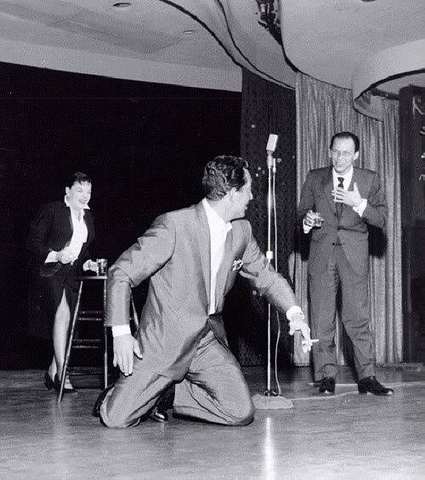
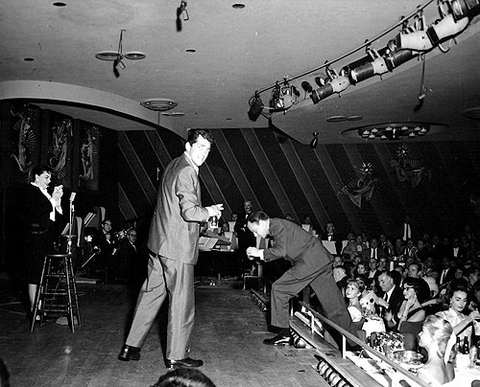
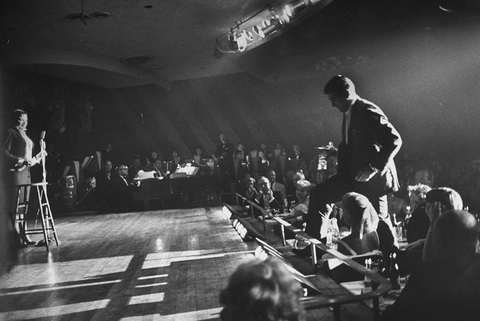
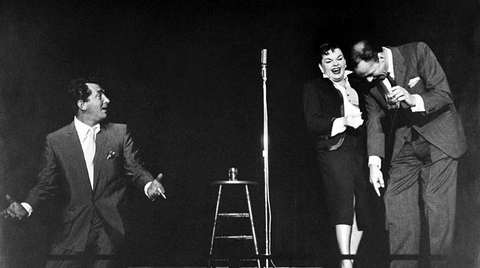
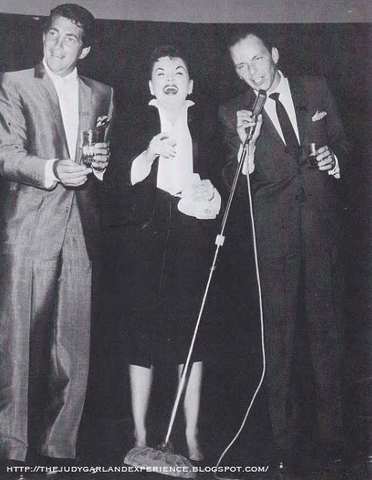
October 15, 1958
Studio
Capitol Studio A, Hollywood
E30380 To Love And Be Loved
(J. Van Heusen/S. Cahn)
Maraville Music Corp. (ASCAP)
Arranged & Conducted by Nelson Riddle
-23 (2:56) CD: C2 724383808922 The Complete Capitol Singles
CD: CDP 7-91150-2 All The Way (different arrangement)
LP: SW1538 All The Way (different arrangement)
CD: C2-94777 The Capitol Years (shorter version)
45: 4103 (shorter version)
The Morning Union
"To Love and Be Loved"
Nelson Riddle: Riddle recalled that for 'To Love and Be Loved,' Sinatra asked for a 'Puccini sound'; Riddle had to study an actual Puccini opera score to realize that what was meant was doubling the melody in octaves across the orchestra.
Source: Charles L. Granata, "Sessions with Sinatra: Frank Sinatra and the Art of Recording" (1999/2003).
October 19, 1958
[Sinatra flies to London]
Frank Sinatra: Sinatra flew to London, arriving a week early, ostensibly to emcee a British Empire Cancer Campaign benefit premiere of Danny Kaye's Me and the Colonel. When a reporter asked about other business, he insisted the benefit was his only reason for being there.
Source: James Kaplan, "Sinatra: The Chairman" (2015).
Bing Crosby and Dean Martin joined Frank on The Frank Sinatra Timex Show; during Dean's solo number he showed off the sole of his shoe, revealing an ad for his own restaurant written on it.
Source: Nancy Sinatra, Frank Sinatra: An American Legend, 1995.
November 1958
[Capra reworks a scene for Sinatra]
Frank Capra: Early in the Hole in the Head shoot in Miami, Capra noticed Sinatra's energy declining with each rehearsal take of a dog-track scene with Keenan Wynn and Joi Lansing; realizing Sinatra was a performer who never repeated himself the same way twice, Capra had the other actors and extras change their cues and lines to keep Frank's performance fresh.
Source: James Kaplan, "Sinatra: The Chairman" (2015)
[Sinatra and Rizzo grow close in Miami]
Earl Wilson: Sinatra and Jilly Rizzo grew closer in Miami in November 1958 while Sinatra was shooting A Hole in the Head; Rizzo had brought his eccentric Chinese houseboat, the $140,000 motorless "Jilly's Yen," docked across from the Eden Roc, as described by Earl Wilson.
Source: James Kaplan, "Sinatra: The Chairman" (2015)
[Sinatra arrives in Miami for Hole in the Head]
Kaplan: About a week after the Harwyn Club incident, Sinatra arrived in Miami to begin shooting A Hole in the Head; one reporter greeting him at the airport wore a catcher's mask.
Source: James Kaplan, "Sinatra: The Chairman" (2015)
[Winchell floats Sinatra as ambassador]
Walter Winchell: In November 1958, columnist Walter Winchell speculated that a President Kennedy might appoint Frank Sinatra as U.S. ambassador to Italy.
Source: James Kaplan, "Sinatra: The Chairman" (2015)
November 10, 1958
Frank began shooting Frank Capra's A Hole in the Head in Miami with Eleanor Parker and Edward G. Robinson; Nancy called it one of her favorite of her father's films.
Source: Nancy Sinatra, Frank Sinatra: An American Legend, 1995.
November 14, 1958
Concerts
Sands, Las Vegas
Dean Martin was in for a three week run at the Sands.
Frank subbed for him on 11-14-58 ( Friday). He was backed by the Antonio Morelli Orchestra, Copa Girls and Buddy Lester was the comedian on the bill.
--Ed
November 17, 1958
Only the Lonely was released, later regarded by many fans as Frank's greatest ballad album; it stayed at number one for 120 weeks and its cover won a Grammy.
Source: Nancy Sinatra, Frank Sinatra: An American Legend, 1995.
November 25, 1958
Miami Beach, Fl
Variety
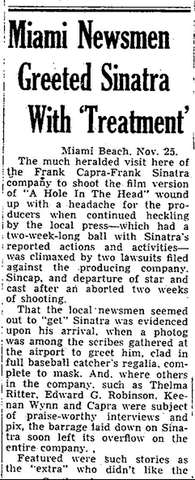
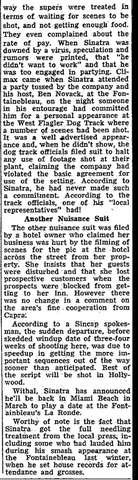
note: Red Norvo told me Frank
had a terrible time with the press.
He thought the Australian scribes
were particularly bad in March/April
59, but the news people in the states
were also brutal if Frank didn't make
himself available to them.
Ed
December 1958
[Life spotlights Dean Martin and the Clan]
Kaplan: A few days before Christmas, Life's U.S. Entertainment issue ran a glowing picture spread on Dean Martin, "Make-a-Million Martin," alongside Paul O'Neil's piece "The 'Clan' Is the Most," which sociologically profiled Sinatra's circle, naming its inner "cell" as including Eddie Fisher, Peter Lawford, Tony Curtis, and Sammy Davis Jr., with Sammy Davis Jr. as its chief inside source.
Source: James Kaplan, "Sinatra: The Chairman" (2015)
[Some Came Running premieres]
Kaplan: Some Came Running premiered in mid-December 1958 to savage reviews but strong audience response.
Source: James Kaplan, "Sinatra: The Chairman" (2015)
December 9, 1958
Studio
Capitol Studio A, Hollywood
E30771 The Song Is You
(J. Kern/O. Hammerstein II)
T.B. Harms Company(c/o The Welk Music Group) (ASCAP)
Arranged & Conducted by Billy May
-6 (2:42) CD: C2-94777 The Capitol Years
CD: CDP 7-48468-2 Come Dance With Me
LP: SW1069 Come Dance With Me
LP: E-ST24311 (alt take, England, The Rare Sinatra)
E30772 Something's Gotta Give
(Johnny Mercer)
Arranged & Conducted by Billy May
CD: CDP 7-48468-2 Come Dance With Me
LP: SW1069 Come Dance With Me
E30773 Just In Time
(Styne/Comden/ Green)
Chappell Music (ASCAP)
Arranged & Conducted by Billy May
-6 (2:23) CD: C2-94777 The Capitol Years
CD: CDP 7-48468-2 Come Dance With Me
LP: SW1069 Come Dance With M
December 11, 1958
Studio
Capitol Studio A, Hollywood
E30776 Day In, Day Out
(Rube Bloom/Johnny Mercer)
Arranged & Conducted by Billy May
N/R
note: I would love to hear this session.
When I asked Billy May about it, he started laughing. Frank had started celebrating his 43rd birthday a tad early. Billy told me Frank was in no condition to record that night.
Finally, he gave up and invited
Billy and the 17 musicians to his house for an all night party.
Ed
December 14, 1958
Concerts
Moulin Rouge, Los Angeles, California
Friars' Christmas Party
Frank Sinatra, Jack Benny, Peggy Lee, Debbie
Reynolds, Kay Starr, Sammy Davis Jr., Jimmy Durante and others
Moulin Rouge, Los Angeles, California
Friars' Christmas Party
Frank Sinatra, Jack Benny, Peggy Lee, Debbie Reynolds, Kay Starr, Sammy Davis Jr., Jimmy Durante and others
Dec 14 1963 Sands 11th Anniversary
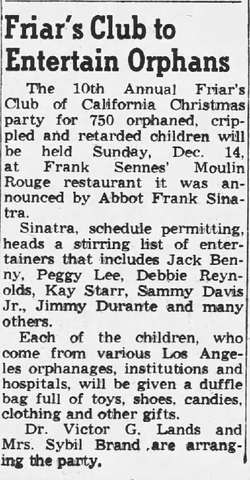
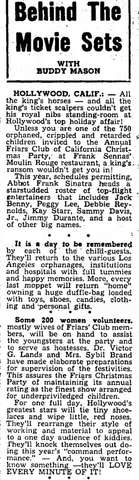
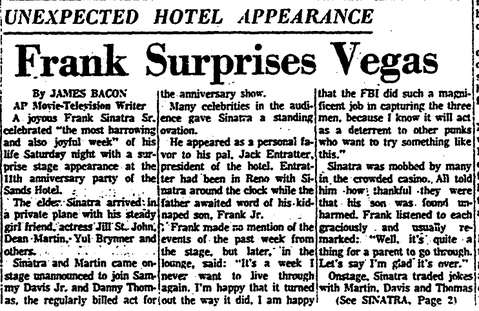
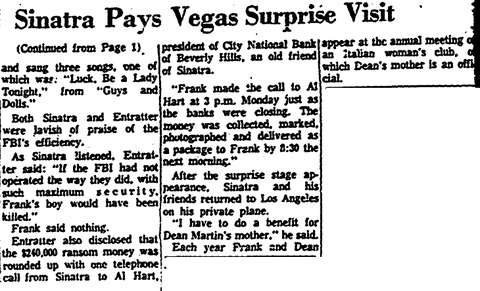
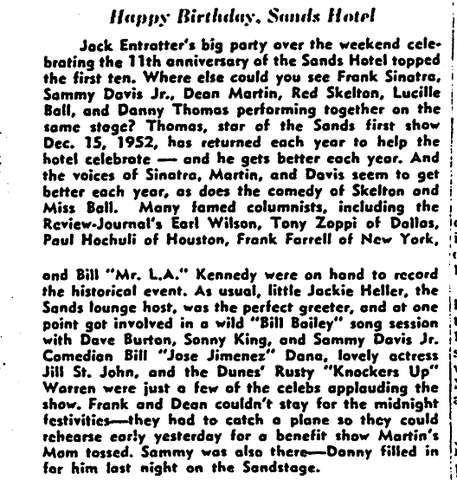
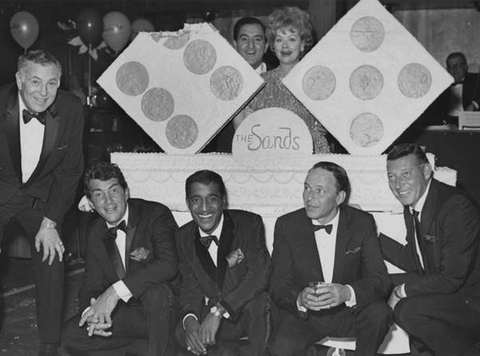
December 18, 1958
Film
Some Came Running (US Film Release: December 18, 1958)
Starring: Frank Sinatra, Deam Martin, Shirley MacLaine, and Martha Hyer
(Directed by Vincente Minnelli & Produced by Sol C. Siegel) Sinatra plays Dave Hirsch, a writer and an army veteran who winds up in his small Indiana hometown, to the dismay of his respectable older brother. He meets and befriends various different characters and tries to figure out what to do with his life.
Some Came Running (US Film Release: December 18, 1958)
Release Date:
January 1959
Premiere Information:
World premiere in Los Angeles: 18 Dec 1958; New York opening: 22 Jan 1959
Production Date:
Early Aug--early Oct 1958
A Dec 1956 DV news item indicates that author James Jones, whose novel From Here to Eternity had been successfully produced by Columbia Pictures in 1953 (see entry), was offering the rights to Some Came Running for $1,000,000. M-G-M purchased Jones's 2,000-page-plus manuscript for $200,000 in Jan 1957, eight months before its publication. The published novel was 1,266 pages. The title was inspired by the Gospel of St. Mark 9.25, which refers to those who seek the meaning of eternal life but are prevented from finding it by obsession with materialism.
According to an Apr 1958 HR item, producer Sol C. Siegel considered casting Marilyn Monroe and Marlon Brando in the film. A June 1958 "Rambling Reporter" item in HR notes that Norma Crane tested for a role. Some Came Running marked the first joint screen appearance of members of Hollywood's well-known entertainment cadre, the "Rat Pack,"of which Frank Sinatra was the unofficial head and which included Dean Martin, Sammy Davis, Jr., Joey Bishop and Peter Lawford. Shirley MacLaine was included as an "auxiliary" member of the group several years after the film's release.
The film was shot on location in Madison and Terre Haute, Indiana. HR casting information adds Virginia Whitmire, Jay Gerard, Kayla Terry, Frank Challfant, Walter Kinney and Jeanette Fuller to the cast, but their appearance in the final film has not been confirmed. An Aug 1958 article in Time magazine, commented on by some reviews of the film, was critical of Sinatra's purported behavior while on location, including making insulting remarks to the locals and engaging in a brawl.
In his autobiography, director Vincente Minnelli indicated he found no fault in Sinatra's conduct in Madison. Minnelli reveals that at Sinatra's recommendation, MacLaine's part as "Ginny" was built up, including changing the ending, from having "Dave" killed to having Ginny die trying to protect him. MacLaine received an Academy Award nomination for Best Actress for her role. Martha Hyer was also nominated for Best Supporting Actress. The film also received nominations for Arthur Kennedy as Best Supporting Actor, for Costume Design and Best Song.
AFI Catalog
Vincente Minnelli Shirley MacLaine Sinatra
‘Some Came Running’from left to right: Dean Martin, Martha Hyer, and Frank Sinatra
at the film's world premiere at the Hollywood Paramount Theatre on December 18, 1958.
[image referenced in source but could not be recovered]
[image referenced in source but could not be recovered]
[image referenced in source but could not be recovered]
[image referenced in source but could not be recovered]
[image referenced in source but could not be recovered]
[image referenced in source but could not be recovered]
[image referenced in source but could not be recovered]
[image referenced in source but could not be recovered]
[image referenced in source but could not be recovered]
"Some Came Running"
Some Came Running, directed by Vincente Minnelli and adapted from James Jones's novel, marked Frank's first on-screen pairing with both Dean Martin and Shirley MacLaine (the only female 'Clan' member). The location shoot in Madison, Indiana -- with its visits from reputed organized-crime figures -- helped originate the Rat Pack/Clan legend, though Martin gave the trio's best performance while MacLaine drew the strongest critical praise, credited by Santopietro partly to Sinatra's own choices.
Source: Tom Santopietro, "Sinatra in Hollywood" (2008).
"Some Came Running"
Frank Sinatra: Sinatra used his clout with the studio to insist on Dean Martin's casting, and pushed for a then-relatively unknown Shirley MacLaine over both Shelley Winters and Marilyn Monroe after spotting MacLaine on the Dinah Shore television show. Sinatra explained his choice: 'the cuteness, the strength, the humor -- everything we wanted in Ginny -- was wrapped up in that one package.'
Source: Tom Santopietro, "Sinatra in Hollywood" (2008).
"Some Came Running"
Sinatra's dislike of Minnelli's painstaking style came to a head during setup of the climactic carnival Ferris-wheel sequence: after Minnelli asked to move the Ferris wheel (six feet, by his own later account), an infuriated Sinatra walked off, flew back to Los Angeles with Dean Martin in tow, and stayed away for several days until producer Sol Siegel persuaded him to return by promising no more such directorial delays.
Source: Tom Santopietro, "Sinatra in Hollywood" (2008).
"Some Came Running"
Santopietro (citing Vincente Minnelli's autobiography): During location filming in Madison, Indiana, press reports described Sinatra's frustration with small-town life, including tearing a telephone out of a wall and calling Madison a dump comparable to LA's skid row. Minnelli also recounted that Sinatra and Dean Martin's manager got into a 'shoving match' with an elderly hotel clerk over an order of hamburgers.
Source: Tom Santopietro, "Sinatra in Hollywood" (2008).
"Some Came Running"
Vincente Minnelli / Frank Sinatra: To accommodate Sinatra's strong preference for a single take, Minnelli rehearsed the other actors using Sinatra's stand-in, bringing Frank in only for a final rehearsal and the actual filming. Minnelli said of the resulting performance, 'He gave me everything I wanted.' Minnelli also switched the studio's shooting schedule from early morning to a noon-to-8 P.M. slot to suit Sinatra, who reasoned, 'Performers work better in the afternoon and the girls look better. They don't run out of gas at five like they usually do.'
Source: Tom Santopietro, "Sinatra in Hollywood" (2008).
"Some Came Running"
Vincente Minnelli / Frank Sinatra: In his autobiography, Minnelli discussed Sinatra's 'towering rages' alongside his fierce gift for friendship, observing that Sinatra was 'prone to tell friends how he'll help them rather than ask how he can help,' which Minnelli chalked up to Sinatra's role as leader of the Clan. Sinatra himself once expressed his notion of friendship to Shirley MacLaine as: 'I just wish someone would try to hurt you so I could kill them for you.'
Source: Tom Santopietro, "Sinatra in Hollywood" (2008).
"Some Came Running"
Shirley MacLaine: Shirley MacLaine felt that she and Dean Martin thrived under Minnelli because he trusted actors' own instincts and gave little concrete direction, whereas in her view Sinatra disliked Minnelli's style because 'the freedom of choice exposed him too much.'
Source: Tom Santopietro, "Sinatra in Hollywood" (2008).
"Some Came Running"
Martha Hyer's uneven performance as schoolteacher Gwen French earned her an Academy Award nomination for Best Supporting Actress (Shelley Winters won that year for The Diary of Anne Frank).
Source: Tom Santopietro, "Sinatra in Hollywood" (2008).
"Some Came Running"
Santopietro (citing Shirley MacLaine's autobiography): It was Sinatra himself who insisted that Shirley MacLaine's character Ginny be killed at the end, believing correctly that her death would boost audience sympathy and earn her an Academy Award nomination. According to MacLaine's autobiography, the choice also functioned as an unspoken apology: Sinatra, impatient with the film's slow shooting schedule, had ripped twenty pages out of the script that contained showcase acting scenes for MacLaine and refused to film them.
Source: Tom Santopietro, "Sinatra in Hollywood" (2008).
"Some Came Running"
Time magazine / Life magazine (quoted by Santopietro): Life magazine called Some Came Running 'an unforgettable vignette of American life,' but Time magazine was harshly negative, dismissing the script as a string of bromides and lamenting director Minnelli's talents 'dissolving in the general mess of the story, like sunlight in a slag heap.' Despite such reviews, the film became a box-office hit.
Source: Tom Santopietro, "Sinatra in Hollywood" (2008).
"Some Came Running"
Shirley MacLaine / Jeanne Martin: In her autobiography My Lucky Stars, Shirley MacLaine described Dean Martin using the Italian term 'menefreghista' (someone who doesn't give a damn), and Martin's second wife Jeanne said of him: 'He cannot communicate... He's one of the rare human beings who's not comfortable with communicating... He can literally do nothing. All he needs is a television set and a Western... He was always content in a void.'
Source: Tom Santopietro, "Sinatra in Hollywood" (2008).
"Some Came Running" / "Ocean's Eleven" / "Cannonball Run II"
Can-Can was Sinatra and Shirley MacLaine's second film pairing after Some Came Running; they went on to work together again in Ocean's Eleven (cameo) and Cannonball Run II (1984), and toured together in concert in 1992.
Source: Tom Santopietro, "Sinatra in Hollywood" (2008).
"Some Came Running"
Santopietro grades this a B: overbaked but good Frank (and great Dean). Golden Laurel Award: Top Male Dramatic Performance; Golden Laurel Award nomination: Top Male Star of Year; Quigley Top 10 Money Makers Poll: #10.
Source: Tom Santopietro, "Sinatra in Hollywood" (2008).
"Some Came Running"
Santopietro (Filmography): Metro-Goldwyn-Mayer. Produced by Sol C. Siegel, directed by Vincente Minnelli, screenplay by John Patrick and Arthur Sheekman based on the James Jones novel, musical score by Elmer Bernstein. Sinatra played Dave Hirsh opposite Dean Martin, Shirley MacLaine and Martha Hyer.
Source: Tom Santopietro, "Sinatra in Hollywood" (2008).