December 20, 1960
Studio
Los Angeles
105 You'd Be So Easy To Love
(Cole Porter)
Chappell & Co. Inc. (ASCAP)
Arranged & Conducted by Johnny Mandel
-5 (2:23) CD: 46013-2 The Complete Reprise Studio Recordings Disc 1
CD: 9-27017-2Ring- a-ding-ding
CD: 9-26340-2The Reprise Collection
LP: FS1001Ring-a- ding-ding
106 A Fine Romance
(Jerome Kern/Dorothy Fields)
Poly-Gram International Publishing Co. Inc. (ASCAP)
Arranged & Conducted by Johnny Mandel
-2 (2:11) CD: 46013-2 The Complete Reprise Studio Recordings Disc 1
CD: 9-27017-2 Ring-a-ding- ding
LP: FS1001Ring-a- ding-ding
107 The Coffee Song
(Bob Hilliard/Dick Miles)
Cromwell Music Inc. (ASCAP)
Arranged & Conducted by Johnny Mandel
-10 (2:51) CD: 46013-2 The Complete Reprise Studio Recordings Disc 1
CD: 9-27017-2 Ring-a-ding- ding
CD: 9-26340-2The Reprise Collection
LP: FS1001Ring-a- ding-ding
108 Be Careful It's My Heart
(Irving Berlin)
Irving Berlin Music Corp. (ASCAP)
Arranged by Skip Martin
Conducted by Johnny Mandel
-5 (2:03) CD: 46013-2 The Complete Reprise Studio Recordings Disc 1
CD: 9-27017-2Ring- a-ding-ding
LP: FS1001Ring-a- ding-ding
109 Have You Met Miss Jones?
(Richard Rodgers/Lorenz Hart)
Chappell & Co. Inc./Williamson Music Co. (ASCAP)
Arranged & Conducted by Johnny Mandel
-rh (runthrough, rejected)
110 I've Got My Love To Keep Me Warm
(Irving Berlin)
Irving Berlin Music Corp. (ASCAP)
Arranged by Dick Reynolds
Conducted by Johnny Mandel
-5 (2:52) CD: 46013-2 The Complete Reprise Studio Recordings Disc 1
CD: 9-27017-2Ring-a-ding-ding
LP: FS1001Ring-a-ding-ding
Ed O'Brien continues:
The second night of the "RADD" sessions got underway
with Frank doing three rehearsal takes on "Easy To Love."
After
a brief break to adjust the tempo Frank proceeded to do 5 takes,
four of which were complete. Take 3 is a gem but the singer heard
something not to his liking and continued on until it was right.
"A Fine Romance" was next and was polished off in 2 quick
takes. The third tune that evening was one Sinatra had been
singing for more than 15 years,. "The Coffee Song" He had sung
the song many times both on radio and in concerts. The tempo was
too slow for Sinatra so after take 5 it was increased. He almost had
a record with take 8 and expressed his frustration with a few expletives.
For take 10 the tempo was back to a slower pace and it is the record.
As I mentioned yesterday, Sinatra ran down "Be Careful It's My Heart"
and rejected the Mandel arrangement. Skip Martin penned a quick chart
and a recording was made in 5 takes. Next came "Have You Met Miss
Jones." Al Viola told me the entire project had been beset with problems
and "Miss Jones" may have been the most disappointing of the three nights.
Sinatra opened with the verse and then did a cautious run through of
the chorus.He told Hefti and Mandel that the arrangement sounded
like it belonged on another album. After trying to clean it up and
an incomplete take 2, Frank instructed the booth to "pass."
The
session was completed with a dynamite recording of Irving Berlin's
"I've Got My Love To Keep Me Warm." Three complete takes were laid
down and #5 became the record...There was a 38 piece orchestra
and the session ran for more than four hours.Ten songs had been laid
down over two nights.
Paul Marinaro:
Love the info about RADD...one of my favorite albums of the Sinatra swingers.
It is interesting to see that Sinatra rejected the Mandel chart for "Be Careful, It's My Heart" and that
the arrangement heard is Skip Martin's. I have always felt that track, while good, is the weakest link on the album and feels
as if it belonged on a different album.
Does a run-through of the Mandel arrangement exist?
Ed O'Brien:
Musicians at the first session told me Mandel was a no-show. The pressure of working with
Sinatra in 1960 got to him. So the arrangement on the Berlin song was assigned to Martin because
there was no other workable option. The run-through does exist.
Film
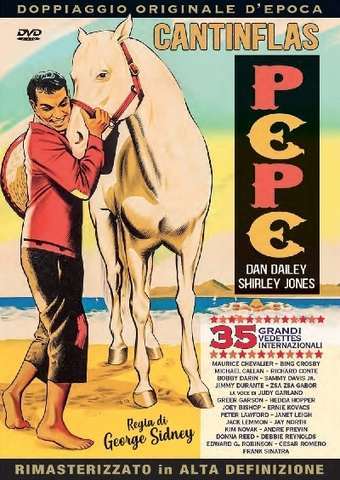
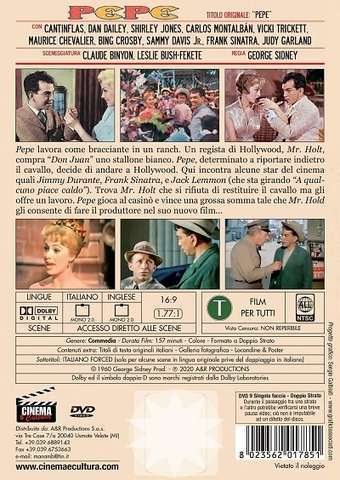
Pepe (US Film Release: December 20, 1960)
Starring: Cantinflas, Shirley Jones, and Dan Dailey
Special Guest Appearances by: Frank Sinatra, Dean Martin, Sammy Davis Jr., Joey Bishop, Billie Burke, Maurice Chevalier, Bing Crosby, Tony Curtis, Bobby Darin, Jimmy Durante, Zsa Zsa Gabór, Greer Garson, Hedda Hopper, Ernie Kovacs, Peter Lawford, Janet Leigh, Jack Lemmon, Kim Novak, André Previn, Donna Reed, Debbie Reynolds, Edward G. Robinson, Cesar Romero Produced and Directed by George Sidney
The young Mexican Pepe's beloved horse is sold to Hollywood star Ted Holt (Dan Dailey), leading to Pepe's journey to Hollywood to get the horse back, and Pepe's encounter with half the stars working in Hollywood at the time. (The movie was released on DVD on February 14, 2020 by A E R Productions out of Italy)
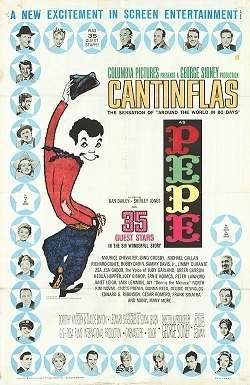
Pepe (US Film Release: December 20, 1960)
Starring: Cantinflas, Shirley Jones, and Dan Dailey
Special Guest Appearances by: Frank Sinatra, Dean Martin, Sammy Davis Jr., Joey Bishop, Billie Burke, Maurice Chevalier, Bing Crosby, Tony Curtis,
(The movie was released on DVD on February 14, 2020 by A E R Productions out of Italy)
Release Date:March 1961 Premiere Information: World premiere in New York: 21 Dec 1960; Los Angeles premiere: 27 Dec 1960
Production Date:1 Feb--15 Jun 1960 Onscreen credits contain the following written acknowledgment: "With grateful appreciation to the members of the Motion Picture Production Worker's Union of the Republic of Mexico for their splendid cooperation." Onscreen song credits read: "Maurice Chevalier recordings of "September Song" and "Mimi" courtesy of M-G-M Records." According to publicity materials in the film's production file at the AMPAS Library, Posa Films Internacional was owned by Cantinflas (whose real name was Mario Moreno) and Jacques Gelman, who is listed as the associate producer of Pepe. Cantinflas' success in the 1956 film Around the World in 80 Days (see entry) led to his starring role in Pepe^.
Although various reviews list the film's length as 190 or 195 minutes, studio records reveal that the actual running time was 180 minutes 29 seconds. It is possible that the running time in the reviews included the film's intermission. The viewed print ran approximately 157 minutes. According to a 10 Feb 1960 HR news item, animators William Han"a and Joseph Barbera were to create a "Don Quixote" dream sequence. A studio synopsis dated 21 Mar 1960 in the film's production file includes the sequence, in which "Pepe" dreams he is Don Quixote, protecting his lady from harm.
This scene was not in the viewed print.
In onscreen credits, Frank Sinatra's name is followed by "And ? ?," referring to the guest stars who are not credited onscreen. Some of the film's cameo's appearances, which sometimes involved the stars playing minor roles that advanced the plot, and other times merely had them briefly portraying themselves, include the following: Ernie Kovacs portrays a customs official as Pepe crosses the border. As Pepe waits for "Ted Holt" at the studio, he encounters Bing Crosby, who sings a few bars from his popular songs "Pennies from Heaven" and "South of the Border Down Mexico Way" to him. Zsa Zsa Gabor, Jay North, known as "Dennis the Menace" because of a popular television show in which he starred, and Jack Lemmon (wearing his costume from Some Like It Hot, see entry) also appear in the studio sequence, but Pepe fails to recognize any of them as celebrities.
Bobby Darin sings "That's How
It Went, Alright" at Kelly's Cafe, where André Previn plays the piano and Michael Callan dances with "Suzie Murphy." Peter Lawford, Frank Sinatra, Richard Conte, Dean Martin and "Big"
Jack Entratter, president of the Sands Hotel, appear in the Las Vegas sequence, in which Sammy Davis, Jr. also sings "Hooray for Hollywood." In another sequence, miniature figures of Pepe and Debbie Reynolds dance to the music of the hit instrumental "Tequila" while Ted considers taking a swig from his tequila jug. Janet Leigh and Tony Curtis, who were married at the time, appear in the scene at an Acapulco resort in which Leigh mistakes Pepe for an official from the censorship board, and Kim Novak helps Pepe pick out an engagement ring in a Mexico City jewelry shop. Cast member Col. E. E. "Buddy" Fogelson was married to Greer Garson, who also appeared in the film.
A Mar 1958 HR news item in the
"Rambling Reporter" column noted that Columbia wanted Fred Astaire and Judy Garland to star in the film. Although Garland did not appear in the film, her voice is heard singing "Faraway Part of Town." Jan 1960 HR news items noted that Natalie Wood, who was originally to play Suzie, pulled out of the film. The studio then considered Barrie Chase and Sandra Church as her replacement. Although various 1960 HR news items listed Anthony Redondo, George Ford, Roger Ferry, Phil Hartman, Eddie Edell, Barbara Chrysler, Shep Houghton , Mark Lambert and Pedro Galvan in the cast, their appearance in the released film has not been confirmed. Although Feb 1960 HR news items noted that Robert Young was to make a cameo in the film and Columbia studio head Sam Briskin was to appear in a walk on, neither appeared in the viewed print.
Onscreen credits note that the Las
Vegas sequences were photographed at the Sands and Tropicana Hotels in Las Vegas, NV, and the bullfight and fiesta scenes were photographed at Hacienda Vista Hermosa in Mexico. Other HR news items noted that location filming was also done in Taxco and Acapulco, Mexico, and interiors were filmed at the Estudios Churubusco in Mexico City and the Columbia studios lot in Los Angeles. In the Acapulco sequence, the famed troupe of divers known as the La Perla Divers are shown plunging from steep cliffs into the sea water below.
Modern sources note that location filming was also done in Puebla and Oaxaca, Mexico. According to a Jun 1960 HR news item, as part of the promotion of the picture, Cantinflas sent out a chronicle of events describing the activities of the company while they were on location. An Aug 1961 HR news item noted that the film was to open with Spanish subtitles at two theaters in Los Angeles. Although a Feb 1961 LAT news item noted that producer-director George Sidney was planning to make a sequel titled Pepe in Paris, that film was never made and consequently, Pepe marked Cantinflas' last American film.
Pepe was nominated for the following
Academy Awards: Best Musical Score; Best Art Direction (Color); Best
Costume Design (Color); Best Film Editing; Best Cinematography (Color); and Best Sound. "Faraway Part of Town" was nominated for Best Song.
AFI CATALOG
Los Angeles
105 You'd Be So Easy To Love
106 A Fine Romance
107 The Coffee Song
108 Be Careful It's My Heart
109 Have You Met Miss Jones?
110 I've Got My Love To Keep Me Warm
2025 The Sinatra Archive
This calendar, or any parts thereof, may not be reproduced in any fashion
whatsoever without the prior written permission of the publisher (The
Sinatra Archive)
"Pepe" / "Ocean's Eleven"
While still filming Ocean's Eleven, Sinatra along with Dean Martin, Sammy Davis Jr., Peter Lawford, and Joey Bishop squeezed in cameo roles for George Sidney's Pepe, released in December 1960, just four months after Ocean's Eleven — an attempt to capitalize on Cantinflas's popularity following Around the World in Eighty Days.
Source: Tom Santopietro, "Sinatra in Hollywood" (2008).
"Pepe"
Santopietro criticizes Pepe as an overlong (three-plus hour), condescending 'comedy' emblematic of 1960 Hollywood's patronizing attitude toward Hispanic characters, with Kim Novak's warm, non-comedic cameo as the one exception treating Pepe as a real person.
Source: Tom Santopietro, "Sinatra in Hollywood" (2008).
"Pepe"
Sinatra's cameo in Pepe finds him playing himself as an owner of the Sands, appearing fit and handsome, handing out gambling money and eventually giving the title character a six-dollar tip. Santopietro calls it the one feature film appearance where Sinatra plays himself at the height of his career, blending the 'reel' and 'real' Frank Sinatra.
Source: Tom Santopietro, "Sinatra in Hollywood" (2008).
"Pepe"
Despite an all-star cast of cameos and Sinatra's box-office popularity that year, Pepe flopped at the box office; Sinatra's number-six box office ranking for 1960 was attributable entirely to Ocean's Eleven, not Pepe.
Source: Tom Santopietro, "Sinatra in Hollywood" (2008).
"Pepe"
Santopietro grades this a D, calling it a cameo in a bloated "comic" epic.
Source: Tom Santopietro, "Sinatra in Hollywood" (2008).
"Pepe"
Santopietro (Filmography): Cameo appearance. G.S.-Posa International Films/Columbia Pictures. Produced and directed by George Sidney, screenplay by Claude Binyon and Dorothy Kingsley. Starred Cantinflas in the title role, with cameo appearances by a huge roster including Bing Crosby, Sammy Davis Jr., Dean Martin, Kim Novak, Edward G. Robinson and Sinatra.
Source: Tom Santopietro, "Sinatra in Hollywood" (2008).
[I've Got My Love to Keep Me Warm -- critical commentary]
After passing on 'Have You Met Miss Jones?' during the Ring-a-Ding-Ding! sessions, Sinatra apparently still liked the tune 'I've Got My Love to Keep Me Warm,' which he recorded with Billy May five months later, in May 1961, for Swing Along with Me.
This song/context matches multiple dated entries in the chronology, or lacked a sufficiently precise date; the specific date could not be determined with confidence.
Source: Charles L. Granata, "Sessions with Sinatra: Frank Sinatra and the Art of Recording" (1999/2003), Part IV: The Reprise Years
December 21, 1960
Studio
Los Angeles
111 Zing Went The Strings Of My Heart
(James F. Hanley)
Warner Bros. Inc. (ASCAP)
Arranged & Conducted by Johnny Mandel
-1 (2:48) CD: 46013-2 The Complete Reprise Studio Recordings Disc 1
CD: 9-27017-2Ring-a-ding-ding
CD: 9-26340-2The Reprise Collection
112 You And The Night And The Music
(Arthur Schwatz/Howard Dietz)
Harms Inc./Arthur Schwartz Music Ltd. (ASCAP)
Arranged & Conducted by Johnny Mandel
-9 (2:36) CD: 46013-2 The Complete Reprise Studio Recordings Disc 1
CD: 9-27017-2Ring-a-ding-ding
LP: FS1001Ring-a-ding-ding
113 When I Take My Sugar To Tea
(Irving Kahal/Sammy Fain/Pierre Norman Connor)
Famous Music Corp/New Irving Kahal Music Co. inc. (ASCAP)
Arranged & Conducted by Johnny Mandel
-3 (2:05) CD: 46013-2 The Complete Reprise Studio Recordings Disc 1
CD: 9-27017-2Ring-a-ding-ding
LP: FS1001Ring-a-ding-ding
NOTE: Sinatra Scholar Ed O'Brien reports that Sinatra did four takes on "Zing." Take 1 was issued by Reprise in 1990.
Johnny Mandel told O'Brien that way back in the early 1980s that Take 6 on "You and the Night and the Music" had a fabulous vocal. He was right.
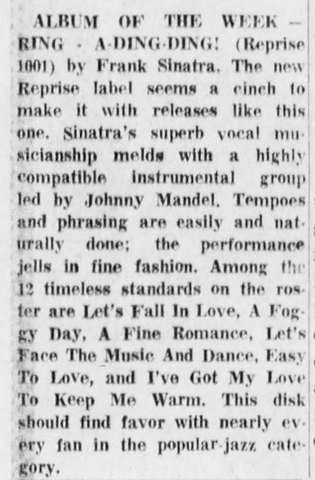
Review: Frank Sinatra, "Ring-a-Ding Ding!: Expanded
Edition"
BY JOE MARCHESE
Frank Sinatra - Ring a Ding Ding
Ring-a-ding ding! It can be used as an adjective or an interjection. But when Frank Sinatra chose the expression to title his very first album for his very own label, it was simply an ecstatic expression of pure joy. Sinatra was no longer tethered to Capitol Records, the label at which he'd made history with a series of "concept" albums. He had the freedom to make some new history, his way, when he launched Reprise. And Ring-a-Ding Ding!, now reissued and remastered for its 50th anniversary as part of Concord's ongoing campaign (Concord CRE-32929), didn't merely reprise the Capitol sound. Nelson Riddle, arguably Sinatra's most renowned collaborator, was unavailable due to a contract over at the Tower. For the same reason, Billy May was out of the question. And Sinatra instinctively knew that Gordon Jenkins' lush, reflective string charts wouldn't fit the bill to usher in a new decade on a new label. So when it was decided to reach out to young jazz composer Johnny Mandel to arrange and conduct, there was excitement in the air.
The Chairman's intentions were anything but subtle when Mandel's thrilling, brassy introduction to the first track began. The delicious cut was the latest in a line of title songs made to order for Sinatra by his pallys Sammy Cahn and Jimmy Van Heusen. "Don't know if it's morning, nighttime, winter or spring - what's the difference? Ring-a-ding ding!" announces Sinatra. When he asserts that "life is swell," accompanied by swaggering horns, trilling bells and tinkling keys, who could argue?
What follows is a tour of Sinatra's favorite songwriters in the pantheon. These names are legendary now, and were legendary then, even though many were still active writing for Hollywood, Broadway or even television. A trio was selected from Irving Berlin ("Be Careful, It's My Heart," "Let's Face the Music and Dance," and one standard now most played at the holidays, "I've Got My Love To Keep Me Warm") and a duo from Cole Porter ("In the Still of the Night," "You'd Be So Easy to Love"), with whose music Sinatra always evinced a sympathetic sensibility. "In the Still of the Night," in fact, may be the most enduring track on the album, with an arrangement that remained in Sinatra's book throughout his lifetime. The Jerome Kern and Dorothy Fields songbook yielded "A Fine Romance," a worthy precursor to the singer's immortal reading of "The Way You Look Tonight" a few years later.
The George and Ira Gershwin catalogue was tapped for "A Foggy Day," with its evocative introduction and playful vocal.
Arthur Schwartz and Howard Dietz' moody, jazz standard "You and the Night and the Music" as well as Harold Arlen and Ted Koehler's "Let's Fall in Love" seriously upped the romantic ante.
Sinatra never sounded more assured and confident, and he was ready to take risks even beyond the launch of a new label. There's famously the extended two-bar pause in "Let's Fall in Love." (Was Brian Wilson listening when he similarly inserted a dramatic silence into his sophisticated pop song, "The Little Girl I Once Knew," to the chagrin of Capitol executives?) The pause gives listeners more time to savor what had come before. Metro-Goldwyn-Mayer's famous orchestrator Skip Martin was one of two arrangers brought in to augment Mandel's work. (Dick Reynolds was the other, and he handled "I've Got My Love to Keep Me Warm." Reynolds was a major arranger for the Four Freshmen and in another Beach Boys connection, arranged Side Two of their Christmas album.) Martin took on Irving Berlin's "Be Careful, It's My Heart." The mood on the album is so bold and so bright that the idea of anyone raining on Sinatra's parade seems an impossibility, but that voice - indeed, The Voice - was incapable of dishonesty. And so a spot-on note of vulnerability creeps into the song. When Sinatra admits that it's "the heart with which so willingly I part," he effortlessly makes Berlin's poetry sound conversational. But he was equally ready for some fun. Bob Hilliard and Dick Miles' "The Coffee Song," first recorded by Sinatra in 1946, is a bit goofy, to say the least: "Why, they put coffee in the coffee in Brazil!"
But in Mandel's freewheeling, wild arrangement, it's one of the singer's best, most hard-swinging performances and made an instant (pun intended) classic of the delightful tune.
The stereo sound, remixed from the original three-track tapes by Larry Walsh, restored by Leon J. Smith III and mastered by the folks at BluWave Audio, is crisp, dry and clean. The new mix doesn't replace the original but is a valid alternative view. (Now if only a multi-channel SACD, a la the Nat "King" Cole reissues coming from Analogue Productions, would be released!) Liner notes aren't courtesy of Stan Cornyn this time around but rather by Frank Sinatra Jr,. a 16-year old onlooker during the recording sessions. The younger Sinatra's notes aren't only friendly and accessible but they're filtered through the sensibility of a musician. Hence, he admonishes us to pay attention to Irv Cottler's drumming on the title track, Conrad Gozzo's stunning lead trumpet parts, Frank Sr.'s double "F" on "Be Careful, It's My Heart," and the construction of the slam-bang finish of "Let's Face the Music and Dance."
These observations handily enhance the listening experience. The booklet has been attractively designed. The Concord logo has elegantly replaced the original Reprise on the album cover, while the rare alternate cover prepared for the reel-to-reel issue is included on the inside back cover. Ralph J. Gleason's original liner notes have also been included on both the inside tray card and rear of the booklet, where they are easier to read. Even the typography on the spine and tray card will be familiar to Reprise enthusiasts.
And then there are the bonus tracks. Sinatra's outtake performance of James Hanley's "Zing! Went The Strings of My Heart" premiered on the 1990 box set The Reprise Collection and was recorded at the same December 21, 1960 session as "I've Got My Love to Keep Me Warm," "When I Take My Sugar to Tea" and "You and the
Night and the Music." The song is reprised here, but appears to be a different, equally superb take. The real treasure is the second bonus track, a full 10+ minutes of sessions for Sinatra's abortive attempt at Rodgers and Hart's "Have You Met Miss Jones."
Over a luscious introduction, Sinatra is heard ruminating "This sounds like a different album!" which may ultimately explain why the song was abandoned and re-recorded in May 1961 with Billy May. The session chatter and multiple attempts at the song are illuminating. The Sinatra team has long been reluctant to release session material, hopefully its inclusion here signals a change in the weather.
Sinatra's sessions are clearly deserving of a commercial release in a boxed set form; I was instantly transported to United Recorders, circa 1960, for a master class in musicianship and interpretive singing. The rapport Sinatra shared with his musicians is in evidence, and what a group they were: Conrad Gozzo, Don Fagerquist and John Anderson on trumpet, Emil Richards on vibes, Bud Shank on flute, Frank Rosolino on trombone, Irv Cottler on drums, and Sinatra's longtime pianist Bill Miller. Both bonus tracks are presented in punchy mono.
Three further Cahn/Van Heusen songs were committed to tape on December 21, 1960. "The Last Dance," "The Second Time
Around" and "Tina" were all recorded with surreptitious Nelson Riddle charts credited to conductor Felix Slatkin. The latter two tracks formed Sinatra's first Reprise single. All three recordings have been released on CD in the past but are currently orphaned in the catalogue, and they might have nicely filled out the disc for a full picture of Sinatra's first work at Reprise.
[Nelson Riddle ghostwrites for Reprise's first single]
Nelson Riddle (quoted): Four days before Christmas, still under exclusive contract to Capitol, Nelson Riddle anonymously wrote charts for three Sinatra songs -- 'The Last Dance,' 'The Second Time Around,' and 'Tina' (a tribute to Sinatra's young daughter) -- with Felix Slatkin conducting; 'The Second Time Around' and 'Tina' became the A- and B-sides of Reprise's first single. Riddle, depressed over his failing marriage and inability to receive public credit for Sinatra's work, told writer Peter Levinson his association with Frank was what had truly launched his career.
Source: James Kaplan, "Sinatra: The Chairman" (2015).
Liner Notes: RING-A-DING-DING!
Ring-A-Ding-Ding! is a statement of independence set to music -- the first album Sinatra released on Reprise, the label he founded that year explicitly so that artists could own their own master recordings, a radical idea in the record business of 1960. Nelson Riddle, still under contract to Capitol, could not arrange the sessions, so Sinatra turned to Johnny Mandel, then a rising young arranger, for a sound that needed to prove the new label could swing every bit as hard as the old one.
Mandel delivers -- the title track, written for the occasion by Sammy Cahn and Jimmy Van Heusen, is pure declaration, brassy and confident, practically daring the listener to doubt that Sinatra could start over from scratch. "In the Still of the Night" and "A Foggy Day" round out a set that swings with a slightly looser, jazzier feel than the tightly drilled Capitol sessions, a subtle signal of the more artist-driven era Sinatra was announcing.
The gamble paid off. Reprise would go on to release not just the rest of Sinatra's catalogue but landmark records by Dean Martin, Sammy Davis Jr., and countless others, reshaping how the industry thought about artist ownership. Ring-A-Ding-Ding! is where that reshaping begins.
Written by Claude (Anthropic), commissioned for this chronology, 2026.
December 22, 1960
Studio
Los Angeles
114 The Last Dance
(Sammy Cahn/Jimmy Van Heusen)
WB Music Corp./Maraville Music Corp. (ASCAP)
Arranged by Nelson Riddle
Conducted by Felix Slatkin
(2:46) CD: 46013-2 The Complete Reprise Studio Recordings Disc 1
CD: 9-26723-2Sings The Songs Of Van Heusen & Cahn
CD: 9-27017-2Ring-a-ding-ding
CD: 9-26340-2The Reprise Collection
45: 7-19355B
115 The Second Time Around
(Sammy Cahn/Jimmy Van Heusen)
EMI Miller Catalog Inc. (ASCAP)
Arranged by Nelson Riddle
Conducted by Felix Slatkin
(3:00) CD: 46013-2 The Complete Reprise Studio Recordings Disc 1
CD: 9-27017-2Ring-a-ding-ding
CD: 9-26340-2The Reprise Collection
45: 20,001
116 Tina
(Sammy Cahn/Jimmy Van Heusen)
Maraville Music Corp. (ASCAP)
Arranged by Nelson Riddle
Conducted by Felix Slatkin
(2:55) CD: 46013-2 The Complete Reprise Studio Recordings Disc 1
CD: 9-26340-2The Reprise Collection
45: 20,001
45: 20,151
Ed O'Brien notes:
"The Last Dance," "Second Time Around"
and "Tina" were recorded on 12-22 in a small L.A"
studio. Al Viola told me the reason for the sub
rosa session was Nelson Riddle. He was still
with Capitol and could not work for any other
record company without their permission.
1961
[Sinatra destroys a Rockwell painting]
Rough Guide to Frank Sinatra: Enraged over the portrayal of Italian-American gangsters on the TV series The Untouchables, Sinatra destroyed an original Norman Rockwell painting at Jimmy Van Heusen's apartment; challenged by a girlfriend of Van Heusen's about why he tolerated such outbursts, Van Heusen replied, "I'm a whore for my music."
Source: Rough Guide to Frank Sinatra (Rough guide 8.pdf), chapter "The Inner Circle."
[FBI File: Carnegie Hall Tribute to Dr. King]
A 1961 note in Sinatra's FBI file recorded his appearance at Carnegie Hall to honor Martin Luther King Jr.'s civil rights leadership.
Source: Tina Sinatra, "My Father's Daughter: A Memoir" (2000).
[Nancy Jr.'s First Record Deal At Her Father's Label]
Nancy Sinatra: When Nancy Jr. asked her father to let her try recording a single for his new label, Reprise, executive Mo Ostin balked at rock and roll, so she settled for a novelty record, "Cufflinks and a Tie Clip," which barely got played in the States but went to number one in Italy and Japan.
Source: Nancy Sinatra, Frank Sinatra: An American Legend, 1995.
[Sinatra Barred From Reentering Mexico Over Film Dialogue]
A Mexican government clerk reportedly blocked Sinatra from reentering the country over objections to lines in Marriage on the Rocks, including a joke about not drinking the water and a reference to quickie marriages and divorces; Nancy, who was also in the film, insisted the family's Acapulco vacation would proceed together or not at all.
Source: Nancy Sinatra, "Frank Sinatra, My Father" (1985).
[Sammy Davis Jr. Quietly Excluded From Kennedy's Inaugural Gala]
Frank produced and starred in President Kennedy's Inaugural Gala, which featured Laurence Olivier, Bette Davis, Harry Belafonte, Sidney Poitier, and Ella Fitzgerald among others, but organizers left Sammy Davis Jr. off the bill because his planned marriage to a white actress was seen as too politically sensitive at the time. Peter Lawford phoned Sammy to break the news, framing it as a request from "The Man" himself.
Source: Nancy Sinatra, "Frank Sinatra, My Father" (1985).
[Produces Kennedy's Inaugural Gala]
Sinatra produces President Kennedy's Inaugural Gala, organizes a tribute to Martin Luther King at Carnegie Hall, and releases his first Reprise album, "Ring-a-Ding-Ding!"; he appears in "The Devil at 4 O'Clock."
Source: Nancy Sinatra, "Frank Sinatra, My Father" (1985).
[Sinatra Sightseeing in Europe]
A photo caption shows Sinatra sightseeing in Europe in 1961.
Source: Charles Pignone, "Frank Sinatra 100" (2015).
[Ruta Lee On The Summit's Surprisingly Gentlemanly Manners]
Nancy Sinatra: Actress Ruta Lee recalled that filming Sergeants 3 with the Rat Pack was one of the happiest experiences of her life, and that despite their reputation the men treated her like a kid sister, with Dean Martin teaching her to drink beer on the rocks and Frank teaching her to drink champagne the same way.
Source: Nancy Sinatra, Frank Sinatra: An American Legend, 1995.
[Sinatra Tells Joe Hyams About His Business Interests]
Speaking to writer Joe Hyams in 1961, Sinatra described his extensive business holdings, including chairmanship of a Beverly Hills savings and loan, several music publishing firms, a movie production company, a stake in The Sands Hotel, radio stations, and California real estate ventures.
Source: Charles Pignone, "Frank Sinatra 100" (2015).
[Sinatra's Self-Funded Charity Trips To Mexico]
During 1961 and 1962, Sinatra traveled to Mexico twice at his own expense, bringing his band and entourage to perform benefit shows for Mexican charities.
Source: Nancy Sinatra, "Frank Sinatra, My Father" (1985).
[Swing Along With Me Cover Photoshoot]
An outtake survives from the cover photoshoot for the 1961 album Swing Along with Me.
Source: Charles Pignone, "Frank Sinatra 100" (2015).
[The Cal-Neva Losses That Strained A Decades-Long Friendship]
Nancy Sinatra: When profits from several of Sinatra's films were used to cover mounting losses at his Cal-Neva Lodge, his longtime friend and business partner Hank Sanicola grew so furious that a rift opened between them that never healed.
Source: Nancy Sinatra, Frank Sinatra: An American Legend, 1995.
[Spencer Tracy's Breakfast Lectures To Sinatra]
Nancy Sinatra: While filming The Devil at Four O'Clock, Frank and the early-rising Spencer Tracy, whom he called "the Grey Fox," would eat breakfast together when Frank's night-owl friends had all gone home, with Tracy repeatedly lecturing him about not getting enough sleep.
Source: Nancy Sinatra, Frank Sinatra: An American Legend, 1995.
[1961 prediction of becoming an executive]
Sinatra: In a 1961 Show Business Illustrated interview, Sinatra predicted that by fifty he'd have had it as an actor and singer and would see himself more as a high-level executive interested in business, directing, and producing -- broadening in the administrative sense. Kaplan notes he was wrong about giving up singing.
Source: James Kaplan, "Sinatra: The Chairman" (2015)
[Aboard the JFK campaign plane Caroline]
Consiglio: A photo caption shows Roger Edens, Frank Sinatra, and Tony Consiglio aboard the Kennedy campaign plane 'Caroline' in 1961, en route to Washington, D.C. to help plan JFK's inauguration.
Source: Tony Consiglio (as told to Franz Douskey), "Sinatra and Me: The Very Good Years" (2012)
[Arthur Krim's objections to Manchurian Candidate]
Daniel O'Brien (via Kaplan): United Artists president Arthur Krim, soon to become national finance chairman of the Democratic Party, opposed The Manchurian Candidate as potentially embarrassing to Kennedy given its assassination and Communist-infiltration plot, and personally disliked author Richard Condon, a former employee.
Source: James Kaplan, "Sinatra: The Chairman" (2015)
[Belafonte refuses gala LP clearance]
Mo Ostin: Harry Belafonte initially refused to clear his gala performance for the Reprise LP, objecting that proceeds could end up helping segregationist Democrats. Joe Kennedy had Bobby Kennedy lean on Belafonte through his New York contacts, and Steve Smith later confirmed Belafonte's approval; Ostin then flew to Las Vegas with release documents for him to sign.
Source: James Kaplan, "Sinatra: The Chairman" (2015)
[Capitol's Alan Livingston moves to kill Reprise]
Alan Livingston: Angered by a Reprise ad calling Sinatra 'emancipated' from Capitol, label chief Alan Livingston flooded record stores with repackaged compilations from Sinatra's Capitol catalog, telling retailers they didn't need more Sinatra product from Reprise -- a legal but damaging tactic Sinatra threatened, without grounds, to sue over.
Source: James Kaplan, "Sinatra: The Chairman" (2015)
[Charity concerts for Mexican children praised]
James Roosevelt: Sinatra's charity concerts for Mexican children the previous spring had been a dry run for a larger charitable effort and a hit, prompting California congressman James Roosevelt (son of FDR) to praise Sinatra's humane contribution in the Congressional Record.
Source: James Kaplan, "Sinatra: The Chairman" (2015)
[Complaint over 'El Dago' plane name]
Kaplan: In 1961, the Joint Civic Committee of Italian Americans, a Chicago ethnic-pride organization, wrote to Sinatra urging him to rename his personal plane, then called El Dago.
Source: James Kaplan, "Sinatra: The Chairman" (2015)
[Consiglio advises DiMaggio to pull son from Yale]
Consiglio: Consiglio told Joe DiMaggio that Joe Jr. was skipping class and running with the wrong crowd at Yale, and suggested DiMaggio pull him out after checking with his son directly. By the end of that school year DiMaggio had moved Joe Jr. out, and he never returned to Yale for his sophomore year.
Source: Tony Consiglio (as told to Franz Douskey), "Sinatra and Me: The Very Good Years" (2012)
[Dean Martin on Sinatra's untouchable status]
Dean Martin: Dean Martin observed that only Sinatra could get away with the risks he took with the mob, saying anyone else would have ended up dead.
Source: James Kaplan, "Sinatra: The Chairman" (2015)
[Don Costa's reputation and Riddle's jealousy]
Peter Levinson (via Kaplan): Don Costa was a versatile, talented but perpetually late and hard-drinking arranger who'd been working for Steve Lawrence and Eydie Gorme at ABC-Paramount. Nelson Riddle, contractually still tied to Capitol and unavailable to Reprise, was reportedly extremely upset by Sinatra's choice of Costa, mockingly calling him "Don Co-Star."
Source: James Kaplan, "Sinatra: The Chairman" (2015)
[Essex plans four more Rat Pack films]
Kaplan: Buoyed by the success of Ocean's 11, Sinatra's production company Essex planned a series of four more Rat Pack movies over the next four years. The first was a Western reworking of Kipling's "Gunga Din," featuring the Summit regulars plus Henry Silva and Buddy Lester.
Source: James Kaplan, "Sinatra: The Chairman" (2015)
[FBI wiretaps link Judith Campbell to Rosselli]
Kaplan: FBI wiretaps of mobster Johnny Rosselli in the fall of 1961 uncovered six calls to Judith Campbell Exner, the woman Sinatra had introduced to both John Kennedy and Sam Giancana.
Source: James Kaplan, "Sinatra: The Chairman" (2015)
[Failed attempt to record two albums at once]
Kaplan: On March 20 and 21, 1961, Sinatra tried to record two albums simultaneously -- a Tommy Dorsey tribute with Sy Oliver at United Recording and a swing album with Billy May at Capitol -- commuting between studios. The effort proved too much even for him; outtakes from the Dorsey sessions show his voice audibly hoarse and strained.
Source: James Kaplan, "Sinatra: The Chairman" (2015)
[Gala album never released]
Ed O'Brien and Scott P. Sayers Jr. (as cited by Kaplan): Despite Sinatra's connections, contractual conflicts prevented enough artists from signing release forms; a truncated seventy-five-minute version of the inaugural gala album was mastered but never issued, for reasons unrelated to the release forms.
Source: James Kaplan, "Sinatra: The Chairman" (2015)
[Giancana's confession about sparing Sinatra]
Sam Giancana (via Tommy DiBella): Giancana told Chicago associate Tommy DiBella that he'd once considered putting a contract on Sinatra, but changed his mind one night in bed with Phyllis McGuire while Sinatra records played, realizing he couldn't silence that voice -- crediting Sinatra's singing with saving his life.
Source: James Kaplan, "Sinatra: The Chairman" (2015)
[Giancana's hidden stake in Cal-Neva]
Kaplan: Although the Gaming Control Board's new Black Book officially barred Sam Giancana from any Nevada casino, he owned a substantial hidden piece of the Cal-Neva Lodge with Sinatra as his front -- a major worry for Hank Sanicola, who had $300,000 invested and stood to lose it if Giancana showed up, which became likely with Sinatra now in charge.
Source: James Kaplan, "Sinatra: The Chairman" (2015)
[Hiding the cameras on Advise & Consent set]
Consiglio: While Peter Lawford's film Advise & Consent (directed by Otto Preminger, also Frank's director on The Man with the Golden Arm) was shooting in Washington, Frank visited the set and, while Preminger was away, had Consiglio hide two cameras in another room as a prank. Preminger nearly had a stroke searching for the "stolen" equipment before Frank, calling from building security, had Consiglio quietly return them.
Source: Tony Consiglio (as told to Franz Douskey), "Sinatra and Me: The Very Good Years" (2012)
[Hoffa denies Giancana Cal-Neva loan]
Sam Giancana: In 1961 Sam Giancana tried to borrow $3 million from the Teamsters' Central States Pension Fund to renovate the Cal-Neva Lodge, but Jimmy Hoffa personally turned him down, a rebuff Giancana complained about bitterly, noting he'd once gotten $1.75 million from Hoffa in two days.
Source: James Kaplan, "Sinatra: The Chairman" (2015)
[JFK slips Secret Service for a play]
Consiglio: During a stay at the Carlisle Hotel, President Kennedy reportedly slipped out a back door past the Secret Service and attended a Broadway play alone; Peter Lawford told Consiglio about it the next day. Kennedy was known for leaving the podium to wade into crowds, driving his security detail to distraction.
Source: Tony Consiglio (as told to Franz Douskey), "Sinatra and Me: The Very Good Years" (2012)
[Jack Warner courts Sinatra for films]
Kaplan: Jack Warner had been wooing Sinatra ever since Ocean's 11 became a box-office smash; the courtship intensified through 1961-1962, producing a two-picture deal for 4 for Texas and Robin and the 7 Hoods, though Warner wanted more.
Source: James Kaplan, "Sinatra: The Chairman" (2015)
[Kennedy's cool formal replies to Sinatra's gifts]
Kaplan: That fall, Sinatra sent President Kennedy several gifts, receiving only brief, formal thank-you notes in return -- an early sign of the cooling relationship.
Source: James Kaplan, "Sinatra: The Chairman" (2015)
[Lawford rebuffed by Bobby Kennedy]
Kaplan: Rather than approach the Kennedys directly himself, Sinatra asked Peter Lawford to ask Bobby Kennedy to ease off Giancana; Bobby told Lawford to mind his own business, and nothing more came of it.
Source: James Kaplan, "Sinatra: The Chairman" (2015)
[Lawford recalls Jack's dilemma over inviting Sinatra]
Peter Lawford (via Kitty Kelley): Peter Lawford told Kitty Kelley that President Kennedy wanted to have Sinatra to the White House for dinner in gratitude for his campaign fundraising, but Jackie hated him and wouldn't allow it in the house, leading the two men to joke about smuggling Frank in disguised as garbage or in a diaper bundle.
Source: James Kaplan, "Sinatra: The Chairman" (2015)
[Manchurian Candidate rights bought by Axelrod and Frankenheimer]
Kaplan: Richard Condon's 1959 novel The Manchurian Candidate had been considered too politically risky for studios until early 1961, when writer George Axelrod and director John Frankenheimer bought the screen rights. Sinatra signed on immediately once approached, even before the screenplay was complete, choosing to play Bennett Marco rather than Raymond Shaw.
Source: James Kaplan, "Sinatra: The Chairman" (2015)
[Marilyn Monroe's fragile state]
George Jacobs (as cited by Kaplan): In spring 1961, Marilyn Monroe was newly divorced from Arthur Miller, had recently been confined at New York's Payne Whitney Psychiatric Clinic, and was in poor health, following the release of the poorly received film The Misfits. Valet George Jacobs said Monroe loved Sinatra deeply but the feeling wasn't reciprocated.
Source: James Kaplan, "Sinatra: The Chairman" (2015)
[Mo Ostin produces the inaugural gala LP]
Mo Ostin: Mo Ostin worked to assemble Reprise's inaugural-gala LP, liaising directly with Joe Kennedy, who took daily calls, wanted to hear every master, and suggested Carl Sandburg write the liner notes. When Ostin called Sandburg, the writer launched into a tirade against the Kennedys' corruption before declining, and Kennedy calmly suggested Theodore White instead.
Source: James Kaplan, "Sinatra: The Chairman" (2015)
[Origin of the Reprise ad and name]
Mike Shore (via Kaplan): The Reprise ad that provoked Livingston was written by publicist Mike Shore, who decades later told Kaplan he had coined the Reprise name and denied the rumor that Sinatra pronounced it 're-prize' as a dig at Capitol; Mo Ostin likewise said he'd never heard Sinatra say it that way.
Source: James Kaplan, "Sinatra: The Chairman" (2015)
[Origins of It Was a Very Good Year]
Kaplan: 'It Was a Very Good Year,' written by Ervin Drake, had originally been recorded by the Kingston Trio (sung by Bob Shane) in 1961 on the album Goin' Places, which peaked at number 3. Sinatra heard it on his car radio and decided to record his own version.
Source: James Kaplan, "Sinatra: The Chairman" (2015)
[Pinholed cigars prank on Milton Ebbins]
Consiglio: During the same Washington stretch -- when Frank was in town visiting President Kennedy along with aides Larry O'Brien and Kenny O'Donnell -- Frank had Consiglio secretly puncture pinholes in Peter Lawford manager Milton Ebbins's expensive Havana cigars before a flight to Chicago. Ebbins couldn't get any of them to light and caused a scene on the plane; he suspected Consiglio but could never prove it.
Source: Tony Consiglio (as told to Franz Douskey), "Sinatra and Me: The Very Good Years" (2012)
[President Kennedy's forgotten shirts]
Consiglio: While staying with JFK and Frank at the Carlisle Hotel in New York, Consiglio found three of the president's shirts left behind after checkout. He called secretary Evelyn Lincoln, who arranged a limousine to fly him on the presidential plane Caroline to Washington and deliver the shirts to the White House; Lincoln later sent a thank-you letter on White House stationery.
Source: Tony Consiglio (as told to Franz Douskey), "Sinatra and Me: The Very Good Years" (2012)
[Prowse describes the relationship's stall]
Juliet Prowse: In fall 1961, Juliet Prowse told a reporter the relationship with Sinatra was serious in that she remained fond of him, but questioned how long it could continue without any ultimate goal; when Frank didn't respond, she told another writer she went her own way and dated others freely.
Source: James Kaplan, "Sinatra: The Chairman" (2015)
[Prowse takes up with manager Eddie Goldstone]
Kaplan / Lee Mortimer: Juliet Prowse's new manager, Eddie Goldstone, became romantically involved with her during 1961, drawing gossip-column attention; Sinatra's old nemesis Lee Mortimer claimed Sinatra had the pair tailed by a private detective and had friends pressure Goldstone to back off.
Source: James Kaplan, "Sinatra: The Chairman" (2015)
[Reprise roster vs. Dylan-era Columbia]
Kaplan: In 1961, the same year Columbia Records signed twenty-year-old Bob Dylan, Reprise's roster of contract singers -- largely veterans comfortable in Palm Springs -- looked backward rather than forward, per Kaplan's account, with acts like Jo Stafford, Rosemary Clooney, Dennis Day, and Eddie Fisher.
Source: James Kaplan, "Sinatra: The Chairman" (2015)
[Reprise's early losses]
Kaplan: After turning a $100,000 profit in its first year, Reprise Records lost $400,000 in 1961, bringing its cash balance to zero.
Source: James Kaplan, "Sinatra: The Chairman" (2015)
[Ring-a-Ding Ding album named for Sinatra's dog]
Consiglio: Sinatra's small white dog, Ring-a-Ding Ding, used to run down from the Mulholland Drive house and dig up neighbor Peggy Lee's lawn, prompting angry calls to Consiglio to retrieve him. Sinatra named his first Reprise Records album after the dog.
Source: Tony Consiglio (as told to Franz Douskey), "Sinatra and Me: The Very Good Years" (2012)
[Sanicola's grand Cal-Neva vision]
Hank Sanicola: A fall 1961 newspaper piece quoted Hank Sanicola floating the idea of a $10 million transformation of Cal-Neva Lodge, including a new hotel.
Source: James Kaplan, "Sinatra: The Chairman" (2015)
[Sergeants 3 production team assembled]
Kaplan: For the Gunga Din Western, ultimately titled Sergeants 3, Sinatra assembled director John Sturges, screenwriter W. R. Burnett, cinematographer Winton Hoch, and composer Billy May. The project, co-produced by Sinatra's Essex and Dean Martin's Claude Productions with United Artists distributing, left no studio with real authority over the unruly production.
Source: James Kaplan, "Sinatra: The Chairman" (2015)
[Sinatra Swings outsells Capitol predecessor]
Kaplan: Despite the title dispute and Alan Livingston's competing marketing push, the renamed Sinatra Swings reached number 6 on the Billboard charts, outselling its Capitol predecessor Come Swing with Me!.
Source: James Kaplan, "Sinatra: The Chairman" (2015)
[Sinatra hires ailing Axel Stordahl for Point of No Return]
Al Viola: Sinatra hired his old Columbia-era arranger Axel Stordahl, who was gravely ill with cancer and not yet fifty, to orchestrate his final Capitol album, Point of No Return. Guitarist Al Viola recalled Stordahl's wife, former Pied Pipers singer June Hutton, lobbying Capitol producer Dave Cavanaugh because Axel wanted one last album with Frank before he might not be around.
Source: James Kaplan, "Sinatra: The Chairman" (2015)
[Sinatra silences Gleason's boasting]
Ed Walters: At the Sands, Gleason was loudly bragging about his pool-hustling skill, especially after the 1961 film 'The Hustler' came out. Sinatra walked over to Gleason's table in the Garden Room, whispered something in his ear, and Gleason went silent. Frank had simply reminded him of an old line -- 'Let me introduce you to Willie Mosconi' -- referencing how pool champion Willie Mosconi had once hustled Gleason on Broadway years earlier.
Source: Ed Walters, pit boss reminiscences (compiled by Kraus, Sinatra mailing list)
[Sinatra's Mosconi put-down to Gleason]
Ed Walters: In Vegas, when Jackie Gleason was bragging about being a great pool hustler (especially after The Hustler film came out in 1961), Sinatra walked over to Gleason's table in the Garden Room and quietly reminded him let me introduce you to Willie Mosconi -- a reference to Gleason once being hustled by Mosconi -- which silenced Gleason immediately.
Source: Ed Walters, pit boss reminiscences (compiled by Kraus, Sinatra mailing list)
[Sinatra's lingering grudge against Stordahl]
Milt Bernhart: Despite hiring Stordahl out of apparent charity, Sinatra harbored lingering resentment: trombonist Milt Bernhart said Frank's lawyers likely had to talk him into doing the Capitol album at all, since he wanted to just let Capitol sue him. The rift dated to 1953, when Stordahl left to become music director for Eddie Fisher's TV show just as he and Sinatra began working together at Capitol -- a wound Sinatra still held eight years later.
Source: James Kaplan, "Sinatra: The Chairman" (2015)
[Swingin' Session reaches #3 on Billboard]
Ed O'Brien: On its release in early 1961, Sinatra's Swingin' Session!!! reached number three on the Billboard chart and stayed there thirty-six weeks; discographer Ed O'Brien noted disc jockeys loved it because its short tracks fit neatly before news breaks.
Source: James Kaplan, "Sinatra: The Chairman" (2015)
[Third Patterson-Johansson fight in Miami]
Consiglio: Sinatra invited Leo Durocher, Jackie Gleason, Sammy Cahn, Jimmy Van Heusen, Joe DiMaggio and Consiglio to watch the third Floyd Patterson-Ingemar Johansson heavyweight fight together in Miami. Ringside, DiMaggio asked Consiglio how his son Joe Jr. was doing at Yale.
Source: Tony Consiglio (as told to Franz Douskey), "Sinatra and Me: The Very Good Years" (2012)
[Tony Bennett records The Best Is Yet to Come]
Kaplan: After Sinatra passed on recording it promptly, the publishers gave "The Best Is Yet to Come" to Tony Bennett, who released it as a Columbia single in early 1961.
Source: James Kaplan, "Sinatra: The Chairman" (2015)
[Tricycle mishap in the White House residence]
Consiglio: While staying at the White House with Peter Lawford, Consiglio tripped over Caroline Kennedy's tricycle in the dark near the president's bedroom, setting off alarms and bringing Secret Service agents running. The guard downstairs reassured the president it was just "the Dago and your brother-in-law"; Consiglio then slept in Lincoln's canopy bed in the Lincoln Bedroom.
Source: Tony Consiglio (as told to Franz Douskey), "Sinatra and Me: The Very Good Years" (2012)
[UPI reports Sinatra asked to 'tone down']
UPI dispatch: A UPI dispatch reported, shortly before Joseph Kennedy's stroke, that Sinatra had been officially asked to tone down his public displays of closeness to President Kennedy, including his habit of calling him "Prez" in conversation.
Source: James Kaplan, "Sinatra: The Chairman" (2015)
[personal life]
Tina Sinatra: After Attorney General Robert Kennedy launched a systematic war on organized crime, an infuriated Giancana felt betrayed despite expecting no repayment for the West Virginia favor. Tina Sinatra recounted her father asking himself, "What have I done?" upon realizing he'd been set up.
No corresponding dated entry could be identified in the chronology for this film/context.
Source: Tom Santopietro, "Sinatra in Hollywood" (2008), The Rat Pack (pt. 1)
[personal life]
Sam Giancana's daughter Antoinette, in her memoir Mafia Princess, cites a December 11, 1961 FBI memo from J. Edgar Hoover to Bobby Kennedy describing Giancana's attempt to use a redacted intermediary (reportedly Sinatra, per FBI agent William Roemer) to reach RFK through Joseph Kennedy Sr., an overture that was rejected.
No corresponding dated entry could be identified in the chronology for this film/context.
Source: Tom Santopietro, "Sinatra in Hollywood" (2008), The Rat Pack (pt. 1)
[John Leyton pans Sinatra's 'Coffee Song' on Juke Box Jury]
British singer John Leyton criticized Frank's version of 'The Coffee Song' on TV's Juke Box Jury, remarking that Sinatra's version was "square" and that he had passed his peak. The comment stirred press coverage of a supposed feud, but when Leyton later worked with Frank on Von Ryan's Express, Frank never brought it up.
Source: Richard Havers, "Sinatra" (Dorling Kindersley, 2007).
[Kennedy White House Concerns Over Sinatra's Underworld Ties]
According to documents that later came to light, the Kennedy White House grew wary of Sinatra because of his repeated links to organized-crime figures. He was rumored to have served as a cash courier for the mob, a charge he denied, and had been seen publicly with, and accepted hospitality from, reputed Mafiosi.
Source: George Carpozi Jr., Frank Sinatra: Is This Man Mafia? (New York: Manor Books, 1979).
[Come Swing with Me -- critical commentary]
Billy May: Billy May said the Come Swing with Me brass-band concept (omitting his usual sax section) was requested by Capitol to replicate his earlier Billy May's Big Fat Brass album; the stereo separation used two ten-piece brass sections positioned on either side of the studio.
Source: Charles L. Granata, "Sessions with Sinatra: Frank Sinatra and the Art of Recording" (1999/2003), Part III: The Capitol Years, 1953-1962
[Come Swing with Me -- critical commentary]
Granata's discography entry: Come Swing with Me, arranged by Billy May, released July 1961.
Source: Charles L. Granata, "Sessions with Sinatra: Frank Sinatra and the Art of Recording" (1999/2003), Afterword & Appendices A-D
[I Remember Tommy sessions - Sy Oliver on Sinatra letting him pick repertoire freely -- critical commentary]
Sy Oliver: As Sinatra did with most of his 1960s albums, he gave Oliver freedom to do what he wanted with the charts—and on this one he sought the arranger’s suggestions on repertory as well. "So many singers worry an orchestra to death," Oliver told Simon, "but never Frank. We picked the tunes together, and then he just let me go. He and Tommy Dorsey were two of the few people who’ve hired me and never told me what to do."
Source: Will Friedwald, "Sinatra! The Song Is You: A Singer's Art" (2018 revised edition), Ch. 3, "With Tommy Dorsey" (1940-1942)
[I Remember Tommy... -- critical commentary]
Granata's discography entry: I Remember Tommy..., arranged by Sy Oliver, released October 1961.
Source: Charles L. Granata, "Sessions with Sinatra: Frank Sinatra and the Art of Recording" (1999/2003), Afterword & Appendices A-D
[Point of No Return — emotional subtext of the Sinatra/Stordahl reunion session -- critical commentary]
Al Viola: Al Viola recalled June Hutton (Mrs. Stordahl) in tears after the first tune was recorded: 'You have no idea what this means to Axel. He so wanted to do this album with Frank, he wanted to have this last hurrah.' Friedwald frames the album title and closing sentiment ('Goodbye, good luck, old friend') as Sinatra's farewell not just to Capitol but to Stordahl (who would die of cancer within two years at fifty) and to the entire big-band era of his youth.
Source: Will Friedwald, "Sinatra! The Song Is You: A Singer's Art" (2018 revised edition), Ch. 9, "Looking for the Hook" (1960-1971)
[Sinatra Swings -- critical commentary]
Granata's discography entry: Sinatra Swings, arranged by Billy May, released July 1961.
Source: Charles L. Granata, "Sessions with Sinatra: Frank Sinatra and the Art of Recording" (1999/2003), Afterword & Appendices A-D
[Sinatra's Swingin' Session!!! -- critical commentary]
Granata's discography entry: Sinatra's Swingin' Session!!!, arranged by Nelson Riddle, released January 1961.
Source: Charles L. Granata, "Sessions with Sinatra: Frank Sinatra and the Art of Recording" (1999/2003), Afterword & Appendices A-D
[arrangement/reflection -- critical commentary]
Sinatra: In a 1961 interview with Robin Douglas-Home, Sinatra called a good arranger 'vital... a recording secretary,' saying he would never argue with an arranger like Nelson Riddle on a record date because it's the arranger's date to lead.
Source: Charles L. Granata, "Sessions with Sinatra: Frank Sinatra and the Art of Recording" (1999/2003), Part II: The Columbia Years, 1943-1952
[history -- critical commentary]
The impasse with Capitol was eventually resolved: Sinatra agreed to record two more albums and one single for Capitol while simultaneously recording for his own new label, Reprise Records.
Source: Charles L. Granata, "Sessions with Sinatra: Frank Sinatra and the Art of Recording" (1999/2003), Part III: The Capitol Years, 1953-1962
January 1961
[Producing JFK's Inaugural Gala]
Sinatra and Peter Lawford co-produced Kennedy's presidential inaugural gala, with Sinatra personally overseeing every detail from transportation to musical lineup.
Source: Tina Sinatra, "My Father's Daughter: A Memoir" (2000).
[Ava Gardner spotted in Manhattan]
Kaplan: The week before Sinatra's Carnegie Hall benefit, Ava Gardner was in New York taking in Peggy Lee's show at Basin Street East with an unidentified companion. Sinatra, in regular phone contact with Gardner, would have known she was in town at the same time he was there with Juliet Prowse.
Source: James Kaplan, "Sinatra: The Chairman" (2015)
[Blank check from the DNC treasurer]
Consiglio: After the inauguration, Democratic National Committee treasurer Dick McGuire handed Consiglio a signed blank check as thanks for his work running logistics for the inaugural performers. Consiglio thanked him but handed it back, telling him to fill it in for the Democratic Party instead; Frank later told him he was proud of how he'd handled it.
Source: Tony Consiglio (as told to Franz Douskey), "Sinatra and Me: The Very Good Years" (2012)
[Chartered flight to DC recalled]
Bob Bain: Guitarist Bob Bain, part of Nelson Riddle's orchestra, recalled the chartered flight to Washington as a raucous open-bar affair, with bandleader Felix Slatkin getting so drunk he had to be carried off the plane amid old vaudeville jokes from the comedians aboard.
Source: James Kaplan, "Sinatra: The Chairman" (2015)
[Conflicting accounts on Davis exclusion]
Nancy Sinatra (account), Kaplan (narration): Nancy Sinatra claimed her father learned weeks before the inauguration, not three days, that the Kennedys wanted Davis kept away because of his marriage to May Britt, and that Sinatra argued Davis's case in vain. An AP dispatch about two weeks before the inauguration reported Davis wouldn't be in the show, with Sinatra saying only that 'Sammy's worried about his old lady.'
Source: James Kaplan, "Sinatra: The Chairman" (2015)
[Dean Martin skips the gala]
Daniel Mann (quoted), Kaplan (narration): Dean Martin declined to appear at the inaugural gala, citing his work on the film Ada in Los Angeles, though the director later said Martin didn't seem worried about the production schedule. Martin had never had much use for Kennedy politically, and once he was out, Sinatra couldn't change his mind.
Source: James Kaplan, "Sinatra: The Chairman" (2015)
[Essex moves into Desilu offices]
Kaplan: Sinatra's production company, Essex, moved its offices into Desi Arnaz's Desilu studio facility on Gower Street in Hollywood; Sinatra and Arnaz had long been friendly acquaintances.
Source: James Kaplan, "Sinatra: The Chairman" (2015)
[Jackie Kennedy's dread of the inauguration]
Barbara Leaming (as cited by Kaplan): Biographer Barbara Leaming wrote that Jackie Kennedy delayed leaving Florida as long as possible, citing post-birth exhaustion, but privately dreaded losing her privacy in the White House and the public exposure of her husband's compulsive infidelity.
Source: James Kaplan, "Sinatra: The Chairman" (2015)
[Ribbing over Loper wardrobe]
Kaplan: After the wardrobe story broke, Joe E. Lewis sent Sinatra a telegram joking about saving him the first dance, and Milton Berle cracked at a Gary Cooper testimonial that Sinatra couldn't attend because his zipper got caught in the sequins of his new Don Loper outfit. Sinatra complained to Hollywood reporter James Bacon that buying new clothes had become a public crisis.
Source: James Kaplan, "Sinatra: The Chairman" (2015)
[Segregated lodging for Black musicians]
Bob Bain (account), Kaplan (narration): Sinatra reserved a floor of Washington's Statler Hilton for gala performers, but several musicians -- including Black bandmates Buddy Collette and Buddy Comfort -- were told the hotel was full and sent to a Maryland motel that then refused to house them; they ended up staying at a private home in Washington instead.
Source: James Kaplan, "Sinatra: The Chairman" (2015)
[Sinatra assembles gala talent]
Kaplan: Sinatra personally recruited an enormous roster for the gala, including Leonard Bernstein (who wrote a new 'Fanfare for the Inauguration'), Ella Fitzgerald flown in from Australia, Shirley MacLaine from Japan, Gene Kelly from Switzerland, Sidney Poitier from France, plus Ethel Merman, Laurence Olivier, and Anthony Quinn released from their Broadway shows, Eleanor Roosevelt, Nelson Riddle's orchestra, Nat King Cole, Harry Belafonte, Louis Prima and Keely Smith, and many others.
Source: James Kaplan, "Sinatra: The Chairman" (2015)
[Sinatra's excuse for skipping Palm Beach]
Frank Sinatra (to Earl Wilson): Sinatra told columnist Earl Wilson he had skipped the Palm Beach trip because he had too much work and would have had a bad conscience otherwise, claiming he needed to rehearse for upcoming Sands and Fontainebleau engagements, though there's no record he actually rehearsed that week.
Source: James Kaplan, "Sinatra: The Chairman" (2015)
[Sinatra's lavish gala production spending]
Kaplan: As producer, Sinatra paid Beverly Hills jeweler Billy Ruser $90,000 for silver cigarette cases inlaid with a replica of the inaugural invitation, given to all performers. He also persuaded Howard Hughes, a majority TWA stockholder, to provide a chartered jet to fly Nelson Riddle's orchestra and a Hollywood contingent from Los Angeles to Washington.
Source: James Kaplan, "Sinatra: The Chairman" (2015)
[Sinatra's ravaged appearance in the steam room]
Peter Levinson: Peter Levinson recalled seeing Sinatra in the Sands steam room and being shocked by his chewed-up upper lip, pockmarked chin, scarring, and thinning hair -- evidence, he felt, of hard drinking and age catching up with the singer.
Source: James Kaplan, "Sinatra: The Chairman" (2015)
[Suzy predicts Lawford's slow exit from the Clan]
Suzy (Hearst columnist): Around the time of Kennedy's inaugural gala, Hearst columnist Suzy predicted Peter Lawford would ease away from his Hollywood buddies gradually, at Kennedy family request, rather than in a clean break.
Source: James Kaplan, "Sinatra: The Chairman" (2015)
[Frank and Peter Lawford organize the Inaugural Ball]
Frank and Peter Lawford were asked to organize President Kennedy's Inaugural Ball in Washington, giving right-wing press further ammunition against the Frank-JFK association; Time magazine joked about Sinatra becoming "Ambassador to Italy" and Dean Martin "Secretary of Liquor."
Source: Richard Havers, "Sinatra" (Dorling Kindersley, 2007).
January 2, 1961
[Inaugural wardrobe press report]
UPI reporter Vernon Scott filed a story on the elaborate inaugural wardrobe designed for Sinatra by Hollywood couturier Don Loper -- including an Inverness cape, silk top hat, double-breasted gray weskit, ebony walking stick, and swallowtail coat. Loper called Sinatra one of the most elegant men in the world. The report ran the day after New Year's.
Source: James Kaplan, "Sinatra: The Chairman" (2015).
January 3, 1961
Sinatra's Swingin' Session, a lavish album featuring up to 34 musicians, was released and reached the top 10.
Source: Nancy Sinatra, Frank Sinatra: An American Legend, 1995.
January 6, 1961
John F. Kennedy sent his private plane, the Caroline, to bring Frank Sinatra and Peter Lawford to Washington, where they would spend the next two weeks planning the pre-inaugural gala. Sinatra assembled an extraordinary lineup — including Laurence Olivier and Ethel Merman, who were both then appearing on Broadway — and, in a characteristic show of excess, simply bought out both of their Broadway shows for the night so they could perform in Washington instead. Source: J. Randy Taraborrelli, Sinatra: Behind the Legend.
[Sinatra and Lawford arrive in Washington]
Sinatra and Peter Lawford flew into Washington aboard Kennedy's private plane, the Caroline, and were driven by a GI-chauffeured Lincoln limousine to the National Guard Armory to continue gala preparations, drawing early press and political grumbling.
Source: James Kaplan, "Sinatra: The Chairman" (2015).
January 10, 1961
?
Nice of Frank Sinatra to choose your anniversary to open at the
Copacabana," Dagmar mentioned
SURE WAS! And of Marlene
Dietrich, Yul Brynner, Faye Em- erson, Joe DiMaggio, Judy Gar- land, Pat Boone, Jane Kean, Car- mine DeSapio, Julius LaRosa,
Sammy Davis, Jr., and Johnnie
Raye to celebrate Our Anniver- sary--incidentally Frankie's tre- mendous opening also.
"Glad you two lost weight this year - otherwise you couldn't get in!" the maitre 'd chirped when we arrived in the overstuffed
Copa basement, where even then tables looked thinner.
'Twas a sentimental touch for the B.W. and I first saw Frankie at Meadowbrook with Tommy Dor- sey about 1941. He was then un- known.
"That boy'll be another Bing
Crosby." the B.W. said
"You're nuts, he's too skinny."
I shouted. (I'm always right on those things.)
Looking down on the crowd,
Johnnie Ray, just turned 30, sigh- ed, "That Marlene Dietrich's the only woman I known who makes me wish I was 20 years older!"
Comedian Joey Bishop gazed out upon Sugar Ray Robinson, Edith
Piaf, Judy Holiday, Errol Flynn,
Dinah Shore, Nanette Fabray,
Fernando Lamas, Arlene Dahl and a few others and said:
"Are all these people out of work?"
ILLUSTRATING the demand for reservations, he said a man came in and said, "Do you have a table for President Eisenhow- er?"
"Yes, sir!" said the maitre d', practically saluting.
"Well, he can't come." the man announced. "I'll take his table."
Frankie sang for approximately an hour and also did several com- edy bits in the manner of Joe. E.
Lewis whom he portrays in "The
Joker Is Wild." Testing out his voice key, Frankie said, "If I could find my key - I'd use my room." Lifting his glass in a toast, he proclaimed, "Here's to our greatest ally-Scotland."
FURTHERMORE, he wished he had a pice of the picture, "I wish I had a piece of me," he added.
I've gone to all the Sinatra open- ings I could make for 13 years and this was the greatest-and
PEGGY CONNELLY, his Texas gal, surely was one of the very, very prettiest.
Speaking of anniversaries it was strange that several people chose to tell my B.W. she looked younger than ever and, indeed, like Irene
Dunne. Not a soul told me I look- ed like Rock Hudson. There was however, one women who told the
B.W.:
"You're married 21 years? Well, if you count all my marriages,
I've been married 12!"
?
Nice of Frank Sinatra to choose your anniversary to open at the
Copacabana," Dagmar mentioned
SURE WAS! And of Marlene
Dietrich, Yul Brynner, Faye Em- erson, Joe DiMaggio, Judy Gar- land, Pat Boone, Jane Kean, Car- mine DeSapio, Julius LaRosa,
Sammy Davis, Jr., and Johnnie
Raye to celebrate Our Anniver- sary--incidentally Frankie's tre- mendous opening also.
"Glad you two lost weight this year - otherwise you couldn't get in!" the maitre 'd chirped when we arrived in the overstuffed
Copa basement, where even then tables looked thinner.
'Twas a sentimental touch for the B.W. and I first saw Frankie at Meadowbrook with Tommy Dor- sey about 1941. He was then un- known.
"That boy'll be another Bing
Crosby." the B.W. said
"You're nuts, he's too skinny."
I shouted. (I'm always right on those things.)
Looking down on the crowd,
Johnnie Ray, just turned 30, sigh- ed, "That Marlene Dietrich's the only woman I known who makes me wish I was 20 years older!"
Comedian Joey Bishop gazed out upon Sugar Ray Robinson, Edith
Piaf, Judy Holiday, Errol Flynn,
Dinah Shore, Nanette Fabray,
Fernando Lamas, Arlene Dahl and a few others and said:
"Are all these people out of work?"
ILLUSTRATING the demand for reservations, he said a man came in and said, "Do you have a table for President Eisenhow- er?"
"Yes, sir!" said the maitre d', practically saluting.
"Well, he can't come." the man announced. "I'll take his table."
Frankie sang for approximately an hour and also did several com- edy bits in the manner of Joe. E.
Lewis whom he portrays in "The
Joker Is Wild." Testing out his voice key, Frankie said, "If I could find my key - I'd use my room." Lifting his glass in a toast, he proclaimed, "Here's to our greatest ally-Scotland."
FURTHERMORE, he wished he had a pice of the picture, "I wish I had a piece of me," he added.
I've gone to all the Sinatra open- ings I could make for 13 years and this was the greatest-and
PEGGY CONNELLY, his Texas gal, surely was one of the very, very prettiest.
Speaking of anniversaries it was strange that several people chose to tell my B.W. she looked younger than ever and, indeed, like Irene
Dunne. Not a soul told me I look- ed like Rock Hudson. There was however, one women who told the
B.W.:
"You're married 21 years? Well, if you count all my marriages,
I've been married 12!"
January 15, 1961
Television
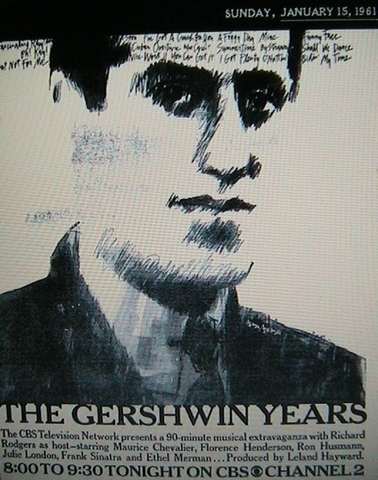
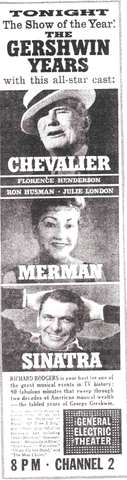
The Gershwin Years
Network: CBS
Host: Richard Rodgers
Guests: Frank Sinatra, Ethel Merman, Maurice Chevalier, Pat Harrington, Florence Henderson, Julie London, Ron Hussman
1. I've Got A Crush On You
2. Nice Work If You Can Get It
3. A Foggy Day
4. Let Call The Whole Thing Off
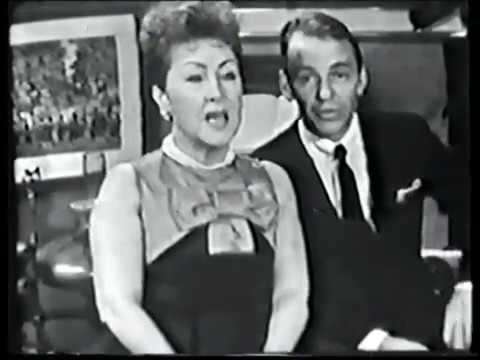
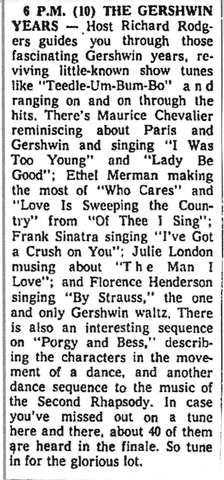
Notes: Show in circulation. 90mins. Ed O'Brien "Sinatra wanted Ethel Merman for the JFK Gala in Washington D.C. on 1-19-61. Ethel was on Broadway at the time in the smash hit musical "Gypsy." Without Ethel the show could not go on and the producers would lose $5,000 if the theatre went dark that night. Leland Hayward was a pal of Frank's (They worked together on the Colgate Comedy Hour adaptation of Cole Porter's "Anything Goes," 2-28-54) and he was producing the CBS 2 hour extravaganza "The Gershwin Years." Frank offered his services in exchange for Ethel's appearance at the Kennedy Inaugural. Hayward agreed and paid the producers to close the show that night. Frank had Nelson Riddle send the arrangements of the songs he intended to do to Jay Blackton, the arranger/ conductor of the Gershwin show.( Frank had worked with him on the Goldwyn film "Guys & Dolls," in March of 55). Monday afternoon, January 9th, Frank taped his segments for the show at CBS Studio 52 at West 54th Street in N.Y.C. He arrived around 1:PM, and after saying hello to the other participants, including Heywood and Blackton, he rehearsed the numbers. The first song was "I've Got A Crush On You" with that glorious arrangement Riddle did for the Capitol album "Nice 'N' Easy." Frank did two takes, listened carefully to the second and requested one more. He did what is probably the best reading we have ever heard of that song. Next up was "A Foggy Day," with Lee Evans on piano. Frank got it in two takes. He then did a finger-snapping rendition of "Nice Work If You Can Get It.." He breezed through it in three takes. Ethel Merman then joined him for a duet of "Let's Call The Whole Thing Off," with a Blackton chart. There was a rehearsal and two takes. The session ran three and a half hours. Frank thanked everyone and that was it. A fabulous moment on the show is Richard Rodgers introducing Frank, singing "I've Got A Crush On You." Rodgers mentions that a degree of cynicism had entered into the writing of romantic songs in the Gershwin years and then called Frank "the least sentimental and the most outstanding practitioner of the love song." I think he nailed it."
ad from Gershwin Years
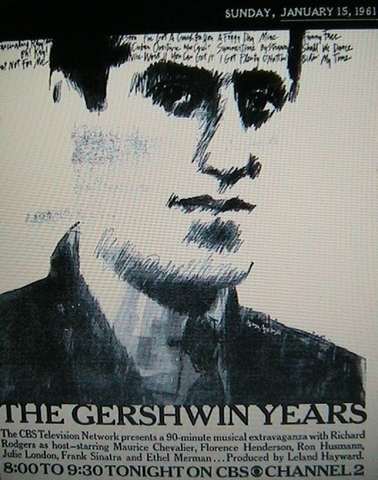
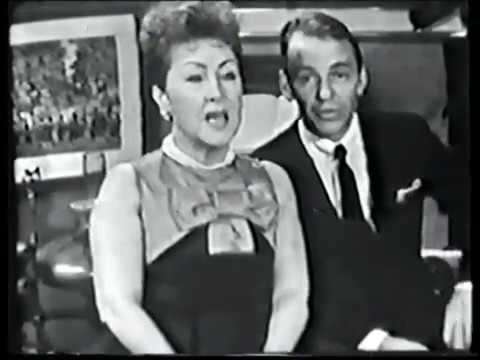
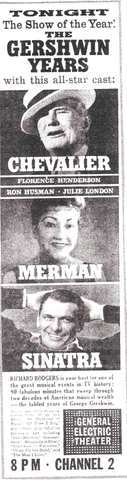
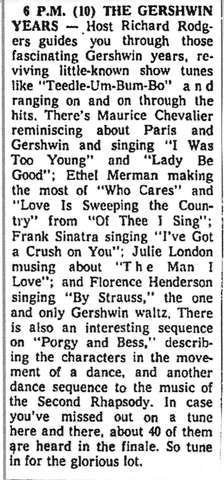
ad from Gershwin Years
note: The producer, Leland Hayward, tried to get Ella and Nat Cole , but his biggest disappointment was not having
Fred Astaire. Fred had an exclusive contract with NBC. Richard Rodgers subbed for an ailing Moss Hart. His
introduction of Sinatra singing "I've Got A Crush On You" was simply marvellous.
--Ed
January 16, 1961
[Sammy Davis Jr. barred from gala]
Sammy Davis Jr.: According to Sammy Davis Jr.'s own account, three days before the inauguration Kennedy's secretary Evelyn Lincoln called to say the president-elect did not want him present, citing a 'situation' likely tied to Davis's interracial marriage to May Britt. Davis was devastated but reasoned his friends had done what they could for him.
Source: James Kaplan, "Sinatra: The Chairman" (2015).
January 17, 1961
[Georgetown party for gala entertainers]
Kaplan (citing AP): On Tuesday night, Sinatra, dressed in his Don Loper finery, escorted Nat King Cole and his wife to a party for gala entertainers hosted by Steve and Jean Kennedy Smith in Georgetown. Vice President-elect Lyndon Johnson and much of the Kennedy clan attended; Jack Kennedy arrived an hour late, solo, tanned from Palm Beach. Jacqueline Kennedy did not attend.
Source: James Kaplan, "Sinatra: The Chairman" (2015).
January 19, 1961
Television
JFK Inaugural Gala, National Guard Armoury, Washington D.C.
Hosted, Produced & Directed by Frank Sinatra
Orchestra conducted by: Leonard Bernstein
Guest Stars included: Mahalia Jackson, Bette Davis, Laurence Olivier, Sidney Poitier, Frederick March, Helen Traubel, Harry Belafonte, Milton Berle, Ethel Merman, Tony Curtis, Janet Leigh, Alan King, Jimmy Durante, Nat "King" Cole, Ella Fitzgerald
1. Walking Down To Washington - Chorus
2. Nation Anthem - Mahalia Jackson
3. Sinatra talk
4. Bette Davis Talk & Intro
5. L. Olivier, S. Portier, F. March Talk
6. A Tower Of Strength - Helen Traubel
7. Give Me The Simple Life - Ella FItzgerald
8. Alan King talk
9. The House I Live In - Frank Sinatra
10. Lyndon Johnson speech
11. Everything's Coming Up Roses - Ethel Merman
12. "Electoral College" skit w/T. Curtis & J. Leigh
13. Stardust - Nat "King:"Cole
14. Inka Dinka Doo / September Song - Jimmy Durante
15. When The Saints Go Marchin In - H. Belafonte
16. "Astronaut Skectch" M.Berle & Bill Dana
17. Sinatra speech & Intro to JFK
18. JFK Speech
19. High Hopes (Parody) w/chorus
Note: Video of event listed in TV/Video section
Ed O'Brien:
The JFK Inaugural Gala was not televised. When I listed the content of the three hour extravaganza, a few years back, the shows performances simply amazed me. Sinatra's singing of "The House I Live In" is arguably the finest rendition he ever did. Frank flew to Hyannisport with the video of the show shortly after that historic night. I wish this show was available for airing on PBS.
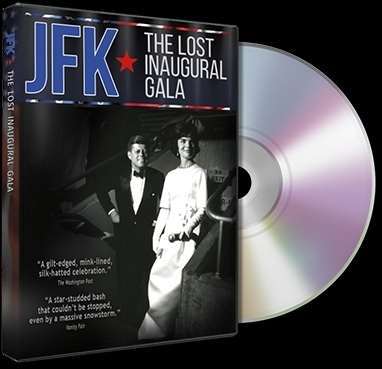
Extra notes: In 2017, in honor of JFK's 100th birthday, PBS began airing "JFK: The Lost Inaugural Gala".
From Variety, May 27, 2017:
The centennial of John F. Kennedy’s birth is on Monday, and to mark the occasion, PBS stations are presenting “JFK: The Lost Inaugural Gala.” The program is a one-hour documentary about the parade of showbiz A-listers who threw a big bash for the then-incoming President on Jan. 19, 1961. There had been previous star-filled inaugural galas, but nothing quite like this one. Led by Frank Sinatra, the evening featured Nat King Cole, Laurence Olivier, Harry Belafonte, Ethel Merman, Jimmy Durante, Gene Kelly, Milton Berle, Janet Leigh, Tony Curtis, and Bette Davis. NBC aired the telecast the following week, but the production ran into problems. The venue, the National Armory, was dark and cavernous, with so-so acoustics. That day, Washington was hit by a snowstorm, delaying the start of the ceremony by two hours. Merman showed up at rehearsal and couldn’t get back to her hotel to retrieve her evening gown. Instead, she had to sing in the clothes and coat she wore during the day. “The Lost Inaugural Gala” features rare, restored footage from the evening, enough to make you wonder why NBC never aired it in the first place. PBS stations also offered a DVD of the program at certain pledge levels and the DVD contains an additional 30 minutes of bonus material. --Scott
Concerts
JFK Inaugural Gala, National Guard Armory, Washington D.C.
Hosted, Produced & Directed by Frank Sinatra
Orchestra conducted by: Leonard Bernstein
NOTE: Ed O'Brien points out that Washington D. C. on January 19, 1961 experienced the worst snowstorm of the century in our nation's capital. The Inaugural Gala was scheduled to begin at 8:00 p.m. Unfortunately, nothing was moving in the city and the stars, dignitaries and local Democrats had a very difficult time finding transportation to the Armory.
The show didn't get underway until 10:30 p.m. and ran for a full three hours. Sinatra sang "You Make Me Feel so Young" and "The House I Live In." He also emceed segments. Nat Cole and Ella Fitzgerald both did two numbers and near the end of the how, just before Sinatra introduced JFK, the all-star cast sang several parodies written by Sammy Cahn. Frank did one that had Arlen's wonderful "Old Black Magic" melody. It started like this . . ."That old Jack magic. .. ."
After the show, Frank, the 35th President and others went over to Joseph Alsop's home. (In the early 1960's, Alsop was the dean of Washington's pundits.) And more history was made!
George Roberts, the great bass trombonist, played in the orchestra conducted by Riddle that historic evening, O'Brien points out. He told O'Brien what a thrill it was and how nightmarish the logistics became because of the snowstorm. Years later he played at a Kennedy Center event in Washington . During a question-and- answer session, George mentioned that he was a participant in the 1961 Gala. Well, there was a deafening silence and then he was bombarded with questions about that long ago night and all the greats who performed at the Gala. He told O'Brien that it was simply amazing how that night so captivated a generation decades removed from it.
JFK Inaugural Gala, National Guard Armory, Washington D.C.
Orchestra conducted by: Leonard Bernstein
note: Anthony Quinn was part of the Gala. He spoke very early in the proceedings and made a mess of it. I don't have any idea what happened but his appearance is rarely mentioned because of his performance. Marvelous actor.
Article in The Times from San Mateo, Calif., 1-19-61.
JFK with Frank Sinatra at the pre-inaugural gala, Jan 19, 1961, the night before JFK's formal inauguration.
Boston Globe, 1-20-61:
JFK's Inaugural Ball With various celebrities behind him, American entertainer Frank Sinatra (1915 - 1998) (center, fore) raises his arms as they all perform during an Inaugural Gala in honor of John F Kennedy at the National Guard Armory, Washington DC, January 19, 1961. Pictured are, from left, Pat Suzuki, Joey Bishop (1918 - 2007), Louis Prima (1910 - 1978), Keely Smith (1928 - 2017), Nat King Cole (1919 - 1965), Harry Belafonte, Ethel Merman (1908 - 1984) (in sunglasses), Sinatra, Jimmy Durante (1893 - 1980) (mostly obscured behind Sinatra), Helen Traubel (1899 - 1972), Ella Fitzgerald (1917 - 1996), Alan King (1927 - 2004), Gene Kelly (1912 - 1996), Janet Leigh (1927 - 2004), and Tony Curtis (1925 - 2010). (Photo by The Estate of Jacques Lowe/Getty Images)
Frank Sinatra rehearsing for the Kennedy Inaugural Gala in January 1961.
Ella Fitzgerald possible photographer.
Rehearsal, with Ella in the background:
Jimmy Van Heusen Rehearsal for Inaugural Gala Frank Sinatra
The night before John F. Kennedy's inauguration, Frank Sinatra throws a star-studded gala to eradicate the Democratic Party's $2 million campaign debt. With the help of Peter Lawford, fellow Rat Packer and husband of JFK's sister Patricia, Sinatra enlists elite entertainers for the evening, including Nat King Cole, Harry Belafonte, Gene Kelly, Ethel Merman, and actors Laurence Olivier, Janet Leigh, Tony Curtis, and Bette Davis. "We're all indebted to a great friend, Frank Sinatra," says Kennedy near the end of the festivities. "Long before he could sing he was pulling in votes in a New Jersey precinct Tonight, we saw excellence." Sinatra took pride in his friendship with Kennedy and did everything he could to help him along his path to the presidency, tirelessly campaigning for his Democratic nomination in West Virginia, where anti-Catholic sentiment ran high, and meeting with Jersey City's mayor to bolster support in that state all the while campaigning throughout the country with his Raat Pack pals. With the excitement of Kennedy's victory in his veins, nothing can stop Sinatra not even a snowstorm. As Washington is pounded with over eight inches of snow, Sinatra escorts First Lady Jackie Kennedy to the National Guard Armory, where thousands of seats sold for $100 each, and several clusters of ringside boxes went for $10,000 a pop. An array of entertainers braves the blizzard for a night of song, dance, and skits. Gene Kelly performs the Irish number "The Hat Me Dear Old Father Wore," Nat King Cole sings "Surrey With a Fringe On Top," and Jimmy Durante takes on the Kennedy-family favorite "September Song." Sinatra reworks his signature hits with JFK-inspired touches: "That Old Jack Magic" replaces " That Old Black Magic" and " High Hopes" becomes an homage to the new administration: "Jack and Lyndon B, Let's follow their lead. They're the men that our America needs!" A little snow was no excuse for Sinatra, who already overcame several obstacles planning the fundraiser. He equipped the acoustically challenged auditorium with an extra sound system and took over an entire top floor of the Statler-Hilton Hotel for rehearsals. When Ethel Merman and Laurence Olivier were waylaid by Broadway commitments in Gypsy and Becket, respectively, Sinatra bought all the tickets and closed both shows for the night. His most painful concession was allowing close friend Sammy Davis, Jr. to be disinvited over his recent marriage to white actress May Britt. Kennedy feared the interracial union would tarnish his image with Southern Democrats and wouldn't be swayed by Sinatra's protests. Despite the behind-the-scenes drama, the night was not only a milestone in the singer's career, but a pivotal moment in the history of entertainment and politics. Photos from the Inaugural Gala Dinner and Show 1-19-61: THE HOUSE I LIVE IN
President John F. Kennedy was able to enlist an A-lister to produce his inaugural concert and a gala: Sinatra. Ms. Mann, the historian, said that she viewed the entertainment at Kennedyā s inauguration featuring Sinatra, a, Ella Fitzgerald, Leonard Bernstein, Sidney Poitier, Ethel Merman, Harry Belafonte and other huge stars as aa ā big momentā ¯ that would set set the stage for the type of glamorous, multipart inaugural blowouts American have come to expect.
NYT
1-21-21
Frank Sinatra was very pleased with the JFK Gala. He wanted Reprise to release a two-LP set of the highlights from the three hour + show. A 75:16 running time was culled from the original masters. The project was killed when a number of artist releases from record companies could not be obtained.
Here is an in-house Reprise CD version, listing all of the material and artists represented.
Ed
UPI
1-20-61
Frank Sinatra, Pat Suzuki, Louis Prima, and Keely Smith
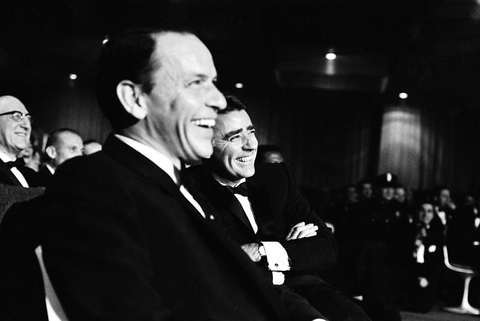
JFK Inaugural Gala, National Guard Armory, Washington D.C.
Orchestra conducted by: Leonard Bernstein
Frank and Peter Lawford during the Gala 1-1
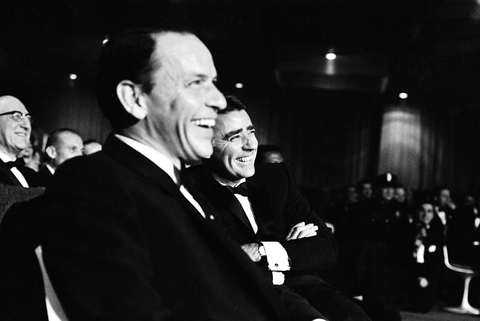
JFK Inaugural Gala, National Guard Armory, Washington D.C.
JFK with Frank Sinatra at the pre-inaugural gala, Jan 19, 1961, the night before JFK's formal inauguration.
Boston Globe ,1-20-61
JFK's Inaugural BallWith various celebrities behind him, American entertainer Frank Sinatra (1915 - 1998) (center, fore) raises his arms as they all perform during an Inaugural Gala in honor of John F Kennedy at the National Guard Armory, Washington DC, January 19, 1961. Pictured are, from left, Pat Suzuki, Joey Bishop (1918 - 2007), Louis Prima (1910 - 1978), Keely Smith (1928 - 2017), Nat King Cole (1919 - 1965), Harry Belafonte, Ethel Merman (1908 - 1984) (in sunglasses), Sinatra, Jimmy Durante (1893 - 1980) (mostly obscured behind Sinatra), Helen Traubel (1899 - 1972), Ella Fitzgerald (1917 - 1996), Alan King (1927 - 2004), Gene Kelly (1912 - 1996), Janet Leigh (1927 - 2004), and Tony Curtis (1925 - 2010). (Photo by The Estate of Jacques Lowe/Getty Images)
Frank Sinatra rehearsing for the Kennedy Inaugural Gala in January 1961.
Ella Fitzgerald possible photographer.
Rehearsal, with Ella in the background:
Jimmy Van Heusen Rehearsal for Inaugural Gala Frank Sinatra
The night before John F. Kennedy's inauguration, Frank Sinatra throws a star-studded gala to eradicate the Democratic Party's $2 million campaign debt. With the help of Peter Lawford, fellow Rat Packer and husband of JFK's sister Patricia, Sinatra enlists elite entertainers for the evening, including Nat King Cole, Harry Belafonte, Gene Kelly, Ethel Merman, and actors Laurence Olivier, Janet Leigh, Tony Curtis, and Bette Davis.
"We're all indebted to a great friend, Frank Sinatra," says Kennedy near the end of the festivities. "Long before he could sing he was pulling in votes in a New Jersey precinct… Tonight, we saw excellence." Sinatra took pride in his friendship with Kennedy and did everything he could to help him along his path to the presidency, tirelessly campaigning for his Democratic nomination in West Virginia, where anti-Catholic sentiment ran high, and meeting with Jersey City's mayor to bolster support in that state – all the while campaigning throughout the country with his Raat Pack pals. With the excitement of Kennedy's victory in his veins, nothing can stop Sinatra – not even a snowstorm. As Washington is pounded with over eight inches of snow, Sinatra escorts First Lady Jackie Kennedy to the National Guard Armory, where thousands of seats sold for $100 each, and several clusters of ringside boxes went for $10,000 a pop. An array of entertainers braves the blizzard for a night of song, dance, and skits. Gene Kelly performs the Irish number "The Hat Me Dear Old Father Wore," Nat King Cole sings "Surrey With a Fringe On Top," and Jimmy Durante takes on the Kennedy-family favorite "September Song." Sinatra reworks his signature hits with JFK-inspired touches: "That Old Jack Magic" replaces " That Old Black Magic" and " High Hopes" becomes an homage to the new administration: "Jack and Lyndon B, Let's follow their lead. They're the men that our America needs!" A little snow was no excuse for Sinatra, who already overcame several obstacles planning the fundraiser. He equipped the acoustically challenged auditorium with an extra sound system and took over an entire top floor of the Statler-Hilton Hotel for rehearsals. When Ethel Merman and Laurence Olivier were waylaid by Broadway commitments in Gypsy and Becket, respectively, Sinatra bought all the tickets and closed both shows for the night. His most painful concession was allowing close friend Sammy Davis, Jr. to be disinvited over his recent marriage to white actress May Britt. Kennedy feared the interracial union would tarnish his image with Southern Democrats and wouldn't be swayed by Sinatra's protests. Despite the behind-the-scenes drama, the night was not only a milestone in the singer's career, but a pivotal moment in the history of entertainment and politics.
Photos from the Inaugural Gala Dinner and Show 1-19-61:
THE HOUSE I LIVE IN
President John F. Kennedy was able to enlist an A-lister to produce his inaugural concert and a gala: Sinatra. Ms. Mann, the historian, said that she viewed the entertainment at Kennedy’s inauguration featuring Sinatra, Ella Fitzgerald, Leonard Bernstein, Sidney Poitier, Ethel Merman, Harry Belafonte and other huge stars as aa “big moment†that would set the stage for the type of glamorous, multipart inaugural blowouts American have come to expect.
NYT
1-21-21
Frank Sinatra was very pleased with the JFK Gala. He wanted Reprise to release a two-LP set of the highlights from the three hour + show. A 75:16 running time was culled from the original masters. The project was killed when a number of artist releases from record companies could not be obtained.
Here is an in-house Reprise CD version, listing all of the material and artists represented.
Ed
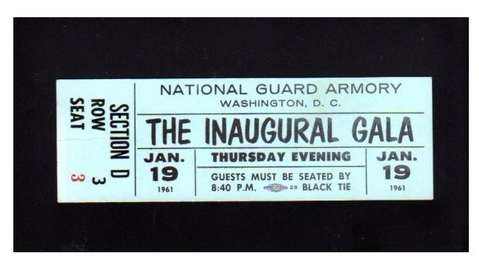
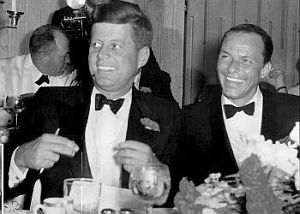
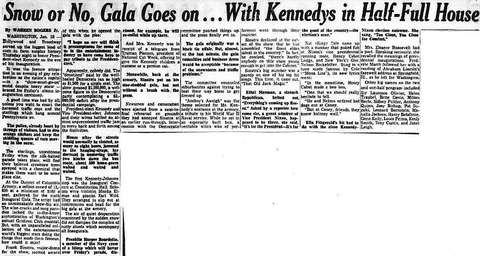
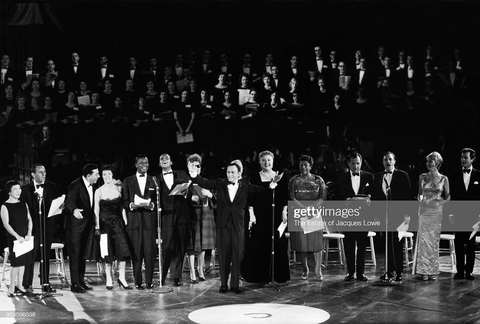
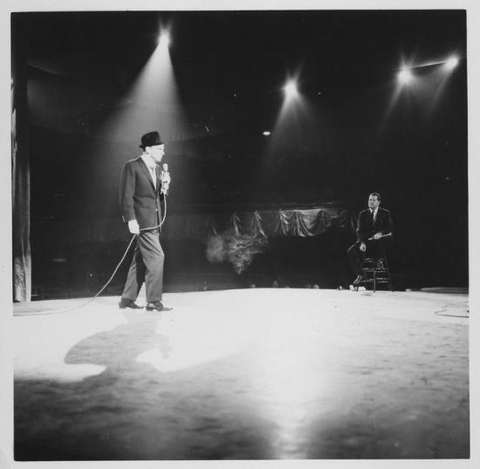
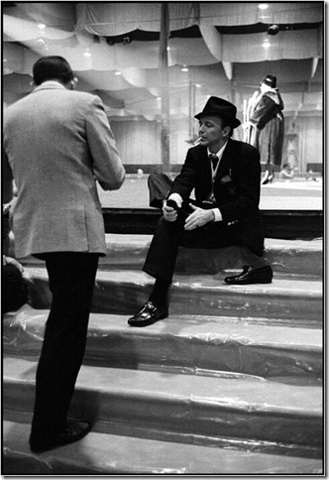
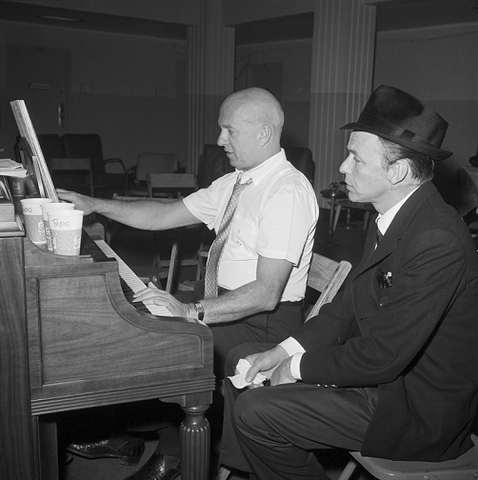
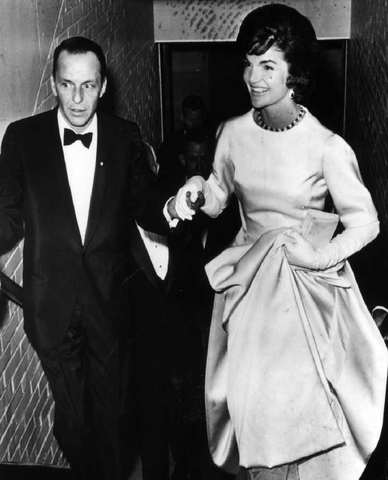
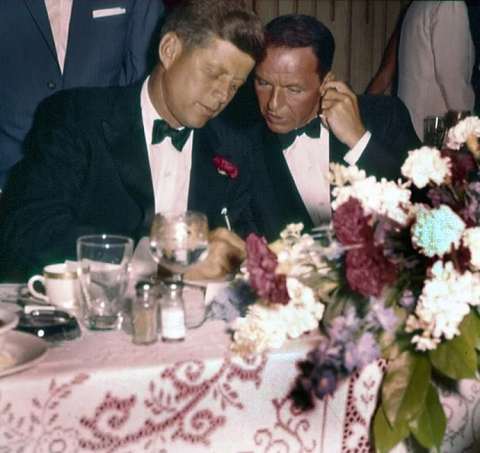
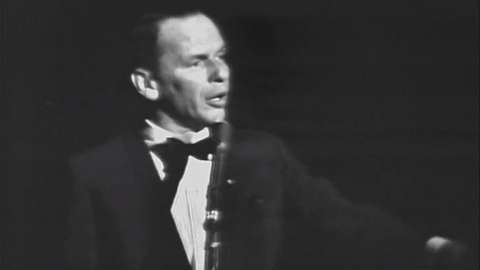
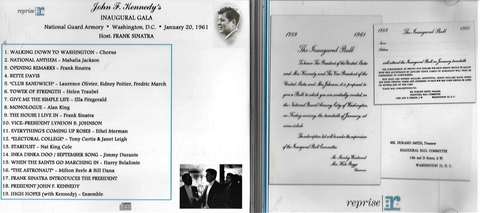
Frank Sinatra's triumphant staging of JFK's pre-inaugural gala came with a bitter footnote: Joe Kennedy had insisted Sammy Davis Jr. — who had campaigned hard for JFK and whose interracial marriage to May Britt had already stirred controversy — be left off the bill entirely. Sinatra tried repeatedly to reach Kennedy to intervene, growing furious when aides told him it was Bobby, not Jack, driving the decision (part of a broader Kennedy effort that fall to distance the administration from Sinatra's associations, including his friendship with Chicago mob boss Sam Giancana). Unable to change the outcome, a devastated Frank had Peter Lawford break the news to Davis himself, unable to make the call on his own. Source: J. Randy Taraborrelli, Sinatra: Behind the Legend.
Frank Sinatra's pre-inaugural gala at the National Guard Armory opened at 10:40 p.m. with Leonard Bernstein conducting “The Stars and Stripes Forever” and Mahalia Jackson singing the national anthem, followed by performances from Ethel Merman, Laurence Olivier, Sidney Poitier, Nat King Cole, Ella Fitzgerald, Gene Kelly, and others Sinatra had personally recruited. A heavy snowstorm — nearly eight inches — snarled transportation across Washington and delayed the Kennedys' own arrival; a frantic Sinatra rushed out into the snow to escort Jackie Kennedy inside himself. Taking the stage afterward, JFK thanked Sinatra by name: “Long before he could sing, he used to poll a Democratic precinct back in New Jersey... I know we're all indebted to a great friend, Frank Sinatra.” Sinatra later called it one of the happiest nights of his life. Source: J. Randy Taraborrelli, Sinatra: Behind the Legend.
Frank escorting the First Lady, Jackie Kennedy, to her box at the Inaugural Celebration gala in 1961. Source: photo and caption from J. Randy Taraborrelli, Sinatra: Behind the Legend (mptvimages.com).
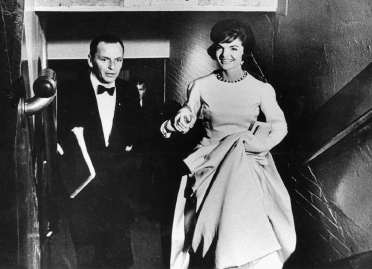
"The House I Live In"
Sinatra and LeRoy won special Oscars for the House I Live In short at the March 1946 Academy Awards. Sinatra restaged the piece on his CBS-TV series in November 1951. In 1960 Sinatra tried (and, under Kennedy-family pressure, abandoned) a film project crediting blacklisted writer Albert Maltz on-screen; he nonetheless commissioned a new Nelson Riddle 'concert' arrangement of "House," performed on his ABC-TV series that Thanksgiving. That Riddle chart is the one he sang at JFK's pre-inaugural gala on January 19, 1961, immediately following "You Make Me Feel So Young." Weeks after the JFK assassination he recorded the Riddle arrangement (now with Fred Waring's Pennsylvanians chorus) for the various-artists album America, I Hear You Singing.
Source: Will Friedwald, "Sinatra! The Song Is You: A Singer's Art" (2018 revised edition).
[Inaugural gala staged]
Sinatra (quoted), Kaplan (narration): The inaugural gala was held at the National Guard Armory the night before Kennedy's swearing-in. Twelve thousand tickets at $100 each sold out, netting close to $1.5 million for the Democratic Party. Sinatra called it the most exciting assignment of his life and predicted it would be the biggest one-night gross in show business history.
Source: James Kaplan, "Sinatra: The Chairman" (2015).
[Snowstorm nearly derails gala]
Bill Asher: A severe snowstorm hit Washington the afternoon of the gala, paralyzing traffic and preventing performers from returning to their hotel to change. Although the show was set to begin at 9 p.m., the armory was only half full at that hour, and Sinatra paced backstage in agony, at one point erupting at Peter Lawford and threatening to quit the show, according to director Bill Asher.
Source: James Kaplan, "Sinatra: The Chairman" (2015).
[Kennedys arrive at the armory]
Arthur M. Schlesinger (as cited by Kaplan): The Kennedys attended the Inaugural Concert at Constitution Hall first, then left at intermission for the gala, their limousine creeping through blinding snow past bonfires lit along the Mall. En route Kennedy read Jefferson's First Inaugural aloud and remarked 'Better than mine.' The couple reached the armory at 10:30 p.m., with just three thousand of twelve thousand seats filled; Sinatra greeted them and escorted Jackie Kennedy inside.
Source: James Kaplan, "Sinatra: The Chairman" (2015).
[Gala program highlights]
The three-hour gala opened with Bernstein's 'Fanfare,' Sousa's 'Stars and Stripes Forever,' and Mahalia Jackson singing 'The Star-Spangled Banner.' Sinatra performed 'You Make Me Feel So Young' and a hushed 'The House I Live In' that moved Jackie Kennedy to tears; Ethel Merman sang 'You'll be swell' from Gypsy directly at the presidential box; Sammy Cahn's reworked 'That Old Black Magic,' retitled to praise 'Jack magic,' closed the show with Sinatra singing lead.
Source: James Kaplan, "Sinatra: The Chairman" (2015).
[Kennedy's thank-you speech]
John F. Kennedy: After the gala finale, president-elect Kennedy took the stage and thanked the cast, singling out Sinatra by name as a friend who, long before he could sing, had polled a Democratic precinct in New Jersey, and predicting he would go on speaking for the Democratic Party long after he stopped singing.
Source: James Kaplan, "Sinatra: The Chairman" (2015).
[Gala recorded for commemorative album]
Sinatra had the entire gala recorded, intending to release a commemorative double album on Reprise with proceeds going to the Democratic Party -- a project that would run into complications.
Source: James Kaplan, "Sinatra: The Chairman" (2015).
[Kennedy inaugural ball at DC Armory]
Consiglio: Consiglio was put in charge of the stars performing at President Kennedy's inaugural ball at the D.C. Armory, which Frank coordinated with Broadway producer Roger Edens. Performers including Harry Belafonte, Jimmy Durante, Ella Fitzgerald, Louis Prima, Keely Smith, Milton Berle, Nat King Cole, Gene Kelly, and Frank himself were flown in on the Caroline and put up at the Statler-Hilton, with the Democratic Party covering all their expenses.
Source: Tony Consiglio (as told to Franz Douskey), "Sinatra and Me: The Very Good Years" (2012).
[Frank closes Ethel Merman's Broadway show]
Consiglio: Ethel Merman was performing in Gypsy on Broadway during the inaugural, so Frank paid to close the show for one night so she could appear at Kennedy's inaugural ball; he told the show's managers to send him the bill for whatever it cost.
Source: Tony Consiglio (as told to Franz Douskey), "Sinatra and Me: The Very Good Years" (2012).
[Blizzard tuxedo run before inaugural ball]
Consiglio: On the night of the inaugural ball, a severe blizzard shut down the airport in Washington and Consiglio realized he'd left Frank's tuxedo back at the Statler-Hilton. Frank told him to go get it first; Consiglio bribed a cab driver to brave the storm, retrieved the tux, and got back to the armory in time for Frank to dress and perform.
Source: Tony Consiglio (as told to Franz Douskey), "Sinatra and Me: The Very Good Years" (2012).
[Jimmy Durante's cigar via Milton Berle]
Consiglio: At the inaugural ball, Jimmy Durante kept badgering Consiglio for cigars; Consiglio quietly got several from Milton Berle without saying who they were for. When Durante learned the source, he groaned that he'd now have to send Berle a whole box to make up for it.
Source: Tony Consiglio (as told to Franz Douskey), "Sinatra and Me: The Very Good Years" (2012).
[Ella Fitzgerald's request for JFK's chair]
Consiglio: Ella Fitzgerald flew in from Sydney, Australia, for the inaugural ball. When Frank asked what he could do for her, she said she wanted the chair President Kennedy had been sitting in; Frank had Consiglio retrieve and ship the chair to her home in California.
Source: Tony Consiglio (as told to Franz Douskey), "Sinatra and Me: The Very Good Years" (2012).
January 20, 1961
UPI
1-20-61
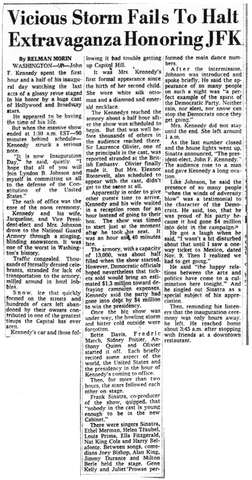
Sinatra and Lawford, worn out from the previous night's gala and its after-parties, skipped the freezing outdoor swearing-in ceremony and watched it on television instead. That evening, at the second inaugural ball at the Statler Hilton, Sinatra was hosting a party in the South American suite for the gala's cast when the new president slipped away from his own ball with his Secret Service detail to thank Frank and the performers in person before rejoining Jackie. Source: Michael Sheridan & David Harvey, Sinatra and the Jack Pack.
[Post-gala party at Paul Young's]
Carl Sferrazza Anthony (as cited by Kaplan): At 2 a.m., following the gala, Kennedy and the stars caravanned to Paul Young's steakhouse, rented by Joseph Kennedy for a private party. Biographer Carl Sferrazza Anthony recounts Joe Kennedy needling Paul 'Red' Fay, who arrived escorting Angie Dickinson (a beard for Kennedy's own dalliance with the actress), before waving them all in warmly. Joe Kennedy also told Sinatra to wait and see the party he'd throw four years later.
Source: James Kaplan, "Sinatra: The Chairman" (2015).
[Kennedy's inaugural address]
At 12:52 p.m., hatless and coatless despite the cold, John F. Kennedy delivered his inaugural address, written with Ted Sorensen, including the famous line about the torch being passed to a new generation.
Source: James Kaplan, "Sinatra: The Chairman" (2015).
[Sinatra absent from inauguration ceremony]
Bob Neal (account), Kaplan (narration): Sinatra did not attend the outdoor inauguration ceremony, instead watching from his Statler Hilton suite. Accounts differ on why: writer Leonard Gershe said it was the cold; the Daily News reported he'd shown up drunk and was turned away; friend Bob Neal said Sinatra simply wasn't on the guest list and was thrown out by police when he tried to claim a seat.
Source: James Kaplan, "Sinatra: The Chairman" (2015).
[Sinatra's post-inaugural Statler Hilton party]
Gloria Cahn Franks: That night, while Kennedy circulated among five inaugural balls without his exhausted wife, Sinatra hosted his own party at the Statler Hilton for gala participants, serving caviar and champagne and distributing the silver cigarette cases. Kennedy had promised to stop by; Sinatra waited anxiously until the president finally arrived and worked the room, leaving Sinatra 'beaming like the Cheshire cat,' according to Gloria Cahn Franks.
Source: James Kaplan, "Sinatra: The Chairman" (2015).
[Inaugural license plates and Connecticut flag]
Consiglio: Riding to Kennedy's inauguration, Consiglio talked their limousine driver into giving him the car's special inaugural license plates as souvenirs by invoking Frank's authority. He also talked a security guard out of the Connecticut state flag that had been on the inaugural stage, later giving it to his late brother Sally.
Source: Tony Consiglio (as told to Franz Douskey), "Sinatra and Me: The Very Good Years" (2012).
January 21, 1961
[Sinatra's mood sours after the ball]
Janet Leigh: Sometime after the Statler party -- possibly because Kennedy left early for a gathering at columnist Joseph Alsop's house -- Sinatra's mood turned from elated to angry. He abruptly canceled plans to join other stars flying to Palm Beach with Joe Kennedy; Janet Leigh and Tony Curtis instead found him having breakfast with Juliet Prowse. Leigh recalled being told later that something had been said the night before or that morning.
Source: James Kaplan, "Sinatra: The Chairman" (2015).
January 27, 1961
Concerts
Carnegie Hall, New York City
Benefit: Southern Christian Leadership Conference
A Tribute To Martin Luther King
Friday evening
A Tribute To Martin Luther King
Conductor Sy Oliver
Host: Nipsey Russell
1961 Southern Christian Leadership Conference, Carnegie Hall, New York City Friday evening
Conductor Sy Oliver
Headliners: Harry Belafonte, Mahalia Jackson, Tony Bennett,
Dick Gregory, Count Basie & Orch.,Sammy Davis Jr., Dean Martin Frank Sinatra and many others.
Performers:
Nipsey Russell, host
Sammy Davis, vocalist
Dean Martin, vocalist
Peter Lawford, actor
Jan Murray, comedian
Tony Bennett, vocalist
Mahalia Jackson, gospel singer
Carmen McRae, vocalist
Joe Williams, vocalist
Ruth Brown, vocalist
Buddy Hackett, comedian
Rose Hardaway, dancer
Augie and Margo, dance group
Augie Rodriguez, dancer
Margo Rodriguez, dancer
George Kirby, vocalist
Count Basie and His Orchestra, jazz ensemble
Count Basie, conductor
Frank Sinatra vocalist
Harry Belafonte, speaker
Martin Luther King, speaker
Sidney Poitier, speaker
Notes
Benefit: Southern Christian Leadership Conference
Ed O'Brien:
Jan Murray replaced Joey Bishop. Harry Belafonte introduced Dr. King and Sidney Poitier introduced Mahalia Jackson. According to the King Online Encyclopedia of the Martin Luther King, Jr. Research and Education Institute, this event was billed as "Advertised as a 'tribute to the greatest civil rights leader to emerge in the South since the Civil War,' the event raised over $50,000, a large portion of which was donated to the SCLC."
Ed O'Brien:
This memorable evening of heartfelt tributes to the Reverend King ran more than four and a half hours. Sinatra closed the show.
The highlight of his performance was a stunning rendition of "Ol Man River."
Pete Levinson was writing a piece on Frank for a jazz magazine.
He spent the evening in Sinatra's dressing room. They had some drinks while Frank waited to go on. Pete told me it was very relaxed. Sinatra was eager to perform at the hallowed hall and he greatly admired Rev. King.
Guy Steele:
I interviewed Peter Levinson for my radio show regarding the "Martin Luther King" tribute..he said that the famous picture of Dean Martin, Sammy Davis, and Sinatra (in which they're all wearing tuxedos and smoking with Sammy sitting in the middle and laughing with his eyes closed , Sinatra on the right grinning, and Dino on the left gesturing) was taken backstage prior to the show during the time when the press was admitted..Levinson was sitting to the left of Sinatra and was cropped out of the picture.
Carnegie Hall, New York City
Benefit: Southern Christian Leadership Conference
A Tribute To Martin Luther King
Dean, Sammy, Frank backstage at the conclusion of the 1-27-61 Carnegie Hall Tribute To Martin Luther King.
Peter Levinson was standing next to Frank. He managed to obtain a copy of the uncropped photo. Peter was on assignment that evening, doing a Sinatra profile for a jazz magazine. He told me Frank drank 17 highballs during the eight hour of activities at the hallowed hall.
Jan Murray, Buddy Hackett, Sammy, Frank, Dean, 1-27-61
Pictured from left to right is an unidentified musician, Frank Sinatra, Buddy Hackett (seated on stool), Jan Murray, Sammy Davis Jr., and Dean Martin. At the last minute, weather conditions prevented Peter Lawford and Joey Bishop from flying to New York, requiring Hackett and Murray to fill in without a rehearsal.
note: Original ad. Buddy Hackett and Jan Murray subbed for Bishop and Lawford
The Night Sinatra And Martin Luther King, Jr. Took Down Carnegie Hall
Angelo Di Celeste | UPDATED: January 16, 2023
The night was January 27th, 1961. At the time, Carnegie Hall was perhaps the most prestigious concert hall in the world. There was a magic and mystique about the New York concert hall that few other venues had. A few years earlier, the likes of Etta James, Bo Diddley, and Billie Holiday graced the stage to thunderous applause.
However, the night of January 27th, 1961, was unlike any that the historic venue on 57th Street and 7th Avenue had ever hosted before. It was about to host one of the most socially significant events in its seventy-year history.
In 1961, the Civil Rights Movement was in full swing, under the leadership of the Reverend Dr. Martin Luther King, Jr. That same year, the annual fundraising goal for Dr. King’s Civil Rights Coalition was $100,000.
Dr. King, seeking to organize a signature benefit gala to help the Coalition kick off the year on a positive note for its fundraising efforts, landed on New York’s famed Carnegie Hall venue. While Carnegie Hall would bring a heightened level of prestige and awareness to Dr. King’s Coalition, the venue alone would not be enough to attract the financial support that Dr. King sought.
In search of a headline act to ensure the event’s success, Dr. King, through close friend Sammy Davis, Jr., secured a rare appearance from Frank Sinatra and Dean Martin along with additional Rat Pack member Joey Bishop.
Ticket prices were set as high as $200, which adjusted for inflation, amounts to approximately $2,000 in today’s dollars. The prices did not deter the New York theater fans who lined up in the cold Manhattan winter to secure their tickets. Tickets sold out within days, leaving thousands of fans relegated to reading about the concert in the following morning’s newspaper.
New Yorkers who were lucky enough to secure a ticket were treated to three hours of jubilant theater, complete with hit songs and the Rat Pack’s signature skits and comedy routines.
Sinatra and company sang to a standing ovation from the thousands who packed into Carnegie Hall that evening, helping raise $22,000, nearly one-quarter of the fundraising goal for the entire year.
Just seven years later, Dr. King would be assassinated, but not before he left an indelible mark on equality and Civil Rights in the United States and across the world. While it paled in comparison to Dr. King’s numerous achievements, that January night at Carnegie Hall will forever be remembered as one of the most significant in the legendary New York concert hall’s history.
-----------------------------------------------------
© 1997-2026 The Sinatra Archive
This calendar, or any parts thereof, may not be reproduced in any fashion whatsoever without the prior written permission of the publisher (The Sinatra Archive)
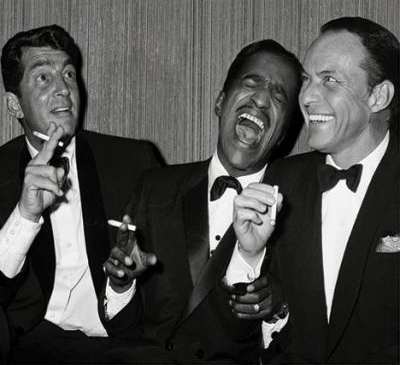
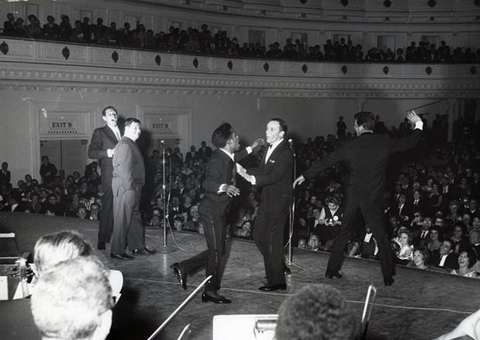
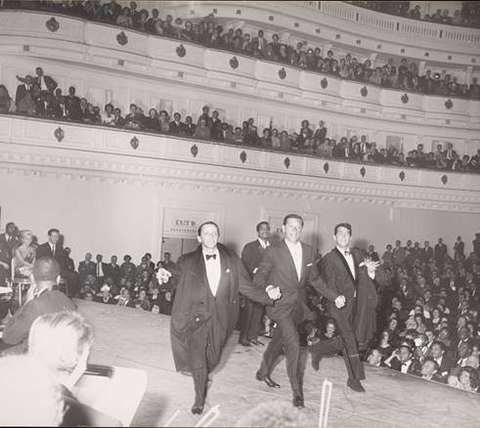
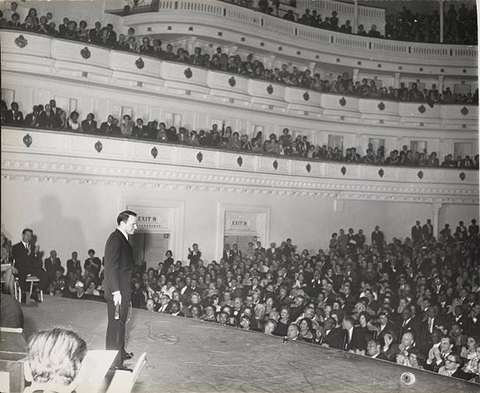
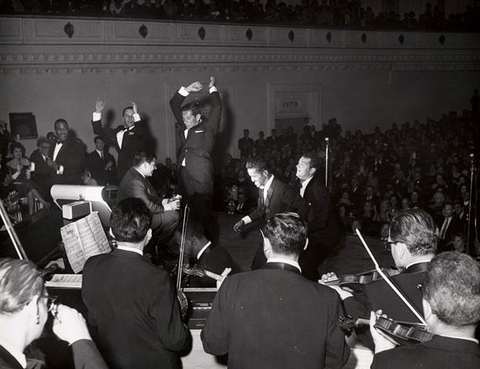
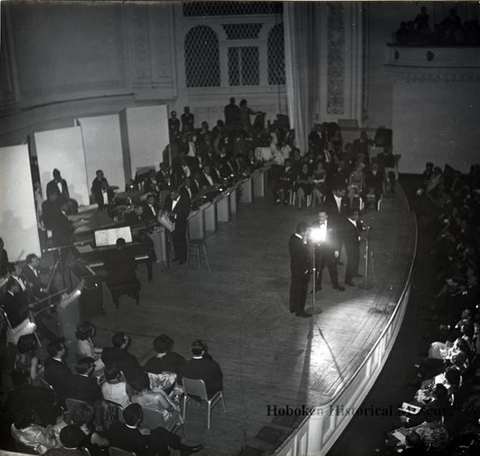
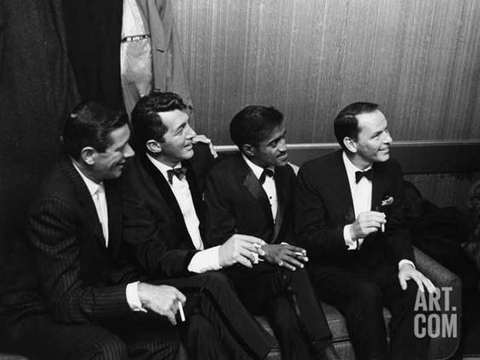
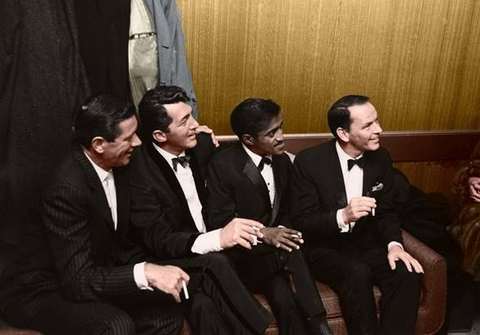
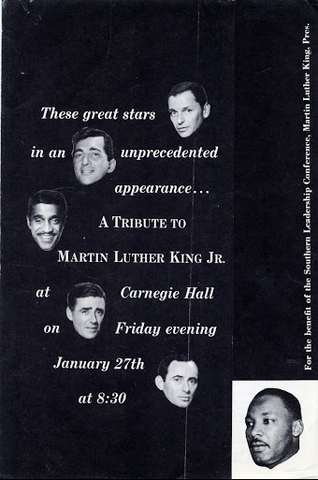
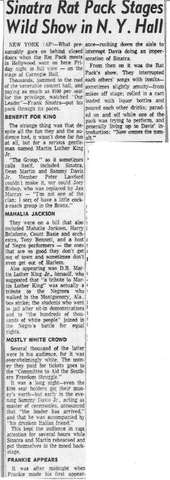
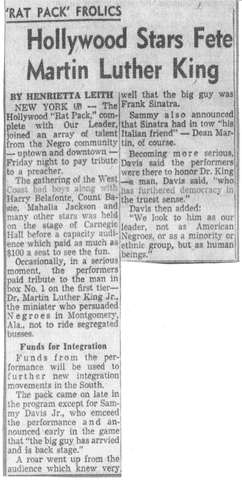
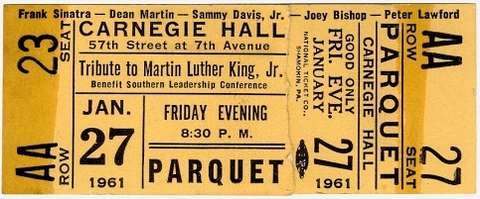
[Carnegie Hall benefit for MLK's SCLC]
Sinatra headlined a Carnegie Hall benefit for the Southern Christian Leadership Conference and Martin Luther King, with Dean Martin and Sammy Davis Jr. joining, plus Mahalia Jackson, Harry Belafonte, Count Basie, and Tony Bennett. Sammy Davis emceed and announced Sinatra's arrival alongside his 'drunken Italian friend' Dean Martin; Sinatra didn't appear until after midnight, and the show devolved into unscripted Rat Pack insult-trading and horseplay.
Source: James Kaplan, "Sinatra: The Chairman" (2015).
[Sinatra's heavy drinking backstage]
Peter Levinson: Aspiring publicist Peter Levinson, in Sinatra's Carnegie Hall dressing room, watched him drink over a dozen bourbon and waters over the course of the evening and then go out and perform as though nothing had happened.
Source: James Kaplan, "Sinatra: The Chairman" (2015).
February 1961
[Reprise's first album releases]
Kaplan: Reprise released its first slate of albums in February 1961: Sinatra's Ring-a-Ding Ding!, tenor saxophonist Ben Webster's The Warm Moods, Sammy Davis Jr.'s Wham of Sam, jazz singer Mavis Rivers's Mavis, and a comedy LP by Joe E. Lewis called It Is Now Post Time. Sales and reviews were strong.
Source: James Kaplan, "Sinatra: The Chairman" (2015)
[Sinatra hosts Dorothy Provine]
Unnamed lady friend of Jimmy Van Heusen's (via Kitty Kelley): After Ava and Nancy left Las Vegas, Sinatra brought in Dorothy Provine. A friend of Jimmy Van Heusen's told Kitty Kelley that evenings now involved sitting around Sinatra's Sands suite while he repeatedly played the recording of Kennedy's gala thank-you speech.
Source: James Kaplan, "Sinatra: The Chairman" (2015)
['The Second Time Around'/'Tina' becomes first Reprise 45]
Frank also recorded 'The Second Time Around' and 'Tina' (dedicated to his younger daughter) with Felix Slatkin conducting Nelson Riddle arrangements; the pairing became Reprise's first 45-rpm single release in February 1961.
Source: Richard Havers, "Sinatra" (Dorling Kindersley, 2007).
February 1, 1961
Concerts
Sands, Las Vegas, Nevada (1-14)
Buddy Lester, Copa Girls (12), Garr Nelson,
Antonio Morelli Orch.(32) Conducted by Bill Miller
Choreography by Renne Stuart,
Prioduced by Jack Entratter
$4 minimum
Note: This was the "RADD" engagement. Al
Porcino told me Frank did almost all of the tracks on the album. Fontainbleau would be the same basic program.
Sands, Las Vegas, Nevada (1-14)
Buddy Lester, Copa Girls (12), Garr Nelson,
Antonio Morelli Orch.(32) Conducted by Bill Miller
Choreography by Renne Stuart,
Prioduced by Jack Entratter
$4 minimum
Variety
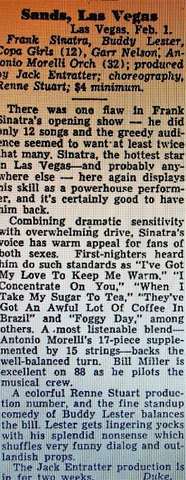
Sands, Las Vegas, Nevada (1-14)
Variety
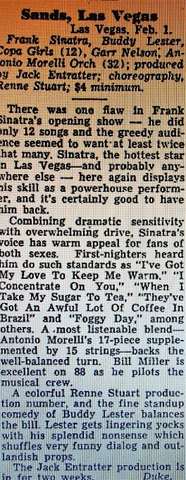
[Sands engagement opens]
Variety (as cited by Kaplan): Sinatra opened a two-week stand at the Sands, his first there in a year. Variety's glowing review noted the only flaw was that he sang just twelve songs when the audience wanted twice that many, calling him the hottest star in Las Vegas.
Source: James Kaplan, "Sinatra: The Chairman" (2015).
[Mo Ostin's first Sinatra show]
Mo Ostin: Newly hired Reprise employee Mo Ostin attended Sinatra's Sands opening ringside, seated with Marilyn Monroe, Elizabeth Taylor, Eddie Fisher, and Kennedy sisters Eunice Shriver and Jean Smith -- an overwhelming introduction to Sinatra's world that he never forgot.
Source: James Kaplan, "Sinatra: The Chairman" (2015).
February 2, 1961
Concerts
Sands, Las Vegas, Nevada (1-14)
Buddy Lester, Copa Girls (12), Garr Nelson,
Antonio Morelli Orch.(32) Conducted by Bill Miller
Choreography by Renne Stuart,
Prioduced by Jack Entratter
$4 minimum
Ed O'Brien noted:
Although "RADD" would not be released until
March of 61, The Sands marquee read "Frank Sinatra:
Ring-A-Ding- Ding." He introduced many of the songs from the LP during this engagement. Al Porcino told me that Frank would hire a train car and travel from
Vegas to Miami. He played the Fountainbleau down there from 2/28 thru 3/13 and the marquee ran the same heading. Al loved the whole concept.
He said to me, "Frank was a swinger." Funny.
February 3, 1961
Concerts
Sands, Las Vegas, Nevada (1-14)
Buddy Lester, Copa Girls (12), Garr Nelson,
Antonio Morelli Orch.(32) Conducted by Bill Miller
Choreography by Renne Stuart,
Prioduced by Jack Entratter
$4 minimum
February 4, 1961
Concerts
Sands, Las Vegas, Nevada (1-14)
Buddy Lester, Copa Girls (12), Garr Nelson,
Antonio Morelli Orch.(32) Conducted by Bill Miller
Choreography by Renne Stuart,
Prioduced by Jack Entratter
$4 minimum
February 5, 1961
Concerts
Sands, Las Vegas, Nevada (1-14)
Buddy Lester, Copa Girls (12), Garr Nelson,
Antonio Morelli Orch.(32) Conducted by Bill Miller
Choreography by Renne Stuart,
Prioduced by Jack Entratter
$4 minimum
[Ava Gardner's surprise Vegas visit]
Ava Gardner flew from New York to surprise Sinatra at the Sands, arriving the same weekend as his ex-wife and children. Accounts conflict: some biographers say she turned around without seeing the show upon learning Big Nancy was there, but Variety and AP reported she did see the Sunday, February 5 show and spent a short time with Frank before leaving Monday afternoon, having also left her mink coat on the plane.
Source: James Kaplan, "Sinatra: The Chairman" (2015).
February 6, 1961
Concerts
Sands, Las Vegas, Nevada (1-14)
Buddy Lester, Copa Girls (12), Garr Nelson,
Antonio Morelli Orch.(32) Conducted by Bill Miller
Choreography by Renne Stuart,
Prioduced by Jack Entratter
$4 minimum
February 7, 1961
Concerts
Sands, Las Vegas, Nevada (1-14)
Buddy Lester, Copa Girls (12), Garr Nelson,
Antonio Morelli Orch.(32) Conducted by Bill Miller
Choreography by Renne Stuart,
Prioduced by Jack Entratter
$4 minimum
February 8, 1961
Concerts
Sands, Las Vegas, Nevada (1-14)
Buddy Lester, Copa Girls (12), Garr Nelson,
Antonio Morelli Orch.(32) Conducted by Bill Miller
Choreography by Renne Stuart,
Prioduced by Jack Entratter
$4 minimum
[Sinatra family visits the Sands]
Louella Parsons: Columnist Louella Parsons reported that big crowds were flocking to Sinatra's Sands act, and that his family -- ex-wife Nancy, Frank Jr., twelve-year-old Tina, and Mr. and Mrs. Tommy Sands -- were his weekend guests at the show.
Source: James Kaplan, "Sinatra: The Chairman" (2015).
February 9, 1961
Concerts
Sands, Las Vegas, Nevada (1-14)
Buddy Lester, Copa Girls (12), Garr Nelson,
Antonio Morelli Orch.(32) Conducted by Bill Miller
Choreography by Renne Stuart,
Prioduced by Jack Entratter
$4 minimum
February 10, 1961
Concerts
Sands, Las Vegas, Nevada (1-14)
Buddy Lester, Copa Girls (12), Garr Nelson,
Antonio Morelli Orch.(32) Conducted by Bill Miller
Choreography by Renne Stuart,
Prioduced by Jack Entratter
$4 minimum
Responding to Bobby Kennedy's push for Mob crackdown intelligence, Hoover sent the new attorney general a memo -- the FBI's file on Sinatra dated back to 1944 and would eventually run over two thousand pages -- cataloguing Frank's ties to organized-crime figures including Joseph and Rocco Fischetti, Willie Moretti, Mickey Cohen, and Sam Giancana, along with the unproven claim that Sinatra had paid $40,000 to avoid the World War II draft. Source: Michael Sheridan & David Harvey, Sinatra and the Jack Pack.
February 11, 1961
Concerts
Sands, Las Vegas, Nevada (1-14)
Buddy Lester, Copa Girls (12), Garr Nelson,
Antonio Morelli Orch.(32) Conducted by Bill Miller
Choreography by Renne Stuart,
Prioduced by Jack Entratter
$4 minimum
February 12, 1961
Concerts
Sands, Las Vegas, Nevada (1-14)
Buddy Lester, Copa Girls (12), Garr Nelson,
Antonio Morelli Orch.(32) Conducted by Bill Miller
Choreography by Renne Stuart,
Prioduced by Jack Entratter
$4 minimum
February 13, 1961
Concerts
Sands, Las Vegas, Nevada (1-14)
Buddy Lester, Copa Girls (12), Garr Nelson,
Antonio Morelli Orch.(32) Conducted by Bill Miller
Choreography by Renne Stuart,
Prioduced by Jack Entratter
$4 minimum
Friars Club Dinner Honoring Leo Durocher
Dean Martin, Joey Bishop, Milton Berle, George Jessel, Danny Kaye and others.
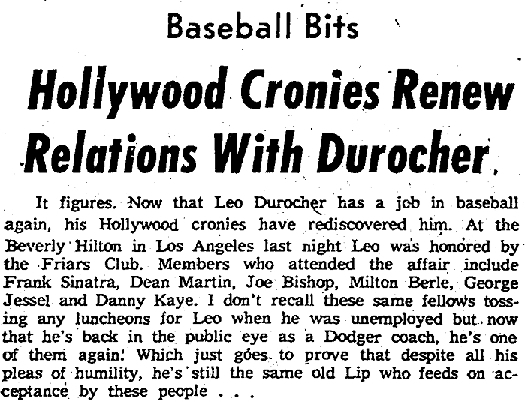
February 14, 1961
Concerts
Sands, Las Vegas, Nevada (1-14)
Buddy Lester, Copa Girls (12), Garr Nelson,
Antonio Morelli Orch.(32) Conducted by Bill Miller
Choreography by Renne Stuart,
Prioduced by Jack Entratter
$4 minimum
February 20, 1961
[Letter from Evelyn Lincoln thanking Consiglio]
Evelyn Lincoln: Consiglio kept a February 20, 1961 letter from Evelyn Lincoln, President Kennedy's personal secretary, thanking him for personally bringing the president's shirts to Washington and inviting him to stop by the White House again.
Source: Tony Consiglio (as told to Franz Douskey), "Sinatra and Me: The Very Good Years" (2012).
February 28, 1961
Concerts
Fontainbleau, Miami, Fla, (February 28 to March 13)
O.A. Buddy Lester
Brascia & Tybee
RADD ALBUM WAS THE THEME
Fontainbleau, Miami, Fla, (February 28 to March 13)
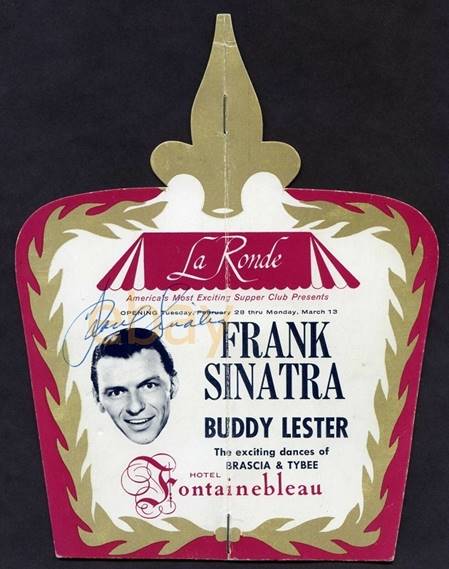
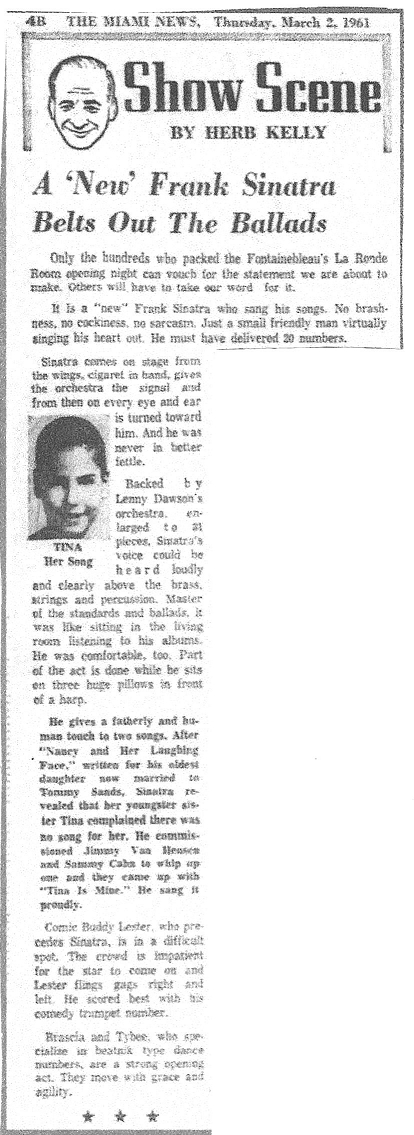
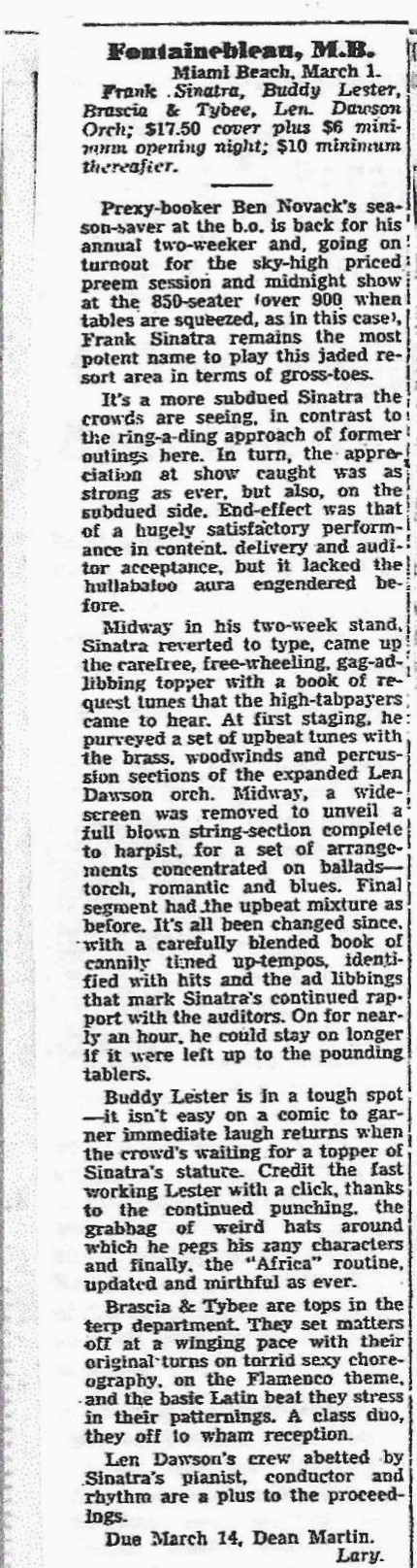
Fontainbleau, Miami, Fla, (February 28 to March 13)
Variety
March 8, 1961
note: Al Porcino, lead trumpet player, was recruited by Bill Miller
to augment the sound of the Dawson band during the two week run.
Al told me Frank secured his own train car, had it hooked up to a
regular train from L.A. to Miami. Frank had his own cook, waiter,
bartender and a couple of ladies traveled with him. Al said to me
"Frank was a real swinger."
Ed
Frank played two weeks at the Fontainebleau Hotel in Miami Beach.
Source: Nancy Sinatra, Frank Sinatra: An American Legend, 1995.
March 1, 1961
Concerts
Fontainbleau, Miami, Fla, (February 28 to March 13)
O.A. Buddy Lester
Brascia & Tybee
RADD ALBUM WAS THE THEME
note: Sammy Davis closed on 2/28 and Frank joined
him for part of the act. Then Frank opened on
3/1 and his engagement ran through 3/13. Dino
opened the next night and Frank joined him for
one show.
Al Porcino played lead trumpet during this gig. He
told me Frank opened with eight or nine songs from
"RADD" and then a string section came in for a
a long ballad segment before closing with more
songs from "RADD." The album would not be
released until 4/7, so, the lucky 900 each night
got to hear an exciting new Sinatra sound.
Ed
March 2, 1961
Concerts
Fontainbleau, Miami, Fla, (February 28 to March 13)
O.A. Buddy Lester
Brascia & Tybee
RADD ALBUM WAS THE THEME
March 3, 1961
Concerts
Fontainebleau, Miami, Fla, (February 28 to March 13)
O.A. Buddy Lester
Brascia & Tybee
RADD ALBUM WAS THE THEME
March 4, 1961
Concerts
Fontainbleau, Miami, Fla, (February 28 to March 13)
O.A. Buddy Lester
Brascia & Tybee
NOTE: Ed O’Brien points out that this engagement was built around the
Ring-A-Ding-Ding LP. Trumpeter Al Porcino worked the dates and remembered how exciting the two weeks were for the band. Told O'Brien that Frank did quite a few of the songs from the Johnny Mandel album.
March 5, 1961
Concerts
Fontainbleau, Miami, Fla, (February 28 to March 13)
O.A. Buddy Lester
Brascia & Tybee
NOTE: Ed O’Brien points out that this engagement was build around the
Ring-A-Ding-Ding LP. Trumpeter Al Porcino worked the dates and remembered how exciting the two weeks were for the band. Told O'Brien that Frank did quite a few of the songs from the Johnny Mandel album.
March 6, 1961
Concerts
Fontainbleau, Miami, Fla, (February 28 to March 13)
O.A. Buddy Lester
Brascia & Tybee
March 7, 1961
Concerts
Fontainbleau, Miami, Fla, (February 28 to March 13)
O.A. Buddy Lester
Brascia & Tybee
March 8, 1961
Concerts
Fontainbleau, Miami, Fla, (February 28 to March 13)
O.A. Buddy Lester
Brascia & Tybee
March 9, 1961
Concerts
Fontainbleau, Miami, Fla, (February 28 to March 13)
O.A. Buddy Lester
Brascia & Tybee
March 10, 1961
Concerts
Fontainbleau, Miami, Fla, (February 28 to March 13)
O.A. Buddy Lester
Brascia & Tybee
March 11, 1961
Concerts
Fontainebleau, Hotel, Miami Beach, Florida (1-13)
Ed O'Brien:
During his "Make Believe Ballroom," on March 9, 1961, William B. Williams expressed regret that he could not attend Sinatra's closing night at the Fontainbleau(13) and see in person the third fight between Ingmar Johansson and Floyd Patterson, also in Miami. A few minutes later the phone rang and Bobby Darin offered to sub for Willie on his Monday show. Darin made his D.J. debut that day and Willie B. saw Frank and the heavyweight championship fight in Miami.
March 12, 1961
Concerts
Fontainbleau, Miami, Fla, (February 28 to March 13)
O.A. Buddy Lester
Brascia & Tybee
RADD ALBUM WAS THE THEME
Fontainbleau, Miami, Fla, (February 28 to March 13)
O.A. Buddy Lester
Brascia & Tybee
Columnist got it wrong. Patterson scored a ko in the sixth round. I saw the fight on closed circuit. First round was very exciting. Floyd was floored twice, Ingemar once.
Ed
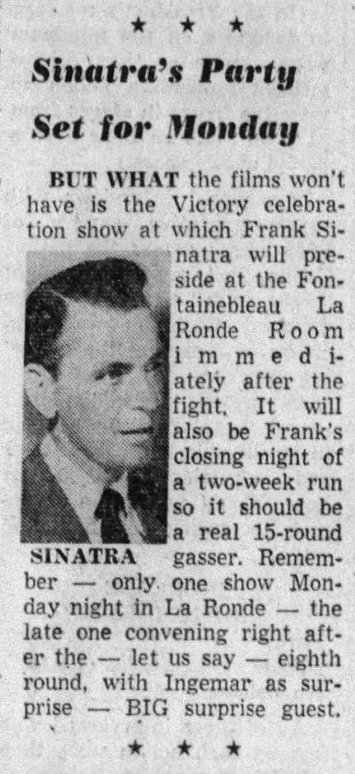
March 13, 1961
Concerts
Fontainbleau, Miami, Fla, (February 28 to March 13)
O.A. Buddy Lester
Brascia & Tybee
RADD ALBUM WAS THE THEME
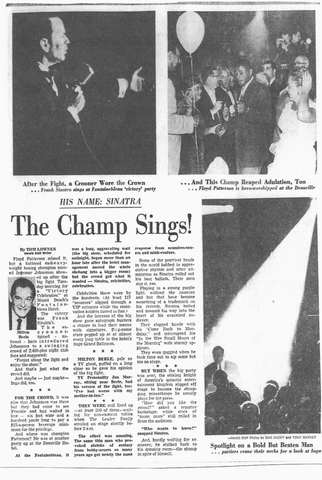
[Sinatra closes Fontainebleau run]
Sinatra closed his engagement at the Fontainebleau on March 13, 1961, the day before the Castro-plot meeting took place in the hotel.
Source: James Kaplan, "Sinatra: The Chairman" (2015).
March 1961
Chicago mob boss Sam Giancana visited Frank Sinatra at the Fontainebleau in Miami and asked him for a favor in return for having used his underworld influence to help swing the West Virginia primary for John F. Kennedy: get new attorney general Bobby Kennedy to ease off his investigation of Giancana and his associates. Sinatra, uneasy but unwilling to refuse Giancana outright, told him vaguely, “I'll start with the old man [Joe Kennedy]. And if I can't talk to him, I'll talk to the man [the president].” Giancana took it as a firm commitment; Sinatra, notably, never actually promised anything. Source: J. Randy Taraborrelli, Sinatra: Behind the Legend.
[CIA-Mafia Castro assassination meeting]
The night after Sinatra closed his Fontainebleau engagement, his friend Sam Giancana met upstairs in the hotel with a CIA representative and other men to discuss a plot to assassinate Fidel Castro; disparaging jokes about Sinatra reportedly came up in the small talk.
Source: James Kaplan, "Sinatra: The Chairman" (2015).
[Aborted 'In the Blue of Evening' take]
Will Friedwald (as cited by Kaplan): During the strained March 1961 Dorsey-tribute sessions, an aborted take of 'In the Blue of Evening' captures Sinatra's voice breaking into throat-clearing mid-line, prompting him to scrap the sessions and regroup later; Sy Oliver later suggested the arrangements had hewed too closely to the original Dorsey sound, though Sinatra reportedly also feared his voice was thinning.
Source: James Kaplan, "Sinatra: The Chairman" (2015)
[Boycott pressures The Untouchables]
Kaplan: In spring 1961, the Federation of Italian-American Democratic Organizations urged a boycott of Chesterfield cigarettes, sponsor of The Untouchables, over its Italian-surnamed gangster characters, and 250 Brooklyn longshoremen picketed an ABC studio. In March, sponsor Liggett & Myers dropped the show; the boycott was reportedly financed in part by Sam Giancana, who resented the series personally, having begun his own criminal career as a driver for Al Capone.
Source: James Kaplan, "Sinatra: The Chairman" (2015)
[Come Swing with Me! sessions with Billy May]
Billy May: Sinatra's Come Swing with Me! sessions with Billy May, recorded for Capitol amid Sinatra's contract-ending tensions with the label, went smoothly despite his open hostility -- at one point he reportedly wore a necktie embroidered 'FUCK YOU' into Studio A. May recalled the sessions moved fast, with everyone in the studio trying to stay on Sinatra's good side.
Source: James Kaplan, "Sinatra: The Chairman" (2015)
[Fontainebleau engagement]
Floyd 'Mac' Swain: Sinatra played the Fontainebleau's La Ronde Room from late February to mid-March 1961, drawing long lines of fans who tipped the headwaiter $100 for tickets. Bellman Floyd 'Mac' Swain recalled the headwaiter making $5,000 a night off Sinatra crowds, splitting proceeds with security and owner Ben Novack.
Source: James Kaplan, "Sinatra: The Chairman" (2015)
[Giancana asks Sinatra to intercede with Kennedys]
Kaplan: Back in March, while throwing cherry bombs from the seventeenth floor of the Fontainebleau, Sam Giancana asked Sinatra to intercede with the Kennedys to get the FBI, led by Robert Kennedy, off his back, feeling he deserved gratitude rather than prosecution for his help with the West Virginia primary and Illinois election.
Source: James Kaplan, "Sinatra: The Chairman" (2015)
[Penthouse parties with Mafia associates]
Ben Novack Jr. (recollection), Kaplan (narration): During the Fontainebleau run, Sinatra partied in his penthouse suite with Mafia figures Joe Fischetti and Sam Giancana, calling for girls from the Poodle Lounge and champagne, and throwing cherry bombs off the seventeenth-floor balcony -- a habit he may have picked up from Giancana.
Source: James Kaplan, "Sinatra: The Chairman" (2015)
[Show Business Illustrated profile]
Frank Sinatra: While at the Fontainebleau, Sinatra let journalist Joe Hyams interview him for Hugh Hefner's new magazine Show Business Illustrated, in a cover story titled 'Sinatra, Inc.' Sinatra described handling his own business affairs since the death of his William Morris agent Bert Allenberg, doing his own representing before turning matters over to lawyers, but retaining final decision-making power.
Source: James Kaplan, "Sinatra: The Chairman" (2015)
[Sinatra envisions his future as executive]
Frank Sinatra: In the same interview, Sinatra mused that by age 50 he'd have had it as an actor and singer, and predicted he would become more of a high-level executive interested in directing and producing films, saying he'd grown fascinated with finance and wanted his business interests to steadily eclipse his entertainment earnings.
Source: James Kaplan, "Sinatra: The Chairman" (2015)
[Sinatra's business empire detailed]
Kaplan: The Show Business Illustrated profile detailed Sinatra's roughly $25 million in investments, including chairmanship of a Beverly Hills savings and loan, Reprise Records, four music publishing companies, a movie production company, a nine-percent stake in the Sands, real estate in San Rafael and Santa Barbara, the Cal-Neva Lodge, three Pacific Northwest radio stations, and shares in the Atlantic City Racetrack.
Source: James Kaplan, "Sinatra: The Chairman" (2015)
[Trafficante and Giancana at Fontainebleau meeting]
Kaplan: Santo Trafficante Jr., Sam Giancana, Johnny Rosselli, and Robert Maheu were all present at the Fontainebleau meeting in March 1961 to discuss the Castro assassination plot; Sinatra had also spent time with Trafficante at the earlier Havana Mafia summit.
Source: James Kaplan, "Sinatra: The Chairman" (2015)
[Come Swing with Me / Point of No Return -- critical commentary]
Come Swing with Me (Billy May, March 1961) and Point of No Return (Axel Stordahl, September 1961), Sinatra's final contractually obligated Capitol albums, were made under acrimonious circumstances, yet Come Swing with Me in particular shows no trace of it musically.
Source: Charles L. Granata, "Sessions with Sinatra: Frank Sinatra and the Art of Recording" (1999/2003), Part III: The Capitol Years, 1953-1962
[history -- critical commentary]
Alan Livingston: In late 1960 Sinatra, after repaying a $250,000 Capitol advance, demanded his own creatively controlled imprint label; when Capitol president Glenn Wallichs refused (fearing he'd have to offer the same to Nat Cole and others), Sinatra angrily vowed not to record for Capitol again, and did not set foot in Capitol's studios from September 1960 to March 1961.
Source: Charles L. Granata, "Sessions with Sinatra: Frank Sinatra and the Art of Recording" (1999/2003), Part III: The Capitol Years, 1953-1962
March 20, 1961
Studio
Capitol Studio A, Hollywood
E35576 On The Sunny Side Of The Street
(J. McHugh/D. Fields)
Shapiro, Bernstein & Co., Inc. (ASCAP)
Arranged by Heinie Beau
Conducted by Billy May
-5 (2:41) CD: CDP 7-94520-2 Come Swing With Me
CD: C2-94777 The Capitol Years
LP: SW1594 Come Swing With Me
E35577 Day By Day
(Stordahl/Weston/ Cahn)
Arranged & Conducted by Billy May
CD: CDP 7-94520-2 Come Swing With Me
LP: SW1594 Come Swing With Me
E35578 Sentimental Journey
(Brown/Homer/ Green)
Arranged by Heinie Beau
Conducted by Billy May
CD: C2 724383808922 The Complete Capitol Singles
CD: CDP 7-94520-2 Come Swing With Me
LP: SW1594 Come Swing With Me
45: 4615
E35579 Don't Take Your Love From Me
(Henry Nemo)
Arranged by Heinie Beau
Conducted by Billy May
CD: CDP 7-94520-2 Come Swing With Me
LP: SW1594 Come Swing With Me
Musicians - Trumpets: John Best, Conrad Gozzo, Joe Graves, Maurice Harris, Emanuel Klein, Vito Mickey Mangano, James Salko, Clarence Shorty Sherock, Rubin Zeke Zarchy; Trombones: C.E. Carpenter, James Henderson, Richard Kenney, Lewis McCreary, Barrett O'Hara, James Priddy, Kenneth Trimble; Tuba: Phil Stephens; French Horns: James Craas, William Culley, Fred Fox, Gale Robinson; Piano: Bill Miller; Bass: Joe Comfort; Drums: Irv Cottler; Guitar: Tony Rizzi; Harp: Kathryn Julye
Session Producer: Dave Cavanaugh
I've said it often before, but I love Heinie Beau's arrangements. An underrated album. --Ed
Ray Charles was also at the session.
FRANK SINATRA: Come Swing with Me!
Frank Sinatra (vocals); orchestra, Billy May cond.
Day by Day: Sentimental Journey; Almost Like
Being in Love; Five Minutes More: and eight others.
CAPITOL ZW 1594 $7.98.
Interest: Songs of Thirties and Forties
Performance: Pro
Recording: Good
Stereo Quality: Marked
Frank Sinatra here revisits some of the vehicles that helped him get his start. The voice of years gone by may he a little huskier now, but it is also freer and more flexible. This collection ranges from some less than memorable ditties such as Five Minutes More to the more enduring classics - Sentimental Journey and That Old Black Magic. They are worthies all, and are rendered with ease, assured style, and I suspect more fondness than shows through the rather slick veneer.
Billy May's big -band arrangements are appropriate, and the engineering is altogether acceptable. C. B.
STEREO REVIEW
November 1963
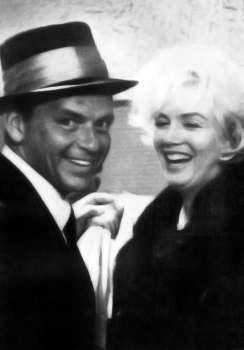
Los Angeles
162 Polka Dots And Moonbeams
(Jimmy Van Heusen/Johnny Burke)
Bourne Co./Music Sales Corp. (ASCAP)
Arranged & Conducted by Sy Oliver
-4 N/R
163 Take Me
(Rube Bloom/Mack David)
Bergman, Vocco & Conn Inc./PolyGram International Publishing Co. inc. (ASCAP) Arranged & Conducted by Sy Oliver
-2 N/R note: Polka Dots was done in 4 takes. All were complete.
Take Me required 8 and there were two complete takes.
164 Without A Song
(Vincent Youmans/Billy Rose/Edward Eliscu)
Anne-Rachel Music Corp../WB Music Corp/The Songwriters Guild (ASCAP) Arranged & Conducted by Sy Oliver
-3 N/R
165 Imagination
(Jimmy Van Heusen/Johnny Burke)
Bourne Co. /Music Sales Corp. (ASCAP)
Arranged & Conducted by Sy Oliver
-5 N/R
Shemmy:
Those 4 "I Remember Tommy" were never released officially.
Are they available anywhere? I have the "Inside Tommy" cd.
Are these outtakes from there by any chance?
Ed :
The only song issued from the March 61 sessions at Reprise was "In The Blue Of The Evening." Reprise sent that to me many years ago. It has a bit of the session including "Take 8" called out. The big suitcase set in 1995 was originally 24 discs. We would have had a number of n/r including the March 61 material. Sy Oliver told me he could hear no real difference between the re-recorded tracks in May and the initial attempts in March. Frank added seven strings for the redos. He wanted a richer sound behind him. I was listening to "I Remember Tommy earlier in the week. One of Frank's best efforts at Reprise. Great song selection, great singing and Sy's charts evoke the sounds of the big bands perfectly. Love that album.
March - Capitol Studio A, Hollywood note: photo taken by William Claxton at the session
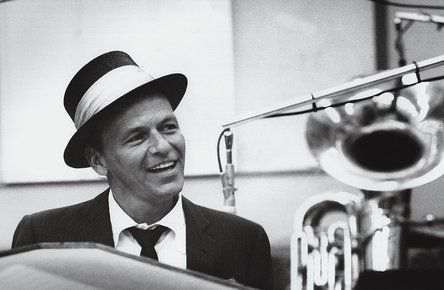
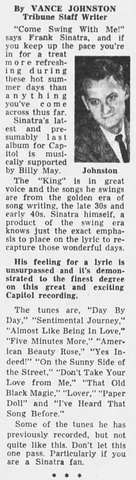
March - Capitol Studio A, Hollywood
note: photo taken by William Claxton at the session
© 1997-2026 The Sinatra Archive
This calendar, or any parts thereof, may not be reproduced in any fashion
whatsoever without the prior written permission of the publisher (The
Sinatra Archive)
__._,_.___
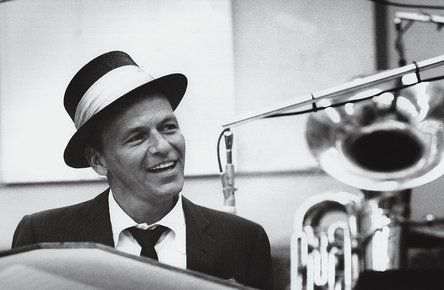
"Day by Day" / "Ol' Man River"
Henry Pleasants: Author Henry Pleasants, in "The Great American Popular Singers," noted Sinatra sometimes used classical-style laryngeal "covering" to sustain full tone moving up the scale, citing confidently held E-flats, Fs, and a briefly sustained A-flat on his 1961 recording of "Day by Day," and similarly successful covered high Fs at the close of his 1963 "Ol' Man River."
Source: Charles L. Granata, "Sessions with Sinatra: Frank Sinatra and the Art of Recording" (1999/2003).
[Without a Song -- critical commentary]
Will Friedwald: Friedwald cites Sinatra's 1961 version as an example of a single performance in which the singer moves through all three of his characteristic modes -- larger-than-life projection, whisperingly intimate underplaying, and a 'dead-on' merging of theatrical performance with the real man -- within the same song.
This song/context matches multiple dated entries in the chronology; the specific date Friedwald is referring to could not be determined with confidence.
Source: Will Friedwald, "Sinatra! The Song Is You: A Singer's Art" (2018 revised edition), Ch. 1, "Night and Day" (Sinatra style overview)
March 21, 1961
Studio
Capitol Studio A, Hollywood
E35592 Yes Indeed
(Sy Oliver)
Arranged & Conducted by Billy May
CD: CDP 7-94520-2 Come Swing With Me
LP: SW1594 Come Swing With Me
E35593 American Beauty Rose
(David/Evans/ Altman)
Arranged by Heinie Beau
Conducted by Billy May
CD: C2 724383808922 The Complete Capitol Singles
CD: CDP 7-94520-2 Come Swing With Me
LP: SW1594 Come Swing With Me
45: 4615
E35594 I've Heard That Song Before
(J. Styne/S. Cahn)
Morley Music Co., Inc./Cahn Music Company (ASCAP)
Arranged & Conducted by Billy May
-5 (2:30) CD: C2 724383808922 The Complete Capitol Singles
CD: CDP 7-94520-2 Come Swing With Me (alt. take)
CD: C2-94777 The Capitol Years
LP: SW1594 Come Swing With Me
45: 4677
E35595 That Old Black Magic
(Harold Arlen/Johnny Mercer)
Arranged by Heinie Beau
Conducted by Billy May
CD: CDP 7-94520-2 Come Swing With Me
LP: SW1594 Come Swing With Me
Musicians - Trumpets: John Best, Conrad Gozzo, Emanuel Klein, Vito Mickey
Mangano, Clarence Shorty Sherock, Ray Triscari, Stuart Williamson;
Trombones: C.E. Carpenter, James Henderson, Lewis McCreary, Frank
Rosolino, Thomas Shepard, Kenneth Shroyer, Kenneth Trimble; Tuba: Phil Stephens; French Horns: James Decker, Wally Linder, Arthur Maebe, Claude Sherry; Piano: Bill Miller; Bass: Joe Comfort; Drums: Irv Cottler;
Guitar: Bobby Gibbons; Harp: Veryle Brilhart
Session Producer: Dave Cavanaugh
Los Angeles
166 I'm Getting Sentimental Over You
(George Bassman/Ned Washington)
EMI Mills Inc. (ASCAP)
Arranged & Conducted by Sy Oliver
-9 N/R
167 I'll Be Seeing You
(Sammy Fain/Irving Kahal)
Williamson Music Co./Fain Music Co./New Irving Kahal Music Co. Inc. (ASCAP)
Arranged & Conducted by Sy Oliver
-2 N/R
168 There Are Such Things
(George W. Meyer/Stanley Adams/Abel Baer)
Music Sales Corp. (ASCAP)
Arranged & Conducted by Sy Oliver
- N/R
169 In The Blue Of Evening
(Tom Montgomery-Adir/ Al D'Artega)
Shapiro, Bernstein & Co.., Inc. (ASCAP)
Arranged & Conducted by Sy Oliver
-8 CD: "I Remember Tommy" (1993)
Notes, updated release
Ed O'Brien:
Song was issued on the "I Remember
Tommy" CD from January 1993. This was the
second CD release of the album, but the first
to include "In The Blue Of Evening."
"In the Blue of Evening"
Sy Oliver: Sinatra and Oliver attempted the recording of I Remember Tommy in two sessions from March 1961, which transpired on the same days that Sinatra recorded his penultimate Capitol album, Come Swing with Me! with Billy May. "Frank had been working very hard before [those dates]," Oliver recalled, "and after he listened to the tapes, he realized it wasn’t what he wanted." Oliver later told Sinatra researcher Ed O’Brien that they had come too close to the original Dorsey sound—a dance band with a small string section. At forty-five, Sinatra was afraid that his voice was thinning as fast as his hair and that he required the crutch of a lush violin section to cover up any technical shortcomings. "He did sound kind of hoarse," Oliver said to Simon, "and he also decided we should use more strings."
Whether or not Sinatra actually sounded rough on the original dates, Oliver added considerably more fiddles on the remake sessions. In May, Sinatra and Oliver redid seven of the eight March titles (adding another five charts), and the eighth, unremade title, "In the Blue of Evening," eventually found its way onto the expanded CD edition of I Remember Tommy in 1992. Far from sounding frail, "Blue of Evening" constitutes the best ballad performance on the disc.
Source: Will Friedwald, "Sinatra! The Song Is You: A Singer's Art" (2018 revised edition).
[American Beauty Rose -- critical commentary]
Mitch Miller; Friedwald (analysis): The Sinatra-Miller partnership began in March 1950 with 'American Beauty Rose,' a Redd Evans swing tune Miller pitched in a Bob Crosby-style Dixieland-with-a-beat arrangement by Norman Leyden. Miller recalled wanting Sinatra to record more rhythm songs, since up to then Sinatra had done very few ('Saturday Night,' 'It All Depends on You,' 'Five Minutes More'). The record, featuring Jimmy Abato on clarinet and Billy Butterfield and Will Bradley in the band, charted modestly but didn't reverse Sinatra's declining sales.
This song/context matches multiple dated entries in the chronology; the specific date Friedwald is referring to could not be determined with confidence.
Source: Will Friedwald, "Sinatra! The Song Is You: A Singer's Art" (2018 revised edition), Ch. 5, "In-Between Years" (1948-1953)
[American Beauty Rose -- critical commentary]
Granata includes 'American Beauty Rose' among the fifty recordings he considers essential to understanding Sinatra's artistry (arranged by Norman Leyden, recorded 1950, Columbia); the song was chosen for its musical/interpretive value rather than commercial popularity.
This song/context matches multiple dated entries in the chronology, or lacked a sufficiently precise date; the specific date could not be determined with confidence.
Source: Charles L. Granata, "Sessions with Sinatra: Frank Sinatra and the Art of Recording" (1999/2003), Afterword & Appendices A-D
[I'll Be Seeing You / These Foolish Things / September Song -- critical commentary]
Al Viola; Milt Bernhart: Guitarist Al Viola: 'It was a little heartbreaking to make because Axel was suffering from cancer.' Milt Bernhart speculated Sinatra's lawyers/Mickey Rudin pushed him to fulfill the contract obligation ('Let them sue me' vs. 'Frank, don't be a fool... Do the album!'). Mrs. Stordahl (June Hutton) reportedly lobbied Capitol producer Dave Cavanaugh to get Axel this farewell session. Bernhart described Sinatra's indifferent studio manner: arriving late, doing one take per song, tearing up sheets and moving on even when Cavanaugh flagged bass problems -- 'I'm sorry... Next number.' On 'These Foolish Things,' the issued master contains an audible tape splice before the final 'you,' which Bernhart speculated might even be a different vocal take spliced in.
This song/context matches multiple dated entries in the chronology; the specific date Friedwald is referring to could not be determined with confidence.
Source: Will Friedwald, "Sinatra! The Song Is You: A Singer's Art" (2018 revised edition), Ch. 9, "Looking for the Hook" (1960-1971)
[Swing Low, Sweet Chariot / Yes, Indeed / Sweet Lorraine / Don't Cry Joe / A Little Learnin' Is a Dangerous Thing -- critical commentary]
Oliver continued to write occasionally for Sinatra even while in the service, turning in a treatment of the spiritual "Swing Low, Sweet Chariot" for him to sing on the 1944 Vimms show as well as a remake of his equally gospelly Dorsey classic "Yes, Indeed." But he seems to have arranged only three commercial sides for Sinatra between 1942 and 1961: "Sweet Lorraine," the minor hit "Don’t Cry Joe," and the less successful "A Little Learnin’ Is a Dangerous Thing." ... The 1946 "Sweet Lorraine" positioned Sinatra with the "Metronome All-Stars," consisting of pianist Nat King Cole and an indisputably stellar group drawn largely from the Dorsey (Charlie Shavers and Buddy Rich) and Ellington bands. Sinatra’s vocal is just one of many virtuoso solos, and this Billie Holiday–like chart showcases Sinatra at the height of his late-1940s jazz-singing abilities.
This song/context matches multiple dated entries in the chronology; the specific date Friedwald is referring to could not be determined with confidence.
Source: Will Friedwald, "Sinatra! The Song Is You: A Singer's Art" (2018 revised edition), Ch. 3, "With Tommy Dorsey" (1940-1942)
[That Old Black Magic / On the Sunny Side of the Street -- critical commentary]
Billy May: May recalled Sinatra's irritation at being contractually obligated by Capitol to rerecord old standards for this album: 'These bastards want me to do these standards... I don't know what to do with "Sunny Side of the Street." I don't know how to make it... What are you going to do with "Black Magic"? Frank had been singing that son-of-a-bitch for twenty years. What more could we do with it?' May said the album was recorded as fast as possible, with Sinatra singing each song only twice, and everyone in the studio trying to be nice to him since he was upset with Capitol.
This song/context matches multiple dated entries in the chronology; the specific date Friedwald is referring to could not be determined with confidence.
Source: Will Friedwald, "Sinatra! The Song Is You: A Singer's Art" (2018 revised edition), Ch. 7, "With Billy May" (1953-1979)
[There Are Such Things / You Could Make Me Smile Again -- critical commentary]
For his part, Dorsey kept something of the Sinatra-Dorsey legacy alive in occasional revivals of some of their biggest hits, such as "Smile Again." In 1952, Dorsey also re-recorded "There Are Such Things" as a trombone solo with Gordon Jenkins’s orchestra and choir. That same year Dorsey also came up with the most obvious "Smile Again" rehash in a tune titled "You Could Make Me Smile Again" (also recorded by the young Tony Bennett).
This song/context matches multiple dated entries in the chronology; the specific date Friedwald is referring to could not be determined with confidence.
Source: Will Friedwald, "Sinatra! The Song Is You: A Singer's Art" (2018 revised edition), Ch. 3, "With Tommy Dorsey" (1940-1942)
March 22, 1961
Studio
Capitol Studio A, Hollywood
E35616 Five Minutes More
(S. Cahn/J. Styne)
Arranged & Conducted by Billy May
CD: C2 724383808922 The Complete Capitol Singles
CD: CDP 7-94520-2 Come Swing With Me
LP: SW1594 Come Swing With Me
45: 4729
E35617 Almost Like Being In Love
(F. Lowe/A.J. Lerner)
Sam Fox Publishing Company Inc. (ASCAP)
Arranged by Heinie Beau
Conducted by Billy May
-5 (2:02) CD: CDP 7-94520-2 Come Swing With Me
CD: C2-94777 The Capitol Years
LP: SW1594 Come Swing With Me
E35618 Lover
(Richard Rodgers/Lorenz hart)
Arranged by Heinie Beau
Conducted by Billy May
CD: CDP 7-94520-2 Come Swing With Me
LP: SW1594 Come Swing With Me
E35619 Paper Doll
(Johnny S. Black)
Arranged & Conducted by Billy May
CD: CDP 7-94520-2 Come Swing With Me
LP: SW1594 Come Swing With Me
Musicians - Trumpet: John Best, Conrad Gozzo, Joe Graves, Emanuel Klien, Vito Mickey Mangano, Clarence Shorty Sherock, Ray Triscari, James Williamson, Rubin Zeke Zarchy; Trombones: C.E. Carpenter, James Henderson, Lewis McCreary, Frank Rosolino, Thomas Shepard, Kenneth Shroyer, Kenneth Trimble; Tuba: Phil Stephens; French Horns: James Decker, Fred Fox, Richard Perissi, Vincent De Rosa; Piano: Bill Miller; Bass: Joe Comfort; Drums: Irv Cottler; Guitar: Bobby Gibbons; Harp: Kathryn Julye
Session Producer: Dave Cavanaugh
April 1961
[Guests at Palm Springs and mistreatment of Marilyn Monroe]
Unnamed guest (via Kitty Kelley): During his April break, Sinatra hosted a stream of guests in Palm Springs including Sammy Davis Jr. and May Britt, the Lawfords, Jimmy Van Heusen, and Marilyn Monroe. An unnamed guest told Kitty Kelley that Sinatra was cruel to Monroe -- calling her stupid and mocking her while she drank from a flask -- and constantly barked orders at his valet George Jacobs.
Source: James Kaplan, "Sinatra: The Chairman" (2015)
[Sinatra confronts Desi Arnaz]
Kaplan (citing Kitty Kelley and UPI): Late one night in the first week of April 1961, while on vacation in Palm Springs, a drunk Sinatra confronted Desi Arnaz at the Indian Wells Country Club over The Untouchables' portrayal of Italians as gangsters. Arnaz, backed by two bodyguards, mocked Sinatra's television career and told him to mind his own business; the argument ended without violence, with Sinatra later admitting he couldn't hit an old friend.
Source: James Kaplan, "Sinatra: The Chairman" (2015)
[Sinatra destroys Van Heusen's painting]
Kitty Kelley (account, via unnamed source): After the Arnaz confrontation, around 4 a.m., Sinatra and his party went to Jimmy Van Heusen's Palm Desert house, where an enraged Sinatra grabbed a kitchen knife and slashed to shreds a treasured Norman Rockwell portrait of Van Heusen, threatening to 'blow the fucking wall off' if Van Heusen tried to repair it.
Source: James Kaplan, "Sinatra: The Chairman" (2015)
[Sinatra funds Mexico City charity concerts]
Kaplan: About three weeks after the Van Heusen incident, Sinatra paid to fly Nelson Riddle and forty musicians to Mexico City, where he played five free concerts for handicapped children.
Source: James Kaplan, "Sinatra: The Chairman" (2015)
[Sinatra takes a month off]
Kaplan: Sinatra announced he would take all of April 1961 off after the exhausting gala season and aborted recording sessions, though idleness made him restless, irritable, and prone to heavy drinking.
Source: James Kaplan, "Sinatra: The Chairman" (2015)
[Almost Like Being in Love -- critical commentary]
On Come Swing with Me, arranger Billy May (assisted by Heinie Beau) used two complete ten-piece brass sections set on opposite sides of the studio to create a stereo 'ping-pong' effect, exemplified in the densely layered two-minute arrangement of 'Almost Like Being in Love.'
This song/context matches multiple dated entries in the chronology, or lacked a sufficiently precise date; the specific date could not be determined with confidence.
Source: Charles L. Granata, "Sessions with Sinatra: Frank Sinatra and the Art of Recording" (1999/2003), Part III: The Capitol Years, 1953-1962
April 19, 1961
Concerts
Mexico City (April 19-21)
Benefit Concerts
Ed O'Brien:
Frank brought along a 40 piece orchestra conducted by Nelson Riddle. In April of 62, he would be back with six sidemen lead by Bill Miller.
NOTE: Ed O'Brien was told by Sy Oliver that Frank took the March recordings for "I Remember Tommy" with him to Mexico.
One night Sy got a call from Frank instructing him to add a string section of seven because he wanted to re-do the songs. Sy felt the original sessions were fine but seven of the songs were re-done and five more were added for the early May dates.
Mexico City (April 19-21)
Benefit Concerts
Ed O'Brien:
Frank brought along a 40 piece orchestra conducted by Nelson
Riddle. In April of 62, he would be back with six sidemen lead by
Bill Miller.
Originally Frank planned to do just one show. But long before
he arrived, the demand became much too great for only one
performance. He wound up doing five shows. All were SRO and raised
a lot of money for children's charities.
Sinatra Plays Mexican Benefit
Billboard
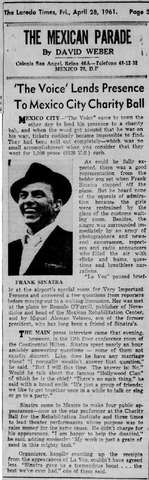
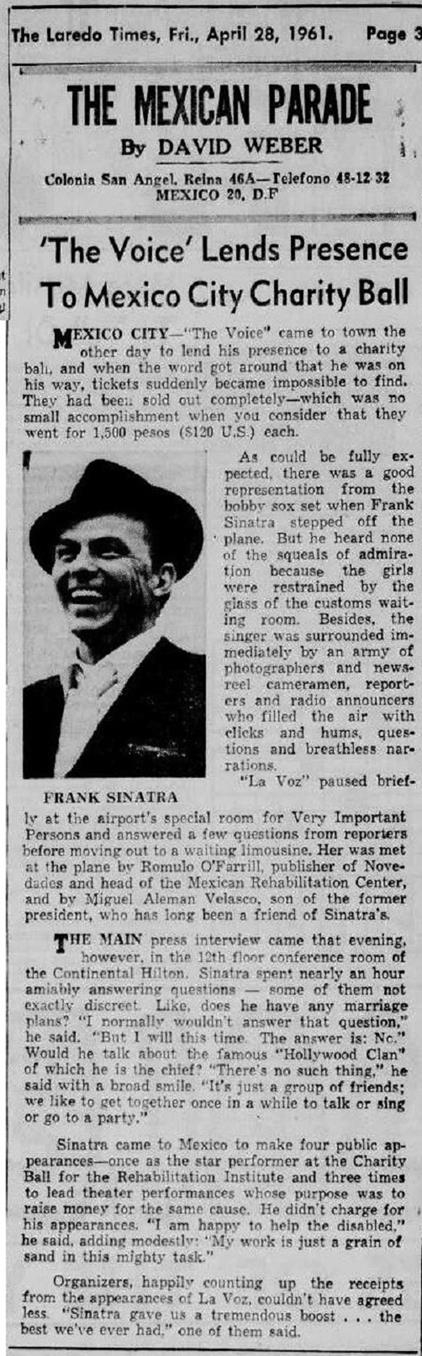
Ed O'Brien:
Frank brought along a 40 piece orchestra conducted by Nelson
Riddle. In April of 62, he would be back with six sidemen lead by
Bill Miller.
"Last year I took Nelson and forty musicians to Mexico.
What a wild time we had! This was nothing to do with
the governmentÂthhis was out of my own pocket, to help
some rehabilitated children down there. Hospitals, things
like that. We planned to do one show, ended up by doing
five. This was really an experience for us all. They gave
me a medal, and a boy came up on the stage to pin it on
me. He had no hands, only metal claws, and he took it
out of the box, unclasped it and pinned it on my coat.
Five thousand people were sitting in that place and you
could have heard a pin drop. I can tell youÂthere was a
big lump in my throat. -Frank Sinatra"
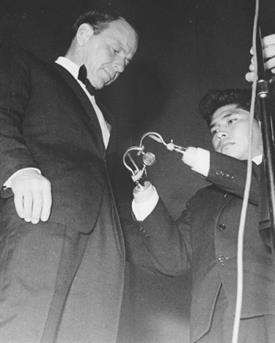
April 20, 1961
Concerts
Mexico City (April 19-21)
Benefit Concerts
April 21, 1961
Concerts
Mexico City (April 19-21)
Benefit Concerts
Mexico City (April 19-21)
Benefit Concerts
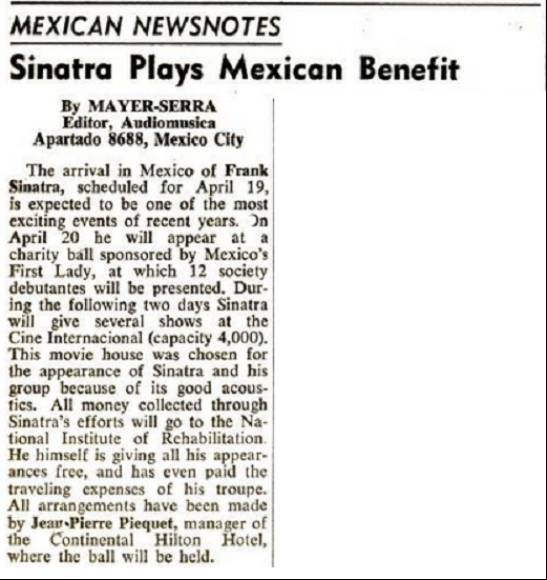
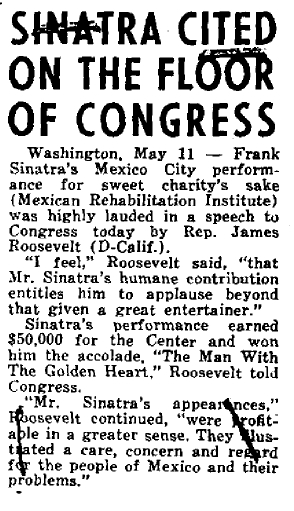
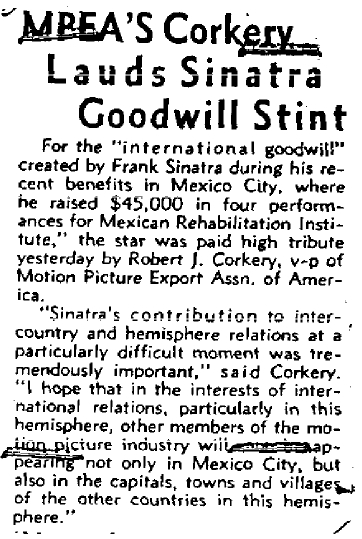
May 1961
[Sinatra Records Swing Along With Me with Billy May]
Sinatra is pictured with arranger Billy May at a May 1961 recording session for the album released as Swing Along With Me, also known as Sinatra Swings.
Source: Charles Pignone, "Frank Sinatra 100" (2015).
[Swing Along With Me Sessions with Billy May]
Rare photos document Sinatra with arranger Billy May during the May 1961 sessions for Swing Along With Me, also released as Sinatra Swings, an album billed on its back cover as bold and uninhibited.
Source: Charles Pignone, "Frank Sinatra 100" (2015).
[Judith Exner recalls JFK's fixation on Sinatra gossip]
Judith Exner: Judith Exner wrote that President Kennedy constantly quizzed her about Sinatra during her White House visits. She recalled a Saturday lunch in May where Kennedy pressed her for gossip about whether Frank was seeing Janet Leigh, joking that she was as tight-lipped as a career diplomat when she wouldn't share.
Source: James Kaplan, "Sinatra: The Chairman" (2015)
[Lawford patches Sinatra into JFK birthday call]
Frank Sinatra: While on location in Kanab for Sergeants 3 at the end of May, Peter Lawford phoned the White House to wish Kennedy a happy birthday, then patched the call through to Sinatra, who chirped "Happy birthday, Prez" -- putting the president in a good mood for the rest of the day.
Source: James Kaplan, "Sinatra: The Chairman" (2015)
[Sinatra demands rushes in Kanab, Utah]
Howard W. Koch (via Kaplan): Sinatra flew into the remote Kanab, Utah location a day after executive producer Howard W. Koch and a skeleton crew began second-unit filming, and demanded to see rushes immediately. When Koch said he had no projector for the Panavision/Technicolor footage, he had to borrow one flown in from Kirk Douglas, who was shooting nearby in New Mexico.
Source: James Kaplan, "Sinatra: The Chairman" (2015)
May 1, 1961
Studio
Los Angeles
233 I'll Be Seeing You
(Sammy Fain/Irving Kahal)
Williamson Music Co./Fain Music Co./New Irving Kahal Music Co. Inc. (ASCAP)
Arranged & Conducted by Sy Oliver
-9 (2:49)
CD: 46013-2 The Complete Reprise Studio Recordings Disc 1
CD: 9-27019-2I Remember Tommy
CD: 1016-2A Man And His Music
LP: FS1003I Remember Tommy
45: 20,023
Ed O'Brien:
Billboard thought Frank had a big hit with the single release of this
recording.
Magazine mentioned he hadn't a big single seller in a long while. But the
initial reaction from both radio stations and record stores indicated a lot
of interest. But it was not to be. Song peaked at #58 and charted for only
seven weeks.
234 I'm Getting Sentimental Over You
(George Bassman/Ned Washington)
EMI Mills Inc. (ASCAP)
Arranged & Conducted by Sy Oliver
-5 (3:42) CD: 46013-2 The Complete Reprise Studio Recordings Disc 1
CD: 9-27019-2 I Remember Tommy
LP: FS1003I Remember Tommy
45: 20,025
235 Imagination
(Jimmy Van Heusen/Johnny Burke)
Bourne Co./Music Sales Corp. (ASCAP)
Arranged & Conducted by Sy Oliver
-3 (3:04) CD: 46013-2 The Complete Reprise Studio Recordings Disc 1
CD: 9-27019-2I Remember Tommy
CD: 9-26723-2Sings The Songs Of Van Heusen & Cahn
LP: FS1003I Remember Tommy
45: 20,024
236 Take Me
(Rube Bloom/Mack David)
Bergman, Vocco & Conn Inc./PolyGram International Publishing Co. inc. (ASCAP)
Arranged & Conducted by Sy Oliver
-3 (2:19) CD: 46013-2 The Complete Reprise Studio Recordings Disc 1
CD: 9-27019-2I Remember Tommy
LP: FS1003I Remember Tommy
45: 20028
NOTE: Frank Sinatra's tribute to his great mentor, Tommy Dorsey, Ed
O'Brien points out. He had recorded the four songs in March 1961, but with seven fewer strings. He felt the need to re-do them with the string augmentation. Sinatra recorded 83 songs during his years with Dorsey. Forty-two of them made the Billboard charts, 13 made the top 5, and there were 4 No. 1 hits, "I'll Never Smile Again" was No. 1 for 12 consecutive weeks. Sinatra would re-record 28 of the 83 songs through the years. A part of the Dorsey years would always be with him.
Note: This was a session where a lot of intercuts were done.
"I'll Be Seeing You" required 6 ics before one was acceptable
"Imagination" there were 2
"Take Me" also had 2
Reprise released all 12 songs done in May for the TD album on 45 singles.
On the 5/2 session, there was not one intercut.
--Ed
Sy Oliver
arranger, conductor
Thirty-seven piece orchestra:
Conrad Gozzo-trumpet, Al Porcino-trumpet, Pete
Candoli-trumpet, Mickey Mangano-trumpet,
Dick Noel-trombone, Bobby Pring-trombone, Dick Nash-trombone, Kenny Shroyer-bass trombone, Vince DeRosa-french horn,
Ted Nash-woodwinds, Plas Johnson-woodwinds, Jules Jacob-woodwinds, Abe Most-woodwinds, Joe Koch-woodwinds,
Herman Clebanoff-violin, Marshall Sosson-violin, Arnold Belnick-violin, Jimmy Getzoff-violin, Gerald Vinci-violin,
Erno Neufeld-violin, Victor Arno-violin, Lou Klass-violin, Arnold Sukonick-violin, Lennie Malarsky-violin,
Elliot Fisher-violin, Joe Stepansky-violin, Alex Neiman-viola, Stanley Harris-viola, Paul Robyn-viola,
Edgar Lustgarten-cello, Justin DiTullio-cello, Raphael Kramer-cello, Kathryn Julye-harp, John Markham-drums,
Joe Comfort-bass, Bill Miller-piano, Al Viola-guitar
Los Angeles
233 I'll Be Seeing You
234 I'm Getting Sentimental Over You
235 Imagination
236 Take Me
[Dorsey tribute sessions resume]
On May 1, 1961, Sinatra resumed work on his Tommy Dorsey tribute album at United Recording, this time recording only that project, with Sy Oliver providing a fuller string section; the sessions went far more smoothly than the aborted March attempt.
Source: James Kaplan, "Sinatra: The Chairman" (2015).
May 2, 1961
Studio
Los Angeles
237 Without A Song
(Vincent Youmans/Billy Rose/Edward Eliscu)
Anne-Rachel Music Corp./WB Music Corp/The Songwriters Guild (ASCAP) Arranged & Conducted by Sy Oliver
-13 (3:38) CD: 46013-2 The Complete Reprise Studio Recordings Disc 1
CD: 9-27019-2I Remember Tommy
CD: 9-263340The Reprise Collection
CD: 1015-2My Kind Of Broadway
LP: FS1003I Remember Tommy
45: 20,027
238 Polka Dots And Moonbeams
(Jimmy Van Heusen/Johnny Burke)
Bourne Co./Music Sales Corp. (ASCAP)
Arranged & Conducted by Sy Oliver
-4 (3:42) CD: 46013-2 The Complete Reprise Studio Recordings Disc 1
CD: 9-27019-2I Remember Tommy
CD: 9-26723-2Sings The Songs Of Van Heusen & Cahn
CD: 1016-2A Man And His Music
LP: FS1003I Remember Tommy
45: 20,026
239 Daybreak
(Ferde Grofe/Harold Adamson)
EMI Feist Catalog Inc. (ASCAP)
Arranged & Conducted by Sy Oliver
-5 (2:43) CD: 46013-2 The Complete Reprise Studio Recordings Disc 1
CD: 9-27019-2I Remember Tommy
LP: FS1003I Remember Tommy
45: 20,028
Sy Oliver arranger, conductor
Thirty-seven piece orchestra:
Conrad Gozz-trumpet, Al Porcino-trumpet, Conte Candoli-trumpet, Jimmy Zito-trumpet Dick Noel-trombone, Bobby Pring-trombone, Tommy Pederson-trombone, Kenny Shroyer-bass trombone, James Decker-french horn, Ted Nash-woodwinds, Plas Johnson-woodwinds, Jules Jacob-woodwinds, Abe Most-woodwinds, Joe Koch-woodwinds, Herman Clebanoff-violin, Anatol Kaminsky-violin, Marshall Sosson-violin, Arnold Belnick-violin, Jimmy Getzoff-violin, Gerald Vinci-violin, Erno Neufeld-violin, Victor Arno-violin, Lou Klass-violin, Arnold Sukonick-violin, Lennie Malarsky-violin, Marvin Limonick-violin, Alex Neiman-viola, Stanley Harris-viola, Paul Robyn-viola, Edgar Lustgarten-cello, Justin DiTullio-cello, Raphael Kramer-cello, Kathryn Julye-harp, John Markham-drums, Joe Comfort-bass, Bill Miller-piano, Al Viola-guitar
NOTE: Ed O'Brien points out that Sinatra finished the session with "In the Blue of the Evening." The master was #240. After an aborted Take 1, Sy Oliver tells Sinatra that they have two problems. Frank tells Oliver he was afraid that would happen. They try a Take 2 and it ends abruptly. The master number was eventually assigned to "The One I Love . . ." at the May 3 session.
Los Angeles
237 Without A Song
238 Polka Dots And Moonbeams
239 Daybreak
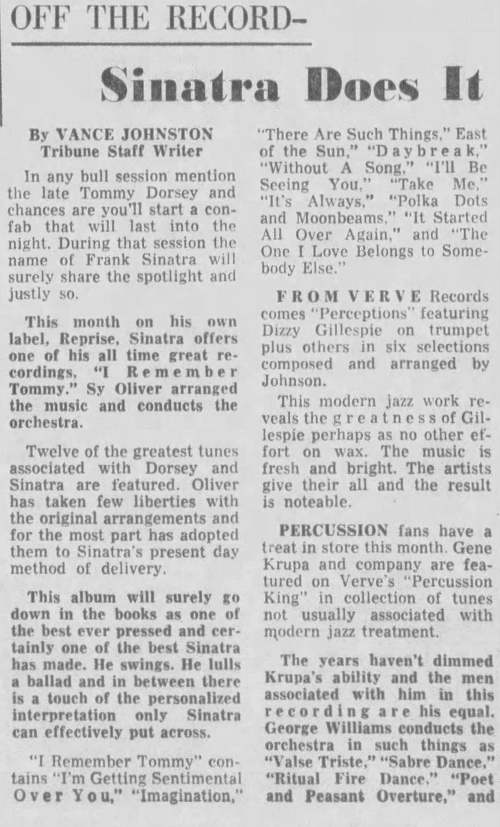
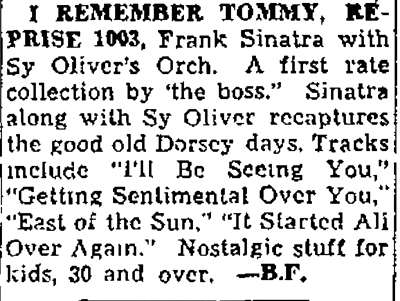
May 3, 1961
Studio
Los Angeles
240 The One I Love Belongs To Somebody Else w/Sy Oliver
(Gus Kahn/Isham Jones)
The Songwriters Guild (ASCAP)
Arranged & Conducted by Sy Oliver
-3 (2:47) CD: 46013-2 The Complete Reprise Studio Recordings Disc 1
CD: 9-27019-2I Remember Tommy
CD: 1016-2A Man And His Music
LP: FS1003I Remember Tommy
45: 20,023
241 There Are Such Things
(George W. Meyer/Stanley Adams/Abel Baer)
Music Sales Corp. (ASCAP)
Arranged & Conducted by Sy Oliver
-16 (3:12) CD: 46013-2 The Complete Reprise Studio Recordings Disc 2
CD: 9-27019-2I Remember Tommy
CD: 1016-2A Man And His Music
LP: FS1003I Remember Tommy
45: 20,026
242 It's Always You
(Jimmy Van Heusen/Johnny Burke)
Famous Music Corp. (ASCAP)
Arranged & Conducted by Sy Oliver
-7 (2:48) CD: 46013-2 The Complete Reprise Studio Recordings Disc 2
CD: 9-27019-2I Remember Tommy
CD: 9-26723-2Sings The Songs Of Van Heusen & Cahn
LP: FS1003I Remember Tommy
45: 20,024
243 It Started All Over Again
(Carl Fischer/Bill Carey)
Embassy Music Corp. (BMI)
Arranged & Conducted by Sy Oliver
-4 (2:31) CD: 46013-2 The Complete Reprise Studio Recordings Disc 2
CD: 9-27019-2I Remember Tommy
CD: 9-26340-2The Reprise Collection
LP: FS1003I Remember Tommy
45: 20,027
244 East Of The Sun (And West Of The Moon)
(Brooks Bowman)
Anne-Rachel Music Corp. (ASCAP)
Arranged & Conducted by Sy Oliver
-3 (3:23) CD: 46013-2 The Complete Reprise Studio Recordings Disc 2
CD: 9-27019-2I Remember Tommy
LP: FS1003I Remember Tommy
45: 20,025
Note: The last track to complete Frank's tribute album to Tommy Dorsey and his wonderful band. Frank was in great spirits during the recording of this final track.
There is an open session mike of the 5/3 evening. After doing three takes on "East Of The Sun," Frank announced that an intercut would be added, picking up with the last chord and then out. Frank continued with a Reprise of the intercut at the end of the third try. He liked it and decided to make it a coda at the end of the song. Excellent example of how a song often evolved during a Sinatra session. Take six of the intercuts is on the master release. --Ed
Sy Oliver arranger, conductor
Thirty-seven piece orchestra:
Al Porcino-trumpet, Conte Candoli-trumpet, Jimmy Zito-trumpet, Ray Linn-trumpet, Dick Noel-trombone, Bobby Pring-trombone, Milt Bernhart-trombone, Kenny Shroyer-bass trombone, George Price-french horn, Plas Johnson-woodwinds, Willie Schwartz-woodwinds, Bill Usselton-woodwinds, Abe Most-woodwinds, Joe Koch-woodwinds, Herman Clebanoff-violin, Anatol Kaminsky-violin, Marshall Sosson-violin, Arnold Belnick-violin, Jimmy Getzoff-violin, Gerald Vinci-violin, Erno Neufeld-violin, Victor Arno-violin, Lou Klass-violin, Arnold Sukonick-violin, Lennie Malarsky-violin, Marvin Limonick-violin, Alex Neiman-viola, Stanley Harris-viola, Paul Robyn-viola, Paul Robyn-cello, Edgar Lustgarten-cello, Justin DiTullio-cello, Raphael Kramer-cello, Kathryn Julye-harp, John Markham-drums, Joe Comfort-bass, Bill Miller-piano, Al Viola-guitar
Ed O'Brien:
The final session for one of Sinatra's best albums at Reprise.
Here is a review from 10/61 and an ad that ran in a number of high quality publications that month. (pics in extras)
NOTE: Sinatra Scholar Ed O'Brien says that shortly before its release in October of 1961, Sinatra told Ed Sullivan that he was very optimistic that "I Remember Tommy" would prove to be his most successful album in terms of sales. The LP reached No. 3 on the Billboard chart and was around for 42 weeks. For some inexplicable reason, the album has never been certified as a gold record by the RIAA. Sullivan down through the years mentioned more than once that Sinatra was working on a Volume II Dorsey album.
O'Brien adored the album and played it over and over again for months on end. In 1965, a Macy's store opened in his area and they had a huge record sale. Well, he says, "my copy of Reprise 1003 was on sale for $2.99 including 'Tommy.' I bought it and headed home. Couldn't wait to hear the new stereo copy when I suddenly discovered to my horror there was a punch-hole where"Polka Dots and Moonbeams" should be. Returned the album the following day but the sale had pretty much depleted the Sinatra bin and Tommy' was nowhere to be found."
In response to an inquiry from Sinatraphile Larry Crawford, O'Brien pointed out that "I Remember Tommy" was a big album for Sinatra in 1961-62. He would not have an album at Reprise chart higher until "Strangers in the Night" in 1966. The critical response was outstanding. The original LP had a fold-out cover with some terrific photos of Frank with the TD band back in the early Forties. The sessions reveal just how hard Frank worked to get it right.
Sy Oliver was an arranager for Tommy Dorsey and started doing charts for Frank in 1940. He contributed more arrangements during the Columbia year and appeared on Frank's Max Factor show on April 11, 1945. At the time, he was Sgt. Sy Oliver. Sinatra and Sy did on duet on "Yes, Indeed", written by Oliver. He also conducted the orchestra when Frank appeared at Carnegie Hall on January 27, 1961,
O'Brien says he interviewed Oliver in the early 80's and Sy gave him quite a bit of information concerning the making of "I Remember Tommy." Sy was not in the least intimidated by Sinatra, He kept telling O'Brien that Sinatra was just "Frank" to him. At the time, O'Brien had called to find out if Sinatra had recorded "In the Blue of Evening." Sy offered that info and much more. Later on, O'Brien became good friends with Sy;s widow, Lil. They had great conversations and she sent O'Brien a tape of songs Sy had collected from Frank's radio shows and Columbia sessions.
In the 1940a, Oliver did many incredible charts for which Alex Stordahl had received credit. Lil gave O'Brien the background on why and how it affected Sy. Sinatra toyed with the idea of doing a Volume II of â Tommyâ songs in the early rly 1960's.
Larry Crawford:
Thanks for the mention of one of my favorite Sinatra albums, often overlooked, I think that " I Remember Tommy " is one of Sinatra's best Reprise albums. The tone of his voice, the songs, the arrangements, and the singing are all top notch I think. I saw in the most recent catalog I received from Collector's Choice Music that this title is being re-released, and its a treasure.
Ed O'Brien:
Whenever I see a poll of Sinatra's best albums "Tommy" is always slighted. I wonder why? The sessions reveal how hard Sinatra worked to get it right. Oliver's charts are a great tribute to Dorsey's band, the songs are great big band hits and Frank's vocals are stunning. Tis' a mystery.
Ed Spiegel:
"In the Blue of Evening" is on the original CD release of the album. It was recorded in March, 1961. The rest of the tracks on the released album were done in May, 1961 and were better recordings although I still enjoy this March version.
In March, he also recorded 7 more of the songs according to discographies, but they've never been released. He did them all again, presumably improved, for the final album.
Ed O'Brien:
Sy Oliver told me that he couldn't hear much difference between the March and May recordings. He thought the original efforts were very good.
Vance Adair:
I heartily concur with all that has been said about this much neglected album. I particularly love 'Without a Song' and 'There Are Such Things.' There are a clutch of other performances that are similarly good and Sy Oliver's arrangements are inspired. I have always liked the nicely balanced sound of this album - especially when it is compared with other early Reprise titles.
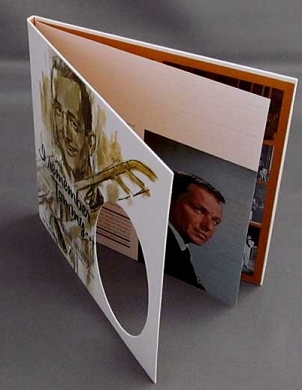
I Remember Tommy
Note: The final session for one of Sinatra's best albums at
Reprise.
Here is a review from 10/61 and an ad that ran in a number of
high quality publications that month.
© 1997-2026
The Sinatra Archive
This calendar, or any parts thereof, may not be reproduced in any fashion
whatsoever without the prior written permission of the publisher (The
Sinatra Archive)
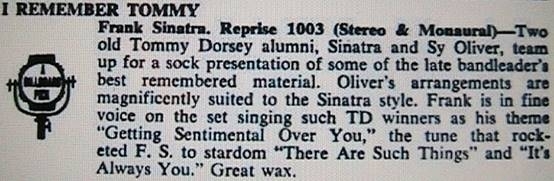
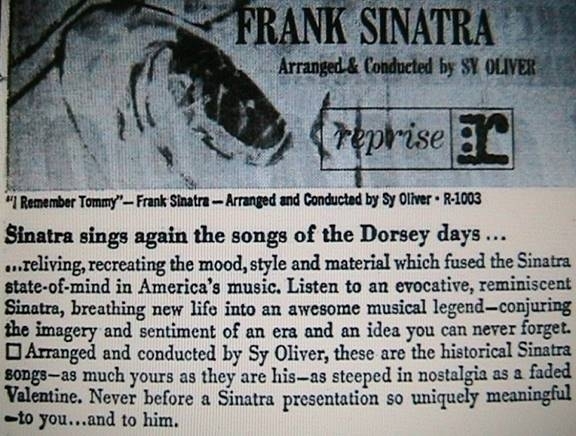
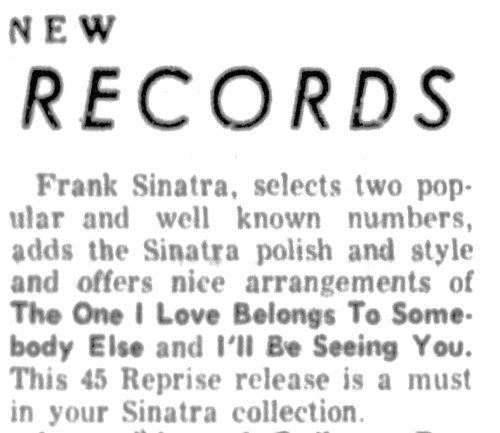
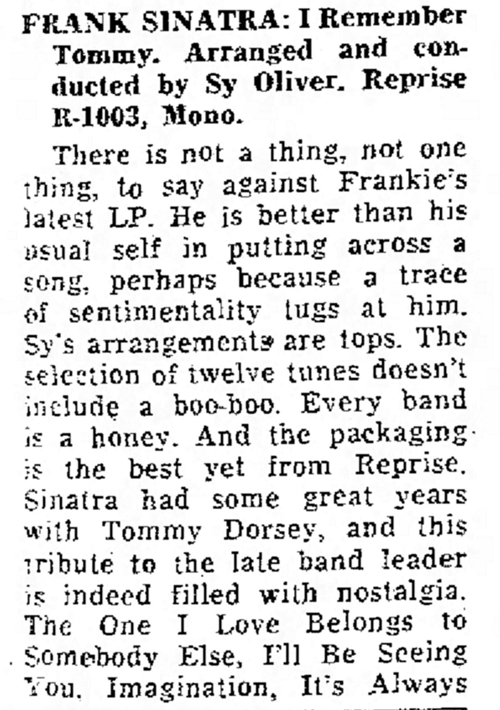
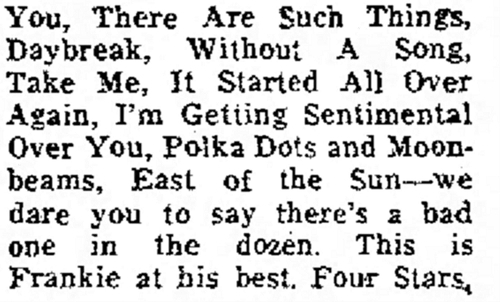
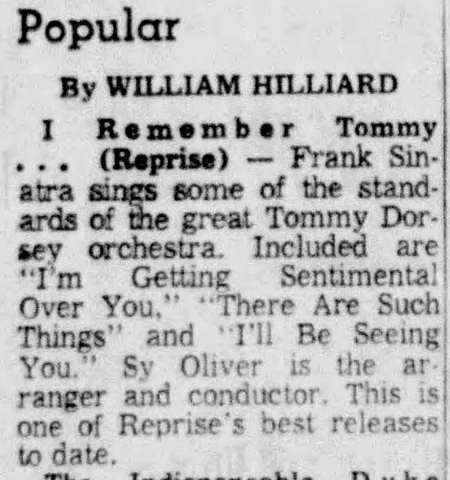
Frank Sinatra Jr. at age seventeen, 1961. Source: photo and caption from J. Randy Taraborrelli, Sinatra: Behind the Legend (mptvimages.com).
May 6, 1961
Moulin Rouge, Los Angeles, CA
Share Inc., Boomtown Party
Sinatra, Dean Martin, Milton Berle, George Burns, Jack Benny and others
[image referenced in source but could not be recovered]
[image referenced in source but could not be recovered]
[image referenced in source but could not be recovered]
May 17, 1961
Studio
Billy May arranged & conducted
Forty-one piece orchestra
275 Moonlight On The Ganges
276 You're Nobody Till Somebody Loves You
277 Don't Cry, Joe
278 Granada
note: Sinatra ran down some vocals and the
orchestral tracks were recorded. Idea
was to follow up with an overdub session.
Frank was not comfortable with the concept.
Session was scrapped and new master numbers
were assigned for the 5-23-61 session. I have the
lead sheets for the 5/17 date.
Ed
[Don't Cry, Joe -- critical commentary]
Sinatra: As Sinatra said in a radio interview from the night after the session, "‘Don’t Cry, Joe’ is a great song and should be a big hit." The hit went to future Sinatra cohort Gordon Jenkins, but Sinatra’s version successfully combines the strengths of both blues and ballad singing, and the Pastels vocal group again blends in superbly. Even the odd way Sinatra bends the note on the line "Don’t Cry Joe" actually works, and Oliver cleverly borrows the Dixieland coda from Duke Ellington’s "I Ain’t Got Nothin’ But the Blues" as a tag. Sinatra attributed the spirit of the disc to "the fact that we were in a new studio and it was a wonderful Sy Oliver arrangement. Everybody was kind of all excited about it, that may be the answer too. But I will say that because of the song being so good, we couldn’t miss with it last night."
This song/context matches multiple dated entries in the chronology; the specific date Friedwald is referring to could not be determined with confidence.
Source: Will Friedwald, "Sinatra! The Song Is You: A Singer's Art" (2018 revised edition), Ch. 3, "With Tommy Dorsey" (1940-1942)
[Don't Cry, Joe / It All Depends on You / Bye Bye Baby -- critical commentary]
Frank Sinatra (to Jack Ellsworth); Friedwald (analysis): Friedwald calls the July 10, 1949 New York session (not with Stordahl but with George Siravo and Sy Oliver arrangements) Sinatra's best all-around session of the year. 'Don't Cry, Joe' is an uncharacteristically bluesy ballad; on 'It All Depends on You' Sinatra 'brims with excitement' after Siravo's catchy vamp, digging against the beat and adding extra notes ('I can be very lonely'), climaxing on a high note likened to 'a man racing up the side of a mountain.' The next day, in a radio interview with Long Island DJ Jack Ellsworth, Sinatra previewed the still-unreleased 'Bye Bye Baby' from the forthcoming Gentlemen Prefer Blondes, calling Jule Styne 'just a wonderful songwriter.' Sy Oliver's wife, singer Lillian Oliver Clark, recalled that by 1949 it was Sinatra -- once coached by Sy Oliver on swing feel in the Dorsey years -- who was now coaching the backup vocal group on rhythmic phrasing.
This song/context matches multiple dated entries in the chronology; the specific date Friedwald is referring to could not be determined with confidence.
Source: Will Friedwald, "Sinatra! The Song Is You: A Singer's Art" (2018 revised edition), Ch. 5, "In-Between Years" (1948-1953)
[Moonlight on the Ganges -- critical commentary]
Frank Sinatra: In a 1981 interview, Sinatra characterized May's orchestration style: 'Billy May almost always uses the extra percussion, like vibraphones, xylophones, bells, and chimes and all that jazz.' The 'Ganges' chart, inspired by a 1952 Sauter-Finegan recording of the tune, required contractor Bill Miller to recruit an entire percussion section covering gongs, chimes, vibes, xylophones, kettle drums and woodblocks.
This song/context matches multiple dated entries in the chronology; the specific date Friedwald is referring to could not be determined with confidence.
Source: Will Friedwald, "Sinatra! The Song Is You: A Singer's Art" (2018 revised edition), Ch. 7, "With Billy May" (1953-1979)
May 18, 1961
Studio
Los Angeles
279 The Curse Of An Aching Heart
(Henry Fink/Al Pientadosi)
EMI Feist Catalog inc. (ASCAP)
Arranged & Conducted by Billy May
-2 (2:06) CD: 46013-2 The Complete Reprise Studio Recordings Disc 2
CD: 1002-2Sinatra Swings
LP: FS1002Sinatra Swings
45: 20,010
280 Love Walked In
(George Gershwin/Ira Gershwin)
Gershwin Publishing Corp. (ASCAP)
Arranged & Conducted by Billy May
-6 (2:19)Ã CD: 46013-2 The Complete Reprise Studio Recordings Disc 2
CD: 9-26340-2The Reprise Collection
CD: 1002-2Sinatra Swings
LP: FS1002Sinatra Swings
281 Please Don't Talk About Me When I'm Gone
(Sam Stept/Sindey Clare)
Bourne Co./Remick Music Corp. (ASCAP)
Arranged & Conducted by Billy May
-2 (2:57)Ã CD: 46013-2 The Complete Reprise Studio Recordings Disc 2
CD: 1002-2Sinatra Swings
LP: FS1002Sinatra Swings
282 Have You Met Miss Jones?
(Richard Rodgers/Lorenz Hart)
Chappell & Co. Inc./Williamson Music Co. (ASCAP)
Arranged & Conducted by Billy May
-7 (2:32) CD: 46013-2 The Complete Reprise Studio Recordings Disc 2
CD: 1015-2My Kind Of Broadway
CD: 1002-2Sinatra Swings
LP: FS1002Sinatra Swings
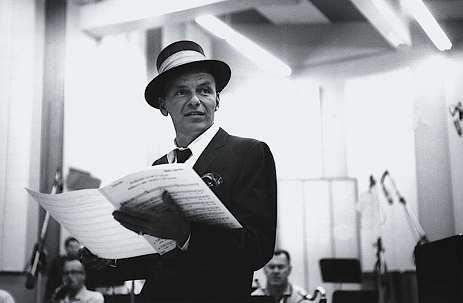
Los Angeles
279 The Curse Of An Aching Heart
280 Love Walked In
281 Please Don't Talk About Me When I'm Gone
282 Have You Met Miss Jones?
Alternate Cover for "Swing Along With Me"
FRANK SINATRA: .Sinatra .Swings.
Frank Sinatra (vocals); Billy May Orchestra.
Don't Cry, Joe; Granada; It's A Wonderful World. REPRISE. R 1002 S3.93.
Interest: ring -a-ding -ding yourself
Performance: lacks distinction
Recording; Néeds bass
This collection was originally released as "Swing Along With Me" but that title had to be abandoned because it was too similar to Capitol's Frank Sinatra -Billy May album, "Come Swing With Me" They might better have scrapped the whole record. Sinatra's unquestioned musicianship is still apparent, but his well-worn voice seems forced as he tries to tear through May's sand -blasting background. It would he some relief, anyhow, to understand why he chose some of the tempos he did. Perhaps he did them on a dare, but swinging the trite tearjerker The Curse of an itching Heart or Rodgers and Hart's lovely waltz Falling in Love with Love benefits neither the singer nor the songs, Nor is it exactly clear why the sincere approach should be reserved for such lamentable choices as Don't Cry, Joe and Moonlight on the Ganges. But the record is unique in one way: there are no contributions by Sinatra's court musicians, .Jimmy Van Heusen and Sammy Cahn. S. G.
Stereo Review
November 1961 note: Some years back, I posted two reviews from 1961 that pretty much echo the sentiments expressed here. The only rave review from that time was a brief Playboy mention. Album only sold 153,000 copies. Way below the half-million average for a Sinatra release at the time. I was stunned when Billy May told me he thought it was the best album he did with Sinatra.
Ed
May 18, 1963 Americana Hotel, New York, NY (cancelled appearance) Fundraising dinner given by the People to People Sports Committee Frank Sinatra, Bob Hope, Jackie Gleason, Ethel Merman and others
According to the article below, Sinatra was part of the entertainment but the second article details that Sinatra did not appear due to a “business emergency”
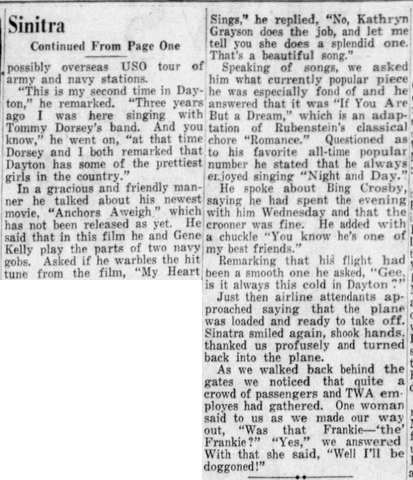
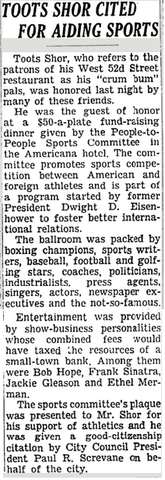
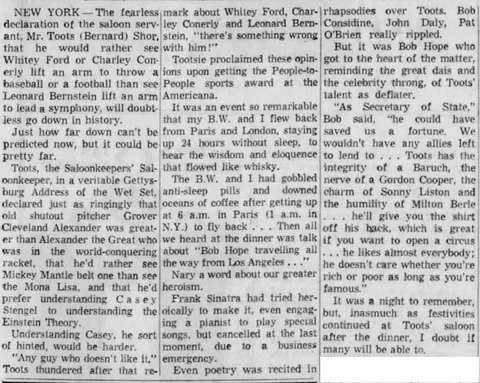
[Recording 'The Curse of an Aching Heart']
On the night of May 18, 1961, Sinatra recorded 'The Curse of an Aching Heart,' a 1913 song and the first track for a new Sinatra-Billy May swing album on Reprise, delivered at a hell-for-leather tempo with lyrics read by Kaplan as a possible sly dig at both Ava Gardner and Capitol Records.
Source: James Kaplan, "Sinatra: The Chairman" (2015).
May 19, 1961
Studio
Los Angeles
283 Don't Be That Way
(Benny Godman/Edgar Sampson/Mitchell Parish)
EMI Robbins Catalog Inc./The Song Writers Guild (ASCAP) Arranged & Conducted by Billy May
-6 (2:41) CD: 46013-2 The Complete Reprise Studio Recordings Disc 2
CD: 1002-2Sinatra Swings
LP: FS1002Sinatra Swings
284 I Never Knew
(Gus Kahn/Ted Fiorito)
Gilbert Keyes Music Co./Bourne Co. (ASCAP)
Arranged & Conducted by Billy May
-7 (2:14) CD: 46013-2 The Complete Reprise Studio Recordings Disc 2
CD: 1002-2Sinatra Swings
LP: FS1002Sinatra Swings
285 Falling In Love With Love
(Richard Rodgers/Lorenz Hart)
Chappell & Co. Inc. (ASCAP)
Arranged & Conducted by Billy May
-7 (1:50) CD: 46013-2 The Complete Reprise Studio Recordings Disc 2
CD: 1002-2Sinatra Swings
LP: FS1002Sinatra Swings
286 It's A Wonderful World
(Jon Savitt/Harold Adamson/Johnny Watson)
EMI Robbins Catalog Inc. (ASCAP)
Arranged & Conducted by Billy May
-4 CD: 46013-2 The Complete Reprise Studio Recordings Disc 2
CD: 1002-2Sinatra Swings
LP: FS1002Sinatra Swings
Ed O'Brien:
Billy May told me "Swing Along With Me" was his favorite of the six albums done with Frank.
I have a number of reviews from back in 1961. They are not favorable. Critics thought Frank sounded cold throughout. There was no warmth, only a real hard sound. The sales were pitiful for a Sinatra album from that era. According to Stan Cornyn, the album sold 153,000 units. That was way below the half-million average Frank had become accustomed to at the time. And yet,
I much prefer it to "Come Swing With Me." There is in my opinion a perfunctory walk through on most of the songs and that broad stereo sound is much too much. Billy would later admit it was a big mistake that badly diminished the vocals.
Sinatra As His Own "Unfair" Competition
Frank Sinatra has become his own business rival. Last March, Sinatra recorded an album of songs called Come Swing With Me! for Capitol Records, who have sponsored Sinatra for eight highly profitable years. A month later, fed up with feathering other people's nests, Frank recorded a similar batch of songs with a similar title, Swing along with Me, for his own record company, Reprise Records, and rushed it out ahead of Capitol. No one was greatly concerned about the new company (many singers branch out into business), but the near duplication of titles set tempers blazing.
"In understandable anger Capitol filed suit. Last month, after a hearing, Los Angeles Superior Court Judge
Gordon Files called the case "a classic example of unfair competition," and issued an injunction prohibiting
Sinatra's record company from selling or distributing Swing along with Me in its original form. As a result the Reprise people have gone to the costly bother of recalling Sinatra's record from California distributors, pressing new disks with a revised title, Sinatra Swings, and printing new jackets.
"Whatever his derelictions, Sinatra is still the master of his field. Unlike most of his younger rivals he refuses to pump phony emotion into a simple ballad or follow the disgusting custom of singing old favorites at a slowpoke pace until all vitality oozes out of them. Cocky or tender, Sinatra hits the bull's-eye with instinctive good taste. He pays homage to a literate Lorenz Hart lyric by never dropping a "g" in Falling in Love with Love but lets the "g's" drop where they may in the splendidly corny "You're
Nobody 'til Somebody Loves You:
"You may be king, you may possess the world and its gold, but gold won't bring you happiness When you're growin' old."
Life Magazine
August 18, 1961
Musicians: Frank Sinatra with Orchestra conducted by Billy May Conrad Gozzo, Mickey Mangano, Shorty Sherock, Jimmy Zito (tpt); Tommy Pederson, Joe Howard, Ed Kusby (tbn); Ken Shroyer (b-tbn); Willie Schwartz, Harry Klee, Jules Jacob, Justin Gordon, Chuck Gentry (sax/wwd); Verlye Mills (harp); Bill Miller (p); Al Viola (g); Joe Comfort (b); Phil Stephens (tuba); John Markham (d); Emil Richards (perc).
(Source: Put Your Dreams Away - A Frank Sinatra Discography, Luiz Carlos do Nascimento Silva)
"It's a Wonderful World"
Originally from Jan Savitt's band book (which May had also arranged in 1939 for Charlie Barnet). May's Sinatra version loosens Savitt's rigid signature 'shuffle rhythm' into a relaxed swinging 4/4, making it arguably the most danceable track on the album.
Source: Will Friedwald, "Sinatra! The Song Is You: A Singer's Art" (2018 revised edition).
May 23, 1961
Studio
Los Angeles
287 Don't Cry Joe
(Joe Marsala)
Harms Inc. (ASCAP)
Arranged & Conducted by Billy May
-8 (3:06) CD: 46013-2 The Complete Reprise Studio Recordings Disc 2
CD: 1002-2Sinatra Swings
LP: FS1002Sinatra Swings
288 You're Nobody 'Til Somebody Loves You
(Larry Stock/Russ Morgan/James Cavanaugh)
Shapiro, Bernstien & Co., Inc./Southern Music Publishing Co., Inc. (ASCAP)
Arranged & Conducted by Billy May
-4 (4:10) CD: 46013-2 The Complete Reprise Studio Recordings Disc 2
CD: 9-26340-2The Reprise Collection
CD: 1002-2Sinatra Swings
LP: FS1002Sinatra Swings
289 Moonlight On The Ganges
(Montague Ewing/Chester Wallace)
Campbell-Connelly Inc. (ASCAP/APRA Ltd.)
Arranged & Conducted by Billy May
-4 (3:20) CD: 46013-2 The Complete Reprise Studio Recordings Disc 2
CD: 1002-2Sinatra Swings
LP: FS1002Sinatra Swings
290 Granada
(Agustin Lara/Dorothy Dodd)
Southern Music Publishing Co. Inc. (ASCAP/APRA Ltd.)
Arranged & Conducted by Billy May
-2 (3:38) CD: 46013-2 The Complete Reprise Studio Recordings Disc 2
CD: 1002-2 Sinatra Swings (Edited)
LP: F1002 Sinatra Swings (Unedited)
LP: FS1002 Sinatra Swings (Edited)
45: 20,010 (Edited)
NOTE: A 41-piece orchestra backed Sinatra at this session. "You're Nobody . . ." got three complete takes and the two not issued are of a very high order.
Ed O'Brien asked Billy May why Sinatra opted to do "Ganges" and "Granada." May agreed they were strange choices but said it was a lot of fun making them.
By the way, May thought "Swing Along with Me" was the best of the six albums he did with Sinatra.
SFC John K.. George:
Is there a difference between the "edited" and "unedited" versions of Grenada?
Ed O'Brien:
Edited version runs 2:40
Granada, I'm falling under your spell,
And if you could speak, what a fascinating tale you would tell.
Of an age the world has long forgotten,
Of an age that weaves a silent magic in Granada today.
The dawn in the sky greets the day with a sigh for Granada.
For she can remember the splendor that once was Granada.
It still can be found in the hills all around as I wander along,
Entranced by the beauty before me,
Entranced by a land full of flowers and song.
When day is done and the sun starts to set in Granada,
I envy the blush of the snow-clad Sierra Nevada,
Soon it will welcome the stars
While a thousand guitars play a soft Habanera.
Then moonlit Granada will live again,
The glory of yesterday, romantic and gay, hey Granada.
Unedited runs 3:38
Granada, I'm falling under your spell,
And if you could speak, what a fascinating tale you would tell.
Of an age the world has long forgotten,
Of an age that weaves a silent magic in Granada today.
The dawn in the sky greets the day with a sigh for Granada.
For she can remember the splendor that once was Granada.
It still can be found in the hills all around as I wander along,
Entranced by the beauty before me,
Entranced by a land full of flowers and song.
When day is done and the sun starts to set in Granada,
I envy the blush of the snow-clad Sierra Nevada,
Soon it will welcome the stars
While a thousand guitars play a soft Habanera.
Then moonlit Granada will live again,
The glory of yesterday, romantic and gay.
orchestral interlude
And soon it will welcome the stars
While a gang of guitars play a soft Habanera.
Then moonlit Granada will live again,
The glory of yesterday, romantic, hey Granada.
Los Angeles
290 Granada
(Agustin Lara/Dorothy Dodd)
Southern Music Publishing Co. Inc. (ASCAP/APRA Ltd.)
Arranged & Conducted by Billy May
-2 (3:38) CD: 46013-2 The Complete Reprise Studio Recordings Disc 2
CD: 1002-2 Sinatra Swings (Edited)
LP: F1002 Sinatra Swings (Unedited)
LP: FS1002 Sinatra Swings (Edited)
45: 20,010 (Edited)
June 1961
[Cherry bombs and Vegas prostitutes on set]
Ruta Lee: During Sergeants 3 filming, cast members set off cherry bombs constantly and had connecting doors installed between hotel rooms (billed to the production) for pranks. A planeload of prostitutes was flown in from Las Vegas to play saloon bar girls, leaving a production supervisor flustered over how to account for their pay, according to co-star Ruta Lee and a secretary on the film.
Source: James Kaplan, "Sinatra: The Chairman" (2015)
[Frank buys Marilyn a poodle named Maf]
Kaplan: Around the time of her June 1961 Sands visit, Sinatra gave Marilyn Monroe a miniature white poodle, which she named Maf, short for "Mafia" -- an odd gift given the rumors swirling around him.
Source: James Kaplan, "Sinatra: The Chairman" (2015)
[Milt Ebbins on Sinatra's love for Monroe]
Donald Spoto / Milt Ebbins: Biographer Donald Spoto describes Sinatra as "apparently the more smitten" party in the Sinatra-Monroe relationship, quoting Milt Ebbins as saying there was no doubt Frank was in love with Marilyn -- though George Jacobs recalled Sinatra being disgusted by her slovenliness, and Spoto maintains DiMaggio was the only man Monroe ever truly loved.
Source: James Kaplan, "Sinatra: The Chairman" (2015)
[Rat Pack heckling raids on Vegas acts]
Kaplan: During the bored, drunken downtime of the Sergeants 3 shoot, the Rat Pack made unannounced heckling raids on the Las Vegas acts of Eddie Fisher, Vic Damone, and Danny Thomas.
Source: James Kaplan, "Sinatra: The Chairman" (2015)
[Sergeants 3 shoots in Kanab, boredom sets in]
Joey Bishop: Sergeants 3 filmed from late May through June in the isolated high-desert Kanab, Utah location. Boredom was the biggest challenge; Joey Bishop recalled a Dairy Queen open until eleven as the only diversion, advising everyone to get two scoops because there was nothing else to do.
Source: James Kaplan, "Sinatra: The Chairman" (2015)
[Sturges loses control of the set]
Ruta Lee / Philip K. Scheuer: Director John Sturges struggled to control Sinatra and the Clan during Sergeants 3, according to Ruta Lee, who said Sturges was constantly frustrated trying to make a real film while unable to tell his star to behave. Visiting Los Angeles Times critic Philip K. Scheuer asked Sturges if he could get the Clan to take direction; Sturges said yes once they were in front of the camera, though Scheuer noted he didn't look convinced.
Source: James Kaplan, "Sinatra: The Chairman" (2015)
[The Man with the Golden Arm]
Because of its realistic depiction of drug addiction, Golden Arm was denied the MPAA Production Code Seal of Approval on initial release -- something Preminger reportedly welcomed as a publicity boost. The film ironically received the Seal retroactively in June 1961, six years after its release.
This film/context matches multiple dated entries in the chronology; the specific date Santopietro is referring to could not be determined with confidence.
Source: Tom Santopietro, "Sinatra in Hollywood" (2008), The Peak Years (pt. 1)
June 4, 1961
[Vienna Summit rattles Kennedy]
At the June 4 Vienna Summit, Khrushchev threatened to make a separate peace with East Germany that would seal off Berlin; Kennedy failed to effectively counter him and came away looking weak, prompting him to later announce a military buildup and doubled draft.
Source: James Kaplan, "Sinatra: The Chairman" (2015).
June 5, 1961
[Entratter memo bars Monroe photos]
Jack Entratter: A memo from Sands entertainment director Jack Entratter to publicity and advertising staff ordered that no backstage photographer be permitted to photograph Sinatra and Marilyn Monroe together at the June 7 cocktail reception, warning any violator would be permanently barred from the hotel, at Sinatra's explicit insistence.
Source: James Kaplan, "Sinatra: The Chairman" (2015).
June 6, 1961
[Follow-up memo on Monroe's privacy]
Sands management memo: A follow-up Sands memo the day after Entratter's original announced Monroe as Sinatra's guest, stipulating she be given the utmost privacy, that she'd be registered in Sinatra's suite, and that neither she nor Sinatra be disturbed by calls or visitors before 2 p.m.
Source: James Kaplan, "Sinatra: The Chairman" (2015).
June 7, 1961
Frank Sinatra invited Marilyn Monroe to Las Vegas for a Sands engagement that coincided with Dean Martin's forty-fourth birthday party, with strict hotel memos ordering staff to bar photographers from capturing the two together and to keep Monroe's presence in Sinatra's suite private. Visibly intoxicated at the opening-night party — with President Kennedy's sisters Pat Lawford and Jean Smith among the guests — Monroe leaned on Sinatra for support and begged photographers to snap a picture of them together; he pulled away and had a bodyguard confiscate a camera instead, growing alarmed only when she abruptly announced she was about to be sick and had to be rushed from the room. Source: J. Randy Taraborrelli, Sinatra: Behind the Legend.
A casual moment at the Santa Monica home of Peter and Pat Lawford in 1961: (l-r) Peter Lawford, Pat Kennedy Lawford, Frank Sinatra and his occasional lover Marilyn Monroe, May Britt (who was married to Sammy Davis Jr.), and Shirley MacLaine. Source: photo and caption from J. Randy Taraborrelli, Sinatra: Behind the Legend (mptvimages.com).
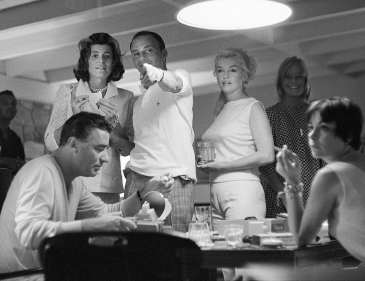
[Marilyn Monroe attends Sinatra's Sands show]
Marilyn Monroe attended Sinatra's Sands performance on the night of June 7, which also happened to be Dean Martin's forty-fourth birthday, marked by a riotous ringside party. Sinatra wanted her presence kept from the public and especially from Joe DiMaggio.
Source: James Kaplan, "Sinatra: The Chairman" (2015).
[Monroe's dramatic entrance at the Sands]
Ruta Lee: Ruta Lee recalled Marilyn Monroe walking in on Sinatra's arm at the Sands, saying she had a glow around her like a built-in klieg light, and that even next to Elizabeth Taylor, Marilyn stole the show.
Source: James Kaplan, "Sinatra: The Chairman" (2015).
[Monroe drunk and unwell at cocktail reception] unnamed reporter (via Kaplan): A reporter at the post-show cocktail reception described Monroe as visibly intoxicated, clinging to Sinatra for support and begging him to pose for photographers, saying she wanted the world to know she loved him. When Sinatra pulled away to avoid the photo, she nearly fell over.
Source: James Kaplan, "Sinatra: The Chairman" (2015).
[Sinatra threatens photographer over Monroe picture] unnamed reporter (via Kaplan): When a photographer tried to snap Sinatra and Monroe together, a Sinatra bodyguard seized the camera; Sinatra then approached the reporters and threatened, in a low menacing tone, to crack the photographer's skull if he tried again. Monroe then told Sinatra she was about to be sick, and he rushed her away.
Source: James Kaplan, "Sinatra: The Chairman" (2015).
June 24, 1961
Concerts
Memorial Coliseum, Los Angeles, California
Benefit for County Sheriff's Rodeo
Frank, Dean, Sammy, and Peter Lawford appeared.
Memorial Coliseum, Los Angeles, California
Benefit for County Sheriff's Rodeo
Frank, Dean, Sammy, and Peter Lawford appeared.
Show Cancelled
1978 Stadium, Chicago, Illinois
[image referenced in source but could not be recovered]
[image referenced in source but could not be recovered]
[image referenced in source but could not be recovered]
[image referenced in source but could not be recovered]
[image referenced in source but could not be recovered]
June 28, 1961
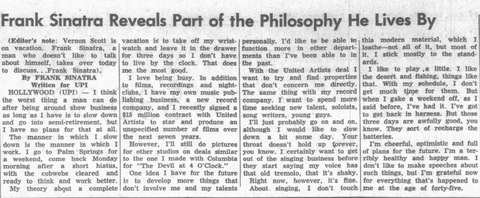
July 1961
[Eddie Fisher publicly downplays the heckling]
Eddie Fisher: Despite the embarrassment, Eddie Fisher told columnist Earl Wilson he felt honored and grateful to be heckled by the Clan and that the audience found it marvelous.
Source: James Kaplan, "Sinatra: The Chairman" (2015)
[Press turns on the Clan after Fisher incident]
Hedda Hopper / Milton Berle / Sidney Skolsky: The Fisher opening incident drew sharp press criticism: Hedda Hopper called it a disgusting display of ego from Sinatra and his henchmen, Milton Berle agreed, and Sidney Skolsky wrote a Motion Picture column titled "Has the Clan Gone Too Far?" describing it as the first time the group played to a hostile audience and drew unfavorable press.
Source: James Kaplan, "Sinatra: The Chairman" (2015)
[Reprise releases Swing Along with Me]
Kaplan: In July, Reprise released its second album, Swing Along with Me, which Sinatra had recorded with Billy May two months earlier. Capitol's Alan Livingston sued over the title's similarity to Frank's Capitol album Come Swing with Me!, also arranged by May, and won; Reprise had to rename the LP Sinatra Swings on subsequent pressings.
Source: James Kaplan, "Sinatra: The Chairman" (2015)
July 8, 1961
Concerts
Beverly Hilton Hotel, Los Angeles, California
Benefit for Cedars Of Lebanon Hospital
Beverly Hilton Hotel, Los Angeles, California
Benefit for Cedars Of Lebanon Hospital
British-born US actress Elizabeth Taylor (foreground) with (left to right) Frank Sinatra, Peter Lawford, and U.S. Attorney General Robert F. Kennedy. They are attending a dinner in aid of the Cedars-Sinai Hospital, held at the Beverly Hilton hotel in Hollywood, 8th July 1961..
July 9, 1961
Concerts
Beverly Hilton Hotel, Los Angeles, California
Benefit for Cedars Of Lebanon Hospital
July 16, 1961
Frank starred opposite Spencer Tracy, whom he nicknamed 'the Grey Fox,' in Columbia's The Devil at 4 O'Clock.
Source: Nancy Sinatra, Frank Sinatra: An American Legend, 1995.
July 25, 1961
Concerts
Cocoanut Grove, Ambassador Hotel, Los Angeles, CA
Eddie Fisher opening night at the Cocoanut Grove
Dean Martin and Frank Sinatra joined Eddie Fisher on stage
Cocoanut Grove, Ambassador Hotel, Los Angeles, CA
Eddie Fisher opening night at the Cocoanut Grove
Dean Martin and Frank Sinatra joined Eddie Fisher on stage
VARIETY
8-2-61
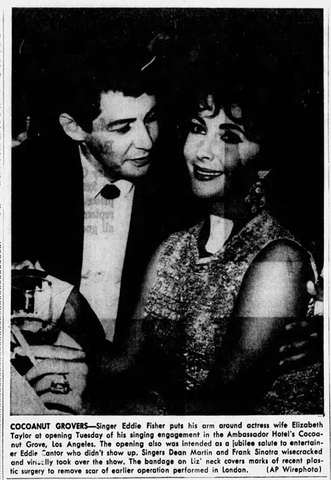
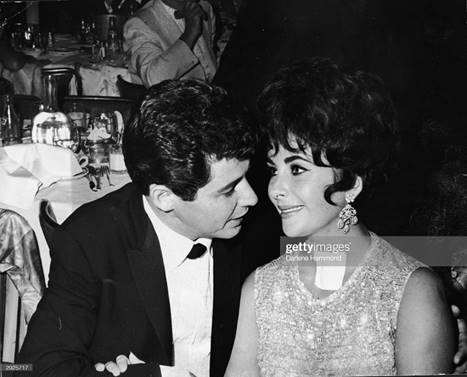
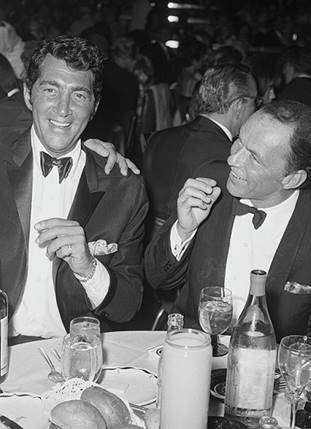
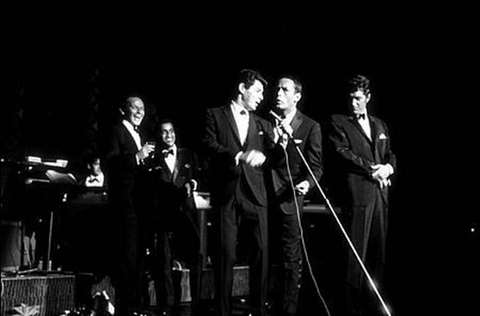
[Clan disrupts Eddie Fisher's Cocoanut Grove opening]
On July 25, the Clan attended Eddie Fisher's opening at the Cocoanut Grove in Los Angeles, marking Elizabeth Taylor's first public outing since nearly dying of pneumonia and undergoing surgery to hide a tracheotomy scar. Hollywood royalty including John Wayne, Henry Fonda, Lucille Ball, and Kirk Douglas attended.
Source: James Kaplan, "Sinatra: The Chairman" (2015).
[Fisher forgets lyrics, Clan storms stage]
Associated Press (via Kaplan): A nervous Eddie Fisher forgot lyrics repeatedly during his Cocoanut Grove set; after Dean Martin heckled him, Fisher surrendered and asked the group what they wanted. Sinatra, Martin, Davis, and Bishop charged onstage with drinks in hand doing imitations, limericks, and jokes while Fisher sat forlornly on the bandstand; Lawford stayed seated, according to the Associated Press.
Source: James Kaplan, "Sinatra: The Chairman" (2015).
August 1961
[Sinatra, Romanoff, and Martin Depart Heathrow]
Mike Romanoff, Sinatra, and Dean Martin are shown leaving Heathrow Airport by limousine, surrounded by onlookers, in the same visit documented on the previous page (August 1961).
Source: Charles Pignone, "Frank Sinatra 100" (2015).
[Chartered yacht Hiniesta waits in Nice]
UPI (via Kaplan): While Sinatra and Martin visited Craig Martin in Germany, UPI reported the 170-foot steam yacht Hiniesta, chartered from Sir John North, sat waiting at anchor in Nice Harbor to take part of the Clan aboard for the planned Mediterranean cruise.
Source: James Kaplan, "Sinatra: The Chairman" (2015)
[Clansmen delay London flight for drinks]
Associated Press (via Kaplan): An AP dispatch headlined "Clansmen Delay Plane" reported that Sinatra and Martin lingered in a London Airport bar, refusing to board their Paris-bound flight with 103 waiting passengers until they finished their drinks; Lawford waited separately. The pair boarded three minutes before takeoff, delaying the flight by ten minutes.
Source: James Kaplan, "Sinatra: The Chairman" (2015)
[Frank, Dean, Sammy, Peter fly to Europe]
Kaplan: Later in August, Sinatra, Martin, Davis, and Lawford flew to a tense Europe (Joey Bishop stayed behind to start his new sitcom), landing in London amid the escalating Berlin crisis to shoot a cameo in Bob Hope and Bing Crosby's The Road to Hong Kong.
Source: James Kaplan, "Sinatra: The Chairman" (2015)
[Jeanne Martin helps dress disoriented Monroe]
Jeanne Martin: Dean Martin's wife Jeanne recalled that Sinatra asked for her help getting a disoriented Marilyn Monroe dressed before the yacht cruise.
Source: James Kaplan, "Sinatra: The Chairman" (2015)
[Sammy Davis heads to Monte Carlo, uninvited to villa]
Kaplan: While the rest of the group planned to visit Joseph Kennedy's villa, Sammy Davis Jr. instead headed to Monte Carlo to star in Princess Grace's annual Red Cross benefit; Kennedy had not invited him to stay at Cap d'Antibes.
Source: James Kaplan, "Sinatra: The Chairman" (2015)
[Sammy Davis says cruise is off]
Sammy Davis Jr.: On arriving in Nice, Sammy Davis Jr. told the press that Sinatra and Martin had called off the Mediterranean cruise, saying he'd seen them in London the night before and they said they had to get back to the States, without explaining why.
Source: James Kaplan, "Sinatra: The Chairman" (2015)
[Sinatra and Martin visit Dean's son in Germany]
Kaplan: After their London stop, Sinatra and Martin traveled to Germany near Frankfurt to visit Martin's son Craig, an army private stationed there, then planned to head to the Riviera to visit Joseph Kennedy at his Cap d'Antibes villa for ten days, followed by a Mediterranean cruise chartered by millionaire Bob Neal.
Source: James Kaplan, "Sinatra: The Chairman" (2015)
[Sinatra and Martin's Road to Hong Kong cameo]
UPI/AP (via Kaplan): Sinatra and Martin filmed a cameo as goofy astronauts in The Road to Hong Kong, appearing in space costumes with cocktails alongside Crosby and Hope, per UPI and an AP photo.
Source: James Kaplan, "Sinatra: The Chairman" (2015)
[Sinatra wanted Monroe off the boat]
unnamed former associate (via Taraborrelli): An unnamed former Sinatra associate, quoted by biographer J. Randy Taraborrelli, said Sinatra couldn't wait to get Monroe off his yacht by the end of the cruise, describing her as pressuring him to marry her while drinking and using drugs heavily; Sinatra reportedly said he was ready to throw her overboard, and instead had an assistant remove her once ashore.
Source: James Kaplan, "Sinatra: The Chairman" (2015)
[Texas oilman awaits 'the leader']
J. Robert Neal: Texas oilman J. Robert Neal, who chartered the Mediterranean cruise yacht, told the press they didn't yet know where they would cruise because they were waiting for "the leader" -- meaning Sinatra.
Source: James Kaplan, "Sinatra: The Chairman" (2015)
August 3, 1961
[Joe Kennedy tells Clan no boarders]
Joseph P. Kennedy (via New York Post): On August 3, the New York Post ran a piece headlined "Joe Kennedy Tells Clan: No Boarders," quoting the Ambassador saying that although he'd happily see Sinatra's group on the Cote d'Azur, they would have to stay in a hotel because he lacked room at his villa.
Source: James Kaplan, "Sinatra: The Chairman" (2015).
August 4, 1961
American musician and screen legend Frank Sinatra arrives at Heathrow airport in London with Dean Martin and their friend Beverly Hills restaurateur Mike Romanoff 4th August 1961.
4th August 1961, Swingers, from left to right: Bing Crosby, Frank Sinatra, Dean Martin and Bob Hope on the set of "Road to Hong Kong" at Shepperton Film Studios, London.
© 1997-2025 The Sinatra Archive
This calendar, or any parts thereof, may not be reproduced in any fashion
whatsoever without the prior written permission of the publisher (The
Sinatra Archive)
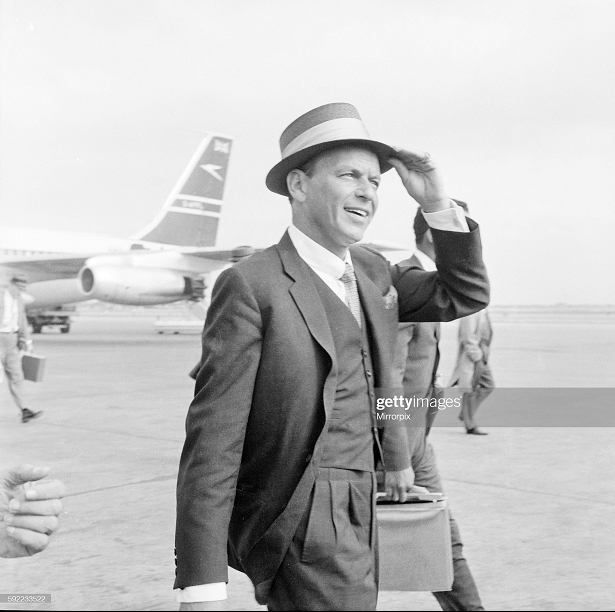
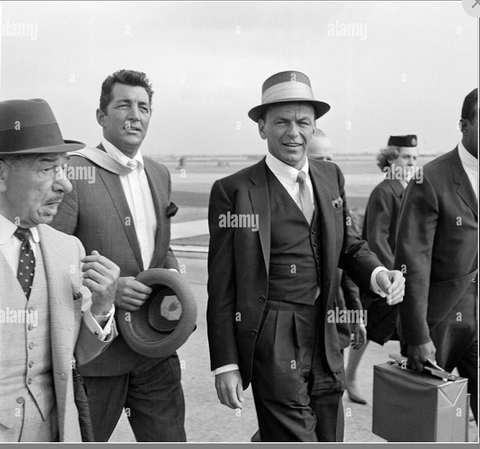
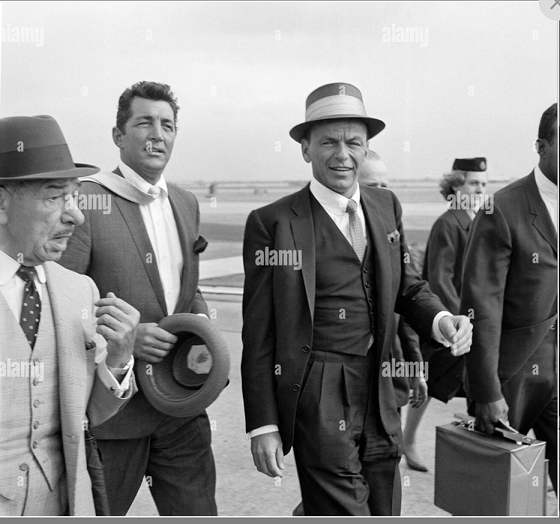
August 7, 1961
Frankfurt, Germany
w/Dean Martin
Janet Leigh and Jeanne Martin flew from New York to Paris without their husbands, publicly denying that Patricia Lawford was joining the Rat Pack's gathering on the Riviera.
Source: George Carpozi Jr., Frank Sinatra: Is This Man Mafia? (New York: Manor Books, 1979).
August 8, 1961
Sinatra and Dean Martin arrived in Nice and Sammy Davis Jr. arrived in Monte Carlo, as the Rat Pack's much-publicized Riviera gathering unfolded despite earlier denials of any Kennedy family connection.
Source: George Carpozi Jr., Frank Sinatra: Is This Man Mafia? (New York: Manor Books, 1979).
August 13, 1961
[Berlin Wall construction begins]
On the morning of August 13, thirty-two thousand East German combat and engineer troops, backed by standing Soviet forces, began building barbed-wire fences around West Berlin's perimeter -- the start of the Berlin Wall. Kennedy responded by sending fifteen hundred U.S. troops in armored vehicles into Berlin, and for forty-eight hours war seemed possible.
Source: James Kaplan, "Sinatra: The Chairman" (2015).
August 15, 1961
[Gaming board approves Cal-Neva stake; shares detailed] Nancy Sinatra (via Kaplan): At its mid-August meeting the Nevada Gaming Control Board approved Sinatra's application to buy a majority stake in the Cal-Neva Lodge. As of August 15, per Nancy Sinatra, Park Lake Enterprises (the Cal-Neva's parent) had 540 shares issued: Sinatra owned 270, Hank Sanicola 180, and Sanford Waterman 90, with Sinatra expected to eventually acquire full ownership. Earlier minority applicants Joe DiMaggio, Skinny D'Amato, and Dean Martin had all dropped out.
Source: James Kaplan, "Sinatra: The Chairman" (2015).
August 17, 1961
[UPI: cruise canceled over D.C. reaction]
UPI / Robert Neal: An August 17 UPI dispatch headlined "Sinatra Cruise Reported Canceled for D.C. Reaction" quoted yacht charterer Robert Neal saying the trip was scrapped due to angry reaction from Washington groups, amid criticism that Kennedy relatives and friends were sunning themselves on the Riviera while the country faced a Berlin-crisis draft.
Source: James Kaplan, "Sinatra: The Chairman" (2015).
August 18, 1961
[Louisiana editorial criticizes Riviera trip]
Monroe News-Star editorial: An August 18 editorial in Louisiana's Monroe News-Star criticized Lawford, Sinatra, Martin and the rest of the Clan for visiting the Kennedys on the Riviera during the Berlin crisis, calling their publicity stunts, including delaying a commercial airliner in England, poor taste.
Source: James Kaplan, "Sinatra: The Chairman" (2015).
August 29, 1961
[Yacht photo of Sinatra and Monroe dated]
A George Jacobs snapshot of Sinatra and Monroe relaxing aboard Sinatra's yacht can be precisely dated: he is shown reading the August 29, 1961 issue of Look magazine, which featured a cover story on Clark Gable by his widow. Monroe reclines close beside him, looking heavier and less glamorous than usual.
Source: James Kaplan, "Sinatra: The Chairman" (2015).
September 1961
[Ava Gardner returns to New York]
Kaplan: At the end of September, Ava Gardner, nearly thirty-nine and increasingly sensitive about her looks, arrived in New York. At the Chateau Madrid, she walked out with young companion Guy Pastor (son of bandleader Tony Pastor) after mistakenly thinking a flamenco dancer was photographing her, returning only once reassured he'd been shooting the floor show.
Source: James Kaplan, "Sinatra: The Chairman" (2015)
[Flawed 'These Foolish Things' recording]
Kaplan: Sinatra's disengaged Point of No Return remake of "These Foolish Things" -- a song he'd recorded with feeling for Columbia in July 1945 -- is marred by a flat opening note and an audible tape splice on the final word, evidence he no longer cared enough about a Capitol record to fix an error he'd never have allowed on an album he valued.
Source: James Kaplan, "Sinatra: The Chairman" (2015)
[Frank and Ava reunite for a group outing]
Earl Wilson: After several missed phone calls, Sinatra and Ava Gardner finally connected and went out together with a group including the Rubirosas, the Axelrods, and Mrs. Mike Romanoff. Columnist Earl Wilson reported the two parted around 1 a.m., Sinatra taking a taxi to El Morocco and Ava leaving separately by limousine, with both denying to a photographer that they were a couple.
Source: James Kaplan, "Sinatra: The Chairman" (2015)
[Hawaii trip and JFK's bathing suit gift]
Consiglio: In September 1961, as thanks for his work helping elect Kennedy, Peter Lawford took Consiglio to Hawaii, staying at Bobby Kennedy's house at Diamond Head for what turned into a month-long stay. During a phone call, President Kennedy asked Peter to have a custom bathing suit made for Consiglio bearing his presidential paddle-and-oar insignia.
Source: Tony Consiglio (as told to Franz Douskey), "Sinatra and Me: The Very Good Years" (2012)
[Highlights of Point of No Return]
Kaplan: Despite the strained sessions, the album's opening tracks, "When the World Was Young" and "I'll Remember April" -- each the final song recorded on its respective night -- rank among Sinatra's finest ballad performances, with Stordahl delivering some of his best arranging work.
Source: James Kaplan, "Sinatra: The Chairman" (2015)
[Jackie's image campaign threatened by Sinatra visit]
Barbara Leaming: Biographer Barbara Leaming writes that Jackie Kennedy, working to rehabilitate her husband's image after the Bay of Pigs disaster and the Vienna Summit by remaking the White House into a symbol of formal, intimidating power, was chagrined that Jack insisted the Advise and Consent luncheon invitation to Sinatra stand, undermining her efforts just as she launched a full-scale image campaign.
Source: James Kaplan, "Sinatra: The Chairman" (2015)
[Jackie's jealousy over Sinatra's female guest]
Barbara Leaming: Barbara Leaming writes that Sinatra's presence at Hyannis Port that weekend was so disconcerting that Jackie Kennedy, uncharacteristically, failed to hide her jealousy over Jack's interest in one of the women Sinatra had brought -- likely Odile Rubirosa -- a lapse in her usual composure that everyone noticed.
Source: James Kaplan, "Sinatra: The Chairman" (2015)
[Laurence Harvey cast as Raymond Shaw]
Kaplan: British actor Laurence Harvey, 32, signed on to play Raymond Shaw in The Manchurian Candidate for a fee of $270,000, bringing a brittle, sexually ambiguous quality that suited the role well despite a string of prior Hollywood miscastings.
Source: James Kaplan, "Sinatra: The Chairman" (2015)
[Lawford gains traction with Advise and Consent]
Kaplan: Peter Lawford's turn in Exodus led director Otto Preminger to cast him as a U.S. senator in the political thriller Advise and Consent, then shooting in Washington, D.C. Lawford asked Sinatra to do a cameo as himself, spotted by a starstruck couple at a Capitol soiree.
Source: James Kaplan, "Sinatra: The Chairman" (2015)
[Sinatra tears up lead sheet at session]
Milt Bernhart: Trombonist Milt Bernhart recalled Sinatra being all business at the Point of No Return sessions, doing only one or two takes per song without run-throughs. When producer Dave Cavanaugh asked for a retake because of a booth error, Sinatra refused, tore the lead sheet into pieces, and snapped "Next number!"
Source: James Kaplan, "Sinatra: The Chairman" (2015)
[Sinatra's 'Hey, Chickie baby' greeting]
Frank Sinatra: The White House luncheon got off to a poor start when the Kennedys arrived fifteen minutes late and Sinatra greeted Jackie Kennedy by calling out, "Hey, Chickie baby!"
Source: James Kaplan, "Sinatra: The Chairman" (2015)
[Sinatra's Hyannis Port visit and the start of the split]
Ronald Brownstein: According to historian Ronald Brownstein, Kennedy began quietly dissolving his friendship with Sinatra soon after Frank's visit to Hyannis Port that September, in a process that unfolded in two stages.
Source: James Kaplan, "Sinatra: The Chairman" (2015)
[White House luncheon Jackie couldn't block]
Kaplan: In the third week of September, Sinatra attended a White House luncheon for the cast and director of Advise and Consent. Jackie Kennedy had not intended to invite him, but her chief of staff Letitia Baldrige phoned Lawford's hotel to arrange it while Sinatra happened to be in the room, leaving no way to exclude him.
Source: James Kaplan, "Sinatra: The Chairman" (2015)
[Robin Douglas-Home describes Frank recording in his hat]
Author Robin Douglas-Home, present at Frank's final Capitol sessions, described his entrance in a dark grey suit with a red and yellow pocket handkerchief, and noted that Frank kept his hat on throughout recording -- pulled low over his eyes when concentrating, pushed back when relaxed between takes.
Source: Richard Havers, "Sinatra" (Dorling Kindersley, 2007).
[Point of No Return -- critical commentary]
Robin Douglas-Home: British writer Robin Douglas-Home watched Sinatra record the album "Point of No Return" at Capitol in September 1961 and described in his book "Sinatra" an almost physically painful level of engagement -- shuddering shoulders, twitching neck muscles, and a face contorted with expressive intensity during the takes.
Source: Charles L. Granata, "Sessions with Sinatra: Frank Sinatra and the Art of Recording" (1999/2003), Part I: The Big Band Years, 1937-1942
[Point of No Return -- critical commentary]
Milt Bernhart: For Point of No Return, producer Dave Cavanaugh brought in Axel Stordahl -- with whom Sinatra had a strained, unresolved relationship -- as arranger; Milt Bernhart recalled Sinatra arriving an hour and a half late to each session, doing minimal takes, and once tearing up a lead sheet rather than agreeing to a second take when Cavanaugh requested one.
Source: Charles L. Granata, "Sessions with Sinatra: Frank Sinatra and the Art of Recording" (1999/2003), Part III: The Capitol Years, 1953-1962
[Point of No Return -- critical commentary]
Robin Douglas-Home: Douglas-Home described Sinatra's understated exit from Studio A at the close of the Point of No Return sessions -- a place he reportedly would not revisit for over thirty years -- accepting the orchestra's applause with a brief 'Thank you, fellers' before leaving.
Source: Charles L. Granata, "Sessions with Sinatra: Frank Sinatra and the Art of Recording" (1999/2003), Part III: The Capitol Years, 1953-1962
September 1, 1961
Neath Guardian
Oklahoma Advertiser
note: Baxter also received arranging credit on Nat Cole's "Mona Lisa." Bolton News
The Courier Journal
The Daily Breeze
Indianapolis Star
The Morning Union
The Plain Dealer
note: I found more than 50 reviews of this album. This is the only negative one. Think what Frank did after "Swingin' Sessions." The Standard
The Sydney Morning Herald
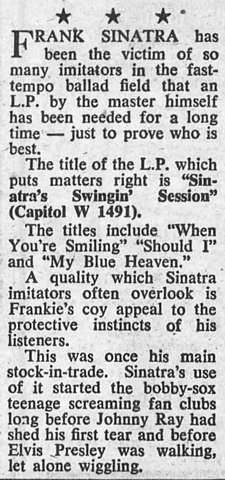
September 11, 1961
Studio
Los Angeles
E36463 I'll Be Seeing You
(I. Kahn/S. Fain)
Williamson Music Co. (ASCAP)
Arranged & Conducted by Axel Stordahl
-7 (2:46) CD: C2-94777 The Capitol Years
CD: CDP 7-48334-2 Point Of No Return
LP: SW1676 Point Of No Return
E36464 I'll See You Again
(Noel Coward)
Arranged & Conducted by Axel Stordahl
CD: CDP 7-48334-2 Point Of No Return
LP: SW1676 Point Of No Return
E36465 September Song
(Kurt Weill/Maxwell Anderson )
Arranged & Conducted by Axel Stordahl
CD: CDP 7-48334-2 Point Of No Return
LP: SW1676 Point Of No Return
E36466 Memories Of You
(Eubie Blake/Andy Razaf)
Arranged & Conducted by Axel Stordahl
CD: CDP 7-48334-2 Point Of No Return
LP: SW1676 Point Of No Return
E36467 There Will Never Be Another You
(Mack Gordon/Harry Warren )
Arranged & Conducted by Axel Stordahl
CD: CDP 7-48334-2 Point Of No Return
LP: SW1676 Point Of No Return
E36468 When The World Was Young
(Philippe/Gerard/ Mercer)
Arranged & Conducted by Axel Stordahl
-6 CD: CDP 7-48334-2 Point Of No Return
LP: SW1676 Point Of No Return
"I'll See You Again" / "When the World Was Young"
Milt Bernhart; Bill Miller: Bernhart praised the recording despite the rushed sessions: 'I still think the album is one of the best things I ever heard... If you listen to "I'll See You Again," it's hard to believe that it was done in a single take. But it was.' Bill Miller recalled adding 'some Nelson Riddle-style polytones' into his piano part. Bernhart also called 'When the World Was Young' a classic Stordahl chart.
Source: Will Friedwald, "Sinatra! The Song Is You: A Singer's Art" (2018 revised edition).
"Point of No Return"
Robin Douglas-Home: Author Robin Douglas-Home, present at the September 11-12, 1961 Point of No Return sessions, described the only tense studio moment as a brief exchange when the control room asked to re-record an improvised Bill Miller piano passage Sinatra had approved; Sinatra simply overruled the request ('Well, I do. Next tune').
Source: Charles L. Granata, "Sessions with Sinatra: Frank Sinatra and the Art of Recording" (1999/2003).
"When the World Was Young"
Granata includes 'When the World Was Young' among the fifty recordings he considers essential to understanding Sinatra's artistry (arranged by Axel Stordahl, recorded 1961, Capitol); the song was chosen for its musical/interpretive value rather than commercial popularity.
Source: Charles L. Granata, "Sessions with Sinatra: Frank Sinatra and the Art of Recording" (1999/2003).
[First Point of No Return session]
The first of two six-song recording sessions for Point of No Return took place on the night of September 11; Sinatra showed up an hour and a half late, something he had never done before.
Source: James Kaplan, "Sinatra: The Chairman" (2015).
September 12, 1961
Studio
Capitol Studio A, Hollywood
E36481 Somewhere Along The Way
(Kurt Adams/Sammy Gallop)
Arranged & Conducted by Axel Stordahl
CD: CDP 7-48334-2 Point Of No Return
LP: SW1676 Point Of No Return
E36482 A Million Dreams Ago
(Quadling/Howard/ Jurgens)
Arranged & Conducted by Axel Stordahl
CD: CDP 7-48334-2 Point Of No Return
LP: SW1676 Point Of No Return
E36483 These Foolish Things (Remind Me Of You)
(Strachey/Link/ Marvell)
Arranged & Conducted by Axel Stordahl
CD: CDP 7-48334-2 Point Of No Return
LP: SW1676 Point Of No Return
E36484 As Time Goes By
(Herman Hupfeld)
Arranged & Conducted by Axel Stordahl
CD: CDP 7-48334-2 Point Of No Return
LP: SW1676 Point Of No Return
E36485 It's A Blue World
(Bob Wright/Chet Forrest)
Arranged by Heinie Beau
Conducted by Axel Stordahl
CD: CDP 7-48334-2 Point Of No Return
LP: SW1676 Point Of No Return
E36486 I'll Remember April
(Raye/De Paul/Johnston)
Arranged by Heinie Beau
Conducted by Axel Stordahl
CD: C2 724383808922 The Complete Capitol Singles
CD: CDP 7-48334-2 Point Of No Return
LP: SW1676 Point Of No Return
45: 4729
Musicians - Reeds: Gene Cipriano, Justin Gordon, Harry Klee, Ronnie Lang, Ted Nash, Babe Russin, Willie Schwartz; Trumpets: Pete Candoli, Vito "Mickey" Mangano, Uan Rasey, Rubin "Zeke" Zarchy; Trombones: Milton Bernhart, Dick Nash, Dick Noel; Bass Trombone: George Roberts; French Horn: John Cave, Richard Perissi, Vincent DeRosa; Violins: Victor Arno, Israel Baker, Harry Bluestone, Herman Clebanoff, David Frisina, Ben Gil, Anatol Kaminsky, Dan Lube, Erno Neufeld, Lou Raderman, Nathan Ross, Felix Slatkin; Violas: Alvin Dinkin, Virginia Majewski, Alex Neiman, Paul Robyn; Cellos: Justin DiTullio, Edgar Lustgarten, Kurt Reher, Eleanor Slatkin; Piano: Bill Miller; Bass: Joe Comfort; Drums: Irv Cottler; Guitar: Al Viola; Percussion: Emil Richards; Harp: Veryle Brilhart
Session Producer: Dave Cavanaugh
The Standard
[Second Point of No Return session]
The second Point of No Return session took place on the night of September 12; as with the first, Sinatra arrived ninety minutes late.
Source: James Kaplan, "Sinatra: The Chairman" (2015).
[Sinatra's last night in Columbia's Studio A]
Robin Douglas-Home: Robin Douglas-Home described the final moments of the last Point of No Return session at 11:45 p.m.: after the last playback, the orchestra applauded, Sinatra deflected with a quiet "Thank you, fellers," and walked out. Kaplan notes he would not record in that studio again for more than thirty years.
Source: James Kaplan, "Sinatra: The Chairman" (2015).
[I'll Remember April -- critical commentary]
This thinking affords a naturalness to his art that defies explanation; for instance, on the phrase “lengthen in” in the 1944 Vimms aircheck of “I’ll Remember April,” he holds “in” but not “lengthen.”
This song/context matches multiple dated entries in the chronology; the specific date Friedwald is referring to could not be determined with confidence.
Source: Will Friedwald, "Sinatra! The Song Is You: A Singer's Art" (2018 revised edition), Ch. 4, "With Axel Stordahl" (1943-1948)
September 18, 1961
Studio
Columbia Studios Sound Stage – Los Angeles , California
Sound recording for Columbia Pictures film "Advise and
Consent"
Arranged and conducted by Jerry Fielding
Title theme from the film also known as "Heart of
Mine" – Frank Sinatra
Special recording heard during gay bar scene.
NOTE: Sinatra Scholar Ed O'Brien, who provided the above sound recording information, says that he went to see the Preminger film in 1962 and was amazed to see in the credits that the "Song from Advise and Consent" was sung by Frank Sinatra. Not only is it a pleasant surprise, but he really liked the tune. He ran out and bought the soundtrack album and discovered Sinatra's vocal was not there. It was many years before he heard the complete recording. An interesting little rarity written by Ned Washington and Jerry Fielding.
Sinatraphile John Brown then supplies us with the lyrics to "Heart of Mine":
Heart of mine, let another heart be part of mine,
Let another's dream be the dream I'll follow,
Let me hear a voice, a secret voice, a voice that will say
Come to me, and be what I need you to be.
Long alone, I have sung the loser's song alone,
Unbeknown I built my hopes too high.
Other hearts I found are tightly bound together,
But mine, the loneliest of hearts is mine
It's tasted of the bitter wine
It's torn and tossed, heart of mine.
Sinatra John Boskello wished to know if "Heart of Mine" is available anywhere today. Ed O'Brien pointed out that it is included in the "Frank Sinatra in Hollywood " six-cd boxed set put out by Reprise/Turner Classics.
September 23, 1961
Frank Sinatra visited the White House at John F. Kennedy's invitation, part of a run of favors — including a Hyannis Port visit the following days — the president extended in gratitude for Sinatra's campaign work and the pre-inaugural gala. Presidential aide Dave Powers recalled Sinatra showing the White House maître d' how to make his own recipe for Bloody Marys, then sitting on the balcony telling Powers, “Dave, all the work I did for Jack. Sitting here like this makes it all worthwhile.” Weeks earlier, Sam Giancana — expecting Sinatra to use the relationship to get Bobby Kennedy to back off his investigation — had angrily reminded him, “You already promised me, Frank... now deliver or you'll be sorry,” a demand Sinatra rebuffed just as sharply. Source: J. Randy Taraborrelli, Sinatra: Behind the Legend.
Frank spent the weekend with the Kennedy family at Hyannisport; Joseph Kennedy, grateful for his help in the West Virginia primary, teasingly nagged him about his extravagant spending on clothes.
Frank Sinatra (quoted): "Francis, how many suits do you need?"
Source: Nancy Sinatra, Frank Sinatra: An American Legend, 1995.
September 24, 1961
Frank Sinatra flew to Hyannis Port with Pat Lawford and Ted Kennedy, and the next day joined John F. Kennedy for a three-and-a-half-hour cruise off Cape Cod aboard the Honey Fitz. Senator George Smathers, who was aboard, recalled JFK being noticeably cooler toward Sinatra than in the campaign days. During the cruise Sinatra asked Peter Lawford to arrange a meeting with Bobby Kennedy to discuss easing off Sam Giancana — a request Bobby flatly refused, to Sinatra's private relief; he had no real intention of pressing Giancana's case and later lied to Giancana's associates that he had raised it with Bobby at all. Source: J. Randy Taraborrelli, Sinatra: Behind the Legend.
[Sinatra flies to Hyannis Port aboard the Caroline]
On September 24, Sinatra flew to Hyannis Port aboard the president's private plane, the Caroline, accompanied by Pat Lawford, Ted Kennedy, and playboy Porfirio Rubirosa with his fifth wife Odile. Fog forced a landing at New Bedford, fifty miles away, and the party proceeded by taxi to the Kennedy compound with Sinatra's cargo of twelve pieces of luggage, champagne, wine, ice cream, and Italian bread for the Ambassador.
Source: James Kaplan, "Sinatra: The Chairman" (2015).
[Chauffeur's account of Joe Kennedy and a guest]
Frank Saunders: Kennedy family chauffeur Frank Saunders recalled Sinatra arriving at Hyannis Port with a crowd including women who looked like prostitutes, and later, on a pretext of returning riding boots, discovered Joseph Kennedy fondling a young woman in a dim back hallway -- later identified as Porfirio Rubirosa's wife.
Source: James Kaplan, "Sinatra: The Chairman" (2015).
[Sinatra pitches Manchurian Candidate to Kennedy]
Kaplan / JFK: During the Hyannis Port weekend, Sinatra discussed his stalled film project The Manchurian Candidate with Kennedy, who had loved the novel and immediately asked who would play the mother. Kennedy then phoned outgoing United Artists president Arthur Krim, who had been blocking the project, and vouched for it; Krim quickly changed his mind.
Source: James Kaplan, "Sinatra: The Chairman" (2015).
September 25, 1961
[Marlin cruise with Jackie water skiing]
Associated Press / Pierre Salinger: The day after Sinatra's arrival, about a dozen guests including Sinatra took a three-and-a-half-hour cruise aboard Joseph Kennedy's yacht Marlin to Cotuit Bay. An AP dispatch noted Jackie Kennedy water skied despite the chill, slaloming on a single ski behind a speedboat and waving to a press boat, while press secretary Pierre Salinger clarified Sinatra was staying with the Lawfords, not at the president's house.
Source: James Kaplan, "Sinatra: The Chairman" (2015).
October 1961
[First Monroe-Kennedy meeting]
Kaplan: Marilyn Monroe and JFK first met in October 1961 at a party for the president at Pat and Peter Lawford's Santa Monica beach house; Lawford had also invited Kim Novak, Janet Leigh, and Angie Dickinson. They were not intimate on this occasion.
Source: James Kaplan, "Sinatra: The Chairman" (2015)
[I Remember Tommy finally released]
Kaplan: Sinatra's Reprise album I Remember Tommy, though recorded earlier in the year, was not actually released until October 1961.
Source: James Kaplan, "Sinatra: The Chairman" (2015)
[Kilgallen column debates Sinatra-Kennedy friendship]
Mary Ann Nolan (via Dorothy Kilgallen): In a mid-October Voice of Broadway column, Dorothy Kilgallen published a reader letter from a Mary Ann Nolan objecting that Kennedy would entertain Sinatra at the White House while Robert Kennedy was investigating Sinatra's Fischetti associates, vowing to withhold future votes from the Kennedys.
Source: James Kaplan, "Sinatra: The Chairman" (2015)
[Kilgallen defends Sinatra's fame and Kennedy's choice]
Dorothy Kilgallen: Responding to a reader's complaint, Dorothy Kilgallen argued Sinatra was, next to Kennedy, the biggest man in America -- richer, more famous, and more recognizable to ordinary people than any writer or clergyman -- so there was no reason the president shouldn't entertain him now that the election was won.
Source: James Kaplan, "Sinatra: The Chairman" (2015)
October 5, 1961
Radio Luxembourg began broadcasting a weekly 30-minute program called The Reprise Show, hosted by Kent Walton, spotlighting releases from Frank's new label. (Source: Richard Havers, "Sinatra" (Dorling Kindersley, 2007).)
October 17, 1961
Concerts
Sands, Las Vegas
Sinatra joins Sammy Davis on stage during Sammy's opening at the Sands
Sands, Las Vegas
Sinatra joins Sammy Davis on stage during Sammy's opening at the Sands
Variety
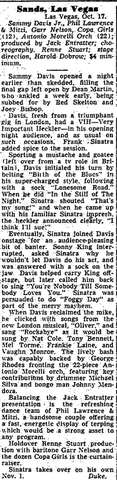
note: I have Bill Miller's list of
some Sinatra appearances at
the Sands that ran less than a
week. Frank subbed for Dean
Martin from October 9 thru the
12th of October in 1961. And,
as you can see, he was part
of Sammy's opening act on
10-17.
Ed
Sands, Las Vegas
Sinatra joins Sammy Davis on stage during Sammy's opening at the Sands
Variety
10-25-61 note: I have Bill Miller's list of some Sinatra appearances at the Sands that ran less than a week. Frank subbed for Dean
Martin from October 9 thru the
12th of October in 1961. And, as you can see, he was part of Sammy's opening act on
10-17.
Ed
[image referenced in source but could not be recovered]
When Sammy Davis Jr. repeatedly ran over time during his Sands engagement, Frank had two large security guards physically carry him off stage mid-show as a joke to get the casino back on schedule.
Source: Nancy Sinatra, Frank Sinatra: An American Legend, 1995.
October 18, 1961
Film
The Devil at 4 O'Clock (US Film Release: October 18, 1961)
Starring: Frank Sinatra, Spencer Tracy, Barbara Luna
Directed by Mervyn LeRoy,
Sinatra plays Harry, one of three reluctant convicts enlisted by a crusty, eccentric priest, Spencer Tracy, to help the priest rescue a children's leper colony from a Pacific island menaced by an erupting volcano. (DVD Release date: 2003-01-14)
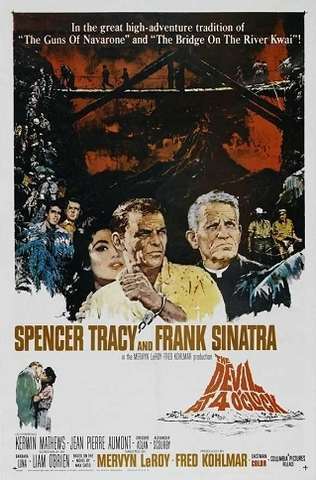
[The Cinematic Legacy of Frank Sinatra — The Devil at 4 O'Clock (1961)]
David Wills's 2015 photo history The Cinematic Legacy of Frank Sinatra devotes a section to The Devil at 4 O'Clock (1961), illustrated with 2 behind-the-scenes and publicity photographs (posters, lobby cards, and on-set/on-location shots) filed here.
Source: David Wills, The Cinematic Legacy of Frank Sinatra (St. Martin's Press, 2015), pp. 199–200.
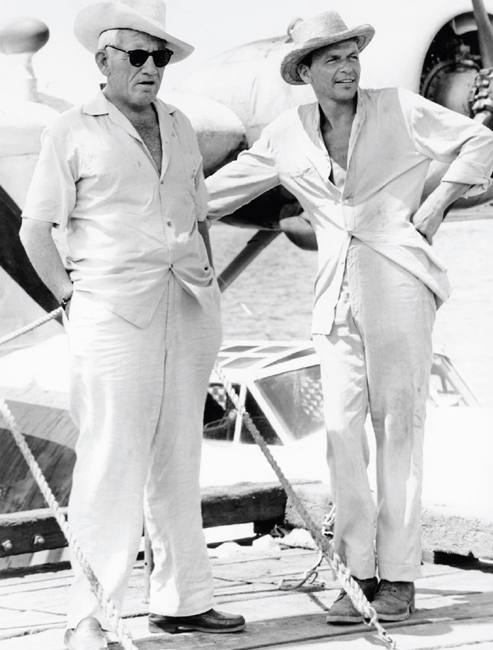
On location in Maui, Hawaii, with costar Spencer Tracy, The Devil at 4 O'Clock, 1961. (Photo: The Cinematic Legacy of Frank Sinatra, David Wills, 2015.)
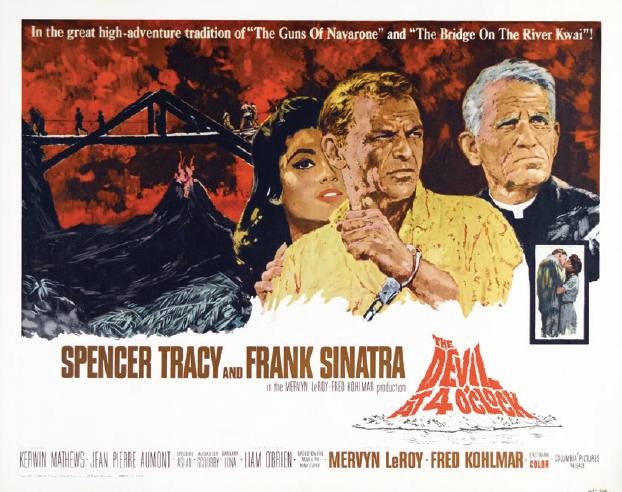
Half sheet poster, The Devil at 4 O'Clock. / “The problem was that Sinatra would only work in the / afternoon. In the morning he hired a private plane and / hopped from island to island trying to convince the startled / inhabitants to vote for Kennedy in the next presidential / election. Around two (Photo: The Cinematic Legacy of Frank Sinatra, David Wills, 2015.)
The Devil at 4 O'Clock (US Film Release:
October 18, 1961)
Starring: Frank Sinatra, Spencer Tracy, Barbara Luna
Directed by Mervyn LeRoy,
Sinatra plays Harry, one of three reluctant convicts enlisted by a crusty, eccentric priest, Spencer Tracy, to help the priest rescue a children's leper colony from a Pacific island menaced by an erupting volcano.
(DVD Release date: 2003-01-14)
The Devil at 4 O'Clock, based on Max Catto's 1958 novel of the same name, was announced as an upcoming Columbia Pictures production in the 29 Aug 1958 DV. Soon after, items in the 3 Sep 1958 Var and 9 Oct 1958 DV stated that Richard Murphy would adapt the script and Spencer Tracy would star as “Father Matthew Doonan.” On 12 Feb 1959, LAT reported that Peter Glenville had been hired to direct. Richard Day came on board as art director, and locations were chosen in Martinique, where filming was set to begin on 1 Jun 1959, as noted in the 25 Mar 1959 DV. A Var item published the same day stated that Bridget Boland would write the screenplay. Two days after filming had initially been scheduled to begin, the 3 Jun 1959 Var announced Sidney Poitier's casting. Other actors considered for roles around that time included Diahann Caroll and the singer-turned-actor, Fabian, the 23 Sep 1959 and 11 Nov 1959 DV noted. The start of principal photography was moved to Mar 1960, according to a 5 Jan 1960 DV item, which stated that Marpessa Dawn had been cast in the leading female role. Tommy Sands was also cast, the 14 Jan 1960 DV reported.
A Hollywood strike continued to delay production. Peter Glenville left to direct the stage play Becket (New York City, 5 Oct 1960), starring Laurence Olivier and Anthony Quinn. The 15 Jun 1960 DV indicated that John Sturges would replace Glenville, and that Frank Sinatra would co-star with Spencer Tracy. The filming site moved from Martinique to Maui, HI, and Mervyn LeRoy â “ not Sturges was hired to to direct, as stated in the 22 Sep 11960 DV. In the meantime, Liam O'Brien replaced Bridget Boland as screenwriter.
Doubts arose over whether or not
Tracy would remain with the project. Although the 5 Jul 1960 DV suggested he had other commitments to honor, a DV item published two days later confirmed that the actor would stay on, as long as he was released by 15 Dec 1960 for filming of Judgment at Nuremberg (1961, see entry). A contrary report in the 16 Sep 1960 DV stated that Tracy was leaving, and would be paid $75,000 of his $275,000 salary, which was to have included a percentage of the film's profits. The 19 Sep 1960 DV reported another change in plans, stating that Tracy would film The Devil at 4 O'Clock until 31 Oct 1960, at which point he would return to mainland U.S. for promotional appearances in support of Inherit the Wind (1960, see entry), to be followed by the filming of Judgment at Nuremberg.
In early Sep 1960, Herbert Lom was cast, and Jack Kruschen was considered for a role, as noted in the 13 Sep 1960 and 14 Sep 1960 issues of DV.
Principal photography began on 22
Sep 1960 in Maui, where some shooting took place in the town of Lahaina. An estimated sixty tons of equipment had to be shipped from Los Angeles, CA, including the flame-throwing and exploding-spark machines, composition smoke and lava ash (pumped pulp residue from sugar cane)â needed for volcano eruption scenes, as stated in the 30 Aug 1960 LAT.
It was expected that an influx of $500,000 would boost the local economy, an expenditure that represented one-tenth of the entire production budget, cited as $5 million in the 23 Oct 1960 NYT. Lahaina locations included a County Building-Post Office-Courthouse, which stood in for a French colonial governor's building; a church with an iron steeple, built especially for the production; and a false road with cables underneath, constructed for the earthquake sequence.
The latter half of production took place in Southern CA, where locations included Twentieth Century-Fox Film Corp.'s ranch in Malibu, the 7 Nov 1960 DV reported. After principal photography concluded, additional filming, for the final sequence in which the island is completely destroyed, took place in Fallbrook, CA. The 10 Mar 1961 DV noted that shooting had begun the previous week in Fallbrook, where a number of residents had mistaken the noise and debris caused by simulated eruptions for a real natural disaster. Further filming of a forest fire, scheduled to take place on 13 Mar 1961, was protested by locals.
In advance of the film's release,
Columbia announced a $1.7 million advertising campaign, according to a 28 Jul 1961 DV item. One promotional effort involved Columbia's sponsorship of ABC-TV's Evening Report news program for an entire month in the fall of 1961, the 23 Aug 1961 DV stated.
Dual world premieres at the Waikiki
Theatre in Honolulu, HI, and at the Iao Theater in Maui, took place on 5 Oct 1961, as reported in the 11 Oct 1961 Var. In conjuction with the film's opening in mid-Oct 1961, the 25 Oct 1961 DV stated that Columbia would release a soundtrack album featuring George Duning's score.
note: I took this history from AFI. Frank gets very little play in any of the discussions concerning this film.
The film cost almost $6 million to make and grossed around four and a half million. Sinatra was much
bigger b.o. in 1961. The above ad has Frank as the dominant figure with Tracy in the background.
Here are a few insights into the making of the film:
In his autobiography "Sun and Shadow", Jean-Pierre Aumont, who played Jacques, spoke of scheduling conflicts between Spencer Tracy and
Frank Sinatra: "[Tracy], a genial man who was not well at the time, couldn't work past the morning. The problem was that Sinatra would only work in the afternoon. In the morning he hired a private plane and hopped from island to island trying to convince the startled inhabitants to vote for [John F. Kennedy] in the next presidential election. Around two o'clock he returned, exhausted, at the precise moment when Tracy was retiring for the day to his rooms. How, in these conditions, the scenes between Tracy and Sinatra were shot is a mystery to me."
Richard Widmark has said that Spencer Tracy told him that a broomstick was used as Frank Sinatra's stand-in during Sinatra's absences, marking his position in a scene, the brush end representing Sinatra's head. Tracy had to act opposite it whilst a script girl read Sinatra's lines.
Spencer Tracy got so fed up by Sinatra's unprofessional behavior that he started to refer to him as "the other fellow" or Mr S.
Apparently, at the time of this film's theatrical release, Spencer Tracy said of Frank Sinatra, "Nobody at Metro [MGM] ever had the financial power Sinatra had today."
--Ed
"The Devil at 4 O'Clock"
With Private Slovik canceled, Sinatra spent most of 1961 recording (six albums, five reaching the top ten, seventy-one songs across seventeen sessions with five different arrangers), releasing only one film that year, The Devil at 4 O'Clock.
Source: Tom Santopietro, "Sinatra in Hollywood" (2008).
"The Devil at 4 O'Clock"
Sinatra was drawn to The Devil at 4 O'Clock by the chance to work with his acting idol Spencer Tracy, and out of respect ceded top billing to him — the credits read "Spencer Tracy and Frank Sinatra."
Source: Tom Santopietro, "Sinatra in Hollywood" (2008).
"The Devil at 4 O'Clock"
Variety: Variety's review of The Devil at 4 O'Clock called Sinatra's performance 'first-class but minor,' reflecting that the film was really Tracy's showcase as the central character, Father Doonan.
Source: Tom Santopietro, "Sinatra in Hollywood" (2008).
"The Devil at 4 O'Clock"
Spencer Tracy: Spencer Tracy praised Sinatra's on-set authority: "Nobody had his power. The Devil at 4 O'Clock was a Sinatra picture. Sinatra was the star... he knew what he wanted... there wasn't [fireworks]."
Source: Tom Santopietro, "Sinatra in Hollywood" (2008).
"The Devil at 4 O'Clock"
During the Hawaiian location shoot for The Devil at 4 O'Clock, Sinatra used his off-hours to campaign for presidential candidate JFK and to party late into the night; despite differing habits, he and Tracy got along well under the watchful eye of Katharine Hepburn on set, sharing a mutual dislike of repeated takes.
Source: Tom Santopietro, "Sinatra in Hollywood" (2008).
"The Devil at 4 O'Clock"
Cinematographer Joseph Biroc shot The Devil at 4 O'Clock's Maui location photography — the first of five films he would shoot with Sinatra.
Source: Tom Santopietro, "Sinatra in Hollywood" (2008).
"The Devil at 4 O'Clock"
Frank Sinatra (as character): Sinatra's character Harry delivers the understated line "Lady, I missed the boat a long time ago" when he chooses to stay behind rather than escape the erupting volcano, a moment Santopietro highlights as a strong underplayed beat in an otherwise uneven film.
Source: Tom Santopietro, "Sinatra in Hollywood" (2008).
"The Devil at 4 O'Clock"
Santopietro grades this a C, calling it Frank's one screen pairing with his idol Spencer Tracy, which "should have been better." Golden Laurel Award nomination: Top Action Performance; Golden Laurel Award nomination: Top Male Star of the Year.
Source: Tom Santopietro, "Sinatra in Hollywood" (2008).
"The Devil at 4 O'Clock"
Santopietro (Filmography): Le Roy/Kohlmar/Columbia Pictures. Produced by Mervyn LeRoy and Fred Kohlmar, directed by LeRoy, screenplay by Liam O'Brien. Sinatra played Harry opposite Spencer Tracy's Father Doonan, with Kerwin Mathews and Jean-Pierre Aumont.
Source: Tom Santopietro, "Sinatra in Hollywood" (2008).
October 23, 1961
[FBI White Slave Traffic Act probe names Sinatra as a customer]
Two days before John F. Kennedy's inauguration anniversary week, a Washington Field Office White Slave Traffic Act investigation identified Sinatra as a guest at the Statler Hotel on the night of January 18, 1961, where a prostitute told agents she "filled a prostitution date with Sinatra, receiving $110 for her services." The Assistant U.S. Attorney handling the case did not consider an interview with Sinatra necessary.
Source: Kuntz and Kuntz, The Sinatra Files, ch. 5.
November 1961
[Maharaja of Jaipur hosts Sinatra in Thailand]
Kaplan: During the Asia leg of his late-1961 tour, the maharaja of Jaipur personally escorted Sinatra and his party through his private zoo, racetrack, and golf course in Thailand.
Source: James Kaplan, "Sinatra: The Chairman" (2015)
[Sands shows taped for first live album]
Ed O'Brien: A Reprise engineer recorded Sinatra's November 1961 Sands shows -- with Antonio Morelli conducting a twenty-four-piece orchestra and Bill Miller on piano -- taping nine performances toward a planned first live album. According to Ed O'Brien, Sinatra was excited about a lot of the material and considered much of it good enough to master, but the tapes ended up simply stored at Reprise headquarters.
Source: James Kaplan, "Sinatra: The Chairman" (2015)
[Sinatra begins Sinatra and Strings with Don Costa]
Will Friedwald (via Kaplan): After the Sands stand, Sinatra recorded his sixth album since the previous December: Sinatra and Strings, his first project with arranger-producer Don Costa, thirty-six, filling the one gap -- a ballad album -- left in Reprise's first year of Sinatra collaborations that had already included Billy May, Stordahl, Oliver, and Johnny Mandel.
Source: James Kaplan, "Sinatra: The Chairman" (2015)
[Sinatra departs for Australia tour]
Kaplan: At the end of November, Sinatra headed to Australia for four nights of Sydney concerts worth $100,000, followed by stops in Hong Kong, Tokyo, and Thailand, traveling with pianist Bill Miller, trumpeter Al Porcino, drummer Johnny Markham, Dorothy Provine, Leo Durocher, the Romanoffs, and bar owner Jilly Rizzo.
Source: James Kaplan, "Sinatra: The Chairman" (2015)
[Sinatra returns to the Sands for two-week stand]
Frank Sinatra: In early November, Sinatra returned to the Sands for a sold-out two-week stand attended by the Rubirosas, the Davises, the Romanoffs, Vic Damone, Richard Conte, Leo Durocher, and Tommy Sands. During the premiere he introduced Big Nancy, seated ringside, as "the mother of my children," drawing a big ovation.
Source: James Kaplan, "Sinatra: The Chairman" (2015)
November 1, 1961
Concerts
Sands, Las Vegas, Nevada (1-14)
Wednesday evening opening night of a two week engagement two shows a night ( Sinatra cancelled on
5th and 6th due to Vegas throat)
Twenty-five piece orchestra
Conducted by Antonio Morelli
1. One I Love Belongs To Somebody Else
2. Don't Cry Joe
3. Imagination
4. Moonlight In Vermont
5. Without A Song
6. In The Still Of The Night
7. Here's That Rainy Day
8. The Moon Was Yellow monologue
9. You Make Me Feel So Young
10. The Second Time Around
11. River, Stay 'Way From The Door (parody written by Mr. Cahn)
12. The Lady Is A Tramp
13. Just One Of Those Things ( ballad reading with just Bill Miller on piano)
14. You're Nobody Till Somebody Loves You
15. Young At Heart
16. Witchcraft
17. April In Paris
18. On The Road To Mandalay
In early September of 1961, Hugh Hefner attempted to expand his magazine empire with the publication of "Show Business Illustrated." It was a bomb ! But Sinatra was on the cover of that first issue and the magazine announced that Frank's next appearance at The Sands, in November of that year, would be recorded by Reprise and released sometime the following year. That was very exciting news. Sinatra had never released a "live" recording. As promised Reprise taped Frank's shows on November 1,2,3,4 and 7, 1961.
The Reprise files show that in all nine shows were taped.
The engineers mastered the best performances from each show,e.g."One I Love" was taken from eight performances, "April In Paris" from four and "Just One Of Those Things" from only two.
The two LP set was scheduled for a late spring release, but Sinatra was busy with his plans for the World Tour.
The concept was put on the back burner and then eventually forgotten. Finally, the "Vegas" set in 2006 offered a compilation CD from the shows taped that November. All the songs except "April In Paris" were made available.
Ed
Sands, Las Vegas, Nevada (1-14)
Wednesday evening
Variety
note: The photo on the cover of Frank's
"Sinatra & Strings" album was taken at the Sands
during the November 1961 engagement. Merle
Shore was the art director during the early Reprise
years. Frank was supposed to do a photo series
for the album. But he was unable to find the time,
Merle flew up to Vegas and used rolls of film. He
told me the one used, with the camera looking up
at Frank, captured the lush romantic image
they wished to convey. And it was an accident.
I've seen other photos from the shoot -straight
ahead shots of Frank. Only this one photo proved
to be exceptional.
Ed
November 2, 1961
Concerts
Sands, Las Vegas, Nevada (1-14)
Wednesday evening opening night of a two week engagement two shows a night ( Sinatra canceled on
5th and 6th due to Vegas throat)
Twenty-seven piece orchestra
Conducted by Antonio Morelli
Allen & Rossi, Garr Nelson, Copa Girls (12)
Jack Entratter producer
Renne Stuart choreography
Harold Dubrow stage direction
$4.00 minimum
First Show:
1 The One I Love Belongs To Somebody Else
2. In The Still Of The Night
3. Moonlight In Vermont
4. Without A Song
5. The Moon Was Yellow
6. monologue "Haven't been here since June"
7. The Second Time Around
8. April In Paris
9. River Stay Away From The Door ( parody) Miller played "All The Way"
Frank caught it as he started to sing.
10. Here's That Rainy Day
11. On The Road To Mandalay
12. Young At Heart
13. Witchcraft
14. The Lady Is A Tramp
15. You're Nobody Till Somebody Loves You
November 3, 1961
Concerts
Sands, Las Vegas, Nevada (1-14)
Twenty-five piece orchestra
Conducted by Antonio Morelli
November 4, 1961
Concerts
Sands, Las Vegas, Nevada (1-14)
Twenty-five piece orchestra
Conducted by Antonio Morelli
November 5, 1961
Concerts
Sands, Las Vegas , Nevada
(Sinatra cancelled on 5th and 6th due to Vegas throat)
November 6, 1961
Concerts
Sands, Las Vegas , Nevada
(Sinatra cancelled on 5th and 6th due to Vegas throat)
November 7, 1961
Concerts
The Sands, La Vegas, Nevada (November 1 - November 14)
Two Shows a night
Tuesday evening
Orchestra conducted by Antonio Morelli
1. The One I Love Belongs to Somebody Else
2. Don't Cry Joe
3. Imagination
4. Moonlight in Vermont
5. Without a Song
6. In the Still of the Night
7. Here's that Rainy Day
8. The Moon was Yellow
9. monologue
10. You Make me Feel so Young
11. The Second Time Around
12. Entratter Stay Away from my Door ("River" parody by Sammy Cahn)
13. April in Paris
14. The Lady is a Tramp
15. Just One of those Things w/Bill Miller, piano
16. You're Nobody Til somebody loves You
17. Young at Heart
18. Witchcraft
19. On the Road to Mandalay
November 8, 1961
Concerts
The Sands, La Vegas, Nevada (November 1 - November 14)
Two Shows a night
Orchestra conducted by Antonio Morelli
November 9, 1961
Concerts
The Sands, La Vegas, Nevada (November 1 - November 14)
Two Shows a night
Orchestra conducted by Antonio Morelli
November 10, 1961
Concerts
The Sands, La Vegas, Nevada (November 1 - November 14)
Two Shows a night
Orchestra conducted by Antonio Morelli
November 11, 1961
Concerts
The Sands, La Vegas, Nevada (November 1 - November 14)
Two Shows a night
Orchestra conducted by Antonio Morelli
November 12, 1961
Concerts
The Sands, La Vegas, Nevada (November 1 - November 14)
Two Shows a night
Orchestra conducted by Antonio Morelli
November 13, 1961
Concerts
The Sands, La Vegas, Nevada (November 1 - November 14)
Two Shows a night
Orchestra conducted by Antonio Morelli
November 14, 1961
Concerts
The Sands, La Vegas, Nevada (November 1 - November 14)
Two Shows a night
Orchestra conducted by Antonio Morelli
November 20, 1961
Studio
Hollywood
591 As You Desire Me
(Allie Wrubel)
Essex Music Inc./Words & Music Inc. (ASCAP)
Arranged & Conducted by Don Costa
-10 (2:52) CD: 46013-2 The Complete Reprise Studio Recordings Disc 2
CD: 9-27020-2Sinatra & Strings
LP: P7715 ( Japan )
592 Stardust
(Hoagy Carmichael/Mitchell Parish)
EMI Mills Music Inc./Everbright Music Co./All Nations Music (ASCAP) Arranged & Conducted by Don Costa
-2 (2:47) CD: 46013-2 The Complete Reprise Studio Recordings Disc 2
CD: 9-27020-2Sinatra & Strings
LP: FS1004Sinatra & Strings
45: 20,059
593 Yesterdays
(Jerome Kern/Otto Harbach)
PolyGram International Publishing Co. Inc. (ASCAP)
Arranged & Conducted by Don Costa
-7 (3:44) CD: 46013-2 The Complete Reprise Studio Recordings Disc 2
CD: 9-27020-2Sinatra & Strings
CD: 1015-2My Kind Of Broadway
LP: FS1004Sinatra & Strings
note: musicians gave Frank a round of applause after the fourth take. They were more impressed than he. Took three more attempts before Frank was satisfied
594 I Hadn't Anyone Till You
(Ray Noble)
Bourne Co. (ASCAP)
Arranged & Conducted by Don Costa
(3:43) CD: 46013-2 The Complete Reprise Studio Recordings Disc 2
CD: 9-27020-2Sinatra & Strings
LP: FS1004Sinatra & Strings
note: There were eight takes. Three were complete with two playbacks.
note: It had been six months since Frank recorded at Reprise. Asked at the outset if he wants to do a run through or a take. Frank opts for the former and says, '"We haven't seen each other for a long time." He does three run-throughs on "Desire Me" and 10 takes. "Stardust" requires two and two.'
Ed
[Stardust -- critical commentary]
Hoagy Carmichael (attributed); Tony Mottola: Sinatra recorded only the rarely-heard verse of 'Stardust,' omitting the famous chorus entirely -- a deliberate artistic choice, not an edit for time. Hoagy Carmichael allegedly complained on hearing it: 'I wrote a whole song, not just a verse!' Guitarist Tony Mottola named 'Stardust' his favorite Sinatra performance because of Costa's elaborate framing introduction: 'Don sets it up like almost a tone poem in the beginning... Frank just sings this lovely verse, and then Don ends it... Whoever thought of that idea... it's completely original and absolutely beautiful.' Friedwald judges the result beautiful but ultimately unsatisfying, 'like a tale without a dog.'
This song/context matches multiple dated entries in the chronology; the specific date Friedwald is referring to could not be determined with confidence.
Source: Will Friedwald, "Sinatra! The Song Is You: A Singer's Art" (2018 revised edition), Ch. 9, "Looking for the Hook" (1960-1971)
November 21, 1961
Studio
Hollywood
595 It Might As Well be Spring
(Richard Rodgers/Oscar Hammerstein II)
Williamson Music Co. (ASCAP)
Arranged & Conducted by Don Costa
-3 (3:14) CD: 46013-2 The Complete Reprise Studio Recordings Disc 2
CD: 9-27020-2Sinatra & Strings
LP: FS1004Sinatra & Strings
596 Prisoner Of Love
(Russ Columbo/Leo Robin/Clarence Gaskill)
Colgems EMI Music Inc./Music Sales Corp./Edwin H. Morris & Co. Inc. (ASCAP) Arranged & Conducted by Don Costa
-5 (3:49) CD: 46013-2 The Complete Reprise Studio Recordings Disc 2
CD: 9-27020-2Sinatra & Strings
LP: FS1004Sinatra & Strings
597 That's All
(Bob Haymes/Alan Brandt)
Mixed Bag Music inc. (BMI)
Arranged & Conducted by Don Costa
-9 (3:20) CD: 46013-2 The Complete Reprise Studio Recordings Disc 2
CD: 9-27020-2Sinatra & Strings
LP: FS1004Sinatra & Strings
598 Don't Take Your Love From Me
(Henry Nemo)
Indano Music Co. (ASCAP)
Arranged & Conducted by Don Costa
-8 (4:04) CD: 46013-2 The Complete Reprise Studio Recordings Disc 2
CD: 9-27020-2Sinatra & Strings
CD: 9-26340-2The Reprise Collection
note: After take one, Costa and others worked on getting a better all-around sound to augment the vocal. After a few minutes of fiddling, Frank said, "hell of a nice idea with a decent celeste." There was one in the studio so they did an orchestral run through. Frank liked it and told them to use it. After take two, Frank asked them to remove the piano bench. The AFM sheet shows a piano being used, but it was actually a celeste.
Ed
599 Misty
(Eroll Garner/Johnny Burke)
The Songwriters Guild/WB Music Corp. (ASCAP)
Arranged & Conducted by Don Costa
-2 (2:41) CD: 46013-2 The Complete Reprise Studio Recordings Disc 3
CD: 9-27020-2Sinatra & Strings
LP: FS1004Sinatra & Strings
"That's All"
Granata includes 'That's All' among the fifty recordings he considers essential to understanding Sinatra's artistry (arranged by Don Costa, recorded 1961, Reprise); the song was chosen for its musical/interpretive value rather than commercial popularity.
Source: Charles L. Granata, "Sessions with Sinatra: Frank Sinatra and the Art of Recording" (1999/2003).
November 22, 1961
Studio
Hollywood
600 Come Rain Or Come Shine
(Harold Arlen/Johnny Mercer)
Chappell & Co. Inc. (ASCAP)
Arranged & Conducted by Don Costa
-3 (4:06) CD: 46013-2 The Complete Reprise Studio Recordings Disc 3
CD: 9-27020-2Sinatra & Strings
CD: 9-26340-2The Reprise Collection
LP: FS1004Sinatra & Strings
45: 20,059
NOTE: Author Ed O'Brien calls this "Sinatra and Costa's finest collaboration."
Randazzo told O'Brien how Costa agonized over how to find the right sound to put behind Sinatra.
A monumental achievement by both artists. The Arlen-Mercer tune would become one of Sinatra's transcendent moments as a recording artist.
601 Night And Day
(Cole Porter)
Harms Inc. (ASCAP)
Arranged & Conducted by Don Costa
-18 (3:37) CD: 46013-2 The Complete Reprise Studio Recordings Disc 3
CD: 9-27020-2Sinatra & Strings
CD: 9-26340-2The Reprise Collection
CD: 1016-2A Man And His Music
LP: FS1004Sinatra & Strings
602 All Or Nothing At All
(Jack Lawrence/Authur Altman)
MCA Inc. (ASCAP/ZIMRA)
Arranged & Conducted by Don Costa
-4 (3:43) CD: 46013-2 The Complete Reprise Studio Recordings Disc 3
CD: 9-27020-2Sinatra & Strings
CD: 1016-2A Man And His Music
LP: FS1004Sinatra & Strings
634 Pocketful Of Miracles
(Jimmy Van Heusen/Sammy Cahn)
Maraville Music Corp. (ASCAP)
Arranged by Nelson Riddle
Conducted by Don Costa
(2:38) CD: 46013-2 The Complete Reprise Studio Recordings Disc 3
CD: 1010-2Sinatra's Sinatra
LP: FS1010 Sinatra's Sinatra
LP: FS1010 Sinatra's Sinatra (alt take)
45: 20,040
635 Name It And It's Yours
(Sammy Cahn/Jimmy Van Heusen)
Bourne Co. (ASCAP)
Arranged by Nelson Riddle
Conducted by Don Costa
(3:12) CD: 46013-2 The Complete Reprise Studio Recordings Disc 3
LP: FS5238 (Italy)
45: 200,040
note: There were 7 takes an an intercut done for this recording
Ed O'Brien:
Alan Livingston told me Capitol would not allow Riddle to work any Reprise
sessions with Sinatra. There was such bad blood between the record com-
pany and singer. I mentioned that it was no secret Riddle was arranging
the early Sinatra single sessions for Frank's fledgling label. Livingston laughed
and acknowledged Capitol was well aware of it. Riddle arranged "Pocketful
of Miracles" and "Name It And Its Yours." He also conducted. Sinatra did
seven takes on the latter and two intercuts. He had an ongoing conversation
with Riddle throughout. Nelson's first official Reprise session occurred on 1-21-63,
The Riddle arranged singles, prior to, were labeled "Frank Sinatra and his orchestra."
I like the Cahn/Van Heusen song. Single had a very nice picture sleeve. --ED
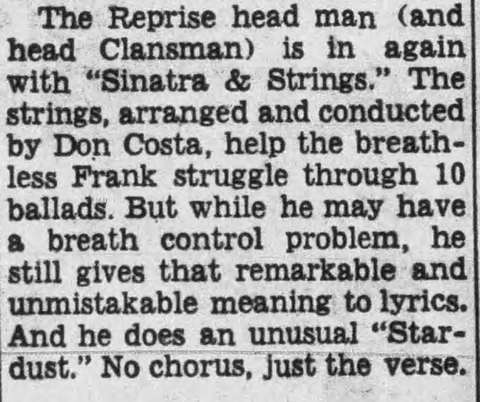
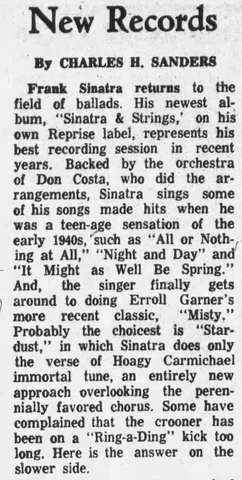
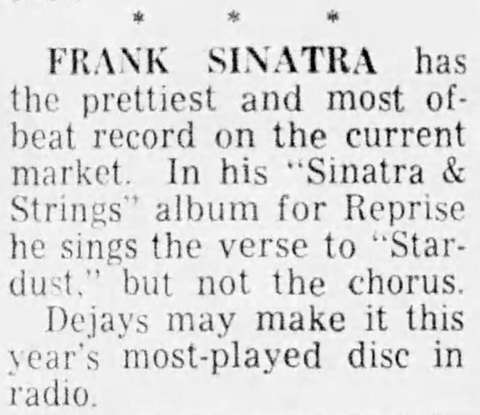
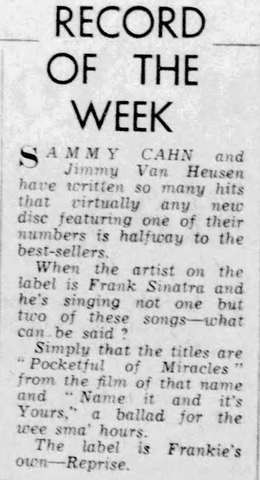
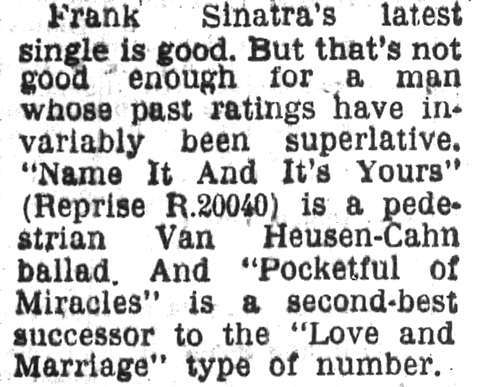
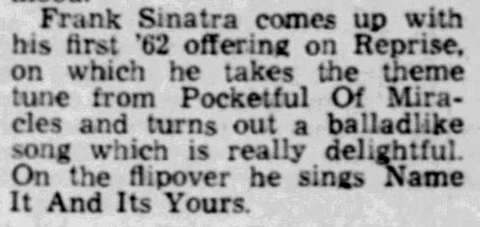
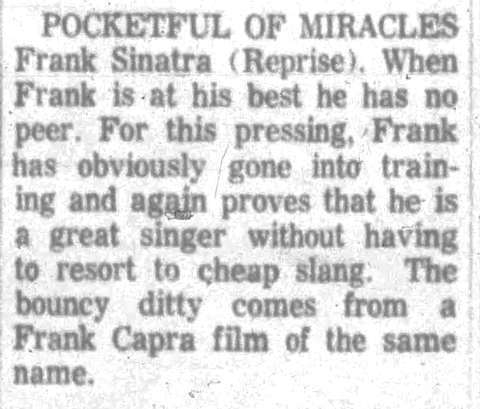
"Come Rain or Come Shine" / "Georgia on My Mind"
Will Friedwald (analysis): Friedwald analyzes 'Come Rain or Come Shine' as the album's masterpiece, noting Costa's arrangement seems informed by Ray Charles's treatments of both 'Georgia on My Mind' and 'Come Rain or Come Shine' (both orchestrated originally by Ralph Burns). He compares Sinatra's controlled emotional release on the Arlen/Mercer song to blues singers Big Joe Turner and Jimmy Rushing, 'like molasses leaking slowly out of a barrel.'
Source: Will Friedwald, "Sinatra! The Song Is You: A Singer's Art" (2018 revised edition).
"All or Nothing at All"
Sinatra returned to "All or Nothing at All" three more times over his career: a ballad version with Don Costa in 1961, an up-tempo arrangement with Nelson Riddle in 1966, and a disco version with Joe Beck in 1977.
Source: Charles L. Granata, "Sessions with Sinatra: Frank Sinatra and the Art of Recording" (1999/2003).
"Come Rain or Come Shine"
Granata includes 'Come Rain or Come Shine' among the fifty recordings he considers essential to understanding Sinatra's artistry (arranged by Don Costa, recorded 1961, Reprise); the song was chosen for its musical/interpretive value rather than commercial popularity.
Source: Charles L. Granata, "Sessions with Sinatra: Frank Sinatra and the Art of Recording" (1999/2003).
Liner Notes: "Sinatra & Strings"
There is a particular kind of nerve required to put a singer this famous in front of nothing but strings and let him stand there, unguarded. No horns to punch the corners, no rhythm section to carry the pulse -- just a string orchestra, a microphone, and Frank Sinatra deciding, take by take, how much of himself to give away. That is the record this session produced.
By the fall of 1961, Sinatra had already remade himself twice -- the saloon-song confessor of the Capitol years, the swinger who could turn a beat into a wink. Sinatra & Strings asks for something quieter than either: pure legato, pure line, a voice with nowhere to hide. The arranger entrusted with that exposure was Don Costa, and it is Costa's touch -- lush, patient, never showing off -- that gives this record its particular hush.
The sessions ran three nights at the Hollywood studio, and the songs chosen were, almost without exception, standards that had already survived a generation: Kern and Harbach's "Yesterdays," Hoagy Carmichael's "Stardust," Cole Porter's "Night and Day." These are songs built to be sung straight, and Sinatra sings them straight -- which, for a performer this instinctively theatrical, is its own kind of risk. He takes it anyway.
Listen for the small things. The way "Come Rain or Come Shine" builds without ever raising its voice, Costa's strings rising to meet Sinatra rather than the other way around -- a piece of ensemble work good enough that the musicians in the booth reportedly applauded a take before Sinatra himself was satisfied with it. The unhurried patience of "Misty," a song still new enough in 1961 that Sinatra's reading helped decide how singers after him would treat it. The tenderness underneath "Don't Take Your Love From Me," where a late addition of celeste -- a happy accident of studio tinkering -- gives the arrangement a soft, chiming undertow that has nothing to do with drama and everything to do with feeling.
And then there is "Night and Day," a song Sinatra had already made his own more than once, sung here at a tempo unhurried enough to let every syllable of Porter's melody breathe. It closes a program that never asks the strings to be anything more than what they are -- a setting, not a spectacle -- which is exactly why the voice at the center of it sounds so unmistakably itself.
This is not an album that argues for Sinatra's genius. It assumes it, and gets out of the way.
Written by Claude (Anthropic), commissioned for this chronology, 2026.
[Come Rain or Come Shine -- critical commentary]
Friedwald (analysis): Sinatra made his first television appearance on May 27, 1950 on The Star-Spangled Revue, hosted by Bob Hope, singing 'Come Rain or Come Shine' -- Friedwald notes the arrangement reused introductory material from Sinatra's chart on 'Don't Cry, Joe.'
This song/context matches multiple dated entries in the chronology; the specific date Friedwald is referring to could not be determined with confidence.
Source: Will Friedwald, "Sinatra! The Song Is You: A Singer's Art" (2018 revised edition), Ch. 5, "In-Between Years" (1948-1953)
[Night and Day -- critical commentary]
Will Friedwald: Sinatra opened the song with an instrumental Red Norvo vibraphone chorus that deliberately avoided the melody (Erroll Garner-style suspense) before entering, singing two full fast choruses instead of the usual chorus-and-a-half. Friedwald describes Sinatra audibly complimenting Norvo mid-performance ('Marvelous!'), trading rhythmic 'breaks' with him -- unusual for Sinatra, who rarely broke off a lyric line -- and continually reshuffling phrasing and accents on 'night and day' itself, even mistakenly flipping the words to 'day and night' in the outchorus. A second performance followed April 1, 1959.
This song/context matches multiple dated entries in the chronology; the specific date Friedwald is referring to could not be determined with confidence.
Source: Will Friedwald, "Sinatra! The Song Is You: A Singer's Art" (2018 revised edition), Ch. 1, "Night and Day" (Sinatra style overview)
[Night and Day -- critical commentary]
Frank Sinatra (to Al Viola); analysis by Will Friedwald: Before the Royal Festival Hall concert, Sinatra told Al Viola, 'Instead of doing it with the band, we might as well do it with just the guitar. It'll be fresh that way.' Friedwald traces the duet arrangement (verse plus one chorus) from its first known performance in Milan (May 25/26) through the acclaimed Royal Festival Hall, London show (June 1) and the Lido, Paris show (June 5) -- the latter released commercially in 1994 as the first officially issued historic Sinatra concert. He judges the London performance superior, delivered carefully as Sinatra's voice was fraying near the tour's exhausting end; two earlier sextet-only performances had been given in Tokyo, April 20-21.
This song/context matches multiple dated entries in the chronology; the specific date Friedwald is referring to could not be determined with confidence.
Source: Will Friedwald, "Sinatra! The Song Is You: A Singer's Art" (2018 revised edition), Ch. 1, "Night and Day" (Sinatra style overview)
[Night and Day -- critical commentary]
Al Viola; Will Friedwald (analysis): Despite vocal exhaustion at the end of the tour, Sinatra's guitar-duet reading of 'Night and Day' with Al Viola is singled out as the highlight of the Paris show, described as 'an overpoweringly sensitive reading of the Porter classic.' Viola separately recalled Sinatra's high standards with the small combo: 'If you listen to those tapes, you'll hear that he was kickin' our [collective] ass!... He would turn around to us as if to say, "Hey you guys come on. This is a concert!"'
This song/context matches multiple dated entries in the chronology; the specific date Friedwald is referring to could not be determined with confidence.
Source: Will Friedwald, "Sinatra! The Song Is You: A Singer's Art" (2018 revised edition), Ch. 9, "Looking for the Hook" (1960-1971)
[Night and Day / Stardust -- critical commentary]
Will Friedwald: Costa's ballad arrangement was the first to include the song's verse in a slow reading (on an album where Sinatra also sang only the verse of 'Stardust'). Friedwald describes Costa's austere, slow-resolving string chords and dramatic flourishes following each 'you!' in the verse, and praises Sinatra's new phrasing on 'inside of me,' while noting the ending's heavy, movie-trailer-style bombast as the arrangement's one weak point.
This song/context matches multiple dated entries in the chronology; the specific date Friedwald is referring to could not be determined with confidence.
Source: Will Friedwald, "Sinatra! The Song Is You: A Singer's Art" (2018 revised edition), Ch. 1, "Night and Day" (Sinatra style overview)
November 24, 1961
[Hoover flags Sinatra-Giancana socializing to RFK]
Hoover informed Attorney General Robert Kennedy that Sinatra and Tony Bennett were regularly accompanied by Sam Giancana and his lieutenants on Chicago nightclub rounds, noting that on past visits "Sinatra and Giancana have held contests to determine who could spend the most money buying drinks and trinkets." A December 6, 1961 wiretap picked up Giancana associate Johnny Roselli recounting a conversation in which Sinatra said he'd told Robert Kennedy, "This is my buddy," about Giancana, and that Sinatra was worried Giancana was "mad at him." Giancana, unimpressed, grumbled: "He must have a guilty conscience... If he starts campaigning, I'm not giving him one penny." A December 11, 1961 Hoover memo to RFK reported that Giancana had tried to enlist Sinatra as an intermediary to ease FBI pressure, an overture Sinatra reportedly rejected, and that Giancana complained he'd made a campaign donation but "was not getting his money's worth."
Source: Kuntz and Kuntz, The Sinatra Files, ch. 6 (Hoover memos of November 24 and December 11, 1961; wiretap transcript of December 6, 1961).
November 29, 1961
Concerts
Sydney Stadium, Australia (November 29 - December 2)
Timi Yuro was also on the bill
Impressed by her voice, Frank Sinatra asked Yuro to support him from November 29 - December 2,
1961 in a four-day series of concerts at Sydney
Stadium Australia. She told "the only reason he asked me was because I was Italian." For Timi to be on this tour as an opening act for Frank
Sinatra was regarded as a huge accolade for Timi, and was a prestigious close to her first year as a professional. One of the most enduring legends about Timi Yuro originated during the Sinatra tour. Reportedly, she was performing before a crowd of 15.000 at a Sydney arena when the P.A. system went dead, as the crowd began buzzing with disappointment, Timi hushed them and announced that, if everyone was quiet, they could still hear her sing. The crowd obliged, and Timi was right. While she was belting the back rows,
Sinatra came onstage and began circling her, looking up and down. Timi was not amused, "What's that matter with you babe?" she asked, "Nothing kid" Sinatra answered, "I'm just looking for where the plug is".....
Sydney Stadium, Australia (November 29)
Frank Sinatra on stage at the Sydney Stadium during his Australian tour on 29 November 1961
SMH NEWS Picture by JOHN O GREADY
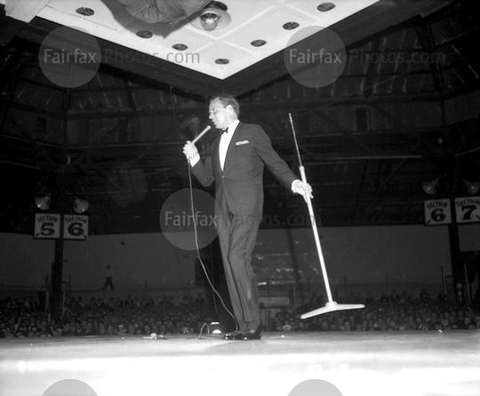
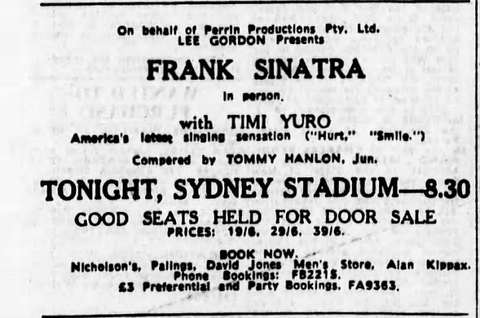
November 30, 1961
Concerts
Sydney Stadium, Australia (November 29 - December 2)
Timi Yuro was also on the bill
December 1961
[Angela Lansbury cast as Eleanor Iselin]
Kaplan: Angela Lansbury was signed to play Raymond's villainous mother, Eleanor Shaw Iselin, after Sinatra -- who had originally floated Lucille Ball for the role -- was won over by watching Lansbury's performance as a similarly possessive mother in John Frankenheimer's about-to-be-released film All Fall Down.
Source: James Kaplan, "Sinatra: The Chairman" (2015)
[British album repertory assembled]
Kaplan: Sinatra began assembling the song list for what would become his London-recorded album of British songs, eventually working with arranger Robert Farnon.
Source: James Kaplan, "Sinatra: The Chairman" (2015)
[Earl Wilson spots Prowse with Goldstone at the Copa]
Earl Wilson: Earl Wilson, whom Sinatra read religiously, reported seeing an attractive Juliet Prowse at the Copa with a young man who turned out to be her manager, Eddie Goldstone -- an item Kaplan notes Sinatra would not have appreciated.
Source: James Kaplan, "Sinatra: The Chairman" (2015)
[FBI wiretap captures Giancana's frustration with Sinatra]
Sam Giancana / Johnny (FBI wiretap): A December 1961 FBI wiretap recorded Giancana and an underling (Johnny Formosa or Rosselli) complaining that Sinatra had made empty promises about lobbying the Kennedys on Giancana's behalf, despite claiming to have spoken to Joe Kennedy three times and to have given Bobby Kennedy Giancana's name directly.
Source: James Kaplan, "Sinatra: The Chairman" (2015)
[Kennedys begin cooling toward Sinatra]
George Jacobs: George Jacobs claimed that after Joseph Kennedy's stroke, Bobby and Jackie Kennedy took control of the family's image and decided Sinatra was "not our kind," ending his status as a favored friend.
Source: James Kaplan, "Sinatra: The Chairman" (2015)
[Prowse performs on The Perry Como Show]
Kaplan: In late December, Juliet Prowse traveled to New York to appear in a $10,000 guest spot on The Perry Como Show, after a busy year that included three film releases, a Las Vegas production of Irma la Douce, and heavy television dance work.
Source: James Kaplan, "Sinatra: The Chairman" (2015)
[Sinatra absent from Kennedy's post-stroke visitors]
Frank Saunders: Chauffeur Frank Saunders remarked he was surprised such a powerful, wealthy man as Joseph Kennedy had so few close friends; among the short list of people who visited the Ambassador in the weeks and months after his stroke, Sinatra's name did not appear.
Source: James Kaplan, "Sinatra: The Chairman" (2015)
[Sinatra and Lawford sell Puccini restaurant]
Kaplan: That same month, Sinatra and Peter Lawford dissolved their partnership in the Beverly Hills restaurant Puccini and sold it to a Chicago syndicate.
Source: James Kaplan, "Sinatra: The Chairman" (2015)
[Sinatra's loneliness and pursuit of Juliet Prowse on tour]
Walter Winchell / Juliet Prowse: Columnist Walter Winchell reported that during the Australia/Asia tour, Sinatra spent much of his time alone and brooding, repeatedly phoning Juliet Prowse and begging her to fly out and join him, only for her to refuse, saying she wouldn't be on his girl list and it could only work one way for them.
Source: James Kaplan, "Sinatra: The Chairman" (2015)
December 1, 1961
Concerts
Sydney Stadium, Australia (November 29 - December 2)
Timi Yuro was also on the bill
December 2, 1961
Concerts
Sydney Stadium, Australia (November 30 - December 2)
Key Musicians: Johnny Markham (drums), Al Porcino (trumpet) Bill Miller (piano)
1. Intro by: Tommy Hanlin Jr.
2. I've Got The World On A String
3. I Concentrate On You
4. Night And Day
5. Moonlight In Vermont
6.. In The Still Of The Night
7. I'll Be Seeing You
8. Day In, Day Out
9. The Moon Was Yellow
10. You're Nobody Till Somebody Loves You
11. monologue
12. Come Fly With Me
13. April In Paris
14. A Foggy Day
15. Without A Song
16. Imagination
17. The Second Time Around
18. Young At Heart
19. Witchcraft
20. Embraceable You
21. The One I Love Belongs To Somebody Else
22. My Funny Valentine
23. My Blue Heaven
24. Angel Eyes
25. One For My Baby
26. The Lady Is A Tramp
27. The Lady Is A Tramp (Reprise)
Note: Complete concert was released as a bonus disk in the Australian and Canadian releases of "Ultimate Sinatra"
Brian Chearno:
I explained earlier this year, this was not a live broadcast and why the tele-filmed kinnie was done. Below is a reprint of my explanation
Lee Gordon negotiated the "tele-filmed" kinescope after Sinatra was not able to extend his tour. It was to be 60mins and of Saturdays (12/2) performance. First shown Dec. 9, 1961 at 8PM on GTV9. Later offered to all stations outside of Sydney. Sinatra was said to have received 5000 (aus) for it. Which made it the highest price ever paid for a concert telecast in Australia at the time. Now we know why our video cuts out at the 60min mark and why it was kinescoped and not videotaped.
Ed O'Brien noted:
Among the hundreds of great Sinatra concerts that have circulated through the years in collecting circles. there are a handful that standout above all the others. Sydney is one of them. Frank with a full orchestra singing the great songs from the Capitol years and the recently recorded tunes for his new label Reprise. He is in great form throughout and the song selection is A+ all the way. There may be one, but I can't think of another concert where he did "Angel Eyes" and "One For My Baby" back-to-back. And Miller is his sole accompaniment on both.
Thirteen of the tunes have charts by Riddle, five from
Billy May, four were done by Sy Oliver and two from Johnny Mandel. Sinatra would do more studio work with Riddle and May but would never again record with Mandel or Oliver.
Sydney Stadium, Australia (November 30 - December 2)
A crowd gathers to see Frank Sinatra at the Sydney Stadium on 2nd December 1961.
Thanks to Carl Rasmussen for the above photo.
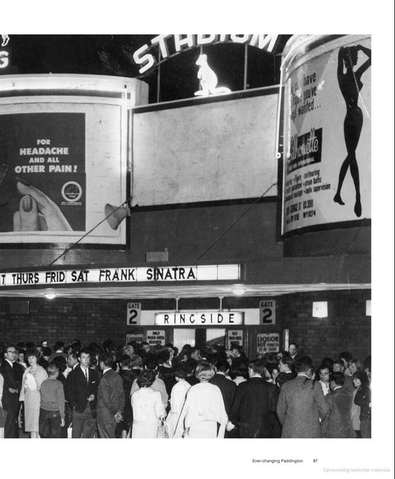
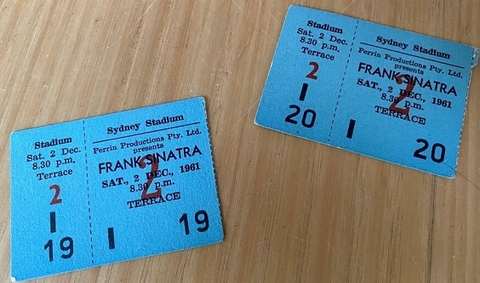
"My Blue Heaven" / "Should I" / "When You're Smiling"
Riddle had all arrangements ready, but Sinatra arrived and announced he wanted everything at double the planned tempo, leaving very short tracks. Sinatra later performed Riddle's 'My Blue Heaven' at the original slower tempo live at an Australian concert in 1961. On 'Should I,' both Sinatra and tenorist Buddy Collette move so fast 'they almost sound as if they're hyperventilating'; on 'My Blue Heaven,' Sinatra even drops the first syllables of each A section to keep pace. Woody Herman's anecdote about Glenn Miller playing fast so patrons would 'listen' rather than dance is cited as an analogue (story credited to Gary Giddins).
Source: Will Friedwald, "Sinatra! The Song Is You: A Singer's Art" (2018 revised edition).
December 6, 1961
An FBI wiretap recorded Chicago mob associate Johnny Roselli and Sam Giancana discussing Frank Sinatra's supposed intercession with Attorney General Robert Kennedy on Giancana's behalf. Note: This account comes solely from Kelley's book, which is widely regarded as containing embellished or unverified claims; it is not independently corroborated elsewhere in this chronology. Source: Kitty Kelley, "His Way: An Unauthorized Biography of Frank Sinatra" (1986).
December 9, 1961
Television
Australia, GTV 9 Network
8:00 P.M. to 9 P.M.
Sinatra in Sydney, Australia note: Long before the complete concert surfaced, there was an audio of this show in circulation. Ampo was the sponsor and the sound was excellent . Little did we know that there was a number of songs missing from that broadcast. Ed
Australia, GTV 9 Network
8:00 P.M. to 9 P.M.
Sinatra in Sydney, Australia
December 19, 1961
[Joseph Kennedy suffers a stroke]
Frank Saunders (via Kaplan): On December 19, seventy-three-year-old Joseph P. Kennedy suffered a stroke while playing golf in Palm Beach. He survived nearly eight more years, outliving both his older sons, but was left confined to a wheelchair, able to say only a drawn-out "no," according to chauffeur Frank Saunders.
Source: James Kaplan, "Sinatra: The Chairman" (2015).
Frank and jazz arranger Johnny Mandel recorded Reprise's inaugural album, Ring-a-Ding-Ding, over these two days; it went gold. Source: Nancy Sinatra, "Frank Sinatra, My Father" (1985).
December 25, 1961
At Nancy Sr.'s Bel Air home, Frank and his friends would arrive late on Christmas Eve to help trim the tree, always leaving the tinsel looking thrown-on rather than neatly applied.
Source: Nancy Sinatra, Frank Sinatra: An American Legend, 1995.
1962
[Cuban Missile Crisis Family Drill]
During the Cuban Missile Crisis, the family carried out its rehearsed civil-defense plan, gathering at Carolwood before driving out to the desert compound, where they anxiously followed the news together until the crisis passed.
Source: Tina Sinatra, "My Father's Daughter: A Memoir" (2000).
[Engagement to Juliet Prowse; World Charity Tour]
Sinatra becomes engaged to Juliet Prowse, undertakes a round-the-world concert tour for children's charities, meets Israeli leader David Ben-Gurion, and narrates the short film "Sinatra in Israel." He records his final Capitol session and appears in "Sergeants 3," "The Road to Hong Kong," and "The Manchurian Candidate."
Source: Nancy Sinatra, "Frank Sinatra, My Father" (1985).
[Frank Sinatra Jr. on the Twelve-Nation Charity Tour]
Frank Sinatra Jr. recalled that his father funded a 1962 tour through twelve countries to raise money for underprivileged children entirely out of his own pocket, and that it brought him deep personal satisfaction.
Source: Charles Pignone, "Frank Sinatra 100" (2015).
[Hank Sanicola's Roadside Farewell To Sinatra]
Nancy Sinatra: After Sinatra insisted on buying out Hank Sanicola's stake in Cal-Neva over disputes about Sam Giancana's presence at the lodge, Sanicola had the car stopped on the highway, took his suitcases from the trunk, and stood on the shoulder watching Frank drive away for good.
Source: Nancy Sinatra, Frank Sinatra: An American Legend, 1995.
[Investment In Berkshire Downs Racetrack]
Sinatra invested $50,000 in Berkshire Downs, a Massachusetts racetrack partly owned by mob figures Raymond Patriarca and Tommy Lucchese. The investment became the subject of a congressional inquiry a decade later.
Source: The Rough Guide to Frank Sinatra, chapter "I Want to Be a Part of It, 1971-98."
[Jilly Rizzo Becomes Sinatra's Right-Hand Man]
Nancy Sinatra: After his falling-out with Hank Sanicola, Sinatra's longtime friendship with Jilly Rizzo, owner of a favorite Broadway restaurant, deepened, and Jilly became Frank's closest confidant and right-hand man.
Source: Nancy Sinatra, Frank Sinatra: An American Legend, 1995.
[Nobody Sleeps On This Show! (Paris Lido, 1962)]
During a Paris Lido concert on the 1962 world tour, Sinatra spotted an audience member dozing off during a rendition of "All The Way" and broke off to yell "Nobody sleeps on this show!", drawing a laugh and the offender's full attention for the rest of the performance.
Source: Fred Dellar (Mojo magazine), liner notes to "Frank Sinatra Live In Tokyo Japan 1962" (Acrobat Music, ACMCD 4014).
[Sinatra Breaks a Finger Filming a Karate Scene]
While filming a karate fight scene with Henry Silva for "The Manchurian Candidate," Sinatra accidentally broke a dining table with his hand and fractured a finger, but kept performing without anyone realizing until the scene was finished.
Source: Nancy Sinatra, "Frank Sinatra, My Father" (1985).
[Relaxing With Mike Romanoff on World Tour]
During his 1962 world charity tour, Sinatra was photographed relaxing with restaurateur Mike Romanoff.
Source: Charles Pignone, "Frank Sinatra 100" (2015).
[Sinatra Halts A Session Over A Sick Concertmaster]
Nancy Sinatra: Frank Jr. recalled that on the first night of the Sinatra & Strings sessions, his father noticed concertmaster Felix Slatkin slumped over and sweating in his chair; rather than record without him, Sinatra had the entire orchestra paid off for the night and rescheduled the session.
Source: Nancy Sinatra, Frank Sinatra: An American Legend, 1995.
[Sinatra-Basie Album Photo Shoot]
A photo shoot in 1962 accompanied the release of the album Sinatra-Basie: An Historic Musical First.
Source: Charles Pignone, "Frank Sinatra 100" (2015).
[Sinatra's World Tour Benefits Children's Charities]
Sinatra mounted a world tour in 1962, with proceeds benefiting children's charities across the twelve countries where he performed.
Source: Charles Pignone, "Frank Sinatra 100" (2015).
[Visit to Broussais Hospital, Paris]
A contact sheet documents Sinatra's visit to Broussais Hospital in Paris during his 1962 charity world tour.
Source: Charles Pignone, "Frank Sinatra 100" (2015).
[500 Club charity shows planned]
Kaplan: A couple of weeks after the New Facks incident, Sinatra flew east to do three nights at Skinny D'Amato's 500 Club in Atlantic City as a favor, joining Dean Martin, with Sammy Davis Jr. to join on the final night.
Source: James Kaplan, "Sinatra: The Chairman" (2015)
[500 Club engagement and organized crime presence]
FBI (Newark office): An FBI report from the Newark office to J. Edgar Hoover documented Sinatra and Dean Martin's 500 Club appearance, noting Sinatra took over an entire floor of the Claridge Hotel, performed for no fee as a favor to Skinny D'Amato, and that Sam Giancana was observed dining in a private room on Sinatra's hotel floor -- the visit coinciding with mob boss Angelo Bruno's daughter's wedding on August 26.
Source: James Kaplan, "Sinatra: The Chairman" (2015)
[All Alone album released, underperforms]
Kaplan: Originally to be titled Come Waltz with Me after a Cahn-Van Heusen commission, the Jenkins waltz album was renamed All Alone after its opening Irving Berlin track. Released in October 1962, it peaked at only number 26 on the charts.
Source: James Kaplan, "Sinatra: The Chairman" (2015)
[All Alone recording sessions]
Peter Levinson: Publicist Peter Levinson attended the three All Alone sessions and recalled Sinatra performing dramatically for the invited studio audience despite looking haggard -- disheveled, without his hairpiece, sweater instead of a suit -- yet still singing beautifully.
Source: James Kaplan, "Sinatra: The Chairman" (2015)
[Athens concerts at Herodes Atticus]
Kaplan / Bill Miller: Playboy Porfirio Rubirosa arrived by yacht to ferry Sinatra's tour party to Athens, where Frank gave two concerts on the nights of May 18 and 19 at the outdoor Odeon of Herodes Atticus beneath the Acropolis. Pianist Bill Miller considered the unrecorded first show the best of the entire world tour.
Source: James Kaplan, "Sinatra: The Chairman" (2015)
[Ava Gardner's life in Madrid]
Ben Tatar: At 39 and three years into a moviemaking hiatus, Ava Gardner lived above the exiled Perons in a fashionable Madrid neighborhood, keeping a household staff and a live-in secretary, Ben Tatar, who recalled her constantly playing Sinatra's records and dancing at home; Frank still called the apartment occasionally.
Source: James Kaplan, "Sinatra: The Chairman" (2015)
[Ava dismissed from Pink Panther]
Kaplan: After finishing 55 Days at Peking, Ava Gardner was hired for Blake Edwards's The Pink Panther, but her outrageous demands and impossible behavior got her dismissed as a bad risk before shooting began.
Source: James Kaplan, "Sinatra: The Chairman" (2015)
[Ava's breakdown on 55 Days at Peking]
Kaplan: In the latter half of 1962 Ava Gardner made the historical drama 55 Days at Peking, alienating much of the cast and crew (especially co-star Charlton Heston), possibly contributing to director Nicholas Ray's heart attack, and suffering a breakdown herself in which she could no longer remember her lines.
Source: James Kaplan, "Sinatra: The Chairman" (2015)
[Blind girl and the wind anecdote]
Sinatra: A widely circulated story from the world tour described Sinatra brushing hair from the eyes of a blind six-year-old girl and telling her the wind had blown it there; she reportedly stopped him by asking, 'What color is the wind?'
Source: James Kaplan, "Sinatra: The Chairman" (2015)
[Cal-Neva ownership structure]
Kaplan: Cal-Neva Lodge was officially owned by a troika of Sinatra (50 percent), Sanford Waterman (16 percent), and Hank Sanicola (33 percent), though Sam Giancana was very much a partner in practice, his true stake and role disputed.
Source: James Kaplan, "Sinatra: The Chairman" (2015)
[Cal-Neva renovation financing]
Kaplan: Giancana apparently obtained a $1.5 million loan from the Bank of Nevada (a transaction Skinny D'Amato was wiretapped discussing) to fund Cal-Neva's renovation, which included a helipad, beauty parlor, I. Magnin store, and the new Celebrity Room showroom -- as well as a prostitution operation run from the front desk, unmentioned in the boosterish local press coverage.
Source: James Kaplan, "Sinatra: The Chairman" (2015)
[Cal-Neva season closes]
Kaplan: After the Labor Day weekend and a few additional nights, Sinatra shuttered Cal-Neva's Celebrity Room for the season, short of his original goal of staying open until October, though the casino itself remained open.
Source: James Kaplan, "Sinatra: The Chairman" (2015)
[Capitol rejects the Beatles]
Dave Dexter Jr.: Capitol Records' head of international A&R, Dave Dexter Jr., received a box of records from EMI including 'Love Me Do' by a new British group called the Beatles, and rejected it for U.S. release, later saying he simply disliked the harmonica sound.
Source: James Kaplan, "Sinatra: The Chairman" (2015)
[Capitol's twofer campaign against Reprise]
Kaplan: Capitol Records president Alan Livingston, still angry over a lawsuit loss to Sinatra, offered Sinatra's old Capitol catalogue to distributors at a steep two-for-one discount, undercutting Reprise. Sinatra had thirteen albums on the charts, but twelve were on Capitol; Reprise's competing new album sold only 156,400 copies.
Source: James Kaplan, "Sinatra: The Chairman" (2015)
[Consiglio's parents' 50th anniversary]
Consiglio: Consiglio's parents celebrated their fiftieth wedding anniversary at Conte's Restaurant in 1962; Frank sent a Waldorf-Astoria waiter by cab with two dozen bottles of champagne, remembering the free pizza Sally's had given the Dorsey band and singers back in 1940.
Source: Tony Consiglio (as told to Franz Douskey), "Sinatra and Me: The Very Good Years" (2012)
[Critics pan Sinatra's turn on Garland special]
Cynthia Lowry / William Sarmento: Syndicated critic Cynthia Lowry felt Sinatra and Martin, not in top voice, added little and seemed more interested in ribbing each other than supporting Garland. Massachusetts critic William Sarmento singled out Sinatra, writing that he now looked and sounded like "someone doing an imitation of Frank Sinatra."
Source: James Kaplan, "Sinatra: The Chairman" (2015)
[DiMaggio nearby but not at Cal-Neva]
Sinatra: During Marilyn Monroe's weekend at Cal-Neva, Joe DiMaggio was verifiably in the Lake Tahoe area but stayed at the Silver Crest Motel near Harrah's rather than at Sinatra's resort, going fishing with a Cal-Neva bell captain rather than visiting Monroe there; Sinatra, unaware DiMaggio and Monroe had reconnected, groused that DiMaggio was 'making things worse.'
Source: James Kaplan, "Sinatra: The Chairman" (2015)
[Driving Judith Campbell Exner to the White House]
Consiglio: On a few occasions after Frank and Peter Lawford's falling-out, Consiglio drove Judith Campbell Exner to the White House for visits with President Kennedy; she flew in commercially rather than on the Caroline to avoid press attention. Evelyn Lincoln also invited Consiglio to the White House for brunch on two occasions.
Source: Tony Consiglio (as told to Franz Douskey), "Sinatra and Me: The Very Good Years" (2012)
[Formosa proposes hitting Sinatra]
Johnny Formosa: Giancana associate Johnny Formosa, angry at the Kennedys and Sinatra's Hollywood circle, suggested violently retaliating against Sinatra, Peter Lawford, and Dean Martin, but Giancana refused, saying he had other plans.
Source: James Kaplan, "Sinatra: The Chairman" (2015)
[Frank Sr. on his son's prospects]
Frank Sinatra: By the end of 1962, Frank Sinatra Jr. was thinking less about finishing college and more about performing. Frank Sr. told a reporter his son was 'more of an actor than a singer' with decent tonal quality but needing more training, and that he wanted Frankie to finish college even while supporting a show-business path.
Source: James Kaplan, "Sinatra: The Chairman" (2015)
[Frank builds heliport anticipating JFK visit]
Consiglio: Expecting President Kennedy to stay at his California estate, Frank expanded his house and grounds and had a heliport built so the presidential helicopter could land within his walls, spending hundreds of thousands of dollars anticipating a possible "West Coast White House."
Source: Tony Consiglio (as told to Franz Douskey), "Sinatra and Me: The Very Good Years" (2012)
[Frankie's Disneyland debut]
Kaplan: In the summer of 1962, while enrolled as a music student at USC, Frank Sinatra Jr. spontaneously asked to sing with the Elliott Brothers dance band at Disneyland and was a hit, billing himself as Frank Sinatra Jr.
Source: James Kaplan, "Sinatra: The Chairman" (2015)
[Giancana restores Villa Venice]
Kaplan: In early 1962 Sam Giancana, part owner of the Villa Venice restaurant in Wheeling, Illinois, spent as much as $250,000 restoring it into a nightclub with gondola canals and an eight-hundred-seat showroom, planning to pair it with a one-month, extralegal Quonset-hut casino nearby.
Source: James Kaplan, "Sinatra: The Chairman" (2015)
[Giancana visits Come Blow Your Horn set]
Bud Yorkin: Sam Giancana visited the Come Blow Your Horn set to watch his girlfriend Phyllis McGuire, who had a small role; Sinatra grew nervous and instructed the crew not to make jokes, per director Bud Yorkin, treating Giancana solicitously with a director's chair.
Source: James Kaplan, "Sinatra: The Chairman" (2015)
[Giancana's fury at Sinatra]
Sam Giancana: In a wiretapped conversation, Sam Giancana, still under intense FBI surveillance, angrily called Sinatra a liar for failing to deliver on promises to intervene with the Kennedys on his behalf.
Source: James Kaplan, "Sinatra: The Chairman" (2015)
[Goodwin: Kennedy unmoved by the snub]
Richard Goodwin: White House speechwriter Richard Goodwin recalled that the episode meant nothing to Kennedy, who wouldn't hesitate to cut off people much closer than Sinatra if it served his political interests.
Source: James Kaplan, "Sinatra: The Chairman" (2015)
[JFK's planned Palm Springs weekend]
Kaplan: A presidential visit to California was scheduled for the weekend of March 23-25 -- JFK would speak at UC Berkeley, inspect Vandenberg Air Force Base, and relax at Sinatra's Palm Springs compound, arranged by Peter Lawford, since First Lady Jackie Kennedy was traveling abroad.
Source: James Kaplan, "Sinatra: The Chairman" (2015)
[Juan Peron's eccentric household]
Kaplan / Lee Server: Ava's downstairs neighbor Juan Peron reportedly gave speeches to imaginary crowds from his balcony and kept the coffin of his second wife, Evita, in the apartment; his friendship with Gardner cooled after her late-night flamenco parties disturbed him.
Source: James Kaplan, "Sinatra: The Chairman" (2015)
[Justice Department investigates Sinatra's mob ties]
Kaplan: By 1962 the Justice Department had launched a formal investigation into Sinatra's ties to organized crime, part of the broader unraveling of his relationship with the Kennedy administration.
Source: James Kaplan, "Sinatra: The Chairman" (2015)
[Marilyn Monroe fired from Something's Got to Give]
Consiglio: Marilyn Monroe, then 36 and considered by the studios to be aging out of leading roles, was frequently absent from the set of Something's Got to Give (a remake also featuring Dean Martin) and was ultimately fired by Twentieth Century Fox.
Source: Tony Consiglio (as told to Franz Douskey), "Sinatra and Me: The Very Good Years" (2012)
[Mickey Rudin books the world charity tour]
Elizabeth Greenschpoon: Attorney Mickey Rudin arranged concert bookings across Europe and Asia for Sinatra's charity world tour. Rudin's then-wife, cellist Elizabeth Greenschpoon, later described watching Rudin manufacture demand for Frank in cities where his reputation might have preceded him, including securing a youth house named for Sinatra in Israel through his ties there.
Source: James Kaplan, "Sinatra: The Chairman" (2015)
[Mike Shore ghostwrites the Playboy interview]
Mike Shore: Photographer Billy Woodfield brokered a deal with Sinatra to write the canceled Playboy interview himself; stuck on a Saturday morning, he called adman Mike Shore, who sat down and wrote the entire interview -- questions and answers -- in about four hours. Sinatra loved it when Woodfield presented it as genuine.
Source: James Kaplan, "Sinatra: The Chairman" (2015)
[Monroe's actual Cal-Neva weekend]
Kaplan: Kaplan argues, using Variety's placement of the Lawfords and newspaper confirmation of DiMaggio's whereabouts, that Marilyn Monroe's disputed Cal-Neva weekend actually occurred July 20-22, not the commonly cited July 27-29 (her final weekend of life). Peter and Pat Lawford accompanied her despite Sinatra's feud with Lawford.
Source: James Kaplan, "Sinatra: The Chairman" (2015)
[Monroe-Kennedy intimate weekend at Crosby's]
Kaplan: During the weekend JFK stayed at Bing Crosby's Palm Desert house (while Sinatra sulked in Bermuda over being passed over as host), Marilyn Monroe joined the president there, driven by Peter Lawford, for their only intimate encounter. Per Barbara Leaming, she spent the night in the president's quarters.
Source: James Kaplan, "Sinatra: The Chairman" (2015)
[Peter Lawford becomes the scapegoat]
Peter Lawford: Lawford recalled that when Kennedy later asked how Frank had taken the news, and learned Sinatra was furious, JFK called Frank to smooth things over and told him Lawford wasn't to blame. Sinatra didn't buy it, cut off almost all contact with Lawford, and had him removed from planned films Robin and the 7 Hoods and 4 for Texas, turning Dean Martin, Sammy Davis Jr., and Joey Bishop against him too.
Source: James Kaplan, "Sinatra: The Chairman" (2015)
[Plane renamed Christina]
Kaplan / Dorothy Manners: Amid the tour's publicity push, Sinatra finally renamed his personal Martin 4-0-4 aircraft Christina, after his younger daughter, replacing the controversial El Dago name; columnist Dorothy Manners called it an improvement.
Source: James Kaplan, "Sinatra: The Chairman" (2015)
[Playboy commissions Sinatra interview]
Kaplan: In late 1962, Playboy editor Hugh Hefner assigned journalist Joe Hyams to conduct a full-length Frank Sinatra interview. Sinatra, who had developed an intense dislike of Hyams for unknown reasons, canceled the interview.
Source: James Kaplan, "Sinatra: The Chairman" (2015)
[Presidential distancing after MSG performance]
Kaplan: Concerned that Monroe's over-the-top Madison Square Garden performance could fuel gossip, JFK assigned staff to suppress news stories about them and never saw her again after that night.
Source: James Kaplan, "Sinatra: The Chairman" (2015)
[Press agent Chuck Moses on the JFK breach]
Chuck Moses: Sinatra's press agent Chuck Moses acknowledged the breach with Kennedy was brutal for Frank publicly, but tried to counter the narrative that Sinatra was solely defined by the Rat Pack, stressing he had many other friends and interests.
Source: James Kaplan, "Sinatra: The Chairman" (2015)
[Prowse reflects on why it ended]
Juliet Prowse: Months later, Prowse said she would have married Frank but had "always been a little too difficult" for him, and noted his openness to her working diminished once he learned his children opposed the marriage.
Source: James Kaplan, "Sinatra: The Chairman" (2015)
[Reprise deepens losses]
Kaplan: By the first quarter of 1962 Reprise Records was a further $250,000 in the red.
Source: James Kaplan, "Sinatra: The Chairman" (2015)
[Robin Douglas-Home interview account]
Frank Sinatra: In a 1962 interview with English writer Robin Douglas-Home, Sinatra gave an embellished account of leaving home for New York at seventeen to sing in 'roadhouses,' describing working all night for a sandwich or cigarettes and meeting song-plugger Hank Sanicola, who gave him money and had faith in him. Kaplan notes this account conflates and glamorizes events that actually happened a couple of years later.
Source: James Kaplan, "Frank: The Voice" (2010)
[Rome and Milan concerts underwhelm]
Kaplan: From May 24 to 26, Frank played Rome and Milan with only middling success, hampered by not speaking Italian despite his heritage; a planned Italian-language album had already been scrapped that spring over his pronunciation trouble. Concertgoers reportedly shouted "Ava, Ava" during his Rome shows.
Source: James Kaplan, "Sinatra: The Chairman" (2015)
[Rosalind Wyman worries about fallout for the party]
Rosalind Wyman: California Democratic organizer Rosalind Wyman, who'd worked with Sinatra on Kennedy's campaign, worried the slight could permanently alienate him from the party, recalling how much he had done for Democrats in the past and how she'd lobbied the White House on his behalf to no avail.
Source: James Kaplan, "Sinatra: The Chairman" (2015)
[Rudin sues Capitol over twofer plan]
Kaplan: Sinatra's attorney Mickey Rudin sued Capitol Records on Frank's behalf, alleging restraint of trade and violation of the Robinson-Patman Act over its twofer discount campaign, and sought $1.05 million in damages.
Source: James Kaplan, "Sinatra: The Chairman" (2015)
[Sinatra and Yorkin reconcile]
Bud Yorkin: The morning after driving off the set, Sinatra summoned Bud Yorkin to his dressing room, teased him with his own reputation for being difficult and impatient, then broke the tension with a joke about Howard Keel; the two never argued again, with Yorkin later coaxing extra takes by invoking 'Billy Wilder.'
Source: James Kaplan, "Sinatra: The Chairman" (2015)
[Sinatra buys out Sanicola]
Nancy Sinatra: Per Nancy Sinatra's account, while driving from Palm Springs to Las Vegas, Hank Sanicola voiced fear about Giancana's Black Book violations at Cal-Neva; Sinatra, unable to reassure him and lacking cash, impulsively bought Sanicola out of all partnerships by giving him outright ownership of Sinatra's five music-publishing companies (Sands, Saga, Marivale, Tamarisk, Barton), reportedly worth over $1 million. Sanicola then got out of the car and watched Sinatra drive away for good (Sanicola's own version says Sinatra ordered him out).
Source: James Kaplan, "Sinatra: The Chairman" (2015)
[Sinatra considered marrying Monroe]
Jilly Rizzo: Sinatra reportedly considered marrying Marilyn Monroe himself as a way to protect her, believing that as 'Mrs. Frank Sinatra' no one would dare mess with her; according to Jilly Rizzo, Sinatra proposed and Monroe declined, saving herself for Joe DiMaggio.
Source: James Kaplan, "Sinatra: The Chairman" (2015)
[Sinatra injures finger filming Manchurian Candidate]
Kaplan: While filming a fight scene for The Manchurian Candidate early in 1962, Sinatra broke his little finger karate-chopping a table, an injury that went unnoticed until shooting wrapped and later triggered Dupuytren's contracture, a condition bending his ring and little fingers toward the palm that would plague his grip for years despite multiple corrective surgeries.
Source: James Kaplan, "Sinatra: The Chairman" (2015)
[Sinatra laments Kennedy's silence to Angie Dickinson]
Frank Sinatra: Sinatra told Angie Dickinson he wished Kennedy would simply call and explain that political circumstances made their friendship difficult; instead, he said, the president never called at all.
Source: James Kaplan, "Sinatra: The Chairman" (2015)
[Sinatra plays hotel manager at Cal-Neva]
James Bacon: AP reporter James Bacon described Sinatra taking an unusually hands-on role at Cal-Neva -- directing carpenters on blueprints and demonstrating to busboys how to clear dishes quietly -- and boasting to Bacon about plans for an eight-story hotel and year-round operation via helicopter service to Reno.
Source: James Kaplan, "Sinatra: The Chairman" (2015)
[Sinatra recalls Sanicola's early kindness]
Sinatra: Sinatra told British writer Robin Douglas-Home about his hungry years as a seventeen-year-old singer around New York, recalling that song-plugger Hank Sanicola used to give him fifty cents or a dollar some weeks to buy food, having always had faith in him -- a poignant backdrop to their eventual falling-out.
Source: James Kaplan, "Sinatra: The Chairman" (2015)
[Sinatra sends Kennedy a birthday gift]
Kaplan: A couple of months after the snub, Sinatra sent Kennedy a flower-decked rocking chair for his birthday and received only another polite note in return.
Source: James Kaplan, "Sinatra: The Chairman" (2015)
[Sinatra's one-take filming method]
Bud Yorkin: On the first day of shooting Come Blow Your Horn, novice director Bud Yorkin staged a scene with coverage in the standard way, but Sinatra insisted on a single continuous take and, when Yorkin pushed back, drove off the studio lot without warning, leaving Yorkin fearing his career was over.
Source: James Kaplan, "Sinatra: The Chairman" (2015)
[Sinatra's terms for the Villa Venice favor]
Sam Giancana: In exchange for doing Giancana's bidding at the Villa Venice, Sinatra demanded Reprise be allowed to record the Summit concerts for a projected $500,000 profit and a private train car for himself and Dean Martin from LA to Chicago -- demands that visibly frustrated Giancana in a wiretapped call complaining Sinatra 'wants more money, he wants this, he wants that.'
Source: James Kaplan, "Sinatra: The Chairman" (2015)
[Tony Bill's memories of Sinatra]
Tony Bill: Newcomer actor Tony Bill recalled Come Blow Your Horn as one of the most pleasant shoots of his career, crediting the ease between Sinatra and director Bud Yorkin; Sinatra took the young, unstarstruck actor under his wing, even flying him and his wife to the Palm Springs compound on the Christina.
Source: James Kaplan, "Sinatra: The Chairman" (2015)
[quote]
Frank Sinatra: When Tina first suggested he write an autobiography, Sinatra declined, saying "I could fill volumes but the biggest part of my life would be missing. My music, my songs." Decades earlier, in a 1962 interview with journalist Marilyn Beck, he'd said an autobiography "will never happen because I'm not proud of too many things I've done."
No corresponding dated entry could be identified in the chronology for this film/context.
Source: Tom Santopietro, "Sinatra in Hollywood" (2008), Knight-Errant (pt. 2) / That's Life
[Alan Livingston 'floods the market' with Sinatra reissues]
Alan Livingston described deliberately flooding the market with repackaged old Sinatra material on Capitol to undercut Reprise sales, recalling Frank's fury: when the two met at Judy Garland's dressing room, Frank turned his back and would not speak to him, and associates warned Livingston he might get his "knees broken."
Source: Richard Havers, "Sinatra" (Dorling Kindersley, 2007).
[Ku Klux Klan burns effigy of Sinatra over friendship with Sammy Davis Jr.]
Klan members burned an effigy of Sinatra with a sign attacking him for his friendship with Black colleagues. The incident did not change how Sinatra felt about Sammy Davis Jr. or his other Black friends and musicians.
Source: Richard Havers, "Sinatra" (Dorling Kindersley, 2007).
[Sinatra raises over $1 million on world charity tour]
Sinatra covered all costs for himself and his musicians on a world charity tour, roughly $200,000, so that ticket proceeds could go entirely to the various charities involved, raising over $1 million. The Tel Aviv shows became the film "Sinatra in Israel" and the British shows became "Frank Sinatra for All God's Children."
Source: Richard Havers, "Sinatra" (Dorling Kindersley, 2007).
[Sinatra sells his Reprise stake to Warner Brothers]
As Reprise struggled commercially, Jack Warner negotiated to bring Sinatra into a movie deal. Sinatra ultimately sold his share of Reprise to Warner Brothers for $1.5 million and received a third interest in the newly formed Warner/Reprise label, set to officially launch in September 1963.
Source: Richard Havers, "Sinatra" (Dorling Kindersley, 2007).
[Sinatra, Martin, and Davis play their last Atlantic City trio show]
After returning from London, Sinatra played his own Cal-Neva Lodge before heading to the Club 500 in Atlantic City, where he appeared with Sammy Davis Jr. and Dean Martin to help his friend, club owner Skinny D'Amato. It turned out to be the last time the three performed together as a trio in Atlantic City.
Source: Richard Havers, "Sinatra" (Dorling Kindersley, 2007).
[The Manchurian Candidate released a year before JFK's assassination]
John Frankenheimer's political thriller, considered among Sinatra's best performances since "The Man with the Golden Arm," was released in 1962. United Artists worried at the time that its plot about a presidential assassin could inspire a real one.
Source: Richard Havers, "Sinatra" (Dorling Kindersley, 2007).
[The Point of No Return, Frank's last owed Capitol album]
The final album Frank owed Capitol under his contract was aptly titled The Point of No Return, released in 1962; it's said he was so angry about making it that he rushed through one-take recordings and tore up the sheet music after each song.
Source: Richard Havers, "Sinatra" (Dorling Kindersley, 2007).
[Visit to the Sunshine School for the Blind, London]
During his around-the-world tour to raise money for children's charities, Sinatra visited the Sunshine School for the Blind in London, part of a benefit tour he described as an effort by an "overprivileged adult" to help underprivileged children.
Source: Andrew Howick, Sinatra: The Photographs (New York: Abrams, 2015).
[Berkshire Downs Racetrack Investment and the Patriarca Wiretap]
Sinatra bought $55,000 in shares of Berkshire Downs Racetrack near Springfield, Massachusetts, becoming a listed director. An FBI wiretap on New England crime boss Raymond Patriarca's phone caught Patriarca telling his wife that they were "putting Frank Sinatra on the board to put a little class on the track," revealing Patriarca as a hidden owner behind the deal.
Source: George Carpozi Jr., Frank Sinatra: Is This Man Mafia? (New York: Manor Books, 1979).
[Announcement of Ellington signing to Reprise Records -- critical commentary]
Sinatra and Ellington, both independently working the Midwest (Sinatra with the Rat Pack at the Villa Venice, Ellington on tour), converged in Chicago at the Ambassador West Hotel on November 28, 1962, where Reprise announced Ellington's signing, including license to run his own 'Ellington Jazz Wing' imprint -- a handshake deal that lasted until mid-1965.
Source: Will Friedwald, "Sinatra! The Song Is You: A Singer's Art" (2018 revised edition), Ch. 7, "With Billy May" (1953-1979)
[Great Songs from Great Britain -- critical commentary]
Robert Farnon: Arranger Robert Farnon believes Don Costa (working closely with Sinatra at the time) suggested him for the London album. Farnon received the songs and keys via pianist Bill Miller and was given complete creative freedom ('Go ahead and write whatever you like'), meeting Sinatra briefly at the Savoy Hotel beforehand to confirm keys.
Source: Charles L. Granata, "Sessions with Sinatra: Frank Sinatra and the Art of Recording" (1999/2003), Part IV: The Reprise Years
[Great Songs from Great Britain -- critical commentary]
This may have been the most technically over-covered Sinatra session ever: engineer Eric Tomlinson recorded simultaneously on four tape machines. Reprise required 30 ips masters even though CTS normally recorded at 15 ips, so two extra machines (a second Ampex and Philips) were brought in to run at 30 ips alongside the standard 15 ips units -- likely explaining the various 'alternate' takes that have surfaced on reissues.
Source: Charles L. Granata, "Sessions with Sinatra: Frank Sinatra and the Art of Recording" (1999/2003), Part IV: The Reprise Years
[Great Songs from Great Britain -- critical commentary]
Granata's discography entry: Great Songs from Great Britain, arranged by Robert Farnon, recorded 1962; released on LP in Great Britain in 1965, with no U.S. LP release until 1993.
Source: Charles L. Granata, "Sessions with Sinatra: Frank Sinatra and the Art of Recording" (1999/2003), Afterword & Appendices A-D
[I'm Beginning to See the Light -- critical commentary]
Ellington tenor saxophonist Ben Webster (also an early Reprise artist via his album The Warm Moods) solos 'lustfully' on this track.
Source: Will Friedwald, "Sinatra! The Song Is You: A Singer's Art" (2018 revised edition), Ch. 7, "With Billy May" (1953-1979)
[I've Gotta Right to Sing the Blues / Boys' Night Out -- critical commentary]
Will Friedwald (factual note): Sinatra recorded 'I've Gotta Right to Sing the Blues' (arranged by Skip Martin) at his own expense at the Reprise session of March 6, 1962, the same date on which he also attempted Billy May's chart of 'Boys' Night Out.' This closed out his remaining Capitol contractual obligations.
Source: Will Friedwald, "Sinatra! The Song Is You: A Singer's Art" (2018 revised edition), Ch. 9, "Looking for the Hook" (1960-1971)
[Me and My Shadow / Sam's Song -- critical commentary]
Friedwald offers extended racial analysis of 'Me and My Shadow' (a 1927 song built on a racist vaudeville trope of a mute Black 'shadow' dancer trailing a white performer). The Sinatra-Davis version, with May and Cahn's special material lyrics, inverts the trope so the two men are equals hitting the town together, unlike Judy Garland's earlier melancholy solo ballad reading (arranged by Gordon Jenkins on her 1957 album Alone).
Source: Will Friedwald, "Sinatra! The Song Is You: A Singer's Art" (2018 revised edition), Ch. 7, "With Billy May" (1953-1979)
[Point of No Return -- critical commentary]
Granata's discography entry: Point of No Return, arranged by Axel Stordahl, released March 1962 -- per Granata, Sinatra's final and least consistent Capitol album.
Source: Charles L. Granata, "Sessions with Sinatra: Frank Sinatra and the Art of Recording" (1999/2003), Afterword & Appendices A-D
[Sergeants 3 (1962 film, scored by Billy May) -- critical commentary]
Friedwald ties Sinatra's Kipling fascination (from Come Fly's 'Mandalay' and From Here to Eternity) to his 1962 film Sergeants 3, which borrowed the title of Kipling's Soldiers Three and, in cowboy transmutation, the plot of 'Gunga Din.' This marked the first of several Sinatra films scored by Billy May.
Source: Will Friedwald, "Sinatra! The Song Is You: A Singer's Art" (2018 revised edition), Ch. 7, "With Billy May" (1953-1979)
[Sinatra and Strings -- critical commentary]
Granata's discography entry: Sinatra and Strings, arranged by Don Costa, released February 1962.
Source: Charles L. Granata, "Sessions with Sinatra: Frank Sinatra and the Art of Recording" (1999/2003), Afterword & Appendices A-D
[Sinatra and Swingin' Brass -- critical commentary]
Granata's discography entry: Sinatra and Swingin' Brass, arranged by Neal Hefti, released July 1962.
Source: Charles L. Granata, "Sessions with Sinatra: Frank Sinatra and the Art of Recording" (1999/2003), Afterword & Appendices A-D
[anecdote/musicianship -- critical commentary]
Robert Farnon: Robert Farnon recalled that during the London sessions, Sinatra -- who couldn't read music -- nonetheless caught a wrong note ('clam') played by bass trombonist Ray Primo mid-performance and walked over during the interlude to needle him about it, breaking up the orchestra with laughter.
Source: Charles L. Granata, "Sessions with Sinatra: Frank Sinatra and the Art of Recording" (1999/2003), Part IV: The Reprise Years
[arrangement/personnel -- critical commentary]
Neal Hefti: Neal Hefti says he completed the charts for the first Sinatra-Basie album with essentially no direct input from Sinatra -- he was simply handed a list of tunes and keys and told the recording date. Hefti found Sinatra very easy to work with in the studio, unusually free of complaints, though seemingly a bit distracted at times, possibly from the stress of a world tour and other simultaneous projects.
Source: Charles L. Granata, "Sessions with Sinatra: Frank Sinatra and the Art of Recording" (1999/2003), Part IV: The Reprise Years
[personnel/engineering -- critical commentary]
Alan A. Freeman: A week before the London sessions, Sinatra's LA engineer Bill Putnam made a surprise visit to the CTS studio to advise nervous producer Alan Freeman, telling him the room would suit Sinatra and to set up a screen and surround him with rhythm -- advice Freeman followed exactly.
Source: Charles L. Granata, "Sessions with Sinatra: Frank Sinatra and the Art of Recording" (1999/2003), Part IV: The Reprise Years
[recording session/anecdote -- critical commentary]
Emil Richards: Percussionist Emil Richards recalled Hefti's enthusiasm for the Basie charts during a session where Sinatra had invited onlookers; Hefti called out from the vocal booth that Sinatra would 'cream in your pants' hearing an upcoming chart, prompting Sinatra to joke with Richards about Hefti talking that way in front of guests.
Source: Charles L. Granata, "Sessions with Sinatra: Frank Sinatra and the Art of Recording" (1999/2003), Part IV: The Reprise Years
[session atmosphere -- critical commentary]
Alan A. Freeman: Sinatra pronounced himself very happy with the London musicians after the sessions ('I love the British strings -- there's no strings in the world to touch them'). Producer Alan Freeman recalled sitting alone in the huge, now-empty studio afterward, staying past midnight just listening to the completed master takes, reluctant to leave.
Source: Charles L. Granata, "Sessions with Sinatra: Frank Sinatra and the Art of Recording" (1999/2003), Part IV: The Reprise Years
January 1962
[Bob Thomas interviews Frank at Goldwyn]
Bob Thomas / Frank Sinatra: Reporter Bob Thomas visited Sinatra at Goldwyn Studios, where The Manchurian Candidate was starting production, and got him to confirm the engagement and that he wanted Prowse to stop working. Frank was cagey about a wedding date, saying she'd "work it out with her mother" during her upcoming South Africa trip.
Source: James Kaplan, "Sinatra: The Chairman" (2015)
[Death of Lucky Luciano]
Kaplan: Sinatra's old associate Lucky Luciano, deported in 1946 and living in exile, died of a heart attack in Naples in January 1962; among his effects was a gold cigarette case inscribed affectionately by Frank Sinatra.
Source: James Kaplan, "Sinatra: The Chairman" (2015)
[Frank confirms engagement to Bacon]
Kaplan / James Bacon: Encountered by Hollywood columnist James Bacon while finishing a round of golf at the Hillcrest Country Club, Frank confirmed the engagement, calling Prowse "a great girl" and saying at 46 it was time he settled down. George Burns wandered up and, told the news, reacted with visible disbelief that Sinatra was serious.
Source: James Kaplan, "Sinatra: The Chairman" (2015)
[Frank rebuts retirement rumors]
Frank Sinatra: Responding to reports that Prowse intended to keep working, Frank told Earl Wilson that "irresponsible people" were spreading such talk and insisted she would not be doing any more work.
Source: James Kaplan, "Sinatra: The Chairman" (2015)
[Friends react to the engagement]
Kaplan: Peter Lawford reportedly wouldn't believe the engagement until Sinatra wired confirmation. Onstage at the Copa, Sammy Davis Jr. jokingly asked for a moment of silence for their "Leader" who was "leaving" them, and Earl Wilson teased that the once-wild Sinatra would soon be a tamed tiger let out only one night a week.
Source: James Kaplan, "Sinatra: The Chairman" (2015)
[Jenkins joins Reprise for waltz album]
Kaplan: In mid-January, Sinatra brought arranger Gordon Jenkins onto the Reprise roster (poaching him while Nelson Riddle remained under contract at Capitol) to create an album of old waltz standards -- a sentimental project that was also a business move as struggling Reprise tried to compete with Capitol's flood of Sinatra product.
Source: James Kaplan, "Sinatra: The Chairman" (2015)
[Prowse denies plans to retire]
Juliet Prowse: Shortly before leaving to visit family in South Africa, Prowse told UPI she had no intention of retiring from performing, walking back earlier reports that she'd give up her career for Sinatra.
Source: James Kaplan, "Sinatra: The Chairman" (2015)
[Prowse's mother doubts the news]
Prowse's mother: Contacted by the Associated Press in Johannesburg, Juliet Prowse's mother said she did not believe the engagement report, noting her daughter had told her they were only good friends and that nothing had been said about marriage.
Source: James Kaplan, "Sinatra: The Chairman" (2015)
[Sammy Davis Jr. at the Copa]
Earl Wilson: Performing at the Copacabana in New York, Sammy Davis Jr., idolizing Sinatra more than ever, ad-libbed during songs, danced atop a piano while impersonating Dean Martin, and joked to the crowd that the Rat Pack was "a little group of ordinary guys" who met once a year to take over the world, according to columnist Earl Wilson.
Source: James Kaplan, "Sinatra: The Chairman" (2015)
[Sinatra's rejected heliport permit]
Kaplan: In January 1962, Frank Sinatra applied for a permit to install a concrete helicopter pad on his half-acre Bowmont Drive property, similar to one at his Palm Springs compound built for a planned JFK visit. Neighbors objected vigorously, citing noise, and Sinatra's application was ultimately rejected, effectively ending his time at Bowmont Drive.
Source: James Kaplan, "Sinatra: The Chairman" (2015)
[Van Heusen skeptical of Frank remarrying]
Van Heusen: Shortly before the engagement was announced, Jimmy Van Heusen had told friends he didn't think Frank would ever "get noosed again," reflecting how surprised Sinatra's circle was by the news.
Source: James Kaplan, "Sinatra: The Chairman" (2015)
January 7, 1962
[Sergeants 3 premieres]
Sergeants 3 opened to withering reviews. Hazel Flynn in the Hollywood Citizen-News mocked its Kipling pretensions, and Time's critic joked that Sinatra and his "Cub Scout troupe" were pioneering a new art form: the $4,000,000 home movie. Despite the reviews, the film would prove a moderate box-office hit.
Source: James Kaplan, "Sinatra: The Chairman" (2015).
Frank produced and starred in Sergeants 3, a Summit remake of Gunga Din filmed near Kanab, Utah; he did his own stunts, including being dragged under a wagon.
Frank Sinatra (quoted): "What really bothered me was the way Dean kept stomping on my fingers."
Source: Nancy Sinatra, Frank Sinatra: An American Legend, 1995.
January 8, 1962
[Prowse returns, engagement follows]
Juliet Prowse flew back from New York and Frank met her at the airport. The next day, news broke worldwide that Sinatra, 46, and Prowse, 25, were engaged. Apparently Frank had taken her to dinner at Romanoff's that night, proposed on condition she give up show business, and she accepted a diamond ring after a drive to Palm Springs to think it over.
Source: James Kaplan, "Sinatra: The Chairman" (2015).
January 9, 1962
Frank gave Juliet Prowse an engagement ring during a quiet dinner at Romanoff's, according to a Time magazine report; he told reporters he was ready to settle down.
Source: Nancy Sinatra, Frank Sinatra: An American Legend, 1995.
January 15, 1962
Studio
Los Angeles
740 The Song Is Ended
(Irving Berlin/Beda Loehner)
Williamson Music Co. (ASCAP)
Arranged & Conducted by Gordon Jenkins
-9 (3:25) CD: 46013-2 The Complete Reprise Studio Recordings Disc 3
LP: FS1007 All Alone
741 All Alone
(Irving Berlin)
Williamson Music Co. (ASCAP)
Arranged & Conducted by Gordon Jenkins
-1 (2:41) CD: 46013-2 The Complete Reprise Studio Recordings Disc 3
CD: 9-26340-2 The Reprise Collection
LP: FS1007All Alone
742 Charmaine
(Erno Rapee/Lew Pollack)
Lew Pollack Music/Rapee Music Corp. (ASCAP)
Arranged & Conducted by Gordon Jenkins
-9 (3:17) CD: 46013-2 The Complete Reprise Studio Recordings Disc 3
LP: FS1007All Alone
743 When I Lost You
(Irving Berlin)
Williamson Music Co. (ASCAP)
Arranged & Conducted by Gordon Jenkins
-11 (3:42) CD: 46013-2 The Complete Reprise Studio Recordings Disc 3
LP: FS1007 All Alone
Concerts
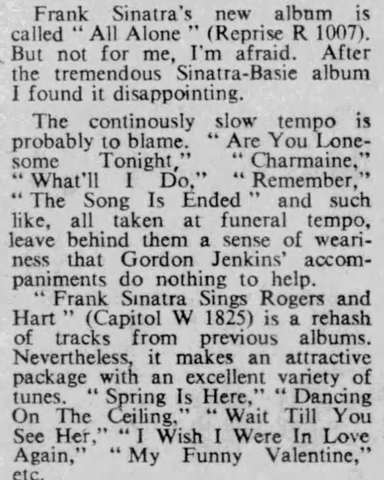
Los Angeles
740 The Song Is Ended
741 All Alone
742 Charmaine
743 When I Lost You
Hi Fidelity
Fall 1962
Don Lass
Asbury
Park Press
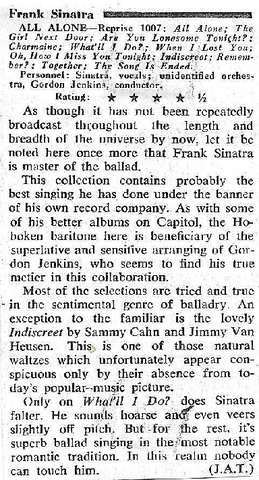
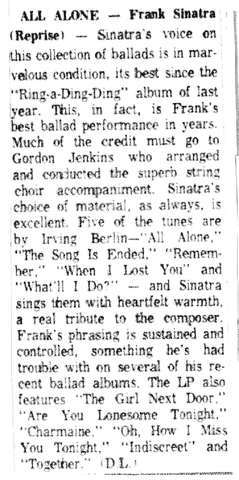
Rites Set For Kovacs
HOLLYWOOD (AP) - Ernie Kovacs, the mustachioed comedian who once said every moment of life should be enjoyed, lived and treasured, will be buried today with simple Presbyterian rites.
Ernie often said he didn't want to leave with the usual fanfare of Hollywood funerals, so his widow, singer Edie Adams, arranged the brief church rites and private burial at Forest Lawn's Hollywood Hills Cemetery. There will be no eulogy.
The 42-year-old comedian was killed early Saturday when his compact station wagon skidded into a telephone pole.
Jack Lemmon, Frank Sinatra, Dean Martin, Billy Wilder, Dick Quine and Joe Mikalos will be active pallbearers. Kavacs' father, Andrew Kovacs, and the comedian's brother, Tom Kovacs, will be honorary pallbearers. Miss Adams, badly shaken by the accident and under heavy sedation, was able to leave her bed yesterday. She spent some time with the Kovacs' three children and with her mother, who flew here Saturday from Englewood, N. J. The two older girls, Betty, 15, and Kippie, 13 - Kovacs' daughters by a previous marriage - were taking their father's death very hard, a friend said. Mia Susan, 2, is the only child of Kovacs' nine-year marriage with Miss Adams. Stacks of telegrams from friends and fans piled up at the comedian's $600,000 home. Actress Kim Novak, director Quine and actor Lemmon headed the 1st of screenland visitors who tried to console Miss Adams.
Note: Above extra contributed by Richard Cook
[Sinatra pallbearer for Ernie Kovacs]
Kaplan suggests Sinatra's haggard appearance at the first All Alone session may have owed less to dissipation than to grief: earlier that day he had served as a pallbearer at the funeral of comedian Ernie Kovacs, who had just died in a car crash at age 42.
Source: James Kaplan, "Sinatra: The Chairman" (2015).
Frank recorded 12 songs for the All Alone album, including 'Are You Lonesome Tonight?'; listening to himself on the radio in Palm Springs during this period, he remarked on how hard it had become for him to reach that same emotional rawness.
Frank Sinatra (quoted): "That was tough to do. I couldn't do that anymore."
Source: Nancy Sinatra, Frank Sinatra: An American Legend, 1995.
January 16, 1962
Studio
Los Angeles
744 Remember
(Irving Berlin)
Williamson Music Co. (ASCAP)
Arranged & Conducted by Gordon Jenkins
-3 (3:23) CD: 46013-2 The Complete Reprise Studio Recordings Disc 3
LP: FS1007All Alone
745 Together
(B.G. DeSylva/Lew Brown/Ray Henderson/Stephen Ballantine) Chappell & Co. Inc./The Songwriters Guild/Stephen Ballantine Music Publishing (ASCAP)
Arranged & Conducted by Gordon Jenkins
-6 (3:21) CD: 46013-2 The Complete Reprise Studio Recordings Disc 3
LP: FS1007All
746 The Girl Next Door
(Hugh Martin/Ralph Blane)
EMI Feist Catalog Inc. (ASCAP)
Arranged & Conducted by Gordon Jenkins
-5 (3:17) CD: 46013-2 The Complete Reprise Studio Recordings Disc 3
LP: FS1007All Alone
Ed O'Brien:
I feel this recording from the "Come Waltz With Me" sessions is much superior vocally to the other songs done in January of 1962. Really sounds like it belongs on another album. Sinatra loved the song and sang it often through the years. But this recording is at an extraordinarily high level and I wonder why? Is it because he knew it better than the other songs done at the three sessions? Or is it because he so admired the craftsmanship of Martin & Blane ? Whatever the answer might be this is certainly a great recording. Listen to his reading of the verse. Terrific, terrific breath control, marvellous, intonation and the effort exudes supreme confidence.
I like it better than the Capitol recording.
747 Indiscreet
(Sammy Cahn/Jimmy Van Heusen)
WB Music Corp./Edwin H. Morris & Co., Inc./The Songwriters Guild (ASCAP) Arranged & Conducted by Gordon Jenkins
-2 (3:51) CD: 46013-2 The Complete Reprise Studio Recordings Disc 3
CD: 9-26723-2Sings The Songs Of Van Heusen & Cahn
LP: FS1007All Alone
45: 20,107 (Edited)
ALL ALONE
Frank Sinatra. Reprise R 1007 (M); R 9 -1007
Sinatra has another mighty impressive package in this LP which contains 11 of the great love ballads, all sung with simplicity and nostalgia. The theme, of course. is heartbreak, and the backings are beautifully woven by Gordon Jenkins.
Strings and woodwinds form a velvety background for the Sinatra style. "All Alone," "Charmaine," "Are You Lonesome Tonight" and "What'll I Do" are some of the more impressive tracks.
Billboard
10-27-62
Los Angeles
744 Remember
745 Together
746 The Girl Next Door
747 Indiscreet
Rock Island Argus,
Rock Island, Illinois
11-17-62
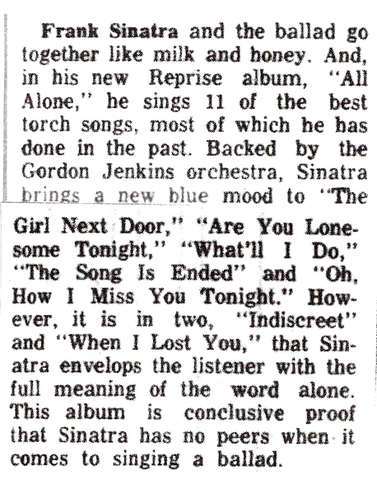
January 17, 1962
Studio
Los Angeles
748 What'll I Do?
(Irving Berlin)
Williamson Music Co. (ASCAP)
Arranged & Conducted by Gordon Jenkins
-6 (3:15) CD: 46013-2 The Complete Reprise Studio Recordings Disc 3
CD: 9-26340-2 The Reprise Collection
LP: FS1007 All Alone
749 Oh, How I Miss You Tonight
(Benny Davis/Joe Burke/Mark Fisher)
Bourne Co./Music Sales Corp./Benny Davis Music (ASCAP)
Arranged & Conducted by Gordon Jenkins
-3 (3:21) CD: 46013-2 The Complete Reprise Studio Recordings Disc 3
LP: FS1007All Alone
750 Are You Lonesome Tonight?
(Roy Turk/Lou Handman)
Bourne Co./Cromwell Music Inc. (ASCAP)
Arranged & Conducted by Gordon Jenkins
-2 (3:29) CD: 46013-2 The Complete Reprise Studio Recordings Disc 3
LP: FS1007All Alone
751 Come Waltz With Me
(Sammy Cahn/Jimmy Van Heusen)
WB Music Corp./The Songwriters Guild (ASCAP)
Arranged & Conducted by Gordon Jenkins
-1 (2:53) CD: 46013-2 The Complete Reprise Studio Recordings Disc 3
CD: 9-26723-2Sings The Songs Of Van Heusen & Cahn
LP: P-7722 All Alone ( Japan )
Scott Henderson:
I listened to "What'll I do" today (2011) on the anniversary of the recording date. To me, this is one of the most haunting songs Sinatra ever recorded. Am I mistaken or was this recorded shortly after Sinatra was pall-bearer at Ernie Kovacs' funeral or am I thinking of another tune?
Ed O'Brien:
Kovacs' funeral was on 1-15-62. That evening Sinatra did the first session for the "Come Waltz With Me" album. The session reveals a man in not particularly good voice. The last song done that evening was Berlin's "When I Lost You." Pete Levinson was at all three sessions for the album. He told me Sinatra was as pale as ashes that first night. When he started singing everyone in the room thought the night would be very short. Frank didn't agree and persevered. The album would eventually be retitled and released as "All Alone." It has the distinction of being the first Sinatra album to not break into the Billboard Top 20(#25 - charted for 17 wks)..
Los Angeles
748 What'll I Do?
(Irving Berlin)
Williamson Music Co. (ASCAP)
Arranged & Conducted by Gordon Jenkins
-6 (3:15) CD: 46013-2 The Complete Reprise Studio Recordings Disc 3
CD: 9-26340-2 The Reprise Collection
LP: FS1007 All Alone
749 Oh, How I Miss You Tonight
(Benny Davis/Joe Burke/Mark Fisher)
Bourne Co./Music Sales Corp./Benny Davis Music (ASCAP)
Arranged & Conducted by Gordon Jenkins
-3 (3:21) CD: 46013-2 The Complete Reprise Studio Recordings Disc 3
LP: FS1007All Alone
750 Are You Lonesome Tonight?
(Roy Turk/Lou Handman)
Bourne Co./Cromwell Music Inc. (ASCAP)
Arranged & Conducted by Gordon Jenkins
-2 (3:29) CD: 46013-2 The Complete Reprise Studio Recordings Disc 3
LP: FS1007All Alone
751 Come Waltz With Me
(Sammy Cahn/Jimmy Van Heusen)
WB Music Corp./The Songwriters Guild (ASCAP)
Arranged & Conducted by Gordon Jenkins
-1 (2:53) CD: 46013-2 The Complete Reprise Studio Recordings Disc 3
CD: 9-26723-2Sings The Songs Of Van Heusen & Cahn
LP: P-7722 All Alone ( Japan )


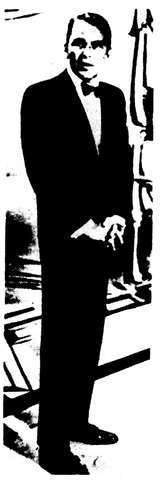
Los Angeles
748 What'll I Do?
749 Oh, How I Miss You Tonight
750 Are You Lonesome Tonight?
751 Come Waltz With Me
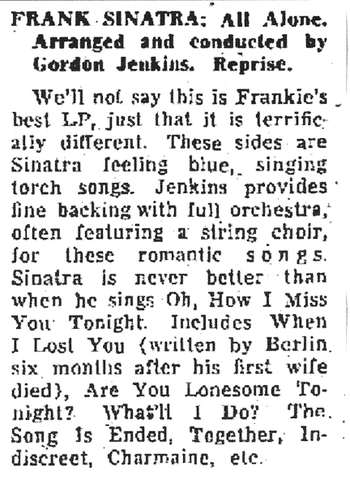
"Are You Lonesome Tonight?"
Gordon Jenkins (via Nick Fatool); Peter Levinson: Gordon Jenkins told drummer Nick Fatool over drinks after a date, "Frank puts himself in the mood to sing a [particular] song"; Fatool felt Sinatra especially inhabited the mood for these 'prehistoric waltzes,' particularly "Are You Lonesome Tonight?" PR man Peter Levinson, who attended the All Alone sessions, recalled: "Frank looked like hell when he came in. It was if he'd just been to nine orgies. Nobody could believe that he sang as beautifully as he did on that album."
Source: Will Friedwald, "Sinatra! The Song Is You: A Singer's Art" (2018 revised edition).
[Kilgallen suggests publicity stunt]
Dorothy Kilgallen: Columnist Dorothy Kilgallen wrote that gossip circles were split on whether the Sinatra-Prowse engagement was a genuine romance or "merely a marvelous publicity stunt" meant to boost Prowse's career, noting Sinatra's publicists had been trying to book her a major TV spot right after the announcement.
Source: James Kaplan, "Sinatra: The Chairman" (2015).
[Come Waltz with Me -- critical commentary]
Steve Lawrence: The 1962 Jenkins/Sinatra album originally intended as Come Waltz with Me was retitled All Alone; Sinatra commissioned a title song from Cahn and Van Heusen but ultimately cut it from the record -- the only time he deleted a specially commissioned title track. Steve Lawrence explained how the song found a home elsewhere: arranger Sid Feller was doing his own album of waltzes, met with Sammy Cahn, and Cahn said 'I got a great song' -- so Lawrence and Feller titled their own album Come Waltz with Me. The Sinatra/Jenkins track was restored only as a bonus cut on the 1992 CD reissue of All Alone.
This song/context matches multiple dated entries in the chronology; the specific date Friedwald is referring to could not be determined with confidence.
Source: Will Friedwald, "Sinatra! The Song Is You: A Singer's Art" (2018 revised edition), Ch. 8, "Gordon Jenkins" (1956-1981)
January 22, 1962
Filming began on The Manchurian Candidate, with Frank playing a tormented former Korean War POW; during a karate scene with Henry Silva he accidentally broke a table and his own finger but kept filming without telling anyone until the scene wrapped.
Source: Nancy Sinatra, Frank Sinatra: An American Legend, 1995.
January 26, 1962
Television
The Soupy Sales Show
Network: ABC-TV
Friday Evening
7:30 p.m. - 8:00 p.m.
Guest: Frank Sinatra
The Soupy Sales Show
Network: ABC-TV
Friday Evening
7:30 p.m. - 8:00 p.m.
Guest: Frank Sinatra
Frank did a slapstick pie-throwing comedy bit on The Soupy Sales Show, fulfilling a promise he'd made to his children, who loved old Mack Sennett comedies.
Source: Nancy Sinatra, Frank Sinatra: An American Legend, 1995.
February 1962
Frank Sinatra abruptly announced his engagement to twenty-six-year-old dancer Juliet Prowse, whom he'd met while filming Can-Can, giving her a five-carat diamond at an engagement party hosted by Michael Romanoff. Many close to Sinatra, including Sammy Davis Jr. and Dean Martin, suspected the engagement was at least partly a publicity maneuver — meant to create distance from his increasingly troubled relationship with Marilyn Monroe, and to boost the then-unknown Prowse's career — a suspicion Prowse herself all but confirmed to a friend, dismissing the engagement as “just for fun.” The engagement quietly ended a few months later. Source: J. Randy Taraborrelli, Sinatra: Behind the Legend.
[Don Ross visits Sinatra at Madison Square Garden]
Don Ross: Herald Tribune reporter Don Ross visited the Garden set (dressed as a political convention) and found a surprisingly charming, un-hungover Sinatra with no bodyguards in evidence, who ran a fast 50-yard sprint for a scene and credited golf, tennis, swimming and calisthenics for staying in shape.
Source: James Kaplan, "Sinatra: The Chairman" (2015)
[Joe Hyams finds a 'new' Sinatra]
Joe Hyams: Herald Tribune columnist Joe Hyams visited Sinatra on the Manchurian Candidate set at Goldwyn Studios after hearing he'd become a "lovable" new man since his engagement -- Coke instead of vodka, a pipe instead of cigarettes, calmly listening to a relaxation record. Hyams noted Frank's eyes iced over when needled about the change, so he dropped the subject.
Source: James Kaplan, "Sinatra: The Chairman" (2015)
[Manchurian Candidate location shoot in New York]
Kaplan: Cast and crew traveled to New York in early February for a week of location shooting for The Manchurian Candidate, filming at Madison Square Garden, Central Park, and even Jilly Rizzo's bar (for which Sinatra sent Rizzo a token $1 check).
Source: James Kaplan, "Sinatra: The Chairman" (2015)
[Prowse's fee jumps after breakup]
Kaplan: A spokesman said Prowse showed no tears over the breakup, and TV host Donald O'Connor (with whom she was rehearsing a special) confirmed she worked as hard as ever. A friend noted her Las Vegas asking price had jumped from $500 to $17,500 a week.
Source: James Kaplan, "Sinatra: The Chairman" (2015)
[Reactions to the broken engagement]
Dean Martin / Dorothy Kilgallen: Dean Martin claimed he knew the real story -- that Prowse had wanted Frank to give up his own career -- while Dorothy Kilgallen snidely suggested Sinatra's friends said he was privately laughing at the press for falling for the engagement story.
Source: James Kaplan, "Sinatra: The Chairman" (2015)
[Second Monroe-Kennedy meeting]
Kaplan: Marilyn Monroe and JFK's second meeting occurred at a Manhattan dinner party for the president; again there was no intimacy between them.
Source: James Kaplan, "Sinatra: The Chairman" (2015)
[Sinatra and Nixon cross paths at Toots Shor's]
Earl Wilson: At Toots Shor's in New York, Earl Wilson witnessed Richard Nixon cross the room to shake Sinatra's hand after Mike Romanoff (dining with Frank) went over to greet him. Toots Shor then playfully lifted rolls of bills from Sinatra's pockets, handing out roughly $500 to staff -- an expensive night that cost Frank about $1,000.
Source: James Kaplan, "Sinatra: The Chairman" (2015)
[Sinatra's reading list during shoot]
Frank Sinatra: Asked by Don Ross how he passed time between takes, Sinatra rattled off his current reading: The Agony and the Ecstasy, a Musmanno law book, Louis Nizer's My Life in Court, and a dog-training manual for his new Saint Bernard.
Source: James Kaplan, "Sinatra: The Chairman" (2015)
[Two singles recorded with Neal Hefti]
Kaplan: At the end of February 1962, Sinatra recorded two singles with new arranger Neal Hefti (hired initially as an A&R man/producer to replace Felix Slatkin): the twist-craze cash-in "Everybody's Twistin'" and the forgettable "Nothing but the Best."
Source: James Kaplan, "Sinatra: The Chairman" (2015)
February 4, 1962
Television
Chun King Chow Mein Hour
Sunday Evening
Network: ABC
Location: Paramount Studios
Produced And Directed By: Jack Donahue
Original Music And Script By: Stan Freberg
Music Arranged And Conducted By: Billy May
Time: 6:30 - 7:30 PM EST
Starring: Stan Freberg
Guests: Sterling Holloway, Mike Mazuki, Ginny Tiu, Gloria Wood, Patty Regan, Frances Osborne
Cameo Appearances: Joan Crawford & Frank Sinatra
1. pt. 1 opening
2. pt. 2 production number
3. comedy commercial
4. Sinatra (telegram)
5. pt. 3 the other door
6.. pt. 4 sing along with FREEB
7 pt. 5 comedy
8. pt 6. "The Sale Of Manhattan Island"
9. pt 7. comedy flower arranger
10. musical performance commercial
11. pt. 8 puppet
12. pt. 9 Chinese new year
13. closing live credits
Notes: TT: 60mins. Sinatra make a cameo as a telegram boy.
Ed O'Brien: running gag throughout the show is Freberg delaying the commercial for the sponsor, Chun King Chow Mien. Frank, dressed like a Western Union boy delivers a telegram from the sponsor. There is a brief skit with Freberg.
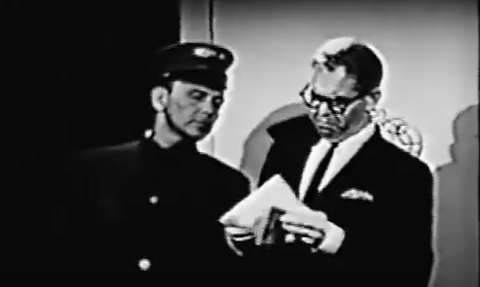
[Elopement rumor floated by Hy Gardner]
Hy Gardner: On the 23rd anniversary of Frank's 1939 wedding to Nancy Barbato, columnist Hy Gardner reported a rumor that Sinatra and Prowse might elope in early March when Frank was booked at the Fontainebleau in Miami Beach.
Source: James Kaplan, "Sinatra: The Chairman" (2015).
February 5, 1962
The Manchurian Candidate production filmed climactic scenes at New York's Madison Square Garden.
Source: Nancy Sinatra, Frank Sinatra: An American Legend, 1995.
February 10, 1962
Film
"Sergeants 3" (US Film Release: February 10, 1962)
Starring: Frank Sinatra, Dean Martin, Peter Lawford, Sammy Davis Jr., Joey Bishop, Henry Silva, Ruta Lee, Buddy Lester
Produced by: Frank Sinatra & Howard W. Koch
Directed by: John Sturges
Mike (Sinatra), Chip (Martin), and Larry (Lawford) are three lusty, brawling U. S. Cavalry sergeants stationed in Indian Territory in 1870. Mike and Chip are determined to prevent Larry from carrying out his decision to leave the Army at the end of his current hitch and marry the beautiful Amelia Parent (Ruta Lee). The 3 Sergeants and trumpet-playing former slave, Jonah Williams (Davis) also work together to thwart a Native American chief intent on uniting local tribes against the white man. (DVD Release date: 2008-05-13)
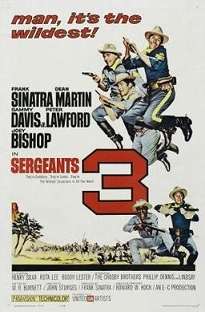
[The Cinematic Legacy of Frank Sinatra — Sergeants 3 (1962)]
David Wills's 2015 photo history The Cinematic Legacy of Frank Sinatra devotes a section to Sergeants 3 (1962), illustrated with 7 behind-the-scenes and publicity photographs (posters, lobby cards, and on-set/on-location shots) filed here.
“Sergeants 3 was one of the happiest experiences of my life, because I was the baby doll on the set with all of those guys. I had a wonderful time but, unfortunately, they all treated me like their kid sister. Dean was great to be around. They all sipped pretty good, but I never saw him sloshed. In fact, he taught me to drink beer on the rocks. And Frank taught me to drink champagne the same way.” —Ruta Lee (Costar, Sergeants 3)
Source: David Wills, The Cinematic Legacy of Frank Sinatra (St. Martin's Press, 2015), pp. 201–208.
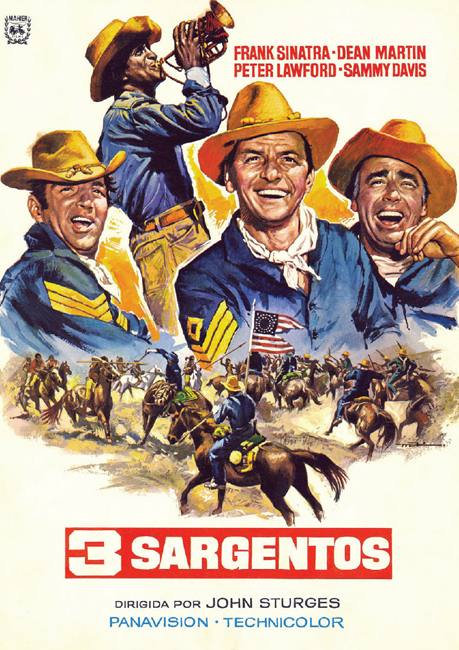
One sheet poster, Sergeants 3, 1962 (Photo: The Cinematic Legacy of Frank Sinatra, David Wills, 2015.)
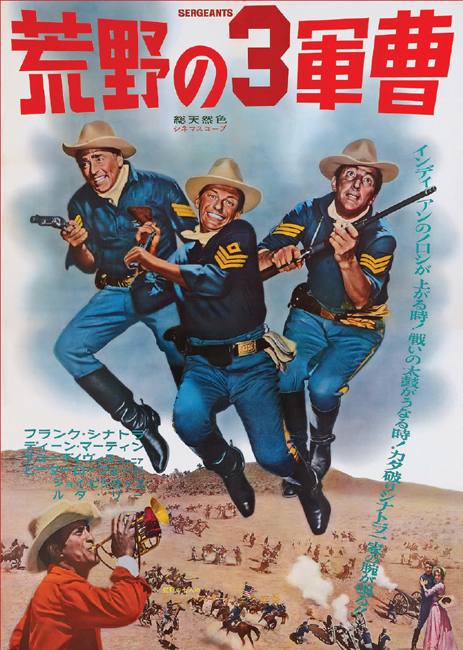
One sheet poster, Sergeants 3, 1962 (Photo: The Cinematic Legacy of Frank Sinatra, David Wills, 2015.)
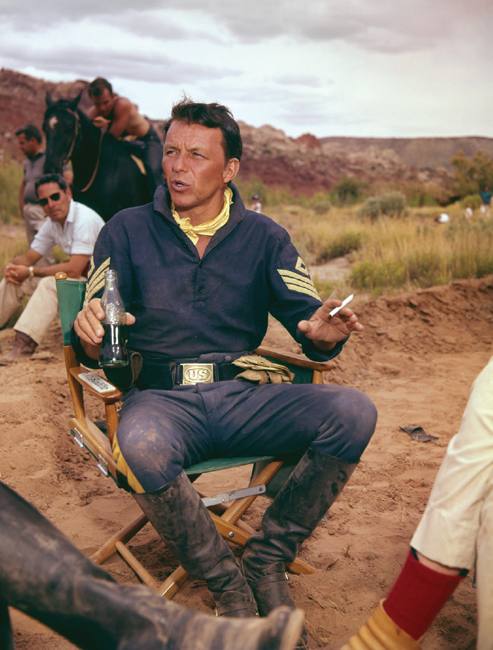
On location in Kanab, Utah, Sergeants 3. / “The next film the Clan did together was / Sergeants 3. We all trooped over to a place in / Utah and met up with the producer, Howard / Koch. [Frank] made seven films for Koch and (Photo: The Cinematic Legacy of Frank Sinatra, David Wills, 2015.)
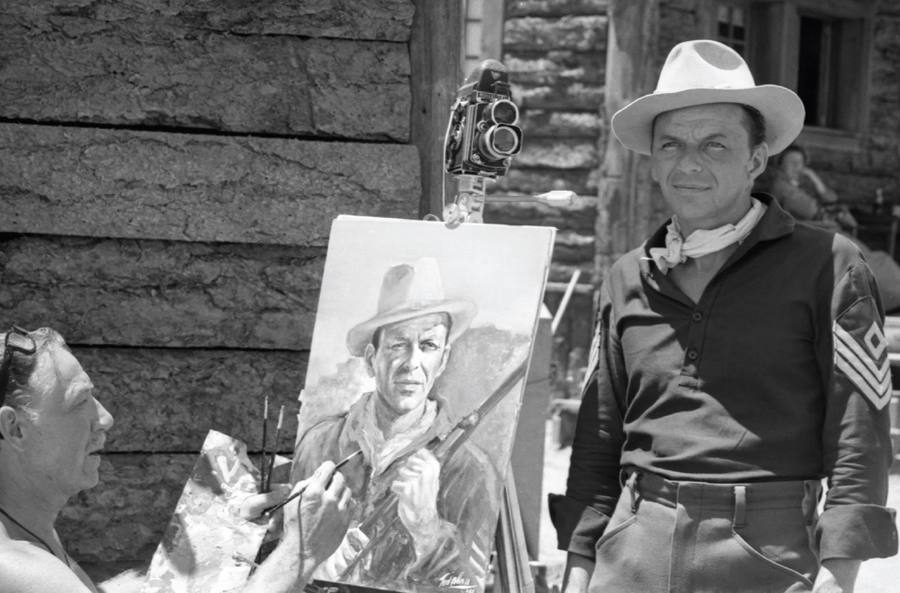
Sinatra having his portrait painted on set. (Photo: The Cinematic Legacy of Frank Sinatra, David Wills, 2015.)
Sinatra having his portrait painted on set. (Photo: The Cinematic Legacy of Frank Sinatra, David Wills, 2015.)
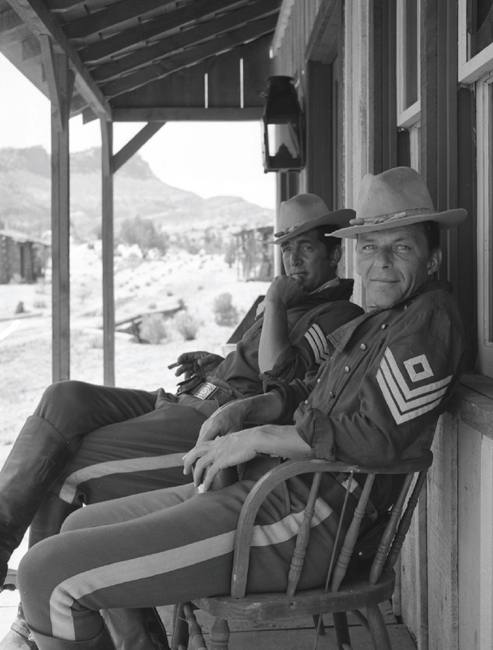
With costar Dean Martin between takes on location in Kanab, Utah. (Photo: The Cinematic Legacy of Frank Sinatra, David Wills, 2015.)
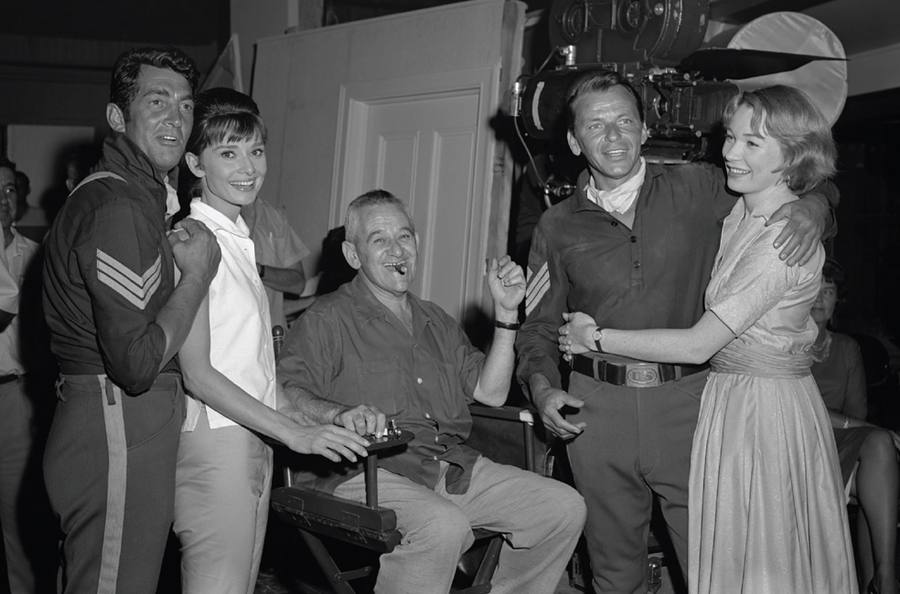
With costar Dean Martin (during a break while filming Sergeants 3) visiting Audrey / Hepburn, director William Wyler and Shirley MacLaine on the set of The Children's Hour, / 1961. (Photo: The Cinematic Legacy of Frank Sinatra, David Wills, 2015.)
"Sergeants 3"
During location shooting for Sergeants 3, a bored 48-year-old Sinatra complained on a helicopter flight from Vegas, prompting Dean Martin to buy two .22-caliber rifles so the group could shoot from the helicopter over the desert the next day.
Source: Tom Santopietro, "Sinatra in Hollywood" (2008).
"Sergeants 3"
Sergeants 3 was produced by Sinatra's Essex Productions with Dean Martin's Claude Productions; Howard Koch Jr. served as executive producer, the first of six collaborations with Sinatra. The film was shot on location in Bryce Canyon National Park under director John Sturges, fresh off The Magnificent Seven.
Source: Tom Santopietro, "Sinatra in Hollywood" (2008).
"Sergeants 3"
Cinematographer Winton C. Hoch, a three-time Oscar winner (Joan of Arc, She Wore a Yellow Ribbon, The Quiet Man) known for John Ford's Westerns, shot Sergeants 3's Bryce Canyon vistas, using color and landscape to elevate an otherwise silly story; composer Billy May initially used a subdued string-laden score before shifting to cartoonish music once the barroom-brawl comedy began.
Source: Tom Santopietro, "Sinatra in Hollywood" (2008).
"Sergeants 3"
Sinatra performed his own stunt in Sergeants 3, being dragged beneath a speeding runaway wagon during a fight scene with Native American attackers.
Source: Tom Santopietro, "Sinatra in Hollywood" (2008).
"Sergeants 3"
Ruta Lee: Co-star Ruta Lee described Sinatra's famous one-take work method: he would arrive on set around eleven giving the crew all the time needed to set up the shot beforehand, but once he walked in to perform, he expected the shot to be perfect immediately, with no complaints about shadows or sound issues discovered afterward.
Source: Tom Santopietro, "Sinatra in Hollywood" (2008).
"Sergeants 3"
Hazel Flynn / Variety: Critic Hazel Flynn of the Hollywood Citizen-News panned Sergeants 3 as 'more din than Gunga,' while Variety mocked it as a '4 million dollar home movie' for Sinatra's 'Cub Scout troupe' — though the film still performed respectably at the box office.
Source: Tom Santopietro, "Sinatra in Hollywood" (2008).
"Sergeants 3"
Santopietro grades this a C, calling it a lesser Rat Pack movie.
Source: Tom Santopietro, "Sinatra in Hollywood" (2008).
"Sergeants 3"
Santopietro (Filmography): Essex-Claude/United Artists. Produced by Howard W. Koch, directed by John Sturges, screenplay by W. R. Burnett. Sinatra played Sergeant Mike Merry opposite fellow Rat Pack members Dean Martin, Sammy Davis Jr., Peter Lawford and Joey Bishop.
Source: Tom Santopietro, "Sinatra in Hollywood" (2008).
February 13, 1962
Radio
Ted Steele did a ten minute interview with Frank on WINS radio, 2-13-62, NYC. He was on location shooting "The Manchurian Candidate."
Note: Thanks to Ed O'Brien for this radio interview entry.
DJ Ted Steele hosted a 'Sinatrathon' on New York's WINS radio, 66 consecutive hours of Sinatra songs.
Source: Nancy Sinatra, Frank Sinatra: An American Legend, 1995.
February 14, 1962
[Engagement party at Romanoff's]
Kaplan / Louella Parsons: On Valentine's Day, Mike and Gloria Romanoff hosted an engagement party for Sinatra and Prowse at Romanoff's restaurant. Columnist Louella Parsons wrote that skeptics were now conceding Frank meant it about settling down, and Sammy Davis Jr. announced he'd booked singer Joe Williams to perform at the wedding.
Source: James Kaplan, "Sinatra: The Chairman" (2015).
February 20, 1962
[Wedding gown reportedly canceled]
Louella Parsons received a tip that Prowse had canceled her wedding gown and trousseau, an early sign the engagement was collapsing.
Source: James Kaplan, "Sinatra: The Chairman" (2015).
February 21, 1962
[Engagement called off]
Essex Productions statement: Essex Productions issued a terse statement announcing that Sinatra and Prowse had called off their wedding due to a "conflict in career interests," with a spokesman adding there would be no further comment. The engagement had lasted 43 days.
Source: James Kaplan, "Sinatra: The Chairman" (2015).
February 22, 1962
Weeks after announcing their engagement, Frank and Juliet Prowse called it off, unable to agree on how much time she should devote to her dance career.
Source: Nancy Sinatra, Frank Sinatra: An American Legend, 1995.
February 25, 1962
Television
Judy Garland Show
Network: NBC
Time: 9:00 P.M. - 10:00 P.M.
Guests: Frank Sinatra, Dean Martin
1. Opening overture
2. Just In Time/When You're Smiling/ You Do Something To Me Judy
Chemstrand commercial
3.. Too Marvelous For Words Frank
4. You Must Have Been A Beautiful Baby Dean
5. You Do Something To Me Judy, Frank, Dean
Chemstrand commercial
6. I See Your Face Before Me Frank
7. The Man That Got Away Judy
Chemstrand commercial
8.. The One I Love Belongs To Somebody Else
Frank and Dean
9. I Can't Give You Anything But Love Judy
10. Let There Be Love/You're Nobody Till
Somebody Loves You Judy, Frank, Dean
Chemstrand commercial
11. You Made Me Love You/The Trolley Song/ Rock-A-Bye Your Baby/Swanee/ San Francisco - Judy
12. closing
NOTE: Sinatra Scholar Ed O'Brien reports that he interviewed the guitarist Al Hendrickson.. He played on many sessions with Frank at Columbia , Capitol, and Reprise. He also did TV and concert work with him. Al told O'Brien that Dean and Frank footed the bill for Judy's 1962 special and then convinced CBS and Bill Paley to do the show by agreeing to be the guest stars. He remembered the rehearsals in January of 62 and the time and care both took in helping Judy,
He also related a story about Judy from 1953-54, O'Brien continues.. Frank was determined to get her back on her feet and decided that throwing a party at his home was the answer. All the A power makers were invited and Frank did the cooking. Al was part of a trio hired to entertain during the party. He couldn't believe how much Frank agonized over the spaghetti sauce. He had to have it just right and kept asking people to taste it. Early on it became apparent that Judy would be a no-show. Sinatra was furious and didn't know what to do. Bogie picked up the phone, called Judy, told her a car would be at her house in a few minutes, and they expected her to show up. Al remembered Bogie using some very colorful language. Judy didn't argue and everything came off quite smoothly. Al also told O'Brien some great stories about Frank and Billy May.
Judy Garland Show
NYT
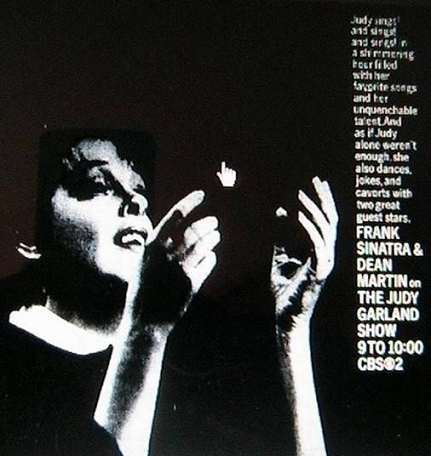
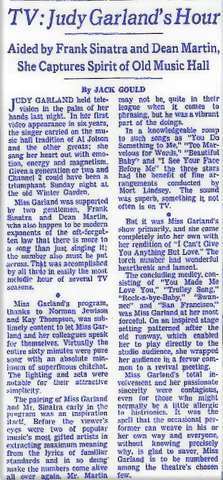
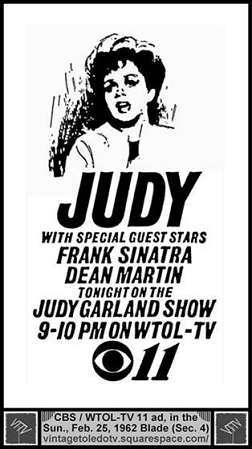
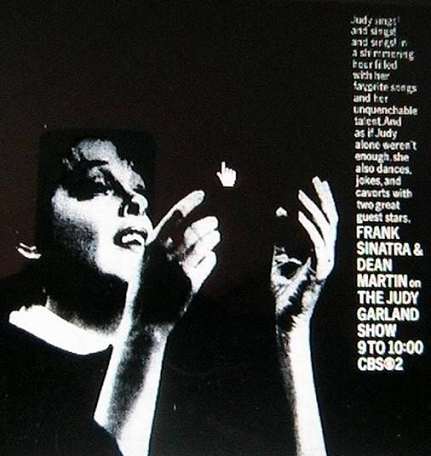
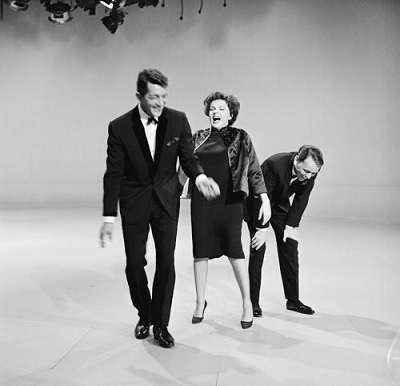
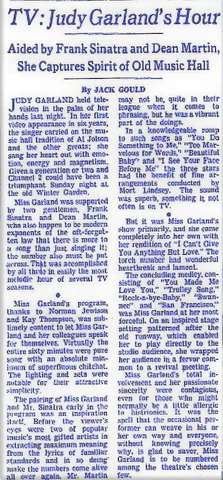
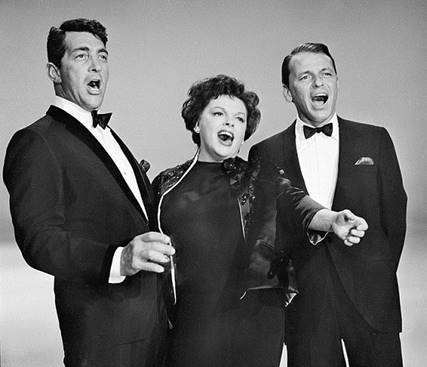
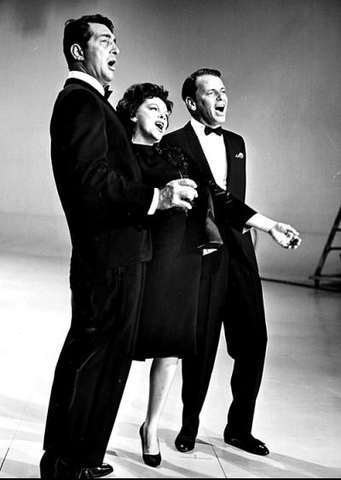
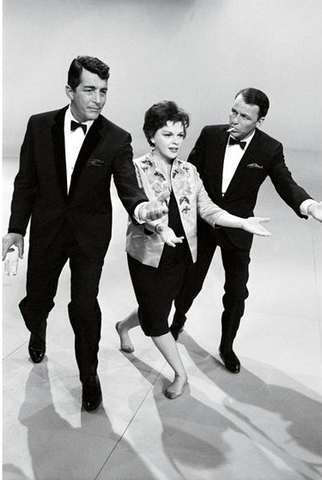
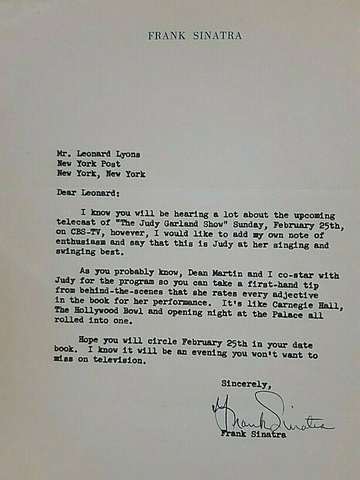
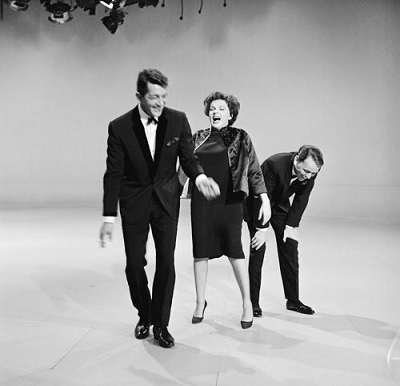
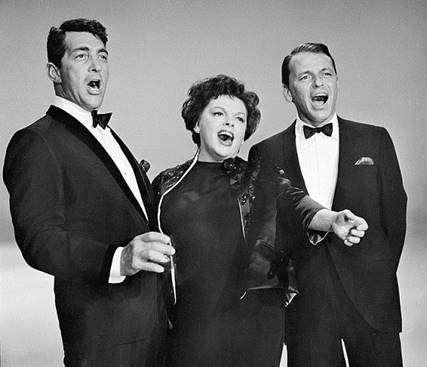
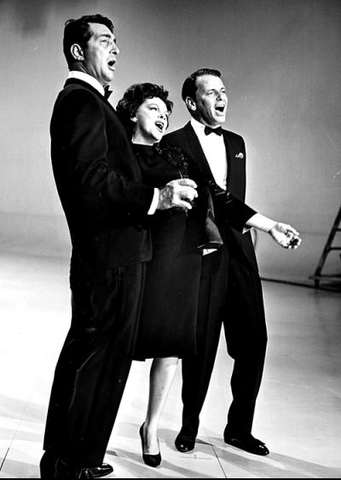
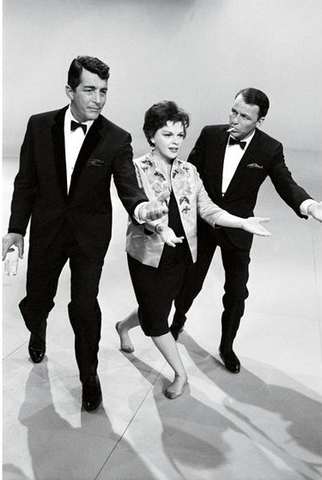
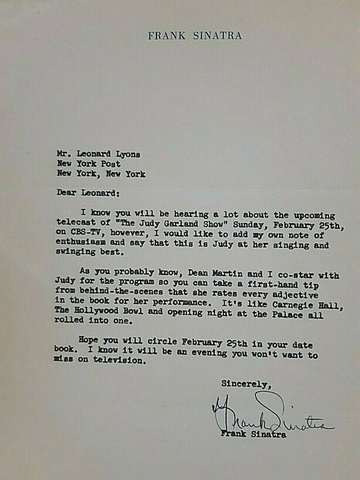
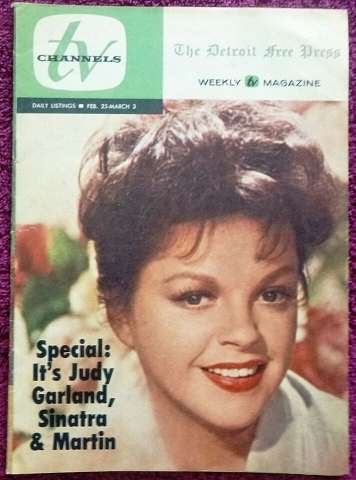
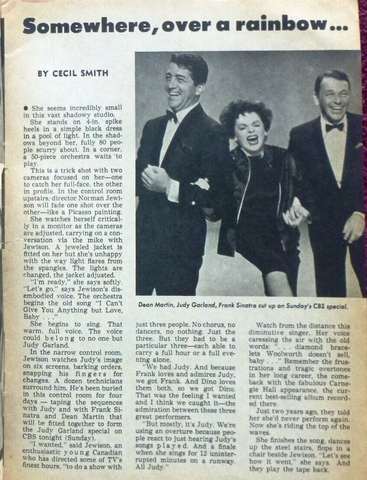
[Sinatra and Martin on Judy Garland's CBS special]
On a Sunday night, Frank and Dean Martin appeared in supporting roles on Judy Garland's CBS musical special, directed by a young Norman Jewison, at a moment when Garland's career was on an upswing following her Carnegie Hall triumph and a Best Supporting Actress Oscar nomination. Sinatra, playing the romantic swain to Garland, sang well and threw real effort into his acting.
Source: James Kaplan, "Sinatra: The Chairman" (2015).
February 26, 1962
[FBI memo notes Campbell's calls to Sinatra's home]
FBI internal memo: An internal FBI memo dated February 26, 1962, noted that a review of Judith Campbell's phone toll records showed four calls in December 1961 to Sinatra's Palm Springs residence, in addition to calls to Sam Giancana.
Source: James Kaplan, "Sinatra: The Chairman" (2015).
February 27, 1962
Studio
Los Angeles
924 Everybody's Twistin'
(Ted Koehler/Rube Bloom)
WB Music Corp. (ASCAP)
Arranged & Conducted by Neal Hefti
-11 (2:30) CD: 46013-2 The Complete Reprise Studio Recordings Disc 3
LP: FS5238 (Italy)
45: 20,063
Earlier this week, I received a query regarding this recording.
Here is the response I sent. I think it might be of interest.
Sinatra knew Rube Bloom for many years. There are concerts where Rube is in the audience and Frank introduces him. Frank ran into Bloom at a bar on Broadway and West 58th Street while filming "The Manchurian Candidate," on location in New York. Rube was depressed because his kind of music was no longer in demand. He invited Rube out to Palm Springs and had "Truckin' by Bloom and Koehler revised for a song on the twist craze. It was recorded on 2-27-62 and released as a single. The rights back then belonged to Sergeant's Music, owned by Sinatra. The song only charted for two weeks, reaching a peak position of #75. It is an awful recording. The B-side "Nothing But The Best" is vastly superior. Bloom and Koehler collaborated on the new lyrics for "Everybody's Twistin'" Frank did 11 takes. "Truckin'" was written in 1935 and was a #1 hit for the great Fats Waller. Ed
925 Nothing But The Best
(Johhny Rotella)
Jay Music (ASCAP)
Arranged by Skip Martin
Conducted by Neal Hefti
-3 (3:00) CD: 46013-2 The Complete Reprise Studio Recordings Disc 3
LP: FS5238 (Italy)
45: 20,063
Ed O'Brien (2015):
When the single was released "Twistin' " got all the airplay. The picture sleeve was all about the Koehler-Bloom song -- Frank knew Rube Bloom had fallen on hard times and opted for his melody -- but through the years "Nothin' But The Best" has not only been recognized, it is now a Sinatra standard. Skip Martin gave Frank a terrific chart. He nailed it in three takes. "Twistin" required 11 and despite Hefti's best efforts, it just lays there.
Sinatra Scholar Ed O'Brien writes that he ran out and bought this single. It had a picture sleeve but he found "Twistin'" so atonal that he started listening to "Nothing But the Best" and liking it more than the A side. He got to thinking about how many times that happened. Here are the ones he recalls with the discovered gem listed first and then the "A" side bringing up the rear:
1. Weep They Will (that falsetto moment is so, so exquisite) The Tender Trap
2. Sleep Warm (Lew Spence told Ed that Frank didn't get it right. Not bad for wrong!) Mr. Success
3. All My Tomorrows (Reprise effort is even better but this ain't chopped liver). High Hopes.
4. This Was My Love (a poem set to music). Nice 'N' Easy.
5. Name It and It's Yours (similar to "All my Tomorrows.") Pocketful of Miracles.
6. Nothin' but the Best (The Good Life). Twistin'.
7. I Like to Lead When I Dance (Cahn thought it was like one of his very best. Great vocal.) My Kind of Town
8. You Are There (in autumn gold or summer green gets to O'Brien.) World We Knew. Interesting vocal gymnastics. Crappy song.
9. Cycles (Frank undersings beautifully on this one.) My Way of Life. Unlistenable.
10. Star (Love Cahn's insider lyrics.) Rain in My Heart. Teddy Randazzo told O'Brien that Frank thought he had another "Stranger in the Night" in this ditty.
11. Blue Lace (O'Brien loves the imagery that evokes lovely visual moments while listening.) My Way.
When Sinatraphile Rich Rosenberg asked, "Hey, what's wrong with "The Tender Trap, It's a sort of generic uptempo Sinatra single with a big ending! O'Brien comments that nothing is wrong with "The Tender Trap." He simply prefers "Weep They Will." He thinks it a fabulous recording by Sinatra. When Frank was recording "Trap" he complained about the high F note that Van Heusen had written. Chester shot back that he shouldn't be in the business if that was a problem. Frank didn't say a word but he hit the note perfectly and held it.
Sinatraphile Ed Spiegel pointed out that another single where the "B" side is way ahead of the plug side is "Forget to Remember" with some of Sinatra's best and most controlled incredible singing. The "A" side, "Goin' Out of my Head" is a good record, but "B" has it beat.
Spiegel also commends O'Brien for his fine book, SINATRA 101, and suggests that it may well be due for a reissue. Fine book and there are too few Sinatra books that are about the music, Spiefel emphasizes.
O'Brien then thanks Spiegel. He observes that through the years he has received numerous letters and e-mails regarding my books. The number of people who thanked me for including "Forget to Remember" in 101 easily outdistances any other comments in the selections,
Los Angeles
Everybody's Twistin'
Reprise released this single during the second week of March in 1962. The A-side was the "Twistin' " song. It peaked at #75 on Billboard and charted for two weeks. Here is something I have never seen before. Billboard, in their review of the single, ignored the preferred preference of the record label. The magazine spotlighted "Nothing 'But The Best" and gave it a higher rating.
FRANK SINATRA * * ** Nothing But the Best -REPRISE 20063 -Tasteful warbling stint by Sinatra on smart, lightly swinging theme with strong backing by Neal Hefti. Could grab a lot of exposure. (Barton, ASCAP) (3:00) * ** Ev'rybody'a Twistin' - (Mills, ASCAP) (2:30) Billboard
3-17-62 note: Skip Martin, who did wonderful charts on "Well, Did You Evah!," "Be Careful It's My Heart," "I Got A Right To Sing The Blues," does not receive credit for his arrangement of "Nothing But The Best." Typical behavior of a record company back then.
[image referenced in source but could not be recovered]
[image referenced in source but could not be recovered]
[image referenced in source but could not be recovered]
[image referenced in source but could not be recovered]
[image referenced in source but could not be recovered]
[image referenced in source but could not be recovered]
[image referenced in source but could not be recovered]
[Hoover notifies RFK about Campbell]
Kaplan / Seymour Hersh: FBI director J. Edgar Hoover sent Attorney General Robert Kennedy a memo formally notifying him that Judith Campbell had also been placing calls to the White House -- something both men had already known -- partly as a move in Hoover's power struggle with the Kennedys.
Source: James Kaplan, "Sinatra: The Chairman" (2015).
The Secret Service chose Bing Crosby's Palm Springs house over Frank's for JFK's planned visit, reportedly citing security concerns and, according to some accounts, Frank's associations; Peter Lawford was said to be 'hysterical' since Kennedy had promised to stay with Sinatra. JFK stayed at Crosby's and phoned Frank from there instead.
Source: Nancy Sinatra, Frank Sinatra: An American Legend, 1995.
March 1962
[JFK's Cancelled Compound Visit]
Sinatra rushed construction of a new guest building at the Compound to host the Secret Service ahead of a planned presidential visit, only to learn just before the trip that Kennedy would stay at Bing Crosby's home instead for security reasons — a public snub that ended Sinatra's friendship with Peter Lawford.
Source: Tina Sinatra, "My Father's Daughter: A Memoir" (2000).
[Compound prepared for presidential visit]
George Jacobs / Tina Sinatra: Sinatra's staff scrambled for weeks to prepare for the visit, converting the Christmas Tree House bungalow for the Secret Service, building a concrete helipad, and installing a dedicated "hotline" phone. Valet George Jacobs recalled the frantic planning; Tina Sinatra wrote that her father fantasized the compound becoming the "western White House."
Source: James Kaplan, "Sinatra: The Chairman" (2015)
[Frank learns the Palm Springs visit is off]
Kaplan: More than two weeks before the Hoover-JFK lunch, Peter Lawford called Sinatra with word that the president's Palm Springs visit was canceled, initially citing Secret Service security concerns about the open compound. Frank pressed Lawford and learned the real reason: Bobby Kennedy didn't want the president staying somewhere Sam Giancana had also stayed.
Source: James Kaplan, "Sinatra: The Chairman" (2015)
[JFK stays at Bing Crosby's instead]
Kaplan / George Jacobs: President Kennedy ended up staying at Bing Crosby's house in Palm Desert, with his Secret Service detail billeted next door at Jimmy Van Heusen's place -- a humiliation compounded, per Jacobs, by the fact that Sinatra viewed Crosby as a rival despite their long friendship and shared work together.
Source: James Kaplan, "Sinatra: The Chairman" (2015)
[Sinatra trashes his own house in anger]
Kaplan: In a rage, Sinatra reportedly smashed his collection of JFK photographs, kicked in the door of the presidential guest room, and tried to pry the gold commemorative plaque off it; legend (denied by Tina Sinatra) holds he also took a sledgehammer to the newly built helipad.
Source: James Kaplan, "Sinatra: The Chairman" (2015)
[Sinatra's rage at the canceled visit]
George Jacobs: According to valet George Jacobs, Frank smashed a phone against the wall, called Robert Kennedy directly demanding to know what was happening, and smashed a second phone when Bobby hung up on him. When Lawford confirmed new lodgings had already been arranged, Sinatra silently dropped the phone and stared out at the desert for several minutes before he could speak.
Source: James Kaplan, "Sinatra: The Chairman" (2015)
[personal life]
Peter Lawford's fall from Sinatra's favor stemmed from President Kennedy's cancellation of a planned March 1962 weekend stay at Sinatra's Palm Springs compound; Lawford was delegated by the Kennedys to deliver the bad news to Frank, who blamed the messenger.
No corresponding dated entry could be identified in the chronology for this film/context.
Source: Tom Santopietro, "Sinatra in Hollywood" (2008), The Rat Pack (pt. 1)
[JFK snubs Frank's Palm Springs 'West Coast White House']
Frank had renovated his Palm Springs home, which he called the "West Coast White House," to host President Kennedy overnight, but Robert Kennedy and the Secret Service decided against the stay and JFK lodged with Bing Crosby -- a Republican -- in Palm Desert instead. Furious, Frank later snapped at songwriter Jimmy Van Heusen during a session, telling him to have "Jack Kennedy" record the song they were working on and see how it sold, then walked out without finishing it.
Source: Richard Havers, "Sinatra" (Dorling Kindersley, 2007).
March 4, 1962
Bob Hope is kissed by his wife, Dolores, when presented with the Milestone Award at Screen Producers Guild annual dinner. Frank Sinatra, on the right, looks on. March 4, 1962
March 6, 1962
Studio
Los Angeles
E37303 I Gotta Right To Sing The Blues
(H. Arlen/T. Koehler)
Warner Bros., Inc. (ASCAP)
Arranged & Conducted by Skip Martin
-3 (2:58) CD: CDP 7-94520-2 Come Swing With Me
CD: C2-94777 The Capitol Years
LP: SW1729 Sings Of Love And Thing
Hollywood
939 The Boys Night Out
(Sammy Cahn/Jimmy Van Heusen)
EMI Miller Catalog Inc. (ASCAP)
Arranged & Conducted by Neal Hefti
-1 (2:48) CD: 46013-2 The Complete Reprise Studio Recordings Disc 3 -CD: Lucky Numbers (Reprise 46853)
NOTE: Sinatra Scholar Ed O'Brien points out that both songs were recorded at United Recording Studio. He has the AFM sheets showing the time of the session (11 p.m. – 2 a.m.), Billy May and Bill Miller were both paid $163.32 and Al Viola received $81.66. The total cost for the 39 piece orchestra and May came to $3,555.72. The checks were mailed out on April 11, 1962. There was no mention of Skip Martin being paid for his arrangement on the Arlen/Koehler tune. An orchestra track was laid down for the Cahn/Van Heusen song "Cathy", also from "Boys Night Out". May told O'Brien that Frank was going to overdub at a later session. "Blues" was done in 3 takes and the title track for the film required four takes. Alan Livingston told O'Brien that Capitol insisted on getting that final recording because there was bad feelings at the time between Capitol and Sinatra. In retrospect, he felt the company had made a mistake.
940 Cathy( Orchestral track only )
Arranged and Conducted by Billy May
(Sammy Cahn/Jimmy Van Heusen)
note: Here is the second page of the AFM recording sheet.
You will see all three songs were laid down at United Recording in Hollywood. There was a 39 piece orchestra. Billy May conducted. He told me Frank started to do "Cathy" but his anger toward Van Heusen erupted and Frank departed. About 20 mins later, Billy got a call from him. instructing Billy to lay down the orchestral track. Frank told Billy he would come in within a few days and do the overdub. It never happened. Billy told me it was a very pretty song and he was sorry Frank didn't follow through.
Ed
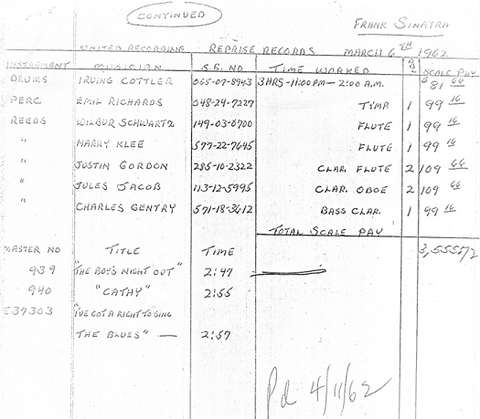
"The Boys' Night Out" / "Cathy"
'Cathy' only got as far as an instrumental track. 'Boys' Night Out' went unheard until the 1995 Complete Reprise box; May's characteristically irreverent arrangement quotes 'Entrance of the Gladiators' (the circus parade march) and Stan Kenton's 'Artistry in Rhythm,' complete with a police whistle. Friedwald reads Cahn's lyrics ('Hey there mister / Build a fence around your sister / It's the boys' night out') as capturing the Rat Pack ethos precisely.
Source: Will Friedwald, "Sinatra! The Song Is You: A Singer's Art" (2018 revised edition).
"I Got a Right to Sing the Blues"
Contractually obligated to deliver one final single to Capitol, Sinatra recorded a flat, affect-less reading of 'I Got a Right to Sing the Blues' at the tail end of a Reprise session at United Recording on March 6, 1962, closing out his Capitol tenure with a simple 'All right, that's all!'
Source: Charles L. Granata, "Sessions with Sinatra: Frank Sinatra and the Art of Recording" (1999/2003).
"The Boys' Night Out" / "Cathy"
Billy May: At the same March 6, 1962 session, Sinatra, agitated over the Kennedy family bypassing his Palm Springs estate for Bing Crosby's, snapped at songwriter Jimmy Van Heusen in the control booth during 'Cathy,' refused to sing it, and let the band cut only an instrumental track before dismissing everyone; he never recorded a vocal for it. 'The Boys' Night Out,' recorded that night, wasn't released until 1995.
Source: Charles L. Granata, "Sessions with Sinatra: Frank Sinatra and the Art of Recording" (1999/2003).
[Sinatra's final Capitol session]
Kaplan / Charles Granata: On the night of March 6, at United Recording, Sinatra reluctantly cut "I Gotta Right to Sing the Blues" to fulfill his last contractual obligation to Capitol Records, insisting on recording at a studio other than Capitol's own. His performance was under-energized rather than fully committed; at the end he muttered "Awright, that's it!" -- his last Capitol recording until the 1990s Duets albums.
Source: James Kaplan, "Sinatra: The Chairman" (2015).
[Sinatra's JFK jab to Van Heusen in the studio]
Billy May / Frank Sinatra: Later the same session, recording Cahn and Van Heusen's "The Boys' Night Out" and "Cathy" with arranger Billy May, Sinatra glared at Van Heusen in the control booth throughout, still stewing over the JFK snub, then snapped that Van Heusen should get Jack Kennedy to record the song and see how it sold.
Source: James Kaplan, "Sinatra: The Chairman" (2015).
March 7, 1962
[Frank retreats to Palm Springs with laryngitis]
On Wednesday, March 7, Frank headed to Palm Springs, reportedly suffering an attack of laryngitis -- an ailment Kaplan notes tended to strike him when other troubles were weighing on him.
Source: James Kaplan, "Sinatra: The Chairman" (2015).
March 9, 1962
[Frank misses Smathers dinner]
UPI: UPI reported on Friday, March 9, that Sinatra was still recovering in the desert and would be unable to attend a Miami Beach dinner President Kennedy was hosting to honor Senator George Smathers.
Source: James Kaplan, "Sinatra: The Chairman" (2015).
March 10, 1962
Having agreed to sing at a 10 March 1962 dinner in Miami honoring Florida Senator George Smathers at JFK's request, Frank pulled out with two days' notice, claiming laryngitis -- widely read as a snub in the wake of the Palm Springs slight. (Source: Richard Havers, "Sinatra" (Dorling Kindersley, 2007).)
March 11, 1962
Radio
Monitor
Location: International Ballroom, Beverly Hilton Hotel, Hollywood, California
Network: NBC
Sunday Afternoon
Highlights of the Screen Producer's Guild 10TH Annual Milestone Award
Recipient: Bob Hope
M.C. Frank Sinatra
Speakers:
General Thomas S. Power: Head of the Strategic Air Command pays tribute to Bob
Bob chats with military personnel in submarines. B-52s, tanks, and soldiers in Greenland, Berlin, Alaska
President Kennedy congratulates Bob
Jack Benny gives a heartfelt tribute
Frank kids about his broken engagement and helicopter pad James Stewart lauds Bob and then presents the award
Bob Hope accepts award and does a funny stand-up routine He kids Sinatra, JFK, Benny and others.
March 22, 1962
[Hoover briefs JFK on Campbell at lunch]
Kaplan / Arthur Schlesinger / Judith Campbell: At a lunch with President Kennedy, J. Edgar Hoover delivered the news about the Judith Campbell situation, bringing along a memo detailing her phone calls; historian Arthur Schlesinger wrote that the calls to the White House ceased from that point on (though Campbell herself disputed that account, saying the relationship ended later, in June, of its own accord).
Source: James Kaplan, "Sinatra: The Chairman" (2015).
[Sinatra flies to Bermuda amid the fallout]
Louella Parsons: Columnist Louella Parsons reported that Frank Sinatra flew from Palm Springs to Bermuda the day before Kennedy was originally due to arrive, noting Sinatra was hurt that his fundraising efforts for the Democrats hadn't been rewarded with the president's visit.
Source: James Kaplan, "Sinatra: The Chairman" (2015).
March 24, 1962
President Kennedy was scheduled to stay at Frank Sinatra's newly renovated Palm Springs compound — Sinatra had spent hundreds of thousands of dollars remodeling it and even built a helicopter pad for the visit — but Bobby Kennedy, citing Sinatra's underworld associations detailed in a recent Justice Department report, canceled the trip and had JFK stay at Bing Crosby's house instead. Peter Lawford, tasked with breaking the news, bore the brunt of Sinatra's fury; according to valet George Jacobs, an enraged Sinatra tore phones from the walls, screamed at Bobby Kennedy on the phone, and pried the “John F. Kennedy Slept Here” plaque off his own wall during a room-wrecking rampage. Sinatra banished Lawford from his circle and cut him from two upcoming films as a result. Source: J. Randy Taraborrelli, Sinatra: Behind the Legend.
Peter Lawford, who told Kitty Kelley "it fell to me to break the news to Frank, and I was scared," recalled Kennedy's own words on the phone explaining why he couldn't stay at Sinatra's: "As president he just couldn't stay at Frank's and sleep in the same bed that Giancana or any other hood had slept in... You can handle it, Petah." Neither Lawford nor Sinatra had any warning of the reversal -- Peter and Pat had been guests at a private White House dinner with the Kennedys as recently as February 8 -- and the decision, driven chiefly by Bobby and delivered via Hoover's ultimatum over the Judith Campbell-Giancana connection, effectively ended the Sinatra-Kennedy friendship. Source: Michael Sheridan & David Harvey, Sinatra and the Jack Pack.
March 26, 1962
While appearing at the Fontainebleau in Miami, Frank Sinatra taped Frank Sinatra's Welcome Home Party for Elvis Presley, a Timex special marking Presley's return from army service, with Sammy Davis Jr., Peter Lawford, Joey Bishop, daughter Nancy Sinatra, and Presley himself, paid $100,000 for a ten-minute appearance. Sinatra had famously trashed rock and roll in the 1950s as “sung, played, and written for the most part by cretinous goons,” but shrewdly recognized the ratings value of Presley's comeback; the two traded songs onstage with little real chemistry, though Sinatra's own solo rendition of “Gone with the Wind” during the broadcast is remembered as one of its most affecting moments. Source: J. Randy Taraborrelli, Sinatra: Behind the Legend.
March 29, 1962
Film
"The Road to Hong Kong" (World
Premiere, United Kingdom, March 29, 1962 - USA: May 22, 1962)
Starring: Bing Crosby, Bob Hope, Joan Collins, Dorothy
Lamor
Special cameos by Frank Sinatra & Dean Martin
Produced by: Melvin Frank
Directed by: Norman Panama
Bob Hope and Bing Crosby return as con men Chester Babcock and Harry Turner, in the last of their road movies. When Chester accidentally memorizes and destroys the only copy of a secret Russian formula for a new and improved rocket fuel, they are thrust into international intrigue, trying to stay alive while keeping the formula out of enemy hands. Joan Collins is along as their companion Diane, a third echelon spy and the boys run into Dorothy Lamour in a nightclub. By the end of the film, Chester, Harry and Diane all end up in a rocket bound for another planet. They think they're alone after landing, but they're not Chester calls out, "The Italians!" as they are joined by Frank Sinatra and Dean Martin.
(DVD Release date: 2002-12-03 -- Blu-Ray Release:
2015-02-17)
"The Road to Hong Kong"
A May 1950 guest spot on a Bob Hope television special was one of the few jobs Sinatra could land during his career slump; he later cited it (in his 1956 Person to Person interview) as the true starting point of his comeback, and his resulting gratitude to Hope explains why he agreed to a minor cameo in Hope's 1962 film The Road to Hong Kong.
Source: Tom Santopietro, "Sinatra in Hollywood" (2008).
"The Road to Hong Kong"
Sinatra made a brief cameo as an extraterrestrial (alongside Dean Martin) at the end of The Road to Hong Kong, reportedly as a favor to Bing Crosby and out of gratitude to Bob Hope for a television guest spot years earlier when Sinatra's career was at a low point.
Source: Tom Santopietro, "Sinatra in Hollywood" (2008).
"The Road to Hong Kong"
The Road to Hong Kong was the seventh and final Crosby-Hope 'Road' picture, made ten years after the prior entry (The Road to Bali) and shot at Shepperton Studios in London — the only 'Road' film made outside Hollywood, with Joan Collins replacing Dorothy Lamour as the female lead (though Lamour appears in a late cameo).
Source: Tom Santopietro, "Sinatra in Hollywood" (2008).
"The Road to Hong Kong"
Santopietro contrasts Joan Collins's visibly bored performance in The Road to Hong Kong with Dorothy Lamour's energetic late cameo playing herself, calling out Collins's evident disinterest in the material.
Source: Tom Santopietro, "Sinatra in Hollywood" (2008).
"The Road to Hong Kong"
Santopietro uses The Road to Hong Kong as a jumping-off point to compare Bing Crosby's detached, effortless screen 'cool' — which he argues ultimately limited Crosby's dramatic range — against Sinatra's willingness to fully commit when he cared about the material, citing From Here to Eternity, The Man with the Golden Arm, Pal Joey, and The Manchurian Candidate as proof Sinatra never held audiences at arm's length the way Crosby did.
Source: Tom Santopietro, "Sinatra in Hollywood" (2008).
"The Road to Hong Kong"
Santopietro grades this a C, noting it's a cameo in the last "Road" picture.
Source: Tom Santopietro, "Sinatra in Hollywood" (2008).
"The Road to Hong Kong"
Santopietro (Filmography): Cameo appearance. Melnor Films Production/United Artists. Produced by Melvin Frank, directed by Frank and Norman Panama, songs by Jimmy Van Heusen and Sammy Cahn. Starred Bing Crosby, Bob Hope, Joan Collins and Dorothy Lamour, with cameos by David Niven, Peter Sellers and Sinatra as an outer-space traveler alongside Dean Martin.
Source: Tom Santopietro, "Sinatra in Hollywood" (2008).
March 31, 1962
The Record
Hackensack, N.J.
3-31-62
April 1962
[Al Viola on Sinatra's intensity with the small band]
Al Viola: Guitarist Al Viola recalled that on tour tapes Sinatra could be heard driving the small combo hard, turning to the musicians mid-performance to push them to sound like they were playing a real concert rather than lounging in a bar.
Source: James Kaplan, "Sinatra: The Chairman" (2015)
[Frank's discomfort as a reluctant tourist]
George Jacobs: According to George Jacobs, Sinatra had little curiosity about foreign places and disliked travel; he was superstitious about flying after narrowly missing the plane crash that killed Mike Todd, and mainly wanted his entourage around him to insulate him from local customs.
Source: James Kaplan, "Sinatra: The Chairman" (2015)
[Korea and Okinawa military base concerts]
Kaplan: Sinatra flew on to Korea and Okinawa to give goodwill concerts at U.S. military bases, initially worried young GIs (likely Elvis fans) would find him passe, but his small combo won the soldiers over and boosted his morale.
Source: James Kaplan, "Sinatra: The Chairman" (2015)
[Sinatra apologizes mid-take on 'Pick Yourself Up']
Kaplan: During the Swingin' Brass sessions, Sinatra needed seven takes of "Pick Yourself Up." On take six he went wildly off-key on the bridge, stopped the orchestra, and quietly said "Sorry. Sorry." to the room -- unusual for a man who famously never apologized -- before nailing the song on the next take.
Source: James Kaplan, "Sinatra: The Chairman" (2015)
[Small-group touring band assembled]
Kaplan: For the tour, Sinatra used a compact six-piece combo built around pianist Bill Miller: vibraphonist Emil Richards, flutist/saxophonist Harry Klee, guitarist Al Viola, drummer Irv Cottler, and new bassist Ralph Pena, with arrangements by Hefti, Billy May, Johnny Mandel, and Miller designed to make the small group sound much larger.
Source: James Kaplan, "Sinatra: The Chairman" (2015)
[Tokyo arrival and geisha incident]
Kaplan: Arriving in Tokyo, Sinatra was reluctant to leave the New Japan hotel even for the Imperial Palace or cherry blossoms, joking he only wanted to see "geisha girls" as cherries. When geishas brought up by Van Heusen refused to kiss him, citing cultural norms, Frank retorted, "You call that culture?"
Source: James Kaplan, "Sinatra: The Chairman" (2015)
[Tokyo charity presentation]
Kaplan: After further shows at the Mikado and Hibiya Park, Sinatra presented Tokyo governor Ryotaro Azuma with a check for 9 million yen (about $25,000) for children's charities, received a gold key to the city, and had an orphanage named in his honor.
Source: James Kaplan, "Sinatra: The Chairman" (2015)
April 4, 1962
Concerts
Cine International, Mexico City, Mexico
(Benefit for National Rehabilitation Institute)
Cine International, Mexico City, Mexico
(Benefit for National Rehabilitation Institute)
Rehearsal for "Sinatra & Friends" (4 -
5)
Taped on the 6th and 7th. Aired on 4/21 and
finished #16 in the weekly ratings.
Notes: Ed O'Brien
Frank and Loretta Lynn rehearsing "All Or Nothing At
All."
April 5, 1962
Concerts
April in Mexico Ball at the Continental Hilton Hotel, Mexico City, Mexico
April in Mexico Ball at the Continental Hilton Hotel, Mexico City, Mexico
Variety April 18, 1962
Belvedere Ballroom of the Continental Hilton Hotel, Mexico City, pictured are
Miguel Alemán Velasco, Frank Sinatra, María Felix and Justo Sierra, 1962.
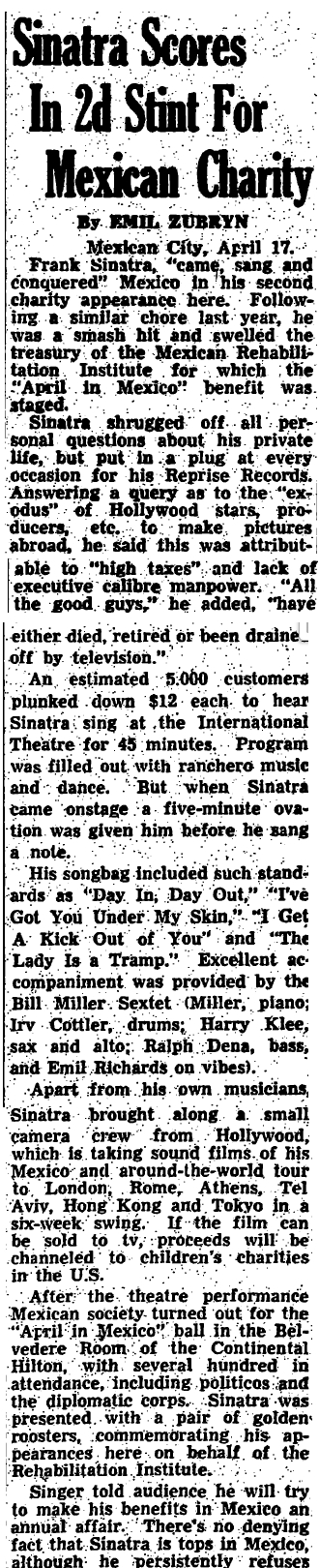
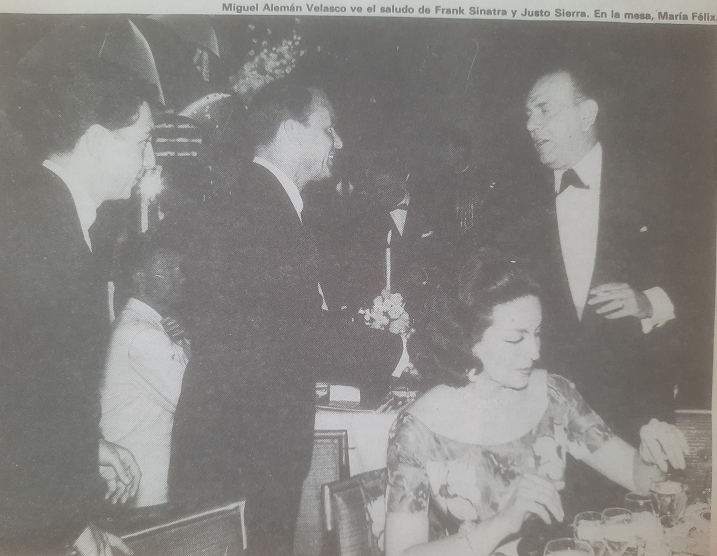
April 8, 1962
Concerts
Acapulco, Mexico
Third Annual Benefit for the Children’s Wing of the Hospital Civil Morelos
Acapulco, Mexico
Third Annual Benefit for the Children’s Wing of the Hospital Civil Morelos
"Frank Sinatra came to Acapulco with his friends from Hollywood and gave us a two-hour recital for the benefit of the Hospital Civil Morelos,
which was located in what is now Parque de la Iguana, in the historic center of Acapulco"
MEXICAN STERLING PRESENTATION TRAY TO FRANK SINATRA
© 1997-2026 The Sinatra Archive
This calendar, or any parts thereof, may not be reproduced in any fashion
whatsoever without the prior written permission of the publisher (The
Sinatra Archive
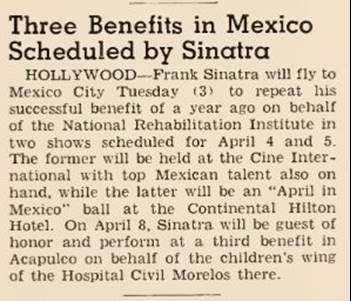
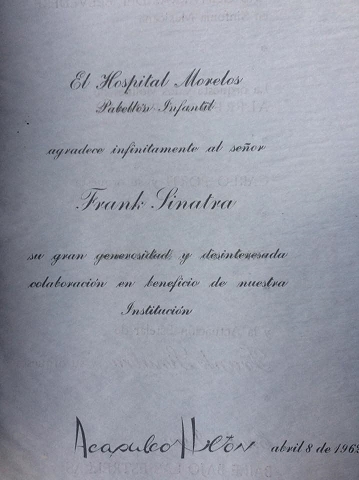
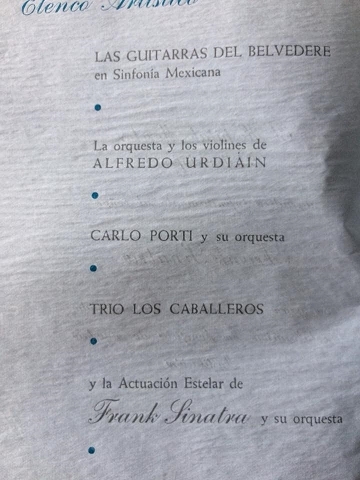
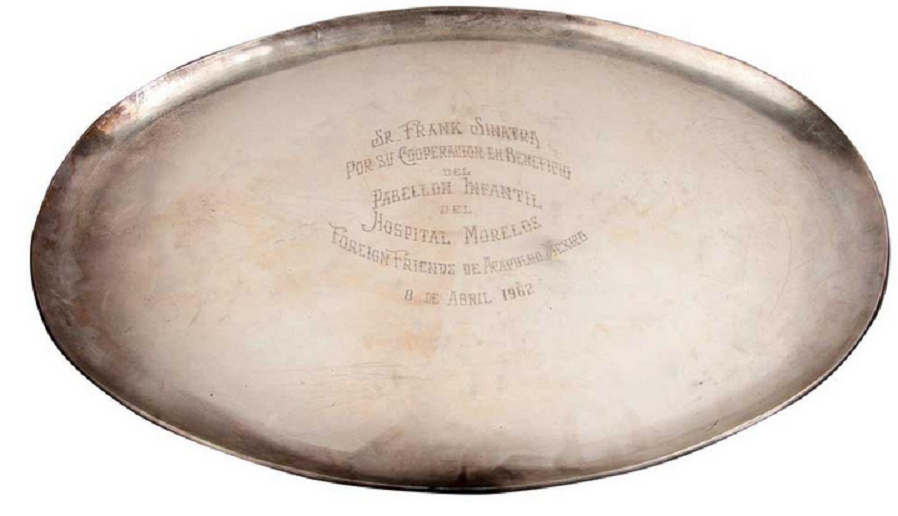
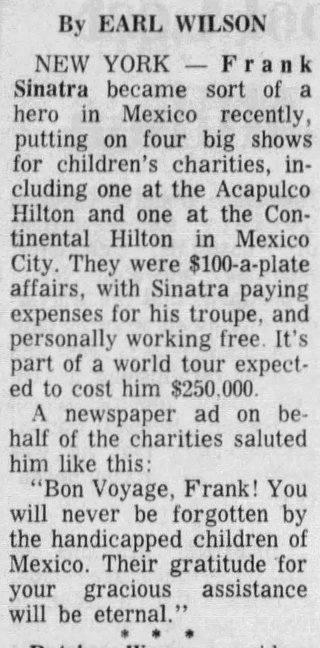
April 10, 1962
Studio
Hollywood
1007 I'm Beginning To See The Light -4 (2:33)
(Johnny Hodges/Harry James/Duke Ellington/Don George)
Ann-Rachel Music Corp. (ASCAP)
Arranged & Conducted by Neal Hefti
LP: Sinatra And Swingin' Brass Reprise R-1005
CD: The Complete Reprise Studio Recordings 46013-2
1008 I Get A Kick Out Of You -5 (3:14)
(Cole Porter)
Harms Music. (ASCAP)
Arranged & Conducted by Neal Hefti
LP: Sinatra And Swingin' Brass Reprise R-1005
CD: The Complete Reprise Studio Recordings 46013-2
1009 Ain't She Sweet? -4 (2:06)
(Milton Ager/Jack Yellen)
Warner Bros. Inc./Edwin H. Morris & Co., Inc. (ASCAP)
Arranged & Conducted by Neal Hefti
LP: Sinatra And Swingin' Brass Reprise R-1005
CD: The Complete Reprise Studio Recordings 46013-2
1010 I Love You -6 (2:16)
(Cole Porter)
Chappell & Co. Inc. (ASCAP)
Arranged & Conducted by Neal Hefti
LP: Sinatra And Swingin' Brass Reprise R-1005
CD: The Complete Reprise Studio Recordings 46013-2
1011 They Can't Take That Away From Me -6 (2:41)
(George Gershwin/Ira Gershwin)
Chappell & Co. Inc./Gershwin Publishing Corp. (ASCAP)
Arranged & Conducted by Neal Hefti
LP: Sinatra And Swingin' Brass Reprise R-1005
CD: The Complete Reprise Studio Recordings 46013-2
1012 Love Is Just Around The Corner -5 (2:27)
(Lewis E. Gensler/Leo Robin)
Famous Music Corp. (ASCAP)
Arranged & Conducted by Neal Hefti
45: Reprise 20,092
LP: Sinatra And Swingin' Brass Reprise R-1005
CD: The Complete Reprise Studio Recordings 46013-2
Note: Sessions were done at United Recording on Sunset Blvd from 8:00 to 11:30 P.M.
Bill Putnam was the engineer, Chuck Sagle was the A & R man and Frank's manager, Hank Sanicola, was roaming about the studio.
After listening to the final take of "I Get A Kick Out Of You" ( take 5), the sidemen broke into spontaneous applause. The same thing happened after the last take on "They Can't Take That Away From Me " ( take 6). A rare occurrence among seasoned musicians, who had seen and heard it all. But this was, after all, Sinatra. --Ed
NOTE: Sinatra Scholar Ed O'Brien points out that all these tracks have been digitally remastered using 20-bit technology (24, now, probably). This 1962 release finds Sinatra paired with Neal Hefti, the talented composer/arranger who provided the Count Basie New Testament band of the 50s with some of the classiest material. The word brass is featured in the title, but one comes away from this excellently produced session with an impression of sinewy, shimmering reed charts, characteristic of the Basie band.
Later in 62', Sinatra would record a classic album with Basie himself entitled simply SINATRA-BASIE, with Hefti once more at the helm. SINATRA AND SWINGIN BRASS is one of the jazziest of all Sinatra records. Only Cole Porter's At Long Last Love emerges as a definitive version, but still Sinatra was on a remarkable roll in the early 60s and, thanks to Neal Hefti, this bright gem lost none of its luster. O'Brien then provides us with an even greater detailed analysis of SWINGIN BRASS and its songs and winds up his analysis by pointing out that Sinatra in his prime never sounded better. And the Neal Hefti arrangements are superb. In fact, if all you got on this CD was the orchestra, you would get your moneys worth. This 1962 session really swings and the remastered stereo recording quality it excellent. Highly recommended. Ed O'Brien:
I am going to list the outstanding group of musicians who backed Sinatra on "Swingin' Brass."
Trumpet:
Al Porcino
Pete Candoli
Conte Candoli
Don Fagerquist
Gerald Wilson
Trombone:
Dick Nash
Dick Noel
Frank Rosolino
Lew McCreary
Bass Trombone:
George Roberts
Saxophones/Woodwind s:
Joe Maini
Harry Klee
Ben Webster
Plas Johnson
Chuck Gentry
Piano:
Bill Miller
Guitar:
Al Viola
Bass:
Al McKibbon
Drums:
Earl Palmer
Musicians I've interviewed from the two "Brass" sessions rave about Sinatra's singing and how loose everything was.
I think it is Sinatra best swing album on Reprise.
Hollywood
1007 I'm Beginning To See The Light -4 (2:33)
(Johnny Hodges/Harry James/Duke Ellington/Don George)
Ann-Rachel Music Corp. (ASCAP)
Arranged & Conducted by Neal Hefti
LP: Sinatra And Swingin' Brass Reprise R-1005
CD: The Complete Reprise Studio Recordings 46013-2
1008 I Get A Kick Out Of You -5 (3:14)
(Cole Porter)
Harms Music. (ASCAP)
Arranged & Conducted by Neal Hefti
LP: Sinatra And Swingin' Brass Reprise R-1005
CD: The Complete Reprise Studio Recordings 46013-2
1009 Ain't She Sweet? -4 (2:06)
(Milton Ager/Jack Yellen)
Warner Bros. Inc./Edwin H. Morris & Co., Inc. (ASCAP)
Arranged & Conducted by Neal Hefti
LP: Sinatra And Swingin' Brass Reprise R-1005
CD: The Complete Reprise Studio Recordings 46013-2
1010 I Love You -6 (2:16)
(Cole Porter)
Chappell & Co. Inc. (ASCAP)
Arranged & Conducted by Neal Hefti
LP: Sinatra And Swingin' Brass Reprise R-1005
CD: The Complete Reprise Studio Recordings 46013-2
1011 They Can't Take That Away From Me -6 (2:41)
(George Gershwin/Ira Gershwin)
Chappell & Co. Inc./Gershwin Publishing Corp. (ASCAP)
Arranged & Conducted by Neal Hefti
LP: Sinatra And Swingin' Brass Reprise R-1005
CD: The Complete Reprise Studio Recordings 46013-2
1012 Love Is Just Around The Corner -5 (2:27)
(Lewis E. Gensler/Leo Robin)
Famous Music Corp. (ASCAP)
Arranged & Conducted by Neal Hefti
45: Reprise 20,092
LP: Sinatra And Swingin' Brass Reprise R-1005
CD: The Complete Reprise Studio Recordings 46013-2
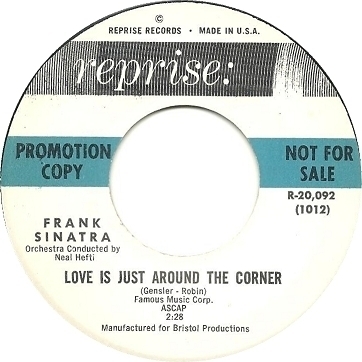
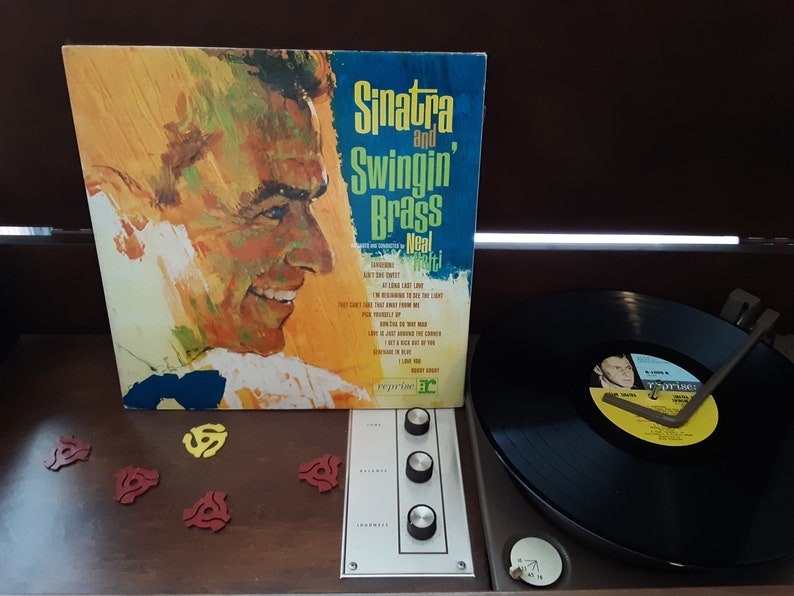
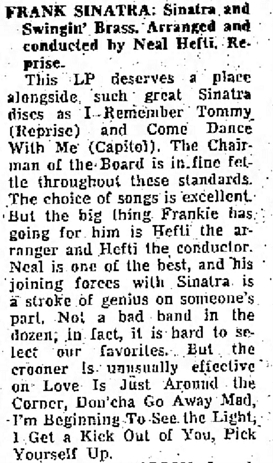
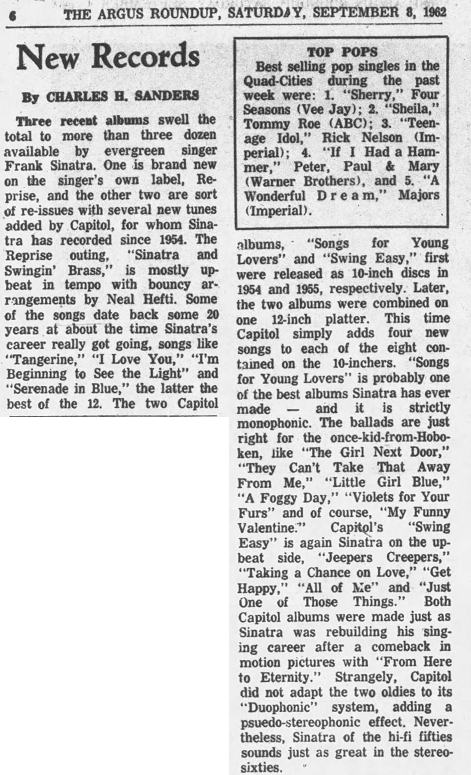
10-2-62
Hollywood
1007 I'm Beginning To See The Light -4 (2:33)
1008 I Get A Kick Out Of You -5 (3:14)
1009 Ain't She Sweet? -4 (2:06)
1010 I Love You -6 (2:16)
1011 They Can't Take That Away From Me -6 (2:41)
1012 Love Is Just Around The Corner -5 (2:27)
April 11, 1962
Studio
Hollywood
1013 At Long Last Love -5 (2:13)
(Cole Porter)
Chappell & Co. Inc. (ASCAP)
Arranged & Conducted by Neal Hefti
LP: Sinatra And Swingin' Brass Reprise FS-1005
CD: The Complete Reprise Studio Recordings
46013-2
1014 Serenade In Blue -7 (2:58)
(Harry Warren/Mack Gordon)
Bergman, Vocco & Conn Inc. (ASCAP)
Arranged & Conducted by Neal Hefti
LP: Sinatra And Swingin' Brass Reprise FS-1005
CD: The Complete Reprise Studio Recordings
46013-2
1015 Goody, Goody -2 (1:46)
(Johnny Mercer, Matty Malneck)
Malneck Music (ASCAP)
Arranged & Conducted by Neal Hefti
45: Reprise 20,092
LP: Sinatra And Swingin' Brass Reprise FS-1005
CD: The Complete Reprise Studio Recordings
46013-2
1016 Don'Cha Go 'Way Mad -2 (3:12)
(Jimmy Mundy/Al Stillman/Illinois Jacquet)
Advanced Music Corp./Rytroc. Inc. (ASCAP)
Arranged & Conducted by Neal Hefti
LP: Sinatra And Swingin' Brass Reprise FS-1005
CD: The Complete Reprise Studio Recordings
46013-2
1017 Tangerine -5 (2:03)
(Victor Schertzinger/ Johnny Mercer)
Famous Music Corp. (ASCAP)
Arranged & Conducted by Neal Hefti
LP: Sinatra And Swingin' Brass Reprise FS-1005
CD: The Complete Reprise Studio Recordings
46013-2
1018 Pick Yourself Up -7 (2:32)
(Jerome Kern/Dorothy Field)
PolyGram International Publishing Co. Inc. (ASCAP)
Arranged & Conducted by Neal Hefti
LP: Sinatra And Swingin' Brass Reprise FS-1005
CD: The Complete Reprise Studio Recordings
46013-2
Ed O'Brien:
Here is some additional information on the two dates of this marvelous album.
Frank arrived at the first date (4/10) a little after 8:PM. The site was United Recording
on Sunset Blvd in Los Angeles. He had just returned from Mexico City, where he gave a
concert for needy children. (4-8)..He would fly to Tokyo on 4-15 to start the second leg
of his ten week 30 concert World Tour.The one in Mexico City was his second annual
pilgrimage and he personally contributed over $25,000 to the Mexican Institute for
Rehabilitation for Underprivileged Children.
There were over 50 very lucky people invited to attend each night. The security guard
checked each and every one at the door. There were also guards watching Frank as he
settled into the isolation booth. The band was rehearsing the first tune ('I'm Beginning To
See The Light") for "The Thin One & Hefti" (title was later changed to "Sinatra & Swingin' Brass")
when Frank arrived. Neal Hefti was both arranger and conductor. Bill Putnam was the recording
engineer. In the booth Hank Sanicola, Chuck Sagle, Eddie Shaw were watching intently as Hefti
prepared for take one.
The 19 musicians were the creme de la creme of west coast sidemen.
Trumpet: Al Porcino, Pete Candoli, Conte Candoli, Don Fagerquist,
Gerald Wilson
Trombone: Dick Nash, Dick Noel, Frank Rosolino, Lew McCreary
Bass Trombone: George Roberts,
Saxophones/Woodwinds: Joe Maini, Harry Klee, Ben Webster, Plas
Johnson, Chuck Gentry
Piano: Bill Miller
Guitar: Al Viola
Bass: Al McKibbon
Drums: Earl Palmer
The great saxman, Ben Webster, was telling people between takes
how much he loved to play on a Sinatra session. Don Fagerquist and
Conte Candoli were in total agreement.
Sinatra nailed "Beginning To See The Light" in four takes. It was
apparent to everyone in the room that The Thin One was in splendid
form. After "I Get A Kick Out Of You" and "They Can't Take That Away
From Me", the band stood and applauded in appreciation. A very rare
occurrence among veteran studio sidemen. As the session wound
down, it was decided the third night was unnecessary. Frank would
simply do six tunes that night, and six the next. The man was in the
pocket. And he had a lot to do before heading out on Sunday.
The session on April 11th went off on schedule and Frank
worked even harder than the previous night to get it right.
According
to Arnold Shaw (Sinatra biographer), Frank never removed his hat,
not even once, during the six hours and fifty-two minutes of session
work required to make the album. Nine of the twelve tunes had
not previously been recorded by Sinatra. In all, he did 58 takes,
including one intercut, to complete the 12 songs.
Sinatra had arrived alone both nights and he would leave alone,
driving off into the night, heading for his home atop Coldwater Canyon.
The album was released in August of 1962. Sadly, as was often
the case in the early 1960's, the best Sinatra was not always the most
successful commercially. There had been a glut of album releases
in the previous 19 months (nine LPs) and, to be fair, the original
release was sorely lacking in audio fidelity. Although that would be
corrected later on, it hurt sales in the late summer, early fall of
Hollywood
1013 At Long Last Love -5 (2:13)
1014 Serenade In Blue -7 (2:58)
1015 Goody, Goody -2 (1:46)
1016 Don'Cha Go 'Way Mad -2 (3:12)
1017 Tangerine -5 (2:03)
1018 Pick Yourself Up -7 (2:32)
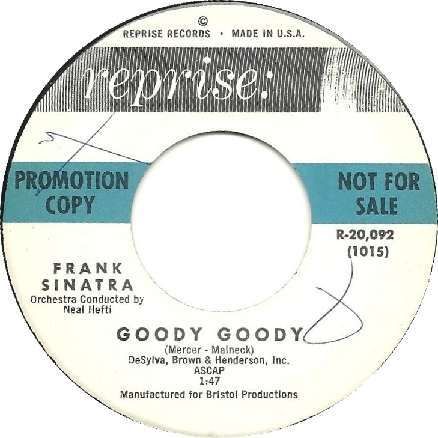
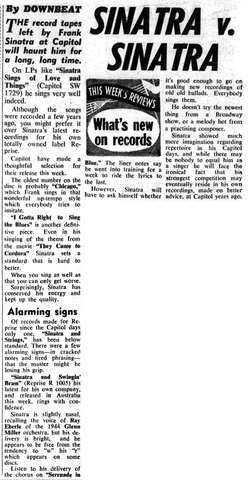
"Goody Goody" / "Tangerine" / "Serenade in Blue"
Will Friedwald (analysis); Irv Cottler (via Friedwald): 'Goody Goody' (a Benny Goodman standard) opened nearly every 1962 World Tour concert and is analyzed as Sinatra phrasing 'sure-footedly on the beat.' 'Tangerine' is noted for repeating Johnny Mercer's main lyric rather than his wittier second chorus (as Helen O'Connell had sung it). 'Serenade in Blue,' the slowest track, has a bridge Friedwald says 'seems designed to exhaust a voice,' with Sinatra sounding rusty yet finishing on 'a glorious low tone.' A footnote debunks the liner notes' claim that sessions were booked six weeks ahead: drummer Irv Cottler recalled the call for musicians went out only two days before the date, causing him to miss the album due to a prior commitment.
Source: Will Friedwald, "Sinatra! The Song Is You: A Singer's Art" (2018 revised edition).
April 14, 1962
Concerts
Palm Springs High School, Palm Springs, CA
13th Annual Palm Springs Police Show
Sinatra appeared along with Bob Hope, Troy Donahue, Allan Jones, Judy Conova, Jayne Mansfield, Ginny Simms, Harpo Marx, Jack Jones, Tony Martin, Gene Autry
Palm Springs High School, Palm Springs, CA
13th Annual Palm Springs Police Show
Thanks to Carl R for the wonderful photos above.
Hi Carl,
Wonderful photos. I've seen one of the group shots with Mansfield, Marx and Skelton. But the others are new to me. Behind Frank you see Ralph Pena on bass. Al Viola and Bill Miller are in some of the other shots. Frank would fly out the following day( Sunday) to Japan. It was the first stop on his extensive world tour. Bob Hope saw Frank off at the L.A. airport. Ed
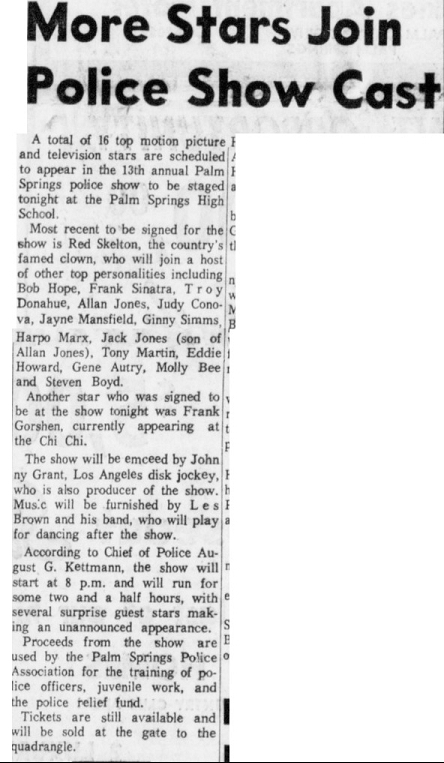
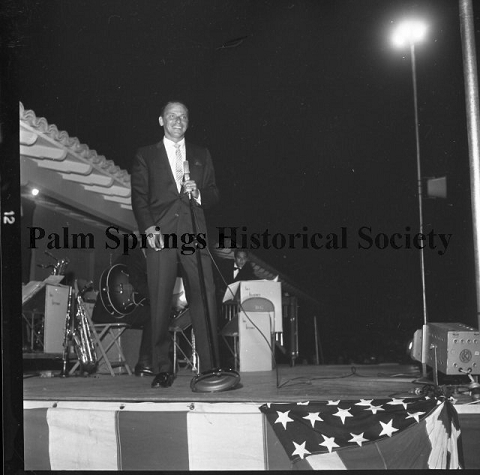
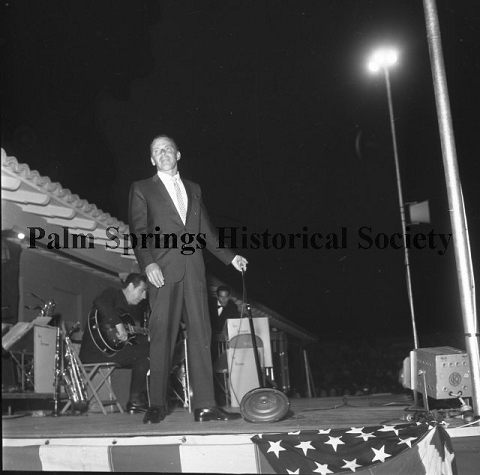
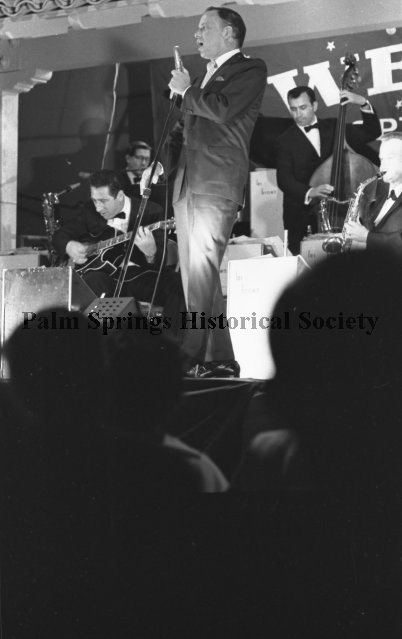
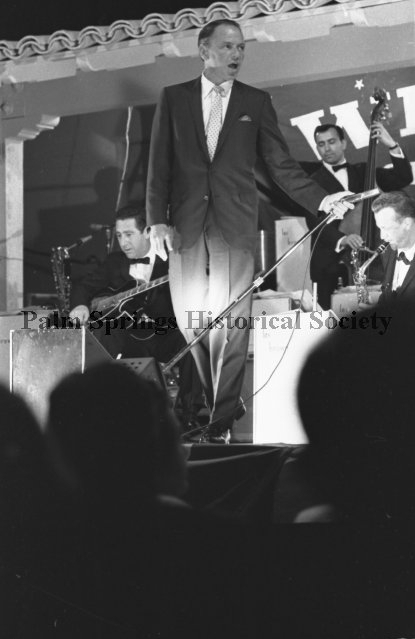
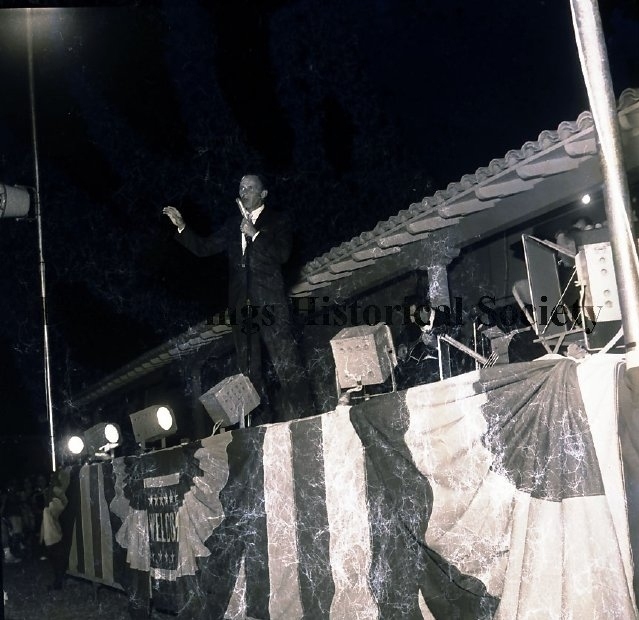
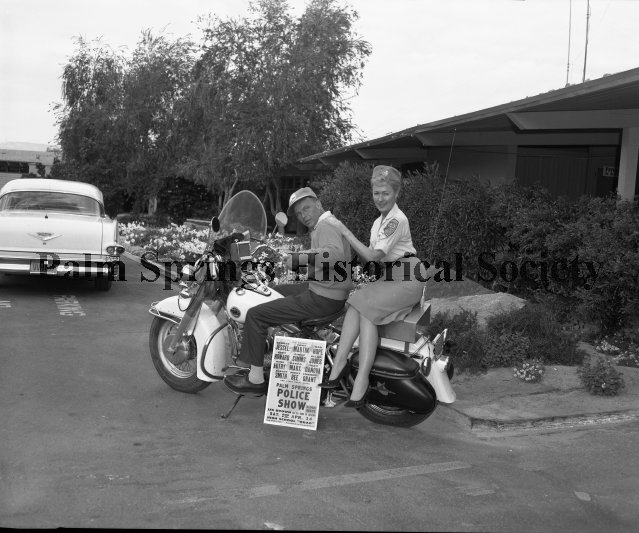
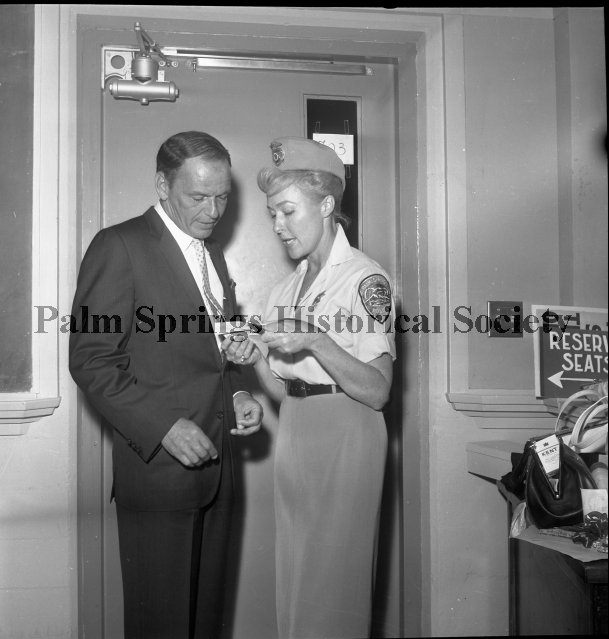
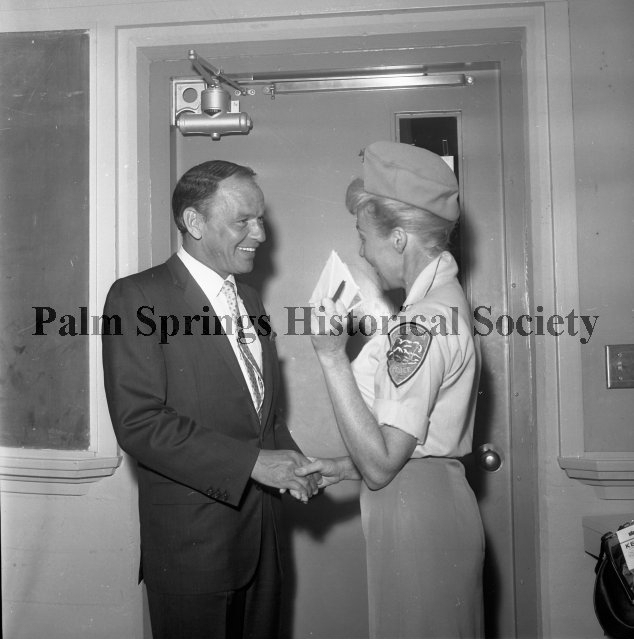
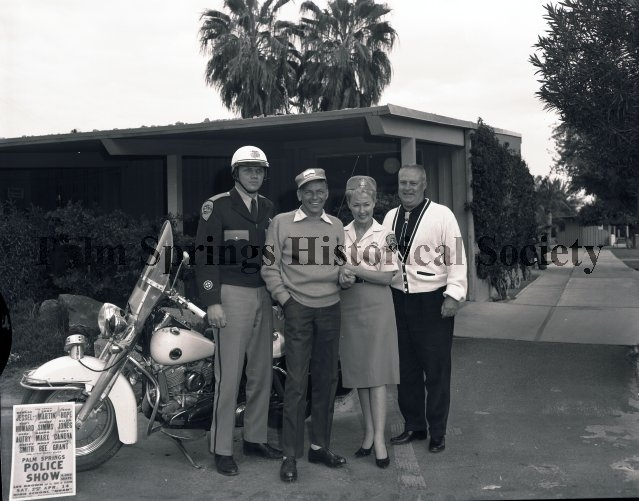
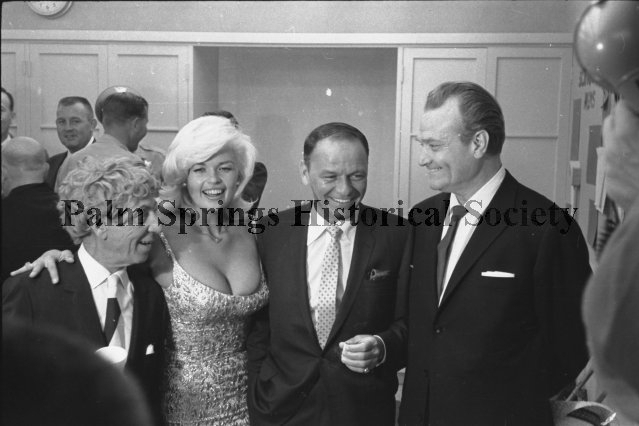
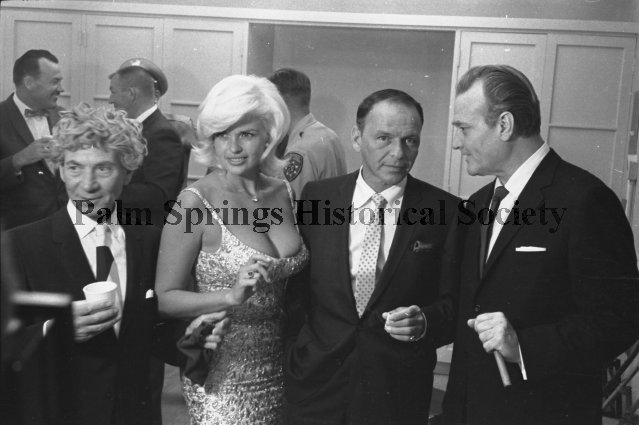
April 15, 1962
[World charity tour departs LAX]
With the Swingin' Brass album finished, Frank set out on his world charity tour on April 15, traveling with a large entourage including George Jacobs, Jimmy Van Heusen, banker Al Hart, Mike and Gloria Romanoff, Leo Durocher, production chief Howard Koch, pianist Bill Miller, and a jazz quintet. Bob Hope saw him off at LAX along with reporters.
Source: James Kaplan, "Sinatra: The Chairman" (2015).
April 18, 1962
Frank began a self-funded World Tour for Children, telling the press he felt an 'overprivileged adult' owed a debt to underprivileged children.
Source: Nancy Sinatra, Frank Sinatra: An American Legend, 1995.
April 19, 1962
Philadelphia Inquirer
April 19, 1962
April 20, 1962
Concerts
The Mikado, Tokyo, Japan (20-21)
Bill Miller Sextet: Emil Richards (Vibes), Al Viola (Guitar), Irv Cottler (Drums), Ralph Pana (Bass), Harry Klee (Flute, Sax, Clarinet), Bill Miller (Piano)
1. Too Marvelous For Words
2. Imagination
3. Moonlight In Vermont
4. Without A Song
5. Day In, Day Out
6. The Moon Was Yellow
7. I've Got You Under My Skin
8. I Get A Kick Out Of You
9. My Funny Valentine
10. In The Still Of The Night
11. Embraceble You
12. Night And Day
13. April In Paris
14. The Lady Is A Tramp
15. One For My Baby
16. All The Way
17. Chicago
18. I Could Have Danced All Night
Notes: TT 51mins.
The Mikado, Tokyo, Japan (20-21)
Tokyo, April, 1962: Frank Sinatra laughs as U.S. Ambassador to Japan Edwin O. Reischauer presents him with a card bearing the singer-actor's name in Japanese characters. Sinatra was in the Far East for a series of charity performances to aid underprivileged children.
© 1997-2026 The Sinatra Archive
This calendar, or any parts thereof, may not be reproduced in any fashion whatsoever without the prior written permission of the publisher (The Sinatra Archive)
[image referenced in source but could not be recovered]
[image referenced in source but could not be recovered]
[image referenced in source but could not be recovered]
[Tokyo press conference]
Frank Sinatra: At a Tokyo press conference, Sinatra, described as tanned and dapper, patiently fielded questions and delivered his now-famous line: "People who call me controversial are those who don't agree with me. I plan to remain controversial because we won't make progress unless we're controversial and rebellious from time to time."
Source: James Kaplan, "Sinatra: The Chairman" (2015).
[First Tokyo concert at the Mikado]
Kaplan / Al Ricketts: Sinatra gave his first Tokyo concert that night at the Mikado theater-restaurant, opening slow before shifting into high gear, performing "Moonlight in Vermont," "My Funny Valentine," and closing with "The Lady Is a Tramp" to strong reviews from Pacific Stars and Stripes.
Source: James Kaplan, "Sinatra: The Chairman" (2015).
[Hibiya Park concert / Key of the City]
According to the CD reissue "Frank Sinatra Live In Tokyo Japan 1962" (Acrobat/ACMCD 4014), this recording was made outdoors at Hibiya Park, Tokyo, Japan on April 20, 1962, the first of Sinatra's two Tokyo dates on the World Tour for Children. The World Tour for Children began in Mexico City on April 15, with Tokyo as the next stop. The Bill Miller Sextet backing him (Emil Richards on vibes, Al Viola on guitar, Irv Cottler on drums, Ralph Pana on bass, Harry Klee on flute/sax/clarinet, Bill Miller on piano) played nineteen numbers that night, including a "Monologue" segment, ending with "I Could Have Danced All Night." While in Japan, Sinatra was presented with the Key of the City of Tokyo, reportedly the first non-military American to receive the honor.
Source: Fred Dellar (Mojo magazine), liner notes to "Frank Sinatra Live In Tokyo Japan 1962" (Acrobat Music, ACMCD 4014).
April 21, 1962
Concerts
Hibaya Park, Tokyo, Japan
Afternoon
Bill Miller Sextet: Emil Richards (Vibes), Al Viola (Guitar), Irv Cottler (Drums), Ralph Pana (Bass), Harry Klee (Flute, Sax, Clarinet), Bill Miller (Piano)
1. Too Marvelous For Words
2. Imagination
3. Moonlight In Vermont
4. Day In, Day Out
5. Without A Song
6. The Moon Was Yellow
7. I've Got You Under My Skin
8. I Get A Kick Out Of You
9. At Long Last Love
10. My Funny Valentine
11. In The Still Of The Night
12. Embraceable You
13. Night And Day
14. April In Paris
15. The Lady Is A Tramp
16. All The Way
17. Chicago
18. I Could Have Danced All Night
TT: 53 mins.
Ed O'Brien Notes: Sinatra is in superb voice for this afternoon in the park.
Later in the tour you can hear some fatigue in the voice but not here. Highlight is Frank sitting on lip of stage and singing "All The Way" with Bill Miller accompanying him on piano.
Note: Video of concert officially released in the Sinatra World On A String box set 2016
Mikado Theater, Tokyo, Japan (20-21)
Evening
Bill Miller Sextet: Emil Richards (Vibes), Al Viola (Guitar), Irv Cottler (Drums), Ralph Pana (Bass), Harry Klee (Flute, Sax, Clarinet), Bill Miller (Piano)
1. Too Marvelous For Words
2. Imagination
3. Moonlight In Vermont
4. Without A Song
5. Day In, Day Out
6. The Moon Was Yellow
7. I've Got You Under My Skin
8. I Get A Kick Out Of You
9. My Funny Valentine
10. In The Still Of The Night
11. Embraceable You
12. Night And Day
13. April In Paris
14. The Lady Is A Tramp
15. One For My Baby
16. All The Way
17. Chicago
18. I Could Have Danced All Night
Notes: TT 51mins.
Note: A friend in Japan was involved with all the Sinatra appearances from 62 on. He told me the Mikado on 4/20 was not taped. The master tape of the 4/21 performance has an inter- mission in the middle of Frank's performance. A highly unusual occurrence.
Billboard has Frank playing nightclubs in Tokyo, in the spring of 1960. I have not been able to find any evidence that supports their claim. And my friend in
Japan knew nothing about it.
--Ed
note: original master has an intermission during Frank's performance. You see the stage with curtain down.
Runs like that for about 12 minutes.
Hibaya Park, Tokyo, Japan
Afternoon
Bill Miller Sextet: Emil Richards (Vibes), Al Viola (Guitar), Irv Cottler (Drums), Ralph Pana (Bass), Harry Klee (Flute, Sax, Clarinet), Bill Miller (Piano)
SOUTH BEND TRIBUNE
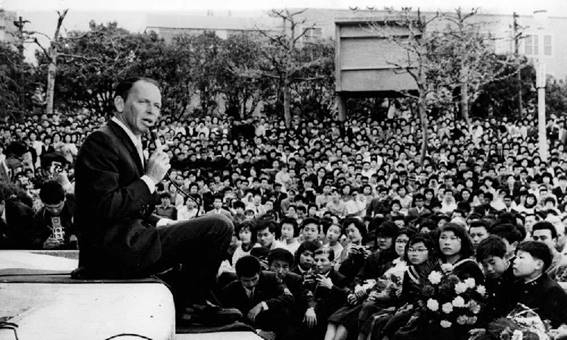
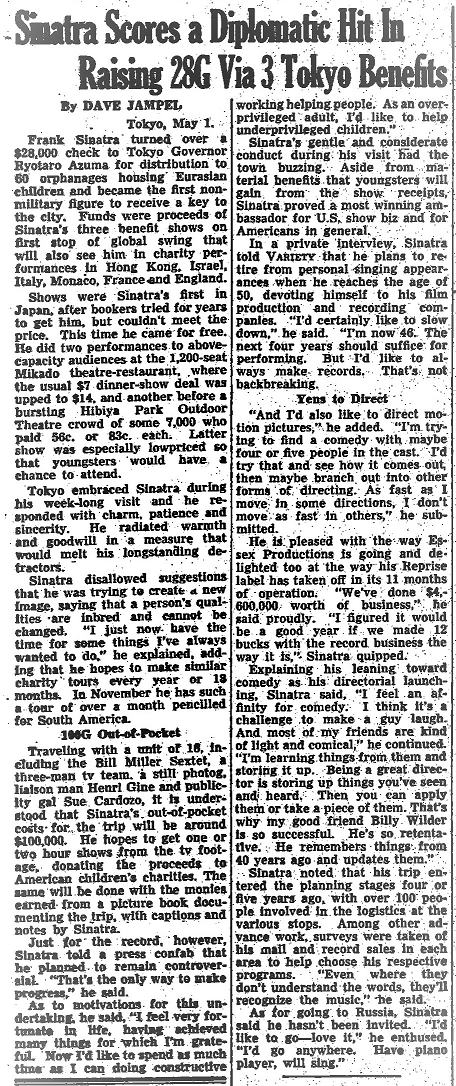
April 24, 1962
During the World Tour for Children, Frank visited hospitals and youth centers in Hong Kong, performed two concerts, and presented a $95,000 check for charity.
Source: Nancy Sinatra, Frank Sinatra: An American Legend, 1995.
April 25, 1962
Television
The Bob Hope Show
Guests: Frank Sinatra. Sings & Comedy
NOTE: Sinatra was about to embark on his 30-city World Tour for Underprivileged children, according to Ed O'Brien.
Frank sings "Goody, Goody" from "The Swingin' Brass" album and he and Hope do a skit with lots of topical humour, then a very casual duet of "Small Fry."
The Bob Hope Show
Guests: Frank Sinatra. Sings & Comedy
Variety
Thanks to Michel M for sending along above photo from rehearsal
Dean Martin weds Catherine Hawn on April 25, 1973:
Frank Sinatra at Dean Martin's wedding, April 25, 1973.
April 26, 1962
Concerts
City Concert Hall, Hong Kong (26-28)
Bill Miller Sextet: Emil Richards (Vibes), Al Viola (Guitar), Irv Cottler (Drums), Ralph Pana (Bass), Harry Klee (Flute, Sax, Clarinet), Bill Miller (Piano)
City Concert Hall, Hong Kong (26-28)
Bill Miller Sextet: Emil Richards (Vibes), Al Viola (Guitar), Irv Cottler (Drums), Ralph Pena (Bass), Harry Klee (Flute, Sax, Clarinet), Bill Miller (Piano)
Photo was taken on Queen's Road Central, Hong
Kong by Ted Allan during Frank's April appearance
in 1962
Rush for Tix Greets Sinatra By CARL MYATT 44 Mount Kellett Road, The Peak The news that Frank Sinatra is to give three charity performances in Hong Kong has started a rush for tickets unprecedented in show business here. Appearing with Sinatra will be the Red Norvo Quintet and various local entertainers. It is estimated that charities will benefit to the tune of approximately $15,000. Concert dates are April 26, 27 and 28. Sinatra's tour will take him first to Tokyo and then to Hong Kong and on to Israel, Italy and England. He will pay all expenses and will perform without a fee on all occasions
Frank Sinatra shakes hands with Hong Kong children as he visits
Sandy Bay Children's Convalescent Home. Sinatra is on a round
the world tour giving charity shows. April 25, 1962.
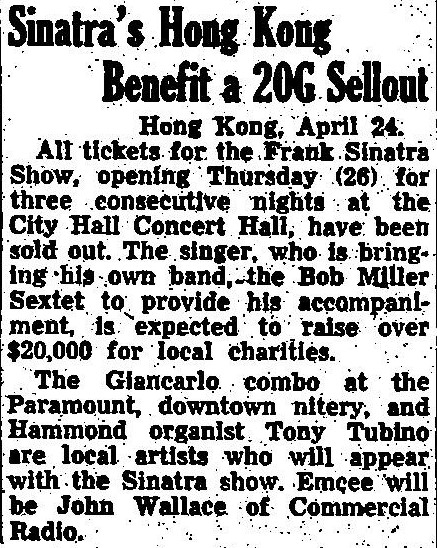
note: Frank stayed at the Peninsula Hotel during his time in Hong Kong. I was
told he did four shows, three at the Concert Hall, during the three days of
performances
( 26, 27, 28 ) Similar to what was done in Tokyo on 4/21.
On the 25th,
Frank visited with children at a hospital in the city.
Ed
April 27, 1962
Concerts
City Concert Hall, Hong Kong (26-28)
Bill Miller Sextet: Emil Richards (Vibes), Al Viola (Guitar), Irv Cottler (Drums), Ralph Pana (Bass), Harry Klee (Flute, Sax, Clarinet), Bill Miller (Piano)
1. Introduction
2. Too Marvelous For Words
3. Imagination
4. Moonlight In Vermont
5. Without A Song
6. Day In, Day Out
7. The Moon Was Yellow
8. I've Got You Under My Skin
9. I Get A Kick Out Of You
10. In The Still Of The Night
11. Embraceable You
12. My Blue Heaven
13. April In Paris
14. The Lady Is A Tramp
15. monologue
16. One For My Baby
17. All The Way
18. Chicago
19. I Could Have Danced All Night
20. A Foggy Day
21. I'll Be Seeing You
22. Come Fly With Me
23. End Of Show/Presentation by Frank
April 28, 1962
Concerts
City Concert Hall, Hong Kong (26-28)
Bill Miller Sextet: Emil Richards (Vibes), Al Viola (Guitar), Irv Cottler (Drums), Ralph Pana (Bass), Harry Klee (Flute, Sax, Clarinet), Bill Miller (Piano)
1. Introduction
2. Too Marvelous For Words
3. Imagination
4. Moonlight In Vermont
5. Without A Song
6. Day In, Day Out
7. The Moon Was Yellow
8. I've Got You Under My Skin Ă‚
9. I Get A Kick Out Of You
10. In The Still Of The Night
11. Embraceable You
12. My Blue Heaven
13. April In Paris
14. The Lady Is A Tramp
15. Monologue
16. One For My Baby
17. All The Way
18. Chicago
19. I Could Have Danced All Night
20. A Foggy Day
21. I'll Be Seeing You
22. Come Fly With Me
23. End Of Show/Presentation by Frank
NOTE: Ed O'Brien reports that Sinatra was at his acerbic best in this presentation and it was very funny. He messes up the lyrics on "I'll Be Seeing You," but, overall, it is a very good outing.
City Concert Hall, Hong Kong
Bill Miller Sextet: Emil Richards (Vibes), Al Viola (Guitar), Irv Cottler (Drums), Ralph Pana (Bass), Harry Klee (Flute, Sax, Clarinet), Bill Miller (Piano)
Variety
4-25-62
note: Frank stayed at the Peninsula Hotel during his time in Hong Kong. I was told he did four shows, three at the Concert Hall, during the three days of performances ( 26, 27, 28 ) Similar to what was done in Tokyo on 4/21. On the 25th, Frank visited with children at a hospital in the city. Ed
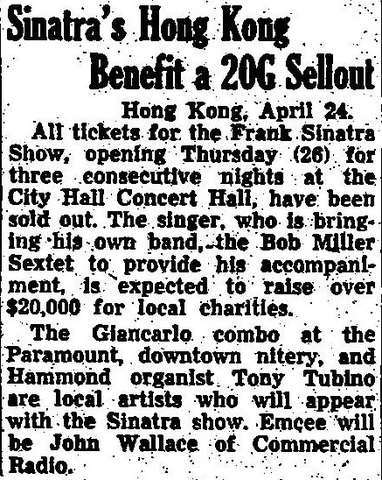
May 1962
[Independence Day Parade in Tel Aviv]
While in Tel Aviv, Israel during his charity world tour, Sinatra watched the Israeli Independence Day parade.
Source: Charles Pignone, "Frank Sinatra 100" (2015).
[Frank's detour to Spain to see Ava]
Emil Richards: During the break, Sinatra took Rubirosa's yacht to Spain to see Ava Gardner, bringing along Mike Romanoff, Howard Koch, and his valet George. Ava, angered by the crowd, fed everyone and left; Frank eventually tracked her down at a rural taverna with a bullfighter, as later pieced together by Emil Richards.
Source: James Kaplan, "Sinatra: The Chairman" (2015)
[Gossip links Ava Gardner and Peron in Madrid]
Dorothy Manners: Filling in for an ailing Louella Parsons, columnist Dorothy Manners reported that Ava Gardner and exiled former Argentine dictator Juan Peron, 66, were being seen constantly together in Madrid, dishing catty commentary about Gardner's taste in men.
Source: James Kaplan, "Sinatra: The Chairman" (2015)
[Hong Kong charity concerts and shopping]
Kaplan: Crowds of children lined the streets to greet Sinatra in Hong Kong, where he played four charity concerts and indulged in custom clothing -- a dozen orange blazers, fine wool slacks, and custom alligator and snakeskin elevator shoes.
Source: James Kaplan, "Sinatra: The Chairman" (2015)
[Marilyn sings Happy Birthday to JFK]
Consiglio: One of the times Marilyn Monroe skipped the set of Something's Got to Give, she was in New York at Madison Square Garden singing 'Happy Birthday' to President Kennedy -- an absence that contributed to her firing from the film.
Source: Tony Consiglio (as told to Franz Douskey), "Sinatra and Me: The Very Good Years" (2012)
[Nazareth youth center cornerstone]
Kaplan / George Jacobs: In Nazareth, Sinatra laid the cornerstone of an Arab-Jewish youth center, pledging the entire proceeds of the tour's Israeli leg to it. He later told George Jacobs that Israel made him ashamed he hadn't fought in World War II.
Source: James Kaplan, "Sinatra: The Chairman" (2015)
[Sinatra gives musicians ten days off in Athens]
Emil Richards: In Athens, Sinatra abruptly announced he was giving his band ten days off, telling them to take whatever cash was piled on his hotel bed -- Greek drachmas the musicians stuffed their pockets with, as recalled by Emil Richards.
Source: James Kaplan, "Sinatra: The Chairman" (2015)
[Sinatra plants trees in Israel]
Kaplan: While in Israel, Sinatra planted trees -- one for each of his three children and one in memory of his late agent Bert Allenberg.
Source: James Kaplan, "Sinatra: The Chairman" (2015)
[Sinatra's Israel itinerary]
Kaplan: In Israel Sinatra visited the Western Wall, the Via Dolorosa, Yad Vashem, the Sea of Galilee, and the Golan Heights, playing seven concerts in six cities over nine days -- becoming, for the first time on the tour, an enthusiastic tourist.
Source: James Kaplan, "Sinatra: The Chairman" (2015)
[Sinatra's meltdown at the Peninsula Hotel]
George Jacobs (via valet account): In Hong Kong, a lighting cue mistake ruined the dramatic finish of "One for My Baby," sending Sinatra into a rage in which he trashed his dressing room and his suite at the Peninsula hotel, smashing antiques, according to his valet.
Source: James Kaplan, "Sinatra: The Chairman" (2015)
May 1, 1962
[Hong Kong charity check, tour continues to Athens and Jerusalem] After handing a $17,000 check to the Hong Kong Council of Social Service, Sinatra's tour landed in Athens on May 1 before proceeding directly to Jerusalem.
Source: James Kaplan, "Sinatra: The Chairman" (2015).
May 2, 1962
Continuing the tour in Israel, Frank presided at groundbreaking ceremonies for the Frank Sinatra International Youth Center in Nazareth and met Prime Minister David Ben-Gurion in Jerusalem before performing concerts.
Source: Nancy Sinatra, Frank Sinatra: An American Legend, 1995.
May 3, 1962
Concerts
Fredrick Mann Auditorium, Tel Aviv, Israel w/ The Bill Miller Sextet
Songs are essentially the same numbers as Jerusalem:
1. Too Marvelous For Words
2. Imagination
3. Moonlight In Vermont
4. Without A Song
5. Day In - Day Out
6. The Moon Was Yellow
7. I've Got You Under My Skin
8. I Get A Kick Out Of You
9. At Long Last Love
10. My Funny Valentine
11. Embraceable You
12. In The Still Of The Night
13. My Blue Heaven
14. April In Paris
15. The Lady Is A Tramp
16. monologue
17. One For My Baby
18. All The Way
19. Chicago
20. Nancy
21. I Could Have Danced All Night
"At Long Last Love." is available on "All God's Children"
DVD from "Sinatra: World On A String."..
--Ed
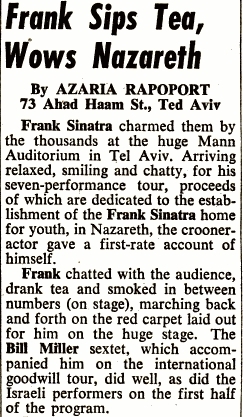
May 4, 1962
Concerts
Kibbutz, Ein Gev, Israel
Bill Miller Sextet: Emil Richards (Vibes), Al Viola (Guitar), Irv Cottler (Drums),
Ralph Pana (Bass), Harry Klee (Flute, Sax, Clarinet), Bill Miller (Piano)
Kibbutz, Ein Gev, Israel
[image referenced in source but could not be recovered]
[image referenced in source but could not be recovered]
May 5, 1962
Concerts
Binyanei Hauma, Auditorium, Jerusalem
Bill Miller Sextet: Emil Richards (Vibes), Al Viola (Guitar), Irv Cottler (Drums),
Ralph Pana (Bass), Harry Klee (Flute, Sax, Clarinet), Bill Miller (Piano)
OA: The Zadikov Choir & Ester Ofarim w/ The Bill Miller Sextet
1. Too Marvelous For Words
2. Imagination
3. Moonlight In Vermont
4. Without A Song
5. Day In - Day Out
6. The Moon Was Yellow
7. I've Got You Under My Skin
8. I Get A Kick Out Of You
9. At Long Last Love
10. My Funny Valentine
11. Embraceable You
12. In The Still Of The Night
13. My Blue Heaven
14. April In Paris
15. The Lady Is A Tramp
16. monologue
17. One For My Baby
18. All The Way
19. Chicago
20. Nancy
21. I Could Have Danced All Night
note: Sinatra was in Israel for nine days during the world tour. He did seven concerts -- attended by 12,000 people. "The Lady Is A Tramp" and "All The Way," from Jerusalem, are on the"All's God's Children" DVD -- available on "Sinatra: World On A String." "Nancy" was a special request that Frank agreed to do.
--Ed
May 6, 1962
Concerts
Tel Nof Air Base, Israel
Note: Scenes featured prominently in "Sinatra In Israel" documentary
Tel Nof Air Base, Israel
Note: Scenes featured prominently in "Sinatra In Israel" documentary
[image referenced in source but could not be recovered]
[image referenced in source but could not be recovered]
"Sinatra in Israel"
Sinatra appeared in and narrated a 22-minute travelogue, Sinatra in Israel, made during his 1962 concert tour of the country, singing 'In the Still of the Night' and 'Without a Song.' More significant than the film itself was that his eight-day stint in Israel (May 2 to May 10, part of a broader Europe/Asia tour) coincided with him overseeing the start of construction on the Frank Sinatra International Youth Center for Arab and Jewish children.
Source: Tom Santopietro, "Sinatra in Hollywood" (2008).
"Sinatra in Israel"
Frank Sinatra: Sinatra described his charitable tour purpose as helping 'underprivileged children' via 'an overprivileged adult,' referring to himself.
Source: Tom Santopietro, "Sinatra in Hollywood" (2008).
"Sinatra in Israel"
Santopietro grades this a B, describing the short film as featuring two songs.
Source: Tom Santopietro, "Sinatra in Hollywood" (2008).
"Sinatra in Israel"
Santopietro (Filmography): Short documentary film produced by the Israeli Federation of Histadruth, narrated by Sinatra, who performed 'In the Still of the Night' and 'Without a Song.'
Source: Tom Santopietro, "Sinatra in Hollywood" (2008).
May 7, 1962
Concerts
Binyanei Há´oomah Concert Hall, Jerusalem, Israel
Bill Miller Sextet: Emil Richards (Vibes), Al Viola (Guitar), Irv Cottler (Drums),
Ralph Pana (Bass), Harry Klee (Flute, Sax, Clarinet), Bill Miller (Piano)
May 9, 1962
Concerts
Cinama Tamar, Haifa, Israel
Bill Miller Sextet: Emil Richards (Vibes), Al Viola (Guitar), Irv Cottler (Drums),
Ralph Pana (Bass), Harry Klee (Flute, Sax, Clarinet), Bill Miller (Piano)
Tomorrow will be 64 years since I saw sinatra in Cinema tamar Haifa.
A friend published a book about the history of cinemas in Haifa.
All of them closed by now.
In this book about cinema Tamar
I have found this picture.
I remembered I sat in the isle and when looking closely I found myself.
I was the only boy in the audience.
I was 16.
I was in shock after the concert and walked home a long time just to relax.
Did know many of the songs.
I read in latter years that Jonathan Schwartz shared a similiar emotional after he saw sinatra June 5 1962 in paris about a month latter.
This was maybe the most memorable event in my life.
Shemmy
Hi Shemmy,
Jonathan saw him at the Olympia in Paris on 6-7-62.
Lido was on 6-5.
Ed
נשלח מה-iPhone שלי
התחלת ההודעה המועברת:
מאת: Shemmy Mashiah <shemmy@s-mashiah.co.il>
תאריך: 8 במאי 2026 בשעה 20:50:06 GMT+3
אל: Shemmy mashiah <smashiah@netvision.net.il>
נושא: Sinatra in Haifa israel may 9 1962
נשלח מה-iPhone שלי
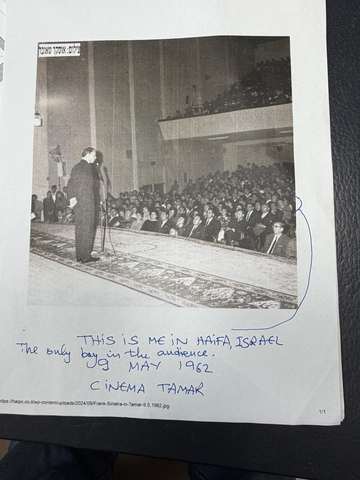
I have some more pictures of
Sinatra in Haifa I recieved from the son of the photographer “Oscar Tauber”. If members are interested I can send the pictures to the group.
Shemmy
נשלח מה-iPhone שלי
ב-8 במאי 2026, בשעה 21:03, shemmy Mashiah <smashiah@netvision.net.il> כתב/ה: Tomorrow will be 64 years since I saw sinatra in Cinema tamar Haifa. A friend published a book about the history of cinemas in Haifa.
All of them closed by now.
In this book about cinema Tamar
I have found this picture.
I remembered I sat in the isle and when looking closely I found myself. I was the only boy in the audience.
I was 16.
I was in shock after the concert and walked home a long time just to relax. Did know many of the songs.
I read in latter years that Jonathan Schwartz shared a similiar emotional after he saw sinatra June 5 1962 in paris about a month latter. This was maybe the most memorable event in my life.
Shemmy
נשלח מה-iPhone שלי
התחלת ההודעה המועברת:
מאת: Shemmy Mashiah <shemmy@s-mashiah.co.il>
תאריך: 8 במאי 2026 בשעה 20:50:06 GMT+3
אל: Shemmy mashiah <smashiah@netvision.net.il>
נושא: Sinatra in Haifa israel may 9 1962
נשלח מה-iPhone שלי
Shemmy sent along the following photos of Sinatra in Israel from May 9, 1962:
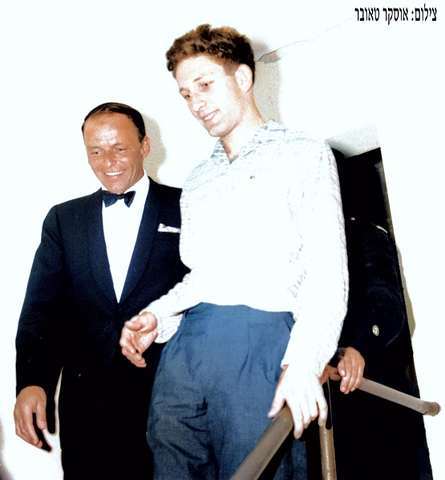
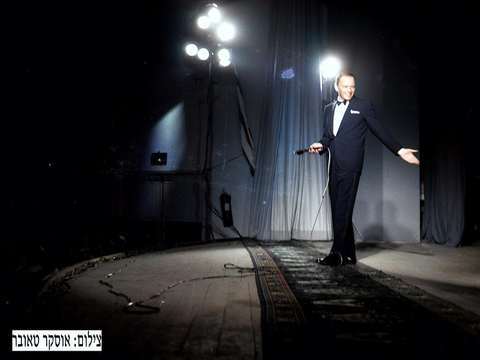
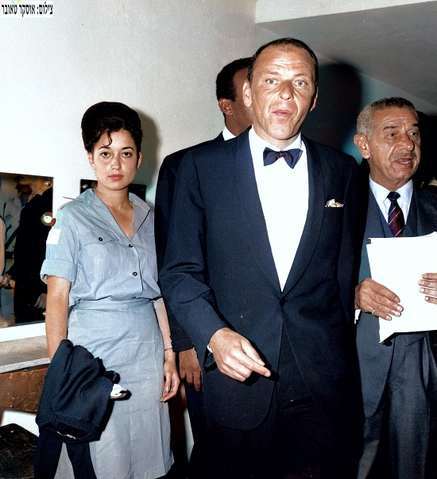
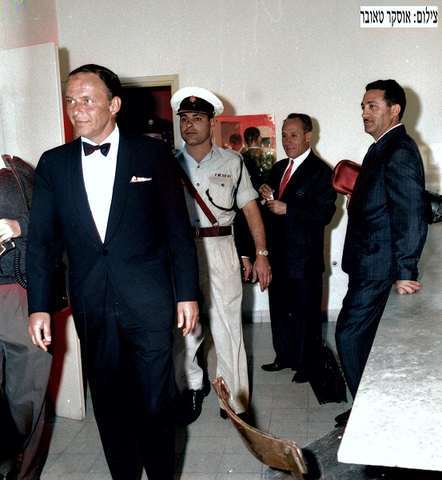
[Israeli independence anniversary ceremonies]
On May 9, marking the 14th anniversary of Israeli independence, Sinatra stood on the reviewing stand with Prime Minister David Ben-Gurion and General Moshe Dayan watching a military parade, an experience that deeply moved him.
Source: James Kaplan, "Sinatra: The Chairman" (2015).
May 10, 1962
Concerts
Keren Cinema, Beer Sheva, Israel
Bill Miller Sextet: Emil Richards (Vibes), Al Viola (Guitar), Irv Cottler
(Drums),
Ralph Pana (Bass), Harry Klee (Flute, Sax, Clarinet), Bill Miller (Piano)
May 18, 1962
Concerts
Herod Atticus, Greece
Bill Miller Sextet: Emil Richards (Vibes), Al Viola (Guitar), Irv Cottler (Drums), Ralph Pana (Bass), Harry Klee (Flute, Sax, Clarinet), Bill Miller (Piano)
1. Goody, Goody
2. They Can't Take That Away From Me
3. Moonlight In Vermont
4. Without A Song
5. Day In, Day Out
6. I've Got You Under My Skin
7. I Get A Kick Out Of You
8. Too Marvelous For Words
9. My Funny Valentine
10. In The Still Of The Night
11. My Blue Heaven
12. April In Paris
13. The Lady Is A Tramp
14. All The Way
15. Chicago
16. Night And Day
17. I Could Have Danced All Night
18. The Moon Was Yellow
Odeon Irodou Attikou under the Acropolis, Athens, Greece
SINATRA IN ATHENS
BY
BARBARA VLASTO
Frank Sinatra recently completed a two month benefit tour of eight countries. The highlight of this project was his two day visit to Athens. Mr. Sinatra undertook the tour at his own expense. The funds for the two performances at the ancient Odeon Irodou Attikou, the ancient theatre under the Acropolis, were donated to St. Sophia's Children's
Hospital.
His performance in Athens was typical Sinatra. Casually walking on stage and into his first song. Sometimes taking the mike in hand he sang in his fine rhythmic yet intimate fashion, walking up and down a narrow blue carpet. The
Bill Miller Sextet accompanied him in their skillful modern jazz style.
There were big spotlights on him as he strode in his sophisticated manner from one end of the stage to the other, dressed in a dark suit, black bow tie and a red handkerchief in his pocket.
"Funny Valentine," "Still Of The Night," "Too Marvelous For Words," "Chicago," "The Lady Is A Tramp" and "I've Got You Under My Skin," had the huge crowd swinging with him.
In the middle of the performance, Mr. Sinatra decided to have a chat with his audience. He liked the Parthenon so much he was moved to say: "Don't let any Americans patch it up, leave it the way it is." As he looked about him at the few remains of the ancient theatre, he said, "Welcome to my house, it's not finished yet. Whoever played here before must have great chops, because they blew the roof right out."
The Chairman Of The Board closed out the brilliant performance with one of his favorite songs, "The Moon Was Yellow," it seemed so appropriate, as above him shone the moon so bright and yellow and the night was clear as only it can be in Athens.
After the performance the mayor of Athens presented him with a medal. To this Mr. Sinatra replied that he didn't think he deserved the medal, he just wanted to help some kids.
Ed O'Brien:
Bill Miller felt the first concert in Athens was Sinatra's finest during the World Tour. There was 36,000 feet of color film shot during the tour. Frank's secretary, Dorothy, told me they have all of this one, albeit the color is somewhat faded. A half-hour film of the tour was shown in theatres with color footage of concerts in London, Paris, Tel Aviv, Jerusalem and Athens.
Justice Department Organized Crime Section chief Edwyn Silberling sent a memo, initialed by Attorney General Robert Kennedy, proposing a tax investigation of Sinatra; on June 1, 1962, Assistant Attorney General Herbert Miller told Silberling that a broad investigation was not authorized and that inquiry should be limited to specific suspected violations.
Source: George Carpozi Jr., Frank Sinatra: Is This Man Mafia? (New York: Manor Books, 1979), citing Justice Department memoranda made public in later reporting.
May 19, 1962
Concerts
Roman Amphitheater, Greece
Bill Miller Sextet: Emil Richards (Vibes), Al Viola (Guitar), Irv Cottler
(Drums), Ralph Pana (Bass), Harry Klee (Flute, Sax, Clarinet), Bill Miller (Piano)
1. Too Marvelous For Words
2. Imagination
3. Moonlight In Vermont
4. Without A Song
5. Day In, Day Out
6. The Moon Was Yellow
7. Under My Skin
8. At Long Last Love
9. My Funny Valentine
10. In The Still Of The Night
11. Night And Day
12. Embraceable You
13. My Blue Heaven
14. April In Paris
15. The Lady Is A Tramp
16. One For My Baby
17. Old Man River
18. All The Way
19. Chicago
20. I Could Have Danced All Night
21. Come Fly With Me
Roman Amphitheater, Greece
Bill Miller Sextet: Emil Richards (Vibes), Al Viola (Guitar), Irv Cottler
(Drums), Ralph Pana (Bass), Harry Klee (Flute, Sax, Clarinet), Bill Miller (Piano)
Program:
Emacs!
Emacs!
Emacs!
Emacs!
[Happy Birthday Mr. President]
JFK: Before fifteen thousand people at a Madison Square Garden Democratic fundraiser, Marilyn Monroe sang 'Happy Birthday, Mr. President' in a sheer rhinestone dress with nothing underneath. This was, per Kaplan, the fourth and briefest Monroe-Kennedy meeting; Jacqueline Kennedy was not present, and afterward JFK publicly joked about the 'sweet, wholesome' rendition.
Source: James Kaplan, "Sinatra: The Chairman" (2015).
[RFK meets Monroe at Krim party]
Schlesinger: After the Madison Square Garden gala, at a party hosted by Arthur and Mathilde Krim, Robert Kennedy paid Marilyn Monroe close attention -- per Arthur Schlesinger, this was RFK's first meeting with her, and both Schlesinger and Adlai Stevenson described being captivated by her that night.
Source: James Kaplan, "Sinatra: The Chairman" (2015).
May 24, 1962
Concerts
Teatro Sistina, Rome, Italy
Thursday evening
Bill Miller Sextet: Emil Richards (Vibes), Al Viola (Guitar), Irv Cottler (Drums), Ralph Pana (Bass), Harry Klee (Flute, Sax, Clarinet), Bill Miller (Piano)
1. Goody Goody
2. They Can't Take That Away From Me
3. Moonlight In Vermont
4. Without A Song
5.. Day In, Day Out
6. I've Got You Under My Skin
7. Imagination
8. Nancy
9. My Blue Heaven
10. The Lady Is A Tramp
11. All The Way
12. I Love Paris
13. Come Fly With Me
14. Witchcraft
15. Night And Day
16. My Funny Valentine
17. A Foggy Day
Segments of this show would be shown on Italian TV, 6-9-62
Ed O'Brien: That is all I can list accurately. I'm sure Sinatra sang "I Get A Kick Out Of You," "Ol' Man River, " I Could Have Danced All Night," "Too Marvelous For Words" and "In The Still Of The Night."
Teatro Sistina, Rome, Italy
During what his tour diary called 'Operation Roma,' Frank performed in Rome and received the Italian Star of Solidarity from the city, then continued to Milan for more concerts.
Source: Nancy Sinatra, Frank Sinatra: An American Legend, 1995.
May 25, 1962
Concerts
Teatro Manzoni, Milan, Italy
Bill Miller Sextet: Emil Richards (Vibes), Al Viola (Guitar), Irv Cottler (Drums),
Ralph Pana (Bass), Harry Klee (Flute, Sax, Clarinet), Bill Miller (Piano)
1. Goody Goody
2. They Can't Take That Away From Me
3. Moonlight In Vermont
4. Without A Song
5. Day In, Day Out
6. The Moon Was Yellow
7. I've Got You Under my Skin
8. I Get A Kick Out Of You
9. Too Marvelous For Words
10. My Funny Valentine
11. In The Still Of The Night
12. My Blue Heaven
13. April In Paris
14. The Lady Is A Tramp
15. Monologue
16. One For My baby
17. All The Way
18. Chicago
19. Night And Day
20. Ol' Man River
21. I Could Have Danced All Night
22. A Foggy Day
TT: 60min.
May 26, 1962
Concerts
Palazzo del Ghiaccio, Milan, Italy
Bill Miller Sextet: Emil Richards (Vibes), Al Viola (Guitar), Irv Cottler (Drums), Ralph Pana (Bass), Harry Klee (Flute, Sax, Clarinet), Bill Miller (Piano)
1. Goody Goody
2. They Can't Take That Away From Me
3. Moonlight In Vermont
4. Without A Song
5. Day In, Day Out
6. The Moon Was Yellow
7. I've Got You Under My Skin
8. I Get A Kick Out Of You
9. Too Marvelous For Words
10. My Funny Valentine
11. In The Still Of The Night
12. My Blue Heaven
13. April In Paris
14. The Lady Is A Tramp
15. monologue
16. All The Way
17. Chicago
18. Night And Day
19. I Could Have Danced All Night
20. Nancy
Palazzo del Ghiaccio, Milan, Italy
Bill Miller Sextet: Emil Richards (Vibes), Al Viola (Guitar), Irv Cottler (Drums), Ralph Pana (Bass), Harry Klee (Flute, Sax, Clarinet), Bill Miller (Piano)
1962 MILANO Palazzo del Ghiaccio - Frank SINATRA
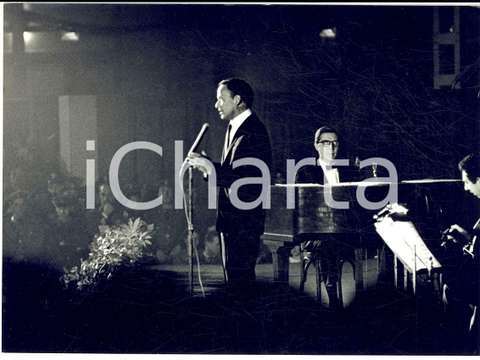
MILANO Palazzo del Ghiaccio - Frank SINATRA
[Awkward Milan monologue]
At the May 26 Milan concert, a surviving bootleg captures Sinatra's stiff, disconnected between-song patter, including a flat attempt at an Italian accent joke about his teacup that drew scant laughter.
Source: James Kaplan, "Sinatra: The Chairman" (2015).
May 30, 1962
[London premiere at Royal Festival Hall]
Sinatra's London shows, his first UK appearances since 1953, opened to a rapturous welcome at Royal Festival Hall, with Princess Margaret sponsoring and attending; though visibly nervous on the opening number, he found his footing and gave the crowd a strong show, addressing them awkwardly as "Highness, lords and ladies."
Source: James Kaplan, "Sinatra: The Chairman" (2015).
At London's Royal Festival Hall, sponsored by Princess Margaret, Frank gave a triumphant concert; during a visit to a Children's Home for the Blind, a young blind girl asked him what color the wind was.
Frank Sinatra (quoted): "No one knows because the wind moves too fast."
Source: Nancy Sinatra, Frank Sinatra: An American Legend, 1995.
June 1962
[Sinatra Records Great Songs from Great Britain in London]
Sinatra recorded the album Great Songs from Great Britain at CTS Studios in London in June 1962.
Source: Charles Pignone, "Frank Sinatra 100" (2015).
[Farnon on Sinatra's struggling voice]
Farnon: Arranger Robert Farnon recalled that during the British album sessions Sinatra found it difficult to sing, his voice tired and breaking, and that he was very angry with himself over it.
Source: James Kaplan, "Sinatra: The Chairman" (2015)
[Homecoming dinner at the Savoy Hilton]
Earl Wilson: After the Monte Carlo gala, Sinatra returned to New York elated. Columnist Earl Wilson found him with Mike Romanoff in the Presidential Suite of the Savoy Hilton enjoying a dinner sent from Patsy's restaurant; Wilson wrote that Sinatra was in a good mood, having found himself newly popular in the world press.
Source: James Kaplan, "Sinatra: The Chairman" (2015)
[Sinatra offers to help Monroe]
Sinatra: Back in Los Angeles, Sinatra put his lawyers at Marilyn Monroe's service and offered that his company Essex Productions would produce her next picture, saying it would be good chemistry for both.
Source: James Kaplan, "Sinatra: The Chairman" (2015)
[Tea and honey remark at Royal Festival Hall]
Sinatra: During a tea break at his Royal Festival Hall concert, Sinatra explained that drinking tea with honey during performances was a genuine necessity for his throat, not a prop, though he noted that smoking afterward undid the benefit.
Source: James Kaplan, "Sinatra: The Chairman" (2015)
[World tour charity total and humility]
Sinatra: Press accounts credited Sinatra's world tour with raising an estimated $1.2 million for children's charities. Sinatra said he wished it had been five million, and told a reporter the trip had changed him and been 'a revelation.'
Source: James Kaplan, "Sinatra: The Chairman" (2015)
[Sinatra keeps flawed take for Harry Roche's trombone solo]
During the London recording sessions, trombonist Harry Roche played a solo on "A Nightingale Sang in Berkeley Square" that Sinatra loved. When Sinatra himself fluffed a line on the next take, he told the engineers to keep the earlier trombone solo rather than redo it, saying it was too good to lose.
Source: Richard Havers, "Sinatra" (Dorling Kindersley, 2007).
June 1, 1962
Concerts
Royal Festival Hall, London
Bill Miller Sextet: Emil Richards (Vibes), Al Viola (Guitar), Irv Cottler (Drums), Ralph Pana (Bass), Harry Klee (Flute, Sax, Clarinet), Bill Miller (Piano)
1. Intro By: David Jacobs
2. Goody Goody
3. Imagination
4. At Long Last Love
5. Moonlight In Vermont
6. Without A Song
7.. Day In, Day Out
8. The Moon Was Yellow
9. I've Got You Under My Skin
10. I Get A Kick Out Of You
11. The Second Time Around
12. Too Marvellous For Words
13. My Funny Valentine
14. In The Still Of The Night
15. My Blue Heaven 16. April In Paris
17. You're Nobody 'Til Somebody Loves You
18. They Can't Take That Away From Me
19. All The Way
20. Chicago
21. Night And Day
22. Autumn Leaves
23. I Could Have Danced All Night
24. One For My Baby
25. A Foggy Day
26. The Lady Is A Tramp
27. Ol' Man River
28. You Make Me Feel So Young
29. Nancy
30. Come Fly With Me
Note: The edited concert appears on the Officially released CD: Sinatra - Royal Festival Hall Trama/Artanis T000/279-2
Ed O'Brien:
Through the years there were a few concerts that ran more than 90 minutes, but none that featured 29 songs by Sinatra. Neal Hefti modified the great Riddle and May charts for the world tour. He also created some memorable charts himself, including an exquisite "Autumn Leaves," featuring a flute. An amazing evening when you consider how many performances Frank had done already from the tour's inception in April.
Royal Festival Hall, London
Bill Miller Sextet: Emil Richards (Vibes), Al Viola (Guitar), Irv Cottler (Drums), Ralph Pana (Bass), Harry Klee (Flute, Sax, Clarinet), Bill Miller (Piano)
When Sinatra Took The Throne At London's Royal Festival Hall, 1962
Frank Sinatra proved he was musical royalty when, in 1962, he performed at London's Royal Festival Hall before an audience of British dignitaries.Published on June 1, 2021 By Charles Waring
On May 30, 1962, Frank Sinatra's private aircraft, the Christina, landed at London's Heathrow Airport. Marking the first time the singer had appeared in the UK capital since 1953. Sinatra was scheduled to perform a midnight charity concert at London's Royal Festival Hall on June 1, in front of an audience that included many British celebrities and dignitaries, including Queen Elizabeth II's younger sister, Princess Margaret. With the press whipping up excitement, tickets were quick to sell out, and Sinatra's concert was billed as the city's most keenly anticipated event of the year.
With him, he'd brought a sextet led by his longtime pianist, Bill Miller, and which included vibraphonist Emil Richards, guitarist Al Viola, flautist/saxophonist Harry Klee, bassist Ralph Pena and drummer Irv Cottler. Drinking tea with honey on stage, to keep his voice in peak condition, Sinatra more than lived up to expectations.
Too marvellous for words
His finely balanced, 29-song set blended uptempo swingers with pensive ballads and juggled established classics with newer favorites. Among the many highlights was a fabulous rendition of the Johnny Mercer-Richard Whiting song "Too Marvelous For Words,"which originally appeared on Sinatra's seminal 1956 Capitol album, Songs For Swingin' Lovers! The original was arranged and conducted by Nelson Riddle, but the new small-combo arrangement, by Neal Hefti, had a lighter sense of swing.
Another standout moment comes when the band drops out, leaving Sinatra accompanied solely by Bill Miller's piano on the classic saloon ballad "One For My Baby (And One For The Road)."Sinatra introduced it by saying,"This is the kind of song that's generally done in a small bar in the wee hours of the morning," before delivering a poignant, mesmerizing rendition of the number, which he'd most recently recorded for the 1958 album Frank Sinatra Sings For Only The Lonely.
Another Songs For Swingin' Lovers! cut provided a further highlight of the Royal Festival Hall show. Rightly regarded as one of Sinatra's signature songs, "You Make Me Feel So Young" made up part of the four-song encore that evening, with Sinatra himself counting the band in. With Harry Klee's flute and Emil Richards' vibraphones entwining on the intro, Sinatra exclaims, "This is a lovely tune!" before delivering the number with a palpable sense of joie de vivre over a coolly-swinging groove.
Great songs from Great Britain
Sinatra stayed in London for two more concerts that month (at the Odeon on Leicester Square and the Gaumont in Hammersmith), but the prestigious Royal Festival Hall date remains one of his most legendary. Sinatra himself was so taken by the city that he stayed there to record Sinatra Sings Great Songs From Great Britain, the only album that he recorded outside of the US. This period is captured in the 2014 box set Sinatra: London, which includes the complete Great Songs… album, along with sessions, furtther live performances (from 1970 and 1984), plus the entire 1962 Royal Festival Hall gig on DVD, fully revealing the extent of Sinatra's relationship with the city.
Frank Sinatra, visits the Sunshine Home for Blind Babies and Children at Northwood, Middlesex, Friday 1st June 1962
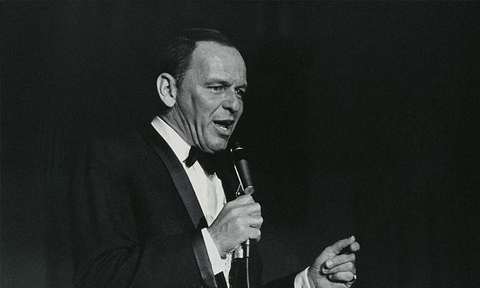
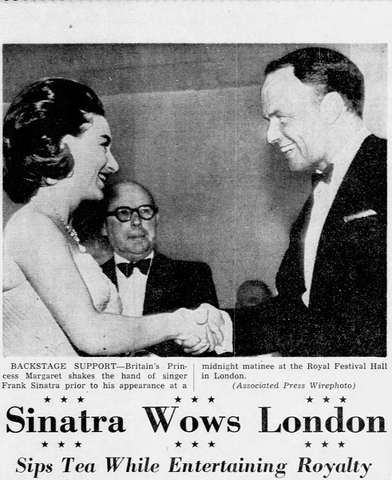
[Farnon charts finalized]
On the day of his Royal Festival Hall concert, Sinatra and arranger Robert Farnon went over the keys and tempos for the songs planned for the British album sessions.
Source: James Kaplan, "Sinatra: The Chairman" (2015).
June 2, 1962
Television
THIS IS SINATRA
ABC-TV
Manchester, England
8:25 - 9:25 P.M.
Introduction by David Jacobs
Benefit for Invalid Children's Association
1. Goody, Goody
2. Imagination
3. At Long Last Love
4. Moonlight In Vermont
5. Day In, Day Out monologue
6. They Can't Take That Away From Me
7. All The Way
8. Chicago
9. One For My Baby w/Bill Miller
10. The Lady Is A Tramp
11. Ol' Man River
12. You Make Me Feel So Young
13. Nancy
14. Come Fly With Me note: taped the previous night at Royal Festival Hall
Concerts
Odeon Leicester Square, London
Bill Miller Sextet: 2nd Show
Emil Richards (Vibes), Al Viola (Guitar),
Irv Cottler (Drums), Ralph Pana (Bass),
Harry Klee (Flute, Sax, Clarinet),
Bill Miller (Piano)
1. Goody Goody
2. Imagination
3. At Long Last Love
4. Moonlight In Vermont
5. Day In, Day Out
6. I've Got You Under My Skin
7. I Get A Kick Out Of You
8. The Second Time Around
9. Too Marvelous For Words
10. My Funny Valentine
11. In The Still Of The Night
12. My Blue Heaven
13. April In Paris
14. You're Nobody Till Somebody Loves You monologue
15. They Can't Take That Away From Me
16. All The Way
17. Chicago
18. One For My Bay w/Bill Miller
19. Night And Day
20. I Could Have Danced All Night
21. Ol' Man River
22. A Foggy Day
23. The Lady Is A Tramp
24. Nancy
25. Come Fly With Me
26. You Make Me Feel So Young
27. London By Night note: First show Sinatra did 25 songs, omitting "All The Way" and "Chicago."
Odeon Leicester Square, London
Bill Miller Sextet: Emil Richards (Vibes), Al Viola (Guitar), Irv Cottler (Drums), Ralph Pana (Bass), Harry Klee (Flute, Sax, Clarinet), Bill Miller (Piano)
Variety
June 13, 1962
[image referenced in source but could not be recovered]
[image referenced in source but could not be recovered]
[image referenced in source but could not be recovered]
THIS IS SINATRA
ABC-TV
Manchester, England
8:25 - 9:25 P.M.
Introduction by David Jacobs
Variety
June 13, 1962
[image referenced in source but could not be recovered]
[image referenced in source but could not be recovered]
June 3, 1962
Concerts
Gaumont Hammersmith, London
Bill Miller Sextet: Emil Richards (Vibes), Al Viola (Guitar), Irv Cottler (Drums), Ralph Pana (Bass), Harry Klee (Flute, Sax, Clarinet), Bill Miller (Piano)
Two shows
Gaumont Hammersmith, London
Bill Miller Sextet: Emil Richards (Vibes), Al Viola (Guitar), Irv Cottler (Drums), Ralph Pana (Bass), Harry Klee (Flute, Sax, Clarinet), Bill Miller (Piano)
Two shows
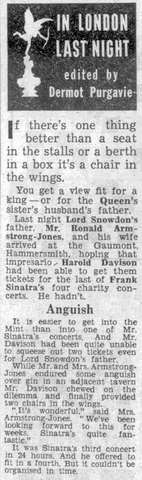
[Hammersmith Odeon show reviewed]
Ray Coleman: Reviewing Sinatra's fourth London-area show in three days at the Hammersmith Odeon, Melody Maker critic Ray Coleman praised his professionalism but noted his voice sounding coarse and nasal at times, particularly on "My Funny Valentine" -- a sign of vocal strain after six weeks of touring.
Source: James Kaplan, "Sinatra: The Chairman" (2015).
June 5, 1962
Concerts
The Lido, Paris, France
Bill Miller Sextet: Emil Richards (Vibes), Al Viola (Guitar), Irv Cottler (Drums), Ralph Pana (Bass), Harry Klee (Flute, Sax, Clarinet), Bill Miller (Piano)
Introduced By M. Louis Merlin
1. Goody, Goody
2. Imagination
3. At Long Last Love
4. Moonlight In Vermont
5. Without A Song
6. Day In, Day Out
7. I've Got You Under My Skin
8. I Get A Kick Out Of You
9. The Second Time Around
10. Too Marvelous For Words
11. My Funny Valentine
12. In The Still Of The Night
13. April In Paris
14. You're Nobody ‘Til Somebody Loves You
15. . monologue
16. They Can't Take That Away From Me
17. All The Way
18. Chicago
19. Night And Day
20. One For My Baby
21. I Could Have Danced All Night
22. Nancy
23. A Foggy Day
24. Ol' Man River
25. The Lady Is A Tramp
Ed O'Brien:
Reprise sent me an advanced copy of "Sinatra In
Paris" about six weeks before the official release. I noticed
immediately that both the venue and date were wrong. The
released concert was done at the Olympia Theatre on 6-7-
62. The Lido on 6-5 was a nightclub performance. I
called the producer and gave them the correct date and
explained there were some errors in the liner notes. I
was assured that the mistakes would be fixed post haste.
Never happened. I don't have the recent two LP Paris
set, but I wonder if the information is finally accurate.
"RADD" CD issue had "The Second Time Around"
from the 63 sessions with Riddle. I dutifully called
and was assured the 60 recording would be on all
subsequent printings. Never happened. Recently
I picked up the Capitol LP issue of "Wee Small Hours."
The song listing on the back give no indication that
something is amiss, but track eight is not "When Your
Lover Has Gone." It is instead "Guess I'll Have To
Change My Plans" from the "Swingin' Affair" sessions,
in November of 56. I just thought of something that
is very noticeable to me. If anyone else on this list
has this particular LP, would you please let me know
if you hear a rather dramatic difference in sound quality,
when listening to the pristine KHJ recordings, for "Wee
Small" and the Capitol Tower effort on "Guess I'll Have . . ."
I noticed a dramatic difference. Anyway, Cap. also issued
a marvelous LP of 'Come Fly With Me" from the mono
master. Really sensational. Unfortunately, the powers
that be plastered across the top "Capitol Full-dimensional
Stereo." LP was pulled and reissued with the mistake
still intact. "They also did the same damn thing with "Wee
Small . . ." Is there anyone in charge?
Ed O'Brien added:
Frank Sinatra was 46 years old when he played the Lido in June of 1962.
He had performed in London a number of times since 1950 but this evening
at the Lido was his first concert performance in Paris. It really is a better
show than the better known Olympia on 6-7-62. Sinatra was much more at
ease in a nightclub setting back then. He is so much at ease and his confidence
so palpable throughout the 24 song set. I'm surprised he didn't do an extended
engagement in a Paris club somewhere along the way. The French audience
loved him.
Review
600 at $100 a Ticket Hear Sinatra in Paris
PARIS, June 6 -- Frank Sinatra sang last night for the first
time in Paris. He appeared at the Lido, a leading nightclub,
where an audience of 600 persons who had paid $100 each
sat enthralled through his repertoire of "standard" songs of
passion and mirth.
The American singer is on a world tour to raise money
for underprivileged children.
"I've been on the road for two months now and have sung
in everything from drafty concert halls to broken-down Greek
amphitheaters," Mr. Sinatra said. "It's a pleasure to be back
in a saloon -- the kind of place I'm used to."
In a little more than an hour, Mr. Sinatra sang two dozen
songs in his characteristically relaxed and unassuming manner.
New York Times
June 7, 1962
note: A much superior performance to the commercially issued Olympia
effort from 6-7-62. Sinatra sings better and is so much more at home in
the small club atmosphere. The show has a running time of 80 plus minutes.
The Lido, Paris, France
Bill Miller Sextet: Emil Richards (Vibes), Al Viola (Guitar), Irv
Cottler (Drums), Ralph Pana (Bass), Harry Klee (Flute, Sax, Clarinet), Bill Miller (Piano)
Introduced By M. Louis Merlin
In the afternoon preceding the concert at The Lido, Frank was received at the Paris City Hall by the Council President Paul Minot (there was not yet a mayor) who gave him the Medal of the City. Here are photos. He also visited a children's hospital. The Lido concert was released for the first time on the bootleg CD The Ultimate Performer Decade Records 500 without Nancy because there was a fault on the tape. After You're Nobody 'Till Somebody Loves You Mr Louis Merlin presented Frank with sapphire and rubis blue/red cufflink (blue and red are the color of the city)
As for the Olympia on 07 there was a film before Frank. He sang I Love Paris (not at the Lido) as well as All The Way (not edited on the Reprise CD - he started the song as a "parody" in a wrong key and "Alllll...the way", maybe the reason why the song was cancelled by Reprise.
At last in his book George Jacobs says that he bought at Fauchon (select grocery) a can of Campbell sausage and beans. He remembered Frank given it with a spoon to the Lido Blue Bells Girls
--Michel
N.Y. TIMES 6-7-62
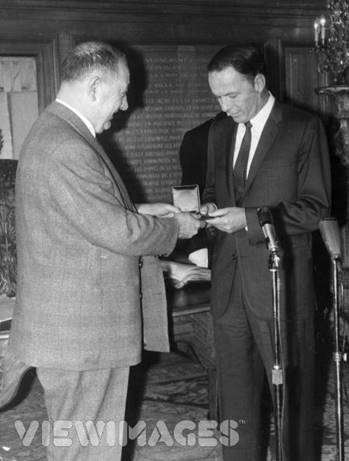
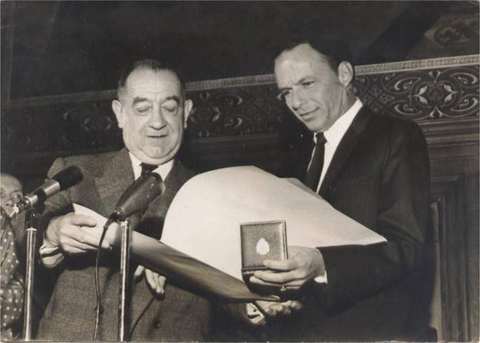
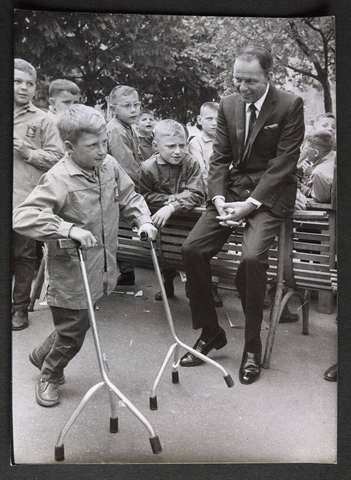
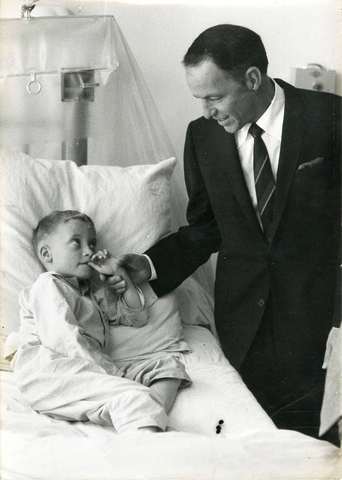
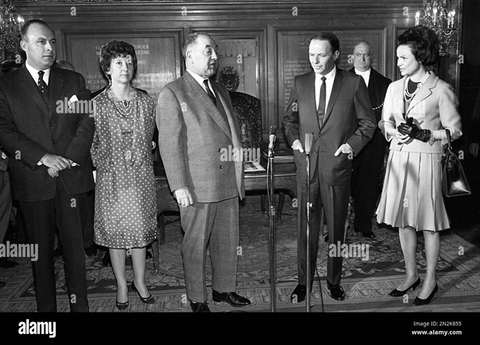

AFP / AFP/Getty Images / Courtesy
Frank Sinatra in a picture taken June 6, 1962, in Paris performs on stage of the Lido Theater.
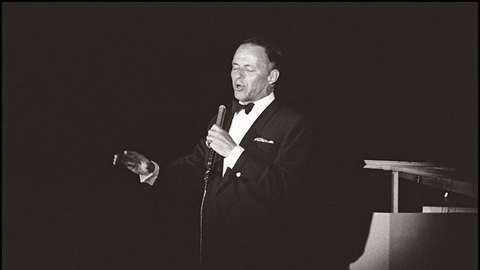
Eighteen-year-old Frank Jr. performing at Disneyland in 1962. Source: photo and caption from J. Randy Taraborrelli, Sinatra: Behind the Legend (mptvimages.com).
[First Paris show at the Lido]
Sinatra played his first-ever Paris concert on June 5 at the Lido nightclub-theater on the Champs-Elysees.
Source: James Kaplan, "Sinatra: The Chairman" (2015).
Source: CS 044 -- Encore 1002, "The Paris Concert 1962" liner notes.
The liner notes frame the 1962 tour as unprecedented: Sinatra paid all expenses himself, gave a total of thirty concerts across Mexico City and major cities of Europe, the Near East, and the Far East, and raised over a million dollars for children's charities before the tour concluded -- with this Lido date marking his first-ever Paris appearance.
The disc's musician credits confirm the touring sextet as Bill Miller (piano), Al Viola (guitar), Ralph Pena (bass), Irv Cottler (drums), Emil Richards (vibraphone), and Harry Klee (alto saxophone and flute), and highlight the show's rendition of "You're Nobody 'Til Somebody Loves You" and a duet with Al Viola on "Night and Day" as standout moments of the set.
Television
Cinama Tamar, Haifa, Israel
Bill Miller Sextet: Emil Richards (Vibes), Al Viola (Guitar), Irv
Cottler (Drums),
Ralph Pana (Bass), Harry Klee (Flute, Sax, Clarinet), Bill Miller (Piano)
Thanks to Shemmy for above photo
Tomorrow will be 64 years since I saw sinatra in Cinema tamar Haifa.
A friend published a book about the history of cinemas in Haifa. All of them closed by now.
In this book about cinema Tamar I have found this picture.
I remembered I sat in the isle and when looking closely I found myself.
I was the only boy in the audience. I was 16.
I was in shock after the concert and walked home a long time just to relax.
Did know many of the songs. I read in latter years that Jonathan Schwartz shared
a similiar emotional after he saw sinatra June 5 1962 in paris about a month latter.
This was maybe the most memorable event in my life.
--Shemmy
Source: sinatraphiles digest (date extracted from item text; originally routed to appendix for review).
June 7, 1962
Concerts
The Olympia, Paris, France
Bill Miller Sextet: Emil Richards (Vibes), Al Viola (Guitar), Irv Cottler (Drums), Ralph Pana (Bass), Harry Klee (Flute, Sax, Clarinet), Bill Miller (Piano)
1.Intro By: Charles Aznavour
2. Goody Goody
3. Imagination
4. At Long Last Love
5. Moonlight In Vermont
6. Without A Song
7. Day In, Day Out
8. I've Got You Under My Skin
9. I Get A Kick Out Of You
10. The Second Time Around
11. Too Marvelous With Words  Â
12. My Funny Valentine
13. In The Still Of The Night
14. April In Paris
15. You're Nobody Til Somebody Loves You
16. monologue
17. They Can't Take That Away From Me
18. All The Way
19. Chicago
20. Night And Day
21. I Could Have Danced All Night
22. song intro
23. One For My Baby
24. A Foggy Day
25. Ol' Man River
26. The Lady Is A Tramp
27. I Love Paris
28. Nancy
29. Come Fly With Me
30. chaser
Note: Incomplete concert release by Reprise: Sinatra & Sextet-Live In Paris. Monologue & "All The Way" were cut.
NOTE: Sinatraphile Vance Adair is thankful that Reprise had the rare good sense to make this available to the public. "Great concert!"
Also, a salutary reminder of how comfortable and accomplished Sinatra was with smaller combos. Sinatra could and should have incorporated this sound into his studio efforts, Adair insists.
Sinatra Rich Rosenberg adds that Reprise put the recording out after it was first released as a bootleg. This was also the case with Capitol and the 1959 Melbourne concert. The Paris concert was the rare case in which the official release improved on the unofficial one by coming out in stereo.
Frank was vocally tired at the Olympia. When he started singing "When somebody loves you, it's no good unless he loves you "ALLLLLLLLLLL the way. Al Viola told me Frank did it many times. I'm sure you have heard it. Tough note that he wasn't sure he could navigate. Monologue was badly dated by 1994.
I was told by people at Reprise that Paris has never been released in true stereo.
Ed
Another example of great moments in the history of major record labels. Reprise obtained a copy of the Paris CD and wanted desperately to do a release on their label. They negotiated with the person who had the master and agreed to pay $10,000 dollars for the master. A well known collector called the label and informed them that they were sitting on a pristine copy in the Reprise vault. It was dug out and lo and behold the fidelity was simply spectacular. An eleventh hour rescue by someone who wanted the very best sound possible made available for the record buyer. Ed
The Olympia, Paris, France
Bill Miller Sextet: Emil Richards (Vibes), Al Viola (Guitar), Irv Cottler (Drums), Ralph Pana (Bass), Harry Klee (Flute, Sax, Clarinet), Bill Miller (Piano)
Variety
June 13, 1962
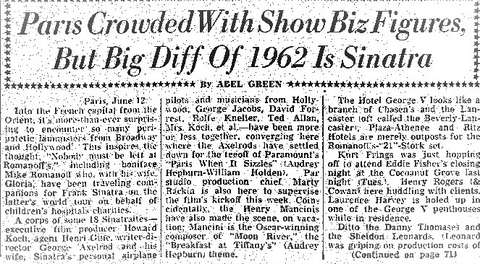
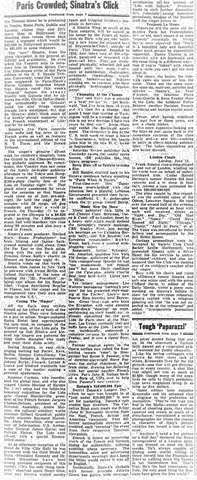
[Olympia concert recorded, released decades later]
On June 7, Sinatra played the Olympia music hall in Paris, introduced by Charles Aznavour; it was the only professionally recorded show of the world tour, though the resulting live album (mislabeled as a Lido recording) wasn't released until 1994, in part because Sinatra's voice was clearly worn out by that point in the tour.
Source: James Kaplan, "Sinatra: The Chairman" (2015).
[Sinatra struggles then rallies at the Olympia]
At the Olympia, Sinatra opened flat on "Goody Goody" and struggled pitifully on "Moonlight in Vermont," but rallied for strong performances of "Day In, Day Out," "I've Got You Under My Skin," "In the Still of the Night," and "April in Paris," plus standout duets with guitarist Al Viola on "Night and Day" and pianist Bill Miller on "Ol' Man River."
Source: James Kaplan, "Sinatra: The Chairman" (2015).
[Sinatra jabs at Ava in his Paris finale]
Frank Sinatra: Closing the Olympia show with "The Lady Is a Tramp," Sinatra joked the previous song had been about "Sammy Davis's people" and this one about "mah people" -- and, extending a running joke about Ava throughout the tour, changed the Cole Porter lyric "Some like the perfume in Spain" to add a mocking "yecchh!"
Source: James Kaplan, "Sinatra: The Chairman" (2015).
CS 081 (James Isaacs liner essay, Reprise "Frank Sinatra And Sextet: Live In Paris," 1994) adds a musician's-eye account of how the touring sextet worked: guitarist Al Viola recalled the group "never even rehearsed with Frank" for the 1962 world tour, because the charts -- mostly by Neal Hefti, with some by Billy May -- were adapted from arrangements already familiar to Sinatra from Sings For Only The Lonely, Nice 'n' Easy, I Remember Tommy, Sinatra And Strings, and Point Of No Return; the band itself rehearsed without Frank in Burbank beforehand. Viola also noted the group was still finding its footing at the opening Mexico City date and "developed our own shadings" as the tour moved through Tokyo, Rome, Athens, Tel Aviv, and on to Paris.
June 9, 1962
Concerts
International Sporting Club, Monaco
Bill Miller Sextet: Emil Richards (Vibes), Al Viola (Guitar), Irv Cottler (Drums), Ralph Pana (Bass), Harry Klee (Flute, Sax, Clarinet), Bill Miller (Piano)
International Sporting Club, Monaco
Bill Miller Sextet: Emil Richards (Vibes), Al Viola (Guitar), Irv
Cottler (Drums), Ralph Pana (Bass), Harry Klee (Flute, Sax, Clarinet), Bill Miller (Piano)
Pictured at the Frank Sinatra Gala at the Sporting Club in Monaco June 9, 1962 ,are, left to right, Prince Rainier III of Monaco;
Sinatra; Princess Grace, an old film friend of the singer; and newlywed Princess Sophia of Greece and Don Juan Carlos of Spain.
In background are Prince Rainier's sister, Princess Antoinette, and her husband, Jean Charles Rey.
June 9 1984--Frank was a pallbearer at Paul E "Skinny"
D'Amato funeral in Atlantic City New
Jersey.
--Fred J Wadsworth
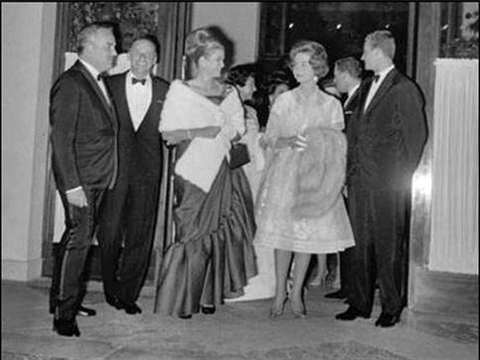
[Monroe fired from Something's Got to Give]
On the same day Sinatra performed at the Monte Carlo gala, 20th Century Fox announced it was firing Marilyn Monroe from Something's Got to Give -- thirty-two days behind schedule and $2 million over budget after she had shown up for only five days in seven weeks -- and replacing her with Lee Remick.
Source: James Kaplan, "Sinatra: The Chairman" (2015).
[Dean Martin quits over Monroe firing]
Shortly after Marilyn Monroe was fired from Something's Got to Give, her co-star Dean Martin quit the picture, saying it was pointless to make it with anyone else; the film was never completed.
Source: James Kaplan, "Sinatra: The Chairman" (2015).
June 12, 1962
Studio
London
1023 If I Had You
(Jimmy Campbell/Reg Connelly/Ted Shapiro)
Campbell-Connelly Inc./EMI Robbins Catalog Inc. (ASCAP) Arranged & Conducted by Robert Farnon
-12 (4:04) CD: 46013-2 The Complete Reprise Studio Recordings Disc 4 -12 LP: FS1006Great Songs From Great Britain
-alt LP: P-7721 Great Songs From Great Britain‚ (Japan)
1024 The Very Thought Of You
(Ray Noble)
Range Road Music Inc./Quartet Music Inc. (ASCAP)
Arranged & Conducted by Robert Farnon
-5 (3:31) CD: 46013-2 The Complete Reprise Studio Recordings Disc 4
LP: FS1006Great Songs From Great Britain
-alt LP: P-7721 Great Songs From Great Britain‚ (Japan)
1025 I'll Follow My Secret Heart
(Noel Coward)
Chappell & Co. Inc. (ASCAP)
Arranged & Conducted by Robert Farnon
-2 (3:15) CD: 46013-2 The Complete Reprise Studio Recordings Disc 4
LP: FS1006Great Songs From Great Britain
1026 A Garden In The Rain
(Carroll Gibbons/James Dyrenforth)
Campbell-Connelly, Inc. (ASCAP/PRS Ltd.)
Arranged & Conducted by Robert Farnon
-3 (3:21) CD: 46013-2 The Complete Reprise Studio Recordings Disc 4
CD: 9-26340-2The Reprise Collection
LP: FS1006Great Songs From Great Britain
Ed O'Brien:
Alan Freeman, Pye Record Producer, received a call from the president of Pye, Louie Alexander, shortly before Christmas in 1961. Freeman went to Alexander's office and was offered the task of overseeing Frank Sinatra's planned album project, a dozen songs by British song writers, in June of 1962. Freeman devoted a great deal of his working hours, over the next six months, putting together the songs and logistics for Frank's first ever recording sessions in another country. He picked some of the songs including "A Nightingale Sang In Berkeley Square ( Freeman's pick as the best recording done for the album), "We'll Meet Again" and "The Gypsy." Frank opted for "A Garden In The Rain," "The Very Thought Of You," "I'll Follow My Secret Heart" and "Now Is The Hour." When told that the latter was a Maori song from New Zealand, Frank felt it was close enough and kept it in. Mo Ostin and Nelson Riddle both were asked for their input by Freeman, as well as Frank's favorite recording engineer, Bill Putnam. Frank arrived at CTS Studios in London about an hour early for the 6-12-62 session. Freeman remembered the nervousness of all the participants that evening including Frank Sinatra. His surroundings were all new to him and the musicians were mostly British. The 40 piece orchestra had been rehears- ing since mid-afternoon. There were 120 invited guests at the first session.. Another 30 hangers on were milling about in the control booth. A professional piano tuner had devoted hours to tuning the piano for Frank's pianist, Bill Miller. The first song, "If I Had You," had a very nice complete first take, with Miller doing his only work of the night. Then one of the legs fell off the piano. Freeman immediately wondered if the session would be canceled. There was no back up piano. Frank was not in the least perturbed. He suggested they substitute a celeste. Gordon Franks was enlisted to play that instrument and take two got under way. After a few more takes, it became quite apparent Frank Sinatra was a very tired singer. The song required 12 takes before a master was cut. The next tune, "The Very Thought Of You, was done in five, but it was a real struggle for the singer. After listening to the final take, Frank called for a break and a drink. Freeman presented him with a glass and a bottle of Jack Daniels. Frank smiled and said, "You've been doing your homework." He offered to share his favorite libation with Freeman. Alas, there was only the one glass. No problem: Frank insisted they share the one glass. While the producer checked with the control booth, Sinatra sat on a stool and chatted away with the drummer, Bobby Midgeley. Earlier Freeman had asked Sinatra what were his pet peeves: Frank answered with "I hate the Australian press, the British press and Capitol Records." "I'll Follow My Secret Heart," Noel Coward's lovely song was the third tune to be recorded that evening. Frank had invited Coward to the session, but his schedule would not permit it. On take one Sinatra went for a final high note that shattered like glass. Take two is the record and it ends on a very quiet, soft note. "A Garden In The Rain" concluded the first evening and was wrapped up in three takes. The session ran from 8 to 11:PM There was a party after the session. Sinatra apologized for his vocal problems, telling Freeman it was a combination of too much singing and too much high living. Years later, the producer would marvel at Frank's ability to drink the firewater, labeled Jack Daniels, and smoke during a recording session. He also recalled the marvelous charts Robert Farnon wrote for the project and how many of the musicians, who played on those three dates in June of 1962, considered it one of if not the high point in their professional lives.
Ed O'Brien:
I like Frank's album with Robert Farnon a great deal. It has a unique sound among all the albums he recorded. Farnon's arrangements are of a very high order and the song selection is excellent. The first session was the roughest of the three for Frank vocally. He had very little underbelly in his vocals that night. A struggle it was throughout. He needed 12 takes to make a record of "If I Had You." His attempt to end "I'll Follow My Secret Heart" with a big note was not to be. The master recording ends on a very quiet fade out. "The Very Thought Of You" has some squeamish notes as does "A Garden In The Rain." And yet the final results of all this effort sounds wonderful today. I never tire of this great tribute to great songs from great Britain. It is an album I play quite often. I wish he had followed through with the 'swing' album of British songs.
John K. George, SFC (Ret):
I agree regarding "Great Song From Great Brit", although Sinatra not at his best vocally, made a beautiful album. Doubt very many singers could top what he laid down on wax....
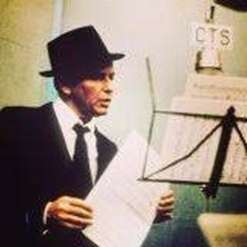
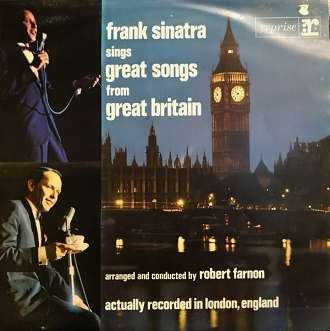
"Great Songs from Great Britain"
In June 1962, exhausted from a world charity tour, Sinatra recorded Great Songs from Great Britain -- his only studio album made outside the US -- at CTS Bayswater Studios in London over three nights (June 12, 13, 14), with arrangements by Robert Farnon, all songs of British origin.
Source: Charles L. Granata, "Sessions with Sinatra: Frank Sinatra and the Art of Recording" (1999/2003).
"If I Had You"
Robert Farnon / Granata: Sinatra, exhausted and hoarse from touring, struggled through multiple aborted takes of 'If I Had You' (a song he'd previously cut with Stordahl in 1947 and Riddle in 1956) on the first London night, including trouble locating his entrance after the song's long intro.
Source: Charles L. Granata, "Sessions with Sinatra: Frank Sinatra and the Art of Recording" (1999/2003).
"If I Had You"
Robert Farnon / Alan A. Freeman: During the 'If I Had You' session the studio's concert grand piano's action broke down mid-recording -- a first for Farnon in his long career. With no backup piano available, Sinatra suggested using celeste instead; pianist Bill Miller played celeste for takes eleven and twelve, an unplanned touch that added character to the recording.
Source: Charles L. Granata, "Sessions with Sinatra: Frank Sinatra and the Art of Recording" (1999/2003).
[Great Songs from Great Britain session begins]
Farnon: Sinatra arrived at C.T.S. Studio in Bayswater, London, in a Rolls-Royce lent by Douglas Fairbanks Jr., to begin recording Sinatra Sings Great Songs from Great Britain with Robert Farnon conducting a large orchestra. The studio was packed with well-wishers, and Farnon recalled people sitting on his podium and under the piano; Sinatra didn't mind the crowd at all.
Source: James Kaplan, "Sinatra: The Chairman" (2015).
[Coughing fit during first session]
Toward the end of the first recording session for the British album, Sinatra had a coughing fit before a take of Noel Coward's 'I'll Follow My Secret Heart,' joking 'Damn, we gotta sleep indoors' and reviving an old gag about a door key. He left without saying goodbye at the end of the night, a sign of his embarrassment over his voice.
Source: James Kaplan, "Sinatra: The Chairman" (2015).
[The Very Thought of You -- critical commentary]
Alan A. Freeman: After recording 'The Very Thought of You,' producer Alan Freeman -- having stocked Jack Daniels because he knew Sinatra's preference -- shared a drink with him from his own glass since none was available; a colleague told Freeman that being offered to share Sinatra's glass meant he was now 'in.'
This song/context matches multiple dated entries in the chronology, or lacked a sufficiently precise date; the specific date could not be determined with confidence.
Source: Charles L. Granata, "Sessions with Sinatra: Frank Sinatra and the Art of Recording" (1999/2003), Part IV: The Reprise Years
June 13, 1962
Studio
London
1027 London By Night
(Carroll Coates)
Barton Music Corp. (ASCAP)
Arranged & Conducted by Robert Farnon
-6 (3:17) CD: 46013-2 The Complete Reprise Studio Recordings Disc 4 -6 LP: FS1006 Great Songs From Great Britain
-alt LP: P-7721 Great Songs From Great Britain ( Japan )
Sinatra: London CD Box - Universal Music Enterprises – B0022005-00
1028 The Gypsy
(Billy Reid)
MCA Inc./Colgems EMI Music Inc. (ASCAP)
Arranged & Conducted by Robert Farnon
-8 (3:18)CD: 46013-2 The Complete Reprise Studio Recordings Disc 4
LP: FS1006Great Songs From Great Britain
Sinatra: London CD Box - Universal Music Enterprises – B0022005-00
1029 Roses Of Picardy
(Fred Weatherly/Haydn Wood)
Chappel & Co. Inc. (ASCAP)
Arranged & Conducted by Robert Farnon
-6 (2:59) CD: 46013-2 The Complete Reprise Studio Recordings Disc 4
LP: P-7721 Great Songs From Great Britain ( Japan )
Sinatra: London CD Box - Universal Music Enterprises – B0022005-00
1030 A Nightingale Sang In Berkeley Square
(Manning Sherwin/Eric Maschwitz)
Colgems EMI Inc./Shapiro, Bernstein & Co. Inc. (ASCAP)
Arranged & Conducted by Robert Farnon
-2 (3:51) CD: 46013-2 The Complete Reprise Studio Recordings Disc 4
CD: 9-26340-2 The Reprise Collection
LP: FS1006 Great Songs From Great Britain
Sinatra: London CD Box - Universal Music Enterprises – B0022005-00
Ed O'Brien (2014):
The second night of the three sessions for "Great Songs From Great Britain" was much more relaxed. Frank was in a great mood The trumpet section was missing from the previous evening. Farnon was conducting an orchestra of 36 musicians. The very best London had to offer. Sinatra told producer Alan Freeman "London By Night" was his favorite song. This would be his third recording of the Carroll Coates classic. Frank mentioned that Coates never wrote another song of any real consequence and was living in The States. There were six takes and two intercuts done before the singer was satisfied. Next up was Billy Reid's "The Gypsy." Frank seemed unfamiliar with the song and the first few takes were very tentative. As Frank got into it Freeman noticed some very unusual phrasing being done in the middle of the song. He asked Nelson Riddle if he could hear it. Riddle told him Frank didn't know the song all that well and was winging it. Freeman asked Riddle if he would tell Frank there was a problem.. Riddle told him to inform Frank. Freeman felt he couldn't. Riddle insisted. Freeman ventured forth: did Frank realize what he was doing? Yes, was the answer. Frank was trying to put a little syncopation into the song. Freeman told him it was wrong. With a glint in his eye and a smile, Frank said, "Well, I like it." There were eight takes done. The most problematic of the 11 songs recorded was "Roses Of Picardy." Sinatra had everyone in stitches throughout the six takes that were done. Freeman and Riddle both noticed the notes were not being held for very long and there was some strain. But the interpretation was glorious. Sinatra was really capturing the beauty of the lyrics with every syllable he sang. The final tune of the evening was a lovely ballad, "A Nightingale Sang In Berkeley Square." The first take featured a stunning trombone solo by Harry Roche. Sinatra was bowled over. He instructed the control booth to save that portion of the song. He had Farnon pick up from there for two more takes and then two intercuts . Freeman considers it to be the best track on the album. I agree. That recording has been issued on numerous compilation discs down through the years. After the session, Freeman and Sinatra listened to the final master from that evening's work. After "Picardy" was played, Frank told him he wanted it scrapped. Freeman asked if there was anything they could do to make it better. Frank didn't like it. Told Freeman to go with 10 tracks. At the conclusion of the final session, Freeman tried to get Frank to change his mind, but he wouldn't budge. He later on told Pye Records that it was never to be released. One final note: originally there were 12 songs scheduled to be recorded. The 12th was "The White Cliffs Of Dover." Farnon had written a beautiful arrangement and it was a much loved song in the British Isles. At the last minute, it was discovered to have been written by an American. I so wish Frank had recorded that gem for a later release.
Ed O'Brien:
There are certain songs that are so superior to the overall collection on an individual album. That was particularly true from 1962 thru 64.
"The Girl Next Door," from "All Alone," belongs on a much better album. The same is true for "The Way You Look Tonight," from "Academy Award Winners, and, although not on a concept album, "Luck Be A Lady," from the Reprise Repertory Theatre work. None is more deserving of recognition than "A Nightingale Sang In Berkeley Square." As we all know, Sinatra was a tired singer when he did the three London sessions for "Great Songs From G.B., so, it is that much more remarkable that he gave us such a definitive recording on this particular tune. Wondering if anyone can think of additional recordings that transcend all the other numbers in an album project?
Ed O'Brien (2015)"
Carroll Coates is still with us. He lives in Carmel, California. Frank overlooked a terrific songs Coates wrote with Hub
Atwood: "No One Ever Tells You." The recording by Sinatra, 4-9-56, with a memorable Riddle chart, is just sensational.
Kenny Lucus:
I would like to know if anyone has listened to the "London Box Set" sessions cd, to see if there are any differences in takes, to be added to the Sinatra History. I notice you don't include the London Box in your listing.
Ed 'Brien:
Overall, there are a few add-ons on the Session CD which have not been circulated until now:
1. The Very Thought Of You includes the complete Take 5 together with Intercut 1. (5ic1 is the 'Master Take'.)
2. A Garden In The Rain is unchanged.
3. London By Night starts with 25 seconds most probably from Take 1. Take 3, which has been considered as missing, has also been added. Furthermore, there is the complete Take 6 together with Intercut 2. (6ic2 is the 'Master Take'.)
4. The Gypsy contains at the end an additional Take, it is most probably the 'Master Take' 8.
5. A Nightingale Sang In Berkeley Square includes the - so far unknown - Take 3 as well as Intercut 2. (3ic2 is the 'Master Take'.)
6. We'll Meet Again has been cut short. Take 7 and the 'Master Take' 8 have been edited.
London
1027 London By Night
1028 The Gypsy
1029 Roses Of Picardy
1030 A Nightingale Sang In Berkeley Square
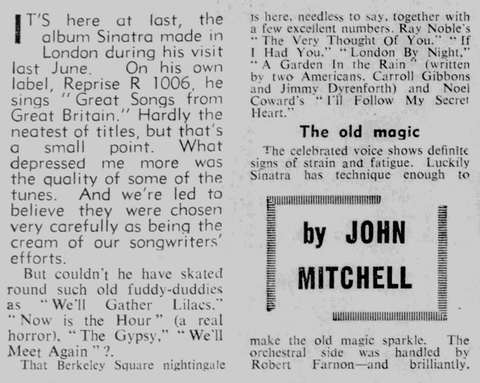
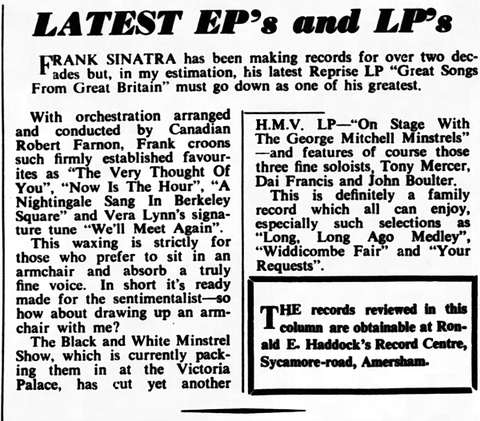
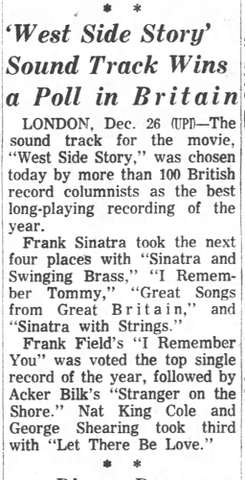
"Roses of Picardy"
Alan A. Freeman: 'Roses of Picardy,' cited by Sinatra historian Will Friedwald as his personal favorite rarity from the London sessions, was recorded with a beautiful Farnon arrangement and much emotion but was cut from the album on the last night at Sinatra's insistence ('Scrub it, I don't like it'), despite Freeman's attempt to talk him out of it. It was eventually officially released decades later.
Source: Charles L. Granata, "Sessions with Sinatra: Frank Sinatra and the Art of Recording" (1999/2003).
[A Nightingale Sang in Berkeley Square -- critical commentary]
Alan Freeman (quoting Eric Maschwitz): Producer Alan Freeman recounted composer Eric Maschwitz calling him repeatedly when word got out about the session: 'For God's sake, make sure this song gets in. It would be the crowning of my career to have Sinatra record one of my songs!' Freeman: 'personally, I think that's the one that came out best on the album.'
This song/context matches multiple dated entries in the chronology; the specific date Friedwald is referring to could not be determined with confidence.
Source: Will Friedwald, "Sinatra! The Song Is You: A Singer's Art" (2018 revised edition), Ch. 9, "Looking for the Hook" (1960-1971)
[A Nightingale Sang in Berkeley Square -- critical commentary]
Alan A. Freeman: When word of the planned London album spread, producer Alan A. Freeman was besieged by songwriters lobbying for inclusion; Eric Maschwitz, writer of 'A Nightingale Sang in Berkeley Square,' pushed hard for his song, which Freeman personally considers the best track on the finished album.
This song/context matches multiple dated entries in the chronology, or lacked a sufficiently precise date; the specific date could not be determined with confidence.
Source: Charles L. Granata, "Sessions with Sinatra: Frank Sinatra and the Art of Recording" (1999/2003), Part IV: The Reprise Years
[A Nightingale Sang in Berkeley Square -- critical commentary]
Alan A. Freeman: Only two takes of this song were recorded; Sinatra, who normally insisted on complete live performances rather than composite edits, agreed to an 'intercut' splice to preserve trombonist Harry Roche's solo. He personally came into the control room -- reportedly his only visit during the two nights -- and stood over the nervous nineteen-year-old engineer while the splice was made.
This song/context matches multiple dated entries in the chronology, or lacked a sufficiently precise date; the specific date could not be determined with confidence.
Source: Charles L. Granata, "Sessions with Sinatra: Frank Sinatra and the Art of Recording" (1999/2003), Part IV: The Reprise Years
[A Nightingale Sang in Berkeley Square -- critical commentary]
Granata includes 'A Nightingale Sang in Berkeley Square' among the fifty recordings he considers essential to understanding Sinatra's artistry (arranged by Robert Farnon, recorded 1962, Reprise); the song was chosen for its musical/interpretive value rather than commercial popularity.
This song/context matches multiple dated entries in the chronology, or lacked a sufficiently precise date; the specific date could not be determined with confidence.
Source: Charles L. Granata, "Sessions with Sinatra: Frank Sinatra and the Art of Recording" (1999/2003), Afterword & Appendices A-D
[The Gypsy -- critical commentary]
Alan A. Freeman: During 'The Gypsy,' producer Alan Freeman noticed Sinatra doing something unusual with the phrasing and consulted Nelson Riddle (present in the control room) about it. Riddle deferred to Freeman to raise it with Sinatra; when Freeman did, Sinatra defended his added syncopation, and Freeman deferred to him, though he says the moment still nags at him.
This song/context matches multiple dated entries in the chronology, or lacked a sufficiently precise date; the specific date could not be determined with confidence.
Source: Charles L. Granata, "Sessions with Sinatra: Frank Sinatra and the Art of Recording" (1999/2003), Part IV: The Reprise Years
June 14, 1962
Studio
London
1031 We'll Meet Again
(Hugh Charles/Ross Parker)
Music Sales Corp. (ASCAP/PRS Ltd.)
Arranged & Conducted by Robert Farnon
-8 (3:42) CD: 46013-2 The Complete Reprise Studio Recordings Disc 4
LP: FS1006Great Songs From Great Britain
Sinatra: London CD Box - Universal Music Enterprises
B0022005-00 Note: We'll Meet Again has been cut short.
Take 7 and the 'Master Take' 8 have been edited.
1032 Now Is The Hour
(Maewa Kaihan/Clement Scott/Dorothy Stewart)
The Boston Music Company/Southern Music Publishing Co. Inc./On Backstreet Music Inc.
(ASCAP/EMI Music Publishing (Aust.) Pty. Ltd. APRA Ltd.
Arranged & Conducted by Robert Farnon
-3 (2:48) CD: 46013-2 The Complete Reprise Studio Recordings Disc 4
LP: FS1006Great Songs From Great Britain
Sinatra: London CD Box - Universal Music Enterprises
B0022005-00
1033 We'll Gather Lilacs In The Spring
(Ivor Novello)
Chappell & Co. Inc. (ASCAP)
Arranged & Conducted by Robert Farnon
-4 (3:11) CD: 46013-2 The Complete Reprise Studio Recordings Disc 4
LP: FS1006Great Songs From Great Britain
Sinatra: London CD Box - Universal Music Enterprises
B0022005-00
[Nelson Riddle visits final session]
On the third and final night of the Great Songs from Great Britain sessions, Nelson Riddle -- in London to score Lolita for Stanley Kubrick and also working with Rosemary Clooney -- dropped by. Riddle had also attended Sinatra's Royal Festival Hall concert as an audience member, unable to work with him due to contract restrictions.
Source: James Kaplan, "Sinatra: The Chairman" (2015).
[We'll Meet Again / I'll Follow My Secret Heart / Garden in the Rain / London by Night / Now Is the Hour -- critical commentary]
Alan A. Freeman: Sinatra personally selected several songs for the London album, including 'We'll Meet Again,' 'I'll Follow My Secret Heart,' 'Garden in the Rain,' and 'London by Night' (by expatriate Englishman Carroll Coates). 'Now Is the Hour' almost wasn't included because it wasn't strictly British, but Sinatra insisted, 'It's near enough British!'
This song/context matches multiple dated entries in the chronology, or lacked a sufficiently precise date; the specific date could not be determined with confidence.
Source: Charles L. Granata, "Sessions with Sinatra: Frank Sinatra and the Art of Recording" (1999/2003), Part IV: The Reprise Years
June 15, 1962
Sinatra attended the London premiere of "The Manchurian Candidate," photographed with co-star Laurence Harvey and singer Eddie Fisher. Source: Charles Pignone, "Frank Sinatra 100" (2015).
June 17, 1962
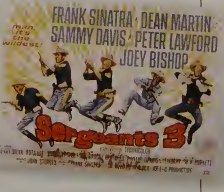
[Photograph: Sinatra flies to New York after London recording sessions. From Richard Havers, "Sinatra" (Dorling Kindersley, 2007), p.271.]
[Photograph: Sinatra flies to New York after London recording sessions. From Richard Havers, "Sinatra" (Dorling Kindersley, 2007), p.271.]
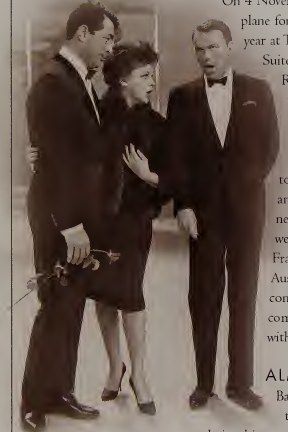
[Photograph: Sinatra flies to New York after London recording sessions. From Richard Havers, "Sinatra" (Dorling Kindersley, 2007), p.270.]
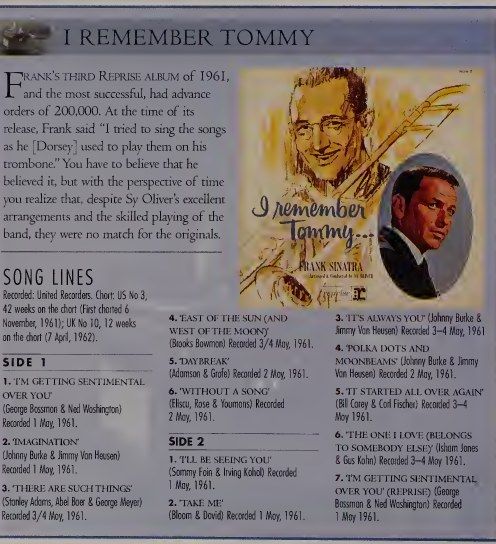
[Photograph: Sinatra flies to New York after London recording sessions. From Richard Havers, "Sinatra" (Dorling Kindersley, 2007), p.270.]
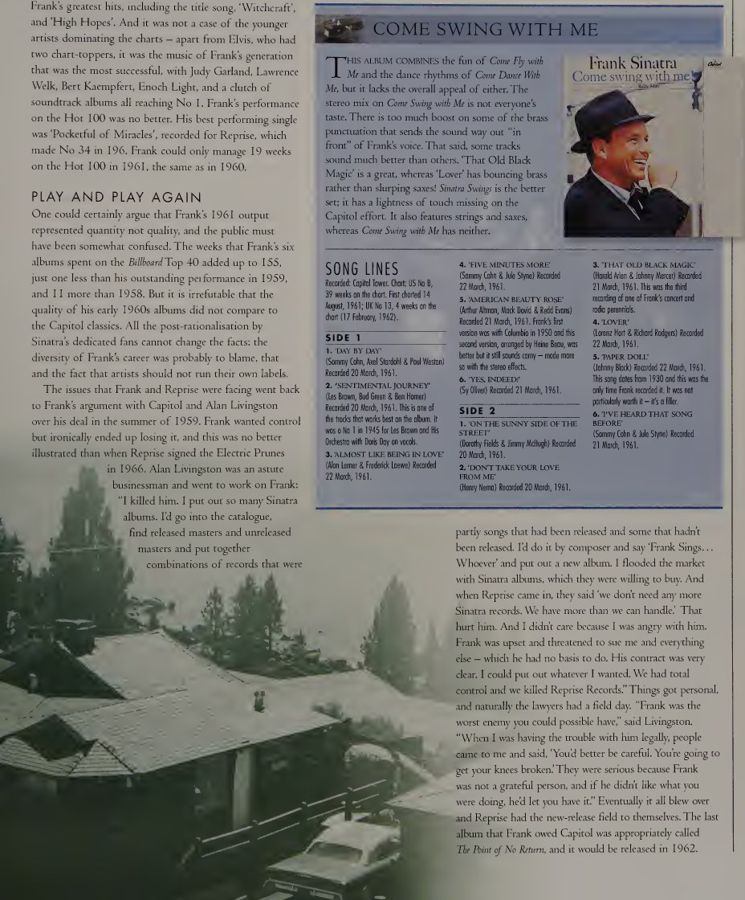
[Photograph: Sinatra flies to New York after London recording sessions. From Richard Havers, "Sinatra" (Dorling Kindersley, 2007), p.269.]
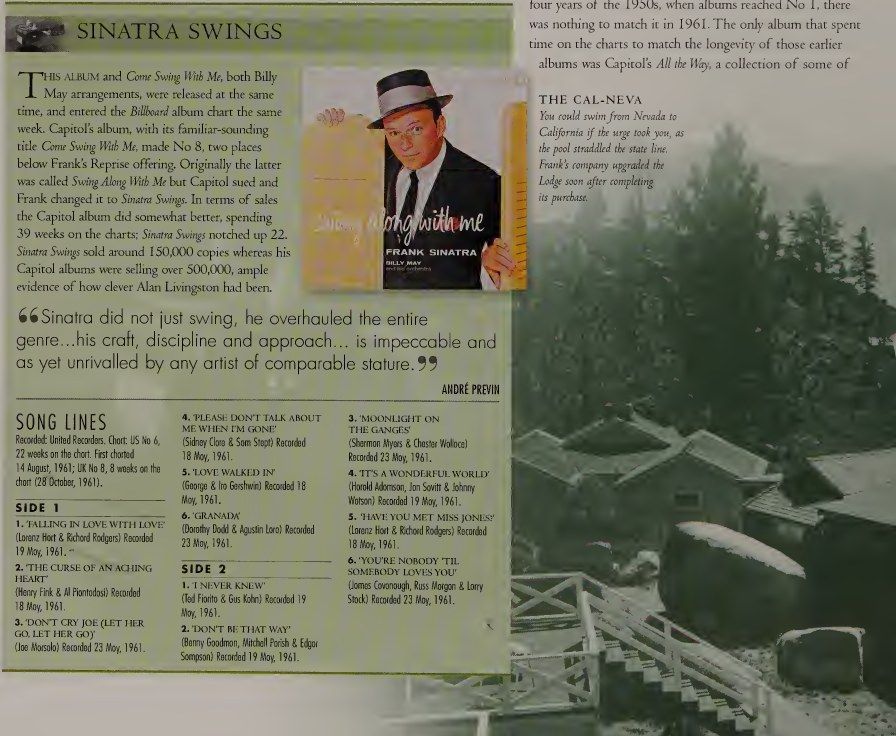
[Photograph: Sinatra flies to New York after London recording sessions. From Richard Havers, "Sinatra" (Dorling Kindersley, 2007), p.268.]
[World tour finale, Monte Carlo]
Sinatra's world tour concluded with a final benefit concert at Princess Grace's annual Red Cross gala in Monte Carlo. His voice was already in rough shape from the earlier Paris concerts.
Source: James Kaplan, "Sinatra: The Chairman" (2015).
After finishing his June 1962 London recording sessions, Sinatra had a test pressing of the album delivered to his hotel and then flew on to New York. The book notes that record-making was a simpler process then, allowing an album to be completed within about a week. (Source: Richard Havers, "Sinatra" (Dorling Kindersley, 2007).)
June 18, 1962
[Sinatra comments on Monroe firing]
Sinatra: Speaking in New York, Sinatra suggested Marilyn Monroe and Dean Martin might be 'whipping boys' for a studio trying to satisfy stockholders, and called the underlying script lousy.
Source: James Kaplan, "Sinatra: The Chairman" (2015).
June 20, 1962
Studio
United Recording, Hollywood
Frank Sinatra Conducts Music From Pictures And Plays
Reprise R/R9-6045
Wednesday
3 - 6:45 PM
DUAL 35 MM. Stereo
50 piece orchestra
Arrangements by Jack Hayes and Leo Shukin
Conducted by Frank Sinatra
1. The Girl That I Marry 4:01
2. All The Way 4:14
3. Exodus 3:36
4. Little Girl Blue 4:57
Second session
8:00 PM - 12:45 AM
1. Tammy 2:38
2. Laura 4:21
3. I've Grown Accustomed To Her Face 4:38
4. Something Wonderful 4:38
5. Moon River 4:29
6. Maria 3:58
7. If Ever I Would Leave You 3:57
8. An Affair To Remember 4:05
Note: First album Frank conducted at Reprise.
He had returned from his highly successful
world tour three days before these sessions.
Album would be released on June 27, 1962
United Recording, Hollywood
Frank Sinatra Conducts Music From Pictures And Plays
Reprise R/R9-6045
Wednesday
3 - 6:45 PM
DUAL 35 MM. Stereo
50 piece orchestra
Arrangements by Jack Hayes and Leo Shukin
Conducted by Frank Sinatra
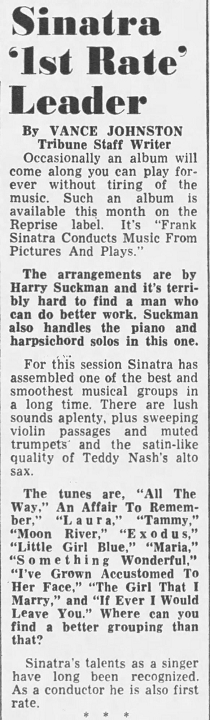
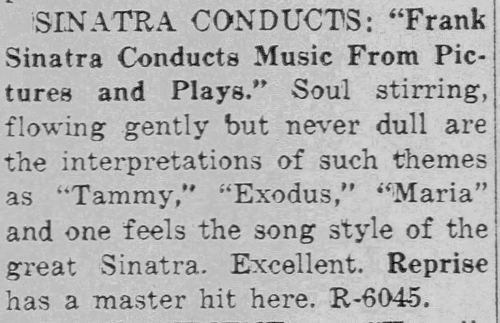
June 29, 1962
Concerts
Cal-Neva Lodge, Nevada (June 29 - July 5)
Note: Frank was there for most of the month. He had invested heavily in Cal-Neva and realized he needed to be there that summer. Dean Martin opened on the 27th of July. Frank joined him on stage during Dino's second show that night.
Ed
Cal-Neva Lodge, Nevada (June 29 - July 5)
[image referenced in source but could not be recovered]
[image referenced in source but could not be recovered]
[image referenced in source but could not be recovered]
[image referenced in source but could not be recovered]
[Cal-Neva grand opening]
Variety: Sinatra's Cal-Neva Lodge had its opening night, which Variety called 'boffo,' drawing a capacity crowd including top Hollywood business and film names.
Source: James Kaplan, "Sinatra: The Chairman" (2015).
[Prowse at Cal-Neva opening]
James Bacon: James Bacon reported that Juliet Prowse attended Sinatra's Cal-Neva opening ringside, arriving on Sinatra's private plane along with Mike Romanoff, Sy Devore, producers Bill Perlberg and Bill Goetz, and actors David Janssen and Richard Conte. Prowse had dated Eddie Fisher while Sinatra was on his world tour but resumed dating Sinatra on his return.
Source: James Kaplan, "Sinatra: The Chairman" (2015).
June 30, 1962
Concerts
Cal-Neva Lodge, Nevada (June 29 - July 5)
[Altercation with deputy sheriff Anderson]
At Cal-Neva, deputy sheriff Richard Anderson came to pick up his wife Toni, a cocktail waitress and Sinatra's former lover; Sinatra, still proprietary toward her, tried to throw Anderson out of the kitchen. In the ensuing scuffle Anderson punched Sinatra hard enough that Frank could not perform for a couple of days; Sinatra retaliated by having Anderson suspended from the police force.
Source: James Kaplan, "Sinatra: The Chairman" (2015).
July 1962
[Alleged Giancana-Monroe photos]
Billy Woodfield: Photographer Billy Woodfield claimed he developed shocking film shot by Sinatra showing Marilyn Monroe, apparently sick, on all fours with Sam Giancana astride her; Woodfield said Sinatra then burned the photos with his lighter in front of him. Direct evidence for the incident, and even for Giancana's presence at Cal-Neva that weekend, is lacking -- witness Betsy Duncan Hammes insisted Giancana's crowd was not there that weekend.
Source: James Kaplan, "Sinatra: The Chairman" (2015)
[Alleged overdose incident at Cal-Neva]
Peter Lawford: A kitchen worker recalled a frantic call from Peter Lawford demanding coffee be sent to Chalet 52, followed by Sinatra himself screaming for it; the implication, per this account, was that Marilyn Monroe had overdosed and was being walked around to wake her up. Lawford later told Kitty Kelley that Monroe overdosed and had her stomach pumped during the visit, angering Sinatra.
Source: James Kaplan, "Sinatra: The Chairman" (2015)
[Bert Stern photographs Monroe]
Kaplan: At the end of June and beginning of July 1962, Marilyn Monroe posed for a famous series of photographs by Bert Stern on assignment for Vogue, appearing serene and glowing at age thirty-six shortly before her death.
Source: James Kaplan, "Sinatra: The Chairman" (2015)
[Deputy Anderson killed in car crash]
Kaplan: About two weeks after his altercation with Sinatra, deputy sheriff Richard Anderson was killed and his wife Toni seriously injured when a maroon convertible with California plates forced their car off the road near Cal-Neva; the other driver was never traced.
Source: James Kaplan, "Sinatra: The Chairman" (2015)
[Sinatra's concern for Monroe at Cal-Neva]
Kaplan: A former Cal-Neva security employee recalled Sinatra ordering elaborate meals sent to Marilyn Monroe's chalet during her stay, and separately phoning her psychiatrist Ralph Greenson in a rage, demanding to know why she wasn't in a sanitarium given her depressed state.
Source: James Kaplan, "Sinatra: The Chairman" (2015)
[FBI Phone Records on Judith Campbell's Calls]
FBI phone records showed that over a roughly one-month span, Judith Campbell called Sam Giancana's Chicago home 23 times and his Armory Lounge hangout 37 times, and called Sinatra at the Cal-Neva Lodge 16 times.
Source: George Carpozi Jr., Frank Sinatra: Is This Man Mafia? (New York: Manor Books, 1979).
July 1, 1962
Concerts
Cal-Neva Lodge, Nevada (June 29 - July 5)
note: Frank did three shows a night opening
weekend and then was unable to perform
for a few days. Eddie Fisher flew in and
did two nights. He told a columnist that
only Sinatra could get him to do such a
favor.
Ed
July 1, 1967 Billboard reported that The 4 Seasons plans to do a date at the Sands Hotel in Las Vegas sharing the bill with Frank Sinatra!
Ed O'Brien:
Bob Gaudio told me that Valli, during this engagement, really
hit it off with Sinatra. Frank was looking for contemporary material --
he could feel comfortable doing. Valli suggested he contact Gaudio. Thus
the seeds were sowed for the project that would become
"Watertown."
Steve Gerardi
SG Entertainment
A look back….
July 1, 1989
FRANK SINATRA
Deer Creek Music Center
Noblesville, IN
When Sunshine Promotions built Deer Creek Music Center the owners Dave Lucas and Steve Sybesma knew that we had to book a variety of different types of music and entertainers. All too often these shows were not financial successes and most of them lost money. Frank Sinatra was no exception. This show lost a significant amount of money, over $100,000. But this particular show made a big impacting statement to the community and region. Overall, the show sold 5,605 tickets and the ticket sales revenue fell short of the guarantee money to Frank Sinatra. While this was a huge financial loss it was a huge gain in the venue’s credibility within Central Indiana and more.
I have often said there were 4 significant shows that took place in the first year of Deer Creek and Frank Sinatra is one of this shows. The other shows were Sandy Patti, Grateful Dead and Elton John.
As I started the show advance / planning I contacted his production manager a gentlemen named Hank Cattaneo from the East Coast. To say that this man had an attitude is an understatement. He was gruff, demanding, threatening and for the most part treated us like we were clueless, stupid Midwest people. I am sure that these folks could get away with this when they were in Las Vegas, New York, Chicago, and yet they seemed to hold us as beneath those markets…and that was OK. With experience one learns how to play the game and in this case it was best to step back and let Sinatra’s people do their thing. The production was very basic, simple sound and stage lights and they asked to load in the day before. We accommodated them on this, and it was a good thing. It was clear that they were not accustomed to amphitheaters, and they had a very slow pace with their process. I am from a rock’n’roll production background, and I like a fast pace.
Back to Hank…he was an interesting man and I wanted to get to know him better, but he wasn’t a friendly person. He kept referencing Frank Sinatra as The Old Man. That cracked me up and I made sure not to reference Mr. Sinatra as The Old Man. Another thing about Hank that bothered me starting with our advance phone calls clear through the production set up was his constant threat to cancel the show. “Do this or do that or we are going to cancel†was his mantra. I don’t like threats like this. Its amateur….period. But, I had to go along with it.
On the day of show the orchestra arrived with approximately 35 – 40 players. This was Frank Sinatra’s orchestra, and the conductor was Frank Sinatra Jr. and he looked just like his father. The orchestra rehearsed and sound checked. They were lively and very talented.
Also, we had to construct a podium for the teleprompter which was set directly in front of the stage with a video monitor directed toward the center microphone. This was a first for many of us to actually see someone using a teleprompter. What surprised me the most was they had the teleprompter and its associated equipment but not the podium. A lot of entertainers use teleprompters these days. To me it’s no different than someone reading from sheet music.
During the middle of the day Frank Sinatra’s manager Eliot Weisman arrived. Eliot was a tall, broad shouldered, cigar smoking man. He was very intimidating and not in a good mood. He said that the limo driver got lost while driving from the airport to the venue. In checking he didn’t get lost, oh well. Eliot went on to say that the driver better not screw up when he picks up The Old Man when his private plane lands at the regional airport in a few hours. He said if that were to happen The Old Man would cancel the show. Once again another The Old Man reference along with the word cancel.
Frank Sinatra’s dressing room needs were very basic. He wanted coffee, tea, water, several cans of Campbells soup including Tomato, Chicken Noodle and Vegetable Beef along with a small sauce pan and single electric burner. In other words, he liked to cook his own soup. He also requested bottles of bourbon, scotch, vodka, gin, and rum along with mixers. This was for any of his guests. A few of his friends were there including Gilly. Once Mr. Sinatra arrived at the venue he went into his dressing room and stayed there until his set time.
As we got closer to showtime all of the Frank Sinatra personnel changed into tuxedo’s. It was a very hot day and tuxedos can be cumbersome. This was the only time that Hank and I bonded as he commented to me that he hated that he had to get dressed up and I gave him a sympathetic ear.
Comedian Tom Dreeson opened the show. He was a regular on The Tonight Show especially in the 70’s. After an intermission the orchestra took the stage and began playing and Frank Sinatra walked on stage to a standing ovation.
The show was nothing short of spectacular!
Frank Sinatra’s voice was magic!
The man was 74 years old and sang perfectly. There was no enhancement, no tracks, no auto-tune…just pure talent!
After the show I walked with Frank Sinatra from the stage to the limo. He was soaking wet from sweating and said that the audience was fantastic and that he had fun. I noticed Eliot Weisman and he was smiling and so was Hank.
Over the years many people have told me that they attended the show and loved it…and that’s what it is about!
One footnote, Frank Sinatra and I share the same birthday, December 12. My mother LOVED Frank Sinatra and she used to joke saying that it was intentional for my birthday to fall on December 12.
Some comments to the article above:
Loved this post! I was at that show, and without question, the best show I've ever seen at Ruhoff/Deer Creek! BTW, my mother loved Frank Sinatra too, and she was disappointed I didn't take her with me that night. We drank martinis under the stars and listened to the master sing, it was an amazing evening!
Steve, Great recollection of that night! As you know, I was there and it was hot and Sinatra was fantastic. I'll always remember the elegance of that night and the stark contrast of Frank Sinatra and his orchestra on a stage in the middle of a cornfield in the middle of Indiana. That night was the foreshadowing of the recognition of Deer Creek as America's best outdoor concert venue.
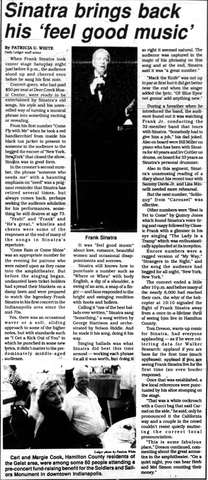
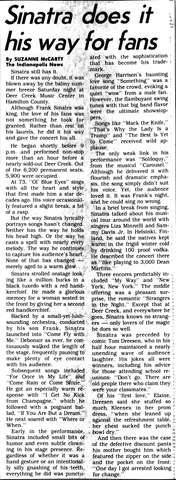
[Joey Bishop's tea gag at Cal-Neva]
Joey Bishop: At a post-midnight Cal-Neva show, when Sinatra called for tea and honey, comic Joey Bishop strolled out in a waiter's coat serving it, joking that Sinatra hadn't specified his job duties clearly enough. Sammy Davis Jr. also remarked around this time that he was now too busy as a married man to keep the old late-night Rat Pack hours.
Source: James Kaplan, "Sinatra: The Chairman" (2015).
July 2, 1962
Concerts
Cal-Neva Lodge, Nevada (June 29 - July 5)

Cal-Neva Lodge, Nevada (June 29 - July 5)
Sinatra had laryngitis and missed July 2

July 3, 1962
Concerts
Cal-Neva Lodge, Nevada (June 29 - July 5)
July 4, 1962
Concerts
Cal-Neva Lodge, Nevada (June 29 - July 5)
July 5, 1962
Concerts
Cal-Neva Lodge, Nevada (June 29 - July 5)
July 10, 1962
New Castle News
July 17, 1962
Washoe County Deputy Sheriff Richard “Dick” Anderson was killed in a car crash on Highway 28 near Sinatra's Cal-Neva Lodge at 10:26 p.m., after his car was allegedly run off the road by a maroon convertible; his wife Toni, a Cal-Neva cocktail waitress and reported former Sinatra girlfriend, was injured. The crash followed a physical altercation between Anderson and Sinatra weeks earlier over Toni. Rumors that Sinatra was somehow involved in the crash were never proven. Note: This account comes solely from Kelley's book, which is widely regarded as containing embellished or unverified claims; it is not independently corroborated elsewhere in this chronology. Source: Kitty Kelley, "His Way: An Unauthorized Biography of Frank Sinatra" (1986).
July 18, 1962
note: article appeared 17 days before
Monroe's untimely death on 8-5-62
July 23, 1962
[DiMaggio's disputed remarriage proposal]
Biographer Donald Spoto claims Joe DiMaggio proposed remarriage to Marilyn Monroe during a secluded Cal-Neva weekend, with a planned wedding date of August 8 in Los Angeles; Kaplan finds the timeline implausible given DiMaggio's travel schedule and suggests any proposal likely came earlier, around the week of July 23.
Source: James Kaplan, "Sinatra: The Chairman" (2015).
July 24, 1962
Radio
RADIO SPECIAL FOR NATIONAL ASSOCIATION OF RETARDED CHILDREN Frank Sinatra
Frank plays his recent Reprise recordings, introduces President Kennedy
1. Pocketful Of Miracles brief intro
Frank explains purpose of broadcast
2. Come Rain Or Come Shine
3. Imagination
4. Without A Song
Introduces JFK -not heard on disc
5. House I Live In Columbia recording
Introduces 1962 poster boy for the association and his family -not heard on disc
6. The Second Time Around announces it is the last song of the program
Kennedy speech played again. not heard on disc
7. You're Nobody Till Somebody Loves You sign off
8. Pocketful Of Miracles segment
Running time is a little over 28 minutes note: Educated guess: Frank might have cut this record during the sessions for "Pictures & Plays" on 6/20-21/62--
--Ed
July 25, 1962
[Fox rehires Monroe]
Monroe: 20th Century Fox production chief Peter Levathes met with Marilyn Monroe at her home and personally rehired her for Something's Got to Give at a higher salary; she confided to him that she felt she was always ultimately a disappointment to people despite the glamour.
Source: James Kaplan, "Sinatra: The Chairman" (2015).
July 27, 1962
Concerts
Dean Martin opened at the newly restored Celebrity Room in the Cal Neva Lodge, Lake Tahoe
Frank joined him on stage during the second show.
He did a few numbers from his soon to be released
"Swingin' Brass" album and then did a long medley with Dean.
Ed
This Cal-Neva visit doubled as an attempt to help Marilyn Monroe recuperate; Frank Sinatra had chartered a plane to fly her up with Peter and Pat Lawford (a small olive branch to Lawford after the Palm Springs snub) after Sinatra called Pat the day before to float the idea. Staff recalled Monroe arriving pale and disheveled, wearing the same green dress for days, at one point casually producing a purseful of syringes she called her “vitamin shots” in front of a startled Sinatra and Pat Lawford. Sam Giancana also turned up at the lodge during the same stay, adding tension to an already fraught visit. Alarmed by Monroe's condition, Sinatra ultimately had the Lawfords take her back to Los Angeles — the last time he would see her alive. Source: J. Randy Taraborrelli, Sinatra: Behind the Legend.
August 1962
[Death of Marilyn Monroe]
Consiglio: About a month after singing 'Happy Birthday, Mr. President,' Marilyn Monroe was dead. Sinatra was devastated, and further hurt when Joe DiMaggio -- who arranged and paid for a private funeral -- did not invite him.
Source: Tony Consiglio (as told to Franz Douskey), "Sinatra and Me: The Very Good Years" (2012)
[DiMaggio excludes Kennedy/Hollywood crowd from funeral]
Consiglio: Joe DiMaggio, blaming the Kennedys and the Hollywood crowd (including, mistakenly, Sinatra) for Marilyn Monroe's decline, barred anyone connected to them from her funeral. Sinatra and DiMaggio never fully repaired their friendship afterward, even though Sinatra had tried to help Marilyn through her depression by hosting her at his Cal-Neva Lodge.
Source: Tony Consiglio (as told to Franz Douskey), "Sinatra and Me: The Very Good Years" (2012)
[Marilyn Monroe's final phone call]
Consiglio: While staying with Peter Lawford at the Beverly Hilton, Consiglio answered a late-night call from a distraught, incoherent Marilyn Monroe and handed the phone to Peter, then left the room out of caution about possible FBI wiretaps. Lawford rushed out for about an hour; the next morning he returned shaken and they checked out immediately, and the following day news broke of Monroe's death.
Source: Tony Consiglio (as told to Franz Douskey), "Sinatra and Me: The Very Good Years" (2012)
[Visiting Marilyn Monroe's crypt with Lawford]
Consiglio: One Sunday, Peter Lawford drove Consiglio to a cemetery after closing hours, had him climb the gate to deliver a bouquet, and directed him to Marilyn Monroe's vault, which already held a large arrangement of flowers signed "Love, Joe" from Joe DiMaggio. Lawford then drove off and left Consiglio to walk across the cemetery to find him at another gate.
Source: Tony Consiglio (as told to Franz Douskey), "Sinatra and Me: The Very Good Years" (2012)
August 3, 1962
A Justice Department report dated this day detailed Sam Giancana's boast to associates that he had obtained a stake in the Cal-Neva Lodge "through Sinatra," and that Sinatra had helped place Joseph Fischetti on the Fontainebleau Hotel payroll as a "talent agent," where Fischetti received 71 checks totaling $38,340 plus additional reported fees.
Source: George Carpozi Jr., Frank Sinatra: Is This Man Mafia? (New York: Manor Books, 1979), citing a Justice Department report.
August 5, 1962
Marilyn Monroe was found dead at her Los Angeles home, less than a week after what would prove to be her last visit with Frank Sinatra, a troubled two-day stay at his Cal-Neva Lodge arranged so she could rest. Sinatra, who had grown alarmed watching her inject herself with sedatives and swallow pills at Cal-Neva and had insisted she be sent home early, issued a statement saying he was “deeply saddened.” His valet George Jacobs recalled Sinatra being “in shock for weeks, distraught” afterward. At her funeral, Joe DiMaggio had security bar Sinatra, the Kennedys, and others he blamed for her death from attending; Sinatra left Westwood Memorial Park quietly rather than make a scene. Source: J. Randy Taraborrelli, Sinatra: Behind the Legend.
[Marilyn Monroe's death]
Marilyn Monroe died on August 5, 1962. Sinatra's valet recalled him as 'devastated'; Joe DiMaggio was devastated and furious, cursing 'the fucking Kennedys' and blaming Bobby Kennedy and Sinatra to a friend.
Source: James Kaplan, "Sinatra: The Chairman" (2015).
[Fisher recruited for Villa Venice]
Eddie Fisher: Eddie Fisher recalled getting a call from Sinatra on the day Marilyn Monroe was found dead, asking him to open at the Villa Venice in Chicago; despite Fisher's initial refusal citing exhaustion and a prior Desert Inn commitment, Sinatra somehow arranged his release from that obligation.
Source: James Kaplan, "Sinatra: The Chairman" (2015).
August 6, 1962
[JFK midterm profile amid Monroe coverage]
The day after Marilyn Monroe's death made front pages, an AP piece by Relman Morin assessing JFK's presidency at the midterm ('JFK Shows No Cracks in His Calm') ran alongside the coverage -- an odd juxtaposition given the hidden turmoil in Kennedy's circle, including his still-secret liaison with Judith Campbell Exner, known to Hoover and the FBI.
Source: James Kaplan, "Sinatra: The Chairman" (2015).
August 8, 1962
[Monroe's private funeral]
Marilyn Monroe's funeral was held at Westwood Village Memorial Park on August 8 -- the date she and DiMaggio had planned to remarry. DiMaggio and Monroe's half-sister Berniece Miracle kept it a strictly private affair of about two dozen people, mostly staff, deliberately excluding movie stars.
Source: James Kaplan, "Sinatra: The Chairman" (2015).
[Lawfords excluded from funeral]
Peter Lawford: Patricia Lawford flew from Hyannis Port for Marilyn Monroe's funeral only to learn neither she nor her husband Peter Lawford -- the last person to speak with Monroe -- had been invited; Peter Lawford told AP's James Bacon he was shocked and thought the whole thing badly handled.
Source: James Kaplan, "Sinatra: The Chairman" (2015).
[Sinatra turned away from funeral]
DiMaggio: Marilyn Monroe's friend Inez Melson later said Sinatra arrived at the cemetery with bodyguards and tried to force, then bribe, his way into the funeral, but was turned away; DiMaggio told Mickey Rudin, who protested being asked to exclude industry figures, 'if it wasn't for them, she'd still be here.'
Source: James Kaplan, "Sinatra: The Chairman" (2015).
August 12, 1962
[New Facks nightclub photographer altercation]
George Andros: A week after Marilyn Monroe's death, while stopping in San Francisco en route to Los Angeles, Sinatra clashed with photographer Jimmy Jaye Perrine at the New Facks nightclub after Perrine photographed women leaning over Sinatra's shoulder. Accounts of the confrontation's physicality conflicted; club owner George Andros said Sinatra merely demanded the film and was 'the calmest I've ever seen him.'
Source: James Kaplan, "Sinatra: The Chairman" (2015).
August 15, 1962
[Perrine sues Sinatra]
Three days after the New Facks nightclub incident, photographer Jimmy Jaye Perrine filed a $275,390 lawsuit against Sinatra alleging he had been choked and his camera smashed; he later settled out of court for $2,500.
Source: James Kaplan, "Sinatra: The Chairman" (2015).
August 22, 1962
Concerts
500 Club, Atlantic City, NJ (22 - 25) w/Dean & Sammy
500 Club, Atlantic City, NJ (22 - 25) w/Dean & Sammy
August 23, 1962
Concerts
500 Club, Atlantic City, Nevada (22 - 25) w/Dean & Sammy
[JFK's mysterious call to Sinatra]
Hoover: Hoover sent a 'PERSONAL' memo to Attorney General Robert F. Kennedy noting that Sinatra had received a personal telephone call from President Kennedy at the Claridge Hotel in Atlantic City on August 23, 1962 -- the first contact in months; the content of the call went unrecorded.
Source: James Kaplan, "Sinatra: The Chairman" (2015).
August 24, 1962
Concerts
500 Club, Atlantic City, Nevada (22 - 25) w/Dean & Sammy
500 Club, Atlantic City, Nevada (22 - 25)
w/Dean & Sammy
5
August 25, 1962
Concerts
500 Club, Atlantic City, Nevada (22 - 25) w/Dean & Sammy
Dean:
1. I'm Gonna Sit Right Down And Write Myself A Letter
2. Medley: Volare - On An Evening In Roma
Frank:
4. Goody Goody
5. At Long Last Love
6.. I Get A Kick Out Of You
Sammy:
7. The Lady Is A Tramp
8. Impersonations
Frank & Dean:
9. Medley: I Can't Give You Anything But Love -
Too Marvelous For Words - It Had To Be You -
The lady Is A Tramp - Where Or When - All Of
Me - Oh Marie - I've Got The World On A String
Frank, Dean & Sammy:
10. Birth Of The Blues
Ed notes:
This show was done at 4:AM. It was the third show that evening. Sammy was in terrible voice, mainly due to complete fatigue. The threesome did risque parodies of famous songs and many were quite funny. The running time was only 45 minutes.
The 500 Club didn't have an empty seat throughout the entire engagement.
500 Club, Atlantic City, Nevada (22 - 25) w/Dean & Sammy
4a.m. show
Images of the "souvenir" album from the show
Variety
August 29, 1962
------------------------------------------
© 1997-2025 The Sinatra Archive
This calendar, or any parts thereof, may not be reproduced in any fashion whatsoever without the prior written permission of the publisher (The Sinatra Archive)
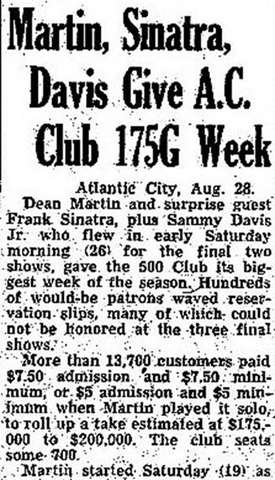
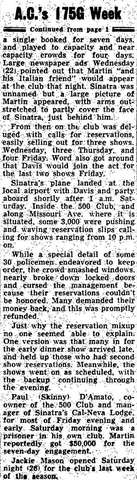
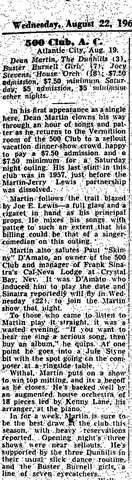
[Final night at the 500 Club]
Sammy Davis Jr.: On the last evening of the 500 Club run, Atlantic City police captain Mario Floriani personally drove Frank, Dean, and Sammy to the club for five shows before a screaming crowd, the last starting as dawn broke. Onstage, Dean and Sammy traded racially charged jokes, including Frank's 'wrecked Freedom Bus' line, to which Sammy shot back, 'I thought Italians were supposed to be liberals.'
Source: James Kaplan, "Sinatra: The Chairman" (2015).
August 26, 1962
[Post-show tour of Atlantic City]
After the final 500 Club show, around 8:15 a.m., Sinatra and his entourage toured Atlantic City's Kentucky Avenue clubs, visiting Sammy Davis Jr.'s mother Baby Sanchez at Grace's Little Belmont and handing out folded $100 bills to staff along the way. The week's shows earned Skinny D'Amato $175,000.
Source: James Kaplan, "Sinatra: The Chairman" (2015).
[Sinatra sings for Sam Goldwyn tribute]
The night he returned from the 500 Club engagement, Sinatra sang at a celebration of Sam Goldwyn's fifty years in the movie business.
Source: James Kaplan, "Sinatra: The Chairman" (2015).
Frank was on the dais at the Beverly Hilton to celebrate filmmaker Samuel Goldwyn's 80th birthday.
Source: Nancy Sinatra, Frank Sinatra: An American Legend, 1995.
August 27, 1962
Studio
Los Angeles
1426 The Look Of Love
(Sammy Cahn/Jimmy Van Heusen)
Maraville Music Corp. (ASCAP)
Arranged by Nelson Riddle
Conducted by Neal Hefti
(2:43) CD: 46013-2 The Complete Reprise Studio Recordings Disc 4
CD: 9-26723-2Sings The Songs Of Van Heusen & Cahn
CD: 1013-2Softly As I Leave You
LP: FS1013Softly As I Leave You
45: 20,107
1427 I Left My Heart In San Francisco
(Douglass Cross/George Cory)
Colgems EMI Music Inc. ASCAP)
Arranged by Nelson Riddle
Conducted by Neal Hefti
(2:54) CD: 46013-2 The Complete Reprise Studio Recordings Disc 4
LP: FS5238 ( Italy )
45: 20,107 (two week release)
FRANK SINATRA * * ** The Look of Love - REPRISE 20107 Punching- bright Nelson Riddle type arrangement here backs Frank's rhythmic reading of the tune, which is from the forthcoming flick, "Come Blow Your Horn." Another top item for juke box locations as well as over the counter retail sales. (Maraville ASCAP) (2:45)
* * ** I Left My Heart In San Francisco -Sinatra handles this Tony Bennett hit in slow torchy style - singing the ballad with much feeling and the inevitable F.S. fashion. Large string orchestra which bears the Sinatra name accompanies ( General ASCAP ) (2:56)
Billboard
The Drumright Derrick
[Ill-advised recording session]
Sinatra recorded a single at United Recording pairing the forgettable Sammy Cahn/Jimmy Van Heusen song 'The Look of Love' with 'I Left My Heart in San Francisco,' arranged by Nelson Riddle and conducted by Neal Hefti.
Source: James Kaplan, "Sinatra: The Chairman" (2015).
[Hoover notes JFK's phone call to Sinatra at a mob wedding]
While investigating Angelo Bruno's Philadelphia mob at the Claridge Hotel in Atlantic City -- where Sinatra had reserved the entire first floor for guests attending Bruno's daughter's wedding -- Newark agents learned Sinatra had received a personal phone call from President Kennedy on August 23, 1962. Hoover reported the call to Robert Kennedy in a "personal" memo. Sinatra was in Atlantic City that week performing with Dean Martin at the 500 Club as a favor to club partner Paul "Skinny" D'Amato.
Source: Kuntz and Kuntz, The Sinatra Files, ch. 6.
Sinatra scholar Ed O'Brien has separately detailed the single's fate: released in late October 1962 with "The Look of Love" bubbling under the Billboard Hot 100 and getting airplay, Sinatra had the record pulled -- George Jacobs told O'Brien Frank was simply "embarrassed" by the Riddle-arranged "San Francisco" side once he heard it stacked against Tony Bennett's hit version. The single was reissued with "Indiscreet" as the new flipside (the rarer of the two pressings), and "San Francisco" resurfaced only on later Japanese and European 45s and an Italian LP before finally getting a proper U.S. release on the 1995 20-CD box set. A longtime Reprise employee told O'Brien the track was privately nicknamed "I Left My Drone in S.F."; O'Brien himself considers the uptempo treatment and Riddle's cut of the verse a rare misstep, and notes the pulled single cost Sinatra a genuine shot at a Cahn/Van Heusen hit with "The Look of Love," which was largely forgotten once the "San Francisco" story became the more famous half of the tale. Source: Ed O'Brien, Sinatraphiles correspondence ("This Date in Sinatra History," August 27 mailing).
August 31, 1962
Concerts
Cal-Neva Lodge, Nevada (August 31 - September 3) w/Dean
Cal-Neva Lodge, Nevada (August 31 - September 3) w/Dean
Dean played at Cal-Neva the first week in August, Eddie Fisher and Joe E. Lewis followed in that order and then Frank came in for the Labor Day weekend. Frank and Dean took turns joining the other onstage throughout the month. Not every show saw the combo together, but there was always the possibility.
Cal-Neva closed for the season after Frank's engagement I have enclosed some bits of monologue from that final week- end.
--Ed
Variety
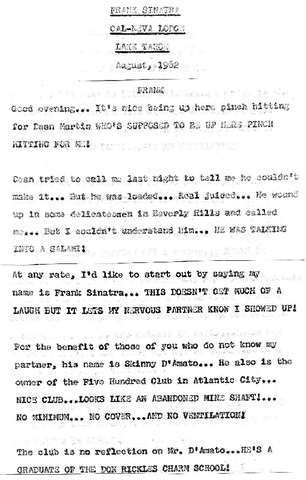
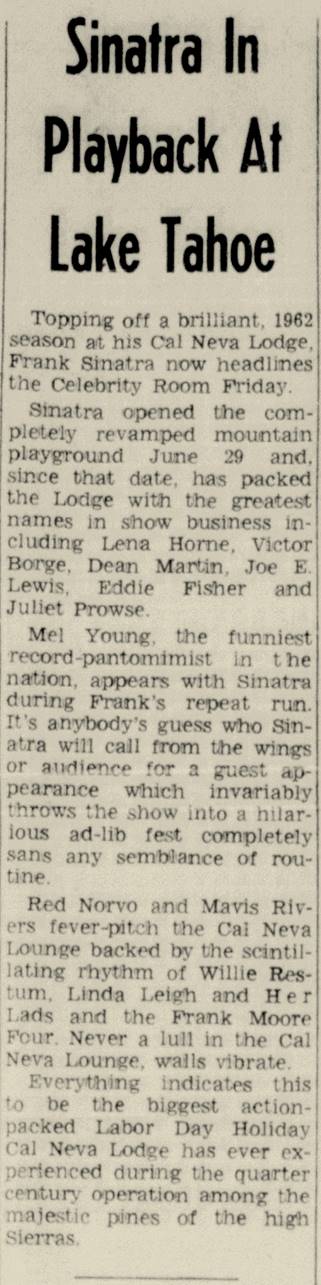
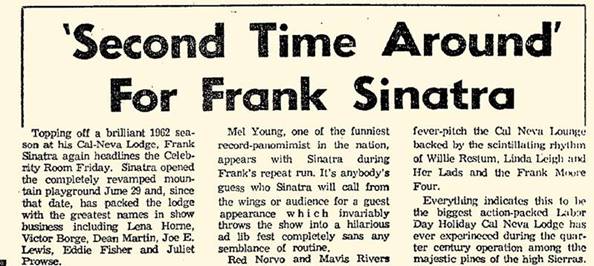
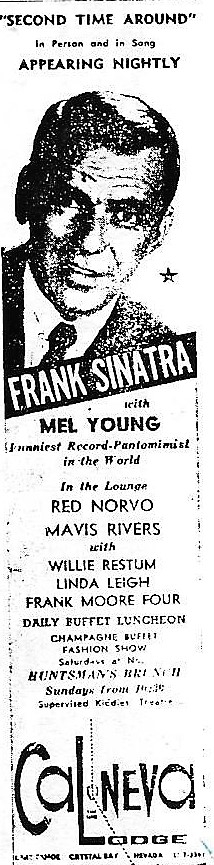
September 1962
[Come Blow Your Horn begins production]
Kaplan: Production began on the film version of Neil Simon's Come Blow Your Horn in mid-September 1962, with Sinatra playing playboy Alan Baker, Lee J. Cobb as his father, and newcomer Tony Bill as his younger brother; Nancy Sinatra had lobbied to cast her husband Tommy Sands, but he withdrew after objections from screenwriter Norman Lear and director Bud Yorkin.
Source: James Kaplan, "Sinatra: The Chairman" (2015)
[Earl Wilson notes Sinatra's dating and injury]
Earl Wilson: Earl Wilson reported Sinatra, on a visit with Mike Romanoff, dated model Joan Walker at Jilly's and complimented singer Tina Robin at the Copa, adding that Sinatra might need surgery for what was rumored to be a golf injury -- actually a hand injury from filming The Manchurian Candidate.
Source: James Kaplan, "Sinatra: The Chairman" (2015)
[Hoffa rejects Rudin's Teamsters loan bid]
Kaplan: FBI records of a September 1962 Teamsters meeting showed Jimmy Hoffa personally rejected Mickey Rudin's loan application for Cal-Neva, around the same time he also turned down a related loan request from Sam Giancana.
Source: James Kaplan, "Sinatra: The Chairman" (2015)
September 1, 1962
Concerts
Cal-Neva Lodge, Nevada (August 31 - September 4) w/Dean
September 2, 1962
Concerts
Cal-Neva Lodge, Nevada (August 31 - September 3) w/Dean
September 3, 1962
Concerts
Cal-Neva Lodge, Nevada (August 31 - September 3) w/Dean
September 15, 1962
Concerts
Sands, Las Vegas, Nevada (September 15-18) w/Dean
Sands, Las Vegas, Nevada (September 15-18) w/Dean
Sands Ken Lane on piano
September 16, 1962
Concerts
Sands, Las Vegas, Nevada (September 15-18) w/Dean
September 17, 1962
Concerts
Sands, Las Vegas, Nevada w/Dean
September 18, 1962
Concerts
Sands, Las Vegas, Nevada w/Dean
[Variety confirms Sinatra-Sanicola split]
Hank Sanicola: Variety formally reported the rupture between Sinatra and Hank Sanicola, quoting Sanicola calling it 'one of our little beefs' over Cal-Neva's operation, while Sinatra, contacted on the set of Come Blow Your Horn, would only say 'That's nobody's business!'
Source: James Kaplan, "Sinatra: The Chairman" (2015).
[Villa Venice engagement announced]
News broke that Sinatra, Martin, and Davis would headline the Villa Venice, a once-grand banquet restaurant at 2855 Milwaukee Avenue on the Des Plaines River in unincorporated Cook County, Illinois -- a booking that caught Chicago show-business insiders by surprise. Eddie Fisher had reopened the venue a month earlier. The trio would play sixteen shows there between November 26 and December 2, reportedly without pay, in a run financed and secretly controlled by Sam "Momo" Giancana, with a hidden casino (the Quonset Hut) operating nearby to lure high rollers. Reprise engineers were on hand to record the performances on acetate for a planned live album, "At the Summit," which went unreleased at the time (only bootlegs circulated until 1999). The Villa Venice itself burned down in a kitchen fire in March 1967; a hotel and restaurant occupy the site today.
Source: John McDonough (The Wall Street Journal / Down Beat), liner notes to "The Summit In Concert" (Artanis Entertainment Group, ARZ-102-2, 1999).
Following Hank Sanicola's departure as Sinatra's business partner, Jilly Rizzo -- previously known to Sinatra as the proprietor of his favorite New York restaurant, Jilly's -- stepped into the role of Sinatra's constant companion, assistant and bodyguard, eventually moving to California to be near him. Source: Rough Guide to Frank Sinatra (Rough guide 7.pdf), chapter "The Inner Circle."
[Sanicola's Cal-Neva buyout]
Rough Guide to Frank Sinatra: By this account, an increasingly nervous Sanicola asked in the summer of 1962 to be bought out of Cal-Neva given the prostitution-ring investigation and Sam Giancana's visible presence there; Sinatra reportedly told him, "Out of Cal-Neva, out of everything," and Sanicola accepted five of Sinatra's publishing companies as payment for his stake, the two men parting for good in a car in the desert.
Source: Rough Guide to Frank Sinatra (Rough guide 8.pdf), chapter "The Inner Circle."
September 19, 1962
Sinatra made a guest appearance on The Judy Garland Show.
Source: Frank Sinatra: The Man, the Music, the Legend, ed. Jeanne Fuchs and Ruth Prigozy (Rochester, NY: University of Rochester Press / Boydell & Brewer, 2007), essay "Sinatra Meets Television" by Ron Simon.
September 26, 1962
[FBI surveillance of McGuire at Palm Springs]
FBI: An FBI memo recorded that at 3:16 a.m. on September 26, 1962, Phyllis McGuire was observed arriving by private plane at Palm Springs Airport and being driven, in a car registered to Sinatra's Essex Productions, to the vicinity of Sinatra's Tamarisk compound, with agents suspecting Sam Giancana was among those who met her.
Source: James Kaplan, "Sinatra: The Chairman" (2015).
October 1962
[Basie Band Lineup for the Sinatra Sessions]
Count Basie and Sinatra recorded together with a band that included Sonny Payne on drums, Freddie Green on guitar, and Thad Jones on trumpet.
Source: Charles Pignone, "Frank Sinatra 100" (2015).
[Neal Hefti Conducts Sinatra-Basie Sessions]
Arranger Neal Hefti conducted a session for the album Sinatra-Basie: An Historic Musical First; Hefti recalled being excited given his prior working relationship with the Basie band, and noted Sinatra wanted to revisit songs he had recorded earlier while with Capitol.
Source: Charles Pignone, "Frank Sinatra 100" (2015).
[Frank smashes his new addition with a sledgehammer]
Consiglio: After learning Kennedy would stay with Bing Crosby instead of him, Frank reportedly took a sledgehammer to walls of the new addition he'd built for the president's visit. Consiglio wasn't present but heard about Frank's fury from others.
Source: Tony Consiglio (as told to Franz Douskey), "Sinatra and Me: The Very Good Years" (2012)
[Frankie appears on Jack Benny's show]
Kaplan: After hearing about Frankie's Disneyland performance, family friend Jack Benny invited him onto his television show. At the beginning of October 1962, Frank Sinatra Jr. appeared on The Jack Benny Program, singing a song and acting in a comedy sketch, to decent reviews.
Source: James Kaplan, "Sinatra: The Chairman" (2015)
[JFK stays with Bing Crosby, Frank and Peter Lawford split]
Consiglio: During the Cuban Missile Crisis, Bobby Kennedy blocked JFK from staying at Frank's estate (officially citing Secret Service concerns, actually wary of Frank's mob ties) and had the president stay with Bing Crosby instead. Peter Lawford was made to deliver the news to Frank, who blamed Peter and ended their friendship; Consiglio was present when Pierre Salinger called Lawford with the change of plans in Las Vegas.
Source: Tony Consiglio (as told to Franz Douskey), "Sinatra and Me: The Very Good Years" (2012)
[Sinatra warns Juliet Prowse]
Sinatra: During the Cuban Missile Crisis, Sinatra tracked down Juliet Prowse in Manhattan by phone and urged her to leave the city because it was 'going to be blown apart'; she told him she'd take her chances.
Source: James Kaplan, "Sinatra: The Chairman" (2015)
[recording session/personnel -- critical commentary]
Mickey Scrima: In October 1962, Sinatra fulfilled a longtime ambition by recording his first album with Count Basie's band, scored by Neal Hefti in Basie's traditional 4/4 swing style. Sinatra's old Harry James-era roommate Mickey Scrima recalled Sinatra always wanting to be a singer with the Basie band.
Source: Charles L. Granata, "Sessions with Sinatra: Frank Sinatra and the Art of Recording" (1999/2003), Part IV: The Reprise Years
October 2, 1962
Studio
Los Angeles
1492 Nice Work If You Can Get It w/Count Basie & Orchestra
(George Gershwin/Ira Gershwin)
Gershwin Publishing Corp./Chappell & Co. Inc. (ASCAP)
Arranged & Conducted by Neal Hefti
-3 (2:35) CD: 46013-2 The Complete Reprise Studio Recordings Disc 5
CD: 1015-2My Kind Of Broadway
CD: 1008-2Sinatra - Basie
LP: FS1008Sinatra - Basie
1493 Please Be Kind w/Count Basie & Orchestra
(Saul Chaplin/Sammy Cahn)
Harms Inc. (ASCAP)
Arranged & Conducted by Neal Hefti
-9 (2:41) CD: 46013-2 The Complete Reprise Studio Recordings Disc 5
CD: 9-26340-2The Reprise Collection
CD: 1008-2Sinatra - Basie
LP: FS1008Sinatra - Basie
1494 I Won't Dance w/Count Basie & Orchestra
(Jerome Kern/Jimmy McHugh/Oscar Hammerstein II/Dorothy Fields/Otto Harbach) PolyGram International Publishing Co. Inc./Ireneadele Publishing Co. (ASCAP) Arranged & Conducted by Neal Hefti
-4 (4:07) CD: 46013-2 The Complete Reprise Studio Recordings Disc 5
CD: 1008-2Sinatra - Basie
LP: FS1008Sinatra - Basie
1495 Learnin' The Blues w/Count Basie & Orchestra
(Dolored Vicki Silvers)
Barton Music Corp. (ASCAP)
Arranged & Conducted by Neal Hefti
-4 (4:23) CD: 46013-2 The Complete Reprise Studio Recordings Disc 5
CD: 1016-2A Man And His Music
CD: 1008-2Sinatra - Basie
LP: FS1008Sinatra – Basie
South Wales Argus
"Please Be Kind"
Frank Sinatra: At the start of the Sinatra-Basie sessions Sinatra announced, 'I've waited twenty years for this moment,' and separately called the Basie band 'the greatest orchestra at any time in the history of the world.' Introducing 'Please Be Kind' in Las Vegas that December, he said, 'This is a marvelous Neal Hefti arrangement, and I recently recorded [it in] an album with Count Basie's band... I think most of the singers in the world today would like one shot at singing with the Basie band, and I was fortunate enough to be able to do it.'
Source: Will Friedwald, "Sinatra! The Song Is You: A Singer's Art" (2018 revised edition).
"I Won't Dance"
Alec Wilder; Frank Sinatra (session tape): Alec Wilder claimed Sinatra recorded the album during the same October that the Dodgers were in the World Series, and that Sinatra had strained his voice cheering: 'his throat really wasn't in any condition to make the album.' On the session tapes, after several takes of 'I Won't Dance,' Sinatra references having a 'frog' in his throat. Friedwald's footnote notes the 1962 World Series was actually Yankees vs. Giants, not involving the Dodgers, casting some doubt on Wilder's account, though Sinatra could still have been watching on TV.
Source: Will Friedwald, "Sinatra! The Song Is You: A Singer's Art" (2018 revised edition).
[Surveillance ties Sinatra's plane and Palm Springs home to Giancana tryst]
Los Angeles agents reported that Sinatra's private plane landed at Palm Springs Airport at 4:50 a.m. this date carrying Sam Giancana, who joined singer Phyllis McGuire -- Giancana's girlfriend -- and was later observed at Sinatra's Cathedral City home, whose unlisted phone number was billed to Sinatra's agent. The surveillance formed part of a broader case file documenting Sinatra's plane, car, and Palm Springs residence being used to facilitate Giancana and McGuire's rendezvous throughout September and October 1962.
Source: Kuntz and Kuntz, The Sinatra Files, ch. 6.
October 3, 1962
Studio
Los Angeles
1496 I'm Gonna Sit Right Down And Write Myself A Letter w/Count Basie & Orchestra
(Fred Ahlert/Joe Young)
Fred Ahlert Music Corp./Pencil Mark Music Inc./Rytroc, Inc. (ASCAP) Arranged & Conducted by Neal Hefti
-16/Inc1 (2:33) CD: 46013-2 The Complete Reprise Studio Recordings Disc 5
CD: 1008-2 Sinatra - Basie
LP: FS1008Sinatra - Basie
1497 I Only Have Eyes For You w/Count Basie & Orchestra
(Harry Warren/Al Dubin)
Remick Music Corp. (ASCAP)
Arranged & Conducted by Neal Hefti
-5 (3:28) CD: 46013-2 The Complete Reprise Studio Recordings Disc 5
CD: 1008-2Sinatra - Basie
LP: FS1008Sinatra - Basie
1498 My Kind Of Girl w/Count Basie & Orchestra
(Leslie Bricusse)
Hollis Music Inc. (BMI)
Arranged & Conducted by Neal Hefti
-3 (4:35) CD: 46013-2 The Complete Reprise Studio Recordings Disc 5
CD: 1008-2Sinatra - Basie
LP: FS1008Sinatra - Basie
1499 Pennies From Heaven w/Count Basie & Orchestra
(Arthur Johnston/Jonny Burke)
Anne-Rachel Music Corp. (ASCAP)
Arranged & Conducted by Neal Hefti
-6 (3:27) CD: 46013-2 The Complete Reprise Studio Recordings Disc 5
CD: 9-26340-2The Reprise Collection
CD: 1008-2Sinatra - Basie
LP: FS1008Sinatra - Basie
1500 (Love Is) The Tender Trap w/Count Basie & Orchestra
(Sammy Cahn/Jimmy Van Heusen)
Barton Music Corp. (ASCAP)
Arranged & Conducted by Neal Hefti
-3 (2:34) CD: 46013-2 The Complete Reprise Studio Recordings Disc 5
CD: 9-26723-2Sings The Songs Of Van Heusen & Cahn
CD: 1008-2Sinatra - Basie
LP: FS1008Sinatra - Basie
1501 Looking At The World Through Rose Colored Glasses w/Count Basie & Orchestra
(Jimmy Steiger/Tommy Malie)
MCA Inc./Venus Music Corp. (ASCAP)
Arranged & Conducted by Neal Hefti
-1 (2:28) CD: 46013-2 The Complete Reprise Studio Recordings Disc 5
CD: 1008-2Sinatra - Basie
LP: FS1008Sinatra - Basie
note: I discovered another recording from this session: Frank led
off the evening doing "All Of Me." Did it get past the rehearsal
stage ? Does Reprise have anything on tape ? What happened
to the Hefti arrangement? Wish I had known when I did my inter-
view with him.
Hartford Courant
Los Angeles
1496 I'm Gonna Sit Right Down And Write Myself A Letter w/Count Basie & Orchestra
1497 I Only Have Eyes For You w/Count Basie & Orchestra
1498 My Kind Of Girl w/Count Basie & Orchestra
1499 Pennies From Heaven w/Count Basie & Orchestra
1500 (Love Is) The Tender Trap w/Count Basie & Orchestra
1501 Looking At The World Through Rose Colored Glasses w/Count Basie & Orchestra
AllMusic Review by Richard S. Ginell
[-]The long-awaited first collaboration between two icons, Count Basie and Frank Sinatra, did something unique for the reputations of both. For Basie, the Sinatra connection inaugurated a period in the '60s where his band was more popular and better-known than it ever was, even in the big-band era. For Sinatra, Basie meant liberation, producing perhaps the loosest, rhythmically free singing of his career. Propelled by the irresistible drums of Sonny Payne, Sinatra careens up to and around the tunes, reacting jauntily to the beat and encouraging Payne to swing even harder, which was exactly the way to interact with the Basie rhythm machine -- using his exquisite timing flawlessly. Also the members of the Basie band play a more prominent role than usual on a Sinatra record, with soloists like Frank Wess -- in some of the finest flute work of his life -- and tenors Frank Foster and Eric Dixon getting prominent solo opportunities on several of the tracks. The record was criticized by some as a letdown when it came out, probably because Neal Hefti's charts rarely permit the band to roar, concentrating on use of subtlety and space. Yet the record's restraint has worn very well over the long haul -- it doesn't beat you into submission -- and it concludes with its best shot, a wonderfully playful treatment of "I Won't Dance."
"I Only Have Eyes for You"
Frank Sinatra: On the session tapes, Sinatra is heard asking the pianist (either Bill Miller or Basie himself) for a rhythmic adjustment: 'Can you add a little more rhythm? It sounds like Shep Fields' -- invoking the sweet/novelty bandleader as a comic put-down of an insufficiently swinging feel.
Source: Will Friedwald, "Sinatra! The Song Is You: A Singer's Art" (2018 revised edition).
Liner Notes: SINATRA-BASIE: AN HISTORIC MUSICAL FIRST
Some pairings feel inevitable only in retrospect, and Sinatra-Basie is one of them. By 1962 Sinatra had spent the better part of a decade demonstrating that the American songbook could swing harder than anyone thought possible; Count Basie's band had spent three decades proving the same point from the other direction. That the two had not formally recorded a full album together until now seems, in hindsight, like an oversight the record corrects with real urgency.
Arranged by Neal Hefti, the album strips away some of the lush orchestral coloring of Sinatra's Riddle and May records in favor of the Basie band's leaner, more percussive attack -- everything built around that unmistakable rhythm section, spare and utterly precise. "Pennies from Heaven" and "Robbins' Nest" find Sinatra locking into the band's pocket with an ease that suggests the fit was every bit as natural as it looks on paper.
The album's subtitle -- An Historic Musical First -- was not idle promotion. This was the first time two artists of this stature in their respective idioms had combined on a full studio album, and it set a template Sinatra would return to more than once, first on It Might as Well Be Swing two years later and again, unforgettably, on the live Sinatra at the Sands.
Written by Claude (Anthropic), commissioned for this chronology, 2026.
October 12, 1962
[Manchurian Candidate premieres in LA]
The Manchurian Candidate premiered in Los Angeles on October 12, 1962, to strongly positive reviews praising Sinatra's performance as Bennett Marco.
Source: James Kaplan, "Sinatra: The Chairman" (2015).
[Sinatra strong-arms Desert Inn over Villa Venice booking]
An FBI memo described the Giancana organization pressuring singer Eddie Fisher to split his Desert Inn engagement in order to open the Chicago-mob-controlled Villa Venice Supper Club, a booking Sinatra and Dean Martin would follow. Sinatra reportedly told Fisher: "Look, you're going over here for 18 days, never mind about the Desert Inn, I already handled that. I take care of that. They do what I tell them." The Rat Pack went on to perform sixteen shows in seven nights at the club that November, drawing high rollers to an adjacent illegal casino the FBI and Chicago press separately documented; Sinatra and Martin later denied any knowledge of the gambling operation, telling agents they'd appeared only as a favor to the club's ostensible owner.
Source: Kuntz and Kuntz, The Sinatra Files, ch. 6.
The Manchurian Candidate premiered nationally; it was later withdrawn from circulation for years and did not resurface until 1986, something Frank later attributed to a business oversight about who owned the rights.
Source: Nancy Sinatra, Frank Sinatra: An American Legend, 1995.
October 14, 1962
[U-2 discovers Cuban missiles]
Two days after the Los Angeles premiere of The Manchurian Candidate, a U.S. Air Force U-2 spy plane obtained photographic proof of Soviet medium- and intermediate-range nuclear missiles installed in Cuba, triggering the Cuban Missile Crisis.
Source: James Kaplan, "Sinatra: The Chairman" (2015).
October 21, 1962
Sinatra's "Great Songs from Great Britain" aired in its entirety, with introductions, on the BBC Light Programme. Despite the promotional push, the album was not a big seller in Britain and never received a US release until the CD era. (Source: Richard Havers, "Sinatra" (Dorling Kindersley, 2007).)
October 22, 1962
Studio
Los Angeles
1509 Me And My Shadow w/Sammy Davis Jr.
(Dave Dreyer/Al Jolson/Billy Rose)
Bourne Co./Larry Spier, Inc. (ASCAP)
Arranged & Conducted by Billy May
-4 (3:05) CD: 46013-2 The Complete Reprise Studio Recordings Disc 5
CD: 9-26340-2The Reprise Collection
LP: FS5283 ( Italy )
45: 20,128
NOTE: Sinatra Scholar Ed O'Brien tells us that this was a fun session. Two songs were laid down that night. After Sinatra and Davis recorded "Shadow . . .", Dean and Sammy recorded "Sam's Song." There was a 12-piece orchestra with Billy May arranging and conducting. It took four takes to get a recording on "Shadow" and six takes on "Sam's Song." There were different coda on the Sinatra and Sammy each take and Sinatra was a cheerleader during the Dean and Sammy recording.
O'Brien remembers the picture sleeve on the 45 rpm and was thrilled later to hear concert versions of both songs. "Shadow" was the A side of the single. Record reached #64 on the Billboard Top 10 and was on the charts for six weeks. It reached #18 on the Billboard Adult Contemporary chart and had a brief two week life on the charts. The song was a #1 hit for Whispering Jack Smith in 1927! Sinatra and Sammy sang a straight version minus Sammy Cahn's lyrics on the ABC-TV show of January 31, 1958 (Sinatra's show).
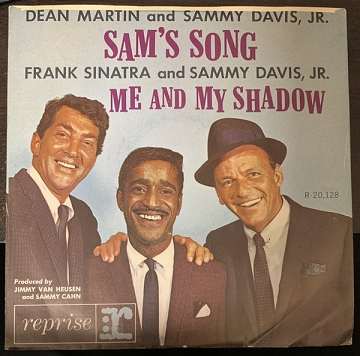
Los Angeles
1509 Me And My Shadow w/Sammy Davis Jr.
Supposedly this photo is from that night. Does anyone know for sure?
It certainly is.
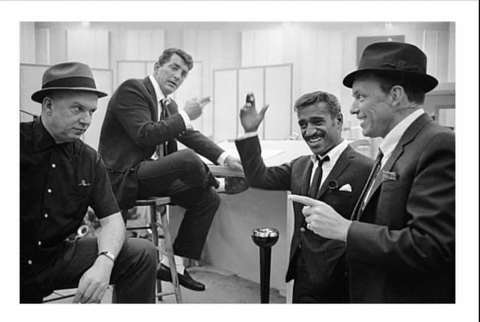
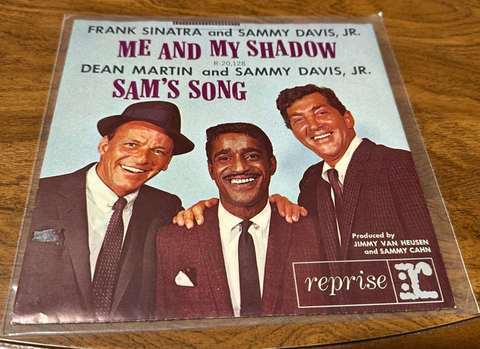
Liverpool Echo
.
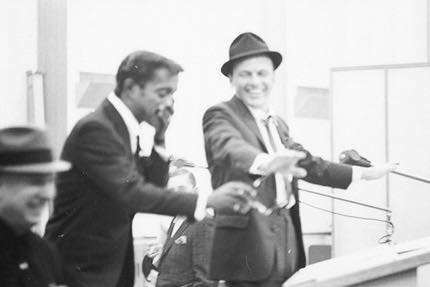
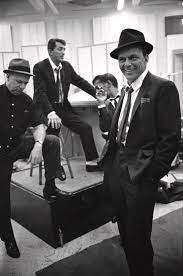
.
.
[Me and My Shadow recorded during missile crisis]
On the same night President Kennedy gave his televised address announcing the Cuban missile blockade, Sinatra and Sammy Davis Jr., with Billy May's orchestra, recorded their nightclub duet 'Me and My Shadow,' complete with updated topical lyrics referencing Bobby and JFK.
Source: James Kaplan, "Sinatra: The Chairman" (2015).
[Sinatra prepares family for possible nuclear war]
Tina Sinatra: Tipped off in advance by press secretary Pierre Salinger about the coming Cuban crisis announcement, Sinatra told his daughter Nancy and her husband Tommy Sands to pack a suitcase and be ready to fly out via his stocked private jet if Soviet missiles hit New York; the family gathered at the Palm Springs compound to watch the crisis unfold on television.
Source: James Kaplan, "Sinatra: The Chairman" (2015).
October 24, 1962
Film
The Manchurian Candidate (US Film Release: October 24, 1962
Starring: Frank Sinatra, Laurence Harvey, Janet Leigh, Angela Lansbury, Henry Silva, and James Gregory
Produced and Directed by John Frankenheimer. The screenplay was written by George Axelrod, and was based on the 1959 Richard Condon novel The Manchurian Candidate Sinatra plays Captain Bennett Marco in this political thriller film about the Cold War and sleeper agents. (1st DVD Release date: 1998-03-24 -- Blu Ray Release date: 2011-01-31)
Note: This film is considered by many to be Sinatra's greatest. He was paid $1,000,000. Laurence Harvey received $200,000 and the additional cost, for everything involved in the making of the film - $1,000,000 - made a grand total of $2,200,000. The film was not removed from circulation after the Kennedy assassination. It would be re-released and also shown on commercial TV. CBS ran it against Dean Martin's premiere NBC variety show, with Frank as guest, 9-16-65. The b.o. take for the initial run was $2,700,000. The re-releases plus numerous TV showings would bring in millions more through the years. The film was completed in 39 days. Sinatra's scenes were shot in 15 days. Frank very much wanted Lucille Ball for the role of Harvey's mother. After Frankenheimer showed Frank Lansbury's screen test, Sinatra agreed she was perfect for the part. Frank did all his own stunts in the film. And he broke his finger in the karate fight with Henry Silva. Rotten Tomatoes shows a 96% favorable rating from more than 50 critics and a 90% favorable from the audience.. Frank obtained complete rights to the film in 1972. He allowed a few showings before the big re-release in 1988. Suddenly" is a different story. Oswald watched a 16mm print prior to killing Kennedy. Sinatra asked that all copies be pulled from circulation. Sinatra gave a fantastic performance in that film. -- Ed
[The Cinematic Legacy of Frank Sinatra — The Manchurian Candidate (1962)]
David Wills's 2015 photo history The Cinematic Legacy of Frank Sinatra devotes a section to The Manchurian Candidate (1962), illustrated with 20 behind-the-scenes and publicity photographs (posters, lobby cards, and on-set/on-location shots) filed here.
“God I love that book. Who's gonna play the mother?” —John Frankenheimer
“… the film is artfully contrived, the plot so interestingly started, the dialogue so racy and sharp, and John Frankenheimer's direction so exciting in the style of Orson Welles when he was making Citizen Kane … that the fascination of it is strong.” —Bosley Crowther
Source: David Wills, The Cinematic Legacy of Frank Sinatra (St. Martin's Press, 2015), pp. 209–228.
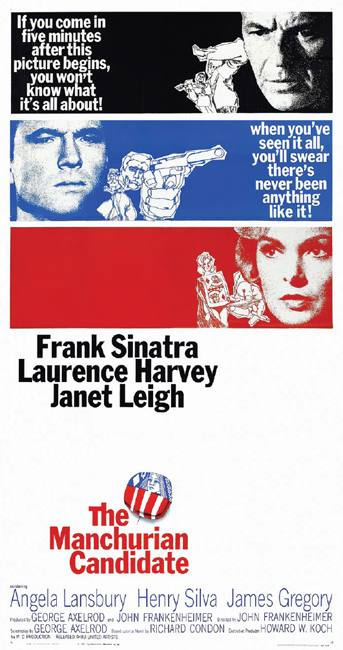
Insert poster, The Manchurian Candidate, 1962. / “There was some opposition from United Artists / because [studio president] Arthur Krim wanted / to be ambassador to Israel, and he didn't think / President Kennedy would want it made. It (Photo: The Cinematic Legacy of Frank Sinatra, David Wills, 2015.)
Lobby cards, The Manchurian Candidate. (Photo: The Cinematic Legacy of Frank Sinatra, David Wills, 2015.)
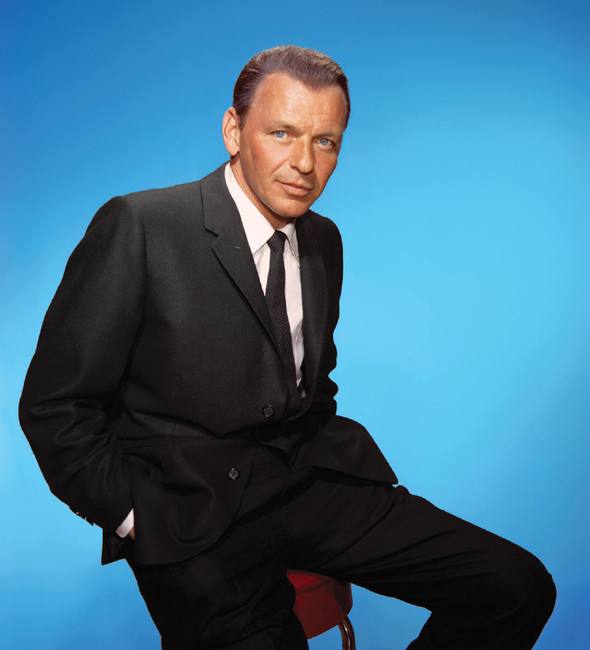
As Major Bennett Marco, The Manchurian Candidate. (Photo: The Cinematic Legacy of Frank Sinatra, David Wills, 2015.)
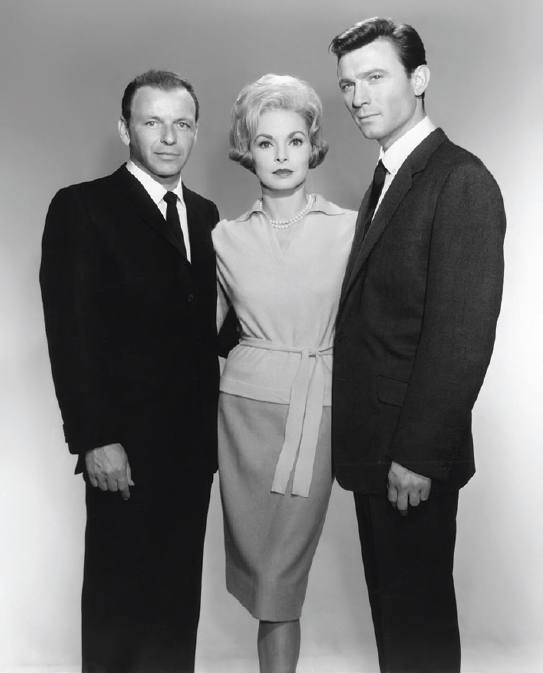
The Manchurian Candidate, 1962. (Photo: The Cinematic Legacy of Frank Sinatra, David Wills, 2015.)
The Manchurian Candidate, 1962. (Photo: The Cinematic Legacy of Frank Sinatra, David Wills, 2015.)
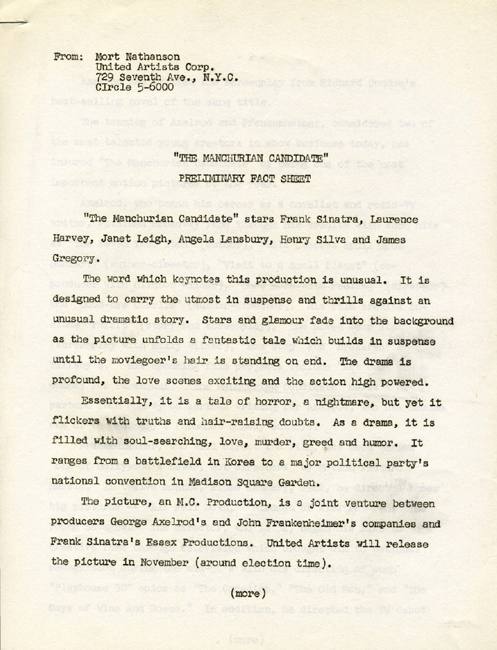
With costars Janet Leigh and Laurence Harvey, The Manchurian Candidate. / Preliminary fact sheet, The Manchurian Candidate. (Photo: The Cinematic Legacy of Frank Sinatra, David Wills, 2015.)
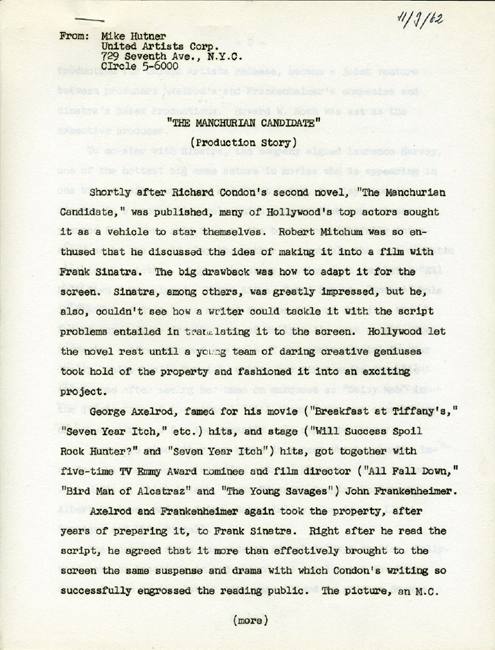
Production story, The Manchurian Candidate. (Photo: The Cinematic Legacy of Frank Sinatra, David Wills, 2015.)
The Manchurian Candidate. (Photo: The Cinematic Legacy of Frank Sinatra, David Wills, 2015.)
The Manchurian Candidate, 1962. (Photo: The Cinematic Legacy of Frank Sinatra, David Wills, 2015.)
With director John Frankenheimer, The Manchurian Candidate. (Photo: The Cinematic Legacy of Frank Sinatra, David Wills, 2015.)
With director John Frankenheimer, The Manchurian Candidate. (Photo: The Cinematic Legacy of Frank Sinatra, David Wills, 2015.)
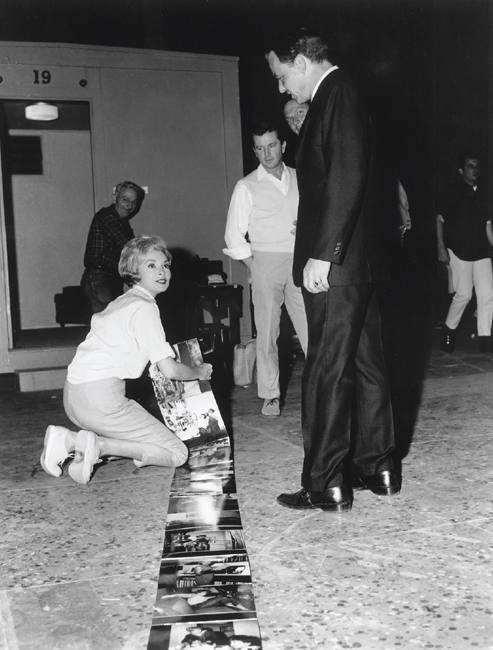
On set with costar Janet Leigh, The Manchurian Candidate. (Photo: The Cinematic Legacy of Frank Sinatra, David Wills, 2015.)
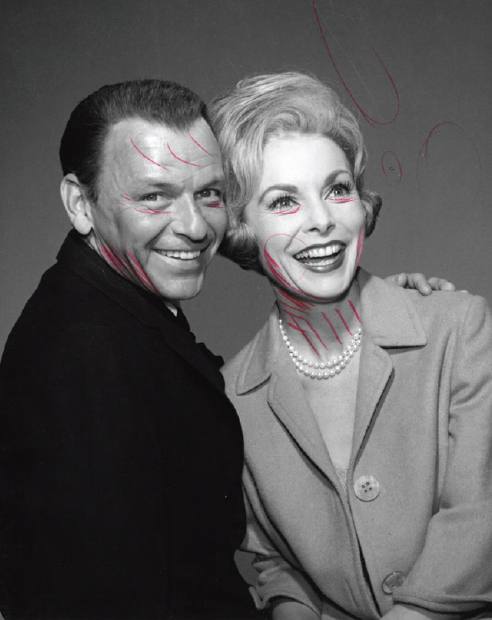
With costar Janet Leigh, promotional photo with original grease pencil markings for later / retouching, The Manchurian Candidate. / “I was amazed how conscientious Frank is and / how hard he worked. We had rehearsals before / we started shooting and Frank always had (Photo: The Cinematic Legacy of Frank Sinatra, David Wills, 2015.)
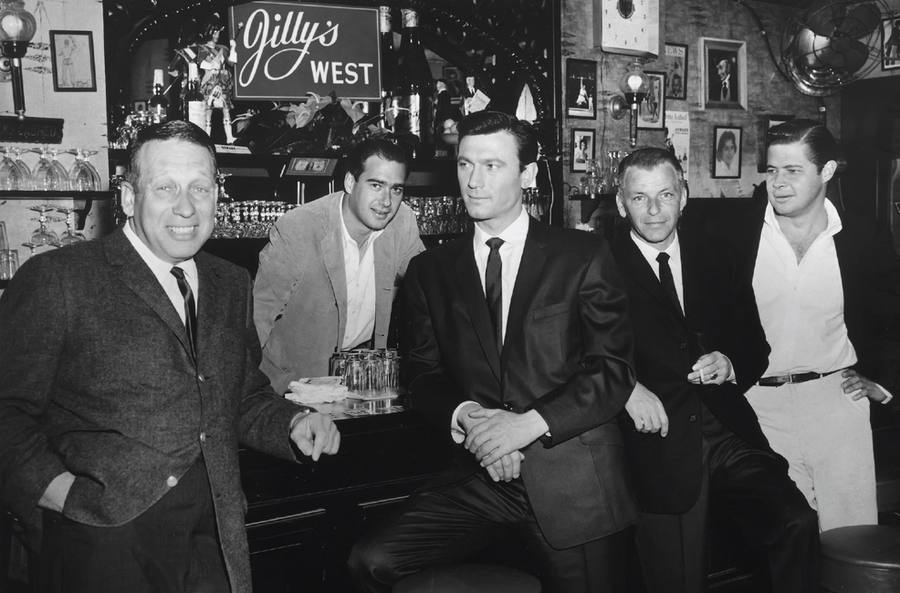
suggestions. I think he's an actor who needs a / challenge.” / On set with producer Howard W. Koch, unidentified man, costar Laurence Harvey, and / screenwriter George Axelrod. (Photo: The Cinematic Legacy of Frank Sinatra, David Wills, 2015.)
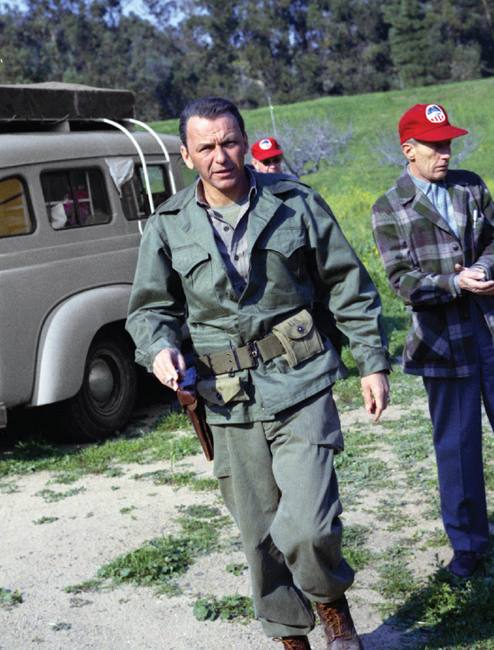
On location, The Manchurian Candidate. (Photo: The Cinematic Legacy of Frank Sinatra, David Wills, 2015.)
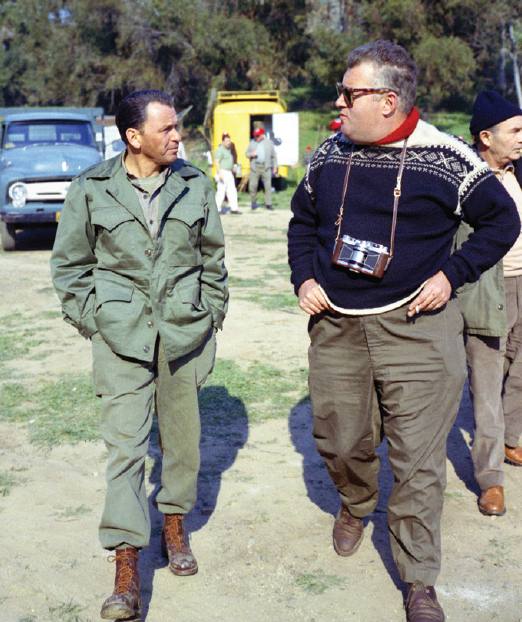
On location, with photographer William Read Woodfield. / “He was very serious about his work; he went / over his wardrobe, the look of the film, the / dramatic arc. He didn't just pick up a script.… / He prepared; I saw him in thrall to the words of / The Manchurian Candidate.“ (Photo: The Cinematic Legacy of Frank Sinatra, David Wills, 2015.)
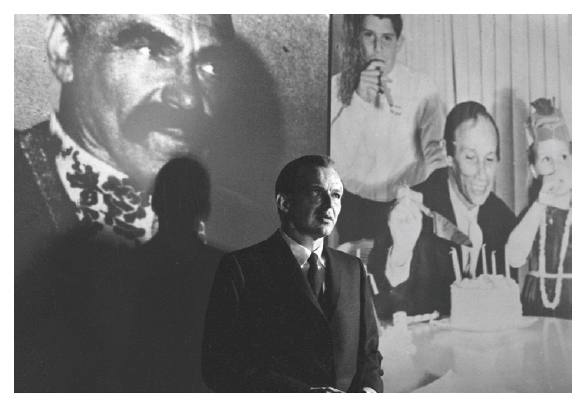
The Manchurian Candidate. / “… the film is artfully contrived, the plot so / interestingly started, the dialogue so racy and / sharp, and John Frankenheimer's direction so / exciting in the style of Orson Welles when he / was making Citizen Kane … that the fascination / of it is strong.” / Manchuria (Photo: The Cinematic Legacy of Frank Sinatra, David Wills, 2015.)
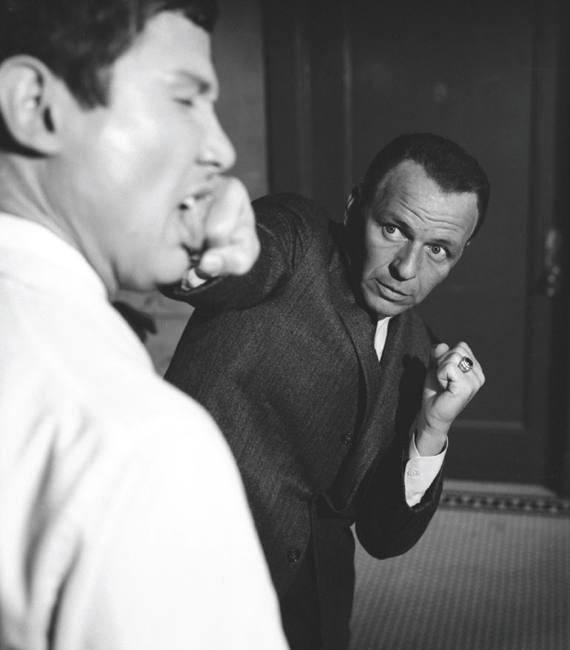
With costar Laurence Harvey, The Manchurian Candidate. (Photo: The Cinematic Legacy of Frank Sinatra, David Wills, 2015.)
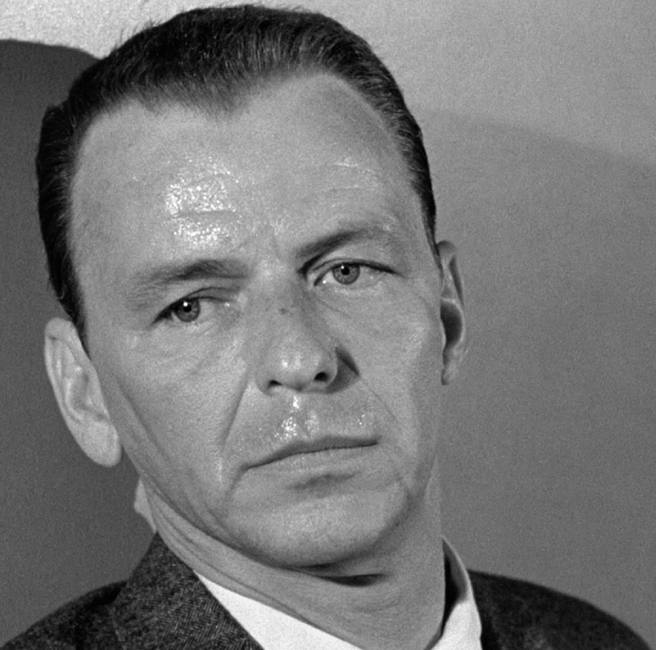
The Manchurian Candidate. / “Frank Sinatra is an extremely effective / performer who has played the character that he / has devised for himself. That works wonderfully / well for him, and sometimes he takes a good / step beyond that. He did in The Manchurian (Photo: The Cinematic Legacy of Frank Sinatra, David Wills, 2015.)
Candidate. He's very good in it. I think it was / one of best performances I ever saw him give.” / (Costar, The Manchurian Candidate) (Photo: The Cinematic Legacy of Frank Sinatra, David Wills, 2015.)
"The Manchurian Candidate"
Santopietro calls The Manchurian Candidate, directed by John Frankenheimer, one of the two best and most fully realized sustained acting performances of Sinatra's career (alongside The Man with the Golden Arm), comparing Sinatra's ability to follow it with concept-album recording sessions to Marlon Brando following On the Waterfront with a lounge-singer record.
Source: Tom Santopietro, "Sinatra in Hollywood" (2008).
"The Manchurian Candidate"
The Manchurian Candidate finally moved into production after Sinatra met with President John F. Kennedy in Hyannisport and secured his support; Kennedy, a fan of Richard Condon's 1959 novel, personally called United Artists president Arthur Krim to allay concerns about the film's political content, and reportedly asked only who would play the evil mother.
Source: Tom Santopietro, "Sinatra in Hollywood" (2008).
"The Manchurian Candidate"
Sinatra originally wanted Lucille Ball to play the villainous mother Evelyn, but after Frankenheimer had him watch Angela Lansbury's performance in All Fall Down, Sinatra agreed to cast Lansbury (then only 37) instead — a decision that proved essential to the film's success and earned Lansbury an Academy Award nomination (she won the Golden Globe but lost the Oscar to Margaret Rutherford for The V.I.P.s).
Source: Tom Santopietro, "Sinatra in Hollywood" (2008).
"The Manchurian Candidate"
Director John Frankenheimer, coming off All Fall Down and Birdman of Alcatraz in the same year, ran an efficient 39-day shoot on The Manchurian Candidate, managing Sinatra (as had previous directors Vincente Minnelli and George Sidney) by fully rehearsing other cast members first and bringing Sinatra in for only a single pre-shoot run-through, minimizing retakes and keeping his goodwill.
Source: Tom Santopietro, "Sinatra in Hollywood" (2008).
"The Manchurian Candidate"
Cinematographer Lionel Lindon, who had previously worked with Frankenheimer on All Fall Down and won an Oscar for Around the World in Eighty Days, shot The Manchurian Candidate in evocative black-and-white to suit its Cold War paranoia.
Source: Tom Santopietro, "Sinatra in Hollywood" (2008).
"The Manchurian Candidate"
John Frankenheimer: Frankenheimer described how the film's famous surreal 'garden club' brainwashing sequence was filmed in about six different setups and combinations, then assembled together in editing to achieve its disorienting surrealistic quality; a later repeat of the sequence (for Corporal Melvin's viewpoint) was edited essentially at random 'to make it weird.'
Source: Tom Santopietro, "Sinatra in Hollywood" (2008).
"The Manchurian Candidate"
John Frankenheimer: The pivotal train-platform scene between Sinatra and Janet Leigh, showing Bennett Marco's nervous breakdown, was completed in a single take in about three hours; Frankenheimer noted it was the kind of scene that could have taken three days if it hadn't gone well.
Source: Tom Santopietro, "Sinatra in Hollywood" (2008).
"The Manchurian Candidate"
As a personal touch tying to the film's Queen of Diamonds motif, Sinatra had the Queen of Diamonds imprinted on the bottom of his own swimming pool.
Source: Tom Santopietro, "Sinatra in Hollywood" (2008).
"The Manchurian Candidate"
John Frankenheimer: In the film's climactic card-reveal confession scene between Sinatra and Laurence Harvey, Frankenheimer discovered after a nearly perfect first take that Sinatra was out of focus. After ten reshoot attempts failed to match the original's power, Frankenheimer used the out-of-focus first take anyway; critics later praised it as an intentional stylistic choice reflecting Shaw's distorted point of view.
Source: Tom Santopietro, "Sinatra in Hollywood" (2008).
"The Manchurian Candidate"
Santopietro credits The Manchurian Candidate's enduring power to its refusal to editorialize about Cold War paranoia, McCarthy-style demagoguery, and media manipulation of politics (illustrated by Senator Iselin's fabricated 'Communists in the Defense Department' number, taken from a Heinz ketchup bottle label), arguing the film resonates as strongly in the post-9/11 era as it did in 1962.
Source: Tom Santopietro, "Sinatra in Hollywood" (2008).
"The Manchurian Candidate"
Angela Lansbury: In the scene where Mrs. Iselin kisses her son Raymond on the mouth, Angela Lansbury said the disturbing gesture (covered by her hand cupping their mouths) was actually John Frankenheimer's suggestion, per her interview on the film's DVD reissue.
Source: Tom Santopietro, "Sinatra in Hollywood" (2008).
"The Manchurian Candidate"
Angela Lansbury: Lansbury, only three years older than Laurence Harvey, convincingly played his mother without old-age makeup. She credited it to physical bearing and demeanor rather than makeup tricks.
Source: Tom Santopietro, "Sinatra in Hollywood" (2008).
"The Manchurian Candidate"
Angela Lansbury: In 2007, Lansbury stated that of her sixty-year career, The Manchurian Candidate is the film she wants to be remembered for.
Source: Tom Santopietro, "Sinatra in Hollywood" (2008).
"The Manchurian Candidate"
Santopietro credits editor Ferris Webster's rapid cross-cutting during the Madison Square Garden climax, combined with then-novel overlapping dialogue, with anticipating the fast MTV-style editing that later transformed 1980s filmmaking, and with smoothing over the film's minor plot inconsistencies.
Source: Tom Santopietro, "Sinatra in Hollywood" (2008).
"The Manchurian Candidate"
The film's ending departs from Richard Condon's novel: rather than Marco ordering Shaw to kill his mother and stepfather, Marco believes he has successfully deprogrammed Shaw, so when Shaw does assassinate them and then himself, it registers as Shaw's own tragic choice rather than a directive.
Source: Tom Santopietro, "Sinatra in Hollywood" (2008).
"The Manchurian Candidate"
Variety / The New Yorker (quoted by Santopietro): Variety's review praised the film as a rare case where story, production, and performance blended into near-complete satisfaction, and The New Yorker singled out Sinatra's performance as "simply terrific."
Source: Tom Santopietro, "Sinatra in Hollywood" (2008).
"The Manchurian Candidate"
Frank Sinatra: Sinatra later downplayed the film's ambitions, saying the cast and crew simply set out to adapt Condon's novel faithfully.
Source: Tom Santopietro, "Sinatra in Hollywood" (2008).
"The Manchurian Candidate"
Angela Lansbury: Lansbury acknowledged Sinatra wasn't the easiest actor for director John Frankenheimer to work with, but said Sinatra recognized what a major opportunity the role represented.
Source: Tom Santopietro, "Sinatra in Hollywood" (2008).
"The Manchurian Candidate"
Frank Sinatra: Sinatra recalled the shoot as an unusually enthusiastic, once-in-a-career experience shared by everyone involved in the production.
Source: Tom Santopietro, "Sinatra in Hollywood" (2008).
"The Manchurian Candidate"
Popular myth held the film was withdrawn after JFK's assassination because the plot parallels were too painful for Sinatra. Santopietro notes the more mundane explanation Sinatra himself acknowledged: he bought the film's rights in 1972 but forgot he owned them, which delayed its rerelease until 1986.
Source: Tom Santopietro, "Sinatra in Hollywood" (2008).
"The Manchurian Candidate"
Frank Sinatra: Sinatra admitted he didn't realize he owned the rights to the film, joking that whoever negotiated on his behalf "made a pretty good deal." When it was rereleased theatrically it earned a fresh round of rave reviews and a new audience.
Source: Tom Santopietro, "Sinatra in Hollywood" (2008).
"The Manchurian Candidate"
Sinatra performed his own stunts whenever possible; the martial-arts fight scene in The Manchurian Candidate left him with a permanently damaged finger.
Source: Tom Santopietro, "Sinatra in Hollywood" (2008).
"The Manchurian Candidate"
A theatrical reissue of The Manchurian Candidate around this period refocused critical attention on Sinatra's screen legacy, possibly providing the final impetus for his decision to take the guest role on Magnum, P.I. that year.
Source: Tom Santopietro, "Sinatra in Hollywood" (2008).
"The Manchurian Candidate"
Santopietro grades this an A, calling it "brilliant Frank; brilliant film." Golden Laurel Award nomination: Top Action Performance; Golden Laurel Award nomination: Top Male Star of the Year.
Source: Tom Santopietro, "Sinatra in Hollywood" (2008).
"The Manchurian Candidate"
Santopietro (Filmography): MC Production/United Artists. Produced by George Axelrod and John Frankenheimer, directed by Frankenheimer, screenplay by Axelrod based on the Richard Condon novel. Sinatra played Bennett Marco opposite Laurence Harvey, Janet Leigh and Angela Lansbury as Evelyn Iselin.
Source: Tom Santopietro, "Sinatra in Hollywood" (2008).
[Manchurian Candidate premieres in New York]
The Manchurian Candidate had its New York premiere on October 24, 1962.
Source: James Kaplan, "Sinatra: The Chairman" (2015).
October 25, 1962
Studio
Paramount Pictures Soundstage, Los Angeles , California Sound recording for the Paramount picture, "Come Blow Your Horn"
Arranged and conducted by Nelson Riddle
"Come Blow Your Horn" - Frank Sinatra
Vocal runs 2:55
NOTE; Sinatra Scholar Ed O'Brien reports that Riddle conducted a 50-piece Paramount studio orchestra. The session ran from 3:30 p.m. to 6:20 p.m. At the Paramount session, Riddle was paid $123.58 and Bill Miller received $61.79. The 51 musicians were paid a total of $3,423.14. Sinatra would record the song at Reprise on January 21, 1963. Riddle again arranged and conducted but with a much different musical concept for the song. Rehearsing title tune on the set of "Come Blow Your Horn."
Fellow with Sinatra and Riddle is the film's director Bud Yorkin
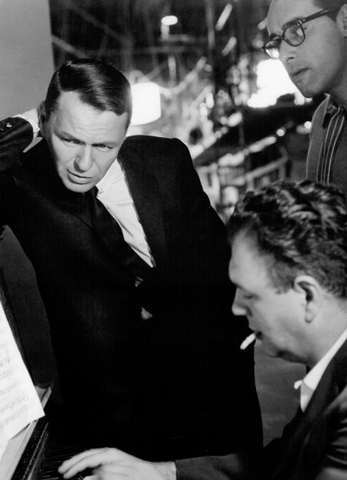
October 26, 1962
Valley Times Today
Hollywood, California
10-26-62
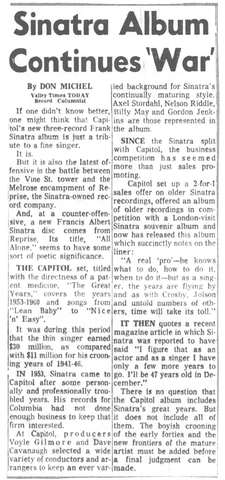
October 27, 1962
[Cuban Missile Crisis resolved]
On October 27, 1962, Kennedy and Khrushchev agreed to a truce ending the Cuban Missile Crisis: the Soviets withdrew missiles from Cuba in exchange for a U.S. non-invasion pledge and the secret removal of American missiles from Turkey and Italy.
Source: James Kaplan, "Sinatra: The Chairman" (2015).
October 29, 1962
[Louella Parsons on relaxed Sinatra]
Louella Parsons: Columnist Louella Parsons wrote that Sinatra was the most relaxed he'd been in years on the set of Come Blow Your Horn, citing a running gag in which co-star Dan Blocker's character threatened Sinatra's character over his onscreen wife, played by Phyllis McGuire.
Source: James Kaplan, "Sinatra: The Chairman" (2015).
October 31, 1962
[Eddie Fisher opens at Villa Venice]
Eddie Fisher: Eddie Fisher opened at the Villa Venice on October 31, 1962; afterward three FBI agents visited his hotel room asking about Giancana, and Fisher told them he was performing 'because a friend asked me to do him a favor,' having been paid next to nothing.
Source: James Kaplan, "Sinatra: The Chairman" (2015).
November 1962
[FBI interviews the Rat Pack]
Sammy Davis Jr.: FBI agents questioned Sinatra in Chicago, who said only that he was performing at the Villa Venice as a favor to nominal owner Leo Olsen; Dean Martin made himself scarce, while Sammy Davis Jr. let agents into his Ambassador East suite and cagily deflected questions about doing the shows for 'my man Francis' and 'friends of his,' hinting he knew more than he'd say about Giancana.
Source: James Kaplan, "Sinatra: The Chairman" (2015)
[Giancana and Judy Campbell at the Summit shows]
Kaplan: Among the ringside couples at the Villa Venice Summit shows were Sam Giancana and Judith Campbell, who had grown close that fall even as Giancana continued seeing Phyllis McGuire; Campbell later claimed Giancana had helped her obtain an abortion for a child she said she conceived with JFK.
Source: James Kaplan, "Sinatra: The Chairman" (2015)
[Conspiracy theorists link Oswald to a Manchurian Candidate screening]
Some conspiracy theorists have claimed that Lee Harvey Oswald saw "The Manchurian Candidate" in a Dallas theater in November 1962, prior to his later assassination of President Kennedy.
Source: Richard Havers, "Sinatra" (Dorling Kindersley, 2007).
November 26, 1962
Concerts
Villa Venice, Northbrook , Illinois w/Dean & Sammy
Orchestra Conducted by: Matty Malneck
Key Musicians: Ken Lane (piano/Dean martin), Bill Miller (piano/Frank Sinatra), George Rhodes (piano/Sammy Davis , Jr.)
Dean:
1. When You're Smiling / The Lady Is A Tramp (parody)
2. Monologue
3. I Left My Heart In San Francisco
4. I'm Gonna Sit Right Down And Write Myself A Letter
5. Medley: Volare - On An Evening In Roma
Frank:
6. Goody Goody
7. Chicago
8. When You're Lover Has Gone
9. Monologue
10. Please Be Kind
11. You're Nobody Till Somebody Love You
Sammy:
12. What Kind Of Fool Am I
13. Out Of This World
14. She's Funny That Way
15. Hey There
16. Impersonations
Frank, Dean & Sammy:
17. Comedy
18. Medley: I Can't Give You Anything But Love (DM) / Too Marvelous For Words (FS) / Pennies From Heaven (DM) / A Foggy Day (FS) / Embraceable You (DM) / The Lady Is A Tramp (FS) / Where Or When (DM)
19. Impressions
20. Birth Of The Blues
21. Me And My Shadow: Frank & Sammy
22. Sam's Song: Dean & Sammy
23. Birth Of The Blues (Reprise)
Villa Venice, Northbrook , Illinois
The crowd at Villa Venice for the Frank Sinatra, Dean Martin and Sammy Davis Jr. show on Nov. 26, 1962
November 26, 1962: "Madness at the Villa"
This writer's first in-person glimpse of Sinatra's furious magnetism, which had been reconstructed into a pillar of the American power structure itself, happened in the most unexpected place you could imagine a fading roadhouse called the Villa Venice, tucked along an unincorporated stretch of Milwaukee Avenue just south of Palatine Road. But there was more. Not only did Sinatra play two shows a night, but so, too, did Rat Pack members Dean Martin and Sammy Davis Jr.
When he walked onstage unannounced after Martin's 20 minutes, he radiated certainty. The humor was mostly PG, but not PC. There may not have been any four-letter words uttered, but a lot of the hoary gags would not pass today's public standard. Davis seemed to draw a million race jokes, but for all the cracks, you knew those brothers were there for each other.
Like some suburban Brigadoon, the Villa Venice was incendiary for seven brief days, then poof, it was gone. Herb Lyon called it Madness at the Villa ... where some 2,000 screaming g fans turned out to pay homage to show biz royalty. ¯ Sinatra was the king among kings. But when he left, the Villa went dark.
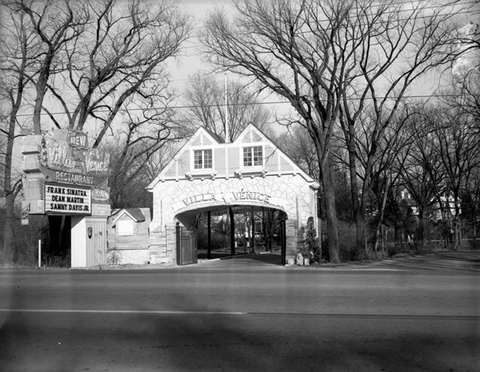
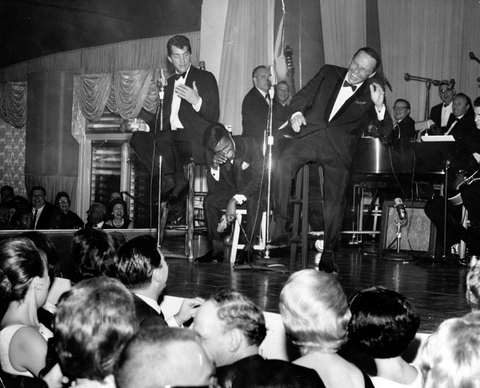
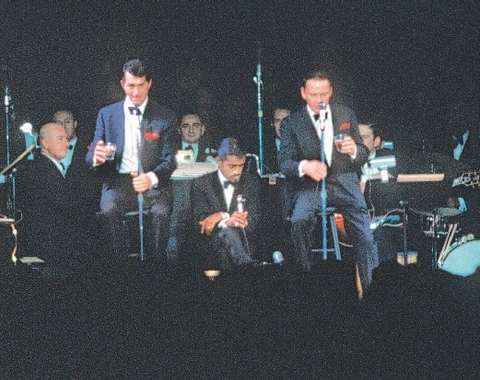
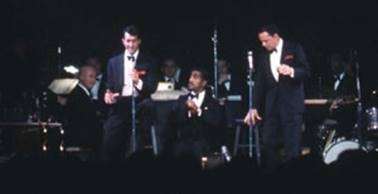
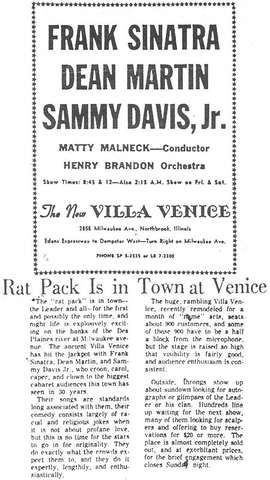
[Rat Pack joins the Villa Venice Summit]
On November 26, 1962, Frank Sinatra and Dean Martin joined Sammy Davis Jr. (who himself owed Giancana $20,000) at the Villa Venice, playing sixteen shows over seven nights to a packed house that included Chicago mob figures Marshall Caifano, Jimmy 'The Monk' Allegretti, Felix 'Milwaukee Phil' Alderisio, Willie 'Potatoes' Daddano, and Giancana himself.
Source: James Kaplan, "Sinatra: The Chairman" (2015).
November 27, 1962
Concerts
Villa Venice, Northbrook , Illinois w/Dean & Sammy
Orchestra Conducted by: Matty Malneck
Key Musicians: Ken Lane (piano/Dean martin), Bill Miller (piano/Frank Sinatra), George Rhodes (piano/Sammy Davis , Jr.)
November 28, 1962
Concerts
Villa Venice, Northbrook, Illinois w/Dean & Sammy
Orchestra: Matty Malneck conducts the Henry Brandon Orchestra
Key Musicians: Ken Lane (piano/Dean martin), Bill Miller (piano/Frank Sinatra), George Rhodes (piano/Sammy Davis, Jr.)
Frank, Dean and Sammy would do 16 shows in seven days at the New Villa Venice. They opened on 11/26 and played through 12/2. Reprise taped throughout the engagement. There are 57 reel tapes at Reprise from this engagement. The files state that they were recorded by Sinatra, Martin, Davis. An audio DVD was issued of this material, plus CDs, including a JazzHour release of the complete final show from 12-2-62. Wally Heider recorded that show.
Ed
Villa Venice, Northbrook, Illinois
-------------------------------------------------
November 28, 1966 Truman Capote Black and White Ball , Plaza Hotel, New York, New York.
Frank Sinatra and Mia Farrow at Truman Capote's fabled Black and White Ball
held in the Grand Ballroom of the Plaza Hotel.
50 Years Ago, Truman Capote Hosted the Best Party Ever
By Guy Trebay
New York Times
Nov. 21, 2016
What if you gave a party and everybody came? That is precisely what occurred on the drizzly night of Nov. 28, 1966, when 540 of Truman Capote’s nearest and dearest turned out for what the writer insisted on calling his “little masked ball for Kay Graham and all of my friends.”
The evening survives on film and in the recollections of the guests who are still alive 50 years later. It was a party of a kind we are unlikely to see again, given that it allowed for a then unheard-of, but now more common, coming together of disparate social spheres.
“There will never be another first time that somebody like Andy Warhol could step into a room with somebody like Babe Paley,” said Deborah Davis, the author of the 2006 book “Party of the Century: The Fabulous Story of Truman Capote and the Black and White Ball,” referring to one of Capote’s so-called swans the socialite wife of William Paley, who built the CBS network.
Before the Black and White Ball, no one had ever imagined, let alone attended, a formal party with a guest list so wildly catholic that it brought into one room the poet Marianne Moore and Frank Sinatra, Gloria Vanderbilt and Lionel Trilling, Lynda Bird Johnson and the Maharani of Jaipur, the Italian princess Luciana Pignatelli (wearing a 60-carat diamond borrowed from Harry Winston) and the documentary filmmaker Albert Maysles.
When Capote summoned his pals for a night of dancing (and spaghetti and chicken hash at midnight), he was as famous as he would ever be, and flush with the profits from his critically acclaimed best-selling nonfiction book “In Cold Blood.”
In the Grand Ballroom of the Plaza hotel, starting at 10 o’clock that night, European aristocrats rubbed elbows with novelists and scholars; social register blue bloods drank Taittinger Champagne with the denizens of Hollywood and Broadway; the stolid middle-class citizens of Garden City, Kan., who had played host to Capote during the years he had spent researching his masterpiece, danced to the Peter Duchin Orchestra alongside the photographer and film director Gordon Parks, who would later joke that he along with Harry Belafonte and Ralph and Fanny Ellison represented “the black of the Black and White Ball.”
In the half-century since that Monday evening just after Thanksgiving, countless other parties have evoked, interpreted or outright copied Capote’s ball.
“There are probably more Black and White Balls at this point than Civil War re-enactments,” Ms. Davis said.
Most memorably, perhaps, the hip-hop mogul Sean Combs used the party as a template for a 29th-birthday wingding he tossed for himself in 1998, reportedly spending more than $500,000 to furnish Cipriani with a translucent monogrammed dance floor and Plexiglas go-go booths for the amusement of a collection of celebrities, among them Martha Stewart, Ronald Perelman, Sarah Ferguson and Donald J. Trump.
Now it is difficult to recall a time when the borders between society and celebrity were sharply delineated and seldom crossed. And in an era when many celebrities attend parties because they have been paid to do so (and post the evidence later on Instagram), it is startling to remember a time when people went to parties to have fun.
A certain indulgent pleasure can be had in reliving the innocent wonder that inspired Capote’s Black and White Ball, a party its host had in some ways begun to plan as a precocious, lonely 8-year-old in Monroeville, Ala., but did not have the social power to pull off until the year of his huge literary success.
“Truman had always had a fantasy of the grand world, the smart world, the literary world, each of which was in some ways precious to him,” said Robert Silvers, a founder and editor of The New York Review of Books.
“It was tremendously important to Truman to be a star in all of those worlds,” he added, referring the elites of heredity and of accomplishment Capote cultivated with equivalent ardor. “The mixture of all those groups was so obviously an emanation of Truman’s dream.”
Even after a half-century, the party retains a dreamlike aura, one supported by photographs and newsreels that show the guests in black tie and monochrome couture dresses, masks by Adolfo and a young milliner who went by the single name Halston.
Truman Capote said that he paid 39 cents at F.A.O. Schwarz for the mask he wore at his Black and White Ball in 1966.
Sometimes buried in the retellings of the Black and White Ball myth is its guest of honor, Katharine Graham, whose family owned Newsweek and The Washington Post. After the suicide three years earlier of her husband, Philip Graham, Ms. Graham, who would go on to run the newspaper for two of the most noteworthy decades in its storied history, seemed thrust into a role for which she had little preparation, said one party guest, the psychotherapist Gillian Walker.
Raised in elite Washington circles, Ms. Walker was a childhood friend of Ms. Graham’s children and thus had a singular perspective on how power was distributed in those pre-feminist years.
“For all those women, those swans, however fancy they were, or whatever, they were still wives,” Ms. Walker said, referring to Ms. Graham, Babe Paley, Slim Keith, Gloria Vanderbilt and Gloria Guinness. “Because of the complexities of his own life, Truman as an outsider understood these women. And what he did for Kay was such a great thing, giving her this party that brought her into the larger world she had left behind when she met Phil.”
The reserves of compassion that were characteristic of his best writing were deeply ingrained in Capote’s nature. Or they were, at least, in the days before his big party, which some consider the writer’s unintended swan song, a final golden moment before he began a descent into drugs and drink.
“People forget Truman was very gracious,” said Ashton Hawkins, for decades the senior counsel to the Metropolitan Museum of Art, who was a lawyer on the way up in 1966. He recalled the host taking him by the arm and steering him toward a corner of the ballroom, where Rose Kennedy was stranded alone.
“I thought that was fun, that you could sit down with the mother of the president,” Mr. Hawkins said. “Everybody talked to everybody and just sat down where they wanted to sit.”
The relatively loose atmosphere led the bandleader Peter Duchin to later characterize the ball as having “closed an era of elegant exclusiveness and ushered in another of media madness.”
Although guests wore masks for the event, Capote had each person announced when entering.
“It was a marvellous party because there was such a mixture of people, all kinds, all ages,” said the jeweler Kenneth Jay Lane, who, at 34, was among the younger attendees. The big moment of the evening for him, Mr. Lane said, was being walked to a gilded settee where the actress Tallulah Bankhead sat holding court and furiously smoking.
“I talked to her for about three minutes, but then could say I’d met Tallulah Bankhead,” Mr. Lane said with a laugh. “In the old days, it wasn’t a publicist society, and now it’s all publicists. People then had publicists to keep their names out of the papers, and nobody’d ever been to Kardashia.”
From the first, Mr. Capote had a canny understanding of fame and a prescient sense of celebrity’s untapped potential. Limiting press attendance inside the party to four hand-selected journalists including one, Charlotte Curtis, from this newspaper he heightened its air of exclusivity while managing potential criticism about the affair’s overall modesty.
European guests familiar with, say, the heady opulence of Carlos de Beistegui’s 1951 masked ball held at the Palazzo Labia in Venice, were heard to snipe about Capote’s modest supper menu and candles-and-balloons décor. Yet, in a sense, they were missing the point. Capote understood that the ball’s true ornaments were its boldface attendees, even going so far as to provide The Times with a guest list, which the newspaper published the following day.
Never mind that some of those listed, like Greta Garbo, were not actually at the party. The effect had been achieved. Before The Times published a “List of Those Who Were Invited to the Party at the Plaza Hotel,” that distinction had been reserved mainly for White House dinners and the like.
In many ways, the Black and White Ball served as a signpost pointing the way to Kardashia, that mythical land where accomplishment is largely optional and fame is an end unto itself. And it also served to help blur forever the lines separating public from private.
Of the attendees wearing masks, “There was something radically democratic in the notion of inviting these very famous people to a party and then telling them to hide their faces,” Ms. Davis said. At the last minute, though, the canny host had someone announce each of the guests as they arrived.
Almost until that night 50 years ago, said the editor and publisher Jason Epstein, New York society observed the rigid caste-based system it had followed since the Knickerbocker days, one dominated by a handful of families not much different from those depicted by Edith Wharton and Henry James.
“Then here came this out-of-town gay fellow who conquered society to the extent that he gave that party,” Mr. Epstein said. “Truman created this new class of talented, good-natured, funny people, and that lasted for quite a long time. Who really knows what is society in New York anymore?”
November 29, 1962
Concerts
Villa Venice, Northbrook, Illinois (November 26 - December 2) w/Dean & Sammy
Orchestra Conducted by: Matty Malneck
Key Musicians: Ken Lane (piano/Dean martin), Bill
Miller (piano/Frank Sinatra), George Rhodes (piano/Sammy Davis, Jr.)
November 30, 1962
Concerts
Villa Venice, Northbrook, Illinois w/Dean & Sammy
Orchestra Conducted by: Matty Malneck
Key Musicians: Ken Lane (piano/Dean martin), Bill Miller (piano/Frank Sinatra), George Rhodes (piano/Sammy Davis, Jr.)
December 1, 1962
Concerts
Villa Venice, Northbrook, Illinois (November 26 - December 2) w/Dean & Sammy
Orchestra Conducted by: Matty Malneck
Key Musicians: Ken Lane (piano/Dean martin), Bill Miller (piano/Frank Sinatra), George Rhodes (piano/Sammy Davis, Jr.)
Penultimate date of engagement. In all, there were 16 shows. All were recorded by Reprise. They have 57 reels of tape.
Vance Adair asked:
Is the widely circulated version of the Villa
Venice shows a cut and paste job from all those meters of tape, or is it the record of only one particular date? If the answer to the latter is yes, is there a possibility that some even better performances are gathering dust somewhere?
Ed responded:
Jazz Hour issued a two CD set from the Villa Venice.
The set was a complete copy of the 12-2-62 closing night performance. All of the other releases have been cut and paste.
December 2, 1962
Concerts
Villa Venice, Northbrook, Illinois (November 26-December 2) w/Dean & Sammy
Orchestra Conducted by: Matty Malneck
Key Musicians: Ken Lane (piano/Dean martin), Bill Miller (piano/Frank Sinatra), George Rhodes (piano/Sammy Davis, Jr.)
Dean:
1. When You're Smiling - The Lady Is A Tramp (parody)
2. Monologue
3. I Left My Heart In San Fransisco
4. I'm Gonna Sit Right Down And Write Myself A Letter
5. Medley: Volare - On An Evening In Roma
Frank:
6. Goody Goody
7. Chicago
8. When You're Lover Has Gone
9. Monologue
10. Please Be Kind
11. You're Nobody Till Somebody Love You
Sammy:
12. What Kind Of Fool Am I
13. Out Of This World
14.. She's Funny That Way
15. Hey There
16. Impersonations
Frank, Dean & Sammy:
17. Comedy
18. Medley: I Can't Give You Anything But Love (DM) / Too Marvelous For Words (FS) / Pennies From Heaven (DM) / A Foggy Day (FS) - Embraceble You (DM) / The Lady Is A Tramp (FS) - Where Or When (DM)
19. Impressions
20. Birth Of The Blues
21. Nancy: Frank
22. Me And My Shadow: Frank & Sammy
23. Sam's Song: Dean & Sammy
24. Birth Of The Blues (Reprise)
Ed O'Brien noted: Sunday evening, 12-2-62, was the end of the most talked about engagement in the history of entertainment in Chicago.
Frank, Dean and Sammy did 16 shows at the Villa Venice from 11-26 thru 12/2. They were not paid for their services but Reprise taped the proceedings.
The trio was backed by the Henry Brandon Orchestra and Matty Malneck conducted. Every show was SRO and the elite from all over the midwest attended.
I once mentioned to Jonathan Schwartz that there was something missing from Sinatra's performances. He put his finger on it immediately: "Frank sounds like he is in a hurry." I would agree except for closing night. The best of the 16 shows.
[Villa Venice engagement ends]
The last Villa Venice show took place on December 2, 1962, and the trio left town; Dinah Shore, scheduled to open next, mysteriously canceled.
Source: James Kaplan, "Sinatra: The Chairman" (2015).
December 3, 1962
[Quonset hut casino shut down]
On December 3, 1962, just ahead of a planned raid by Illinois State Police, the illegal Quonset-hut casino near the Villa Venice shut down, and the Villa Venice closed its nightclub operations for good, continuing only as a catering hall. FBI wiretaps later revealed Giancana had cleared $3 million tax-free from the scheme.
Source: James Kaplan, "Sinatra: The Chairman" (2015).
December 9, 1962
Television
Dinah Shore Show
Taped: November 18, 1962
NBC-TV
10:00 p.m. - 11:00 p.m.
Guest: Frank Sinatra, Gerry Mulligan, Bessie Griffin
Harry Zimmerman Orchestra
Sponsor: S&H Green Stamps
1. medley with Dinah Shore:‚ It's A Good Day / Almost Like Being In Love /Great Day / That GGreat Come And Get It Day
2. Please Be Kind - Frank
3. Moonlight In Vermont - Frank
4. medley with Dinah Shore: Where Or When / I See Your Face Before Me / That Face / You're Sensational
5. The Best Things In Life Are Free - Frank & Dinah
Ed O'Brien notes: The Shore appearance was a marvellous turn by Sinatra.
What emerged on the show was a much more relaxed, confident performer. The Timex shows in 59-60 reveal a rather tense, unsure Sinatra, who often looked exceedingly uncomfortable. His opening medley with Dinah in December of 62 showed Frank at ease with himself and very comfortable in front of the camera. He did outstanding singing on "Please Be Kind" and "Moonlight In Vermont." Dinah joined him for a closing medley that included "That Face," "You're Sensational" and "I See Your Face Before Me"( uptempo). This show was a precursor to the marvellous "Man And His Musics" in the mid-sixties.
December 11, 1962
[Sheilah Graham on Villa Venice fallout]
Sheilah Graham: Columnist Sheilah Graham noted in her December 11 column that Peter Lawford had wisely stayed away from the Villa Venice amid investigations into the nearby illegal casino, and reported that Sinatra had personally picked up a $5,000 hotel tab for his group, calling the whole business 'somewhat odd.'
Source: James Kaplan, "Sinatra: The Chairman" (2015).
December 24, 1962
[Ava Gardner turns forty]
Ava Gardner turned forty on Christmas Eve, a difficult milestone for a screen goddess in that era; her self-esteem and career ambitions were declining and she continued a pattern of erratic, self-destructive behavior.
Source: James Kaplan, "Sinatra: The Chairman" (2015).
1963
[Frank And Jerry Lewis's Impromptu Benefit For A Fireman's Family]
Nancy Sinatra: Jerry Lewis recalled Sinatra calling him out of the blue, the two trading their usual banter, then flying to Rockford, Illinois, hiring a 30-piece orchestra on the spot, and raising about $100,000 in a single night for the family of a firefighter who had died in the line of duty.
Source: Nancy Sinatra, Frank Sinatra: An American Legend, 1995.
[Nancy Sinatra on Her Father's Grief]
Nancy Sinatra recalled that after President Kennedy's assassination, her father retreated to Palm Springs and was unreachable for three days, grieving privately; he later called Kennedy briefly the brightest star in their lives.
Source: Charles Pignone, "Frank Sinatra 100" (2015).
[Nelson Riddle Finally Credited on a Reprise Label]
Although Nelson Riddle had been arranging for Frank at Reprise since its founding, his name could not appear on Reprise album labels until The Concert Sinatra because he was still under contract to Capitol.
Source: Nancy Sinatra, "Frank Sinatra, My Father" (1985).
[Parents' Fiftieth Wedding Anniversary; Reprise-Warner Merger]
Sinatra's parents, Marty and Dolly, celebrate their fiftieth wedding anniversary; Reprise Records merges with Warner Bros. Records. He appears in "Come Blow Your Horn" and "The List of Adrian Messenger."
Source: Nancy Sinatra, "Frank Sinatra, My Father" (1985).
[Sinatra, Martin, and Davis at The Sands]
A photo caption depicts Dean Martin, Sammy Davis Jr., and Sinatra together at The Sands Hotel in Las Vegas in 1963.
Source: Charles Pignone, "Frank Sinatra 100" (2015).
[4 for Texas production troubles]
Kaplan / Daniel O'Brien: 4 for Texas, a Rat Pack Western spoof starring Sinatra and Dean Martin with Anita Ekberg and Ursula Andress, was directed by Robert Aldrich, an accomplished dramatic director unfamiliar with broad comedy or with handling Sinatra; the two clashed repeatedly, while Aldrich got along much better with the professional Dean Martin.
Source: James Kaplan, "Sinatra: The Chairman" (2015)
[Apollo Theatre benefit for Sammy Davis Jr.]
Consiglio: Around 1963, Sammy Davis Jr. was doing a benefit show at the Apollo Theatre in Harlem. Sinatra showed up unannounced and performed for free out of loyalty to Davis.
Source: Tony Consiglio (as told to Franz Douskey), "Sinatra and Me: The Very Good Years" (2012)
[Barry Keenan pitches kidnapping plan to Torrence]
Dean Torrence: In spring 1963, financially desperate former stock trader Barry Keenan approached old high-school friend Dean Torrence at USC and, using a detailed three-ring binder business plan, revealed he intended to kidnap the son of a famous entertainer as a low-risk, high-payoff crime.
Source: James Kaplan, "Sinatra: The Chairman" (2015)
[Barry Keenan's religious rationale for the plot]
Barry Keenan: Devout Catholic and Percodan addict Barry Keenan claimed he began hearing the voice of God months before the kidnapping, insisting no one be hurt and that he intended to repay the ransom with interest within five years and tithe 10 percent to the church.
Source: James Kaplan, "Sinatra: The Chairman" (2015)
[Betsy Hammes meets new neighbor Sinatra]
Betsy Duncan Hammes: Neighbor Betsy Duncan Hammes met Frank Sinatra soon after he moved into 882 North Doheny Drive when he asked to borrow a cup of sugar; he later left a cup stuffed with about $15 in wadded bills at her door by mistake. They became friendly and occasionally dated, though she says there was no real romance.
Source: James Kaplan, "Sinatra: The Chairman" (2015)
[Call Me Irresponsible written for Papa's Delicate Condition]
Kaplan: Sammy Cahn and Jimmy Van Heusen wrote 'Call Me Irresponsible' around this time, originally for Fred Astaire to sing in the comedy Papa's Delicate Condition; the film ultimately starred Jackie Gleason instead, and the song went on to win an Oscar.
Source: James Kaplan, "Sinatra: The Chairman" (2015)
[Frank Jr. kidnapped]
Consiglio: Frank Sinatra Jr. was kidnapped from backstage at a club in Nevada by two men demanding $240,000 for his safe return. Sinatra contacted Bobby Kennedy and a mob contact, personally delivered the ransom money, and waited with ex-wife Nancy Sr. at her Beverly Hills home for his son's return. When Junior was released, Sinatra avoided the waiting photographers and left by the back door rather than pose for family pictures.
Source: Tony Consiglio (as told to Franz Douskey), "Sinatra and Me: The Very Good Years" (2012)
[Giancana angered by Sinatra's outburst]
Phyllis McGuire: Phyllis McGuire recalled that Giancana was incensed Sinatra had called Ed Olsen a cripple during his tirade, and that Giancana often cautioned Frank 'piano, piano' (take it easy) about his hotheadedness, unable to understand why Frank would pick fights.
Source: James Kaplan, "Sinatra: The Chairman" (2015)
[Giancana blames Sinatra's temper for Cal-Neva loss]
Sam Giancana: Giancana told a friend that Sinatra's big mouth on the phone with Olsen was what cost them Cal-Neva, when a quiet apology and short suspension might have sufficed, apparently forgetting his own temper had caused the original Chalet 50 incident.
Source: James Kaplan, "Sinatra: The Chairman" (2015)
[Jack Nitzsche's "The Lonely Surfer" hit]
Kaplan: Jimmy Bowen signed producer-arranger Jack Nitzsche to Reprise; Nitzsche's grandiose instrumental "The Lonely Surfer," produced by Bowen, became a Top 10 single in the summer of 1963.
Source: James Kaplan, "Sinatra: The Chairman" (2015)
[Keenan believed kidnapping would help Sinatra's image]
Barry Keenan: Keenan later claimed part of his rationale was that the kidnapping would bring father and son closer and cast Sinatra as a sympathetic worried parent rather than a mob-associated figure, given the concurrent Cal-Neva investigation.
Source: James Kaplan, "Sinatra: The Chairman" (2015)
[Keenan's $240,000 investment plan]
Barry Keenan: Keenan's notebook detailed a five-year plan to invest the $240,000 ransom in West Los Angeles real estate and Chrysler stock, intending to secretly repay Sinatra with interest; had it gone as planned, both investments would have been highly successful.
Source: James Kaplan, "Sinatra: The Chairman" (2015)
[Mo Ostin persuades Sinatra on rock]
Mo Ostin: Reprise executive Mo Ostin recalled telling Sinatra the label would go bankrupt unless it got into rock 'n' roll; Sinatra's business instincts overcame his distaste for the music and he told Ostin to go ahead.
Source: James Kaplan, "Sinatra: The Chairman" (2015)
[Ogerman-Jobim first American LP]
Kaplan: Claus Ogerman, the German composer-conductor, wrote the charts for Jobim's first American LP, 'The Composer of Desafinado, Plays,' an all-instrumental record released in 1963.
Source: James Kaplan, "Sinatra: The Chairman" (2015)
[Ostin hires Jimmy Bowen]
Kaplan: Trying to generate profit, Mo Ostin hired acclaimed pop producer Jimmy Bowen to lead Reprise into rock 'n' roll, and also signed veteran big-band leader Sonny Burke as the label's head of A&R.
Source: James Kaplan, "Sinatra: The Chairman" (2015)
[Quincy Jones's Basie albums for Mercury]
Kaplan: By 1964 Quincy Jones was musical director at Mercury Records and had written charts for two 1963 Count Basie albums, Li'l Ol' Groovemaker...Basie! and This Time by Basie!, the latter containing an instrumental version of "Fly Me to the Moon" (originally titled "In Other Words," written by Bart Howard in 1954) that caught Sinatra's ear.
Source: James Kaplan, "Sinatra: The Chairman" (2015)
[Recording The Concert Sinatra]
Kaplan: Sinatra recorded his first Reprise album with Nelson Riddle, The Concert Sinatra, over four nights on a soundstage at Goldwyn Studios, backed by seventy-three (some say more than eighty) instrumentalists, the largest orchestra ever assembled behind a popular singer. Following Felix Slatkin's death days earlier, Sinatra insisted his widow Eleanor Slatkin participate as a kind of work therapy, saying he wouldn't do the album otherwise.
Source: James Kaplan, "Sinatra: The Chairman" (2015)
[Reprise Records financial crisis]
Kaplan: By early 1963 Reprise Records was losing roughly two million dollars a year, so much that Sinatra was rumored to fly to Chicago on weekends to borrow cash from Sam Giancana and other friends just to make payroll.
Source: James Kaplan, "Sinatra: The Chairman" (2015)
[Reprise roster bloated, weak sales]
Kaplan: Reprise's roster was bloated with acts like Soupy Sales and Don Drysdale alongside Sammy, Dean, Bing, and Rosemary Clooney; even Sinatra was barely selling 100,000 units per album, while Dean Martin sold only 20,000-25,000.
Source: James Kaplan, "Sinatra: The Chairman" (2015)
[Sinatra and Giancana in Hawaii]
FBI file: Frank Sinatra went to Hawaii to relax with Sam Giancana. An FBI file on Giancana's frequented hotels notes that Giancana, using the alias J.J. Brackett, stayed at the Surfrider Hotel in Waikiki in Sinatra's company from May 12 to May 16, 1963.
Source: James Kaplan, "Sinatra: The Chairman" (2015)
[Sinatra becomes Berkshire Downs director]
Kaplan: Gage's Journal article noted Sinatra and Dean Martin had become directors of Berkshire Downs race track in Massachusetts in 1963, before Nevada gaming regulations forced them to divest; other, secret owners included New England Mafia boss Raymond Patriarca and Gaetano 'Three Finger Brown' Lucchese.
Source: James Kaplan, "Sinatra: The Chairman" (2015)
[Sinatra films of 1963]
Consiglio: Consiglio lists Come Blow Your Horn and The List of Adrian Messenger among Frank's films released in 1963, part of a run of ten successful pictures in under five years.
Source: Tony Consiglio (as told to Franz Douskey), "Sinatra and Me: The Very Good Years" (2012)
[Sinatra moves to Doheny Drive apartment]
Kaplan: After selling his eagle's nest home, Frank Sinatra moved into a two-floor apartment at 882 North Doheny Drive, a discreet five-unit 1950s complex on the Beverly Hills/West Hollywood line that had also housed Marilyn Monroe, among other notable residents.
Source: James Kaplan, "Sinatra: The Chairman" (2015)
[Sinatra recruits Gene Kelly for Robin and the 7 Hoods]
Kaplan: With his Warner deal freshly signed, Sinatra proposed reviving the movie musical genre with Robin and the 7 Hoods (his last musical) and recruited old MGM colleague Gene Kelly to co-produce, envisioning a three-picture deal together.
Source: James Kaplan, "Sinatra: The Chairman" (2015)
[Sinatra severs ties with Sam Giancana]
Kaplan: After the kidnapping, mob boss Sam Giancana had offered to deal with the kidnappers extralegally; Sinatra declined, aware any harm to them would implicate him. The friendship effectively ended. Sinatra began carrying a .38 Smith & Wesson pistol at all times afterward, having lost the sense of protection Giancana's association once gave him.
Source: James Kaplan, "Sinatra: The Chairman" (2015)
[Sinatra silently ends friendship with Giancana]
George Jacobs: George Jacobs wrote that Sinatra never confronted or called Giancana to explain he was moving on with Warner Bros.; he simply stopped talking to him, ending the relationship the way he ended most relationships, with silence rather than confrontation.
Source: James Kaplan, "Sinatra: The Chairman" (2015)
[Sinatra-JFK relationship nearly dead]
Kaplan: By this point Sinatra's relationship with JFK was nearly nonexistent, with no more visits to Palm Springs, Washington, or Hyannis Port, though the public still perceived them as friends, giving Frank reason to protect the president's image amid the Cal-Neva/Giancana scandal.
Source: James Kaplan, "Sinatra: The Chairman" (2015)
[Torrence recalls finding cash and Keenan's capture]
Dean Torrence: Dean Torrence recalled Keenan telling him he'd left 'something nice' in the shower, a bag of cash of unknown amount; Torrence planned to return it the next day but Keenan was caught that same night, and the FBI later noted Torrence was the only recipient who hadn't kept any money.
Source: James Kaplan, "Sinatra: The Chairman" (2015)
[Trini Lopez gold album]
Kaplan: Twenty-six-year-old Trini Lopez's live debut album, Trini Lopez at PJ's, went gold for Reprise, though it and Nitzsche's single alone couldn't reverse the label's losses.
Source: James Kaplan, "Sinatra: The Chairman" (2015)
[business]
Shortly after 4 for Texas, Sinatra sold his Reprise Records label to Warner Bros. for an estimated $80 million, remaining a Reprise recording artist while also signing a new three-picture deal with Warner Bros. Films.
No corresponding dated entry could be identified in the chronology for this film/context.
Source: Tom Santopietro, "Sinatra in Hollywood" (2008), The Rat Pack (pt. 2)
[career analysis]
By 1963 Sinatra had worked with an unusually long list of top directors — Stanley Donen, Gene Kelly, Frank Capra, Lewis Milestone, Charles Vidor, Otto Preminger, Fred Zinnemann, Vincente Minnelli, John Frankenheimer, and now John Huston. Santopietro notes Huston was the last genuinely top-tier director Sinatra would work with, despite thirteen more films and three more cameos to come.
No corresponding dated entry could be identified in the chronology for this film/context.
Source: Tom Santopietro, "Sinatra in Hollywood" (2008), The Rat Pack (pt. 2)
[media/personal life]
As evidence of Sinatra's enduring bond with first wife Nancy Barbato even after their divorce, the author cites footage from the 1963 CBS News profile "Frank Sinatra: Off the Record," in which Nancy and daughters Nancy and Tina appear ringside at Frank's performances, fourteen years after the divorce became final.
No corresponding dated entry could be identified in the chronology for this film/context.
Source: Tom Santopietro, "Sinatra in Hollywood" (2008), March 25, 1954 / Well Did You Evah / Hoboken
[personal life]
In 1963 Frank and Ava briefly discussed reuniting and building a new life together, a prospect that thrilled Sinatra's mother Dolly, who had grown close to Ava -- it was Ava who had earlier helped reconcile Frank with his parents after a two-year rift over money.
No corresponding dated entry could be identified in the chronology for this film/context.
Source: Tom Santopietro, "Sinatra in Hollywood" (2008), The Peak Years (pt. 2)
[personal life]
Frank Sinatra: In 1963, Sinatra addressed organized-crime rumors directly in an extended CBS News interview with Walter Cronkite, after allowing a CBS crew to follow him for six months. He described his frustration and resentment at accusations of consorting with mobsters, saying he simply couldn't make the rumors stop.
No corresponding dated entry could be identified in the chronology for this film/context.
Source: Tom Santopietro, "Sinatra in Hollywood" (2008), The Rat Pack (pt. 2)
[personal life]
Frank Sinatra: In the same Cronkite interview, Sinatra addressed the Cal-Neva controversy specifically, saying his past business involvement had legitimate reasons, that he'd since dropped peripheral businesses to focus on pictures, singing, and recording, and that he preferred to say nothing further about the matter.
No corresponding dated entry could be identified in the chronology for this film/context.
Source: Tom Santopietro, "Sinatra in Hollywood" (2008), The Rat Pack (pt. 2)
[personal life/scandal]
Nevada State Gaming Control Board document (via Santopietro): Sinatra's ownership stake in the Cal-Neva Lodge in Lake Tahoe drew intense negative press and mob-connection rumors after the Nevada State Gaming Board learned mobster Sam Giancana had stayed there with Phyllis McGuire; a 1963 Gaming Control Board document stated Giancana visited "with the knowledge and consent of the licensee [Sinatra]."
No corresponding dated entry could be identified in the chronology for this film/context.
Source: Tom Santopietro, "Sinatra in Hollywood" (2008), The Rat Pack (pt. 2)
[personal life/scandal]
Facing a Gaming Board hearing that threatened his casino license, and pressure from Jack Warner (worried about adverse publicity affecting Sinatra's studio deal), Sinatra chose to surrender his gambling license rather than fight the hearing. Reports also surfaced that Sinatra had used abusive language trying to pressure Gaming Control Board Chairman Edward A. Olsen.
No corresponding dated entry could be identified in the chronology for this film/context.
Source: Tom Santopietro, "Sinatra in Hollywood" (2008), The Rat Pack (pt. 2)
[Sinatra tells Playboy singing requires total honesty]
In a 1963 Playboy interview quoted in the book, Sinatra said that to connect with an audience a singer must reach them with complete honesty and humility.
Source: Richard Havers, "Sinatra" (Dorling Kindersley, 2007).
[Luck Be a Lady -- critical commentary]
May originally arranged the piece at the breakneck stage/film tempo used by Robert Alda and Marlon Brando, but Sinatra suggested slowing it down; their reading became so definitive that the original-cast versions now sound 'ridiculously fast.' Friedwald reads vulnerability into the performance, signaled by May bringing in the strings, tying the song's gambling metaphor to Sinatra's own history of women who left him.
Source: Will Friedwald, "Sinatra! The Song Is You: A Singer's Art" (2018 revised edition), Ch. 7, "With Billy May" (1953-1979)
[Luck Be a Lady -- critical commentary]
Friedwald (analysis): Friedwald frames Guys and Dolls as Sinatra settling a score with Samuel Goldwyn, who had cast him as Nathan Detroit rather than Sky Masterson in the 1955 film (Friedwald actually thinks Goldwyn was right, comparing Sinatra's Nathan to Angelo Maggio in From Here to Eternity). The Billy May arrangement of 'Luck Be a Lady' is called the highpoint of the whole four-album Repertory series and an instant classic; both the 1963 recording and the countless subsequent live performances made the song so profitable that it alone could have subsidized the whole Repertory enterprise.
Source: Will Friedwald, "Sinatra! The Song Is You: A Singer's Art" (2018 revised edition), Ch. 9, "Looking for the Hook" (1960-1971)
[Luck Be a Lady -- critical commentary]
Granata includes 'Luck Be a Lady' among the fifty recordings he considers essential to understanding Sinatra's artistry (arranged by Billy May, recorded 1963, Reprise); the song was chosen for its musical/interpretive value rather than commercial popularity.
Source: Charles L. Granata, "Sessions with Sinatra: Frank Sinatra and the Art of Recording" (1999/2003), Afterword & Appendices A-D
[Sinatra's Sinatra -- critical commentary]
Granata's discography entry: Sinatra's Sinatra, arranged by Nelson Riddle, released August 1963.
Source: Charles L. Granata, "Sessions with Sinatra: Frank Sinatra and the Art of Recording" (1999/2003), Afterword & Appendices A-D
[Sinatra-Basie -- critical commentary]
Granata's discography entry: Sinatra-Basie (with Count Basie), arranged by Neal Hefti, released January 1963.
Source: Charles L. Granata, "Sessions with Sinatra: Frank Sinatra and the Art of Recording" (1999/2003), Afterword & Appendices A-D
[The Concert Sinatra -- critical commentary]
Because The Concert Sinatra required an unusually large 70-piece-plus orchestra, sessions were held on Stage 7 of the Samuel Goldwyn film studios, using the Westrex 35mm film recording system rather than standard tape, for its superior high-frequency response, lower noise, and greater dynamic range.
Source: Charles L. Granata, "Sessions with Sinatra: Frank Sinatra and the Art of Recording" (1999/2003), Part IV: The Reprise Years
[The Concert Sinatra -- critical commentary]
Raymond V. Pepe: In the album's liner notes, Raymond V. Pepe, president of the Institute of High Fidelity, praised the recording's technical execution as a potential model for the entire industry -- though the album's actual sound quality suffered later in the mixdown process.
Source: Charles L. Granata, "Sessions with Sinatra: Frank Sinatra and the Art of Recording" (1999/2003), Part IV: The Reprise Years
[The Concert Sinatra -- critical commentary]
The original 35mm session masters for The Concert Sinatra are presumed lost. According to Warner-Reprise producer Gregg Geller, the preserved three-track mixdowns were used to create a newly remastered CD version with reduced tape hiss and greater ambient detail than earlier digital reissues.
Source: Charles L. Granata, "Sessions with Sinatra: Frank Sinatra and the Art of Recording" (1999/2003), Part IV: The Reprise Years
[The Concert Sinatra -- critical commentary]
Granata's discography entry: The Concert Sinatra, arranged by Nelson Riddle, released May 1963.
Source: Charles L. Granata, "Sessions with Sinatra: Frank Sinatra and the Art of Recording" (1999/2003), Afterword & Appendices A-D
[anecdote/personnel -- critical commentary]
Marty Paich: Sinatra was so attached to Bill Putnam's studios that when circumstances forced a session elsewhere it visibly soured his mood. Arranger Marty Paich recalled recording two songs with Sinatra in 1963 at RCA Victor because no room was free at United; Sinatra seemed perturbed at not being at Putnam's studio, even though he usually got his way in every other respect.
Source: Charles L. Granata, "Sessions with Sinatra: Frank Sinatra and the Art of Recording" (1999/2003), Part IV: The Reprise Years
January 1, 1963
[Nelson Riddle signs with Reprise]
Newspapers announced that Nelson Riddle, having finally left Capitol Records, had signed with Frank Sinatra's Reprise label.
Source: James Kaplan, "Sinatra: The Chairman" (2015).
January 1963
Frank Sinatra flew to New Jersey to host his parents Dolly and Marty's fiftieth wedding anniversary. As a gift, he sold their modest three-story Hoboken home and bought them a new split-level ranch house in Fort Lee overlooking the Hudson — purchased under the name O'Brien, the ring name his father had once boxed under. Dolly, proud of the gift, was irritated when a newspaper reported the price as $50,000 and had friends call in a correction: the true figure was $60,000. Source: J. Randy Taraborrelli, Sinatra: Behind the Legend.
[Ava Gardner and Claude Terrail affair begins]
Claude Terrail: In Paris, Ava Gardner dined at Tour d'Argent, where owner Claude Terrail recognized her from a visit years earlier with Frank Sinatra. They had a drink and began an affair lasting seven or eight months. Terrail recalled Ava's eerie habit of playing Sinatra's records and talking to them as if in conversation with him.
Source: James Kaplan, "Sinatra: The Chairman" (2015)
[FBI interviews Sinatra and Rudin about Cal-Neva]
Kaplan: The FBI interviewed Frank Sinatra and his attorney Mickey Rudin at the Sunset Boulevard offices of Essex Productions about Cal-Neva's finances. Rudin said expansion would require a $4 million cash infusion and that Essex/Park Lake planned to seek a loan from the Teamsters' pension fund; both men insisted there were no under-the-table payments involved.
Source: James Kaplan, "Sinatra: The Chairman" (2015)
[First Riddle/Reprise session of 1963]
Kaplan: About three weeks after Nelson Riddle signed with Reprise, he and Frank Sinatra reunited in the studio to record the Cahn-Van Heusen theme for Come Blow Your Horn and the new song 'Call Me Irresponsible.'
Source: James Kaplan, "Sinatra: The Chairman" (2015)
January 9, 1963
Frank flew east to attend his parents Marty and Dolly's 50th wedding anniversary.
Source: Nancy Sinatra, Frank Sinatra: An American Legend, 1995.
January 13, 1963
Footage of Frank's bobby-soxer years was featured on 'Teenage Idols,' an episode of David Wolper's documentary series Hollywood and the Stars.
Source: Nancy Sinatra, Frank Sinatra: An American Legend, 1995.
January 16, 1963
[Winchell items on Ava Gardner]
Walter Winchell: Columnist Walter Winchell reported seeing 'Ava Gardner and Yves Montand raising Basin Street eyebrows in a secluded corner,' even as she carried on her affair with Claude Terrail, including a chaotic week together in Hawaii marked by heavy drinking and jealous late-night calls from Frank Sinatra.
Source: James Kaplan, "Sinatra: The Chairman" (2015).
January 21, 1963
Studio
Los Angeles
1671 Come Blow Your Horn
(Sammy Cahn/Jimmy Van Heusen)
Maraville Music Corp. (ASCAP)
Arranged & Conducted by Nelson Riddle
-3 (3:07) CD: 46013-2 The Complete Reprise Studio Recordings Disc 5
CD: 9-26723-2 Sings The Songs Of Van Heusen & Cahn
CD: 1013-2Softly As I Leave You
LP: FS1013Softly As I Leave You
45: 20,184
1672 Call Me Irresponsible
(Jimmy Van Heusen/Sammy Cahn)
Paramount Music Corp. (ASCAP)
Arranged & Conducted by Nelson Riddle
-16 (2:54) CD: 46013-2 The Complete Reprise Studio Recordings Disc 5
CD: 9-26723-2Sings The Songs Of Van Heusen & Cahn
CD: 1010-2Sinatra's Sinatra
CD: 1016-2 A Man And His Music (Edited)
LP: FS1010 Sinatra's Sinatra
45: 20,151
Ed O'Brien:
Here we have a session where Frank knew one song and nailed it in three takes and another tune he was unfamiliar with and struggled through 16 takes. He had recorded "Come Blow Your Horn" on the Paramount Soundstage 10-25-62. "Call Me Irresponsible" was intended for Fred Astaire and Frank got it after Fred dropped out of the film project involving the song ("Papa's Delicate Condition."). This was the first Reprise session where Riddle's charts would be acknowledged when the recordings were released. He was no longer contractually committed to Capitol Records.
Vance Adair:
Sammy Cahn, somewhat late in life, came to regard this as his favourite song. Cahn was justly proud of the ease with which the seven syllable phrase blends with the music.
note: I have an interview with Cahn in which he talks about his great disappointment regarding Astaire. Among singers and songwriters, Fred was considered to be the very best exponent of a song. Berlin, Porter, Gershwin were in awe of his ability to sell their work to a mass audience. I have a show that Tony Bennett did with Jonathan Schwartz. They discuss how musicians viewed Astaire and Jonathan relates stories from his father, Arthur Schwartz. --Ed
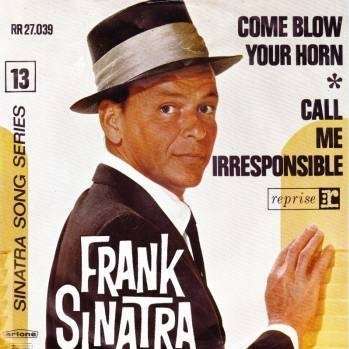
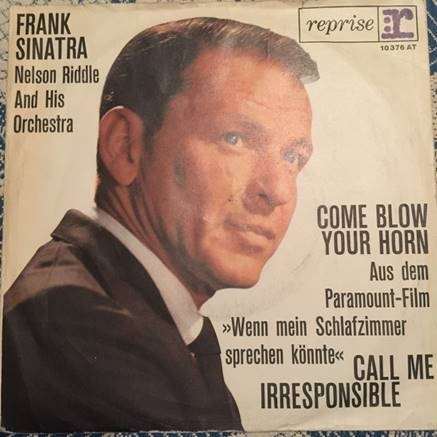
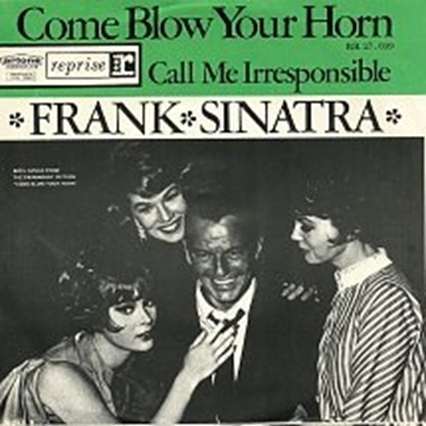
[The Cinematic Legacy of Frank Sinatra — Come Blow Your Horn (1963)]
David Wills's 2015 photo history The Cinematic Legacy of Frank Sinatra devotes a section to Come Blow Your Horn (1963), illustrated with 2 behind-the-scenes and publicity photographs (posters, lobby cards, and on-set/on-location shots) filed here.
Source: David Wills, The Cinematic Legacy of Frank Sinatra (St. Martin's Press, 2015), pp. 229–230.
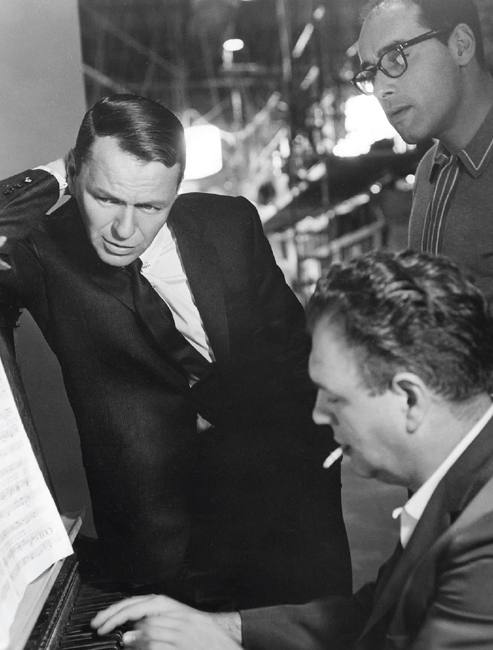
With director Bud Yorkin and composer Nelson Riddle (at piano), Come Blow Your Horn, / 1963. (Photo: The Cinematic Legacy of Frank Sinatra, David Wills, 2015.)
Lobby card, with (left to right) costars Barbara Rush, Phyllis McGuire and Jill St. John. / Come Blow Your Horn. / “Frank was terrific. I enjoyed working with / him.… He had a certain impatience, a certain / desire to get moving.… In those days, films and / lenses weren't as fast as they are today. (Photo: The Cinematic Legacy of Frank Sinatra, David Wills, 2015.)
Los Angeles
1671 Come Blow Your Horn
1672 Call Me Irresponsible
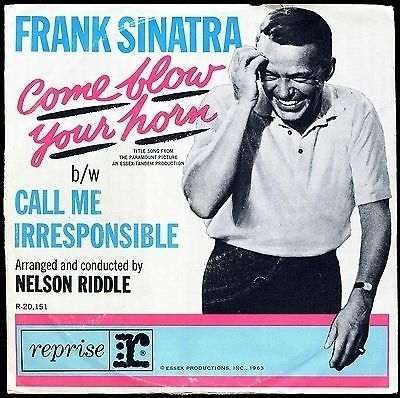
[Ava Gardner hospitalized in Los Angeles]
Associated Press: Newspapers reported Ava Gardner back in Los Angeles undergoing what was termed minor surgery at Cedars-Sinai Medical Center; the Associated Press noted the hospital would not disclose the nature of the operation, and that she had a sister, Bea, living in the city -- as did her ex-husband Frank Sinatra.
Source: James Kaplan, "Sinatra: The Chairman" (2015).
January 22, 1963
Television
The Dick Powell Theatre
Tuesday Evening
NBC-TV
9:30 p.m - 10:00 p.m.
Guest Host: Frank Sinatra
Episode Title: " Everybody Loves Sweeney"
Writers : Berne Giler, Bill Manoff
Stars: Mickey Rooney, Joanne Linville, Dennis James, Jack Albertson, Ross Martin, David White, Mike Mazurki
Ed O'Brien:
Dick Powell died on January 2, 1963. His TV series ran through the remainder of its 1963 schedule with guest hosts.
January 23, 1963
Concerts
Sands, Las Vegas, Nevada (January 23 - February 12) w/Dean & Sammy
Sands, Las Vegas, Nevada (January 23 - February 12) w/Dean & Sammy
I did some checking on this engagement.
Frank and Ava flew to N.Y.C. in early February.
Dolly and Marty Sinatra were about to celebrate their 50th wedding anniversary on 2/9. Their son was throwing them a huge party. He also bought them a huge house and the furniture that went into it. After spending some time with Ava, Frank devoted himself to overseeing the big 50th blowout for his parents.
Variety reviewed the Sands engagement in the 1-30-63 issue. Looks more like a week than three weeks.
Ed
Here's a review from January 31:
Note that Danny Thomas returned on February 13th, suggesting that Sinatra, Davis, and Martin either closed on February 11th or 12th.
------------------------------------------
© 1997-2026 The Sinatra Archive
This calendar, or any parts thereof, may not be reproduced in any fashion whatsoever without the prior written permission of the publisher (The Sinatra Archive)
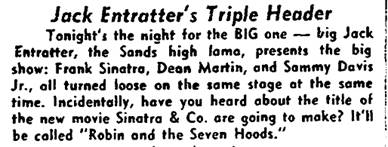
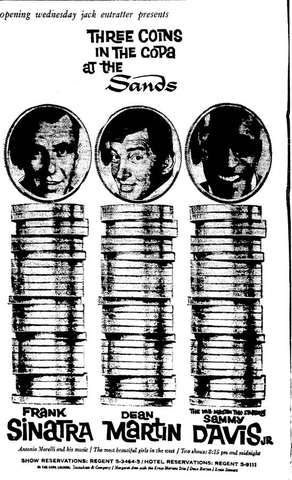

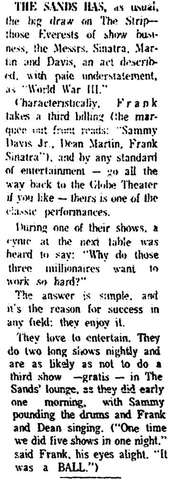
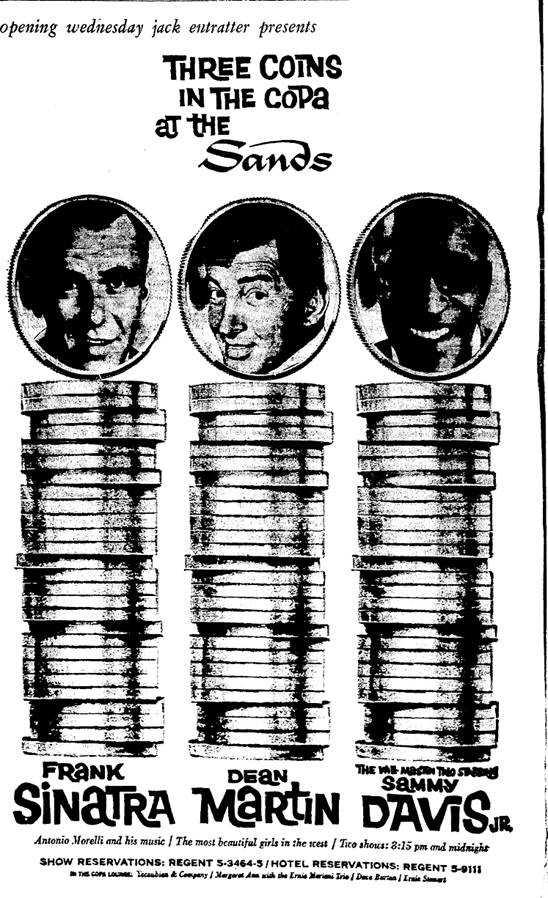

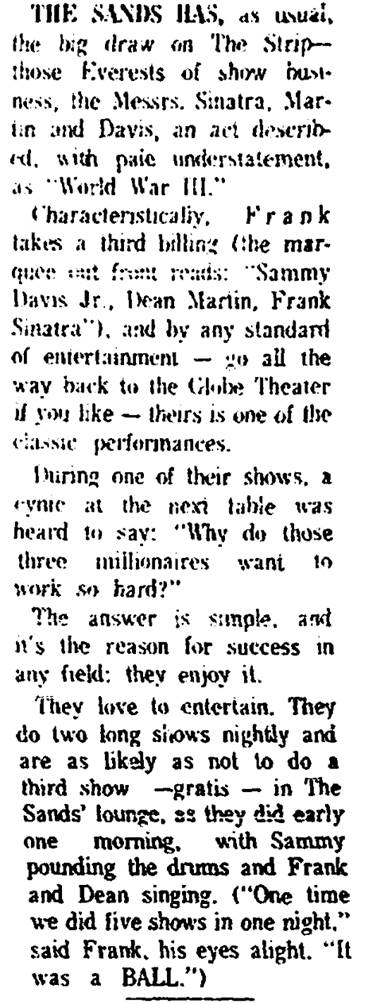
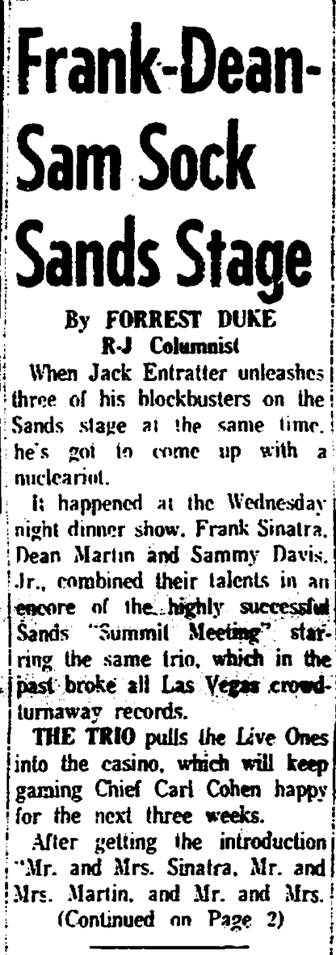
January 24, 1963
Concerts
Sands, Las Vegas, Nevada (January 23 - February 12) w/Dean & Sammy
January 25, 1963
Concerts
Sands, Las Vegas, Nevada (January 23 - February 12) w/Dean & Sammy
January 26, 1963
Concerts
Sands, Las Vegas, Nevada (January 23 - February 12) w/Dean & Sammy
January 27, 1963
Concerts
Sands, Las Vegas, Nevada (January 23 - February 12) w/Dean & Sammy
January 28, 1963
Concerts
Sands, Las Vegas, Nevada (January 23 - February 12) w/Dean & Sammy
January 29, 1963
Concerts
Sands, Las Vegas, Nevada (January 23 - February 12) w/Dean & Sammy
January 30, 1963
Concerts
Sands, Las Vegas, Nevada (January 23 - February 12) w/Dean & Sammy
January 31, 1963
Concerts
Sands, Las Vegas, Nevada (January 23 - February 12) w/Dean & Sammy
February 1963
[Concert Sinatra Sessions at Goldwyn Studios]
Sinatra worked with Nelson Riddle, Sammy Cahn, and Jimmy Van Heusen among others at a session for The Concert Sinatra album, held at Goldwyn Studios in Hollywood.
Source: Charles Pignone, "Frank Sinatra 100" (2015).
[Ava Gardner with Peter Duchin]
Kaplan: Five days after being seen alone, Ava Gardner was reported visiting the Colony, El Morocco, and Lena Horne's packed show at the Waldorf with bandleader Peter Duchin; by this time Frank Sinatra had already returned to Los Angeles.
Source: James Kaplan, "Sinatra: The Chairman" (2015)
[Ava retreats into privacy]
Earl Wilson: A few days after the La Scala dinner, Earl Wilson observed that Ava Gardner had become 'almost Greta Garboish in her passion for privacy' after supping with ex-husband Frank Sinatra and then retreating from view.
Source: James Kaplan, "Sinatra: The Chairman" (2015)
[Ava seen with sister at Waldorf and St. Regis]
Earl Wilson (via Kaplan): A couple of days later, Ava Gardner, wearing little makeup and looking beautiful, emerged from seclusion to watch Lena Horne perform at the Waldorf and Peter Duchin at the St. Regis, accompanied by her sister and brother-in-law and no escort of her own.
Source: James Kaplan, "Sinatra: The Chairman" (2015)
[Frank flies east with Ava, then parts]
Kaplan: At the end of the first week of February, despite reports of a torrid affair with actress Rhonda Fleming, Frank Sinatra flew to New York with Ava Gardner and then temporarily parted ways with her, having come east to celebrate his parents' golden wedding anniversary.
Source: James Kaplan, "Sinatra: The Chairman" (2015)
[Playboy interview published]
Mike Shore, writing as Frank Sinatra: The ghostwritten Frank Sinatra interview, actually composed by adman Mike Shore, ran in the February 1963 issue of Playboy and produced many oft-quoted lines, including Sinatra's self-description as an '18-karat manic-depressive,' and his remarks on God, faith, and honesty in performance -- words that continue to be quoted as authentically Sinatra's own to this day.
Source: James Kaplan, "Sinatra: The Chairman" (2015)
February 1, 1963
Concerts
Sands, Las Vegas, Nevada (January 23 - February 12) w/Dean & Sammy
Around this engagement, Frank Sinatra recorded The Concert Sinatra, a collection of Broadway classics cut on Stage 7 at the Samuel Goldwyn Studios, and sat for a candid, wide-ranging Playboy interview in which he described his personal philosophy on religion (“I believe in you and me... but I don't believe in a personal God to whom I look for comfort”) and his approach to singing (“When I sing, I believe. I'm honest”) — an interview many consider the most introspective he ever gave. Source: J. Randy Taraborrelli, Sinatra: Behind the Legend.
February 2, 1963
Concerts
Sands, Las Vegas, Nevada (January 23 - February 12) w/Dean & Sammy
February 3, 1963
Concerts
Sands, Las Vegas, Nevada (January 23 - February 12) w/Dean & Sammy
[Frank and Ava at golf tournament]
Frank Sinatra and Ava Gardner were sighted together in the gallery of a golf tournament at Sinatra's home course, the Tamarisk Country Club in Palm Springs.
Source: James Kaplan, "Sinatra: The Chairman" (2015).
February 4, 1963
Concerts
Sands, Las Vegas, Nevada (January 23 - February 12) w/Dean & Sammy
February 5, 1963
Concerts
Sands, Las Vegas, Nevada (January 23 - February 12) w/Dean & Sammy
February 6, 1963
Concerts
Sands, Las Vegas, Nevada (January 23 - February 12) w/Dean & Sammy
February 7, 1963
Concerts
Sands, Las Vegas, Nevada (January 23 - February 12) w/Dean & Sammy
February 8, 1963
Concerts
Sands, Las Vegas, Nevada (January 23 - February 12) w/Dean & Sammy
[Death of Felix Slatkin]
Felix Slatkin, Sinatra's concertmaster and musical guiding light, died of a heart attack at age forty-seven, the result of a lifetime of bad habits -- a major loss just before recording of The Concert Sinatra began.
Source: James Kaplan, "Sinatra: The Chairman" (2015).
February 9, 1963
Concerts
Sands, Las Vegas, Nevada (January 23 - February 12) w/Dean & Sammy
[Dolly and Marty's golden anniversary]
Frank Sinatra threw his parents Dolly and Marty a lavish party for their fiftieth wedding anniversary. In the run-up, papers reported he had bought them a large house in prosperous Fort Lee, New Jersey, and given his mother a $25,000 diamond bracelet from Tiffany, delivered by armored truck.
Source: James Kaplan, "Sinatra: The Chairman" (2015).
February 10, 1963
Concerts
Sands, Las Vegas, Nevada (January 23 - February 12) w/Dean & Sammy
February 11, 1963
Concerts
Sands, Las Vegas, Nevada (January 23 - February 12) w/Dean & Sammy
February 12, 1963
Concerts
Sands, Las Vegas, Nevada (January 23 - February 12) w/Dean & Sammy
February 14, 1963
[Earl Wilson on Frank and Ava reunion]
Earl Wilson: Columnist Earl Wilson wrote on Valentine's Day that Ava Gardner had shown up in New York during Frank's anniversary celebrations for his parents; Frank took her to dinner at La Scala along with daughter Nancy Jr. and her husband Tommy Sands. Ava left around 1:30 a.m., while Frank went on to Jilly's, which had the biggest crowd in town.
Source: James Kaplan, "Sinatra: The Chairman" (2015).
February 18, 1963
Studio
Hollywood
1820 Lost In The Stars
(Maxwell Anderson/Kurt Weill)
Hampshire House Publishing Corp./Chappell & Co. Inc.. (ASCAP) Arranged & Conducted by Nelson Riddle
(4:06) CD: 46013-2 The Complete Reprise Studio Recordings Disc 5
CD: 1015-2My Kind Of Broadway
CD: 1009-2The Concert Sinatra
LP: FS1009The Concert Sinatra
1821 My Heart Stood Still
(Richard Rodgers/Lorenz Hart)
Harms Inc./Willianson Music Co. Inc. (ASCAP)
Arranged & Conducted by Nelson Riddle
(3:01) CD: 46013-2 The Complete Reprise Studio Recordings Disc 5
CD: 1009-2The Concert Sinatra
LP: FS1009The Concert Sinatra
1822 Ol' Man River
(Jerome Kern/Oscar Hammerstein II)
PolyGram International Publishing Co. Inc.. (ASCAP)
Arranged & Conducted by Nelson Riddle
(4:24) CD: 46013-2 The Complete Reprise Studio Recordings Disc 5
CD: 1009-2The Concert Sinatra
LP: FS1009The Concert Sinatra
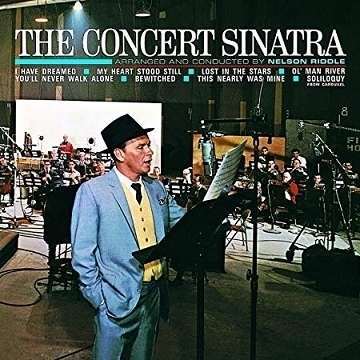
Hollywood
1820 Lost In The Stars
1821 My Heart Stood Still
1822 Ol' Man River
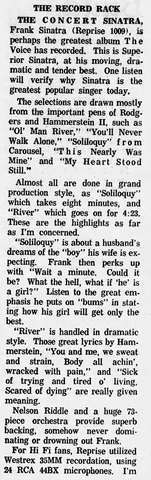
"Lost in the Stars"
When, on the penultimate line of “Lost in the Stars,” Sinatra pauses after singing of “little stars” and then “big stars,” Stordahl fills the break with accordingly little and big orchestral responses, thereby helping to put over the story that much more effectively. This distinction is present in the original cast recording of the song, but Stordahl makes the little much littler and the big even bigger. (And then, in 1963, on The Concert Sinatra, Nelson Riddle made the difference between the two even more dramatic.)
Source: Will Friedwald, "Sinatra! The Song Is You: A Singer's Art" (2018 revised edition).
Frank recorded 11 songs with Nelson Riddle for The Concert Sinatra at Samuel Goldwyn Studios' Stage 7, chosen for its natural reverberation; Riddle later said he had never seen Frank so businesslike and focused.
Source: Nancy Sinatra, Frank Sinatra: An American Legend, 1995.
[Ol' Man River -- critical commentary]
On The Concert Sinatra (1963), Sinatra's Riddle-arranged rendition of 'Ol' Man River' from The Concert Sinatra is described by Granata as possibly the most powerful performance of his career, showcasing dramatic dynamic and pitch range including a striking descent on the word 'Oh' from G down to E-natural before rising again, and a three-note held phrase on 'along' spanning D, E, and C.
This song/context matches multiple dated entries in the chronology, or lacked a sufficiently precise date; the specific date could not be determined with confidence.
Source: Charles L. Granata, "Sessions with Sinatra: Frank Sinatra and the Art of Recording" (1999/2003), Part IV: The Reprise Years
[Ol' Man River -- critical commentary]
Granata includes 'Ol' Man River' among the fifty recordings he considers essential to understanding Sinatra's artistry (arranged by Nelson Riddle, recorded 1963, Reprise); the song was chosen for its musical/interpretive value rather than commercial popularity.
This song/context matches multiple dated entries in the chronology, or lacked a sufficiently precise date; the specific date could not be determined with confidence.
Source: Charles L. Granata, "Sessions with Sinatra: Frank Sinatra and the Art of Recording" (1999/2003), Afterword & Appendices A-D
February 19, 1963
Studio
Hollywood
1823 This Nearly Was Mine
(Richard Rodgers/Oscar Hammerstein II)
Williamson Music Co. (ASCAP)
Arranged & Conducted by Nelson Riddle
(2:45) CD: 46013-2 The Complete Reprise Studio Recordings Disc 5
CD: 1009-2The Concert Sinatra
LP: FS1009The Concert Sinatra
1824 You'll Never Walk Alone
(Richard Rodgers/Oscar Hammerstein II)
Williamson Music Co. (ASCAP)
Arranged & Conducted by Nelson Riddle
(3:06) CD: 46013-2 The Complete Reprise Studio Recordings Disc 5
CD: 1009-2The Concert Sinatra
LP: FS1009The Concert Sinatra
1825 I Have Dreamed
(Richard Rodgers/Oscar Hammerstein II)
Williamson Music Co. (ASCAP)
Arranged & Conducted by Nelson Riddle
(2:57) CD: 46013-2 The Complete Reprise Studio Recordings Disc 5
CD: 9-26340-2The Reprise Collection
CD: 1009-2The Concert Sinatra
LP: FS1009The Concert Sinatra
45: 20,184
The Windsor Star
Hollywood
1823 This Nearly Was Mine
(Richard Rodgers/Oscar Hammerstein II)
Williamson Music Co. (ASCAP)
Arranged & Conducted by Nelson Riddle
(2:45) CD: 46013-2 The Complete Reprise Studio Recordings Disc 5
CD: 1009-2The Concert Sinatra
LP: FS1009The Concert Sinatra
1824 You'll Never Walk Alone
(Richard Rodgers/Oscar Hammerstein II)
Williamson Music Co. (ASCAP)
Arranged & Conducted by Nelson Riddle
(3:06) CD: 46013-2 The Complete Reprise Studio Recordings Disc 5
CD: 1009-2The Concert Sinatra
LP: FS1009The Concert Sinatra
1825 I Have Dreamed
(Richard Rodgers/Oscar Hammerstein II)
Williamson Music Co. (ASCAP)
Arranged & Conducted by Nelson Riddle
(2:57) CD: 46013-2 The Complete Reprise Studio Recordings Disc 5
CD: 9-26340-2The Reprise Collection
CD: 1009-2The Concert Sinatra
LP: FS1009The Concert Sinatra
45: 20,184
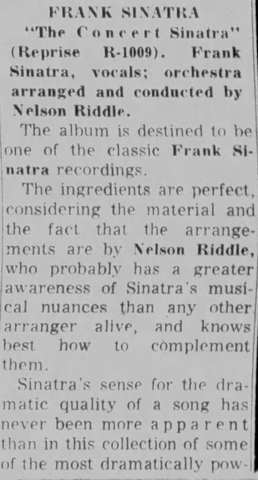
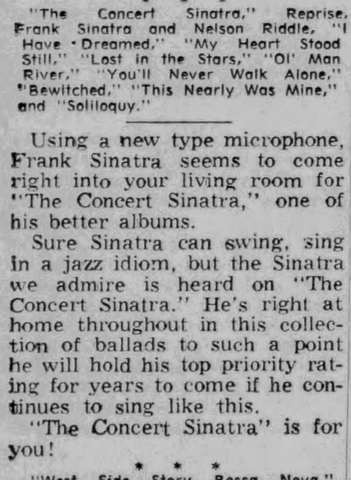
Hollywood
1823 This Nearly Was Mine
1824 You'll Never Walk Alone
1825 I Have Dreamed
[image referenced in source but could not be recovered]
[image not recovered — source caption: “Image result for photos from the concert sinatra sessions”]
[image referenced in source but could not be recovered]
[I Have Dreamed -- critical commentary]
Granata includes 'I Have Dreamed' among the fifty recordings he considers essential to understanding Sinatra's artistry (arranged by Nelson Riddle, recorded 1963, Reprise); the song was chosen for its musical/interpretive value rather than commercial popularity.
This song/context matches multiple dated entries in the chronology, or lacked a sufficiently precise date; the specific date could not be determined with confidence.
Source: Charles L. Granata, "Sessions with Sinatra: Frank Sinatra and the Art of Recording" (1999/2003), Afterword & Appendices A-D
February 20, 1963
Studio
Hollywood
1826 California w/Chorus
(Sammy Cahn/Jimmy Van Heusen)
WB Music Corp./The Songwriters Guild (ASCAP)
Arranged & Conducted by Nelson Riddle
(3:35) CD: 46013-2 The Complete Reprise Studio Recordings Disc 5
CD: 9-26340-2The Reprise Collection
1827 Bewitched
(Richard Rodgers/Lorenz Hart)
Chappel & Co. Inc. (ASCAP)
Arranged & Conducted by Nelson Riddle
(2:58) CD: 46013-2 The Complete Reprise Studio Recordings Disc 5
CD: 1009-2The Concert Sinatra
LP: FS1009The Concert Sinatra
1828 America The Beautiful w/Chorus
(Katherine Lee Bates/Samuel A. Ward)
(Public Domain) Summy-Birchard Inc. (ASCAP)
Arranged & Conducted by Nelson Riddle
(2:20) CD: 46013-2 The Complete Reprise Studio Recordings Disc 5
CD: 9-26340-2The Reprise Collection
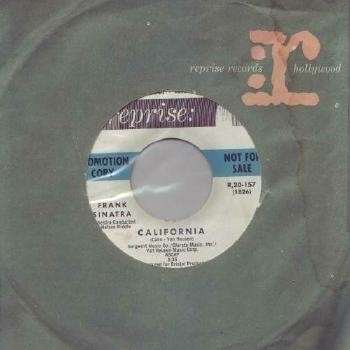
February 21, 1963
Studio
Hollywood
1829 Soliloquy
(Richard Rodgers/Oscar Hammerstein II)
Williamson Music Co. (ASCAP)
Arranged & Conducted by Nelson Riddle
(8:05) CD: 46013-2 The Complete Reprise Studio Recordings Disc 6
CD: 9-26340-2The Reprise Collection
CD: 1009-2The Concert Sinatra
CD: 1016-2A Man And His Music
LP: FS1009The Concert Sinatra
NOTE: Sinatraphile Rich Rosenberg says that after he heard the 1955 rehearsal version released on "Sinatra in Hollywood" and how effortlessly his voice flowed then and how strong and smooth it was, this version by comparison sounded like he was singing while running up a hill. Too bad he didn't sing all the lyrics in that effort!
Sinatra Scholar Ed O'Brien seconds Rich's thoughts regarding the contrast between February 55 and 63. There was quite a drop off in tonal quality.. Sinatra got some of it back around 1965. Vince DeRose was on the 55 session and O'Brien asked him why Frank didn't complete the song.. Vince told O'Brien that Frank didn't like the Richard Jones arrangement. As the session progressed, Frank became less and less enthusiastic. O'Brien wonders why Riddle wasn't asked to do the arrangement, in reponse to a comment by Sinatraphile Mary Jane Smetanka, who says she listens to the incomplete 1955 "Soliloquy" fairly often, though the partial recording is unsatisfying. She says she hadn't heard that Sinatra didn't complete it and thought that the rest of the recording had been lost.
Sinatraphile Vance Adair then reports that he once had a conversation with Jack Jones about the tune. Jack was including it in his repertoire in the early 90s. He waxed lyrical about the tune's structure - and pointed out that every bridge is a slowed down generic fairground theme (e.g. I'll teach him to wrestle and dive through a wave/When we go out in the morning for our swim. etc.
The challenge to any singer of this tune, we agreed, Adair writes, is to strike a balance between the alternating bombast and pathos of the lyrics. No easy task.
Sinatra couldn't quite pull this off in 1955, Adair declares. He did so in his "Concert Sinatra" reading, but still this was marred by the fact that the song was edited.. The many concert versions from the late 80s to the early 90s that we have attest to the fact that our man had finally nailed the tune.
Naturally, Adair ooncludes, not every performance of the song during this time is a classic. However, there were occasions, even as an indisputably old man, Sinatra could hit the emotional centre of this song with an assurance and poise that moved Jack Jones to marvel that "Frank still does a killer version."
Note: Riddle used 62 musicians for the final session of "Concert Sinatra."
The song was done in segments. Reprise taped the album at 30 IPS. This was twice the usual speed employed. Frank would sing "Soliloquy" in concert for more than five decades. There are some stunning live renditions.
"Sinatra;s Sinatra" would also be recorded at 30 IPS. But the other song, "You Brought A New Kind Of Love To Me," done at this session, was recorded at 15 IPS.
Ed
1830 You Brought A New Kind Of Love To Me
(Sammy Fain/Irving Kahal/Pierre Norman Connor)
Famous Music Corp. (ASCAP)
Arranged & Conducted by Nelson Riddle
(2:37) CD: 46013-2 The Complete Reprise Studio Recordings Disc 6
LP: FS6167Sinatra 65
45: 20,209
"A New Kind Of Love" was a Paul Newman - Joanne
Woodward comedy. Frank recorded a special version for the film at Paramount in 1963
Riddle receives credit for the arrangement on the
B-side of this single. In truth, the arranger was
Marty Paich. Riddle told me how embarrassed he was when Capitol credited him instead of
George Siravo on Frank's first Capitol album,
“Swing Easy." I wonder what he thought of this credit ?
Ed
Hollywood
1830 You Brought A New Kind Of Love To Me
(Sammy Fain/Irving Kahal/Pierre Norman Connor)
Famous Music Corp. (ASCAP)
Arranged & Conducted by Nelson Riddle
45: 20,209
"A New Kind Of Love" was a Paul Newman - Joanne
Woodward comedy. Frank recorded a special version for the film at Paramount in 1963
Riddle receives credit for the arrangement on the
B-side of this single. In truth, the arranger was
Marty Paich. Riddle told me how embarrassed he was when Capitol credited him instead of
George Siravo on Frank's first Capitol album,
:Swing Easy." I wonder what he thought of this credit ?
Ed
"Soliloquy"
Bill Miller: Bill Miller called the 1963 Concert Sinatra "Soliloquy," arranged by Nelson Riddle, the definitive version: 'Finally, Nelson did the right one.' Friedwald agrees, describing it as slower, stronger, more majestic, with Sinatra balancing aggressiveness and tenderness while Riddle finds the line between Broadway bravura and his own musical voice. Friedwald considers it the only performance of the piece to succeed fully outside its original show, surpassing attempts by Mel Torme, Sammy Davis Jr., and Jack Nicholson (in the film Heartburn).
Source: Will Friedwald, "Sinatra! The Song Is You: A Singer's Art" (2018 revised edition).
Liner Notes: THE CONCERT SINATRA
The Concert Sinatra is Sinatra's most explicit bid for the concert hall -- a full symphony orchestra, arranged and conducted by Nelson Riddle, recorded not with the usual small studio combo but with the scale and formality of a classical session. The repertoire draws heavily from Broadway -- "Ol' Man River," "Bewitched, Bothered and Bewildered," "Soliloquy" from Carousel -- material chosen specifically for its dramatic and vocal demands.
"Soliloquy," running nearly nine minutes, is the album's centerpiece and its boldest gamble: a theatrical monologue set to music, requiring Sinatra to hold a narrative arc across shifting tempos and moods for a length far beyond the typical three-minute single. It is as close as Sinatra ever came, on record, to a piece of musical theater performed entirely by one voice.
Reception at the time was mixed -- some critics found the record's ambitions slightly overreaching -- but The Concert Sinatra has aged into one of the more respected entries in his catalogue precisely because of that ambition. It is Sinatra testing the outer edge of what a pop vocal record could attempt, backed by the full weight of Riddle's orchestral writing.
Written by Claude (Anthropic), commissioned for this chronology, 2026.
[Soliloquy -- critical commentary]
Friedwald singles out several 1980s live readings of "Soliloquy," including one from December 1988 (issued on Sinatra 80th: Live in Concert) taken at an even slower tempo -- a magisterial, grandfatherly eleven-minute performance from the 72/73-year-old Sinatra, which he jokingly calls a piece that could be titled 'From Here to Paternity.'
This song/context matches multiple dated entries in the chronology; the specific date Friedwald is referring to could not be determined with confidence.
Source: Will Friedwald, "Sinatra! The Song Is You: A Singer's Art" (2018 revised edition), Ch. 8, "Gordon Jenkins" (1956-1981)
March 1963
[Frankie signs with Sam Donahue's band]
Kaplan: In March 1963, the nineteen-year-old Frank Sinatra Jr. formally decided to pursue a music career, signing a contract with saxophonist Sam Donahue, who led the ghost-band version of the Tommy Dorsey Orchestra after Dorsey's death.
Source: James Kaplan, "Sinatra: The Chairman" (2015)
March 1, 1963
Columnist Lee Mortimer, whom Sinatra had punched outside Ciro's in 1947 after years of attacks over his Mob associations and left-wing sympathies, died of a heart attack in New York at fifty-nine. Sinatra and a couple of associates visited Mortimer's grave not long after, where Frank reportedly urinated on it and delivered a short graveside eulogy: "I'll bury the bastards. I'll bury them all." Source: Michael Sheridan & David Harvey, Sinatra and the Jack Pack.
March 3, 1963
Concerts
Beverly Hilton Hotel, Los Angeles
Sunday evening
A Tribute To Irving Berlin
Frank Sinatra, Dinah Shore, Dean Martin, Danny Kaye,
Groucho Marx, Rosalind Russell, Irving Berlin plus many more.
1. Be Careful It's My Heart
2. Let's Face The Music And Dance
3. Always
Note: Three hour show.
Beverly Hilton Hotel, Los Angeles
Sunday evening
A Tribute To Irving Berlin
Frank Sinatra, Dinah Shore, Dean Martin, Danny Kaye,
Groucho Marx, Rosalind Russell, Irving Berlin plus many more.
1. Be Careful It's My Heart
2. Let's Face The Music And Dance
3. Always
MARCH 3, 1986: FS appeared at a tribute to Spencer Tracy at the Majestic Theater in New York City with Katharine Hepburn.
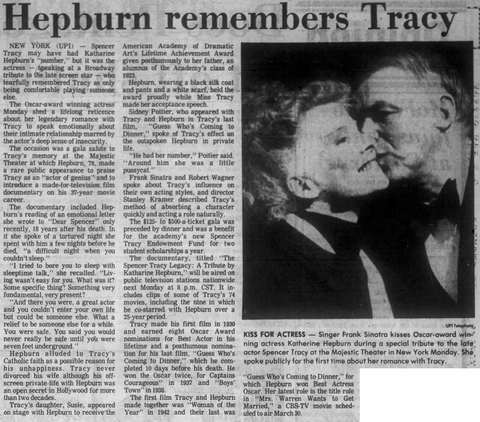
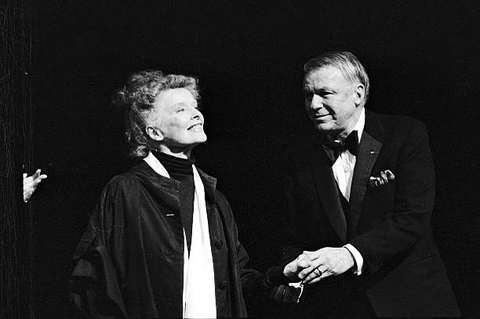
March 13, 1963
Studio
Paramount - Los Angeles
Wednesday
Paris When It Sizzles
Arranged and Conducted by Nelson Riddle
The Girl Who Stole The Eiffel Tower
The scene in the film has William Holden imagining the opening credits to his brilliant new film to a fascinated Audrey Hepburn. He will get Sinatra to sing a song over the credits. We then hear
Frank for approximately 13 seconds. It is very similar to the "Farewell Amanda" vocal scene from "Adam's Rib" in 1949.
Television
The Bob Hope Show
Network: NBC
9:00 to 10:00 p.m.
Guest: Frank Sinatra, Robert Goulet, Brenda Lee, Edie Adams
Frank sang "Call Me Irresponsible" and "Caretaker's
Daughter." The latter was sung with Hope at the end of their comedy routine.
"Sinatra projected his latest tune, 'Call Me Irresponsible,' with his customary class. A duet with Hope on 'Who Takes Care Of The Caretaker's Daughter ' did not shape up as a particularly bright choice."
Variety
3-20-63
The Bob Hope Show
Network: NBC
9:00 to 10:00 p.m.
Guest: Frank Sinatra, Robert Goulet, Brenda Lee, Edie Adams
Frank sang "Call Me Irresponsible" and "Caretaker's
Daughter." The latter was sung with Hope at the end of their comedy routine.
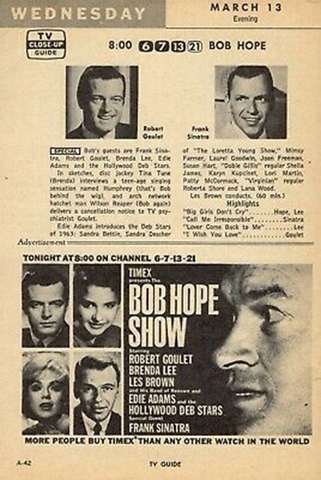
April 8, 1963
Television
35th Academy Awards, Civic Auditorium, Santa Monica, CA Monday evening
Network: ABC
Time: 7:00 PM - 12:00 PM
Host: Frank Sinatra
Ed O'Brien provided the program details below:
Eddie Fisher did a medley of former Oscar winning tunes.
Robert Goulet sang all five nominated songs.
Sinatra announced the winning song:
"Days Of Wine and Roses" Johnny Mercer and Henry Mancini accepted
Ethel Merman did a show-stopping medley of Irving Berlin's great songs
Sinatra introduced Sophia Loren as the
"greatest pizza maker in the world."
35th Academy Awards, Civic Auditorium, Santa Monica, CA
Monday evening
Network: ABC
Time: 7:00 PM - 12:00 PM
Host: Frank Sinatra
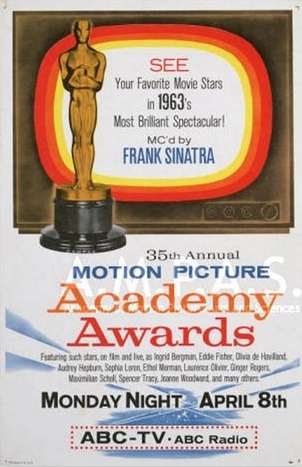
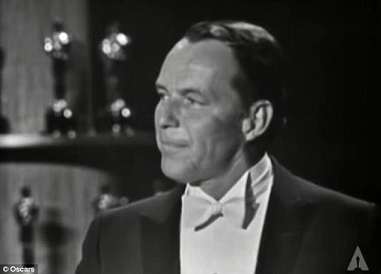
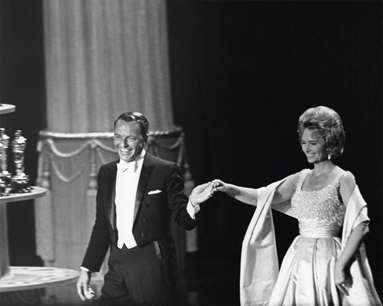
[Sinatra hosts the Academy Awards]
Frank Sinatra hosted the thirty-fifth Academy Awards, a broadcast beset by early technical difficulties (out-of-focus ABC cameras, fuzzy sound). Sinatra stumbled at first with a poorly received bit comparing Hollywood pictures to the Mona Lisa, but found his footing and delivered pointed remarks before the Best Picture announcement about the industry needing individually crafted films rather than pictures made by committees, banks, and lawyers. Lawrence of Arabia won Best Picture.
Source: James Kaplan, "Sinatra: The Chairman" (2015).
April 16, 1963
[Sinatra sells his 'eagle's nest' home]
Hedda Hopper: Columnist Hedda Hopper reported that Frank Sinatra had sold his hilltop 'eagle's nest' home to John W. Kluge, president of Metromedia, who wanted the property for weekend use; Kluge reportedly paid Sinatra's full asking price without haggling.
Source: James Kaplan, "Sinatra: The Chairman" (2015).
April 24, 1963
[FBI requests wiretap on Sinatra's Palm Springs house]
FBI memo (Los Angeles SAC): The FBI's Los Angeles special agent in charge sent J. Edgar Hoover a lengthy memo requesting authority to survey the feasibility of a microphone surveillance installation at Sinatra's Palm Springs residence, citing his associations with mob figures including Bonanno, Fischetti, the late Willie Moretti, Lucky Luciano, Sam 'Mooney' Giancana, and Johnny Formosa.
Source: James Kaplan, "Sinatra: The Chairman" (2015).
April 29, 1963
Studio
Los Angeles
2023 In The Wee Small Hours Of The Morning
(Dave Mann/Bob Hilliard)
Better Half Music Co./Rytvoc, Inc. (ASCAP)
Arranged & Conducted by Nelson Riddle
(2:42) CD: 46013-2 The Complete Reprise Studio Recordings Disc 6
CD: 1010-2Sinatra's Sinatra
CD: 1016-2A Man And His Music
LP: FS1010Sinatra's Sinatra
2024 Nancy
(Jimmy Van Heusen/Phil Silvers)
Barton Music Corp. (ASCAP)
Arranged & Conducted by Nelson Riddle
(3:37) CD: 46013-2 The Complete Reprise Studio Recordings Disc 6
CD: 1010-2Sinatra's Sinatra
CD: 1016-2A Man And His Music
LP: FS1010Sinatra's Sinatra
2025 Young At Heart
(Carolyn Leigh/Johnny Richards)
Cheerio Music Corp. BMI/June's Tunes (ASCAP)
Arranged & Conducted by Nelson Riddle
(2:53) CD: 46013-2 The Complete Reprise Studio Recordings Disc 6
CD: 1010-2Sinatra's Sinatra
CD: 1016-2A Man And His Music
LP: FS1010Sinatra's Sinatra
2026 The Second Time Around
(Jimmy Van Heusen/Sammy Cahn)
EMI Miller Catolog Inc. (ASCAP)
Arranged & Conducted by Nelson Riddle
(3:03) CD: 46013-2 The Complete Reprise Studio Recordings Disc 6
CD: 9-27017-2Ring- a-ding-ding
CD: 1010-2Sinatra's Sinatra
CD: 1016-2 A Man And His Music (Edited)
LP: FS1010Sinatra's Sinatra
2027 All The Way
(Sammy Cahn/Jimmy Van Heusen)
Maraville Music Corp. (ASCAP)
Arranged & Conducted by Nelson Riddle
(3:28) CD: 46013-2 The Complete Reprise Studio Recordings Disc 6
CD: 9-26723-2Sings The Songs Of Van Heusen & Cahn
CD: 1011-2Academy Award Winners
CD: 1010-2Sinatra's Sinatra
CD: 1016-2A Man And His Music
LP: FS1011Academy Award Winners
LP: FS1010Sinatra's Sinatra
Los Angeles
2023 In The Wee Small Hours Of The Morning
2024 Nancy
2025 Young At Heart
2026 The Second Time Around
2027 All The Way
[Recording Sinatra's Sinatra begins]
At the end of April 1963, Frank Sinatra and Nelson Riddle began recording the LP Sinatra's Sinatra, rerecording ten of his old hits (mostly from his Capitol years, plus a couple from Columbia) in stereo, intended to help win the Sinatra catalog market back to Reprise.
Source: James Kaplan, "Sinatra: The Chairman" (2015).
[Hoover denies Sinatra wiretap request]
J. Edgar Hoover: On the same day Sinatra's Sinatra recording sessions began, J. Edgar Hoover formally denied the Los Angeles office's request to survey a microphone surveillance installation at Sinatra's Palm Springs home, though he left the door open to resubmission with proper justification.
Source: James Kaplan, "Sinatra: The Chairman" (2015).
Frank recorded 10 more songs for the album Sinatra's Sinatra, including new versions of 'Witchcraft' and 'I've Got You Under My Skin.'
Source: Nancy Sinatra, Frank Sinatra: An American Legend, 1995.
[Young at Heart -- critical commentary]
By December 1953 Sinatra had recorded the hit 'Young at Heart,' marking a turning point after the depths of his prior year; Granata attributes the newly captured vocal clarity partly to the era's improved high-fidelity tape and microphone technology.
This song/context matches multiple dated entries in the chronology, or lacked a sufficiently precise date; the specific date could not be determined with confidence.
Source: Charles L. Granata, "Sessions with Sinatra: Frank Sinatra and the Art of Recording" (1999/2003), Part III: The Capitol Years, 1953-1962
April 30, 1963
Studio
Los Angeles
2028 Witchcraft
(Carolyn Leigh/Cy Coleman)
Morley Music Co./WB Music Corp. (ASCAP)
Arranged & Conducted by Nelson Riddle
(2:37) CD: 46013-2 The Complete Reprise Studio Recordings Disc 6
CD: 1010-2Sinatra's Sinatra
CD: 1016-2A Man And His Music
LP: FS1010 Sinatra's Sinatra
2029 (How Little It Matters) How Little We Know
(Phil Springers/Carolyn Leigh)
Carwin Music Inc./Tamir Music (ASCAP)
Arranged & Conducted by Nelson Riddle
(2:18) CD: 46013-2 The Complete Reprise Studio Recordings Disc 6
CD: 1010-2Sinatra's Sinatra
CD: 1016-2A Man And his Music
LP: FS1010 Sinatra's Sinatra
2030 Put Your Dreams Away
(Paul Mann/Stephan Weiss/Ruth Lowe)
Ann-Rachel Music Corp./Cromwell Music Inc. (ASCAP)
Arranged & Conducted by Nelson Riddle
(3:12) CD: 46013-2 The Complete Reprise Studio Recordings Disc 6
CD: 1010-2Sinatra's Sinatra
CD: 1016-2A Man And his Music
LP: FS1010 Sinatra's Sinatra
2031 I've Got You Under My Skin
(Cole Porter)
Chappell & Co. Inc. (ASCAP)
Arranged & Conducted by Nelson Riddle
(3:30) CD: 46013-2 The Complete Reprise Studio Recordings Disc 6
CD: 1010-2Sinatra's Sinatra
CD: 1016-2A Man And His Music
LP: FS1010 Sinatra's Sinatra
2032 Oh, What It Seemed To Be
(Bennie Benjamin/George David Weiss/Frankie Carle)
The Songwriters Guild/Anne-Rachel Music Corp. (ASCAP)
Arranged & Conducted by Nelson Riddle
(3:25) CD: 46013-2 The Complete Reprise Studio Recordings Disc 6
CD: 1010-2Sinatra's Sinatra
CD: 1016-2 A Man And His Music (Edited)
LP: FS1010Sinatra's Sinatra
Session for "Sinatra's Sinatra."
Have you ever noticed what a superior sound this album has? Reprise recorded "The Concert Sinatra" at 30 ips -- twice the speed of what was the norm back then.. The final product was so good that the April 29/30 sessions were also done at the same speed. And you can hear the difference. --Ed
NOTE: Ed O'Brien points out that Sinatra displayed a remarkable eclecticism in his choice of material and arrangers during the early Reprise years. But his efforts had not been rewarded with his accustomed commercial success. As Ellen Burbank said, "He was cold." None of the first nine albums for his own labels had sold a million copies. He had worked with Mandel, May, Oliver, Hefti, Farnon, Jenkins, and Riddle. Six of the albums had reached the Billboard Top 10, but none had the huge sales or sustaining power to reach a million sales until "Sinatra's Sinatra," considered by many to be the least of his first 10 lps at Reprise. It was, however, the first gold label for the label.
Ed O'Brien also sent along Lees original review of "Sinatra's Sinatra" and "Select Johnny Mercer."
SELECT JOHNNY MERCER
SINATRA'S SINATRA
INTEREST: SINATRA THEN AND NOW
PERFORMANCE: INCONSISTENT
RECORDING: EXCELLENT IN BOTH
STEREO QUALITY: MOSTLY EXCELLENT
The battle of the two Sinatra labels continues.
Capitol keeps repackaging tracks the singer made during his decade with that company, and
Reprise, the label Sinatra founded and still controls, keeps rerecording material he originally did for Capitol, sometimes with the same Nelson Riddle arrangements.
One such Capitol repackaging was titled "Sinatra:The
Great Years," not so subtly suggesting that those years were over and the listener should stick with vintage Frank on Capitol. A comparison of these two albums lends a certain amount of support to that viewpoint: there's some pretty sloppy Sinatra in the Reprise album, though some of the tracks are close to his standards. In the weaker tracks, his intonation is unsteady, particularly on passing tones.
Some of his notes are postively squirm-making. But Sinatra was never consistent. He did some brilliant work and some poor work with Capitol: "Laura" is quite bad.
Bad Sinatra, however, is usually better than top-drawer anybody else in his field. His uncanny ability to penetrate to the heart of a song's meaning is undiminished in the Reprise set, whatever late nights, cigarettes, and Jack Daniels sour mash may have done to his control. He is, in my estimate, the finest interpreter of the quality American popular song the country has produced.
No one else has ever understood this music the way Sinatra does.
Because the Capitol set is culled from so many different albums, it has the added interest of showing Sinatra in contexts provided by the four arrangers who have written for him. One wonders why he ever worked with Gordon Jenkins, whose writing for orchestra is saccharine and unimaginative. Billy May provided Sinatra with irreverent and funny arrangements. Axel Stordahl's writing was characterized by a restrained sweetness. Nelson Riddle's combined the best of both qualities, and he voiced and phrased instruments in a fresh way that has of late been often imitated by arrangers-including , unfortunately, Riddle himself. At their best, Riddle's tart yet lyrical orchestrations are just about the best vocal settings of pop songs the business has known.
If you have an extensive Sinatra collection, you probably have all these tunes already. If you have the Capitol originals of those newly recorded on Reprise, you're better off with the earlier recordings.
Los Angeles
2028 Witchcraft
2029 (How Little It Matters) How Little We Know
2030 Put Your Dreams Away
2031 I've Got You Under My Skin
2032 Oh, What It Seemed To Be
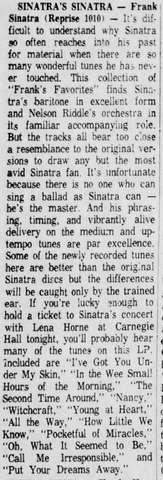
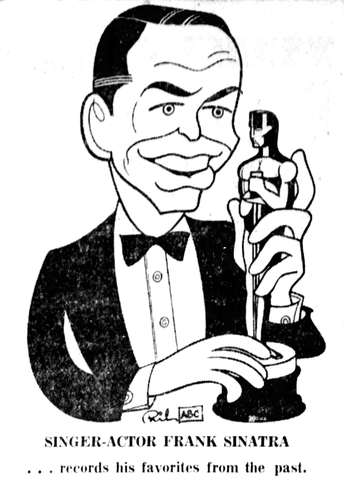
"I've Got You Under My Skin"
Dick Nash: Trombonist Dick Nash filled in for Bernhart (who had a film call), mixing his own licks with quotes from Bernhart's classic 1956 solo. Nash: 'Of course, everyone has to end that solo with the phrase that Milt used, which is Milt's trademark. I felt you had to use that, it fits the tune so well.'
Source: Will Friedwald, "Sinatra! The Song Is You: A Singer's Art" (2018 revised edition).
[I've Got You Under My Skin / The Lady Is a Tramp / My Kind of Town -- critical commentary]
Jerry Dodgion / Billy Byers: The televised October 13, 1974 Madison Square Garden show (broadcast live on ABC) drew from multiple nights (Boston, Buffalo, two NYC shows). Lead altoist Jerry Dodgion recalled that unlike other stops, the TV director repeatedly stopped Sinatra from building momentum between songs ('Oh, no, hold that'), making the televised show inferior to the other Main Event concerts. Trombonist Billy Byers described how the newly 'hipper' Riddle arrangement of 'The Lady Is a Tramp,' introduced in Australia that July, was requested by Sinatra with the stipulation that the last two bars stay the same 'because I have my choreography' -- a little foot kick at the end.
This song/context matches multiple dated entries in the chronology; the specific date Friedwald is referring to could not be determined with confidence.
Source: Will Friedwald, "Sinatra! The Song Is You: A Singer's Art" (2018 revised edition), Ch. 10, "Concert Years" (1973-1994)
[Put Your Dreams Away -- critical commentary]
Sinatra further employed echoes of the Dorsey sound throughout the 1940s, primarily in his radio closing theme, "Put Your Dreams Away," another song by Ruth Lowe, which was about as close as one could come in melody and mood (and even trombone solo} to her "Smile Again." It would be played at Sinatra’s own funeral in 1998.
This song/context matches multiple dated entries in the chronology; the specific date Friedwald is referring to could not be determined with confidence.
Source: Will Friedwald, "Sinatra! The Song Is You: A Singer's Art" (2018 revised edition), Ch. 3, "With Tommy Dorsey" (1940-1942)
May 1, 1963
[Bob Thomas on Sinatra's mellowing]
Bob Thomas: Columnist Bob Thomas wrote that Sinatra had found 'the secret of slowing down,' becoming an avid golfer and moving his primary residence from his hilltop bachelor pad to Palm Springs, following stars like Red Skelton and Dinah Shore to the desert; Sinatra said he could cover the 125 miles from L.A. in 27 minutes by private plane.
Source: James Kaplan, "Sinatra: The Chairman" (2015).
May 19, 1963
Concerts
Carnegie Hall, New York City
Benefit for the Blind
Carnegie Hall, New York City
Benefit for the Blind
Emacs!
[Sinatra flies to Carnegie Hall benefit]
Three days after leaving Hawaii, Frank Sinatra flew to New York to perform a benefit for the blind at Carnegie Hall, then quickly turned around to begin shooting the film 4 for Texas.
Source: James Kaplan, "Sinatra: The Chairman" (2015).
May 24, 1963
Frank began shooting 4 for Texas at Warner Bros., a Western comedy co-starring Dean Martin, Anita Ekberg, and Ursula Andress.
Source: Nancy Sinatra, Frank Sinatra: An American Legend, 1995.
May 28, 1963
Radio
"Happy Birthday Bob"
Special Salute to Bob Hopes' 60th Birthday and his 25th year with NBC NBC
Bing Crosby, Frank Sinatra, Jack Benny, Lucille Ball, Jimmy Durantes, Eddie Cantor, George Burns and others Television
None
"Happy Birthday Bob"
Special Salute to Bob Hopes' 60th Birthday and his 25th year with NBC NBC
Bing Crosby, Frank Sinatra, Jack Benny, Lucille Ball, Jimmy Durantes, Eddie Cantor, George Burns and others
May 29, 1963
Radio
Happy Birthday Bob Hope
NBC
Time: 9:05 p.m - 10:00 p.m.
Host: Hugh Downs
Guests: Jimmy Durante, Jack Benny, Tony Bennett, George Burns, Doris Day, Milton Berle, Bing Crosby, Frank Sinatra, Edgar Bergen, Lucille Ball, Eddie Cantor.
Note: Special celebrating Bob Hope's birthday and his twenty-fifth year with NBC.
Film
"The List of Adrian Messenger" (USA Release: May 29, 1963)
Starring: George C. Scott, John Merivale, Jacques Roux, Clive Brook, Dana Wynter, Tony Huston, Kirk Douglas, Gladys Cooper, Herbert Marshall, Marcel Dalio, Bernard Archard, Ronald Long, Bernard Fox
Cameo appearances: Tony Curtis, Robert Mitchum, Frank Sinatra, Burt Lancaster (all in disguise)
Director John Huston also gives an uncredited cameo near the film's end, as Lord Ashton.
Produced by: Edward Lewis
Directed by: John Huston
A former intelligence officer is tasked by the heir to the Gleneyre estate to investigate the unusual deaths of a disparate group of eleven men on a list.
Note: "A number of famous Hollywood actors were advertised to appear in the film heavily disguised in make-up. During an epilogue the stars appear on-camera removing their disguises and revealing their identity. Curtis is revealed to have portrayed a street organ player; Lancaster removes the disguise of a female fox-hunt protester; Sinatra doffs the make-up of a gypsy horse-trader; Mitchum removes his disguise as the victim Slattery; and Douglas sheds one of his make-ups at the close of a montage of several of the killer’s personas."
--DVD Release: First released as a Manufacture on Demand disk from the Universal Vault Series on 2010-01-11, and then as a regular pressed DVD as part of the "Kirk Douglas: The Centennial Collection" DVD box set on 2016-06-07, and finally as a stand alone disk from Universal on 2017-09-05.
--Blu-Ray Release: 2018-04-17
Note: Frank was not in the film except for the scene where he pulled off the mask at the end.
Dave Willock doubled for him in the gypsy scene.
--Ed
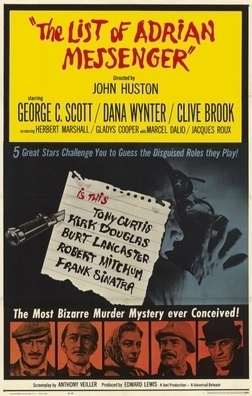
"The List of Adrian Messenger" (USA Release: May 29, 1963)
Starring: George C. Scott, John Merivale, Jacques Roux, Clive Brook, Dana Wynter, Tony Huston, Kirk Douglas, Gladys Cooper, Herbert Marshall, Marcel Dalio, Bernard Archard, Ronald Long, Bernard Fox
Cameo appearances: Tony Curtis, Robert Mitchum, Frank Sinatra, Burt Lancaster (all in disguise)
Director John Huston also gives an uncredited cameo near the film's end, as Lord Ashton.
Produced by: Edward Lewis
Directed by: John Huston
--DVD Release: First released as a Manufacture on Demand disk from the Universal Vault Series on 2010-01-11,
and then as a regular pressed DVD as part of the "Kirk Douglas: The Centennial Collection" DVD box set on 2016-06-07,
and finally as a stand-alone disk from Universal on 2017-09-05.
--Blu-Ray Release: 2018-04-17
UK Blu-Ray has been released recently (April 11th, 2022) as part of the HMV Premium Collection:
Thanks to Richard Cook for above
"The List of Adrian Messenger"
In director John Huston's 1963 mystery, Sinatra took a lighthearted cameo among an ensemble of disguised guest stars (Robert Mitchum, Tony Curtis, Burt Lancaster) whose names were billed ahead of the film's nominal stars, George C. Scott and Kirk Douglas. Santopietro rates it the best of Sinatra's many cameo appearances, lacking the self-congratulatory feel of films like Around the World in Eighty Days.
Source: Tom Santopietro, "Sinatra in Hollywood" (2008).
"The List of Adrian Messenger"
Makeup artist Bud Westmore (assisted by John Chambers, David Grayson, and Nick Marcellino) created the elaborate disguises that let the film's guest stars appear unrecognizable in character roles, work Santopietro calls the true engine of the film's gimmick.
Source: Tom Santopietro, "Sinatra in Hollywood" (2008).
"The List of Adrian Messenger"
Sinatra played a disguised gypsy character (earring, battered hat, thick eyebrows, curly hair) totally unrecognizable in voice and appearance, delivering a horse to the young heir before vanishing into fog.
Source: Tom Santopietro, "Sinatra in Hollywood" (2008).
"The List of Adrian Messenger"
Jan Merlin (via Santopietro): It was widely reported that Sinatra, like his fellow cameo stars, did not actually film his own sequence in costume; according to actor Jan Merlin, stand-in Dave Willock — whose facial structure closely resembled Sinatra's — filmed the horse-trading scene in his place.
Source: Tom Santopietro, "Sinatra in Hollywood" (2008).
"The List of Adrian Messenger"
For his brief cameo appearance, revealed in the film's mask-removal end-credits sequence, Sinatra was paid seventy-five thousand dollars.
Source: Tom Santopietro, "Sinatra in Hollywood" (2008).
"The List of Adrian Messenger"
Santopietro grades this a B, calling it a cameo in a fine John Huston film.
Source: Tom Santopietro, "Sinatra in Hollywood" (2008).
"The List of Adrian Messenger"
Santopietro (Filmography): Cameo appearance. Joel Productions/Universal-International Pictures. Produced by Edward Lewis, directed by John Huston, screenplay by Anthony Veiller based on the Philip MacDonald novel. Starred Kirk Douglas and George C. Scott, with disguised cameo appearances by Robert Mitchum, Burt Lancaster, and Sinatra playing a gypsy.
Source: Tom Santopietro, "Sinatra in Hollywood" (2008).
June 1963
[Ava leaves Frank's penthouse for good]
Kaplan (unnamed witness): The day after the blowup at Jilly's, while Frank, Jilly, and others sat talking in his penthouse, Ava emerged dressed with a suitcase, gave a little wave, and walked out the door to meet a Spanish airline pilot waiting for her, stunning and embarrassing the group.
Source: James Kaplan, "Sinatra: The Chairman" (2015)
[Ava moves into Frank's NY penthouse]
Frank Sinatra: During a break from filming 4 for Texas, Frank Sinatra flew to New York, where he and Ava Gardner, after late-night phone calls, reconciled again; Ava moved her suitcases into his new penthouse, and Frank told friends 'She's back, and I'm the happiest man in the world. It's on. All the way.'
Source: James Kaplan, "Sinatra: The Chairman" (2015)
[Ava's flirtation provokes Frank at Jilly's]
J. Randy Taraborrelli (via witnesses): One night that week at Jilly's, after Frank invited Giancana to join their table, Ava got up and deliberately flirted with a stranger at another table, climbing onto his lap while staring at Frank. Enraged, Frank pushed Ava off the man, hauled him up by the collar and threatened him, then shoved Ava into a chair; she threw Giancana's drink in Frank's face and stormed out.
Source: James Kaplan, "Sinatra: The Chairman" (2015)
[FBI's 'lockstep surveillance' of Giancana]
Kaplan: That month, the FBI instituted 'lockstep surveillance' of Sam Giancana in Chicago, posting agents around his house, questioning neighbors and visitors, and following him hole-by-hole on the golf course, provoking him to scream at agents to investigate Communists instead.
Source: James Kaplan, "Sinatra: The Chairman" (2015)
[Frank's dalliance with Jill St. John]
Kaplan: During the same week as his renewed romance with Ava Gardner, Frank Sinatra found time to visit actress Jill St. John, which made the papers and fed the couple's ongoing cycle of jealousy.
Source: James Kaplan, "Sinatra: The Chairman" (2015)
[Giancana reopens Trader Vic's; Frank and Ava fight]
Victor Collins: After the Sullivan taping, Giancana took Frank, Ava, and the McGuire party to Trader Vic's, banging on the door until the closed restaurant let them in. Inside, Frank and Ava had a vicious fight, with Ava calling him a 'stupid frigging Wop' in front of the group before they stormed out separately, according to road manager Victor Collins.
Source: James Kaplan, "Sinatra: The Chairman" (2015)
[Hedda Hopper on Sinatra's golf and resentment]
Hedda Hopper: Hedda Hopper reported Sinatra, tanned and rested, had taken up golf and was playing every morning, but resented having to travel to the Mojave Desert to film 4 for Texas.
Source: James Kaplan, "Sinatra: The Chairman" (2015)
[Jilly Rizzo Hollywood branch item]
Kaplan: Columnist Earl Wilson reported that Jilly Rizzo would open a Hollywood branch of his bar with Sinatra as a partner; it never happened, though Rizzo did open a Palm Springs Jilly's in 1968. Three days later Walter Winchell's column ran an item celebrating the Sinatra-Rizzo friendship, including a story of Jilly fending off muggers who targeted a solo Sinatra on tour.
Source: James Kaplan, "Sinatra: The Chairman" (2015)
[McGuire Sisters on Ed Sullivan, Streisand also appears]
Kaplan: The McGuire Sisters performed on The Ed Sullivan Show during the same week Giancana was in New York with Phyllis McGuire; twenty-one-year-old Barbra Streisand also appeared on the broadcast that night.
Source: James Kaplan, "Sinatra: The Chairman" (2015)
[RFK orders stepped-up Giancana surveillance]
Kaplan: In June 1963, Bobby Kennedy, wary of his brother's exposure via the Judy Campbell connection, ordered the FBI to intensify its surveillance of Sam Giancana; as a side effect, Frank Sinatra, who was spending much time with Giancana that year, began appearing more frequently in Giancana's FBI file, including notes on Giancana's habitual New York restaurants (La Scala, the 21 Club, El Morocco, and the Chambord).
Source: James Kaplan, "Sinatra: The Chairman" (2015)
June 6, 1963
Film
"Come Blow Your Horn" (USA Release: June 5, 1963)
Starring: Frank Sinatra, Lee J. Cobb, Molly Picon, Barbara Rush, Jill St. John, Dan Blocker, Phyllis McGuire, Tony Bill
Cameo appearances: Dean Martin & Norman Lear
Screenplay by Norman Lear
Based on "Come Blow Your Horn" by Neil Simon
Produced by: Norman Lear & Bud Yorkin
Directed by: Bud Yorkin
Leaving home, young Buddy Baker (Tony Bill) arrives unannounced at the luxurious Manhattan apartment of his older brother, Alan ( Frank Sinatra), a swinging girl chasing bachelor who prefers his carefree life to working in the family business. Pleased at his brother's show of independence, Alan introduces him to New York night life. Their father (Lee J. Cobb) is unhappy at Alan's mentoring and the loss of an important account. Buddy is so successful that he soon takes over his brother's liquor cabinet and his girl friends. Eventually hit by the futility of his life, Alan urges Buddy to end his swinging life style, but Buddy is having too good a time. After their argument jolts Alan proposes to Connie. Following their marriage, Alan helps their parents reconcile, works seriously in the family business and turns his bachelor pad over to his brother.
--DVD & Blu-Ray Release: 2012-03-27
"Come Blow Your Horn" (USA Release: June 5, 1963)
Starring: Frank Sinatra, Lee J. Cobb, Molly Picon, Barbara Rush, Jill St. John, Dan Blocker, Phyllis McGuire, Tony Bill
Cameo appearances: Dean Martin & Norman Lear
Screenplay by Norman Lear
Based on "Come Blow Your Horn" by Neil Simon
Produced by: Norman Lear & Bud Yorkin
Directed by: Bud Yorkin
Sinatra was a surprise guest at a premier party at
Toots Shor's restaurant on 6-6-63. Variety and NYT both have the film opening on 6-6. Variety lists every major theatre in the country and only Radio City had the film.
June 5 & 6, 1966
NBC TV Studio in Burbank, California
Sunday and Monday
A Man And His Music II
Guest: Nancy Sinatra
Orchestra conducted by Nelson Riddle and Gordon Jenkins
Sponsored by Budweiser
Annc: Ed McMahon
Ed O'Brien
Show would be broadcast on CBS, December 7, 1966.
It would finish #13 that week in the Nielsen Ratings.
I feel the opening segment with Sinatra, surrounded by the big band, lots of brass, Riddle conducting, is the most exciting few minutes of Sinatra and his music we could ever possibly hope to see. Really gave the TV viewer a true sense of the intensity of a Sinatra record- ing session. "That's Life" sports a Riddle chart and
Sammy Cahn wrote a new verse for "My Kind Of Town."
The three "Man & His Musics" was television at its very finest in the mid-1960s.
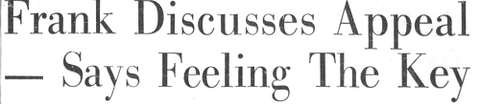
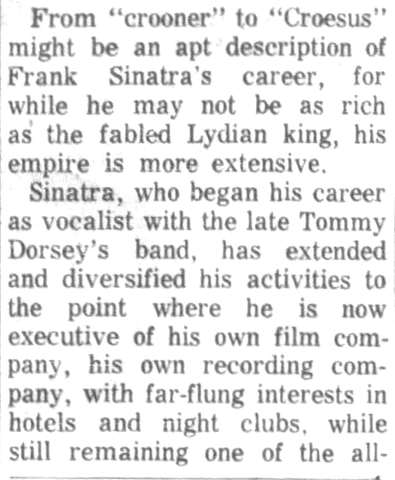


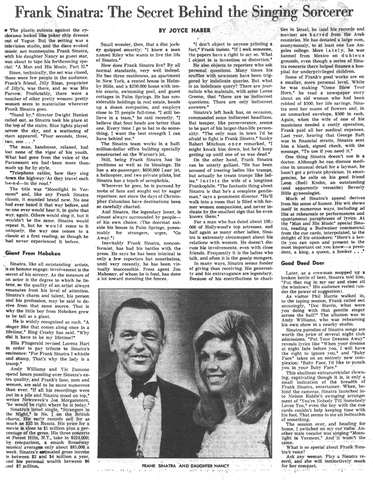
"Come Blow Your Horn"
Released one month after The List of Adrian Messenger, this Neil Simon adaptation was produced by Tandem Productions (Bud Yorkin and Norman Lear) together with Sinatra's own Essex Productions. Santopietro calls it a decided step down from A Hole in the Head, though slightly better than The Tender Trap, in Sinatra's trio of swinging-bachelor comedies.
Source: Tom Santopietro, "Sinatra in Hollywood" (2008).
"Come Blow Your Horn"
Santopietro finds it jarring that Lee J. Cobb and Molly Picon play such distinctly Jewish-inflected parents to Sinatra's character, echoing the mismatched father-son casting problem in A Hole in the Head (which at least had Frank Capra's direction to offset it).
Source: Tom Santopietro, "Sinatra in Hollywood" (2008).
"Come Blow Your Horn"
The film marked Tony Bill's first major film role, playing Sinatra's younger brother; Santopietro judges his performance overeager and unconvincing, though Bill later found more success directing the film My Bodyguard.
Source: Tom Santopietro, "Sinatra in Hollywood" (2008).
"Come Blow Your Horn"
Phyllis McGuire, lead singer of the McGuire Sisters and a onetime girlfriend of Sinatra's, was cast as Mrs. Eckman. She was also long romantically linked to mobster Sam Giancana, a connection Santopietro notes fueled ongoing conjecture about Sinatra's underworld associations.
Source: Tom Santopietro, "Sinatra in Hollywood" (2008).
"Come Blow Your Horn"
Bud Yorkin (via Santopietro): For the title-song sequence shot on a real Madison Avenue location, director Bud Yorkin described Sinatra's on-set impatience: once cued, Sinatra walked the block, hailed a cab, and was gone for the day, leaving the crew unsure whether they'd gotten a usable take, since Frank refused to do it a second time.
Source: Tom Santopietro, "Sinatra in Hollywood" (2008).
"Come Blow Your Horn"
Frank Sinatra: Sinatra explained his preference for single takes by comparing repeated takes to "singing a song twice for the same audience" — in his view, unnecessary and diminishing.
Source: Tom Santopietro, "Sinatra in Hollywood" (2008).
"Come Blow Your Horn"
Dean Martin made an uncredited cameo as a drunken panhandler, a self-indulgent in-joke Santopietro feels undercuts the film's already thin credibility.
Source: Tom Santopietro, "Sinatra in Hollywood" (2008).
"Come Blow Your Horn"
Bosley Crowther / Los Angeles Times (via Santopietro): Bosley Crowther of The New York Times panned the film as inducing "vapid boredom," describing Sinatra as moving through it like a "well greased mechanical man," while the Los Angeles Times found Sinatra tried harder than his usual walk-through performance and largely succeeded.
Source: Tom Santopietro, "Sinatra in Hollywood" (2008).
"Come Blow Your Horn"
Despite mixed reviews, the film proved popular with audiences and earned Sinatra a Golden Globe nomination for Best Actor in a Comedy or Musical.
Source: Tom Santopietro, "Sinatra in Hollywood" (2008).
"Come Blow Your Horn"
Santopietro grades this a B, calling it pleasant and forgettable. Golden Globe Award nomination: Best Motion Picture Actor, Musical or Comedy; Golden Laurel Award nomination: Top Male Star of the Year.
Source: Tom Santopietro, "Sinatra in Hollywood" (2008).
"Come Blow Your Horn"
Santopietro (Filmography): Essex-Tandem/Paramount Pictures. Produced by Norman Lear and Bud Yorkin, directed by Yorkin, screenplay by Lear based on Neil Simon's Broadway play, songs by Jimmy Van Heusen and Sammy Cahn, score by Nelson Riddle. Sinatra played Alan Baker opposite Lee J. Cobb, Molly Picon and Barbara Rush, singing the title song.
Source: Tom Santopietro, "Sinatra in Hollywood" (2008).
June 8, 1963
[Dinner with Giancana at Fort Lee house]
Phyllis McGuire: On Saturday, June 8, 1963, Frank took Ava Gardner, Sam Giancana, and Phyllis McGuire to dinner at his parents' new Fort Lee house. Phyllis McGuire recalled bringing Dolly and Marty a bottle of Crown Royal, and that Ava was so taken with it she had a shot chased with beer; Dolly asked Ava when she and Frank were getting married again.
Source: James Kaplan, "Sinatra: The Chairman" (2015).
July 1963
[500 Club skipped, financial trouble]
Dorothy Kilgallen: Frank skipped Atlantic City's 500 Club that summer for the first time in years; columnist Dorothy Kilgallen reported in a thinly veiled item that the club couldn't pay its stars or band despite a healthy July 4 crowd and was scrambling to borrow money.
Source: James Kaplan, "Sinatra: The Chairman" (2015)
[FBI photographs Sinatra and Giancana golfing]
Kitty Kelley (via Kaplan): During Giancana's week at Cal-Neva, the FBI reportedly photographed him golfing with Frank Sinatra, even though the bureau's official position was that it had not followed Giancana to Nevada.
Source: James Kaplan, "Sinatra: The Chairman" (2015)
[Giancana brawls with Victor Collins at Cal-Neva]
Victor Collins: During Giancana's stay at Cal-Neva, a drunken altercation broke out in Chalet 50 between Giancana and McGuire Sisters' road manager Victor Collins after Collins tried to seat an unruly Phyllis McGuire. Giancana punched Collins with a diamond ring, Collins nearly overpowered him, and someone struck Collins from behind before Sinatra and valet George Jacobs pulled the men apart; Collins left for Nebraska the next day.
Source: James Kaplan, "Sinatra: The Chairman" (2015)
[Divestment from Berkshire Downs Racetrack]
Sinatra divested his investment in Berkshire Downs Racetrack roughly a year after buying in, reportedly because Nevada gaming rules barred casino stakeholders from holding out-of-state gambling interests.
Source: George Carpozi Jr., Frank Sinatra: Is This Man Mafia? (New York: Manor Books, 1979).
July 1, 1963
[Giancana's harassment petition denied]
UPI (via Kaplan): Under the headline 'SAD TALE, BUT FBI UNMOVED,' papers reported that federal judge Richard B. Austin had denied Giancana's petition, despite attorney George N. Leighton's argument that FBI surveillance was ruining Giancana's golf game and social life in suburban Oak Park.
Source: James Kaplan, "Sinatra: The Chairman" (2015).
July 7, 1963
TERRE HAUTE TRIBUNE
7-7-63
July 9, 1963
[Hoover memo on Giancana's Armory Lounge and Sinatra hint]
FBI memo / Chuck English: In a July 9, 1963 memo to Robert Kennedy, Hoover described Giancana resuming meetings at the Armory Lounge in Forest Park, Illinois. During an interview with agents, lieutenant Chuck English suggested that if Bobby Kennedy wanted to talk to Giancana, he 'knows who to go through' -- implying Frank Sinatra as an intermediary, though English wouldn't say the name outright.
Source: James Kaplan, "Sinatra: The Chairman" (2015).
July 10, 1963
Studio
Los Angeles
2149 We Open In Venice
(Cole Porter)
Chappell & Co. Inc. (ASCAP) w/Dean Martin & Sammy Davis Jr.
Arranged by Billy May
Orchestra Conducted by Morris Stoloff
(2:10) CD: 46013-2 The Complete Reprise Studio Recordings Disc 6
LP: W54100 ( Italy )
LP: FS2017Kiss Me Kate
LP: Reprise Repertory Theatre: De Luxe Four Record Set Reprise 4F-2019.
CD: Reprise Musical Repertory Theatre Box Set - Reprise Records – 2-47775
NOTE: Ed O'Brien says he has often wondered what Cole Porter thought regarding the very irreverent treatment of his tune by Sinatra, Martin, and Davis. Jim White calls attention to the package of four Broadway show recordings issued in 2000 as "Musical Repertory Theatre" by Reprise. It is a very nice boxed set which includes the music of "Kiss Me Kate," "South Pacific," "Guys and Dolls," and "Finian's Rainbow." The entire project, by the way, was conceived by Frank Sinatra. The boxed 4-cd set is numbered Reprise 2-47775.
2188 Guys And Dolls (N/R) w/Dean Martin
(Frank Loesser)
Frank Music Corp. (ASCAP)
Arranged by Bill Loose
Orchestra Conducted by Morris Stoloff
NOTE: Ed O'Brien points out that this recording of "Guys and Dolls" has never been issued from this session. Loose's arrangement has bongo drums and Dino's vocal is nowhere near what he did on the issued recording.
[Reprise Repertory Theatre project begins]
Frank Sinatra began his self-produced Reprise Repertory Theatre project, rerecording songs from four Broadway musicals using only Reprise artists. He started on July 10, 1963, teaming with Dean Martin and Sammy Davis Jr. to record Cole Porter's 'We Open in Venice' from Kiss Me, Kate, arranged by Billy May and conducted by Morris Stoloff.
Source: James Kaplan, "Sinatra: The Chairman" (2015).
July 12, 1963
[Second Giancana petition denied]
Judge Austin remained unmoved when attorney George Leighton presented a second petition on Giancana's behalf on July 12, 1963.
Source: James Kaplan, "Sinatra: The Chairman" (2015).
July 15, 1963
[Austin agrees to hear Giancana testify]
On July 15, 1963, Judge Austin agreed to hear Sam Giancana testify in person regarding his harassment suit against the FBI -- a considerable risk given the government's extensive file on his criminal history.
Source: James Kaplan, "Sinatra: The Chairman" (2015).
July 16, 1963
Studio
Olmstead Sound Studio, New York City
"Have Yourself a Merry Little Christmas"
Recorded for the Columbia film "The Victors"
Bill Miller sole accompaniment on piano
Orchestral track laid down in London in early September 1963
Saul Chapline was offered the assignment but turned it down.
Wally Stott arranged and conducted.
LP: Original Soundtrack Recording: The Victors (1963) - Colpix CP
516
CD: Frank Sinatra In Hollywood, Reprise Records,
8122-78285-2
NOTE: Sinatra Scholar Ed O'Brien, who provided the above details, says that arguably this is Sinatra's finest recording of "Have Yourself a Merry Little Christmas." Sinatraphile Jason Stuart thinks that the 1957 recording with Gordon Jenkins is preferable. Sinatraphile Ed Spiegel wonders why, since there was a 40's version by Sinatra and it was a World War II movie, why they did not use that recording rather than create a new version with Sinatra's 1963 voice. O'Brien responds by pointing out that the two recordings from the 40's with Stordahl are pretty Christmas songs. The 1963 version has a far more haunting quality to it. A lot of that comes from the sound of Sinatra's voice in 1963. The "Stay With Me" recording done in December 1963 conveys the same desolation.
[Judge sides with Giancana against FBI]
UPI: UPI reported that Judge Austin reversed course, ordering the FBI to curtail its harassment of Giancana and holding the bureau's chief Chicago agent in contempt for refusing, on orders from Washington, to answer questions in court. The order sharply restricted FBI tailing of Giancana going forward.
Source: James Kaplan, "Sinatra: The Chairman" (2015).
July 17, 1963
Sam Giancana, in defiance of Nevada's “Black Book” barring known organized-crime figures from casino premises, began an extended stay in Chalet 50 at Frank Sinatra's Cal-Neva Lodge to be near his girlfriend, singer Phyllis McGuire, who was performing there with the McGuire Sisters — with Sinatra's knowledge and consent, according to FBI records. During the stay, Giancana came to blows with the McGuire Sisters' road manager, Victor LaCroix Collins, after Collins shoved McGuire; the brawl spilled onto the patio before Sinatra's bodyguards broke it up. The episode, once it reached Nevada gaming regulators, would ultimately cost Sinatra his gaming license. Source: J. Randy Taraborrelli, Sinatra: Behind the Legend.
[Giancana slips away to Cal-Neva]
FBI memo: The day after the favorable ruling, Sam Giancana eluded a Cook County Sheriff's Department surveillance and traveled to the Lake Tahoe area, meeting Phyllis McGuire and reportedly staying at the Cal-Neva Lodge, part-owned by Frank Sinatra.
Source: James Kaplan, "Sinatra: The Chairman" (2015).
July 18, 1963
Studio
Los Angeles
2188 Guys And Dolls
w/Dean Martin
(Frank Loesser)
Frank Music Corp. (ASCAP)
Arranged by Bill Loose
Orchestra Conducted by Morris Stoloff
(2:48) CD: 46013-2 The Complete Reprise Studio Recordings Disc 6
LP: W54100 (Italy)
LP: FS2016Guys And Dolls
2161 Old Devil Moon
(E.Y. Harburg/Burton Lane)
Chappell & Co. Inc. (ASCAP)
Arranged by Bill Loose
Orchestra Conducted by Morris Stoloff
(2:56) CD: 46013-2 The Complete Reprise Studio Recordings Disc 6
LP: W54100 (Italy)
LP: FS2015Finian's Rainbow
2166 When I'm Not Near The Girl I Love
(E.Y. Harburg/Burton Lane)
Chappell & Co. Inc. (ASCAP)
Arranged by Nelson Riddle
Orchestra Conducted by Morris Stoloff
(3:24) CD: 46013-2 The Complete Reprise Studio Recordings Disc 6
LP: W5100 (Italy)
LP: FS6167Sinatra 65
LP: FS2015Finian's Rainbow
45: 0398
2190 I've Never Been In Love Before
(Frank Loesser)
Frank Music Corp. (ASCAP)
Arranged by Nelson Riddle
Orchestra Conducted by Morris Stoloff
(2:54) CD: 46013-2 The Complete Reprise Studio Recordings Disc 6
LP: W54100 (Italy)
LP: FS6167Sinatra 65
LP: FS2016Guys And Dolls
NOTE: Ed O'Brien points out that this session is mostly remembered for the "Guys and Dolls" duet with Frank and Dean. The three tunes recorded with Riddle that night are at a remarkably high level of artistry. Truly a shame that they were lost in the Reprise Repertory Theatre debate. All three deserved to be heard on an album of great Broadway songs by Sinatra. Riddle's charts are at his usual high standard and Sinatra is sensational. Great listening experience!
O'Brien then emphasizes that the four LP Reprise Repertory Theatre project was conceived and produced by Sinatra. Stan Cornyn, in his book EXPLODING, called it Reprise's biggest gamble and biggest disaster.
Sinatra's vocals, on this date, were of an extraordinarily high order but not heard by many people back then. O'Brien says he bought all of his records at a store called Dauber's. The store stocked up on the set and then couldn't give them away and finally sold them in a bargain bin for $1.00 each.
Sinatra's recordings for the Repertory series are remarkable, O'Brien emphasizes. They deserve a separate release. A single Sinatra would have been a terrific package.
Sinatraphile Jim White points out that, in 2000, Reprise issued all four Broadway shows in the Reprise Repertory Theatre series in a very nice boxed set of four cds. The four shows are "Guys and
Dolls," "Finian's Rainbow," "Kiss Me Kate," and
"South Pacific." The boxed set is Reprise
2-47775.
REPRISE REPERTORY PROMOTION, AVAILABILITY AND SALES:
Release date:November 1963
Reprise tried a new selling concept with the Repertory Theatre set.
They offered the four albums with fold-out covers exclusively through
a mail order house, Curtis Publishing. Reprise received over a million
dollars of free ads in the Curtis catalog. A cut out coupon was advertised
in major magazines including Look and Saturday Evening Post. The individual
albums were sold for $4.00 each and the boxed set went for $20.00 The sales
were a huge disappointment. Mo Ostin ( president of Reprise) had predicted
sales of a million units during the Christmas season.. In October of 1964,
the set was finally made available to record stores. The retailers were none
too thrilled to be an after thought. The retail price per LP was $4.98 and the
set was $19.95.
The project had cost $150,000 to complete. A huge sum in 1963 for a small,
independent record label. Done before Warners incorporated Reprise, it was a
big gamble. There had been recordings done in New York, Hollywood and Japan.
The problem with the project was twofold: many of the artists Sinatra had signed
at Reprise were past their prime with record buyers in 1963-64 and the mail order
concept alienated many retailers. They made a minimal effort to sell the LPs and
then failed to reorder.
Sinatra had produced the set and brought in Morris
Stoloff to conduct the sessions.
The combined sales of 17,700 records was an unmitigated disaster. After this debacle,
Sinatra ceded more power to Mo Ostin and rock 'n' roll groups became a mainstay
of Reprise Records.
Los Angeles
2161 Old Devil Moon
2166 When I'm Not Near The Girl I Loved
2190 I've Never Been In Love Before
2188 Guys And Dolls
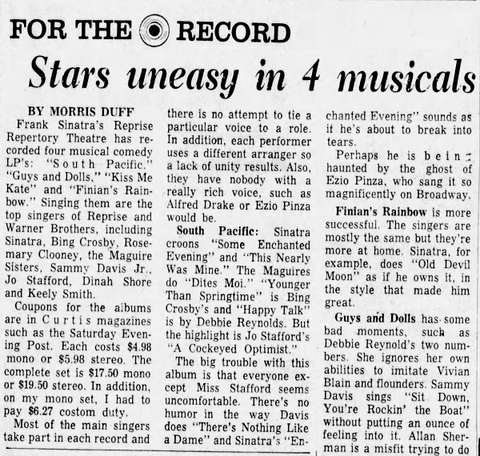
[Repertory Theatre session with Riddle]
On July 18, 1963, in a session arranged by Nelson Riddle, Frank and Dean Martin recorded the title song from Guys and Dolls, after which Frank recorded three solo numbers: 'I've Never Been in Love Before,' plus 'Old Devil Moon' and 'When I'm Not Near the Girl I Love' from Finian's Rainbow -- the latter two songs he had never recorded before.
Source: James Kaplan, "Sinatra: The Chairman" (2015).
July 19, 1963
Ed O'Brien:
On this date in 1963, Frank announced
that Reprise Records had just signed Bing Crosby.
They would do three albums together, plus the Reprise
Repertory and Bing would release a number of albums
and a few singles.
July 19, 1966 Frank Sinatra marries Mia Farrow
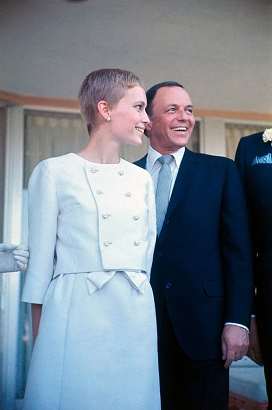
Frank, his daughter Nancy Jr., and first wife, Nancy, beam after Frank Jr.’s opening night at the Flamingo Hotel in 1963. Source: photo and caption from J. Randy Taraborrelli, Sinatra: Behind the Legend (mptvimages.com).
[Sinatra heads to Tahoe to meet Giancana]
The day after the July 18 Repertory Theatre session, Frank Sinatra headed to Lake Tahoe to meet Sam Giancana.
Source: James Kaplan, "Sinatra: The Chairman" (2015).
[McGuire Sisters open at Cal-Neva]
Life magazine (via Kaplan): The McGuire Sisters opened a one-week engagement in Cal-Neva's Celebrity Room on July 19, 1963. Sam Giancana came to support Phyllis McGuire in direct violation of the Nevada Black Book's ban on his presence at licensed casinos, staying with her in Chalet 50 and reportedly spending much of his time sunning on the porch.
Source: James Kaplan, "Sinatra: The Chairman" (2015).
July 24, 1963
Studio
Los Angeles
2156 So In Love w/Keely Smith
(Cole Porter)
Chappell & Co. Inc. (ASCAP)
Arranged by Nelson Riddle
Orchestra Conducted by Morris Stoloff
(2:53) CD: 46013-2 The Complete Reprise Studio Recordings Disc 6
LP: W54100 (Italy)
LP: FS2017Kiss Me Kate
2171 Twin Soliloquies (Wonder How It Feels) w/Keely Smith
(Richard Rodgers/Oscar hammerstein II)
Williamson Music Co. (ASCAP)
Arranged by Nelson Riddle
Orchestra Conducted by Morris Stoloff
(1:38) CD: 46013-2 The Complete Reprise Studio Recordings Disc 6 LP : W54100 (Italy)
LP: FS2018Sou
Daily Post
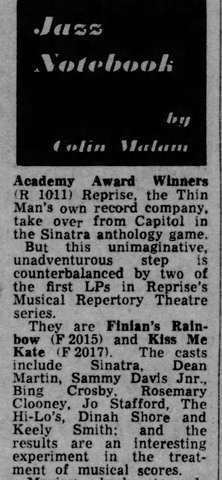
July 25, 1963
Studio
Los Angeles
2171B Some Enchanted Evening
(Richard Rodgers/Oscar Hammerstein II)
Williamson Music Co. (ASCAP)
Arranged by Nelson Riddle
Orchestra Conducted by Morris Stoloff
(3:27) CD: 46013-2 The Complete Reprise Studio Recordings Disc 6
LP: W54100 ( Italy )
LP: FS2018South Pacific
2180 Some Enchanted Evening (Reprise) w/Rosemary Clooney
(Richard Rodgers/Oscar Hammerstein II)
Williamson Music Co. (ASCAP)
Arranged by Nelson Riddle
Orchestra Conducted by Morris Stoloff
(3:21) CD: 46013-2 The Complete Reprise Studio Recordings Disc 6
LP: W54100 ( Italy )
LP: FS1018 South Pacific
Thanet Times
Los Angeles
2180 Some Enchanted Evening (Reprise) w/Rosemary Clooney
(Richard Rodgers/Oscar Hammerstein II)
Williamson Music Co. (ASCAP)
Arranged by Nelson Riddle
Orchestra Conducted by Morris Stoloff
(3:21) CD: 46013-2 The Complete Reprise Studio Recordings Disc 6
LP: W54100 ( Italy )
LP: FS1018 South Pacific
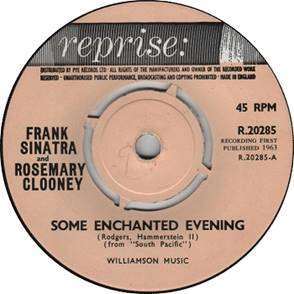
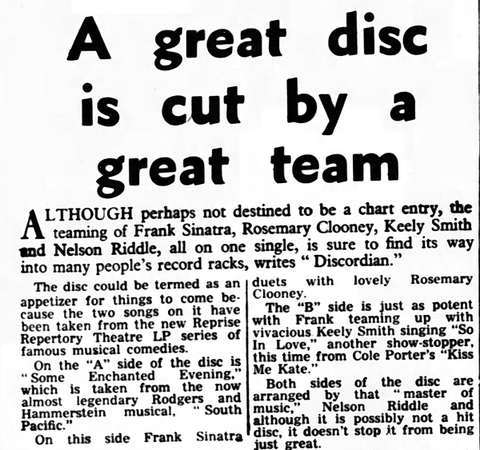
"Some Enchanted Evening"
Friedwald (analysis): South Pacific, called 'the best in the series,' features Sinatra's own 'best-ever rendition' of 'Some Enchanted Evening,' plus Jo Stafford, Keely Smith, Dinah Shore (singing 'I'm Gonna Wash that Man Right Outa My Hair'), Sammy Davis Jr., Debbie Reynolds, and Bing Crosby (on 'Younger than Springtime'), with vocal groups the McGuire Sisters and the Hi-Lo's in place of a conventional Broadway chorus.
Source: Will Friedwald, "Sinatra! The Song Is You: A Singer's Art" (2018 revised edition).
[Sinatra records Luck Be a Lady]
On July 25, 1963, Frank Sinatra made his first, celebrated recording of 'Luck Be a Lady' for the Reprise Repertory Theatre project.
Source: James Kaplan, "Sinatra: The Chairman" (2015).
July 27, 1963
During a McGuire Sisters engagement at Sinatra's Cal-Neva Lodge, a violent brawl broke out in Chalet 50 involving Sam Giancana, Phyllis McGuire's road manager Victor LaCroix Collins, and Giancana himself, with Sinatra reportedly intervening; the incident fed into the Nevada Gaming Control Board's mounting case against Sinatra over hosting Giancana at the lodge. Note: This account comes solely from Kelley's book, which is widely regarded as containing embellished or unverified claims; it is not independently corroborated elsewhere in this chronology. Source: Kitty Kelley, "His Way: An Unauthorized Biography of Frank Sinatra" (1986).
July 29, 1963
Studio
Los Angeles
2184 Fugue For Tinhorns
w/Bing Crosby & Dean Martin
(Frank Loesser)
Frank Music Corp. (ASCAP)
Arranged by Bill Loose
Orchestra Conducted by Morris Stoloff
(1:29) CD: 46013-2 The Complete Reprise Studio Recordings Disc 7
LP: W54100 (Italy)
LP: FS2016Guys And Dolls
45: 20,217
2185 The Oldest Established (Permanent Floating Crap Game In New York)
w/Bing Crosby & Dean Martin
(Frank Loesser)
Frank Music Corp. (ASCAP)
Arranged by Billy May
Orchestra Conducted by Morris Stoloff
(2:30) CD: 46013-2 The Complete Reprise Studio Recordings Disc 7
CD: 1016-2A Man And His Music
LP: FS2016Guys And Dolls
LP: 1016A Man And His Music
45: 20,217
note: In 1965, I was working at the Town House in Lake George, N.Y. My one day off from bartending was Monday.
I liked to roam through the village, stopping at different stores and just looking around. One day I went into the
only drugstore in the village. They had a bin filled with 45s, with a price tag of 3 for $1.00.. I saw the above sleeve
and bought it for about 35 cents with tax. I have never seen it in another collection. Does anyone on this list
have it? I remember the bin contained a number of them. But I only needed one for my collection. I may have made a mistake.
Ed
Los Angeles
2184 Fugue For Tinhorns
2185 The Oldest Established (Permanent Floating Crap Game In New York)
w/Bing Crosby & Dean Martin
Session photos. Ken Lane on piano.
© 1997-2026 The Sinatra Archive
This calendar, or any parts thereof, may not be reproduced in any fashion
whatsoever without the prior written permission of the publisher (The
Sinatra Archive)
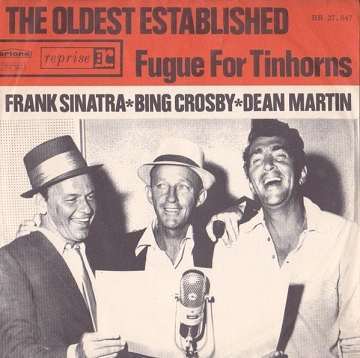
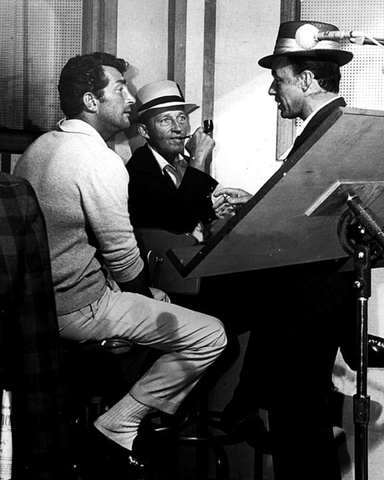
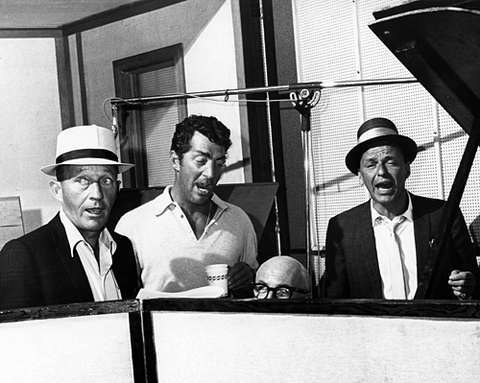
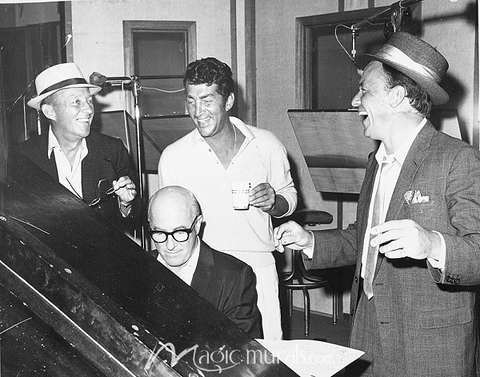
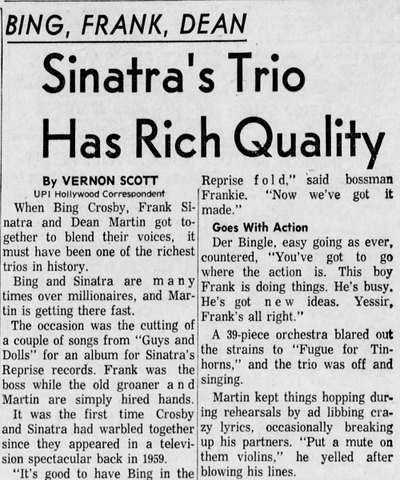

Los Angeles
2184 Fugue For Tinhorns w/Bing Crosby & Dean Martin
(Frank Loesser)
Frank Music Corp. (ASCAP)
Arranged by Bill Loose
Orchestra Conducted by Morris Stoloff
(1:29) CD: 46013-2 The Complete Reprise Studio Recordings Disc 7
LP: W54100 (Italy)
LP: FS2016Guys And Dolls
45: 20,217
2185 The Oldest Established (Permanent Floating Crap Game In New York) w/Bing Crosby & Dean Martin
(Frank Loesser)
Frank Music Corp. (ASCAP)
Arranged by Billy May
Orchestra Conducted by Morris Stoloff
(2:30) CD: 46013-2 The Complete Reprise Studio Recordings Disc 7
CD: 1016-2A Man And His Music
LP: FS2016Guys And Dolls
LP: 1016A Man And His Music
45: 20,217
Cincinnati Post
July 31, 1963
Studio
Los Angeles
2103 Here's To The Losers
(Robert Wells/Jack Segal)
Helton Music/The Songwriters Guild (ASCAP)
Arranged & Conducted by Marty Paich
(3:04) CD: 46013-2 The Complete Reprise Studio Recordings Disc 7
CD: 9-26340-2The Reprise Collection
CD: 1013-2Softly As I Leave You
LP: FS1013Softly As I Leave You
45: 0373
2104 Love Isn't Just For The Young
(Bernard Knee)
Bourne Co. (ASCAP)
Arranged & Conducted by Marty Paich
(2:57) CD: 46013-2 The Complete Reprise Studio Recordings Disc 7
CD: 1013-2Softly As I Leave You
LP: FS1013Softly As I Leave You
45: 20,209
NOTE: Sinatra Scholar Ed O'Brien says that "Here's to the Losers" is a first-rate song with a marvellous chart by Marty Paich. Sinatra laid down a fabulous vocal. Truly a shame that there was no place on the musical charts for this type of quality in 1963. What a great title song for a swingin' saloon album, O'Brien exclaims.
"Here's to the Losers"
Friedwald (analysis): Friedwald calls it a perfect piece of 'Sinatra philosophy,' at once swinging and spiritual, comparable to 'Ring-a-Ding-Ding' and 'Come Blow Your Horn.' He wishes the payoff line had been 'Here's to the losers -- bless us all' instead of 'bless 'em all' for a more ironic edge; footnotes a joke about Pope Francis and 'ring-a-ding-ding.'
Source: Will Friedwald, "Sinatra! The Song Is You: A Singer's Art" (2018 revised edition).
[Sinatra cuts two new singles]
On July 31, 1963, Frank Sinatra recorded two new singles: 'Here's to the Losers' and 'Love Isn't Just for the Young.'
Source: James Kaplan, "Sinatra: The Chairman" (2015).
Recording for the multi-artist Reprise Repertory Theatre Broadway project concluded on July 31, 1963. (Source: Richard Havers, "Sinatra" (Dorling Kindersley, 2007).)
August 1963
[Giancana's Visit to Cal-Neva Sparks an Investigation]
Chicago crime boss Sam Giancana, legally barred from Nevada gaming venues, reportedly visited Frank's Cal-Neva Lodge in early August 1963. Attorney Mickey Rudin said the defense was prepared to show Frank neither invited Giancana nor knew he was there, and that Giancana had not actually stayed at the lodge.
Source: Nancy Sinatra, "Frank Sinatra, My Father" (1985).
[Kirk Douglas's Disguise Fools Even Sinatra's Own Family]
Nancy Sinatra: In an all-star cameo film where the cast swore to keep their disguised characters secret, Sinatra played a gypsy stableman so convincingly made up that even members of his own family had trouble recognizing him.
Source: Nancy Sinatra, Frank Sinatra: An American Legend, 1995.
[Artanis moves to Warner lot, Sinatra gets title]
Kaplan: Sinatra's production company, renamed Artanis, moved to the Warner Bros. lot in Burbank; Frank insisted on a title and was named assistant to the president, prompting press speculation he might succeed the aging Jack Warner.
Source: James Kaplan, "Sinatra: The Chairman" (2015)
[Frank Jr. on studying his father]
Frank Sinatra Jr.: In the Life profile, Frank Jr. said he had studied his father without his father knowing it, following him around to theaters, saloons, and strip joints, and described warming up his voice nightly by singing along to Sinatra recordings on tour.
Source: James Kaplan, "Sinatra: The Chairman" (2015)
[Frank senior proud of son's debut]
Frank Sinatra: Frank senior told the press he was proud of Junior's Vegas debut and had given him no coaching, though he had provided a new Pontiac convertible and generous spending money.
Source: James Kaplan, "Sinatra: The Chairman" (2015)
[Jack Warner's furious reaction to press]
Jacqueline Park: Jack Warner's mistress Jacqueline Park recalled Warner reading newspaper speculation that Sinatra might succeed him and exploding in anger, then calling Frank to warn him he wouldn't tolerate 'a gang of ruffians for partners.'
Source: James Kaplan, "Sinatra: The Chairman" (2015)
[Olsen confirms unhurried Cal-Neva investigation]
Edward Olsen: Ed Olsen responded to press inquiries by confirming he had subpoenaed the entire Cal-Neva staff, including Skinny D'Amato, and said the investigation was proceeding deliberately until discrepancies in witness accounts were resolved.
Source: James Kaplan, "Sinatra: The Chairman" (2015)
[Rudin negotiates Warner-Reprise merger]
Kaplan: In August 1963 Mickey Rudin, negotiating with Jack Warner over Sinatra's film services, pivoted the talks into a deal to have Warner Bros. buy and merge with money-losing Reprise Records, unloading Sinatra's Essex Productions liabilities at a profit.
Source: James Kaplan, "Sinatra: The Chairman" (2015)
[Sinatra receives $1 million check]
Frank Sinatra: As part of the Warner deal, Frank received no Warner Bros. stock but did get a certified check for a million dollars as a down payment, which he carried around for a week showing it off, calling it "real pocket money."
Source: James Kaplan, "Sinatra: The Chairman" (2015)
[Sinatra's Sinatra released]
Kaplan: Sinatra's Sinatra was released in August 1963, rising to number 8 on the Billboard chart and becoming Sinatra's first gold record on Reprise and his first gold record since 1960's Nice 'n' Easy.
Source: James Kaplan, "Sinatra: The Chairman" (2015)
[Variety review of Frank Jr.'s debut]
Variety: Variety's reviewer praised the 19-year-old Frank Sinatra Jr.'s Vegas debut as good showmanship, noting his eerily accurate soundalike rendition of "I'll Never Smile Again" with the Pied Pipers and calling him a strong attraction in his own right.
Source: James Kaplan, "Sinatra: The Chairman" (2015)
[Warner press release clarifies deal]
Kaplan: The day after his outburst, Jack Warner issued a press release clarifying that Warner Bros. Records was two-thirds owned by the studio and one-third by Sinatra, and denying any speculation that Sinatra was being groomed as his successor.
Source: James Kaplan, "Sinatra: The Chairman" (2015)
August 2, 1963
[Chicago Sun-Times exposes Cal-Neva scandal]
Sandy Smith / Chicago Sun-Times: The Chicago Sun-Times ran the front-page headline 'MOE'S VISIT PERILS SINATRA LICENSE,' with reporter Sandy Smith detailing Sam Giancana's late-July stay at Cal-Neva -- including the Chalet 50 brawl and the fact that maitre d' Eddie King had struck Victor Collins -- and noting that Nevada Gaming Control Board chairman Edward Olsen had already begun an investigation.
Source: James Kaplan, "Sinatra: The Chairman" (2015).
August 6, 1963
Dean Martin opening, Sands Hotel, Las Vegas, Nevada joined on stage by Frank and Sammy.
Note: Fred J Wadsworth.
© 1997-2023 The Sinatra Archive
This calendar, or any parts thereof, may not be reproduced in any fashion whatsoever without the prior written permission of the publisher (The Sinatra Archive)
August 7, 1963
[Variety headline on Sinatra-Warner deal]
Variety's front page announced Sinatra had been named WB production consultant as the label merger and a possible third deal loomed; Warner Bros. Records and Reprise Records would merge into Warner Bros. Records-Reprise Records Co., combining 90 artists.
Source: James Kaplan, "Sinatra: The Chairman" (2015).
August 8, 1963
[Gaming board agents visit Cal-Neva]
Nevada Gaming Control Board agents visited Cal-Neva on August 8, finding the staff uncooperative; Skinny D'Amato, on his attorney's advice, declined to be interviewed.
Source: James Kaplan, "Sinatra: The Chairman" (2015).
[Olsen interviews Sinatra about Giancana]
Edward Olsen: At 5:00 p.m. on August 8, Gaming Control Board chairman Ed Olsen interviewed Sinatra at his Sands office; Sinatra admitted seeing Giancana briefly outside Phyllis McGuire's cabin but denied further knowledge of any incident, declining to repeat this under oath without his attorney.
Source: James Kaplan, "Sinatra: The Chairman" (2015).
[Sinatra's philosophy on Giancana friendship]
Frank Sinatra: Sinatra told Olsen he saw Giancana six to ten times a year, that Giancana had been a guest at his Palm Springs home, and that while he wouldn't associate with him in Nevada he'd continue elsewhere as he pleased, saying "This is a way of life, and a man has to lead his own life."
Source: James Kaplan, "Sinatra: The Chairman" (2015).
[Frank Sinatra Jr.'s Las Vegas debut]
A little after midnight, Frank Sinatra Jr. made his Las Vegas debut at the Flamingo's Driftwood Lounge fronting the Tommy Dorsey Orchestra, singing standards including "Night and Day" before a packed house; Frank senior sat ringside with Nancy senior and Nancy junior, muttering "I'm so nervous."
Source: James Kaplan, "Sinatra: The Chairman" (2015).
August 13, 1963
Frank attended Frank Jr.'s opening at the Flamingo Hotel in Las Vegas.
Source: Nancy Sinatra, Frank Sinatra: An American Legend, 1995.
August 23, 1963
Concerts
Cal-Neva, Lake Tahoe, Nevada (August 23 - September 5) w/Dean
Ed O'Brien:
Frank and Dean were at Cal-Neva in Lake
Tahoe from 8/23 thru 9/5. Sammy joined them during the run. Frank's last show, ever, at Cal-Neva took place on 9/5/63. The trio then moved into the Sands for the Labor Day weekend (9-6 thru 8).
Cal-Neva, Lake Tahoe, Nevada (August 23 - September 5)
w/Dean
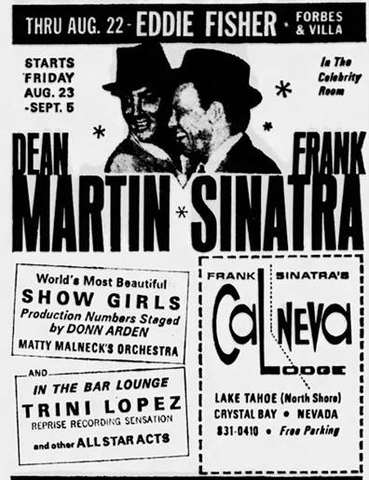
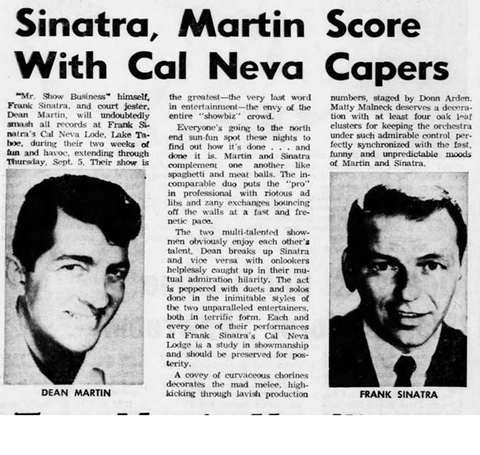
[Life magazine cover on Sinatra Jr.]
On August 23 a Life magazine cover featured Frank and Frank Jr. in tuxes under the headline "New Sinatra Sound: Frank Jr. Takes After Pop," describing Junior's rise from Disneyland gigs to his Vegas opening.
Source: James Kaplan, "Sinatra: The Chairman" (2015).
[Frank's own Sands opening with Dean and Sammy]
The same Friday night as the Life cover story broke, Frank opened his own engagement with Dean Martin and Sammy Davis Jr. at the Sands' Copa Room, while newspaper coverage of the Cal-Neva/Giancana scandal began going nationwide.
Source: James Kaplan, "Sinatra: The Chairman" (2015).
August 24, 1963
Concerts
Cal-Neva, Lake Tahoe, Nevada (August 23 - September 5) w/Dean
note: Frank, Dean and, sometimes, Sammy were at Cal Neva from 8/23 thru 9/5. The remodeled casino was a mecca for both gamblers and people looking for an exciting resort vacation. Frank, Sammy and Dean would go into the Sands on 9/6 and play the Labor Day weekend. Frank's last appearance at the Tahoe club would take place on 9-5-63.
Ed
August 25, 1963
Concerts
Cal-Neva, Lake Tahoe, Nevada (August 23 - September 5) w/Dean
August 26, 1963
Concerts
Cal-Neva, Lake Tahoe, Nevada (August 23 - September 5) w/Dean note: Frank, Dean and, sometimes, Sammy were at Cal Neva from 8/23 thru 9/5.
August 27, 1963
Concerts
Cal Neva, Nevada (August 23 - September 5) w/Dean & Sammy
August 28, 1963
Concerts
Cal-Neva, Nevada (August 23 - September 5) w/Dean
[Justice Department mounts, then abandons, a Sinatra prosecution effort]
Justice Department attorney Dougald D. MacMillan arrived in Los Angeles hoping to interview celebrities close to Sinatra -- Dean Martin, Sammy Davis Jr., Dinah Shore, Eddie Fisher -- about his mob ties, but FBI agents present found he "does not have any organized plan of approach." Someone scrawled on a related memo, "MacMillan is a boy on a man's errand." Hoover shut the effort down on September 4, instructing Los Angeles to "take no action whatever which could be interpreted as investigation of Frank Sinatra," and MacMillan returned to Washington empty-handed. A subsequent October 9, 1963 review of MacMillan's files by FBI agents did surface a possible false-statement violation -- Sinatra's 1959 IRS denial that Giancana attended his Claridge Hotel party -- but prosecutors concluded on November 4, 1963 that the matter was too minor to pursue on its own.
Source: Kuntz and Kuntz, The Sinatra Files, ch. 6 (memos of August 28, September 4, October 9, and November 4, 1963).
August 29, 1963
Concerts
Cal-Neva, Lake Tahoe, Nevada (August 23 - September 5) w/Dean
Cal-Neva, Lake Tahoe, Nevada (August 23 - September 5)
w/Dean
Auburn Journal
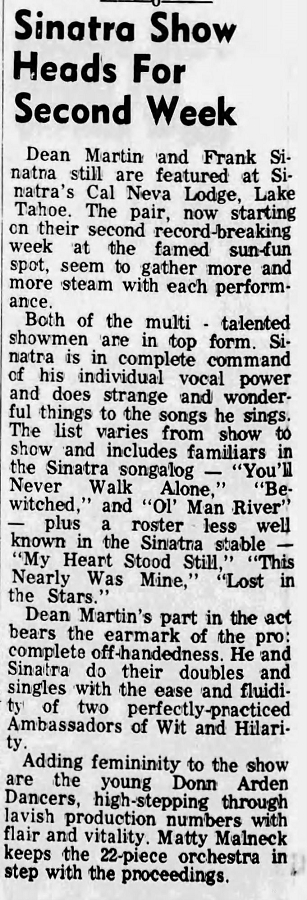
note: Sinatra also sang "I Have Dreamed" at
Cal-Neva and the
Sands. The only song not sung from "The Concert Sinatra"
was
"Soliloquy."
Elvis Presley, Joe Esposito, Frank Sinatra and Fred Astaire at Nancy Sinatra's Opening Night
at the International Hotel, Las Vegas Post Show Party, August 29, 1969
August 30, 1963
Concerts
Cal-Neva, Lake Tahoe, Nevada (August 23 - September 5) w/Dean
["Did Sinatra Host Gangster?" headline]
Mickey Rudin: On August 30 a UPI story headlined "DID SINATRA HOST GANGSTER?" reported that Giancana had received red-carpet treatment at Cal-Neva in violation of Nevada law; Mickey Rudin denied any underworld figure had been at the lodge or gotten into a fight there.
Source: James Kaplan, "Sinatra: The Chairman" (2015).
August 31, 1963
Concerts
Cal-Neva, Lake Tahoe, Nevada (August 23 - September 5) w/Dean
September 1, 1963
Concerts
Cal-Neva Lodge, Lake Tahoe, Nevada (August 23-September 5) Sinatra, Martin, and Davis
During this Cal-Neva engagement, Nevada gaming regulators were closing in on Frank Sinatra over Sam Giancana's presence at the lodge weeks earlier. Summoned to answer questions from commissioner Edward Olsen, Sinatra admitted seeing Giancana but downplayed it, insisting, “This is a way of life. This is a friend of mine. I won't be told who I can see and who I can't see.” The standoff escalated through the fall — Olsen filed a formal complaint after Sinatra cursed him out over the phone, and gaming investigators were physically thrown off the Cal-Neva property — culminating in Sinatra's surrender of his gaming license the following month. Source: J. Randy Taraborrelli, Sinatra: Behind the Legend.
September 2, 1963
Concerts
Cal-Neva, Lake Tahoe, Nevada (August 23 - September 5) w/Dean
September 3, 1963
Concerts
Cal-Neva, Lake Tahoe, Nevada (August 23 - September 5) w/Dean
September 4, 1963
Concerts
Cal Neva Lodge, Lake Tahoe , California / Nevada (August 23 - September 5) w/Dean
[Hancock phones Olsen on Sinatra's behalf]
Edward Olsen: In a memo dated September 4, Olsen recounted that Sinatra's accountant Newell Hancock phoned to complain about publicity surrounding the Cal-Neva investigation and said Frank wanted to meet with Olsen.
Source: James Kaplan, "Sinatra: The Chairman" (2015).
[Sinatra's threatening phone call to Olsen]
Frank Sinatra: After Olsen declined a dinner meeting at Cal-Neva as inappropriate during an active investigation, an infuriated Sinatra phoned him directly, accusing him of acting like a cop, cursing at him, betting him $50,000 he was lying about press leaks, and warning "don't fuck with me" before hanging up.
Source: James Kaplan, "Sinatra: The Chairman" (2015).
September 5, 1963
Concerts
Cal Neva Lodge, Lake Tahoe
Frank Sinatra & Dean Martin
Matty Malneck & His Orchestra
Bill Miller Sinatra's pianist
Ken Lane Martin's pianist
Barney Kessel Guitar
Irv Cottler Drums
Thursday evening
Closing night
Late show
Orchestral introduction
Dean Martin
1. Drink To Me Only With Thine Eyes/I Don't Care If The Sun Don't Shine/
I Love Tahoe( Paris ) monologue
2. June In January monologue
3. Via Veneto
4. Volare
5. On An Evening In Roma
Frank Sinatra
1. I Only Have Eyes For You
2. Call Me Irresponsible
3. My Heart Stood Still monologue
4. Please Be Kind
5. I Have Dreamed
6. Luck Be A Lady
Frank & Dean
1. Song parodies and jokes
2. Sammy Davis Jr joins them on stage civil rights jokes
3. Frank sings "The Lady Is A Tramp" and Sammy does a dance routine
Frank & Dean
1. Guys & Dolls
2. Oldest Established Floating Crap Game
3. Band introductions
4. Judy Garland joins them on stage. They do an impromptu "Birth Of The Blues."
5. Closing: "Ring-A-Ding-Ding" instrumental
NOTE: Ed O'Brien says that this was Sinatra's last show at Cal-Neva and the stuff that legends are made of.
Garland joined Sinatra and Dean Martin on stage. After a little prodding, they did "Birth of the Blues."
[Sinatra's last Cal-Neva performance]
On Thursday night, September 5, Frank performed for the last time at Cal-Neva, singing and clowning with Dean and Sammy and pulling Judy Garland onstage for a final rendition of "Birth of the Blues."
Source: James Kaplan, "Sinatra: The Chairman" (2015).
September 6, 1963
Concerts
Sands, Las Vegas, Nevada
First Show w/Dean & Sammy
1. Introduction
Dean:
2. Drink To Me Only With Thine Eyes
- I Don't Care If The Sun Don't Shine
- I Love Paris (parody)
3. Monologue
4. June In January
5. Monologue
6. Via Veneto
7. Volare - On An Evening in Roma
Frank:
8. Intro
9. I Only Have Eyes For You
10. My Heart Stood Still
11. Please Be Kind
12. Monologue
13. Call Me Irresponsible
14. Luck Be A Lady
Frank & Dean
15. Dialogue
16. Kiddie Medley ( parodies )Marianne - Dance With A Dolly
- You Are Too Beautiful - You Made
Me Love You - Carolina In The Morning
- Beautiful Dreamer - Dancing With Tears
In My Eyes - Maria - Try A Little
Tenderness - What Is This Thing Called
Love
Sammy:
17. The Lady Is A Tramp
18. All The Way (impressions)
Frank, Dean & Sammy:
19. Comedy
Frank & Dean:
20. Guys And Dolls
21. The Oldest Established
Frank, Dean & Sammy:
22. Intros
23. The Oldest Established
24. Chaser "Ring-a-ding- ding"
Sands, Las Vegas , Nevada
Second show w/Dean & Sammy
1. Introduction
Dean:
2. Drink To Me Only With Thine Eyes
- I Don't Care If The Sun Don't Shine
- I Love Paris (parody)
3. Monologue
4. June In January
5. Monologue
6. Via Veneto
7. Volare - On An Evening in Roma
Frank:
8. Intro
9. I Only Have Eyes For You
10. My Heart Stood Still
11. Please Be Kind
12. Monologue
13. I Have Dreamed
14. Luck Be A Lady
Frank & Dean
15. Dialogue
16. Kiddie Medley ( parodies )Marianne - Dance With A Dolly
- You Are Too Beautiful - You Made
Me Love You - Carolina In The Morning
- Beautiful Dreamer - Dancing With Tears In
My Eyes - Maria - Try A Little
Tenderness - What Is This Thing Called
Love
Sammy:
17. The Lady Is A Tramp
18. All The Way (impressions)
Frank, Dean & Sammy:
19. Comedy
Frank & Dean:
20. Guys And Dolls
21. The Oldest Established
Frank, Dean & Sammy:
22. Intros
23. The Oldest Established
24. Chaser "Ring-a-ding- ding"
Ed O'Brien:
Sinatra, Martin and Davis did six shows over the Labor Day weekend from September 6 thru the 8. Reprise Records taped all of them. The September 6 show is not a Reprise release. However, it was issued on a CD titled "Indian Summer At The Sands 1963." Reprise issued a show from the following night titled " The Rat Pack 'Live At The Sands.' " There were 12 reels of tape used for the six shows. Each was assigned a master number from T3314 thru T3325. The Reprise work sheets states that the same material was done for each show.
note, Frank, Sammy and Dean cavorted on stage for the first five shows of the Labor Day weekend. The second show on 9/8 featured just Frank and Dean "Luck Be A Lady" was sung without the verse.
Sands, Las Vegas , Nevada
w/Dean & Sammy
September 7, 1963
Concerts
Sands, Las Vegas , Nevada
w/Dean & Sammy
1. Introduction
Dean:
2. Drink To Me Only With Thine Eyes
- I Don't Care If The Sun Don't Shine
- I Love Paris (parody)
3. Monologue
4. June In January
5. Monologue
6. Via Veneto
7. Volare - On An Evening in Roma
Frank:
8. Intro
9. I Only Have Eyes For You
10. Call Me Irresponsible
11. My Heart Stood Still
12. Please Be Kind
13. I Have Dreamed
14. Luck Be A Lady
Frank & Dean
15. Dialogue
16. Marianne - Dance With A Dolly
- You Are Too Beautiful - You Made
Me Love You - Carolina In The Morning
- Beautiful Dreamer - Dancing With Tears Ã
In My Eyes - Maria - Try A Little
Tenderness - What Is This Thing Called
Love
Sammy:
17. The Lady Is A Tramp
18. All The Way (impressions)
Frank, Dean & Sammy:
19. Comedy
Frank & Dean:
20. Guys And Dolls
21. The Oldest Established
Frank, Dean & Sammy:
22. Intros
23. The Oldest Established
24. Chaser "Ring-a-ding- ding"
Note: Concert officially released as CD: The Rat Pack, Live At The
Sands Capitol CDP7243 5 36615 2 6
The Capitol CD is a composite from the six shows.
Sands advertised Frank and Dean. Sammy was a
surprise near the end of each show. He did five of
the six shows.
note: The comedy routine on "A Man & His Music" two LP
set ( Rep 2016 released Dec. 65 ) is taken from this
engagement. Most comes from the second show on the
7th.
--Ed
Here is the song list for 9/7
First Show
1. I Only Have Eyes For You
2. My Heart Stood Still
3. Please Be Kind
4. Monologue
5. I Have Dreamed
6. Call Me Irresponsible
7. Luck Be A Lady
Second Show
1. I Only Have Eyes For You
2. My Heart Stood Still
3. Please Be Kind
4. Monologue
5. I Have Dreamed
6. Luck Be A Lady
--ED
September 8, 1963
Concerts
Sands, Las Vegas, Nevada w/Dean & Sammy
1. Introduction
Dean:
2. Drink To Me Only With Thine Eyes
- I Don't Care If The Sun Don't Shine
- I Love Paris (parody)
3. Monologue
4. June In January
5. Monologue
6. Via Veneto
7. Volare - On An Evening in Roma
Frank:
8. Intro
9. I Only Have Eyes For You
10. Call Me Irresponsible
11. My Heart Stood Still
12. Please Be Kind
13. I Have Dreamed
14. Luck Be A Lady
Frank & Dean
15. Dialogue
16. Marianne - Dance With A Dolly
- You Are Too Beautiful - You Made
Me Love You - Carolina In The Morning
- Beautiful Dreamer - Dancing With Tears Ă‚
In My Eyes - Maria - Try A Little
Tenderness - What Is This Thing Called
Love
Sammy:
17. The Lady Is A Tramp
18. All The Way (impressions)
Frank, Dean & Sammy:
19. Comedy
Frank & Dean:
20. Guys And Dolls
21. The Oldest Established
Frank, Dean & Sammy:
22. Intros
23. The Oldest Established
24. "Ring-a-ding- ding" closing theme
note: After two-weeks in Tahoe and four shows in two nights at the Sands, Frank shortened his section of the show for the third and closing night. Sammy did the first show. He substituted "Me and My Shadow" in place of "Tramp" Frank and Dean extended their skit segment a bit on the second show to compensate for Sammy's absence.
FIRST SHOW:
1. I Only Have Eyes For You
2. Call Me Irresponsible
3. Please Be Kind
4. Monologue
5. Luck Be A Lady
SECOND SHOW:
1. I Only Have Eyes For You
2. Call Me Irresponsible
3. Please Be Kind
4. Monologue
5. Luck Be A Lady note: Frank omitted the verse to "Luck
Be A Lady" on the second show.
Cannot think of another performance where the verse was not sung.
Ed
[Cal-Neva closes for the season]
On Sunday, September 8, Cal-Neva closed for the season after the Rat Pack's weekend Sands engagement, where Reprise recorded twelve reels of tape across six shows, most never released; Frank flew to New York the next day.
Source: James Kaplan, "Sinatra: The Chairman" (2015).
September 11, 1963
[Formal complaint filed against Park Lake Enterprises]
The Nevada Gaming Control Board filed its formal four-count complaint against Sinatra's Park Lake Enterprises, alleging Giancana had been hosted at Cal-Neva with staff assistance, that Sinatra defied gaming law by vowing to keep associating with Giancana, that Sinatra had tried to intimidate the board by phone, and that D'Amato had attempted to bribe agents.
Source: James Kaplan, "Sinatra: The Chairman" (2015).
Sinatra went to see Frank Jr. perform and afterward remarked that the kid "sings better than I did at that age.". (Source: Richard Havers, "Sinatra" (Dorling Kindersley, 2007).)
The Nevada Gaming Control Board announced in Carson City that it was giving Sinatra 30 days to show cause why his gaming license should not be revoked, following gaming board chairman Edward A. Olsen's formal complaint that Sinatra had maintained a social association with Chicago crime figure Sam Giancana at the Cal-Neva Lodge and had directed abusive language at Olsen when confronted about it.
Source: George Carpozi Jr., Frank Sinatra: Is This Man Mafia? (New York: Manor Books, 1979), citing the Nevada Gaming Control Board's documented proceedings.
September 12, 1963
Frank Sinatra Jr., nineteen, made his professional singing debut at the Royal Box of the Americana Hotel in New York, backed by musicians from the old Tommy Dorsey band. Frank Sinatra skipped opening night so as not to steal his son's spotlight, attending a later show instead; backstage, a New York Times reporter asked him what he thought of his son, and Frank beamed, “I think he's marvelous... I actually think he sings better than I did at his age.” Asked the same of his father, Frank Jr. answered without hesitation, “He's my hero. Everything I am is because of this man.” Source: J. Randy Taraborrelli, Sinatra: Behind the Legend.
[Front-page coverage of gaming complaint]
On September 12 the Arizona Republic and other papers ran UPI's account of the Gaming Control Board's complaint under a banner headline about Sinatra possibly losing his Nevada gambling permit, with the AP calling Giancana one of the twelve overlords of American crime.
Source: James Kaplan, "Sinatra: The Chairman" (2015).
[Frank scolds Junior after Americana show]
Frank Sinatra: On the night of the twelfth, Frank finally caught his son's Americana act and, displeased, angrily told him never to sing without enthusiasm again; Junior explained he was upset about something, and reporters afterward pressed Frank for comment on the Nevada situation, to which he said only that he'd fight it.
Source: James Kaplan, "Sinatra: The Chairman" (2015).
September 13, 1963
Concerts
United Nations, New York City
U.N. Staff Day
Arrangements & Piano Accompaniment by: Skitch Henderson
1. Too Marvelous For Words
2. They Can't Take That Away From Me
3. I Have Dreamed
4. Monologue
5. A Foggy Day
6. My Heart Stood Still
7. I Get A Kick Out Of You
NOTE: Ed O'Brien says that Skitch Henderson remembered this concert vividly. He couldn't believe what happened even forty-plus years after the fact. Skitch was working on the Tonight Show with Johnny Carson in NYC. Sinatra called Skitch at home and left a message to get back in touch with him ASAP. When Skitch reached him, Sinatra asked if he would play piano for him at a U.N. concert that evening. No rehearsal was necessary.
Skitch offered to bring along some of the great sidemen on the NBC band. Sinatra wasn't interested. Skitch was 20 minutes late because the Tonight Show taping took longer than usual.
Skitch told O'Brien the whole idea was "crazy," but somehow it worked. Skitch also told O'Brien that Sinatra got his dislike for rehearsing from
Bing Crosby, who was a tremendous influence on Sinatra in the 1940s.
Note: Officially released in the "Sinatra: New York" Box Set from 2009
--note: the official release is edited a bit. At the beginning Frank tells his audience that his piano player is a little late and jokes about it. When Skitch arrived, he went right to the piano. He told me it was really bizarre.
Ed
United Nations, New York City
U.N. Staff Day
Arrangements & Piano Accompaniment by: Skitch Henderson
[Sinatra performs at UN Staff Day]
Frank Sinatra: The next day Frank performed at United Nations Staff Day with Skitch Henderson accompanying, introduced by Secretary-General U Thant as "the great uplifter of spirits"; Frank joked about needing to relax given world hot spots, naming Vietnam, the Congo, and "Lake Tahoe," and quipped about selling his used casino.
Source: James Kaplan, "Sinatra: The Chairman" (2015).
September 17, 1963
[Journalist recounts run-in with Sinatra at Puccini's]
A heavily censored Los Angeles memo to Hoover recounted a Beverly Hills journalist's account of an angry confrontation with Sinatra at Puccini's Restaurant, which Sinatra part-owned: after Sinatra was paged to a dead phone line, he confronted the journalist and "called him all kinds of dirty names." The journalist told Sinatra, "I am not going to hit you since I see you have a number of your hoodlum friends around you. Give me my check and I will get out of here," to which Sinatra reportedly replied, "I don't want your money ... it is dirty money." Three years later, on May 9, 1966, the same journalist called the FBI again after being beaten by four men he suspected were "Frank Sinatra's mob," requesting photographs of Sinatra's associates to identify his attackers; the Bureau declined jurisdiction and referred him to local police.
Source: Kuntz and Kuntz, The Sinatra Files, ch. 2 (memo of September 17, 1963, and Los Angeles teletype of May 9, 1966).
September 18, 1963
[Columnists defend Sinatra's legal position]
Earl Wilson: On the eighteenth, columnist Earl Wilson wrote that legal observers thought Sinatra had a strong case against the Nevada Gaming Commission, a view echoed by Louis Sobol and attorney Greg Bautzer, who argued a person shouldn't lose a property right merely for having a friend.
Source: James Kaplan, "Sinatra: The Chairman" (2015).
Late September 1963
At a charity appearance by Frank Sinatra, Dean Martin, and Sammy Davis Jr. in the Polo Lounge of the Beverly Hills Hotel, twenty-three-year-old Barry Keenan brought two friends, Joseph Amsler and John Irwin, to see Sinatra in person as part of a plan he'd been developing: kidnapping Sinatra's son for ransom. A washed-up stockbroker with a Percodan addiction and mounting debts, Keenan — who had gone to school with Nancy Sinatra and knew the family socially — had already researched the history of major kidnappings at the library and settled on Frank Jr. as his target, reasoning, with self-serving logic, that the elder Sinatra was tough enough to handle the ordeal and that the crime might even bring an estranged father and son closer together. Source: J. Randy Taraborrelli, Sinatra: Behind the Legend.
[Sinatra Surrenders His Cal-Neva Gaming License]
In September 1963 Nevada's gaming board moved to revoke Frank's license over the Giancana visit. Rather than fight the case, he had his lawyer surrender the license after Jack Warner threatened to scrap the pending Reprise-Warner Bros. deal if the dispute continued; Frank also held back partly to avoid embarrassing his friend President Kennedy.
Source: Nancy Sinatra, "Frank Sinatra, My Father" (1985).
[Abel Green reviews Frank Jr.'s NY show]
Abel Green: Variety editor Abel Green personally reviewed Frank Jr.'s Americana show, praising his performance despite a skeptical crowd and an under-amplified mic kept low for WNEW's live radio broadcast hosted by William B. Williams.
Source: James Kaplan, "Sinatra: The Chairman" (2015)
[D'Amato attempts to bribe gaming agents]
Kaplan: During a Labor Day weekend count of Cal-Neva's drop boxes, at 6:30 a.m. Skinny D'Amato tucked two $100 bills into the arm of a gaming board auditor as a gesture of goodwill for the inconvenience, horrifying the agents, who reported it to Olsen.
Source: James Kaplan, "Sinatra: The Chairman" (2015)
[Frank Jr. explains father's absence]
Frank Sinatra Jr.: After the Americana show, Frank Jr. told reporters his father had been coughing and tired from working on his record business, and when asked if the absence was about the "Nevada situation," said his father would make a statement when ready.
Source: James Kaplan, "Sinatra: The Chairman" (2015)
[Frank Jr.'s Americana Hotel opening]
Kaplan: On a Monday night, Frank Jr. had his biggest opening yet, fronting Sam Donahue's Tommy Dorsey Orchestra at New York's Americana Hotel before celebrities including Jackie Gleason and Toots Shor; Frank senior stayed away, reportedly to avoid overshadowing his son.
Source: James Kaplan, "Sinatra: The Chairman" (2015)
[Governor Sawyer reviews complaint before filing]
Kaplan: Before filing, Olsen brought his complaint to Governor Grant Sawyer, who was displeased at the prospect of revoking the license of Nevada's most prominent casino owner but, after reviewing the evidence, told Olsen he'd better be right.
Source: James Kaplan, "Sinatra: The Chairman" (2015)
[Hank Greenspun defends Sinatra in print]
Edward Olsen: Las Vegas Sun publisher Hank Greenspun, a friend of Sinatra's, ran daily front-page columns lauding Sinatra's philanthropy and criticizing the Gaming Control Board, prompting Olsen to remark he'd never been so thoroughly "roasted" in print.
Source: James Kaplan, "Sinatra: The Chairman" (2015)
[JFK asks Governor Sawyer about Sinatra]
Kaplan: At the end of September, during a Las Vegas visit, President Kennedy asked Governor Sawyer whether Nevada was being too hard on Frank; Sawyer noncommittally deflected, and when Kennedy pressed further asking if anything could be done for Frank, Sawyer flatly said no.
Source: James Kaplan, "Sinatra: The Chairman" (2015)
[Olsen decides to seek license revocation]
Edward Olsen: After learning of the attempted bribe on Labor Day morning, Olsen concluded he was fed up with Cal-Neva's operation and moved to prepare a formal complaint seeking revocation of Sinatra's gaming licenses at both Cal-Neva and the Sands.
Source: James Kaplan, "Sinatra: The Chairman" (2015)
[Public reaction letters to gaming board]
Edward Olsen: Olsen recalled receiving hundreds of letters after the complaint became public, many expressing longstanding resentment of Sinatra's success, alongside supportive letters from fans and friends.
Source: James Kaplan, "Sinatra: The Chairman" (2015)
September 27, 1963
The Nevada Gaming Control Board threatened to revoke Frank's license amid the Giancana investigation, just as he was negotiating the sale of Reprise Records to Warner Bros.
Source: Nancy Sinatra, Frank Sinatra: An American Legend, 1995.
October 1963
[Jack Warner pressures Rudin to drop fight]
Kaplan: In the midst of the disciplinary proceedings, Jack Warner phoned Rudin and said that unless Sinatra surrendered his casino license, the new Warner Bros. deal was off, since any Cal-Neva/Giancana publicity was bad for the studio; Rudin reluctantly complied.
Source: James Kaplan, "Sinatra: The Chairman" (2015)
[Sinatra furious at Giancana over Cal-Neva loss]
Frank Sinatra: Privately desolate over losing what his daughter called 'his dream, Cal-Neva,' Frank blamed Giancana for the whole episode, saying the trouble was Giancana's fault, not his.
Source: James Kaplan, "Sinatra: The Chairman" (2015)
[Variety notes Sinatra's financial windfall from divestiture]
Variety: Variety observed that Sinatra's forced sale of his Cal-Neva stake and Sands points would still net him a profit, estimating an $800,000 capital gain on his 9 percent Sands holding alone, with his 50 percent Cal-Neva stake valued around $3 million.
Source: James Kaplan, "Sinatra: The Chairman" (2015)
October 3, 1963
[Claiborne cross-examines Olsen]
On October 3, Sinatra's criminal attorney Harry Claiborne cross-examined Ed Olsen for four hours with Mickey Rudin present; Olsen came prepared with documentation and even brought blank recording tape reels as a tactical prop, unintimidated despite his crutches.
Source: James Kaplan, "Sinatra: The Chairman" (2015).
October 5, 1963
Concerts
Carnegie Hall, New York City (October 5-6) w/Lena Horne
Saturday evening and Sunday evening
35 piece orchestra
Lennie Hayton conducted for Lena Horne
Nelson Riddle conducted for Frank Sinatra
Benefit for the Gandhi Society for Human Rights and the Foundation for International Child Health Inc.
$50,000 was raised for the Gandhi Society and $100,000 for Child Health Inc.
1. Without A Song
2. In The Still Of The Night
3. I Only Have Eyes For You
4. My Heart Stood Still
5. I Have Dreamed
6. Call Me Irresponsible
7. I Hadn't Anyone Till You
8. Ol' Man River
9. Bewitched
10. Luck Be A Lady
11. Please Be Kind
12. Guess I'll Hang My Tears Out To Dry
13. On The Road To Mandalay
14. Last Night When We Were Young
15. You're Nobody Till Somebody Loves You
Ed O'Brien:
The show was produced by Belafonte Enterprises
Harold Arlen accompanied Ms. Horne on piano when she sang "It's A New World," with new lyrics by Ira Gershwin, inspired by the August 28, 1963
Civil Rights March on Washington.
Dr. Martin Luther King introduced both performers.
He told the crowd (SRO) that "both performers sought the attainment, through non-violent means, of equality and full constitutional rights for all
Americans."
There was some controversy regarding the program.
Originally both performers were scheduled to appear together in both halves of the program and they would sing together. Sinatra rejected the idea and
Ms. Horne performed solo in the opening half and
Mr. Sinatra in the second half. They did not share the stage and took separate bows at the conclusion of the show. Ms Horne's daughter, Gail Jones, was openly critical of Sinatra during the intermission.
According to Frank Sinatra, Jr, Martin Luther wept openly during Sinatra's sensational reading of "Ol'
Man River."
Dr. King lauded both entertainers at the conclusion of the evening's performances.
Carnegie Hall , New York City (October 5-6)
w/Lena Horne
Saturday evening and Sunday evening
35 piece orchestra
© 1997-2025 The Sinatra Archive
This calendar, or any parts thereof, may not be reproduced in any fashion
whatsoever without the prior written permission of the publisher (The
Sinatra Archive)
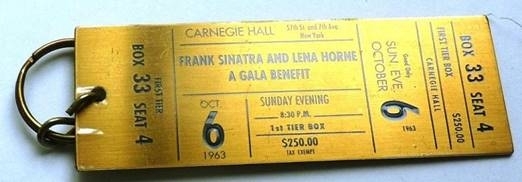
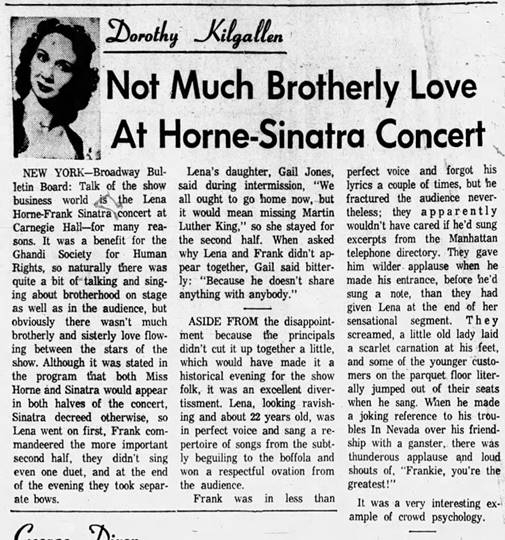
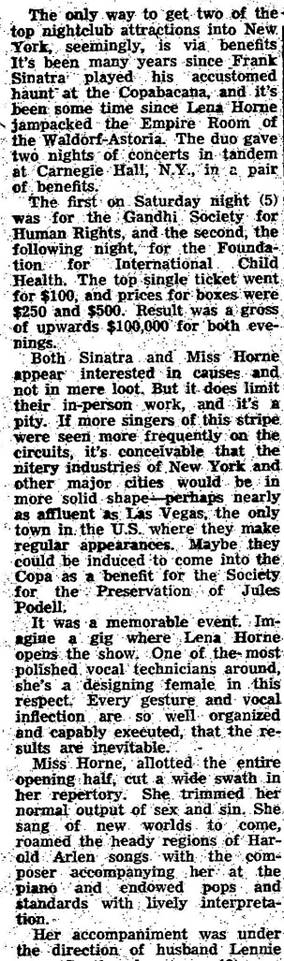
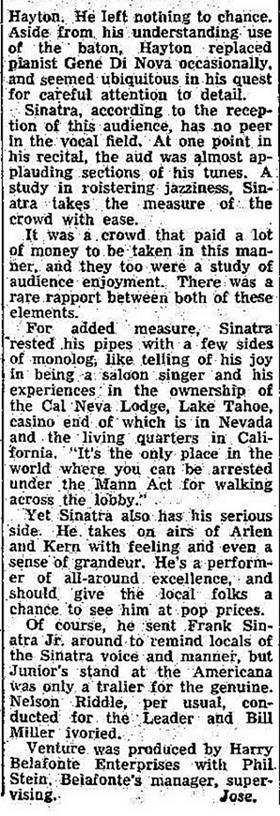
October 6, 1963
Concerts
Carnegie Hall , New York City (October 5-6) w/Lena Horn
Saturday evening and Sunday evening
35 piece orchestra
Lennie Hayton conducted for Lena Horne
Nelson Riddle conducted for Frank Sinatra
Benefit for the Gandhi Society for Human Rights and the Foundation for International Child Health Inc.
$50,000 was raised for the Gandhi Society and $100,000 for Child Health Inc.
October 7, 1963
[Sinatra withdraws from Nevada gaming]
Frank Sinatra: On October 7, through attorney Harry Claiborne, Frank officially withdrew from the Nevada gambling industry, issuing a statement saying he had planned all along to divest and had agreed to devote his time to his new entertainment company (Warner Bros.).
Source: James Kaplan, "Sinatra: The Chairman" (2015).
[Details behind the Nevada license revocation]
The Nevada Gaming Control Board's inquiry -- which led to Sinatra's Cal-Neva license revocation the same day he announced his divestiture -- had also documented board chairman Edward Olson's complaint that Sinatra used "highly insulting language" toward him during the hearings. Sinatra additionally sold his Sands Hotel interest that October for $43,500 per point, a large multiple of the roughly $5,000 per point he had originally paid. The Chicago Tribune mockingly editorialized that "the narrow-minded, sanctimonious, and bigoted state Gaming commission of Nevada has dealt a cruel and unjust blow to Frank Sinatra," and needled President Kennedy -- who had "permitted Frankie and Pack to take over provision of the entertainment at the Kennedy inauguration ball" -- to stand by his old friend now that "true friends will close ranks around Sinatra in his time of trouble."
Source: Kuntz and Kuntz, The Sinatra Files, ch. 6.
October 10, 1963
Facing revocation of his Nevada gaming license over having hosted Sam Giancana at the Cal-Neva Lodge — and after a heated exchange in which he told gaming commissioner Edward Olsen, “You're not even in the same class with me... don't mess with me” — Frank Sinatra announced he would surrender his license and his stakes in both Cal-Neva and the Sands rather than fight the board's findings. The forfeited holdings, worth an estimated $3.5 million, were sold to Warner Bros. as part of a new film-production deal. The Cal-Neva affair also ended Sinatra's longtime partnership and friendship with Hank Sanicola, who had objected to Giancana's presence at the lodge; after a blowup during a desert drive, Sinatra bought Sanicola out, handed over several music-publishing companies in the process, and never spoke to him again. Source: J. Randy Taraborrelli, Sinatra: Behind the Legend.
October 13, 1963
Studio
Los Angeles
2295 Have Yourself A Merry Little Christmas
w/Chorus
(Hugh Martin/Ralph Blane)
EMI Feist Catalog Inc. (ASCAP)
Arranged by Gil Grau
Orchestra Conducted by Gus Levene
(3:54) CD: 46013-2 The Complete Reprise Studio Recordings Disc 7
LP: R50,001 (Unedited)
45: 243 (Edited)
CD The Frank Sinatra Collection Reprise 8122795392 (CD)
Note: The orchestral track was recorded on April 30, 1963
Ed O'Brien re: R50,001 an album released in the fall of
Los Angeles
2295 Have Yourself A Merry Little Christmas w/Chorus
(Hugh Martin/Ralph Blane)
EMI Feist Catalog Inc. (ASCAP)
Arranged by Gil Grau
Orchestra Conducted by Gus Levene
(3:54) CD: 46013-2 The Complete Reprise Studio Recordings Disc 7
LP: R50,001 (Unedited)
45: 243 (Edited)
CD The Frank Sinatra Collection Reprise 8122795392 (CD)
Note: The orchestral track was recorded on April 30, 1963
Ed O'Brien re: R50,001 an album released in the fall of
[image referenced in source but could not be recovered]
[image not recovered — source caption: “Primary”]
[image referenced in source but could not be recovered]
[image referenced in source but could not be recovered]
with the title track being the Sinatra vocal from 10-13-63.
The other Christmas songs on the album were sung by Reprise
artists. Album had a very limited release.
© 1997-2025 The Sinatra Archive
This calendar, or any parts thereof, may not be reproduced in any fashion
whatsoever without the prior written permission of the publisher (The
Sinatra Archive)
October 14, 1963
Concerts
Madison Square Garden, New York, NY
Monday evening
Frank was the host/narrator for the Israel
Histadrut Anniversary.
A host of celebrities including Leslie Uggams performed. note: A friend was in attendance. Frank did a drop-dead ballad reading of "A Foggy Day," with a Riddle chart.
Madison Square Garden, New York, NY
Monday evening
Frank was the host/narrator for the Israel Histadrut Anniversary. A host of celebrities including Leslie Uggams performed. note: A friend was in attendance. Frank did a drop-dead ballad reading of "A Foggy Day," with a Riddle chart.
------------------------------------------------------
October 14, 1969 FRANK SINATRA JR, with FAMILY & FRIENDS CBC BROADCAST(Canada) 9:30 P.M. -10:30 P.M.
GUESTS: Frank Sinatra, Nancy Sinatra, Jack Benny, Sammy Davis, Jr, Jack E. Leonard & others
NOTE: Why was Jr's show aired in Canada five days before the CBS broadcast in America ? MPC Production was a British Co, Perhaps they offered it to Canada as a gesture of loyalty
October 18, 1963
Studio
Warner Brothers Sound Studio, Los Angeles , California
Sound-stage recording for the movie "Robin and The 7 Hoods"
Arranged and conducted by Nelson Riddle
"Don't Be a Do-Badder" (Finale) (1:07)
Frank Sinatra, Dean Martin, and Sammy Davis, Jr.
NOTE: Sinatra Scholar Ed O'Brien, who provided the above information, says that the Sinatra in Hollywood multi-cd set has a bonus vocal tracking session that runs 5:28.
October 21, 1963
[Gene Kelly quits Robin and the 7 Hoods]
Dorothy Kilgallen: Dorothy Kilgallen reported on the twenty-first that Gene Kelly had left the Robin and the 7 Hoods production after discovering Sinatra wouldn't give him free rein as producer; disputes over the number of musical numbers and the need for rehearsals led Kelly to depart, later saying he'd been 'taking orders,' and Sinatra took over as sole producer.
Source: James Kaplan, "Sinatra: The Chairman" (2015).
October 22, 1963
In the middle of the Sinatra and Basie recording date, work stopped so everyone could watch Frank Jr. make his first guest appearance on The Jack Benny Program on a TV set up in the studio; Frank was so proud he wired Jack Benny, "Thanks, Jack. Frankie's Father.". Source: Nancy Sinatra, "Frank Sinatra, My Father" (1985).
Having decided not to contest the charges, Sinatra had his Nevada gaming license formally revoked at a hearing in Carson City, with orders to divest his Las Vegas and Lake Tahoe holdings by January 5, 1964. Columnist Robert Ruark, who had broken a story about Sinatra's 1947 Havana trip, called the decision hypocritical, describing it as an outrageous overreaction. (Source: Richard Havers, "Sinatra" (Dorling Kindersley, 2007).)
October 24, 1963
Sinatra recorded "I Like to Lead When I Dance" with Nelson Riddle for "Robin & The Seven Hoods." Songwriter Sammy Cahn later recalled Sinatra loved the song and promoted it at parties, but ultimately refused to learn the lip-sync choreography, causing it to be cut from the film; an exasperated Cahn sent him a note reading, "God will punish you.". (Source: Richard Havers, "Sinatra" (Dorling Kindersley, 2007).)
October 27, 1963
Frank Sinatra, Bing Crosby, and Dean Martin shared a laugh during the taping of an episode of The Bing Crosby Show, photographed by Gene Trindl.
Source: Andrew Howick, Sinatra: The Photographs (New York: Abrams, 2015).
October 31, 1963
[Robin and the 7 Hoods begins filming]
Production of Robin and the 7 Hoods began on Halloween with location shooting in Chicago, then shifted to the Warner Bros. lot, where the shoot proceeded smoothly under director Gordon Douglas, running a day ahead of schedule by the third week of November.
Source: James Kaplan, "Sinatra: The Chairman" (2015).
Frank brought the Summit to Chicago to film Robin and the 7 Hoods with Sammy Davis Jr., Bing Crosby, and Edward G. Robinson; the group's nightly shows at the Villa Venice became a major cultural event in the city.
Source: Nancy Sinatra, Frank Sinatra: An American Legend, 1995.
November 1963
[Coconut Grove Outing To See Johnny Mathis]
Fifteen-year-old Tina, her mother, and her boyfriend Roger Reynolds went to see singer Johnny Mathis perform at the Coconut Grove, staying out late enough that Tina was allowed to skip school the next day.
Source: Tina Sinatra, "My Father's Daughter: A Memoir" (2000).
[JFK Assassination Delays "Robin and the Seven Hoods" Production]
Bing Crosby later recalled that filming of "Robin and the Seven Hoods," in which he joined the "Summit" as a guest star, was thrown into disarray by delays coinciding with President Kennedy's assassination.
Source: Nancy Sinatra, "Frank Sinatra, My Father" (1985).
[Consiglio at JFK's funeral procession]
Consiglio: Through his friendship with Peter Lawford, Consiglio obtained a special pass giving him close access to President Kennedy's funeral procession, where he photographed the coffin as it passed.
Source: Tony Consiglio (as told to Franz Douskey), "Sinatra and Me: The Very Good Years" (2012)
[Peter Lawford on Sinatra missing the funeral]
Peter Lawford: Peter Lawford recalled that Sinatra was broken up after talking to Pat and would have given anything to attend Kennedy's funeral, but it wasn't possible to invite him since he'd already become too much of an embarrassment to the family.
Source: James Kaplan, "Sinatra: The Chairman" (2015)
[Seated beside de Gaulle at JFK's funeral]
Consiglio: At Kennedy's funeral, Consiglio was seated next to a tall man in a plain military uniform he didn't recognize; Pierre Salinger later told him it had been French President Charles de Gaulle. Consiglio called it one of the saddest times of his life.
Source: Tony Consiglio (as told to Franz Douskey), "Sinatra and Me: The Very Good Years" (2012)
[Sinatra retreats to Palm Springs after assassination]
George Jacobs: For three days after the assassination, Sinatra holed up in his Palm Springs bedroom watching coverage, reacting to Oswald's shooting by Ruby, eating little but fried-egg sandwiches, and drinking heavily, per valet George Jacobs.
Source: James Kaplan, "Sinatra: The Chairman" (2015)
[Sinatra's impromptu tolerance speech on set]
Kaplan: When filming resumed the week after the assassination, Frank overheard cast and crew making dark jokes about Dallas and gave an impassioned impromptu speech over the soundstage PA pleading for tolerance, drawing stunned silence then spontaneous applause; Hollywood trade papers covered it.
Source: James Kaplan, "Sinatra: The Chairman" (2015)
[Sinatra's response to Kennedy family]
George Jacobs: Sinatra called Pat Lawford to offer condolences but still refused to speak to Peter Lawford, and did not call Jackie or Bobby Kennedy, who he said wouldn't return his calls; he sent an enormous floral display instead and told George Jacobs he'd genuinely liked Jack.
Source: James Kaplan, "Sinatra: The Chairman" (2015)
[Subdued Thanksgiving at Palm Springs]
Tina Sinatra: Thanksgiving 1963 at the Palm Springs compound was subdued, with Tina Sinatra recalling her father repeatedly saying the assassination shouldn't have happened anywhere, but certainly not in America, while Nancy senior cooked her usual turkey dinner.
Source: James Kaplan, "Sinatra: The Chairman" (2015)
November 13, 1963
Studio
Los Angeles
ROBIN AND THE 7 HOODS WARNER BROS.
Wednesday
Arranged and conducted by Nelson Riddle
My Kind Of Town
TCM aired the film last Saturday. I watched a little bit of it including "My Kind Of Town."
I had forgotten how different Frank's reading was in his initial effort. It is almost sedate in
comparison to what we would be hearing a few years later. The driving chart done on
his yearly TV shows is filled with an energy missing from the Warner recording. And
a lot of Sinatra-isms had crept into the song by then. The Billy Byers chart later on down
the road was even more exciting. Interesting how this tribute song evolved.
Ed
[Sinatra records "My Kind of Town"]
On the night of November 13, at Warner Bros., Frank recorded the Cahn and Van Heusen song 'My Kind of Town' for Robin and the 7 Hoods, the film's one certifiably great song, singing in great voice and full of confidence.
Source: James Kaplan, "Sinatra: The Chairman" (2015).
November 14, 1963
Studio
Los Angeles
ROBIN and the 7 HOODS Warner Bros.
Thursday
Arranged and conducted by Nelson Riddle
Mister Booze w/ Bing Crosby, Dean Martin, Sammy Davis Jr. & Chorus
November 20, 1963
Warner Bros. Studios, Stage #4 (INT. Robbo's Office / Lemp Home and Church / Midwest Street), Burbank
[Robin and the 7 Hoods daily production report]
Warner Bros.' daily production and progress report for Robin And The 7 Hoods, Wednesday, November 20, 1963 (production day 14 of 33, on schedule; director Gordon Douglas, supervisor Howard W. Koch/F. Sinatra). Company called 10:00 a.m., shooting started 11:53 a.m., finished 6:45 p.m. Cast working that day included Frank Sinatra, Dean Martin, Sammy Davis Jr., Bing Crosby, Barbara Rush, Peter Falk, Robert Foulk, Victor Buono, Allen Jenkins, Jack La Rue, and others. A dance rehearsal unit also rehearsed the music spots "Charlotte Couldn't Charleston," "My Kind Of Town," and "I Like To Lead When I Dance."
"I Like To Lead When I Dance" was rehearsed on this date but never actually filmed.
Source: Warner Bros. Studios' Robin And The 7 Hoods daily production report for Wednesday, November 20, 1963, reproduced in "Frank Sinatra In Hollywood (1940-1964)" (Reprise Records/Rhino, 2002), 6-CD box set booklet.
November 21, 1963
[Cemetery scene shot before assassination]
Frank Sinatra Jr.: According to Frank Sinatra Jr.'s DVD commentary, the Robin and the 7 Hoods cemetery scene was actually shot on November 21, the day before the Kennedy assassination, not on the day itself as often mythologized; Frank reportedly leaned against a tombstone inscribed with the name John F. Kennedy (a different, unrelated grave).
Source: James Kaplan, "Sinatra: The Chairman" (2015).
November 22, 1963
Sinatra was on a Burbank soundstage filming a cemetery scene for Robin and the Seven Hoods when word reached the set that President Kennedy had been shot in Dallas. Stunned, he took a series of long solitary walks away from the crew and placed a call to the White House switchboard, where, despite his fame, he was just one of thousands of callers trying to get through amid the chaos. He returned to the crew and told them, "Let's shoot this thing, 'cause I don't want to come back here anymore." After the scene wrapped he flew to Palm Springs and reportedly "virtually disappeared" for three days, speaking to almost no one. He would later say of Kennedy, "For a brief moment, he was the brightest star in our lives. I loved him." Source: Michael Sheridan & David Harvey, Sinatra and the Jack Pack.
[Sinatra on set when JFK assassinated]
On November 22, Sinatra was filming a courtroom scene on a Warner soundstage (with Mickey Rudin cameoing as the judge) when word of President Kennedy's assassination reached the set; stunned into silence, he had an aide try to get him the White House, then told the crew to finish the scene because he didn't want to return.
Source: James Kaplan, "Sinatra: The Chairman" (2015).
[Filming halts briefly after assassination news]
Production stopped for about half an hour after the assassination news broke; when filming resumed, veteran actor Jack La Rue fainted and had to be revived, and Gordon Douglas shot nine more setups before Frank went home at 2:50 p.m.
Source: James Kaplan, "Sinatra: The Chairman" (2015).
[Las Vegas entertainment blackout]
Variety: Variety reported a twenty-four-hour blackout of all Las Vegas entertainment went into effect after Kennedy's death was announced, with casino gambling coming almost to a halt that afternoon.
Source: James Kaplan, "Sinatra: The Chairman" (2015).
[Evelyn Lincoln and JFK's fatal trip]
Consiglio: Consiglio notes that Evelyn Lincoln, Kennedy's devoted personal secretary, had pleaded with the president not to travel to Dallas on November 22, 1963, the day he was assassinated. She remained loyal to his memory and never publicly discussed his personal life, later writing a dignified memoir of her White House years.
Source: Tony Consiglio (as told to Franz Douskey), "Sinatra and Me: The Very Good Years" (2012).
[News of JFK's assassination reaches Frank]
Consiglio: Frank was asleep during filming of Robin and the 7 Hoods when news of Kennedy's assassination broke on the radio; Consiglio woke him with the news and then called the White House. Later that day Evelyn Lincoln told him to come to Washington, where she issued him a special pearl-marked credential badge granting top clearance for the funeral.
Source: Tony Consiglio (as told to Franz Douskey), "Sinatra and Me: The Very Good Years" (2012).
November 25, 1963
At President Kennedy's state funeral, Sinatra -- despite the nights spent together, the shared secrets, and everything he had done for Kennedy's campaign and inauguration -- was not, despite Kenny O'Donnell's efforts on his behalf, invited to take his place among the ranks of "close friends of the family" specified in the State Department's official order of precedence for the procession to Arlington. Peter Lawford, by contrast, positioned himself in the second row of mourners, standing behind Jackie and Ted Kennedy, for what became one of the funeral's most photographed moments. Source: Michael Sheridan & David Harvey, Sinatra and the Jack Pack.
November 26, 1963
A planned benefit for Dr. Martin Luther King Jr. at the Santa Monica Civic Auditorium, featuring Frank, Frank Jr., and the Count Basie band, was canceled in the aftermath of the Kennedy assassination.
Source: Nancy Sinatra, Frank Sinatra: An American Legend, 1995.
December 1963
[Press Conference After the Kidnappers' Capture]
Sinatra spoke to reporters following the capture of the men who had kidnapped his son, Frank Sinatra Jr., reflecting that the ordeal's uncertainty had made it especially frightening.
Source: Charles Pignone, "Frank Sinatra 100" (2015).
[4 for Texas panned by critics]
Time magazine: The film "4 for Texas," starring Sinatra and Dean Martin with Anita Ekberg and Ursula Andress, premiered the same week as "I Want to Hold Your Hand" and was savaged by critics. Time magazine mocked it as a lazy "Clanbake" made by Frankie and his friends, not much fun to watch.
Source: James Kaplan, "Sinatra: The Chairman" (2015)
[Ava Gardner's reaction in Mexico]
Nelly Barquette: In Mexico after finishing The Night of the Iguana, Ava Gardner learned of the kidnapping and, per an acquaintance's account relayed by biographer Lee Server, cried out that the boy could have been her own son, and confided she was still in love with Frank Sinatra and it hurt to be in love with someone she couldn't have.
Source: James Kaplan, "Sinatra: The Chairman" (2015)
[Brooch gift to Jackie Kennedy]
Kaplan: In a spirit of solemn generosity over the holidays, Sinatra sent Jacqueline Kennedy a brooch for Christmas. She wrote back a warm thank-you note, thanking him for the pin and expressing deep happiness that his son had been returned safely, and gratitude for all Sinatra had done for and believed in JFK.
Source: James Kaplan, "Sinatra: The Chairman" (2015)
[Frank Jr. bonds with captors during ordeal]
Barry Keenan: Barry Keenan recalled that by this point Frank Jr. had calmed down and was joking with his captors, telling them he hoped they'd get away with it and that they had guts.
Source: James Kaplan, "Sinatra: The Chairman" (2015)
[Frank Jr. defies kidnappers on realizing the truth]
Frank Sinatra Jr.: Once Frank Jr. realized he had actually been kidnapped, he refused to give up his father's private phone number, telling Keenan to shoot him rather than expect cooperation.
Source: James Kaplan, "Sinatra: The Chairman" (2015)
[Frank Jr. initially cooperates with kidnappers]
Kaplan: Believing at first he was merely a robbery hostage, Frank Jr. cooperated with Keenan and Amsler, even agreeing to take sleeping pills with whiskey to appear passed out if police stopped their car; during the getaway Amsler briefly knocked himself unconscious running into a tree branch while fleeing a police roadblock on foot.
Source: James Kaplan, "Sinatra: The Chairman" (2015)
[Sinatra approaching age 48]
Kaplan: Staring down age fifty, Sinatra was about to turn forty-eight in December 1963, richer than ever but increasingly isolated and suspicious despite his vast success.
Source: James Kaplan, "Sinatra: The Chairman" (2015)
[Wrong suspects captured near Tahoe]
Kaplan: Police captured escaped convicts Sorce and Keating twenty miles from the kidnap scene, but when the FBI showed their photos to John Foss, he could not identify them as the kidnappers, leaving investigators without a solid lead.
Source: James Kaplan, "Sinatra: The Chairman" (2015)
December 3, 1963
Studio
Los Angeles - Evening
2448 Talk To Me Baby
(Johnny Mercer/Robert Dolan)
Twentieth Century-Fox Music Corp. (ASCAP)
Arranged & Conducted by Don Costa
(2:58) CD: 46013-2 The Complete Reprise Studio Recordings Disc 7
CD: 1013-2Softly As I Leave You
LP: FS1013Softly As I Leave You
45: 0249
FRANK SINATRA……………………..TALK TO ME BABY
(Reprise)……………………………………….. Stay With Me
Frank. Sinatra’s “TALK TO ME. BABY” ( Commander*) is a solid
ballad entry from the “Foxy” legituner and this slice gives it standard
stature and high spinning potential.
“Stay With Me” (Chappell*) gives the theme from “The Cardinal” pic
some fine lyric touches and the side should do well.
Variety
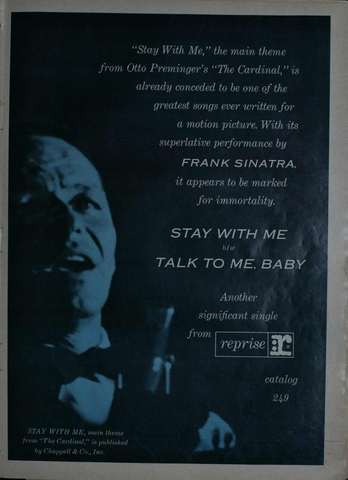
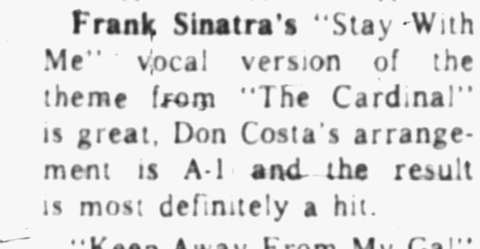
Ad
[Recording "Style" with Dean and Sammy]
Five days after Thanksgiving and eleven days after the assassination, on the night of December 3, Sinatra, Martin, and Davis recorded Cahn and Van Heusen's stylish trio number 'Style' for Robin and the 7 Hoods.
Source: James Kaplan, "Sinatra: The Chairman" (2015).
["Style" recording session -- take-by-take account]
The warm, friendly banter between Frank Sinatra, Bing Crosby, and Dean Martin during the recording of "Style" is priceless -- a genuinely affectionate group working without an audience, uncontrived, closely miked so that the friends can be heard whispering back and forth. As the orchestra tunes up, Sinatra is impatient: "OK, let's roll 'em... It's eight o'clock already!" As Dean and Bing laugh off his eagerness, he goads Nelson Riddle and the engineers: "Are we rolling?"
Take One of the first section reflects that hastiness. The playback confirms it, and before the equally sloppy second take dies off, Sinatra realizes the importance of concentrating on the work at hand: "Once more, while you're rolling," he directs. Fifty-three seconds later the take is complete; the musical overring has barely subsided when Sinatra announces his verdict: "Next portion."
"Wanna hear that back?" asks Riddle. "Nope," Sinatra snaps. "Takes too long... Right away -- go ahead." Sinatra tries to get away with a single take of the second section. "Next," he says. Riddle, having heard an errant note, makes a request:
RIDDLE: Can we get one more on that...
SINATRA: No.
RIDDLE: One? Just one?
SINATRA: No!
RIDDLE: Just one? I wanna fix something in the band that matches what you sing a little bit better... it'll take one second.
SINATRA: [Reluctantly] All right.
As Riddle explains the changes to the musicians, a side conversation develops between Sinatra and Dean Martin:
MARTIN: [Whispering] Where you going?
SINATRA: [Impatiently] I'm goin' to the restaurant to eat. I want a drink.
MARTIN: Jeez, I thought there was something bothering you. Where you eating?
SINATRA: A French joint... The Bistro.
Fifteen minutes later the trio departs, leaving the technicians and film editors to clean up and assemble the approved takes for the final film.
It was on these same session reels that producers also found the Rat Pack's vocal recording session for "Don't Be A Do-Badder," an authentic glimpse of the trio at work.
Source: Charles L. Granata, "Restoring the Voice of Hollywood," liner notes essay in "Frank Sinatra In Hollywood (1940-1964)" (Reprise Records/Rhino, 2002), 6-CD box set booklet.
December 6, 1963
Concerts
Civic Auditorium, Santa Monica, CA
Stars For Freedom
Sinatra, Dean Martin, Sammy Davis Jr.
Civic Auditorium, Santa Monica, CA
Stars For Freedom
Sinatra, Dean Martin, Sammy Davis Jr.
The concert that was to have taken place at the Santa Monica Civil Auditorium in Santa Monica, CA featuring Frank Sinatra, Dean Martin and Sammy Davis Jr., all of whom are featured in photo on poster. Count Basie & His Orchestra were also scheduled to perform. Due to President John F. Kennedy's assassination just days prior to the scheduled concert date, it was cancelled, later being rescheduled for Dec. 6, 1964. Concert was conceived as a fundraiser to benefit the Southern Christian Leadership Conference (SCLC), the Congress of Racial Equality (CORE) and the National Association for the Advancement of Colored People (NAACP).
The connection between the Civic Auditorium and Hollywood established by the Academy Awards broadcasts brought Dr. Martin Luther King Jr. to the Civic Auditorium on December 6, 1963, when he attended a Stars for Freedom event. This was Dr. King’s second visit to the Civic Auditorium; the first was two years earlier on invitation of the Calvary Baptist Church and the Santa Monica Business and Professional Men’s Council to be the keynote speaker at a civil rights rally and news conference hosted at the Civic Auditorium.43 Addressing a crowd of 1,500 people at the 1961 event, Rev. Dr. King delivered a version of his speech, The Future of Integration. The 1963 Stars for Freedom concert, so named by Dr. King acknowledging the notable support of many well-known actors led by Harry Belafonte, Sidney Poitier, Sammy Davis Jr., and others at the recent March on Washington where he delivered his I Have a Dream speech, was a direct result of those events. Beloved Black stars along with white performers who were civil rights allies, used their celebrity to bring positive attention to the movement and raise funds urgently needed to continue the work. One scholar observed, “[w]ithout the involvement of the Stars for Freedom, the civil rights movement would have been far more isolated, insolvent, and persecuted, and the struggle to achieve its political, economic, and cultural goals would have been far more protracted.” The program was organized by Sammy Davis Jr., who explained his commitment at a press conference at Warner Brothers: “It’s easy to praise the accomplishments of the courageous workers in the great civil rights organizations, but in the face of police dogs, houses, and jails, the one kind of support that has real, practical meaning is money to keep going.” Davis enlisted his famous friends Frank Sinatra, Dean Martin, Count Basie, and Nelson Riddle to perform with him at the Civic Auditorium, promising “a gang of unprogrammed surprises” for the finale. King, Davis, Sinatra, Martin, and Basie stayed on to host a backstage gala after the concert. The event grossed $45,675.60 for the NAACP, the Southern Christian Leadership Conference (SCLC), and the Congress of Racial Equality (CORE).
[image referenced in source but could not be recovered]
[image referenced in source but could not be recovered]
[image referenced in source but could not be recovered]
[image referenced in source but could not be recovered]
[image referenced in source but could not be recovered]
[image referenced in source but could not be recovered]
December 8, 1963
During a snowstorm at Harrah's Lake Tahoe, where Frank Sinatra Jr. was appearing with Sam Donahue and Tommy Dorsey band alumni, Barry Keenan and Joseph Amsler forced their way into his room posing as a room-service delivery. At gunpoint, Keenan robbed Sinatra Jr. and his dinner companion, trumpeter John Foss, of what little cash they had, taped Foss to a chair, and marched the blindfolded Sinatra Jr. into a blizzard and into a waiting car, telling him it was a robbery gone wrong rather than a kidnapping. Foss freed himself and alerted the hotel within minutes; by 10:20 p.m. police and state troopers were swarming the property. Sinatra Jr.'s manager, too afraid of Frank Sinatra's temper to call him directly, had Nancy Sinatra Sr. break the news to her ex-husband instead. Source: J. Randy Taraborrelli, Sinatra: Behind the Legend.
[Frank Sinatra Jr. kidnapped at Harrah's Tahoe]
On Sunday, December 8, around 9:30 p.m., Frank Sinatra Jr., performing at Harrah's South Shore Room in Tahoe, was abducted from his hotel suite at gunpoint by Barry Keenan and Joe Amsler, who posed as room service; the pair took only $20 from Frankie and trumpeter John Foss before binding Foss and taking Frankie, inadvertently leaving their gun behind.
Source: James Kaplan, "Sinatra: The Chairman" (2015).
[Foss alerts hotel; Frank senior notified]
John Foss freed himself and alerted the Harrah's front desk and manager Tino Barzie, who called Big Nancy instead of Frank directly; Nancy told gossip columnist Rona Barrett the news before phoning Frank in Palm Springs, who reacted with disbelieving shock.
Source: James Kaplan, "Sinatra: The Chairman" (2015).
[Frank flies through blizzard to Reno]
Frank chartered a plane and flew through a blizzard to Reno despite his fear of flying, was met by DA William Raggio, and after blizzard conditions blocked the road to Harrah's, set up at the Mapes Hotel with Mickey Rudin, Jack Entratter, Jim Mahoney, Jilly Rizzo, and five FBI agents to await a ransom call.
Source: James Kaplan, "Sinatra: The Chairman" (2015).
[Calls of support pour in during vigil]
As Frank waited by the phone that night, Bobby Kennedy called promising Justice Department priority, Sam Giancana offered his own investigation (which Frank declined), Pierre Salinger and Governor Pat Brown called, and J. Edgar Hoover ordered Sinatra not to speak to the press.
Source: James Kaplan, "Sinatra: The Chairman" (2015).
December 9, 1963
After a harrowing overnight drive through the blizzard — including a roadblock stop in which a police officer shone a flashlight directly on a drugged, blindfolded Frank Sinatra Jr. without recognizing him — kidnappers Barry Keenan and Joseph Amsler reached a hideout house in Canoga Park, California, and finally admitted to their captive that it was a real kidnapping. An enraged Sinatra Jr. refused to cooperate further, telling Keenan, “Go ahead, shoot me. You want to kill Frank Sinatra's son? Do it then.” Meanwhile, in Reno, Frank Sinatra Sr. spent the night chain-smoking and fielding calls from FBI agents, Bobby Kennedy, and Sam Giancana, none of whom yet had any real information. Source: J. Randy Taraborrelli, Sinatra: Behind the Legend.
[Monday headlines: kidnapping and Pan Am crash]
Monday morning newspapers carried the kidnapping story alongside coverage of a Pan Am 707 crash near Elkton, Maryland that killed all eighty-one aboard; police sought escaped convicts Joseph Sorce and Thomas Keating as possible suspects in the kidnapping.
Source: James Kaplan, "Sinatra: The Chairman" (2015).
[Mahoney statement: Sinatra ready to deal]
Jim Mahoney: Publicist Jim Mahoney issued a statement to the press on Monday saying Sinatra was ready to make a deal with the kidnappers, no questions asked.
Source: James Kaplan, "Sinatra: The Chairman" (2015).
[Dean Torrence learns of the kidnapping]
Dean Torrence: On Monday morning, Barry Keenan called Dean Torrence to tell him Frank Sinatra Jr. had been kidnapped from Lake Tahoe; Torrence was thunderstruck, realizing his friend had actually carried out the plan he'd described months earlier.
Source: James Kaplan, "Sinatra: The Chairman" (2015).
[First ransom call to Mapes Hotel]
At 4:45 p.m. on Monday, a deep-voiced caller reached Frank at the Mapes Hotel, confirmed his identity, asked if he'd be available at 9 a.m. the next day, and assured him his son was in good shape before hanging up.
Source: James Kaplan, "Sinatra: The Chairman" (2015).
December 10, 1963
Kidnapper John Irwin telephoned Frank Sinatra's hotel suite to open ransom negotiations, at one point putting a distraught Frank on a brief, recorded call with his son (“Are you okay, Frankie?”) before naming a demand of $240,000 — a curiously modest figure given who they had taken. Sinatra, incredulous, offered to simply give them a million dollars outright to end the ordeal faster; Irwin declined, insisting, “We're not gonna take advantage of you, Mr. Sinatra. We just need $240,000.” Sinatra arranged for the cash — every bill photographed by the FBI — through his banker friend Al Hart at City National Bank. Source: J. Randy Taraborrelli, Sinatra: Behind the Legend.
[Irwin puts Frank Jr. on the phone]
On Tuesday morning around nine, kidnapper John Irwin called again and put Frank Jr. briefly on the line with his father before taking over the call himself; Sinatra tried to negotiate a deal, but Irwin said he couldn't discuss terms until around 2 p.m.
Source: James Kaplan, "Sinatra: The Chairman" (2015).
[FBI agent recalls Sinatra breaking down]
John Parker: Former FBI agent John Parker recalled Sinatra breaking down in tears after a difficult ransom call, pleading 'I just want my kid back,' and said the moment convinced him Sinatra had no real mob connections, since he'd have used them if he did.
Source: James Kaplan, "Sinatra: The Chairman" (2015).
[Carson City gas station instructions]
Barry Keenan: Per Barry Keenan's later account, the kidnappers directed Frank to a pay phone at a Carson City gas station; a confused, angry gas station attendant fielded several calls for 'Frank Sinatra' before FBI cars arrived and Frank himself jumped out to take the call, at which point Irwin gave the next instructions.
Source: James Kaplan, "Sinatra: The Chairman" (2015).
[Ransom set at $240,000]
Irwin told Sinatra the kidnappers wanted $240,000, a figure that struck Frank as strangely low; he offered an even million instead, but Irwin insisted they didn't want to take advantage of him and stuck with $240,000, directing him to Nancy's Bel Air house for further instructions.
Source: James Kaplan, "Sinatra: The Chairman" (2015).
[Al Hart assembles the ransom cash]
Sinatra had his banker Al Hart withdraw $240,000 from his account in varied denominations, 12,400 bills weighing twenty-three pounds; Hart's staff photographed every bill before packing it into a purchased valise and delivering it to Nancy's house.
Source: James Kaplan, "Sinatra: The Chairman" (2015).
[Frank flies back to Los Angeles]
On Tuesday at 6:00 p.m., Frank flew back to Los Angeles from Reno; the Nimes Road neighborhood was swarmed with press, and twenty-six FBI agents plus over a hundred LAPD officers worked the case, the biggest kidnapping since the Lindbergh baby.
Source: James Kaplan, "Sinatra: The Chairman" (2015).
[Tina Sinatra recalls parents' anguish]
Tina Sinatra: Fifteen-year-old Tina Sinatra recalled her mother refusing sedatives and nearly hysterical, while her father showed a chilling, frightened look she'd only seen once before, though he tried to conceal his fear to lead by example.
Source: James Kaplan, "Sinatra: The Chairman" (2015).
[Ransom drop through Los Angeles phone booths]
At 9:26 p.m. Irwin called directing Sinatra through a series of Los Angeles phone booths and gas stations; FBI agent Jerome Crowe, posing as courier 'Patrick Henry,' ultimately left the ransom valise between two parked school buses at a Sepulveda Boulevard Texaco station as instructed.
Source: James Kaplan, "Sinatra: The Chairman" (2015).
[Amsler panics and flees after ransom pickup]
Barry Keenan retrieved the ransom money, but Joe Amsler panicked after spotting what he thought was an FBI agent near the pickup site and fled, leading Irwin to briefly suspect Keenan had killed him.
Source: James Kaplan, "Sinatra: The Chairman" (2015).
December 11, 1963
Frank Sinatra and FBI agent Jerome Crowe delivered $239,985 in ransom money — the odd figure reflecting the cost of the valise it was carried in — following the kidnappers' instructions through a chaotic, multi-stop route ending between two parked school buses at a Los Angeles gas station, shadowed by FBI agents disguised in a Good Humor truck and taxicabs. Barry Keenan collected the money but lost track of accomplice Joseph Amsler, who fled after spotting what he thought was an FBI agent; amid the ensuing confusion, John Irwin — without telling Keenan — decided on his own to release Frank Sinatra Jr. Source: J. Randy Taraborrelli, Sinatra: Behind the Legend.
[Irwin releases Frank Jr. and calls it off]
John Irwin: At 2:00 a.m., exhausted and guilty, John Irwin called Sinatra at Nimes Road to say 'something has gone wrong' and that he had dropped Frank Jr. off near the San Diego Freeway and Mulholland Drive; Sinatra told Tina he would bring her brother home.
Source: James Kaplan, "Sinatra: The Chairman" (2015).
[Frank searches Mulholland overpass in vain]
Frank Sinatra: Driving alone but tailed by an FBI agent, Frank circled the Mulholland overpass repeatedly and found no sign of his son, returning to Nimes Road in tears, convinced the kidnappers had taken the money and killed Frankie.
Source: James Kaplan, "Sinatra: The Chairman" (2015).
[Keenan searches for Frankie too]
Barry Keenan: Barry Keenan, having lost track of both Irwin and Frankie and already having lost Amsler, panicked and drove around searching for the boy himself, passing Frank senior and an FBI agent on the road doing the same, his heart stopping as they passed unaware.
Source: James Kaplan, "Sinatra: The Chairman" (2015).
[Frank Jr. walks to safety]
Dropped on the wrong side of the freeway a quarter mile past the Mulholland overpass without being told his father was coming, Frank Jr. walked back across the overpass toward Bel Air, ducking into bushes whenever cars passed, still wearing his kidnappers' sleep mask around his neck.
Source: James Kaplan, "Sinatra: The Chairman" (2015).
[Private patrolman finds Frank Jr.]
About 2:30 a.m., Bel-Air Patrol officer George C. Jones spotted the young man flagging him down and recognized the notorious sleep mask; to dodge reporters camped outside the Nimes Road house, Jones had Frankie ride in the trunk of his patrol car.
Source: James Kaplan, "Sinatra: The Chairman" (2015).
[Frank Jr. reunited with his family]
Jones delivered Frank Jr. to the back door of 700 Nimes Road, telling Nancy Sinatra he had her boy safe in his trunk; Frankie emerged hungry but unharmed, embraced his mother, and apologized to his father, who replied there was nothing to apologize for.
Source: James Kaplan, "Sinatra: The Chairman" (2015).
[Frank addresses press before dawn]
Frank Sinatra: Close to 4 a.m. on Wednesday, December 11, Frank walked out to roughly 150 waiting reporters, apologized for the cold wait, and remarked that tomorrow being his birthday, this was the best present he could get.
Source: James Kaplan, "Sinatra: The Chairman" (2015).
[Family celebration after Frankie's return]
Tina Sinatra: Tina Sinatra recalled that after the FBI questioned Frankie, the family celebrated being together again; her mother drank an entire magnum of Dom Perignon by herself, and Frank left near dawn with Mickey Rudin as Nancy called after him to button his coat.
Source: James Kaplan, "Sinatra: The Chairman" (2015).
[Keenan distributes ransom cash and is arrested]
All day Wednesday, Barry Keenan drove around Los Angeles secretly stashing bags of ransom cash at the homes of friends and relatives, including his parents, ex-wife, and Dean Torrence; that night, FBI agents arrested Keenan at his girlfriend's parents' house in La Cañada after Joe Amsler's brother tipped off the FBI.
Source: James Kaplan, "Sinatra: The Chairman" (2015).
December 12, 1963
At 2 a.m., kidnapper John Irwin called Frank Sinatra to say he had released Frank Jr. near the San Diego Freeway at Mulholland — “You know you're a dead man, right?” Sinatra told him before hanging up. Unable to locate his son at the drop-off point (at one point passing panicked kidnapper Barry Keenan, unrecognized, as both men searched the same stretch of road), a devastated Sinatra returned to ex-wife Nancy's home believing the worst, only for a Bel-Air security guard to arrive minutes later with Frank Jr., who had hidden in the guard's car trunk to avoid photographers, safe in the trunk of his patrol car. Bobby Kennedy called the house personally to check on the family, effectively ending any lingering tension between him and Sinatra over the earlier Palm Springs snub. Source: J. Randy Taraborrelli, Sinatra: Behind the Legend.
[Sinatra's 48th birthday celebration at the Sands]
On the Saturday after the kidnapping, December 12, 1963, his 48th birthday and the 11th anniversary of the Sands (which had opened on his 37th birthday), Frank flew to Las Vegas aboard the Christina with Jill St. John, Dean Martin, and Yul Brynner, joining Sammy Davis Jr. and Danny Thomas onstage to a standing ovation and singing 'Luck Be a Lady.'
Source: James Kaplan, "Sinatra: The Chairman" (2015).
[Don Rickles' dark joke at the Sahara]
Don Rickles: In the early hours after the birthday celebration, comedian Don Rickles, catching Frank and his group at his late show at the Sahara, joked that the kidnappers had let Junior go because they heard him humming in the trunk.
Source: James Kaplan, "Sinatra: The Chairman" (2015).
December 14, 1963
Radio
Monitor 63
Saturday afternoon
Network: NBC
Time 4:00 PM - 5:00 PM
Host: Barry Nelson
Sinatra interview
Ed O'Brien supplied this radio entry and added the following: He discussed his early years, Crosby influence, debunked claim that bobby soxer hysteria was a press agent's creation. Frank remembered the girls gathering around the bandstand and swooning during the Dorsey years.
Nelson played excerpts from radio shows, memorable recordings. Sinatra explained his approach to acting.
He said acting was quite simple. You put yourself in character and then just listened and watched.He felt this made the performance honest, earnest and believable.Frank described his fascination with the business side of his career. He surrounded himself with highly accomplished professionals who guided him in the intricacies of the business of show business.
Surprisingly, Sinatra saw the end of his career as a performer coming to an end and a much greater role in his new position as a Warner Bros. executive.
Nelson closed the hour by playing Frank's Reprise recording of "Have Yourself A Merry Little Christmas."
There were also interviews with Howard Koch, Sammy
Davis, Jr, Dean Martin and Frank Jr.
Concerts
Sands 11th Anniversary
Frank Sinatra, Dean Martin, Sammy Davis Jr., Yul Brunner, and others
Note: Sinatra sang 3 songs including "Luck Be A Lady"
On the same day Frank Sinatra performed at the Sands' eleventh-anniversary show, word came that all three of his son's kidnappers were in FBI custody — Joseph Amsler's own brother had turned him in. Barry Keenan was arrested at his girlfriend's parents' home in La Cañada by fifteen FBI agents. “The night that we got the news that the kidnappers were in custody, we opened a magnum of champagne,” Nancy Sinatra recalled. “My mother, who doesn't drink, drank most of it.” Source: J. Randy Taraborrelli, Sinatra: Behind the Legend.
December 21, 1963
[First U.S. radio play of Beatles single]
DJ Carroll James of Washington's WWDC had Maryland teenager Marsha Albert introduce "I Want to Hold Your Hand" on his show, the first time the single was played on American radio, after Albert had written James urging him to get a Beatles record.
Source: James Kaplan, "Sinatra: The Chairman" (2015).
December 25, 1963
Film
"4 For Texas" (US Film
Release: December 25, 1963)
Starring: Frank Sinatra, Dean Martin, Anita Ekberg, Ursula Andress,
Charles Bronson, Victor Buono, and the Three Stooges
Produced and Directed by Robert Aldrich
Sinatra plays Zack Thomas and Dean Martin plays Joe Jarrett who are rivals in a bid to open a waterfront casino.
Each has a new romantic attachment, as well, with the beauties Elya (Anita Ekberg) and Maxine (Ursula Andress), respectively.
They eventually must join forces to hold off the villainous Matson (Charle Bronson) and a corrupt banker, Burden (Victor Buono),
to keep their new gambling boat afloat.
(1st DVD Release date: 2001-11-20)
[The Cinematic Legacy of Frank Sinatra — 4 For Texas (1963)]
David Wills's 2015 photo history The Cinematic Legacy of Frank Sinatra devotes a section to 4 For Texas (1963), illustrated with 1 behind-the-scenes and publicity photograph (posters, lobby cards, and on-set/on-location shots) filed here.
Source: David Wills, The Cinematic Legacy of Frank Sinatra (St. Martin's Press, 2015), p. 231.
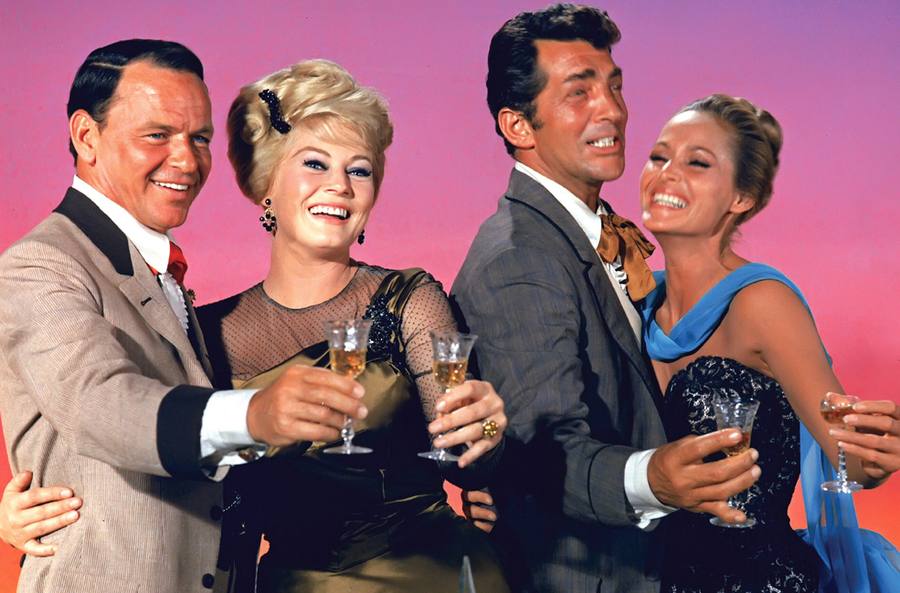
knew these questions were coming from / Frank.… We cued the music. He came out of the / door onto the street. People were walking by / and didn't realize it was Frank Sinatra, singing. / He walked the block, stepped off the curb, / flagged the first taxi that came along—and was / gone for the day.” (Photo: The Cinematic Legacy of Frank Sinatra, David Wills, 2015.)
"4 for Texas"
Released on Christmas Day 1963 as Sinatra's third film that year, this grade-Z Western continued the Rat Pack habit of using a number in the title. Santopietro calls its strong opening twenty minutes a frustrating glimpse of what the whole Rat Pack cycle could have been with more care.
Source: Tom Santopietro, "Sinatra in Hollywood" (2008).
"4 for Texas"
Director/producer/co-writer Robert Aldrich originally hired Ernest Laszlo (Kiss Me Deadly) as cinematographer but replaced him with Sinatra's favored lenser Joseph Biroc after Laszlo's slow, painstaking lighting setups frustrated both Aldrich and Sinatra.
Source: Tom Santopietro, "Sinatra in Hollywood" (2008).
"4 for Texas"
In a nod to daughter Nancy Sinatra's hit single "These Boots Are Made for Walkin'," Sinatra's character quips about boots "not built for walkin'" during the opening stagecoach sequence.
Source: Tom Santopietro, "Sinatra in Hollywood" (2008).
"4 for Texas"
Reports of serious friction between Sinatra and director Robert Aldrich during filming were significant enough that executive producer Howard Koch mentioned them at Aldrich's memorial service — an unusual thing to bring up in a eulogy.
Source: Tom Santopietro, "Sinatra in Hollywood" (2008).
"4 for Texas"
Time magazine (via Santopietro): Time magazine panned the film as a "Clambake" picture, criticizing the Rat Pack's onscreen clique for seeming bored with the outside world and even with each other, suggesting the follow-up should be titled "30." Santopietro calls the review harsh but largely accurate.
Source: Tom Santopietro, "Sinatra in Hollywood" (2008).
"4 for Texas"
Frank Sinatra: In a Playboy interview, Sinatra argued a performer must never seem indifferent to an audience, comparing an unresponsive performer to being "indifferent" to a woman — a philosophy Santopietro says the finished film itself fails to embody.
Source: Tom Santopietro, "Sinatra in Hollywood" (2008).
"4 for Texas"
Santopietro grades this a D, calling it the least of the Rat Pack films—"get the boys back to Vegas."
Source: Tom Santopietro, "Sinatra in Hollywood" (2008).
"4 for Texas"
Santopietro (Filmography): SAM Company/Warner Bros. Pictures. Produced and directed by Robert Aldrich, screenplay by Aldrich and Teddi Sherman, musical score by Nelson Riddle. Sinatra played Zack Thomas opposite Dean Martin, Anita Ekberg, Ursula Andress and Charles Bronson.
Source: Tom Santopietro, "Sinatra in Hollywood" (2008).
In the midst of her own grief over her husband's assassination a month earlier, Jacqueline Kennedy took the time to send Frank a personal note.
Source: Nancy Sinatra, Frank Sinatra: An American Legend, 1995.
December 26, 1963
[Capitol releases I Want to Hold Your Hand]
Capitol Records released "I Want to Hold Your Hand" backed with "I Saw Her Standing There" in the U.S., timed to capitalize on the radio buzz WWDC had generated. In the first three days it sold a quarter-million copies, roughly ten thousand an hour in New York City alone.
Source: James Kaplan, "Sinatra: The Chairman" (2015).
1964
[Bing Crosby Joins the Reprise Roster]
When Bing Crosby signed with Reprise, he told the press that Sinatra was "a King" and a sharp, keen record executive, and that he was happy to be associated with him.
Source: Nancy Sinatra, "Frank Sinatra, My Father" (1985).
[Dedication of the Frank Sinatra Youth Center, Nazareth]
The Frank Sinatra Youth Center for Christians, Moslems, and Jews is dedicated in Nazareth, Israel; Sinatra gives his first performance paired with Count Basie, at the Sands Hotel. He appears in "4 for Texas" and "Robin and the Seven Hoods."
Source: Nancy Sinatra, "Frank Sinatra, My Father" (1985).
[Performing With Basie's Band at the Sands]
Sinatra performed with Count Basie's band, conducted by Quincy Jones, at the Sands in Las Vegas.
Source: Charles Pignone, "Frank Sinatra 100" (2015).
[Sinatra Refuses To Forgive His Son's Kidnappers]
Nancy Sinatra: When a prison chaplain wrote asking the Sinatras to forgive two of the convicted kidnappers, Frank replied pointedly that the men's "hoax" defense had cast lasting suspicion on his son's honesty and that nothing had been done since the trial to undo that damage, declining to offer the forgiveness the letter had requested.
Source: Nancy Sinatra, Frank Sinatra: An American Legend, 1995.
[Quincy Jones and the Army-Uniform Eggs Question]
Nancy Sinatra: Quincy Jones recalled being put up in Dean Martin's old dressing room at Warner Bros. to write arrangements for a Sinatra-Basie project, working through an entire weekend without sleep. Around eight the next morning, Sinatra himself knocked on the door dressed in an Army uniform and asked Jones how he liked his eggs, a moment Jones said felt like waking up inside a dream.
Source: Nancy Sinatra, Frank Sinatra: An American Legend, 1995.
[The Kidnapping Trial's Collapsed 'Hoax' Defense]
Nancy Sinatra: At the trial of Frank Jr.'s kidnappers, defense attorneys tried to argue the abduction had been staged as a publicity stunt; the judge dismissed the theory within minutes, and the jury returned guilty verdicts on all counts, sentencing two of the men to life and the third to seventy-five years.
Source: Nancy Sinatra, Frank Sinatra: An American Legend, 1995.
[Tommy Sands Leaves Nancy Before Easter]
Just before Easter 1964, Tommy Sands and Nancy stayed at the Sands Hotel; the day after Easter Sunday, Sands packed a suitcase, told Nancy he was leaving and wanted her to get a divorce right away, and departed for good, having decided with a therapist to end the marriage.
Source: Nancy Sinatra, "Frank Sinatra, My Father" (1985).
["Wait Till You Hear This, Chicken"]
Nancy remembers rushing to her father's home to hear the newly finished America, I Hear You Singing, expecting him to play it in track order; instead he cued up the a cappella "The Hills of Home" first, telling her, "Wait till you hear this, Chicken, you're gonna fall down." She did.
Source: Nancy Sinatra, "Frank Sinatra, My Father" (1985).
[Early Sinatra-Farrow relationship in Palm Springs]
Kaplan: Sinatra and Farrow spent early weekends together in Palm Springs, often with friends Yul Brynner and Jack Entratter and Entratter's girlfriend Corinne Cole present. Sinatra called her Angel Face or Baby Face; she called him Charlie or Charlie Brown for his rounding, toupee-less head. He tried to interest her in golf and classical music, with mixed success.
Source: James Kaplan, "Sinatra: The Chairman" (2015)
[Farrow meets Sinatra's Hollywood social set]
Edie Goetz: Sinatra brought Farrow to Thanksgiving dinner at Bill and Edie Goetz's home, part of his more staid, older Hollywood social circle (also including Rosalind Russell, Freddie Brisson, and Claudette Colbert). Edie Goetz later observed that Farrow knew exactly what she wanted and intended to marry Sinatra, even though most others didn't take the romance seriously at first.
Source: James Kaplan, "Sinatra: The Chairman" (2015)
[George C. Scott assaults Ava Gardner]
Kaplan: While Ava Gardner was in Italy filming The Bible under John Huston, her co-star and lover George C. Scott, an alcoholic ex-marine married to a pregnant Colleen Dewhurst, beat her badly one night in Avezzano after she mentioned Sinatra's name; he apologized the next day, and she continued both the film and the relationship.
Source: James Kaplan, "Sinatra: The Chairman" (2015)
[Mia Farrow lands Peyton Place role]
Kaplan: Mia Farrow, previously best known for a Broadway revival of The Importance of Being Earnest and a brief film stand-in role in Guns at Batasi (filling in for Britt Ekland after Peter Sellers's heart attack), was cast in the pilot of Peyton Place as Allison MacKenzie, becoming an instant star.
Source: James Kaplan, "Sinatra: The Chairman" (2015)
[Mia Farrow visits the Von Ryan's Express set]
Kaplan: During breaks from Peyton Place, Mia Farrow began visiting the Von Ryan's Express soundstage, ostensibly to see actor John Leyton, and watched Sinatra film scenes with Raffaella Carrà. Accounts differ (hers versus Brad Dexter's) on how forward she was, but within the first week Sinatra invited her to join his entourage flying to Palm Springs.
Source: James Kaplan, "Sinatra: The Chairman" (2015)
[Puzo's The Fortunate Pilgrim published]
Kaplan: In 1964 Mario Puzo published his second novel, The Fortunate Pilgrim, an autobiographical story of an Italian-American family in Depression-era Hell's Kitchen; Kaplan draws a parallel between the novel's dominant mother figure and Dolly Sinatra. Puzo later said he based both that character and the Godfather, Vito Corleone, on his own mother.
Source: James Kaplan, "Frank: The Voice" (2010)
[Sammy Davis Jr. praises Olsen to his face]
Edward Olsen: A few months after the Cal-Neva affair, Ed Olsen ran into Sammy Davis Jr. at the Sands gift shop; Davis pulled him aside and, using language similar to Sinatra's own, praised Olsen for finally standing up to Frank after sixteen years of nobody having the guts to do so.
Source: James Kaplan, "Sinatra: The Chairman" (2015)
[Sinatra and Farrow's courtship begins]
Kaplan: Sinatra invited Farrow to a private screening of None but the Brave, where he held her hand; afterward he invited her to Palm Springs that night, which she declined, but he asked her to come the next day and offered to send his plane for her and her cat. She accepted, marking the start of their relationship.
Source: James Kaplan, "Sinatra: The Chairman" (2015)
[Sinatra buys Farrow a revolver]
Kaplan: After Farrow was followed by a suspicious car one night driving from Sinatra's L.A. apartment, Sinatra rushed to her aid armed, then bought her a pearl-handled revolver and took her target shooting in the desert; she proved a poor and unwilling shot, and he eventually decided she should avoid firearms.
Source: James Kaplan, "Sinatra: The Chairman" (2015)
[Sinatra distributes lavish gifts to his crew in Rome]
Brad Dexter: One weekend at the villa, Sinatra had Rome's finest haberdashers bring luxury goods for his entourage (Jilly Rizzo, Jack Entratter, Dick Bakalyan, Brad Dexter, publicist Jim Mahoney) to take freely; only Dexter declined, questioning why Sinatra needed to be so generous.
Source: James Kaplan, "Sinatra: The Chairman" (2015)
[Sinatra films of 1964]
Consiglio: 4 For Texas and Robin and the 7 Hoods were among Frank's films produced in 1964.
Source: Tony Consiglio (as told to Franz Douskey), "Sinatra and Me: The Very Good Years" (2012)
[Sinatra helped design the Sands baccarat pit]
Ed Walters: Walters says that when the Sands opened a baccarat game (which he dates to around 1964 or 1965) to accommodate European high rollers, Sinatra had a hand in decorating the room -- he was the only one connected to the Sands who had actually been to Europe and seen baccarat played there, so his input shaped how the pit was set up.
Source: Ed Walters, UNLV Table Games Management Oral History (2015)
[Sinatra reportedly sends protection for Ava]
Kaplan: After learning (through unclear means, since Ava hid it from him) of Scott's violence, Sinatra may have quietly sent three bodyguards who appeared on The Bible's set in Sicily; when Scott raised a hand to strike Ava again in Taormina, the men reportedly intervened and hauled him away, and he showed up subdued the next day.
Source: James Kaplan, "Sinatra: The Chairman" (2015)
[Sinatra walks off Von Ryan's Express set]
Kaplan: After demanding his scenes be shot consecutively and being told by director Mark Robson this would add cost and complication, Sinatra confronted him publicly in front of cast and crew, then walked off the set when Robson didn't immediately comply. Fox appeased him with a yacht cruise along the Italian coast while Robson stewed.
Source: James Kaplan, "Sinatra: The Chairman" (2015)
[Sinatra's cruelty toward the production secretary]
George Jacobs: Sinatra developed a crush on a married Italian production secretary in Cortina; when her husband visited and she introduced him to Sinatra, Sinatra signed his autograph on the back of her white cashmere sweater, a gift from her husband, reducing her to tears. He later had George Jacobs deliver three replacement cashmere sweaters to her without explanation or apology.
Source: James Kaplan, "Sinatra: The Chairman" (2015)
[Sinatra's helicopter tantrum at the Cerfs']
Christopher Cerf: In the summer of 1964, after a party at Bill and Judy Green's Westchester house, Sinatra demanded Bennett Cerf stop the car to visit Arlene Francis and Martin Gabel, who weren't home; Cerf refused to detour down the dark driveway, and an enraged Sinatra spent the night fuming, then called for a helicopter that landed on the Cerfs' lawn the next morning to fly him out. The friendship was unaffected within about a week.
Source: James Kaplan, "Sinatra: The Chairman" (2015)
[Sinatra's interest in Jobim begins]
Kaplan: Sinatra first expressed interest in recording Antonio Carlos Jobim's compositions in 1964, the year Stan Getz and Joao Gilberto's recording of 'The Girl from Ipanema' became an international hit and propelled Brazilian bossa nova to worldwide popularity.
Source: James Kaplan, "Sinatra: The Chairman" (2015)
[Sinatra's villa near Rome during filming]
Kaplan: Refusing to stay in Rome with the rest of the cast, Sinatra had Fox rent him an eighteen-room villa outside the city with a ten-foot wall, pools, and a helipad; he was helicoptered daily to location shooting in Cortina d'Ampezzo in the Dolomites while cast and crew drove.
Source: James Kaplan, "Sinatra: The Chairman" (2015)
[United Artists pulls The Manchurian Candidate from theaters]
Two years after its release, United Artists withdrew "The Manchurian Candidate" from circulation, a decision later followed by Sinatra buying the rights himself.
Source: Richard Havers, "Sinatra" (Dorling Kindersley, 2007).
[Fly Me to the Moon -- critical commentary]
Bart Howard; Quincy Jones (relaying Buzz Aldrin): Composer Bart Howard originally wrote the song as a slow waltz titled 'In Other Words'; Peggy Lee suggested the title change to 'Fly Me to the Moon.' Howard on Sinatra's rewrite: 'Frank changed the lyrics [and the song] so much, which normally would have annoyed the shit out of me -- but didn't because it worked so well.' Friedwald contrasts the 'soft-shoe' 1963 Basie-Jones instrumental with Sinatra's 'out-and-out two-footed stomp' vocal version, crediting Sinatra with establishing the song as a swing standard that later singers deliberately avoid by reverting to ballad tempo. Quincy Jones told Friedwald that Buzz Aldrin said Sinatra's 'Fly Me to the Moon' was the first music played on the moon, brought via portable tape player on the 1969 Apollo 11 mission.
Source: Will Friedwald, "Sinatra! The Song Is You: A Singer's Art" (2018 revised edition), Ch. 9, "Looking for the Hook" (1960-1971)
[I Can't Stop Loving You -- critical commentary]
Will Friedwald (analysis): Friedwald critiques this track as ill-suited to Sinatra, citing 'forced twang' vocal affectations attempting a country-song feel; the arrangement was essentially transplanted wholesale from the Grammy-winning Basie-Jones instrumental version (itself modeled on Ray Charles's Modern Sounds in Country and Western Music recording of Don Gibson's 1958 song), rather than reconceived for Sinatra's voice.
Source: Will Friedwald, "Sinatra! The Song Is You: A Singer's Art" (2018 revised edition), Ch. 9, "Looking for the Hook" (1960-1971)
[I Can't Stop Loving You / I Believe in You -- critical commentary]
Quincy Jones: Jones's Sinatra-Basie album leaned tighter and jazzier than Hefti's, with more contemporary tunes including 'Fly Me to the Moon.' Sinatra included 'I Can't Stop Loving You' because Jones had just won his first Grammy for a Basie arrangement of the song; strings were added to some tracks after the main sessions were complete.
Source: Charles L. Granata, "Sessions with Sinatra: Frank Sinatra and the Art of Recording" (1999/2003), Part IV: The Reprise Years
[It Might as Well Be Swing -- critical commentary]
Quincy Jones: The second Sinatra-Basie album, It Might as Well Be Swing (1964), was arranged by Quincy Jones, who had first met Sinatra in 1958 conducting a Sinatra concert in Monte Carlo. Jones recalls Sinatra calling him from Hawaii (while filming None But the Brave, flying a giant Jack Daniels flag over his bungalow) to invite him to do the Basie album.
Source: Charles L. Granata, "Sessions with Sinatra: Frank Sinatra and the Art of Recording" (1999/2003), Part IV: The Reprise Years
[It Might as Well Be Swing -- critical commentary]
Granata's discography entry: It Might as Well Be Swing (with Count Basie), arranged by Quincy Jones, released August 1964.
Source: Charles L. Granata, "Sessions with Sinatra: Frank Sinatra and the Art of Recording" (1999/2003), Afterword & Appendices A-D
[Stay with Me -- critical commentary]
Friedwald (analysis): A minor Sinatra single (peaked at #81) that Friedwald says became important to fans decades later when Bob Dylan covered it. Friedwald finds it 'a winding, sinewy melody and a conundrum of a text that sounds more like liturgy than lyrics,' comparing it to something Dylan himself might have written in his late-1970s 'Jesus period,' like 'Gotta Serve Somebody.' Friedwald credits Dylan for calling his attention to 'a unique Sinatra record that I had never really noticed previously.'
Source: Will Friedwald, "Sinatra! The Song Is You: A Singer's Art" (2018 revised edition), Ch. 9, "Looking for the Hook" (1960-1971)
[anecdote/personnel -- critical commentary]
Quincy Jones: Quincy Jones describes writing charts for the Basie album while staying in Dean Martin's dressing room at Warner Brothers (Sinatra was next door filming); one Monday morning he awoke to find Sinatra in a military costume asking how he wanted his eggs, since Sinatra was cooking breakfast for him.
Source: Charles L. Granata, "Sessions with Sinatra: Frank Sinatra and the Art of Recording" (1999/2003), Part IV: The Reprise Years
January 2, 1964
Studio
Los Angeles
2467 Early American w/Fred Waring & His Pennsylvanians
(Johnny Burke/Jimmy Van Heusen)
Bourne Co./Music Sales Corp. (ASCAP)
Arranged by Nelson Riddle
Orchestra Conducted by Fred Waring
(3:33) CD: 46013-2 The Complete Reprise Studio Recordings Disc 7
CD: Universal – 0602527560465 America I Hear You Singing (2010 European Release)
LP: FS5283 (Italy)
LP: FS2020 America I Hear You Singing
2468 The House I Live In w/Fred Waring & His Pennsylvanians
(Lewis Allan/Earl Robinson)
Chappell & Co. Inc./ Music Sales Corp. (ASCAP)
Arranged by Nelson Riddle
Orchestra Conducted by Fred Waring
(3:38) CD: 46013-2 The Complete Reprise Studio Recordings Disc 7
CD: Universal – 0602527560465 America I Hear You Singing (2010 European Release)
CD: 1016-2 A Man And His Music
LP: FS2016 A Man And His Music
LP: FS2020 America I Hear You Singing
2469 You're A Lucky Fellow Mr. Smith w/Fred Waring & His Pennsylvanians
(Dan Raye/Hugh Prince/Francis Burke)
MCA Inc. (ASCAP)
Arranged by Jack Halloran
Orchestra Conducted by Fred Waring
(3:45) CD: 46013-2 The Complete Reprise Studio Recordings Disc 7
CD: Universal – 0602527560465 America I Hear You Singing (2010 European Release)
LP: FS5250 (Italy)
LP: FS2020 America I Hear You Singing
Ed O'Brien:
Crosby recorded "Early American" in September of 1950.
There was also a half-hour documentary done from Jack Benny's house that year in which Bing sang the tune.
The Sinatra session in 1964 had 33 musicians and a nine piece choral group.
Frank sang "The House I Live In" in every decade from the forties up into the nineties. Stordahl did the original chart, followed by Riddle, who did a couple of different arrangements in the fifties and sixties, and then Don Costa in the seventies. A few memorable versions include the forties guitar only effort with Earl Robinson, ABC-TV in November of 57 and the Inaugural Gala in January of 61. Al Viola told me it was his all time favorite Sinatra song.
The album "America I Hear You Singing" with Crosby and Fred Waring was released in May of 1964. It reached a peak position of #116 in Billboard and charted for 7 weeks. Frank, Bing and Fred appeared on the Bill Balance show during the Fourth of July weekend that year. Balance played the album interspersed with comments from the three men. They discussed their political philosophies and how they viewed our republic.
[Recording America, I Hear You Singing]
Sinatra began recording a patriotic album with Bing Crosby, backed by Fred Waring and the Pennsylvanians, dedicated to the slain President Kennedy. That night Sinatra cut his three solo tracks: "Early American," "The House I Live In" (a remake of his 1945 Oscar-winning short's theme), and "You're a Lucky Fellow, Mr. Smith." Nelson Riddle arranged the first two songs.
Source: James Kaplan, "Sinatra: The Chairman" (2015).
January 1964
Frank Sinatra recorded the patriotic America, I Hear You Singing with Bing Crosby and Fred Waring and His Pennsylvanians, followed later in the month by Frank Sinatra Sings Days of Wine and Roses, Moon River and Other Academy Award Winners — a shift from concept albums toward collections of then-current hit covers, including a well-regarded Nelson Riddle arrangement of “The Way You Look Tonight.” Source: J. Randy Taraborrelli, Sinatra: Behind the Legend.
[Armstrong's Hello, Dolly! tops charts]
Kaplan: Louis Armstrong's recording of "Hello, Dolly!" was released and became the biggest hit of his career, reaching number 1 on Billboard's Hot 100 and ending the Beatles' run of three consecutive number-1 hits over fourteen weeks. Sinatra, respecting Armstrong greatly, recorded his own version as an explicit tribute to him.
Source: James Kaplan, "Sinatra: The Chairman" (2015)
[Sinatra family reeling after 1963 crises]
Tina Sinatra: At the start of 1964 Sinatra was somber and unwell, having retreated to Palm Springs over the holidays to recuperate. Tina Sinatra later wrote that the family's world felt turned inside out: their father had been sick since the Kennedy assassination and their mother, Nancy Sr., was discombobulated and not herself.
Source: James Kaplan, "Sinatra: The Chairman" (2015)
[Academy Award Winners - rushed production schedule -- critical commentary]
Musicians recalled this album being taped, packaged and shipped faster than usual, needing to be ready for Oscar night; some charts may have been ghost-written by a Riddle deputy such as Gil Grau, though Friedwald says the haste didn't hurt the finished product.
Source: Will Friedwald, "Sinatra! The Song Is You: A Singer's Art" (2018 revised edition), Ch. 6, "With Nelson Riddle" (1953-1979)
January 12, 1964
[Frank Jr.'s first TV appearance since kidnapping]
On a Sunday night, Frank Sinatra Jr., now traveling with bodyguards Al Silvani and Ed Pucci for protection, made his first television appearance since his kidnapping, performing on The Ed Sullivan Show with Sam Donahue and the Dorsey ghost band, Helen Forrest, and the Pied Pipers.
Source: James Kaplan, "Sinatra: The Chairman" (2015).
January 15, 1964
[Variety notes kidnapping boosted Frankie Jr.'s marquee value] Variety's Art Stone wrote that the publicity from the kidnapping had increased young Sinatra's marquee value, noting that at Harrah's Tahoe his name had moved from the bottom to just under the Tommy Dorsey Orchestra listing after the abduction. Frank Sr. was furious when he heard about Harrah's "FRANKIE JR. IS BACK" sign and had it and the promoted billing removed.
Source: James Kaplan, "Sinatra: The Chairman" (2015).
January 17, 1964
[Del Monte Lodge brawl at Crosby Clambake]
Frank and Dean Martin arrived late at the Del Monte Lodge in Pebble Beach for Bing Crosby's pro-am golf tournament. When told the kitchen was closed around 1 a.m., an intoxicated Sinatra demanded club president Richard Osborne come placate them; when Osborne tried offering champagne instead of food, Sinatra punched him repeatedly, sending Osborne fleeing the room.
Source: James Kaplan, "Sinatra: The Chairman" (2015).
January 18, 1964
[I Want to Hold Your Hand begins chart run]
"I Want to Hold Your Hand" began its fifteen-week run on the American charts.
Source: James Kaplan, "Sinatra: The Chairman" (2015).
January 22, 1964
Concerts
Sands, Las Vegas, Nevada
Sinatra appeared with Dean Martin on Martin’s opening night through January 25th Ken Lane on piano for Martin and Bill Miller on piano for Sinatra Sinatra songs:
I Only Have Eyes For You
Tears Out To Dry
Talk To Me Baby
Luck Be A Lady
Guys and Dolls Medley with Dean
Sands, Las Vegas, Nevada
The article below, published on January 31st, suggested Sinatra might have been with Martin well into February.
The above article refers to an altercation Sinatra had at Pebble Beach. The article below explains what happened:
[image referenced in source but could not be recovered]
[image referenced in source but could not be recovered]
[image referenced in source but could not be recovered]
[image referenced in source but could not be recovered]
[image referenced in source but could not be recovered]
[image referenced in source but could not be recovered]
[image referenced in source but could not be recovered]
[image referenced in source but could not be recovered]
Frank in his dressing room (with his friend Jilly Rizzo) at the Sands Hotel in Las Vegas, 1964. Source: photo and caption from J. Randy Taraborrelli, Sinatra: Behind the Legend (mptvimages.com).
January 23, 1964
Concerts
Sands, Las Vegas, Nevada
Sinatra appeared with Dean Martin on Martin’s opening night January 22 through January 25th Ken Lane on piano for Martin and Bill Miller on piano for Sinatra
January 24, 1964
Concerts
Sands, Las Vegas, Nevada
Sinatra appeared with Dean Martin on Martin’s opening night, January 22, 1964 through January 25 Ken Lane on piano for Martin and Bill Miller on piano for Sinatra
January 25, 1964
Concerts
Sands, Las Vegas, Nevada
Sinatra appeared with Dean Martin on Martin’s opening night, January 22, 1964 through January 25th
Note: Some articles suggest Sinatra appeared with Martin from January 22 to January 26
Ken Lane on piano for Martin and Bill Miller on piano for Sinatra
January 26, 1964
Concerts
Sands, Las Vegas, Nevada
Sinatra opened with Dean Martin on Martin’s opening night, January 22, 1964 and some articles suggest Sinatra appeared with Martin into February Ken Lane on piano for Martin and Bill Miller on piano for Sinatra
January 27, 1964
Studio
Los Angeles
2521 The Way You Look Tonight
(Jerome Kern/Dorothy Fields)
PolyGram International Publishing Co. Inc./Aldi Music (ASCAP) Arranged & Conducted by Nelson Riddle
-1 (3:21) CD: 46013-2 The Complete Reprise Studio Recordings Disc 7
CD: 9-26340-2The Reprise Collection
CD: 1011-2Academy Award Winners
LP: FS1011Academy Award Winners
2522 Three Coins In The Fountain
(Sammy Cahn/Jule Styne)
WB Music Corp./Chappell & Co. Inc. (ASCAP)
Arranged & Conducted by Nelson Riddle
(3:44) CD: 46013-2 The Complete Reprise Studio Recordings Disc 7
CD: 1011-2Academy Award Winners
LP: FS1011Academy Award Winners
2523 Swinging On A Star
(Johnny Burke/Jimmy Van Heusen)
Bourne Co./Music Sales Corp. (ASCAP)
Arranged & Conducted by Nelson Riddle
(2:52) CD: 46013-2 The Complete Reprise Studio Recordings Disc 7
CD: 9-26723-2Sings The Songs Of Van Heusen & Cahn
CD: 1011-2Academy Award Winners
LP: FS1011Academy Award Winners
2524 The Continental
(Herb Magidson/Con Conrad)
Harms Inc./The Songwriters Guild (ASCAP)
Arranged & Conducted by Nelson Riddle
(3:13) CD: 46013-2 The Complete Reprise Studio Recordings Disc 7
CD: 1011-2Academy Award Winners
LP: FS1011Academy Award Winners
2525 In The Cool, Cool, Cool Of The Evening
(Johnny Mercer/Hoagy Carmichael)
Famous Music Corp. (ASCAP)
Arranged & Conducted by Nelson Riddle
-4 (1:51) CD: 46013-2 The Complete Reprise Studio Recordings Disc 7
CD: 1011-2Academy Award Winners
LP: FS1011Academy Award Winners
NOTE: Ed O'Brien finds that the "Academy Awards" album is the least interesting Sinatra-Riddle effort.
At times, he says, it is downright dismal with poor song selection and journeyman efforts by both men. That said, it is also one of Sinatra's great vocals on the Reprise label in "The Way You Look Tonight." Riddle gave Sinatra a simply incredible chart with a great opening vamp. He nailed it with such
Los Angeles
2521 The Way You Look Tonight
2522 Three Coins In The Fountain
2523 Swinging On A Star
2524 The Continental
2525 In The Cool, Cool, Cool Of The Evening
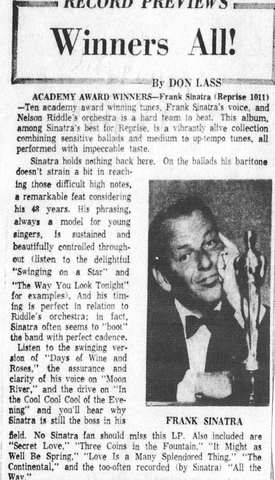
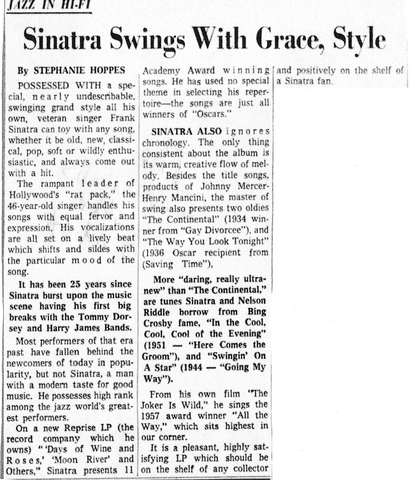
"Makin' Whoopee" / "How Deep Is the Ocean" / "In the Cool, Cool, Cool of the Evening" / "Swinging on a Star" Will Friedwald (analysis): On the 'Young at Heart' date, Riddle dropped trumpets in favor of trombones plus two French horns, cementing bass trombonist George Roberts as his most-used instrumentalist across the years -- featured on 'Makin' Whoopee' (Swingin' Lovers), 'How Deep Is the Ocean' (Nice 'n' Easy), and throughout the 1964 Academy Award Winners album. Friedwald describes Roberts trailing Sinatra 'like Philip Marlowe' on 'In the Cool, Cool, Cool of the Evening,' and 'grunting gleefully' in answer to 'Swinging on a Star,' as if he'd rather be a pig.
Source: Will Friedwald, "Sinatra! The Song Is You: A Singer's Art" (2018 revised edition).
"Academy Award Winners"
Granata's discography entry: Academy Award Winners, arranged by Nelson Riddle, released March 1964.
Source: Charles L. Granata, "Sessions with Sinatra: Frank Sinatra and the Art of Recording" (1999/2003).
"Sinatra Matters" podcast (Michael Fenenbock), Episode 1
Host Michael Fenenbock called this recording "transcendent, a masterpiece," praising Nelson Riddle's "irresistible, finger-snapping opening riff" and "brilliantly tiered, swinging" reed-and-brass arrangement. He singled out Sinatra's "spectacular" timing, his "persuasive articulation," and his note-bending on the song's closing line, and noted that Sinatra's soft closing hum was not improvised but written into Dorothy Fields' original score.
Fenenbock recapped the song's origin: composed by Jerome Kern (melody) and Dorothy Fields (lyric) for Fred Astaire to sing to Ginger Rogers in the 1936 film Swing Time, winning the Academy Award for Best Original Song that year. He quoted Fields recalling that she wept the first time Kern played her the melody, saying "the release absolutely killed me." He also cited other notable recordings by Tony Bennett, Ella Fitzgerald, Michael Bublé, and Billie Holiday, and outlined Kern's career (eight Academy Award nominations, two wins) and Fields' background as the daughter of vaudeville comedian Lew Fields.
Source: Michael Fenenbock, "Sinatra Matters" podcast, Episode 1: "The Way You Look Tonight" (2021).
[The Way You Look Tonight -- critical commentary]
Zeke Zarchy: Trumpeter Zeke Zarchy recalled being so struck hearing this track on the radio while driving that he pulled over and called the station to identify it: 'the greatest thing I ever heard! I defy any instrumentalist to swing like he does with his voice on that record.'
This song/context matches multiple dated entries in the chronology; the specific date Friedwald is referring to could not be determined with confidence.
Source: Will Friedwald, "Sinatra! The Song Is You: A Singer's Art" (2018 revised edition), Ch. 1, "Night and Day" (Sinatra style overview)
[The Way You Look Tonight -- critical commentary]
Zeke Zarchy: Sinatra opened the sessions with 'The Way You Look Tonight' as a warm-up, not realizing it would become the most-played track from the album. Trumpeter Zeke Zarchy: 'I defy any instrumentalist to swing like [Frank] does with his voice on that record.' The song was relatively under the radar until 1991 when Steve Tyrell sang it in Father of the Bride, after which it became the ultimate wedding song; a footnote (per researcher Ken Hutchins) notes it had earlier been used in Budweiser TV commercials featuring both Sinatra Sr. and Jr. during the Ultimate Event tour, 1988. Friedwald reads Sinatra's warm delivery as paternal, more directed at Nancy Jr. than a romantic partner -- 'the father of the bride.'
This song/context matches multiple dated entries in the chronology; the specific date Friedwald is referring to could not be determined with confidence.
Source: Will Friedwald, "Sinatra! The Song Is You: A Singer's Art" (2018 revised edition), Ch. 6, "With Nelson Riddle" (1953-1979)
January 28, 1964
Los Angeles - United Recording Studio
Tuesday evening
8 -11:pm
36 piece orchestra
2526 It Might As Well Be Spring
2527 Secret Love
2528 Moon River
2529 The Days Of Wine And Roses
2530 Love Is A Many-Splendored Thing
Pittsburgh
Courier
Cincinnati Enquirer
[image referenced in source but could not be recovered]
[image referenced in source but could not be recovered]
[image referenced in source but could not be recovered]
Hartford Courant
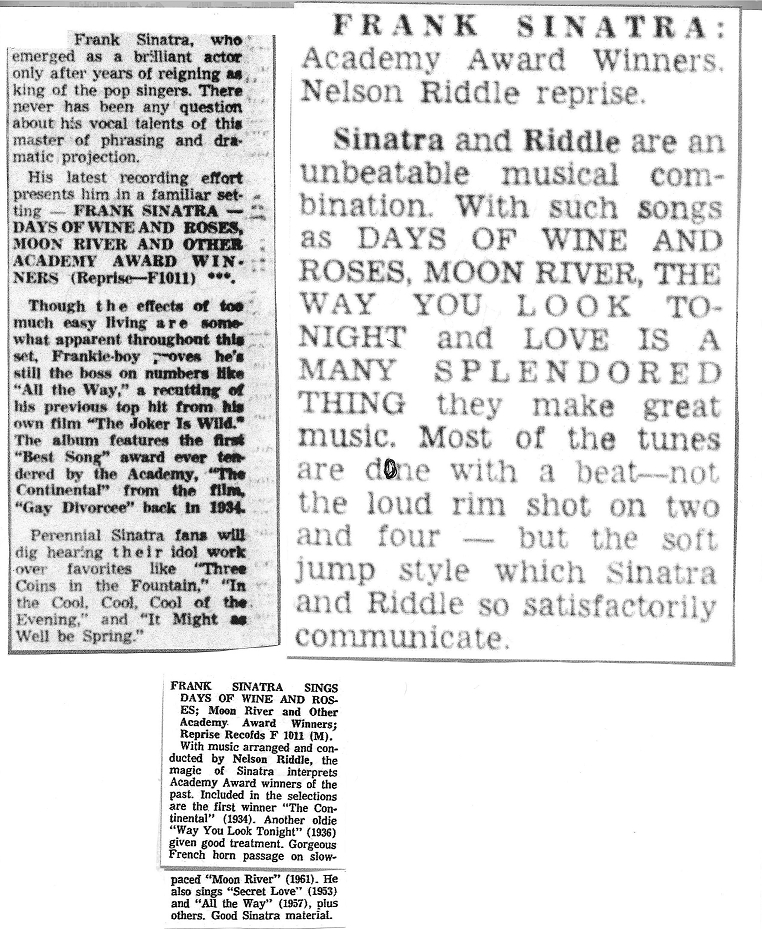
The Record ( Hackensack )
Tampa Bay Times
Birmingham Evening News - Birmingham, West Midlands,
England
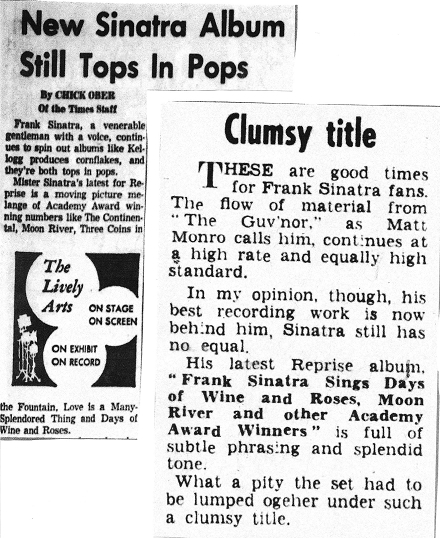
June 17, 1964
Musicians: Frank Sinatra with Orchestra conducted by Nelson Riddle Comad Gozzo, Shorty Sherock, Don Fagerquist, Cappy Lewis (tpt); Tommy Pederson, Dick Noel, Tom Shepard (tbn); George Roberts (b-tbn); Richard Perissi, William Hinshaw (fr-h); Willie Schwartz, Harry Klee, Champ Webb, Justin Gordon, Joe Koch (wwd); Israel Baker, Jacques Gasselin, Marshall Sosson, Victor Arno, Gerald Vinci, Bonnie Douglas, Alex Beller, Victor Bay, Joe Stepansky (vln); Louis Kievman, Paul Robyn (via); Nino Rosso, Kurt Reher, David Pratt (vie); Kathryn Julye (g); Bill Miller (p); Al Viola, Laurindo Almeida (g); Ralph Pena (b); Irving Cottier (d); Emil Richards (perc).
(Source: Put Your Dreams Away - A Frank Sinatra Discography, Luiz Carlos do Nascimento Silva)
June 17, 1964
February 1, 1964
[Beatles hit number 1 in America]
"I Want to Hold Your Hand" reached number 1 on the American charts, where it would stay for seven weeks before being replaced by the Beatles' own "She Loves You."
Source: James Kaplan, "Sinatra: The Chairman" (2015).
February 4, 1964
Studio
Los Angeles
2470 Let Us Break Bread Together w/Bing Crosby, Fred Waring & His Pennsylvanians
(Roy Ringwald)
Shawnee Pree Inc. (ASCAP)
Arranged by Roy Ringwald
Conducted by Fred Waring
(3:38) CD: 46013-2 The Complete Reprise Studio Recordings Disc 7
LP: FS5283 (Italy)
LP: FS2020 America I Hear You Singing
2471 You Never Had It So Good w/Bing Crosby, Fred Waring & His Pennsylvanians
(Sammy Cahn/Jimmy Van Heusen)
WB Music Corp./The Songwriters Guild (ASCAP)
Arranged by Jack Halloran
Conducted by Fred Waring
(3:00) CD: 46013-2 The Complete Reprise Studio Recordings Disc 7
LP: FS5283 (Italy)
LP: FS2020 America I Hear You Singing
Los Angeles
2470 Let Us Break Bread Together w/Bing Crosby, Fred Waring & His Pennsylvanians
2471 You Never Had It So Good w/Bing Crosby, Fred Waring & His Pennsylvanians
note: The Waring orchestra with some additions added up to 38 musicians at this session. The Pennsylvanians numbered 28 as a vocal backup for Bing and Frank. Bing would redub his vocal on 3/10 and Frank would do the same on 3/17. Dick Reynolds co-arranged "You Never Had It So Good." The Reprise files have everything in chronological order including the January recordings for "America i Hear You Singing" But this session is missing. You can only find mention of it in a special section of Sinatra-Crosby recordings.
Released on Harmony label in 1971
The Record, Hackensack Walter Winchell Column 5-9-64 4-24-64
Hartford Courant South Pasadena Review 7-19-64 5-6-64
L.A. Times Reno Gazette 5-3-64 5-1-64
[image referenced in source but could not be recovered]
[image referenced in source but could not be recovered]
[image not recovered — source caption: “THE BING CROSBY NEWS ARCHIVE: AMERICA, I HEAR YOU SINGING”]
[image not recovered — source caption: “Christmas With Frank Sinatra And Bing Crosby - Album by Frank S”]
[image referenced in source but could not be recovered]
[image referenced in source but could not be recovered]
[image referenced in source but could not be recovered]
[image referenced in source but could not be recovered]
February 9, 1964
[Beatles' Ed Sullivan Show debut; Sinatra in Palm Springs] The Beatles appeared on The Ed Sullivan Show before a record 73 million viewers. Sinatra was in Palm Springs that night, reachable by his private jet in seventeen minutes, awaiting word on whether he'd be subpoenaed in the upcoming kidnapping trial; Kaplan notes it's more likely he'd caught Frank Jr.'s January Sullivan appearance than the Beatles broadcast.
Source: James Kaplan, "Sinatra: The Chairman" (2015).
February 10, 1964
[Sinatra kidnapping trial begins]
The trial of Barry Keenan, Joe Amsler, and John Irwin for the kidnapping of Frank Sinatra Jr. began under Judge William G. East. UPI reported the next day that a jury of nine men and three women had been quickly seated, and that defense attorneys were expected to argue Frank Jr. had consented to his own abduction.
Source: James Kaplan, "Sinatra: The Chairman" (2015).
February 11, 1964
[Hoax defense presented to jury]
Defense attorney Gladys Towles Root told the jury the kidnapping had been a staged "contractual agreement," claiming young Sinatra wanted to emulate his father's fame. Co-defendant's attorney George Forde introduced a mysterious unnamed "fourth defendant," a financier and singer who had "cut two million records" -- implying Frank Sinatra, though it later emerged he meant Dean Torrence.
Source: James Kaplan, "Sinatra: The Chairman" (2015).
February 13, 1964
[Frank Jr.'s first court appearance]
Frank Jr. made his first appearance in the kidnapping trial courtroom; news of it shared front pages with reports of the Beatles' Carnegie Hall concert the previous night. The Associated Press mocked the Beatles show as inaudible amid screaming fans, comparing it to Sinatra Sr.'s own Paramount shows two decades earlier.
Source: James Kaplan, "Sinatra: The Chairman" (2015).
February 14, 1964
Studio
Hollywood
Friday afternoon
RCA Victor
Les Poupees De Paris
Orchestra conducted by Leo Reisman
Skit for album written by Cahn & Van Heusen
RCA Victor LP LOC1090
Reel to Reel: RCA FTO-5030.
"The Bathtub Scene"
Frank calls Brigette in France
Bing Crosby, Dean Martin, Janine Forman & Crista Speck
Bernadette Moore was the archivist at RCA when I was doing research for my 1992 book. One day I got the bright idea that the record company just might have the recording sheets for the above session. I called Bernadette and much to my amazement they did have it and she mailed all the information RCA had from that afternoon. The album is very rare.
Note: Above session and info from Ed O'Brien
RCA Victor
Les Poupees De Paris LP
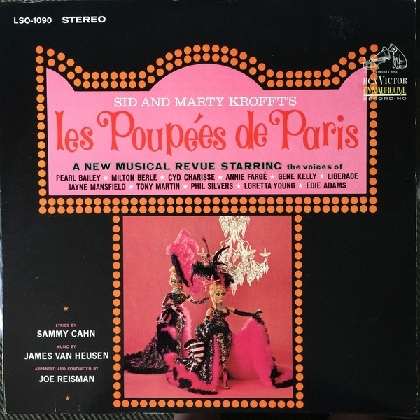
[Frank Jr. cross-examined by Gladys Root]
On a Friday, Frank Jr. underwent cross-examination by defense attorney Gladys Towles Root, who wore an elaborate fur-trimmed courtroom outfit. She pressed him on why he hadn't alerted police at a roadblock during the kidnapping; he explained he feared the kidnapper would shoot the officer, and denied her claim that he'd sabotaged his own staged plot.
Source: James Kaplan, "Sinatra: The Chairman" (2015).
February 15, 1964
Television
Bing Crosby Show (CBS)
Guests: Frank Sinatra, Bob Hope, Dean Martin, Rosemary Clooney, Kathryn Crosby
Sponsor: Pepsodent
1. The Oldest Established Floating Crap Game In New York w/Bing & Dean
Note: 60 mins.
Bing Crosby Show (CBS)
Guests: Frank Sinatra, Bob Hope, Dean Martin, Rosemary Clooney,
Kathryn Crosby
February 16, 1964
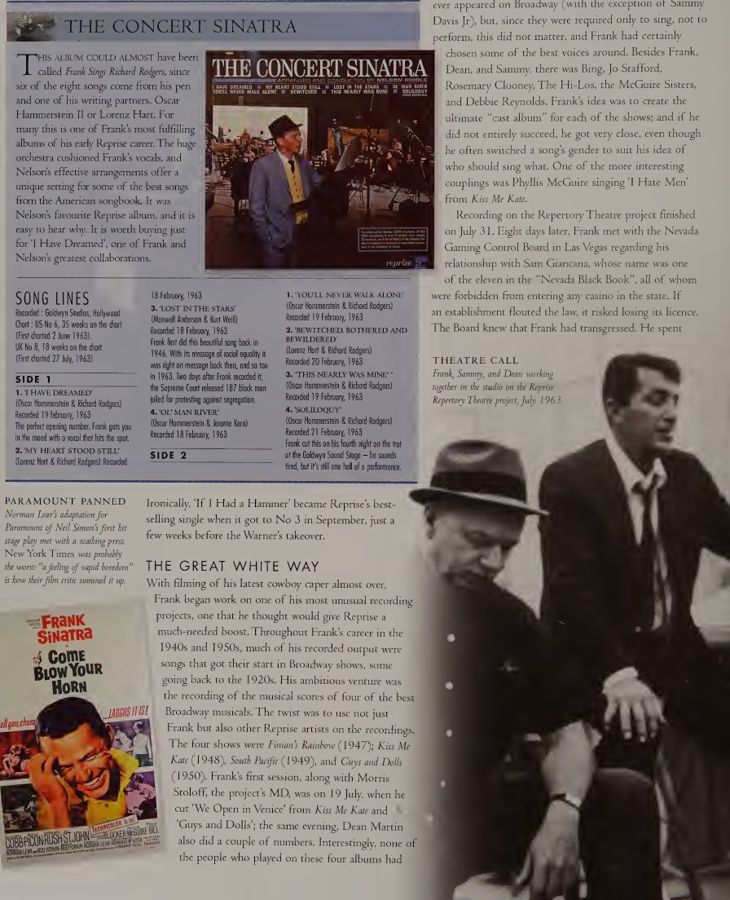
[Photograph: Kidnappers claim abduction was a publicity stunt. From Richard Havers, "Sinatra" (Dorling Kindersley, 2007), p.284.]
At trial, the defense for Frank Jr.'s kidnappers argued the abduction had been staged with his cooperation to boost his career as a performer. The jury was unconvinced; after roughly three weeks, all three were found guilty, with Amsler and Keenan sentenced to life and Irwin to 16 years (later reduced). (Source: Richard Havers, "Sinatra" (Dorling Kindersley, 2007).)
February 17, 1964
[Mistrial motion denied amid press controversy]
A Sunday Los Angeles Times headline, "SINATRA JR. DESPERATELY FIGHTS CHARGE OF HOAX," outraged Judge East. In court that Monday, it emerged that defense attorney George Forde had told the paper Barry Keenan admitted the kidnapping was a publicity stunt financed by a mysterious man named Wes; Keenan's attorney Charles Crouch asked for a mistrial, which was denied, and announced he would proceed without Forde.
Source: James Kaplan, "Sinatra: The Chairman" (2015).
Late February 1964
The trial of Frank Sinatra Jr.'s three kidnappers opened in Los Angeles federal court, where defense attorneys — most aggressively Gladys Towles Root, representing John Irwin — argued the entire abduction had been an “advertising scheme” staged by Frank Jr. himself to boost his singing career. Root pressed Frank Jr. hard on his unusually cooperative behavior during the kidnapping, prompting him to shout back from the stand, “Look, I'm not on trial here. I'm the victim.” After nearly seven hours of deliberation, the jury convicted all three defendants; ringleader Barry Keenan and accomplice Joseph Amsler received the maximum sentence of life plus seventy-five years, later reduced to twelve years after a judge found prosecutors had tampered with a psychiatric report, and John Irwin received sixteen years and eight months. Source: J. Randy Taraborrelli, Sinatra: Behind the Legend.
[Nancy Jr. Hears 'The Hills Of Home' For The First Time]
Nancy Sinatra: When Nancy Jr. went to hear her father's new patriotic album, instead of playing it in order he cued straight to an a cappella arrangement of "The Hills of Home" and told her to brace herself, and she was floored by it.
Source: Nancy Sinatra, Frank Sinatra: An American Legend, 1995.
[Dean Torrence's shifting testimony]
Kaplan: Dean Torrence, implicated as the mystery financier, testified he knew nothing beforehand about the kidnap plot, then later the same day asked to retake the stand and admitted he'd made up some stories, leaving Judge East to weigh a perjury charge against him.
Source: James Kaplan, "Sinatra: The Chairman" (2015)
[Frank Sinatra Jr.'s Trial Testimony About "Higher-Ups"]
Under oath at the trial of his kidnappers, Frank Sinatra Jr. testified that during his captivity there was "constant conversation" among the kidnappers that they were only executing a plan devised by higher-ups in organized crime — a claim that received no further exploration or corroboration in court.
Source: George Carpozi Jr., Frank Sinatra: Is This Man Mafia? (New York: Manor Books, 1979).
February 28, 1964
[Frank Jr. testifies again, exasperated]
Frank Sinatra Jr.: On a Friday, Frank Jr. spent twenty minutes back on the witness stand, again explaining he'd cooperated with the kidnappers because he didn't want to be killed. Afterward Judge East rebuked the defense for abusing the court's processes by recalling the witness. Frankie complained to reporters that the trial's publicity had cost him a Paris singing engagement and would taint him for the rest of his life.
Source: James Kaplan, "Sinatra: The Chairman" (2015).
March 6, 1964
[Closing arguments in kidnapping trial]
On the twentieth day of the trial, the jury heard six hours of closing arguments. Defense lawyer Morris Lavine called it the strangest kidnapping case he'd ever heard of.
Source: James Kaplan, "Sinatra: The Chairman" (2015).
March 7, 1964
[Guilty verdicts and sentencing]
The sequestered jury returned its verdict on a Saturday, finding Barry Keenan and Joe Amsler guilty on all charges and John Irwin guilty of all but the actual kidnapping. Judge East gave Keenan and Amsler the maximum sentence, life plus seventy-five years; Irwin later received sixteen years and eight months. All three were sent to a federal facility in Springfield, Missouri for psychiatric evaluation.
Source: James Kaplan, "Sinatra: The Chairman" (2015).
April 8, 1964
Studio
Los Angeles
2628 My Kind Of Town (3:08)
(Sammy Cahn/Jimmy Van Heusen)
WB Music Corp./The Song Writers Guild (ASCAP)
Arranged & Conducted by Nelson Riddle
45: Reprise 0279
LP: Soundtrack: Robin & The 7 Hoods, Reprise FS2021
CD: The Complete Reprise Studio Recordings,
Reprise 46013-2
CD: Artanis ARZ-104-2 "Robin & The 7 Hoods" s/t
(2000) contains a bonus alternate of "My Kind Of Town.." The disc is 24 karat gold.
2629 I Like To Lead When I Dance (4:06)
(Sammy Cahn/Jimmy Van Heusen)
WB Music Corp./The Songwriters Guild (ASCAP)
Arranged & Conducted by Nelson Riddle
45: Reprise 0279
LP: Soundtrack: Robin & The 7 Hoods, Reprise FS2021
CD: The Complete Reprise Studio Recordings,
Reprise 46013-2
2577 I Can't Believe I'm Losing You (2:45)
(Sammy Cahn/Don Costa)
PolyGram International Publishing Co. Inc. (ASCAP)
Arranged by Don Costa
Conducted by Nelson Riddle
45: Reprise 0279
LP: Reprise FS1013
CD: The Complete Reprise Studio Recordings,
Reprise 46013-2
Note: On March 14, 1968 a guitar overdub was done on Master no.
2577
and released as single - Reprise 0677
Ed O'Brien:
I have an interview done with Don Costa in 1977. He wrote the melody
for "I Can't Believe I'm Losing You." Sinatra did three takes on 4-8-64.
Costa tried to get him to do one more take. Frank told him take three
was good enough. Costa told the interviewer that another take would
have made all the difference. He was convinced it would have been
a hit if Frank had just raised the level a few more notches,
Los Angeles
2628 My Kind Of Town (3:08)
(Sammy Cahn/Jimmy Van Heusen)
April 10, 1964
Studio
Los Angeles
2631 Style (4:28)
w/Bing Crosby & Dean Martin
(Sammy Cahn/Jimmy Van Heusen)
WB Music Group/The Songwriters Guild (ASCAP)
Arranged & Conducted by Nelson Riddle
LP: Soundtrack: Robin & The 7 Hoods, Reprise FS2021
CD: The Complete Reprise Studio Recordings,
Reprise 46013-2
2632 Mister Booze (5:00)
w/Bing Crosby , Dean Martin, Sammy Davis, Jr. & Chorus
(Sammy Cahn/Jimmy Van Heusen)
WB Music Group/The Songwriters Guild (ASCAP)
Arranged & Conducted by Nelson Riddle
LP: Soundtrack: Robin & The 7 Hoods, Reprise FS2021
CD: The Complete Reprise Studio Recordings,
Reprise 46013-2
2633 Don't Be A Do-Badder (Finale) (1:15)
w/Bing Crosby , Dean Martin, Sammy Davis, Jr. & Chorus
(Sammy Cahn/Jimmy Van Heusen)
WB Music Group/The Songwriters Guild (ASCAP)
Arranged & Conducted by Nelson Riddle
LP: Soundtrack: Robin & The 7 Hoods, Reprise FS2021
CD: The Complete Reprise Studio Recordings,
Reprise 46013-2
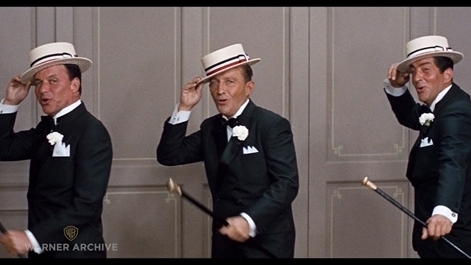
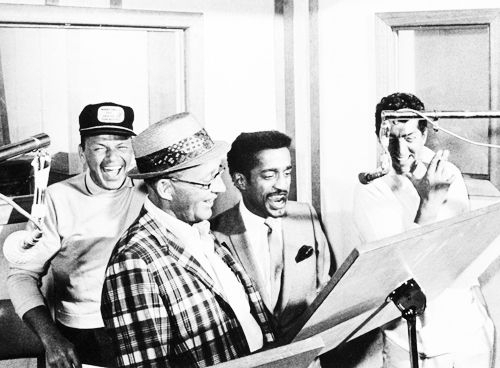
Los Angeles
2631 Style (4:28) w/Bing Crosby & Dean Martin
2632 Mister Booze (5:00) w/Bing Crosby , Dean Martin, Sammy Davis, Jr. & Chorus
2633 Don't Be A Do-Badder (Finale) (1:15)
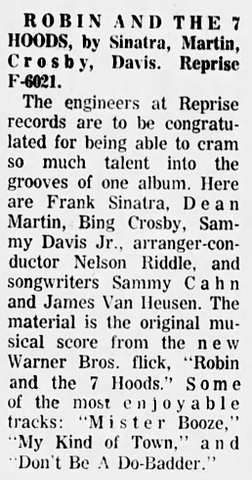
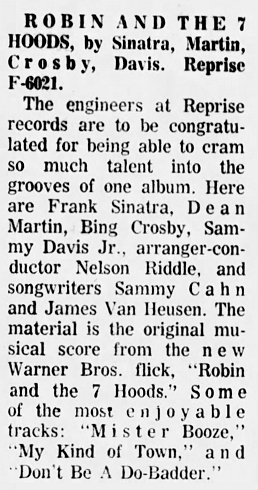
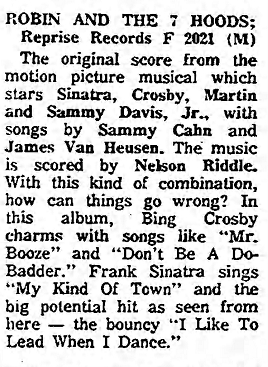
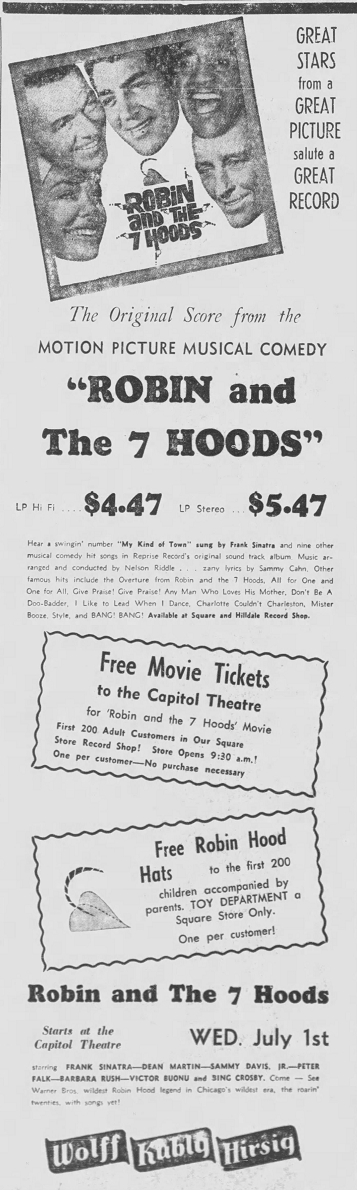
April 13, 1964
Television
36th Annual Academy Awards, Civic Auditorium, Santa Monica, California Monday evening
Network: ABC
Time: 700 PM - 12:00 PM
Host: Jack Lemmon
Ed O'Brien provided the following program for the show: Andy Williams sang two nominated songs including the winner "Call Me Irresponsible. " James Darren,
Harve Presnell and Katina Ranieri sang the other three nominated tunes.
Sammy Davis, Jr. sang a long medley of nominated songs that failed to win the Oscar. He also did a series of impressions. Variety dubbed him the hit of the evening.
Presenters that evening included Edward G. Robinson,
Steve McQueen, James Stewart, Gregory Peck, Rita
Hayworth, Anne Banecroft, Fred MacMurray, Sidney
Poitier, Julie Andrews and Frank Sinatra. The Best
Picture award was handed out by Frank. The winner was "Tom Jones."
Jack Lemmon introduces Frank Sinatra:
"Let's have a little word from that eminent Producer/Director from Warner Brothers, Mr. Frank Sinatra"
April 1964
While in Hawaii directing his first film, the antiwar drama None but the Brave, Frank Sinatra very nearly drowned trying to rescue producer Howard Koch's wife, Ruth, after she was swept out by an undertow; she was carried back to shore by a wave, but Sinatra himself struggled in the surf for over half an hour before actor and close friend Brad Dexter pulled him out, his face already turning blue. Sinatra later had a bitter falling-out with Dexter over an unrelated film project and cut him from his life entirely — to the point that Nancy Sinatra's own account of the near-drowning credits a local fire lieutenant with the rescue instead of Dexter. Source: J. Randy Taraborrelli, Sinatra: Behind the Legend.
[Shooting begins on None but the Brave]
Kaplan: At the end of April, Sinatra traveled to Kauai, Hawaii, to begin shooting None but the Brave, his first film as director, an American-Japanese WWII co-production about U.S. and Japanese soldiers stranded together on a Pacific island. Jilly and Honey Rizzo, song-plugger Murray Wolf, and valet George Jacobs accompanied him; he rented a beachfront house on Wailua Bay for $2,000 a month.
Source: James Kaplan, "Sinatra: The Chairman" (2015)
April 17, 1964
[FBI weighs recruiting Sinatra as an informant via a friendly agent]
FBI liaison Courtney Evans reported that Las Vegas SAC Dean Elson -- who had built a close rapport with Sinatra while handling the Frank Jr. kidnapping case, and had even been invited (and declined) to Sinatra's Palm Springs social events -- believed he could "induce Sinatra to cooperate" as a source on organized-crime associates. Belmont endorsed a discreet approach: "I don't think the leopard will change his spots, but I recommend SAC Elson try his hand at this." Tolson disagreed ("I do not agree. C."), and Hoover sided with Tolson: "I share Tolson's views. H." Elson was instructed to take no action.
Source: Kuntz and Kuntz, The Sinatra Files, ch. 8.
April 27, 1964
Frank began shooting None but the Brave, an anti-war story set in the Pacific during World War II, on location in Hawaii; it marked his directorial debut, and the cast included Nancy's husband Tommy Sands and Frank's cousin Dick Sinatra.
Source: Nancy Sinatra, Frank Sinatra: An American Legend, 1995.
May 1964
[Brad Dexter's account of the rescue]
Brad Dexter: Actor Brad Dexter, telling Kitty Kelley his version decades later, described diving into a dangerous riptide to save both Sinatra and Ruth Koch, holding them both as he treaded water for what he was told was forty-five minutes until surfboard rescuers arrived, then giving Sinatra artificial respiration on the beach. He said Jilly Rizzo hailed him afterward as a hero.
Source: James Kaplan, "Sinatra: The Chairman" (2015)
[Honolulu celebration after Hawaii shoot]
Quincy Jones: After location shooting wrapped, Sinatra and Jones laid over in Honolulu, where Sinatra threw a multi-day party that grew from seven guests to nineteen after calling in local women; Jones recalled waking up in a closet with Sinatra after three days of revelry.
Source: James Kaplan, "Sinatra: The Chairman" (2015)
[Nancy Sinatra's account of the rescue]
Nancy Sinatra: Nancy Sinatra's account of the same incident, based on arriving afterward, differs from Dexter's and omits him entirely, instead crediting neighbor Alfred Giles, County Supervisor Louis Gonsalves, hotel manager Harold Jim, and fire lieutenant George Keawe with pulling her father from the surf using a rope.
Source: James Kaplan, "Sinatra: The Chairman" (2015)
[Press coverage of the near-drowning]
Kaplan: Press coverage, fed by unit publicist Harry Friedman, ran sensational headlines like "SINATRA NEARLY DROWNS" and "SINATRA HAS CLOSE BRUSH WITH DEATH," though wire reports didn't fully agree; the AP credited Dexter with swimming out to Sinatra but being unable to bring him in himself, matching Dexter's own account that anonymous surfers actually towed them to shore.
Source: James Kaplan, "Sinatra: The Chairman" (2015)
[Quincy Jones summoned to Kauai]
Quincy Jones: Not long after the near-drowning, Sinatra phoned arranger Quincy Jones, whom he hadn't spoken to since a 1958 Monaco collaboration, having heard Jones's 4/4 arrangement of "Fly Me to the Moon" on a Basie album. Sinatra asked Jones to fly out within a week to arrange a Basie collaboration album; Jones arrived in Kauai two days later.
Source: James Kaplan, "Sinatra: The Chairman" (2015)
[Sinatra and Quincy Jones's bond forms]
Quincy Jones: Back in Los Angeles, Sinatra installed Jones in Dean Martin's old bungalow at Warner Bros. next to his own office. Working late on the Basie album, Jones fell asleep at 4 a.m. and was awakened around 6:30 a.m. by Sinatra, still in fatigues from directing, asking how he liked his eggs; the two became close friends from that morning on, working thereafter only on a handshake, no contract.
Source: James Kaplan, "Sinatra: The Chairman" (2015)
[Sinatra commandeers the Pacific Fleet]
Quincy Jones: While meeting with Quincy Jones at his Kauai production office, Sinatra interrupted their conversation to call the Pentagon and arrange for Navy destroyers and aircraft carriers to appear the next morning for a None but the Brave scene -- and they did.
Source: James Kaplan, "Sinatra: The Chairman" (2015)
[Sinatra's spaghetti-throwing tantrum]
Brad Dexter: The night after the near-drowning, at a special dinner honoring Dexter, Sinatra flew into a rage over improperly cooked spaghetti and threw the platter in valet George Jacobs's face, screaming at him. Dexter believed the outburst reflected Sinatra's discomfort at owing his life to someone; Jacobs's own account of the same evening differs in some details (pasta type, guests present) but agrees Sinatra hurled the food at him.
Source: James Kaplan, "Sinatra: The Chairman" (2015)
[Genesis of It Might as Well Be Swing — Sinatra and Quincy Jones working in Hawaii during None but the Brave shoot -- critical commentary]
Quincy Jones; Frank Foster: Jones recalled Sinatra summoning him and Bill Miller to Honolulu for a week of collaborative planning: 'he had a huge flag up over his bungalow in Hawaii... instead of an American flag, he had a flag up with his bottle of Jack Daniel's on it.' Jones also described Sinatra cooking him breakfast after an all-night arranging session at Warner Bros.: 'I fell asleep late Sunday night, and then on Monday morning I looked up and there's Frank in a military uniform, asking me how I wanted my eggs. He was cooking breakfast!' Tenor saxophonist Frank Foster recalled Sinatra's collaborative deference in rehearsal: when Jones asked 'What do you want to do, Frank?' Sinatra replied, 'I don't know. What have we got?' and let Jones lead.
Source: Will Friedwald, "Sinatra! The Song Is You: A Singer's Art" (2018 revised edition), Ch. 9, "Looking for the Hook" (1960-1971)
May 10, 1964
[Near-drowning off Kauai]
On a Sunday, with location shooting for None but the Brave two weeks in, Ruth Koch (wife of producer Howard Koch) went swimming despite warnings of a strong undertow; Sinatra swam out to help her and both got caught in the current. A young surfer and actor Brad Dexter helped bring them to shore; accounts of how dire the danger was differ sharply among witnesses.
Source: James Kaplan, "Sinatra: The Chairman" (2015).
During location shooting for None but the Brave on Kauai, producer's wife Ruth Koch was swept out to sea by a wave; Frank tried to swim to her rescue but was himself caught in a dangerous undertow and struggled in the surf for about 35 minutes before locals and a fire lieutenant pulled him and the rescuers to shore. He was exhausted and pale afterward but recovered; he later bought rescue equipment and a boat for the local community.
Frank Sinatra (quoted): "In another five minutes he would have been gone"
Source: Nancy Sinatra, Frank Sinatra: An American Legend, 1995.
June 9, 1964
Studio
Los Angeles
2809 The Best Is Yet To Come w/The Count Basie Orchestra
(Cy Colman/Carolyn Leigh)
WB Music Corp./Carwin Music Inc. (ASCAP)
Arranged & Conducted by Quincy Jones
-10 (2:53) CD: 46013-2 The Complete Reprise Studio Recordings Disc 8
CD: 9-26340The Reprise Collection
CD: 1012-2 It Might As Well Be Swing
LP: FS1012It Might As Well Be Swing
NOTE: Ed O'Brien points out that Sinatra did 10 takes that night with a great Billy Byers chart. He's been told that Sinatra sang it that Fall at the Sands with the Basie band and then it was dropped. In 1979, Sinatra's recording became the soundtrack of an automobile commercial and audiences started requesting the song, so Sinatra dusted off the chart and it became one of the greatest concert moments over the next 15 years.
Sinatra tried a lot of fascinating harmonics with it and Vinnie Falcone gave him a great chart with just quintet.
Sinatra's last concert was in Palm Springs on February 25, 1995. He was set to do five songs. Comedian Tom Dressen did the intro and after the fifth number, "My Kind of Town," Sinatra wanted to do one more for a very appreciative audience. He opted for the Coleman-Leigh classic and his reading was superb.
There was some delicious irony in his closing with it, because the song was written for him in 1959. He heard it and passed. Tony Bennett did an excellent recording and then many other fine singers laid it down. But Sinatra recognized the error of his ways and, on June 9, 1964, he laid down the definitive recording of this real gem.
Guy Steele:
I thought you'd like to hear what Cy Coleman told me about "The Best Is Yet To Come"..I interviewed him in September 1999 for my radio show...he said he didn't write it specifically for Sinatra..it originally was an instrumental that was played by Cy's trio..one day Carolyn Leigh decided to write some words for it. They sent the song to Sinatra...he told them that he liked it but that it was too short..they added a whole section which doubled the length of the song and sent it back to FS..a year went by, and Sinatra didn't get around to recording it. At the time, Cy had a hit record in "Playboy's Theme"..Tony Bennett called Cy and asked him if he had a song like "Playboy's Theme"..Cy suggested "The Best Is Yet To Come," and Bennett became the first person to record it. Cy said it was the only song he knew that starts in one key and ends up in another key.
2810 I Wanna Be Around w/The Count Basie Orchestra
(Johnny Mercer/Sadie Vimmerstedt)
Commander Publications (ASCAP)
Arranged & Conducted by Quincy Jones
-5 (2:20) CD: 46013-2 The Complete Reprise Studio Recordings Disc 8
CD: 1012-2It Might As Well Be Swing
LP: FS1012It Might As Well Be Swing
2811 I Believe In You w/The Count Basie Orchestra
(Frank Loesser)
Frank Music Corp. (ASCAP)
Arranged & Conducted by Quincy Jones
-3 (2:19) CD: 46013-2 The Complete Reprise Studio Recordings Disc 8
CD: 1012-2It Might As Well Be Swing
LP: FS1012It Might As Well Be Swing
2812 Fly Me To The Moon (In Other Words) w/The Count Basie Orchestra
(Bart Howard)
Hampshire House Publishing Corp. (ASCAP)
Arranged & Conducted by Quincy Jones
(2:29) CD: 46013-2 The Complete Reprise Studio Recordings Disc 8
CD: 9-26340-2The Reprise Collection
CD: 1012-2It Might As Well Be Swing
CD: 1016-2A Man And His Music
LP: FS1012It Might As Well Be Swing
45: 7-19355-A
note: Sinatra did not use strings on five songs The four listed above and the last song done on the 6-12-64 session, "Wives and Lovers." --Ed
Ed O'Brien:
This was the best of all the Sinatra/Basie studio sessions. Two of the songs recorded on that
June night would become Sinatra classics. He was in great form and the band was cookin' through- out. For reasons I cannot fathom a 16 piece string section would be added to the sessions of 6-10 and 6-12. In my opinion a major blunder.
The Basie band did not need strings and the sound from the 6-9 session complimented a swingin' Sinatra to a tee. Strings slowed it all down and diminished the overall effect dramatically. The four tunes recorded at that first date sound so much better, both vocalist and orchestra, than the six tunes recorded on the two subsequent dates.
FRANK SINATRA AND THE
COUNT BASTE ORCHESTRA:
It Might As Well Be Swing. Frank Sinatra (vocals);
Count Basie Orchestra.
Quincy Jones cond.
More: Hello, Dolly; The Good Life: and seven others.
REPRISE FS 1012 54.98, F 1012 $ 3.98.
Performance: Very good
Recording: Excellent
A musician I know recently cracked: "Sinatra must he singing well again. The press is being nasty to him." This intuition proves to he correct. After some indifferent albums, he sang well in the sound track of Robin and the Seven Hoods, and he sings very well on this new set. This is the second recording Sinatra has made with Basie. I didn't care for the previous one. There was a contrived quality about it, and Sinatra's voice seemed uncertain on some tracks. There is still a little of the contrived about this one. but less, and nothing uncertain about the voice. The songs are recent. Some, such as I Believe in You and Sacha Distel's The Good Life. are first-rate, but there are some I don't care for, including More, a good tune with so-so lyrics and I Can't Stop Loving You, which, no matter who does it and how it is arranged, retains its hillbilly fragrance. Hello, Dolly becomes a tribute to Louis Armstrong in the second chorus, with Sinatra singing "Hello, Louis." Oddly enough, it comes off. Quincy Jones wrote the arrangements. He has retained the gifts that made him the Bright Young Man of the business a few years ago. the most promising composer - arranger in years. Unfortunately he has let himself drift into the role of artist -and repertoire man, a producer of rock-and-roll and other trivia. This album will only confirm the wish of many that he will someday return to the kind of writing he does so well. G. L.
Stereo Review
November 1964
note: I must admit to having second thoughts on the reviews by Gene.Lees. Back in the 1960s, I read all of his reviews and later on acquired his books. A fine songwriter and a sometime outstanding judge of the finest singers. But here is, in my opinion, another review with egregious omissions. How could he ignore the best two tracks on the album ? Sinatra hit it out of the park with his definitive vocal work on "Fly Me To The Moon" and "The Best Is Yet To Come." Ed
[It Might as Well Be Swing session begins]
Sinatra, Quincy Jones, and the Basie band began recording the album It Might as Well Be Swing, opening with "The Best Is Yet to Come" by Cy Coleman and Carolyn Leigh -- a song Frank had sat on for a year after it was written for him in 1959, letting Tony Bennett release it first in 1961.
Source: James Kaplan, "Sinatra: The Chairman" (2015).
[Recording I Wanna Be Around]
The same session included "I Wanna Be Around," a song originating from a 1957 letter Ohio grandmother Sadie Vimmerstedt sent Johnny Mercer with a lyric idea about a woman scorned; Mercer wrote the song years later giving her co-credit, and it became a hit for Tony Bennett in 1963. Sinatra's version was considered emotionally more muted than Bennett's.
Source: James Kaplan, "Sinatra: The Chairman" (2015).
[Fly Me to the Moon recorded in one take]
Closing the first Basie session, Sinatra recorded "Fly Me to the Moon" in a single take, with Quincy Jones turning the previously waltz-time standard into an uptempo 4/4 barn-burner; the recording became the definitive version of the song, alongside "Come Fly with Me."
Source: James Kaplan, "Sinatra: The Chairman" (2015).
June 10, 1964
Studio
Los Angeles
2814 Hello Dolly w/The Count Basie Orchestra
(Jerry Herman)
Edwin H Morris & Co., Inc. (ASCAP)
Arranged & Conducted by Quincy Jones
(2:44) CD: 46013-2 The Complete Reprise Studio Recordings Disc 8
CD: 1015-2My Kind Of Town
CD: 1012-2It Might As Well Be Swing
LP: FS1012It Might As Well Be Swing
2815 The Good Life w/The Count Basie Orchestra
(Sacha Distel/Jack Reardon)
Intersong USA Inc. (ASCAP/SACEM)
Arranged & Conducted by Quincy Jones
(2:26) CD: 46013-2 The Complete Reprise Studio Recordings Disc 8
CD: 1012-2It Might As Well Be Swing
LP: FS1012It Might As Well Be Swing
2816 I Wish You Love w/The Count Basie Orchestra
(Charles Trenet/Albert Beach)
EMI Virgin Music Inc./On Backstreet Music Inc. (ASCAP/SACEM) Arranged & Conducted by Quincy Jones
-8 (2:54) CD: 46013-2 The Complete Reprise Studio Recordings Disc 8
CD: 1012-2It Might As Well Be Swing
LP: FS1012It Might As Well Be Swing note: There were eight takes from the top and then nine intercuts. --Ed
NOTE: Sinatra Scholar Ed O'Brien points out that after the first session for "It Might as Well Be Spring", Sinatra had 16 strings added to the orchestra augmenting the great Basie band. O'Brien says he has never understood why, but he did have the opportunity to ask the lead trumpet player for both Sinatra/Basie albums his thoughts on Sinatra's reasoning. The trumpeter recalled that Sinatra loved strings, so he got them on the second album, but not on the first.
Ed O'Brien:
A few weeks back, I rediscovered a conversation with Peter Levinson. He had interviewed some of Basie's men. The first album Frank did with Basie was "A Historic Musical First." Great jazz band and The Chairman. According to Peter's sources, it was understood that the second album with Basie was a Sinatra album. Basie men were there to lend support. Frank was front and center. They were window dressing.
Los Angeles
2814 Hello Dolly
w/The Count Basie Orchestra
2815 The Good Life
2816 I Wish You Love
UNIVERSAL AMPHITHEATRE
JUNE 11 THRU 17, 1979
MONDAY EVENING
JUNE 11 SHOW REVIEWED
O.A. MARLENE RICCI & PAT HENRY
ORCHESTRA CONDUCTED BY VINCENT FALCONE
FRANK SINATRA "MIRACLE" REVISITED AT L.A.
AMPHITHEATER
An authentic miracle of popular culture, Frank Sinatra carries a
heavy responsibility - - he must live up to the achievement of his
career every time out. It's proof that his miracle endures that he
makes the responsibility such a light one, as he did on Monday,
the opening night of his seven-night stay at the Universal Amphi-
theater.
If you think I'm throwing the word "miracle" around carelessly,
remember this: No one in the history of American pop music pro-
voked the reaction that Frank Sinatra did 40 years ago, and no
one until then could justify such a reaction. Only Elvis Presley
and the Beatles after him affected their audiences with a similar
intensity and, for different reasons, they never sustained the pop-
ular esteem that Sinatra has maintained to this day.
Sinatra's show at the Amphitheater Monday had all the lumber-
ing machinery of a superstar production. There were admiring super-
stars in the audience, from Natalie Wood and Robert Wagner to
Milton Berle, and I gaped at the sight of a tanned, garrulous Cary
Grant. There were not one but two opening acts: singer Marlene
Ricci, whose voice is husky-gulpy and whose demeanor is sexy-
perky, and comedian Pat Henry, who has an unerring instinct for
jokes that will titillate a middle-aged, monied audience, but which
the rest of us have heard on "The Tonight Show."
But then Sinatra walked on and made the preliminary ceremony
seem foolishly irrelevant. In a quiet black tuxedo he strolled out and
grinned, "Hi, gang." He then launched into "New York, New York,"
the anthem from the Martin Scorcese film, a wonderfully cocky way
to begin a stint in Los Angeles.
Backed by a properly attired 50-piece orchestra, Sinatra was cool
and good-natured, so confident of his control of both voice and material
that he could afford to be playful and take a few startling risks.
From a sprightly, delicate reading of "At Long Last Love" to a firm,
brooding rendition of "It Was A Very Good Year," Sinatra envinced the
discipline and wit that originally made him both a teenager's idol and a
musician highly considered by his peers.
Ever since his big band days with Harry James 40 years ago - - the
departure from whose constraining band he noted this night, in fact
Sinatra has not only prided himself on the rigorous skill of his physical
gift, but is also the most intellectual of pop singers. Working closely
with his musicians and arrangers like Gordon Jenkins, Sinatra often
fashioned original interpretations of familiar lyrics, and sang cunningly
just behind the beat only to swoop ahead of it during an emotional
climax, a real feat of jazz precision. Other singers have followed
his lead, but none has been more effortlessly inventive at it, or can
make it sound so simple.
All of this he continues to do today, having become even more
cagey in dealing with the inevitable changes in a 63-year-old larynx.
If Sinatra doesn't go for the high notes he hit in his youth, he now
makes them unnecessary in the presence of his warm, deep tenor.
He bends the melody down and around to fit his mood, and clips
off the ends of words and lines with a serene crispness, avoiding
all sentimentality.
At the Amphitheater Sinatra sauntered along the edge of the
stage making quick, sharp gestures with his bullet-shaped body --
a hand stabbing out emphasis here, his feet doing a self-deprecating
softshoe there. Two high points quiver in my memory: an icy
version of "The Best Is Yet To Come" that pared away all of the
song's easy optimism, leaving the assertions of a world-weary
pro; and a punchy "I've Got You Under My Skin" that allowed
all of the tune's bubbling sexiness to surface into an almost scary
eroticism.
The evening included songs from every period of Sinatra's career,
and at the end he finished off "My Way" quite literally, muttering
that he'd sung this song for ten years and had come to hate it.This
was the perfect, unpretentious touch to end this casually perfect
evening.
Ken Tucker
L.A. Herald Examiner
June 13, 1979
note: I think of the period from 1977 to 1982 as the Falcone years.
Vinnie, a very talented and intelligent man, challenged Frank to
explore new musical territories and the results were simply astonishing.
To hear Frank work with small combos, or just guitar, or piano, gives
one a true appreciation of what a great team these two men were on a
concert stage. Sinatra had complete trust in Vinnie's exquisite sense
of what was right for him. A very exciting, creative, productive period
for the greatest singer of them all. -ED
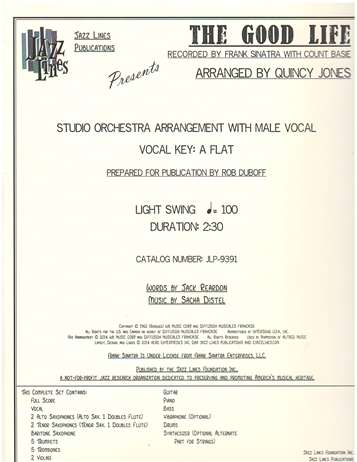
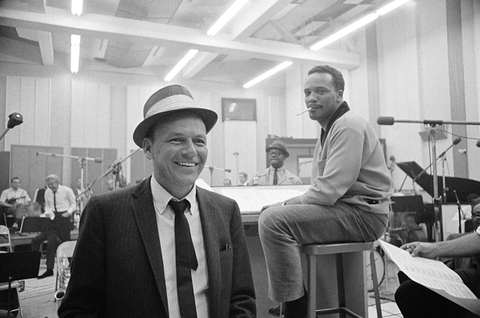
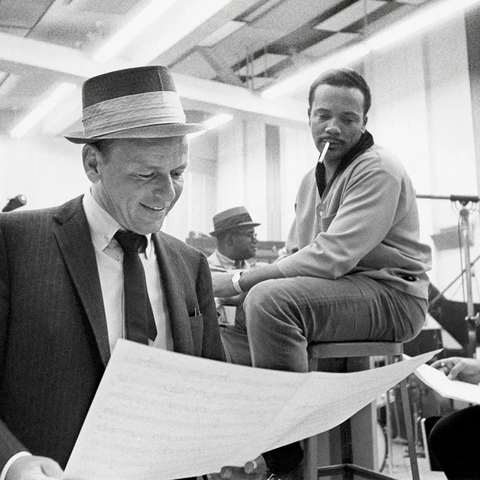
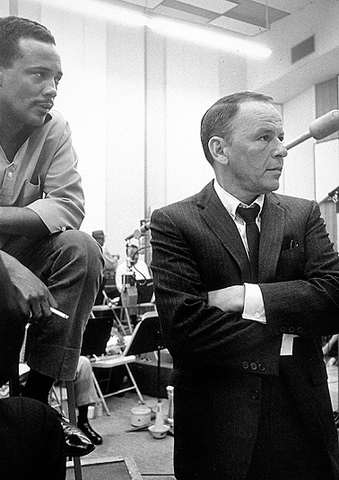
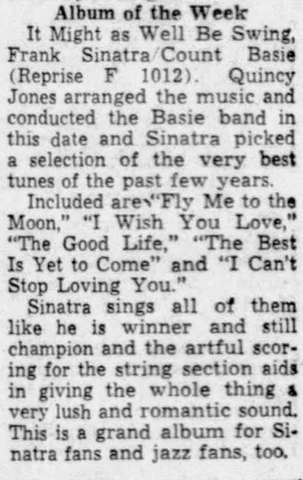
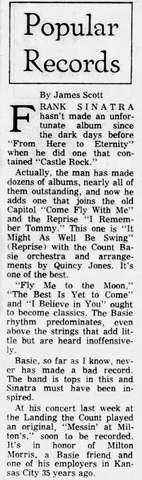
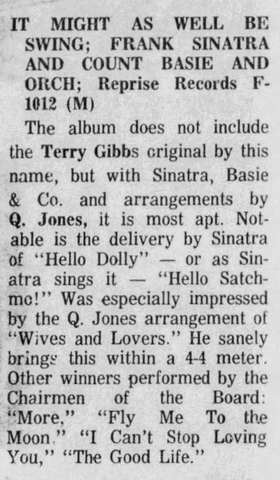
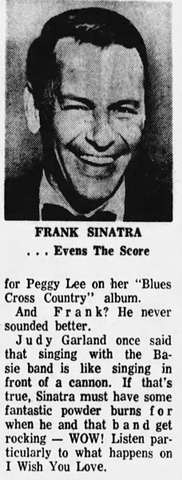
[Second Basie session: The Good Life and more]
At the second session for It Might as Well Be Swing, Sinatra recorded "The Good Life" (another prior Bennett hit), along with covers of other artists' hits including Ray Charles's "I Can't Stop Loving You," Jack Jones's "Wives and Lovers," Steve Lawrence's "More," and Louis Armstrong's "Hello, Dolly!"
Source: James Kaplan, "Sinatra: The Chairman" (2015).
June 12, 1964
Studio
Los Angeles
2817 I Can't Stop Loving You w/The Count Basie Orchestra
(Don Gibson)
Acuff-Rose Music Inc. (BMI)
Arranged & Conducted by Quincy Jones
(2:57) CD: 46013-2 The Complete Reprise Studio Recordings Disc 8
CD: 1012-2It Might As Well Be Swing
LP: FS1012It Might As Well Be Swing
2818 More (Theme From Mondo Cane) w/The Count Basie Orchestra
(Riz Ortolani/Nino Oliviero/Marcello Ciorciolini/ Norman Newell) Elbo Music/E.B. Marks Music (BMI)
Arranged & Conducted by Quincy Jones
(3:03) CD: 46013-2 The Complete Reprise Studio Recordings Disc 8
CD: 1012-2It Might As Well Be Swing
LP: FS1012It Might As Well Be Swing
Note: On UK LP R91012 and JAPANESE Jasrac CD T1823
Sinatra clears his throat at the end of the bridge before the second chorus. On USA 1012 and all CDs the vocal faded has been faded to eliminate this. --Fred J Wadsworth
2819 Wives And Lovers w/The Count Basie Orchestra
(Burt Bacharach/Hal David)
Famous Music Corp. (ASCAP)
Arranged & Conducted by Quincy Jones
(2:47) CD: 46013-2 The Complete Reprise Studio Recordings Disc 8
CD: 1012-2It Might As Well Be Swing
LP: FS1012It Might As Well Be Swing
note: The second Sinatra-Basie album got underway on 6-9-64 with the twenty-piece Basie contingent, aided and abetted by the great lead trumpet player Al Porcino. Frank recorded "Fly Me To The Moon," "I Believe In You," "I Wanna Be Around" and "The Best Is Yet To Come" The following sessions on 6/10 and 6/12 saw the addition of a 16 piece string session. Frank would lay down five numbers with the added strings. But the song that completed the album, "Wives And Lovers," would be stringless. Frank went back to the 21 piece Basie + one for the last number. I feel the five numbers sans strings are the highlights of the project. Frank seems much more comfortable and the Basie band gets to really show its stuff.
Ed
Los Angeles
2817 I Can't Stop Loving You
2818 More (Theme From Mondo Cane)
2819 Wives And Lovers
June 13, 1964
[Dean Martin mocks the Rolling Stones on TV]
On a Saturday, the Rolling Stones appeared on ABC's The Hollywood Palace, hosted by Dean Martin, who repeatedly mocked the band and the British Invasion with jokes about their hair and appeal; sixteen-year-old viewer Stephen King recalled feeling that Martin represented the past while the Stones represented the future.
Source: James Kaplan, "Sinatra: The Chairman" (2015).
June 16, 1964
Studio
Los Angeles
2453 An Old-Fashioned Christmas w/Fred Waring & His Pennsylvanians
(Sammy Cahn/Jimmy Van Heusen)
WB Music Corp./The Songwriters Guild (ASCAP)
Arranged by Nelson Riddle
Conducted by Fred Waring
(3:44) CD: 46013-2 The Complete Reprise Studio Recordings Disc 8
LP: FS2022Twelve Songs Of Christmas
2454 I Heard The Bells On Christmas Day w/Fred Waring & His Pennsylvanians
(John Marks)
St. Nicholas Music Inc. (ASCAP)
Arranged by Nelson Riddle
Conducted by Fred Waring
(2:35) CD: 46013-2 The Complete Reprise Studio Recordings Disc 8
LP: FS2022Twelve Songs Of Christmas
45: 0314
2455 The Little Drummer Boy w/Fred Waring & His Pennsylvanians
(Katherine Davis/Henry Onorati/Harry Simeone)
EMI Mills Music Inc./International Korwin Corp. (ASCAP) Arranged by Jack Halloran
Conducted by Fred Waring
(3:02) CD: 46013-2 The Complete Reprise Studio Recordings Disc 8
LP: FS2022Twelve Songs Of Christmas
45: 0314
NOTE: Sinatra Scholar Ed O'Brien reports that musicians who worked on this session of "12 Songs Of Christmas" told him that Sinatra wasn't in particularly good voice. He was backed by a 31-piece orchestra and stayed the course until there were acceptable masters.
Los Angeles
2454 I Heard The Bells On Christmas Day w/Fred Waring & His Pennsylvanians
(John Marks)
St. Nicholas Music Inc. (ASCAP)
Arranged by Nelson Riddle
Conducted by Fred Waring
(2:35) CD: 46013-2 The Complete Reprise Studio Recordings Disc 8
LP: FS2022Twelve Songs Of Christmas
45: 0314
2455 The Little Drummer Boy w/Fred Waring & His Pennsylvanians
(Katherine Davis/Henry Onorati/Harry Simeone)
EMI Mills Music Inc./International Korwin Corp. (ASCAP) Arranged by Jack Halloran
Conducted by Fred Waring
(3:02) CD: 46013-2 The Complete Reprise Studio Recordings Disc 8
LP: FS2022Twelve Songs Of Christmas
45: 0314
[image referenced in source but could not be recovered]
June 19, 1964
Studio
Los Angeles
2457 Go Tell It On The Mountain w/ Bing Crosby, Fred Waring & His Pennsylvanians
(Traditional. adapted by Jack Halloran)
Shawnee Pree Inc. (ASCAP)
Arranged by Jack Halloran Conducted by Fred Waring
(3:21) CD: 46013-2 The Complete Reprise Studio Recordings Disc 8
LP: FS2022 Twelve Songs Of Christmas
45: 0317
2458 We Wish You The Merriest w/ Bing Crosby, Fred Waring & His Pennsylvanians
(Les Brown)
Crystal Music Publishing Inc.. (ASCAP)
Arranged by Jack Halloran & Harry Betts
Conducted by Fred Waring
(2:33) CD: 46013-2 The Complete Reprise Studio Recordings Disc 8
LP: FS2022 Twelve So
Sunday Oregonian
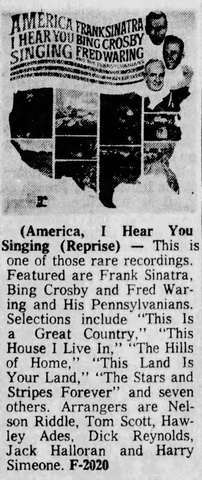
June 24, 1964
Film
"Robin and the 7 Hoods" (USA Release: June 24, 1964)
Starring: Frank Sinatra, Dean Martin, Sammy Davis Jr., Bing Crosby,
Peter Falk, Barbara Rush, Victor Buono, and special appearance by Edward G. Robinson
Produced by: Frank Sinatra
Directed by: Gordon Douglas
In Chicago, during the Prohibition, two rival gangs compete for control of the city's rackets. An updated telling of Robin Hood as a spoof on gangster pix of bygone days with Frank Sinatra (Robbo), Dean Martin (Little John), Sammy Davis (Will) and Bing Crosby (Alan A. Dale) --DVD Release: 2001-11-20 & Blu-Ray Release: 2015-05-05
Frank and Gene Kelly developed the original story for "Robbo" ( orginal title ) in 1961. They felt there was a lack of good stories for film musicals and came up with the idea of a modern day Robin Hood in Chicago. The two men agreed on a three picture deal and also decided to co-produce "Robbo." The film's title was changed to "Robin & The 7 Hoods in January 1963. As the project moved forward, Kelly realized he had a much different concept of film-making in the fall of 1963 than Sinatra. The October 10, 63 Variety announced he had dropped out of the picture due to artistic differences.
The all-star cast started filming on location, in Chicago, 10-31-63. Gordon Douglas was Frank's favorite director and the early stages of production went very smoothly. Cahn & Van Heusen had written a superb score and were often on the set throughout the filming at Warner Brothers in Hollywood. Frank did the pre-recording of "I Like To Lead When I Dance" on 10-24-63. Sammy Cahn thought it was the best song in the film and couldn't wait for the actual shooting of the scene with Frank and Barbara Rush. For some reason, that has never been explained, on the day of the shooting Frank refused todo it. Cahn was crushed and often asked Sinatra what happened. He never got an answer. Crosby was very pleased to be playing Allen A, Dale, Dean was doing Little John in his laid back way and Sammy was thrilled to be playing a gangster. He gave it his all in the musical number "Bang, Bang."
But Frank was very removed right from the start. After JFK's assassination, he stayed away from the studio for almost a week. Then Frank Jr. was kidnapped on 12-8-63. Filming was finally completed in late December. WB announced there would be a test-screening of the film in 32 key markets on 3-10-64. The premiere of the film took place at the State- Lake Theatre, Chicago, 6-24-64. The nationwide release to 1.361 theatres took place on 6-27-64. Frank and some of his co-stars attended the Chicago opening. The L.A. release did not happen until 7-29-64 and last, but certainly not least, the N.Y. C. opening occurred on 8-5-64 at the RKO Palace, in Manhattan, and other RKO houses in the city.
The critical response was underwhelming. Some stated that Crosby stole the film. The box office take was $4,200,000. Respectable but certainly not what one would have expected with such a powerhouse cast.. Years later, the Times film critic, Vincent Canby, cited the film as an example of how a major star walked through what should have been a decent film. He felt that Sinatra had just learned his lines, prior to the shooting of a scene. Canby was puzzled by such a posture from such a fine actor.
Frank came to intensely dislike the movie. When introducing "My Kind Of Town,," he would say the film was not released --- it escaped. What endures today is the music and the wonderful singing by Sinatra, Crosby, Martin and Davis. The absolute highlight is Frank, Bing and Dean singing "Style." Seeing that on a big screen in Panavision is truly a joy.
Film became available on VHS in 1991 and a widescreen laser release followed in 1992. Since then there have been multiple releases on DVD.
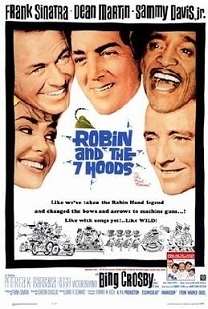
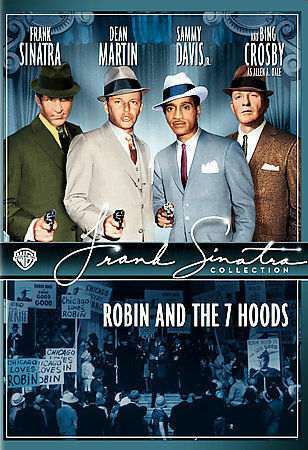
[The Cinematic Legacy of Frank Sinatra — Robin and the 7 Hoods (1964)]
David Wills's 2015 photo history The Cinematic Legacy of Frank Sinatra devotes a section to Robin and the 7 Hoods (1964), illustrated with 4 behind-the-scenes and publicity photographs (posters, lobby cards, and on-set/on-location shots) filed here.
“Pocket handkerchiefs are optional, but I always wear one, usually orange.” This is Sinatra's advice for black-tie dressing, on display nightly at the Sands during the Ocean's location shoot. Personal wardrobe was always an essential consideration for Sinatra, especially during the Clan/Rat Pack years. Highly-polished shoes, the right hat at a rakish angle, cuff links but no other jewelry” —these were hallmarks of his sixties style. Robert Wagner adds,
“Working on that picture was a blast. Off- camera, the boys, as Frank called them, were just like you see them onstage—loose and easy” —plenty of laughs and one big surprise. I didn't
Source: David Wills, The Cinematic Legacy of Frank Sinatra (St. Martin's Press, 2015), pp. 232–236.
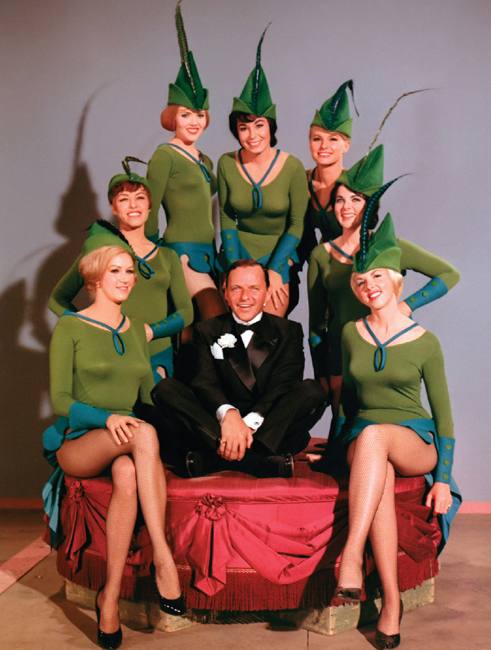
Robin and the 7 Hoods, 1964. (Photo: The Cinematic Legacy of Frank Sinatra, David Wills, 2015.)
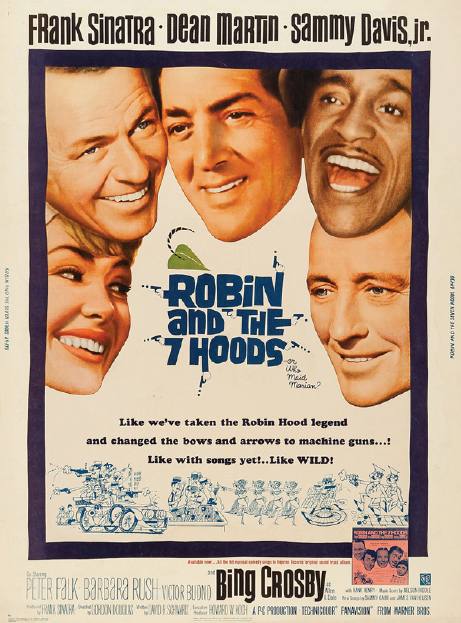
One sheet poster, Robin and the 7 Hoods. / “We were in the cemetery, burying Edward G. / Robinson, who played my father. Howard Koch / drove into the cemetery and said, 'I want you to / know President Kennedy has been shot.' Sinatra (Photo: The Cinematic Legacy of Frank Sinatra, David Wills, 2015.)
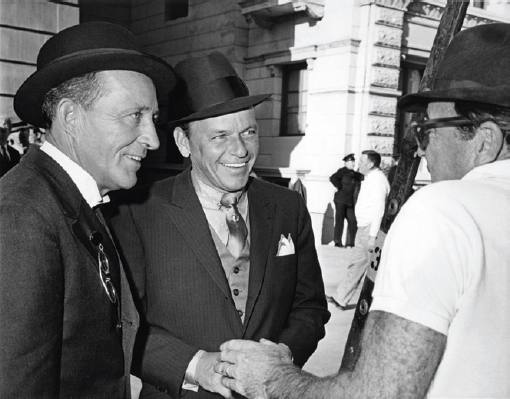
shut down the shoot for the day and briefly / considered closing down the entire production.” / With costar Bing Crosby, Robin and the 7 Hoods. / “Working on that picture was a blast. Off- / camera, the boys, as Frank called them, were / just like you see them onstage—loose and easy / notice when I (Photo: The Cinematic Legacy of Frank Sinatra, David Wills, 2015.)
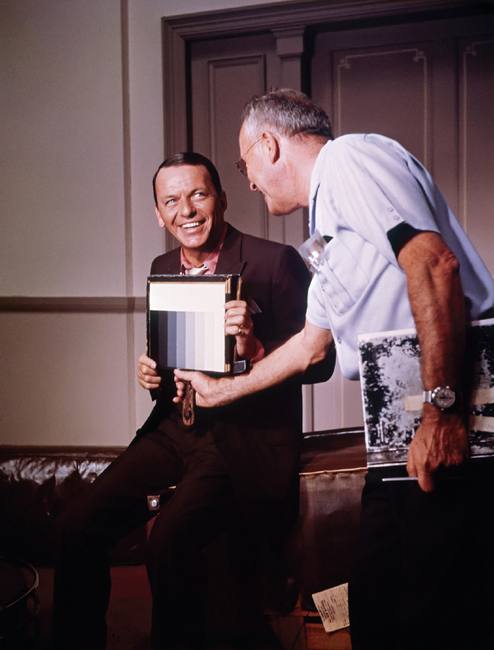
Color test, Robin and the Seven Hoods. (Photo: The Cinematic Legacy of Frank Sinatra, David Wills, 2015.)
"Robin and the 7 Hoods"
Sinatra originally planned to produce Robin and the 7 Hoods with Gene Kelly, intending a series of three films together. Kelly's involvement collapsed because Sinatra's chronic reluctance to rehearse undermined the pre-production groundwork Kelly considered essential.
Source: Tom Santopietro, "Sinatra in Hollywood" (2008).
"Robin and the 7 Hoods"
Gene Kelly: Gene Kelly recalled that after Sinatra repeatedly delayed arriving on the project, he decided the tension wasn't worth it and told Jack Warner he was quitting, saying he pulled out precisely because he cared about the friendship and didn't want to become, in effect, Sinatra's paid employee.
Source: Tom Santopietro, "Sinatra in Hollywood" (2008).
"Robin and the 7 Hoods"
Robin and the 7 Hoods cast Sinatra as a mobster for the first and only time in his film career — significantly, a comic mobster, which Santopietro reads as Sinatra winking at the real-life Mafia rumors surrounding him.
Source: Tom Santopietro, "Sinatra in Hollywood" (2008).
"Robin and the 7 Hoods"
The film reunited Sinatra with his regular collaborators — cinematographer/associate producer William H. Daniels, executive producer Howard W. Koch, musical director Nelson Riddle, and songwriters Jimmy Van Heusen and Sammy Cahn — effectively a traveling "Sinatra film studio." It also reunited him with director Gordon Douglas (who had directed him well in 1954's Young at Heart), leading to their later collaborations on The Detective, Tony Rome, and Lady in Cement.
Source: Tom Santopietro, "Sinatra in Hollywood" (2008).
"Robin and the 7 Hoods"
Frank Sinatra Jr. (via Santopietro): According to Frank Sinatra Jr.'s DVD audio commentary, the film's graveside funeral scene was shot in an actual Los Angeles cemetery on November 21, 1963, the day before President Kennedy's assassination (other accounts place the filming on November 14). Between takes, Sinatra reportedly noticed a nearby tombstone reading "JOHN F. KENNEDY, 1873-1940" — an eerie coincidence he never forgot.
Source: Tom Santopietro, "Sinatra in Hollywood" (2008).
"Robin and the 7 Hoods"
Frank Sinatra Jr. (via Santopietro): Sinatra was reportedly haunted afterward by his character Robbo's line to rival Gisborne in the film: "You come over like George Washington, and I'll send you back like Abraham Lincoln," given its unintended resonance with the imminent assassination.
Source: Tom Santopietro, "Sinatra in Hollywood" (2008).
"Robin and the 7 Hoods"
Frank Sinatra Jr. (via Santopietro): After JFK's assassination, Sinatra shut down production on the film for three days out of grief over his friendship with Kennedy. When filming resumed, the previously high-spirited set had changed; Frank Sinatra Jr. said "the spell had kind of been broken."
Source: Tom Santopietro, "Sinatra in Hollywood" (2008).
"Robin and the 7 Hoods"
During production, nineteen-year-old Frank Sinatra Jr. was kidnapped at gunpoint in Lake Tahoe on December 8, 1963, held five days, and released after a $240,000 ransom exchange; the kidnappers were caught within two days. Sinatra again shut down production during the ordeal.
Source: Tom Santopietro, "Sinatra in Hollywood" (2008).
"Robin and the 7 Hoods"
Bing Crosby: Bing Crosby, reflecting on the disruptions from the JFK assassination and the kidnapping, remarked in characteristically understated terms that there were a lot of delays and the production's coordination fell apart.
Source: Tom Santopietro, "Sinatra in Hollywood" (2008).
"Robin and the 7 Hoods"
Sammy Davis Jr. played sidekick Will, a role Santopietro says works partly because Davis was one of the few actors who could make the still-slim Sinatra appear physically substantial by comparison. Davis's tap-dancing, machine-gun-shooting "Bang Bang" number is singled out as a highlight showcasing his performing skill, even as Santopietro notes Davis often over-tried to ingratiate himself in nonmusical scenes.
Source: Tom Santopietro, "Sinatra in Hollywood" (2008).
"Robin and the 7 Hoods"
Milton Berle served as technical adviser for the film's pool-hustling sequence between Dean Martin and Sinatra's character.
Source: Tom Santopietro, "Sinatra in Hollywood" (2008).
"Robin and the 7 Hoods"
Santopietro reflects on the uncomfortable racial banter scripted into Rat Pack routines (Sinatra calling Davis "Smokey," Martin calling him a "trophy from the NAACP"), while noting Davis tolerated it partly out of loyalty: Sinatra had given him an early career boost, stood as his best man when he married Swedish actress May Britt (a controversial interracial marriage that drew hate mail), and arranged medical care after Davis lost an eye in a car accident.
Source: Tom Santopietro, "Sinatra in Hollywood" (2008).
"Robin and the 7 Hoods"
Sammy Cahn (via Santopietro): As producer, Sinatra chose to cut a planned musical number, the Cahn/Van Heusen ballad "I Like to Lead While I Dance," to speed up the film. According to lyricist Sammy Cahn, the real reason for the cut wasn't time pressure but that Sinatra didn't want to bother learning the lip-synching for three different planned versions of the song.
Source: Tom Santopietro, "Sinatra in Hollywood" (2008).
"Robin and the 7 Hoods"
The "Style" number, performed by Sinatra, Dean Martin, and guest star Bing Crosby, is highlighted by Santopietro as a standout movie-musical moment where the trio's easy chemistry (and Crosby's evident joy at doing a full-scale musical again) carries the scene despite its thin plot connection.
Source: Tom Santopietro, "Sinatra in Hollywood" (2008).
"Robin and the 7 Hoods"
The film's signature number "My Kind of Town" (Cahn/Van Heusen, Nelson Riddle arrangement) became a staple of Sinatra's live concerts, though it lost the Academy Award for Best Original Song to "Chim Chim Cher-ee" from Mary Poppins.
Source: Tom Santopietro, "Sinatra in Hollywood" (2008).
"Robin and the 7 Hoods"
James Powers (via Santopietro): Released June 27, 1964, the film received generally positive reviews; Hollywood Reporter critic James Powers praised it as an improvement over its Rat Pack predecessors, with fewer inside jokes, stronger story, and harder-working stars.
Source: Tom Santopietro, "Sinatra in Hollywood" (2008).
"Robin and the 7 Hoods"
Santopietro identifies Robin and the 7 Hoods as marking the effective end of the true "group" Rat Pack movies; subsequent reunions (Marriage on the Rocks, Cannonball Run, Cannonball Run II) were partial and diminished versions of the earlier ensemble concept.
Source: Tom Santopietro, "Sinatra in Hollywood" (2008).
"Robin and the 7 Hoods"
Santopietro grades this a B, calling it the last musical of Frank's film career and solid fun. Golden Laurel Award nomination: Top Male Star of the Year.
Source: Tom Santopietro, "Sinatra in Hollywood" (2008).
"Robin and the 7 Hoods"
Santopietro (Filmography): Claude-Essex/Warner Bros. Pictures. Produced by Sinatra himself, directed by Gordon Douglas, screenplay by David R. Schwartz, score by Nelson Riddle, original songs by Jimmy Van Heusen and Sammy Cahn. Sinatra played Robbo opposite Dean Martin, Sammy Davis Jr., Bing Crosby and Peter Falk, singing 'My Kind of Town (Chicago Is),' 'Mister Booze' and 'Style.'
Source: Tom Santopietro, "Sinatra in Hollywood" (2008).
June 27, 1964
Warner Bros. released Robin and the 7 Hoods, a Rat Pack musical-comedy send-up of the Robin Hood legend starring Frank Sinatra, Dean Martin, Sammy Davis Jr., and Bing Crosby. The soundtrack introduced “My Kind of Town,” Sinatra's musical tribute to Chicago, which would go on to become one of his signature songs. Source: J. Randy Taraborrelli, Sinatra: Behind the Legend.
June 28, 1964
Television
The Ed Sullivan Show
Network: CBS
Guest: Frank Sinatra
1. My Kind of Town
Ed O'Brien:
Frank was on the show to plug the release of "Robin & The 7 Hoods." He chatted with Sullivan and introduced Bobby Vinton. "My Kind Of Town" segment from the film was shown. Frank did not sing a live number on the show.
The Ed Sullivan Show
Network: CBS
Guest: Frank Sinatra
1. My Kind of Town
Ed O'Brien:
Frank was on the show to plug the release of "Robin & The 7 Hoods." He chatted with Sullivan and introduced Bobby Vinton. "My Kind Of Town" segment from the film was shown. Frank did not sing a live number on the show.
Frank Sinatra, right, with Ed Sullivan, left, and Connie Francis
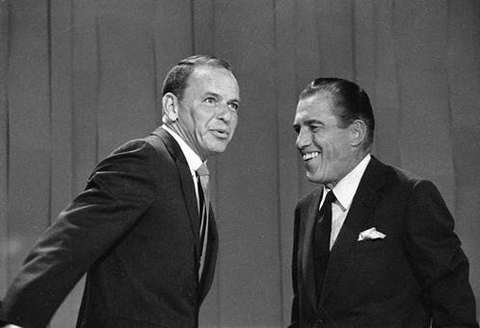
[Sinatra's own Sullivan appearance for Robin and the 7 Hoods] Sinatra appeared on Ed Sullivan's show, setting aside past feuds with the host to promote the newly premiered Robin and the 7 Hoods, singing "My Kind of Town." Critics were largely indifferent to the film itself; the New York Times's Bosley Crowther called it artless but noted Sinatra's usual arrogance was toned down.
Source: James Kaplan, "Sinatra: The Chairman" (2015).
July 1964
Frank Sinatra pursued formal misconduct charges — alleging conspiracy, corruption, perjury, and obstruction of justice — against attorneys Gladys Towles Root and George A. Forde over their trial-strategy claim that his son's kidnapping had been a staged publicity stunt. Both attorneys publicly accused Sinatra of vindictiveness; the charges were ultimately dismissed before reaching trial. Source: J. Randy Taraborrelli, Sinatra: Behind the Legend.
[Grand jury indicts Root and Forde]
Kaplan: After legal maneuvering by Sinatra and his lawyer Mickey Rudin, a federal grand jury indicted defense attorneys Gladys Root and George Forde for conspiracy and subornation of perjury over the hoax defense. All charges against the pair were dropped the following year.
Source: James Kaplan, "Sinatra: The Chairman" (2015)
Early July 1964
Sinatra attended the dedication of the Frank Sinatra International Youth Center for Arab and Jewish children in Nazareth, part of an increasing turn toward charitable causes in this period that also included benefit performances in Mexico in 1961 and 1962. Source: Wikipedia, “Frank Sinatra.”
July 3, 1964
Radio
Los Angeles KFWB - Bill Balance Show
Frank Sinatra, Bing Crosby, and Fred Waring were interviewed.
NOTE: Sinatra was was part of a big Fourth of July weekend on KFWB radio in Los Angeles. The Bill Balance show that evening devoted the entire hour show to the recently released Reprise LP. "America , I Hear You Singing." Frank Sinatra, Bing Crosby, and Fred Waring were Balance's guests.
On the show, Sinatra discussed his views on discrimination in America and whether or not progress had been made since his days of active involvement in preaching tolerance in high schools throughout the country. He also discussed his views on teenagers of the day and his memories of high school graduation.
Bill Balance asked Sinatra if there was any time in the past that he would have liked to have lived through rather than the present. Here is Sinatra's answer: "Well, if they had penicillin when Greece was swinging, I wouldn't have turned down a ticket to an Aristophanes comedy. I would like to have met Montaigne, Erasmus, Shakespeare, and Dostoyevsky. Sure I would like to have lived in many eras of the past. But, if I had, I never would have had the chance to meet Mr. Roosevelt, Mr. Kennedy, and hundreds of others I've been lucky enough to meet during my lifetime.
Ed
Television
None
Los Angeles KFWB - Bill Balance Show
Frank Sinatra, Bing Crosby, and Fred Waring were interviewed.
© 1997-2026 The Sinatra Archive
This calendar, or any parts thereof, may not be reproduced in any fashion whatsoever without the prior written permission of the publisher (The Sinatra Archive)
[image referenced in source but could not be recovered]
July 5, 1964
Radio
Los Angeles KFWB - Bill Ballance Show
Frank Sinatra, Bing Crosby, and Fred Waring were interviewed.
NOTE: Sinatra Scholar Ed O'Brien reports that, in 1964, this day was a Sunday and was part of a big Fourth of July weekend on KFWB radio in Los Angeles. The Bill Balance show that evening devoted the entire hour show to the recently released Reprise LP. "America , I Hear You Singing." Frank Sinatra, Bing Crosby, and Fred Waring were Balance's guests.
On the show, Sinatra discussed his views on discrimination in America and whether or not progress had been made since his days of active involvement in preaching tolerance in high schools throughout the country. He also discussed his views on teenagers of the day and his memories of high school graduation.
Bill Balance asked Sinatra if there was any time in the past that he would have liked to have lived through rather than the present. Here is Sinatra's answer: "Well, if they had penicillin when Greece was swinging, I wouldn't have turned down a ticket to an Aristophanes comedy. I would like to have met Montaigne, Erasmus, Shakespeare, and Dostoyevsky. Sure I would like to have lived in many eras of the past. But, if I had, I never would have had the chance to meet Mr. Roosevelt, Mr. Kennedy, and hundreds of others I've been lucky enough to meet during my lifetime.
Television
None
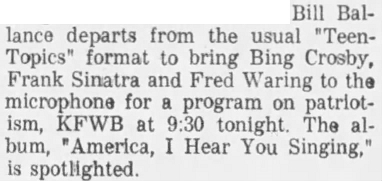
July 7, 1964
Frank flew to Tel Aviv for the dedication of the Frank Sinatra International Youth Center for Arab and Jewish Children, a project he had helped fund; the same day he was again named Top Male Vocalist in the Playboy Jazz Poll.
Source: Nancy Sinatra, Frank Sinatra: An American Legend, 1995.
July 10, 1964
Indianapolis Star
July 13, 1964
Frank Sinatra marked the twenty-fifth anniversary of his first professional recording session, made with Harry James's band singing “From the Bottom of My Heart” for the Brunswick label in 1939 — a quarter century that had reshaped American popular music, with, as it would turn out, still more ahead: within weeks he would meet the woman who would become his third wife. Source: J. Randy Taraborrelli, Sinatra: Behind the Legend.
July 17, 1964
Studio
Los Angeles
2888 Softly As I Leave You w/Vocal Chorus
(Hal Shaper/Antonio DeVito/Giorgio Calabrese)
EMI Miller Catalog Inc../Curci USA Corp. (ASCAP)
Arranged & Conducted by Ernie Freeman
-10 (2:51) CD: 46013-2 The Complete Reprise Studio Recordings Disc 8
CD: 1013-2Softly As I Leave You
CD: 1016-2A Man And His Music
LP: FS1025Frank Sinatra's Greatest Hits
LP: FS1013Softly As I Leave You
45: 0301
2889 Then Suddenly Love w/Vocal Chorus
(Ray Alfred/Paul Vance)
Music Sales Corp./Jonroy Music Co. (ASCAP)
Arranged & Conducted by Ernie Freeman
-9 (2:15) CD: 46013-2 The Complete Reprise Studio Recordings Disc 8
CD: 1013-2Softly As I Leave You
LP: FS1013Softly As I Leave You
45: 0301
2890 Since Marie Has Left Paree w/Vocal Chorus
(Hy Glaser/Jerry Solomon)
Bourne Co. (ASCAP)
Arranged by Billy May
Conducted by Ernie Freeman
-1 (1:56) CD: 46013-2 The Complete Reprise Studio Recordings Disc 8
2891 Available w/Vocal Chorus
(Sammy Cahn/Ned Wynn/L.B. Marks)
WB Music Corp. (ASCAP)
Arranged & Conducted by Ernie Freeman
-7 (2:47) CD: 46013-2 The Complete Reprise Studio Recordings Disc 8
CD: 1013-2Softly As I Leave You
LP: FS1013Softly As I Leave You
45: 0350
NOTE: Ed O'Brien sends along an excerpt from an interview with Frank Sinatra at the Hotel New Japan, Tokyo , April 20, 1962:
"I do believe there is a place in the world, very much so, in the world of entertainment, for the better kind of music, such as the Rodgers and the Porters and the Harold Arlens and people of their ilk. I would like to see more of the recording artists stay in that realm. And not get panic stricken because they haven't got a record for six months. They haven't got a hit or something; not to wander over to the other side, because I don't think they prove anything by doing that. I think if you have the courage of your conviction in this kind of thing, it really pays off."
Sinatra had inveighed against rock and the terrible music that was being recorded for many years, O'Brien reminds. In the Tokyo interview, he rips the pop sounds of the time. But he was a pop singers and the hit singles had been a long time ago when the summer of 1964 rolled around. Reprise had released 24 Sinatra singles during the first three years they were in business and there hadn't been an authentic hit in the bunch. Sinatra had recorded with Riddle, May, Costa, Paich, Hefti, and Oliver. His singles either failed to chart or for the most part languished well below the Top 40 chart.
Jimmy Bowen had made Dean Martin a major artist again and Sinatra wanted some of the action. The July 17, 1964 session was a major transition period in the career of Frank Sinatra. Musicians who worked that night told O'Brien that Sinatra was nervous and more than a little uncertain regarding Ernie Freeman, Bowen, and the material. Bill Miller dismissed it "chicken shit rock," but Sinatra wanted chart hits and Bowen just might be his ticket.
Bowen employed a 33-piece orchestra and a vocal group. Freeman was definitely able to give Sinatra a more modern sound and the first single "Softly As I Leave You" broke into the Top 30 and reached #4 in Adult Contemporary. In all, Bowen would give Sinatra ten Top 10 Adult Contemporary hits including four which reached #1. Stan Cornyn tells us in his book EXPLODING about the disdain Sinatra held for the music he felt impelled to record, but, by 1966, it had lifted him to the upper stratosphere of superstar performers
O'Brien has an interview with pianist Bill Miller in which he tells of a conversation he had with Sinatra in 1969 after a show at Caesars Palace . Miller asked Sinatra why he had surrendered to something so unpalatable to his senses. Sinatra shrugged his shoulders and said, "If you can't like 'em, join 'em" This July session was when he put his toes in the water, so to speak, O'Brien observes.
[First session with new arranger Ernie Freeman]
As Reprise's Jimmy Bowen pushed to make hit singles, Sinatra recorded his first session with new arranger Ernie Freeman, backed by younger rock-style session players including drummer Hal Blaine and keyboardist Leon Russell, plus a full choir -- a marked departure from his usual jazz and classical studio musicians. He recorded "Softly, as I Leave You," "Then Suddenly Love," and "Available."
Source: James Kaplan, "Sinatra: The Chairman" (2015).
July 27, 1964
[Sinatra rebuffs a prison chaplain's plea for mercy]
After Father Roger Schmit, Catholic chaplain at the federal penitentiary holding his son's convicted kidnappers, wrote urging forgiveness -- comparing the kidnappers' remorse to Christ's own words on the cross, "Father, forgive them for they know not what they do" -- Sinatra fired back a six-page letter (excerpted in the FBI file) telling the priest it was "presumptuous" of him to ask for forgiveness, and that he had until then remained silent about the trial's "hoax" defense but the priest's letter, "written in the name of God," had broken that silence. Sinatra forwarded the exchange to Hoover, who replied approvingly on August 4, 1964, quoting a 1924 judge's line about "the people who slobber over" criminals "in an effort to find excuses for their crime" -- with an internal FBI note confirming "the Director is well aware of the background of Sinatra."
Source: Kuntz and Kuntz, The Sinatra Files, ch. 8 (Sinatra letter of July 27, 1964, and Hoover reply of August 4, 1964).
July 29, 1964
Birmingham Evening Mail
Skelmersdale Reporter
July 31, 1964
Concerts
Cow Palace, San Francisco, California
Benefit for the NAACP
Cow Palace, San Francisco, California
Benefit for the NAACP
The Times
Herb Caen
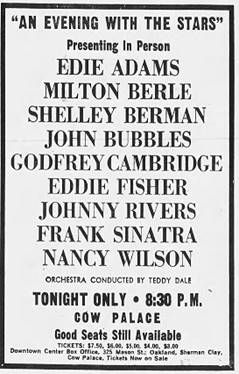
August 1964
[Dean Martin's Everybody Loves Somebody hits number 1]
Kaplan: Dean Martin's Reprise single "Everybody Loves Somebody," a 1947 tune (which Sinatra himself had once sung) reworked by Jimmy Bowen, knocked the Beatles' "A Hard Day's Night" off Billboard's number 1 spot -- a symbolic but short-lived victory for the older generation of singers.
Source: James Kaplan, "Sinatra: The Chairman" (2015)
[Sinatra departs for Rome to begin Von Ryan's Express]
Kaplan: In early August Sinatra headed to Rome to begin location shooting for Von Ryan's Express, stopping in New York to pick up Jilly Rizzo, whom columnist Earl Wilson reported would be in charge of "Sinatra security" against Italian paparazzi. Sinatra brought along Brad Dexter, Dick Bakalyan, and Mike Romanoff, plus a suitcase of fireworks, and clashed immediately with the film's meticulous director, Mark Robson.
Source: James Kaplan, "Sinatra: The Chairman" (2015)
[Indictment of Kidnapping Defense Attorneys]
Defense attorneys Gladys Towles Root and George Forde were indicted by a federal grand jury on perjury and conspiracy charges over their handling of the Frank Sinatra Jr. kidnapping defense; the indictment was later dismissed.
Source: George Carpozi Jr., Frank Sinatra: Is This Man Mafia? (New York: Manor Books, 1979).
September 5, 1964
[Softly, as I Leave You charts]
"Softly, as I Leave You," backed with "Then Suddenly Love," reached number 27 on the charts, achieving Bowen's goal of getting Sinatra back on Top 40 radio in the Beatles era.
Source: James Kaplan, "Sinatra: The Chairman" (2015).
September 1964
Frank meets nineteen-year-old Mia Farrow on the 20th Century-Fox lot while filming Von Ryan's Express. Farrow, then starring on the new television series Peyton Place, was loitering near the set in a sheer nightgown from her show's wardrobe when Frank tapped her on the shoulder and asked her age. She deflected, then told him she was nineteen; he later said her long blonde hair was what won him over. He asked her to sit and talk, and during the conversation she spilled the contents of her purse at his feet, prompting a string of flustered apologies that charmed him further. Both later described the moment their eyes met as an instant, mutual spark. Source: J. Randy Taraborrelli, Sinatra: Behind the Legend.
[Ava Gardner visits Sinatra's villa in Rome]
Frank Sinatra: Ava Gardner flew to Rome for a weekend visit to Sinatra's villa; there was affectionate, nostalgic talk of reconciliation but strain in the air, and no sexual reunion. During one dinner she drank herself into a stupor; Sinatra told Brad Dexter that Ava, the only woman he'd ever truly loved, had become a falling-down drunk.
Source: James Kaplan, "Sinatra: The Chairman" (2015)
[Sinatra and Dexter detained by Guardia Civil]
Kaplan: The young woman from the Torremolinos incident accused Sinatra and Brad Dexter of assault; Spanish police detained them for questioning in Madrid. Sinatra cursed at the officers, insulting Franco, which went over badly. Producer Saul David paid 25,000 pesetas to bail them out, and police put Sinatra straight on a plane to Paris without letting him pack.
Source: James Kaplan, "Sinatra: The Chairman" (2015)
[Torremolinos incident with aspiring actress]
Kaplan: In Torremolinos, Spain, on the night before filming wrapped, an aspiring actress embraced Sinatra for a staged paparazzi photo; he angrily pushed her off, and she retaliated by throwing a drink in his face, cutting his cheek. He reported the incident to police but declined to press charges; the next morning the hotel swarmed with police and two crew members were arrested.
Source: James Kaplan, "Sinatra: The Chairman" (2015)
September 10, 1964
Sinatra was photographed on location filming "Von Ryan's Express," absorbed in a book between takes for the World War II adventure film. Source: Charles Pignone, "Frank Sinatra 100" (2015).
October 1964
[Von Ryan's Express moves to Fox soundstage]
Kaplan: Filming of Von Ryan's Express moved from Europe to a 20th Century Fox soundstage in Los Angeles, where the studio, under Darryl Zanuck, was also producing TV series including Voyage to the Bottom of the Sea, Twelve O'Clock High, and the new prime-time soap Peyton Place, starring nineteen-year-old newcomer Mia Farrow.
Source: James Kaplan, "Sinatra: The Chairman" (2015)
[Mia Farrow Introduced to Sinatra]
Mia Farrow was introduced to Sinatra on the Twentieth Century-Fox lot by her friend, actor John Leyton, during production of "Von Ryan's Express."
Source: George Carpozi Jr., Frank Sinatra: Is This Man Mafia? (New York: Manor Books, 1979).
October 3, 1964
Studio
Los Angeles
2980 Pass Me By w/Vocal Chorus
(Cy Coleman/Carolyn Leigh)
Edwin H. Morris & Co. Inc./Northern Music Co. (ASCAP)
Arranged by Billy May
Conducted by Nelson Riddle
-5 (2:24) CD: 46013-2 The Complete Reprise Studio Recordings Disc 9
CD: 1013-2Softly As I Leave You
LP: FS1013Softly As I Leave You
2981 Emily w/Vocal Chorus
(Johnny Mercer/Johnny Mandel)
EMI Miller Catalog Inc. (ASCAP)
Arranged & Conducted by Nelson Riddle
-11 (2:59) CD: 46013-2 The Complete Reprise Studio Recordings Disc 9
CD: 1013-2Softly As I Leave You
LP: FS1013Softly As I Leave You
45: 0332
2982 Dear Heart w/Vocal Chorus
(Jay Livingston/Ray Evans/Henry Mancini)
All Nations Music/M. Witmark & Sons (ASCAP)
Arranged & Conducted by Nelson Riddle
(2:42) CD: 46013-2 The Complete Reprise Studio Recordings Disc 9
CD: 1013-2Softly As I Leave You
LP: FS1013Softly As I Leave You
Valley News
"Pass Me By"
A Cy Coleman-Carolyn Leigh circus-parade number written as a virtual paraphrase of their earlier 'Hey, Look Me Over,' with cockneyisms borrowed from 'I've Got a Lovely Bunch of Coconuts.' An outtake survives of Sinatra jokingly chanting, 'If you don't drink my whiskey, pass me by!'
Source: Will Friedwald, "Sinatra! The Song Is You: A Singer's Art" (2018 revised edition).
"Softly, As I Leave You"
Jimmy Bowen: After the 'Softly, As I Leave You' session, Bowen told Sinatra directly that he thought it would chart around number 30 but would help get him back on the radio; the record ultimately reached number 27.
Source: Charles L. Granata, "Sessions with Sinatra: Frank Sinatra and the Art of Recording" (1999/2003).
"Emily"
Granata includes 'Emily' among the fifty recordings he considers essential to understanding Sinatra's artistry (arranged by Nelson Riddle, recorded 1964, Reprise); the song was chosen for its musical/interpretive value rather than commercial popularity.
Source: Charles L. Granata, "Sessions with Sinatra: Frank Sinatra and the Art of Recording" (1999/2003).
October 29, 1964
The Egyptian Theater, Hollywood, CA
Frank Sinatra and Natalie Wood were co-chairmen of the benefit premiere of "My Fair Lady" which raised an estimated $130,000 for the Motion Picture Relief Fund.
Frank Sinatra, Natalie Wood, Jeanne & Dean Martin
© 2025 The Sinatra Archive
This calendar, or any parts thereof, may not be reproduced in any fashion whatsoever without the prior written permission of the publisher (The Sinatra Archive)
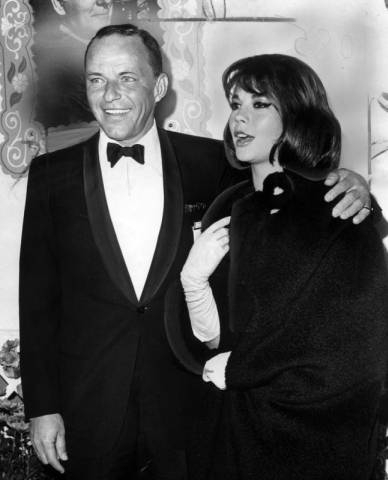
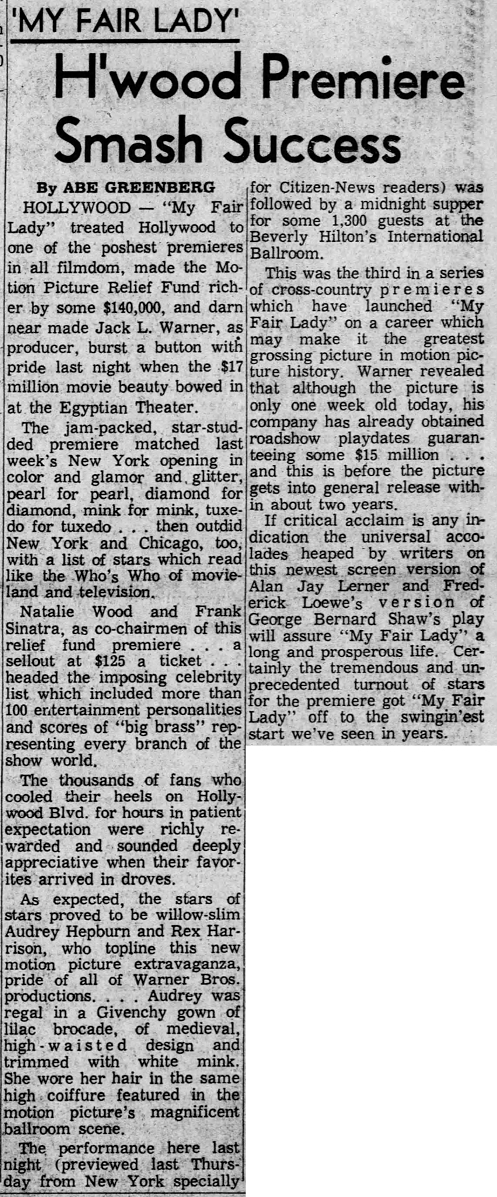
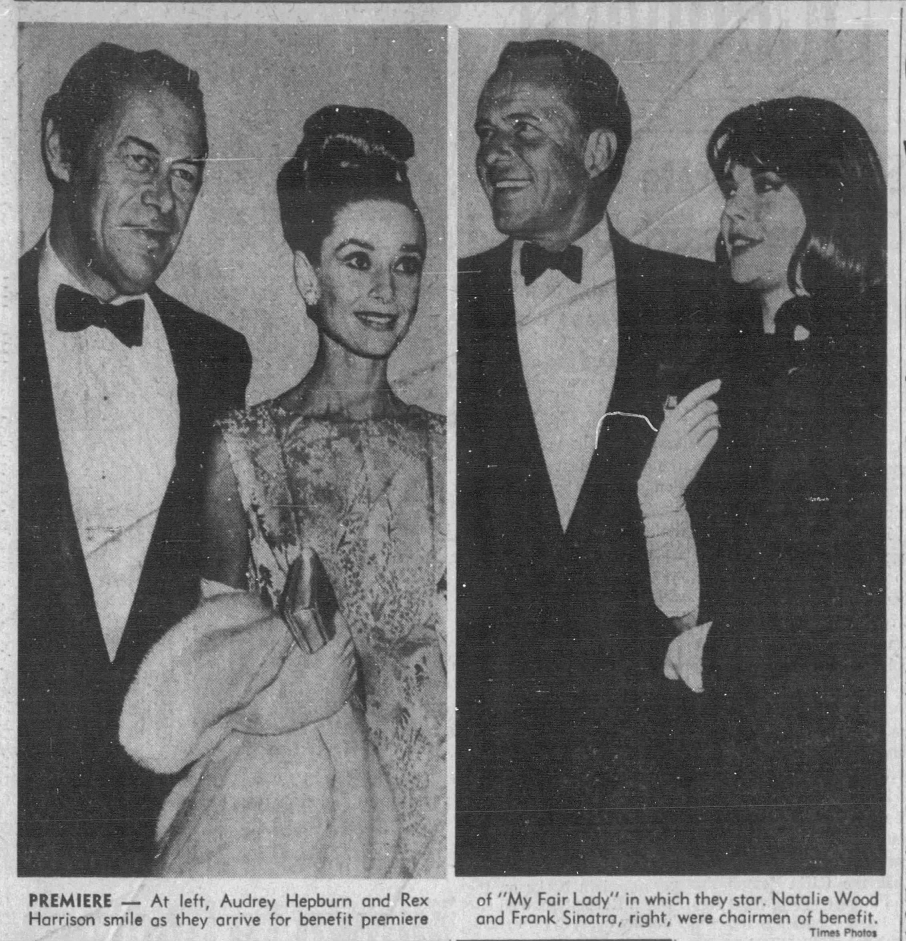
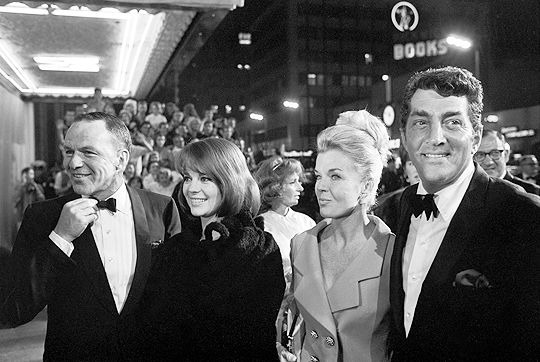
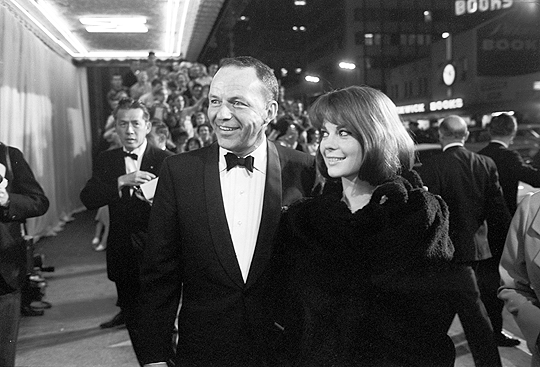
November 1964
[Mudslide kills pianist Bill Miller's wife]
Kaplan: In early November, a heavy Los Angeles rainstorm triggered a mudslide above Burbank that swept through the home of Sinatra's longtime pianist Bill Miller, seriously injuring him and killing his forty-seven-year-old wife, Aimee; Miller was found three-quarters of a mile away clinging to a car. Sinatra paid for a new house for Miller, covered uninsured hospital costs, and furnished the new home down to the linens.
Source: James Kaplan, "Sinatra: The Chairman" (2015)
[Sinatra focused and disciplined during Basie engagement]
Quincy Jones: Quincy Jones recalled that during the Sands run with Basie, Sinatra was completely focused and professional, arriving forty-five minutes early with his music and doing vocal exercises -- a stark contrast to his late-night carousing with the Rat Pack, reflecting his roots as a big-band singer.
Source: James Kaplan, "Sinatra: The Chairman" (2015)
[Sinatra on rock and roll to Variety]
Sinatra: In a November Variety interview, Sinatra offered diplomatic restraint about rock 'n' roll, saying it belonged to the younger generation and that he wasn't going to knock it -- though he sensed the shift in popular taste and wasn't thrilled by it.
Source: James Kaplan, "Sinatra: The Chairman" (2015)
[Tommy Thompson first approaches Sinatra]
Kaplan: Life writer Tommy Thompson first approached Sinatra about the profile the previous November over drinks in New York; Sinatra was typically distractible, hopping up to phone Jackie Gleason and Dean Martin, before telling Thompson to 'come see me on the coast.'
Source: James Kaplan, "Sinatra: The Chairman" (2015)
[Fontainebleau Hotel Grand Jury Investigation]
A federal grand jury in Kansas City opened an investigation into allegations that Miami's Fontainebleau Hotel had made under-the-table payments to entertainers, including a $4,000 ring given to Sinatra; Sinatra and Sammy Davis Jr. initially sought help from Kennedy administration contacts to avoid or delay testifying before ultimately appearing.
Source: George Carpozi Jr., Frank Sinatra: Is This Man Mafia? (New York: Manor Books, 1979).
November 10, 1964
Studio
Los Angeles
3046 Somewhere In Your Heart w/Vocal Chorus
(Russell Faith/Clarence Keltner)
MCA Inc. (ASCAP)
Arranged & Conducted by Ernie Freeman
-10 (2:28) CD: 46013-2 The Complete Reprise Studio Recordings Disc 9
LP: FS1025 Frank Sinatra's Greatest Hits
45: 0332
Ed O'Brien:
Found an article from early 1965 in Billboard. Sinatra was all set to record an album built around "Somewhere In Your Heart." The single was not the expected success hope for and the album project was forgotten. We can only be grateful it didn't happen.
3047 Any Time At All w/Vocal Chorus
(Baker Knight)
Duchess Music Corp. (BMI)
Arranged & Conducted by Ernie Freeman
-6 (2:21) CD: 46013-2 The Complete Reprise Studio Recordings Disc 9
LP: FS6167Sinatra 65
45: 0350
NOTE: Sinatra Scholar Ed O'Brien asks if any one on our list ever listens to the recordings from this session. He says he hasn't for years.
During the session, Jimmy Bowen asked Sinatra if he wanted to sing "Somewhere in your Heart" on the beat. "It doesn't have a god-damned beat," was Sinatra's reply. But he did 10 takes including three that were complete before the master.
"Anytime at All" was done in an a la Dean Martin style with the slurring of words and other Dean signature sounds. There were six takes, three complete.
Stan Cornyn revealed in his book EXPLODING just how much contempt Sinatra had for material like this. He gave in because what he loved to sing just didn't sell to the singles record buyer.
O'Brien doesn't feel that most of the Jimmy Bowen era recordings hold up today. He would welcome the opinion of others on the list.
Sinatraphile Ed Spiegel comments: "Frank said it about that junk. No musical value at all. "Hold up today?" It never held up. I had friends in radio then. They were mostly disgusted. Maybe it's partly my imagination, but I hear his disdain in the performances. Of course, who's responsible " he chose to record them, contempt or not. A possible saving grace is that some of those who liked Frank's "Dino Records" progressed to some of the great music Sinatra gave us with Riddle.May, Jenkins, Costa, Hefti, etc. and the earlier Dorsey and Stordahl records.
Sinatraphile Vance Adair insists that the Bowen projects were execrable then and they remain so today. I fully understand the logic commercially behind their ill fated genesis, but I also second the observation by Ed Spiegel that you can actually hear the contempt in Frank's voice on some of these recordings.
This is not to say that I dislike all of Sinatra's forays into what Friedwald calls "Kiddie Pop" but most of the Bowen sessions earned their fate of being consigned top oblivion.
The lamentable choice of "experimental" material extended well beyond 64' (even right up to '88 when we're treated to the unforgivable faux pas of "Leave It All to Me.") You all know what they are. Nevertheless, some of the experiments, Adair observes, worked very well. For every "Downtown" there was a "Didn't We," and for every "Dry Your Eyes" (I still need someone to explain this hokum to me) and "That's What God Really Looks Like" we are compensated with a "Summer Me, Winter Me" or "I'm Not Afraid."
As far as albums are concerned, the misconceived bubble-gum of "Some Nice Things I've Missed" is easily forgiven by the truly experimental and extraordinary "Watertown." And there are many, many more "contemporary" tunes that FS performed with varying degrees of gusto and sensitivity.
The Bowen stuff, Adair concludes, was, for me, almost uniformly awful.
Los Angeles
3046 Somewhere In Your Heart
3047 Any Time At All
Frank Sinatra, daughter Nancy, and friend Yul Brynner at a recording session on November 10th, 1964
November 10, 1964 Beverly Hills Friars Club , Beverly Hills, CA
Testimonial Dinner for Stan “The Man” Musial
(L-R): Danny Goodman, Stan Musial, Willie Mays, Frank Sinatra, Sandy Koufax, Dean Martin.
How Frank Sinatra, Dean Martin crooned for Stan Musial
January 22, 2014 by retrosimba
(Updated Nov. 10, 2019)
Imagine a gathering of 1960s icons that included Stan Musial, Sandy Koufax, Willie Mays, Frank Sinatra and Dean Martin.
A black-and-white photo from the event, reproduced here, shows (from left to right) Dodgers publicist Danny Goodman, Musial, Mays, Sinatra, Koufax and Martin (the latter in a classic pose, with cigarette in one hand and a drink in the other).
They were at the Friars Club in Beverly Hills on Nov. 10, 1964, for a testimonial dinner in honor of Musial, the Cardinals standout who had retired as a player a year earlier. Less than a month before the gala, the Cardinals, with Musial in the front office as an executive, clinched the 1964 World Series championship against the Yankees.
The Friars Club, founded in 1904 in New York City, primarily attracted comedians and entertainers as its members and became best known for its bawdy celebrity roasts. A Beverly Hills branch of the club opened in 1947.
The dinner for Musial attracted a stellar group from the baseball and entertainment worlds.
Among the baseball celebrities joining Koufax and Mays in honoring Musial were Don Drysdale, Leo Durocher, Bob Feller, Hank Greenberg, Vin Scully and Duke Snider.
Sinatra and Martin were joined by personalities such as Gene Autry, Milton Berle, Gene Barry, Arthur Godfrey and master of ceremonies George Jessel.
Following the standard Friars Club format, several of the entertainers took turns on the dais poking fun at the honored guest.
An example of the cutting humor was this line from Godfrey about Musial’s restaurant in St. Louis: “After eating there, I can understand why Stan came all the way to Los Angeles for a meal.”
Comedian Corbett Monica quipped, “He’s such a nice guy. I might even say he’s holy. He reminds me in fact of Saint Joseph, a dull little town in nothern Missouri.”
In rare serious moments, Autry spoke of how his friendship with Musial began when Stan was a Cardinals rookie, and Mays told the audience Musial and Joe DiMaggio were his idols when he began his baseball career, the Los Angeles Times reported.
“Stan is the kind of man you want your kids to remember for a long time,” Mays said.
The highlight of the evening came when Sinatra and Martin “ran through a half-dozen song parodies filled with jabs at Musial,” The Sporting News reported. The Rat Pack duo’s special lyrics to popular tunes were so risqué that none “is in danger of ever being published,” wrote Sporting News correspondent Bob Hunter.
Sinatra and Martin ended on a high note with a duet to the tune of the song “The Lady is a Tramp.” Changing the lyrics to salute Stan the Man, Sinatra and Martin made the signature line, “Mr. Musial, you’re a champ.”
The Sporting News observed, “Musial received several standing ovations, the final one lasting for a lengthy period after he had responded to the barbs and roasts with a witty, humble speech of thanks.”
In opening his remarks, Musial said to the celebrity club members, “It’s been a great evening and it’s great to be with such famous and good friends _ even if they don’t know a darn thing about baseball.”
Tony Rome (US Film Release: November 10, 1967)
Starring: Frank Sinatra, Jill St. John, Sue Lyon and Gena Rowlands
(Directed by Gordon Douglas. Produced by Aaron Rosenberg)
The story follows the adventures of Miami private investigator Tony Rome (Sinatra) in his quest to locate a missing diamond pin that belongs to a wealthy heiress.
(1st DVD Release date: 2005-05-24)
(Blu-Ray Released on August 16, 2016 by Twilight Time with "Lady In Cement", limited to 3,000)
Note: Sinatra would play Tony Rome again in 1968's "Lady In Cement"8
The 3 Feb 1967 editions of DV and LAT announced that Frank Sinatra would star in Shamus, the first of two Twentieth Century-Fox crime films. The second would be an adaptation of novelist Roderick Thorp's The Detective (1968, see entry). Shamus was based on the 1960 novel Miami Mayhem by Anthony Rome, a pen name of Marvin H. Albert. Filming was set to begin 3 Apr 1967 in Miami and Miami Beach, FL.
Director Gordon Douglas, who had already worked with Sinatra on Young at Heart (1954, see entry) and Robin and the 7 Hoods (1964, see entry), was chosen to direct Shamus. Because of Sinatra's concurrent three-week stand at Miami Beach's Fontainebleau Hotel, filming would remain in the area, the 9 Mar 1967 and 31 Mar 1967 editions of DV reported. As a concession to his shooting schedule, Sinatra would limit himself to only one show a night. His opening act, comedian Shecky Greene, also had a role in the film, as did Lenny Dawson and his Fontainebleau Hotel Club Gigi Orchestra.
The 23 Mar 1967 DV noted that the film's title was changed from Shamus to Tony Rome. Principal photography began as scheduled on 3 Apr 1967, according to a production chart in the 7 Apr 1967 DV.
Wendell Corey was set for the featured role of a disgraced physician, the 2 May 1967 DV, but was later replaced by Jeffrey Lynn.
The 11 May 1967 DV announced that filming would end that night, eighteen days ahead of schedule. An actor hired to play a pawnbroker in the film's final scene was not due to arrive in Miami until the next day, so Douglas shot the scene without him, using Sinatra's real-life attorney, Milton "Mickey"ť Rubin, in the role.
The film's premiere was held at Miami's Carib Theatre on 10 Nov 1967, the 15 Nov 1967 Var reported. The before-and-after parties were held at the Fontainebleau Hotel. The 29 Nov 1967 Var announced that Tony Rome opened nationally in 194 theaters that week. Reviews were mixed. The 16 Nov 1967 NYT accused Sinatra of imitating Humphrey Bogart's "Sam Spade"ť character from The Maltese Falcon (1941, see entry), called the "vivid melodrama"ť a "demonstration of social vulgarity, degeneracy and crime"¦to satisfy the most lurid tourist taste,"ť and commented that there were enough "trade names of hotels, cars and beer"ť to give "the impression it's an advertising film."ť The 22 Nov 1967 LAT credited Sinatra with providing enough energy to improve what was otherwise "thin, familiar stuff."ť
After filming The Detective later in the year, Sinatra and the Tony Rome creative team made a sequel, Lady in Cement (1968, see entry), based on another Marvin H. Albert novel, The Lady in Cement. A third film, based on a third Albert novel called My Kind of Game, was planned, according to the 5 Jun 1967 LAT and 14 Jun 1967 Var, but never made.
AFI Catalog
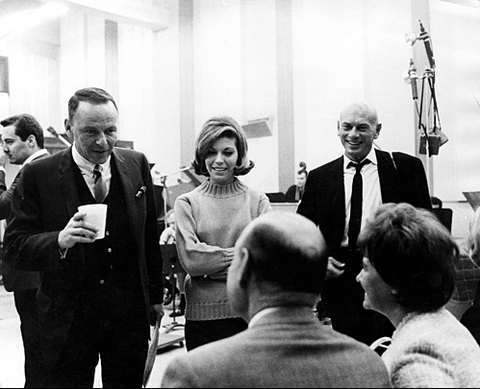
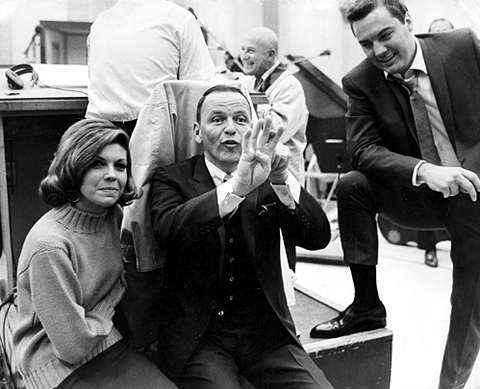
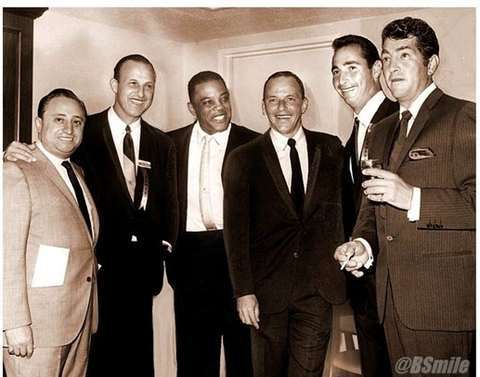
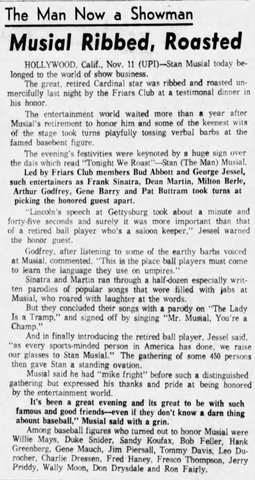
"Some Nice Things I've Missed"
Granata's discography entry: Some Nice Things I've Missed, arranged by Don Costa, released July 1974.
Source: Charles L. Granata, "Sessions with Sinatra: Frank Sinatra and the Art of Recording" (1999/2003).
November 27, 1964
Concerts
Sands, Las Vegas, Nevada (November 27 - December 10)
Count Basie Orchestra
Conducted by Quincy Jones
Opening Night Setlist Inlucde:
Get Me To The Church On Time
Fly Me To The Moon
I Get A Kick Out Of You
Under My Skin
Please Be Kind
You Make Me Feel So Young
Hello Dolly
Pennies From Heaven
In The Still Of The Night
I Wanna Be Around
I Only Have Eyes For You
My Kind of Town
Ed O'Brien:
During this engagement Frank sang "The Way You Look Tonight" and "Looking At The World Thru Rose-Colored Glasses."
Sands, Las Vegas, Nevada (November 27 - December 10)
Count Basie Orchestra
Conducted by Quincy Jones
San Francisco Chronicle
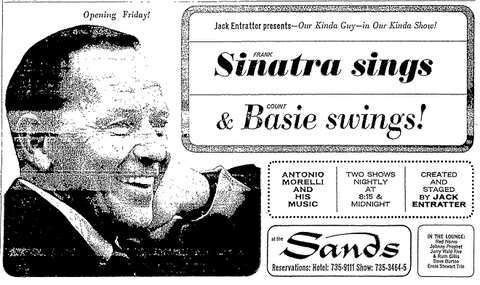
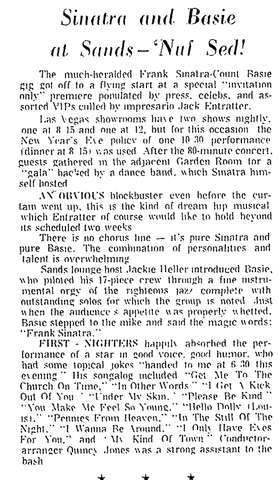
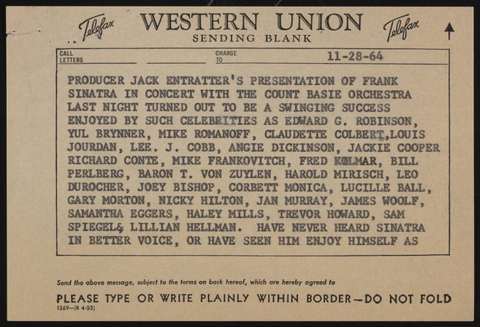
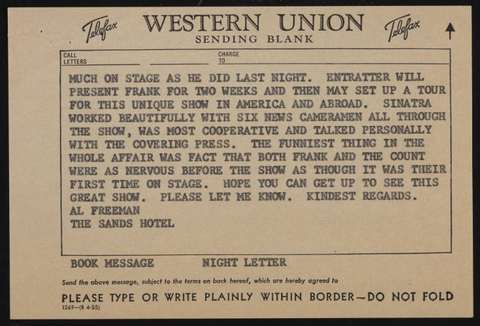
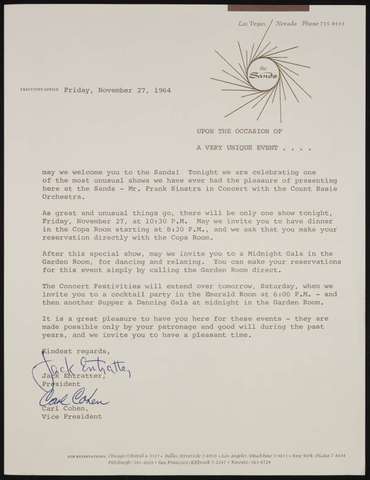
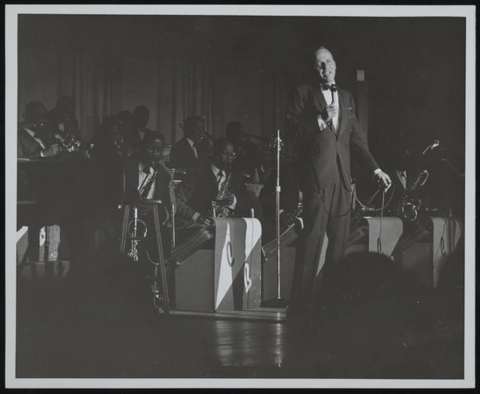
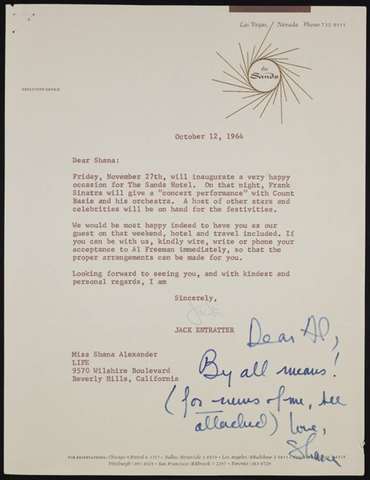
Ventura County Star
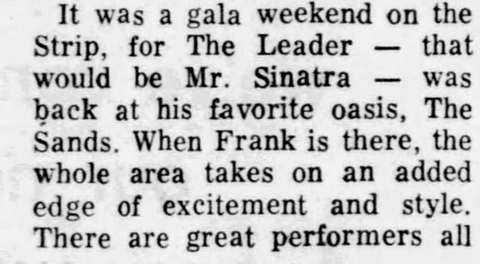
12-14-64
Los Angeles Times
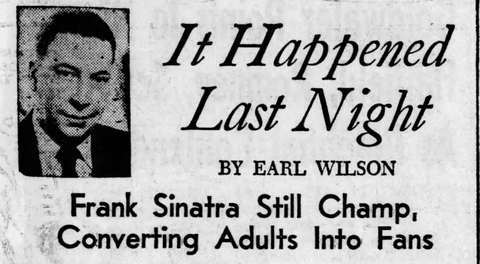

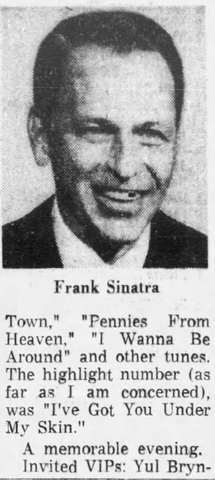
The Record


San Francisco Chronicle
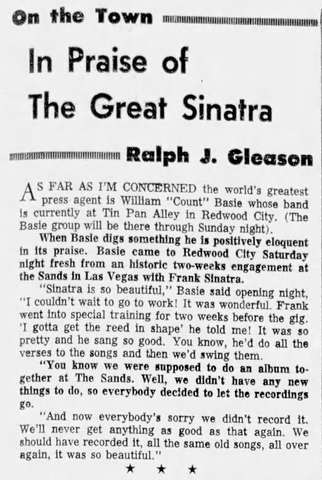
Los Angeles Times
Sands, Las Vegas, Nevada (November 27 - December 10)
Count Basie Orchestra
Conducted by Quincy Jones
Ed O'Brien:
During this engagement Frank sang "The Way You Look Tonight" and
"Looking At The World Thru Rose-Colored Glasses."
Opening night.
note: Entratter knew what he doing, always. Shana was a columnist for LIFE magazine and offered the Sands great publicity.
She would go on to 60 Minutes as the liberal spokesperson opposite James Killpatrick in the segment appropriately
named "Point-Counterpoint" But I put this up because there is a Sinatra connection. When Shana was two years old,
her father, Milton Ager, composed a song for her with lyricist Jack Yellen. The tune "Ain't She Sweet" would be a hit
record for Gene Austin and recorded by Sinatra in 1962.
--Ed
note: During the two week run Sinatra
also sang "Luck Be A Lady" and
"I Wish You Love."
The photo, in today's entry, of Frank
and Dorothy Kilgallen is so apropos.
During this engagement, he had
much to say about his former pal.
Ed
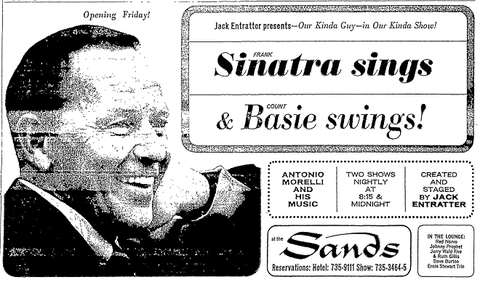
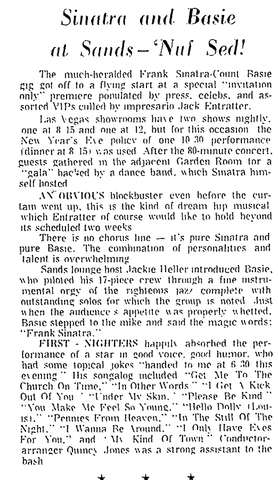
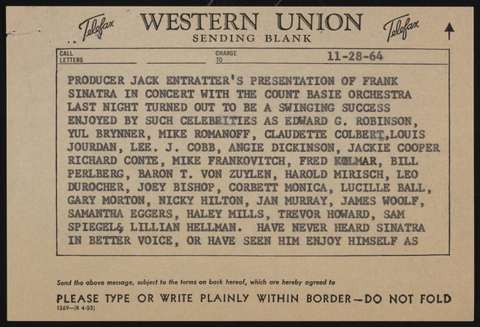
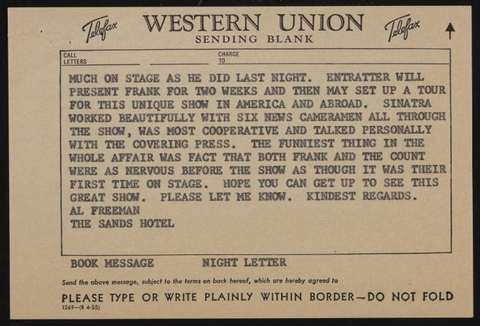
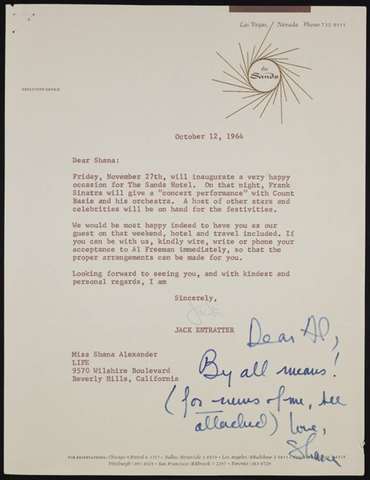
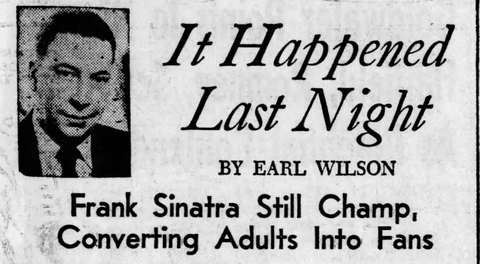
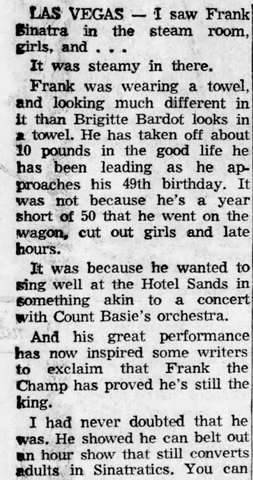
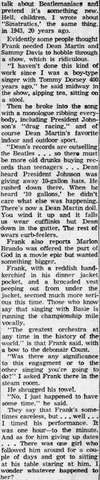
[Sinatra opens at the Sands with Count Basie]
Frank Sinatra: On the night after Thanksgiving, Sinatra opened a two-week engagement at the Sands with Count Basie and His Orchestra, conducted by Quincy Jones. He introduced his ex-wife Nancy at ringside as "the mother of my three children"; two of their children, Nancy Jr. and Frank Jr., were seated with her.
Source: James Kaplan, "Sinatra: The Chairman" (2015).
[Sam Giancana at the Sands opening night]
John Leyton: At the Sands opening night, actor John Leyton (Sinatra's Von Ryan's Express co-star) recalled being introduced to Sam Giancana at ringside and prompted by Sinatra, with a smile, to ask Giancana what he did for a living; Giancana stood and proudly declared, "I own Chicago."
Source: James Kaplan, "Sinatra: The Chairman" (2015).
November 28, 1964
Concerts
Sands, Las Vegas, Nevada (November 27 - December 10)
Count Basie Orchestra
Conducted by Quincy Jones
Ed O'Brien:
During this engagement Frank sang "The Way You Look Tonight" and "Looking At The World Thru Rose-Colored Glasses."
November 29, 1964
Concerts
Sands, Las Vegas, Nevada (November 27 - December 10)
Count Basie Orchestra
Conducted by Quincy Jones
November 30, 1964
Concerts
Sands, Las Vegas, Nevada (November 27 - December 10)
Count Basie Orchestra
Conducted by Quincy Jones
[Sheilah Graham breaks Sinatra-Farrow romance news]
Sheilah Graham: Columnist Sheilah Graham, having overheard Farrow excitedly describe a call from "the man I love" and confirm it was Sinatra, broke the news of the romance in her column, calling it the maddest, merriest romance of the year and noting marriage could be on the agenda. Farrow's phone rang off the hook the next day with calls from around the world, including her mother Maureen O'Sullivan; Farrow publicly denied the romance, claiming it was only about a possible film role.
Source: James Kaplan, "Sinatra: The Chairman" (2015).
December 1964
[Sinatra's first Christmas gift to Mia]
Kaplan: On their first Christmas together, Sinatra gave Mia Farrow a diamond koala bear pin instead of the puppy she had hoped for -- a gesture Kaplan calls cold and artificial compared to what she wanted.
Source: James Kaplan, "Sinatra: The Chairman" (2015)
December 1, 1964
Concerts
Sands, Las Vegas, Nevada (November 27-December 10)
Count Basie Orchestra
Conducted by Quincy Jones
December 2, 1964
Concerts
Sands, Las Vegas, Nevada (November 27 - December 10)
Count Basie Orchestra
Conducted by Quincy Jones
December 4, 1964
Concerts
Sands, Las Vegas, Nevada (November 27 - December 10)
Count Basie Orchestra
Conducted by Quincy Jones
December 5, 1964
Concerts
Sands, Las Vegas, Nevada (November 27 - December 10)
Count Basie Orchestra
Conducted by Quincy Jones
Count Basie Band:
I Can't Stop Loving You
April in Paris
Blues in Frankie's Flat
One O'clock Jump
Frank Sinatra:
Get Me To The Church On Time
Fly Me To The Moon
I Wish You Love
I've Got You Under My Skin
Luck Be A Lady
Please Be Kind
You Make Me Feel So Young
Hello Dolly!
Monologue
Pennies From Heaven
I Get A Kick Out of You
I Wanna Be Around
My Kind Of Town
My Kind Of Town (reprise)
note: not a ballad to be found that night.
December 6, 1964
Concerts
Sands, Las Vegas, Nevada (November 27 - December 10)
Count Basie Orchestra
Conducted by Quincy Jones
December 7, 1964
Concerts
Sands, Las Vegas, Nevada (November 27 - December 10)
Count Basie Orchestra
Conducted by Quincy Jones
December 8, 1964
Concerts
Sands, Las Vegas, Nevada (November 27 - December 10)
Count Basie Orchestra
Conducted by Quincy Jones
December 9, 1964
Concerts
Sands, Las Vegas, Nevada (November 27 - December 10)
Count Basie Orchestra
Conducted by Quincy Jones
December 10, 1964
Concerts
Sands, Las Vegas, Nevada (November 27 - December 10)
Count Basie Orchestra
Conducted by Quincy Jones
December 11, 1964
Concerts
Music Center, Los Angeles, California subs for ailing Nat King Cole
1965
[CBS Airs "Sinatra: A Man and His Music"]
CBS broadcasts a Walter Cronkite documentary on Sinatra and the special "Sinatra: A Man and His Music," which later wins an Emmy and a Peabody Award; Sinatra directs his first film, "None but the Brave," and appears in "Von Ryan's Express" and "Marriage on the Rocks."
Source: Nancy Sinatra, "Frank Sinatra, My Father" (1985).
[Frank Sinatra Falls In Love With Mia Farrow]
In 1965, fifty-year-old Frank Sinatra fell in love with twenty-year-old Mia Farrow and wanted to marry her; Nancy, then twenty-five, worried at first but came to see how good Mia was for him after spending time with the couple at dinners and baseball games.
Source: Nancy Sinatra, "Frank Sinatra, My Father" (1985).
[Frank Jr. Performs in Argentina]
At twenty-one and performing in Argentina, Frank Jr. was slapped by a young woman at a press conference in a stunt arranged by her manager to get her publicity; the incident was later mistakenly reported in the U.S. press as connected to how his father treated women.
Source: Nancy Sinatra, "Frank Sinatra, My Father" (1985).
[Cronkite Asks How He Wants To Be Remembered]
In a 1965 interview, Walter Cronkite asked Sinatra how he wished to be remembered; Sinatra said he hoped to be recalled as someone who brought a lasting innovation to popular singing and who lived life well with good friends and family.
Source: Charles Pignone, "Frank Sinatra 100" (2015).
[Governor Pat Brown and the Watts Riots Meeting]
Nancy Sinatra: California Governor Pat Brown recalled being surprised by a call from Sinatra offering to help financially in the aftermath of the Watts riots. The two spent two hours by Sinatra's pool discussing options and ultimately decided to support a Watts-area minister's efforts toward racial reconciliation.
Source: Nancy Sinatra, Frank Sinatra: An American Legend, 1995.
[Hubert Humphrey's Late-Night White House Visit]
Nancy Sinatra: Hubert Humphrey recalled going with Sinatra to the White House late one night, entering through the back and finding President Johnson lying on his stomach getting a rubdown. Johnson looked up and asked what the two of them had been conspiring to do that night, which turned out to be planning benefit concerts in Watts to fund voter registration under the new Voting Rights Act.
Source: Nancy Sinatra, Frank Sinatra: An American Legend, 1995.
[John Dominis's Three-Month LIFE Access]
Sinatra granted photographer John Dominis unprecedented three months of behind-the-scenes access for LIFE magazine, producing intimate images of him with his dog Ringo and making a sandwich at his Palm Springs home, plus spotlit performance shots at the Sands.
Source: Charles Pignone, "Frank Sinatra 100" (2015).
[Nancy Begins Documenting Her Father's Charitable Giving]
Nancy notes that her partial list of her father's charities and causes only reflects what she has personally documented starting in 1965, since he does most of his good deeds anonymously.
Source: Nancy Sinatra, "Frank Sinatra, My Father" (1985).
[Sinatra Recalls Hoboken Turf Battles]
In a 1965 interview with Walter Cronkite, Sinatra described the ethnic rivalries of his Hoboken boyhood, recalling having to avoid certain neighborhoods to steer clear of confrontations over his Italian background.
Source: Tina Sinatra, "My Father's Daughter: A Memoir" (2000).
[September of My Years Marks Frank's 50th Birthday]
Conceived in honor of Frank's fiftieth birthday and his feelings about approaching middle age, September of My Years went on to win three Grammy Awards.
Source: Nancy Sinatra, "Frank Sinatra, My Father" (1985).
[Sinatra Leaves Sinatra Enterprises Offices]
A 1965 photo shows Sinatra departing the offices of his company, Sinatra Enterprises.
Source: Charles Pignone, "Frank Sinatra 100" (2015).
[Sinatra and Bill Miller Beside a Picasso]
A 1965 photo shows Sinatra and pianist Bill Miller at a private party standing in front of Pablo Picasso's painting Le Petit Pierrot aux Fleurs.
Source: Charles Pignone, "Frank Sinatra 100" (2015).
[Promotional Shot for Marriage on the Rocks]
A promotional photo was taken for the 1965 comedy Marriage On The Rocks, which also starred Dean Martin, Deborah Kerr, and Nancy Sinatra Jr.
Source: Charles Pignone, "Frank Sinatra 100" (2015).
[Sinatra's 1965 Playboy Interview on Faith]
In a widely quoted 1965 Playboy interview, Sinatra said he did not believe in a personal God and was open to whatever got a person through the night, whether it was prayer or a drink.
Source: Tina Sinatra, "My Father's Daughter: A Memoir" (2000).
[Sinatra's Life Magazine Praise Reaches Bennett in London]
While performing in London in 1965, Bennett learned that Sinatra had told Life magazine he considered him the best singer in the business. Bennett credits the endorsement with tripling his audience and transforming his career.
Source: Charles Pignone, "Frank Sinatra 100" (2015).
[Taping Sammy's ABC Special]
Sinatra rehearsed with Sammy Davis Jr. for the ABC television special Sammy And His Friends, which also featured Edie Adams, Joey Heatherton, and the Count Basie Orchestra.
Source: Charles Pignone, "Frank Sinatra 100" (2015).
[The Power Lunch Marking the Reprise-Warner Deal]
A 1965 photograph captured Frank and Warner Bros. chief Jack Warner lunching together in Sinatra's new studio office, joined by his attorney Mickey Rudin and Warner executive Walter MacEwen, commemorating the completed sale of Reprise Records to Warner Bros.
Source: Nancy Sinatra, "Frank Sinatra, My Father" (1985).
[Turning Fifty: A Life Magazine Profile]
In 1965, as he approached his fiftieth birthday, Life photographer John Dominis and writer Tommy Thompson profiled Frank, capturing his blunt outlook that dying was simply an unwelcome inconvenience compared to the pleasure of living.
Source: Nancy Sinatra, "Frank Sinatra, My Father" (1985).
[1959 admission about Ella Fitzgerald]
Kaplan: Kaplan notes that Sinatra had confessed in a 1959 interview that Ella Fitzgerald's brilliance intimidated him, offering context for his critical comments about her singing in the 1965 Life essay.
Source: James Kaplan, "Sinatra: The Chairman" (2015)
[A Man and His Music airs on NBC]
Kaplan: Frank Sinatra: A Man and His Music, a no-frills concert special featuring Sinatra alone performing a chronological survey of his hits, aired on NBC the night before Thanksgiving 1965 to strong reviews (UPI's Rick DuBrow called it 'an hour of consummate artistry') and high ratings.
Source: James Kaplan, "Sinatra: The Chairman" (2015)
[Bodyguard Al Silvani escorts Nancy home]
Al Silvani: After the Moonlight Sinatra session, Sinatra aide Al Silvani (a former prizefight manager) insisted on making sure Nancy Sinatra had a safe escort home, citing 'Pope's orders' (Frank's instruction), only relenting once he confirmed her waiting friends.
Source: James Kaplan, "Sinatra: The Chairman" (2015)
[CBS films the September of My Years session]
Kaplan: A CBS camera crew filmed the recording of 'It Was a Very Good Year' for the upcoming Walter Cronkite interview -- Frank had just agreed to sit for the profile, to air in the fall. The footage shows Jenkins conducting in his idiosyncratic left-handed style and Sinatra performing in a dark suit with careful stage presence between takes.
Source: James Kaplan, "Sinatra: The Chairman" (2015)
[Christina II enables quick trips]
Sinatra: Sinatra told columnist Earl Wilson that his new Lear Jet, the Christina II, let him make lightning publicity runs to Detroit, Chicago, or Washington in an evening and be back at Jilly's by 2 a.m.
Source: James Kaplan, "Sinatra: The Chairman" (2015)
[Color TV ownership surge]
Kaplan: Kaplan notes that between 1964 and 1966, color-television ownership in the United States more than tripled, part of the broader cultural shift as America moved out of the shadow of the JFK assassination.
Source: James Kaplan, "Sinatra: The Chairman" (2015)
[Cronkite's Mafia question triggers confrontation]
Walter Cronkite: Walter Cronkite recalled that after Don Hewitt prompted him to ask Sinatra about Mafia connections, Sinatra's expression hardened and he abruptly ended the interview, storming off with Jilly Rizzo and Hewitt for a heated private conference before returning to answer the question after a compromise was reached.
Source: James Kaplan, "Sinatra: The Chairman" (2015)
[Dolly Sinatra dismisses Mia rumors]
Dolly Sinatra: Dolly Sinatra publicly insisted her son was 'just helping this girl become a star,' dismissed Mia as 'a nice little girl, but that's all,' noted Frank's children were older than Mia, and claimed she'd use her influence to discourage any marriage during an upcoming visit to New York.
Source: James Kaplan, "Sinatra: The Chairman" (2015)
[Dominis photographs of Eden Roc after-hours party]
Kaplan: Life photographer John Dominis captured late-night shots in Sinatra's Eden Roc suite: Frank performing a tablecloth-pulling trick, lying on the floor laughing at a Joe E. Lewis joke, swapping jokes with Lewis at dawn, and Sinatra in the steam room the next morning looking worse for wear with a towel on his head.
Source: James Kaplan, "Sinatra: The Chairman" (2015)
[Don Hewitt persuades Sinatra to sit for Cronkite]
Don Hewitt: Producer Don Hewitt recalled persuading Sinatra to do the Cronkite interview by telling him he'd occupy 'the same seat Dwight Eisenhower, Jack Kennedy and Lyndon Johnson sat in,' then, as a masterstroke, telling Sinatra he could pass on the show if he didn't feel up to it. CBS cameras were in the recording studio the next night.
Source: James Kaplan, "Sinatra: The Chairman" (2015)
[Frank meets Mia Farrow]
Consiglio: Around 1965, Frank met nineteen-year-old Mia Farrow on the set of Von Ryan's Express after she wandered onto his stage at Twentieth Century Fox. She was then best known for playing Allison Mackenzie on the TV series Peyton Place.
Source: Tony Consiglio (as told to Franz Douskey), "Sinatra and Me: The Very Good Years" (2012)
[Gordon Jenkins chosen to arrange September album]
Kaplan: Sinatra chose Gordon Jenkins rather than Nelson Riddle to arrange the September album because he was feeling pensive about mortality; Jenkins' unsubtle, sentimental string writing suited the mood, even though critics like Jonathan Schwartz dismissed Jenkins as 'awful' compared to Riddle.
Source: James Kaplan, "Sinatra: The Chairman" (2015)
[Hewitt's account of Sinatra's threat]
Don Hewitt: In his own memoir, Don Hewitt recounted Sinatra accusing him of breaking 'Mickey's rules' regarding the interview and saying 'I ought to kill you'; Hewitt claims he replied that with anyone else that would be a figure of speech, to which Sinatra said, 'I mean it.' Hewitt says he then left Sinatra's house for his hotel.
Source: James Kaplan, "Sinatra: The Chairman" (2015)
[Life account of an all-night Eden Roc party]
Tommy Thompson: The Life text described a post-show night beginning around 1:30 a.m.: Sinatra drank, signed autographs, went to another club and drank Jack Daniel's (about half a bottle total) with Joe E. Lewis, spotted a hot dog stand at 5:30 a.m. ('Let's get some franks'), and the party reached his suite by 6 a.m., continuing with dart-throwing until he finally went to bed around 7 a.m. in orange pajamas.
Source: James Kaplan, "Sinatra: The Chairman" (2015)
[Life photos of Sinatra family]
Kaplan: The Life photo spread included images of Sinatra's parents Marty and Dolly outside the Sands, sixteen-year-old Tina getting a kiss from her father, and a notably intimate photo of twenty-four-year-old Nancy Sandra leaning against her father on a restaurant banquette; a photo of Frank Jr. showed him watching his father perform from backstage.
Source: James Kaplan, "Sinatra: The Chairman" (2015)
[Life piece on Sinatra and women]
Kaplan: The Life piece described women constantly seeking Sinatra's attention -- sending notes, calling, trying to sneak past his door guard -- and featured photos of him with Natalie Wood backstage and cigarette girl Yumi Akutsu in Miami; Mia Farrow was not mentioned anywhere in the piece.
Source: James Kaplan, "Sinatra: The Chairman" (2015)
[Mia Farrow on Peyton Place workload]
Mia Farrow: In a spring interview with Bob Thomas, Mia Farrow, working hard on the hit series Peyton Place (soon to expand from two to three episodes weekly), described the grueling production schedule with two companies now shooting simultaneously.
Source: James Kaplan, "Sinatra: The Chairman" (2015)
[Near-drowning during None But the Brave]
Consiglio: While filming None But the Brave in Hawaii in 1965 with Clint Walker, Tommy Sands, and Brad Dexter, Frank nearly drowned when a strong undertow pulled him out to sea during an ocean scene. Brad Dexter swam out and saved him; Frank was grateful afterward and made sure Dexter got more film roles and producing opportunities.
Source: Tony Consiglio (as told to Franz Douskey), "Sinatra and Me: The Very Good Years" (2012)
[O'Brien named postmaster general]
Consiglio: After JFK's assassination, President Lyndon Johnson appointed Larry O'Brien postmaster general in 1965; O'Brien held the post until 1968 and introduced the zip code system.
Source: Tony Consiglio (as told to Franz Douskey), "Sinatra and Me: The Very Good Years" (2012)
[September of My Years song selections]
Kaplan: Early in the year Sinatra sought 'September' songs for an autumn-themed album, choosing three previously recorded numbers ('Hello, Young Lovers,' 'Last Night When We Were Young,' 'September Song') plus new Cahn-Van Heusen songs including the title track 'The September of My Years.'
Source: James Kaplan, "Sinatra: The Chairman" (2015)
[Sinatra films of 1965]
Consiglio: None but the Brave, Von Ryan's Express, and Marriage on the Rocks were released in 1965, during the same period Frank began his relationship with Mia Farrow.
Source: Tony Consiglio (as told to Franz Douskey), "Sinatra and Me: The Very Good Years" (2012)
[Sinatra's Life quotes on women and marriage]
Sinatra: In the Life piece Sinatra said he'd 'flunked' more often than not with women, described his preferences for tasteful dress and minimal makeup, and said that if he remarried it would have to be someone out of show business or willing to leave it, adding he was 'a symmetrical man, almost to a fault' who demanded order and could not stand strong perfumes.
Source: James Kaplan, "Sinatra: The Chairman" (2015)
[Sinatra's business empire beyond entertainment]
Kaplan: By this period Sinatra, out of the casino business, had interests in movie production, commercial real estate, a private airline of half a dozen planes, a metal parts company, and even a stake in a corporation manufacturing missile parts.
Source: James Kaplan, "Sinatra: The Chairman" (2015)
[Sinatra's exchange with French horn player Vince DeRosa]
Sinatra: At the end of a Moonlight Sinatra session, Sinatra affectionately asked French horn player Vince DeRosa (who'd played with him since the Your Hit Parade radio days) about his daughter, now a USC student with some singing talent, advising she finish her education first before pursuing music.
Source: James Kaplan, "Sinatra: The Chairman" (2015)
[Talese observes Sinatra's studio ecstasy]
Gay Talese: Gay Talese, having gained closer access, described Sinatra's electric energy entering the recording studio during the Moonlight Sinatra sessions, dominating the orchestra and room, and afterward listening to a playback with Nancy Sinatra, exclaiming happily 'Ooba-deeba-boobe-do!'
Source: James Kaplan, "Sinatra: The Chairman" (2015)
[Talese writes Frank Sinatra Has a Cold without access]
Kaplan: Denied direct access, Talese spent about six weeks at the Beverly Wilshire (expenses around $5,000) observing Sinatra's orbit from a distance, including witnessing a tense encounter between Sinatra and writer Harlan Ellison at the Daisy club, ultimately producing the celebrated write-around profile 'Frank Sinatra Has a Cold' for Esquire.
Source: James Kaplan, "Sinatra: The Chairman" (2015)
[The Daisy nightclub scene]
Kaplan: The Daisy, a private, exclusive Beverly Hills discotheque owned by Jax slacks inventor Jack Hanson, was the hot spot of the moment; a $250 membership fee (later raised to $1,000) kept out non-celebrities, and stars like Jane Fonda and Jill St. John were regulars. Frank and Mia frequented it as a couple, though Mia's taste for dancing to pop records didn't match Frank's preference for Vaughan Williams and Sands-lounge drinking.
Source: James Kaplan, "Sinatra: The Chairman" (2015)
[Tommy Sands leaves Nancy Sinatra]
Nancy Sinatra (per Kaplan): Over the Easter holiday, Tommy Sands walked out on Nancy Sinatra, telling her his fear of commitment and disinclination toward family life would never go away; he left and never returned. Nancy says she was blindsided, having believed the marriage was happy.
Source: James Kaplan, "Sinatra: The Chairman" (2015)
[Vegas trip to Joey Bishop's Sands opening]
Kaplan: Sinatra took Mia to Joey Bishop's opening at the Sands, where she was startled to be handed a $5 bill for the ladies' room attendant; Frank Jr. was also present, performing with the Dorsey orchestra at the Flamingo Lounge at the time.
Source: James Kaplan, "Sinatra: The Chairman" (2015)
[Warner releases Jobim tribute album]
Kaplan: Sinatra's home label Warner Records released 'The Wonderful World of Antonio Carlos Jobim,' on which Jobim played and sang his own songs with arrangements by Nelson Riddle.
Source: James Kaplan, "Sinatra: The Chairman" (2015)
[Will Rogers Hospital Trailer]
Santopietro (Filmography): Short trailer soliciting contributions for the Will Rogers Memorial Fund; Sinatra appears and narrates. No further production credits given.
No corresponding dated entry could be identified in the chronology for this film/context.
Source: Tom Santopietro, "Sinatra in Hollywood" (2008), Filmography
[Yacht crewman drowns off Martha's Vineyard]
Consiglio: While Frank and Mia were aboard a leased yacht at Martha's Vineyard, two crewmen returning to the boat capsized and one drowned. The story dominated headlines even though President Johnson had just signed major civil rights legislation the same news cycle -- Consiglio notes wryly that Frank sold newspapers and Johnson didn't.
Source: Tony Consiglio (as told to Franz Douskey), "Sinatra and Me: The Very Good Years" (2012)
[business]
By 1965 Sinatra's business holdings included his film production companies Artanis Productions (his name spelled backward) and Park Lake Enterprises, a charter plane business (Cal Jet Airway), a stake in Titanium Metal, and part ownership of the Sands Hotel and the Cal-Neva Lodge.
No corresponding dated entry could be identified in the chronology for this film/context.
Source: Tom Santopietro, "Sinatra in Hollywood" (2008), The Rat Pack (pt. 2)
[career overview]
In 1965-66 alone Sinatra appeared in six feature films (four starring roles, two cameos), directed one of them, produced three, and even taped a two-and-a-half-minute narrated trailer soliciting funds for the Will Rogers Hospital and Teaching Institute in upstate New York -- evidence, Santopietro says, that Sinatra rivaled James Brown's claim to being the hardest-working man in show business.
No corresponding dated entry could be identified in the chronology for this film/context.
Source: Tom Santopietro, "Sinatra in Hollywood" (2008), A Waste of Talent
[personal life]
Nancy Sinatra Jr.: Nancy Sinatra Jr. observed in 1965 that when Frank was with his Rat Pack friends they behaved like a bunch of kids, contrasting with wanting him to be a full-time father figure.
No corresponding dated entry could be identified in the chronology for this film/context.
Source: Tom Santopietro, "Sinatra in Hollywood" (2008), The Rat Pack (pt. 1)
[Dean Martin's NBC variety show debuts]
Dean Martin's NBC variety show debuted in 1965, built around his loose, seemingly unrehearsed "drunk" performing style, an approach he reportedly justified by saying it was "only a TV show."
Source: Richard Havers, "Sinatra" (Dorling Kindersley, 2007).
[Nancy Sinatra's marriage to Tommy Sands ends, first chart hit follows]
Nancy Sinatra and Tommy Sands separated partway through filming "Marriage on the Rocks." Months later, with the marriage over, Nancy scored her first Billboard chart entry, "So Long Babe," which reached No. 86 in October 1965.
Source: Richard Havers, "Sinatra" (Dorling Kindersley, 2007).
[September of My Years (1965) -- concept and genesis -- critical commentary]
Gordon Jenkins: Jenkins on the project's genesis, describing the meditative concept album as arriving at exactly the right moment for both men: "The songs all had a thing about age and growing older, and I was exactly the right age to do it, as he was. We were talking about it on the date, that neither one of us could have made that album at any other time in our lives." Friedwald notes the eerie coincidence that several key father figures in Sinatra's life (Tommy Dorsey, Axel Stordahl, Manie Sachs, Felix Slatkin, George Evans, later Don Costa) all died in their fifties -- context for the album's theme of turning fifty.
Source: Will Friedwald, "Sinatra! The Song Is You: A Singer's Art" (2018 revised edition), Ch. 8, "Gordon Jenkins" (1956-1981)
[Sinatra describing the pleasure of singing with the Basie band's tempo/feel -- critical commentary]
Frank Sinatra (to Larry King): In a 1965 interview with Larry King, Sinatra described Basie as epitomizing 'the greatest kind of tempo for swing, in jazz... It was a joy because all I had to do was just stay up on the crest of the sound and move along with it. It just carries you right through.'
Source: Will Friedwald, "Sinatra! The Song Is You: A Singer's Art" (2018 revised edition), Ch. 9, "Looking for the Hook" (1960-1971)
[bandleader comparison -- critical commentary]
Sinatra: In the same 1965 Life article, Sinatra explained why singers preferred Dorsey's band over Glenn Miller's: Miller's band was hotter commercially but not a "singer's band," while Dorsey structured his arrangements to showcase the vocalist as a specialized featured performer rather than a bookend to the orchestra.
Source: Charles L. Granata, "Sessions with Sinatra: Frank Sinatra and the Art of Recording" (1999/2003), Part I: The Big Band Years, 1937-1942
[reception/reflection -- critical commentary]
Sinatra: In a 1965 recollection, Sinatra described how audiences began coming to see him for themselves after fans of his got into arguments defending him against pro-Crosby detractors, and said hearing that rival singer Bob Eberly was planning to leave Jimmy Dorsey's band was the final push that convinced him to strike out alone before Eberly could beat him to it.
Source: Charles L. Granata, "Sessions with Sinatra: Frank Sinatra and the Art of Recording" (1999/2003), Part II: The Columbia Years, 1943-1952
[stage/microphone technique -- critical commentary]
Sinatra: In the same 1965 Life article, Sinatra criticized singers (naming Ella Fitzgerald specifically) who never learned to remove the microphone from its stand and move with it during a performance, something he said he discovered he could do many years earlier.
Source: Charles L. Granata, "Sessions with Sinatra: Frank Sinatra and the Art of Recording" (1999/2003), Part I: The Big Band Years, 1937-1942
January 22, 1965
[Mike Connolly item on Sinatra and Farrow at the Daisy]
Mike Connolly: Hollywood columnist Mike Connolly wrote on January 22 that Frank Sinatra and Mia Farrow were letting the world know about their romance at the Daisy nightclub, sardonically noting they weren't there to discuss film theory.
Source: James Kaplan, "Sinatra: The Chairman" (2015).
January 29, 1965
Concerts
Hotel Eden Roc, Miami, Florida (January 29-February 11) Sinatra and Joe E. Lewis
2 Shows 9 and 12 Nightly
Also appearing: the Half Brothers, Val Olman and his Orchestra.
Joe E. Lewis was accompanied by Austin Mack
Sinatra segment:
Get Me To The Church On Time
Fly Me To The Moon
I Wish You Love
I Wanna To Be Around
I've Got You Under My Skin
Dear Heart
Emily,
Please Be Kind
One For My Baby
Luck Be A Lady
My Kind Of Town
Medley For Drinking w/Joe E. Lewisd
Shakespeare Poems ( sort of ) note: Harry Crane wrote the monologues and skits.
Note: Sinatra missed the second show on February 7th due to an ear infection.
Hotel Eden Roc, Miami, Florida (January 29-February 11)
[image referenced in source but could not be recovered]
[image referenced in source but could not be recovered]
[image referenced in source but could not be recovered]
[image referenced in source but could not be recovered]
January 30, 1965
Concerts
Hotel Eden Roc, Miami, Florida (January 29-February 11) Sinatra and Joe E. Lewis
2 Shows 9 and 12 Nightly
Also appearing: the Half Brothers, Val Olman and his Orchestra.
Joe E. Lewis was accompanied by Austin Mack
Note: Sinatra missed the second show on February 7th due to an ear infection.
January 31, 1965
Concerts
Hotel Eden Roc, Miami, Florida (January 29-February 11) Sinatra and Joe E. Lewis
2 Shows 9 and 12 Nightly
Also appearing: the Half Brothers, Val Olman and his Orchestra.
Joe E. Lewis was accompanied by Austin Mack
Note: Sinatra missed the second show on February 7th due to an ear infection.
February 1965
[Alex Freeman column on Frank-Mia downplaying]
Kaplan: A February column by syndicated TV writer Alex Freeman downplayed the Sinatra-Farrow relationship, noting instead that Sinatra and Natalie Wood were turned away from New York's Ondine Club, and that Frank and Mia had merely exchanged hellos at a party at El Morocco while Frank escorted Jean Kennedy Smith.
Source: James Kaplan, "Sinatra: The Chairman" (2015)
[Death of Nat King Cole]
Kaplan: Nat King Cole, a lifetime smoker like Sinatra, died in February at age forty-five of lung cancer -- a contrast Kaplan draws to Sinatra's own heavy smoking, discussed in the same Life essay.
Source: James Kaplan, "Sinatra: The Chairman" (2015)
[Eden Roc and Sands engagements with Joe E. Lewis]
Kaplan: In February, Sinatra and his close friend comic Joe E. Lewis played two weeks at Miami's Eden Roc, then went straight to the Sands. Scanning the full house in the Copa Room, Sinatra turned to Jimmy Van Heusen and quipped, wondering why the crowd didn't buy his records -- he hadn't cracked the Top 20 of Billboard's Hot 100 since 1958.
Source: James Kaplan, "Sinatra: The Chairman" (2015)
[None but the Brave premiere and reviews]
Kaplan: None but the Brave, Sinatra's directorial debut, premiered in February. The Los Angeles Times' Kevin Thomas found it 'provocative and engrossing' though he panned Tommy Sands, while the New York Times' Bosley Crowther was harshly critical of Sinatra's directing and the film's over-acting. Box office was about $2.5 million, roughly half of Ocean's 11's take.
Source: James Kaplan, "Sinatra: The Chairman" (2015)
[Thompson and Dominis embed with Sinatra at Eden Roc]
Tommy Thompson: During the February Eden Roc engagement, Life writer Tommy Thompson and photographer John Dominis began shadowing Sinatra; over the following seven weeks (spanning Miami, Vegas, Hollywood, and Palm Springs) they gradually gained access, working mostly in the small hours -- Thompson recalled being woken at 5 a.m. after pleading exhaustion at 2 a.m. because Frank's all-night party with Joe E. Lewis 'couldn't stand my being asleep.'
Source: James Kaplan, "Sinatra: The Chairman" (2015)
February 1, 1965
Concerts
Hotel Eden Roc, Miami, Florida (January 29-February 11) Sinatra and Joe E. Lewis
2 Shows 9 and 12 Nightly
Also appearing: the Half Brothers, Val Olman and his Orchestra.
Joe E. Lewis was accompanied by Austin Mack
Note: Sinatra missed the second show on February 7th due to an ear infection.
Hotel Eden Roc, Miami, Florida (January 29-February 11)
ORIGINAL CAPTION: Feb. 1965: Frank Sinatra, left, and comedian Joe E.
Lewis,
2nd from right, talk together in an elevator lobby at the Eden Roc as several
others, including Sinatra's bodyguard Ed Pucci, far right,
stand nearby. The long-time friends performed a two-week
stand at the hotel during the first two weeks of February.
(Photo by John Dominis / LIFE Magazine)
note: Anthony Quinn was interviewed by Prof. Richard Brown on AMC many
years ago. Brown asked Quinn how he wanted to be remembered. Quinn said,
"I just want to be remembered." He told Brown that when he arrived in Holly-
wood, back in the early 1930s, John Barrymore was the biggest star. He knew
very few people who recalled The Profile by the 1970s. I mention this because
the unidentified man, standing between Sinatra and Lewis, is George Raft.
Ed
Frank Sinatra in a room at the Eden Roc Hotel, 1965.
Sinatra tosses tosses a tablecloth after yanking it from a cluttered tabletop
in a room at the Eden Roc, Feb. 1, 1965.
ORIGINAL CAPTION: As onlookers cheer, singer Frank Sinatra stands
with a tablecloth in his hand after successfully pulling it out from under
the dishes (though more than a few glasses seem to have fallen over)
in a room at the Eden Roc hotel, Feb. 1, 1965. Sinatra was at
the hotel to perform a two-week stand with long-time friend
Joe E. Lewis (not pictured) during the first two weeks of February.
(Photo by Jon Dominis / LIFE Magazine)
(Photo by John Dominis / LIFE Magazine)
__._,_.___
February 2, 1965
Concerts
Hotel Eden Roc, Miami, Florida (January 29-February 11) Sinatra and Joe E. Lewis
2 Shows 9 and 12 Nightly
Also appearing: the Half Brothers, Val Olman and his Orchestra.
Joe E. Lewis was accompanied by Austin Mack
Note: Sinatra missed the second show on February 7th due to an ear infection.
Flying in from Miami, Frank spoke at a Beverly Hilton dinner honoring AP correspondent Jim Bacon (one of the reporters present during the 1951 car collision involving Frank and Ava Gardner). He delivered a sarcastic speech about his relationship with the press and joked at length about women and his reputation, drawing laughs from the room of reporters.
Frank Sinatra (quoted): "I am known as the Eichmann of song"
Source: Nancy Sinatra, Frank Sinatra: An American Legend, 1995.
February 3, 1965
Concerts
Hotel Eden Roc, Miami, Florida (January 29-February 11) Sinatra and Joe E. Lewis
2 Shows 9 and 12 Nightly
Also appearing: the Half Brothers, Val Olman and his Orchestra.
Joe E. Lewis was accompanied by Austin Mack
Note: Sinatra missed the second show on February 7th due to an ear infection.
February 4, 1965
Concerts
Hotel Eden Roc, Miami, Florida (January 29 - February 11) Sinatra and Joe E. Lewis
2 Shows 9 and 12 Nightly
Also appearing: the Half Brothers, Val Olman and his Orchestra.
Joe E. Lewis was accompanied by Austin Mack
Note: Sinatra missed the second show on February 7th due to an ear infection.
February 5, 1965
Concerts
Hotel Eden Roc, Miami, Florida (January 29-February 11) Sinatra and Joe E. Lewis
2 Shows 9 and 12 Nightly
Also appearing: the Half Brothers, Val Olman and his Orchestra.
Joe E. Lewis was accompanied by Austin Mack
Note: Sinatra missed the second show on February 7th due to an ear infection.
February 6, 1965
Concerts
Hotel Eden Roc, Miami, Florida (January 29 - February 11) Sinatra and Joe E. Lewis
2 Shows 9 and 12 Nightly
Also appearing: the Half Brothers, Val Olman and his Orchestra.
Joe E. Lewis was accompanied by Austin Mack
Note: Sinatra missed the second show on February 7th due to an ear infection.
February 7, 1965
Concerts
Hotel Eden Roc, Miami, Florida (January 29-February 11) Sinatra and Joe E. Lewis
2 Shows 9 and 12 Nightly
Also appearing: the Half Brothers, Val Olman and his Orchestra.
Joe E. Lewis was accompanied by Austin Mack
Note: Sinatra missed the second show on February 7th due to an ear infection.
Hotel Eden Roc, Miami, Florida (January 29-February 11)
Sinatra missed the second show on February 7th due to an ear infection.
The Miami News (Miami, Florida) 8 Feb 1965, Mon
© 1997-2026 The Sinatra Archive
This calendar, or any parts thereof, may not be reproduced in any fashion
whatsoever without the prior written permission of the publisher (The
Sinatra Archive)
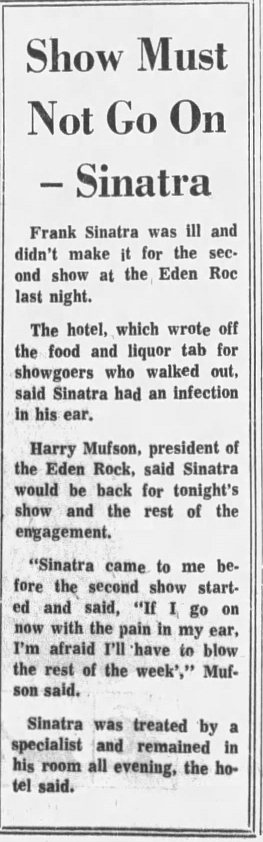
February 8, 1965
Radio
Larry King Show Larry interviews Sinatra 4 mins.
Concerts
Hotel Eden Roc, Miami, Florida (January 29-February 11) Sinatra and Joe E. Lewis
2 Shows 9 and 12 Nightly
Also appearing: the Half Brothers, Val Olman and his Orchestra.
Joe E. Lewis was accompanied by Austin Mack
Larry King Show Larry interviews Sinatra 4 mins.
Larry King Show Larry interviews Sinatra 4 mins.
"In early 1965, Larry King was at a party at Jackie Gleason's house when Gleason asked his guests, “What in your profession is impossible? What will never happen?”
Larry King: “We had a doctor there and he said, ‘They will never make blood in a laboratory. They will never manufacture blood that you can transfuse into someone. That will never happen.’ Then he went to another guy, and then he came to me. I said, ‘I do my television show and I write my column, but I do a three-hour radio show every night, from nine to twelve, a very popular local radio show. Sinatra is opening at the Eden Roc. Frank Sinatra to do my radio show for three hours.’ Now, this is 1965 and there is no bigger person in the world than Frank Sinatra in
1965. Capitol, Reprise, the whole thing; he is opening at the Eden Roc with Joe E. Lewis. Jackie asked, ‘What night is he dark?’ I said, ‘Monday.’ And Jackie said, ‘You got him next Monday.’
So I said, ‘Jackie, can I go on the air tonight and say that next Monday I'll be having Frank Sinatra on my show?’ ‘Go ahead.’ So I go back on the air, I say, ‘Frank Sinatra next Monday night.’ Now the station calls me in. They asked, ‘Are you sure?’ I said, ‘Jackie says so.’ I told the story. Now it's Friday, and they're taking full-page ads in the Miami Herald announcing this, but they're also saying they've left messages at the Eden Roc, and nobody's returning their calls.
Anyway, it's now Monday night. Nobody went home. The secretaries all stayed. It was on at nine o'clock. At about two minutes to nine, this limo pulls up, and out comes Sinatra. We had little stairs to walk on. It was a very beautiful radio station. He walks up the stairs and everybody's standing there, and he goes, ‘Who's Larry King?’ I go, ‘Me.’ He says, ‘Okay, let's go.’
I never was nervous on the air except my first day and that day. We sit down, and - my truism in life was, ‘Never lie to your audience, and it ain't brain surgery, so go to the moment.’ So all I said was, ‘Why are you here?’ I didn't go through ‘my friend Frank Sinatra’ and a lot of baloney. He said, ‘Five or six years ago, I was singing at Ben Maksik's Town and Country in Brooklyn, and I had laryngitis, it was closing night, and I called Jackie. I said, “Jackie, could you come over and do a show?” And Jackie came over and did an hour. I walked him out to his car, and I leaned in, and I said, “I owe you one.” Now in Miami, I get a message to call Jackie, and I call Jackie, and all he says is, “This is the one.”’
It turned into a wonderful interview. There was a PR guy who came along with him, who said, ‘I don't know how you got this, but do not mention the kidnapping, because he doesn't want to talk about that, and he'll walk off.’ But what happened was, the interview went so well that in the course of it, all I said was, ‘The thing between you and the press - have you been bum-rapped or is it overblown?’ And he said, ‘It's probably overblown, but I've been bum-rapped, too. Take the kidnapping.’ And he went through the whole thing. He hated the press, and he hated tabloids. He gave me a great quote. He said, ‘These people live off the real or imagined fortunes or misfortunes of those with much greater talent than them.’”
It was the first of several Sinatra interviews King would conduct over the next quarter century. They became friends and King would be the one to conduct Sinatra’s final major interview in 1988.
Larry King: “As a kid, I'd stand at the New York Paramount and wait in line to see him. I think he was the greatest singer of my time.”
"
February 9, 1965
Concerts
Hotel Eden Roc, Miami, Florida (January 29-February 11) Sinatra and Joe E. Lewis
2 Shows 9 and 12 Nightly
Also appearing: the Half Brothers, Val Olman and his Orchestra.
Joe E. Lewis was accompanied by Austin Mack
Mia Farrow's 20th birthday, celebrated with Frank at Chasen's, turns tense when their table is seated near Frank's ex-fiancee Lauren Bacall; the evening -- against a backdrop of gossip over an earlier Swifty Lazar party where Frank had lashed out at guests over the seafood table -- left Mia rattled about the volatility she was stepping into. Source: J. Randy Taraborrelli, Sinatra: Behind the Legend.
Frank and Mia Farrow in 1965. Frank’s second wife, the much-older Ava Gardner, would tell Mia, “You, my dear, are the child Frank and I never had.” Source: photo and caption from J. Randy Taraborrelli, Sinatra: Behind the Legend (mptvimages.com).
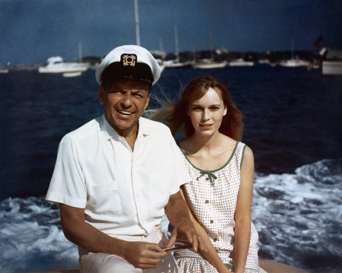
February 10, 1965
Concerts
Hotel Eden Roc, Miami, Florida (January 29-February 11) Sinatra and Joe E. Lewis
2 Shows 9 and 12 Nightly
Also appearing: the Half Brothers, Val Olman and his Orchestra.
Joe E. Lewis was accompanied by Austin Mack
February 11, 1965
Film
None but the Brave (US Film Premiere - Chicago: February 11, 1965) (Released in Japan January 15, 1965)
Starring: Frank Sinatra, Tatsuya Mihashi, Takeshi Kato, Clint Walker, Tommy Sands, Brad Dexter, Tony Bill
Produced & Directed by: Frank Sinatra
American and Japanese soldiers, stranded on a tiny Pacific island during World War II, must make a temporary truce and cooperate to survive various tribulations. Told through the eyes of the American and Japanese unit commanders, who must deal with an atmosphere of growing distrust and tension between their men. (DVD Release date: 2008-05-13) (Blu-Ray Release through Warner Achives: 2019-06-11)
There was also a comic book adaptation of the movie with Sinatra's likeness on the cover:
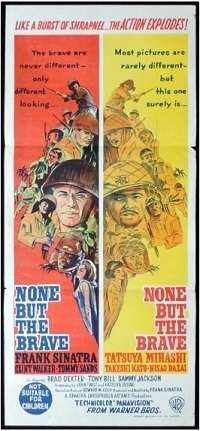
[The Cinematic Legacy of Frank Sinatra — None But the Brave (1965)]
David Wills's 2015 photo history The Cinematic Legacy of Frank Sinatra devotes a section to None But the Brave (1965), illustrated with 3 behind-the-scenes and publicity photographs (posters, lobby cards, and on-set/on-location shots) filed here.
Source: David Wills, The Cinematic Legacy of Frank Sinatra (St. Martin's Press, 2015), pp. 237–239.
Sinatra directing on location in Kaui, Hawaii, None But the Brave, 1965. (Photo: The Cinematic Legacy of Frank Sinatra, David Wills, 2015.)
One sheet poster, None But the Brave. / “It marks Frank Sinatra's debut as a director.… / [His] style is straightforward and understated. It / is to his credit that he tackled a serious subject / on his first try when he could have taken the / easy way out with still another gathering of The / Clan. (Photo: The Cinematic Legacy of Frank Sinatra, David Wills, 2015.)
(The Los Angeles Times, review, None But the Brave, 1965) / Directing, on location, None But the Brave. / “The toughest thing I had to do on the first day / of shooting was to say, “Print.” It took me ten / minutes, because I liked the take, but I figured / the minute I say, “Print”, I'm on the reco (Photo: The Cinematic Legacy of Frank Sinatra, David Wills, 2015.)
Concerts
Hotel Eden Roc, Miami, Florida (January 29-February 11) Sinatra and Joe E. Lewis
2 Shows 9 and 12 Nightly
Also appearing: the Half Brothers, Val Olman and his Orchestra.
Joe E. Lewis was accompanied by Austin Mack
None but the Brave (US Film Premiere - Chicago: February 11, 1965) (Released in Japan January 15, 1965)
Starring: Frank Sinatra, Tatsuya Mihashi, Takeshi Kato, Clint Walker, Tommy Sands, Brad Dexter, Tony Bill
Produced & Directed by: Frank Sinatra
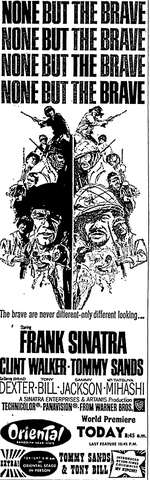
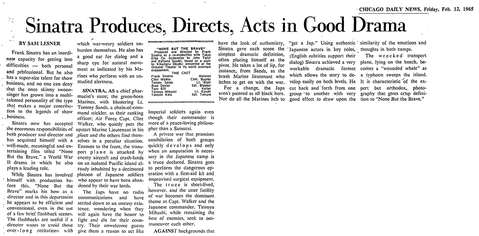
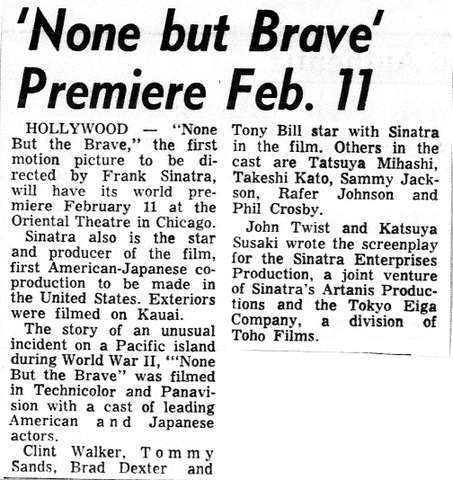
"Never So Few" / "None But the Brave"
Santopietro links Never So Few's exploration of war-film questions (what's worth dying for, what makes a righteous cause) to Sinatra's own self-directed 1965 film None But the Brave, which pushed the theme further by presenting a sympathetic portrayal of Japanese soldiers as the enemy.
Source: Tom Santopietro, "Sinatra in Hollywood" (2008).
"None But the Brave"
Sinatra made his sole feature-film directing debut with this strongly antiwar World War II combat film (with an uncredited directing assist from Gordon Douglas), released as the Vietnam War was escalating.
Source: Tom Santopietro, "Sinatra in Hollywood" (2008).
"None But the Brave"
The film opens with its title and even the Warner Bros. logo appearing first in Japanese characters, reflecting a bilingual screenplay co-written by American John Twist and Japanese writer Katsuya Susaki. Japanese soldiers speak untranslated Japanese dialogue throughout early sequences, a daring choice for a 1965 mainstream Hollywood film that Santopietro says anticipated Clint Eastwood's Letters from Iwo Jima by four decades.
Source: Tom Santopietro, "Sinatra in Hollywood" (2008).
"None But the Brave"
Santopietro praises Sinatra's directorial choice to present the stranded Japanese soldiers as individualized, sympathetic characters (a fisherman, a Buddhist priest, an inept soldier) rather than the stereotypical bloodthirsty-savage depiction common in earlier Hollywood war films.
Source: Tom Santopietro, "Sinatra in Hollywood" (2008).
"None But the Brave"
Filming took place on location in Kauai, Hawaii, with cinematography by Harold Lipstein (who had also shot Pal Joey), lending the isolated-island setting a strong sense of place, in contrast to the film's more artificial-looking interior sets.
Source: Tom Santopietro, "Sinatra in Hollywood" (2008).
"None But the Brave"
During Kauai location filming, actor Brad Dexter (cast in a supporting role partly as a favor from Sinatra) saved Sinatra's life after Frank was pulled into an undertow while trying to rescue his swimming partner, producer Howard Koch's wife, Ruth. Sinatra rewarded Dexter with an executive post at Sinatra Enterprises, an arrangement that later soured during production of The Naked Runner.
Source: Tom Santopietro, "Sinatra in Hollywood" (2008).
"None But the Brave"
Sinatra practiced what Santopietro calls "affirmative nepotism" in casting: son-in-law Tommy Sands (then married to Nancy Sinatra Jr.) played a lieutenant, cousin's son Ray Sinatra had a minor role, and crony Brad Dexter took a substantial supporting part despite limited acting ability.
Source: Tom Santopietro, "Sinatra in Hollywood" (2008).
"None But the Brave"
As medic Chief Pharmacist Mate Francis Maloney, Sinatra performs an improvised makeshift battlefield amputation using a sword sterilized in whiskey and set on fire — a scene Santopietro rates as the film's most powerful sequence and a first-rate piece of assured directing for a first-time filmmaker.
Source: Tom Santopietro, "Sinatra in Hollywood" (2008).
"None But the Brave"
Frank Sinatra: Sinatra called directing his favorite medium, saying it kept him busier, which he liked — a comment Santopietro treats as a genuine but unfulfilled inclination, since Sinatra never directed another feature film.
Source: Tom Santopietro, "Sinatra in Hollywood" (2008).
"None But the Brave"
The film's title comes from John Dryden's poem "Alexander's Feast": "None but the brave deserves the fair."
Source: Tom Santopietro, "Sinatra in Hollywood" (2008).
"None But the Brave"
Santopietro grades this a B, calling it flawed but worthy, and Frank's sole outing as director.
Source: Tom Santopietro, "Sinatra in Hollywood" (2008).
"None But the Brave"
Santopietro (Filmography): Tokyo Eiga Co./Toho Film/Artanis/Warner Bros. Pictures. Produced and directed by Sinatra himself, with Kikumaru Okuda as Japan producer, screenplay by John Twist and Katsuya Susaki. Sinatra played Chief Pharmacist Mate Francis Maloney opposite Clint Walker, Tommy Sands and Japanese co-stars Tatsuya Mihashi and Takeshi Kato.
Source: Tom Santopietro, "Sinatra in Hollywood" (2008).
February 17, 1965
Concerts
Sands, Las Vegas, Nevada ( February 17 - March 2)
Frank Sinatra & Joe E. Lewis w/Half Brothers
Bill Miller and Austin Mack
Antonio Morelli Orchestra (24)
Sands, Las Vegas, Nevada ( February 17 - March 2) w/Joe E. Lewis
At The Sands February 1965
Variety
2-24-65
[image referenced in source but could not be recovered]
[image referenced in source but could not be recovered]
[image referenced in source but could not be recovered]
[image referenced in source but could not be recovered]
[image referenced in source but could not be recovered]
February 18, 1965
Concerts
Sands, Las Vegas, Nevada ( February 17 - March 2) w/Joe E. Lewis
Sands, Las Vegas, Nevada ( February 17 - March 2) w/Joe E. Lewis
The Call
2-22-65
note: I am assuming Joe E. Lewis got the night off
Or he opened for Sammy.
Ed
February 19, 1965
Concerts
Sands, Las Vegas, Nevada ( February 17 - March 2) w/Joe E. Lewis
February 20, 1965
Concerts
Sands, Las Vegas, Nevada ( February 17 - March 2) w/Joe E. Lewis
February 21, 1965
Concerts
Sands, Las Vegas, Nevada ( February 17 - March 2) w/Joe E. Lewis
February 22, 1965
Concerts
Sands, Las Vegas, Nevada ( February 17 - March 2) w/Joe E. Lewis
February 23, 1965
Concerts
Sands, Las Vegas, Nevada ( February 17 - March 2) w/Joe E. Lewis
Kenny Lucas:
When Sinatra performed with Joe E. Lewis I am quite sure there was quite a lot of comedy, what I would like to know is, did they sing any duets during the show.
Ed O'Brien:
Yes, they did. Cahn & Van Heusen wrote special material for the early 65 Eden Roc in Miami and the Sands in Vegas. I believe Chester left all of that material to the UCLA library.
Riviera Hotel, Las Vegas, Nevada
Frank Sinatra subbed for Debbie Reynolds
Riviera Hotel, Las Vegas, Nevada
Frank Sinatra subbed for Debbie Reynolds
February 24, 1965
Concerts
Sands, Las Vegas, Nevada ( February 17 - March 2) w/Joe E. Lewis
February 25, 1965
Concerts
Sands, Las Vegas, Nevada ( February 17 - March 2) w/Joe E. Lewis
February 26, 1965
Concerts
Sands, Las Vegas, Nevada ( February 17 - March 2) w/Joe E. Lewis
February 27, 1965
Concerts
Sands, Las Vegas , Nevada ( February 17 - March 2) w/Joe E. Lewis
February 28, 1965
Concerts
Sands, Las Vegas , Nevada ( February 17 - March 2) w/Joe E. Lewis
March 1965
[Marriage on the Rocks begins filming]
Kaplan: In early March, Sinatra began his thirty-eighth film, Marriage on the Rocks (originally titled Community Property), a comedy for Warner Bros. co-starring Dean Martin, Deborah Kerr, and Sinatra's daughter Nancy in the role Mia Farrow had once been considered for. Cy Howard wrote the sub-sitcom plot; Jack Donohue directed.
Source: James Kaplan, "Sinatra: The Chairman" (2015)
March 1, 1965
Concerts
Sands, Las Vegas , Nevada ( February 17 - March 2) w/Joe E. Lewis
March 2, 1965
Concerts
Sands, Las Vegas , Nevada ( February 17 - March 2) w/Joe E. Lewis
Closing Night
March 8, 1965
Frank began shooting Marriage on the Rocks at Warner Bros. with Deborah Kerr and Dean Martin; his daughter Nancy also appeared in the film playing his daughter, giving her a rare chance to work alongside him and observe him on set.
Source: Nancy Sinatra, Frank Sinatra: An American Legend, 1995.
April 1965
[Fan letter confuses Sinatra-Farrow ages]
Kaplan: In April, a reader named Mrs. M. Jones of Portsmouth, Virginia, wrote to the syndicated TV Scout column asking about rumors Mia Farrow had married Frank Sinatra and their ages; the column incorrectly listed Frank as forty-seven (he was forty-nine) and Mia as nineteen.
Source: James Kaplan, "Sinatra: The Chairman" (2015)
[Life essay quotes on wealth and lifestyle]
Sinatra: In the Life piece, Thompson noted Sinatra's wealth, showing him in one of his two helicopters and lunching with Jack Warner; Sinatra told him coyly, 'I guess I'm now financially secure.' The piece counted his personal staff at seventy-five.
Source: James Kaplan, "Sinatra: The Chairman" (2015)
[Me and My Music essay on singing style]
Sinatra: In his 'Me and My Music' essay, Sinatra described developing a singing style based on the bel canto Italian tradition after moving away from imitating Bing Crosby, emphasizing legato, diction, and breath control.
Source: James Kaplan, "Sinatra: The Chairman" (2015)
[Sinatra critiques fellow singers in Life]
Sinatra: In the essay, Sinatra praised Tony Bennett unreservedly as 'the best singer in the business,' but criticized Vic Damone, Lena Horne, Judy Garland, and Ella Fitzgerald for technical flaws (notably audible breathing), gave backhanded praise to Sarah Vaughan and Barbra Streisand, damned Peggy Lee and Jo Stafford with faint praise, and gave Rosemary Clooney just two words: 'sings well.'
Source: James Kaplan, "Sinatra: The Chairman" (2015)
[Sinatra on Tommy Dorsey's breathing technique]
Sinatra: In the Life essay, Sinatra described studying Tommy Dorsey's trombone playing from behind on the bandstand to learn his 'sneak' breathing technique through a hidden mouth opening, which he adapted into his own microphone and breath-control technique, though he did not reveal his own trade secret of widening his mouth to breathe.
Source: James Kaplan, "Sinatra: The Chairman" (2015)
[Sinatra on knowing when his voice would go]
Sinatra: In the Life essay Sinatra said he would know when his voice started to decline -- when vibrato widened and breath control failed -- and that he would say goodbye rather than record a diminished performance he'd regret hearing years later.
Source: James Kaplan, "Sinatra: The Chairman" (2015)
[Sinatra on microphone technique]
Sinatra: Sinatra wrote in Life that the microphone is a singer's instrument, describing his preference for a black mic that melts into his dinner jacket and his technique of moving with it off the stand, criticizing Ella Fitzgerald for never leaving her stationary mic.
Source: James Kaplan, "Sinatra: The Chairman" (2015)
[Sinatra predicts future touring format]
Sinatra: In the Life essay, Sinatra foretold wanting to do a long series of one-nighters around the country with a big band like Basie's, traveling by hired train -- a prophecy of the concert-artist career he would pursue from the 1970s into the mid-1990s.
Source: James Kaplan, "Sinatra: The Chairman" (2015)
[Sinatra to Peter Bart on his recent pictures]
Sinatra: In an April interview with the New York Times' Peter Bart, Sinatra acknowledged the shortcomings of some of his recent films, saying it 'boils down to material' -- that nothing better had been available when he made them.
Source: James Kaplan, "Sinatra: The Chairman" (2015)
April 2, 1965
[Photograph: Sinatra jokes about his reputation for affairs at Publicists' Guild lunch. From Richard Havers, "Sinatra" (Dorling Kindersley, 2007), p.290.]
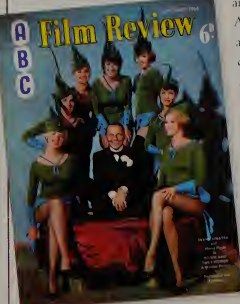
[Photograph: Sinatra jokes about his reputation for affairs at Publicists' Guild lunch. From Richard Havers, "Sinatra" (Dorling Kindersley, 2007), p.290.]
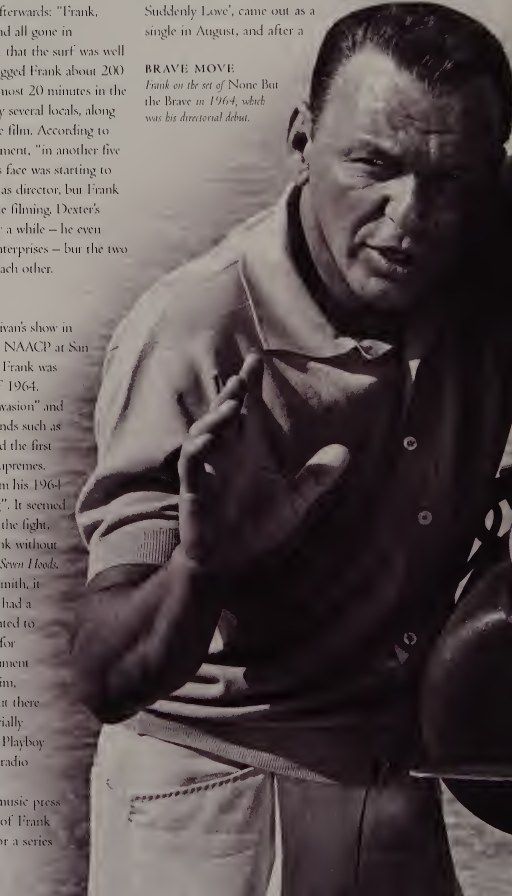
[Photograph: Sinatra jokes about his reputation for affairs at Publicists' Guild lunch. From Richard Havers, "Sinatra" (Dorling Kindersley, 2007), p.290.]
Speaking at a Beverly Hills Publicists' Guild luncheon, Sinatra joked that if he'd had as many love affairs as rumored he'd be speaking from a jar at Harvard Medical Center, and quipped that some in the Hearst press called him the "Eichmann of song.". (Source: Richard Havers, "Sinatra" (Dorling Kindersley, 2007).)
April 13, 1965
Studio
Hollywood
H3295 Don't Wait Too Long
(Sunny Skylar)
Panther Music Corp.. (ASCAP)
Arranged & Conducted by Gordon Jenkins
(3:06) CD: 46013-2 The Complete Reprise Studio Recordings Disc 9
CD: 1014-2September Of My Years
LP: FS1014September Of My Years
H3296 September Song
(Kurt Weill/Maxwell Anderson)
Hampshire House Publishing Corp. (ASCAP)
Arranged & Conducted by Gordon Jenkins
(3:30) CD: 46013-2 The Complete Reprise Studio Recordings Disc 9
CD: 9-26340-2The Reprise Collection
CD: 1014-2September Of My Years
LP: FS1014September Of My Years
H3297 Last Night When We Were Young
(Harold Arlen/E.Y. Harburg)
Bourne Co./S.A. Music (ASCAP)
Arranged & Conducted by Gordon Jenkins
(3:34) CD: 46013-2 The Complete Reprise Studio Recordings Disc 9
CD: 1014-2September Of My Years
LP: FS1014September Of My Years
H3298 Hello Young Lovers
(Richard Rodgers/Oscar Hammerstein II)
Williamson Music Co. (ASCAP)
Arranged & Conducted by Gordon Jenkins
(3:43) CD: 46013-2 The Complete Reprise Studio Recordings Disc 9
CD: 1014-2September Of My Years
LP: FS1014September Of My Years
Ed O'Brien:
First session for "September of My Years" employed 31 musicians.
1. "Don't Wait Too Long" had a rehearsal take and then eight additional takes.
2. "September Song" 13 takes
3. "Last Night When We Were Young" 4 takes
4. "Hello Young Lovers" 4 takes
Hollywood
H3295 Don't Wait Too Long
H3297 Last Night When We Were Young
H3298 Hello Young Lovers
Alexandria Town Talk
9-16-65
April 14, 1965
Studio
Hollywood
H3299 I See It Now
(Alexander Wilder/William Engvick)
Hollis Music Inc. (BMI)
Arranged & Conducted by Gordon Jenkins
(2:49) CD: 46013-2 The Complete Reprise Studio Recordings Disc 9
CD: 1014-2 September Of My Years
LP: FS1014 September Of My Years
H3300 When The Wind Was Green
(Henry Stinson)
Quartet Music Inc./Range Road Music Inc. (ASCAP)
Arranged & Conducted by Gordon Jenkins
(3:21) CD: 46013-2 The Complete Reprise Studio Recordings Disc 9
CD: 1014-2 September Of My Years
LP: FS1014 September Of My Years
H3301 Once Upon A Time
(Charles Strouse/Lee Adams)
Musique Enterprises Inc. (ASCAP)
Arranged & Conducted by Gordon Jenkins
(3:28) CD: 46013-2 The Complete Reprise Studio Recordings Disc 9
CD: 1014-2 September Of My Years
LP: FS1014 September Of My Years
H3302 How Old Am I? (N/R)
(Gordon Jenkins)
WB Music Corp. (ASCAP)
Arranged & Conducted by Gordon Jenkins
Ed Notes:
Frank's effort here contains a different arrangement from the one recorded on 4-22-65 and released on the
"Sept. Of My Years" LP.
Frank's second session for "SOMY" had 31 musicians in studio A.
"I See It Now" required 9 takes
"When The Wind Was Green" 3 takes and 2 intercuts
"Once Upon A Time" 6 takes
"How Old Am I" 3 takes different arg. n/r
There was also a second session in studio B. There was a 32 piece orchestra and a choral group of 8.
Frank recorded "Tell Her ( You Love Her Each Day)" & "When Somebody Loves You" They were done in short order.
HX3320 Tell Her (You Love Her Each Day) w/Chorus
(Gil Ward/Charles Watkins)
Unichappell Music/Oracle Music (BMI)
Arranged by Ernie Freeman
Conducted by Gordon Jenkins
(2:41) CD: 46013-2 The Complete Reprise Studio Recordings Disc 9
LP: FS1025 Frank Sinatra's Greatest Hits
45: 0373
HX3321 When Somebody Loves You w/Chorus
(Sammy Cahn/Jimmy Van Heusen)
Maraville Music Corp. (ASCAP)
Arranged by Ernie Freeman
Conducted by Gordon Jenkins
(1:53) CD: 46013-2 The Complete Reprise Studio Recordings Disc 9
LP: FS1025 Frank Sinatra's Greatest Hits
45: 0398
NOTE: Sinatra Scholar Ed O'Brien points out that the songs for "September of My Years" were recorded in Studio A at United Recording and the two songs with Jimmy Bowen and Ernie Freeman were recorded in Studio B. Donnie Lanier conducted on the latter two. There were two orchestras and the Bowen also employed a choral group, an octet.
Hollywood
HX3320 Tell Her (You Love Her Each Day) w/Chorus
(Gil Ward/Charles Watkins)
Unichappell Music/Oracle Music (BMI)
Arranged by Ernie Freeman
Conducted by Gordon Jenkins
(2:41) CD: 46013-2 The Complete Reprise Studio Recordings Disc 9
LP: FS1025 Frank Sinatra's Greatest Hits
45: 0373
HX3321 When Somebody Loves You w/Chorus
(Sammy Cahn/Jimmy Van Heusen)
Maraville Music Corp. (ASCAP)
Arranged by Ernie Freeman
Conducted by Gordon Jenkins
(1:53) CD: 46013-2 The Complete Repr note: Donnie Lanier conducted the Jimmy Bowen session, not Gordon Jenkins.
Hollywood
H3299 I See It Now
H3300 When The Wind Was Green
H3301 Once Upon A Time
H3302 How Old Am I? (N/R)
note: Recently I have posted some Sinatra reviews of Don Lass. He impressed me with his knowledge and understanding of Sinatra's incredible vocal skills. Well, I wasn't the only person he impressed -- ED
[image referenced in source but could not be recovered]
[image referenced in source but could not be recovered]
"How Old Am I?" / "When the Wind Was Green"
Jenkins contributed his own composition "How Old Am I?" (good, though not on the level of "This Is All I Ask") and is credited with bringing in Henry Stinson's "When the Wind Was Green," which fit the album's mood perfectly; Jenkins had first recorded the song with Dick Haymes in 1949.
Source: Will Friedwald, "Sinatra! The Song Is You: A Singer's Art" (2018 revised edition).
April 22, 1965
Studio
Hollywood
H3352 It Was A Very Good Year
(Ervin Drake)
The Songwriters Guild (ASCAP)
Arranged & Conducted by Gordon Jenkins
-7 (4:26) CD: 46013-2 The Complete Reprise Studio Recordings Disc 9
CD: 9-26340-2The Reprise Collection
CD: 1014-2 September Of My Years
LP: FS1014 September Of My Years
45: 0429
SEGMENT OF A REVIEW FROM 11-26-65
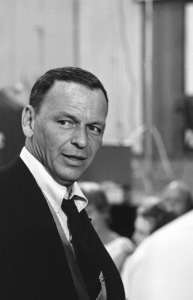
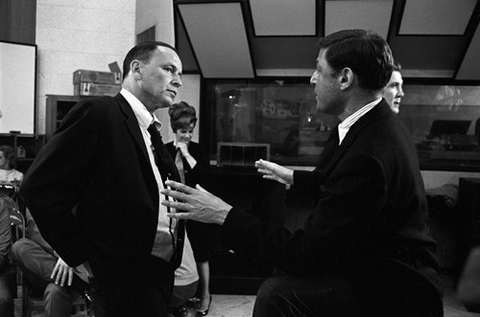
"It Was a Very Good Year"
Rare footage of Sinatra actually working in the recording studio survives from an April 22, 1965 session for 'It Was a Very Good Year,' filmed for the CBS Reports documentary Sinatra: An American Original -- among the most important visual documents of how Sinatra worked in the studio.
Source: Charles L. Granata, "Sessions with Sinatra: Frank Sinatra and the Art of Recording" (1999/2003).
[It Was a Very Good Year -- critical commentary]
Milt Bernhart: Trombonist Milt Bernhart described the Capitol studio on Melrose (a converted radio studio with a large auditorium) as packed with a crowd of a hundred to two hundred spectators during Sinatra sessions -- 'they should have charged admission' -- with engineers on edge that applause might ruin a take. This 1965 date, in which Sinatra recorded 'It Was a Very Good Year,' is noted as virtually the only actual film footage ever shot of a Sinatra recording session.
This song/context matches multiple dated entries in the chronology; the specific date Friedwald is referring to could not be determined with confidence.
Source: Will Friedwald, "Sinatra! The Song Is You: A Singer's Art" (2018 revised edition), Ch. 1, "Night and Day" (Sinatra style overview)
[It Was a Very Good Year -- critical commentary]
Ervin Drake wrote "It Was a Very Good Year" in 1961 in about fifteen minutes after publisher Arthur Mogul tipped him that Kingston Trio member Bob Shane was coming by the next morning looking for material. The Kingston Trio's original recording (on 1961's Goin' Places), built around a solo Shane vocal, sounds today like a songwriter's demo compared to the eventual Sinatra treatment.
This song/context matches multiple dated entries in the chronology; the specific date Friedwald is referring to could not be determined with confidence.
Source: Will Friedwald, "Sinatra! The Song Is You: A Singer's Art" (2018 revised edition), Ch. 8, "Gordon Jenkins" (1956-1981)
[It Was a Very Good Year -- critical commentary]
Sinatra and Jenkins recorded "It Was a Very Good Year" on April 22, 1965; ten minutes of session/alternate/breakdown takes survive, filmed by a CBS News crew. The footage aired in the CBS Sinatra profile on November 16, 1965, and the song itself anchored the NBC special Frank Sinatra: A Man and His Music on November 24, 1965, framing a medley with a new Jenkins chart of "Young at Heart," plus "Last Night When We Were Young," "Hello, Young Lovers," and "The Girl Next Door."
This song/context matches multiple dated entries in the chronology; the specific date Friedwald is referring to could not be determined with confidence.
Source: Will Friedwald, "Sinatra! The Song Is You: A Singer's Art" (2018 revised edition), Ch. 8, "Gordon Jenkins" (1956-1981)
[It Was a Very Good Year -- critical commentary]
Frank Sinatra (concert ad-lib): Sinatra sang "Very Good Year" less successfully with the Count Basie band (no strings) on the 1966 album Sinatra at the Sands, but the song became a durable concert staple performed with strings for the rest of his life. Friedwald's favorite performance is a mid-1980s reading where after 'When I was seventeen,' Sinatra pauses, then ad-libs 'I was a pain the ass!' and asks the audience, 'isn't everybody at seventeen?'
This song/context matches multiple dated entries in the chronology; the specific date Friedwald is referring to could not be determined with confidence.
Source: Will Friedwald, "Sinatra! The Song Is You: A Singer's Art" (2018 revised edition), Ch. 8, "Gordon Jenkins" (1956-1981)
[It Was a Very Good Year -- critical commentary]
Ervin Drake: Drake, speaking at a 1998 Sinatra academic conference at Hofstra University, described writing nonsense Elizabethan-style syllables ('Hi-lura-li...') as an instrumental interlude filler in case a singer wanted to fill that section vocally. Sinatra, unaware the Kingston Trio hadn't originally used the syllables, skipped them entirely and joked he would have sung something like 'Hi-scooby-do' had he attempted it.
This song/context matches multiple dated entries in the chronology, or lacked a sufficiently precise date; the specific date could not be determined with confidence.
Source: Charles L. Granata, "Sessions with Sinatra: Frank Sinatra and the Art of Recording" (1999/2003), Part IV: The Reprise Years
[It Was a Very Good Year -- critical commentary]
In the filmed session, engineer Lowell Frank recorded in United's Studio A under Gordon Jenkins's baton; Sinatra asked Frank to watch for popping P's on the microphone (referencing problems on earlier dates), joking 'I'm a sneaky P-popper.' After the take, Sinatra was surprised the recording clocked in at 4:12, quipping 'That's longer than the first act of Hamlet!'
This song/context matches multiple dated entries in the chronology, or lacked a sufficiently precise date; the specific date could not be determined with confidence.
Source: Charles L. Granata, "Sessions with Sinatra: Frank Sinatra and the Art of Recording" (1999/2003), Part IV: The Reprise Years
[It Was a Very Good Year -- critical commentary]
Granata includes 'It Was a Very Good Year' among the fifty recordings he considers essential to understanding Sinatra's artistry (arranged by Gordon Jenkins, recorded 1965, Reprise); the song was chosen for its musical/interpretive value rather than commercial popularity.
This song/context matches multiple dated entries in the chronology, or lacked a sufficiently precise date; the specific date could not be determined with confidence.
Source: Charles L. Granata, "Sessions with Sinatra: Frank Sinatra and the Art of Recording" (1999/2003), Afterword & Appendices A-D
April 23, 1965
[Life magazine cover story on Sinatra]
The April 23 issue of Life carried a major eighteen-page cover story, 'SINATRA OPENS UP,' with a lengthy piece by Tommy Thompson, photos by John Dominis, and an essay by Sinatra himself titled 'Me and My Music.' The cover showed Frank in a houndstooth fedora, white turtleneck, and orange cardigan.
Source: James Kaplan, "Sinatra: The Chairman" (2015).
Life magazine ran a 22-page cover story on Frank, the largest feature on an entertainer in the magazine's history at that point. In the interview he candidly said that if he ever remarried, it would have to be to someone outside show business, and described himself as a good provider who expected his wife to look after him in return.
Source: Nancy Sinatra, Frank Sinatra: An American Legend, 1995.
May 1965
[Dorothy Kilgallen column on Frank and Mia]
Dorothy Kilgallen: In May, columnist Dorothy Kilgallen wrote that former skeptics now believed Frank truly adored Mia, because someone close to him thought they would marry and was embarrassed since Mia was younger than Frank's daughter Nancy -- an apparent reference to Dolly Sinatra.
Source: James Kaplan, "Sinatra: The Chairman" (2015)
[SHARE Boomtown debut of Frank and Mia as a couple]
Kaplan: In May, Frank and Mia first appeared publicly as a couple at the SHARE Boomtown charity show, wearing Western garb; Mia met Sammy Davis and Shirley MacLaine, and Dean Martin toasted her from the stage, joking he had a bottle of scotch older than she was.
Source: James Kaplan, "Sinatra: The Chairman" (2015)
May 6, 1965
Studio
Los Angeles
HX3417 Forget Domani
(Norman Newell/Riz Ortolini)
EMI Miller Catalog Inc. (ASCAP)
Arranged & Conducted by Ernie Freeman
(2:35) LP: FS1025 Frank Sinatra's Greatest Hits
45: 0380
NOTE: In response to Eugene Lo Curto's observation that this album has a curious title and wonders why it still remains in the catalogue, giving young people "a poor impression of the greatest pop singer of the 20th Century." Sinatra Scholar Ed O'Brien points out that the album went triple platinum years ago and is one of the biggest sellers in the Reprise catalog. That's the reason it has remained in the catalog.
note: "I Can't Believe I'm Losing You" was released again, in April 68, with a guitar overdub by Max Bennett. The B side, "How Old Am I, " also had a guitar overdub by Bennett.
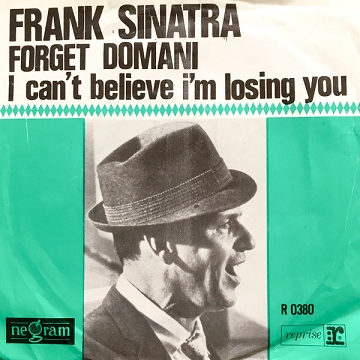
Los Angeles
HX3417 Forget Domani
(Norman Newell/Riz Ortolini)
EMI Miller Catalog Inc. (ASCAP)
Arranged: Ernie Freeman
Conducted: Donnie Lanier
(2:35) LP: FS1025 Frank Sinatra's Greatest Hits
45: 0380
United Recording Studio
7:00 P.M. to 8:15 P.M.
31 piece orchestra plus vocal chorus:
Twin piano backing by Leon Russell and Ernie Freeman
Hal Blaine on drums, Bill Pitman, Al Viola, Tommy Tedesco,
John Gray-guitarists,
Eddie Brackett, Jr, Frank Capp, Emil Richards - percussionists
Billboard
Billboard spotlighted the song. Released in mid-June,
it reached #78 on the Hot 100 and charted for seven
weeks. Adult Contemporary peak was #13 and 7 weeks
on the list.
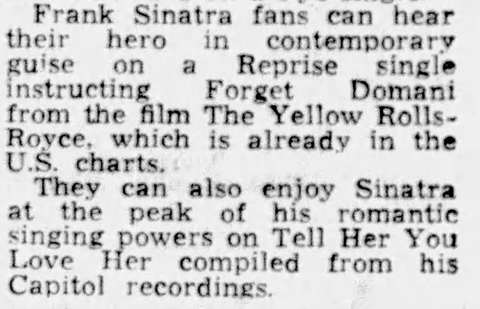
May 8, 1965
Concerts
Santa Monica Civic Auditorium, Santa Monica, CA
Annual Boomtown Share Benefit
Sinatra, Dean Martin, Joey Bishop, Joe. E. Lewis, and others
The Sinatras: Tina, Nancy Sr., and Nancy Jr. with Frank Jr., circa 1965. Source: photo and caption from J. Randy Taraborrelli, Sinatra: Behind the Legend (mptvimages.com).
May 17, 1965
Television
Andy Williams Show
NBC
9:00 - 10:00 P.M.
Monday Evening
Guests: Eddie Fisher - Wally Cox
Ed O'Brien:
During a conversation between Andy and Eddie, a phone call is received from Frank Sinatra and Dean Martin. They are rehearsing for Dean's upcoming variety series on NBC. The first show, with Frank as guest, was set to be taped in early June. The two of them plug the show and trade wisecracks with Andy and Eddie.
May 27, 1965
Studio
Hollywood
H3442 September Of My Years
(Jimmy Van Heusen/Sammy Cahn)
WB Music Corp./The Songwriters Guild (ASCAP)
Arranged & Conducted by Gordon Jenkins
-17 (3:14) CD: 46013-2 The Complete Reprise Studio Recordings Disc 9
CD: 9-26723-2Sings The Songs Of Van Heusen & Cahn
CD: 2275-2Frank Sinatraâ s Greatest Hits Vol. 2
CD: D: 1016-2A Man And His Music
CD: 1014-2September Of My Years
LP: FS1014September Of My Years
45: 0531
NOTE: Sinatra Scholar Ed O'Brien reports that when Sinatra was recording the album of middle age remembrances and life-affirming experiences in April of 1965, the title of the LP was "This Is All I Ask." Well, Tony Bennett already had an album out with that title. Cahn and Van Heusen corrected the problem by penning the lovely title track.
At the session, Sinatra sang "One day you turn around and it's autumn; Next day you turn around and its fall." He didn't catch it until Take 7. Interesting dynamic of a Sinatra session in 1965.. No one would correct his error and there was nervous laughter when he caught his mistake. A few weeks after the session, he was a guest on Dean Martin's first TV show (taped in June and aired in mid-September) and did a memorable reading of the song.
Sinatraphile Jack Tomsky writes that he was fooled when he first heard this September session. He thought that even though it doesn't seem to make any sense, the song must have been originally written that way and Sinatra, during the session in an inspired move, changed "autumn" to "summer."
Liner Notes: SEPTEMBER OF MY YEARS
Recorded as Sinatra turned fifty, September of My Years is a deliberate, unflinching meditation on aging -- a subject popular music rarely addressed head-on in 1965, let alone with this much candor. Reunited with Gordon Jenkins, Sinatra built the album around songs of retrospection and mortality: "It Was a Very Good Year," "Hello, Young Lovers," "The September of My Years" itself, each one a chapter in an unofficial reckoning with time passing.
"It Was a Very Good Year," written by Ervin Drake, became the album's signature performance and one of the most enduring of Sinatra's later career, structuring a man's life in decades -- youth, middle age, and the autumn implied by the title -- with a plainspoken honesty that avoided sentimentality even while courting it. The song won the Grammy for Best Vocal Performance, and the album itself took Album of the Year.
September of My Years stands as proof that Sinatra's interpretive powers, if anything, deepened rather than diminished as he aged into the role the songs themselves were describing. It is one of the most purely personal records he ever made, and one of the most quietly courageous.
Written by Claude (Anthropic), commissioned for this chronology, 2026.
[September of My Years -- critical commentary]
By 1964 Sinatra had forged a close friendship with producer-musician Sonny Burke, who would guide him through albums from 1964's America I Hear You Singing through 1979's Trilogy. Burke's greatest triumph as producer is considered to be September of My Years, recorded to mark Sinatra's fiftieth birthday, an album Granata calls a distillation of everything Sinatra had learned as a vocalist.
This song/context matches multiple dated entries in the chronology, or lacked a sufficiently precise date; the specific date could not be determined with confidence.
Source: Charles L. Granata, "Sessions with Sinatra: Frank Sinatra and the Art of Recording" (1999/2003), Part IV: The Reprise Years
June 1965
[Dismas House benefit in St. Louis]
Kaplan: In June, Frank, Dean, and Sammy performed a benefit at St. Louis's Kiel Opera House for Dismas House, a halfway facility for ex-cons favored by Sinatra's Teamsters friends; the show, closed-circuit broadcast to theaters in New York and LA, was emceed by Johnny Carson, who introduced Sinatra as 'our hoodlum singer.'
Source: James Kaplan, "Sinatra: The Chairman" (2015)
[Final Rat Pack Summit performance]
Kaplan: The Dismas House benefit turned out to be the final performance of 'the Summit' (Frank, Dean, and Sammy together); the presence of TV cameras and Carson's smooth hosting flattened the act's spontaneity, and the broadcast being in black-and-white seemed symbolic of its passing moment.
Source: James Kaplan, "Sinatra: The Chairman" (2015)
[Sinatra sings Happy Birthday to Tina at Kiel]
Kaplan: At the Dismas House benefit, Sinatra sang eight numbers with the Count Basie Orchestra (Quincy Jones conducting), topped off by a 'Happy Birthday' for his now-seventeen-year-old daughter Tina, who came onstage to kiss him.
Source: James Kaplan, "Sinatra: The Chairman" (2015)
[Sinatra's cameo in Cast a Giant Shadow]
Kaplan: In late June, Sinatra flew to Israel to film a three-day cameo in Kirk Douglas's movie Cast a Giant Shadow, then flew back to the States for the Fourth of July Newport Jazz Festival appearance.
Source: James Kaplan, "Sinatra: The Chairman" (2015)
[Walter Winchell on Sinatra's infatuation]
Walter Winchell: In early June, Walter Winchell reported that staff at La Rue, the West Hollywood restaurant where Frank and Mia dined often, said they'd never seen Sinatra so smitten.
Source: James Kaplan, "Sinatra: The Chairman" (2015)
June 16, 1965
Beverly Hilton, Los Angeles, CA
Wednesday evening
Ed O'Brien:
Frank receives Entertainer of the Year Award from the Conference of Personal Managers
Gives a short speech.
[image referenced in source but could not be recovered]
June 19, 1965
Studio
Frank's recording career got underway 84 years ago today.
On that Thursday afternoon, so long ago now, the Harry James
Band entered the Brunswick Recording Studio, 550 Fifth Ave,
in N.Y.C. The boy vocalist in the band would earn an additional
$50.00 for his efforts. That is what Harry James paid him for
the two recordings..
The Make Believe Ballroom, WNEW A.M., had released a poll
showing that the James contingent was the eighth most popular
band in the greater New York area. Harry and Co. received a
lot of radio attention and that evening was no exception. At midnight
WOR broadcast the James band live from the Roseland Ballroom.
Frank could be heard singing "I Poured My Heart Into A Song"
On
the 7/15 broadcast, he sang the two songs recorded on 7-13-39.
According to Variety, the band played the Paramount before jumping
over to the Roseland for an extended stay. WOR, CBS, WNEW and
other radio stations would broadcast this exciting new band throughout
the summer of 1939. They would be heard from the Steel Pier, in Atlantic
City, the World's Fair and Roseland in N.Y.C.
In August of 39, James and Sinatra decided to try out a new song on the
radio broadcasts before making a recording. The song was "All Or Nothing
At All." According to Billboard the song was released in June of 1940 and
sold 16,000 copies. The re-release in June 1943 sold well over a million
units..
I am indebted to Variety, Peter Levinson, NYT
and Billboard.
Ed
Source: sinatraphiles digest (date extracted from item text; originally routed to appendix for review).
June 20, 1965
Concerts
Kiel Opera House, St. Louis, Missouri
Teamster's Benefit for Dismas House w/Dean, Sammy, Johnny Carson, Trini Lopez
Count Basie & His Orchestra
Conducted By: Quincy Jones
1. Get me To The Church On Time
2. Fly Me To The Moon
3. Luck Be A Lady
4. I Only Have Eyes For You
5. I've Got You Under My Skin
6. Please Be Kind
7. You Make Me Feel So Young
8. My Kind Of Town
Frank, Dean, Sammy & Johnny Carson:
9. Happy Birthday (For Tina)
10. Impressions
11. Comedy
12. The Birth Of The Blues
NOTE: Sinatra Scholar Ed O'Brien says there wasn't a more exciting happening, in 1965, than Sinatra-Basie.
Sinatra would do a seven city tour with the Count in early July and Dismas House was a great tryout for both the singer and the band. Listen to the recording of "I Only Have Eyes for You" from the first album they did together in 1962 and then the vastly superior reading at Dismas House in June.
"Skin" is Sinatra at his very best. "My Kind of Town St.Louis Is" was a one-time tribute to the City with the marvelous Arch. This is a "must have" for all Sinatra collectors
Sinatraphile Eleanor asked :
Isn't this the show on the DVD in the CD/DVD Rat Pack set "Live and Swingin'"? I think it's also the same show that Nick at Nite/TV Land broadcast as a tribute when Frank Sinatra died.
Yes. It is the same show. The original tape was titled "The Frank Sinatra Spectacular and ran for two and a half hours. Show featured Count Basie, Kaye Stevens, Trini Lopez, Sammy Davis, Dean Martin, Johnny Carson and Frank.
--Ed
CS 083 (Bill Zehme's liner essay for Reprise's "Live And Swingin': The Ultimate Rat Pack Collection," 2003) traces how footage of this Dismas House benefit survived to become the DVD in that set: CBS News crews had been trailing Sinatra for roughly six months in 1965 while preparing the "Sinatra: An American Original" documentary (broadcast that November), and their closed-circuit cameras happened to also be on and around the stage in St. Louis that night -- at one point catching Sinatra playfully wiping a lens clean with his tuxedo sleeve. The footage was believed lost until it turned up decades later in storage in the possession of Nancy Sinatra Jr., who -- along with her mother, Nancy Sr., and sister Tina, for whom the show's "Happy Birthday" tribute marked her 17th birthday -- can be spotted in the front row or in the wings throughout. The restored footage was first unveiled at the Museum of Television and Radio in spring 1997.
Kiel Opera House, St. Louis, Missouri
Teamster's Benefit for Dismas House
w/Dean, Sammy, Johnny Carson, Trini Lopez
Frank, Basie band and Quincy Jones conducting ( honest )
Dean
Johnny
Frank
Sammy
Joey Bishop was unable to appear and Johnny Carson subbed as M.C.
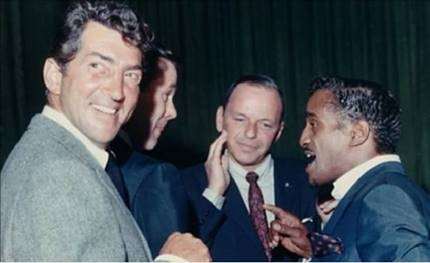
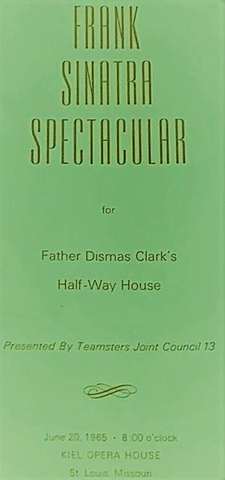
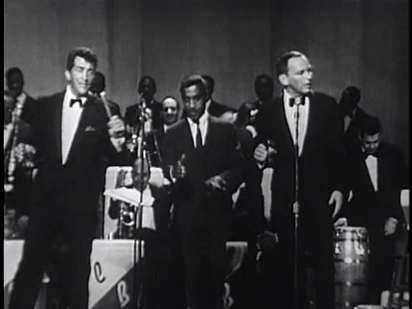
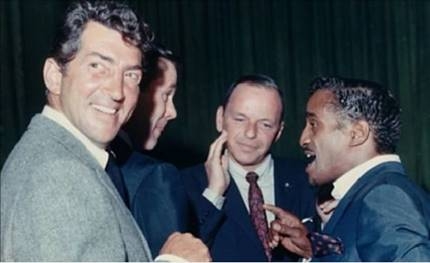
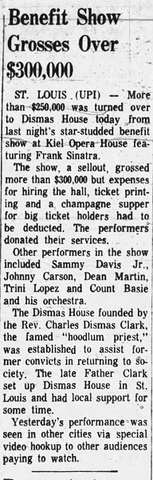
June 23, 1965
Film
"Von Ryan's Express" (USA Release: June 23, 1965)
Starring: Frank Sinatra, Trevor Howard, Raffaella Carrà, Brad Dexter, Sergio Fantoni, John Leyton, Edward Mulhare, Wolfgang Preiss
Produced by: Saul David
Directed by: Mark Robson
Based on the novel "Von Ryan's Express" by David Westheimer Colonel Joseph Ryan (Sinatra), a USAAF P-38 pilot, is shot down over Italy and taken to a POW camp. Ryan, an American POW, has to win the support of the mainly British soldiers under the command of Major Eric Fincham (Trevor Howard). When the Italians abandon the camp, the POWs set off across country but are eventually recaptured and placed aboard a train. Von Ryan and some of the other POWs eventually escape and commandeer the train and make a run for Switzerland with the Nazis hot on their trail --DVD Release: 2001-05-15 & Blu-Ray Release: 2012-11-06
Richard Cook passed this along:
In the UK the Blu-Ray is part of the HMV Premium Collection, and comes with some art cards.
Ed: -- An outstanding war film that was Sinatra's most successful box office hit in the 1960s. The movie was filmed on location in Italy( August 1964 ) and Spain ( September 1964 ). The studio interior work, in Hollywood, was completed in October 64. The opening credits claim the film is in Cinemascope. Actually, most of it was done -- at Sinatra's insistence - in Panavision. Frank desperately wanted Richard Burton to co-star. He went to a great deal of trouble but to no avail. Trevor Howard proved to be an excellent choice as the British officer. He loved working and drinking with Frank. Howard considered it to be one of his very best roles and one of his best films, Frank later admitted that working with an actor of Howard's stature inspired him to bring his A game to the pro- duction. When he read the novel by David Westheimer, Frank bid on the film's rights. 20th Century out bid him at $125,000. Frank then called the studio and offered to play Von Ryan. A British poll ranks the film #81 in the 100 greatest war movies. The premiere took place at Loew's Theatre in New York City, 6-23-65. Frank was there with his two daughters. The critics, with the exception of Bosley Crowther, gave the film rave reviews. The b.o. take was $17.1 million -- in today's money that would be more than $138 million dollars. Frank had a percentage of the gross and walked away with more than $2 million dollars.
The film came to tape and disc rather late. A VHS was issued on May 15, 2001, laser disc was out in 1992, a special 2 DVD set was released in 2009 and the BluRay came out on November 6, 2012. Mia Farrow met Frank on the 20th Century set in October 1964.
--Zanuck did not want Sinatra to miss that train. He loved the rushes and saw a chance for a great sequel. But Frank insisted. Frank told his concert audiences back then that it was the most running he had done in years.
--Ed
While filming in Italy, Frank flew to Rome one weekend and recorded four songs in Italian. They have never been issued.
Frank had been trying to learn Italian well enough to do the album. The project was scheduled to be done in 1962. There was an album cover and Don Costa did the charts. But Frank just couldn't get comfortable enough with the language to take a chance. Some of his associates suggested he do it phonetically -- a la Nat Cole. Frank felt that would not work because his great strengths were the phrasing and interpretation. The project was put on the back burner. I have an article from December 1963 with a rep from Reprise announcing that Frank had recently recorded two songs from an Italian musical that was set to open on Broadway. A single would be issued when the show opened. Nothing came of it. Then I found an interview Frank did with the Hollywood Reporter in which he discussed the Rome recordings in 1964. If you have the CBS special "An American Original," there is a segment on the set of "Marriage On The Rocks.." Frank is rehearsing "Aneme E Core" with Bill Miller. His Italian sounds fine to me. The project had been revived and then shelved again. There are no unofficial copies that I know of. I would be surprised if they still exist. But you never know. --Ed

[The Cinematic Legacy of Frank Sinatra — Von Ryan's Express (1965)]
David Wills's 2015 photo history The Cinematic Legacy of Frank Sinatra devotes a section to Von Ryan's Express (1965), illustrated with 3 behind-the-scenes and publicity photographs (posters, lobby cards, and on-set/on-location shots) filed here.
“As the steely-eyed, curt American officer who takes command as an unpopular chief, Frank Sinatra underplays his role neatly and purposefully where it might easily have led him into an overdramatic trap.… It's a tough assignment, but he makes it believable, even at the finale where he is unwittingly sacrificed in staving off a final Nazi assault on the escape train.… This is Sinatra at his best as an actor, and far removed from his image as a rollicking, elbow-bending song stylist.” —Abe Greenberg
Source: David Wills, The Cinematic Legacy of Frank Sinatra (St. Martin's Press, 2015), pp. 240–243.
The director has so many things to worry about / won't try to perform when I direct.” / One sheet poster, Von Ryan's Express, 1965. (Photo: The Cinematic Legacy of Frank Sinatra, David Wills, 2015.)
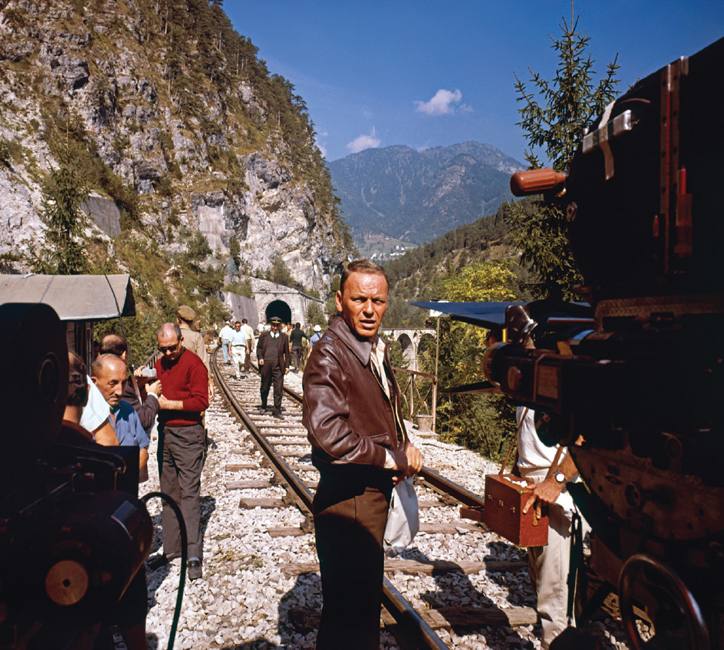
On location in Spain, Von Ryan's Express. (Photo: The Cinematic Legacy of Frank Sinatra, David Wills, 2015.)
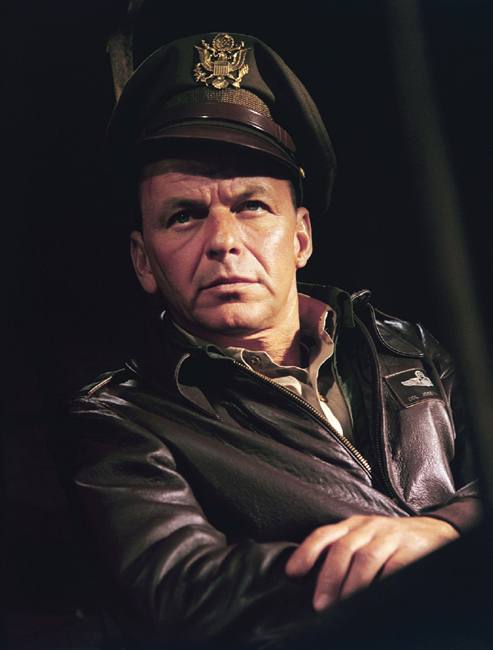
As Col. Joseph L. Ryan, Von Ryan's Express. / “Frank Sinatra had an extraordinary / aura—with his piercing blue eyes. He / was more than I expected. He was (Photo: The Cinematic Legacy of Frank Sinatra, David Wills, 2015.)
"Von Ryan's Express" (USA Release: June 23, 1965)
Release Date:23 June 1965Premiere Information:New York premiere and opening: 23 Jun 1965; Los Angeles opening: 21 Jul 1965
Production Date:3 Aug--mid Nov 1964
On 12 Mar 1964, LAT announced that Twentieth Century-Fox Film Corp. had purchased motion picture rights to David Westheimer's bestselling World War II novel, Von Ryan's Express, for director Mark Robson. Saul David also signed on as producer, temporarily suspending development of Lost Command (1966, see entry), as star Anthony Quinn was currently unavailable. According to the 16 Apr 1964 LAT, singer-actor Frank Sinatra was equally enthusiastic about the material, and immediately offered to play the leading role upon hearing the news of Fox's $125,000 bid. In an interview with the 30 Jan 1966 LAT, Westheimer explained that the ending was changed to include the death of the title character, "Col. Joseph L. Ryan," because Sinatra felt it would be "more "real.'" Westheimer, who was a prisoner of war (POW) in Italy during WWII, wrote the first draft of the screenplay, but was frequently at odds with the studio executives, and did not return for later rewrites. Casting began in the summer of 1964. Early in negotiations, the 18 Jun 1964 DV stated that Earl Holliman was forced to decline a role in the film, which would interfere with his recovery from surgery. A 2 Nov 1964 LAT item claimed that Robson hired Italian actress Raffaella Carra after seeing her on a television variety show while in Rome, which led to a long-term contract at Fox. Irish actor Edward Mulhare was cast as the German-speaking Captain "Costanzo," and, according to the 4 Jun 1965 LAT, learned the language in just two weeks. Several contemporary sources detailed Robson's arduous search for a period appropriate train that would serve as the setting for much of the film's action. A 7 Oct 1964 Var article stated that unit production manager Harry A. Caplan and unit manager Sam Gorodisky spent two months in Italy conferring with officials over use of the state-owned, non-electric railways, and after some effort, the 14 Sep 1964 LAT reported they had selected a 4,000-mile route that would carry the fourteen-boxcar freight through Rome, Pisa, Florence, Bologna, Milan, and across the Italian Alps into Switzerland. According to the 12 Aug 1964 Var, the U.S.-Italian crew would split the eighty-day schedule between Italy, Spain, and Los Angeles, CA. After several delays, the 14 Aug 1964 DV confirmed that principal photography began 3 Aug 1964, and a 7 Aug 1964 DV brief announced that Sinatra was due to start his role during the upcoming weekend. The 30 Jul 1964 LAT claimed the star hoped to avoid Italian paparazzi by traveling in a helicopter between set and his undisclosed residence in Rome. On 13 Aug 1964, DV noted that work was underway at a railroad station in San Lorenzo. Although the unit faced scheduling complications during Italy's busy tourist season, the 7 Oct 1964 Var reported that most of the problems occurred during the ten-day shoot in Spain. According to producer Saul David, the necessary location was more than two hours outside the nearest town, and inaccessible by highway. As a result, the train was used to transport supplies, cast, and crewmembers to and from the set. Additionally, the Spanish government revoked permission for the unit to book a charter flight from location in Malaga to Madrid, where they were scheduled to catch a connection back to the U.S. Once alternate arrangements were made, everyone returned to Los Angeles for six weeks of interior shooting at the Fox studios. The 5 Oct 1964 NYT reported that a twelve-acre POW camp was constructed on the back lot, and the 14 Sep 1964 LAT noted that five of the train's boxcars had been shipped to the studio from Europe. Meanwhile, the 11 Nov 1964 Var stated that second unit director William Kaplan remained in Italy to collect additional footage in Cortina and Rome. Despite the difficulties, the 14 Nov 1964 LAT announced that principal photography concluded ten days ahead of schedule. The 7 Oct 1965 Var estimated a negative cost of $6 million. According to a 4 Aug 1965 Var article, second unit work was completed using Cinemascope, but the majority of the film was photographed in Panavision. The 4 Jun 1965 LAT noted that scenes of the train traveling through Rome were shot in more vibrant colors than the rest of the film, which utilized a muted palette. Von Ryan's Express was included in an extensive press junket at New York City's Astor Hotel, which the 22 Jun 1965 LAT referred to as the "Twentieth Century-Fox Premier Film Festival Week." The event also included screenings of the studio's other upcoming releases, Morituri and Those Men in Their Flying Machines (1965, see entries). The 12 May 1965 Var reported that the picture would begin "day-dating" at the Loew's State and Loew's Tower East Theatres on 23 Jun 1965, with a premiere event scheduled for that same evening at the State. According to a 6 Jun 1965 NYT events calendar, proceeds benefitted the Cystic Fibrosis National Research Foundation. The 21 Jul 1965 LAT announced the picture's West Coast opening that day at Grauman's Chinese Theatre in Hollywood. The film received an Academy Award nomination for Sound Effects.
GEOGRAPHIC LOCATIONS
Rome Italy
Pisa Italy
Florence Italy
Bologna Italy
Milan Italy
Switzerland
San Lorenzo Italy
Spain
Málaga Spain
Los Angeles California United States
Cortina Italy
UNITED STATES - JUNE 23: Trini Lopez, Nancy Sinatra, Frank Sinatra and Tina Sinatra as they arrive for "Von Ryans Express" movie premiere at Lowes Theater on 45th St. & Broadway.
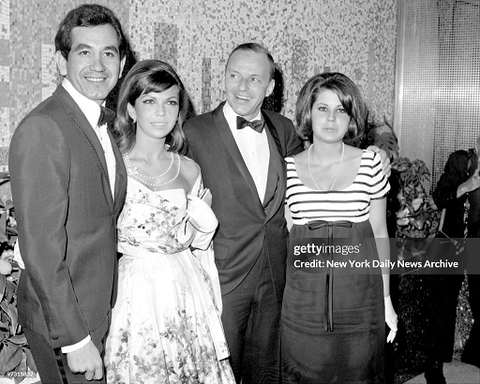
"Von Ryan's Express"
After reading the novel Von Ryan's Express and recognizing strong film material, Sinatra learned Twentieth Century-Fox had outbid him for the film rights; he responded by calling the studio directly and offering his services as star, resulting in a deal.
Source: Tom Santopietro, "Sinatra in Hollywood" (2008).
"Von Ryan's Express"
The film mixed soundstage interiors with extensive location photography in Spain and Italy, reflecting the industry's broader shift away from all-soundstage productions.
Source: Tom Santopietro, "Sinatra in Hollywood" (2008).
"Von Ryan's Express"
Sinatra's initial encounters with Mia Farrow took place during the film's soundstage sequences at the Fox lot, where Farrow was simultaneously filming her hit TV series Peyton Place. Once public, the relationship became major tabloid fodder, with press coverage fixated on their roughly thirty-year age difference.
Source: Tom Santopietro, "Sinatra in Hollywood" (2008).
"Von Ryan's Express"
The film's score was composed by Jerry Goldsmith (who went on to score The Detective for Sinatra as well), with cinematography by William H. Daniels and a screenplay by Wendell Mayes and Joseph Landon based on David Westheimer's novel.
Source: Tom Santopietro, "Sinatra in Hollywood" (2008).
"Von Ryan's Express"
Sinatra clashed repeatedly with director/executive producer Mark Robson over Sinatra's insistence on minimal retakes and fast shooting. Because Sinatra held the real power (percentage of the gross and box-office draw), Robson generally had to yield, and their disputes reportedly carried real animosity.
Source: Tom Santopietro, "Sinatra in Hollywood" (2008).
"Von Ryan's Express"
Nigel Hamilton (quoted by Santopietro): Sinatra chronicler quoted by Santopietro said Robson was the only director Sinatra actively disliked, which was notable given Sinatra had already been uncooperative or rude with other directors on other sets.
Source: Tom Santopietro, "Sinatra in Hollywood" (2008).
"Von Ryan's Express"
Daniel O'Brien (via Santopietro): Co-star Trevor Howard reportedly found Sinatra's hurry-it-up filming style easy to tolerate; author Daniel O'Brien noted Howard, having survived Marlon Brando's drawn-out tantrums during Mutiny on the Bounty, considered Sinatra comparatively affable.
Source: Tom Santopietro, "Sinatra in Hollywood" (2008).
"Von Ryan's Express"
Unlike the source novel (where Ryan escapes to Switzerland with his fellow prisoners), the film ends with Ryan shot dead reaching for the departing train — a downbeat change that Sinatra himself insisted on. Santopietro notes this was the last time Sinatra's character died onscreen, and Robson filmed it from the train's receding caboose for extra emotional impact.
Source: Tom Santopietro, "Sinatra in Hollywood" (2008).
"Von Ryan's Express"
Hollywood Citizen-News (via Santopietro): The Hollywood Citizen-News praised Sinatra's performance as the steely, unpopular American commander, calling it "Sinatra at his best as an actor," part of a near-unanimous positive critical response Santopietro says was the last of that kind in Sinatra's film career (aside from the compilation film That's Entertainment).
Source: Tom Santopietro, "Sinatra in Hollywood" (2008).
"Von Ryan's Express"
Santopietro grades this an A, calling it a first-class WWII movie. Golden Laurel Award nomination: Top Action Performance.
Source: Tom Santopietro, "Sinatra in Hollywood" (2008).
"Von Ryan's Express"
Santopietro (Filmography): P-R Productions/Twentieth Century-Fox. Produced by Saul David, directed by Mark Robson, screenplay by Wendell Mayes and Joseph Landon based on the David Westheimer novel, musical score by Jerry Goldsmith. Sinatra played Colonel Joseph Ryan opposite Trevor Howard, Raffaella Carra and Brad Dexter.
Source: Tom Santopietro, "Sinatra in Hollywood" (2008).
June 24, 1965
Frank traveled to Israel to begin filming Cast a Giant Shadow, playing a cameo as a bomber pilot alongside Kirk Douglas; during the trip he renewed his friendship with Israeli official Teddy Kollek.
Source: Nancy Sinatra, Frank Sinatra: An American Legend, 1995.
June 27, 1965
Television
The Ed Sullivan Show
Summary: Pre-recorded episode. Music: --Billy J. Kramer & the Dakotas - "From a Window" & "Bad to Me." --Tony Bennett - "I Left My Heart in San Francisco," "One for My Baby," "It Had to be You" and "One More for the Road." --The Djoliba Ensemble (African musicians, proteges of Harry Belafonte) - perform native songs. --The Kim Sisters (singers-musicians) - perform a medley from the Broadway musical "Funny Girl."Comedy: --Jackie Vernon (comedian) --Topo Gigio (Italian mouse puppet) sings "Love Me Do" in a duet with a daisy puppet. Also appearing: --Johnny Hart (magician) --The Two Carmenas (acrobats)
On film: --Ed interviews Frank Sinatra at the June 23 world premiere of "Von Ryan's Express" at New York's Loew's State Theatre. Collapse
July 1965
[Dylan booed at Newport Folk Festival]
Kaplan: Twenty-one days after Sinatra's Newport appearance, Bob Dylan was booed at the Newport Folk Festival for performing an electrified version of 'Like a Rolling Stone,' the six-minute-thirteen-second single that would go on to dominate radio that summer despite Columbia's and DJs' initial reluctance.
Source: James Kaplan, "Sinatra: The Chairman" (2015)
[Release of Sinatra '65 compilation]
Kaplan: The compilation album Sinatra '65, consisting of singles and other sessions, was released in July 1965 and charted quickly.
Source: James Kaplan, "Sinatra: The Chairman" (2015)
July 4, 1965
Concerts
12th Annual Newport Jazz Festival, New York
Frank Sinatra
Count Basie & His Orchestra: Al Aarons, Sonny Cohn, Wallace Davenport, Phil Guilbeau (trumpet); Henderson Chambers, Al Grey, Grover Mitchell, Bill Hughes, (trombone); Marshall Royal, Bobby Plater, Eric Dixon, Eddie Davis, Charlie Fowlkes (saxophone); William “Count” Basie (piano); Freddie die Green (guitar); Norman Keenan (bass); Sonny Payne (drums); special guest: Harry Edison (trumpet).
Orchestra Conducted By: Quincy Jones
Arrangements By: Quincy Jones
Oscar Peterson Trio (opening three songs)
Count Basie Band (warm-ups)
1. Get Me To The Church On Time
2. Fly Me To The Moon
3. I Wish You Love
4. Street of Dreams
5. Luck Be A Lady Tonight
6. It's Easy To Remember
7. Too Marvelous For Words
8. I've Got You Under My Skin
9. Monologue
10. Call Me Irresponsible
11. I Only Have Eyes For You
12. The Gal That Got Away
13. Please Be Kind
14. In The Wee Small Hours
15. Hello Dolly
16. You Make Me Feel So Young
17. All The Way
18. Where or When
19. My Kind of Town
12th Annual Newport Jazz Festival, New York
Frank Sinatra
Count Basie & His Orchestra: Al Aarons, Sonny Cohn, Wallace Davenport, Phil Guilbeau (trumpet); Henderson Chambers, Al Grey, Grover Mitchell, Bill Hughes, (trombone); Marshall Royal, Bobby Plater, Eric Dixon, Eddie Davis, Charlie Fowlkes (saxophone); William “Count” Basie (piano); Freddie die Green (guitar); Norman Keenan (bass); Sonny Payne (drums); special guest: Harry Edison (trumpet).
Orchestra Conducted By: Quincy Jones
Arrangements By: Quincy Jones
Oscar Peterson Trio (opening three songs)
Count Basie Band (warm-ups)
note: I discovered the charts Billy Byers wrote for Sinatra at the LOC.
I added additional ones not noted. Knew most of them but there were
a couple of surprises: "Lover Come Back To Me" from 1965. I'll bet he
did it during the tour. And the 1970 "A Foggy Day." That one was credited
to Don Costa.
Ed
Frank Sinatra charts written by Billy Byers
All The Way : June 20, 1965
Call Me Irresponsible : June 24, 1965
The Gal That Got Away
Get Me To The Church On Time
Hello Dolly
I Can’t Stop op Lovin’ You : Sinatra/Basie (Las Vegas)
I Wish sh You Love : Sinatra/Basie (Las Vegas)
In The Wee Small Hour : June 20, 1965
It’s Easy To Remember : June 23, 3, 1965
Lover Come Back To Me : June 21, 1965
The Best Is Yet To Come
The Lady Is A tramp
My Kind Of Town : Sinatra/Basie (Las Vegas)
Street Of Dreams : June 24, 1965
Too Marvelous For Words : June 23, 1965
Where Or When : June 20, 1965
You Make Me Feel So Young
A Foggy Day April 1970
Frank Sinatra at Newport Jazz Festival in Rhode Island on July 4,
1965. (thanks to Carl R.)
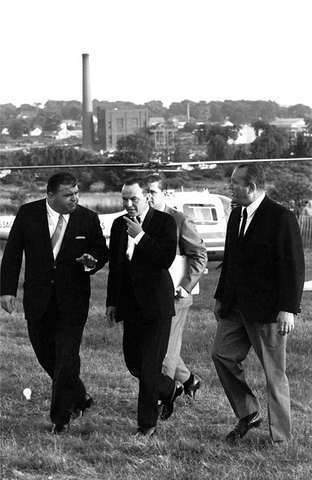
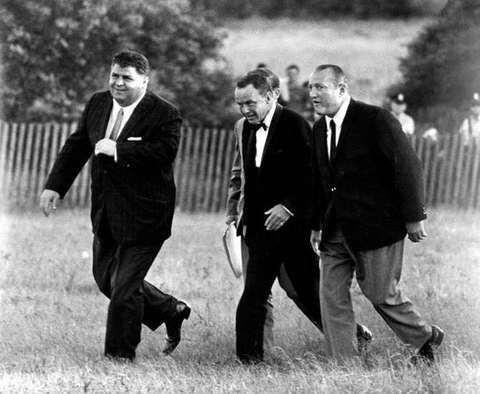
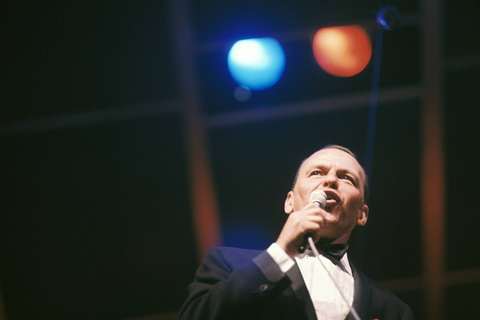
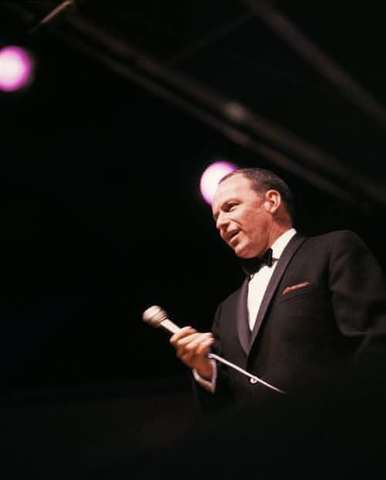
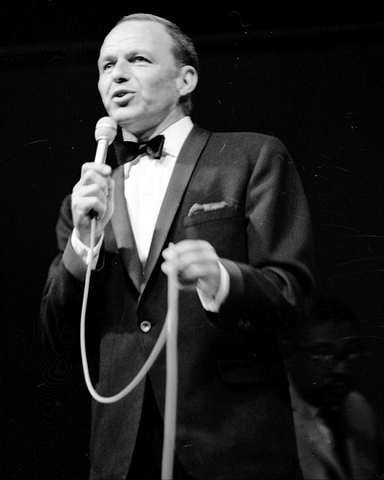
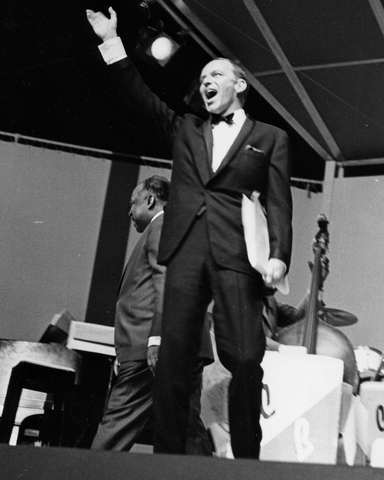
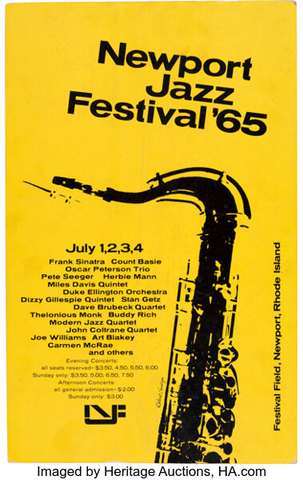
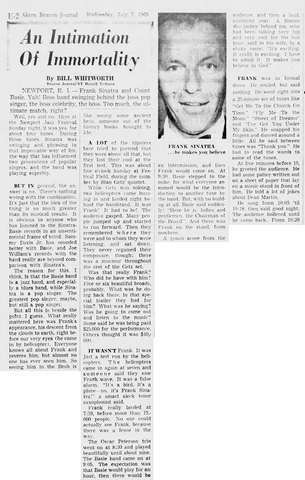
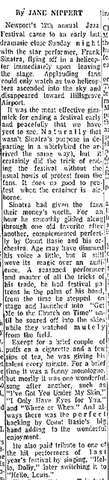
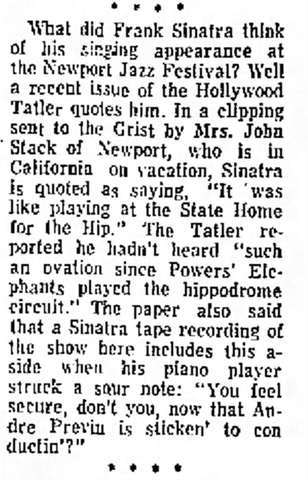
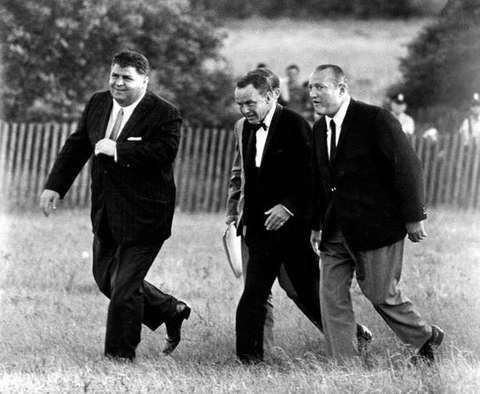
[Sinatra's Newport Jazz Festival appearance]
Quincy Jones: On July 4, 1965, Sinatra played the closing night of the Newport Jazz Festival with the Count Basie band, his first road tour with a big band since 1957. Quincy Jones recalled it was 'the only time I've ever seen Frank nervous,' likely reflecting old anxieties about whether he was truly accepted as a jazz singer, despite Lester Young's 1956 endorsement.
Source: James Kaplan, "Sinatra: The Chairman" (2015).
[Sinatra's actual Newport fee and impact]
Sinatra's Newport guarantee was $35,000, with total fee closer to $40,000 including a percentage of the gate; his set (a sellout, unlike prior years) helped push overall festival attendance to forty thousand, an increase of six thousand over the previous year.
Source: James Kaplan, "Sinatra: The Chairman" (2015).
[George Wein describes Sinatra's helicopter arrival]
George Wein: Promoter George Wein described in his memoirs how Sinatra's two helicopters landed at 7:45 p.m., causing a ruckus, and how Sinatra walked from the landing pad to his trailer down a lane of snow fencing flanked by bodyguards, calling the set 'a glorious performance' though heavy on swing and short on ballads.
Source: James Kaplan, "Sinatra: The Chairman" (2015).
[Sinatra's Newport setlist]
Among the songs Sinatra performed at Newport, arranged or reorchestrated by Quincy Jones, were 'Get Me to the Church on Time,' 'Fly Me to the Moon,' 'Street of Dreams,' 'I've Got You Under My Skin,' 'You Make Me Feel So Young,' and 'Where or When.'
Source: James Kaplan, "Sinatra: The Chairman" (2015).
[Arnold Shaw and Variety on Sinatra's Newport impact]
Arnold Shaw: Sinatra biographer Arnold Shaw, who had attended every Newport festival, wrote that no individual so electrified the festival as Sinatra did in 1965; Variety agreed, calling it 'Sinatra's festival' and his set an 'overpowering, hour-long vocal assault,' with writer David B. Bittan noting the $40,000 fee was worth every penny.
Source: James Kaplan, "Sinatra: The Chairman" (2015).
[Sinatra's dramatic Newport exit]
At 10:25 p.m., Sinatra received the biggest ovation of the four-day festival, thanked Father O'Connor and George Wein, and walked straight to a waiting helicopter, airborne two minutes later, headed to New York to be at Jilly's by midnight.
Source: James Kaplan, "Sinatra: The Chairman" (2015).
July 8, 1965
Concerts
6th Forest Hills Music Festival, West Side Tennis Club Stadium, New York Frank Sinatra
Count Basie & His Orchestra: Al Aarons, Sonny Cohn, Wallace Davenport, Phil Guilbeau (trumpet); Henderson Chambers, Al Grey, Grover Mitchell, Bill Hughes, (trombone); Marshall Royal, Bobby Plater, Eric Dixon, Eddie Davis, Charlie Fowlkes (saxophone); William "Count" Basie (piano); Freddie Green (guitar); Norman Keenan (bass); Sonny Payne (drums); special guest: Harry Edison (trumpet).
Emcee: Bob Dayton (WABC Disc Jockey)
Orchestra Conducted By: Quincy Jones
Arrangements By: Quincy Jones
Stan Rubin Orchestra:
1. opened the program (songs unknown)
Basie Set:
2. Why Not?
3. April In Paris
4. All Of Me
5. The Midnight Sun Never Sets
6. Speak Low
7. Whirly Bird
Sinatra Set:
8. Get Me To Church On Time
9. Fly Me To The Moon
10. I Wish You Love
11. Street Of Dreams
12. Luck Be A Lady
13. It's Easy To Remember
14. Too Marvelous For Words
15. I've Got You Under My Skin
16. monologue
17. Call Me Irresponsible
18. I Only Have Eyes For You
19. The Gal That Got Away
20. Please Be Kind
21. In The Wee Small Hours
22. Hello, Dolly!
23. You Make Me Feel So Young
24. All The Way
25. Where Or When
26. My Kind Of Town
Brian notes: Sellout of 15,000 He was not allowed by Authorities to use the helicopter for the shows. Papers also noted that before these shows Sinatra's last full-time engagement in NYC was at the copa in 1957. Sinatra would go to Jilly's after the shows around 1AM. Doors locked to the public and did do a jam session on at least one of the nights.
Ed O'Brien says that this just might be Sinatra's single greatest concert performance. It is certainly the best he's ever heard, he states. Sinatra is in the pocket from the opening number and the energy level is unbelievable. He does "Skin" at an extraordinary level. The ballads are done up tempo and are letter perfect and the swingers are powerfully rendered. Sinatra only did a few concerts with Basie at such breakneck speed and this is easily the best from the brief tour.
Sinatraphile Jerry Brennan wanted to know if there are any recordings of this concert in circulation. Another Sinatraphile replied that he had one that is an audience-made recording. Unfortunately, there is a lot of chatter going on and he wishes that they had shut up so that the show could be heard clearly and enjoyed. He says he listened to it for the first time in quite a while recently. Something interesting happened during "Skin," that he hadn't heard before. Beginning with Basie's instrumental bridge, the audience began clapping rhythmically right to the end. He speculates that they were dancing in the aisles.
Ed O'Brien confirms that indeed they were dancing in the aisles. The place really went crazy. To O'Brien's knowledge, there are five tapes from the tour: Newport and Forest Hills on July 8 and 9 and two from Arie Crown's two shows. The latter has seen only one become available to collectors. The first show at Forest Hills is by far the best, O'Brien observes.
Ed O'Brien:
Frank's three nights at the West Side Tennis Club drew more than 46,000 fans. Basie's 16 piece band went over in a big way. Mr Basie introduced the main attraction, "Ladies and gentlemen, the Chairman of the Board." The crowd clapped and screamed as he came out on stage. The New York Times described him as "warm and personable." The reviewer noted that the singer had his audience firmly under control as he "mesmerized with his delivery, talent and reminiscence." The first night at Forest Hills was the second performance of the brief five city tour. Sinatra had insisted on a trailer near the stage entrance platform. He arrived via limo each night, while the Basie band was performing. The promoters were surprised when Frank insisted on low ticket prices so a younger audience would be able to see him. The price range for the three shows ranged from $2.95 to $6.95 per ticket. The high end tickets would still be the top price for the festival season. Barbra Streisand and Judy Garland would also make appearances that summer. According to people in the know, Sinatra could have demanded far more and still would have sold out. Frank was paid $40,000 per show plus a generous percentage of the $80,000 gross each night. The audience hung on every utterance from the singer as he ripped through 18 uptempo charts. When he stopped to chat, the highlight was The Voice remembering his days with the Dorsey band and the frenzy at the Paramount with the squealing bobby-soxers. The audience roared when he told them " The last time I was out here I wore a Bond clothing store tuxedo, brown shoes, and I think I weighed nine pounds." According to The Times, ticket orders came from as far away as Atlanta, Georgia. Frank's performance the first night ran almost 90 minutes. At the conclusion of the show, the Sinatra entourage was speeding toward Manhattan before the fans had reached the parking lots. Arguably the most exciting tour of Sinatra's career and that first night at Forest Hills was simply sensational.
SINATRA SCORES IN STRAIGHT SETS
FOREST HILLS, N.Y. -- The qualities that have made Frank Sinatra a top re- cording artist for the last two decades were displayed before 15,000 persons who jammed the West Side Tennis
Club Stadium here Thursday night (8).
Sinatra and Count Basie opened the sixth annual Forest Hills Music Festival, and the concert was repeated the following two nights.
Seldom has an artist exercised the mastery of an audience to the degree that Sinatra did
Thursday night. He performed 20 numbers, sang for 90 minutes -- punctuated only by a brief tea break -- and had the fans stomping, clapping and shouting for more.
With the 16-piece Basie band providing the backing, and occasionally taking over while the Chairman of the Board became a temp- orary observer, the performance took on a polish that will be hard to match.
The Basie band went on first, opening with the Count's "Why Not" and following with "April in Paris" and "All of Me."
The audience really caught fire with Marshall
Royal's fine alto sax solo of Quincy Jones' "The
Midnight Sun Never Set, " and the fires were fanned as Basie followed with "Speak Low."
Rufus Jones drew a roaring ovation for his drum work on "Whirly Bird" as the Basie band gathered steam for Sinatra's appearance.
Sinatra opened with "Get Me to the Church on
Time" and followed with a pair of dreamy, nostalgic numbers-- "Fly Me to the Moon" and "On the Street of Dreams."
On "Luck Be a Lady Tonight" he incorporated a crap-shooting pantomime bit and engaged in some by-play with the Basie band.
Sinatra has the faculty of making the audience feel it's on the inside. During the tea break he joshed about members of the Clan, and his inside references seemed to be understood by all.
ENCOURAGING CLAPPING
He also knows when to deal the audience in and when to let the band take over. Sinatra encouraged a clapping session on "I've Got You Under My Skin," then stepped aside to let Basie take over, and later finished the vocal. He knows when to stop milking a number , when to give the audience its head, and when to give the spotlight to the band.
Louis Armstrong came in for a special citation when Sinatra sang "Hello, Dolly!" paraphrasing the lyrics to "Hello, Louis."
Sinatra sticks with the material that has made him a top record artist for these many years with such moody, romantic numbers as "I Wish You
Love," "Easy to Remember," "You're Just Too
Marvelous," "Call Me Irresponsible, " "I Only Have
Eyes for You," "The Gal That Got Away," "Please
Be Kind" and "All the Way."
DIRECTION OUTSTANDING
Quincy Jones' musical direction was outstanding.
Bob Dayton, WABC disk jockey, handled the emcee chores.
Scheduled to appear was the Oscar Peterson
Trio , but as Peterson was in Toronto with a case of ptomaine poisoning, the act didn't show.
The Stan Rubin orchestra opened the program.
--Aaron Sternfield
Billboard
July 16, 1965
6th Forest Hills Music Festival, West Side Tennis Club Stadium, New York Frank Sinatra
Count Basie & His Orchestra: Al Aarons, Sonny Cohn, Wallace Davenport, Phil Guilbeau (trumpet); Henderson Chambers, Al Grey, Grover Mitchell, Bill Hughes, (trombone); Marshall Royal, Bobby Plater, Eric Dixon, Eddie Davis, Charlie Fowlkes (saxophone); William "Count" Basie (piano); Freddie Green (guitar); Norman Keenan (bass); Sonny Payne (drums); special guest: Harry Edison (trumpet).
Emcee: Bob Dayton (WABC Disc Jockey)
Orchestra Conducted By: Quincy Jones
Arrangements By: Quincy Jones
Stan Rubin Orchestra:
Early ad before they added the 7/8 show
What a line up of great entertainers
[image referenced in source but could not be recovered]
[image referenced in source but could not be recovered]
[image referenced in source but could not be recovered]
[image referenced in source but could not be recovered]
[image referenced in source but could not be recovered]
July 9, 1965
Concerts
6th Forest Hills Music Festival, West Side Tennis Club Stadium, New York Frank Sinatra
Count Basie & His Orchestra: Al Aarons, Sonny Cohn, Wallace Davenport, Phil Guilbeau (trumpet); Henderson Chambers, Al Grey, Grover Mitchell, Bill Hughes, (trombone); Marshall Royal, Bobby Plater, Eric Dixon, Eddie Davis, Charlie Fowlkes (saxophone); William "Count"Basie (piano); Freddie Green (guitar); Norman Keenan (bass); Sonny Payne (drums); special guest: Harry Edison (trumpet).
Emcee: Bob Dayton (WABC Disc Jockey)
Orchestra Conducted By: Quincy Jones
Arrangements By: Quincy Jones
Stan Rubin Orchestra
Basie Set
Sinatra Set:
1. Get Me To Church On Time
2. Fly Me To The Moon
3. I Wish You Love
4. Street Of Dreams
5. Luck Be A Lady
6. It's Easy To Remember
7. Too Marvelous For Words
8. I've Got You Under My Skin
9. Call Me Irresponsible
10. I Only Have Eyes For You
11. The Gal That Got Away
12. Please Be Kind
13. In The Wee Small Hours Of The Morning
14. monologue
15. Hello, Dolly!
16. You Make Me Feel So Young
17. All The Way
18. Where Or When
19. My Kind Of Town
NOTE: Sinatra Scholar Ed O'Brien says that this show on July 9, 1965 closed with Sinatra singing "My Kind of Town . . . Manhattan is . . ."
He sang of having a drink at Jilly's, dinner at Toot Shor's, saluted the New York Mets and the Empire State . The 14,000 plus screamed for more as he reprised the Cahn-Van Heusen song.
6th Forest Hills Music Festival, West Side Tennis Club Stadium, New York Frank Sinatra
Count Basie & His Orchestra
July 10, 1965
Concerts
6th Forest Hills Music Festival, West Side Tennis Club Stadium, New York Frank Sinatra
Count Basie & His Orchestra: Al Aarons, Sonny Cohn, Wallace Davenport, Phil Guilbeau (trumpet); Henderson Chambers, Al Grey, Grover Mitchell, Bill Hughes, (trombone); Marshall Royal, Bobby Plater, Eric Dixon, Eddie Davis, Charlie Fowlkes (saxophone); William "Count" Basie (piano); Freddie Green (guitar); Norman Keenan (bass); Sonny Payne (drums); special guest: Harry Edison (trumpet).
Emcee: Bob Dayton (WABC Disc Jockey)
Orchestra Conducted By: Quincy Jones
Arrangements By: Quincy Jones
Stan Rubin Orchestra
Basie Set
Get Me To Church On Time
Fly Me To The Moon
I Wish You Love
Street Of Dreams
Luck Be A Lady
It's Easy To Remember
Too Marvelous For Words
I've Got You Under My Skin
Call Me Irresponsible
I Only Have Eyes For You
The Gal That Got Away .
Please Be Kind
In The Wee Small Hours Of The Morning
Monologue
Hello, Dolly!
You Make Me Feel So Young
All The Way
Where Or When
My Kind Of Town
6th Forest Hills Music Festival, West Side Tennis Club Stadium, New York
July 14, 1965
7-14-66
July 1981
JULY 14, 1953
July 1953
July 1953
July 1957
Matt Dennis
July 15, 1965
Concerts
Lorton Penitentiary, Lorton, Virginia
Performers: Frank Sinatra, Count Basie, Ella Fitzgerald
Count Basie & His Orchestra: Al Aarons, Sonny Cohn, Wallace Davenport, Phil Guilbeau (trumpet); Henderson Chambers, Al Grey, Grover Mitchell, Bill Hughes, (trombone); Marshall Royal, Bobby Plater, Eric Dixon, Eddie Davis, Charlie Fowlkes (saxophone); William "Count" Basie (piano); Freddie Green (guitar); Norman Keenan (bass); Sonny Payne (drums); special guest: Harry Edison (trumpet).
Orchestra Conducted By: Quincy Jones
Arrangements credited to: Quincy Jones
Notes: "James L. Hoffa gave the prison chaplin $3,500 to cover some of Count Basie's travel expenses in the big Frank Sinatra benefit at a Virginia reformatory" Show was for both men of women, Near Baltimore
known songs performed:
1. Luck Be A Lady
2. Fly Me To The Moon
3. I've Got You Under My Skin
Note: A segment of Sinatra singing “Fly Me To The Moon” at Lorton was used in the 1965 documentary “A Very Good Year”
Lorton Penitentiary, Lorton, Virginia
Performers: Frank Sinatra, Count Basie, Ella Fitzgerald
Count Basie & His Orchestra: Al Aarons, Sonny Cohn, Wallace Davenport, Phil Guilbeau (trumpet); Henderson Chambers, Al Grey, Grover Mitchell, Bill Hughes, (trombone); Marshall Royal, Bobby Plater, Eric Dixon, Eddie Davis, Charlie Fowlkes (saxophone); William "Count" Basie (piano); Freddie Green (guitar); Norman Keenan (bass); Sonny Payne (drums); special guest: Harry Edison (trumpet).
Orchestra Conducted By: Quincy Jones
Arrangements credited to: Quincy Jones
Notes: "James L. Hoffa gave the prison chaplin $3,500 to cover some of Count Basie's travel expenses in the big Frank Sinatra benefit at a Virginia reformatory" Show was for both men of women, Near Baltimore
known songs performed:
Regarding the concert at Lorton Prison on this date, I think it’s interesting to recall there was a time when entertainers regularly played concerts at prisons, Johnny Cash perhaps most notably. It seems there was a different culture back then, both in terms of how to rehabilitate the incarcerated and in terms of how entertainers chose their charitable venues. Maybe I just don’t read about such things these days, but the prison concert doesn’t seem so common now.
Note the description of the Lorton gig states it was “near Baltimore.” Actually, Lorton prison was 20 miles from Washington, DC, and about 60 miles from Baltimore. The former prison is now the site of an upscale residential development.
--Jim Johnson
Rehoboth Beach, DE
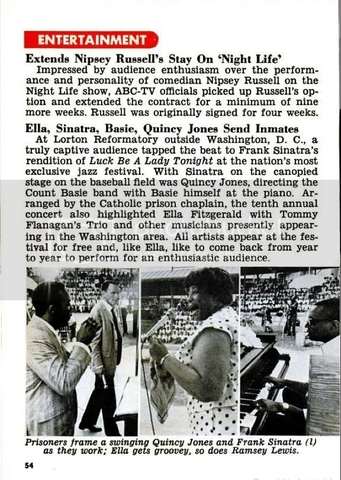
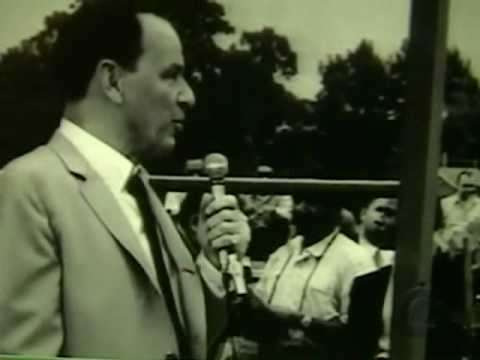
July 16, 1965
Concerts
Cobo Arena, Detroit, Michigan
Frank Sinatra
Count Basie & His Orchestra: Al Aarons, Sonny Cohn, Wallace Davenport, Phil Guilbeau (trumpet); Henderson Chambers, Al Grey, Grover Mitchell, Bill Hughes, (trombone); Marshall Royal, Bobby Plater, Eric Dixon, Eddie Davis, Charlie Fowlkes (saxophone); William "Count" Basie (piano); Freddie Green (guitar); Norman Keenan (bass); Sonny Payne (drums); special guest: Harry Edison (trumpet).
Orchestra Conducted By: Quincy Jones
Arrangements By: Quincy Jones
Oscar Peterson Trio (opening three songs)
Count Basie Band (warmups)
1. I Wish You Love
2. Street of Dreams
3. Luck Be a Lady
4. Fly Me to the Moon
5. Too Marvelous for Words
6. I've Got You Under My Skin
7. I Only Have Eyes for You
8. I Get a Kick Out of You
9. The Man That Got Away
10. Chicago (That Toddling Town)
11. Please Be Kind
12. In the Wee Small Hours of the Morning
13. All the Way
14. Hello, Dolly!
15. You Make Me Feel So Young
16. Where or When
17. My Kind of Town
Cobo Arena, Detroit, Michigan
Frank Sinatra
Count Basie & His Orchestra
Frank Sinatra was unquestionably one of the most popular singers of the twentieth century. His name remains a symbol of a bygone era of jazz and swing, and his music continues to captivate new generations of listeners today. Making his first major splashes in the American music industry in the 1930s, Sinatra became a teen idol during the World War II years and spent much of the postwar period recording chart-topping hits and traveling the country to perform at sold-out venues.
By the 1960s, Sinatra's career was at an apogee. He was recording and producing some of the best songs of his career while performing in Las Vegas alongside fellow "Rat Packers" Dean Martin, Sammy Davis Jr., Peter Lawford, and Joey Bishop. Sinatra also continued his successful acting career that included famous films such as From Here to Eternity (1953), Guys and Dolls (1955), and Ocean's 11 (1960). It seemed that the sky was the limit for "01' Blue Eyes."
Interestingly, for all his touring during the 1960s, Sinatra only performed in Michigan on three occasions, giving concerts at Detroit's Cobo Arena in July 1965, July 1967, and August 1968. The 1965 show--his first in Michigan since his 1946 show 19 years prior--proved an unforgettable experience for those who adored the sounds of Sinatra.
On Friday, July 16,1965, some 13,000 well-dressed, restless concertgoers crowded into Cobo Arena to see Sinatra. Many had paid top dollar for tickets. The most expensive seats sold for $9.50 each--nearly $80 today. After performances by the Oscar Peterson Trio and Count Basie Orchestra, Sinatra took the stage, beginning his set with covers of the popular hits "I Wish You Love" and "Street of Dreams."
From the moment he began performing, Sinatra commanded the stage, snapping his fingers as he crooned along to the music of his orchestra, led by conductor Quincy Jones. To thunderous applause, he sang "Luck Be a Lady," one of the biggest hits from Guys and Dolls. Next came the swinging tunes "Fly Me to the Moon," "Too Marvelous for Words," and "I've Got You Under My Skin."
Sinatra took several pauses during the show for a few drags from his cigarette and to < reflect on his career with the audience. Making light of his near-two-decades-long absence from a Michigan concert stage, he remembered with a hint of humor in his tone, "Oh, I was a thing of beauty in those days ... I weighed nine pounds and I've lost weight since."
Sinatra sang tunes both old and new. He performed new arrangements of classics written in the era of swing, such as "I Only Have Eyes for You," "I Get a Kick Out of You," and "The Man That Got Away." Those songs, performed 30 years after they were first made popular, allowed Sinatra to bridge the gap between generations of listeners. He continued to keep the jazz and swing genres alive in a new era of American music that was already witnessing the skyrocketing rise of psychedelic rock, sunshine pop, surf rock, and others.
Perhaps boldly, considering the many rivalries existing between the Motor and Windy Cities, Sinatra launched next into "Chicago (That Toddlin' Town)." Next came "Please Be Kind," an orchestral classic penned in 1938; "In the Wee Small Hours of the Morning," the title track of Sinatra's 1955 album; and "All the Way," first performed by Sinatra in the 1957 film The Joker Is Wild.
It was quite clear that the performer's charm was every bit as strong in 1965 as it had been in 1946. Bobby-soxers who had swooned over Sinatra in the 1940s were now joined by their daughters--a new generation witnessing the singer's charisma five for the very first time.
While many of his most popular songs of the 1960s--including "Strangers in the Night," "Somethin' Stupid," "That's Life," and "My Way"--had not yet been recorded and released, there were plenty of fan favorites for Sinatra to rely on, including the title tune of the wildly popular 1964 musical "Hello Dolly!"; "You Make Me Feel So Young," a staple of Sinatra's live set lists; and "Where and When," a widely covered number from the 1937 musical Babes in Arms.
Sinatra closed the show with a rousing performance of "My Kind of Town"--and judging by the reception from his Detroit audience, it appeared that Michigan's Motor City was exactly that: his kind of town. At the concert's end, the audience gave Sinatra a standing ovation, with groups of women rushing the stage as the singer wished his fans good-night. Detroit Free Press reporter Louis Cook recalled that the crowd "watched wistfully as he left, as if he were taking a piece of their youth away--which he was." And, as quickly as "OF Blue Eyes" had descended upon Michigan after 19 years, he was gone, jetting off to another show in another city, making new memories with listeners across America.
Christopher N. Blaker is an American political and military historian who works for the U.S. Department of the Navy.
July 16th 1969---Apollo X1 On it's way to the Moon.
Franks record of Fly Me To The Moon was played from Apollo for a mission control broadcast
Frank's recording of Bart Howard's song was first heard in space on the Apollo X flight. On Apollo XI, Buzz Aldrin had a mini-cassette in his headset as he became the second man to set foot on the moon(7-20-69). And he let the world hear Frank from 238,900 miles away. There is a great video on Frank singing it to the astronauts at the Houston Astro- dome, 8-16-69. He refers to it as "our song."
--Ed
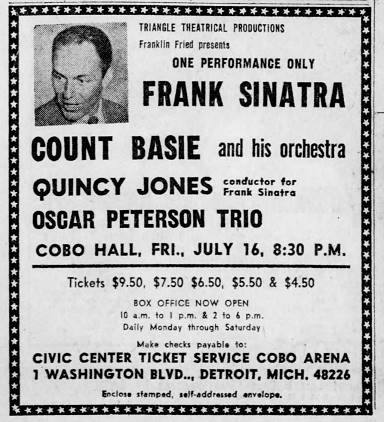
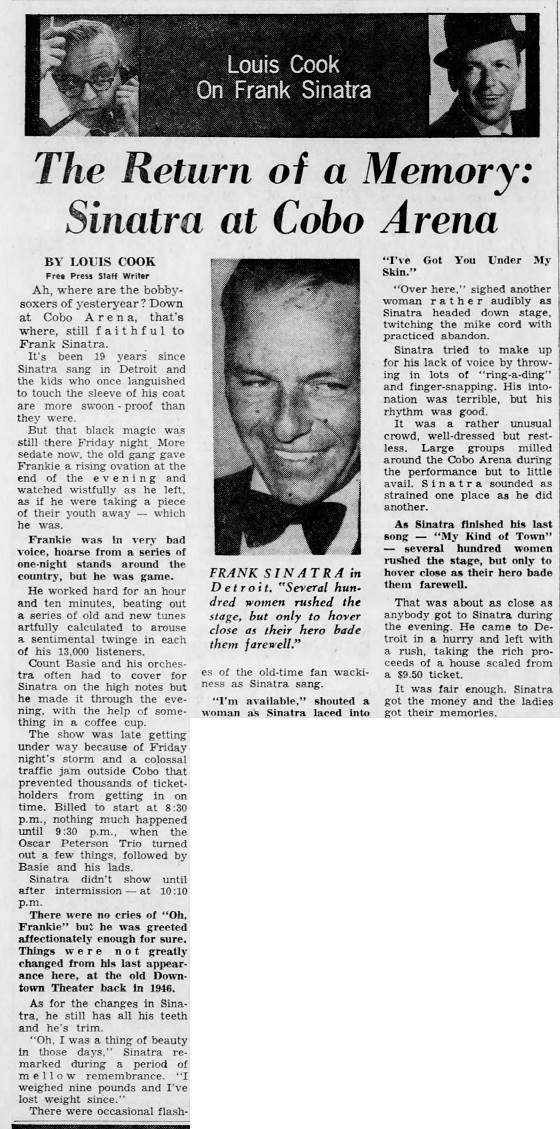
July 17, 1965
Concerts
Civic Center, Baltimore, Maryland
Time 8:30PM
Frank Sinatra
Count Basie & His Orchestra: Al Aarons, Sonny Cohn, Wallace Davenport, Phil Guilbeau (trumpet); Henderson Chambers, Al Grey, Grover Mitchell, Bill Hughes, (trombone); Marshall Royal, Bobby Plater, Eric Dixon, Eddie Davis, Charlie Fowlkes (saxophone); William "Count" Basie (piano); Freddie Green (guitar); Norman Keenan (bass); Sonny Payne (drums); special guest: Harry Edison (trumpet).
Orchestra Conducted By: Quincy Jones
Arrangements By: Quincy Jones
Oscar Peterson Trio (opening three songs)
Count Basie Band (warmups)
Note: 13,000 seat capacity, By June 8th half were already sold. On June
8th the six cites for the tour were: Baltimore, Houston, New York City, Chicago, Detroit & Philadelphia. In addition it was mentioned that he would also headline the Dismas House Benefit in St. Louis at the Kiel Opera House June 20th.
Civic Center, Baltimore, Maryland
Time 8:30PM
Frank Sinatra
Count Basie & His Orchestra: Al Aarons, Sonny Cohn, Wallace Davenport, Phil Guilbeau (trumpet); Henderson Chambers, Al Grey, Grover Mitchell, Bill Hughes, (trombone); Marshall Royal, Bobby Plater, Eric Dixon, Eddie Davis, Charlie Fowlkes (saxophone); William "Count" Basie (piano); Freddie Green (guitar); Norman Keenan (bass); Sonny Payne (drums); special guest: Harry Edison (trumpet).
Orchestra Conducted By: Quincy Jones
Arrangements By: Quincy Jones
Oscar Peterson Trio (opening three songs)
Count Basie Band (warmups)
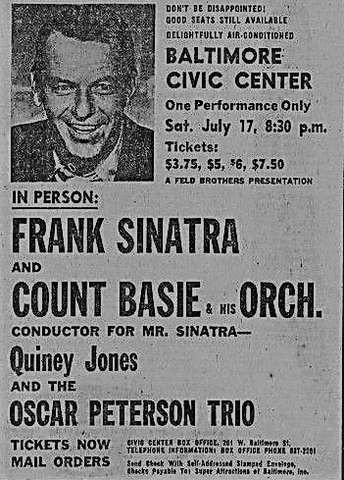
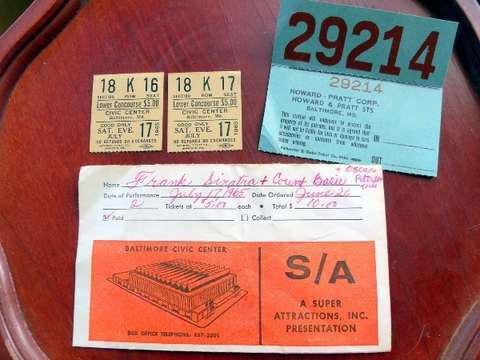
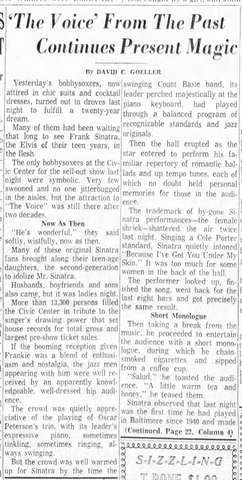
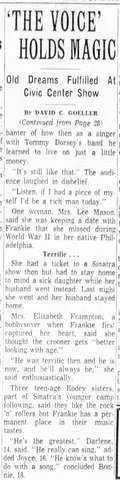
[Whitney Balliett's scornful New Yorker review of Newport]
Whitney Balliett: In his July 17 New Yorker piece, jazz critic Whitney Balliett derided the Newport festival and mocked Sinatra as 'the celebrated New Jersey Meadows jazz singer,' describing his helicopter arrival, his set backed by his own musicians (drummer Sonny Payne, trumpeter Harry Edison), his rendition of 'Get Me to the Church on Time,' a joke-filled monologue, and his reported $35,000 fee.
Source: James Kaplan, "Sinatra: The Chairman" (2015).
July 18, 1965
Concerts
McCormick Place, Arie Crown Theater, Chicago, Illinois
First Show
Time: 6:30 PM
Frank Sinatra
Count Basie & His Orchestra: Al Aarons, Sonny Cohn, Wallace Davenport, Phil Guilbeau (trumpet); Henderson Chambers, Al Grey, Grover Mitchell, Bill Hughes, (trombone); Marshall Royal, Bobby Plater, Eric Dixon, Eddie Davis, Charlie Fowlkes (saxophone); William "Count" Basie (piano); Freddie Green (guitar); Norman Keenan (bass); Sonny Payne (drums); special guest: Harry Edison (trumpet).
Orchestra Conducted By: Quincy Jones
Arrangements credited to: Quincy Jones
Count Basie Band (warmups)
McCormick Place, Arie Crown Theater, Chicago, Illinois
Second Show
Time: 9:30 PM
Frank Sinatra
Count Basie & His Orchestra: Al Aarons, Sonny Cohn, Wallace Davenport, Phil Guilbeau (trumpet); Henderson Chambers, Al Grey, Grover Mitchell, Bill Hughes, (trombone); Marshall Royal, Bobby Plater, Eric Dixon, Eddie Davis, Charlie Fowlkes (saxophone); William "Count" Basie (piano); Freddie Green (guitar); Norman Keenan (bass); Sonny Payne (drums); special guest: Harry Edison (trumpet).
Orchestra Conducted By: Quincy Jones
Arrangements credited to: Quincy Jones
Count Basie Band (warmups)
1. Get Me To The Church On Time
2. Fly Me To The Moon
3. I Wish You Love
4. Street Of Dreams
5. Luck Be A Lady
6. Too Marvelous For Words
monologue
7. I Only Have Eyes For You
8. The Gal That Got Away
9. Please Be Kind
10. In The Wee Small Hours
11. Hello Dolly
second monologue
12. You Make Me Feel So Young
13. Where Or When
14. My Kind Of Town
15. My Kind Of Town (reprise)
Tour Notes: Played to 90,000 people and grossed $600,000. Another story estimated the net for Sinatra at $500,000
By July 20, 1965 Sinatra was at Grauman's Chinese Theater for the ceremony. Basie played a solo gig on the 19th.
On July 30, 1965 he did a guest spot on the Tonight Show. It was a reschedule from the 19th due to said business in Hollywood.
NOTE: Ed O'Brien reports that Sinatra had a ball with "Hello,
Dolly" and the swinging "Wee Small Hours" is a revelation.
He also supplied the review below.
SHOW HAS SINATRA, BASIE AT BEST
Count Basie never sounded better than with Frank Sinatra
as his vocalist. Frank Sinatra never sounded better than with
Count Basie playing his accompaniment. So between them
these two wonderful old professionals put on a great show
at Arie Crown Theatre last night in McCormick Place's
"Summer of Stars, "65" series.They did it not once but
twice, and the huge playhouse was sold out for each
show.
Sinatra, the crooner for whom teen-agers use to swoon
the way their daughters now do for the Beatles, is getting
too mature to play romantic leads, but he still can phrase
the heart and soul out of a sentimental ballad, while packing
it full with a veteran showman like sock. Several dowagers
wearing funny hats made their way up the aisles to stageside,
autograph books or flash cameras in hand, and had to be
led away by the late Andy Frain's brave boys in blue. The
old Sinatra appeal still is there, balding spot or no balding
spot.
Frank started as a band singer (he recalled last night that
he must have played the Chicago Theatre nearly a dozen
times, in that role), and he knows how to project, co-
operating skillfully with a microphone, above even the big,
bold, blaring brass of Basie's enthusiastic 17 -man gang,
The band, on its best behavior for the singing big shot,
whom Basie introduced as "the chairman of the board,"
played Frank a crisp, clean, magnificently disciplined show,
unafraid of drowning out the man who knows how to
whoop as well as to phrase.
Sinatra pays no attention to the meaning of the words,
but curls and pats them into patterns that fit the swoop
and dip of the musical arrangements.
And his arrangements, many of them by Quincy Jones,
who conducted Frank's portion of the program, are original
and exciting. When he closed with the rousing "My Kind Of
Town, Chicago," the figurative rafters trembled.
Bill Basie's big band was more alert, even in the first half
(Sinatra didn't appear until after intermission) , than it
had been two weeks ago on the same stage. The
"chairman of the board" keeps his colleagues on the
qui vive.
Also on the bill was merely the Oscar Peterson Trio.
One of the great musical ensembles of the day, it was
practically lost in the shuffle.
William Leonard
Chicago Tribune
July 19, 1965
McCormick Place, Arie Crown Theater, Chicago, Illinois
© 1997-2025 The Sinatra Archive
This calendar, or any parts thereof, may not be reproduced in any fashion
whatsoever without the prior written permission of the publisher (The
Sinatra Archive)
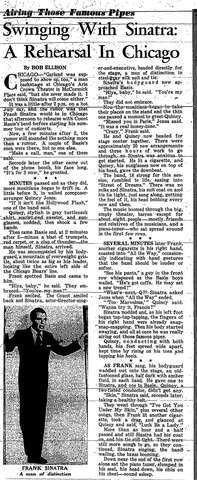
McCormick Place, Arie Crown Theater, Chicago, Illinois
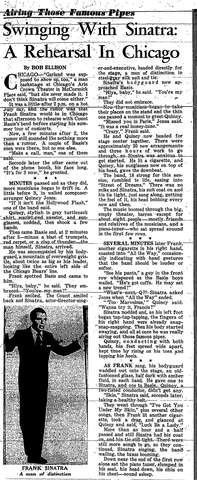
McCormick Place, Arie Crown Theater, Chicago, Illinois
© 1997-2025 The Sinatra Archive
This calendar, or any parts thereof, may not be reproduced in any fashion
whatsoever without the prior written permission of the publisher (The
Sinatra Archive)
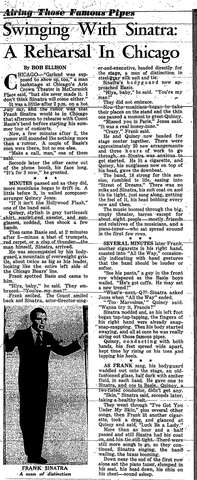
July 20, 1965
Television
Graumans Chinese Theater
Frank Sinatra Inducted Complete Coverage
NOTE: Ed O'Brien says that The Hollywood Reporter showed a segment of this show. The entire ceremony was not televised. There is both a color and a b&w film of the event.
Graumans Chinese Theater
Frank Sinatra Inducted Complete Coverage
July 20, 1978:
Frank Sinatra with his wife Barbara and pal Jilly Rizzo, leaving David Niven’s house in the South of France, Gregory Peck waits for the couple beside the car.
Thanks to Carl for above photo
Frank placed his hands and feet in cement at Grauman's Chinese Theater in Hollywood with daughters Tina and Nancy present; the girls also pressed dimes into the wet cement, which were later stolen.
Source: Nancy Sinatra, Frank Sinatra: An American Legend, 1995.
July 25, 1965
[Forest Hills concerts]
Arnold Shaw: Four days after Newport (per Kaplan's chronology), Sinatra played three sellout nights at the West Side Tennis Club stadium in Forest Hills, Queens, grossing a record $271,886, per Arnold Shaw's account; the audience was described as mostly middle-aged matrons reacting like Beatlemania teens.
Source: James Kaplan, "Sinatra: The Chairman" (2015).
July 30, 1965
Television
The Tonight Show
Network: NBC
Time: 11:30PM -1AM
Friday evening
Host: Joey Bishop
Guests: Frank Sinatra, Sammy Davis Jr., Sally Ann Howes
1. I've Got You Under My Skin
2. My Kind Of Town
Ed Notes:
Skitch Henderson told me Frank didn't want to do the show.
Didn't bring along his sidemen or the sheet music for "Skin" and "Town,"
Skitch found it easy faking Riddle's chart on the former but wrote his own chart for the latter. Frank's exchange with Sally Ann Howes is a classic. Sammy did a lovely reading on "This Was My Love" and then Frank gave him a brief history of the song.
August 1965
[Frank and Bill Styron Try to Call Castro About Cigars]
Nancy Sinatra: Publisher Bennett Cerf told Nancy about a raucous party at writer Bill Styron's Martha's Vineyard home during which Frank and Styron repeatedly tried to place a long-distance call to Fidel Castro, hoping to lodge a complaint that decent Cuban cigars had become impossible to find in New England.
Source: Nancy Sinatra, Frank Sinatra: An American Legend, 1995.
[Claudette Colbert and Rosalind Russell deny wedding rumors]
Kaplan: When the Southern Breeze docked at Martha's Vineyard, Claudette Colbert and Rosalind Russell met with reporters to deny rumors that Frank and Mia planned to marry at James Cagney's Chilmark house, but the denial only intensified speculation.
Source: James Kaplan, "Sinatra: The Chairman" (2015)
[Southern Breeze guest list]
Kaplan: Aboard the Southern Breeze, besides Frank and Mia, were older Hollywood friends including Claudette Colbert (b. 1903), Rosalind Russell (b. 1907), and Bill and Edie Goetz (b. 1903 and 1905), making Mia by far the youngest passenger.
Source: James Kaplan, "Sinatra: The Chairman" (2015)
[Southern Breeze press frenzy and Kennedy visit]
Kaplan: The Southern Breeze cruise drew intense paparazzi coverage, with photographers and helicopters trailing the boat; the group made an awkward visit to Rose and Joe Kennedy at Hyannis Port (Joe Kennedy, in a wheelchair, unable to speak), and later the Kennedy sisters Jean Smith, Eunice Shriver, and Pat Lawford came aboard for an evening of charades, temporarily suspending Frank's feud with Peter Lawford.
Source: James Kaplan, "Sinatra: The Chairman" (2015)
[The Southern Breeze cruise begins]
Kaplan: In August, after the Basie tour ended, Sinatra chartered the 168-foot yacht Southern Breeze for $2,000 a day and took Mia Farrow on a cruise along the New England coast; Peyton Place writers wrote Mia's character into a coma via car accident to free up her schedule.
Source: James Kaplan, "Sinatra: The Chairman" (2015)
August 1, 1965
Studio
Concerts
England
August 1, 1953
Source: sinatraphiles digest (date extracted from item text; originally routed to appendix for review).
August 10, 1965
Frank's yachting getaway with Mia Farrow aboard the chartered 170-foot Southern Breeze -- undertaken after he returned exhausted from filming Cast a Giant Shadow in Israel, and dogged throughout by tabloid speculation of an at-sea wedding -- ends abruptly when a 23-year-old crewman drowns after his tender capsized while returning to the yacht from shore. The cruise, which had included a stop at the Kennedy compound in Hyannis Port, was called off; the party anchored in the Hudson River and Mia's mother, actress Maureen O'Sullivan, unhappy about the publicity surrounding the trip, urged her daughter to come home. Source: J. Randy Taraborrelli, Sinatra: Behind the Legend.
[Death of crewman Robert Goldfarb ends the cruise]
On August 10, 1965, while the Southern Breeze was docked near Martha's Vineyard, third mate Robert Goldfarb (age twenty-three) and steward James Grimes missed the ship's launch and tried to row back with two waitresses in heavy chop; the dinghy swamped and Goldfarb went missing (his body washed ashore weeks later). Sinatra ended the cruise, which had lasted about a week.
Source: James Kaplan, "Sinatra: The Chairman" (2015).
August 15, 1965
[Beatles' Shea Stadium concert]
A month after Sinatra's Forest Hills stand, the Beatles played Shea Stadium on August 15, 1965, to more than fifty-five thousand screaming fans, grossing $304,000 -- more than Sinatra made over his three Forest Hills nights -- a show demonstrating to the Beatles that touring was becoming unsustainable for them.
Source: James Kaplan, "Sinatra: The Chairman" (2015).
August 23, 1965
Studio
Hollywood
HX3703 Ev'rybody Has The Right To Be Wrong! (At Least Once)
(Sammy Cahn/Jimmy Van Heusen)
WB Music Corp./Harms Inc./The Songwriters Guild (ASCAP)
Arranged & Conducted by Torrie Zito
-8(2:06) CD: 46013-2 The Complete Reprise Studio Recordings Disc 9
CD: 1015-2My Kind Of Broadway
LP: FS1015My Kind Of Broadway
45: 0410
HX3704 I'll Only Miss Her When I Think Of Her
w/Guitar Accompaniment by Laurindo Almeida
(Jimmy Van Heusen/Sammy Cahn)
WB Music Corp./Harms Inc./The Songwriters Guild (ASCAP)
Arranged & Conducted by Torrie Zito
-12 (2:51) CD: 46013-2 The Complete Reprise Studio Recordings Disc 9
CD: 9-26723-2 Sings The Songs Of Van Heusen & Cahn
CD: 1015-2My Kind Of Broadway
LP: FS1015My Kind Of Broadway
45: 0410
HX3707 Golden Moment
(Kenny Jacobson/Rhoda Roberts)
Quartet Music Inc./Range Road Music Inc. (ASCAP)
Arranged by Nelson Riddle
Conducted by Torrie Zito
-3 (2:57) CD: 46013-2 The Complete Reprise Studio Recordings Disc 9
CD: 1015-2My Kind Of Broadway
LP: FS1015My Kind Of Broadway
NOTE: Sinatra Scholar Ed O'Brien recalls when the single with the two Zito-arranged tunes were released. He loved both sides and played them to death. The A side was "Ev'rybody Has the Right to Be Wrong" and Sinatra was in great form. When Sinatra was host of Hollywood Palace on October 16, 1965, he did a rousing version with the Count Basie band. He even did a reprise.
"I'll Only Miss Her .. . had that great guitar intro and Sammy Cahn wrote a poignant lyric. "Golden Moment" was another reflective piece by Sinatra and would have fit very nicely in "September of My Years."
O'Brien reports that Joseph Morgenstern attended this session and then wrote his impressions for the NEWSWEEK cover article on Sinatra, September 6, 1965. Here is an excerpt:
The soft uncertainties have left his voice, though sex has not. It has a metallic quality: spring steel. At its best, it is commanding, at its worst, it is tinny, as if he were wearing a straight mute. He uses short, adroitly clipped phrases now, swinging with the same authority a cop swings his billy club.
The high notes give him pain, but even that becomes a virtue and sounds like passion. New listeners love it, and the first generation, upon hearing him now, mourns the loss of his innocence and the loss of its own innocence, which it never had any more than Sinatra had.
"Ev'rybody Has the Right to Be Wrong (at Least Once)" / "I'll Only Miss Her When I Think of Her" / "Here's to the Losers" / "Love Isn't Just for the Young" Marty Paich (quoted) / Friedwald (analysis): Arranger Marty Paich told Friedwald: 'He had his favorite arrangers, but once in a while when he couldn't get them, then the rest of us would have a chance to slip in... Apparently he heard something that he liked that I did, and called me to do these two things. So we went in with a large orchestra, and we just had this brief encounter... But the sides came out very nicely, very musical -- and that was the last time I worked with him.' Friedwald notes Mel Tormé's observation that Paich was finicky and liked many rehearsals, unlike Sinatra who avoided over-rehearsing. Both swingers ('Ev'rybody Has the Right to Be Wrong' by Zito and 'Here's to the Losers' by Paich) show both arrangers as keen students of the Sinatra-Riddle style.
Source: Will Friedwald, "Sinatra! The Song Is You: A Singer's Art" (2018 revised edition).
"September of My Years"
Granata's discography entry: September of My Years, arranged by Gordon Jenkins, released August 1965.
Source: Charles L. Granata, "Sessions with Sinatra: Frank Sinatra and the Art of Recording" (1999/2003).
September 1965
[Marriage on the Rocks released and panned]
Kaplan: Warner Bros. released Marriage on the Rocks in the third week of September, after the summer peak; due to a New York newspaper strike, only two reviews appeared, from the Post's Archer Winsten and the Herald Tribune's Judith Crist, both negative. It marked the end of Sinatra and Dean Martin's film partnership (until a brief 1984 Cannonball Run II reunion).
Source: James Kaplan, "Sinatra: The Chairman" (2015)
[Sammy Davis pie-in-face incident on Soupy Sales Show]
Kaplan: In September 1965, Sammy Davis Jr. was hit in the face with a pie while guesting with Sinatra on The Soupy Sales Show; Sinatra recounted the story with amusement at Jilly's in a filmed clip for the CBS documentary, notable because Davis was blind in one eye.
Source: James Kaplan, "Sinatra: The Chairman" (2015)
[Sinatra guests on Dean Martin Show premiere]
Sinatra: In early September, Sinatra taped a guest appearance on the premiere episode of The Dean Martin Show, made in a rushed two hours with minimal rehearsal; in a sketch with guests including Eddie Fisher, Sinatra snapped 'If it's not Reprise, shut your big mouth!' after Fisher mentioned his new album.
Source: James Kaplan, "Sinatra: The Chairman" (2015)
September 10, 1965
Television
The Soupy Sales Show
Guests: Frank Sinatra, Sammy Davis Jr., Trini Lopez, William B. Williams
Taped in the summer. Comedy & Pie Fight
The Soupy Sales Show
Guests: Frank Sinatra, Sammy Davis Jr., Trini Lopez, William B. Williams
Above (from left): Soupy Sales, Ted Brown, Frank Sinatra, Frank Hastasi, Sammy Davis Jr. and Trini Lopez.
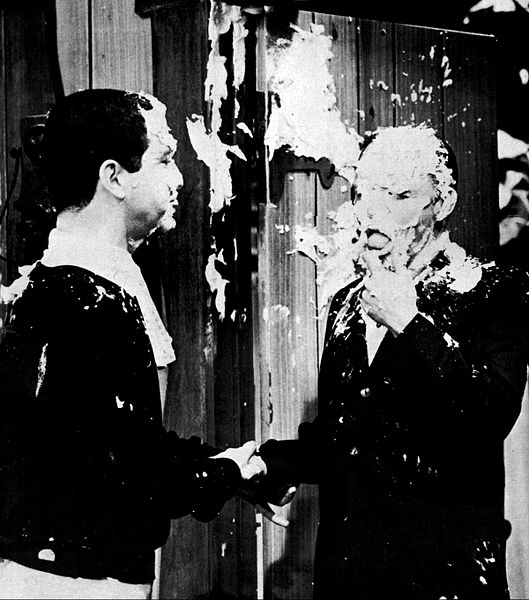
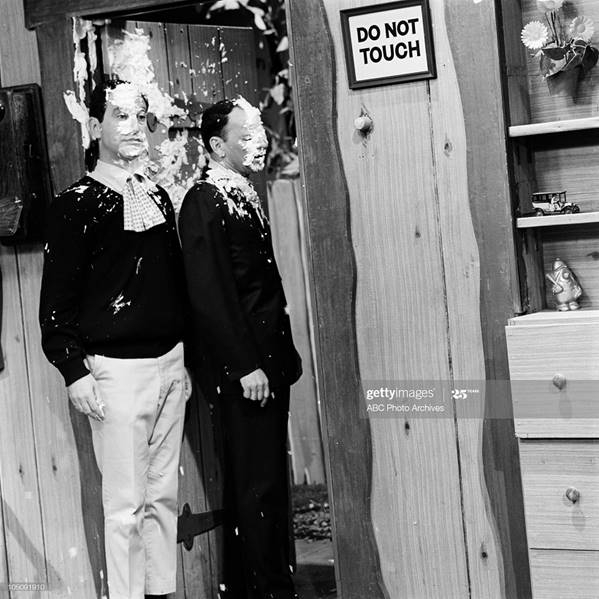
September 16, 1965
Television
The Dean Martin Show
NBC-TV
10:00 p.m. - 11:00 p.m.
Guests: Frank Sinatra, Joey Heatherton, Diahann Carroll, Bob Newhart
Cameos by Danny Thomas, Steve Allen
Frank's songs
1. The September Of My Years
2. At Long Last Love
3. The Oldest Established w/ Dean
4. Witchcraft w/ Dean and Diahann
Ed O'Brien:
ABC-TV Thursday Night Movie, running in the same time slot as Martin's show, was "The Manchurian Candidate."
Dean was competing with Frank at the same time they were singing together on NBC.
Note: First show of Dean Martin's new show.
The Dean Martin Show
NBC-TV
10:00 p.m. - 11:00 p.m.
Guests: Frank Sinatra, Joey Heatherton, Diahann Carroll
Show was taped on 6-19-65
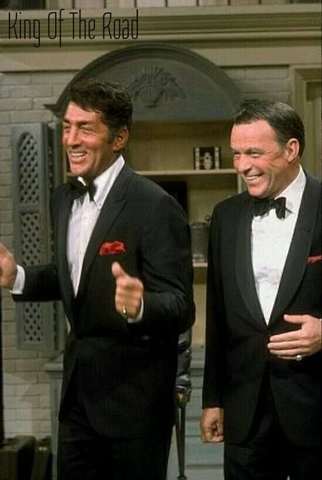
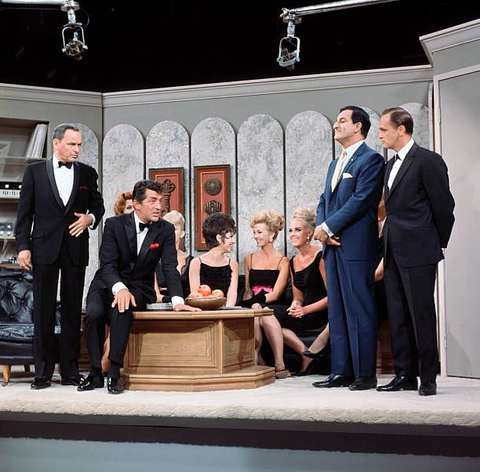
"It Gets Lonely Early" / "The September of My Years"
Sammy Cahn (quoted line): Friedwald credits Cahn and Van Heusen's two contributions to the album as among their all-time best. "It Gets Lonely Early" opens with clock chimes marking passing time -- unclear if Van Heusen or Jenkins conceived the device, since it sounds so Jenkins-like. On the title track, Cahn's famous line 'Sinatra spends his days with me and his nights with Van Heusen' pays off, as the two writers capture both sides of Sinatra -- 'a man who has always had the wandering ways' now turning sentimental and family-oriented with age.
Source: Will Friedwald, "Sinatra! The Song Is You: A Singer's Art" (2018 revised edition).
Frank guest-starred on the premiere of The Dean Martin Show; Dean addressed him as 'Chairman of the Board,' a nickname Frank was clearly pleased by and which stuck permanently.
Source: Nancy Sinatra, Frank Sinatra: An American Legend, 1995.
September 20, 1965
[Photograph: Location filming begins on Assault on a Queen. From Richard Havers, "Sinatra" (Dorling Kindersley, 2007), p.292.]
Sinatra began location filming for "Assault on a Queen," a film about modern-day pirates attempting to rob the Queen Mary. (Source: Richard Havers, "Sinatra" (Dorling Kindersley, 2007).)
September 24, 1965
Film
"Marriage On The Rocks" (USA General Release September 24, 1965)
Starring: Frank Sinatra, Dean Martin, Deborah Kerr, Nancy Sinatra, Tony Bill, Joi Lansing, Cesar Romero, John McGiver, Hermione Baddeley, Trini Lopez, DeForest Kelley, Kathleen Freeman
Produced by: William H Daniels
Directed by: Jack Donohue
Ad-agency president Dan Edwards (Sinatra) who, when he goes to Mexico to celebrate his nineteenth wedding anniversary, winds up getting divorced by mistake - whereupon his wife Valerie (Kerr) marries his best friend Ernie Brewer (Martin) by mistake. Once over the shock, Ernie anticipates a quickie divorce, but Val thinks she might enjoy the new arrangement. Dan, fed up with both of them, decides he's not exactly broken-hearted either. He re-discovers the joys of bachelorhood, cavorting with Ernie's sexy playmates. As for poor Ernie, it's now up to him to run the business, which turns him into the same dull, inattentive husband that her first spouse had been. In the end, however, everything is put right.
Note: Nancy Sinatra plays Frank Sinatra's daughter in the film.
--DVD Release: 2008-05-13
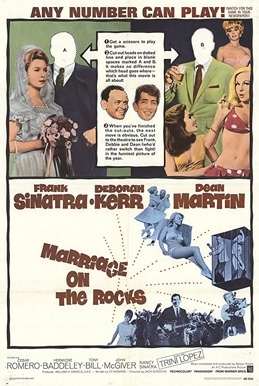
[The Cinematic Legacy of Frank Sinatra — Marriage on the Rocks (1965)]
David Wills's 2015 photo history The Cinematic Legacy of Frank Sinatra devotes a section to Marriage on the Rocks (1965), illustrated with 3 behind-the-scenes and publicity photographs (posters, lobby cards, and on-set/on-location shots) filed here.
“It was so much fun, a joke, and all quite ludicrous. Frank would come in one morning and say, “We don't need this scene!” and just tear it out of the script and throw it away.” —Deborah Kerr (Costar, Marriage on the Rocks, 1965)
Source: David Wills, The Cinematic Legacy of Frank Sinatra (St. Martin's Press, 2015), pp. 248–250.
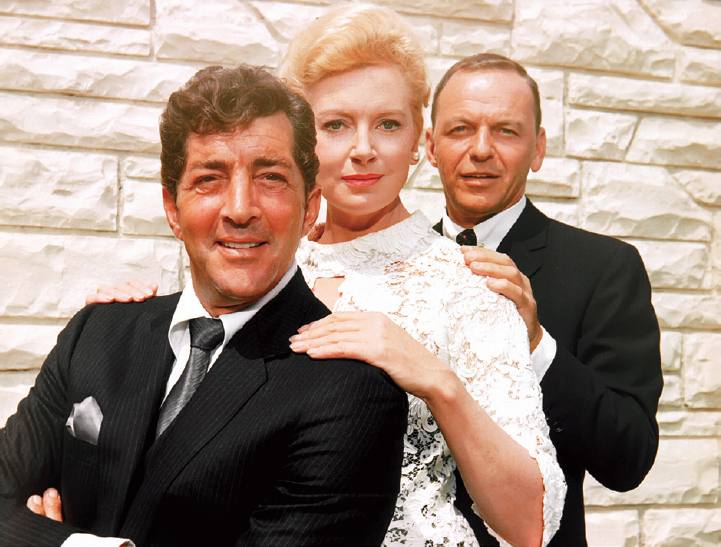
With costars Dean Martin and Deborah Kerr, Marriage on the Rocks, 1965. / “It was so much fun, a joke, and all / quite ludicrous. Frank would come in / one morning and say, “We don't / need this scene!” and just tear it out / of the script and throw it away.” (Photo: The Cinematic Legacy of Frank Sinatra, David Wills, 2015.)
With costar Joi Lansing. (Photo: The Cinematic Legacy of Frank Sinatra, David Wills, 2015.)
As Dan Edwards, Marriage on the Rocks. Photo by Bob Willoughby. (Photo: The Cinematic Legacy of Frank Sinatra, David Wills, 2015.)
"Marriage On The Rocks" (USA General Release September 24, 1965)
"Marriage on the Rocks"
Santopietro notes it makes sense that Sinatra played a suburban father figure only once onscreen, in the poorly regarded Marriage on the Rocks, since that role fit neither his life nor his screen persona.
Source: Tom Santopietro, "Sinatra in Hollywood" (2008).
"Marriage on the Rocks"
Marriage on the Rocks was released about three months after Von Ryan's Express. Produced by Sinatra Enterprises with William Daniels, it was the first of two consecutive weak films directed by Jack Donohue for Sinatra. Santopietro considers it among Sinatra's worst films, blaming a witless original story and screenplay by Cy Howard as much as Donohue's direction.
Source: Tom Santopietro, "Sinatra in Hollywood" (2008).
"Marriage on the Rocks"
A line in the film in which Sinatra's character advises against traveling to Mexico at all (beyond just avoiding the water) offended Mexican sensibilities badly enough that Sinatra had to enlist prominent attorney Louis Nizer to negotiate his personal clearance to reenter the country.
Source: Tom Santopietro, "Sinatra in Hollywood" (2008).
"Marriage on the Rocks"
The film cast Sinatra as ad executive Dan Edwards opposite Deborah Kerr as his wife Valerie, Dean Martin as best friend Ernie Brewer, Nancy Sinatra as daughter Tracy, Davey Davison as her friend Lisa, and Hermione Baddeley as Valerie's bagpipe-playing mother -- a plot device Santopietro singles out as the film's unlikely comic highlight.
Source: Tom Santopietro, "Sinatra in Hollywood" (2008).
"Marriage on the Rocks"
Santopietro argues Nancy Sinatra, then a major pop star, lacked the acting training to make her role work, delivering lines without inflection. He notes she faced three disadvantages going in: no acting training, having to act opposite her Oscar-winning "one-take Charlie" father, and being in the midst of marital trouble with husband Tommy Sands during filming.
Source: Tom Santopietro, "Sinatra in Hollywood" (2008).
"Marriage on the Rocks"
Even veteran arranger Nelson Riddle's score is faulted as an uncharacteristic misstep, described as noisy and relying on loud banging bass drums to signal the husband's anger.
Source: Tom Santopietro, "Sinatra in Hollywood" (2008).
"Marriage on the Rocks"
Of the two leads, Sinatra is judged to come off somewhat better than Deborah Kerr, managing a few genuinely funny bits (such as silently mimicking his mother-in-law's complaining head-shakes), though this amounts to only about thirty seconds of real comic acting in the whole film.
Source: Tom Santopietro, "Sinatra in Hollywood" (2008).
"Marriage on the Rocks"
Dean Martin's performance as Ernie is described as coasting on effortless charm rather than real characterization, essentially previewing the relaxed, unbothered persona he would soon bring to his hit NBC variety show, The Dean Martin Show -- an amiability Santopietro says Sinatra himself could never sustain on screen.
Source: Tom Santopietro, "Sinatra in Hollywood" (2008).
"Marriage on the Rocks"
Santopietro notes this is the only film in Sinatra's entire catalog in which he played a married suburban father of two -- an "average American male" -- arguing that Sinatra, who carried an inherent edge, was miscast as an average suburban dad and excelled instead at playing outsiders.
Source: Tom Santopietro, "Sinatra in Hollywood" (2008).
"Marriage on the Rocks"
The New Yorker (unnamed critic): The New Yorker's review dismissively summed up Sinatra's performance as his usual supremely confident self -- so unbothered that in one scene he doesn't even stop chewing gum -- while judging that the picture as a whole let him down.
Source: Tom Santopietro, "Sinatra in Hollywood" (2008).
"Marriage on the Rocks"
Warner Bros.' ad campaign hyped the film with breathless copy about "the tired husband, the bored wife," and a "go-go girl in a cage." Santopietro quips that of all that copy, only the words "tired" and "bored" actually amounted to an accurate review.
Source: Tom Santopietro, "Sinatra in Hollywood" (2008).
"Marriage on the Rocks"
Santopietro grades this a D, simply calling it "awful."
Source: Tom Santopietro, "Sinatra in Hollywood" (2008).
"Marriage on the Rocks"
Santopietro (Filmography): A-C/Sinatra Enterprises/Warner Bros. Pictures. Directed by Jack Donohue, screenplay and original story by Cy Howard, musical score by Nelson Riddle. Sinatra played Dan Edwards opposite Deborah Kerr and Dean Martin, with his real-life daughter Nancy Sinatra playing his daughter Tracy Edwards, and Trini Lopez appearing as himself.
Source: Tom Santopietro, "Sinatra in Hollywood" (2008).
October 1965
[Assault on a Queen begins filming]
Robert Evans: In October, Sinatra began filming Assault on a Queen for Paramount, a caper picture about robbing the Queen Mary using a salvaged U-boat, co-starring Virna Lisi and produced by Bill Goetz. Paramount executive Robert Evans privately called it a 'dinosaur,' saying it was inflated to A-picture status only because it had Sinatra.
Source: James Kaplan, "Sinatra: The Chairman" (2015)
[Bob Thomas visits Assault on a Queen set]
Sinatra: Columnist Bob Thomas visited Sinatra on the Assault on a Queen set at Paramount and found him eager to move quickly through production; Sinatra described his approach to fast-paced storytelling and mentioned upcoming projects: an NBC special on Thanksgiving Eve and the CBS documentary The World of Frank Sinatra (later retitled Sinatra: An American Original), plus a recent Palm Springs interview with Walter Cronkite.
Source: James Kaplan, "Sinatra: The Chairman" (2015)
October 4, 1965
Television
The Tonight Show
Guest Host: Joey Bishop.
Guests: Frank Sinatra, Dean Martin
Sinatra Scholar Ed O'Brien writes that on this Monday night, 58 years ago, Joey Bishop was subbing for Johnny Carson. His guests were Phil Foster, Juliet Prowse, Frank Sinatra, and Dean Martin. Dean's new show for NBC was a smash hit, Joey showed promo clips Sinatra and Dean had done for the premier show of September 16, 1965. They ran about 7 or 8 minutes and the audience loved them.
Sinatra plugged "Assault on a Queen" and told Joey he would be filming "Any Wednesday" with Sandy Dennis in February. Joey asked if either were interested in singing a song. Dean begged off saying he didn't have his guitar. Sinatra sang "Angel Eyes" with just piano. They did a few more plugs and Dean mentioned his Matt Helm film. Highlights were Sinatra's singing and Dean's very funny remarks.
The Tonight Show
Guest Host: Joey Bishop.
Guests: Frank Sinatra, Dean Martin
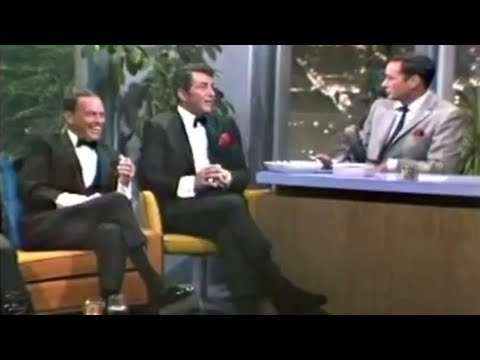
"Angel Eyes"
Will Friedwald: Friedwald notes Sinatra performed 'Angel Eyes' as a voice-and-piano duet with Bill Miller on a 1965 broadcast of The Tonight Show, paralleling his similar treatments of 'One for My Baby.'
Source: Will Friedwald, "Sinatra! The Song Is You: A Singer's Art" (2018 revised edition).
October 11, 1965
Studio
Hollywood
H3767 Come Fly With Me
(Sammy Cahn/Jimmy Van Heusen)
WB Music Corp./Maroville Music Corp. (ASCAP)
Arranged by Billy May
Conducted by Sonny Burke
-6 (3:10) CD: 46013-2 The Complete Reprise Studio Recordings Disc 10
CD: 1016-2 A Man And His Music (Edited)
LP: 2FS1016 A Man And His Music (Edited)
H3768 I'll Never Smile Again w/Chorus
(Ruth Lowe)
MCA Inc. (ASCAP)
Arranged by Freddie Stulce
Conducted by Sonny Burke
-2 (2:13) CD: 46013-2 The Complete Reprise Studio Recordings Disc 10
CD: 1016-2A Man And His Music
LP: 2FS1016A Man And His Music
NOTE: Sinatra Scholar Ed O'Brien reports that Sinatra did six takes on "Come Fly With Me" in 1957 at Capitol and another six at Reprise in 1965.
O'Brien doesn't believe there is any song that Sinatra recorded, other than "I'll Never Smile Again," where he used the same arrangement for four different studio efforts. Fred Stulce wrote a great chart in April of 1940. At the 1965 session, an orchestral track was laid down for the "From Here to Eternity" scene heard on the two LP "A Man and His Music" set. The orchestral track for "Love and Marriage" was also recorded. Sinatra did an vocal overdub on October 21, 1965.
Ed O'Brien:
During the session on 10-11-65, Sinatra did 6 takes. At the end of take 3, Frank added the "pack a small bag" coda. The CD "Nothing But The Best" contains that coda lifted from take 3. The rest of the song is the previously issued take 6. Fifty-five years ago last night, Frank did the Capitol recording. And it also required 6 takes, but no "bag" was added.
note: Might as well complete the history of "Come Fly With Me.'
At the July 1, 1993 session, Frank did 3 takes on "Come Fly With Me.." So, there were 15 takes done at three sessions, spanning a period of 36 years. The first effort was the definitive recording.
Ed
[Come Fly with Me -- critical commentary]
Phil Ramone: After two failed sessions where Sinatra was uncomfortable and complained of a sore throat, coproducer Hank Cattaneo had the studio rebuilt like a concert stage with a wireless handheld mic for the third session, on July 1, 1993. Producer Phil Ramone recalled Sinatra putting him 'through hell for about ten minutes' questioning why they were doing this at all, before reluctantly agreeing to try one song. Ramone: 'We did a take of "Come Fly with Me," played it back, and you could see the eyes start to light up... He said, "All right, we'll do one more." Well, we did nine more tunes. And, you know, that's the historic night.'
This song/context matches multiple dated entries in the chronology; the specific date Friedwald is referring to could not be determined with confidence.
Source: Will Friedwald, "Sinatra! The Song Is You: A Singer's Art" (2018 revised edition), Ch. 10, "Concert Years" (1973-1994)
[Come Fly with Me -- critical commentary]
Patrick Williams: When Sinatra asked what he should sing, Hank Cattaneo suggested "Come Fly with Me." Sinatra agreed and launched into the song, kicking off a session in which two 48-track tape machines ran continuously, without stopping, for roughly four hours.
This song/context matches multiple dated entries in the chronology, or lacked a sufficiently precise date; the specific date could not be determined with confidence.
Source: Charles L. Granata, "Sessions with Sinatra: Frank Sinatra and the Art of Recording" (1999/2003), Part V: Capitol Revisited
October 16, 1965
Television
The Hollywood Palace (ABC)
Taped: September 26, 1965
Host: Frank Sinatra
Guests: The Count Basie Orchestra, Jackie Leonard
1. I've Got The World On A String
2. Fly Me To The Moon
3. Please Be Kind
4. Too Marvelous For Words
5. Everybody's Got The Right To Be Wrong
6. The Gal That Got Away
Notes: 60 min.
OTE: Sinatraphile Vance Adair reports this is a nice performance, especially on "Everybody has the Right to be Wrong." The complete show was available on Youtube for a while. It may still be lurking there somewhere.
Ed O'Brien adds that this, the 42nd episode of The Hollywood Palace, was taped in Hollywood. The guests were Jack E. Leonard, Pete Gennaro, Alice and Ellen Kessler plus Mitchell Ayres and the Hollywood Palace Orchestra.
Sinatra opened the show with "I've Got the World on a String," backed by the Ayres Orchestra playing the famous Riddle chart. Sinatra did a skit with Leonard and introduced the other acts. After Basie and Band played an orchestral track, Sinatra joined them with Conductor Quincy Jones. "Fly Me to the Moon" opened that segment followed by "Please Be Kind."
Sinatra then did a fabulous swing version of Johnny Mercer's "Too Marvelous for Words." A monologue came next with Sinatra sitting on a stool drinking a cup of tea. He then told of seeing "Skyscraper" on Broadway and he segued into "Every Body had the Right to be Wrong (At Least Once)" from that show. The audience game him a thunderous ovation and he responded by doing a reprise of the final chorus. He closed the show by mentioning Judy Garland before singing "The Gal that Got Away." All in all, a great evening of Sinatra and Basie. Sinatra also taped "Sammy and Friends" over the next few days. It would air on February 1, 1966.
The Hollywood Palace (ABC)
Taped: September 26, 1965
Host: Frank Sinatra
Guests: The Count Basie Orchestra, Jackie Leonard
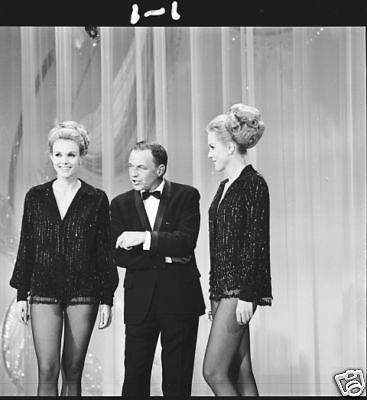
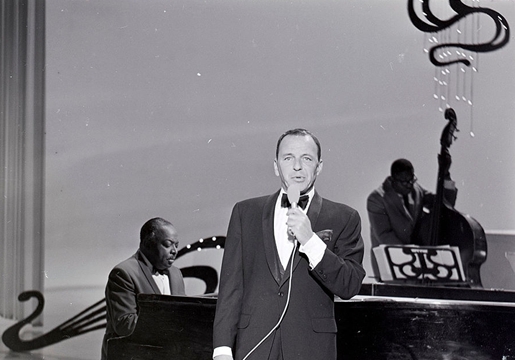
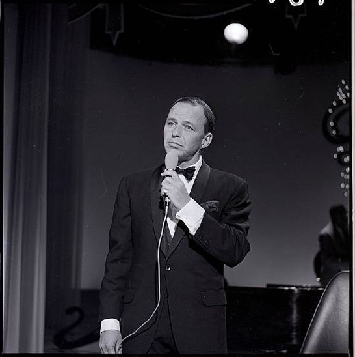
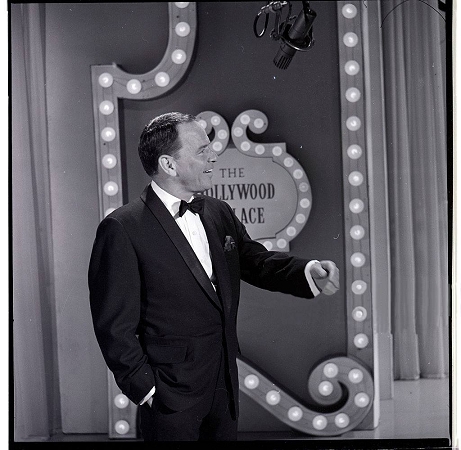
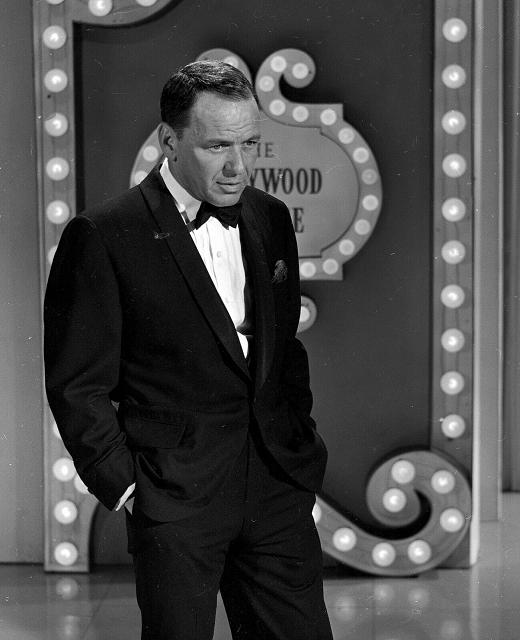
October 21, 1965
Studio
Hollywood
HX3728 Moment To Moment
(Henry Mancini/Johnny Mercer)
Northern Music Co./All Nations Music/Johnny Mercer Music Publishing inc. (ASCAP) Arranged & Conducted by Nelson Riddle
(2:56) CD: 46013-2 The Complete Reprise Studio Recordings Disc 10
LP: FS5238 (Italy)
45: 0429
FRANK SINATRA - MOMENT TO MOMENT (Southdale-Northern, ASCAP)--The Mancini -Mercer film theme ballad is given a strong Sinatra rendition that should prove a high Chart contender from the anticipated radio exposure, Flip: "It Was a Very Good..Ycar" (Reedlands, ASCAPI. Reprise 0429 Billboard 12-11-65 note: What was Billboard thinking ? "Moment To Moment" was a minor hit on the Adult Contemporary chart, "Very Good Year"reached #28 on the Billboard Hot 100 singles and reached #1 on A.C. and charted for 17 weeks.
"Moment to Moment" was the B side of the single hit, "It Was a Very Good Year." Riddle used two guitars as part of the 33-piece orchestra. The song did chart on the Billboard Adult Contemporary, reaching its peak position at #18 on Christmas Day, 1965. The song was on the charts for seven weeks. By the way, "Strangers in the Night" had a longer shelf life than "Very Good Year" on the Adult Contemporary chart (20 and 17, respectively) ..
Hollywood
HX3728 Moment To Moment
(Henry Mancini/Johnny Mercer)
October 31, 1965
[Gay Talese arrives in Los Angeles]
Journalist Gay Talese, on assignment from Esquire editor Harold Hayes for a Sinatra profile, arrived in Los Angeles on Sunday, October 31, 1965, rented a car from Avis, and checked into the Beverly Wilshire hotel, expecting to meet Sinatra the next day.
Source: James Kaplan, "Sinatra: The Chairman" (2015).
November 1965
[Bill Miller comforts Sinatra amid personal grief]
Kaplan: During the tense November 8 taping session, accompanist Bill Miller was heard softly telling an agitated Sinatra to 'try not to upset yourself, Frank' -- notable because the next day marked the one-year anniversary of Miller's own wife's death in the Burbank mudslide.
Source: James Kaplan, "Sinatra: The Chairman" (2015)
[Moonlight Sinatra recording sessions begin]
Kaplan: At the end of November 1965, Sinatra returned to United Recording Studio A to record Moonlight Sinatra, an album of moon-themed songs arranged by Nelson Riddle, his first full Sinatra LP since Academy Award Winners; his cold from the earlier taping had cleared by this point.
Source: James Kaplan, "Sinatra: The Chairman" (2015)
[Release of My Kind of Broadway]
Kaplan: The LP My Kind of Broadway, a collection of show tunes, was released in November 1965 and charted alongside the two-LP career retrospective A Man and His Music.
Source: James Kaplan, "Sinatra: The Chairman" (2015)
[Sinatra refuses to meet Talese, citing CBS dispute]
Kaplan: On the Monday after Talese's arrival, publicist Jim Mahoney told him Sinatra had a cold and, more significantly, was upset about the Cronkite/CBS documentary; Mahoney demanded Sinatra or Rudin be allowed to preview Talese's finished piece, which Talese refused, resulting in Sinatra declining to be interviewed at all.
Source: James Kaplan, "Sinatra: The Chairman" (2015)
[recording/awards]
Sinatra recorded Moonlight Sinatra in November 1965, followed soon after by the number-one hit single/LP Strangers in the Night, which gave him his biggest hit in years and won the Grammy for Record of the Year; he also fit in the live album Sinatra at the Sands with Count Basie and Quincy Jones, plus the hit single "That's Life."
No corresponding dated entry could be identified in the chronology for this film/context.
Source: Tom Santopietro, "Sinatra in Hollywood" (2008), A Waste of Talent
[Dorothy Kilgallen's death noted]
Kilgallen died in November 1965, reportedly from a drug and alcohol overdose shortly after interviewing Jack Ruby, having told associates she planned to expose new information about the Kennedy assassination.
Source: Richard Havers, "Sinatra" (Dorling Kindersley, 2007).
November 6, 1965
[Mickey Rudin protests CBS documentary to network]
Kaplan (citing Val Adams, NYT): A New York Times story on November 6 reported that CBS had received a letter from Sinatra's lawyer Mickey Rudin expressing grave reservations about the Cronkite documentary and requesting a preview; CBS declined, and Rudin charged the network with a 'breach of understanding,' suggesting the interview be reshot, objecting to CBS covering matters beyond Sinatra's entertainment career.
Source: James Kaplan, "Sinatra: The Chairman" (2015).
November 8, 1965
[Taping begins for A Man and His Music]
Gay Talese: On Monday, November 8, 1965, Sinatra arrived at NBC Studios in Burbank to begin taping A Man and His Music with Nelson Riddle and forty-three musicians; despite a lingering cold and pale, watery-eyed appearance, he pushed through due to tight scheduling and cost pressures, growing upset when the stage and orchestra platform weren't arranged as he'd requested.
Source: James Kaplan, "Sinatra: The Chairman" (2015).
[Death of Dorothy Kilgallen]
Sinatra: On the morning of November 8, 1965, columnist Dorothy Kilgallen, age fifty-two and a longtime Sinatra nemesis, was found dead in her New York apartment from a fatal combination of alcohol and barbiturates. Sinatra, hearing the news from Jim Mahoney, reportedly quipped, 'Dorothy Kilgallen's dead. Well, guess I got to change my whole act.'
Source: James Kaplan, "Sinatra: The Chairman" (2015).
November 16, 1965
Television
Sinatra, An American Original
Network: CBS
Sinatra Documentary hosted by Walter Cronkite
In Depth Interviews Plus Recording Session Parts From "September Of My Years"
1. Fly Me To The Moon
2. I've Got You Under My Skin
3. You Make Me Feel So Young
4. Luck Be A Lady
Notes: 51 mins.
Author Ed O'Brien calls this one of the best documentaries ever done. Sinatra wasn't happy at the time but the years have made this show even more compelling. You see him in a recording session, performing at a prison outside Baltimore , partying at Jilly's, singing at a benefit in St. Louis , on the set of "Marriage on the Rocks" (listen to the song he was rehearsing with Bill Miller, during a break in the shooting. It is a tune from the Italian album that was shelved) and being interviewed by Walter Cronkite. One for the ages!
Sinatra, An American Original
Network: CBS
Sinatra Documentary hosted by Walter Cronkite
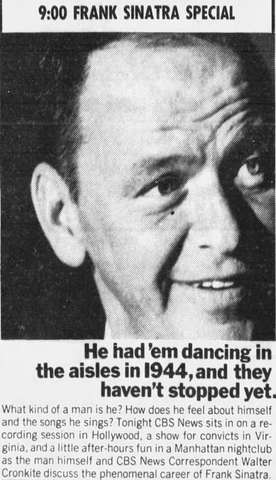

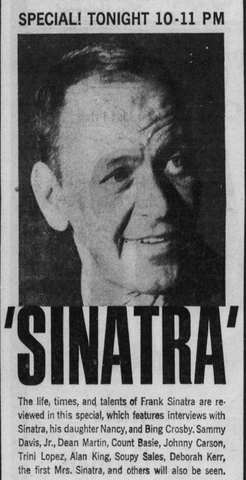
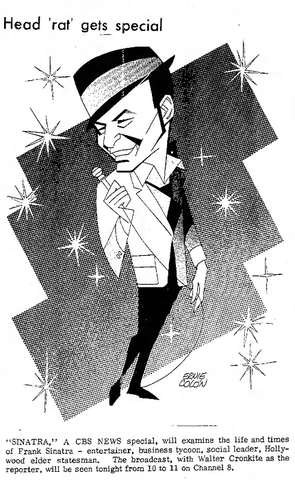
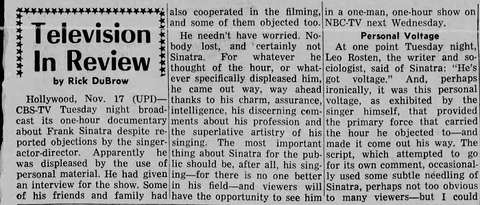
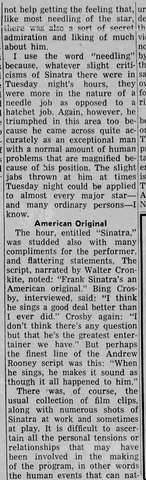
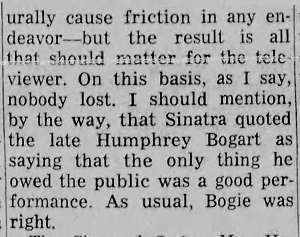
During the CBS documentary broadcast, Walter Cronkite presses Sinatra on his associations with organized-crime figures; Sinatra grows visibly irritated on camera, a moment that became one of the interview's most talked-about exchanges. Source: J. Randy Taraborrelli, Sinatra: Behind the Legend.
[CBS Cronkite documentary airs]
The CBS documentary on Sinatra aired November 16, 1965, and was received as an anticlimax -- Sinatra appeared composed and gave evasive, well-rehearsed answers about his life and his 'acquaintances,' with the earlier off-camera confrontation over the Mafia question left unrecorded.
Source: James Kaplan, "Sinatra: The Chairman" (2015).
[Critics pan the CBS Sinatra documentary]
Critics were largely dismissive of the CBS special: the AP's Cynthia Lowry called it 'a nice little pussycat of a show,' the Herald Tribune's John Horn wrote CBS and the public had 'been had,' and the New York Times' Jack Gould summarized it as unauthorized only in name. Several critics singled out young Nancy Jr.'s poignant on-camera remark about wanting her father to be a 'daddy all the time.'
Source: James Kaplan, "Sinatra: The Chairman" (2015).
Andy Rooney recalled flying to Palm Springs with Walter Cronkite and producer Don Hewitt to film the special, and being struck by what a gracious host Sinatra was during the shoot -- rearranging his own house for the crew's lights and cables, hosting the crew for lunch, and having crusty Italian bread flown in weekly from a bakery on Mott Street in New York that he loved. Sitting in on one of the recording sessions filmed for the documentary, Rooney was also struck by Sinatra's musical seriousness, recalling him debating with the orchestra leader over whether a note should be an F-sharp or an F-natural. Source: Andy Rooney, "The Light View" syndicated column, December 18, 1990.
November 19, 1965
[Nancy Sinatra records These Boots Are Made for Walkin'] On Friday, November 19, 1965, three nights after her plaintive quote aired in the CBS documentary, Nancy Sinatra recorded 'These Boots Are Made for Walkin'' at United Recording Studio B; producer Lee Hazlewood, dissatisfied with her polite first take, harshly instructed her to sing it as an experienced, sexually knowing woman rather than an innocent girl.
Source: James Kaplan, "Sinatra: The Chairman" (2015).
November 24, 1965
Television
Sinatra: A Man And His Music
Wednesday Evening ( Thanksgiving Eve )
NBC-TV
9:00 p.m. - 10:00 p.m..
Arranged and Conducted by Nelson Riddle and Gordon Jenkins
1. I've Got You Under My Skin
2. Without A Song
3. Don't Worry 'bout Me
4. I Get A Get A Kick Out Of You
5. Nancy
6. My Kind Of Town
7. Medley: It Was A Very Good Year / Young At Heart / The Girl Next Door / Last Night When We Were Young
8. This Is All I Ask
9. Come Fly With Me
10. The Lady Is A Tramp
11. I've Got The World On A String
12. Witchcraft
13. You Make Me Feel So Young
14. Put Your Dreams Away
Sinatra: A Man And His Music
NYT
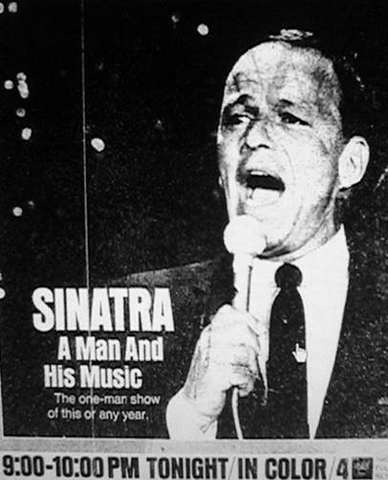
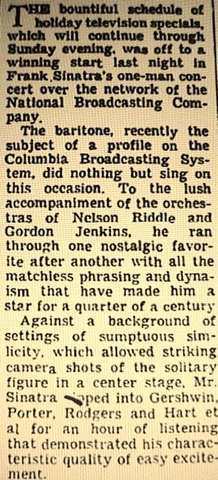
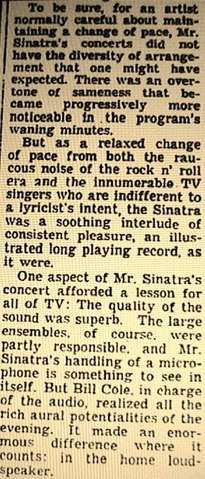
note: I was told many years ago that "Learnin' The Blues" was taped for the show. Here is the TV Guide from 11-20-65 backing up that claim.
Ed
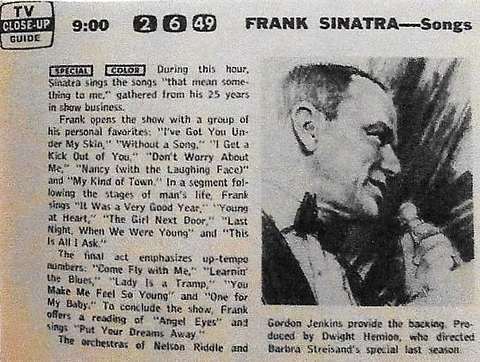
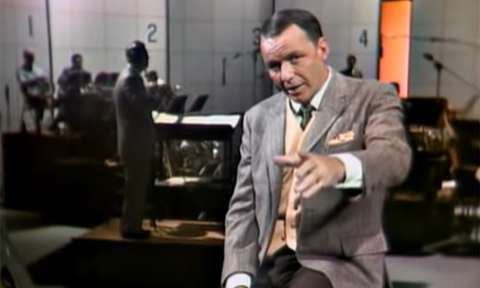
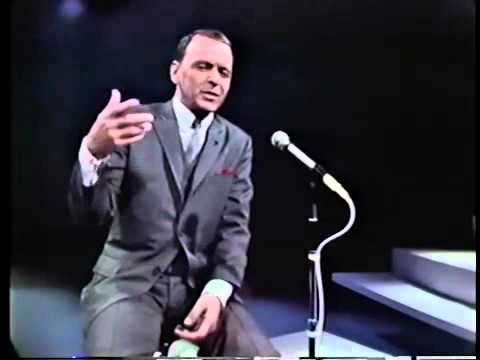
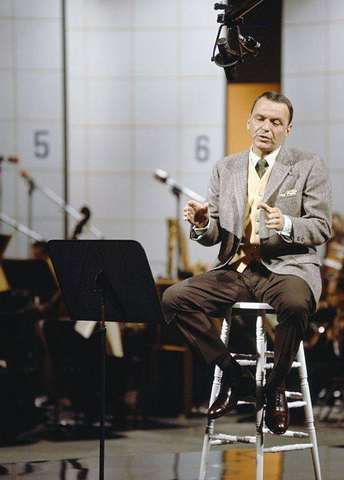
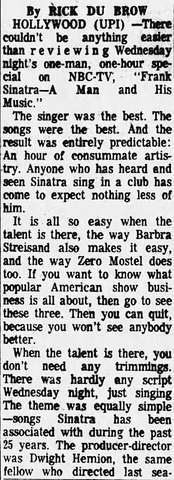
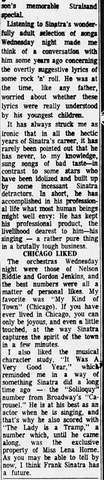
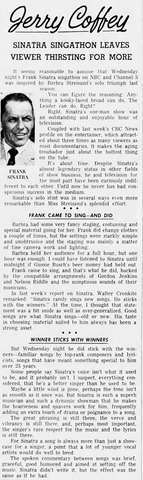
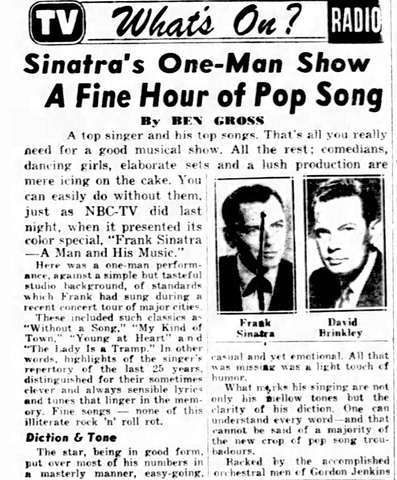
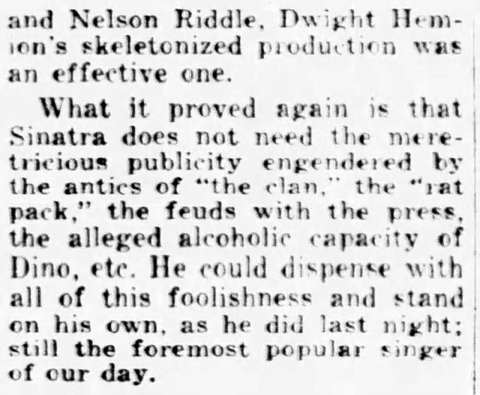
November 29, 1965
Studio
Hollywood
H3892 Moon Song
(Authur Johnston/Sam Coslow)
Famous Music Corp. (ASCAP)
Arranged & Conducted by Nelson Riddle
-13 (3:03) CD: 46013-2 The Complete Reprise Studio Recordings Disc 10
CD: 1018-2Moonlight Sinatra
LP: FS1018Moonlight Sinatra
H3893 Moon Love
(Mack David/Mack Davis/Andre Kostelanetz)
Famous Music Corp./PolyGram International Publishing Co. Inc. (ASCAP) Arranged & Conducted by Nelson Riddle
-2 (3:03) CD: 46013-2 The Complete Reprise Studio Recordings Disc 10
CD: 1018-2Moonlight Sinatra
LP: FS1018Moonlight Sinatra
.
H3894 The Moon Got In My Eyes
(Johnny Burke/Arthur Johnston)
Chappell & Co. Inc. (ASCAP)
Arranged & Conducted by Nelson Riddle
-3 (2:52) CD: 46013-2 The Complete Reprise Studio Recordings Disc 10
CD: 1018-2Moonlight Sinatra
LP: FS1018Moonlight Sinatra
H3895 Moonlight Serenade
(Glenn Miller/Mitchell Parish)
EMI Robbins Catalog Inc. (ASCAP)
Arranged & Conducted by Nelson Riddle
-9 (3:27) CD: 46013-2 The Complete Reprise Studio Recordings Disc 10
CD: 1018-2Moonlight Sinatra
CD: 9-26340-2The Reprise Collection
LP: FS1018Moonlight Sinatra
H3896 Reaching For The Moon
(Irving Berlin)
Williamson Music Co. (ASCAP)
Arranged & Conducted by Nelson Riddle
-3 (3:05) CD: 46013-2 The Complete Reprise Studio Recordings Disc 10
CD: 1018-2Moonlight Sinatra
LP: FS1018Moonlight Sinatra
Hollywood
H3892 Moon Song
H3893 Moon Love
H3894 The Moon Got In My Eyes
H3895 Moonlight Serenade
H3896 Reaching For The Moon
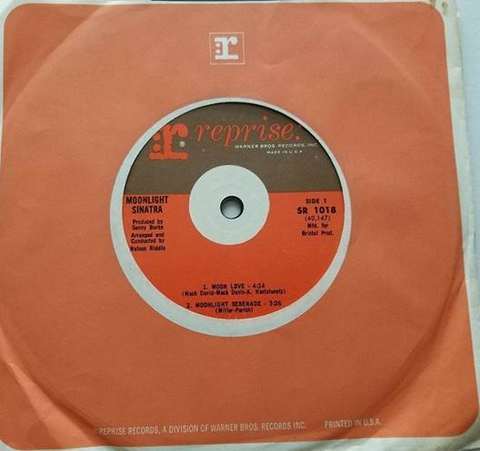
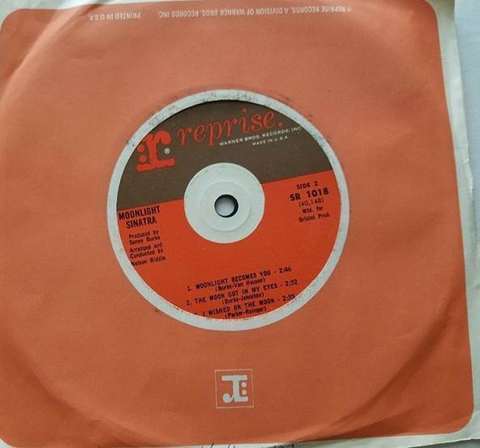
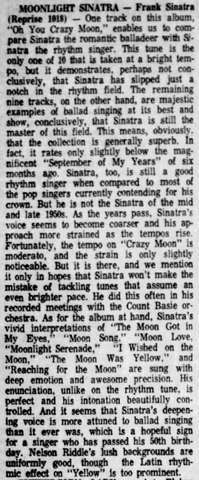
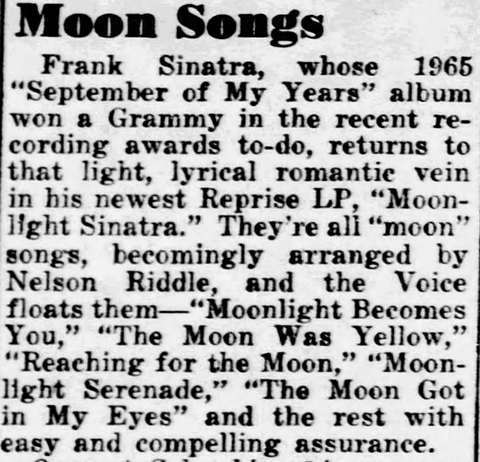
"Moonlight Serenade"
Sinatra takes Glenn Miller's instrumental theme (with Mitchell Parish's fairly generic lyric about a young man at his sweetheart's gate) and, recorded two weeks before his fiftieth birthday, reads it as a middle-aged man reflecting nostalgically on his romantic youth while still dreaming of one more walk around the garden. Friedwald likens the effect to Byron: 'So, we'll go no more a-roving / So late into the night, / Though the heart be still as loving, / And the moon be still as bright.'
Source: Will Friedwald, "Sinatra! The Song Is You: A Singer's Art" (2018 revised edition).
November 30, 1965
Studio
Hollywood
H3897 I Wished On The Moon
(Dorothy Parker/Ralph Rainger)
Famous Music Corp. (ASCAP)
Arranged & Conducted by Nelson Riddle
-8 (2:53) CD: 46013-2 The Complete Reprise Studio Recordings Disc 10
CD: 1018-2Moonlight Sinatra
CD: 9-26340-2The Reprise Collection
LP: FS1018Moonlight Sinatra
H3898 Moonlight Becomes You
(Johnny Burke/Jimmy Van Heusen)
Famous Music Corp. (ASCAP)
Arranged & Conducted by Nelson Riddle
-1 (2:46) CD: 46013-2 The Complete Reprise Studio Recordings Disc 10
CD: 9-26723-2 Sinatra Sings The Songs Of Van Heusen & Cahn
CD: 1018-2 Moonlight Sinatra (Unedited take)
LP: FS1018Moonlight Sinatra
H3899 Moonlight Mood
(Harold Adamson/Peter DeRose)
EMI Robbins Catalog Inc. (ASCAP)
Arranged & Conducted by Nelson Riddle
-2 (3:08) CD: 46013-2 The Complete Reprise Studio Recordings Disc 10
CD: 1018-2Moonlight Sinatra
LP: FS1018Moonlight Sinatra
H3900 Oh, You Crazy Moon
(Johnny Burke/Jimmy Van Heusen)
M. Witmark & Sons/Music Slaes Corp. (ASCAP)
Arranged & Conducted by Nelson Riddle
-4 (3:11) CD: 46013-2 The Complete Reprise Studio Recordings Disc 10
CD: 9-26723-2Sinatra Sings The Songs Of Van Heusen & Cahn
CD: 1018-2Moonlight Sinatra
CD: 9-26340-2The Reprise Collection
LP: FS1018Moonlight Sinatra
45: 0470
H3901 The Moon Was Yellow (And The Night Was Young)
(Fred Ahlert/Edgar Leslie)
Fred Ahlert Music Corp./Edgar Leslie/Pencil Mark Music Inc. (ASCAP)
Arranged & Conducted by Nelson Riddle
-3 (3:09) CD: 46013-2 The Complete Reprise Studio Recordings Disc 10
CD: 1018-2Moonlight Sinatra
LP: FS1018Moonlight Sinatra
Hollywood
H3897 I Wished On The Moon
H3898 Moonlight Becomes You
H3899 Moonlight Mood
H3900 Oh, You Crazy Moon
H3901 The Moon Was Yellow (And The Night Was Young)
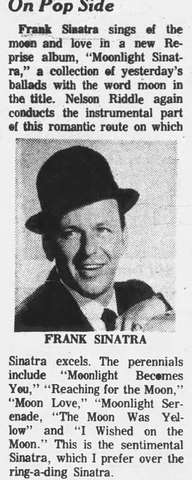
"I Wished on the Moon"
The Dorothy Parker/lyric song opens with a somber, out-of-tempo verse (one of Parker's most poignant pieces of poetry) before moving into a gently Brazilian-flavored refrain.
Source: Will Friedwald, "Sinatra! The Song Is You: A Singer's Art" (2018 revised edition).
"Oh, You Crazy Moon"
An early Van Heusen composition (also recorded by Tommy Dorsey), given the most Basie-like treatment on the album; Riddle brings the strings down to accentuate the rhythm section, with a swaggering trumpet obbligato likely by Conrad Gozzo or Pete Candoli, evoking Marshall Royal's Basie reed section.
Source: Will Friedwald, "Sinatra! The Song Is You: A Singer's Art" (2018 revised edition).
Liner Notes: MOONLIGHT SINATRA
Moonlight Sinatra is a small, precisely conceived record built entirely around a single image: the moon, as it appears across a decade's worth of Sammy Cahn and Jimmy Van Heusen songs and standards by other writers who had mined the same territory. Nelson Riddle's arrangements are correspondingly restrained and atmospheric -- soft-focus orchestration built to suit an album meant, by its own logic, to be listened to at night.
"Moonlight Becomes You," "The Moon Was Yellow," "Moon Song," and "Reaching for the Moon" make up part of the set list, each one a variation on the same lunar conceit, and the album's tight thematic focus -- rare even by the standards of Sinatra's concept records -- gives it an unusual coherence, more like a suite than a typical collection of singles-adjacent tracks.
It arrived at a moment when Sinatra, fresh off the triumph of September of My Years, could afford a quieter, more modest gesture, and Moonlight Sinatra reads as exactly that: a lovely, unhurried footnote to one of the most extraordinary two-year stretches of his recording career.
Written by Claude (Anthropic), commissioned for this chronology, 2026.
December 1965
[Frank Jr.'s Basin Street East opening]
Kaplan: Earlier the week of Sinatra's birthday party, Frank Jr. opened at New York's Basin Street East as star of the newly renamed Frank Sinatra Jr. Show (with Sam Donahue's band, formerly billed under Tommy Dorsey's name); he initially told Earl Wilson he would fly west for his father's party on his night off.
Source: James Kaplan, "Sinatra: The Chairman" (2015)
[Sinatra gives Mia a gold cigarette case]
Kaplan: The following Christmas, Sinatra's gift to Mia was a solid-gold cigarette case inscribed 'Mia, Mia, With Love, From Francis.' She used it to keep marijuana joints in.
Source: James Kaplan, "Sinatra: The Chairman" (2015)
[These Boots hits number 1]
Kaplan: Three weeks after recording, 'These Boots Are Made for Walkin'' became a number 1 hit, transforming Nancy Sinatra into an international sex symbol with a new image (blond bouffant, white boots); the song later became widely popular with U.S. troops in Vietnam.
Source: James Kaplan, "Sinatra: The Chairman" (2015)
[Warner-Reprise Month of Sinatra promotion]
Kaplan: In December 1965, Warner-Reprise ran a trade and consumer promotional campaign in Billboard dubbed 'the Month of Sinatra,' marking his fiftieth birthday and the twenty-fifth anniversary of his career.
Source: James Kaplan, "Sinatra: The Chairman" (2015)
December 12, 1965
Frank, flanked by Tina, seventeen, and Nancy Jr., twenty-five, arrive at the Beverly Hills Hotel for his fiftieth birthday in 1965. The party was hosted by Frank’s first wife, Nancy, and his daughters. Source: photo and caption from J. Randy Taraborrelli, Sinatra: Behind the Legend (mptvimages.com).
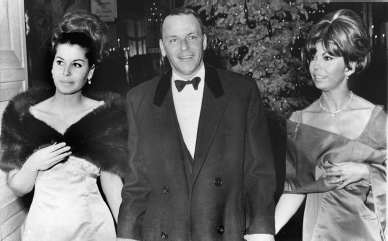
[Sinatra's fiftieth birthday party]
On Sunday, December 12, 1965 -- exactly fifty years after his birth in Hoboken -- Sinatra's ex-wife Nancy and daughters Nancy Jr. and Tina threw him a black-tie fiftieth birthday party at the Beverly Wilshire's Trianon ballroom, emceed by Milton Berle, with performances from Jack Benny, George Burns, Tony Bennett, and Sammy Davis (who flew in from New York and popped out of a giant cardboard cake).
Source: James Kaplan, "Sinatra: The Chairman" (2015).
[Dorothy Manners on the birthday party]
Dorothy Manners: Columnist Dorothy Manners, who had taken over Louella Parsons' column, wrote that Sinatra was thrilled with every detail of his birthday party, including a table marker of him as a child, and praised his ex-wife Nancy Sr. as the party's true star for organizing the unforgettable night.
Source: James Kaplan, "Sinatra: The Chairman" (2015).
[Mia excluded then reinvited to birthday, then excluded again]
George Jacobs: George Jacobs recalled that Big Nancy initially resisted inviting Mia Farrow to Sinatra's birthday party; after Nancy Jr. intervened, Frank invited Mia, who bought a blue chiffon gown, but Frank Jr., furious that his mother would be embarrassed, called his father and Sinatra ultimately told Mia not to come after all.
Source: James Kaplan, "Sinatra: The Chairman" (2015).
[Mia Farrow cuts her hair short]
George Jacobs: On the night of his birthday party, Sinatra visited Mia's apartment afterward and discovered she had cut her long ash-blond hair to under an inch, allegedly out of a 'horror of vanity'; the news made headlines, with Salvador Dali calling it a 'mythical suicide,' while George Jacobs recalled Sinatra reacting with dismay ('Now I really will look like a fag').
Source: James Kaplan, "Sinatra: The Chairman" (2015).
On his 50th birthday, Look magazine ran a 10-page cover story where Frank admitted to sleeping poorly and reading voraciously through the night. The piece detailed his Palm Springs home, including a red White House hotline phone installed ahead of JFK's 1962 visit. Nancy Sinatra Sr. also threw Frank a 50th birthday party at the Beverly Wilshire, where Sammy Davis Jr. surprised him by popping out of a giant birthday cake.
Source: Nancy Sinatra, Frank Sinatra: An American Legend, 1995.
December 13, 1965
The day after Frank's 50th-birthday party, to which Mia Farrow was not invited, a shaken Mia is confronted on the Peyton Place set about the exclusion. Afterward, alone in her dressing room, she picked up a pair of scissors and cut off her long hair -- the hair Frank had said was what first drew him to her -- leaving it cropped to under an inch. Source: J. Randy Taraborrelli, Sinatra: Behind the Legend.
January 1966
[Reprise records Sands shows for live album]
Kaplan: Throughout January's engagement at the Sands with Basie, Reprise recorded the concerts, which would become Sinatra's first live album.
Source: James Kaplan, "Sinatra: The Chairman" (2015)
[Variety raves about Sands opening]
Variety reviewer: Variety's reviewer gushed over Sinatra's opening at the Sands, writing that his 'showmanship vibrations' seemed to mesmerize the audience and that even a lukewarm fan would admit he was at a new peak of personal magnetism.
Source: James Kaplan, "Sinatra: The Chairman" (2015)
January 5, 1966
Concerts
Sands, Las Vegas, Nevada (January 5 - February 1)
Wednesday Night
Count Basie Orchestra
Conducted by Quincy Jones
Two Shows A Night Throughout The Engagement.
THE BAND:
Trumpets: Al Aarons, Sonny Cohn, Wallace Davenport,
Harry "Sweets" Edison, Phil Guilbeau
Trombones: Henderson Chambers, Al Grey, Bill Hughes,
Grover Mitchell
Saxophones & Woodwinds: Charles Fowlkes, Bobby Platter,
Eric Dixon, Eddie "Lockjaw" Davis, Marshall Royal
Piano: Count Basie, Bill Miller( on saloon numbers)
Guitar: Freddie Green
Bass: Norman Keenan
Drums: Sonny Payne
Arrangements by Quincy Jones & Billy Byers
O.A.: Pat Henry
Songs Sung During The Engagement:
1. Come Fly With Me
2. I've Got A Crush On You
3. I've Got You Under My Skin
4. September Of My Years
5. Street Of Dreams
6. Angel Eyes
7. One For My Baby
8. Fly Me To The Moon
9. You Make Me Feel So Young
10. The Shadow Of Your Smile
11. Luck Be A Lady
11. It Was A Very Good Year
12. Don't Worry 'Bout Me
13. Get Me The Church On Time
14. Where Or When
15. My Kind Of Town
Ed O'Brien
Sinatra had done 36 shows before Reprise started taping his performances. They taped 12 shows from 1/26 to 2/1.
Frank did not perform on Monday nights. Dean Martin subbed on four consecutive Mondays ( 10, 17, 24, 31).
Frank was SRO throughout the four week stint.
Sands, Las Vegas, Nevada (January 5 - February 1)
Wednesday Night
Count Basie Orchestra
Conducted by Quincy Jones
Los Angeles Times
Variety
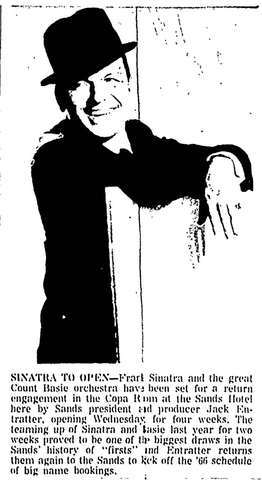
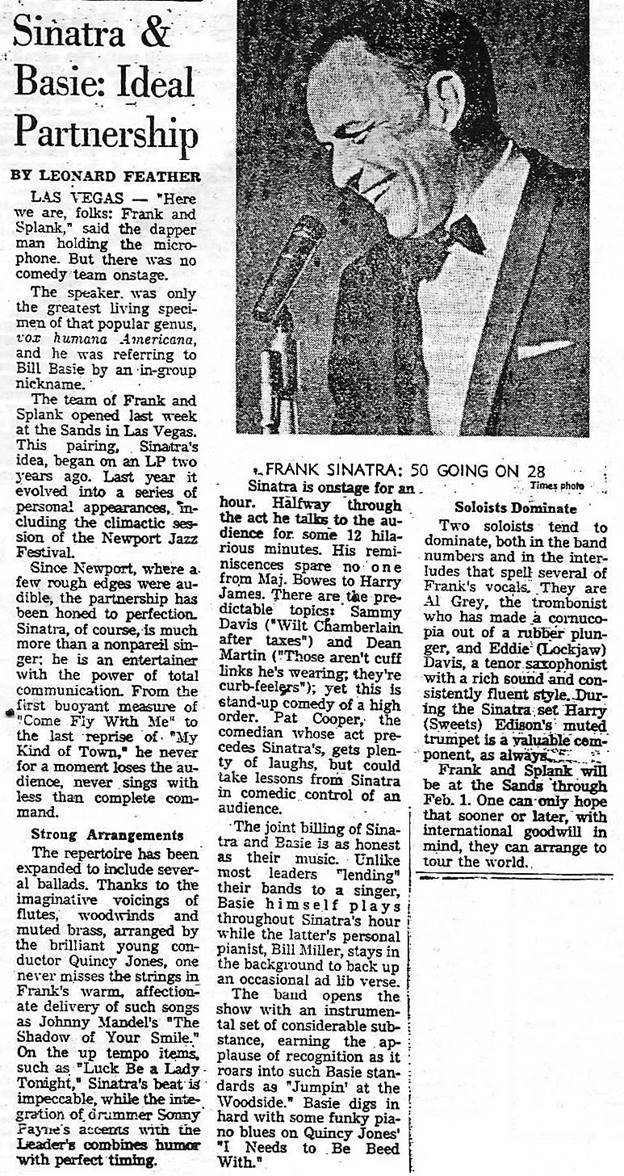
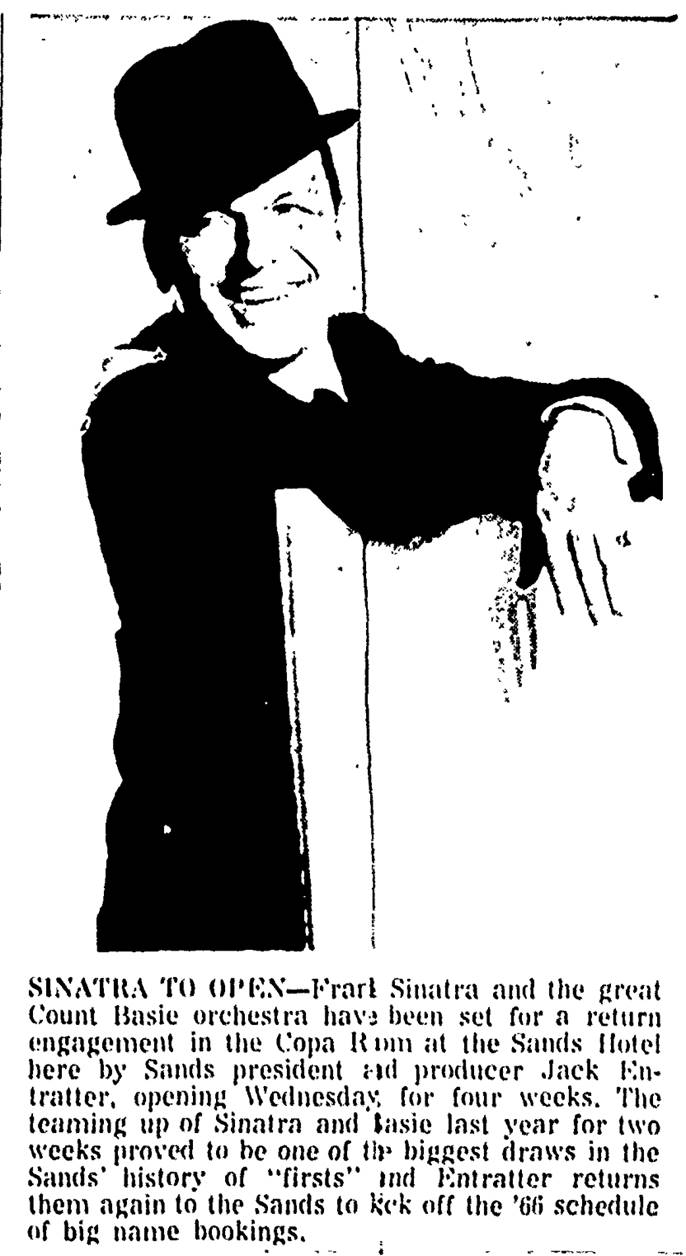
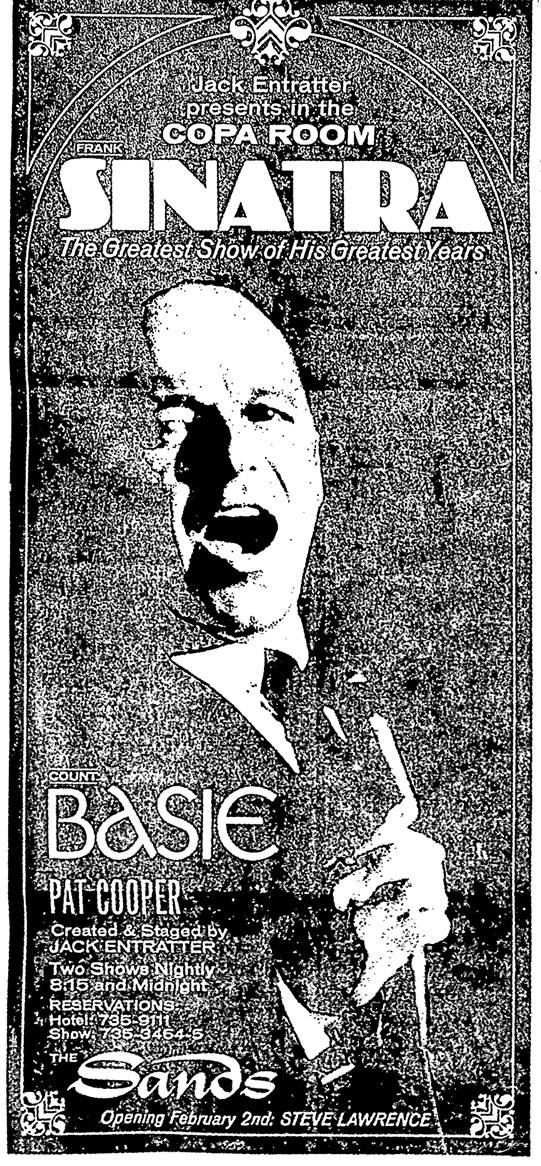
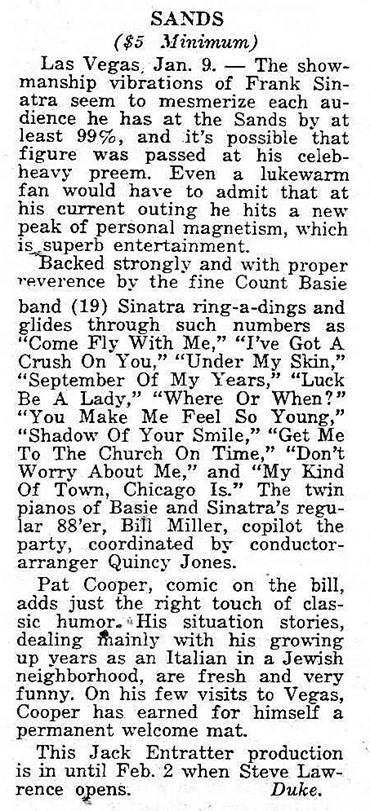
January 6, 1966
Concerts
Sands, Las Vegas, Nevada (January 5 - February 1)
Count Basie Orchestra Conducted By: Quincy Jones
January 7, 1966
Concerts
Sands, Las Vegas, Nevada (January 5 - February 1)
Wednesday Night
Count Basie Orchestra
Conducted by Quincy Jones
Two Shows A Night Throughout The Engagement.
[Sinatra opens at Sands with Basie]
Sinatra returned to the Sands in Las Vegas with the Count Basie Orchestra, Bill Miller and Basie on twin pianos, and Quincy Jones conducting. It was a star-studded opening night.
Source: James Kaplan, "Sinatra: The Chairman" (2015).
January 8, 1966
Concerts
Sands, Las Vegas, Nevada (January 5 - February 1)
Two Shows
Count Basie Orchestra
Conducted by Quincy Jones
Musicians: Trumpets: Al Aarons, Sonny Cohn, Wallace Davenport, Harry "Sweets" Edison, Phil Guilbeau Trombones: Henderson Chambers, Al Grey, Bill Hughes, Grover MitchellSaxophones & Woodwinds: Charles Fowlkes, Bobby Platter,Eric Dixon, Eddie "Lockjaw" Davis, Marshall Royal Piano: Count Basie, Bill Miller( on saloon numbers) Guitar: Freddie Green Bass: Norman Keenan Drums: Sonny Payne
Arrangements by Quincy Jones & Billy Byers
January 9, 1966
Concerts
Sands, Las Vegas, Nevada (January 5 - February 1)
Two Shows
Count Basie Orchestra
Conducted by Quincy Jones
Musicians: Trumpets: Al Aarons, Sonny Cohn, Wallace Davenport, Harry "Sweets" Edison, Phil Guilbeau Trombones: Henderson Chambers, Al Grey, Bill Hughes, Grover Mitchell Saxophones & Woodwinds: Charles Fowlkes, Bobby Platter,Eric Dixon, Eddie "Lockjaw" Davis, Marshall Royal Piano: Count Basie, Bill Miller( on saloon numbers) Guitar: Freddie Green Bass: Norman Keenan Drums: Sonny Payne
Arrangements by Quincy Jones & Billy Byers
Frank took Sunday off from the Sands ( 1/9 ) and flew to the Dino Roast in Beverly Hills. Asked who he wanted to sub for him, Frank opted for the Righteous Brothers. He had picked them instead of Nancy Wilson as his opening act for the four week run. The man had finally come to terms with rock music. -- Ed
January 10, 1966
Concerts
Sands, Las Vegas, Nevada (January 5 - February 1)
January 11, 1966
Concerts
Sands, Las Vegas, Nevada (January 5 - February 1)
Count Basie Orchestra
Conducted by Quincy Jones
January 12, 1966
Concerts
Sands, Las Vegas, Nevada (January 5 - February 1)
Count Basie Orchestra
Conducted by Quincy Jones
January 13, 1966
Concerts
Sands, Las Vegas, Nevada (January 5 - February 1)
Count Basie Orchestra
Conducted by Quincy Jones
January 14, 1966
Concerts
Sands, Las Vegas, Nevada (January 5 - February 1)
Count Basie Orchestra
Conducted by Quincy Jones
January 15, 1966
Concerts
Sands, Las Vegas, Nevada (January 5 - February 1)
Count Basie Orchestra
Conducted by Quincy Jones
January 16, 1966
Concerts
Sands, Las Vegas, Nevada (January 5 - February 1)
Count Basie Orchestra Conducted by Quincy Jones