March 3, 1949
Studio
Los Angeles
ON THE TOWN
MGM
Thursday
Orchestra conducted by Lennie Hayton
Arrangement by Saul Chaplin
Come Up To My Place with Betty Garrett
There were six takes.
Takes 4(2:52), 5(2:50)and 6(2:50) were mastered.
There was one intercut done running 40 seconds.
MGM session sheet title for the tune was "Taxi Song."
Note: above info from Ed O'Brien
Hollywood
HCO3635 The Right Girl For Me
(B. Comden/A. Green/R. Edens)
(from Take Me Out To The Ball Game)
Robbins Music Corp. (ASCAP) 1949
Arranged & Conducted by Axel Stordahl
-1 (3:05) CD: Columbia Years 43-52 Vol. 9
LP: C2X-40897 Hello Young Lovers
LP: CL-2913 Frank Sinatra in Hollywood
LP: CL-2741 The Essential Frank Sinatra, Vol. 3
78: 38456
HCO3636 Night After Night
(S. Cahn/P. Weston/A. Stordahl)
Sinatra Songs, Inc. (ASCAP) 1949
Arranged & Conducted by Axel Stordahl
-1 (3:09) CD: Columbia Years 43-52 Vol. 9
78: 38456
Violins: W. Callies, D. Frisina, D. Karpilowsky, G. Kast, M. Kellner, S. Middleman, N. Pisani, R. Polikian, M. Russell, J.. Schachter, O. Vail, G. Vinci; Violas: M. Perlmutter, P. Robyn, G. White; Cellos: C. Bernard, J. Sewell, E. Slatkin; Saxes: H. Beau, F. Chase, M. Cohan, A. Gershunoff, H. Haymer, F. Stulce; French Horn: V. De Rosa; Piano: M. Mclntyre; Guitar: A. Reuss; Bass: P. Stephens; Drums: R. Hagan; Harp: M. Hogan Cambern
[The Cinematic Legacy of Frank Sinatra — On the Town (1949)]
David Wills's 2015 photo history The Cinematic Legacy of Frank Sinatra devotes a section to On the Town (1949), illustrated with 5 behind-the-scenes and publicity photographs (posters, lobby cards, and on-set/on-location shots) filed here.
“The first stumbling block was Frank Sinatra. Those were his famous days, and he was as hard to hide as the Statue of Liberty. He was always being mobbed. To get around that problem, we decided not to hire any limousines. Instead we hired Yellow taxis. We would push Sinatra on the floor of the taxi … so that the taxi would seem empty. No, he didn't like that.” —Gene Kelly (Costar, On The Town, 1949)
Source: David Wills, The Cinematic Legacy of Frank Sinatra (St. Martin's Press, 2015), pp. 59–125.
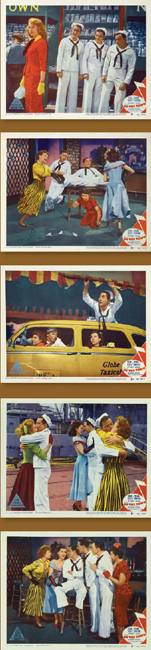
Lobby cards, On the Town, 1949. / “On The Town is a motion picture / done in the style of a smart / Broadway review.… The numbers (Photo: The Cinematic Legacy of Frank Sinatra, David Wills, 2015.)
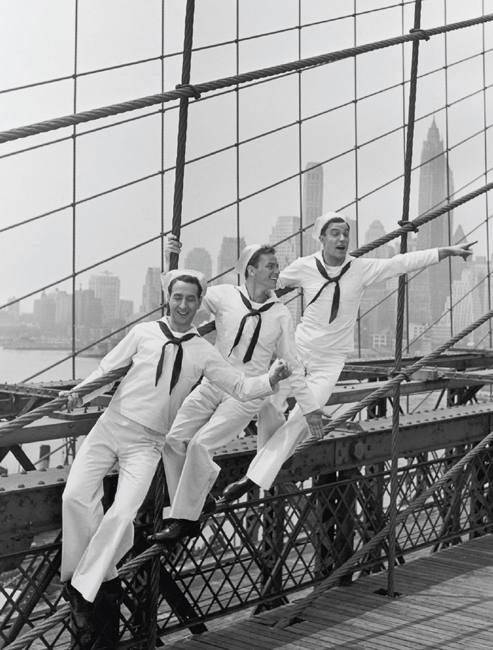
With costars Jules Munshin and Gene Kelly. (Photo: The Cinematic Legacy of Frank Sinatra, David Wills, 2015.)
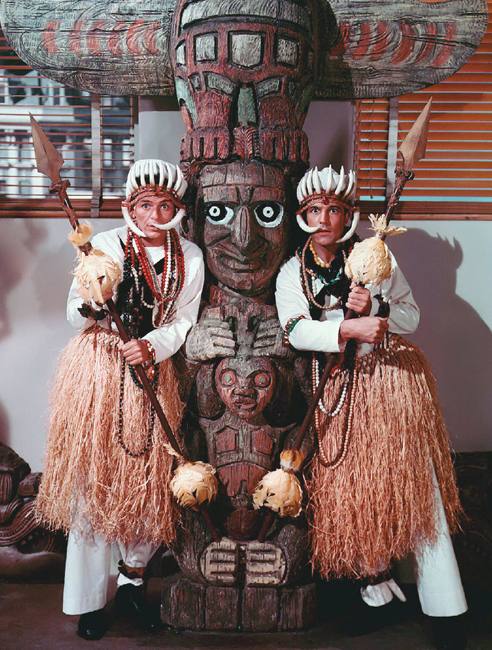
With costar Gene Kelly, On The Town, 1949. (Photo: The Cinematic Legacy of Frank Sinatra, David Wills, 2015.)
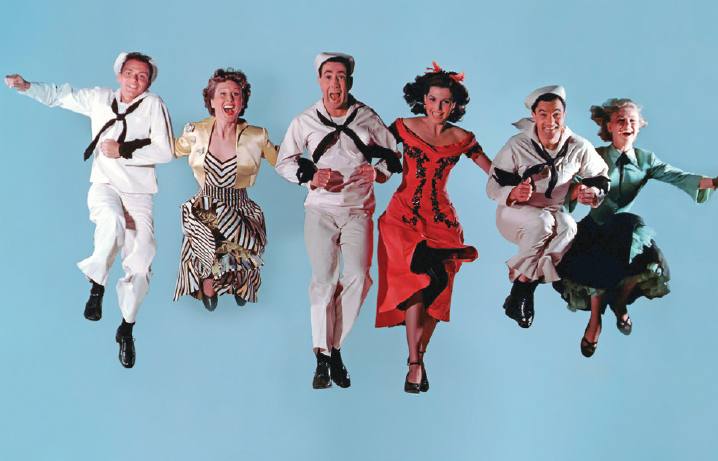
With costars Betty Garrett, Jules Munshin, Ann Miller, Gene Kelly and Vera Ellen. / “The first stumbling block was Frank Sinatra. / Those were his famous days, and he was as hard / to hide as the Statue of Liberty. He was always / being mobbed. To get around that problem, we / decided not to hire an (Photo: The Cinematic Legacy of Frank Sinatra, David Wills, 2015.)
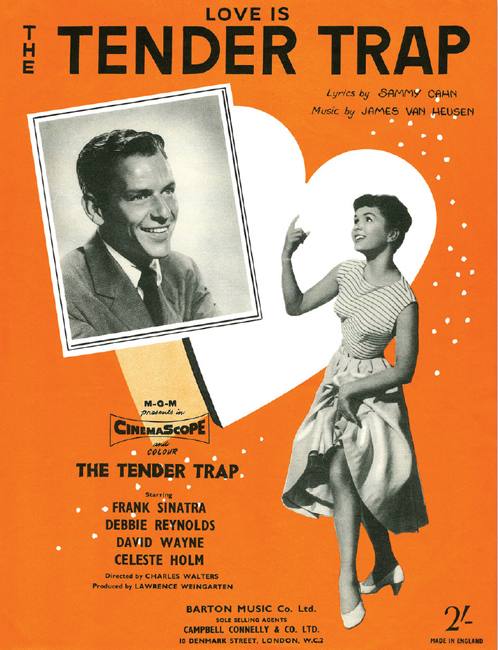
On the Town, 1949. (Photo: The Cinematic Legacy of Frank Sinatra, David Wills, 2015.)
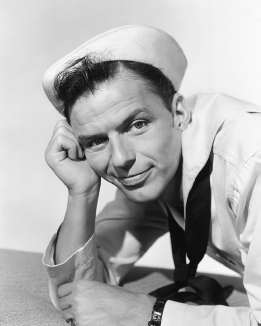
Frank, from the MGM film On the Town, in 1949. Source: photo and caption from J. Randy Taraborrelli, Sinatra: Behind the Legend (mptvimages.com).
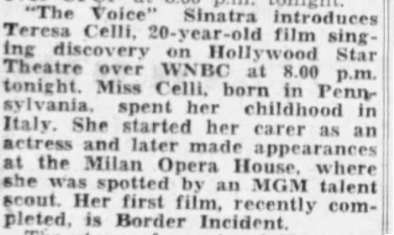
March 5, 1949
Radio
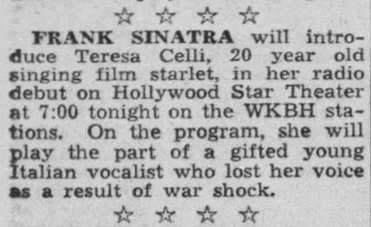
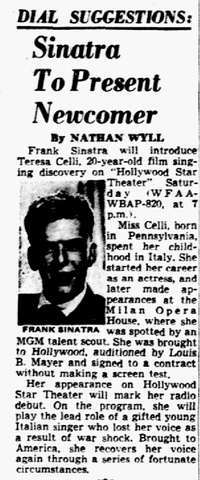
Hollywood Star Theatre
Time: 8:00 PM - 8:30 PM
Network: WNBC
Guests: Frank Sinatra, Teresa Celli
Your Hit Parade
Network: NBC
Program #717
Time: 9:00-9:30 P.M. (Rebroadcast 9:00-9:30 P.M. PST)
Sponsor: Lucky Strike
1. commercial 1
2. I've Got My Love To Keep Me Warm (5) - Frank Sinatra
3. Buttons And Bows (10) - Hit Paraders
4. Cruising Down The River (6) - Eileen Wilson
5. So In Love (8) - Frank Sinatra
6. A Little Bird Told Me (4) - Orchestra
7. commercial 2
8. Sunflower (9) - Frank Sinatra & Hit Paraders
9. Lavender Blue (7) - Eileen Wilson
10. Bim Bam Bum - Orchestra
11. Galway Bay (3) - Frank Sinatra
12. Powder Your Face With Sunshine (2) - Eileen Wilson
13. commercial 3
14. Far Away Places (1) - Frank Sinatra & Hit Paraders
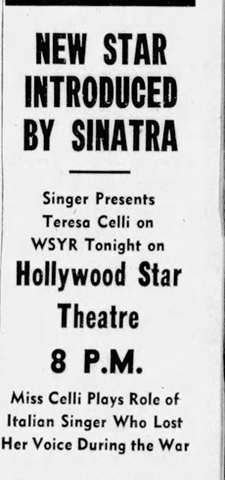
Hollywood Star Theatre
Time: 8:00 PM - 8:30 PM
Network: WNBC
Guests: Frank Sinatra, Teresa Calli
March 9, 1949
Film
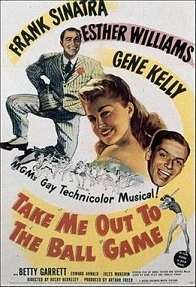
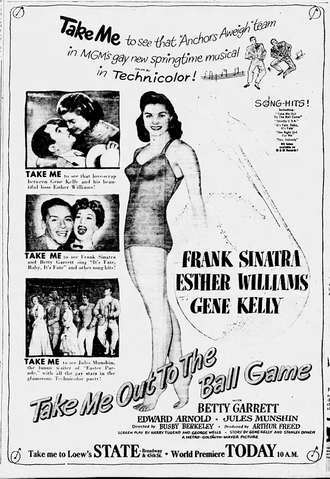
"Take Me Out To The Ball Game" (New York City Premiere March 9, 1949)
Starring: Frank Sinatra, Esther Williams, Gene Kelly, Betty Garrett, Edward Arnold, Jules Munshin
Produced by: Arthur Freed
Directed by: Busby Berkeley
Two turn-of-the-century baseball players Dennis Ryan (Sinatra) and Eddie O'Brien (Kelly), who work in vaudeville during the off-season, run into trouble with their team's new female owner K.C. Higgins (William) and a gambler (Arnold) who doesn't want them to win the pennant. (DVD Release date: 2000-09-19) (Blu-Ray Release: 2021-07-20)
[The Cinematic Legacy of Frank Sinatra — Take Me Out to the Ball Game (1949)]
David Wills's 2015 photo history The Cinematic Legacy of Frank Sinatra devotes a section to Take Me Out to the Ball Game (1949), illustrated with 2 behind-the-scenes and publicity photographs (posters, lobby cards, and on-set/on-location shots) filed here.
Source: David Wills, The Cinematic Legacy of Frank Sinatra (St. Martin's Press, 2015), pp. 56–58.
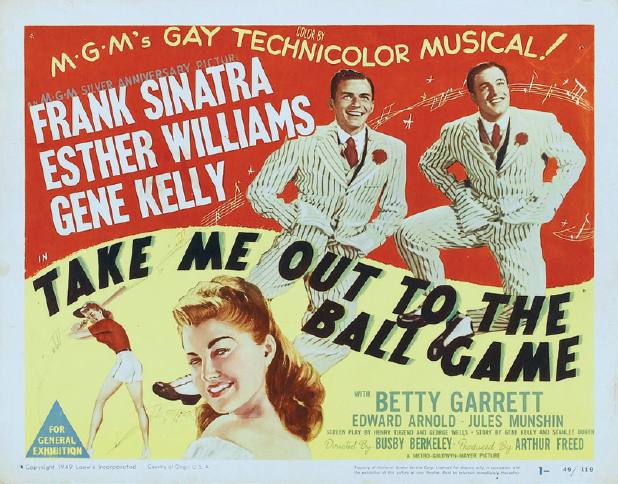
Half sheet poster, Take Me Out to the Ball Game, 1949. / “Making Ballgame … at MGM was pure joy and / Frank was an absolute delight to work with. He / won my heart the first day on the set when they / had finished shooting a close-up of him over my / shoulder. They were getting ready to move the / c (Photo: The Cinematic Legacy of Frank Sinatra, David Wills, 2015.)
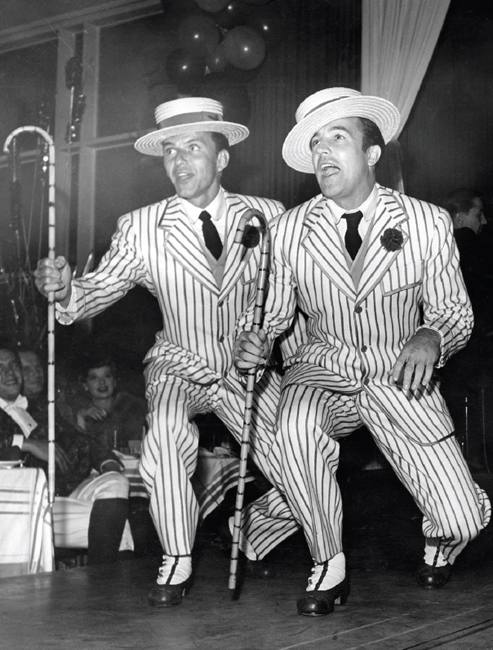
With costar Gene Kelly in Take Me Out to the Ball Game. (Photo: The Cinematic Legacy of Frank Sinatra, David Wills, 2015.)
"Take Me Out To The Ballgame" (New York City Premiere March 9, 1949, Pittsburgh Post-Gazette (Pittsburgh, Pennsylvania) 25 Mar 1949 --Arthur Freed hired the great Busby Berkeley to direct "Take Me Out To The Ballgame" It would be his last film. He was really not up to the task. Gene Kelly and Stanley Donen directed most of the scenes in the film. The original cast included "Judy Garland and Leo Durocher( Jules Munshin replaced The Lip). Judy was in no condition to do the film, so MGM asked Kathryn Grayson to reunite with her "Anchors Aweigh" co-stars. When that didn't work out, the very popular Esther Williams stepped into the role of baseball owner - - although Gene Kelly very much objected.
The production got under way in July of 1948, with a budget of $1,725,970. The last scene was shot on 10/26. Sinatra had top billing and was very excited to be singing "Last Night When We Were Young" and "Boys And Girls Like You And Me." The Arlen/Harburg song was dropped almost immediately. The Rodgers & Hammerstein gem from "Oklahoma" was prerecorded by Frank and the scene with Betty Garrett was filmed. The song was dropped from the original production of "Oklahoma" during try outs in Philadelphia(1943). Arthur Freed acquired the rights for Garland. She recorded "Boys And Girls" for "Meet Me In St Louis." Scene was shot and then it was cut from the final master of the film. Same thing happened to Sinatra's effort. Tis' a great mystery. A lovely song that deserved a much better fate. The Garland audio is available on the deluxe edition of "Meet Me In St. Louis. In 1993, the MGM laserdisc of "Ballgame" included Frank's version as a special feature. It is simply wonderful.. Later on the DVD would also offer it. Sinatra had an excellent agent back then. Bette Davis was the only film star in 1948 with a higher gross salary. Frank earned $325,000.
Film was previewed in Encino, California on 12-16-48 to very favorable audience reviews. The official release took place on 3-9-49 at Loew's theaters in N.Y.C. and L.A. The reviews were generally very favorable and a general release occurred on 4-13-49. The domestic gross was $4,344,000 and it made almost a million dollars with its international release. Due to the baseball theme, the title in the U'K. was "Everybody's Cheering." Frank was in a very successful film and the next one up, "On The Town," would continue that trend. Kelly and Donen insisted that Berkeley receive full credit as director and the AFI would nominate the film as one of the greatest musicals ever made.
Ed
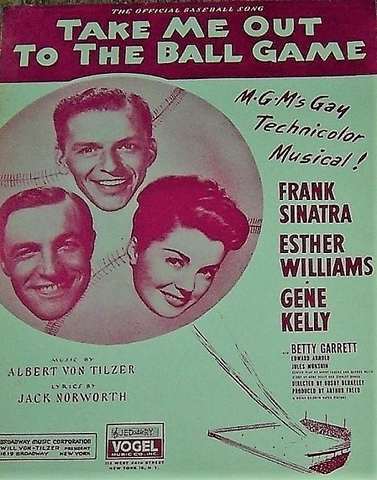
Sheet Music For Official Song Of Major League Baseball

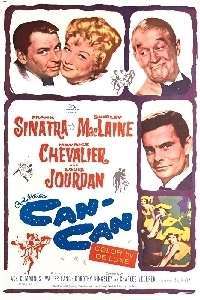
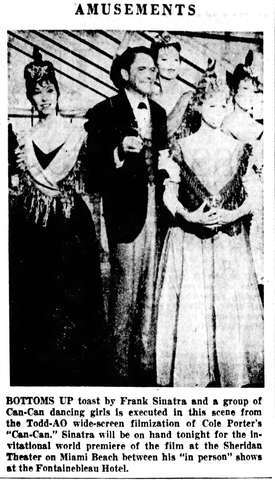
"Can Can" (U.S. Release: March 9,
1960)
Starring: Frank Sinatra, Shirley MacLaine, Maurice Chevalier, Louis
Jourdan, Juliet Prowse
Produced by: Jack Cummings and Saul Chaplin
Directed by: Walter Lang
Miami Herald
March 9, 1960
"Take Me Out to the Ball Game"
Reteaming with producer Arthur Freed and Gene Kelly for the baseball musical Take Me Out to the Ball Game helped restore Sinatra's onscreen confidence after the disastrous one-two-three run of It Happened in Brooklyn, The Miracle of the Bells, and The Kissing Bandit.
Source: Tom Santopietro, "Sinatra in Hollywood" (2008).
"Take Me Out to the Ball Game"
Although Busby Berkeley retained final directing credit, it is widely acknowledged Gene Kelly and Stanley Donen directed most of the film, as Berkeley was distracted by personal and financial problems; Berkeley is believed to have directed only the Esther Williams swimming-pool sequences.
Source: Tom Santopietro, "Sinatra in Hollywood" (2008).
"Take Me Out to the Ball Game"
The film originated when Gene Kelly refused to star in a planned musical about two sailors turning an aircraft carrier into a nightclub; Kelly and Donen instead sketched a two-page outline about early-era baseball vaudevillians, which they sold to Arthur Freed for twenty-five thousand dollars.
Source: Tom Santopietro, "Sinatra in Hollywood" (2008).
"Take Me Out to the Ball Game"
Betty Garrett: Costar Betty Garrett recalled that 'Frank worked hard on all the dances; he had a natural grace and moved easily.'
Source: Tom Santopietro, "Sinatra in Hollywood" (2008).
"Take Me Out to the Ball Game"
Sinatra's solo on the Rodgers and Hammerstein song 'Boys and Girls Like You and Me' (originally written for Oklahoma!) was cut from the film after filming, though it later resurfaced as a DVD special feature.
Source: Tom Santopietro, "Sinatra in Hollywood" (2008).
"Take Me Out to the Ball Game"
Hollywood Reporter / Time magazine: Reviews were generally favorable -- the Hollywood Reporter wrote that 'Sinatra sings and gags his way through a most pleasant role' -- though Time magazine dismissed the film as 'a lazy Technicolored cine-musical,' a characterization Santopietro disputes.
Source: Tom Santopietro, "Sinatra in Hollywood" (2008).
"Take Me Out to the Ball Game"
Santopietro grades this an A, praising it as great fun with Frank "singing and hoofing up a storm."
Source: Tom Santopietro, "Sinatra in Hollywood" (2008).
"Take Me Out to the Ball Game"
Santopietro (Filmography): Metro-Goldwyn-Mayer. Produced by Arthur Freed, directed by Busby Berkeley, screenplay by Harry Tugend, George Wells and Harry Crane, score by Roger Edens, Adolph Green and Betty Comden, choreographed by Stanley Donen and Gene Kelly. Sinatra played Dennis Ryan opposite Esther Williams, Gene Kelly and Betty Garrett, singing songs including the title number and 'Strictly U.S.A.'
Source: Tom Santopietro, "Sinatra in Hollywood" (2008).
March 16, 1949
Radio
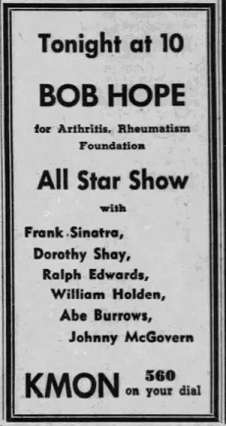
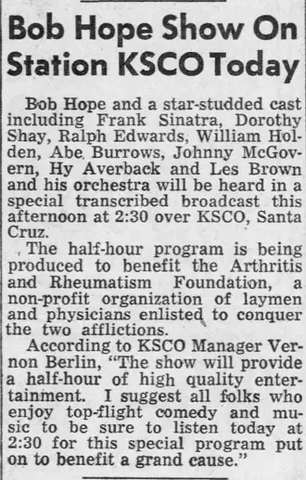
The Bob Hope All Star Show "A Dream Come True"
Arthritis and Rheumatism Foundation syndication.
Announcer: Hy Averback
Host: Bob Hope
Master Of Ceremonies: Bob Hope
Syndicated
Performers: Dorothy Shay, Les Brown and His Orchestra,
William Holden, Frank Sinatra, Abe Burrows, Milton DeLugg, Ralph Edwards, John McGovern.
1 Buttons & Bows Dorothy Shay
2. On A Slow Boat To China Frank Sinatra
3..The Gypsy Violin Abe Burrows and Milton DeLugg
4. Anything You Can Do w/Bob Hope & Dorothy Shay
Note: Show was not broadcast on 3/16 in New York or Boston
Notes: Fund appeal for the Arthritis and Rheumatism Foundation. Approximate Date. 30mins. Complete. Audio condition: Excellent.
The Bob Hope All Star Show "A Dream Come True"
Arthritis and Rheumatism Foundation syndication.
Announcer: Hy Averback
Host: Bob Hope
Master Of Ceremonies: Bob Hope
Syndicated
Performers: Dorothy Shay, Les Brown and His Orchestra,
William Holden, Frank Sinatra, Abe Burrows, Milton DeLugg, Ralph Edwards, John McGovern.
March 19, 1949
Radio
Your Hit Parade
Network: NBC
Program #719
Time: 9:00-9:30 P.M. (Rebroadcast 9:00-9:30 P.M. PST)
Sponsor: Lucky Strike
1. commercial 1
2. I've Got My Love To Keep Me Warm (7) - Frank Sinatra
3. A Little Bird Told Me (5) - Orchestra
4. Far Away Places (4) - Eileen Wilson
5. Red Roses For A Blue Lady (6) - Frank Sinatra
6. Lavender Blue (10) - Hit Paraders
7. commercial 2
8. Sunflower (8) - Frank Sinatra & Hit Paraders
9. Galway Bay (9) - Eileen Wilson
10. Stardust - Orchestra
11. So In Love (3) - Frank Sinatra & Hit Paraders
12. Cruising Down The River (2) - Eileen Wilson
13. commercial 3
14. Powder Your Face With Sunshine (1) - Frank Sinatra & Hit Paraders
Ed O'Brien notes:
Believe it or not, Frank would eventually sing every song from this show except "Lavendar Blue."
March 23, 1949
Studio
MGM - Los Angeles
Studio Recordings
ON THE TOWN
Orchestra conducted by Lennie Hayton
Arrangement by Saul Chaplin
A rather complicated recording
On The Town
Frank Sinatra, Gene Kelly, Jules Munshin, Vera Ellen, Betty Garrett, Ann Miller & Chorus
Bars 1 to 80 8 takes 1:07
Bars 79 to 132 7 takes 1:36
Bars 186 to end 3 takes take 2 (1:11) and take 3(1:11)
Bars 132 to 186 5 takes take 4(1:56) and take 5(1:52)
Total running time 5:10
piano tempo track added 3 takes a(:35) & b(:45)
4/4 time tempo piano 1 take (:55)
Final master 7:30 edited down for film to 5:45
Note: above thanks to Ed O'Brien
March 24, 1949
Studio
MGM - Los Angeles
ON THE TOWN
Orchestra conducted by Lennie Hayton
Arrangements by Saul Chaplin
Main Street
Gene Kelly
4 takes takes 3(3:46) & 4(3:42) mastered verse only 5 takes (:27)
Count On Me
Frank Sinatra,Jules Munshin, Betty Garrett, Ann Miller, Alice Pearce & Chorus
5 takes 3:29
You're Awful
Frank Sinatra & Betty Garrett
6 takes 3:15
Pearl Of The Persian Sea
Frank Sinatra, Gene Kelly & Jules Munshin
3 takes 2:03
Pearl Of The Persian Sea
Female vocal chorus only
2 takes :46
Above MGM session info provided by Ed O'Brien
March 26, 1949
Radio
Your Hit Parade
Network: NBC
Program #720
Time: 9:00-9:30 P.M. (Rebroadcast 9:00-9:30 P.M. PST)
Sponsor: Lucky Strike
1. commercial 1
2. Sunflower (7) - Frank Sinatra & Hit Paraders
3. Lavender Blue (9) - Orchestra
4. A Little Bird Told Me (10) - Eileen Wilson
5. Far Away Places (4) - Frank Sinatra
6. Red Roses For A Blue Lady (6) - Hit Paraders
7. commercial 2
8. I've Got My Love To Keep Me Warm (8) - Frank Sinatra
9. That's A 'Plenty - Orchestra
10. So In Love (5) - Frank Sinatra
11. Powder Your Face With Sunshine (3) - Hit Paraders
12. Galway Bay (2) - Eileen Wilson
13. commercial 3
14. Cruising Down The River (1) - Frank Sinatra & Hit Paraders
March 28, 1949
[Photograph: On the Town begins shooting. From Richard Havers, "Sinatra" (Dorling Kindersley, 2007), p.138.]
Filming for On the Town began on 28 March 1949, the same day Take Me Out to the Ball Game went into general release. (Source: Richard Havers, "Sinatra" (Dorling Kindersley, 2007).)
April 2, 1949
Radio
Your Hit Parade
Network: NBC
Program #721
Time: 9:00-9:30 P.M. (Rebroadcast 9:00-9:30 P.M. PST)
Sponsor: Lucky Strike
Script (Final As Broadcast)
Click Here To Listen To The (NBC) Version (Complete For Only)
1. commercial 1
2. Someone Like You (9) - Frank Sinatra
3. I've Got My Love To Keep Me Warm (7) - Orchestra
4. Forever And Ever (10) - Eileen Wilson
5. Sunflower (4) - Frank Sinatra & Hit Paraders
6. Powder You Face With Sunshine (6) - Eileen Wilson
7. commercial 2
8. Galway Bay (8) - Frank Sinatra
9. Honeysuckle Rose - Orchestra
10. So In Love (5) - Frank Sinatra & Hit Paraders
11. Red Roses For A Blue Lady (3) - Hit Paraders
12. Far Away Places (2) - Eileen Wilson
13. commercial 3
14. Cruising Down The River (1) - Frank Sinatra & Hit Paraders
April 6, 1949
Radio
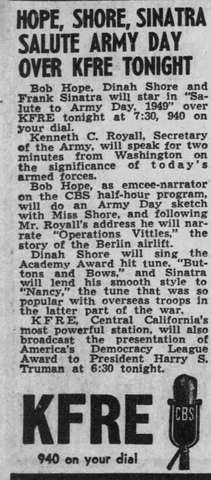
Army Day Salute
Network: WCBS
Time: 10:00PM -10:30PM
Army Day Salute: Secretary Of The Army Kenneth C. Royall, Dinah Shore, Frank Sinatra, Bob Hope, others Hy Auerbach, Homer Hall Chorus (recorded)

Army Day Salute
Network: WCBS
Time: 10:00PM -10:30PM
Army Day Salute: Secretary Of The Army Kenneth C. Royall, Dinah Shore, Frank Sinatra, Bob Hope, others Hy Auerbach, Homer Hall Chorus (recorded)
April 9, 1949
Radio
Your Hit Parade
1. Red Roses For A Blue Lady (9) - Frank Sinatra
2. Commercial
3. I've Got The World To Keep Me Warm (6) - Orchestra
4. Someone Like You (10) - Eileen Wilson
5. Galway Bay (8)- Frank Sinatra
6. Far Away Places (4) - The Hit Paraders
7. Commercial
8. So In Love (5)- Frank Sinatra
9. There'll Be Some Changes Made (Lucky Strike Extra)- Orchestra
10. For Ever And Ever (7) - Eileen Wilson
11. Powder Your Face With Sunshine (3) - Frank Sinatra
12. Sunflower (2) - Eileen Wilson
13. Commercial
14. Cruising Down The River (1) - Frank Sinatra
April 10, 1949
Studio
Hollywood
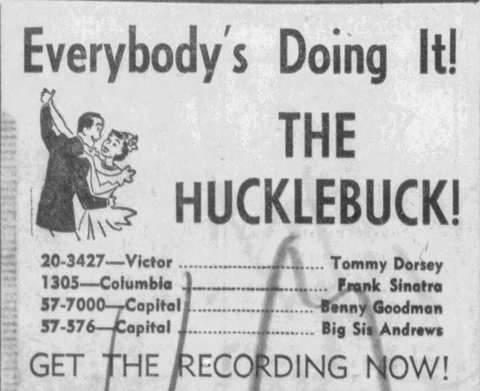
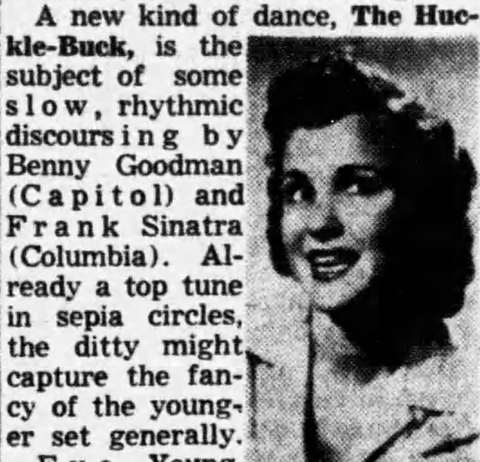
HCO3692 The Hucklebuck Take 1 (3:00) w/The Ken Lane Quintet
(R. Alfred/A Gibson)
United Music Corp. (ASCAP) 1949
Arranged & Conducted by Axel Stordahl
78: Columbia 38486
CD: The Columbia Years 1943-1952 C12K 48673
HCO3693 It Happens Every Spring Take 1 (3:01)
(M. Gordon/J. Myrow)
(from It Happens Every Spring)
Bergman, Vocco & Conn (ASCAP) 1949
Arranged & Conducted by Axel Stordahl
78: Columbia 38486
CD: The Columbia Years 1943-1952 C12K 48673
Trumpets: Z. Elman, L. Mach, G. Seaberg, R. Zarchy; Trombones: G. Jenkins, S. Leutner , R McGarity; Saxes: H. Beau, F. Chase, M. Cohan, A. Gershunoff, H. Haymer, F. Stulce; Piano: M. Mclntyre; Guitar: A. Reuss; Bass: P. Stephens; Drums: R. Hagan; Harp: M. Hogan Cambern
Hollywood
HCO3692 The Hucklebuck Take 1 (3:00) w/The Ken Lane Quintet
(R. Alfred/A Gibson)
United Music Corp. (ASCAP) 1949
Arranged & Conducted by Axel Stordahl
78: Columbia 38486
CD: The Columbia Years 1943-1952 C12K 48673
8-4-49
5-10-49
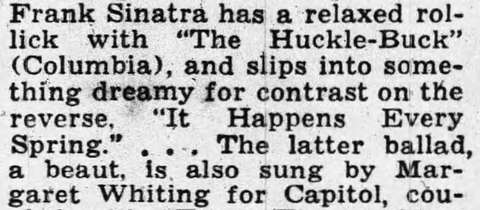
HCO3693 It Happens Every Spring Take 1 (3:01)
(M. Gordon/J. Myrow)
(from It Happens Every Spring)
Bergman, Vocco & Conn (ASCAP) 1949
Arranged & Conducted by Axel Stordahl
78: Columbia 38486
CD: The Columbia Years 1943-1952 C12K 48673
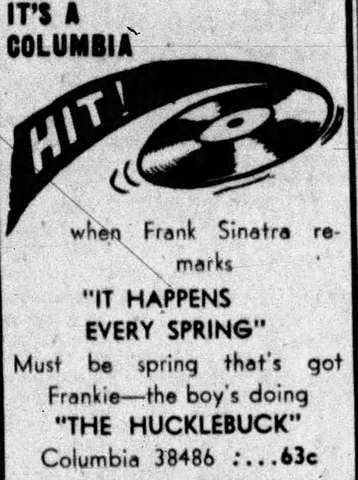
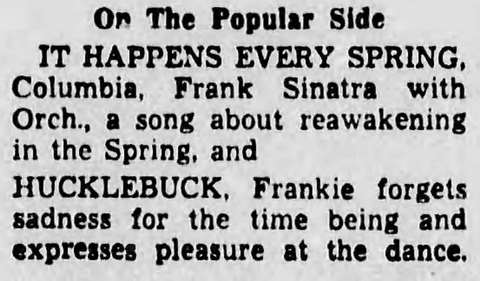
Frank recorded the hit "The Huckle-Buck" at a Los Angeles studio; producer George Siravo recalled it was the last session for saxophonist Herbie Haymer, who was killed by a car crossing the street that same night.
Source: Nancy Sinatra, Frank Sinatra: An American Legend, 1995.
April 16, 1949
Radio
Your Hit Parade
# 723
Sponsor: Lucky Strike
Music: Alex Stordahl and His Orchestra
1. Sunflower - Frank Sinatra
2. Smoke A Lucky - Frank Sinatra
3. Powder Your Face With Sunshine - Orchestra
4. You Was - Eileen Wilson
5. Someone Like You - Frank Sinatra
6. Forever And Ever - Eileen Wilson
7. Easter Parade - Frank Sinatra
8. I've Got My Love To Keep Me Warm - Orchestra
9. So In Love - Frank Sinatra
10. Far Away Places - Eileen Wilson
11. Red Roses For A Blue Lady - The Hit Paraders
12. Cruising Down The River - Frank Sinatra
13. Put Your Dreams Away - Frank Sinatra
14. So Long For A While - The Hit Paraders
Concerts
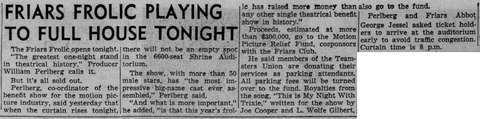
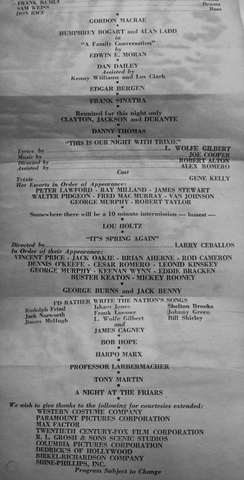
Friars Frolic, Shrine Auditorium, Los Angeles, California
Benefit: Movie Relief Fund
Performers: Frank Sinatra, Peter Lawford, Ray Milland, Jimmy Stewart, Walter Pidgeon, Fred MacMurray, Van Johnson, George Murphy, Dennis O'Keefe, Mickey Rooney, Jack Oakie, Jack Benny, George Burns, Charlie McCarthy, Edgar Bergen, Alan Ladd, Humphrey Bogart, Van Johnson, Harpo Marx, Gene Kelly, Jimmy Cagney, Bob Hope, George Jessel, Ronald Reagan, Keenan Wynn
Not in performance order:
1.. blackout skit - Alan Ladd & Humphrey Bogart
2. reunion act of Clayton Jackson & Jimmy Durante
3. This Is Our Night Trixie - chourus line of: Peter Lawford, Ray Milland, James Stewart, Walter Pidgeon, Fred MacMurray, Van Johnson, George Murphy, Robert Taylor, Gene Kelly
4. unknown song - Tony Martin
5. unknown song - Gordon Macrae
6. Soliloquy - Frank Sinatra
7. comedy - Spencer Tracy & Harpo Marx
8. "swami skit" - Edgar Bergen & Charlie McCarthy
9. comedy monologue Bob Hope
10. comedy monologue - Danny Thomas
11. comedy monologue - George Jessel
12. comedy monologue - Lou Holtz
13. soft shoe dance - Dan Dailey
14. comic ballet - Jack Oakie, Dennis O'Keefe, Rod Cameron, Cesar Romero, Mickey Rooney, Brian Aherne, Buster Keaton
15. hillbilly band - Jack Benny (Leader)
16. Gracie Allen skit - Gracie (played by Jack Benny in wig, high heels and beaded dress)
17. James Cagney as George M. Cohen
18. "Parade Of Song writers - Rudolph Frimi, Jack Norworth, Jimmy MCHugh, Frank Loesser
Note: Crowd of 6000. Raised $301,000.

Friars Frolic, Shrine Auditorium, Los Angeles, California
Sample from program:
The Los Angeles Times (Los Angeles, California) 18 Apr 1949, Mon

May 1949
[Sinatra quits Your Hit Parade]
Kaplan: At the end of May 1949, Sinatra quit Your Hit Parade, issuing a statement criticizing the material he'd been forced to sing. Sponsor Lucky Strike nonetheless negotiated a new show with his team, Light Up Time, which debuted in September.
Source: James Kaplan, "Frank: The Voice" (2010)
[V-Disc program winds down]
The V-Disc program for troops continued at a reduced pace until May 1949. Over six years it shipped roughly 8 million discs covering more than 900 titles and 3,000 recordings, most of which were destroyed as promised, though the Library of Congress retained an almost complete set.
Source: Richard Havers, "Sinatra" (Dorling Kindersley, 2007).
May 3, 1949
Studio
MGM - Los Angeles
ON THE TOWN
Tuesday afternoon
Arranged by Saul Chaplin
Conducted by Lennie Hayton
New York, New York
Ed O'Brien:
song was recorded in six parts
Opening with three principals Frank Sinatra,
Gene Kelly & Jules Munshin required 4 takes
There were 9 takes done from bars 20 to end
and Ralph Brewster, Charles Pavalato, Marvin
Bailey and Bill Lee joined the three principals
on the vocal. Running time was 3:08 and 3:09
on first two sections. Takes 4,8 and 9 were mastered.
Harry Stanton (longshoreman with deep bass voice)
did his solo segment in 3 takes. Running time was 1:11.
Jules Munshin then did a second ending from bars
85 to 121. Four takes and a running time of :40 secs.
Munshin, Kelly and Sinatra then did 4 takes from bar 85
thru 121. Running time was :40 secs. The closing
orchestral track required 5 takes and had a running
time of :21 secs. The total time for the final master
was 4:29
Interesting little note: MGM work sheet credits
Hayton along with Comden-Green and Bernstein
with composing the film number.
Radio
Command Performance, Hollywood
#375
Tuesday evening
Hostess: Gloria DeHaven
Guests: June Foray, Phil Moore Four and Frank Sinatra
Announcer: Marvin Miller
1. I've Got A Crush On You G. DeHaven
2. S'Wonderful Phil Moore Four
3. Bop Goes My Heart F. Sinatra & P. Moore Four
4. Maybe You'll Be There G. DeHaven
5. Comedy sketch F.S. & June Foray
6. Comedy sketch F.S,. & G DeHav.
7. When Is Sometime F. Sinatra
May 6, 1949
Studio
Hollywood
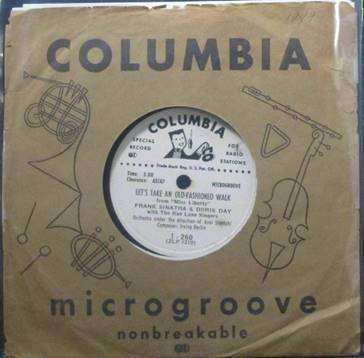
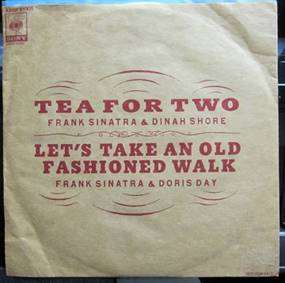
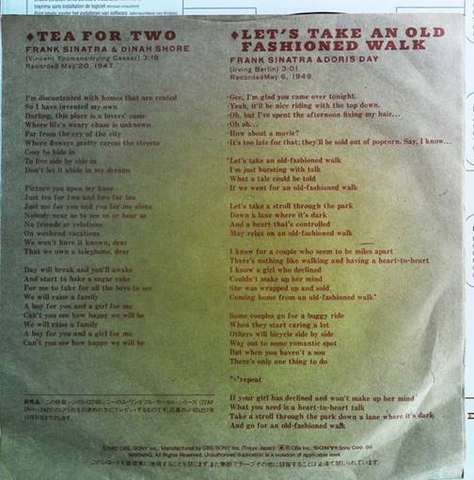
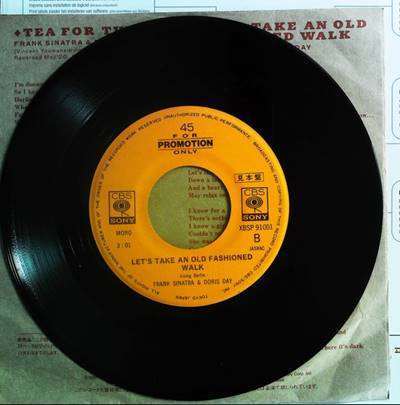
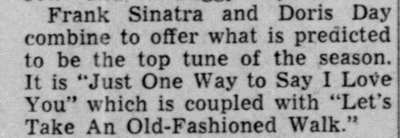
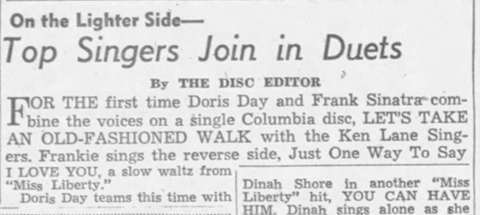
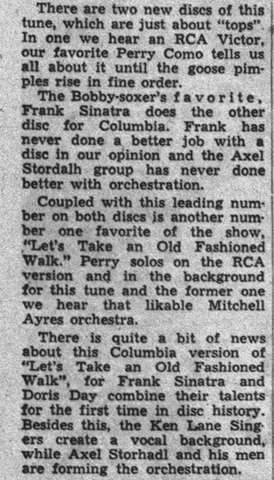
HCO3748 Let's Take An Old Fashioned Walk w/Doris Day & The Ken Lane Singers
(I. Berlin )
(from Miss Liberty)
Irving Berlin Music (ASCAP) 1949
Arranged & Conducted by Axel Stordahl
-1 (2:59) CD: Columbia Years 43-52 Vol. 11
-1 & 2 Doris Day: It's Magic Bear Family 6 CD set
78: 38513
Dick Schwarz:
I would like to add the following:
Both takes are included on the Bear Family 6 CD set: Take 1 on CD2 and take 2 on CD 6. There are also some additional differences to note:
At 0:08 FS says "oh-oh" on take 1 and does not say "oh-oh" on take 2 At 1:22 FS says "way-out to some romantic spot" on take 1 and "out to some romantic spot" on take 2. As far as I know, there has not been any additional commercial release of take 2.
NOTE: Sinatraphile Richard Warrick points out that there is an alternative take of this song on a Doris Day boxed set. The main difference is that on the alternative take Sinatra has fun with one of the lyrics and it causes Doris Day to giggle.
Sinatraphile Scott Henderson says he has listened to both tracks. The difference is at 1:25. In both versions, Frank sings "out to some romantic spot" and does a rolling flourish on the word "romantic." There is no difference in the way he does it on both tracks but, for some reason, Doris giggles on the alternate take when he does it. Maybe that was the first take and it caught her off guard. He repeats it in the released take but Doris is in control and doesn't giggle. Also, on the alternate take, Sinatra shortens his intro into the song. In the alternate take, he says "Say, I know what to do, Let's take on old fashioned walk" and is almost drowned out by the music. In the released take he shortens it to "Say, I know what, Let's take an old fashioned walk." The alternate take runs 3:05 and the released take 3:00. Henderson then inquires if the alternate take ever appeared on a Sinatra release other than the Doris Day boxed set.
Sinatra Scholar Ed O'Brien says he doesn't believe so. The alternate take has been available in collecting circles for years, but he can't think of a commercial release on a Sinatra album.
Scott Henderson then asks if there are many other Sinatra tracks which were only released on other artists' CDs or LPs. O'Brien affirms that, on a George Strait boxed set, there's an electronic Sinatra duet with Strait.
Dell Webb then asked about these: "All the Way" duet with Celine Dion; "My Way" duet with Paul Anka; "Santa Claus is Coming to Town" duet with Cindy Lauper (on a compilation disc); and "Silent Night" (two versions on compilation discs.)
Henderson responds that he has thought of these discs, but they're electronically produced and Sinatra's part is already available. Yes, "Silent Night" counts as it's only Sinatra, although only available on compilation discs. He says he was just wondering about Sinatra tracks that are original and only available on some other set.
O'Brien responds that he can't think of any Sinatra commercial efforts that were exclusively released on a non-Sinatra album or cd.
Sinatraphile Eugene Lo Curto writes that this duet sounds as fresh today as it did when it was first released. Not too long ago, he continues, I heard Irving Berlin's voice for the first time. It was a recording of his own song back to back with the Sinatra/Day duet. It reminds him of the great "A Man and his Music" program, where Sinatra tells his audience that when approaching a ballad, he tries to sing it the way the lyricist wanted it sung. If you listen to the Sinatra/Day duet followed by Berlin 's recording, you will notice that Sinatra's phrasing and cadence are very similar to Berlin's.
Sinatraphile Dell Webb agrees that the Sinatra/Day version is charming, but, in his humble opinion, the far superior listening experience is the one with Dorothy Kirsten on the radio.
HCO3749 (Just One Way To Say) I Love You
(I Berlin )
(from Miss Liberty)
Irving Berlin Music (ASCAP) 1949
Arranged & Conducted by Axel Stordahl
-1 (2:30) CD: Columbia Years 43-52 Vol. 11
78: 38513
Violins: W. Callies, S. Cytron, D. Frisina, G. Kast, M. Kellner, S. Middleman, R. Polikian, M. Russel, G. Vinci; Violas: M. Perlmutter, G. White; Cellos: C. Bernard, J. Sewell; Saxes: D. Bonnee, M. Cohan, A. Gershunoff, B. Russin, F. Stulce; Horns: V. De Rosa; Piano: M. Mclntyre; Guitar: A. Reuss; Bass: P. Stephens; Drums: R. Hagan; Harp: A. Mason
Hollywood
HCO3748 Let's Take An Old Fashioned Walk w/Doris Day & The Ken Lane Singers
In 1982 CBS/Sony released the following 45 rpm single in Japan:
.
-----------------------------------------------------
© 1997-2026 The Sinatra Archive
This calendar, or any parts thereof, may not be reproduced in any fashion whatsoever without the prior written permission of the publisher (The Sinatra Archive)
May 7, 1949
Radio
Your Hit Parade
Network: NBC
Program #726
Time: 9:00-9:30 P.M. (Rebroadcast 9:00-9:30 P.M. PST)
Sponsor: Lucky Strike
1. commercial 1
2. Sunflower (9) - Frank Sinatra & Hit Paraders
3. Powder Your Face With Sunshine (7) - Eileen Wilson
4. Forever And Ever (5) - Orchestra
5. Someone Like You (8) - Frank Sinatra
6. Careless Hands (6) - Eileen Wilson
7. commercial 2
8. Far Away Places (10) - Frank Sinatra
9. Medley: Mexican Hat Dance / La Cucaracha - Orchestra
10. Again (4) - Frank Sinatra
11. "A" You're Adorable (3) - Eileen Wilson & Hit Paraders
12. Red Roses For A Blue Lady (2) - Hit Paraders
13. commercial 3
14. Cruising Down The River (1) - Frank Sinatra
May 14, 1949
Radio
Your Hit Parade
Network: NBC
Program #727
Time: 9:00-9:30 P.M. (Rebroadcast 9:00-9:30 P.M. PST)
Sponsor: Lucky Strike
Script (Final As Broadcast)
1. commercial 1
2. Red Roses For A Blue Lady (8) - Frank Sinatra
3. Sunflower (6) - Orchestra
4. A Wonderful Guy (9) - Eileen Wilson
5. Careless Hands (5) - Frank Sinatra
6. "A" You're Adorable (4) - Eileen Wilson & Hit Paraders
7. commercial 2
8. Far Away Places (7) - Frank Sinatra
9. Song Of India - Orchestra
10. Someone Like You (10) - Frank Sinatra
11. Forever And Ever (3) - Hit Paraders
12. Again (2) - Eileen Wilson
13. commercial 3
14. Cruising Down The River (1) - Frank Sinatra
May 15, 1949
Radio
Treasury Department Guest Star
Treasury Department syndication
Program #
Performers: Frank Sinatra; Eileen Wilson.
Songs:
Once In Love With Amy -FS
Powder Your Face With Sunshine -FS
Why Was I Born -FS
Far Away Places. -EW
Notes: LOC has complete 15mins NBC master.
Note: Powder Your Face With Sunshine appears on
"Frank Sinatra: Lost and Found The Radio Years
Smithsonian/Columbia/Legacy # 88875147142 "
May 16, 1949
Radio
United States Savings Bond Program
Time: 10:30 p.m. - 11:30 p.m
NBC
M.C.: Alan Ladd
Announcers: Ken Carpenter, Wendell Niles
Performers: Chester Lauck, Norris Goff, Clarence Hartzell, Andy Devine, Opie Cates, Felix Mills (music), Bob Hope, Irene Dunne, Lionel Barrymore, Jo Stafford, Al Jolson, Roy Rogers, The Riders Of The Purple Sage, Fred Waring, Edward G. Robinson, Jack Benny, Frank Sinatra, Esther Williams, Gene Kelly, Red Skelton, Rochester, Edward Arnold, Robert Armbruster and His Orchestra, Verna Felton, Betty Garrett, Bing Crosby, Jules Munshin, Harry Truman. John Snyder (Secretary Of The Treasury),
Producers: Cornwell Jackson, William Wildiss
Writers: Ed Hellwig, John Fenton Murray, Hugh Wedlock, Howard Snyder
Notes: The show appears on the officially released CD set: 60 Greaest Old Time Radio Show "Frank Sinatra & Friends."
A variety program promoting the "Opportunity Drive" for the sales of Savings Bonds.TT: 60mins.
Audio condition: Excellent. Complete. ABC also could have simulcast this. LOC has NBC copy.
Ed Notes:
The Sinatra segment featured the recording "Strictly U.S.A. done for "Take Me Out To The Ballgame," with Esther Williams, Jules Munshin, Gene Kelly, Betty Garrett.
May 21, 1949
Radio
Your Hit Parade
Network: NBC
Program #728
Time: 9:00-9:30 P.M. (Rebroadcast 9:00-9:30 P.M. PST)
Sponsor: Lucky Strike
Script (Final As Broadcast)
1. commercial 1
2. Careless Hands (4) - Frank Sinatra & Hit Paraders
3. Red Roses For A Blue Lady (10) - Orchestra
4. Cruising Down The River (7) - Eileen Wilson
5. Some Enchanted Evening (6) - Frank Sinatra
6. "A" You're Adorable (5) - Eileen Wilson & Hit Paraders
7. commercial 2
8. Someone Like You (8) - Frank Sinatra
9. Tico Tico - Orchestra
10. Sunflower (9) - Frank Sinatra
11. Forever And Ever (3) - Hit Paraders
12. Again (2) - Eileen Wilson
13. commercial 3
14. Riders In The Sky (1) - Frank Sinatra & Hit Paraders
NOTE: Ed O'Brien reports that Sinatra was not comfortable with "Riders in the Sky."
This was Sinatra's penultimate Your Hit Parade show and Sinatra was probably looking forward to the new material available and was likely chomping at the bit to get to it.
May 26, 1949
Studio
"White Christmas"
MGM
Battleground
Arrangement by Lennie Hayton note: not used in film
May 28, 1949
Radio
Your Hit Parade
Program #729
Sponsor: Lucky Strike
1. Red Roses For A Blue Lady (10th) - Frank Sinatra
2. Five Foot Two, Eyes Of Blue (10th) - The Hit Paraders
3. Kiss Me Sweet (8th) - Eileen Wilson
4. Some Enchanted Evening (6th) - Frank Sinatra
5. Careless Hands (7th) - Orchestra
6. Cruising Down The River (4th) - Eileen Wilson
7. Bali Ha'i (9th) - Frank Sinatra & The Hit Paraders
8. Forever And Ever (5th) - Orchestra
9. "A" You're Adorable (3rd) - Eileen Wilson & The Hit Paraders
10. (Ghost) Riders In The Sky (2nd) - Frank Sinatra & The Hit Paraders
11. Again (1st) - Frank Sinatra
May 29, 1949
Your Hit Parade
Network: NBC
Program #729
Time: 9:00-9:30 P.M. (Rebroadcast 9:00-9:30 P.M. PST)
Sponsor: Lucky Strike
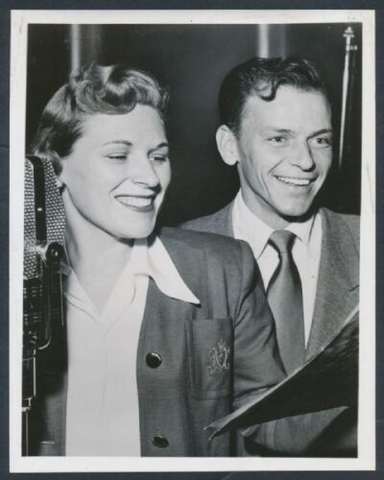
Eileen Wilson & Frank Sinatra
June 1949
[A State Committee Brands Sinatra A Communist Sympathizer]
Nancy Sinatra: During Senator Joseph McCarthy's red-baiting campaign, California's state counterpart to the House Un-American Activities Committee publicly named Frank, a prominent civil-rights and Democratic Party supporter, as someone who had "followed or appeased" Communist Party positions. Nothing came of the investigation, though Frank watched some friends' careers destroyed by similar accusations.
Source: Nancy Sinatra, Frank Sinatra: An American Legend, 1995.
[Frankly Sentimental fails to chart]
Kaplan: Sinatra's album Frankly Sentimental, released in June 1949, failed to chart at all -- a first for him; his 1949 singles spent 59 weeks on the charts collectively but none rose above number 6.
Source: James Kaplan, "Frank: The Voice" (2010)
June 2, 1949
Concerts
Mead Auditorium, John Muir College, Pasadena, CA
Dinah Shore was to have performed as well but was unavailable
Note: Sinatra’s second appearance at John Muir College. He first appeared on June 15th, 1948
Mead Auditorium, John Muir College, Pasadena, CA
Dinah Shore was to have performed as well but was unavailable
Note: Sinatra’s second appearance at John Muir College. He first appeared on June 15th, 1948
[image referenced in source but could not be recovered]
[image referenced in source but could not be recovered]
June 8, 1949
Radio
(NBC) promo
15 Minutes
Hollywood Light Up Time Audition -
NBC w/ Dorothy Kirsten,
Orchestra conducted by Johnny Green
1. Opening Theme
2. Night And Day
3. It All Depends On You
4. Again
5. I'm In Love With A Wonderful Guy Dorothy Kirsten
6. Some Enchanted Evening W/Dorothy Kirsten
7. Put Your Dreams Away
NOTE: Sinatra Scholar Ed O'Brien points out that this promo was Sinatra's audition for the Light Up Time radio show.
His reading of "Again" is the best vocal of the song O'Brien has ever heard. And, oh, yes, Sinatra got the gig!
note: Stordahl was never associated with the
Light Up Time show. For some reason, the sponsor did not want him. Frank started out with Jeff Alexander, then Ziggy Elman took over for 14 shows until Alexander returned, finally Skitch Henderson took over in early March 1950 for the duration.
Johnny Green conducted on the audition taping.
Ed
(NBC) promo
Produced as audition disc for local network affiliates
Arranged by Axel Stordahl
Conducted by Axel Stordahl
1. Opening Theme
2. Night And Day
3. It All Depends On You
4. Again
Variety
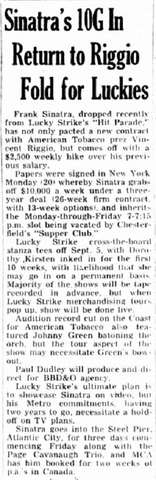
June 23, 1949
Concerts
Purdue University, West Lafayette, Indiana
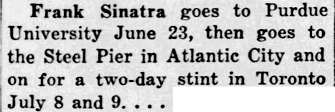

June 24, 1949
Concerts
Steel Pier, Atlantic City, New Jersey (24-26)
Attendance total: 41,000
Steel Pier, Atlantic City, New Jersey (24-26)
Back to the Boardwalk
By Jeremy Egner September 16, 2010
Vicki Gold Levi has lived in Manhattan for more than 40 years, but she still has sand in her shoes.
That’s how the Atlantic City native describes her ties to the ever-evolving entertainment hub, whose Prohibition-era past as a hot spot for bootleg liquor and organized crime inspired “Boardwalk Empire,” the lavish HBO drama starting on Sunday.
Ms. Gold Levi, an author and unofficial historian and ambassador for Atlantic City, was a consultant on the series, which was filmed largely in Greenpoint, Brooklyn, on a miniature version of the famed Boardwalk. ( Watch a time-lapse video of the set’s construction.)
The self-described “daughter of Atlantic City” comes by the title honestly. Her father, Al Gold, was chief photographer of the city from 1939 until his death in 1964, documenting the earliest Miss America pageants, the actors and singers who traveled through, and the high-diving horses, human cannonballs and other eccentric attractions from of the city’s colorful past.
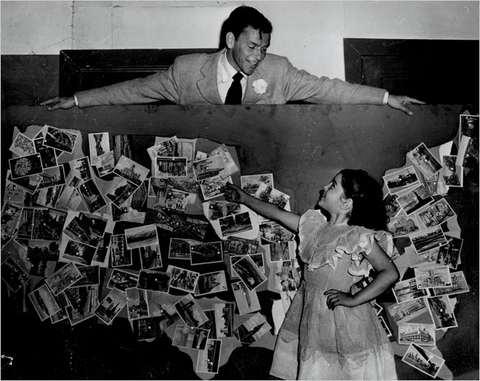
Vicki Gold with Frank Sinatra in 1949.
Mr. Gold’s position and popularity made for an eventful childhood for his daughter in the 1940s and ’50s Vicki had her own radio show at age 5, was an assistant to Bess Myerson when she became the first Jewish Miss America in 1945, and met many of the performers that worked in Atlantic City at the time.
One of her father’s photographs shows Ms. Gold Levi as a girl with a young Frank Sinatra and a bushel of the singer’s fan mail.
She went on to write “Atlantic City: 125 Years of Ocean Madness” with the former Esquire editor Lee Eisenberg, and has advised on a number of Atlantic City-themed films and series. She also co-founded the Atlantic City Historical Museum, situated on the city’s Garden Pier.
Below, Ms. Gold Levi discusses “Boardwalk Empire” and growing up amid the steel piers and salt water taffy.
Q.
What was your role in the “Boardwalk Empire” production?
A.
They would come to me with historical questions, or if they wanted a photograph or something from the era. I tracked down a 1920 telephone book for them, for example. Or they’d ask which theaters were down there at that time. What shows were there? Which stars were down there at that time? That kind of thing. I also gave them pictures of the architecture and clothing.
Q.
Were you satisfied with the look of the production?
A.
When I was on the Boardwalk in Brooklyn I felt like I was on my own Boardwalk, even though it was before my time. They got the herringbone pattern, they put in the knuckles we have knuckles in our rail in Atlantic City. The striped awnings, the hues of the hotels, the curves in architecture it was so spot on I just was blown away. Because I’ve worked on a lot of things where I thought, ‘Aw, they didn’t get that right.’ And this they got it right. Every time I went back to the “Boardwalk” set it was very emotional for me. It was just wonderful. (View a slide show highlighting the production design.)
Q.
You’ve lived in New York since the 1960s. Why have your ties to Atlantic City remained so strong?
A.
First of all, my father’s legacy is important to me. Second, I just loved growing up in Atlantic City. It was so exciting! You had the big bands when you went out for a date on Saturday night in the summer, you went to hear Benny Goodman! The giant ballrooms, the high-diving horse, the water circuses. You could see Sinatra three times a day at Steel Pier. It was an exciting place to be.
Q.
Your father photographed an interesting time in the city’s history.
A.
He shot all the presidents and Miss Americas. He shot Marilyn Monroe I have a picture of him kissing Marilyn Monroe. He was very well loved. … This is sort of what I was born into, the ballyhoo of Atlantic City. I actually met Nucky Johnson [the inspiration for the main character in “Boardwalk Empire”] when I was a little girl. I met some of these characters, and I knew even though my dad was a Roosevelt Democrat, he was voting Republican, that’s for sure.
Q.
That was the rule?
A.
It was if you wanted to keep your job.
Q.
Do you remember anything about Johnson?
A.
What I remember better than Nucky was his wife, Flossie [Florence] Osbeck, because she had these giant red nails. I’d never seen nails so long and so red. She was a very beautiful showgirl. I remembered that more than him. She married him right before he went to jail [in 1941].
Q.
The casinos and time have turned Atlantic City into a very different place from what it was when you were growing up. Does it still feel like home?
A.
In the movie “Atlantic City,” Burt Lancaster has this great line, and I’m paraphrasing: … “If you think it’s something now, you should have seen it 30 years ago.” … Or something like that. You always have the Boardwalk, you always have the salt air and you always have the beach. … Atlantic City is always like a phoenix rising out of the flames. In the beginning they had wooden hotels that burnt, and then they had mosquito infestation and then the whole city was taken over by the Army Air Force in ’44. The casinos are another period of that. So I go with the flow, so to speak.
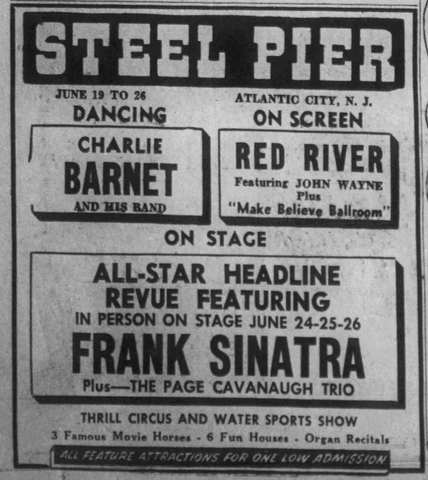
June 25, 1949
Concerts
Steel Pier, Atlantic City, New Jersey (24-26)
Attendance total: 41,000
Ed O'Brien:
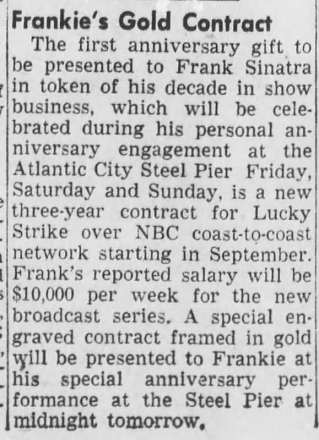
George Hamid, owner of the club, paid Frank $12,500 for the engagement from June 24-26.
Billboard
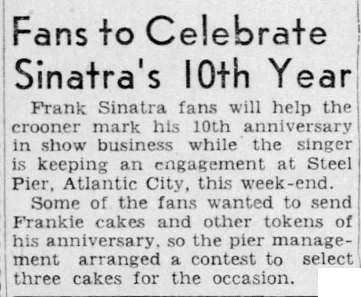
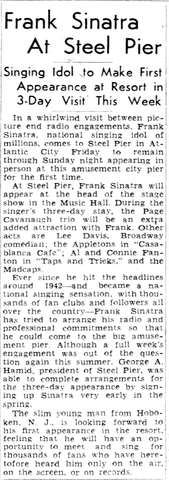
Atlantic City, July 2 --- To get the 52nd year under way, Steel Pier brought in Frank Sinatra to head the array of attractions June 24-26. With inland heat wave driving crowds to shore spots, pre-Fourth of July business all over Atlantic City was of holiday proportions.
SINATRA - MBS DEAL FLOPPOS
HOLLYWOOD, June 25 -- Frank
Sinatra's lingering negotiations with Mutual Broadcasting System ( MBS ) have quietly died, following the signing of The Voice by American Tobacco last week ( The Billboard, June 25 ). Sinatra was to have starred on a new disc jockey series for co-op bankrolling, and had passed first hurdles of contract negotiations, including approval of deal by MGM pix.
It was admitted this week, however, that Sinatra's signing with Lucky Strikes for a five-a-week musical strip precluded acceptance of a second series on MBS.
Billboard
July 2, 1949
Note: Billboard had covered the protracted negotiations with MBS for months. Sinatra was also negotiating with
NBC for a 15 minute Monday thru Friday musical show. An audition tape was done on 6-8-49 with Dorothy Kirsten, as his co-star, and MGM's Johnny Green conducting. Axel Stordahl was not part of Frank's future plans on radio. The Mutual show and the NBC Light Up Time were initially acceptable to all parties involved. Frank was no stranger to the demands of multiple radio series running each week. At one point in the discussions, Coca-Cola was very interested in sponsoring one of the series. Frank's series on NBC would run from September, 1949, until June, 1950. NBC would broadcast 195 shows. Frank would appear in 176 of them. He missed 19 shows while recovering from the throat hemorrhage that occurred at the Copa, May 2, 1950. Although Sinatra was not selling many records in 1949, he was still much sought after by radio and TV networks as the 1940s came to a close.
--Ed
-----------------------------------------
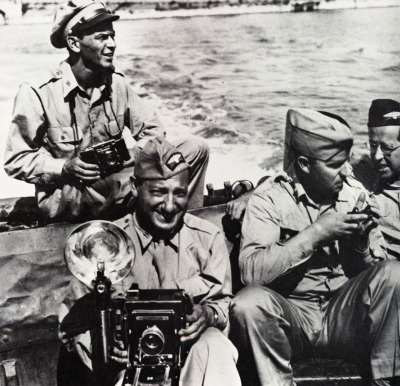
June 23, 1945 Italy
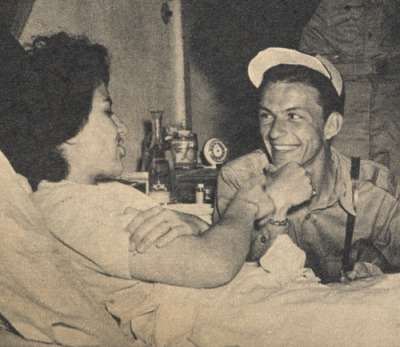
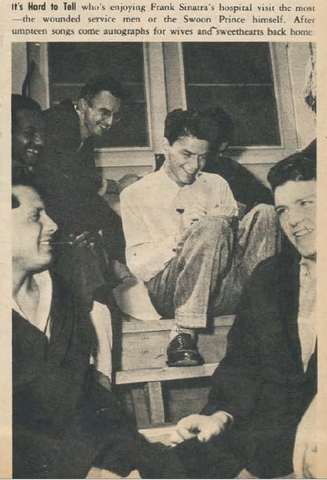
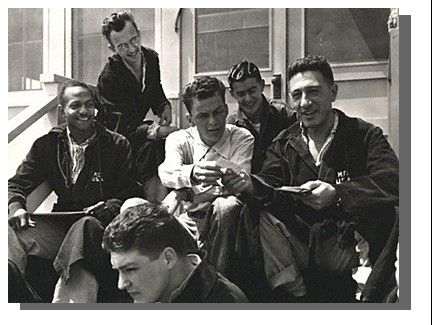
USO Tour: Frank Sinatra, Phil Silvers, Betty Yeaton, Fay McKenzie, and composer and pianist Saul Chaplin
with credit to Carl R:
Original caption: Sgt. Chickie Leone, WAC, had a visit in the hospital at Capri, Italy. Frank spent seven weeks in European Theater, singing and playing fall-guy for comedian Phil Silvers – won GI’s praise.
Original caption: Sgt. Chicki Leone, WAC, had a visit in the hospital at Capri, Italy. Frank spent seven weeks in European Theater, singing and playing fall-guy for comedian Phil Silvers – won GI’s praise.
Allied Forces Army Hospital, Isle of Capri.
Photos from the tour, location unknown:
Frank Sinatra and Phil Silvers, USO tour, 1945
June 26, 1949
Concerts
Steel Pier, Atlantic City, New Jersey (24-26)
Attendance total: 41,000
June 29, 1949
Concerts
Shibe Park, Philadelphia, PA
Sinatra received a Scroll of Honor from Variety Club and sang several songs
Shibe Park, Philadelphia, PA
Sinatra received a Scroll of Honor from Variety Club and sang several songs
[image referenced in source but could not be recovered]
[image referenced in source but could not be recovered]
Summer 1949
With his career sliding — Down Beat had just dropped him to the number five spot among male singers, his lowest ranking since the late 1930s — Frank Sinatra nonetheless bought a three-acre estate at 320 Carolwood Drive in Holmby Hills for $250,000, complete with a pool, badminton court, and citrus orchard. He could not really afford it, adding new financial pressure to an already strained life, but the family's new home would become a cherished setting for his children's memories. Source: J. Randy Taraborrelli, Sinatra: Behind the Legend.
[Frank And Ava's First Night Together]
Nancy Sinatra: Ava Gardner later wrote that after returning to Hollywood on another date with Frank, they went to a small house in Nichols Canyon and slept together for the first time, an encounter she described as pure magic that made them "lovers eternally."
Source: Nancy Sinatra, Frank Sinatra: An American Legend, 1995.
[Light Up Time Debuts With Dorothy Kirsten]
In 1949 the Lucky Strike-sponsored radio show "Light Up Time" began, teaming Sinatra with Metropolitan Opera star Dorothy Kirsten for a three-year run.
Source: Nancy Sinatra, "Frank Sinatra, My Father" (1985).
[MGM's Silver Jubilee Group Portrait]
Sinatra appeared in MGM's star-studded Silver Jubilee group portrait of 1949, alongside stars including Clark Gable, Judy Garland, Katharine Hepburn, and Elizabeth Taylor.
Source: Nancy Sinatra, "Frank Sinatra, My Father" (1985).
[Neighborhood Terrors On Carolwood Drive]
Nancy Sinatra: After the family moved to a Los Angeles mansion on Carolwood Drive, Nancy recalled that she, her brother, and a neighborhood boy were the only kids on the street and made a habit of tormenting the neighbors, treating the block as their own private territory.
Source: Nancy Sinatra, Frank Sinatra: An American Legend, 1995.
[Beatty divorces first husband]
Kaplan: Adelle Dillingham divorced her first husband, William O'Connor, a deputy attorney general of California, in 1949.
Source: James Kaplan, "Sinatra: The Chairman" (2015)
[Cohn's bedside visit during Sinatra's illness]
Bob Thomas: In fall 1949, after Sinatra arranged for Columbia's Miss Grant Takes Richmond to premiere at the Capitol during his personal appearance (boosting its box office), he fell seriously ill with strep throat requiring an oxygen tent at Manie Sacks's apartment. Harry Cohn, per biographer Bob Thomas, flew to New York and spent much of the day at his bedside, reading to him and reminiscing, warning him afterward, 'You tell anybody about this... I'll kill you.'
Source: James Kaplan, "Frank: The Voice" (2010)
[Death of a Salesman premiere / Lee J. Cobb]
Consiglio: Lee J. Cobb originated the role of Willy Loman when Arthur Miller's Death of a Salesman premiered on stage in 1949.
Source: Tony Consiglio (as told to Franz Douskey), "Sinatra and Me: The Very Good Years" (2012)
[Dinah Shore and Mitchell Ayres defect to Victor]
Kaplan: As Sinatra's career flatlined, Columbia artists Dinah Shore and arranger/producer Mitchell Ayres defected to RCA Victor, which had launched the competing 45-rpm format against Columbia's LP.
Source: James Kaplan, "Frank: The Voice" (2010)
[DownBeat drops Frank as top vocalist]
Consiglio: 1949 was the first year in a long stretch that DownBeat magazine did not name Frank the most popular male vocalist, reflecting his declining record sales; singer Lawrence Tibbett also replaced him on Your Hit Parade around this period.
Source: Tony Consiglio (as told to Franz Douskey), "Sinatra and Me: The Very Good Years" (2012)
[Eddie Fisher signs with RCA Victor]
Kaplan: Eddie Fisher, a young singer discovered by Eddie Cantor, signed with RCA Victor in 1949 at age twenty-one, beginning his rapid rise as Sinatra's chief young rival.
Source: James Kaplan, "Frank: The Voice" (2010)
[Escalating conflict between Sinatra and George Evans]
Kaplan: In the first weeks of February 1949, transcontinental shouting matches escalated between Sinatra and publicist George Evans, who knew about the Ava affair and was caught between an enraged Frank and a distraught Nancy demanding he fix the marriage.
Source: James Kaplan, "Frank: The Voice" (2010)
[Frank Jr.'s childhood trauma]
Tina Sinatra (via Kaplan): When Frank Sinatra left his young family for Ava Gardner in 1949, his son Franklin Wayne Emanuel Sinatra was five years old -- 'the worst possible time,' according to Tina Sinatra, who said her brother felt bewildered, abandoned, and quietly traumatized.
Source: James Kaplan, "Sinatra: The Chairman" (2015)
[George Evans predicts Sinatra's professional death]
George Evans / Earl Wilson: Publicist George Evans told columnist Earl Wilson at the Copacabana that Sinatra was professionally finished, saying the public no longer cared for him due to the scandal with Nancy and other women, and predicting he'd be forgotten within a year.
Source: James Kaplan, "Frank: The Voice" (2010)
[Lee Mortimer declares "The Swoon" over]
Lee Mortimer: Columnist Lee Mortimer wrote in his Daily Mirror column that "The Swoon is real gone," characterizing the wartime Sinatra hysteria as merely an "unhealthy wartime phenomenon" now passed.
Source: James Kaplan, "Frank: The Voice" (2010)
[Mayer warns Sinatra and Gardner over public affair]
Kaplan: Louis B. Mayer warned Sinatra and Gardner that their contracts were in jeopardy if they didn't stop their public carryings-on, concerned about the challenge to his authority amid MGM's declining fortunes with the rise of television.
Source: James Kaplan, "Frank: The Voice" (2010)
[Mogambo]
Sinatra and Ava Gardner's love affair began in earnest in early 1949 (he was 34, she 27), after having first met casually while she was still married to Mickey Rooney. Gardner, then a much bigger star than Sinatra, would later play a direct role in helping him land the Eternity role.
No corresponding dated entry could be identified in the chronology for this film/context.
Source: Tom Santopietro, "Sinatra in Hollywood" (2008), Ava and the Downfall / The Comeback
[NAACP benefit concert at Carnegie Hall]
Consiglio: In 1949 Sinatra performed at an NAACP benefit at Carnegie Hall despite advisors warning it could hurt his career. He waived his fee and donated a large sum on top of it.
Source: Tony Consiglio (as told to Franz Douskey), "Sinatra and Me: The Very Good Years" (2012)
[On the Town]
On the Town is now remembered chiefly for pioneering location filming; its opening 'New York, New York' number, shot on real New York City streets, made it the first musical widely credited with breaking out of the studio, though Santopietro notes Sinatra's own 'Brooklyn Bridge' number and a Fred Astaire golf sequence in Damsel in Distress had used location work earlier.
No corresponding dated entry could be identified in the chronology for this film/context.
Source: Tom Santopietro, "Sinatra in Hollywood" (2008), All Over the Map
[On the Town]
Time magazine: On the Town, released December 30, 1949, broke box office records at Radio City Music Hall and drew rave reviews, most focused on Gene Kelly; Time magazine praised its 'airy imagination and solid showmanship.'
No corresponding dated entry could be identified in the chronology for this film/context.
Source: Tom Santopietro, "Sinatra in Hollywood" (2008), All Over the Map
[On the Town]
Santopietro grades this an A, calling it groundbreaking—"a musical peak."
No corresponding dated entry could be identified in the chronology for this film/context.
Source: Tom Santopietro, "Sinatra in Hollywood" (2008), Career Scorecard
[On the Town premiere]
Consiglio: Frank attended the invitation-only premiere of On the Town with Gene Kelly and Ann Miller in 1949. Consiglio went with him; Ava Gardner was there with her sister, whom Frank seated next to Consiglio.
Source: Tony Consiglio (as told to Franz Douskey), "Sinatra and Me: The Very Good Years" (2012)
[On the Town released to acclaim and strong box office]
Kaplan / Motion Picture Daily: On the Town, adapted by Betty Comden and Adolph Green from the Jerome Robbins/Leonard Bernstein ballet Fancy Free, received splendid reviews and set box-office records at Radio City, per Motion Picture Daily, though the picture was regarded as Gene Kelly's triumph rather than Sinatra's.
Source: James Kaplan, "Frank: The Voice" (2010)
[Sinatra falls in year-end popularity polls]
Kaplan: Billboard's year-end poll ranked Sinatra number 13 for 1949; Down Beat's poll placed him at number 5. Perry Como was the year's top male singer, with Frankie Laine also rising in popularity.
Source: James Kaplan, "Frank: The Voice" (2010)
[Sinatra finds Lana Turner with a woman]
Consiglio: In late 1949, with his romance with Lana Turner cooling (an affair that had caused his split from Nancy), Sinatra returned unannounced to the Palm Springs house he let Turner use and found her in bed with a woman -- later identified to Consiglio only as 'Ava something.' Turner called the house repeatedly afterward and Consiglio, on Sinatra's signal, kept telling her Frank was unavailable.
Source: Tony Consiglio (as told to Franz Douskey), "Sinatra and Me: The Very Good Years" (2012)
[Sparse recording activity in late 1949]
Kaplan: Between September and the end of 1949, Sinatra recorded just eight songs across three sessions; for the full year he cut only 27 sides, compared with 70 in 1947 before the strike.
Source: James Kaplan, "Frank: The Voice" (2010)
[Sucker punch at Palm Springs party]
Vincent X. Flaherty / Kaplan: At a party in Palm Springs, Sinatra sucker-punched a retired businessman, Jack Wintermeyer, who was bartending and couldn't make the drink Frank wanted; Sinatra avoided a lawsuit by agreeing to apologize, then reneged and shook hands silently instead. Columnist Vincent X. Flaherty, who witnessed it, wrote that Sinatra simply couldn't bear to apologize regardless of the cost.
Source: James Kaplan, "Frank: The Voice" (2010)
[Dick Haymes marries Errol Flynn's ex-wife]
Amid a career decline, Dick Haymes married Nora Eddington, the former wife of actor Errol Flynn, in 1949.
Source: Richard Havers, "Sinatra" (Dorling Kindersley, 2007).
[Melody Maker praises Frank/Pearl Bailey pairing]
When the Frank Sinatra/Pearl Bailey duet was finally released in 1949, Melody Maker praised the genius of teaming the two singers, though the record made no impact on the charts.
Source: Richard Havers, "Sinatra" (Dorling Kindersley, 2007).
[MGM 25th anniversary photo shoot reunites Frank and Ava]
MGM staged a photo shoot marking the studio's 25th anniversary, inviting both Frank and Ava Gardner to appear together. They chatted there, then met again about a month later at a party in Palm Springs, where Ava was renting a house.
Source: Richard Havers, "Sinatra" (Dorling Kindersley, 2007).
[Nelson Riddle's pivotal ghost-arranging work on 'Mona Lisa']
In late 1949, arranger Les Baxter enlisted Nelson Riddle to arrange "Mona Lisa" for Nat King Cole, work for which Baxter still often receives credit; Riddle also ghost-arranged "Too Young." The book identifies this as the pivotal moment that set Riddle on the path toward eventually working closely with Frank Sinatra.
Source: Richard Havers, "Sinatra" (Dorling Kindersley, 2007).
[Vic Damone tops charts with 'You're Breaking My Heart']
Vic Damone, admittedly inspired by Sinatra's singing, topped the charts in 1949 with 'You're Breaking My Heart.'
Source: Richard Havers, "Sinatra" (Dorling Kindersley, 2007).
[Bye Bye Baby -- critical commentary]
Friedwald (analysis): Sinatra attended the December 8, 1949 Broadway opening of Gentlemen Prefer Blondes (source of 'Bye Bye Baby,' which he had recorded that July) -- one of the first times he was seen publicly with Ava Gardner.
Source: Will Friedwald, "Sinatra! The Song Is You: A Singer's Art" (2018 revised edition), Ch. 5, "In-Between Years" (1948-1953)
[Bye Bye Baby / Just a Kiss Apart -- critical commentary]
'Bye Bye Baby,' written by Leo Robin and Jule Styne for the then-unopened show Gentlemen Prefer Blondes, was recorded with the vocal group the Pastels (David Vogel, Jerry Packer, Naomi Sunshine, Lillian Clark) on July 10, 1949, making Sinatra first to record any song from the score due to his friendship with Styne. Within the week he also recorded 'Just a Kiss Apart' from the same show in New York, was dissatisfied, and re-recorded it in Hollywood on July 21; both songs were released on the same single.
Source: Charles L. Granata, "Sessions with Sinatra: Frank Sinatra and the Art of Recording" (1999/2003), Part II: The Columbia Years, 1943-1952
[Frankly Sentimental -- critical commentary]
Granata lists this Axel Stordahl-arranged album, released as a 78 rpm set (C-185) in June 1949 and 10-inch LP (CL-6059) in July 1949, including 'Body and Soul,' 'Laura,' and 'One for My Baby (and One More for the Road).'
Source: Charles L. Granata, "Sessions with Sinatra: Frank Sinatra and the Art of Recording" (1999/2003), Afterword & Appendices A-D
[There's a Flaw in My Flue -- critical commentary]
'There's a Flaw in My Flue' originated in a WWII soldiers-only Crosby broadcast segment called 'Your All-Time Flop Parade' (a parody of Sinatra's own Lucky Strike Hit Parade), written by Johnny Burke and Jimmy Van Heusen; it was introduced by Crosby and Ethel Merman on Philco Radio Time, March 23, 1949. Nancy Sinatra reportedly said her father recorded it as a gag to test whether Capitol's Voyle Gilmore would catch on to the joke (lines like 'smoke gets in my nose'); Sinatra sang it so sincerely it nearly made the final Close to You track list before he tipped his hand.
Source: Will Friedwald, "Sinatra! The Song Is You: A Singer's Art" (2018 revised edition), Ch. 6, "With Nelson Riddle" (1953-1979)
[history -- critical commentary]
Before 1949 Capitol leased studio time at C.P. McGregor Studios and Radio Recorders in Hollywood; in 1949 the company purchased the former KHJ Radio Studios building at 5515 Melrose Avenue, which became its recording home through the mid-1950s.
Source: Charles L. Granata, "Sessions with Sinatra: Frank Sinatra and the Art of Recording" (1999/2003), Part III: The Capitol Years, 1953-1962
[song selection philosophy -- critical commentary]
Sinatra: In a 1949 interview with New York disc jockey Jack Ellsworth, Sinatra said an artist is generally only as good as the material he's given, framing his career-long emphasis on careful song selection.
Source: Charles L. Granata, "Sessions with Sinatra: Frank Sinatra and the Art of Recording" (1999/2003), Part I: The Big Band Years, 1937-1942
[studio -- critical commentary]
Howard Scott: Columbia purchased a former Greek Orthodox church at 205 East 30th Street in Manhattan and converted it into the studio that became legendary as '30th Street'; producer Howard Scott recalled scouting the site with Bill Bachman and Vin Liebler, and that the building had briefly housed radio station WLIB. Many of Sinatra's 1949-1952 recordings were made there.
Source: Charles L. Granata, "Sessions with Sinatra: Frank Sinatra and the Art of Recording" (1999/2003), Part II: The Columbia Years, 1943-1952
[studio -- critical commentary]
Bill Savory / Frank Laico: The 30th Street studio was initially considered 'too live' by Columbia staff, but producer Goddard Lieberson embraced its flexibility while recording South Pacific there, calling it 'the most flexible place on Earth.' By 1950, Frank Laico said Mitch Miller also fell in love with the room and insisted nothing be changed to its acoustics, physically unattractive as it was.
Source: Charles L. Granata, "Sessions with Sinatra: Frank Sinatra and the Art of Recording" (1999/2003), Part II: The Columbia Years, 1943-1952
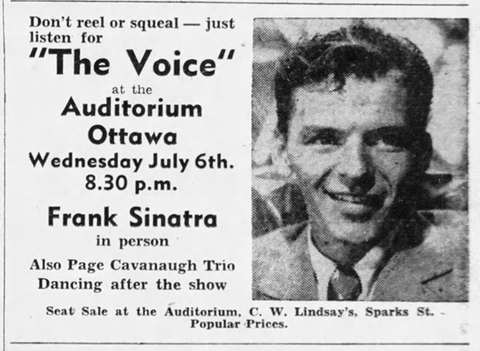
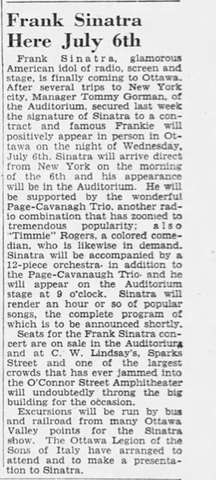
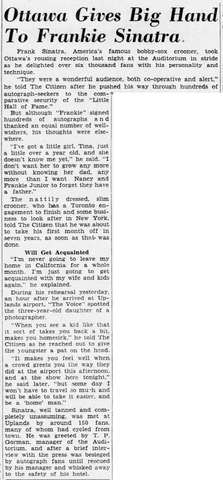
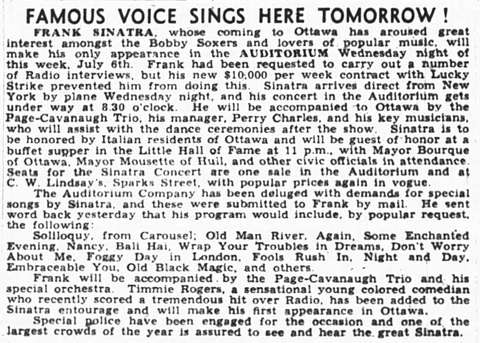
July 6, 1949
Concerts
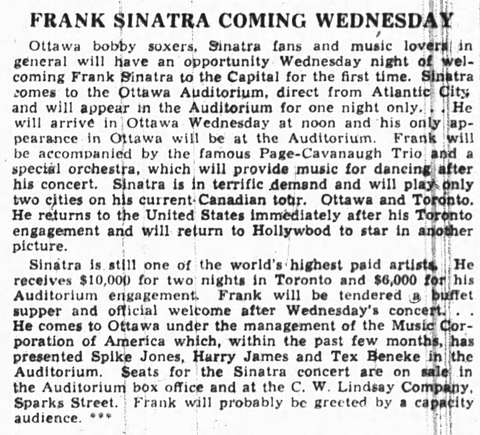
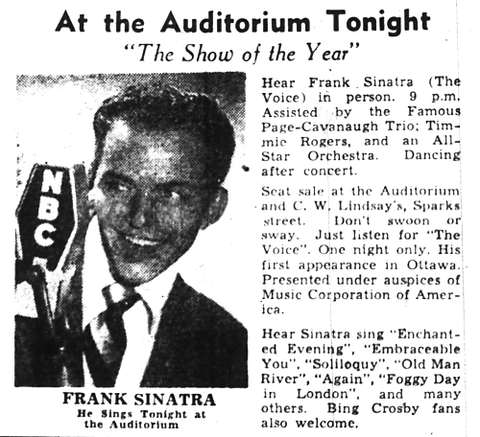
Auditorium, Ottawa, Canada
Time: 9:00 P.M.
Rehearsal: 4:00 P.M.
Lineup: Sinatra, Page Cavanaugh Trio, Timmie Rogers (Comedian)
Orchestra (12 piece)
Songs scheduled to be performed by special request:
1. Soliloquy
2. Ol' Man River
3. Again
4.. Some Enchanted Evening
5. The Hucklebuck
6. Bali Hai
7. Wrap Your Trouble In Dreams
8. Don't Worry 'bout Me
9. A Foggy Day
10. Fools Rush In
11. Night And Day
12. That Old Black Magic
Verified:
1. Nancy
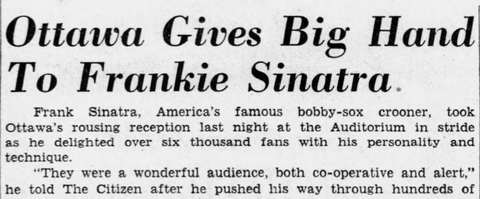
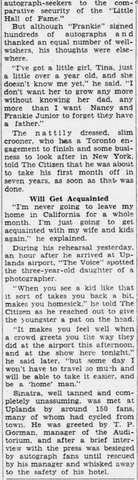
Notes: Attendance over 6000.
Auditorium, Ottawa, Canada
Time: 9:00 P.M.
Rehearsal: 4:00 P.M.
Lineup: Sinatra, Page Cavanaugh Trio, Timmie Rogers (Comedian)
Orchestra (12 piece)
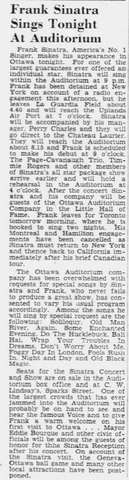
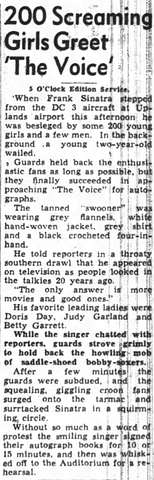
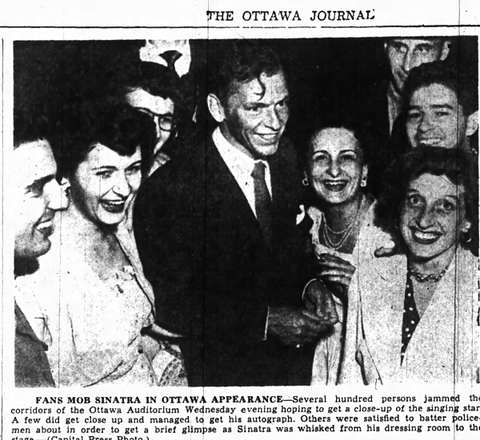
July 6, 1949 would be only one of two performances that Sinatra would ever perform in Ottawa, Canada’s capital. He would next perform in Ottawa in 1982. In 1949 Sinatra embarked on a short Canadian tour along with the Page Cavanaugh Trio & comedian Timmie Rogers. Sinatra performed a 4:00 PM rehearsal with a twelve piece orchestra plus Page's trio. Requests were made ahead of time for song selections. Among the songs confirmed to be on the program were “Soliloquy”, “Old Man River”, “Again”, “Some Enchanted Evening“, “Nancy”,, “Bali Hai“, “Wrap Your Troubles In Dreams“, “Don't Worry About Me”, “A Foggy Day In London”, “Embraceable You”, “Old Black Magic”, “Fools Rush In”, “Night And Day”, and “Old Black Magic.”
--Scott
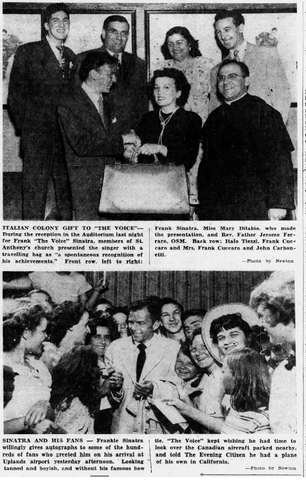

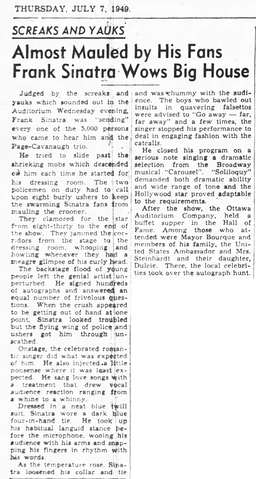
Auditorium, Ottawa, Canada
Time: 9:00 P.M.
Rehearsal: 4:00 P.M.
Lineup: Sinatra, Page Cavanaugh Trio, Timmie Rogers (Comedian)
Orchestra (12 piece)
Songs scheduled to be performed by special request:
1. Soliloquy
2. Ol' Man River
3. Again
4.. Some Enchanted Evening
5. The Hucklebuck
6. Bali Hai
7. Wrap Your Trouble In Dreams
8. Don't Worry 'bout Me
9. A Foggy Day
10. Fools Rush In
11. Night And Day
12. That Old Black Magic
note: Frank would re-record nine of the songs during the Capitol - Reprise years
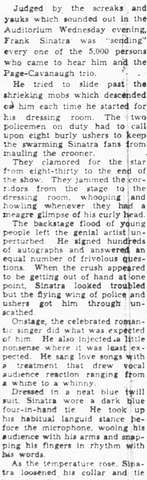
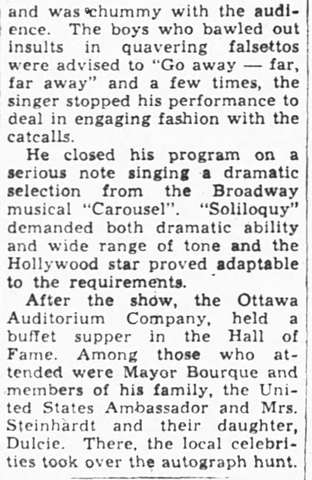
Frank gives a detailed explanation of why he canceled
Montreal and Hamiltion in this article
Auditorium, Ottawa, Canada (Contd)
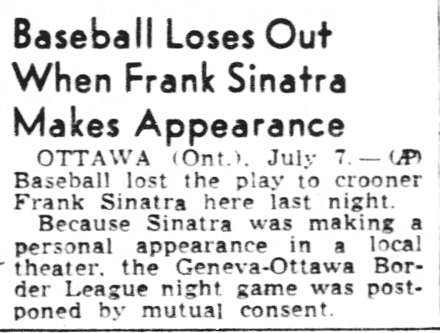
July 7, 1949
.
How exactly do they explain Ottawa that night and then two concerts
on Friday and Saturday in Toronto ?
Ed
July 7, 1949, Hamilton Armouries, Hamilton, ON, Canada (Cancelled?)
I finally found an article from a Hamilton newspaper that mentions the reason behind the cancellation of the above show:
[image referenced in source but could not be recovered]
[image referenced in source but could not be recovered]
>> July 7, 1949, Hamilton Armouries, Hamilton, ON, Canada (Cancelled?) >>
>> Here's the ad that ran in the Hamilton Spectator on June 27th, 1949. It would also appear on June 28th but did not appear after that. >
>>
July 8, 1949
Concerts
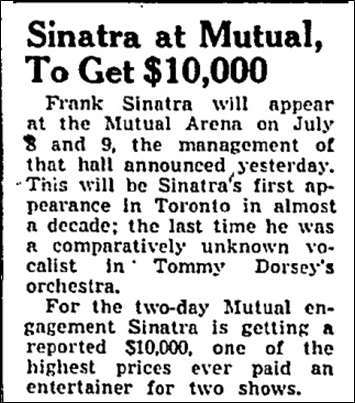
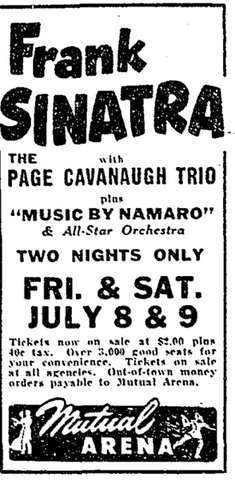
Mutual Arena, Toronto, Ontario (8-9)
Lineup: Sinatra, Page Cavanaugh Trio, Timmie Rogers (comedian)
Orchestra (12 piece)
Note: This would be Sinatra’s first solo appearance in Toronto after appearing there with Dorsey in '40 and '41.
Sinatra would not appear in Toronto again until 1975.
Mutual Arena, Toronto, Ontario (8-9)
Lineup: Sinatra, Page Cavanaugh Trio, Timmie Rogers (comedian)
Orchestra (12 piece) conducted By:
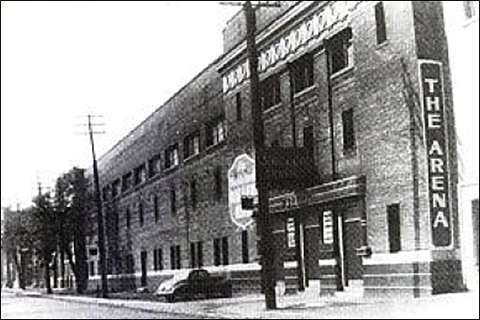
The Mutual Street Arena in the 1940s.
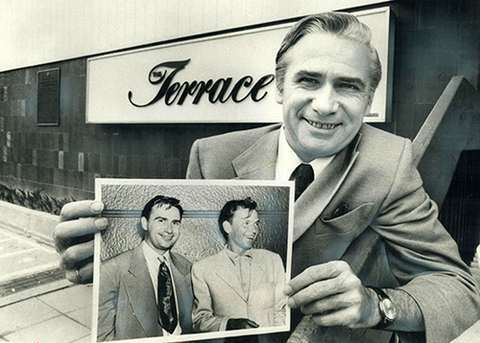
This would be Sinatra’s first solo appearance in Toronto. The two previous appearances were with Tommy Dorsey in 1940 and 1941 at the Canadian National Exhibition. Mutual Street Arena, initially called Arena Gardens or just The Arena, was an ice hockey arena and sports and entertainment venue in Toronto. The Arena was also used for musical concerts and gatherings. In 1962, it was converted to a curling club and roller skating rink known as The Terrace. The building was eventually demolished in 1989.
my apologies for the poor scan but here's what I think it says:
The Toronto Daily Star,
Toronto, Ontario,
July 9, 1949, Pg. 24
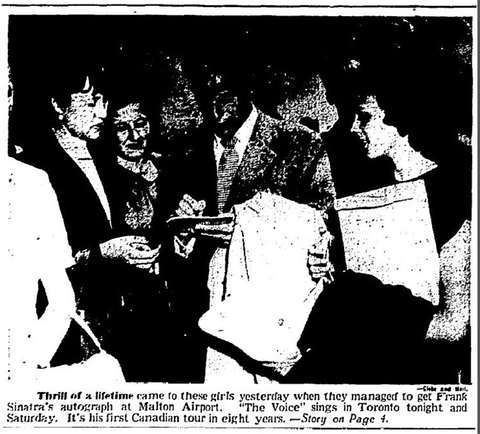
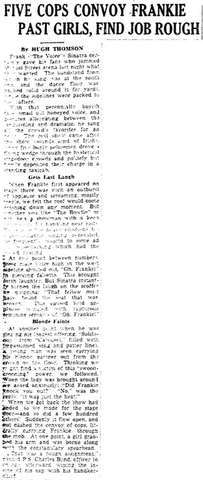
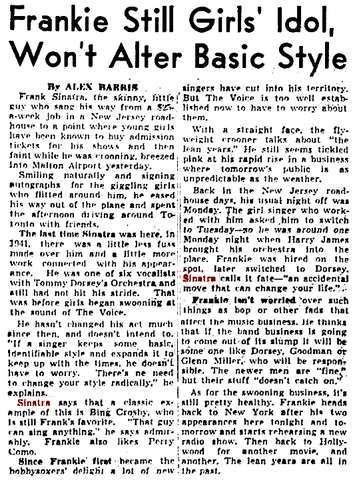
Frank "The Voice" Sinatra certainly gave his fans who jammed Mutual Street arena last night what they wanted. The bandstand from which he sang was at the south end and the dance floor was packed solid around it for yards, while the sidelines were packed to the rafters.
With that perennially boyish face small but honeyed voice, and gestures alternating between the anguishing and dramatic, he sang all the crowd's favorites for an hour. The real show came after the show, sounds kind of Irish, when five burly policemen drove a flying wedge through the hysterical stage-door crowds and politely but firmly deposited their charge in a standing taxicab. Gets Last Laugh
When Frankie first appeared on stage there was such an outburst of applause and screaming, mostly treble, we felt the roof would come crashing down any moment. But whether you like "The Bowtie" or not he's a showman with a keen ??? for handling near riots ????????? emotions ? ?????? singing generated, he frequently resorted to some ad-lib wisecracking which had the crowd roaring
At one point between numbers some male voice high in the west sideline shouted out "Oh, Frankie" in piercing falsetto. This brought forth laughter. But Sinatra instantly turned the laugh on the scoffer by quipping "That fellow must have found the seat that was broken." This caused loud applause mingled with rapturous feminine screams of "Oh, Frankie!"
Blonde Faints
At another point when he was singing his longest offering, "Soliloquy" from "Carousel” filled with impassioned song and patter lines, a young man was seen carrying his blonde partner out from the crowd on the floor. Thinking we might find a victim of this "swoon-crooning" power, we followed. When the lady was brought around we asked anxiously: "Did Franke know you out?" "No." was the replay, "it was just the heat!"
When we got back the show had ended so we made for the stage door--and so did a few hundred others! Suddenly it flew open, and out dashed the convoy of cops, literally carrying Frankie through the mob. At one point, a girl grabbed his arm and was borne along with the constabulary spearhead.
"That was a rough assignment," panted PS Charles Bond, officer in charge, afterward wiping the inside of his cap with his handkerchief!
“Memories: Ted Dickson was manager of Mutual Street Arena (now The Terrace) in 1949 when Frank Sinatra made his only other Toronto appearance.” Photo by Ron Bull, published in the May 3, 1975 edition of the Toronto Star. Toronto Public Library, Toronto Star Photo Archive
When Frank Sinatra played two shows at the Arena in July 1949, promoters shelled out $10,000 for the crooner. Due to lousy weather, they wound up losing $3,000. In a 1975 interview, Arena manager Ted Dickson recalled the atmosphere surrounding Old Blue Eyes at the time:
He wasn’t on top at the time, you understand, but when he stayed at the Royal York a wing of the building was reserved for him and his entourage. People were still excited by him, though. They were always hanging around his room, trying to see him. And I remember we had requests for tickets–then they cost only $2–from places like Buffalo, Sudbury, and North Bay.
Radio hosts Wally Crouter and Bruce Smith both sensed a sadness around Sinatra at this point in his career. At a press party, Smith noticed that he “sat and talked to people for a couple of hours, and it was as if he had to talk to them.” Crouter observed how reserved Sinatra was at an after-concert gathering, and how “he was so quiet.”
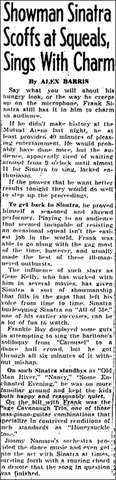
Reviewing the first show, the Globe and Mail‘s Alex Barris felt Sinatra was entertaining despite nearly a two-hour delay.
He proved himself a seasoned and shrewd performer. Playing to an audience that seemed incapable of resisting an occasional squeal isn’t the easiest job in the world. Frank was able to go along with the gag most of the time, however, and usually made the best of these ill-mannered outbursts. The influence of such stars as Gene Kelly, who has worked with him in several movies, has given Sinatra a sort of showmanship that fills in the gaps that left his voice from time to time. Sinatra burlesquing Sinatra on “All of Me,” one of his earlier successes, can be a lot of fun to watch.
Sinatra would not perform again in Toronto until a pair of shows at Maple Leaf Gardens in May 1975.
----------------------------------------------
© 1997-2026 The Sinatra Archive
This calendar, or any parts thereof, may not be reproduced in any fashion whatsoever without the prior written permission of the publisher (The Sinatra Archive)
July 9, 1949
Concerts
Mutual Arena, Toronto, Ontario (8-9)
Lineup: Sinatra, Page Cavanaugh Trio, Timmie Rogers (comedian)
Orchestra (12 piece)
Note: Sinatra would not appear in Toronto again until 1975.
July 10, 1949
Studio
New York City
CO40951 It All Depends On You
(B.G. DeSylva/L. Brown/R. Henderson)
(from Big Boy)
De Sylva, Brown & Henderson Ross Jungnickel, Inc. (ASCAP) 1926 Arranged by George Siravo
Conducted by Hugo Winterhalter
-1 (2:43) CD: Columbia Years 43-52 Vol. 11
LP: C6X-40343 The Voice-The Columbia years, 43-52
LP: CL-606 Frankie
78: 38999
78: 38550
CO40952 Bye Bye Baby w/The Pastels
(J. Styne/L. Robin)
(from Gentlemen Perfer Blondes)
J.J. Robbins & Sons (ASCAP) 1949
Arranged by George Siravo & Sid Cooper
Conducted by Hugo Winterhalter
-1 (2:37) CD: Columbia Years 43-52 Vol. 11
LP: CL-1241 Love Is A Kick (alt take)
78: 38556
CO40953 Don't Cry Joe (Let Her Go, Let Her Go) w/The Pastels
(J. Marsala)
T.B. Harms, Inc. (ASCAP) 1949
Arranged by Sy Oliver
Conducted by Hugo Winterhalter
-1 (3:17) CD: Columbia Years 43-52 Vol. 11
-2 (3:18) CD: C2K 65244Portrait Of Sinatra
-2 LP: CL-902 That Old Feeling (alt take)
-1 78: 38555
Trumpets: Y. Lawson, C. Poole, R. Solomon; Trombones: J. D'Agostino, B. Morrorrow, W. Pritchard; Saxes: E. Caceres, S. Cooper, N. Mondello, H. Ross, W. Taninbaum; Piano: J. Guarnieri; Guitar: A. Caiola; Bass: H. Alpert; Drums: T. Snyder
note: The Pastels were David Vogel, Naomi Sunshine, Jerry Packer and Lillian Clark. Frank did three takes on "It All Depends On You," five on "Bye, Bye Baby" and four on "Don't Cry, Joe."
A segment of the session for "It All Depends On You" is available on "Sing And Dance With Frank Sinatra" IMPEX Records IMP 831
I understand there are plans to release session material from the "Bye, Bye Baby" session.
Ed
NOTE: Sinatra Scholar Ed O'Brien writes that Lil Oliver, Sy's wife, was one of the Pastels at this session. She told O'Brien that Sinatra was in a great mood because he was thrilled to be doing what he considered to be quality material. Jack Ellsworth interviewed Sinatra the next day and he expounded on his criticism of the pop music scene, the dearth of decent material, and his frustration with so many "amateur" writers publishing songs.
Ed O'Brien (2011):
A few months ago I interviewed Sid Cooper. He not only played on this session but co-arranged two of the songs. Sid lives down in Florida and is 91 years old. He remembered many details about that evening more than 60 years ago. Sid would become a regular on all of Frank's sessions and concerts, on the east coast, in the post-retirement years. Sid also did the
European and South American tours. He told me some great stories about recording with Frank and being on stage with him at Carnegie Hall, RCMH and many other venues. Sid was kind enough to send me a copy of his autobiography "It Looked So Good In The Window.."
There are a lot of fascinating Sinatra stories in the book.
Radio
Norman Corwin Presents Citizens Of The World
Network: CBS
Sunday evening
Time: 9:00 PM - 10:00 PM
Ed O'Brien:
Theme: making the world a better place and promoting the U.N.
Appearances by politicians, statesmen, average citizens and celebrities.
Sinatra expressed his opinions regarding a better world. note: I have two half-hour shows Corwin produced with an array of Hollywood stars. Both shows were
Corwin's response to the HUAC. A who's who of
Tinseltown's biggest names. Corwin celebrated his 100th birthday in May...
Television
NONE
"It All Depends on You" / "Bye Bye Baby"
At a 30th Street Studio session, Sinatra worked with arranger Sy Oliver and conductor Hugo Winterhalter on George Siravo's jazz-flavored, string-less arrangement of 'It All Depends on You.' Because the chart needed last-minute revision and Siravo was on the West Coast, lead alto player Sid Cooper was brought in to rescore both this song and 'Bye Bye Baby.' A tenor sax solo by Wolfe Tanninbaum was cut to fit the 78rpm time limit.
Source: Charles L. Granata, "Sessions with Sinatra: Frank Sinatra and the Art of Recording" (1999/2003).
"It All Depends on You"
Sinatra actively directed the session's sonic details, asking to isolate and rebalance the trombone section, requesting softer playing from reeds and trumpets, checking with the drummer about excess boom on the bass drum (solved by adding a piece of carpet), and cueing the pianist for a rhythm balance check -- demonstrating his hands-on role as de facto producer.
Source: Charles L. Granata, "Sessions with Sinatra: Frank Sinatra and the Art of Recording" (1999/2003).
"Bye Bye Baby"
David Vogel: Pastels member David Vogel recalled the 'Bye Bye Baby' session specifically because the 30th Street studio, usually brightly lit, was kept dark except for the small area where the group worked. The session included extensive good-natured banter between Sinatra, producer Manie Sacks, and singer Naomi Sunshine, with multiple tempo adjustments and false starts before a satisfactory master was cut.
Source: Charles L. Granata, "Sessions with Sinatra: Frank Sinatra and the Art of Recording" (1999/2003).
[Detailed Columbia recording session at 30th Street Studio] Kaplan / Charles L. Granata: At an evening session at Columbia's 30th Street Studio in New York on July 10, 1949, arranged by George Siravo with Sy Oliver and conductor Hugo Winterhalter, Sinatra recorded "It All Depends on You," "Bye Bye Baby," and "Don't Cry Joe." Musicologist Charles L. Granata's transcription of the preserved safety discs shows Sinatra meticulously directing the musicians and engineers -- adjusting trombone placement, requesting carpet be added to dampen the bass drum, and fine-tuning rhythm section balance -- demonstrating his perfectionism as a recording artist.
Source: James Kaplan, "Frank: The Voice" (2010).
[It All Depends On You / Bye Bye Baby -- critical commentary]
Granata recommends this reissue of the 1950 10-inch LP with George Siravo as a companion recording; it restores the original eight Sing and Dance album tunes plus eleven other Siravo charts, including the original full-length version of 'It All Depends On You' and the slow-tempo alternate take of 'Bye Bye Baby.'
This song/context matches multiple dated entries in the chronology, or lacked a sufficiently precise date; the specific date could not be determined with confidence.
Source: Charles L. Granata, "Sessions with Sinatra: Frank Sinatra and the Art of Recording" (1999/2003), Afterword & Appendices A-D
[It All Depends on You -- critical commentary]
Will Friedwald: Cited as an example of Sinatra taking creative control in the control room during playback, editing sixteen bars out of an instrumental chorus he felt didn't serve the arrangement.
This song/context matches multiple dated entries in the chronology; the specific date Friedwald is referring to could not be determined with confidence.
Source: Will Friedwald, "Sinatra! The Song Is You: A Singer's Art" (2018 revised edition), Ch. 1, "Night and Day" (Sinatra style overview)
[It All Depends on You / Should I / You Do Something to Me / Lover / When You're Smiling / It's Only a Paper Moon / My Blue Heaven / The Continental -- critical commentary]
Will Friedwald: Sing and Dance with Frank Sinatra's eight tracks are cited by biographer Will Friedwald as 'the recordings that proved Sinatra really could swing,' and Sinatra later reprised six of the eight songs on his 1960 Nelson Riddle album Sinatra's Swingin' Session!!!
This song/context matches multiple dated entries in the chronology, or lacked a sufficiently precise date; the specific date could not be determined with confidence.
Source: Charles L. Granata, "Sessions with Sinatra: Frank Sinatra and the Art of Recording" (1999/2003), Part II: The Columbia Years, 1943-1952
July 11, 1949
Radio
Providence, R.I.
Network: WHIM radio
Monday
Notes: Interview with Jack Ellsworth taped at Columbia Studios in N.Y.C.
Concerts
Night Of Champions, Yankee Stadium, Bronx, New York
Benefit: New York Heart Fund, Babe Ruth Fund, Lou Gehrig Memorial Fund
Time: 7:30
Appearing: Frank Sinatra, Talbert and Mulloy, Donald McNeill, Frank Shields, Dodgers, Yankees, Giants, many more.
Note: Various entertainment ending with a three-way round robin. Dodgers, Yankees & Giants played six innings. 26,120 attendance.
Raised $40,000. July 11, 1949 Leonard Lyons mentions Sinatra will sing. July 11, 1949 Game report. Chicago tribune confirmed Sinatra sang at event.
Night Of Champions, Yankee Stadium, Bronx, New York
Benefit: New York Heart Fund, Babe Ruth Fund, Lou Gehrig Memorial Fund
Time: 7:30
Appearing: Frank Sinatra, Talbert and Mulloy, Donald McNeill, Frank Shields, Dodgers, Yankees, Giants, many more.
July 13, 1949
Concerts
Dedication of the Loew's Poli, Norwich, CT
Dedication of the Loew's Poli, Norwich, CT
The dedication of Loew's Poli seemed to be the high-water mark for motion picture theaters in Norwich.. Frank Sinatra spent a week, coming from Hollywood by train, for the grand opening. He was in his heyday and from City Hall on Union Square, Sinatra proceeded down Broadway and up Main Street to Franklin Square. It was reported 50,000 people turned out.
A military organization that had come to march in the parade had to be used to protect Frank Sinatra from the opening-night crowd that jammed the streets. It was quite a night and, in a manner of speaking, quite a finale.
Bert Lahr, the Cowardly Lion from "The Wizard of Oz," was not at all what I thought he would be. The week he was in Norwich, he was grumpy and profane. I remember that was the week they opened the Loew's Poli Theater, and Frank Sinatra came by train all the way from Hollywood to open that theater, which no longer exists.
When we arrived in Norwich with Frank Sinatra, Bert Lahr was staying at the Norwich Inn, and I took pictures of the two giants, Bert Lahr and Frank Sinatra, talking in the garden at the Norwich Inn.
Fans waiting for Sinatra July 13, 1949
8 P.M. Premiere July 13, 1949
1st Anniversary. Item in Boxoffice magazine, July 29, 1950:
Poli in Norwich, Conn.,
Fetes First Milestone
HARTFORD-Loew’s Poli Theatre in Norwich, Conn. observed its first anniversary last week with showings of “Duchess of Idaho” starring Esther Williams. A huge birthday cake in the theatre lobby was provided by Joe Boyle, manager,.
The opening film last year was “Neptune’s Daughter” also starring Esther Williams, and Boyle invited patrons to sign a giant post card addressed to the star and which was forwarded to her from Norwich.
Gerald A DeLuca
Frank heading down Broadway in Norwich.
Frank and boxer Willie Pep with priest on opening night.
Frank in the lobby
Here is the Norwich Bulletin review of Frank's performance at the
Loews Poli on 7-13-49. Eileen Farrell and the Page Cavanaugh
Trio opened the entertainment and then Frank was backed by the
trio.
Norwich Library sent me complete coverage leading up to
the grand opening plus photos from the parade and theater
opening.
Ed
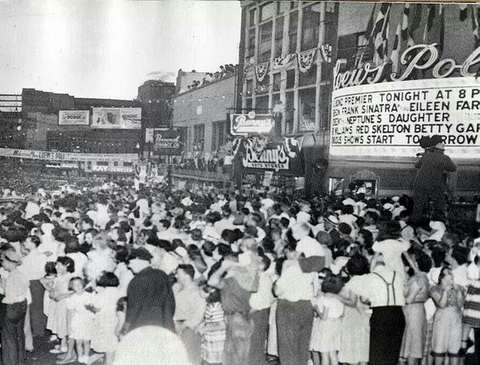
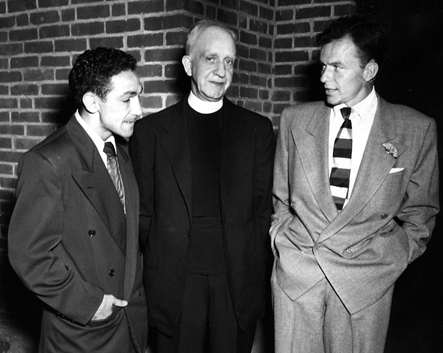
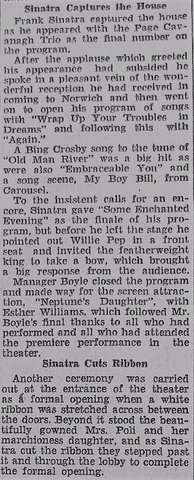
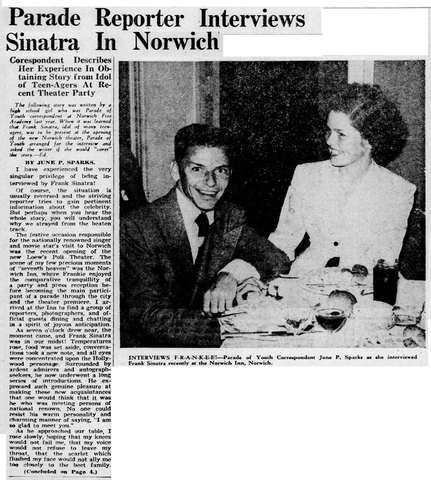
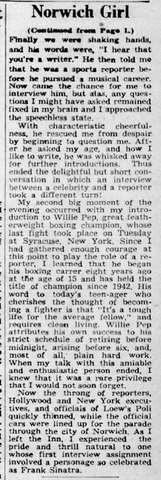
7-15-49
7-23-2000
Stanley is off by one day - Theater opened on 7-13.
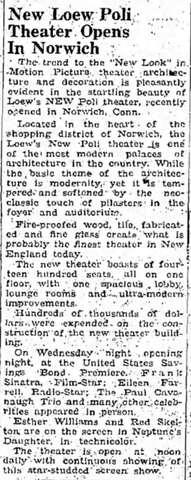
July 14, 1949
Studio
New York City
CO40970 Every Man Should Marry
(B. Davis/A. Silver)
Remick Music Corp. (ASCAP) 1949
Arranged & Conducted by Hugo Winterhalter
-1 (3:05) CD: Columbia Years 43-52 Vol. 11
CO40971 If I Ever Love Again w/The Double Daters
(R. Carlyle/D. Reynolds)
Roger Music, Inc. (ASCAP) 1949
Arranged & Conducted by Hugo Winterhalter
-1 (2:58) CD: Columbia Years 43-52 Vol. 11
LP: CL-2741 The Essential Frank Sinatra, Vol. 3
78: 38572
CO40972 We're Just A Kiss Apart (N/R)
(J. Styne/L. Robin)
(from Gentlemen Prefer Blondes)
J.J. Robbins & Sons (ASCAP) 1949
Arranged & Conducted by Hugo Winterhalter
Violins: F. Buldrini, M. Ceppos, L. Kruczek, F. Orlewitz, S. Shulman, J. Zyde; Violas: H. Kay, I. Zirr; Cello: M. Brown; Saxes: S. Cooper, A. Drelinger, I. Horowitz, N. Mondello ; French Horn: A. Miranda; Piano: B. Leighton; Guitar: A. Gottuso; Bass: H. Alprert; Drums: T. Snyder; Harp: E. Vito Ricci
July 15, 1949
Radio
The Bill Stern Colgate Sports
Network: NBC
Time: 10:30 PM - 10:45 PM
Sponsor: Colgate Shave Cream.
Host: Frank Sinatra (substituting for Bill Stern)
Announcers: Robert Lawrence, Bob Warren
Notes: Confirmed aired on WNBC. TT: 15mins. Audio condition: Excellent. Complete. Frank tells the story of "Tinkers to Evers to Chance," who made baseball history while never speaking to each other..
July 21, 1949
Studio
Hollywood
HCO3853 We're Just A Kiss Apart
(J. Styne/L. Robin)
(from Gentlemen Prefer Blondes)
J.J. Robbins & Sons (ASCAP) 1949
Arranged & Conducted by Morris Stoloff
-1 (3:03) CD: Columbia Years 43-52 Vol. 10
78: 38556
August 1949
[Soviet A-bomb test]
Kaplan: In August 1949 the Soviet Union tested its first atomic bomb, confirming Americans' worst Cold War fears, as Perry Como's insipid "A -- You're Adorable" topped the charts.
Source: James Kaplan, "Frank: The Voice" (2010)
August 1, 1949
Gilmore Field, Los Angeles, CA
Baseball Game
Frank Sinatra's Swooners vs. Andy Russell's Sprouts
From the August 1st, 1964 Billboard:
August 8, 1949
Studio
MGM Soundstage, Hollywood, California
Farewell, Amanda
(Cole Porter)
Conductor: Johnny Green
(Not used in the film "Adam's Rib"
4 takes running time 1:17
Scott Perry told me MGM had this song it their archives.
It was no longer there when the Hollywood S/T was being put together.
I was doing research on my 1992 book and Scott offered a treasure trove of fascinating information.
Ed
NOTE: Sinatra Scholar Ed O'Brien tells us the MGM commissioned Cole Porter to write a song for the Tracy-Hepburn film "Adam's Rib." Porter used the same music that he had written for an unpublished song in 1940, "So Long, Samoa."
The title for the 1949 song was "Farewell, Amanda." David Wayne sang it during a scene with Hepburn. (She was Amanda.)
There was also a six-second Sinatra vocal of the song. Sinatra recorded the complete song on August 8, 1949 on the MGM soundstage. The orchestra was conducted by Johnny Green. There were four takes and the running time was 1:17. The vocal cannot be located. Prior to the Sinatra vocal, a fellow named Gil Merchon also did four takes with Green conducting.
FAREWELL, AMANDA
Verse:
I loved you madly, you know it well,
Which makes my story too tough to tell,
So why not forget it all,
Just leave it unsaid,
And I'll merely sing it to you instead,
Refrain:
Farewell, Amanda,
Adios, addio, adieu,
Farewell, Amanda,
It was great fun but it is done, it's through,
Still now and then, fair Amanda,
When you are stepping on the stars above,
Please recall that wonderful night on the veranda,
Sweet Amanda, and our love.
August 16, 1949
Hollywood Bowl, Hollywood, California
"Symphonies Under The Stars"
M.C.: Edward Arnold (subs), Frank Morgan (original)
Performers: Mario Lanza, Rafel Mendez, Carmen Miranda, Jane Powell,
Eleanor Powell, Andre Previn, Frank Sinatra, Mary Jane Smith
Conductors: Johnny Green (second half)
Note: His name appeared in the ads. Sinatra was a no show. August 17,
1949 LA Times says "Frank Sinatra, originally announced to appear, did not,
and Edward Arnold substituted as master of ceremonies for Frank Morgan....
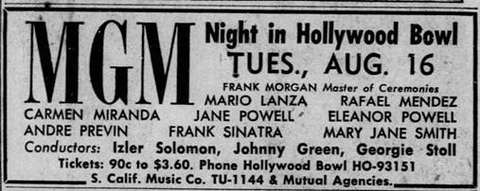
September 1949
[Jeff Alexander records "Stromboli" with Sinatra]
Kaplan: With Axel Stordahl unable to conduct due to the demands of the daily Light Up Time schedule, choral director Jeff Alexander took over for a mid-September 1949 session, recording three numbers including the title song "Stromboli" for the Roberto Rossellini/Ingrid Bergman film, which had just wrapped amid the Bergman-Rossellini affair scandal.
Source: James Kaplan, "Frank: The Voice" (2010)
September 5, 1949
Radio
Light Up Time
Sponsor: Lucky Strike Cigarettes
Network: NBC
Starring: Frank Sinatra & Dorothy Kirsten
Jeff Alexander And The Orchestra
1. Night and Day (a few lines)
2. It All Depends on You
3. Where Are You Now that I Need You
4. Some Enchanted Evening (w/Kirsten)
NOTE: Author Ed O'Brien points out that this was Sinatra's inaugural 15 minute show with Dorothy Kirsten and Jeff Alexander with the NBC Studio Orchestra. Sinatra would do 176 shows and sing approximately 550 songs, many of which he never recorded. Skitch Henderson would replace Alexander in March of 1950. Sinatra would often have jazz artists backing him, including Joe Venuti, Bobby Hackett, and Ziggy Elman. Kirsten missed a number of shows and her replacements included Marlene Dietrich, Mindy Carson, Margaret Whiting, Eileen Wilson, Jane Powell, and Janet Blair. The show ran until June 2, 1950. Sinatra missed a number of shows in May of that year because of the vocal hemorrhage that occurred at the Copa in New York City.. The show would be made available to the AFRS and retitled Lite Up Time.
In response to an inquiry from Sinatraphile Joe mdjr, O'Brien said he doesn't believe these shows have ever received a commercial release. About 80 of them have been in circulation among collectors for years.
Light Up Time
Sponsor: Lucky Strike Cigarettes
Network: NBC
Starring: Frank Sinatra & Dorothy Kirsten
NBC Light Up Time - Dorothy Kirsten, Frank Sinatra, Ziggy Elman - 09-05-1949
Thanks to Carl R for sending above photo
Variety
9-7-49
[Light Up Time debuts]
On Labor Day, September 5, 1949 -- a week after the Russian atomic test -- Sinatra began his new fifteen-minute NBC radio show Light Up Time, airing weeknights at 7pm Eastern, co-starring Metropolitan Opera soprano Dorothy Kirsten. He was paid $10,000 a week, a comedown from his Your Hit Parade salary.
Source: James Kaplan, "Frank: The Voice" (2010).
September 6, 1949
Radio
Light Up Time
Sponsor: Lucky Strike Cigarettes
Network: NBC
Starring: Frank Sinatra & Dorothy Kirsten
Jeff Alexander And The Orchestra
1. The Hucklebuck
2. You're Breaking My Heart
3. Let's Take An Old Fashioned Walk (with Dorothy Kirsten)
September 7, 1949
Radio
Light Up Time
Sponsor: Lucky Strike Cigarettes
Network: NBC
Starring: Frank Sinatra & Dorothy Kirsten
Jeff Alexander And The Orchestra
1. Wrap Your Troubles in Dreams
2. Maybe It's Because
3. Don't Cry Joe
NOTE: We are grateful to Sinatra Scholar Ed
O'Brien who supplied this list of songs performed on the broadcast by Frank Sinatra.
Television
None
September 8, 1949
Studio
MGM Soundstage - Hollywood , California
Recording for the MGM film "Take Me Out to the Ball Game"
Orchestra conducted by Adolph Deutsch
Arrangement by Robert Tucker
"Strictly U.S.A." Frank Sinatra, Jules Munshin, Betty Garrett, Esther Williams, Gene Kelly, Dick Lane , Tommy Duga and chorus
Three takes were mastered: Take 6, 3:19; Take 8, 3:18; Take 9, 3:16 (used in film)
Television
None
Radio
Light Up Time
Sponsor: Lucky Strike Cigarettes
Network: NBC
Starring: Frank Sinatra & Eileen Wilson
Jeff Alexander And The Orchestra
1. Someday You'll Want me to Want You
2. Try a Little Tenderness
3. That Lucky Old Sun
September 9, 1949
Radio
Light Up Time
Sponsor: Lucky Strike Cigarettes
Network: NBC
Show #5
Broadcast: 3:00-3:15 PM PDST (Repeat: 8:00-8:15 PM PDST)
Starring: Frank Sinatra & Dorothy Kirsten
Jeff Alexander And The Orchestra
Script (as broadcast)
1. opening
2. All Of Me - Frank Sinatra
3. commercial 1
4. Just One Way To Say I Love You - Dorothy Kirsten
5. If I Love Again
6. commercial 2
7. The Song Is You - Frank Sinatra & Dorothy Kirsten
8. closing
September 12, 1949
Radio
Light Up Time
Sponsor: Lucky Strike Cigarettes
Network: NBC
Show #6
Broadcast: 3:00-3:15 PM PST (Repeat: 8:00-8:15 PM PST)
Starring: Frank Sinatra & Dorothy Kirsten
Jeff Alexander And The Orchestra
Script (as broadcast)
1. opening
2. You Do Something To Me - Frank Sinatra
3. commercial 1
4. Through A Long And Sleepless Night - Dorothy Kirsten
5. Nancy / My Bill - Frank Sinatra & Dorothy Kirsten
6. commercial 2
7. I Only Have Eyes For You - Frank Sinatra
8. closing
September 13, 1949
Radio
Light Up Time
Sponsor: Lucky Strike Cigarettes
Network: NBC
Show #7
Broadcast: 3:00-3:15 PM PST (Repeat: 8:00-8:15 PM PST)
Starring: Frank Sinatra & Dorothy Kirsten
Jeff Alexander And The Orchestra
Script (as broadcast)
1. opening
2. Be Goody Good Good To Me - Frank Sinatra
3. commercial 1
4. They Didn't Believe Me - Dorothy Kirsten
5. The Wedding Of Lilly Marlene - Frank Sinatra
6. commercial 2
7. Baby, It's Cold Outside - Frank Sinatra & Dorothy Kirsten
8. closing
September 14, 1949
Radio
Light Up Time
Sponsor: Lucky Strike Cigarettes
Network: NBC
Show #8
Broadcast: 3:00-3:15 PM PST (Repeat: 8:00-8:15 PM PST)
Starring: Frank Sinatra & Dorothy Kirsten
Jeff Alexander And The Orchestra
Script (as broadcast)
1. opening
2. There's Yes, Yes In Your Eyes - Frank Sinatra
3. commercial 1
4. "unknown" - Dorothy Kirsten
5. Jack Benny spot
6. commercial 2
7. My Romance - Frank Sinatra & Dorothy Kirsten
8. closing
Notes: Kirsten was originally to sing "Just One Way To Say I Love You"
September 15, 1949
Studio
Hollywood
HCO3903 That Lucky Old Sun (Just Rolls Around Heaven All Day) (H. Gillespie/B. Smith)
Robbins Music Corp. (ASCAP) 1949
Arranged & Conducted by Jeff Alexander
-1 (3:16) CD: Columbia Years 43-52 Vol. 11
LP: CL-902 That Old Feeling
78: 38608
HCO3904 Mad About You
(N. Washington/V. Young)
(from Deadly Is The Female)
H. Spitzer Music Pub. (ASCAP) 1949
Arranged & Conducted by Jeff Alexander
-1 (3:13) CD: Columbia Years 43-52 Vol. 11
LP: C2X-40897 Hello Young Lovers
LP: CL-953 Adventures Of The Heart
78: 38613
HCO3905 (On The Island Of) Stromboli
(I Taylor/K. Lane )
Sinatra Songs, Inc. (ASCAP) 1949
Arranged & Conducted by Jeff Alexander
-1 (3:16) CD: Columbia Years 43-52 Vol. 11
LP: CL-953 Adventures of The Heart
78: 38613
Violins: V. Arno, D. Lube, W. Miller, R. Polikian, M. Russell, J. Shulman; Violas: J. Di Fiore, A. Weiss; Cellos: C. Bernard, E. Slatkin; French Horn: V. De Rosa; Mandolins: M. Gralnick, J. Rose; Accordion: M. De Lugg; Guitars: B. Kessel, A. Reuss; Trumpets: Z. Elman, V. Mangano, G. Seaberg; Trombones: G. Aurs, R. McGarity, P. Weigand; Saxes: E. Callen, L. Palange, A. Raskin, H. Schuchman, P. Shuken; Bass: P. Stephens; Drums: R. Hagan; Piano: K. Lane; Harp: R. Maxwell
NOTE: Sinatra Scholar Ed O'Brien reports that the great French horn player Vince DeRosa was at this session.
He told O'Brien that it was such a joy to work with Sinatra in the 1940s. DeRosa was in awe of the vocal prowess Sinatra displayed and loved how easy the sessions went because of it. Sinatra sang all three songs on Light Up Time shows.
Radio
Light Up Time
Sponsor: Lucky Strike Cigarettes
Network: NBC
Show #9
Broadcast: 3:00-3:15 PM PST (Repeat: 8:00-8:15 PM PST)
Starring: Frank Sinatra & Mindy Carson
Jeff Alexander And The Orchestra
Script (as broadcast)
1. opening
2. That Old Black Magic - Frank Sinatra
3. commercial 1
4. Song Of Surrender - Mindy Carson
5. I've Got A Crush On You - Frank Sinatra
6. commercial 2
7. Where Or When - Frank Sinatra
8. closing
Stars Salute To WMGM
3 Full Hours dedicated to WHN becoming WMGM
Celebrities included: Gov. Thomas E. Dewey, Frank Sinatra, Gene Kelly, Vic Damone, Morey Amsterdam, Greer Garson, Walter Pidgeon,
Esther Williams, Red Skeleton, Jane Powell, Betty Garrett, Mario Lanza, Lena Horne, Frances Faye, Larry Storch and others
Hollywood
HCO3905 (On The Island Of) Stromboli
Variety
Hollywood
HCO3903 That Lucky Old Sun (Just Rolls Around Heaven All Day)
(H. Gillespie/B. Smith)
Variety
Stars Salute To WMGM
3 Full Hours dedicated to WHN becoming WMGM
Celebrities included: Gov. Thomas E. Dewey, Frank Sinatra, Gene Kelly, Vic Damone, Morey Amsterdam, Greer Garson, Walter Pidgeon,
Esther Williams, Red Skeleton, Jane Powell, Betty Garrett, Mario Lanza, Lena Horne, Frances Faye, Larry Storch and others
Variety
"(On the Island of) Stromboli"
Friedwald (analysis): Friedwald singles out '(On the Island of) Stromboli,' theme from the forthcoming Ingrid Bergman picture, as Sinatra's best ballad of the 1949 season after 'Mad About You' -- a 'devastatingly powerful performance' despite being 'faux Italian.' He argues Sinatra and Stordahl transform it into what 'Bali Ha'i' should have been: the island of forbidden dreams, aided by mandolins, zithers, and concertinas and Stordahl's fades, dissolves, and modulations. The title later took on eerie resonance when Bergman left her husband for director Roberto Rossellini in a scandal that paralleled Sinatra's own unfolding affair with Gardner -- by the film's February 1950 release, Sinatra was 'embroiled in a Stromboli of his own.'
Source: Will Friedwald, "Sinatra! The Song Is You: A Singer's Art" (2018 revised edition).
September 16, 1949
Radio
Light Up Time
Sponsor: Lucky Strike Cigarettes
Network: NBC
Show #10
Broadcast: 3:00-3:15 PM PST (Repeat: 8:00-8:15 PM PST)
Starring: Frank Sinatra & Dorothy Kirsten
Jeff Alexander And The Orchestra
Script (as broadcast)
1. opening
2. Them Thar' Eyes - Frank Sinatra
3. commercial 1
4. Out Of My Dreams - Dorothy Kirsten
5. If I Loved You - Frank Sinatra & Dorothy Kirsten
6. commercial 2
7. The Hucklebuck - Frank Sinatra & Dorothy Kirsten
8. closing
September 19, 1949
Radio
Light Up Time
Sponsor: Lucky Strike Cigarettes
Network: NBC
Monday Evening
8:00 p.m. - 8:15 p.m.
Starring: Frank Sinatra & Dorothy Kirsten
Jeff Alexander And Orchestra
1. Someday You'll Want Me To Want You F.S.
2. Homework D.K.
3. Just One Way To Say I Love You F.S.
4. Every Time I Meet You F.S.
5. Strange Music F.S. & D.K.
September 20, 1949
Radio
Light Up Time
Sponsor: Lucky Strike Cigarettes
Network: NBC
Starring: Frank Sinatra & Dorothy Kirsten
Jeff Alexander And The Orchestra
1. The One I Love Belongs to Somebody Else (Sy Oliver arrangement)
2. You Go To My Head (Dorothy Kirsten)
3. Katrina
4. Bali Ha'i
Light Up Time
Sponsor: Lucky Strike Cigarettes
Network: NBC
Starring: Frank Sinatra & Dorothy Kirsten
Jeff Alexander And The Orchestra
Tampa Bay Times, St. Petersburg, Florida, Sep 20, 1949
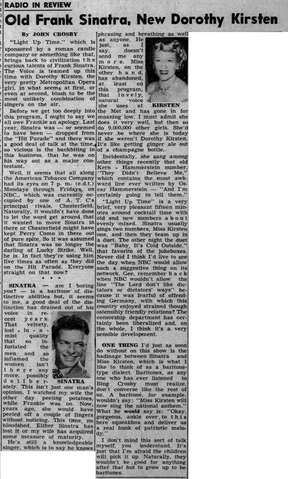
[Manie Sacks admits fault over duplicate song recordings] Manie Sacks / Frank Sinatra / Kaplan: After Sinatra complained in a letter that Columbia was letting other singers (including Doris Day) re-record songs he had already claimed as his own, Manie Sacks wrote back on September 20, 1949, admitting the fault was his for not checking the list carefully, and apologizing. The correspondence's cooling tone -- "best regards" and "kindest regards" replacing earlier "love" -- signaled the fraying Sinatra-Sacks friendship.
Source: James Kaplan, "Frank: The Voice" (2010).
September 21, 1949
Radio
Light Up Time
Sponsor: Lucky Strike Cigarettes
Network: NBC
Starring: Frank Sinatra & Dorothy Kirsten
Jeff Alexander And The Orchestra
1. It All Depends on You -FS
2. Suppose I Had Never Met You Dear - DK
3. You're Breaking my Heart - FS
4. Don't Ever Leave Me - DK
5. Nothing Less Than Beautiful - FS
AFRS inserted "Old Master Painter" sung by FS between "You're Breaking My Heart" and "Don't Ever Leave Me"
NOTE: Sinatra Scholar Ed O'Brien gave us the song program for this broadcast.
Television
None
September 22, 1949
Radio
Light Up Time
Sponsor: Lucky Strike Cigarettes
Network: NBC
Starring: Frank Sinatra & Mindy Carson
Jeff Alexander And The Orchestra
1. Katrina -FS
2. Fiddle Dee Dee -MC
3. They Say It's Wonderful FS w/Mindy Carson
4. That Lucky Old Sun -FS
September 23, 1949
Radio
Light Up Time
Sponsor: Lucky Strike Cigarettes
Network: NBC
Starring: Frank Sinatra & Dorothy Kirsten
Jeff Alexander And The Orchestra
1. All of Me --FS
2. The Man I Love --DK
3. Maybe It's Because --FS
4. Some Enchanted Evening FS w/ DK
AFRS added "Love Is Just Around The Corner" sung by FS between "Maybe It's Because" & "Some Enchanted Evening"
Television
None
September 26, 1949
Radio
Light Up Time
Sponsor: Lucky Strike Cigarettes
Network: NBC
Show #16
Broadcast: 4:00-4:15 PM PDST (Repeat: 8:00-8:15 PM PDST)
Starring: Frank Sinatra & Dorothy Kirsten
Jeff Alexander And The Orchestra
Script (as broadcast)
1. opening
2. There's Yes, Yes In Your Eyes - Frank Sinatra
3. commercial 1
4. Did I Remember - Dorothy Kirsten
5. Let's Take An Old Fashioned Walk - Dorothy Kirsten & Frank Sinatra
6. commercial 2
7. Don't Cry Joe - Frank Sinatra
8. closing
Notes: Sinatra was originally to sing "Begin The Beguine" instead of "There's Yes, Yes In Your Eyes."
September 27, 1949
Radio
Light Up Time
Sponsor: Lucky Strike Cigarettes
Network: NBC
Show #17
Broadcast: 4:00-4:15 PM PST (Repeat: 8:00-8:15 PM PST)
Starring: Frank Sinatra & Dorothy Kirsten
Jeff Alexander And The Orchestra
Script (as broadcast)
1. opening
2. You Told A Lie - Frank Sinatra
3. commercial 1
4. All The Things You Are - Dorothy Kirsten
5. Dreamer's Holiday - Frank Sinatra
6. commercial 2
7. The Song Is You - Frank Sinatra & Dorothy Kirsten
8. closing
September 28, 1949
Radio
Light Up Time
Sponsor: Lucky Strike Cigarettes
Network: NBC
Show #18
Broadcast: 4:00-4:15 PM PST (Repeat: 8:00-8:15 PM PST)
Starring: Frank Sinatra & Dorothy Kirsten
Jeff Alexander And The Orchestra
Script (as broadcast)
1. opening
2. That Old Black Magic - Frank Sinatra
3. commercial 1
4. So In Love - Dorothy Kirsten
5. You're In Love With Someone - Frank Sinatra
6. Younger Than Springtime - Frank Sinatra
7. closing
September 29, 1949
Radio
Light Up Time
Sponsor: Lucky Strike Cigarettes
Network: NBC
Show #19
Broadcast: 4:00-4:15 PM PST (Repeat: 8:00-8:15 PM PST)
Starring: Frank Sinatra & Dorothy Kirsten
Jeff Alexander And The Orchestra
Script (as broadcast)
1.. opening
2. Wrap Your Troubles In Dreams - Frank Sinatra
3. commercial 1
4. If You Were The Only Boy In The World - Dorothy Kirsten
5. Maybe It's Because - Frank Sinatra
6. commercial 2
7. I'm In The Mood For Love - Dorothy Kirsten
8. If There Is Someone Lovelier Than You - Frank Sinatra
9. closing
Original Amateur Hour
ABC 8 PM
Frank Sinatra, Bert Parks, Robert Merrill, The Philharmonicas --On a reel tape, somewhere, I have Frank telling Ted Mack how important the Amateur Hour was to him and other aspiring performers. I am assuming the segment probably comes from this show.
--Ed
Original Amateur Hour
ABC 8 PM
Frank Sinatra, Bert Parks, Robert Merrill, The Philharmonicas
September 30, 1949
Radio
Red Feather Opening Drive of Community Chests Of America program Friday Evening
All Networks
Time 10:00 p.m. - 10:30 p.m.
Performers: Ralph Edwards, Frank Sinatra, Buddy Clark, Dinah Shore, Hope Emerson, George Montgomery, Otto Kruger, Ann Sothern, Fred MacMurray, Jack Benny, Ethel Barrymore, William Demarest, Jerry Colonna, Otto Kruger
Notes: President Harry Truman and stars of stage, screen and radio speak on behalf of the Community Chest drive for funds.
Ed O'Brien:
The Red Feather opening drive for the Community Chests of America was broadcast on all major networks and independent stations. Dinah Shore sings a short segment of "You're Breaking My Heart" followed by Buddy Clark and Frank Sinatra singing short segments. Frank surprised by opening his version with "Racing With The Moon"(just the title, no more). Then the threesome do a very short reading of "You're Breaking My Heart." Ralph Edwards asks them to form the "Shore Sisters" singing group. They sing a segment of "Three Little Maids" from "The Mikado." Entertainment section ran approximately 20 minutes. President Truman closed out the show with a 10 minute speech endorsing the Community Chest.
On a sad note: Buddy Clark was killed in a plane crash on 10-1-49. Clark had a number of top hits including "Linda," "Peg O' My Heart," "Love Somebody," "I'll Dance At Your Wedding," "Now Is The Hour," "How Are Things In Glocca Mora," "Ballerina," "Baby It's Cold Outside"( w/D. Shore) and "You're Breaking My Heart." He was 37 years old at the time of his death.
Light Up Time
Sponsor: Lucky Strike Cigarettes
Network: NBC
Show #20
Broadcast: 4:00-4:15 PM PST (Repeat: 8:00-8:15 PM PST)
Starring: Frank Sinatra & Dorothy Kirsten
Jeff Alexander And The Orchestra
Guests: Pied Pipers
Script (as broadcast)
1. opening
2. If I Could Be With You One Hour Tonight - Frank Sinatra & Pied Pipers
3. commercial 1
4. Every time I Meet You - Dorothy Kirsten
5. You Do Something To Me - Frank Sinatra
6. Why Can't You Behave - Dorothy Kirsten
7. commercial 2
8. If I Ever Love Again - Frank Sinatra & Pied Pipers
9. closing
Red Feather Opening Drive of Community Chests Of America program Friday Evening
All Networks
Time 10:00 p.m. - 10:30 p.m.
Performers: Ralph Edwards, Frank Sinatra, Buddy Clark, Dinah Shore, Hope Emerson, George Montgomery, Otto Kruger, Ann Sothern, Fred MacMurray, Jack Benny, Ethel Barrymore, William Demarest, Jerry Colonna, Otto Kruger
Notes: President Harry Truman and stars of stage, screen and radio speak on behalf of the Community Chest drive for funds.
September 30, 1953, Barrymore Theatre, New York, NY
Frank is singing Happy Birthday to Deborah Kerr for her 32nd birthday after the opening of Tea and Sympathy at the Barrymore Theatre. Deborah's husband Anthony Charles Bartley - twice decorated RAF pilot- is also there
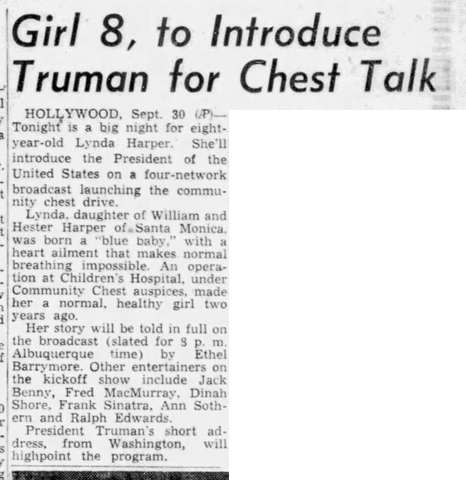
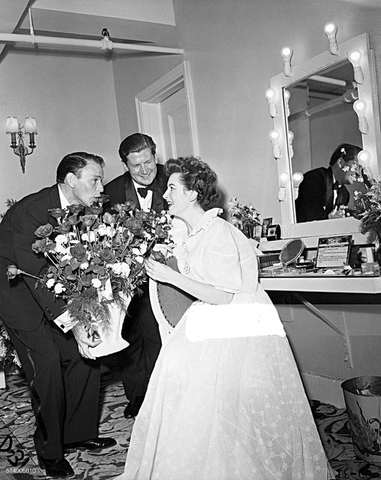
October 3, 1949
Radio
Light Up Time
Sponsor: Lucky Strike Cigarettes
Network: NBC
Show #21
Broadcast: 4:00-4:15 PM PST (Repeat: 8:00-8:15 PM PST)
Starring: Frank Sinatra & Dorothy Kirsten
Jeff Alexander And The Orchestra
Script (as broadcast)
1. opening
2. Them Thar Eyes - Frank Sinatra
3. commercial 1
4. Out Of My Dreams - Dorothy Kirsten
5. The Girl That I Marry - Frank Sinatra
6. Homework - Dorothy Kirsten
7. commercial 2
8. That Lucky Old Sun - Frank Sinatra
9. closing
October 4, 1949
Radio
Light Up Time
Sponsor: Lucky Strike Cigarettes
Network: NBC
Show #22
Broadcast: 4:00-4:15 PM PST (Repeat: 8:00-8:15 PM PST)
Starring: Frank Sinatra & Dorothy Kirsten
Jeff Alexander And The Orchestra
1. opening
2. Be Goody Good Good To Me - Frank Sinatra
3. commercial 1
4. Song Of Surrender - Dorothy Kirsten 5. You're Breaking My Heart - Frank Sinatra
6. commercial 2
7. Strange Music - Frank Sinatra & Dorothy Kirsten
8. closing
October 5, 1949
Radio
Light Up Time
Sponsor: Lucky Strike Cigarettes
Network: NBC
Show #23
Broadcast: 4:00-4:15 PM PST (Repeat: 8:00-8:15 PM PST)
Starring: Frank Sinatra & Dorothy Kirsten
Jeff Alexander And The Orchestra
Script (as broadcast)
1. opening
2. You Told A Lie - Frank Sinatra
3. commercial 1
4. Love Walked In - Dorothy Kirsten
5. Love Is Here To Stay - Frank Sinatra
6. Full Moon And Empty Arms - Dorothy Kirsten
7. commercial 2
8. I've Got A Crush On You - Frank Sinatra
9. closing
October 6, 1949
Radio
Light Up Time
Sponsor: Lucky Strike Cigarettes
Network: NBC
Show #24
Broadcast: 4:00-4:15 PM PST (Repeat: 8:00-8:15 PM PST)
Starring: Frank Sinatra & Dorothy Kirsten
Jeff Alexander And The Orchestra
Script (as broadcast)
1. opening
2. Someday - Frank Sinatra
3. commercial 1
4. They Didn't Believe Me - Dorothy Kisten
5. Katrina - Frank Sinatra
6. commercial 2
7. Nothing Less Than Beautiful - Dorothy Kirsten
8. Where Are You?- Frank Sinatra
9. closing
October 7, 1949
Radio
Light Up Time
Sponsor: Lucky Strike Cigarettes
Network: NBC
Show #25
Broadcast: 4:00-4:15 PM PST (Repeat: 8:00-8:15 PM PST)
Starring: Frank Sinatra & Dorothy Kirsten
Jeff Alexander And The Orchestra
Script (as broadcast)
1. opening
2. It All Depends On You - Frank Sinatra
3. commercial 1
4. You Go To My Head - Dorothy Kirsten
5. You're In Love With Someone - Frank Sinatra
6. commercial 2
7. My Romance - Frank Sinatra & Dorothy Kirsten
8. closing
October 10, 1949
Radio
Light Up Time
Sponsor: Lucky Strike Cigarettes
Network: NBC
Show #26
Broadcast: 4:00-4:15 PM PST (Repeat: 8:00-8:15 PM PST)
Starring: Frank Sinatra & Dorothy Kirsten
Jeff Alexander And The Orchestra
Script (as broadcast)
1. opening
2. You Do Something To Me - Frank Sinatra
3. commercial 1
4. The Last Mile Home - Dorothy Kirsten
5. Always - Frank Sinatra
6. How Deep Is The Ocean - Dorothy Kirsten
7. commercial 2
8. On The Isle Of Stromboli - Frank Sinatra
9. closing
October 11, 1949
Radio
Light Up Time
Sponsor: Lucky Strike Cigarettes
Network: NBC
Starring: Frank Sinatra & Dorothy Kirsten
Jeff Alexander And The Orchestra
1. Just One Of Those Things -- FS
2. Bill (from Show Boat) -- DK
3. The Meadows Of Heaven -- FS
4. Dancing In The Dark -- DK & FS
--I really like the singing by Kirsten and Sinatra on "Dancing in the Dark" --Scott
October 12, 1949
Radio
Light Up Time
Sponsor: Lucky Strike Cigarettes
Network: NBC
Show #28
Broadcast: 4:00-4:15 PM PST (Repeat: 8:00-8:15 PM PST)
Starring: Frank Sinatra & Dorothy Kirsten
Jeff Alexander And The Orchestra
Guests: The Sky Larks
1. opening
2. Could 'Ja - Frank Sinatra & The Sky Larks
3. commercial 1
4.. These Foolish Things Remind Me Of You - Dorothy Kirsten
5. commercial 1
6. Don't Cry, Joe - Frank Sinatra & Sky Larks
7. Closing
Notes: Sinatra's scheduled performance of "I Only Have Eyes For You" was cut. Several other changes were made to this script.
October 13, 1949
Radio
Light Up Time
Taped: October 5, 1949
Sponsor: Lucky Strike Cigarettes
Network: NBC
Show #29
Broadcast: 4:00-4:15 PM PST (Repeat: 8:00-8:15 PM PST)
Starring: Frank Sinatra & Dorothy Kirsten
Jeff Alexander And The Orchestra
1. opening
2. There's Yes, Yes In Your Eyes - Frank Sinatra
3. commercial 1
4. Did I Remember - Dorothy Kirsten
5. Dreamer's Holiday - Frank Sinatra
6. commercial 2
7. They Say That Falling In Love Is Wonderful - Frank Sinatra & Dorothy Kirsten
8. closing
Notes: A song was changed for "Dreamer's Holiday but is illegible on script.
October 14, 1949
Radio
Light Up Time
Taped: No Date (might be Oct. 6)
Sponsor: Lucky Strike Cigarettes
Network: NBC
Show #30
Broadcast: 4:00-4:15 PM PST (Repeat: 8:00-8:15 PM PST)
Starring: Frank Sinatra & Dorothy Kirsten
Jeff Alexander And The Orchestra
1. opening
2. The One I Love - Frank Sinatra
3. commercial 1
4. Maybe It's Because - Dorothy Kirsten
5. Mad About You - Frank Sinatra
6. commercial 2
7. I'm Coming Virginia - Frank Sinatra & Dorothy Kirsten
8. Closing
Concerts
Thalhimer’s Store in Richmond, Va
Frank Sinatra drew 6,500 fans for his performance on the roof of Thalhimer's Store in Richmond, Va on Friday afternoon. Designated the "Tobacco Festival King," Sinatra kicked off a celebration of his 10 years in show business during his three-day visit to the Tobacco City. He dutifully plugged his new radio show "Light-Up Time," sponsored by Lucky Strike. Dorothy Kirsten accompanied Frank and they took over the Saturday night Hit Parade on NBC. This special broadcast of the popular radio show was only one of many stops made by the stars for American Tobacco Company. Sinatra can soon be seen in the MGM production "On The Town" and RKO's "It's Only Money."
Ed O'Brien
Frank's appearance on the Hit Parade would be his swan song. He appeared on 191 broadcasts in the 1940's. "On The Town" would open to rave reviews at Radio City Music Hall on 12-9-49. A few critics did express reservations that MGM dropped some of the better songs from the smash Broadway musical. The replacement tunes were considered inferior. "It's Only Money" would be retitled "Double Dynamite" and have its premier on 12-25-51.
The original credits had Sinatra with top billing. The December 51 release gave him third billing behind Jane Russell and Groucho Marx.
Cavalier Arena, Richmond, Virginia
Sinatra sang for 15 minutes, including a parody of Ol’ Man Crosby
note: The American Tobacco Company decided to have a Tobacco Bowl Festival in Richmond. Frank and Dorothy plus Mark Warnow and The Hit Parade Orchestra flew down on the morning of 10/14. They made numerous appearances at department stores throughout the day, including Thalhimer's, visited local radio stations for interviews and attended a press party. There was a rehearsal that afternoon at Cavalier Arena - seating capacity of 4,200. Dorothy and Frank drew a huge crowd.
That evening they performed at the arena for "The Presen- tation Show" that kicked off the weekend. The tickets sold for $1.35 each and only 1,000 paying fans attended.
The next morning Frank, Dorothy, Mark and The Hit Paraders skipped their scheduled appearance in the Tobacco Parade, due to inclement weather. But they won kudos from the locals by hosting a brunch for 20 underprivileged children from Richmond. In the afternoon Frank and Dorothy went to City Stadium for the football game between VMI and the University of Richmond. During the halftime ceremonies, Frank crowned Dorothy queen of the Tobacco Royal Festival. There was an estimated crowd of 20,000 in the stadium, paying a hefty $3.50 for a ticket. Frank and Dorothy entertained that evening at the Fair Grounds for the Tobacco Festival Square Dance. Frank then made his final appearance on Your Hit Parade with Warnow conducting and Dorothy singing a few songs. Sunday there were a few more personal appearances before the flight back to New York City.
Mark Warnow, who was the conductor throughout Frank's first long stint on the Hit Parade( 1943-44), suffered a massive heart attack on Monday morning (17) and was rushed to Polyclinic Hospital. Despite heroic efforts, they were un- able to save him. Mark was only 47 years old.
When Look Magazine got wind of the Tobacco Festival proceedings at the football game, they sent a photographer to cover it. His photos of Frank and Dorothy - 30 in all -- are at the Library of Congress. Stanley Kubrick, the fellow who snapped all those pictures, would attain more than a modicum of fame as a director of many classic films. I wonder how Frank and Stan hit it off that autumn afternoon in Richmond, Virginia. Ed
's Thalhimer’s Store in Richmond, Va
Richmond Times Dispatch October 15, 1949
[image referenced in source but could not be recovered]
[image referenced in source but could not be recovered]
[image referenced in source but could not be recovered]
[image referenced in source but could not be recovered]
[image referenced in source but could not be recovered]
[image referenced in source but could not be recovered]
October 15, 1949
Radio
Your Hit Parade
Network: CBS
Program #749
Time: 9:00-9:30 EST (Rebroadcast 9:00-9:30 PST)
Sponsor: Lucky Strike
Script
1. commercial 1
2. Jealous Heart (7) - Frank Sinatra & Hit Paraders
3. Maybe It's Because (4) - Kirsten
4. Waiting For The Robert E. Lee - Orchestra
5. Twenty-Four Hours Of Sunshine (6) - Eileen Wilson & Hit Paraders
6. commercial 2
7. A Fine Romance - Frank Sinatra & Dorothy Kirsten
8. Room Full Of Roses (5) - Eileen Wilson
9. Dixie - Orchestra & Hit Paraders
10. That Lucky Old Sun (3) - Frank Sinatra
11. Someday You'll Want Me To Want You (2) - Dorothy Kirsten
12. commercial 3
13. You're Breaking My Heart (1) - Frank Sinatra
Notes: Sinatra & Kirsten were guest stars. Show was broadcast from Richmond, Virginia.
Ed O'Brien:
The last of Frank's 191 Hit Parade appearances. He first appearance was with Dorsey in 1940 and he had two extended runs in 43-44 and again from 47 to 49.His swan song was a return after a four and half month hiatus. He brought along Light-Up co-star Dorothy Kirsten. "Mad Men" might have lost Lucky Strike but Frank kept them after your YHP.They would sponsor his Light-Up show that ran from Sept. 49 into early June of 50.
Note: Richmond was all set to have their first annual tobacco festival on 10-15-49. The
American Tobacco Co (lucky Strike) decided to spare no expense to celebrate the occasion. They sent Frank, Dorothy Kirsten and Mark Warnow down there for the weekend. The two stars of Light Up Time and the arranger/conductor of YHP arrived to a whirlwind of personal appearances at department stores, parades, and a visit to a cigarette factory. Warnow had brought along the NBC radio orchestra to back the two singers. Friday night they performed at the Presentation Show in front of 1,000 people. Someone decided to charge $1.35 admission fee. Saturday, Frank and Dorothy skipped the parade through the city because of inclement weather. They did make an appearance at City Stadium for the football game between Virginia Military Institute and Uni- versity of Richmond, where Frank crowned Dorothy Queen of the Tobacco Bowl Festival. The rehearsal and broadcast of the Hit Parade was held at the 4,200 seat Cavalier Arena. Frank and Dorothy then appeared at the Tantilia Garden for the Tobacco Ball Bowl and at the Fair Grounds for the Tobacco Festival Square Dance.The attendance at all the Saturday events very much exceeded expectations with the stadium appearance drawing more than 20,000 Prior to the events on Saturday, Frank and Dorothy played host to 20 underprivileged boys and girls at a brunch. The press simply loved them for their singing and the goodwill they brought with them to Richmond.
Unfortunately there is a sad ending to this story. Mark Warnow, who had been the conductor of the Hit Parade orchestra during Frank's tenure in 1943-44 and was a much admired arranger, upon arriving back in New York, on the morning of the 17th, suffered a fatal attack. He was only 49 years old.
[image referenced in source but could not be recovered]
[image referenced in source but could not be recovered]
Your Hit Parade
Network: CBS
Program #749
Time: 9:00-9:30 EST (Rebroadcast 9:00-9:30 PST)
Sponsor: Lucky Strike
Frank Sinatra performs in Richmond, Virginia, 1949.
Prior to the events on Saturday, Frank and Dorothy played host to 20 underprivileged boys and girls at a brunch. The press simply loved them for their singing and the goodwill they brought with them to Richmond.
Frank Sinatra crowns Dorothy Kirsten Queen of the first annual Tobacco Bowl Festival in Richmond, Virginia in 1949. Sinatra and Kirsten, stars of Lucky Strike's Light Up Time, were the guests of honor for the first celebration. Photo by Stanley Kubrick for Look magazine.
Women fans waiting for Frank Sinatra at the Richmond, Va., Tobacco Bowl Festival, 1949. :
Frank Sinatra Tobacco Bowl Festival Richmond Virginia 1949
[image referenced in source but could not be recovered]
[image referenced in source but could not be recovered]
[image referenced in source but could not be recovered]
[image referenced in source but could not be recovered]
[image referenced in source but could not be recovered]
[image referenced in source but could not be recovered]
[image referenced in source but could not be recovered]
October 17, 1949
Radio
Light Up Time
Sponsor: Lucky Strike Cigarettes
Network: NBC
Starring: Frank Sinatra & Dorothy Kirsten
Jeff Alexander And The Orchestra
1. At Sundown - FS
2. Every time I Meet You - DK
3. Younger Than Springtime - FS
4. Full Moon And Empty Arms - FS w/Dorothy Kirsten
October 18, 1949
Radio
Light Up Time
Sponsor: Lucky Strike Cigarettes
Network: NBC
Starring: Frank Sinatra & Dorothy Kirsten
Jeff Alexander And The Orchestra
1. Lullaby Of Broadway
2. Don't Cry Joe w/Double Daters
3. When We're Alone / Penthouse Serenade w/Dorthy Kirsten
NOTE: Nine of the songs that Sinatra did on these three radio shows were never recorded by him, Ed O'Brien has noticed.
"Together" w/Eileen Barton and Vimms Vocalists was an uptempo duet.
October 19, 1949
Radio
Light Up Time
Sponsor: Lucky Strike Cigarettes
Network: NBC
Starring: Frank Sinatra & Dorothy Kirsten
Jeff Alexander And The Orchestra
Guests: The Pastels
1. Could 'Ja w/The Pastels
2. Let's Take An Old Fashioned Walk w/Dorothy Kirsten
3. If I Ever Love Again w/The Pastels
October 20, 1949
Radio
Light Up Time
Sponsor: Lucky Strike Cigarettes
Network: NBC
Show #34
Broadcast: 4:00-4:15 PM PST (Repeat: 8:00-8:15 PM PST)
Starring: Frank Sinatra & Dorothy Kirsten
Jeff Alexander And The Orchestra
1. opening
2. The Hucklebuck - Frank Sinatra
3. commercial 1
4. Flamingo - Dorothy Kirsten
5. Embraceable You - Frank Sinatra
6. Nothing Less Than Beautiful - Dorothy Kirsten
7. commercial 2
8. Lucky Old Sun - Frank Sinatra
9. closing
Ed O'Brien:
On the AFRS Lite Up Time "Wrap Your Troubles In Dreams" comes after "Nothing Less Than Beautiful." It comes from the 9-7-49 show
October 21, 1949
Radio
Light Up Time
Sponsor: Lucky Strike Cigarettes
Network: NBC
Starring: Frank Sinatra & Eileen Wilson
Jeff Alexander And The Orchestra
1. You Told A Lie - FS
2. Dreamer's Holiday - EW
3. On The Island Of Stromboli - FS
3. You'll Never Walk Alone - FS
Ed O'Brien:
Eileen Wilson sings "Dreamer's Holiday."
On the AFRS Lite Up Time "Don't Cry Joe" follows
"Stromboli." Frank sang his new Columbia single on the 9-26 show, backed by The Pied Pipers, 10-12,
The Skylarks provided vocal support and The Double
Daters provided the vocal backing on the 10-18 show.
The 10-12 was the choice for the AFRS show.
October 24, 1949
Radio
Light Up Time
Sponsor: Lucky Strike Cigarettes
Network: NBC
Show #36
Broadcast: 4:00-4:15 PM PST (Repeat: 8:00-8:15 PM PST)
Starring: Frank Sinatra & Dorothy Kirsten
Jeff Alexander And The Orchestra
1. opening
2. You Are My Sunshine - Frank Sinatra & Dorthy Kirsten
3. commercial 1
4. The Red River Valley - Dorothy Kirsten
5. Clementine - Frank Sinatra
6. Buttons And Bows - Dorothy Kirsten
7. Hey Lolly Lolly - Frank Sinatra & Dorothy Kirsten
8. commercial 2
9. Wagon Wheels - Frank Sinatra
10. closing
Notes: Sinatra & Kirsten were also supposed to sing "Skip To M'Lou" after
"Clementine" but it was scratched.
Ed O'Brien points out, Sinatra was no cowpoke but he had a good time with these ditties. O'Brien says he prefers the "Clementine" that Sinatra did the previous year on the Burl Ives show.
October 25, 1949
Radio
Light Up Time
Sponsor: Lucky Strike Cigarettes
Network: NBC
Show #37
Broadcast: 4:00-4:15 PM PST (Repeat: 8:00-8:15 PM PST)
Starring: Frank Sinatra & Dorothy Kirsten
Jeff Alexander And The Orchestra
1. opening
2. There's Yes, Yes In Your Eyes - Frank Sinatra
3. commercial 1
4. If You Are But A Dream - Dorothy Kirsten
5. If I Ever Love Again - Frank Sinatra
6. commercial 2
7. Why Do I Love You - Frank Sinatra & Dorothy Kirsten
8. closing
Ed O'Brien:
The AFRS Lite Up Time offers "If I Could Be With You"
with The Pied Pipers backing Frank. Song is lifted from the
October 26, 1949
Radio
Light Up Time
Sponsor: Lucky Strike Cigarettes
Network: NBC
Show #38
Broadcast: 4:00-4:15 PM PST (Repeat: 8:00-8:15 PM PST)
Starring: Frank Sinatra & Dorothy Kirsten
Jeff Alexander And The Orchestra
1. opening
2. Sweet Lorraine - Frank Sinatra
3. commercial 1
4. Mad About You - Dorothy Kirsten
5. Supposin' - Frank Sinatra
6. I'll Get By - Dorothy Kirsten
7. commercial 2
8. Begin The Beguine - Frank Sinatra
9. closing
Ed O'Brien"
The additional tune on the AFRS broadcast was "Them There Eyes," in lieu of the second ad. The version used was from the 10-3-49 show.
October 27, 1949
Radio
Light Up Time
Sponsor: Lucky Strike Cigarettes
Network: NBC
Show #39
Broadcast: 4:00-4:15 PM PST (Repeat: 8:00-8:15 PM PST)
Starring: Frank Sinatra & Dorothy Kirsten
Jeff Alexander And The Orchestra
1. opening
2. You Must Have Been A Beautiful Baby - Frank Sinatra
3. commercial 1
4. Song Of Surrender - Dorothy Kirsten
5. Dreamer's Holiday - Frank Sinatra
6. It Had To Be You - Dorothy Kirsten
7. commercial 2
8. A Man Wrote A Song - Frank Sinatra
9. closing
Note: Richard Cook adds"AFRS version adds in "Maybe It's Because" in the spot of commercial 2."
Ed added that it is Taken from the 9-7-49 show.
Concerts
Stork Club, New York City
Notes: 30 minute performance for the all-Indian delegation

Stork Club, New York City
Notes: 30 minute performance for the all-Indian delegation
The photo and caption below are dated October 26, 1949
Inkstamp "Received" date (on back): Oct. 26, 1949
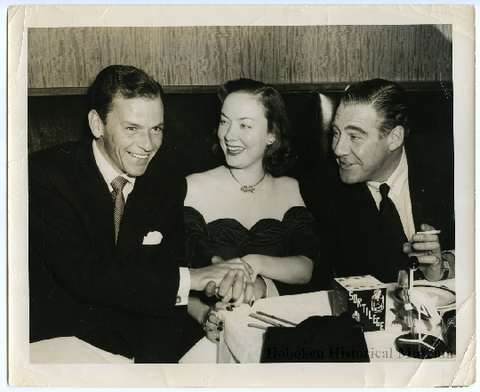
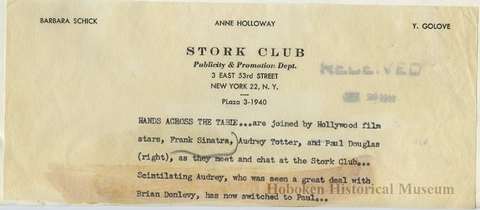
October 28, 1949
Radio
Light Up Time
Taped: October 27, 1949
Sponsor: Lucky Strike Cigarettes
Network: NBC
Show #40
Broadcast: 4:00-4:15 PM PST (Repeat: 8:00-8:15 PM PST)
Starring: Frank Sinatra & Dorothy Kirsten
Jeff Alexander And The Orchestra
1. opening
2. Wrap Your Troubles In Dreams - Frank Sinatra
3. commercial 1
4. Flamingo - Dorothy Kirsten
5. Every Time I Meet You - Frank Sinatra
6. commercial 2
7. My Romance - Frank Sinatra & Dorothy Kirsten
8. closing
Notes: Kirsten's song was changed from "How Deep Is The Ocean" to "Flamingo."
Ed O'Brien:
"You're Breaking My Heart, from the 10-4-49 Light Up Time, was the added track after "Every Time I Meet You."
October 30, 1949
Studio
Hollywood
RHCO3937 The Old Master Painter w/The Modernaires
(H. Gillespie/B. Smith)
Robbins Music Crop. (ASCAP) 1949
Arranged & Conducted by Axel Stordahl
-1 (2:24) CD: Columbia Years 43-52 Vol. 11
78: 38650
NOTE: Sinatra Scholar Ed O'Brien reports that Sinatra sang this ditty a number of times on his Light Up Time shows and raved about what a great song it was.
RHCO3938 Why Remind Me? w/The Modernaires
(S. Willner/D. Tauber)
Barton Music Corp. (ASCAP) 1949
Arranged & Conducted by Axel Stordahl
-1 (3:09) CD: Columbia Years 43-52 Vol. 11
LP: CL-2741 The Essential Frank Sinatra, Vol. 3
78: 38662
Violins: W. Cllies, N. Pisani, R. Polikian, M. Russell, F. Slatkin, M. Sosson; Violas: M. Perlmutter, G. White; Cello: C. Bernard; Saxes: H. Beau, L. Hartman, J. Kinsler, B. Russin, F. Stulce; Piano: K. Lane; Guitar: A. Reuss; Bass: P. Stephens; Drums: R. Hagan; Harp: A. Mason
Radio
The Jack Benny Program
Network: CBS
Sponsor: Lucky Strike
Show: #8 of the 1949-50 series
Time: 7:00 PM EST (rebroadcast: 9:30 - 10:00 PM PST)
Host: Jack Benny
Guests: Frank Sinatra
Cast: Don Wilson, Mary Livingstone, Phil Harris, Dennis Day, Mel Blanc, Artie Auerbach, Rochester, F. E. Boone (tobacco auctioneer), L. A. Speed Riggs (tobacco auctioneer),
Writers: Sam Perrin, George Balzer, John Tackaberry, Milt Josefsberg
Producer By: Hilliard Marks
Script (Final As Broadcast)
1. commercial
2. first routine - Jack Benny, Don Wilson, Phil Harris, Mary Livingstone & Dennis Day
3. The Last Mile Home - Dennis Day
4. second routine - Jack Benny, Dennis Day, Rodchester, Mary Livingstone & Frank Sinatra
5. You Must've Been A Beautiful Baby - Frank Sinatra & Mel Blanc w/the Spotsman Quartet
6. third routine - Jack Benny, Mary Livingstone, Frank Sinatra, Mel Blanc, Jerry ?, Frank Nelson, Don Wilson
7. PSA - Don Wilson
8. commercial
9. closing
Note: Sinatra and Benny closing was cut short due to time. Check script for details.
The show appears on the officially released CD set: 60 Greatest Old Time Radio Shows "Frank Sinatra & Friends"
Hollywood
RHCO3937 The Old Master Painter w/The Modernaires
(H. Gillespie/B. Smith)
Robbins Music Crop. (ASCAP) 1949
Arranged & Conducted by Axel Stordahl
-1 (2:24) CD: Columbia Years 43-52 Vol. 11
78: 38650
RHCO3938 Why Remind Me? w/The Modernaires
(S. Willner/D. Tauber)
Barton Music Corp. (ASCAP) 1949
Arranged & Conducted by Axel Stordahl
-1 (3:09) CD: Columbia Years 43-52 Vol. 11
LP: CL-2741 The Essential Frank Sinatra, Vol. 3
78: 38662
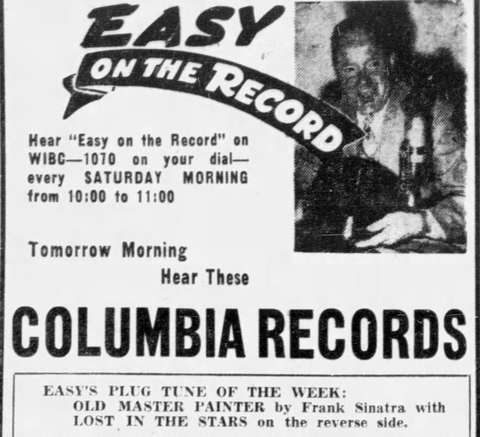
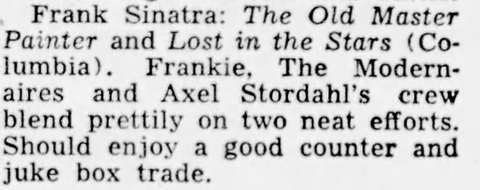
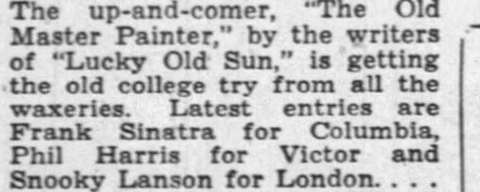
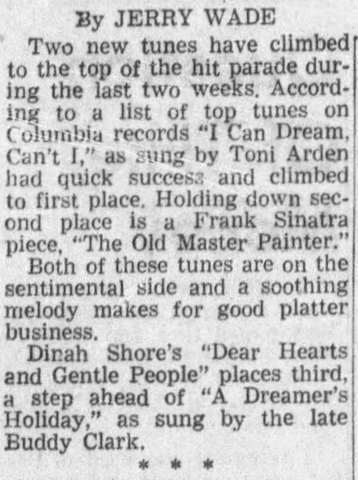
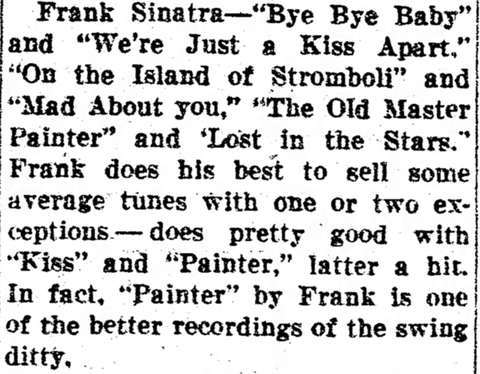

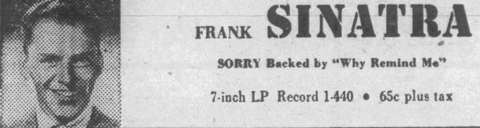

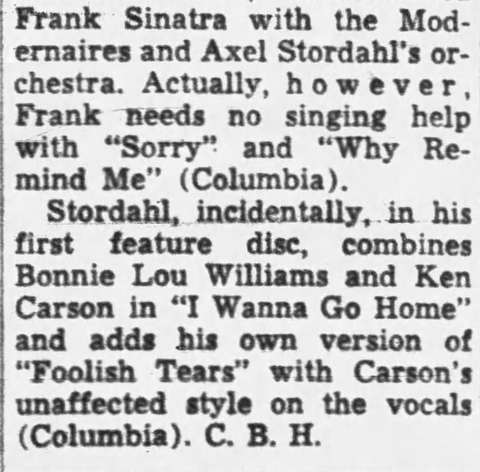
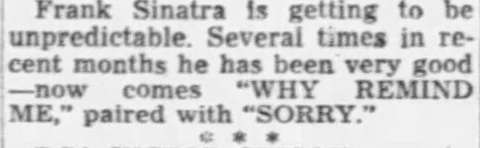
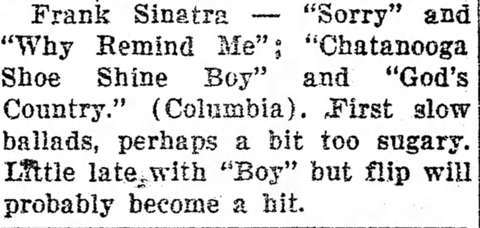
[Sinatra returns to The Jack Benny Show]
Nancy Sinatra Jr.: According to Nancy Sinatra Jr.'s chronicle, her father returned to The Jack Benny Show on October 30, 1949.
Source: James Kaplan, "Frank: The Voice" (2010).
October 31, 1949
Radio
Light Up Time
Sponsor: Lucky Strike Cigarettes
Network: NBC
Show #41
Broadcast: 4:00-4:15 PM PST (Repeat: 8:00-8:15 PM PST)
Starring: Frank Sinatra & Dorothy Kirsten
Jeff Alexander And The Orchestra
1. opening
2. Could' Ja - Frank Sinatra
3. commercial 1
4. Blue Moon - Dorothy Kirsten
5. The Moon Is Yellow - Dorthy Kirsten
6. Dry Bones - Frank Sinatra
7. commercial 2
8. Harvest Moon - Frank Sinatra & Dorothy Kirsten
9. closing
Television
NONE
November 1, 1949
Radio
Light Up Time
Sponsor: Lucky Strike Cigarettes
Network: NBC
Show #42
Broadcast: 4:00-4:15 PM PST (Repeat: 8:00-8:15 PM PST)
Starring: Frank Sinatra & Dorothy Kirsten
Jeff Alexander And The Orchestra
1. opening
2. It All Depends On You - Frank Sinatra
3. commercial 1
4. My Bill - Dorothy Kirsten
5. Maybe It's Because - Frank Sinatra
6. commercial 1
7. Falling In Love With Love - Dorothy Kirsten
8. I Only Have Eyes For You - Frank Sinatra
9. closing
November 2, 1949
Radio
Light Up Time
Sponsor: Lucky Strike Cigarettes
Network: NBC
Show #43
Broadcast: 4:00-4:15 PM PST (Repeat: 8:00-8:15 PM PST)
Starring: Frank Sinatra & Lucille Norman
Jeff Alexander And The Orchestra
1. opening
2. Be Goody, Good, Good To Me - Frank Sinatra
3. commercial 1
4. The Last Mile Home - Lucille Norman
5. I Can Dream, Can't I?" - Lucille Norman
6. Everything Happens To Me - Frank Sinatra
7. commercial 2
8. On The Island Of Stromboli - Frank Sinatra
9. closing
Ed O'Brien:
AFRS addition, after "Everything Happens To Me,"
was the Gershwin classic "Love Is Here To Stay," from
November 3, 1949
Radio
Light Up Time
Sponsor: Lucky Strike Cigarettes
Network: NBC
Show #44
Broadcast: 4:00-4:15 PM PST (Repeat: 8:00-8:15 PM PST)
Starring: Frank Sinatra & Lucille Norman
Jeff Alexander And The Orchestra
1. opening
2. Them There Eyes - Frank Sinatra
3. commercial 1
4. So In Love - Lucille Norman
5. The Old Master Painter - Frank Sinatra
6. commercial
7. That Lucky Old Sun - Frank Sinatra
8. closing
Ed O'Brien:
"That Old Black Magic" was added by AFRS, replacing the second commercial. Song was lifted from the 9-28 Light Up show.
November 4, 1949
Radio
Light Up Time
Sponsor: Lucky Strike Cigarettes
Network: NBC
Show #45
Broadcast: 4:00-4:15 PM PST (Repeat: 8:00-8:15 PM PST)
Starring: Frank Sinatra & Dorothy Kirsten
Jeff Alexander And The Orchestra
1. opening
2. Just One Of Those Things - Frank Sinatra
3. commercial 1
4. These Foolish Things - Dorothy Kirsten
5. Younger Than Springtime - Frank Sinatra
6. commercial 2
7. Only Make Believe - Frank Sinatra & Dorothy Kirsten
8. closing
November 6, 1949
[Sinatra performs on Guest Star radio show]
Nancy Sinatra Jr. / Kaplan: Sinatra performed on Guest Star, a radio show produced for the U.S. Treasury Department, on November 6, 1949 -- one of only two documented public activities that autumn per Nancy Sinatra Jr.'s account.
Source: James Kaplan, "Frank: The Voice" (2010).
November 7, 1949
Radio
Light Up Time
Sponsor: Lucky Strike Cigarettes
Network: NBC
Show #46
Broadcast: 4:00-4:15 PM PST (Repeat: 8:00-8:15 PM PST)
Starring: Frank Sinatra & Eileen Wilson
Jeff Alexander And The Orchestra
1. opening
2. On The Sunny Side Of The Street - Frank Sinatra
3. commercial 1
4. I Can Dream, Can't I? - Eileen Wilson
5. Meadows Of Heaven - Frank Sinatra
6. commercial 2
7. A Fine Romance - Frank Sinatra & Eileen Wilson
8. closing
Notes: AFRS Lite Up Time version. Lifted the Wilson song from the 11-8-49 Light Up Time.
November 8, 1949
Studio
RHCO3940 Sunshine Cake w/Paula Kelly
(J. Burke/J. Van Heusen)
(from Riding High)
Burke-Van Heusen, Inc. (ASCAP) 1949
Arranged & Conducted by Axel Stordahl
-1 (3:09) CD: Columbia Years 43-52 Vol. 11
LP: CL-2741 The Essential Frank Sinatra, Vol. 3
78: 38705
RHCO3941 (We've Got A) Sure Thing w/The Modernaires
(J. Burke/J. Van Heusen)
(from Riding High)
Burke-Van Heusen, Inc. (ASCAP) 1949
Arranged & Conducted by Axel Stordahl
-1 (3:11) CD: Columbia Years 43-52 Vol. 11
LP: CL-2741 The Essential Frank Sinatra, Vol. 3
78: 38705
CONCERT
Radio
Light Up Time
Sponsor: Lucky Strike Cigarettes
Network: NBC
Show #47
Broadcast: 4:00-4:15 PM PST (Repeat: 8:00-8:15 PM PST)
Starring: Frank Sinatra & Eileen Wilson
Jeff Alexander And The Orchestra
1. opening
2. It Was Only A Paper Moon - Frank Sinatra
3. commercial 1
4. A Thousand Violins - Eileen Wilson
5. This Love Of Mine - Frank Sinatra
6. Dreamer's Holiday - Eileen Wilson
7. commercial 2
8. Don't Cry, Joe - Frank Sinatra
9. closing
November 9, 1949
Radio
Light Up Time
Sponsor: Lucky Strike Cigarettes
Network: NBC
Show #48
Broadcast: 4:00-4:15 PM PST (Repeat: 8:00-8:15 PM PST)
Starring: Frank Sinatra & Margaret Whiting
Jeff Alexander And The Orchestra
1. opening
2. That Old Master Painter - Frank Sinatra
3. commercial 1
4. Too Marvelous For Words - Margaret Whiting
5. If I Ever Love Again - Frank Sinatra
6. commercial 2
7. This Can't Be Love - Frank Sinatra & Margaret Whiting
8. closing
Ed O'Brien:
AFRS addition in the commercial 2 spot was the Burke-
Van Heusen song "You"re In Love With Someone," from 9-28-49 Light Up Time.
Television
NONE
Film
The House I Live In, (US Film Release: November 9, 1945) (Directed by Mervyn Leroy. Produced by Mervyn LeRoy and Frank Ross. Written by Albert Maltz) Sinatra, taking a break from a recording session steps outside and intervenes when ten boys are chasing a Jewish boy. Sinatra gives a speech about tolerance and then sings "The House I Live In")
Note: Sinatra also sings "If You Are But A Dream" with an orchestra directed by Axel Stordahl
The film would win an Honorary Academy Award and special Golden Globe Award in 1946.
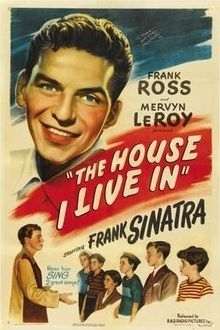
November 10, 1949
Radio
Light Up Time
Sponsor: Lucky Strike Cigarettes
Network: NBC
Show #49
Broadcast: 4:00-4:15 PM PST (Repeat: 8:00-8:15 PM PST)
Starring: Frank Sinatra & Margaret Whiting
Jeff Alexander And The Orchestra
1. opening
2. My Blue Heaven - Frank Sinatra
3. commercial 1
4. The Cockeyed Opimist - Margaret Whiting
5. The Touch Of Your Hand - Frank Sinatra
6. Yesterdays - Margaret Whiting
7. commercial 2
8. On The Island Of Stromboli - Frank Sinatra
9. closing note: Ed O'Brien "AFRS sub for missing second commercial was "Meadows Of Heaven" from Light Up Time
10-11-49"
November 11, 1949
Radio
Light Up Time
Sponsor: Lucky Strike Cigarettes
Network: NBC
Show #50
Broadcast: 4:00-4:15 PM PST (Repeat: 8:00-8:15 PM PST)
Starring: Frank Sinatra & Lucille Norman
Jeff Alexander And The Orchestra
1. opening
2. Sweet Lorraine - Frank Sinatra
3. commercial 1
4. Why Was I Born - Lucille Norman
5. You're In Love With Someone - Frank Sinatra
6. commercial 2
7. America The Beautiful - Frank Sinatra & Lucille Norman
8. closing
November 14, 1949
Radio
Light Up Time
Sponsor: Lucky Strike Cigarettes
Network: NBC
Show #51
Broadcast: 4:00-4:15 PM PST (Repeat: 8:00-8:15 PM PST)
Starring: Frank Sinatra & Eileen Wilson
Jeff Alexander And The Orchestra
1. opening
2. Lover - Frank Sinatra
3. commercial 1
4. They Didn't Believe Me - Eileen Wilson
5. Lost In The Stars - Frank Sinatra
6. commercial 2
7. Laura - Frank Sinatra
8. closing
Ed O'Brien:
AFRS tune after commericial: "Someday( You'll Want Me To Want You.") from 10-6 show.
November 15, 1949
Studio
Light Up Time
Sponsor: Lucky Strike Cigarettes
Network: NBC
Show #52
Broadcast: 4:00-4:15 PM PST (Repeat: 8:00-8:15 PM PST)
Starring: Frank Sinatra & Eileen Wilson
Jeff Alexander And The Orchestra
1. opening
2. A Foggy Day - Frank Sinatra
3. commercial 1
4. Zing! Went The Strings Of My Heart - Eileen Wilson
5. Nothing Less Than Beautiful - Frank Sinatra
6. I Only Have Eyes For You - Eileen Wilson
7. commercial 2
8. Mad About You
9. closing note: AFRS tune after commercial: "Someday (You'll Want Me To Want You.") from 10-6 show.
Radio
Radio: An AFRS transcription of Lite Up Time (the Armed Forces Radio Service edition of Sinatra's Light Up Time series) was issued this date, with Sinatra singing "Someday." Source: sinatradiscography.com, Radio Transcriptions Database.
November 16, 1949
Radio
Light Up Time
Sponsor: Lucky Strike Cigarettes
Network: NBC
Show #53
Broadcast: 4:00-4:15 PM PST (Repeat: 8:00-8:15 PM PST)
Starring: Frank Sinatra & Lucille Norman
Jeff Alexander And The Orchestra
1. opening
2. The One I Love - Frank Sinatra
3. commercial 1
4. If You Are But A Dream - Lucille Norman
5. Supposin' - Frank Sinatra
6. I'll Get By - Lucille Norman
7. commercial 2
8. A Man Wrote A Song - Frank Sinatra
9. closing
November 17, 1949
Radio
Light Up Time
Taped: November 4, 1949
Sponsor: Lucky Strike Cigarettes
Network: NBC
Show #54
Broadcast: 4:00-4:15 PM PST (Repeat: 8:00-8:15 PM PST)
Starring: Frank Sinatra & Dorothy Kirsten
Jeff Alexander And The Orchestra
1. opening
2. At Sundown - Frank Sinatra
3. commercial 1
4. Did I Remember - Dorothy Kirsten
5. You're In Love With Someone - Frank Sinatra
6. I'm In The Mood For Love - Dorothy Kirsten
7. commercial 2
8. The Old Master Painter - Frank Sinatra
9. closing
November 18, 1949
Radio
Light Up Time
Taped: November 4, 1949
Sponsor: Lucky Strike Cigarettes
Network: NBC
Show #55
Broadcast: 4:00-4:15 PM PST (Repeat: 8:00-8:15 PM PST)
Starring: Frank Sinatra & Dorothy Kirsten
Jeff Alexander And The Orchestra
1. opening
2. All Of Me - Frank Sinatra
3. commercial 1
4. You Go To My Head - Dorothy Kirsten
5. If I Ever Love Again - Frank Sinatra
6. commercial 2
7. Dancing In The Dark - Frank & Dorothy
8. closing
November 21, 1949
Radio
Light Up Time
Sponsor: Lucky Strike Cigarettes
Network: NBC
Show #56
Broadcast: 7:00-7:15 PM EST (Repeat: 8:00-8:15 PM PST)
Starring: Frank Sinatra & Dorothy Kirsten
Ziggy Elman And The Orchestra
1. opening
2. I've Found A New Baby - Frank Sinatra
3. commercial 1
4. I'll See You Again - Dorothy Kirsten
5. Medley: Just One Of Those Thinngs / All Of Me / Pagliacci / Baby It's Cold Outside / The Hucklebuck - Frank Sinatra & Dorothy Kirsten
6. commercial 2
7. Some Enchanted Evening - Frank Sinatra & Dorothy Kirsten
8. closing
Ed O'Brien:
Ziggy Elman took over as orchestra leader on this date in 1949. He would conduct and sometimes arrange through the 12-16-49 show. During those 20 shows, Sinatra would sometimes feature his very talented pal from the Dorsey years.
Television
None
November 22, 1949
Radio
Light Up Time
Sponsor: Lucky Strike Cigarettes
Network: NBC
Show #57
Broadcast: 7:00-7:15 PM EST (Repeat: 8:00-8:15 PM PST)
Starring: Frank Sinatra & Marlene Dietrich
Ziggy Elman And The Orchestra
1. opening
2. When You're Smiling - Frank Sinatra
3. commercial 1
4. Illusions - Marlene Dietrich
5. Bye Bye Baby - Frank Sinatra
6. commercial 2
7. If You Are But A Dream - Frank Sinatra
8. Closing
NOTE: According to Ed O'Brien, Marlene Dietrich is the woman who called Sinatra the Mercedes-Benz of men. And they didn't do a duet together!

November 23, 1949
Radio
Light Up Time
Sponsor: Lucky Strike Cigarettes
Network: NBC
Show #58
Broadcast: 7:00-7:15 PM EST (Repeat: 8:00-8:15 PM PST)
Starring: Frank Sinatra
Ziggy Elman And The Orchestra
1. opening
2. Should I - Frank Sinatra
3. commercial 1
4. On The Island Of Stromboli - Frank Sinatra
5. And The Angels Sing - Ziggy Elman (Trumpet)
6. P.S. I Love You - Frank Sinatra
7. commercial 2
8. Where Is My Bess - Frank Sinatra
9. closing
November 24, 1949
Radio
Light Up Time
Sponsor: Lucky Strike Cigarettes
Network: NBC
Show #59
Broadcast: 7:00-7:15 PM EST (Repeat: 8:00-8:15 PM PST)
Starring: Frank Sinatra & Dorothy Kirsten
Ziggy Elman And The Orchestra
1. opening
2. The Best Things In Life Are Free - Frank Sinatra
3. commercial 1
4. Kiss Me Again - Dorothy Kirsten
5. Don't Cry Joe - Frank Sinatra
6. The Man I Love - Dorothy Kirsten
7. commercial 2
8. The House I Live In - Frank Sinatra
9. closing
November 25, 1949
Radio
Light Up Time
Sponsor: Lucky Strike Cigarettes
Network: NBC
Show #60
Broadcast: 7:00-7:15 PM EST (Repeat: 8:00-8:15 PM PST)
Starring: Frank Sinatra & Dorothy Kirsten
Ziggy Elman And The Orchestra
1. opening
2. The Old Master - Frank Sinatra
3. commercial 1
4. Jalousie - Dorothy Kirsten
5. Scattered Toys - Frank Sinatra
6. Hush Little Darlin' - Dorothy Kirsten
7. commercial 2
8. Dreamer's Holiday - Frank Sinatra
9. closing
Notes: Sinatra was to close with a medley of "You're Breaking My Heart", "Dreamer's Holiday", "The Song Is You" but it was cut to only "Dreamer's Holiday."
November 28, 1949
Radio
Big Joe Rosenfield Program
WOR 2am - 5am
Guest: Frank Sinatra

Light Up Time
Sponsor: Lucky Strike Cigarettes
Network: NBC
Show #61
Broadcast: 7:00-7:15 PM EST (Repeat: 8:00-8:15 PM PST)
Starring: Frank Sinatra & Dorothy Kirsten
Ziggy Elman And The Orchestra
1. opening
2. You'd Be So Nice To Come Home To - Frank Sinatra
3. commercial 1
4. Easy To Love - Dorothy Kirsten
5. Just One Of Those Things - Frank Sinatra
6. You Do Something To Me - Dorothy Kirsten
7. commercial 2
8. Night And Day - Frank Sinatra
9. closing
November 29, 1949
Radio
Light Up Time
Sponsor: Lucky Strike Cigarettes
Network: NBC
Show #62
Broadcast: 7:00-7:15 PM EST (Repeat: 8:00-8:15 PM PST)
Starring: Frank Sinatra
Ziggy Elman And The Orchestra
1. opening
2. I Can't Believe That You're In Love With Me - Frank Sinatra
3. commercial 1
4. My Street - Frank Sinatra
5. Don't Worry 'Bout Me / Day In Day Out - Frank Sinatra
6. commercial 2
7. If I Ever Love Again - Frank Sinatra
8. closing
Poole’s Paradise, Hosted by Bob Poole
Frank Sinatra was guest
2pm
November 30, 1949
Radio
Light Up Time
Sponsor: Lucky Strike Cigarettes
Network: NBC
Show #63
Broadcast: 7:00-7:15 PM EST (Repeat: 8:00-8:15 PM PST)
Starring: Frank Sinatra & Dorothy Kirsten
Ziggy Elman And The Orchestra
1. opening
2. It Was Only A Paper Moon - Frank Sinatra
3. commercial 1
4. Why Was I Born - Dorothy Kirsten
5. Mad About You - Frank Sinatra
6. commercial 2
7. A Fine Romance - Frank Sinatra & Dorothy Kirsten
8. closing
December 1949
[Nancy decides to end the marriage in practice]
Kaplan: After learning that the Ava affair was becoming public, Nancy Sinatra decided the couple would no longer live as husband and wife, though her Catholic faith precluded divorce; she resolved to protect her pride and her children going forward.
Source: James Kaplan, "Frank: The Voice" (2010)
[Record-breaking Hartford engagement]
Kaplan: In December 1949, Sinatra broke box-office records at the State Theater in Hartford, grossing $18,000 for two nights -- his first live engagements in two years.
Source: James Kaplan, "Frank: The Voice" (2010)
December 1, 1949
Radio
Light Up Time
Sponsor: Lucky Strike Cigarettes
Network: NBC
Show #64
Broadcast: 7:00-7:15 PM EST (Repeat: 8:00-8:15 PM PST)
Starring: Frank Sinatra & Dorothy Kirsten
Ziggy Elman And The Orchestra
1. opening
2.. My Blue Heaven - Frank Sinatra
3. commercial 1
4. I Can Dream Can't I? - Dorothy Kirsten
5. Body And Soul - Frank Sinatra
6. commercial 2
7. Only Make Believe - Frank Sinatra & Dorothy Kirsten
8. closing
December 2, 1949
Radio
Light Up Time
Sponsor: Lucky Strike Cigarettes
Network: NBC
Show #65
Broadcast: 7:00-7:15 PM EST (Repeat: 8:00-8:15 PM PST)
Starring: Frank Sinatra & Dorothy Kirsten
Ziggy Elman And The Orchestra
1. opening
2. This Can't Be Love - Frank Sinatra
3. commercial 1
4. The Moon Is Yellow - Dorothy Kirsten
5. I've Got My Love To Keep Me Warm - Frank Sinatra
6. Button Up Your Overcoat - Dorothy Kirsten
7. commercial 2
8. That Old Master Painter - Frank Sinatra
9. closing
December 3, 1949
State Theatre, Hartford, Conn. (December 3-4)
SINATRA SHOWS
$18,267 WEEKEND
Hartford, Conn. Dec. 6
Frank Sinatra, playing his first theatre date in two years,
broke all records at the State here, with an $18,267 gross
for eight shows over Saturday (3) and Sunday (4) Opening
day's gross, despite a snowstorm, was $11,385. On the
bill with The Voice were Harvey Stone and Ziggy Elman
and orch. The Dunhills were also slated to appear but
couldn't get to the theatre, being held up by the storm.
They were driving in from a Detroit date.
Sinatra is in the east while his Lucky Strike sponsored
show with Dorothy Kirsten is originating from New York.
He is planning a theatre tour sometime after Jan 1 in
eastern cities where he hasn't previously played.
For the time being cafe shows are out.Sinatra had
planned playing class niteries, but no deals have jelled
yet. He definitely ruled out the Copacabana in N.Y.,
where the policy is three shows nightly. He declared
his pipes wouldn't take that number of shows along
with his radio chores.
Arthur Godfrey did $20,000 in ten shows in a two-day
appearance last year.
Variety
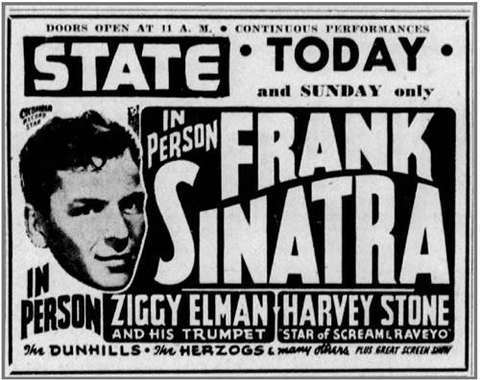
Ed O'Brien:
Frank would change his mind about the rigors of
three shows a night at the Copa. He would open there
on 3-23-50 for a scheduled five week engagement. Skitch
Henderson told me that some night they would a fourth
show in the wee small hours for a special audience.
© 1997-2025 The Sinatra Archive
This calendar, or any parts thereof, may not be reproduced in any fashion
whatsoever without the prior written permission of the publisher (The
Sinatra Archive)
__._,_.___
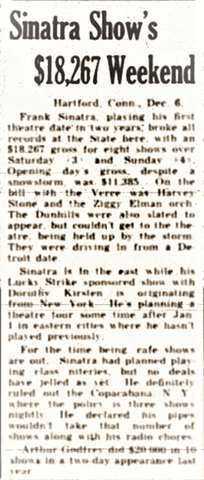
Concerts
State Theatre, Hartford, Conn. (December 3-4)
w/Ziggy Elman and His Trumpet, Harvey Stone
Eight shows over the two days
Brian Chearno notes:
Grossed $18,000 breaking Arthur Godfrey's record. December 4, 1949 Sunday Herald mention first theatre stand in two years. December 10, 1949 mention of record breaking shows. November 27, 1949 ad mentions Sinatra's coming appearance. Hartford Courant mentioned that Sinatra gave a boost to help fund the Hospital in Italy drive. Sinatra invited students at the Connecticut School for the Blind to the afternoon show. They also reported that he announced he would return in February.
Source: sinatraphiles digest (date extracted from item text; originally routed to appendix for review).
State Theatre, Hartford, Conn. (December 3-4) w/Ziggy Elman and His Trumpet, Harvey Stone
Eight shows over the two days
Brian Chearno notes:
Grossed $18,000 breaking Arthur Godfrey's record. December 4, 1949 Sunday Herald mention first theatre stand in two years. December 10, 1949 mention of record breaking shows. November 27, 1949 ad mentions Sinatra's coming appearance. Hartford Courant mentioned that Sinatra gave a boost to help fund the Hospital in Italy drive. Sinatra invited students at the Connecticut School for the Blind to the afternoon show. They also reported that he announced he would return in February.
Source: sinatraphiles digest (date extracted from item text; originally routed to appendix for review).
December 4, 1949
Concerts
State Theatre, Hartford, Conn. (December 3-4) w/Ziggy Elman and His Trumpet, Harvey Stone
Eight shows over the two days
State Theatre, Hartford, Conn. (December 3-4)
w/Ziggy Elman and His Trumpet, Harvey Stone
Eight shows over the two days
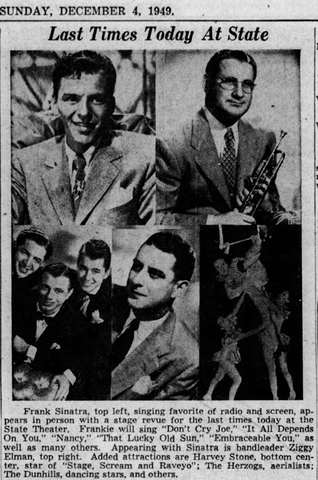

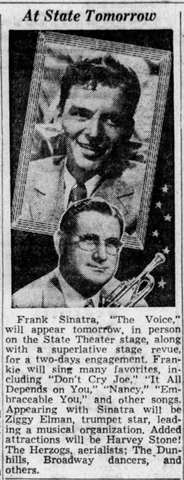
December 5, 1949
Radio
Light Up Time
Sponsor: Lucky Strike Cigarettes
Network: NBC
Show #66
Broadcast: 7:00-7:15 PM EST (Repeat: 8:00-8:15 PM PST)
Starring: Frank Sinatra & Dorothy Kirsten
Ziggy Elman And The Orchestra
1, opening
2. A Foggy Day - Frank Sinatra
3. commercial 1
4. If I Ever Love Again - Dorothy Kirsten
5. Don't Cry Joe - Frank Sinatra
6. commercial 2
7. Full Moon And Empty Arms - Frank Sinatra & Dorothy Kirsten
8. closing
Television
none
December 6, 1949
Radio
Light Up Time
Sponsor: Lucky Strike Cigarettes
Network: NBC
Show #67
Broadcast: 7:00-7:15 PM EST (Repeat: 8:00-8:15 PM PST)
Starring: Frank Sinatra & Dorothy Kirsten
Ziggy Elman And The Orchestra
1. opening
2. Bye Bye Baby - Frank Sinatra
3. commercial 1
4. If I Should Lose You - Dorothy Kirsten
5. A Man Wrote A Song - Frank Sinatra
6. They Say It's Wonderful - Dorothy Kirsten
7. commercial 2
8. Begin The Beguine - Frank Sinatra
9. closing
December 7, 1949
Radio
Light Up Time
Sponsor: Lucky Strike Cigarettes
Network: NBC
Show #68
Broadcast: 7:00-7:15 PM EST (Repeat: 8:00-8:15 PM PST)
Starring: Frank Sinatra & Dorothy Kirsten
Ziggy Elman And The Orchestra
1. opening
2. Sweet Loraine - Frank Sinatra
3. commercial 1
4. These Foolish Things - Dorothy Kirsten
5. That Lucky Old Sun - Frank Sinatra
6. commercial 2
7. Falling In Love With Love - Frank Sinatra & Dorothy Kirsten
8. closing
December 8, 1949
Radio
Light Up Time
Sponsor: Lucky Strike Cigarettes
Network: NBC
Show #69
Broadcast: 7:00-7:15 PM EST (Repeat: 8:00-8:15 PM PST)
Starring: Frank Sinatra & Dorothy Kirsten
Ziggy Elman And The Orchestra
1. opening
2. You Must Have Been A Beautiful Baby - Frank Sinatra
3. commercial 1
4. UN BEL DI (from Puccini's BUTTERFLY) - Dorothy Kirsten
5. A Man Wrote A Song - Frank Sinatra
6. commercial 2
7. Without A Song - Frank Sinatra
8. closing
Frank Sinatra and Ava Gardner's romance began in earnest around this time. Having reconnected at a Palm Springs party in late 1949 after a stalled first date the previous year, they attended the Ziegfeld Theatre opening of Gentlemen Prefer Blondes together, ostensibly with another couple along as cover for the married Sinatra's presence — though word of the pairing quickly spread through New York. Both were staying, separately but under the same roof, at Manie Sacks's suite at the Hampshire House. “All of my life, being a singer was the most important thing in the world,” Frank told her by year's end. “Now… you're all I want.” Source: J. Randy Taraborrelli, Sinatra: Behind the Legend.
On the night they reconnected at Zanuck's Palm Springs party, Sinatra and Gardner drove out to the desert with a few bottles of liquor and two .38 revolvers from his glove compartment and shot out the streetlights of a small town, an escapade that should have ended in arrest; instead the local police, starstruck, offered to drive them home, and were further won over when Sinatra had his publicist charter a plane and arrive with a suitcase of cash to make any charges disappear. Source: Michael Sheridan & David Harvey, Sinatra and the Jack Pack.
[Frank and Ava at Gentlemen Prefer Blondes premiere]
Kaplan / Walter Winchell: On December 8, 1949, Frank and Ava attended the Broadway premiere of Gentlemen Prefer Blondes at the Ziegfeld Theatre, disguised among the crowd with Manie Sacks and a date. The next morning Walter Winchell's column obliquely noted "Ava Gardner Period" without further comment.
Source: James Kaplan, "Frank: The Voice" (2010).
December 9, 1949
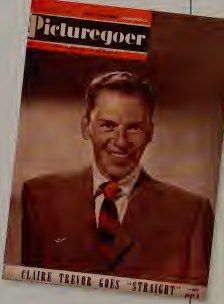
[Photograph: Frank attends premiere of On the Town. From Richard Havers, "Sinatra" (Dorling Kindersley, 2007), p.143.]
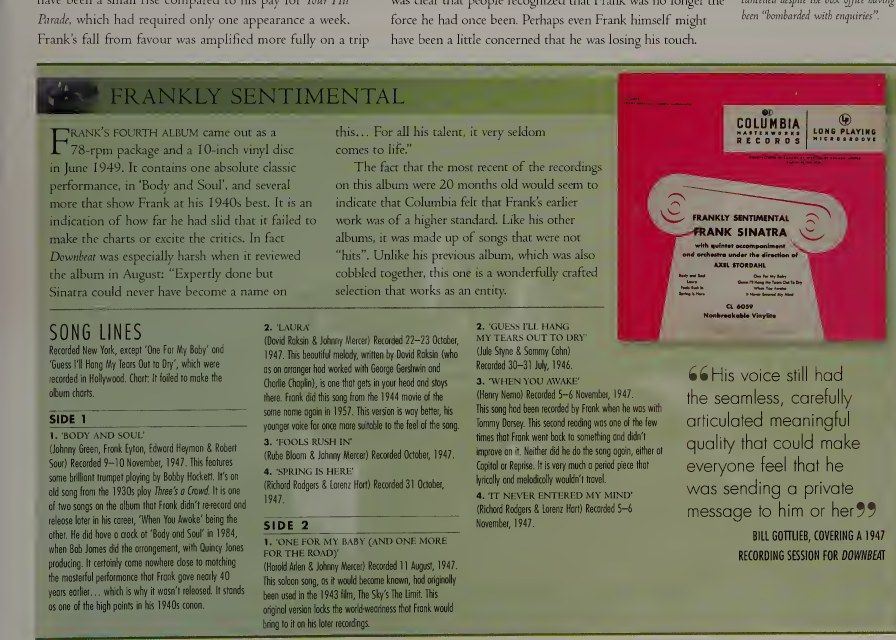
[Photograph: Frank attends premiere of On the Town. From Richard Havers, "Sinatra" (Dorling Kindersley, 2007), p.143.]
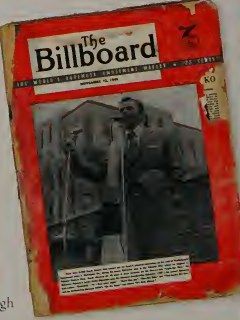
[Photograph: Frank attends premiere of On the Town. From Richard Havers, "Sinatra" (Dorling Kindersley, 2007), p.142.]
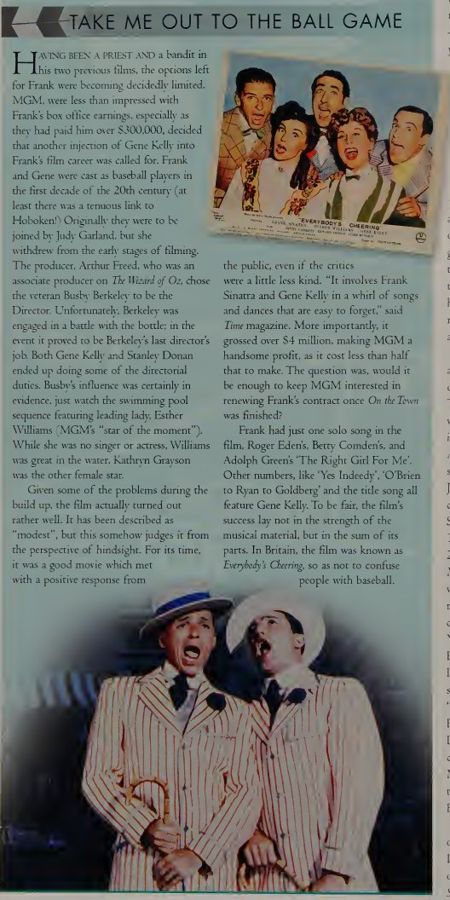
[Photograph: Frank attends premiere of On the Town. From Richard Havers, "Sinatra" (Dorling Kindersley, 2007), p.142.]
Radio
Light Up Time
Sponsor: Lucky Strike Cigarettes
Network: NBC
Show #70
Broadcast: 7:00-7:15 PM EST (Repeat: 8:00-8:15 PM PST)
Starring: Frank Sinatra & Dorothy Kirsten
Ziggy Elman And The Orchestra
1. opening
2. I Found A New Baby - Frank Sinatra
3. commercial 1
4. My Bill - Dorothy Kirsten
5. Mad About You - Frank Sinatra
6. commercial 2
7. If I Loved You - Frank Sinatra & Dorothy Kirsten
8. closing
The evening after going public with Ava at the Gentlemen Prefer Blondes opening, Frank attended the premiere of On the Town at Radio City Music Hall; George Evans immediately warned him to keep Ava out of the spotlight to protect both their MGM contracts. (Source: Richard Havers, "Sinatra" (Dorling Kindersley, 2007).)
December 10, 1949
Concerts
Kaiser-Frazer Plant, Long Beach, CA
Frank Sinatra and Margaret Whiting performed at the Aviation Ball
Note: Sinatra had also performed at the Aviation Ball in 1948
Kaiser-Frazer Plant, Long Beach, CA
Frank Sinatra and Margaret Whiting performed at the Aviation Ball
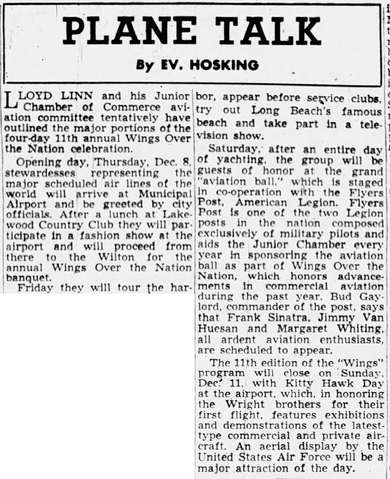
December 11, 1949
Concerts
Mansfield Theatre, New York
Benefit for the Actors' Temple
Frank Sinatra, Henny Youngman, Smith & Dale, Robert Merrill, The Ink Spots, Desi Arnaz, Red Buttons and others
Mansfield Theatre, New York
Benefit for the Actors' Temple
Frank Sinatra, Henny Youngman, Smith & Dale, Robert Merrill, The Ink Spots, Desi Arnaz, Red Buttons and others
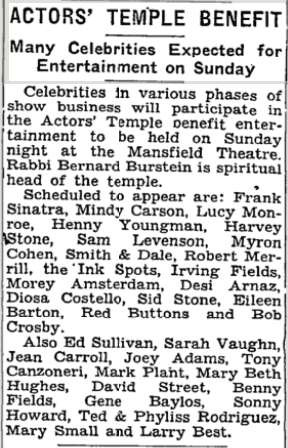
December 12, 1949
Radio
Light Up Time
Sponsor: Lucky Strike Cigarettes
Network: NBC
Show #71
Broadcast: 7:00-7:15 PM EST (Repeat: 8:00-8:15 PM PST)
Starring: Frank Sinatra & Dorothy Kirsten
Ziggy Elman And The Orchestra
1. opening
2. That Old Master Painter - Frank Sinatra
3. commercial 1
4. They Didn't Believe Me - Dorothy Kirsten
5. Why Remind Me - Frank Sinatra
6. commercial 2
7. White Christmas - Frank Sinatra & Dorothy Kirsten
8. closing
Television
Taping:
Air Date 1-3-80
December 12, 1979 Caesar's Palace, Las Vegas, Nevada
"The First 40 Years" Celebration
Orchestra Conducted By: Don Costa
1. New York, New York
2. It Was A Very Good Year
3. The Best Is Yet To Come
4. monologue
5. I've Got You Under My Skin
6. I've Got The World On A String
Notes: FS receives the ASCAP Pied Piper Award
[Sinatra's 34th birthday party at the Copacabana]
Jack Entratter threw Frank a 34th-birthday party at the Copacabana, where Dolly Sinatra and Ava Gardner spent time together and hit it off.
Source: James Kaplan, "Frank: The Voice" (2010).
December 13, 1949
Radio
Light Up Time
Sponsor: Lucky Strike Cigarettes
Network: NBC
Show #72
Broadcast: 7:00-7:15 PM EST (Repeat: 8:00-8:15 PM PST)
Starring: Frank Sinatra & Janet Blair
Ziggy Elman And The Orchestra
1. opening
2. Santa Claus Is Coming To Town - Frank Sinatra
3. commercial 1
4. Why Was I Born - Janet Blair
5. Envy - Frank Sinatra
6. commercial 2
7. Some Enchanted Evening - Frank Sinatra & Janet Blair
8. closing
Note: Sinatra Scholar Ed OBrien notes that Sinatraphiles has discussed Santa Claus is Coming to Town with Ms. Lauper.
That discussion touched on how good Franks 1947 recording was. Well, for my money, OBrien says, this is the real gem. Ziggy Elman backs Frank on a swinging, jazzy chart, and he has a lot of fun.
Ed O'Brien
The Sinatra-Lauper duet was released for Christmas in 1992, on the CD "A Very Special Christmas Vol II. The original Axel Stordahl orchestration was copied by a full orchestra with Suzie Katayama conducting. The marvelous jazz drummer Sol Gubin can be heard on the recording.. The session was done in Los Angeles.
December 14, 1949
Radio
Light Up Time
Sponsor: Lucky Strike Cigarettes
Network: NBC
Show #73
Broadcast: 7:00-7:15 PM EST (Repeat: 8:00-8:15 PM PST)
Starring: Frank Sinatra & Dorothy Kirsten
Ziggy Elman And The Orchestra
1. opening
2. What Can I Say Dear - Frank Sinatra
3. commercial 1
4. You Go To My Head - Dorothy Kirsten
5. Sorry - Frank Sinatra
6. commercial 2
7. Penthouse Serenade - Frank Sinatra & Dorothy Kirsten
8. closing
Notes: Kirsten's song was changed from "All The
Things You Are" to "You Go To My Head."
December 15, 1949
Radio
Light Up Time
Taped: Show was pre-taped, no date listed
Sponsor: Lucky Strike Cigarettes
Network: NBC
Show #74
Broadcast: 7:00-7:15 PM EST (Repeat: 8:00-8:15 PM PST)
Starring: Frank Sinatra & Dorothy Kirsten
Ziggy Elman And The Orchestra
1. opening
2. When You're Smiling - Frank Sinatra
3. commercial 1
4. Mad About You - Dorothy Kirsten
5. Meadows Of Heaven - Frank Sinatra
6. Hush Little Darlin' - Dorothy Kirsten
7. commercial 2
8. Don't Cry Joe - Frank Sinatra
9. closing
Concerts
Toots Shor's Dinner for Bill Corum, New York
Frank Sinatra, Don Ameche, Ethel Merman, Eddie Duchin, Jimmy Durante and others
Toots Shor's Dinner for Bill Corum, New York
Frank Sinatra, Don Ameche, Ethel Merman, Eddie Duchin, Jimmy Durante and others
[image referenced in source but could not be recovered]
December 16, 1949
Radio
Light Up Time
Sponsor: Lucky Strike Cigarettes
Network: NBC
Show #75
Broadcast: 7:00-7:15 PM EST (Repeat: 8:00-8:15 PM PST)
Starring: Frank Sinatra & Dorothy Kirsten
Ziggy Elman And The Orchestra
1. opening
2. I Can't Believe You're In Love With Me - Frank Sinatra
3. commercial 1
4. Every Time I Meet You - Dorothy Kirsten
5. My Street - Frank Sinatra
6. commercial 2
7. Strange Music - Frank Sinatra & Dorothy Kirsten
8. closing
Notes: Kirsten's song was switched from "I'll See You Again" to "Every Time I Meet You."
December 17, 1949
for the movie "Battleground." Lennie Hayton conducted and wrote the arrangement. The recording was not used in the
film. Finally, there is the 1954 version done at Capitol with Nelson Riddle. Jonathan Schwartz is quite certain Frank would have had
a major hit if "kiddies" had not replaced "children" in the lyrics. You don't improve on Mr. Berlin. Frank sang the song on his radio shows
throughout the 1940s
--Ed
December 19, 1949
Radio
Light Up Time
Sponsor: Lucky Strike Cigarettes
Network: NBC
Show #76
Broadcast: 4:00-4:15 PM PST (Repeat: 7:00-7:15 PM PST)
Starring: Frank Sinatra & Jane Powell
Jeff Alexander And The Orchestra
1. opening
2. My Blue Heaven
3. commercial 1
4. S'Wonderful - Frank Sinatra
5. Falling In Love With Love - Jane Powell
6. Younger Than Springtime - Frank Sinatra
7. commercial 2
8. Why Do I Love You - Frank Sinatra & Jane Powell
9. closing
December 20, 1949
Radio
Light Up Time
Sponsor: Lucky Strike Cigarettes
Network: NBC
Show #77
Broadcast: 4:00-4:15 PM PST (Repeat: 7:00-7:15 PM PST)
Starring: Frank Sinatra
Jeff Alexander And The Orchestra
1. opening
2. Them There Eyes - Frank Sinatra
3. commercial 1
4. Why Remind Me - Frank Sinatra
5. Body And Soul - Frank Sinatra
6. commercial 2
7. Where Or When - Frank Sinatra
8. closing
December 21, 1949
Radio
Light Up Time
Sponsor: Lucky Strike Cigarettes
Network: NBC
Show #78
Broadcast: 4:00-4:15 PM PST (Repeat: 7:00-7:15 PM PST)
Starring: Frank Sinatra & Jane Powell
Jeff Alexander And The Orchestra
1. opening
2. At Sundown - Frank Sinatra
3. commercial 1
4. Deep In My Heart - Jane Powell
5. Don't Cry, Joe - Frank Sinatra
6. commercial 2
7. Love Is Just Around The Corner - Frank Sinatra
8. If You Are But A Dream - Frank Sinatra And Jane Powell
9. closing
Notes: "Love Is Just Around The Corner" was a last minute addition.
December 22, 1949
Radio
Light Up Time
Taped: December 19, 1949
Sponsor: Lucky Strike Cigarettes
Network: NBC
Show #79
Broadcast: 4:00-4:15 PM PST (Repeat: 7:00-7:15 PM PST)
Starring: Frank Sinatra & Jane Powell
Jeff Alexander And The Orchestra
1. opening
2. The Old Master Painter - Frank Sinatra
3. commercial 1
4. Lover Come Back To Me - Jane Powell
5. Envy - Frank Sinatra
6. commcerial 2
7. The Song Is You - Frank Sinatra & Jane Powell
8. closing
December 23, 1949
Radio
Light Up Time
Taped: December 20, 1949
Sponsor: Lucky Strike Cigarettes
Network: NBC
Show #80
Broadcast: 4:00-4:15 PM PST (Repeat: 7:00-7:15 PM PST)
Starring: Frank Sinatra
Jeff Alexander And The Orchestra
1. opening
2. Santa Claus Is Coming To Town - Frank Sinatra
3. commercial 1
4. Jingle Bells - Frank Sinatra
5. Medley: Joy To The World / It Came Upon A
Midnight Clear - Adeste Fidelis - Frank Sinatra
6. White Christmas - Frank Sinatra
7. commercial 2
8. Silent Night - Frank Sinatra
9. closing
Sinatra Scholar Ed O'Brien can think of only two
Sinatra shows that were strictly devoted to Christmas songs throughout. This is one and the 1957 Christmas show with Bing Crosby was the other.
December 24, 1949
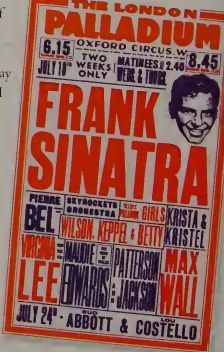
[Photograph: Frank publishes forward-thinking essay on LP format. From Richard Havers, "Sinatra" (Dorling Kindersley, 2007), p.152.]
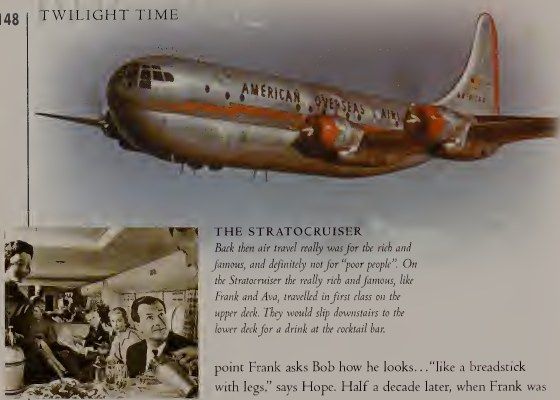
[Photograph: Frank publishes forward-thinking essay on LP format. From Richard Havers, "Sinatra" (Dorling Kindersley, 2007), p.152.]
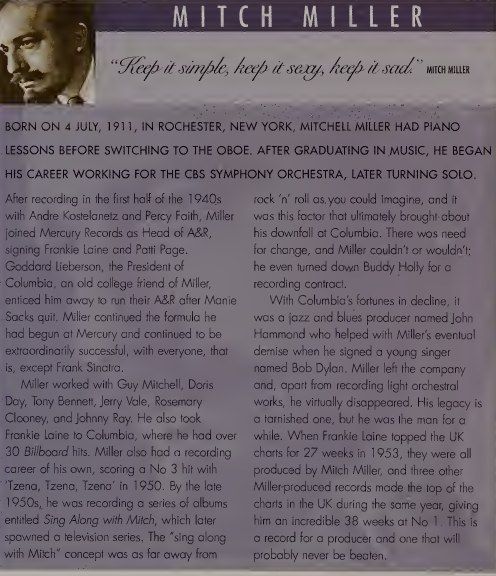
[Photograph: Frank publishes forward-thinking essay on LP format. From Richard Havers, "Sinatra" (Dorling Kindersley, 2007), p.152.]
Radio
Radio: Sinatra appeared as a guest on Guest Star, episode #144, a special Holiday Week CBS broadcast, this date, with Dorothy Kirsten, Don Wilson, and Jeff Alexander's Orchestra and Chorus, reprising "Winter Wonderland," "My Romance" (with Kirsten), and "The Lord's Prayer" from the October 26, 1949 Light Up Time broadcast alongside a Savings Bonds announcement. Source: sinatradiscography.com, Radio Transcriptions Database.
Billboard ran a piece headlined about Frank's pioneering views on producing pop music for the new LP format, making him among the first major pop artists to publicly theorize about it. He argued that the LP required an entirely new creative approach beyond simply repackaging 78-rpm-style albums, including scripted narrative and mood-music elements. (Source: Richard Havers, "Sinatra" (Dorling Kindersley, 2007).)
December 25, 1949
Radio
Guest Star #144
The Jeff Alexander Orchestra and Chorus (music); Don Wilson (announcer). Starring Frank Sinatra, Dorothy Kirsten.
Frank Sinatra made his third consecutive appearance on the syndicated Guest Star series' annual Christmas-week broadcast, singing "Winter Wonderland" and "The Lord's Prayer" and joining Dorothy Kirsten in a duet of Rodgers and Hart's "My Romance," with Kirsten also performing "The Maids of Cadiz." This particular Guest Star episode was a re-edited version of an earlier Light Up Time broadcast featuring Sinatra and the Metropolitan Opera soprano.
Source: Radio Spirits 42252, "Frank Sinatra and Friends: 60 Greatest Old-Time Radio Shows" [30CD box] liner-note booklet.
December 26, 1949
Radio
Light Up Time
Taped: December 21, 1949
Sponsor: Lucky Strike Cigarettes
Network: NBC
Show #81
Broadcast: 4:00-4:15 PM PST (Repeat: 7:00-7:15 PM PST)
Starring: Frank Sinatra
Jeff Alexander And The Orchestra
1. opening
2. Winter Wonderland - Frank Sinatra
3.. commercial 1
4. medley: Beautiful Dreamer / Oh Suzannah / I Dream Of Jeannie - Frank Sinatra
5. commercial 2
6. You'll Never Walk Alone - Frank Sinatra
7.. Brahms' Lullaby - Frank Sinatra
8. closing
Treasury Department Guest Star
Treasury Department syndication
Program #144
Arranged by Axel Stordahl
Conducted by Jeff Alexander
Performers: Don Wilson, Dorothy Kirsten, Frank Sinatra, Jeff Alexander and His Orchestra
1. Winter Wonderland F.S.
2. Maid of Cadiz
D.K.
3. My Romance
F.S. & D.K.
4. Lord's Prayer
F.S. & Chorus
1. Winter Wonderland & The Lord's Prayer appear on the CD:
Christmas Songs by Sinatra & The show appears on the officially released CD set: 60 Greatest Old Time Radio Show "Frank Sinatra & Friends"
note: This show is really a Light Up Time with the Treasury Dept.
substituting their appeals in lieu of the cigarette commercials.
The Light Up Time announcer, Don Wilson, is also on board.
Guest Star #144 has been dated 12-24, 25 and 26. I did some
searching and found the earliest broadcast on 12-23. Program
was picked up by many commercial stations on Christmas Eve
and Christmas Day. Latest airing I found was 12/27.
Innner Sanctum Mysteries
Episode: "The Enchanted Ghost" Guest: Frank
Sinatra
PORTRAYING A CYNICAL DOWN-AND-OUTER TEMPORARILY
saved from the arms of the law by a whimsical, benevolent
phantom, Frank Sinatra stars in a special holiday drama,
"The Enchanted Ghost," on the Christmas broadcast of
C.B.S.
"Inner Sanctum." In one of his rare straight dramatic roles,
Sinatra will be cast as Chris D'Angelo, who, as the story opens,
is hiding out in a "free eats" mission, a probation officer on his
trail. A dying young man entrusts him with Christmas presents
for his mother and sistera mission D'Angelo has no intention
of fulfilling until "Sir Benjamin" intervenes with an
offer he finds hard to turn down. KTSA7 P.M.
Television
none
Innner Sanctum Mysteries
Star Tribune (Minneapolis, Minnesota) 26 Dec 1949
Variety
Treasury Department Guest Star
Treasury Department syndication
Program #144
Arranged by Axel Stordahl
Conducted by Jeff Alexander
Performers: Don Wilson, Dorothy Kirsten, Frank Sinatra, Jeff Alexander and His Orchestra
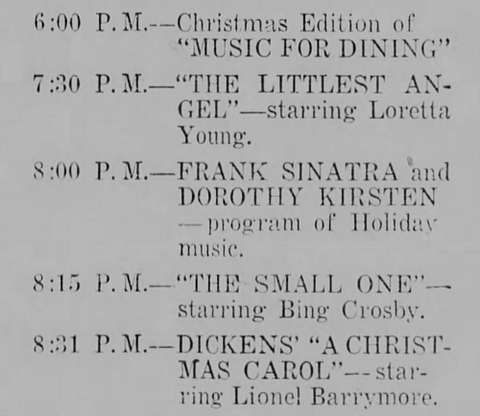
December 27, 1949
Radio
Light Up Time
Sponsor: Lucky Strike Cigarettes
Network: NBC
Show #82
Broadcast: 4:00-4:15 PM PST (Repeat: 8:00-8:15 PM PST)
Starring: Frank Sinatra & Jane Powell
Jeff Alexander And The Orchestra
1. opening
2. It All Depends On You - Frank Sinatra
3. commercial 1
4. I'm Falling In Love With Someone - Jane Powell
5. A Man Wrote A Song - Frank Sinatra
6. commercial 2
7. You're The Cream In My Coffee - Frank Sinatra
8. I Think Of You - Frank Sinatra & Jane Powell
9. closing
Notes: Last minute addition of "You're The Cream
In My Coffee" and a change of "My Romance" to "I Think Of You."
December 28, 1949
Radio
Light Up Time
Sponsor: Lucky Strike Cigarettes
Network: NBC
Show #83
Broadcast: 4:00-4:15 PM PST (Repeat: 8:00-8:15 PM PST)
Starring: Frank Sinatra & Jane Powell
Jeff Alexander And The Orchestra
1. opening
2. Should I - Frank Sinatra
3. commercial 1
4. I've Told Every Little Star - Jane Powell
5. Sorry - Frank Sinatra
6. commercial 2
7. Ol' Man River - Frank Sinatra
8. closing
Television
none
December 29, 1949
Radio
Light Up Time
Sponsor: Lucky Strike Cigarettes
Network: NBC
Show #84
Broadcast: 4:00-4:15 PM PST (Repeat: 8:00-8:15 PM PST)
Starring: Frank Sinatra & Jane Powell
Jeff Alexander And The Orchestra
1. opening
2. Lover - Frank Sinatra
3. commercial 1
4. It's A Most Unusual Day - Jane Powell
5. Tea For Two - Frank Sinatra & Jane Powell
6. commercial 2
7. You're My Thrill - Frank Sinatra
8. closing
December 30, 1949
Radio
Light Up Time
Taped: December 27, 1949
Sponsor: Lucky Strike Cigarettes
Network: NBC
Show #85
Broadcast: 4:00-4:15 PM PST (Repeat: 8:00-8:15 PM PST)
Starring: Frank Sinatra
Jeff Alexander And The Orchestra
1. opening
2. Bye Bye Baby - Frank Sinatra
3. commercial 1
4. medley : The Hucklebuck / If I Ever Love Again
/ The Old Master Painter / Don't Cry Joe - Frank Sinatra
5. commercial 2
6. Over The Rainbow - Frank Sinatra
7. closing
Notes: Medley order was changed and "The
Hucklebuck" was added. See script for more details.
Ed O'Brien notes:
There is a rehearsal of this show in circulation among collectors. I don't believe there are any other rehearsals of this series floating around.
1950
[A Two-Thirds-Empty Paramount]
Frank played the Paramount Theatre, site of his earlier bobby-soxer triumph, to a house that was now two-thirds empty as his career and voice both struggled.
Source: Tina Sinatra, "My Father's Daughter: A Memoir" (2000).
[Frank and Nancy Sr. Separate]
Frank Sinatra and his first wife, Nancy Sr., separated. Nancy Jr. was ten at the time, her brother Frank Jr. was seven, and sister Tina was not yet two.
Source: Nancy Sinatra, "Frank Sinatra, My Father" (1985).
[First Television Appearance]
Sinatra made his first TV appearance in 1950, sharing the bill with Beatrice Lillie and Bob Hope on NBC's "The Star-Spangled Revue."
Source: Nancy Sinatra, "Frank Sinatra, My Father" (1985).
[Mitch Miller Secretly Protects Sinatra's Damaged Voice In The Studio]
Nancy Sinatra: Producer Mitch Miller recalled that when Sinatra's voice was giving out during a rhythm-songs session, he quietly cut Frank's microphone, built the arrangements around clean backing tracks without telling him, and only afterward had Sinatra dub his vocals in late-night sessions once his voice had recovered.
Source: Nancy Sinatra, Frank Sinatra: An American Legend, 1995.
[The Gas Stove Incident]
At his lowest professional and emotional point, Frank turned on the gas burners in friend Manie Sacks's kitchen and laid his head on the stovetop; Sacks returned home in time to stop him.
Source: Tina Sinatra, "My Father's Daughter: A Memoir" (2000).
["The Frank Sinatra Show" Begins]
Later in 1950 Sinatra launched his own variety program, "The Frank Sinatra Show," which ran on television through April 1952, featuring songs and rotating weekly guests.
Source: Nancy Sinatra, "Frank Sinatra, My Father" (1985).
[Desert Inn opens in Las Vegas]
Kaplan: The Desert Inn, the fifth major casino-hotel on the Las Vegas Strip, opened in 1950, financed covertly by Cleveland mob boss Moe Dalitz through Teamsters pension funds behind front man Wilbur Clark; it became the venue for Sinatra's September 1951 engagement.
Source: James Kaplan, "Frank: The Voice" (2010)
[Divorce financial terms and children's ages]
Consiglio: Under the divorce agreement, Frank agreed to give Nancy one third of his earnings until Nancy Jr., Frank Jr., and Tina each turned twenty-one. At the time, Nancy Jr. was about eleven, Frank Jr. was six or seven, and Tina was three.
Source: Tony Consiglio (as told to Franz Douskey), "Sinatra and Me: The Very Good Years" (2012)
[Divorce settlement negotiations drag on]
Consiglio: Lawyers argued over the Sinatra divorce settlement for more than a year. Consiglio believed the accumulating pressure -- career troubles plus the drawn-out legal fight -- is what eventually led Nancy to set aside her religious objections and agree to the divorce, unable to watch Frank hurting himself.
Source: Tony Consiglio (as told to Franz Douskey), "Sinatra and Me: The Very Good Years" (2012)
[Louis B. Mayer ends Frank's MGM contract over the Ava affair]
Consiglio: Frank's affair with Ava Gardner damaged his relationship with MGM chief Louis B. Mayer, who wanted a wholesome family image for his stars. When Frank did not straighten out, Mayer cut him loose from the studio, compounding a period when Frank's voice, recording contract, and acting career were all in decline.
Source: Tony Consiglio (as told to Franz Douskey), "Sinatra and Me: The Very Good Years" (2012)
[MGM drops Judy Garland]
Kaplan: MGM, the studio Garland had carried since the late 1930s, dropped her from its roster in 1950.
Source: James Kaplan, "Sinatra: The Chairman" (2015)
[Manie Sacks leaves Columbia for RCA]
Kaplan: The same issue of Billboard that reported George Evans's death also announced Manie Sacks, then 47, was leaving Columbia Records for RCA Victor after months of pursuit by the rival label, amid Columbia's broader roster losses.
Source: James Kaplan, "Frank: The Voice" (2010)
[Mansfield on Sinatra's OCD and jealousy]
Irving Mansfield: Producer Irving Mansfield, brought in after the first Frank Sinatra Show episode bombed, recalled Sinatra was chronically late, refused to rehearse, and once feuded over guest bookings like Jackie Gleason (paid $7,500 not to appear) and a mismatched Brian Aherne. Mansfield also described Frank's compulsive hand-washing and constant changing of underwear, and his explosive jealousy over suspicions that Ava was involved with Artie Shaw.
Source: James Kaplan, "Frank: The Voice" (2010)
[Mayer fires Sinatra from MGM]
Kaplan: Louis B. Mayer personally fired Sinatra from MGM in 1950 after Sinatra made an impolitic joke about Mayer's mistress, the singer Ginny Simms, in front of colleagues.
Source: James Kaplan, "Sinatra: The Chairman" (2015)
[Mitch Miller on Sinatra's fragile voice]
Mitch Miller: Mitch Miller later recalled that Sinatra's voice was marvelous but fragile, unlike singers such as Gordon MacRae who could drink all night and still perform. When Frank lost sleep or drank heavily, his voice would crack in the studio, and Miller secretly used new tape technology to record instrumental tracks without Frank present, then had him overdub his vocal later without telling the musicians' union.
Source: James Kaplan, "Frank: The Voice" (2010)
[Mitch Miller takes over at Columbia]
Consiglio: When Manie Sachs left Columbia Records in 1950, Mitch Miller took over as A&R man. Unlike Sachs, who let Sinatra control song selection, arrangements, and musicians, Miller insisted on controlling those decisions himself, leading to ongoing friction with Sinatra.
Source: Tony Consiglio (as told to Franz Douskey), "Sinatra and Me: The Very Good Years" (2012)
[Mitch Miller's first Sinatra session]
Kaplan: For his first collaboration with Sinatra, producer Mitch Miller chose the up-tempo novelty tune "American Beauty Rose," arranged by Norman Leyden and conducted by Miller. Despite Sinatra's technically strong singing, Kaplan finds the performance joyless; the record charted at only number 26 for two weeks.
Source: James Kaplan, "Frank: The Voice" (2010)
[Nancy Sr. throws Frank out over Ava]
Kaplan: Big Nancy had thrown Frank out and changed the locks the first time he allowed himself to be seen publicly with Ava Gardner, in early 1950.
Source: James Kaplan, "Sinatra: The Chairman" (2015)
[On the Town]
Frank Sinatra / Nancy Sinatra (via Santopietro): L.B. Mayer terminated Sinatra's MGM contract on April 27, 1950, four months after On the Town's release. According to daughter Nancy Sinatra, Frank told Mayer 'I wish I could take that back' regarding the joke about him, but Mayer was unmoved, telling him to leave and never come back. Sinatra recalled, 'My face dropped. I knew I was sunk,' and was paid $85,000 for the remaining year of his contract.
No corresponding dated entry could be identified in the chronology for this film/context.
Source: Tom Santopietro, "Sinatra in Hollywood" (2008), All Over the Map
[Riddle's uncredited hit "Mona Lisa"]
Kaplan: Nelson Riddle first connected with Nat 'King' Cole when an overworked arranger, Les Baxter, subcontracted him a couple of songs to orchestrate, including 1950's 'Mona Lisa,' which became a massive hit and helped establish Riddle's career.
Source: James Kaplan, "Frank: The Voice" (2010)
[Sinatra refuses songs, Guy Mitchell gets his break]
Kaplan: Returning from his troubled Spain trip, Sinatra was presented by Mitch Miller with "The Roving Kind" and "My Heart Cries for You," declared them "fucking shit," and walked out of the session. Miller called in newly signed singer Guy Mitchell (born Albert Cernik) instead; both songs became hits, one reaching number 1, launching Mitchell's career.
Source: James Kaplan, "Frank: The Voice" (2010)
[Sinatra's first TV show flops]
Kaplan: Sinatra's original Frank Sinatra Show on CBS in 1950 was a critical and commercial disaster, drawing scathing reviews (New York Times critic Jack Gould called it "a drab mixture of radio, routine vaudeville and pallid pantomime") and losing the network money, amid Sinatra's career slump and his habit of skipping rehearsals.
Source: James Kaplan, "Sinatra: The Chairman" (2015)
[Sings anthem at UN Day ceremony]
Kaplan: In 1950, Sinatra sang the National Anthem with Lower East Side schoolchildren at a United Nations Day ceremony, an image Kaplan cites as evidence of Sinatra's genuine, longstanding commitment to racial and religious tolerance.
Source: James Kaplan, "Frank: The Voice" (2010)
[Studio and label drop Sinatra]
Kaplan: Around this period MGM terminated Sinatra's movie contract, and he was soon also dropped by Columbia Records and by his talent agency, the Music Corporation of America (MCA).
Source: James Kaplan, "Sinatra: The Chairman" (2015)
[career crisis]
By 1950 Sinatra's career had bottomed out: no record label, no agent, no film studio contract, and a back-tax bill of nearly $100,000.
No corresponding dated entry could be identified in the chronology for this film/context.
Source: Tom Santopietro, "Sinatra in Hollywood" (2008), Ava and the Downfall / The Comeback
[career crisis/anecdote]
Frank Sinatra: On the night of April 26, 1950, Sinatra lost his voice mid-performance at the Copacabana (accounts differ on whether the song was "It All Depends on You" or "Bali Ha'i"). He recalled being "panic stricken," facing dead silence from about seventy patrons, before finally whispering "Good night" and walking off.
No corresponding dated entry could be identified in the chronology for this film/context.
Source: Tom Santopietro, "Sinatra in Hollywood" (2008), Ava and the Downfall / The Comeback
[reception/alternate account]
Skitch Henderson: Sinatra's conductor that night, Skitch Henderson, later downplayed the famous Copacabana voice-loss incident, suggesting it wasn't as dramatic as legend has it and was partly a "manufactured trauma" reflecting Sinatra's fragile mental state at the time rather than a purely physical collapse.
No corresponding dated entry could be identified in the chronology for this film/context.
Source: Tom Santopietro, "Sinatra in Hollywood" (2008), Ava and the Downfall / The Comeback
[Frank Sinatra Show TV series and peak Miller animosity]
Most of autumn 1950 was consumed by production of Frank's TV series in New York plus occasional recording sessions. By mid-November Ava returned to Hollywood to begin filming Showboat, and around this time the friction between Frank and new Columbia A&R chief Mitch Miller reached its worst point.
Source: Richard Havers, "Sinatra" (Dorling Kindersley, 2007).
[Kefauver crime committee formed, hears Mafia testimony]
Senator Estes Kefauver became chairman of a special Senate committee investigating organized crime in interstate commerce. Mob figures including Meyer Lansky and Willie Moretti appeared before it and pleaded the Fifth Amendment, and Kefauver subsequently decided he wanted to question Frank as well, having obtained the 1947 photo of Frank with Lucky Luciano in Cuba.
Source: Richard Havers, "Sinatra" (Dorling Kindersley, 2007).
[Mitch Miller scores a hit of his own with 'Tzena, Tzena, Tzena']
Beyond producing for Columbia, Mitch Miller had his own recording career, scoring a No. 3 hit with 'Tzena, Tzena, Tzena' in 1950.
Source: Richard Havers, "Sinatra" (Dorling Kindersley, 2007).
[US television ownership explodes between 1950 and 1957]
The number of television sets in America grew from 10.5 million in 1950 to more than 47 million by 1957, a shift Havers frames as a catalyst that radically changed how people heard and saw music.
Source: Richard Havers, "Sinatra" (Dorling Kindersley, 2007).
[Willie Moretti's Telegram to Sinatra]
Mafia figure Willie Moretti reportedly sent Sinatra a telegram amid his marital troubles with Nancy, urging him to remember he had "a decent wife and children" and to be happy. Moretti was murdered in a New Jersey restaurant less than a year after sending it.
Source: George Carpozi Jr., Frank Sinatra: Is This Man Mafia? (New York: Manor Books, 1979).
[Mitch Miller Takes Over Columbia A&R]
Mitch Miller took over from Manie Sachs as head of A&R at Columbia Records at a time when Sinatra was in debt to the label and his records were not selling; Miller's efforts to steer Sinatra toward gimmicky, commercial material led to lasting resentment between the two men.
Source: Rough Guide to Frank Sinatra (Rough guide 7.pdf), chapter "The Inner Circle."
[Gershwin Radio Duet with Dinah Shore]
Friedwald's notes describe a radio duet Sinatra performed with Dinah Shore on the Gershwin song "It Ain't Necessarily So." The piece notes Sinatra's confidence throughout, joking his way through the number while his partner good-naturedly stumbles trying to keep pace, with neither an on-air memory lapse during a later number, "Soon," throwing him off stride.
Source: Will Friedwald, liner notes to "Sinatra Sings Gershwin" (Columbia/Legacy 61057, 2003)
[Ben Heller 1950 interview relaying Dorsey's praise of Sinatra, and Sinatra's reply -- critical commentary]
Tommy Dorsey (relayed by Ben Heller) / Sinatra: In an interview with Ben Heller in 1950, the disc jockey told Sinatra of a recent chat he had had with Dorsey in which the trombonist declared, "‘What is there to say about Frank? It’s been done innumerable times—anything I could say would be superfluous.’ And he went on for an hour and a half, and all he did was talk about you." Sinatra replied, "I really think that there’ll never be a trombone player or a musician who knows his instrument like Dorsey knows that horn. He’s just the end of the world." ... Sinatra related to Heller in 1950 that "I went to see [Dorsey] at the Astor [hotel in New York] a couple of weeks ago, and he just knocked me out. I went up and sang a few songs with the band; I sat next to the brass like I used to. It was a big kick, but listen, I ran right away when I heard him call for the bus!"
Source: Will Friedwald, "Sinatra! The Song Is You: A Singer's Art" (2018 revised edition), Ch. 3, "With Tommy Dorsey" (1940-1942)
[Mona Lisa / Too Young -- critical commentary]
Will Friedwald (analysis); Pete Rugolo: Background on how Riddle got his start at Capitol: producer Lee Gillette had Les Baxter direct a choral Nat Cole session, and Baxter subcontracted the uncredited Riddle to write the purely orchestral, non-choral songs, including 'Mona Lisa,' which became Cole's biggest hit and made Baxter's career while Riddle remained anonymous. A second Baxter/Cole date, also largely ghostwritten by Riddle, produced 'Too Young.' Arranger Pete Rugolo eventually told Cole's manager Carlos Gastel the truth, leading Riddle to become Cole's full-time arranger.
Source: Will Friedwald, "Sinatra! The Song Is You: A Singer's Art" (2018 revised edition), Ch. 6, "With Nelson Riddle" (1953-1979)
[My Heart Cries for You / The Roving Kind -- critical commentary]
Mitch Miller: Miller booked a November 1950 session for two faux-folk songs during a brief New York layover as Sinatra traveled to Africa chasing Ava Gardner. Miller recalled playing them for Sinatra: 'He looked at Sanicola, he looked at Benny Barton, then he said to me, 'I'm not going to do any of that crap.'' With musicians and chorus already hired, Miller pivoted and had a young singer, Al Cernick -- newly signed and renamed Guy Mitchell -- record both songs instead, launching Mitchell's career. Miller added: 'I dare say if Sinatra had done them at that time, I don't think they would have been hits... the prejudice against him personally at that time, wrongly, was outrageous.'
Source: Will Friedwald, "Sinatra! The Song Is You: A Singer's Art" (2018 revised edition), Ch. 5, "In-Between Years" (1948-1953)
[Sing and Dance with Frank Sinatra -- critical commentary]
Granata lists this George Siravo-arranged album, released as a 78 rpm set (C-218) and 10-inch LP in October 1950, including 'Lover,' 'It's Only a Paper Moon,' and 'It All Depends on You.'
Source: Charles L. Granata, "Sessions with Sinatra: Frank Sinatra and the Art of Recording" (1999/2003), Afterword & Appendices A-D
[arrangement/anecdote -- critical commentary]
George Siravo: Arranger George Siravo described writing Sing and Dance largely without Sinatra's direct involvement -- Siravo picked the tunes, keys, and wrote the arrangements while Sinatra, dealing with personal turmoil, came in mostly to sing live with the band on tracks Siravo had essentially pre-built, an unusual hands-off arrangement for Sinatra.
Source: Charles L. Granata, "Sessions with Sinatra: Frank Sinatra and the Art of Recording" (1999/2003), Part II: The Columbia Years, 1943-1952
[career statistics -- critical commentary]
Granata notes the irony that Sinatra himself owned ASCAP- and BMI-affiliated publishing firms and collected royalties from songs he sang; statistically, during the Miller era at Columbia Sinatra recorded only five BMI songs versus fifty-two ASCAP songs, while in his first three years at Capitol he recorded eleven BMI songs (including his first Capitol hit, 'Young at Heart') -- undercutting his own complaint.
Source: Charles L. Granata, "Sessions with Sinatra: Frank Sinatra and the Art of Recording" (1999/2003), Part II: The Columbia Years, 1943-1952
[reception/quote -- critical commentary]
Frank Sinatra (via Stan Cornyn): In the liner notes for the Sinatra-Jobim album, writer Stan Cornyn quotes Sinatra saying 'I haven't sung this softly since the [vocal] hemorrhage [in 1950]' -- a comment Granata notes overlooks the similarly sensitive vocal work Sinatra did on Close to You in 1956.
Source: Charles L. Granata, "Sessions with Sinatra: Frank Sinatra and the Art of Recording" (1999/2003), Part IV: The Reprise Years
[recording session/technique -- critical commentary]
Mitch Miller: Producer Mitch Miller recalled that during the Sing and Dance sessions Sinatra's voice would fail mid-phrase, so to save takes Miller secretly cut Sinatra's microphone, captured clean orchestra tracks, and had Sinatra dub vocals later without telling him at the time -- sessions were held at odd late-night hours with doors locked because full-album 'tracking' technically violated Musicians Union rules.
Source: Charles L. Granata, "Sessions with Sinatra: Frank Sinatra and the Art of Recording" (1999/2003), Part II: The Columbia Years, 1943-1952
January 1950
[Manie Sacks Leaves Columbia, Leaving Sinatra Adrift]
Nancy Sinatra: When Frank's most steadfast ally in the record business, Manie Sacks, resigned from Columbia Records, his replacement Mitch Miller struggled to pair Frank's style with commercial material, favoring other artists instead, a mismatch that would trouble Frank's recording career for the next few years.
Source: Nancy Sinatra, Frank Sinatra: An American Legend, 1995.
[4am coffee meeting with George Evans in New York]
Kaplan: In mid-January 1950, Sinatra flew to New York, saw Lena Horne's show at the Copacabana, and had a 4am coffee meeting with George Evans, telling him about Ava and declaring he intended to marry her; Evans agreed to help.
Source: James Kaplan, "Frank: The Voice" (2010)
[Nancy confronts Frank, throws his clothes out the window]
Kaplan: Nancy first confronted Frank about Ava at Christmas 1949; when he returned from his January 1950 New York trip, she confronted him again, furiously throwing a handful of his sports jackets out their bedroom window, waking the children. Frank kissed his frightened daughter Nancy Jr. and left; the next morning Sanicola and Al Silvani moved a carload of his belongings to his office on South Robertson.
Source: James Kaplan, "Frank: The Voice" (2010)
[Sinatra cancels Shamrock gig, flies to Evans's funeral]
Kaplan: Devastated by Evans's death, Sinatra canceled his Shamrock Hotel engagement and had Van Heusen fly him to New York for the funeral, despite his aversion to funerals. The day after, he sent Evans's widow the $14,000 he owed the press agent and later put Evans's son Philip on the Sinatra payroll for life.
Source: James Kaplan, "Frank: The Voice" (2010)
[Manie Sacks Departs Columbia Records]
Emanuel "Manie" Sacks, the Columbia Records executive who had helped shape Sinatra's recording career and public identity through the 1940s, left the label. His departure was one of several personal and professional setbacks, alongside the death of publicist George Evans and Sinatra's release from MGM, that marked the start of his early-1950s decline.
Source: Frank Sinatra: The Man, the Music, the Legend, ed. Jeanne Fuchs and Ruth Prigozy (Rochester, NY: University of Rochester Press / Boydell & Brewer, 2007), essay "Sinatra Meets Television" by Ron Simon.
January 2, 1950
Radio
Light Up Time (NBC)
Taped: December 28, 1949
Sponsor: Lucky Strike Cigarettes
Show #86
Broadcast: 4:00-4:15 PM PST (Repeat: 8 - 8:15 PM PST)
Starring: Frank Sinatra
Jeff Alexander and The Orchestra
1. Opening
2. Great Day - Frank Sinatra
3. Commercial
4. Sorry - Frank Sinatra
5. Why Remind Me - Frank Sinatra
6. Commercial
7. All The Things You Are - Frank Sinatra
8.. Closing
Television
None
Concert
January 3, 1950
Radio
Light Up Time
Sponsor: Lucky Strike Cigarettes
Network: NBC
Show #87
Broadcast: 4:00-4:15 PM PST (Repeat: 8:00-8:15 PM PST)
Starring: Frank Sinatra & Dorothy Kirsten
Jeff Alexander And The Orchestra
1. opening
2. When You're Smiling - Frank Sinatra
3. commercial 1
4. Kiss Me Again - Dorothy Kirsten
5. You're Awful - Frank & Dorothy
6. commercial 2
7. Lost In The Stars - Frank Sinatra
8. closing
January 4, 1950
Radio
Light Up Time
Sponsor: Lucky Strike Cigarettes
Network: NBC
Show #88
Broadcast: 4:00-4:15 PM PST (Repeat: 8:00-8:15 PM PST)
Starring: Frank Sinatra & Dorothy Kirsten
Jeff Alexander And The Orchestra
1. opening
2. The One I Love - Frank Sinatra
3. commercial 1
4. If I Should Lose You - Dorothy Kirsten
5. A Dreamer's Holiday - Frank Sinatra
6. commercial 2
7. Only Make Believe - Frank & Dorothy
8. closing
Television
None
January 5, 1950
Radio
Light Up Time
Sponsor: Lucky Strike Cigarettes
Network: NBC
Show #89
Broadcast: 4:00-4:15 PM PST (Repeat: 8:00-8:15 PM PST)
Starring: Frank Sinatra & Dorothy Kirsten
Jeff Alexander And The Orchestra
1. opening
2. Let Is Snow - Frank Sinatra
3. commercial 1
4. You'd Be So Nice To Come Home To - Dorothy Kirsten
5. Violets For Your Furs - Frank Sinatra
6. Hands Across The Table - Frank Sinatra & Dorothy Kirsten
7. commercial 2
8. Button Up Your Overcoat - Frank Sinatra & Dorothy Kirsten
9. closing
January 6, 1950
Radio
Light Up Time
Sponsor: Lucky Strike Cigarettes
Network: NBC
Show #90
Broadcast: 4:00-4:15 PM PST (Repeat: 8:00-8:15 PM PST)
Starring: Frank Sinatra & Dorothy Kirsten
Jeff Alexander And The Orchestra
1. opening
2. All Of Me - Frank Sinatra
3. commercial 1
4. Easy To Love - Dorothy Kirsten
5. A Dream Is A Wish - Frank Sinatra
6. commercial 2
7. Dancing In The Dark - Frank Sinatra & Dorothy Kirsten
8. closing
January 7, 1950
Radio
Joe Dimaggio Show
Frank Sinatra is guest
10:30
January 7, 1951 Meet Frank Sinatra
Taped December 27, 1950
Show #11
Network: CBS
Sunday
5 P.M - 5:45 P.M. EST
Sponsor: Tintair - Luden's Cough Drops
Musicians: Graham Forbes and His Quartet
Announcer: Hal Sims
Writers: Paul Dudley
Producers: Mark Goodson, Bill Todman
Guest: Eileen Barton
Notes: First show with the new 45 minute format. Last 15 minutes of the hour have "News with Eric Sevareid"
Television
None

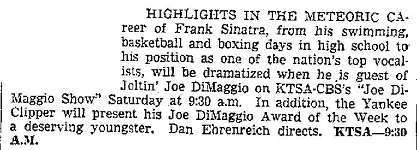
January 8, 1950
Radio
The Jack Benny Program
Network: CBS
Sponsor: Lucky Strike
Show: #18 of the 1949-50 series
Time: 7:00 PM EST (Rebroadcast: 9:30 - 10:00 PM PST)
Host: Jack Benny
Guests: Frank Sinatra, Michael Romanoff, Gene Kelly, Rosalind Russell.
Cast: Don Wilson, Mary Livingstone, Phil Harris, Dennis Day, Leo "Ukie" Sherin, Mel Blanc, Frank Nelson, Artie Auerbach, Rochester, F. E. Boone (tobacco auctioneer), L. A. Speed Riggs (tobacco auctioneer),
Writers: Sam Perrin, George Balzer, John Tackaberry, Milt Josefsberg
Producer By: Hilliard Marks
1. commercial
2. first routine - Jack Benny, Don Wilson, Phil Harris, Mary Livingstone, Dennis Day
3. Marta - Dennis Day
4. second routine - Jack Benny, Dennis Day, Rochester, Don Wilson, Mel Blanc, Mary Livingstone, Frank Nelson, Micheal Romanoff, Frank Sinatra, Rosalind Russell, Gene Kelly, Eric (unkown)
5. commercial
6. closing - Jack Benny, Leo "Ukie" Sherin, Mel Blanc, Don Wilson
Note: The show appears on the officially released CD set: 60 Greatest Old Time Radio Shows "Frank Sinatra & Friends"
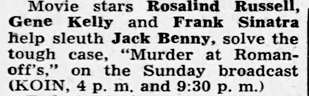
January 9, 1950
Radio
Light Up Time (NBC)
Sponsor: Lucky Strike
Show #91
Broadcast: 4:00-4:15 PM PST (Repeat: 8:00-8:15 PM PST)
Starring: Frank Sinatra and Dorothy Kirsten
Jeff Alexander and the Orchestra
1. Opening
2. Just You, Just Me - Frank Sinatra
3. Commercial
4. What is There to Say - Dorothy Kirsten
5. Envy - Frank Sinatra
6. Commercial
7. Hush, Little Darlin - Dorothy Kirsten
8. I've Got a Crush on You - Frank Sinatra
9. Closing
January 10, 1950
Radio
Light Up Time (NBC)
Sponsor: Lucky Strike
Show #92
Broadcast: 4:00-4:15 pm PST (Repeat: 8:00-8:15 pm PST)
Starring: Frank Sinatra and Dorothy Kirsten
Jeff Alexander and the Orchestra
1. Opening
2.. The Old Master Painter - Frank Sinatra
3. Commercial
4. If You Were the Only Boy in the World - Dorothy Kirsten
5. I Have a Lovely Bunch of Coconuts - Frank Sinatra
6. Commercial
7. S'Wonderful - Frank Sinatra
8. My Heart Stood Still - Frank Sinatra and Dorothy Kirsten
9. Closing
NOTE: Ed O'Brien claims that you haven't lived until you've heard Sinatra sing Lovely Bunch of Coconuts affecting a Cockney accent.
Ed O'Brien:
AFRS inserted "Them There Eyes," 12-20-49, in lieu of second commercial. Frank sang "Lovely Bunch Of Coconuts" as a request from his son. Frankie Jr. was celebrating his sixth birthday.
January 11, 1950
Radio
Light Up Time (NBC)
Sponsor: Lucky Strike
Show #93
Broadcast: 4:00-4:15 p.m. PST (Repeat: 8-8:15 pm PST)
Starring: Frank Sinatra and Dorothy Kirsten
Jeff Alexander and the Orchestra
1. Opening
2. I Beeped When I should have Bopped - Frank Sinatra
3. Commercial
4. How Deep is the Ocean - Dorothy Kirsten
5. Why Remind Me - Frank Sinatra
6. Commercial
7. Mad About You - Dorothy Kirsten
8. Look at Me Now - Frank Sinatra
9. Closing
Ed O'Brien:
"Where Or When" was the song added by AFRS. It came from the 12-20-49 show. Frank introduced the song with a wintry theme of a hot brick in the oven, serving as a foot warmer that brings on an attack of romantic chill.
Television
None
January 12, 1950
Studio
Hollywood
RHCO3999 God's Country w/The Jeff Alexander Choir & Ziggy Elman - Trumpet
(H. Gillespie/B. Smith)
Robbins Music Corp. (ASCAP) 1950
Arranged & Conducted by Axel Stordahl
-1 (3:05) CD: Columbia Years 43-52 Vol. 11
78: 38708
RHCO4000 Shelia w/The Jeff Alexander Choir
(B. Hayward /F. Sinatra/R. Staver)
Sinatra Songs, Inc. (ASCAP) 1950
Arranged & Conducted by Axel Stordahl
-2 (3:15) CD: Columbia Years 43-52 Vol. 11
78: 40565
Ed O'Brien:
The song was written in 1949 by Frank Sinatra, Chris(topher) "Bob" Hayward, and Robert Staver and published by Barton Music. The arrangement was done by Axel Stordahl. with the backing of The Jeff Alexander Choir. Columbia released the song as a 45 and 78 single backed with the reissued "Day By Day" as 40565, Matrix # ZSP 36980, in 1953. The single did not chart. The single was also released as a white label Columbia Records DJ or promotional 45. There were two masters made at the recording session in Hollywood.
RHCO4001 Chattanoogie Shoe Shine Boy w/The Jeff Alexander Choir
(H. Stone/J. Stapp)
Acuff-Rose Publ. (BMI) 1950
Arranged & Conducted by Axel Stordahl
-1 (2:37) CD: Columbia Years 43-52 Vol. 11
78: 38708
RHCO39999 & 4000 Violins: S. Cytron, D. Frisina, G. Kast, N. Pisani, R. Polikian, M.. Russell; Violas: M. Perlmutter, G. White; Cello: C. Bernard; Harp: A. Mason; Saxes: H. Beau, L. Hartman, J. Kinsler, B. Russin, F. Stulce; Horns: J. Cave, V. De Rosa; Trumpet: Z. Elman; Trombone: R. McGarity; Piano: K. Lane; Guitar: A. Reuss; Bass: P. Stephens; Drums: R. Hagan
RHCO4001 Saxes: H. Beau, L. Hartman, J. Kinsler, B. Russin, F. Stulce; Trumpet: Z. Elman; Trombone: R. McGarity; Piano: K. Lane; Guitar: A. Reuss; Bass: P. Stephens; Drums: R. Hagan
Ed notes: Frank would perform "God's Country" and "Chattanoogie Shoe Shine Boy" on the radio.
Interestingly, he would not bother with "Sheila," even though he received a co-billing on the writing of the lyrics.
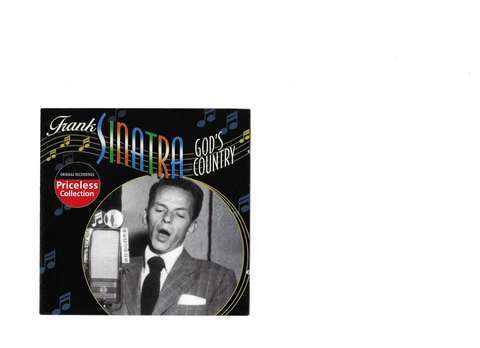
Radio
Light Up Time (NBC)
Sponsor: Lucky Strike
Show #94
Broadcast: 4-4:15 pm PST (Repeat: 8-8:15 pm PST)
Starring Frank Sinatra and Dorothy Kirsten
Jeff Alexander and the Orchestra
1. Opening
2. Bye Bye Baby - Frank Sinatra
3. Commercial
4. Flamingo - Dorothy Kirsten
5. Sorry - Frank Sinatra
6. Commercial
7. My Romance - Frank Sinatra and Dorothy Kirsten
8. Closing
Ed O'Brien:
Additional song added by AFRS was "My Blue Heaven."
It was taken from the 12-1-49 show.
Hollywood
RHCO4000 Shelia
The single was also released as a white label Columbia Records DJ or promotional 45.
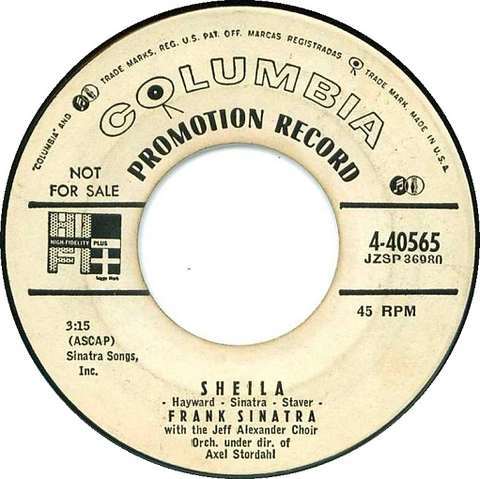
Frank gave his first concert in two years, in Hartford, Connecticut; Variety reported it was his biggest box-office take to date, $18,267 for two days of shows.
Source: Nancy Sinatra, Frank Sinatra: An American Legend, 1995.
January 13, 1950
Radio
Light Up Time (NBC)
Sponsor: Lucky Strike
Show # 95
Broadcast: 4-4:15 p.m. PST (Repeat: 8-8:15 pm PST)
Starring: Frank Sinatra and Dorothy Kirsten
Jeff Alexander and the Orchestra
1. Opening
2. What Is This Thing Called Love - Frank Sinatra
3. Commercial
4. If I Ever Love Again - Dorothy Kirsten
5. My Blue Heaven - Frank Sinatra
6. Commercial
7. I'm in the Mood for Love - Dorothy Kirsten
8. Why Remind Me - Frank Sinatra
9. Closing
Ed O'Brien:
AFRS additional number was "A Man Wrote A Song."
Frank never recorded the song but sang it on five Light Up Times.
January 16, 1950
Radio
Light Up Time
Sponsor: Lucky Strike Cigarettes
Network: NBC
Show #96
Broadcast: 4:00-4:15 PM PST (Repeat: 8:00-8:15 PM PST)
Starring: Frank Sinatra & Dorothy Kirsten
Jeff Alexander And The Orchestra
1. opening
2. Wrap Your Troubles In Dreams - Frank Sinatra
3. commercial 1
4. I Must Have Done Something Wonderful - Dorothy Kirsten
5. Embraceable You - Frank Sinatra
6. Always - Dorothy Kirsten
7. commercial 2
8. Chattanooga Shoe Shine Boy - Frank Sinatra
9. closing
January 17, 1950
Radio
Light Up Time
Sponsor: Lucky Strike Cigarettes
Network: NBC
Show #97
Broadcast: 4:00-4:15 PM PST (Repeat: 8:00-8:15 PM PST)
Starring: Frank Sinatra & Dorothy Kirsten
Jeff Alexander And The Orchestra
1. opening
2. I Love You - Frank Sinatra
3. commercial 1
4. When You're Away - Dorothy Kirsten
5. A Man Wrote A Song - Frank Sinatra
6. commercial 2
7. There's A Small Hotel - Frank Sinatra & Dorothy Kirsten
8. closing
January 18, 1950
Radio
Light Up Time
Sponsor: Lucky Strike Cigarettes
Network: NBC
Show #98
Broadcast: 4:00-4:15 PM PST (Repeat: 8:00-8:15 PM PST)
Starring: Frank Sinatra & Dorothy Kirsten
Jeff Alexander And The Orchestra
1. opening
2. Let It Snow, Let It Snow, Let It Snow - Frank Sinatra
3. commercial 1
4. I've Told Every Little Star - Dorothy Kirsten
5. Our Love Is Here To Stay - Frank Sinatra
6. Love Walk In - Dorothy Kirsten
7. commercial 2
8. Why Remind Me - Frank Sinatra
9. closing
January 19, 1950
Radio
Light Up Time
Sponsor: Lucky Strike Cigarettes
Network: NBC
Show #99
Broadcast: 4:00-4:15 PM PST (Repeat: 8:00-8:15 PM PST)
Starring: Frank Sinatra & Dorothy Kirsten
Jeff Alexander And The Orchestra
1. opening
2. It Was Only A Paper Moon - Frank Sinatra
3. commercial 1
4. Scarlet Ribbons - Dorothy Kirsten
5. I Don't Know Whether To Laugh Or Cry - Frank Sinatra
6. commercial 2
7. Dreamer's Holiday - Frank Sinatra
8. I'm In Love - Frank Sinatra & Dorothy Kirsten
9. closing
Notes: Dreamer's Holiday was a late addition to the show.
January 20, 1950
Radio
Light Up Time
Sponsor: Lucky Strike Cigarettes
Network: NBC
Show #100
Broadcast: 4:00-4:15 PM PST (Repeat: 8:00-8:15 PM PST)
Starring: Frank Sinatra & Dorothy Kirsten
Jeff Alexander And The Orchestra
1. opening
2. The Old Master Painter - Frank Sinatra
3. commercial 1
4. You're Always There - Dorothy Kirsten
5. Chattanooga Shoeshine Boy - Frank Sinatra
6. commercial 2
7. It Never Entered My Mind - Frank Sinatra
8. Isn't It Romantic - Frank Sinatra & Dorothy Kirsten
9. closing
Notes: "You Missed The Boat" was changed to "The Old Master Painter." and "It Never Entered My Mind" was a late addition.
January 21, 1950
Ed O'Brien:
Tough one to figure. His private life had become a huge burden for him as
a professional entertainer. I also wonder how long he would have been content
doing the same basic performance night after night after night.
"Guys And Dolls"
was a smash hit and had a long run. MGM wouldn't give him permission to do
the show. Revenge. A few months later they cut him loose. But Frank Sinatra
would have been a great Sky Masterson.
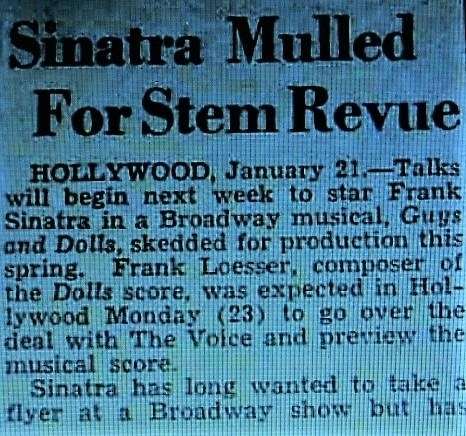
January 23, 1950
Radio
Light Up Time
Sponsor: Lucky Strike Cigarettes
Network: NBC
Show #101
Broadcast: 4:00-4:15 PM PST (Repeat: 8:00-8:15 PM PST)
Starring: Frank Sinatra & Dorothy Kirsten
Jeff Alexander And The Orchestra
1. opening
2. The One I Love
3. commercial 1
4. Lover Come Back To Me - Dorothy Kirsten
5. Sorry - Frank Sinatra
6. commercial 2
7. June In January - Dorothy Kirsten
8. With Every Breath I Take - Frank Sinatra
9. closing
Ed O'Brien:
AFRS opted for "The Old Master Painter" from the
1-20-50 Light Up show. It was heard right after "Sorry."
Frank sang "Master Painter" gem 12 times on LUP
Television
None
January 24, 1950
Radio
Light Up Time
Sponsor: Lucky Strike Cigarettes
Network: NBC
Show #102
Broadcast: 4:00-4:15 PM PST (Repeat: 8:00-8:15 PM PST)
Starring: Frank Sinatra & Dorothy Kirsten
Jeff Alexander And The Orchestra
1. opening
2. There's No Business Like Show Business - Frank Sinatra
3. commercial 1
4. Depuis Le Jour - Dorothy Kirsten
5. commercial 2
6. If You Are But A Dream - Frank Sinatra
7. closing
Ed O'Brien:
AFRS used "It Never Entered My Mind" from the 1-20-50 show.
The song was inserted right after the opening number, in lieu of first commercial.. Frank's reading of the classic Rodgers & Hart tune was sung only once by him on Light Up Time.
January 25, 1950
Radio
Light Up Time
Sponsor: Lucky Strike Cigarettes
Network: NBC
Show #103
Broadcast: 4:00-4:15 PM PST (Repeat: 8:00-8:15 PM PST)
Starring: Frank Sinatra & Dorothy Kirsten
Jeff Alexander And The Orchestra
1.. opening
2. Then I'll Be Happy - Frank Sinatra
3. commercial 1
4. Envy - Dorothy Kirsten
5. I Couldn't Sleep A Wink Last Night - Frank Sinatra
6. Isn't This A Lovely Way To Spend An Evening - Dorothy Kirsten
7. commercial 2
8. Bye Bye Baby - Frank Sinatra
9. closing
Ed O'Brien:
AFRS opted for "Isn't It Romantic," duet with Dorothy Kirsten, from 1-20-50 Light Up Time. It was placed where the second Lucky Strike commercial would have run.
January 26, 1950
Radio
Light Up Time
Taped: January 23, 1950
Sponsor: Lucky Strike Cigarettes
Network: NBC
Show #104
Broadcast: 4:00-4:15 PM PST (Repeat: 8:00-8:15 PM PST)
Starring: Frank Sinatra & Dorothy Kirsten
Jeff Alexander And The Orchestra
1. opening
2. For You - Frank Sinatra
3. commercial 1
4. Why Remind Me - Dorothy Kirsten
5. Easy To Remember - Frank Sinatra
6. Soon - Dorothy Kirsten
7. commercial 2
8. O' Sole Mio - Frank Sinatra
9. closing
Ed O'Brien:
AFRS used Frank's vocal of Cole Porter's "You Do
Something To Me" from the 9-12-49 Light Up Time after "Soon" by D.K.
Ed O'Brien:
Interesting song selection. Sinatra would sing "For You" and "Easy To Remember" in the early fifties on his radio/TV shows. The former would be done both uptempo and as a ballad in that time frame. The latter would be recorded as a ballad in 56 and then Quincy Jones would give Frank a swingin' chart for the Basie tour in the summer of 65. "O Sole Mio" would be one of the few songs Frank would sing in Italian. During the early Reprise years he desperately wanted to do an album of Italian songs. Costa wrote the chart.
Sinatra would devote a great deal of time rehearsing but was never able to get a real handle on the language. "Soon" and "When You Awake" would also be sung by Sinatra during the radio years.
note: I would like to correct a mistake I made regarding the 1965 "Easy To Remember." Billy Byers penned the chart that Sinatra sang that summer while touring with the Basie band.
-- Ed
Sinatra's publicist and close friend George Evans, the man chiefly responsible for crafting his image as a vulnerable, shy Italian-American who'd made good, died this month (some sources give this date) at the depth of Sinatra's early-1950s career slump. Songwriter Jimmy Van Heusen said Evans' death was “an enormous shock which defies words” to Sinatra, given how crucial Evans had been to his rise and his popularity with the bobby-soxers. Source: Wikipedia, “Frank Sinatra.”
[George Evans dies of heart attack]
On Thursday, January 26, 1950, as Frank and Jimmy Van Heusen flew toward a Houston Shamrock Hotel engagement and stopped to refuel in El Paso, an airport manager delivered an urgent message: George Evans had collapsed of a heart attack after stepping out of the shower in his Bronx apartment and died at age 48. Rumor held he'd argued with a reporter about Sinatra the night before.
Source: James Kaplan, "Frank: The Voice" (2010).
January 27, 1950
Radio
Light Up Time
Taped: January 13, 1950
Sponsor: Lucky Strike Cigarettes
Network: NBC
Show #105
Broadcast: 4:00-4:15 PM PST (Repeat: 8:00-8:15 PM PST)
Starring: Frank Sinatra & Dorothy Kirsten
Jeff Alexander And The Orchestra
1. opening
2. The Old Master Painter - Frank Sinatra
3. commercial 1
4. All The Things You Are - Dorothy Kirsten
5. Let's Fall In Love - Frank Sinatra & Dorothy Kirsten
6.. commercial 2
7. Body And Soul - Frank Sinatra
8. closing
Ed O'Brien:
"You're Always There" by Dorothy Kirsten was the added AFRS tune for the Lite Up Time. They lifted it from the 1-20-50 show.
It was heard after her duet with Frank.
Frank's longtime publicist George Evans died suddenly of a heart attack at 48. Frank was deeply grieved and flew to New York for the funeral.
Source: Nancy Sinatra, Frank Sinatra: An American Legend, 1995.
January 28, 1950
Straight from Evans' funeral, Frank flew to Houston for the grand opening of the new Shamrock Hotel, where Ava Gardner surprised him. When a photographer caught them together at a restaurant, Frank's temper flared, and the resulting press storm ended the couple's public denial that they were more than friends.
Frank Sinatra (quoted): "No punches were exchanged, only a few angry words."
Source: Nancy Sinatra, Frank Sinatra: An American Legend, 1995.
January 30, 1950
Radio
Light Up Time
Taped: January 11, 1950
Sponsor: Lucky Strike Cigarettes
Network: NBC
Show #106
Broadcast: 4:00-4:15 PM PST (Repeat: 8:00-8:15 PM PST)
Starring: Frank Sinatra & Dorothy Kirsten
Jeff Alexander And The Orchestra
1. opening
2. I've Got My Love To Keep Me Warm - Frank Sinatra
3. commercial 1
4. So In Love - Dorothy Kirsten
5. A Foggy Day - Frank Sinatra
6. I Can Dream, Can't I - Dorothy Kirsten
7. commercial 2
8. Home On The Range - Frank Sinatra
9. closing
Notes: Late changes, "What Can I Say, Dear" changed to "I've Got My Love To Keep Me Warm" and "Why Remind Me" replaced with "A Foggy Day."
Television
None
Light Up Time
Taped: January 11, 1950
Sponsor: Lucky Strike Cigarettes
Network: NBC
Show #106
Broadcast: 4:00-4:15 PM PST (Repeat: 8:00-8:15 PM PST)
Starring: Frank Sinatra & Dorothy Kirsten
Jeff Alexander And The Orchestra
1. opening
2. I've Got My Love To Keep Me Warm - Frank Sinatra
3. commercial 1
4. So In Love - Dorothy Kirsten
5. A Foggy Day - Frank Sinatra
6. I Can Dream, Can't I - Dorothy Kirsten
7. commercial 2
8. Home On The Range - Frank Sinatra "An American singer would have to be a little forgetful, not to include this particular song, on this particular night." FDR would have celebrated his 68thbirthday.
9. closing
January 31, 1950
Radio
Light Up Time
Taped: January 17, 1950
Sponsor: Lucky Strike Cigarettes
Network: NBC
Show #107
Broadcast: 4:00-4:15 PM PST (Repeat: 8:00-8:15 PM PST)
Starring: Frank Sinatra & Dorothy Kirsten
Jeff Alexander And The Orchestra
1. opening
2. Bye, Bye, Baby - Frank Sinatra
3. commercial
4. All Through The Night - Dorothy Kirsten
5. It Had To Be You - Frank Sinatra
6. I'll Get By - Dorothy Kirsten
7. commercial
8. Lost In The Stars - Frank Sinatra
9. closing
Concerts
Shamrock Hotel, Houston, Texas (January 31st - February 10) with Henry King and his Orchestra
Two Shows: 8:45 & 11:45
Sinatra was dark on February 6th
Shamrock Hotel, Houston, Texas (January 31st - February 10) with Henry King and his Orchestra
Two Shows: 8:45 & 11:45
Imagine, Sinatra singing "Chattanooga Shoe Shine Boy", in concert.
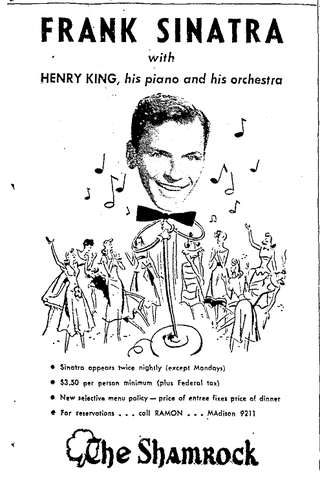
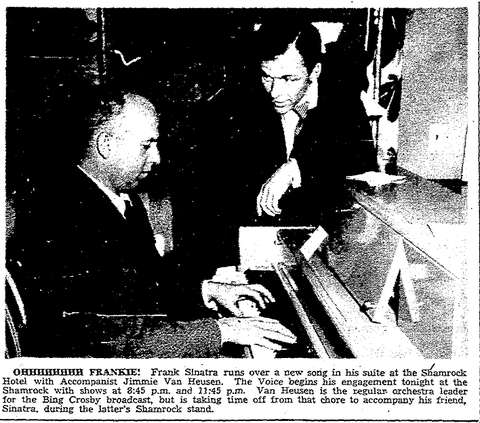
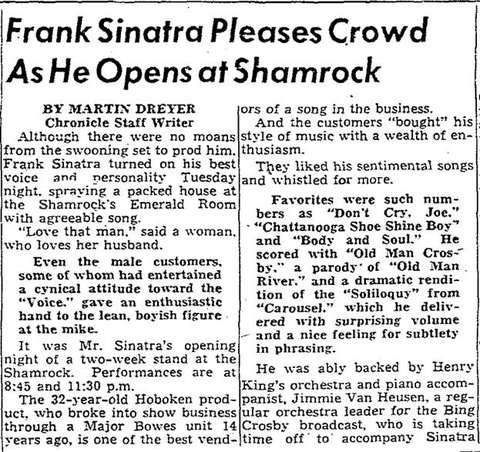
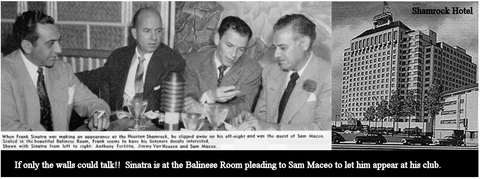
February 1, 1950
Radio
Light Up Time
Taped: January 18, 1950
Sponsor: Lucky Strike Cigarettes
Network: NBC
Show #108
Broadcast: 4:00-4:15 PM PST (Repeat: 8:00-8:15 PM PST)
Starring: Frank Sinatra & Dorothy Kirsten
Jeff Alexander And The Orchestra
1. opening
2. Sweet Lorraine - Frank Sinatra
3. commercial
4. Yesterdays - Dorothy Kirsten
5. Sorry - Frank Sinatra
6. commercial
7. While We're Young - Frank Sinatra & Dorothy Kirsten
8. closing
Concerts
Shamrock Hotel, Houston, Texas (January 31st - February 10) Sinatra was dark on February 6th
Shamrock Hotel, Houston, Texas (January 31st - February 10)
Frank Sinatra was set to open at the Emerald Room of the Shamrock Hotel, in Houston, Texas, January 28, 1950.
Frank and Jimmy Van Heusen had flown to Texas on the 26th Van Heusen was flying his own plane and they
stopped to refuel in El Paso. Frank was told to call George Evans office immediately. George was Frank's
press agent and a guiding force all through the bobby-soxer craze and beyond. Evans secretary informed Frank
George had suffered a fatal heart attack that morning. He was only 48 years old. Van Heusen flew Frank back
to New York and the Shamrock appearance was put on hold until after the funeral.
Glenn McCarthy was the owner of the very elegant new hotel in Houston. Edna Ferber based the character of
Jett Rink on Glenn, in the novel "Giant," after staying at his grand hotel. James Dean portrayed Rink in George
Steven's film version.
Frank and Chester( Van Heusen's name to all his friends) flew back to Texas on the first of February. Frank
opened that night(Wednesday) to a full house including a most welcomed surprise guest. Ava had flown in
for the opening and Frank was thrilled. They went to dinner between shows. A photographer spotted the
couple and told Frank he wanted to take a picture. The response was an explosive "no." Ava put her hands
over her face and the couple did a quick exit from a very nice Italian restaurant.. Frank did a second show
and then went to his room. But he couldn't sleep until after the sun came up. When he woke at 4:30 p.m.,
Frank was a sick man. A doctor was called immediately. The singer was running a fever, had a raw throat,
and was sick to his stomach. He could not go on that night. What to do? The movie star Eddie Bracken
had subbed for Frank the previous week. He had hopped a plane that afternoon en route to California.
The Shamrock did some checking and learned of a quick stop-over in Dallas. They called the airport
there just five minutes before take-off. Bracken agreed to come back on the next plane to Houston.
He arrived at 8:30 and was onstage at 9. Meanwhile a heavy lidded Sinatra was feeling better. He
was weak but insisted on doing the second show of the evening. Chester and the musicians, including
Henry King, the pianist and orchestra leader, were not sure he could do it. Frank thought it might make
him feel better. So on he went at 11: p.m. His speaking voice cracked on him but was fine when he sang.
It looked good until near the end when Frank announced his next number was "Soliloquy," from "Carousel."
It was not possible in the condition he was in that night. But Frank started to sing. Here is a description
from Bill Roberts of the Houston Chronicle on what transpired next:
"And somehow a magic fire caught hold of Frank Sinatra. As he warmed up to "Soliloquy" you could feel the magic catching all
over the Emerald Room. Not one piece of ice tinkled anywhere. Sinatra's throat opened up and he hit notes he had never hit
before in his life. When he finished the crowd took the roof off the Emerald Room . . . Then he went upstairs to get ready for
tonight( 3)."
Bracken was asked to stay in the event Frank had a relapse. A very good move. The ill health continued
to plague him right through the engagement. Eddie stepped in and did some shows.
Frank Sinatra, recovered from illness which forced Eddie Bracken to sub for him at Shamrock Hotel in Houston
several nights, resumes his airshow from Hollywood.
Billboard
Frank felt better on Monday(6) and asked Chester to fly him over to Galveston. He had heard about the Balinese
Restaurant and Nightclub. Frank needed to work. Here is a picture taken that night at the Balinese.
Anthony
Fortitta
James Van
Heusen
Frank Sinatra Sam Maceo ( owner)
Frank got the gig. After closing the next night at the Shamrock, he did a week with the house band at the Balinese. People who
attended the shows remember a terrific performance from Sinatra.
I am indebted to newspapers in both Houston and Galveston, libraries in both cities, Billboard and Variety plus on line sites that
offered commentary from people who attended the shows in both cities.
Ed
February 2, 1950
Radio
Light Up Time
Taped: January 19, 1950
Sponsor: Lucky Strike Cigarettes
Network: NBC
Show #109
Broadcast: 4:00-4:15 PM PST (Repeat: 8:00-8:15 PM PST)
Starring: Frank Sinatra & Dorothy Kirsten
Jeff Alexander And The Orchestra
1. opening
2. What Is This Thing Called Love - Frank Sinatra
3. commercial
4. Can't Help Loving That Man - Dorothy Kirsten
5. A Dream Is A Wish Your Heart Makes - Frank Sinatra
6. commercial
7. It Had To Be You - Dorothy Kirsten
8. The Very Thought Of You - Frank Sinatra
9. closing
Ed O'Brien:
AFRS added "I've Got A Crush On You" from the 1-9-50
Light Up Time. It was placed where the second Lucky Strike ad would have run. They also used the same version for the 2-9-50 Lite Up Time.
Note: Sinatra introduces this broadcast saying he is appearing at the Shamrock Hotel in Huston.
Concerts
Shamrock Hotel, Houston, Texas (January 31st - February 10) Sinatra was dark on February 6th
February 3, 1950
Radio
Light Up Time
Taped: January 23, 1950
Sponsor: Lucky Strike Cigarettes
Network: NBC
Show #110
Broadcast: 4:00-4:15 PM PST (Repeat: 8:00-8:15 PM PST)
Starring: Frank Sinatra & Dorothy Kirsten
Jeff Alexander And The Orchestra
1. opening
2. This Can't Be Love - Frank Sinatra
3. commercial
4. Tonight We Love - Dorothy Kirsten
5. You're Awful - Frank Sinatra & Dorothy Kirsten
6. commercial
7. Ol' Man River - Frank Sinatra
8. closing
Ed O'Brien:
Frank opened the 10-14-49 Light-Up Time with a George Siravo arranged "One I Love Belongs To Somebody Else." AFRS lifted it for the 2-3-50 Lite-Up show. Song subbed for second commercial on the broadcast.
Concerts
Shamrock Hotel, Houston, Texas (January 31st - February 10) Sinatra was dark on February 6th
Light Up Time
Taped: January 23, 1950
Sponsor: Lucky Strike Cigarettes
Network: NBC
Show #110
Broadcast: 4:00-4:15 PM PST (Repeat: 8:00-8:15 PM PST)
Starring: Frank Sinatra & Dorothy Kirsten
Frank Dorothy Jeff Alexander
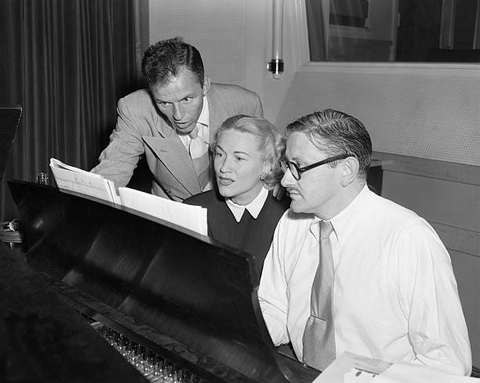
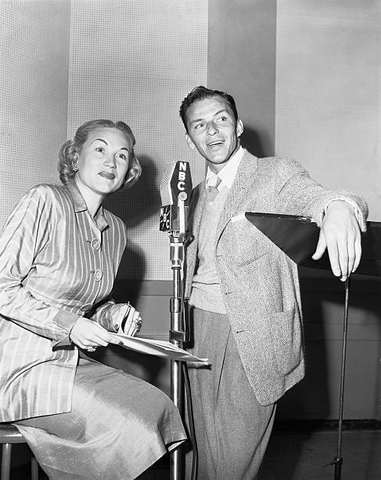
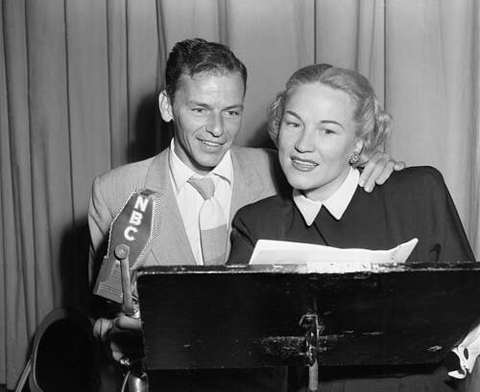
February 4, 1950
Concerts
Shamrock Hotel, Houston, Texas (January 31st - February 10) Sinatra was dark on February 6th
February 5, 1950
Concerts
Shamrock Hotel, Houston, Texas (January 31st - February 10)
Note: Sinatra did a special afternoon performance on February 5th for teenagers.
Shamrock Hotel, Houston, Texas (January 31st - February 10) Sunday afternoon
February 5th at the Shamrock Hotel:
I Sing The Songs (I Write The Songs) / Empty Tables 45 RPM
[image referenced in source but could not be recovered]
[image referenced in source but could not be recovered]
[image referenced in source but could not be recovered]
February 6, 1950
Radio
Light Up Time
Taped: January 16, 1950
Sponsor: Lucky Strike Cigarettes
Network: NBC
Show #111
Broadcast: 4:00-4:15 PM PST (Repeat: 8:00-8:15 PM PST)
Starring: Frank Sinatra & Dorothy Kirsten
Jeff Alexander And The Orchestra
1. opening
2. A Foggy Day - Frank Sinatra
3. commercial
4. More Than You Know - Dorothy Kirsten
5. Without A Song - Frank Sinatra
6. commercial
7. The Way You Look Tonight - Frank Sinatra & Dorothy Kirsten
8. closing
Television
NONE
Concerts
Shamrock Hotel, Houston, Texas (January 31st - February 10) Sinatra was dark on February 6th
[Rescheduled Shamrock Hotel engagement, Ava's surprise visit]
Kaplan / Lee Server: Sinatra rescheduled his Shamrock Hotel, Houston engagement for the first week of February 1950. On February 6, he and Van Heusen flew from New York to Houston; Ava defied a denied MGM travel request and flew to Houston to surprise him, arriving late to his performance to a stir of attention.
Source: James Kaplan, "Frank: The Voice" (2010).
February 7, 1950
Radio
Light Up Time
Taped: January 24, 1950
Sponsor: Lucky Strike Cigarettes
Network: NBC
Show #112
Broadcast: 4:00-4:15 PM PST (Repeat: 8:00-8:15 PM PST)
Starring: Frank Sinatra & Dorothy Kirsten
Jeff Alexander And The Orchestra
Broadcast Version:
1. opening
2. I Beeped When I Should Have Bopped
3. commercial
4. Why Was I Born - Dorothy Kirsten
5. I Must Have Done Something Wonderful - Frank Sinatra
6. Mad About You - Dorothy Kirsten
7. commercial
8. Poinciana - Frank Sinatra
9. closing
Notes: Unknown song changed to "Poinciana." See script for details. Currently original song unknown.
Ed O'Brien:
AFRS added "Bye, Bye, Baby " from the 1-31-50 Light Up Time It was used in place of second ad.
Concerts
Shamrock Hotel, Houston, Texas (January 31st - February 10) Sinatra was dark on February 6th
February 8, 1950
Radio
Light Up Time
Taped: January 18, 1950
Sponsor: Lucky Strike Cigarettes
Network: NBC
Show #113
Broadcast: 4:00-4:15 PM PST (Repeat: 8:00-8:15 PM PST)
Starring: Frank Sinatra & Dorothy Kirsten
Jeff Alexander And The Orchestra
1. opening
2. The Best Things In Life Are Free - Frank Sinatra
3. commercial
4. Suppose I Had Never Met You - Dorothy Kirsten
5. Polka Dots And Moonbeams - Frank Sinatra
6. Imagination - Dorothy Kirsten
7. commercial
8. Why Remind Me - Frank Sinatra
9. closing
Ed O'Brien:
" I Love You," Light Up Time, 1-17-50, was used in lieu of second ad. FS Capitol disc is quite similar.
Concerts
Shamrock Hotel, Houston, Texas (January 31st - February 10) Sinatra was dark on February 6th
February 9, 1950
Radio
Light Up Time
Taped: January 19, 1950
Sponsor: Lucky Strike Cigarettes
Network: NBC
Show #114
Broadcast: 4:00-4:15 PM PST (Repeat: 8:00-8:15 PM PST)
Starring: Frank Sinatra & Dorothy Kirsten
Jeff Alexander And The Orchestra
Broadcast Version:
1. opening
2. Just You, Just Me - Frank Sinatra
3. commercial
4. Scarlet Ribbons - Dorothy Kirsten
5. Sorry - Frank Sinatra
6. commercial
7. Somebody Loves Me - Frank Sinatra
8. I'm In Love - Frank Sinatra & Dorothy Kirsten
9. closing
Ed O'Brien:
I've Got A Crush On You was used by AFRS 1-9-50
Concerts
Shamrock Hotel, Houston, Texas (January 31st - February 10) Sinatra was dark on February 6th
[McCarthy's Wheeling speech]
Joseph McCarthy / Kaplan: In Wheeling, West Virginia, Senator Joseph McCarthy held up a paper claiming to list Communist Party members working in the State Department, instantly propelling the previously marginal senator to national prominence amid rising Cold War paranoia.
Source: James Kaplan, "Frank: The Voice" (2010).
February 10, 1950
Radio
Light Up Time
Taped: January 20, 1950
Sponsor: Lucky Strike Cigarettes
Network: NBC
Show #115
Broadcast: 4:00-4:15 PM PST (Repeat: 8:00-8:15 PM PST)
Starring: Frank Sinatra & Dorothy Kirsten
Jeff Alexander And The Orchestra
1. opening
2. Don't Do Something To Someone Else - Frank Sinatra
3. commercial
4. I'll Be Seeing You - Dorothy Kirsten
5. Strange Music - Frank Sinatra & Dorothy Kirsten
6. commercial
7. You're My Thrill - Frank Sinatra
8. closing
Ed O'Brien:
Brahms Lullaby,12-26-49, was the additional selection on Lite-Up Time
Concerts
Shamrock Hotel, Houston, Texas (January 31st - February 10) Sinatra was dark on February 6th
[Sheilah Graham reports on Ava's marriage talk]
Sheilah Graham: On February 10, 1950, columnist Sheilah Graham wrote that Ava Gardner's travels with Frank Sinatra had included a stop in San Francisco, and that Ava was telling friends she wanted to get married, without naming to whom.
Source: James Kaplan, "Frank: The Voice" (2010).
February 11, 1950
Concerts
Balinese Restaurant and Nightclub, Galveston, Texas (11-17?)
Balinese Restaurant and Nightclub, Galveston, Texas (11-17?)
A STORY YOU DON'T KNOW ABOUT FRANK SINATRA --- By Dallas Realtor Bill Cherry By BILL CHERRY
Real Estate Agent with Bill Cherry, Realtor 0124242
November 13, 2007 03:27 PM
Even though I'm a Dallas resident and business man now, most of my life was spent living in the Galveston-Houston area. My real estate company had two offices in Galveston and one in the museum district of Houston.
And from the age of fourteen, my avocation has been performing on radio and television. I still do. I found this script of a piece I did on TV's News-24 Houston on June 21, 2003, and I thought you would find it interesting.
Bill Cherry's Memories -Sinatra Visits Galveston
People past 60 who lived or came to this island in the old days, love to tell the tales of when big-time stars headlined in Galveston.
Night clubs like the Sui Jin and the Hollywood Dinner Club and the Balinese Room and the Studio Lounge booked entertainers like Fred Astaire and big bands like Harry James.
Most of us refer to it as Galveston's Golden Days, but those golden days only had a span of thirty years. From the 1920s through most of the 1950s.
And that sure is a small piece of time...actually just 17%.... out of the 175 years the island's had civilized people living on it.
My favorite story from that era is when old Frank Sinatra was down on his luck. He was an almost has-been even though he was just 35-years old. We're talking about 1950. And wouldn't you know that's when he was married to glamorous movie star Ava Gardner. And she was making tons of money.
Desperate for a job, somehow he talked legendary oilman Glenn McCarthy into giving him a short gig at Houston's Cork Club, a plush private nightspot on top of McCarthy's legendary Shamrock Hotel.
Bill Roberts, a Houston gossip columnist, reported that Ava Gardner came to Houston with Sinatra, but nobody ever saw her ringside at his shows. The truth is, she wasn't there, and it was because their marriage was on the rocks.
Sinatra started driving to the island almost everyday. He came to pester Sam Maceo, owner of the Balinese Room, into letting him follow the Cork Club gig with one at the Balinese. If Maceo didn't hire him, Sinatra had no place to go after the Cork Club.
Finally. Maceo said OK, but only as a singer with the house band. So Sinatra came, and he stayed in one of the Island's flea bag hotels, and he ate his meals on credit at Biaggio DeAndrea's Speedway Café, right next to the famous Mountain Speedway roller coaster.
Within two years of his down and out Galveston gig, Sinatra moved back on top, but this time as a movie star in "From Here to Eternity." That's a story in itself.
But Sinatra never forgot his Galveston gig and the benevolence of Biaggio DeAndrea and his Speedway Café.
A few years later, Sinatra campaigned for the election of John F. Kennedy for president. When Kennedy won, he asked Sinatra if there might be a handful of people he'd like to have invited to his inauguration.
One Sinatra picked was his friend at the Speedway, Biaggio DeAndrea. And sure enough, a fancy embossed invitation was sent. DeAndrea didn't go, but that invitation was thumb tacked on the wall behind the lunch counter for all to see until the Speedway closed years later.
And Biaggio told me Sinatra settled up his tab at the café, too.
I'm Galvestonian Bill Cherry, and Frank Sinatra's visit to Galveston is one of my memories.
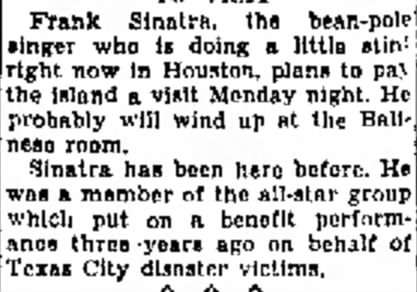
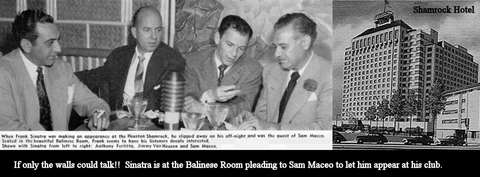
Early February 1950
Shortly after attending the funeral of his press agent and friend George Evans, Frank Sinatra traveled to Houston with Ava Gardner for a hotel opening. At a mayor-hosted dinner at an Italian restaurant, Sinatra threatened a photographer who approached the table; the photographer left without a picture, but the confrontation was reported the next day in the Houston Post and picked up nationally by the wire services, intensifying press scrutiny of the affair. Source: Michael Sheridan & David Harvey, Sinatra and the Jack Pack.
[Louella Parsons predicts reconciliation]
Louella Parsons: Louella Parsons wrote that she was glad Nancy would only separate rather than divorce, predicting the couple would reunite, and noting Frank was planning a European trip that spring around the same time Ava would leave to film Pandora and the Flying Dutchman in England.
Source: James Kaplan, "Frank: The Voice" (2010)
[MGM warns Ava over the affair]
Dorothy Kilgallen: Columnist Dorothy Kilgallen reported that Ava's affair with Sinatra had put her in the MGM "doghouse," with the studio warning her to avoid further "entanglements."
Source: James Kaplan, "Frank: The Voice" (2010)
[Mitch Miller named head of Columbia pop singles]
Kaplan: In February 1950, Columbia Records brought in Mitch Miller as the new head of its pop-singles division, following Manie Sacks's departure to RCA.
Source: James Kaplan, "Frank: The Voice" (2010)
[Nancy changes locks after Houston publicity]
Kaplan: The national publicity from the Houston spaghetti-photo incident was, for Nancy Sinatra, the final humiliation; that afternoon she had the locks changed at 320 North Carolwood. Their eleventh wedding anniversary had been two days earlier.
Source: James Kaplan, "Frank: The Voice" (2010)
[Public backlash against Ava Gardner]
Ava Gardner / Kaplan: Following the separation announcement, Ava received scores of hate letters calling her a home wrecker (one addressed her as "Bitch-Jezebel-Gardner"), the Legion of Decency threatened to ban her films, and Catholic priests wrote her accusatory letters; students at St. Paul the Apostle School in Los Angeles were reportedly asked to pray for Nancy Sinatra.
Source: James Kaplan, "Frank: The Voice" (2010)
[Sinatra's joke about Louis B. Mayer]
Kaplan: In the MGM commissary, after Mayer had been injured in a horseback accident, Sinatra quipped that Mayer "fell off of Ginny Simms" (Mayer's mistress). The remark got back to Mayer, who summoned Frank and, though outwardly calm, told him to leave the studio and never return.
Source: James Kaplan, "Frank: The Voice" (2010)
[Spaghetti photo incident in Houston]
Kaplan / wire report: After Sinatra's Shamrock performance, Houston mayor Oscar Holcombe hosted a dinner for Frank, Ava, and others at Vincent's Sorrento restaurant, tipped off in advance to the press. A Houston Press photographer, Eddie Schisser, approached mid-meal asking to photograph Sinatra eating spaghetti; Sinatra angrily refused and nearly came to blows before the restaurant management intervened, while Ava tried to hide her face. Wire reports of the confrontation ran nationally the next morning.
Source: James Kaplan, "Frank: The Voice" (2010)
[Willie Moretti's telegram to Sinatra]
Willie Moretti: After reading newspaper coverage of the Sinatra-Gardner affair, mob figure Willie Moretti -- Sinatra's old Hasbrouck Heights neighbor, then suffering from secondary syphilis -- sent Frank a telegram expressing surprise and urging him to remember he had a decent wife and children.
Source: James Kaplan, "Frank: The Voice" (2010)
[career/industry -- critical commentary]
Mitch Miller: Mitch Miller became Columbia's A&R Director in February 1950 and, by his own account, took Columbia from the number-four to the number-one label within two years, with the company sometimes holding eight of the Top Ten bestsellers simultaneously -- a commercial triumph built substantially on novelty tunes by artists like Tony Bennett, Rosemary Clooney, Johnnie Ray, and Guy Mitchell.
Source: Charles L. Granata, "Sessions with Sinatra: Frank Sinatra and the Art of Recording" (1999/2003), Part II: The Columbia Years, 1943-1952
February 13, 1950
Radio
Light Up Time
Sponsor: Lucky Strike Cigarettes
Network: NBC
Show #116
Broadcast: 4:00-4:15 PM PST (Repeat: 8:00-8:15 PM PST)
Starring: Frank Sinatra & Dorothy Kirsten
Jeff Alexander And The Orchestra
Broadcast Version:
1. opening
2. Chattanooga Shoe Shine Boy - Frank Sinatra
3. commercial
4. A Thousand And One Nights - Dorothy Kirsten
5. A Fine Romance - Frank Sinatra & Dorothy Kirsten
6. commercial
7. My Foolish Heart - Frank Sinatra
8. closing
Ed O'Brien:
"White Christmas," 12-23-49, was used on Lite Up Time in place of second ad. Here is Sinatra's introduction: "A song as heartwarming as a painting by Grandma Moses."

Concerts
Balinese Restaurant and Nightclub, Galveston, Texas (13-17?)
February 14, 1950
Radio
Light Up Time
Sponsor: Lucky Strike Cigarettes
Network: NBC
Show #117
Broadcast: 4:00-4:15 PM PST (Repeat: 8:00-8:15 PM PST)
Starring: Frank Sinatra & Dorothy Kirsten
Jeff Alexander And The Orchestra
1. opening
2. I Love You - Frank Sinatra
3. commercial
4. You're A Sweetheart - Dorothy Kirsten
5. You Remind Me Of The Girl - Frank Sinatra
6. Always - Dorothy Kirsten
7. Honey - Frank Sinatra
8. Let Me Call You Sweetheart - Frank Sinatra & Dorothy Kirsten
9. commercial
10. Come Rain, Come Shine
11. closing
Notes: "Let Me Call You Sweetheart" was added to the show script..
Concerts
Balinese Restaurant and Nightclub, Galveston, Texas (13-17?)
On Valentine's Day, Frank Sinatra told Nancy he was serious about Ava Gardner and that nothing in his life meant as much to him. Having heard variations of this declaration before, Nancy erupted — “Every time you get involved with one of these women, she's the only one for you and you want to be with her forever… I'm sick of it!” — slapped him across the face, had the locks changed, and threw him out, though as a devout Catholic she still refused to grant a divorce. Source: J. Randy Taraborrelli, Sinatra: Behind the Legend.
[Nancy requests a legal separation]
Consiglio: On Valentine's Day 1950, after Frank admitted his strong feelings for Ava Gardner, Nancy asked for a legal separation. As a devout Catholic, Nancy initially resisted divorce because it would mean excommunication.
Source: Tony Consiglio (as told to Franz Douskey), "Sinatra and Me: The Very Good Years" (2012).
February 15, 1950
Radio
Light Up Time
Sponsor: Lucky Strike Cigarettes
Network: NBC
Show #118
Broadcast: 4:00-4:15 PM PST (Repeat: 8:00-8:15 PM PST)
Starring: Frank Sinatra & Dorothy Kirsten
Jeff Alexander And The Orchestra
1. opening
2. What Is This Thing Called Love - Frank Sinatra
3. commercial
4. Why Remind Me - Dorothy Kirsten
5. Between The Devil And The Deep Blue Sea - Frank Sinatra
6. Hands Across The Table - Frank Sinatra & Dorothy Kirsten
7. You're Driving Me Crazy - Dorothy Kirsten
8. commercial
9. I Don't Know Whether To Laugh Or Cry Over You - Frank Sinatra
10. Closing
Concerts
Balinese Restaurant and Nightclub, Galveston, Texas (11-17?)
Gossip columnist Hedda Hopper broke the news of the Sinatras' separation, quoting Nancy: “Frank's attentions to another woman have made our life together most unhappy... We have therefore separated. I do not contemplate divorce proceedings in the foreseeable future.” The disclosure — the couple's third separation, Nancy admitted — brought a wave of public backlash against both Frank and Gardner; Gardner later recalled receiving hate mail branding her a “scarlet woman” and hearing that a Los Angeles Catholic school had asked students to pray for Nancy. MGM chief Louis B. Mayer, citing the same morals clause his studio had used against Sinatra, threatened action against Gardner too; she was unmoved, calling the threat “worth a few laughs.” Source: J. Randy Taraborrelli, Sinatra: Behind the Legend.
Sheridan and Harvey date Nancy's separation announcement to Valentine's Day itself, February 14, with the news breaking more widely the following day; they read the timing, deliberate or not, as adding to the press pile-on Sinatra was already facing after a photographer altercation in Houston days earlier. Source: Michael Sheridan & David Harvey, Sinatra and the Jack Pack.
[Hedda Hopper reports Nancy's separation decision]
Hedda Hopper: The day after Valentine's Day, Hedda Hopper's Los Angeles Times column reported that Nancy Sinatra had decided to separate from Frank, calling their married life "unhappy and almost unbearable" but saying she did not foresee divorce; she planned to seek custody of their three children (Nancy, 9; Frank, 6; Christina, 2) with attorney Arnold M. Grant. The piece noted this was the couple's third separation since their February 4, 1939 marriage, following an earlier split in October 1946 that was resolved two weeks later.
Source: James Kaplan, "Frank: The Voice" (2010).
February 16, 1950
Radio
Light Up Time
Sponsor: Lucky Strike Cigarettes
Network: NBC
Show #119
Broadcast: 4:00-4:15 PM PST (Repeat: 8:00-8:15 PM PST)
Starring: Frank Sinatra & Dorothy Kirsten
Jeff Alexander And The Orchestra
1. opening
2. For You - Frank Sinatra
3. commercial
4. You're Always There - Dorothy Kirsten
5. Sorry - Frank Sinatra
6. commercial
7. Let's Fall In Love - Frank Sinatra & Dorothy Kirsten
8. closing
February 17, 1950
Radio
Light Up Time
Sponsor: Lucky Strike Cigarettes
Network: NBC
Show #120
Broadcast: 4:00-4:15 PM PST (Repeat: 8:00-8:15 PM PST)
Starring: Frank Sinatra
Jeff Alexander And The Orchestra
1. opening
2. The Old Master Painter - Frank Sinatra
3. commercial
4. When You Awake - Frank Sinatra
5. Supposin' - Frank Sinatra
6. None But The Lonely Heart - Frank Sinatra
7. commercial
8. Bye Bye Baby - Frank Sinatra
9. closing
Ed O'Brien
AFRS chose Cole Porter's "What Is This Thing Called Love" from the 1-15-50 Light Up Time. Dorothy was not on the 2-17 show, so Frank did a brief skit with Jeff Alexander. Before singing "None But The Lonely Heart," Frank declared that it was one of the greatest songs ever written. Porter's classic followed.
[image referenced in source but could not be recovered]
February 20, 1950
Radio
Light Up Time
Sponsor: Lucky Strike Cigarettes
Network: NBC
Show #121
Broadcast: 4:00-4:15 PM PST (Repeat: 8:00-8:15 PM PST)
Starring: Frank Sinatra & Dorothy Kirsten
Jeff Alexander And The Orchestra
1. opening
2. Chattanooga Shoe Shine Boy - Frank Sinatra
3. commercial
4. I Didn't Know What Time It Was - Dorothy Kirsten
5. May I - Frank Sinatra & Dorothy Kirsten
6. commercial
7. God's Country - Frank Sinatra
8. closing
February 21, 1950
Radio
Light Up Time
Sponsor: Lucky Strike Cigarettes
Network: NBC
Show #122
Broadcast: 4:00-4:15 PM PST (Repeat: 8:00-8:15 PM PST)
Starring: Frank Sinatra & Dorothy Kirsten
Jeff Alexander And The Orchestra
1. opening
2. Then I'll Be Happy - Frank Sinatra
3. commercial
4. Blue Moon - Dorothy Kirsten
5. Sure Thing - Frank Sinatra
6. commercial
7. Sunshine Cake - Frank Sinatra & Dorothy Kirsten
8. closing
Ed O'Brien:
The bonus track on the Lite-Up Time from AFRS was
"Why Remind Me," sung by Dorothy Kirsten, taken from the
February 22, 1950
Radio
Light Up Time
Sponsor: Lucky Strike Cigarettes
Network: NBC
Show #123
Broadcast: 4:00-4:15 PM PST (Repeat: 8:00-8:15 PM PST)
Starring: Frank Sinatra & Dorothy Kirsten
Jeff Alexander And The Orchestra
Missing Parts of script
1. Don't Do Something To Someone Else - FS
2. Crazy He Calls Me - DK
3. Sitting By The Window - FS
4. Lookin' For A Little Boy - DK
5. Where Or When - FS
Ed O'Brien:
Dorothy sang "Crazy He Calls Me" and "Lookin' For A Little Boy."
AFRS addition was "Sorry." Frank was very generous to a couple of fellow singers during this show. Before singing "Don't Do Something To Someone Else," he encourages his listeners to buy Frankie Laine's recording. He hypes Billy Eckstine's version of "Sitting By The Window" before offering his version.
Light Up Time
Sponsor: Lucky Strike Cigarettes
Network: NBC
Show #123
Broadcast: 4:00-4:15 PM PST (Repeat: 8:00-8:15 PM PST)
Starring: Frank Sinatra & Dorothy Kirsten
February 22, 1956 Down Beat
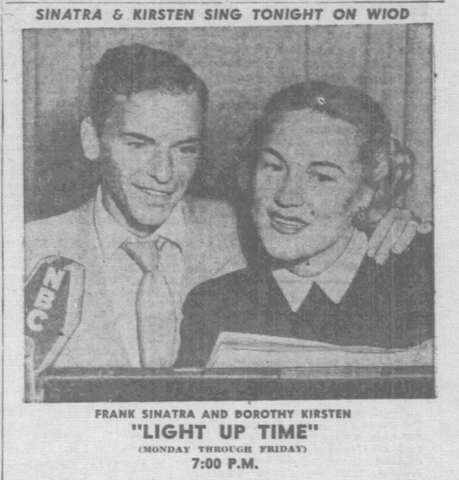
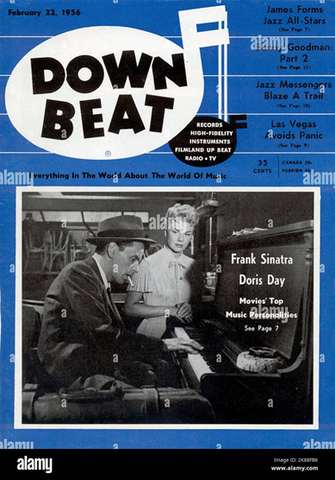
February 23, 1950
Studio
Hollywood
RHCO4020 Kisses And Tears w/Jane Russell & The Modernaires
(J. Styne/S. Cahn)
(from Double Dynamite)
E.H. Morris & Co. (ASCAP) 1949
Arranged & Conducted by Axel Stordahl
-1 (2:45) CD: Columbia Years 43-52 Vol. 11
LP: CL-2530 Boys And Girls Together, House Party Series(10 inch)
78: 38790
RHCO4021 When The Sun Goes Down w/The Modernaires
(W. O'Keefe/I. Orton)
Sinatra Songs, Inc.. (ASCAP) 1950
Arranged & Conducted by Axel Stordahl
-1 (3:00) CD: Columbia Years 43-52 Vol. 11
LP: CL-1359 Come Back To Sorrento
78: 38790
Walter Winchell Jane Frank
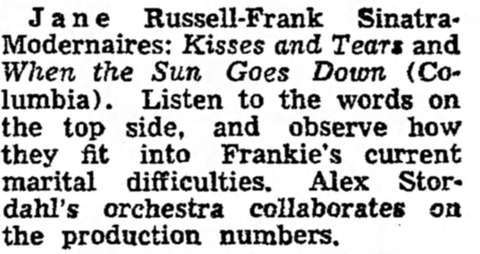
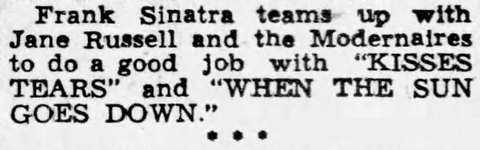
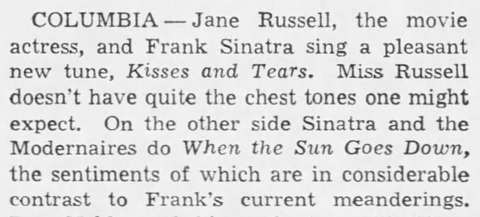
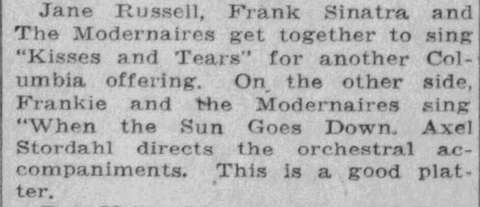
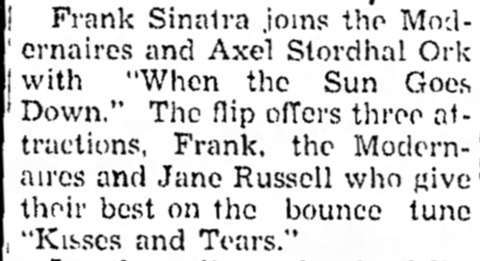
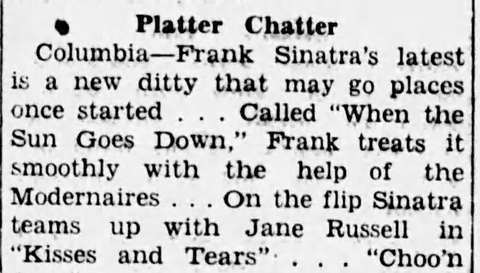
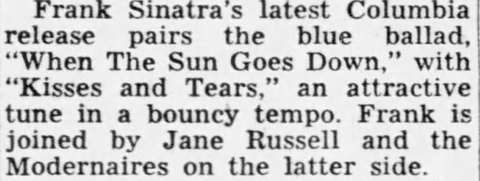
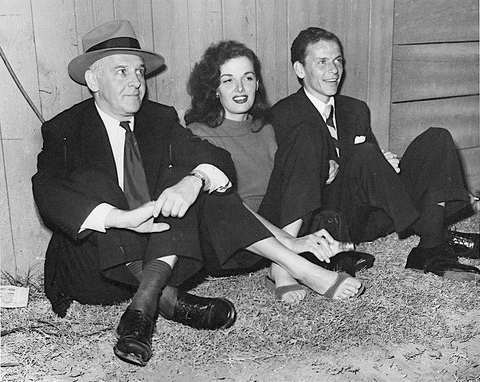
Radio
Light Up Time
Sponsor: Lucky Strike Cigarettes
Network: NBC
Show #124
Broadcast: 4:00-4:15 PM PST (Repeat: 8:00-8:15 PM PST)
Starring: Frank Sinatra & Dorothy Kirsten
Jeff Alexander And The Orchestra
1. opening
2. Somebody Love Me - Frank Sinatra
3. commercial
4. It's So Nice To Have A Man Around The House - Dorothy Kirsten
5. Why Remind Me - Frank Sinatra
6. commercial
7. My Heart Stood Still - Frank Sinatra & Dorothy Kirsten
8. closing
Ed O'Brien:
AFRS added Cole Porter's "What Is This Thing Called
Love" from the 2-15-50 show. On the 2/23 AFRS, Don Wilson again cuts Dorothy Kirsten off the show. Someone wasn't paying attention when the Lite-Up shows were being put together.
February 24, 1950
Radio
Light Up Time
Taped: February 23, 1950
Sponsor: Lucky Strike Cigarettes
Network: NBC
Show #125
Broadcast: 4:00-4:15 PM PST (Repeat: 8:00-8:15 PM PST)
Starring: Frank Sinatra & Dorothy Kirsten
Jeff Alexander And The Orchestra
1. opening
2. Can I Come In For A Second - Frank Sinatra
3. commercial
4. As Time Goes By - Dorothy Kirsten
5. There's A Small Hotel - Frank Sinatra & Dorothy Kirsten
6. commercial
7. All Or Nothing At All - Frank Sinatra
8. closing
Notes: "There's A Small Hotel" was added to the script and "I Don't Stand A Ghost Of A Chance" & "It's The Little Things That Count" were cut.
February 25, 1950
Concerts
Palm Springs, CA
"Peace Officers' Ball"
Performers: Frank Sinatra, Bob Hope, Al Jolson, Jack Benny, Eddie Cantor, Gordon McRae, Jane Russell, Les Brown and His Band of Renown
Palm Springs, CA
"Peace Officers' Ball"
The Desert Sun, Palm Springs, California, February 24, 1950,Friday
The Desert Sun, Palm Springs, California, 03 Mar 1950, Fri
February 26, 1950
Frank appeared in a fund-raising gala at the Biltmore Bowl for the Jewish Home for the Aged.
Source: Nancy Sinatra, Frank Sinatra: An American Legend, 1995.
February 27, 1950
Radio
Light Up Time
Sponsor: Lucky Strike Cigarettes
Network: NBC
Show #126
Broadcast: 4:00-4:15 PM PST (Repeat: 8:00-8:15 PM PST)
Starring: Frank Sinatra & Dorothy Kirsten
Jeff Alexander And The Orchestra
1. opening
2. Lover - Frank Sinatra
3. commercial
4. Be Mine - Dorothy Kirsten
5. Sorry - Frank Sinatra
6. commercial
7. Don't Worry 'bout Me - Frank Sinatra
8. I'm In Love - Frank Sinatra & Dorothy Kirsten
9. closing
Notes: "Don't Worry 'bout Me" was added to the script.
Ed O'Brien:
"I Don't Know Whether To Laugh Or Cry," from the
2-15-50 Light-Up Time, was the AFRS choice for the Lite-Up Time version of this show. It followed
"Sorry" in the song l
Television
NONE
February 28, 1950
Radio
Light Up Time
Sponsor: Lucky Strike Cigarettes
Network: NBC
Show #127
Broadcast: 4:00-4:15 PM PST (Repeat: 8:00-8:15 PM PST)
Starring: Frank Sinatra & Dorothy Kirsten
Jeff Alexander And The Orchestra
1. opening
2. Love Is Just Around The Corner - Frank Sinatra
3. commercial
4. Poinciana - Dorothy Kirsten
5. A Hundred years From Today - Frank Sinatra
6. This Can't Be Love - Dorothy Kirsten
7. commercial
8. Sure Thing - Frank Sinatra
9. closing
Ed O'Brien:
AFRS inserted "Dreamer's Holiday" in place of the second commercial break.
March 1, 1950
Radio
Light Up Time
Sponsor: Lucky Strike Cigarettes
Network: NBC
Show #128
Broadcast: 4:00-4:15 PM PST (Repeat: 8:00-8:15 PM PST)
Starring: Frank Sinatra & Dorothy Kirsten
Jeff Alexander And The Orchestra
1. opening
2. Don't Go Way Mad - Frank Sinatra
3. commercial
4. Can't Help Loving That Man - Dorothy Kirsten
5. Gotta Have My Baby Back - Frank Sinatra
6. commercial
7. You're Awful - Frank Sinatra & Dorothy Kirsten
8. closing
Notes:
Ed O'Brien:
Additional AFRS number, "I'm In Love," duet with Dorothy Kirsten, was lifted from the 1-19-50 Light Up Time. Frank plugs Ella's recording of "Gotta Have My Baby Back."
March 2, 1950
Radio
Light Up Time
Taped: February 27, 1950
Sponsor: Lucky Strike Cigarettes
Network: NBC
Show #129
Broadcast: 4:00-4:15 PM PST (Repeat: 8:00-8:15 PM PST)
Starring: Frank Sinatra & Dorothy Kirsten
Jeff Alexander And The Orchestra
1. opening
2. Chattanoogie Shoe Shine Boy - Frank Sinatra
3. commercial
4. It's The Little Things That Count - Dorthy Kirsten
5. Why Remind Me? - Frank Sinatra
6.. With My Eyes Wide Open - Dorothy Kirsten
7. commercial
8. God's Country - Frank Sinatra
9. closing
Ed O'Brien:
"It's Only A Paper Moon" was the AFRS pick for the Lite-Up Time broadcast of this show. It was placed right after Dorothy Kirsten's second number.
March 3, 1950
Radio
Light Up Time
Taped: February 28, 1950
Sponsor: Lucky Strike Cigarettes
Network: NBC
Show #130
Broadcast: 4:00-4:15 PM PST (Repeat: 8:00-8:15 PM PST)
Starring: Frank Sinatra & Dorothy Kirsten
Jeff Alexander And The Orchestra
1. opening
2. The Old Master Painter - Frank Sinatra
3. commercial
4. Lover Come Back To Me - Dorothy Kirsten
5. Sunshine Cake - Frank Sinatra & Dorothy Kirsten
6. commercial
7. Lullaby Of Broadway - Frank Sinatra
8. closing
Ed O'Brien:
"Let It Snow, Let It Snow, Let It Snow" was the AFRS choice in lieu of second ad.
Early March 1950
Shortly before opening at the Copacabana, Sinatra, staying at the Hampshire House Hotel in Manhattan, flew into a jealous rage after learning Ava Gardner had gone to a party thrown by her ex-husband Artie Shaw. He phoned her and told her he was going to kill himself; she and others heard what sounded like a gunshot over the line. By the time police reached his room the scene had been cleared and Sinatra was lying on the bed as if nothing had happened. Gardner's own later account, in her memoir Ava, described racing to his room certain she'd find a body, only for him to open his eyes and say, "Oh, hello." Source: Michael Sheridan & David Harvey, Sinatra and the Jack Pack.
[Sinatra's First Nightclub Date In Five Years, At The Copacabana]
Nancy Sinatra: Amid public gossip about his affair with Ava Gardner, Sinatra opened at New York's Copacabana, his first nightclub appearance in five years, and Gardner attended ten consecutive nights before leaving for Europe to film Pandora and the Flying Dutchman.
Source: Nancy Sinatra, Frank Sinatra: An American Legend, 1995.
[Artie Shaw in New York, tension over Ava]
Kaplan: During Sinatra's Copa run, Ava's ex-husband Artie Shaw was also in New York playing a gig at Bop City, and invited Frank and Ava to his apartment for cocktails; Sinatra refused, harboring long-standing resentment toward Shaw (who had rejected him as a band singer years earlier and habitually disparaged him) and fear that Shaw might lure Ava back.
Source: James Kaplan, "Frank: The Voice" (2010)
[Ava visits Artie Shaw's apartment]
Artie Shaw / Ava Gardner / Kaplan: After a fight with Frank -- accounts differ on the cause and sequence -- Ava went to Artie Shaw's Central Park West apartment late at night. Shaw later recounted (with self-serving embellishment) that Ava asked him whether their past sex life had been good and confided that sex with Sinatra felt like being with a woman, gentle as if she might break.
Source: James Kaplan, "Frank: The Voice" (2010)
[Ava's account of "Nancy with the Laughing Face" at the Copa]
Ava Gardner / Kaplan: Ava Gardner later wrote that Frank sang "Nancy with the Laughing Face" -- written about his daughter, not his wife -- beautifully at the Copa, insisting it was never a source of conflict between them; another account claims she was upset by the song, asking him afterward why he had to sing it.
Source: James Kaplan, "Frank: The Voice" (2010)
[Copacabana engagement begins, Sinatra's anxiety]
Frank Sinatra / Kaplan: Sinatra began an eight-week stand at the Copacabana in New York, his first New York nightclub appearance since the Riobamba five years earlier. He was anxious about the club's grueling three-shows-a-night format straining his voice, and later recalled needing pills to sleep, start his day, and relax.
Source: James Kaplan, "Frank: The Voice" (2010)
[Sinatra's staged suicide attempt at the Hampshire House]
Ava Gardner / Kaplan: During the Copa run, Sinatra phoned Ava at the Hampshire House late at night saying "I can't stand it any longer. I'm going to kill myself -- now!" followed by a gunshot sound. Ava rushed to his room and found him alive with a pale smile, having fired a single shot through a pillow into the mattress. Hank Sanicola was summoned to remove the incriminating mattress (in one version aided by David O. Selznick, staying down the hall), and the NYPD responded to the disturbance.
Source: James Kaplan, "Frank: The Voice" (2010)
[Tensions between Ava and Frank's mob associates]
Kaplan: During the Copa run, Ava grew bored and resentful spending nights with Sinatra's mob-connected friends, including the Fischetti brothers and Frank Costello, while MGM sent telegrams pressuring her to report to England for Pandora and the Flying Dutchman.
Source: James Kaplan, "Frank: The Voice" (2010)
[Dedicated to You album released before Copacabana run]
Frank's fifth Columbia album, Dedicated to You, came out in March 1950 just before his run at the Copacabana, drawing on older vault recordings; it failed to chart.
Source: Richard Havers, "Sinatra" (Dorling Kindersley, 2007).
March 6, 1950
Radio
Light Up Time
Sponsor: Lucky Strike Cigarettes
Network: NBC
Show #131
Broadcast: 7:00-7:15 PM EST (Repeat: 9:00-9:15 PM PST)
Starring: Frank Sinatra & Dorothy Kirsten
Skitch Henderson And The Orchestra
1. opening
2. Great Day - Frank Sinatra
3. commercial
4. You Kissed Me - Dorothy Kirsten
5. I Don't Know Whether To Laugh Or Dry - Frank Sinatra
6. commercial
7. The Way You Look Tonight - Frank Sinatra & Dorothy Kirsten
8. closing
March 7, 1950
Radio
Light Up Time
Sponsor: Lucky Strike Cigarettes
Network: NBC
Show #132
Broadcast: 7:00-7:15 PM EST (Repeat: 9:00-9:15 PM PST)
Starring: Frank Sinatra
Skitch Henderson And The Orchestra
1. opening
2. Don't Go Away Mad - Frank Sinatra
3. commercial
4. These Foolish Things - Frank Sinatra
5. One For My Baby - Frank Sinatra
6. commercial
7. My Foolish Heart - Frank Sinatra
8. closing
March 8, 1950
Radio
Light Up Time
Sponsor: Lucky Strike Cigarettes
Network: NBC
Show #133
Broadcast: 4:00-4:15 PM PST (Repeat: 8:00-8:15 PM PST)
Starring: Frank Sinatra & Dorothy Kirsten
Jeff Alexander And The Orchestra
1. A Foggy Day - FS
2. April In Paris - DK
3. Sure Thing - FS
4. I Gotta Have My Baby Back - FS (added for AFRS)
5. Full Moon And Empty Arms FS & DK
Television
none
March 9, 1950
Radio
Light Up Time
Sponsor: Lucky Strike Cigarettes
Network: NBC
Show #134
Broadcast: 7:00-7:15 PM EST (Repeat: 9:00-9:15 PM PST)
Starring: Frank Sinatra & Dorothy Kirsten
Skitch Henderson And The Orchestra
1. opening
2. Should I - Frank Sinatra
3. commercial
4. It Never Entered My Mind - Dorothy Kirsten
5. Bye Bye Baby - Frank Sinatra
6. Hands Across The Table - Dorothy Kirsten
7. commercial
8. Body And Soul - Frank Sinatra
9. closing
Notes: "Scarlet Ribbons" was changed to "Hands Across The Table."
March 10, 1950
Studio
New York City
CO42967 American Beauty Rose w/Will Bradley - trombone
(R. Evans/H. Davis/A. Altman)
Jefferson Music Corp. (ASCAP) 1950
Arranged & Conducted by Mitch Miller
-1 (2:34) CD: Columbia Years 43-52 Vol. 11
LP: CL-1241 Love Is A Kick
78: 40522
78: 38809
Trumpets: B. Butterfield, H. Freistadt; Trombones: L. Alpeter, W. Bradley; Saxes: V. Abato, S. Amato , R. Banzer, E. Powell; Piano: S. Freeman; Guitar: A. Ryerson; Bass: F. Carroll; Drums: T. Snyder
Radio
Light Up Time
Sponsor: Lucky Strike Cigarettes
Network: NBC
Show #135
Broadcast: 7:00-7:15 PM EST (Repeat: 9:00-9:15 PM PST)
Starring: Frank Sinatra & Janet Blair
Skitch Henderson And The Orchestra
1. opening
2. On The Sunny Side Of The Street - Frank Sinatra
3. commercial
4. It's So Nice To Have A Man Around The House - Janet Blair
5. Come Rain, Come Shine - Frank Sinatra
6. commercial
7. God's Country - Frank Sinatra
8. closing
[Erskine Johnson mocks Ava's film role]
Erskine Johnson: Columnist Erskine Johnson's March 10, 1950 column noted that Ava Gardner's lines as a "husband-snatching hussy" in the film East Side, West Side drew snickers at a preview, given her real-life reputation.
Source: James Kaplan, "Frank: The Voice" (2010).
March 13, 1950
Radio
Light Up Time
Sponsor: Lucky Strike Cigarettes
Network: NBC
Show #136
Broadcast: 7:00-7:15 PM EST (Repeat: 9:00-9:15 PM PST)
Starring: Frank Sinatra
Skitch Henderson And The Orchestra
1. opening
2.. Chattanoogie Shoe Shine Boy - Frank Sinatra
3. commercial
4. Sorry - Frank Sinatra
5. Why Remind Me - Frank Sinatra
6. A Dream Is A Wish - Frank Sinatra
7. commercial
8. Begin The Beguine - Frank Sinatra
9. closing
I have been listening to Light Up Time shows and enjoying them a great deal. This particular show is quite good. Frank tells the audience that Dorothy Kirsten has the lead in "La Traviata" at the Metropolitan Opera. Although she is absent this evening, Frank tells his listeners he will be in attendance for her opening night performance. Andre Baruch, shows announcer, will be there with Frank. The first three songs were all recent Columbia single releases. The highlight is "Why Remind Me" with just Skitch Henderson backing him on piano. Frank compliments Skitch for a very pretty accompaniment. Baruch does a comedy routine with Frank. They worked together very nicely. After Frank lauds "Cinderella," both the book and the Disney film, he does a lovely reading of "A Dream Is A Wish," followed by a Lucky Strike commercial by Mr. S. "Begin the Beguine" is done big and is most impressive. Andre says "goodnight" and Frank sings a segment of "Put Your Dreams Away." If you are mostly familiar with the AFRS "Lite Up Time," Don Wilson is the announcer throughout the series. Often the intro was quite misleading. Wilson has a guest star in lieu of Kirsten and Dorothy is there in person. Other shows she is absence but not really. The signoff was also bizarre at times: Wilson tells the audience Frank will be back tomorrow night. And it happens to be a Friday. The AFRS engineers did some very sloppy work.
Baruch took over the announcing at NBC somewhere is the latter part of 1949, at least for some of the Lucky Strike shows. I am trying to get an exact date. He was on shows in December 1949. I have not been able to find any mention of his association with the show from online bios.
--Ed
Sinatra and Faye Emerson are crowned King and Queen of the Bock Beer Festival Park Avenue Restaurant, New York, NY
Last 2 photos from Michel M.
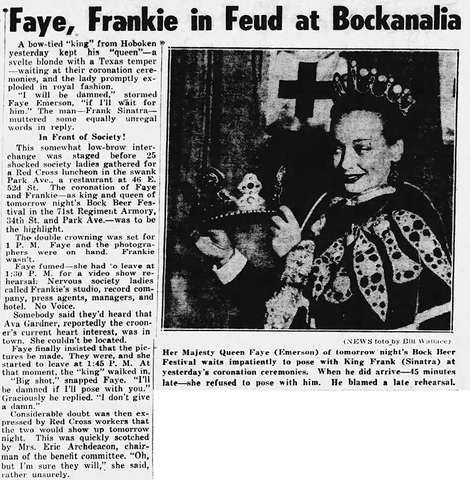
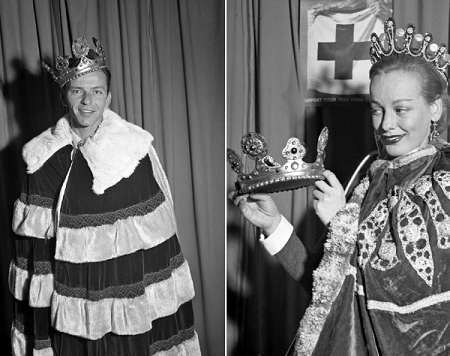
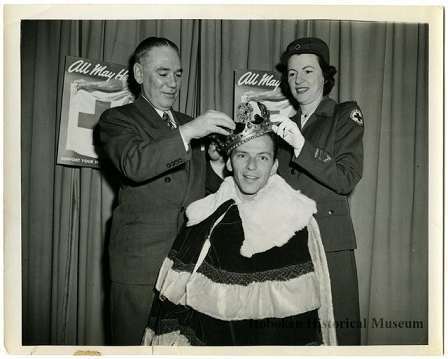
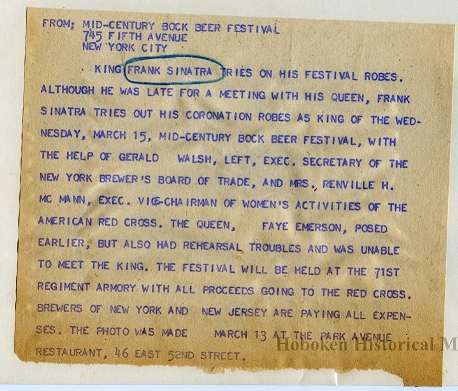
Light Up Time
Sponsor: Lucky Strike Cigarettes
Network: NBC
Show #136
Broadcast: 7:00-7:15 PM EST (Repeat: 9:00-9:15 PM PST)
Starring: Frank Sinatra
Skitch Henderson And The Orchestra
1. opening
2.. Chattanoogie Shoe Shine Boy - Frank Sinatra
3. commercial
4. Sorry - Frank Sinatra
5. Why Remind Me - Frank Sinatra
6. A Dream Is A Wish - Frank Sinatra
7. commercial
8. Begin The Beguine - Frank Sinatra
9. closing
March 14, 1950
Radio
Light Up Time
Sponsor: Lucky Strike Cigarettes
Network: NBC
Show #137
Broadcast: 7:00-7:15 PM EST (Repeat: 9:00-9:15 PM PST)
Starring: Frank Sinatra & Dorothy Kirsten
Skitch Henderson And The Orchestra
1. opening
2. You Must Have Been A Beautiful Baby - Frank Sinatra
3. commercial
4. I Didn't Know What Time It Was - Dorothy Kirsten
5. I Gotta Have My Baby Back - Frank Sinatra
6. commercial
7. While We're Young - Frank Sinatra & Dorothy Kirsten
8. clsoing
March 15, 1950
Radio
Light Up Time
Sponsor: Lucky Strike Cigarettes
Network: NBC
Show #138
Broadcast: 7:00-7:15 PM EST (Repeat: 9:00-9:15 PM PST)
Starring: Frank Sinatra & Dorothy Kirsten
Skitch Henderson And The Orchestra
1. opening
2. I've Got My Love To Keep Me Warm - Frank Sinatra
3. commercial
4. My Foolish Heart - Dorothy Kirsten
5. Don't Do Something To Someone Else - Frank Sinatra
6. It's The Little Things That Count - Dorothy Kirsten
7. commercial
8. I Concentrate On You
9. closing
[Senator Johnson denounces Ingrid Bergman]
Edwin C. Johnson: On March 15, 1950, Senator Edwin C. Johnson of Colorado denounced Ingrid Bergman on the Senate floor as an "apostle of degradation" over her affair with director Roberto Rossellini, announcing his committee would hold hearings on the moral questions raised by Hollywood scandal.
Source: James Kaplan, "Frank: The Voice" (2010).
Frank and Ava Gardner were seen together publicly in New York at the Broadway premiere of "The Consul."
Source: George Carpozi Jr., Frank Sinatra: Is This Man Mafia? (New York: Manor Books, 1979).
March 16, 1950
Radio
Light Up Time
Sponsor: Lucky Strike Cigarettes
Network: NBC
Show #139
Broadcast: 7:00-7:15 PM EST (Repeat: 9:00-9:15 PM PST)
Starring: Frank Sinatra & Dorothy Kirsten
Skitch Henderson And The Orchestra
1. opening
2. Don't Go Away Mad - Frank Sinatra
3. commercial
4. You Go To My Head - Dorothy Kirsten
5. God's Country - Frank Sinatra
6. commercial
7. Let's Fall In Love - Frank Sinatra & Dorothy Kirsten
8. closing
Ed O'Brien
AFRS song, in place of second ad, was a duet with
Dorothy on the classic Alec Wilder tune "While Were Young."
It was taken from the 2-1-50 Light Up Time.
March 17, 1950
Radio
Light Up Time
Sponsor: Lucky Strike Cigarettes
Network: NBC
Show #140
Broadcast: 7:00-7:15 PM EST (Repeat: 9:00-9:15 PM PST)
Starring: Frank Sinatra & Dorothy Kirsten
Skitch Henderson And The Orchestra
1. opening
2. Can I Come In For A Second - Frank Sinatra
3. commercial
4. Kerry Dance - Dorothy Kirsten
5. A Little Bit Of Heaven - Frank Sinatra
6. commercial
7. Chattanoogie Shoe Shine Boy - Frank Sinatra
8. Why Do I Love You - Frank Sinatra & Dorothy Kirsten
9. closing
[Wire dispatch mocks Sinatra's declining fan interest]
United Press / Kaplan: A United Press dispatch published March 17, 1950 in a Lebanon, Pennsylvania newspaper mocked Sinatra's declining popularity, noting he and Ava Gardner (both staying at the Hampshire House on Central Park) drew almost no fans -- just two showed up outside the hotel -- unlike his wartime bobby-soxer heyday.
Source: James Kaplan, "Frank: The Voice" (2010).
March 19, 1950
[Winchell doubts sincerity of Sinatra separation]
Walter Winchell: Walter Winchell's column on March 19, 1950 speculated skeptically that Sinatra's separation from his wife might be a publicity gimmick to regain attention.
Source: James Kaplan, "Frank: The Voice" (2010).
March 20, 1950
Radio
Light Up Time
Sponsor: Lucky Strike Cigarettes
Network: NBC
Show #141
Broadcast: 7:00-7:15 PM EST (Repeat: 9:00-9:15 PM PST)
Starring: Frank Sinatra & Dorothy Kirsten
Skitch Henderson And The Orchestra
1. opening
2. I'd Have Baked A Cake - Frank Sinatra
3. commercial
4. I'll Be Seeing You - Dorothy Kirsten
5. I Don't Know Whether To Laugh Or Cry Over You - Frank Sinatra
6. Looking For A Boy - Dorothy Kirsten
7. commercial
8. Why Was I Born - Frank Sinatra
9. closing
Television
NONE
March 21, 1950
Radio
Light Up Time
Sponsor: Lucky Strike Cigarettes
Network: NBC
Show #142
Broadcast: 7:00-7:15 PM EST (Repeat: 9:00-9:15 PM PST)
Starring: Frank Sinatra & Dorothy Kirsten
Skitch Henderson And The Orchestra
1. opening
2. You Do Something To Me - Frank Sinatra
3. commercial
4. April In Paris - Dorothy Kirsten
5. Younger Than Springtime - Frank Sinatra
6. commercial
7. My Heart Stood Still - Frank Sinatra & Dorothy Kirsten
8. closing
Notes: "All The Things You Are" was switched to "April In Paris."
Ed O'Brien:
Dorothy's version of "I Didn't Know What Time It Was," from the 3-14-50 show, was used by the AFRS for the Lite-Up Time version.. It followed Frank's "Younger Than Springtime" (he sang the verse).
March 22, 1950
Radio
Light Up Time
Sponsor: Lucky Strike Cigarettes
Network: NBC
Show #143
Broadcast: 7:00-7:15 PM EST (Repeat: 9:00-9:15 PM PST)
Starring: Frank Sinatra & Dorothy Kirsten
Skitch Henderson And The Orchestra
1. opening
2. I Found A Million Dollar Baby - Frank Sinatra
3. commercial
4. They Didn't Believe Me - Dorothy Kirsten
5. A Dream Is A Wish - Frank Sinatra
6. You're Always There - Dorothy Kirsten
7. commercial
8. You're My Thrill - Frank Sinatra
9. closing
March 23, 1950
Radio
Light Up Time
Taped: March 21, 1950
Sponsor: Lucky Strike Cigarettes
Network: NBC
Show #144
Broadcast: 7:00-7:15 PM EST (Repeat: 9:00-9:15 PM PST)
Starring: Frank Sinatra & Dorothy Kirsten
Skitch Henderson And The Orchestra
1. opening
2. For You - Frank Sinatra
3. commercial
4. Can't Help Loving That Man - Dorothy Kirsten
5. The Third Man Theme - Skitch Henderson & Orchestra
6. commercial
7. The Continental - Frank Sinatra
8. closing
Concerts
Copacabana, New York City (March 23 - May 2)
Three Shows Nightly
Starring: Frank Sinatra, also: Larry Storch, Fred & Sledge, Russ Emery, Lorna Lynn, Patricia Adair & Copa Girls
Orchestra Conducted By: Skitch Henderson
Copacabana, New York City (March 23 - May 2)
Daily News (New York, New York) · 23 Mar 1950, Thu · Page 135
Daily News (New York, New York) · 25 Mar 1950, Sat · Page 117
Variety
3-29-50
Frank doing a parody of "Ghost Riders In The Sky." :
Publicity photo for Copa Appearance
Billboard
April 1, 1950
[image referenced in source but could not be recovered]
[image referenced in source but could not be recovered]
[image referenced in source but could not be recovered]
[image referenced in source but could not be recovered]
[image referenced in source but could not be recovered]
[image referenced in source but could not be recovered]
[image referenced in source but could not be recovered]
[image referenced in source but could not be recovered]
[image referenced in source but could not be recovered]
[image referenced in source but could not be recovered]
[image referenced in source but could not be recovered]
[image referenced in source but could not be recovered]
March 24, 1950
Radio
Light Up Time
Taped: March 22, 1950
Sponsor: Lucky Strike Cigarettes
Network: NBC
Show #145
Broadcast: 7:00-7:15 PM EST (Repeat: 9:00-9:15 PM PST)
Starring: Frank Sinatra & Dorothy Kirsten
Skitch Henderson And The Orchestra
1. opening
2. Should I - Frank Sinatra
3. commercial
4. You Kissed Me - Dorothy Kirsten
5. Why Remind Me - Frank Sinatra
6. commercial
7. Sunshine Cake - Frank Sinatra & Dorothy Kirsten
8. closing
Notes: "Rain Or Shine" was changed to "Should I."
Ed O'Brien:
Frank sang only a few Irish songs in his career.
On the 3-17-50 Light Up Time, he sang "A Little
Bit Of Heaven( Sure,They Call It Ireland)," dedicating it to his favorite Irishman, Johnny O'Neill, the elevator operator at his hotel, who always saw to it that he got to the top. AFRS put it in the Lite Up of 3/24. The song was a hit for John McCormack in the spring of
1916.
Note: Sinatra & Kirsten joke about Sinatra's opening at the Copacabana the night before.
Concerts
Copacabana, New York City (March 23 - May 2)
Three Shows Nightly
Starring: Frank Sinatra, also: Larry Storch, Fred & Sledge, Russ Emery,
Lorna Lynn, Patricia Adair & Copa Girls
Orchestra Conducted By: Skitch Henderson
March 25, 1950
Radio
Light Up Time
Sponsor: Lucky Strike Cigarettes
Network: NBC
Show #146
Broadcast: 7:00-7:15 PM EST (Repeat: 9:00-9:15 PM PST)
Starring: Frank Sinatra
Skitch Henderson And The Orchestra
1. opening
2. Don't Go Away Mad - Frank Sinatra
3. commercial
4. Embraceable You - Bobby Hacket & Orchestra
5. It Isn't Fair - Frank Sinatra
6. commercial
7. Body And Soul - Frank Sinatra
8. closing
Concerts
Copacabana, New York City (March 23 - May 2)
Three Shows Nightly
Starring: Frank Sinatra, also: Larry Storch, Fred
& Sledge, Russ Emery, Lorna Lynn, Patricia Adair & Copa Girls
Orchestra Conducted By: Skitch Henderson
Copacabana, New York City (March 23 - May 2)
Three Shows Nightly
Starring: Frank Sinatra, also: Larry Storch, Fred & Sledge, Russ Emery, Lorna Lynn, Patricia Adair & Copa Girls
Orchestra Conducted By: Skitch Henderson
Daily News
3-25-50
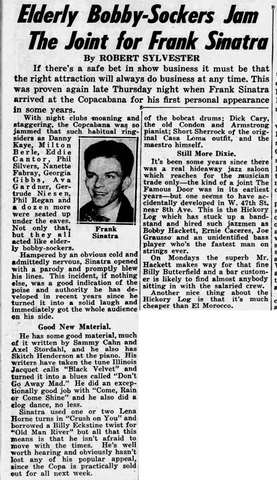
March 26, 1950
Concerts
Copacabana, New York City (March 23 - May 2)
Three Shows Nightly
Starring: Frank Sinatra, also: Larry Storch, Fred & Sledge, Russ Emery,
Lorna Lynn, Patricia Adair & Copa Girls
Orchestra Conducted By: Skitch Henderson
[Nancy's 33rd birthday, Sinatra's unanswered mink coat gift] On Nancy Sinatra's 33rd birthday, March 26, 1950, Frank sent her a $10,000 mink coat but received no reply; he tried repeatedly to reach her by phone, eventually learning she had worn the coat to a big party thrown by friends in Palm Springs.
Source: James Kaplan, "Frank: The Voice" (2010).
March 27, 1950
Radio
Light Up Time
Sponsor: Lucky Strike Cigarettes
Network: NBC
Show #146
Broadcast: 7:00-7:15 PM EST (Repeat: 9:00-9:15 PM PST)
Starring: Frank Sinatra
Skitch Henderson And The Orchestra
1. opening
2. Don't Go Away Mad - Frank Sinatra
3. commercial
4. Embraceable You - Bobby Hacket & Orchestra
5. It Isn't Fair - Frank Sinatra
6. commercial
7. Body And Soul - Frank Sinatra
8. closing
Ed O'Brien:
Frank sang Eileen Barton's smash hit "If I Knew
You Were Comin' I'd Baked A Cake" on the 3-20-50
Light Up Time. AFRS used it in place of the second ad on the 3/27 show. Frank went after the Hollywood
Gossip Columnists on this show. Dorothy was perform- ing in Boston.
Television
NONE
Concerts
Copacabana, New York City (March 23 - April 26)
Three Shows Nightly
Starring: Frank Sinatra, also: Larry Storch, Fred & Sledge, Russ Emery, Lorna Lynn, Patricia Adair & Copa Girls
Orchestra Conducted By: Skitch Henderson
March 28, 1950
Radio
Light Up Time
Sponsor: Lucky Strike Cigarettes
Network: NBC
Show #147
Broadcast: 7:00-7:15 PM EST (Repeat: 9:00-9:15 PM PST)
Starring: Frank Sinatra & Dorothy Kirsten
Skitch Henderson And The Orchestra
1. opening
2. I'd Have Baked A Cake - Frank Sinatra
3. commercial
4. Why Remind Me - Dorothy Kirsten
5. I Gotta Have My Baby Back - Frank Sinatra
6. commercial
7. How Deep Is The Ocean - Dorothy Kirsten
8. At Sun Down - Frank Sinatra
9. closing
Notes: "You're Awful" was changed to "How Deep Is The Ocean" & "At Sun
Down."
Ed O'Brien:
AFRS used the Frank, Dorothy duet of "Why Do I Love You" from 3-17-50 Light Up Time. Frank continued his negative commentary on Hollywood reporters.
Concerts
Copacabana, New York City (March 23 - May 2)
Three Shows Nightly
Starring: Frank Sinatra, also: Larry Storch, Fred & Sledge, Russ Emery,
Lorna Lynn, Patricia Adair & Copa Girls
Orchestra Conducted By: Skitch Henderson
Backstage before his poorly received Copacabana opening night, an anxious Frank Sinatra was steadied by Ava Gardner, who told him, “Francis Albert Sinatra, you are the greatest goddamned entertainer who ever walked the face of this earth. I believe in you. I love you.” A telegram from Nancy wishing him luck sat unnoticed on his dressing table. The show itself went badly — the crowd talked through his set and he was reduced to pleading, “This is my opening night. C'mon, give me a break” — and the Herald Tribune's review coldly noted that “the same old black magic” was gone from his voice. Sometime during this engagement, a jealous argument over a Copa Girl escalated into one of the more theatrical episodes of the Sinatra-Gardner romance: Gardner stormed off to see her ex-husband Artie Shaw, Frank followed with Hank Sanicola in tow, and later that night, after Gardner returned to their suite, Frank telephoned to say he was going to kill himself and fired two shots; Gardner and her sister Bappie rushed in to find him on the floor with a gun and a hole in the mattress, apparently unhurt — an episode Nancy and Ava both privately recognized as a cry for attention rather than a genuine attempt. Source: J. Randy Taraborrelli, Sinatra: Behind the Legend.
[Sammy Cahn reconciles with Sinatra, writes Copa material]
Sammy Cahn / Kaplan: Ahead of his Copacabana opening on Tuesday, March 28, 1950, Sinatra called Sammy Cahn -- from whom he'd been estranged over a year -- out of the blue to ask him to write special material and come to New York. Cahn agreed and took a two-and-a-half-day train trip (Super Chief to Chicago, then Twentieth Century Limited to New York), writing en route.
Source: James Kaplan, "Frank: The Voice" (2010).
[Copacabana opening night performance]
Kaplan / Herald Tribune: At his Copacabana opening on March 28, 1950, a nervous Sinatra (fortified beforehand by a doctor's visit Ava arranged) opened with Cole Porter's "I Am Loved," performed Sammy Cahn's comic special material lampooning Frankie Laine songs in a coonskin cap, and joked about gossip columnists. The show-business crowd loved it, though critics like the Herald Tribune's reviewer felt his voice had lost its old magic.
Source: James Kaplan, "Frank: The Voice" (2010).
[Manie Sachs's account of the mattress incident]
Rough Guide to Frank Sinatra: By other accounts the episode took place at Manie Sachs's Hampshire House suite, where Sinatra and Ava Gardner had been staying together; Sachs is said to have helped swap out the bullet-holed mattress before police could arrive.
Source: Rough Guide to Frank Sinatra (Rough guide 8.pdf), chapter "The Inner Circle."
March 29, 1950
Radio
Light Up Time
Sponsor: Lucky Strike Cigarettes
Network: NBC
Show #148
Broadcast: 7:00-7:15 PM EST (Repeat: 9:00-9:15 PM PST)
Starring: Frank Sinatra & Dorothy Kirsten
Skitch Henderson And The Orchestra
1. opening
2. My Blue Heaven - Frank Sinatra
3. commercial
4. A Thousand And One Nights - Dorothy Kirsten
5. The Girl That I Marry - Frank Sinatra
6. The Boy Next Door - Dorothy Kirsten
7. commercial
8. I Concentrate On You - Frank Sinatra
9. closing
Notes: "Rain Or Shine" was changed to "My Blue Heaven."
Ed O'Brien:
"Why Was I Born" from the 3-20-50 show was the
AFRS addition for this show.
Concerts
Copacabana, New York City (March 23 - May 2)
Three Shows Nightly
Starring: Frank Sinatra, also: Larry Storch, Fred & Sledge, Russ Emery,
Lorna Lynn, Patricia Adair & Copa Girls
Orchestra Conducted By: Skitch Henderson
Copacabana, New York City (March 23-April 26)
COPA REVIEW VARIETY 3-29-50
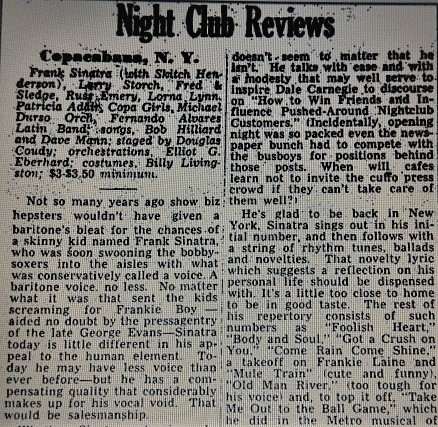
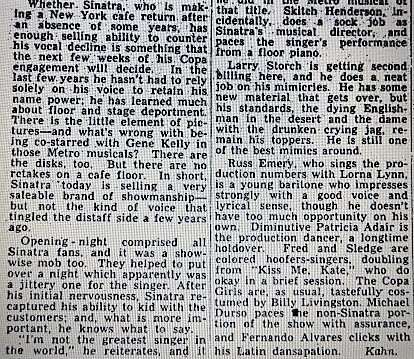
March 30, 1950
Radio
Light Up Time
Sponsor: Lucky Strike Cigarettes
Network: NBC
Show #149
Broadcast: 7:00-7:15 PM EST (Repeat: 9:00-9:15 PM PST)
Starring: Frank Sinatra & Dorothy Kirsten
Skitch Henderson And The Orchestra
1. opening
2. Chattanoogie Shoe Shine Boy - Frank Sinatra
3. commercial
4. You're My Thrill - Dorothy Kirsten
5. Why Remind Me - Frank Sinatra
6. commercial
7. Dearie - Frank Sinatra & Dorothy Kirsten
8. closing
Ed O'Brien:
AFRS opted for "Can I Come In For A Second" from the 2-24-50 Light Up Time broadcast. "Dearie" was a superb duet number.
I have discovered that AFRS played fast and loose with the Lite Up Time series. Don Wilson signs off with a reminder that Frank will be back on Monday.
Problem here: the 3/30 show was the Thursday edition. Frank did a show on 3/31. They lifted a song from the 3/31 and the closing remarks by Wilson.
Concerts
Copacabana, New York City (March 23 - May 2)
Three Shows Nightly
Starring: Frank Sinatra, also: Larry Storch, Fred & Sledge, Russ Emery,
Lorna Lynn, Patricia Adair & Copa Girls
Orchestra Conducted By: Skitch Henderson
Ed O'Brien:
Frank played the Copa until May 2. The late show that night was when he suffered the throat hemorrhage. Skitch Henderson told me there was an eerie silence in the club as
Frank left the stage. He also told me that the vocal collapse was not unexpected. "Frank was living the life of 10 men," Skitch told me, during one of our conversations.
But there is more: I listened to my interview with Skitch Henderson. At the dinner show, Frank was singing "Bali H'ai." He went for a high note and nothing was there. Frank finished the show and headed right to his dressing room. It was bad, but he decided to do the late show. After singing "I Have
But One Heart" ( not an easy song if he had been at his very best ), Skitch waved the baton and the orchestra went into "It All Depends On You." Frank opened his mouth and nothing came out. Nothing. Skitch saw the stricken look as Frank quickly exited the Copa room. The audience gasped as they began to realize what had just happened.
--Ed
Note: Bob Hilliard and Dave Mann did the special music for this engagement.
The two men would write the title track for Sinatra's magnificent Capitol album "In The Wee Small Hours." I have a very nice letter from Mann explaining how the song came to be and how Frank was introduced to it. --Ed
Copacabana, New York City (March 23 - May 2)
Three Shows Nightly
Starring: Frank Sinatra, also: Larry Storch, Fred & Sledge, Russ Emery, Lorna Lynn, Patricia Adair & Copa Girls
Orchestra Conducted By: Skitch Henderson
[Columbia memo on Sinatra's finances]
Columbia Records president Ted Wallerstein sent a memo to VP Goddard Lieberson noting that Columbia had advanced Sinatra $50,000 plus tax costs (totaling roughly $120,000), and urged that the label needed to "get some big-selling records out of Sinatra." Wallerstein had given producer Mitch Miller the same blunt message about recouping the money.
Source: James Kaplan, "Frank: The Voice" (2010).
March 31, 1950
Radio
Light Up Time
Taped: March 30, 1950
Sponsor: Lucky Strike Cigarettes
Network: NBC
Show #150
Broadcast: 7:00-7:15 PM EST (Repeat: 9:00-9:15 PM PST)
Starring: Frank Sinatra & Dorothy Kirsten
Skitch Henderson And The Orchestra
1. opening
2. Rain Or Shine - Frank Sinatra
3. commercial
4. My Foolish Heart - Dorothy Kirsten
5. You'd Be So Nice To Come Home To - Frank Sinatra
6. Love Walked In - Dorothy Kirsten
7. commercial
8. God's Country - Frank Sinatra
9. closing
Concerts
Copacabana, New York City (March 23 - May 2)
Three Shows Nightly
Starring: Frank Sinatra, also: Larry Storch, Fred & Sledge, Russ Emery,
Lorna Lynn, Patricia Adair & Copa Girls
Orchestra Conducted By: Skitch Henderson
April 1950
["You Do Something to Me" flat notes]
Kaplan: During the April 1950 sessions, Sinatra hit noticeably flat notes ("clams") on "You Do Something to Me," which Kaplan reads as reflecting his troubled state of mind. None of the eight up-tempo sides recorded that spring charted.
Source: James Kaplan, "Frank: The Voice" (2010)
[April 1950 recording sessions]
Kaplan: In April alone Sinatra did three recording sessions and cut eight new up-tempo songs, almost a third as many as he had recorded in all of the prior year, mostly arranged by George Siravo. Despite the productivity, Kaplan notes Sinatra sang the material well but without joy, a marked change from the joyous 1949 sessions during the height of his affair with Ava.
Source: James Kaplan, "Frank: The Voice" (2010)
[Ava departs for London]
Ava Gardner: Ava Gardner, heeding MGM's demands, flew with her sister Bappie to London for four months of location filming, tearfully parting from Frank but privately relieved to escape the American press and hate mail. In her memoir she recalled Frank could be the sweetest man alive when he was in the mood, but that being with him was like managing a demanding child.
Source: James Kaplan, "Frank: The Voice" (2010)
[Capitol Theater engagement falters]
Kaplan: Toward the end of April, Frank opened a one-week stand at the Capitol Theater, drawing even worse than his 1947 appearance there. He looked exhausted, with bloodshot eyes and a persistent cold, amid rumors of voice trouble and gossip that Ava had taken up with a bullfighter in Spain.
Source: James Kaplan, "Frank: The Voice" (2010)
[MGM severance and restraining order]
Kaplan: By the end of April, MCA finalized Sinatra's severance from MGM at a final payment of $85,000. Greg Bautzer, Nancy's attorney, immediately slapped a restraining order on the check pending resolution of the separate-maintenance suit, while Frank, deep in debt, was even turned down for a loan by MCA chairman Jules Stein.
Source: James Kaplan, "Frank: The Voice" (2010)
[album/technique -- critical commentary]
Sing and Dance with Frank Sinatra, released April 1950, was the first major Sinatra album to use overdubbing, made possible by the new magnetic tape technology; unlike his 1948 overdubs (done for scheduling reasons), this time overdubbing was used out of necessity because Sinatra's voice was in fragile condition during the sessions.
Source: Charles L. Granata, "Sessions with Sinatra: Frank Sinatra and the Art of Recording" (1999/2003), Part II: The Columbia Years, 1943-1952
April 1, 1950
Concerts
Copacabana, New York City (March 23 - May 2)
Three Shows Nightly
Starring: Frank Sinatra, also: Larry Storch, Fred & Sledge, Russ Emery, Lorna Lynn, Patricia Adair & Copa Girls
Orchestra Conducted By: Skitch Henderson
April 2, 1950
Concerts
Copacabana, New York City (March 23 - May 2)
Three Shows Nightly
Starring: Frank Sinatra, also: Larry Storch, Fred & Sledge, Russ Emery, Lorna Lynn, Patricia Adair & Copa Girls
Orchestra Conducted By: Skitch Henderson
April 3, 1950
Radio
Light Up Time
Sponsor: Lucky Strike Cigarettes
Network: NBC
Show #151
Broadcast: 7:00-7:15 PM EST (Repeat: 9:00-9:15 PM PST)
Starring: Frank Sinatra & Dorothy Kirsten
Skitch Henderson And The Orchestra
1. opening
2. Love Is Just Around The Corner - Frank Sinatra
3. commercial
4. As Time Goes By - Dorothy Kirsten
5. I Don't Know Whether To Laugh Or Cry Over You - Frank Sinatra
6. Can't We Be Friends - Dorothy Kirsten
7. commercial
8. Why Was I Born - Frank Sinatra
9. closing
Television
none
April 4, 1950
Radio
Light Up Time
Sponsor: Lucky Strike Cigarettes
Network: NBC
Show #152
Broadcast: 7:00-7:15 PM EST (Repeat: 9:00-9:15 PM PST)
Starring: Frank Sinatra & Dorothy Kirsten
Skitch Henderson And The Orchestra
1. opening
2. Wrap Your Troubles In Dreams - Frank Sinatra
3. commercial
4. Long Ago And Far Away - Dorothy Kirsten
5. It Isn't Fair - Frank Sinatra
6. commercial
7. Dancing In The Dark - Frank Sinatra & Dorothy Kirsten
8. closing
Concerts
Copacabana, New York City (March 23 - May 2)
Three Shows Nightly
Starring: Frank Sinatra, also: Larry Storch, Fred & Sledge, Russ Emery, Lorna Lynn, Patricia Adair & Copa Girls
Orchestra Conducted By: Skitch Henderson
April 5, 1950
Radio
Light Up Time
Sponsor: Lucky Strike Cigarettes
Network: NBC
Show #153
Broadcast: 7:00-7:15 PM EST (Repeat: 9:00-9:15 PM PST)
Starring: Frank Sinatra & Dorothy Kirsten
Skitch Henderson And The Orchestra
This shows need checked opening commercial
1. If I Knew You Were Coming - Frank Sinatra
2. My Bill - Dorothy Kirsten
3. Try A Little Tenderness - Frank Sinatra
4. Take Me In Your Arms - Dorothy Kirsten
5. Commercial
6. The Song Is You - Frank Sinatra closing
AFRS substituted "My Foolish Heart" sung by FS in the 2nd commercial spot
Concerts
Copacabana, New York City (March 23 - May 2)
Three Shows Nightly
Starring: Frank Sinatra, also: Larry Storch, Fred & Sledge, Russ Emery, Lorna Lynn, Patricia Adair & Copa Girls
Orchestra Conducted By: Skitch Henderson
April 6, 1950
Radio
Light Up Time
Taped: April 4, 1950
Sponsor: Lucky Strike Cigarettes
Network: NBC
Show #154
Broadcast: 7:00-7:15 PM EST (Repeat: 9:00-9:15 PM PST)
Starring: Frank Sinatra
Skitch Henderson And The Orchestra
1. opening
2. Manhattan - Frank Sinatra
3. commercial
4. My Foolish Heart - Frank Sinatra
5. Embraceable You - Frank Sinatra
6. Baby, Don't 'Cha Go Way Mad - Frank Sinatra
7. commercial
8. Come Rain, Come Shine - Frank Sinatra
9. closing
Concerts
Copacabana, New York City (March 23 - May 2)
Three Shows Nightly
Starring: Frank Sinatra, also: Larry Storch, Fred & Sledge, Russ Emery, Lorna Lynn, Patricia Adair & Copa Girls
Orchestra Conducted By: Skitch Henderson
April 7, 1950
Radio
Light Up Time
Taped: April 5, 1950
Sponsor: Lucky Strike Cigarettes
Network: NBC
Show #155
Broadcast: 7:00-7:15 PM EST (Repeat: 9:00-9:15 PM PST)
Starring: Frank Sinatra & Dorothy Kirsten
Skitch Henderson And The Orchestra
1. opening
2. Rain Or Shine - Frank Sinatra
3. commercial
4. It Never Entered My Mind - Dorothy Kirsten
5. Dearie - Frank Sinatra & Dorothy Kirsten
6. commercial
7. All Or Nothing At All - Frank Sinatra
8. closing
Notes: "The Song Is You" was changed to "All Or Nothing At All."
Concerts
Copacabana, New York City (March 23 - May 2)
Three Shows Nightly
Starring: Frank Sinatra, also: Larry Storch, Fred & Sledge, Russ Emery, Lorna Lynn, Patricia Adair & Copa Girls
Orchestra Conducted By: Skitch Henderson
April 8, 1950
Studio
New York City
CO43100 Peachtree Street (Take 1) (3:09) w/Rosemary Clooney
(J. Saunders/L. Mason/F. Sinatra)
Barton Music Corp. (ASCAP) 1950
Arranged & Conducted by George Siravo
78: Columbia 38853
CD: The Columbia Years 1943-1952: The Complete Recordings C12K 48673
CO43101 There's Something Missing (N/R) (Orchestral Track only) w/The Pastels
Arranged & Conducted by George Siravo
Saxes: E. Callen, L. Hartman, A. Klink, B. Russin, H. Shertzer; Trumpets: C. Griffin, P. Savitt, R. Trent, R. Weinstein; Trombones: G. Arus, R. Cutshall; Piano: K. Lane; Guitar: A. Reuss; Bass: P. Stephens; Drum: M. Purtill
Ed O'Brien notes:
Frank wrote some of the lyrics for his duet with Rosie. He had wanted Dinah Shore as his duet partner but she didn't like the song. There was no vocal done on "There's Something Missing." Orchestral track and The Pastels. When Frank did get around to recording the song on 1-16-51, The Skylarks replaced The Pastels.
Concerts
Copacabana, New York City (March 23 - May 2)
Three Shows Nightly
Starring: Frank Sinatra, also: Larry Storch, Fred & Sledge, Russ Emery, Lorna Lynn, Patricia Adair & Copa Girls
Orchestra Conducted By: Skitch Henderson
New York City
CO43100 Peachtree Street (Take 1) (3:09) w/Rosemary Clooney
(J. Saunders/L. Mason/F. Sinatra)
Barton Music Corp. (ASCAP) 1950
Arranged & Conducted by George Siravo
78: Columbia 38853
CD: The Columbia Years 1943-1952: The Complete Recordings C12K 48673
with (Rosemary Clooney) [Both Frank and Rosemary]
(Say, Frank, you wanna take a walk?)
Sure, sweetie, just pick a street.
(Picadilly Circus) Aw I'd rather not. (Champs Elysees) Mais, non. (Times Square?) Nah. 'Cause there's nothing can compare with
Strolling along Peachtree street with my baby on my arm.
I got the sweetest peach in Georgia, and she just came off the farm. (Strolling along Peachtree street, I'm happy as can be.) (I've gotta thank the state of Georgia, for my baby's family tree.) I'm gonna set my gem if on the main stem,
I feel like a new millionaire, when I'm walking with my charm, (You like Peachtree Street, Frank?)
Oh I love the place where are the peach trees?
(We'll have to go back a few years.)
Well let's turn around.
(Can't you see me in a hoop skirt,)
(Strolling along Peachtree street with a colonel on my arm.) And I can tell that you're from Georgia, because you got that Georgia charm (Strolling along Peachtree street, I'm happy as can be.) Eh, we're all merry. How come the sweetest peach in Georgia help Mayville, Kentucky. (Let's not get it around.) I can be reached.
(And just as sure as you're born, we'll gather some corn,) I feel like a new millionaire, when I'm walking with my charm.
[Strolling along Peachtree street, with baby on my arm.} Hey sugar. (What's the matter, honey chile?)
Well. I'm getting kinda tired. Will you rather carry me, or call a cab? (Whistle, Taxi!) Thank you sweetie.
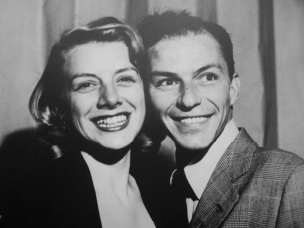
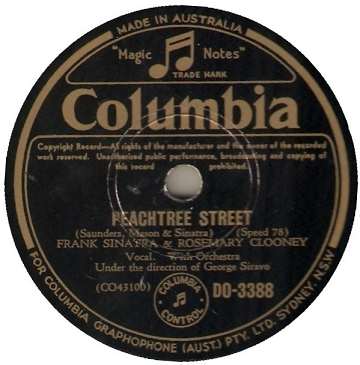
April 9, 1950
Concerts
Copacabana, New York City (March 23 - May 2)
Three Shows Nightly
Starring: Frank Sinatra, also: Larry Storch, Fred
& Sledge, Russ Emery, Lorna Lynn, Patricia Adair & Copa Girls
Orchestra Conducted By: Skitch Henderson
[Bob Hope's TV show debuts]
Bob Hope's Star Spangled Revue debuted on NBC on Easter Sunday, sponsored partly by Frigidaire under a $150,000 five-show General Motors contract; despite costars Douglas Fairbanks Jr. and Dinah Shore, the vaudeville-style pacing drew tepid reviews for the first episode.
Source: James Kaplan, "Frank: The Voice" (2010).
April 10, 1950
Radio
Light Up Time
Sponsor: Lucky Strike Cigarettes
Network: NBC
Show #156
Broadcast: 7:00-7:15 PM EST (Repeat: 9:00-9:15 PM PST)
Starring: Frank Sinatra & Dorothy Kirsten
Skitch Henderson And The Orchestra
1. opening
2. "missing page" - Sinatra song
3. commercial
4. Be Mine - Dorothy Kirsten
5. "not legible on script" - Frank Sinatra
6. With My Eyes Wide Open - Dorothy Kirsten
7. commercial
8. Where Or When - Frank Sinatra
9. closing
Notes: Pages missing from script
Television
NONE
Concerts
Copacabana, New York City (March 23 - May 2)
Three Shows Nightly
Starring: Frank Sinatra, also: Larry Storch, Fred & Sledge, Russ Emery, Lorna Lynn, Patricia Adair & Copa Girls
Orchestra Conducted By: Skitch Henderson
April 11, 1950
Radio
Light Up Time
Sponsor: Lucky Strike Cigarettes
Network: NBC
Show #157
Broadcast: 7:00-7:15 PM EST (Repeat: 9:00-9:15 PM PST)
Starring: Frank Sinatra & Dorothy Kirsten
Skitch Henderson And The Orchestra
1. opening
2. Chattanoogie Show Shine Boy - Frank Sinatra
3. commercial
4. Out Of My Dreams - Dorothy Kirsten
5. Night And Day - Frank Sinatra
6. commercial
7. My Heart Stood Still - Frank Sinatra & Dorothy Kirsten
8. closing
Ed O'Brien:
Dorothy Kirsten's vocal of "Be Mine," from the Light
Up Time of 4-10-50, was used by the AFRS, on the
4-11 Lite Up broadcast.
Television
NONE
Concerts
Copacabana, New York City (March 23 - May 2)
Three Shows Nightly
Starring: Frank Sinatra, also: Larry Storch, Fred & Sledge, Russ Emery, Lorna Lynn, Patricia Adair & Copa Girls
Orchestra Conducted By: Skitch Henderson
April 12, 1950
Radio
Light Up Time
Sponsor: Lucky Strike Cigarettes
Network: NBC
Show #158
Broadcast: 7:00-7:15 PM EST (Repeat: 9:00-9:15 PM PST)
Starring: Frank Sinatra & Dorothy Kirsten
Skitch Henderson And The Orchestra
1. opening
2. A Foggy Day - Frank Sinatra
3. commercial
4. April In Paris - Dorothy Kirsten
5. Sunshine Cake - Frank Sinatra & Dorothy Kirsten
6. commercial
7. Why Remind Me - Frank Sinatra
8. closing
Ed O'Brien:
AFRS used not one but two Sinatra vocals from previous Light Up shows on their 4-12 show. After his opening number, you hear Frank sing "Rain Or
Shine," 4-7-50, and "Can I Come In For A Second," from 3-17, replaced the second commercial. Only
Lite Up to employ two additional songs from Frank on one show.
Television
NONE
Concerts
Copacabana, New York City (March 23 - May 2)
Three Shows Nightly
Starring: Frank Sinatra, also: Larry Storch, Fred & Sledge, Russ Emery, Lorna Lynn, Patricia Adair & Copa Girls
Orchestra Conducted By: Skitch Henderson
April 13, 1950
Radio
Light Up Time
Sponsor: Lucky Strike Cigarettes
Network: NBC
Show #159
Broadcast: 7:00-7:15 PM EST (Repeat: 9:00-9:15 PM PST)
Starring: Frank Sinatra & Dorothy Kirsten
Skitch Henderson And The Orchestra
1. opening
2. That Old Black Magic - Frank Sinatra
3. commercial
4.. Dreams Ago - Dorothy Kirsten
5. Kisses And Tears - Frank Sinatra
6. commercial
7. Penthouse Serenade - Frank Sinatra & Dorothy Kirsten
8. closing
Ed O'Brien:
The AFRS version has Frank singing "When You're Smiling" and Dorothy following with "It Isn't Fair." They are done where the commercial break occurs after "Kisses And Tears," which Frank intros with an interesting take on "It's Only Money." Frank tells his listeners that some months ago ( November 1948 thru January 1949) he enjoyed making the film with Jane Russell and Groucho Marx. "The picture will soon be invading your local film houses," Frank announces.. Mr. Hughes would finally release the retitled film, "Double Dynamite," in December of 1951. Frank would be demoted from top billing to third as an added insult.
I did a little more digging. AFRS lifted "When You're Smiling/It Isn't Fair" from the NBC broadcast of 4-14-50. And they used Don Wilson's sign-off from 4-14 from the show that was broadcast on 4-13 ( #159). They played fast and loose with the compilations done for our servicemen.
Concerts
Copacabana, New York City (March 23 - May 2)
Three Shows Nightly
Starring: Frank Sinatra, also: Larry Storch, Fred & Sledge, Russ Emery, Lorna Lynn, Patricia Adair & Copa Girls
Orchestra Conducted By: Skitch Henderson
April 14, 1950
Studio
New York City
CO43126 Should I (Reveal)
(A. Freed/N.H. Brown)
(from Lord Byron Of Broadway)
Robbins Music Corp. (ASCAP) 1929
Arranged & Conducted by George Siravo
-1 (2:23) CD: Columbia Years 43-52 Vol. 13
LP: C6X-40343 The Voice-The Columbia years, 43-52
LP: CL-1241 Love Is A Kick
78: 38998
CO43127 You Do Something To Me
(C. Porter)
(from Fifty Million Frenchmen)
T.B. Harms, Inc. (ASCAP) 1929
Arranged & Conducted by George Siravo
-1 (2:32) CD: Columbia Years 43-52 Vol. 13
LP: C2X-40897 Hello Young Lovers
LP: CL-1241 Love Is A Kick
78: 38999
CO43128 Lover
(R. Rodgers/L. Hart)
(from Love Me Tonight)
Famous Music Corp. (ASCAP) 1933
Arranged & Conducted by George Siravo
-1 (2:38) CD: Columbia Years 43-52 Vol. 13
LP: CL-743 The Voice
78: 38996
Trumpets: B. Butterfield, C. Poole, P. Savitt; Trombones: G. Arus, W. Rausch; Saxes: E. Callen, E. Caceres, L. Hartman, B.. Russin, H. Shertzer; Piano: K. Lane; Guitar: A. Reuss; Bass: P. Stephens; Drums: J. Blowers
Radio
Light Up Time
Taped: April 12, 1950
Sponsor: Lucky Strike Cigarettes
Network: NBC
Show #160
Broadcast: 7:00-7:15 PM EST (Repeat: 9:00-9:15 PM PST)
Starring: Frank Sinatra & Dorothy Kirsten
Skitch Henderson And The Orchestra
1. opening
2. "needs checked" - Frank Sinatra
3. commercial
4. A Thousand And One Night - Dorothy Kirsten
5. When Your Smiling - Frank Sinatra
6. It Isn't Fair - Dorothy Kirsten
7. commercial
8. My Foolish Heart - Frank Sinatra
9. closing
Notes: "Daddy's Little Girl" was changed to "When Your Smiling."
Concerts
Copacabana, New York City (March 23 - May 2)
Three Shows Nightly
Starring: Frank Sinatra, also: Larry Storch, Fred & Sledge, Russ Emery, Lorna Lynn, Patricia Adair & Copa Girls
Orchestra Conducted By: Skitch Henderson
Hotel Astor, New York City
Annual Page One Ball
Newspaper Guild of New York
Sinatra performed along with Ray Bolger, Phil Silvers, Billie Eckstine, George Shearing, Morey Amersterdam, Nanette Fabrary, Pear Bailey, Arnold Stang and others
Hotel Astor, New York City
Annual Page One Ball
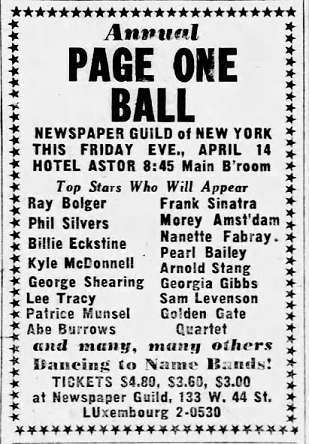
[Lover / Brazil -- critical commentary]
Bill Putnam / Granata: Guitarist/inventor Les Paul perfected overdubbing in his home garage studio, notably on 'Lover' (eight overdubbed guitar parts) and 'Brazil,' released as a Capitol single in February 1948; his technique of recording secondary instruments first and the lead/most important instrument last (to minimize generational quality loss) set the standard for multitrack recording. Engineer Bill Putnam praised Paul's ability to bridge musical and technical vocabularies.
This song/context matches multiple dated entries in the chronology, or lacked a sufficiently precise date; the specific date could not be determined with confidence.
Source: Charles L. Granata, "Sessions with Sinatra: Frank Sinatra and the Art of Recording" (1999/2003), Part II: The Columbia Years, 1943-1952
[Lover / My Blue Heaven -- critical commentary]
Mitch Miller; Frank Sinatra (to Ben Heller): Mitch Miller revealed that during the Sing and Dance sessions Sinatra's voice kept cracking mid-phrase, and since editing/tracking was technically against union rules, Miller secretly muted Sinatra's mic to bank clean instrumental backing tracks without telling him, then later had Sinatra overdub vocals in locked late-night sessions to avoid union reps: 'I could have been kicked out of the musicians' union.' (Columbia had used a similar prerecorded-track process once before, on 'A Fella with an Umbrella' during the 1948 ban.) Around Labor Day weekend 1950, ahead of the album's release, Sinatra discussed the sessions in an Atlantic City interview with DJ Ben Heller, name-checking 'Lover' and 'Blue Heaven' as 'good jump tempos, both to listen to as a vocal and to dance to.'
This song/context matches multiple dated entries in the chronology; the specific date Friedwald is referring to could not be determined with confidence.
Source: Will Friedwald, "Sinatra! The Song Is You: A Singer's Art" (2018 revised edition), Ch. 5, "In-Between Years" (1948-1953)
April 15, 1950
Concerts
Copacabana, New York City (March 23 - May 2)
Three Shows Nightly
Starring: Frank Sinatra, also: Larry Storch, Fred & Sledge, Russ Emery, Lorna Lynn, Patricia Adair & Copa Girls
Orchestra Conducted By: Skitch Henderson
April 16, 1950
Radio
Jack Elgen Show
WMGM, New York
Live from Copacabana
Sinatra made an appearance on Elgen's 3rd Anniversary Show
Concerts
Copacabana, New York City (March 23 - May 2)
Three Shows Nightly
Starring: Frank Sinatra, also: Larry Storch, Fred & Sledge, Russ Emery, Lorna Lynn, Patricia Adair & Copa Girls
Orchestra Conducted By: Skitch Henderson
Jack Elgen Show
WMGM, New York
Live from Copacabana
Sinatra made an appearance on Elgen's 3rd Anniversary Show
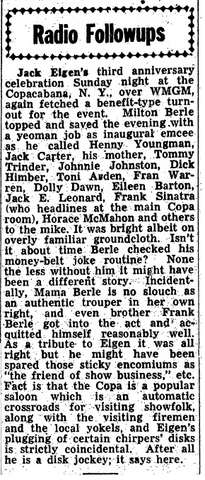
Nancy Sinatra filed suit for separate maintenance in Santa Monica Superior Court, alleging extreme cruelty and seeking custody of the children and financial support.
Source: George Carpozi Jr., Frank Sinatra: Is This Man Mafia? (New York: Manor Books, 1979).
April 17, 1950
Radio
Light Up Time
Sponsor: Lucky Strike Cigarettes
Network: NBC
Show #161
Broadcast: 7:00-7:15 PM EST (Repeat: 9:00-9:15 PM PST)
Starring: Frank Sinatra & Dorothy Kirsten
Skitch Henderson And The Orchestra
1. opening
2. Don'tcha Go Away Mad - Frank Sinatra
3. commercial
4. Blue Moon - Dorothy Kirsten
5. A Dream Is A Wish - Frank Sinatra
6. Soon - Dorothy Kirsten
7. commercial
8. Pioncianna - Frank Sinatra
9. closing
Strictly From Dixie
Henry Levine Orchestra
NBC Blue Network
WJZ
New York City
10:30 - 11:00 p.m.
Monday Evening
Henry Levine Orchestra & Soloists
Martha Lou Harp blues singer
Guest Singer: Frank Sinatra
Television
None
Concerts
Copacabana, New York City (March 23 - May 2)
Three Shows Nightly
Starring: Frank Sinatra, also: Larry Storch, Fred & Sledge, Russ Emery, Lorna Lynn, Patricia Adair & Copa Girls
Orchestra Conducted By: Skitch Henderson
Strictly From Dixie
Henry Levine Orchestra
Guest Singer: Frank Sinatra
-----------------------------------------------------
The White House, April 17, 1973
Nelson Riddle can be seen directly over Sinatra's left shoulder.
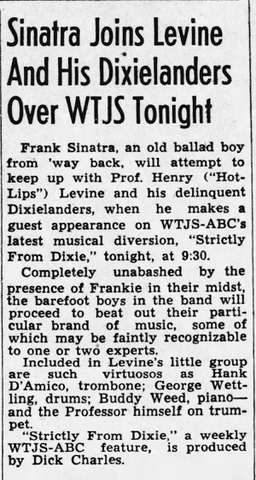
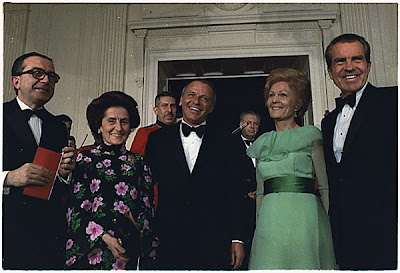
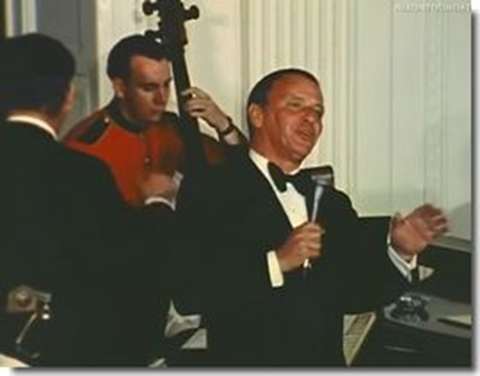
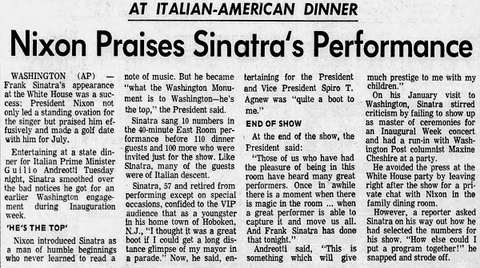
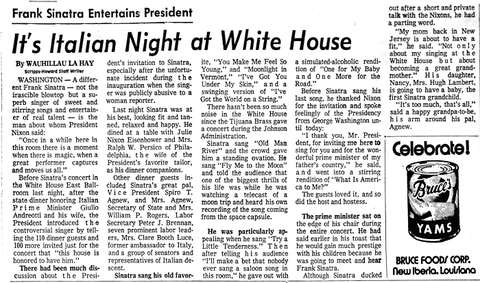
April 18, 1950
Radio
Light Up Time
Sponsor: Lucky Strike Cigarettes
Network: NBC
Show #162
Broadcast: 7:00-7:15 PM EST (Repeat: 9:00-9:15 PM PST)
Starring: Frank Sinatra & Dorothy Kirsten
Skitch Henderson And The Orchestra
1. closing
2. An American Beauty Rose - Frank Sinatra
3. commercial
4. You're My Thrill - Dorothy Kirsten
5. I Don't Know Whether To Laugh Or Cry Over You - Frank Sinatra
6. commercial
7. Some Enchanted Evening - Frank Sinatra & Dorothy Kirsten
8.. closing
Concerts
Copacabana, New York City (March 23 - May 2)
Three Shows Nightly
Starring: Frank Sinatra, also: Larry Storch, Fred & Sledge, Russ Emery,
Lorna Lynn, Patricia Adair & Copa Girls
Orchestra Conducted By: Skitch Henderson
April 19, 1950
Radio
Light Up Time
Sponsor: Lucky Strike Cigarettes
Network: NBC
Show #163
Broadcast: 7:00-7:15 PM EST (Repeat: 9:00-9:15 PM PST)
Starring: Frank Sinatra & Dorothy Kirsten
Skitch Henderson And The Orchestra
1. opening
2. You Do Something To Me - Frank Sinatra
3. commercial
4. I've Told Every Little Star - Dorothy Kirsten
5. It's Only A Paper Moon - Frank Sinatra
6. Always - Dorothy Kirsten
7. commercial
8. God's Country - Frank Sinatra
9. closing
Notes: "Bewitched" was changed to "It's Only A Paper Moon" and "On The Outgoing Tide" was changed to "Always"
Television
None
Concerts
Copacabana, New York City (March 23 - May 2)
Three Shows Nightly
Starring: Frank Sinatra, also: Larry Storch, Fred & Sledge, Russ Emery, Lorna Lynn, Patricia Adair & Copa Girls
Orchestra Conducted By: Skitch Henderson
April 20, 1950
Radio
Light Up Time
Sponsor: Lucky Strike Cigarettes
Network: NBC
Show #164
Broadcast: 7:00-7:15 PM EST (Repeat: 9:00-9:15 PM PST)
Starring: Frank Sinatra & Dorothy Kirsten
Skitch Henderson And The Orchestra
1.. opening
2. Lover - Frank Sinatra
3. commercial
4. It's So Nice To Have A Man Around The House - Dorothy Kirsten
5. It Isn't Fair - Frank Sinatra
6. commercial
7. Dearie - Frank Sinatra & Dorothy Kirsten
8. closing
Ed O'Brien:
The bonus track on the AFRS version is "All Or Nothing At All,' lifted from the 4-7 show. Song appears, in lieu of commercial, right after "It Isn't Fair." "Dearie" is wonderful on the 4/20 show. Even features a band chorus near the end of the song.
Concerts
Copacabana, New York City (March 23 - May 2)
Three Shows Nightly
Starring: Frank Sinatra, also: Larry Storch, Fred & Sledge, Russ Emery, Lorna Lynn, Patricia Adair & Copa Girls
Orchestra Conducted By: Skitch Henderson
NIGHT CLUB REVIEWS
Copacabana, New York
(Thursday, March 23)
Capacity 610. Price policy $3 -$4 minimum.
Shows at 8:30, 12:30 and 2:30 Operators,
Jules Podell - Jack Enteratter Booking non-exclusive Publicity, George Evans office. Estimated budget this show, $9,000
Estimated budget last show, $6,000
This was one of those typical old-time
Copa preems with names, near-names and plain customers scrambling to get in. The club says it has enough reservations to fill all next week, so the new show is starting off okay.
Frank Sinatra in his first cafe date since the Waldorf was visibly nervous and seemed genuinely touched by the welcoming ovation.
His nervousness lasted for his first few numbers, evidenced by throat tightening and at least once blowing lines.
But he had enough presence to cover up so well that fluffs added rather than detracted from his performance. The singer started with "Take
Me Back To Manhattan," backed by Skitch
Henderson's excellent piano-conducting, followed by "Baby, Don't Go Away Mad," and from there it was standards, pops and semi-pops associated with Sinatra on his Columbia label, getting better all the way. He did a cute tho labored thing on
"Take Me Out To The Ballgame," preceded by his full-voiced "Ol' Man River, finishing to big hands.
Larry Storch opened, followed by dancers
Fred and Sledge and then Russ Emery and
Lorna Lynn, two production singers, and ballerina
Patricia Adair.
The Mike Durso band did its customary sock show backing job.
Billboard
April 1, 1950
Bill Smith
April 21, 1950
Radio
Light Up Time
Taped: April 19, 1950
Sponsor: Lucky Strike Cigarettes
Network: NBC
Show #165
Broadcast: 7:00-7:15 PM EST (Repeat: 9:00-9:15 PM PST)
Starring: Frank Sinatra & Dorothy Kirsten
Skitch Henderson And The Orchestra
1. opening
2. Rain Or Shine - Frank Sinatra
3. commercial
4. My Foolish Heart - Dorothy Kirsten
5. Love Is Here To Stay - Frank Sinatra
6. Love Walked In - Dorothy Kirsten
7. commercial
8. I Concentrate On You - Frank Sinatra
9. closing
Ed O'Brien:
The bonus song added for the AFRS Lite Up Time was "Dearie."
The duet with Miss. Kirsten was lifted from the 4-7 NBC broadcast. Frank and Dorothy sang the song on five Light Up Times.
Russ Emery and Lorna Lynn introduced the song at the Copa. They were on the bill with Frank that spring. A number of artists recorded the song including Ethel Merman, Lisa Kirk/Fran Warren. Guy Lombardo had a top 10 hit with his effort and the duet done by Gordon MacRae and Jo Stafford was also a hit, peaking at #10.
Bob Hilliard-Dave Mann wrote the song for the "Copacabana Show of 1950." They also wrote a song that was very important in Sinatra's career, "In The Wee Small Hours Of The Morning." Mr. Mann contacted me regarding the song. He vigorously disputed Mr. Hilliard's claim, that it was written for Nat King Cole.
Concerts
Copacabana, New York City (March 23 - May 2)
Three Shows Nightly
Starring: Frank Sinatra, also: Larry Storch, Fred & Sledge, Russ Emery, Lorna Lynn, Patricia Adair & Copa Girls
Orchestra Conducted By: Skitch Henderson
April 22, 1950
Concerts
Copacabana, New York City (March 23 - May 2)
Three Shows Nightly
Starring: Frank Sinatra, also: Larry Storch, Fred & Sledge, Russ Emery, Lorna Lynn, Patricia Adair & Copa Girls
Orchestra Conducted By: Skitch Henderson
Kenny Lucas:
Does anyone have a listing of the titles sung during the Copacabana engagement ?
Ed O'Brien:
I have some of the titles from reviews and others from Skitch Henderson. Skitch told me Frank didn't stay with a set program during the engagement. I have posted a few of the reviews through the years. Here is a list of songs sung during the engagement.
1. Take Me Back To Manhattan Porter wrote new lyrics for Frank
2. It All Depends On You
3. Bali Ha'i
4. All Of Me
5. It Isn't Fair Skitch remembered Frank doing this both at the Copa and on
Light Up Time
6. Don'cha Go Away Mad
7. Ol' Man Crosby ( parody)
8. Ol' Man River
9. I Am Loved
10. Body And Soul w/ piano
11. I Have But One Heart
12. Mule Train (parody) there are pictures of Frank singing this one wearing a coonskin cap and holding a whip
13. Come Rain Or Come Shine
14. Chattanoogie Shoe Shine Boy
15. Cry Of The Wild Goose ( parody )
16. Take Me Out To The Ballgame
17. Nevertheless
18. Don't Cry Joe
19. My Foolish Heart
20. Begin The Beguine
April 23, 1950
Concerts
Copacabana, New York City (March 23 - May 2)
Three Shows Nightly
Starring: Frank Sinatra, also: Larry Storch, Fred & Sledge, Russ Emery, Lorna Lynn, Patricia Adair & Copa Girls
Orchestra Conducted By: Skitch Henderson
Ed O'Brien:
Here is a list of songs sung during the engagement.
1. Take Me Back To Manhattan Porter wrote new lyrics for Frank
2. It All Depends On You
3. Bali Ha'i
4. All Of Me
5. It Isn't Fair Skitch remembered Frank doing this both at the Copa and on
Light Up Time
6. Don'cha Go Away Mad
7. Ol' Man Crosby ( parody)
8. Ol' Man River
9. I Am Loved
10. Body And Soul w/ piano
11. I Have But One Heart
12. Mule Train (parody) there are pictures of Frank singing this one wearing a coonskin cap and holding a whip
13. Come Rain Or Come Shine
14. Chattanoogie Shoe Shine Boy
15. Cry Of The Wild Goose ( parody )
16. Take Me Out To The Ballgame
17. Nevertheless
18. Don't Cry Joe
19. My Foolish Heart
20. Begin The Beguine
April 24, 1950
Studio
New York City
CO43180 When You're Smiling (The Whole World Smiles With You) (M. Fisher/J. Goodwin/L. Shay)
(from Meet Danny Wilson)
Mills Music, Inc. (ASCAP) 1928
Arranged & Conducted by George Siravo
-1 (2:28) CD: Columbia Years 43-52 Vol. 13
LP: CL-1241 Love Is A Kick
78: 38996
CO43181 It's Only A Paper Moon
(B. Rose/E.Y. Harburg/H. Arlen)
(from Take A Chance)
T.B. Harms, Inc. (ASCAP) 1933
Arranged & Conducted by George Siravo
-1 (1:55) CD: Columbia Years 43-52 Vol. 13
LP: CL-2741 The Essential Frank Sinatra, Vol. 3
LP: CL-953 Adventures Of The Heart
78: 38997
CO43182 My Blue Heaven
(G. Whiting/W. Donaldson)
Leo Feist, Inc. (ASCAP) 1927
Arranged & Conducted by George Siravo
-1 (2:25) CD: Columbia Years 43-52 Vol. 13
LP: C6X-40343 The Voice-The Columbia years, 43-52
LP: CL-2741 The Essential Frank Sinatra, Vol. 3
LP: CL-1241 Love Is A Kick
78: 38998
78: 38892
CO43183 The Continental
(H. Magidson/C. Conrad)
(from The Gay Divorcee)
T.B. Harms, Inc. (ASCAP) 1934
Arranged & Conducted by George Siravo
-1 (2:31) CD: Columbia Years 43-52 Vol. 13
LP: C6X-40343 The Voice-The Columbia years, 43-52
LP: CL-1241 Love Is A Kick
78: 38997
Saxes: A. Drelinger, J. Jerome, J. Horvath, B. Russin, H. Shertzer; Trumpets: B. Butterfield, J. Lipkins, P. Savitt; Piano: B. Leighton; Guitar: A. Reuss; Bass: P. Stephens; Drums: J. Blowers
Radio
Light Up Time
Sponsor: Lucky Strike Cigarettes
Network: NBC
Show #166
Broadcast: 7:00-7:15 PM EST (Repeat: 9:00-9:15 PM PST)
Starring: Frank Sinatra & Dorothy Kirsten
Skitch Henderson And The Orchestra
1, opening
2. This Can't Be Love - Frank Sinatra
3. commercial
4. I Wanna Be Loved - Dorothy Kirsten
5. A Hundred Years From Today - Frank Sinatra
6. Don't Ever Leave Me - Dorothy Kirsten
7. commercial
8. All Or Nothing At All - Frank Sinatra
9. closing
Ed O'Brien
AFRS added "Where Or When," from 4-10, after the second commercial. Dorothy tells Frank that she read, in Earl Wilson's column, Margaret Truman's favorite singer is Frank Sinatra.
Concerts
Copacabana, New York City (March 23 - May 2)
Three Shows Nightly
Starring: Frank Sinatra, also: Larry Storch, Fred & Sledge, Russ Emery, Lorna Lynn, Patricia Adair & Copa Girls
Orchestra Conducted By: Skitch Henderson
Ed O'Brien:
Here is a list of songs sung during the engagement.
1. Take Me Back To Manhattan Porter wrote new lyrics for Frank
2. It All Depends On You
3. Bali Ha'i
4. All Of Me
5. It Isn't Fair Skitch remembered Frank doing this both at the Copa and on
Light Up Time
6. Don'cha Go Away Mad
7. Ol' Man Crosby ( parody)
8. Ol' Man River
9. I Am Loved
10. Body And Soul w/ piano
11. I Have But One Heart
12. Mule Train (parody) there are pictures of Frank singing this one wearing a coonskin cap and holding a whip
13. Come Rain Or Come Shine
14. Chattanoogie Shoe Shine Boy
15. Cry Of The Wild Goose ( parody )
16. Take Me Out To The Ballgame
17. Nevertheless
18. Don't Cry Joe
19. My Foolish Heart
20. Begin The Beguine
New York City's Detectives Ball
(Monday evening)
New York City
CO43180 When You're Smiling (The Whole World Smiles With You)
CO43181 It's Only A Paper Moon
CO43182 My Blue Heaven
CO43183 The Continental
[image referenced in source but could not be recovered]
[image referenced in source but could not be recovered]
[image referenced in source but could not be recovered]
[image referenced in source but could not be recovered]
[image referenced in source but could not be recovered]
[image referenced in source but could not be recovered]
Copacabana, New York City (March 23 - May 2)
Three Shows Nightly
Starring: Frank Sinatra, also: Larry Storch, Fred & Sledge, Russ Emery, Lorna Lynn, Patricia Adair & Copa Girls
Orchestra Conducted By: Skitch Henderson
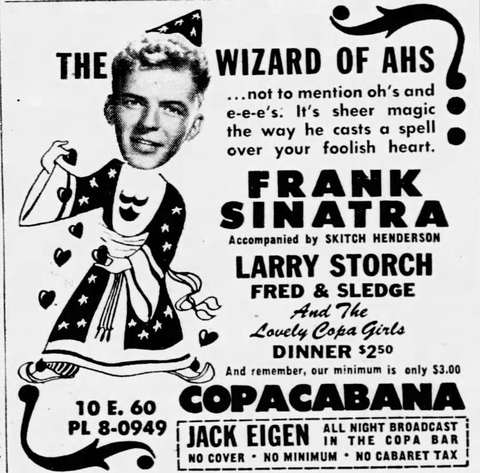
April 25, 1950
Radio
Light Up Time
Sponsor: Lucky Strike Cigarettes
Network: NBC
Show #167
Broadcast: 7:00-7:15 PM EST (Repeat: 9:00-9:15 PM PST)
Starring: Frank Sinatra & Dorothy Kirsten
Skitch Henderson And The Orchestra
1. opening
2. An American Beauty Rose - Frank Sinatra
3. commercial
4. Kiss Me Again - Dorothy Kirsten
5. Kisses And Tears - Frank Sinatra
6. commercial
7. The Way You Look Tonight - Frank Sinatra & Dorothy Kirsten
8. closing
Ed O'Brien
AFRS added "A Dream Is A Wish, " by F.S. , and "Soon," by Miss Kirsten, from the 4-17-50 show. Here is Frank's introduction to "Kisses And Tears," from the 4-25 show:
"And now for a tune of a more frivolous nature, borrowed from a score of a forthcoming picture, of which I appear, called "It's Only Money." By the time this gets to the screen, they'll have to call it ' It's Only Four-Years Old.' Thank you, Howard Hughes."
Concerts
Copacabana, New York City (March 23 - May 2)
Three Shows Nightly
Starring: Frank Sinatra, also: Larry Storch, Fred & Sledge, Russ Emery, Lorna Lynn, Patricia Adair & Copa Girls
Orchestra Conducted By: Skitch Henderson
Ed O'Brien:
Here is a list of songs sung during the engagement.
1. Take Me Back To Manhattan Porter wrote new lyrics for Frank
2. It All Depends On You
3. Bali Ha'i
4. All Of Me
5. It Isn't Fair Skitch remembered Frank doing this both at the Copa and on
Light Up Time
6. Don'cha Go Away Mad
7. Ol' Man Crosby ( parody)
8. Ol' Man River
9. I Am Loved
10. Body And Soul w/ piano
11. I Have But One Heart
12. Mule Train (parody) there are pictures of Frank singing this one wearing a coonskin cap and holding a whip
13. Come Rain Or Come Shine
14. Chattanoogie Shoe Shine Boy
15. Cry Of The Wild Goose ( parody )
16. Take Me Out To The Ballgame
17. Nevertheless
18. Don't Cry Joe
19. My Foolish Heart
20. Begin The Beguine
April 26, 1950
Radio
Light Up Time
Sponsor: Lucky Strike Cigarettes
Network: NBC
Show #168
Broadcast: 7:00-7:15 PM EST (Repeat: 9:00-9:15 PM PST)
Starring: Frank Sinatra & Dorothy Kirsten
Skitch Henderson And The Orchestra
1. opening
2. Somebody Loves Me - Frank Sinatra
3. commercial
4. More Than You Know - Dorothy Kirsten
5. Someone To Watch Over Me - Frank Sinatra
6. You'd Be So Nice To Come Home To - Dorothy Kirsten
7. commercial
8. Poinciana - Frank Sinatra
9. closing
Notes: "Rain" was changed to "Someone To Watch Over Me."
Ed O'Brien:
AFRS added, after second commercial, D. Kirsten singing "A Thousand And One Nights," 4-14-50 show.
Concerts
Copacabana, New York City (March 23 - May 2)
Billy Eckstine subbed for Frank for five days ( April 26 thru 30 )
During the dinner show, Frank Sinatra's voice gave out mid-song on “Bali Ha'i.” Warned by doctors to cancel the third show, he insisted on going on anyway rather than let down an audience — and, he admitted, because he'd heard rival columnist Lee Mortimer had wagered he wouldn't finish the Copacabana engagement. Partway through the 2:30 a.m. set his voice failed entirely and he felt blood in his mouth, later diagnosed as a submucosal throat hemorrhage. “I was never so panic-stricken in my whole life,” Sinatra recalled. “I whispered to the audience, ‘Good night,' and walked off the floor.” Conductor Skitch Henderson remembered the club going dead silent, “like they were watching a man walk off a cliff.” Billy Eckstine filled in for the balance of the engagement. Source: J. Randy Taraborrelli, Sinatra: Behind the Legend.
Wikipedia's account of Sinatra's throat trouble during this April Copacabana engagement gives the diagnosis as a “submucosal hemorrhage of the throat,” serious enough that he had to cancel five days of the booking. Evans once remarked that whenever Sinatra lost his voice this way it was invariably due to emotional tension, which “absolutely destroyed him.” Source: Wikipedia, “Frank Sinatra.”
[Nancy files for separate maintenance]
In Santa Monica, Nancy Sinatra filed suit for separate maintenance through attorney Greg Bautzer, alleging "extreme cruelty" and "grievous mental suffering." The AP reported Frank's 1949 income at $934,740 and community property at $750,000; Nancy sought custody of the three children and told reporters, both Catholic, that no divorce was contemplated.
Source: James Kaplan, "Frank: The Voice" (2010).
April 27, 1950
Radio
Light Up Time
Taped: April 24, 1950
Sponsor: Lucky Strike Cigarettes
Network: NBC
Show #169
Broadcast: 7:00-7:15 PM EST (Repeat: 9:00-9:15 PM PST)
Starring: Frank Sinatra & Dorothy Kirsten
Skitch Henderson And The Orchestra
1. opening
2. I Can't Believe That You're In Love With Me - Frank Sinatra
3. commercial
4. It Isn't Fair - Dorothy Kirsten
5. Easy To Remember - Frank Sinatra
6. Soon - Dorothy Kirsten
7. commercial
8. Over The Rainbow - Frank Sinatra
9. closing
Ed O'Brien:
AFRS used "Poinciana" from the 4-17 show as a fill in for the second commercial break
Concerts
Copacabana, New York City (March 23 - May 2)
Billy Eckstine subbed for Frank for five days (April 26 thru 30 )
Despite MGM chief L.B. Mayer's personal fondness for him, Frank was dismissed from the studio after a careless joke about Mayer's mistress reached the boss's ears.
Frank Sinatra (quoted): "That's not a very nice thing to do."
Source: Nancy Sinatra, Frank Sinatra: An American Legend, 1995.
April 28, 1950
Radio
Light Up Time
Taped: April 26, 1950
Sponsor: Lucky Strike Cigarettes
Network: NBC
Show #170
Broadcast: 7:00-7:15 PM EST (Repeat: 9:00-9:15 PM PST)
Starring: Frank Sinatra & Dorothy Kirsten
Skitch Henderson And The Orchestra
1. opening
2. I Found New Baby - Frank Sinatra
3. commercial
4. The Man I Love - Dorothy Kirsten
5. Dearie - Frank Sinatra & Dorothy Kirsten
6. commercial
7. The Continental - Frank Sinatra
8. closing
Notes: "If You Are But A Dream" was changed to "The Continental."
Ed O'Brien: Sinatra and Kirsten did the "Dearie" duet a number of times. It is simply a joy.
"When You're Smiling," by F.S. and "Isn't Fair," by D..K, from the 4-14 show, were the AFRS choices, from the 4/14 show, following "Dearie."
Concerts
Copacabana, New York City (March 23 - May 2)
Billy Eckstine subbed for Frank for five days ( April 26 thru 30 )
[MGM releases Sinatra from contract]
Two days after Nancy's suit, MGM announced it had granted Sinatra a release from his $5,000-a-week contract, described publicly as a friendly parting that freed him to pursue radio and TV work. In reality the split was requested by the studio, largely triggered by Frank's earlier joke about Mayer.
Source: James Kaplan, "Frank: The Voice" (2010).
April 29, 1950
Concerts
Copacabana, New York City (March 23 - May 2)
Billy Eckstine subbed for Frank for five days ( April 26 thru 30 ).
April 30, 1950
Concerts
Copacabana, New York City (March 23 - May 2)
Billy Eckstine subbed for Frank for five days ( April 26 thru 30 )
Copacabana, New York City (March 23 - May 2)
Billy Eckstine subbed for Frank for five days ( April 26 thru 30 )
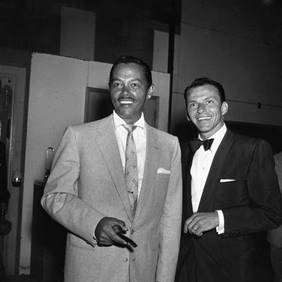
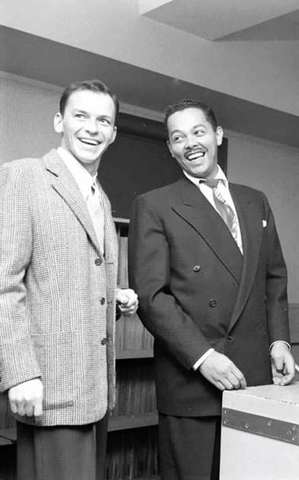
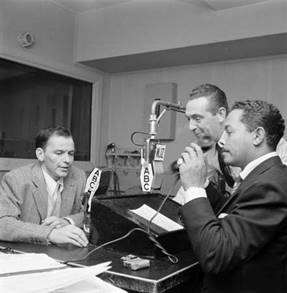
May 1950
[Awkward reunion with Nancy and kids]
Kaplan: Returning from Europe, Frank stopped briefly at his office before driving to Holmby Hills with gifts for the family, including a gold charm bracelet for Nancy engraved "Eiffel Tower and stuff." He found baby Tina already asleep and wished Nancy a belated, awkward "happy Mother's Day"; he returned the next morning to see the children.
Source: James Kaplan, "Frank: The Voice" (2010)
[Earl Wilson phone interview in Paris]
Earl Wilson: After leaving Spain, Frank and Van Heusen flew to Paris. Columnist Earl Wilson tracked Frank down by phone at the Café Lido, where an agitated Sinatra insisted the bullfighter Cabré meant nothing to Ava and that the two had been thoroughly chaperoned, denying any talk of divorce or marriage plans.
Source: James Kaplan, "Frank: The Voice" (2010)
[Frank cuts Spain trip short]
Kaplan: After a reporter showed Frank an American newspaper story about Nancy spending Mother's Day alone and mentioning the diamond-and-emerald necklace, Frank denied the necklace's existence, insisted the visit had been chaperoned, and announced he was leaving Spain twenty-four hours early.
Source: James Kaplan, "Frank: The Voice" (2010)
[Pegler links Sinatra to underworld and Truman]
Kaplan: Columnist Westbrook Pegler wrote a screed lumping Sinatra together with George Raft, Leo Durocher, Frank Costello, the Hollywood underworld, and President Truman's Justice Department, describing Sinatra's career decline as natural "wear and tear" on a "hopped-up reputation."
Source: James Kaplan, "Frank: The Voice" (2010)
[Tuna fishing in Spain]
Kaplan: On a Sunday during Frank's Spain visit, he, Ava, and Van Heusen went tuna fishing, drinking champagne and catching several big fish while briefly escaping the press.
Source: James Kaplan, "Frank: The Voice" (2010)
[Vocal hemorrhage diagnosis]
Kaplan: Dr. Irving Goldman diagnosed Sinatra with a "submucosal hemorrhage" of the left vocal cord after he strained for a high note, and ordered ten days of total vocal silence, threatening his scheduled May 12 opening in Chicago. Newspapers mocked the episode with the headline "BALI TOO H'AI; VOICE VOICELESS." Sinatra retreated to Charlie Fischetti's mansion on Allison Island in Miami to recuperate.
Source: James Kaplan, "Frank: The Voice" (2010)
May 1, 1950
Radio
Light Up Time
Taped: April 25, 1950
Sponsor: Lucky Strike Cigarettes
Network: NBC
Show #171
Broadcast: 7:00-7:15 PM EST (Repeat: 9:00-9:15 PM PST)
Starring: Frank Sinatra & Dorothy Kirsten
Skitch Henderson And The Orchestra
1. opening
2. An American Beauty Rose - Frank Sinatra
3. commercial
4. You Kissed Me - Dorothy Kirsten
5. My Foolish Heart - Frank Sinatra
6. commercial
7. Let's Fall In Love - Frank Sinatra & Dorothy Kirsten
8. closing
Notes: "All The Things You Are" was changed to "Let's Fall In Love."
Ed O'Brien:
AFRS used Dorothy's "A Thousand And One Nights," 4-14-50, after Frank's "My Foolish Heart."
At 2:am, 5-3-50, at the Copa, Frank opened his mouth to sing "It All Depends On You," and nothing came out. He had suffered a vocal hemorrhage. He would miss the next 19 Light Up Times, returning on 5-29. On Saturday, the 27th of May, he made his TV debut on Bob Hope's "Star Spangled Review"
Frank sang "Come Rain Or Come Shine." He sounded great. Years later he would acknowledge Hope's great generosity in hiring him when no one else wanted to touch him.
Television
None
Concerts
Copacabana, New York City (March 23 - May 2)
Three Shows Nightly
Starring: Frank Sinatra, also: Larry Storch, Fred & Sledge, Russ Emery,
Lorna Lynn, Patricia Adair & Copa Girls
Orchestra Conducted By: Skitch Henderson
May 2, 1950
Radio
Light Up Time
Sponsor: Lucky Strike Cigarettes
Network: NBC
Show #172
Broadcast: 7:00-7:15 PM EST (Repeat: 9:00-9:15 PM PST)
Starring: Dorothy Kirsten & Jeff Clark
Skitch Henderson And The Orchestra
1. opening
2. A Foggy Day - Dorothy Kirsten
3. commercial
4. It Isn't Fair - Jeff Clark
5. It's So Nice To Have A Man Around The House - Dorothy Kirsten
6. commercial
7. My I - Dorothy Kisten & Jeff Clark
8. closing
Notes: No Sinatra on this show. See script for details. "What Is This Thing Called Love" was changed to "A Foggy Day."
Television
None
Concerts
Copacabana, New York City (March 23 - May 2)
Three Shows Nightly
Starring: Frank Sinatra, also: Larry Storch, Fred & Sledge, Russ Emery, Lorna Lynn, Patricia Adair & Copa Girls
Orchestra Conducted By: Skitch Henderson
[Voice fails during "Bali H'ai"]
At the Copa dinner show, Sinatra reached for a high note in "Bali H'ai" from South Pacific and it wasn't there. He finished the show but retreated to his room at the Hampshire House feeling ill.
Source: James Kaplan, "Frank: The Voice" (2010).
[Complete voice collapse at the Copa]
Skitch Henderson: Goaded by a rumor that Lee Mortimer had bet Jack Entratter $100 he wouldn't finish the Copa run, Sinatra defied his doctor's orders and returned at 2 a.m. for the last show, dedicating "I Have But One Heart" to Ava. Attempting "It All Depends on You," he opened his mouth and no sound came out; bandleader Skitch Henderson described the silence in the room as like watching a man walk off a cliff before Frank gasped "Good night" and fled the stage.
Source: James Kaplan, "Frank: The Voice" (2010).
May 3, 1950
Radio
Light Up Time
Sponsor: Lucky Strike Cigarettes
Network: NBC
Show #173
Broadcast: 7:00-7:15 PM EST (Repeat: 9:00-9:15 PM PST)
Starring: Dorothy Kirsten & Jeff Clark
Skitch Henderson And The Orchestra
1. opening
2. I Concentrate On You - Dorothy Kirsten
3. commercial
4. Daddy's Little Girl - Jeff Clark
5. These Foolish Things - Dorothy Kirsten
6. commercial
7. There's A Small Hotel - Dorothy Kirsten & Jeff Clark
8. closing
May 4, 1950
Radio
Light Up Time
Sponsor: Lucky Strike Cigarettes
Network: NBC
Show #174
Broadcast: 7:00-7:15 PM EST (Repeat: 9:00-9:15 PM PST)
Starring: Dorothy Kirsten & Jeff Clark
Skitch Henderson And The Orchestra
1. opening
2. For You - Dorothy Kirsten
3. commercial
4. That Old Black Magic - Jeff Clark
5. Come Rain, Come Shine - Dorothy Kirsten
6. commercial
7. While We're Young - Dorothy Kirsten & Jeff Clark
8. closing
May 5, 1950
Radio
Light Up Time
Sponsor: Lucky Strike Cigarettes
Network: NBC
Show #175
Broadcast: 7:00-7:15 PM EST (Repeat: 9:00-9:15 PM PST)
Starring: Dorothy Kirsten & Jeff Clark
Skitch Henderson And The Orchestra
1. opening
2. Somebody Loves Me - Dorothy Kirsten
3. commercial
4. Bewitched, Bothered And Bewildered - Jeff Clark
5. They Say It's Wonderful - Dorothy Kirsten
6. The Very Thought Of You - Jeff Clark
7. commercial
8. I Want To Be Loved - Dorothy Kirsten
9. closing
Notes: "Should I" was changed to "Somebody Loves Me."
Sinatra does not appear on the show.
May 8, 1950
Radio
Light Up Time
Sponsor: Lucky Strike Cigarettes
Network: NBC
Show #176
Broadcast: 7:00-7:15 PM EST (Repeat: 9:00-9:15 PM PST)
Starring: Dorothy Kirsten & Jeff Clark
Skitch Henderson And The Orchestra
1. opening
2. My Blue Heaven - Dorothy Kirsten
3. commercial
4. Don't Worry 'bout Me - Jeff Clark
5. Take Me In Your Arms - Dorothy Kirsten
6."unknown" - Jeff Clark
7. commercial
8. "unknown" - Dorothy Kirsten
Note: Sinatra does not appear on the show
Television
None
May 9, 1950
Radio
Light Up Time
Sponsor: Lucky Strike Cigarettes
Network: NBC
Show #177
Broadcast: 7:00-7:15 PM EST (Repeat: 9:00-9:15 PM PST)
Starring: Dorothy Kirsten & Jeff Clark
Skitch Henderson And The Orchestra
1. opening
2. A Wonderful Guy - Dorothy Kirsten
3. commercial
4. A Dream Is A Wish - Jeff Clark
5. Flamingo - Dorothy Kirsten
6. commercial
7. Only Make Believe - Dorothy Kirsten & Jeff Clark
8. closing
Note: Sinatra was not on the show
May 10, 1950
Radio
Light Up Time
Sponsor: Lucky Strike Cigarettes
Network: NBC
Show #178
Broadcast: 7:00-7:15 PM EST (Repeat: 9:00-9:15 PM PST)
Starring: Dorothy Kirsten & Jeff Clark
Skitch Henderson And The Orchestra
1. opening
2. The One I Love - Dorothy Kirsten
3. commercial
4. My Foolish Heart - Jeff Clark
5. Someone To Watch Over Me - Dorothy Kirsten
6. Should I - Jeff Clark
7. commercial
8. If You Are But A Dream - Dorothy Kirsten
9. closing
Note: Sinatra does not appear on this show.
Television
None
With doctors warning it could be two months before his voice recovered, Frank Sinatra canceled his upcoming Chez Paree engagement in Chicago and retreated to Miami, communicating largely by writing on notepads to spare his throat. At thirty-four, with his movies, records, and now his voice all in apparent jeopardy, he grew desperate to reach Ava Gardner, then filming in Spain — only to find MGM chief Louis B. Mayer had her calls blocked on set. Frustrated past endurance, Sinatra chartered a plane to Spain to see her. Source: J. Randy Taraborrelli, Sinatra: Behind the Legend.
Still recovering physically and emotionally, Frank canceled a scheduled Chicago engagement and instead flew to Spain to see Ava on the set of Pandora, amid rumors she was involved with bullfighter Mario Cabre.
Source: Nancy Sinatra, Frank Sinatra: An American Legend, 1995.
May 11, 1950
Radio
Light Up Time
Taped: May 8, 1950
Sponsor: Lucky Strike Cigarettes
Network: NBC
Show #179
Broadcast: 7:00-7:15 PM EST (Repeat: 9:00-9:15 PM PST)
Starring: Dorothy Kirsten & Jeff Clark
Skitch Henderson And The Orchestra
1. opening
2. It Was Only A Paper Moon - Dorothy Kirsten
3. commercial
4. You're My Thrill - Jeff Clark
5. It Never Entered My Mind - Dorothy Kirsten
6. commercial
7. Why Do I Love You - Dorothy Kirsten & Jeff Clark
8. closing
Note: Sinatra did not appear on the show.
Frank Sinatra landed in Barcelona, brushing off press questions about Ava Gardner's rumored affair with Spanish bullfighter Mario Cabré — “Who? Never heard of the guy” — before driving up the coast to reunite with Gardner in S'Agaró, where he presented her with a $10,000 emerald necklace wrapped in toilet paper. At their adjoining haciendas near Tossa de Mar, a gaunt, pill-dependent Sinatra nearly drowned diving after a bottle of sleeping pills Gardner had thrown overboard during a fishing trip. Days later, confronted with a Spanish newspaper story about her and Cabré, Sinatra broke down in a rare moment of vulnerability — “Help me,” he pleaded, “Help us” — while Gardner, unmoved, warned him, “Don't you manhandle me.” Biographer J. Randy Taraborrelli frames the Spain trip as a turning point at which Sinatra's need for Gardner clearly outpaced hers for him. Source: J. Randy Taraborrelli, Sinatra: Behind the Legend.
[Sinatra lands in Barcelona]
Sinatra landed in Barcelona to reunite with Ava on the set of Pandora and the Flying Dutchman, an arrival she had not expected. She was off with bullfighter Mario Cabré when he arrived, and the crew distracted Frank with a poker game until she returned, greeting him warmly.
Source: James Kaplan, "Frank: The Voice" (2010).
May 12, 1950
Radio
Light Up Time
Taped: May 9, 1950
Sponsor: Lucky Strike Cigarettes
Network: NBC
Show #180
Broadcast: 7:00-7:15 PM EST (Repeat: 9:00-9:15 PM PST)
Starring: Dorothy Kirsten & Jeff Clark
Skitch Henderson And The Orchestra
1. opening
2. When You're Smiling - Dorothy Kirsten
3. commercial
4. Poinciana - Jeff Clark
5. Mine - Dorothy Kirsten
6. Supposin' - Jeff Clark
7. commercial
8. The Song Is You - Dorothy Kirsten
9. closing
Note: Sinatra does not appear on the show.
[Sinatra flies to Spain instead of Chicago]
Rather than opening at Chicago's Chez Paree as scheduled, a recovered Sinatra boarded a flight to Spain with Jimmy Van Heusen, telling reporters he'd probably see Ava. He brought gifts including Wrigley's gum, Coca-Cola, and a $10,000 diamond-and-emerald necklace; MCA was reportedly furious at the canceled engagement.
Source: James Kaplan, "Frank: The Voice" (2010).
May 15, 1950
Radio
Light Up Time
Sponsor: Lucky Strike Cigarettes
Network: NBC
Show #181
Broadcast: 4:00-4:15 PM PDST (Repeat: 7:00-7:15 PM PDST)
Starring: Dorothy Kirsten & Jeff Clark
Skitch Henderson And The Orchestra
1. opening
2. This Can't Be Love - Dorothy Kirsten
3. commercial
4. Any Place I Hang My Hat Is Home - Jeff Clark
5. I've Got A Crush On You - Dorothy Kirsten
6. commercial
7. Let's Take An Old-Fashioned Walk - Dorothy Kirsten & Jeff Clark
8. closing
Note: Sinatra does not appear on the show
Television
None
May 16, 1950
Radio
Light Up Time
Sponsor: Lucky Strike Cigarettes
Network: NBC
Show #182
Broadcast: 4:00-4:15 PM PDST (Repeat: 7:00-7:15 PM EDST)
Starring: Dorothy Kirsten & Jeff Clark
Skitch Henderson And The Orchestra
1. opening
2. Falling In Love With Love - Dorothy Kirsten
3. commercial
4. Bewitched, Bothered And Bewildered - Jeff Clark
5. I Married An Angel - Dorothy Kirsten
6. commercial
7. If i Loved You - Dorothy Kirsten & Jeff Clark
8. closing
Note: Sinatra did not appear on the show.
May 17, 1950
Radio
Light Up Time
Sponsor: Lucky Strike Cigarettes
Network: NBC
Show #183
Broadcast: 4:00-4:15 PM PDST (Repeat: 7:00-7:15 PM EDST)
Starring: Dorothy Kirsten & Jeff Clark
Skitch Henderson And The Orchestra
1. opening
2. The Best Things In Life Are Free - Dorothy Kirsten
3. commercial
4. They Say It's Wonderful - Jeff Clark
5. The Boy Next Door - Dorothy Kirsten
6. If I Knew You Were Coming - Jeff Clark
7. commercial
8. Lover Come Back To Me - Dorothy Kirsten
9. closing
Note: Sinatra does not appear on the show
May 18, 1950
Radio
Light Up Time
Sponsor: Lucky Strike Cigarettes
Network: NBC
Show #184
Broadcast: 4:00-4:15 PM PDST (Repeat: 7:00-7:15 PM EDST)
Starring: Dorothy Kirsten & Jeff Clark
Skitch Henderson And The Orchestra
1. opening
2. Love Is Just Around The Corner - Dorothy Kirsten
3. commercial
4. More Than You Know - Jeff Clark
5. I Want To Be Loved - Dorothy Kirsten
6. commercial
7. Tea For Two - Dorothy Kirsten & Jeff Clark
8. closing
Note: Sinatra does not appear on this show
May 19, 1950
Radio
Light Up Time
Taped: May 18, 1950
Sponsor: Lucky Strike Cigarettes
Network: NBC
Show #185
Broadcast: 4:00-4:15 PM PST (Repeat: 7:00-7:15 PM EST)
Starring: Dorothy Kirsten & Jeff Clark
Skitch Henderson And The Orchestra
1. opening
2. Bye, Bye, Baby - Dorothy Kirsten
3. commercial
4. Younger Than Springtime - Jeff Clark
5. Why Can't You Behave - Dorothy Kirsten
6. There's No Business Like Show Business - Jeff Clark
7. commercial
8. You Kissed Me - Dorothy Kirsten
9. closing
Note: Sinatra does not appear on this show.
May 22, 1950
Radio
Light Up Time
Sponsor: Lucky Strike Cigarettes
Network: NBC
Show #186
Broadcast: 4:00-4:15 PM PDT (Repeat: 7:00-7:15 PM PDT)
Starring: Dorothy Kirsten & Jeff Clark
Skitch Henderson And The Orchestra
1. opening
2. Then I'll Be Happy - Dorothy Kirsten
3. commercial
4. Daddy's Little Girl - Jeff Clark
5. I Didn't Know What Time It Was - Dorothy Kirsten
6. commercial
7. Should I - Jeff Clark
8. Isn't Romantic - Dorothy Kirsten & Jeff Clark
9. closing
Note: Sinatra does not appear on the show.
Television
None
May 23, 1950
Radio
Light Up Time
Sponsor: Lucky Strike Cigarettes
Network: NBC
Show #187
Broadcast: 4:00-4:15 PM PDT (Repeat: 7:00-7:15 PM EDT)
Starring: Dorothy Kirsten & Jeff Clark
Skitch Henderson And The Orchestra
1. opening
2. Zing Went The Strings Of My Heart - Dorothy Kirsten
3. commercial
4. I Hadn't Anyone Till You - Jeff Clark
5. Dancing In The Dark - Dorothy Kirsten
6. We're Dancing - Jeff Clark
7. commercial
8. You'll Never Walk Alone - Dorothy Kirsten
9. closing
Note: Sinatra does not appear on the show.
May 24, 1950
Radio
Light Up Time
Sponsor: Lucky Strike Cigarettes
Network: NBC
Show #188
Broadcast: 4:00-4:15 PM PDT (Repeat: 7:00-7:15 PM EDT)
Starring: Dorothy Kirsten & Jeff Clark
Skitch Henderson And The Orchestra
1. opening
2. Easy To Love - Dorothy Kirsten
3. commercial
4. Just One Of Those Things
5. You'd Be So Nice To Come Home To - Dorothy Kirsten
6. What Is This Thing Called Love? - Jeff Clark
7. commercial
8. So In Love - Dorothy Kirsten
9. closing
Note: Sinatra does not appear on the show
May 25, 1950
Radio
Light Up Time
Sponsor: Lucky Strike Cigarettes
Network: NBC
Show #189
Broadcast: 4:00-4:15 PM PDT (Repeat: 7:00-7:15 PM EDT)
Starring: Dorothy Kirsten & Jeff Clark
Skitch Henderson And The Orchestra
1. opening
2. Somebody Loves Me - Dorothy Kirsten
3. commercial
4. It All Depends On You - Jeff Clark
5. Mine - Dorothy Kirsten
6. Supposin - Jeff Clark
7. commercial
8. I Think Of You - Dorothy Kirsten
9. closing
Note: Sinatra does not appear on the show
May 26, 1950
Radio
Light Up Time
Taped: May 25, 1950
Sponsor: Lucky Strike Cigarettes
Network: NBC
Show #190
Broadcast: 4:00-4:15 PM PDT (Repeat: 7:00-7:15 PM EDT)
Starring: Dorothy Kirsten & Jeff Clark
Skitch Henderson And The Orchestra
1. opening
2. A Foggy Day - Dorothy Kirsten
3. commercial
4. Any Place To Hang My Hat Is Home - Jeff Clark
5. I Concentrate On You - Dorothy Kirsten
6. commercial
7. If I Loved You - Dorothy Kirsten & Jeff Clark
8. closing
Note: Sinatra does not appear on the show
June 1950
[Denied security clearance for USO trip]
Kaplan: In June 1950 Sinatra requested permission to travel abroad to entertain U.S. troops but was denied a security clearance due to alleged "subversive activities," a reference to his mid-1940s progressive political involvement being reinterpreted amid the era's anti-Communist climate.
Source: James Kaplan, "Frank: The Voice" (2010)
[Fisher's Texaco Star Theater breakthrough]
Kaplan: Days after an appearance on Milton Berle's top-rated Texaco Star Theater in June 1950, Eddie Fisher became a national sensation, soon booked into Ben Miller's Riviera nightclub, drawing raves from critics including, ironically, Sinatra's old nemesis Lee Mortimer.
Source: James Kaplan, "Frank: The Voice" (2010)
[career/repertoire summary -- critical commentary]
Between the June 1950 'Goodnight, Irene' session and the May 1951 'Mama Will Bark' session, Sinatra recorded twenty-six tunes, including strong material such as 'April in Paris,' 'Nevertheless,' 'Let It Snow, Let It Snow, Let It Snow,' 'I Am Loved,' 'Hello Young Lovers,' 'We Kiss in a Shadow,' 'I'm a Fool to Want You,' and 'Love Me' (theme of his CBS-TV variety show), along with a second Rosemary Clooney duet session yielding 'Love Means Love' and 'Cherry Pies Ought to Be You.'
Source: Charles L. Granata, "Sessions with Sinatra: Frank Sinatra and the Art of Recording" (1999/2003), Part II: The Columbia Years, 1943-1952
June 30, 1950
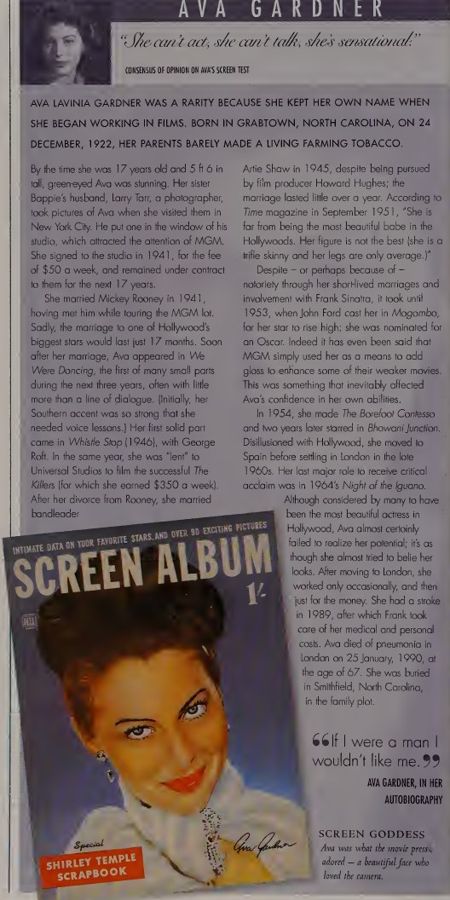
[Photograph: Frank finally reaches the UK for Palladium shows. From Richard Havers, "Sinatra" (Dorling Kindersley, 2007), p.150.]
After canceling planned 1949 shows in Britain, Frank finally arrived in the UK on 30 June 1950, booked for a run at the London Palladium from 10 to 23 July. (Source: Richard Havers, "Sinatra" (Dorling Kindersley, 2007).)
July 1950
[Triumphant Palladium engagement]
Kaplan: Backed by Woolf Phillips and the Skyrockets, Sinatra's London Palladium engagement was a triumph; the New Musical Express called the audience response "mass hysteria," and the Sunday Chronicle declared "Bless me, he's GOOD!" Sunday Times critic Harold Hobson wrote a perceptive essay arguing Sinatra's appeal lay in his vulnerable smile, not just his voice.
Source: James Kaplan, "Frank: The Voice" (2010)
July 5, 1950
Flying to London aboard a Stratocruiser, Frank led an impromptu singalong with fellow passengers, accompanied by pianist Ken Lane, with the music piped between decks and even broadcast to a US Coast Guard weather ship near Newfoundland. American Airlines reportedly considered installing pianos on its overseas planes as a result. (Source: Richard Havers, "Sinatra" (Dorling Kindersley, 2007).)
May 27, 1950
Television
Star Spangled Review
NBC
9:00 - 10:30 p.m.
Saturday Evening
Host: Bob Hope
Guests: Frank Sinatra, Peggy Lee, Beatrice Lillie.Arnold Stang, Sugar Chile Robinson and others
F.S. sang Come Rain Or Come Shine & did comedy skits.
NOTE: Ed O'Brien points out that this was Sinatra's first TV appearance ever.
The Arlen-Mercer tune receives a great performance by a singer definitely looking to prove something. And he did! Not only was this Sinatra's first TV appearance, it was also his first attempt to sing in public after his throat hemorrhaged at the Copacobana on May 2, 1950. He sang the hell out of the Mercer/Arlen classic. note: When Frank appeared on Person To Person( 9-14-56), he told Edward R. Murrow how grateful he was to Bob Hope for this guest shot. According to Frank, it was a very dark period in his life and no one in the business wanted to touch him. Hope set Frank up with the best jokes and saw to it that his talent was shown throughout the show. Frank called it a wonderful experience and one he would never forget.
--Ed
Star Spangled Review
NBC
9:00 - 10:30 p.m.
Saturday Evening
Host: Bob Hope
Guests: Frank Sinatra, Peggy Lee, Beatrice Lillie.Arnold Stang, Sugar Chile Robinson and others
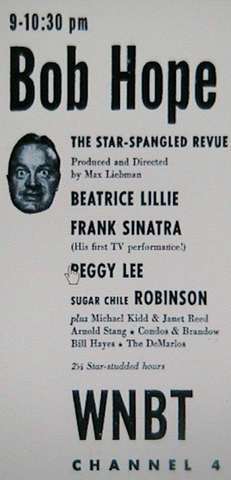
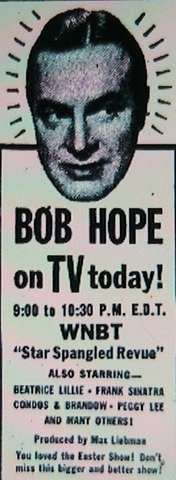
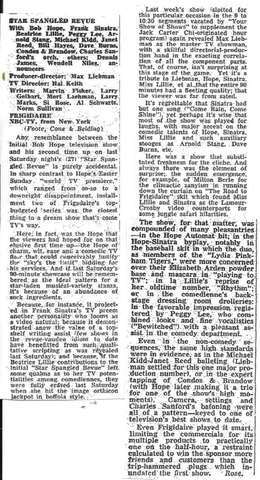
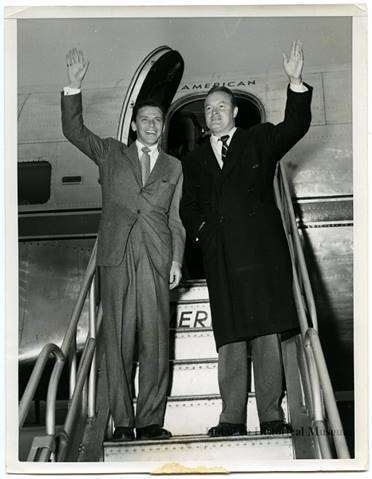
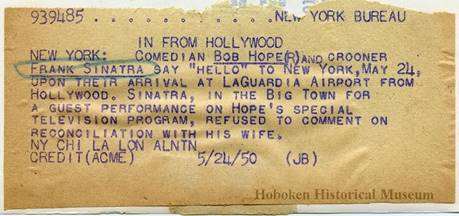
May 29, 1950
Radio
Light Up Time
Sponsor: Lucky Strike Cigarettes
Network: NBC
Show #191
Broadcast: 4:00-4:15 PM PST (Repeat: 7:00-7:15 PM EST)
Starring: Frank Sinatra & Dorothy Kirsten
Skitch Henderson And The Orchestra
1. opening
2. When You're Smiling - Frank Sinatra
3. commercial
4. Come Rain, Come Shine - Dorothy Kirsten
5. My Romance - Frank Sinatra & Dorothy Kirsten
6. commercial
7. My Foolish Heart - Frank Sinatra
8. closing
Note: This was Sinatra's first appearance on Light Up Time since May 1, 1950. He had suffered a vocal hemorrhage and missed all shows from May 2 to May 28th.
May 30, 1950
Radio
Light Up Time
Sponsor: Lucky Strike Cigarettes
Network: NBC
Show #192
Broadcast: 4:00-4:15 PM PST (Repeat: 8:00-8:15 PM PST)
Starring: Frank Sinatra & Dorothy Kirsten
Skitch Henderson And The Orchestra
1. opening
2. An American Beauty Rose - Frank Sinatra
3. commercial
4. "unknown" - Dorothy Kirsten
5. A Fine Romance - Frank Sinatra & Dorothy Kirsten
6. commercial
7. My Buddy - Frank Sinatra
8. closing
Notes: "If You Are But A Dream" was changed to "My Buddy."
May 31, 1950
Radio
Light Up Time
Sponsor: Lucky Strike Cigarettes
Network: NBC
Show #193
Broadcast: 4:00-4:15 PM PST (Repeat: 8:00-8:15 PM PST)
Starring: Frank Sinatra & Dorothy Kirsten
Skitch Henderson And The Orchestra
1. opening
2. Should I - Frank Sinatra
3. commercial
4. I Hadn't Anyone Till You - Dorothy Kirsten
5. Try A Little Tenderness - Frank Sinatra
6.. Soon - Dorothy Kirsten
7. commercial
8. I Concentrate On You - Frank Sinatra
9. closing
Ed O'Brien:
I checked the New York papers to see if the show was repeated. There was only the 7:00 p.m. airing. NYT listing omitted Light Up Time title. Strictly a Frank
Sinatra - Dorothy Kirsten show. Did find at 7:45 p.m., a 15 minute "Songs By Sinatra," on WINS. Show was pre-recorded.
Television
none
Frank Sinatra made his television debut as a guest on Bob Hope's "The Star Spangled Revue" on NBC, about a month after his voice had failed him onstage at the Copacabana. He sang "Come Rain or Come Shine" and joined Hope in comedy sketches, including a drag baseball routine and a parody of Bing Crosby.
Source: Albert Auster, "Frank Sinatra: The Television Years–1950–1960," Journal of Popular Film and Television, 26:4 (1999), 166-174.
June 1, 1950
Radio
Light Up Time
Taped: May 31, 1950
Sponsor: Lucky Strike Cigarettes
Network: NBC
Show #194
Broadcast: 4:00-4:15 PM PST (Repeat: 8:00-8:15 PM PST)
Starring: Frank Sinatra & Dorothy Kirsten
Skitch Henderson And The Orchestra
1. opening
2. All Of Me - Frank Sinatra
3. commercial
4. Did I Remember - Dorothy Kirsten
5. It Isn't Fair - Frank Sinatra
6. commercial
7. Sunshine Cake - Frank Sinatra & Dorothy Kirsten
8. closing
June 2, 1950
Radio
Light Up Time
Taped: May 31, 1950
Sponsor: Lucky Strike Cigarettes
Network: NBC
Show #195
Broadcast: 4:00-4:15 PM PST (Repeat: 8:00-8:15 PM PST)
Starring: Frank Sinatra & Dorothy Kirsten
Skitch Henderson And The Orchestra
1. opening
2. An American Beauty Rose - Frank Sinatra
3. commercial
4. You're My Thrill - Dorothy Kirsten
5. Let's Fall In Love - Frank Sinatra & Dorothy Kirsten
6. commercial
7. Ol' Man River - Frank Sinatra
8. closing
June 4, 1950
Concerts
Carnegie Hall, New York City, NY
Jack Benny Benefit Performance for the Damon Runyon Memorial Fund For Cancer Research
Guest Performers: Frank Sinatra, Fred Allen, Milton Berle, Danny Kaye, Rise Stevens
Jack Benny Benefit Performance for the Damon Runyon Memorial
Fund For Cancer Research
Carnegie Hall, New York City
June 4, 1950
Sunday evening
Guest Performers
Frank Sinatra, Fred Allen, Milton Berle, Danny Kaye, Rise Stevens note: Benefit was SRO and raised $11,500
Variety
June 7, 1950
New York Times, June 5, 1950
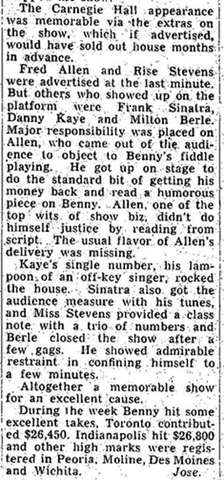
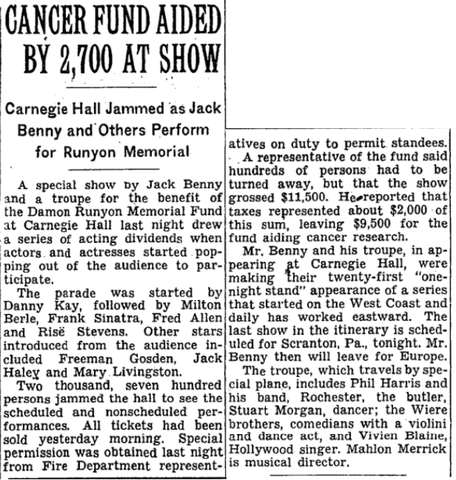
June 5, 1950
[Light Up Time radio show ends]
On Monday, June 5, Sinatra's contract for the radio program Light Up Time expired without renewal from sponsor Lucky Strike, leaving him "officially at liberty" and without a steady broadcast outlet.
Source: James Kaplan, "Frank: The Voice" (2010).
Variety published its review of Sinatra's guest appearance on Bob Hope's "Star Spangled Revue," crediting his comic timing but judging his singing an underused asset of the show, concluding: "If TV is his oyster, Sinatra hasn't broken out of his shell."
Source: Albert Auster, "Frank Sinatra: The Television Years–1950–1960," Journal of Popular Film and Television, 26:4 (1999), 166-174.
June 26, 1950
Radio
American Federation of Radio Artists Frolics
Frank Sinatra and Red Skelton and Pat O'Brien and others 11:30 PM
Television
None
Concerts
Los Angeles Breakfast Club, Los Angeles, CA
2nd Annual American Federation of Radio Artists Frolics Frank Sinatra and Red Skelton and Pat O'Brien
American Federation of Radio Artists Frolics
Frank Sinatra and Red Skelton and Pat O'Brien
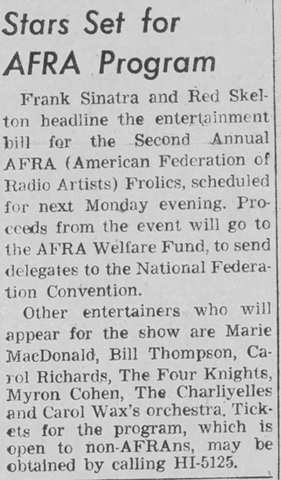
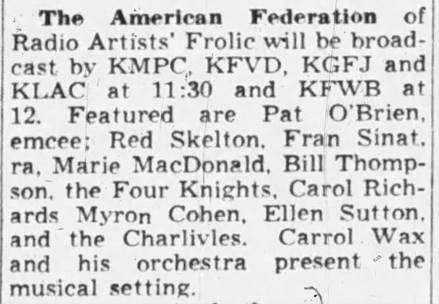
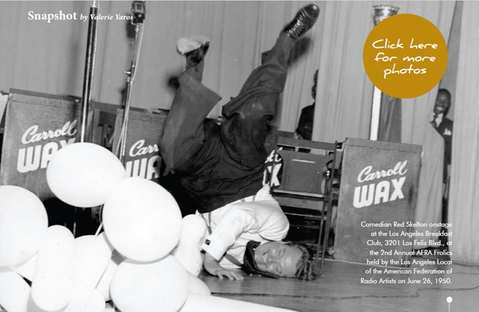
June 28, 1950
Studio
New York City
CO44015 Goodnight Irene
w/The Mitch Miller Singers
(H. Ledbetter/J. Lomax)
Spencer Music Corp. (BMI) 1950
Arranged & Conducted by Mitch Miller
-1 (2:49) CD: Columbia Years 43-52 Vol. 13
LP: CL-1448 Reflections
78: 38892
Lou White, organ, Mundell Lowe, guitar, Frank Carroll, bass
Mitch Miller Singers
NOTE: Sinatra Scholar Ed O'Brien reports that Sinatra was interviewed by Ben Heller on WMID radio backstage at The Steel Pier in Atlantic City , New Jersey , in September 1950:
Sinatra: We've got a new one how that is moving pretty good called, if you'll excuse the expression, "Goodnight Irene."
Ben: Hey, that's a nice tune.
Sinatra: You wanna bet? No, it's pretty good.
Ben: You should sing a lot of songs. I like that.
Sinatra: Don't hold your breath. But "Goodnight Irene" seems to be a big success along with the other labels that have recorded it. Also, coming up. coming out, I should say, from a new Crosby picture called "Life Is So Peculiar." It's a rhythm tune. It's a cute little novelty song. I think you will enjoy hearing it. I hope, anyway.
Sinatra, in the interview, went on to plug his new 10-inch LP "Sing and Dance With Frank Sinatra."
CO44016 Dear Little Boy Of Mine
w/The Mitch Miller Singers
(J.K. Brennan/E.R. Ball)
M. Witmark & Sons (ASCAP) 1918
Arranged & Conducted by Mitch Miller
-1 (2:07) CD: Columbia Years 43-52 Vol. 13
LP: CL-1448 Reflections
78: 38960
Organ: Lou White; Bass: Frank Carroll; Guitar: Mundell Lowe
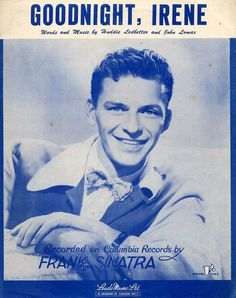
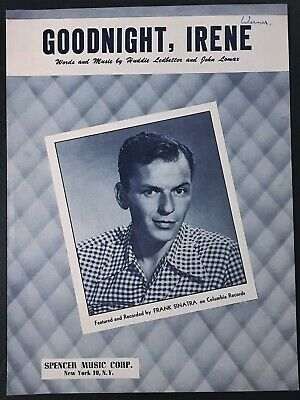
New York City
CO44015 Goodnight Irene
Birth of A Song Hit
SEPTEMBER 15 1950 JAMES DUGAN
A LEADING song hit this fall is a slow haunting folk tune in moderate waltz time called "Goodnight, Irene", published by the Cromwell Music Corp. of New York. The song and its 32-year-old publisher, Howard Richmond, violate all the rules of the commercial music business. Cromwell Music is one year old and has published four phenomenal hit tunes. "Goodnight, Irene" is at least 50 years old and may have actually originated a century ago.
Tin Pan Alley says everything is wrong with the song. It starts off with the refrain, "Irene, Goodnight, Irene, Goodnight; Goodnight, Irene, Goodnight, Irene. I'll see you in my dreams." Tin Pan Alley says, "All them Irenes! Waddaya tryin' to sell me?" The tune has five verses, completely unrelated to the refrain, out of character, and they do not mention "Irene." They tell a tough tale of marital strife. Two verses offend the radio censors by mentioning suicide and drug addiction.
Richmond galvanized into action under the slogan, Sinatra must sing "Irene." At that moment Sinatra was getting into a stratocruiser in Los Angeles, eastbound for Europe. Richmond air-expressed professional sheets of "Irene" in time to meet the onrushing crooner in Chicago. Sinatra studied the song during the flight to New York.
Mitch Miller, recording chief of Columbia records, was waiting at the N. Y. Airport. He rushed Sinatra to a studio where Miller's own orchestra was rehearsing a Sinatra setting for "Irene." The singer cut one record and did not have time to hear it back before he roared off for London.
Richmond drove to Bridgeport, Conn., where the Columbia record-pressing plant in three hours made 300 advance records for the disk jockeys. Richmond air-expressed them that night. The next day jockeys from Vancouver to Atlanta were spinning Frank Sinatra's new smash hit to the millions, while Sinatra was buying Ava Gardner a nosegay of violets in Piccadilly Circus.
Frank Sinatra landing in New York after a plane flight, and greeted by Mitch Miller, the Columbia Record recording chief.
(Actually this photo is from 1952, but it tells the story)
note: Frank's version of this song sold 30,000 copies. The Weavers had their recording
out a month ahead of Frank's effort. Their record was #1 for 13 consecutive weeks, charted for
25 and sold more than two million copies. Norman Leyden did the chart for Frank. I can think of only a
few Columbia recordings that had such a spare orchestral backing: Lou White(organ), Mundell Lowe
(guitar), Frank Carroll(bass). Interesting trio. The Mitch Miller Singers provided choral backing.
When Frank played the Steel Pier on Labor Day weekend that year, the Atlantic City crowds demanded
he sing "Irene." I honestly don't understand why Frank disliked the tune. It is a fine American folk song.
And he is in great voice throughout.
Ed
note: I have seen in the trades the claim that Frank's version of the song sold
30,000 copies. Never made any sense to me. "Goodnight Irene" peaked
at # 5 on the Billboard Top Hits and charted for 12 wks. This new inform-
ation would indicate final sales around a quarter of a million. -ED
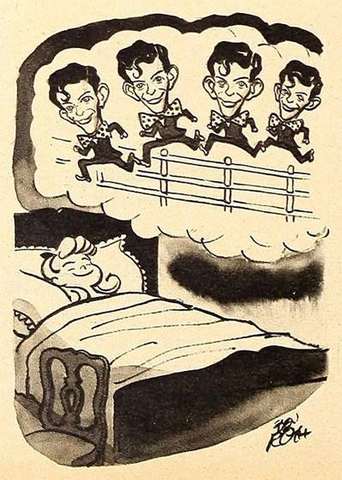
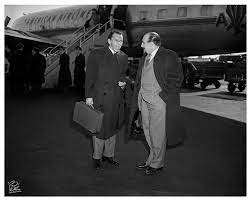
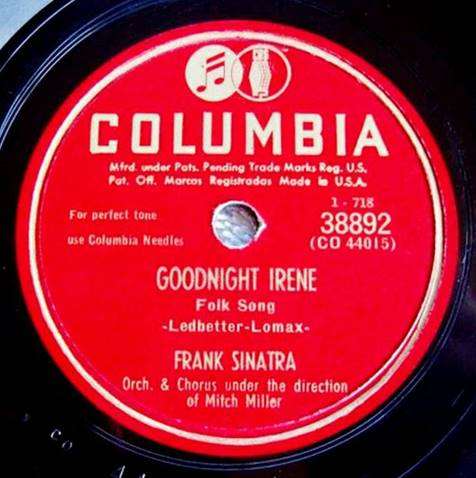
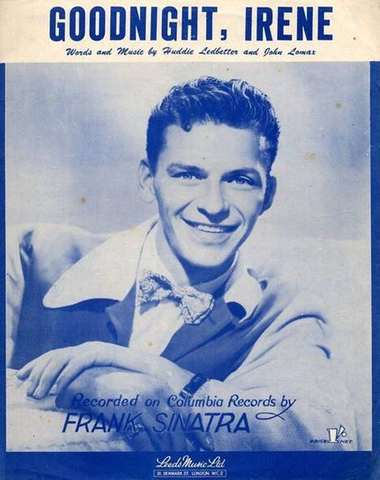
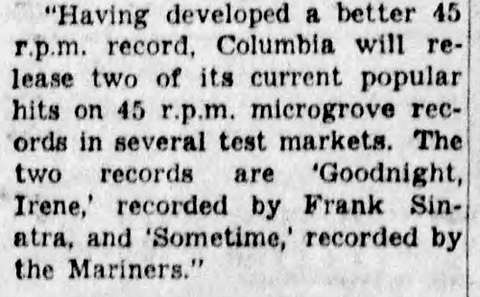
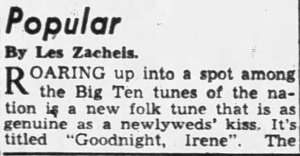
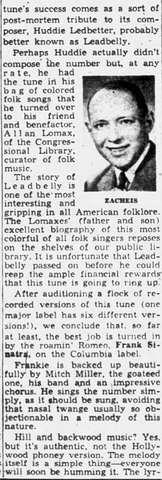

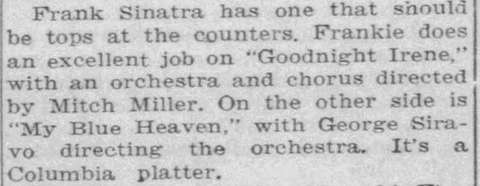
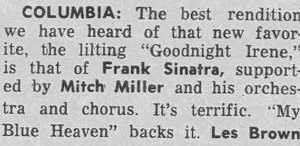
["Goodnight Irene" recording session]
For a session Mitch Miller fully controlled, Sinatra recorded "Goodnight Irene" and "Dear Little Boy of Mine" backed by the Mitch Miller Singers, with Miller arranging and conducting. Despite the material being ill-suited to Sinatra's persona, "Goodnight Irene" reached number 5 on the Billboard charts, his biggest hit in over three years.
Source: James Kaplan, "Frank: The Voice" (2010).
June 30, 1950
Concerts
On board an American Overseas Airlines Boeing 377 Stratocruiser during a flight from New York to London Sinatra gave a live, in-flight performance in the aircraft's 'Sky lounge'
On board an American Overseas Airlines Boeing 377 Stratocruiser during a flight from New York to London
Sinatra gave a live, in-flight performance in the aircraft's 'Sky lounge'
Frank leaving New York by American Overseas Stratocruiser:
Sinatra On Stratocruiser
American actor and singer Frank Sinatra (1915 - 1998, right) with scriptwriter Paul Dudley (1912 - 1959) on board an American Overseas Airlines Boeing 377 Stratocruiser during a flight from New York to London, 1950. Sinatra has just given a live, in-flight performance in the aircraft's 'Sky lounge'. (Photo by Pictorial Parade/Archive Photos/Getty Images)
[image referenced in source but could not be recovered]
[image referenced in source but could not be recovered]
[image referenced in source but could not be recovered]
[image referenced in source but could not be recovered]
[image referenced in source but could not be recovered]
[image referenced in source but could not be recovered]
July 5, 1950
[CBS television and radio deal signed]
Sinatra flew to England in high spirits after lawyer Henry Jaffe secured him a five-year, $200,000-per-year CBS television variety show contract set to begin in October, plus a companion CBS radio show, Meet Frank Sinatra, worth potentially $1 million and putting him ahead of Bing Crosby as the highest-paid singer in the business.
Source: James Kaplan, "Frank: The Voice" (2010).
July 6, 1950
England
Legendary American actor and singer Frank Sinatra (centre) is pictured with British journalist Hannen Swaffer (left) and variety impresario Val Parnell at a press reception
Frank Sinatra And Carol Lynn At Prince Of Wales Theatre In London on July 6th 1950 UNITED KINGDOM
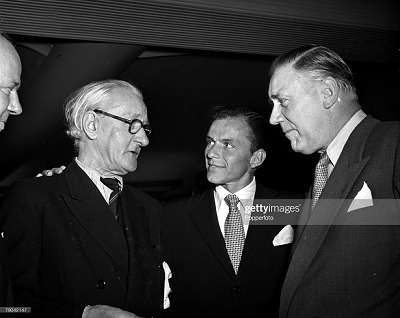
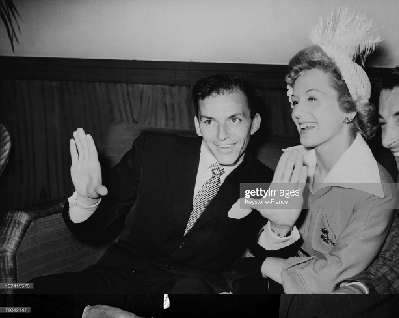
July 10, 1950
Concerts
Palladium, London (July 10 - 23)
Palladium, London (July 10 - 23)
NOTE: Ed O'Brien sends a story from VARIETY of July 5, 1950 headlined SINATRA SONGFEST ON EUROPE HOP MAY CUE STRATOCRUISER 88ING:
American Airlines is awaiting reports on the feasibility of installing pianos in its overseas Stratocruisers, following an experimental songfest led by Frank Sinatra last week aboard the London-bound Continental Mercury. Sinatra, who is scheduled to appear at the Palladium in London July 10 sang to and with passengers, with Ken Lane, his accompanist, playing piano. Music was piped from the lower to the upper deck. Songs were also broadcast from the plane to the crew of the U. S. Coast Guard floating weather station Charlie, stationed about 900 miles from Newfoundland. Air officials said the concert was held to determine passenger reaction and acoustical facilities. Early reports indicated passengers like the idea, but no decision on installation of pianos will be made until complete reports are in.
REVIEW:LONDON PALLADIUM- July 15, 1950
THE PHENOMENON IN MIDNIGHT BLUE
Sinatra walked on to a bare stage almost before the
Palladium curtains had parted, gave a slight diffident bow to the gallery roar that had greeted Woolf Phillips announcement, and straightway swung into "When You're Smilin' "
It was the start of a fifty minute, almost non-stop song session, that left the world's highest paid vocalist limper than the second-house crowds who were jamming Arglye Street long before the curtain fell. ANXIOUS MOMENT
He sang fourteen songs. Previously he had taken the Skyrockets band call, personally supervising each section in its interpretation of the Sy Oliver, Axel Stordahl and George Siravo arrangements.
One wondered how he would fare in the second house. His throat seemed to be feeling the strain after Ol' Man River," but he went on fortified by a cup of tea to sing six more songs, until the effort of inter- preting "Soliloquy" saw him looking haggard and rather gray.
For a minute or two he left the stage [and Woolfie looking anxiously into the wings], but returned, rejuvenated from some secret source, to render two more numbers before making his exit., as undramatically as he had entered upon his first British stage appearance.
Meanwhile, what had he shown us-this " very scared young Italian lad" as he described himself in one of his unassuming asides? What has he got [beyond a million pound contract in his pocket] that other crooners haven't got? And is it hard to get?
Let's look at him as he stands at the mike in a midnight blue dinner jacket and outsize bow tie.
He rarely moves his feet. In slow numbers,[of which there were far too many], his arms are outward at an angle slightly lower than Jolson's, or grasped around the microphone stand as if in supplication. In fast numbers, they are slightly bent; the right hand clicking the tempo; a pulsing of the left foot slightly rocking his broad shoulders.
In both; he sings from the hips, body leaning backwards and swaying like an early-movie vamp.
Sinatra does not milk the audience: at least not so you would notice it. But the vamping is there all the same: in the body movement the clinch of the fist, the narrowing of the eyes.
And when it all becomes too much for the fans to stand, and they start to go over the edge, he gently pushes them back to momentary sanity with an admonishing "Steady, now."
WHO CAN COMPETE ?
He has vocal tricks, of course. The note held on from one phrase to another; the occasional portamentos that imitators seize upon. But not so many tricks as one would expect. Above all, he sings [in a voice somewhat deeper than his records have led us to expect] in a manner that makes you believe every word of the lyric.
Can any of our own singers compete for his crown? I wouldn't like to say... I am inclined to think that here is a unique personality, a phenomenon; but someone who is also very human.
And fourteen songs in a row are more than human flesh and blood [if such can be applied to Sinatra] should be expected to stand.
LEGISLATED FOR
For the record here is his first house programme: "When You're Smiling," "Bewitched, Bothered and Bewildered," "April In Paris," "Ol' Man River"[and a parody of Ol' Man Crosby"!], "Embraceable You," "Don't Cry Joe," "I Fall In Love Too Easily," "Foggy Day In London," "Foolish Heart"[requested by the gallery and played to the solo piano accompaniment of Sinatra's own pianist, Ken Lane, who took over Pat Dodd's chair for the act], "Come Rain Or Come Shine," "Soliloquy," from Carousel[We had to get a special piece of legislation passed to allow me to sing this], 'Nancy With The Laughing Face" and "Bye, Bye Baby."
Of the Skyrockets' accompaniment, what need be said? It was as usual, perfect.
Pat Brand
London Times
July 15, 1950
Thanks to Carl for above photo
---------------------------------------
© 1997-2026 The Sinatra Archive
This calendar, or any parts thereof, may not be reproduced in any fashion whatsoever without the prior written permission of the publisher (The Sinatra Archive)
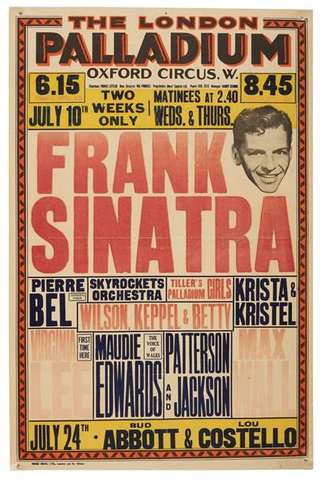
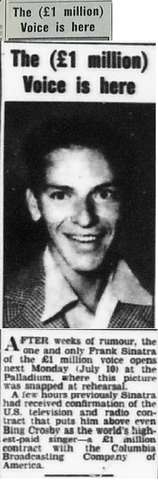
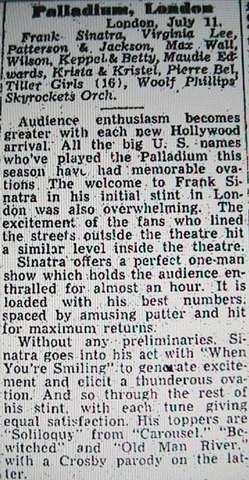
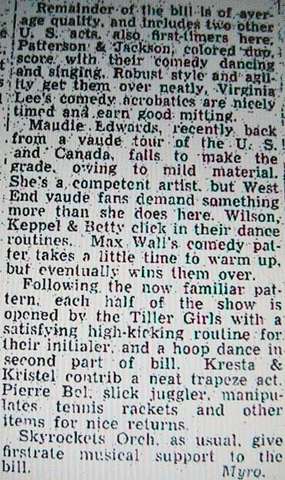
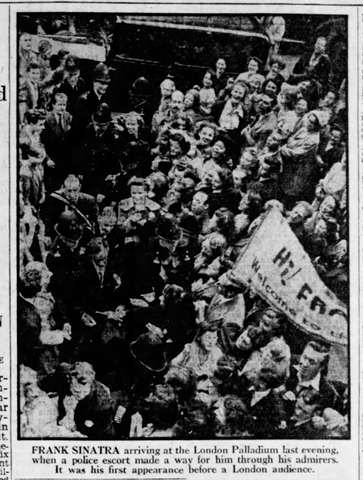
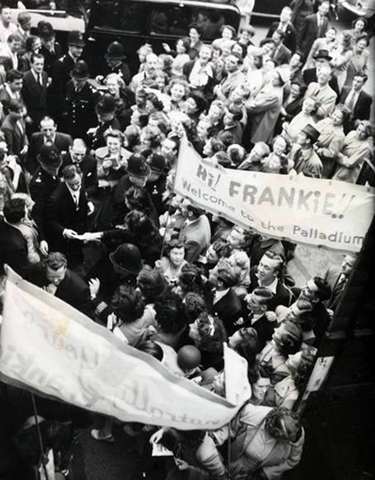
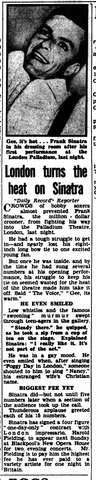
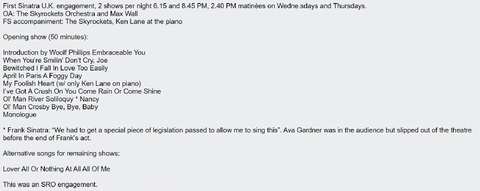
Oregon Daily Journal
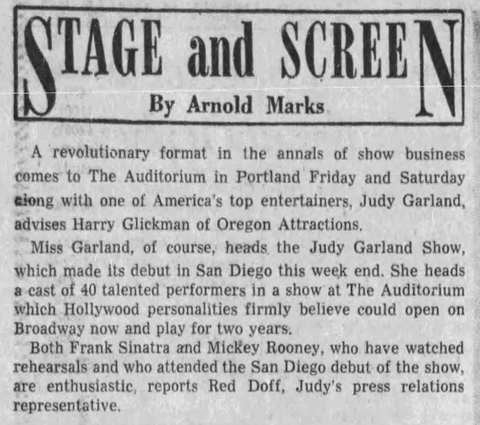
Frank Sinatra took an apartment in London's Berkeley Square for a two-month stay built around his Palladium engagement, while Ava Gardner was in town filming pickup shots for Pandora and the Flying Dutchman. Sipping tea onstage to protect his still-recovering voice, Sinatra found the Palladium crowd — mostly teenagers — responding with the kind of enthusiasm he hadn't seen at home in years; a Musical Express reviewer wrote, “I watched mass hysteria... this man Sinatra is a superb performer and a great artist.” Gardner, watching from the front row, was visibly relieved. Source: J. Randy Taraborrelli, Sinatra: Behind the Legend.
During an SRO engagement at London's Palladium, opening-night fans nearly tore off Frank's tie; he later joked to the press about the encounter.
Frank Sinatra (quoted): "I pulled back."
Source: Nancy Sinatra, Frank Sinatra: An American Legend, 1995.
July 11, 1950
Concerts
Palladium, London (July 10 - 23)
Palladium, London (July 10 - 23)
NOTE: Sinatra Scholar Ed O'Brien sends a review of the London Palladium appearance, dated July 15, 1950, written by Pat Brand of the LONDON TIMES, and headlined THE PHENOMENON IN MIDNIGHT BLUE:
Sinatra walked on to a bare stage before the Palladium curtains had parted, gave a slightly diffident bow to the gallery roar that had greeted Woolf Phillips announcement, and straight away swung into "When You're Smilin."
It was the start of a fifty minute, almost non-stop song session that left the world's highest paid vocalist limper than the second-house crowds who were jamming Argyle Street long before the curtain fell.
He sang fourteen songs. Previously he had taken the Skyrockets band call, personally supervising each section in its interpretation of the Sy Oliver, Alex Stordahl, and George Siravo arrangements. One wondered how he would fare in the second house. His throat seemed to be feeling the strain after "Ol' Man River." But he went on fortified by a cup of tea to sing six more songs, until the interpreting of 'Soliloquy' saw him looking haggard and rather grey.
For a minute or two, he left the stage [and Woofie looking anxiously into the wings], but returned rejuvenated from some secret source, to render two more numbers before making his exit, as undramatically as he had entered upon his first British stage appearance.
Meanwhile, what had he shown us, this very scared young Italian lad, as he described himself in one of his unassuming asides. What has he got [beyond a million pound contract in his pocket] that other crooners haven't got? And is it hard to get?
Let's look at him as he stands at the mike in a midnight blue dinner jacket and outsized bow tie.
He rarely moves his feet. In slow numbers [of which there were far too many], his arms are outward at an angle slightly lower than Jolson's or wrapped around the microphone stand as if in supplication. In fast numbers, they are slightly bent; the right hand clicking the tempo; a pulsing of the left foot slightly rocking his broad shoulders. In both, he sings from the hips, body leaning backwards and swaying like an early movie vamp.
Sinatra does not milk the audience, at least no so you would notice it. But the vamping is there all the same: in the body movement, the clinch of the fist, the narrowing of the eyes.
And when it becomes too much for the fans to stand, and they start to go over the edge, he gently pushes them back to momentary sanity with an admonishing "Steady, now."
He has vocal tricks, of course. The note held on from one phrase to another; the occasional portamentoes that imitators seize upon. But not so many tricks as one would expect. Above all, he sings [in a voice somewhat deeper than his records have led us to expect] in a manner that makes you believe every word of the lyric.
Can any of our own singers compete for this crown? I wouldn't like to say . . . I am inclined to think that here is a unique personality, a phenomenon; but also someone who is very human.
And fourteen songs in a row are more than human flesh and blood [if such can be applied to Sinatra] should be expected to stand.
For the record, here if the first house programme: "When You're Smilin", "Bewitched, Bothered, and Bewildered," "April in Paris," "Ol' Man River," [and a parody, Ol' Man Crosby", "Embraceable You," "Don't Cry Joe," "I Fall in Love too Easily," "A Foggy Day," "My Foolish Heart," [requested by the gallery and played to solo piano accompaniment by Sinatra's own pianist, Ken Lane, who took over Pat Dodd's chair for the act], "Come Rain or Come Shine," "Soliloquy," [We had to get a special piece of legislation passed to allow me to sing this, he said. "Nancy" and "Bye, Bye, Birdie." Of the Skyrockets accompaniment, what need be said? It was, as usual, perfect.
Frank Sinatra drinks a cup of tea during his performance at the London Palladium in 1950.
Singer Frank Sinatra Picture With Johnny Dankworth Now Sir John Dankworth In 1950.
11. jul. 1950
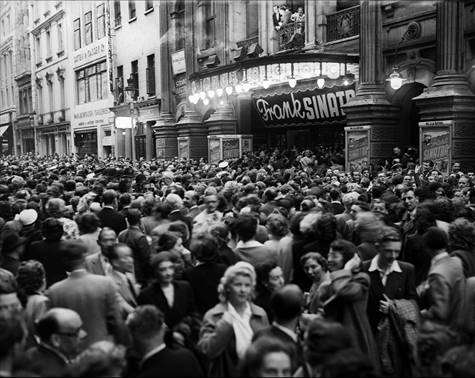
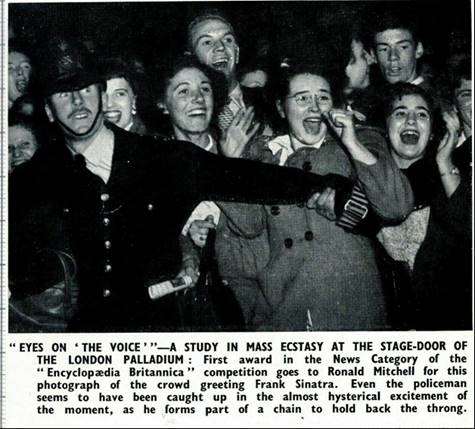
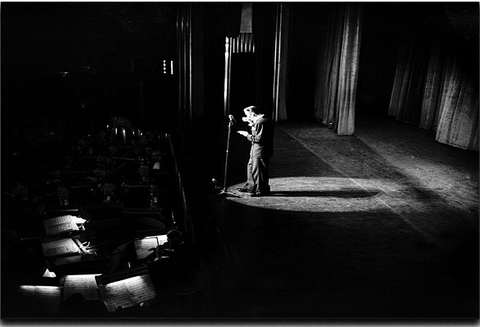
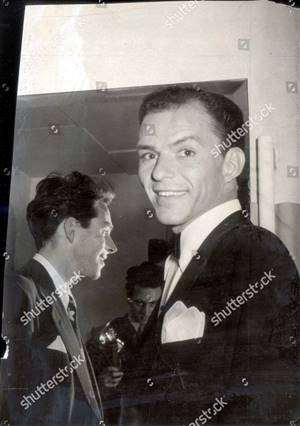
July 12, 1950
Concerts
Palladium, London (July 10 - 23)
July 13, 1950
Concerts
Palladium, London (July 10 - 23)
July 14, 1950
Concerts
Private Party at the Home of Lady Olive Baillie, London, England Princess Margaret was in attendance
Sinatra performed a dozen songs, including:
-If I Loved You
-My Foolish Heart
Palladium, London (July 10 - 23)
Sample Set List from July 14.
1. When You're Smiling,
2. Bewitched
3. April In Paris
4.. Ol' Man River
5. Ol' Man Crosby (Parody)
6. Embraceable You
7. Don't Cry Joe
8. I Fall In Love Too Easily
9. A Foggy Day
10. My Foolish Heart w/Ken Lane (piano)
11. Come Rain Or Come Shine
12. Soliloquy
13. Nancy
14. Bye, Bye Baby
TT: 50mins.
Private Party at the Home of Lady Olive Baillie, London, England Princess Margaret was in attendance
Sinatra performed a dozen songs
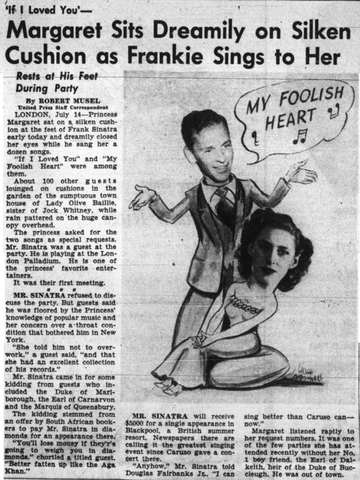
July 15, 1950
Concerts
Palladium, London (July 10 - 23)
Palladium, London (July 10 - 23)
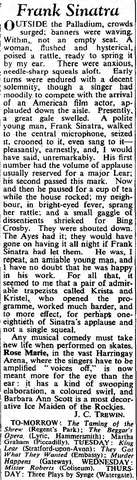
July 16, 1950
Concerts
New Opera House, Blackpool, England
Sunday two shows
6.20 & 8.15 pm.
Woolf Philllips & The Palladium Skyrockets Orchestra
Ken Lane at the Piano.
New Opera House, Blackpool, England
Frank Sinatra, pictured with his arm raised in the middle of the shot outside the Clifton Hotel, Blackpool in the 1950s - by which time its population had grown to 147,000
“You know I could be mayor of this town!” said Ol’ Blue Eyes, when he made his first appearance in the resort back on 16th July, 1950. And such was the charisma of Frank Sinatra, he was probably right, judging by the welcome he received.
The Blackpool Gazette scored a fantastic scoop by capturing the moment the world-famous singer left the Clifton Hotel in a chauffeur-driven Buick for the Opera House, mobbed by ecstatic fans.
An interview with the driver, Frank Lucas, reported him as saying: ““Frank Sinatra was a big hit in Blackpool. When he came here in 1950 his career was on a bit of a wane in the States. But when he got to Blackpool, and saw the crowds cheering, clapping, jumping up and down and banging on the windows he said ‘they love me this town don’t they?’ ‘Yes they do, sir,’ I said “‘I could become mayor,’ he said and I replied ‘yes you could!’”
No wonder he received a £2,000 pay cheque for his 1950 show, with Ken Lane on piano, making him Blackpool’s highest paid performer at the time. Frank Sinatra made a big impression on the UK in 1950, also appearing at the London Palladium the same July, in a variety bill that included comedian Max Wall.
--Thanks to Carl R for above photo and information
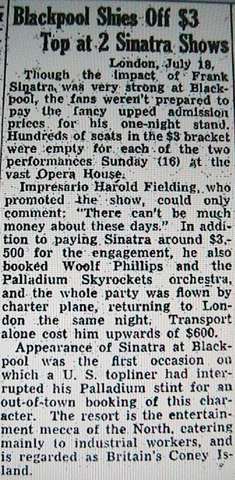
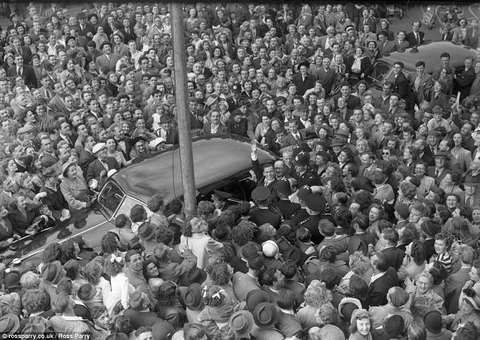
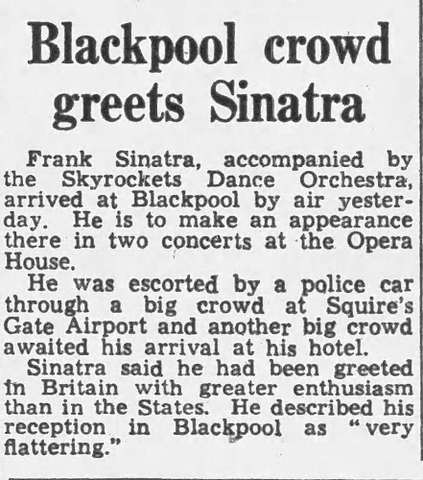
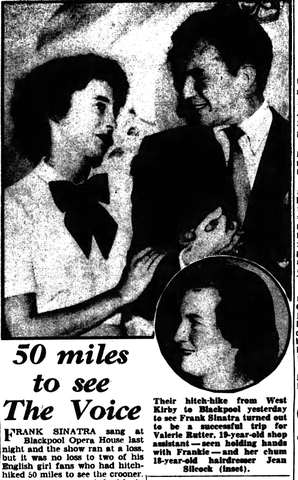
July 17, 1950
Concerts
Palladium, London (July 10 - 23)
July 18, 1950
Concerts
Palladium, London (July 10 - 23)
July 19, 1950
Concerts
Palladium, London (July 10 - 23)
Palladium, London (July 10 - 23)
Frank Sinatra at the London Palladium, 1950.
Frank Sinatra in a picture taken 1950 in London performs on stage at Palladium Theater. AFP/AFP/Getty Images)
Frank Sinatra in London, July 1950.
High kicks & trysts with Ol' Blue Eyes: The revelations of a Tiller GirlBy
IRENE HOLLAND
As a dancer with the world-famous Tiller Girls, Irene Holland performed with a host of Hollywood heart-throbs during the 1940s and 50s. But, as she reveals here, it wasn’t all smiles and sequins…
The Tillers had up to four costume changes for every performance - here they are dressed as ponies
As the Palladium Tiller Girls we would open the show, close the first half, open the second half and close it at the end with a Hollywood star. There would be a costume change for each dance, two shows a night every day except Sunday and then every two weeks we would have to learn a new show for the next American star. There was no doubt about it, it was damn hard work.
We opened with Danny Kaye in 1948. He looked like an ordinary bloke to me, but it was very exciting to think I was inches away from a Hollywood star as we queued for tea and coffee in the green room after our last rehearsal. I was busy staring at him and he obviously hadn’t seen me standing behind him. When he turned around he bumped into me and spilt hot coffee down the front of my brand new, hugely expensive silk dress. I yelped in pain but he didn’t say a word and just wandered off.
A lot of people thought we were silly just because we were dancers. They were surprised when you had an opinion on things. One of the girls, Betty, was from Yorkshire and she was very left-wing like me. Her full name was Betty Boothroyd and years later she became the first woman speaker of the House of Commons. Proof indeed that you could be a Tiller Girl and have brains!
The day Frank Sinatra joined us for a two-week run I arrived at the theatre for rehearsals and there was already a huge crowd outside the stage door hoping to get a glimpse of him. There was no such thing as bodyguards or security staff in those days and most stars just travelled with their partner and sometimes their manager. We’d never seen anything like this before.
The whole cast and crew were buzzing about the arrival of Ol’ Blue Eyes. We were in the midst of rehearsals that afternoon when we saw him standing in the wings being introduced to the backstage staff. He was in his 30s, an older man compared to us girls. He had a bit of a reputation for being a womaniser and I could see why. ‘He is much more handsome in real life,’ I whispered to Peggy.
Jack the stage manager brought him over to where we were standing. We were completely star-struck and just stood there like lemons with big grins on our faces. ‘Hello, ladies,’ he said. ‘I am looking forward to seeing you in action.’
‘Hello Mr. Sinatra,’ we chorused.
‘Isn’t he small?’ whispered Peggy as he wandered off stage. ‘Not much bigger than me,’ I replied.
The excitement was building for his first night and the atmosphere in the theatre was electric. It was standing room only in the stalls and the minute the curtain went back to reveal Sinatra reclining on a velvet chaise longue, the audience erupted with whoops, cheers and whistles.
We all had autograph books but nobody dared take them to the dressing room to get Sinatra to sign them – except Jean and me. Before that time I had never been in awe of any of the stars. We just treated them as part of the show and got on with it. But I felt a little nervous as I headed to his dressing room and my hands were shaking as I knocked on the door.
‘Come in, girls,’ he said, smiling when he saw us standing there.
‘We wondered if you’d be so kind as to sign our autograph books, Mr. Sinatra,’ I asked. ‘Of course, I’d be delighted.’
We were both in awe, getting so close to someone who was considered such a big star and so friendly. As we came out we passed a woman walking down the corridor. She was a tiny little thing but absolutely stunning and very glamorous with her green eyes, dark curly hair and luscious red lips.
‘It’s Ava Gardner,’ whispered Jean.
She was going out with Sinatra at the time and was obviously on her way to see him.
11th July 1950: Crowds waiting outside the Palladium, London, hoping to catch a glimpse of Frank Sinatra who is performing there. (Photo by Stroud/Express/Getty Images)
-----------------------------------------
© 1997-2026 The Sinatra Archive
This calendar, or any parts thereof, may not be reproduced in any fashion
whatsoever without the prior written permission of the publisher (The
Sinatra Archive)
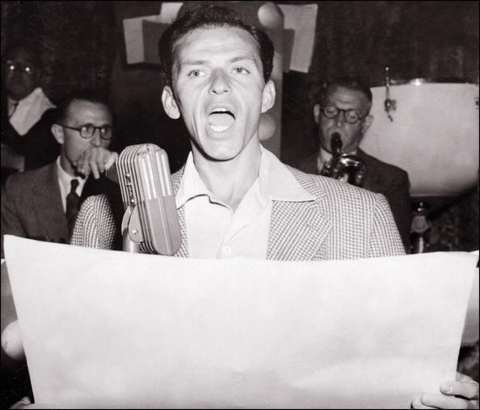
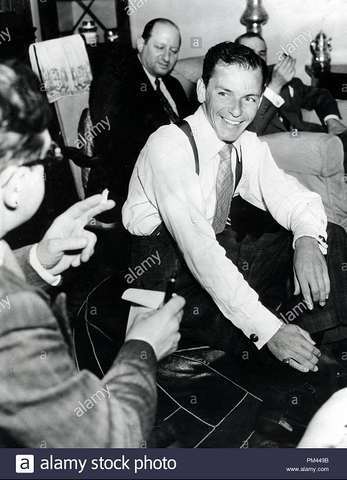
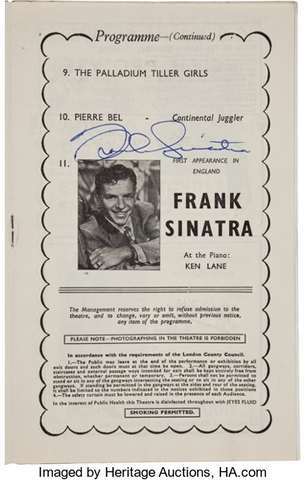
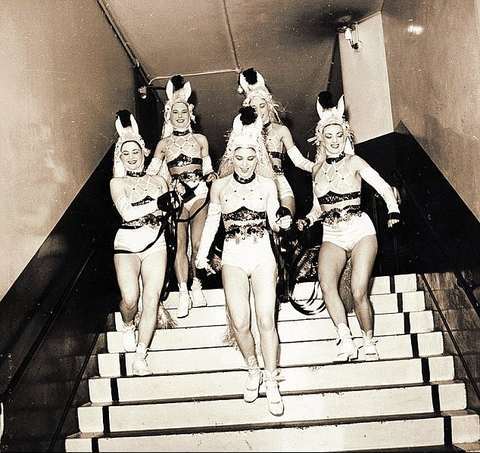
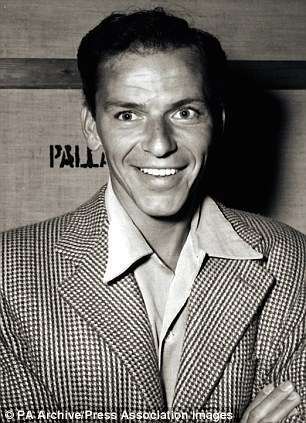
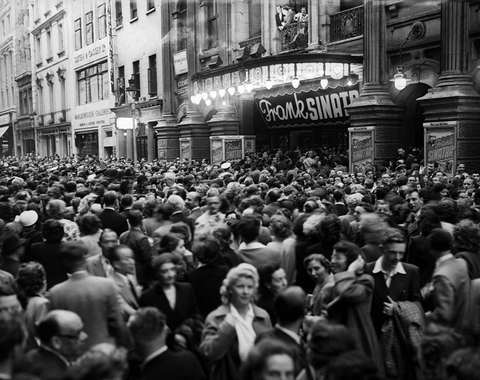
July 20, 1950
Concerts
Palladium, London (July 10 - 23)
July 21, 1950
Concerts
Palladium, London (July 10 - 23)
July 22, 1950
Concerts
Palladium, London (July 10 - 23)
Palladium, London (July 10 - 23)
Shirley May France, who as a young woman tried to swim the English Channel, dies at 79 By Emily Langer
March 22, 2012
With the words “Black Magic” emblazoned across the bosom of her swimsuit, Shirley May France captivated two continents with her attempt to swim the English Channel in 1949.
Then a 17-year-old Massachusetts schoolgirl, she would have been the youngest person in history to conquer the 21 miles of frigid double tides and currents between Cap Gris Nez in France and England’s white cliffs of Dover.
Her derring-do evoked the exuberance of the 1920s, when the American swimmer Gertrude Ederle became the first woman to cross the channel and aviator Charles Lindbergh made the first non-stop solo flight across the Atlantic. Dozens of other swimmers were lured by the channel in the intervening years, but Miss France became the most vigorously ballyhooed.
The fact that Miss France never made it to the white cliffs mattered little to the legions of fans who followed her in breathless news reports. Her valiant effort, her blue eyes and wickedly cute dimpled smile were enough.
Miss France died March 18 a hospital near Somerset, Mass., where she was known by her married name of Shirley May Setters. She was 79 and had cancer, her son Donald P. Setters Jr. said.
Shirley May France, a teenage American swimmer who became an international sensation when she tried unsuccessfully to swim the English Channel in 1949 and 1950, died March 18 at a hospital in Fall River, Mass. She was 79. (MARK KAUFFMAN/LIFE)
Miss France never set out to be a hometown heroine but embraced the role once it was thrust upon her by a combination of her father’s ambition, the wily promotion of a press agent, newspapers’ thirst for human interest stories and the American appetite for adventurers.
Her dad, a former amateur swimming champion who made a living fixing oil burners, knew his daughter was a good swimmer and engaged her in a series of aquatic conquests. In 1948, as the only woman among 100 contestants, she finished 10th in a race across New York’s Lake George.
Ted Worner, a rollicking press agent who had known Ederle, told the New Yorker magazine that he “had a hunch the public might be ready for another one of those things.” He began stoking Miss France’s ambition to swim the channel and ginned up a stunt that made her a press darling.
On July 10, 1949, with plenty of reporters in tow, Miss France swam 14 miles from Lower Manhattan to Coney Island in southern Brooklyn. It took her five hours and 40 minutes. (The trip was made slightly longer by a detour to avoid some dirty sewer water.)
Days later, Miss France was off to Europe with a small entourage. Awaiting them there was a slew of reporters poised to deliver stroke-by-stroke accounts of her swim. Fueling the frenzy was a report untrue that Miss France would swim in the nude. On the contrary, she left the English besotted by her wholesomeness. “Pleased ta meetcha,” she greeted onlookers.
With bad weather and other delays, the appointed date of Miss France’s swim came and went, and came and went. Meanwhile two Egyptians, a Frenchman and a Dutch housewife tried to swim the channel and succumbed to exhaustion.
On Aug. 24, 1949, Philip Mickman, a Yorkshire boy, became the youngest person at the time to swim the channel. He was 18. Miss France then 17 still had a chance to claim the distinction. (She wore a suit bearing the words “Black Magic” at the behest of Warner, to promote a film by the same name.)
She started from Cap Gris Nez on Sept. 6, 1949, at 5:26 a.m. Six miles from Dover, and fading from exhaustion after 10 1 / 2 hours of swimming, she was dragged out of the water by the minders following her in a boat.
“Please please leave me in,” she begged her coach. “Look how near it is,” she cried, looking to the shore.
A year later, Miss France sailed back to England for another much-hyped attempt. Five miles from Dover, she was again pulled from the water because of fatigue. Another American swimmer, 31-year-old Florence Chadwick, broke Ederle’s record that same day. Miss France was hysterical.
Shirley May France was born Aug. 11, 1932, in Fall River, Mass., not far from Somerset, where she spent nearly all her life.
Even in defeat, she was inundated with fan mail. Dozens of marriage proposals arrived by post. She met and was serenaded by Frank Sinatra and was said to have socialized with Jackie Robinson, Clark Gable and Johnny Weissmuller an Olympic swimmer before he played Tarzan in the movies.
There was talk of movie roles for Miss France, but they never materialized. She was a hat model in New York City and a disc jockey in Massachusetts, and she taught swimming in Fall River. In her later years, she worked at her family’s pork pie restaurant in Somerset.
Her first husband, Marine Capt. Douglas Smith, died in a plane crash in 1959 after five years of marriage. Her second husband, Donald P. Setters Sr., died in 2009 after 48 years of marriage.
Survivors include three children from her first marriage, Scott Smith of Somerset, Daryl Smith of Lyons, France, and Shelby Smith of Fall River; two children from her second marriage, Donald P. Setters Jr. and Daniel Setters, both of Somerset; a brother; a sister; 12 grandchildren; and three great-grandchildren.
Between her two publicized attempts to swim the channel, Miss France made another try. She got close but was disqualified on a technicality involving her father’s failure to sign sponsor release forms, her son Donald said. Miss France and her father became estranged over the incident and never reconciled.
Incomplete as they were, Miss France’s channel swims amounted to more than a media hullabaloo. During one of the weather delays, she gave swimming lessons to a young girl who later managed to save herself in a shipwreck. Around the same time, a sailor fell off the deck of his carrier flight deck and kept himself afloat in the Mediterranean for 12 hours, he said by thinking of Shirley May.
--------------------------------------
© 1997-2026 The Sinatra Archive
This calendar, or any parts thereof, may not be reproduced in any fashion whatsoever without the prior written permission of the publisher (The Sinatra Archive)
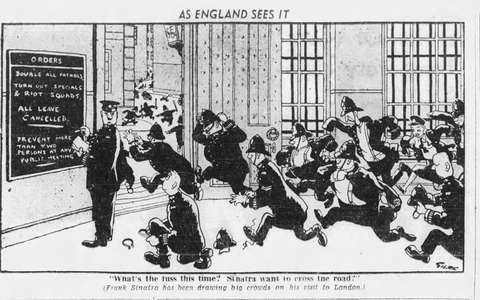
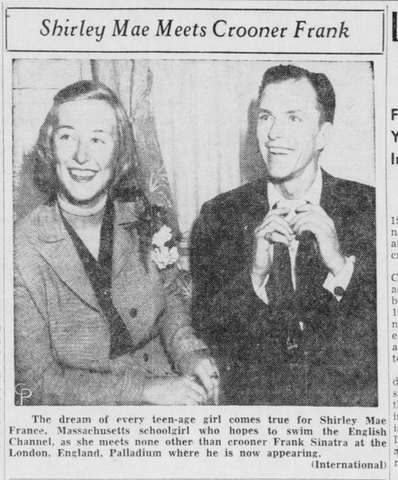
July 23, 1950
Concerts
Palladium, London (July 10 - 23)
July 30, 1950
Radio
Walter Winchell Show
Sinatra subs for Walter Winchell
Walter Winchell Show
Sinatra subs for Walter Winchell
Walter Winchell Show
Sinatra subs for Walter Winchell
-----------------------------------------------
© 1997-2026 The Sinatra Archive
This calendar, or any parts thereof, may not be reproduced in any fashion whatsoever without the prior written permission of the publisher (The Sinatra Archive)
[image referenced in source but could not be recovered]
[image referenced in source but could not be recovered]
August 1950
[Johnny Blowers On The Mobbed Atlantic City Shows]
Nancy Sinatra: Drummer Johnny Blowers recalled that Sinatra's Atlantic City engagement was so packed the theater dropped its feature film, running only a short subject before Sinatra's act; the crowd's repeated demands for "Goodnight Irene" meant the band may have played roughly 25 shows without ever leaving the building.
Source: Nancy Sinatra, Frank Sinatra: An American Legend, 1995.
[Frank and Ava secretly cohabit]
Kaplan: In mid-August Ava returned to Los Angeles and briefly vanished from public view; wire services speculated about her whereabouts, but in fact Frank had quietly rented a beach house in Pacific Palisades where the two lived together, eluding the press for a time, though tension arose over Frank's weekend visits with his children.
Source: James Kaplan, "Frank: The Voice" (2010)
August 2, 1950
Studio
New York City
CO44185 Life Is So Peculiar
w/Helen Carroll & The Swantones
(J. Burke/J. Van Heusen)
(from Mr. Music)
Burke-Van Heusen, Inc. (ASCAP) 1950
Arranged & Conducted by Percy Faith
-1 (2:07) CD: Columbia Years 43-52 Vol. 13
78: 38960
Saxes: V. Abato, R. Banzer, H. Feldman, J. Fulton, B. Kaufman; Trumpets:
J. Carroll, A. Ferretti, M. Solomon; Trombones: W. Bradley, W. Rausch;
Piano: G. Forbes; Guitar: M. Golizio; Bass: R. Haggart; Drums: J.
Blowers
Daily News
Wednesday, 9-27-50
note: Frank singing the two songs from his new Columbia single
at Abraham & Straus in Brooklyn, N.Y. Did Columbia
furnish the full 14 piece orchestra plus Helen Carroll &
The Swantones? Or was it just Graham Forbes on piano ?
Was there a conductor ?
How many people were able to catch this rare performance ?
Columbia had advanced Frankie a great deal of money based
on expected record sales. The expectations had not happened
and Columbia was getting very nervous. Did Frank do more
appearances like this one in an effort to promote sales ? A
lot of questions 75 years after this mid-afternoon recital.
Ed
Birmingham Post Herald
["Life Is So Peculiar" session]
Back in New York, Sinatra recorded "Life Is So Peculiar," a song from the Bing Crosby film Mr. Music written by Johnny Burke and Jimmy Van Heusen, arranged and conducted by Percy Faith with a small swinging band. Kaplan notes Sinatra's relaxed, mature vocal on the trifle prefigures his later Capitol- and Reprise-era sound.
Source: James Kaplan, "Frank: The Voice" (2010).
August 20, 1950
Radio
The Miracle Of America
Location: Hollywood
Network: CBS
Host: Robert Young
Performers: Jack Benny, Mary Livingstone, Frank Sinatra, Charles Laughton,
Bing & Gary Crosby, Dick Haymes, Bob Crosby, Jo Stafford, The Modernaires, Jerry Gray and His Orchestra, Ronald Colman, Benita Hume, Maurice J. Tobin (Secretary Of Labor, speaking from Washington, D. C.), Axel Stordahl and His Orchestra, Jack Smith, Dinah Shore, Frank De Vol and His Orchestra, Charles Sawyers (Secretary Of Commerce), Lucille Norman, Lud Gluskin and His Orchestra, Earl Warren (Governor of California),
Produced & Directed By: Sterling Tracy
Composer: Leith Stevens
1. The House I Live In
Notes: A program produced in co-operation with The Advertising Council, urging listeners to send for the booklet of the same name. TT 60mins.
Condition: Excellent. Complete.
Ed O'Brien: show was not broadcast on the east coast. Arrangement on "House
I Live In" is still a Stordahl chart, but not the well known mid-1940s effort.
The Miracle Of America
Location: Hollywood
Network: CBS
Host: Robert Young
Performers: Jack Benny, Mary Livingstone, Frank Sinatra, Charles Laughton, Bing & Gary Crosby, Dick Haymes, Bob Crosby, Jo Stafford, The Modernaires, Jerry Gray and His Orchestra, Ronald Colman, Benita Hume, Maurice J. Tobin (Secretary Of Labor, speaking from Washington, D. C.), Axel Stordahl and His Orchestra, Jack Smith, Dinah Shore, Frank De Vol and His Orchestra, Charles Sawyers (Secretary Of Commerce), Lucille Norman, Lud Gluskin and His Orchestra, Earl Warren (Governor of California),
Produced & Directed By: Sterling Tracy
Composer: Leith Stevens
1. The House I Live In
Variety
8-30-50
© 1997-2026 The Sinatra Archive
This calendar, or any parts thereof, may not be reproduced in any fashion whatsoever without the prior written permission of the publisher (The Sinatra Archive)
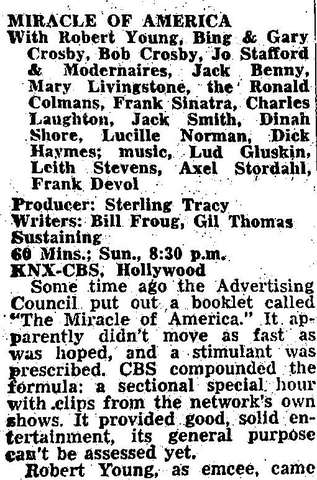
September 1950
[Nancy Sr.'s Health Strain After The 1950 Separation]
Nancy Sinatra: After the legal separation, Nancy Barbato Sinatra was granted alimony, custody, the Cadillac and the Holmby Hills home, but the stress took a physical toll; young Nancy recalled her mother fainting into her dinner plate from heart palpitations and crying quietly at night while trying to shield her children from the pain.
Source: Nancy Sinatra, Frank Sinatra: An American Legend, 1995.
[Frank secretly offers to inform for the FBI]
FBI files show that in September 1950 Frank used an intermediary to propose supplying the Bureau with information about "subversives," reachable via the Hampshire House hotel where he was staying. The Bureau declined; the Deputy Director wrote he wanted nothing to do with Frank, and J. Edgar Hoover personally endorsed that response.
Source: Richard Havers, "Sinatra" (Dorling Kindersley, 2007).
September 1, 1950
Concerts
Steel Pier, Atlantic City, NJ (1-4)
NOTE: Sinatra Scholar Ed O'Brien reports that
Sinatra was interviewed by Ben Heller on WMID radio backstage at The Steel Pier in Atlantic
City , New Jersey , in September 1950:
Sinatra: We've got a new one now that is moving pretty good called, if you'll excuse the expression, "Goodnight Irene."
Ben: Hey, that's a nice tune.
Sinatra: You wanna bet? No, it's pretty good.
Ben: You should sing a lot of songs. I like that.
Sinatra: Don't hold your breath. But "Goodnight
Irene" seems to be a big success along with the other labels that have recorded it. Also, coming up. coming out, I should say, from a new Crosby picture called "Life Is So Peculiar." It's a rhythm tune. It's a cute little novelty song. I think you will enjoy hearing it. I hope, anyway.
Sinatra, in the interview, went on to plug his new 10-inch LP "Sing and Dance With Frank Sinatra."
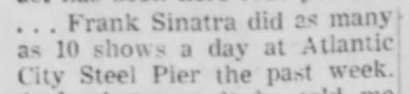
Steel Pier, Atlantic City, NJ (1-4)
September 2, 1950
Concerts
Steel Pier, Atlantic City, NJ (1-4)
September 4, 1950
Concerts
Steel Pier, Atlantic City, NJ (1-4)
September 5, 1950
The National Fashion Show, Minneapolis Auditorium, Minneapolis, Minnesota (September 5-7) Sinatra was a no-show due to laryngitis
The Miss Television 1950 at the National Fashion Show in Minneapolis that FS was supposed to appear at was none other than Edie Adams. She's mentioned in the review of the show. --Bob Waldman
---------------------------------------------------
© 1997-2025 The Sinatra Archive
This calendar, or any parts thereof, may not be reproduced in any fashion whatsoever without the prior written permission of the publisher (The Sinatra Archive)
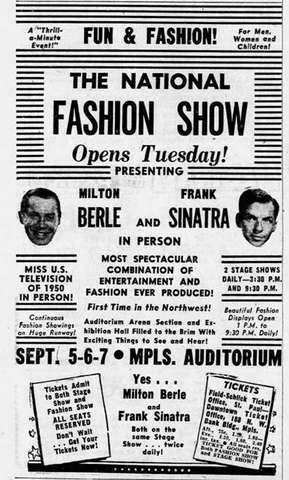
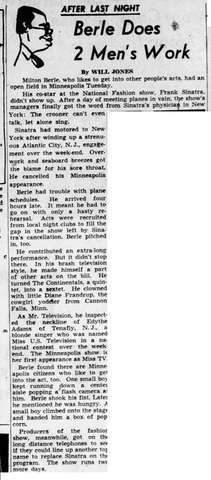
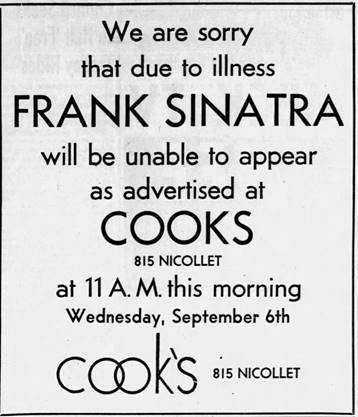
September 7, 1950
[Sinatra offers to inform for the FBI]
An FBI memo from J. P. Mohr to Tolson documents that an intermediary contacted the Bureau on Sinatra's behalf, offering that Frank, sensitive about accusations of subversive ties, was willing to gather information on "subversive elements" in the entertainment world, even at cost to his career. Tolson wrote on the memo "We want nothing to do with him," and Hoover concurred: "I agree."
Source: James Kaplan, "Frank: The Voice" (2010).
September 10, 1950
Concerts
Reading Fair, Reading, PA (September 10-11)
Reading Fair, Reading, PA (September 10-11)
Billboard
9-30-50
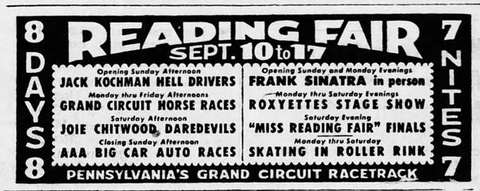
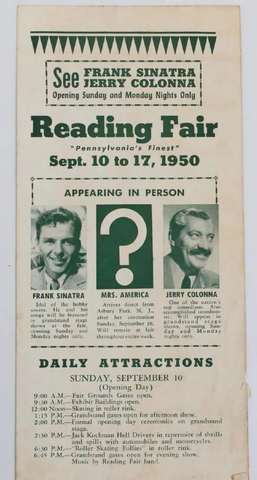
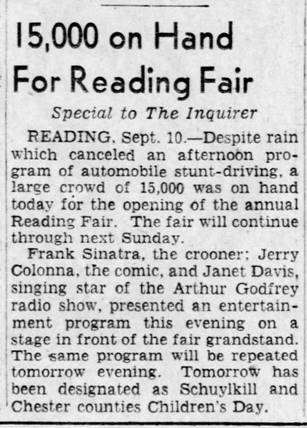
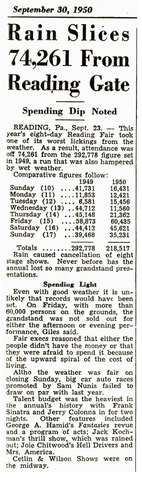
September 11, 1950
Concerts
Reading Fair, Reading, PA (September 10-11)
September 13, 1950
Radio
WCLO-WCLO-FM, Janesville, Wisconsin
note: This gig followed Frank's appearance at the Reading Fair. I find it interesting that
his friend and announcer, Marvin Miller, joined him for the second half of the show.
-- Ed
Television
NONE
Janesville Daily Gazette
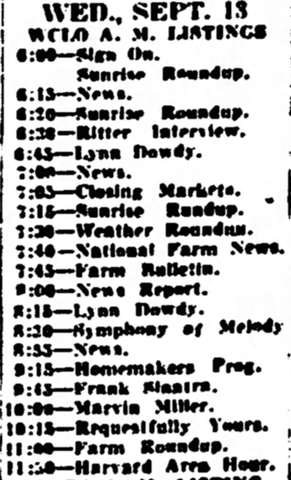
note: This gig followed Frank's appearance at the Reading Fair. I find it interesting that
his friend and announcer, Marvin Miller, joined him for the second half of the show.
Ed
September 17, 1950
Concerts
Night of Stars Benefit for North Shore
Hospital, Roosevelt Raceway, Westbury, NY
Entertainers included, Frank Sinatra, Perry Como,
Gloria Swanson, Ginger Rogers, Jackie Robinson,
Ethel Water, Guy Lombardo and others
Night of Stars Benefit for North Shore
Hospital, Roosevelt Raceway, Westbury, NY
Entertainers included, Frank Sinatra, Perry Como,
Gloria Swanson, Ginger Rogers, Jackie Robinson,
Ethel Water, Guy Lombardo and others
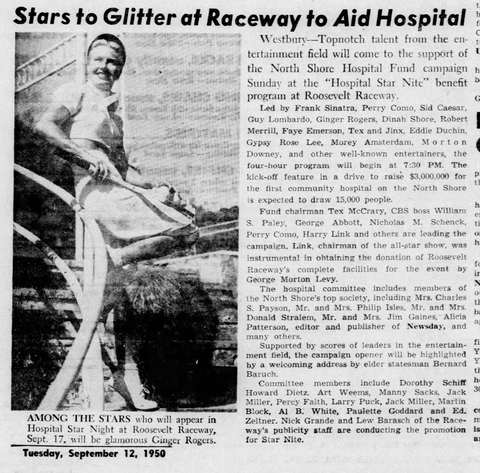
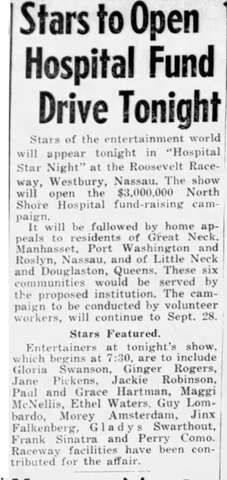
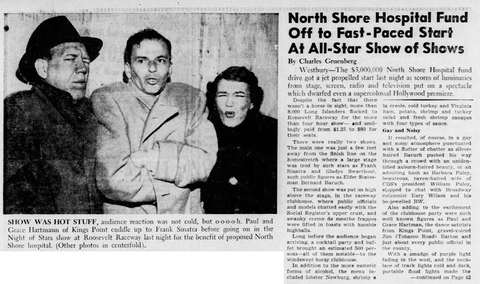
September 18, 1950
Studio
New York City
CO44366 Accidents Will Happen
(J. Burke/J. Van Heusen)
(from Mr. Music)
Burke-Van Heusen, Inc. (ASCAP) 1950
Arranged & Conducted by Axel Stordahl
-1 (2:58) CD: Columbia Years 43-52 Vol. 13
CD: 44236 Sinatra Rarities
78: 39014
CO44367 One Finger Melody w/The Whippoorwills
(K. Goell/F. Spielman/A. Hoffman)
Barton Music Corp. (ASCAP) 1950
Arranged & Conducted by Axel Stordahl
-1 (2:39) CD: Columbia Years 43-52 Vol. 13
78: 39014
Richmond Times
New York City
CO44366 Accidents Will Happen
(J. Burke/J. Van Heusen)
(from Mr. Music)
Burke-Van Heusen, Inc. (ASCAP) 1950
Arranged & Conducted by Axel Stordahl
-1 (2:58) CD: Columbia Years 43-52 Vol. 13
CD: 44236 Sinatra Rarities
78: 39014
CO44367 One Finger Melody w/The Whippoorwills
(K. Goell/F. Spielman/A. Hoffman)
Barton Music Corp. (ASCAP) 1950
Arranged & Conducted by Axel Stordahl
-1 (2:39) CD: Columbia Years 43-52 Vol. 13
78: 39014
The Morning Union
Press Telegram
The News and Observer
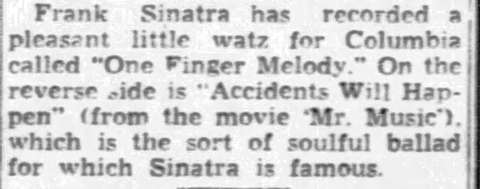
Pasadena Star News
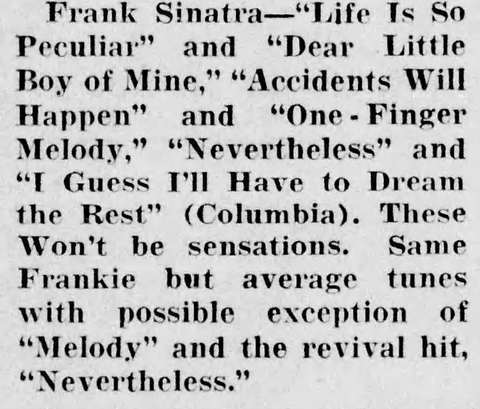
The Wippoorwills: John Ackerman, Frank Howren, David O'Hearn, Marilyn Sullivan, Gordon Thorin
Violins: J. Brand, M. Hershaft, R. Lynch, R. Polikian, Z. Smirnoff, B. Taylor; Violas: S. Deutsch, I. Zirr; Cello: G. Ricci; Harp: E. Vito; Saxes: A.Drelinger, J. Lytell, P. Ricci, J. Small; Oboe: I. Horowitz; Trumpets: T. Faso, D. McMickle, J. Owens; Trombones: G. Arus, W. Heins, W. Rausch; French Horn: A. D'Erosa; Piano: G. Forbes; Guitar: M. Golizio; Bass: F. Carroll; Drums: J. Blowers
September 21, 1950
Studio
New York City
CO44376 Remember Me In Your Dreams w/The Whippoorwills
(M. Nevins/H. David)
Valando Music Corp. (ASCAP) 1950
Arranged & Conducted by Axel Stordahl
-1 (2:30) CD: Columbia Years 43-52 Vol. 13
78: 39069
note: Hal David wrote the lyrics. He would go on to collaborate with Burt Bacharach. They collaborated on almost 150 songs, 39 of which were huge hits. David wrote the lyrics for the Sinatra recording "To Love A Child."
Ed
CO44377 If Only She'd Look My Way
(I. Novello/A. Melville)
Chappell & Co., Inc. (ASCAP) 1950
Arranged & Conducted by Axel Stordahl
-1 (2:47) CD: Columbia Years 43-52 Vol. 13
LP: CL-953 Adventures Of The Heart
78 RPM special version released in England Columbia L.B. 104 with introduction by H.R.H. The Duke of Edinburgh (fund raiser for National Playing Fields Association)
CO44378 London By Night
(C. Coates)
Barton Music Corp. (ASCAP) 1950
Arranged & Conducted by Axel Stordahl
-1 (3:08) CD: Columbia Years 43-52 Vol. 13
CD: 44236 Sinatra Rarities
78: 39592
CO44379 Meet Me At The Copa w/The Whippoorwills
(A. Stordahl/S. Cahn)
Barton Music Corp. (ASCAP) 1950
Arranged & Conducted by Axel Stordahl
-1 (3:10) CD: Columbia Years 43-52 Vol. 13
CO44376 & 44379 The Wippoorwills: John Ackerman, Frank Howren, David O'Hearn, Marilyn Sullivan, Gordon Thorin
Violins: J. Brand, M. Hershaft, M. Lomask, R. Polikian, Z. Smirnoff, H. Urbont; Violas: H. Colletta, S. Deutsch; Cello: F. Miller; Saxes: J. Greenberg, B. Kaufman, J. Lytell, H. Shertzer, W. Taninbaum; Trumpets: T. Faso, C. Griffin, J. Owens; Trombones: G. Arus, B. Morrow, W. Rausch; French Horn: J. Barrows; Harp: E. Vito; Piano: G. Forbes; Guitar: M. Golizio; Bass: F. Carroll; Drums: J. Blowers
New York City
CO44376 Remember Me In Your Dreams
w/The Whippoorwills
(M. Nevins/H. David)
Valando Music Corp. (ASCAP) 1950
Arranged & Conducted by Axel Stordahl
-1 (2:30) CD: Columbia Years 43-52 Vol. 13
78: 39069
Frank, Axel Stordahl, and vocal group “The Whippoorwills” recording “Remember Me in Your Dreams” on September 21, 1950.
Thanks to Carl for the above photo.
Two more photos with the Whippoorwills, courtesy of John Larrabee:
CO44377 If Only She'd Look My Way
(I. Novello/A. Melville)
Chappell & Co., Inc. (ASCAP) 1950
Arranged & Conducted by Axel Stordahl
-1 (2:47) CD: Columbia Years 43-52 Vol. 13
LP: CL-953 Adventures Of The Heart
78 RPM special version released in England Columbia L.B. 104 with
introduction by H.R.H. The Duke of Edinburgh (fundraiser for National
Playing Fields Association)
Fields in Trust, Prince Philip’s first national charity commitment, ‘deeply saddened’
Fields in Trust, an independent charity which protects green spaces, said it was ‘deeply saddened’ following the news of Prince Philip’s passing today.
Buckingham Palace confirmed that the Duke of Edinburgh died peacefully this morning, aged 99.
In a statement made this afternoon Fields in Trust praised the duke for his support over the years and highlighted many of his fundraising achievements.
The charity, which was previously called the National Playing Fields Association (NPFA), was the duke’s first national charity commitment and he served as its president for 64 years.
Fields in Trust chief executive Helen Griffiths commented: “We are enormously indebted to him for his support.
“His tireless efforts live on through many protected parks and green spaces and Fields in Trust’s continuing work.”
He became president of Fields in Trust in October 1948, before stepping down in 2013 to be replaced by his grandson The Duke of Cambridge who remains president today.
FUNDRAISING FILM: The duke starred in a short film featuring Bob Hope which reportedly raised £84,000 for the Silver Jubilee Fund
During his 64-year tenure, Prince Philip was heavily involved in the organization particularly in its fundraising activities.
In 1948 he launched a fundraising campaign called the Silver Jubilee Fund which by 1952 had raised £500,000 for the charity.
He also delivered a spoken introduction to a recording of Frank Sinatra’s “If Only She’d Looked My Way”, widely accepted as the first charity record.
ROYAL WORDS: The duke connected with Frank Sinatra to make the first charity record
As a keen cricketer the duke played in multiple matches for the charity and in 1949 led a team of celebrities against the England test team in Bournemouth.
Over his 64-year tenure as president, the number of green spaces protected with Fields in Trust grew from 430 to 2,000, spanning an area of nearly 12,000 hectares.
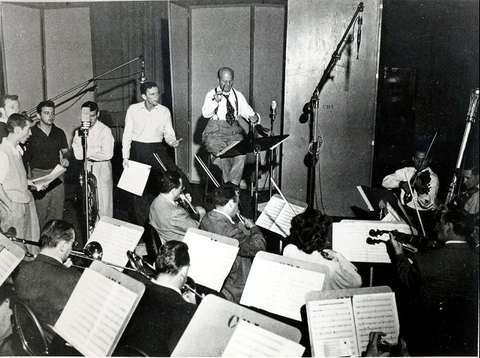
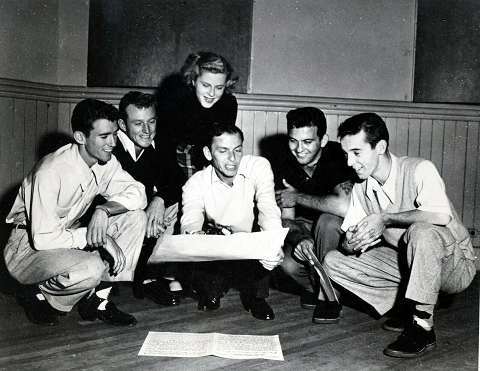
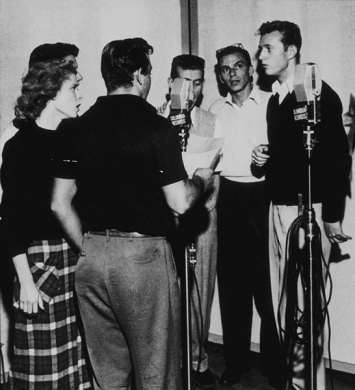
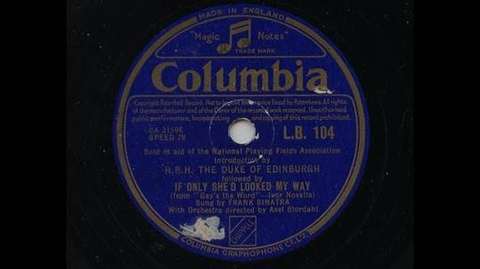
Frank, Axel Stordahl, and vocal group “The Whippoorwills” recording “Remember Me in Your Dreams” on September 21, 1950.
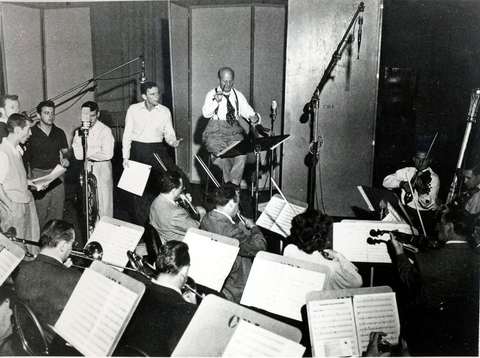
The same evening as this Stordahl session, Sinatra returned to the Copacabana stage for the first time since his April vocal collapse there, opening with a song written for the occasion by Stordahl (music) and Sammy Cahn (lyrics), "Meet Me at the Copa," which urged listeners to drop whatever they were doing -- "even if you're wooing" -- and come to the club. Source: David Lehman, Sinatra's Century.
[London by Night -- critical commentary]
Julie Wilson: Cabaret singer Julie Wilson told Friedwald that in London in 1950, while Sinatra was still married to 'Big Nancy' but publicly involved with Ava Gardner, Frank and Ava heard Wilson sing 'London by Night' (written by her friend Carroll Coates); Ava, who had excellent musical taste, told Frank he should sing it, and he later thanked Wilson for introducing him to the song -- part of why Friedwald believes Sinatra recorded it so often afterward, as it reminded him of Gardner.
This song/context matches multiple dated entries in the chronology; the specific date Friedwald is referring to could not be determined with confidence.
Source: Will Friedwald, "Sinatra! The Song Is You: A Singer's Art" (2018 revised edition), Ch. 10, "Concert Years" (1973-1994)
September 27, 1950
Radio
Mary Margaret McBride Show
Abraham & Straus Store
Brooklyn, N.Y.
12: 45 PM to 1:45 P.M.
Special Guest: Frank Sinatra
Concerts
Abraham & Straus Department Store, New York, NY
3:30PM
Sinatra appeared in person to promote his new recordings of “Dear Little Boy of Mine” & “Life Is So Peculiar” Billed as a special performance with limited seating
Abraham & Straus Department Store, New York, NY
Sinatra appeared in person to promote his new recordings of “Dear Little Boy of Mine” & “Life Is So Peculiar”

Abraham & Straus Department Store, New York, NY
Sinatra appeared in person to promote his new recordings of “Dear Little Boy of Mine” & “Life Is So Peculiar”
note: Frank singing the two songs from his new Columbia single
at Abraham & Straus in Brooklyn, N.Y. Did Columbia
furnish the full 14 piece orchestra plus Helen Carroll &
The Swantones? Or was it just Graham Forbes on piano ?
Was there a conductor ?
How many people were able to catch this rare performance ?
Columbia had advanced Frankie a great deal of money based
on expected record sales. The expectations had not happened
and Columbia was getting very nervous. Did Frank do more
appearances like this one in an effort to promote sales ? A
lot of questions 75 years after this mid-afternoon recital.

That evening, Frank Sinatra and Ava Gardner attended the Joe Louis-Ezzard Charles world heavyweight championship bout at Yankee Stadium, photographed together arm in arm — a newly open public display of the romance that would make headlines the next day, just as Nancy Sinatra was preparing to file for legal separation. Source: J. Randy Taraborrelli, Sinatra: Behind the Legend.
[Louis-Charles fight at Yankee Stadium]
On Wednesday night, Frank and Ava attended the Joe Louis-Ezzard Charles heavyweight title fight at Yankee Stadium, photographed sitting closely together; Charles outpointed the former champion Louis over fifteen rounds to become world heavyweight champion.
Source: James Kaplan, "Frank: The Voice" (2010).
September 28, 1950
Nancy Sinatra appeared before Judge Orlando Rhodes at Santa Monica's Superior Court seeking a legal separation and separate maintenance, shaking and supported by her sister Julie as she testified. “On numerous occasions, he would go to Palm Springs for weekends without me,” she said through tears, describing Frank's growing distance. The court estimated Frank's 1949 income at $93,740 and the couple's community property at $750,000; Nancy was granted $2,750 a month in temporary support — more than Frank, deep in debt, could readily pay. Source: J. Randy Taraborrelli, Sinatra: Behind the Legend.
[Nancy wins separate-maintenance suit]
The day after the Louis-Charles fight, Nancy won her separate-maintenance suit in Santa Monica Superior Court. Judge Orlando H. Rhodes awarded her the Holmby Hills home, a 1950 Cadillac, Sinatra Music Corp stock, and a third of Frank's first $150,000 in annual earnings (10% of the next $150,000), plus custody of the three children; Frank got a 1949 Cadillac, a jeep, the Palm Springs house, and Texas oil rights. Frank did not contest the action, and Nancy's sister Julie Barbato corroborated testimony about his neglect and remoteness.
Source: James Kaplan, "Frank: The Voice" (2010).
October 1950
[Meet Frank Sinatra radio show launches]
Kaplan: Alongside the TV show, CBS launched the Sunday-afternoon radio program Meet Frank Sinatra, a poorly conceived format mixing scripted repartee with a small combo backing his singing. The show drew little audience despite Frank being musically comfortable in the format.
Source: James Kaplan, "Frank: The Voice" (2010)
[Sinatra's network television show begins]
Consiglio: When Sinatra launched his network television show in October 1950, Axel Stordahl served as his musical arranger, continuing a role he had held on most of Sinatra's radio work, including Your Hit Parade.
Source: Tony Consiglio (as told to Franz Douskey), "Sinatra and Me: The Very Good Years" (2012)
[Sing and Dance with Frank Sinatra released]
Kaplan: That same month, Columbia released Sing and Dance with Frank Sinatra, his first album conceived specifically as a ten-inch LP and, as it turned out, his last for the label. Comprised largely of the overdubbed April up-tempo sessions, the record failed to chart at all.
Source: James Kaplan, "Frank: The Voice" (2010)
[The Frank Sinatra Show (CBS TV)]
Sinatra's first television series, The Frank Sinatra Show, ran on CBS from October 1950 through April 1952 under a five-year contract reportedly worth $230,000 a year, but the show never found its footing; Santopietro argues Sinatra's edgy, impatient on-camera persona didn't suit the intimate medium the way Perry Como's or Dean Martin's did.
No corresponding dated entry could be identified in the chronology for this film/context.
Source: Tom Santopietro, "Sinatra in Hollywood" (2008), All Over the Map
October 3, 1950
Concerts
The Paramount, New York, NY
Sister Kenny Benefit
Frank Sinatra, Sid Caesar, Eddie Cantor, Imogene Coca, William Holden, Bert Parks, Jack Carter and others
The Paramount, New York, NY
Sister Kenny Benefit
Frank Sinatra, Sid Caesar, Eddie Cantor, Imogene Coca, William Holden, Bert Parks, Jack Carter and others
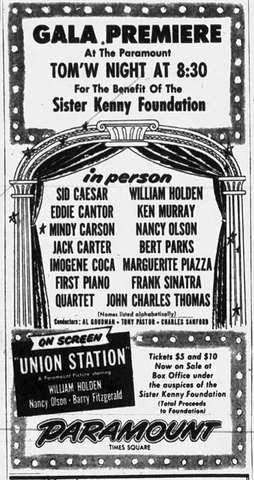
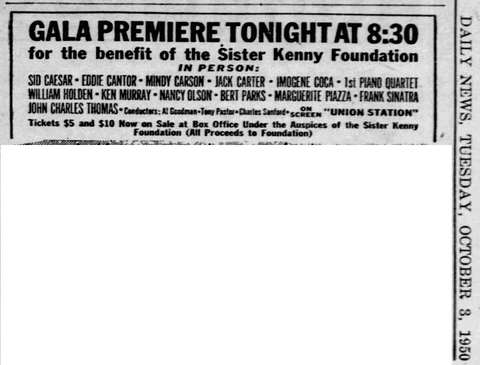
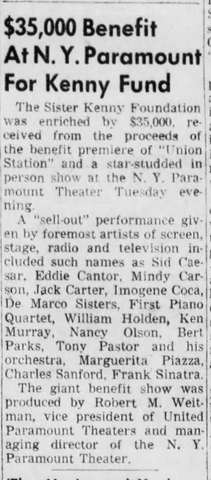
October 7, 1950
Television
The Frank Sinatra Show
Network: CBS
Location: New York City
Script Dated: October 7, 1950
Show: #1 (PREMIER)
Sponsor: sustaining
Time: 9:00 P.M.-10:00 P.M.
Writers: Harry Crane
Producer: Paul Dudley
Director: Hal Gerson
Announcer: Ken Roberts
Orchestra Conducted By: Axel Stordahl
Guests: J. Carrol Naish, Ben Blue, Mary Mayo, Harrison and Kaye (tap dancers), The Moon Mists
1. When You're Smiling - Frank Sinatra
2. I Concentrate On You - Frank Sinatra
3. sketch: "Chaplin" Frank Sinatra as "The Kid" & Ben Blue as "Charlie Chaplin"
4. sketch: "Life With Luigi" - Frank Sinatra & J. Carrol Naish
5. Ol' Man River - Frank Sinatra
Ed O'Brien:
Frank's first TV series got off to a rough start.
There were changes made almost immediately and a certain amount of panic set in. William Paley personally oversaw the revamping of the show and Sinatra let CBS and his agent know just how unhappy he was. Here is an article from the 11-4-50 issue of Billboard
SINATRA PUTS MCA ON NOTICE
NEW YORK. Oct 28 -- As a result of the difficulties he has been having with his CBS-TV show, Frank
Sinatra this week gave MCA its dismissal as his agent. The singer feels he has not gotten adequate video representation from the firm, the result of which was that his first program was very badly received.
Some of Sinatra's advisers, however, are trying to straighten out the situation harmoniously and bring the vocalist back into the MCA stable. Sinatra, also, is not too happy at the treatment accorded him by CBS-TV, which has assigned one of its better, b ut more overworked producers -- Irving Mans- field -- to his show, after Paul Dudley, the initial producer, was moved off the program. The Sinatra contract with MCA has two more years to go.
Actually the ratings were not all that bad.
Avg. audience for the month of Oct 1950
1. Your Show of Shows NBC 30.6
2. Frank Sinatra Show CBS 19.5
3. Madison Square Garden Rodeo DuMont 10.9
4. NFL Pro Football ABC 8.6
(pro football was no big deal back then)
Ed O'Brien:
The highlights of this first show were the songs. Frank opened with "When You're Smiling" using the Siravo arrangement. Sounds very much like the Blackpool version in 1953. After the song, he thanked the audience for coming to his "opening night.' Porter's classic "I Concentrate On You" featured a Stordahl chart, heavy on strings. Frank closed out the song with a gorgeous falsetto note on "you." Before "Ol' Man River," the perils of live TV had Frank yelling for the mike." His powerful rendition revealed there was no foundation to the claims that his voice was shot in the early '50s. Overall show was a mixed bag, but Sinatra's singing was superb.
The Frank Sinatra Show
Network: CBS
Location: New York City
Script Dated: October 7, 1950
Show: #1 (PREMIER)
Sponsor: sustaining
Time: 9:00 P.M.-10:00 P.M.
Writers: Harry Crane
Producer: Paul Dudley
Director: Hal Gerson
Announcer: Ken Roberts
Orchestra Conducted By: Axel Stordahl
Guests: J. Carrol Naish, Ben Blue, Mary Mayo, Harrison and Kaye (tap dancers), The Moon Mists
Variety
10-11-50
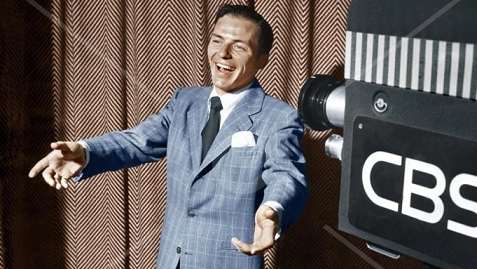
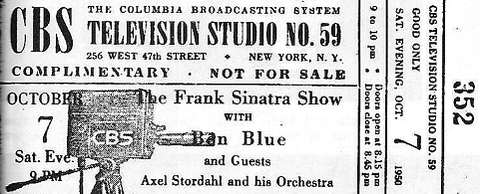
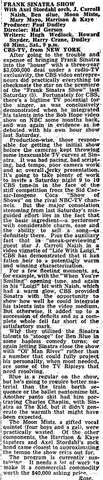
[Frank Sinatra Show debuts on CBS]
At 9 p.m. on October 7, The Frank Sinatra Show debuted on CBS television opposite the hit Your Show of Shows. Reviews were brutal: the New York Times' Jack Gould said Sinatra "fell into the shallow end of the pool," the Herald Tribune called him "a rather bad emcee," and Variety cited bad pacing and poor camera work. The unsponsored episode cost CBS $41,500.
Source: James Kaplan, "Frank: The Voice" (2010).
[Celebration party at Toots Shor's]
The night the show debuted, publicist Nat Shapiro threw a party at Toots Shor's, inviting 150 people; 300 showed up, and the event was covered in a feature by Look magazine, despite the show's poor reviews.
Source: James Kaplan, "Frank: The Voice" (2010).
October 9, 1950
Studio
New York City
CO44427 Come Back To Sorrento (Torna a Surriento)
(C. Aveling/E. DeCurtis)
(from Paramount On Parade)
Arranged & Conducted by Axel Stordahl
-1 (2:14) CD: Columbia Years 43-52 Vol. 13
LP: CL-1359 Come back To Sorrento
78: 39118
CO44428 April In Paris
(V. Duke/E.Y. Harburg)
(from Walk A Little Faster)
T.B. Harms, Inc. (ASCAP) 1932
Arranged & Conducted by Axel Stordahl
-1 (2:42) CD: Columbia Years 43-52 Vol. 13
LP: C6X-40343 The Voice-The Columbia years, 43-52
LP: C2L-6 Frank Sinatra Story In Music
78: 39592
CO44429 I Guess I'll Have To Dream The Rest w/The Wippoorwills
(M. Stoner/M. Block/H. Green)
Martin Block Pub. (ASCAP) 1941
Arranged & Conducted by Axel Stordahl
-1 (2:41) CD: Columbia Years 43-52 Vol. 13
LP: C6X-40343 The Voice-The Columbia years, 43-52
LP: CL-953 Adventures Of The Heart
78: 39044
CO44429 The Wippoorwills: John Ackerman, Frank Howren, David O'Hearn, Marilyn Sullivan, Gordon Thorin.
CO44430 Nevertheless (I'm In Love With You) w/Trumpet solo by Billy Butterfield
(H. Ruby/B. Kalmar)
Crawford Music Corp. (ASCAP) 1931
Arranged by George Siravo
Conducted by Axel Stordahl
-1 (3:08) CD: Columbia Years 43-52 Vol. 13
LP: C6X-40343 The Voice-The Columbia years, 43-52
LP: CL-2741 The Essential Frank Sinatra, Vol. 3
LP: CL-953 Adventures Of The Heart
78: 39044
Violins: J. Brand, F. Buldrini, J. Held, M. Hershaft, R. Lynch, R. Polikian; Violas: S. Deutsch, L Druzinsky; Cello: G. Ricci; Harp: E. Vito; Trumpets: B. Butterfield, C. Griffin, J. Owens; Trombones: L. Alpeter, G. Arus, W. Rausch; Saxes: A. Drelinger, H. Feldman, E. Gershman, H. Shertzer, W. Versaci; Piano: G. Forbes; Guitar: M. Golizio; Bass: H. Alpert; Drums: J. Blowers; French Horn: G. Schuller
NOTE: Sinatra Scholar Ed O'Brien says that Sinatra would sing "Come Back to Sorrento ," "April in Paris ," and "Nevertheless" on his November 18, 1950 TV show.
He would also sing "Nevertheless" on Berle's TV show on Tuesday, November 28, 1950. His vocals were superb.
October 10, 1950
Radio
Life With Luigi
Location: New York City
Network: CBS
Sponsor: Wrigley's Spearmint Chewing Gum
Writers: Mac Benoff, Lou Derman
Performers: J. Carrol Naish, Alan Reed, Frank Sinatra, Mary Shipp, Hans Conried, Jody Gilbert.
Note: The show appears on the officially released CD set: 60 Greaest Old Time Radio Show "Frank Sinatra & Friends"
Ed O'Brien notes:
J. Carroll Naish was Luigi. He had worked with Frank at MGM (Kissing Bandit). The half-hour show was broadcast Tuesday nights on CBS.
Wrigley Gum was the sponsor and Lyn Murray & Orch. provided the music. Frank sang a lovely version of "Oh Marie" in Italian.
Television
NONE
Life With Luigi
Location: New York City
Network: CBS
Sponsor: Wrigley's Spearmint Chewing Gum
Writers: Mac Benoff, Lou Derman
Performers: J. Carrol Naish, Alan Reed, Frank Sinatra, Mary Shipp, Hans Conried, Jody Gilbert.
Note: The show appears on the officially released CD set: 60 Greaest Old Time Radio Show "Frank Sinatra & Friends"
note: Been searching for songs Frank wrote that were never published. Quite by accident I stumbled upon this article from 9-17-48. Naish, who was Irish, wrote a story about a tinker - a wandering handyman. Frank was interested in playing the lead. Title of the film was "The Tinker Of Ballycullen." Film would have shown the charm and atmosphere of Ireland as it was 70 years ago. Another of so many unrealized Sinatra film projects.
Ed
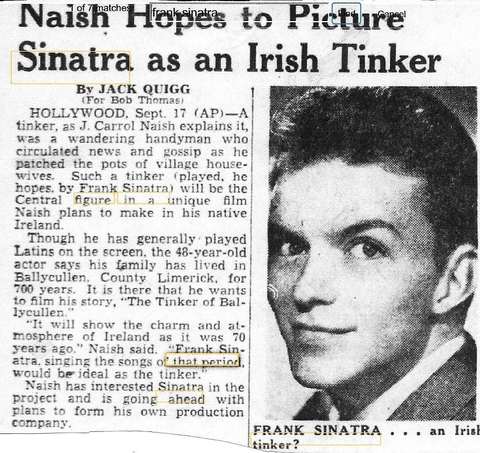
October 11, 1950
Variety reviewed the premiere of Sinatra's first regular CBS television series, faulting the production for weak pacing and staging problems, calling out "bad pacing, bad scripting, bad tempo, poor camera work."
Source: Albert Auster, "Frank Sinatra: The Television Years–1950–1960," Journal of Popular Film and Television, 26:4 (1999), 166-174.
October 14, 1950
Television
The Frank Sinatra Show
Network: CBS
Location: New York City
Script Dated: October 14, 1950
Show: #2
Sponsor: sustaining
Time: 9:00 P.M.-10:00 P.M.
Writers: Harry Crane
Producer: Irving Mansfield
Director: John Peyser
Announcer: Ken Roberts
Orchestra Conducted By: Axel Stordahl
Guests: Brian Aherne, Ben Blue, Mary Mayo, Sid Fields, Condosa & Brandon (dancers), The Whipoorwills
(see articles below)
The Frank Sinatra Show
Ed O'Brien:
After the opening week disaster, Paul Dudley was replaced as producer. The new producer, Irving
Mansfield, was a former press agent. John Peiser replaced Hal Green in the director's chair. Dudley remained with the show as a writer. CBS was paying him $1,200 a week. He would produced Sinatra's new radio show "Meet Frank Sinatra." The radio show had been postponed twice due to the tremendous difficulties with the TV production. Show was set for a 10/22 debut, but, at the last moment, it was shelved for a third time, finally making it on the air,10/ 29.
The writing staff of Hugh Whitlock Jr, Howard Snyder,
Harry Crane and Dudley pulled out all the stops in the week preceding the second show of the series. Set designer Nelson Baume was asked to create more original sets and The Ben Blue Family, comprised of Sid Fields, Roberta Lee, Joey Walsh, Pat Gaye and Blue, did intense rehearsals leading up to the
Saturday broadcast.
Frank Sinatra was much more relaxed the second week and in fine vocal form. He opened the show with two tunes arranged by George Siravo: "My
Blue Heaven" and "Nevertheless. The skits with
Blue and guest Brian Aherne received a great deal of applause and laughter from the audience
Frank, Ben and Brian sang "Me And My Shadow."
Siravo was again the arranger for Frank's excellent rendition of "A Foggy Day," followed immediately by a scathing parody of "The Cry Of The Wild Goose."
There were vocals by Mary Mayo and The Whipoorwils.
Mayo was so impressive the previous week, CBS immediately signed her for an unspecified number of appearances on the Sinatra show. Frank closed out the proceedings with the Arlen-Mercer classic "Come Rain Or Come Shine."
Variety
10-18-50
[image referenced in source but could not be recovered]
[image referenced in source but could not be recovered]
October 17, 1950
Concerts
Cotton Bowl, State Fair, Dallas Texas (One Night Only) with Orchestra conducted by Axel Stordahl
1. When You're Smiling
2. Bewitched
3. It All Depends On You
4. Goodnight, Irene
5. Embraceable You
6. Ol Man Crosby (parodoy of Ol' Man River)
Cotton Bowl, State Fair, Dallas Texas (One Night Only)
© 1997-2025 The Sinatra Archive
This calendar, or any parts thereof, may not be reproduced in any fashion whatsoever without the prior written permission of the publisher (The Sinatra Archive)
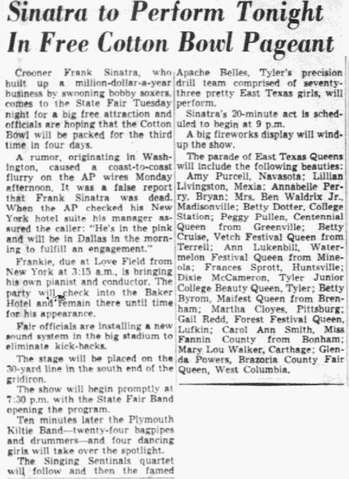

Cotton Bowl, State Fair, Dallas Texas (One Night Only)
© 1997-2025 The Sinatra Archive
This calendar, or any parts thereof, may not be reproduced in any fashion
whatsoever without the prior written permission of the publisher (The
Sinatra Archive)
"Goodnight, Irene"
Sinatra / Ben Heller: In a 1950 interview with Atlantic City radio personality Ben Heller, Sinatra publicly grumbled about being 'forced' by Mitch Miller to record inferior songs; in a clipped exchange about the new song 'Goodnight, Irene' Sinatra sarcastically undercut Heller's compliment about it.
Source: Charles L. Granata, "Sessions with Sinatra: Frank Sinatra and the Art of Recording" (1999/2003).
October 21, 1950
Television
The Frank Sinatra Show (CBS)
9:00-10:00 PM
Sustaining
Ben Blue & Family (Sid Fields, Pat Gaye, Roberta Lee, Joey Walsh) Mary McCarty, Mary Mayo, Lou Wills Jr., Dorothy Dayton, The Whipoorwills
Music: Axel Stordahl
Written by Hugh Wedlock Jr. & Howard Snyder with/ Paul Dudley, Harry Crane
Settings: Nelson Baume
Producer: Irving Mansfield
Director: John Peyser
Sinatra Songs
1. It All Depends On You arg George Siravo
2. Bewitched arg. A. Stordahl
3. Penthouse Serenade w/ M. McCarty arg. A. Stordahl
4. One Finger Melody w/ The Whipooorwills arg. A Stordahl
5. Soliloquy arg. A. Stordahl
NOTE: Ed O'Brien says that the highlight of this evening was Sinatra's showstopping rendition of
"Soliloquy." Sinatraphile Ed Spiegel said
Sinatra singing "Soliloquy" in 1950 must have been really something to see and hear. O'Brien replied that it was a staple of Sinatra's nightclub and concert appearances back then.
Spiegel wishes DVDs of thse CBS TV shows would become available on the commercial market. There are certain to be many great segments.
O'Brien, in his response to Spiegel, says there are many myths about Sinatra. The one that may be the most egregious is the ridiculous he lost his voice in the early 1950's. His singing on both the CBS-TV broadcasts and his radio shows for the same network belie such nonsense. The guy was sensational. The TV shows were all broadcast live.
When Spiegel says he'd like to know about this
"lost voice" claim, O'Brien says that it started on May 2, 1950 and ended on May 27, 1950.
Skitch Henderson told O'Brien that Sinatra was doing a late show a the Copacabana in New York when his vocal chords hemorrhaged. He saw a specialist the next day and was told not to speak for two weeks. Sinatra then flew to Florida and stayed quiet for 10 days. On the 27th of May, he made his television debut on Bob Hope's
Star-spangled Review. He did skits with Hope and sang "Come Rain or Come Shine," a truly sensational vocal.
Through the year, a number of people associated with Sinatra have told O'Brien how he lost his voice in the early 50s and then made a miraculous comeback when Capitol hired him. If you listen to
Sinatra from "50 through 52, O''Brien emphasiizes, it is painfully apparent that the one ingredient lacking for a climb back to the top was Nelson Riddle.
The singer was marvelous and he sang a lot of great songs. The truth is he had a bad month in the spring of 1950. That's all. Unfortunately, myths have a way of becoming fact when repeated often enough, O'Brien emphasized.
The Frank Sinatra Show (CBS)
9:00-10:00 PM
NOTE: Ed O'Brien says that the highlight of this evening was Sinatra's showstopping rendition of "Soliloquy." Sinatraphile Ed Spiegel said Sinatra singing "Soliloquy" in 1950 must have been really something to see and hear. O'Brien replied that it was a staple of Sinatra's nightclub and concert appearances back then. Spiegel wishes DVDs of thse CBS TV shows would become available on the commercial market. There are certain to be many great segments.
October 28, 1950
Television
The Frank Sinatra Show
Network: CBS
Location: New York City
Script Dated: October 28, 1950, October 28, 1950 (first draft), October 28, 1950 (Hot Closet Sketch)
Show: #4
Sponsor: sustaining
Time: 9:00 P.M.-10:00 P.M.
Writers: Harry Crane
Producer: Irving Mansfield
Director: John Peyser
Announcer: Ken Roberts
Orchestra Conducted By: Axel Stordahl
Guests: Kay Thompson, Buster Shaver, Ben Blue and Family, The Moon Mists, Mary Mayo
Notes: Frank and Kay Thompson doing a skit on the 10-28-50 show. note: Kay Thompson was a multi-talented lady. She is not remembered today in connection with Sinatra, but they were close friends for decades.
She served as a creative consultant on his radio, TV, nightclub and film work. She was invaluable to him for years. Kay oversaw much of the planning for the JFK Inaugural Gala including getting rabid Nixon supporter, Ethel Merman, to sing "Everything's
Coming Up Roses" to the president-elect.
Frank was in tough shape when Kay appeared on his 10-28-50 show. She sang "That Old Feeling" and then did a duet with Frank on "(The Birds Are
Talkin') 'Bout You'n' Me," backed by The Whippoorwills..
Frank and Kay also did a comedy sketch with Ben Blue, titled "Hot Closet. " She stayed on as creative consultant for four weeks. But when the producer, Irving Mansfield, threw in the towel, Kay followed him out the door.
Ed
P.S. The early shows of the series, before Bulova agreed to sponsor the first half-hour, had a wild opening. The camera was set up in the audience and came down toward the orchestra pit, in front of the stage, and zeroed in on Axel Stordahl's bald head. Early television was memorable in many strange and unusual ways.
--ED
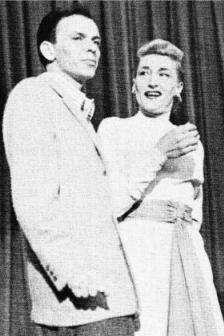
October 29, 1950
Radio
Meet Frank Sinatra
Show #1 (Premiere)
Network: CBS
Sponsor: Tintair, Ludens
Time: 5:00PM - 6:00PM (EST), Sunday
Producers: Mark Goodson, Bill Todman
Musicans: Graham Forbes and His Quartet
Announcer: Hal Sims
Writers:
Guest: Mimi Benzell
Notes: Confirmed listed as "Premiere" aired on WCBS
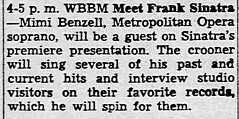
Meet Frank Sinatra
Show #1 (Premiere)
Network: CBS
Sponsor: Tintair, Ludens
Time: 5:00PM - 6:00PM (EST), Sunday
Producers: Mark Goodson, Bill Todman
Musicans: Graham Forbes and His Quartet
Announcer: Hal Sims
Writers:
Guest: Mimi Benzell
Notes: Confirmed listed as "Premiere" aired on WCBS
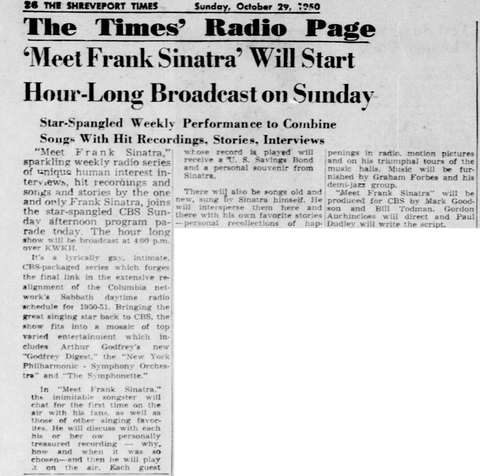
November 1950
[Bulova sponsors Sinatra's TV show]
Kaplan: In November, Bulova signed on to sponsor the first half hour of The Frank Sinatra Show, providing some financial relief as the program continued to draw poor ratings against Sid Caesar's competing hit.
Source: James Kaplan, "Frank: The Voice" (2010)
November 3, 1950
Friars Tribute to Joe E. Lewis, Waldorf Astoria, New York
Variety November 8, 1950
Billboard November 11, 1950 (problem with image is at the source)
Guys and Dolls, (US Film Release: November 3, 1955)
Starring: Marlon Brando, Frank Sinatra, Jean Simmons, Vivian Blaine
Directed by Joseph L. Mankiewicz. Produced by Samuel Goldwyn.
Sinatra plays Nathan Detroit who runs a permanent floating crap game in New York. (1st DVD Release date: 2000-04-18 - BluRay Release date: 2012-11-06) Three new songs, written by Frank Loesser, were added to the film: "Pet Me Poppa"; "A Woman in Love"; and "Adelaide", which was written specifically for Sinatra.
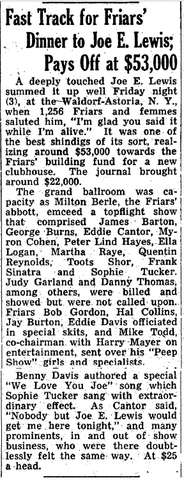
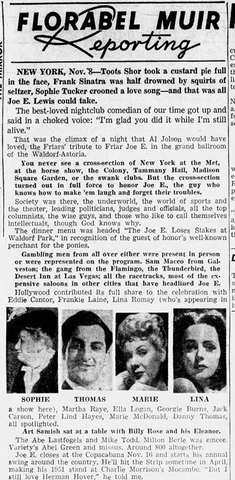
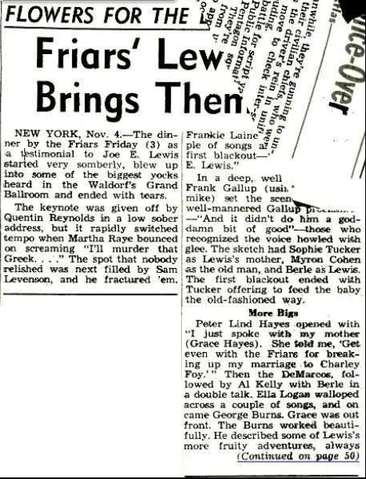
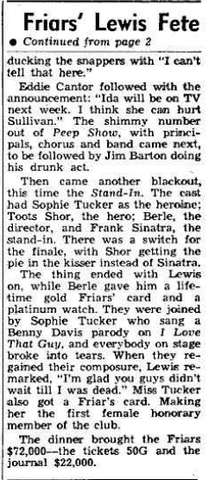
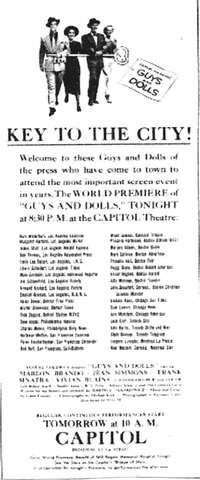
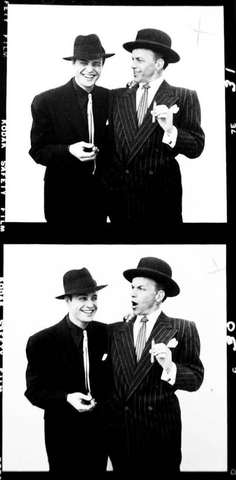
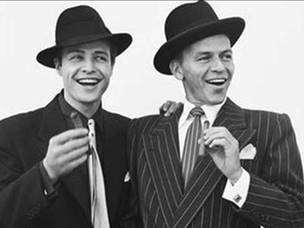
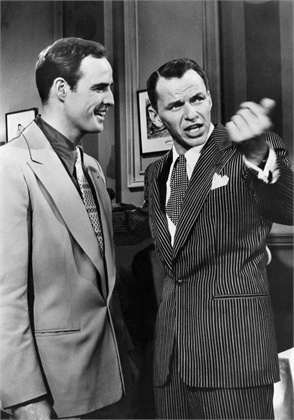
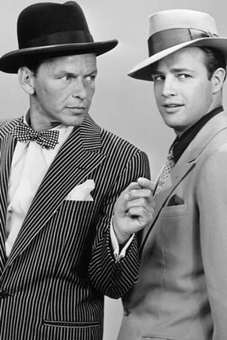
November 4, 1950
Television
The Frank Sinatra Show
Network: CBS
Location: New York City
Script Dated: November 4, 1950
Show: #5
Sponsor: sustaining
Time: 9:00 P.M.-10:00 P.M.
Writers: Harry Crane
Producer: Irving Mansfield
Director: John Peyser
Announcer: Ken Roberts
Orchestra Conducted By: Axel Stordahl
Guests: Nancy Walker, Teddy Hale, Ben Blue, The Club Savannah Revue, The Whipoorwills
1. Come Up To My Place - Frank Sinatra & Nancy Walker
2. comedic sketch: "Private Radio Detective" - Sinatra & Ben Blue
NOTE: Sinatra Scholar Ed O'Brien says the highlight of the evening was a duet of "Come Up to My Place" from Sinatra and Nancy Walker.
She starred in the original 1944 Broadway production of "On the Town." In the film, Sinatra and Betty Garrett did the number.
The Frank Sinatra Show
Network: CBS
Location: New York City
Script Dated: November 4, 1950
Show: #5
Sponsor: sustaining
Time: 9:00 P.M.-10:00 P.M.
Writers: Harry Crane
Producer: Irving Mansfield
Director: John Peyser
Announcer: Ken Roberts
Orchestra Conducted By: Axel Stordahl
Guests: Nancy Walker, Teddy Hale, Ben Blue, The Club Savannah Revue, The Whipoorwills
1. Come Up To My Place - Frank Sinatra & Nancy Walker
2. comedic sketch: "Private Radio Detective" - Sinatra & Ben Blue
Variety
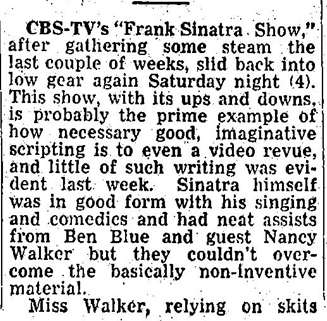
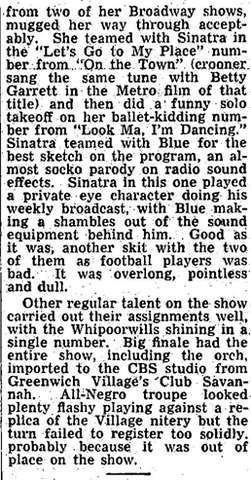
The Tender Trap, (US Film Release: November 4, 1955)
Starring: Frank Sinatra,Debbie Reynolds, David Wayne, Celeste Holm
Directed by Charles Walters.
Sinatra plays Charlie Reader, a 35-year-old theatrical agent in New York City, living a seemingly idyllic life as a bachelor with numerous women who come and go, cleaning and cooking for him until one day Charlie meets singer-actress Julie Gillis (Debbie Reynolds) and his bachelor life is put to the test.
(1st DVD Release date: 2008-05-13)
The film opens with an extreme long shot of Frank Sinatra singing the title song. He then walks toward the camera, and when his image comes into medium-shot range, the camera begins to track with him. As he sings the words "tender trap," the film's title appears on the screen. The film ends in a similiar fashion, as its four stars sing the title song. Although a Jan 1955 HR news item notes that Robert Paul Smith, the co-author of the play, was hired to write the film's screenplay, the extent of Smith's contribution to the final screenplay has not been determined. A Jun 1955 HR news item lists Casey Adams in the cast, but his appearance in the released film has not been confirmed. May 1955 HR news items state that Mitzi Gaynor and Barbara Darrow were considered for roles in the film. The title song " (Love Is) The Tender Trap" was nominated for an Academy Award for Best Song, and became a hit record for Sinatra.
AFI
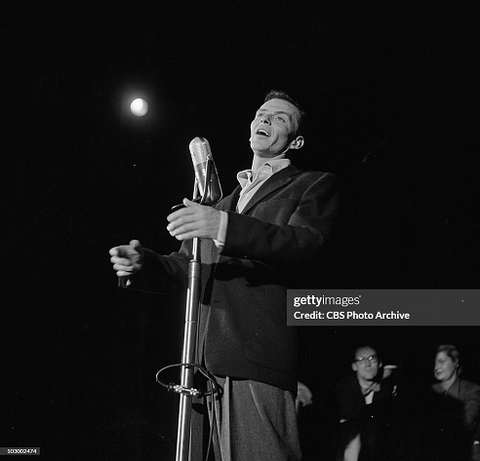
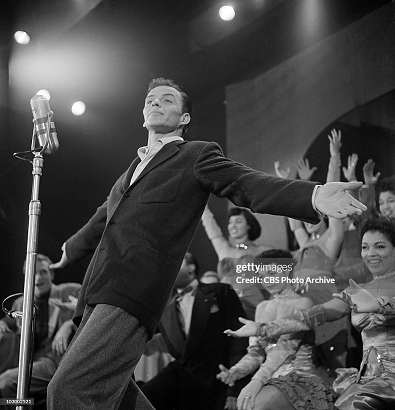
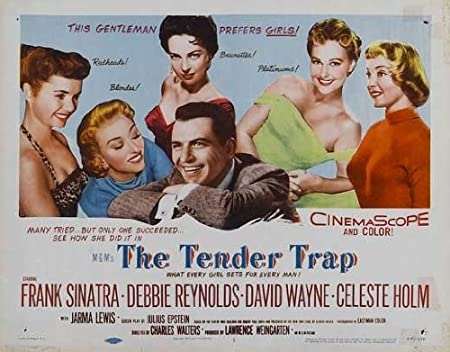
November 5, 1950
Studio
New York City
CO44615 Let It Snow, Let It Snow, Let It Snow
w/The B. Swanson Quartet
(J. Styne/S. Cahn)
Cahn Music Co. (ASCAP) 1945
Arranged & Conducted by Axel Stordahl
-1 (2:35) CD: Columbia Years 43-52 Vol. 11
CD: 40707 Christmas Dreaming
LP: CL-1032 Christmas Dreaming
78: 39069
Violins: J. Brand, A. Eidus, J. Held, M. Hershaft, H. Hoffman, Z.
Smirnoff; Violas: S. Deutsch, H, Furmansky; Cello: G. Polikian; Saxes: H. Feldman, M. Gershman, B. Kaufman, A. Richman, H. Shertzer; Horns: J. Barrows; Trumpets: T. Lawson, D. McMickle, J. Owens; Trombones: G. Arus, R. Dupont, B. Rank; Piano: G. Forbes; Guitar: M. Golizio; Bass: F. Carroll; Drums: J. Blowers; Harp: E. Vito
note: Mitch Miller told me Sinatra refused to record the two songs that Guy
Mitchell would then lay down. Both songs were Top 5 hits.
Radio
Meet Frank Sinatra
Show #2
Network: CBS
Sponsor: Tintair, Ludens
Time: 5:00PM - 6:00PM (EST), Sunday
Producers: Mark Goodson, Bill Todman
Musicians: Graham Forbes and His Quartet
Announcer: Hal Sims
Writers:
Guest: no guests listed
Notes: Confirmed aired on WCBS
note: Sinatra's premiere was not aired on some stations until 11-5-50
Review here is from Knoxville Journal on that date.
Times Herald
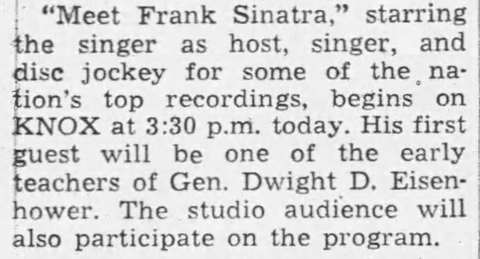
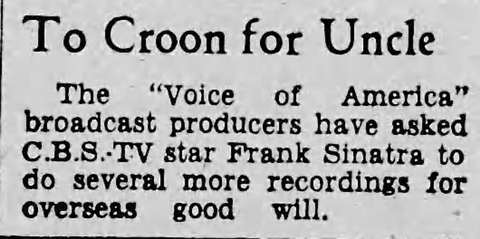
November 11, 1950
Television
The Frank Sinatra Show
Network: CBS
Location: New York City
Script Dated: November 11, 1950
Show: #6
Sponsor:
Time: 9:00 P.M.-10:00 P.M.
Writers: Harry Crane
Producer: Marlo Lewis
Director: John Wray
Announcer: Ken Roberts
Orchestra Conducted By: Axel Stordahl
Guests: Roberta Lee, Bob Sweeney, Hal March, The Asia Boys (acrobats), Ben Blue and family, The Whipoorwills
1. Everything Happens To Me (parody) - Frank Sinatra
2. sketch: "The House I Live In" - Frank Sinatra
NOTE: Ed O'Brien says that Sinatra recreated "The House I Live In" short including the song and does a parody version of "Everything Happens to Me."
The Frank Sinatra Show
Variety
Ed O'Brien:
note: and director was unprecedented in the
early years of live TV shows.
Bulova was set to sponsor the first 30
minutes of the show, beginning with the
11/25 broadcast. Guest that evening
was Sarah Vaughan. Late in the month,
The Whipoorwills became The Moonmists.
November 12, 1950
Radio
Meet Frank Sinatra
Show #3
Network: CBS
Sponsor: Tintair, Ludens
Time: 5:00PM - 6:00PM (EST), Sunday
Producers: Mark Goodson, Bill Todman
Musicians: Graham Forbes and His Quartet
Announcer: Hal Sims
Writers:
Guest: Jan Murray
Taping Session for Show, November 3, 1950 70mins.
1. Can't We Talk It Over?
2. London By Night (Columbia recording)
3. Mam'selle (Columbia recording)
4. I'll Always Love You
5. One Finger Melody
6. From This Day Forward (Columbia recording)
7. There's No Business Like Show Business
8. Put Your Dreams Away
Complete Radio Show
1. Can't We Talk It Over
2. London By Night (Columbia recording)
3. One Hundred Years From Today
4. Mam'selle (Columbia recording)
5. I'll Always Love You
6. One Finger Melody
7. From This Day Forward (Columbia recording)
8. There's No Business Like Show Business
9. Put Your Dreams Away
Notes: Confirmed aired on WCBS.
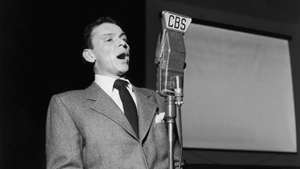
Meet Frank Sinatra
Show #3
Network: CBS
Sponsor: Tintair, Ludens
Time: 5:00PM - 6:00PM (EST), Sunday
Producers: Mark Goodson, Bill Todman
Musicians: Graham Forbes and His Quartet
Announcer: Hal Sims
Writers:
Guest: Jan Murray
The above photo also appeared on the cover of “The View” magazine from January 2021 featuring an interview with Jack “Jackie” Scholle:
A: Jack, are there other highlights you’d like to share with us?
J: Do you have a few more hours to chat? But seriously, as a kid you really aren’t able to appreciate the very special nature of the events.
Here are a few that I do recall:
Frank Sinatra interviewed me on his show, and he presented me with a very nice watch as a memento. I then gave it to my
Dad, who was very proud of it and wore it for many years.
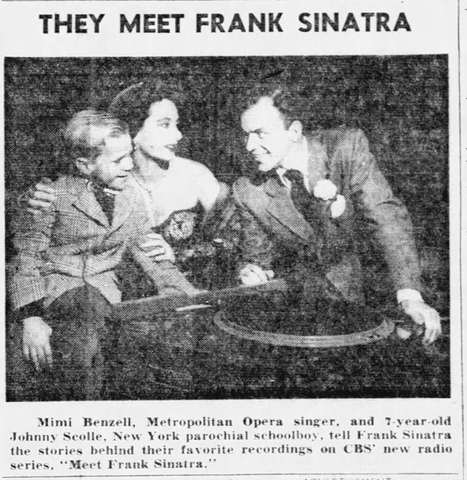
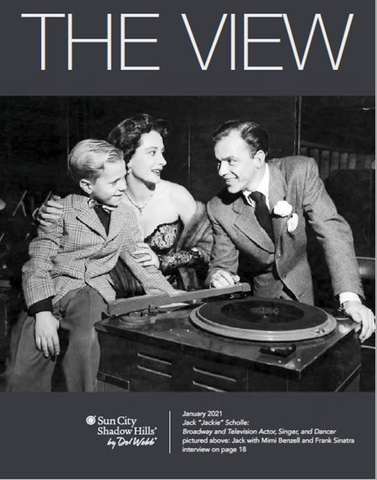
November 16, 1950
Studio
New York City
CO44634 Take My Love
(J. Wolf/J. Herron/F. Sinatra)
Barton Music Corp. (ASCAP) 1950
Arranged & Conducted by Axel Stordahl
-1 (3:16) CD: Columbia Years 43-52 Vol. 13
LP: CL-953 Adventures Of The Heart
78: 39118
CO44635 I Am Loved
(C. Porter)
(from Out Of This World)
Buxton Hill Music Corp. (ASCAP) 1950
Arranged & Conducted by Axel Stordahl
-1 (2:24) CD: Columbia Years 43-52 Vol. 13
LP: C2X-40897 Hello Young Lovers
LP: CL-953 Adventures Of The Heart
78: 39079
CO44636 You Don't Remind Me
(C. Porter)
(from Out Of This World)
Buxton Hill Music Corp> (ASCAP) 1950
Arranged & Conducted by Axel Stordahl
-1 (2:48) CD: Columbia Years 43-52 Vol. 13
78: 39079
CO44637 You're The One
-1 N/R
Violins: J. Brand, J. Held, M. Hershaft, H. Katzman, M. Lomask, R.
Polikian; Violas: S. Deutsch, I. Zirr; Cello: G. Polikian; Saxes: A. Drelinger, H. Feldman, E. Gershman, B.Kaufman, H. Shertzer; Horn: J. Barrows; Trumpets: L. Castle, D. McMickle, J. Owens; Trombones: G. Arus, B, Rank, W. Rausch; Guitar: M. Golizio; Bass: F. Carroll; Drums: J. Blowers; Harp: E. Vito
Ed O'Brien:
Sinatra's recordings were becoming minor autobiographical moments.
At the 10-9-50 session he recorded "Nevertheless" and it was a personal
statement to Ava. The 11-16 was more of the same. He would continue
using his recordings as personal confessions and private laments through
both the Capitol and Reprise years. The only other singer who would do
this as effectively as Sinatra was Billie Holiday.
"I'm a Fool to Want You" / "Take My Love"
Joel Herron; Mitch Miller: Extensive origin story: Copacabana/Jane Froman music director Joel Herron had used Brahms's Third Symphony as a theme; lyricist Jack Wolf adapted its andantino into a love song, 'Take My Love,' which Sinatra recorded (and performed on his new CBS TV show) in November 1950 to little notice. When 'Take My Love' couldn't be licensed for an MGM radio adaptation of Undercurrent, Herron was asked to write a replacement melody and came up with what became 'I'm a Fool to Want You.' Realizing it surpassed the original, Wolf brought it back to publisher Ben Barton, and after Sinatra recorded it, Herron and Wolf invited him in as credited cowriter: 'He's gotta be on this song!' Stordahl based his richly somber orchestration (with added choir) on Herron/Joe Gordon's demo. Legend holds Sinatra channeled his crumbling relationship with Ava Gardner into the performance, allegedly leaving the studio in tears afterward; but Miller pushed back on a purely biographical reading: 'That's bullshit!... what he's drawing is the emotion from your personal life. He's saying it for you.' Despite now being considered a classic, the record initially reached only #14 and sold just 35,000 copies -- competing with a rival Billy Eckstine version that hit the market first. Herron: 'was nothing for a Sinatra record [except in those lean years]. We thought we were done for.'
Source: Will Friedwald, "Sinatra! The Song Is You: A Singer's Art" (2018 revised edition).
[I Am Loved -- critical commentary]
Joel Herron; Rosemary Clooney: Sinatra opened at the Copacabana on March 23, 1950 amid rumors that his voice was failing. Pianist/songwriter Joel Herron recalled that as soon as Sinatra burst into 'I Am Loved,' the room's reaction was 'If he can't sing anymore, then what the heck is that?' Sinatra's Columbia studio recording of the song that November captures, per Friedwald, 'an ebullient Sinatra warming himself in the glow of his own aura.' Rosemary Clooney, who was present at the Copa, agreed reports of vocal collapse were exaggerated: 'Sometimes you could hear that there was just kind of a raspiness or a hoarseness... I can't tell you he sounded bad.'
This song/context matches multiple dated entries in the chronology; the specific date Friedwald is referring to could not be determined with confidence.
Source: Will Friedwald, "Sinatra! The Song Is You: A Singer's Art" (2018 revised edition), Ch. 5, "In-Between Years" (1948-1953)
November 17, 1950
Radio
SONGS FOR SALE
CBS
FRIDAY
8:00 -9:00 P.M.
Host: Jan Murray
Panelists: Irving Caesar, Mitchell Miller,
Singers: Rosemary Clooney, Richard Hayes
Guest: Frank Sinatra

SONGS FOR SALE
CBS
FRIDAY
8:00 -9:00 P.M.
Host: Jan Murray
Panelists: Irving Caesar, Mitchell Miller,
Singers: Rosemary Clooney, Richard Hayes
Guest: Frank Sinatra
November 17, 1973 TV Guide Cover:
November 17, 1973 TV Digest from St. Louis Globe-Democrat:
November 17, 1973 Cash Box:
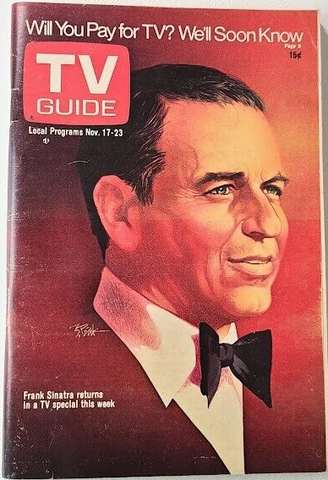
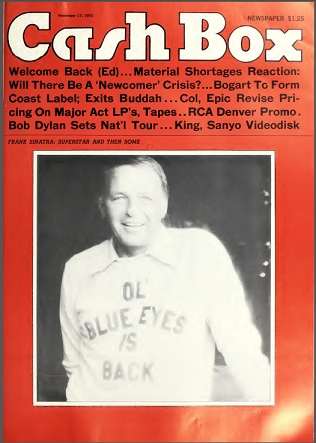
November 18, 1950
Television
The Frank Sinatra Show
Network: CBS
Location: New York City
Script Dated:
Show: #7
Sponsor: Bulova Watch Company (30mins)
Time: 9:00 P.M.-10:00 P.M.
Writers:
Producer: Jack Donahue
Director: Jack Donahue
Announcer: Ken Roberts
Orchestra Conducted By: Axel Stordahl
Guests: Patricia Morison, Jan Murray, Stump & Stumpy, Ben Blue and family, The Whipoorwills
1. Torna A Surriento - Frank Sinatra sung in italian
2. April In Paris - Frank Sinatra
3. medley (incl.): Rose Of Washingtong Square / Ballin' The Jack - The Whipoorwills
4. The Lady Is A Tramp - Roberta Lee
5. Nevertheless - Frank Sinatra
Notes: Bulova begins sponsorship of half the show for five weeks.
Ed O'Brien:
Frank sang "April In Paris," "Come Back To Sorrento"(in Italian - terrific vocal) and "Nevertheless." The latter was a request from a member of the audience when it was discovered show had run under and had four minutes to kill. Frank had recorded the three songs at Columbia, 10-9-50.
November 19, 1950
Radio
Meet Frank Sinatra
Show #4
Network: CBS
Sponsor: Tintair, Ludens
Time: 5:00PM - 6:00PM (EST), Sunday
Producers: Mark Goodson, Bill Todman
Musicians: Graham Forbes and His Quartet
Announcer: Hal Sims
Writers:
Guest: Rosemary Clooney
1. Nevertheless
Notes: Confirmed aired on WCBS
November 21, 1950
Concerts
The Click, Philadelphia, PA (one night only)
The Click, Philadelphia, PA (one night only)
[image referenced in source but could not be recovered]
[image referenced in source but could not be recovered]
November 25, 1950
Television
The Frank Sinatra Show
Network: CBS
Location: New York City
Script Dated: November 25, 1950
Show: #8
Sponsor: Bulova Watch Company (30mins)
Time: 9:00 P.M.-10:00 P.M.
Writers: Harry Crane
Producer: Jack Donahue
Director: Jack Donahue
Announcer: Ken Roberts
Orchestra Conducted By: Axel Stordahl
Guests: Sarah Vaughan, Johnny Coy, Ben Blue and Family, The Whipoorwills
November 26, 1950
Radio
Meet Frank Sinatra
Show #5
Network: CBS
Sponsor: Tintair, Ludens
Time: 5:00PM - 6:00PM (EST), Sunday
Producers: Mark Goodson, Bill Todman
Musicians: Graham Forbes and His Quartet
Announcer: Hal Sims
Writers:
Guest: Jimmy Van Heusen, Roberta Lee
1. Would I Love You
Notes: Confirmed aried on WCBS
November 28, 1950
Television
Milton Berle - Texaco Star Theatre
Season: 3, Episode: 105
Guest: Frank Sinatra, Georgia Gibbs, Lon Chaney, Jr.
Host: Milton Berle (host),
Conductor: Alan Roth
Milton Berle arrives driving a stagecoach and welcomes Frank Sinatra. Berle and Sinatra perform in a mad-scientist skit with Lon Chaney.
Ed O'Brien notes:
Frank sang a very memorable "Nevertheless" on Miltie's show He also did a parody with him and some skits. note: After singing "Nevertheless," Frank did a wild sketch with Miltie and Lon Chaney. Georgia Gibbs followed with "There'll Be Some Changes Made" and then Frank and Berle did a song and dance routine with her. They sang "When Francis Dances With Me" and Frank was the only competent dancer of the three. The final segment of the show was a take off of Verdi's "Rigoletto." Frank did do bit of singing.
Ed
Milton Berle - Texaco Star Theatre
Season: 3, Episode: 105
Guest: Frank Sinatra, Georgia Gibbs, Lon Chaney, Jr.
November 28, 1957 Sinatra on cover of Down Beat
© 1997-2025 The Sinatra Archive
This calendar, or any parts thereof, may not be reproduced in any fashion
whatsoever without the prior written permission of the publisher (The
Sinatra Archive)
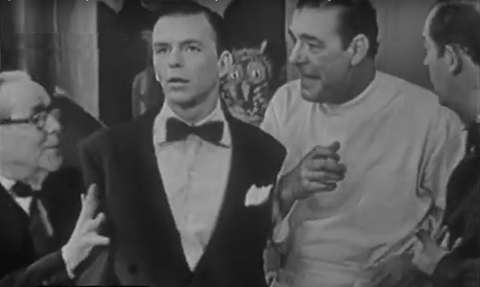
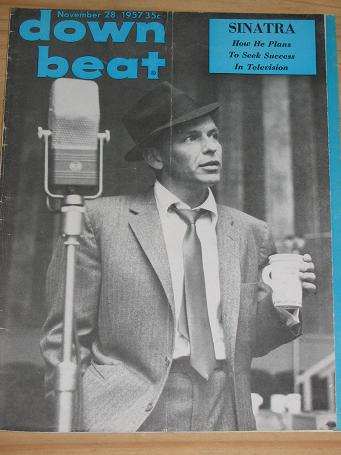
December 1950
[Frank Questioned By A Kefauver Committee Lawyer At 4 A.M.]
Nancy Sinatra: A lawyer for Senator Estes Kefauver's organized-crime committee questioned Sinatra about alleged underworld ties at a meeting held at four in the morning in a Rockefeller Center law office; Sinatra denied knowing any of the men beyond exchanging greetings and was never called to testify.
Source: Nancy Sinatra, Frank Sinatra: An American Legend, 1995.
[Christmas visit and corgi puppy]
Kaplan: Frank flew to Los Angeles for Christmas to see his children and Ava, bringing Ava a Pembroke Welsh corgi puppy they named Rags. The reunion, after three months apart, was tense; an argument erupted over Frank's jealousy about Ava's Show Boat costars and her questions about his own fidelity, ending in shouting and broken dishes before they reconciled.
Source: James Kaplan, "Frank: The Voice" (2010)
[Kefauver Committee convenes]
Kaplan: Tennessee senator Estes Kefauver convened the Special Committee on Organized Crime in Interstate Commerce, holding nationally televised hearings that ran ninety-two days across fourteen cities, featuring mob figures like Frank Costello, Albert Anastasia, and Willie Moretti, and becoming the era's most-watched television event.
Source: James Kaplan, "Frank: The Voice" (2010)
December 2, 1950
Television
The Frank Sinatra Show
Network: CBS
Location: New York City
Script Dated: December 2, 1950
Show: #9
Sponsor: Bulova Watch Company (30mins)
Time: 9:00 P.M.-10:00 P.M.
Writers: Harry Crane
Producer: Jack Donahue
Director: Jack Donahue
Announcer: Ken Roberts
Orchestra Conducted By: Axel Stordahl
Guests: Milton Berle, Toni Arden, Ben Blue and Family, The Whipoorwills
December 3, 1950
Meet Frank Sinatra
Show #6
Network: CBS
Sponsor: Tintair, Ludens
Time: 5:00PM - 6:00PM (EST), Sunday
Producers: Mark Goodson, Bill Todman
Musicians: Graham Forbes and His Quartet
Announcer: Hal Sims
Guest: Georgia Gibbs, Nancy Reed
Notes: Confirmed aired on WCBS
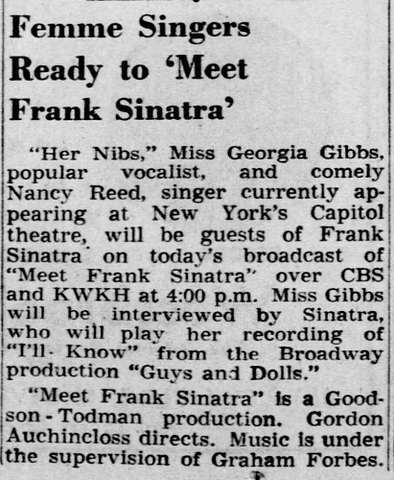
December 6, 1950
Radio
Radio: An episode of Sinatra's radio series Meet Frank Sinatra was broadcast this date. Source: sinatradiscography.com, Radio Transcriptions Database.
December 9, 1950
Television
The Frank Sinatra Show
Network: CBS
Location: New York City
Script Dated: December 9, 1950
Show: #10
Sponsor: Bulova Watch Company (30mins)
Time: 9:00 P.M.-10:00 P.M.
Writers: Hugh Wedlock Jr., Harry Crane, Paul Dudley, Howard Snyder
Producer: Jack Donahue
Director: Jack Donahue
Announcer: Ken Roberts
Orchestra Conducted By: Axel Stordahl( musical director)
Guests: Perry Como, Dolly Sinatra, Jackie Gleason, June Hutton,
Joe Bushkin and his trio, Ben Blue, Sid Fields, Leslie Lyons, Roberta Lee, Pat Gaye, Joey Walsh, The Whipoorwills
Songs:
1. Wrap Your Troubles In Dreams - Frank Sinatra
2. White Christmas Frank Sinatra
3. Nevertheless - Frank Sinatra & Jackie Gleason ( silly skit not a serious duet)
4. When Frances Dances With Me June Hutton
5. Oh! Look At Me Now Frank Sinatra and Joe Bushkin
6. P.S. I Love You Frank Sinatra
7. My Romance Frank Sinatra and June Hutton
8. Strange Music note: After the final song, Gleason tells Frank that there is a guy with a telegram for him. The guy comes out with his hat covering most of his face. Perry Como is the messenger and Jackie, Perry and the audience sing "Happy Birthday" to Frank. Bulova presents him with a deluxe time piece and then Dolly Sinatra wheels out a big birthday cake. "Happy Birthday" is sung again as the credits roll. Ed
December 10, 1950
Radio
Meet Frank Sinatra
Show #7
Network: CBS
Sponsor: Tintair, Ludens
Time: 5:00PM - 6:00PM (EST), Sunday
Producers: Mark Goodson, Bill Todman
Musicians: Graham Forbes and His Quartet
Announcer: Hal Sims
Guest: Joey Adams, Robert Watts
Notes: Confirmed aired on WCBS
December 11, 1950
Studio
New York City
CO44714 Love Means Love w/Rosemary Clooney
(B. Lake/C. Sigman)
ABC Music Corp. (ASCAP) 1950
Arranged & Conducted by Axel Stordahl
-1 (3:02) CD: Columbia Years 43-52 Vol. 13
78: 39141
CO44715 Cherry Pies Ought To Be You w/Rosemary Clooney
(C. Porter)
(from Out Of This World)
Buxton Hill Music Corp. (ASCAP) 1950
Arranged & Conducted by Axel Stordahl
-1 (2:20) CD: Columbia Years 43-52 Vol. 13
78: 39141
Saxes: A. Drelinger, H. Feldman, E. Gershman, N. Mondello, H. Shertzer; Trumpet: C. Griffin; Piano: G. Forbes; Guitar: M. Golizio; Bass: F. Carroll; Drums: J. Blowers
Ed O'Brien reminds us: Frank and June Hutton did a terrific duet of "Cherry Pies Ought To Be You" on the CBS-TV broadcast of 1-20-51.
December 16, 1950
Television
The Frank Sinatra Show
Network: CBS
Location: New York City
Script Dated: December 16, 1950
Show: #11
Sponsor: Bulova Watch Company (30mins)
Time: 9:00 P.M.-10:00 P.M.
Writers: Harry Crane, Hugh Wedlock Jr, Howard Snyder, Paul Dudley
Producer: Jack Donahue
Director: John Peyser
Announcer: Ken Roberts
Orchestra Conducted By: Axel Stordahl
Guests: Phil Silvers, Ben Blue, Sid Fields, Roberta Lee, Leslie Lyons, Pat Gaye
Joey Walsh, The Whipoorwills
1. I Can't Believe You're In Love With Me
2. Sassy Songs w/Style: Bill Bailey Won't You Please Come Home Roberta Lee
3. Skit w/ Phil Silvers -- Songs: Hello Everybody, Hello/ I'm A Goin' Home/ That Old Gang Of Mine/Auld Lang Syne
4. All Of Me
5. Body And Soul simply stunning
6. I've Got My Love To Keep Me Warm
7. There's A Little Male Tail The Whipoorwills
8. I Only Have Eyes For You
The Jack Carter Show
Network: NBC
Time: 8:00 - 9:00 pm.
Guest: Rise Stevens, Connie Sawyer
The Ken Murray Show
Saturday Evening
CBS
8:00 pm - 9:00 pm
Season 2, Episode #30
Host: Ken Murray
Performers: Betty Lou Walters, Darla Hood, Art Lund, Jack Mulhall, Joe Besser, Joe Wong, Laurie Anders, The Enchanters, Tony Labriola
Guests: Penny Singleton, Lawrence Tibbett, Frank Sinatra
Sinatra was a guest on Ken Murray's show which preceded Frank's 9:pm show on CBS. Jack Carter's NBC show had Rise Stevens and Connie Sawyer as guests. --Ed
The Frank Sinatra Show
Variety
12-20-50
--------------------------------------------------
© 1997-2025 The Sinatra Archive
This calendar, or any parts thereof, may not be reproduced in any fashion whatsoever without the prior written permission of the publisher (The Sinatra Archive)
[image referenced in source but could not be recovered]
[image referenced in source but could not be recovered]
The Frank Sinatra Show
Variety
12-20-50
--------------------------------------------------
© 1997-2025 The Sinatra Archive
This calendar, or any parts thereof, may not be reproduced in any fashion whatsoever without the prior written permission of the publisher (The Sinatra Archive)
[image referenced in source but could not be recovered]
[image referenced in source but could not be recovered]
December 17, 1950
Radio
Meet Frank Sinatra
Show #8
Network: CBS
Sponsor: Tintair, Ludens
Time: 5:00PM - 6:00PM (EST), Sunday
Producers: Mark Goodson, Bill Todman
Musicians: Graham Forbes and His Quartet
Announcer: Hal Sims
Guest: Nat King Cole Trio, Bill Farrell
Notes: Confirmed aired on WCBS
<8d7df25.jpg>
Kenny Lucas:
WOW... the Nat King Cole trio appeared on the MFS series I would just love to have this show ....What a great and underrated series that was. Mel Torme,Billy Eckstine,Sarah Vaughan also were guests. The shows were all pre-recorded and not many have turned up. To all members anyone who has copies I am very interested
Ed O'Brien:
Did Frank sing with Mildred Bailey? Ella? Como? Did Errol Garner and/or Jimmy Van Van Heusen back
him on piano? We would love to know. Sarah Vaughan was not a guest. She did appear on his CBS-TV show. He did not sing with Torme or Eckstine. Graham Forbes backed Frank on a number of tunes including "The Music Stopped," "I Couldn't Sleep A Wink Last Night,"
"You'll Never Walk Alone" and "One For My Baby."
Forbes' Quartet backed him on some great swing numbers. A friend of mine knew Forbes. A very nice guy who wanted to establish himself in New York and also had a pregnant wife. Frank needed him on the west coast and Forbes decided to stay in New York. Ken Lane replaced him and then Bill Miller replaced Lane.
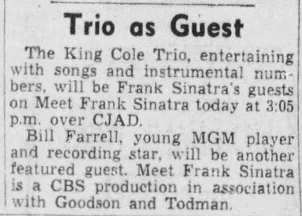
December 20, 1950
Radio
Radio: An episode of Sinatra's radio series Meet Frank Sinatra was broadcast this date, with Sinatra singing "It's A Lovely Day Tomorrow" (live), "Great Day" (live), "Love Means Love" (record), "Begin The Beguine" (record), "You'll Never Walk Alone" (live), "Ciribiribin" (record), "One Finger Melody" (live), "Nevertheless" (live), and "Put Your Dreams Away" (live); this broadcast served as the rehearsal for the December 31, 1950 episode. Source: sinatradiscography.com, Radio Transcriptions Database.
December 23, 1950
Television
Frank Sinatra Show
Netowrk: CBS
Location: New York City
Script Dated: December 23, 1950
Show: #12
Sponsor: Bulova Watch Company (30mins),
Susquehanna Waist Company (15mins, this episode only)
Time: 9:00 P.M.-10:00 P.M.
Writers: Harry Crane
Producer: Jack Donahue
Director: Jack Donahue
Announcer: Ken Roberts
Orchestra Conducted By: Axel Stordahl
Guests: Walter Slezak, Ben Blue, Toni Harper,
Roberta Lee, Sid Fields, Leslie Lyons, Pat Gale, Joey Walsh, The Whipoorwills
1. Jingle Bells - Frank Sinatra
2. Try A Little Tenderness - Frank Sinatra
3. O Come All Ye Faithful - Frank Sinatra
4. Button And Bows - Frank Sinatra & Toni Harper
5. Silent Night - Frank Sinatra
6. I've Got My Love To Keep Me Warm - Frank Sinatra
7. Winter Wonderland - Frank Sinatra
8. Have Yourself A Merry Little Christmas - Frank Sinatra
Notes: Show in circulation. Bulova extends sponsorship of half the show for rest of the season.
Ed O'Brien notes:
Frank sang "Silent Night" with a choral backing.
He also did a wonderful "O' Come All Ye Faithful." The highlight of the show was the closing number
"Have Yourself A Merry Little Christmas." Frank sang it to 13 year old Toni Harper. I would rank this as one of his absolute best Christmas shows. Right up there with the Crosby from 12-20-57.
Frank Sinatra Show
Netowrk: CBS
Location: New York City
Script Dated: December 23, 1950
Show: #12
Sponsor: Bulova Watch Company (30mins),
Susquehanna Waist Company (15mins, this episode only)
Time: 9:00 P.M.-10:00 P.M.
Writers: Harry Crane
Producer: Jack Donahue
Director: Jack Donahue
Announcer: Ken Roberts
Orchestra Conducted By: Axel Stordahl
Guests: Walter Slezak, Ben Blue, Toni Harper,
Roberta Lee, Sid Fields, Leslie Lyons, Pat Gale, Joey Walsh, The Whipoorwills
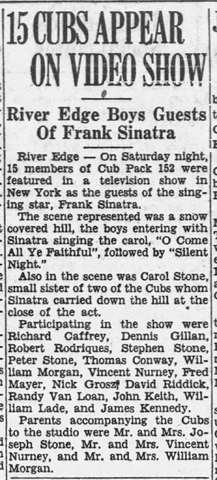
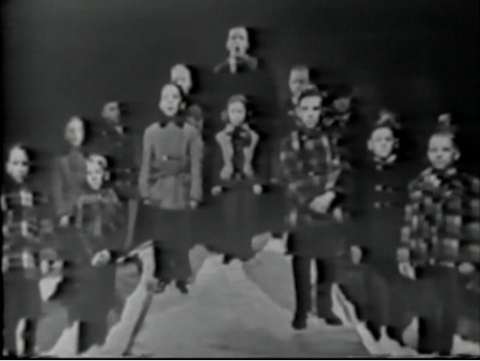
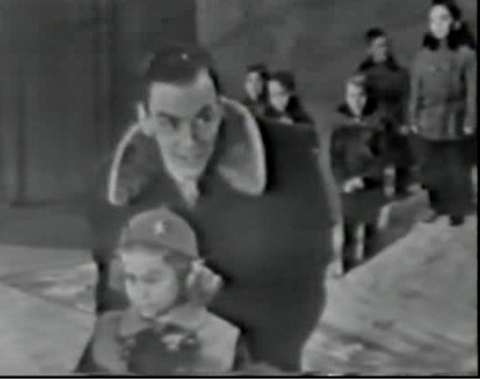
December 24, 1950
Radio
Meet Frank Sinatra
Show #9
Network: CBS
Sponsor: Tintair, Ludens
Time: 5:00PM - 6:00PM (EST), Sunday
Producers: Mark Goodson, Bill Todman
Musicans: Graham Forbes and His Quartet
Announcer: Hal Sims
Writers:
Guest: Lisa Kirk, Russ Emery
Notes: Confirmed aired on WCBS
December 27, 1950
Concerts
Bethesda Naval Hospital, Bethesda, Maryland
Frank Sinatra, Burl Ives, Louis Jordan and others
Bethesda Naval Hospital, Bethesda, Maryland
Frank Sinatra, Burl Ives, Louis Jordan and others
December 30, 1950
Television
The Frank Sinatra Show
Network: CBS
Location: New York City
Script Dated: December 30, 1950
Show: #13
Sponsor: Bulova Watch Company (30mins)
Time: 9:00 P.M.-10:00 P.M.
Writers: Harry Crane
Producer: Jack Donahue
Director: Jack Donahue
Announcer: Ken Roberts
Orchestra Conducted By: Axel Stordahl
Guests: Gary Moore, Georgia Gibbs, Ben Blue and Family, The Whippoorwills
1.. Almost Like Being In Love - Frank Sinatra
2. One Finger Melody - Frank Sinatra w/chorus
3. It's A Lovely Day Tomorrow - Frank Sinatra & Gary Moore
Notes: First half survives on kiniscope. 30 mins.
December 31, 1950
Radio
Meet Frank Sinatra
Show #10
Network: CBS
Sponsor: Tintair, Ludens
Time: 5:00PM - 6:00PM (EST), Sunday
Producers: Mark Goodson, Bill Todman
Musicians: Graham Forbes and His Quartet
Announcer: Hal Sims
Guest: Monica Lewis, Cece Blake
Taping Session - December 20, 1950 70mins..
1. It's A Lovely Day Tomorrow
2. A Great Day
3. Love Means Love
4. Begin The Beguine
5. You'll Never Walk Alone
6. Ciribiribin
7. One Finger Melody
8. Nevertheless
9. Put Your Dreams Away
Notes: Confirmed aired on WCBS
Additional detail from a widely-circulated broadcast recording of this show: Rosemary Clooney and Al Jolson also appeared as guests alongside Monica Lewis and Cece Blake. The recording adds three songs not previously logged for this broadcast — "My Heart Is Out of Town" (with Monica Lewis), "The Best Thing for You" (with Cece Blake), and "I Want a Girl" (with Al Jolson). Source: "Meet Frank Sinatra" (Coffee Tea Or Me Records, radio broadcast recording, CBS, December 31, 1950).
1951
[Ava Recalls Dolly's Baby-Photo Albums In Hoboken]
Nancy Sinatra: On a visit to meet the Sinatra family in Hoboken, Ava Gardner remembered Dolly Sinatra pulling out photo albums full of baby pictures of Frank in elaborate little outfits, mementos Dolly treasured but that mortified her grown son.
Source: Nancy Sinatra, Frank Sinatra: An American Legend, 1995.
[Frank Sinatra and Ava Gardner Marry]
Frank Sinatra and Ava Gardner were married in November 1951, entering a relationship marked from early on by tension between two demanding careers.
Source: Nancy Sinatra, "Frank Sinatra, My Father" (1985).
[Double Dynamite Teams Sinatra With Groucho Marx]
Sinatra's 1951 RKO film "Double Dynamite," costarring Groucho Marx, was originally to be titled "It's Only Money"; it underperformed both critically and financially.
Source: Nancy Sinatra, "Frank Sinatra, My Father" (1985).
[Marriage to Ava Gardner]
Later in 1951, following his divorce, Sinatra married actress Ava Gardner.
Source: Charles Pignone, "Frank Sinatra 100" (2015).
[Separation and Divorce from Nancy]
After a period of separation, Sinatra and his first wife Nancy divorced in 1951.
Source: Charles Pignone, "Frank Sinatra 100" (2015).
[Rehearsing for The Frank Sinatra Show]
A 1951 photo shows Sinatra reviewing a song with the orchestra during rehearsal for an episode of The Frank Sinatra Show.
Source: Charles Pignone, "Frank Sinatra 100" (2015).
[Sinatra's First Las Vegas Appearance at the Desert Inn]
Sinatra made his Las Vegas debut in 1951 at the Desert Inn before later moving his residency to The Sands.
Source: Charles Pignone, "Frank Sinatra 100" (2015).
[Sinatra, Como, and Laine Spoof the Andrews Sisters on CBS]
In 1951, Sinatra appeared alongside Perry Como and Frankie Laine in a comic sketch parodying the Andrews Sisters on CBS's The Frank Sinatra Show.
Source: Charles Pignone, "Frank Sinatra 100" (2015).
[Wedding Day to Ava Gardner]
A photograph in the introduction's collage captures Frank on the day of his wedding to Ava Gardner in 1951.
Source: Charles Pignone, "Frank Sinatra 100" (2015).
['Double Dynamite' released]
Kaplan: Sinatra's other RKO loan-out obligation resulted in Double Dynamite, released in 1951, regarded by Kaplan as even worse than The Miracle of the Bells.
Source: James Kaplan, "Frank: The Voice" (2010)
[Ava and Frank visit Dolly in Hoboken]
Kaplan: After Show Boat test screenings drew raves for Ava, she persuaded Frank to take her to visit his parents Dolly and Marty in Hoboken, whom Frank hadn't spoken to in nearly two years due to Dolly's constant demands for money. Dolly welcomed Ava warmly with a large Italian meal and embarrassed Frank with childhood photo albums; on the drive back, Ava, frustrated by his evasiveness about divorcing Nancy, had the driver stop so she could get out.
Source: James Kaplan, "Frank: The Voice" (2010)
[Ava watches Sinatra's TV show live]
Ava Gardner: Ava attended a live broadcast of The Frank Sinatra Show and was unimpressed by its chaotic production, later recalling stagehands running everywhere and getting "a nervous breakdown just watching."
Source: James Kaplan, "Frank: The Voice" (2010)
[Ava's rising MGM stardom]
Kaplan: As MGM test-screened Show Boat to enthusiastic response cards, Ava's contract came up for renewal with talk of a raise to roughly $1 million a year, news she downplayed to Frank on the phone even as he felt privately belittled by her ascending career against his own decline.
Source: James Kaplan, "Frank: The Voice" (2010)
[Beachcomber club camera confrontation]
Kaplan: During the Acapulco trip, at a club called the Beachcomber, Frank cursed at a photographer who snapped his picture; the Mexican bodyguard provided by their host Jorge Pasquel threatened to shoot the photographer over the camera. Police intervened and gave the camera to Frank, who tore out the film while cursing at the photographer.
Source: James Kaplan, "Frank: The Voice" (2010)
[Beatty marries English peer]
Kaplan: Two years after her first divorce, Adelle became the third American wife of David Beatty, an English war hero and peer, transitioning from Beverly Hills housewife to London peeress.
Source: James Kaplan, "Sinatra: The Chairman" (2015)
[Down Beat pans Sinatra's new records]
Kaplan: Down Beat magazine criticized Sinatra's records "London by Night" and "April in Paris" as poorly sung, saying he sounded tired and bored, even though the recordings dated from the previous fall; Kaplan notes critics were simply kicking Sinatra while he was down.
Source: James Kaplan, "Frank: The Voice" (2010)
[Frank borrows money from Ava for lawyers]
Kaplan: To keep from losing Twin Palms, Frank borrowed the $12,000 he owed his lawyers from Ava, who in turn borrowed it from her agent Charlie Feldman since she didn't have the cash herself. He then signed a new property settlement giving Nancy one-third of his gross income up to $150,000 a year plus 10 percent above that.
Source: James Kaplan, "Frank: The Voice" (2010)
[Frank marries Ava Gardner]
Consiglio: Frank married Ava Gardner in 1951 in a ceremony held at the Philadelphia apartment of his Columbia Records producer and close friend Manie Sachs's brother.
Source: Tony Consiglio (as told to Franz Douskey), "Sinatra and Me: The Very Good Years" (2012)
[Frank's mood at Latin Quarter engagement]
Earl Wilson: Columnist Earl Wilson reported that Frank was the happiest he'd seen him in years, and in wonderful voice, when he opened a one-week engagement at New York's Latin Quarter, crediting Nancy's decision to grant a divorce with putting fresh energy into his singing, especially the love songs.
Source: James Kaplan, "Frank: The Voice" (2010)
[Frank-Nancy divorce settlement terms]
Consiglio: In early 1951, when Frank and his first wife Nancy divorced, he agreed to pay her one-third of his earnings until all three children turned twenty-one. At the time Nancy was about eleven, Frank Jr. was six or seven, and Tina was about three. Consiglio insists Ava Gardner never pushed Frank to leave Nancy.
Source: Tony Consiglio (as told to Franz Douskey), "Sinatra and Me: The Very Good Years" (2012)
[Higher and Higher / Meet Danny Wilson / High Society]
Higher and Higher established the on-screen archetype Sinatra played through his first nine starring roles until 1951's Meet Danny Wilson (a darker variant): a soft-spoken, shy, humble-origin striver rather than a rich man, which let post-WWII middle-class audiences identify with him. Santopietro cites his later role as photographer Mike Connor in High Society as an extension of this everyman-among-the-rich persona.
This film/context matches multiple dated entries in the chronology; the specific date Santopietro is referring to could not be determined with confidence.
Source: Tom Santopietro, "Sinatra in Hollywood" (2008), The Boy Next Door / A Paesano Onscreen
[Holmby Hills house listed for sale]
Kaplan: Without telling Frank, Nancy had already put their Holmby Hills house on the market, priced to sell quickly at $200,000.
Source: James Kaplan, "Frank: The Voice" (2010)
[Honeymoon bills sent to Ava's manager]
Kaplan: Frank had the sizable bill for the chartered Beechcraft and the rest of the honeymoon sent to Ava's financial manager in Los Angeles, since Nancy's settlement had cleaned him out financially.
Source: James Kaplan, "Frank: The Voice" (2010)
[Johnnie Ray's Cry becomes a sensation]
Kaplan: Singer Johnnie Ray, previously unknown, became a sensation in late 1951 with his million-selling single "Cry" on Columbia's Okeh label, his theatrical, sob-singing style capturing the public in a way that overshadowed older stars like Sinatra and Bing Crosby.
Source: James Kaplan, "Frank: The Voice" (2010)
[Kefauver photos of Sinatra and Luciano]
Joseph Nellis: During the investigation, Kefauver handed committee lawyer Joseph Nellis a set of photographs showing Sinatra with Lucky Luciano in Havana, prompting Kefauver to push for Sinatra's public testimony about his underworld ties.
Source: James Kaplan, "Frank: The Voice" (2010)
[Law firm sues Sinatra for unpaid fees]
Kaplan: While Frank was in New York rehearsing for his TV show, the Los Angeles law firm representing him in the divorce sued him for $12,250 in unpaid fees and placed liens on both the already-levied 177 South Robertson building and his home, Twin Palms.
Source: James Kaplan, "Frank: The Voice" (2010)
[Meet Danny Wilson's somber tone unnoticed]
Kaplan: Three years later, in Meet Danny Wilson, Sinatra attempted a somber, more dramatic tone, but the picture came and went too quickly for audiences to take notice.
Source: James Kaplan, "Frank: The Voice" (2010)
[Nancy explains divorce to Louella Parsons]
Nancy Sinatra: A few days after her public announcement, Nancy told columnist Louella Parsons that she'd tried to hold her home together for the children and out of love for Frank, but once she realized he truly wanted to marry someone else, she had her lawyer contact his. She said she now believed divorce was the only path to happiness for both of them.
Source: James Kaplan, "Frank: The Voice" (2010)
[Nancy levies Sinatra's office building]
Kaplan: With his Riverside and Desert Inn paychecks going directly to Nancy, Frank was left with barely $400. Knowing this, Nancy had her lawyer obtain a legal levy against Frank's office building at 177 South Robertson.
Source: James Kaplan, "Frank: The Voice" (2010)
[Nellis warns Humphrey about Sinatra]
Joseph Nellis: Joseph Nellis, who as a young Kefauver Committee attorney had taken a secret 1951 deposition from Sinatra on his Mob ties, wrote Humphrey a private memo warning that little had changed, citing Frank's May 1968 Washington visit with Allen Dorfman.
Source: James Kaplan, "Sinatra: The Chairman" (2015)
[Press agent urges Sinatra to woo the media]
Kaplan: After relocating to Hollywood, Frank's new West Coast press agent Mack Millar told him he needed to aggressively end his feud with the press. Millar suggested Frank call New York Post writer Fern Marja, who was preparing a six-part series on him, and charm her.
Source: James Kaplan, "Frank: The Voice" (2010)
[Priests and children visit Sinatra on set]
Shelley Winters: Winters recalled that during filming, Frank's young children and a priest from the Catholic Family Counseling Service would visit the set; on those afternoons Frank was so distracted and disturbed by the ongoing divorce proceedings that he could not focus on his work with anyone, including director Joe Pevney.
Source: James Kaplan, "Frank: The Voice" (2010)
[Riddle becomes Nat Cole's music director]
Kaplan: By late 1951, Nelson Riddle had become Nat 'King' Cole's musical director, a role that led to freelance arranging work for Billy Eckstine, Kate Smith, and Mel Tormé, though he was still considered a relative newcomer when Livingston and Gilmore brought him to Sinatra in 1953.
Source: James Kaplan, "Frank: The Voice" (2010)
[Sam Spiegel produces The African Queen]
Kaplan: Producer Sam Spiegel (an operator with a murky past, having fled Nazi Germany and adopted the alias S.P. Eagle after arriving in Hollywood illegally in the late 1930s) produced The African Queen with John Huston directing and Bogart and Hepburn starring; Bogart won the Best Actor Oscar. This success fueled Spiegel's aggressive pursuit of Sinatra for On the Waterfront.
Source: James Kaplan, "Frank: The Voice" (2010)
[Show Boat premiere and radio show ends]
Kaplan: Midway through the Meet Danny Wilson shoot, Sinatra attended the Hollywood premiere of Show Boat with Ava Gardner, and a few days later his radio program Meet Frank Sinatra, which he'd been broadcasting from Los Angeles, came to the end of its run.
Source: James Kaplan, "Frank: The Voice" (2010)
[Sinatra and Winters brawl at Burbank Airport]
Shelley Winters: During overnight filming of Meet Danny Wilson's penultimate scene at Burbank Airport, Frank and Winters got into a vicious shouting match, trading crude insults about each other's backgrounds. Winters recalled that at about 3 a.m. Frank flew into a rage and she screamed and may have hit him; he did not strike back, instead storming off to his limousine.
Source: James Kaplan, "Frank: The Voice" (2010)
[Sinatra becomes obsessed with playing Maggio]
Kaplan: By late 1951, having read and reread the Maggio sections of From Here to Eternity, Frank became obsessed with landing the role, telling everyone around him that it was exactly the part he needed to turn his career around, despite being an unlikely candidate for the casting.
Source: James Kaplan, "Frank: The Voice" (2010)
[Sinatra courts reporter Fern Marja]
Frank Sinatra: Frank phoned Fern Marja and, over an hour, admitted he had sometimes lost his temper and mistreated the press under stress, expressing regret. His change of tone helped win over the initially skeptical Marja, and the resulting New York Post series ran under the title "The Angry Voice."
Source: James Kaplan, "Frank: The Voice" (2010)
[Sinatra first meets George Jacobs]
George Jacobs: Sinatra first met George Jacobs, then a chauffeur for agent Irving 'Swifty' Lazar, outside a Hollywood party in the summer of 1951, during Sinatra's career slump. After Jacobs asked him for a cigarette, Sinatra emerged from the party with a whole gold bowl of them and insisted Jacobs keep it.
Source: James Kaplan, "Frank: The Voice" (2010)
[Sinatra reads From Here to Eternity]
Kaplan: When Sinatra first read James Jones's novel in late 1951, he was at a personal and professional low: his records weren't selling, he had vocal and financial troubles, the IRS was after him, and he was being publicly vilified for leaving his wife and three children for Ava Gardner.
Source: James Kaplan, "Sinatra: The Chairman" (2015)
[Sinatra strikes photographer with car]
Kaplan: Upon Frank and Ava's return from Mexico, a KTTV cameraman shone a spotlight at their Cadillac, infuriating Sinatra, who reportedly swerved the car and struck photographer William Eccles with the fender while shouting threats. Eccles filed a criminal complaint but withdrew it after receiving a letter of apology allegedly written by Frank.
Source: James Kaplan, "Frank: The Voice" (2010)
[Skinny D'Amato revives Sinatra's confidence]
Skinny D'Amato, via Jonathan Van Meter: Booking Sinatra at the 500 Club over Labor Day 1951 at his top rate during his career slump, Skinny D'Amato gave him a gold watch before his first show, telling him: 'Don't ever think you're down-and-out, pal. This is to remind you that when you come back you're going to be bigger than ever.' The engagement was a smash.
Source: James Kaplan, "Sinatra: The Chairman" (2015)
[Studio head pleads with Winters]
Leo Spitz: Production head Leo Spitz asked Shelley Winters to have sympathy for Frank, explaining that he was going through a terrible period in his life and career, losing his voice at times out of terror, and asking her to draw on her liberal ideals to understand his behavior.
Source: James Kaplan, "Frank: The Voice" (2010)
[TV show loses sponsor, moves timeslot]
Kaplan: Bulova pulled out as sponsor of The Frank Sinatra Show; the only replacement CBS could find was housewares company Ekco, for just the first fifteen minutes. CBS also moved the show from Saturday to Tuesday nights, pitting it directly against Milton Berle's Texaco Star Theater.
Source: James Kaplan, "Frank: The Voice" (2010)
[TV show relocated to Los Angeles]
Kaplan: At Sinatra's request, CBS agreed to relocate broadcasts of The Frank Sinatra Show to Los Angeles, hoping a change of venue might revive the struggling program.
Source: James Kaplan, "Frank: The Voice" (2010)
[The Frank Sinatra Show (CBS TV)]
Frank Sinatra: On the February 3, 1951 telecast of his CBS show, amid his affair with Ava Gardner but not yet divorced from Nancy, Sinatra was asked by guest June Hutton (wife of Axel Stordahl) who would get his valentine that year; he grinned and quipped 'Bulova, of course' (his sponsor), then added 'Fooled you!'
No corresponding dated entry could be identified in the chronology for this film/context.
Source: Tom Santopietro, "Sinatra in Hollywood" (2008), All Over the Map
[Universal signs Sinatra for Meet Danny Wilson]
Kaplan: Screenwriter Don McGuire pitched Sinatra a hard-edged story about a saloon singer boosted by the mob, titled Meet Danny Wilson. Henry Jaffe sold the script and Sinatra as star to Universal International for a flat fee of only $25,000, a sign of how far his bargaining power had fallen.
Source: James Kaplan, "Frank: The Voice" (2010)
[Willie Moretti's murder]
Kaplan: Sinatra's mob patron Willie Moretti was killed in 1951, likely for being too forthcoming with the Kefauver Committee and/or for welshing on sports bets.
Source: James Kaplan, "Sinatra: The Chairman" (2015)
[Winters walks off set, Nancy pleads]
Nancy Sinatra: After Frank improvised insulting dialogue during a take and Winters hit him with a bedpan and stormed home, she stayed away for two days until Nancy Sinatra called her in tears, saying that if Frank didn't get his $25,000 fee for the picture the bank might foreclose on their house and the children would be homeless. Winters returned and finished the film.
Source: James Kaplan, "Frank: The Voice" (2010)
[personal life]
Nancy Sinatra finally granted Frank a divorce, finalized November 1, 1951, after twelve years of marriage; the settlement gave her a third of his gross annual income up to $130,000 and 10 percent above that.
No corresponding dated entry could be identified in the chronology for this film/context.
Source: Tom Santopietro, "Sinatra in Hollywood" (2008), Ava and the Downfall / The Comeback
[personal life/career reflection]
Frank Sinatra: Sinatra rarely discussed his early-1950s nadir; in his 1956 Person to Person TV interview with Edward R. Murrow he called it only a "dark period," and by the 1965 recording A Man and His Music he could joke that "my voice ran away from home and my records started selling like used Edsels."
No corresponding dated entry could be identified in the chronology for this film/context.
Source: Tom Santopietro, "Sinatra in Hollywood" (2008), Ava and the Downfall / The Comeback
[Ava's rumored Spanish fling with bullfighter-actor Mario Cabre]
While Ava filmed Pandora and the Flying Dutchman in Spain, rumors circulated of an on-set affair with actor Mario Cabre, who played a bullfighter in the film and later wrote a poem about her, published in 1951. Ava maintained they had slept together only once.
Source: Richard Havers, "Sinatra" (Dorling Kindersley, 2007).
[Billboard reports Frank won't renew Columbia contract]
Billboard reported that Frank had no intention of renewing his Columbia recording contract, due to expire in December 1952, citing a long-simmering feud with Mitch Miller over unfair treatment on song material. The piece noted Frank was in talks with both RCA and Capitol, though his old friend Manie Sacks likely already knew RCA wasn't interested in signing him.
Source: Richard Havers, "Sinatra" (Dorling Kindersley, 2007).
[Double Dynamite released; Hughes suspected of campaign against Frank]
Double Dynamite finally reached US cinemas in December, a mediocre film largely forgotten except by Sinatra completists, with Frank left off the poster entirely. Ava believed Howard Hughes, resentful over her relationship with Frank, was behind a spiteful letter sent to her hotel on the eve of their wedding from a woman falsely claiming an affair with Frank.
Source: Richard Havers, "Sinatra" (Dorling Kindersley, 2007).
[Frank finishes a distant second to Billy Eckstine in Downbeat poll]
In Downbeat magazine's 1951 year-end reader poll, Frank managed only 276 votes, placing a distant second behind Billy Eckstine's 1,354, a stark measure of how far his popularity had fallen from his mid-1940s peak.
Source: Richard Havers, "Sinatra" (Dorling Kindersley, 2007).
[Frank meets pianist Bill Miller, beginning lifelong partnership]
Frank met pianist Bill Miller, who was leading a trio in a Las Vegas lounge, after Jimmy Van Heusen pointed Frank toward him. Hank Sanicola then recruited Miller to work on Frank's TV show, launching what would become one of the most enduring musical relationships of Frank's career.
Source: Richard Havers, "Sinatra" (Dorling Kindersley, 2007).
[Howard Hughes delays release of Double Dynamite]
RKO's major shareholder Howard Hughes personally decided to postpone the release of Double Dynamite, so the film did not reach audiences until 1951.
Source: Richard Havers, "Sinatra" (Dorling Kindersley, 2007).
[Nelson Riddle's earliest Sinatra-family connection]
According to Peter Levinson's biography of Nelson Riddle, Riddle wrote arrangements for Frank's cousin, bandleader Ray Sinatra, as early as late 1951, including a version of "Ciribiribin." This predated his famous work with Frank himself.
Source: Richard Havers, "Sinatra" (Dorling Kindersley, 2007).
[Sammy Davis Jr. spots an unrecognized Frank in Times Square]
Sammy Davis Jr. recalled seeing Frank walking alone through Times Square during his career slump, with no one bothering him or seeming to recognize him at all. Davis felt so sad for Frank that he avoided approaching him to spare him the embarrassment.
Source: Richard Havers, "Sinatra" (Dorling Kindersley, 2007).
[Vic Damone signs MGM movie contract, then drafted]
MGM signed Vic Damone to a film contract in 1951, and his first appearance was in the musical Rich, Young, and Pretty. He was called up for military service soon after.
Source: Richard Havers, "Sinatra" (Dorling Kindersley, 2007).
[Mama Will Bark -- critical commentary]
Mitch Miller; Chris Griffin; Frank Sinatra: Growing out of Sinatra's on-stage chemistry with TV personality Dagmar at the Paramount Theater and on his CBS variety show, 'Mama Will Bark' became Sinatra's most infamous record. Miller recalled pitching the novelty: 'nobody brings Sinatra in the studio [to do something] that he doesn't want to do... he had the right to approve the release.' He paired it on the flip side with 'I'm a Fool to Want You' to help sales. Trumpeter Chris Griffin, who played the date, said: 'Frank probably thought Mitch was kidding when he brought that thing in, but that's the kind of song Mitch thought was really great!' The record featured dog-howl sound effects by Donald Bain and a Joyce Kilmer reference. It reached only #21 -- not a flop, contra legend, but not a hit either. Friedwald notes Sinatra's own famous later verdict: 'The only good it did me was with dogs.'
Source: Will Friedwald, "Sinatra! The Song Is You: A Singer's Art" (2018 revised edition), Ch. 5, "In-Between Years" (1948-1953)
[Rag Mop -- critical commentary]
Friedwald (analysis): A surviving 20-minute shortwave broadcast for French radio from the Paramount Theater (January 1951, Joe Bushkin leading the band) captures Sinatra's first duet with Dagmar, on the 1949 R&B hit 'Rag Mop,' fitted with goofy new lyrics apparently by Sammy Cahn ('You're an exquisite flower / Built like the Eiffel Tower... You'd frighten Eisenhower!'). The same broadcast includes Sinatra introducing 'April in Paris' as 'a great Axel Stordahl arrangement.'
Source: Will Friedwald, "Sinatra! The Song Is You: A Singer's Art" (2018 revised edition), Ch. 5, "In-Between Years" (1948-1953)
[The Roving Kind / My Heart Cries for You -- critical commentary]
Mitch Miller: Mitch Miller recalled preparing arrangements of 'The Roving Kind' and 'My Heart Cries for You' for Sinatra ahead of a scheduled 1951 session, but Sinatra rejected them outright on arrival at the airport before heading to Europe to see Ava Gardner. To save the booked session, Miller rushed newcomer Al Cernick (soon rebranded Guy Mitchell) in to record both songs instead, and both became number-one hits -- which Miller cited as proof Sinatra's declining commercial standing at the time, not the songs themselves, was the real problem.
Source: Charles L. Granata, "Sessions with Sinatra: Frank Sinatra and the Art of Recording" (1999/2003), Part II: The Columbia Years, 1943-1952
[personnel -- critical commentary]
Sinatra discovered pianist Bill Miller performing in the lounge of the Desert Inn in Las Vegas in 1951, hired him, and Miller followed him from the final Columbia dates to Capitol, remaining Sinatra's pianist and musical confidant from 1951 until Sinatra's death in 1998 (apart from a brief falling-out in the late 1970s).
Source: Charles L. Granata, "Sessions with Sinatra: Frank Sinatra and the Art of Recording" (1999/2003), Part III: The Capitol Years, 1953-1962
[personnel/reflection -- critical commentary]
Tony Bennett: Tony Bennett, who joined Columbia in 1951, negotiated to record some Miller-favored numbers only if allowed to also record better songs with jazz backings he preferred, and later reflected that Miller (a former top classical oboist) essentially invented the modern record-producer role, prioritizing money over pure musical merit.
Source: Charles L. Granata, "Sessions with Sinatra: Frank Sinatra and the Art of Recording" (1999/2003), Part II: The Columbia Years, 1943-1952
[reception/myth-busting -- critical commentary]
Granata, drawing on his work as co-producer of the Columbia Sinatra CD reissues and direct audition of the vault session discs and tapes, states there is no evidence for the persistent claim that Columbia engineers deliberately sabotaged sound quality on Sinatra's late (1951-52) sessions to discredit him -- all his Columbia vocal recordings are of uniformly high quality.
Source: Charles L. Granata, "Sessions with Sinatra: Frank Sinatra and the Art of Recording" (1999/2003), Part II: The Columbia Years, 1943-1952
January 1951
["We like Eddie Fisher" heckle]
Kaplan: One night walking into the Columbia studios, Sinatra was recognized by a group of teenage girls who giggled and chanted "We like Eddie Fisher!" instead of cheering for him. A deflated Frank could only reply, "I do, too."
Source: James Kaplan, "Frank: The Voice" (2010)
January 3, 1951
Radio
Radio: An episode of Sinatra's radio series Meet Frank Sinatra was broadcast this date, with Sinatra singing "'S Wonderful," "It's Been A Long, Long Time," "I Don't Want To Walk Without You," "Papa, Won't You Dance With Me," "Time After Time," "One For My Baby," "The Moon Was Yellow," and "Put Your Dreams Away"; this broadcast served as the rehearsal for the January 21, 1951 episode. Source: sinatradiscography.com, Radio Transcriptions Database.
January 6, 1951
Television
The Frank Sinatra Show
Network: CBS
Location: New York City
Script Dated: January 6, 1950 (indicates Jackie Gleason)
Show: #14
Sponsor: Bulova Watch Company (30mins)
Time: 9:00 P.M.-10:00 P.M.
Writers: Harry Crane
Producer: Jack Donahue
Director: Jack Donahue
Announcer: Ken Roberts
Orchestra Conducted By: Axel Stordahl
Guests: June Hutton, Buster West, Ben Blue and Family, The Heathertones, The Whipoorwills

January 7, 1951
Radio
Meet Frank Sinatra
Guest: Eileen Barton
note: First show with 45 minute running time. Last 15 minutes of the hour had "News with Eric Sevareld"
January
7, 1951 Meet Frank Sinatra
Taped December 27, 1950
Show
#11
Network: CBS
Sunday
5 P.M - 5:45 P.M. EST
Sponsor: Tintair - Luden's Cough Drops
Musicians: Graham Forbes and His
Quartet
Announcer: Hal Sims
Writers: Paul Dudley
Guest: Eileen Barton
Notes:
First show with the new 45 minute format. Last 15 minutes of the hour have "News with Eric Sevareid"
\
Producers:
Mark Goodson, Bill Todman
January 13, 1951
Television
The Frank Sinatra Show
Network: CBS
Location: New York City
Script Dated: January 13, 1951 (indictates Jackie Gleason)
Show: #15
Sponsor: Bulova Watch Company (30mins)
Time: 9:00 P.M.-10:00 P.M.
Writers: Harry Crane
Producer: Jack Donahue
Director: Jack Donahue
Announcer: Ken Roberts
Orchestra Conducted By: Axel Stordahl
Guests: Jackie Gleason, June Hutton, Buster West, Tato & Julia (dancers), The Heathertones
Note: Ben Blue decided to leave Sinatra's show and Frank asked William Paley to get Jackie out of his contract with DuMont. Frank and Jackie had become close friends and The Great One was such a plus to Frank's show. Eventually, Gleason would jump to CBS (1952). By then Frankie's show was history.
--Ed
The Frank Sinatra Show
Variety
1-17-51
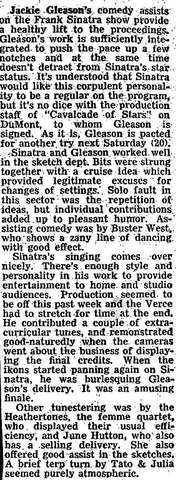
January 14, 1951
Radio
Meet Frank Sinatra
Show #12
Network: CBS
Sponsor: Tintair, Ludens
Time: 5:00PM - 5:45PM (EST), Sunday
Producers: Mark Goodson, Bill Todman
Musicians: Graham Forbes and His Quartet
Announcer: Hal Sims
Writers:
Guest: Percy Faith, Pat Terry
1. A Marshmallow World
Notes: Confirmed aired on WCBS, Song title not confirmed for this date.

January 16, 1951
Studio
New York City
CO45111 Faithful w/The Skylarks
(J. Kennedy/A. Stone)
ABC Music Corp. (ASCAP) 1951
Arranged by George Siravo
Conducted by Axel Stordahl
-1 (3:13) CD: Columbia Years 43-52 Vol. 12
78: 39213
CO45112 You're The One w/The Skylarks & piano solo by Stan Freeman
(V. Young/N. Washington)
Barton Music Corp. (ASCAP) 1951
Arranged & Conducted by Axel Stordahl
-1 (3:02) CD: Columbia Years 43-52 Vol. 12
LP: CL-2741 The Essential Frank Sinatra, Vol. 3
78: 39213
CO45113 There's Something Missing w/The Skylarks
(J. Rule/R. O'Brien/B. Benjamin/G. Weiss/M. Downe))
Barton Music Corp. (ASCAP) 1950
Arranged by George Siravo
Conducted by Axel Stordahl
-1 (3:18) CD: Columbia Years 43-52 Vol.. 12
Violins: J. Brand, H. Katzman, M. Lomask, R. Lynch, G. Ockner; Harp: E.
Vito; French Horn: D. Rattner; Saxes: E. Brown, A. Drelinger, M. Gershman, B. Kaufman, H. Shertzer; Trumpets: T. Faso, D. McMickle, J. Owens;
Trombones: G. Arus, L. McGarity, W. Rausch; Piano: S. Freeman; Guitar: M.
Golizio; Bass: F. Carroll; Drums: J. Blowers
Texaco Star Theatre
Milton Berle, Martha Raye, Perry Como
A boxed marked "The Thing" is opened and Frank Sinatra steps out
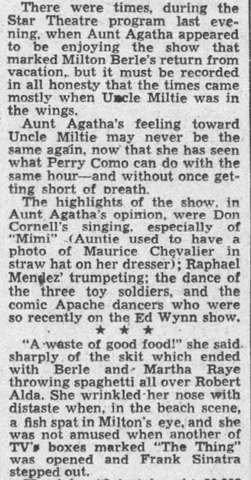
January 20, 1951
Television
The Frank Sinatra Show
Network: CBS
Location: New York City
Script Dated:
Show: #16
Sponsor: Bulova Watch Company (30mins)
Time: 9:00 P.M.-10:00 P.M.
Writers:
Producer: Jack Donahue
Director: Jack Donahue
Announcer: Ken Roberts
Orchestra Conducted By: Axel Stordahl
Guests: Laraine Day, Leo Durocher, Phil Foster, June Hutton, Buster West, Heathertones
1. Cherry Pies Ought To Be You - Frank Sinatra & June Hutton
2. Ol' Man Crosby (parody) - Frank Sinatra
January 21, 1951
Radio
Meet Frank Sinatra
Show #13
Network: CBS
Sponsor: Tintair, Ludens
Time: 5:00PM - 5:45PM (EST), Sunday
Producers: Mark Goodson, Bill Todman
Musicians: Graham Forbes and His Quartet
Announcer: Hal Sims
Writers:
Guest: Kay Armen, Ralph Young
Notes: Confirmed aired on WCBS
note: The producer of this series was Gordon Auchincloss. One writer was Paul Dudley. Auchincloss would go on to produce and direct Perfectly Frank and Bob Smith, of Howdy Doody fame, would be the writer.
I got this from Old Time Radio Research.
--Ed
note: Show was taped on 1-3-51 in N.Y.C.
There was roughly a two and a half week time difference between the Wednesday taping and the Sunday broadcast. On some of them another day of taping was required on Thursday.
Ed
January 22, 1951
Television
Perry Como Show
Network: CBS
Sponsor: Chesterfield
Time:
1. opening
2. Blue Skies - Frank Sinatra
3. commercial
4. Tennessee Waltz - Fontane Sisters
5. Sweet Potato Polka - Patato Bugs & Galina Talva
6. commercial
7. I Am Loved - Frank Sinatra
8. closing
Note: Sinatra filled in for Perry Como. TT: 15mins.
Perry Como Show
Network: CBS
Sponsor: Chesterfield
Time:
1. opening
2. Blue Skies - Frank Sinatra
3. commercial
4. Tennessee Waltz - Fontane Sisters
5. Sweet Potato Polka - Patato Bugs & Galina Talva
6. commercial
7. I Am Loved - Frank Sinatra
8. closing
Note: Sinatra filled in for Perry Como. TT: 15mins.
[image referenced in source but could not be recovered]
January 24, 1951
Radio
Meet Frank Sinatra
Announcer: Hal Sims
Producers: Mark Goodson, Bill Todman
Performers: Frank Sinatra
1. I Don't Want To Walk Without You Baby
2. If
3. It's Been A Long Long Time
4. The Moon Was Yellow
5. One For My Baby
6. Papa Won't You Dance With Me
7. Put Your Dreams Away
8. S' Wonderful
9.. There's Something Missing
10..Time After Time
Ed noted:
This is the show with Jule Styne.
Frank sang a medley of Jule's songs and
Jule backed him on the piano. I mentioned this to Jonathan Schwartz some time ago and we discussed what a wonderful concept it would have been if he had done more with the great lyricists and composers.
He did hook up with Irving Berlin, Johnny
Mercer, Harold Arlen and Styne but what a memorable series he could have done with Cole Porter,
Cahn & Van Heusen, Yip Harburg, Ira Gershwin,
Burton Lane,Richard Rodgers,Schwartz & Dietz and many more
Show was taped on 1-24 and aired on 2-11-51
Meet Frank Sinatra
Announcer: Hal Sims
Producers: Mark Goodson, Bill Todman
Performers: Frank Sinatra
1. I Don't Want To Walk Without You Baby
2. If
3. It's Been A Long Long Time
4. The Moon Was Yellow
5. One For My Baby
6. Papa Won't You Dance With Me
7. Put Your Dreams Away
8. S' Wonderful
9.. There's Something Missing
10..Time After Time
February 11, 1951
Network: CBS
Script: January 24, 1951
Sponsor: Tintair, Ludens
Time: 5:00PM - 5:45PM (EST), Sunday
Producers: Mark Goodson, Bill Todman
Musicans: Graham Forbes and His Quartet
Announcer: Hal Sims
Writers: Harry Crane
Guest: Jules Styne, Lynn Burton
1.. 'S Wonderful - w/Graham Forbes and His Quartet
2. chat/intro/talk w/Jule Styne
3. medley w/ Jule Styne (piano): It's Been A Long,
Long Time / I Don't Want To Walk Without
You / Papa, Won't You Dance With Me
4. Time After Time - w/Jule Styne (piano)
5. comedy/patter with audience]
6. If - w/Graham Forbes (piano)
7. into/talk w/ Lynn Burton
8. Bye Bye Baby - Lynn Burton
9. One For My Baby - w/Graham Forbes (piano)
10. The Moon Was Yellow
11. There;s Something Missing (Columbia Recording)
12. Put Your Dreams Away
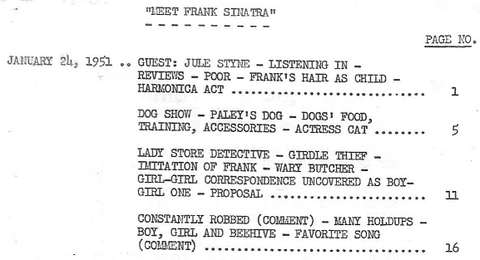
January 25, 1951
Concerts
The Click Club, Philadelphia, PA (One Nighter)
The Click Club, Philadelphia, PA (One Nighter)
---------------------------------------
DOWNBEAT
JANUARY 25, 1955
note: A film that never happened. Interesting to read. Armstrong entry on the page is a little late in the game. Doris Day was planning big things way back in 55.
Ed
[image referenced in source but could not be recovered]
[image referenced in source but could not be recovered]
[image referenced in source but could not be recovered]
January 26, 1951
Concerts
South Side High School, Rockville Centre, New York
Benefit for Mercy Hospital
South Side High School, Rockville Centre, New York
Benefit for Mercy Hospital
When Ol' Blue Eyes came to RVC
Long Island Herald
Posted January 20, 2016
Early in his career, Frank Sinatra performed a concert in Rockville Centre as part of a benefit for Mercy Hospital. Not many people remember the show, though.
By Rebecca Melnitsky
Last month would have been Frank Sinatra's 100th birthday. This Tuesday is the 65th anniversary of the time Ol' Blue Eyes sang in Rockville Centre.
On Jan. 26, 1951, Sinatra sang at South Side High School - which is now South Side Middle School - at a benefit for Mercy Hospital - which is now Mercy Medical Center.
According to a preview story in the Rockville Centre News & Owl, the benefit was to raise funds for a $5,000 pharmacy at the hospital. "[Mercy Hospital] has announced that the much needed pharmacy room will be dedicated as a memorial to the Long Island Rail Road disaster victims," said the story in the Jan. 19, 1951 issue. "Frank Sinatra and other stars from his hit TV show will appear in person at the benefit..."
The "Long Island Rail Road disaster" refers to 11 months earlier when two trains collided head-on on the Rockville Centre tracks, killing 29 people and injuring 115. The "hit TV show" was the "The Frank Sinatra Show" on CBS, a musical-variety series that lasted two seasons. It was not really a hit, as it lasted two seasons and Sinatra's career was still in the transitional period from a teen idol to Rat Pack star. He was also in the middle of a divorce from his first wife, Nancy Barbato, after he cheated on her with Ava Gardner - a major scandal at the time.
Joseph Papalia, 79, a lifelong Rockville Centre resident, remembers the concert. He and a few friends went to South Side High School to hear Sinatra perform that evening. Papalia, who was 15 at the time, did not go see the concert in person, although he could hear the music from outside.
After the concert, Papalia saw Sinatra pushing a tray in the school's kitchen and to get something to eat. As Sinatra walked back to his limousine, he spoke to Papalia and asked how to get to the Southern State Parkway.
"I gave him such screwed up directions," said Papalia. "If he had followed them he would have ended up in Montauk." Nevertheless, Sinatra was, according to Papalia, well dressed, very nice and very gracious.
The Herald reached out to senior citizens, Mercy Medical Center, the Rockville Centre Library and the Rockville Centre School District, but no one else could recall the concert, and no other records were found.
There are very few records of it - only two mentions in the News & Owl and one in the Brooklyn Daily Eagle. Frank Sinatra was mentioned in the headline of one of these articles, and the only photograph that ran with any of them was a picture of singer and actress Kay Armen, who also performed at the benefit.
Papalia and his group also saw her as she left South Side High School. "Kay Armen smiled at us," he said. "You're just a little kid. If a big pretty woman gives you a big smile you remember that."
----------------------------------------------
© 1997-2026 The Sinatra Archive
This calendar, or any parts thereof, may not be reproduced in any fashion whatsoever without the prior written permission of the publisher (The Sinatra Archive)
[image referenced in source but could not be recovered]
[image referenced in source but could not be recovered]
January 27, 1951
Television
Frank Sinatra Show
Network: CBS
Location: New York City
Script Dated:
Show: #17
Sponsor: Bulova Watch Company (30mins)
Time: 9:00 P.M.-10:00 P.M.
Writers:
Producer: Marlo Lewis
Director: Jack Donahue
Announcer: Ken Roberts
Orchestra Conducted By: Axel Stordahl
Guests: Phil Silvers, June Hutton, Jack Goode, Ollie Frank, Harold Stone, Muriel Landers
1. There'll Be Some Changes Made - Frank Sinatra
2. Let's Take An Old Fashioned Walk - Frank Sinatra & June Hutton
3. Mary's It's A Grand Old Name - Frank Sinatra
4. There's No Business Like Show Business - Frank Sinatra
5. I'm Always Chasing Rainbows - Frank Sinatra
6. They Didn't Believe Me - Frank Sinatra
Notes: Show in circulation
NOTE: Sinatra Scholar Ed O'Brien observes that it has been conventional wisdom for lo these many years that Sinatra lost his voice in the early Fifties. This show is a prime example of how a misconception can become the accepted truth if repeated often enough. Sinatra is in marvelous voice throughout the hour long show. The singing on the three songs above (none of them ever recorded by Sinatra) is simply splendid. He portrays a bartender closing up shop as he sings a very sad rendition of "I'm Always Chasing Rainbows." If you have ever heard his wonderful reading of the Kern-Reynolds classic "They Didn't Believe Me," it leaves one wondering why there was never a recording attempted.
Here us a brief history if this wonderful gem:
When Julia Danderson and Donald Brian introduced Kern's "They Didn't Believe Me" in the Broadway show "The Girl from Utah ," they became one of the most popular stage duos of their time. Kern and Reynolds had added uncredited songs to previous imports. This time they demanded and got full program credit. Their delightful "They Didn't Believe Me" marked a turning point in the development of popular music. The melody defies time. Forthright sentiment meets refined romance, and the resulting sound pointed to the Broadway musical's future. Rejecting the flowery poetry found in most period love songs, the lyric captured the easy cadence of everyday conversation.
When I told them
How beautiful you are
They didn't believe me,
They didn't believe me.
Your lips, your eyes, your curly hair
Are in a class beyond compare
You're the loveliest girl
That one could see.
And when I tell them,
(And I certainly am going to tell them)
That I'm the man
Whose wifeibe day you'll be,
They'll never believe me,
They'll never believe me,
That from this great big world
You've chosen me.
What wonderful sentiment, O'Brien insists. And Frank makes "There'll Be Some Changes Made" his own with the reading from the January 27, 1951 show. His very close friend Phil Silvers was a guest, as he was on many of the CBS shows from 50-52. The show was broadcast live so there were no redos on any of the tunes. Frank got it right the first time week after week!
Scott Henderson:
I watched his 1951 show yesterday. The audience sure cheered when he went to sing "They Didn't Believe Me" on his TV Show. Must have been a really popular tune. I got a kick out of June Hutton flaunting that she had married Axel Stordahl over the weekend. Seemed like an unlikely pairing. Didn't June Hutton die, like in her 50s?
Ed O'Brien:
Hutton died in 1973. She was 52.
Frank had her on his radio and TV shows, plus she played theatre engagements with him and was on a number of recording sessions. Stordahl died in 1963, so June outlived him by a decade.
January 28, 1951
Radio
Meet Frank Sinatra
Show #14
Network: CBS
Sponsor: Tintair, Ludens
Time: 5:00PM - 5:45PM (EST), Sunday
Producers: Mark Goodson, Bill Todman
Musicans: Graham Forbes and His Quartet
Announcer: Hal Sims
Writers:
Guest: Kay Starr, The Skylarks
Notes: Confirmed aired on WCBS
Television
The Jack Benny Program
Network: CBS
Time: 7:30 P.M.
Season 1, Episode #2
Title: "Faye Emerson and Frank Sinatra Show"
Guests: Frank Sinatra, Frank Fontaine (John L.T. Savonie), Faye Emerson
Regular Guests: Eddie "Rochester" Anderson, Bill Days, Jay Moffett, Gurney Bell, Martin Sperzel, Frank Brandon Nelson, Jay Meyer, Dale White, Dennis Day, Mary Livingstone, Bob Stevens, Mel Blanc
1. Benny and Sinatra skit "New York City"
2. Sinatra: Take My Love
3. Benny and Rochester: skit
4. Benny and Faye Emerson: skit
Note: Show filmed January 20, 1951. SA is currently searching for this program.
JACK BENNY
CBS-TV, SUNDAY (28)
The second video stint by Jack Benny showed that the comic has great TV potentials.
This also was amply demonstrated in his initial outing. However, the realization of his talent in tele remains dependent upon putting some muscles into his material. The first half of his show limped along and only the final portion, embodying a skit with Frank Sinatra and Faye Emerson, made for any real merriment.
Basic problem is that Benny's scripters are grinding out material of radio genre and not stuff that has any major degree of visual appeal. The show's opening, in which Jack did a stand-up monolog in front of the curtains, contained all the usual stock references to himself and his cast, with special stress to his age and miserliness. True, it was in character, but it would appear that all the possible gags in this foundation have long since been milked. At any rate,despite Benny's master- ful delivery and timing, nothing happened.
An interchange of quips between Benny and
Sinatra added little, the pay-off being another gag on the comic's tightwad proclivities. A Sinatra rendition of "Take My Love" charged up Frankie's fans.
Rochester Last
Rochester ( Eddie Anderson) had precious little to do, but squeezed the most out of his lines. Frank
Fontaine, playing the dull-witted John L.C. Silvoney, was a good foil for Benny, but his characterization could hardly be epitomized as tasteful humor.
The Benny- Emerson - Sinatra sketch, itself a twist on an oldie, stood up well mainly because, at last, the material was visual. It embodied one of the longest clinches in TV annals between Faye and Frank, while Benny made like a pendulum with
Faye's limp arm before getting out his magnifier to inspect the quality of her jewelry.
Considering the budget on this show and the lengthy intervals between the star's TV appearances, it would seem possible for some lively,fresh material to await his tele shots. He deserves it, as he proves when the stuff is there for him to deliver.
Sam Chase
Billboard
February 10, 1951
note: My favorite radio program was the Jack Benny Show.
The characters lit my imagination every week, especially Mel Blanc with his wonderful sound effects. When I first caught Benny's TV show, it was a major disappointment.
The Billboard reviewer was spot on with Benny's visual problems. He eventually made a successful transition to TV but not overnight the way Hope did.
The Jack Benny Program
Network: CBS
Time: 7:30 P.M.
Season 1, Episode #2
Title: "Faye Emerson and Frank Sinatra Show"
Guests: Frank Sinatra, Frank Fontaine (John L.T. Savonie), Faye Emerson
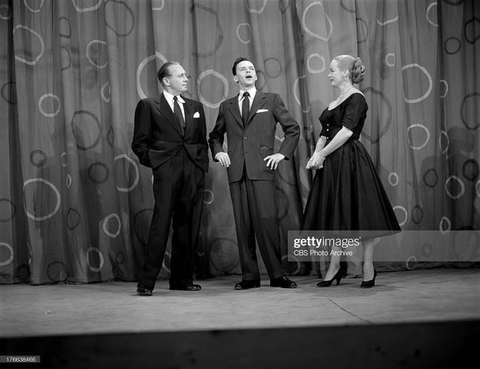
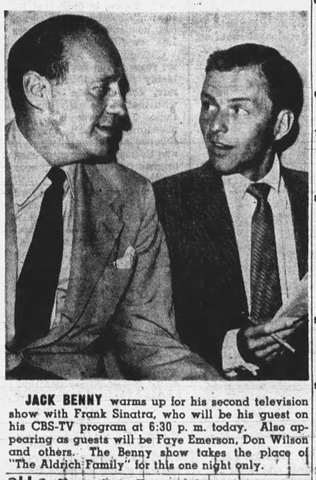
February 1951
[Eddie Fisher's Paramount triumph]
Eddie Fisher: In February 1951, Eddie Fisher played the Paramount Theater to unprecedented adulation, later recalling in his memoirs that he was hailed as "the new Sinatra, the Jewish Sinatra," at the peak of a fame he did not yet know would fade.
Source: James Kaplan, "Frank: The Voice" (2010)
[From Here to Eternity published]
Kaplan: James Jones's novel From Here to Eternity was published in February 1951 and quickly topped the best-seller lists. Sinatra became fixated on the character Angelo Maggio, a scrappy Italian-American army private, feeling he intimately understood and even was this character.
Source: James Kaplan, "Frank: The Voice" (2010)
[Sinatra's suicide attempt]
Kaplan: After seeing crowds of screaming girls gathered for Eddie Fisher beneath the Paramount marquee in Times Square, an anguished Sinatra returned to Manie Sacks's suite at the Hampshire House, shut himself in the kitchen, laid his head on the stove, and turned on the gas. Manie returned in time to find him on the floor, sobbing, uninjured.
Source: James Kaplan, "Frank: The Voice" (2010)
[James Jones publishes From Here to Eternity]
James Jones, then 29, published his roughly 800-page first novel, From Here to Eternity, depicting Army life in Hawaii before Pearl Harbor. It was praised as an unusually realistic portrait of service life, climaxing with the Japanese attack.
Source: Richard Havers, "Sinatra" (Dorling Kindersley, 2007).
February 1, 1951
Concerts
The Click Club, Philadelphia, PA (One Nighter)
The Click Club, Philadelphia, PA (One Nighter)
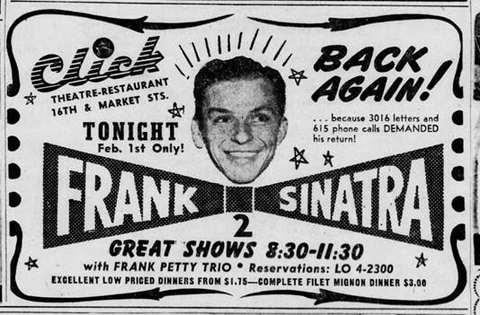
February 3, 1951
Television
Frank Sinatra Show
Network: CBS
Location: New York City
Script Dated:
Show: #18
Sponsor: Bulova Watch Company (30mins)
Time: 9:00 P.M.-10:00 P.M.
Writers:
Producer: Jack Donahue
Director: Jack Donahue
Announcer: Ken Roberts
Orchestra Conducted By: Axel Stordahl
Guests: Jackie Gleason, June Hutton, The Heathertones
1. It Had To You - Frank Sinatra
2. Take My Love - Frank Sinatra
3. Everything Happens To Me - Frank Sinatra
4. You'd Be So Nice To Come Home To - Frank Sinatra & June Hutton
5. Let It Snow, Let It Snow, Let It Snow - Frank Sinatra
6. My Heart Stood Still - Frank Sinatra
7. I Am Loved - Frank Sinatra
Notes: Show in circulation.
Ed notes: If all of Frank's 50-52 shows had been as good as this one, he never would have had a ratings problem. The skits were often deadly but the singing was grand. The 2-3-51 broadcast offered seven songs by Sinatra, plus two from June Hutton and two from The Heathertones.
There was also a vocal by an uncredited female singer.
A thoroughly enjoyable hour.
Frank Sinatra Show
Network: CBS
Location: New York City
Script Dated:
Show: #18
Sponsor: Bulova Watch Company (30mins)
Time: 9:00 P.M.-10:00 P.M.
Writers:
Producer: Jack Donahue
Director: Jack Donahue
Announcer: Ken Roberts
Orchestra Conducted By: Axel Stordahl
Guests: Jackie Gleason, June Hutton, The Heathertones
Skit from show
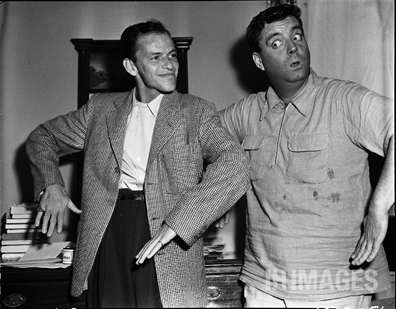
During that night's CBS broadcast, guest June Hutton asked Sinatra who would be getting his Valentine that year; after a dramatic pause, he answered "Bulova, of course," then broke character to tell the studio and home audience, "Fooled you!"
Source: Frank Sinatra: The Man, the Music, the Legend, ed. Jeanne Fuchs and Ruth Prigozy (Rochester, NY: University of Rochester Press / Boydell & Brewer, 2007), essay "Sinatra Meets Television" by Ron Simon.
February 4, 1951
Radio
Meet Frank Sinatra
Show #15
Network: CBS
Sponsor: Tintair, Ludens
Time: 5:00PM - 5:45PM (EST), Sunday
Producers: Mark Goodson, Bill Todman
Musicians: Graham Forbes and His Quartet
Announcer: Hal Sims
Writers:
Guest: Milton Berle, June Hutton
Notes: Confirmed aired on WCBS
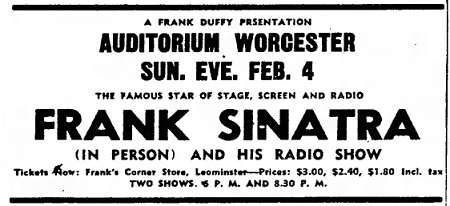
February 10, 1951
Television
The Frank Sinatra Show
Network: CBS
Location: New York City
Script Dated:
Show: #19
Sponsor: Bulova Watch Company (30mins)
Time: 9:00 P.M.-10:00 P.M.
Writers:
Producer: Jack Donahue
Director: Jack Donahue
Announcer: Ken Roberts
Orchestra Conducted By: Axel Stordahl
Guests: Barbara Britton, June Hutton, Jack Goode, Ollie Frank, The Heathertones
1. I Love You - Frank Sinatra
2. They Say It's Wonderful - Frank Sinatra & June Hutton
3. I've Got A Crush On You - Frank Sinatra
4. Zing Went The Strings Of My Heart - Frank Sinatra
5. The Night Is Young And You're So Beautiful - Sinatra, June Hutton & The Heathertones
6. The Anniversary Song - Frank Sinatra & Barbara Britton
February 11, 1951
Radio
Meet Frank Sinatra
Show #16
Network: CBS
Script: January 24, 1951
Sponsor: Tintair, Ludens
Time: 5:00PM - 5:45PM (EST), Sunday
Producers: Mark Goodson, Bill Todman
Musicans: Graham Forbes and His Quartet
Announcer: Hal Sims
Writers: Harry Crane
Guest: Jules Styne, Lynn Burton
1. ' S Wonderful - w/Graham Forbes and His Quartet
2. chat/intro/talk w/Jule Styne
3. medley w/ Jule Styne (piano): It's Been A Long,
Long Time / I Don't Want To Walk Without
You / Papa, Won't You Dance With Me
4. Time After Time - w/Jule Styne (piano)
5. comedy/patter with audience
6. If - w/Graham Forbes (piano)
7. into/talk w/ Lynn Burton
8. Bye Bye Baby - Lynn Burton
9. One For My Baby - w/Graham Forbes (piano)
10. The Moon Was Yellow
11. There;s Something Missing (Columbia Recording)
12. Put Your Dreams Away
Notes: Listed as being rehearsed/taped on January 3, 1951. Date is incorrect. Script for show wasn't even written till January 24th. Confirmed aired on WCBS
Ed O'Brien notes:
Easily the best of the shows that are in circulation from this series. We get to hear Frank sing the marvelous Gershwin tune "S''Wonderful, ' with a quintet, and a song he literally redefined "One For My Baby," with just Mr Forbes backing him. This version gives the listener a peek into the maturation process that Sinatra was going through in the early fifties. What would become one of his great signature songs, started here. "The Moon Was Yellow" was a Sinatra favorite. He would record it on three major labels and perform it often in concert. "Perry Como's huge hit "If" receives a spectacular vocal effort from Mr Sinatra. His singing here certainly exposes the crazy idea that he was at a low point vocally in the early fifties. And, of course, we also have the pleasure of hearing Sinatra sing a wonderful group of songs with Jule Styne accompanying him on piano. Styne wrote many of Frank's hits in the forties and would continue to be a major contributor into the 1980s. The singing on "Time After Time" is simply exquisite.
Scott: Sinatra singing "If". It doesn't get much better. I wish he had recorded it.
Concerts
State Theater, Hartford, Connecticut (One Day Only)
State Theater, Hartford, Connecticut (One Day Only)
© 1997-2026 The Sinatra Archive
This calendar, or any parts thereof, may not be reproduced in any fashion whatsoever without the prior written permission of the publisher (The Sinatra Archive)
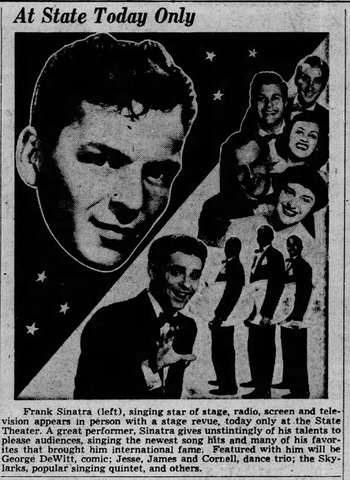
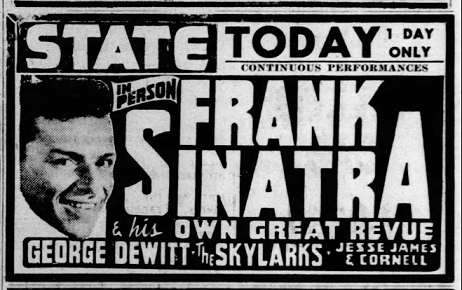
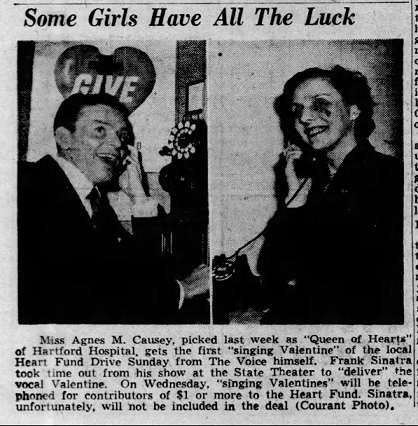
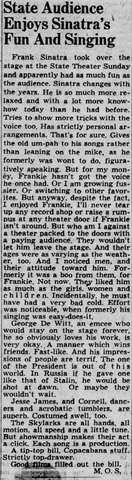
Meet Frank Sinatra
Show #16
Network: CBS
Script: January 24, 1951
Sponsor: Tintair, Ludens
Time: 5:00PM - 5:45PM (EST), Sunday
Producers: Mark Goodson, Bill Todman
Musicans: Graham Forbes and His Quartet
Announcer: Hal Sims
Writers: Harry Crane
Guest: Jules Styne, Lynn Burton
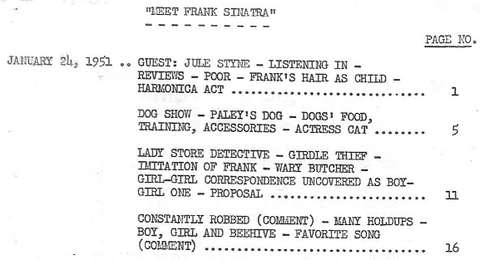
State Theater, Hartford, Connecticut (One Day Only)
© 1997-2026 The Sinatra Archive
This calendar, or any parts thereof, may not be reproduced in any fashion whatsoever without the prior written permission of the publisher (The Sinatra Archive)
February 13, 1951
Television
Cavalcade of Bands
Season: 2 Episode: 56
Network: Dumont
Host: Buddy Rogers
Guest Star: Jackie Gleason, Frank Sinatra, Gene Krupa
Krupa Songs:
1. Opening Theme
2. Lover
3. Sabre Dance
4. There's A Great Day Comin'
5. Twelfth Street Rag
6. Drum Boogie
Cavalcade of Bands
Season: 2 Episode: 56
Network: Dumont
Host: Buddy Rogers
Guest Star: Jackie Gleason, Frank Sinatra, Gene Krupa
Krupa Songs:
1. Opening Theme
2. Lover
3. Sabre Dance
4. There's A Great Day Comin'
5. Twelfth Street Rag
6. Drum Boogie
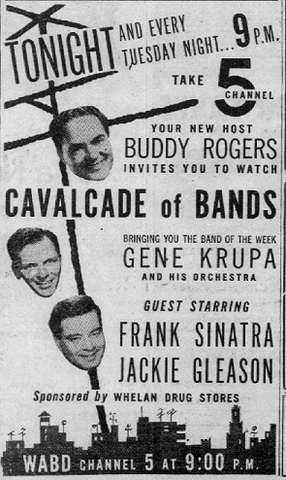
February 17, 1951
Television
The Frank Sinatra Show
Network: CBS
Location: New York City
Script Dated:
Show: #20
Sponsor: Bulova Watch Company (30mins)
Time: 9:00 P.M.-10:00 P.M.
Writers:
Producer: Jack Donahue
Director: Jack Donahue
Announcer: Ken Roberts
Orchestra Conducted By: Axel Stordahl
Guests: Faye Emerson, Skitch Henderson, Arthur Blake, Irving Kupcinet, June Hutton
1. Get Happy - Frank Sinatra
2. These Foolish Things - Frank Sinatra & Skitch Henderson
3. Them There Eyes - Frank Sinatra
4. Without A Song - Frank Sinatra
5. Why Shouldn't I? - Frank Sinatra
6. Bess, Oh Where's My Bess? - Frank Sinatra
February 18, 1951
Radio
Meet Frank Sinatra
Show #17
Network: CBS
Script: January 31, 1951
Sponsor: Tintair, Ludens
Time: 5:00PM - 5:45PM (EST), Sunday
Producers: Mark Goodson, Bill Todman
Musicans: Graham Forbes and His Quartet
Announcer: Hal Sims
Writers: Harry Crane
Guest: Perry Como
Notes: Confirmed aired on WCBS

Meet Frank Sinatra
Show #17
Network: CBS
Script: January 31, 1951
Sponsor: Tintair, Ludens
Time: 5:00PM - 5:45PM (EST), Sunday
Producers: Mark Goodson, Bill Todman
Musicans: Graham Forbes and His Quartet
Announcer: Hal Sims
Writers: Harry Crane
Guest: Perry Como
Notes: Confirmed aired on WCBS
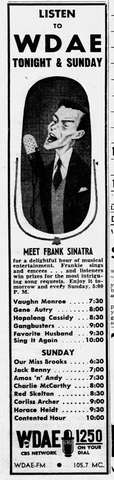
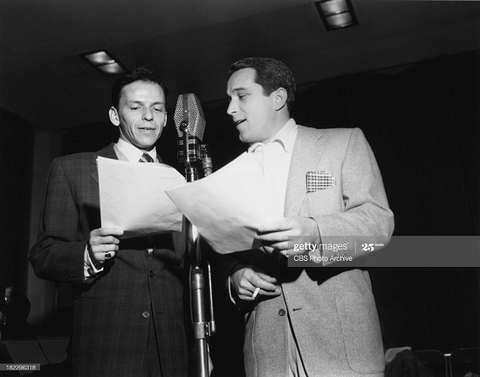
February 24, 1951
Television
The Frank Sinatra Show
Network: CBS
Location: New York City
Script Dated:
Show: #21
Sponsor: Bulova Watch Company (30mins)
Time: 9:00 P.M.-10:00 P.M.
Writers:
Producer: Jack Donahue
Director: Jack Donahue
Announcer: Ken Roberts
Orchestra Conducted By: Axel Stordahl
Guests: Douglas Fairbanks Jr., Jean Carroll, Teddy Hale, June Hutton, The Heathertones
[image referenced in source but could not be recovered]
February 25, 1951
Radio
Meet Frank Sinatra
Show #18
Network: CBS
Script: February 7, 1951
Sponsor: Tintair, Ludens
Time: 5:00PM - 5:45PM (EST), Sunday
Producers: Mark Goodson, Bill Todman
Musicians: Graham Forbes and His Quartet
Announcer: Hal Sims
Writers: Harry Crane
Guest: , Don Cherry, Winona Dawson
Concerts
Club Morocco, Miami, FL (February 25-March 1)
2 Shows Nightly 9:30 & 11:30
Sacasa and his Orchestra
Marty Grossman and his Band
Also: Ted & Phyllis Rodriguez - Dance Team
Songs performed during this engagement:
Sweet Lorraine
Body and Soul
I Hear Music
April In Paris
Stella By Starlight
Nevertheless
All The Things You Are
Paper Moon
If
The September Song
You're The One
I've Got A Crush On You
Club Morocco, Miami, FL (February 26-March 1)
Here's a review from The Miami Herald, during the run of the engagement. Anyone who says that he had lost
his voice by 1951 obviously wasn't attending some of these stellar performances:
The Miami Herald, Miami, Florida, Feb 28, 1951
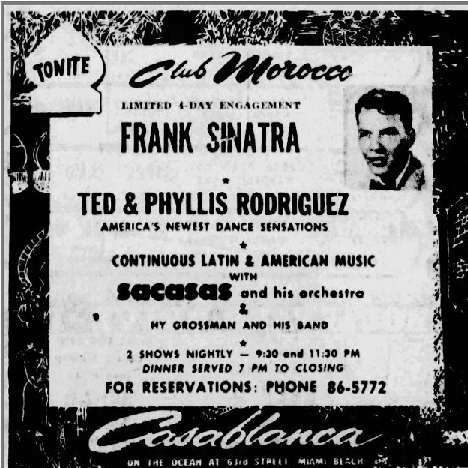
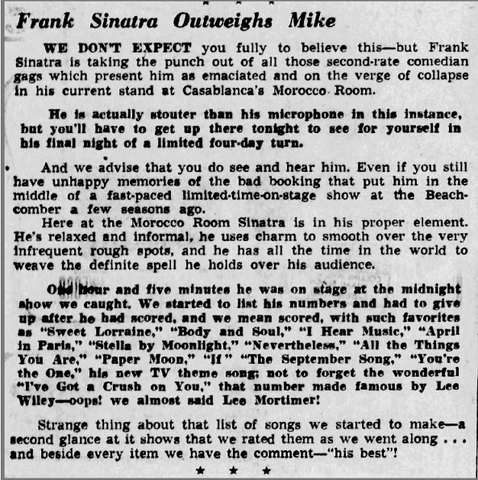
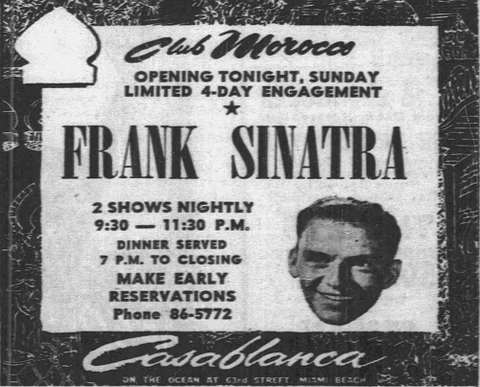
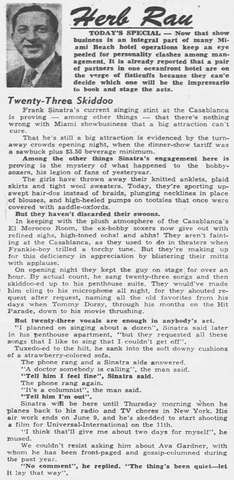

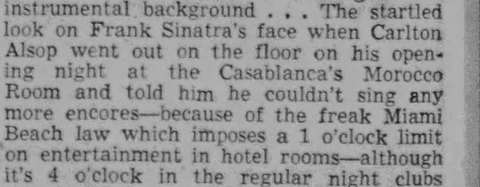
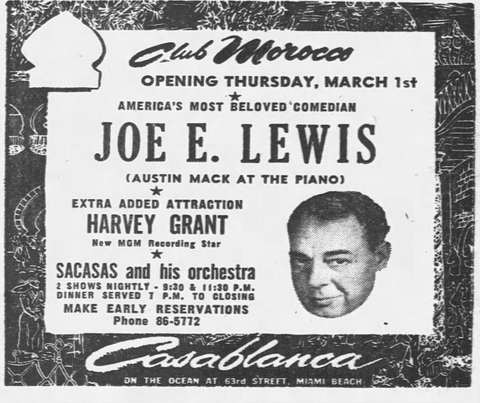
Meet Frank Sinatra
Show #18
Network: CBS
Script: February 7, 1951
Sponsor: Tintair, Ludens
Time: 5:00PM - 5:45PM (EST), Sunday
Producers: Mark Goodson, Bill Todman
Musicians: Graham Forbes and His Quartet
Announcer: Hal Sims
Writers: Harry Crane
Guest: , Don Cherry, Winona Dawson
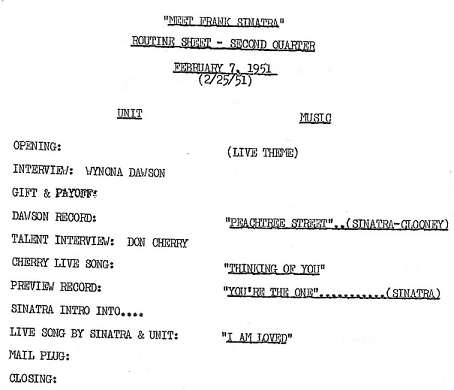
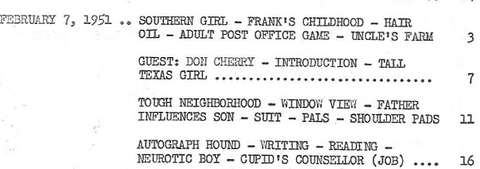
note: Frank opened at the Casablanca on 2-25 for a four day run.
First show opening night, he did 23 songs. Second show was interrupted by antiquated law.
Joe E Lewis opened on 3/1. I wondered if Frank sang "As Time Goes By."
Ed
February 26, 1951
Concerts
Club Morocco, Miami, FL (February 25-February 28)
2 Shows Nightly 9:30 & 11:30
Sacasa and his Orchestra
Marty Grossman and his Band
Also: Ted & Phyllis Rodriguez - Dance Team
Songs performed during this engagement:
Sweet Lorraine
Body and Soul
I Hear Music
April In Paris
Stella By Starlight
Nevertheless
All The Things You Are
Paper Moon
If
The September Song
You're The One
I've Got A Crush On You
Club Morocco, Miami, FL (February 25-February 28) review of frank in Miami 2-26-51 -- ED
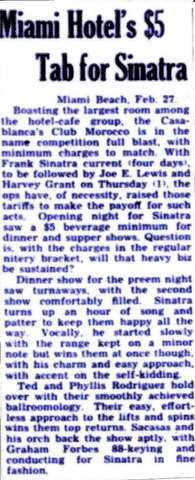
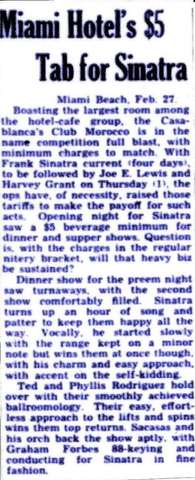
Club Morocco, Miami, FL (February 25-February 28)
review of frank in Miami 2-26-51 -- ED
------------------------------------------------------------
Hollywood Flashback: In 1958, Frank Sinatra and Pals Hijacked the Golden Globes
A drunken Rat Pack decided to hit the stage and present the awards in place of the HFPA members at a lengthy ceremony that ran until 1 a.m. Elizabeth Taylor literally was 25 when it began and 26 when it ended. February 26, 1958
In many ways, the 15th Golden Globe Awards was a turning point. Held in 1958, it was the first time stars presented the awards but they had to stage a bloodless party coup. “That year is famous,” says Hollywood Foreign Press Association president Meher Tatna. “It took the night to a new level.”
While some HFPA selections that evening remain cringe-inducing (The Mickey Mouse Club winning for best TV show), The Bridge on the River Kwai, which took the awards for best picture, actor and director (as it did at the Oscars), set the tone for the movie side of the awards at the Ambassador Hotel’s Cocoanut Grove club. Though there was some effort to end the Wednesday night event early (the presentations in 1957 dragged on until 1 a.m.), whatever plans were laid went sideways when Frank Sinatra and a drunken Rat Pack decided to take the stage and present the awards in place of the HFPA members. (Heavy drinking was as much a theme of the night as were the movies.)
Not much is known of what Sinatra and friends actually said the tape of the show is believed to be lost but from the scraps of information available, it appears Sinatra took some verbal hard shots at Columbia Pictures president Harry Cohn. And without being nominated for anything, Elizabeth Taylor (who was literally 25 when the evening began and 26 when it ended) was the belle of the ball.
After the show, there was another, even more drunken party with her then-husband producer Mike Todd, who would die in a plane crash a month later in their Ambassador Hotel suite in honor of her birthday. And in a precursor to the kind of remarks Joan Rivers would make decades later, Taylor’s ultra-short Parisian gown was described by the correspondent from the Los Angeles Mirror News as “sort of a glorified Brown Derby waitress uniform.”
Sinatra won a Golden Globe that year for best lead performance in a musical. He was considered a shoo-in for a best Oscar nomination. Many critics consider his performance in "Pal Joey" one of his very, very best. Frank was not pleased with Columbia's efforts on his behalf. The Academy asked him to sing "All The Way" at their March 26 ceremony. Frank refused.
Dean Martin subbed for him.
Ed
[image referenced in source but could not be recovered]
[image not recovered — source caption: “Hollywood Flashback: In 1958, Frank Sinatra and His Pals Hijack”]
[image referenced in source but could not be recovered]
[image referenced in source but could not be recovered]
February 27, 1951
Concerts
Club Morocco, Miami, FL (February 25-February 28)
Marty Grossman and his Band
Also: Ted & Phyllis Rodriguez - Dance Team
Songs performed during this engagement:
Sweet Lorraine
Body and Soul
I Hear Music
April In Paris
Stella By Starlight
Nevertheless
All The Things You Are
Paper Moon
If
The September Song
You're The One
I've Got A Crush On You
February 28, 1951
Concerts
Club Morocco, Miami, FL (February 25-February 28)
Marty Grossman and his Band
Also: Ted & Phyllis Rodriguez - Dance Team
Songs performed during this engagement:
Sweet Lorraine
Body and Soul
I Hear Music
April In Paris
Stella By Starlight
Nevertheless
All The Things You Are
Paper Moon
If
The September Song
You're The One
I've Got A Crush On You
March 1951
["The King and I" recording session]
Kaplan: The evening after his secret testimony, Sinatra recorded "Hello Young Lovers" and "We Kiss in a Shadow" from Rodgers and Hammerstein's The King and I with Axel Stordahl conducting at Columbia's Thirtieth Street studio. Despite his voice being off, he stayed good-humored through twenty-two takes of "Hello Young Lovers."
Source: James Kaplan, "Frank: The Voice" (2010)
[Harry Cohn buys Eternity film rights]
Kaplan: In March 1951, Harry Cohn of Columbia Pictures bought the screen rights to From Here to Eternity for $85,000, a large sum for a novel critical of the Army during an era of political conformity; cynics dubbed the project "Cohn's Folly."
Source: James Kaplan, "Frank: The Voice" (2010)
March 1, 1951
At 4 a.m., to avoid press attention, Frank Sinatra was privately questioned in a Rockefeller Center law office by Joseph Nellis, counsel to Senator Estes Kefauver's organized-crime committee, about his 1947 Havana trip and ties to Lucky Luciano. Sinatra, visibly nervous and chain-smoking, denied knowing who Luciano was beyond the name, described their meeting as a brief hotel restaurant introduction, and claimed the suitcase he had carried off the plane in Havana held only his "razor and crayons" -- he was an amateur sketcher. Nellis, who had photos of Sinatra with Luciano on the balcony of the Hotel Nacional, did not press further, and the committee dropped plans to call him for public testimony. Source: Michael Sheridan & David Harvey, Sinatra and the Jack Pack.
[Secret Kefauver Committee testimony]
At 4 a.m. in a Rockefeller Center law office, Sinatra secretly testified before committee lawyer Joseph Nellis, arranged by attorney Sol Gelb to avoid a public hearing. Visibly frightened and chain-smoking, Sinatra was questioned about his associations with Lucky Luciano, the Fischetti brothers, Willie Moretti, Frank Costello, and the Jimmy Tarantino blackmail affair, denying any business dealings with organized crime figures beyond casual acquaintance.
Source: James Kaplan, "Frank: The Voice" (2010).
[Kefauver declines to call Sinatra publicly]
Joseph Nellis: After the secret testimony, Nellis reported to Kefauver that Sinatra had likely lied but would never admit complicity, and that hauling him before television cameras risked turning the hearings into more of a "circus." Kefauver, more concerned with his own reputation, accepted the recommendation not to call Sinatra to testify publicly, though he left Frank with a subpoena.
Source: James Kaplan, "Frank: The Voice" (2010).
March 2, 1951
Studio
New York City
CO45156 Hello Young Lovers
(R. Rodgers/O. Hammerstein II)
(from The king And I)
Williamson Music, Inc. (ASCAP) 1951
Arranged & Counducted by Axel Stordahl
-1 (3:32) CD: Columbia Years 43-52 Vol. 12
LP: C2X-40897 Hello Young Lovers
LP: CL-606 Frankie
78: 39294
CO45157 We Kiss In A Shadow
(R. Rodgers/O. Hammerstein II)
(from The King And I)
Williamson Music, Inc. (ASCAP) 1951
Arranged & Counducted by Axel Stordahl
-1 (3:35) CD: Columbia Years 43-52 Vol. 12
LP: C2X-40897 Hello Young Lovers
LP: CL-953 Adventures Of The Heart
78: 39294
Violins: A. Eidus, M. Hershaft, H. Katzman, M. Lomask, R. Lynch, M. Meinikoff, F. Orlewitz, R. Polikian, Z. Smirnoff; Violas: S. Deutsch, I. Zirr; Cellos: A. Borodkin, G. Polikian; Harp: E.. Vito; French Horn: J. Barrows; Trombones: G. Arus, J. Satterfield; Woodwinds: A. Drelinger, H. Feldman, E. Gershman, B. Kaufman, W. Stegmeyer; Piano: G. Forbes; Guitar: M. Golizio; Bass: F. Carroll; Drums: J. Blowers note: Frank was a tired and worried man on the evening of March 2nd. He had personal problems and he wasn't selling very many records. As the session got underway, Frank realized his voice wasn't right. He asked for some hot tea and tried to relax. The prospect of recording two brand new Rodgers and Hammer- stein songs, quality material with Axel's great arrangements, was the best of everything, if he could just get his voice to work. "Hello Young Lovers" was a real struggle. What should have been three or four takes became 22 before they had a decent recording. "We Kiss In A Shadow" came easier because his voice had opened up. But it was not an easy session for a man who used to find it so easy to record. "Hello Young Lovers" has an alternate take which is available on "Frankie" LP ( Col-606 ). Frank would sing this great ballad on his 5-5-51 CBS-TV show and "We Kiss In A Shadow" would be done as a duet with June Hutton on the 4-7-51 and the 5-12-51 shows.
Ed
New York City
CO45156 Hello Young Lovers
(R. Rodgers/O. Hammerstein II)
(from The king And I)
CO45157 We Kiss In A Shadow
(R. Rodgers/O. Hammerstein II)
(from The King And I)
This article appeared on March 2nd, 1951 in the Miami News:
It’s odd that the last paragraph mentions that Sinatra was going to record some of the songs from the “The King And I” the same night as these young ladies met him in his hotel room in Miami. The interview and photo were obviously done when Sinatra was AT THE Club Morocco, Miami, FL (February 25-February 28, 1951). Sinatra, of course, recorded the above two songs on March 2, 1951 in New York.
Here’s another photo of Frank relaxing in Miami:
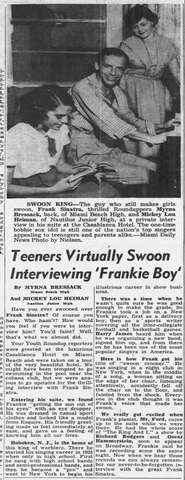
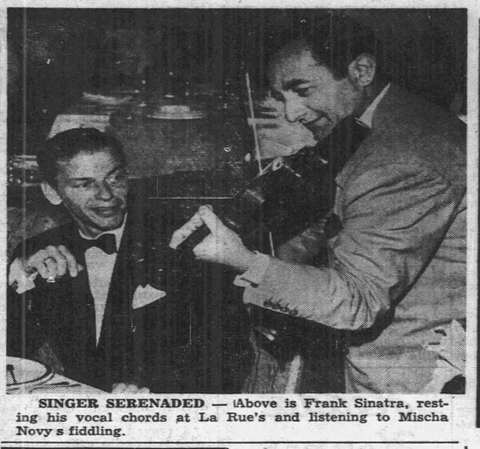
[Hello Young Lovers -- critical commentary]
Granata includes 'Hello Young Lovers' among the fifty recordings he considers essential to understanding Sinatra's artistry (arranged by Axel Stordahl, recorded 1951, Columbia); the song was chosen for its musical/interpretive value rather than commercial popularity.
This song/context matches multiple dated entries in the chronology, or lacked a sufficiently precise date; the specific date could not be determined with confidence.
Source: Charles L. Granata, "Sessions with Sinatra: Frank Sinatra and the Art of Recording" (1999/2003), Afterword & Appendices A-D
March 3, 1951
Television
Frank Sinatra Show
Network: CBS
Location: New York City
Script Dated:
Show: #22
Sponsor: Bulova Watch Company (30mins)
Time: 9:00 P.M.-10:00 P.M.
Writers:
Producer: Jack Donahue
Director: Jack Donahue
Announcer: Ken Roberts
Orchestra Conducted By: Axel Stordahl
Guests: Perry Como, Frankie Laine, Andrews Sisters (surprise cameo), Betty and Jane Kean, June Hutton, The Digatanos (ballroom dancers), The Heathertones
1. Como, Sinatra & Laine (parody) - Sinatra, Como & Laine
2. I Get A Kick Out Of You - Frank Sinatra
3. Commercial
4. Barber skit - Frank Sinatra & Perry Como
5. If - Perry Como
6. Copa skit - Sinatra, Como & Laine
7. That Luck Old Sun - Frankie Laine
8. Sinatra, Como & Laine (in drag): Andrews Sisters pantimine
9. Surprise walk-on - Andrews Sisters
10. Commercial
11. Station id
Notes: Show in circulation. Incomplete 30mins. Confirmed date by Variety article.
CBS SOCKS SINATRA ACROSS,
BUT COMO, LAINE HELP A LOT
If Frank Sinatra can keep coming up with shows like this, the National Broadcasting Company "Show of Shows" will have a real tussle on its hands Some- body shows signs of something approximating booking genius in lining up Perry Como and Frankie Laine to work the show with Sinatra. And followed thru with fine light special material for Como, Sinatra and Laine, plus other bits to create a stanza that was relaxed, happy and wham all the way. In addition to choice clowning by the three baritones, each delivered sock solo performances, Como with "If," Laine with a tune of his own, "We'll Be Together Again," and Sinatra with "I Get A Kick Out of You."
Betty and Jane Kean also contributed excellent comedy bits, and June Hutton abetted by the Heathertones delivered a good "It's A Good Day." Marlo Lewis seems to be taking hold nicely as producer. Axel Stordahl lays in solid musical support. Bulova's "The watch the stars wear" plugs have strong appeal.
The big question that arises is how do you follow a show like this. If Sinatra and his aids can figure it out and deliver three or four in a row, they'll be headed for the top of the rating heap. Joe Csida
Billboard
March 17, 1951
Ed O'Brien: The correct date for this show is definitely 3-3-51. A number of Sinatra lists have it as 3-10-51.
Laine, at least in the first half of the show, sang "That Lucky Old Sun," not "We'll Be Together Again..' The three baritones opened the show with "We're Como,Sinatra and Laine." Bulova's watches started at the "low' price of $49.95. They offered a self-winding one at that price. The Andrew Sisters were surprise guests. Frank's opening show for the second season, 10-9-51, also had Como, Laine and The Andrew Sisters. I prefer the March 51 show.
Frank Sinatra Show
Variety
3-7-51
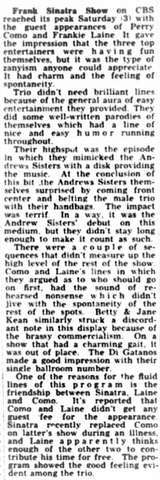
[image referenced in source but could not be recovered]
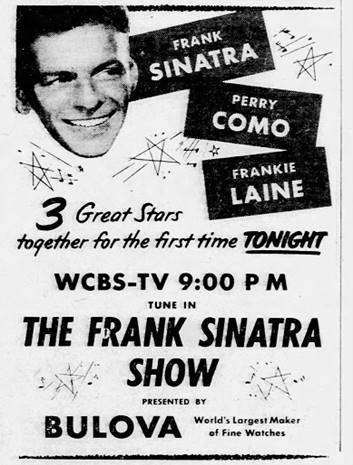
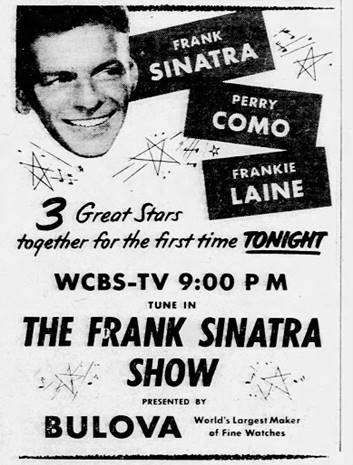
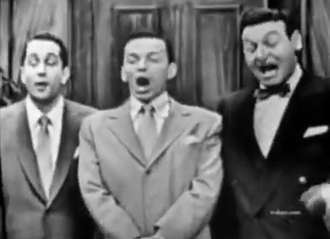
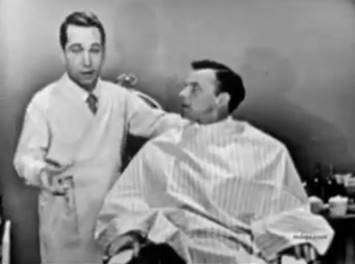
March 4, 1951
Radio
Meet Frank Sinatra
Show #19
Network: CBS
Script: February 15, 1951
Sponsor: Tintair, Ludens
Time: 5:00PM - 5:45PM (EST), Sunday
Producers: Mark Goodson, Bill Todman
Musicians: Graham Forbes and His Quartet
Announcer: Hal Sims
Writers: Harry Crane
Guest: Ella Fitzgerald, Johnny Parker, Jean Sablon
Notes: Confirmed aired on WCBS
Meet Frank Sinatra
Show #19
Network: CBS
Script: February 15, 1951
Sponsor: Tintair, Ludens
Time: 5:00PM - 5:45PM (EST), Sunday
Producers: Mark Goodson, Bill Todman
Musicians: Graham Forbes and His Quartet
Announcer: Hal Sims
Writers: Harry Crane
Guest: Ella Fitzgerald, Johnny Parker, Jean Sablon
Notes: Confirmed aired on WCBS
Variety
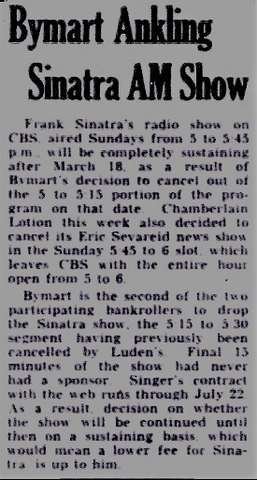
THE TIMES
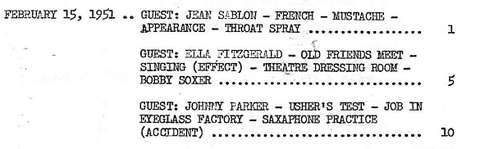
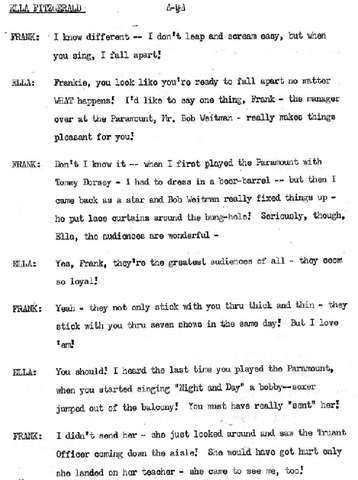
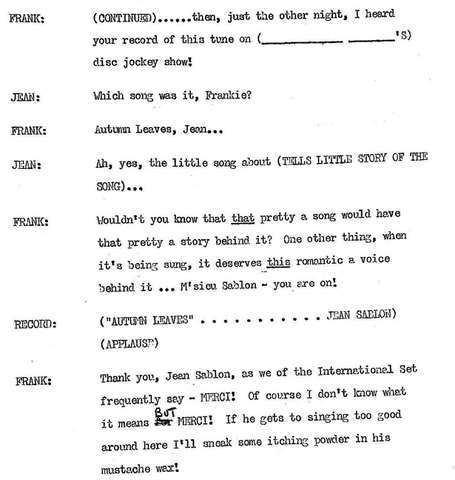
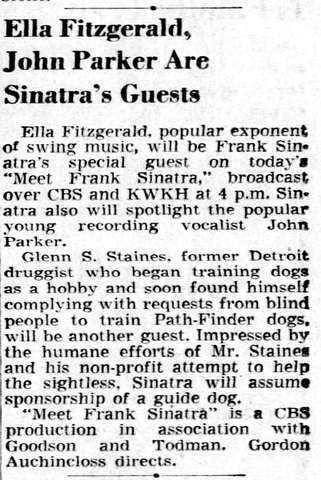
note: I have the transcript of this show but I never read the segment on the guide dog. Nice gesture by Sinatra. Interesting the Sablon is not mentioned.
Ed
March 4, 1962 Bob Hope is presented with the Milestone Award at Screen Producers Guild annual dinner. Frank Sinatra was Master of Ceremonies
Bob Hope is kissed by his wife, Dolores, when presented with the Milestone Award at Screen Producers Guild annual dinner. Frank Sinatra, on the right, looks on. March 4, 1962
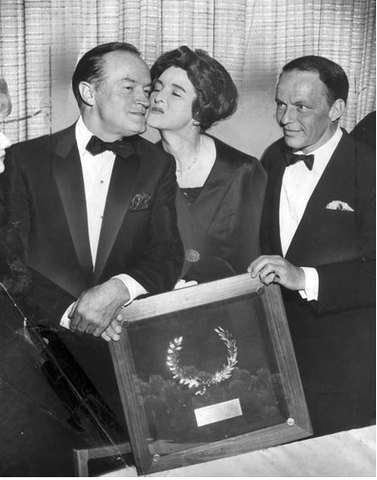
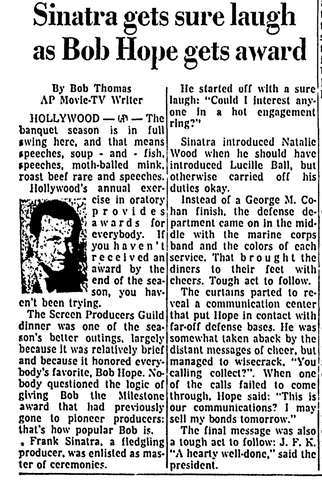
March 9, 1951
Television
The Faye Emerson Show
Guest: Frank Sinatra
15 minutes
The show opens with Frank Sinatra reading a letter from a viewer. He then reads a "letter" from Faye asking for advice on how to succeed in television. She sits next to him and tells him the only thing she can do is talk and he offers to help her learn how to sing. He then sings "I've Got a Crush on You". They get up and go to the bar to have a Pepsi. Frank next gives Faye a dance lesson after claiming to have taught Gene Kelly how to dance. Afterwards, the two talk about Frank's television show, the connection fans have with TV stars and TV critics.
The Faye Emerson Show
Guest: Frank Sinatra
15 minutes
© 1997-2026 The Sinatra Archive
This calendar, or any parts thereof, may not be reproduced in any fashion whatsoever without the prior written permission of the publisher (The Sinatra Archive)
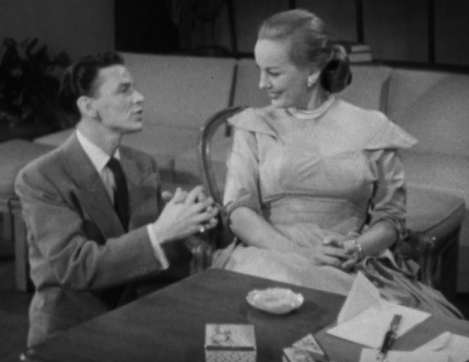
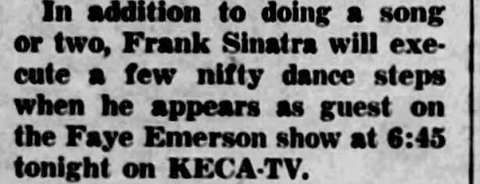
The Faye Emerson Show
Guest: Frank Sinatra
15 minutes
© 1997-2026 The Sinatra Archive
This calendar, or any parts thereof, may not be reproduced in any fashion
whatsoever without the prior written permission of the publisher (The
Sinatra Archive)
March 10, 1951
Television
Frank Sinatra Show
Netowrk: CBS
Location: New York City
Script Dated:
Show: #23
Sponsor: Bulova Watch Company (30mins)
Time: 9:00 P.M.-10:00 P.M.
Writers:
Producer: Jack Donahue
Director: Jack Donahue
Announcer: Ken Roberts
Orchestra Conducted By: Axel Stordahl
Guests: Don Ameche, Joan Blondell, June Hutton, The Heathertones
1. Love Is Just Around The Corner - Frank Sinatra
2. The Way You Look Tonight - Frank Sinatra & June Hutton
3. There's A Flaw In My Flue - Frank Sinatra
4. This Can't Be Love - Frank Sinatra
Notes: 30mins circulates.
Frank Sinatra Show
Netowrk: CBS
Location: New York City
Script Dated:
Show: #23
Sponsor: Bulova Watch Company (30mins)
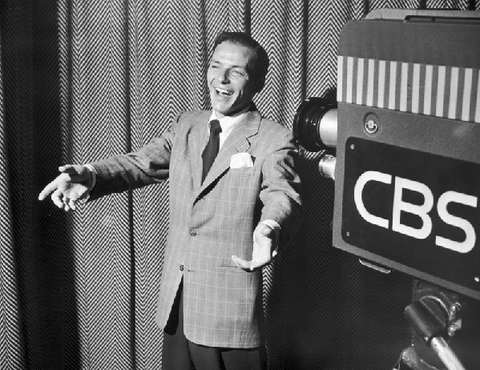
March 11, 1951
Radio
Meet Frank Sinatra
Show #20
Network: CBS
Script: February 22, 1951
Sponsor: Tintair, Ludens
Time: 5:00PM - 5:45PM (EST), Sunday
Producers: Mark Goodson, Bill Todman
Musicans: Graham Forbes and His Quartet
Announcer: Hal Sims
Writers: Harry Crane
Guest: Peggy Lee, Eddie Fisher
Notes: Confirmed aired on WCBS
Concerts
War Memorial, Trenton, New Jersey
Sunday evening
Buddy Williams & His Golden Echo Orchestra
M.C. Benny Rubin
Comedian: Sid Rice
Accordonist: Johnny Felice
Dance Team: Mickie & Gracie Carol
Impressionist: Dick Stanley
Feature Act: Frank Sinatra note: This was Sinatra's third concert appearance in Trenton.
He played the Trenton Arena and Trenton Armory during the Dorsey years. Frank drew less than half-a-house at the War Memorial fifty-nine years ago this evening.
Ava Gardner sat in the second row. Frank would never play Trenton again.
1960 Fountainebleau Hotel, Miami Beach, Florida (9-30?) 26 piece orchestra conducted by: Morty Stevens
Bill Miller (piano) among the songs:
I Love Paris
I Thought About You
I've Got A Crush On You
Road To Mandalay
River Stay Away From My Door
All The Way
High Hopes medley: A Foggy Day, I've Got You Under My Skin, Angel Eyes Come Fly With Me.
Meet Frank Sinatra
Show #20
Network: CBS
Script: February 22, 1951
Sponsor: Tintair, Ludens
Time: 5:00PM - 5:45PM (EST), Sunday
Producers: Mark Goodson, Bill Todman
Musicans: Graham Forbes and His Quartet
Announcer: Hal Sims
Writers: Harry Crane
Guest: Peggy Lee, Eddie Fisher
Notes: Confirmed aired on WCBS
War Memorial, Trenton, New Jersey
Frank Sinatra in The Burg and Trenton Area
Times, The (Trenton, NJ) - Saturday, May 16, 1998
Author: RANDY ALEXANDER, Staff Writer
City provided food, friends
TRENTON _ Frank Sinatra sat down to eat in Trenton more times than he sang here.And more than a decade after his final Trenton performance in 1951 at the War Memorial, Ol' Blue Eyes was still making special trips to his home state capital to sample Italian cuisine with friends. Sinatra's Trenton friends included Lou Crecco , owner of Crecco 's Cafe in Chambersburg; and Ernie Kovacs, Trenton's beloved TV pioneer.
Sinatra began visiting Trenton as a big band singer with the Tommy Dorsey Orchestra. He played the Trenton area twice with Dorsey from 1940 to 1942 _ once at the Trenton Arena on Stockton Street, long since leveled by fire; and once at the Trenton Armory on Eggerts Crossing Road.
Frank Iero, drummer for the Jerry Rice Band, still likes to tell the story about almost hitting Sinatra and other Dorsey band members with his car one Sunday afternoon. ''We were on our way home from his show,'' Iero recalled, ''and who's running across Montgomery Street but Sinatra and a couple of other guys.
I had to stop my car before I hit them. It was close. My wife, who was my girlfriend at the time, says to me, 'Oh my God, you almost hit Frank Sinatra!' ''
When Sinatra played the Armory with the Dorsey band, he got a home-cooked dinner at the Brunswick Avenue house where Sam and Josephine Plumeri lived with Sam's parents.
Sam's cousin, Don Lodice, played sax with Dorsey at the time and became godfather to Sinatra's daughter Nancy.
''My brother brought him to my house to have a spaghetti dinner that my mother provided,'' Sam Plumeri remembered. ''He came with the band.''
''He was skinny then,'' added Josephine Plumeri. ''Word got around that Tommy Dorsey and Sinatra were around the neighborhood and people went crazy.''
It was also during World War II that Ann Hoffman Hunt _ widow of Trenton resident Robert Hunt of Bellevue Avenue _ flew to California with her infant cradled in her arms. The baby started crying while the plane was taking off, and only got louder as the flight continued. When a pacifier didn't work, a man across the aisle offered to help her. Within a few minutes, the baby was in his arms and didn't cry the rest of the way to the West Coast. THE MAN WAS Frank Sinatra.
After the war ended, Sinatra was back in Trenton, eating at Trionfetti's Restaurant _ a newspaper story about the visit hung on the wall at Trionfetti's in Chambersburg.
Also at the table that night was boxing great Rocky Graziano and actress Rose Marie, wife for many years of the Bobby Guy, the celebrated late Trenton trumpet player.
''Sonny T'' Trionfetti, who hung out at his uncle's restaurant, says it was not uncommon for stars to come to Trionfetti's in those days.
''It was a speakeasy,'' he explained. ''It was like the Cotton Club in New York. They had bands every night on the weekends.''
But Sinatra's most famous public appearance in Trenton was March 11, 1951. He headlined the War Memorial in the only solo concert performance he ever gave here. At the War Memorial ''The Frank Sinatra Show'' with Buddy Williams and his Golden Echo Orchestra came to the War Memorial as Sinatra's life and career were fast falling apart. He had just been granted a legal separation from wife, Nancy, and his scandalous affair with Ava Gardner had become tumultuous.
Sinatra's half-hour CBS variety program, ''The Frank Sinatra Show'' was struggling for ratings. His record sales had plummeted. The previous year, he had been released from his MGM film contract and dropped by his agent.
Ten days before he came to the War Memorial, Sinatra would be secretly interrogated in New York about his alleged Mafia connections by the Senate Special Committee to Investigate Crime in Interstate Commerce.
At the end of the month, the singer would give what's considered one of his most emotional studio performances _ on March 27, aching with anguish over his relationship with Gardner, he recorded ''I'm a Fool to Want You.''
Sinatra arrived at the War Memorial on a Sunday evening. He had been brought to town by three Trenton residents who were trying to launch a concert promotion company: 21-year-old booking agent Tony Angeli Jr. spearheaded the effort, backed by Golden Gloves champion boxer Jimmy ''The Trenton Buzz Saw'' Corti and building contractor Peter Chiaradia.
THEY DIDN'T CARE that Sinatra's career was bottoming out at the time. ''Jim liked him so much, they wanted him here anyway,'' explained Corti's wife, Millie. ''They were trying to start a business and have entertainers come to Trenton.''
They brought in Domenic Castaldo, a former Chambersburg iron worker and the owner of Lola's Pizzeria, to bodyguard Sinatra that night. Pete Rossi, a longtime Trenton political figure who was backstage that night, remembers Sinatra asking Castaldo to bring him some pizza and tea before the performance. Castaldo dashed off to the 'Burg to fill the order.
''The Frank Sinatra Show'' at the War Memorial had six acts on the bill: master of ceremonies Benny Rubin, comedian Sid Rice, accordionist Johnny Felice, the dance team of Mick and Gracie Carol, impressionist Dick ''Tiny Stanley,'' and finally, Sinatra himself. It was a big night for Trenton.
''Everybody was buzzing,'' recalled Millie Corti. ''I was all dolled up. Everybody was all dressed up.''
Though her husband watched the show from the wings, Millie was not allowed backstage. So she sat in the third row _ right behind Ava Gardner.
A photo of Sinatra singing on the War Memorial stage still hangs in Diamond's Restaurant in Chambersburg _ the restaurant is owned by Corti's daughter, Philomena Zucchetti.
''I took care of him,'' said Jimmy Corti. ''Everything he wanted, I took care of. He was behind me because I fought. He wanted to talk about the fights I was in, and I wanted to talk about movies and show business. He was polite, too. Frank Sinatra treated me like I was his buddy.
''I didn't let too many people go near Frank Sinatra because I knew he wanted to be himself. I made him feel at home.''
Rossi, a friend of the three promoters, remembers seeing Sinatra backstage in his shorts. ''And he was as skinny as can be,'' said Rossi. Corti, then 26, had hoped the War Memorial show would launch a successful promotion venture that would allow him to quit boxing. ''It was a big, big, big deal,'' he said. ''Everything felt good to me.''
But the concert, he said, did not come close to selling out the 2,000-seat hall. The three men would never book another show and Corti didn't hang up his boxing gloves for another six years. The story around Chambersburg, says Sonny T., is that Sinatra was so upset with the War Memorial turnout that he vowed never to play Trenton again.He never did.
A Trenton friendship
But Sinatra kept up his connections to the capital city.
He befriended Trenton's greatest show-biz export, TV comic Ernie Kovacs, as soon as Kovacs moved with his wife, Edie Adams, from New York to Hollywood in 1957.
The bond was so tight that the Kovacs settled in Hollywood on Bowmont Drive because Sinatra lived up the road.
''Ernie and Frank were a set,'' Adams recounted. ''They adored each other. With Ernie's Hungarian family stuff and Frank's Italian family stuff, they covered everything.''
As neighbors, the Kovacs were often part of the all-night card games at Sinatra's house. Regulars included Dean Martin, Aaron Spelling and Carolyn Jones. ''Frank would like us to stay there all night long,'' said Adams. ''He would pull the curtains to be sure we didn't know it was dawn. He didn't want anybody to leave until early morning.'' A running practical joke between Sinatra and Kovacs involved the continued placement of green portable toilets and large wooden cigar store Indians in front of each other's house. Sinatra adored Kovacs so much that he occasionally appeared in a monkey suit on Kovacs' innovative TV show to be part of the famed Nairobi Trio.
And Sinatra was the first to call Adams after Kovacs was killed in a 1962 automobile accident. More than simply console the grieving widow, Sinatra immediately offered to pay off the huge debts Kovacs had left.''I'll never forget that,'' said Adams.
''He was like nobody I ever knew. He was always a big source of strength for me. He's always been like a big brother. The man was just absolutely unbelievable.''
Back for dinner
But if Sinatra never sang again in Trenton, he continued to visit _ and eat. In the early '60s, his limo pulled up to Cedar Gardens in Hamilton on its way from New York to a gig in Philadelphia. Back then, Cedar Gardens was owned by Ray Agabiti a friend of Trenton's Carl ''Pappy'' Ippolito, who knew Jilly Rizzo, one of Sinatra's closest friends. Oldies disc jockey Jerry Blavat was along for the ride. ''Pappy invited Jilly and myself and Sinatra to have dinner,'' Blavat remembered.
''Sinatra's favorite dish was clams and spaghetti, and for him they cooked it special.'' By the mid-1960s, Sinatra started showing up at Crecco 's, for 40 years one of the 'Burg's famed celebrity hangouts. Sinatra ate at Crecco 's because of Pat Henry, the comedian who was his warm-up act at the time. Henry was a dear friend of owner Lou Crecco , who eventually befriended Sinatra too _ the three men dined together at Rizzo's New York restaurant. ''Frank was a tough guy,'' said Crecco . ''He was a nice guy with a heart of gold, but when he got into that vodka on the rocks, he got mean. One night at Jilly's, I had to break up him and Pat Henry from a fight. Otherwise, he was a great guy.''
Both of Sinatra's visits to Crecco 's were very late at night.
Crecco would get an advance call from Henry, and Sinatra would be set up at the only round table in the bar area.
''That was the 'in' place,'' said Crecco . ''If you sat in the bar, you were a big person. He ate at the No. 1 table.''
Sinatra was a great pasta man, but he wouldn't allow any autographs while he ate. He did, however, welcome a wave of jokes at the dinner table. ''It was all jokes,'' said Crecco .
''He told 'em. That whole gang did. Sammy Davis, Joey Bishop, Dean Martin, all through dinner. That's all they did was tell jokes.''
When playwright William Mastrosimone witnessed Sinatra leaving his limo to walk into Crecco 's one night in the early '70s, ''it changed my life for a couple of years.'' A quarter-century later, Mastrosimone would be hired by Sinatra's daughter Tina to script ''Sinatra,'' the five-hour CBS miniseries which aired in 1992.
Mastrosimone was living in the 'Burg, struggling as a writer and making pizzas at a bar near Crecco 's the night the long, black limo pulled up after midnight. He had been a fan of Sinatra's since age 12, shunning rock 'n' roll for the music and sound of the Voice from Hoboken.
Mastrosimone remembers he was walking home from work, flour caked on his jeans, carrying an old Army knapsack filled with his writings. ''There were a bunch of people there,'' said
Mastrosimone. ''And someone stopped and said, 'Frank Sinatra's in that car.' I didn't believe it and I just stood there. He got out of the car, looked over toward me, just nodded and walked in.
If someone had tapped him on the shoulder and said, 'See that guy over there? He's going to write your biography one day,' he wouldn't have believed it.''Years later, when he was called to write the screenplay for ''Sinatra,'' he said, 'It gave me kind of a shiver, almost like it was meant to be.''
Swansong
Sinatra was a terribly reluctant visitor to Trenton on Feb.
17, 1970. The N.J. State Commission on Investigation had subpoenaed him to testify about his underworld connections.
He had sued to dismiss the subpoena, appealing all the way to the U.S. Supreme Court. He lost. Still, he refused to to appear until the commission threatened to throw him behind bars for contempt. Finally, Sinatra submitted to questioning in a secret midnight session orchestrated to avoid reporters.
For 75 minutes, he denied association with any organized crime figures. ''For many years, every time some Italian names are involved in any inquiry, I get a subpoena,'' Sinatra said later. ''I appear. I am asked questions about scores of persons unknown to me, based on rumors and events which have never happened. Then I am subjected to the type of publicity I do not desire and do not seek.''
The Trenton Armory shut its doors long ago. The Trenton Arena burned down in 1975. Trionfetti's and Crecco 's are out of business. Cedar Gardens is under new management.
Don Lodice, Tony Angeli, Dominic Castaldo, Ernie Kovacs, Ray Agabiti, ''Pappy'' Ippolito are all gone. So are Tommy Dorsey, Rocky Graziano, Ava Gardner, Pat Henry, Jilly Rizzo, Sammy Davis and Dean Martin.
Frank Sinatra has joined them now, forever, but his passing cannot erase the Trenton memories.
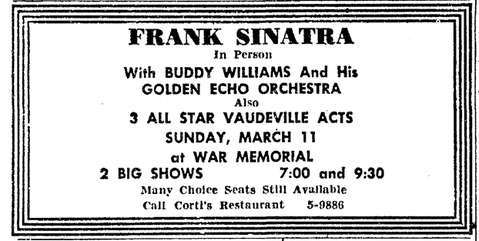
March 17, 1951
Television
The Frank Sinatra Show
Network: CBS
Location: New York City
Script Dated:
Show: #24
Sponsor: Bulova Watch Company (30mins)
Time: 9:00 P.M.-10:00 P.M.
Writers:
Producer: Jack Donahue
Director: Jack Donahue
Announcer: Ken Roberts
Orchestra Conducted By: Axel Stordahl
Guests: Jackie Gleason, Mary McCarthy, June Hutton, The Heathertones
1. It's The Same Old Shillelagh - Frank Sinatra
2. A Little But Of Heaven - Frank Sinatra & June Hutton
3. That Old Black Magic - Frank Sinatra
4. Walkin' My Baby Back Home - Frank Sinatra
5. Faithful - Frank Sinatra & The Heathertones
6. Get Happy - Frank Sinatra
The Frank Sinatra Show
Frank and Jackie
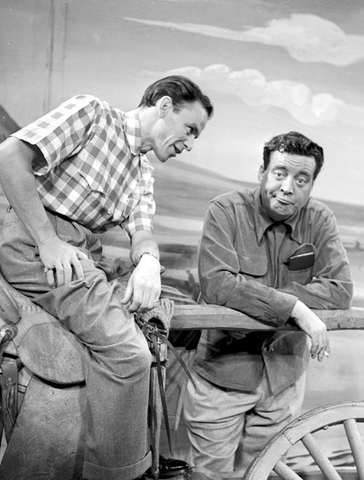
"Get Happy" / "That Old Black Magic"
Neal Hefti: Hefti recalled doing early uncredited charts for Sinatra as a favor to Axel Stordahl: 'I did a couple of charts for Frank that Axel didn't have time to do... He asked me for a chart on "Get Happy"... I had a sort of gimmick going on, a melodic pattern. Then a couple of weeks later Frank said to do one on "That Old Black Magic," which he was going to use in a picture called Meet Danny Wilson, and he said to write it something like the way I had written "Get Happy."'
Source: Will Friedwald, "Sinatra! The Song Is You: A Singer's Art" (2018 revised edition).
March 18, 1951
Radio
Meet Frank Sinatra
Show #21
Network: CBS
Script: March 8, 1951
Sponsor:
Time: 5:00PM - 5:45PM (EST), Sunday
Producers: Mark Goodson, Bill Todman
Musicians: Graham Forbes and His Quartet
Announcer: Hal Sims
Writers: Harry Crane
Guest: Nellie Lutcher, Bert Taylor
Notes: Confirmed aired on WCBS
Ed O'Brien:
ByMart was the only sponsor Frank had for "Meet Frank Sinatra.."
They only paid for the first 15 minutes of the show. After the March 4th show, they dropped him. His Sunday afternoon ratings were dismal. He may have had other sponsors back in the fall of 1950, but they didn't hang around for that many shows.
Meet Frank Sinatra
Show #21
Network: CBS
Script: March 8, 1951
Sponsor:
Time: 5:00PM - 5:45PM (EST), Sunday
Producers: Mark Goodson, Bill Todman
Musicians: Graham Forbes and His Quartet
Announcer: Hal Sims
Writers: Harry Crane
Guest: Nellie Lutcher, Bert Taylor
Notes: Confirmed aired on WCBS
© 1997-2026 The Sinatra Archive
This calendar, or any parts thereof, may not be reproduced in any fashion
whatsoever without the prior written permission of the publisher (The
Sinatra Archive)
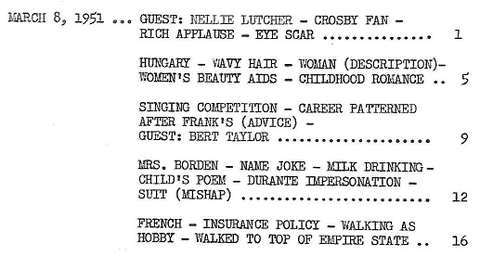
March 24, 1951
Television
The Frank Sinatra Show
Network: CBS
Location: New York City
Script Dated:
Show: #25
Sponsor: Bulova Watch Company (30mins)
Time: 9:00 P.M.-10:00 P.M.
Writers:
Producer: Jack Donahue
Director: Jack Donahue
Announcer: Ken Roberts
Orchestra Conducted By: Axel Stordahl
Guests: Basil Rathbone, Denise Darcel, The Heathertones
1. Singin' In The Rain - Frank Sinatra & The Heathertones
2. Basin Street Blues - Frank Sinatra
3. Home On The Range - Frank Sinatra & Denise Darcel
4. Where Or When - Frank Sinatra
5. All Of Me - Frank Sinatra
6. Polka Dots And Moonbeams - Frank Sinatra
Notes: Show in circulation.
March 25, 1951
Radio
Meet Frank Sinatra
Show #22
Network: CBS
Script: March 21, 1951 (Mel Torme), March 14, 1951 (Bob Haymes)
Sponsor: Tintair, Ludens
Time: 5:00PM - 5:45PM (EST), Sunday
Producers: Mark Goodson, Bill Todman
Musicians: Graham Forbes and His Quartet
Announcer: Hal Sims
Writers: Harry Crane
Guest: Bob Haymes
Meet Frank Sinatra
Show #22
Network: CBS
Script: March 21, 1951 (Mel Torme), March 14, 1951 (Bob Haymes)
Sponsor: Tintair, Ludens
Time: 5:00PM - 5:45PM (EST), Sunday
Producers: Mark Goodson, Bill Todman
Musicians: Graham Forbes and His Quartet
Announcer: Hal Sims
Writers: Harry Crane
Guest: Bob Haymes
note: the 3-25-51 broadcast was taped on 3-14-51. CBS taped the show with Mel Torme and Hot Lips Page on 3-21-51. They had scheduled it for an immediate broadcast but decided at the last minute to air the 3/14 taping. There is a complete transcript of the show from 3/21 and it shows the actual airdate to be 4-1-51.
Ed
------------------------------------------
Ed O'Brien:
On the evening of March 25, 1954, Frank Sinatra won the Academy Award for best supporting actor. His performance as "Maggio" in "From Here To Eternity," coupled with his fabulous recordings with Nelson Riddle at Capitol was called by Variety "the greatest comeback in show business history." But on that evening at the RKO Pantages Theatre, after the ceremonies were concluded,
Frank eschewed the gala parties and chose instead to walk the streets of Beverly Hills - alone - for hours.
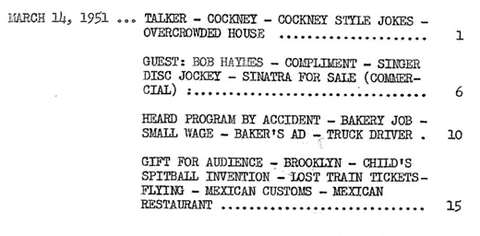
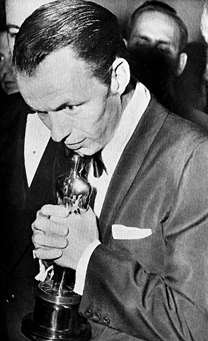
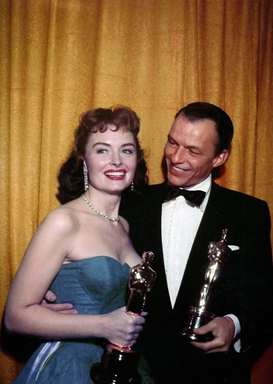
March 27, 1951
Studio
New York City
CO45184 I Whistle A Happy Tune
(R. Rodgers/O. Hammerstein II)
Arranged & Counducted by Axel Stor
(from The King And I)
Williamson Music, Inc. (ASCAP) 1951dahl
-1 (2:30) CD: Columbia Years 43-52 Vol. 12
LP: CL-1297 The Broadway Kick
78: 39346
5-20-51
5-11-51
CO45185 I'm A Fool To Want You w/The Ray Charles Singers
(J. Wolf/J.S. Herron/F. Sinatra)
Barton Music Corp. (ASCAP) 1951
Arranged & Counducted by Axel Stordahl
-1 (2:55) CD: Columbia Years 43-52 Vol. 12
CD: 09372 Greatest Hits-The Early Years, Vol. 2
LP: C6X-40343 The Voice-The Columbia years, 43-52
LP: CL-2741 The Essential Frank Sinatra, Vol. 3
LP: CL-2572 Greatest Hits, The Early Years, Vol. 2
78: 41133
78: 39425
6-17-51
6-17-51
During this session Frank Sinatra recorded “I'm a Fool to Want You,” a song he co-wrote with Jack Wolf and Joel Herron whose raw ache reflected his turmoil over Ava Gardner; he was so overcome that he left the studio in tears partway through and had to return later to finish it. The record was not a hit at the time, but his daughter Nancy would later call it “one of the finest recordings he ever made... enough to tear your heart into pieces,” recalling that the family played it at his house on Thanksgiving night 1996, prompting Frank himself to murmur, “My God. That's good.” Source: J. Randy Taraborrelli, Sinatra: Behind the Legend.
"I'm a Fool to Want You" / "Love Me"
Granata addresses the oft-repeated (likely apocryphal) story that Sinatra left the studio in tears after recording 'I'm a Fool to Want You' on March 27, 1951 -- session participants recall he remained to record another song, 'Love Me,' the same night, though the performance's raw emotional intensity likely did reflect his real personal turmoil over Ava Gardner.
Source: Charles L. Granata, "Sessions with Sinatra: Frank Sinatra and the Art of Recording" (1999/2003).
"I'm a Fool to Want You"
Granata calls the sotto voce ending of 'I'm a Fool to Want You' -- where Sinatra drops to a near-whisper on 'Take me back, I love you... pity me, I need you...' with a touch of portamento on 'need,' before building to a climax with the choir -- possibly the single most devastating vocal performance of his career.
Source: Charles L. Granata, "Sessions with Sinatra: Frank Sinatra and the Art of Recording" (1999/2003).
["I'm a Fool to Want You" recorded]
Sinatra recorded "I Whistle a Happy Tune" from The King and I (whistling the parts himself at Mitch Miller's suggestion) along with the melodramatic "I'm a Fool to Want You" by Joel Herron and Jack Wolf. Sinatra sang the latter in a single emotionally raw take, reportedly altering the lyrics himself, then fled the studio; songwriter Herron later invited Frank to be credited as co-writer.
Source: James Kaplan, "Frank: The Voice" (2010).
March 31, 1951
Television
The Frank Sinatra Show
Network: CBS
Location: New York City
Script Dated:
Show: #26
Sponsor: Bulova Watch Company (30mins)
Time: 9:00 P.M.-10:00 P.M.
Writers:
Producer: Jack Donahue
Director: Jack Donahue
Announcer: Ken Roberts
Orchestra Conducted By: Axel Stordahl
Guests: Peggy Lee, Conrad Nagel, Jack Gilford, Mary Raye and Naldi (dancers)
1. Manana - Peggy Lee
2. The House I Live In - Frank Sinatra
April 1, 1951
Radio
Meet Frank Sinatra
Show #23
Network: CBS
Script: March 15, 1951
Sponsor: Tintair, Ludens
Time: 5:00PM - 5:45PM (EST), Sunday
Producers: Mark Goodson, Bill Todman
Musicians: Graham Forbes and His Quartet
Announcer: Hal Sims
Writers:
Guest: Billy Eckstine, Trudy Richards, Benny Heller
1. Exactly Like You w/Graham Forbes
Notes: Confirmed Guests: Billy Eckstine, Trudy Richards and aired on WCBS. Cannot confirm Guest: Henny Heller.
note: Show was taped on 3-14-15-51. Benny Heller-great jazz guitarist - was one of the guests, not Henny. The numbers signify the script pages.
Ed
Kenny Lucas:
Regarding this show I once gave a cassette copy of this show to Billy Eckstine himself. He had completely forgotten this appearance and remembered it as a TV show. He told me he and FS were great friends and that FS gave him tips on singing such as breath control,long notes, technical things regarding breath control. He also said that they hung out at The Birdland nightclub often in the company of Ella,Sarah Vaughan and Billie Holiday. I also got the impression that he was somewhat jealous of Sinatra and thought that he was the better singer and that racism kept him from going further. I asked him what about Sammy Davis Jr ? and I can't repeat the reply except to say it was totally negative. I thought he was very bitter at the way his career ended.
Ed O'Brien:
Eckstine subbed for Frank at the Copa in May of 1950 and in Chicago's Chez Paree in 1952.He talked about the latter on the Tonight show. Frank called and asked if he would step in because of a serious throat problem. After about a week, Mr B. went over to Frank's hotel and discovered that the throat problem was actually a very lovely young lady. Carson fell down laughing while the story was being told. Frank sang "I Apologize" on the 4-8-51 "Meet Frank Sinatra." His approach was quite different from Eckstine's great recording, but marvelous in its own right. "How Sweet You Are" was written by Frank Loesser and Arthur Schwartz. The feud between Granz and Sinatra cost us the Frank-Ella album in 1967. A friend was at a rehearsal for the September 75 Uris engagement. Frank spotted Granz in the theatre, stopped singing and demanded Norman be removed. I have an interview Sinatra did with W.B. Williams. He asks Frank about the often planned recordings with Ella. Frank put the blame squarely on N.G.'s shoulders. All this started over a misunderstanding in 1960 when Sinatra approached Granz about forming a record company.
Meet Frank Sinatra
Show #23
Network: CBS
Script: March 15, 1951
Sponsor: Tintair, Ludens
Time: 5:00PM - 5:45PM (EST), Sunday
Producers: Mark Goodson, Bill Todman
Musicians: Graham Forbes and His Quartet
Announcer: Hal Sims
Writers:
Guest: Billy Eckstine, Trudy Richards, Henny Heller
1997-2026 The Sinatra Archive
This calendar, or any parts thereof, may not be reproduced in any fashion whatsoever without the prior written permission of the publisher (The Sinatra Archive)
__._,_.___
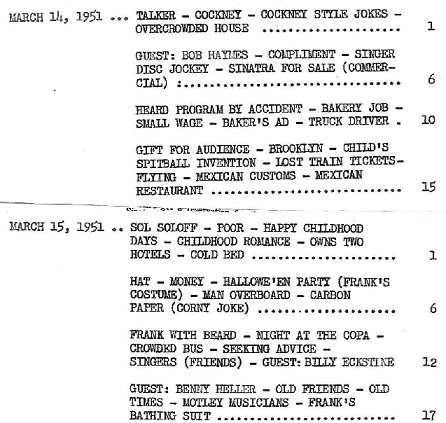
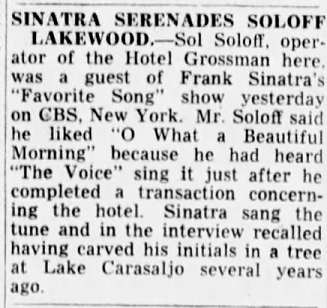

April 7, 1951
Television
The Frank Sinatra Bulova Show
Network: CBS
Location: New York City
Script Dated:
Show: #27
Sponsor: Bulova Watch Company (30mins)
Time: 9:00 P.M.-10:00 P.M.
Writers:
Producer: Jack Donahue
Director: Jack Donahue
Announcer: Ken Roberts
Orchestra Conducted By: Axel Stordahl
Guests: Dagmar, Frank Fontaine, Lionel Hampton, Henry Slate, June Hutton, The Heathertones
1. Blue Skies - Frank Sinatra
2. Love Me - Frank Sinatra
3. I Whistle A Happy Tune - Frank Sinatra
4. This Can't Be Love - Frank Sinatra
5. We Kiss In A Shadow - Frank Sinatra & June Hutton
The Frank Sinatra Bulova Show
Guests: Dagmar, Frank Fontaine, Lionel Hampton, Henry Slate, June Hutton, The Heathertones
Dagmar Frankie
Sinatra promoting the forthcoming Paramount engagement, probably from The Frank Sinatra (CBS TV) Show of April 7, 1951.
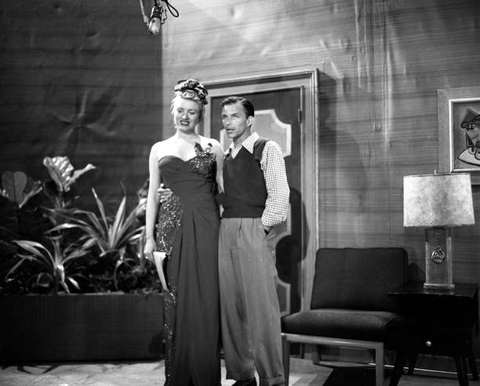
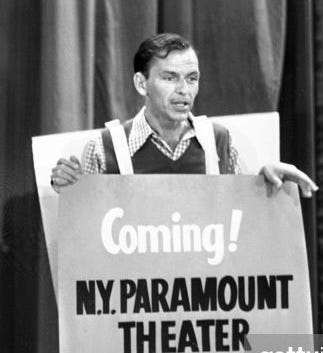
April 8, 1951
Radio
Meet Frank Sinatra
Show #24
Network: CBS
Sponsor: Tintair, Ludens
Time: 5:00PM - 5:30PM (EST), Sunday
Producers: Mark Goodson, Bill Todman
Musicians: Graham Forbes and His Quartet
Announcer: Hal Sims
Writers:
Guest: Hot Lips Page
1. Exactly Like You
2. I Apologize
3. The Music Stopped
4. Put Your Dreams Away
Notes: 5:30-5:45PM "Your Son and Universal Military Training - Dr. James B. Conat. Pres.. Harvard University: Edward R. Murrow. Commentator." Confirmed aired on WCBS.
Also confirmed Meet Frank Sinatra aired in Los Angeles 2:00 - 2:30PST and in Chicago 4:00PM - 4:30PM CNT.
Ed O'Brien:
A terrific show. Hot Lips Page was a real hepkat. Frank has a great chat with him. "Exactly Like You" was never recorded by Sinatra. He does a nice swing treatment here with Forbes and the Quartet. Billy Eckstine had the hit of "I Apologize,"but Frank's slow ballad treatment, with just Forbes on piano, is a real gem. He makes it a Sinatra song. "The Music Stopped" is also done with just piano. The interpretation is quite different from the bobbysox era Frankie swoon sound. And "Put Your Dreams Away" is the closer. He always did a sensitive treatment of his theme song.
note: Show was taped on 4-5 and aired on 4-8.
Exactly Like You was performed on the 4-1 show
It was taped on 3-28
.
Meet Frank Sinatra was an hour show from 10-29-50 thru 12-31-50. It became a 45 minute broadcast with the 1-7-51 and remained that way until the 4-8-51, which was only a half-hour. CBS ran the following broadcast from 5:30 to 5:45 p.m. that evening:
5:30-5:45PM "Your Son and Universal Military
Training - Dr. James B. Conat. Pres.. Harvard University: '
Edward R. Murrow. Commentator."
Meet F.S. returned to a 45 minute presentation on 4-15 and stayed that way for the rest of the Meet F.S. airings.
Last show was on 5-27-51.
The first Here's Frank Sinatra, 6-3-51, only ran for 25 minutes. The rest of that series was one hour and had its final broadcast on 7-22-51.
Hot Lips Page was a guest on the 3-25-51 show, taped on 3-21. The complete script from that broadcast is available.
Ed
Television
Colgate Comedy Hour
Network: NBC
Season: 1 Episode: 31
Host: Bob Hope
Guests: Frank Sinatra (Cameo), Rex Harrison (Guest), Arthur Treacher (Guest), Lilli Palmer (Guest), Janis Paige (Guest), Frank Robinson (Guest), Jimmy Durante (Cameo), Jinx McCrary (Cameo), Ken Murray (Cameo), Bernard "Toots" Shor (Cameo), Faye Emerson (Cameo), Sid Caesar (Cameo), Ed Wynn (Cameo), Imogene Coca (Cameo), Eddie Cantor (Cameo), Tex McCrary (Cameo)
Note: Sinatra appears at the end to wish Hope well on his London engagement.
Note: Did some more research on this show. A number of performers, including Frank, sang a bon voyage number to Bob.
Hope was leaving for Europe and each performer, according to Variety, did a few minutes serenading Mr. Hope. Show cost $100,000. There was criticism leveled at Colgate and Hope for such an expensive production. But this was the final show of Hope's first TV season and his ratings were excellent. Meanwhile NBC was in very serious negotiations with Mr. Sinatra. CBS showed no indication of renewing his TV show for the 1951-52 season. NBC was offering him a hefty salary to take over the Colgate Comedy Hour at 8 o'clock on Sunday evenings. CBS quickly stepped in and renewed Frank for another year. The singer announced that he wanted to travel around the country and bring his show live from major American cities each week. CBS was not interested in such an expensive weekly production.
--Ed
Concerts
"Bob Hope Night On Broadway,” Paramount Theatre, New York Benefit for the Damon Runyon Cancer Fund
Hosted by Bob Hope
Other performers included: Frank Sinatra, Tallulah Bankhead,
Jose Ferrer, Judy Holiday, Rex Harrison, Lilli Palmer, Ethel Merman, Ed Wynn, Sid Caesar, Imogene Coca among others

"Bob Hope Night On Broadway", Paramount Theatre, New York Benefit for the Damon Runyon Cancer Fund
Hosted by Bob Hope
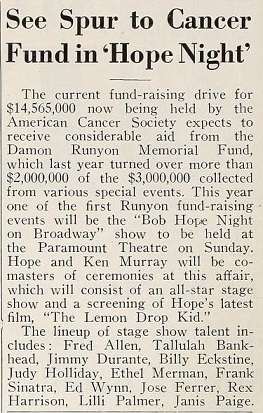
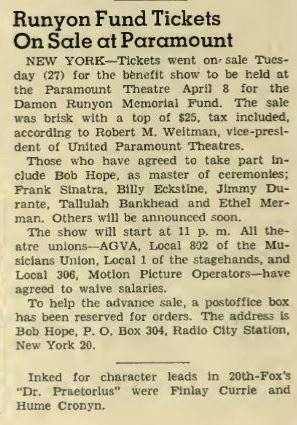
Meet Frank Sinatra
Show #24
Network: CBS
Sponsor: Tintair, Ludens
Time: 5:00PM - 5:30PM (EST), Sunday
Producers: Mark Goodson, Bill Todman
Musicians: Graham Forbes and His Quartet
Announcer: Hal Sims
Writers:
Guest: Hot Lips Page
1. Exactly Like You
2. I Apologize
3. The Music Stopped
4. Put Your Dreams Away
note: Show was taped on 4-5 and aired on 4-8.
Exactly Like You was performed on the 4-1 show
It was taped on 3-28
Here are some excerpts from the transcript of the April 8, 51 Meet Frank Sinatra broadcast.
It shows the date that the taping took place.
There are also excerpts of the Torme and
Hot Lips Page segments.
April 9, 1951
Concerts
Kleinhans Music Hall, Buffalo, New York
Benefit for the annual college scholarship fund of the Romulus Club. Songs included:
--When You're Smiling
--If
--April In Paris
--That Old Black Magic
--Whippoorwill
--My Blue Heaven
--Night and Day
--Ol' Man River
--Soliloquy
Kleinhans Music Hall, Buffalo, New York
Benefit for the annual college scholarship fund of the Romulus Club.
Rehearsal
Performance
Others locals who have been touched by the Sinatra legend include Eleanor Kopiasz, a South Buffalo woman whom the singer has showered with gifts since the mid-1970s, and former state Sen. Joseph A. Tauriello, who was once a crooner in his own right.
Sinatra happened to read about Ms. Kopiasz while performing in Niagara Falls and was impressed by the spunk of a woman who suffered a heart attack and stroke that had left her paralyzed at age 44, in 1968.
Over the years, Sinatra has sent Mrs. Kopiasz, who is now 74 and a great-grandmother, everything from a special mattress and television sets to candy and flowers to brighten the South Park Avenue apartment she shares with her husband, Eugene.
The Tauriello connection dates to 1941, when Benjamin Madonia Sr. introduced Sinatra to the former legislator's mother, Margaret, now 96, over dinner.
"As he was leaving, he leaned over, kissed her, told her she was beautiful and gave her tickets for the whole family to the next night's show," Tauriello said.
In 1951, Tauriello stood star-struck in the wings at Kleinhans Music Hall as Sinatra gave a benefit concert for the Romulus Club, an Italian-American social group.
"I spent three hours backstage with him. As an aspiring singer, it was the biggest thrill of my life," Tauriello said. "He was warm, cordial, encouraging."
Sinatra hurried away after the concert, leaving some club members miffed. But no slight was intended, Tauriello said.
"He was seeing Ava Gardner and had to catch a plane to meet her," he recalled.
Tauriello, who sang his way through high school on local radio, went on to perform with Glenn Miller and Tex Beneke while in the Army and with Les Brown at Crystal Beach, before answering the siren call of politics.
April 14, 1951
Television
The Frank Sinatra Show
Network: CBS
Location: New York City
Script Dated:
Show: #28
Sponsor: Bulova Watch Company (30mins)
Time: 9:00 P.M.-10:00 P.M.
Writers:
Producer: Jack Donahue
Director: Jack Donahue
Announcer: Ken Roberts
Orchestra Conducted By: Axel Stordahl
Guests: Rudy Vallee, The Pied Pipers
1. The Best Things In Life Are Free - Frank Sinatra
2. The One I Love - Frank Sinatra & Pied Pipers
3. If There Is Someone Lovelier Than You - Frank Sinatra
Note: Ed O'Brien points out that Frank never recorded the Schwartz/Dietz song but sang it a number of times.
April 15, 1951
Radio
Meet Frank Sinatra
Show #25
Network: CBS
Script: March 28, 1951
Sponsor: Tintair, Ludens
Time: 5:00PM - 5:45PM (EST), Sunday
Producers: Mark Goodson, Bill Todman
Musicians: Graham Forbes and His Quartet
Announcer: Hal Sims
Writers: Harry Crane
Guest: Errol Garner, Leo Fuld
Notes: Confirmed aired on WCBS. NYT announced Sinatra was going to abandon the interview portion of the show in May.
Meet Frank Sinatra
Show #25
Network: CBS
Script: March 28, 1951
Sponsor: Tintair, Ludens
Time: 5:00PM - 5:45PM (EST), Sunday
Producers: Mark Goodson, Bill Todman
Musicians: Graham Forbes and His Quartet
Announcer: Hal Sims
Writers: Harry Crane
Guest: Errol Garner, Leo Fuld
Notes: Confirmed aired on WCBS. NYT announced Sinatra was going to abandon the interview portion of the show in May.
Show was taped on 3-28/29-51
------------------------------------------
April 15, 1955
Capitol released "In The Wee Small Hours" on this date in 1955. There are many people who consider it to be the finest ballad album ever.
--Ed
On this date in 1955, Capitol Records released "In The Wee Small Hours," widely considered to be the first concept album. George Jacobs told me that in private Frank referred to it as the "Ava album." At the end of the last century, numerous magazines and newspapers conducted polls for the finest albums in the history of pop music. "Wee Small . . ." made every list. The Wall Street Journal called it "Sinatra's finest album." New York Times agreed and also dubbed Frank "The father of the concept album." I always asked musicians, who worked with Frank, to name his best album. "Wee Small Hours" was the overwhelming choice.
The initial release was on two 10 inch records.
Billboard
5-14-55
Rare Cover:
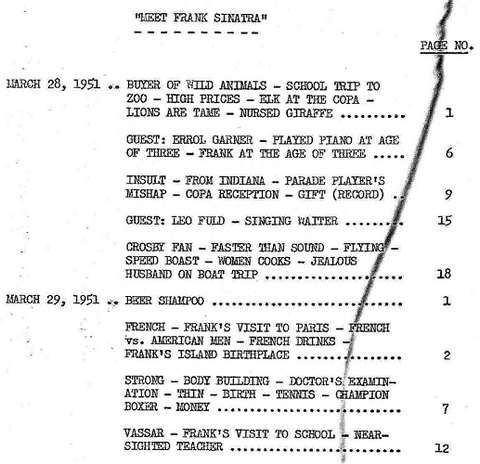
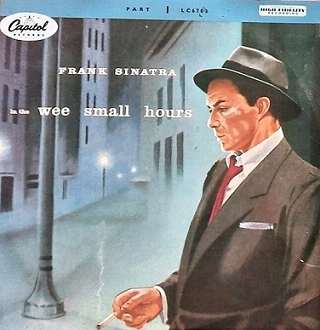
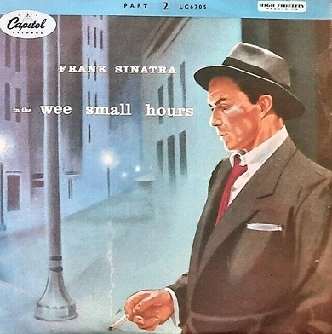
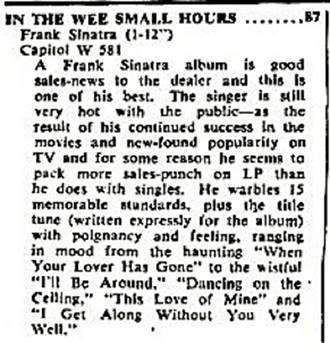
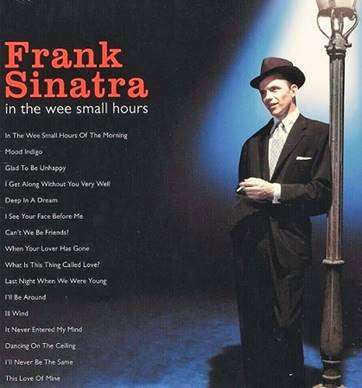
April 21, 1951
Television
The Frank Sinatra Show
Network: CBS
Location: New York City
Script Dated:
Show: #29
Sponsor: Bulova Watch Company (30mins)
Time: 9:00 P.M.-10:00 P.M.
Writers:
Producer: Jack Donahue
Director: Jack Donahue
Announcer: Ken Roberts
Orchestra Conducted By: Axel Stordahl
Guests: Smith and Dale, Al Bernie
1. Would I Love You? - Frank Sinatra
2. You Are Love - Frank Sinatra
3. Wrap Your Troubles In Dreams - Frank Sinatra
April 22, 1951
Radio
Meet Frank Sinatra
Show #26
Network: CBS
Script: March 29, 1951
Sponsor: Tintair, Ludens
Time: 5:00PM - 5:45PM (EST), Sunday
Producers: Mark Goodson, Bill Todman
Musicians: Graham Forbes and His Quartet
Announcer: Hal Sims
Writers: Harry Crane
Guest: Les Paul & Mary Ford, Richard Hayes
1. Should I?
2. You'll Never Walk Alone
Ed O'Brien notes:
Frank sang "Should I" with the quartet and "You'll Never Walk Alone" with just Graham Forbes backing him on piano. He played his Columbia recording of "You're The One." Frank played Perry Como's big hit of "If" and during his intro he told the audience it would have to be played with a green needle because he was so envious. Les Paul and Mary Ford appeared for an interview and Frank played their big hit "How High The Moon." His next guest was Richard Hayes. Frank gave him a great introduction and they chatted for a few minutes. Hayes sang Nat Cole's smash hit "Too Young" with Forbes lending his support on the piano. Frank interviewed a few people in the audience and presented them with savings bonds and Bulova gold watches. He then played a recording by Tino Rossi that was requested by an audience member. The Columbia recording of "Faithful" was played. Hal Sims encourages people to send in postcards with songs they would pick to be played. Show has a rather quick ending.
Meet Frank Sinatra
Show #26
Network: CBS
Script: March 29, 1951
Sponsor: Tintair, Ludens
Time: 5:00PM - 5:45PM (EST), Sunday
Producers: Mark Goodson, Bill Todman
Musicians: Graham Forbes and His Quartet
Announcer: Hal Sims
Writers: Harry Crane
Guest: Les Paul & Mary Ford, Richard Hayes
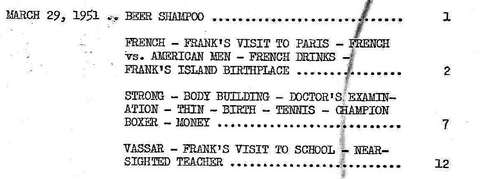
April 25, 1951
Concerts
Paramount Theater, New York City (April 25 - May 8) w/Joe Buskin Orchestra
Also: Eileen Barton, Dagmar, Tim Herbert & Don Saxon
On screen: "My Forbidden Past" with Robert Mitchum & Ava Gardner
Paramount Theater, New York City (April 25 - May 8)
w/Joe Buskin Orchestra
Also: Eileen Barton, Dagmar, Tim Herbert & Don Saxon
On screen: "My Forbidden Past" with Robert Mitchum
& Ava Gardner
Interesting ad with Ava on the left and Sinatra on the right.
VAUDEVILLE Dagmar's Chest Gives Big Lift To Sinatra's Return to Para
Paramount, New York (Wednesday, April 25) Capacity, 3,654. Price range 5$ cents-$1.50. Four shows daily; five, Saturday.. Chain booker, Harry Levine. Show played by Joe Bushkin's ork.
The big draw on the bill is Frank Sinatra. tho Sinatra didn't walk away with the show. All the acts did big jobs, tho the nod went to Dagmar's chestly strutting and verbal handling of the girl-chases-boy bits. As a matter of fact, Sinatra could have been better if he let the blonde do more. Sinatra is too good a showman not to see this for himself. For example when Sinatra started his last number. right after Dagmar walked off, the audience began moving out, Had the gal stayed on for the pit descent. it is quite likely the audience , would have stayed put.
The show started with Eileen Barton belting out "Baby Me," followed by a comedy number "I Met Him At One O'Clock then into "I Want To Hang My Hat on a Tree That Grows In Brooklyn, in //snakier and wound up with her famed "Baked a Cake." The voice was better than ever But her poise and ease showed the most improvement. The audience loved her.
Tim Herbert and Don Saxon who just closed across the street at the Palace, were better here than ever Their new bits showed to better advantage, and the lads worked with a zest and freedom that won them big yocks and solid hands all the way.
Frank Sinatra is still the golden boy to judge from some of the audience response. The old time hysteria and caterwauling is no longer there, after all Sinatra's been around for some time And also his voice, marred be a cold, isn't what it used to be. But over the years. he's picked up stage savvy that makes him a genuine personality with a lot of knowhow, one who works beautifully before a jammed house
Backed by Bushkin's band plus five strings. Sinatra gave out with standards. pops and requests Some of them may have been milked, but they were handled so skillfully. they were a revelation In hie act with Dagmar, Sinatra poked fun at his reputed puniness to the gleeful response of the kids up front.
Joey Bushkin's band (20) didn't have much to do in its own spot. The fronter, however, showed a nice personality, a quickness and an ability that should aid him in becoming a stage attraction. Bushkin's biggest number was an Irving Berlin oldie, "I Love a Piano," where he was able to demonstrate his fine keyboard technique. Pic, "My Forbidden Past."
Billboard
May 5, 1951
The Galt Herald
April 27, 1951
note: Interesting piece on Frank's frenetic ways back then.
But the writer never mentions the Paramount engage-
ment.
Ed
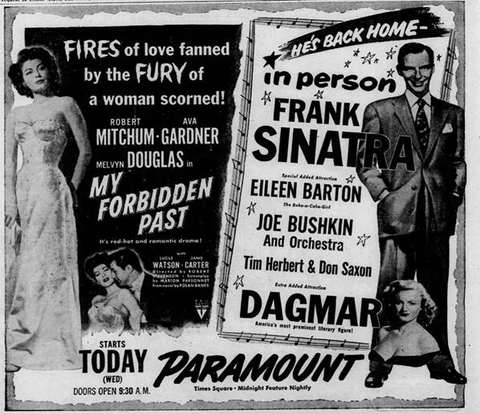
[Paramount Theater engagement with Dagmar]
Sinatra began a two-week stand at the Paramount Theater, his first live engagement in six months, backed by Joey Bushkin's band and featuring buxom TV comedienne Dagmar for comic relief. The bobby-soxer crowds were gone and seats sat empty; Sinatra joked to Bushkin that the only autographs he got now were from process servers.
Source: James Kaplan, "Frank: The Voice" (2010).
April 26, 1951
Concerts
Paramount Theater, New York City (April 25 - May 8) w/Joe Buskin Orchestra
Also: Eileen Barton, Dagmar, Tim Herbert & Don Saxon
On screen: "My Forbidden Past" with Robert Mitchum & Ava Gardner
Ed O'Brien:
I asked Mitch Miller about Frank's infamous recording of "Mama Will Bark" with Dagmar. Mitch told me it was Frank's idea to make a record with her. He told me they were appearing together at the Paramount in April/May of 51. According to
Mitch, they sang a duet that went over big with the audience every show. Frank called Mitch and requested a song he could sing with Dagmar.
I tried to get additional information but there was precious little to prove what Mitch claimed. That is until recently. About four or five months ago, a tape of a show from that engagement, suddenly emerged.
And lo and behold, there they were singing a duet.
Mr. Miller gave me the straight dope 20 years ago.
Two days after the show closed at the theatre(5/8),
Frank and Dagmar recorded "Mama Will Bark."
I should add that Miller was very open and candid about his relationship with Frank during our con- versations. I cannot find one false note in the fas- cinating story he told me.
April 27, 1951
Concerts
Paramount Theater, New York City (April 25 - May 8) w/Joe Buskin Orchestra
Also: Eileen Barton, Dagmar, Tim Herbert & Don Saxon
On screen: "My Forbidden Past" with Robert Mitchum & Ava Gardner
April 28, 1951
Television
The Ken Murray Show
Saturday Evening
Cerebral Palsy Campaign Launch
Network: CBS
Time: 8:00 - 9:00 P.M.
Guest: Don Ameche, Frank Sinatra, Abe Burrows, Robert Q. Lewis, Gypsy Rose Lee, Constance Moor, Phil Silvers note: Murray's show was Frank's lead-in on Saturday. The CP kick-off was part of Murray's regular hour show.
The Frank Sinatra Show
Network: CBS
Location: New York City
Script Dated:
Show: #30
Sponsor: Bulova Watch Company (30mins)
Time: 9:00 P.M.-10:00 P.M.
Writers:
Producer: Jack Donahue
Director: Jack Donahue
Announcer: Ken Roberts
Orchestra Conducted By: Axel Stordahl
Guests: Dagmar, Frank Fontaine, Henry Slate
Concerts
Paramount Theater, New York City (April 25 - May 8) w/Joe Buskin Orchestra
Also: Eileen Barton, Dagmar, Tim Herbert & Don Saxon
On screen: "My Forbidden Past" with Robert Mitchum & Ava Gardner
The Ken Murray Show
Saturday Evening
Cerebral Palsy Campaign Launch
Network: CBS
Time: 8:00 - 9:00 P.M.
Guest: Don Ameche, Frank Sinatra, Abe Burrows, Robert Q. Lewis, Gypsy Rose Lee, Constance Moor, Phil Silvers note: Murray's show was Frank's lead-in on Saturday. The CP kick-off was part of Murray's regular hour show.
Variety 5-2-51
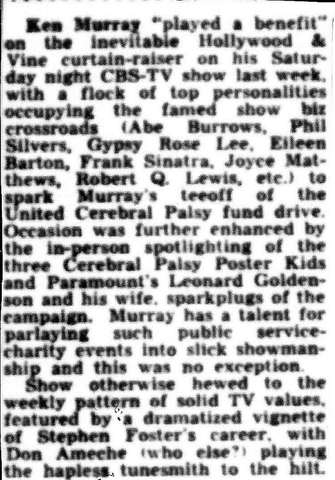
April 29, 1951
Radio
Meet Frank Sinatra
Show #27
Network: CBS
Script: April 5, 1951
Sponsor: Tintair, Ludens
Time: 5:00PM - 5:45PM (EST), Sundays
Producers: Mark Goodson, Bill Todman
Musicians: Graham Forbes and His Quartet
Announcer: Hal Sims
Writers: Harry Crane
Guest: Mildred Bailey, Vinni De Campo
Notes: Confirmed aired on WCBS
Ed O'Brien:
The great Mildred Bailey was a guest on
"Meet Frank Sinatra." Did they do a duet?
Did Mildred remember seeing Frank at the Rustic Cabin? Red Norvo told me Frank loved Mildred's singing.
He also remembered Mildred's reaction the first time she heard Frank sing. She told Red to hire him immediately. He asked why and Mildred informed Red that the singing waiter was going to be a great singer.
Would love to hear this show.
Richard Claar:
I'd love to hear it, too. I'm a huge fan of Mildred's, possess just about every record she ever made. There are a number of broadcasts featuring Mildred floating around out there, including all (or most) of a superb, jazz oriented series she hosted in '44 and, I think, '45 as well. There have been some CDs, but it's tough to track the material down. I seem to have a vague memory of FAS guest starring on this show, but it could be erroneous.
Frank and Mildred Bailey; what a fascinating combo. She passed away only about six months after the '51' broadcast. Legend and lore has it that both Bing and Frank admired and enjoyed her work so much that they helped her out financially during her final, difficult years.
Concerts
Paramount Theater, New York City (April 25 - May 8) w/Joe Buskin Orchestra
Also: Eileen Barton, Dagmar, Tim Herbert & Don Saxon
On screen: "My Forbidden Past" with Robert Mitchum & Ava Gardner
DAGMAR'S CHEST GIVES BIG LIFT
TO SINATRA'S RETURN TO PARA
The big draw on the bill is Frank Sinatra, tho Sinatra didn't walk away with the show.
All the acts did big jobs, tho the nod went to Dagmar's chesty strutting and verbal handling of the girl -chases - boy bits.
As a matter of fact, Sinatra could have been better if he had let the blonde do more. Sinatra is too good a showman not to see this for himself. For example when Sinatra started his last number, right after Dagmar walked off, the audience began moving out. Had the gal stayed on for the pit descent, it is quite likely the audience would have stayed put.
Frank Sinatra is still the golden boy to judge from some of the audience response. The old time caterwauling is no longer there: after all Sinatra's been around for some time. And also his voice, marred by a cold, isn't what it use to be. But over the years, he's picked up stage savvy that makes him a genuine personality with a lot of know - how, one who works beautifully before a jammed house. Backed by
Joe Bushkin's band plus five strings,
Sinatra gave out standards,pops and requests. Some of them may have been milked, but they were handled so skill- fully, they were a revelation. In his act with Dagmar, Sinatra poked fun at his reputed puniness to the gleeful response of the kids up front.
Joey Bushkin's band (20) didn't have much to do in its own spot. Bushkin's biggest number was an Irving Berlin oldie,
"I Love A Piano," where he was able to demonstrate his fine keyboard technique.
Pic, "My Forbidden Past."
Bill Smith
Billboard
May 5, 1951
Note: This Paramount engagement ran from 4-25 thru 5-8-51. Mitch Miller told me it was during this stint that Sinatra got the idea of doing a novelty record with Dagmar. He asked Mitch to find them a song. Miller told me Frank was struggling vocally at the time. According to Mitch, Frank was devoting an inordinate amount of time and energy in his pursuit of
Ava. Mitch told me Frank had the most beautiful musical instrument he had ever heard.
But it was very fragile. He compared it to Frankie
Laine's voice. The latter was like iron and could sustain much abuse and not be diminished. Frank's, on the hand, was very fragile and needed lots of care. Miller lamented how little Frank tended to his voice during this time in his career.
"My Forbidden Past" starred Robert Mitchum and Ava
Gardner.
Meet Frank Sinatra
Show #27
Network: CBS
Script: April 5, 1951
Sponsor: Tintair, Ludens
Time: 5:00PM - 5:45PM (EST), Sundays
Producers: Mark Goodson, Bill Todman
Musicians: Graham Forbes and His Quartet
Announcer: Hal Sims
Writers: Harry Crane
Guest: Mildred Bailey, Vinni De Campo
Notes: Confirmed aired on WCBS
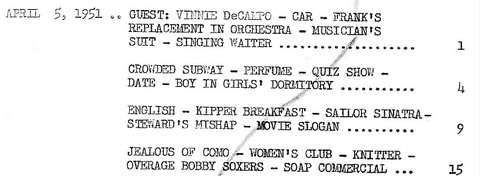
April 30, 1951
Concerts
Paramount Theater, New York City (April 25 - May 8) w/Joe Buskin Orchestra
Also: Eileen Barton, Dagmar, Tim Herbert & Don Saxon
On screen: "My Forbidden Past" with Robert Mitchum & Ava Gardner
May 1951
[Frank and Ava's pursued Acapulco vacation]
After Ava finished filming Lone Star, she and Frank tried to slip quietly into Mexico for a vacation, but the press caught wind and swarmed them; the LA Times likened the coverage to the Rita Hayworth-Aly Khan frenzy. Frank was forced to publicly deny any intention of eloping with Ava while in Mexico.
Source: Richard Havers, "Sinatra" (Dorling Kindersley, 2007).
[Photographer confrontation on return flight from Acapulco]
Trying to return to Los Angeles more quietly aboard a converted bomber loaned by baseball club owner Jorge Pasquel, Frank and Ava were still met by photographers, and Frank was accused of trying to deliberately run one down with a car. The papers reported Frank cursing at the photographer, which he and Ava insisted was a manufactured story.
Source: Richard Havers, "Sinatra" (Dorling Kindersley, 2007).
May 1, 1951
Concerts
Paramount Theater, New York City (April 25 - May 8) w/Joe Buskin Orchestra
Also: Eileen Barton, Dagmar, Tim Herbert & Don Saxon
On screen: "My Forbidden Past" with Robert Mitchum & Ava Gardner
May 2, 1951
Concerts
Paramount Theater, New York City (April 25 - May 8) w/Joe Buskin Orchestra
Also: Eileen Barton, Dagmar, Tim Herbert & Don Saxon
On screen: "My Forbidden Past" with Robert Mitchum & Ava Gardner
May 3, 1951
Concerts
Paramount Theater, New York City (April 25 - May 8) w/Joe Buskin Orchestra
Also: Eileen Barton, Dagmar, Tim Herbert & Don Saxon
On screen: "My Forbidden Past" with Robert Mitchum & Ava Gardner
May 4, 1951
Concerts
Paramount Theater, New York City (April 25 - May 8) w/Joe Buskin Orchestra
Also: Eileen Barton, Dagmar, Tim Herbert & Don Saxon
On screen: "My Forbidden Past" with Robert Mitchum & Ava Gardner
May 5, 1951
Television
The Frank Sinatra Show
Network: CBS
Location: New York City
Script Dated:
Show: #31
Sponsor: Bulova Watch Company (30mins)
Time: 9:00 P.M.-10:00 P.M.
Writers:
Producer: Jack Donahue
Director: Jack Donahue
Announcer: Ken Roberts
Orchestra Conducted By: Axel Stordahl
Guests: Dagmar, Tim Herbert, Don Saxon, Eileen Barton, Joe Bushkin, June Hutton
1. When You're Smiling - Frank Sinatra
2. My Romance - Frank Sinatra & June Hutton
3. Hello Young Lovers - Frank Sinatra
4. Oh! Look At Me Now - Frank Sinatra & June Hutton
5. If - Frank Sinatra
Notes: Show in circulation. 60 mins. Ed O'Brien calls this a marvellous reading of "Hello, Young Lovers" with a back-to-the- Paramount theme. Sinatra tells the audience that "If" is no great shakes and then sings the hell out of it.
[image referenced in source but could not be recovered]
Concerts
Paramount Theater, New York City (April 25 - May 8) w/Joe Buskin Orchestra
Also: Eileen Barton, Dagmar, Tim Herbert & Don Saxon
On screen: "My Forbidden Past" with Robert Mitchum & Ava Gardner
May 6, 1951
Radio
Meet Frank Sinatra
Show #28
Network: CBS
Script: April 11, 1951
Sponsor: Tintair, Ludens
Time: 5:00PM - 5:45PM (EST), Sundays
Producers: Mark Goodson, Bill Todman
Musicians: Graham Forbes and His Quartet
Announcer: Hal Sims
Writers: Harry Crane
Guest: Art Tatum, Dick Brown, Leo Field
Notes: Confirmed aired on WCBS
Billboard reported in early September of 1950 that CBS was set to sign Frank Sinatra for a radio/TV deal. The figure reported was $301,000 per season for three years. Variety and other show biz publications reported $250,000 over the same span of time.
Bymart(Tintair ) agreed to sponsor the first 15 minutes of "Meet Frank Sinatra." The Sunday afternoon 45 minute radio show was picked up for an additional quarter-hour by Luden's Cough Drops. But that was it. By late January of 1951, Luden's dropped their 15 minutes and on 3-3-51,
Tintair opted out. The show would be self-sustaining for the duration of its run.
The TV show had Bulova Watches financing the first half- hour for the first season -- 1950-51. Bulova decided not to pick up the option to renew for another season.
Ecko Hardware agreed to sponsor the first half-hour of season number two. They would drop back to 15 minutes right after the new year. By February they abandoned the show and it would be self-sustaining through its final episode in April of 1952. Another problem was the reluctance of the CBS affiliates to carry the show. By March of 1952 only 28 CBS stations broadcast the show. There was at the time 58 local stations aligned with CBS. Ratings have always been the raison d'etre in both radio and television. Sinatra's shows did very poorly in the early '50s. The inability to improve rating performance scared away potential sponsors including Standard Oil, Alcoa and Coke, and the few who took a chance became discouraged and cut their losses.
Concerts
Paramount Theater, New York City (April 25 - May 8) w/Joe Buskin Orchestra
Also: Eileen Barton, Dagmar, Tim Herbert & Don Saxon
On screen: "My Forbidden Past" with Robert Mitchum & Ava Gardner
Meet Frank Sinatra
Show #28
Network: CBS
Script: April 11, 1951
Sponsor: Tintair, Ludens
Time: 5:00PM - 5:45PM (EST), Sundays
Producers: Mark Goodson, Bill Todman
Musicians: Graham Forbes and His Quartet
Announcer: Hal Sims
Writers: Harry Crane
Guest: Art Tatum, Dick Brown, Leo Field
[image referenced in source but could not be recovered]
[image referenced in source but could not be recovered]
May 7, 1951
Concerts
Paramount Theater, New York City (April 25 - May 8) w/Joe Buskin Orchestra
Also: Eileen Barton, Dagmar, Tim Herbert & Don Saxon
On screen: "My Forbidden Past" with Robert Mitchum & Ava Gardner
May 8, 1951
Concerts
Paramount Theater, New York City (April 25 - May 8) w/Joe Buskin Orchestra
Also: Eileen Barton, Dagmar, Tim Herbert & Don Saxon
On screen: "My Forbidden Past" with Robert Mitchum & Ava Gardner
SONGS:
1. When You're Smiling
2. Would I Love You ?
3. Hello Young Lovers
4. That Old Black Magic
5. April In Paris
6. The Spelling Song duet with Dagmar
7. My Blue Heaven
8. Closing remarks by Joe Bushkin
May 10, 1951
Studio
New York City
CO45819 Mama Will Bark w/Dagmar, Imitations by Donald Baine
(D. Manning)
Odette Music Corp. (ASCAP) 1951
Arranged & Conducted by Axel Stordahl
-1 (2:55) CD: Columbia Years 43-52 Vol. 12
78: 39425
Ed O
U.S. Release was backed with the fabulous tune "I'm A Fool To Want You"
The British release was backed with "Love Means Love" duet with Rosemary Clooney.
New York City
CO45819 Mama Will Bark w/Dagmar, Imitations by Donald Baine
(D. Manning)
Odette Music Corp. (ASCAP) 1951
Arranged & Conducted by Axel Stordahl
-1 (2:55) CD: Columbia Years 43-52 Vol. 12
78: 39425
Ed O'Brien:
Sinatra did an extensive private interview in 1958.
Asked what he thought of the infamous "Mama Will
Bark," Frank expresses relief that the song failed to catch on.
As bad as it was, he could not imagine being saddled with it as a "Sinatra hit."
"The only good business it did was with dogs"
Frank Sinatra referring to Donald Bain's dog imitations on the recording session photo promo for radio stations
"Mama Will Bark"
Sinatra recorded the widely derided novelty duet 'Mama Will Bark' with comedienne Dagmar (accompanied by a howling-dog impression from Donald Bain) on May 10, 1951 -- a session widely considered the low point of his career and the point of no return in his relationship with Mitch Miller, who conceived the song as a commercial gambit while Sinatra and Dagmar were appearing together at the Paramount Theater.
Source: Charles L. Granata, "Sessions with Sinatra: Frank Sinatra and the Art of Recording" (1999/2003).
"Mama Will Bark" / "I'm a Fool to Want You"
Mitch Miller: Mitch Miller insisted he tried to protect Sinatra by pairing the novelty 'Mama Will Bark' on the same single with the serious ballad 'I'm a Fool to Want You,' insisting nothing else Sinatra recorded at the time was inferior -- but that Sinatra fixated on 'Mama Will Bark' as the emblem of his Columbia decline.
Source: Charles L. Granata, "Sessions with Sinatra: Frank Sinatra and the Art of Recording" (1999/2003).
["Mama Will Bark" recording session]
Sinatra recorded the novelty duet "Mama Will Bark" with Dagmar and voice artist Donald Bain at Columbia's Thirtieth Street studio, produced by Mitch Miller after he saw Frank and Dagmar's comedy chemistry at the Paramount. Sinatra later called it his most embarrassing record, though Kaplan judges it merely harmless kitsch.
Source: James Kaplan, "Frank: The Voice" (2010).
May 12, 1951
Television
The Frank Sinatra Show
Network: CBS
Location: New York City
Script Dated:
Show: #32
Sponsor: Bulova Watch Company (30mins)
Time: 9:00 P.M.-10:00 P.M.
Writers:
Producer: Jack Donahue
Director: Jack Donahue
Announcer: Ken Roberts
Orchestra Conducted By: Axel Stordahl
Guests: Jackie Gleason, June Hutton
1. I Whistle A Happy Tune - Frank Sinatra
2. We Kiss In A Shadow - Frank Sinatra
3. She's Funny That Way - Frank Sinatra
4. Girl Next Door - Frank Sinatra & June Hutton
May 13, 1951
Radio
Meet Frank Sinatra
Show #29
Network: CBS
Script: April 12, 1951
Sponsor: Tintair, Ludens
Time: 5:00PM - 5:45PM (EST), Sunday
Producers: Mark Goodson, Bill Todman
Musicans: Graham Forbes and His Quartet
Announcer: Hal Sims
Writers: Harry Crane
Guest: Ray Anthony, Art Morton, Delores Hawkins
Notes: Confirmed aired on WCBS
Meet Frank Sinatra
Show #29
Network: CBS
Script: April 12, 1951
Sponsor: Tintair, Ludens
Time: 5:00PM - 5:45PM (EST), Sunday
Producers: Mark Goodson, Bill Todman
Musicans: Graham Forbes and His Quartet
Announcer: Hal Sims
Writers: Harry Crane
Guest: Ray Anthony, Art Morton, Delores Hawkins
Notes: Confirmed aired on WCBS
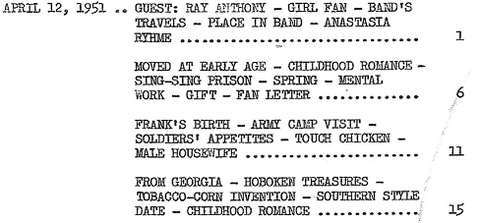
May 17, 1951
Concerts
Convention Hall, Camden, NJ
Benefit for the M. Gooder Memorial Park and Recreation Center
May 19, 1951
Television
The Frank Sinatra Show
Network: CBS
Location: New York City
Script Dated:
Show: #33
Sponsor: Bulova Watch Company (30mins)
Time: 9:00 P.M.-10:00 P.M.
Writers:
Producer: Jack Donahue
Director: Jack Donahue
Announcer: Ken Roberts
Orchestra Conducted By: Axel Stordahl
Guests: Phil Silvers,
May 20, 1951
Radio
Meet Frank Sinatra
Show #30
Network: CBS
Sponsor:
Time 5:00PM - 5:45PM (EST), Sunday
Producers: Mark Goodson, Bill Todman
Musicians: Graham Forbes and His Quartet
Announcer: Hal Sims
Writers:
Guest: no guests listed
Notes: Confirmed as still 45 minute format, listed as "Meet Frank Sinatra" and aired on WCBS
5:00PM - 5:45PM (EST), WBBM 4:00PM - 4:45PM (CNT) , KNX 2:00PM -2:45PM (PST)
May 26, 1951
Television
The Frank Sinatra Show
Network: CBS
Location: New York City
Script Dated:
Show: #34
Sponsor: Bulova Watch Company (30mins)
Time: 9:00 P.M.-10:00 P.M.
Writers:
Producer: Jack Donahue
Director: Jack Donahue
Announcer: Ken Roberts
Orchestra Conducted By: Axel Stordahl
Guests: J. Carrol Naish, Phil Foster
May 27, 1951
Radio
Meet Frank Sinatra
Show #31
Network: CBS
Sponsor:
5:00PM - 5:45PM (EST), Sunday
Producers: Mark Goodson, Bill Todman
Musicians: Graham Forbes and His Quartet
Announcer: Hal Sims
Writers:
Guest: no guests listed
Notes: Confirmed as still 45 minute format, listed as "Meet Frank Sinatra" and aired on WCBS 5:00PM - 5:45PM (EST), WBBM 4:00PM - 4:45PM (CNT) , KNX 2:00PM -2:45PM (PST)
On the Meet Frank Sinatra program, which aired on May 27, 1951, the show featured a guest appearance by Jack Donohue. In addition to the guest, the show also included Frank Sinatra, the host, and the musical group The Heathertones. note: Last show of the series. On June 3rd, CBS would air "Here's Frank Sinatra." Show would run a full hour for a few weeks and then be subject to different time lengths. Show had a different format than "Meet Frank Frank Sinatra,.: He was a D.J. who played records. Final broadcast was on 7-22-51. Ed
May 29, 1951
Television
The Red Cross Pint Parade
Broadcast from the Center Theater, New York, NY
Frank Sinatra, Eddie Canotr, Steve allen, Tony Martin, Milton Berle, Gloria Swanson, Victor Borge, Dagmar, Frankie Laine, Perry Como and others

The Red Cross Pint Parade
Broadcast from the Center Theater, New York, NY
Frank Sinatra, Eddie Canotr, Steve allen, Tony Martin, Milton Berle, Gloria Swanson, Victor Borge
© 1997-2026 The Sinatra Archive
This calendar, or any parts thereof, may not be reproduced in any fashion
whatsoever without the prior written permission of the publisher (The
Sinatra Archive)
__._,_.___
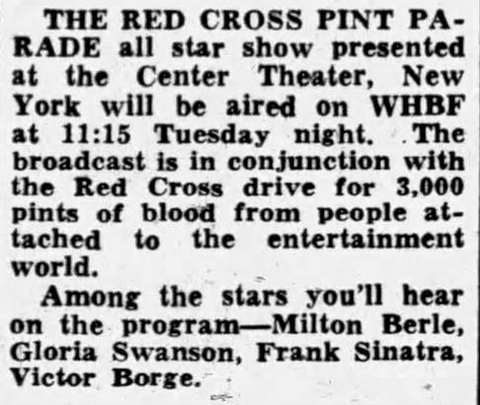
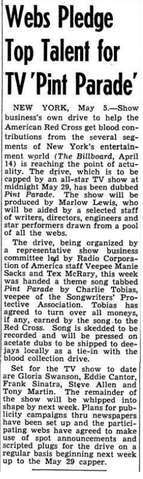
[Nancy announces divorce decision]
Nancy Sinatra: Nancy Barbato Sinatra told the press that she and Frank had decided to divorce, saying it was what Frank wanted and that she'd agreed and instructed her attorneys to work out details.
Source: James Kaplan, "Frank: The Voice" (2010).
Nancy Sinatra announced she would give Frank a divorce so that he could marry Ava Gardner.
Source: George Carpozi Jr., Frank Sinatra: Is This Man Mafia? (New York: Manor Books, 1979).
May 30, 1951
Radio
Red Cross Pint Parade
12am 1:30am
Red Cross Pint Parade
12am 1:30am
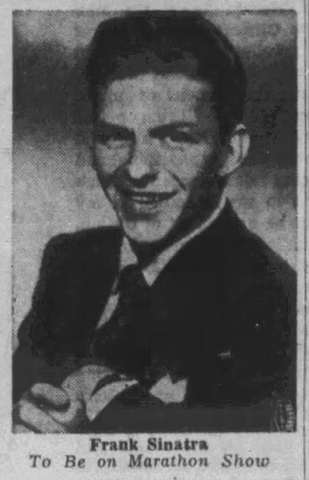
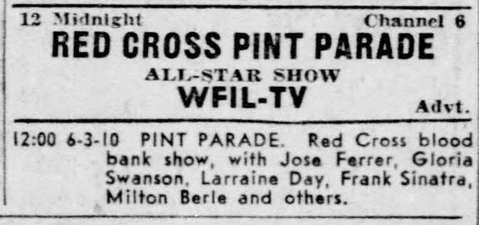
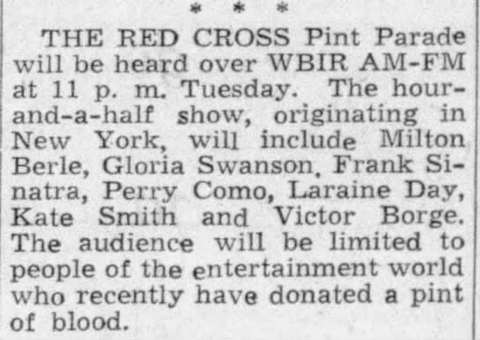
June 1951
After flying into Las Vegas for his divorce in June 1951, Sinatra refused to cooperate with the journalists waiting for him, calling them "newspaper bums" and asking why he should give them anything: "I ought to give a cocktail party for the press," he said, "and put a Mickey Finn in every glass." His new press agent, Mack Miller, and Ava Gardner begged him to try a more conciliatory approach instead, which resulted in some awkward interviews heavy with strained humility. Source: Rough Guide to Frank Sinatra (Rough guide pt 3.pdf).
June 2, 1951
Television
The Frank Sinatra Show
Network: CBS
Location: New York City
Script Dated:
Show: #35
Sponsor: Bulova Watch Company (30mins)
Time: 9:00 P.M.-10:00 P.M.
Writers:
Producer: Jack Donahue
Director: Jack Donahue
Announcer: Ken Roberts
Orchestra Conducted By: Axel Stordahl
Guests: Phil Silvers, June Hutton
Songs:
"The Coffee Song"
"Just One Of Those Things"
Sinatra/Hutton Medley: "Soon" (FS) Easy To Remember (JH)
The Frank Sinatra Show
Network: CBS
Location: New York City
Script Dated:
Show: #35
Sponsor: Bulova Watch Company (30mins)
Time: 9:00 P.M.-10:00 P.M.
Writers:
Producer: Jack Donahue
Director: Jack Donahue
Announcer: Ken Roberts
Orchestra Conducted By: Axel Stordahl
Guests: Phil Silvers, June Hutton
Page from Script
© 1997-2026 The Sinatra Archive
This calendar, or any parts thereof, may not be reproduced in any fashion whatsoever without the prior written permission of the publisher (The Sinatra Archive)
[image referenced in source but could not be recovered]
June 3, 1951
Radio
Here's Frank Sinatra
Show #32
Network: CBS
Sponsor:
4:30PM - 4:55PM (EST), Sunday
Producers: Mark Goodson, Bill Todman
Musicians: Graham Forbes and His Quartet
Announcer: Hal Sims
Writers:
Guest: no guests listed
Notes: First time any log confirms name changing to "Here's Frank Sinatra."
Show was only 25 minutes the first week. Confirmed as Airing on WCBS 4:30 - 4:55 (EST), WBBM 4:00PM - 4:30PM (CNT) , KNX1:30PM-2:00PM (PST) NYT radio schedule for 6-3-51.
Frank's show ran from 4:30 to 5:30 P.M. The lead in at 4 was "Rate Your Mate" with Joey
Adams.
Ed
Concerts
Latin Quarter, New York City (3-9)
Frank Sinatra
Johnny Blowers(drums), Matty Golizio(guitar), Frank Carroll(bass) and Graham Forbes on piano
Ed O'Brien:
Graham Forbes was Frank's piano player for two years. He did nightclubs, concerts, recording sessions, TV and radio work. When Sinatra opened at the Latin Quarter he brought along his rhythm section of that period: Johnny Blowers(drums), Matty Golizio(guitar), Frank Carroll(bass) and Forbes on piano.
Frank was set to begin filming "Meet Danny Wilson" in Hollywood and he was firming up some nightclub work for later in the year. He asked Forbes to come with him. Although they were good friends Forbes liked working in New York and he had just learned that his wife was pregnant. Forbes declined the offer. Frank would pair up with Ken Lane for the film and they would go into the Desert Inn, in Vegas, that September. But Lane was having serious problems with his girlfriend and often left Sinatra in the lurch. During the engagement Jimmy Van Heusen discovered a piano player working the D.I. lounge. Frank loved what he heard and Bill Miller took the job. He would have that position for 35 years.
Here's Frank Sinatra
Show #32
Network: CBS
Sponsor:
4:30PM - 4:55PM (EST), Sunday
Producers: Mark Goodson, Bill Todman
Musicians: Graham Forbes and His Quartet
Announcer: Hal Sims
Writers:
Guest: no guests listed
HERE'S FRANK SINATRA
Producer-Director- Writer: Gordon Auchinloss
CBS Radio
Sunday
4:30 p.m - 5:30 p.m.
New York City
Sustaining
CBS entry into the disk jock sweepstakes with
Frank Sinatra as its platter spinner shapes up as a pleasant series for Sunday afternoon listen- ing. Program is a 15-minute expansion of the web's former Sunday afternooner "Meet Frank
Sinatra," with a new format consisting of Sinatra's casual comment interspersed with the playing of top etchings. Session moved along at an easy clip and was as refreshing as an iced drink.
Sinatra's informality projects that his deejay assign- ment and his comments were sparked with intelli- gence and humor. The records were selected with care and covered field from pop vocals to classical instrumentals. Sinatra spun a few of his own discs but he kept them at a minimum giving more consider- ation to opposition crooners.
Preem stanza (3) was hypoed by smooth scripting and well paced direction.
Variety
June 6, 1951 note: Wow! This review certainly reveals a lot of previously unknown information regarding the mysterious and short-lived "Here's Frank Sinatra."
Gone from "Meet Frank Sinatra" were the Graham
Forbes Combo, Mark Goodson, Bill Todman( pro- ducers) and Paul Dudley( writer). Gordon Auchinloss had remained as director but also taken on the onerous tasks of producing and writing a one-hour radio show.
CBS was operating this non-sponsored hour as a shoe- string production. Frank was no longer singing, there were no guest, and he had become a glorified $3 million dollar jock( Mr. Paley signed Frank to a TV/radio contract, for that amount, less than a year earlier). Fortunately the show would only run for eight weeks.The final broadcast would take place on the 22nd of July.
I have reviews of both "Meet Frank Sinatra" and the first CBS-TV show, 10-7-50. I am reluctant to post because both got really panned.
Ed
Latin Quarter, New York City (3-9)
Frank Sinatra
Johnny Blowers(drums), Matty Golizio(guitar), Frank Carroll(bass) and Graham Forbes on piano
Latin Quarter, N. Y. (Tuesday, June 5) Capacity, 625. Price policy, $4- $5 minimum. Shows at 8:30 and 12:30. Operator, Lou Walters. Booking, non -exclusive. Publicity. Bayne- Zuss)nan, Estimated budget this show, $20,000.
The ropes were up and there were standees galore for this midnight show- business has been that way at the Lou Walters spot for some time, even tho most nitery guys are wailing the blues - and with Frank Sinatra headlining for a one -night stand, there was even more business than usual. It's a box office show, in Walters' tradition, big and brassy, well- stacked dames and some flashy supporting talent.. Sinatra was a smash. His warbling on his Saturday night video show this season has been spotty, but for his near 45- minute performance he didn't flat once. He does a superbly chosen mixture ,of new tunes and oldies, topping the roster with the lengthy Soliloquy from Carousel. Between his singing, his chatty introductions and his ease of manner, he pelted off to a really click score.
Chase Skilled
Only other name on the bill is Chaz Chase, and it's still foolproof. Here, too, is a thoroly skilled per- former, whether in his eating routine or the deftly pantomimed takeoff on a burly stripper. Sold well. Walters has two strong dance novelties. Les Pabios, a man and woman, have an off -beat routine in which the boy does an automaton thruout, finishing off with some rapid fire spins. It's a good vaude or nitery act. The same goes for the Mazzone-Abbott quintet of dancers, who do a French apache num- ber to end 'em all. They dress the stage with a small set and by the time the act is over, barrels have been busted over the backs of some of the dancers, others have slid "to their death" down a stairwell and the customers wowed. Gail Bennett contributes a brief novelty, garbed as half-man, half-gal, and finishes up making love to herself in a non- Freudian manner, to be sure. Did fairly well. The Szonys, billed, were on vacation this week. Babe Parade The parade of babes is In the usual Walters tradition, best of the production numbers being the one in which the line, dressed relatively simple in black negligees, terp to Gloria Leroy's vocalizing of History Is Made at Night. Alex D'Arcy is similarly okay on his vocal assignment, and Art Waner does a first -rate job both in playing the show and for hoofing. All told, it's plenty of entertainment for the price. Jerry Franken.
Billboard
6-16-51
note: Reviewer is in error regarding Frank's stay at the club. He was in for a seven day run. Ed
[image referenced in source but could not be recovered]
[image referenced in source but could not be recovered]
[image referenced in source but could not be recovered]
[image referenced in source but could not be recovered]
June 4, 1951
Concerts
Latin Quarter, New York City (3-9)
Frank Sinatra
Johnny Blowers(drums), Matty Golizio(guitar), Frank Carroll(bass) and Graham Forbes on piano
June 5, 1951
Concerts
Latin Quarter, New York City (3-9)
Frank Sinatra
Johnny Blowers(drums), Matty Golizio (guitar), Frank Carroll(bass) and Graham Forbes on piano
Ed O'Brien sent in this review:
LATIN QUARTER, NEW YORK
(Tuesday, June 5)
Capacity, 625. Price policy $4 - $5 minimum. Shows at 8:30 and 12:30
Operator, Lou Waters. Booking non- exclusive. Publicity, Bayne - Zussman.
Estimated budget this show, $20,000.
The ropes were up and there were standees galore for this midnight show
-- business has been that way at the Lou
Waters spot for some time, even tho most nitery guys are wailing the blues -- and with
Frank Sinatra headlining for a one night stand, there was even more business than usual.
It's a box office show, in Walter's tradition, big and brassy, well-stacked dames and some flashy supporting talent.
Sinatra was a smash. His warbling on his Saturday night video show this season has been spotty, but for his near 45 minute performance he didn't flat once. He does a superbly chosen mixture of new tunes and oldies, topping the roster with the lengthy "Soliloquy" from "Carousel."
Between his singing, his chatty intro- ductions and ease of manner, he pelted off to a really click score.
Jerry Franken
Billboard
June 16, 1951
Note: Reports have always indicated that
Sinatra appeared at the Latin Quarter from
6-3 thru 6-8-1951. Review states it was strictly a one-nighter.
June 6, 1951
Concerts
Latin Quarter, New York City (3-9)
Frank Sinatra
Johnny Blowers(drums), Matty Golizio(guitar), Frank Carroll(bass) and Graham Forbes on piano
Latin Quarter, New York City (3-9)
Frank Sinatra
Johnny Blowers(drums), Matty Golizio(guitar), Frank Carroll(bass) and Graham Forbes on piano
Variety
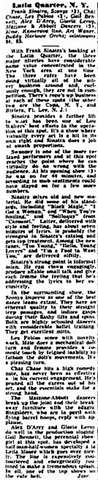
note: Sorry the quality isn't better. But we now
know Frank sang "Nat Cole's big hit "Too Young"
in concert. Nice review.
June 7, 1951
Concerts
Latin Quarter, New York City (3-9)
Frank Sinatra
Johnny Blowers(drums), Matty Golizio guitar), Frank Carroll(bass) and Graham Forbes on piano
June 8, 1951
Concerts
Latin Quarter, New York City (3-9)
Frank Sinatra
Johnny Blowers(drums), Matty Golizio(guitar), Frank Carroll(bass) and Graham Forbes on piano
June 9, 1951
Television
The Frank Sinatra Show
Network: CBS
Location: New York City
Script Dated:
Show: #36 (Final Show Of Season)
Sponsor: Bulova Watch Company (30mins)
Time: 9:00 P.M.-10:00 P.M.
Writers:
Producer: Jack Donahue
Director: Jack Donahue
Announcer: Ken Roberts
Orchestra Conducted By: Axel Stordahl
Guests: June Hutton, The Heathertones
Note: Frank did a Durante for his final show of the first season. Walking off into the darkness as the credits rolled.
--Ed
NOTE: Sinatra's TV variety show ended its first season with little fanfare, Ed O'Brien reports. The show debuted on October 7, 1950 and, right from the start, it experienced serious difficulties.
Sinatra was placed opposite the NBC hit “Your Show of Shows” on Saturday nights. This Sid Caesar and Imogene Coca show was one of the funniest shows on early TV and easily out-rated its CBS competition.
Sinatra would see many changes in direction during the first season as the show struggled to find itself a sizable audience. Producers, directors, cast members would be hired and fired but the audience that the sponsors demanded was never there.
Looking back at a show like it almost 60 years old, it is rather easy to explain why the show failed: Sinatra only sang 4 or 5 songs during the 60 minute telecast. In their desperation to compete, the powers-that-be had Sinatra as a jack of all trades. He did lame, poorly written comedy skits, unfunny monologues, and suffered through some less than A-1 billings for the show.
When Sinatra had Peggy Lee, Sarah Vaughn, Perry Como, or Frankie Laine, they would often do silly routines instead of creating memorable duets with Sinatra. Faye Emerson's "Wonderful Town" would be the summer replacement series.
The second season for the show aired on Tuesday night opposite Milton Berle, who was certainly "Mr.Television" at that time. There are a few shows where Sinatra got to be Sinatra and they are gems, but the overall concept was a disaster.
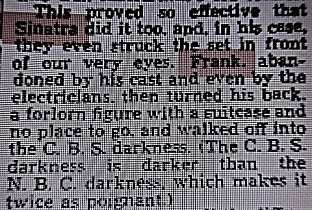
Concerts
Latin Quarter, New York City (3-9)
Frank Sinatra
Johnny Blowers(drums), Matty Golizio(guitar), Frank Carroll(bass) and Graham Forbes on piano
June 10, 1951
Radio
Here's Frank Sinatra
Show #33
Network: CBS
Sponsor:
4:30PM - 5:30PM (EST), Sunday
Producers: Mark Goodson, Bill Todman
Musicians: Graham Forbes and His Quartet
Announcer: Hal Sims
Writers:
Guest: no guests listed
Notes: Confirmed aired on WCBS.
June 13, 1951
Studio
Universal Studios, Hollywood California
Stage 10
Songs for the Universal film "Meet Danny Wilson"
Morning Session 9:30 a.m.- 12:30 p.m.
Joseph Gershenson conducting a 28-piece orchestra
Arrangements by George Siravo
1. All of Me
2. When You're Smiling
3. You're a Sweetheart
4. That Old Black Magic (arranged by Neal Hefti)
A second session was held: 2:00 p.m. - 3:50 p.m.
Joseph Gershenson conducting a 35-piece orchestra
Arrangements by Axel Stordahl and possibly Paul Weston, at the session representing Columbia Records.
1. How Deep is the Ocean
2. She's Funny That Way (film version is edited)
NOTE: According to Sinatra Scholar Ed O'Brien, who supplied the information on the Universal Studio recording sessions, on June 14th,
the following memo was circulated at the studio and read at a committee meeting by Mr. Weiner: "This is the finest recording session in my experience.
I have never had better cooperation anywhere." These were Sinatra's comments after recording six numbers for "Meet Danny Wilson" at Universal on June 13, 1951.
June 17, 1951
Radio
Here's Frank Sinatra
Show #34
Network: CBS
Sponsor:
4:30PM - 5:30PM (EST), Sunday
Producers: Mark Goodson, Bill Todman
Musicians: Graham Forbes and His Quartet
Announcer: Hal Sims
Writers:
Guest: no guests listed
Notes: Confirmed aired on WCBS
June 21, 1951
Studio
Hollywood
Universal Studios, Studio 10
"Meet Danny Wilson" soundtrack recordings
NOTE: Sinatra Scholar Ed O'Brien reports that on June 20, 1951 Sinatra and Shelly Winters did a music rehearsal for "A Good Man Is Hard to Find" in Studio 10 at Universal for "Meet Danny Wilson." Ken Lane was the only accompaniment on piano.
On the following morning, June 21, 1951, Shelly Winters recorded "I'll Remember April" from 9:30 a.m. until approximately 11:00 a.m. Beginning at 1:00 p.m., Sinatra recorded "Lonesome Man Blues" with George Fields playing harmonica and Allan Ruess on guitar. O'Brien notes that there is a terrific duet with Louis Armstrong on Sinatra's CBS-TV show of January 1, 1952.
Sinatra then recorded "I've Got a Crush on You" with Ken Lane on piano, the vocal group, the Ebonaires, and seven additional musicians. Arrangements were done by Axel Stordahl. The vocal was rejected and Sinatra re-did it on July 11, 1951. The last song of the day was a duet of "A Good Man is Hard to Find" with a Sy Oliver chart. Sinatra and Winters spent over an hour getting it down. There were eight musicians including Lane on piano. Joseph Gershenson conducted that Thursday afternoon.
note: Shelly Winters recording of "I'll Remember April" was not used in the film. Ed
June 24, 1951
Radio
Here's Frank Sinatra
Show #35
Network: CBS
Sponsor:
4:30PM - 5:30PM (EST), Sunday
Producers: Mark Goodson, Bill Todman
Musicians: Graham Forbes and His Quartet
Announcer: Hal Sims
Writers:
Guest: no guests listed
Notes: Confirmed aired on WCBS
July 1951
[Meet Danny Wilson filming begins]
Kaplan: Frank spent July shooting the film Meet Danny Wilson at Universal, playing a nightclub entertainer and performing about a half-dozen songs in the picture.
Source: James Kaplan, "Frank: The Voice" (2010)
[Sinatra-Shelley Winters mutual hostility]
Shelley Winters: Frank's co-star Shelley Winters, a committed liberal actress the studio was trying to market as a blond bombshell, disliked Frank intensely during the Meet Danny Wilson shoot. Early on she rebuffed his suggestion they rehearse privately in his dressing room, insisting on rehearsing on the soundstage instead, which set an edgy, hostile tone between them despite their romantic scenes together.
Source: James Kaplan, "Frank: The Voice" (2010)
July 1, 1951
Radio
Here's Frank Sinatra
Show #36
Network: CBS
Sponsor:
4:30PM - 5:30PM (EST), Sunday
Producers: Mark Goodson, Bill Todman
Musicians: Graham Forbes and His Quartet
Announcer: Hal Sims
Writers:
Guest: no guests listed
Notes: Confirmed aired on WCBS
Television
NONE
Here's Frank Sinatra
Show #36
Network: CBS
Sponsor:
4:30PM - 5:30PM (EST), Sunday
Producers: Mark Goodson, Bill Todman
Musicians: Graham Forbes and His Quartet
Announcer: Hal Sims
Writers:
Guest: no guests listed
Notes: Confirmed aired on WCBS
Daily News
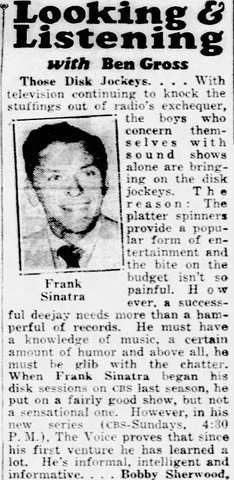
note: AP ran an article, on 7/1, announcing that CBS and Sinatra were about
to part company. According to the article, Sinatra was talking with NBC
radio.
Pottsville News
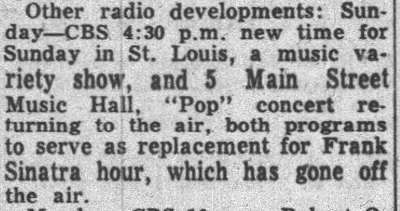
note: After his final show, 7/22, Frank told people he was glad to be off the
radio. It would give him more time with Ava out in Hollywood.
Show was also called "Frank Sinatra Hour" by July of 51. Frank was
strictly a disc jockey for the hour broadcast. No live performances or
orchestra.
July 8, 1951
Radio
Here's Frank Sinatra
Show #37
Network: CBS
Sponsor:
4:30PM - 5:30PM (EST), Sunday
Producers: Mark Goodson, Bill Todman
Musicians: Graham Forbes and His Quartet
Announcer: Hal Sims
Writers:
Guest: no guests listed
Notes: Confirmed aired on WCBS
July 11, 1951
Studio
Universal-International - Universal City, California
Wednesday
MEET DANNY WILSON
2:30 - 3:25 PM
Ken Lane on piano
I've Got A Crush On You
Sinatra did a vocal with just Lane on piano.
The recording done on 6-21-51 was rejected and this vocal replaced it. The Ebonaires
(Quartet) was preserved from that date along with the arrangement by Joseph Gershenson.
Here are the nuts and bolts of that day's shoot:
Lane was paid $39.90 for his efforts.
There was a delay in the morning shoot due to heavy rain.
Shelley Winters was an hour late that morning.
Tommy Farrell, who played Tommy Wells, was examined by the studio insurance doctor. A-ok.
The phantom stage for Madison Square Garden scene was shot from 1:30 to 1:42 PM and then New York street scene was filmed from 5:15 to 5:54 PM.
Lunch 1:42 to 2:12 PM
Thanks to Ed O'Brien for supplying the above session info.
July 15, 1951
Radio
Here's Frank Sinatra
Show #38
Network: CBS
Sponsor:
4:30PM - 5:30PM (EST), Sunday
Producers: Mark Goodson, Bill Todman
Musicians: Graham Forbes and His Quartet
Announcer: Hal Sims
Writers:
Guest: no guests listed
Notes: Confirmed aired on WCBS.
July 17, 1951
Frank Sinatra and Ava Gardner attended the premiere of her film Show Boat at the Egyptian Theatre in Hollywood, their first major public appearance together since becoming officially engaged. Gardner wore an emerald green-and-black satin and lace gown by MGM designer Irene and a diamond necklace Frank gave her for the occasion; fans lining the red carpet screamed their names in unison. “I've cared for a long, long time,” Frank told reporters. “I'm very much in love with her and it's wonderful to know we can be seen together without hurting anyone.” Source: J. Randy Taraborrelli, Sinatra: Behind the Legend.
July 19, 1951
Studio
Hollywood
RHCO4561 Castle Rock
w/The Harry James Orchestra
(E. Drake/J. Shirl/A. Sears)
Wemar Music Corp. (BMI) 1951
Arranged by Ray Conniff
-1 (2:33) CD: Columbia Years 43-52 Vol. 12
LP: C6X-40343 The Voice-The Columbia years, 43-52
LP: C2l-6 Frank Sinatra Story In Music
78: 39527
NOTE: Sinatra Scholar Ed O'Brien points out that during a concert at
Caesars in November of 1968, a guy yelled out from the audience and requested this song.
Sinatra laughed and told the requester that he was older than the two of them put together.
RHCO4562 Farewell, Farewell To Love
w/The Harry James Orchestra
(J. Wolf/G. Siravo)
Barton Music Corp. (ASCAP) 1951
Arranged by Ray Conniff
-1 (2:54) CD: Columbia Years 43-52 Vol. 12
LP: C2X-40897 Hello Young Lovers
LP: CL-1241 Love Is A Kick
EP: B2542
RHCO4563 Deep Night
w/The Harry James Orchestra
(R. Vallee/C. Henderson)
Advanced Music Corp. (ASCAP) 1929
Arranged by Ray Conniff
-1 (3:16) CD: Columbia Years 43-52 Vol. 12
LP: C6X-40343 The Voice-The Columbia years, 43-52
LP: CL-1241 Love Is A Kick
78: 39527
Trumpets: Dominick Buono, Phil Cook, Harry James, Everett McDonald, Ralph
Osborn; Trombones: Ray Conniff, Lewis McCreary, Jim Piddy; Brass
Trombone: Hal Smith; Tenor Saxes: Rene Bloch, Francis Polifroni, Herbert
Stewart; Baritone Sax: Robert Poland; Piano: Bruce McDonald; Guitar: All Reuss; Bass: Ed Mihelich; Drums: Jackie Mills
Hollywood
RHCO4561 Castle Rock w/The Harry James Orchestra
RHCO4562 Farewell, Farewell To Love
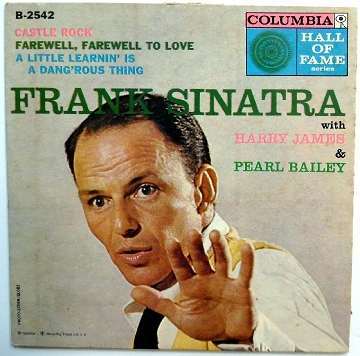
"Castle Rock" / "Deep Night" / "Farewell, Farewell to Love"
Will Friedwald (author); quote from Harry James: Friedwald covers this belated Columbia reunion of Sinatra and his old boss. James told deejay Fred Hall he left Columbia soon after over creative friction with Mitch Miller ('Mitch wanted me to do some real corny things -- gimmicks and all of this stuff -- and I refused to do them... so I left the company'), and separately called the session's 'Castle Rock' track (an R&B tune associated with Johnny Hodges, music by James/Al Sears, words by Ervin Drake, who later wrote 'It Was a Very Good Year') 'the worst thing that either one of us ever recorded... you ask Sinatra, and he'll tell you the same thing.' Friedwald pushes back, calling the disc's energy undeniable and noting Sinatra 'nails down the mood' of the uptempo dance number, closing his first vocal with 'Go get 'em, Harry -- for old times' sake!' James plays a seductive muted solo on 'Deep Night' (co-credited to Rudy Vallee) before an explosive 16-bar crescendo; 'Farewell, Farewell to Love,' arranged by either Siravo or Conniff and based on Siravo's 'Barbecue Riffs,' is described as turning 'the old torch' into 'a bonfire.'
Source: Will Friedwald, "Sinatra! The Song Is You: A Singer's Art" (2018 revised edition).
During the "Castle Rock" date, Sinatra ad-libbed an aside to a soloing James mid-take: "Go get 'em Harry, for old-times sake!" It was their most celebrated studio reunion, but not their last time working together -- the two also appeared together in a 1944 wartime propaganda short, reunited onstage in Las Vegas in 1968 and 1979, and were reunited again for a TV special hosted by John Denver in 1977. Source: Will Friedwald, liner-note essay "Building a Foundation," Harry James and His Orchestra Featuring Frank Sinatra: The Complete Recordings 1939 (Columbia/Legacy).
July 22, 1951
Radio
Here's Frank Sinatra
Show #39
Network: CBS
Sponsor:
4:30PM - 5:30PM (EST), Sunday
Producers: Mark Goodson, Bill Todman
Musicians: Graham Forbes and His Quartet
Announcer: Hal Sims
Writers:
Guest: no guests listed
Notes: Final Show. Confirmed last airing on major CBS Stations: WCBS, WBBM, KNX, WTOP
Television
NONE
Frank's CBS radio program Meet Frank Sinatra ended after nine months on the air.
Source: Nancy Sinatra, Frank Sinatra: An American Legend, 1995.
July 27, 1951
Studio
UNIVERSAL-INTERNATIONAL, Universal City, California
MEET DANNY WILSON
Friday afternoon
Orchestra conducted by Milton Rosen
w/ Ken Lane on piano
Sinatra did vocal pickups for recording done in June of 51.
July 31, 1951
[Meet Danny Wilson wraps filming]
Meet Danny Wilson finished shooting on July 31, 1951, to general relief on set. The film did modest box office, but the New York Times gave it a surprisingly positive review, praising both Sinatra's natural, cocky performance and Winters' work on their duet of "A Good Man Is Hard to Find."
Source: James Kaplan, "Frank: The Voice" (2010).
August 1951
[Ava joins Frank in Reno]
Kaplan: About ten days after Frank's arrival, Ava flew up to Reno and was introduced to reporters. Frank had grown a sparse mustache during the stay, an experiment Kaplan notes he would repeat over the years without much success.
Source: James Kaplan, "Frank: The Voice" (2010)
[Frank and Ava's Acapulco trip begins]
Kaplan: The day after Meet Danny Wilson wrapped, Frank and Ava flew to Acapulco for what was meant to be a secret trip. Reporters and photographers swarmed the L.A. airport departure, and Sinatra cursed at photographers who delayed the flight by clustering on the boarding stairs.
Source: James Kaplan, "Frank: The Voice" (2010)
[Sinatra confirms marriage plans in Reno]
Frank Sinatra: When asked about Nancy's plans, Frank said he didn't know what she would do, but told reporters they could safely say he and Ava Gardner would be married.
Source: James Kaplan, "Frank: The Voice" (2010)
[Sinatra downplays Mexico trouble to press]
Frank Sinatra: Asked in Reno whether he planned to marry Ava Gardner, Frank said, "I presume I will." Asked about the Mexico incidents, he called reports of trouble "grossly exaggerated," saying he'd gotten rough treatment from a couple of photographers but that the press overall had done a lot for him.
Source: James Kaplan, "Frank: The Voice" (2010)
[Sinatra jokes about being broke]
Frank Sinatra: When a reporter asked if he was too broke to afford a divorce, Frank joked that the press would get the bill for the drinks, then noted he was earning $25,000 for two weeks at the Riverside plus a Vegas engagement, and that his CBS television show would begin its second season in October.
Source: James Kaplan, "Frank: The Voice" (2010)
[Sinatra-Gardner photo, El Paso]
Kaplan: A photo caption places Frank and Ava landing in El Paso en route to Mexico City; Kaplan notes their relationship oscillated between hot intimacy and cold distance while the press eagerly covered every swing.
Source: James Kaplan, "Frank: The Voice" (2010)
[Suicide attempt after Ava quarrel at Lake Tahoe]
Kaplan: In August 1951, after a nasty quarrel with Ava Gardner at Lake Tahoe, Sinatra made a halfhearted suicide attempt, taking just enough sleeping pills to make himself sick and get her attention.
Source: James Kaplan, "Sinatra: The Chairman" (2015)
[Wire service denies elopement rumors]
Kaplan: A wire-service story reported that Sinatra angrily denied any intention of eloping with Ava Gardner in Mexico, insisting he was in no position for a divorce yet and that the trip was purely a vacation. The story compared the media frenzy to Rita Hayworth's earlier trip to Mexico with Prince Aly Khan.
Source: James Kaplan, "Frank: The Voice" (2010)
[Magazine article ties Frank explicitly to the Mafia]
American Mercury Magazine ran a story titled "Frank Sinatra Confidential — Gangsters in the Nightclubs," by Lee Mortimer, detailing Willie Moretti's role in getting Frank his early Rustic Cabin gig, his alleged influence in reducing a 1939 seduction charge against Frank, and the 1947 Havana trip with Lucky Luciano. It argued that show business gave organized-crime figures a low-risk way to mix with powerful people.
Source: Richard Havers, "Sinatra" (Dorling Kindersley, 2007).
[Possible second suicide attempt at Cal-Neva Lodge]
While staying at the Cal-Neva Lodge on the California-Nevada line, Frank reportedly overdosed on sleeping pills; he denied this, claiming he'd mistakenly taken pills he was allergic to. Hank Sanicola phoned Ava, who rushed to Tahoe to find Frank hospitalized but not in serious danger, having not taken enough Phenobarbital to be life-threatening; Frank later brushed it off as just "a bellyache."
Source: Richard Havers, "Sinatra" (Dorling Kindersley, 2007).
August 4, 1951
[Ava snubbed by Hedy Lamarr in Acapulco]
A wire dispatch reported that Ava Gardner was coldly snubbed by actress Hedy Lamarr at a nightclub in Acapulco owned by Lamarr's new husband.
Source: James Kaplan, "Frank: The Voice" (2010).
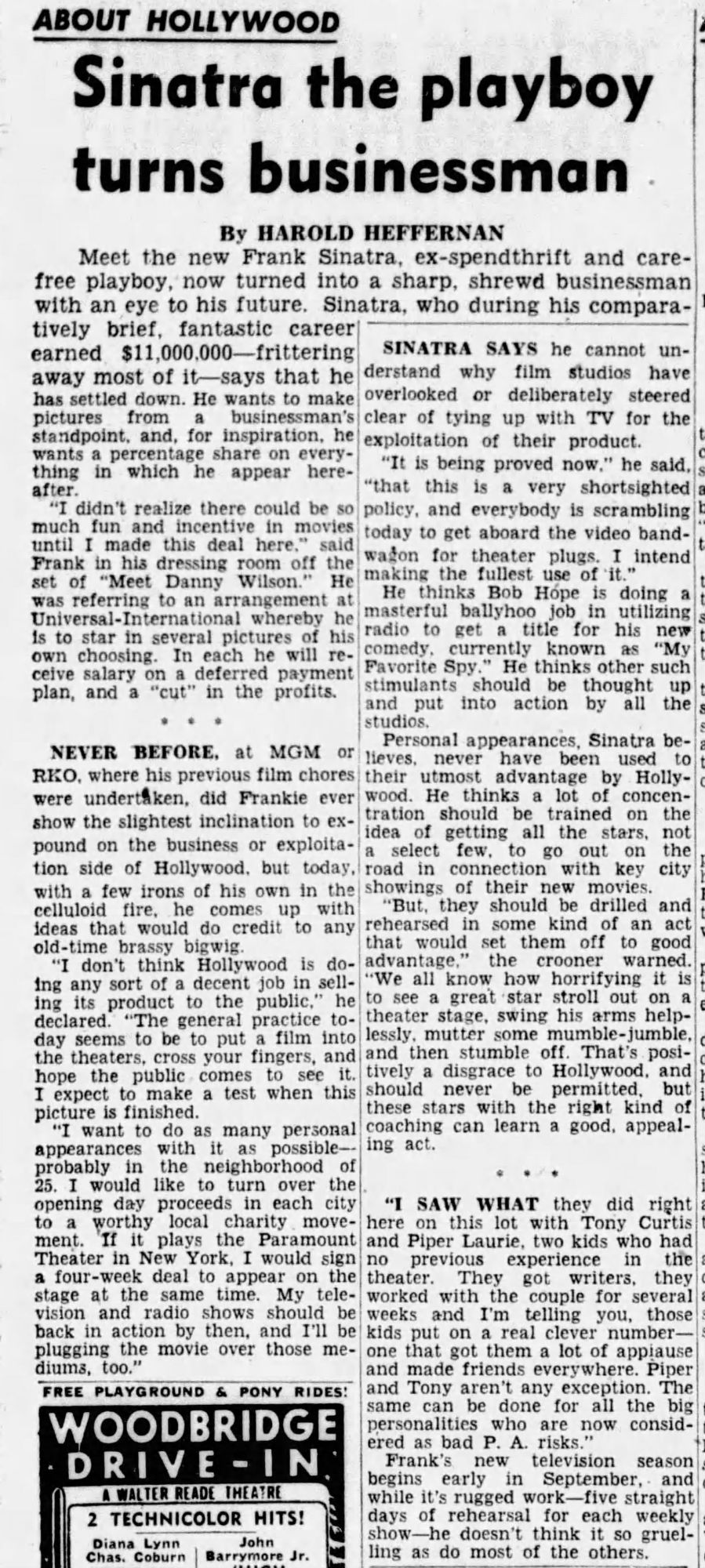
The Star-Ledger, August 4, 1951.
Frank flew to Acapulco for a brief visit with Ava; he announced their engagement shortly after returning.
Source: Nancy Sinatra, Frank Sinatra: An American Legend, 1995.
August 9, 1951
Concerts
Riverside Inn & Casino, Reno, Nevada (9 - 24)
Frank Sinatra, McCarthy & Dale, Artini & Consuelo
Riverside Starlets (12)
Al Donahue & Orchestra (10) no cover, no minimum
NOTE: Author Richard Havers points out that, on
August 9, 1951, Sinatra flew from Hollywood to
Reno where he announced that he would file for divorce from Nancy Sinatra. When questioned as to whether he would marry Ava Gardner, Sinatra replied, "I presume I will." Two days later, he opened at the Riverside Inn and Casino, his first ever booking at a casino!
Note: I was able to access the Reno paper of
8-9-51. As you can see, Frank opened that night.
The two week run ended on 8/22.
He was scheduled to open at the Steel Pier, in
Atlantic City, 9/1, but decided to cancel and take a chance playing at the Desert
Inn in Las Vegas. A very good career move. Ava flew into Reno, 8-18, and they went to dinner the next night. I've enclosed a very nice photo. I must say the mustache didn't really fit Frank at all. And I have sent along
Variety's review of Frank's first engagement in a casino.
--Ed
Riverside Inn & Casino, Reno, Nevada (9- 24)
Frank Sinatra, McCarthy & Dale, Artini & Consuelo
Riverside Starlets (12)
Al Donahue & Orchestra (10)
no cover, no minimum
Reno Gazette
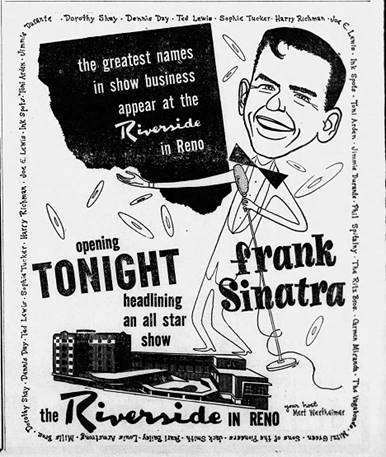
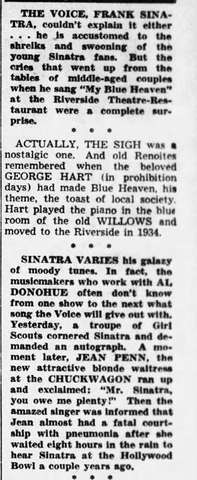
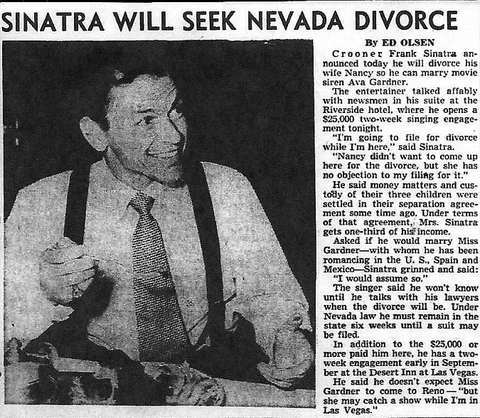
Variety
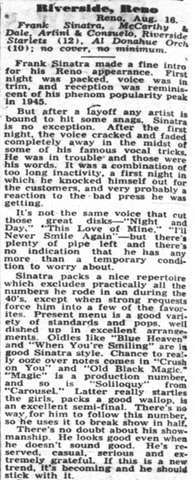
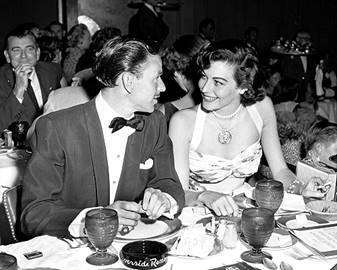
Reno August 9, 1951
Sinatra told reporters and photographers of his plans to divorce his wife Nancy so that he could marry movie star Ava Gardner. That meant six weeks residency in Nevada and he’d be “cured†of the bonds of matrimony.
It was a big month and a big year for Reno divorce. Not only was Sinatra “singing for his supper,†at the Riverside Hotel as he established residency, actress Rita Hayworth came to town to divorce Prince Aly Khan; and leading man Clark Gable, stopped in town as well, taking in one of Sinatra’s shows. Gable told reporters he wasn’t in town to file for divorce from Lady Sylvia Ashley, but “I might see you again in a few weeks.
PHOTOS AUGUST 19, 1951 RIVERSIDE INN
Sinatra's Reno Residency
By Ann Johnston, Brigham Young University
Sinatra established residency at the Riverside Hotel where he sang as he filed for divorce from his first wife.
The Riverside Hotel became a temporary home to many as the divorce colony blossomed. Its walls evolved and expanded over the 20th century. In 1951, Frank Sinatra came to establish a Nevadan residence to divorce his first wife and sang at the Riverside Hotel during his stay.
Years before his 1951 divorcee debut in Reno, a twenty four year-old Frank and nineteen year-old Nancy were wed thousands of miles away from the Riverside Hotel. Young Frank and Nancy Sinatra were married in 1939 just as Frank was beginning to sing in a successful band.
The two were married for eleven years and had three children. Eventually Frank's fame grew and rumors of infidelity spread. Over time, one extramarital relationship took on greater importance in Sinatra's life than all the others. Sinatra sought a divorce from Nancy in 1950 per his lover Ava Gardner's request. On February 14, 1950, Nancy and Frank announced their intent to divorce. His journey towards Reno began.
The once humble and now legendary Frank Sinatra arrived in Nevada on August 9, 1951. Newspapers across the country and around the world bore his name that day, announcing his movement towards divorce. While he established residency, his voice filled the Riverside Hotel for six weeks as he performed for visitors and residents. Frank did not come alone, however. On August 18th, a familiar brunette arrived at Lake Tahoe to stay with friends. From that day, Sinatra was accompanied by his new love interest and intended wife, Ava Gardner.
Complexity filled Sinatra's time at the Riverside Hotel. His ties to the mob intensified as Lucky Luciano, a known mob member, visited Sinatra in the gambling town. Evidently, Sinatra mingled with the famous and the infamous while seeking the usual Reno cure. Clark Gable also visited Sinatra in August. This visit to the divorce haven spurred questions of Gable's own intent to divorce.
Newspapers across the country noted Sinatra's schedule while residing in the divorce capital. The Des Moines Tribune noted on August 24, that Ava Gardner, Clark Gable, and Frank Sinatra had plans to go on a fishing trip together.
Gable and Sinatra also spent time at the Riverside Casino. Their time was documented by newspapers that mentioned Gable's presence and Sinatra's lack of finances. At the time, Sinatra's fame had been dwindling and rumors of Sinatra's troubled financial situation mounted.
In an article documenting Gable's presence, the Gazette also notes, "Sinatra is crooning for his supper at the
Riverside." Sinatra performed in Reno's Riverside until August 22. Gardner and Sinatra relocated to Las Vegas for another singing engagement before he completed his six week residency at the end of September. He ultimately received his divorce in Las Vegas.
The day after Sinatra's divorce, the duo applied for a marriage license. Some newspapers note that twenty-four hours had not passed from the time Sinatra was divorced from Nancy before applying for the marriage license with Gardner. Frank Sinatra and Ava Gardner left the Nevadan communities they'd called home to marry at Isaac Levy's home in Pennsylvania on November 7, 1951.
Excerpt from The Genesis Of Reno by Jack Harpster
KNEW 910AM IN OAKLAND
91 HOUR TRIBUTE TO FRANK SINATRA
AUGUST 6 THRU 9, 1970
Ed O'Brien:
KNEW's tribute included rare concert, radio and
TV material plus interviews with many of the people
who had been associated with Sinatra through the
years.
Sinatra called in during the 91 hour marathon
and the station ran the conversation just before
the conclusion of the tribute on Sunday, August
9th.
Here are a few highlights from that discussion:
Frank was still recovering from the surgery done
on his right hand. He had an appointment in a few
days with his doctor. Told the DJ he would be glad
when it was over. Then Sinatra discussed his plans
to film "Callahan" in San Francisco. Originally the
film was set to be shot in N.Y.C. but Frank wanted
to show off the beauty of the city by the bay. He would
play detective sergeant Harry Callahan with John
Frankheimer directing. Shooting schedule called
for eight weeks on location, starting the first week
in October. His hand did not respond as expected
and Clint Eastwood replaced Frank. Title was
changed to "Dirty Harry" and the film was a modest
success(kidding!). Don Siegel directed.
Frank was asked to name his favorite film roles.
He picked Maggio, Frankie Machine and Charlie
Y. Reader( Tender Trap).
When asked about the music scene in 1970, Sinatra
offered a very optimistic view. He recognized there had
been a revolution in popular music and predicted that
young writers might even eclipse people like :Rodgers
& Hart. He praised Jimmy Webb.
Frank was a guest on Dinah(Shore), 9-7-70. They discussed
the KNEW tribute. Dinah kept saying 91 minutes. Frank corrected
her, but she could not fathom how any singer could be lauded
for 91 hours.
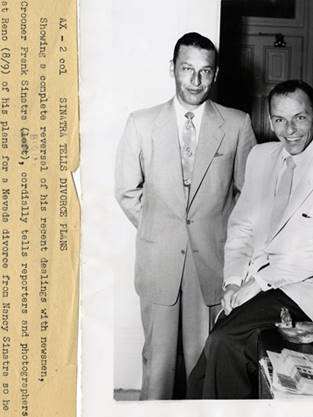
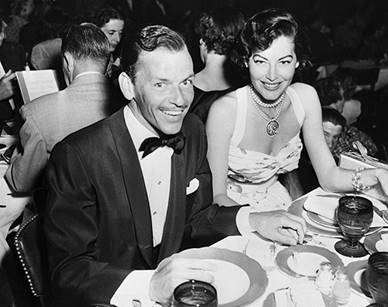
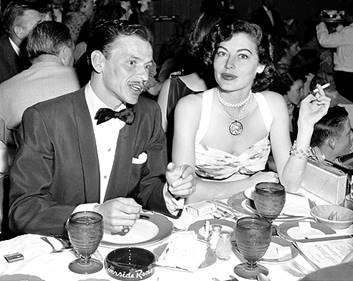
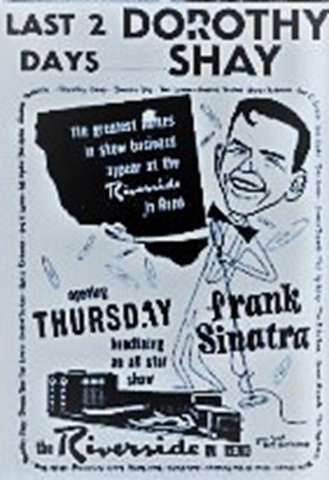
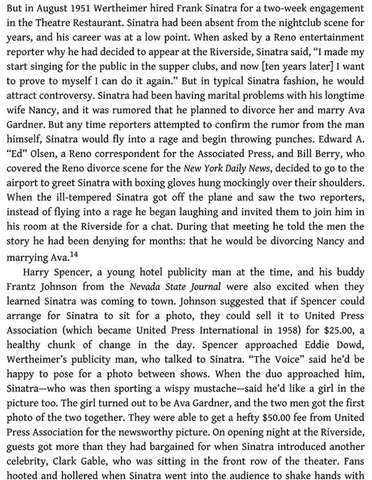
[Sinatra arrives in Reno, courts press]
Frank arrived in Reno in good spirits, greeted reporters warmly, and invited them to his hotel suite at the Riverside for free drinks and an open Q&A, surprising them with his friendliness after his reputation for hostility toward the press.
Source: James Kaplan, "Frank: The Voice" (2010).
August 10, 1951
Concerts
Riverside Inn & Casino, Reno, Nevada (9 - 24)
Frank Sinatra, McCarthy & Dale, Artini & Consuelo
Riverside Starlets (12)
Al Donahue & Orchestra (10) no cover, no minimum
August 11, 1951
Concerts
Riverside Inn & Casino, Reno, Nevada (9 - 22)
Frank Sinatra, McCarthy & Dale, Artini & Consuelo
Riverside Starlets (12)
Al Donahue & Orchestra (10) no cover, no minimum
Riverside Inn & Casino, Reno, Nevada (9 - 22)
Frank Sinatra, McCarthy & Dale, Artini & Consuelo
Riverside Starlets (12)
Al Donahue & Orchestra (10) no cover, no minimum
note: I was able to access the Reno paper of 8-9-51. As you can see, Frank opened that night. The two week run ended on 8/22. He was scheduled to open at the Steel Pier, in Atlantic City, 9/1, but decided to cancel and take a chance playing at the Desert Inn in Las Vegas. A very good career move. Ava flew into Reno, 8-18, and they went to dinner the next night. I've enclosed a very nice photo. I must say the moustache didn't really fit Frank at all. And I have sent along Variety's review of Frank's first engagement in a casino. --Ed
Reno Gazette
8-9-51
Variety
8-22-51
8-19-51
© 1997-2026 The Sinatra Archive
This calendar, or any parts thereof, may not be reproduced in any fashion whatsoever without the prior written permission of the publisher (The Sinatra Archive)
Variety
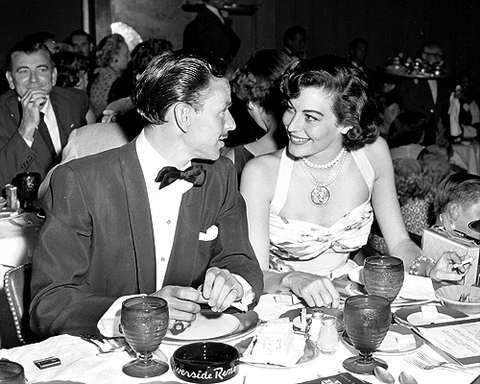
© 1997-2024 The Sinatra Archive
This calendar, or any parts thereof, may not be reproduced in any fashion whatsoever without the prior written permission of the publisher (The Sinatra Archive)
__._,_.___
© 1997-2024 The Sinatra Archive
This calendar, or any parts thereof, may not be reproduced in any fashion
whatsoever without the prior written permission of the publisher (The
Sinatra Archive)
__._,_.___
Booked at the Riverside Inn and Casino, Frank Sinatra used the engagement to establish Nevada residency so he could file for divorce from Nancy, renting an estate for the required stay. When he invited Ava Gardner up for Labor Day weekend, she and her maid, Rene Jordan, hit a deer en route, shattering the windshield; after Gardner's attempt to restart the dead engine failed, the two hitchhiked the rest of the way to Carson City before Frank's associate Hank Sanicola came to collect them. Sinatra, an investor holding the largest stake (36.6 percent) in the nearby Cal-Neva Lodge along with Dean Martin and Hank Sanicola, brought the group there for a side trip that would soon turn eventful. Source: J. Randy Taraborrelli, Sinatra: Behind the Legend.
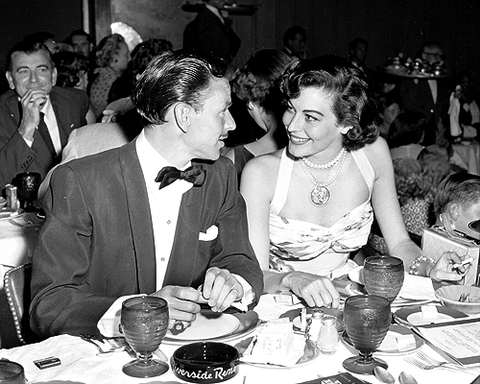
August 12, 1951
Concerts
Riverside Inn & Casino, Reno, Nevada (9 - 24)
Frank Sinatra, McCarthy & Dale, Artini & Consuelo
Riverside Starlets (12)
Al Donahue & Orchestra (10) no cover, no minimum
August 13, 1951
Concerts
Riverside Inn & Casino, Reno, Nevada (9 - 24)
Frank Sinatra, McCarthy & Dale, Artini & Consuelo
Riverside Starlets (12)
Al Donahue & Orchestra (10) no cover, no minimum
August 14, 1951
Concerts
Riverside Inn & Casino, Reno, Nevada (9 - 24)
Frank Sinatra, McCarthy & Dale, Artini & Consuelo
Riverside Starlets (12)
Al Donahue & Orchestra (10) no cover, no minimum
August 15, 1951
Concerts
Riverside Inn & Casino, Reno, Nevada (9 - 24)
Frank Sinatra, McCarthy & Dale, Artini & Consuelo
Riverside Starlets (12)
Al Donahue & Orchestra (10) no cover, no minimum
August 16, 1951
Concerts
Riverside Inn & Casino, Reno, Nevada (9 - 24)
Frank Sinatra, McCarthy & Dale, Artini & Consuelo
Riverside Starlets (12)
Al Donahue & Orchestra (10) no cover, no minimum
August 17, 1951
Concerts
Riverside Inn & Casino, Reno, Nevada (9 - 24)
Frank Sinatra, McCarthy & Dale, Artini & Consuelo
Riverside Starlets (12)
Al Donahue & Orchestra (10) no cover, no minimum
August 18, 1951
Concerts
Riverside Inn & Casino, Reno, Nevada (9 - 24)
Frank Sinatra, McCarthy & Dale, Artini & Consuelo
Riverside Starlets (12)
Al Donahue & Orchestra (10) no cover, no minimum
August 19, 1951
Concerts
Riverside Inn & Casino, Reno, Nevada (9 - 24)
Frank Sinatra, McCarthy & Dale, Artini & Consuelo
Riverside Starlets (12)
Al Donahue & Orchestra (10) no cover, no minimum
August 20, 1951
Concerts
Riverside Inn & Casino, Reno, Nevada (9 - 24)
Frank Sinatra, McCarthy & Dale, Artini & Consuelo
Riverside Starlets (12)
Al Donahue & Orchestra (10) no cover, no minimum
August 21, 1951
Concerts
Riverside Inn & Casino, Reno, Nevada (9 - 24)
Frank Sinatra, McCarthy & Dale, Artini & Consuelo
Riverside Starlets (12)
Al Donahue & Orchestra (10) no cover, no minimum
August 22, 1951
Concerts
Riverside Inn & Casino, Reno, Nevada (9 - 24)
Frank Sinatra, McCarthy & Dale, Artini & Consuelo
Riverside Starlets (12)
Al Donahue & Orchestra (10) no cover, no minimum
August 23, 1951
Concerts
Riverside Inn & Casino, Reno, Nevada (9 - 24)
Frank Sinatra, McCarthy & Dale, Artini & Consuelo
Riverside Starlets (12)
Al Donahue & Orchestra (10) no cover, no minimum
August 24, 1951
Concerts
Riverside Inn & Casino, Reno, Nevada (9 - 24)
Frank Sinatra, McCarthy & Dale, Artini & Consuelo
Riverside Starlets (12)
Al Donahue & Orchestra (10) no cover, no minimum
August 30, 1951
Frank publicly denied a widely reported story that he had attempted suicide with sleeping pills at Lake Tahoe after a fight with Ava.
Source: Nancy Sinatra, Frank Sinatra: An American Legend, 1995.
August 31, 1951
During a lakeside outing with Ava Gardner near the Cal-Neva Lodge at Lake Tahoe, Frank Sinatra — distracted by an argument with Gardner — ran their yacht aground; everyone swam to shore except Gardner, who refused to jump until she'd finished pelting Frank with rolls of toilet paper from the sinking boat's bathroom. That night, over dinner, a drunken Gardner admitted her affair with bullfighter Mario Cabré had been real, and the fight escalated until Frank called her a “whore”; Gardner fled barefoot into the dark toward the lake before her maid, Rene Jordan, caught up to her. Gardner and Jordan then drove through the night back to Los Angeles without saying goodbye — prompting Frank, once he realized she'd gone, to swallow a handful of sleeping pills; his valet, George Jacobs, found him and summoned a doctor in time. Gardner flew back to Tahoe once she heard, telling her maid afterward, “I could have killed him... Instead I forgave him in about twenty-five seconds.” Source: J. Randy Taraborrelli, Sinatra: Behind the Legend.
September 1951
[Sinatra's First-Ever Las Vegas Appearance]
Nancy Sinatra: Sinatra made his debut appearance in Las Vegas at the Desert Inn, years before he became closely associated with the Sands and the city itself.
Source: Nancy Sinatra, Frank Sinatra: An American Legend, 1995.
[Ava's jealous outburst at Desert Inn show]
Axel Stordahl: Arranger Axel Stordahl recalled that while watching Frank perform at the Desert Inn, Ava suddenly grew upset, suspecting he was looking too long at a girl in the audience; the couple later threw books and lamps at each other and Frank stormed out in the middle of the night.
Source: James Kaplan, "Frank: The Voice" (2010)
[Chris-Craft boat wreck on Lake Tahoe]
Ava Gardner: The day after Ava's confession, Hank Sanicola rented Frank and Ava a new Chris-Craft for a picnic cruise on Lake Tahoe. During an argument over Howard Hughes, the boat struck a submerged rock and began sinking; Ava refused to get off, instead floating rolls of toilet paper toward Frank in the water before joining him onshore with the last bottle of champagne.
Source: James Kaplan, "Frank: The Voice" (2010)
[Frank presses Ava about bullfighter affair]
Kaplan: At the Cal Neva Lodge on Lake Tahoe, Frank repeatedly pressed Ava over dinner and later in bed about whether she'd slept with a bullfighter, until she admitted to one drunken encounter she barely remembered.
Source: James Kaplan, "Frank: The Voice" (2010)
[Lana Turner's earlier suicide attempt]
Lana Turner: The previous September, amid marital troubles and box-office flops, Lana Turner had called her career 'a hollow success' and slit her wrists at her Beverly Hills home; Benton Cole broke down the door and got her to a hospital.
Source: James Kaplan, "Frank: The Voice" (2010)
[Overdose becomes public via police report]
Kaplan: Because Hank Sanicola had called a doctor for Frank's overdose (initially trying to claim the patient was himself), the doctor was required to file a police report, making the incident public around Labor Day weekend 1951.
Source: James Kaplan, "Frank: The Voice" (2010)
[Rosemary Clooney recalls Ava at Thunderbird]
Rosemary Clooney: While Sinatra played the Desert Inn, Rosemary Clooney was performing at the nearby Thunderbird; Ava would come catch part of Clooney's act, sometimes after a fight with Frank, praising her rendition of "They Can't Take That Away From Me" partly because Frank disliked the song, which had been a hit for his old rival Artie Shaw.
Source: James Kaplan, "Frank: The Voice" (2010)
[Sinatra blames Mitch Miller for song choices]
Kaplan: While playing the Desert Inn in September 1951, Frank went on a tirade about the declining quality of popular songs, singling out Mitch Miller's production of Rosemary Clooney's novelty hit "Come On-a My House," which Clooney had recorded under protest but which sold very well.
Source: James Kaplan, "Frank: The Voice" (2010)
[Sinatra denies suicide attempt to press]
Frank Sinatra: Facing reporters with Ava, Frank denied trying to commit suicide, explaining that he'd taken two sleeping pills after drinking brandy at the Christmas Tree Inn on Lake Tahoe, had an allergic reaction with a rash and chest tightness, and was given salted water by a doctor that made him vomit and recover.
Source: James Kaplan, "Frank: The Voice" (2010)
[Sinatra hires pianist Bill Miller]
Kaplan: During the Desert Inn stand, songwriter Jimmy Van Heusen discovered pianist Bill Miller playing his own composition "Polka Dots and Moonbeams" in the Skyroom lounge and introduced him to Sinatra, who was looking for a piano player. After hearing Miller play, Frank asked him to work with him, and Miller agreed.
Source: James Kaplan, "Frank: The Voice" (2010)
[Sinatra's overdose incident at Tahoe]
Ava Gardner: A few nights after the boat incident, following a drunken fight in which Frank said something that deeply hurt her, Ava ran off into the darkness with her maid Reenie before they returned home at dawn to a call from Hank Sanicola saying Frank had overdosed. Ava rushed back to Tahoe to find Frank conscious, having apparently staged the crisis to bring her back.
Source: James Kaplan, "Frank: The Voice" (2010)
[Sinatra's sold-out Desert Inn engagement]
Kaplan: Sinatra topped the bill at the Desert Inn's Painted Desert Room, backed by Carlton Hayes's orchestra, singing numbers like "My Blue Heaven," "Come Rain or Come Shine," and "That Old Black Magic" to sold-out crowds of oilmen and cattle ranchers.
Source: James Kaplan, "Frank: The Voice" (2010)
[Frank's first Las Vegas performance, Desert Inn]
Days after the Tahoe overdose incident, Frank opened at the Desert Inn's Painted Desert Room, his first-ever Las Vegas performance, drawing praise from the Las Vegas Morning Sun as one of the greatest showmen in the area. During the engagement he made disparaging public remarks about fellow performer Rosemary Clooney, who later wrote in her autobiography that the comments deeply hurt her.
Source: Richard Havers, "Sinatra" (Dorling Kindersley, 2007).
September 4, 1951
Concerts
Desert Inn, Las Vegas , Nevada (September 4-19)
NOTE: Ed O'Brien points out that this was Sinatra's debut in Las Vegas . He went into the engagement with Ken Lane as his piano player and come out with Bill Miller. There is a tape of Sinatra telling how it happened. Lane was having problems with his girlfriend and left Sinatra high and dry to chase her back to L.A. Sinatra needed a more dependable pianist and found Miller playing a lounge engagement.
The Desert Inn was really nothing more than a glorified motel. This 1951 appearance was in Wlbur Clark's (Desert Inn owner) Crystal Room . Sinatra did two shows a night, at 8:30 and 11:30 p.m. The bill consisted of Jay Marshall "Funny Bunny Man" Comedian Magician Ruby Ring, Dancer Extra-Ordinary, the Arden-Fletcher Dancers with Gene Griffin - Singing M.C., and the Carlton Hayes Orchestra.
O'Brien says he has the September 13, 1951 program signed by Bill Miller. Sinatra would make numerous appearances at the D. I. in the early 50s before jumping to the Sands on October 7, 1953.
In response to an inquiry, O'Brien determined that the room in which Sinatra performed in 1951 was not the same room he performed in during the 1990s. He further observed that Bill Miller wasn't a man who was able to articulate effectively the highlights of that incredible time and the years he spent with Sinatra. If Miller had had that ability, the results would have been definitive.
In response to a further inquiry by Sinatraphile Barton Palm, O'Brien says he is not sure of the program that Sinatra followed, but he feels that it was not much different from the London shows a few months earlier. There was no cover to see the shows. You could see Sinatra and the other acts plus two meals and leave a tip of around $15. Vegas was in its infancy as a hot spot in 51'. By 53', it was a booming strip with a lot of action.
Sinatraphile Vance Adair agrees that Bill Miller was a fine player. He had a very sympathetic style insofar as Sinatra's blue mood went. At the risk, though, of inviting ignominy on my head, I would have to say that there are some tunes where it is apparent that Sinatra would have benefited from a different player.
Have a listen, for example, to Sinatra's run through of "Lush Life." Here was a partnership that was far short of invincible. The Miller accompaniment is woefully misjudged and one can only wonder at what might have happened had Sinatra collaborated with a player who possessed a more assured grasp of the tune.
Of course, Adair continues, there are many classic recordings where both had an intuitive kind of syngery, but there are many more songs where (in my judgement) Sinatra would have benfitted from a more straight ahead jazz player.
Miller worked many marvels on the keyboard, Adair observes. Rarely, however, did he ever convincingly replicate a jazz sound that positively yearned for Sinatra's vocals throughout the 60s and beyond. note: In my many interviews with musicians who worked on sessions and concerts with Sinatra, they have expressed their views of Bill Miller. Many felt Frank would have been served better by a jazzier piano player. I spoke with four of the men who worked the November 57
Capitol session with Jimmy Rowles on piano. They cited the results as proof that Frank should have worked more with Rowles, Lou
Levy, Paul Smith and others. None were dismissive of Bill. They just felt he was limited in certain areas. But other musicians told me that Miller was a treasure. The piano you hear on the "Wee Small Hours" songs, "Close To You," "Only The Lonely" is as good as any vocalist could ever ask for. In the recently released 60th Anniversary "Nice 'N' Easy," you can hear Sinatra express some frustration toward Bill's playing during the "Crush On You" session. He did that on other sessions through the years. And yet, when Frank decided he wanted the creme de la creme of Hollywood jazzmen for "Swingin' Brass, " he stayed with Bill throughout. And there are some real heavyweights on that project.
Ed
Desert Inn, Las Vegas , Nevada
SINATRA'S FIRST ENGAGEMENT IN LAS VEGAS
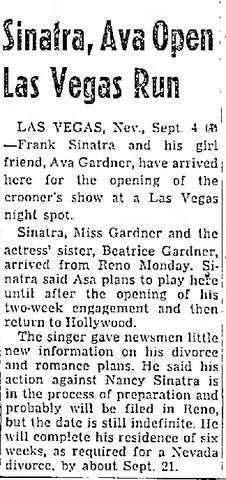
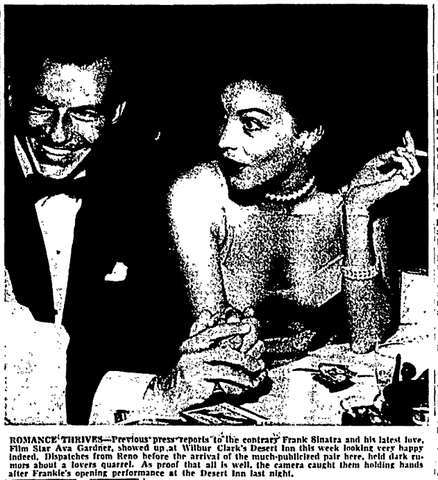
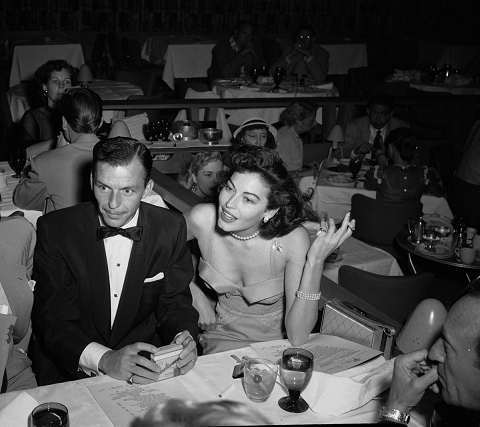
Desert Inn, Las Vegas , Nevada
SINATRA'S FIRST ENGAGEMENT IN LAS VEGAS
1951 Desert Inn, Las Vegas , Nevada (September 4-19)
Frank Sinatra, Jay Marshall, Ruby Ring, Gene Griffin, Arden- Fletcher Dancers (8), Graham Forbes, Carlyon Hayes Orch (11) no cover, no minimum
Variety
9-12-51
note: I love it when the reviewer lists the songs Sinatra sang. A few weeks back I was asked about Frank singing "I'm A Fool To Want You." Well, now we know he was singing it when Ava was at ringside in his first engagement in Vegas. Frank told of his problems with Ken Lane during his first appearance in Vegas. It is obvious he forgot the piano player was not Lane but Graham Forbes. After this two week stay in Vegas, Bill Miller would replace Forbes.
[image referenced in source but could not be recovered]
[image referenced in source but could not be recovered]
[image referenced in source but could not be recovered]
[image referenced in source but could not be recovered]
September 5, 1951
Concerts
Desert Inn, Las Vegas, Nevada (September 4-19)
Desert Inn, Las Vegas, Nevada (September 4-19)
From his first appearance in 1951, Sinatra remembered, "Wilbur Clark gave me my first job in Las Vegas. That was 1951. For six bucks, you got a filet mignon dinner and me."
--ED
September 6, 1951
Concerts
Desert Inn, Las Vegas , Nevada (September 4-19)
Desert Inn, Las Vegas ,
Nevada
DESERT INN, LAS VEGAS
Painted Desert Room )
Las Vegas, Sept. 6
Frank Sinatra, Jay Marshall, Ruby Ring, Gene Griffin, Arden-Fletcher Dancers,(8)
Graham Forbes, Carlton Hayes Orch. (11); no cover, no minimum
Plenty of controversy is flipping back and forth about the Sinatra stand at the
Desert Inn, with customer opinion divided. Maitre d' will cry for mercy during this
fortnight, because tables are at a premium.
Controversy edges around those who scoff as Sinatra's voice goes off form a
bit, and those who put him forward as being one of the greatest showmen seen
in these parts. After waves of attendant publicity, and some not too flattering, a
tendency has become to scalp "The Voice" before it has a chance to be really
heard.
Sinatra displays marvelous ease while setting forth in some clever patter
preceding his tunes.Works through a succession of standards and a pop or
two, until he boffs with a ditty he had a hand in cleffing: "I'm A Fool To Want
You." Sunday punch is "Soliloquy," a seven-minute song dissertation that KO's
the whole room, but good. Repertoire also includes "When You're Smiling,"
"Hello Young Lovers," "Black Magic," "Crush On
You," "All Of Me," "I
Concentrate On You," "My Blue Heaven," "I'll Never
Smile Again" and "Come
Rain Or Come Shine."
Emcee Gene Griffin tosses in spark with some intro gabs plus enlivening
production romps with neat warbling. Sinatra himself pays high trib to back-
stopping Carlton Hayes and Windjammers who sound better than good. Graham
Forbes slides in during his stint for all keyboard accomps.
Walt
Variety
note:The Las Vegas Morning Sun's publisher, Hank Greenspan, wrote a guest column in the paper on 9-9-51. He had attended a show at the Desert Inn, leaving him with a $33.00 tab that was not worth the entertainment Sinatra was offering.
Variety columnist, Bill Willard, immediately responded with a vigorous defense of the singing he had heard at the inn.. Greenspan thought Frank was a shell of the great teen idol of the mid-1940s. Willard argued that the voice had changed, but was still marvelous. A number of other papers joined the debate. Frank, who was at the D.I. for two weeks, at $15,000 per week, added to the controversy by aiming some rather nasty barbs at Rosie Clooney and a few other performers.
This was done on stage and just added fuel to the fire. Despite this nastiness,
Frank had found a place in the sun. Vegas and The Voice would carry on a love affair that lasted more than 40 years.
During a concert in the late 1970s, Frank told of his travails with his piano player,
Ken Lane, during the summer of 1951. Frank remembered Lane running out on him during the Desert Inn engagement. Frank's memory failed him on this one.
Lane must have played the Riverside Restaurant & Hotel, in Reno, prior to the
Vegas setting. Graham Forbes was Frank's pianist at the Desert Inn. Forbes had told Frank he wanted his base to be New York City, so the Vegas gig was his swan song. Jimmy Van Heusen went looking for a piano player and found Bill Miller working on the Vegas strip... Bill backed Frank when the second season of the CBS-TV series got underway on 10-9-51.
Sinatra was paid $10,000 a week for the Reno two-weeker and $15,000 at the Desert Inn, per week. That $50,000 was a lot of money in 1951 and Frank needed every penny he could earn at that time.
Desert Inn gig ran from 9/4 thru 9/17. Ella Logan opened on the 18th. Ed
September 6, 1955 & September 6, 1965
Two Magazine Covers 10 Years apart:
Look Magazine September 6, 1955:
Newsweek September 6, 1965: note: Newsweek photographer encountered a problem with photos he took for this cover article. Yul Brynner saved the day by offering magazine some recent shots he had done at Frank's Palm Springs home.
Ed
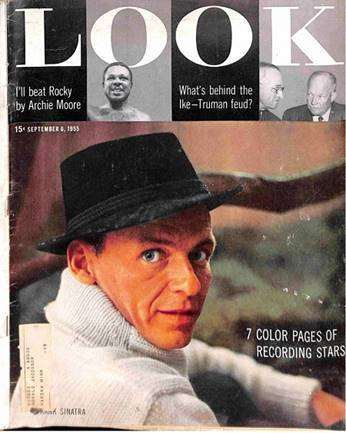
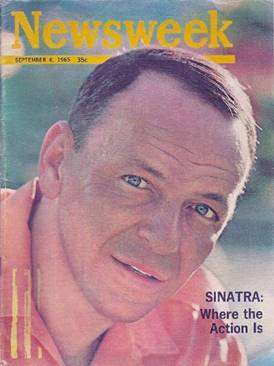
September 7, 1951
Concerts
Desert Inn, Las Vegas , Nevada (September 4-19)
September 8, 1951
Concerts
Desert Inn, Las Vegas , Nevada (September 4-19)
September 9, 1951
Concerts
Desert Inn, Las Vegas , Nevada (September 4-19)
September 10, 1951
Concerts
Desert Inn, Las Vegas , Nevada (September 4-19)
September 11, 1951
Concerts
Desert Inn, Las Vegas , Nevada (September 4-19)
September 13, 1951
Concerts
Desert Inn, Las Vegas, Nevada (4 - 18)
Ed O'Brien:
On September 4, 1951 ,
The Desert Inn was really nothing more than a glorified motel. Wilbur Clark was the owner. Frank did two shows a night at 8:30 and 11:30 PM. The bill consisted of Jay Marshall "The Funny
Bunny Man," Comedian Magician, Ruby Ring, "Dancer
Extra-Ordinary," The Arden-Fletcher
Dancers with Gene Griffin -- Singing M.C. and Carlton Hayes Orchestra. Frank's engagement was a sell-out. He opened with
"When You're Smiling," "All of Me," "Come
Rain Or Come Shine," "How Deep Is the Ocean," "My
Blue Heaven," "She's Funny That Way," "That
Old Black Magic" and wowed the audience. Years later he would remember a young writer from a San
Francisco paper. Seems the guy was assigned not only to do a story but to pick a fight with Sinatra. The writer had fought as an amateur and simply couldn't justify starting a fight with the singer. Instead he told Sinatra about it and they hit it off immediately. Frank gave him a great interview as a way of thanking him.
I have the 9-13-51 program signed by Bill Miller.
September 19, 1951
[Nevada residency requirement met]
Frank's six-week Nevada residency requirement for divorce was up on September 19, 1951, but Nancy's attorney signaled she planned to contest the action and instead pursue a prior California divorce, disputing the existing property settlement and claiming Frank owed her $40,805 in back alimony.
Source: James Kaplan, "Frank: The Voice" (2010).
September 20, 1951
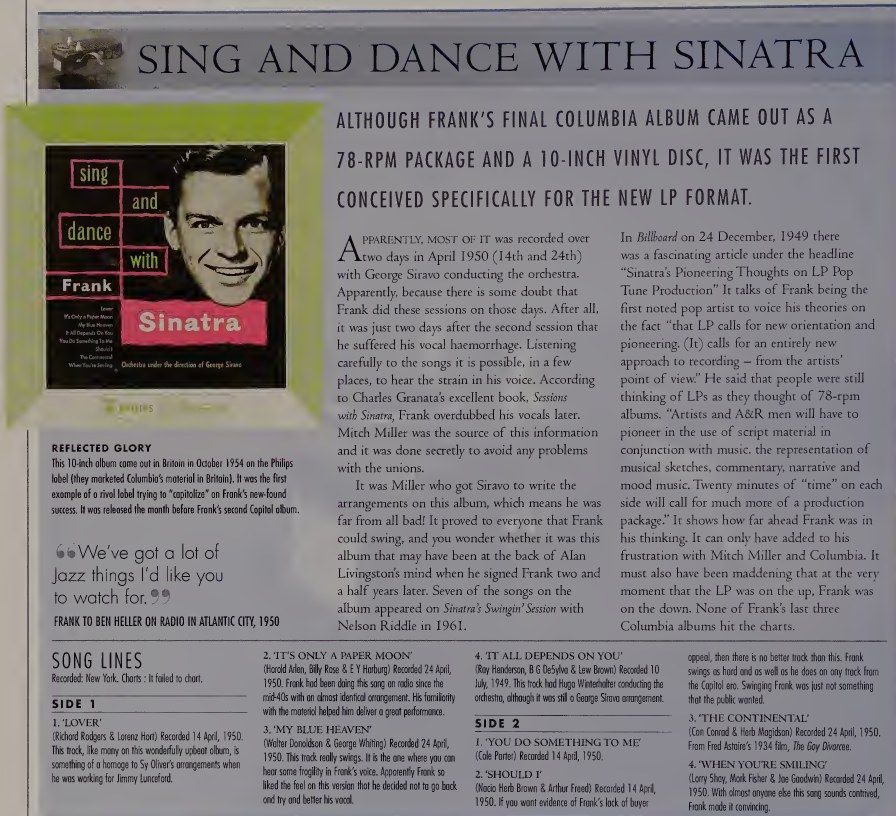
[Photograph: LA Times reports levy placed on Frank's property. From Richard Havers, "Sinatra" (Dorling Kindersley, 2007), p.156.]
The Los Angeles Times reported that Nancy, seeking roughly $40,000 in unpaid alimony after Frank established Nevada residency for his divorce, had obtained a writ placing a levy on a building Frank owned on South Robertson Boulevard in Hollywood. Publicly, this fed a narrative that a wealthy Frank was refusing to pay his estranged wife. (Source: Richard Havers, "Sinatra" (Dorling Kindersley, 2007).)
October 1951
[Bill Miller Joins Sinatra's CBS TV Show as Pianist]
Pianist Bill Miller recalled being hired for Sinatra's CBS television show when it returned from its summer break in October 1951, though the show did not continue much longer after that.
Source: Charles Pignone, "Frank Sinatra 100" (2015).
[Sinatra Accused Of Running Down A Photographer At LAX]
Nancy Sinatra: Newspapers nationwide reported that Sinatra had deliberately driven his car into photographer William Eccles at Los Angeles Airport with Ava Gardner aboard and then threatened him; Sinatra insisted it was a setup, and Gardner backed his account.
Source: Nancy Sinatra, Frank Sinatra: An American Legend, 1995.
[Nancy receives interlocutory divorce decree]
Kaplan: About two weeks after filing, Nancy appeared at the Santa Monica courthouse to receive her interlocutory decree of divorce; a photographer captured several striking images of her that day, wearing a checked suit and the pearls Frank had given her.
Source: James Kaplan, "Frank: The Voice" (2010)
[Sinatra granted uncontested divorce in Vegas]
Kaplan: Two days after Nancy's interlocutory decree, Frank was awarded an uncontested divorce in a five-minute closed session in a Las Vegas courtroom. That night he flew east.
Source: James Kaplan, "Frank: The Voice" (2010)
October 3, 1951
[Bobby Thomson's home run and Moretti's bet]
On October 3, 1951, the New York Giants' Bobby Thomson hit his famous pennant-winning home run against the Brooklyn Dodgers. Sinatra's friend, mobster Willie Moretti, had bet heavily on the Dodgers and later learned the Giants had been using a telescope-and-buzzer sign-stealing scheme, prompting him to declare all his bets off.
Source: James Kaplan, "Frank: The Voice" (2010).
October 4, 1951
[Willie Moretti murdered]
The day after the pennant game, Willie Moretti was shot twice in the head by an associate at Joe's Elbow Room restaurant in Cliffside Park, New Jersey, apparently for welshing on sports bets. Moretti, who had been a father figure to Sinatra and had recently become notorious for his loose talk at the televised Kefauver organized-crime hearings, had reportedly been a marked man for months.
Source: James Kaplan, "Frank: The Voice" (2010).
October 9, 1951
Television
Frank Sinatra Show
Network: CBS
Location: New York City
Show: 37(in series), 2-01(in season)
Tuesday 8:00 P.M.-9:00 P.M.
Sponsor: Ekco Housewares (first 15mins), sustaining (final 45mins)
Orchestra Conducted By: Axel Stordahl
Producer: Max Gordon
Executive Producer: Marlo Lewis
Guests: Perry Como, Frankie Laine, The Andrew Sisters, Broderick Crawford
1. I Get A Kick Out Of You - Frank Sinatra
2. When Your Smiling - Frank Sinatra
Notes: First 30mins. survives on kiniscope.
Ed O'Brien notes that Broderick Crawford was also a guest. Earlier that year he won an Oscar for Best Male Performance in "All the King's Men."
Frank Sinatra Show
Guests: Perry Como, Frankie Laine, The Andrew Sisters, Broderick Crawford
Frank Sinatra at rehearsal for the FRANK SINATRA SHOW. Image dated October 9, 1951
Perry Como and Frank Sinatra backstage at the FRANK SINATRA SHOW. Image dated October 9, 1951.
---------------------------------------------------------
© 1997-2025 The Sinatra Archive
This calendar, or any parts thereof, may not be reproduced in any fashion whatsoever without the prior written permission of the publisher (The Sinatra Archive)
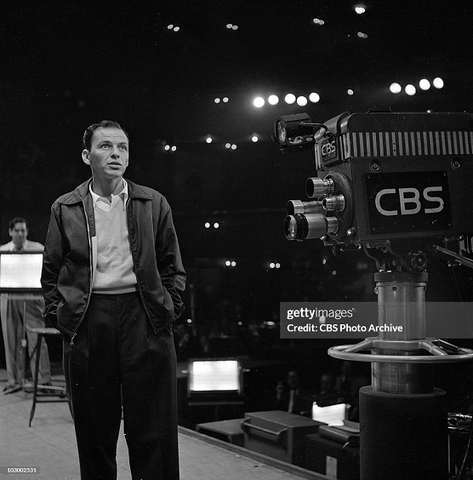
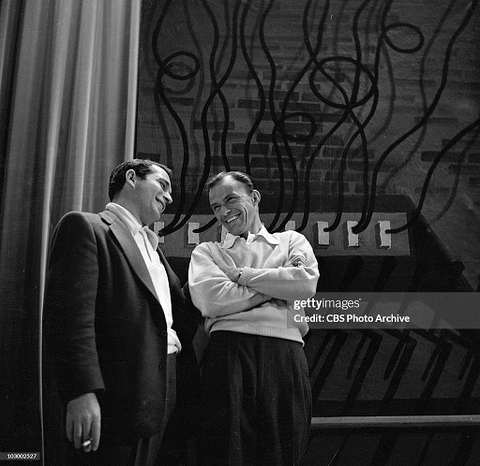
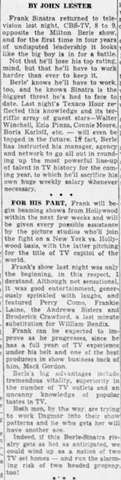
[TV show second-season premiere]
The second-season premiere of The Frank Sinatra Show aired October 9, 1951, co-starring Perry Como, Frankie Laine, and the Andrews Sisters. Variety called the show spotty, and the New York Times praised Sinatra's stage presence but noted Perry Como effortlessly stole the show's honors.
Source: James Kaplan, "Frank: The Voice" (2010).
October 10, 1951
New York Times critic Jack Gould reviewed the second-season premiere of Sinatra's CBS series, praising Sinatra's likable presence on screen but noting that guest star Perry Como had walked off with the evening's honors.
Source: Albert Auster, "Frank Sinatra: The Television Years–1950–1960," Journal of Popular Film and Television, 26:4 (1999), 166-174.
October 12, 1951
Television
Cavalcade of Stars
Jackie Gleason, Pert Kelton, Art Carney
Guests: Mel Tormé, Lois Hunt (Opera Vocalist), Maria Neglia (Violinist)
Gleason concludes the program with a sketch about silent movies called "A Day at Coney Island," featuring surprise guest Frank Sinatra.
October 15, 1951
[Nancy files for California divorce]
On October 15, 1951, Nancy filed for divorce in California after the new property settlement was signed.
Source: James Kaplan, "Frank: The Voice" (2010).
October 16, 1951
Television
Frank Sinatra Show
Network: CBS
Script: Dated October 16, 1951
Location: New York City
Show: 38(in series), 2-02(in season)
Tuesday 8:00 P.M.-9:00 P.M.
Sponsor: Ekco Housewares (first 15mins), sustaining (final 45mins)
Orchestra Conducted By: Axel Stordahl
Producer: Max Gordon
Executive Producer: Marlo Lewis
Writers: Harry Crane
Guests: Jackie Gleason, Anne Jeffreys, Stanton and Luster (dancers)
1. All Of Me - Frank Sinatra
2. I Can't Believe That You're In Love With Me - Frank Sinatra
3. Body And Soul - Frank Sinatra
Note: Sinatra had a cameo four days earlier on Gleason's October 12, 1951 episode of Cavalcade of Stars
Review:
Program: Frank Sinatra Show,
CBS -TV, Tuesday, 8 -9 p.m.
Approx. cost: $41,500.
"Sponsor: Ekco Products Corp.
(first 15 minutes).
Agency: Earle Ludgin & Co.,
Chicago.
Cast: Frank Sinatra, Jackie Gleason,
Anne Jeffreys, Jack Stanton and Betty Luster.
Producer: Max Gordon.
Director: Jack Donohue.
Musical director: Axel Stordahl,
Writers: Al Schwartz, Howard
Snyder, Hugh Wedlock and
Arnold Auerbach.
TO JUDGE by his Oct. 16 CBS
Television performance, Frank Sinatra has decided the best way to compete with Milton Berle, who is opposite him on NBC -TV, is to fight fire with fire.
This decision might have been wise were it not for the handicap that Mr. Sinatra himself is no more than a wisp of smoke and the comedian he imported to assist him, Jackie Gleason, would find it hard to touch off a spark with a dynamite cap and a sledge hammer.
Mr. Sinatra's second round against Mr. Berle de-emphasized his singing and featured him and Mr. Gleason as comics in a series of bits not unlike the sort of thing that has been happening every Tuesday evening over on NBCTV for years.
One scene aboard a Pullman car had Messrs. Sinatra and Gleason dressed in night caps and pajamas. Sample gag:
Mr. Gleason: How do you like my sleeping bag? I bought it at
Brooks Brothers.
Mr.Sinatra: It looks like the brothers were still in it.
This type of joke is endemic to The Berle show. It should not be borrowed by Mr. Sinatra unless he wishes to become a pallid version of his competition.
Possibly half the gags delivered by Mr. Gleason on the show dealt with Mr . Sinatra's physical condition which is, to be optimistic, alarming. It is plain that he has been strained by his recent life off -screen.
It seemed to this reviewer that Mr. Sinatra is thinner than he used to be, a condition that should be of interest to the American Medical Assn. He is also more listless, which is to say he is approaching an almost inanimate state. His voice, which was never a robust instrument, has suffered.
The therapy this reviewer advocates for Mr. Sinatra -if he hopes to last out the season and establish his show -is a steak, a night's sleep and a production that does not try to overcome the opposition by imitation.
Broadcast Magazine
October 22, 1951
Frank Sinatra Show
Network: CBS
Script: Dated October 16, 1951
Location: New York City
Show: 38(in series), 2-02(in season)
Tuesday 8:00 P.M.-9:00 P.M.
Sponsor: Ekco Housewares (first 15mins), sustaining (final 45mins)
Orchestra Conducted By: Axel Stordahl
Producer: Max Gordon
Executive Producer: Marlo Lewis
Writers: Harry Crane
Guests: Jackie Gleason, Anne Jeffreys, Stanton and Luster (dancers)
Frank Sinatra & Jackie Gleason in rehearsal for The Frank Sinatra Show, 1951
Not sure if this photo is from the rehearsal for the program but it's a great shot of Sinatra and Gleason
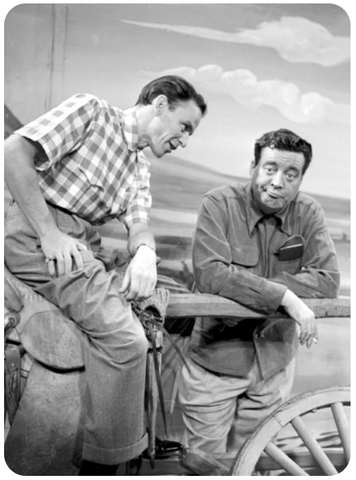
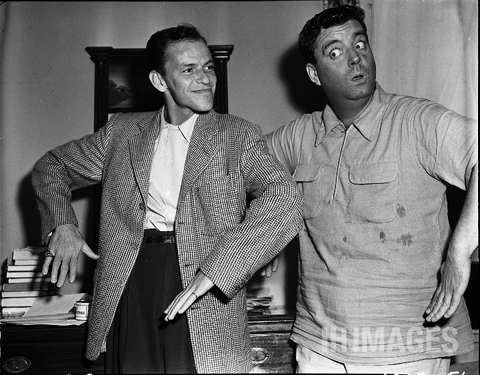
October 21, 1951
Radio
Radio: Sinatra appeared as a guest on The Big Show, the NBC variety program hosted by Tallulah Bankhead, this date, alongside The Andrews Sisters, Marlene Dietrich, the Benny Goodman Orchestra, Herb Shriner, and Margaret Truman. Source: sinatradiscography.com, Radio Transcriptions Database.
October 23, 1951
Television
Frank Sinatra Show
Network: CBS
Location: New York City
Show: 39(in series), 2-03(in season)
Tuesday 8:00 P.M.-9:00 P.M.
Sponsor: Ekco Housewares (first 15mins), sustaining (final 45mins)
Orchestra Conducted By: Axel Stordahl
Producer: Max Gordon
Executive Producer: Marlo Lewis
Guests: Dagmar, Mary McCarty, Jack E. Leonard
note: Frank's TV show was struggling to acquire more sponsors and more CBS affiliates. It was announced on this day that the show had picked up two more stations, effective 12/18. That would give the show 22 affiliates -some live broadcasts and others aired on kinescope. But with the good news, came the ratings later in the week, the evening of 10/23 showed Milton Berle pulling in a 41.6 to Frank's 16.3. CBS was shelling out $41,500 per episode and they wanted bigger ratings. Alas, it was not to be. By
January of 1952, Ekco dropped its 15 minute segment. and the show's rating did not tempt any potential sponsors.
CBS did grant Frank's request to move the production out to Hollywood. The 11-20-51 was the first to be broadcast from the west coast.
Ed
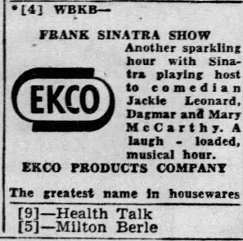
October 28, 1951
Two weeks before Frank's TV season premiere, Ava collapsed and was hospitalized in Santa Monica with a severe viral infection and dangerously low blood pressure. She was too ill to travel and did not rejoin Frank in New York until late October. (Source: Richard Havers, "Sinatra" (Dorling Kindersley, 2007).)
October 30, 1951
Television
Frank Sinatra Show
Network: CBS
Location: New York City
Show: 40(in series), 2-04(in season)
Tuesday 8:00 P.M.-9:00 P.M.
Sponsor: Ekco Housewares (first 15mins), sustaining (final 45mins)
Orchestra Conducted By: Axel Stordahl
Producer: Max Gordon
Executive Producer: Marlo Lewis
Guests: Jules Munshin, Georgia Gibbs, Gary Moore, Eddie Mayoof
Nancy Sr. was granted an interlocutory divorce decree in Santa Monica, to become final after one year.
Source: Nancy Sinatra, Frank Sinatra: An American Legend, 1995.
October 31, 1951
Frank and Nancy Sinatra's divorce was finalized in Santa Monica while Frank and Ava Gardner were in New York. “Regretfully, I am putting aside religious and personal considerations and agreeing to give Frank the freedom he has so earnestly requested,” Nancy said in a statement. Under the settlement, Nancy received a third of Frank's gross income on the first $150,000 a year (with declining percentages above that, never less than $1,000 a month for life), custody of their three children, the Holmby Hills home, and a share of Sinatra Music Corporation; Frank kept the Palm Springs house and his cars. “She took her pound of flesh from him and then some,” Ava later said of the settlement. Source: J. Randy Taraborrelli, Sinatra: Behind the Legend.
November 1951
[Billboard reports Sinatra-Miller feud]
Kaplan: In November 1951, Billboard reported a long-smoldering feud between Sinatra and producer Mitch Miller over Sinatra's complaint that he wasn't getting fair material, and quoted Frank claiming he was in talks with RCA Victor and Capitol Records -- a bluff, since Manie Sacks had already told him Victor had no interest and Capitol was thriving with Nat King Cole, Dean Martin, and Peggy Lee.
Source: James Kaplan, "Frank: The Voice" (2010)
[Honeymoon flight and lost luggage]
Ava Gardner: After the wedding, Frank and Ava chartered a twin-engine Beechcraft to Miami, staying at the out-of-the-way Green Heron Hotel in Sunny Isles. In the rush to escape reporters, Ava left her honeymoon luggage at the Sacks house and had only her handbag, wearing Frank's pajama top and later his jacket over her travel suit.
Source: James Kaplan, "Frank: The Voice" (2010)
[Honeymoon in Havana at Hotel Nacional]
Ava Gardner: From Miami, Frank and Ava continued their honeymoon at the Hotel Nacional in Havana, drinking Cuba libres and visiting nightclubs and casinos. Ava recalled a night when she climbed onto a hotel archway pretending she might jump, purely out of mischief and rum; in a separate taped interview she recalled the couple fighting badly on their first night there, with Frank fearing she really might jump from the balcony.
Source: James Kaplan, "Frank: The Voice" (2010)
[Meet Danny Wilson premiere]
Kaplan: Frank and Ava attended the premiere of Meet Danny Wilson with Frank's parents Dolly and Marty; Dolly, who frequently clashed with Nancy, was reportedly fond of Ava.
Source: James Kaplan, "Frank: The Voice" (2010)
[Press hostility greets newlyweds in New York]
Kaplan: Returning to New York, Frank and Ava were met by reporters demanding to know where they were staying; Frank cursed and slammed the car door. The Daily News ran the headline "SNARLING FRANK, GIGGLING AVA," and another tabloid ran "WHAT A BORE IS FRANKIE." Columnist George Sokolsky wrote sardonically that if Sinatra truly wanted privacy he should be kept out of the public eye permanently.
Source: James Kaplan, "Frank: The Voice" (2010)
[Sinatra marries Ava Gardner]
Consiglio: Frank and Ava Gardner married in November 1951. Consiglio says they had effectively stopped living together within about two years, and their eventual divorce took roughly four years -- longer than the marriage itself.
Source: Tony Consiglio (as told to Franz Douskey), "Sinatra and Me: The Very Good Years" (2012)
November 1, 1951
A day after his divorce from Nancy was finalized, Frank Sinatra and Ava Gardner obtained a marriage license amid a crush of reporters. When a photographer sarcastically asked Gardner whether she'd wear a white wedding dress, Frank shoved him hard enough to send him to the pavement before the couple sped off. Source: J. Randy Taraborrelli, Sinatra: Behind the Legend.
After establishing five weeks of Nevada residency, Frank obtained a Nevada divorce, freeing him to marry Ava.
Source: Nancy Sinatra, Frank Sinatra: An American Legend, 1995.
November 2, 1951
[Frank and Ava apply for marriage license]
On November 2, 1951, Frank and Ava applied for a marriage license in Philadelphia, hoping to avoid publicity, accompanied by Manie Sacks and CBS board member Isaac Levy. Pennsylvania's seventy-two-hour waiting period meant the wedding would fall on Monday, November 5.
Source: James Kaplan, "Frank: The Voice" (2010).
November 3, 1951
[Poison-pen letter nearly cancels wedding]
Ava Gardner: Back in New York the weekend before the wedding, Ava received an anonymous letter at the Hampshire House detailing explicit claims about affairs with Frank, apparently from a prostitute; devastated, she threw her engagement ring out the window and declared the wedding off. Frank, Bappie, Manie Sacks, Hank Sanicola, and Dick Jones spent much of the night persuading her to change her mind. Ava later suspected Howard Hughes, who was obsessively jealous over her, had arranged the letter.
Source: James Kaplan, "Frank: The Voice" (2010).
November 6, 1951
Television
Frank Sinatra Show
Network: CBS
Location: New York City
Show: 41(in series), 2-05(in season)
Tuesday 8:00 P.M.-9:00 P.M.
Sponsor: Ekco Housewares (first 15mins), sustaining (final 45mins)
Orchestra Conducted By: Axel Stordahl
Producer: Max Gordon
Executive Producer: Marlo Lewis
Guests: Jackie Gleason, June Hutton, Grady Sutton, Pert Kelton, Roberta Lee, Stanton and Luster (dancers)
Ed O'Brien points out that Gleason made seven appearance over the two year run of the show. He was on five shows the first season. Sinatra and he worked well together. They did a Paramount gig with Dagmar in 1951.
Note: On October 3, 1951, Gleason and Pert Kelton introduced the first "Honeymooners" sketch as Ralph and Alice Kramden on "Cavalcade of Stars."
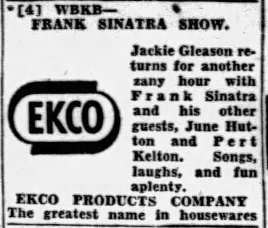
November 7, 1951
Frank Sinatra and Ava Gardner married in a brief ceremony at the West Mount Airy, Philadelphia, home of Manie Sacks's brother Lester, with Judge José Sloane of the Court of Common Pleas officiating; a cold, driving rainstorm and a crowd of reporters greeted them outside. The wedding nearly didn't happen — the night before, an anonymous letter accusing Frank of an affair with a prostitute had briefly convinced Gardner to call the whole thing off, and she hurled her engagement ring out a Hampshire House window before her sister Bappie talked her back into going through with it. Gardner wore a Howard Greer gown of pink taffeta and mauve marquisette; the couple exchanged simple platinum bands before roughly two dozen guests, including Frank's parents, and honeymooned briefly at the Hotel Nacional in Havana. Source: J. Randy Taraborrelli, Sinatra: Behind the Legend.
Frank and Ava Gardner, on their wedding day, November 7, 1951. It was Ava’s third marriage, Frank’s second. Frank always loved Ava’s wit: “Part of me had no doubt I would end up a movie star,” she liked to say. “Deep down, I’m pretty superficial.” Source: photo and caption from J. Randy Taraborrelli, Sinatra: Behind the Legend (mptvimages.com).
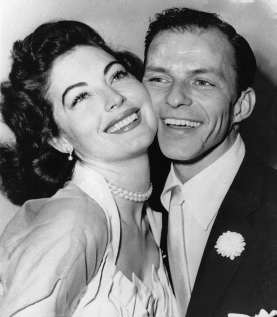
[Frank and Ava marry in Germantown]
Earl Wilson: On the rainy morning of November 7, 1951, Frank and Ava emerged from the Hampshire House looking happy and sober according to Earl Wilson, then eluded press to marry at the West Germantown home of Manie Sacks's brother Lester Sacks, in a small ceremony of about twenty guests officiated by judge Joseph Sloane, with Axel Stordahl as best man and June Hutton as matron of honor.
Source: James Kaplan, "Frank: The Voice" (2010).
[Sinatra rages at press outside wedding]
Ava Gardner: Arriving at the wedding venue to find press waiting despite the secret location, Frank jumped from the moving car shouting at photographers and threatened to knock down anyone who tried to get inside; he continued shouting obscenities from an upstairs window before being coaxed down to the ceremony.
Source: James Kaplan, "Frank: The Voice" (2010).
[Dolly's numerological wedding blessing]
Dolly Sinatra: At the wedding reception, after the bride cut the cake, Dolly Sinatra told the newlyweds their marriage was blessed with good luck because they'd married at the seventh hour of the seventh day of the eleventh month: "Seven, seven, eleven. You can't miss."
Source: James Kaplan, "Frank: The Voice" (2010).
[Manie Sacks counsels Ava on Frank]
Manie Sacks: Before the newlyweds left for their honeymoon, Manie Sacks told Ava that Frank was fragile after some hard knocks and that it wouldn't be easy living with a man whose career was in a slump; she promised to do anything to make Frank happy.
Source: James Kaplan, "Frank: The Voice" (2010).
November 9, 1951
En route to a four-day honeymoon in Havana, which Ava reportedly told a friend she paid for herself, the newlyweds stopped in Miami where a well-known photo of the couple was taken. Frank had no apparent qualms about returning to Cuba despite his earlier Mafia-linked trip there. (Source: Richard Havers, "Sinatra" (Dorling Kindersley, 2007).)
November 13, 1951
Television
Frank Sinatra Show
Network: CBS
Location: New York City
Show: 42(in series), 2-06(in season)
Tuesday 8:00 P.M.-9:00 P.M.
Sponsor: Ekco Housewares (first 15mins), sustaining (final 45mins)
Orchestra Conducted By: Axel Stordahl
Director: Jack Donohue
Producer: Max Gordon
Executive Producer: Marlo Lewis
Set/Art Department: William Cecil
Writers: Arnold M Auerbach, Al Schwartz, Howard Snyder, HUgh Wedlock Jr.
Guests: Jack Benny, June Hutton, Charles Castleman (10-year-old violinist), Larry Griswold
1. I've Got My Love To Keep Me Warm - Frank Sinatra
2. My Concerto - Frank Sinatra
3. For You - Frank Sinatra
4. The House i Live In - Frank Sinatra
Notes: Show in circulation. Ed O'Brien "One of the better shows from Frank's second season on CBS"
Frank Sinatra Show
Network: CBS
Location: New York City
Show: 42(in series), 2-06(in season)
Tuesday 8:00 P.M.-9:00 P.M.
Sponsor: Ekco Housewares (first 15mins), sustaining (final 45mins)
Orchestra Conducted By: Axel Stordahl
Director: Jack Donohue
Producer: Max Gordon
Executive Producer: Marlo Lewis
Set/Art Department: William Cecil
Writers: Arnold M Auerbach, Al Schwartz, Howard Snyder, HUgh Wedlock Jr.
Guests: Jack Benny, June Hutton, Charles Castleman (10-year-old violinist), Larry Griswold
Thanks to Michel Macaire for above photo
Frank Sinatra at rehearsal for the FRANK SINATRA SHOW. November 13, 1951.
Frank Sinatra and Jack Benny at rehearsal for the FRANK SINATRA SHOW. November 13, 1951.
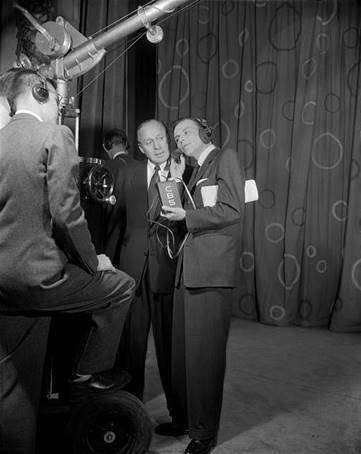
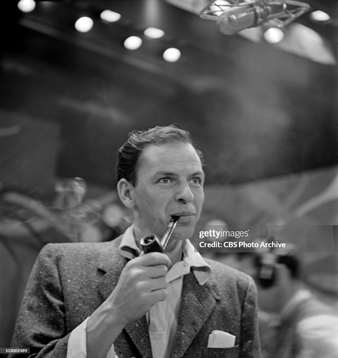
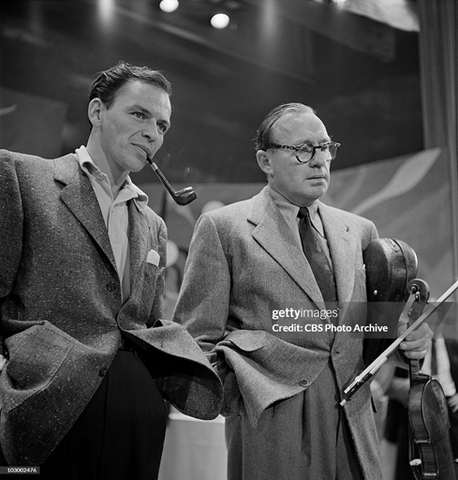
[Jack Benny guests on Sinatra's TV show]
The November 13, 1951 broadcast of The Frank Sinatra Show featured guests Jack Benny and ten-year-old violinist Charles Castleman; Variety praised the Benny-Sinatra banter as sparking one of the season's better episodes, though the show was fading fast overall.
Source: James Kaplan, "Frank: The Voice" (2010).
November 20, 1951
Television
Frank Sinatra Show
Network: CBS
Location: Studio A, Columbia Square Facility, Hollywood, California
Script: Dated November 20, 1951
Show: 43(in series), 2-07(in season)
Tuesday 8:00 P.M.-9:00 P.M.
Sponsor: Ekco Housewares (first 15mins), sustaining (final 45mins)
Orchestra Conducted By: Axel Stordahl
Announcer: Bob Lemond
Producer: David Dare
Executive Producer: Marlo Lewis
Writers: Harry Crane
Guests: Laraine Day, Leo Durocher, June Hutton, Jimmy Boyd
1. To Prove That I'm In Love With You - Frank Sinatra & June Hutton
2. Put Your Dreams Away - Frank Sinatra
3. Undecided - Frank Sinatra & Heathertones
Notes: First show of series from Hollywood.
Ed O'Brien:
Frank does a very good reading of "Undecided."
FILM
Lady In Cement, (US Film Release: November 20, 1968)
Starring: Frank Sinatra, Raquel Welch, Richard Conte
(Directed by Gordon Douglas. Produced by Aaron Rosenberg) Sinatra is back as Miami gumshoe Tony Rome who finds a woman's body with her feet encased in a concrete block and sets-out to solve the murder case. (1st DVD Release date: 2005-05-24)
(Blu-Ray Released on August 16, 2016 by Twilight Time with "Tony Rome", limited to 3,000)
Lady in Cement was the sequel to Tony Rome (1967, see entry); both films were based on Marvin H. Albert's private detective novels written under the pen name "Anthony Rome." In between the two Miami, FL-based "Tony Rome" movies, the same production teamTwentieth Century-Fox, producer Aaron Rosenberg, director Gordon Douglas, and actor Frank Sinatra”made another film, this one based in New York City, called The Detective (1968, see entry). A third Tony Rome film, based on another AnthoRelease Date: The 2 Jun 1967 DV announced that Albert would write the screenplay for his own novel, The Lady in Cement. Richard Breen, who scripted the earlier Tony Rome from Albert's novel, had died in Feb 1967 before it went into production. As he did while filming Tony Rome in early 1967, Frank Sinatra performed nightly at the Fontainebleau Hotel's La Ronde Room in Miami Beach, FL, while shooting Lady in Concrete during the day, the 18 Dec 1967 DV reported. He opened 7 Feb 1968 for "the longest nitery engagement of his careersix weeeks," with "two performances nightly, six days a week." All filming would take place nearby in Miami and Miami Beach, FL, beginning 19 Feb 1968, according to the 17 Jan 1968 Var. To facilitate easy travel between Sinatra's two jobs, the movie production converted the basement of the Fontainebleu into a film studio, where at least four sets were built, Aaron Rosenberg told the 21 Feb 1968 DV. Sammy Davis, Jr., who had co-starred with Sinatra in Gordon Douglas's Robin and the 7 Hoods (1964), was originally picked for the role of Tony Rome's close friend and former partner, but bowed out due to other commitments, according to the 5 Feb 1968 DV. Sinatra gave the role to comedian Pat Henry, his opening act at the Fontainebleu. Los Angeles Rams football star Merlin Olsen also auditioned for a role, the 24 Jan 1968 Var noted, but was apparently not involved in the film. The 28 Feb 1968 Var mentioned that filming had begun two days earlier, after a delay caused by Sinatra's bout with the flu, but according to a list of studio schedules in the 8 Mar 1968 DV, principal photography for Lady in Cement actually began on 4 Mar 1968. Articles in the 4 Mar 1968 DV and 6 Mar 1968 Var described a squabble between Twentieth Century-Fox and the Hialeah Park Race Track in Hialeah, FL. When Hialeah president Eugene Mori refused to allow Lady in Cement to be filmed there, the production moved to Gulfstream Park at Hallandale Beach, FL. Mori publicly criticized Gulfstream for hosting the film, saying: "We read the script of the movie, and it is a picture which portrays violence and underworld activity. We don't feel the best image of racing would be served by having Hialeah, or any track, involved in such a movie." The Gulfstream location scene was shot on 5 Mar 1968. A week earlier, the 29 Feb 1968 DV reported that 250 Florida schoolteachers, who were in the middle of a strike, were hired as extras to sit in Gulfstream's stands behind Sinatra and actress Raquel Welch. Filming ended 5 Apr 1968, the 10 Apr 1968 Var reported.
Comedian Joe E. Lewis was hired for a small part. Frank Sinatra had portrayed Lewis in the 1957 film biography The Joker Is Wild (see entry). In one scene, actor Dan Blocker's character sat in a motel room watching the television show Bonanza, whose theme played on the soundtrack. Blocker, who portrayed "Hoss Cartright" on the popular program, was on hiatus during the Lady in Cement production. When Twentieth Century-Fox ran a full-page advertisement in the 6 Nov 1968 DV and other trade papers publicizing the film's premiere that night at Hollywood, CA's Grauman's Chinese Theatre, it printed a photograph of Blocker manhandling Sinatra, with the words: "Hoss plays the heavy!" Critical reception was tepid. The 8 Nov 1968 LAT announced that the plot of Lady in Cement was "cumbersome without being rewardingly intricate," and as with most sequels, "the law of diminishing returns is still in force." The 21 Nov 1968 NYT called it such "a perfect blending of material with milieu that the movie's extraordinary vulgarity and sloppiness can almost be cherished for themselves, like widescreen graffiti.AFI Catalog
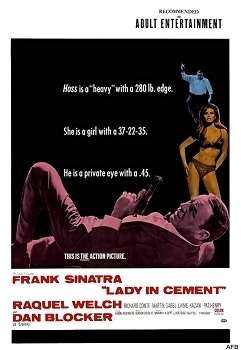
Frank Sinatra Show
Network: CBS
Location: Studio A, Columbia Square Facility, Hollywood, California
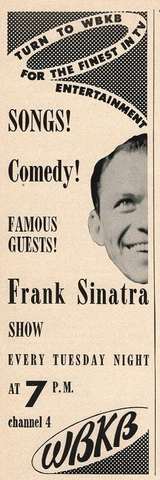
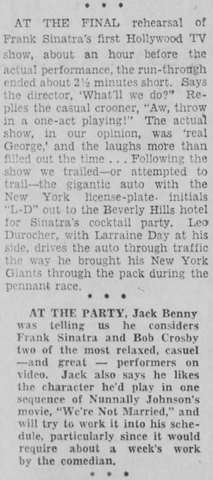
November 25, 1951
Radio
George Fisher Show
Guest: Frank Sinatra
KNX 10:15 PM
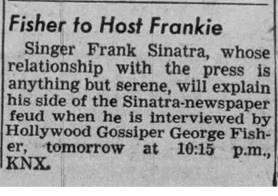
November 27, 1951
Television
Frank Sinatra Show
Network: CBS
Location: Studio A, Columbia Square Facility, Hollywood, California
Show: 44(in series), 2-08(in season)
Tuesday 8:00 P.M.-9:00 P.M.
Sponsor: Ekco Housewares (first 15mins), sustaining (final 45mins)
Orchestra Conducted By: Axel Stordahl
Announcer: Bob Lemond
Producer: David Dare
Executive Producer: Marlo Lewis
Guests: Arlene Dahl, George Tobias, Mike Mazurki, Jimmy Boyd, Mari Blanchard, Lenny Kent
1.. Hello Young Lovers - Frank Sinatra
December 1951
[Ava's Jewelry Stolen From A London Hotel Suite]
Nancy Sinatra: While Sinatra performed a command show for the royal family in London, the couple's suite at the Washington Hotel was burglarized; thieves made off with roughly $17,000 in valuables, including Ava Gardner's favorite diamond necklace along with Frank's cameo cufflinks and a sapphire ring.
Source: Nancy Sinatra, Frank Sinatra: An American Legend, 1995.
[Command performance in London, jewelry stolen]
Kaplan: In December 1951, Frank and Ava flew to London for a charity command performance before Princess Elizabeth and Prince Philip. While Frank rehearsed, a burglar climbed to their third-floor suite at the Hotel Washington and stole $17,000 worth of jewelry, including a diamond-and-emerald necklace Frank had given Ava in Spain. Ava also got stage fright and backed out of a planned duet, and the press reported the couple had quarreled; Frank gave a lackluster performance to a reportedly yawning audience.
Source: James Kaplan, "Frank: The Voice" (2010)
[LA Times reports churchmen calling Frank a bigamist]
About a month after the wedding, the Los Angeles Times reported that some local churchmen considered Frank a bigamist, mistakenly assuming his Nevada divorce was his only one and overlooking the separate California proceedings Nancy had initiated. Public concern faded as people realized nothing unusual had actually occurred beyond Frank's fame drawing scrutiny.
Source: Richard Havers, "Sinatra" (Dorling Kindersley, 2007).
December 4, 1951
Television
Frank Sinatra Show
Network: CBS
Location: Studio A, Columbia Square Facility, Hollywood, California
Show: 45(in series), 2-09(in season)
Tuesday 8:00 P.M.-9:00 P.M.
Sponsor: Ekco Housewares (first 15mins), sustaining (final 45mins)
Orchestra Conducted By: Axel Stordahl
Announcer: Bob Lemond
Producer: David Dare
Executive Producer: Marlo Lewis
Guests: Marie Wilson, Mary Hatcher, Lew Parker, June Hutton
1. Somebody Loves Me - Frank Sinatra
2. Get Happy - Frank Sinatra ( excellent example of the pre-Riddle sound that failed to compliment the vocal)
3. Button Up Your Overcoat Frank Sinatra & Mary Hatcher
4. How Deep Is The Ocean- Frank Sinatra ( terrific vocal)
5. Day In, Day Out - Frank Sinatra (ballad chart by Stordahl quite similar to the 53 Cap. recording)
Frank Sinatra Show
Network: CBS
Guests: Marie Wilson, Mary Hatcher, Lew Parker, June Hutton
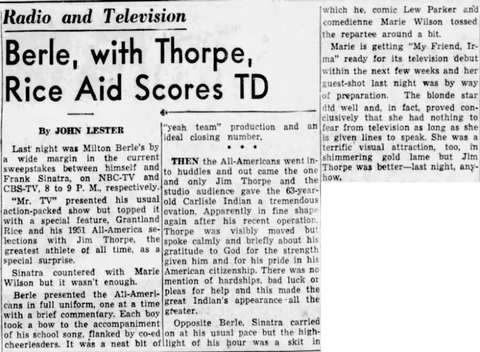
December 6, 1951
Following complaints from Los Angeles ministers about the ease of Nevada divorces, the Nevada Bar Association investigated whether Frank had perjured himself regarding his residency; the complaint eventually fizzled without action.
Source: Nancy Sinatra, Frank Sinatra: An American Legend, 1995.
December 10, 1951
Concerts
Coliseum Theatre, London, England
Midnight
Sunday morning
Command Performance
Note: Originally posted as December 9, 1951 but the show was midnight on the 10th making it really the 11th.
Ed O'Brien:
Sinatra flew to London from Los Angeles on
12-8-51. The songwriter Jimmy McHugh produced the midnight extravaganza with
Orson Welles, Tony Curtis, Janet Leigh, Rhonda
Fleming, Ava Gardner and many other stars.
Sinatra rehearsed with the 50-man orchestra on the morning of the ninth. The band was sadly inadequate. Sinatra asked them what they playing They answered, "Your music." Frank told them to go home. He then asked his great friend Jimmy Van Heusen to be his sole accom- panist on piano. According to McHugh both men gave magnificent performances. At the conclusion of Frank's segment of the show,
Ava joined him on stage and the crowd roared their approval. Frank flew back to the states on Monday morning and rehearsed for his
Tuesday evening CBS-TV show.
Note: Jimmy Van Heusen was a guest on "Meet
Frank Sinatra," 11-26-50. Content of show is not known ,but I'll bet he backed Frank on a medley of songs written by him through the years.
Brian Chearno added:
I haven't found what song(s) Sinatra sang for this benefit, but Sinatra and Dorothy Kirsten closed the show with "The Star Spengled Banner" then the cast and audience joined them in "God Save The King"
Ed Added:
What a wonderful show it must have been. Van Heusen was quite an accomplished pianist and Frank certainly had great confidence in him. Been thinking about other piano only performances.
Skitch Henderson, in my interviews with him, remembered backing Frank at the Waldorf and Copa in the wee hours for a very select crowd. Skitch never saw them because they sat in the dark incognito.
Coliseum Theatre, London, England
Midnight
Sunday morning
Command Performance
I found the following memorabilia from the show. It’s an autographed flyer and ticket stub. Note that the ticket stub says Monday December 10th with doors opening at 11:30. If the show was midnight then maybe it should be listed as December 11th. I think because the ticket stub says December 10th I’ll move the listing to the 10th. This is from the Sunday Pictorial, London, England, Dec 9, 1951. It also confirms that the Midnight Show was the next day December 10th. Here’s a review. We now know that Sinatra sang “Soliloquy” at this performance. Another nice picture of Sinatra meeting Princess Elizabeth who would go on to be Queen. There’s also a nice clip on Youtube of the Duke and Princess arriving at the event: https://www.youtube.com/watch?time_continue=9&v=w76TdSO9M3M&feature=emb_logo Post concert dinner following midnight show 12-9-51 Frank, Ava, Mrs C.J. Latta. Duke of Edinburgh enjoys a laugh with Dorothy Kirsten.
Original caption: Frank Sinatra takes wife Ava Gardner’s coat after arriving for rehearsals for the Gala Midnight Matinee in aid of the National Playing Fields Association, Dec. 9, 1951.
December 1951: American singer and actor Frank Sinatra signs autographs for chefs at a charity function at the Empress Club, London, organised by the Variety Club of Great Britain in aid of the National Playing Fields Association. Original Publication: Picture Post - 5637 - Host To The Stars - pub. 1951 (Photo by Bert Hardy/Picture Post/Hulton Archive/Getty Images) Prince Philip, The Duke Of Edinburgh, Is Chatting With The Us-American Singer Frank Sinatra And His Wife The Actress Ava Gardner At London's Empress Club. London. 9th December 1951. Photograph. American singer and film star Frank Sinatra sitting on stage during rehearsals at the Coliseum Midnight Matinee, London, 9th December 1951 (Photo by Daily Herald/Mirrorpix/Mirrorpix via Getty Images)
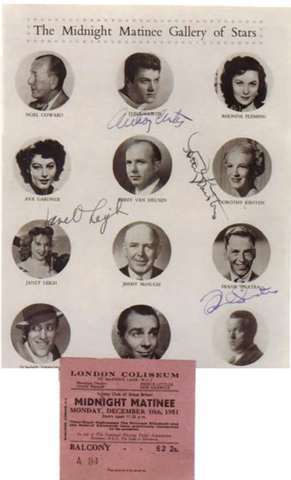
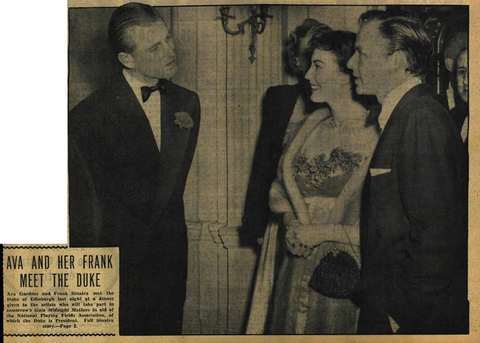
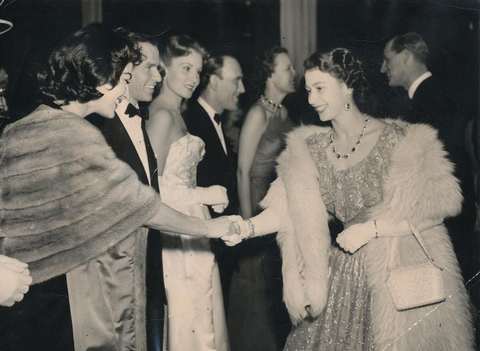
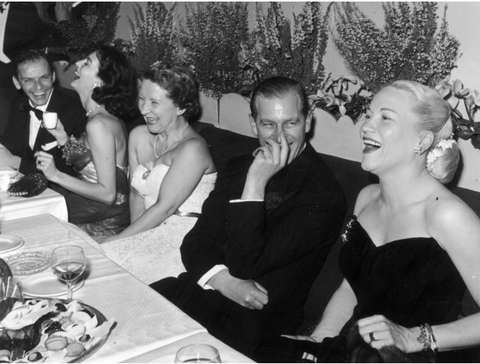
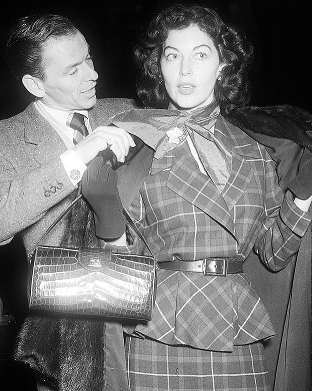
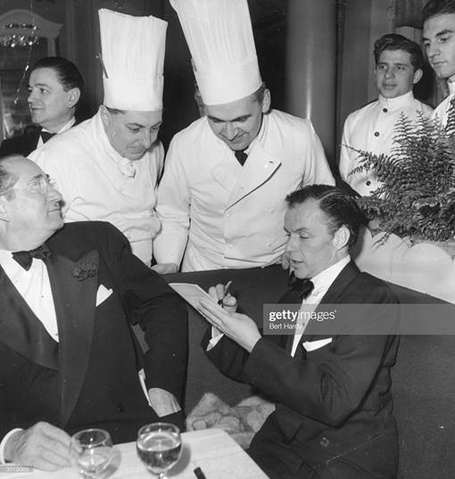
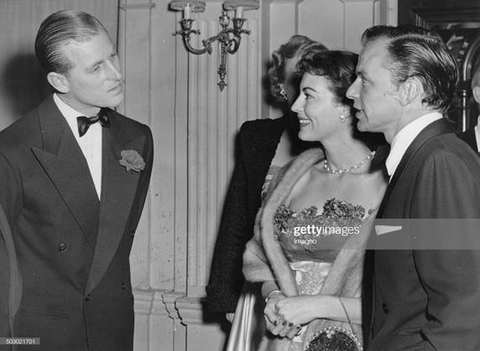
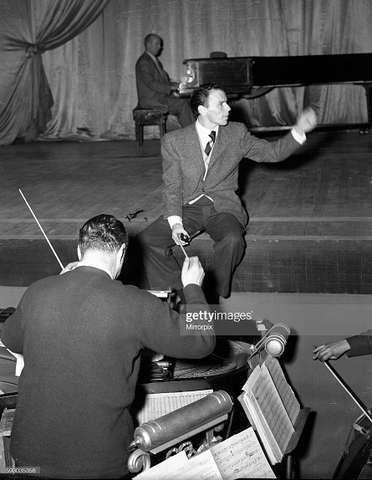
December 11, 1951
Television
Frank Sinatra Show
Network: CBS
Location: Studio A, Columbia Square Facility, Hollywood, California
Show: 46(in series), 2-10(in season)
Tuesday 8:00 P.M.-9:00 P.M.
Sponsor: Ekco Housewares (first 15mins), sustaining (final 45mins)
Orchestra Conducted By: Axel Stordahl
Announcer: Bob Lemond
Producer: David Dare
Executive Producer: Marlo Lewis
Guests: The Andrews Sisters, Roger Price, Joan Holloway, Henry Slate
1. I'm Gonna Live Till I Die
2. P.S. I Love You
3. I Ran All The Way Home
4. Sorry
5. I Could Write A Book w/ The Whipoorwills
6. Tea For Two w/ Patti Andrews
7. Jingle Bells w/ The Andrew Sisters (a swinging arrangement probably Siravo or Oliver)
December 12, 1951
FROM THE STARS AND STRIPES ARCHIVES
Hollywood 'surprise package' show starts tour of EC bases
Newlyweds Frank Sinatra and Ava Gardner sample Sinatra's 34th birthday cake backstage at Wiesbaden.
By DICK GITLIN | STARS AND STRIPES Published: December 14, 1951
WIESBADEN, Dec. 13 Hollywood's "Surprise Package" of glamor girls, comedy and song made its EC debut last night before a crowd of 3,900 at the Camp Lindsey gymnasium.
The troupe, starring Rhonda Fleming, Janet Leigh, Ava Gardner, Frank Sinatra and Tony Curtis, gave the large audience an early Christmas treat with the two-hour show. Supporting these headliners were song writers Jimmy McHugh and Jimmy Van Heusen, jazz singer Viola Jefferson and a pair of young Broadway dancers, Anita Ellis and Vance Henry. John Haskell acted as master of ceremonies.
Frank Sinatra and Ava Gardner sing ''Bewitched, Bothered and Bewildered'' during the show at Wiesbaden. JOHN RUSS/STARS AND STRIPES
Music was supplied by the 686th AF Band, of Camp Lindsey, under the direction of WOJG Franklin J. Lockwood. Sharman Douglas, daughter of former U.S. Ambassador to Britain Lewis W. Douglas, also accompanied the troupe from England, where it had held its rehearsals.
Sinatra provided 30 minutes of songs, including a comical arrangement of "Old Man Crosby."
"The Voice" brought his bride, Ava Gardner, to the mike and together sang "Bewitched, Bothered and Bewildered," with supplementary lyrics portraying their recent courtship.
The show, minus Frankie and Ava, will put on three more performances in the Zone in addition to tonight's show at Furstenfeldbruck Air Base. Tomorrow afternoon. it will entertain Erding Air Depot personnel. It moves on to Neubiberg Air Base tomorrow night and then closes out at Rhine-Main Saturday evening.
Hollywood Stars American actress and singer Ava Gardner (1922 - 1990), American actor Tony Curtis (1925 - 2010), American actor, producer, and singer Frank Sinatra (1915 - 1998), American actress, singer, dancer, and author Janet Leigh (1927 - 2004) , US, circa 1950. (Photo by Graphic House/Getty Images)
------------------------------------------
December 12, 1957 Villa Capri, California
42nd Birthday Party
Note: Ed O'Brien points out that Sinatra worked quite a few birthdays through the years. The Fame and Fortune radio show, on his 25th birthday, has no mention of it being a special day. Old Gold show from 1945 does mention it but gives no indication of his age. The Villa Capri party of this entry in 1957 for his 42nd birthday is quite memorable and the 50th party in 1965 was quite a tribute. In later years, the audience would sing "Happy Birthday" to him and on a few occasions, he joined them with "Happy Birthday to Me." Maybe the most of all for collectors and fans was the 52nd birthday recording with the Ellington band. George Jacobs told O'Brien there was a cake wheeled out during the session with a portable bar. Everyone celebrated. There are some great photographs listening to the final playback of "Indian Summer," Riddle's favorite Sinatra recording. Those photos reveal the intensity of the artist judging his own work.
Frank and Dean at Villa Capri 12-12-57
--------------------------------------------
DECEMBER 12, 1965
CRYSTAL BALLROOM
BEVERLY WILTSHIRE HOTEL
BEVERLY HILLS, CALIFORNIA
FRANK SINATRA'S 50TH BIRTHDAY
NANCY SINATRA SR.. ORGANIZED THE PARTY
Host: Milton Berle
Performers:
Nancy & Tina Sinatra
Jack Benny
George Burns
Tony Bennett "Old Devil Moon" and "Who Can I Turn To"( uptempo) Sammy Cahn
Nelson Riddle
Sammy Davis Jr " My Kind Of Guy, Sinatra Is" ( Sammy Cahn lyrics) Frank Sinatra speech sang separate "Happy Birthday" salutes to Sammy Davis Sr. and Edward G. Robinson
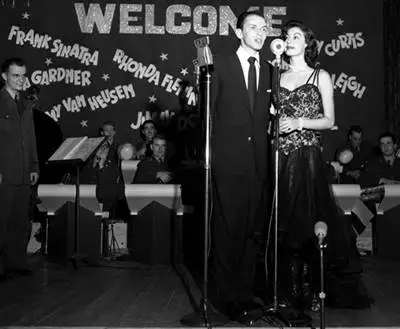
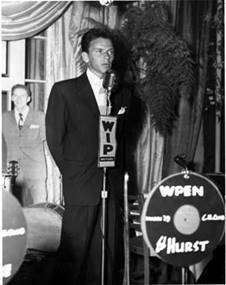
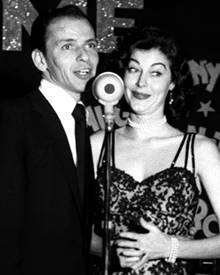
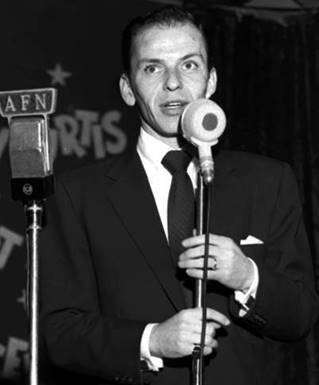
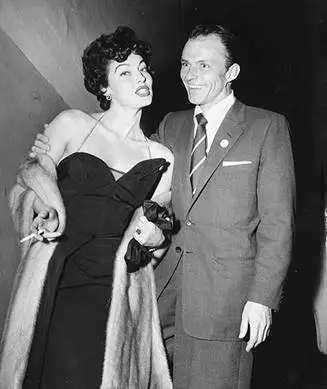
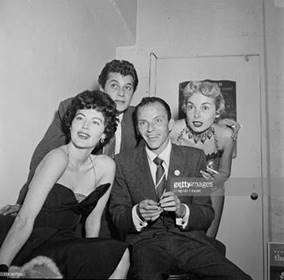
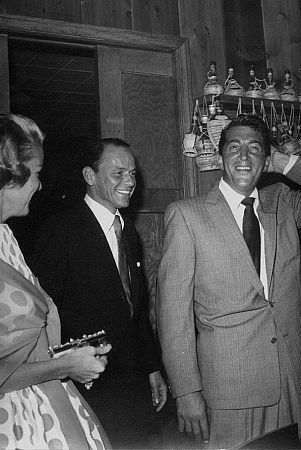
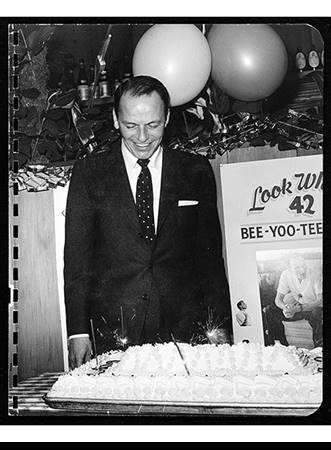
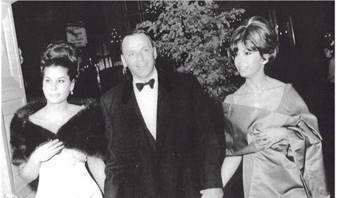
December 17, 1951
Concerts
Veterans Administration Hospital, Long Beach, CA
Bob Hope, Bing Crosby, Frank Sinatra, Constance Moore, Les Brown and his Orchestra
Veterans Administration Hospital, Long Beach, CA
Bob Hope, Bing Crosby, Frank Sinatra, Constance Moore, Les Brown and his Orchestra
December 17, 1951 Monday.
Bing Crosby takes part with Bob Hope and Frank Sinatra in the Long Beach Press-Telegram's annual Christmas show for patients at the Veterans Administration Hospital.
Part of the proceedings is taped and broadcast on December 25 as the Bob Hope Show.
There was a great show in town last night. Its headliners were Hope, Crosby and Sinatra, and it would have taken an adding machine to keep count of the gags. Les Brown was there with his orchestra, and a parade of shapely Hollywood beauties wore out the whistles of the males in the audience.
All of that a million dollars of talent and it didn’t cost the spectators a copper.
For it was the Press-Telegram’s Christmas show for patients at the Long Beach Veterans Administration Hospital, the second annual affair of the kind since the VA Hospital moved down here from Birmingham.
It was a huge success, and we at the P-T are mighty pleased.
An hour of the uproarious doings was taped and you can hear it on KFI on Christmas night – Tuesday – starting at 9 o’clock, as the Bob Hope Show. But it went on for two or three hours beyond that to give the men and women of the hospital a terrific evening, topped off with refreshments of ice cream, cookies and coffee before they returned to the wards of the big institution at Seventh and BellFlower.
The radio show was, of course, from script, but the rest of it was ad libbed and highly informal, and the stars were at their best then. The gang got a real bang out of Crosby getting help from the audience on his lyrics, Hope knocking over a Christmas tree and Sinatra asking Brown to change the pitch.
That made a party of it.
…Before the show, Hope, Crosby and Sinatra, as well as the girls from the Paramount “golden circle” toured the hospital wards and visited with the patients.
(Malcolm Epley, Long Beach Press-Telegram, December 18, 1951)
© 1997-2025 The Sinatra Archive
This calendar, or any parts thereof, may not be reproduced in any fashion
whatsoever without the prior written permission of the publisher (The
Sinatra Archive)
__._,_.___
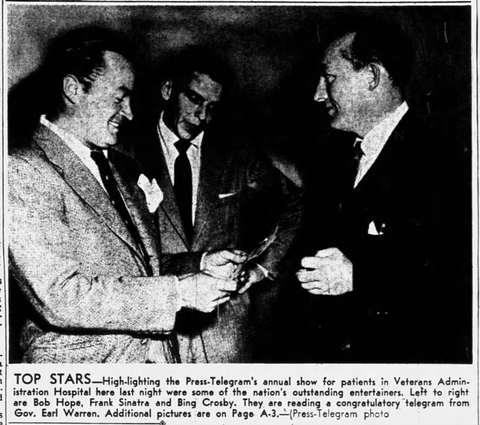
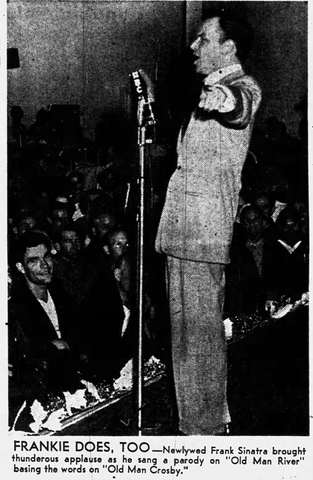
December 18, 1951
Television
Frank Sinatra Show
Network: CBS
Location: Studio A, Columbia Square Facility, Hollywood, California
Show: 47(in series), 2-11(in season)
Tuesday 8:00 P.M.-9:00 P.M.
Sponsor: Ekco Housewares (first 15mins), sustaining (final 45mins)
Orchestra Conducted By: Axel Stordahl
Announcer: Bob Lemond
Producer: David Dare
Executive Producer: Marlo Lewis
Guests: Eddie Anderson, Eric Blore, Alan Mowbray, June Hutton, Lenny Kent
1. My Blue Heaven
2. Santa Claus Is Coming To Town - Frank Sinatra
3. Take Me Back To Manhattan - Frank Sinatra
Ed O'Brien noted:
The latter was written by Cole Porter for the 1930
Broadway musical "The New Yorkers." Anytime Frank sang
Porter certainly merits the attention of people who love the classic American song book. When it is a song he never recorded, the interest becomes even greater. When the lyrics he sang on 12-18-51 are completely different from Porter's original effort, it becomes both fascinating and mysterious.
I don't believe Cole Porter would have allowed another song- writer to pen new lyrics for Frank in 1951. It is probably a good bet that Sinatra requested the rewrite and Porter obliged.
Here are the original lyrics from 1930 and the new lyrics from 1951
THE NEW YORKERS words and music
Cole Porter
Take Me Back To Manhattan
1930 lyrics:
verse:
The more I travel across the gravel,
The more I sail the sea,
The more I feel convinced of the fact
New York's the town for me.
Its crazy skyline is right in my line
And when I'm far away
I'm able to bear it for several hours,
And then break down and say:
refrain
Take me back to Manhattan,
Take Me Back to New York,
I'm just longing to see once more
My little home on the hundredth floor.
Can you wonder I'm gloomy ?
Can you smile when I frown ?
I miss the East Side, the West Side,
The North Side and the South Side,
So take me back to Manhattan,
That dear old dirty town.
Sinatra's version on 12-18-51
verse
New York, New York,
I've been to Paris and tasted its thrills,
But I wasn't amused there.
I've done the nightclubs of Beverly Hills,
But I was so utterly confused there,
I found no joy in Illinois, in Mexico, or Rome.
And now it is time for your wandering boy,
To start in heading home, so.....
Refrain
Take me back to Manhattan,
Take me back to New York,
I just want to go to that door,
And say hello to my boy Toots Shor.
When I'm out of the country,
I just mope and I frown,
Although Great Britain is terrific,
They've got South Pacific,
So take me back to Manhattan,
That one and only town
Take me back to the Battery,
Take me up to the Bronx,
I love each cop, every shiny badge,
The bleachers cling to the name DiMag.
When you mention the Copa,
I just grin like a clown.
I love the music by the Cubans,
The Lindy's and Reubens.
So take me back to Manhattan,
My very favorite town.
Take me down to the subway,
And the buses and els,
I love the models along fifth ave,
I love to swing to the things that they have,
I adore Earl Wilson or whoever is around,
I love each ferry in the harbor,
I just adore Impellitteri,
So take me back to Manhattan,
That stupendous, tremendous,
That glorious, uproarious,
That peaceful, sinful, lovely, sinful town
Ed O'Brien answered:
Porter wrote "Farewell Amanda" for the Tracy-Hepburn
MGM film "Adam's Rib," in 1949. David Wayne also sang the tune in the film but Frank made a special recording of the song for the film. Did he write expressly for Sinatra ? I don't know. Maybe, maybe not.
I'm glad you found "Take Me Back To Manhattan" interesting.
I doubt very much that Cahn rewrote the lyrics, esp. in 1951.
I've tried to trace the history of the tune and if there is anything in the Porter collection at Yale. I haven't had any luck . Perhaps there is a mention at the end of the FS show on 12-18-51.
December 20, 1951
Television
Alan Young Show
Network: CBS
Thursday Evening
Time: 9:00 - 9:30 PM (EST)
Sponsor: ESSO
Producer: Ralph Levy
Director: Alan Dinehart
Guest: Frank Sinatra

Alan Young Show
Network: CBS
Thursday Evening
Time: 9:00 - 9:30 PM (EST)
Sponsor: ESSO
Producer: Ralph Levy
Director: Alan Dinehart
Guest: Frank Sinatra
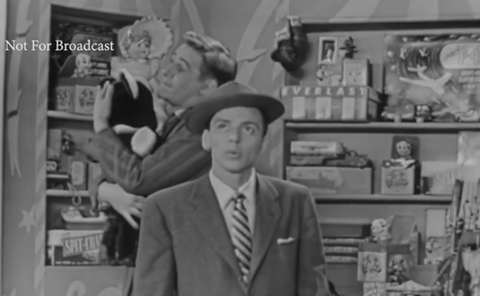
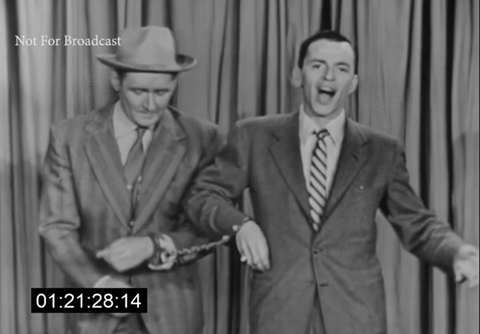
December 25, 1951
Radio
The Bob Hope Show
Network: NBC & AFRS rebroadcast
Location: Long Beach Veterans Hospital.
Guests: Frank Sinatra, Bing Crosby, Jack Kirkwood, Jane Morgan
Orchestra Conducted By: Les Brown
Announcer: Hy Averback.
Note: Sinatra is unbilled guest. Partial Recording TT 23 mins. Sound
Very Good.
[The Cinematic Legacy of Frank Sinatra — Double Dynamite (1951)]
David Wills's 2015 photo history The Cinematic Legacy of Frank Sinatra devotes a section to Double Dynamite (1951), illustrated with 4 behind-the-scenes and publicity photographs (posters, lobby cards, and on-set/on-location shots) filed here.
“Frank and I sang together … and to balance our voices he stood two feet from the mike and I had to crawl in it. What a voice that man has!” —Jane Russell (Costar, Double Dynamite, 1951)
Source: David Wills, The Cinematic Legacy of Frank Sinatra (St. Martin's Press, 2015), pp. 66–69.
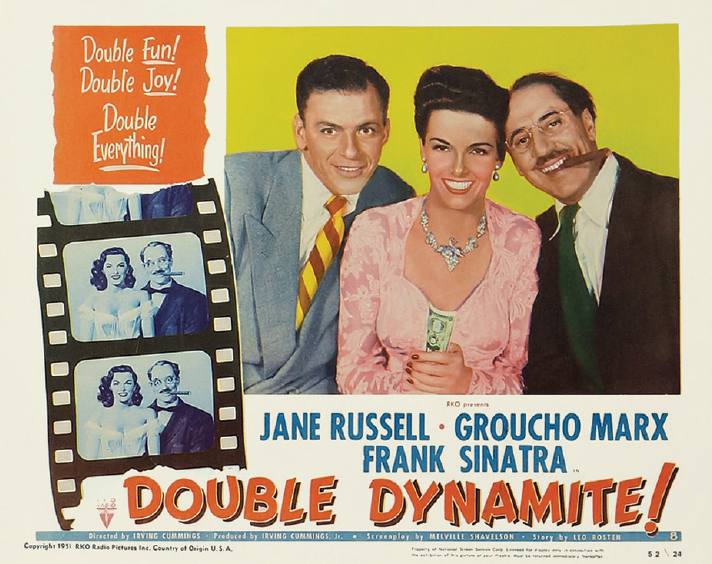
Lobby card, Double Dynamite, 1951. / “Frank and I sang together … and to balance / our voices he stood two feet from the mike and / I had to crawl in it. What a voice that man has!” (Photo: The Cinematic Legacy of Frank Sinatra, David Wills, 2015.)
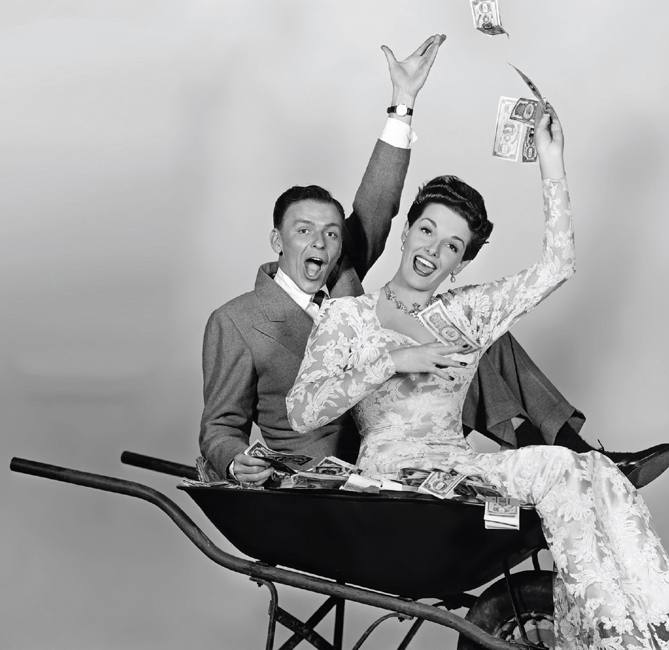
With costar Jane Russell. (Photo: The Cinematic Legacy of Frank Sinatra, David Wills, 2015.)
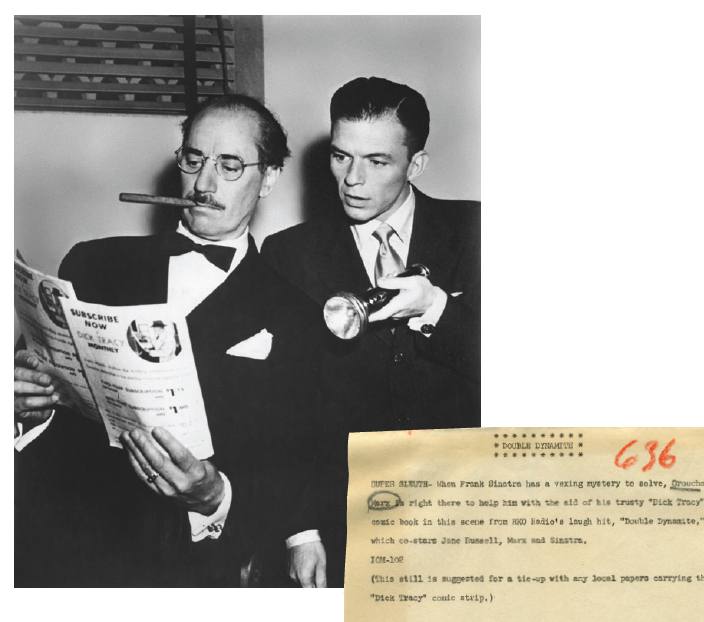
With costar Groucho Marx in Double Dynamite. / Frank Sinatra as Johnny Dalton and Jane / Russell as Mibs Goodhug: / JD: “And if we did get married, how would we / manage? I have nothing. How would we live? / MG: “I'm sure something would come along. / JD: “Yeah. And we'd have to feed that, too.” (Photo: The Cinematic Legacy of Frank Sinatra, David Wills, 2015.)
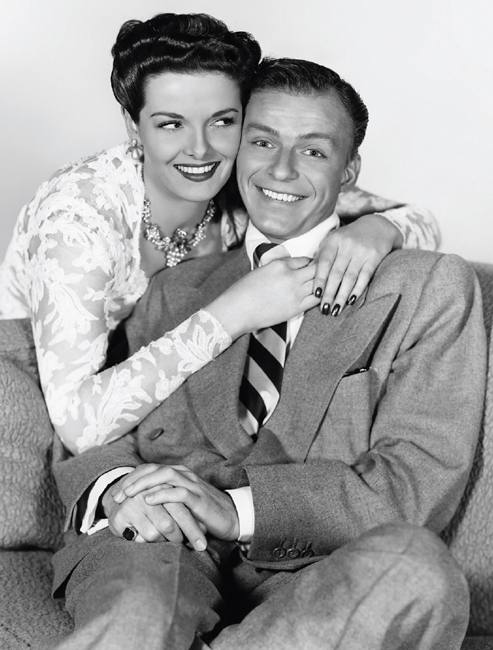
With costar Jane Russell. (Photo: The Cinematic Legacy of Frank Sinatra, David Wills, 2015.)
Television
Frank Sinatra Show
Network: CBS
Location: Studio A, Columbia Square Facility, Hollywood, California
Show: 48(in series), 2-12(in season)
Tuesday 8:00 P.M.-9:00 P.M.
Sponsor: Ekco Housewares (first 15mins), sustaining (final 45mins)
Orchestra Conducted By: Axel Stordahl
Announcer: Bob Lemond
Producer: David Dare
Executive Producer: Marlo Lewis
Guests: Edmund Gwenn, Marilyn Maxwell, Jimmy Boyd, The Dunhills (dancers)
1. You'd be So Nice To Come Home To - Frank Sinatra
2. Have Yourself A Merry Little Christmas - Frank Sinatra
3. All The Things You Are - Frank Sinatra
4. Over The Rainbow - Frank Sinatra & Jimmy Boyd
Film
"Double Dynamite" (US Film
Release: December 25, 1951)
Starring: Frank Sinatra, Jane Russell, Groucho Marx
Produced and Directed by Irving Cummings
Sinatra plays Johnny Dalton an innocent bank teller, suspected of embezzlement, who is aided by an eccentric,
wisecracking waiter played by Groucho Marx. Jane Russell plays Johnny's girlfriend, Mildred 'Mibs' Goodhue.
(DVD Release date: 2008-05-13)
Note: Filming started November 22, 1948 at RKO under the title
"It's Only Money."
Filming finished December 22 by which stage it was the last film being shot on the RKO lot.
RKO then shut down the entire studio as it re-adjusted following Howard Hughes' purchase of the company.
The film would not be released until three years later.
When Frank Sinatra signed with RKO, in 1943, it was for a four picture deal.
In the fall of 1948, he still owed them one picture. "It's Only Money" looked
pretty good to him at the time( original title was "The Pasadena Story")..
His co-stars would be the very sexy Jane Russell and the legendary
Groucho Marx.
Filmed entirely on the backlots at RKO, the filmed was completed, or so
they thought, in 22 days. Frank sang duets with both of his co-stars and
then they all joined together for a closing rendition of the title tune. RKO
ran a preview at some theaters, in California, in late December.
Something
wasn't quite right and a few additional scenes were shot in January of 49.
After that shoot, RKO shutdown and waited to see what would happen under
the new owner Howard Hughes. It would also be the director's, Irving Cummings,
last film.
Howard Hughes hated Frank Sinatra. And with good reason.
Hughes
was madly in love with Ava Gardner. He could not accept that such a
goddess would choose Frankie over him. So the film languished in
Howard's vault through all of 1949 and 1950. In February of 1950,
Frank and Jane Russell would record the song "Kisses and Tears,"
from the film( Frank's third recording of the song) at Columbia Records
with The Modernaires. Frank would sing the song on his Light Up
Time show in April 1950 with an aside to Howard regarding a release
for the film. Hughes did not budge. By then he had come to dislike the
the film intensely. Groucho wrote a letter to Howard on 1-23-51 asking
for a release before he shuffled off his mortal coil. Nothing happened.
What happened on 11-7-51 convinced Hughes to release the film pronto.
Frank and Ava had married on that November day and a spiteful Mr. Hughes
was determined to exact some revenge. The title was changed to "Double
Dynamite" -- a reference to Miss Russell well known endowments - and
the billing was changed. Frank went from top billing to third and was forbidden
to promote the film in any manner whatsoever. Hell hath no fury like a billionaire
scorned.
The movie opened at the Paramount Theaters in New York and Boston on Christmas
Day. The reviews were not good and the box office take was a disaster. The film failed
to make the Variety Top Grossing 120 films for 1952. Meaning it took in considerably
less than than a million dollars.
Ed
The working title of this film was It's Only Money. It was made in late 1948, shortly after Howard Hughes took over as head of RKO. According to modern sources, Hughes was displeased with the picture and shelved it until late 1951, when he came up with an advertising campaign that emphasized the participation of his proetge, Jane Russell. Modern sources also note that Frank Sinatra originally was to receive top billing in the onscreen credits, but because Hughes did not like Sinatra, whose career was in a down-turn at the time, his billing was bumped to third place. In the film, Sinatra sings duets with both Marx and Russell. Mannie Manheim, who is credited with creating the character on which the picture's story was based, was one of Marx's gag writers. Although an Aug 1946 HR news item reported that Twentieth Century-Fox had purchased a story by Quentin Reynolds entitled "It's Only Money," that story bears no relation to this film. Modern sources credit Stanley Donen as choreographer.
AFI Catalog
note: Film premiered at the Paramount Theatre in N.Y.C. The stage show was headed by Tony Bennett, The 5 Demarco Sisters
and the Art Mooney Band. Joey Adams was the comic.
Ed
"Double Dynamite"
Double Dynamite was filmed at RKO in 1948, before On the Town even began production, but its release was delayed nearly three years -- reportedly at the insistence of RKO boss Howard Hughes, who disliked Sinatra partly because Hughes himself had an interest in Ava Gardner.
Source: Tom Santopietro, "Sinatra in Hollywood" (2008).
"Double Dynamite"
The film -- whose title alludes to costar Jane Russell's figure -- was cheaply made, flatly photographed by Robert De Grasse, and directed by Irving Cummings in his final film; it also starred Groucho Marx and featured songs by Jule Styne and Sammy Cahn, including the original title track 'It's Only Money.'
Source: Tom Santopietro, "Sinatra in Hollywood" (2008).
"Double Dynamite"
Santopietro calls Double Dynamite the worst film of the first quarter of Sinatra's career (worse even than The Kissing Bandit), noting Sinatra looked worn out and older than his years on screen; the film debuted to small audiences and poor reviews around Christmas 1951, deepening Sinatra's career slide.
Source: Tom Santopietro, "Sinatra in Hollywood" (2008).
"Double Dynamite" / "Meet Danny Wilson"
The poor box office of both Double Dynamite (released Christmas Day 1951) and Meet Danny Wilson (released a month later) coincided with the end of Sinatra's CBS television series and record sales declining as his bobby-soxer fan base aged -- marking the low point of his career slide before he found his new vocal style at Capitol Records.
Source: Tom Santopietro, "Sinatra in Hollywood" (2008).
"Double Dynamite"
Santopietro grades this a D, calling it "tired and dumb."
Source: Tom Santopietro, "Sinatra in Hollywood" (2008).
"Double Dynamite"
Santopietro (Filmography): RKO Radio Pictures. Produced by Irwin Allen and Irving Cummings Jr., directed by Irving Cummings, screenplay by Melville Shavelson. Sinatra played Johnny Dalton opposite Jane Russell and Groucho Marx, singing 'It's Only Money' and 'Kisses and Tears,' both by Jule Styne and Sammy Cahn.
Source: Tom Santopietro, "Sinatra in Hollywood" (2008).
[Double Dynamite opens to poor reviews]
Double Dynamite, starring Frank billed third after Jane Russell and Groucho Marx, opened on Christmas Day 1951 after sitting shelved for three years while Howard Hughes decided what to do with it. Bosley Crowther's New York Times review called it a wet firecracker, and Frank's name was left off the poster entirely, reflecting how far his reputation had fallen with Hughes.
Source: James Kaplan, "Frank: The Voice" (2010).
January 1952
[Sinatra records I Could Write a Book session]
Kaplan: Just a week into 1952, Frank recorded three songs at Columbia's Hollywood studio in fine voice, including "I Could Write a Book," "I Hear a Rhapsody," and "Walkin' in the Sunshine," with Axel Stordahl arranging and, for the first time, Bill Miller at the piano.
Source: James Kaplan, "Frank: The Voice" (2010)
[I Could Write a Book -- critical commentary]
Granata identifies Sinatra's January 1952 recording of 'I Could Write a Book' as a vocal turning point, showing the deepening tonal quality and razor-sharp diction that would become trademarks of his later Capitol baritone sound.
Source: Charles L. Granata, "Sessions with Sinatra: Frank Sinatra and the Art of Recording" (1999/2003), Part II: The Columbia Years, 1943-1952
January 1, 1952
Television
Frank Sinatra Show (CBS)
Guests: Yvonne DeCarlo, Louis Armstrong, The Three Stooges, George De
Witt
8:00 - 9:00 PM
1. Great Day - Frank
2. Sinatra And Stooges Comedy Routine
3. I'm Confessin' - Louis
4. Impressions - George De Witt
5. Getting To Know You- Frank & Yvonne
6. Oh Look At Me Now- Frank
7. Lonesome Man Blues - Frank & Louis
8. Stooges Comedy
9. Babalu - Yvonne
10. Aladdin Routine - Entire Cast
Notes: 60 mins.
Ed O'Brien:
Frank's vocal on "Oh, Look At Me Now" is a very clever parody.
His duet on "Lonesome Man Blues," with Louis Armstrong is a great highlight of both the
1952
As part of his conciliatory approach to the press, Sinatra told Cosmopolitan writer George Frazier in 1952, when warned that an upcoming article might be less than complimentary, "I won't mind if it pans me, just as long as it helps me correct the things I've been doing wrong." Source: Rough Guide to Frank Sinatra (Rough guide pt 3.pdf).
[Ava Reschedules A Kenya Shoot To Be Near Frank]
Nancy Sinatra: While filming The Snows of Kilimanjaro in Kenya, Ava Gardner persuaded the studio to compress her remaining scenes into ten days so she could return to a struggling, underworked Frank in New York, though production delays kept her an extra day and Frank was furious about it.
Source: Nancy Sinatra, Frank Sinatra: An American Legend, 1995.
[Career Hits Bottom]
By 1952 Sinatra's career had bottomed out: his CBS television show was canceled, talent agency MCA and MGM dropped him, and he opted not to renew his Columbia Records contract. He later called it one of the most frustrating years of his life, before resolving to rebuild.
Source: Charles Pignone, "Frank Sinatra 100" (2015).
[Danny Thomas Opens the Sands' Copa Room]
Danny Thomas opened the Copa Room at the newly built Sands Hotel in Las Vegas in 1952, and the venue soon became the town's hottest showroom, with Sinatra as its biggest draw.
Source: Nancy Sinatra, "Frank Sinatra, My Father" (1985).
[Harry Cohn Calls With the Maggio Role]
In November 1952, while doing the Texaco Star Theatre with Milton Berle, buying Ava's Christmas presents in New York, and playing a Montreal nightclub date, Sinatra learned from a call by Harry Cohn that he had won the part of Maggio.
Source: Nancy Sinatra, "Frank Sinatra, My Father" (1985).
[Frank Jr. On Mitch Miller's Washboard Novelty Record]
Nancy Sinatra: Frank Jr. recalled that as control of the record business shifted to producers, Columbia's Mitch Miller told Sinatra to record a song called "Tennessee Newsboy" using a washboard for percussion, an instruction Frank questioned but ultimately followed.
Source: Nancy Sinatra, Frank Sinatra: An American Legend, 1995.
[Dorothy Manners On Sinatra's Fear Of Losing The Family Home]
Nancy Sinatra: Louella Parsons's assistant Dorothy Manners recalled that during his career slump, Sinatra's greatest worry was making the mortgage payments on the Holmby Hills house so his family wouldn't be forced to move.
Source: Nancy Sinatra, Frank Sinatra: An American Legend, 1995.
["He's a dead man" quote]
Irving "Swifty" Lazar: At the low point of Sinatra's career, talent agent Irving "Swifty" Lazar declared of him, "He's a dead man. Even Jesus couldn't get resurrected in this town."
Source: James Kaplan, "Sinatra: The Chairman" (2015)
[Nancy's Favorite 1952 Columbia Side]
Among the Columbia sides Sinatra recorded with Axel Stordahl before leaving the label, Nancy singles out "Why Try to Change Me Now" as her favorite from 1952.
Source: Nancy Sinatra, "Frank Sinatra, My Father" (1985).
[Sammy Davis Jr. On Frank's Telegram During His Own Career Slump]
Nancy Sinatra: Sammy Davis Jr. remembered that even as his own career was collapsing, Sinatra took the time to send Davis a congratulatory cablegram about the Will Mastin Trio's good reviews, a gesture Davis called a great keeper practice.
Source: Nancy Sinatra, Frank Sinatra: An American Legend, 1995.
["The Hucklebuck" becomes a minor hit]
Consiglio: Frank recorded the novelty song 'The Hucklebuck,' suggested by Mitch Miller, which became a minor hit in 1952 amid a late-1940s dance craze; Frank used novelty numbers like it to change pace at venues with younger audiences, such as the Paramount, but never at sophisticated rooms like the Copa or the Sands.
Source: Tony Consiglio (as told to Franz Douskey), "Sinatra and Me: The Very Good Years" (2012)
[The Sands Becomes Part Of Sinatra's Home Life]
By 1952 Sinatra's home base was split between Palm Springs, Los Angeles, a New York apartment, and Las Vegas's Sands Hotel.
Source: Nancy Sinatra, "Frank Sinatra, My Father" (1985).
[Ava complains about Frank's touring absences]
Ava Gardner: That spring, Ava complained to Modern Screen magazine about their seven-month marriage being marked mostly by Frank's constant touring, naming his gigs at the Chez Paree in Chicago and stops in St. Louis as evidence of how little she saw him.
Source: James Kaplan, "Frank: The Voice" (2010)
[Ava flirts with Johnnie Ray backstage]
Kaplan: When Johnnie Ray visited Frank backstage at the Paramount, Frank was gracious until called away on business; while he was gone, Ava climbed onto Ray's lap and stroked his hair. Frank returned mid-flirtation and angrily pulled her away.
Source: James Kaplan, "Frank: The Voice" (2010)
[Ava interviewed after miscarriage]
Ava Gardner: About a week after the Cocoanut Grove incident and miscarriage, still hurting and angry, Ava told columnist Harrison Carroll she was uncertain whether she'd accompany Frank to his Chez Paree engagement in Chicago, and complained that MGM had given her a series of bad parts and shown little interest in her career.
Source: James Kaplan, "Frank: The Voice" (2010)
[Ava shoots Ride, Vaquero! in Utah]
Howard Keel: In return for the contract concession, MGM sent Ava to shoot the Western Ride, Vaquero! on location in Kanab, Utah, during the hottest part of summer 1952. Co-star Howard Keel recalled the remote location as miserable; Ava drank heavily and reportedly had affairs with stuntmen and with director John Farrow during the shoot.
Source: James Kaplan, "Frank: The Voice" (2010)
[Ava shoots Snows of Kilimanjaro]
Kaplan: MGM loaned Ava to 20th Century Fox to play Cynthia in an adaptation of Hemingway's "The Snows of Kilimanjaro," opposite Gregory Peck, shot on the Fox back lot from mid-February through the third week of April 1952.
Source: James Kaplan, "Frank: The Voice" (2010)
[Ava suspended by MGM over Hawaii trip]
Kaplan: Ava wired MGM vice president Eddie Mannix that a vacation with her husband prevented her from reporting for the film Sombrero; Mannix expressly forbade the Hawaii trip, and three days later, while she was in Honolulu, his office informed her she was on suspension, replaced in the film by Yvonne De Carlo, with pay and benefits withheld.
Source: James Kaplan, "Frank: The Voice" (2010)
[Ava's shoot delays threaten Paramount premiere]
Kaplan: Ava's scenes for Snows of Kilimanjaro were supposed to wrap in ten days so she could join Frank for his March 26 Paramount premiere, but technical problems with a Spanish civil war scene forced an extra day of shooting, leading to a long-distance blowup between Frank and Ava over the phone.
Source: James Kaplan, "Frank: The Voice" (2010)
[Clift predicts Sinatra for Maggio]
Montgomery Clift: As early as fall 1952, when Sinatra was still considered a dark horse for the role, Montgomery Clift told a friend that Frank would be perfect to play Maggio.
Source: James Kaplan, "Frank: The Voice" (2010)
[Columbia declines to renew Sinatra's contract]
Kaplan: Around this time Columbia was preparing to announce it would not renew Frank's recording contract, as he had not come close to earning back the more than $100,000 Manie Sacks had advanced him to cover his taxes.
Source: James Kaplan, "Frank: The Voice" (2010)
[Detroit fans denied tickets]
Consiglio: In 1952 while Sinatra was appearing in Detroit, Consiglio found four girls crying outside a sold-out auditorium because they couldn't get tickets. He told Frank, who had the theater manager seat them personally.
Source: Tony Consiglio (as told to Franz Douskey), "Sinatra and Me: The Very Good Years" (2012)
[Empty balcony article mocks Sinatra's decline]
Muriel Fischer: The New York World-Telegram and Sun ran a feature by reporter Muriel Fischer headlined "GONE ON FRANKIE IN '42; GONE IN '52," describing an almost entirely empty second balcony at his Paramount show and fans outside who were there for Frankie Laine and Johnnie Ray instead of Sinatra.
Source: James Kaplan, "Frank: The Voice" (2010)
[Lee Mortimer's Mafia exposes on Sinatra]
Kaplan: In 1952, columnist Lee Mortimer, Sinatra's longtime nemesis, published an American Mercury article, "Frank Sinatra Confidential/Gangsters in the Night Clubs," blaming Sinatra for Mafia influence in show business, and extended the attack in the book U.S.A. Confidential, co-authored with his uncle, Daily Mirror boss Jack Lait.
Source: James Kaplan, "Frank: The Voice" (2010)
[MCA drops Sinatra as client]
Kaplan: Around the time of Danny Wilson's disappointing San Francisco premiere, Universal International declined to make the second film in Sinatra's two-picture deal, and Music Corporation of America (MCA), led by Jules Stein and Lew Wasserman, dropped Sinatra as a client amid a dispute over $40,000 in back commissions, publicizing the split with full-page ads in Variety and the Hollywood Reporter. Frank was devastated and reportedly didn't speak to Wasserman for years.
Source: James Kaplan, "Frank: The Voice" (2010)
[MGM reinstates Ava and offers new contract]
Kaplan: Ava's agent Benton Cole persuaded MGM executive Eddie Mannix to lift her suspension and reinstate her salary in full, and the studio then offered her a new seven-year, multi-picture deal with pay graduating from $90,000 to $130,000 per film.
Source: James Kaplan, "Frank: The Voice" (2010)
[Meet Danny Wilson]
Meet Danny Wilson was Sinatra's first film under a newly signed three-year nonexclusive contract with Universal-International, and marks the true turning point where he began to show real dramatic acting ability, foreshadowing what he'd achieve in From Here to Eternity.
This film/context matches multiple dated entries in the chronology; the specific date Santopietro is referring to could not be determined with confidence.
Source: Tom Santopietro, "Sinatra in Hollywood" (2008), Ava and the Downfall / The Comeback
[Meet Danny Wilson]
The World-Telegram and Sun: The World-Telegram and Sun bluntly summarized Sinatra's fall from grace with the line "Gone on Frankie in '42; Gone in '52."
This film/context matches multiple dated entries in the chronology; the specific date Santopietro is referring to could not be determined with confidence.
Source: Tom Santopietro, "Sinatra in Hollywood" (2008), Ava and the Downfall / The Comeback
[Meet Danny Wilson]
Time magazine: Time magazine's review criticized Meet Danny Wilson for cribbing so heavily from Sinatra's real life that "fans may expect Ava Gardner to pop up in the last reel."
This film/context matches multiple dated entries in the chronology; the specific date Santopietro is referring to could not be determined with confidence.
Source: Tom Santopietro, "Sinatra in Hollywood" (2008), Ava and the Downfall / The Comeback
[Meet Danny Wilson]
Brog (Variety): Variety critic "Brog" praised the film, calling the title role "tailor-made for Sinatra" and noting that for the first time onscreen the actor seemed genuinely at ease and sure of himself -- an early sign of things to come.
This film/context matches multiple dated entries in the chronology; the specific date Santopietro is referring to could not be determined with confidence.
Source: Tom Santopietro, "Sinatra in Hollywood" (2008), Ava and the Downfall / The Comeback
[Meet Danny Wilson]
Despite occasional positive notices, Meet Danny Wilson -- Sinatra's first film in two years since On the Town -- flopped commercially and quickly vanished from theaters. Universal declined to renew its option on further Sinatra pictures.
This film/context matches multiple dated entries in the chronology; the specific date Santopietro is referring to could not be determined with confidence.
Source: Tom Santopietro, "Sinatra in Hollywood" (2008), Ava and the Downfall / The Comeback
[Meet Danny Wilson]
Santopietro grades this a B, calling it a flawed but fascinating meeting of the "real" and "reel" Frank.
This film/context matches multiple dated entries in the chronology; the specific date Santopietro is referring to could not be determined with confidence.
Source: Tom Santopietro, "Sinatra in Hollywood" (2008), Career Scorecard
[Mitch Miller praises steel guitarist over Sinatra]
Paul Weston: During the June 1952 session, producer Paul Weston recalled that after Frank sang the vocal on a novelty tune called "Tennessee Newsboy" featuring steel guitarist Speedy West, Mitch Miller rushed past Frank to congratulate West on his chicken-imitation guitar sound, disgusting Sinatra.
Source: James Kaplan, "Frank: The Voice" (2010)
[Nancy Jr. recalls Ava at Palm Springs]
Nancy Sinatra Jr.: Sinatra's daughter Nancy later wrote of her rapt, twelve-year-old impressions of Ava during an early weekend visit at Palm Springs, describing her natural, careless glamour diving into the pool and drying her hair by a wall heater, and recalling that seeing Ava's magnetism gave her, as a preteen, some understanding of why her father had left the family.
Source: James Kaplan, "Frank: The Voice" (2010)
[Sevano doubts Sinatra wrote apologia]
Nick Sevano: Frank's former gofer Nick Sevano later said the falsely humble tone of "Frankly Speaking" should have tipped readers off that Frank hadn't written it himself, noting that Frank never apologized to anyone in his life.
Source: James Kaplan, "Frank: The Voice" (2010)
[Sinatra books Hawaii concerts]
Kaplan: With no other bookings after his TV show ended, Frank agreed to a couple of concert dates in Hawaii, largely to escape cold, rainy New York weather.
Source: James Kaplan, "Frank: The Voice" (2010)
[Sinatra campaigns by telegram to play Maggio]
Kaplan: After returning from Hawaii, Frank began sending weekly telegrams to Columbia chief Harry Cohn, director Fred Zinnemann, producer Buddy Adler, and screenwriter Daniel Taradash, campaigning to be cast as Maggio in From Here to Eternity and signing each wire simply "Maggio."
Source: James Kaplan, "Frank: The Voice" (2010)
[Sinatra concedes fallibility to George Frazier]
George Frazier: During a backstage interview at Paramount rehearsals, journalist George Frazier told Frank his upcoming piece might not be entirely complimentary; Frank, needing the goodwill, responded amiably and told Frazier he wouldn't mind criticism if it helped him improve, the first time Frazier had heard him admit he wasn't infallible.
Source: James Kaplan, "Frank: The Voice" (2010)
[Sinatra draws sparse crowds on tour]
Kaplan: That summer, Frank's live bookings drew poorly: at the 1,200-seat Chez Paree in Chicago he once drew only 150 customers, and at the Desert Inn he played to half-full houses while suffering from vocal strain, described in the business as "Vegas Throat."
Source: James Kaplan, "Frank: The Voice" (2010)
[Sinatra performs at rainy Hawaii county fair]
Kaplan: On a rainy Sunday in Kauai, Frank performed under a leaky tent at a county fair for a small crowd of tourists, backed only by Bill Miller on an upright piano; two girls in grass skirts gave him leis before he went on, visibly moving him, and he was happy performing despite the humble setting.
Source: James Kaplan, "Frank: The Voice" (2010)
[Sinatra pursues New York press before premiere]
Kaplan: Ten days before his Paramount premiere, Frank went to New York to mend fences with the press, offering to pose for photos and even sending a note to the National Press Photographers Association saying he'd always be ready for pictures; he got few takers and resumed the old habit of personally visiting disc jockeys to promote his new single "I Hear a Rhapsody."
Source: James Kaplan, "Frank: The Voice" (2010)
[Sinatra records Birth of the Blues]
Kaplan: Also at the June 1952 session, Sinatra recorded "The Birth of the Blues," arranged by Heinie Beau, singing with a forward-looking, tough authority and a vocal snarl Kaplan suggests was aimed at Mitch Miller in the control room.
Source: James Kaplan, "Frank: The Voice" (2010)
[Sinatra rents L.A. base apartment]
Irving Lazar: In early 1952, needing a Los Angeles base separate from Ava's Pacific Palisades house, Sinatra rented a five-room apartment at Wilshire Boulevard and Beverly Glen -- coincidentally the same complex where Irving Lazar lived, who at the time was telling people Sinatra was 'a dead man' professionally.
Source: James Kaplan, "Frank: The Voice" (2010)
[Sinatra's marriage strains his voice]
Gloria Franks: In early 1952, Sinatra's voice was under unusual stress, partly due to the pressures of his new marriage to Ava; Sammy Cahn's wife Gloria Franks recalled a tense early dinner with the couple where Frank was subservient and anxious around Ava, a marked change from how he'd acted with Nancy.
Source: James Kaplan, "Frank: The Voice" (2010)
[The Frank Sinatra Clause added to Ava's MGM contract]
Kaplan: At Ava and Frank's insistence, MGM added a codicil to her new contract nicknamed the "Frank Sinatra Clause," committing the studio to cast Sinatra alongside her in an adaptation of the musical St. Louis Woman if it acquired the rights, or in some other picture before her contract expired if it didn't -- a toothless promise that nonetheless satisfied both Ava and Frank.
Source: James Kaplan, "Frank: The Voice" (2010)
[personal life]
Nancy Sinatra (daughter): Daughter Nancy Sinatra has also written of an earlier suicide attempt in the summer of 1952, when, amid the pain of the Ava relationship, Frank reportedly inhaled gas from the stove in Manie Sacks's apartment.
No corresponding dated entry could be identified in the chronology for this film/context.
Source: Tom Santopietro, "Sinatra in Hollywood" (2008), Ava and the Downfall / The Comeback
[Ava rushes Kenya filming to support fragile Frank]
While filming The Snows of Kilimanjaro on location in Kenya, Ava, aware of how fragile Frank's ego had become, persuaded producer Darryl F. Zanuck to condense her shooting schedule so she could get home sooner. She made it back in time for the early-February premiere of Meet Danny Wilson.
Source: Richard Havers, "Sinatra" (Dorling Kindersley, 2007).
[Ava's famous retort to director John Ford in Nairobi]
At a party at the British High Commissioner's residence in Nairobi, director John Ford asked Ava, in front of the assembled guests, what she saw in "the 120-pound runt." Ava shot back an earthy, quick-witted reply about the true proportions of Frank's appeal, which the amused High Commissioner and his wife took in good humor.
Source: Richard Havers, "Sinatra" (Dorling Kindersley, 2007).
[Ava's new MGM deal includes a 'Frank Sinatra clause']
As Frank's career floundered, Ava signed a new MGM contract for twelve pictures worth $1.2 million, which included a so-called "Frank Sinatra clause" obligating MGM to cast Frank in a film alongside her. The disparity in their fortunes reportedly humiliated Frank.
Source: Richard Havers, "Sinatra" (Dorling Kindersley, 2007).
[Frank draws a fraction of capacity at Chicago's Chez Paree]
At Chicago's Chez Paree, which could seat over 1,200 people, Frank could attract only about 150 patrons, underscoring how far his live drawing power had fallen. New performers without his personal baggage were increasingly favored over him.
Source: Richard Havers, "Sinatra" (Dorling Kindersley, 2007).
[Frank plays a leaky tent at the Kaua'i Country Fair]
Seemingly trying to escape his troubles, Frank traveled to Hawaii and played what may be the strangest show of his career, performing in a leaky tent at the Kaua'i Country Fair with only pianist Bill Miller accompanying him, taking requests from a crowd of only a few hundred. Witnesses recalled him deeply moved by the audience's warmth, including two young women who gave him leis and kisses.
Source: Richard Havers, "Sinatra" (Dorling Kindersley, 2007).
[Jo Stafford marries Paul Weston]
Jo Stafford married Paul Weston, Capitol's A&R director whom she had worked with closely; the pair also recorded comic lounge-act parody albums together as Jonathan and Darlene Edwards, winning a Grammy.
Source: Richard Havers, "Sinatra" (Dorling Kindersley, 2007).
[Meet Danny Wilson flops; studio drops Frank's option]
Meet Danny Wilson closed almost as fast as it opened, and Universal International declined to exercise its option for a second Frank Sinatra picture, likely influenced as much by his difficult on-set behavior as by weak box office. Around the same time Frank learned his TV series, originally a renewable five-year contract worth about $250,000 a year, was being cancelled.
Source: Richard Havers, "Sinatra" (Dorling Kindersley, 2007).
[Tense exchange with Ava precedes her solo flight to Hawaii]
During the Kaua'i visit, a local DJ arrived to pick Frank up for volleyball and interrupted what was described as a very serious conversation between Frank and Ava. Frank reacted with visible displeasure and missed his game, and shortly afterward Ava left and flew to Hawaii alone.
Source: Richard Havers, "Sinatra" (Dorling Kindersley, 2007).
[Azure-Té -- critical commentary]
Friedwald (analysis): Friedwald prefers Sinatra's handling of 'Azure-Té' (subtitled 'Paris Blues') to 'Birth of the Blues' from the same date, describing an arrangement (by Siravo or Beau) that juxtaposes taxicab-horn quotes from Gershwin's An American in Paris against blaring swing brass -- 'more baguette than beguine,' evoking a Louis Jourdan movie, though the song was actually introduced by Louis Jordan, whose pianist Wild Bill Davis wrote it.
Source: Will Friedwald, "Sinatra! The Song Is You: A Singer's Art" (2018 revised edition), Ch. 5, "In-Between Years" (1948-1953)
[career/anecdote -- critical commentary]
Arthur Shimkin: In 1952, after Sinatra left Columbia, Bell Records founder Arthur Shimkin offered him $48,000 for twelve sides, with Sinatra retaining final choice among songs Bell proposed; Shimkin recalled Sinatra wryly asking, 'You wouldn't pick something that would make me unhappy, would ya?' The deal ultimately fell through when Shimkin's boss, close to Mitch Miller, was told by Miller that Sinatra was a 'has-been' not worth the investment.
Source: Charles L. Granata, "Sessions with Sinatra: Frank Sinatra and the Art of Recording" (1999/2003), Part II: The Columbia Years, 1943-1952
[personnel -- critical commentary]
As Sinatra's Columbia contract ended, longtime music director Axel Stordahl chose to move to New York to become music director for the Eddie Fisher television show rather than follow Sinatra to the West Coast; Sinatra gave him an ultimatum, and when Stordahl took the Fisher job the two men's friendship was severed, reportedly not speaking for nearly a decade.
Source: Charles L. Granata, "Sessions with Sinatra: Frank Sinatra and the Art of Recording" (1999/2003), Part II: The Columbia Years, 1943-1952
[personnel/engineering -- critical commentary]
Palitz's death sent Sinatra searching for a top independent LA engineer; he found Bill Putnam, who owned and operated United Recording (opened around 1952 on the Columbia-Screen Gems lot at 6050 Sunset) and, soon after, the nearby Western Recording building. The two became close friends, and Reprise's offices briefly operated out of United.
Source: Charles L. Granata, "Sessions with Sinatra: Frank Sinatra and the Art of Recording" (1999/2003), Part IV: The Reprise Years
January 7, 1952
Studio
New York City
RHCO10081 I Could Write A Book w/The Jeff Alexander Choir
(R. Rodgers/L. Hart)
(from Pal Joey)
Chappell & Co., Inc. (ASCAP) 1940
Arranged & Conducted by Axel Stordahl
-1 (2:42) CD: Columbia Years 43-52 Vol. 12
LP: C6X-40343 The Voice-The Columbia Years, 43-52
LP: CL-953 Adventures Of The Heart
78: 39652
RHCO10082 I Hear A Rhapsody w/The Jeff Alexander Choir
(G. Fragos/J. Baker/D. Gasparre)
Broadcast Music, Inc. (BMI) 1940
Arranged & Conducted by Axel Stordahl
-1 (3:04) CD: Columbia Years 43-52 Vol. 12
LP: CL-1359 Come Back To Sorrento
78: 39652
RHCO10083 Walking In The Sunshine
(B. Merrill)
Oxford Music Corp. (ASCAP) 1952
Arranged & Conducted by Axel Stordahl
-1 (2:41) CD: Columbia Years 43-52 Vol. 12
LP: C2X-40897 Hello Young Lovers
LP: CL-2741 The Essential Frank Sinatra, Vol. 3
78: 39726
Violins: J. Augustine, H. Bluestone, D. Frisina, M. Kellner, I. Prager, M.
Russell; Violas: M. Perlmutter, D. Sterkin; Cello: C. Bernard; Harp: A. Stockton; Saxes: M. Bercov, J. Dumont, E. Gershman, L. Hartman, B. Russin;
Trumpet: R. Zarchy; Trombones: G. Arus, J. Piddy; Piano: W. Miller; Guitar: A.
Reuss; Bass: J. Ryan; Drums: N. Fatool
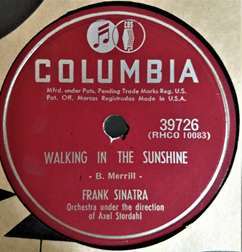
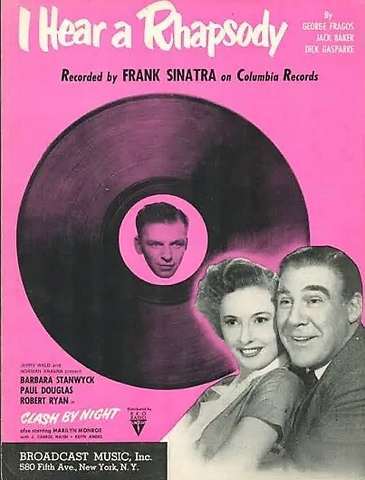
January 8, 1952
Television
Frank Sinatra Show
Network: CBS
Location: Studio A, Columbia Square Facility, Hollywood, California
Show: 50(in series), 2-14(in season)
Tuesday 8:00 P.M.-9:00 P.M.
Sponsor: sustaining
Orchestra Conducted By: Axel Stordahl
Announcer: Bob Lemond
Producer: David Dare
Executive Producer: Marlo Lewis
Guests: Tennessee Ernie Ford, Jimmy Boyd, Alan Young, June Hutton
1. Lover - Frank Sinatra
2. Penthouse Serenade - Frank Sinatra & June Hutton
3. Alabama Jubilee -- Tennessee Ernie Ford
4. I'm Just A Country Boy Jimmy Boyd
3. Hey, Good Lookin' - Sinatra, Tennessee Ernie Ford & Jimmy Boyd ( Frank singing a Hank Williams song
He does some guitar playing and then is joined by the others. Just as they are finishing the song, CBS cuts away for the half-hour local station break.
4. That Old Black Magic - Frank Sinatra sung as a ballad. Very nice
5. Nevertheless - Frank Sinatra There are only a few words sung and in a very silly way
6. I'm Gonna Live Till I Die - Frank Sinatra Heard from a radio. Runs about 10 seconds
7. Please Don't Talk About Me When I'm Gone - Frank Sinatra Done with an Italian accent while he is preparing a pizza pie. Not the complete song or a serious attempt to sing it. Scott Henderson:
I enjoy "Penthouse Serenade" from this show. I only have audio of 3 songs from this show. It seems like only a handful of the 1950-1952 TV shows are in circulation. I think I have around 10. Does anyone know how many are actually in circulation and which ones? I'd love to see a box set of all of these released. They must be in the Sinatra vaults. Even the early Honeymooners sat languishing in a vault for years before Gleason allowed them out.
Hi Scott,
I explain above why you only have three songs from the show. Frank tells the audience that a sneak preview of "Meet Danny Wilson" is being shown in L.A. that evening. Ed
John Brown:
I would have loved to hear a 1957 Sinatra sing
"Penthouse Serenade" with a Riddle arrangement.
Ed O'Brien:
A video of this show is in circulation. Has been for many years.
Frank Sinatra Show
Network: CBS
Location: Studio A, Columbia Square Facility, Hollywood, California
Show: 50(in series), 2-14(in season)
Tuesday 8:00 P.M.-9:00 P.M.
Frank Sinatra and June Hutton sing "Penthouse Serenade"
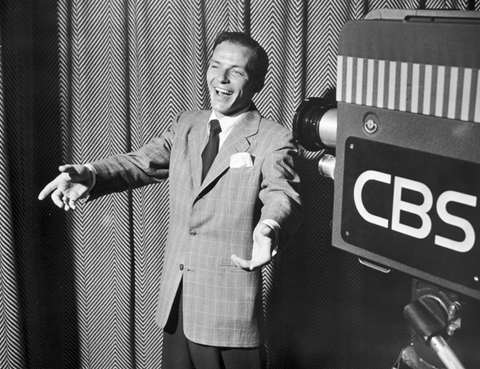
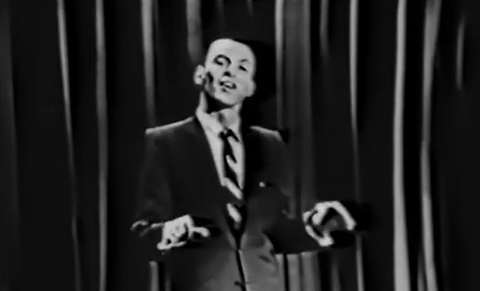
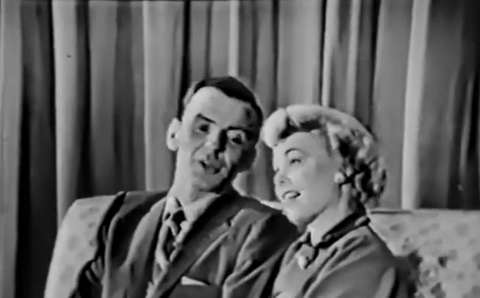
January 12, 1952
Television
Saints and Sinners "All-Star Marathon"
Benefit for the Milk Fund
12 hours from 11pm January 12th to 11pm January 13
KTTV, Los Angeles
Frank Sinatra, Donald O’Connor, Margaret Whiting, June Hutton, Spike Jones, Liberace and others
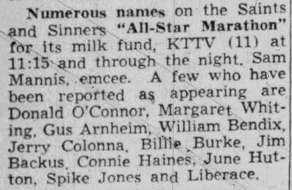
Saints and Sinners "All-Star Marathon"
Benefit for the Milk Fund
12 hours from 11pm January 12th to 11pm January 13
KTTV, Los Angeles
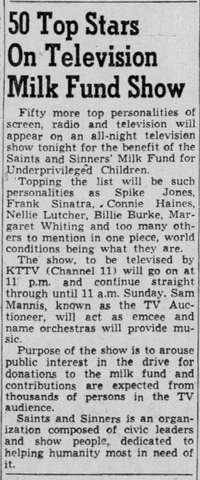
January 15, 1952
Television
Frank Sinatra Show
Network: CBS
Location: Studio A, Columbia Square Facility, Hollywood, California
Show: 51(in series), 2-15(in season)
Tuesday 8:00 P.M.-9:00 P..M.
Sponsor: sustaining
Orchestra Conducted By: Axel Stordahl
Announcer: Bob Lemond
Producer: David Dare
Executive Producer: Marlo Lewis
Guests: Denise Darcel, Frank Fontaine, Bob Hope, Raymond Burr, Will Mastin Trio w/Sammy Davis Jr.
1. My Blue Heaven - Frank Sinatra
2. I Could Write A Book - Frank Sinatra
3. P.S. I Love You - Frank Sinatra
Note: Ed O'Brien "Frank's guests were Bob Hope, Will Mastin Trio,
Denise Darcel, Raymond Burr plus regulars June Hutton and Mr Stordahl. Frank sang "My Blue Heaven," I Could Write A Book" and "P.S. I Love You."

January 18, 1952
Radio
The Martin and Lewis show (NBC)
Time: 8:30 p..m.-9:00 p.m.
Guests: Frank Sinatra; Jimmy Wallington;
Orchestra Conducted By: Dick Stabile
Notes: The show appears on the officially released CD set: 60 Greatest Old Time Radio Show "Frank Sinatra & Friends.." TT:45mins. Complete.
Ed notes: Martin & Lewis was the hottest act in show business when Frank made this guest appearance. His new film "Meet Danny Wilson" was set to open in a few weeks and maximum exposure was the idea..
He sang "I've Got A Crush On You" from the film.. The threesome did some comedy skits and sang parodies of "School Days" and "Row, Row, Row Your Boat." Dean sang "Bella Bimba" and the Johnnie Ray hit "The Little White Cloud That Cried." Show ran 45 minutes
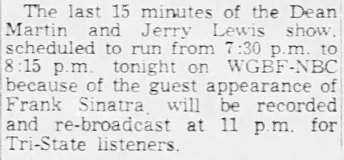
The Martin and Lewis show (NBC)
Time: 8:30 p..m.-9:00 p.m.
Guests: Frank Sinatra; Jimmy Wallington;
Orchestra Conducted By: Dick Stabile

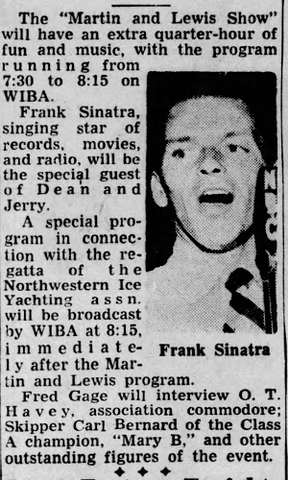
January 22, 1952
Television
Frank Sinatra Show
Network: CBS
Location: Studio A, Columbia Square Facility, Hollywood, California
Show: 52(in series), 2-16(in season)
Tuesday 8:00 P.M.-9:00 P.M.
Sponsor: sustaining
Orchestra Conducted By: Axel Stordahl
Announcer: Bob Lemond
Producer: David Dare
Executive Producer: Marlo Lewis
Guests: George McManus, Beatrice Kay, Buster Keaton, Joe Laurie Jr., The Bell Sisters, The Heathertones
1. Never Before - Frank Sinatra
2. When You Were Sweet Sixteen - Frank Sinatra & The Heathertones
3. Bewitched - Frank Sinatra
4. Singin' In The Rain - Frank Sinatra
5. There's no Business Like Show Business - Sinatra & J. Laurie Jr.
Ed Notes: The Bell Sisters, Cynthia, 16, and
Kay, 11, were making their TV debut. They had a Top 10 with "Bermuda" and performed it on the show.
Frank Sinatra Show
Network: CBS
Location: Studio A, Columbia Square Facility, Hollywood, California
Show: 52(in series), 2-16(in season)
Tuesday 8:00 P.M.-9:00 P.M.
Sponsor: sustaining
Orchestra Conducted By: Axel Stordahl
Announcer: Bob Lemond
Producer: David Dare
Executive Producer: Marlo Lewis
Guests: George McManus, Beatrice Kay, Buster Keaton, Joe Laurie Jr., The Bell Sisters, The Heathertones
Frank Sinatra & The Bell Sisters
[image referenced in source but could not be recovered]
[image referenced in source but could not be recovered]
January 29, 1952
Television
Frank Sinatra Show
Network: CBS
Location: Studio A, Columbia Square Facility, Hollywood, California
Show: 53(in series), 2-17(in season)
Tuesday 8:00 P.M.-9:00 P.M.
Sponsor: sustaining
Orchestra Conducted By: Axel Stordahl
Announcer: Bob Lemond
Producer: David Dare
Executive Producer: Marlo Lewis
Guests: Dick Haymes, Tom D'Andrea, Larry Blake, Patti Moore, Ben Lessy
1. I'm Gonna Live Till I Die - Frank Sinatra
February 1952
[Weitman phone call about Paramount premiere]
Kaplan: In February 1952, while Bob Weitman, manager of the Paramount Theater, was vacationing in Miami, Frank called him asking about a possible Paramount premiere tied to Meet Danny Wilson's upcoming New York opening. Paramount chairman Barney Balaban was skeptical, but Weitman decided to book Frank anyway for two weeks alongside Frank Fontaine, June Hutton, and Buddy Rich.
Source: James Kaplan, "Frank: The Voice" (2010)
[MCA's Lew Wasserman drops Frank as a client]
Lew Wasserman, head of talent agency MCA, decided the agency no longer wanted to represent Frank, whose earning power had collapsed, and took out trade-paper ads in Variety and the Hollywood Reporter announcing the split. The press gleefully dubbed it "The Last Goodbye"; Frank was furious, incredulous that an agency that had never even had to sell him could fire him.
Source: Richard Havers, "Sinatra" (Dorling Kindersley, 2007).
February 3, 1952
Colgate Comedy Hour (Cancelled appearance)
Host: Donald O'Connor
Guests: Frank Sinatra, Corrine Calvet, Ben Blue
-----------------------------------------
February 3, 1953 Texaco's Star Theater
----------------------------------------------------------------
February 3, 1960 Sands Casino, Las Vegas, Nevada
9:30am - 6:30 pm
Frank filmed inside and outside the Sands for Oceans 11 --contributed by: Fred Wadsworth
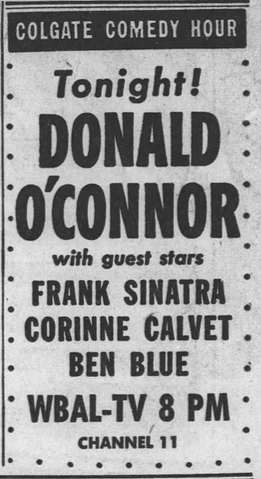
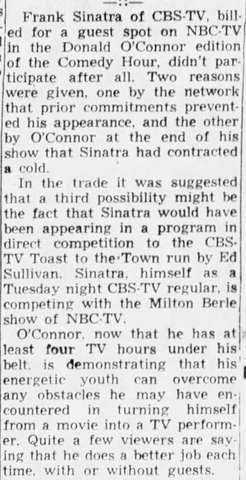
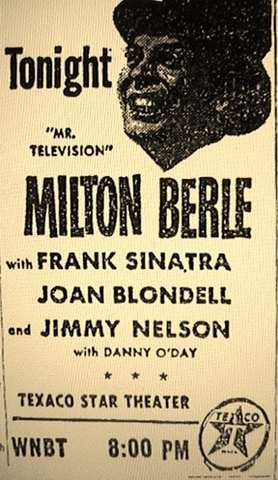
February 4, 1952
Television
Ralph Edwards Show
KNBH 12:30PM
Guest: Frank Sinatra
February 5, 1952
Television
Frank Sinatra Show
Network: CBS
Location: Studio A, Columbia Square Facility, Hollywood, California
Show: 54(in series), 2-18(in season)
Tuesday 8:00 P.M.-9:00 P.M.
Sponsor: sustaining
Orchestra Conducted By: Axel Stordahl
Announcer: Bob Lemond
Producer: David Dare
Executive Producer: Marlo Lewis
Guests: Diana Lynn, Frank Fontaine, Ann Triole
[image referenced in source but could not be recovered]
February 6, 1952
Studio
Hollywood
RHCO10110 My Girl
(C. Freed)
Ludlow Music, Inc. (BMI) 1952
Arranged & Conducted by Axel Stordahl
-1 (2:24) CD: Columbia Years 43-52 Vol. 12
78: 39726
RHCO10114 Feet Of Clay
(J. Whitney/A. Kramer/H. Zaret)
Bourne, Inc. (ASCAP) 1952
Arranged & Conducted by Axel Stordahl
-1 (2:56) CD: Columbia Years 43-52 Vol. 12
78: 39687
NOTE: Sinatra Scholar Ed O'Brien remarks that he'd take "Mama Will Bark" anytime over this "little beauty."
RHCO10115 Don't Ever Be Afraid To Go Home
(B. Hillard/C. Sigman)
Remick Music Corp. (ASCAP) 1952
Arranged & Conducted by Axel Stordahl
-1 (2:28) CD: Columbia Years 43-52 Vol. 12
78: 39687
Violins: J. Augustine, D. Lube, N. Pisani, I. Prager, M. Russell, M. Sosson; Violas: S. Harris, D. Sterkin; Cello: E. Slatkin; Harp: A. Stockton; Saxes: E. Callen, E. Gershman, L. Hartman, B. Russin, F. Stulce; Trumpet: R. Zarchy; Trombones: G. Arus, J. Piddy; Piano: W. Miller; Guitar: A. Reuss; Bass: J. Ryan; Drums: R. Hagan
[The Cinematic Legacy of Frank Sinatra — Meet Danny Wilson (1951)]
David Wills's 2015 photo history The Cinematic Legacy of Frank Sinatra devotes a section to Meet Danny Wilson (1951), illustrated with 2 behind-the-scenes and publicity photographs (posters, lobby cards, and on-set/on-location shots) filed here.
Source: David Wills, The Cinematic Legacy of Frank Sinatra (St. Martin's Press, 2015), pp. 64–65.
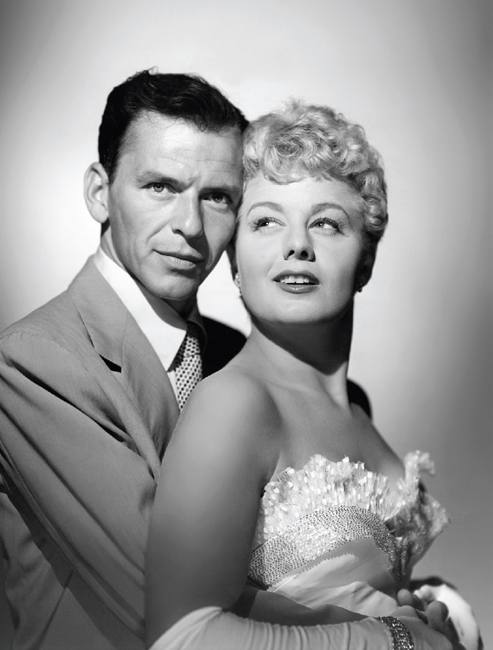
With costar Shelley Winters in Meet Danny Wilson, 1951. / “I too had sat in the orchestra at the Paramount / Theater when I was a teenager and screamed / every time he opened his mouth. I was / determined to keep my association with Mr. (Photo: The Cinematic Legacy of Frank Sinatra, David Wills, 2015.)
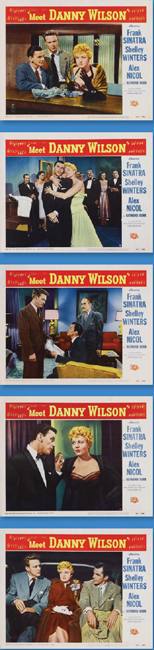
Sinatra as professional as possible. In retrospect, / I suspect he wanted the same thing.” / (Costar, Meet Danny Wilson, 1951) / Lobby cards, Meet Danny Wilson. (Photo: The Cinematic Legacy of Frank Sinatra, David Wills, 2015.)
Film
"Meet Danny Wilson" Portland Oregan Premiere February 6, 1952) (Regular release: April 1st, 1952)
Starring: Frank Sinatra, Shelley Winters, Alex Nicol, Raymond Burr
Produced by: Leonard Goldstein
Directed by: Joseph Pevney
Danny Wilson (Sinatra) and partner Mike (Nicol) make a meager living singing in dives and hustling pool. One night they meet entertainer Joy Carroll (Winters), who gets them a job at racketeer Nick Driscoll's (Burr) posh nightclub. But Nick wants a high price: half of Danny's future income. Danny's career skyrockets, but his position at the top of the heap, and his one-sided romance with Joy, prove extremely unstable.
note: I sat this aside last week to show how little confidence Universal had in Frank's film. But then I realized the film opened in Portland on 2/6. This ad ran in the Portland Press Herald, 2/5, a Tuesday.
Second film has Walter Brennan in very small type. The man won three Oscars.
Ed
[image referenced in source but could not be recovered]
Hollywood
RHCO10110 My Girl
RHCO10114 Feet Of Clay
RHCO10115 Don't Ever Be Afraid To Go Home
(B. Hillard/C. Sigman)
Violins: J. Augustine, D. Lube, N. Pisani, I. Prager, M. Russell, M. Sosson; Violas: S. Harris, D. Sterkin; Cello: E. Slatkin; Harp: A. Stockton; Saxes: E. Callen, E. Gershman, L. Hartman, B. Russin, F. Stulce; Trumpet: R. Zarchy; Trombones: G. Arus, J. Piddy; Piano: W. Miller; Guitar: A. Reuss; Bass: J. Ryan; Drums: R. Hagan
Frank Sinatra at a Columbia Records recording session Feb. 6, 1952 Frank Sinatra with First violinist Mischa Russell February 6, 1952
[image referenced in source but could not be recovered]
[image referenced in source but could not be recovered]
"Meet Danny Wilson" (Los Angeles Premiere February 7, 1952) (Regular release: April 1st, 1952)
Starring: Frank Sinatra, Shelley Winters, Alex Nicol, Raymond Burr
Produced by: Leonard Goldstein
Directed by: Joseph Pevney
"My Girl"
Granata highlights 'My Girl' from February 6, 1952 for Sinatra's new vocal suppleness (e.g., a smooth dip on 'when the night is cold'), noting the recording's ambient sound and vocal execution so closely resembles his first Capitol session recording 'I'm Walking Behind You' (April 2, 1953) that, played back to back, they could be mistaken for the same date -- both featured Axel Stordahl.
Source: Charles L. Granata, "Sessions with Sinatra: Frank Sinatra and the Art of Recording" (1999/2003).
[My Girl -- critical commentary]
Granata includes 'My Girl' among the fifty recordings he considers essential to understanding Sinatra's artistry (arranged by Axel Stordahl, recorded 1952, Columbia); the song was chosen for its musical/interpretive value rather than commercial popularity.
This song/context matches multiple dated entries in the chronology, or lacked a sufficiently precise date; the specific date could not be determined with confidence.
Source: Charles L. Granata, "Sessions with Sinatra: Frank Sinatra and the Art of Recording" (1999/2003), Afterword & Appendices A-D
February 7, 1952
Film
"Meet Danny Wilson" (Los Angeles Premiere
February 7, 1952) (Regular release: April 1st, 1952)
Starring: Frank Sinatra, Shelley Winters, Alex Nicol, Raymond
Burr
Produced by: Leonard Goldstein
Directed by: Joseph Pevney
Danny Wilson (Sinatra) and partner Mike (Nicol) make a meager living singing in dives and hustling pool. One night they meet entertainer Joy Carroll (Winters),
who gets them a job at racketeer Nick Driscoll's (Burr) posh nightclub. But Nick wants a high price: half of Danny's future income. Danny's career skyrockets, but his
position at the top of the heap, and his one-sided romance with Joy, prove extremely unstable.
(DVD Release date: 2009-05-25 U.K. Only)
Note: The film opened on 2-7 in L.A.at three theatres plus another in Hollywood.
The San Francisco opening was the following day. Frank sang on stage with the Ray Hacket
Orch. in Frisco. Variety shows a disappointing b.o. in L.A. S.F. did much better at $14,000 thanks
to Frank's personal appearance on opening day.
--Ed
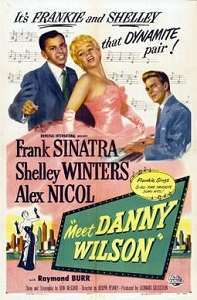
Concerts
French Room of the Ambassador Hotel, Los Angeles, California Sinatra performed at an after-party for the Los Angeles premier of “Meet Danny Wilson”
"Meet Danny Wilson" (Los Angeles Premiere
February 7, 1952) (Regular release: April 1st, 1952)
Release Date: February
1952
Premiere Information: Los Angeles opening: 7 Feb 1952; San Francisco opening: 8 Feb 1952
Production Date: late Jun--31 Jul 1951
According to HR, Universal sponsored a national contest to have the public choose their ten favorite Frank Sinatra songs for inclusion in the film. Other HR news items add Johnny Daheim, Joe Gray, Charles Parker and Leo Garber to the cast, but their appearance in the final film has not been confirmed. A 16 May 1951 HR news item reports that Shelley Winters was briefly suspended by the studio for refusing to fly immediately from New York to Los Angeles for her costume fittings and screen tests. Unbilled Universal contract players Tony Curtis and Jeff Chandler appear in a brief cameo during a scene in which "Danny" performs drunkenly at a nightclub. The film's final scene was shot on location at Wrigley Field in Los Angeles.
Reviewers noted the distracting parallels between "Danny's" rise to fame and Sinatra's own. When the film opened in San Francisco, Sinatra gave a one-day only live performance at the Orpheum theater prior to the start of the picture. Modern sources state that Sinatra fought with Shelley Winters throughout the filming of the picture. Although Meet Danny Wilson was not a box-office success, it gained popularity during a 1954 re-release after Sinatra won a Best Supporting Actor Academy Award for his performance in From Here to Eternity (see entry).
Note: Unbilled Universal contract players Tony Curtis and Jeff
Chandler appear in a brief cameo during a scene in which "Danny" performs drunkenly at a nightclub. The film's final scene was shot on location at Wrigley Field in Los Angeles.
American singer and actor Frank Sinatra (1915-1998) sings for unspecified guests attending the after party which the Los Angeles premiere of 'Meet Danny Wilson,' held in the French Room of the Ambassador Hotel in Los Angeles, California, 7th February 1952.
American actor and screenwriter Don McGuire (1919-1999) is introduced by American singer and actor Frank Sinatra (1915-1998) to the guests attending the after party which followed the Los Angeles premiere of 'Meet Danny Wilson,' held in the French Room of the Ambassador Hotel in Los Angeles, California, 7th February 1952. McGuire wrote the screenplay for the film, starring Sinatra.
American beauty queen Jeanne Biegger (1927-2016) and her husband, American actor, singer and comedian Dean Martin (1917-1995) with American singer and actor Frank Sinatra (1915-1998) and his wife, American actress Ava Gardner (1922-1990) attend the after party which followed the Los Angeles premiere of 'Meet Danny Wilson,' held in the French Room of the Ambassador Hotel in Los Angeles, California, 7th February 1952 San Francisco Examiner
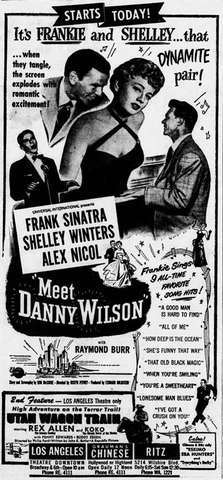
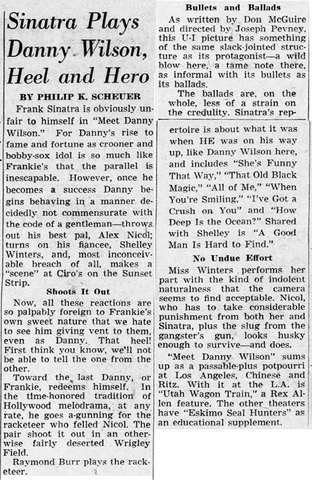
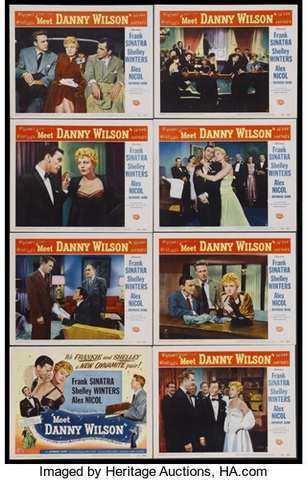
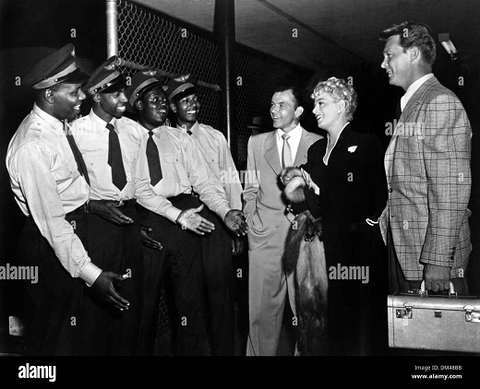
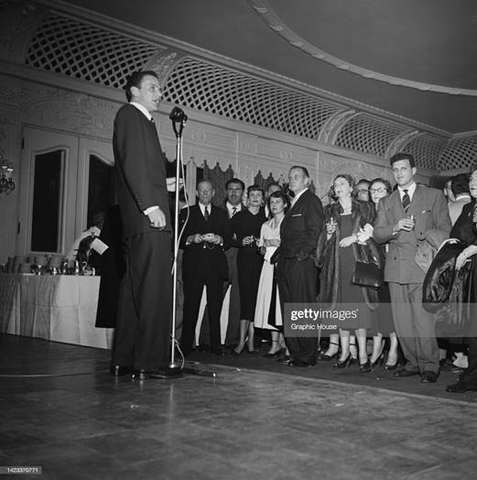
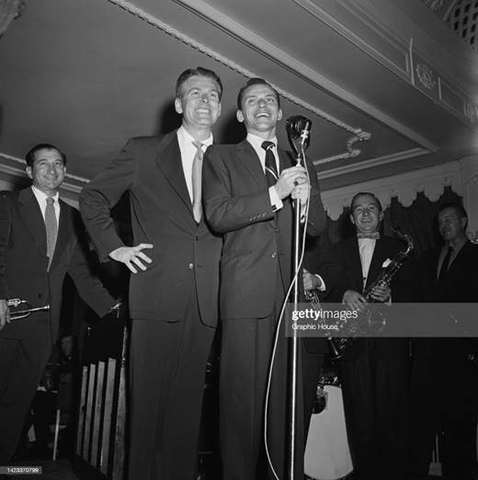
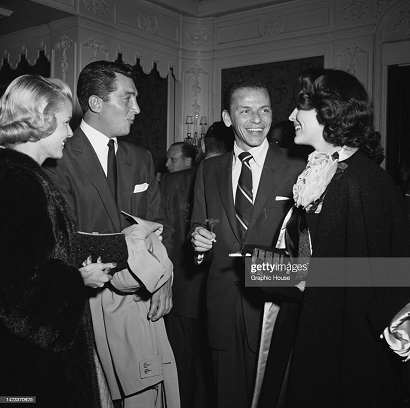
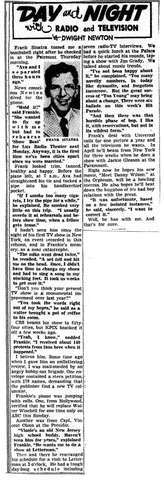
note: Interview with Dwight Newton took place on 2-7-52.
According to the Examiner, Sinatra did four shows at the Orpheum on 2/8 with the Ray Hackett Orchestra..
Alex Nicol and the young Universal starlet Joyce Holden also made appearances.
Ed
February 8, 1952
Television
Opening of new KPIX/KSFO building
An hour-long celebration revue starring Del Courtney and his Orchestra, Peggy Mann, Lee Giroux, Frank Sinatra and others
Film
"Meet Danny Wilson" (San Francisco Premiere February 8, 1952) (Regular release: April 1st, 1952)
Starring: Frank Sinatra, Shelley Winters, Alex Nicol, Raymond Burr
Produced by: Leonard Goldstein
Directed by: Joseph Pevney
Danny Wilson (Sinatra) and partner Mike (Nicol) make a meager living singing in dives and hustling pool. One night they meet entertainer Joy Carroll (Winters), who gets them a job at racketeer Nick Driscoll's (Burr) posh nightclub. But Nick wants a high price: half of Danny's future income. Danny's career skyrockets, but his position at the top of the heap, and his one-sided romance with Joy, prove extremely unstable. (DVD Release date: 2009-05-25 U.K. Only)
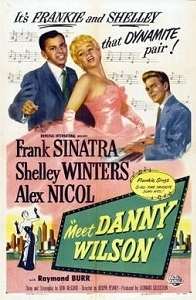
Concerts
Orpheum, San Francisco, CA
Sinatra appeared along with Alex Nicol, Joyce Holden, and Ray Hackett and his Orchestra 4 stage shows at 1:00, 4:50, 7:25, and 10pm to promote "Meet Danny Wilson"
"Meet Danny Wilson" (San Francisco Premiere February 8, 1952) (Regular release: April 1st, 1952)
A February 8, 1952 photo from the Jack Tillmany collection. He comments: "Frank Sinatra makes a personal appearance at the Orpheum to promote the opening of his new film 'Meet Danny Wilson.' Price of admission was less than a dollar in those days! Shelley Winters was Sinatra's co-star but did not appear with him at the Orpheum premiere. Ava Gardner, his new wife, was scheduled but had to cancel because of other commitments. Universal contract players Alex Nicol and Joyce Holden did appear, however, along with Ray Hackett and his Orchestra." The February 8, 1952 Chronicle covered the event in their page 11 article "A Chat With Sinatra..."
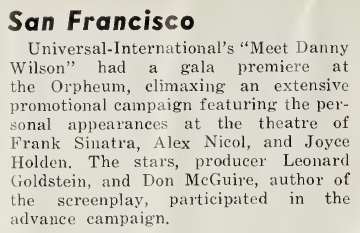
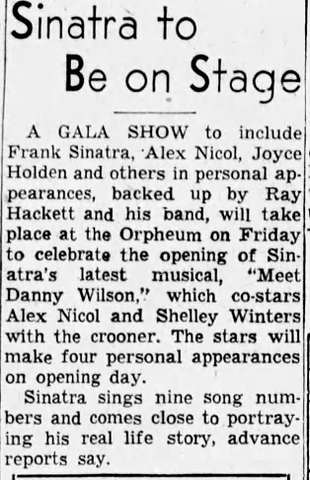
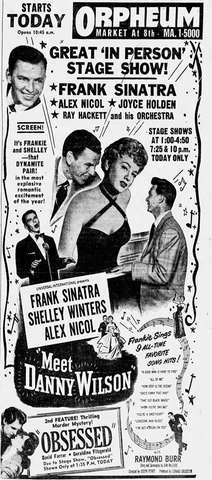
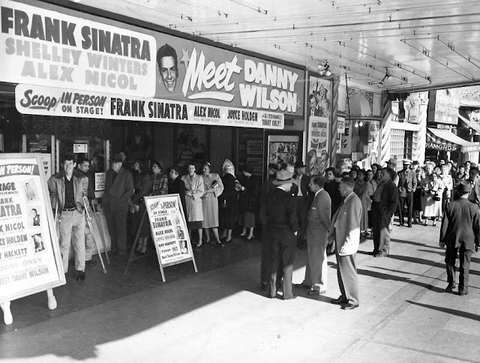
Opening of new KPIX/KSFO building
An hour-long celebration revue starring Del Courtney and his Orchestra, Peggy Mann, Lee Giroux, Frank Sinatra and others
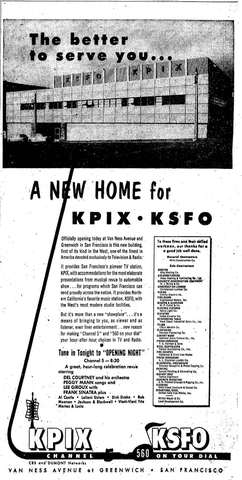
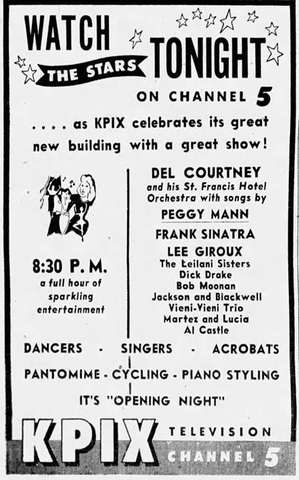
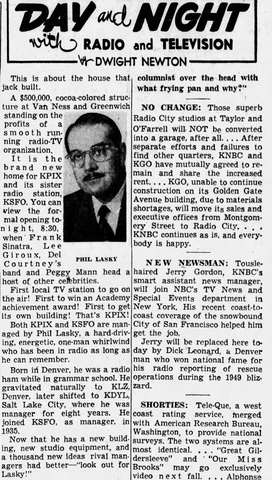
Meet Danny Wilson opened to mediocre reviews as Frank Sinatra's professional slide continued into 1952; within months he would be dropped by both his record label and his talent agency, a career nadir he later described starkly: “At thirty-eight years old, I was a has-been... sitting by a telephone that wouldn't ring.” It was around this time that he first read James Jones's novel From Here to Eternity and became fixated on playing Private Angelo Maggio, the role he would later credit with saving his career. Source: J. Randy Taraborrelli, Sinatra: Behind the Legend.
Frank's film Meet Danny Wilson, in which he played a brash young crooner, premiered in San Francisco; critics noted its close resemblance to Frank's own rise, though it fared poorly at the box office.
Source: Nancy Sinatra, Frank Sinatra: An American Legend, 1995.
February 10, 1952
Radio
Walter Winchell Show
ABC-Radio
Sunday Evening
9:00 to 9:15 P.M.
Subbing for Winchell:
Jo Stafford, Frank Sinatra, Axel Stordahl & His Orchestra Songs:
--The Best Things In Life Are Free Jo
--I'm Gonna Live Till I Die Frank
--Come Rain Or Come Shine Frank
Note: Winchell was suffering from nervous exhaustion.
He was ordered by his doctor to take a break from the show. Someone came up with the idea of replacing him with popular guest star vocalists of the day. The Variety of 2-13-52 thought it was a terrible idea.
--Ed
Walter Winchell Show
ABC-Radio
Sunday Evening
9:00 to 9:15 P.M.
Subbing for Winchell:
Jo Stafford, Frank Sinatra, Axel Stordahl & His Orchestra Songs:
--The Best Things In Life Are Free Jo
--I'm Gonna Live Till I Die Frank
--Come Rain Or Come Shine Frank
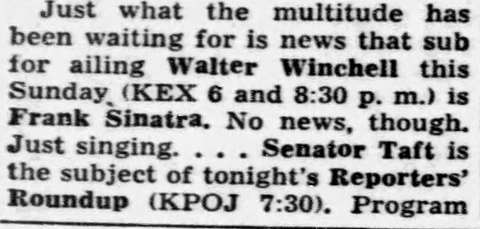
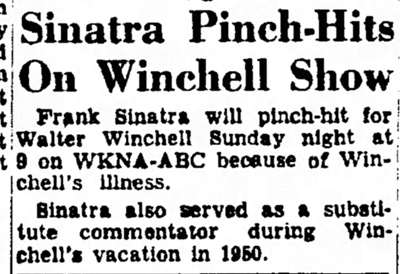
February 12, 1952
Radio
Stars For Defence
Hollywood
15 minutes
PSA Office of Price Stabilization
Frank Sinatra
Axel Stordahl and Orch.
Announcer Hy Averback
Walking in the Sunshine 1-7-52 Columbia
My Girl 2-6-52 Columbia
I Can't Give You Anything But Love orchestral
I Hear A Rhapsody 1-7-52 Columbia
Television
Frank Sinatra Show
Network: CBS
Location: Studio A, Columbia Square Facility, Hollywood, California
Show: 55(in series), 2-19(in season)
Tuesday 8:00 P.M.-9:00 P.M.
Sponsor: Elgin-American (15mins), sustaining (45mins)
Orchestra Conducted By: Axel Stordahl
Announcer: Bob Lemond
Producer: David Dare
Executive Producer: Marlo Lewis
Guests: Buster Keaton, Zsa Zsa Gabor, The Delta Rhythm Boys, June Hutton
Scott: I'm also a huge Buster Keaton fan and I'd love to see this show but I don't believe it's in circulation.
Stars For Defense
Hollywood
15 minutes
PSA Office of Price Stabilization
Frank Sinatra
Axel Stordahl and Orch.
Announcer Hy Averback
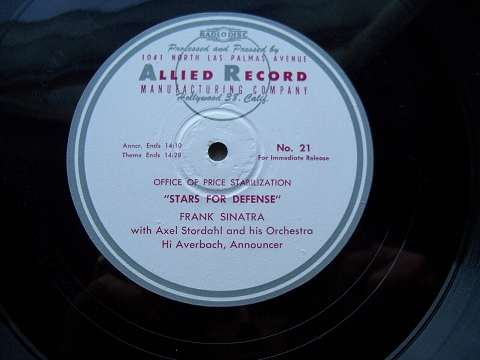
Frank Sinatra Show
Network: CBS
Location: Studio A, Columbia Square Facility, Hollywood, California
Show: 55(in series), 2-19(in season)
Tuesday 8:00 P.M.-9:00 P.M.
Sponsor: Elgin-American (15mins), sustaining (45mins)
Orchestra Conducted By: Axel Stordahl
Announcer: Bob Lemond
Producer: David Dare
Executive Producer: Marlo Lewis
Guests: Buster Keaton, Zsa Zsa Gabor, The Delta Rhythm Boys, June Hutton
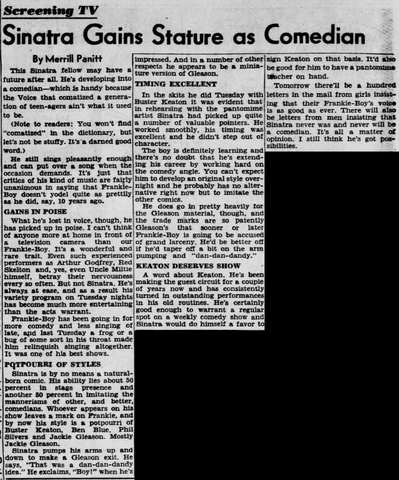
February 16, 1952
Concerts
Shrine Auditorium, Los Angeles
Italian Relief Fund
Frank Sinatra, Danny Thomas, Jimmy Durante, Eddie Cantor, George Jessel, Abbott & Costello, Liberace, Jerry Colonna, Debbie Reynolds and others
Shrine Auditorium, Los Angeles
Italian Relief Fund
Frank Sinatra, Danny Thomas, Jimmy Durante, Eddie Cantor, George Jessel, Abbott & Costello, Liberace, Jerry Colonna, Debbie Reynolds and others
© 1997-2026 The Sinatra Archive
This calendar, or any parts thereof, may not be reproduced in any fashion
whatsoever without the prior written permission of the publisher (The
Sinatra Archive)
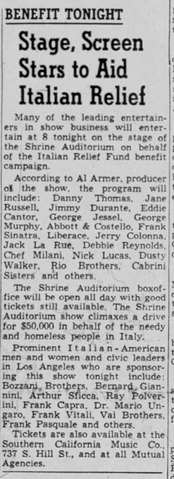
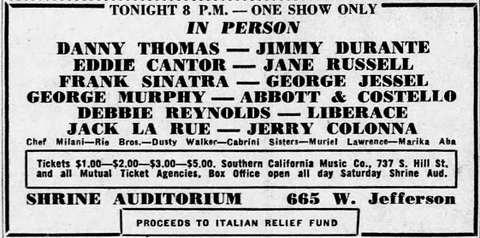
February 19, 1952
Television
Frank Sinatra Show
Network: CBS
Location: Studio A, Columbia Square Facility, Hollywood, California
Show: 56(in series), 2-20(in season)
Tuesday 8:00 P.M.-9:00 P.M.
Sponsor: sustaining
Orchestra Conducted By: Axel Stordahl
Announcer: Bob Lemond
Producer: David Dare
Executive Producer: Marlo Lewis
Guests: James Mason, Pamela Kellino, Jackie Coogan, Jimmy Boyd
[image referenced in source but could not be recovered]
Frank Sinatra Show
Network: CBS
Location: Studio A, Columbia Square Facility, Hollywood, California
Show: 56(in series), 2-20(in season)
Tuesday 8:00 P.M.-9:00 P.M.
Sponsor: sustaining
Orchestra Conducted By: Axel Stordahl
Announcer: Bob Lemond
Producer: David Dare
Executive Producer: Marlo Lewis
Guests: James Mason, Pamela Kellino, Jackie Coogan, Jimmy Boyd
---------------------------------------------
February 19, 1953, London, England
[image referenced in source but could not be recovered]
[image referenced in source but could not be recovered]
[image referenced in source but could not be recovered]
[image referenced in source but could not be recovered]
February 21, 1952
Television
Star Of The Family
Peter Lind Hayes & Mary Healy
CBS
Thursday Evening
8:00 p.m.- 8:30 p.m.
Carl Hoff & His Orchestra
Sponsor: Ronson - World's Greatest Lighter
Guests: Frank Sinatra, Connie Haines, Hal Peary note: Frank appears in a nightclub scene. Sings "Night And Day" and "Blue Skies."
Peter and Mary were not afraid to give artists who were on their way down a shot at reviving their careers through guest appearances on their show. Such was the case with Frank Sinatra. "Sinatra's career was in a major slump -- some people thought he was washed up," said Seagrave, a SUN feature writer in the 1970s who then wrote under the name Jan Plowman. "Peter put Frank on the show. Frank was so grateful and never forgot Peter for that. He flew Peter and Mary to Palm Springs for his wedding to (his fourth and current wife) Barbara Marx." When Seagrave visited Hayes and Healy a month ago, she found Peter weeping as he listened to Sinatra records. "Peter was crying because Frank was so ill," Seagrave said. "He was so worried about him." Las Vegas Sun
April 22, 1998
Star Of The Family
Peter Lind Hayes & Mary Healy
CBS
Thursday Evening
8:00 p.m.- 8:30 p.m.
Carl Hoff & His Orchestra
Sponsor: Ronson - World's Greatest Lighter
Guests: Frank Sinatra, Connie Haines, Hal Peary (The Great Gildersleeve)
February 26, 1952
Television
Frank Sinatra Show
Network: CBS
Location: Studio A, Columbia Square Facility, Hollywood, California
Show: 57(in series), 2-21(in season)
Tuesday 8:00 P.M.-9:00 P.M.
Sponsor: sustaining
Orchestra Conducted By: Axel Stordahl
Announcer: Bob Lemond
Producer: David Dare
Executive Producer: Marlo Lewis
Guests: Zsa Zsa Gabor, Yma Sumac, Frank Fontaine, Leon Belasco, The Mandarines

March 1952
[Frank appears subdued on The Dinah Shore Show]
Frank appeared on television's Dinah Shore Show, reminiscing with Dinah about their old radio days together. Producer Bud Yorkin recalled that Frank was not the confident, familiar Frank Sinatra everyone knew.
Source: Richard Havers, "Sinatra" (Dorling Kindersley, 2007).
March 2, 1952
Radio
The Jack Benny Program
Network: CBS
Sponsor: Lucky Strike
Show: #25 of the 1951-52 series
Time: 7:00 - 7:30 PM EST
Host: Jack Benny
Guests: Danny Kaye, Frank Sinatra, George Burns, Groucho Marx,
Cast: Don Wilson, Mary Livingstone, Phil Harris, Dennis Day, Artie Auerbach, Rochester, Benny Rubin, Mel Blanc, Rochester, Dennis Day
Writer: Sam Perrin, George Balzer, John Tackaberry, Milt Josefsberg
Producer By: Hilliard Marks
Music Director: Mahlon Merrick
1. opening commercial
2. first routine - Don Wilson, Jack Benny, Phil Harris, Dennis Day
3. Mistakes - Dennis Day
4. second routine - Jack Benny, Phil Silvers, Artie Auerbach, Don Wilson, Benny Rubin, Dennis Day, Rodchester, Danny Kaye, Frank Sinatra, George Burns, Groucho Marx
5. When I Say I Beg Your Pardon, Then I'll Come Back To You - Danny Kaye, Frank Sinatra, George Burns, Groucho Marx
6. commercial
7. closing - Jack Benny, Mel Blanc
Note: Both versions available for above. AFRS is in better sound then the network version. AFRS version has an extra Phil Harris song and has large portions of the broadcast missing. The program originates from Palm Springs, California. A famous quartet of guests sing Jack's song, "When You Say I Beg Your Pardon, Then I'll Come Back To You."
Sound Excellent (AFRS) & VG (CBS). TT: 26mins. Also listed as 5-5-52.
The show appears on the officially released CD set: 60 Greatest Old Time Radio Shows "Frank Sinatra & Friends
The Jack Benny Program
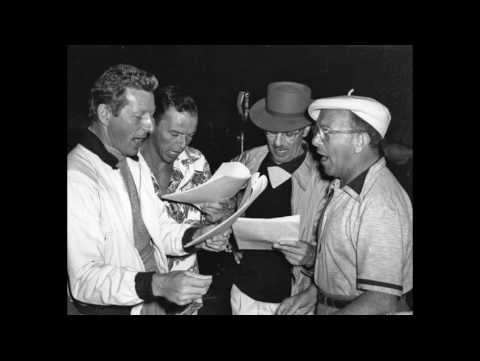
March 4, 1952
Television
Frank Sinatra Show
Network: CBS
Location: Studio A, Columbia Square Facility, Hollywood, California
Show: 58(in series), 2-22(in season)
Tuesday 8:00 P.M.-9:00 P.M.
Sponsor: sustaining
Orchestra Conducted By: Axel Stordahl
Announcer: Bob Lemond
Producer: David Dare
Executive Producer: Marlo Lewis
Guests: Cass Daley, Liberace
March 6, 1952
Television
The Dinah Shore Show (NBC)
Thursday
7 to 7:15 pm EST
Guest: Frank Sinatra
Frank & Dinah Reminisce About Days In Radio
1. I Could Write A Book F.S.
2. Why Do I Love You ? F.S. D.S.Ă‚
3. Blue Room F.S. D.S.
4. See The U.S.A. In Your Chevrolet F.S. D.S.
Notes: Show in circulation. Frank & Dinah Reminisce About Days In Radio.
Ed O'Brien:
Dinah was a loyal friend to Frank. He was struggling to find his footing in the late winter of 1952. She put him in the best light throughout her show that night.
March 11, 1952
Television
Frank Sinatra Show
Network: CBS
Location: Studio A, Columbia Square Facility, Hollywood, California
Show: 59(in series), 2-23(in season)
Tuesday 8:00 P.M.-9:00 P.M.
Sponsor: sustaining
Orchestra Conducted By: Axel Stordahl
Announcer: Bob Lemond
Producer: David Dare
Executive Producer: Marlo Lewis
Guests: The Andrews Sisters, Toni Arden, Jimmy Boyd, Larry Griswold
1. The Song is You - Frank Sinatra & Toni Arden
2. This Can't Be Love - Frank Sinatra
Ed O'Brien:
Frank and The Andrew Sisters opened this show singing Cole Porter's "Be A Clown."
March 15, 1952
Television
WNBT New York,
Muscular Dystrophy Association Telethon
Hosts: Jerry Lewis & Dean Martin
Guests included:
Jackie Gleason, Frances Langford, Ezio Pinza, Jerry Lester, Victoria Borge, Faye Emerson, Skitch Henderson, Dagmar, Gene Krupa, Nat King Cole, Sid Caesar, Milton Berle, Frank Sinatra, Martha Wright, Eddie Fisher, Yul Brynner, Helen O'Connell, Sid Gould, The Demarco Sisters, The Mayor Brothers, and Connie Boswell
WNBT New York,
Muscular Dystrophy Association Telethon
Hosts: Jerry Lewis & Dean Martin
Guests included:
Jackie Gleason, Frances Langford, Ezio Pinza, Jerry Lester, Victoria Borge, Faye Emerson, Skitch Henderson, Dagmar, Gene Krupa, Nat King Cole, Sid Caesar, Milton Berle, Frank Sinatra, Martha Wright, Eddie Fisher, Yul Brynner, Helen O'Connell, Sid Gould, The Demarco Sisters, The Mayor Brothers, and Connie Boswell NBC Trade News March 1952
March 16, 1952
Radio
The Big Show
Network: NBC
Sponsor: various sponsors
Show: #52
Time: 6:30 PM - 8:00 PM EST
Sunday Evening
Host: Tallulah Bankhead
Guests: , Helen O'Connell, Fred Allen, Frank Sinatra, Peter Donald, William Gargan
Orchestra Conducted By: Merideth Wilson
Writers: Goodman Ace, Frank Wilson
Announcers: Ed Herlihy, Jimmy Wallington
Produced & Director By: Dee Englebach
Sinatra Performance Information:
1. I Hear a Rhapsody - Frank Sinatra & Meredith Wilson Choral Group (Axel Stordahl arr..)
2. Pretty Baby - Frank SInatra & Tallulah Bankhead (comic duet)
3. I Will Take You Home Again, Kathleen - Frank Sinatra (during St. Patrick's Day skit) note: Frank also sang a segment of "May The Good Lord Bless And Keep You" at the closing of the show.
March 18, 1952
Television
Frank Sinatra Show
Network: CBS
Location: Studio A, Columbia Square Facility, Hollywood, California
Show: 60(in series), 2-24(in season)
Tuesday 8:00 P.M.-9:00 P.M.
Sponsor: sustaining
Orchestra Conducted By: Axel Stordahl
Announcer: Bob Lemond
Producer: David Dare
Executive Producer: Marlo Lewis
Guests: Victor Borge, The Nicholas Brothers, Borah Minevitch's Rascals, June Hutton
Frank Sinatra Show
Guests: Victor Borge, The Nicholas Brothers, Borah Minevitch's Rascals, June Hutton
March 21, 1952
Radio
Robert Q. Lewis Waxworks
CBS
Guest: Frank Sinatra
March 22, 1952
Television
Nick Kenny Show
NBC
Saturday
15 minutes
Regulars: Irene Walsh & Don Tippen
Guest: Frank Sinatra
Ed O'Brien notes:
Kenny was a popular poet. He dabbled in radio and then had a 15 minute music/talk show on NBC during the 1951-52 season.
Concerts
State Theater, Hartford, Connecticut (March 22 & 23)
4 Shows per day
Also appearing:
June Hutton,
Frank Fontaine (comic)
Buddy Rich and his Band
State Theater, Hartford, Connecticut (March 22 & 23)
4 Shows per day
Also appearing:
June Hutton,
Frank Fontaine (comic)
Buddy Rich and his Band
Hartford Courant, Hartford, Connecticut, March 22, 1952
Here's a review:
Hartford Courant, Hartford, Connecticut, March 23, 1952
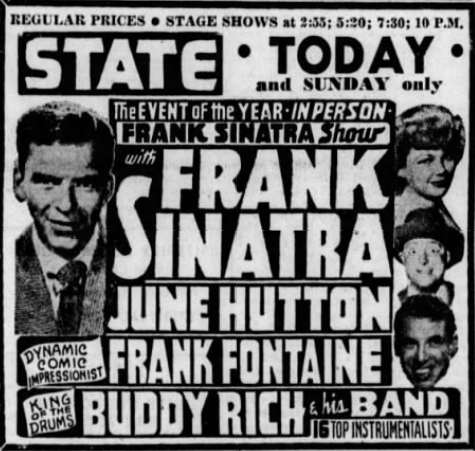
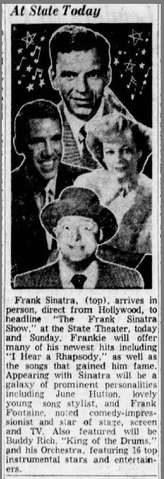
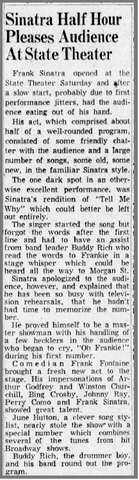
Nick Kenny Show
NBC
Saturday
15 minutes
Regulars: Irene Walsh & Don Tippen
Guest: Frank Sinatra
I've been wondering about this entry. I can't find any information and all the newspaper listings don't mention Sinatra as a guest. I found this notice from an NBC Trade News from March 13, 1952:
Note: No mention of Sinatra for the March 22nd show unless he was a last minute addition.
March 23, 1952
Concerts
State Theater, Hartford, Connecticut (March 22 & 23)
4 Shows per day
Also appearing:
June Hutton,
Frank Fontaine (comic)
Buddy Rich and his Band
March 25, 1952
Television
Frank Sinatra Show
Network: CBS
Location: Studio A, Columbia Square Facility, Hollywood, California
Show: 61(in series), 2-25(in season)
Tuesday 8:00 P.M.-9:00 P.M.
Sponsor: sustaining
Orchestra Conducted By: Axel Stordahl
Announcer: Bob Lemond
Producer: David Dare
Executive Producer: Marlo Lewis
Guests: Nancy Walker, Frank Fontaine, June Hutton
March 26, 1952
Concerts
Paramount, New York City (March 26 - April 8) w/Buddy Rich, Frank Fontaine, June Hutton
Paramount, New York City (March 26 - April 8) w/Buddy Rich, Frank Fontaine, June Hutton
Ad for Paramount that ran in New York papers, 3-26-52
Note: Film had its premiere the week of February 3rd in Philly, L.A., St Louis, Buffalo and at at the Orpheum Theatre, San Francisco, 2-8-52. Frank and Ava appeared on stage backed by the Ray Hacket Orch. Film took in $14,500 over the first weekend. The other cities saw a very quiet b.o. San Francisco was a big disappointment. When it opened in Oakland, "Meet Danny Wilson" played the bottom of the bill.
Ed
Ed O'Brien contributed the following two articles on the engagement:
PARAMOUNT THEATRE, NEW YORK CITY
MARCH 26, 1952
Wednesday evening
Film premiere in New York: "Meet Danny Wilson" starring Frank Sinatra, Alex Nicol, Shelley Winters,
Raymond Burr running time 88 mins.
"Title role is tailor-made for Sinatra and he plays it to the hilt with an off-hand charm that displays the various facets of his personality . . . . Nine tunes are in the score for Sinatra to work over and several draw reprises. Songs are all standards that Sinatra has sold well in the past and they listen well."
Variety
Stage Show
3-26 TO 4-8-52
Frank Sinatra, Jackie Gleason, Dagmar, Jack E. Leonard, Frank Fontaine, June Hutton, Buddy Rich & Orchestra,
Axel Stordahl
EAGER, FRIENDLY FRANKIE GETS SMASH RECEPTION
HEADING CLICK PARA BILL
A mellow and friendly Frank Sinatra is a smash hit here with the singer featured both on the stage and in the flick. Perhaps he is not The Voice any longer,as time has diminished the hypnotic effect of the Sinatra vocals, but this is more than offset by his personality, poise and selling ability, plus his genuine desire to give out with the songs. There were not many teen- agers in the crowded house of the show caught, nor any squeals as in the old days, but the enthusiastic audience, including show- biz names, gave the singer a tremendous hand.
From his opener to the closing "When You're Smiling," Sinatra clicked all the way. He sang, kidded and chatted, just as on his
TV show, and he let the crowd have almost as many songs as it desired. His best were "That Old Black Magic"and "I Hear A Rhapsody," his latest record click. He also did a cute parody in Johnny Ray which ended with the line"When I think of Ava then I no longer cry" At the end of his act Sinatra called up Jackie Gleason and Jack E. Leonard. All three proceeded to fracture the crowd with their antics. Dagmar also came up and smothered the singer with kisses but Sinatra emerged smiling. The audience got more than its money's worth. It is a show for Sinatra fans for between the stage show and the movie there are over 15 Sinatra vocals. If the singer continues to act as warm as he does on this bill he could soon win back his once great following.
Billboard
Bob Rolontz
Review of opening night
Frank Sinatra's Paramount Theatre engagement was a box-office disappointment, one more sign of the career decline that had him privately telling friends he felt washed up; a subsequent Chez Paree booking in Chicago drew only about 150 people to a 1,200-seat room. Source: J. Randy Taraborrelli, Sinatra: Behind the Legend.
[Paramount Theater premiere of Meet Danny Wilson]
Earl Wilson: On March 26, 1952, Frank's premiere at the Paramount Theater drew a claque of celebrity friends like Jackie Gleason and Jimmy Durante organized by Earl Wilson, but the wider crowd was subdued; the New York Times reviewer wondered if it marked the beginning of the end of an era for Sinatra.
Source: James Kaplan, "Frank: The Voice" (2010).
March 27, 1952
Concerts
Paramount, New York City (March 26 - April 8) w/Buddy Rich, Frank Fontaine, June Hutton
March 28, 1952
Television
Perry Como Show
Network: CBS
Sponsor: Chesterfield
1. opening
2. When You're Smiling - Perry Como & Fontane Sisters
3. commercial
4. Anytime - Fontane Sisters
5. Nobody - Frank Sinatra & Perry Como
6. closing
Note: Sinatra appeared to plug "Meet Danny Wilson" TT: 15mins.
Ed O'Brien:
Hi Brian,
Wow! Great find. Would love to see this one. In a private interview from 1959, Frank raved about Perry. He admired his great ability to project a very relaxed persona every week on TV and lauded Perry's wonderful singing. Called him the most consistent singer in the business. He also mentioned how much he admired the man.
Concerts
Paramount, New York City (March 26 - April 8)
w/Buddy Rich, Frank Fontaine, June Hutton
Perry Como Show
Network: CBS
Sponsor: Chesterfield
Note: Sinatra appeared to plug "Meet Danny Wilson" TT:
15mins.
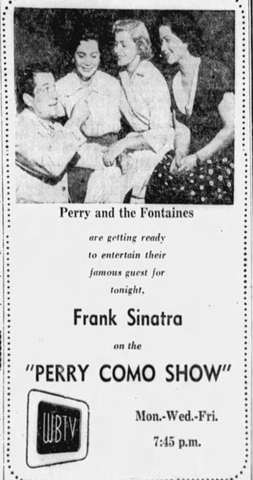
March 29, 1952
Concerts
Paramount, New York City (March 26 - April 8) w/Buddy Rich, Frank Fontaine, June Hutton
March 30, 1952
Concerts
Paramount Theater, New York (March 26 - April 9) w/Buddy Rich, Frank Fontaine, June Hutton
March 31, 1952
Concerts
Paramount, New York City (March 26 - April 8) w/Buddy Rich, Frank Fontaine, June Hutton
April 1, 1952
Television
Frank Sinatra Show
Network: CBS
Location: Studio A, Columbia Square Facility, Hollywood, California
Show: 62(in series), 2-26(in season)
Tuesday 8:00 P.M.-9:00 P.M.
Sponsor: sustaining
Orchestra Conducted By: Axel Stordahl
Announcer: Bob Lemond
Producer: David Dare
Executive Producer: Marlo Lewis
Guests: Frank Fontaine, Bill Bailey, June Hutton, The Diagoras
Notes: Series replaced by The Sam Levenson Show and Draw to Win.
Concerts
Paramount, New York City (March 26 - April 8) w/Buddy Rich, Frank Fontaine, June Hutton
[CBS cancels The Frank Sinatra Show]
CBS pulled the plug on The Frank Sinatra Show on April 1, 1952, after Ekco dropped its sponsorship in early January and the show ran largely unsponsored, costing the network $41,500 a week; industry estimates put CBS's total loss on the program at about a million dollars.
Source: James Kaplan, "Frank: The Voice" (2010).
After two seasons, CBS canceled The Frank Sinatra Show due to weak ratings against Milton Berle's competing program.
Source: Nancy Sinatra, Frank Sinatra: An American Legend, 1995.
April 2, 1952
Concerts
Paramount Theater, New York (March 26 - April 9) w/Buddy Rich, Frank Fontaine, June Hutton
April 3, 1952
Concerts
Paramount, New York City (March 26 - April 8) w/Buddy Rich, Frank Fontaine, June Hutton
April 4, 1952
Television
Perry Como Show
Guest: Frank Sinatra

Celebrity Time
Host: Conrad Nagel
Guests: Frank Sinatra, Victor Borge, Steve Allen, Ken Murray, Fred Waring

Concerts
Paramount, New York City (March 26 - April 8) w/Buddy Rich, Frank Fontaine, June Hutton
April 5, 1952
Concerts
Paramount, New York City (March 26 - April 8) w/Buddy Rich, Frank Fontaine, June Hutton
April 6, 1952
Television
B.F. Goodrich Celebrity Time
Big Anniversary Show
10:00 PM
Guests: Frank Sinatra, Steve Allen, Victor Borge, Faye Emerson, Fred Waring, Ralph Bellamy, Jackie Gleason, Mel Torme, Sammy Kaye and others
Concerts
Paramount, New York City (March 26 - April 8) w/Buddy Rich, Frank Fontaine, June Hutton
B.F. Goodrich Celebrity Time
Big Anniversary Show
KNXT 10:00 PM
Guests: Frank Sinatra, Steve Allen, Victor Borge, Faye Emerson, Fred Waring, Ralph Bellamy, Jackie Gleason, Mel Torme, Sammy Kaye and others
Taping of April 21, 1977 Frank Sinatra & Friends (ABC) Special
Sears sponsored the show. They put out a poster with Frank's guest list. Unfortunately, they had Gene Kelly on the show. He dropped out a few days before the taping. The poster probably caused some confusion but it also became a collector's item.
--Ed
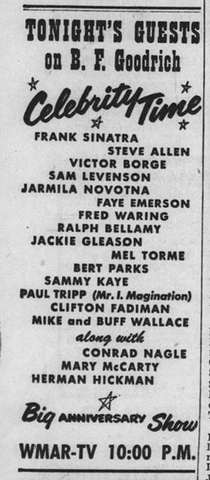

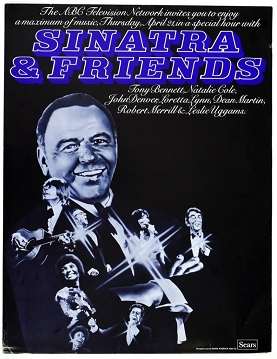
April 7, 1952
Concerts
Paramount, New York City (March 26 - April 8) w/Buddy Rich, Frank Fontaine, June Hutton
April 8, 1952
Concerts
Paramount, New York City (March 26 - April 8) w/Buddy Rich, Frank Fontaine, June Hutton
April 1952
CBS pulled the plug on The Frank Sinatra Show amid poor ratings, one of several blows -- alongside the quick failure of Meet Danny Wilson and the loss of his MGM contract -- that made 1952 what Sheridan and Harvey call the worst year of Sinatra's career, coinciding with his divorce settlement with Nancy and his wedding to Gardner. Source: Michael Sheridan & David Harvey, Sinatra and the Jack Pack.
[The Kauai County Fair Comeback Concert]
Nancy Sinatra: Honolulu reporter Buck Buchwach recalled a rain-soaked show at a leaking tent at the Kauai County Fair, where a small, plainly dressed crowd's warmth moved Sinatra to tears; he later said it was the night he felt his career turning around.
Source: Nancy Sinatra, Frank Sinatra: An American Legend, 1995.
[Frank and Ava attend Johnnie Ray's Copa premiere]
Frank Sinatra: In early April 1952, Frank attended Johnnie Ray's Copacabana premiere with Ava, more at her insistence than his own desire. Asked by Earl Wilson what he thought of Ray, Frank quipped that he'd like to say but his girl wouldn't let him.
Source: James Kaplan, "Frank: The Voice" (2010)
[Frank watches rival Johnnie Ray triumph at the Copacabana]
While struggling to fill seats at the Paramount, Frank and Ava went to see Johnnie Ray, then wildly popular, performing to a packed house at the Copacabana, Frank's old stomping ground. A New York World-Telegram & Sun headline captured Frank's decline bluntly: he was hot in '42 and forgotten by '52.
Source: Richard Havers, "Sinatra" (Dorling Kindersley, 2007).
April 24, 1952
Concerts
McKinnley High School, Honolulu, Hawaii (April 24-27)
Also appearing: Dick Buckley (comedian), The Four Jokers (quartet), and Virginia Lee (dancer)
Note: Sinatra's first appearance in Hawaii
McKinnley High School, Honolulu, Hawaii (April 24-27)
Sinatra being interviewed for the school paper at McKinnley High when he was there in 1952:
Program:
[image referenced in source but could not be recovered]
[image referenced in source but could not be recovered]
[image referenced in source but could not be recovered]
[image referenced in source but could not be recovered]
[image referenced in source but could not be recovered]
[image referenced in source but could not be recovered]
April 25, 1952
Concerts
McKinnley High School, Honolulu, Hawaii (April 24-27)
Also appearing: Dick Buckley (comedian), The Four Jokers (quartet), and Virginia Lee (dancer)
McKinnley High School, Honolulu, Hawaii (April 24-27)
Also appearing: Dick Buckley (comedian), The Four Jokers
(quartet), and Virginia Lee (dancer)
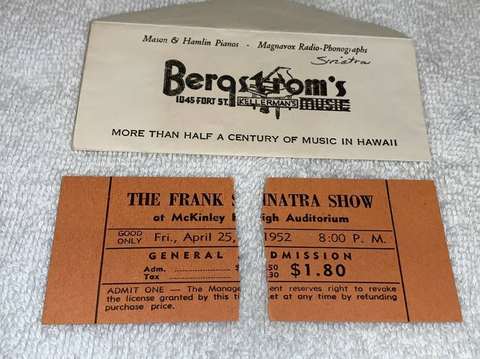
April 26, 1952
Concerts
McKinnley High School, Honolulu, Hawaii (April 24-27)
Also appearing: Dick Buckley (comedian), The Four Jokers (quartet), and Virginia Lee (dancer)
April 27, 1952
Concerts
McKinnley High School, Honolulu, Hawaii (April 24-27)
Also appearing: Dick Buckley (comedian), The Four Jokers (quartet), and Virginia Lee (dancer)
April 28, 1952
Concerts
Barbers Point Naval Air Station, Honolulu, Hawaii
Also appearing: Dick Buckley (comedian), The Four Jokers (quartet), and Virginia Lee (dancer)
April 29, 1952
Concerts
Schofield Barracks, Honolulu, Hawaii
Also appearing: Dick Buckley (comedian), The Four Jokers (quartet), and Virginia Lee (dancer)
Schofield Barracks, Honolulu, Hawaii
Also appearing: Dick Buckley (comedian), The Four Jokers (quartet), and Virginia Lee (dancer)
Review of show at McKinley auditorium on April 25th, second night. Last paragraph states the show would be at Barber's Point (April 28, Schofield (April 29), and Pearl Harbor (April 30)
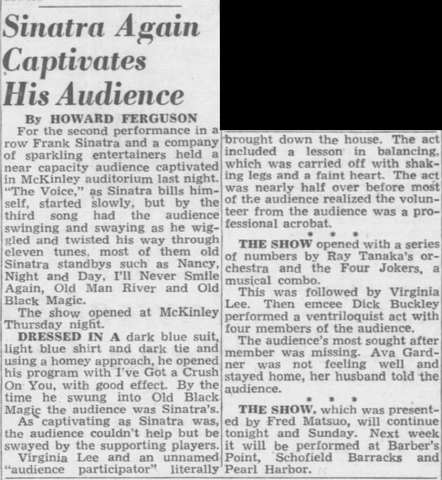
April 30, 1952
Concerts
Naval Station Pearl Harbor, Oahu, Hawaii
Also appearing: Dick Buckley (comedian), The Four Jokers (quartet), and Virginia Lee (dancer)
May 1952
[Cocoanut Grove altercation and miscarriage]
Kaplan: In late May 1952, despite feeling unwell, Ava attended Frank's opening at the Cocoanut Grove in Los Angeles. After he winked at a woman in the audience, they argued, and after drinking heavily Frank slapped her hard enough to send her reeling into a table; she fell and began bleeding. An ambulance took her to Cedars of Lebanon Hospital, where Dr. Leon Krohn discovered she had suffered a miscarriage she hadn't known about.
Source: James Kaplan, "Frank: The Voice" (2010)
May 2, 1952
Concerts
Kauai County Fair, Lihue, Hawaii
Also appearing: Dick Buckley (comedian), The Four Jokers (quartet), and Virginia Lee (dancer)
Kauai County Fair, Lihue, Hawaii
Frank played the fair from 5-2 thru 5-4. He was shocked at the conditions that confronted him. The leaky tent, no orchestra, just a piano. Bill Miller was in the tent with him. Frank looked at Bill with a quizzical should we? Bill nodded yes. Out they went. Frank sat down on the edge of the stage and asked the people what they wanted to hear. The little girl with the leis moved him to tears with the wet kisses on his cheeks. Ava was with him for the two weeks in Hawaii. She was supposed to start a film in Mexico, but skipped out on MGM. They fired her. She laughed and proclaimed they would come crawling back in a few weeks. She was right. Frank read a novel on the plane back and forth from the island. There was a character in the novel he knew better than he knew himself. If they ever made a movie of the book, he wanted to play Maggio. A tumultuous time in the life of Mr. Sinatra.
--Ed
TGIFriday Magazine, August 23, 2013
Hawaii still remembered Sinatra's performance at the Kauai County Fair:
Hollywood on Kauai Frank Sinatra Inspired By Kauai People at County Fair
by Braddah Kimo
Heart-Touching Performance Filled with Aloha Spirit. In the early 1950’s Frank Sinatra made his first visit to the island of Kauai to perform at the Kauai County Fair. A little known story tells of how the visit was inspirational not only for the audience but for “Old Blue Eyes” himself.
At the time, the young star was going through some career difficulties, and apparently he was so inspired by the Kauai people that he felt energized and reinvigorated in his career. This began the star’s comeback to become one of the most famous and loved entertainers ever.
It was April of 1952 when Sinatra was making a few appearances in Honolulu and agreed to help a struggling promoter on Kauai by singing at the Kauai County Fair. The weather was rainy, and the performance tent was old, leaking onto Sinatra’s tux as he walked out to perform.
As recalled by Sinatra’s friend, Honolulu newspaperman Buck Buchwach, Frank said to him, “For just one second, considering the whole situation, I wondered if the show really did have to go on?” That is when Frank took a look out at his Kauai audience of less than 300 people.
“They were not wearing fancy clothes or expensive jewelry,” Frank later said. “They wore color-splattered aloha shirts, jeans, mumus, and such. Homey. And their warmth and friendliness circulated throughout that tent; it smacked me in the face.”
It seemed Old Blue Eyes was so touched by the audience he had gotten all chicken skin! He was moved by the strong Aloha Spirit of the Kauai people!
“When two little brown-skinned girls gave me a couple of hand-made leis and little kisses I almost broke down,” continued Frank.
Just before the final Kauai County Fair show Buchwach had another conversation with Frank Sinatra inside of a vehicle parked outside the show tent.
Buchwach recalled that, “Frank took out a cigarette, and quietly puffed spirals of smoke. Though outside it was still raining, he had changed at his nearby hotel into his finest dress tuxedo, a magnificent shirt, his patent leather shoes, and his favorite ring.”
Buchwach recalled that Frank then went onstage and sang “song after song, hit after hit, maybe twenty. I was stunned. It was, merely, fantastic; it was one thousand percent for several hundred small-town ticket holders with big hearts and hands that grew red from clapping.”
Buchwald said that Frank had tears in his eyes when he said to him, “Buck, I sang the best I know how. Those people deserved it. It’s a night I’ll never forget.”
“Tonight,” Frank continued, “marks the first night on the way back. I can feel it in every bone.”
Frank Sinatra returned to Kauai in April of 1964 to film None But the Brave about U.S. Marines who crash landed on a Japanese-controlled Pacific island during World War II. Frank stayed at the Coco Palms and filming took place at Pila’a Beach.
One day on Kauai Frank was visiting Wailua Beach across from the Coco Palms and he noticed the producer’s wife in trouble in the ocean where the currents had carried her out. He quickly swam to assist her and was pulled out to sea himself while she somehow got to shore.
Some twenty minutes later help arrived and pulled Sinatra from the water as he was turning blue and an ambulance arrived. Sinatra missed the next day of filming the movie but he was okay after quite a scare.
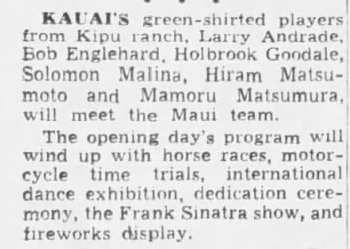
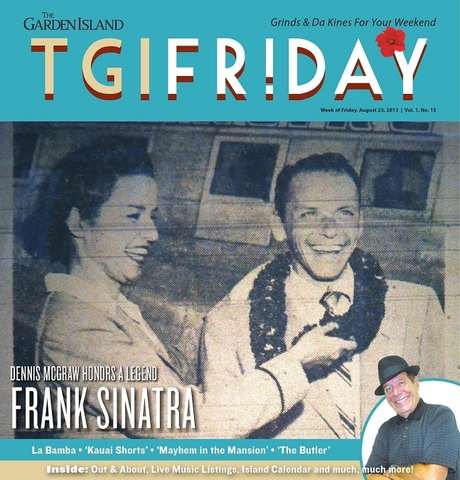
May 3, 1952
Concerts
Kauai County Fair, Lihue, Hawaii (May 2-4)
Also appearing: Dick Buckley (comedian), The Four Jokers (quartet), and Virginia Lee (dancer)
May 4, 1952
Concerts
Kauai County Fair, Lihue, Hawaii (May 2-4)
Also appearing: Dick Buckley (comedian), The Four Jokers (quartet), and Virginia Lee (dancer)
May 9, 1952
Television
Al Jarvis Show, Los Angeles, CA
Guest: Frank Sinatra
May 12, 1952
Television
Peter Potter Show
KNXT Los Angeles, California
Guest: Frank Sinatra
[image referenced in source but could not be recovered]
Peter Potter Show
KNXT Los Angeles, California
Guest: Frank Sinatra
[image referenced in source but could not be recovered]
May 15, 1952
Concerts
Coconut Grove, Ambassador Hotel, Los Angeles, CA (May 15-June 4) with the Eddie Bergman Band
Coconut Grove, Ambassador Hotel, Los Angeles, CA (May 15-June 4) with the Eddie Bergman Band
Billboard Review:
Billboard May 31, 1952
Opening night:
-------------------------------------------------------
© 1997-2026 The Sinatra Archive
This calendar, or any parts thereof, may not be reproduced in any fashion whatsoever without the prior written permission of the publisher (The Sinatra Archive)
__._,_.___
May 16, 1952
Television
Bob McLaughlin Show
KLAC Los, Angeles, CA
Guest: Frank Sinatra
Concerts
Coconut Grove, Ambassador Hotel, Los Angeles, CA (May 15-June 4) with the Eddie Bergman Band
Bob McLaughlin Show
KLAC Los, Angeles, CA
Guest: Frank Sinatra
Some early photos of Sinatra and Bob McLaughlin:
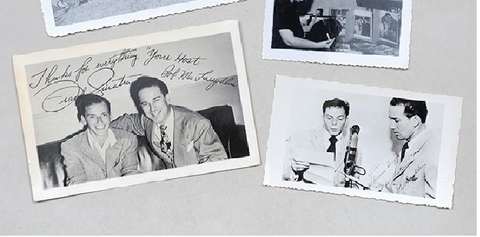
Coconut Grove, Ambassador Hotel, Los Angeles, CA (May 15-June 4)
with the Eddie Bergman Band
© 1997-2026 The Sinatra Archive
This calendar, or any parts thereof, may not be reproduced in any fashion
whatsoever without the prior written permission of the publisher (The
Sinatra Archive)
__._,_.___
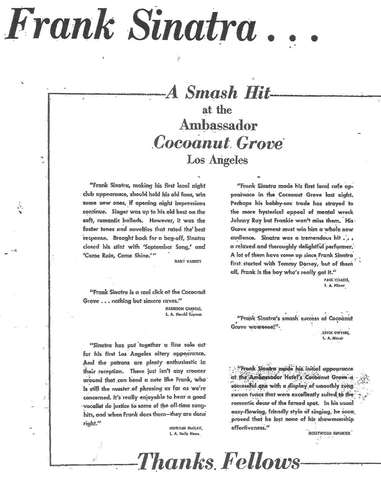
May 17, 1952
Concerts
Coconut Grove, Ambassador Hotel, Los Angeles, CA (May 15-June 4) with the Eddie Bergman Band
May 18, 1952
Concerts
Coconut Grove, Ambassador Hotel, Los Angeles, CA (May 15-June 4)
Time: 9:45 P.M.
Eddie Bergman band, Allen Reuss (Guitar)
Among the songs:
I've Got The World On A String (arr. George Siravo)
Lover Birth Of The Blues
All Of Me
Wild Goose / Mule Train parody
May 19, 1952
Concerts
Coconut Grove, Ambassador Hotel, Los Angeles, California (15-27)
Time: 9:45 P.M.
Eddie Bergman band, Allen Reuss (Guitar)
Among the songs:
I've Got The World On A String (arr. George Siravo)
Lover Birth Of The Blues
All Of Me
Wild Goose / Mule Train parody
May 20, 1952
Concerts
Coconut Grove, Ambassador Hotel, Los Angeles, California (15-27)
Time: 9:45 P.M.
Eddie Bergman band, Allen Reuss (Guitar)
Among the songs:
I've Got The World On A String (arr. George Siravo)
Lover Birth Of The Blues
All Of Me
Wild Goose / Mule Train parody
May 21, 1952
Concerts
Coconut Grove, Ambassador Hotel, Los Angeles, California (15-27)
Time: 9:45 P.M.
Eddie Bergman band, Allen Reuss (Guitar)
Among the songs:
I've Got The World On A String (arr. George Siravo)
Lover Birth Of The Blues
All Of Me
Wild Goose / Mule Train parody note: Frank also sang the following songs:
I'll Walk Alone
When You're Smiling ( Siravo chart )
Someone To Watch Over Me
I've Got A Crush On You
I'll Never Smile Again
You Made Me Love You ( parody tribute to Judy Garland ) Come Rain Or Come Shine
September Song
May 22, 1952
Concerts
Coconut Grove, Ambassador Hotel, Los Angeles, California (May 15-June 4)
Time: 9:45 P.M.
Eddie Bergman band, Allen Reuss (Guitar)
Among the songs:
I've Got The World On A String (arr. George Siravo)
Lover Birth Of The Blues
All Of Me
Wild Goose / Mule Train parody
May 23, 1952
Concerts
Coconut Grove, Ambassador Hotel, Los Angeles, California (May 15-June 4)
Time: 9:45 P.M.
Eddie Bergman band, Allen Reuss (Guitar)
Among the songs:
I've Got The World On A String (arr. George Siravo)
Lover Birth Of The Blues
All Of Me
Wild Goose / Mule Train parody
May 24, 1952
Television
Celebrity Parade for Cerebral Palsy (May 24-25), Los Angeles Bob Hope, Frank Sinatra, Eddie Cantor, the Bell Sisers, Gene Autry, Rudy Vallee, Rosemary Clooney, Zsa Zsa Gabor and others
Concerts
Coconut Grove, Ambassador Hotel, Los Angeles, California (May 15-June 4)
Time: 9:45 P.M.
Eddie Bergman band, Allen Reuss (Guitar)
Among the songs:
I've Got The World On A String (arr. George Siravo)
Lover Birth Of The Blues
All Of Me
Wild Goose / Mule Train parody
Celebrity Parade for Cerebral Palsy (May 24-25), Los Angeles
Bob Hope, Frank Siantra, Eddie Cantor, the Bell Sisers, Gene Autry, Rudy Vallee, Rosemary Clooney, Zsa Zsa Gabor and others
The following image references being from “Frank Sinatra, band appearing on the Walt Disney Radio Cerebral Palsy Telethon.”
Apparently it’s from May of 1952. I assume it’s the same event. I have found another image of Jack Benny from the same event (see below)
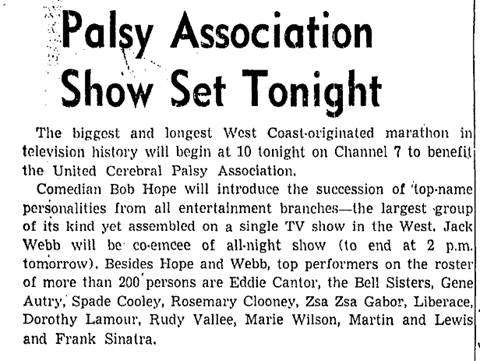
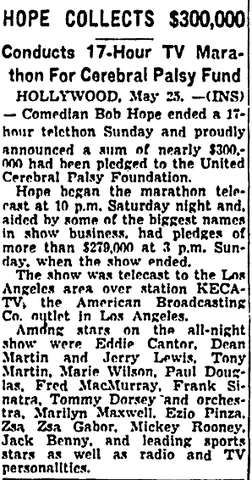
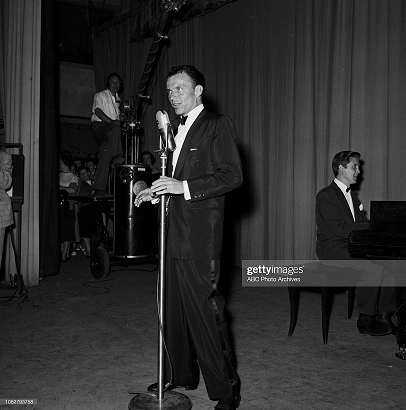
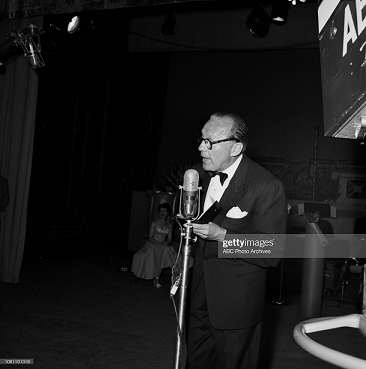
May 25, 1952
Concerts
Coconut Grove, Ambassador Hotel, Los Angeles, California (May 15-June 4)
Time: 9:45 P.M.
Eddie Bergman band, Allen Reuss (Guitar)
Among the songs:
I've Got The World On A String (arr. George Siravo)
Lover Birth Of The Blues
All Of Me
Wild Goose / Mule Train parody
May 26, 1952
Concerts
Coconut Grove, Ambassador Hotel, Los Angeles, California (May 15-June 4)
Time: 9:45 P.M.
Eddie Bergman band, Allen Reuss (Guitar)
Among the songs:
I've Got The World On A String (arr. George Siravo)
Lover Birth Of The Blues
All Of Me
Wild Goose / Mule Train parody
May 27, 1952
Concerts
Coconut Grove, Ambassador Hotel, Los Angeles, California (May 15-June 4)
Time: 9:45 P.M.
Eddie Bergman band, Allen Reuss (Guitar)
I've Got The World On A String (arr. George Siravo)
I'll Walk Alone
Lover
Birth Of The Blues
All Of Me
Wild Goose / Mule Train parody trib to Frankie Laine
I'll Never Smile Again
I've Got A Crush On You
Someone To Watch Over Me
You Made Me Love You ( parody tribute to Judy Garland
September Song
Come Rain Or Come Shine
May 28, 1952
Concerts
Coconut Grove, Ambassador Hotel, Los Angeles, California (May 15-June 4)
Time: 9:45 P.M.
Eddie Bergman band, Allen Reuss (Guitar)
Among the songs:
I've Got The World On A String (arr. George Siravo)
Lover Birth Of The Blues
All Of Me
Wild Goose / Mule Train parody
May 29, 1952
Concerts
Coconut Grove, Ambassador Hotel, Los Angeles, California (May 15-June 4)
Time: 9:45 P.M.
Eddie Bergman band, Allen Reuss (Guitar)
Among the songs:
I've Got The World On A String (arr. George Siravo)
Lover Birth Of The Blues
All Of Me
Wild Goose / Mule Train parody
May 30, 1952
Concerts
Coconut Grove, Ambassador Hotel, Los Angeles, California (May 15-June 4)
Time: 9:45 P.M.
Eddie Bergman band, Allen Reuss (Guitar)
Among the songs:
I've Got The World On A String (arr. George Siravo)
Lover Birth Of The Blues
All Of Me
Wild Goose / Mule Train parody
May 31, 1952
Concerts
Coconut Grove, Ambassador Hotel, Los Angeles, California (May 15-June 4)
Time: 9:45 P.M.
Eddie Bergman band, Allen Reuss (Guitar)
Among the songs:
I've Got The World On A String (arr. George Siravo)
Lover Birth Of The Blues
All Of Me
Wild Goose / Mule Train parody
June 1952
With his career at its lowest ebb — a recent Chez Paree engagement in Chicago had drawn only 150 people to a room that seated 1,200 — Frank Sinatra was dropped by both Columbia Records and his talent agency, MCA, in the same month. Around this same period, he began lobbying hard for the role of Private Angelo Maggio in the film adaptation of James Jones's From Here to Eternity, telling Ava Gardner, “I know if I can get this part, I can hit a home run... I am Maggio.” Columbia Pictures chief Harry Cohn initially waved him off — even after Frank offered to take the role for just $1,000 a week, a fraction of his old $150,000 film fee — telling him bluntly, “You're out of your mind.” Source: J. Randy Taraborrelli, Sinatra: Behind the Legend.
[Sinatra's last West Coast Columbia session]
Kaplan: In early June 1952, Frank recorded five songs at Columbia's Hollywood studios in what would be his third of only four recording dates that year and his last West Coast session for the label, with Mitch Miller flying out to attend despite the two men being on the coolest possible terms.
Source: James Kaplan, "Frank: The Voice" (2010)
June 2, 1952
Concerts
Coconut Grove, Ambassador Hotel, Los Angeles, California (May 15-June 4)
Time: 9:45 P.M.
Eddie Bergman band, Allen Reuss (Guitar)
Among the songs:
I've Got The World On A String (arr. George Siravo)
Lover Birth Of The Blues
All Of Me
Wild Goose / Mule Train parody
June 3, 1952
Studio
Hollywood
RHCO10178 Luna Rossa (Blushing Moon) w/The Norman Luboff Choir
(K. Goell/V. De Crescenzo/A. Vian)
Bergman, Vocco & Conn (ASCAP) 1951
Arranged & Conducted by Axel Stordahl
-1 (2:40) CD: Columbia Years 43-52 Vol. 12
LP: CL-1359 Come Back To Sorrento
78: 39787
RHCO10179 The Birth Of The Blues
(B. DeSylva/L. Brown/R. Henderson)
(from George White's Scandals)
T. B. Harms, Inc. (ASCAP) 1926
Arranged by Heinie Beau
Conducted by Axel Stordahl
-1 (3:27) CD: Columbia Years 43-52 Vol. 12
LP: C6X-40343 The Voice-The Columbia Years, 43-52
LP: C2L-6 Frank Sinatra Story In Music
LP: CL-2741 The Essential Frank Sinatra, Vol.. 3
78: 50028
78: 39882
Dick Bellach (2014):
By the way, there is a fine alternate take available of "Birth of the Blues" in the Radio Spirits Frank Sinatra box (Disc 14). Same big band arrangement but clearly a different vocal well worth hearing.
I just replayed this for the first time in a very long while and amen the above comment. Marvellous vocal.
(past years comp.)
NOTE: Sinatra Scholar Ed O'Brien points out that one could make a convincing argument that "Birth of the Blues" was the recording that started the Sinatra train rolling. It is simply sensational. Heine Beau's chart offers terrific support and Sinatra showed the world how great a swing singer he had become. He sang the song in concert, on radio, and TV. Always a highlight of any Sinatra performance in the 1950's.
VANCE ADAIR add:
There is something decidedly different that is detectable in the voice of Birth of the Blues. Indeed a harbinger of the extraordinary things that were to come....
Ed Spiegel shared his story:
Sinatra's "Birth of the Blues" (June 3, 1952), is an underappreciated milestone in his career. Like no other recording, it signaled the change from innocent boy crooner and teen idol of "Anchors Away" and "It Happened in Brooklyn" and his hundreds of mostly superb recordings from 1939 the early '50's. His career was in the doldrums, the details of which have been covered in hundreds of sources Then came the dynamic Sinatra with hormones with Frank singing this bluesy number in great voice with a brassy arrangement by Heinie Beau (credited at the time to Axel Stordahl). A killer record and it sold pretty well. But the wise executives at Columbia had already decided that Frank Sinatra was through and he only sang on one more session at Columbia 3 months later.
My own experience of this recording: I was a kid watching the Jimmy Durante TV show on a Saturday night. We didn't have a TV set, I was in front of an appliance store window where the show was playing. I loved Durante and he introduced this fellow, Sinatra. If my memory is accurate, they cut to the back of a man's head, he quickly turned, it was Sinatra, the arrangement we all know now was playing and he opened in our face with the song's verse. At the time I had no interest in music, had never bought a record. In those less commercial days, no stores were open on Sunday, so on Monday, I went downtown, bought the 45 RPM record and played it over and over till my mother threatened to break it. Been a fan ever since.
Ten months later, Sinatra and Riddle would refine that approach beginning with their first recordings, "I've Got the World on a String" and "Don't Worry About Me." I know of quite a few people who were first turned on to Sinatra's singing by that record. Robin Douglas-Home says so in the first page of his excellent book, "Sinatra." Jonathan Schwartz has also mentioned his similar experience of the recording. I sure would like a DVD of the kinescope to that Durante TV show.
Mary Jane Smetanka added:
I agree that it's an amazing recording, a bridge between the beautiful voice of the 1940s and the tougher, more assertive Sinatra of the 1950s.
I love the drawn-out "Ohhhhh" at the beginning where his vibrato quickens but the voice pulls back and softens and without taking a breath he moves into "They say some people long ago" It's remarkable story telling through music, with the voice reinforcing the meaning behind the words.
RHCO10180 Azure-Te ( Paris Blues)
(D. Wolf/B. Davis )
Gale & Gayles, Inc. (BMI) 1952
Arranged & Conducted by Axel Stordahl
-1 (2:33) CD: Columbia Years 43-52 Vol. 12
LP: C2X-40897 Hello Young Lovers
LP: CL-2741 The Essential Frank Sinatra, Vol. 3
78: 39819
RHCO10181 Tennessee Newsboy (The Newsboy Blues)
(D. Manning/P. Faith)
Leo Talent, Inc. (ASCAP) 1952
Arranged & Conducted by Axel Stordahl
-1 (2:34) CD: Columbia Years 43-52 Vol. 12
78: 39787
RHCO10190 Bim Bam Baby
(S. Mysels)
George Paxton, Inc. (ASCAP) 1952
Arranged & Conducted by Axel Stordahl
-1 (2:20) CD: Columbia Years 43-52 Vol. 12
CD: 044236 Sinatra Rarities
LP: CL-1241 Love Is A Kick
78: 39819
RHCO10178 & 10179 Trumpets: J. Best, C. Gozzo, R. Zarchy; Trombones: G. Arus, R. Noel, J. Priddy; Saxes: T. Nash, L. Robinson, B. Russin, F. Stulce; Piano: W. Miller; Guitar: A. Reuss; Bass: J. Ryan; Drums: J. Siracusa RHCO10180, 10181 & 10190 Trumpets: J. Best, C. Gozzo, R. Zarchy; Trombones: G. Arus, R. Noel, J. Priddy; Saxes: C. Gentry, T. Nash, L. Robinson, B. Russin, F. Stulce; Piano: B. Miller; Guitar: A. Reuss; Bass: J. Ryan; Steel Guitar: W. West; Drums: J. Siracusa, A. Stoller
Mitch Miller flew out to Hollywood for this session. He wasn't really interested in Frank doing "Birth Of Blues." Mitch was sold on a little ditty titled "Tennessee Newsboy." Mitch had put together an 11 piece orchestra for the last three songs of the session. The centerpiece was steel guitarist Wesley "Speedy" West, who was famous for making his guitar sound like a chicken. Frank, who had the right to turn down any tune, was on board for this attempt at a hit record. He owed Columbia a lot of money and desperately needed a big seller. This was Alvin Stoller's first session with Sinatra. A fabulous drummer, Stoller remembered "Birth Of The Blues," but did not recall, during our conversation, Mitch's choices for Frank. He did remember the tension in the room between the two men. Alvin would later back Frank on some great recordings. After the final take on "Tennessee Newsboy," Miller rushed past Sinatra and embraced Speedy for creating such a great chicken sound. One can only imagine what Frank was thinking at that moment.
"Newsboy" was the A side of a 78 and 45 release from Columbia. "Luna Rossa" was the flip side. Neither song charted. "Bim Bam Baby" and "Azure-Te came out on another single. The former reached #20 and the latter charted for one week at #30. Frank would feature "Bim Bam" on his 11-6-53 Perfectly Frank radio show.
"Birth Of The Blues" reached #19 as a single and was on the charts for five weeks.
You will notice on both records that Columbia does not credit Heinie Beau for his marvelous arrangement.
promo:
78 release:
--Ed
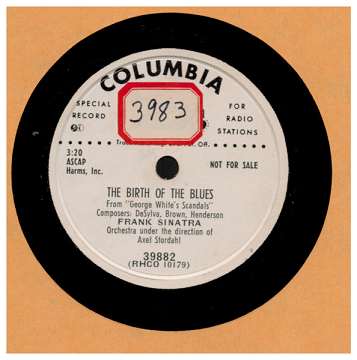
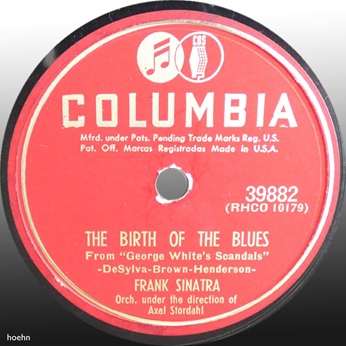
Concerts
Coconut Grove, Ambassador Hotel, Los Angeles, California (May 15-June 4)
Time: 9:45 P.M.
Eddie Bergman band, Allen Reuss (Guitar)
Among the songs:
I've Got The World On A String (arr. George Siravo)
Lover Birth Of The Blues
All Of Me
Wild Goose / Mule Train parody
"Tennessee Newsboy"
Paul Weston; Frank Sinatra: Paul Weston recalled Mitch Miller bringing in country guitarist Wesley 'Speedy' West, famous for making his guitar mimic a chicken, for 'Tennessee Newsboy.' After Sinatra nailed the vocal, Miller rushed past him to congratulate West instead: 'he'd made a good chicken noise on the guitar.' Sinatra remembered the session mainly for Miller bringing in Spike Jones percussionist Joe Siracusa to play washboard; per Weston, Sinatra reacted with, 'Mitch, really? A washboard?' Ted Nash contributed a strong tenor sax solo on the otherwise-maligned track.
Source: Will Friedwald, "Sinatra! The Song Is You: A Singer's Art" (2018 revised edition).
"Tennessee Newsboy"
Paul Weston: West Coast Columbia A&R director Paul Weston, producing one of Sinatra's penultimate label sessions, recalled recording the novelty song 'Tennessee Newsboy' with guitarist Speedy West (known for making his guitar sound like a chicken); after Sinatra completed a good vocal take, Miller rushed past him to instead congratulate West on his chicken-noise guitar effect, visibly disgusting Sinatra.
Source: Charles L. Granata, "Sessions with Sinatra: Frank Sinatra and the Art of Recording" (1999/2003).
[Luna Rossa / Birth of the Blues / Bim! Bam! Baby! -- critical commentary]
Paul Weston; Friedwald (analysis): Friedwald calls June 3, 1952 'a date that encapsulates all the highs and lows of Sinatra's in-between years in a single session' -- the first date with drummer Alvin Stoller and only the second with pianist Bill Miller, with Mitch Miller personally dominating despite Stordahl and Paul Weston nominally in charge. Weston recalled Sinatra 'going through a very tough time with his voice... it was very difficult for him to even get through a three-minute vocal.' 'Luna Rossa,' a dramatic semiclassical number, 'gets nowhere.' Heinie Beau's brash arrangement of 'Birth of the Blues' -- a chart Friedwald says 'could accompany Blaze Starr' -- and 'Bim! Bam! Baby!' both demonstrate, in Friedwald's view, how essential Nelson Riddle's later brassy-but-subtle style would prove; Sinatra pushes an aggressively nasty vocal sound here that Friedwald compares to his 1966 'That's Life.' A footnote records that in a 1959 TV appearance Sinatra credited Manie Sachs with pushing him to do 'Birth of the Blues,' calling it the song that started turning his career around -- a claim Friedwald deems dubious.
This song/context matches multiple dated entries in the chronology; the specific date Friedwald is referring to could not be determined with confidence.
Source: Will Friedwald, "Sinatra! The Song Is You: A Singer's Art" (2018 revised edition), Ch. 5, "In-Between Years" (1948-1953)
[The Birth of the Blues -- critical commentary]
Granata includes 'The Birth of the Blues' among the fifty recordings he considers essential to understanding Sinatra's artistry (arranged by Heinie Beau, recorded 1952, Columbia); the song was chosen for its musical/interpretive value rather than commercial popularity.
This song/context matches multiple dated entries in the chronology, or lacked a sufficiently precise date; the specific date could not be determined with confidence.
Source: Charles L. Granata, "Sessions with Sinatra: Frank Sinatra and the Art of Recording" (1999/2003), Afterword & Appendices A-D
[The Birth of the Blues / I'm a Fool to Want You -- critical commentary]
Granata contrasts Sinatra's confident, snarly 'The Birth of the Blues' with the stark, desolate 'I'm a Fool to Want You,' arguing both late-Columbia recordings disprove the idea that Sinatra had lost his vocal edge and instead point toward the artistic rebirth that would come with Nelson Riddle a year later.
This song/context matches multiple dated entries in the chronology, or lacked a sufficiently precise date; the specific date could not be determined with confidence.
Source: Charles L. Granata, "Sessions with Sinatra: Frank Sinatra and the Art of Recording" (1999/2003), Part II: The Columbia Years, 1943-1952
June 4, 1952
Concerts
Coconut Grove, Ambassador Hotel, Los Angeles, California (May 15-June 4)
Time: 9:45 P.M.
Eddie Bergman band, Allen Reuss (Guitar)
Among the songs:
I've Got The World On A String (arr. George Siravo)
Lover Birth Of The Blues
All Of Me
Wild Goose / Mule Train parody
June 5, 1952
Concerts
Chez Paree, Chicago, Illinois (5-14)
CHEZ PAREE, CHICAGO
( Thursday, June 5 )
Capacity, 500. Price policy, $1.10 cover with
$3.50 minimum. Shows at 8:30, 12 and 2.
Operator, Dave Halper. Publicity, Bob Curley.
Booking policy, non-exclusive. Estimated budget this show, $8,000. Estimated budget last show, $7,500.
Chez Paree, Chicago, Illinois (5-14)
Chicago Tribune
June 9, 1952 note: Sinatra, the "strangely dated" performer, was definitely having a tough time in the late spring of 1952. Some nights he was singing to 100 to 150 people at the Chez Paree. But this career obit was a tad premature. Ed
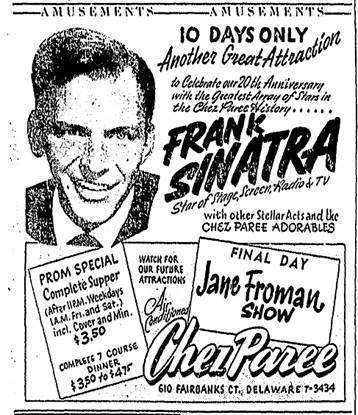
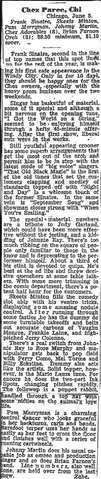
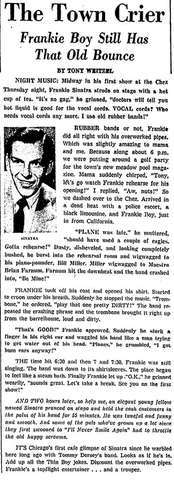
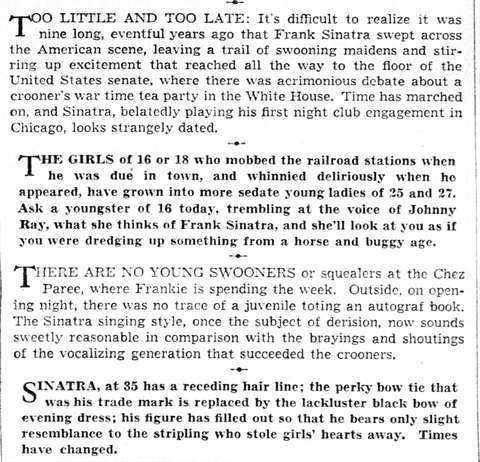
June 6, 1952
Concerts
Chez Paree, Chicago, Illinois (5-14)
June 7, 1952
Concerts
Chez Paree, Chicago, Illinois (5-14)
June 8, 1952
Concerts
Chez Paree, Chicago, Illinois (5-14)
June 9, 1952
Concerts
Chez Paree, Chicago, Illinois (5-14)
Chez Paree, Chicago, Illinois (5-14)
June 9, 1952: "Time has marched on"
By the summer of 1952, when Sinatra came back to Chicago for a week at the Chez Paree, the mayhem has subsided. Except for two brief Knights of Columbus events in 1946 and '47 and a benefit at the Opera House in 1950, it was his first major Chicago appearance in six years. The Chez Paree had the kind of old-fashioned, velvety swank you see only in 1940s movies now. The adult nightclub setting accommodated around 900 and offered dinner, dancing, and floor shows featuring the biggest stars in show business. It was Sinatra's natural habitat a smallish saloon where the intimaacy of the performance correlated to the space it occupiedbut he waas in a slump. Columbia Records and MCA had dropped him that summer, and the crowds weren't coming.
Chicago columnists covered his Chez Paree stand as if he were a nostalgia act. "It's difficult to realize it was nine years ago that Frank Sinatra swept across the American scene," wrote Will Leonard in the Tower Ticker. "Time has marched on, and Sinatra looks strangely dated. Ask a youngster of 16 today what she thinks of Sinatra and she'll look at you as if you were dredging up something from the horse-and-buggy age. Outside [the Chez] on opening night there was no trace of a juvenile toting an autograph book. Times have changed." It would be another 10 years before Chicago would see Sinatra again, but when it did, he would be the coolest man in the world.
note: Frank did all right during the weekend but only average 150 patrons during the week.
a room that accommodated 1200
June 9, 1953 - London, England
Singer and actor FRANK SINATRA and wife AVA GARDNER watch a boxing match between R. Turpin and C. Humez at White City
Stadium
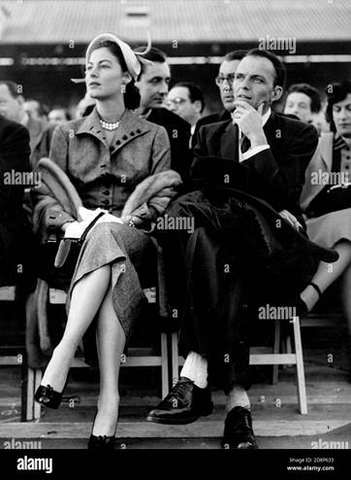
June 10, 1952
Concerts
Chez Paree, Chicago, Illinois (5-14)
June 11, 1952
Concerts
Chez Paree, Chicago, Illinois (June 5-14)
June 12, 1952
Concerts
Chez Paree, Chicago, Illinois (June 5-14)
June 13, 1952
Concerts
Chez Paree, Chicago, Illinois (June 5-14)
June 14, 1952
Concerts
Chez Paree, Chicago, Illinois (June 5-14)
Chicago Stadium, Chicago
Night of Stars Benefit to aid Italian Welfare Council
Frank Sinatra, Jimmy Durante, Tony Bennett, Johny Desmond
Chicago Stadium, Chicago
Night of Stars Benefit to aid Italian Welfare Council
Frank Sinatra, Jimmy Durante, Tony Bennett, Johny Desmond
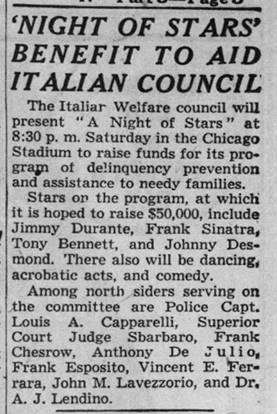
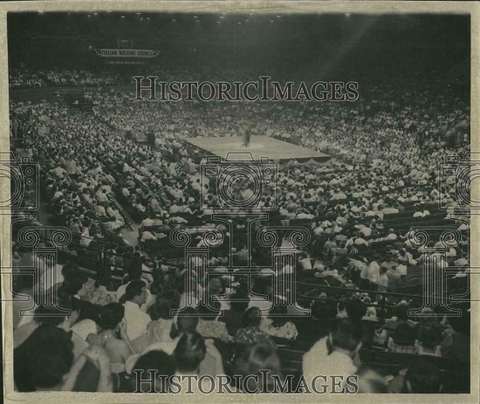
June 21, 1952
Radio
"Let's Finish The Job"
KLAC Remote
Shrine Auditorium, Los Angeles
Olympic Team Fundraiser
Frank Sinatra, Dean Martin, Jerry Lewis, Jane Russell, Kay Star, Liberace, June Christie and others Hosted by Big Five Disc Jockeys of KLAC
Television
June 21-22, 1952
Bing Crosby-Bob Hope Telethon For 1952 Olympic Team
Saturday - Sunday
8:00 p.m. - 10-30 a.m. PDT
NBC & CBS Dual Broadcast
El Captain Theater
Hollywood
Guests:
Bud Abbott and Lou Costello. Spike Jones and his orchestra. Humphrey Bogart. Marilyn Monroe. George Burns and Gracie Allen. June Allyson. Eddie "Rochester" Anderson. Rosemary Clooney. Joan Crawford. Tony Curtis. Janet Leigh. Zsa Zsa Gabor. Dean Martin and Jerry Lewis. Margaret O'Brien. Edgar Bergen. Tex Ritter. Edward G. Robinson. Frank Sinatra. Ed Sullivan. Johnny Weismuller, Johnny Grant, Dorothy Lamour, Sonny Tufts, Fred MacMurray, The Three Stooges, California Governor, Earl Warren and many more
Ed O'Brien:
The Crosby-Hope 14 and 1/2 hour telethon was viewed by an estimated audience of 50 million. A whopping million plus dollars was pledged but only $353,000 was actually collected. New York Times review praised Bing and Bob but faulted the pacing of the show. There is a 13 minute video excerpt of Martin & Lewis available on YouTube. I've been told the entire show survived and is hidden away somewhere.
Concerts
Shrine Auditorium, Los Angeles
Olympic Team Fundraiser
Frank Sinatra, Dean Martin, Jerry Lewis, Jane Russell, Kay Star, Liberace, June Christie and others Hosted by Big Five Disc Jockeys of KLAC Radio
Shrine Auditorium, Los Angeles
Olympic Team Fundraiser
Frank Sinatra, Dean Martin, Jerry Lewis, Jane Russell, Kay Star, Liberace, June Christie and others Hosted by Big Five Disc Jockeys of KLAC
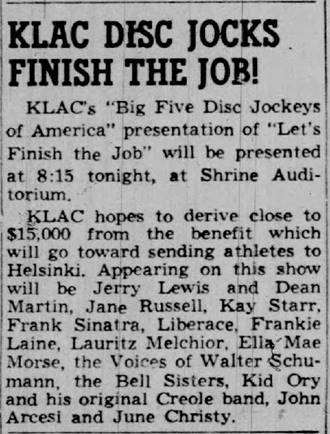
June 29, 1952
Concerts
Biltmore Hotel, Los Angeles, CA
Friars Club honors Judy Garland
Sinatra sang a parody of “You Made Me Love You”
Biltmore Hotel, Los Angeles, CA
Friars Club honors Judy Garland
Sinatra sang a parody of “You Made Me Love You”
Variety
7-2-52
June 29, 1952:
Judy was honored by The Friars Club at the Biltmore Hotel in Los Angeles. She was only the second woman in the Friar's fifty-year history to be honored with a testimonial evening, Sophie Tucker was the first.
Judy sang the "Judy At The Palace" medley and
"Over The Rainbow" to end the festivities.
[image referenced in source but could not be recovered]
[image referenced in source but could not be recovered]
[image referenced in source but could not be recovered]
[image referenced in source but could not be recovered]
[image referenced in source but could not be recovered]
[image referenced in source but could not be recovered]
[image referenced in source but could not be recovered]
[image referenced in source but could not be recovered]
Biltmore Hotel, Los Angeles, CA
Friars Club honors Judy Garland
Sinatra sang a parody of “You Made Me Love You”
Variety
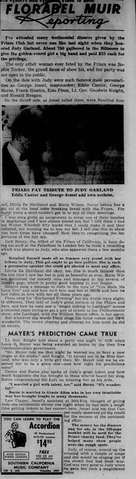
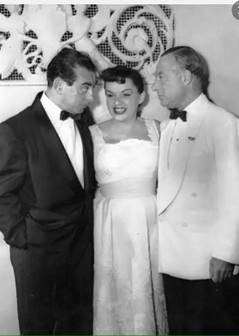
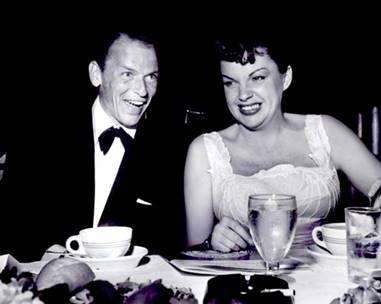
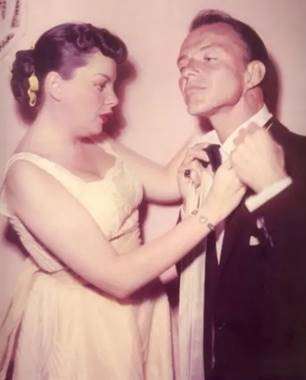
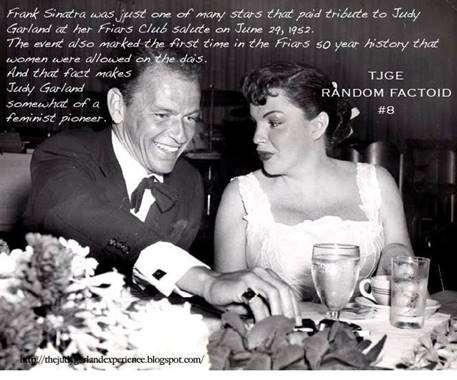
July 1952
[A Ghost-Written Hearst 'Confession' Sinatra Denied Writing]
Nancy Sinatra: Hearst's American Weekly ran a two-part series bylined by Sinatra explaining his breakup with Nancy and defending himself against political accusations; decades later, asked whether he'd written it, Frank called it complete fabrication.
Source: Nancy Sinatra, Frank Sinatra: An American Legend, 1995.
[Frankly Speaking ghostwritten apologia published]
Kaplan: In two July 1952 issues of Hearst's American Weekly, a ghostwritten two-part article titled "Frankly Speaking" ran under Sinatra's byline, written by publicist Irving Fein. The piece painted Frank as contrite, blamed his own rough Hoboken childhood for early petty theft, defended his conduct during the Nancy divorce, and closed with an uncharacteristically humble apology.
Source: James Kaplan, "Frank: The Voice" (2010)
July 8, 1952
Concerts
Desert Inn, Las Vegas (July 8 - July 27)
July 9, 1952
Concerts
Desert Inn, Las Vegas (July 8 - 27)
July 10, 1952
Concerts
Desert Inn, Las Vegas (July 8 - 27)
July 11, 1952
Concerts
Desert Inn, Las Vegas (July 8 - 27)
July 12, 1952
Concerts
Desert Inn, Las Vegas (July 8 - 27)
July 13, 1952
Concerts
Desert Inn, Las Vegas (July 8 - 27) with Bill Miller
Carlton Hayes Orchestra
July 14, 1952
Concerts
Desert Inn, Las Vegas (July 8 - 27) with Bill Miller
Carlton Hayes Orchestra
July 15, 1952
Concerts
Desert Inn, Las Vegas (July 8 - 27) with Bill Miller
Carlton Hayes Orchestra
July 17, 1952
Concerts
Desert Inn, Las Vegas (July 8 - 27) with Bill Miller
Carlton Hayes Orchestra
July 18, 1952
Concerts
Desert Inn, Las Vegas (July 8 - 27)
July 19, 1952
Concerts
Desert Inn, Las Vegas (July 8 - 27) with Bill Miller
Carlton Hayes Orchestra
July 20, 1952
Concerts
Desert Inn, Las Vegas (July 8 - 27) with Bill Miller
Carlton Hayes Orchestra
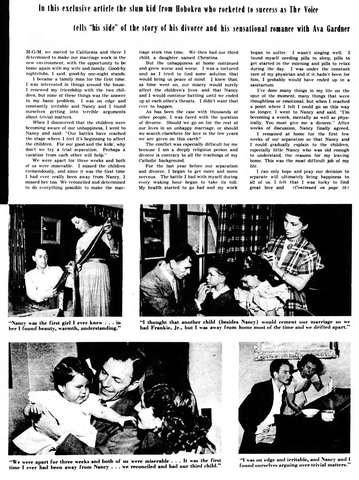
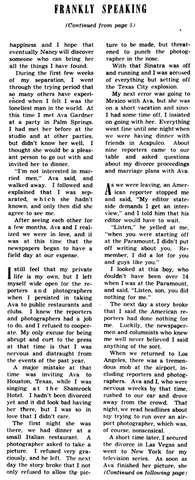

July 21, 1952
Concerts
Desert Inn, Las Vegas (July 8 - 27)
July 22, 1952
Concerts
Desert Inn, Las Vegas (July 8 - 27)
July 23, 1952
Concerts
Desert Inn, Las Vegas (July 8 - 27)
July 24, 1952
Concerts
Desert Inn, Las Vegas (July 8 - 27) with Bill Miller
Carlton Hayes Orchestra
July 25, 1952
Concerts
Desert Inn, Las Vegas (July 8 - 27) with Bill Miller
Carlton Hayes Orchestra
July 26, 1952
Concerts
Desert Inn, Las Vegas (July 8-27)
July 27, 1952
Concerts
Desert Inn, Las Vegas (July 8 - 27)
August 17, 1952
Concerts
Casino de Paris, Lake Tahoe, Nevada (17-23)
Frank Sinatra plus a glamorous Parisian floor show
Casino de Paris, Lake Tahoe, Nevada (17-23)

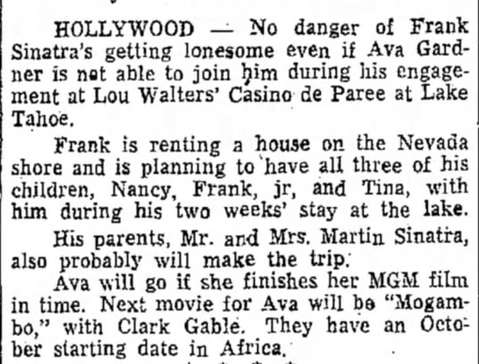
August 18, 1952
Concerts
Casino de Paris, Lake Tahoe Nevada (17-23)
Frank Sinatra plus a glamorous Parisian floor show
August 19, 1952
Concerts
Casino de Paris, Lake Tahoe Nevada (17 – 23)
Frank Sinatra plus a glamorous Parisian floor show
August 20, 1952
Concerts
Casino de Paris, Lake Tahoe Nevada (17 23)
Frank Sinatra plus a glamorous Parisian floor show
August 21, 1952
Concerts
Casino de Paris, Lake Tahoe Nevada (17 23)
Frank Sinatra plus a glamorous Parisian floor show
August 22, 1952
Concerts
Casino de Paris, Lake Tahoe Nevada (17-23)
Frank Sinatra plus a glamorous Parisian floor show
August 23, 1952
Concerts
Casino de Paris, Lake Tahoe Nevada (17-23)
Frank Sinatra plus a glamorous Parisian floor show
September 1952
[Ava walks out over Marilyn Maxwell]
Kaplan: That night at the Riviera, Ava spotted Marilyn Maxwell at ringside while Frank sang toward her; Ava stormed out mid-song, returned to the Hampshire House, removed her wedding ring, left it with a bitter note, packed, and flew to Los Angeles the next morning, leaving Frank the hotel bill.
Source: James Kaplan, "Frank: The Voice" (2010)
[Ava's 'whorehouse' quip]
Ava Gardner: After the recording session, Billy Grimes and Frank returned to the Hampshire House, where Ava greeted them by joking they must have been at a whorehouse; Billy protested he'd been at the opera, prompting more teasing from Ava.
Source: James Kaplan, "Frank: The Voice" (2010)
[Earl Wilson's Hampshire House interview]
Earl Wilson: The day after the premiere, columnist Earl Wilson visited the Sinatras for a late 'breakfast' around 2 p.m. Ava, in silk pajamas and sucking a lollipop, told him they'd be married a full year on November 7 and said she was ready for a family, possibly while in Africa; Frank listened to a ballgame in the next room. Ava also mentioned chest pains from a recent fall in Hollywood.
Source: James Kaplan, "Frank: The Voice" (2010)
[Frank's $100 gift to Billy Grimes]
Billy Grimes: As Billy Grimes prepared to return to North Carolina, Sinatra -- despite being, in Billy's words, 'nearly broke and unsure of his future' -- pressed a $100 bill into his hand after Billy said he didn't need cab fare.
Source: James Kaplan, "Frank: The Voice" (2010)
[Hedda Hopper on Ava's fall plans]
Hedda Hopper: Soon after Labor Day, Hedda Hopper reported that Ava, upon finishing Ride, Vaquero!, would go to New York for the September 17 premiere of Snows of Kilimanjaro, then return to Hollywood to prepare for Mogambo in Africa; she and Frank were slated to leave for location around October 9, with a possible stop in North Carolina to introduce Frank to her family.
Source: James Kaplan, "Frank: The Voice" (2010)
September 5, 1952
Concerts
Riviera Club, Fort Lee, New Jersey (September 5-18)
Sinatra opened at the Riviera Club on September 8 and did two weeks. O'Brien sent along a review of the Reviera Club (located at Fort Lee , New Jersey ) engagement taken from the September 15, 1953 issue of VARIETY. There was a $5 minimum. "If carry a torch, as most first-nighters suspected, is the key to the resounding click, such as Frank Sinatra achieved on his opening last Tuesday (September 8) night at Bill Miller's Riviera then every chirper, either sex, should see a man about a Diogenes. Sinatra culled the pashiest set of ballads out of Cole Porter, Rodgers & Hart, and the ASCAP catalogue and hit the jackpot with a personal whammo such as few straight singers achieve. "The toucheroo, of course, stems from the published reports about a lovers sport between Mr. and Mrs. Sinatra, keyed to the just-returned-from-Europe news "shots" of the "beautiful bride," Ava Gardner. Whether or not a staged romantic setting, as was the late George Evans' nifty builderupper for Frankie-boy as the swoonerate kid in the 1940s: It certainly registered with the Riviera rounders, who are more Seratan than bobby sox in the acturalial batting average. "By actual county, the swooner crooned 20 ballads and each pyramided to a boffola. In every respect, Sinatra was great, making a great comeback. He proved (1) that he had long since proved himself not a flash in the box office; (2) achieved a sonalog stature in repose, poise, and personal performance that comes to few singers; (3) reincarnated the straight romantic singing style which, somehow, has left us the just crooned at â em; no gags or ad-libs; ; and (4) gave new magic to the Hollywood hypo. As in the celluloid days, a picture can do the trick. "From Here to Eternity" is the answer. And it may even prove the bellwether for Sinatra's diskery comeback for the long absent from the jocks and jukes league. "With the same authoritative nonchalance which has distinguished Sinatra over the years, this time he comes out backed by a hand-picked special accompanying group of eight including a femme violinist with Bill Miller (no relation to the Riviera 's Boniface) at the ivories, and thrushes a cavalcade of past and present familiars. He has them against the damasks in no time. In the barnlike reaches of this Cliffside roadhouse, you could hear an orchestration drop. He sang with ease and charm, never reaching, only punctuating his stuff with musical cues to his special ibackstoppers, and only once utilizing a prop cup and saucer for "Coffee in Brazil ." "He was tour-de-force to delight the Brill Building and the Lindy Hop set: his style of lyrical interpretation gave new values to the wordsmiths. Show Biz observers can't help but be impressed that Gilbert & Sullivan have beaucoup Yank counterparts in effective wordings. Sinatra gave librettos values to the pops: the obvious absolute salute to a virtuoso of song. "Casual reprise of some of the titles reads like a Fire Dept. road company of every torch and romantic ballad in the book, and Sinatra gave them new meanings as he uncorked (them) . . . "It was a tour-de-force of unparalleled degree. He held the floor a solid 60 minutes and while he might and should cut 10 minutes, there was no gainsaying the consistency of his socko. He's in for $10,000 a week for two weeks, and both he and Bill Miller owe a lot to Harry Cohn for that the Columbia picture did for all concerned. Oh, yes, he also sang "From Here to Eternity" and wisely sh-sh'd some exuberant bobbysoxers who squealed an occasional, "Oh, Frankie."
Riviera Club, Fort Lee, New Jersey (September 5-18)
Riviera Club, Fort Lee, New Jersey (September 5-21)
note: Ad in Daily News, 9-17-52, shows that Frank closed on 9-21.
UP article ran on 9-16. Pearl was accosted on 9-15
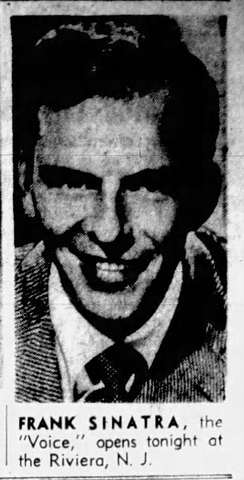
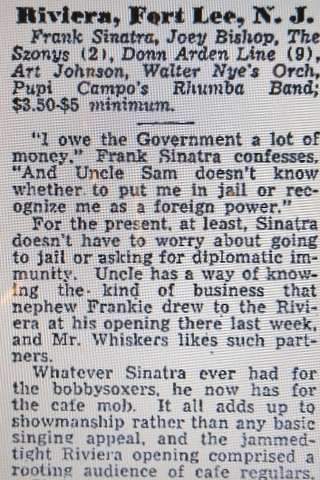
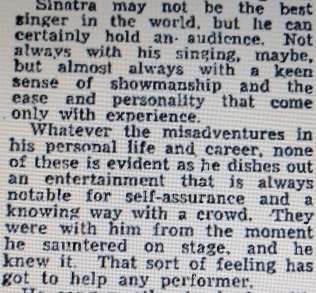
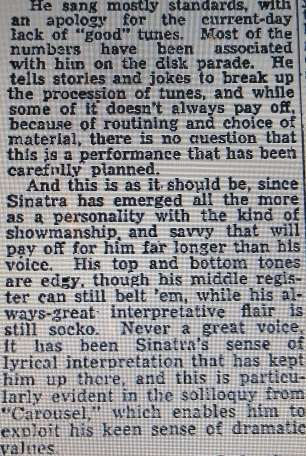
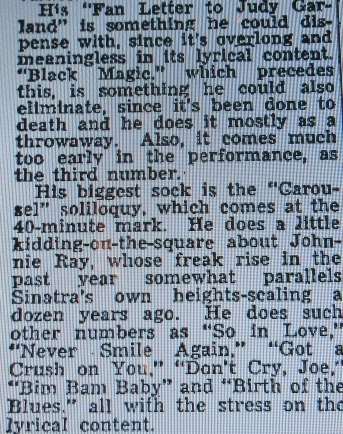
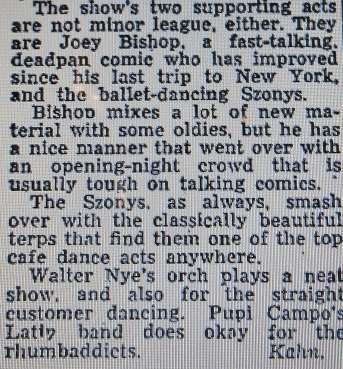
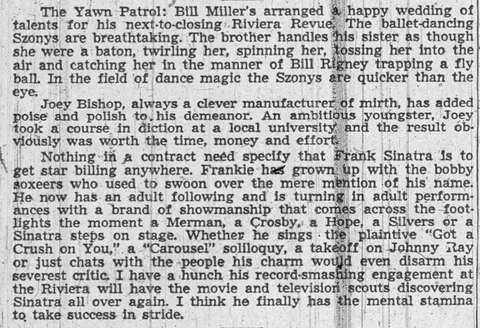
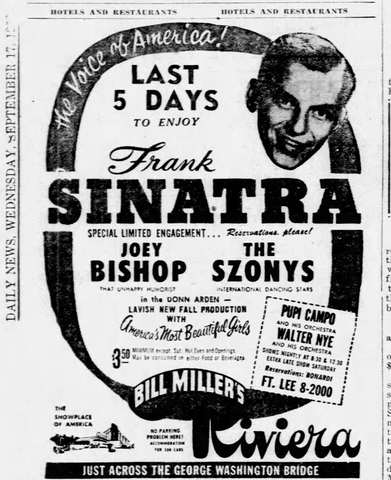
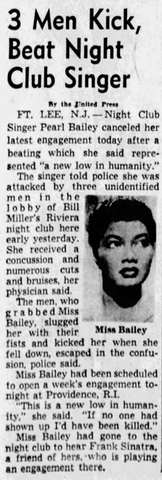
[Sinatra opens at the Riviera]
Frank opened at Bill Miller's Riviera in Fort Lee, New Jersey -- the club that had helped launch Eddie Fisher -- booked by his new agent Abe Lastfogel of William Morris. Variety's review was backhanded but positive, praising his self-assurance and way with a crowd despite his career and personal troubles.
Source: James Kaplan, "Frank: The Voice" (2010).
September 6, 1952
Concerts
Riviera Club, Fort Lee, New Jersey (September 5-21)
September 7, 1952
Concerts
Riviera Club, Fort Lee, New Jersey (September 5-18)
September 8, 1952
Concerts
Riviera Club, Fort Lee, New Jersey (September 5-21)
Riviera Club, Fort Lee, New Jersey (September 5-21)
Frank and Rocky Vitetta - house barber at the Riviera
That night when Frank Sinatra's biggest comeback came to Fort Lee John C. Ensslin NorthJersey
If I could go back in time for just one night, it would be Sept. 15, 1953, just about a month before I was born.
The place would be Bill Miller's Riviera nightclub, perched atop the Palisades in Fort Lee with the twinkling lights of New York City visible through the nightclub's panoramic windows.
Frank Sinatra is on the stage, performing to a celebrity-studded crowd of about 1,000 people. The 38-year-old Hoboken singer is working with new material that many in the crowd are hearing Sinatra sing for the first time, songs like "My Funny Valentine", "Foggy Day" and Cole Porter's "I Get a Kick Out of You."
At some point in the evening, Sinatra gives a shout-out to his new musical arranger, the 32-year-old Oradell-born Nelson Riddle Jr. The two men were just a few months into a musical collaboration that would bring them both to new heights in their music careers.
Sinatra was at a turning point in his career, which had been pretty much in tatters by the previous year. The public had soured on the singer after he ran off with actress Ava Gardner and divorced his first wife, leaving her with his three children.
His record sales had plummeted. His movies were duds. He lost his contracts with Columbia and MGM. And, then, he famously lost his voice. And his marriage with Gardner was on the rocks.
And during a 1952 appearance at The Riviera, the room was less than half full, says Fort Lee historian Tom Meyers. "He went up to Bill Miller and said you can cut my two weeks. This is not working out," Meyers recalls. "And he [Miller] said, 'No, you've been very good with me over the years. I'm sticking with you.'"
Sinatra returned to the Riviera for a two-week stand in September, 1953. This time, things were different.
From violin to cello
Riddle and Sinatra had already worked together by then. In April and May of 1953, they worked on several songs at Capitol Records, where Sinatra had landed a new recording contract.
Riddle also had a contract with Capitol where he arranged several albums by Nat King Cole.
"He [Riddle] transformed Sinatra from a violin to a cello," the late Peter Levinson told The Record's Jim Beckerman in 2002. At the time, Levinson had just published a Riddle biography called September in the Rain.
Richard Muti, a Sparta lawyer who wrote a 2015 Sinatra biography called Cent'Anni: The Sinatra Legend at 100, noted that the timing was perfect for both men. "You know how things come together and all of a sudden it's a perfect match?" he wrote. "They just came at the right time when Sinatra's comeback was just beginning."
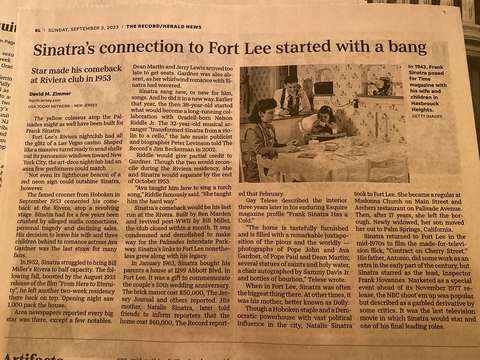
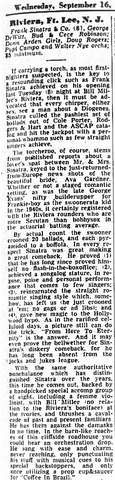
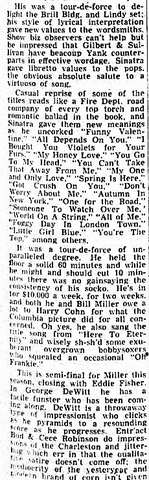
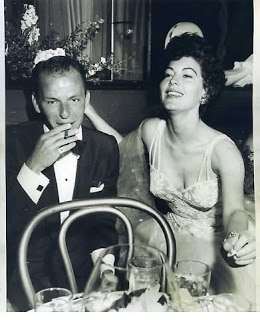
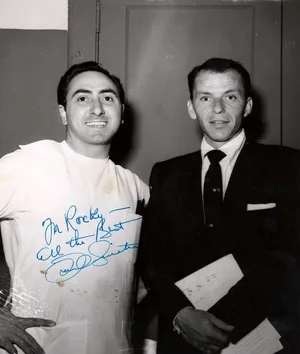
September 9, 1952
Concerts
Riviera Club, Fort Lee, New Jersey (September 5-21)
September 10, 1952
Concerts
Riviera Club, Fort Lee, New Jersey (September 5-21)
[Firemen's Ball fiasco in Hoboken]
Ava flew in on a Wednesday and that night accompanied Frank to the Firemen's Ball at the Union Club in Hoboken, a favor for his father Marty. The hometown crowd booed and threw fruit when he hit sour notes; his boyhood friend Tony 'Mac' Macagnano recalled how furious Sinatra was. Frank told a cop he'd never perform for Hoboken again, and he kept that vow for decades.
Source: James Kaplan, "Frank: The Voice" (2010).
September 11, 1952
Concerts
Riviera Club, Fort Lee, New Jersey (September 5-18)
September 12, 1952
Concerts
Riviera Club, Fort Lee, New Jersey (September 5-21)
September 13, 1952
Concerts
Riviera Club, Fort Lee, New Jersey (September 5-21)
September 14, 1952
Concerts
Riviera Club, Fort Lee, New Jersey (September 5-21)
September 15, 1952
Concerts
Riviera Club, Fort Lee, New Jersey (September 5-21)
The Sands Hotel opened on Highway 91 in Las Vegas on 15 September 1952. Frank's old Copacabana associate Jack Entratter became a vice president there and brought in major talent including Dean Martin, Jerry Lewis, and Lena Horne. (Source: Richard Havers, "Sinatra" (Dorling Kindersley, 2007).)
September 16, 1952
Concerts
BILL MILLER'S RIVIERA,FORT LEE, N.J. (5-21)
Frank Sinatra, Joey Bishop,
Szonys(2) Donn Arden Line, (9)
Art Johnson, Walter Nye's Orch,
Pupi Campo's Rhumba Band
$3.50 - $5.00 minimum
Song List:
When You're Smiling
You Belong To Me
So In Love
Musical Letter To Judy Garland
I'll Never Smile Again
I Got A Crush On You
That Old Black Magic
Don't Cry Joe
Bim Bam Baby
Birth Of The Blues
Again
Soliloquy
September 17, 1952
Studio
New York City
CO48181 Why Try To Change Me Now?
(C. Coleman/J. McCarthy)
J.J. Robbins & Sons (ASCAP) 1952
Arranged & Conducted by Percy Faith
-1 (2:49) CD: Columbia Years 43-52 Vol. 12
LP: C6X-40343 The Voice-The Columbia Years, 43-52
LP: CL-2741 The Essential Frank Sinatra, Vol. 3
78: 39882
Violins: S. Carmell, B. Erie, M. Green, H.
Hoffman, H. Katzman, M. Lomask, G. Ockner, A.
Ores, G. Orloff; Violas: S. Brecher, R. Dickler;
Cello: B. Greenhouse; Harp: E. Druzinski; Saxes:
V. Abato, R. Banzer, H. Feldman, A. Freistadt, J.
Fulton; Trombones: C. Butterfield, P. Giardino,
J. Satterfeild; Piano: S. Freeman; Guitar: A..
Ryerson; Bass: F. Carroll; Drums: P. Krauss
Sinatra changed the opening slightly from what Cy Coleman had originally written.
Here is Coleman's commentary after listening to the recording: "I listened to the record and it sounded so natural, the way that Frank did it, that I thought to myself, 'He's right.' So I left it that way. So I changed the music! That's the first and only time I've ever done that."
--Ed
NOTE: Ed O'Brien calls this the perfect song to end the Columbia years. Sinatra, the romantic troubadour singing a wonderfully romantic song with strong autobiographical associations throughout!
In May of 1953, Sinatra would appear on a
Guest Star program and sing what are arguably the two best recordings from the last few years at Columbia , "Birth of the Blues" and "Why Try to Change Me Now."
Sinatra, in 1959, would record the song again, according to Sinatraphile Jim White, for the "No
One Cares" album for Capitol using a Gordon Jenkins arrangement.
Concerts
BILL MILLER'S RIVIERA,FORT LEE, N.J. (5-21)
Frank Sinatra, Joey Bishop,
Szonys(2) Donn Arden Line, (9)
Art Johnson, Walter Nye's Orch,
Pupi Campo's Rhumba Band
$3.50 - $5.00 minimum
This session produced Frank Sinatra's final recording for Columbia Records, “Why Try to Change Me Now?,” arranged by Percy Faith. Like “I'm a Fool to Want You” before it, the song went largely unnoticed at the time but has since come to be regarded as one of the more emotionally revealing recordings of his Columbia years — critics Ed O'Brien and Robert Wilson later wrote that it showed a singer who could finally “convey the darkness, the cynicism and aching sadness” that would mark his later work. Sinatra would rerecord the song for Capitol in March 1959. Source: J. Randy Taraborrelli, Sinatra: Behind the Legend.
"Why Try to Change Me Now?"
Cy Coleman; Friedwald (analysis): Sinatra's last Columbia side (his 'parting shot' at Mitch Miller) was 'Why Try to Change Me Now?,' the first notable song by twenty-three-year-old composer Cy Coleman. Coleman recalled Sinatra altering the melody's opening interval on the date: 'I listened to the record and it sounded so natural, the way Frank did it, that I thought to myself, He's right!... I changed the music! That's the first and only time I've ever done that.' Friedwald calls the song, arranged by Percy Faith in the Stordahl flute-and-celesta tradition, 'miraculously tender and sensitive,' and argues it makes for 'a far more moving piece of self-analysis... than the comparatively shallow My Way.'
Source: Will Friedwald, "Sinatra! The Song Is You: A Singer's Art" (2018 revised edition).
"Why Try to Change Me Now"
Sinatra recorded Cy Coleman's 'Why Try to Change Me Now' at Columbia's 30th Street studio with Percy Faith on September 17, 1952 as his final recording for the label -- an ironically apt farewell statement given the lyric's theme, ending his roughly nine-year Columbia tenure on a subdued note.
Source: Charles L. Granata, "Sessions with Sinatra: Frank Sinatra and the Art of Recording" (1999/2003).
[Snows of Kilimanjaro premiere]
Billy Grimes: The premiere was held at the Rivoli in New York with a crowd Ava's nephew Billy Grimes estimated at twenty thousand, backed by police barricades and dozens of Pinkerton guards. The frenzy was all for Ava; Sammy Davis Jr. recalled seeing Sinatra walking unrecognized in Times Square that same day.
Source: James Kaplan, "Frank: The Voice" (2010).
[Sinatra's final Columbia session]
After the Kilimanjaro premiere, Frank went to the Thirtieth Street studio for his last Columbia Records session, with Mitch Miller present and Percy Faith (not Stordahl) conducting. He recorded a single song, 'Why Try to Change Me Now,' written by 23-year-old Cy Coleman -- a fitting farewell. Miller ended the session by flatly telling him over the intercom, 'That's it, Frank,' closing out Sinatra's Columbia contract.
Source: James Kaplan, "Frank: The Voice" (2010).
September 18, 1952
Concerts
BILL MILLER'S RIVIERA,FORT LEE, N.J. (5-21)
Frank Sinatra, Joey Bishop,
Szonys(2) Donn Arden Line, (9)
Art Johnson, Walter Nye's Orch,
Pupi Campo's Rhumba Band
$3.50 - $5.00 minimum
The passionate—and combustible—marriage of Frank and Ava is the stuff of Hollywood legend. Here they are at the gala debut of Ernest Hemingway’s drama Snows of Kilimanjaro on September 18, 1952, at the Rivoli Theatre in New York. Ava was one of the stars of the film. Source: photo and caption from J. Randy Taraborrelli, Sinatra: Behind the Legend (mptvimages.com).
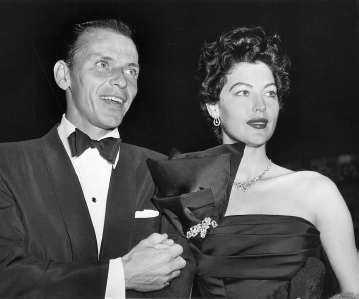
September 19, 1952
Concerts
BILL MILLER'S RIVIERA,FORT LEE, N.J. (5-21)
Frank Sinatra, Joey Bishop,
Szonys(2) Donn Arden Line, (9)
Art Johnson, Walter Nye's Orch,
Pupi Campo's Rhumba Band
$3.50 - $5.00 minimum
September 20, 1952
Concerts
Riviera Club, Fort Lee, New Jersey (September 5-21)
September 21, 1952
Concerts
Riviera Club, Fort Lee, New Jersey (September 5-21)
September 22, 1952
Concerts
Latin Casino, Philadelphia, Pa (September 22 - October 1, 1952)
Latin Casino, Philadelphia, Pa (September 22 - October 1, 1952)
Perfectly Frank
Audition tape
9-22-53 #1
Tuesday w/ The Sinatra Symphonette & Strings
1. I've Got The World On A String
2. Choo-Choo Train - Dinah Shore
3. There's A Flaw In My Flue w/Bill Miller on piano**
4. Lean Baby
*only Perfectly Frank to employ strings
note: The number after "String" was "Choo-Choo Train,"' sung by Dinah Shore. Frank then recited the poem "By The Time" with a snare drum backing him.
--ED
** Here are Frank's comments before " A Flaw In My Flue" and after singing it
"Johnny Burke and Jimmy Van Heusen have written a list of hits as long as your arm and mine together, but what tunes do you think Jimmy bends your ear about?
A little list he calls his flop parade. He not only bent my ear the last time, he twisted my arm, too, so I'm booked to lead off your Flop Parade with a little pudding that mixes up like this."
"The ushers will now pass among you with beakers of air-wick and restorative elixirs."
Perfectly Frank
Audition tape #2
9-22-53
Tuesday w/ The Sinatra Symphonette & String Quartet
9:48
1. Bim Bam Baby Columbia Recording
2. Autumn In New York* w/strings
3. How Much Is That Doggie In The Window?** Patti Page
4. Birth Of The Blues Columbia Recording
*The only Perfectly Franks to employ strings
On the second audition tape, Frank credits Vladmir Dukelsky as the writer of "Autumn In New York." That was Verdon Duke's original name.
Strings were used on both shows.
--Ed
** There is only a segment of Page's huge hit played, followed by scathing commentary from Mr. Sinatra
note: These two shows -- somewhat modified -- would be broadcast over NBC on November 3 and 6, 1953.
Ed
[image referenced in source but could not be recovered]
[image referenced in source but could not be recovered]
[image referenced in source but could not be recovered]
[image referenced in source but could not be recovered]
Daily News
9-23-52

September 23, 1952
Concerts
Latin Casino, Philadelphia, Pa (September 22 - October 1)
Latin Casino, Philadelphia, Pa (September 23 - October 1, 1952)
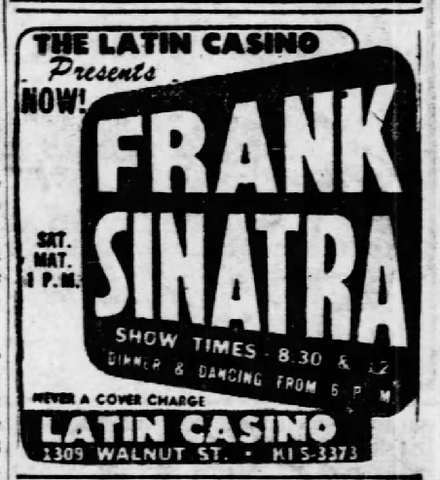
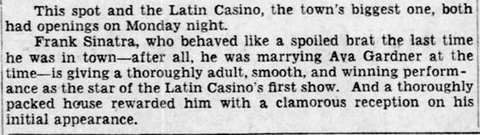
September 24, 1952
Concerts
Latin Casino, Philadelphia, Pa (September 22 - October 1, 1952)
note: Frank played eight days over a nine day period. He was dark on Monday. He was set to open at the Chase Club, in St. Louis, on 10/3, but some personal problems delayed that gig until Saturday the fourth. His two week run would net him $10,000 a week. Frank was fighting an uphill battle to get the role of Maggio in "Eternity," his last session at Columbia was on 9-17, TV and radio were not interested. This was the absolute nadir of his 60 year career.
Ed
Latin Casino, Philadelphia, Pa (September 23 - October 1, 1952)
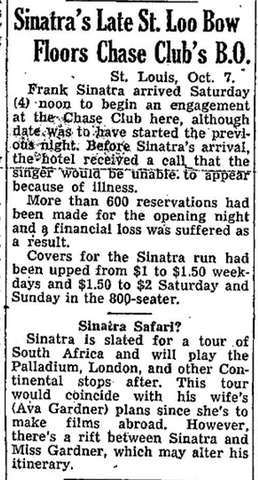
September 25, 1952
Concerts
Latin Casino, Philadelphia, Pa (September 22 - October 1, 1952)
September 26, 1952
Concerts
Latin Casino, Philadelphia, Pa (September 22 - October 1, 1952)
September 27, 1952
Concerts
Latin Casino, Philadelphia, Pa (September 22 - October 1, 1952)
September 28, 1952
Concerts
Latin Casino, Philadelphia, Pa (September 22 - October 1, 1952)
September 29, 1952
Concerts
Latin Casino, Philadelphia, Pa (September 22 - October 1, 1952)
September 30, 1952
Concerts
Latin Casino, Philadelphia, Pa (September 22 - October 1, 1952)
October 1952
[1953 road engagements pre-Capitol signing -- critical commentary]
Will Friedwald (citing Marcucci discography): Chronology detail (sourced to the Giuseppe Marcucci discography 'Where or When'): Sinatra played the Chase Hotel, St. Louis in October 1953 (shortly after his final Columbia date), then two weeks at the French Casino in New York around Thanksgiving, then in January played the Latin Quarter in Boston at night while moonlighting for two days as a guest DJ on Boston station WORL doing two four-hour shows spinning his own and others' records.
Source: Will Friedwald, "Sinatra! The Song Is You: A Singer's Art" (2018 revised edition), Ch. 6, "With Nelson Riddle" (1953-1979)
October 1, 1952
Concerts
Latin Casino, Philadelphia, Pa (September 22 - October 1, 1952)
October 4, 1952
Concerts
Chase Park Plaza Hotel, St Louis, Missouri (4-10)
Note: Frank played the Chase Club from 10/4 thru
10/10. His agent Abe Lastfogel, of William Morris, got him a two week run at the Bill Miller's Riviera, beginning 9/5 and then eight days at the Latin Casino, in Philly before the St. Louis gig. Frank was paid $10,000 per week for four weeks of work. That was damn good money in the fall of 1952.
Ed
p.s. I decided to look up the value of $10,000 in 1952 currency vis-a-vis today.
$10,000 in 1952 is equivalent in purchasing power to about $98,082.26 in 2020, a difference of $88,082.26 over 68 years. The 1952 inflation rate was 1.92%. -ED
Chase Park Plaza Hotel, St Louis, Missouri (4-10)
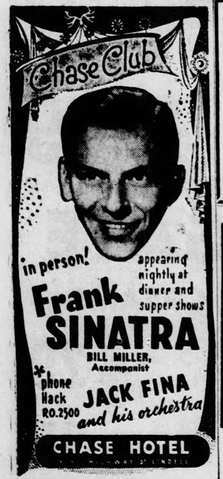
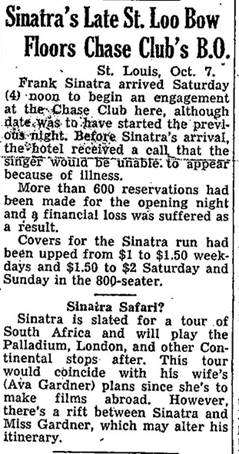
October 5, 1952
Concerts
Chase Park Plaza Hotel, St Louis, Missouri (4-10)
October 6, 1952
Concerts
Chase Park Plaza Hotel, St Louis, Missouri (4-10)
October 7, 1952
Concerts
Chase Park Plaza Hotel, St Louis, Missouri (4-10)
[Wire report on marriage 'crackup']
Earl Wilson: Wire services quoted Earl Wilson reporting Frank and Ava were trying to avert a 'crackup' of their marriage. Sinatra told Wilson they were having 'oral battles' he was trying to fix, while Ava blamed the strain on conflicting career commitments -- though Kaplan notes she was actually in Hollywood mostly attending parties.
Source: James Kaplan, "Frank: The Voice" (2010).
October 8, 1952
Concerts
Chase Park Plaza Hotel, St Louis, Missouri (4-10)
Monday in St Louis Globe Democrat
October 9, 1952
Concerts
Chase Park Plaza Hotel, St Louis, Missouri (4-10)
October 10, 1952
Concerts
Chase Park Plaza Hotel, St Louis, Missouri (4-10)
October 17, 1952
Frank gave a memorable interview to columnist Hy Gardner on his nationally broadcast radio show.
Source: Nancy Sinatra, Frank Sinatra: An American Legend, 1995.
October 18, 1952
Television
Jimmy Durante's All Star Revue
October 18, 1952
NBC-TV
8:00 P.M. -- 9:00 P.M EST
Sponsors: Kellogg's, Pet Milk & Del Monte Foods
Guest: Frank Sinatra, Fifi D'Orsay
Frank sings "Birth Of The Blues."
Does a skit with Durante, playing a younger version of him.
Sing a la Durante "Who Will Be With You When I'm Far Away."
Asked by Jimmy who he wants to marry, Frank shows him a framed photo of Ava.
Second skit: Duet with Durante "Sing Soft, Sweet and Gentle" and then "Birth Of The Blues" parody.
Jimmy Durante's All Star Revue
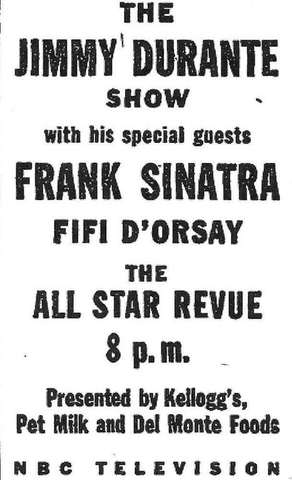
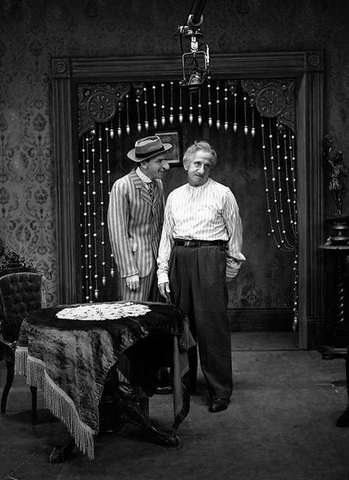
October 21, 1952
[Fresno Bee reports separation]
The Fresno Bee ran an AP item, amid heavy election coverage of the Stevenson-Eisenhower race, headlined 'Columnist Says Sinatra Boots Ava Out of Home,' citing Earl Wilson's New York Post report that the couple had separated after a spectacular quarrel. When Wilson called Van Heusen's house asking for Frank, Chester said, 'Frank's in the bathroom throwing up.'
Source: James Kaplan, "Frank: The Voice" (2010).
October 27, 1952
Concerts
Palladium, Hollywood, California
1. The House I Live In
2. The Birth Of The Blues
3. When You're Smiling
Ed O'Brien:
This was a rally for Adlai Stevenson.
There was a crowd of 4,000 and Ava was there.
She introduced her husband and he thrilled the audience with his numbers.
Palladium, Hollywood, California
Frank and Ava at Rally, 10-27-52
According to articles I researched, Sinatra sang "When You're Smiling" and "The Birth of the Blues". There's no mention of "The House I Live In"
© 1997-2025 The Sinatra Archive
This calendar, or any parts thereof, may not be reproduced in any fashion whatsoever without the prior written permission of the publisher (The Sinatra Archive)
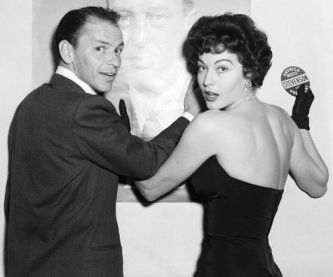
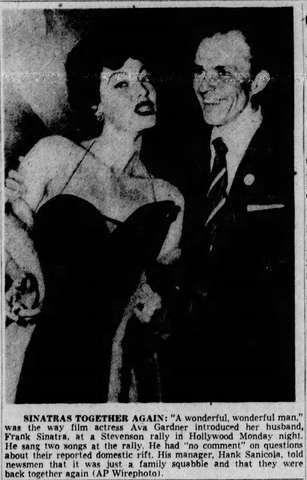
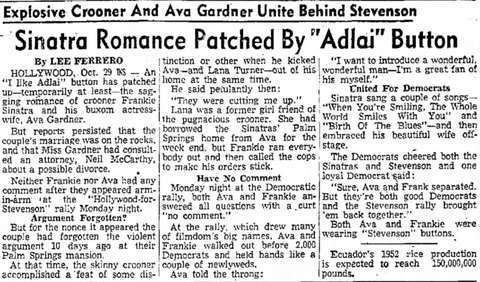
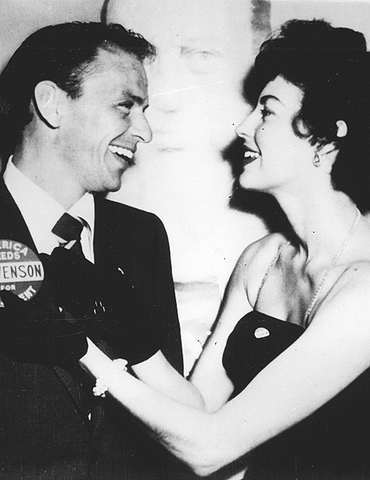
[Stevenson rally reconciliation at Palladium]
Ava Gardner: At a Hollywood Palladium rally for Adlai Stevenson before four thousand people, Ava walked out in a black-satin dress and introduced 'my husband, Frank Sinatra' to a huge ovation. Frank, wearing an ADLAI button, sang 'The Birth of the Blues' and 'The House I Live In.' A heckling reporter asked what Ava saw in a '119-pound has-been'; she shot back that '19 pounds is cock.'
Source: James Kaplan, "Frank: The Voice" (2010).
November 1952
[Ava's First Pregnancy And Secret Abortion In England]
Nancy Sinatra: While Frank was away, Ava Gardner discovered she was pregnant but, worried about MGM's contractual penalty clauses and the instability of the marriage, flew to England for a legal abortion without ever telling Frank she had been carrying his child.
Source: Nancy Sinatra, Frank Sinatra: An American Legend, 1995.
[Ava Suggests Frank For The Role Of Maggio]
Nancy Sinatra: At a dinner at Harry and Joan Cohn's estate, Ava Gardner told Joan Cohn that her husband would be perfect for the Maggio role in From Here to Eternity; Joan agreed and championed the idea to Harry, setting Frank's screen test in motion.
Source: Nancy Sinatra, Frank Sinatra: An American Legend, 1995.
["Birth of the Blues" charts]
Kaplan: Sinatra's 'The Birth of the Blues' charted at number 19, marking his last hit before a prolonged sales drought heading into 1953.
Source: James Kaplan, "Frank: The Voice" (2010)
[Ava learns she is pregnant]
Ava Gardner: By the Tuesday of that week, Ava knew she was pregnant with Frank's child, but she did not want the baby, citing her belief that a mother must devote herself fully to a child, MGM's contractual penalties for pregnant stars, and Frank's precarious finances.
Source: James Kaplan, "Frank: The Voice" (2010)
[First wedding anniversary aboard plane]
Ava Gardner: Frank and Ava celebrated their first wedding anniversary en route to Nairobi, opening champagne and exchanging gifts (a diamond ring from him, a platinum watch from her, both paid for by Ava). Ava recalled it meant a lot to her since she'd never before been married a full year.
Source: James Kaplan, "Frank: The Voice" (2010)
[Frank buys Ava emerald earrings]
Kaplan: After a strained phone call with Ava following her abortion, Frank went to jeweler Billy Ruser in Beverly Hills and picked out $22,000 emerald earrings for her birthday and Christmas, unable to pay upfront; Ruser let him take them on credit.
Source: James Kaplan, "Frank: The Voice" (2010)
[Hedda Hopper on Nancy Sinatra]
Nancy Barbato Sinatra: In early November, Hedda Hopper reported that a fan had asked whether Nancy Sinatra would take Frank back; Nancy called the idea 'ridiculous,' saying Frank was married now, saw the children often, but that nothing more crossed her mind.
Source: James Kaplan, "Frank: The Voice" (2010)
[Mogambo]
During this same tumultuous stretch, Ava had an abortion in England in November 1952 without consulting Sinatra, reasoning that a stable family life wasn't possible with him; some accounts, including hers, describe a second abortion in early 1953, though Sinatra and others disputed parts of that account.
No corresponding dated entry could be identified in the chronology for this film/context.
Source: Tom Santopietro, "Sinatra in Hollywood" (2008), Ava and the Downfall / The Comeback
[Patsy's Thanksgiving story]
Kaplan: After the French Casino show, Frank dined at his favorite restaurant, Patsy's, run by the Scognamillo family; unaware the restaurant was closing for Thanksgiving, he asked what they'd be serving, prompting the owner to reopen the restaurant the next day so Sinatra wouldn't have to eat alone -- per a New York Times account published in 2003.
Source: James Kaplan, "Frank: The Voice" (2010)
[Photo caption: arriving in Nairobi]
Kaplan: A photo caption notes Frank and Ava arriving in Nairobi in November 1952 as she began work on Mogambo.
Source: James Kaplan, "Frank: The Voice" (2010)
[Columbia releases Walking in the Sunshine b/w Bim Bam Baby]
Columbia released Frank's single "Walking in the Sunshine" backed with "Bim Bam Baby" in November 1952—a pairing later referenced by a heckler at a 1953 UK show, whom Frank dismissed with a sharp one-liner.
Source: Richard Havers, "Sinatra" (Dorling Kindersley, 2007).
[False tip claims Frank smuggled diamonds from Africa]
The same day Variety reported Frank had tested for From Here to Eternity, it also noted that US Customs had received an anonymous letter accusing Frank of smuggling diamonds back from Africa. Customs determined the letter was from a crank and the claim was baseless.
Source: Richard Havers, "Sinatra" (Dorling Kindersley, 2007).
November 7, 1952
On their first wedding anniversary, Frank Sinatra and Ava Gardner flew to Africa, where Gardner was to begin filming Mogambo opposite Clark Gable and Grace Kelly. Sinatra, still waiting to hear whether he'd landed the role of Maggio in From Here to Eternity, came along with little to do but read novels and fetch drinks and sherbet for his demanding wife on set. “He needed a lift,” recalled a crew member, noting that Gardner nonetheless lobbied Harry Cohn by phone from Nairobi on Frank's behalf, telling him, “I am begging you. Give him this role. He can't take it anymore. I can't take it anymore.” Source: J. Randy Taraborrelli, Sinatra: Behind the Legend.
November 8, 1952
Above: Frank Sinatra had accompanied his wife Ava Gardner to the set of Mogambo in Africa, the two photographed here at Nairobi airport with Grace Kelly. Sinatra was in between acting jobs and during production flew back to Hollywood to do a screen test for the role of Maggio in From Here To Eternity (1953), eventually landing the role and winning the Oscar.
Photograph showing Grace Kelly, Frank Sinatra and Ava Gardner taken on location in Kenya.
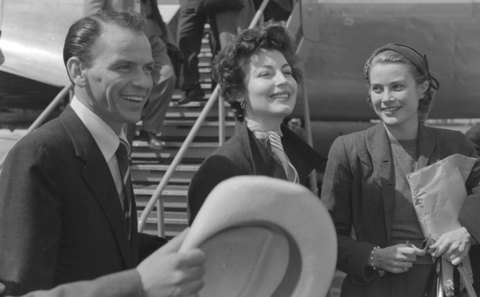
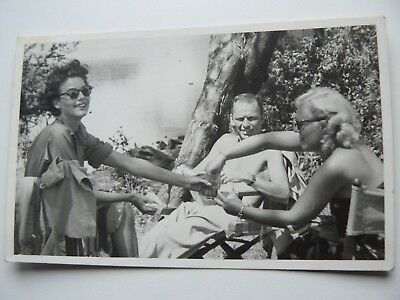
November 14, 1952
[Frank leaves Mogambo location]
Frank left the African location on Friday, November 14, taking an overnight flight from Nairobi to London.
Source: James Kaplan, "Frank: The Voice" (2010).
On November 14, 1952, Sinatra did his screen test in Hollywood for the role of Angelo Maggio in From Here to Eternity. Source: Nancy Sinatra, "Frank Sinatra, My Father" (1985).
November 15, 1952
[Frank stays at the Savoy]
Frank arrived in London and stayed at the Savoy Hotel, where before leaving for New York he left in the hotel safe a brown-paper package containing Ava's diamond earrings and bracelet, which she'd asked him to safeguard from the Mau Mau unrest.
Source: James Kaplan, "Frank: The Voice" (2010).
November 17, 1952
[Customs detains Sinatra at Idlewild]
Landing at Idlewild on Monday morning, Frank was pulled aside by customs agents and police, who searched his luggage for nearly two hours over an anonymous tip that he was smuggling diamonds. He missed his connecting flight to Los Angeles; lawyer Sol Gelb and Hank Sanicola intervened before customs released him.
Source: James Kaplan, "Frank: The Voice" (2010).
November 18, 1952
[Second flight delayed]
The next morning Frank's flight to Los Angeles was delayed three hours by mechanical problems; he returned to the Regency Hotel and opened a bottle of Jack Daniel's. Sanicola later learned from Sol Gelb that customs had acted on a crank letter alleging diamond smuggling.
Source: James Kaplan, "Frank: The Voice" (2010).
November 19, 1952
[Sinatra reaches Los Angeles]
Frank finally landed in Los Angeles on Wednesday, November 19, too late in the day to see producer Buddy Adler, who told him to come in the next morning.
Source: James Kaplan, "Frank: The Voice" (2010).
November 20, 1952
[Sinatra's Maggio screen test]
On Thursday, Frank waited through the day while Columbia tested other actors, including Harvey Lembeck, on Stage 16. When his turn came, producer Buddy Adler offered him the script, but Frank said he'd read it many times and didn't need it. He performed two drunk scenes as Maggio, later recalling he was 'scared to death.'
Source: James Kaplan, "Frank: The Voice" (2010).
November 23, 1952
While filming Mogambo in Africa, Ava Gardner discovered she was pregnant by Frank Sinatra — the second time, unbeknownst to him, since an earlier Los Angeles pregnancy she had quietly ended without telling him. Unwilling to give up her MGM contract or her independence, and despite pleas from Frank, director John Ford, and friends to keep the baby, Gardner secretly left the production for London, checked into the Savoy Hotel, and had the pregnancy terminated at a private clinic. She would not tell Frank the truth until he returned to Africa around Christmas. Source: J. Randy Taraborrelli, Sinatra: Behind the Legend.
Alternate account: Sheridan and Harvey attribute the pregnancy differently, writing that while Sinatra was away in California for his Maggio screen test, Gardner slept with several members of the Mogambo crew, including location manager and big-game hunter Bunny Allen, and that it was this affair, not Sinatra, that resulted in the pregnancy she ended in London -- with Sinatra and the public told only that her trip was to treat a tropical infection. Source: Michael Sheridan & David Harvey, Sinatra and the Jack Pack.
November 24, 1952
[Cover story: Ava 'stricken' in Africa]
An AP story datelined London, November 24, reported that Ava Gardner had been rushed to London and treated with antibiotics for a tropical infection supposedly caught from drinking local water in Kenya; in fact this was MGM's cover story for her London abortion, and she was kept in strict privacy at a nursing home.
Source: James Kaplan, "Frank: The Voice" (2010).
[Edith Gwynn on Nancy's social life]
Edith Gwynn: On the same day as Ava's abortion in London, columnist Edith Gwynn described a pleasant dinner at Nancy Sinatra's home, where Nancy cooked Italian dishes for a dozen guests and showed home movies, praising her three talented children.
Source: James Kaplan, "Frank: The Voice" (2010).
November 25, 1952
Television
Texaco Star Theater
Milton Berle
NBC-TV
Tuesday Evening
8:00 P.M. TO 9:00 PM.
Greg Garrison … Director
Goodman Ace … Writer
Aaron Ruben … Writer
Arnold Auerbach Writer
Selma Diamond … Writer
Jerry Seelen … Writer
Jay Burton … Writer
Milton Berle … Host, Cast
Frank Sinatra … Guest, Singer
Eva Gabor … Guest
Jack Carter … Guest
Jimmy Nelson …&nbbsp;Performer
Bobby Sherwood … Cast, Instrumentalist, Trumpeter
Ruth Gilbert … Cast, "Max" (Maxine)
Betty Norman … Cast
One in this series of comedy/variety programs hosted by Milton Berle. Berle's guests on this program are Frank Sinatra, Eva Gabor, and comedian Jack Carter. At the program's start Berle is abducted by gangsters, and Carter must open the show in his absence. Finally, the gangsters realize their mistake (they were supposed to kidnap Carter instead) and make the switch so that Berle is able to complete the show. He, Sinatra, and Gabor discuss ideas for upcoming television projects and come up with a few seemingly good ideas. While they are getting ready to try out these plans, Sinatra sings "Birth of the Blues" to Bobby Sherwood's trumpet accompaniment. The trio's first sketch for a possible television show is "I Hate Miltie," a parody of "I Love Lucy" in which Berle and Gabor play a wacky couple and Sinatra and Ruth Gilbert are their lovable neighbors. Chaos ensues as they prepare a gigantic turkey for Thanksgiving and everyone Berle comes across invites himself over for the holiday. Next, ventriloquist Jimmy Nelson performs with his puppets Humphrey Higsbee and Danny O'Day, who are joined by Betty Norman in making plans for a big dance that evening. Continuing the puppet theme, Sinatra, Berle and Gabor portray a version of the popular television show "Kukla, Friend, and Ollie." Finally, the cast investigates doing the quiz show "What's My Racket," in which panelists Sherwood, Sinatra, Gilbert, and Berle have trouble guessing the very obvious professions of the show's guests.
Texaco Star Theater
Milton Berle
NBC-TV
Tuesday Evening
8:00 P.M. TO 9:00 PM.
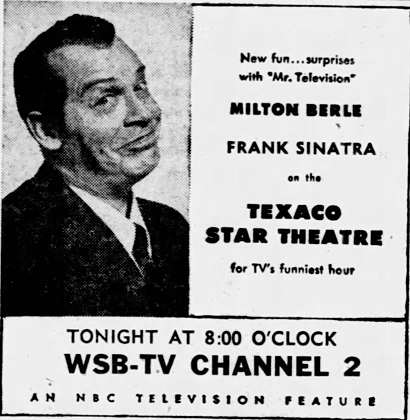
November 26, 1952
Concerts
French Casino, New York City (11-26 TO 12-8 1952)
Frank Sinatra with Bill Miller
Dominique, Ginette
Wander, Jane Laste, Laura
Tunisi,
Vincent Travers Orchestra
$5 minimum
NIGHTCLUB
'Voice' Rocks 'Em as of Yore, in NY; Bow With New Tie, New Personality Frank Sinatra's preem at New York's French Casino brought out what was possibly the biggest showbiz mob seen in a local cafe opening in a long time. The ringside looked like a "Who's Who' of showbiz names plus the usual Broadway mob. Sinatra's personal troubles didn't dampen the wild -eyed enthusiasm of the back -of -the -room customers. The squeals, shrieks and yells made it sound like a Sinatra opening at the Paramount when he was on top. Girls were huddled around the stage and one girl managed to get on and plant a kiss on his neck -and it wasn't a plant either. As a singer and a performer Sinatra seldom did a better job. Coming out in a ribbon tie, he started it off with timely chatter about his hassle with customs of Africa and similar topical subjects, handling them with ease and a keen sense of comedy timing for a maximum of friendly laughs. But if he did a fine talking job, it was his singing that really rocked them. Using a well- balanced series of items, veering from pops to pro- ductions like the "Soliloquy" with a couple of novelties thrown in for extra bounce, Sinatra sang his heart out. His voice was superb as he sold the opener, "When You're Smiling" and then into "You Belong to Me." After those two he had them eating out of his hand. When he followed with his latest Columbia recording, "Birth of the Blues" and the flip, "Why Try to Change Me ?" even those customers who sat on their hands, gave up and applauded like crazy. Sinatra was on for more than 40 minutes singing with heart and pace. When he finished he was the old master again. If the crowd had its way he could have stayed on another hour and not worn out his welcome. The fact that he gave an impression of boyish humbleness, instead of his former irritating aggressiveness, also helped out. Bill Miller, Sinatra's accompanist, did a fine backing job. Vincent Travers, house leader, gave the Sinatra arrangements a superb interpretation. Incidentally there were no strings, outside of bass, in the Travers band. It was all brass. Incidentally Sinatra's lighting was handled by Monte Proser. It put the singer in the best possible colors. The rest of the show has been reviewed previously. It's still the same long, dull production piled on production that started off when the room opened last July. Bill Smith
Billboard
12-6-52 note: Frank was being paid $10,000 a week for his two week stint at the club.
French Casino, New York City (11-26 TO 12-8 1952)
[image referenced in source but could not be recovered]
[image referenced in source but could not be recovered]
[Sinatra opens at the French Casino]
Frank opened Wednesday night at the French Casino in the Paramount Hotel, New York, to a full house and in good spirits, quipping back at a heckler who asked 'Where's your wife?' with 'Where's your wife?'
Source: James Kaplan, "Frank: The Voice" (2010).
November 27, 1952
Concerts
French Casino, New York City (11-26 TO 12-9 1952)
Frank Sinatra with Bill Miller
note: Frank closed on Tuesday, 12/9.
He was asked to do a third week but had promised to join Ava in Africa
French Casino, New York City (11-26 TO 12-8 1952)
Frank Sinatra with Bill Miller
Hedda Hopper
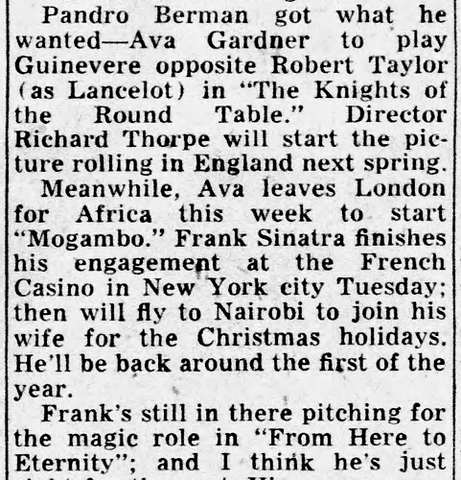
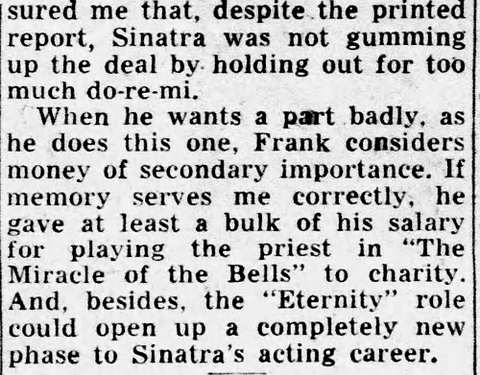
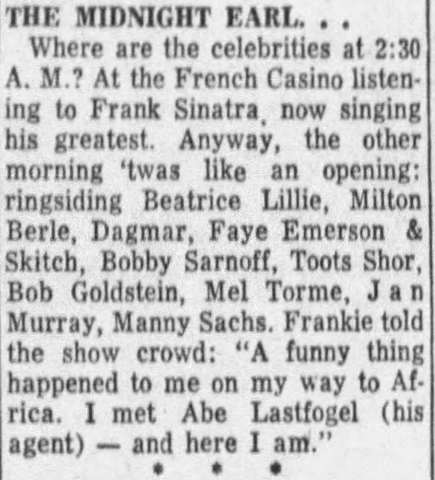
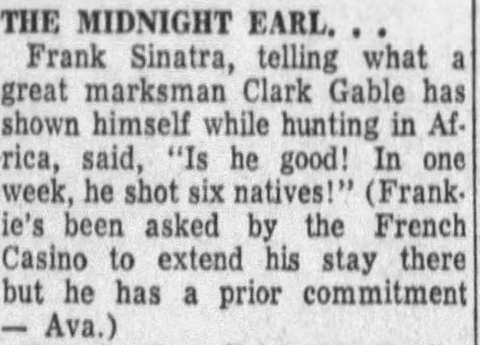
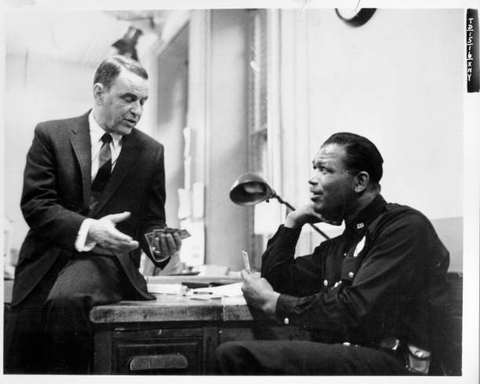
note: Other columnist indicated Frank had the role if he didn't ask for too much
money. Louella Parsons reported that Columbia was set to do a rewrite
for Aldo Ray, if they couldn't sign Frank. Much different story than what
has become legend through the years.
Earl Wilson 12-10-52
note: Wilson's column of 11-21 states that Frank might play the French Latin in December. Obviously, Lastfogel got him an earlier date.
note: Frank followed Sugar Ray Robinson at the French Casino. Sugar Ray
had retired from the boxing ring after a heartbreaking lost to Joey Maxim.
The fight took place on 6-25-52 in Yankee Stadium. Robinson was the
challenger that night, fighting for Maxim's light heavyweight crown. At
the end of the 12th round, The New York Times had Robinson winning
every round. A blistering night of temps, above 100F, had taken a heavy
toll on the ref, Rudy Goldstein. He collapsed in the 10th round. Robinson
had set a pace that was more blistering than the 110 degree heat in the
ring. In the 13th round, Robinson suddenly fell down. He was saved by
the bell, but could not continue. He had dehydrated and was in danger
of succumbing from the damage done to his body. Sugar Ray quit the
sport and became a song and dance man. His first major New York
engagement was a 14 day run at the French Casino, at $15,000 a week.
The New York papers immediately jumped on the paltry $10,000 Mr.
Sinatra was being paid. Casino had more faith in a neophyte former
pugilist than the bobby-sox idol. Sinatra's people quickly dampened
the bloodletting by explaining that their man was also getting a per-
centage of the nightly take. Frank would easily break the all-time
two-week gross at the casino.
Frank and Sugar Ray on the set of "The Detective," 10/67
November 28, 1952
Concerts
French Casino, New York City (11-26 TO 12-9 1952)
Frank Sinatra with Bill Miller
November 29, 1952
Concerts
French Casino, New York City (11-26 TO 12-9 1952)
Frank Sinatra with Bill Miller
November 30, 1952
Concerts
French Casino, New York City (11-26 TO 12-8 1952)
Frank Sinatra with Bill Miller
December 1952
[Ava's Second Pregnancy And Abortion In Africa]
Nancy Sinatra: While Frank was visiting Ava on location in Africa, she became pregnant again; this time he knew and was overjoyed, but she felt they lacked the stable life needed to raise a child and terminated the pregnancy at a nursing home near Wimbledon, with Frank at her bedside afterward in tears.
Source: Nancy Sinatra, Frank Sinatra: An American Legend, 1995.
[Ava's elephant encounter with Bunny Allen]
Eva Monley: In early December, back on the Mogambo set, Ava went into the bush with white hunter Bunny Allen and was startled by a nearby elephant relieving itself; the brief fling that followed was casual and short-lived, according to production coordinator Eva Monley, who said Ava simply couldn't bear being alone.
Source: James Kaplan, "Frank: The Voice" (2010)
[Christmas show for the Mogambo company]
Kaplan: To distract himself from the ongoing uncertainty over Maggio, Frank organized a Christmas show for the Mogambo company, singing carols while native choirs performed and John Ford recited 'A Visit from St. Nicholas.'
Source: James Kaplan, "Frank: The Voice" (2010)
[Frank returns to Africa for Christmas/Ava's birthday]
Ava Gardner: Frank flew back to the Mogambo location in time for Christmas and Ava's thirtieth birthday, bringing gifts from himself and her family; Ava later recalled it as a happy, enthusiastic time, though accounts of a diamond ring and mink gift are inconsistent.
Source: James Kaplan, "Frank: The Voice" (2010)
[Hopper follow-up on Sinatra's chances]
Hedda Hopper: About a week after her prior column, Hedda Hopper wrote that Frank was 'still in there pitching' for the Maggio role and that, per his manager, he wasn't holding out for money since he considered it secondary when he wanted a part badly -- citing his earlier charitable donation of pay from The Miracle of the Bells.
Source: James Kaplan, "Frank: The Voice" (2010)
[The Sands opens]
Kaplan: The Sands Hotel and Casino opened in December 1952, designed by Los Angeles architect Wayne McAllister in a pueblo-modern Googie style, with a fifty-six-foot sign that was then the tallest on the Strip.
Source: James Kaplan, "Sinatra: The Chairman" (2015)
December 1, 1952
Concerts
French Casino, New York City (11-26 TO 12-8 1952)
Frank Sinatra with Bill Miller
December 2, 1952
Concerts
French Casino, New York City (11-26 TO 12-9 1952)
Frank Sinatra with Bill Miller
December 3, 1952
[Hedda Hopper on Eternity casting]
Hedda Hopper: Hedda Hopper's syndicated column reported Fred Zinnemann had gone to New York to test stage actors for From Here to Eternity, noting Humphrey Bogart's interest in playing Sgt. Warden and that, based on reports from those who'd seen it, Sinatra's test made her wager he was 'in' for Maggio.
Source: James Kaplan, "Frank: The Voice" (2010).
December 4, 1952
Concerts
French Casino, New York City (11-26 TO 12-8 1952)
Frank Sinatra with Bill Miller
December 5, 1952
Concerts
French Casino, New York City (11-26 TO 12-8 1952)
Frank Sinatra with Bill Miller
December 6, 1952
Television
Celebrity Parade For Cerebral Palsy
WJZ 8:00 P.M. December 6th to 2 P.M. December 7th
President-Elect Eisenhower. Frank Sinatra, Jackie Gleason, Faye Enerson, Robert Merrill, Tony Bennett and others
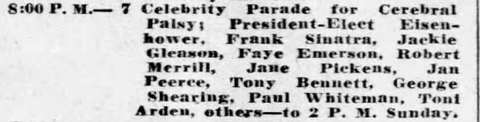
Concerts
French Casino, New York City (November 26 - December 8) Frank Sinatra with Bill Miller
Celebrity Parade For Cerebral Palsy
WJZ 8:00 P.M. December 6th to 2 P.M. December 7th
President-Elect Eisenhower. Frank Sinatra, Jackie Gleason, Faye Enerson, Robert Merrill, Tony Bennett and others Variety
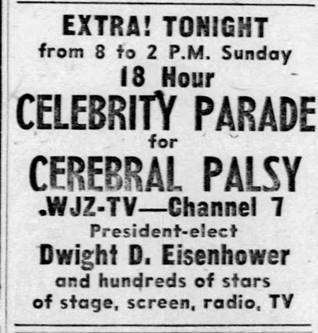
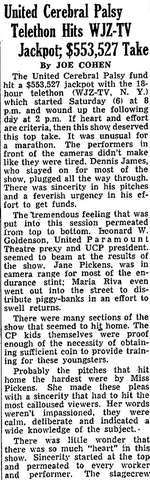
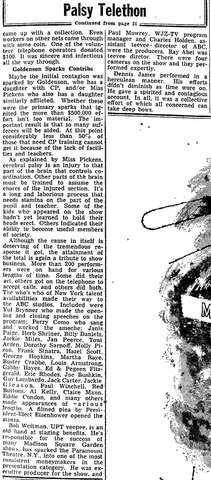
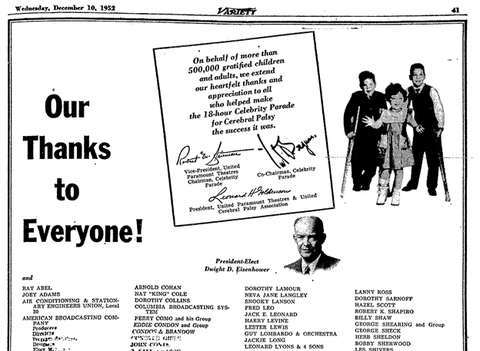
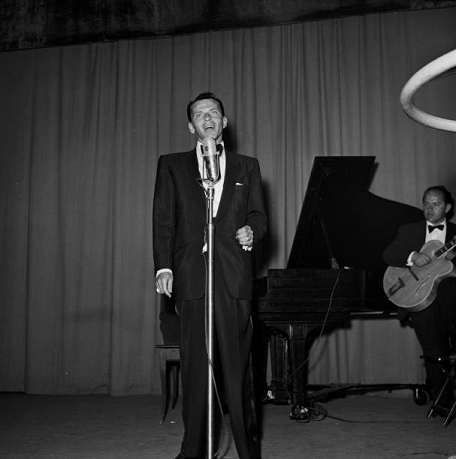
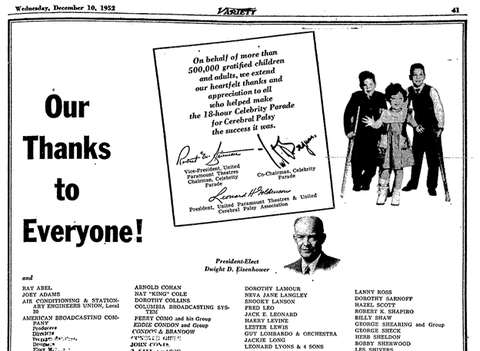
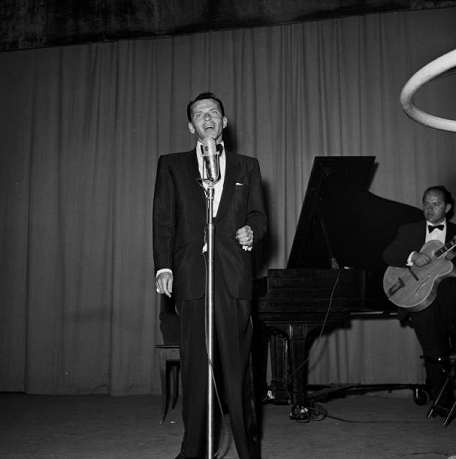
December 7, 1952
Concerts
French Casino, New York City (11-26 TO 12-8 1952)
Frank Sinatra with Bill Miller
December 8, 1952
Concerts
French Casino, New York City (11-26 TO 12-8 1952)
Frank Sinatra with Bill Miller
French Casino, New York City (11-26 TO 12-8 1952)
Frank Sinatra with Bill Miller
note: Frank closed on Tuesday, 12/9. I found a number of articles
confirming that date. Have enclosed two of them.
Ed
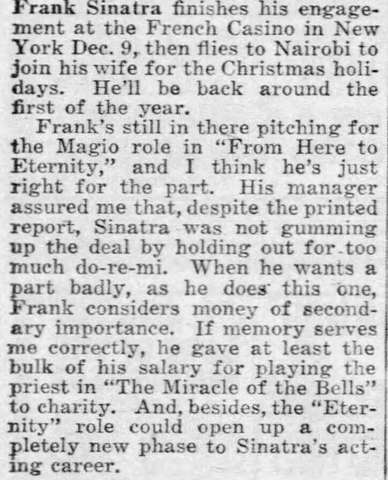
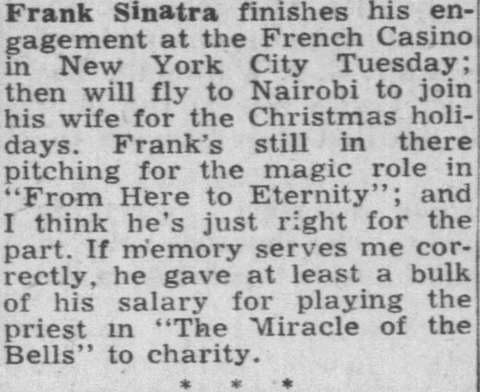
December 9, 1952
Concerts
French Casino, New York City (11-26 TO 12-9 1952)
Frank Sinatra with Bill Miller
December 12, 1952
[Sinatra's 37th birthday]
On his 37th birthday (which he still claimed publicly was his 35th), Frank was given a birthday cake by fans at the French Casino who squealed as they had at the Riobamba a decade earlier; Earl Wilson reported the party but dutifully repeated Frank's fudged age.
Source: James Kaplan, "Frank: The Voice" (2010).
[Sands Hotel opens on Sinatra's birthday]
The Sands, the seventh casino on the Las Vegas Strip, opened on Frank's thirty-seventh birthday. Founded by Houston gambler Jakie Freedman, it featured Googie-style architecture by Wayne McAllister and became a natural foothold for Sinatra, whose friends-of-friends connections extended into its ownership circle.
Source: James Kaplan, "Frank: The Voice" (2010).
January 1953
[Ava pregnant again, not Frank's]
Kaplan: In the second week of 1953, Ava discovered she was pregnant again, this time by Bunny Allen or one of several propmen -- she wasn't sure which -- since the timing ruled out Frank, who had been away at the French Casino in December during conception.
Source: James Kaplan, "Frank: The Voice" (2010)
[Earl Wilson's indifference to Sinatra]
Earl Wilson: Earl Wilson later recalled that when Frank flew from Africa back to play a Boston nightclub date, hardly anyone in the press, including Wilson himself, was interested -- he noted only that Sinatra needed a haircut upon arrival.
Source: James Kaplan, "Frank: The Voice" (2010)
[Pearl Bailey's advice at Storyville]
Pearl Bailey: A couple of nights after opening at the Latin Quarter, Frank ran into Pearl Bailey (and her husband, drummer Louie Bellson) at George Wein's Storyville club while seeing Duke Ellington; when he mentioned the low-paying Eternity role, Bailey told him, 'Take it and don't look back.'
Source: James Kaplan, "Frank: The Voice" (2010)
[The call that he got Maggio]
Frank Sinatra: That evening at the Ritz-Carlton, Bert Allenberg phoned from William Morris in Los Angeles to tell Frank he'd won the role of Maggio. Overwhelmed, Frank drank two tumblers of Jack Daniel's and paced the suite talking to himself, later recalling he wanted to tell someone but no one was there.
Source: James Kaplan, "Frank: The Voice" (2010)
January 19, 1953
[Frank returns to New York from Africa]
Frank landed in New York from Africa on a Monday, arriving largely unnoticed by the press given how far his career had fallen.
Source: James Kaplan, "Frank: The Voice" (2010).
January 20, 1953
Concerts
Latin Quarter, Boston, Massachusetts (January 20 - February 2)
Frank Sinatra opens for 10 days at the Latin Quarter; it was his only Boston nightclub engagement as a single. The Latin Quarter, on Winchester Street, was the top night spot in town, and just the place for Sinatra on his comeback trail. Backed by Larry Green's band, Sinatra sang his current hit, "Birth of the Blues," and songs from Porgy and Bess. Sinatra enjoyed his time in Boston, hanging around Storyville, where the Ellington Orchestra was playing, and filling a shift on WORL-AM radio, reading commercials and spinning records. It was during this engagement that Sinatra learned he'd play Maggio in the film From Here to Eternity; he won the acadamy award for best supporting actor for it.
Those ten days in January 1953 marked the start of a highwater period in Boston nightlife. Sinatra was at the Latin Quarter, the Ellington Orchestra was at Storyville, and Frankie Laine was at Blinstrub'sand all three broke their club's box office record. If the lines were too long at those clubs, you could catch Coleman Hawkins and Roy Eldridge at the Hi-Hat, Vic Dickenson and Doc Cheatham at Mahogany Hall, Red Allen at the Savoy, the Soft Winds at the Darbury Room, Sabby Lewis at Sugar Hill, Bunny Campbell at Wally's Paradise…
note: A night out on the town, with a date, to see Sinatra, would have set you back about $10.00, figuring in drinks and transportation. And that included dinner. Wow! Ed
Latin Quarter, Boston, Massachusetts (January 20 to February 2)
[image referenced in source but could not be recovered]
[image referenced in source but could not be recovered]
[image referenced in source but could not be recovered]
[image referenced in source but could not be recovered]
Latin Quarter, Boston, Massachusetts (20-31)
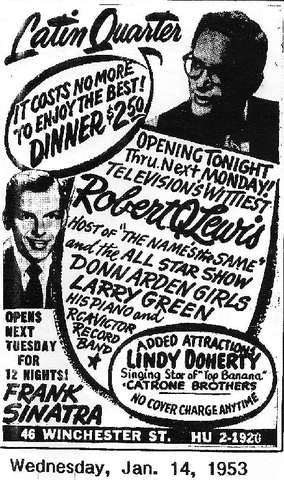
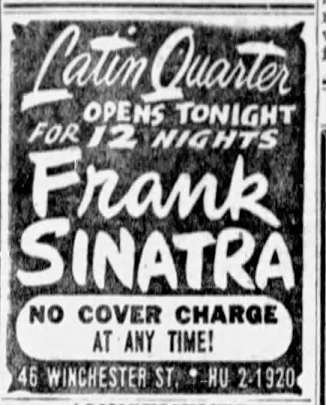
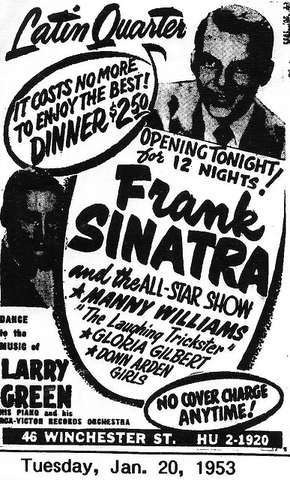
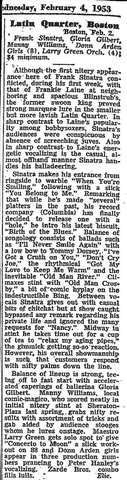
Latin Quarter, Boston, Massachusetts (January 20 - February 2)
Apparently when Sinatra was performing in Boston, he also made an appearance at the 14th annual Baseball Writers' Banquet on January 29th, 1953
January 29, 1953, Sheraton Plaza, Boston, Mass
14th Annual Baseball Writers Banquet
Sinatra sang at the banquet
This first article said there might possibly be songs by Frankie Sinatra
This second article confirms Sinatra was there by saying "after Frank Sinatra had tested his vocal chords":
[image referenced in source but could not be recovered]
[image referenced in source but could not be recovered]
Latin Quarter, Boston, Massachusetts (20-31) note: Variety 2-4-53
Show reviewed was on 2-2-53. So, Frank did not close on 1/31. I have an ad from 1/26 announcing there are six days left in the engagement. Latin Quarter must have extended his run. Would loved to have heard
Frank sing Jo Stafford's big hit "You Belong To Me."
Ed
Note: Danny Thomas opened on February 4th.
[image referenced in source but could not be recovered]
[Boston Latin Quarter engagement begins]
On Eisenhower's inauguration day, Frank got a haircut, flew to Boston, checked into the Ritz-Carlton, and rehearsed at Lou Walters's Latin Quarter, where 23-year-old Barbara Walters, Lou's daughter, served as publicity director and eagerly lined up press interviews for him.
Source: James Kaplan, "Frank: The Voice" (2010).
January 21, 1953
Concerts
Latin Quarter, Boston, Massachusetts (20-31)
January 22, 1953
Concerts
Latin Quarter, Boston, Massachusetts (20-31)
January 23, 1953
Concerts
Latin Quarter, Boston, Massachusetts (20-31)
[Earl Wilson's brief item on Sinatra]
Earl Wilson: Earl Wilson's Friday column gave Frank only a passing mention -- noting he'd arrived from Africa needing a haircut and was headed to Boston with Ava -- reflecting how little press interest he generated at the time.
Source: James Kaplan, "Frank: The Voice" (2010).
January 24, 1953
Concerts
Latin Quarter, Boston , Massachusetts (20-31)
January 25, 1953
Concerts
Latin Quarter, Boston , Massachusetts (January 20-January 31)
January 26, 1953
Radio
WORL, Boston
Sinatra was a guest disc jockey on WORL in Boston,
January 26-27, 1953(Monday and Tuesday). He subbed for Norm Prescott. There are some interesting photos from this temp job.
Ed O'Brien:
Sinatra recorded seven songs in late 52 with Siravo charts.
He played them on WORL during his stint as a D.J. You can hear on the Blackpool concert the chart Siravo did for "I've Got The World On A String."
Concerts
Latin Quarter, Boston , Massachusetts (January 20-January 31)
Ed O'Brien:
Years later Bill Miller remembered the club dates in late 52 and early 53.
Frank was playing to half a house on most nights and mid-week there was often just a few tables occupied. In early March of 53, Frank began filming "Eternity" and by the fall of that year there would be SRO performances. The Capitol recordings with Riddle were also a big help.
Latin Quarter, Boston , Massachusetts (January 20-February 2?)
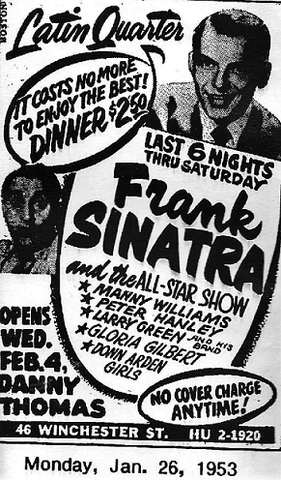
WORL, Boston
Sinatra was a guest disc jockey on WORL in Boston,
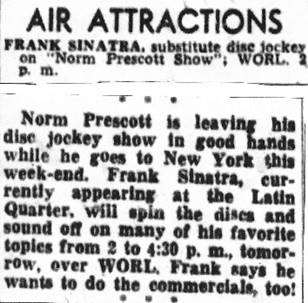
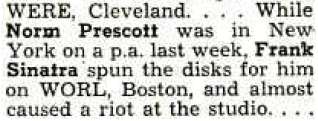
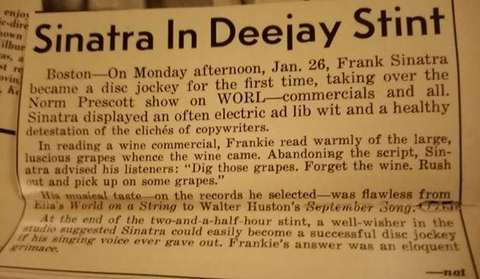
January 27, 1953
Concerts
Latin Quarter, Boston, Massachusetts (January 20-January 31)
January 28, 1953
Concerts
Latin Quarter, Boston, Massachusetts (January 20-January 31)
January 29, 1953
Concerts
Latin Quarter, Boston, Massachusetts (January 20-January 31)
Sheraton Plaza, Boston, Mass
14th Annual Baseball Writers Banquet
Sinatra performed at the banquet
January 30, 1953
Concerts
Latin Quarter, Boston, Massachusetts (January 20 - January 31)
January 31, 1953
Concerts
Latin Quarter, Boston, Massachusetts (January 20 January 31)
February 1953
[Ava doesn't recognize Frank at Heathrow]
Kaplan: When Ava met Frank at Heathrow, she reportedly didn't recognize him at first because he was wearing a hat -- Kaplan notes this reflected his accelerating baldness, though he wasn't yet willing to wear a hairpiece off-camera (he'd worn one on film since 1948's The Kissing Bandit).
Source: James Kaplan, "Frank: The Voice" (2010)
[Ava's second London abortion]
Ava Gardner: Kaplan argues, against some accounts dating it to May, that Ava's second abortion occurred in February 1953 at a small, discreet nursing home near Wimbledon (avoiding the clinic MGM had used in November). Ava's memoir recalls waking to find Frank sitting beside her bed in tears.
Source: James Kaplan, "Frank: The Voice" (2010)
[Cohn's telegram summons Sinatra back]
Harry Cohn: Harry Cohn cabled Frank in Paris that Montgomery Clift was already proficient in Army drill and urged him to return early; Frank cabled back, signing as 'Maggio,' promising to comply and noting he'd be drilling with the French Army over the weekend.
Source: James Kaplan, "Frank: The Voice" (2010)
[Eternity rehearsals and interior shoot begin]
Kaplan: Sinatra hit the ground running once he landed in California: a week of rehearsals at the end of February, followed by five weeks of shooting interiors at Columbia, during which the company saw none of his usual on-set prima donna behavior.
Source: James Kaplan, "Frank: The Voice" (2010)
[Frank and Ava's gloomy Paris stopover]
Kaplan: After the London abortion, Frank and Ava spent a little over a week together, mostly fighting, including a few gloomy days in Paris, before he departed for Los Angeles to begin Eternity.
Source: James Kaplan, "Frank: The Voice" (2010)
[Frank tracks Ava to Rome, then London]
Kaplan: Frank reached Ava by phone in Rome, where she'd been out with new friend Grace Kelly; the call was tense, and she soon went off the radar, checking out of her hotel. Sanicola had to get her whereabouts from MGM's Culver City production office before Frank located her at the Savoy in London.
Source: James Kaplan, "Frank: The Voice" (2010)
[Montreal engagement before Eternity]
Kaplan: Frank was booked at the Chez Paree in Montreal from February 6 to 15, with Eternity rehearsals set to begin February 23 -- squeezing his schedule tight before reporting to Columbia.
Source: James Kaplan, "Frank: The Voice" (2010)
February 2, 1953
[Parsons announces Sinatra's Eternity start]
Louella Parsons: Louella Parsons's column reported that Frank Sinatra had been notified to report to Columbia in ten days to begin From Here to Eternity.
Source: James Kaplan, "Frank: The Voice" (2010).
February 3, 1953
Television
Texaco Star Theater
Tuesday Evening
Season 5, Episode #192 Season Episode: #22
Network: NBC
Time: 8:00 - 9:00 P.M.
Sponsor: Texaco
Host: Milton Berle
Orchestra Conducted By: Alan Roth
Commercials: Jimmy Nelson
Guests: Frank Sinatra, Joan Blondell, Bobby Sherwood
Directed By: Greg Garrison
Written By: Goodman Ace, Aaron Ruben, Arnold Audersach, Selma Diamond, Jerry Seelen, Jay Burton, Phil Charing
1. titles / opening
2. skit: "Van Pell & Arcleef Fine Jewelry" - Milton Berle, Joan Blondell
3. skit: "Sinatra's Boat Arrives" - "Waiting For Franking" Song & Dance Number (Chorus)
4. skit cont'd: "Sinatra's Boat Arrives" - Frank Sinatra, Milton Berle, Joan Blondell
5. song: "You're Are So Nice To Come Home To" (parody of: "You'd Be So Nice To Come Home To") - Frank Sinatra 1:12
6. skit cont'd: "Sinatra's Boat Arrives" - Frank Sinatra, Milton Berle, Joan Blondell, Bobby Sherwood
7. skit cont'd: "State Room / Gifts from Africa" - Frank Sinatra, Milton Berle
8. skit cont'd: "U.S. Customs" - Joan Blondell, Frank Sinatra, Milton Berle
9. skit cont'd: "Ellis Island" - Milton Berle, Joan Blondell, Booby Sherwood
10. skit cont'd: "Ellis Island" - Milton Sinatra, Frank Sinatra
11. song: "September Song" - Frank Sinatra 1:51
12. skit cont'd: "Ellis Island" - Milton Sinatra, Frank Sinatra, Joan Blondell
13. commercial "Texaco" & comedy spot - Danny O'Day & Jimmy Nelson, Milton Berle, Joan Blondell
14. skit cont'd: "Ellis Island" - Milton Berle, Frank Sinatra, Joan Blondell
15. skit cont'd: Sinatra fills in for Milton - Frank Sinatra, Melton Berle, Joan Blondell
16. song: "She's Funny That Way" (seg..) - Frank Sinatra :14
17. skit cont'd: Sinatra fills in for Milton - Frank Sinatra, Melton Berle, Joan Blondell
18. song: "Say Uncle, Uncle Frankie" - Frank Sinatra, Joan Blodell, Milton Berle :48
19. skit cont'd "looking for the sales slip / to be continued"
20. closing & credits
Notes: TT 59:37mins.
Ed O'Brien notes:
Jimmy Nelson and Bobby Sherwood were also guests on Milton's show. Frank did comedies skits and sang parodies with Berle and Blondell. He also sang "September Song" with an Italian accent. It was easily the show's finest moment.
Finally tracked down the February 3, 1953 Texaco Star Theater show. Nothing in the comedy department really to write home about nor was Blondell used to any great extent. The highlights were any references to Ava and Gable and of course "September Song" sung by Sinatra with the Italian accent. Ah, the heyday of early television. –Scott
February 4, 1953
[Parsons interviews Sinatra on Ava]
Frank Sinatra: Two days later, Parsons wrote that she'd spoken with Frank, freshly arrived in New York from Boston, who said the separation from Ava (then in Rome, headed to London for another picture) was difficult, and that he'd be unable to see her for at least two months once filming started.
Source: James Kaplan, "Frank: The Voice" (2010).
February 6, 1953
Concerts
Chez Peree, Montreal, Quebec (6-15) w/Bob Harrington Orchestra
NOTE: Ed O'Brien reports that Harry Ship, nightclub owner and booking agent, offered Frank Sinatra a $15,000 advance if he would play the Chez Paree for a week. Frank opened on a Friday and did shows at 8:30, 11:30, and 1:30. He did the same on Saturday evening and repeated that schedule the following weekend. Sunday thru Thusday the shows were at 9 and 1. The cover charge Monday through Friday was $1.50 and a whopping $2.00 on Saturday and Sunday. Ava Gardner attended and Frank did a decent business for pre-"Eternity" and pre-Capitol. There was a nice ad in the Montreal Gazette on opening night.
Chez Peree, Montreal, Quebec (6-15) w/Bob Harrington Orchestra
The Gazette (Montreal, Quebec), February 11, 1953
Note: This is the best review of Sinatra’s performance at the Chez Paree that I could find. The rest would focus on his behavior on stage and off while in Montreal. –Scott
Samedi-Dimanche, Montreal, Quebec), February 21, 1953, pg. 27
Translation:
A young woman exclaims:
"Sinatra? A Poor Husband
For AVA Gardner!"
Sinatra, the crooner who had long been pampering women, now seems to lose much of his prestige and popularity. In Montreal, at least. His repeated anger ended up falling on the nerves of the Montrealers who no longer look at him with this admiring eye, who no longer listen to him with these sighs to the bobby-soxer. Because Sinatra wanted it!
One night, he stopped singing during his number and vociferated against members of Chez Paree's Bob Harrington orchestra. The musicians will never forgive this affront. Another night, he called for the help of the police to get out of his box to contain the "crowds" that crowded outside. Only five people were waiting for him. A lunch that he had at the hotel Windsor, the waiter served him a filet mignon that the husband of Ava Gardener did not judge right. He got up and went to the kitchen to tell the chef what he thought. Another day, while the other members of the Chez Paree show were doing their number he declared that these artists did not give a show worthy of "a Sinatra evening" and menaced not to sing. He made his little American Charles Trenet, what! But a Charles Trenet is a lot less good. A Charles Trenet without genius, no wonder. This is Sinatra's long-standing commitment to Montreal, and it will be a long time before a cabaret re-engages it. At the end of Chez Paree, a girl exclaimed: "Sinatra, Pooh ... it's a very poor husband for a woman, and I understand Ava Gardner to want to give him up!" We know that the American crooner married the beautiful actress about a year ago, and that the household quarrels kept them separate for several months. Miss Gardner, because she likes to be called "Miss Gardner", is currently filming "Vaquero".
The following, posted online at an auction site, was the original contract for Sinatra’s appearance at the Chez Paree, dated December 11th, 1952:
The details of on the contract stated:
The Operator hereby engages the Artist, and the Artist hereby accepts said engagement to present his act as a PRINCIPAL, consisting of ONE persons at the CHEZ PAREE in the City of MONTREAL, CANADA for a period of TEN consecutive days, SEVEN days weekly. TWO shows daily commencing on February 6th, 1953, for which the Operator agrees to pay the Artists, and the Artist agrees to accept, as full payment, the sum of SEVEN THOUSAND TWO HUNDRED FIFTY - Dollars ($7,250.00 weekly payable immediately preceding the first performance on the concluding night of each week's engagement hereunder.
Here is a close-up picture of Sinatra’s signature at the bottom of the contract:
There was also a further memo to Sinatra from the Chez Paree agreeing to additional $2500 plus living expenses in the amount of $1,078.
Dear Mr. Sinatra,
Reference is hereby made to the contract between us dated December 11, 1951 for your engagement at the CHEZ PAREE, MONTREAL CANADA for a period of ten (10) days commencing February 6, 1953.
In addition to the compensation set forth in the above-mentioned contract, we hereby agree to pay you the additional sum of TWO THOUSAND FIVE HUNDRED DOLLARS ($2500.) per week plus ONE THOUSAND SEVENTY-EIGHT DOLLARS ($1078.) for the three (3) days representing the living and miscellaneous expenses incurred by you during your said engagement at the CHEZ PAREE, MONTREAL.
Very truly yours,
CHEZ PAREE, MONTREAL
There was an additional memo sent to the William Morris Agency regarding the executed copy of the contract and agreement and further stating that Sinatra would need the contract to cross the border into Canada.
FRANK SINATRA WAS SAD THE DAY I MET HIM AT METROPOLITAN NEWS
The Chez Paree was on Stanley Street, just south of St. Catherine. It was a centre of Montreal night life when I was a young girl working at Metropolitan News a block away at 1248 Peel Street. My friend, Wally Aspell, opened for Frank Sinatra during his gig there.
One afternoon, my Pop or my Uncle Harry gave me a copy of Variety to bring over to the Chez Paree so I might have a chance to meet the great Sinatra. They both knew how I loved to meet the movie stars. I was sent out under the pretext that Sinatra had asked for the show business paper.
I came into the darkened Chez Paree nervously hoping to see the great star, but he wasn't there. Wally was there on the stage in the dusty darkness. But Sinatra came into Metro News the next day.
I learned that, late the night before, Sinatra had phoned home to California and found that his wife, Ava Gardner, was not at home.
Sinatra was not in a good mood the day I met him. I can't remember him saying a word as his companion, perhaps body guard, requested a copy of Variety or Billboard.
What I remember most - apart from Sinatra's mood - is the terrible scar along the side of his neck.
Charlie Parker Story
February 5th marks the 50th anniversary of 'Bird's' TV live appearance on the CBC's "Jazz Workshop" show and the 7th , his afternoon appearance at the Chez Paree [Frank Sinatra hit the same stage that night]. The audio portion of both events can be found on "Charlie Parker, 1953, Montreal" on the Uptown label and you can read about the events surrounding both the Montreal and Toronto appearances in "Cool Blues: Charlie Parker in Canada 1953" by Mark Miller.
Interview with Denise Leslie
JBN: – Let's take a trip with a time machine, so where and why would you really wanna go?
DL: – Where and why would I want to go in a time machine? Why? I'd head straight to Montreal,
Quebec at the Chez Paree Night Club the night of Feb 6th, 1953 to see Frank Sinatra. He was just at the beginning of his comeback. My father was at the show and spoke of it often. He and the entire crowd were on their feet screaming for him to sing World on a String, to which he laughingly replied "for Christ's sake I've already sung it three times!" He sang it again and broke down in tears thanking the Montreal fans for always sticking with him. I would have killed to be there.
The Gazette, Montreal Ad ran in the Gazette on 2/7 and 2/9
--------------------------------------------------
© 1997-2026 The Sinatra Archive
This calendar, or any parts thereof, may not be reproduced in any fashion whatsoever without the prior written permission of the publisher (The Sinatra Archive)
[image referenced in source but could not be recovered]
[image referenced in source but could not be recovered]
[image referenced in source but could not be recovered]
[image referenced in source but could not be recovered]
[image referenced in source but could not be recovered]
[image referenced in source but could not be recovered]
[image referenced in source but could not be recovered]
[image referenced in source but could not be recovered]
[image referenced in source but could not be recovered]
February 7, 1953
Concerts
Chez Peree, Montreal, Quebec (6-15) w/Bob Harrington Orchestra
February 8, 1953
Concerts
Chez Peree, Montreal, Quebec (6-15) w/Bob Harrington Orchestra
February 9, 1953
Concerts
Chez Peree, Montreal, Quebec (6-15) w/Bob Harrington Orchestra
February 10, 1953
Concerts
Chez Peree, Montreal, Quebec (6-15) w/Bob Harrington Orchestra
February 11, 1953
Concerts
Chez Peree, Montreal, Quebec (6-15) w/Bob Harrington Orchestra
February 12, 1953
Concerts
Chez Peree, Montreal, Quebec (6-15) w/Bob Harrington Orchestra
February 13, 1953
Concerts
Chez Peree, Montreal, Quebec (6-15) w/Bob Harrington Orchestra
February 14, 1953
Concerts
Chez Peree, Montreal, Quebec (6-15) w/Bob Harrington Orchestra
February 15, 1953
Radio
Lyn Murray Show
Frank Sinatra was guest
Concerts
Chez Peree, Montreal, Quebec (6-15) w/Bob Harrington Orchestra
February 20, 1953
[Kilgallen on Frank's sudden London trip]
Dorothy Kilgallen: Dorothy Kilgallen's column reported that 'Frankie flew to London... because he hadn't heard from Ava for a week,' after Frank had abruptly canceled a scheduled Martha Raye TV appearance to make the trip.
Source: James Kaplan, "Frank: The Voice" (2010).
March 1953
[Livingston pitches Nelson Riddle]
Kaplan: Soon after signing Sinatra, Livingston urged him to work with a talented but little-known arranger named Nelson Riddle instead of his longtime arranger Axel Stordahl. Sinatra initially refused, having never heard of Riddle despite Riddle's uncredited work for Bing Crosby, Nat Cole, Mel Tormé, and Billy Eckstine. They compromised: Frank would first record a session with Stordahl, and if it didn't sell, he'd give Riddle a shot.
Source: James Kaplan, "Frank: The Voice" (2010)
[Sales force groans at Sinatra signing]
Alan Livingston: The week after signing Sinatra, Alan Livingston flew to Capitol's annual sales convention in Estes Park, Colorado, and announced the signing to a room of a couple hundred salesmen and managers -- who groaned audibly. Livingston defended the choice, telling them he could only judge talent, and 'Frank is the best singer in the world.'
Source: James Kaplan, "Frank: The Voice" (2010)
[Sinatra seeks Sands casino stake]
Kaplan: Despite dire finances and IRS troubles, it was reported that Sinatra applied for a Nevada gambling license and a 2% stake in the newly opened Sands Hotel & Casino in Las Vegas for $54,000, claiming the money would come from his own assets with no liabilities. The Associated Press noted the Nevada Tax Commission wanted to investigate his federal tax status.
Source: James Kaplan, "Frank: The Voice" (2010)
[Sinatra's 'box office insurance' ads]
Kaplan: Feeling defensive about his acting prospects, Frank bought full-page trade-paper ads that March billing himself as 'box office insurance,' citing recent nightclub successes at the Riviera, Chez Paree Chicago, French Casino, Latin Quarter, and Chez Paree Montreal.
Source: James Kaplan, "Frank: The Voice" (2010)
March 2, 1953
Filming began in Hawaii on From Here to Eternity, with Frank Sinatra as Private Angelo Maggio — a role Columbia's Harry Cohn had resisted giving him until pressure from Sinatra, Ava Gardner, and a strong screen test (in which Frank improvised a dice-shaking saloon scene using olives) changed his mind. Director Fred Zinnemann later said Sinatra was easy to work with “90 percent of the time,” while castmate Montgomery Clift, who mentored Frank on the craft of screen acting during the forty-one-day shoot, became a late-night drinking companion alongside novelist James Jones as Frank struggled, largely in vain, to reach Gardner by phone from the islands. Source: J. Randy Taraborrelli, Sinatra: Behind the Legend.
1953
[First Capitol Recording Session; European Tour]
Sinatra holds his first Capitol Records session, recording "Lean Baby" and "I'm Walking Behind You," tours Europe, and appears in "From Here to Eternity."
Source: Nancy Sinatra, "Frank Sinatra, My Father" (1985).
[Ernest Borgnine Recalls Meeting Sinatra on "Eternity" Set]
Ernest Borgnine, cast as Fatso Judson opposite Sinatra's Maggio, recalled being terrified to shoot his first scene with his idol; when he flubbed the moment, Sinatra broke the tension by laughing and joking that Borgnine looked "ten feet tall," a kindness Borgnine said he never forgot.
Source: Nancy Sinatra, "Frank Sinatra, My Father" (1985).
[From Here to Eternity Set Photo]
A production still shows Sinatra on the set of From Here to Eternity, the film based on the bestselling novel that earned him a Best Supporting Actor Academy Award; he later recalled becoming close friends with co-star Montgomery Clift, who he said was very helpful to him.
Source: Charles Pignone, "Frank Sinatra 100" (2015).
[Sinatra Begins Recording for Capitol]
Sinatra began recording for Capitol Records in 1953, where he would go on to pioneer the concept album format built around a unifying mood or theme.
Source: Charles Pignone, "Frank Sinatra 100" (2015).
[Sinatra Begins Fourteen-Year Sands Residency]
In 1953 Sinatra moved his Las Vegas engagements to The Sands Hotel, where he would headline in the Copa Room for the next fourteen years.
Source: Charles Pignone, "Frank Sinatra 100" (2015).
[Sinatra's Career Comeback]
Steve Wynn's foreword recalls that after Sinatra's professional comeback in 1953, no one in the business could touch him again, and he never looked back.
Source: Charles Pignone, "Frank Sinatra 100" (2015).
[Swing Easy Tops Billboard's DJ Poll]
Frank's first LP, Swing Easy, was named favorite album in a Billboard disc-jockey poll, with Frank himself voted favorite male singer.
Source: Nancy Sinatra, "Frank Sinatra, My Father" (1985).
[The Snowman Mosaic Gift]
Young Tina made her father a mosaic snowman from crushed craft rocks; when several pieces fell off during wrapping, Frank calmly reglued them and later hung the piece in his Palm Springs bathroom, where it stayed for decades.
Source: Tina Sinatra, "My Father's Daughter: A Memoir" (2000).
[Ava expatriates to Spain]
Dorothy Kilgallen: After recuperating from an abortion and wrapping Mogambo, Ava Gardner vacationed in Spain and effectively became a tax expatriate, having learned she could shelter most of her income from the IRS by living overseas. Dorothy Kilgallen noted in her column that despite Sinatra's earlier ejection of Lana Turner from his Palm Springs house for visiting Ava, Lana and Ava were planning to vacation together in Europe.
Source: James Kaplan, "Frank: The Voice" (2010)
[Ava's fling with matador Dominguín]
Kaplan: While in Spain, Ava Gardner had a three-week fling with star matador Luis Miguel Dominguín, 26, a favorite of Ernest Hemingway's (who later called him 'a combination Don Juan and Hamlet'). Unlike her earlier pursuit by matador Mario Cabré, this time Ava was the pursuer. The affair ended when she had to return to London to film Knights of the Round Table.
Source: James Kaplan, "Frank: The Voice" (2010)
[Ava's wedding ring history]
Kaplan: The platinum wedding ring Sinatra gave Ava Gardner in November 1951 had been lost and replaced with a duplicate amid the couple's marital troubles in 1953; Gardner set the ring aside for good when they separated.
Source: James Kaplan, "Sinatra: The Chairman" (2015)
[Borgnine on Frank's unusual restraint]
Ernest Borgnine: Ernest Borgnine recalled that after filming a knife-fight scene, Frank talked about getting drinks and 'broads' afterward but never showed up -- Kaplan notes this was a period when Frank appears to have stayed largely faithful (or at least discreet), with Lana Turner away in Spain and Marilyn Maxwell having given up on him.
Source: James Kaplan, "Frank: The Voice" (2010)
[Brad Dexter's marriage to Peggy Lee]
Kaplan: Before his later fame as Sinatra's Hawaii rescuer, Brad Dexter had a tempestuous ten-month marriage to singer Peggy Lee in 1953.
Source: James Kaplan, "Sinatra: The Chairman" (2015)
[Critic Richard Watts praises Sinatra's acting]
Richard Watts: New York Post critic Richard Watts wrote that for the first time he found himself among Sinatra's admirers, praising his portrayal of Maggio with 'a kind of doomed gaiety that is both real and immensely touching.'
Source: James Kaplan, "Frank: The Voice" (2010)
[Ebbins tries to explain Lawford drinks incident]
Kaplan: Peter Lawford's manager Milt Ebbins phoned Sinatra immediately after the 1953 drinks-with-Ava incident to explain that the meeting had been his own idea, not Lawford's; Frank exploded in anger regardless.
Source: James Kaplan, "Sinatra: The Chairman" (2015)
[Frank begins performing at the Sands]
Consiglio: Around 1953 or 1954, Frank began playing the Sands in Las Vegas at the invitation of manager Jack Entratter, whom Consiglio knew from Entratter's earlier days managing the Copacabana in New York. Frank drew Sammy Davis, Dean Martin, and Peter Lawford along with him and received a 2 percent share of the hotel while performing there, a stake that continued when he later moved to Caesars Palace.
Source: Tony Consiglio (as told to Franz Douskey), "Sinatra and Me: The Very Good Years" (2012)
[Frank signs with Capitol Records]
Consiglio: In 1953, Frank signed with Capitol Records, founded by songwriter Johnny Mercer, ending his troubled run at Columbia where he owed money against fallen record sales. Alan Livingston handled the negotiations and offered Frank only a twelve-month contract, a sign of how far his stock had fallen.
Source: Tony Consiglio (as told to Franz Douskey), "Sinatra and Me: The Very Good Years" (2012)
[From Here to Eternity and Sinatra's comeback]
Consiglio: Ava Gardner's help getting Frank the role of Maggio in From Here to Eternity turned his career around: he won the Oscar for Best Supporting Actor and landed a new contract with Capitol Records, launching his career resurgence.
Source: Tony Consiglio (as told to Franz Douskey), "Sinatra and Me: The Very Good Years" (2012)
[From Here to Eternity released]
Consiglio: From Here to Eternity, the World War II drama that gave Frank his comeback role as Maggio, came out in 1953, several years after the war ended.
Source: Tony Consiglio (as told to Franz Douskey), "Sinatra and Me: The Very Good Years" (2012)
[Hedda Hopper spots Sinatra with Garland]
Hedda Hopper: Columnist Hedda Hopper spotted Sinatra dining with Judy Garland and her husband Sid Luft, speculating they might be discussing Frank for the male lead opposite Judy in the planned musical remake of A Star Is Born.
Source: James Kaplan, "Frank: The Voice" (2010)
[IRS lien on Sinatra's income]
Kaplan: That spring, Frank's tax troubles became public when the IRS slapped a lien on his income over $109,000 in back taxes, making his modest Eternity salary look comparatively appealing.
Source: James Kaplan, "Frank: The Voice" (2010)
[Livingston signs Sinatra to Capitol]
Kaplan: Alan Livingston signed Frank Sinatra to Capitol Records in 1953, at a time when no other label wanted him.
Source: James Kaplan, "Sinatra: The Chairman" (2015)
[MGM reissues The Kissing Bandit]
Kaplan: Amid Sinatra's post-Eternity comeback buzz, MGM planned to rerelease his notorious flop The Kissing Bandit -- a backhanded compliment to his newly revived stock.
Source: James Kaplan, "Frank: The Voice" (2010)
[Original Capitol contract]
Kaplan: Sinatra's original four-year Capitol contract, a lowball deal signed with VP Alan Livingston in 1953 when his career was at a low ebb, gave him leverage to renegotiate once his fortunes rebounded.
Source: James Kaplan, "Sinatra: The Chairman" (2015)
[Our Town]
Sinatra played the Stage Manager in a musical television adaptation of Thornton Wilder's Our Town, broadcast live on the 'Producers' Showcase' anthology series. This was Sinatra's only dramatic television role until 1977's Contract on Cherry Street, and the production yielded the Emmy Award-winning song 'Love and Marriage.'
No corresponding dated entry could be identified in the chronology for this film/context.
Source: Tom Santopietro, "Sinatra in Hollywood" (2008), The Peak Years (pt. 1)
[Recording 'I Could Have Told You']
Kaplan: In the early hours of December 10, 1953, the same session produced the last song of the night, a Jimmy Van Heusen/Carl Sigman ballad ('I Could Have Told You') whose lyrics about heartbreak hit close to home for Sinatra, recorded three days before his thirty-eighth birthday.
Source: James Kaplan, "Frank: The Voice" (2010)
[Rumored Lucille Ball TV series]
Hal Humphrey: TV columnist Hal Humphrey reported Sinatra was close to starring in a TV series to be produced by Lucille Ball and Desi Arnaz, about a musician's trials, titled 'Blue in the Night' -- a premise a little too close to Sinatra's real career troubles at the time.
Source: James Kaplan, "Frank: The Voice" (2010)
[Sinatra buys into the Sands]
Kaplan: Mob lieutenant Joseph "Doc" Stacher fronted Sinatra $54,000 to buy two points in the Sands when it was less than a year old, during Sinatra's career slump; the Nevada Tax Commission initially challenged his fitness as an owner over his back taxes before abruptly reversing course.
Source: James Kaplan, "Sinatra: The Chairman" (2015)
[Sinatra destroys apartment over Waterfront]
George Jacobs: According to valet George Jacobs, after losing the Terry Malloy role in On the Waterfront, Sinatra trashed his apartment's living room in a rage -- knocking over lamps, breaking glass, and shredding several drafts of Budd Schulberg's script, cutting his hands in the process -- then raged against producer Sam Spiegel for weeks.
Source: James Kaplan, "Frank: The Voice" (2010)
[Sinatra hires George Jacobs as valet]
George Jacobs: As his career revived in fall 1953 and he needed permanent help, Sinatra hired George Jacobs away from Swifty Lazar, having his secretary Gloria Lovell hand Jacobs an envelope with the keys to his apartment and the greeting 'Welcome aboard.'
Source: James Kaplan, "Frank: The Voice" (2010)
[Sinatra in Rome pursuing Ava]
Kaplan: Sinatra spent the previous Christmas and New Year's in Rome, where Ava Gardner was filming The Barefoot Contessa, desperately trying to hold onto her even as she drifted toward the bullfighter Dominguín.
Source: James Kaplan, "Sinatra: The Chairman" (2015)
[Sinatra sells Palm Springs house]
Kaplan: Needing cash that spring, Sinatra quietly sold his beloved Palm Springs house to a wealthy widow, Mrs. George Machris, for a fire-sale $85,000 -- just over half what it had cost him. The proceeds went straight to Nancy, who was still living in the Holmby Hills house with the children.
Source: James Kaplan, "Frank: The Voice" (2010)
[Sinatra sings for Giancana's wife's charity]
Kaplan: Sinatra sang at a charity event organized by Sam Giancana's wife in 1953.
Source: James Kaplan, "Sinatra: The Chairman" (2015)
[Sinatra's friendship with Bogart and Bacall begins]
George Jacobs: Sometime after Frank moved to his Beverly Glen apartment, Lauren Bacall spotted him walking with his head down near Holmby Park and called out that he looked like he could use a drink. Frank began visiting the Bogarts' Mapleton Drive house regularly, becoming starstruck by Bogart in particular, mimicking his style and mannerisms, according to valet George Jacobs.
Source: James Kaplan, "Frank: The Voice" (2010)
[Sinatra's rocky prior Europe tour with Ava]
Kaplan: On his previous overseas tour, in Europe with Ava Gardner in spring 1953, Sinatra played to packed houses in Italy but was overshadowed by Ava in Naples, where crowds chanted her name and threw cushions when she wouldn't appear onstage; poor reception in Sweden led one venue to withhold his fee, and Sinatra, claiming a nervous collapse, ended the tour early.
Source: James Kaplan, "Sinatra: The Chairman" (2015)
[Sinatra-Clift friendship and drinking]
Kate Buford: Frank and Montgomery Clift bonded closely during filming, often drinking together after hours with author James Jones at what they called 'our lamppost.' Burt Lancaster, per his biographer, grew so used to carrying the two men drunk to bed that he received a 'Happy Birthday, Mom' telegram from Sinatra every year afterward.
Source: James Kaplan, "Frank: The Voice" (2010)
[Sinatra-Lawford freeze-out begins]
Kaplan: In late 1953, as Sinatra's marriage to Ava Gardner was collapsing, Peter Lawford and his manager had drinks with Ava and her sister Bappie; a gossip item that airbrushed out the manager and sister enraged Sinatra, who then froze Lawford out for years.
Source: James Kaplan, "Sinatra: The Chairman" (2015)
[music/career (tied to comeback)]
Those first 1953 Capitol sessions launched Sinatra's landmark collaboration with arranger Nelson Riddle, eventually totaling 318 recordings and beginning with tracks like "I've Got You Under My Skin" -- signaling a newly confident, brassier vocal sound that paralleled his film comeback.
No corresponding dated entry could be identified in the chronology for this film/context.
Source: Tom Santopietro, "Sinatra in Hollywood" (2008), Ava and the Downfall / The Comeback
[Ava Gardner earns Oscar nomination for Mogambo]
Ava Gardner's career finally reached its peak in 1953 when John Ford cast her in Mogambo, earning her an Academy Award nomination.
Source: Richard Havers, "Sinatra" (Dorling Kindersley, 2007).
[Dick Haymes marries Rita Hayworth]
After his third marriage ended amid serious drinking problems, Dick Haymes fell for movie star Rita Hayworth and married her in 1953; immigration troubles over his wartime resident-alien status nearly saw him deported to Argentina during their marriage.
Source: Richard Havers, "Sinatra" (Dorling Kindersley, 2007).
[Frank arrives quietly in London, confirms UK tour]
Frank flew from a Montreal booking to London, where he spoke guardedly to a reporter from the New Musical Express, one of the few in the press who even knew he was in the country, and confirmed plans to tour Britain that spring and summer.
Source: Richard Havers, "Sinatra" (Dorling Kindersley, 2007).
[Mitch Miller's record 38 weeks at UK No. 1 in a single year]
In 1953, records produced by Mitch Miller for Frankie Laine and others spent a combined 38 weeks at No. 1 on the UK charts in a single year, a mark Havers calls a record for a producer that will likely never be beaten.
Source: Richard Havers, "Sinatra" (Dorling Kindersley, 2007).
[Freedland's Account of the From Here to Eternity Casting Legend]
Biographer Michael Freedland offers an alternative account of the persistent legend that mob pressure on Columbia chief Harry Cohn secured Sinatra the role of Maggio in From Here to Eternity -- a legend later fictionalized in The Godfather. Freedland writes that the pressure campaign on Cohn's associates actually concerned a role being sought on behalf of Dean Martin, not Sinatra's own casting.
Source: Michael Freedland, All the Way: A Biography of Frank Sinatra (London: Weidenfeld & Nicolson, 1997; Orion paperback, 1998).
[Nevada Tax Commission's Sands Hotel Investigation]
The Nevada Tax Commission voted 6-1 to approve Sinatra's application for a 2% gambling stake in the Sands Hotel after a two-month background investigation into whether his investment funds came from underworld sources; the lone dissenting commissioner cited Sinatra's unpaid back taxes rather than any mob connection.
Source: George Carpozi Jr., Frank Sinatra: Is This Man Mafia? (New York: Manor Books, 1979).
[Capitol signing -- critical commentary]
Alan Livingston: Alan Livingston (Capitol VP of A&R, who signed Sinatra) recounted in detail how William Morris agent Sam Weisbord cold-called him about representing the down-and-out Sinatra; Livingston signed him to a seven-year contract (one year, six options) at 5% royalty. Livingston's account: 'Sinatra had hit bottom, and I mean bottom... He was broke, he was in debt, Ava Gardner had left him. I was told he had tried to kill himself.' The signing took place at Lucy's Restaurant in Hollywood with aides Hank Sanicola and Frank Military present. Capitol's own sales staff groaned when the signing was announced at the company convention; only A&R men Voyle Gilmore and Dave Dexter were even mildly supportive, and Sinatra refused to work with Dexter, so Gilmore became his producer.
Source: Will Friedwald, "Sinatra! The Song Is You: A Singer's Art" (2018 revised edition), Ch. 6, "With Nelson Riddle" (1953-1979)
[From Here to Eternity's career impact -- critical commentary]
Milt Bernhart; Mitch Miller: Milt Bernhart credits Sinatra's own instinct for landing the Maggio role: 'If you had just read the book, why would that change a person's whole life?... Frank knew that it would. He knew where he was going.' Mitch Miller's verdict: 'By getting stomped to death in that movie, [it was like] he did a public penance for all [the wrongs he had done]. You can chart it. From the day that movie came out, his records began to sell.'
Source: Will Friedwald, "Sinatra! The Song Is You: A Singer's Art" (2018 revised edition), Ch. 6, "With Nelson Riddle" (1953-1979)
[Overview of Sinatra-Riddle Capitol/Reprise catalog -- critical commentary]
Will Friedwald (analysis): Friedwald states Songs for Swingin' Lovers! and Only the Lonely were Riddle's own two personal favorites among the 21 albums he made with Sinatra, and the zeniths of both careers. He lists the seven essential Capitol works (1953-58): Songs for Young Lovers, Swing Easy, In the Wee Small Hours, Songs for Swingin' Lovers!, Close to You, A Swingin' Affair!, and Only the Lonely -- plus five anthologies of singles, two 'diminished' later albums (Nice 'n' Easy, Sinatra's Swingin' Session!!!), two soundtrack sets (Pal Joey, Can-Can), and five Reprise postscripts (The Concert Sinatra, Sinatra's Sinatra, Days of Wine and Roses..., Strangers in the Night, Moonlight Sinatra).
Source: Will Friedwald, "Sinatra! The Song Is You: A Singer's Art" (2018 revised edition), Ch. 6, "With Nelson Riddle" (1953-1979)
[Sinatra's 1953 career nadir / comeback context -- critical commentary]
Frank Sinatra; Bill Miller: Sinatra on his own rock-bottom period, quoted by Friedwald: 'You have to scrape bottom to appreciate life and start living again.' Bill Miller, who joined Sinatra in 1952, recalled witnessing the slide from Columbia split, canceled TV series, stalled movie career, and marital turmoil.
Source: Will Friedwald, "Sinatra! The Song Is You: A Singer's Art" (2018 revised edition), Ch. 6, "With Nelson Riddle" (1953-1979)
[Songs for Young Lovers -- critical commentary]
Granata / Mahlon Clark: Songs for Young Lovers, Sinatra's first Capitol 10-inch LP, featured the Hollywood String Quartet plus rhythm and two saxophones, arrangements largely by George Siravo (uncredited) reworked from Sinatra's stage charts; Riddle contributed only one of the eight orchestrations. Clarinetist Mahlon Clark recalled the charts were 'tattered' from road use, with only 'Like Someone in Love' newly written.
Source: Charles L. Granata, "Sessions with Sinatra: Frank Sinatra and the Art of Recording" (1999/2003), Part III: The Capitol Years, 1953-1962
[Wrap Your Troubles in Dreams -- critical commentary]
Milt Bernhart: Milt Bernhart's account of the pivotal 'aha' moment defining the Sinatra-Riddle collaboration: the session began with 'Wrap Your Troubles in Dreams' (later remade on Swing Easy!), but before a take was completed Sinatra stopped everything, called a break, and pulled Riddle into the hallway for a private talk. Bernhart secretly watched: 'Nelson was standing frozen, and Frank was doing all the talking... I was positive I knew what Frank was saying to him... Frank undoubtedly told him that "When you're writing, write a fill for me when I'm through singing but don't write a concerto behind me."' When they returned, the date was over -- but Sinatra didn't fire Riddle, which Bernhart says shows Sinatra 'recognized something in Nelson that a lot of people wouldn't.'
Source: Will Friedwald, "Sinatra! The Song Is You: A Singer's Art" (2018 revised edition), Ch. 6, "With Nelson Riddle" (1953-1979)
[companion recording: Point of No Return (Capitol 48334) -- critical commentary]
Granata describes Point of No Return as Sinatra and Stordahl's final, uneven and controversial album together, noting that this reissue includes as a bonus the four songs recorded at Frank's very first Capitol session, held April 2, 1953.
Source: Charles L. Granata, "Sessions with Sinatra: Frank Sinatra and the Art of Recording" (1999/2003), Afterword & Appendices A-D
[personnel -- critical commentary]
Alan Livingston: Alan Livingston, then Capitol VP of A&R, recalls signing Sinatra when he 'had hit bottom' and couldn't get a record contract or nightclub booking; Livingston got a call from William Morris agent Sam Weisbord and immediately said yes, believing Sinatra's talent was undiminished.
Source: Charles L. Granata, "Sessions with Sinatra: Frank Sinatra and the Art of Recording" (1999/2003), Part III: The Capitol Years, 1953-1962
[personnel -- critical commentary]
Alan Livingston: Livingston recalls announcing the Sinatra signing at Capitol's national sales convention in Colorado to a room of skeptical executives, insisting Sinatra was 'the best singer in the world.'
Source: Charles L. Granata, "Sessions with Sinatra: Frank Sinatra and the Art of Recording" (1999/2003), Part III: The Capitol Years, 1953-1962
[personnel -- critical commentary]
Milt Bernhart: Milt Bernhart recalls that many top studio musicians who backed Sinatra (Rossolino, Gozzo, Roberts, Bernhart himself) came out of Stan Kenton's disbanded orchestra and had to fight their way into the closed, initially race- and reputation-conscious Hollywood studio system, with Marlon Brando's insistence on hiring Shorty Rogers's jazz musicians for The Wild One helping break the barrier around 1954.
Source: Charles L. Granata, "Sessions with Sinatra: Frank Sinatra and the Art of Recording" (1999/2003), Part III: The Capitol Years, 1953-1962
[recording session -- critical commentary]
Capitol's Melrose Avenue studios (the former KHJ Radio studio) served as the site of Sinatra's Capitol recordings from April 2, 1953 through January 16, 1956, the period Granata calls one of the greatest comebacks in entertainment history.
Source: Charles L. Granata, "Sessions with Sinatra: Frank Sinatra and the Art of Recording" (1999/2003), Part III: The Capitol Years, 1953-1962
February 24, 1953

[Photograph: From Here to Eternity screenplay finalized, filming begins. From Richard Havers, "Sinatra" (Dorling Kindersley, 2007), p.171.]
The final screenplay for From Here to Eternity was completed on February 24, 1953, with interior shooting starting March 2 in Hollywood before the large cast and crew relocated to Hawaii for location filming, marking the real beginning of Frank's comeback vehicle. (Source: Richard Havers, "Sinatra" (Dorling Kindersley, 2007).)
March 9, 1953
[Frank buys matching trench coats in New York]
During the week of March 9, when the Eternity shoot paused so Burt Lancaster could finish South Sea Woman and rehearse, Frank slipped off to New York and bought matching nutria trench coats for himself and Ava.
Source: James Kaplan, "Frank: The Voice" (2010).
March 13, 1953
Sinatra met with Capitol Records vice president Alan Livingston and signed a seven-year recording contract, setting up the label's comeback-era Nelson Riddle collaborations that would follow. Source: Wikipedia, “Frank Sinatra.”
[Sinatra signs with Capitol Records]
Alan Livingston: At a lunch with Capitol VP Alan Livingston at Lucey's restaurant on Melrose (across from Capitol's recording studios), Sinatra signed a seven-year contract (one year with six annual options) with Capitol Records, a standard 5% royalty, and only a scale advance -- terms typical of a new artist, not a superstar. For the first time in his career he'd have to cover his own recording costs. Livingston later recalled Sinatra as 'meek, a pussycat, humble' at that meeting, broke, in debt, and at 'the lowest ebb of his life.'
Source: James Kaplan, "Frank: The Voice" (2010).
March 14, 1953
[Capitol signing hits the wires]
A tiny wire-service item on page two of many papers reported Sinatra's Capitol signing the morning after the contract was signed, buried beneath stories about a UFO sighting over Kirtland Air Force Base and the illness of the Czechoslovakian president. The item inaccurately described it as 'terminating his long association with Columbia records' -- Columbia had actually dropped him months earlier.
Source: James Kaplan, "Frank: The Voice" (2010).
March 16, 1953
[Gossip item on Sinatra's hats]
Erskine Johnson: Columnist Erskine Johnson quipped that with all hair restorers having failed, Frank Sinatra had taken to wearing hats.
Source: James Kaplan, "Frank: The Voice" (2010).
March 21, 1953
Television
Spade Cooley Show
KTLA, Los Angeles California
8-9PM
Spade Cooley Show
KTLA, Los Angeles California
8-9PM
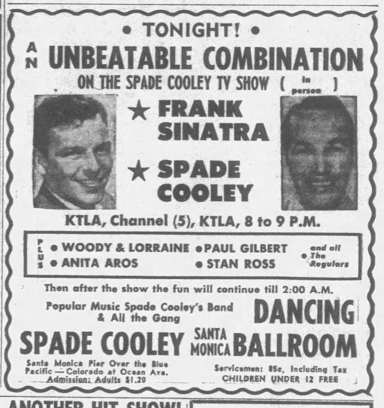
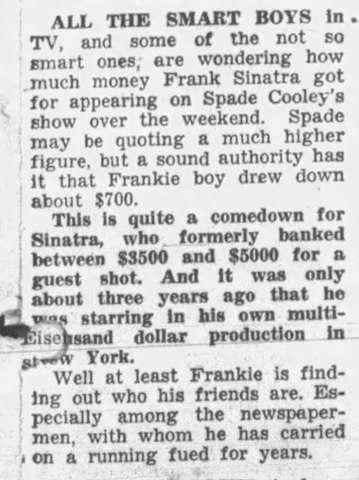
A Billboard item datelined Hollywood, March 14, reported Sinatra's Capitol signing and noted a well-known "coolness" between Frank and his former label, Columbia. The piece also quoted Alan Livingston hoping to tie Sinatra releases to his upcoming films, an odd claim since his only project in motion was From Here to Eternity. (Source: Richard Havers, "Sinatra" (Dorling Kindersley, 2007).)
March 31, 1953
Radio
Conquest for Cancer
Broadcast on a 20 Iowa station network
June Valli, Frank Sinatra, Harry Belafonte, Connie Boswell, Eddie Fisher and more
April 1953
[Burt Lancaster On Frank And Montgomery Clift's Nightly Ritual In Hawaii]
Nancy Sinatra: Burt Lancaster recalled that during the Hawaii shoot for From Here to Eternity, Frank mixed martinis each evening while trying, unsuccessfully, to reach Ava by phone in Spain; both he and Montgomery Clift would end up too drunk to undress themselves, leaving Lancaster and Deborah Kerr to put them to bed nightly.
Source: Nancy Sinatra, Frank Sinatra: An American Legend, 1995.
[Nancy Jr. Compares Her Father's Capitol Debut To A Rival Eddie Fisher Single]
Nancy Sinatra: When Frank began sending Nancy test-pressing dubs of his new Capitol recordings, she loved his version of "I'm Walking Behind You" but mentioned she'd also heard a competing Eddie Fisher recording on the radio; Frank told her not to worry, though Fisher's version ultimately outsold his.
Source: Nancy Sinatra, Frank Sinatra: An American Legend, 1995.
[Sinatra's Capitol Records Run Begins]
Sinatra's recording contract with Capitol Records ran from April 1953 to March 1962, a stretch during which he cut more than three hundred selections, including his celebrated concept albums with arrangers Nelson Riddle, Billy May, and Gordon Jenkins.
Source: Charles Pignone, "Frank Sinatra 100" (2015).
[Cohn confronts crew over Sinatra's scene]
Walter Shenson: Unit publicist Walter Shenson recalled Harry Cohn arriving on set in a military limousine, still in the white dinner jacket he'd worn dining with the Army's Pacific commander, to confront the crew over the Maggio arrest scene. The next morning Cohn told Shenson he'd sent Sinatra back to the studio without seeing the rushes, cursing him as 'that dirty little dago.'
Source: James Kaplan, "Frank: The Voice" (2010)
[Earlier Stordahl version of 'Day In, Day Out']
Kaplan: Frank had already recorded 'Day In, Day Out' at his very first Capitol session, arranged by Axel Stordahl, but that version's old-fashioned orchestration (with pizzicato and harp glissandi) kept it in the vault for decades until it resurfaced in 1991 as a bonus track on a Nice 'n' Easy CD reissue.
Source: James Kaplan, "Frank: The Voice" (2010)
[First Capitol recording]
Kaplan: The first song Sinatra recorded for Capitol Records, in April 1953, was a Billy May composition called "Lean Baby," an upbeat blues number.
Source: James Kaplan, "Sinatra: The Chairman" (2015)
[Nightly martini ritual in Hawaii]
Burt Lancaster: During the Hawaii shoot, Sinatra hosted nightly martinis in his hotel room before dinner, repeatedly trying and failing to phone Ava in Spain. He and Clift would be unconscious by 8 p.m. every night, requiring Lancaster and Deborah Kerr to undress them and put them to bed while the days were spent working diligently on set.
Source: James Kaplan, "Frank: The Voice" (2010)
[On-set blowup over Maggio's arrest scene]
Kaplan: During filming of Maggio's arrest scene in Hawaii, Harry Cohn -- worried about offending the Army -- pressured Zinnemann to tone down the confrontation, and a dispute erupted on set the night of shooting. Various accounts differ (Kitty Kelley's claims Sinatra slapped Clift over a staging dispute, which Kaplan finds unlikely), but the upshot was that Zinnemann had Sinatra deliver the pivotal speech seated rather than standing as rehearsed -- a rare capitulation for Frank, who blamed Zinnemann for it long afterward.
Source: James Kaplan, "Frank: The Voice" (2010)
[Photo caption: filming Eternity in Hawaii]
Fred Zinnemann: A photo caption shows Montgomery Clift and Frank filming From Here to Eternity in Hawaii in April 1953; director Fred Zinnemann recalled Sinatra as unusually well-behaved on this shoot -- 'very, very good -- all the time... No histrionics, no bad behavior' -- because he knew it was his last best chance.
Source: James Kaplan, "Frank: The Voice" (2010)
[Stordahl drops out, Livingston maneuvers]
Kaplan: The afternoon before shooting his climactic Hawaii scene, Sinatra called Axel Stordahl to plan an upcoming Capitol session, only to learn Stordahl was leaving for New York the next day to do a new TV show with Eddie Fisher and had to skip the date. A furious Sinatra called Livingston, who defused him by claiming he'd secured bandleader Billy May for the session -- while secretly planning to introduce Nelson Riddle, having already encouraged Stordahl's departure.
Source: James Kaplan, "Frank: The Voice" (2010)
April 2, 1953
Studio
KHJ Studios, Hollywood
11394 Lean Baby
(Billy May/R. Alfred)
Morley Music Co. (ASCAP)
Arranged by Heinie Beau
Conducted by Axel Stordahl
-4 (2:33) CD: CDP 7-48334-2 The Point of No Return
CD: C2-94777 The Capitol Years (3 CD Set)
CD: C2 724383808922 The Complete Capitol Singles
LP: DT 1429 Swing Easy!
45: 2450
11395 I'm Walking Behind You
(Billy Reid)
Arranged & Conducted by Axel Stordahl
-5 (2:57) CD: CDP 7-48334-2 The Point of No Return
CD: C2 724383808922 The Complete Capitol Singles
45: 2450
11396 Day In, Day Out
(Rube Bloom - Johnny Mercer)
(3:20)
CD: CDP 7-48334-2 The Point of No Return
CD: 7243469698529 The Rare Sinatra (UK Release)
LP: E ST 24311 The Rare Sinatra (UK Release)
11397 Don't Make A Beggar Of Me
(Al Sherman)
Arranged & Conducted by Axel Stordahl.
CD: CDP 7-48334-2 The Point of No Return
CD: 7243469698529 The Rare Sinatra (UK Release)
LP: E ST 24311 The Rare Sinatra (UK Release)
LP Capitol T/DT-2602 Forever Frank
Zeke Zarchy (trumpet), Vince DeRosa (French horn), Heinie Beau, Skeets Herfurt, Ted Nash, Leonard Hartman (saxophone/woodwinds),Mischa Russell, Harry Blackstone, Alex Murray, Paul Nero, Irving Prager, Murray Kellner (violins),David Sterkin, Paul Robyn (viola), Cy Bernard (violoncello), Ann Mason Stockton (harp), Bill Miller (piano),George Van Eps (guitar), Phil Stephens (bass), Ray Hagan (drums)
Note: Thanks to Ed O'Brien and Fred Wadsworth for corrections to this session.
Ed O'Brien:
The Rube Bloom-Johnny Mercer "Day In, Day Out" was done with a Stordahl backing at this session. Sinatra would perform the song on radio and in concert for the next year. At the 3-1-54 session at Capitol, Frank would re-record the tune with a Riddle ballad chart. The 53 effort was not discovered until the early 90s, and the 54 was issued on an EP and for- gotten about until an album release in 1973. Two remarkable efforts that were certainly not appreciated or promoted in their time. The 1958 swing version with Billy May thrilled Mr. Mercer. I am also partial to the swing version with Mr. Riddle that opens "A Man & His Music + Ella+ Jobim in 1967.
Sinatra's first Capitol single was comprised of the initial two recordings done for the label.
The A side was "I'm Walking Behind You." Eddie
Fisher's record of the same song came out a few days before Capitol released Frank's effort.
Fisher's recording first charted on the Billboard
Top 100, 5-9-53. It was # 1 for seven consecutive weeks and was on the charts for 25. It sold over a million copies.
Sinatra's effort hit the charts on 5-16-53, attaining a peak position of #7, hung around for
10 weeks, and sold 150,000 copies. Biggest hit for him since "Mamselle" in 1947.
Frank appeared on the BBC Showband Show, 6-11-53, and sang "I'm Walking Behind You" plus "Birth Of The Blues" and "Ol' Man River."
"Lean Baby" also hit the charts on 5-16-53. The song reached #25 and stayed around for just three weeks. Through the years, whenever a member of the audience yelled for that ditty, Frank would sing the first few lines. And he always did it with great humor.
This session yielded Frank Sinatra's first Capitol single, “Lean Baby” backed with “I'm Walking Behind You.” Getting to this point had not been easy: with his Columbia contract expired and no label interested in signing him — even his close friend Manie Sacks, then a top RCA executive, couldn't convince his own company's brass to take a chance on Sinatra — Capitol finally offered him a bare-bones one-year deal with no advance against royalties, after Axel Stordahl, pianist Dick Jones, and Capitol jazz producer Dave Dexter each personally lobbied label president Glenn Wallichs on his behalf. Source: J. Randy Taraborrelli, Sinatra: Behind the Legend.
"I'm Walking Behind You" / "Don't Make a Beggar of Me" / "Lean Baby" / "Day In, Day Out" Sinatra's first Capitol session (with arranger Axel Stordahl) produced 'I'm Walking Behind You' (which didn't make the expected splash), 'Don't Make a Beggar of Me,' and Billy May's 'Lean Baby' (orchestrated by Heinie Beau); 'Day In, Day Out' (Mercer/Bloom) went unreleased and sat in the Capitol vault for nearly 35 years.
Source: Charles L. Granata, "Sessions with Sinatra: Frank Sinatra and the Art of Recording" (1999/2003).
"Point of No Return"
Granata states that with the exception of Point of No Return, each of Sinatra's Capitol albums is a model of perfection and an essential component of any well-rounded pop music library.
Source: Charles L. Granata, "Sessions with Sinatra: Frank Sinatra and the Art of Recording" (1999/2003).
[Heffernan column features Sinatra on set]
Frank Sinatra: Syndicated columnist Harold Heffernan visited Sinatra on the Columbia set of From Here to Eternity for his April 2 column, quoting Frank on his non-singing role as Maggio: 'I play Montgomery Clift's pal ... No girls for me. I just adore this fellow, and eventually give up my life, indirectly, for him. It's a complete change from anything I have ever done.'
Source: James Kaplan, "Frank: The Voice" (2010).
[First Capitol recording session]
The same Thursday evening as the Heffernan column ran, Sinatra recorded his first Capitol session at KHJ studios (Studio C), producer Voyle Gilmore at the helm after Frank vetoed originally-slated producer Dave Dexter over an old critical review. He recorded four songs: the Billy May-style 'Lean Baby,' the weak 'I'm Walking Behind You' and 'Don't Make a Beggar of Me,' and a strong 'Day In, Day Out' that Sinatra would later choose not to release.
Source: James Kaplan, "Frank: The Voice" (2010).
[Bar altercation after first session]
Alan Livingston: After the session, Livingston took Sinatra to Lucey's for a celebratory drink. A stranger at the bar mocked Livingston for 'buying a drink for your leech friend'; Sinatra told him to knock it off, and his bodyguard threw the man out. Livingston recalled Frank shrugging it off: 'See? That's the trouble I get in. It's not my fault.'
Source: James Kaplan, "Frank: The Voice" (2010).
[Day in, Day Out -- critical commentary]
Will Friedwald (analysis): Friedwald uses this song (first sung by Sinatra with Harry James in 1939) as a case study comparing how Stordahl and Riddle set identical Sinatra-dictated outlines (same tempo, one-chorus format) differently: Stordahl's 1953 chart is 'classic Stordahl' with a grandiose pounding pattern on the word 'pounding'; Riddle's 1954 remake subtly softens that device to suit the Capitol-era Sinatra. Neither made it to vinyl at the time; Sinatra ultimately preferred it as a swinger and waited until 1958 for a Billy May arrangement.
This song/context matches multiple dated entries in the chronology; the specific date Friedwald is referring to could not be determined with confidence.
Source: Will Friedwald, "Sinatra! The Song Is You: A Singer's Art" (2018 revised edition), Ch. 6, "With Nelson Riddle" (1953-1979)
April 6, 1953
[Cast flies to Hawaii for Eternity]
Burt Lancaster: On Monday evening, Fred Zinnemann and the stars of From Here to Eternity flew to Hawaii for two weeks of location shooting. Burt Lancaster recalled that Sinatra and Montgomery Clift got drunk on the flight and passed out cold, requiring Lancaster and Deborah Kerr to wake them upon arrival.
Source: James Kaplan, "Frank: The Voice" (2010).
April 8, 1953
[Eternity Hawaii shooting begins]
Harry Cohn wanted a night scene shot immediately upon the cast's arrival in Honolulu, but Zinnemann persuaded him to let everyone acclimate for a day. Location production in Hawaii officially began the following Wednesday morning.
Source: James Kaplan, "Frank: The Voice" (2010).
April 26, 1953
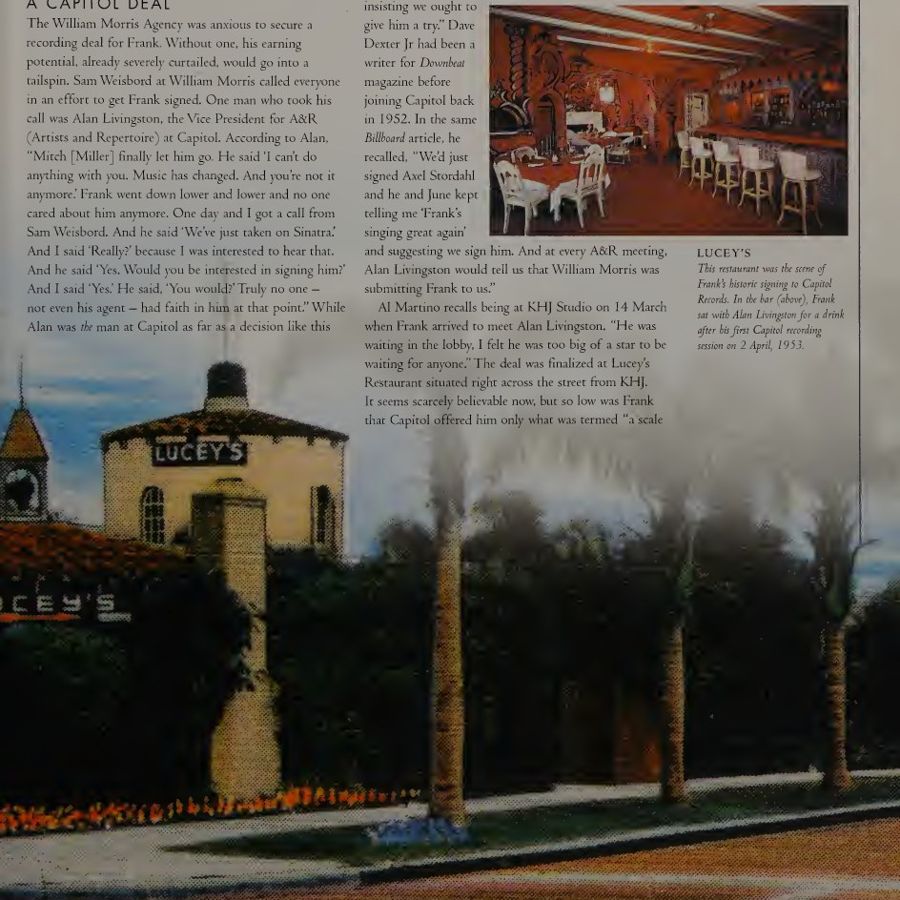
[Photograph: From Here to Eternity wraps filming in Hawaii. From Richard Havers, "Sinatra" (Dorling Kindersley, 2007), p.175.]
Filming wrapped on From Here to Eternity, letting Frank return to Los Angeles in time for his next Capitol session a few days later. Ava Gardner had joined him in Hawaii shortly before the wrap against MGM's wishes, prompting the studio to suspend her. (Source: Richard Havers, "Sinatra" (Dorling Kindersley, 2007).)
April 27, 1953
[First Capitol single released]
Sinatra's first Capitol single, 'I'm Walking Behind You' backed with 'Lean Baby,' was released. A week later it had only reached the lower end of the Billboard chart, and RCA Victor's competing Eddie Fisher version -- released just days after Sinatra's -- was already pulling ahead.
Source: James Kaplan, "Frank: The Voice" (2010).
April 30, 1953
Studio
KHJ Studios. Hollywood
11504 I've Got The World On A String
(Harold Arlen & Ted Koehler)
MCA Music Publishing, a division of MCA Inc. (ASCAP)
Arranged & Conducted by Nelson Riddle
-10 (2:10) CD: CDP 724383595228 Sinatra 80th "All The Best"
CD: C2 724383808922 The Complete Capitol Singles
CD: C2-94777 The Capitol Years
CD: CDP 7-92160-2 Frank Sinatra Collector's Series
LP: T768 This Is Sinatra
45: 2505
11511 Don't Worry 'Bout Me
(R. Bloom/T. Koehler)
Arranged & Conducted by Nelson Riddle
-14 CD: C2 724383808922 The Complete Capitol Singles
CD: CDP 7-91209-2 Where Are You?
CD: CDP 7-92160-2 Frank Sinatra Collector's Series
LP: T768 This Is Sinatra
45: 2787
NOTE: Sinatra Scholar Ed O'Brien writes: "It is mind boggling to realize 56 years have passed since that fateful Thursday night at the KHJ Studios. I suppose you would need to be at least 66 to have any real memory of the original releases of these two great Sinatra recordings. The lingering question from this session: Did Frank record the verse of "Don't Worry 'bout Me" Always an economical performer, it doesn't make sense that he would be doing it in concerts and nightclubs without a recorded version."
11512 I Love You
(H. Thompson/H. Archer)
SBK Feist Catalog Inc. (ASCAP)
Arranged & Conducted by Nelson Riddle
-7 (2:27) CD: C2 724383808922 The Complete Capitol Singles
CD: CDP 7-94520-2 Come Swing With Me
CD: C2-94777 The Capitol Years
LP: W1429 Swingin' Easy
45: 2638
11513 South Of The Border w/Band Chorus
(J. Kennedy/M. Carr)
Shapiro, Bernstein & Co. Inc. (ASCAP)
Arranged & Conducted by Nelson Riddle
-9 (2:49) CD: CDP 724383595228 Sinatra 80th "All The Best"
CD: C2 724383808922 The Complete Capitol Singles
CD: C2-94777 The Capitol Years
CD: CDP 7-92160-2 Frank Sinatra Collector's Series
LP: T768 This Is Sinatra
45: 2638
Musicians - Reeds: Jack Dumont, Authur "Skeets" Herfurt, Joseph Koch, Ted Nash, Ernest Mangano, Rubin "Zeke" Zarchy; Trombones: Milton Bernhart, Frances Howard, James Priddy, Simon Zentner; Piano: Bill Miller;
Bass: Phil Stephens; Guitar: Alton Hendrickson; Drums: Alvin Stoller
Session Producer: Voyle Gilmore
NOTE: Arranger/conductor Neal Hefti told Ed O'Brien that the Sinatra rebirth as a major vocalist came about because of the Holy Trinity of Capitol Records, the long-playing 33 1/3 record, and Nelson Riddle. Hefti gives the lion's share of the credit to Riddle. The Riddle Era began on the evening of April 30, 1953. Billy May was scheduled to do the session but had a previous engagement. May asked Riddle to conduct the two songs for the session a la Billy May "I Love You" and "South of the Border"). Riddle added "String" and "Don't Worry." Sinatra started the session with 10 takes on the Arlen/Koehler tune and then 14 on the Bloom/Koehler song. Frank realized immediately that Riddle was fantastic. Between takes, he was walking around the studio, slapping the musicians on the back, and telling them he was "back." He certainly was, O'Brien emphasizes.
Ed O'Brien (2013):
Sixty years ago tonight Frank Sinatra and Nelson Riddle did their first session together. They would create a body of work at Capitol that is timeless. Arguably the greatest collaboration of a singer and arranger in the history of popular music.
note: (2020) Sixty-seven years ago tonight.. Alan Livingston told me that the Riddle-Sinatra inaugural session got off to a shaky start. Frank was expecting Billy May to be the arranger/conductor that evening. When he saw Riddle running down a chart with the musicians, Frank turned to Livingston and said, "Who's that?" He was reassured that Riddle was more than able to do the job. And then Frank was introduced to the "String" chart. . . . . . --Ed
For this session producer Voyle Gilmore brought in thirty-one-year-old arranger Nelson Riddle — a former Tommy Dorsey trombonist who had arranged Nat King Cole's “Mona Lisa” — to work with Frank Sinatra for the first time, on “I Love You” and “South of the Border,” alongside “I've Got the World on a String” and “Don't Worry About Me.” The Riddle partnership would become the primary architect of Sinatra's swinging Capitol-era sound; Riddle later recalled Sinatra as “never a relaxed man... a perfectionist who drove himself and everybody around him relentlessly,” but also as an artist whose “intuitions as to tempo, phrasing, and even figuration are amazingly right.” Source: J. Randy Taraborrelli, Sinatra: Behind the Legend.
"South of the Border" / "I Love You" / "I've Got the World on a String" / "Don't Worry 'Bout Me" Billy May; Bill Miller; Alan Dell; Nelson Riddle; Milt Bernhart: The famous ghostwriting session: Capitol had Riddle secretly write two songs 'like Billy May would do them' ('South of the Border,' 'I Love You') and two in his own style ('I've Got the World on a String,' 'Don't Worry 'Bout Me'), with musicians (Si Zentner, Tommy Peters, Conrad Gozzo, Pete Candoli et al.) told all charts were May's; the records were released under May's name. Bill Miller recalled the two Riddle-style tunes were actually recorded first, then Riddle announced 'Now we have to make like Billy May.' Capitol employee Alan Dell recounted Sinatra arriving expecting May on the podium, asking 'Who's this?', then after hearing 'World on a String' asking who wrote it -- on learning it was Riddle, Sinatra reportedly said 'Beautiful!' and the partnership began.
Source: Will Friedwald, "Sinatra! The Song Is You: A Singer's Art" (2018 revised edition).
"I Love You" / "South of the Border" / "I've Got the World on a String" / "Don't Worry 'bout Me"
Nelson Riddle: At Sinatra's second Capitol session, Alan Livingston secretly brought Nelson Riddle in rather than telling Sinatra directly. Riddle recalled writing two sides in Billy May's style ('I Love You,' 'South of the Border') and two in his own style ('I've Got the World on a String,' 'Don't Worry 'bout Me').
Source: Charles L. Granata, "Sessions with Sinatra: Frank Sinatra and the Art of Recording" (1999/2003).
"I've Got the World on a String"
Alan Dell: Capitol/EMI producer Alan Dell recalled that everything 'jelled' at the April 30, 1953 session: Sinatra was surprised by an unfamiliar conductor on the podium and, upon hearing 'I've Got the World on a String,' asked who wrote it; on learning it was Nelson Riddle he exclaimed 'Beautiful!' -- marking the start of their partnership.
Source: Charles L. Granata, "Sessions with Sinatra: Frank Sinatra and the Art of Recording" (1999/2003).
[First Sinatra-Riddle session ("I'm back")]
Frank Sinatra: At Capitol's KHJ Studio C, Sinatra met Nelson Riddle for the first time, though Riddle was passed off as a mere stand-in conductor for the absent Billy May. Riddle's own arrangements of 'I've Got the World on a String' and 'Don't Worry 'Bout Me' stunned Sinatra with their energy; he only learned Riddle's name partway through the session and told him 'Beautiful.' Riddle also convincingly imitated May's style on 'I Love You' and 'South of the Border.' Hearing the playback that night, Sinatra exclaimed, 'I'm back! I'm back, baby, I'm back!'
Source: James Kaplan, "Frank: The Voice" (2010).
[I've Got the World on a String -- critical commentary]
Granata includes 'I've Got the World on a String' among the fifty recordings he considers essential to understanding Sinatra's artistry (arranged by Nelson Riddle, recorded 1953, Capitol); the song was chosen for its musical/interpretive value rather than commercial popularity.
This song/context matches multiple dated entries in the chronology, or lacked a sufficiently precise date; the specific date could not be determined with confidence.
Source: Charles L. Granata, "Sessions with Sinatra: Frank Sinatra and the Art of Recording" (1999/2003), Afterword & Appendices A-D
May 1953
[Missed flight, diversion to Rome, airport scuffle]
Kaplan: Frank and Ava missed their flight to Milan from London after their car got a flat tire en route to Heathrow, and took a flight to Rome instead. On the Rome tarmac, photographers mobbed the couple; when one persistent photographer wouldn't stop demanding a kiss, Sinatra punched him, and Italian police (carabinieri) had to intervene.
Source: James Kaplan, "Frank: The Voice" (2010)
[Naples concert riot over Ava's absence]
Kaplan: On the European tour, a Naples promoter billed Ava Gardner alongside Sinatra even though she had no intention of performing. When Sinatra took the stage alone at the matinee, the crowd -- who'd paid steep prices to see Ava -- booed, threw seat cushions, and chanted her name until Frank stormed off. He was forced to perform the evening show for two-thirds of his $2,400 fee after police intervention, or lose the payment entirely.
Source: James Kaplan, "Frank: The Voice" (2010)
[From Here to Eternity (title song) -- critical commentary]
Bob Wells: The title song, credited partly to novelist James Jones despite him not writing any of it (a condition of selling movie rights), was written by Fred Karger and Bob Wells. Sinatra asked the songwriters to add an extra 'tag' phrase ('this endless desire') for the second chorus. Wells recalled Sinatra's insecurity at the session: 'Frank was down and out before that movie, and he was so insecure at the end of the date he said [humbly], "Was that alright, Bob?"' Six weeks later, after the film's success, Wells ran into a newly confident Sinatra at NBC who greeted him with 'Hi kid!'
Source: Will Friedwald, "Sinatra! The Song Is You: A Singer's Art" (2018 revised edition), Ch. 6, "With Nelson Riddle" (1953-1979)
May 1, 1953
[Riddle's rocky solo session with Sinatra]
Milt Bernhart: The day after the April 30 session, Sinatra and Riddle recorded again, this time with Riddle's own arrangements exclusively. A take of 'Wrap Your Troubles in Dreams' went badly; trombonist Milt Bernhart recalled Sinatra stopping the band, pulling Riddle into an adjoining studio, and privately giving him -- through animated gestures and singing -- what Bernhart described as 'a lesson in writing for a singer,' since the arrangement had been too busy and left no room for the vocal.
Source: James Kaplan, "Frank: The Voice" (2010).
May 2, 1953
Studio
KHJ Studios. Hollywood
11524 Anytime, Anywhere
(I. Carpenter/L. Adelson)
Arranged & Conducted by Nelson Riddle
CD: C2 724383808922 The Complete Capitol Singles
LP: W1164 Look To Your Heart
45: 2560
11525 My One And Only Love
(G. Wood/R. Mellin)
Arranged & Conducted by Nelson Riddle
CD: C2 724383808922 The Complete Capitol Singles
CD: CDP 7-96827-2 Nice 'n' Easy
LP: T768 This Is Sinatra
45: 2505
NOTE: Sinatra Scholar Ed O'Brien considers this performance to be one of the great, great Sinatra vocals.
An astonishing tour de force. Sinatra displays incredible vocal prowess throughout with unbelievable phrasing, breath control, and intonation. Stunning and non pareil!
11526 From Here To Eternity
(Karger/Wells/ Jones)
Barton Music Corp. (ASCAP)
Arranged & Conducted by Nelson Riddle
-9 (2:59) CD: CDP 724383595228 Sinatra 80th "All The Best"
CD: C2 724383808922 The Complete Capitol Singles
CD: C2-94777 The Capitol Years
CD: CDP 7-92160-2 Frank Sinatra Collector's Series
LP: T768 This Is Sinatra
45: 2560
11527 I Can Read Between The Lines
Arranged & Conducted by Nelson Riddle
CD: CDP 7-91209-2 Where Are You?
LP: W1432 Songs For Young Lovers
Musicians - Reeds: Arthur "Skeets" Herfurt, Ted nash, James Williamson; Trumpet: Clyde Hurley, Emanuel Klein; Trombones: Milton Bernhart, James Priddy; French Horn: John Cace, Vincent De Rosa; Violins: Victor Bay, Walter Edelstien, Henry Hill, Alex Murray, Mischa Russell, Gerald Vinci; Violas: Alfred Barr, Paul Robyn; Cello: Eleanor Slatkin; Piano: Bill Miller; Bass: Phil Stephens; Guitar: Alton Hendrickson; Drums: Alvin Stoller; Harp: Kathryn Julve
Session Producer: Voyle Gilmore
[Saturday strings session with Riddle]
After Riddle worked through the night on new charts, he and Sinatra reconvened for a rare Saturday session with full orchestra and strings, recording four ballads: 'Anytime, Anywhere,' 'My One and Only Love,' 'I Can Read Between the Lines,' and a newly-lyricized version of the From Here to Eternity movie theme, timed to the film's summer release.
Source: James Kaplan, "Frank: The Voice" (2010).
[My One and Only Love -- critical commentary]
Granata includes 'My One and Only Love' among the fifty recordings he considers essential to understanding Sinatra's artistry (arranged by Nelson Riddle, recorded 1953, Capitol); the song was chosen for its musical/interpretive value rather than commercial popularity.
This song/context matches multiple dated entries in the chronology, or lacked a sufficiently precise date; the specific date could not be determined with confidence.
Source: Charles L. Granata, "Sessions with Sinatra: Frank Sinatra and the Art of Recording" (1999/2003), Afterword & Appendices A-D
May 3, 1953
Radio
Treasury Department Guest Star
Treasury Department syndication
Program #319
Guest: Frank Sinatra
Announcer: John Conte
Harry Sosnik and His Orchestra
1. Why Try To Change Me Now
2. Birth Of The Blues
Note: TT: 15 mins. Sound Very good
May 4, 1953
[Sinatra reunites with Ava in London]
Associated Press: The Associated Press reported that crooner Frank Sinatra arrived at London airport and greeted his wife Ava Gardner privately in the customs hall, saying, 'It is two months since we have seen each other -- much too long.' The couple planned to leave that weekend for Milan to begin a three-month singing tour of the Continent and Britain.
Source: James Kaplan, "Frank: The Voice" (2010).
May 7, 1953
In London, Ava Gardner met with MGM's head of British operations, who wanted her to stay and work on horse-riding for a role. She refused, choosing instead to join Frank in Italy for the launch of his European tour. (Source: Richard Havers, "Sinatra" (Dorling Kindersley, 2007).)
May 8, 1953
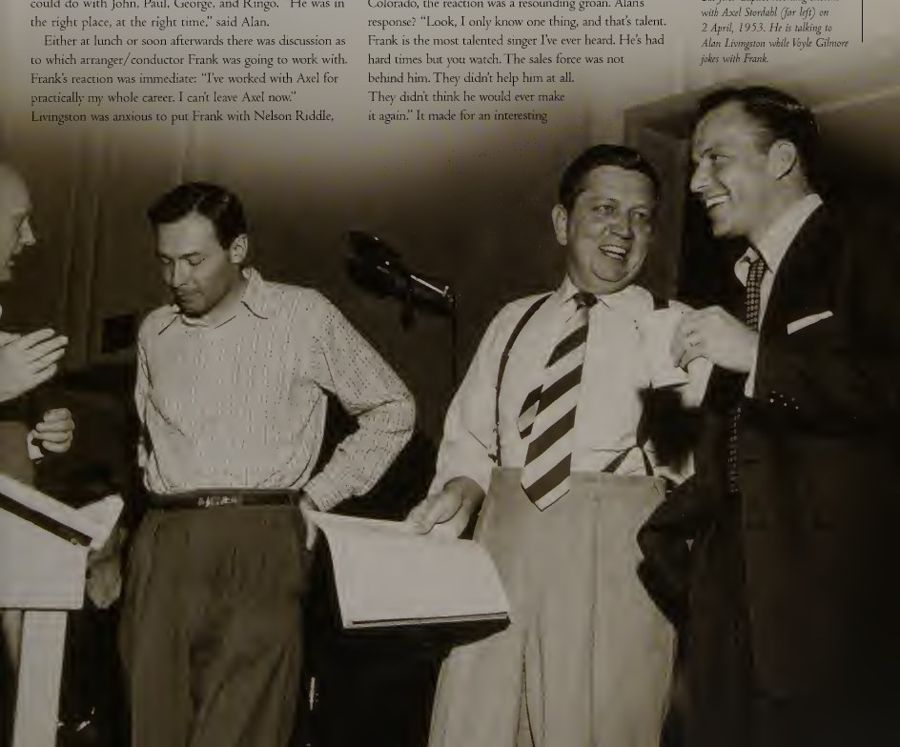
[Photograph: Frank and Ava fly to Rome to start the European tour. From Richard Havers, "Sinatra" (Dorling Kindersley, 2007), p.177.]
Frank and Ava flew from London to Rome to begin his European concert tour, and true to form Frank got into a scuffle with a photographer almost on arrival. The tour went on to Milan, Florence, Turin, Genoa, and Naples. (Source: Richard Havers, "Sinatra" (Dorling Kindersley, 2007).)
May 9, 1953
Concerts
Cinema Teatro Reposi, Turin, Italy (May 9-10) with Milt Mezzrow's Orchestra
(Buck Clayton and Big Chief Russel Moore on the Trombones, Eugene Sedwick on Sax, Kansas Field, Drums, Red Richards on Piano)
Also: Taps Miller & Della Grayson (Dance Couple)
May 10, 1953
Concerts
Cinema Teatro Reposi, Turin, Italy (May 9-10) with Milt Mezzrow's Orchestra
(Buck Clayton and Big Chief Russel Moore on the Trombones, Eugene Sedwick on Sax,
Kansas Field, Drums, Red Richards on Piano)
Also: Taps Miller & Della Grayson (Dance Couple)
May 12, 1953
Concerts
Teatro Medica Palace, Bologna, Italy
Two Shows with Milt Mezzrow's Orchestra
(Buck Clayton and Big Chief Russel Moore on the Trombones, Eugene Sedwick on Sax, Kansas Field, Drums, Red Richards on Piano)
Also: Taps Miller & Della Grayson (Dance Couple)
May 13, 1953
Concerts
Teatro Verdi, Florence, Italy (May 13-14) with Milt Mezzrow's Orchestra
(Buck Clayton and Big Chief Russel Moore on the Trombones, Eugene Sedwick on Sax, Kansas Field, Drums, Red Richards on Piano)
Bill Miller backed Frank throughout the tour
Also: Taps Miller & Della Grayson (Dance Couple)
Note: SRO shows
May 14, 1953
Concerts
Teatro Verdi, Florence, Italy (May 13-14) with Milt Mezzrow's Orchestra
(Buck Clayton and Big Chief Russel Moore on the Trombones, Eugene Sedwick on Sax, Kansas Field, Drums, Red Richards on Piano)
Bill Miller backed Frank throughout the tour.
Also: Taps Miller & Della Grayson (Dance Couple)
Note: SRO shows
May 15, 1953
Concerts
Mediterraneo Theater, Naples, Italy with Milt Mezzrow's Orchestra
(Buck Clayton and Big Chief Russel Moore on the Trombones, Eugene Sedwick on Sax, Kansas Field, Drums, Red Richards on Piano)
Bill Miller backed Frank throughout the tour.
Also: Taps Miller & Della Grayson (Dance Couple)
Mediterraneo Theater, Naples, Italy with Milt Mezzrow's Orchestra
(Buck Clayton and Big Chief Russel Moore on the Trombones, Eugene Sedwick on Sax, Kansas Field, Drums, Red Richards on Piano)
Bill Miller backed Frank throughout the tour.
Also: Taps Miller & Della Grayson (Dance Couple)
[image referenced in source but could not be recovered]
May 16, 1953
Concerts
Augustus Theater, Genoa, Italy (May 16-17)
Matinee and evening performances with Milt Mezzrow's Orchestra
(Buck Clayton and Big Chief Russel Moore on the Trombones, Eugene Sedwick on Sax, Kansas Field, Drums, Red Richards on Piano)
Bill Miller backed Frank throughout the tour.
Also: Taps Miller & Della Grayson (Dance Couple)
["Walking Behind You" reaches #7]
'I'm Walking Behind You' hit number 7 on the Billboard chart -- Sinatra's first hit since 'The Birth of the Blues' charted at number 19 the previous November, ending his longest sales drought in ten years. However, Eddie Fisher's rival version of the same song held the number 1 spot.
Source: James Kaplan, "Frank: The Voice" (2010).
May 17, 1953
Concerts
Augustus Theater, Genoa, Italy (May 16-17)
Matinee and evening performances with Milt Mezzrow's Orchestra
(Buck Clayton and Big Chief Russel Moore on the Trombones, Eugene Sedwick on Sax, Kansas Field, Drums, Red Richards on Piano)
Bill Miller backed Frank throughout the tour.
Also: Taps Miller & Della Grayson (Dance Couple)
May 18, 1953
Concerts
Teatro Adriano, Rome, Italy with Milt Mezzrow's Orchestra
(Buck Clayton and Big Chief Russel Moore on the Trombones, Eugene Sedwick on Sax, Kansas Field, Drums, Red Richards on Piano)
Bill Miller backed Frank throughout the tour.
Also: Taps Miller & Della Grayson (Dance Couple)
May 19, 1953
Concerts
Adriano Theater, Rome (19-20)
(Buck Clayton and Big Chief Russel Moore on the Trombones, Eugene Sedwick on Sax,
Kansas Field, Drums, Red Richards on Piano)
Bill Miller backed Frank throughout the tour.
Also: Taps Miller & Della Grayson (Dance Couple)
Ed O'Brien:
Movie palace converted into a theater for Sinatra, two shows in the evening both nights SRO
Adriano Theater, Rome (19-20)
(Buck Clayton and Big Chief Russel Moore on the Trombones, Eugene Sedwick on Sax,
Kansas Field, Drums, Red Richards on Piano)
Bill Miller backed Frank throughout the tour.
Also: Taps Miller & Della Grayson (Dance Couple)
Emacs!
May 20, 1953
Radio
Radio Club
Network: RAI 2 (Secondo)
Location: Hall A, via Asiago 10, Rome
Time: 8:00 PM (21:00 Italian)
Host: Guido Notari
1. Laura
2. September Song
3. Night And Day
Ed O'Brien:
In the afternoon, Frank made an appearance on
Radio Club -RAI in Studio A with Domenico Modugno & Armando Trovajoli. The interview was conducted in Italian for the most part. Frank gave it his best shot. He then sang three songs with Bill Miller accompanying him on piano.
Brian adds: Recorded in the afternoon but aired on RAI 2 at 21:00.
Concerts
Adriano Theater, Rome
Wednesday
(Buck Clayton and Big Chief Russel Moore on the
Trombones, Eugene Sedwick on Sax,
Kansas Field, Drums, Red Richards on Piano)
Bill Miller backed Frank throughout the tour.
Also: Taps Miller & Della Grayson (Dance Couple)
Ed O'Brien: two shows in the evening both nights SRO, movie palace converted into a theater for Sinatra
Radio Club
Network: RAI 2 (Secondo)
Location: Hall A, via Asiago 10, Rome
Time: 8:00 PM (21:00 Italian)
Host: Guido Notari
Performance was issued on CD by Twilight Music as "The
Voice In Via Asiago"
Note: An excellent 2 minute video exists of Sinatra at the studio, as "Sinatra Canta Per Voi" which includes a 30 second clip of him singing "September Song" and a 30 second clip of him singing "Night And Day" It appears to be an Italian newsreel. The above image is a screen grab from the video.
There is also an 8.5 minutes video of more of Sinatra in the studio as "Frank Sinatra alla RAI"
with other performers, a baseball team, and in which Sinatra appears to sing complete songs but unfortunately there is no audio.
--Scott
May 21, 1953
Concerts
Manzoni Theater, Milan
Thursday with Milt Mezzrow's Orchestra
(Buck Clayton and Big Chief Russel Moore on the
Trombones, Eugene Sedwick on Sax,
Kansas Field, Drums, Red Richards on Piano)
Bill Miller backed Frank throughout the tour.
Also: Taps Miller & Della Grayson (Dance Couple)
Ed O'Brien: two sold out shows
May 23, 1953
Concerts
Casino, Knokke, Belgium, (May 23-25)
Songs included:
I've Got The World On A String
I'll Never Smile Again
That Old Black Magic
Casino, Knokke, Belgium, (May 23-25)
Songs included:
I've Got The World On A String
I'll Never Smile Again
That Old Black Magic
Photos thanks to Carl R:
From Carl R:
After his 2-week long tour of Italy and before his tour of Scandinavia, Frank (and Ava) spent the Pentecost week-end in Belgium. Maurice Nellens, the founder of Casino de Knokke le Zoute, thought this would be a good idea, since many Belgians would spend that week-end at the coast. Frank did three concerts at the Casino, and he was accompanied by the André Koek orchestra. Frank was paid $10,000. Unfortunately, the song list is incomplete, but it included "I've got the World on a String", "I'll Never Smile Again" , "The Old Black Magic" and "September Song".
Here are two photos from the casino:
Frank and Ava stayed in a suite at La Réserve with a view of the lake.
Here are three photos from the terrace:
Maurice Nellen's son, Jacques Nellens, tells how the Nellens family and Frank and Ava cruised down the Avenue du Littoral in his Mercury cabriolet without any problems.
Some people asked for autographs of course, but there was no chaos as you would see it today.
After the week-end at Knokke, Ava flew to London and Frank flew to Copenhagen, where he started his tour of Scandinavia with two concerts on May 27th.
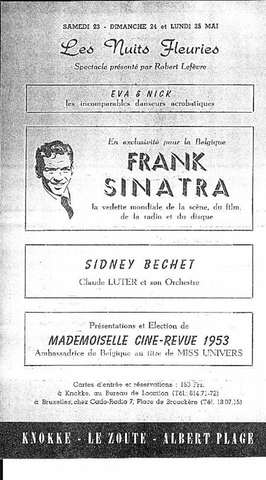
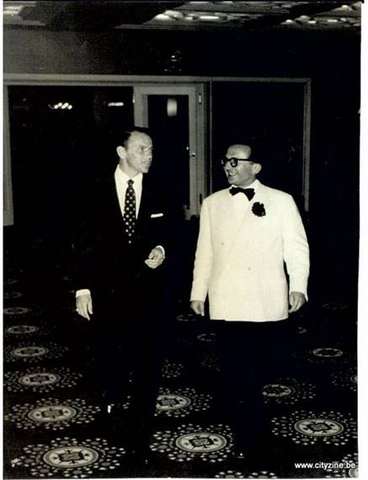
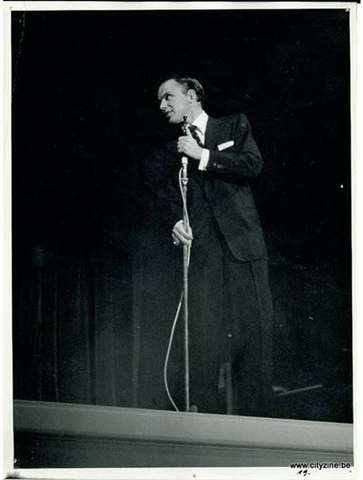
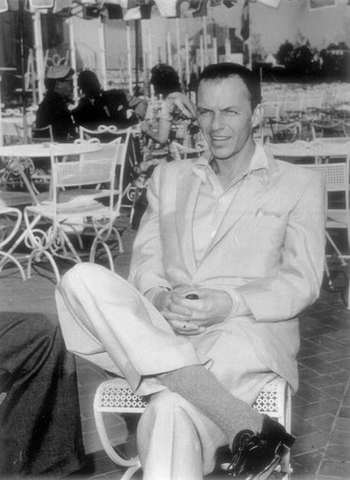
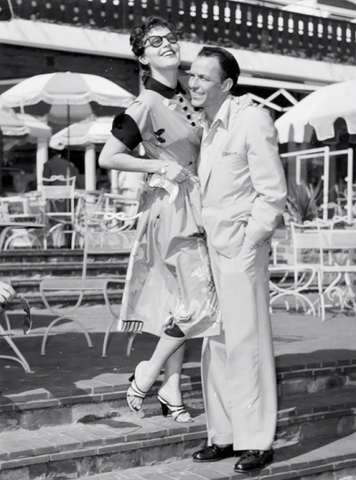
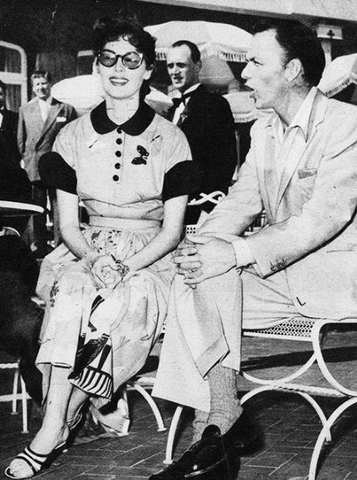
May 24, 1953
Concerts
Casino, Knokke, Belgium, (May 23-25)
Songs included:
I've Got The World On A String
I'll Never Smile Again
That Old Black Magic
May 25, 1953
Concerts
Casino, Knokke, Belgium, (May 23-25)
Songs included:
I've Got The World On A String
I'll Never Smile Again
That Old Black Magic
May 27, 1953
Concerts
K.B Hall, Copenhagen, Denmark
Two Shows
Thanks to Carl R for the above listing.
K.B Hall, Copenhagen, Denmark
Two Shows
From Carl R: Five photos from the concert in Copenhagen:
Before entering the stage at K.B. Hallen.
On the stage at K.B. Hallen
In 2013 the ballet "Come Fly With Me" was opening in Denmark and the following article was published reflecting on Sinatra's 1953 appearance (note: this is a Google translation of the original article):
When Frank Sinatra was in Copenhagen
Legend Live. Frank Sinatra, now in ballet form occupying the Danish national scene, never even became a frequent guest on the Copenhagen scene. It just turned into a single night in 1953.
Then it is tomorrow that Frank Sinatra will eventually make his way past Copenhagen and occupy the National Stage, ie the Old Theater of the Royal Theater. It happens with the ballet show "Come Fly Away" and clearly not with the man himself, as it is now 15 years ago, the American singer and actor finally closed his "Ol 'Blue Eyes".
Frank Sinatra never became a frequent guest in Copenhagen either. In fact, he - along with Sammy Davis Jr. and Liza Minnelli - should have appeared in the KB Hall on April 16, 1989, but with ticket prices up to DKK 5,000, only 500 of the 3,200 tickets were sold and the organizer chose to cancel.
No, we really have to fly 60 years back in time to experience Frank Sinatra on a Danish scene. Specifically, KB Hallen, Wednesday 27 May 1953. And there are two performances - at. 19 and 21.30 - with ticket prices from 3.90 to 9.90 DKK. It is the diligent concert organizer Ingvar Blicher-Hansen, who "captured" 37-year-old Frank Sinatra on an ongoing European tour, and who together with the daily BT has arranged the concerts, which have the festive title 'Mood Parades'.
The American singer is thus not a soloist, but a main name, and as a "warm-up" one can experience many of the popular artists of the time, including singer Raquel Rastenni, revisionist Carl Fischer and just seven-year-old xylophone virtuoso Gitte Pyskow as well - as it is called in the pre-speech - "The brilliant American Negro singer Inez Cavanaugh". It is Aage Juhl Thomsen's Orchestra that accompanies the performers, ie Frank Sinatra, who, however, brings his own pianist and conductor.
But before Frank Sinatra goes on stage, it is just in his place to ascertain where Frank Sinatra stands in 1953. And it can be said quite clearly: He does not stand well. In fact, over the past few years - over a broad front - he has been on a disaster course.
Ten years earlier, the charming singer from Hoboken, New Jersey, has put the United States on its feet, and the mass hysteria of screaming teenage girls, the so-called "Bobby soxers," exceeds anything the show biz scene has ever experienced. It also turns into a number of popular movies and many fine recordings for Columbia Records. But by the beginning of the new decade, the girl war is stagnating, and in Hollywood Frank Sinatra is considered a wreck. His radio, TV and record contracts are being canceled, and he has to find himself in more and more humble places.
In addition, privacy crashes. Far along the way Frank Sinatra and his press have managed to draw a picture of the singer as a caring husband and family father, but when he meets actress Ava Gardner, he not only falls in love, he becomes obsessed, and he leaves his wife Nancy and their three children. On his arrival in Copenhagen, he has been married to Ava Gardner for a year and a half, and it is actually her money that he lives on.
The European tour has not been without problems either, but despite a half-filled hall in Copenhagen, Frank Sinatra makes a good figure and creates enthusiasm. The program includes "Night and Day", "When You're Smiling", "Ol 'Man River", "September Song", "Tenderly", "Sweet Lorraine" and "Nancy".
According to Berlingske Tidendes' reviewer, Bent Henius, the audience contact in the first numbers loses. Sinatra seems nervous, and the small hints indicate that he is both unhappy with the orchestra and the microphone, but gradually the cooperation on stage becomes better. And Bent Henius continues: "Frank Sinatra's voice is not what it was ten years ago. The sound is sometimes a bit murky, and in the high tones it can seem squeezed and strained. In the middle position, the voice is soft and round, and the vibrato is comfortable and discreet. In contrast, the style is well-stocked with effects such as rubato and glassando. The technique is perfectly fine, but you can miss a little feeling and warmth in the expression. It is understandable, when you think about the tension, it must be day in and day out to sing the same tunes for several years. But so relentless is the audience that you want to hear the songs you know. "
“One thing there is special reason to emphasize. And that's Frank Sinatra's breakdown of the characters and his breathing. Both are excellent, not least when you consider that he has never learned to sing. He prefers not to breathe in the breaks that the structure of the melody warrants, but in the places where the lyrics make it natural, "Bent Henius points out, concluding:
"The success was saved, Frank Sinatra must share the honor with his excellent pianist Bill Miller and conductor Harold Collins, who made a huge (and visible) effort to get the Danish musicians to attend the not easy events, brought from the United States. «
The same Danish musicians have been hired to play for Frank Sinatra on the subsequent Scandinavian tour, which is no unconditional benefit.
The following evening there will be a concert in both Malmö and Helsingborg, and the Danish musicians evidently enjoy the sailing and catering across the Sound to such an extent that it can be seen and heard, yes, the daily newspaper Ekspressen states that »at the concert in Hälsingborg was a couple musicians in such a condition that they do not show off on a stage. "
However, this is far from the only reason why Frank Sinatra's appearance in Sweden is described as a scandal. The singer has been cold and no one has told him to perform outdoors, which he has never done before, and he chooses to shorten his program at both concerts.
Furthermore, the Swedish press has been looking forward to experiencing the reunification of Frank Sinatra and Ava Gardner when the lady comes to Stockholm from London. But Frank Sinatra meets her at Kastrup Airport, where the Danish press watches for a 24-second welcome kiss in the flashlights.
And while Frank Sinatra is clearly tired of the problems in Sweden, Ava Gardner is kindly answering questions, at least as long as it concerns her film work. As a BT journalist (under the Buch brand) asks for a dementia of what the American filmmakers have been dealing with most over the past year, namely that Ava Gardner's and Frank Sinatra's marriage is Hollywood's most unhappy, the lady says:
"Then we have nothing more to speak of, my lord." The couple then leaves - according to the report - to be alone with two glasses of beer and four pieces of shrimp.
A few days later, Frank Sinatra cancels the rest of his Scandinavian tour, and a few months later Ava Gardner files his divorce petition.
In short - everything looks black to Frank Sinatra. And yet - just before he came to Europe, a few crucial things happened. He has completed the role in the movie "From Here to Eternity" which brings him an Oscar the following year, and he has signed a contract with the record company Capitol, which for the rest of the decade just releases one amazing Frank Sinatra album after another. Against all odds, Frank Sinatra in 1953 is heading for the ultimate comeback.
Carl: Here is a photo of Frank arriving from Belgium and pretending to thumb it from Kastrup Airport (Copenhagen) to Hotel d’Angleterre before his two concerts at KB Hallen on May 27th 1953
Carl: Here is a review of Sinatra’s concert in Copenhagen on May 27th 1953.
Review in Berlingske Tidende May 1953
Written by Bent Henius
Success for Sinatra
Great enthusiasm in half-filled house (KB-Hallen) for the
American singer Frank Sinatra
Time passes. There is hardly any doubt that 10 years ago Frank Sinatra would have brought down the house (KB-Hallen). Last night he pulled through a success in a half-filled house at the first concert, but great efforts were required. Ten numbers were set aside at this “Humørets Parade” (“High Spirits Show#”) to warm up the youthful audience. The greatest applause went to Raquel Rastenni (popular Danish singer) with her version of “Doggie in the Window”, about which song Sinatra had said that it was an awful melody. Fine cabaret performance and jazz from Inez Cavannaugh and the pianist Aaron Bridges respectively.
Then, after an hour’s entertainment, Frank Sinatra jumped onto the stage easily and agilely, dressed in brown summer clothes. He received thunderous applause, while the orchestra played his signature tune “Night and Day”. The rapport with the audience failed in the first few numbers. Sinatra seemed nervous. His little hand gestures indicated dissatisfaction with both the orchestra and the microphone, but little by little the co-operation on the stage improved.
Frank Sinatra’s voice is no longer what it was 10 years go. The sound of his voice is sometimes slightly muddy/cloudy, and in the high register his voice can seem pressed and strained. In the middle-register his voice is soft and mellow. His vibrato is pleasant and discreet, and in his style there is extensive use of rubato and glissando. His technique is perfectly fine, but a little warmth and feeling in the expression is missing. This is quite understandable, when you consider how much strain it must be to sing the same songs day in and day out over the years. However, that is how ruthless the audience are, because they want to hear the songs they already know.
There is one thing in particular worth emphasizing and that is Frank Sinatra’s phrasing and breath control. Both things are eminent, not least when you consider the fact that he has never been taught how to sing.
He does not breathe in the pauses that the melody provides, he breathes when it is natural in the lyrics.
At first, the atmosphere in the house was slightly gloomy, but after the first few numbers, it became unrestrained. There was great applause for “September Song”, and after that followed the well-known songs. He sang “Ol’ Man River” excellently, with the famous seamless passage without breathing to the last part of the song. The song “Nancy” was greeted with thunderous enthusiasm. A parody of Bing Crosby did not find the right appreciation, but a very fine interpretation of “Tenderly” raised the roof.
The concert was a success, but Frank Sinatra has to share the credit for his success with his excellent pianist Bill Miller and the conductor Harold Collins, who made a huge (and visible) effort to make the Danish musicians follow the not-quite-easy arrangements brought along from the USA.
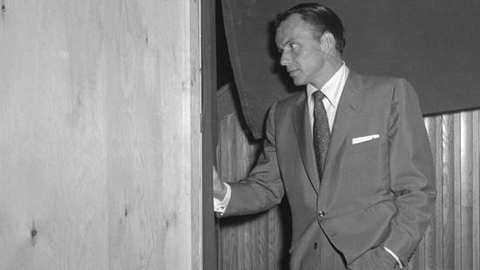
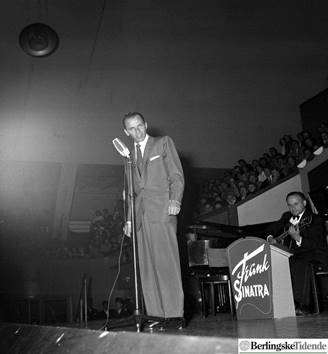
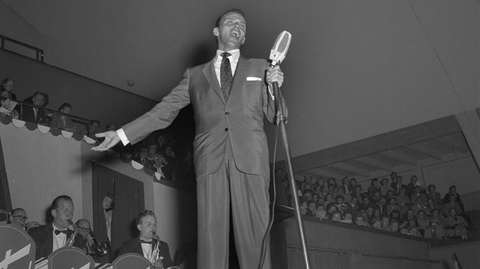
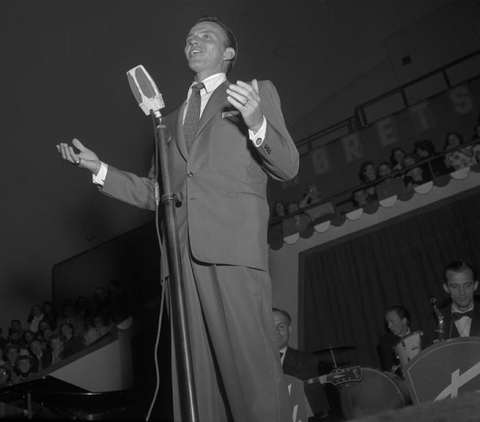
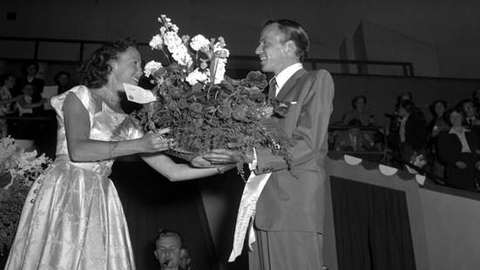
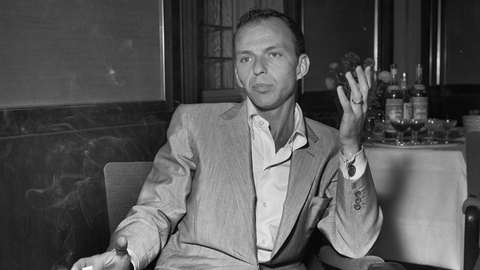
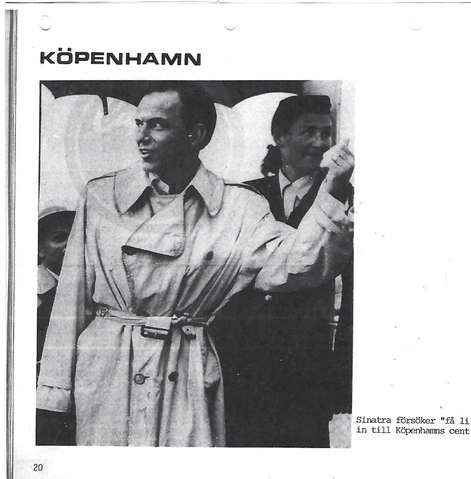
May 28, 1953
Concerts
Folkets Park, Malmö, Sweden (19:45)
Folkparken, Helsingborg, Sweden (22:30) (Postponed from 22:00)
Notes: Thanks to Carl Rasmussen for the above two listings.
Folkets Park, Malmö, Sweden (19:45)
Carl R: Here are some photos from Malmö, as well as some info on what actually happened on this particular date.
Orchestra directed by the British band leader Harold Collins.
Harald Lindvall, local politician and member of the board of directors of Folkets Park, hands over flowers to Frank Sinatra after the concert..
Frank Sinatra escapes the rain in Folkets Park.
This is an open-air concert, the temperature is 50F, and it is rainy and very windy. Therefore, Frank needs a cup of hot tea.
Info:
There were many reasons for the so-called fiasco in Scandinavia:
Outdoor concerts in cold and windy weather, down to 50F late in the evening. So windy that the musicians and also Bill Miller had to pick up the sheet music among the spectators. Many of the musicians in Malmö and Helsingborg were so drunk that they fell down from their chairs. Musically they were not qualified, even when they were sober, to accompany Sinatra. The organizers of the concert at Helsingborg postponed the concert for half an hour, without notification, which meant that Frank could not catch the ferry back to Denmark. They said that he could catch a freight ferry, which did not take passengers, but an exception would be made. Frank did not accept this and that was the reason he shortened this concert. According to his contract he was to sing for 50 minutes, but in order to catch the ordinary ferry he only sang for 38 minutes, and then off to catch the ferry. The Swedish newspapers were very negative indeed. They wrote very critical articles about the fact that Frank stayed at Hotel d’Angleterre in Copenhagen also for these 2 first concerts in Sweden.
--Carl R
© 1997-2026 The Sinatra Archive
This calendar, or any parts thereof, may not be reproduced in any fashion
whatsoever without the prior written permission of the publisher (The
Sinatra Archive)
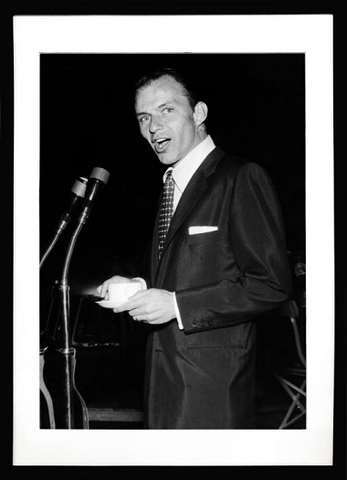
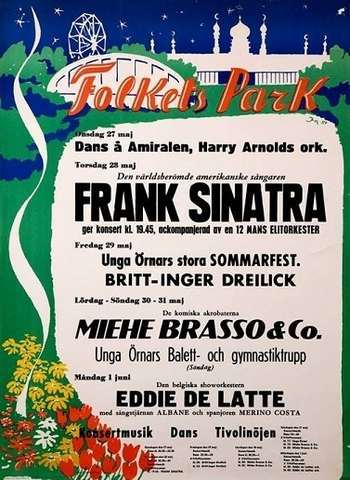
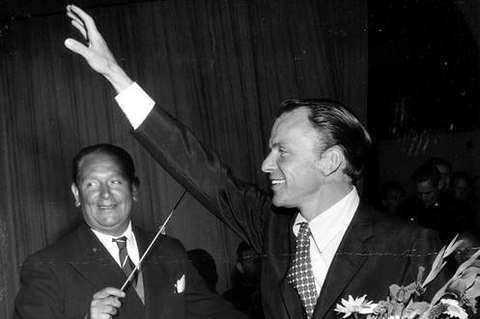
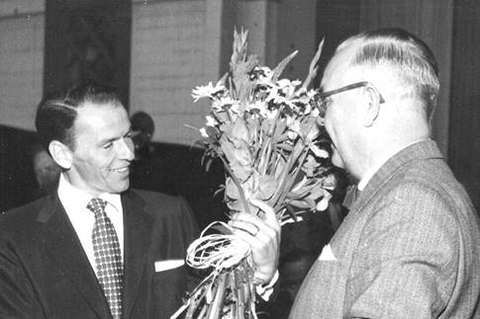
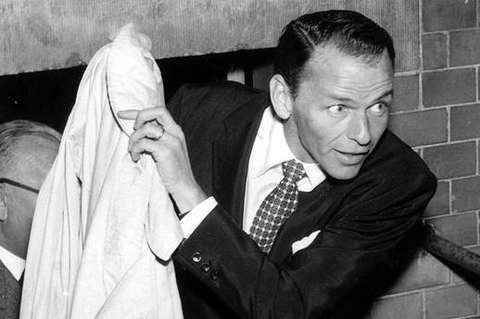
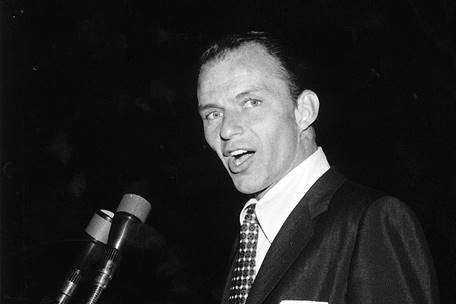
May 29, 1953
Sweden
Carl: After his concerts in Malmö and Helsingborg, Sinatra went back by ferry and taxi to his hotel in Copenhagen. The next day, May 29th 1953, there were no concerts and Ava arrived from London at Kastrup Airport, Copenhagen.
The Swedish press had been looking forward to Ava Gardner coming from London to Stockholm, but Sinatra met her at Kastrup Airport, Copenhagen, instead. Sinatra was obviously tired of his problems in Sweden, but Ava Gardner kindly answered questions about her film work. However, when a Danish journalist asked about their marriage, she answered, “Gentlemen, we have nothing more to talk about”. They were left alone to share 2 glasses of beer and 4 open sandwiches with shrimps (see next 3 photos).
Together they flew to Stockholm. Four photos from Bromma Airport, Stockholm.
Above photos supplied by: Carl Rasmussen
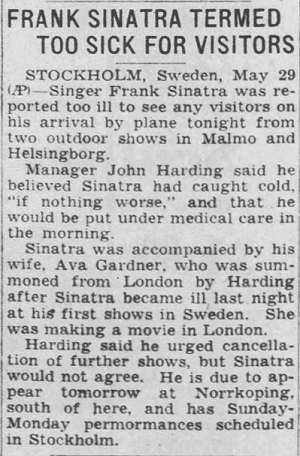
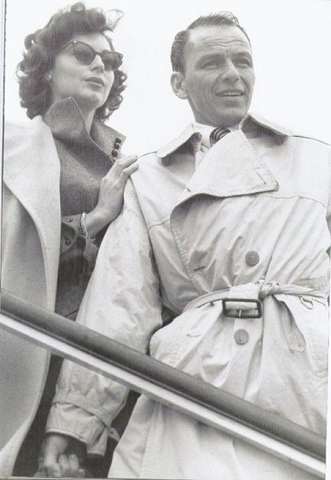
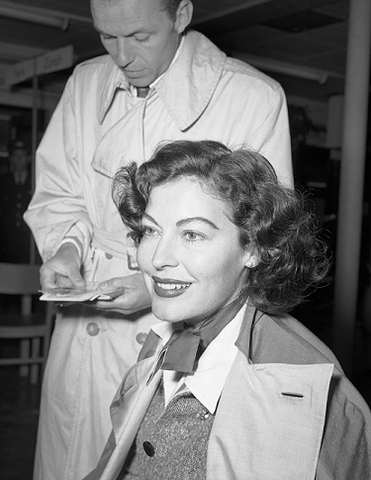
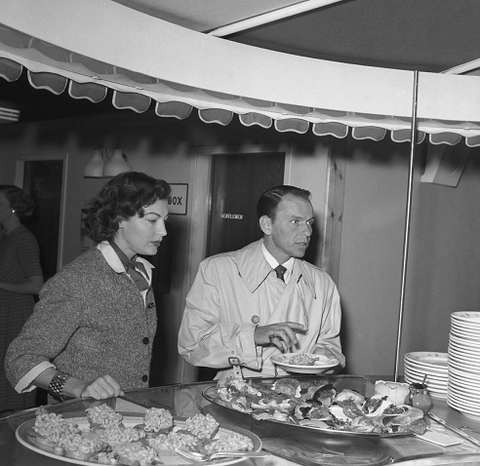
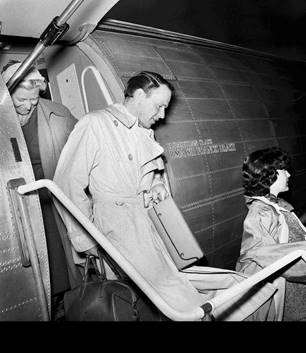
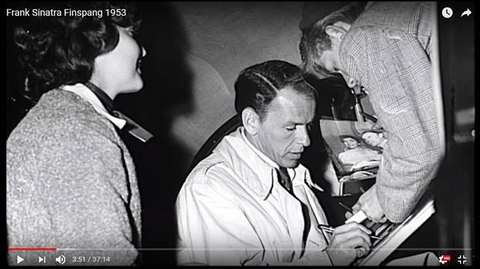
May 30, 1953
Concerts
Folkets Park, Finspång, Sweden
Time: 20:00
Folkets Park, Norrköping, Sweden
Time: 22:00
Folkets Park, Finspång, Sweden
Time: 20:00
Frank reading the Film Journal before the concert
Curiosity: A length of the stage floor plank that broke when Frank performed at Finspång:
Thanks to Carl R for the above photos.
Carl:
After the concert in Helsingborg, the Danish orchestra got fired, and Eddie McAndrew’s orchestra was hired. Frank and Ava went by taxi from their hotel in Stockholm to Finspång for the concert at Folkets Park at 20:00. It was attended by 537 people. Then by taxi to Folkets Park, Norrköping, and this concert was attended by 3,733 people.
This is a link to a Swedish documentary “Sinatra in Finspång 1953”. Unfortunately, no subtitles, but it is worth watching anyway.
https://www.youtube.com/watch?v=UDWXD5E5hAs
The photos below are from Finspång:
The lady was 10 years old when Frank sang in Finspång. After the concert, he received a bouquet of red carnations. He threw a carnation to the audience, and the 10- year-old girl caught the flower, pressed it immediately, and kept it as a fond memory.
Frank Sinatra and Finspång People's Park
From 1912 to the early 1970s, Finspångs Folkets Park was a popular place for the residents of Finspång. The most famous artist during the park's 60-year history was probably Frank Sinatra, who performed on a Saturday evening in May 1953.
Frank Sinatra on stage in Finspång's Folkets Park. From the magazine Se, June 1953.
"Sinatra never forgot Finspång"
Perhaps Finspång's Folkets Park is best known for American artist Frank Sinatra's notable performance on May 30, 1953.
Frank Sinatra in the magazine Se, June 1953, shortly after his performance in Finspång's Folkets Park.
Only 537 paying visitors showed up on the rainy early summer evening. The ticket price was 4 SEK and Sinatra was paid 6,000 SEK for his performance. The evening ended with a loss of around 1,620 SEK (around 28,000 SEK in today's money). In Folkets Park's cash book you can read that they gave the artist only two out of five possible points and the newspaper Se wrote about "The Fiasco Frankie". There were many stories about Sinatra's tour of Sweden and especially the performance in Finspång. 50 years later SVT made a documentary film with the title "Frank Sinatra never forgot Finspång".
People's Park's cash book from May 1953.
“A carnation for a little girl with a delicate face”
Ingrid Larsson was only ten years old when Frank Sinatra came to Finspång. Despite the expensive entrance fee of four kronor and an additional two kronor if you wanted a seat, she was allowed to go with her uncle Roland “Rolle” Carlsson, who was a trumpeter in the Casalomas orchestra, and his wife. Ingrid was very interested in jazz and, wearing a coat and hat, she sat in the second row of benches.
-It was a fantastic concert, says Ingrid.
Frank Sintra on stage and Ingrid Larsson is sitting in the audience, at the bottom right.
When the concert was over, Sinatra was given a bouquet of red carnations. From it he took a flower and “with an elegant gesture” threw it directly to Ingrid. This particular event was highlighted in a report in the magazine Filmjournalen where she was shown her carnation. The flower was dried and is still kept at home in Ingrid’s photo album.
60 years of performing and entertainment
Finspångs Folkets Park began construction in 1912 and the following year the theatre was built. It eventually accommodated an audience of 700 seated and 1,000 standing. Many are the artists who performed in the park until the early 1970s. Sigge Fürst, Snoddas, Povel Ramel, Sickan Carlsson, and of course Frank Sinatra, to name a few.
The old entrance to People's Park.
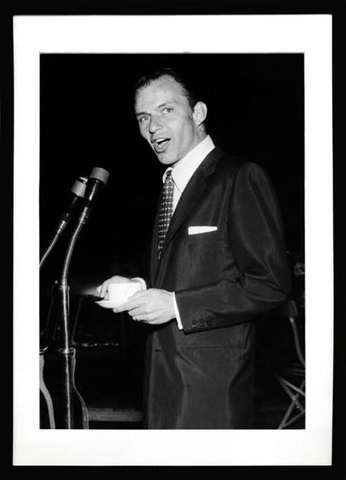
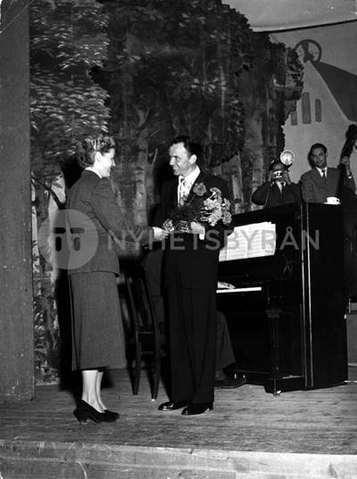
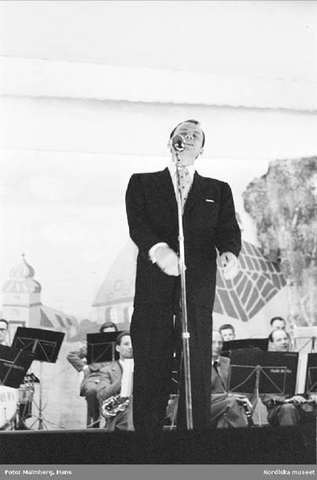
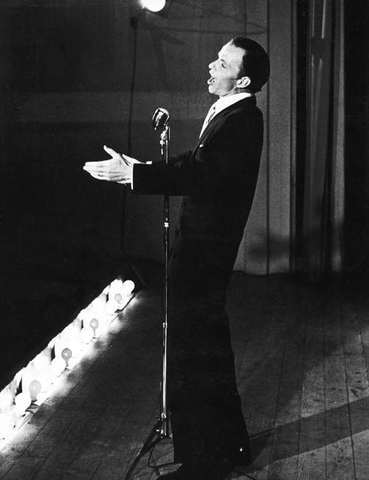
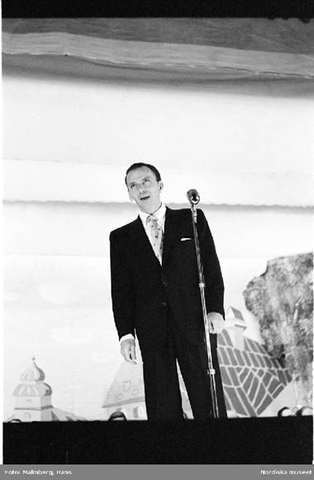
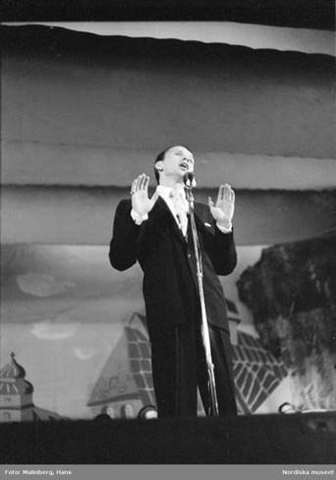
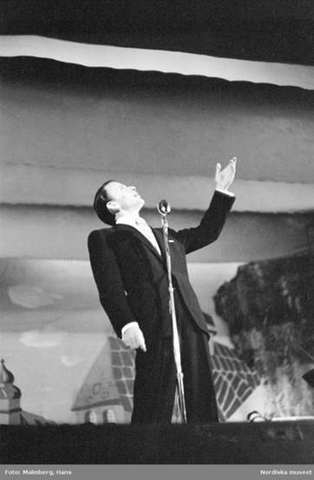
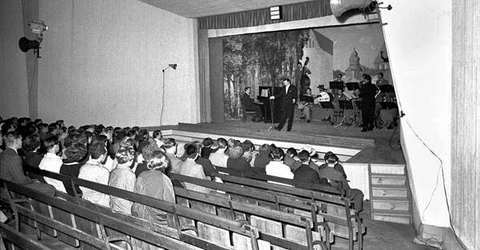
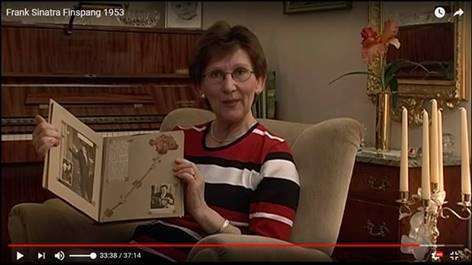
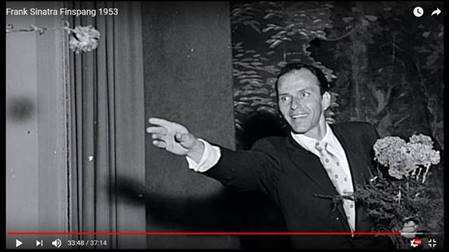
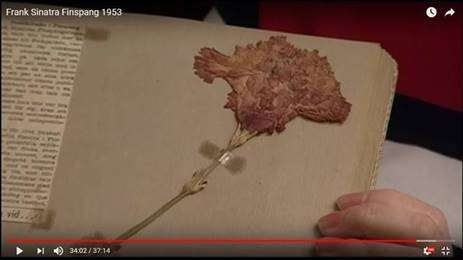
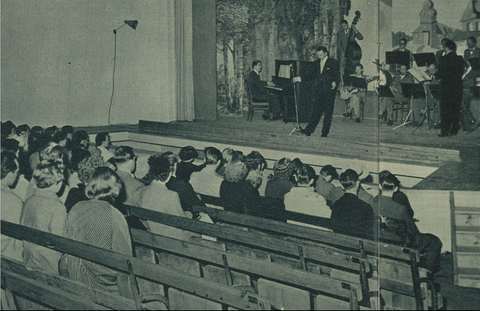
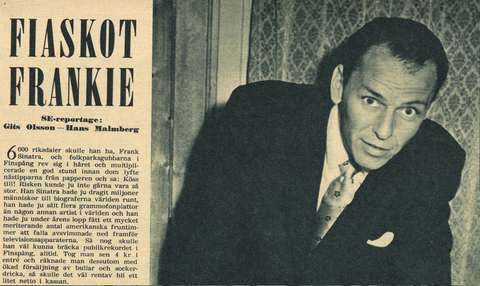
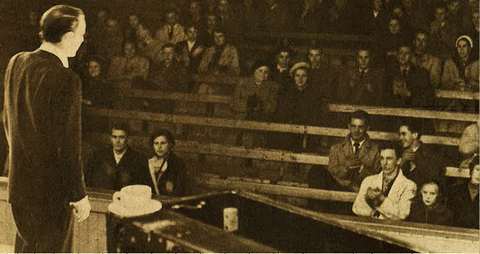
May 31, 1953
Concerts
China Theater, Stockholm, Sweden
Time: 19:00 & 21:15
Notes: Two Shows. Thanks to Carl Rasmussen for this entry as well as all the work on the 1953 tour research.
China Theater, Stockholm, Sweden
Time: 19:00 & 21:15
Thanks to Carl R for the photos and information below:
Ava and Frank arriving in Stockholm from Copenhagen:
Frank Sinatra, China Theater, Stockholm, 1953.
(Frank Sinatra and Bill Miller at the theatre ”China” in Stockholm, May 31st 1953.
Fotograf: Hans Malmberg. Mikrofonen en SELA PT6.
Sinatra: ”I discovered very early that my instrument wasn't my voice,
It was the microphone. . . . You have to learn to play it like it was a saxophone
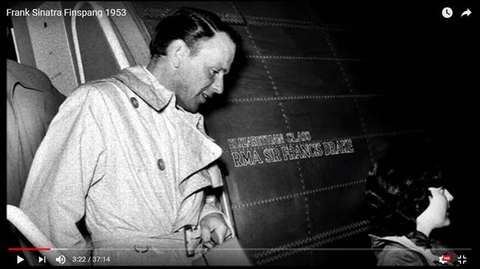
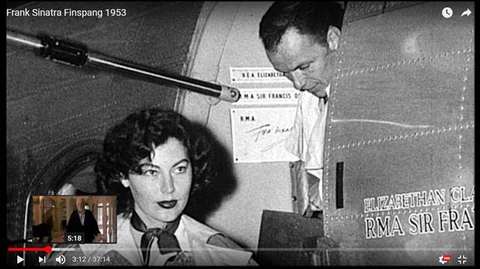
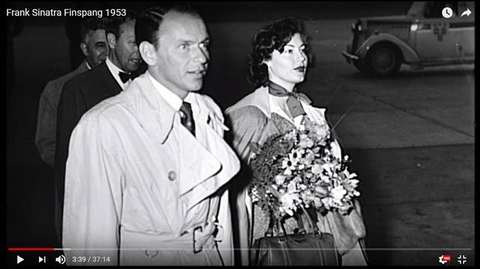
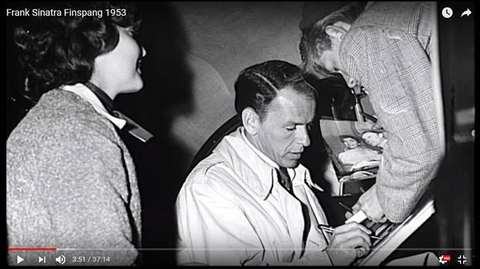
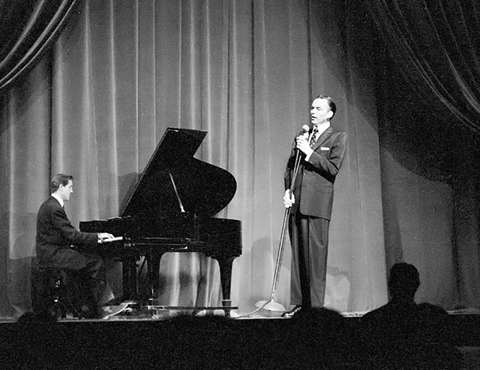
[Boos in Sweden, unpaid Helsingborg show]
Associated Press: The Associated Press reported Sinatra drew boos during two concerts in southern Sweden, with small, unenthusiastic crowds in Malmö and Helsingborg. The Helsingborg theater manager refused to pay him, claiming Sinatra spent more time backstage checking his boat schedule than performing, and cut his contracted 50-minute set short at 32 minutes.
Source: James Kaplan, "Frank: The Voice" (2010).
June 1953
[Columbia test-screens Eternity with reaction device]
Fred Zinnemann: A few weeks after the Rosenbergs' execution, Columbia held its first preview of From Here to Eternity using an experimental electronic audience-reaction system, wiring roughly 200 viewers to levers registering approval or disapproval. Zinnemann feared disaster from the audience's silence, but Harry Cohn arrived elated with a 25-foot graph showing the film would be Columbia's biggest hit ever.
Source: James Kaplan, "Frank: The Voice" (2010)
[Frank and Ava at a prizefight]
Ava Gardner: A photograph of Frank and Ava together at a prizefight in early June shows their bodies not quite touching, reflecting the tension in their marriage; Ava later recalled they had 'come back to London under a terrible cloud.'
Source: James Kaplan, "Frank: The Voice" (2010)
[Successful BBC broadcast lifts morale]
New Musical Express: A successful June BBC show buoyed Sinatra's spirits amid Britain's good mood following the coronation of the new queen. Audiences applauded warmly as he performed both standards and new songs, and the New Musical Express wrote, 'Sinatra is still the greatest male singer in pop music. His range and power seem greater than ever.'
Source: James Kaplan, "Frank: The Voice" (2010)
June 1, 1953
Concerts
Skansen, Stockholm, Sweden
Monday evening
Time: 20:30
Bill Miller conducting
Ed O'Brien:
This was part of an extensive tour of Europe that began in early May and went right into early August. Sinatra would do over 70 shows throughout the mainland plus the Scandinavian countries and the U.K. Quite a few of the performances were seen by less than half-a'-house and there were some cancellations due to lack of interest. Two friends of mine, who did catch him during his shows in London, corroborate the small audiences. One friend caught an afternoon show for the American equivalent of 35 cents. There were many empty rows in the theatre. We have the marvelous Blackpool performance(7-26) and his singing was extraordinary.
Vance Adair:
My uncle saw him at Green's Playhouse in my home town of Ayr in the West of Scotland. Some of the audience from the circle were invited by Frank to come down to the stalls after he had sung two songs. Extraordinary indeed.
His singing on the night, of course, was magnificent.
Ed adds:
"Eternity" was released a few weeks after the tour was concluded( 8-17). When Frank went into Bill
Miller's Riviera, in September, he was a hot property again. He played to packed houses every night under the stars. In a private interview, a few years down the road, he stated that that engagement was more important than the film or his new association with Mr. Riddle and Capitol.
Skansen, Stockholm, Sweden
Monday evening
Time: 20:30
Bill Miller conducting
Frank Sinatra surrounded by fans at Skansen 1953
Billboard
6-13-53
[image referenced in source but could not be recovered]
[image referenced in source but could not be recovered]
[Sinatra collapses, cancels Swedish tour]
John Harding: United Press reported from Stockholm that Sinatra was suffering from 'exhaustion' amid rough Swedish press coverage. His manager, John Harding, said Frank would likely call off the rest of the Swedish tour because he was 'completely exhausted' and 'needs going over very thoroughly.'
Source: James Kaplan, "Frank: The Voice" (2010).
June 7, 1953
[Ava begins Knights of the Round Table]
Ava Gardner was due back in England to start shooting Knights of the Round Table at a salary of $17,500 a week, while Frank's finances remained nearly empty -- straining the marriage further.
Source: James Kaplan, "Frank: The Voice" (2010).
June 8, 1953
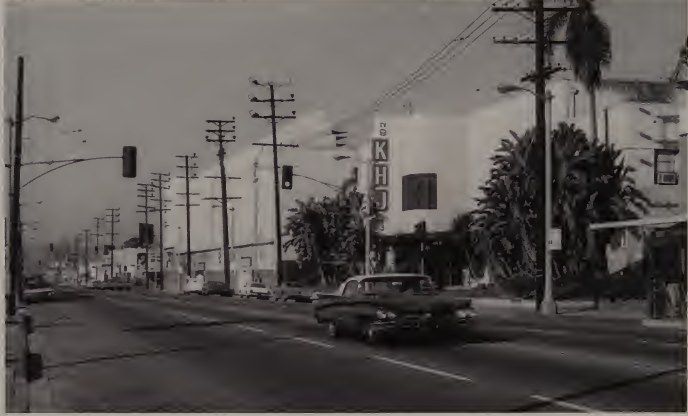
[Photograph: Frank and Ava rent a St John's Wood apartment. From Richard Havers, "Sinatra" (Dorling Kindersley, 2007), p.178.]
Back in London, Frank and Ava rented an apartment in St John's Wood, where their volatile relationship continued. Visiting friends Stewart Granger and Jean Simmons reportedly heard Ava complain that Frank was impossible to live with. (Source: Richard Havers, "Sinatra" (Dorling Kindersley, 2007).)
June 9, 1953
Frank, Ava, and British bandleader Joe Loss sat ringside at White City Stadium in London to watch Randolph Turpin fight Charles Humez for the World Middleweight boxing title. (Source: Richard Havers, "Sinatra" (Dorling Kindersley, 2007).)
June 11, 1953
Radio
BBC SHOW BAND SHOW
London, England
Thursday Evening
9:00-10:00 PM
Cyril Stapleton Orchestra
Host: Rikki Fulton
Vocal Goup: Stargazers]
Writer: Jimmy Grafton
Producer: Johnnie Stewart
1. Birth Of The Blues
2. I'm Walking Behind You
3. Ol' Man River
Ed O'Brien:
This show has been erroneously dated 7-11-53 for many years.
Recently I came across a file with information on the Showband broadcasts. After seeing the 6-11-53 date, I did some more checking. The hour broadcast each week was on Thursday nights. Checking my 100 year calendar, I immediately eliminated the 7-11, which fell on a Saturday evening. I did some more digging and found three sources that corroborated the June date. But Mr. Sinatra locked it up for me with an article published in the New Music Express, 8-14-53.
Here is an excerpt from that article:
"I was most impressed by the general standard of musicianship in Britain, and your Cyril Stapelton and his BBC Show Band are a really wonderful crew. After that first broadcast I made as a guest on their Thursday night 'Show Band Show," I was so enthusiastic that I immediately asked for another airing in July. I was very glad to get it and very glad to do both dates.
Believe me, those guys -- Bill McGuffie, Tommy Whittle, Tommy McQuater, Harry Roche and his trombone sidekicks, Messrs. Chisholm and Armstrong, Louis Stevens and his fiddlemen -- in fact the lot -- can have anything put down in front of them, and they read it on sight-- perfectly. That's what I call musicianship.
In the Show Band, Cyril has a crew whom he directs so admirably, that it can hold its head high with any group -- anywhere. It was a pleasure working with him -- it's always a pleasure working with people who know what's happening-- and here's another encore I'm yelling for."
BBC SHOW BAND SHOW
London, England
Thursday Evening
9:00-10:00 PM
Cyril Stapleton Orchestra
Host: Rikki Fulton
Vocal Goup: Stargazers]
Writer: Jimmy Grafton
Producer: Johnnie Stewart
[image referenced in source but could not be recovered]
[image referenced in source but could not be recovered]
[image referenced in source but could not be recovered]
June 14, 1953
Concerts
Granada Tooting, South London, England
(2 shows)
Note: thanks to Fred Wadsworth for the listing.
Granada Tooting, South London, England
(2 shows)
Note: thanks to Fred Wadsworth for the listing.
Thanks to Carl R for passing along information about the following playbill:
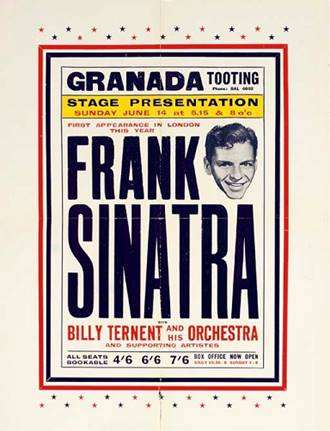
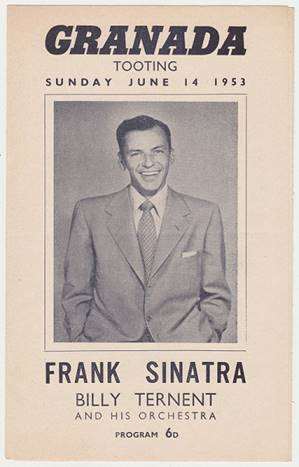
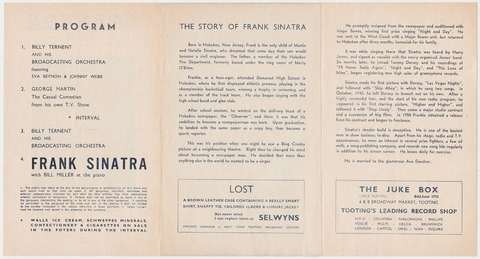
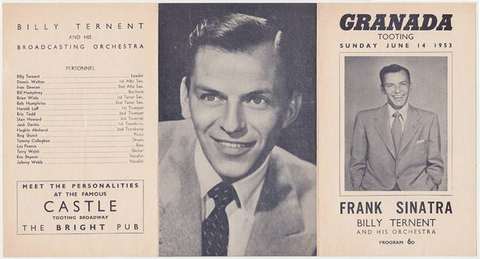
June 15, 1953
Television
The American Road
8 PM Two Hours
NBC and CBS
The Ford 50th Anniversary Show
Frank Sinatra, Bing Crosby, Ethel Merman, Wally Cox, Amos ‘n Andy, Marian Anderson, Mary Martin, Eddie Fisher, Rudy Vallee, Teddy Wilson Sinatra is seen on film singing a portion of “You Go To My Head” & “Black Magic”
Variety
Concerts
The Hippodrome, Bristol, England. (15-20)
The American Road
8 PM Two Hours
The Ford 50th Anniversary Show’
Frank Sinatra, Bing Crosby, Ethel Merman, Wally Cox, Amos ‘n Andy, Marian Anderson, Mary Martin, Eddie Fisher, Rudy Vallee, Teddy Wilson Sinatra is seen on film singing a portion of “You Go To My Head” & “Black Magic”
June 16, 1953
Concerts
The Hippodrome, Bristol, England. (15-20)
June 17, 1953
Concerts
The Hippodrome, Bristol, England. (15-20)
June 18, 1953
Concerts
The Hippodrome, Bristol, England. (15-20)
June 19, 1953
Concerts
The Hippodrome, Bristol, England. (15-20)
June 20, 1953
Concerts
The Hippodrome, Bristol, England. (15-20)
June 21, 1953
Concerts
Gaumont State Cinema, Kilburn, England
Gaumont State Cinema, Kilburn, England
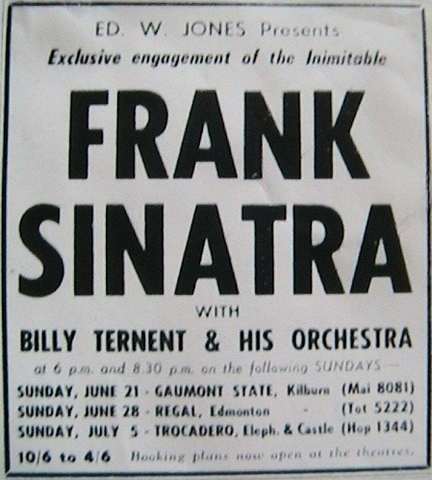
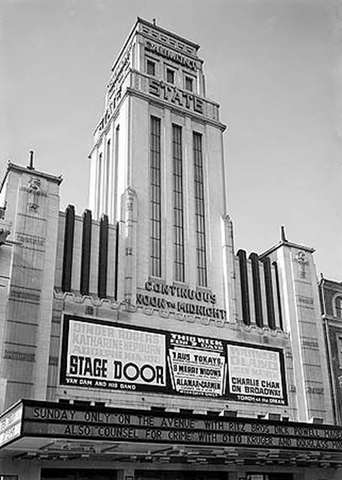
June 25, 1953
Television
Joan Gilbert Interviews Frank Sinatra
BBC Television
Joan Gilbert Interviews Frank Sinatra
BBC Television
----------------------------------------------------
© 1997-2026 The Sinatra Archive
This calendar, or any parts thereof, may not be reproduced in any fashion whatsoever without the prior written permission of the publisher (The Sinatra Archive)
__._,_.___
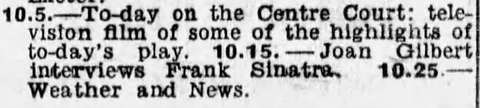
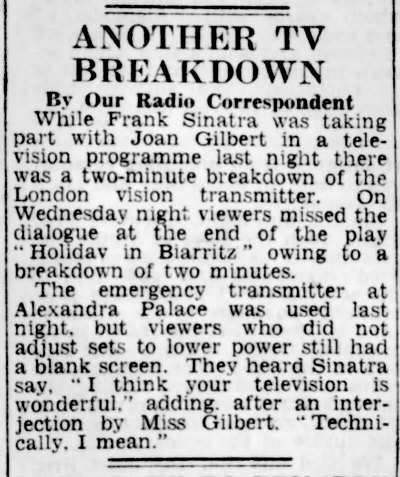
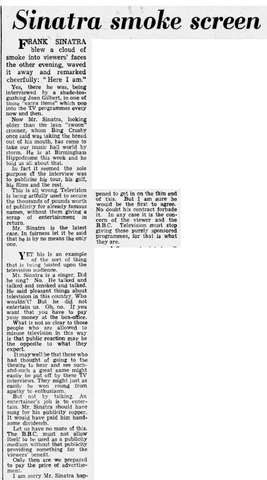
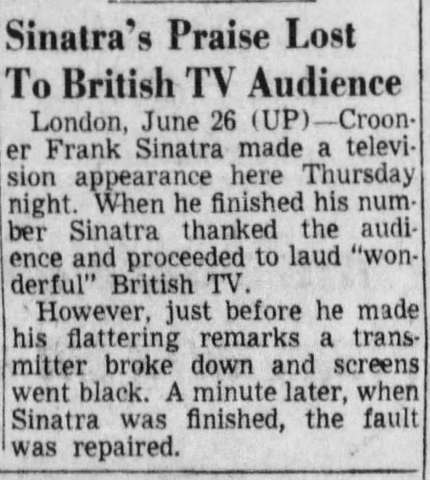
June 29, 1953
Concerts
Moss' Hippodrome, Birmingham, England
Frank Sinatra with Bill Miller at the Piano accompanied by Billy Ternent and his Orchestra
Moss' Hippodrome, Birmingham, England
Frank Sinatra with Bill Miller at the Piano accompanied by Billy Ternent and his Orchestra
Thanks to Carl R for sending along above image.
-----------------------------------------
© 1997-2026 The Sinatra Archive
This calendar, or any parts thereof, may not be reproduced in any fashion whatsoever without the prior written permission of the publisher (The Sinatra Archive)
[image referenced in source but could not be recovered]
[image referenced in source but could not be recovered]
[image referenced in source but could not be recovered]
June 30, 1953
Concerts
Moss' Hippodrome, Birmingham, England (June 29 - July 4)
Show Time: 6:15 & 8:30
Billy Ternent and his Broadcasting Orchestra
Key Musicians: Bill Miller (piano) Ternent Members: Eva Beyon, Johnny Webb, Ternenteers
Bill Performers: Dancing Duvals, Bobbie Kimber & Augustus Peabody, Jackie Ross, Three Rethlems
Notes: Thanks to Carl Rasmussen for date and details.
July 1, 1953
Concerts
The Hippodrome, Birmingham, England (June 29 - July 4)
Show Time: 6:15 & 8:30
Billy Ternent and his Broadcasting Orchestra
Key Musicians: Bill Miller (piano) Ternent Members: Eva Beyon, Johnny
Webb, Ternenteers
Bill Performers: Dancing Duvals, Bobbie Kimber & Augustus Peabody,
Jackie Ross, Three Rethlems
The Hippodrome, Birmingham, England (June 29 - July 4)
Show Time: 6:15 & 8:30
Billy Ternent and his Broadcasting Orchestra
Key Musicians: Bill Miller (piano) Ternent Members: Eva Beyon, Johnny
Webb, Ternenteers
Bill Performers: Dancing Duvals, Bobbie Kimber & Augustus Peabody,
Jackie Ross, Three Rethlems
Cal-Neva Lodge-Lake Tahoe June 29-July 5, 1962
Ed: Frank was thrilled to be opening at the newly remodeled Cal-Neva.
The cost to renovate and enlarge the main room was estimated to be around
$3 million dollars. The showroom had a capacity of 500 for the dinner show
and 700 for the late show. Frank was half owner of the resort. He loved Lake
Tahoe. He opened on 6-29-62 and played a week's engagement. Variety called
it a "boffo" event. "Frank Sinatra's first business venture in northern Nevada is
off to a swinging start.. The opening attracted more than capacity crowd in -
cluding many top business and film names from Hollywood."
Frank was intro-
ducing the songs from his forthcoming Reprise album, titled "Sinatra & Swingin'
Brass."
There would be more dates throughout the summer. Dean Martin opened
on 7/27. Frank joined him on stage for the second show that evening.
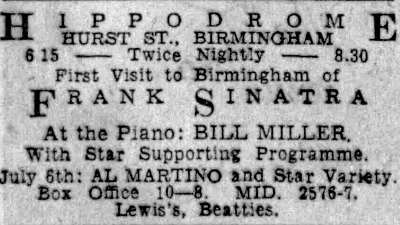
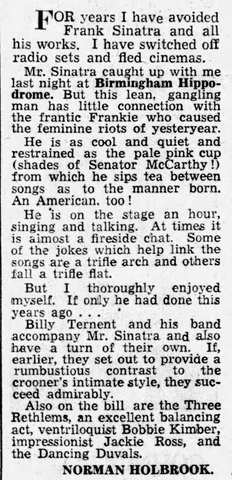
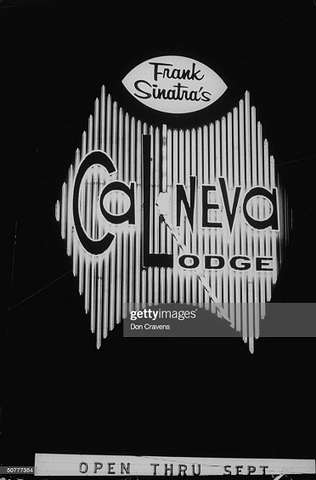
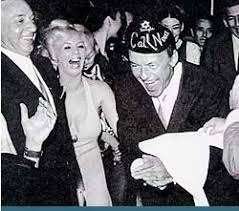
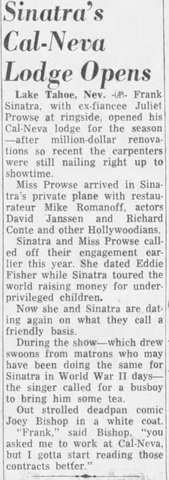
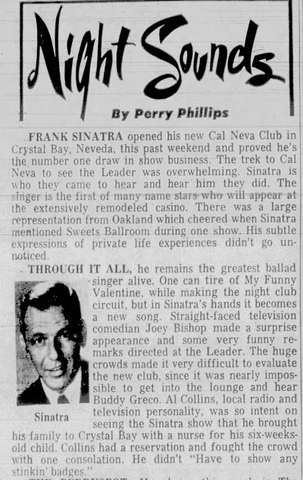
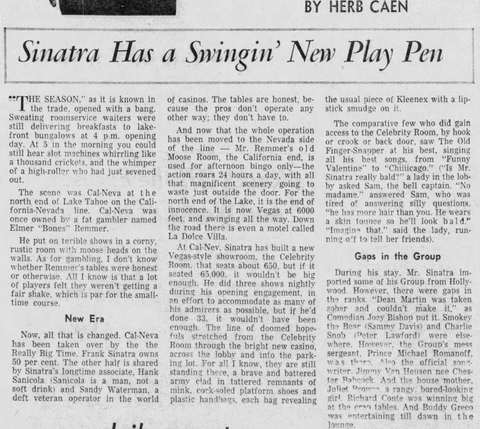

July 2, 1953
Concerts
The Hippodrome, Birmingham, England (June 29 - July 4)
Show Time: 6:15 & 8:30
Billy Ternent and his Broadcasting Orchestra
Key Musicians: Bill Miller (piano) Ternent Members: Eva Beyon, Johnny Webb, Ternenteers
Bill Performers: Dancing Duvals, Bobbie Kimber & Augustus Peabody, Jackie Ross, Three Rethlems
Notes: Thanks to Carl Rasmussen for date and details.
July 3, 1953
Concerts
The Hippodrome, Birmingham, England (June 29 - July 4)
Show Time: 6:15 & 8:30
Billy Ternent and his Broadcasting Orchestra
Key Musicians: Bill Miller (piano) Ternent Members: Eva Beyon, Johnny Webb, Ternenteers
Bill Performers: Dancing Duvals, Bobbie Kimber & Augustus Peabody, Jackie Ross, Three Rethlems
Notes: Thanks to Carl Rasmussen for date and details.
July 4, 1953
Concerts
The Hippodrome, Birmingham, England (June 29 - July 4)
Show Time: 6:15 & 8:30
Billy Ternent and his Broadcasting Orchestra
Key Musicians: Bill Miller (piano) Ternent Members: Eva Beyon, Johnny Webb, Ternenteers
Bill Performers: Dancing Duvals, Bobbie Kimber & Augustus Peabody, Jackie Ross, Three Rethlems
Notes: Thanks to Carl Rasmussen for date and details.
["World on a String" underperforms]
'I've Got the World on a String' entered the Billboard chart on the Fourth of July at only number 14, and stayed there just two weeks -- a modest showing in a year dominated by Eddie Fisher, Perry Como, and Patti Page's 'Doggie in the Window.'
Source: James Kaplan, "Frank: The Voice" (2010).
July 5, 1953
Concerts
Trocadero, Elephant & Castle, London, England
Two Shows: 6:00 PM & 8:30 PM
Promoter: Ed W. Jones
Billy Ternent & His Orchestra
Key Musicians: Bill Miller (piano)

Trocadero, Elephant & Castle, London, England
Two Shows: 6:00 PM & 8:30 PM
Promoter: Ed W. Jones
Billy Ternent & His Orchestra
Key Musicians: Bill Miller (piano)
© 1997-2026 The Sinatra Archive
This calendar, or any parts thereof, may not be reproduced in any fashion
whatsoever without the prior written permission of the publisher (The
Sinatra Archive)
__._,_.___
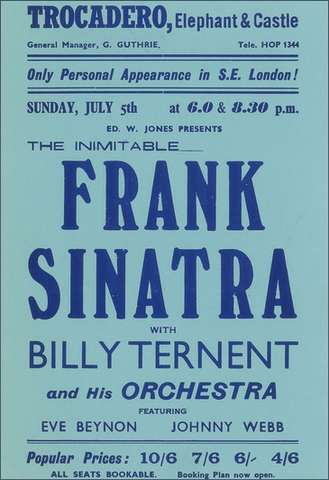
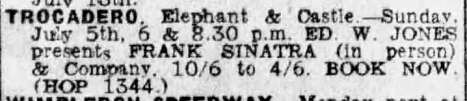
July 6, 1953
Concerts
The Empire Theatre, Glasgow, Scotland (6-11)
Note: Thanks to Carl Rasmussen for this and other 1953 tour dates.
The Empire Theatre, Glasgow, Scotland (6-11)
Note: Thanks to Carl Rasmussen for this and other 1953 tour dates.
When Scotland got Sinatra under its skin
When Scotland got Sinatra under its skin
He came, he crooned, he conquered.
Not once, but twice. Frank Sinatra, whose centenary is being celebrated this year, didn't just come to Scotland for that iconic Ibrox Stadium concert in 1990; he had already visited the country almost 40 years earlier - when he performed in Glasgow, Ayr and Dundee.
Whereas it was a living legend who held the Ibrox audience in his sway during the 1990 concert, the Sinatra who took to several Scottish stages in 1953 was at something of a low ebb in his career. The terrific popularity he had enjoyed during the 1940s when he was the gangly pin-up of the "bobby-soxers" had waned and his record sales had fallen off; his movie career was no longer anything to write home about and his scandalous affair with Ava Gardner, whom he divorced the mother of his children to marry, had dented his image and alienated many fans.
When Sinatra arrived in Scotland in July 1953, nobody could have anticipated that he was on the brink of the chapter during which his legend would be written. Indeed, 1953 would prove - ultimately - to be a very good year, career-wise, for the future Ol' Blue Eyes. He arrived here having just joined Capitol Records, where he would go on to record the albums and hits which guaranteed him eternal mega-stardom, and having just filmed From Here to Eternity, the movie which would resurrect his film career, establish his serious acting abilities and earn him an Oscar.
Instead of being greeted by the thousands who had turned out to welcome such previous Empire Theatre headliners as Laurel & Hardy, Danny Kaye and Dorothy Lamour, Sinatra ran the gauntlet of just a small crowd of fans upon his arrival in Glasgow's city centre just after noon on Monday July 6 1953. Who knows how different it might have been had he arrived by train into Central Station on the Sunday - as was the custom of most stars beginning a two-shows-a-night run at the Empire Theatre on the Monday? Certainly the absence of the scenes of near hysteria which had greeted previous visiting stars added to the impression that Sinatra was a has-been.
The truth is: Sinatra had been unable get to Glasgow sooner as he had been performing at the London Palladium the night before - so he flew up on the day of his first show, leaving Mrs Sinatra filming the MGM costume drama The Knights of the Round Table in the capital. By this point, two years into their ill-fated marriage, the cracks were already beginning to show - and, just three months later they announced their separation.
The subject of Ava Gardner doesn't appear to have been up for discussion during a relaxed press reception in the lobby of the Central Hotel almost immediately upon Sinatra's checking-in. Coming over as extremely affable and unaffected, the 39-year-old, who was referred to as "The Voice" and "Swoonatra" in the papers, lit his pipe and discussed his love of golf (his handicap was 24) and his plan to support Ben Hogan at the Open Golf Championship which was underway at Carnoustie. (He watched the fourth morning's play later that week before returning to Glasgow for his early evening performance.)
He raved about some of the BBC television drama he had watched during his British visit thus far - and revealed that he was keen to produce or direct TV shows and movies. And in what now, with the benefit of the hindsight that this was the singer later regarded as the greatest of the 20th Century, sounds like a bombshell, Sinatra told the Evening Times that the "future of Frank", as he saw it at that point, meant less and less singing and more and more light comedy.
Indeed, that night, in front of a packed first house at the Empire, the star - whose looks were described as "lean and hungry" - revealed his comedy skills. He wisecracked about everyone from Ben Hogan to - intriguingly - Willie Waddell, the Rangers and Scotland footballer, whose inclusion in the act was probably a first-night exercise in Sinatra testing the waters about which subjects went down well in Glasgow..
The crowd howled with laughter in response to his "Old Man [Bing] Crosby" parody of Old Man River and his ad-libbing skills. Having sung the All of Me line "Take my arms", he paused, and asked increduously: "Arms?"
Of course it was his singing which drew squeals, yelps, whistles and roars from the full house. He brought gasps from the women in the audience with his prolonged notes, and the last few bars of every number were drowned in applause. And it wasn't only the women who were dazzled by "The Voice". Hugh Napier of Helensburgh recalls "the magic" of Sinatra at the Empire. He says: "We knew we were experiencing greatness. It was wonderful. His phrasing was immaculate and the way he put over the number in sympathy with the words was spell-binding."
Concentrating on songs from earlier in his career ("There have been no songs written in the past six months which are conducive to me," he explained), Sinatra sang for an hour, accompanied onstage by his pianist Bill Miller, and with Billy Ternent's Orchestra in the pit. Among the numbers were a show-stopping version of Old Man River, September Song, Nancy With the Laughing Face, Birth of the Blues and Embraceable You.
And, taking a page out of Danny Kaye's book, he endeared himself to the crowd by taking a tea-break, just behind the footlights. "It gives me a rest," the down-to-earth crooner explained.
Indeed, being down-to-earth was one of the most striking characteristics of the Frank Sinatra who came to Glasgow that summer. So unaffected was he that he didn't wear any stage make-up and strolled onstage wearing the suit he had left his hotel room in.
Writing in 1990 about his 1953 encounters with Sinatra, the Glasgow Herald's entertainments editor Andy Young said: "He never used his dressing room at all at the Empire. The same towel hung unused all week. A limo would drop him at the theatre a few minutes before each show. He would walk straight in off the street onto the stage, without a sign of the screaming, hysterical, fainting bobby-soxers who had mobbed him everywhere he went" just a few years before.
The 1953 Sinatra was also extremely approachable; he even did the approaching in one notable instance cited by Andy Young. "One night I was standing at the Empire stage door when a woman, unused to the theatre, was trying to buy tickets there. Suddenly, this quiet, friendly American voice came from over her shoulder. 'I'll show where to get them, ma'm.' Yes, it was Sinatra and he took her out onto the pavement in West Nile Street and directed her round the corner to Sauchiehall Street, where the box-office was located."
--Thanks to Carl R for the above article.
Just to tell that the photo of FS with coat and hat fis not in Scotland but at the Paris Orly Airport. On the larger photo you can see the letters of the Air France company. That photo has been edited as a postcard around 40 years ago. Best Michel
----
The Sunday Herald wrote:
When Sinatra arrived in Scotland in July 1953, nobody could have anticipated that he was on the brink of the chapter during which his legend would be written. Indeed, 1953 would prove - ultimately - to be a very good year, career-wise, for the future Ol' Blue Eyes. He arrived here having just joined Capitol Records, where he would go on to record the albums and hits which guaranteed him eternal mega-stardom, and having just filmed From Here to Eternity, the movie which would resurrect his film career, establish his serious acting abilities and earn him an Oscar.
Instead of being greeted by the thousands who had turned out to welcome such previous Empire Theatre headliners as Laurel & Hardy, Danny Kaye and Dorothy Lamour, Sinatra ran the gauntlet of just a small crowd of fans upon his arrival in Glasgow's city centre just after noon on Monday July 6 1953. Who knows how different it might have been had he arrived by train into Central Station on the Sunday - as was the custom of most stars beginning a two-shows-a-night run at the Empire Theatre on the Monday? Certainly the absence of the scenes of near hysteria which had greeted previous visiting stars added to the impression that Sinatra was a has-been.
The subject of Ava Gardner doesn't appear to have been up for discussion during a relaxed press reception in the lobby of the Central Hotel almost immediately upon Sinatra's checking-in. Coming over as extremely affable and unaffected, the 39-year-old, who was referred to as "The Voice" and "Swoonatra" in the papers, lit his pipe and discussed his love of golf (his handicap was 24) and his plan to support Ben Hogan at the Open Golf Championship which was underway at Carnoustie. (He watched the fourth morning's play later that week before returning to Glasgow for his early evening performance.)
He raved about some of the BBC television drama he had watched during his British visit thus far - and revealed that he was keen to produce or direct TV shows and movies. And in what now, with the benefit of the hindsight that this was the singer later regarded as the greatest of the 20th Century, sounds like a bombshell, Sinatra told the Evening Times that the "future of Frank", as he saw it at that point, meant less and less singing and more and more light comedy.
Indeed, that night, in front of a packed first house at the Empire, the star - whose looks were described as "lean and hungry" - revealed his comedy skills. He wisecracked about everyone from Ben Hogan to - intriguingly - Willie Waddell, the Rangers and Scotland footballer, whose inclusion in the act was probably a first-night exercise in Sinatra testing the waters about which subjects went down well in Glasgow.
The crowd howled with laughter in response to his "Old Man [Bing] Crosby" parody of Old Man River and his ad-libbing skills. Having sung the All of Me line "Take my arms", he paused, and asked increduously: "Arms?"
Of course it was his singing which drew squeals, yelps, whistles and roars from the full house. He brought gasps from the women in the audience with his prolonged notes, and the last few bars of every number were drowned in applause. And it wasn't only the women who were dazzled by "The Voice". Hugh Napier of Helensburgh recalls "the magic" of Sinatra at the Empire. He says: "We knew we were experiencing greatness. It was wonderful. His phrasing was immaculate and the way he put over the number in sympathy with the words was spell-binding."
Concentrating on songs from earlier in his career ("There have been no songs written in the past six months which are conducive to me," he explained), Sinatra sang for an hour, accompanied onstage by his pianist Bill Miller, and with Billy Ternent's Orchestra in the pit. Among the numbers were a show-stopping version of Old Man River, September Song, Nancy With the Laughing Face, Birth of the Blues and Embraceable You.
And, taking a page out of Danny Kaye's book, he endeared himself to the crowd by taking a tea-break, just behind the footlights. "It gives me a rest," the down-to-earth crooner explained.
Indeed, being down-to-earth was one of the most striking characteristics of the Frank Sinatra who came to Glasgow that summer. So unaffected was he that he didn't wear any stage make-up and strolled onstage wearing the suit he had left his hotel room in.
Writing in 1990 about his 1953 encounters with Sinatra, the Glasgow Herald's entertainments editor Andy Young said: "He never used his dressing room at all at the Empire. The same towel hung unused all week. A limo would drop him at the theatre a few minutes before each show. He would walk straight in off the street onto the stage, without a sign of the screaming, hysterical, fainting bobby-soxers who had mobbed him everywhere he went" just a few years before.
The 1953 Sinatra was also extremely approachable; he even did the approaching in one notable instance cited by Andy Young. "One night I was standing at the Empire stage door when a woman, unused to the theatre, was trying to buy tickets there. Suddenly, this quiet, friendly American voice came from over her shoulder. 'I'll show where to get them, ma'm.' Yes, it was Sinatra and he took her out onto the pavement in West Nile Street and directed her round the corner to Sauchiehall Street, where the box-office was located."
--Carl
---
Songs, stories and swoons: Frank Sinatra in Glasgow, 1953
LEGENDARY crooner Frank Sinatra's Ibrox stadium concert in 1990 was not the first time he had visited Glasgow.
On Monday, July 6, 1953, he performed at the Empire, part of a mini-Scottish tour which included Ayr and Dundee.
It was a strange time in life – his record sales had dropped, his mmovie career had stalled and his affair with Ava Gardner had seriously dented his image for many fans.
He was not Ol' Blue Eyes at this point – the newspaper headdlines called him The Voice, and Swoonatra - but as he held an informal press conference in the lobby of the Central Hotel (now the Grand Central) no-one could have guessed what lay on the horizon.
Recently signed to Capitol Records, 1953 would be the year to re-launch his career in style, with huge albums and mega-hits, and an Oscar-winning role in From Here to Eternity.
American singer, actor and producer Sinatra, who was born in 1915 and died in 1998, was one of the most popular and influential musical artists of the 20th century. He is one of the best-selling music artists of all time, having sold more than 150 million records worldwide.
The Evening Times reported his arrival in Glasgow back in 1953 with the headline: "The Voice Makes An Easy Entry Into Glasgow", revealing that the singer ‘ran a small gauntlet of fans' on his arrival at the hotel.
"Then, pipe in hand and going nicely with the help of a borrowed match, he talked easily with a reception committee of pressmen."
He talked about golf, admitting that he played erratically, and planned to pop up to Carnoustie to catch some of his compatriots at the Open if he had time; and refused to be drawn into the big debate of the day surrounding advertising on television.
He told the Evening Times that he was a big admirer of BBC drama, and thought it "could lick anything" he had seen in the States.
The report continued: "He talked, only a little and under prompting, about Frank Sinatra. The future of Frank, as he sees it, seems to mean less and less singing and more and more comedy…The pipe in hand Fraank is a remarkably changed character from the chip on the shoulder Frank we have read about. Glasgow should like him more than somewhat."
At the Empire that night, Sinatra wisecracked and sang his way through his set, dazzling his audience with accompaniment from pianist Bill Miller and the Billy Ternent Orchestra. Among the numbers were classic songs like Old Man River, September Song, Nancy With the Laughing Face, Birth of the Blues and Embraceable You.
The supporting set, reported the Evening Times the next day, included "funster George Martin," jugglers The Three Lederers, roller skaters Williams and Sand and Jackie Ross.
The reviewer said: "Mr Sinatra can croon - no doubt about that - but there is also a rich personality in that slender-built frame which can keep up a heavy barrage of cool, casual repartee for an hour or more.. He even has a chat with us over a nice cup of tea while taking a breather - "it helps the chords" he says.
"But it's when he drools over Mr Mike, with refrains like Embrace Me and Nancy, that the voice really scores and oh! Frankie, how the audience loved it!"
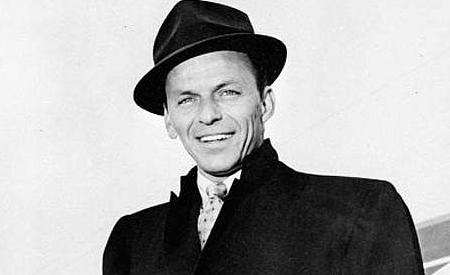
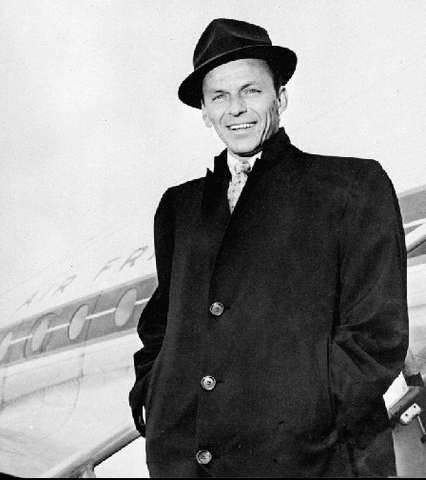
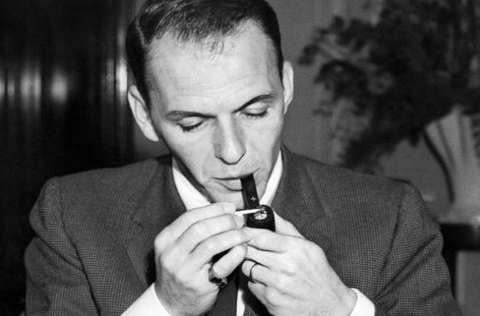
July 7, 1953
Concerts
The Empire Theatre, Glasgow, Scotland (July 6-11)
July 8, 1953
Concerts
The Empire Theatre, Glasgow, Scotland (6-11)
July 9, 1953
Concerts
The Empire Theatre, Glasgow, Scotland (6-11)
July 10, 1953
Concerts
The Empire Theatre, Glasgow, Scotland (6-11)
July 11, 1953
Radio
BBC Showband Show
Cyril Stapleton and Orch.
Saturday
Location: Paris Cinema,Lower Regent Street,London
1. Birth of the Blues
2. I'm Walking Behind You
3. Ol' Man River
Ed O'Brien notes: I have an interview Stapleton did in Australia in 1971. He has some very interesting comments regarding Frank's two appearances on his show in July of 1953.
Thanks to Fredrick J Wadsworth for location and this addition: Frank was paid Ł45.
Television
NONE
Concerts
The Empire Theatre, Glasgow, Scotland (6-11)
BBC Showband Show
Cyril Stapleton and Orch.
Saturday
Location: Paris Cinema,Lower Regent Street,London
1. Birth of the Blues
2. I'm Walking Behind You
3. Ol' Man River
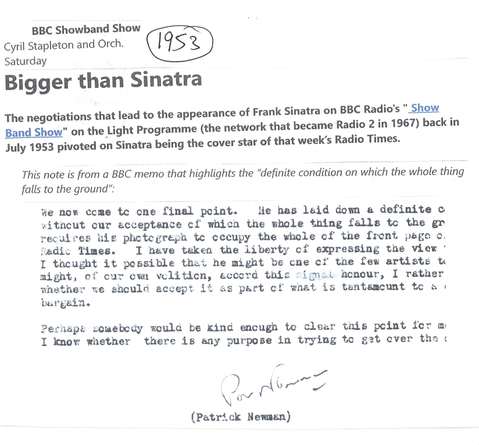
July 12, 1953
Concerts
Green's Playhouse, Ayr, Scotland,
2 performances.
At Green's Playhouse in Ayr on Sunday 12, the 3pm show only attracted 500 audience members, but the 3000-seater hall looked to be well-filled in the evening.
Green's Playhouse, Ayr, Scotland,
2 performances
1953: Green's Playhouse, Ayr, Scotland,
2 performances.
Thanks to Carl R for the above images and information.
The more research I do on the extensive tour, in 1953, the more amazed I am. Frank sold out a number of venues throughout his three month plus appearances in Europe, and he also played to less than a few hundred people in some theatres. It really was feast or famine for him. His determination to persevere despite meager crowds seems to have endeared him with the locals in many of the cities along his route. At the end of August, he would play to SRO crowds at the 500 Club in Atlantic City and that success would carry over at Bill Miller's Riviera Club in September. There would still be a few ups and downs over the next six months. He failed to attract sizable crowds in Miami the following winter. But overall his career was on a positive trajectory that would become the norm for the next 40 years. --Ed
Ol' Blue Eyes in Scotland
by Paul F. Cockburn on 17 November, 2015 in Arts & Culture
On the centenary of Frank Sinatra's birth, Paul F Cockburn looks back to his two trips to Scotland.
"The lean and hungry look came to the Glasgow Empire last night. But there was nothing lean or hungry about the audience or about the performance by Frank Sinatra," according to the Daily Record on 7 July 1953. Under the title "Swoonatra' can still knock 'em cold," the review went on: "The bobbysoxers may have shifted their allegiance in recent years, but I prefer Sinatra. And an audience of all ages last night obviously agreed with me."
Yet Francis Albert Sinatra's brief tour of Scotland that month a Monday-to-Friday run at the Glasgow Empire (6-11 July), followed by two shows at Green's Playhouse in Ayr (on Saturday 12 July), and a further two that Sunday (13 July) in Dundee's cavernous Caird Hall have since been overshadowed by tales of poor ticket sales and Sinatra's apparent petulance about his then-"stalling" career, given that Rock 'n' Roll and Elvis Presley were just around the corner.
Indeed, when the agent who booked those Ayr and Dundee gigs, Peter deRance, died nearly 60 years later, most media attention focused on how this otherwise highly successful agent the man who'd brought the likes of Ken Dodd and Bob Monkhouse to Scotland had somehow managed to lose money on "Ol' Blue Eyes".
Newspaper coverage from the time, however, gives no suggestion that things were not going well for Sinatra; there's not even any mention of apparent coin-throwing by those traditionally "difficult" Glaswegian audiences. As for further north: "What a wonderfully enthusiastic crowd they were," he said of his final Dundee audience, to a reporter from the Courier and Advertiser (now Dundee Courier).
Publicly, Sinatra expressed no disappointment over the fact that his early evening audience had consisted of around 500 people, sat in the cheaper seats towards the back of the hall. Famously, he'd invited them down to largely empty 15/- seats at the front, where he could see them: "Hey, you guys back there in Perth, move down to the front." And they did!
Sinatra insisted that the shows weren't simply about numbers, even when the main evening show barely filled more than half of the Caird Hall's 2,000 seats. "That happens in other cities," he said. "What really matters is their response, and it was wonderful. I have a very high opinion of Scottish audiences."
Yet it would be almost 38 years before Sinatra returned, for a one-off concert at Ibrox stadium as part of Glasgow's Year of Culture celebrations in 1990. Understandably, this long gap has fueled speculation that, following his experiences in 1953, "the Chairman of the Board" had been in no hurry to come back to Scotland; that, in fact, his only fond memories of the entire trip had been seeing legendary American golfer Ben Hogan complete golf's Triple Crown by winning the 1953 British Open at Carnoustie.
And, for a time, history looked as if it was going to repeat itself in 1990, when lower-than-expected ticket sales forced a scaling back of the venue's capacity from 33,000 to 11,000 seats. Yet Sinatra who immediately won over the crowd by introducing himself as "the American Andy Stewart" later described Ibrox as one of the highlights of his career.
Not only did he leave the stage to stroll up and down the running track around the pitch, to be closer to the audience, "Ol' Blue Eyes" even gave an encore something he never usually did!
"He walked onstage, did the show, then left," Barry Wright of Edinburgh-based Regular Music later said. "But it was obvious he was enjoying himself."
As indeed, was his audience!
First published in Scottish Memories, December 2015.
--Carl
---------------------------------------
JULY 13, 1988
In this July 12, 1988, file photo, Frank Sinatra and his wife, Barbara, appear at Milton Berle’s 80th birthday party in Los Angeles.
© 1997-2025 The Sinatra Archive
This calendar, or any parts thereof, may not be reproduced in any fashion whatsoever without the prior written permission of the publisher (The
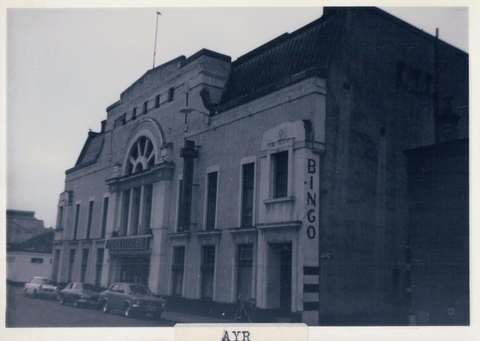
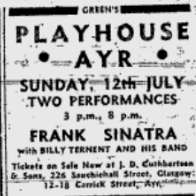
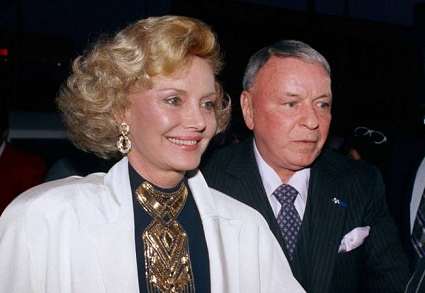
July 13, 1953
Concerts
Caird Hall, Dundee, Scotland,
2 performances.
July 16, 1953
Radio
BBC Show Band Show
1. Day In Day Out
2. I've Got The World On A String
Note: "Day In, Day Out" & "I've Got The World On A
String" appear on the CD: From The Vaults Two & More
AA202.
NOTE: Ed 'Brien points out that this was Sinatra's second appearance on
Show Band. He appeared on June 11, 1953 and sang "Birth of the Blues," "Ol' Man River," and "I'm Walking Behind
You." On this July 16th show, he opened with "I've Got the World on a String" (Riddle chart). He did the inferior Siravo at Blackpool on July 26. "Day in, Day Out" (Stordahl chart), and "London By Night" (Stordahl). Announcer says before the last number, "You're not finished yet." Sinatra came back with "You're darn right and I'll fight the first guy who says I am."
Fredrick j Wadsworth:
Frank's second show,he was paid £60.
Sinatra was a guest on David Jacobs' half-hour Saturday show on Radio Luxembourg from London
Title of Jacobs' show in 1953 was "Portrait of a Star."
Frank was an hour and 40 minutes.
late for the taping. He did not apologize Frank merely said that he had been playing golf,
doing so well he went around again. Told Jacobs he didn't mind what questions were asked,
but if he mentioned Ava, Frank would push the microphone down his throat. Jacobs did
not mention the woman's name.
Ruby Murray had been the guest the previous week. When Jacobs told Frank, he
said, "That's the girl who has made a fortune out of laryngitis." Frank brought along his new
Capitol single "I've Got The World On A String/"My One And Only Love."
Jacobs mentions that the show was done around the same time as the Showband"
appearance. Frank was in England when the 7-16 show was aired. Jacobs 30 minute show
was on every Saturday. I would think the Sinatra appearance probably took place on either
7/11 or 7/18.
--Ed
BBC Show Band Show
1. Day In Day Out
2. I've Got The World On A String
Note: "Day In, Day Out" & "I've Got The World On A
String" appear on the CD: From The Vaults Two & More
AA202.
Here are some photos from the BBC shows, both June 11th and July 16th 1953.
Carl
June 1953 - Sinatra and BBC Show Band
Frank photographed with Rikki Fulton on the BBC band show, 1953.
Frank Sinatra at BBC Radio with Rikki Fulton (L) and Johnnie Stewart (R) (producer), 1953:
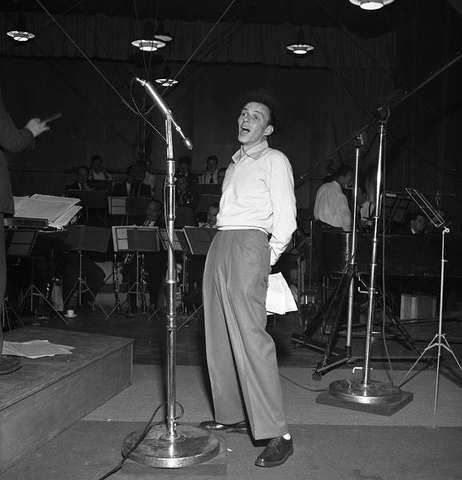
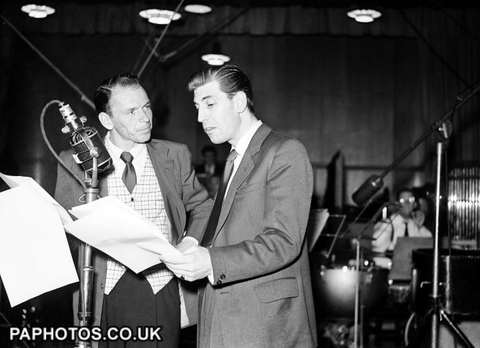
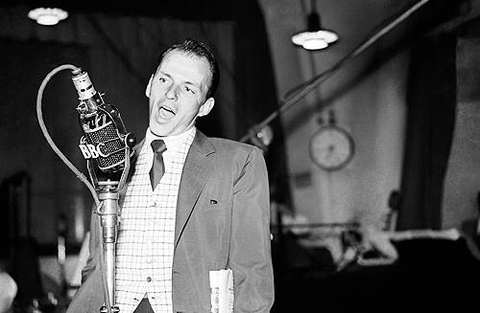
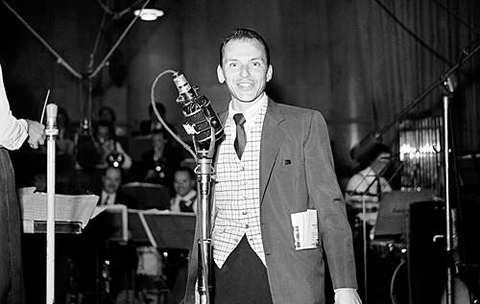
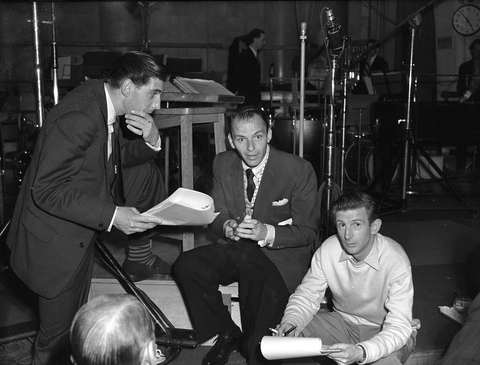
July 19, 1953
Concerts
De Monfort Hall, Leicester, England
Sunday evening
Shows at 3: 00 and 6:30 Pm
Billy Trenent and His Orchestra
Bill Miller on piano
De Monfort Hall, Leicester, England
Sunday evening
Shows at 3: 00 and 6:30 Pm
Billy Trenent and His Orchestra
Bill Miller on piano
SINATRA, FRANK - Leaf torn from a souvenir programme
Leaf torn from a souvenir programme, signed and inscribed by Frank Sinatra "All the best son. Hope it is over before you get there.
Frank Sinatra", one page, some folding with splitting, age toning and light foxing, 19 July 1953. Provenance: the vendor is the son of the former Entertainment Manager of the De Montfort Hall in Leicester. A concert of Frank Sinatra was scheduled for the night of July 19th, 1953. The vendor's father went to Sinatra's dressing room and asked him to sign the programme for his son, who was then in the Army and about to leave for Korea. The Korean War actually finished just as the vendor arrived there.
My aunties and Frank Sinatra outside De Montfort Hall, Leicester, 1953.
Thanks to Carl R. for photo and information above.
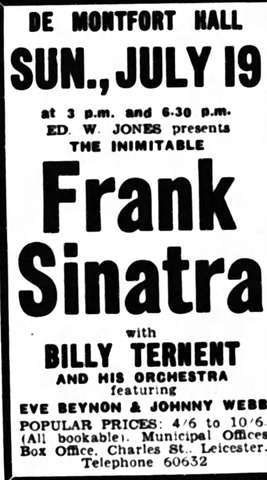
De Monfort Hall, Leicester, England
Sunday evening
Shows at 3: 00 and 6:30 Pm
Billy Trenent and His Orchestra
Bill Miller on piano
.
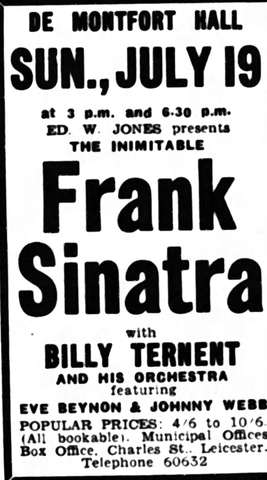
July 20, 1953
Concerts
Palace Theatre, Manchester England
One Week Commencing July 20
2 shows a night(6:15 and 8:30) with Billy Ternent Orchestra
Bill Miller,piano
Note: Thanks to Fred W for above listing.
Palace Theatre Manchester England
One Week Commencing July 20
2 shows a night(6:15 and 8:30)with Billy Ternent Orchestra
Bill Miller,piano
July 20-21-1964
Las Vegas, Nevada
Warner Brothers/Reprise Sales Convention
Frank Sinatra, Dean Martin, Trini Lopez, Lou Monte
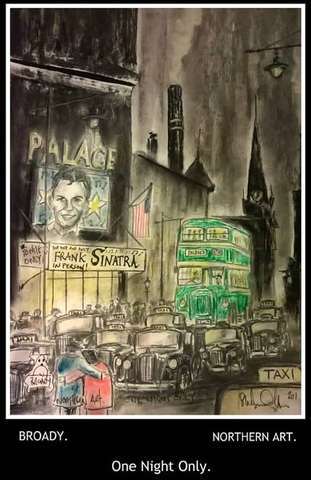
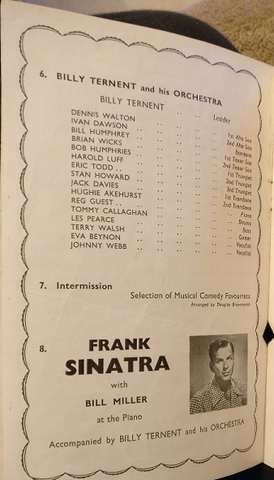
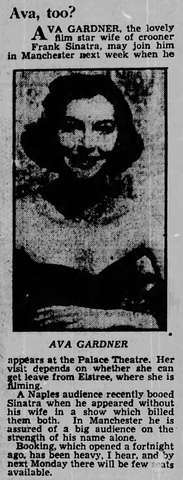
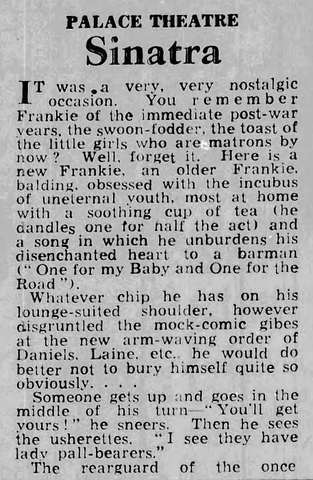
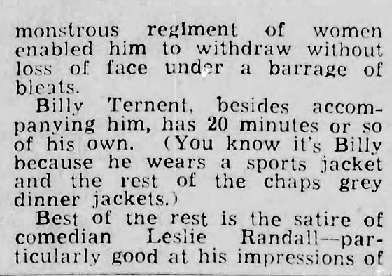
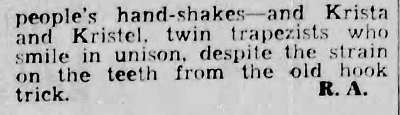
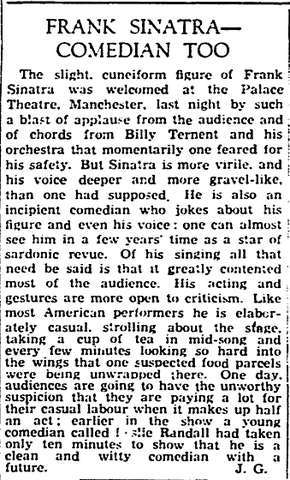
July 21, 1953
Concerts
Palace Theatre Manchester England
One Week Commencing July 20
2 shows a night(6:15 and 8:30)with Billy Ternent Orchestra Bill Miller,piano
July 22, 1953
Concerts
Palace Theatre, Oxford Street, Manchester, England
Week commencing Monday July 20 -25
Shows 6:15 and 8:30
Orchestra Conducted by: Billy Ternant
Billy Ternent And His Broadcasting Orchestra: Bill Miller (piano), Dennis Walton (alto sax), Ivan Dawson (alto sax), Bill Humphrey (baritone), Brian Wicks (tenor sax), Bob Humphries (tenor sax), Harold Luff (trumpet), Eric Todd (trumpet), Stan Howard (trumpet), Jack Davies (trombone), Hughie Akehurst (trombone), Reg Guest (piano), Tommy Callaghan (drums), Les Pearce (bass), Terry Walsh (guitar), Eva Beynon (vocalist), Johnny Webb (vocalist)
July 23, 1953
Concerts
Palace Theatre, Oxford Street, Manchester, England
Week commencing Monday July 20 -25
Shows 6:15 and 8:30
Orchestra Conducted by: Billy Ternant
Billy Ternent And His Broadcasting Orchestra:
Bill Miller (piano), Dennis Walton (alto sax),
Ivan Dawson (alto sax), Bill Humphrey (baritone),
Brian Wicks (tenor sax), Bob Humphries (tenor sax), Harold Luff (trumpet), Eric Todd (trumpet),
Stan Howard (trumpet), Jack Davies (trombone),
Hughie Akehurst (trombone), Reg Guest (piano),
Tommy Callaghan (drums), Les Pearce (bass), Terry
Walsh (guitar), Eva Beynon (vocalist), Johnny Webb (vocalist)
July 24, 1953
Concerts
Palace Theatre, Oxford Street, Manchester, England
Week commencing Monday July 20 -25
Shows 6:15 and 8:30
Orchestra Conducted by: Billy Ternant
Billy Ternent And His Broadcasting Orchestra: Bill Miller (piano), Dennis Walton (alto sax), Ivan Dawson (alto sax), Bill Humphrey (baritone), Brian Wicks (tenor sax), Bob Humphries (tenor sax), Harold Luff (trumpet), Eric Todd (trumpet), Stan Howard (trumpet), Jack Davies (trombone), Hughie Akehurst (trombone), Reg Guest (piano), Tommy Callaghan (drums), Les Pearce (bass), Terry Walsh (guitar), Eva Beynon (vocalist), Johnny Webb (vocalist)
Palace Theatre, Oxford Street, Manchester, England week commencing Monday July 20 -25
Night Sinatra slept on the sofa
FRANK Sinatra slept on the sofa at a Manchester policeman's home after a late-night drinking session. Ol' Blue Eyes went on a boozing session with the beat bobby after they met at the Palace theatre.
By John Scheerhout
20:22, 17 APR 2010
UPDATED10:08, 13 JAN 2013
STAR MEMORY: Former policeman Dennis Wood
FRANK Sinatra slept on the sofa at a Manchester policeman's home after a late-night drinking session.
Ol' Blue Eyes went on a boozing session with the beat bobby after they met at the Palace theatre.
Sinatra, who had yet to hit the big time, was at a low ebb, having performed in front of a half-empty theatre during a tour of Britain in 1952.
He spotted the officer having his regular pint at the stage door and asked if he could join.
A member of staff got the policeman a second pint and provided one for Sinatra.
The bobby briefly returned to Bootle Street police station to clock off, then came back and the drinking continued in the theatre bar until 2am.
Sinatra, by now sozzled, couldn't remember where he was staying, so the officer took pity on him and invited him to his home on Scotland Hall Road, Newton Heath, where the singer crashed out on the sofa.
Staggered
The officer staggered into bed, accidentally woke his wife and told her who was downstairs. She thought it was a bad joke and went back to sleep.
The bobby woke early the next morning for his shift and roused a snoring Sinatra. The pair then headed into Manchester in a taxi, where Frank found his hotel keys, said thanks and disappeared.
Sinatra's career took a dramatic turn for the better and the story became an anecdote that the officer - who has since died and whose name has never been revealed - regularly told disbelieving colleagues.
Now one of them, Dennis Wood, has made the story public for the first time in a book, A Few Coppers More - True Tales of Policing In Manchester.
Dennis, 79, a retired sergeant from New Moston, said: "Frank was a non-entity then, playing to sparse crowds. In those days, it was common for bobbies to have a drink. The Palace Theatre was on this bobby's beat and he would call at the stage door for a pint.
"Frank saw him and says `I sure could do with one of those' and there's a drinking session. It gets to about 2am and Frank is legless and can't remember where his hotel is and the officer puts him up.
"When the officer tells his wife who is on the sofa she thinks it's one of his drinking pals.
"Of course, she didn't see him the next day and didn't believe the story, but it was true.
"As far as I'm aware, she is still alive. Maybe she will read this and change her mind
Hi Ed,
No wonder the policeman's wife didn't believe her husband.
Here is the front of the program from Manchester.
Carl
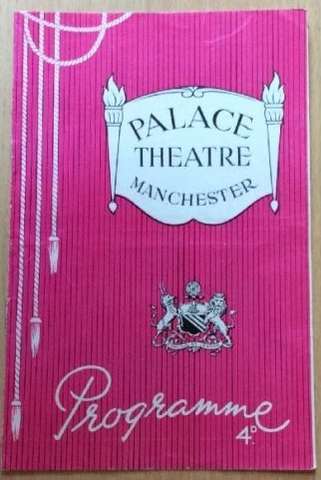
July 25, 1953
Concerts
Palace Theatre, Oxford Street, Manchester, England
Week commencing Monday July 20 -25
Shows 6:15 and 8:30
Orchestra Conducted by: Billy Ternant
Billy Ternent And His Broadcasting Orchestra: Bill Miller (piano), Dennis Walton (alto sax), Ivan Dawson (alto sax), Bill Humphrey (baritone), Brian Wicks (tenor sax), Bob Humphries (tenor sax), Harold Luff (trumpet), Eric Todd (trumpet), Stan Howard (trumpet), Jack Davies (trombone), Hughie Akehurst (trombone), Reg Guest (piano), Tommy Callaghan (drums), Les Pearce (bass), Terry Walsh (guitar), Eva Beynon (vocalist), Johnny Webb (vocalist)
July 26, 1953
Concerts
Opera House, Blackpool, England
1. When You're Smiling -- does a little scatting Siravo chart
2. That Old Black Magic Hefti arg. from "Meet Danny Wilson."
3. You Go To My Head Stordahl chart lovely reading
4. Ol' Man River Stordahl
5. Ol' Man Crosby ( parody )
6. Sweet Lorraine Sy Oliver arg from 12-15-46 session with Jazz All-Stars
6. Birth Of The Blues Heinie Beau chart
7. Embraceable You changes the lyrics a bit
8. One For My Baby Bill Miller backs him on piano
9. Don't Worry 'Bout Me sings the verse Riddle arg.
10. I've Got The World On A String for some inexplicable reason, he used the
Siravo chart
11. It Never Entered My Mind one of the finest reading you will ever hear
12. All Of Me Gershenson's backing from "Meet Danny Wilson."
13. Night And Day Stordahl's famous arrangement
14. closing remarks. Does a bad imitation of Churchill note: This is the first show line-up. Frank added "Nancy" for the evening show which was SRO.
Ed O'Brien:
Sixty-seven years ago tonight Frank Sinatra performed at the Opera House in Blackpool, England. He did two shows on that Sunday evening with Billy Ternent and
His Orchestra. Bill Miller accompanied Frank on piano.
The theatre seated almost 3,000 people. Frank played to less than a 1,000.
We have a recording from that evening. A doctor from Leeds, England recorded the show with a reel-to-reel tape machine.
The audio was transmitted to another theatre owned by the same company. The doctor set his machine up directly in front of the speaker. We owe him a great debt of thanks.
He captured Frank at the beginning of his greatest period as both a recording artist and in-person performer. What we hear from that night is a very uncertain performer. At times his patter has an almost desperate quality to it. He is even confused as to the name of the theatre, calling it the Odeon and a "joint." But none of this matters in the least, because the singing is glorious.
Opera House, Blackpool, England
CORGI BLACKPOOL BALLOON TRAM FRANK SINATRA CODE3
What an interesting display. And what an interesting time
for Sinatra. "Eternity" would open in August and then he would knock
the crowds dead at the 500 Club and Bill Miller's Riviera. But the
European tour was up and down all through the spring and summer.
I came across an article ranking the performances in
"Eternity." Frank's
portrayal of Maggio was the overwhelming winner. Last week, I listened
to the two Crosby shows from 3-21 and 28-54. At the end of the first
show, Bing invites Frank back the next week after he wins his Oscar.
Frank wants to know what if he doesn't win. Bing tells him to come
anyway.
Ed
Ed O'Brien:
On this day in 1959, Sinatra received an award
from Bill Rodstein at the Sinatrama Club in Philly.
Frank gave a short speech. The ceremony was made available on a 45 record
issued by the club.
Johnny1i asked:
What was the sinatrama club? I'm from philly originally, and isn’t the
club the one who released on album the 5am 500 club concert with frank, dean and sammy?
Ed responded:
Bill Rodstein's Sinatrama was in South Philly.
The Latimer Room had 685 Sinatra songs on the juke boxes.
The 4:AM 500 Club, 8-25-62, was given out at the club
and a 45 of the July 59 presentation was also made available.
Rodstein's was very popular and Sinatra did stop in a few times.
There's 800 records in the bistro's five juke boxes, and Sinatra is the only artist they play.
SINATRA SHRINE IN PHILADELPHIA By MAURIE ORODENKER
THE SQUEALING, the shrieking and the screaming of any given horde of Beatles fans can never equal the devotion and dedication Frank Sinatra derives from one particular fan. For no greater love hath any man for "the" man" than William K. Rodstein. No brash teenager is Big Bill, having earned his sobriquet because of six-foot-plus size. But as big as he is, that's how moonstruck is he in his fanaticism for Sinatra. And so, adding to the many historical and cultural shrines that dot the Philadelphia scene is a shrine, as New York columnist Earl Wilson once described it, "a shrine dedicated to the life and works of Frank Sinatra." Despite the prior claims of Hoboken, N. J., on the "man," it is in a modest building in center city on 17th Street near Locust that houses the world's largest collection of phonograph records, paintings, photographs, posters, newspaper clippings, books and magazines, and other memorabilia of Big Bill's ideal. There's even a picture-life size, naturally-messed up with lipstick from customers' kisses. The shrine is in Big Bill's Latimer Club. And it's called the Sinatrama, which gets top billing over the after dark spot itself. And it's here one finds everything exclusively Sinatra- everything from a bare back blow -up of the idol taken at the tender age of three months to his very latest record release. In July 1958, Rodstein first began to line the walls of the small back room of his nitery with pictures of Sinatra. From that small back room, the collection has grown like a fungus until now, Sinatra covers every inch of wall space, the stairways, the windows and the doors. You can even see Frank peering down at you from the ceiling. Young Sinatra in his confirmation suit, right the way through to stills, of the mature Sinatra from his "Manchurian Candidate" film. The only place a person can go in the Latimer where there is no picture of Sinatra is into the men's room. But for the ladies, gallant Big Bill affords them an added thrill with a life -sized photo of Frankie Sinatra grinning at them from the walls of their own little powder room. It was no snap judgment on the part of Big Bill in stringing his long and successful career as nightclub boniface to Sinatra's tails. Way back in the '30's, when Big Bill was pioneering in the juke box field, he was smitten by the Sinatra tonsil. "I never met him, i didn't even know who he was," reminisces Big Bill.
"But i knew that I liked his singing better than any other singer. I loaded all my music machines with records that featured Sinatra's vocals with the big bands. And my confidence paid off because the Sinatra singing paid off in the play at all of my juke box locations."
Naturally, the room's juke box is all- Sinatra, too. The only choice you have is between new Sinatra disks and old ones. And if nobody is putting money in the coin slots, another juke box comes on automatically and plays Sinatra LP's for free. To house The Sinatra Report in what is unquestionably an unrivaled collection of Sinatraphile on wax, tape and acetate, there are actually no less than five standard juke boxes at the Sinatrama. Big Bill estimates there are more than 800 Sinatra records in his collection -at all speeds. Three of the juke boxes contain 45's and 33's. One juke box is exclusively for LP's. The fifth machine of earlier vintage, is for the 78's. Titles are kept on a master roll -an index file and a grouping of music machine wall boxes requires merely a flick of Big Bill's finger to put the needle on any selected groove. Says Big Bill proudly: "if I don't have the Sinatra record you ask for, I'll mow your lawn, shovel your driveway, walk your dog or wash your car!" He has still to do any of these chores. With such a wide choice of singles, extended players and albums, the top favorites of all the sides over the years are "The Lady Is a Tramp" and "Come Fly With
Me." However, for those who don't want to hear Sinatra sing, you can hear Sinatra talk. There are a variety of off -the -air tapes. The prize tape, and which is given the biggest play by the Sinatrama bossman, is the cartridge that unwinds an interview that Big Bill himself had with Sinatra while attending a Sports Writers Association dinner in Los Angeles. It was then that Big Bill discussed his plans for the Sinatrama and the permission granted with the promise that he would personally visit the "shrine" when he visits Philadelphia. But it was only a promise. The closest Sinatra ever came to the Sinatrama was in 1960 when he came to the Sons of Italy Hall -less than a mile away -to receive an award from the Custodes Pacis Lodge of that order. However, Sinatra's mother and father were among the many celebrities coming to Sinatrama -paying their respects the night they came to town to attend the ceremonies at the Sons of Italy when the order for the first time named a lodge after a living man. (The Frank Sinatra Lodge, naturally.) So you don't want to hear Sinatra singing? You don't want to hear Sinatra singing? Undismayed, this dedicated Sinatraphile will turn to a movie projector and unreel the film of Frankie's world charity tour a few years ago. It is only natural that the nation's first shrine to Frank Sinatra should be in Philadelphia. It was here that Frankie's very first fan club-Sinatra Crusaders -was formed. The young girls who started it recognized Sinatra's talents when he was still a vocalist for Harry James, before he went with Tommy Dorsey. A favorite watering place for the show business celebrities and particularly for the sporting world personalities, Big Bill has kept no statistics on the number of people who visit his Sinatrama. What's important to Big Bill is the fact that there is no diminution in the drawing power of his fantastic collection of Frankieana. There's nothing like it anywhere else in the world, and it's far too late for it to be started somewhere else even if anyone had the energy and time that Big Bill has given to it.
Billboard
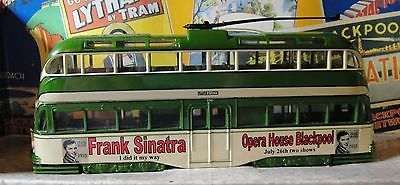
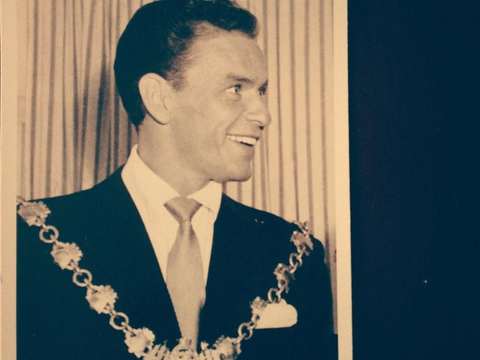
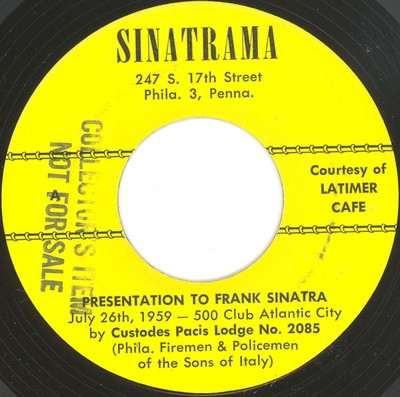
"Don't Worry 'Bout Me"
Will Friedwald (analysis, citing Billboard): Sinatra's first postwar European tour was a critical disaster (Billboard: 'Sinatra Lays Egg in Naples, Needs Cop Aid,' 'Mr. Sinatra, Go Home!'), but he fared better in Britain, with two BBC Show Band Show appearances in July finding him in surprisingly good voice, including a 'stunning' rendition of 'Don't Worry 'Bout Me' (with verse) superior to the studio record, though his Blackpool Opera House concert that month found him disagreeable.
Source: Will Friedwald, "Sinatra! The Song Is You: A Singer's Art" (2018 revised edition).
July 27, 1953
Concerts
Moss' Empire, Liverpool, England (July 27 - August 1)
Two Show nightly
Time: 6:20 & 8:35
Orchestra Conducted by: Billy Ternant
Billy Ternent And His Broadcasting Orchestra: Bill Miller (piano), Dennis Walton (alto sax), Ivan Dawson (alto sax), Bill Humphrey (baritone), Brian Wicks (tenor sax), Bob Humphries (tenor sax), Harold Luff (trumpet), Eric Todd (trumpet), Stan Howard (trumpet), Jack Davies (trombone), Hughie Akehurst (trombone), Reg Guest (piano), Tommy Callaghan (drums), Les Pearce (bass), Terry Walsh (guitar), Eva Beynon (vocalist), Johnny Webb (vocalist)
Ed O'Brien:
The Empire Theatre in Liverpool is located on Lime Street next to the train station. The Empire was erected in 1866 and is one of England's oldest musical theatres. According to the history I read, Sinatra's opening night was greeted with great indifference. He pulled in about 400 people that Monday evening. The Empire has the largest two-tier auditorium in England and a seating capacity of 2,350.
Frank sang the basic program that he had been doing throughout his European Tour. The number of shows done per evening was based on demand. Some evenings he did two shows, which tells us there was far more demand than legend has it. That said, I have additional information on the two Blackpool concerts, performed on July 26. I sent my findings of that evening to a friend in South America. He sent that information to a fellow in England who was in attendance for the first show in Blackpool. His memory of that evening and the attendance is dramatically different from what I found in my research. He also nails down which show was taped by the doctor from Leeds.
Here is his account of that day more than 59 years ago: The next morning after breakfast I make my way to the theatre and find a long line of people all awaiting Sinatra tickets. After a while someone yells "Only two single seats left!" There are about 50 people in front of me. Then "Only one single ticket left!" I'm now in the front, buy a ticket for the first performance for 3 shillings and sixpence.
So that night was a sellout, reading up today, he went to Liverpool for the whole of the following week. It must have been the second show that was recorded in Blackpool, because during the first he sang "Nancy", I remember that vividly because I had just broken up with a girl by that name. When I came out, I went to the stage door, and was talking to the doorman, hoping he would let me in, but everything was sold out. I understand that the weeks he did in Liverpool and Birmingham were half empty. But Blackpool----------NO . Both shows were sold out.
Moss' Empire, Liverpool, England (July 27 - August 1)
The framed bill in Ma Egerton's for Frank Sinatra's shows at the Liverpool Empire
Ol' Blue Eyes is back – and drinking Guinness at the bar off Ma Egerton's behind Liverpool's Empire Theatre.
Well, he's not – but author Spencer Leigh is recreating three scenes when legendary singer Frank Sinatra popped into the pub during his one and only visit to Liverpool.
Spencer's new book, Frank Sinatra: An Extraordinary Life tells readers how Frank's visits are today used to promote Ma Egerton's pizzas (the Frank Sinatra pizza includes Parma Ham and Parmesan cheese).
Sinatra appeared at the Empire for a week of shows beginning on Monday July 27, 1953 – with 'full supporting variety company'€ and Bill Miller at the piano.
He was 37 at the time of his visit, and booked into the Prince of Wales Hotel in Southport – but he ended up leaving because the receptionist didn't recognise him! Eventually, he lay his hat – and ego '€“ in the Birkdale Palace Hotel.
Poor Frankie! His career was, relatively, at a low ebb in the early 1950s – although it was to get a major boost soon after his trip to Liverpool, when the film From Here To Eternity was released, which won him an Oscar for Best Supporting Actor. The Liverpool Empire bill for Frank Sinatra's shows in 1953
At the Empire he performed at 6.20pm and 8.35pm, and Spencer says: 'He was still getting good houses – they were about half full, which is still pretty good at the Empire. But yes, his ego was always enormous '“ that was part of the fun of writing about him.
'When he was in a room he was the centre of attention – he knew he was a number one artist who had a wonderful voice. He was always '˜Frank Sinatra the star' – never just an ordinary man. He would have liked to have been seen in Ma Egerton's – and it would have been the easiest place for him to go.'
The ECHO has previously reported how a regular told pub owner Iain Hoskins that Sinatra had been seen drinking a half of Guinness at the bar (surely it must have been a pint!) and said it was the best he had ever tasted.
Other accounts about his fondness for Ma E's have suggested he was keen to experience a traditional English pub and, also, that he had to be fetched back to the Empire from the boozer moments before the curtain was due to go up.
Spencer, meanwhile, also explains how the late Ginger McCain, the future trainer of Red Rum, was the singer's driver for the week, and Ginger is quoted from his autobiography, saying: 'He was a little rabbit of a man. I wouldn't give you tuppence for him. He was supposed to be a big star but Red Rum knocked him into a cocked hat.'
But there was a missed opportunity here to discuss a shared interest, as Spencer explains: 'Frank liked gambling, so they could have talked about horses!'
Liverpool Echo - Tuesday July 28, 1953
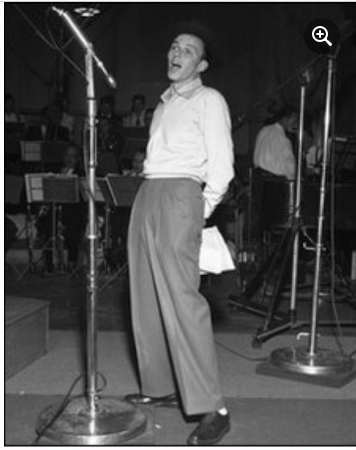
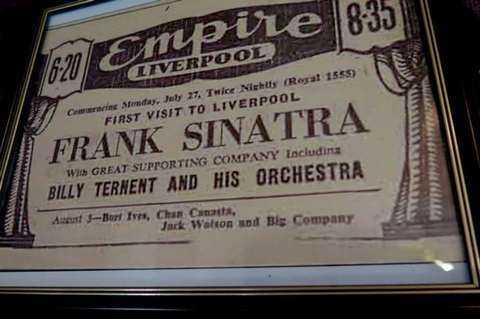
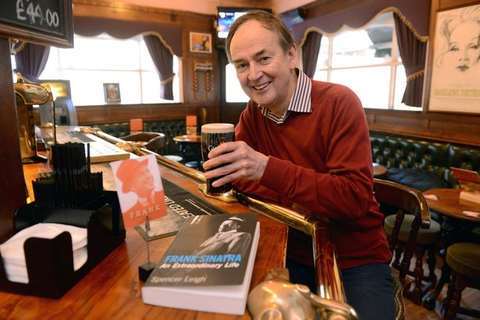
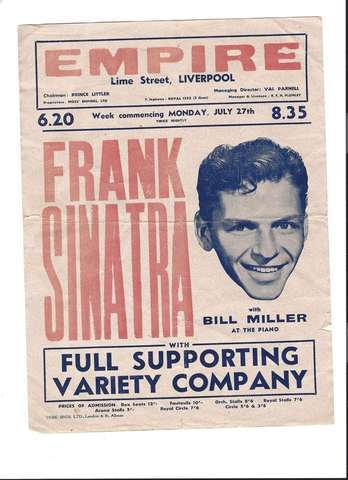
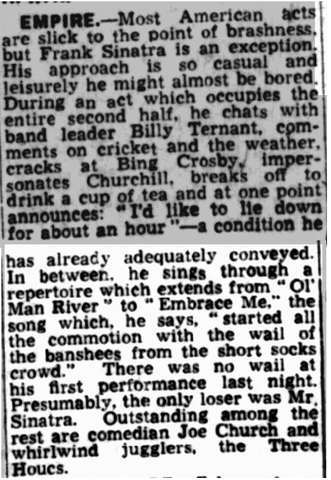
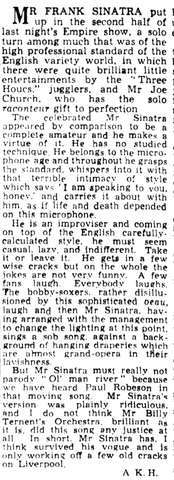
Louella Parsons
7-27-53
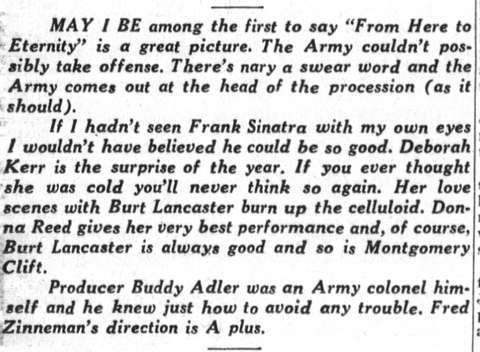
July 28, 1953
Concerts
Moss' Empire, Liverpool, England (July 27 - August 1)
Two Show nightly
Time: 6:20 & 8:35
Orchestra Conducted by: Billy Ternant
Billy Ternent And His Broadcasting Orchestra:
Bill Miller (piano), Dennis Walton (alto sax),
Ivan Dawson (alto sax), Bill Humphrey (baritone),
Brian Wicks (tenor sax), Bob Humphries (tenor sax), Harold Luff (trumpet), Eric Todd (trumpet),
Stan Howard (trumpet), Jack Davies (trombone),
Hughie Akehurst (trombone), Reg Guest (piano),
Tommy Callaghan (drums), Les Pearce (bass), Terry
Walsh (guitar), Eva Beynon (vocalist), Johnny Webb (vocalist)
July 29, 1953
Concerts
Moss' Empire, Liverpool, England (July 27 - August 1)
Two Show nightly
Time: 6:20 & 8:35
Orchestra Conducted by: Billy Ternant
Billy Ternent And His Broadcasting Orchestra: Bill Miller (piano), Dennis Walton (alto sax), Ivan Dawson (alto sax), Bill Humphrey (baritone), Brian Wicks (tenor sax), Bob Humphries (tenor sax), Harold Luff (trumpet), Eric Todd (trumpet), Stan Howard (trumpet), Jack Davies (trombone), Hughie Akehurst (trombone), Reg Guest (piano), Tommy Callaghan (drums), Les Pearce (bass), Terry Walsh (guitar), Eva Beynon (vocalist), Johnny Webb (vocalist)
July 30, 1953
Concerts
Moss' Empire, Liverpool, England (July 27 - August 1)
Two Show nightly
Time: 6:20 & 8:35
Orchestra Conducted by: Billy Ternant
Billy Ternent And His Broadcasting Orchestra: Bill Miller (piano), Dennis Walton (alto sax), Ivan Dawson (alto sax), Bill Humphrey (baritone), Brian Wicks (tenor sax), Bob Humphries (tenor sax), Harold Luff (trumpet), Eric Todd (trumpet), Stan Howard (trumpet), Jack Davies (trombone), Hughie Akehurst (trombone), Reg Guest (piano), Tommy Callaghan (drums), Les Pearce (bass), Terry Walsh (guitar), Eva Beynon (vocalist), Johnny Webb (vocalist)
July 31, 1953
Concerts
Moss' Empire, Liverpool, England (July 27 - August 1)
Two Show nightly
Time: 6:20 & 8:35
Orchestra Conducted by: Billy Ternant
Billy Ternent And His Broadcasting Orchestra: Bill Miller (piano), Dennis Walton (alto sax), Ivan Dawson (alto sax), Bill Humphrey (baritone), Brian Wicks (tenor sax), Bob Humphries (tenor sax), Harold Luff (trumpet), Eric Todd (trumpet), Stan Howard (trumpet), Jack Davies (trombone), Hughie Akehurst (trombone), Reg Guest (piano), Tommy Callaghan (drums), Les Pearce (bass), Terry Walsh (guitar), Eva Beynon (vocalist), Johnny Webb (vocalist)
August 1953
[Fidler praises Sinatra's comeback]
Jimmie Fidler: Hollywood gossip columnist Jimmie Fidler, who admitted his prior coverage of Sinatra had been heavily critical, praised Frank's comeback and predicted columnists were right that he had 'next year's Academy Award in his hip pocket' for From Here to Eternity.
Source: James Kaplan, "Frank: The Voice" (2010)
[Hero's welcome and new offers flood in]
Kaplan: Landing at Idlewild after Eternity's success, Sinatra was mobbed with congratulations from strangers -- baggage handlers, cabbies, cops. NBC, which had cooled on him after CBS canceled his prior TV show, renewed interest in an exclusive radio/TV contract; Milton Berle offered him $6,000 for a single show appearance, and film and nightclub offers poured in from Skinny D'Amato's 500 Club, Bill Miller's Riviera, and others.
Source: James Kaplan, "Frank: The Voice" (2010)
[Solo British tour]
Kaplan: With his manager having scrambled together a Great Britain tour, Sinatra performed alone (without Ava) across London, Bristol, Birmingham, Glasgow, Dundee, Edinburgh, Ayr, Leicester, Manchester, Blackpool, and Liverpool from June into early August, while Ava remained in London filming Knights of the Round Table.
Source: James Kaplan, "Frank: The Voice" (2010)
[Violent fight at St. John's Wood flat]
Kaplan: A couple of nights after their friendly appearance with the Wilsons, Frank and Ava had a violent battle at their St. John's Wood flat involving flying furniture and broken crockery, prompting their landlord to threaten eviction. Frank packed his bags and flew home to New York alone that night.
Source: James Kaplan, "Frank: The Voice" (2010)
August 1, 1953
Concerts
Moss' Empire, Liverpool, England (July 27 - August 1)
Two Show nightly
Time: 6:20 & 8:35
Orchestra Conducted by: Billy Ternant
Billy Ternent And His Broadcasting Orchestra:
Bill Miller (piano), Dennis Walton (alto sax),
Ivan Dawson (alto sax), Bill Humphrey (baritone),
Brian Wicks (tenor sax), Bob Humphries (tenor sax), Harold Luff (trumpet), Eric Todd (trumpet),
Stan Howard (trumpet), Jack Davies (trombone),
Hughie Akehurst (trombone), Reg Guest (piano),
Tommy Callaghan (drums), Les Pearce (bass), Terry
Walsh (guitar), Eva Beynon (vocalist), Johnny Webb (vocalist)
August 5, 1953
Film
"From Here to Eternity" (USA Release: August 5, 1953, New York City Premiere)
Starring: Burt Lancaster, Montgomery Clift, Deborah Kerr, Donna Reed, Frank Sinatra, Ernest Borgnine
Produced by: Buddy Adler
Directed by: Fred Zinnemann
In Hawaii in 1941, a Private Prewitt (Clift) is cruelly punished for not boxing on his unit's team, while his captain's wife Karen (Deborah Kerr) and second-in-command (Burt Lancaster) are carrying on an affair. Prewitt and and his friend Maggio (Sinatra) join a social club where Prewitt becomes attracted to Lorene (Donna Reed). At the club, Maggio gets into an argument with stockade Sergeant "Fatso" Judson (Borgnine). Later, Maggio is sentenced to the stockade after walking off guard duty and getting drunk. This results in harsh treatment at the hands of Judson. Maggio escapes the stockade after a brutal beating from Judson. His injuries are aggravated during his escape and he dies in Prewitt's arms. Everything else plays out as the Japanese bomb Pearl Harbor with Prewitt eventually killed trying to return to base and the movie ends with Karen and Lorene together on a boat returning stateside. --DVD Release: 2001-10-23 - Blu-Ray Release: 2013-10-01
Note: From Here to Eterntiy would win an Academy Award for Best Picture and Fred Zinnemann won for Best Director. Frank Sinatra and Donna Reed would also win for Best Supporting Actor and Best Supporting Actress The film also won Academy Awards for Best Screenplay, Best Cinematography – Black-and-White, Best Film Editing, and Best Sound Recording.
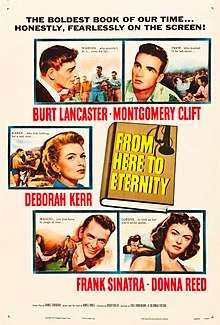
[The Cinematic Legacy of Frank Sinatra — From Here to Eternity (1953)]
David Wills's 2015 photo history The Cinematic Legacy of Frank Sinatra devotes a section to From Here to Eternity (1953), illustrated with 15 behind-the-scenes and publicity photographs (posters, lobby cards, and on-set/on-location shots) filed here.
“As a singer … I rehearse and plan exactly where I'm going. But as an actor, I can't do that. To me, acting is reacting. If you set it up right, you can almost go without knowing every line.… If I rehearse to death, I lose the spontaneity I think works for me.… With Montgomery, though, I had to be patient because I knew that if I watched this guy, I'd learn something.” —Frank Sinatra
“Sinatra was at his best in the first or second take of a scene … whereas Clift would use each take as a rehearsal to add more detail so that the scenes gained in depth as we went on. It was an interesting problem when they did a scene together: how to get the best performance from them both in the same take.” —Fred Zinnemann (Director, From Here to Eternity, 1953)
Source: David Wills, The Cinematic Legacy of Frank Sinatra (St. Martin's Press, 2015), pp. 70–94.
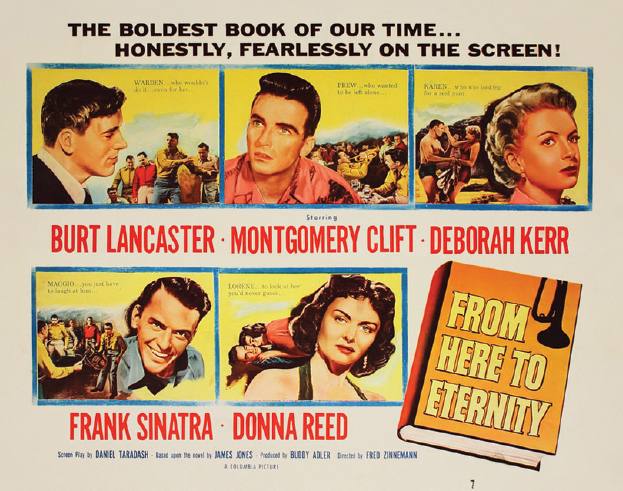
Half sheet poster, From Here to Eternity, 1953. / “I loved it, it was a hell of a book. / And then I spoke to Harry Cohn, who / was then head of Columbia Pictures / and a friend. He said, “Well, you've / never done a dramatic role. You're (Photo: The Cinematic Legacy of Frank Sinatra, David Wills, 2015.)
the guy who sings and dances with / Gene Kelly.” / One sheet poster, From Here to Eternity. (Photo: The Cinematic Legacy of Frank Sinatra, David Wills, 2015.)
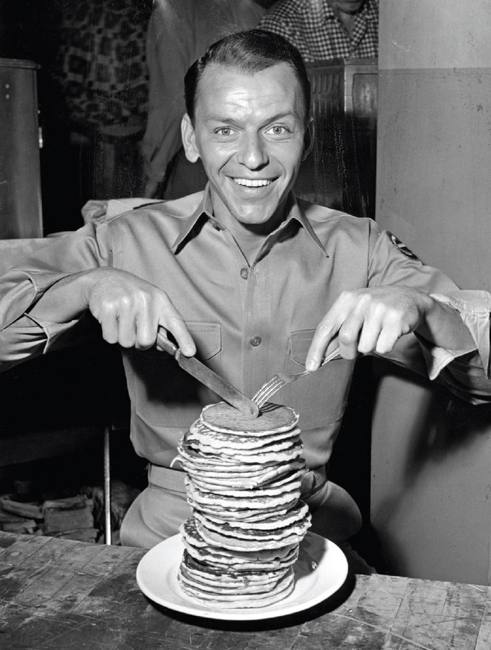
On set, From Here to Eternity. / “I knew I was the only actor to play / Private Maggio, the funny and sour / Italo-American. I knew Maggio. I (Photo: The Cinematic Legacy of Frank Sinatra, David Wills, 2015.)
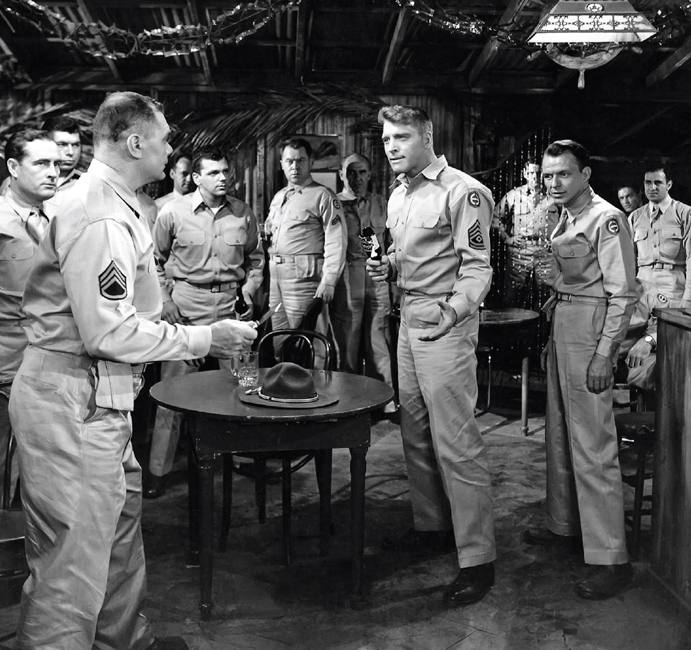
went to high school with him in / Hoboken. I was beaten up with him. / I might have been Maggio.” / With costars Ernest Borgnine and Burt Lancaster, From Here to Eternity. (Photo: The Cinematic Legacy of Frank Sinatra, David Wills, 2015.)
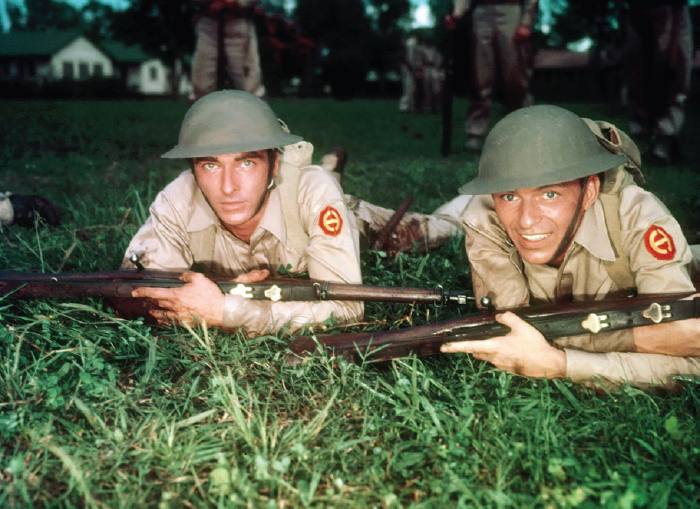
With costar Montgomery Clift, From Here to Eternity. / “As a singer … I rehearse and plan exactly / where I'm going. But as an actor, I can't do that. / To me, acting is reacting. If you set it up right, / you can almost go without knowing every / line.… If I rehearse to death, I lose the / spontane (Photo: The Cinematic Legacy of Frank Sinatra, David Wills, 2015.)
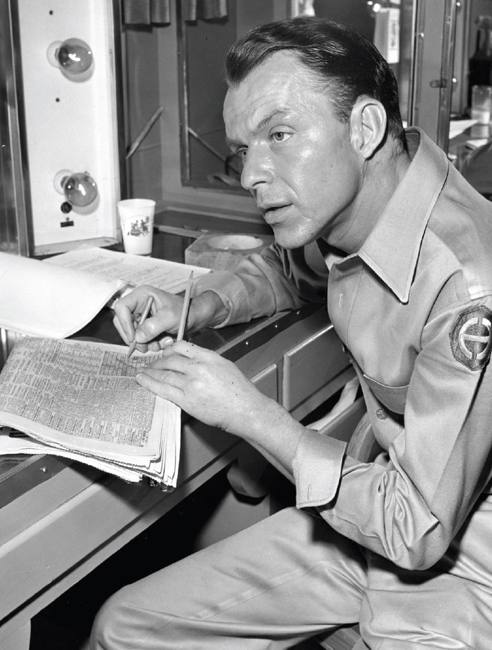
On set, From Here to Eternity. (Photo: The Cinematic Legacy of Frank Sinatra, David Wills, 2015.)
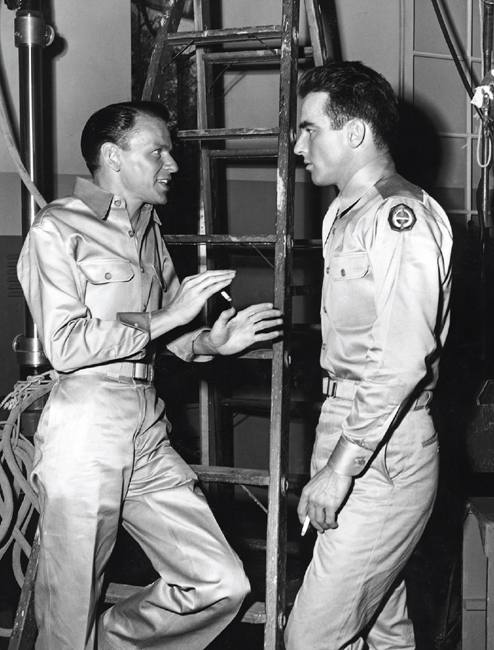
On set, with costar Montgomery Clift, From Here to Eternity. (Photo: The Cinematic Legacy of Frank Sinatra, David Wills, 2015.)
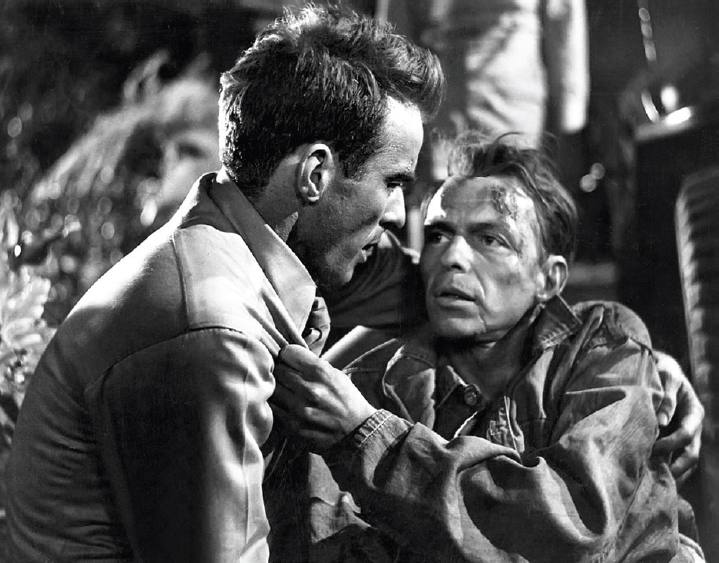
As Private Angelo Maggio, with Montgomery Clift. / “Sinatra was at his best in the first or second / take of a scene … whereas Clift would use each / take as a rehearsal to add more detail so that / the scenes gained in depth as we went on. It / was an interesting problem when they did a / scene tog (Photo: The Cinematic Legacy of Frank Sinatra, David Wills, 2015.)
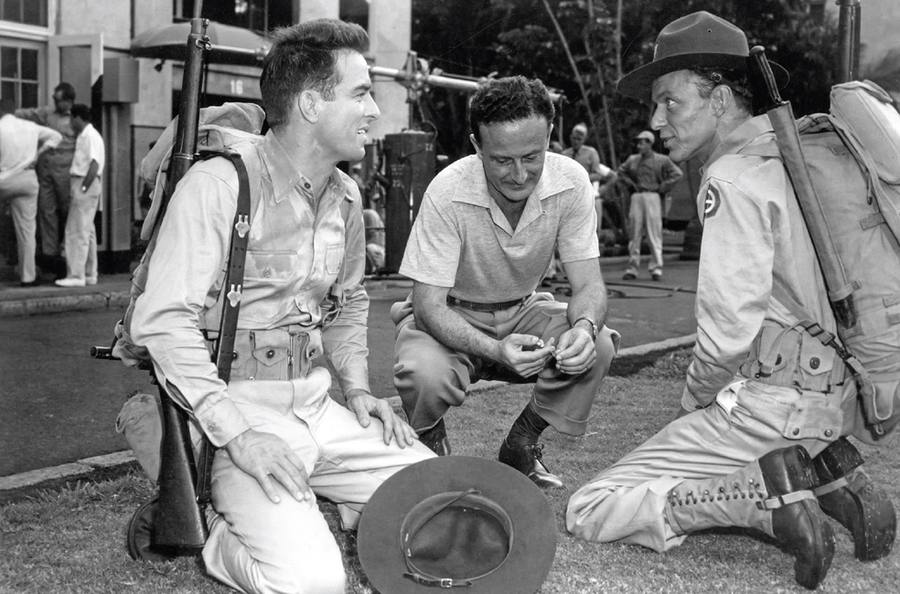
On location in Honolulu, with Montgomery Clift and director Fred Zinnemann. (Photo: The Cinematic Legacy of Frank Sinatra, David Wills, 2015.)
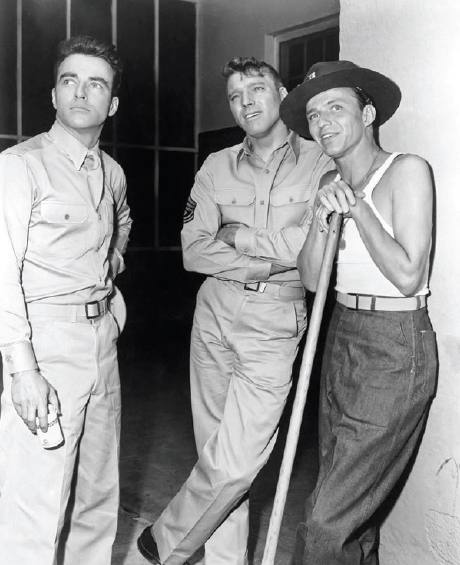
On set, with costars Montgomery Clift and Burt Lancaster, From Here to Eternity. / “His fervor, his anger, his bitterness had / something to do with the character of Maggio, / but also with what he had gone through in the / last number of years: A sense of defeat, and the / whole world crashing in o (Photo: The Cinematic Legacy of Frank Sinatra, David Wills, 2015.)
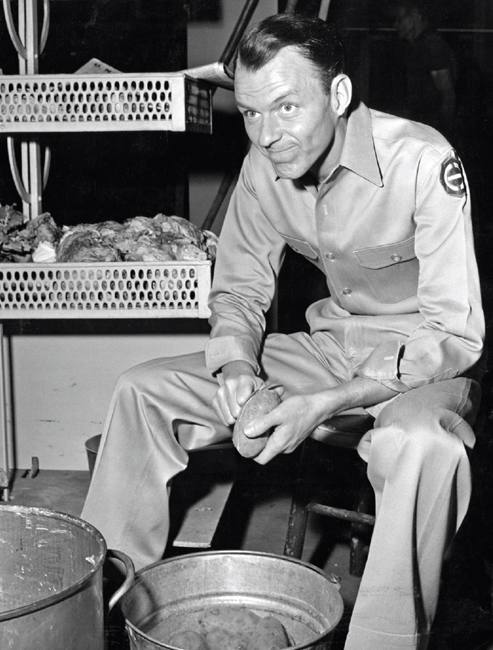
From Here to Eternity. (Photo: The Cinematic Legacy of Frank Sinatra, David Wills, 2015.)
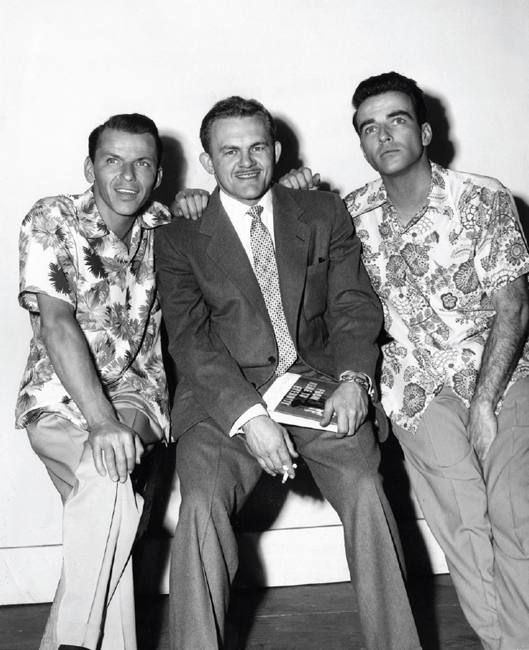
On set, with From Here to Eternity author James Jones, and costar Montgomery Clift. (Photo: The Cinematic Legacy of Frank Sinatra, David Wills, 2015.)
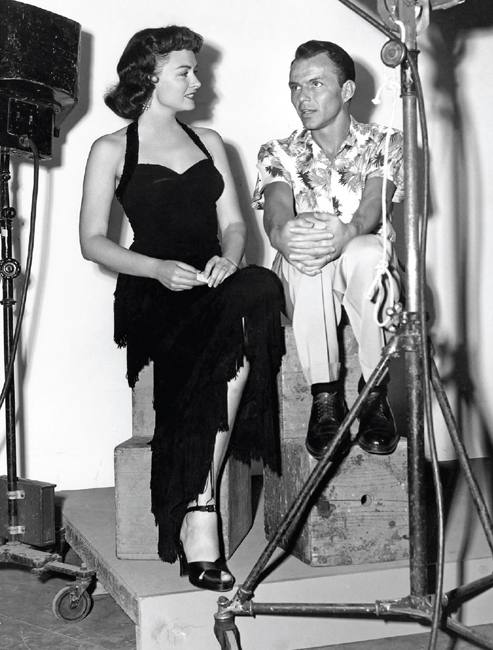
With costar Donna Reed. / “From Here to Eternity is being / shown on a wide screen and with (Photo: The Cinematic Legacy of Frank Sinatra, David Wills, 2015.)
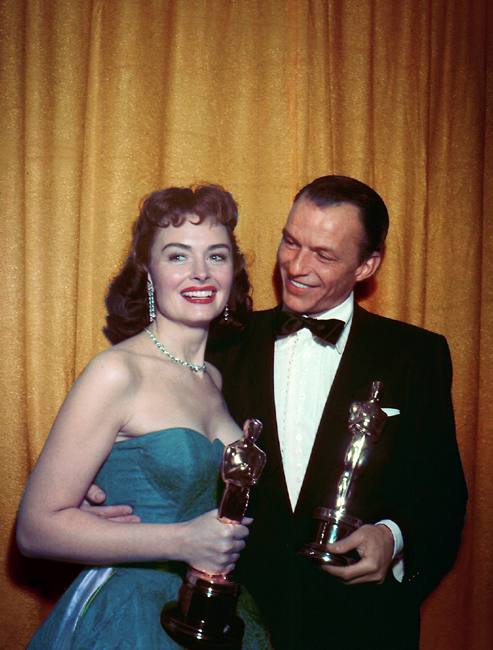
With costar Donna Reed, at the 26th Academy Awards, after accepting their Oscars for Best / Supporting Actor and Best Supporting Actress for their performances in From Here to / Eternity, March 25, 1954. (Photo: The Cinematic Legacy of Frank Sinatra, David Wills, 2015.)
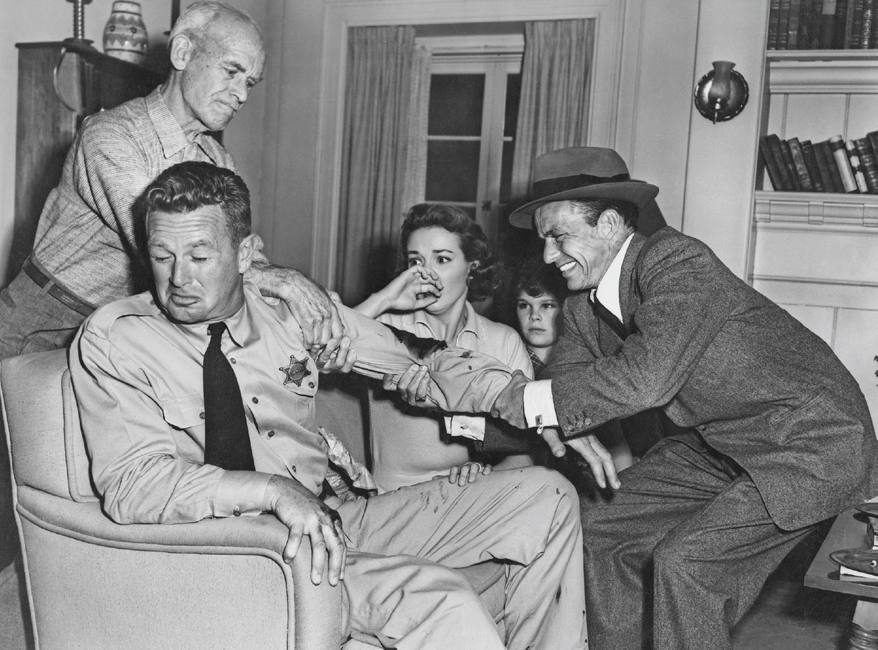
With costars Sterling Hayden, James Gleason, Nancy Gates, and Kim Charney, Suddenly, / 1954. / “As the assassin in the piece, Sinatra / superbly refutes the idea that the / straight-role potentialities which / earned an Academy Award for him / in From Here to Eternity was one-shot / stuff. In Sudden (Photo: The Cinematic Legacy of Frank Sinatra, David Wills, 2015.)
"From Here to Eternity" (USA Release: August 5, 1953, New York City Premiere)
Starring: Burt Lancaster, Montgomery Clift, Deborah Kerr, Donna Reed, Frank Sinatra, Ernest Borgnine
Harry Cohn, president of Columbia Studios, fell in love with James Jones' sensational novel and decided to purchase the rights to it. He was told not to by his own people and by just about everyone else in Tinseltown. There was no way a decent picture could come from such a lewd work of fiction. Cohn would not listen and paid $82,000 to acquire the rights. It became known throughout Hollywood as "Cohn's Folly." And he certainly did have problems. There were six screen adaptations submitted to Cohn and all were rejected. Daniel Taradash would submit lucky number seven and get the green light from Harry. The dream cast he envisioned would be Aldo Ray, Robert Mitchum, Rita Hayworth, Eli Wallach and Gloria Grahame. The producer, Buddy Adler, recommended Fred Zinnemann, who was coming off the great success of "High Noon." Zinnemann insisted on Montgomery Clift for the role of Robert E. Lee Prewitt. Cohn turned him down. Why would he want such an effeminate man in the key role? Zinnemann told him it was simple: He wanted to make a great movie and Clift was a fabulous actor. He also told Cohn that it was a deal breaker if he did not get him. Cohn was furious but reluctantly gave in to a very determined director. Zinnemann would also go to bat for Deborah Kerr. Cohn insisted she would never be able to play Karen Holmes - a woman trapped in a loveless marriage who sought comfort from other men. She just wasn't sexy enough. Zinnemann wouldn't budge. Lancaster and Donna Reed were easier, although Zinnemann wasn't sure Reed could play a believable prostitute. Eli Wallach was a shoo-in for the role of Maggio. Frank Sinatra had actively pursued the role, begging for a screen test. Cohn saw Frank as a lightweight song and dance man. Wallach was a real actor. Frank kept plugging along, but it was Ava Gardner who found a way to open the door for Frank. Harry Cohn adored her and Ava asked to see him. She offered to do a picture at Columbia for free and she invited herself to dinner at the Cohn home. Joan, Harry's wife, also adored Ava. The dinner went very nicely and Ava sang the praises of her husband to Harry and Joan. He would be great and was willing to do it for scale ( $8,000 ). Harry liked that idea, but he was still sold on Wallach. Frank went to Africa with Ava - she was making "Mogambo" with John Ford directing. It was mid November and Frank was in Africa with no news from Cohn. Then a telegram arrived instructing him to report to the studio and do a test for the role of Maggio. He had to borrow the plane fare money from Ava to get back to the states. The test was set for 11-20-52 late in the afternoon. Harvey Lembeck was testing for the role and Frank paced up and down. Adler was there and later told people he thought it was just a big waste of time. But Frank was determined. He did two scenes and left the studio knowing he had nailed it. Even if the role went to someone else, he had NAILED IT. And the man directing the test, Fred Zinnemann, agreed. He was blown away by what this skinny little guy just showed him. He immediately called Buddy Adler and told him you have to see this. Cohn was out of town and it would have to wait until the following week. Weeks later at home, Harry ran the test for himself and Joan. He had to admit Sinatra could act. He had seriously underestimated him. But Wallach was still the better actor. He asked Joan what did she think. She agreed with his assessment, but, she said there was a vulnerability and a desperate intensity from Frank. He got her vote. Cohn agreed. The great irony would be Wallach dropping out to be in Tennessee Williams' new Broadway play "Camino Real." Years later, when Sinatra dropped out of "Godfather III," Wallach replaced him. Filming got underway in Hollywood, 3-6-53. The budget was $1.7 million with a 41 day shoot. The two weeks in Hawaii started on 4/8. Burt Lancaster could not stop shaking when he did his first scene with Monty Clift. He was so in awe of such talent. It took several takes before Burt could calm down. Sinatra and Clift took to each other immediately, became great drinking buddies, and Monty guided Frank throughout the film. He showed him how to convey the desperate quality that was at the heart of the Maggio character. Frankwould acknowledge that many times through the years. Zinnemann had a tough time getting the best performances in the scenes they did together. Frank was not a trained thespian and his best work was instinctual. After a few takes, he began to lose that ability. Monty was a trained actor who got better as the takes piled up. Amazingly, the director got the best from both men. Frank was un- happy with a few scenes that Cohn had changed. But all in all, it was a happy experience for everyone involved. Columbia showed a sneak preview of the film, in Hollywood, 7-23-53. The official world premiere - in widescreen with stereophonic sound - took place at the Capitol Theater, in N.Y.C., 8-5-53. Donna Reed greeted the filmgoers in the lobby from 10:00 to 11:00 A.M. and Deborah Kerr did the same from 8:30 to 9:30 P.M. What happened next shocked everyone associated with the film. Marlene Dietrich went to see it at 10 o'clock the first night. As she was leaving the theatre, the crowds had lined up for the next showing. But none was scheduled. The Capitol changed that immediately and the showings continued 24/7 for the duration. Dietrich called a friend at Columbia and explained what was going on. The guy couldn't believe it. Columbia had not spent much money promoting the film. How could this be happening ? Marlene told him "They can smell it." The first week the film grossed $173,000. The most for one week, in one theater, for any film in the history of the industry. After three weeks, it had pulled in almost a half-million. Columbia opened it in three more cities on 8/26 ( Boston, Washington D.C., Kansas City). Playing in only four cities the film was the top grosser in the country. The following week, 9/2, it opened in five more cities. The studio did this staggered approach throughout the month of September. It would pull in $18.1 million in its first run and through the years its earnings would top $30 million dollars. The critical acclaim would even surpass the financial success. The critics searched for superlatives to describe what a viewing of the film offered a moviegoer. All five leads were lavished with praise -- the best being saved for Clift and Sinatra. It would go on to win eight Academy Awards, including Best Picture, Director, Supporting Actors, Screenplay, Cinematography and editing. The eight wins equalled the record number "Gone With The Wind" had received in 1939. Frank Sinatra, strictly on the basis of the response in New York, became a very hot property again. He signed with 20th Century to star in "Pink Tights," with Marilyn Monroe and Dan Dailey, and with MGM for "St Louis Woman," with Ava Gardner and Gene Kelly. Milton Berle paid him $6,500 for a guest shot on the season opener of his show, 9-29-53 and Jackie Gleason wanted him for a number of appearances. NBC-TV opened discussions to lock him up with a long term contract. The 500 Club wanted him before Labor Day of 53 and Bill Miller's Riviera offered him $10,000 a week. That was an increase of $2,500 from the previous year. Variety would credit him with "the greatest comeback in show business history." Imagine if Harvey Lembeck had really hit the ball out of the park, late in afternoon, on that November day.
"From Here To Eternity" would be issued on VHS in 1987, a digital remaster on laser in 1994, DVD 2001 and BluRay 2013. The latter two offer some extras.
Was it the best film Sinatra ever appeared in ? is the question. The only real competition it has is "The Manchurian Candidate." Both films are ranked in the AFI 100 Greatest Of All-Time. "Eternity" at #52 and "M.C." at 67. Ed
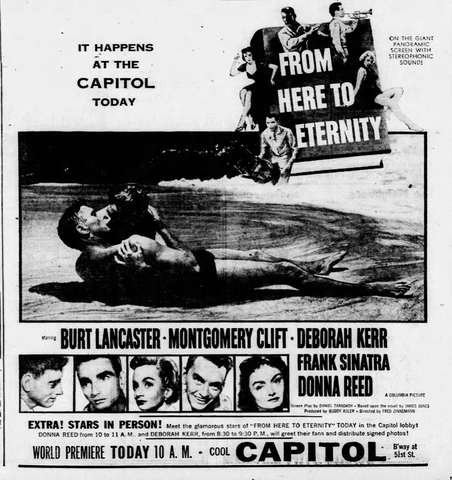
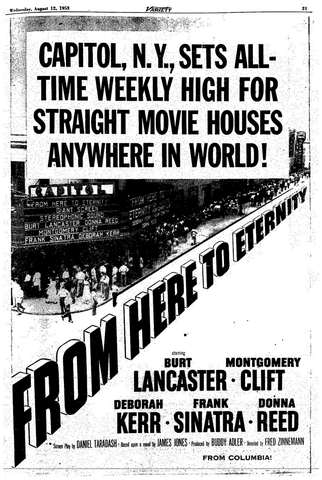
From Here to Eternity opened at the Capitol Theatre on Broadway; rather than a standard premiere, Columbia chief Harry Cohn ran a full-page New York Times ad urging audiences to see it. Lines were so long on opening night that the theater added a 1 a.m. show, and it was soon running around the clock. “I knew it was a good movie,” Frank Sinatra said of the reception, “but the way people reacted to it, well, I never expected all of that.” He told an old Hoboken friend, elated, “I'm back. This is my comeback.” Source: J. Randy Taraborrelli, Sinatra: Behind the Legend.
"From Here to Eternity"
At the 26th Academy Awards at the RKO Pantages Theatre, Mercedes McCambridge announced Sinatra as winner of Best Supporting Actor for From Here to Eternity, beating Eddie Albert (Roman Holiday), Brandon de Wilde and Jack Palance (both for Shane), and Robert Strauss (Stalag 17).
Source: Tom Santopietro, "Sinatra in Hollywood" (2008).
"From Here to Eternity"
Frank Sinatra: Accepting his Oscar, Sinatra brought his two eldest children, Nancy (13) and Frank Jr. (10), as his dates for the evening, kissed them, and took the stage to declare himself "deeply thrilled and very moved," joking that though there were a lot of songs performed that night, nobody had asked him to sing. He described his dramatic work as "a whole new kind of thing."
Source: Tom Santopietro, "Sinatra in Hollywood" (2008).
"From Here to Eternity"
Frank Sinatra: After winning the Oscar, rather than staying to celebrate at the Governors Ball, Sinatra slipped away alone and walked the streets of Beverly Hills. He later recalled he couldn't share the moment with anyone, ducked the party and the crowds, and felt he relived his entire life during that solitary walk with the statuette.
Source: Tom Santopietro, "Sinatra in Hollywood" (2008).
"From Here to Eternity"
Variety: Sinatra's professional resurgence around the time of his Oscar win was almost instantly dubbed by Variety "the greatest comeback in theatre history."
Source: Tom Santopietro, "Sinatra in Hollywood" (2008).
"From Here to Eternity"
Buddy Adler: Buddy Adler, producer of From Here to Eternity, praised Sinatra's uncanny sense of timing, noting how he could drop in an extra word that made a line of dialogue land with more impact.
Source: Tom Santopietro, "Sinatra in Hollywood" (2008).
"From Here to Eternity"
Frank Sinatra: Sinatra became obsessed with playing Angelo Maggio the moment he finished James Jones's novel, later explaining he felt he had to play the part and recognized himself in the downtrodden Italian-American character: "I was Maggio."
Source: Tom Santopietro, "Sinatra in Hollywood" (2008).
"From Here to Eternity"
Maggio was Sinatra's first overtly Italian-American screen role. Santopietro argues Sinatra's pride in his ethnicity in this part helped pave the way for later Italian-American stars like Al Pacino, Robert De Niro, and John Travolta.
Source: Tom Santopietro, "Sinatra in Hollywood" (2008).
"From Here to Eternity"
Burt Lancaster: Costar Burt Lancaster later observed that Sinatra's performance as Maggio worked so well because it channeled real personal turmoil -- his marriage to Ava collapsing and the general sense of defeat in his life at the time.
Source: Tom Santopietro, "Sinatra in Hollywood" (2008).
"From Here to Eternity" / "The Godfather"
Santopietro debunks the popular legend that mob intimidation of Columbia chief Harry Cohn won Sinatra the Eternity role -- a myth that originated in Mario Puzo's novel The Godfather and was cemented by Francis Ford Coppola's 1972 film, in which a Sinatra-like singer gets a role only after a severed horse's head appears in a studio boss's bed. Puzo himself said the image was pure invention, and Sinatra flatly denied being "the Godfather singer."
Source: Tom Santopietro, "Sinatra in Hollywood" (2008).
"From Here to Eternity"
Santopietro dismisses the mob-casting myth on logical grounds: if the mob truly controlled Sinatra's Hollywood fortunes, it would have intervened during his desperate 1951-52 slump, not waited, and no other performer's career has ever been credibly tied to mob string-pulling.
Source: Tom Santopietro, "Sinatra in Hollywood" (2008).
"From Here to Eternity"
The real story of Sinatra's casting as Maggio involved Ava Gardner, by then a much bigger star, personally lobbying Columbia chief Harry Cohn on his behalf -- smartly starting by pitching the idea to Cohn's wife, Joan.
Source: Tom Santopietro, "Sinatra in Hollywood" (2008).
"From Here to Eternity"
Harry Cohn: According to columnist Earl Wilson, Harry Cohn initially dismissed the idea of casting Sinatra as Maggio in crude terms, saying it was an actor's part, not a crooner's, and questioning the sanity of anyone who suggested it.
Source: Tom Santopietro, "Sinatra in Hollywood" (2008).
"From Here to Eternity"
Frank Sinatra (recounting Harry Cohn): In his own later retelling to journalist Norton Mockridge in 1955, Sinatra recalled Cohn's rejection more simply: "Look Frank, that's an actor's part. You're a hoofer."
Source: Tom Santopietro, "Sinatra in Hollywood" (2008).
"From Here to Eternity"
Ava Gardner: Ava Gardner reportedly told Harry Cohn bluntly, and without sugarcoating, that her husband was exactly right for the Maggio role -- referring to him as "that sonofabitch of a husband of mine."
Source: Tom Santopietro, "Sinatra in Hollywood" (2008).
"From Here to Eternity" / "Mogambo"
With no work of his own, Sinatra was in Africa hanging around the set of Mogambo, which Ava was filming for John Ford, when he flew back to Hollywood at his own (really Ava's, since he was broke) expense to shoot a ten-minute Eternity screen test, then flew back to Africa to await word.
Source: Tom Santopietro, "Sinatra in Hollywood" (2008).
"From Here to Eternity"
Sinatra's Eternity screen test with director Fred Zinnemann included an improvised barroom scene -- the men rolling olives as makeshift dice -- that impressed enough to be carried over into the finished film.
Source: Tom Santopietro, "Sinatra in Hollywood" (2008).
"From Here to Eternity"
Eli Wallach was actually the studio's first choice to play Maggio, but he turned down Columbia's standard seven-year contract in favor of doing Tennessee Williams's Camino Real on Broadway, opening the door for Sinatra.
Source: Tom Santopietro, "Sinatra in Hollywood" (2008).
"From Here to Eternity"
Harry Cohn called Sinatra in February 1953 to officially offer him the Maggio role. Sinatra accepted a modest $1,000 per week for the eight-week shoot -- a low rate he later said drove him to insist on percentage-of-gross deals once his career clout returned.
Source: Tom Santopietro, "Sinatra in Hollywood" (2008).
"From Here to Eternity"
Producer Buddy Adler, a former Signal Corps member with military contacts, was instrumental in securing Army cooperation for Eternity's unusually unflattering portrait of peacetime military life, made trickier by the McCarthy-era climate; the U.S. Navy separately banned the film as "derogatory to a sister service."
Source: Tom Santopietro, "Sinatra in Hollywood" (2008).
"From Here to Eternity"
Fred Zinnemann: Director Fred Zinnemann later revealed that Army mandate forced a change to the climactic MP confrontation: Maggio was originally supposed to physically attack the military policemen, but the approved version has a seated Sinatra deliver only a verbal outburst, which Santopietro feels diminishes the scene's impact.
Source: Tom Santopietro, "Sinatra in Hollywood" (2008).
"From Here to Eternity"
Though Austrian-born, Fred Zinnemann was a fitting choice to direct the quintessentially American Eternity because he had already handled military subject matter in The Search and The Men (Marlon Brando's debut), as well as Americana like High Noon and Member of the Wedding.
Source: Tom Santopietro, "Sinatra in Hollywood" (2008).
"From Here to Eternity"
Frank Sinatra: Sinatra and Montgomery Clift became close, hard-drinking friends during the Eternity shoot, and the trained Method actor Clift actively coached Sinatra through nuance and subtext. Sinatra later credited Clift for elevating his performance, saying, "The way he pitched I couldn't help shining as a catcher."
Source: Tom Santopietro, "Sinatra in Hollywood" (2008).
"From Here to Eternity"
Frank Sinatra: Sinatra explained that his acting approach differed completely from his singing process: as a singer he planned everything, but as an actor he believed "acting is reacting" and that over-rehearsing killed his spontaneity. He made an exception for patient rehearsal with Clift, because he knew he'd learn from watching him.
Source: Tom Santopietro, "Sinatra in Hollywood" (2008).
"From Here to Eternity"
Fred Zinnemann: In his autobiography, Zinnemann noted Sinatra was reliably best on his first or second take and lost spontaneity after that, the opposite of Clift, who deepened with each successive take -- a contrast Zinnemann joked reminded him of a blind-detective character in one of his early films who needed eight takes to remember his lines, boring his guide dog into running away.
Source: Tom Santopietro, "Sinatra in Hollywood" (2008).
"From Here to Eternity"
Burt Lancaster: Burt Lancaster recalled that Maggio's death scene was shot in bitter cold, with the cast given brandy to keep warm; Clift ended up genuinely drunk during filming, which Lancaster felt may have deepened the tenderness of Prewitt's reaction to Maggio's death.
Source: Tom Santopietro, "Sinatra in Hollywood" (2008).
"From Here to Eternity"
Fred Zinnemann: Maggio's death scene originally ended with a poignant line, "See his head don't bump," which was cut from the film. Some say Clift simply couldn't deliver it cleanly despite many takes, but Zinnemann maintained it was cut because Harry Cohn had mandated the film run no more than two hours.
Source: Tom Santopietro, "Sinatra in Hollywood" (2008).
"From Here to Eternity"
Santopietro sees Maggio as both building on and subverting a recurring early-Sinatra motif -- the ineffectual would-be tough guy who can't win a fight. After Eternity, this motif largely disappeared, replaced by genuinely hard-edged characters such as those in Von Ryan's Express and The Detective.
Source: Tom Santopietro, "Sinatra in Hollywood" (2008).
"From Here to Eternity"
The famous beach-embrace affair between Sergeant Warden (Burt Lancaster) and Karen Holmes (Deborah Kerr) became one of the most iconic and imitated moments in film history, independent of Sinatra's Maggio subplot, and helped cement the film's overall success.
Source: Tom Santopietro, "Sinatra in Hollywood" (2008).
"From Here to Eternity"
Santopietro reads notable emotional (if not overtly sexual) intimacy into the tender nighttime scene between Warden and a drunken, murmuring Prewitt, and into the close bond between Prewitt and Maggio -- an unusual level of vulnerability for a mainstream 1953 studio film.
Source: Tom Santopietro, "Sinatra in Hollywood" (2008).
"From Here to Eternity"
Eternity ends bleakly with Maggio, Prewitt, and Fatso all dead and Captain Holmes drummed out of the service -- a rare studio-era ending, per Santopietro, in which none of the principal characters achieve their dreams.
Source: Tom Santopietro, "Sinatra in Hollywood" (2008).
"From Here to Eternity"
From Here to Eternity premiered in August 1953 to overwhelmingly positive reviews. The Los Angeles Herald Examiner called Sinatra's performance "simply superb, comical, pitiful, childishly brave, pathetically defiant," and The New Yorker singled him out as "a first-rate actor."
Source: Tom Santopietro, "Sinatra in Hollywood" (2008).
"From Here to Eternity"
Fred Zinnemann: Director Zinnemann praised Sinatra's professionalism and performance on Eternity, saying he was "very, very good all the time," with no histrionics or bad behavior, and that he was so spontaneous the crew rarely had to reshoot a scene.
Source: Tom Santopietro, "Sinatra in Hollywood" (2008).
"From Here to Eternity"
Frank Sinatra: Sinatra won the Best Supporting Actor Oscar for Eternity (which also won Best Picture) at the March 25, 1954 ceremony; his brief acceptance speech -- saying he was "deeply thrilled" and "terribly pleased" -- read as genuine, unrehearsed emotion at completing his comeback.
Source: Tom Santopietro, "Sinatra in Hollywood" (2008).
"From Here to Eternity"
Eternity's success led to a new representation deal with the William Morris Agency and, at the urging of executive Alan Livingston, a new recording contract with Capitol Records -- signed about four months before the film's release, initially for only one year with annual options, with Sinatra personally covering the cost of his first sessions.
Source: Tom Santopietro, "Sinatra in Hollywood" (2008).
"From Here to Eternity"
Even as his career rebounded on the strength of Eternity, Sinatra's personal turmoil with Ava continued: on November 18, 1953 he cut his wrist at Jimmy Van Heusen's New York apartment, saved only by Van Heusen's timely arrival. The public was told it was a "domestic accident with a broken glass."
Source: Tom Santopietro, "Sinatra in Hollywood" (2008).
"From Here to Eternity"
Santopietro grades this an A, calling it "the comeback"—a terrific film with first-class Frank. Academy Award: Best Actor in a Supporting Role; Golden Globe Award: Best Supporting Actor.
Source: Tom Santopietro, "Sinatra in Hollywood" (2008).
"From Here to Eternity"
Santopietro (Filmography): Columbia Pictures. Produced by Buddy Adler, directed by Fred Zinnemann, screenplay by Daniel Taradash based on the James Jones novel. Sinatra played Private Angelo Maggio in an ensemble led by Burt Lancaster, Montgomery Clift, Deborah Kerr and Donna Reed, with Ernest Borgnine as Fatso Judson. No Sinatra songs are credited.
Source: Tom Santopietro, "Sinatra in Hollywood" (2008).
[Eternity opens on Broadway]
Marlene Dietrich: From Here to Eternity opened at the Capitol Theater on Broadway on a sweltering 88-degree day, an unprecedented mid-summer release with no premiere and minimal publicity (just one Cohn-signed ad in the Times). Marlene Dietrich called Zinnemann that night to report the theater bulging with crowds and an extra midnight show added; asked how, given no publicity, she said, 'They smell it.'
Source: James Kaplan, "Frank: The Voice" (2010).
August 6, 1953
[Sinatras visit the Wilsons at the Savoy]
Earl Wilson: Frank and Ava, in a merry mood following news of Eternity's box-office success, visited columnist Earl Wilson and his wife at London's Savoy Hotel to celebrate her birthday, though Wilson noted underlying tension over Ava wanting Frank to stay in London until she finished shooting her film.
Source: James Kaplan, "Frank: The Voice" (2010).
August 12, 1953
[Overheard Sinatra-Gardner exchange]
Frank Morriss: Columnist Frank Morriss published a curt overheard exchange between Frank and Ava at London's Ambassador Hotel dining room, ending with Frank saying 'I'll be seeing you' and walking out.
Source: James Kaplan, "Frank: The Voice" (2010).
August 17, 1953
From Here to Eternity opened nationwide, eventually grossing more than $80 million in its first year and becoming Columbia's biggest moneymaker to date; Frank's performance as Maggio topped critics' lists.
Source: Nancy Sinatra, Frank Sinatra: An American Legend, 1995.
August 23, 1953
Radio
On A Sunday Afternoon
Guest: Frank Sinatra
CBS Radio
Television
NONE
. On A Sunday Afternoon
Guest: Frank Sinatra
CBS Radio
© 1997-2025 The Sinatra Archive
This calendar, or any parts thereof, may not be reproduced in any fashion
whatsoever without the prior written permission of the publisher (The
Sinatra Archive)
. On A Sunday Afternoon
Guest: Frank Sinatra
CBS Radio
© 1997-2025 The Sinatra Archive
This calendar, or any parts thereof, may not be reproduced in any fashion
whatsoever without the prior written permission of the publisher (The
Sinatra Archive)
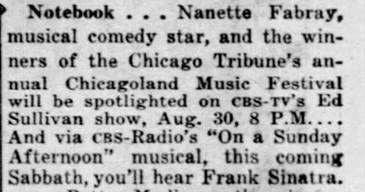
August 24, 1953
Radio
Make Believe Ballroom
WNEW
Frank Sinatra was guest
Television
NONE
Make Believe Ballroom
WNEW
Frank Sinatra was guest
August 30, 1953
Radio
Robert Q’s Waxworks
Host: Robert Q. Lewis
CBS 10:30 PM
Guests: Frank Sinatra & Jack Leonard
Television
NONE
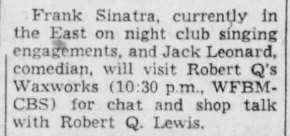
Concerts
500 Club, Atlantic City, New Jersey (Aug 30 to Sept 5) Frank Sinatra and ensembe,
Marion Blair, George DeWitt, Henderson girls, Jack Curtis, Joe Frasetto and Pete Miller Orchestras
1. I Get A Kick Out Of You
2. My One And Only Love
3. You Can't Take That Away From Me
4. My Funny Valentine
5. Little Girl Blue
6. It All Depends On You
7. Violets For Your Furs
8. This Can't Be Love
9. Coffee In Brazil
10. Foggy Day In London Town
11. One For My Baby
12. I Concentrate On You
13. Don't Worry About Me
14. I've Got A Crush On You
15. Autumn In New York
16. From Here To Eternity
17. I've Got The World On A String
18. Put You Dreams Away
500 Club , Atlantic City, New Jersey (Aug 30 to Sept
5)
Frank Sinatra and ensemble,
Marion Blair, George DeWitt, Henderson girls, Jack Curtis, Joe Frasetto and Pete Miller Orchestras
Variety September 2, 1953
Articles from Press of Atlantic City 8-29 and 9-4-53
note: Frank new idea was singing with an octet. He
conducted most of the time. Bill Miller spotted him
on a few numbers. Frank stated that this engagement
and the next at Bill Miller's Riviera were the most
important part of his great comeback. He told a
reviewer in 1958, "I showed them what I could do."
-- Ed
Ad in Press of Atlantic City
September 6, 1953
Frank closed on the 6th of September
He opened at the Riviera on 9/8
He did three shows every night at 9 - 12- 2
--Ed
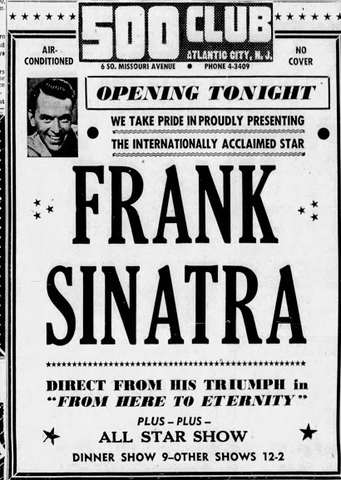
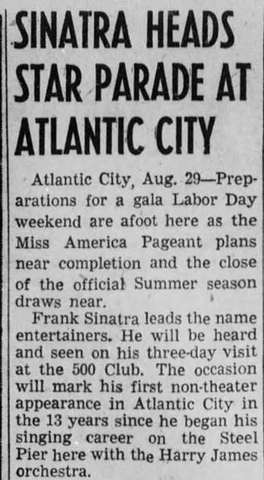
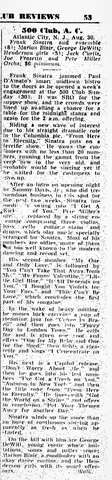

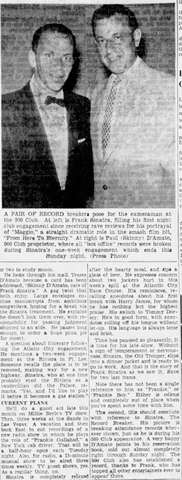

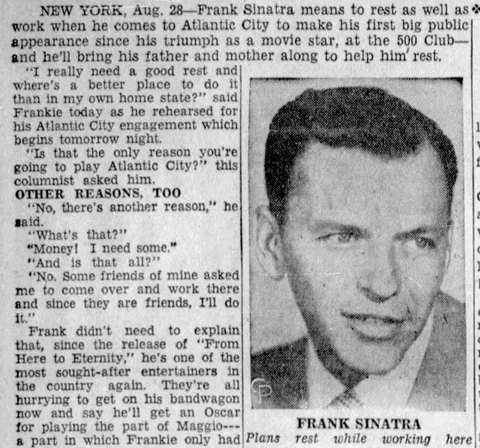
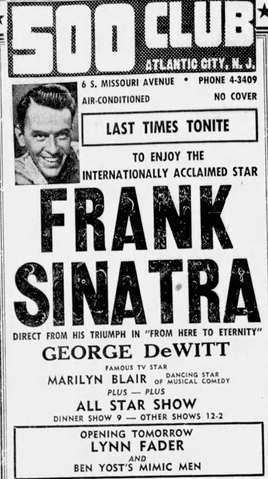
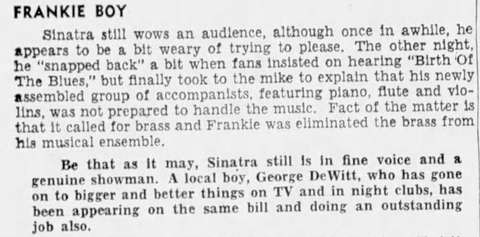
Robert Q’s Waxworks
Host: Robert Q. Lewis
Guests: Frank Sinatra & Jack Leonard
[Early Oscar buzz spreads nationally]
A Lubbock, Texas headline read 'ACADEMY AWARD RACE BEGINS,' with the accompanying story noting the surprising strength of Sinatra's 'straight acting' in From Here to Eternity even before the film had reached that market.
Source: James Kaplan, "Frank: The Voice" (2010).
August 31, 1953
Concerts
500 Club , Atlantic City, New Jersey (Aug 30 to Sept 5) Frank Sinatra and ensembe,
Marion Blair, George DeWitt, Henderson girls,
Jack Curtis, Joe Frasetto and Pete Miller Orchestras
500 Club , Atlantic City, New Jersey (Aug 30 to Sept
8)
Frank Sinatra and ensemble,
Marion Blair, George DeWitt, Henderson girls, Jack Curtis, Joe Frasetto and Pete Miller Orchestras
Variety September 2, 1953
[Mortimer's final jab at Sinatra]
Lee Mortimer: Columnist Lee Mortimer, filling in for the vacationing Walter Winchell, took what proved to be his last published shot at Sinatra, writing that the dark sunglasses Frank wore on Lexington Avenue were hiding 'a beautiful shiner.'
Source: James Kaplan, "Frank: The Voice" (2010).
September 1, 1953
Concerts
500 Club , Atlantic City, New Jersey (Aug 30 to Sept 5) Frank Sinatra and ensemble,
Marion Blair, George DeWitt, Henderson girls,
Jack Curtis, Joe Frasetto and Pete Miller Orchestras
September 2, 1953
Concerts
500 Club , Atlantic City, New Jersey (Aug 30 to Sept 5) Frank Sinatra and ensemlbe,
Marion Blair, George DeWitt, Henderson girls, Jack Curtis, Joe Frasetto and Pete Miller Orchestras
note: I keep forgetting to mention this was Sinatra's first nightclub engagement in Atlantic City. His earlier appearances were in theaters. --ED
September 3, 1953
Concerts
500 Club, Atlantic City, New Jersey (Aug 30 to Sept 5) Frank Sinatra and ensemble,
Marion Blair, George DeWitt, Henderson girls, Jack Curtis, Joe Frasetto and Pete Miller Orchestras
September 4, 1953
Concerts
500 Club , Atlantic City, New Jersey (Aug 30 to Sept 5) Frank Sinatra and ensemble,
Marion Blair, George DeWitt, Henderson girls, Jack Curtis, Joe Frasetto and Pete Miller Orchestras
September 5, 1953
Concerts
500 Club , Atlantic City, New Jersey (Aug 30 to Sept 5) Frank Sinatra and ensemlbe,
Marion Blair, George DeWitt, Henderson girls, Jack Curtis, Joe Frasetto and Pete Miller Orchestras
September 6, 1953
Radio -Television
Walter Winchell Show
ABC
9:00 to 9:15 p.m.
Sunday
Miami Herald
9-6-53
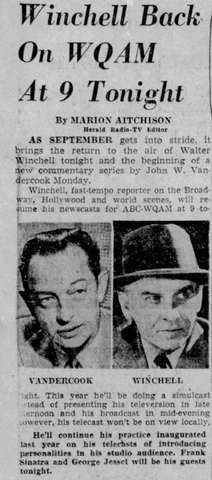
September 8, 1953
Concerts
Riviera Club, Fort Lee, New Jersey (September 8-22)
Riviera Club, Fort Lee, New Jersey (September 8-22)
Ad for opening night
Frank with dancers and owner
Bill Miller
[image referenced in source but could not be recovered]
[image referenced in source but could not be recovered]
September 9, 1953
Concerts
Riviera Club, Fort Lee, New Jersey (September 8-22)
Madison Square Gardens, New York, NY
19th Annual Harvest Moon Ball
Host: Ed Sullivan
Frank Sinatra, Ava Gardner, Dean martin, Jerry Lewis, Red Buttons, Carmen Miranada, Julius La Rosa and others
------------------------------------------------
© 1997-2025 The Sinatra Archive
This calendar, or any parts thereof, may not be reproduced in any fashion whatsoever without the prior written permission of the publisher (The Sinatra Archive)
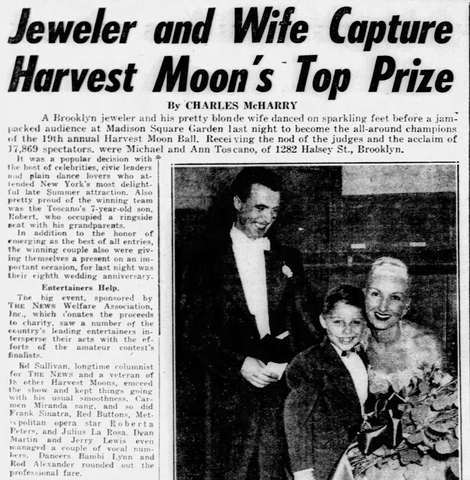

[Frank and Ava feuding in New York]
United Press: United Press reported that Frank and Ava were 'feuding in frosty silence' just twelve city blocks apart in New York, following her unannounced return from Europe; Sinatra told friends he was mystified by her anger and hadn't called her.
Source: James Kaplan, "Frank: The Voice" (2010).
September 10, 1953
Concerts
Riviera Club, Fort Lee, New Jersey (September 8-22)
September 11, 1953
Concerts
Riviera Club, Fort Lee, New Jersey (September 8-22)
September 12, 1953
Radio
Give and Take Quiz Show
Guest: Frank Sinatra
11:30AM CBS
Concerts
Riviera Club, Fort Lee, New Jersey (September 8-22)
[Earl Wilson's failed Cupid attempt]
Earl Wilson: Earl Wilson devoted his column to a jocular account of his failed attempt to reconcile Frank and Ava over lunch with her, joking, 'As a Cupid, I'm stupid, for I just made a gallant effort to melt the deep freeze ... and fixed everything up so good that the freeze is now twice as deep.'
Source: James Kaplan, "Frank: The Voice" (2010).
September 13, 1953
Concerts
Riviera Club, Fort Lee, New Jersey (September 8-22)
September 14, 1953
Concerts
Riviera Club, Fort Lee, New Jersey (September 8-22)
September 15, 1953
Concerts
Bill Miller's Riviera Club, Fort Lee, New Jersey (8-22) Tuesday Evening
Opening Acts: George Dewitt, Bud & Cece Robinson, Donn Arden Girls, Doug Rogers Paul Campo & Walter Nye Orchestras
$5 minimum
Program for 9-15-53:
1 I Get A Kick Out Of You
2. My One And Only Love
3. You Go To My Head
4. They Can't Take That Away From Me
5. My Funny Valentine
6. A Foggy Day
7. Little Girl Blue
8. It All Depends On You
9. Violets For Your Furs
10. The Coffee Song
11. Spring Is Here
12. One For My Baby
13. Don't Worry 'Bout Me ( did the verse )
14. From Here To Eternity
15. I've Got The World On A String
Ed O'Brien:
Other tunes sung during the engagement:
I'll Never Smile Again
It Never Entered My Mind
This Can't Be Love
Someone To Watch Over Me
Autumn In New York
The Very Thought Of You
I've Got A Crush On You
Like Someone In Love
The Girl Next Door
You're The Top ( parody )
You'll Never Walk Alone
Frank received a salary of $10,000 a week
He was asked in a 1959 interview what was the most important single element in reviving his career in 1953. The interviewer mentioned "Eternity" and signing with Capitol. Frank did not consider either to be as important as the two-week engagement at Bill Miller's Riviera in September of 1953. Frank very carefully chose a nine piece chamber set ( his description ) and rehearsed with them for two solid weeks before opening at the club..There was no conductor, just the singer and nine musicians: Bill Miller was the piano player, Alvin Stoller was on drums, Sonny Salad pulled off a hat trick by alternating on alto sax, flute and clarinet, throughout the two week engagement, a bass and guitar completed the rhythm section and a string quartet made up the rest of the musical ensemble. The eminent jazz critic George T.Simon called Frank's performance " one of the most thrilling musically ever witnessed anywhere." Sinatra told the interviewer that people in the trade realized what he was capable of during the engagement.
note: Last year I discovered a new wrinkle to the chamber set concept Frank employed at the Riviera. Prior to that engagement, Frank did a week at Skinny D'Amato's 500 Club in Atlantic City. He brought along his new set of musicians for that week and had the crowds hanging from the rafters.
Ed
Here are some of Frank's remarks from a interview with Mr. Simon in early October of 1953:
"If what I did at Bill Miller's did anything, it convinced me once and for all that you can still show good taste and be appreciated. You don't have to sing loud and raucously and belt them over the head all the time. You can use a little restraint and try and create a mood that you and they can both feel, sort of like being together in a small room, and if you really mean it, and show that you mean it, you can register all right."
"It made me feel great the way they paid attention to the songs I sang. They were good songs -- all of them -- at least I think so, because they were my favorites. Things by Rodgers & Hart, and Rodgers & Hammerstein and the Gershwins and Cole Porter. They don't write songs like that today." One thing they certainly aren't writing today is many good lyrics. I know that because I'm more conscious of the words in songs than I am of the melody."
"The melody should be like a backdrop for the lyrics. Sure, it should be good and musical. But it should be more like a guy reading poetry with organ music or some- thing going in the back. If the poem or lyrics are stated often enough, with the same music going at the same time, they become associated as one."
"Of course the lyrics have to be something special like the ones Larry Hart and Oscar Hammerstein and Ira Gershwin and Johnny Mercer and Sammy Cahn have been writing. You know, I have a healthy respect for anybody who can write. I don't mean just songs. I mean anything. Sure wish I could!"
Six weeks after the Riviera engagement Frank would lay down eight of the songs done on stage ( "A Foggy Day," "My Funny Valentine, " "They Can't Take That Away From Me," "Violets For Your Furs," "Like Someone In Love," "I Get A Kick Out Of You," "Little Girl Blue" and "The Girl Next Door" ). Nelson Riddle conducted but George Siravo wrote seven of the eight charts used.. Riddle told me he did a few slight modifications but the credit should have gone to Siravo. Sinatra was the absolute perfectionist during the early Capitol years. He did numerous takes on all the songs recorded. The album "Songs For Young Lovers" and the one to follow, "Swing Easy," both capture the sound of a nightclub performance with a small jazz group backing the singer. Sinatra would employ 12 musicians for the November 1953 sessions and 14 for the April 54 "Swing Easy" sessions.
review of the Reviera Club (located at Fort Lee , New Jersey ) engagement taken from the September 15, 1953 issue of VARIETY. There was a $5 minimum.
"If carry a torch, as most first-nighters suspected, is the key to the resounding click, such as Frank Sinatra achieved on his opening last Tuesday (September 8) night at Bill Miller's Riviera then every chirper, either sex, should see a man about a Diogenes. Sinatra culled the pashiest set of ballads out of Cole Porter, Rodgers & Hart, and the ASCAP catalogue and hit the jackpot with a personal whammo such as few straight singers achieve.
"The toucheroo, of course, stems from the published reports about a lovers sport between Mr. and Mrs. Sinatra, keyed to the just-returned- from-Europe news "shots" of the "beautiful bride," Ava Gardner. Whether or not a staged romantic setting, as was the late George Evans' nifty builderupper for Frankie-boy as the swoonerate kid in the 1940s: It certainly registered with the Riviera rounders, who are more Seratan than bobby sox in the acturalial batting average.
"By actual county, the swooner crooned 20 ballads and each pyramided to a boffola. In every respect, Sinatra was great, making a great comeback. He proved (1) that he had long since proved himself not a flash in the box office; (2) achieved a sonalog stature in repose, poise, and personal performance that comes to few singers; (3) reincarnated the straight romantic singing style which, somehow, has left us the just crooned at "˜em; no gags or ad-libs; and (4) gave new magic to the Hollywood hypo. As in the celluloid days, a picture can do the trick. "From Here to Eternity" is the answer. And it may even prove the bellwether for Sinatra's diskery comeback for the long absent from the jocks and jukes league.
"With the same authoritative nonchalance which has distinguished Sinatra over the years, this time he comes out backed by a hand-picked special accompanying group of eight including a femme violinist with Bill Miller (no relation to the Riviera 's Boniface) at the ivories, and thrushes a cavalcade of past and present familiars. He has them against the damasks in no time. In the barnlike reaches of this Cliffside roadhouse, you could hear an orchestration drop. He sang with ease and charm, never reaching, only punctuating his stuff with musical cues to his special ibackstoppers, and only once utilizing a prop cup and saucer for "Coffee in Brazil ."
"He was tour-de-force to delight the Brill Building and the Lindy Hop set: his style of lyrical interpretation gave new values to the wordsmiths. Show Biz observers can't help but be impressed that Gilbert & Sullivan have beaucoup Yank counterparts in effective wordings. Sinatra gave librettos values to the pops: the obvious absolute salute to a virtuoso of song.
"Casual reprise of some of the titles reads like a Fire Dept. road company of every torch and romantic ballad in the book, and Sinatra gave them new meanings as he uncorked (them) . . .
"It was a tour-de-force of unparalleled degree. He held the floor a solid 60 minutes and while he might and should cut 10 minutes, there was no gainsaying the consistency of his socko.. He's in for $10,000 a week for two weeks, and both he and Bill Miller owe a lot to Harry Cohn for that the Columbia picture did for all concerned. Oh, yes, he also sang "From Here to Eternity" and wisely sh-sh'd some exuberant bobbysoxers who squealed an occasional, "Oh, Frankie."
Bill Miller's Riviera Club, Fort Lee, New Jersey (8-22)
The commentary and review of Sinatra’s 1953 career-changing engagement at Bill Miller’s Riviera Club in Ft. Lee transports me to that magical time and place. I found a couple of pictures of the Club, which must have been groundbreaking at the time. Cantilevered over the New Jersey cliff, and with a retractable roof, this must have been quite a hot spot for those special dates meant to impress! I’ve read its architecture was a forerunner to Las Vegas clubs that made that city an entertainment capital. And just a thought, but I wonder how many people who have read of this 1953 engagement think piano playing-Bill Miller was the source for the eponymous club name. I confess I was confused for a while when I first started learning about the Riviera Club.
I don't post on this list often, but I look forward to the postings each day. So many people to acknowledge who make this a treat especially our dear Ed O’Brien.
Jim Johnson
Rehoboth Beach, DE
Hi Jim,
Love the card. Sinatra was the penultimate act at Miller's Riviera. Eddie Fisher followed for two weeks and then
the club closed its doors forever. New Jersey claimed eminent domain and built the Palisades Parkway that ran right
through the property. Miller would move to Vegas and be entertainment director at a number of hotels.
I thank you for the kind words.
Ed
September 15, 1956 Frank Sinatra is the winner of the first Al Jolson Entertainer Of The Era Award
Ambassador Hotel, Los Angeles
Nancy Sinatra and Leo Durocher accept on Frank Sinatra's behalf
Frank Sinatra with the trophy he received after being named the winner of the first
Al Jolson 'Entertainer of the Era' award by Al Jolson Lodge and Chapter of the B'nai B'rith, 1956.
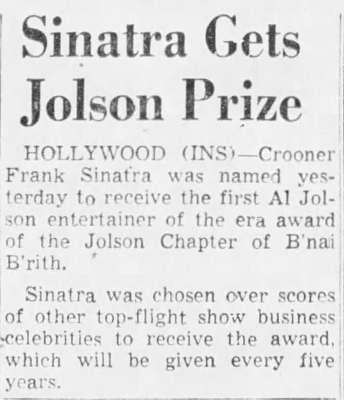
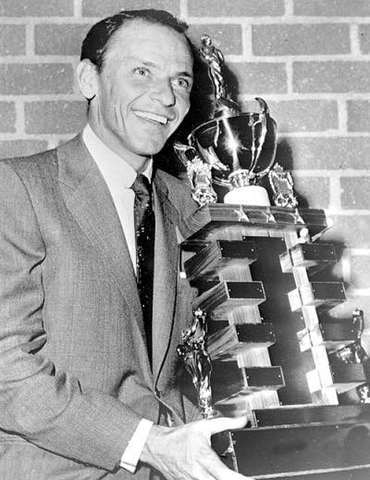
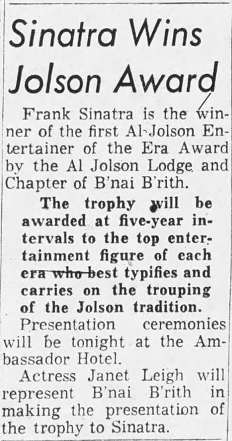
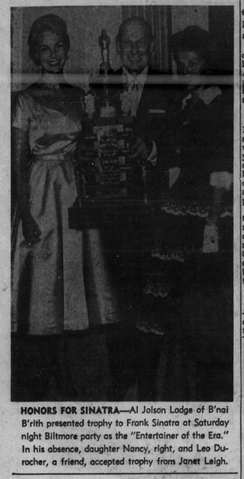
September 16, 1953
Concerts
Bill Miller's Riviera Club, Fort Lee, New Jersey (8-22) Tuesday Evening
Opening Acts: George Dewitt, Bud & Cece Robinson, Donn Arden Girls, Doug Rogers Paul Campo & Walter Nye Orchestras
$5 minimum
September 17, 1953
Concerts
Bill Miller's Riviera Club, Fort Lee, New Jersey (8-22) Tuesday Evening
Opening Acts: George Dewitt, Bud & Cece Robinson,
Donn Arden Girls, Doug Rogers Paul Campo & Walter Nye Orchestras $5 minimum
September 18, 1953
Concerts
Bill Miller's Riviera Club, Fort Lee, New Jersey (8-22) Tuesday Evening
Opening Acts: George Dewitt, Bud & Cece Robinson, Donn Arden Girls, Doug Rogers Paul Campo & Walter Nye Orchestras
$5 minimum
September 19, 1953
Concerts
Bill Miller's Riviera Club, Fort Lee, New Jersey (8-22) Tuesday Evening
Opening Acts: George Dewitt, Bud & Cece Robinson, Donn Arden Girls, Doug Rogers Paul Campo & Walter Nye Orchestras
$5 minimum
Bill Miller's Riviera Club, Fort Lee, New Jersey (8-22)
Tuesday Evening
Opening Acts: George Dewitt, Bud & Cece Robinson, Donn Arden Girls, Doug Rogers Paul Campo & Walter Nye Orchestras
$5 minimum
The reference brought an additional
comment from Sinatra
which got the laughs. The show
started off with Bud and Cece
Robinson (billed as Robbins here).
probably one of the best opening
acts in the business. Their youthful
bounce. more familiar to presentation
houses than local night clubs. was
refreshing and deserved the big mitt
it got. George DeWitt was seldom better
as a comic than on the show caught.
From his opening lighthouse gag he belted
across a series of situation gags that built
from chuckles to yocks. His routine, built on
"I Can't Give You Anything but Love,” was an
excellent vehicle for his brand of acid take -offs
on various names . DeWitt later explained that
his act was cut. If so, whoever scissors it rates
thanks from the comic. It kept in the fast yock
stuff and threw out the slow draggy material that
DeWitt frequently uses. The rest of the show,
production, etc., remains the same.
Bill Smith
Billboard
September 20, 1953
Concerts
Bill Miller's Riviera Club, Fort Lee, New Jersey (8-22) Tuesday Evening
Opening Acts: George Dewitt, Bud & Cece Robinson, Donn Arden Girls, Doug Rogers Paul Campo & Walter Nye Orchestras
$5 minimum
September 21, 1953
Concerts
Bill Miller's Riviera Club, Fort Lee, New Jersey (8-22) Tuesday Evening
Opening Acts: George Dewitt, Bud & Cece Robinson, Donn Arden Girls, Doug Rogers Paul Campo & Walter Nye Orchestras
$5 minimum
September 22, 1953
Concerts
Riviera Club, Fort Lee , New Jersey (September 8 - September 22)
1. I Get a Kick out of You
2. My One and Only Love
3. You Go to My Head
4. They Can't Take That Away from Me
5. My Funny Valentin
6. A Foggy Day
7. Little Girl Blue
8. It All Depends on You
9. Violets for Your Furs
10. This Can't Be Love
11. The Coffee Song
12. Spring is Here
13. One for my Baby
14. All of Me
15. I'll Never Walk Alone
16. Don't Worry 'Bout Me
17. From Here to Eternity
18. I've Got the World on a String
#1
Tuesday
w/ The Sinatra Symphonette & Strings
1. I've Got The World On A String
2. Choo-Choo Train - Dinah Shore
3. There's A Flaw In My Flue w/Bill Miller on piano**
4. Lean Baby
*only Perfectly Frank to employ strings
note: The number after "String" was "Choo-Choo
Train,"'
sung by Dinah Shore. Frank then recited the poem "By The Time" with a
snare drum backing him.
--ED
** Here are Frank's comments before " A Flaw In My Flue"
and after singing it
"Johnny Burke and Jimmy Van Heusen have written
a list of hits as long as your arm and mine together, but
what tunes do you think Jimmy bends your ear about?
A little list he calls his flop parade. He not only bent my
ear the last time, he twisted my arm, too, so I'm booked
to lead off your Flop Parade with a little pudding that mixes
up like this."
"The ushers will now pass among you with beakers of
air-wick and restorative elixirs."
Perfectly Frank
Audition tape #2
Tuesday
w/ The Sinatra Symphonette & String Quartet
9:48
1. Bim Bam Baby Columbia Recording
2. Autumn In New York* w/strings
3. How Much Is That Doggie In The Window?**
Patti Page
4. Birth Of The Blues Columbia Recording
*The only Perfectly Franks to employ strings
On the second audition tape, Frank credits Vladmir Dukelsky as the writer
of "Autumn In New York." That was Verdon Duke's original name.
Strings were used on both shows.
--Ed
** There is only a segment of Page's huge hit played, followed by
scathing commentary from Mr. Sinatra
note: These two shows -- somewhat modified -- would be broadcast
over NBC on November 3 and 6, 1953.
Ed
© 1997-2024 The Sinatra Archive
This calendar, or any parts thereof, may not be reproduced in any fashion .
whatsoever without the prior written permission of the publisher (The
Sinatra Archive)
Radio
Radio: Sinatra recorded the audition session for what became his radio series To Be Perfectly Frank this date, singing "I've Got The World On A String," "Autumn In New York" (with strings), "There's A Flaw In My Flue" (with piano only), "Lean Baby," and "The Most Blues," backed by the Sinatra Symphonette plus strings. Source: sinatradiscography.com, Radio Transcriptions Database.
September 1953
To secure his loyalty ahead of his Copa Room debut, the Sands gave Sinatra the opportunity to buy a two percent ownership stake in the Mob-controlled hotel-casino, which he took up, making him a shareholder alongside the syndicate of investors -- including Meyer Lansky associates and Chicago Outfit figures Tony Accardo and Sam Giancana -- who had built it. The Sands would become his entertainment headquarters for the rest of the decade. Source: Michael Sheridan & David Harvey, Sinatra and the Jack Pack.
Wikipedia dates Sinatra's actual first performance at the Sands to October 4, 1953, following an invitation from manager Jack Entratter; he would go on to perform there roughly three times a year before later acquiring a share in the hotel. Source: Wikipedia, “Frank Sinatra.”
[Sinatra Sends Stranded Fans Home In His Hired Car]
Nancy Sinatra: On the final night of his run at the 500 Club, Sinatra reportedly learned that three teenage girls who had traveled from Brooklyn to see him were stuck without cab fare or rain gear after midnight, so he sent them home safely in his own hired car.
Source: Nancy Sinatra, Frank Sinatra: An American Legend, 1995.
[Frank moves into Ava's hotel suite]
Kaplan: The day after their reconciliation dinner with Dolly, Frank moved out of the Waldorf Towers and into Ava's suite at the Hampshire House.
Source: James Kaplan, "Frank: The Voice" (2010)
[JFK marries Jacqueline Bouvier]
Nancy Sinatra: According to Nancy Sinatra, her father said he first met Senator John F. Kennedy shortly after Kennedy's September 1953 marriage to Jacqueline Bouvier.
Source: James Kaplan, "Sinatra: The Chairman" (2015)
[Reconciliation quickly sours]
Ava Gardner: Just days after moving back in with Ava, Frank stayed out until 5 a.m. despite promising to be home by 2, telling her, 'Don't cut the corners too close on me, baby. This is the way my life is going to be from now on.' His concentration shot, he gave a dud performance at the Riviera that night; Ava later remarked they 'were happier when he was on the skids.'
Source: James Kaplan, "Frank: The Voice" (2010)
September 29, 1953
Television
Milton Berle Show (NBC)
Episode #214, Season #6
Host: Miton Berle
Guests: Frank Sinatra, Tallulah Bankhead
Recurring Roles: Arnold Stang, Ruth Gilbert, Milton Frome, Jack Collins
Alan Roth and Orchestra
Directed By: Greg Garrison
Writers: Selma Diamond, Jay Burton, Goodman Ace, Aaron Ruben, Jerry Seelen, Phil Charig
1. I've Got The World On A String
Notes: Show in circulation
Sinatra Scholar Ed O'Brien points out that Sinatra showed tremendous confidence on the Berle Show. After Berle's introduction, Sinatra sang "I've Got the World on a String" with a supreme sense of himself. Berle joins him in parody of Rodgers & Hart's "This Can't Be Love." Sinatra, Tallulah Bankhead and Berle sing "Let's Do the Town Tonight." This show offers a look at Sinatra in the early days of his great comeback.
Ed O'Brien:
Billboard gave Uncle Miltie's sixth season opener a rave review. But the ratings were not what gave "Mr. Television" that moniker. He was starting to fade, and very quickly..
If you can find it, "The Ultimate Frank Sinatra Collection" 10 DVD set put out by Passport in 2009 includes this 1953 Milton Berle Show episode -- Scott
Buick -Berle Show (TV). NBC - TV. Tuesday (29). 8.9 p.m.. EST. Milton Berle's return for the new season was a fast -paced, entertaining stanza all the way, with Frank Sinatra and Tallulah Bankhead offering top -flight support. Again using the storyline format introduced last year, Berle's scripting staff, headed by Goodman Ace, came thru with a topflight job. The premise on the preem was Berle's desire to get into legit and his struggle to beat out Sinatra for the male lead opposite Tallulah. This gambit led to some fast and funny exchanges among the three of them, culminating in a sketch which was to be an audition for Frankie and Millie. Sinatra played a counterman who brought together again a has been actress and a down and out comic. The drama was well integrated with the rest of the show and did not seem out of place, altho Berle will never win any Academy Awards for serious thesping. The show was buttressed by fine support from a couple of good comic characters, Ruthie Gilbert and Arnold Stang. Alan Ruth's band provided the music. Even the stanza's opening was good for some yocks, as the old "Texaco Star Theater" billboard was flashed, with the "men of Texaco" on hand to open as in past seasons. Berle interrupted to salute his new bankroller. Buick, and also gave that firm a warm pitch at the end. The commercials were handled by Vinton Hayworth in highly convincing fashion, altho the middle plug seemed a bit over -produced, what with film integrated into a live pitch and a local cut -in for price. Sam Chase.
Billboard
10-10-53
Milton Berle Show (NBC)
Episode #214, Season #6
Host: Miton Berle
Guests: Frank Sinatra, Tallulah Bankhead
Variety
September 29, 1954 A Star Is Born premiere
“Humphrey Bogart, Elia Kazan and Marlene Dietrich at the premiere of A Star Is Born at the Cocoanut Grove, 1954 ”
Frank Sinatra at the premiere of A Star is Born with Judy Garland and Lauren Bacall on September 29th, 1954
© 1997-2025 The Sinatra Archive
This calendar, or any parts thereof, may not be reproduced in any fashion
whatsoever without the prior written permission of the publisher (The
Sinatra Archive)
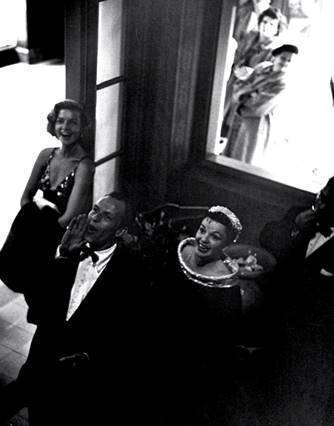
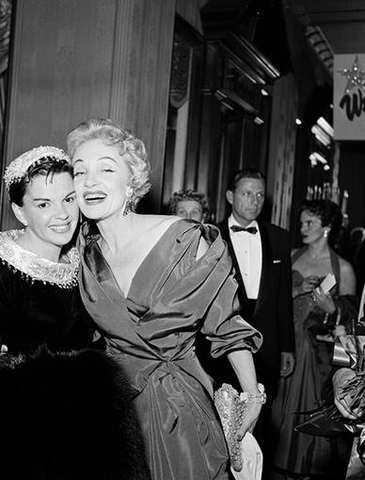
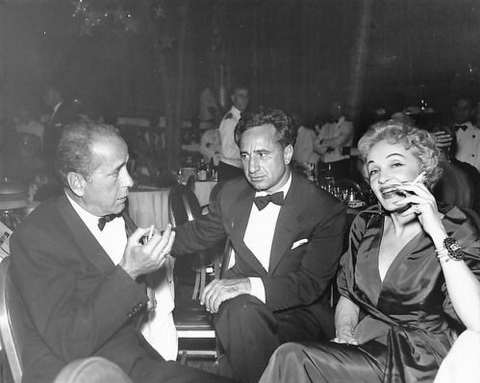
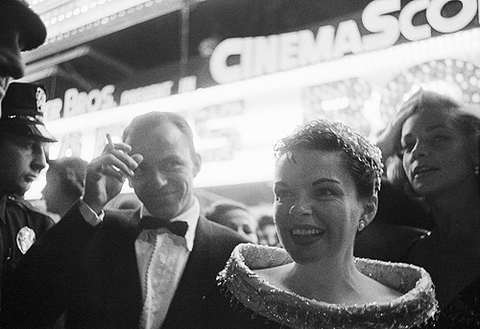
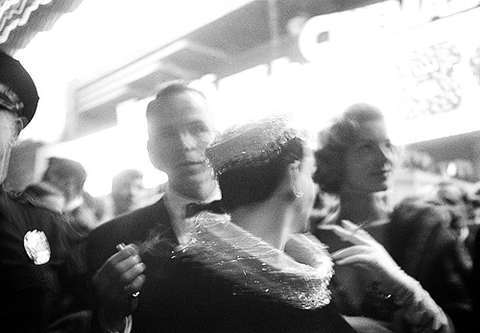
Milton Berle Show (NBC)
Episode #214, Season #6
Host: Miton Berle
Guests: Frank Sinatra, Tallulah Bankhead
Variety
10-7-53
----------------------------------------------------
September 29, 1954 A Star Is Born premiere
“Humphrey Bogart, Elia Kazan and Marlene Dietrich at the premiere of A Star Is Born at the Cocoanut Grove, 1954 ”
Frank Sinatra at the premiere of A Star is Born with Judy Garland and Lauren Bacall on September 29th, 1954
--------------------------------------------------------
© 1997-2025 The Sinatra Archive
This calendar, or any parts thereof, may not be reproduced in any fashion whatsoever without the prior written permission of the publisher (The Sinatra Archive)
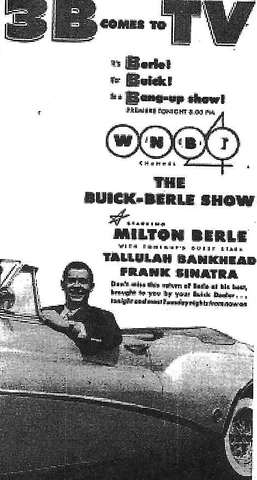
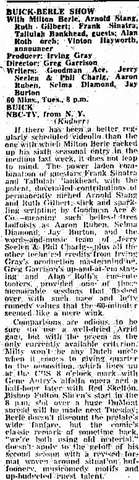
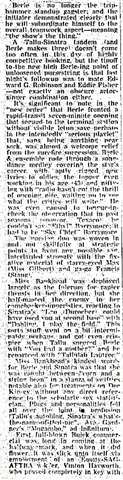
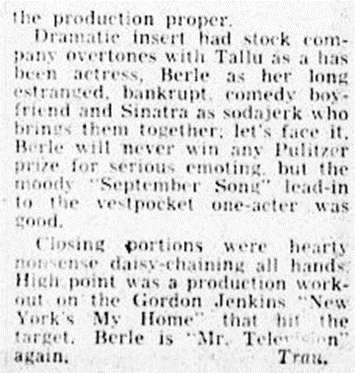
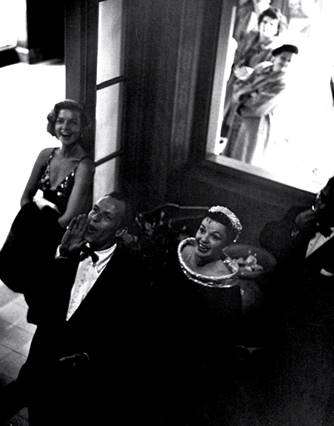
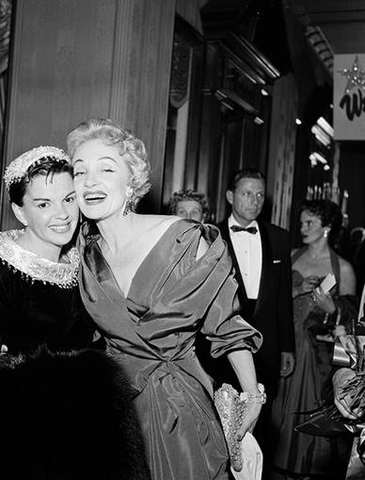
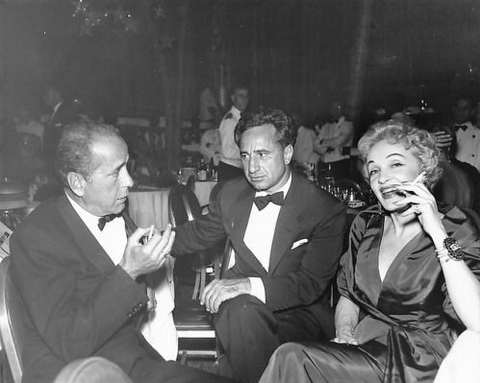
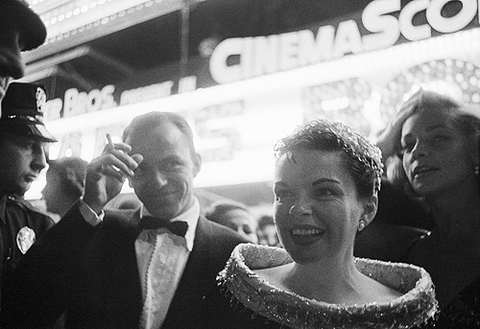
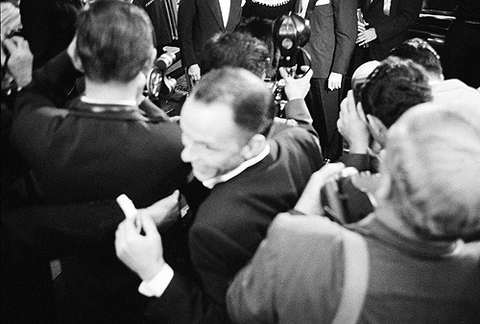
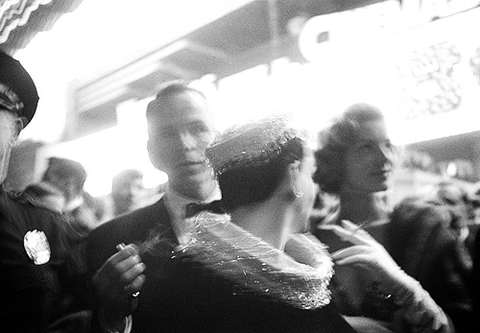
September 30, 1953
[Kilgallen: relationship status "fluid"]
Dorothy Kilgallen: Dorothy Kilgallen wrote that the Sinatra-Gardner relationship remained so 'fluid' that any item about them risked being wrong by press time, citing Frank dining alone at the Villanova and attending the Marciano-LaStarza fight without Ava as evidence of a new rift.
Source: James Kaplan, "Frank: The Voice" (2010).
From Here to Eternity had its West Coast premiere at the Pantages Hollywood Theatre. Local papers were effusive about Frank; the LA Examiner predicted he'd be a top Oscar contender, calling his performance "superb, comical, pitiful.". (Source: Richard Havers, "Sinatra" (Dorling Kindersley, 2007).)
October 1953
[Point of no return: the phone call]
Ava Gardner: Unable to bear Ava's coolness, Frank took a showgirl to bed after a late show at the Sands, then deliberately phoned Ava to announce he wasn't alone, saying if she was going to accuse him anyway he might as well 'get the fun out of being guilty.' Ava later recalled that call as the point where she knew the marriage had reached a point of no return.
Source: James Kaplan, "Frank: The Voice" (2010)
[Post-Eternity comeback concerts -- critical commentary]
Frank Military; Frank Sinatra (quoted): Following Eternity's August 17, 1953 release, Sinatra played to a 'standing-room-only' crowd (per Variety) at the 500 Club, Atlantic City (late August), then a celebrated engagement at the Riviera in Fort Lee, NJ (with Harold Arlen and Manie Sachs in the audience one night), plus TV appearances (Buick-Berle Show, Colgate Comedy Hour) and the Sands in Las Vegas in October. Frank Military contrasted the Riviera crowds a year apart: before Eternity, 'nobody showed up... he said, "These people only come out for stars, and I'm through with them!"' After Eternity: 'you can't get into the dressing room!' Sinatra's reply: 'There are no other kind of people!'
Source: Will Friedwald, "Sinatra! The Song Is You: A Singer's Art" (2018 revised edition), Ch. 6, "With Nelson Riddle" (1953-1979)
October 1, 1953
["Together again" photo and Mogambo reviews]
Ava Gardner: An Associated Press photo captured Frank and Ava standing close and smiling at Radio City, captioned 'Together again.' The same morning brought rave reviews for Ava's performance as Honey Bear Kelly in Mogambo, though she told a reporter, 'Don't believe a word of it -- I don't.'
Source: James Kaplan, "Frank: The Voice" (2010).
[Flight to Los Angeles, private accommodation]
That night, Frank and Ava flew together via TWA Constellation to Los Angeles -- she for the Mogambo premiere, he for a week booked at the Sands -- reportedly reaching a private truce somewhere over Nebraska, even as they maintained a manufactured public image of togetherness orchestrated by MGM publicity chief Howard Strickling's staff.
Source: James Kaplan, "Frank: The Voice" (2010).
October 2, 1953
Frank Sinatra and Ava Gardner attended the New York premiere of her film Mogambo at Radio City Music Hall — one of their last public appearances together as a couple. They flew back to Hollywood the next day; within about three weeks the marriage would be over in all but name. Source: J. Randy Taraborrelli, Sinatra: Behind the Legend.
[Sinatra eyed for Waterfront priest role]
Earl Wilson: Earl Wilson reported Sinatra was 'practically sure' to play the labor priest Father Barry in Sam Spiegel and Elia Kazan's On the Waterfront, after Frank had lost out on the lead role of Terry Malloy to Marlon Brando.
Source: James Kaplan, "Frank: The Voice" (2010).
October 5, 1953
[Ava seeks MGM release for Barefoot Contessa]
Ava officially asked MGM for a temporary release from her contract to star in Joseph L. Mankiewicz's The Barefoot Contessa opposite Humphrey Bogart, to be filmed in Rome starting in January -- a decision made partly to get away from Sinatra.
Source: James Kaplan, "Frank: The Voice" (2010).
October 6, 1953
Radio
Rocky Fortune, "Oyster Shucker"
Network: NBC
Episode: 1
Time: 9:35 p.m.- 10 p.m.
Performers: Frank Sinatra, Jack Kruschen.
Writers: George Lefferts, Norm Sickel, Robert Senadella (story), Ernest Kinoy, Doc Sanford
Directors: Andrew C. Love
Announcer: Edward King
Description: Rocky gets a job in a seafood restaurant and finds twelve pearls in twelve oysters. The first show of the series
Note: The show appears on the officially released CD set: 60 Greaest Old Time Radio Show " Frank Sinatra & Friends"
Sinatraphile Scott Henderson says he has enjoyed all the Rocky Fortune series. He wonders why all but two or three of them did not make it onto the Radio Spirits release of the Rocky Fortune episodes. Ed O'Brien:
I've been doing some research on Frank's only dramatic role in a radio series. The September 5, 1953 Billboard has an article on Frank's new show "Frankie Galahad, Private Detective." The new series was set for an NBC debut on Tuesday evenings in early October. Discovered AP articles detailing the "audition" tapes of that proposed show and an "Erle Stanley Gardner detective series. Obviously neither concept generated much excitement and the footloose, fancy free Rocky Fortune was developed very quickly for an October 6th beginning at 9:35 PM. Frank lead-in was the very popular "Dragnet," with Jack Webb, and a five-minute newscast with John Cameron Swayze. Rocky's surname was Fortunato. The Italian name was anglicized for assimilation purposes. Rocco ( Rocky ) was not a detective but a fellow who took on odd jobs and somehow fell into all kinds of misadventures involving murder, kidnapping, swindles, blackmail and bigamy. The show ran 25 minutes and never acquired a sponsor. There were 26 episodes. The 10-13 show was never aired. The 11-3 show was broadcast despite claims it was pre-empted for election coverage. Twenty-five shows are in circulation among collectors. NBC spared no expense in promoting the series and making available their best studio actors including Marvin Miller, Raymond Burr, Virginia Grey, Jack Kruschen and many others. The November 5, 1953 Billboard has a mention of the theme music used for the series. The title was "I Remember Harlem," composed by Bob Astor, Roy Eldridge and George Williams. Sinatra would hum or sing a few lines of songs, including ones not associated with him at all, as he went about solving the crime of the week. The line "from here to eternity" made it into every show. The phenomenal success of that film and the sudden renewed demand for his services proved fatal to the series. Frank did not want to be saddled with a weekly drama series and grew indifferent to it very quickly. In March of 1954, NBC quietly canceled the show after just one season.
Scott: Does anyone know the details of the unaired episode from October 13th, 1953?
Ed: I searched for sites that discussed the unaired episode. They are still listed but will not open.
There is a site that offers 27 episodes. It includes two repeats that have slightly different running times. I also found the transcript of "Too Many Husbands." I also found a site that acknowledges the show ran 26 weeks but questions whether there was a broadcast scheduled that was not aired.

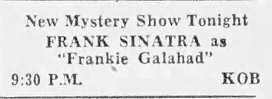
Rocky Fortune, "Oyster Shucker"
Network: NBC
Episode: 1
Time: 9:35 p.m.- 10 p.m.
Performers: Frank Sinatra, Jack Kruschen.
Writers: George Lefferts, Norm Sickel, Robert Senadella (story), Ernest Kinoy, Doc Sanford
Directors: Andrew C. Love
Announcer: Edward King
Description: Rocky gets a job in a seafood restaurant and finds twelve pearls in twelve oysters. The first show of the series
Note: The show appears on the officially released CD set: 60 Greatest Old Time Radio Show " Frank Sinatra & Friends"
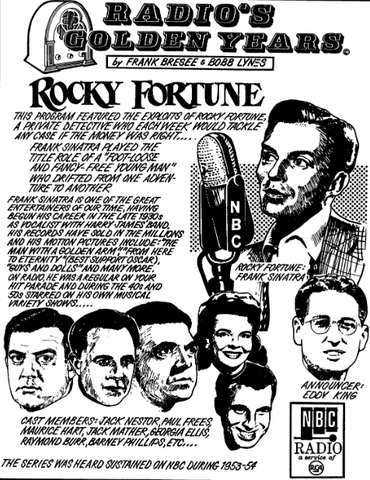
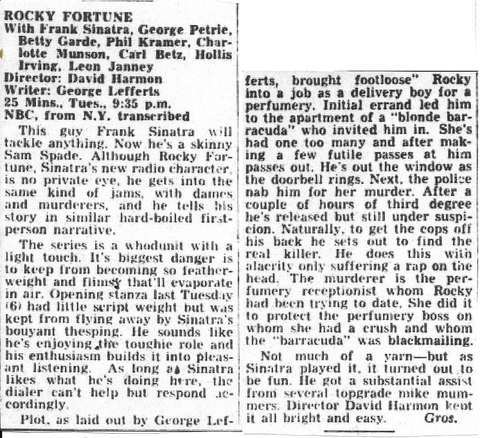
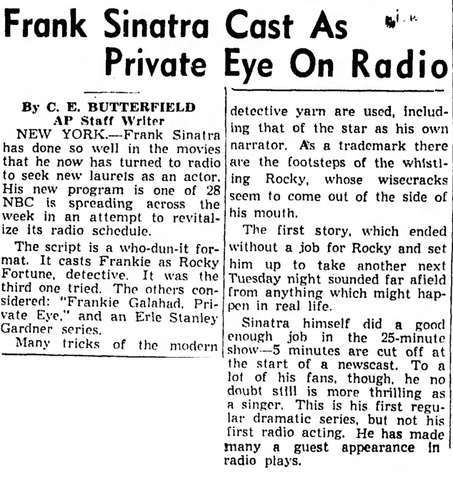
[Sinatra tapes Rocky Fortune radio pilot]
At Radio City West on Sunset and Vine, Sinatra taped the first episode of his new radio detective series Rocky Fortune, playing a footloose young man who took a different odd job each week; the show ran for twenty-five weeks.
Source: James Kaplan, "Frank: The Voice" (2010).
October 7, 1953
Concerts
SANDS, LAS VEGAS, Nevada (7-27)
Frank Sinatra & Orch (8) with Bill Miller, Nicholas
Bros.(2),Charles Nelson, Bek Steiner, Bryon Balmer,
Copa Girls (10), Ray Sinatra Orch (12); no cover or minimum
Frank Sinatra has always appealed to the gambling genre. His previous bookings in Las Vegas have signalled turn away biz for the entire span. Now, bolstered even more by the success of the Maggio role in "From Here To Eternity," he reaches into ranks of moderate bet-flingers and insures more than capacity for his three-frame Sandstand.
Although high on the list as a top moneymaker in
Vegas, Sinatra's vocals and attitude have left much to be desired among discriminating customers. With this return, he fronts a dulcet musical ensemble and warbles a rather subdued repertoire of standards. As he meanders down memory lane, Sinatra slams the door on his former worshippers to please an older and less exuberant set of applauders.
Whether selling a fleeting hit parader or an evergreen, the unmistakable stamp of quality is always evident.
Jarring the pleasant reverie are tendencies to insert dubious gags or parody lines in great established melodies, ennui and mechanically phrased offerings of humility. Offset these by top showmanship, striving toward perfection, flair for the dramatic, and that's the very complex guy Sinatra.
Very few of the current crop of male singers could equal his contouring of "My Funny Valentine," "Spring Is Here,"
"Someone To Watch Over Me," or create the spine-tingle of his "One For My Baby." In these ballads he reaches the heights. Such profuse programming of oldies tends to pall, with similarity of mood and tempi needing even more sock shots in the rhythm section than he formats.
Insertion of "This Can't Be Love," Coffee In Brazil," "All Of Me" in mild jump tempo does aid somewhat in relieving the legato streams. Although reception varies throughout, Sinatra exits to kingsize mitts.
VARIETY
October 21, 1953
Ed O'Brien notes: This was Frank's first engagement at the Sands.
He would perform there many times over the next 15 years. In September of 1953 he would have a chamber group ( Frank's description) of nine backing him. He reduced it by one for the Sands appearances.
SANDS, LAS VEGAS, Nevada (7-27)
Frank Sinatra & Orch (8) with Bill Miller, Nicholas
Bros.(2),Charles Nelson, Bek Steiner, Bryon Balmer,
Copa Girls (10), Ray Sinatra Orch (12); no cover or minimum
Thanks to Michel Macaire for above photo
Billboard
10-31-53 review of 10-19-53 show
Frank was originally set to open on 10-4 but his marriage was falling apart and Ava was his primary concern. Then the date was changed to 10-8. Variety has a small article mentioning this opening. Frank told Jack Entratter that he might have to push the date up to 10-13. He was in negotiations with Elia Kazan and Sam Spiegel for the plum role of Terry Malloy in Columbia Pictures "On The Waterfront." At the same time, Lucille Ball and Desi Arnaz had formed their own production company.
They had created a show for Frank in which he would play a down and out club performer. The tentative title was
"Blues In The Night." Frank was also set to start, on 10-6, a dramatic radio show titled "Frankie Galahad." He was a taxi driver in N.Y.C., who solved crimes. At the last moment it was switched to "Rocky Fortune." According to Variety, Frank taped the debut show, in Los Angeles, on the afternoon of the 6th. He then decided to open at the Sands the next day.
Variety, in their 10-7 issue, had B & J Kean as the headliners with the Louis Jordan Orchestra. They had opened in mid- September and Jack Entratter extended their run until Frank's appearance was set. Entratter got ads in the late editions of the Tuesday papers and also in Wednesday's.
Opening night was a bit of a disaster. Ava would not attend, Frank was distraught and it showed. His finely tuned octet felt it too. They hit a few clams and Frank exploded at them during the actual performance. The Vegas papers were highly critical of his behavior. Billboard reviewed his show on 10-13. The reviewer mentioned opening night and how Frank redeemed himself the following week. Entratter had cut back on the supporting acts to give Sinatra a full hour of singing to a very appreciative crowd. Frank's cousin, Ray, was on the bill, but he was not involved with Frank's segment of the show. The star was billed as "Frank Sinatra & Orchestra."
Frank opted to go with two radio shows and skip the offer from Desi and Lucy. He knew how draining a TV series could be and "Pink Tights" was set for a mid-December start at 20th Century, and other offers were pouring in everyday, regardless of what happened with the "Waterfront" project. And he was about to record his first Capitol album with Nelson Riddle conducting George Siravo's charts.
On 10-31, Frank appeared before the Nevada Tax
Commission. He was applying for a state gambling license. He was awarded the license and the Sands increased his ownership to two percent. After the hearing, Sinatra returned to the Sands and threw a big party. He also performed. Which bring us to the question of when did he close his first engagement at the hotel.
The 10-28 issue of Variety has him performing for the final week of October. The 11-4 Variety does not list any entertainment during the first week of November. The 11-11 has Jeanette MacDonald opening. Frank set new attendance records during his engagement.
Variety gave him a rave review and the Sands couldn't wait for his next appearance.
Ed
Scott:
I went with October 27th because of this article from October 28th:
The second paragraph says “contacted at the Sands Hotel where he finished out a show stand last night.” I took that to mean the 27th. I saw no ad for the Sands however in the Las Vegas Review Journal on the 27th with the last ad appearing on the 26th but not saying anything about it being the last night. I also assumed that if he opened on Wednesday then he would have closed on a Tuesday being October 27th. Jeanette MacDonald opened October 28th at the Sands:
--------------------------------------
© 1997-2025 The Sinatra Archive
This calendar, or any parts thereof, may not be reproduced in any fashion whatsoever without the prior written permission of the publisher (The Sinatra Archive)
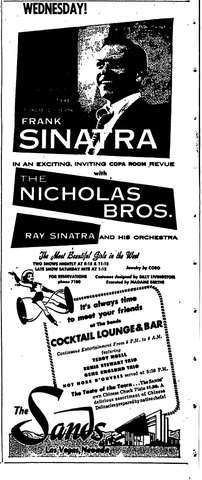
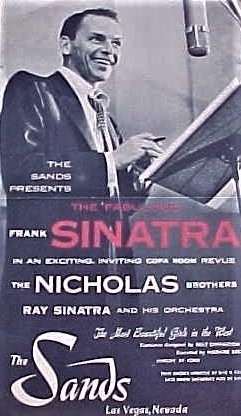
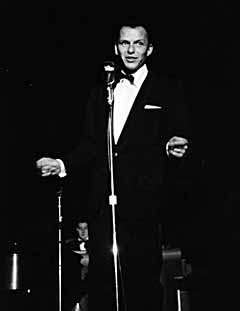
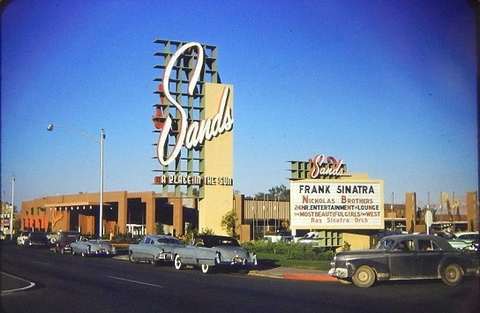
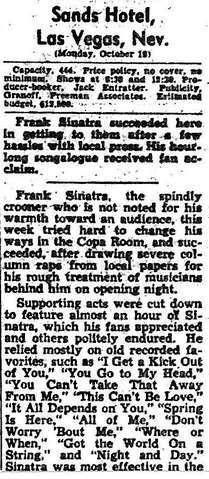
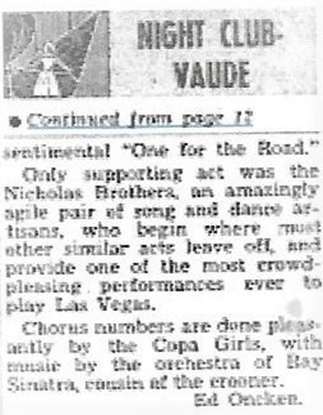
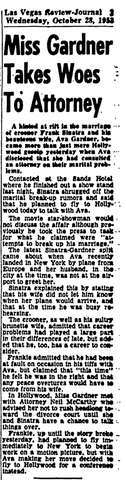
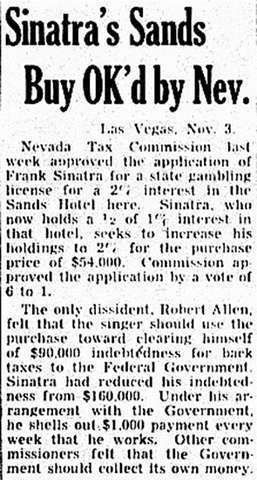
October 8, 1953
Concerts
SANDS, LAS VEGAS, Nevada (7-27)
Frank Sinatra & Orch (8) with Bill Miller, Nicholas
Bros.(2),Charles Nelson, Bek Steiner, Bryon Balmer,
Copa Girls (10), Ray Sinatra Orch (12); no cover or minimum
[Ava attends L.A. Mogambo premiere alone]
Ava attended the Los Angeles premiere of Mogambo alone, on the arm of her business manager Benton Cole, while Frank opened the same week at the Sands in Las Vegas.
Source: James Kaplan, "Frank: The Voice" (2010).
October 9, 1953
Concerts
SANDS, LAS VEGAS, Nevada (7-27)
Frank Sinatra & Orch (8) with Bill Miller, Nicholas
Bros.(2),Charles Nelson, Bek Steiner, Bryon Balmer,
Copa Girls (10), Ray Sinatra Orch (12); no cover or minimum
October 10, 1953
Concerts
SANDS, LAS VEGAS, Nevada (7-27)
Frank Sinatra & Orch (8) with Bill Miller, Nicholas
Bros.(2),Charles Nelson, Bek Steiner, Bryon Balmer,
Copa Girls (10), Ray Sinatra Orch (12); no cover or minimum
[Sinatra loses Waterfront priest role]
Louella Parsons: Louella Parsons reported Sinatra had 'decided against' doing On the Waterfront, quoting him as saying he loved the role of the priest but it only had two scenes. In reality, per Kaplan, the far larger Father Barry role -- which was in many more than two scenes -- had already been given to Karl Malden by Spiegel and Kazan; Sinatra had been shut out.
Source: James Kaplan, "Frank: The Voice" (2010).
October 11, 1953
Concerts
SANDS, LAS VEGAS, Nevada (7-27)
Frank Sinatra & Orch (8) with Bill Miller, Nicholas
Bros.(2),Charles Nelson, Bek Steiner, Bryon Balmer,
Copa Girls (10), Ray Sinatra Orch (12); no cover or minimum
October 12, 1953
Concerts
SANDS, LAS VEGAS, Nevada (7-27)
Frank Sinatra & Orch (8) with Bill Miller, Nicholas
Bros.(2),Charles Nelson, Bek Steiner, Bryon Balmer,
Copa Girls (10), Ray Sinatra Orch (12); no cover or minimum
October 13, 1953
Radio
Rocky Fortune, "Steven In A Rest Home"
Network: NBC
Episode: 2
Time: 9:35 p.m.- 10 p.m.
Performers: Frank Sinatra, Jack Mather, Herb Ellis
Writers: George Lefferts, Norm Sickel, Robert Senadella (story), Ernest Kinoy, Doc Sanford
Directors: Andrew C. Love, Fred Weihe, Howard Wiley
Announcer: Edward King
Description: Rocky's job as a chauffeur leads him to a new identity as a mental patient in Denver!
Note: The show appears on the officially released CD set: 60 Greatest Old Time Radio Show "Listen Now Frank Sinatra & Friends"
Concerts
SANDS, LAS VEGAS, Nevada (7-27)
Frank Sinatra & Orch (8) with Bill Miller, Nicholas
Bros.(2),Charles Nelson, Bek Steiner, Bryon Balmer,
Copa Girls (10), Ray Sinatra Orch (12); no cover or minimum
Frank Sinatra has always appealed to the gambling genre. His previous bookings in Las Vegas have signalled turn away biz for the entire span. Now, bolstered even more by the success of the Maggio role in "From Here To Eternity," he reaches into ranks of moderate bet-flingers and insures more than capacity for his three-frame Sandstand.
Although high on the list as a top moneymaker in
Vegas, Sinatra's vocals and attitude have left much to be desired among discriminating customers. With this return, he fronts a dulcet musical ensemble and warbles a rather subdued repertoire of standards. As he meanders down memory lane, Sinatra slams the door on his former worshippers to please an older and less exuberant set of applauders.
Whether selling a fleeting hit parader or an evergreen, the unmistakable stamp of quality is always evident.
Jarring the pleasant reverie are tendencies to insert dubious gags or parody lines in great established melodies, ennui and mechanically phrased offerings of humility. Offset these by top showmanship, striving toward perfection, flair for the dramatic, and that's the very complex guy Sinatra.
Very few of the current crop of male singers could equal his contouring of "My Funny Valentine," "Spring Is Here,"
"Someone To Watch Over Me," or create the spine-tingle of his "One For My Baby." In these ballads he reaches the heights. Such profuse programming of oldies tends to pall, with similarity of mood and tempi needing even more sock shots in the rhythm section than he formats.
Insertion of "This Can't Be Love," Coffee In Brazil," "All Of Me" in mild jump tempo does aid somewhat in relieving the legato streams. Although reception varies throughout, Sinatra exits to kingsize mitts.
VARIETY
October 21, 1953
Ed O'Brien notes: This was Frank's first engagement at the Sands.
He would perform there many times over the next 15 years. In September of 1953 he would have a chamber group ( Frank's description) of nine backing him. He reduced it by one for the Sands appearances.
October 14, 1953
Concerts
SANDS, LAS VEGAS, Nevada (7-27)
Frank Sinatra & Orch (8) with Bill Miller, Nicholas
Bros.(2),Charles Nelson, Bek Steiner, Bryon Balmer,
Copa Girls (10), Ray Sinatra Orch (12); no cover or minimum
SANDS, LAS VEGAS, Nevada (October 7-27)
Frank Sinatra & Orch (8) with Bill Miller, Nicholas
Bros.(2),Charles Nelson, Bek Steiner, Bryon Balmer,
Copa Girls (10), Ray Sinatra Orch (12); no cover or minimum
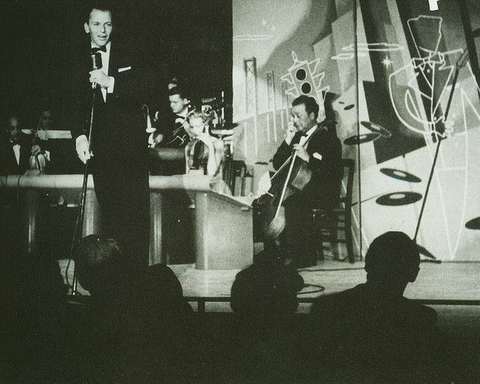
October 15, 1953
Concerts
Sands, Las Vegas, Nevada (7-27)
Frank Sinatra & Orch (8) with Bill Miller, Nicholas
Bros.(2),Charles Nelson, Bek Steiner, Bryon Balmer,
Copa Girls (10), Ray Sinatra Orch (12); no cover or minimum
October 16, 1953
Concerts
Sands, Las Vegas, Nevada (7-27)
Frank Sinatra & Orch (8) with Bill Miller, Nicholas
Bros.(2),Charles Nelson, Bek Steiner, Bryon Balmer,
Copa Girls (10), Ray Sinatra Orch (12); no cover or minimum
October 17, 1953
Concerts
Sands, Las Vegas, Nevada (7-27)
Frank Sinatra & Orch (8) with Bill Miller, Nicholas
Bros.(2),Charles Nelson, Bek Steiner, Bryon Balmer,
Copa Girls (10), Ray Sinatra Orch (12); no cover or minimum
October 18, 1953
Concerts
Sands, Las Vegas, Nevada (7-27)
Frank Sinatra & Orch (8) with Bill Miller, Nicholas
Bros.(2),Charles Nelson, Bek Steiner, Bryon Balmer,
Copa Girls (10), Ray Sinatra Orch (12); no cover or minimum
October 19, 1953
Concerts
Sands, Las Vegas, Nevada (October 7-27)
NOTE: Ed O'Brien sends along a review of one of these 1953 performances from the October 21, 1953 issue of VARIETY magazine. Here are extracts:
Frank Sinatra has always appealed to the gambling genre. His previous bookings in Las Vegas have signaled turnaway biz for the entire span. Now, bolstered even more by the success of the Maggia role in "From Here to Eternity," he reaches into ranks of moderate bet-flingers and insures more than capacity for his three-frame Sandstand.
Although high on the list of a top moneymaker in Vegas, Sinatra's vocals and attitude have left much to be desired among discriminating customers. With this return, he fronts a dulcet repertoire of standards. As he meanders down memory lane, Sinatra slams the door on his former worshippers to please an older and less exuberant set of applauders.
Whether selling a fleeting hit parader or an evergreen, the unmistakeable stamp of quality is always evident. Jarring the pleasant reverie are tendencies to insert dubious gags or parody lines in great established melodies, ennui and mechanically phrased offerings of humility. Offset these with top showmanship, striving toward perfection, flair for the dramatic, and that's the very complex guy Sinatra.
SANDS HOTEL.
LAS VEGAS, NEV.
( Monday, October 19 )
Capacity, 444. Price Policy,
No Cover, No Minimum.
Shows at 8:30 and 12:30
Producer-booker, Jack Entratter
Publicity, Granoff, Freeman Association
Estimated Budget, $12,500.
Frank Sinatra succeeded here in getting to them after a few hassles with local press. His hour-long songalogue received fan acclaim.
Frank Sinatra, the spindly crooner who is not noted for warmth toward an audience, this week tried hard to change his ways in the Copa Room, and suc- ceeded, after drawing severe column raps from local papers for his rough treatment on musicians behind him on opening night.
Supporting acts were cut down to feature almost an hour of Sinatra, which his fans appreciated and others politely endured. He relied mostly on old recorded favorites, such as "I Get A Kick Out Of
You," "You Go To My Head." "They Can't
Take That Away From Me," "This Can't
Be Love," "It All Depends On You," "Spring
Is Here," "All Of Me," "Don't Worry 'Bout Me,"
"Where Or When," "I've Got The World On
A String," and "Night And Day." Sinatra was most effective in the sentimental "One For My
Baby."
Only supporting act was the Nicholas
Brothers, an amazing pair of song and dance artisans, who begin where most other similar acts leave off, and provide one of the most crowd-pleasing performances ever to play Las Vegas.
Chorus numbers are done pleasantly by the Copa Girls, with music by the orchestra of Ray Sinatra, cousin of the crooner.
Ed Oncken
Billboard
October 31, 1953
Additional tunes sung during the engagement:
Someone To Watch Over Me
The Coffee Song
Day In, Day Out
My Funny Valentine
From Here To Eternity
You'll Never Walk Alone
Just One Of Those Things
note: Imagine seeing Sinatra perform in a room that seated less than 450 patrons. And there was no cover or minimum. The Comeback-Kid offered up 20 or more great tunes at each show, including ballad versions of "Where Or When" and "Day In, Day Out," The rhythm numbers were sung with just an octet and there were songs with just piano accompaniment ( Bill
Miller ). After his triumphant two weeks at
Bill Miller's Riviera ( Sept. 8 to 22 ), with a nine piece chamber set, Frank demanded the very best from the musicians backing him at the Sands. I'm sure that explains the blow-up on opening night (10-13 ).
Frank's first engagement at the Sands proved to be a tumultuous time both onstage and in his private life. His two year marriage to Ava Gardener was coming apart and the artist had exper- ienced a remarkable rebirth. His affiliation with the Sands would endure for the next
15 years. The first of 28 appearances would run for two weeks. He closed on
10-26. The hotel paid him $10,000 a week.
Frank Sinatra's Sands opening drew raves — Eddie Fisher called it “one of the greatest performances I've ever seen” — but the one empty seat reserved for Ava Gardner spoke to the state of the marriage; she and Frank had fought again and she skipped opening night, arriving the second night to sit with Fisher instead. A Journal-American review described Sinatra pouring “a torrent of sound at the sultry Ava” across twenty-four songs sung nearly without pause. “I can't eat. I can't sleep. I love her,” Frank told columnist Louella Parsons from Las Vegas during the engagement. Source: J. Randy Taraborrelli, Sinatra: Behind the Legend.
October 20, 1953
Radio
Rocky Fortune, "Shipboard Jewel Robbery"
Network: NBC
Episode: 3
Time: 9:35 p.m.- 10 p.m.
Performers: Frank Sinatra, Tony Barrett, Marvin Miller, Lynn Allen, Norma Varden, Shepard Menken.
Writers: George Lefferts
Directors: Andrew C. Love
Announcer: Edward King
Description: Rocky's gets a job as a steward on an ocean liner and gets involved in a jewel heist.
Concerts
Sands, Las Vegas, Nevada (October 7-27)
[Entratter bars Ava from the Sands]
Sands manager Jack Entratter issued a memo, at Sinatra's behest, banning Ava Gardner from the property for the rest of his engagement and instructing staff not to put her calls through to him, in an attempt at face-saving amid their ongoing rift.
Source: James Kaplan, "Frank: The Voice" (2010).
October 21, 1953
Concerts
Sands, Las Vegas, Nevada (October 7-27)
Sands, Las Vegas, Nevada (October 13-25)
Here is the complete review from Variety
10-21-53
--------------------------------------------
October 21, 1957 Friars Club Stag Roast of Nat King Cole, Hollywood, CA Frank Sinatra, Jack Benny, Dean Martin, George Burns, Maurice Chevalier, Eddie Fisher and others
The above image says it's from the Friar's Club 1957 but it didn't give an exact date.
[Johnson predicts divorce]
Erskine Johnson: Columnist Erskine Johnson wrote that Hollywood was still betting the Sinatra-Gardner reconciliation would end in divorce.
Source: James Kaplan, "Frank: The Voice" (2010).
October 22, 1953
Concerts
Sands, Las Vegas, Nevada (October 7-27)
October 23, 1953
Concerts
Sands, Las Vegas, Nevada (October 7-27)
October 24, 1953
Concerts
Sands, Las Vegas, Nevada (October 7-27)
October 25, 1953
Concerts
Sands, Las Vegas, Nevada (October 7-27)
According to a Sands switchboard operator, a furious Ava Gardner called Frank Sinatra's suite around 3 a.m. this week and, believing he was with a Copa Girl, snapped at the operator, “Miss Gardner. My name is Miss Gardner. Now get him on the line.” Hearing a woman's voice in the background when Frank finally answered, Gardner decided then and there that the marriage was over and told him on the phone she was filing for divorce. A Sands management memo dated this same day, later found among the hotel's archived papers, formally barred “Mrs. Sinatra” from the property and instructed staff to route no calls from her to his suite. Source: J. Randy Taraborrelli, Sinatra: Behind the Legend.
October 26, 1953
Concerts
Sands, Las Vegas, Nevada (October 7-27)
October 27, 1953
Radio
Rocky Fortune, "Pintsized Payroll Bandit"
Network: NBC
Episode: 4
Time: 9:35 p.m.- 10 p.m.
Performers: Frank Sinatra, Barney Phillips, Vivi Janniss.
Writers: George Lefferts
Directors: Andrew C. Love, Fred Weihe, Howard Wiley
Announcer: Edward King
Description: As a night man in a hamburger joint, Rocky's job leads to a nine year old runaway who has $50,000 in cash!
Concerts
Sands, Las Vegas, Nevada (October 7-27)
MGM chief publicist Howard Strickling announced that Frank Sinatra and Ava Gardner had separated and that “Miss Gardner will seek a divorce.” The night the news broke, Gardner showed up unannounced and visibly shaken at the home of her hairstylist Sydney Guilaroff, telling him, “I thought I could do it, but I can't talk about it,” before pacing his front lawn for hours and driving off alone well after midnight. Source: J. Randy Taraborrelli, Sinatra: Behind the Legend.
Eleven months after their wedding, Frank and Ava announced their separation, citing irreconcilable differences.
Source: Nancy Sinatra, Frank Sinatra: An American Legend, 1995.
October 29, 1953
Two days after his separation from Ava Gardner was made public, Frank Sinatra appeared before the Nevada Tax Commission seeking approval to buy a 2 percent stake in the Sands Hotel for $54,000, even though he still owed roughly $70,000 of a $160,000 federal tax levy. Despite one commissioner's objection that the purchase money should go toward his tax debt instead, and concern about his known mob associations, the commission approved the sale six to one, persuaded by the fact that Sinatra had already been steadily paying down the debt, $1,000 at a time, from his nightclub earnings. His stake in the Sands — which would eventually grow to 9 percent and make him a millionaire many times over — marked the start of a business relationship that would also make him a Sands vice president. Source: J. Randy Taraborrelli, Sinatra: Behind the Legend.
[MGM announces separation is final]
Howard Strickling: MGM publicist Howard Strickling issued an official statement that Frank and Ava, having 'exhausted every effort to reconcile their differences,' found no basis to continue their marriage and that Ava would seek a divorce, though both expressed 'deep affection' for each other.
Source: James Kaplan, "Frank: The Voice" (2010).
October 31, 1953
[Sinatra wins Nevada gambling license]
Frank Sinatra: Sinatra appeared before the Nevada Tax Commission in Carson City to plead for his gambling license and 2% Sands stake; despite one commissioner's objection tied to his IRS troubles, the commission approved it. Asked by reporters afterward if his marriage was over, he said, 'I guess it's over if that's what she says ... it's very sad. It's tragic. I feel very badly about it.'
Source: James Kaplan, "Frank: The Voice" (2010).
[Nancy denies reconciliation rumors]
Nancy Sinatra: The same day, at her Holmby Hills home, Nancy Sinatra told a United Press reporter by phone that there was 'positively no chance of a reconciliation' and that rumors about her and Frank getting back together were false.
Source: James Kaplan, "Frank: The Voice" (2010).
[Halloween party at the Sands]
That night, Frank flew back to Las Vegas and hosted a Halloween party at the Sands; the next day's papers carried an AP photo of him in a clown costume between two chorus girls.
Source: James Kaplan, "Frank: The Voice" (2010).
November 1953
[Frank and Ava Legally Separate]
Shortly after the release of "From Here to Eternity" revived Frank's career, he and Ava legally separated.
Source: Tina Sinatra, "My Father's Daughter: A Memoir" (2000).
[A sympathetic columnist defends Sinatra]
Edith Gwynn: Hollywood columnist Edith Gwynn pushed back against reporters piling on Frank after his hospitalization, arguing his career and personal upheaval deserved more sympathy than the press was giving him, given that Ava was also about to leave again for Europe.
Source: James Kaplan, "Frank: The Voice" (2010)
[Ava wires Nicholas Schenck over Barefoot Contessa terms]
Ava Gardner: While MGM haggled over loaning her out for The Barefoot Contessa, Ava Gardner wired studio head Nicholas Schenck directly, saying she was desperately anxious to do the picture and that the studio owed her some happiness given her disappointing finances under her new contract.
Source: James Kaplan, "Frank: The Voice" (2010)
[Frank and Ava meet at Bappie's for a tense dinner]
Kaplan: After his hospitalization, Frank and Ava met for dinner at her sister Bappie's Nichols Canyon cottage, a neutral location Ava insisted on so Frank couldn't misread the occasion. She noticed his bandaged wrist; he brushed it off as a stupid accident. Ava had already emotionally written him off, though she later said she had been happier married to Frank than at any other point in her life.
Source: James Kaplan, "Frank: The Voice" (2010)
[Frank threatens Peter Lawford over Ava rumor]
Kaplan: When Hedda Hopper reported that Ava had been seen having a drink with Peter Lawford at the Luau on Rodeo Drive (an innocent outing with Lawford's manager and Bappie present), Frank flew into a rage, phoned Lawford and told him he was 'a dead man,' threatening to have his legs broken. Lawford's manager Milt Ebbins eventually tracked Frank down in New York and talked him down by claiming the meeting had been his own idea.
Source: James Kaplan, "Frank: The Voice" (2010)
[Press mocks the Sinatra-Gardner breakup]
Kaplan: An editorial in Michigan's Holland Evening Sentinel mocked the end of the Sinatra-Gardner marriage as 'barnyard romance,' adding that the description was actually insulting to respectable barnyard animals.
Source: James Kaplan, "Frank: The Voice" (2010)
[Sinatra begins NBC radio show 'To Be Perfectly Frank']
Kaplan: Frank came to New York to begin a new fifteen-minute, twice-weekly NBC radio show, To Be Perfectly Frank, on which he played DJ and sang a number or two backed by a five-piece combo. He spent about ten days in Rockefeller Center studios stockpiling taped episodes, fueled by coffee, pills, and cigarettes, ostensibly preparing for the trip he knew he'd need to make to try to win Ava back.
Source: James Kaplan, "Frank: The Voice" (2010)
[Sinatra denies suicide attempt to press]
Kaplan: A wire-service headline read 'Sinatra Admits Hurting Wrist But Laughs Off Suicide Rumor,' quoting Frank as saying he had merely 'bruised and scratched' his wrist and didn't recall when or where it happened, after a photo with Eddie Cantor revealed the mark.
Source: James Kaplan, "Frank: The Voice" (2010)
[Sinatra's suicide attempt]
Kaplan: Frank failed to appear for his Chase Hotel booking in St. Louis; bookers frantically called around before reaching St. Louis attorney Morris Shenker, who determined Sinatra had slit a wrist. Jimmy Van Heusen had come home late from a party at '21' to find blood trailing across his living room floor and Frank semiconscious on the kitchen linoleum with his left pajama sleeve soaked in blood. Van Heusen paid a doorman and cabbie extra to rush Frank to Mount Sinai Hospital, where he was checked in under his own name with a cover story of exhaustion; his weight had dropped to 118 pounds from 132.
Source: James Kaplan, "Frank: The Voice" (2010)
[Sinatra's suicide attempt]
Kaplan: Just before Ava Gardner left for Europe in November 1953, Sinatra made a serious suicide attempt, cutting his left wrist in the New York apartment of his close friend, songwriter Jimmy Van Heusen; he would have bled to death had Van Heusen not returned home and found him.
Source: James Kaplan, "Sinatra: The Chairman" (2015)
[Van Heusen confronts Sinatra about needing therapy]
Kaplan: As Frank dressed to leave the hospital against medical advice, Van Heusen told him bluntly that he needed to see a psychiatrist once back in Los Angeles, saying he couldn't take caring for Frank's crises anymore. Frank smiled and agreed.
Source: James Kaplan, "Frank: The Voice" (2010)
[William Morris assigns a minder to Sinatra]
George E. Wood: Worried about their client's fragility, William Morris assigned agent George E. Wood to shadow Frank around the clock. Wood bribed a TWA gate agent at La Guardia to sneak Frank past reporters, flew cross-country with him watching over his drugged sleep, and fended off press at Los Angeles International the next morning.
Source: James Kaplan, "Frank: The Voice" (2010)
November 1, 1953
Radio
Ask Hollywood
NBC 6:15
Sinatra, Edmond O'Brien, Eddie Canotr, Rosemary Clooney, Phil Harris, and Anna Maria Alberghetti interviewed by Jimmy Wallington
I'll bet Frank was on this NBC show to plug his "Rocky Fortune" and "Perfectly Frank" shows. The former got under way on 10-6-53 and the latter was set for 11-3-53 debut.
Ed
November 3, 1953
Radio
8:15 p.m. -8:30 p,m.
w/ The Sinatra Symphonette & Strings
1. I've Got The World On A String
2. Choo-Choo Train Dinah Shore
3. By The Time w/snare drum
4. There's A Flaw In My Flue w/Bill Miller on piano
5.. Lean Baby
note: Autumn In New York was done on the 11/6 broadcast
The first two P.F. shows were the audition tapes done on
Frank launched a second radio program, Perfectly Frank, a twice-weekly show that ran for eight months.
Source: Nancy Sinatra, Frank Sinatra: An American Legend, 1995.
November 5, 1953
Studio
KHJ Studios, Hollywood
11846 A Foggy Day
Arranged & Conducted by Nelson Riddle
-17 CD: CDP 7-4870-2 Songs For Young Lovers/Swing Easy
LP: W1432 Songs For Young Lovers
11847 My Funny Valentine
Arranged & Conducted by Nelson Riddle
-10 CD: CDP 7-48470-2 Songs For Young Lovers/Swing Easy
LP: W1432 Songs For Young Lovers
11852 They Can't Take That Away From Me
(George. Gershwin/Ira Gershwin)
Chappell Music (ASCAP)
Arranged & Conducted by Nelson Riddle
-4 (1:57) CD: C2-94777 The Capitol Years
CD: CDP 7-48470-2 Songs For Young Lovers/Swing Easy
LP: W1432 Songs For Young Lovers
11853 Violets For Your Furs
Arranged & Conducted by Nelson Riddle
-4 CD: CDP 7-48470-2 Songs For Young Lovers/Swing Easy
LP: W1432 Songs For Young Lovers
KHJ Studios, Hollywood
11847 My Funny Valentine
Arranged & Conducted by Nelson Riddle
-10 CD: CDP 7-48470-2 Songs For Young Lovers/Swing Easy
LP: W1432 Songs For Young Lovers
Note: My Funny Valentine on the sheet music. -- Thanks to John Larrabee
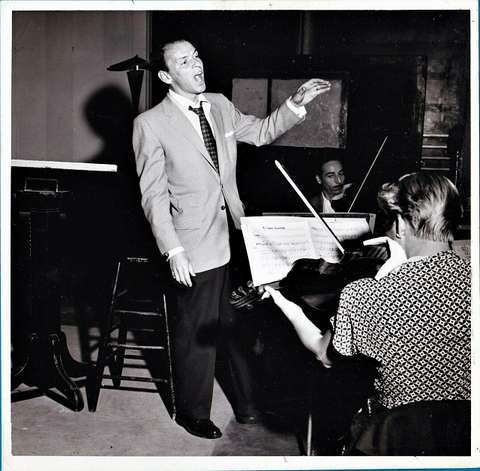
Among the songs recorded in this session was “My Funny Valentine,” arranged by Nelson Riddle for the Songs for Young Lovers album — a performance that would remain in Frank Sinatra's live repertoire for the next four decades and is widely regarded as one of the finest vocal interpretations of the Rodgers and Hart standard. Source: J. Randy Taraborrelli, Sinatra: Behind the Legend.
[First Capitol session for Songs for Young Lovers]
Sinatra returned to Capitol's Melrose studios on a Thursday night, greeting Nelson Riddle and Voyle Gilmore to begin recording his first Capitol album, Songs for Young Lovers. Only eleven musicians played in Studio C (two reeds, four strings, piano, guitar, bass, drums, harp, no brass), using George Siravo's stripped-down arrangements originally written for Sinatra's club dates at the 500 Club, the Riviera, and the Sands. Riddle only conducted that night rather than arranging.
Source: James Kaplan, "Frank: The Voice" (2010).
[Sinatra's transformed voice on 'A Foggy Day']
Riddle immediately heard a different Sinatra than the one he'd recorded the previous May: with half the musicians and more exposed vocals, Frank sang with a new rhythmic ease and maturity. On 'A Foggy Day' especially, his phrasing felt like an autobiography in miniature, shaped by the emotional crucible of the past year. Riddle later said Ava Gardner had taught Frank how to sing a torch song, and the plaintive tremolo in this recording reflected their recent agonies in London.
Source: James Kaplan, "Frank: The Voice" (2010).
[My Funny Valentine -- critical commentary]
Ray Coleman (Melody Maker); Al Viola: Melody Maker critic Ray Coleman praised Sinatra's 'height of professionalism' at the Hammersmith show but noted vocal strain: 'At times he sounded coarse, even nasal, and he certainly found it tough to sustain the note on certain occasions -- notably on "My Funny Valentine."' Al Viola corroborated the vocal decline: 'Near the end there his voice was getting pretty roughed up... In fact, Monte Carlo [June 9] was pretty rough.'
This song/context matches multiple dated entries in the chronology; the specific date Friedwald is referring to could not be determined with confidence.
Source: Will Friedwald, "Sinatra! The Song Is You: A Singer's Art" (2018 revised edition), Ch. 9, "Looking for the Hook" (1960-1971)
November 6, 1953
Studio
KHJ Studios, Hollywood
11858 Like Someone In Love
Arranged & Conducted by Nelson Riddle
CD: CDP 7-48470-2 Songs For Young Lovers/Swing Easy
LP: W1432 Songs For Young Lovers
11859 I Get A Kick Out Of You
(Cole Porter)
Warner Bros., Inc. (ASCAP)
Arranged & Conducted by Nelson Riddle
-12 (2:53) CD: CDP 724383595228 Sinatra 80th "All The Best"
CD: CDP 7-9661-2 Sings The Select Cole Porter
CD: C2-94777 The Capitol Years
CD: CDP 7-48470-2 Songs For Young Lovers/Swing Easy
LP: W1432 Songs For Young Lovers
12033 Little Girl Blue
Arranged & Conducted by Nelson Riddle
CD: CDP 7-4870-2 Songs For Young Lovers/Swing Easy
LP: W1432 Songs For Young Lovers
12034 The Girl Next Door
Arranged & Conducted by Nelson Riddle
CD: CDP 7-48470-2 Songs For Young Lovers/Swing Easy
LP: W1432 Songs For Young Lovers
Musicians: Reeds:Skeets Herfurt, Mahlon Clark; Violins: Felix Slatkin, Paul C. Shure; Viola: Paul Robyn; Cello: Eleandor Slatkin, Harp: Kathyrn Julye;
Piano: Bill Miller; Guitars: Al Hendrickson, Allan Reuss; Bass: Joe Comfort; Drums: Alvin Stoller;
Arrangements: George Siravo, Nelson Riddle ( Like Someone In Love )
Conductor: Nelson Riddle
NOTE: Sinatra Scholar Ed O'Brien says that Riddle used a 12 piece orchestra for this memorable session.
He listened to the recording only last week. He can't imagine the number of times he has listened and they still remain fresh today. He especially treasures "Like Someone in Love" and "Little Girl Blue." Marvelous singing.
Ed O'Brien:
Riddle arranged "Like Someone In Love." George Siravo arranged the four songs recorded the previous evening, "A Foggy Day," "My Funny Valentine," "They Can't Take That Away From Me," Violets For Your Furs" and the other three from this session.
I asked Riddle to describe his contribution. He told me there were slight modifications but the charts were done by Mr. Siravo. I tracked George down in the early 1990s. He was living in Medford, Oregon. He assured me they were his charts and then shared a wonderful story related to the classic album. A few months before we spoke, Tony Bennett had stopped to see him during a tour along the Pacific Coast. According to Tony, Nelson had asked him to please convey his profound apology for being credited with the great charts George had written for Frank. George couldn't remember exactly when Sinatra had commissioned the charts but it appears to have been during the months just prior to Frank's signing at Capitol. He was very pleased that Nelson wanted him to know how much of an injustice had been perpetrated by Capitol. Billy May once told me Nelson Riddle was a true gentleman and a class act. Siravo reaffirmed that the day we spoke.
Riddle's one arrangement for the album "Like Someone In Love" has two flutes. Nelson mentioned in an 1981 interview that for what- ever reason he knew it was the perfect compliment for both the song and the singer.
Radio
Perfectly Frank
NBC-Radio
Friday
8:15 p.m - 8:30 p,m. w/ The Sinatra Symphonette & String Quartet
1. Bim Bam Baby Columbia Recording
2. Autumn In New York* w/strings
3. Birth Of The Blues Columbia Recording
4. Don't Ever Be Afraid To Go Home w/strings
note: Audition tape, 9-22-53, featured a segment of How Much Is That Doggie In The Window by
Patti Page, with Frank commenting on the merits or demerits of the song. The 11/6 NBC broadcast cut that bit and added the closing song. Frank announced he was singing "Bim Bam Baby" with the Sinatra Symphonette. In truth, it was the Columbia recording.
Ed
Perfectly Frank
NBC-Radio
Friday
8:15 p.m - 8:30 p,m.
w/ The Sinatra Symphonette & String Quartet
Variety Review of 11-6 show from the 11-11-53
November 6, 1977, Sinatra presents the Scopus award to John Wayne
(thanks to Ed for this one)
© 1997-2025 The Sinatra Archive
This calendar, or any parts thereof, may not be reproduced in any fashion
whatsoever without the prior written permission of the publisher (The
Sinatra Archive)
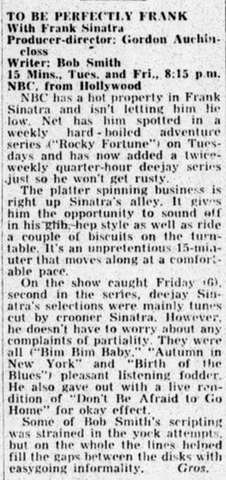
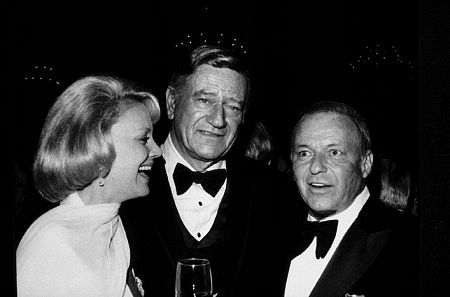
[Riddle's first arrangement for Sinatra: 'Like Someone in Love'] On the second night of the Songs for Young Lovers sessions, Sinatra recorded four more songs, including the Burke-Van Heusen tune 'Like Someone in Love,' the first song Nelson Riddle (rather than George Siravo) arranged for him. Riddle's Debussy/Ravel-influenced flute writing became a signature and hinted at greater complexity to come.
Source: James Kaplan, "Frank: The Voice" (2010).
[I Get a Kick Out of You -- critical commentary]
Will Friedwald (analysis, with footnote on lyric history): Early in the tour, anticipating seeing Ava Gardner in Spain, Sinatra would interject a lusty 'Yeah!' on the line 'Some like the perfume in Spain' from 'I Get a Kick Out of You.' After the reunion soured, he instead cried 'Blecch!' at the same line, as heard on the June 1 London concert recording. A footnote traces the line's history: Cole Porter's original 1934 lyric referenced cocaine ('Some, they may go for cocaine'), sanitized by publishers to 'perfume from Spain'; Sinatra used several variants across decades, including 'bop-type refrain' later in 1962 and 'cocaine from Spain' by 1974 in Australia.
This song/context matches multiple dated entries in the chronology; the specific date Friedwald is referring to could not be determined with confidence.
Source: Will Friedwald, "Sinatra! The Song Is You: A Singer's Art" (2018 revised edition), Ch. 9, "Looking for the Hook" (1960-1971)
[I Get a Kick Out of You / My Way -- critical commentary]
Frank Sinatra: Recorded for possible Reprise release, this April 8, 1974 Carnegie Hall concert (not issued until 2009's Sinatra: New York box) is rougher than later live recordings: Sinatra gets completely lost during 'I Get a Kick Out of You' ('Where the hell am I?') and interjects an off-color lyric about 'the cocaine from Spain.' Friedwald singles out Sinatra's introduction of 'My Way' as being written by Paul Anka to a melody by 'an eighteen-year-old French songwriter whose name was Jacques Strappe' as his favorite of Sinatra's many self-deprecating intros to the song, evidence of how much he disliked it despite performing it as a showstopper.
This song/context matches multiple dated entries in the chronology; the specific date Friedwald is referring to could not be determined with confidence.
Source: Will Friedwald, "Sinatra! The Song Is You: A Singer's Art" (2018 revised edition), Ch. 10, "Concert Years" (1973-1994)
November 7, 1953
[Sinatra's lonely second wedding anniversary]
Saturday, November 7, 1953 was Frank and Ava's second wedding anniversary, spent apart with Ava nowhere in sight. Jimmy Van Heusen picked Frank up at his Beverly Glen apartment and announced they were going out to get Frank laid, and made good on the promise.
Source: James Kaplan, "Frank: The Voice" (2010).
November 8, 1953
Television
Colgate Comedy Hour
Network: NBC
Season 4, Episode 128
Host: Jimmy Durante
Guests: Frank Sinatra, Eddie Jackson, Gay Tyroliers, Charles Smith, Jules Buffano ,Allen Henderson, Jack Roth, Mad Hatters, Jackie Barnett, Danny Thomas, Jan Arvan, Hy Averback
Writers: Jack Elinson, Jackie Barnett, Charles Issacs
Orchestra Conducted By: Roy Bargy
1. South Of The Border
2. "Every Comic Wants to Sing" w/Durante
Sinatra also sings a portion of "From Here To Eternity" but Durante keeps interrupting him and later during a Musical Quiz sketch, Sinatra sings a portion of "You Go To My Head".
Colgate Comedy Hour
Variety
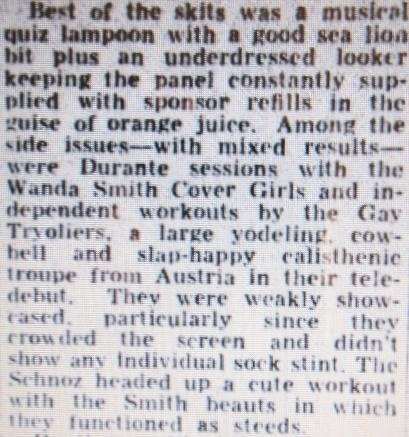
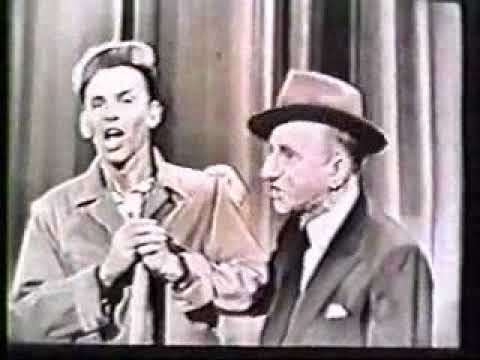
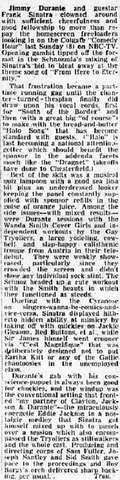
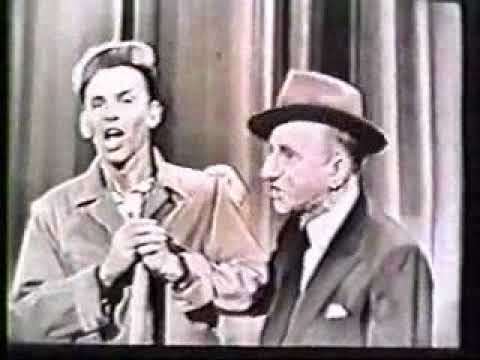
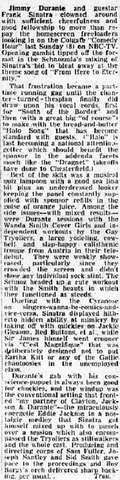
[Sinatra meets Angie Dickinson on Colgate Comedy Hour]
Frank guested on The Colgate Comedy Hour at the El Capitan Theatre with Jimmy Durante, clowning through a musical quiz-show skit and singing a Halo Shampoo jingle. During the taping he met 22-year-old beauty-pageant winner Angie Dickinson, who later recalled being 'bursting with awe' in his presence; Chester (Van Heusen) got her number for Frank afterward.
Source: James Kaplan, "Frank: The Voice" (2010).
November 10, 1953
Radio
To Be Perfectly Frank
Network: NBC
Show: 1
Time: 8:15 p.m
Host: Frank Sinatra
Announcer: Edward King
1. I Love You - Frank Sinatra
2. Offshore (instrumental) - Axel Stordahl
3. The Most Blues - Frank Sinatra
4. Toys - Eileen Barton
5. From Here To Eternity - Frank Sinatra
Notes: LOC Listing
Rocky Fortune, "Messenger For Murder"
Network: NBC
Episode: 5
Time: 9:35 p.m.- 10 p.m.
Performers: Frank Sinatra, Marion Richman, Georgia Ellis, Bill Justine,
Parley Baer, Theodore Von Eltz.
Writers: George Lefferts
Directors: Andrew C. Love
Announcer: Edward King
Description: Rocky is paid to deliver a $1000 package to a blind lady in a dangerous neighborhood.
To Be Perfectly Frank
Network: NBC
Show: 1
Time: 8:15 p.m
Host: Frank Sinatra
Announcer: Edward King
1. I Love You - Frank Sinatra
2. Offshore (instrumental) - Axel Stordahl
3. The Most Blues - Frank Sinatra
4. Toys - Eileen Barton
5. From Here To Eternity - Frank Sinatra
Notes: LOC Listing
Rocky Fortune, "Messenger For Murder"
Network: NBC
Episode: 5
Time: 9:35 p.m.- 10 p.m.
Performers: Frank Sinatra, Marion Richman, Georgia Ellis, Bill Justine, Parley Baer, Theodore Von Eltz.
Writers: George Lefferts
Directors: Andrew C. Love
Announcer: Edward King
Description: Rocky is paid to deliver a $1000 package to a blind lady in a dangerous neighborhood.
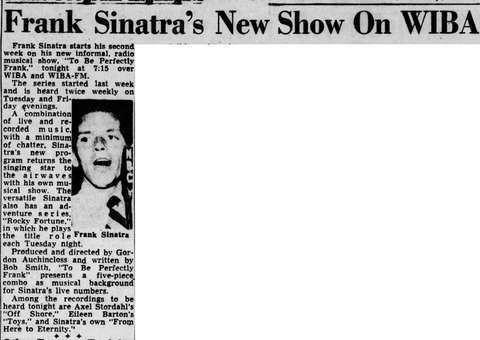
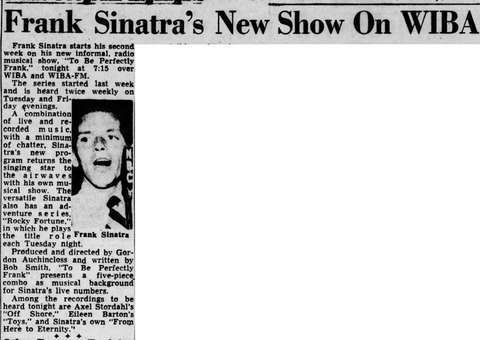
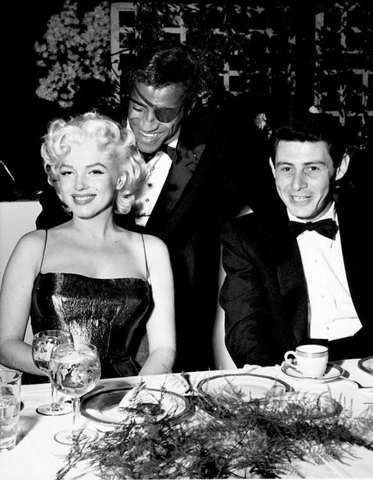
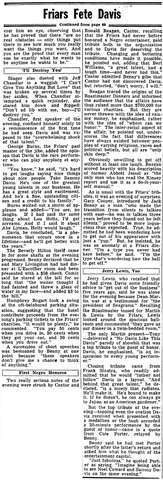
November 13, 1953
Radio
To Be Perfectly Frank
Network: NBC
Show: 4
Time: 8:15 p.m
Host: Frank Sinatra
Announcer: Edward King
1, All Of Me. Performed by Frank Sinatra
2. When My Dreamboat Comes Home - Kay Starr
3. They Can't Take That Away From Me - Frank Sinatra
4. Palladium Party (instrumental) - Harry James
5. South Of The Border - Frank Sinatra
Notes: LOC Listing
November 15, 1953
Radio
Radio: An episode of Sinatra's radio series To Be Perfectly Frank was broadcast this date -- the original NBC version -- with Sinatra singing "Don't Blame Me" and "Them There Eyes," backed by the Sinatra Symphonette. Source: sinatradiscography.com, Radio Transcriptions Database.
November 16, 1953
[Ava signed to star in The Barefoot Contessa]
On Monday, November 16, 1953, Joseph Mankiewicz and Nicholas Schenck finalized the deal: Ava would play the lead in The Barefoot Contessa. Mankiewicz paid MGM $200,000 for her services, of which Metro paid Ava only $60,000 for three months' work, well below her usual rate.
Source: James Kaplan, "Frank: The Voice" (2010).
[Elia Kazan begins shooting On the Waterfront]
The same day trade papers announced Ava's Barefoot Contessa deal, they also reported Elia Kazan had started shooting On the Waterfront in Hoboken. Marlon Brando slipped into town in jeans and a hunting jacket, worked a couple of hours, then left in a black car (his contract let him leave afternoons for psychiatrist visits in Manhattan).
Source: James Kaplan, "Frank: The Voice" (2010).
November 17, 1953
Radio
To Be Perfectly Frank
Network: NBC
Show: 3
Time: 8:15 p.m
Host: Frank Sinatra
Announcer: Edward King
1. Azure-te - Frank Sinatra
2. Changing Partners - Dinah Shore
3. A Hundred Years From Today - Frank Sinatra
4. South Of The Border - Frank Sinatra
Notes: LOC Listing
Rocky Fortune, "A Hepcat Kills The Canary"
Network: NBC
Episode: 6
Time: 9:35 p.m.- 10 p.m.
Performers: Frank Sinatra, Jack Crushin, Barney Philips
Writers: George Lefferts
Directors: Andrew C. Love
Announcer: Edward King
Description: Rocky and the bass player.
[Sinatra due in St. Louis, unpacked and unraveling]
Frank was due in St. Louis the day after the Contessa signing to rehearse for a week-before-Thanksgiving engagement at the Chase Hotel. His bags weren't packed; Van Heusen found him unable to eat or engage, having reportedly bored out even his closest friends with his obsessive grief over Ava.
Source: James Kaplan, "Frank: The Voice" (2010).
November 20, 1953
Radio
To Be Perfectly Frank
Network: NBC
Show: 4
Time: 8:15 p.m
Host: Frank Sinatra
Announcer: Edward King
1. I've Got My Love To Keep Me Warm - Frank Sinatra
2. That Old Gang Of Mine - Perry Como
3. When My Dreamboat Comes Home - Kay Starr
4. This Can't Be Love - Frank Sinatra
Notes: LOC Listing
Columnist Earl Wilson reported that Sinatra had been hospitalized at Mt. Sinai in New York, having lost fourteen pounds under the strain of his relationship with Ava Gardner.
Source: George Carpozi Jr., Frank Sinatra: Is This Man Mafia? (New York: Manor Books, 1979).
November 21, 1953
[Press speculation on Frank-Ava reconciliation]
A wire-service story datelined Hollywood, headlined 'Rumor Mill Is Mum on Frankie's Rocky Romance,' reported that whether Sinatra could win back Ava remained known only to the two of them, noting she had not met his flight at the airport and that he had flown from New York against his doctor's advice.
Source: James Kaplan, "Frank: The Voice" (2010).
November 24, 1953
Radio
To Be Perfectly Frank
Network: NBC
Show: 5
Time: 8:15 p.m
Host: Frank Sinatra
Announcer: Edward King
1. South Of The Border - Frank Sinatra
2. That Old Black Magic - Ferrante and Teicher
3. One For My Baby - Frank Sinatra
4. From Here To Eternity - Frank Sinatra
Notes: LOC Listing
Rocky Fortune, "Murder On The Aisle" (NBC)
Announcer: Edward King
Artist: Frank Sinatra
Rocky fails when he is hired to guard the life of a drunken, hated drama critic.
November 25, 1953
Dean Martin & Jerry Lewis Television Party for Muscular Dystrophy (cancelled appearance?) ABC-TV
Note: The entire broadcast is available on Youtube but Sinatra does not appear.
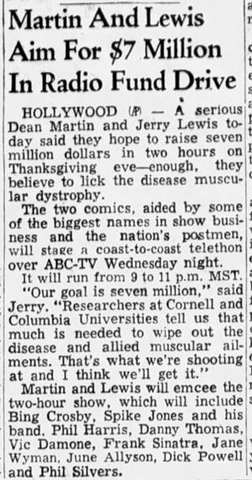
November 26, 1953
Radio
Rocky Fortune, "Murder On The Aisle"
Network: NBC
Episode: 7
Time: 9:35 p.m.- 10 p.m.
Performers: Frank Sinatra, Eliane Ross
Writers: Ernest Kinoy
Directors: Fred Weihe
Announcer: Edward King
Description: Rocky fails when he is hired to guard the life of a drunken, hated drama critic.
[Ava flies to Rome on Thanksgiving morning]
On Thanksgiving morning, Ava boarded a flight from Los Angeles to Rome, deliberately timed to avoid reporters distracted by the holiday. At Idlewild, photographers caught her waving to cameras with her bare left hand, showing she no longer wore her wedding ring.
Source: James Kaplan, "Frank: The Voice" (2010).
November 27, 1953
Radio
To Be Perfectly Frank
Network: NBC
Show: 6
Time: 8:00 p.m
Host: Frank Sinatra
Announcer: Edward King
1. Tennessee Newsboy - Frank Sinatra
2. Sentimental Journey (instrumental)
3. I Want A Boy - Connie Russell
4. That's Good Enough For Me - Pearl Bailey
5. My Funny Valentine - Frank Sinatra
Notes: LOC Listing. Surface noise but in fair condition.
November 29, 1953
Television
Colgate Comedy Hour
Sunday Evening
8:00 p.m. - 9:00 p.m.
Network: NBC
Season:4 Episode: #131
Sponsor: Colgate
Host: Eddie Cantor
Guests: Frank Sinatra, Eddie Fisher, Harold Arlen
1. Harold Arlen Medley w/Arlen Accompaniment
-It's Only A Paper Moon
-Over The Rainbow
-Ac-cen-tchu-ate The Positive
-Come Rain Or Come Shine F.S.
-I've Got The World On A String F.S.
-That Old Black Magic F.S.
-Get Happy F.S.
- Blues In The Night / Let's Fall In Love
- I Love A Parade
- Stormy Weather F.S. E.F. E.C. C.R
NOTE: Ed O'Brien says this show was pure magic: Sinatra singing the great Harold Arlen songs and the composer backing him on piano. Only complaint: Wish it had run 30 minutes longer.
A Sinatraphile wondered if it were on
DVD. Sinatraphile Scott Henderson says that it's on DVD and that he's had a DVD of the show for a couple of years. He picked it up in a discount bin at Wal-Mart for less than $5.
Colgate Comedy Hour
Variety
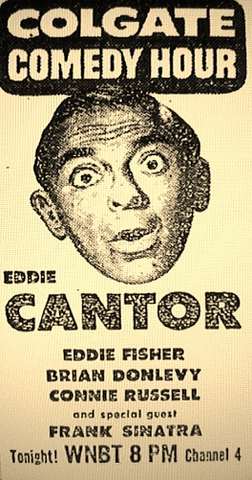
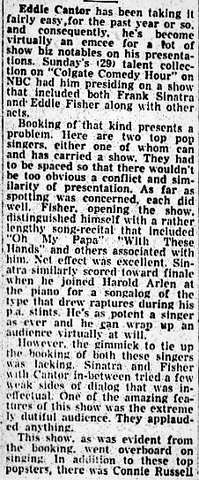
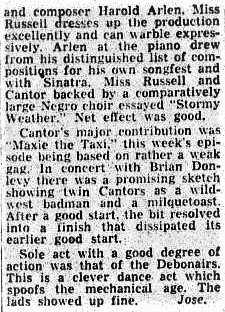
Frank Sinatra Harold Arlen
November 29, 1957 Frank Sinatra Show
a variety review of 11-29-57
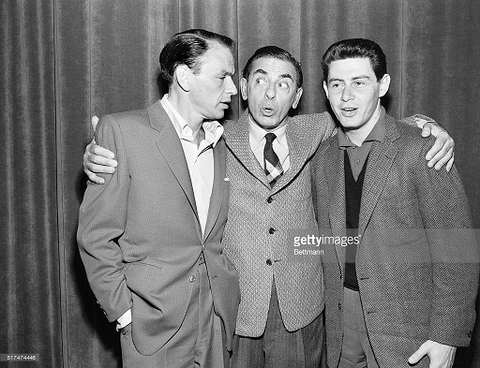
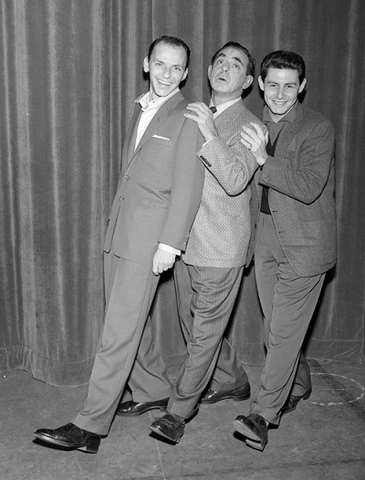
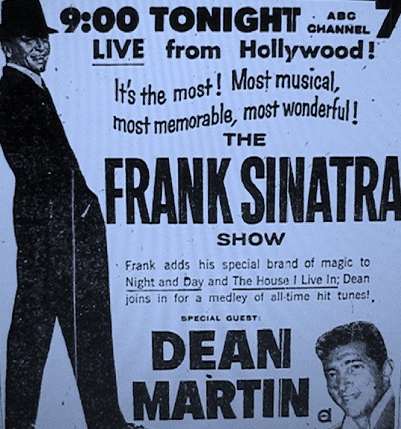
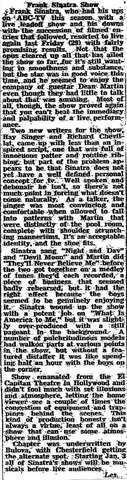
Frank
Sinatra
Harold Arlen
November 29, 1957 Frank Sinatra Show
a variety review of 11-29-57
[Second Colgate Comedy Hour appearance with Eddie Fisher] Frank returned to the El Capitan Theatre for The Colgate Comedy Hour alongside Eddie Cantor and Eddie Fisher. Introduced by Cantor for an all-Harold Arlen medley ('Come Rain or Come Shine,' 'I've Got the World on a String,' 'That Old Black Magic'), Sinatra performed to big From Here to Eternity applause, looking thin, his tuxedo cuff likely concealing his wrist bandages.
Source: James Kaplan, "Frank: The Voice" (2010).
December 1953
[Frank buys a mink coat for Ava]
Kaplan: Trying to calm himself before his trip, Frank bought a white mink coat at Teitelbaum's on Rodeo Drive to bring Ava in Rome, having the furrier stitch her initials, AGS, into the lining. His three-week Pink Tights salary would cover the cost.
Source: James Kaplan, "Frank: The Voice" (2010)
[Frank shops for Christmas with daughter Nancy]
Louella Parsons: Louella Parsons reported spotting Frank making the rounds of Beverly Hills shops with his thirteen-year-old daughter Nancy Sandra, and mused that he seemed likely to move back home given how much time he spent with his children.
Source: James Kaplan, "Frank: The Voice" (2010)
[Pink Tights / Born Yesterday / A Tree Grows in Brooklyn]
Sinatra and Marilyn Monroe nearly costarred several times but never did; the closest was Pink Tights, a musical remake of the Betty Grable film Coney Island, which was abandoned when a troubled Monroe failed to show up for the start of filming in December 1953. Other unrealized Sinatra/Monroe projects included proposed musical remakes of Born Yesterday and A Tree Grows in Brooklyn.
No corresponding dated entry could be identified in the chronology for this film/context.
Source: Tom Santopietro, "Sinatra in Hollywood" (2008), The Peak Years (pt. 3)
[Sinatra begins seeing psychiatrist Dr. Ralph Greenson]
Kaplan: As demanded by Van Heusen, Frank began seeing Beverly Hills psychiatrist Dr. Ralph Greenson (born Romeo Greenschpoon), whose sister was married to Sinatra's lawyer Mickey Rudin. To avoid notice, Greenson saw Frank at his own Spanish Mission-style house near the Brentwood Country Club rather than his office. Greenson would later become Marilyn Monroe's controversial psychoanalyst.
Source: James Kaplan, "Frank: The Voice" (2010)
December 1, 1953
Radio
To Be Perfectly Frank
Network: NBC
Show: 7
Time: 8:15 p.m
Host: Frank Sinatra
Announcer: Edward King
1. I've Got A Crush On You - Frank Sinatra
2. The Heebie Jeebies - Connie Boswell
3. Classical Jukebox - Boston Pops
4. It All Depends On You - Frank Sinatra
Notes: LOC Listing
Rocky Fortune, "Murder Among The Statues"
Network: NBC
Episode: 8
Time: 9:35 p.m.- 10 p..m.
Performers: Frank Sinatra, Jan Miner, Joseph Julian, Ed Begley, Ted Osborne, Leon Janney, Mandel Kramer.
Writers: Ernest Kinoy
Directors: Fred Weihe
Announcer: Edward King
Description: Rocky is working for an art dealer, when a statue becomes very interesting to a wealthy collector.
December 4, 1953
Radio
To Be Perfectly Frank
Network: NBC
Show: 8
Time: 8:15 p.m
Host: Frank Sinatra
Announcer: Edward King
1. I Can't Believe That Your In Love With Me w/ Sinatra Symphonette
2. The Lost Chord Jimmy Durante
3. Soliloquy Columbia Recording
Notes: Sinatra songs only. .
December 8, 1953
Studio
KHJ Studios, Hollywood
12051 Take A Chance
(D. Raksin/D. Stanford)
Arranged & Conducted by Nelson Riddle
-9 CD: C2 724383808922 The Complete Capitol Singles
45: 2703
12052 Ya Better Stop
(MacIntyre/Ferre)
Arranged & Conducted by Nelson Riddle
CD: C2 724383808922 The Complete Capitol Singles
12053 Why Should I Cry Over You?
(N. Miller/C. Conn )
Arranged & Conducted by Nelson Riddle
-11 CD: C2 724383808922 The Complete Capitol Singles
CD: CDP 7-94520-2 Come Swing With Me
LP: W1429 Swingin' Easy
45: 3050
Musicians - Reeds: Sam Donahue, Jack Dumont, Joseph Koch, Willie Schwartz,
William Skalak; Trumpet:
Conrad Gozzo, Emanuel Klein, Vito "Mickey" Mangano, Clarence "Shorty" Sherock;
Trombones: Milton
Bernhart, Francis Howard, Lloyd Ulate; Bass Trombone: George Roberts; Piano: Bill Miller; Bass: Joe Comfort;
Guitar: Bob Bain; Drums: Alvin Stoller
Session Producer: Voyle Gilmore
Radio
To Be Perfectly Frank
Network: NBC
Show: 9
Time: 8:15 p.m
Host: Frank Sinatra
Announcer: Edward King
1. They Can't Take That Away From Me w/ Sinatra Symphonette
2. 'Deed I Do Lena Horne
3. Anytime, Anywhere Capitol Recording
4. How Lovely Cooks The Meat Doris Day & Frankie Laine
5. South Of The Border Capitol Recording
Notes:
Rocky Fortune, "Carnival One Way"
Network: NBC
Episode: 9
Time: 9:35 p.m.- 10 p.m.
Performers: Frank Sinatra, Ken Williams,
Writers: George Lefferts
Directors: Fred Weihe
Announcer: Edward King
Description: Rocky's carnival case.
With his marriage to Ava Gardner effectively over and his weight down to around 118 pounds, Frank Sinatra recorded “Young at Heart” at this session — a song several other artists, including Nat King Cole, had already turned down. Jimmy Van Heusen talked him into cutting it anyway; released the following month, it became one of the songs that cemented his commercial comeback. Sinatra later described this stretch of his life simply: “It was all Mondays.” Source: J. Randy Taraborrelli, Sinatra: Behind the Legend.
[Capitol session yields grade-B swingers]
Sinatra returned to Capitol on the night of December 8, 1953 to record three uptempo numbers ('Take a Chance,' 'Ya Better Stop,' and 'Why Should I Cry Over You?') trying to notch a big hit for the label, though Kaplan judges the songs themselves mediocre despite Riddle's lively horn writing.
Source: James Kaplan, "Frank: The Voice" (2010).
December 9, 1953
Studio
KHJ Studios. Hollywood
11991 Rain (Falling From The Skies)
(R. Mellin/G. Finlay)
Arranged & Conducted by Nelson Riddle
-27 CD: C2 724383808922 The Complete Capitol Singles
CD: CDP 7-91209-2 Where Are You?
LP: T768 This Is Sinatra!
45: 2816
KHJ Studios. Hollywood
11993 I Could Have Told You
(J. Van Heusen/C. Sigman)
Arranged & Conducted by Nelson Riddle
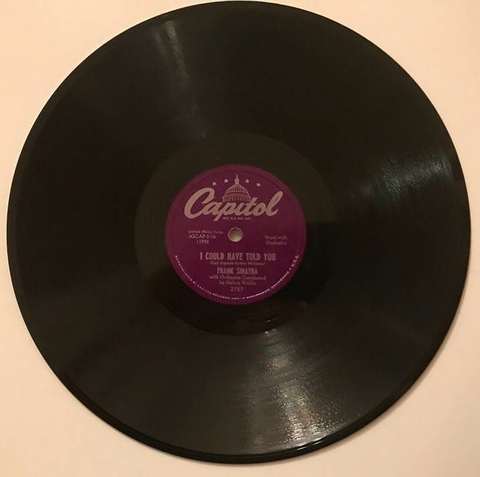
[Recording 'Young at Heart']
At KHJ studios starting at 8:30 p.m., Sinatra, Riddle, and Voyle Gilmore recorded 'Young at Heart' (by Carolyn Leigh and Johnny Richards, previously passed on by Nat Cole), wrapping ninety minutes into overtime around 1:00 a.m. The overtime doubled studio and musician costs, paid by Sinatra, from $1,072.50 to $2,145 (about $17,000 in today's dollars).
Source: James Kaplan, "Frank: The Voice" (2010).
[Rain -- critical commentary]
Granata includes 'Rain' among the fifty recordings he considers essential to understanding Sinatra's artistry (arranged by Nelson Riddle, recorded 1953, Capitol); the song was chosen for its musical/interpretive value rather than commercial popularity.
This song/context matches multiple dated entries in the chronology, or lacked a sufficiently precise date; the specific date could not be determined with confidence.
Source: Charles L. Granata, "Sessions with Sinatra: Frank Sinatra and the Art of Recording" (1999/2003), Afterword & Appendices A-D
December 11, 1953
Radio
To Be Perfectly Frank
Network: NBC
Show: 10
Time: 8:15 p.m
Host: Frank Sinatra
Announcer: Edward King
1. Wrap Your Trouble In Dreams w/ Sinatra Symphonette
2. I Had To Do It The Hard Way Betty Hutton
3. I'm Nobody's Baby Betty Hutton
4. Deep Night Columbia Recording
5. Embraceable You Columbia Recording
Notes:
The Bob Hope show
Time: 8:30 p.m.
Guest: Frank Sinatra.
1. South Of The Border - Frank Sinatra
2. Jingle Bells (parody) - Frank Sinatra & Bob Hope
Note: This is a partial recording. TT: 30mins.
December 15, 1953
Radio
To Be Perfectly Frank
Network: NBC
Show: 11
Time: 8:15 p.m
Host: Frank Sinatra
Announcer: Edward King
1. Re-enlistment Blues - Buddy Morrow Orchestra
2. Changing Partners - Kay Starr
3. She's Funny That Way - Frank Sinatra
4. Them There eEyes - Frank Sinatra
Notes: LOC Listing
Rocky Fortune, "Companion To A Chimp"
Network: NBC
Episode: 10
Time: 9:35 p.m.- 10 p.m.
Performers: Frank Sinatra.
Writers: George Lefferts
Directors: Andrew C. Love
Announcer: Edward King
Description: Rocky becomes a Companion to a Chimp.
[Monroe and Sinatra both skip Pink Tights start date]
Marilyn Monroe, unhappy with her pay ($1,500/week versus Sinatra's $5,000/week) and the formulaic Dumb Blonde role in the planned Pink Tights, was due at Fox on December 15, 1953 for the start of principal photography but stayed home in protest. Sinatra, eager to leave town for Rome, also stayed away.
Source: James Kaplan, "Frank: The Voice" (2010).
December 18, 1953
Radio
To Be Perfectly Frank
Network: NBC
Show: 12
Time: 8:15 p.m
Host: Frank Sinatra
Announcer: Edward King
1. The One I Love Belongs To Somebody Else - Frank Sinatra
2. That's Amore - Dean Martin
3. Zsa Zsa (instrumental) - Bernie Wayne
4. Love Is Here To Stay - Frank Sinatra
Notes: LOC Listing
December 22, 1953
Radio
To Be Perfectly Frank
Network: NBC
Show: 13
Time: 8:15 p.m
Host: Frank Sinatra
Announcer: Edward King
1. You Do Something To Me - Frank Sinatra
2. I Love Paris - Les Baxter
3.. Re-enlistment Blues - Buddy Morrow Orchestra
4. From Here To Eternity - Frank Sinatra
Notes: LOC Listing
Rocky Fortune, "The Plot To Murder Santa Claus"
Network: NBC
Episode: 11
Time: 9:35 p.m.- 10 p.m.
Performers: Frank Sinatra, Barney Phillips.
Writers: George Lefferts
Directors: Andrew C. Love
Announcer: Edward King
Description: Rocky gets involved in a Plot to Murder Santa Claus.
[Ava tells Frank she's going to Madrid for Christmas]
On Tuesday, December 22, 1953, Frank phoned Ava in Rome and learned she planned to spend the holiday in Madrid with expatriate friends Frank and Doreen Grant, not with him. He protested that Christmas was Friday and her birthday the day before, but she said she had to go.
Source: James Kaplan, "Frank: The Voice" (2010).
December 23, 1953
[Ava tells United Press reconciliation is possible]
Ava Gardner: United Press reached Ava the morning after her call with Frank; she described their conversation as amicable and said she'd cut her Madrid visit short to meet him in Rome, adding 'I'll be so happy to see him again.'
Source: James Kaplan, "Frank: The Voice" (2010).
December 24, 1953
Frank Sinatra flew to Europe to spend Ava Gardner's thirty-first birthday and the Christmas holiday with her, tracking her from Rome (where she was filming The Barefoot Contessa) to the Madrid home of a friend. There, Gardner — already privately determined to end the marriage for good — told him she was seeing a Spanish bullfighter, Luis Miguel Dominguín. Enraged, Sinatra destroyed the room, throwing a television out the window and smashing furniture and photographs, before hurling an envelope of cash at her — repayment of an old $19,000 loan — and storming out. Back in the United States soon after, he swore on a Bible at Sammy Davis Jr.'s home, with Jimmy Van Heusen as witness, that he would never again let a woman affect him so deeply. Source: J. Randy Taraborrelli, Sinatra: Behind the Legend.
[Frank charters a plane to Madrid]
Arriving in London ticketed for Rome, Frank abruptly decided to chase Ava to Madrid instead. Finding commercial flights full, he chartered a twin-engine plane from Croydon Airport for about 160 pounds (roughly $440), landing in Madrid on the afternoon of December 24, Ava's 31st birthday.
Source: James Kaplan, "Frank: The Voice" (2010).
[Ava with Dominguín when Frank arrives]
When Frank's chartered plane landed in Madrid on Ava's birthday, she was in bed with bullfighter Luis Miguel Dominguín at the Hotel Wellington, having taken up with him within hours of arriving in Madrid, according to biographer Lee Server.
Source: James Kaplan, "Frank: The Voice" (2010).
Radio
Radio: Sinatra appeared as a guest on The Bob Hope Show this date, singing "South Of The Border" and, with Hope, "Jingle Bells." Source: sinatradiscography.com, Radio Transcriptions Database.
December 25, 1953
Radio
To Be Perfectly Frank
Network: NBC
Show: 14
Time: 8:15 p.m
Host: Frank Sinatra
Announcer: Edward King
1. What Are You Doing New Year's Eve Margaret Whiting
2. Santa Claus Is Coming To Town Bing Crosby
3. Mi Amor Joni James
4. You'll Never Walk Alone Sinatra's Columbia Recording note: This is the complete song list for Frank's Christmas show
[Frank and Ava spend a tense Christmas in Madrid]
On Christmas night, Frank and Ava sat on the floor of the Grants' Madrid living room exchanging presents and singing carols, though Ava avoided his glances. When United Press called mid-celebration, Frank told the reporter he hoped to spend Christmas with his wife like millions of others, but wouldn't say whether he'd return to Rome with her.
Source: James Kaplan, "Frank: The Voice" (2010).
December 26, 1953
[Both Frank and Ava fall ill]
The strain of their reunion left Frank with a bad cold the next morning; furious at his pursuit, Ava fell ill as well, and told Dominguín she would have to accompany Sinatra back to Rome before summoning him to join her there.
Source: James Kaplan, "Frank: The Voice" (2010).
December 29, 1953
Radio
Rocky Fortune, "Prize Fight Setup"
Network: NBC
Episode: 12
Time: 9:35 p.m.- 10 p.m.
Performers: Frank Sinatra, Jack Mather, Barney
Phillips, Maurice Hart, Joe Forte, Jack Carroll, Maya Gregory
Writers: George Lefferts
Directors: Andrew C. Love
Announcer: Edward King
Description: Rocky is mistaken for "The Great
Gondolfo," a prize fighter and finds that he's the winner! With some poison turns up Rocky see it as a fight setup.
[Photo caption: Rome, sick and estranged]
A photo of Frank and Ava in Rome, dated December 29, 1953, is captioned by Kaplan as showing the couple 'sick, miserable, and about to be a couple no more.'
Source: James Kaplan, "Frank: The Voice" (2010).
December 30, 1953
[Wire report on Ava's illness in Rome]
A wire-service story datelined Rome, headlined 'Ava Gardner, Sinatra Silent on Reconciliation,' reported Ava was in bed with the flu after resuming housekeeping with Sinatra following their return from Madrid, with neither commenting on her earlier stated divorce plans.
Source: James Kaplan, "Frank: The Voice" (2010).
December 31, 1953
[New Year's Eve party at Bricktop's]
Frank and Ava threw a New Year's Eve party, Ava's idea, at Bricktop's Via Veneto cabaret with actors Eddie O'Brien and Rossano Brazzi and various Roman society figures. When they kissed at midnight, the tears on Ava's cheeks were real.
Source: James Kaplan, "Frank: The Voice" (2010).
1954
[Billboard and Metronome Honors]
In 1954 Billboard named Sinatra its top male singer, picked "Young at Heart" as the year's best record and "Swing Easy" as best LP, while Metronome magazine named him Singer of the Year.
Source: Nancy Sinatra, "Frank Sinatra, My Father" (1985).
[Frank Jr.'s "Kiss Him, Don't Kill Him" Exchange]
After the 1954 Oscar ceremony, ten-year-old Frank Jr. told his father he wanted to "kill" Ernest Borgnine for beating up Maggio onscreen; Sinatra told him instead to kiss him, since Borgnine had helped him win the Academy Award.
Source: Nancy Sinatra, "Frank Sinatra, My Father" (1985).
[Frank Owned His Palm Springs House Since 1954]
Nancy Sinatra: When Frank and Barbara Sinatra decided to sell the Palm Springs compound, Nancy Sinatra noted her father had owned the property since 1954 and that it had been a formative part of her own childhood.
Source: Nancy Sinatra, Frank Sinatra: An American Legend, 1995.
[Sinatra Loses The On The Waterfront Role To Brando]
Nancy Sinatra: Despite being on a hot streak as a dramatic actor, Sinatra didn't land the part he wanted most that year, Terry Malloy in On the Waterfront, which went instead to Marlon Brando.
Source: Nancy Sinatra, Frank Sinatra: An American Legend, 1995.
[Swing Easy! Cover Photo Shoot]
An outtake photo comes from the cover shoot for Sinatra's 1954 album Swing Easy!, a 10-inch LP featuring eight songs including 'All of Me' and 'Just One of Those Things.'
Source: Charles Pignone, "Frank Sinatra 100" (2015).
[Songs for Young Lovers Photo Shoot]
An outtake from the original 1954 photo shoot for the album Songs for Young Lovers is featured; the album was later selected in 2002 for the Library of Congress's National Recording Registry.
Source: Charles Pignone, "Frank Sinatra 100" (2015).
[The Rules For Joining Bogart's Original Rat Pack]
Nancy Sinatra: According to Lauren Bacall, membership in Humphrey Bogart's informal circle, which came to include Sinatra along with David Niven, Judy Garland and others, required an addiction to staying up late, drinking, laughing, and not caring what the press said about them.
Source: Nancy Sinatra, Frank Sinatra: An American Legend, 1995.
[A Star Is Born flops, Kelly wins Oscar]
Kaplan: Judy Garland's comeback vehicle A Star Is Born flopped commercially in 1954; the Best Actress Oscar many expected her to win went instead to 25-year-old Grace Kelly for The Country Girl.
Source: James Kaplan, "Sinatra: The Chairman" (2015)
[Ava living in Spain with Dominguín]
Kaplan: In spring 1954 Ava Gardner, who hated Hollywood and had vowed never to make another musical after MGM dubbed her singing voice in Show Boat, was living as an expatriate in Spain with bullfighter Luis Miguel Dominguín, and was about to file for divorce from Frank.
Source: James Kaplan, "Sinatra: The Chairman" (2015)
[Betty Comden recalls Ava shrine]
Betty Comden: Lyricist/screenwriter Betty Comden recalled attending a dinner party at Sinatra's home where one room was filled with candlelit photographs of Ava Gardner, "like the altar of a little church."
Source: James Kaplan, "Sinatra: The Chairman" (2015)
[Crosby contemplates retirement]
Bing Crosby: By the mid-1950s, a fifty-year-old Bing Crosby -- recently widowed after his wife's death from ovarian cancer, balding under a toupee, and dealing with family and kidney problems -- was pondering retirement, telling an interviewer in 1954 that his ideal picture would open with him rocking on a porch.
Source: James Kaplan, "Sinatra: The Chairman" (2015)
[Crosby's The Country Girl with Grace Kelly]
Kaplan: Around this time Crosby finished The Country Girl, a nonmusical Clifford Odets adaptation costarring twenty-four-year-old Grace Kelly, reputedly his offscreen paramour; Kelly won the Best Actress Oscar for the role while Crosby was nominated but did not win.
Source: James Kaplan, "Sinatra: The Chairman" (2015)
[Dean Martin hit singles]
Kaplan: Dean Martin scored hit singles with "That's Amore" and "Sway" in 1954, before the 1956 breakup of Martin and Lewis.
Source: James Kaplan, "Sinatra: The Chairman" (2015)
[Doris Day on Sinatra's chronic lateness]
Doris Day: In a radio interview, Doris Day recalled that during the filming of Young at Heart, Sinatra was late to the set every single day -- shooting would start around 11:00 a.m. though everyone was ready by 9:00 -- which annoyed the studio, though she remained fond of him.
Source: James Kaplan, "Sinatra: The Chairman" (2015)
[Ethel Barrymore's birthday and the Kleenex incident]
Doris Day: During the Young at Heart shoot, Sinatra threw a surprise 75th-birthday party on set for Ethel Barrymore and toasted her; when a crew member later flipped a Kleenex box that struck Doris Day in the forehead, Sinatra grabbed the man by the shirt and angrily berated him for not offering it properly.
Source: James Kaplan, "Sinatra: The Chairman" (2015)
[Film offers pour in]
Kaplan: Among the film roles offered to Sinatra that spring: a supporting part opposite Robert Mitchum in Not as a Stranger; the second lead in Warner Bros.' remake of Four Daughters; and a co-starring role with Marilyn Monroe in 20th Century Fox's Pink Tights (Monroe soon dropped out over pay disparity). MGM, which had fired Sinatra in 1950, also wanted him back for the long-discussed St. Louis Woman opposite Ava Gardner.
Source: James Kaplan, "Sinatra: The Chairman" (2015)
[First visit to Durocher's Beverly Hills home]
Consiglio: Consiglio recalls the first time he and Sinatra visited Leo Durocher's Beverly Hills home in 1954, after Durocher married actress Laraine Day. Durocher's walk-in closet, about thirty feet long, held roughly seventy-five suits and thirty or forty sports jackets.
Source: Tony Consiglio (as told to Franz Douskey), "Sinatra and Me: The Very Good Years" (2012)
[Goldwyn buys Guys and Dolls film rights]
Kaplan: Samuel Goldwyn bought the film rights to Frank Loesser's Broadway hit Guys and Dolls for $1 million in early 1954 and hired Joseph L. Mankiewicz to direct, then spent months publicly casting the four leads.
Source: James Kaplan, "Sinatra: The Chairman" (2015)
[Howard Hughes surveils Ava at Tahoe]
Kaplan: While in Tahoe with her maid Reenie Jordan, Ava stayed in a lakefront house provided by Howard Hughes, who had it bugged and hired Washington investigator Robert Maheu (later involved in a CIA plot against Castro) to surveil her; Maheu subcontracted the job to a local detective.
Source: James Kaplan, "Sinatra: The Chairman" (2015)
[Hughes hires Maheu to surveil Ava Gardner]
Kaplan: Howard Hughes hired Robert Maheu, later the CIA's Mafia liaison, to surveil the Lake Tahoe cabin where Ava Gardner was establishing residency to divorce Sinatra. Hughes, jealously convinced a man was visiting her, was right -- it was Sinatra hoping for a reconciliation -- but the surveillance produced nothing but a bill.
Source: James Kaplan, "Sinatra: The Chairman" (2015)
[Jilly Rizzo opens his namesake bar]
Kaplan / George Jacobs: Jilly Rizzo, a Greenwich Village-raised war veteran, former dockworker and bar bouncer, opened his own bar, Jilly's, at 256 West 52nd Street in 1954, an unpretentious spot known partly for terrible, New Jersey-style Chinese food that Sinatra reportedly loved.
Source: James Kaplan, "Sinatra: The Chairman" (2015)
[Lancaster on Sinatra's Eternity performance]
Burt Lancaster: Burt Lancaster, Sinatra's From Here to Eternity co-star, recalled that Frank's performance carried real anger and bitterness drawn from his personal troubles, saying, "You knew this was a raging little man who was, at the same time, a good human being."
Source: James Kaplan, "Sinatra: The Chairman" (2015)
[Lazar finds Sinatra shooting Ava's photos]
Kaplan (citing Lee Server): Per Ava Gardner biographer Lee Server, Swifty Lazar, who lived in Sinatra's apartment complex, once found Frank's door open late at night and discovered him very drunk, shooting an air gun at three large portrait photos of Ava propped on the floor, all riddled with pellet holes.
Source: James Kaplan, "Sinatra: The Chairman" (2015)
[Photo with Don Ameche, Yogi Berra, Tommy Henrich]
Consiglio: A photo caption places Consiglio, circa 1954, with actor Don Ameche and Yankees greats Yogi Berra and Tommy Henrich.
Source: Tony Consiglio (as told to Franz Douskey), "Sinatra and Me: The Very Good Years" (2012)
[Relationship begins with Natalie Wood]
Kaplan: That spring Sinatra also appears to have begun a relationship with Natalie Wood, who was not yet sixteen years old.
Source: James Kaplan, "Sinatra: The Chairman" (2015)
[Riddle's temperament described]
Rosemary Riddle Acerra: Riddle's daughter Rosemary Riddle Acerra recalled her father's somber, serious demeanor; Julie Andrews, who later worked with him on her 1970s TV variety show, nicknamed him Eeyore.
Source: James Kaplan, "Sinatra: The Chairman" (2015)
[Sammy Davis Jr.'s car accident]
Consiglio: Sammy Davis Jr. lost his left eye in a car accident in 1954 and feared his career was finished. Sinatra visited him in the hospital, offered his Palm Springs house for Davis to recuperate in, and stayed in close touch to keep his morale up.
Source: Tony Consiglio (as told to Franz Douskey), "Sinatra and Me: The Very Good Years" (2012)
[Sheree North tested for Pink Tights role]
Kaplan: After Marilyn Monroe refused the dumb-blonde role in Pink Tights and was suspended by Fox, the studio tested newcomer Sheree North for the part, and Sinatra chose to make Suddenly his first post-Eternity picture instead.
Source: James Kaplan, "Sinatra: The Chairman" (2015)
[Sinatra and Giancana's private embrace]
Antoinette Giancana: According to Giancana's daughter Antoinette, Sinatra and Sam Giancana embraced affectionately when they met privately in 1954.
Source: James Kaplan, "Sinatra: The Chairman" (2015)
[Sinatra bans Melcher and Lang from Young at Heart set]
Kaplan: During the Young at Heart shoot, Sinatra had producer Martin Melcher banned from the set (enforced by Jack Warner) after Melcher pushed him to sing songs Melcher held the publishing rights to, and also had the perfectionist Oscar-winning cinematographer Charles Lang removed for working too slowly.
Source: James Kaplan, "Sinatra: The Chairman" (2015)
[Sinatra cast as Nathan Detroit]
Kaplan: Sinatra was ultimately cast as Nathan Detroit in Guys and Dolls, receiving third billing after Brando and Jean Simmons (who played Sergeant Sarah Brown).
Source: James Kaplan, "Sinatra: The Chairman" (2015)
[Sinatra chases detective off Tahoe lake]
Kaplan: Sinatra visited Ava at the Tahoe house and persuaded her to take a boat ride; a local detective hired to watch her followed in another boat, and Sinatra gave furious chase until the detective fled to shore and into the woods.
Source: James Kaplan, "Sinatra: The Chairman" (2015)
[Sinatra loses Terry Malloy role to Brando]
Kaplan: Producer Sam Spiegel had pursued Sinatra hard for the lead role of Terry Malloy in On the Waterfront, promising it would win him a Best Actor Oscar, but ultimately cast the bigger box-office draw Marlon Brando instead; Sinatra reportedly "half destroyed" his living room in a rage when he learned Brando had gotten the part.
Source: James Kaplan, "Sinatra: The Chairman" (2015)
[Sinatra offered Pal Joey and Suddenly]
Kaplan: Amid a wave of movie offers following his newfound heat, Frank was offered the title role in a film adaptation of Pal Joey, and liked the script for a dark thriller called Suddenly, about a would-be presidential assassin.
Source: James Kaplan, "Frank: The Voice" (2010)
[Sinatra's Wilshire bachelor apartment]
Kaplan: In spring 1954 Sinatra lived in a five-room bachelor apartment in a redbrick complex at Wilshire Boulevard and Beverly Glen, a marked change from the pink stucco mansion in Toluca Lake he'd occupied a decade earlier when he first came to Hollywood.
Source: James Kaplan, "Sinatra: The Chairman" (2015)
[Sinatra's frenetic 1954 workload]
Kaplan: In 1954 Sinatra entered the studio nineteen times and recorded thirty-seven tracks, shot three movies, played two two-week Sands engagements (June and November) plus three weeks at the Copacabana over Christmas/New Year, made only four TV appearances (including the Oscars broadcast), and was constantly on radio with To Be Perfectly Frank, Rocky Fortune (ended in March), and later a Bobbi home permanents-sponsored Frank Sinatra Show.
Source: James Kaplan, "Sinatra: The Chairman" (2015)
[Sinatra's many romantic liaisons]
Kaplan: Freed from his marriage, Sinatra was linked in 1954 with actresses Gaby Bruyère, Anita Ekberg, Joan Tyler, Norma Eberhardt, Havis Davenport, and possibly Marilyn Monroe, plus singer Jill Corey and heiress Gloria Vanderbilt, among probably numerous others.
Source: James Kaplan, "Sinatra: The Chairman" (2015)
[Tiffany bracelet gift]
Kaplan: For Christmas, Sinatra gave Vanderbilt a Tiffany bracelet engraved "For Miracle and Me."
Source: James Kaplan, "Sinatra: The Chairman" (2015)
[Vanderbilt asks Stokowski for divorce]
Kaplan: Privately, Gloria Vanderbilt had asked Stokowski for a divorce, but he refused to let her go.
Source: James Kaplan, "Sinatra: The Chairman" (2015)
[Vanderbilt cast in Time of Your Life]
Kaplan: Vanderbilt was cast opposite Franchot Tone in a revival of Saroyan's Time of Your Life, set to open at New York's City Center the following January.
Source: James Kaplan, "Sinatra: The Chairman" (2015)
[Vanderbilt on Sinatra and the Mob]
Gloria Vanderbilt: Vanderbilt recalled that Sinatra was unusually open with her about his conflicted relationship with organized crime figures, telling her he was drawn to that world.
Source: James Kaplan, "Sinatra: The Chairman" (2015)
[Vanderbilt praised as "a star in the making"]
Gilbert Miller: After Vanderbilt and theater producer Gilbert Miller performed together in a charity benefit skit in early 1954, Miller called her "a star in the making," citing her presence and poise.
Source: James Kaplan, "Sinatra: The Chairman" (2015)
[career/awards]
Beyond his film work, 1954 alone saw Sinatra named singer of the year by Metronome and top male singer by Billboard, host two radio series, hit number one with "Young at Heart," chart with the Oscar-winning "Three Coins in a Fountain," and place two albums (Songs for Young Lovers and Swing Easy) in the top ten -- evidence of a full cross-media comeback.
No corresponding dated entry could be identified in the chronology for this film/context.
Source: Tom Santopietro, "Sinatra in Hollywood" (2008), Ava and the Downfall / The Comeback
[Elvis Presley covers RCA's early 45rpm single 'That's All Right']
RCA's pioneering 45 rpm format launched with bluesman Arthur Crudup's 'That's All Right,' recorded in September 1946 and issued on orange vinyl. It went nowhere until Elvis Presley covered it in 1954 at Sun Studios, which caused problems down the line for Frank, Perry Como, and their peers.
Source: Richard Havers, "Sinatra" (Dorling Kindersley, 2007).
[Johnny Burke's illness pushes Van Heusen to Sammy Cahn]
Van Heusen only began regularly writing with Sammy Cahn after his longtime partner Johnny Burke fell ill in 1954, sidelined from work for two years.
Source: Richard Havers, "Sinatra" (Dorling Kindersley, 2007).
[Lawford marries into the Kennedy family]
Peter Lawford married Patricia Kennedy, sister of John and Robert Kennedy, in 1954, a union that inadvertently became his entry point into both the Rat Pack and American political royalty.
Source: Richard Havers, "Sinatra" (Dorling Kindersley, 2007).
[Nelson Riddle scores first solo Capitol hit]
As a result of his arranging work with Sinatra, Nelson Riddle earned his own Capitol solo contract, and his adaptation of 'Frere Jacques' as 'Brother John' reached No. 23 on Billboard just as Sinatra's 'Young at Heart' was climbing toward No. 2.
Source: Richard Havers, "Sinatra" (Dorling Kindersley, 2007).
[Sammy Davis Jr signs solo deal with Decca]
Sammy Davis Jr struck out as a solo artist for the first time, signing with Decca Records. His first chart hit, 'Hey There' from The Pajama Game, reached No. 18 in early autumn of that year.
Source: Richard Havers, "Sinatra" (Dorling Kindersley, 2007).
[Vic Damone marries Pier Angeli]
Vic Damone married actress Pier Angeli, who had previously been James Dean's girlfriend, in 1954; they divorced in 1958.
Source: Richard Havers, "Sinatra" (Dorling Kindersley, 2007).
[Love and Marriage / The Tender Trap -- critical commentary]
Tom Santopietro (via Friedwald); Will Friedwald (analysis): 'Love and Marriage' was the key song from the Cahn-Van Heusen Broadway-style TV adaptation of Our Town. 'The Tender Trap,' from the film based on Max Shulman's 1954 play, is likened by Friedwald to 'Young at Heart' as a signifier of the new Sinatra; he cites film scholar Tom Santopietro's observation that the opening sequence -- Sinatra walking toward the camera from the horizon singing the song into the main titles -- symbolically announces 'Look out baby, I'm back -- with a vengeance!'
Source: Will Friedwald, "Sinatra! The Song Is You: A Singer's Art" (2018 revised edition), Ch. 6, "With Nelson Riddle" (1953-1979)
[Marie -- critical commentary]
Irving Berlin / Tommy Dorsey: In 1954, the Dorsey Orchestra (which now included brother Jimmy) made a new record of "Marie" for Arthur Shimkin’s Bell Records. When the producer told Irving Berlin about the new recording, the songwriter told him "You tell that Irish bastard not to f**k with my song!" When Dorsey learned of this, his reaction was, "You tell that Jew bastard that if I hadn’t f**ked with it, there wouldn’t be any song!"
Source: Will Friedwald, "Sinatra! The Song Is You: A Singer's Art" (2018 revised edition), Ch. 3, "With Tommy Dorsey" (1940-1942)
[technique/history -- critical commentary]
Capitol's engineering department experimented with stereo recording as early as 1954 at Melrose Avenue, but the label did not embrace stereo for pop recording until late 1957.
Source: Charles L. Granata, "Sessions with Sinatra: Frank Sinatra and the Art of Recording" (1999/2003), Part III: The Capitol Years, 1953-1962
January 1954
[Bill Goetz offers Sinatra a role in Guys and Dolls]
Kaplan: Producer Bill Goetz, Louis Mayer's son-in-law leaving Universal International to go independent, called Frank in to discuss playing one of the leads in a planned screen adaptation of the Broadway musical Guys and Dolls.
Source: James Kaplan, "Frank: The Voice" (2010)
[Fox suspends Marilyn Monroe over Pink Tights]
Kaplan: With Pink Tights stalled, Darryl Zanuck suspended Marilyn Monroe for noncompliance and began seeking a replacement lead, considering Jane Russell and newcomer Sheree North, while Sinatra continued collecting his paycheck without working.
Source: James Kaplan, "Frank: The Voice" (2010)
[Frank moves Jule Styne into his apartment]
Jule Styne: Needing company after returning to Los Angeles, Frank had composer Jule Styne's belongings moved from his Beverly Hills Hotel bungalow into the Beverly Glen apartment. The arrangement lasted eight difficult months; Styne recalled Frank spending nights pacing, drinking brandy in front of pictures of Ava, and calling his first wife Nancy at 4 a.m. saying she was the only one who understood him.
Source: James Kaplan, "Frank: The Voice" (2010)
[Frank talks Ava through Barefoot Contessa troubles]
Kaplan: In a phone call, Ava, agitated over friction with director Joseph Mankiewicz and costar Humphrey Bogart on the set of The Barefoot Contessa, opened up to Frank about feeling insecure and unsupported. He reassured her, advising she assert herself with Mankiewicz and be patient with Bogart's wounded pride. She thanked him for the pep talk and, for the first time in weeks, told him she loved him.
Source: James Kaplan, "Frank: The Voice" (2010)
[Harry Cohn discusses multi-picture deal]
Kaplan: As Oscar buzz grew for From Here to Eternity, Columbia's Harry Cohn called Frank in to discuss a multipicture deal.
Source: James Kaplan, "Frank: The Voice" (2010)
[Louella Parsons notes Frank looking well]
Louella Parsons: Louella Parsons wrote that she'd seen Frank at Chasen's looking well, inferring that things must be improving with Ava, since 'when he's unhappy he's a boy who shows it in his face.'
Source: James Kaplan, "Frank: The Voice" (2010)
[Monroe marries DiMaggio]
Kaplan: Marilyn Monroe, freshly a star after Niagara, married Joe DiMaggio in January 1954, then (to his annoyance) flew to Korea in February to entertain troops.
Source: James Kaplan, "Sinatra: The Chairman" (2015)
[Sinatra's car accident in Beverly Hills]
Kaplan: Sleep-deprived and distracted, Frank crashed his Cadillac convertible into a small English sports car at a Beverly Hills intersection, throwing driver Myrna McClees onto the pavement with a fractured skull and lacerations; she recovered. Frank maintained he had stopped and looked both ways.
Source: James Kaplan, "Frank: The Voice" (2010)
[Songs for Young Lovers released]
Kaplan: Sinatra's first Capitol album, Songs for Young Lovers, was released in January 1954; it contained only one Riddle-arranged track, "Like Someone in Love," with the rest arranged mainly by George Siravo.
Source: James Kaplan, "Sinatra: The Chairman" (2015)
January 1, 1954
Concerts
Copacabana, New York City (Dec. 23, 1954 - Jan. 12, 1955) Richard Jones Conducting
Bill Miller on Piano
Ava Gardner failed to appear for a planned New Year's reunion with Sinatra in Rome, ending their attempted reconciliation.
Source: George Carpozi Jr., Frank Sinatra: Is This Man Mafia? (New York: Manor Books, 1979).
January 2, 1954
Radio
Copacabana, New York City (Dec. 23, 1954 - Jan. 12, 1955) Richard Jones Conducting
Bill Miller on Piano
Three week engagement
SRO every show
SINATRA THRILLS COPA WITH MATURE BRILLIANCE
This was a mature Frank Sinatra who was caught at the Copacabana Thursday (23) night. All the promise he has given in the past came to full growth before an overflow audience. This was no Sinatra idol of the bobby sox brigade. This was a brilliant actor giving blood and guts to lyrics with such a masterful touch that the aud- ience sat hushed at one point and exploded into wild applause at another. The saga of Sinatra is well known in the trade, his legal hassles, agency differences, explosive temper- ament, etc. But despite his mistakes, and he even invented some, he's come out of it a great performer. His big comeback started with the flick "From Here To Eternity," then came his Capitol disk "Young At Heart," followed by his Capitol album "Songs For Young Lovers." And now he is better than ever and more firmly established as a singer who can act.His routine at the Copa demonstrated each facet of the Sinatra genius. He was intense and moody with "One For My Baby," reminiscently nostalgic with "Gal That Got Away" and pulled the heartstrings with "Young At Heart." His tremulous smile, his tiptoe finishes, his thrilling phrasing enraptured the house. We have caught Sinatra too many times to count. As our swan song with The Billboard, we can't think of a better way to say goodbye and thanks for being such a pleasant assignment..
Joey Bishop, working in the middle, threw most of his set routine away and went into in character ad libs. A couple of more shows under his suspenders and Bishop will get the howls he deserves.
The Five DeMarco Sisters were pleasant in the opening slot..
The production numbers and production singers and dancers remained the same. Bill Smith
Billboard
January 1, 1955
Ed O'Brien:
Sinatra played a three week engagement at the Copa from December 23, 1954 thru January 12, 1955.. I have talked to people who saw him during this run. I've been told that night after night he thrilled the audience with his stunning performances. Here is a list of the songs he was doing in concert at the time, plus the three numbers mentioned in the review.
I've Got The World On A String
I Get A Kick Out Of You
My Funny Valentine .
Taking A Chance On Love
Three Coins In The Fountain
She's Funny That Way
Just One Of Those Things
A Foggy Day
All Of Me
Nancy .
They Can't Take That Away From Me
Ol' Man River
Try A Little Tenderness
My Blue Heaven
This Love Of Mine
I'll Never Smile Again
"Songs for Young Lovers"
Granata's discography entry: Songs for Young Lovers, 10-inch LP, arranged by Nelson Riddle, released January 1954.
Source: Charles L. Granata, "Sessions with Sinatra: Frank Sinatra and the Art of Recording" (1999/2003).
January 3, 1954
Concerts
Copacabana, New York City (December 23, 1954 - January 12, 1955) Three week engagement
SRO every show
January 4, 1954
Concerts
Copacabana, New York City (December 23, 1954 - January 12, 1955) Three week engagement
SRO every show
[Frank flies home from Rome alone]
On Monday morning, January 4, 1954, Frank slipped out of Ava's Rome apartment via a service entrance to avoid reporters and flew back to America alone.
Source: James Kaplan, "Frank: The Voice" (2010).
[Capitol releases Songs for Young Lovers]
While Frank was in the air on January 4, 1954, Capitol released Songs for Young Lovers as a ten-inch LP with the eight songs from the November 5-6, 1953 sessions, his first album since Columbia's Sing and Dance with Frank Sinatra over three years earlier. Its cover, with Frank alone under a lamppost in a dark suit, established a moodier image than the earlier record's cheerful cover.
Source: James Kaplan, "Frank: The Voice" (2010).
Liner Notes: SONGS FOR YOUNG LOVERS
There is a particular kind of confidence that comes from a singer who has just been given room to breathe. After the string-drenched grandeur of the Columbia years, Frank Sinatra arrived at Capitol with something to prove and, in Nelson Riddle, an arranger who understood exactly how to prove it. Songs for Young Lovers, built around eight standards -- "My Funny Valentine," "The Girl Next Door," "A Foggy Day" among them -- was a small record with an outsized idea behind it: that a group of songs, chosen and sequenced with care, could tell something like a story about love in its early, hopeful stages.
What strikes the listener first is the intimacy of the arrangements -- Riddle keeps the orchestra light, almost conversational, letting Sinatra's voice sit up front the way a good photograph keeps its subject in focus. This was a new kind of record for popular music: not a scattershot collection of hits, but a mood sustained across a full side, each track a small chapter in the same emotional weather.
It would be easy, in hindsight, to treat this record as a mere prelude to what followed -- to In the Wee Small Hours, to Songs for Swingin' Lovers! -- but that undersells what Sinatra and Riddle accomplished on their first outing together. The concept album, as a form, effectively begins here: unpretentious, unhurried, and quietly sure of itself.
Written by Claude (Anthropic), commissioned for this chronology, 2026.
January 5, 1954
Radio
To Be Perfectly Frank
Network: NBC
Show: 17
Time: 8:15 p.m
Host: Frank Sinatra
Announcer: Edward King
1. Lean Baby - Frank Sinatra
2. I'm A Fool To Want You - Frank Sinatra
3. What Are You Doing New Year's Eve - Margaret Whiting
4. I Love You - Frank Sinatra
Rocky Fortune, "On The Trail Of A Killer"
Network: NBC
Episode: 13
Time: 9:35 p.m.- 10 p.m.
Performers: Frank Sinatra, Barney Phillips
Writers: Norm Sickel
Directors: Andrew C. Love
Announcer: Edward King
Description: Rocky is on the trail of Sister Ellie's Killer.
Concerts
Copacabana, New York City (December 23, 1954 - January 12, 1955) Three week engagement
SRO every show
January 6, 1954
Concerts
Copacabana, New York City (December 23, 1954 - January 12, 1955) Three week engagement
SRO every show
January 7, 1954
Concerts
Copacabana, New York City (December 23/54 - January 12/55) Three week engagement
SRO every show