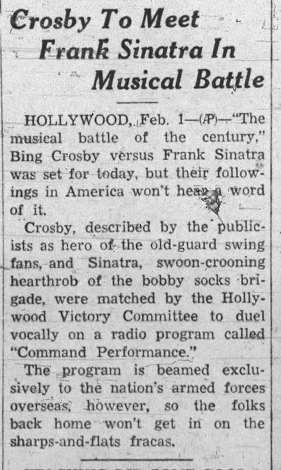
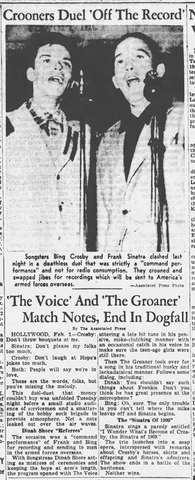
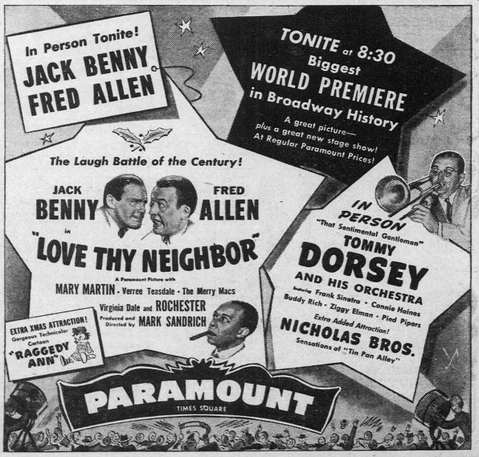
July 6, 1890
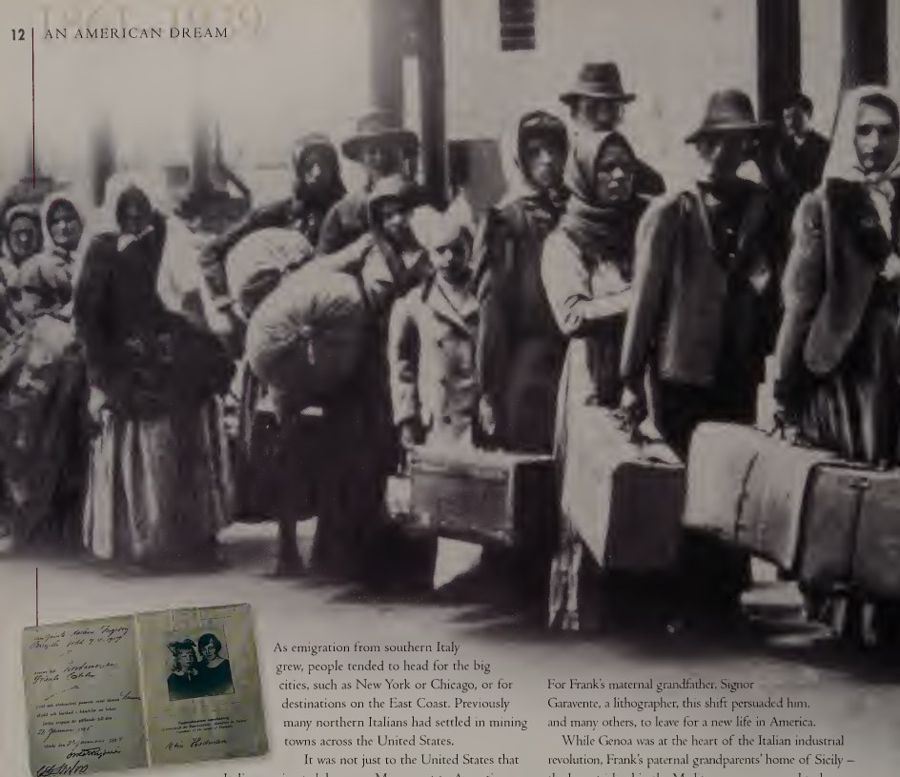
Francesco Sinatra, Frank Sinatra's grandfather, arrived alone at Ellis Island with $30 to his name, having left his wife Rosa and five children behind in Sicily and sailed from Naples aboard the British steamer Spartan Prince. Unable to find shoemaking work in New York, he took a job as a boilermaker before settling in at the American Pencil Company, where he worked for seventeen years inhaling dust for about $11 a week, sending money home the whole time. Source: Frank Sinatra Wiki (fandom.com), citing Anthony Summers & Robbyn Swan, Sinatra: The Life.
May 4, 1892
Frank Sinatra's father, Anthony Martin “Marty” Sinatra, was born Antonino Martino Sinatra in Lercara Friddi, in the province of Palermo, Sicily. He later immigrated to Hoboken, New Jersey, where he worked briefly as a professional boxer under the ring name Marty O'Brien before becoming a Hoboken firefighter. Source: J. Randy Taraborrelli, Sinatra: Behind the Legend.
As a young man in Hoboken, Marty had a brush with the law: a fatal hit-and-run on Newark Street that killed a five-year-old boy. He was tried for manslaughter but acquitted, the defense arguing he had been "unnerved" and "had lost his head." He was also caught receiving stolen goods around the same period. Boxing under the alias Marty O'Brien -- chosen because it was his Philadelphia sponsor's name and played better to Irish audiences -- he is believed to have met his future wife, Dolly Garaventa, through a fellow bantamweight, her brother Dominick "Champ" Garaventa. Source: Frank Sinatra Wiki (fandom.com), citing Anthony Summers & Robbyn Swan, Sinatra: The Life.
Marty was a small man with a prematurely receding hairline, several tattoos, and chronic asthma; those who knew him described a gentle character paired with a quick, big temper. In one story from his Hoboken bar-owning days, a saloon owner who owed him money tried to settle the debt with a dying horse; that night Marty led the horse back to the saloon and shot it dead in the doorway, jamming the entrance and forcing the place to close for a time. Source: Frank Sinatra Wiki (fandom.com), citing Anthony Summers & Robbyn Swan, Sinatra: The Life.
December 26, 1896
Natalie Catherine “Dolly” Garavente, Frank Sinatra's mother, was born in Genoa, Italy, and immigrated to the United States with her family as a toddler. She grew up in Hoboken, New Jersey, and became a formidable local figure — a bar owner, Democratic ward organizer, and unlicensed midwife — whom Frank credited as the dominant influence on his temperament. Source: J. Randy Taraborrelli, Sinatra: Behind the Legend.
1900
[Francesco Sinatra emigrates first]
Kaplan: Marty Sinatra's father, Francesco Sinatra, emigrated from Sicily to the United States roughly three years before the rest of the family followed in 1903, i.e., around 1900.
Source: James Kaplan, "Frank: The Voice" (2010)
[Mabel Mercer born; a key early influence on Frank]
Cabaret singer Mabel Mercer, born in England in 1900 and raised in North Wales, was one of Frank's earliest vocal inspirations; she died in 1984.
Source: Richard Havers, "Sinatra" (Dorling Kindersley, 2007).
1902
Francesco Sinatra's two eldest sons, Isidor and Salvatore, both fifteen, joined their father in America -- the first of his family to follow him from Sicily. The rest of the family, including nine-year-old Antonio (Frank's future father) and daughters Angelina and Dorotea, would not join them until Christmas 1904. Source: Frank Sinatra Wiki (fandom.com), citing Anthony Summers & Robbyn Swan, Sinatra: The Life.
1903
[Marty Sinatra emigrates from Sicily]
Kaplan: Marty Sinatra arrived at Ellis Island in 1903, at age nine, emigrating from Sicily with his mother and two sisters to join his father, Francesco Sinatra, who had gone ahead to establish himself in America.
Source: James Kaplan, "Frank: The Voice" (2010)
1904
Saverio Antonino Martino Sinatra -- Frank's father, who would later go by "Marty" -- passed through Ellis Island at age twelve with his mother, Rosa, and sisters Angela and Dorotea. His father, Francesco, had traveled ahead and was already working in a pencil factory when the rest of the family arrived. Source: Michael Sheridan & David Harvey, Sinatra and the Jack Pack.
March 27, 1902
Genealogical digging by Havers turned up a 26-year-old married man named Giovanni Sinatra who arrived from Naples aboard the Calabria, traveling from Termini, Sicily, alongside a married woman named Michelle Sansone from the same town. Havers speculates they might have been a couple traveling ahead of children, though the names don't cleanly match other sources' account of Frank's grandparents John and Rosa Sinatra. (Source: Richard Havers, "Sinatra" (Dorling Kindersley, 2007).)
December 21, 1903
The only Ellis Island record of an Antonio Sinatra near the right age shows a 9-year-old boy arriving from Naples with two sisters, Angela (7) and Dorotra (nearly 5), and no parents listed on the manifest. Havers notes Frank later referred to a father's sister named Dora, raising the possibility this was the same person. (Source: Richard Havers, "Sinatra" (Dorling Kindersley, 2007).)
February 29, 1904
Tommy Dorsey's brother Jimmy, who also became a bandleader, was born on 29 February 1904 and was likewise taught trumpet before switching to clarinet and saxophone. (Source: Richard Havers, "Sinatra" (Dorling Kindersley, 2007).)
November 19, 1905
[Photograph: Tommy Dorsey born in Pennsylvania. From Richard Havers, "Sinatra" (Dorling Kindersley, 2007), p.51.]
Bandleader Tommy Dorsey was born in Shenandoah, Pennsylvania, to a part-time musician and miner father who first taught him trumpet before he switched to trombone. (Source: Richard Havers, "Sinatra" (Dorling Kindersley, 2007).)
May 12, 1910
Gordon Jenkins, who became one of Frank's key arrangers, was born in Webster Groves, Missouri, on May 12th, 1910. (Source: Richard Havers, "Sinatra" (Dorling Kindersley, 2007).)
July 4, 1911
[Photograph: Mitch Miller born in Rochester, New York. From Richard Havers, "Sinatra" (Dorling Kindersley, 2007), p.147.]
Mitch Miller was born in Rochester, New York, and trained on piano before switching to oboe; he began his career with the CBS Symphony Orchestra before moving into record production. (Source: Richard Havers, "Sinatra" (Dorling Kindersley, 2007).)
1913
[Dolly Disguises As A Boy To Watch Her Boyfriend Fight]
Nancy Sinatra: As a teenager, Dolly Garavente defied her parents' ban on the romance with Marty Sinatra by dressing as a boy to sneak into a prizefight, since women were barred from attending. She watched her brother Dominic fight her boyfriend Marty in a bout that went the distance with no clear winner, a result the two men argued about for the rest of Marty's life.
Source: Nancy Sinatra, Frank Sinatra: An American Legend, 1995.
[Dolly and Marty Sinatra marry]
Kaplan: Dolly and Marty Sinatra married in 1913 while still teenagers, against Dolly's parents' wishes.
Source: James Kaplan, "Sinatra: The Chairman" (2015)
January 26, 1913
[Photograph: Jimmy Van Heusen born in Syracuse, New York. From Richard Havers, "Sinatra" (Dorling Kindersley, 2007), p.185.]
Songwriter Jimmy Van Heusen was born Edward Chester Babcock in Syracuse, New York. He adopted the Van Heusen name (from the shirt maker) at 16 while working at radio station WSYR, after the station manager objected to his real name; friends still called him Chester. (Source: Richard Havers, "Sinatra" (Dorling Kindersley, 2007).)
February 14, 1913
Marty Sinatra and Dolly Garavente eloped on Valentine's Day, marrying at Jersey City's city hall over both families' initial objections — the Sinatras were Sicilian, the Garaventes Genoese, and each side considered the other beneath them. The couple settled at 415 Monroe Street in Hoboken's Little Italy. Source: J. Randy Taraborrelli, Sinatra: Behind the Legend.
Sheridan and Harvey add that on the marriage register Marty's occupation was recorded as "athlete," and the ceremony at Jersey City's city hall was witnessed by the couple's friends Anna Caruso and Harry Marrotta. Source: Michael Sheridan & David Harvey, Sinatra and the Jack Pack.
[Dolly and Marty Sinatra's elopement]
Dolly Garaventa and Marty Sinatra, ages seventeen and nineteen, eloped against her family's wishes and were married at Jersey City's city hall on Valentine's Day, 1913; Marty listed his occupation as 'athlete.' They later reconciled with her family, remarried in the church, and set up housekeeping in a cold-water flat at 415 Monroe Street, Hoboken.
Source: James Kaplan, "Frank: The Voice" (2010).
1915
[Birth of Francis Albert Sinatra]
Francis Albert Sinatra is born in Hoboken, New Jersey.
Source: Nancy Sinatra, "Frank Sinatra, My Father" (1985).
[Frank Sinatra Born in Hoboken]
Frank Sinatra was born in Hoboken, New Jersey, the only child of immigrant parents who ran a restaurant and saloon and had come to America with little more than ambition.
Source: Tina Sinatra, "My Father's Daughter: A Memoir" (2000).
[Sinatra's Birth Certificate Botched Twice]
Nancy Sinatra: A non-Italian clerk misspelled the family's names on Frank's birth certificate and incorrectly recorded his father's birthplace as the USA rather than Italy. When Marty and Dolly finally had the record corrected years later to add the name Francis Albert, the clerk botched the spelling again, this time in a different way.
Source: Nancy Sinatra, Frank Sinatra: An American Legend, 1995.
December 1915
[Sinatra's traumatic birth]
Kaplan: On a Sunday afternoon in December 1915, Frank Sinatra was born in a cold-water tenement flat at 415 Monroe Street in Hoboken's Little Italy. His mother's labor stalled, and when a doctor arrived he used forceps that tore the left side of the infant's face, neck, and ear; the baby was initially set aside as apparently dead until a relative revived him under cold water. Sinatra carried physical scars (a torn ear, a jaw scar) and, per Kaplan, psychological scars from the birth for the rest of his life, and was rarely photographed from his left side.
Source: James Kaplan, "Frank: The Voice" (2010)
December 12, 1915
Francis Sinatra was born to Dolly and Marty Sinatra in their Monroe Street apartment in Hoboken during a winter snowstorm. It was an extremely difficult breech delivery; doctors used forceps that scarred the infant's ear, neck, and cheek and perforated an eardrum, and the baby was initially thought not to have survived. Dolly's own mother, a midwife, revived him by holding him under cold running water; the traumatic birth also left Dolly unable to bear more children. A clerical error on the birth certificate misspelled the family name, and the middle name Albert was never officially recorded. Source: J. Randy Taraborrelli, Sinatra: Behind the Legend.
Sheridan and Harvey put the newborn's weight at an enormous thirteen and a half pounds, with the forceps delivery leaving wounds to the left side of his head. It was Dolly's own mother, the midwife who had assisted, who revived the seemingly lifeless baby by holding him under a cold running tap. Source: Michael Sheridan & David Harvey, Sinatra and the Jack Pack.
Beyond "Scarface," the young Sinatra picked up several other childhood nicknames: "Bones" (for his skinniness), "Slacksey" (for the many pairs of trousers his mother bought him), and "Angles" (for his penchant for pranks, and, some thought, his angular face and frame). Source: David Lehman, Sinatra's Century.
Sinatra himself gave conflicting accounts over the years of where in Sicily his father's family originated, telling television audiences in 1964 and 1987 that they came from Catania, but telling his violinist Ann Barak -- and, later, Nancy Sinatra for her book -- that the family was from Agrigento, on the opposite side of the island. Biographers Anthony Summers and Robbyn Swan, using baptismal and marriage records, U.S. immigration and census data, and interviews with surviving grandchildren, established the true birthplace of grandfather Francesco Sinatra as Lercara Friddi, in northwest Sicily. Source: Frank Sinatra Wiki (fandom.com), citing Anthony Summers & Robbyn Swan, Sinatra: The Life.
The Sinatras' apartment building at 415 Monroe Street was a standard four-floor wood-frame walk-up with a cellar and eight apartments, each with three rooms and a kitchen but no hot water; two apartments shared a single toilet on each floor. Frank's cousin Rose Paldino lived across the hall and remembered him running in to hide under her family's table, crying that "his mum" was going to kill him; her mother was known to young Frank as Lala Nanina. His teenage babysitter, Rose Carrier, used to take him to see silent films at the cinema. Source: Frank Sinatra Wiki (fandom.com), citing Anthony Summers & Robbyn Swan, Sinatra: The Life.
[Frank Sinatra's birth]
Consiglio: Frank Sinatra was born at 45 Monroe Street in Hoboken, New Jersey, weighing about thirteen pounds. He was initially thought stillborn -- the doctor was tending to his hemorrhaging mother, Dolly -- until his grandmother revived him with cold water at the kitchen sink.
Source: Tony Consiglio (as told to Franz Douskey), "Sinatra and Me: The Very Good Years" (2012).
December 17, 1915
[Photograph: Sinatra's garbled official birth certificate issued. From Richard Havers, "Sinatra" (Dorling Kindersley, 2007), p.16.]
[Photograph: Sinatra's garbled official birth certificate issued. From Richard Havers, "Sinatra" (Dorling Kindersley, 2007), p.15.]
Five days after Frank's birth, a "Certificate and record of birth" was filed listing the family name as "Sinestro" rather than Sinatra, with father Anthony (a chauffeur, 22) and mother Dolly Garaventi (housewife, 20). Havers concludes the clerk likely mangled the name the same way immigration officials often did, since Ellis Island records show no Sinestros but 206 Sinatras arriving between 1892 and 1910. (Source: Richard Havers, "Sinatra" (Dorling Kindersley, 2007).)
1916
[Earliest Known Publicity Photo]
A baby photo of Sinatra dated 1916 is presented as possibly the very first publicity still ever taken of Francis Albert Sinatra.
Source: Charles Pignone, "Frank Sinatra 100" (2015).
[Arranger Billy May born in Pittsburgh]
Billy May, who became one of Frank's key Capitol-era arrangers, was born in Pittsburgh in 1916 and started out as a trumpeter and arranger for bandleaders Charlie Barnet, Glenn Miller, and Les Brown.
Source: Richard Havers, "Sinatra" (Dorling Kindersley, 2007).
March 15, 1916
Bandleader Harry James was born in Albany, Georgia, while his parents were working for The Mighty Haag Circus; his mother was a trapeze artist, and he began playing in his father's circus band as a young child. (Source: Richard Havers, "Sinatra" (Dorling Kindersley, 2007).)
April 2, 1916
Frank Sinatra was baptized at St. Francis Roman Catholic Church in Hoboken. Biographer J. Randy Taraborrelli recounts a long-standing Hoboken story that the priest mistakenly recorded the infant's name as Francis rather than the intended Martin, though he notes a birth certificate filed days after the birth (well before the baptism) already listed the baby as “Francis,” casting some doubt on that account. Source: J. Randy Taraborrelli, Sinatra: Behind the Legend.
Sheridan and Harvey identify the godparents at the baptism: Frank Garrick, an Irish friend of Marty's whose father Thomas was a local police captain (Dolly's calculated choice, over the Italian tradition of a family godparent), and Anna Gatto, who was Italian. Source: Michael Sheridan & David Harvey, Sinatra and the Jack Pack.
1917
[Marty Sinatra Shoots A Debtor's Dying Horse]
Nancy Sinatra: When a saloon owner who owed Marty Sinatra money tried to settle the debt by handing over a dying horse instead of cash, Marty walked the animal to the man's bar under cover of darkness, propped it in the doorway, and shot it, leaving the carcass blocking the entrance until rigor mortis set in.
Source: Nancy Sinatra, Frank Sinatra: An American Legend, 1995.
[Dean Martin born in Steubenville, Ohio]
Dean Martin was born Dino Paul Crocetti in Steubenville, Ohio, in 1917. Before turning to singing in emulation of Bing Crosby, he had worked in a factory and briefly as a boxer and card dealer.
Source: Richard Havers, "Sinatra" (Dorling Kindersley, 2007).
1918
[Dolly's Job As A Chocolate Dipper]
Nancy Sinatra: When Frank was about three, his mother Dolly worked dipping candies in chocolate, marking each piece with a letter to identify the flavor by alternating her hands between a bucket of ice water and a vat of hot chocolate and writing with the drippings from her fingertips. Sinatra later recalled getting to eat three pieces on his first visit to the shop.
Source: Nancy Sinatra, Frank Sinatra: An American Legend, 1995.
1919
Dolly Sinatra, already active in Hoboken Democratic politics, chained herself to Hoboken's city hall in a women's suffrage protest — an early sign of the strong-willed, combative temperament for which she became known in the neighborhood, and which Frank was later said to have inherited. Source: J. Randy Taraborrelli, Sinatra: Behind the Legend.
[Dolly's suffrage activism]
Kaplan: As part of a 1919 women's suffrage demonstration, Dolly Sinatra chained herself to the fence of Hoboken's city hall; she was already active as a Democratic ward-level political organizer in the Italian immigrant community.
Source: James Kaplan, "Frank: The Voice" (2010)
[recording technology background (pre-Sinatra era) -- critical commentary]
Granata surveys the pre-electrical "acoustic era" of recording predating Sinatra's career, when performers were arranged bodily around a horn-shaped recording funnel; drums were typically banned and string instruments and pianos were difficult to capture well, which shaped what kinds of music were recorded before microphones existed.
Source: Charles L. Granata, "Sessions with Sinatra: Frank Sinatra and the Art of Recording" (1999/2003), Part I: The Big Band Years, 1937-1942
[recording technology background - shift to electrical recording -- critical commentary]
Granata traces the shift from acoustic to electrical recording (pioneered by Western Electric beginning in 1919), which introduced microphones and dramatically increased dynamic range and fidelity -- the technological foundation in place by the time Sinatra entered the studio at the end of the 1930s.
Source: Charles L. Granata, "Sessions with Sinatra: Frank Sinatra and the Art of Recording" (1999/2003), Part I: The Big Band Years, 1937-1942
1921
Dolly Sinatra's younger brother, Domenico “Babe” Garavante, was arrested and charged in connection with the killing of a Railway Express Company truck driver during a robbery; a witness identified him as the driver of the getaway car. He was convicted and sentenced to ten to fifteen years at hard labor. Dolly, who was not yet married to Marty at the time young Frank was a baby, reportedly went to court every day of the trial, at one point borrowing a baby to pose as Babe's wife and child in an unsuccessful attempt to win sympathy from the judge. Source: Kitty Kelley, "His Way: An Unauthorized Biography of Frank Sinatra" (1986).
September 13, 1916
Singer Dick Haymes, who would later replace Frank in both Harry James's and Tommy Dorsey's bands, was born in Buenos Aires, Argentina, to a Scottish-Irish father and an Irish mother who had been a musical comedy star. (Source: Richard Havers, "Sinatra" (Dorling Kindersley, 2007).)
October 15, 1917
Alan Wendell Livingston, who as Capitol Records' head of A&R would take the gamble of signing Frank at his career's lowest ebb, was born in McDonald, Pennsylvania. He later became a Capitol vice-president, moved to NBC, returned to run Capitol, and was also responsible for creating the character Bozo the Clown. (Source: Richard Havers, "Sinatra" (Dorling Kindersley, 2007).)
February 3, 1918
Rat Pack comedian Joey Bishop was born Joseph Abraham Gottlieb in the Bronx on 3 February 1918, later starting out as a vaudeville performer in Philadelphia as one half of The Bishop Brothers act with his own brother. (Source: Richard Havers, "Sinatra" (Dorling Kindersley, 2007).)
May 26, 1920
[Photograph: Peggy Lee born Norma Jean Egstrom in North Dakota. From Richard Havers, "Sinatra" (Dorling Kindersley, 2007), p.137.]
Peggy Lee was born Norma Jean Egstrom in Jamestown, North Dakota, and endured a difficult childhood in which her mother beat her. (Source: Richard Havers, "Sinatra" (Dorling Kindersley, 2007).)
November 12, 1920
[Photograph: Jo Stafford born in California. From Richard Havers, "Sinatra" (Dorling Kindersley, 2007), p.56.]
Singer Jo Stafford, later ranked the top female vocalist of the pre-rock era, was born in California in 1920 and originally trained for a career in opera before the Depression changed her plans. (Source: Richard Havers, "Sinatra" (Dorling Kindersley, 2007).)
June 1, 1921
[Photograph: Arranger Nelson Riddle is born. From Richard Havers, "Sinatra" (Dorling Kindersley, 2007), p.172.]
Nelson Smock Riddle II, who would go on to arrange many of Frank's most celebrated Capitol recordings, was born in Oradell, New Jersey, to a family of Dutch descent. He grew up in modest, austere circumstances and was described by colleagues as a serious man who rarely smiled. (Source: Richard Havers, "Sinatra" (Dorling Kindersley, 2007).)
January 20, 1922
Singer Connie Haines, who performed alongside Frank in both Harry James's and Tommy Dorsey's bands, was born Marie Antoinette Yvonne Jamais in Savannah, Georgia; she was discovered on Fred Allen's radio talent show at just 18. (Source: Richard Havers, "Sinatra" (Dorling Kindersley, 2007).)
December 24, 1922
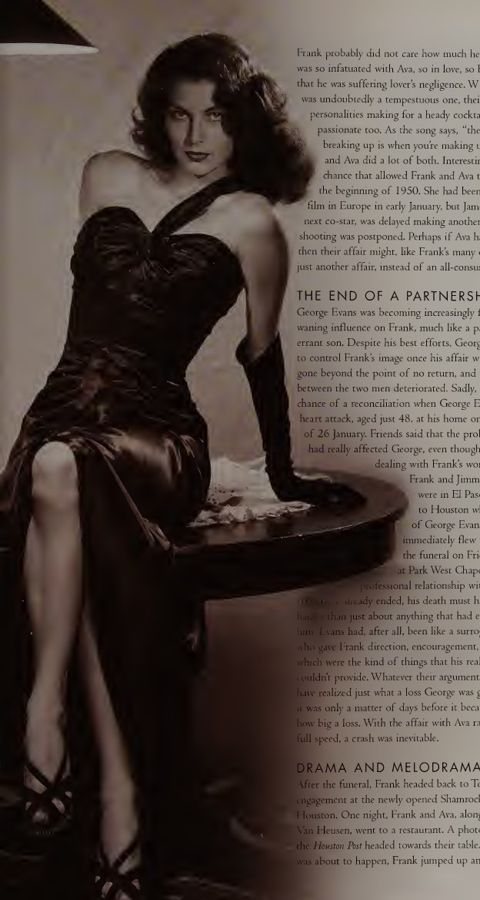
Ava Lavinia Gardner — who would become Frank Sinatra's second wife in 1951 — was born in Grabtown, near Smithfield, North Carolina, the youngest of seven children of a tobacco farmer. Source: Kitty Kelley, "His Way: An Unauthorized Biography of Frank Sinatra" (1986).
1923
[Family Vacation at Echo Farms]
The Sinatra family vacationed at an old-fashioned boardinghouse called Echo Farms in the Catskills; Frank later joked that the hiking clothes his mother bought him for the trip put him off walking for life.
Source: Nancy Sinatra, "Frank Sinatra, My Father" (1985).
[Peter Lawford's background and career]
Peter Lawford was born in England in 1923, the son of Sir Sydney and Lady Lawford, and started as a child actor at age seven in Poor Old Bill. He moved to the US before World War II, became an MGM contract player in 1942, and appeared in around 50 films over his career, though he is remembered more for his off-screen life than his acting.
Source: Richard Havers, "Sinatra" (Dorling Kindersley, 2007).
1924
[Cousin Fred Treddy, the Family's First Entertainer]
When Frank was about nine, his older cousin Fred Treddy led his own small group playing banjo and singing, making him the first professional entertainer in the family; young Frank went to watch him perform. Fred later died of tuberculosis at twenty-eight.
Source: Nancy Sinatra, "Frank Sinatra, My Father" (1985).
[First Communion]
Kaplan: A photo caption documents Frank Sinatra's First Communion in 1924.
Source: James Kaplan, "Frank: The Voice" (2010)
[Louis B Mayer co-founds MGM]
Sidebar note: Louis B Mayer, born in Minsk and once a scrap merchant, worked his way up through cinema management and film distribution before forming Metro-Goldwyn-Mayer with Sam Goldwyn, becoming one of Hollywood's most powerful moguls by the time he signed Frank in 1944.
Source: Richard Havers, "Sinatra" (Dorling Kindersley, 2007).
December 8, 1925
Sammy Davis Jr was born in Harlem, New York City. Havers notes he possessed an extraordinary range of talents, able to sing, dance, act, and do impressions, and was also naturally funny. (Source: Richard Havers, "Sinatra" (Dorling Kindersley, 2007).)
1926
[Neighborhood Kids Nickname Frank "Scarface"]
Nancy Sinatra: The scars left on Frank's face from his difficult forceps birth led neighborhood kids to nickname him "Scarface," and getting home safely from school sometimes meant risking a beating for wandering into the wrong turf, since gangs guarded their territory just as they do today.
Source: Nancy Sinatra, Frank Sinatra: An American Legend, 1995.
[Consiglio works at uncle's restaurant]
Consiglio: Consiglio and his brother Sally worked evenings at their uncle Pepe's restaurant on Wooster Street in New Haven from 1926 until 1935, helping support their large family during the Depression after their uncle switched from baking to making pizza.
Source: Tony Consiglio (as told to Franz Douskey), "Sinatra and Me: The Very Good Years" (2012)
[Marty gets Hoboken Fire Department job]
Kaplan: Using her Democratic Party political connections in Hoboken's Third Ward, Dolly Sinatra got Vincent Mazzola a job on the docks and secured her illiterate husband Marty a coveted, well-paying spot in the Hoboken Fire Department, despite the department's written test requirement -- clearing the way for the family to leave Little Italy.
Source: James Kaplan, "Frank: The Voice" (2010)
[NBC and CBS founded]
Kaplan: The linking of local radio transmitters by telephone lines led to the formation of the first two broadcast networks, NBC and CBS, in 1926 and 1927 -- the same period young Frank Sinatra became an avid radio listener, drawn especially to opera singers, jazz orchestras, and the new breed of intimate 'crooners' like Bing Crosby.
Source: James Kaplan, "Frank: The Voice" (2010)
[Photo, Sinatra and Dolly in Catskills]
Kaplan: A photo caption places Frank and Dolly Sinatra on a trip to the Catskills around 1926, accompanying Sinatra's later recollection to Shirley MacLaine that his mother 'scared the shit' out of him and he never knew what would set her off.
Source: James Kaplan, "Frank: The Voice" (2010)
[Vincent 'Chit-U' Mazzola moves in]
Kaplan: According to a family friend, Marty's cousin Vincent Mazzola (nicknamed 'Chit-U'), a small, likely shell-shocked World War I veteran with a limp, moved into the Sinatras' Monroe Street flat around 1926 -- contradicting Tina Sinatra's memoir account that places his arrival in the late 1930s. His arrival coincided with Marty being unable to box (broken wrists) and losing his boilermaker job to asthma, leaving Dolly to support the family through midwifery, abortion fees, and a candy-store job.
Source: James Kaplan, "Frank: The Voice" (2010)
[Marty's boxing career reportedly ends]
One source cited by Havers claims Marty kept prizefighting, under the ring name Marty O'Brien, until a broken wrist forced his retirement in 1926. Havers notes this is questionable given Marty was asthmatic and would have been fighting into his mid-30s.
Source: Richard Havers, "Sinatra" (Dorling Kindersley, 2007).
August 1, 1926
Marty Sinatra was appointed to the Hoboken Fire Department, joining its predominantly Irish workforce on a salary of $2,000 a year plus a pension -- a job Dolly had secured for him through her political connections at city hall. Source: Michael Sheridan & David Harvey, Sinatra and the Jack Pack.
1927
[Frank's Earliest Political Memory: Marching For Al Smith At 12]
Nancy Sinatra: Defending entertainers' right to campaign for candidates, Sinatra recalled that he had been campaigning for Democrats ever since marching in a parade for presidential candidate Al Smith as a twelve-year-old boy.
Source: Nancy Sinatra, Frank Sinatra: An American Legend, 1995.
['Scarface' schoolyard humiliation]
Frank Sinatra (via Nancy Sinatra): Sinatra later told his daughter Nancy that around age eleven, after playmates began taunting him as 'Scarface' because of his birth-scarred face and ear, he went to confront the doctor who had delivered him, intending to beat him up, but the doctor wasn't home.
Source: James Kaplan, "Frank: The Voice" (2010)
[Marty joins the Hoboken Fire Department]
In summer 1927 Marty began working for the Hoboken Fire Department, a job Dolly's political connections likely secured, later helping him rise to captain -- an unusual feat for an Italian in an Irish-dominated department. Around the same time the family moved from the Monroe Street tenement to a three-bedroom apartment on Park Avenue, about ten blocks away but a step up socially.
Source: Richard Havers, "Sinatra" (Dorling Kindersley, 2007).
March 10, 1927
Barbara Blakeley -- the future Barbara Marx Sinatra, Frank Sinatra's fourth and final wife -- was born. A model and showgirl, she was first married to Robert Harrison Oliver before her 1959-1973 marriage to Herbert "Zeppo" Marx, the youngest of the Marx Brothers. Source: Frank Sinatra Wiki (fandom.com), citing Nancy Sinatra, Frank Sinatra: An American Legend.
September 1927
[Family moves to Park Avenue]
Kaplan: In September 1927 the Sinatra family relocated from Monroe Street to a three-bedroom apartment at $65 a month on Park Avenue, a German-Irish neighborhood in Hoboken, crossing what Kaplan calls the 'super-significant border' out of Little Italy. Eleven-year-old Frankie got his own bedroom and his own Atwater Kent radio.
Source: James Kaplan, "Frank: The Voice" (2010)
1928
Frank Sinatra enrolled at David E. Rue Junior High School in Hoboken. As a boy he was teased over facial scarring left by his difficult birth and over his Italian heritage, and biographer J. Randy Taraborrelli describes him getting into frequent neighborhood fights defending himself — though people who knew the family pushed back on any notion that his childhood was especially poor or unhappy; the Sinatras were comparatively well-off for Little Italy. Source: J. Randy Taraborrelli, Sinatra: Behind the Legend.
[Starts High School]
Frank began attending David E. Rue, Jr. High School.
Source: Nancy Sinatra, "Frank Sinatra, My Father" (1985).
[Sammy Davis Jr. begins performing]
Kaplan: Sammy Davis Jr. began performing on stage at age three in 1928, when his father Sammy Davis Sr. and vaudeville partner Will Mastin put him in their act.
Source: James Kaplan, "Frank: The Voice" (2010)
[The Dorsey Brothers Orchestra founded]
After playing in various early bands together, Tommy and Jimmy Dorsey founded the Dorsey Brothers Orchestra in 1928, scoring their first minor hit with 'Coquette' that June.
Source: Richard Havers, "Sinatra" (Dorling Kindersley, 2007).
Summer 1929
During a family summer vacation to the Catskill Mountains in Cairo, New York, thirteen-year-old Frank Sinatra reportedly threw a prolonged tantrum after his parents left him and a neighbor's daughter, Kathryn Buhan, alone at the boardinghouse for a day trip, locking himself in the bathroom and screaming until they returned. Buhan recalled Frank as “kind of a mama's boy” in photographs from the trip, in which he was shown holding a doll. Source: Kitty Kelley, "His Way: An Unauthorized Biography of Frank Sinatra" (1986).
[Young Frank sees Bing Crosby at Loew's Theatre]
At Jersey City's newly opened Loew's Theatre, a lavish 3,100-seat venue, teenage Frank watched his idol Bing Crosby perform. Recalling the moment decades later in 1958, Frank said watching Crosby's easy style made him think, essentially, that if Crosby could make it look that easy, he'd give singing a try himself.
Source: Richard Havers, "Sinatra" (Dorling Kindersley, 2007).
1930
The Sinatra family moved to a larger house at 703 Park Avenue in Hoboken, and Frank enrolled at A. J. Demarest High School. Around this time the fifteen-year-old became captivated by radio and by singers like Bing Crosby and Russ Columbo, and joined his school's glee club — an early sign of the singing ambitions that would soon put him at odds with parents who wanted him to finish school or attend college. Source: J. Randy Taraborrelli, Sinatra: Behind the Legend.
Alternate account: Sheridan and Harvey date the Sinatra family's move to 703 Park Avenue to September 1927, crediting it to Marty's appointment to the Hoboken Fire Department the previous year (August 1, 1926, salary $2,000 plus pension), and place Frank's brief attendance at A. J. Demarest High School after his June 1931 graduation from junior high school rather than in 1930. Source: Michael Sheridan & David Harvey, Sinatra and the Jack Pack.
[Young Frank Sneaks Into Trader Horn]
Watching an old jungle-adventure film with Tina during his convalescence, Frank recognized it as Trader Horn, recalling that it had been considered risque when he was a teenager and that he had snuck in to see it with friends.
Source: Tina Sinatra, "My Father's Daughter: A Memoir" (2000).
[Barbara Marx's background before meeting Frank]
Barbara was born in Missouri, later moving to California, where she won several beauty contests, married and had a son in 1951, and by 1959 had married Zeppo Marx, giving her entry into elite Los Angeles and Palm Springs social circles.
Source: Richard Havers, "Sinatra" (Dorling Kindersley, 2007).
[Haymes family returns to New York during the Depression]
After Dick Haymes's parents separated and his mother had raised him in Paris running a dress shop, the Depression forced the family back to New York in 1930, where his mother became a vocal coach.
Source: Richard Havers, "Sinatra" (Dorling Kindersley, 2007).
June 12, 1928
[Photograph: Vic Damone born Vito Farinola in Brooklyn. From Richard Havers, "Sinatra" (Dorling Kindersley, 2007), p.130.]
[Photograph: Vic Damone born Vito Farinola in Brooklyn. From Richard Havers, "Sinatra" (Dorling Kindersley, 2007), p.130.]
Vic Damone was born Vito Farinola in Brooklyn. He shared Italian ancestry with Sinatra, and his own version of 'I Have But One Heart' actually outperformed Frank's on the charts. (Source: Richard Havers, "Sinatra" (Dorling Kindersley, 2007).)
1931
[A Year Of Playing Hooky Before Expulsion]
Nancy Sinatra: According to cousin John Tredy, teenage Frank once skipped school for an entire year before his mother found out. He and his rowdy crowd were eventually expelled, and Frank left Demarest High School for good in his senior year, completing only a short stint at a business school to satisfy the state's minimum education requirement.
Source: Nancy Sinatra, Frank Sinatra: An American Legend, 1995.
[Marty's Ultimatum: Regular Job Or Bum]
Nancy Sinatra: When Frank announced he wanted to try his luck as a singer instead of going to college, his father Marty, who could barely read or write, bluntly asked whether he wanted a regular job or wanted to be a bum, and said it was fine to leave school as long as he found real work.
Source: Nancy Sinatra, Frank Sinatra: An American Legend, 1995.
[Transfers to Demarest High School]
Frank moved on to A. J. Demarest High School, where he held various part-time jobs.
Source: Nancy Sinatra, "Frank Sinatra, My Father" (1985).
[Drops out of Demarest High]
Kaplan: That fall, not yet sixteen, Sinatra enrolled at A. J. Demarest High School but left after only forty-seven days, either dropping out or (by his own later, self-mythologizing account) being expelled for 'general rowdiness.' Accounts differ on whether Dolly, who had hoped he'd become a doctor or engineer, was furious or unbothered.
Source: James Kaplan, "Frank: The Voice" (2010)
[Gambling legalized in Nevada]
Kaplan: Gambling had only been legal in Nevada since 1931, which made Mob figures in Las Vegas careful to keep a low profile and avoid the kind of violence that could prompt a legislative crackdown.
Source: James Kaplan, "Sinatra: The Chairman" (2015)
[Frank enrolls at, and is effectively expelled from, Demarest High]
Frank started at A.J. Demarest High School in 1931 but reportedly attended for only 47 days, suggesting he was expelled -- something his parents may not have learned about for a year. He spent much of his time impersonating radio singers rather than studying.
Source: Richard Havers, "Sinatra" (Dorling Kindersley, 2007).
[microphone/engineering -- critical commentary]
RCA introduced the first permanent-magnet bidirectional ribbon microphone, the RCA 44, in 1931; it and its improved successor, the 44B/BX, became the classic diamond-shaped mic closely associated with Sinatra's radio and recording work throughout the 1940s, prized for warm, well-defined vocal reproduction.
Source: Charles L. Granata, "Sessions with Sinatra: Frank Sinatra and the Art of Recording" (1999/2003), Part I: The Big Band Years, 1937-1942
January 28, 1931
Despite reportedly skipping much of his schooling, Frank's junior-high diploma was formally issued under the name Francis Albert Sinatra in January 1931. (Source: Richard Havers, "Sinatra" (Dorling Kindersley, 2007).)
June 1931
[Graduates junior high, gets a car]
Kaplan: Frank Sinatra graduated from Hoboken's David E. Rue Junior High School in June 1931; around the same time, his mother bought him a used Chrysler convertible for $35, reportedly to boost his popularity.
Source: James Kaplan, "Frank: The Voice" (2010)
December 1931
[Family moves to 841 Garden Street]
Kaplan: In December 1931, as the Depression deepened, the Sinatra family (with Uncle Vincent in tow) moved to a four-story house at 841 Garden Street, Hoboken, complete with central heating, a baby grand piano, and a French telephone in the master bedroom -- a mortgage of over $13,000 that Dolly financed partly by taking in boarders.
Source: James Kaplan, "Frank: The Voice" (2010)
December 31, 1931
[Jersey Observer society-page item]
A Jersey Observer society column reported a New Year's Eve party at the Sinatra home on 'upper Garden Street' honoring their son Frank, noting that vocal selections by two young women were 'accompanied by Frank Sinatra' -- an item Kaplan reads as Dolly showcasing her son's musical involvement, even though he was still an unemployed dropout at the time.
Source: James Kaplan, "Frank: The Voice" (2010).
1932
Frank Sinatra took a series of manual-labor jobs to placate his father, Marty, who was furious that his son had dropped out of high school without a diploma — first at the Tietjen and Lang shipyards, then unloading book crates in New York for Lyons and Carnahan, then in the refrigeration units of United Fruit Lines cargo ships. He quit each in turn, briefly moved to New York City alone to look for singing work, found none, and returned to Hoboken. That same year, his parents — helped by the proceeds of Dolly's Prohibition-era bar — bought a three-story house at 841 Garden Street in Hoboken for $13,400. Source: J. Randy Taraborrelli, Sinatra: Behind the Legend.
Alternate account: Sheridan and Harvey date the purchase of the house at 841 Garden Street, also for $13,400, to "the end of 1931" rather than 1932, around the same time Dolly bought a Lincoln convertible. Source: Michael Sheridan & David Harvey, Sinatra and the Jack Pack.
[A Rivet Nearly Hits Frank On His First Shipyard Job]
Nancy Sinatra: An uncle got young Frank work catching red-hot rivets at a New Jersey shipyard. After three days a rivet swung wide and narrowly missed his shoulder, singeing him as it flew past, and the fright revealed an acrophobia he hadn't known he had; he quit soon after.
Source: Nancy Sinatra, Frank Sinatra: An American Legend, 1995.
[A Racist Foreman Gets Knocked Into The River]
Nancy Sinatra: While young Frank worked a cold winter shift unloading ships, dockworkers would sneak off for hot coffee to warm up. When a foreman with a Southern accent used an ethnic slur against them after catching them, another man on the job punched the foreman into the river on the spot.
Source: Nancy Sinatra, Frank Sinatra: An American Legend, 1995.
[Delivers the Jersey Observer]
For eleven dollars a week, teenage Frank delivered the Jersey Observer, a paper where his godfather Frank Garrick worked as circulation manager; a disagreement over authority, apparently, soon ended the job.
Source: Nancy Sinatra, "Frank Sinatra, My Father" (1985).
[Frank's Rhinestone-Studded Sound System]
Nancy Sinatra: To gain an edge over rival vocalists competing for one-night band gigs, Frank borrowed $65 from his parents to buy a portable sound system housed in a rhinestone-studded case, along with sheet music arrangements, and used it to book himself into nightclubs, roadhouses and local political events.
Source: Nancy Sinatra, Frank Sinatra: An American Legend, 1995.
[Thrown Out Of The House]
Nancy Sinatra: After quitting yet another manual-labor job, Frank was thrown out of the family home by his exasperated father and forced to take a room in New York on his own. Discouraged by his inability to find steady work there, he soon returned home.
Source: Nancy Sinatra, Frank Sinatra: An American Legend, 1995.
[Frank Garrick sportswriter incident]
Kaplan: After a cub sportswriter at the Jersey Observer died in a car wreck, Dolly pushed her son to claim the vacant job; Frankie sat at the dead reporter's desk pretending to be a sportswriter until the editor investigated. Godfather Frank Garrick, who had not actually authorized this, had to let him go, and the teenage Sinatra erupted in a profanity-laced tirade against him. Both Garrick and his widow later corroborated the incident.
Source: James Kaplan, "Frank: The Voice" (2010)
[Job bundling newspapers at Jersey Observer]
Kaplan: After Frankie dropped out of high school, Dolly marched to the offices of the Jersey Observer and pressured his godfather, circulation manager Frank Garrick, into giving her son a job bundling newspapers on a delivery truck.
Source: James Kaplan, "Frank: The Voice" (2010)
[Brief stint at Drake Business School, then the shipyard]
After leaving Demarest, Frank enrolled at Drake Business School in Hoboken for a single term before dropping out to look for work. One of Dolly's brothers got him a dangerous job at Tietjen and Lang's shipyard catching red-hot rivets over a four-story shaft; Frank quit on the third day after a rivet grazed his shoulder "like a bullet."
Source: Richard Havers, "Sinatra" (Dorling Kindersley, 2007).
[Frank thrown out of the house; starts singing for tips]
Frustrated by his son's lack of steady work, Marty threw the 16-year-old Frank out of the house. By late 1932 Frank had begun singing with small combo bands in Hoboken bars, using a megaphone in imitation of Rudy Vallee while patrons tossed pennies at him -- earning little money but valuable experience.
Source: Richard Havers, "Sinatra" (Dorling Kindersley, 2007).
1933
[Consiglio's schooling ends]
Consiglio: Consiglio attended Columbus Grammar School in New Haven until 1933, then went to Hillhouse High School for one year before dropping out.
Source: Tony Consiglio (as told to Franz Douskey), "Sinatra and Me: The Very Good Years" (2012)
[Dick Haymes heads for Hollywood]
After leaving military academy in 1933, Dick Haymes moved to Hollywood, forming his own musical group and working as an extra and stunt man for MGM.
Source: Richard Havers, "Sinatra" (Dorling Kindersley, 2007).
Summer 1934
Eighteen-year-old Frank Sinatra met seventeen-year-old Nancy Carol Barbato while both were spending the summer in Long Branch, New Jersey, on the Jersey Shore. Their courtship continued long-distance between Hoboken and Nancy's home in Jersey City over the next several years. Source: J. Randy Taraborrelli, Sinatra: Behind the Legend.
[Nancy Sr. On A Summer Fling That Didn't End]
Nancy Sinatra: Nancy Sr. recalled that their courtship began as what she assumed would be a passing summer romance, expected to end when everyone went back to school after Labor Day. Since Hoboken was only a few miles from Jersey City, Frank kept taking the bus to see her, and when he was low on cash she'd give him the fare herself.
Source: Nancy Sinatra, Frank Sinatra: An American Legend, 1995.
[Buys first sound system]
Kaplan: In 1934, with $65 either borrowed from or given by Dolly (a substantial sum during the Depression), Sinatra bought his first sound system -- a microphone wired to a small vacuum-tube amplifier and speaker -- which Kaplan describes as the moment the mike became literally 'his instrument,' amplifying his thin voice and beginning his transformation into a magnetic performer for young women in particular.
Source: James Kaplan, "Frank: The Voice" (2010)
[Consiglio meets WOR broadcaster]
Consiglio: In 1934, while working at his uncle's restaurant, Consiglio met WOR radio newscaster Floyd Neal, who invited him to New York to see the radio station; the two became friends.
Source: Tony Consiglio (as told to Franz Douskey), "Sinatra and Me: The Very Good Years" (2012)
[Meets Nancy Barbato]
Kaplan: During the summer of 1934 (his 'nineteenth summer'), Sinatra, vacationing with relatives at Long Branch, New Jersey, met seventeen-year-old Nancy Rose Barbato, who was staying across the street; he serenaded her on ukulele and the two began a courtship, with Sinatra reportedly confiding to her his dream of becoming a singer.
Source: James Kaplan, "Frank: The Voice" (2010)
[Frank works as a plasterer for Nancy's father]
Under pressure from both fathers to hold a job while courting Nancy, Frank went to work for her father Mike Barbato, a plastering contractor. His heart wasn't in it, and late nights from his singing gigs left him falling asleep on the job.
Source: Richard Havers, "Sinatra" (Dorling Kindersley, 2007).
[Major Bowes' Amateur Hour debuts on New York radio]
The talent show that would launch Sinatra's career, Major Bowes' Original Amateur Hour, first went out on New York station WHN in 1934, a year before it was picked up nationally by the NBC Red Network.
Source: Richard Havers, "Sinatra" (Dorling Kindersley, 2007).
April 1934
[Melody Maker predicts the rise of the crooner]
In an April 1934 Melody Maker piece titled 'Mike Singing of the Future,' writer Kenneth Wynne argued bandleaders were increasingly seeking a straight singer who could soften into crooning, naming Bing Crosby the best example of the style -- a trend Frank would soon ride to fame himself.
Source: Richard Havers, "Sinatra" (Dorling Kindersley, 2007).
September 1934
['No work, no Nancy' ultimatum]
Kaplan: Back in New Jersey that September, Nancy Barbato's father, plastering contractor Mike Barbato, told Frankie that continuing to see Nancy required holding a steady job. Sinatra briefly worked as a plasterer's assistant on a Jersey City repair job alongside Nancy's brother Bart, but after about two weeks he began oversleeping and quit -- the last conventional day job he ever held.
Source: James Kaplan, "Frank: The Voice" (2010)
September 2, 1934
[Photograph: Rival crooner Russ Columbo dies in a freak accident. From Richard Havers, "Sinatra" (Dorling Kindersley, 2007), p.33.]
[Photograph: Rival crooner Russ Columbo dies in a freak accident. From Richard Havers, "Sinatra" (Dorling Kindersley, 2007), p.32.]
Russ Columbo, a fellow son of Italian immigrants and one of the era's top crooners alongside Crosby and Vallee, died at 26 when a bullet ricocheted off a desk after a friend struck a match on what he believed was an unloaded antique pistol. Thousands attended his funeral, with Bing Crosby serving as a pallbearer; rumors of murder or suicide persisted for years. (Source: Richard Havers, "Sinatra" (Dorling Kindersley, 2007).)
December 13, 1934
A Capitol Studio photograph shows Sinatra alongside Hank Sanicola, Ray Anthony, Lee Gillette, and Alan Livingston; the caption's year appears to be a misprint for 1954, matching the Ray Anthony session recorded the day after Sinatra's birthday. (Source: Richard Havers, "Sinatra" (Dorling Kindersley, 2007).)
April 1935
[First radio slot on WAAT]
Kaplan: In April 1935, after repeatedly showing up at Jersey City radio station WAAT, Sinatra was granted an unpaid weekly fifteen-minute broadcast slot, performing with guitarist Matty Golizio (who would later play on Sinatra's Columbia recording sessions).
Source: James Kaplan, "Frank: The Voice" (2010)
April 9, 1935
The Three Flashes -- Frank Sinatra, Fred Tamburro, Patty Principe, and Jimmy Petrozelli, performing at the Rustic Cabin in Englewood Cliffs -- auditioned for Edward "Major" Bowes's Original Amateur Hour. The application listed the act as "Frank Sinatra and the Three Flashes," with addresses given for each member (Sinatra's own listed as 841 Garden Street, Hoboken). Bowes later renamed the group the Hoboken Four ahead of their September 8 broadcast. Source: Michael Sheridan & David Harvey, Sinatra and the Jack Pack.
August 31, 1935
Now billed as the Hoboken Four, the group (possibly named by Bowes himself) auditioned by singing 'The Curse of an Aching Heart,' an odd choice dating back to 1913. The audition succeeded, and for the actual broadcast from New York's Capitol Theatre they performed the more current hit 'Shine'; Bowes introduced them as "singing and dancing fools" to an enthusiastic audience. (Source: Richard Havers, "Sinatra" (Dorling Kindersley, 2007).)
September 1935
[Frank performs on Major Bowes Amateur Hour]
Consiglio: Frank appeared on Major Bowes' Original Amateur Hour radio show in September 1935 with his Hoboken group the Three Flashes; Frank ended up joining as lead singer, the group renamed itself the Hoboken Four, and they won, later touring with a Major Bowes company under various stage names.
Source: Tony Consiglio (as told to Franz Douskey), "Sinatra and Me: The Very Good Years" (2012)
[Joins Major Bowes touring unit]
Kaplan: About one week after their radio win, the Hoboken Four joined the Major Bowes Number Five touring unit, a vaudeville-style troupe of novelty acts crisscrossing the country by bus and train for $50 a week apiece, room and board included.
Source: James Kaplan, "Frank: The Voice" (2010)
September 8, 1935
Radio
Major Edward Bowes & The Original Amateur Hour
Sponsor: Chase & Sanborn Hour
Location: Capitol Theater, 51st & Broadway, New York City
Sunday Evening
NBC Radio
8-9 PM EDT
Announcer: Graham McNamee
The Hoboken Four sang “Shine”
Ed O'Brien
At approximately 8:45 on September 8, 1935, Major Bowes introduced the Hoboken Four to a nationwide audience. Bowes show was one of the most popular in the history of commercial radio. An audience of millions sat listening in their living rooms on that Sunday evening 80 years ago. The four members of the group were Fred Tamburro, James "Skelly" Petrozelli, Pat Principe and Frank Sinatra. Frank had filled out the application for the show. "Frank Sinatra and The Three Flashes" was the name of his group. Major Bowes didn't like it. Hoboken Four was a very quick substitute. Bowes asked who spoke for the group and Frank froze. Nothing came out. Fred Tamburro, known as Tamby, stepped forward.
After the Major announced the group billed themselves as the "Singing and Dancing Fools," he asked where they worked in Hoboken. Tamby told him where Patty and Jim had worked. Then, in front of the Capitol Theater audience, Tamby looked at Frank and said, "This fellow here never worked at all." Bowes asked Tamby what they were going to do. Tamby told him they were going to sing "Shine"( Crosby's hit with The Mills Brothers in 1932), and then they were going to dance. Despite some formidable competition that evening, including a few operatic numbers, other singing groups and some fine solo musicians, the Hoboken Four won the amateur contest.
Scott: Wow, 90 years ago today!
Note: For many years the interview with the Hoboken Four always had Frank answering the Major's questions. That con- versation was actually part of the show from 12-3-36.
Frank was then with the "Swingsters." I guess this fudging made the 9-8-35 more interesting to Sinatra fans.
--Ed
Major Edward Bowes & The Original Amateur Hour complete list of performers in their order of appearance
Frank Sinatra Auditions
In 1935, the first year of radio network broadcasts of Major Bowes’ Amateur Hour, more than thirty thousand acts auditioned for the talent contest program. One of the successful acts was the “Hoboken Four.” The vocal quartet auditioned as “Frank Sinatra and the 3 Flashes,” but was renamed, purportedly by Major Bowes himself. The act won the competition of the September 8, 1935, broadcast and joined one of Major Bowes’s traveling vaudeville units. Sinatra soon left the tour to strike out on his own.
In researching the Hoboken Four when they were touring with the Major Bowes group, I came across this on a sports auction site:
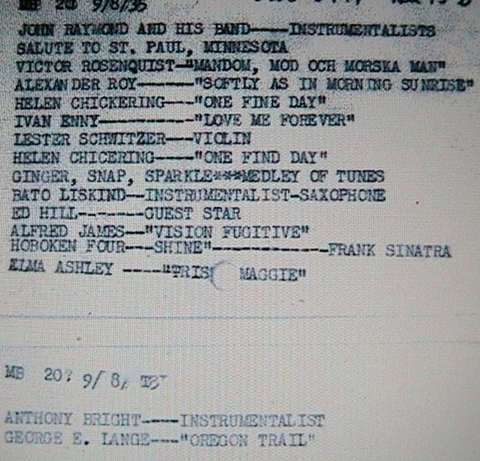
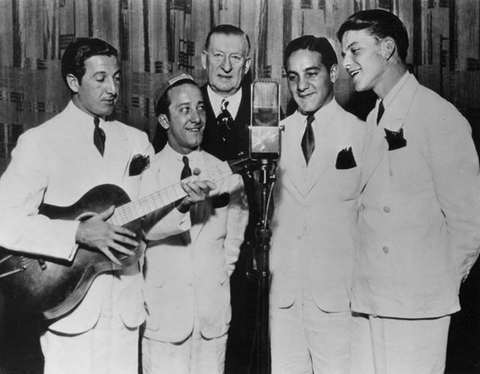
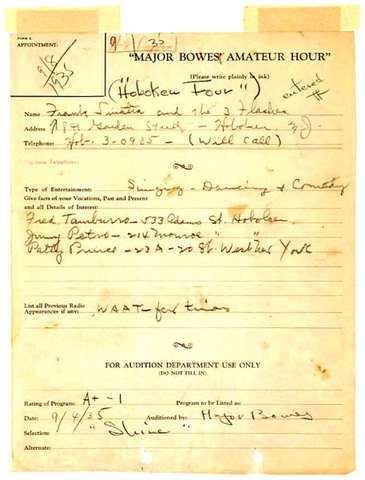
Frank Sinatra "Hoboken Four" Setlist from Major Bowes Amateur Hour - "American Treasures" Library of Congress His earliest known recording was form this. One of his earliest performance and perhaps his first time on radio. The mate to this is in the LOC and is considered among the "American Treasures of the Library of Congress"major bowes amateur hour predated American idol (fans voted in their favorites) Below taken from Library of Congress which has his application In 1935, the first year of radio network broadcasts of Major Bowes' Amateur Hour, more than thirty thousand acts auditioned for the talent contest program. One of the successful acts was the "Hoboken Four." The vocal quartet auditioned as "Frank Sinatra and the 3 Flashes," but was renamed, purportedly by Major Bowes himself. The act won the competition of the September 8, 1935, broadcast and joined one of Major Bowes's traveling vaudeville units. Sinatra soon left the tour to strike out on his own. Ed O'Brien
At approximately 8:45 on September 8, 1935, Major Bowes introduced the Hoboken Four to a nationwide audience. Bowes show was one of the most popular in the history of commercial radio. An audience of millions sat listening in their living rooms on that Sunday evening 80 years ago.The four members of the group were Fred Tamburro, James "Skelly" Petrozelli, Pat Principe and Frank Sinatra. Frank had filled out the application for the show. "Frank Sinatra and The Three Flashes" was the name of his group. Major Bowes didn't like it. Hoboken Four was a very quick substitute. Bowes asked who spoke for the group and Frank froze. Nothing came out. Fred Tamburro, known as Tamby, stepped forward.
After the Major announced the group billed themselves as the "Singing and Dancing Fools," he asked where they worked in Hoboken. Tamby told him where Patty and Jim had worked. Then, in front of the Capitol Theater audience, Tamby looked at Frank and said, "This fellow here never worked at all." Bowes asked Tamby what they were going to do. Tamby told him they were going to sing "Shine"( Crosby's hit with The Mills Brothers in 1932), and then they were going to dance. Despite some formidable competition that evening, including a few operatic numbers, other singing groups and some fine solo musicians, the Hoboken Four won the amateur contest.
Biographer J. Randy Taraborrelli notes that the Major Bowes broadcast worked much like a modern televised talent-competition final, with listeners phoning in votes for their favorite acts; the Hoboken Four's rendition of “Shine” drew a strong response. Sinatra went on to tour briefly with one of Bowes's traveling amateur revues before friction over the attention he personally drew from audiences broke up the group by the end of the year. Source: J. Randy Taraborrelli, Sinatra: Behind the Legend.
Sheridan and Harvey add further detail on the Major Bowes competition: the act, originally called the Three Flashes, auditioned on April 9, 1935 and was entered on the application as "Frank Sinatra and the Three Flashes" -- Bowes himself renamed the group the Hoboken Four before broadcast. The group's win drew forty thousand call-in votes, the largest audience response in the show's history to that point, and Bowes signed them to a six-month touring contract. Source: Michael Sheridan & David Harvey, Sinatra and the Jack Pack.
"Shine" / "Curse of an Aching Heart"
Will Friedwald (author), with 1955 quote from Frank Sinatra: Friedwald describes the three surviving Major Bowes items by the Hoboken Four: audio airchecks of a complete 'Shine' and 'Curse of an Aching Heart,' plus a now-lost film of the group performing 'Shine.' The 'Shine' broadcast, aired September 8, 1935, is a spirited but ragged remake of the famous 1932 Bing Crosby-Mills Brothers arrangement of the (even then politically incorrect) song. After roughly ninety seconds of condescending banter from Bowes, introducing Sinatra as a fella who 'never worked at all,' Sinatra can clearly be heard imitating Crosby's phrasing in his solo spots. Friedwald ties this to Sinatra's own 1955 reflection: he 'believed, because of [Crosby's] leisurely manner of working, that if he could do it, I could do it. The funny switch is that I've never been able to do it. It's just a trick that he has, a wonderfully relaxed feeling about performing.' Friedwald's overall verdict: the two Bowes airchecks matter more as the earliest surviving documents of Sinatra's voice than as musical achievements in their own right.
Source: Will Friedwald, "Sinatra! The Song Is You: A Singer's Art" (2018 revised edition).
"Shine" / "Curse of an Aching Heart"
Granata clarifies that the Hoboken Four's surviving performances of "Shine" and "Curse of an Aching Heart" are airchecks of broadcast performances rather than formal studio recordings, distinguishing them from Sinatra's later true recording sessions.
Source: Charles L. Granata, "Sessions with Sinatra: Frank Sinatra and the Art of Recording" (1999/2003).
[Hoboken Four on Major Bowes' Amateur Hour]
On Sunday, September 8, 1935, the newly renamed Hoboken Four (Sinatra plus the former Three Flashes) performed on Major Bowes' nationally broadcast Original Amateur Hour at the Capitol Theater in New York, singing 'Shine.' When Bowes asked bandmate Fred Tamburro to introduce the visibly nervous Sinatra to the audience, Tamburro quipped, 'Oh, he never worked a day in his life' -- Sinatra's first national radio exposure.
Source: James Kaplan, "Frank: The Voice" (2010).
[Hoboken Four wins Major Bowes contest]
The Hoboken Four (Frank Sinatra, Fred Tamburro, Pat Principe, and 'Skelly' Petrozelli) won Major Bowes's Original Amateur Hour, with the radio audience vote confirming the studio applause meter. The win entitled them to join one of Bowes's traveling tour units.
Source: James Kaplan, "Frank: The Voice" (2010).
September 15, 1935
Radio
KRNT/WMT Des Moines, Iowa
Hoboken Four appear as part of Major Bowes tour
Concerts
Shrine Auditorium, Des Moines, Iowa
The Hoboken Four touring with the Major Bowes' Radio Amateurs
KRNT/WMT Des Moines, Iowa
Hoboken Four appear as part of Major Bowes tour
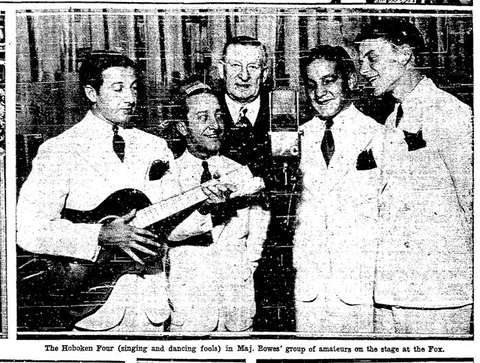
Shrine Auditorium, Des Moines, Iowa
The Hoboken Four touring with the Major Bowes' Radio Amateurs
September 17, 1935
Concerts
Auditorium, Wichita, Kansas
The Hoboken Four touring with the Major Bowes' Radio Amateurs
September 19, 1935
Concerts
Auditorium, Pueblo, Colorado
The Hoboken Four touring with the Major Bowes' Radio Amateurs
September 20, 1935
Concerts
Auditorium, Denver, Colorado (September 20-22)
The Hoboken Four touring with the Major Bowes' Radio Amateurs
Auditorium, Denver, Colorado (September 20-22)
The Hoboken Four touring with the Major Bowes' Radio Amateurs
September 21, 1935
Concerts
Auditorium, Denver, Colorado (September 20-22)
The Hoboken Four touring with the Major Bowes' Radio Amateurs
September 22, 1935
Concerts
Auditorium, Denver, Colorado (September 20-22)
The Hoboken Four touring with the Major Bowes' Radio Amateurs
September 25, 1935
Concerts
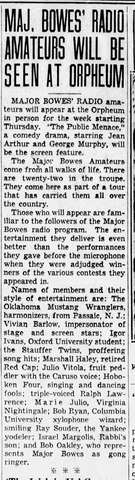
Paramount, Los Angeles, CA (September 25 - October 2)
The Hoboken Four touring with the Major Bowes' Radio Amateurs
Paramount, Los Angeles, CA (September 25 - October 2)
The Hoboken Four touring with the Major Bowes' Radio Amateurs

September 26, 1935
Concerts
Paramount, Los Angeles, CA (September 25 - October 2)
The Hoboken Four touring with the Major Bowes' Radio Amateurs
September 27, 1935
Concerts
Paramount, Los Angeles, CA (September 25 - October 2)
The Hoboken Four touring with the Major Bowes' Radio Amateurs
September 28, 1935
Concerts
Paramount, Los Angeles, CA (September 26 - October 2)
The Hoboken Four touring with the Major Bowes' Radio Amateurs
September 29, 1935
Concerts
Paramount, Los Angeles, CA (September 26 - October 2)
The Hoboken Four touring with the Major Bowes' Radio Amateurs
September 30, 1935
Concerts
Paramount, Los Angeles, CA (September 25 - October 2)
The Hoboken Four touring with the Major Bowes' Radio Amateurs
October 1935
[Major Bowes Amateur Theater of the Air]
Major Bowes Amateur Theater of the Air premiered at Radio City Music Hall in October 1935 and made no impression at all -- an inauspicious start to what would become a storied Hollywood career.
No corresponding dated entry could be identified in the chronology for this film/context.
Source: Tom Santopietro, "Sinatra in Hollywood" (2008), March 25, 1954 / Well Did You Evah / Hoboken
[Major Bowes Amateur Theater of the Air]
Santopietro (Filmography): Biograph Productions, distributed by RKO. Produced and directed by John H. Auer, photographed by Larry Williams and Tommy Hogan. Sinatra appeared in two of the amateur-hour shorts, cast as a waiter in 'The Night Club' and as a blackfaced member of the chorus in 'The Big Minstrel Act.'
No corresponding dated entry could be identified in the chronology for this film/context.
Source: Tom Santopietro, "Sinatra in Hollywood" (2008), Filmography
October 1, 1935
Radio
Home Economics Program
KMTR 11 am, Los Angeles
Host: Marian Manners
Guests: Hoboken Four who were appearing at the Paramount Theatre
Note: Thanks to Fred W for the above listing
Concerts
Paramount, Los Angeles, CA (September 25 - October 2)
The Hoboken Four touring with the Major Bowes' Radio Amateurs
Home Economics Program
KMTR 11 am, Los Angeles
Host: Marian Manners
Guests: Hoboken Four who were appearing at the Paramount Theatre
Note: Thanks to Fred W for the above listing
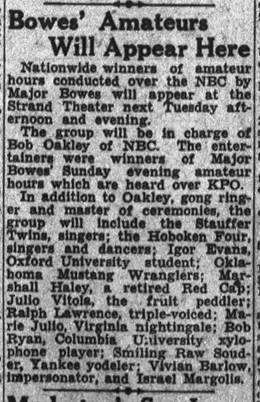
October 2, 1935
Concerts
Paramount, Los Angeles, CA (September 25 - October 2)
The Hoboken Four touring with the Major Bowes' Radio Amateurs
October 3, 1935
Concerts
State, Long Beach, CA (October 3-5)
The Hoboken Four touring with the Major Bowes' Radio Amateurs
State, Long Beach, CA (October 3-5)
The Hoboken Four touring with the Major Bowes' Radio Amateurs
October 4, 1935
Concerts
State, Long Beach, CA (October 3-5)
The Hoboken Four touring with the Major Bowes' Radio Amateurs
October 5, 1935
Concerts
State, Long Beach, CA (October 3-5)
The Hoboken Four touring with the Major Bowes' Radio Amateurs
October 6, 1935
Concerts
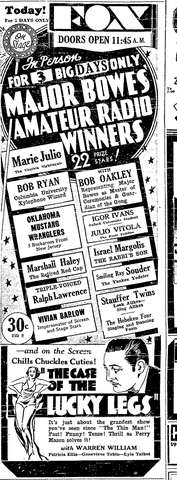
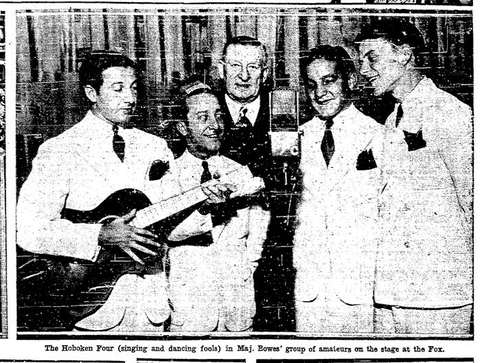
Fox Theatre, San Diego, CA (October 6-8)
The Hoboken Four touring with the Major Bowes' Radio Amateurs
Fox Theatre, San Diego, CA (October 6-8)
The Hoboken Four touring with the Major Bowes' Radio Amateurs
October 7, 1935
Concerts
Fox Theatre, San Diego, CA (October 6-8)
The Hoboken Four touring with the Major Bowes' Radio Amateurs
Fox Theatre, San Diego, CA (October 6-8)
The Hoboken Four touring with the Major Bowes' Radio Amateurs
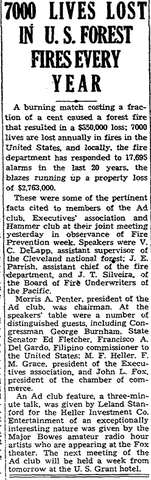
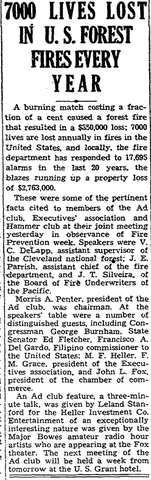
Here’s an extra that occurred October 7, 1935 in San Diego The Major Bowes Amateurs who were in town gave a performance for members of the Ad Club. No mention if the Hoboken Four were among the artists who performed.
October 8, 1935
Concerts
Fox Theatre, San Diego, CA (October 6-8)
The Hoboken Four touring with the Major Bowes' Radio Amateurs
October 9, 1935
Concerts
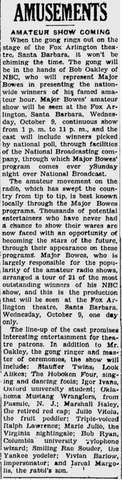
Arlington Theatre, Santa Barbara, CA
The Hoboken Four touring with the Major Bowes' Radio Amateurs
Arlington Theatre, Santa Barbara, CA
The Hoboken Four touring with the Major Bowes' Radio Amateurs
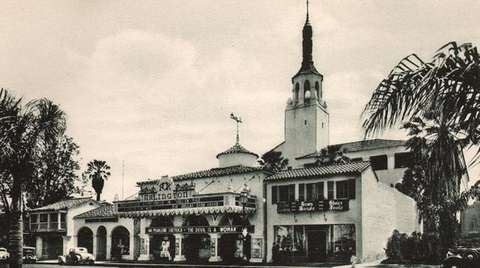
The Arlington Theatre in Santa Barbara 1935:


October 10, 1935
Concerts
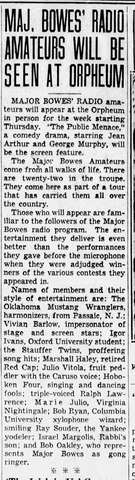
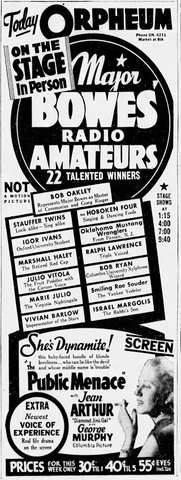
Orpheum Theatre, San Francisco, CA (October 10-16)
The Hoboken Four touring with the Major Bowes' Radio Amateurs
Orpheum Theatre, San Francisco, CA (October 10-16)
The Hoboken Four touring with the Major Bowes' Radio Amateurs
October 11, 1935
Concerts
Orpheum, San Francisco, CA (October 10-16)
The Hoboken Four touring with the Major Bowes' Radio Amateurs
October 12, 1935
Concerts
Orpheum, San Francisco, CA (October 10-16)
The Hoboken Four touring with the Major Bowes' Radio Amateurs
October 13, 1935
Concerts
Orpheum, San Francisco, CA (October 10-16)
The Hoboken Four touring with the Major Bowes' Radio Amateurs
October 14, 1935
Concerts
Orpheum, San Francisco, CA (October 10-16)
The Hoboken Four touring with the Major Bowes' Radio Amateurs
October 15, 1935
Concerts
Orpheum, San Francisco, CA (October 10-16)
The Hoboken Four touring with the Major Bowes' Radio Amateurs
October 16, 1935
Concerts
Orpheum, San Francisco, CA (October 10-16)
The Hoboken Four touring with the Major Bowes' Radio Amateurs
October 17, 1935
Concerts
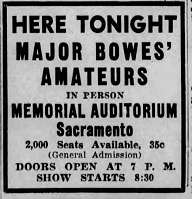
Memorial Auditorium, Sacramento, CA (One Night Only)
The Hoboken Four touring with the Major Bowes' Radio Amateurs
Memorial Auditorium, Sacramento, CA (One Night Only)
The Hoboken Four touring with the Major Bowes' Radio Amateurs
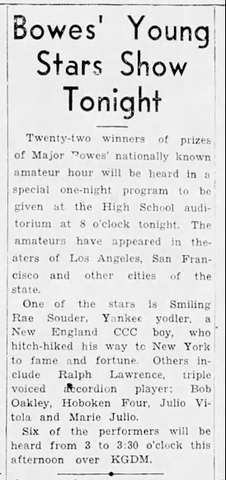
October 18, 1935
Radio
Broadcast - 3pm - 3:30pm (Friday)
Network KGDM (Sacramento)
Six acts from the Major Bowes Radio Amateurs
Concerts
Stockton Highschool Auditorium, Stockton, CA (One Night Only) The Hoboken Four touring with the Major Bowes' Radio Amateurs
Stockton Highschool Auditorium, Stockton, CA (One Night Only) The Hoboken Four touring with the Major Bowes' Radio Amateurs
Broadcast - 3pm - 3:30pm (Friday)
Network KGDM (Sacramento)
Six acts from the Major Bowes Radio Amateurs
October 19, 1935
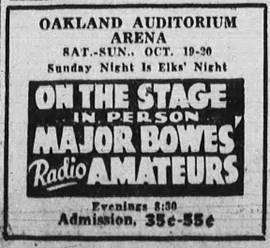
Concerts
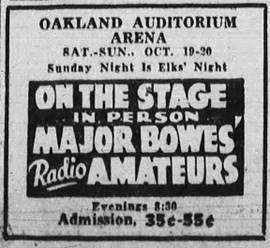
Oakland Auditorium, Oakland, California (October 19-20) Major Bowes' Radio Amateurs
Sinatra performed with the Hoboken Four
Oakland Auditorium, Oakland, California
Major Bowes' Radio Amateurs
Sinatra performed with the Hoboken Four
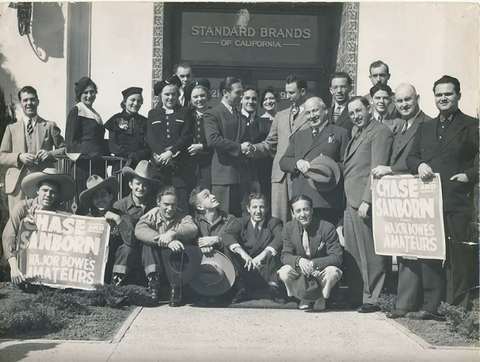
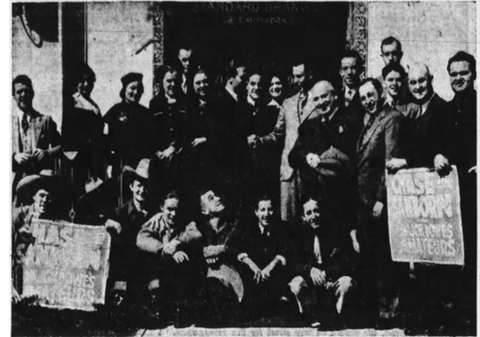
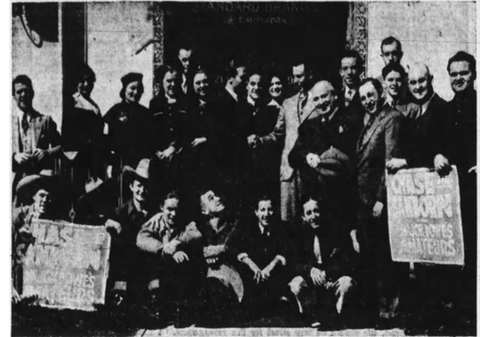
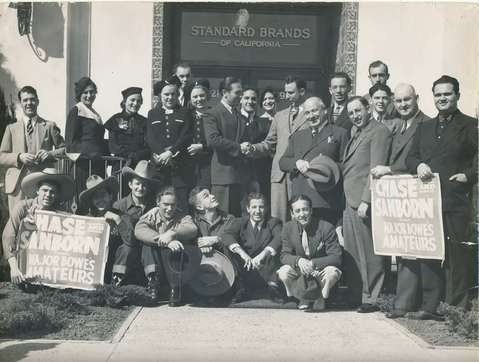
A nice photo - October 19, 1935 - the Major Bowes' Radio Amateurs tour the local Standard Brands factory (owners of Major Bowes' sponsors Chase and Sanborn). The amateurs were said to have "expressed amazement and delight at the modern methods of production which were revealed to them".
The groups itinerary for that day is well documented by the local press. The Vice-Mayor greeted them when they got to town, and then they went to visit the actual Mayor at City Hall, who presented them with the keys to the city. They then went on the factory tour.
They did a show at the Oakland Auditorium arena 8:30pm, and were then featured guests at the California Santa Clara Dance at the Hotel Oakland.
The second show - same time and place on October 20th - was for the benefit of the Alameda Lodge of Elks.
A review excerpt for October 19th reads: "The youngsters approached their chores with a zest which does not always remain with the professional and the audience indicated by its thunderous hand-patting that it was prepared to approve every particular"
Of all the Bowes information I've managed to track down these past couple of weeks, this is the only one with a photo.
--Richard Cook


October 20, 1935
Concerts
Oakland Auditorium, Oakland, California (October 19-20) Major Bowes' Radio Amateurs
Sinatra performed with the Hoboken Four
October 21, 1935
Concerts
Fresno High school Auditorium, Fresno, California (One Night Only) Major Bowes' Radio Amateurs
Sinatra performed with the Hoboken Four
Fresno High school Auditorium, Fresno, California (One Night Only) Major Bowes' Radio Amateurs
Sinatra performed with the Hoboken Four
October 22, 1935
Concerts
Strand Theatre, Modesto, California (One Night Only)
Major Bowes' Radio Amateurs
Sinatra performed with the Hoboken Four
Strand Theatre, Modesto, California (One Night Only)
Major Bowes' Radio Amateurs
Sinatra performed with the Hoboken Four

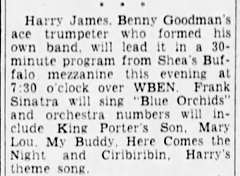
October 23, 1935
Concerts
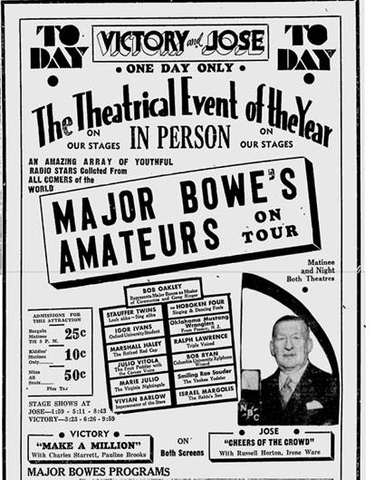
Victory Theatre, San Jose, California (One Night Only)
Major Bowes' Radio Amateurs
Sinatra performed with the Hoboken Four
Victory Theatre, San Jose, California (One Night Only)
Major Bowes' Radio Amateurs
Sinatra performed with the Hoboken Four
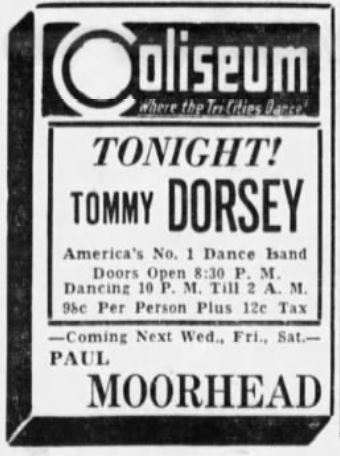
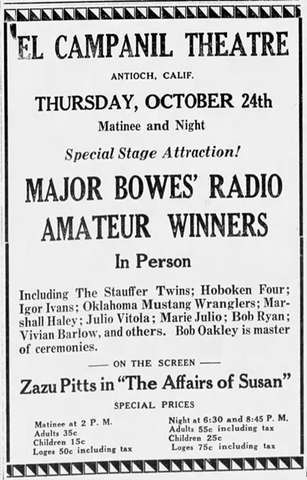
October 24, 1935
Concerts
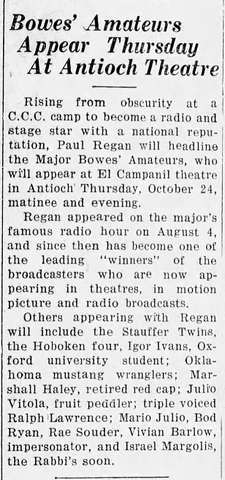
El Campanil Theatree, Antioch, California (One Night Only) Major Bowes' Radio Amateurs
Sinatra performed with the Hoboken Four
El Campanil Theatre, Antioch, California (One Night Only) Major Bowes' Radio Amateurs
Sinatra performed with the Hoboken Four
October 25, 1935
Concerts
McDonald and Rex Theatre, Eugene, Oregon
Major Bowes' Radio Amateurs
Sinatra performed with the Hoboken Four
McDonald and Rex Theatre, Eugene, Oregon
Major Bowes' Radio Amateurs
Sinatra performed with the Hoboken Four
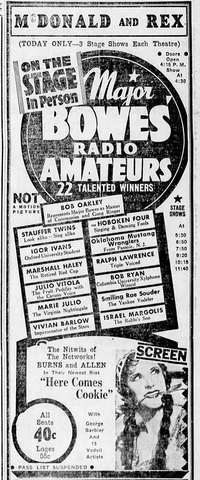
El Campanil Theatre, Antioch, California (One Night Only) Major Bowes' Radio Amateurs
Sinatra performed with the Hoboken Four
October 26, 1935
Concerts
Mayfair Theatre, Portland, Oregon (October 26--November 1) Major Bowes' Radio Amateurs
Sinatra performed with the Hoboken Four
Mayfair Theatre, Portland, Oregon (October 26--November 1) Major Bowes' Radio Amateurs
Sinatra performed with the Hoboken Four
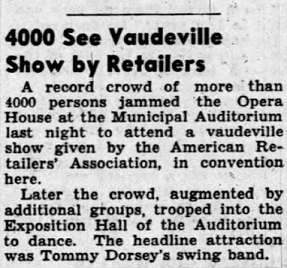
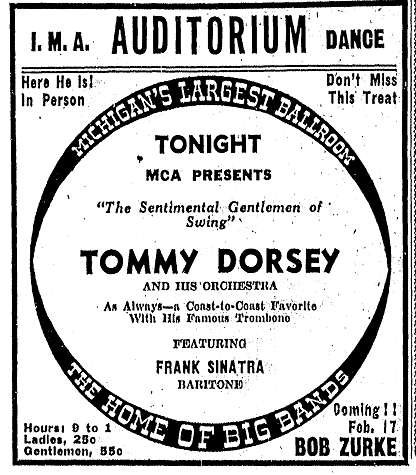
Note, if you can read it, Frank Sinatra gets a mention.
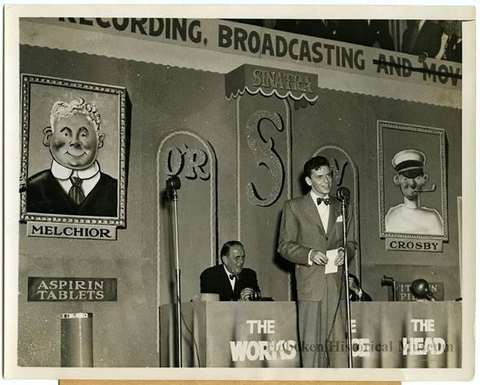
Waldorf Astoria, N.Y.C., Oct. 26, 1944.
Sinatra photo: Frank Sinatra at microphone accepting life membership in "Saints & Sinners" club,
(Thanks to Ed O'Brien for sending this one along)

October 27, 1935
Concerts
Mayfair Theatre, Portland, Oregon (October 26--November 1) Major Bowes' Radio Amateurs
Sinatra performed with the Hoboken Four
October 28, 1935
Concerts
Mayfair Theatre, Portland, Oregon (October 26--November 1) Major Bowes' Radio Amateurs
Sinatra performed with the Hoboken Four
October 29, 1935
Concerts
Mayfair Theatre, Portland, Oregon (October 26--November 1) Major Bowes' Radio Amateurs
Sinatra performed with the Hoboken Four
October 30, 1935
Concerts
Mayfair Theatre, Portland, Oregon (October 26--November 1) Major Bowes' Radio Amateurs
Sinatra performed with the Hoboken Four
October 31, 1935
Concerts
Mayfair Theatre, Portland, Oregon (October 26--November 1) Major Bowes' Radio Amateurs
Sinatra performed with the Hoboken Four
November 1, 1935
Concerts
Mayfair Theatre, Portland, Oregon (October 26--November 1) Major Bowes' Radio Amateurs
Sinatra performed with the Hoboken Four
November 2, 1935
Concerts
Metropolitan Theatre, Seattle, WA (November 2-5)
Major Bowes' Radio Amateurs
Sinatra performed with the Hoboken Four
Note: During his June 9, 1957 concert in Seattle, Sinatra recalls playing Seattle in 1935 with the Major Bowes Radio Amateurs.
Metropolitan Theatre, Seattle, WA (November 2-5)
Major Bowes' Radio Amateurs
Sinatra performed with the Hoboken Four
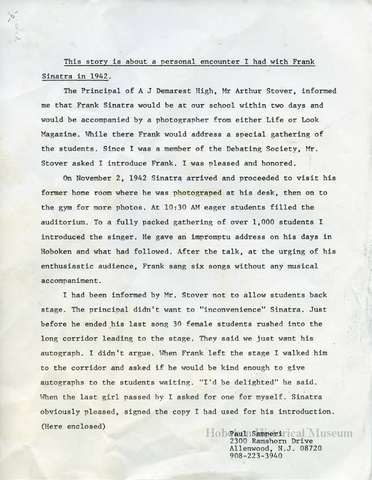
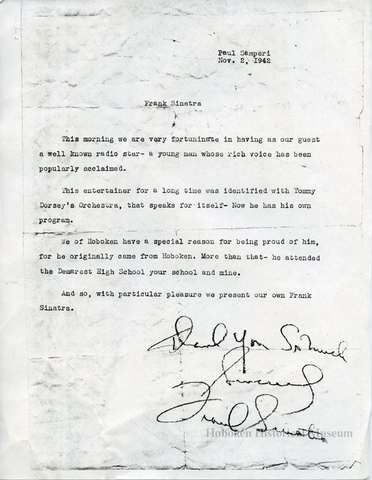
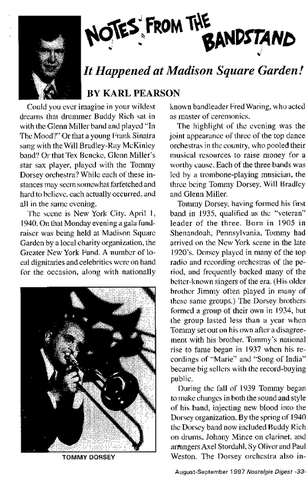
November 2nd, 1942, Demarest High School, Hoboken, NJ
'Everybody for Roosevelt' rally at Madison Square Garden, November 2, 1944
Waiting their turn to meet a large audience at 'Everybody for Roosevelt' rally at Madison Square Garden are Charles Boyer, Secretary Harold Ickes and Frank Sinatra.
November 02, 1944
Carl
Great photo and more interesting documentation on Frank's activities during the last few weeks of Roosevelt's
finally run. Boyer was on Sinatra's 11-1-44 Vimms show. I wonder if Frank persuaded Charles to join him at the rally.
Ed
November 3, 1935
Concerts
Metropolitan Theatre, Seattle, WA (November 2-5)
Major Bowes' Radio Amateurs
Sinatra performed with the Hoboken Four
November 4, 1935
Concerts
Metropolitan Theatre, Seattle, WA (November 2-5)
Major Bowes' Radio Amateurs
Sinatra performed with the Hoboken Four
Metropolitan Theatre, Seattle, WA (November 2-5)
Major Bowes' Radio Amateurs
Sinatra performed with the Hoboken Four
November 5, 1935
Concerts
Metropolitan Theatre, Seattle, WA (November 2-5)
Major Bowes' Radio Amateurs
Sinatra performed with the Hoboken Four
November 6, 1935
Concerts
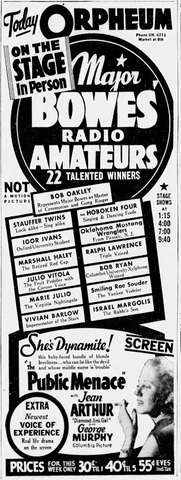
Capitol Theatre, Victoria, British Columbia, Canada (November 6-7) Major Bowes' Radio Amateurs (22 Talented Winners)
Sinatra would appear with the Hoboken Four
Bob Oakley represented Major Bowes as Master of Ceremonies and Gong Ringer
Stage Shows: 1:30pm, 4:13pm, 6:56pm, and 9:39pm
Other acts included Stauffer Twins, Igor Ivans, Marshall Haley, Julio Vitola, Marie Julio, Vivian Barlow, Oklahoma Mustang Wranglers, Ralph Lawrence, Bob Ryan, Smiling Rae Souder, Israel Margolis
On Screen: Ann Sothern in "The Girl Friend"
Note: This was Sinatra's first documented performance in Canada
Capitol Theatre, Victoria, British Columbia, Canada
The Victoria Daily Times (Victoria, British Columbia), November 5, 1935:
November 7, 1935
Concerts
Capitol Theatre, Victoria, British Columbia, Canada (November 6-7) Major Bowes' Radio Amateurs (22 Talented Winners)
Sinatra would appear with the Hoboken Four
Bob Oakley represented Major Bowes as Master of Ceremonies and Gong Ringer
Stage Shows: 1:30pm, 4:13pm, 6:56pm, and 9:39pm
Other acts included Stauffer Twins, Igor Ivans, Marshall Haley, Julio Vitola, Marie Julio, Vivian Barlow, Oklahoma Mustang Wranglers, Ralph Lawrence, Bob Ryan, Smiling Rae Souder, Israel Margolis
On Screen: Ann Sothern in "The Girl Friend"
November 8, 1935
Radio
Broadcast 10am (Friday)
Major Bowes Radio Amateurs
Location Hotel Georgia, Vancouver
Network CKWX (Vancouver)
Notes
The 23 members of the group appeared and "said a few words" over the air shortly after arriving in Vancouver. Fred Bass was the director of the radio station and introduced them. The Hotel Georgia, as well as serving as CKWX's home, was also where the group were staying while in Vancouver.
Concerts
Orpheum Theatre, Vancouver, British Columbia, Canada (November 8-14) Major Bowes' Radio Amateurs (22 Talented Winners)
Sinatra would appear with the Hoboken Four
Bob Oakley represented Major Bowes as Master of Ceremonies and Gong Ringer
Stage Shows: 1:30pm, 4:13pm, 6:56pm, and 9:39pm
Other acts included Stauffer Twins, Igor Ivans, Marshall Haley, Julio Vitola, Marie Julio, Vivian Barlow, Oklahoma Mustang Wranglers, Ralph Lawrence, Bob Ryan, Smiling Rae Souder, Israel Margolis
On Screen: "Hands Across The Table" with Carole Lombard & Fred MacMurray
Orpheum Theatre, Vancouver, British Columbia, Canada (November 8-14)
Broadcast 10am (Friday)
Major Bowes Radio Amateurs
Location Hotel Georgia, Vancouver
Network CKWX (Vancouver)
November 9, 1935
Concerts
Orpheum Theatre, Vancouver, British Columbia, Canada (November 8-14) Major Bowes' Radio Amateurs (22 Talented Winners)
Sinatra would appear with the Hoboken Four
Bob Oakley represented Major Bowes as Master of Ceremonies and Gong Ringer
Stage Shows: 1:30pm, 4:13pm, 6:56pm, and 9:39pm
Other acts included Stauffer Twins, Igor Ivans, Marshall Haley, Julio Vitola, Marie Julio, Vivian Barlow, Oklahoma Mustang Wranglers, Ralph Lawrence, Bob Ryan, Smiling Rae Souder, Israel Margolis
On Screen: "Hands Across The Table" with Carole Lombard & Fred MacMurray
November 10, 1935
Concerts
Orpheum Theatre, Vancouver, British Columbia, Canada (November 8-14) Major Bowes' Radio Amateurs (22 Talented Winners)
Sinatra would appear with the Hoboken Four
Bob Oakley represented Major Bowes as Master of Ceremonies and Gong Ringer
Stage Shows: 1:30pm, 4:13pm, 6:56pm, and 9:39pm
Other acts included Stauffer Twins, Igor Ivans, Marshall Haley, Julio Vitola, Marie Julio, Vivian Barlow, Oklahoma Mustang Wranglers, Ralph Lawrence, Bob Ryan, Smiling Rae Souder, Israel Margolis
On Screen: "Hands Across The Table" with Carole Lombard & Fred MacMurray
November 11, 1935
Concerts
Orpheum Theatre, Vancouver, British Columbia, Canada (November 8-14) Major Bowes' Radio Amateurs (22 Talented Winners)
Sinatra would appear with the Hoboken Four
Bob Oakley represented Major Bowes as Master of Ceremonies and Gong Ringer
Stage Shows: 1:30pm, 4:13pm, 6:56pm, and 9:39pm
Other acts included Stauffer Twins, Igor Ivans, Marshall Haley, Julio Vitola, Marie Julio, Vivian Barlow, Oklahoma Mustang Wranglers, Ralph Lawrence, Bob Ryan, Smiling Rae Souder, Israel Margolis
On Screen: "Hands Across The Table" with Carole Lombard & Fred MacMurray
November 12, 1935
Concerts
Orpheum Theatre, Vancouver, British Columbia, Canada (November 8-14) Major Bowes' Radio Amateurs (22 Talented Winners)
Sinatra would appear with the Hoboken Four
Bob Oakley represented Major Bowes as Master of Ceremonies and Gong Ringer
Stage Shows: 1:30pm, 4:13pm, 6:56pm, and 9:39pm
Other acts included Stauffer Twins, Igor Ivans, Marshall Haley, Julio Vitola, Marie Julio, Vivian Barlow, Oklahoma Mustang Wranglers, Ralph Lawrence, Bob Ryan, Smiling Rae Souder, Israel Margolis
On Screen: "Hands Across The Table" with Carole Lombard & Fred MacMurray
November 13, 1935
Concerts
Orpheum Theatre, Vancouver, British Columbia, Canada (November 8-14) Major Bowes' Radio Amateurs (22 Talented Winners)
Sinatra would appear with the Hoboken Four
Bob Oakley represented Major Bowes as Master of Ceremonies and Gong Ringer
Stage Shows: 1:30pm, 4:13pm, 6:56pm, and 9:39pm
Other acts included Stauffer Twins, Igor Ivans, Marshall Haley, Julio Vitola, Marie Julio, Vivian Barlow, Oklahoma Mustang Wranglers, Ralph Lawrence, Bob Ryan, Smiling Rae Souder, Israel Margolis
On Screen: "Hands Across The Table" with Carole Lombard & Fred MacMurray
November 14, 1935
Concerts
Orpheum Theatre, Vancouver, British Columbia, Canada (November 8-14) Major Bowes' Radio Amateurs (22 Talented Winners)
Sinatra would appear with the Hoboken Four
Bob Oakley represented Major Bowes as Master of Ceremonies and Gong Ringer
Stage Shows: 1:30pm, 4:13pm, 6:56pm, and 9:39pm
Other acts included Stauffer Twins, Igor Ivans, Marshall Haley, Julio Vitola, Marie Julio, Vivian Barlow, Oklahoma Mustang Wranglers, Ralph Lawrence, Bob Ryan, Smiling Rae Souder, Israel Margolis
On Screen: "Hands Across The Table" with Carole Lombard & Fred MacMurray
November 15, 1935
Concerts
Mt. Baker Theater, Bellingham, WA (One Night Only)
Major Bowes' Radio Amateurs (22 Talented Winners)
Sinatra would appear with the Hoboken Four
Mt. Baker Theater, Bellingham, WA (One Night Only)
Major Bowes' Radio Amateurs (22 Talented Winners)
Sinatra would appear with the Hoboken Four
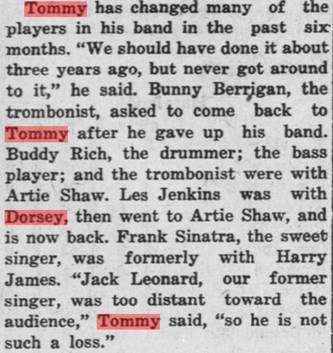
November 16, 1935
Concerts
Liberty Theater, Wenatchee, WA (One Night Only)
Major Bowes' Radio Amateurs (22 Talented Winners)
Sinatra would appear with the Hoboken Four
November 17, 1935
Concerts
Fox Theater, Spokane, WA (17-20)
Major Bowes' Radio Amateurs (22 Talented Winners)
Sinatra would appear with the Hoboken Four
Fox Theater, Spokane, WA (17-20)
Major Bowes' Radio Amateurs (22 Talented Winners)
Sinatra would appear with the Hoboken Four
"THE VOICE" SETS PHILLY ORK DATE
NEW YORK, Oct 21. -- Frank Sinatra will probably
do an appearance with the Philadelphia Ork, Sunday,
November 12, at Convention Hall, Philadelphia in a
benefit performance for the United War Chest. He is
getting no dough for performance, as contrasted with
the $10,000 he's guaranteed for a performance in Buffalo
on November 16. Sinatra will also do concerts on Sundays,
19 and 26. Reason for Sunday dates is due to his going
into the Waldorf-Astoria's Wedgewood Room, November
8, his second appearance at the place.
Hotel stint doesn't call for Sunday
performances, and so he'll make plenty of moola, going
into the W.A. at a high figure representing a guarantee
plus a percentage. He's current at New York Paramount,
where he did $90,000 last week.
His appearance with the Philly
long-
hair group will mark his third departure for the pop field.
He sang with the New York Philharmonic two years ago
at the Stadium, and followed this with an appearance
at Hollywood Bowl with member of the Los Angeles
Philharmonic.
Billboard
October 28, 1944
review
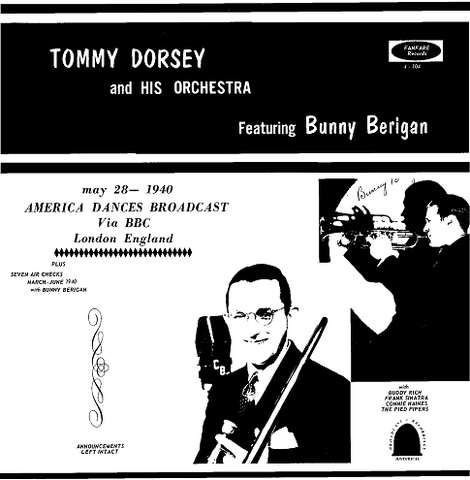
November 18, 1935
Concerts
The Palace Store, 4th Floor, Spokane, WA
4:45 P.M., Monday
Special showing for Spokane Shut-Ins and Orphanages
Major Bowes' Radio Amateurs (22 Talented Winners)
Sinatra would appear with the Hoboken Four
Fox Theater, Spokane, WA (17-20)
Major Bowes' Radio Amateurs (22 Talented Winners)
Sinatra would appear with the Hoboken Four
The Palace Store, 4th Floor, Spokane, WA
4:45 P.M., Monday
Special showing for Spokane Shut-Ins and Orphanages
Major Bowes' Radio Amateurs (22 Talented Winners)
Sinatra would appear with the Hoboken Four
Review of The Kissing Bandit:
The Brooklyn Daily Eagle, November 19, 1948
The Kissing Bandit,
Quotes from Frank Sinatra regarding
this film:
"I've Been Trying to Change My Name Ever Since"
"Please Don't Let My Granddaughters See This Film."
"The Kissing Bandit" was filmed, for the most part, in
the spring and summer of 1947. MGM showed a pre-
view that fall and the audience response was downright
hostile.. Frank and cast were asked to shoot a few additional
scenes. Film still needed more, so, in March of 1948 a spectacular
number, "Dance Of Fury," with Ricardo Montalban, Ann Miller
and Cyd Charisse, was filmed. Released in a few major cities
on 11-18-48, including the Capitol Theater, in N.YC, with Jane
Powell, MGM contract player, as an extra added in-person draw.
A wide release took place in January of 1949. It was a box office
disaster. MGM would suffer a loss of $2,643,000, making it one of
the biggest financial losses for a musical in the history of the studio.
The actual gross receipts amounted to $1.8 million.
The lack of chemistry between the two leads is quite apparent in
the love scenes throughout the film. Grayson did not find Sinatra
to be her kind of man. She would later say, "I couldn't stand kissing
him because he was so skinny, so scrawny." In an interview I have,
Grayson states that MGM forced Sinatra to do the film as a form of
punishment for all the headlines he was making at the time.
Frank was coming off a box office disappointment with "It Happened
In Brooklyn" -- a film that should have been shot in glorious technicolor
( MGM lost money by saving the expense of a color production). "Miracle
Of The Bells" was filmed after "Kissing Bandit," but released- in March
of 1948.. The film was savaged by the critics and RKO took a bath at
the b.o. But there was good news to come: "Take Me Out To The
Ballgame" was in the can when ""Bandit" was released. It would prove
to be a b.o. smash and then "On The Town" would also turn a nice pro-
fit and receive glowing reviews.. But would not be as successful as
"Ballgame." Frank would have some success in movies during the 1940s,
but he was not able to establish himself as a major film star. That would
happen in the decade to come.
-- Ed
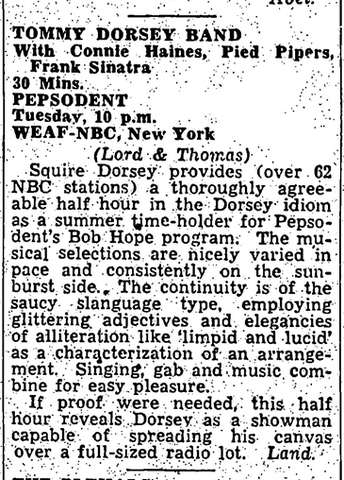
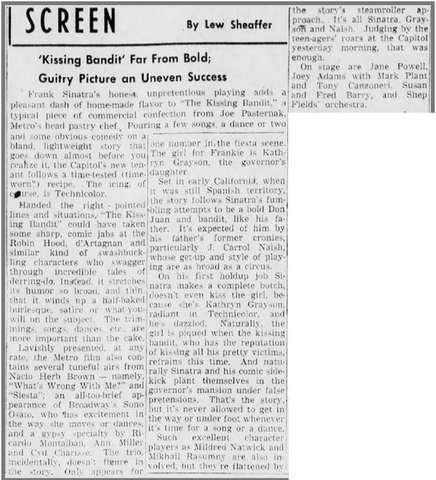
November 19, 1935
Concerts
Fox Theater, Spokane, WA (17-20)
Major Bowes' Radio Amateurs (22 Talented Winners)
Sinatra would appear with the Hoboken Four
Chamber of Commerce Board of Trustees Meeting, Spokane
The Hoboken Four were one of the acts who performed
Chamber of Commerce Board of Trustees Meeting, Spokane
The Hoboken Four were one of the act who performed
[image referenced in source but could not be recovered]
November 20, 1935
Concerts
Fox Theater, Spokane, WA (17-20)
Major Bowes' Radio Amateurs (22 Talented Winners)
Sinatra would appear with the Hoboken Four
Note: Sinatra would leave the tour after Spokane
Late 1935
After roughly three months touring with the Hoboken Four as part of one of Major Bowes's traveling amateur revues, Frank Sinatra left the group amid growing tension with his three bandmates, who resented the disproportionate attention his singing and stage presence drew from audiences. His father, Marty, was furious, viewing the move as one more example of his son “quitting.” Source: J. Randy Taraborrelli, Sinatra: Behind the Legend.
[Frank's Long-Distance Courtship Ritual]
Nancy Sinatra: During his first extended time away from home touring with the Major Bowes amateur troupe, a homesick Frank kept up his connection to Nancy Barbato by mailing her photographs with handwritten messages on the back, a ritual the couple maintained for years.
Source: Nancy Sinatra, Frank Sinatra: An American Legend, 1995.
[Frank Decides To Become A Singer After Seeing Bing Crosby]
Nancy Sinatra: On a date with Nancy Barbato to see his idol Bing Crosby perform live in Jersey City, Frank was so transformed by the experience that he told her on the way home, "Someday, that's gonna be me up there," a night Nancy Sr. later called the biggest moment of his life.
Source: Nancy Sinatra, Frank Sinatra: An American Legend, 1995.
[Hoboken Four Win Major Bowes' Amateur Hour]
The Hoboken Four, the vocal group featuring young Sinatra, win the "Major Bowes' Original Amateur Hour" radio talent competition.
Source: Nancy Sinatra, "Frank Sinatra, My Father" (1985).
["No Job, No Nancy"]
Nancy Sinatra: While Frank plastered walls for Nancy Barbato's father, work he was never very good at, he grew desperate to quit. Her father refused to fire him and instead made clear that keeping the job was the price of continuing to see his daughter.
Source: Nancy Sinatra, Frank Sinatra: An American Legend, 1995.
["Panic period" begins in Manhattan]
Frank Sinatra: Sinatra later called 1935 through 1937 his 'panic period,' a stretch when he began working Manhattan's Tin Pan Alley scene as a 'kolo' (wannabe singer) chasing music publishers. During this time he met song pluggers Hank Sanicola and Jimmy Van Heusen (born Chester Babcock), who became lasting friends and collaborators.
Source: James Kaplan, "Frank: The Voice" (2010)
[The Hoboken Four's "Curse of an Aching Heart"]
Nancy notes that "Curse of an Aching Heart," later covered on Swing Along with Me, was a song Frank's early vocal group, the Hoboken Four, had performed back in 1935.
Source: Nancy Sinatra, "Frank Sinatra, My Father" (1985).
[Uncredited in a Major Bowes Short Film]
Sinatra appeared, uncredited, in a short film called The Major Bowes Theater of the Air, buried in the front row among a large cast of amateur-hour performers.
Source: Nancy Sinatra, "Frank Sinatra, My Father" (1985).
[First encounters Billie Holiday's singing]
Kaplan: Kaplan places Sinatra's first exposure to Billie Holiday's singing, probably at the Famous Door on 52nd Street, around 1935, when she was performing with pianist Teddy Wilson; Sinatra was captivated by her phrasing and her ability to live inside a lyric.
Source: James Kaplan, "Frank: The Voice" (2010)
[Frank and Consiglio see Bing Crosby film]
Consiglio: In 1935, teenage Frank and Consiglio saw Bing Crosby's Pennies from Heaven several times at the Paramount Theatre and heard Artie Shaw's band perform live on the same bill; Consiglio recalled Frank saying he'd like to sing like Crosby someday.
Source: Tony Consiglio (as told to Franz Douskey), "Sinatra and Me: The Very Good Years" (2012)
[Hoboken Four's Major Bowes audition]
Kaplan: As a nineteen-year-old, Sinatra sang 'The Curse of an Aching Heart' with the Hoboken Four as their audition piece for Major Bowes's Original Amateur Hour, which got them on the show and launched Sinatra's career.
Source: James Kaplan, "Sinatra: The Chairman" (2015)
[Joins the Three Flashes]
Kaplan: In 1935, Sinatra pestered his way into an Italian-American singing trio called the Three Flashes (Fred Tamburro, James 'Skelly' Petrozelli, and Pat Principe), who performed regularly at the Rustic Cabin nightclub near the George Washington Bridge. His use of his car to drive them to gigs, plus his willingness to sing Bing Crosby's scat part on 'Shine,' helped secure him a spot, forming what would become the Hoboken Four.
Source: James Kaplan, "Frank: The Voice" (2010)
[Major Bowes Amateur Theater of the Air]
Sinatra's actual film debut was not a glamorous Hollywood production but a cheap black-and-white short shot in the Bronx on a shoestring budget, part of a package of six no-budget shorts titled Major Bowes Amateur Theater of the Air, produced and directed by John H. Auer for Biograph Productions and shot in about a week. Sinatra was paid ten dollars a day.
No corresponding dated entry could be identified in the chronology for this film/context.
Source: Tom Santopietro, "Sinatra in Hollywood" (2008), March 25, 1954 / Well Did You Evah / Hoboken
[Major Bowes Amateur Theater of the Air]
Of the six Biograph shorts, Sinatra appeared in two: in "The Nightclub" he reportedly plays a waiter, though he's hard to spot on screen; in "The Big Minstrel Act" he's clearly visible in blackface as part of a minstrel chorus, dressed in spats, top hat, and bow tie.
No corresponding dated entry could be identified in the chronology for this film/context.
Source: Tom Santopietro, "Sinatra in Hollywood" (2008), March 25, 1954 / Well Did You Evah / Hoboken
[Major Bowes Amateur Theater of the Air]
Santopietro grades this a D, dismissing it as "just that—amateur time."
No corresponding dated entry could be identified in the chronology for this film/context.
Source: Tom Santopietro, "Sinatra in Hollywood" (2008), Career Scorecard
[Major Bowes scouts the group]
Kaplan: In 1935, a scout for radio's Major Bowes and his Original Amateur Hour spotted the Three Flashes performing and invited them to appear in filmed minstrel-show shorts at Biograph Studios in the Bronx. When the other three tried to exclude Sinatra from the follow-up radio audition, Dolly intervened by pressuring the Tamburro family, securing her son's inclusion.
Source: James Kaplan, "Frank: The Voice" (2010)
[Sexual initiation on the Bowes tour]
Kaplan: Kaplan describes the Bowes tour, through cities like Des Moines, Wichita, Oakland, and Bellingham, as Frank's sexual awakening: he had his first experiences having sex in beds with a range of women, young and older, including married women, while his bandmates grew resentful of his growing popularity with audiences.
Source: James Kaplan, "Frank: The Voice" (2010)
[Singing job at the Union Club]
Kaplan: Around this same period in 1935, Dolly leaned on Joseph Samperi, owner of Hoboken's Union Club, to give her son a regular singing job; Frankie performed there five nights a week but grew impatient because the club lacked a radio wire hookup that could advance his career.
Source: James Kaplan, "Frank: The Voice" (2010)
[Tommy Dorsey leaves Dorsey Brothers Orchestra]
Kaplan: As the Swing Era got underway, Tommy Dorsey, then thirty, could no longer stand the constant fighting with his brother Jimmy and left the Dorsey Brothers Orchestra to start his own band.
Source: James Kaplan, "Frank: The Voice" (2010)
[Wins amateur contest, State Theater]
Kaplan: Sometime in 1935, before landing his WAAT radio slot, Sinatra entered and won an amateur singing contest at the State Theater in Jersey City.
Source: James Kaplan, "Frank: The Voice" (2010)
[Dorsey Brothers score two No. 1 hits]
After signing to Decca in late 1934, the Dorsey Brothers found real success in 1935 with two No. 1 records, 'Lullaby of Broadway' and 'Chasing Shadows.'
Source: Richard Havers, "Sinatra" (Dorling Kindersley, 2007).
[Frank appears in Major Bowes movie shorts]
Frank and the Three Flashes spent nearly a week filming two black-and-white shorts for Major Bowes at Biograph's studio in the Bronx, released as Major Bowes' Theater of the Air. Frank played a waiter in one segment and, in blackface makeup, sang as part of a chorus in the other, with no solo role.
Source: Richard Havers, "Sinatra" (Dorling Kindersley, 2007).
[Frank lands a regular paid gig at the Union Club]
With Dolly again calling in favors, Frank got a steady booking at the Union Club on Hudson Street. Owner Joseph Samperi recalled paying him $40 for five nights a week but said the venue couldn't afford to be wired for sound, ruling out any radio remote broadcasts.
Source: Richard Havers, "Sinatra" (Dorling Kindersley, 2007).
[Frank's first Seattle appearance came decades earlier]
Frank's 1957 Seattle shows weren't his first in the city; he had appeared there in 1935 as part of the Major Bowes touring variety show, long before his solo stardom.
Source: Richard Havers, "Sinatra" (Dorling Kindersley, 2007).
[Major Bowes scout discovers the Three Flashes]
A talent scout working for radio host Major Bowes came to the Rustic Cabin in Englewood Cliffs, where Frank had befriended a vocal group called the Three Flashes. Frank, who often drove the group to gigs since he had a car, pushed to join their planned screen appearance; Dolly persuaded the reluctant trio to let him in.
Source: Richard Havers, "Sinatra" (Dorling Kindersley, 2007).
[early career / touring -- critical commentary]
Sinatra's big-band career effectively began before his 1939 Brunswick debut: in 1935 he toured with a Major Bowes' Amateur Hour unit as one of the Hoboken Four, a pickup group assembled by Bowes.
Source: Charles L. Granata, "Sessions with Sinatra: Frank Sinatra and the Art of Recording" (1999/2003), Part I: The Big Band Years, 1937-1942
December 1935
[Leaves Bowes tour, returns to Hoboken]
Kaplan: In mid-December 1935, soon after turning twenty, Frank left the Major Bowes tour in Columbus, Ohio, and returned home to Hoboken in time for Christmas, feeling he had outgrown the other three singers.
Source: James Kaplan, "Frank: The Voice" (2010)
1936
[A Dollar-A-Session Voice Coach]
Nancy Sinatra: Desperate to break out of small-time gigs, Frank rode the four-cent Hudson River ferry into Manhattan to chase radio spots, hustled arrangements along Tin Pan Alley, and scraped together enough money to pay a New York voice coach a dollar a session, lessons that helped him lose his Jersey accent and revealed the range of his voice.
Source: Nancy Sinatra, Frank Sinatra: An American Legend, 1995.
[Consiglio becomes NY Giants batboy]
Consiglio: Sportscaster Stan Lomax, whom Consiglio met through Floyd Neal, got him a job as batboy for the New York Giants in 1936, connecting Consiglio to figures like Ford Frick and Giants traveling secretary Eddie Brannick.
Source: Tony Consiglio (as told to Franz Douskey), "Sinatra and Me: The Very Good Years" (2012)
[Consiglio meets Joe DiMaggio]
Consiglio: Consiglio says he had known Joe DiMaggio since 1936, DiMaggio's first year with the New York Yankees, having photographed him during that year's World Series while working as a batboy for the New York Giants.
Source: Tony Consiglio (as told to Franz Douskey), "Sinatra and Me: The Very Good Years" (2012)
[Consiglio quits as batboy]
Consiglio: Consiglio quit his unpaid batboy job -- he earned money only by selling autographed broken bats and used balls -- after the 1936 World Series and returned to New Haven.
Source: Tony Consiglio (as told to Franz Douskey), "Sinatra and Me: The Very Good Years" (2012)
[First paid singing lessons]
Kaplan: With money fronted by Hank Sanicola, Frank took his first singing lessons from an unnamed teacher who charged $2 for 45 minutes and taught him where his diaphragm was; Frank found the price too steep to sustain.
Source: James Kaplan, "Frank: The Voice" (2010)
[Major Bowes show moves to CBS]
Consiglio: Major Bowes' Original Amateur Hour, originally broadcast on NBC, moved to CBS in 1936.
Source: Tony Consiglio (as told to Franz Douskey), "Sinatra and Me: The Very Good Years" (2012)
[Voice lessons with John Quinlan]
Kaplan: Frank switched to a cheaper voice coach, John Quinlan, a former Metropolitan Opera tenor (dismissed for drinking) originally from Australia. Quinlan drilled him on scales and diction, working to strip the 'stevedore' Hoboken sound from his voice and sharpen his consonants.
Source: James Kaplan, "Frank: The Voice" (2010)
[Axel Stordahl joins the Dorsey organization]
Arranger Axel Stordahl, born Odd Stordahl in Staten Island just two years before Sinatra, began with the Bert Block band before joining Tommy Dorsey in 1936, where he developed his skill at arranging ballads.
Source: Richard Havers, "Sinatra" (Dorling Kindersley, 2007).
[Frank's first sessions with vocal coach John Quinlan]
Sources disagree on the exact year, but around this time Frank began working with New York vocal coach John Quinlan, an Australian former opera singer, to correct his diction. Quinlan's advice that a singer can't perform words he doesn't understand stuck with Frank for years.
Source: Richard Havers, "Sinatra" (Dorling Kindersley, 2007).
October 1936
[Consiglio witnesses 1936 World Series]
Consiglio: As the Giants' batboy, Consiglio watched the rain-soaked opening game of the 1936 World Series between the Giants (Carl Hubbell) and Yankees (Red Ruffing), recalling Joe DiMaggio grounding into a double play. The Yankees won the Series four games to two, with DiMaggio hitting .346; Consiglio's lifelong friendship with DiMaggio began that season, and he took what may be the only surviving photo of DiMaggio from his first World Series.
Source: Tony Consiglio (as told to Franz Douskey), "Sinatra and Me: The Very Good Years" (2012)
Early 1937
With help from his cousin Ray, Frank Sinatra landed a regular fifteen-minute spot on an NBC radio program, paying seventy cents a week — a small but steady showcase for the twenty-one-year-old singer as he continued performing around northern New Jersey. Source: J. Randy Taraborrelli, Sinatra: Behind the Legend.
September 26, 1936
Juliet Prowse was born in Bombay on 26 September 1936, trained as a ballet dancer before growing too tall for it, and worked as a chorus girl at London's Palladium before co-starring with Elvis Presley in G.I. Blues in 1961. She died in 1994, nine days short of her 60th birthday. (Source: Richard Havers, "Sinatra" (Dorling Kindersley, 2007).)
December 12, 1936
On his 21st birthday, Frank performed in blackface again in the male chorus of a minstrel show at a New Jersey fire station while working the local singing circuit for small fees.
Source: Nancy Sinatra, Frank Sinatra: An American Legend, 1995.
May 12, 1937
Radio
Town Hall Tonight (NBC Red network)
Host: Fred Allen
Orchestra Conducted By: Peter Van Steeden
Guest(s) The Four Sharps (Sinatra musical group)
Time 9:00 p.m. - 10:00 p.m.
1.Exactly Like You
Note: Frank leads a Dixieland Band (The Four Sharps), This performance appears on the CD: The Rarest Sinatra, Decade Records CD103
[image referenced in source but could not be recovered]
Town Hall Tonight (NBC Red network)
Host: Fred Allen
Orchestra Conducted By: Peter Van Steeden
Guest(s) The Four Sharps (Sinatra musical group)
Time 9:00 p.m. - 10:00 p.m.
1.Exactly Like You
Note: Frank leads a Dixieland Band (The Four Sharps), This performance appears on the CD: The Rarest Sinatra, Decade Records CD103
note: We now know the instruments the Four Sharps were playing. If only we knew why Sinatra was fronting this foursome. --ED
[image referenced in source but could not be recovered]
"Exactly Like You" / "Powerhouse"
Will Friedwald (author): As a club-date bandleader/contractor, Sinatra appeared on Fred Allen's Town Hall Tonight in May 1937, though he did not sing on the broadcast. Instead he banters with Allen and 'conducts' an instrumental quartet billed as 'The Four Sharps' performing a medley of 'Exactly Like You' and Raymond Scott's 'Powerhouse' (Scott would later be a Your Hit Parade colleague of Sinatra's).
Source: Will Friedwald, "Sinatra! The Song Is You: A Singer's Art" (2018 revised edition).
"Exactly Like You"
Before joining big bands, teenage Sinatra fronted a pickup jazz combo called The Four Sharps with saxophonist Frank Mane; the only surviving performance by the group is a Dixieland version of "Exactly Like You," captured as a radio aircheck from the Fred Allen Show. Sinatra did not sing on this particular recording.
Source: Charles L. Granata, "Sessions with Sinatra: Frank Sinatra and the Art of Recording" (1999/2003).
1937
Dolly Sinatra, who had long supplemented her income performing unlicensed midwifery and, at times, abortions out of her Hoboken home, was arrested and convicted on a felony charge after a procedure in her cellar went badly wrong and the patient nearly died. She was sentenced to five years' probation but, shielded in part by her political connections, continued the practice afterward. Source: J. Randy Taraborrelli, Sinatra: Behind the Legend.
[Driving His Father's Red Chrysler]
Around this time, saxophonist Harry Schuchman recalled being impressed that young Frank drove a red Chrysler to Rustic Cabin gigs, not realizing at the time that the car actually belonged to Frank's father.
Source: Nancy Sinatra, "Frank Sinatra, My Father" (1985).
[Appears on Fred Allen's amateur hour]
Kaplan: Frank sang 'Exactly Like You,' accompanying himself on ukulele, on Fred Allen's radio amateur hour Town Hall Tonight, but nothing came of the appearance.
Source: James Kaplan, "Frank: The Voice" (2010)
[Briefly uses stage name Frankie Trent]
Kaplan: Frank briefly tried performing under the anglicized stage name 'Frankie Trent' a couple of years before the Harry James episode, but dropped it once Dolly found out and objected forcefully.
Source: James Kaplan, "Frank: The Voice" (2010)
[Dolly Sinatra arrested]
Kaplan: Dolly Sinatra, who worked as a midwife and occasional abortionist (nicknamed 'Hatpin Dolly'), was arrested in late 1937, one of two arrests that bracketed her son's own two arrests in 1938.
Source: James Kaplan, "Frank: The Voice" (2010)
[Down Beat names James top trumpeter]
Kaplan: Down Beat magazine voted Harry James America's number-one trumpeter in 1937, beating out competitors including Louis Armstrong, Bunny Berigan, and Roy Eldridge.
Source: James Kaplan, "Frank: The Voice" (2010)
[NBC radio spot via cousin Ray Sinatra]
Kaplan: Frank's cousin Ray Sinatra, an arranger for the NBC radio house band, got him an audition that led to a daily fifteen-minute network radio spot paying just seventy cents a week.
Source: James Kaplan, "Frank: The Voice" (2010)
[Frank tells Nancy he'll be a star like Jack Leonard]
Sometime in 1937, Frank took Nancy to see Tommy Dorsey's band with singer Jack Leonard. While dancing, Frank pointed him out and vowed that one day he would be the one standing in Leonard's spot.
Source: Richard Havers, "Sinatra" (Dorling Kindersley, 2007).
[Harry Babbitt joins Kay Kyser's band]
Vocalist Harry Babbitt's popularity was closely tied to Kay Kyser's band, which he joined in 1937. His career stalled after he joined the Navy in 1944, similar to what happened to Bob Eberly.
Source: Richard Havers, "Sinatra" (Dorling Kindersley, 2007).
[Josephine / Marie / Our Love -- critical commentary]
Jack Leonard / Friedwald: "Tommy didn’t tell me to do it," Leonard later said. "It was an automatic thing. Sitting there on the bandstand night after night, you had to be influenced. It rubbed off on you whenever you sang." Yet ultimately Leonard only hinted at the long-breath style that did so much to elevate Sinatra to superstardom.
If the shrill texture of Leonard’s piercing pipes didn’t turn you right off, his blasé attitude would. "Josephine," Leonard and Dorsey’s campy retro hit from 1937, features the singer at his most adenoidal—more like a descendent of Rudy Vallée than a forerunner of Frank—but it’s one of the few records where Leonard displays any personality of any kind. The one well-remembered Dorsey-Leonard record, "Marie," succeeds by casting the singer as an oblivious straight man, whose very lack of humor makes the silly antics of the band behind him seem that much funnier. (Sinatra would later turn that formula completely around.) Dorsey and Leonard may have made "Our Love" a hit in 1939, but Sinatra, even on his demo disc of the Tchaikovsky-based piece, puts the number over much more convincingly than his Dorsey precursor, who even had the benefit of an Axel Stordahl arrangement.
Source: Will Friedwald, "Sinatra! The Song Is You: A Singer's Art" (2018 revised edition), Ch. 3, "With Tommy Dorsey" (1940-1942)
[Marie -- critical commentary]
Oliver also presided over the most enjoyable subseries of the Dorsey-Sinatra years, the extension of what one 1939 radio announcer referred to as "The ‘Marie’ Cycle." ... Irving Berlin’s relatively obscure waltz of 1928, "Marie" provided a perfect vehicle for the device, with its ambiguous lack of traditional distinction between the main (A) sections and the bridge (B), as well as its breathless, single-sentence lyric. Dorsey’s 1937 Victor single of "Marie," with an arrangement credited to Fred Stulce, and its flip side, "Song of India," was easily one of the most successful records of the swing era.
Source: Will Friedwald, "Sinatra! The Song Is You: A Singer's Art" (2018 revised edition), Ch. 3, "With Tommy Dorsey" (1940-1942)
August 1937
[Frank becomes a singing waiter at the Rustic Cabin]
Frank took a job as a singing waiter at the Rustic Cabin roadhouse, an experience he later recalled fondly for the education it gave him, moving between tables singing while a pianist played. The exact year is disputed by sources.
Source: Richard Havers, "Sinatra" (Dorling Kindersley, 2007).
September 25, 1937
Concerts
Castle Bar, Union Club, Hoboken, NJ
Frank Sinatra with the Castle Bar Orchestra
Note: Thanks to Richard Cook for above listings
Castle Bar, Union Club, Hoboken, NJ
Frank Sinatra with the Castle Bar Orchestra
Note: Thanks to Richard Cook for above listing
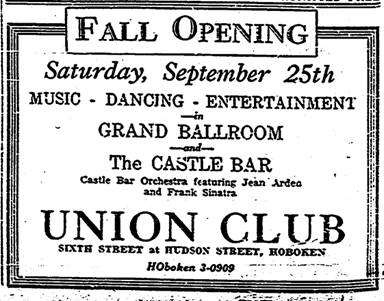
1938
[Hired at the Rustic Cabin]
In 1938 Sinatra took a job at the Rustic Cabin, a New Jersey roadhouse whose live shows aired on New York radio station WNEW's Dance Parade, working there as a singing waiter and master of ceremonies for a starting wage of about fifteen dollars a week.
Source: Charles Pignone, "Frank Sinatra 100" (2015).
[Rustic Cabin Band Photographed]
A photo documents Bill Henri and His Headliners, the house band at the Rustic Cabin roadhouse in New Jersey, where Frank worked as vocalist and general handyman.
Source: Nancy Sinatra, "Frank Sinatra, My Father" (1985).
[1938 Bergen County morals arrest revived]
Kaplan: Westbrook Pegler dug up and publicized Sinatra's 1938 Bergen County, New Jersey morals arrest as part of his 1944 campaign against the singer, despite the charges having been dropped at the time.
Source: James Kaplan, "Frank: The Voice" (2010)
[Dates cited in Toni Della Penta warrant]
Kaplan: The original arrest warrant sworn out by Antoinette 'Toni' Della Penta alleged that on November 2 and 9, 1938, Sinatra, under promise of marriage, had intercourse with her, a single woman of good repute, resulting in pregnancy. Kaplan notes the warrant's holes: the timeline was implausibly compressed, and Toni was actually still legally married, not single.
Source: James Kaplan, "Frank: The Voice" (2010)
[Frank's first girlfriend, the Tootsie Roll factory girl]
Consiglio: Before Nancy, Frank dated a German girl who worked at the Tootsie Roll factory. When Frank started getting into singing and she objected to him going on the road, he broke it off with her -- he was about twenty-two or twenty-three at the time. Soon after, his romance with Nancy began in earnest.
Source: Tony Consiglio (as told to Franz Douskey), "Sinatra and Me: The Very Good Years" (2012)
[Joe Louis vs. Nathan Mann at Madison Square Garden]
Consiglio: In 1938 Sinatra and Consiglio watched Joe Louis defend his heavyweight title against Nathan Mann (Nathan Menchetti of Hamden, CT) at the old Madison Square Garden on 50th Street. Louis knocked Mann out inside one round, silencing fans who had predicted an upset.
Source: Tony Consiglio (as told to Franz Douskey), "Sinatra and Me: The Very Good Years" (2012)
[Pied Pipers first hired and fired by Dorsey]
Kaplan: In the summer of 1938, Dorsey tried out the Pied Pipers, then an octet led by Jo Stafford, on his New York radio show; the sponsor fired the group on the spot after they performed the risque Fats Waller number 'Hold Tight (Want Some Sea Food, Mama!).'
Source: James Kaplan, "Frank: The Voice" (2010)
[Sinatra's arrest for adultery and seduction]
Kaplan: Sinatra was arrested in 1938 for adultery and seduction, statutes still on the books at the time; his New Jersey godfather Willie Moretti may have intervened on his behalf.
Source: James Kaplan, "Sinatra: The Chairman" (2015)
[WOR radio show gave Sinatra strings]
Kaplan: Around the time of his 1938 morals arrest, Sinatra took a once-a-week radio job on WOR's Bamberger station in Newark that paid only thirty cents (train fare), but the studio orchestra included a few violins, and he loved singing three songs each week backed by strings.
Source: James Kaplan, "Frank: The Voice" (2010)
[FBI unearths Frank's old seduction arrest]
While investigating the draft-bribery rumor, the FBI stumbled onto Frank's earlier arrest for "seduction" and an adultery charge from years before. This became the first paperwork in what would grow into a massive, decades-long FBI file on Frank.
Source: Richard Havers, "Sinatra" (Dorling Kindersley, 2007).
April 1938
[Sally's Apizza founded]
Consiglio: Consiglio's mother bought a struggling Wooster Street bakery for about $700-$800 with a small loan from Anthony's Jewelers; in April 1938 Consiglio and his brother Sally took it over, keeping the brick oven and converting the retail space into what became Sally's Apizza, a famous New Haven pizza restaurant.
Source: Tony Consiglio (as told to Franz Douskey), "Sinatra and Me: The Very Good Years" (2012)
July 12, 1938
Radio
Frank Sinatra, Songs
WAAT, Hackensack, New Jersey
6:15PM

July 19, 1938
Radio
Frank Sinatra, Songs
WAAT - Hackensack, NJ
6:15 PM
August 16, 1938
Radio
Frank Sinatra, Songs
6:15 PM - WAAT

August 23, 1938
Radio
Frank Sinatra, Songs
6:15 pm WAAT
September 13, 1938
Frank's show was broadcast on WAAT
Tuesday 9/6 6:15 to 6:30 P.M.
Monday 9/12 5:15 to 5:30 P.M.
Tuesday 9/13 6:15 to 6:30 P.M.
Saturday 9/17 5:15 to 5:30 P.M.
Tuesday 9/20 6:15 to 6:30 P.M.
Tuesday 9/27 6:15 to 6:30 P.M.
Wednesday 9/28 5:15 to 5:30 P.M.
Friday 9/30 5:00 to 5:30 P.M.
note: In an interview on WAAT, in September, 1940,
Frank's tells how Jay Stanley hired him at WAAT
in 1938. He admits that his show wasn't always good.
Before he went to the Rustic Cabin, he sang with the Rhythm
Triplets Trio.
Official portrait for the Rustic Cabin
Frank onstage at the Rustic Cabin
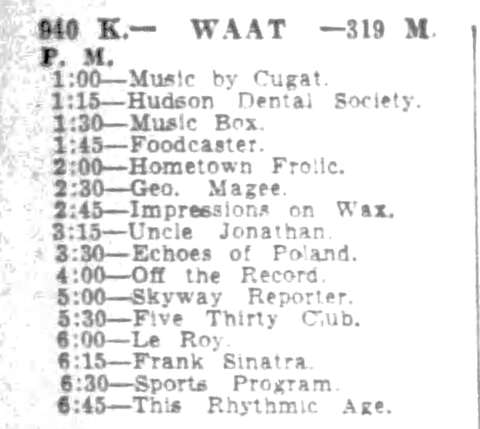
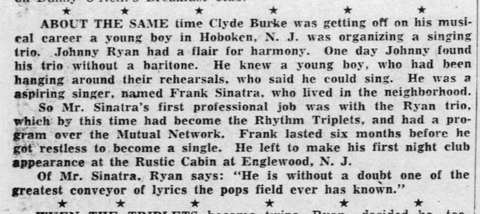
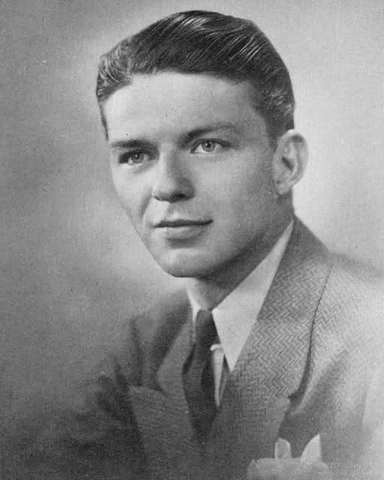
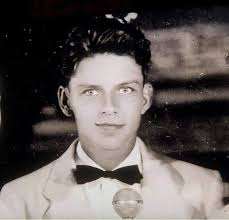
September 20, 1938
Radio
Frank Sinatra, Songs
WAAT 6:15PM
October 8, 1938
Radio
Frank Sinatra, Songs
WAAT 5:15pm
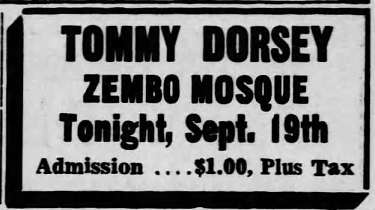
October 12, 1938
Radio
The Manhatters with Frank Sinatra, Tenor
WOR 9:45 AM


October 15, 1938
Radio
Frank Sinatra, Songs
WAAT 5pm
[image referenced in source but could not be recovered]
Francis Albert Sinatra in 1938, at the age of twenty-three. Source: photo and caption from J. Randy Taraborrelli, Sinatra: Behind the Legend (mptvimages.com).
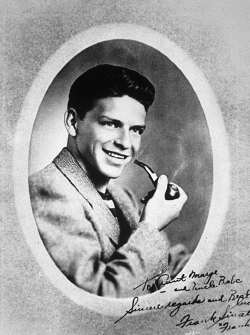
October 22, 1938
Radio
Frank Sinatra, Songs
WAAT 5pm
October 28, 1938
Radio
Frank Sinatra, Songs
5pm WAAT
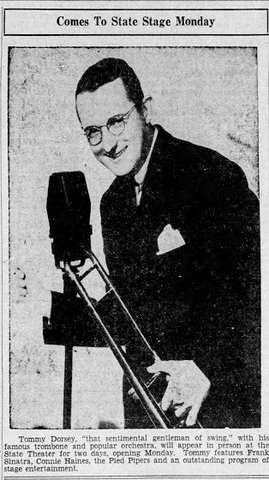
November 1938
[Sinatra arrested for seduction]
Kaplan: Frank Sinatra was arrested in November 1938 on the charge of seduction, then a criminal offense; Kaplan notes all of Sinatra's early arrests were sex-related.
Source: James Kaplan, "Frank: The Voice" (2010)
November 9, 1938
Radio
Frank Sinatra, Songs
WNEW 2:30pm
November 23, 1938
Radio
2:30pm - 2:45pm
Frank Sinatra, songs
WNEW
November 25, 1938
[Toni's phone call and catfight at the Cabin]
On the night after Thanksgiving 1938, while Frank sat with Nancy Barbato at the Rustic Cabin, Toni Della Penta called the club; Nancy took the call and confronted her. Half an hour later Toni arrived in person and the two women brawled, tearing Nancy's white dress before staff separated them.
Source: James Kaplan, "Frank: The Voice" (2010).
November 26, 1938
[Sinatra's first arrest at Rustic Cabin]
The Saturday after the Thanksgiving-weekend catfight, two motorcycle police arrested Frank at the Rustic Cabin right after he sang 'Night and Day.' He was booked at the Hackensack county jail around 2:00 a.m. on a seduction charge brought by Toni Della Penta.
Source: James Kaplan, "Frank: The Voice" (2010).
November 30, 1938
Radio
Frank Sinatra, Songs
WNF Paterson, NJ 2:30 PM
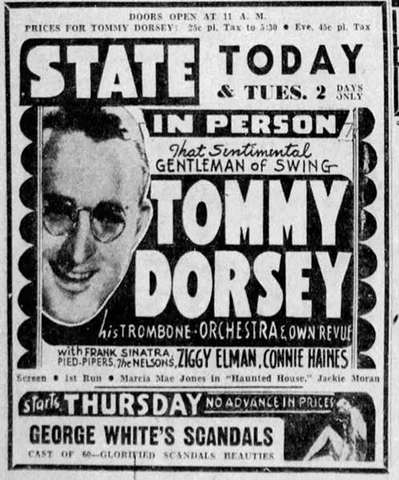
December 1938
[Marty pleads with Toni's father]
Kaplan: In the weeks after the arrest, Dolly sent Marty to plead with Toni's father; the two men bonded over drinks, and Toni was persuaded to visit Frank in his cell and eventually withdraw the seduction charge, on the condition Dolly apologize for insulting her.
Source: James Kaplan, "Frank: The Voice" (2010)
[Sinatra arrested for adultery]
Kaplan: Frank Sinatra was arrested a second time in December 1938, this time for adultery, again then a criminal offense in New Jersey.
Source: James Kaplan, "Frank: The Voice" (2010)
[Toni and Dolly's basement brawl]
Kaplan: About three weeks after Toni withdrew the charge, with no apology from Dolly forthcoming, Toni went to Garden Street to confront her. Dolly, 42 and four-foot-eleven, threw the younger woman into the basement during the resulting screaming fight; police arrived and Toni was arrested and given a suspended sentence for disorderly conduct.
Source: James Kaplan, "Frank: The Voice" (2010)
December 14, 1938
Radio
Frank Sinatra, Songs
WNEW
1:45 PM – 2 PM
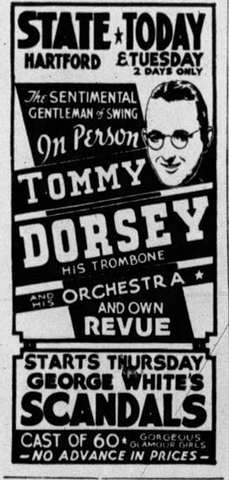
December 22, 1938
Frank Sinatra was arrested after a midnight performance at the Rustic Cabin in Englewood Cliffs, New Jersey, on a “breach of promise” complaint filed by Toni Francke (Antoinette Della Penta Francke), a woman he had been briefly involved with who claimed he had promised to marry her. He spent sixteen hours in the Bergen County jail. The Hudson Dispatch ran the story the next day under the headline “Songbird Held in Morals Charge” — Sinatra's first brush with tabloid press coverage. The charges were dropped once it emerged that Francke was already married at the time of the alleged encounters; she subsequently filed a further complaint alleging adultery, which was also ultimately dismissed. Source: J. Randy Taraborrelli, Sinatra: Behind the Legend.
[Sinatra's second arrest, adultery charge]
Three days before Christmas 1938, Frank was arrested a second time at the Rustic Cabin, this time by court officers posing as gift-bearing fans. Toni Della Penta had sworn a new warrant, this time admitting she was still married and charging adultery instead of seduction. Dolly again posted bail.
Source: James Kaplan, "Frank: The Voice" (2010).
1939
[Frank Marries Nancy Barbato in the Catholic Church]
Tina notes that her father's first marriage, to her mother Nancy Barbato, took place in the Catholic Church in 1939 - a fact that mattered decades later when the church annulment controversy arose.
Source: Tina Sinatra, "My Father's Daughter: A Memoir" (2000).
[Frank's Morals-Charge Arrest]
Roughly two months before his wedding, Frank was arrested on an old-fashioned morals charge after an encounter with a married woman, an incident that made the local paper even though the charge was later dropped and helped kick off years of tabloid harassment.
Source: Tina Sinatra, "My Father's Daughter: A Memoir" (2000).
[Harry James Tears Up Frank's Contract]
Nancy Sinatra: When Tommy Dorsey offered Frank a spot as his band's vocalist, Harry James, who held Frank under contract, simply tore it up and wished him luck, telling him only to make sure Dorsey paid him more than James had.
Source: Nancy Sinatra, Frank Sinatra: An American Legend, 1995.
[Harry James Auditions Frank At The Rustic Cabin]
Nancy Sinatra: After spotting publicity photos left on his desk and hearing Frank on the radio, bandleader Harry James went to catch him live at the Rustic Cabin roadhouse. Impressed by the way Frank phrased a lyric while singing "Begin the Beguine," James signed him as vocalist on a two-year contract at $75 a week.
Source: Nancy Sinatra, Frank Sinatra: An American Legend, 1995.
[Fried-Onion Sandwiches And Pop-Bottle Deposits On Tour]
Nancy Sinatra: Newly pregnant and touring with the James band, Nancy Sr. recalled going for long stretches living on fried-onion sandwiches while money ran short. One night, when she craved a ham sandwich and apple pie but Frank had no cash, he gathered up empty pop bottles around the building and used the returned deposits to buy her the meal.
Source: Nancy Sinatra, Frank Sinatra: An American Legend, 1995.
[Marriage to Nancy Barbato]
Frank Sinatra marries Nancy Barbato.
Source: Nancy Sinatra, "Frank Sinatra, My Father" (1985).
[Sinatra Signs Away a Third of His Income to Tommy Dorsey]
In 1939, a young Frank signed a contract with Tommy Dorsey that gave Dorsey a lifetime cut of one-third of his earnings, a deal Frank later paid to escape. Tina cites this as an early lesson in the cost of signing without a lawyer's review.
Source: Tina Sinatra, "My Father's Daughter: A Memoir" (2000).
[Sinatra's First Commercial Recording]
Author Charles Pignone notes Sinatra's first commercial recording dates to 1939, yet he was still actively recording as late as 1993 -- a professional span the author considers unmatched in the music business.
Source: Charles Pignone, "Frank Sinatra 100" (2015).
[Steel Pier Engagement]
A photograph documents the full Harry James band, including Sinatra, playing an engagement at the Steel Pier in Atlantic City, New Jersey.
Source: Nancy Sinatra, "Frank Sinatra, My Father" (1985).
[The Year Sinatra Began Making Records]
The liner notes for Trilogy observe that many of the musicians backing Frank on the 1979 sessions hadn't yet been born when he began making records in 1939, and a few weren't born when he made From Here to Eternity.
Source: Nancy Sinatra, "Frank Sinatra, My Father" (1985).
[Betty Grable brings reporter to hear Sinatra]
James Bacon: A couple of weeks after the Roseland gig, at the Panther Room of Chicago's Hotel Sherman, actress Betty Grable brought young reporter James Bacon to hear the band; Bacon recalled that the instant Sinatra began singing, every girl on the dance floor abandoned her partner and crowded the bandstand.
Source: James Kaplan, "Frank: The Voice" (2010)
[Disastrous engagement at Victor Hugo's]
Kaplan: After the Palomar fire, the James band landed a replacement gig at Victor Hugo's, a small, genteel Beverly Hills restaurant unsuited to their loud sound. Management muffled the horns with napkins, but owner Hugo Aleidas eventually ran onto the dance floor mid-song shouting for the band to stop, and refused to pay them.
Source: James Kaplan, "Frank: The Voice" (2010)
[Dorsey hires Sy Oliver, lures Sinatra]
Kaplan: Tommy Dorsey hired arranger Sy Oliver and lured Frank Sinatra away from the Harry James orchestra, creating the Dorsey sound that wedded strings to horns -- a foundational influence that, via Nelson Riddle (who later joined Dorsey's band as third trombonist), shaped Sinatra's later Capitol-era swing arrangements.
Source: James Kaplan, "Sinatra: The Chairman" (2015)
[Dorsey hires arranger Sy Oliver]
Kaplan: That summer Tommy Dorsey made his most radical move yet, hiring away Jimmie Lunceford's star arranger Melvin 'Sy' Oliver, whose presence began attracting top jazz musicians to the Dorsey band.
Source: James Kaplan, "Frank: The Voice" (2010)
[Frank and Nancy share Hollywood apartment]
Kaplan: During the lean Los Angeles stretch, Frank and Nancy shared a two-bedroom Hollywood apartment with the band's drummer, Mickey Scrima; Nancy cooked spaghetti and franks and beans for the whole band, including Harry James. Both Frank and Nancy later recalled it as one of the happiest periods of their marriage.
Source: James Kaplan, "Frank: The Voice" (2010)
[Freezes auditioning before Tommy Dorsey]
Kaplan: That spring, auditioning for bandleader Bob Chester, Frank was so rattled by Tommy Dorsey's presence in the room that he forgot the lyrics and froze mid-song, unable to make a sound.
Source: James Kaplan, "Frank: The Voice" (2010)
[Girls mob Sinatra after Baltimore shows]
Connie Haines: According to singer Connie Haines, after the first Baltimore show with the James band, about twenty screaming girls came backstage for Frank, a genuine reaction rather than a publicity stunt.
Source: James Kaplan, "Frank: The Voice" (2010)
[Harry James hires Frank Sinatra]
Consiglio: Bandleader Harry James, recently departed from Benny Goodman's orchestra, heard Frank sing at the Rustic Cabin nightclub in 1939 and hired him for $75 a week -- a large sum during the Depression.
Source: Tony Consiglio (as told to Franz Douskey), "Sinatra and Me: The Very Good Years" (2012)
[Harry James's financial troubles worsen]
Kaplan: That summer Harry James lost significant money in an auto-accident settlement and could no longer afford to pay Connie Haines, who left the band; the Music Makers struggled financially even as rival big bands thrived.
Source: James Kaplan, "Frank: The Voice" (2010)
[Jack Leonard quits Dorsey band]
Kaplan: Dorsey's baritone singer Jack Leonard, worn down by the bandleader's cutting temper after years on the road, walked off the bandstand one night at the Palmer House in Chicago and left the band for good.
Source: James Kaplan, "Frank: The Voice" (2010)
[Leonard tips Dorsey off about Sinatra]
Jack Leonard (via Kaplan): A couple of months before he quit, driving with Dorsey to the bandleader's New Jersey home after a Hotel Pennsylvania gig, Jack Leonard mentioned Harry James's new singer, telling Dorsey the kid singing 'All or Nothing at All' on the World's Fair radio broadcasts was good enough to scare him.
Source: James Kaplan, "Frank: The Voice" (2010)
[Louise Tobin hears Sinatra on the radio]
Kaplan: That spring, singer Louise Tobin, wife of bandleader Harry James, heard Frank singing 'Night and Day' over WNEW's Dance Parade broadcast from the Rustic Cabin while in their room at the Lincoln Hotel, and urged her husband to listen.
Source: James Kaplan, "Frank: The Voice" (2010)
[Newlyweds settle in Jersey City]
Kaplan: After the wedding, Frank and Nancy settled into a $42-a-month third-floor walk-up on Garfield Avenue in Jersey City. Nancy worked as a $25-a-week secretary at American Type Founders in Elizabeth, while Frank's raise to $25 a week at the Rustic Cabin barely covered his taste for expensive suits.
Source: James Kaplan, "Frank: The Voice" (2010)
[Reunion with ex-girlfriend at Meadowbrook]
Consiglio: After Frank had become a star, Consiglio met the Tootsie Roll factory girl one night at Frank Dailey's Meadowbrook; Frank told him then that she had been his first girlfriend.
Source: Tony Consiglio (as told to Franz Douskey), "Sinatra and Me: The Very Good Years" (2012)
[Roseland Ballroom engagement and Metronome review]
Kaplan: When the James band played the Roseland Ballroom on West 52nd Street in summer 1939, Sinatra pressed road manager Gerry Barrett to secure him a favorable write-up from Metronome critic George T. Simon, who obliged with a brief, lukewarm mention praising his 'easy phrasing.'
Source: James Kaplan, "Frank: The Voice" (2010)
[Sinatra and Billy May first cross paths]
Kaplan: Sinatra and arranger Billy May first crossed paths in 1939, when May played trumpet and arranged (and Bill Miller played piano) for the Charlie Barnet big band.
Source: James Kaplan, "Sinatra: The Chairman" (2015)
[Sinatra first meets Skinny D'Amato]
Kaplan: Frank Sinatra first met Atlantic City fixer Paul 'Skinny' D'Amato in the summer of 1939, while singing with Harry James's band at the Steel Pier; the two Italian Jersey boys hit it off immediately.
Source: James Kaplan, "Sinatra: The Chairman" (2015)
[Sinatra joins Tommy Dorsey's band]
Kaplan: Sinatra joined Tommy Dorsey's orchestra in 1939, shifting the spotlight in the band toward himself as its singer.
Source: James Kaplan, "Sinatra: The Chairman" (2015)
[Sinatra marries Nancy Barbato]
Kaplan: Sinatra married his first wife, Nancy Barbato, in 1939, when he was little more than a boy.
Source: James Kaplan, "Sinatra: The Chairman" (2015)
[Sinatra meets Marilyn Maxwell]
Kaplan: Sinatra first knew singer Marilyn Maxwell (then performing under her real name Marvel with bandleader Ted Weems) in 1939, when he was touring with Harry James; they crossed paths repeatedly as their bands' tours overlapped.
Source: James Kaplan, "Frank: The Voice" (2010)
[Sinatra's actual start in show business]
Kaplan: Kaplan notes that although 1965 was billed as the twenty-fifth anniversary of Sinatra's career, he had actually begun singing with Harry James in April 1939.
Source: James Kaplan, "Sinatra: The Chairman" (2015)
[Sinatra's long history with 'Night and Day']
Kaplan: Sinatra had first performed "Night and Day" as a singing waiter at the Rustic Cabin in 1939, giving him decades of familiarity with the song by the time he performed it as a Paris duet with guitarist Al Viola.
Source: James Kaplan, "Sinatra: The Chairman" (2015)
[Beverly Sills wins Amateur Hour at age ten]
Among the many future stars who got an early break on the same show that launched Sinatra was ten-year-old Beverly Sills, who won the competition in 1939 singing a Mozart aria.
Source: Richard Havers, "Sinatra" (Dorling Kindersley, 2007).
[Billie Holiday's 'Strange Fruit' debut at Cafe Society]
The book notes that Billie Holiday's residency at Cafe Society in New York gave her her first real taste of stardom, and during it she recorded the anti-lynching protest song 'Strange Fruit,' which her own label refused to release and which divided opinion once it did come out. The passage is offered as context for the songwriting lineage behind 'The House I Live In.'
Source: Richard Havers, "Sinatra" (Dorling Kindersley, 2007).
[Dick Haymes replaces Sinatra in Harry James's band]
Trying to break in as a songwriter, Dick Haymes brought material to Harry James in 1939, good timing since Frank had just quit to join Tommy Dorsey. James, impressed by Haymes's baritone, hired him as Frank's replacement.
Source: Richard Havers, "Sinatra" (Dorling Kindersley, 2007).
[Harry James forms his own band]
After a stint backing Ella Fitzgerald and scoring a hit with 'One O'Clock Jump' while with Benny Goodman, Harry James struck out on his own in 1939, starting his band with $4,500 borrowed from Goodman himself.
Source: Richard Havers, "Sinatra" (Dorling Kindersley, 2007).
[Jukebox proliferation fuels musicians' strike grievance]
Petrillo's protest against record companies was partly rooted in the sheer number of jukeboxes in America, cited at 225,000 in 1939, which the union viewed as displacing paid live musical work.
Source: Richard Havers, "Sinatra" (Dorling Kindersley, 2007).
[Kenny Sargent runner-up to Tommy Dorsey's Jack Leonard]
Casa Loma Orchestra saxophonist-turned-vocalist Kenny Sargent placed as runner-up to Jack Leonard, Tommy Dorsey's own vocalist, in a 1939 popularity contest, illustrating how tightly linked band singers' fortunes were to their bandleaders.
Source: Richard Havers, "Sinatra" (Dorling Kindersley, 2007).
[The tragic origin story of 'I'll Never Smile Again']
Songwriter Ruth Lowe, a pianist with an all-girl band, wrote 'I'll Never Smile Again' after her husband died just weeks after their wedding, though the book notes this touching backstory may be partly a publicity tale.
Source: Richard Havers, "Sinatra" (Dorling Kindersley, 2007).
[arrangement/personnel -- critical commentary]
Arranger Andy Gibson quickly began writing orchestrations tailored to Sinatra's voice after he joined the Harry James band, replacing the improvised backing used at his first appearances.
Source: Charles L. Granata, "Sessions with Sinatra: Frank Sinatra and the Art of Recording" (1999/2003), Part I: The Big Band Years, 1937-1942
[career move / hiring anecdote -- critical commentary]
Sinatra (1965 Life interview): In a 1965 Life magazine piece, Sinatra recalled that Tommy Dorsey first heard him via a plugger's pitch of his James recording; Dorsey rejected the song itself but hired Sinatra as his vocalist instead, raising his pay from $65/week with James to $100/week.
Source: Charles L. Granata, "Sessions with Sinatra: Frank Sinatra and the Art of Recording" (1999/2003), Part I: The Big Band Years, 1937-1942
[career/technology arc -- critical commentary]
Granata notes that Sinatra, who made his first recordings on wax discs with the Harry James band in 1939, lived to master "every technical recording marvel" of his lifetime through compact disc, becoming one of only a handful of performing artists to have recorded in each of seven consecutive decades.
Source: Charles L. Granata, "Sessions with Sinatra: Frank Sinatra and the Art of Recording" (1999/2003), Part V: Capitol Revisited
[label/business history -- critical commentary]
Brunswick Records had recently been acquired by CBS chief William S. Paley as part of CBS's move into the record business (via its 1938 purchase of American Recording Corporation); James was still under contract to Brunswick when he recorded Sinatra's first sides, before CBS phased the label out in favor of its revived Columbia imprint.
Source: Charles L. Granata, "Sessions with Sinatra: Frank Sinatra and the Art of Recording" (1999/2003), Part I: The Big Band Years, 1937-1942
[musical analysis -- critical commentary]
Granata characterizes Sinatra's ten studio sides with Harry James as unrefined but already showing wisps of his characteristic vocal style, useful for tracing the development of his voice before the Dorsey period.
Source: Charles L. Granata, "Sessions with Sinatra: Frank Sinatra and the Art of Recording" (1999/2003), Part I: The Big Band Years, 1937-1942
[personnel anecdote -- critical commentary]
Mickey Scrima: Scrima recalled that Sinatra was proud of his first James recordings and would request copies of alternate, unused takes from multi-take sessions, then play them repeatedly.
Source: Charles L. Granata, "Sessions with Sinatra: Frank Sinatra and the Art of Recording" (1999/2003), Part I: The Big Band Years, 1937-1942
[personnel anecdote / studio demeanor -- critical commentary]
Mickey Scrima: Mickey Scrima remembered Sinatra as anxious (not scared) during his earliest James sessions, overly self-critical during playbacks of his takes, needing reassurance that the choice of which take to use wasn't his call to make.
Source: Charles L. Granata, "Sessions with Sinatra: Frank Sinatra and the Art of Recording" (1999/2003), Part I: The Big Band Years, 1937-1942
[personnel/career move -- critical commentary]
Mickey Scrima / Sinatra: Drummer Mickey Scrima recalled encouraging Sinatra to leave the James band to pursue a bigger opportunity, after Sinatra cited fellow band singer Jack Leonard's success as proof it could be done.
Source: Charles L. Granata, "Sessions with Sinatra: Frank Sinatra and the Art of Recording" (1999/2003), Part I: The Big Band Years, 1937-1942
[personnel/engineering -- critical commentary]
Mickey Scrima: Scrima credited engineer Morty Palitz (who also recorded Benny Goodman's band) as a key mixing talent behind the James sides, known for practical, collaborative studio fixes (like padding a bass drum with a pillow) and later becoming recording director for Sinatra's solo Columbia sessions.
Source: Charles L. Granata, "Sessions with Sinatra: Frank Sinatra and the Art of Recording" (1999/2003), Part I: The Big Band Years, 1937-1942
[personnel/reception -- critical commentary]
Mickey Scrima: Drummer Mickey Scrima recalled Sinatra as an inexperienced "novice" when he joined James, but noted that touring coast-to-coast and being heard on major radio networks with the band rapidly built his exposure.
Source: Charles L. Granata, "Sessions with Sinatra: Frank Sinatra and the Art of Recording" (1999/2003), Part I: The Big Band Years, 1937-1942
[radio broadcast / discovery story -- critical commentary]
Before joining Harry James, Sinatra worked as a "singing waiter" at a roadside cafe on Route 9W in Englewood Cliffs, NJ, performing several nights a week with Bill Henri and his Headliners at the Rustic Cabin, which had live remote broadcasts on WNEW and WAAT.
Source: Charles L. Granata, "Sessions with Sinatra: Frank Sinatra and the Art of Recording" (1999/2003), Part I: The Big Band Years, 1937-1942
[radio broadcast / discovery story -- critical commentary]
Bert Hall (Harry Zinquist): Headliners saxophonist Bert Hall (then Harry Zinquist) recalled the band broadcasting live nightly on WNEW's "Dance Parade" from 11:30 p.m. to midnight from the Rustic Cabin bandstand -- the broadcast that led directly to Harry James discovering Sinatra.
Source: Charles L. Granata, "Sessions with Sinatra: Frank Sinatra and the Art of Recording" (1999/2003), Part I: The Big Band Years, 1937-1942
[reception/anecdote -- critical commentary]
George T. Simon: In 1994 Columbia/Legacy liner notes, Simon recalled James's road manager chasing him down the steps of the Roseland Ballroom that summer, anxiously asking what he thought of the new singer and pressing him for a favorable write-up.
Source: Charles L. Granata, "Sessions with Sinatra: Frank Sinatra and the Art of Recording" (1999/2003), Part I: The Big Band Years, 1937-1942
[recording technique/engineering -- critical commentary]
Mickey Scrima: Drummer Mickey Scrima recalled that big-band sessions of the era typically used only about four microphones total: one for saxophones (brass positioned behind them), one on piano, one for rhythm, and a dedicated mic for the vocalist.
Source: Charles L. Granata, "Sessions with Sinatra: Frank Sinatra and the Art of Recording" (1999/2003), Part I: The Big Band Years, 1937-1942
[recording technique/process -- critical commentary]
Jack Palmer: Trumpeter Jack Palmer described Sinatra as confident but not cocky in the studio; typical James session procedure was to balance brass, then saxes, then rhythm, then the full band, usually with just a test take and one master take per song.
Source: Charles L. Granata, "Sessions with Sinatra: Frank Sinatra and the Art of Recording" (1999/2003), Part I: The Big Band Years, 1937-1942
[session locations -- critical commentary]
Mickey Scrima / Granata: The Sinatra-James Columbia-era sessions were recorded in both New York and Los Angeles; for the LA dates the band reportedly used CBS radio studios.
Source: Charles L. Granata, "Sessions with Sinatra: Frank Sinatra and the Art of Recording" (1999/2003), Part I: The Big Band Years, 1937-1942
January 4, 1939
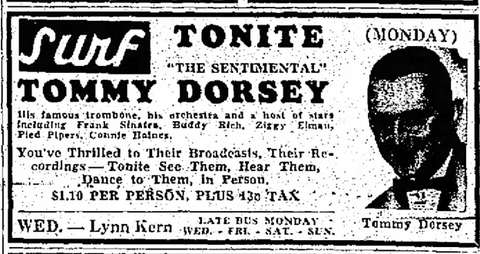
[Photograph: Frank's morals case goes to court, then is dismissed. From Richard Havers, "Sinatra" (Dorling Kindersley, 2007), p.40.]
The case stemming from Frank's arrests came before a court, and he was remanded to appear before a grand jury twenty days later. The charges were ultimately dismissed, though the ordeal came just weeks before his wedding to Nancy Barbato. (Source: Richard Havers, "Sinatra" (Dorling Kindersley, 2007).)
January 24, 1939
The adultery complaint against Frank was dismissed in open court. When Nancy asked if the woman had been the first, Frank reportedly told her no, but she'd be the last.
Frank Sinatra (quoted): "No, but she's the last."
Source: Nancy Sinatra, Frank Sinatra: An American Legend, 1995.
February 1939
[Dolly Sinatra's second arrest]
Kaplan: Dolly Sinatra was arrested again in February 1939, about three weeks after her son's wedding, for her midwifery/abortion work.
Source: James Kaplan, "Frank: The Voice" (2010)
February 3, 1939
The day before his wedding, Frank recorded a demo of the song "Our Love" with the Frank Manne orchestra, hoping it was a preview of things to come professionally. Source: Nancy Sinatra, "Frank Sinatra, My Father" (1985).
February 4, 1939
Frank Sinatra, twenty-three, married Nancy Carol Barbato, twenty-one, at Our Lady of Sorrow Church in Jersey City, with Monsignor Monteleon officiating. Nancy wore her sister's wedding dress and a ring that had belonged to Frank's mother; among Frank's gifts to her was a bag of jelly beans concealing a diamond watch. Unable to afford a honeymoon, the newlyweds moved directly into a small, forty-two-dollar-a-month apartment in Jersey City, furnished with gifts from relatives, while Frank resumed his fledgling singing career and Nancy took a secretarial job. Source: J. Randy Taraborrelli, Sinatra: Behind the Legend.
[Marriage to Nancy Barbato]
Frank Sinatra married Nancy Barbato on Saturday, February 4, 1939, at Our Lady of Sorrows Church in Jersey City, a small wedding held on the Barbato side with few Hobokenites attending, just over a month after his second arrest.
Source: James Kaplan, "Frank: The Voice" (2010).
February 27, 1939
Dolly Sinatra was arraigned in Hudson Special Sessions Court on a charge of performing another illegal abortion, and pleaded non vult (did not contest the charge) before Judge Lewis B. Eastmead. The case was covered in Hudson County newspapers only weeks after Frank and Nancy's wedding, and Nancy reportedly confided her embarrassment over her new mother-in-law's notoriety to a friend. Source: Kitty Kelley, "His Way: An Unauthorized Biography of Frank Sinatra" (1986).
March 6, 1939
Radio
Frank Sinatra, Songs
WNEW 11:45 PM
Note: Exactly 43 years later on March 6, 1982 Caesars Palace, Las Vegas, Nevada, 2nd show,
Sinatra introduces "Night and Day" by telling the audience the song was his theme song when he did a radio show on WNEW, New York. He mentions he used to get 35 cents car fare from New Jersey to New York to do the show.
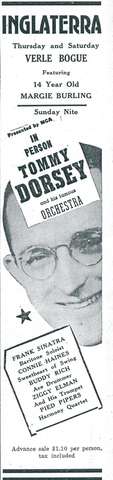
March 8, 1939
Radio
Frank Sinatra, Songs
WNEW New York, NY
11:45PM
March 10, 1939
Radio
Frank Sinatra, Songs
WNEW New York, NY
11:45PM
March 11, 1939
Radio
Frank Sinatra, Songs
WNEW, New York
2:45PM
March 13, 1939
Radio
Frank Sinatra, Songs
WNEW New York, NY
11:45 PM
March 15, 1939
Radio
Frank Sinatra, Songs
WNEW New York, NY
11:45PM
March 18, 1939
Studio
Harry Smith Recording Studio, West 46th Street New York City Our Love
Frank Mane arranger and conductor
Reed Player: Harry Shuckman
Drums: Don Ridney
Saturday
1: 00 P...M. to 2: P.M
11 Piece Band
Two instrumentals preceded the one vocal
"Our Love"(Tchaikovsky's theme from "Romeo & Juliet) 1 take Frank Sinatra's first studio recording note: A remastered copy of this recording surfaced a few years ago. --Ed
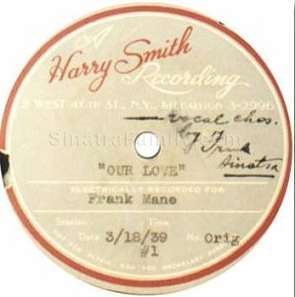
Harry Smith Recording Studio , West 46th Street New York City
Our Love
Frank Mane arranger and conductor
Reed Player: Harry Shuckman
Drums: Don Ridney
Thanks to Fred W. for the above article
Fred also sent along the following information about the auction of the original 78 in 2006:
"The auction of Sinatra's 1939 demo recording on a 12 inch 78 rpm disc ended with a winning auction room bid of $14,000. In answer to a query here a few days ago:
The owners of this demo disc apparently made some tape copies and some 45 rpm copies some years ago - one of which was sent to Sinatra. The single Sinatra track ('Our Love') appeared with other early Sinatra recordings on a CD from England in John Ridgway's Archive series as "Sinatra - The Beginning and Harry James" (JR Records FS 1939-2)
Mary Mane, 84, seated left, looks as auctioneer Nicole Parisi, right, carefully display the first Frank Sinatra recording, during the press preview of celebrity items for the Dick Clark auction preview in New York, Wednesday Oct. 25, 2006. Mary's husband Frank Mane, recorded his close friend Sinatra singing "Our Love" on March 18, 1939, during an experimental vinyl recording session in New York. The record is the only celebrity item not owned by Dick Clark in the auction to be held at New York's Lincoln Center on Dec. 5 and 6.
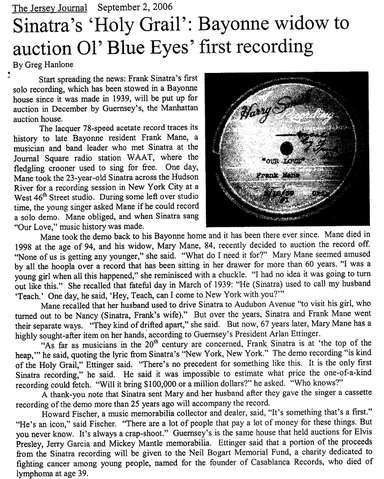
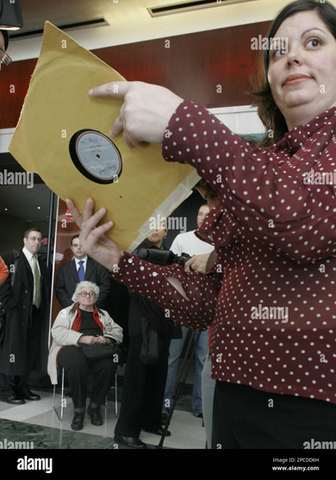
"Our Love" / "Flight of the Bumblebee" / "Girl of My Dreams" / "Eclipse" Will Friedwald (author); quote from Mitch Miller: Local bandleader Frank Mane assembled ten musicians (via Hoboken's Sicilian Club) to cut an audition demo for a possible spot with Clyde Lucas's California Dons; Sinatra, then hanging around WAAT, asked to come along and sang on the date. Held at Harry Smith Recording Studios, 2 West 46th St., Manhattan, for a total cost of $27, the session produced four instrumentals/vocal sides: Rimsky-Korsakov's 'Flight of the Bumblebee,' Larry Clinton's pop adaptation of Tchaikovsky's Romeo and Juliet theme titled 'Our Love,' Sunny Clapp's 1927 waltz 'Girl of My Dreams,' and a piece called 'Eclipse.' Friedwald analyzes 'Our Love' at length as Sinatra's actual first commercial-style vocal: at 23, Sinatra already sounds more confident than Jack Leonard's contemporaneous Dorsey-band version (recorded three days earlier, March 15), holding notes and shading pitch like a seasoned singer, stretching 'near to me' and lengthening the final 'our love' -- a gesture Friedwald links forward to the big closing note of 'All or Nothing at All' months later. The arrangement, nearly four and a half minutes long with a reprised final eight bars, functions almost like a 'concert' chart despite its foxtrot tempo. The lone surviving disc sat in Mane's dresser for decades until he reconnected with Sinatra in the early 1980s and gave him a tape, after which Sinatra made and distributed copies to friends. Mitch Miller is quoted characterizing young Sinatra's ambition generally: 'He had a direction. He knew where he was going, come hell or high water.'
Source: Will Friedwald, "Sinatra! The Song Is You: A Singer's Art" (2018 revised edition).
"Our Love"
Sinatra's actual first recording session took place at Harry Smith's Recording Studio, 2 West 46th Street, Manhattan, with saxophonist Frank Mane's ten-piece pickup band, assembled at Mane's own expense purely so he could hear how his arrangements sounded. This predates his official Brunswick debut by about four months.
Source: Charles L. Granata, "Sessions with Sinatra: Frank Sinatra and the Art of Recording" (1999/2003).
"Flight of the Bumblebee" / "Eclipse" / "Girl of My Dreams" / "Our Love" At the Mane session, three instrumentals were recorded first ("Flight of the Bumblebee," Mane's original "Eclipse," and "Girl of My Dreams"). With time left on the clock, Sinatra asked to record a vocal and Mane pulled out a stock arrangement of "Our Love" (based on a Tchaikovsky Romeo and Juliet melody) for him to sing.
Source: Charles L. Granata, "Sessions with Sinatra: Frank Sinatra and the Art of Recording" (1999/2003).
"Our Love"
Because Mane recorded only for his own personal interest, just a single master was cut of each song and no participant, including Sinatra, appears to have received a copy. This led biographers for years to mistakenly believe the recording was a "demo" Sinatra made for fiancee Nancy Barbato; the truth only emerged when Mane's original discs resurfaced later.
Source: Charles L. Granata, "Sessions with Sinatra: Frank Sinatra and the Art of Recording" (1999/2003).
[Sinatra's first recording session]
On Saturday, March 18, 1939, Frank made his first-ever recording, singing 'Our Love' with saxophonist Frank Mane's pickup band at Harry Smith's studio, 2 West 46th Street in Manhattan, cutting a 78-rpm demo he was thrilled to hear played back.
Source: James Kaplan, "Frank: The Voice" (2010).
March 20, 1939
Radio
Frank Sinatra, Songs
WNEW New York, NY
11:45 AM
March 22, 1939
Radio
Frank Sinatra, Songs
WNEW New York, NY
11:45 AM
March 24, 1939
Concerts
Frank Sinatra, Songs
WNEW New York, NY
11:45am
March 29, 1939
Radio
Frank Sinatra, Songs
WNEW New York
11:45 AM
April 3, 1939
Radio
Frank Sinatra, Songs
WNEW, New York
11:45am
April 10, 1939
Radio
Frank Sinatra, Songs
WNEW New York, NY
11:45AM
April 12, 1939
Radio
Frank Sinatra, Songs
WNEW, New York, NY
11:45 AM
April 17, 1939
Radio
Frank Sinatra, Songs
WNEW New York, NY
11:45 AM
April 19, 1939
Radio
Frank Sinatra, Songs
WNEW, New York, NY
11:45am
June 1939
[How Harry James discovered Sinatra at the Rustic Cabin]
Harry James was napping at the Lincoln Hotel one night this month with the radio on when his wife, singer Louise Tobin, heard a young singer on a broadcast and woke him to point the boy out; James registered the tip but thought little more of it that night. Sinatra later recalled that James did hear him and drove out the next night to the Rustic Cabin, a small Englewood Cliffs, New Jersey roadhouse on Route 9W where Sinatra sang between other work and where the house band's nightly WNEW "Dance Parade" broadcast (11:30 p.m.-midnight) carried him over the air; Sinatra said he was so eager to leave the club that he "almost broke his arm" grabbing at James's offer. Source: Will Friedwald, liner-note essay "Building a Foundation," and a companion recollection from Rustic Cabin house-band saxophonist Burt Hall (Harry Zimpiot) as told to Charles L. Granata, Harry James and His Orchestra Featuring Frank Sinatra: The Complete Recordings 1939 (Columbia/Legacy).
[Aftermath: Simon and Herfurt recollections]
George T. Simon separately recalled that James's road manager pressed him that same summer for "a good write-up" for the band's new singer; Simon noted Sinatra was actually three months older than James despite the "young boy singer" billing, and that James initially balked at the surname "Sinatra" as unromantic before Sinatra insisted on keeping it, citing his cousin, radio conductor Ray Sinatra. Saxophonist Skeets Herfurt, then with Tommy Dorsey, separately recalled that at James's formal Lincoln Hotel auditions Sinatra "walked in with no arrangements," unlike the other candidates, simply telling the pianist what to play and in what key -- and "knocked everybody out." Once hired, James and Sinatra stayed close off the bandstand; during lean stretches Sinatra and his wife Nancy hosted the whole band for spaghetti dinners. Source: George T. Simon, "In the Beginning...," and an audition recollection from Skeets Herfurt, liner notes to Harry James and His Orchestra Featuring Frank Sinatra: The Complete 1939 Recordings (Columbia/Legacy 66377).
[Harry James discovers Sinatra at Rustic Cabin]
Kaplan: In early June 1939, Harry James visited the Rustic Cabin to hear the boy singer his wife had described, reportedly catching Frank perform Cole Porter's demanding 'Begin the Beguine.' James was immediately convinced Frank was destined to be a great vocalist and offered him a contract on the spot at $75 a week.
Source: James Kaplan, "Frank: The Voice" (2010)
[James's "Frankie Satin" name suggestion refused]
Frank Sinatra: When Harry James, fresh off renaming singer Connie Haines that same day, suggested Frank perform under the stage name 'Frankie Satin,' Sinatra reportedly told him coldly, 'You want the singer, take the name,' and walked away, refusing to give up his Italian surname.
Source: James Kaplan, "Frank: The Voice" (2010)
[Rustic Cabin manager nearly costs Frank the Harry James job]
When bandleader Harry James's associates came looking for a singer at the Rustic Cabin, the manager almost dismissed Frank's talent, describing him merely as 'an MC that sings a little bit.' Frank, then 24, very nearly missed his big break as a result.
Source: Richard Havers, "Sinatra" (Dorling Kindersley, 2007).
[Sinatra officially joins Harry James's band]
Frank Sinatra joined Harry James's newly formed band in June 1939; their best-known collaboration, 'All or Nothing at All,' was recorded that August and would eventually top the charts years later.
Source: Richard Havers, "Sinatra" (Dorling Kindersley, 2007).
[discovery story -- critical commentary]
Granata / Louise Tobin: Harry James's wife, singer Louise Tobin, heard Sinatra on a Rustic Cabin radio remote and urged James to check him out. James visited the Rustic Cabin in person the next evening, was impressed, and Sinatra joined the James band within a day.
Source: Charles L. Granata, "Sessions with Sinatra: Frank Sinatra and the Art of Recording" (1999/2003), Part I: The Big Band Years, 1937-1942
June 8, 1939
Paramount Theatre , New York City (June 7-27)
Harry James and His Orchestra
Ed O'Brien:
Sinatra did not sing with the band during this engagement.. After signing with James, in early June,
Frank rehearsed with the Bob Chester Orch. There is a full page ad in Billboard of the James band - the week they opened at the Paramount - ad shows a picture of the band and a list of the band members. There is no mention of Sinatra. Jack Palmer (trumpet) was the male vocalist.
The last week James was at the Paramount, Frank rehearsed with them. His first stage appearance with was at the Hippodrome, in Baltimore, June 30. I have a review. of that engagement. Will post later today. I also found a brief mention in Billboard that Frank Sinatra, Ray's cousin, has just joined the James ensemble.
It was in the 7-22 edition.
June 30, 1939
Concerts
Hippodrome Theatre, Baltimore, Maryland
Harry James and his Orchestra with Frank Sinatra
On Screen: "Bridal Suite" with Robert Young and Annabella
Also appearing: The 4 Ink Spots
Ed O'Brien:
Harry James introduced his new male vocalist, Frank Sinatra, as the band opened a week long engagement. Frank would be with Harry's band for just over six months. He would record only 10 songs, but one would become a great part of the Sinatra career. At his Retirement Concert in 1971, Frank would open with "All Or Nothing At All," his introduction to the song said it all, "this was the beginning." June 30, 1939 was the first step.
Hippodrome Theatre, Baltimore, Maryland
Harry James and his Orchestra with Frank Sinatra
On Screen: "Bridal Suite" with Robert Young and Annabella
Also appearing: The 4 Ink Spots
[image referenced in source but could not be recovered]
Frank Sinatra made his debut with Harry James's new band (also billed as Harry James and His Music Makers) at the Hippodrome Theatre in Baltimore, singing “Wishing” and “My Love for You.” James had reportedly wanted to bill him under the name “Frankie Satin,” which Sinatra refused. James would later joke to a reporter that his new, still-unknown singer already carried himself like the greatest vocalist in the business. Source: J. Randy Taraborrelli, Sinatra: Behind the Legend.
[Joins Harry James's Music Makers]
Frank formally joined Harry James's band, the Music Makers, on June 30, 1939, opening a weeklong engagement at the Hippodrome in Baltimore; he was so new he wasn't even listed on the bill.
Source: James Kaplan, "Frank: The Voice" (2010).
Radio
Radio: Sinatra appeared as vocalist with Harry James & His Orchestra on a commercial radio broadcast this date, singing "Wishing" and "My Love For You." Broadcast from the Hippodrome Theatre, New York. Source: sinatradiscography.com, Radio Transcriptions Database.
July 1939
[First Published Review]
Performing with the Harry James band at the Roseland Ballroom in New York, Sinatra received his first published review -- a brief, favorable notice in Metronome by critic George T. Simon.
Source: Nancy Sinatra, "Frank Sinatra, My Father" (1985).
[touring/venue history -- critical commentary]
By early July 1939 the Harry James Orchestra featuring Sinatra was playing prominent engagements including New York's Roseland Ballroom and Atlantic City's Steel Pier, around the time James prepared to enter the studio for Brunswick Records.
Source: Charles L. Granata, "Sessions with Sinatra: Frank Sinatra and the Art of Recording" (1999/2003), Part I: The Big Band Years, 1937-1942
July 1, 1939
Concerts
Hippodrome Theatre, Baltimore, Maryland (June 30-July 6) Harry James and his Orchestra with Frank Sinatra
On Screen: "Bridal Suite" with Robert Young and Annabella
Also appearing: The 4 Ink Spots
July 2, 1939
Concerts
Hippodrome Theatre, Baltimore, Maryland (June 30-July 6) Harry James and his Orchestra with Frank Sinatra
On Screen: "Bridal Suite" with Robert Young and Annabella
Also appearing: The 4 Ink Spots
Hippodrome Theatre, Baltimore, Maryland (June 30-July 6) Harry James and his Orchestra with Frank Sinatra
On Screen: "Bridal Suite" with Robert Young and Annabella
Also appearing: The 4 Ink Spots
Variety
7-5-39 note: Thrilled to find this review. Frank's first engagement with Harry's band. We get the personnel and a nice mention for Frank.
Probably Frank's first major review from a trade paper..
--Ed
July 3, 1939
Concerts
Hippodrome Theatre, Baltimore, Maryland (June 30-July 6) Harry James and his Orchestra with Frank Sinatra
On Screen: "Bridal Suite" with Robert Young and Annabella
Also appearing: The 4 Ink Spots
July 4, 1939
Concerts
Hippodrome Theatre, Baltimore, Maryland (June 30-July 6) Harry James and his Orchestra with Frank Sinatra
On Screen: "Bridal Suite" with Robert Young and Annabella
Also appearing: The 4 Ink Spots
[Consiglio photographed with Lou Gehrig]
Consiglio: On the day of Lou Gehrig's famous farewell speech at Yankee Stadium, Yankees batboy Timmy Sullivan photographed Consiglio with Gehrig in the dugout, using Stan Lomax's press pass to get access. The New York Daily Mirror published the photo and sent Consiglio a large framed print.
Source: Tony Consiglio (as told to Franz Douskey), "Sinatra and Me: The Very Good Years" (2012).
[Photo with Lou Gehrig]
Consiglio: A photo caption notes Consiglio was photographed with Yankees great Lou Gehrig on the steps of the Yankee dugout on July 4, 1939, the day Gehrig gave his famous farewell speech.
Source: Tony Consiglio (as told to Franz Douskey), "Sinatra and Me: The Very Good Years" (2012).
July 5, 1939
Concerts
Hippodrome Theatre, Baltimore, Maryland (June 30-July 6) Harry James and his Orchestra with Frank Sinatra
On Screen: "Bridal Suite" with Robert Young and Annabella
Also appearing: The 4 Ink Spots
July 6, 1939
Concerts
Hippodrome Theatre, Baltimore, Maryland (June 30-July 6) Harry James and his Orchestra with Frank Sinatra
On Screen: "Bridal Suite" with Robert Young and Annabella
Also appearing: The 4 Ink Spots
July 7, 1939
Concerts
Roseland Ballroom, New York City
Harry James and his Orchestra with Frank Sinatra
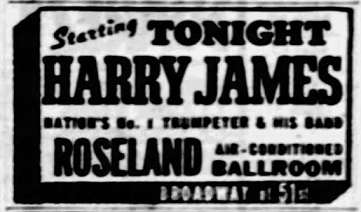
Radio
Radio: Sinatra appeared as vocalist with Harry James & His Orchestra on a commercial radio broadcast this date, singing "If I Didn't Care." CBS broadcast from Roseland Ballroom, New York. Source: sinatradiscography.com, Radio Transcriptions Database.
July 8, 1939
Concerts
Roseland Ballroom, New York City
Harry James and his Orchestra with Frank Sinatra
1. Stardust
2. Wishing Will Make It So
Note: "Stardust" appears on Masters of Jazz Volume 8.
Radio
Radio: Sinatra appeared as vocalist with Harry James & His Orchestra on a commercial radio broadcast this date, singing "Stardust" and "To You." CBS broadcast from Roseland Ballroom, New York. Source: sinatradiscography.com, Radio Transcriptions Database.
"Stardust"
Will Friedwald (author): Friedwald calls this aircheck of Hoagy Carmichael's classic 'a major find,' given Sinatra's long later relationship with the song (bits with the Pied Pipers/Tommy Dorsey, and a full 1961 version singing only the verse). Here Sinatra sings the entire song solo in a warm medium foxtrot, and Friedwald states he directly patterned his phrasing after Dorsey's own 1936 trombone recording of the melody -- possibly explaining why Dorsey later wanted to sign him. After the vocal, the James reed section plays a rapturous chorus and James himself takes one of his best solos of the period, full of Bunny Berigan and Louis Armstrong influence. At roughly four minutes (effectively a 12-inch-disc length), Friedwald calls it 'the single best document of the Sinatra-James collaboration.'
Source: Will Friedwald, "Sinatra! The Song Is You: A Singer's Art" (2018 revised edition).
"Stardust"
For years before the two men even met, Dorsey had long been one of Sinatra’s key musical inspirations; as we saw in Sinatra’s July 1939 radio performance of "Stardust" with Harry James, his phrasing was already amazingly Dorseylike.
Source: Will Friedwald, "Sinatra! The Song Is You: A Singer's Art" (2018 revised edition).
"Stardust"
Jack Palmer: Trumpeter Jack Palmer recalled Sinatra's first appearance with the James band, likely in New Haven, CT: James introduced him on the spot with no arrangement prepared, Sinatra called out "Stardust," and the rhythm section improvised behind him.
Source: Charles L. Granata, "Sessions with Sinatra: Frank Sinatra and the Art of Recording" (1999/2003).
July 9, 1939
Concerts
Roseland Ballroom, New York City
Harry James and his Orchestra with Frank Sinatra
1. Wishing Will Make It So
Note: "Wishing Will Make It So" appears on Masters of Jazz Volume 8.
Radio
Radio: Sinatra appeared as vocalist with Harry James & His Orchestra on a commercial radio broadcast this date, singing "Wishing." CBS broadcast from Roseland Ballroom, New York. Source: sinatradiscography.com, Radio Transcriptions Database.
July 10, 1939
Concerts
Roseland Ballroom, New York City
Harry James and his Orchestra with Frank Sinatra
1. If I Didn't Care
2. The Lamp Is Low
Note: "If I Didn't Care" & "The Lamp Is Low" appear on Masters of Jazz Volume 8.
Radio
Radio: Sinatra appeared as vocalist with Harry James & His Orchestra on a commercial radio broadcast this date, singing "If I Didn't Care" and "The Lamp Is Low." CBS broadcast from Roseland Ballroom, New York. Source: sinatradiscography.com, Radio Transcriptions Database.
July 11, 1939
Concerts
Roseland Ballroom, New York City
Harry James and his Orchestra with Frank Sinatra
July 12, 1939
Concerts
Roseland Ballroom, New York City
12PM
1. I Poured My Heart Into A Song
July 13, 1939
Studio
B25057 From The Bottom Of My Heart
(B. Hays/A. Gibson/M. Beck/H. James)
Arranged by Andy Gibson
-1 (3:13) CD: CK66377 Harry James & Orch. Fet.FS: Complete Recordings -2 (3:18) CD: CK66377 Harry James & Orch. Fet.FS: Complete Recordings -2 LP: CL-2739
-3 (3:06) CD: (Columbia/RCA Victor/Legacy) 09669 & 16124 FS: A Voice in Time (Disc 1 of 4: The Big Band Years 1939-1942) -1 78: Brunswick 8443
B25059 Melancholy Mood
(V. Knight/W. Schumann)
Arranged by Andy Gibson
-1 (3:04) CD: CK66377 Harry James & Orch. Fet.FS: Complete Recordings -2 (3:10) CD: CK66377 Harry James & Orch. Fet.FS: Complete Recordings -1 LP: CL-2739
-1 78: Brunswick 8843
Trumpets: Harry James, Claude Bowen, Tom Gonsoulin, Jack Palmer, Claude Lakey, Jack Schaeffer; Trombones: Russell Brown, Truett Jones, Dalton Rizzotto, Bruce Squires; Alto Sax: Dave Matherws, Claude Lakey; Tenor Sax: Claude Lakey, Bill Luther, Drew Page; Baritone Sax: Bill Luther Page, Drew Page; Piano: Jack Gardner; Guitar: Brian "Red" Kent; Bass: Thurman Teague; Drums: Ralpn Hawkins, Mickey Scrima; Vocals: Frank Sinatra
YORK DAILY RECORD
JULY 13, 1939
Frank Sinatra cut his first record with Harry James (trumpeter), “From The Bottom of My Heart” (backed with “Melancholy Mood”) on the Brunswick label. Recorded at 78 rpm, neither song hit the charts.
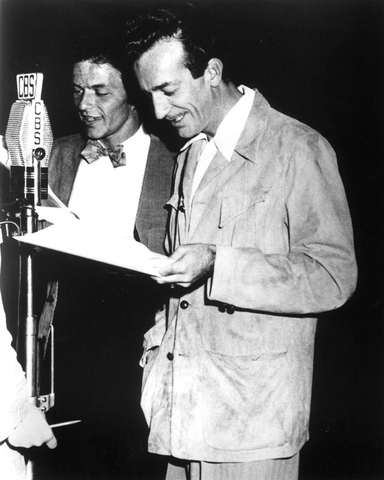
"From the Bottom of My Heart" / "Melancholy Mood"
Sinatra's first official commercial recordings, "From the Bottom of My Heart" and "Melancholy Mood," were cut with the Harry James Orchestra in New York and released as Brunswick 8443.
Source: Charles L. Granata, "Sessions with Sinatra: Frank Sinatra and the Art of Recording" (1999/2003).
[First Sinatra-James recording session]
On July 13, 1939, Frank recorded with the Harry James band for the first time at Brunswick's studios, 550 Fifth Avenue in New York — only the second time in his life he had set foot in a recording studio.
Source: James Kaplan, "Frank: The Voice" (2010).
[Daddy / From the Bottom of My Heart -- critical commentary]
Bill Savory: Retired Columbia engineer Bill Savory believed some 1939 Brunswick/Columbia sides were made at World Broadcasting's studios at 550 Fifth Avenue rather than Columbia's famed Liederkranz Hall (used for James's "Daddy," sung by Helen Ward); he judged that the Sinatra-James sides lack the open, reverberant "Liederkranz sound" and were likely cut in a smaller studio.
This song/context matches multiple dated entries in the chronology, or lacked a sufficiently precise date; the specific date could not be determined with confidence.
Source: Charles L. Granata, "Sessions with Sinatra: Frank Sinatra and the Art of Recording" (1999/2003), Part I: The Big Band Years, 1937-1942
[From the Bottom of My Heart -- critical commentary]
In 1997, while making archival transfers of the Harry James masters in the Columbia vault, Sony Music producer Michael Brooks and engineer Matt Cavaluzzo discovered a 16-inch lacquer disc of "From the Bottom of My Heart" among the metal parts -- evidence that at least some 1939 Sinatra-James sessions may have been recorded on lacquer rather than wax; no other lacquers from those sessions have surfaced.
This song/context matches multiple dated entries in the chronology, or lacked a sufficiently precise date; the specific date could not be determined with confidence.
Source: Charles L. Granata, "Sessions with Sinatra: Frank Sinatra and the Art of Recording" (1999/2003), Part I: The Big Band Years, 1937-1942
[From the Bottom of My Heart / Melancholy Mood -- critical commentary]
Will Friedwald (author): Friedwald details Sinatra's first commercial studio session as a singer, cut July 13, 1939. 'From the Bottom of My Heart' (co-credited to arranger Andy Gibson and James) opens with James stating the melody, then Sinatra repeating it with an added 'tag' chorus over two takes; despite a thin lyric ('What more can I say?'), Friedwald credits Sinatra's personality for making the line land -- 'his very Sinatraness... already apparent even here, on his very first commercial recording.' The companion side, Walter Schumann's 'Melancholy Mood' (Schumann later wrote the Dragnet theme), is described as a twenty-year forerunner of the Only the Lonely mood; James growls the tune Ellington-plunger style, and a tenor break identified by Phil Schaap as future Ellington star Al Sears anticipates Ben Webster.
This song/context matches multiple dated entries in the chronology; the specific date Friedwald is referring to could not be determined with confidence.
Source: Will Friedwald, "Sinatra! The Song Is You: A Singer's Art" (2018 revised edition), Ch. 2, "For Old Times' Sake" (1915-1939)
Radio
Radio: Sinatra appeared as vocalist with Harry James & His Orchestra on a commercial radio broadcast this date, singing "I Poured My Heart Into My Song." CBS broadcast from Roseland Ballroom, New York. Source: sinatradiscography.com, Radio Transcriptions Database.
July 15, 1939
Concerts
Roseland Ballroom, New York
Harry James and his Orchestra with Frank Sinatra
1. Melancholy Mood
Radio
Radio: Sinatra appeared as vocalist with Harry James & His Orchestra on a commercial radio broadcast this date, singing "Melancholy Mood" and "From The Bottom Of My Heart." CBS broadcast from Roseland Ballroom, New York. Source: sinatradiscography.com, Radio Transcriptions Database.
July 19, 1939
Radio
America Dances
Network: BBC (England)
Location: Roseland Ballroom, New York City
Time: 2:00 P.M.
1. To You
2. From the Bottom of My Heart
Concerts
Roseland Ballroom, New York
Harry James and his Orchestra with Frank Sinatra
America Dances
Network: BBC (England)
Location: Roseland Ballroom, New York City
Time: 2:00 P.M.
1. To You
2. From the Bottom of My Heart
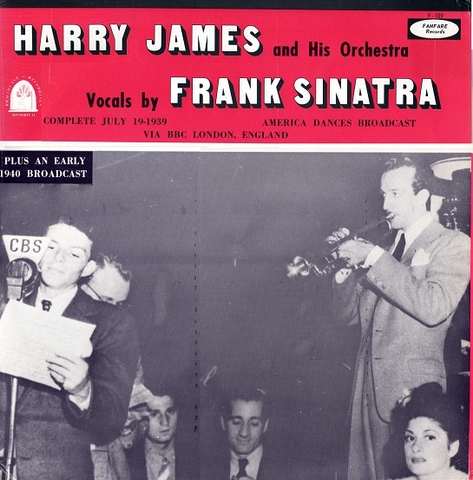
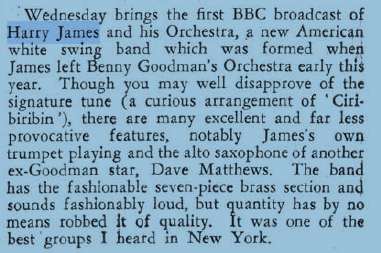
Harry James's band broadcast on BBC radio, and a British reporter, tuning in without much expectation, was surprised by a singer named Frank Sinatra performing 'From the Bottom of My Heart' and 'To You.' It marked Frank's first time being heard in Britain. (Source: Richard Havers, "Sinatra" (Dorling Kindersley, 2007).)
July 24, 1939
Concerts
Marine Ballroom, Steel Pier, Atlantic City (July 24-28) Harry James and his Musicmakers w/Frank Sinatra
1. My Love For You
Note: "My Love For You" appears on the CD, Masters of Jazz Volume 8
Note: Harry James would play three times at the Steel Pier in July and August 1939
Steel Pier, July 24-28th
Steel Pier July 31-August 5th
Steel Pier August 7th-9th.
Marine Ballroom, Steel Pier, Atlantic City
Harry James and his Musicmakers w/Frank Sinatra
Harry James and Alex Bartha’s orchestra alternated with James appearing in the afternoon and Bartha in the evening
[image referenced in source but could not be recovered]
[image referenced in source but could not be recovered]
[image referenced in source but could not be recovered]
[image referenced in source but could not be recovered]
Radio
Radio: Sinatra appeared as vocalist with Harry James & His Orchestra on a commercial radio broadcast this date, singing "My Love For You." CBS broadcast from Marine Ballroom, Atlantic City. Source: sinatradiscography.com, Radio Transcriptions Database.
July 25, 1939
Radio
Marine Ballroom, Steel Pier, Atlantic City (WABC)
Harry James and his Musicmakers w/Frank Sinatra
Concerts
Marine Ballroom, Steel Pier, Atlantic City
Harry James and his Musicmakers w/Frank Sinatra
July 26, 1939
Concerts
Marine Ballroom, Steel Pier, Atlantic City (July 24-28)
Harry James and his Musicmakers w/Frank Sinatra
July 27, 1939
Radio
Live Remote: Marine Ballroom, Steel Pier, Atlantic City, New Jersey
Thursday Evening
12:00 a.m. - 12:30 a.m.
Mutual Network - WOR New York City
Harry James & His Orchestra
Harry on lead trumpet
Jack Schaeffer, Claude Brown, Jack Palmer (trumpets)
Russell Brown, Truett Jones, Dalton Rizzotto (trombone) Dave Matthews, Claude Lakey (alto sax)
Bill Luther, Drew Page (tenor/baritone sax)
Jack Gardner (piano)
Red Kent (guitar)
Thurman Teague (bass)
Mickey Scrima (drums)
Connie Haines, Frank Sinatra (vocals)
Ed O'Brien
I have found a considerable number of verifiable a/c dates for the James band throughout the summer of 1939. The show above was actually broadcast at 12:a.m., 7/28, but I have decided to go with the traditional schedule shown in newspapers and TV Guides.
Concerts
Marine Ballroom, Steel Pier, Atlantic City, New Jersey (July 24-28) Harry James & His Orchestra with Frank Sinatra
July 28, 1939
Radio
Live Remote: Marine Ballroom, Steel Pier, Atlantic City, New Jersey
Friday Evening
12:00 a.m. - 12:30 a.m.
CBS Network - WABC New York City
Harry James & His Orchestra
Harry on lead trumpet, Jack Schaeffer, Claude
Brown, Jack Palmer (trumpets), Russell Brown,
Truett Jones, Dalton Rizzotto (trombone), Dave
Matthews, Claude Lakey (alto sax), Bill Luther,
Drew Page (tenor/baritone sax), Jack Gardner
(piano), Red Kent (guitar), Thurman Teague
(bass), Mickey Scrima (drums), Connie Haines, Frank Sinatra (vocals)
Concerts
Marine Ballroom, Steel Pier, Atlantic City, New Jersey (July 24-28) Harry James and his Orchestra with Frank Sinatra
July 31, 1939
Radio
Marine Ballroom,Steel Pier Atlantic City,New Jersey
Harry James and his Orchestra
Monday Night 11:45 p.m.-12:15a.m. Mutual Network WOR New York City . ---Sinatra songs---My Love For You/To You/From The Bottom Of My Heart/Melancholy Mood
Concerts
Marine Ballroom, Steel Pier, Atlantic City, New Jersey (July 31-August 5)
Harry James and his Orchestra w/Frank Sinatra
Songs Included:
1. To You
2. My Love For You
3. From The Bottom Of My Heart
Note: Harry James had played the Steel Pier from July 24th to July 28th and then came back for a second time during this engagement.
Again, he alternated with the Alex Bartha Orchestra.
Marine Ballroom, Steel Pier, Atlantic City, New Jersey (July 31-August 5)
Harry James and his Orchestra w/Frank Sinatra
August 1939
[Records 'All or Nothing at All']
Harry James recorded "All or Nothing at All" with Sinatra singing the vocal refrain; the record sold poorly on its initial release.
Source: Nancy Sinatra, "Frank Sinatra, My Father" (1985).
[Harry James lets Connie Haines go]
Kaplan: Singer Connie Haines had been let go by Harry James's band the previous August for financial reasons before Tommy Dorsey picked her up in 1940.
Source: James Kaplan, "Frank: The Voice" (2010)
August 1, 1939
Radio
Live Remote: Marine Ballroom, Steel Pier, Atlantic City, New Jersey
Tuesday Evening
12:00 a.m. - 12:30 a.m.
CBS Network - WABC New York City
Harry James & His Orchestra
Harry on lead trumpet
Jack Schaeffer, Claude Brown, Jack Palmer (trumpets)
Russell Brown, Truett Jones, Dalton Rizzotto (trombone) Dave Matthews, Claude Lakey (alto sax)
Bill Luther, Drew Page (tenor/baritone sax)
Jack Gardner (piano)
Red Kent (guitar)
Thurman Teague (bass)
Mickey Scrima (drums)
Connie Haines, Frank Sinatra (vocals)
Concerts
Marine Ballroom, Steel Pier, Atlantic City , New Jersey Harry James and his Orchestra w/Frank Sinatra
August 2, 1939
Radio
Live Remote: Marine Ballroom, Steel Pier, Atlantic City, New Jersey
Wednesday Evening
12:00 a.m. - 12:30 a.m.
CBS Network - WABC New York City
Harry James & His Orchestra
Harry on lead trumpet
Jack Schaeffer, Claude Brown, Jack Palmer (trumpets)
Russell Brown, Truett Jones, Dalton Rizzotto (trombone) Dave Matthews, Claude Lakey (alto sax)
Bill Luther, Drew Page (tenor/baritone sax)
Jack Gardner (piano)
Red Kent (guitar)
Thurman Teague (bass)
Mickey Scrima (drums)
Connie Haines, Frank Sinatra (vocals)
Concerts
Marine Ballroom, Steel Pier, Atlantic City, July 31-August 5th Harry James and his Orchestra with Frank Sinatra
August 3, 1939
Concerts
Marine Ballroom, Steel Pier, Atlantic City, New Jersey, July 31-August 5 Thursday Evening
Harry James & His Orchestra
Harry on lead trumpet
Jack Schaeffer, Claude Brown, Jack Palmer (trumpet and vocals) Russell Brown, Truett Jones, Dalton Rizzotto (trombone) Dave Matthews, Claude Lakey (alto sax)
Bill Luther, Drew Page (tenor/baritone sax)
Jack Gardner (piano)
Red Kent (guitar)
Thurman Teague (bass)
Mickey Scrima (drums)
Connie Haines (vocals), Frank Sinatra (vocals)
Marine Ballroom, Steel Pier, Atlantic City, New Jersey, July 31-August 5
Thursday Evening
Harry James & His Orchestra
note: Connie Haines would leave the band during this engagement.
Ed
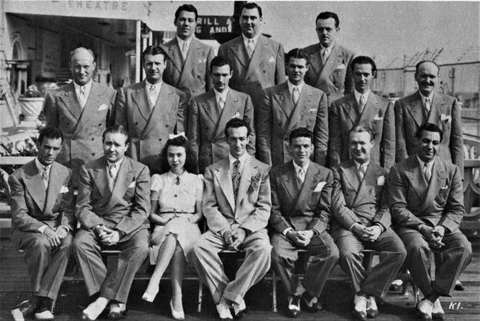
August 4, 1939
Radio
Live Remote: Marine Ballroom, Steel Pier, Atlantic City, New Jersey
Friday Evening
12:30 a.m. - 1:00 a.m.
Mutual Network - WOR (New York City)
Harry James & His Orchestra
Harry on lead trumpet
Jack Schaeffer, Claude Brown, Jack Palmer (trumpets)
Russell Brown, Truett Jones, Dalton Rizzotto (trombone) Dave Matthews, Claude Lakey (alto sax)
Bill Luther, Drew Page (tenor/baritone sax)
Jack Gardner (piano)
Red Kent (guitar)
Thurman Teague (bass)
Mickey Scrima (drums)
Connie Haines, Frank Sinatra (vocals)
Concerts
Marine Ballroom, Steel Pier, Atlantic City, New Jersey
Harry James and his Orchestra with Frank Sinatra
August 5, 1939
Radio
Marine Ballroom, Steel Pier, Atlantic City
Mutual Network
7:30 p.m.
Harry James and his Orchestra w/Frank Sinatra
1. Ciribiribin
2. Shorty George
3. Frank: From The Bottom Of My Heart
4. I Found A New Baby
5. Connie Haines: White Sails
Marine Ballroom, Steel Pier, Atlantic City
CBS from 12:30 a.m. - 1:00 a.m.
Harry James and his Orchestra w/Frank Sinatra
1. Frank: Let's Disappear
2. Frank: My Buddy
3. Sweet Georgia Brown
4. Oh Lady Be Good
Concerts
Marine Ballroom, Steel Pier, Atlantic City (July 31-August 5) Harry James and his Orchestra with Frank Sinatra
August 6, 1939
Concerts
Compounce Music Shell, Lake Compounce Amusement Park, Bristol, Connecticut Harry James and his Orchestra with Frank Sinatra
Compounce Music Shell, Lake Compounce Amusement Park, Bristol, Connecticut Harry James and his Orchestra with Frank Sinatra
August 7, 1939
Radio
Live Remote: Marine Ballroom, Steel Pier, Atlantic City, New Jersey
Monday Evening
Harry James & His Orchestra with Frank Sinatra
Concerts
Marine Ballroom, Steel Pier, Atlantic City, New Jersey (August 7-9) Monday Evening
Harry James & His Orchestra with Frank Sinatra
Harry on lead trumpet
Jack Schaeffer, Claude Brown, Jack Palmer (trumpets)
Russell Brown, Truett Jones, Dalton Rizzotto (trombone) Dave Matthews, Claude Lakey (alto sax)
Bill Luther, Drew Page (tenor/baritone sax)
Jack Gardner (piano)
Red Kent (guitar)
Thurman Teague (bass)
Mickey Scrima (drums)
Connie Haines, Frank Sinatra (vocals)
Note: This was Harry James’ 3rd appearance that summer of 1939 at the Steel Pier. The first was from July 24-28, the second was July 31 to August 5th, and finally the third engagement from August 7-9
Marine Ballroom, Steel Pier, Atlantic City, New Jersey (August 7-9) Monday Evening
Harry James & His Orchestra with Frank Sinatra
------------------------------------
August 7th, 1940
Eleanor Roosevelt with Jazz Musicians(Original Caption) 8/7/1940- New York, NY: First Lady Buys Ticket To Music-Sports Festival. Mrs. Franklin D. Roosevelt was the first on hand to buy tickets to the unique Music-Sports festival to be staged at the Polo Grounds, Aug 22nd, for the benefit of the Bethune-Cookman College, a Negro educational institution at Daytona, FL. Left to right: Fred Norman, Bunny Berrigan, Tommy Dorsey, three of the band leaders who will participate: Mrs. Franklin D. Roosevelt, Lionel Hampton, composer who will direct the "dream band" at the festival, and Frank Sinatra, another volunteer maestro.
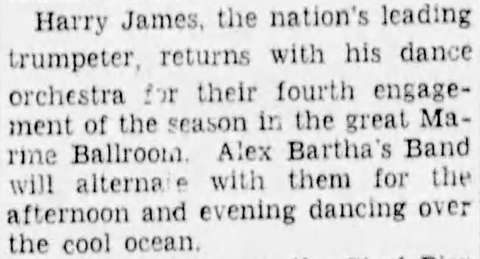
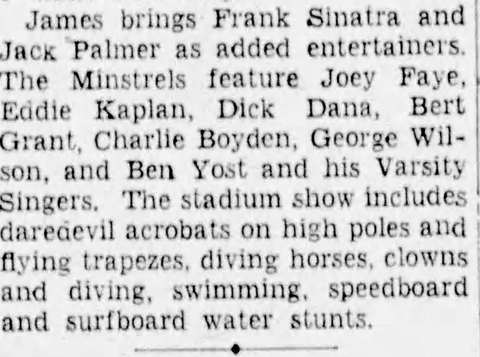
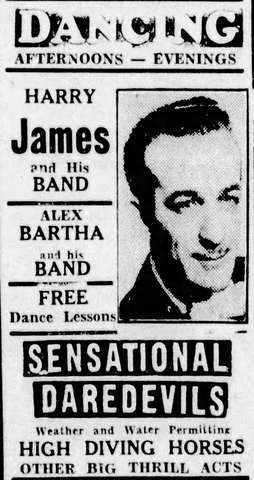
Philadelphia Inquirer
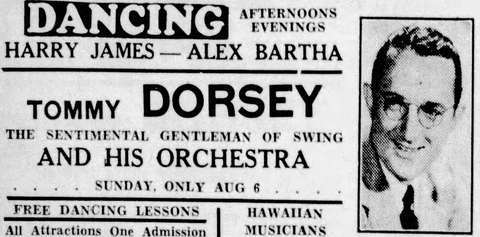
James band opened on 8/7 for three days
Philadelphia Inquirer weekly ad for Steel Pier - ran on Sunday 8-6-39
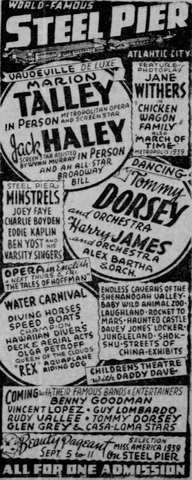
Marine Ballroom, Steel Pier, Atlantic City, New Jersey (August 7-9) Monday Evening
Harry James & His Orchestra with Frank Sinatra
Press of Atlantic City
8-7-39
Press of Atlantic City
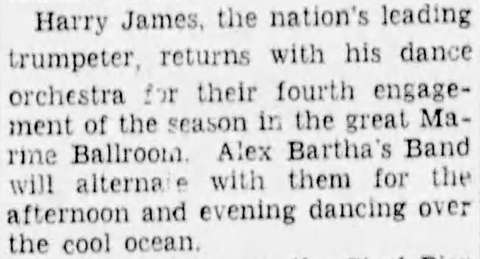
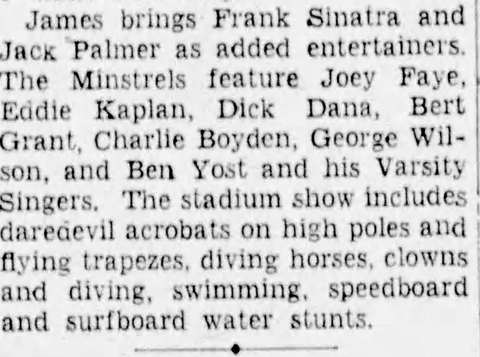
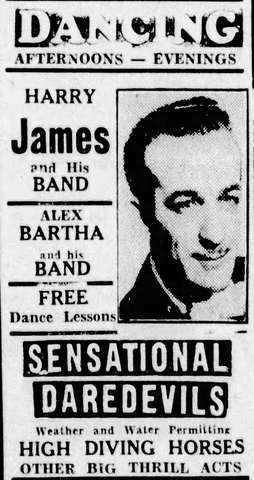
August 8, 1939
Radio
Marine Ballroom, Steel Pier, Atlantic City, New Jersey
Harry James & His Orchestra
Concerts
Marine Ballroom, Steel Pier, Atlantic City, New Jersey (August 7-9) Harry James & His Orchestra
Harry on lead trumpet. Jack Schaeffer, Claude Brown, Jack Palmer (trumpets).Russell Brown, Truett Jones, Dalton Rizzotto (trombone).Dave Matthews, Claude Lakey (alto sax).Bill Luther, Drew Page (tenor/baritone sax)
Jack Gardner (piano).Red Kent (guitar).Thurman Teague (bass).Mickey Scrima (drums).Connie Haines, Frank Sinatra (vocals)
August 9, 1939
Concerts
Marine Ballroom, Steel Pier, Atlantic City, New Jersey (August 7-9) Harry James & His Orchestra
Harry on lead trumpet. Jack Schaeffer, Claude
Brown, Jack Palmer (trumpets).Russell Brown,
Truett Jones, Dalton Rizzotto (trombone).Dave
Matthews, Claude Lakey (alto sax).Bill Luther, Drew Page (tenor/baritone sax) Jack Gardner (piano).Red Kent (guitar).Thurman
Teague (bass).Mickey Scrima (drums).Connie Haines, Frank Sinatra (vocals)
August 10, 1939
Radio
Live Remote: Roseland Ballroom, New York City
Thursday Evening
11:30 p.m. - 12:00 a.m.
CBS Network
WABC
Harry James & His Orchestra: Harry on lead trumpet, Jack Schaeffer, Claude Brown, Jack Palmer (trumpets) Russell Brown, Truett Jones, Dalton Rizzotto
(trombone), Dave Matthews, Claude Lakey (alto sax)
Bill Luther, Drew Page (tenor/baritone sax), Jack
Gardner (piano), Red Kent (guitar), Thurman
Teague (bass), Mickey Scrima (drums), Connie Haines, Frank Sinatra (vocals)
1. Moon Love Frank Sinatra
2. Rhapsody In Blue Harry James
3. All Or Nothing At All Frank Sinatra
4. Japanese Sandman Harry James
5. St. Louis Blues Harry James
6. Melancholy Mood Frank Sinatra
7. T'ain't What You Do Connie Haines
8. This Is No Dream Frank Sinatra
9. Blue Skies Harry James
10. My Buddy Frank Sinatra
11. My Love For You Harry James
Note: The songs "Moon Love" & "This Is No Dream" appear on the CD: Harry James & His Orchestra
Featuring Frank Sinatra No.CK 66377
("Moon Love" ,"This Is No Dream" , "My Buddy" and
"Melancholy Mood" all appear on Masters of Jazz Volume 8)
Concerts
Roseland Ballroom, New York, NY (10-18)
Harry James and his Orchestra w/Frank Sinatra
August 11, 1939
Radio
Live Remote: Roseland Ballroom, New York City
Harry James and His Orchestra with Frank Sinatra
Concerts
Roseland Ballroom, New York
Harry James and his Orchestra w/Frank Sinatra
Roseland Ballroom, New York
Harry James and his Orchestra w/Frank Sinatra
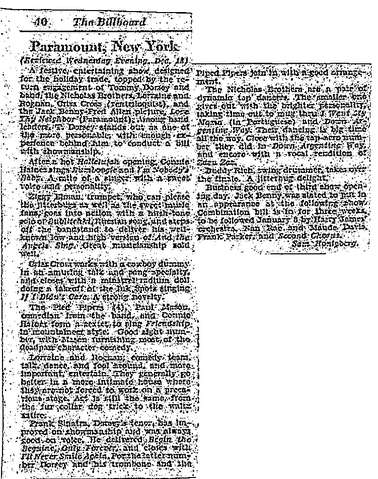
August 12, 1939
Radio
Live Remote: Roseland Ballroom, New York City
Saturday Evening
11:30 p.m. - 12:00 a.m.
CBS Network - WABC New York City
Harry James & His Orchestra
Harry on lead trumpet, Jack Schaeffer, Claude Brown, Jack Palmer (trumpets), Russell Brown, Truett Jones, Dalton Rizzotto (trombone), Dave Matthews, Claude Lakey (alto sax), Bill Luther, Drew Page (tenor/baritone sax), Jack Gardner (piano), Red Kent (guitar), Thurman Teague (bass), Mickey Scrima (drums), Connie Haines, Frank Sinatra (vocals)
1. Sugar Daddy
2. Rhapsody In Blue
3. Frank: All Or Nothing At All
4. Japanese Sandman
5. St. Louis Blues
6. Taint What You Do
7. Blue Skies
8. My Love For You
Ed O'Brien: First radio broadcast of "All Or Nothing At All" took place on this Saturday evening 85 years ago.
Concerts
Roseland Ballroom, New York (10-18)
Harry James & His Orchestra with Frank Sinatra
August 13, 1939
Concerts
Roseland Ballroom, New York (August 10-18)
Harry James and his Orchestra with Frank Sinatra
August 14, 1939
Radio
Live Remote: Roseland Ballroom, New York City
Monday Evening
12:00 a.m. - 12:30 a.m.
Mutual Network - WOR New York City
Harry James & His Orchestra
Harry on lead trumpet, Jack Schaeffer, Claude Brown, Jack Palmer (trumpets), Russell Brown, Truett Jones, Dalton Rizzotto (trombone), Dave Matthews, Claude Lakey (alto sax), Bill Luther, Drew Page (tenor/baritone sax), Jack Gardner (piano), Red Kent (guitar), Thurman Teague (bass), Mickey Scrima (drums), Connie Haines, Frank Sinatra (vocals)
Concerts
Roseland Ballroom, New York City (10-18)
Harry James & His Orchestra
Harry on lead trumpet, Jack Schaeffer, Claude Brown, Jack Palmer (trumpets), Russell Brown, Truett Jones, Dalton Rizzotto (trombone), Dave Matthews, Claude Lakey (alto sax), Bill Luther, Drew Page (tenor/baritone sax), Jack Gardner (piano), Red Kent (guitar), Thurman Teague (bass), Mickey Scrima (drums), Connie Haines, Frank Sinatra (vocals)
August 15, 1939
Concerts
Roseland Ballroom, New York City (10-18)
Harry James & His Orchestra
Harry on lead trumpet, Jack Schaeffer, Claude Brown, Jack Palmer (trumpets), Russell Brown, Truett Jones, Dalton Rizzotto (trombone), Dave Matthews, Claude Lakey (alto sax), Bill Luther, Drew Page (tenor/baritone sax), Jack Gardner (piano), Red Kent (guitar), Thurman Teague (bass), Mickey Scrima (drums), Connie Haines, Frank Sinatra (vocals)
August 16, 1939
Radio
Live Remote: Roseland Ballroom, New York City
Wednesday Evening
12:00 a.m. - 12:30 a.m.
CBS Network - WABC New York City
Harry James & His Orchestra
Harry on lead trumpet, Jack Schaeffer, Claude Brown, Jack Palmer (trumpets) Russell Brown, Truett Jones, Dalton Rizzotto (trombone), Dave Matthews, Claude Lakey (alto sax), Bill Luther, Drew Page (tenor/baritone sax), Jack Gardner (piano), Red Kent (guitar), Thurman Teague (bass), Mickey Scrima (drums), Connie Haines, Frank Sinatra (vocals)
Concerts
Roseland Ballroom, New York City (10-18)
Harry James & His Orchestra
Harry on lead trumpet, Jack Schaeffer, Claude Brown, Jack Palmer (trumpets), Russell Brown, Truett Jones, Dalton Rizzotto (trombone), Dave Matthews, Claude Lakey (alto sax), Bill Luther, Drew Page (tenor/baritone sax), Jack Gardner (piano), Red Kent (guitar), Thurman Teague (bass), Mickey Scrima (drums), Connie Haines, Frank Sinatra (vocals)
August 17, 1939
Studio
B25212 My Buddy
(G. Kahn/W. Donaldson)
Arranged by Andy Gibson
-2 (2:53) CD: CK66377 Harry James & Orch. Fet.FS: Complete Recordings -2 LP: CL-2739
-2 78: 37520
-2 78: 35242
B25215 It's Funny To Everyone But Me
(J. Lawrence)
Arranged by Andy Gibson
-1 (2:55) CD: CK66377 Harry James & Orch. Fet.FS: Complete Recordings -2 (2:50) CD: CK66377 Harry James & Orch. Fet.FS: Complete Recordings -1 LP: HL-7159
-1 78: 36738
-1 78: 35209
Trumpets: Harry James, Claude Bowen, Tom
Gonsoulin, Jack Palmer, Claude Lakey, Jack
Schaeffer; Trombones: Russell Brown, Truett
Jones, Dalton Rizzotto, Bruce Squires; Alto Sax:
Dave Matherws, Claude Lakey; Tenor Sax: Claude
Lakey, Bill Luther, Drew Page; Baritone Sax: Bill
Luther Page, Drew Page; Piano: Jack Gardner;
Guitar: Brian "Red" Kent; Bass: Thurman Teague;
Drums: Ralpn Hawkins, Mickey Scrima; Vocals: Frank Sinatra
NOTE: Sinatra Scholar Ed O'Brien feels that "It's
Funny to Everyone But Me" was the first Sinatra recording that gave us a true indication of just how great a singer he would become. The phrasing here conveys a profound sadness that deeply touches the listener. Marvelous interpretative skills that would just get better and better through the years.
Sinatraphile Ed Speigel says this recording has always been his favorite of all the sides that
Sinatra cut with Harry James. His phrasing, note bending, and sensitivity give the clearest indication of what was to come. The ColumbIa
Legacy Harry James-Frank Sinatra cd includes both the released version and an alternate take.
Frank's singing on the original is just a hair better.
Concerts
Roseland Ballroom, New York City (10-18)
Harry James & His Orchestra
Harry on lead trumpet, Jack Schaeffer, Claude
Brown, Jack Palmer (trumpets), Russell Brown,
Truett Jones, Dalton Rizzotto (trombone), Dave
Matthews, Claude Lakey (alto sax), Bill Luther,
Drew Page (tenor/baritone sax), Jack Gardner
(piano), Red Kent (guitar), Thurman Teague
(bass), Mickey Scrima (drums), Connie Haines, Frank Sinatra (vocals)
B25212 My Buddy
B25215 It's Funny To Everyone But Me
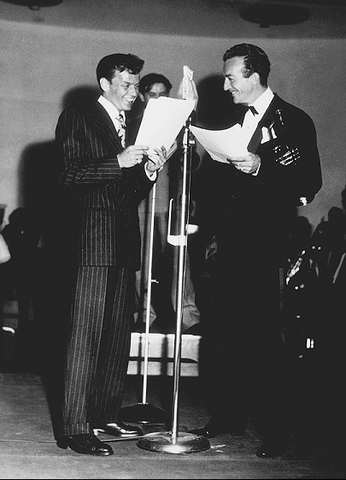
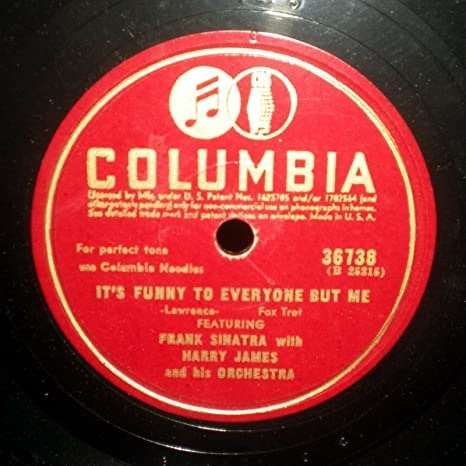
"It's Funny to Everyone but Me"
Will Friedwald (author); background from Jack Lawrence: Jack Lawrence's 'It's Funny to Everyone but Me' attempts a variant of Tommy Dorsey's 'Marie' routine, where sidemen chant a song title behind the vocalist -- here chanting 'It's the Talk of the Town' and 'I Gotta Right to Sing the Blues' at phrase ends. Lawrence (who wrote four of the ten James-Sinatra numbers) felt the chant device may have been inspired by the Ink Spots. Friedwald judges the longer bridge lines bring a bit more 'oomph' from Sinatra but that the band-chant gimmick itself 'falls flat.'
Source: Will Friedwald, "Sinatra! The Song Is You: A Singer's Art" (2018 revised edition).
August 18, 1939
Radio
Live Remote: Roseland Ballroom, New York City
Friday Evening
CBS Network - WABC
12:00 a.m - 12:30: a.m.
Harry James & His Orchestra
Harry on lead trumpet, Jack Schaeffer, Claude Brown, Jack Palmer (trumpets Russell Brown, Truett Jones, Dalton Rizzotto (trombone), Dave Matthews, Claude Lakey (alto sax), Bill Luther, Drew Page (tenor/baritone sax), Jack Gardner (piano) Red Kent (guitar), Thurman Teague (bass), Mickey Scrima (drums), Connie Haines, Frank Sinatra (vocals)
Concerts
Roseland Ballroom, New York City (10-18)
Harry James & His Orchestra
Harry on lead trumpet, Jack Schaeffer, Claude Brown, Jack Palmer (trumpets), Russell Brown, Truett Jones, Dalton Rizzotto (trombone), Dave Matthews, Claude Lakey (alto sax), Bill Luther, Drew Page (tenor/baritone sax), Jack Gardner (piano), Red Kent (guitar), Thurman Teague (bass), Mickey Scrima (drums), Connie Haines, Frank Sinatra (vocals)
August 19, 1939
Radio
Live Remote: New York World Fair, Corona Park, Flushing Meadows, N.YC.
Saturday Evening
11:30 p.m. - 12:00 a.m.
CBS Network - WABC New York City
Harry James & His Orchestra
Harry on lead trumpet, Jack Schaeffer, Claude Brown, Jack Palmer (trumpets), Russell Brown, Truett Jones, Dalton Rizzotto (trombone), Dave Matthews, Claude Lakey (alto sax), Bill Luther, Drew Page (tenor/baritone sax), Jack Gardner (piano), Red Kent (guitar), Thurman Teague (bass), Mickey Scrima (drums), Connie Haines, Frank Sinatra (vocals)
Concerts
New York World's Fair, Fountain Lake Bandshell (August 19 - August 31) Harry James and his Orchestra with Frank Sinatra
note: The band drew large crowds and the one week turned into two. Connie Haines left in early August and James hired Marie Carroll. There are photos of her at Fountain Lake. She never made any recordings with the band. Harry let her go in early September. He had decided that a female vocalist was not necessary.
Here is a story I did know that is quite interesting considering the friction between the two people involved: Frank Sinatra and Connie Haines
"At one point when she was performing with Dorsey, she remembered, Sinatra saved her life. She was about to go on stage in Madison Square Garden when a smoker in a balcony tossed a match and set her ruffled tulle dress on fire. Sinatra threw his coat over her and fell on her, smothering the flames, she said."
NYT Obit on Haines.
9-25-2008
August 20, 1939
Radio
Remote from New York World's Fair, Fountain Lake Bandshell 10:00 10:30
WMT
Harry James and His Orchestra with Frank Sinatra
Concerts
New York World's Fair, Fountain Lake Bandshell (August 19 - August 31) Harry James and His Orchestra with Frank Sinatra
August 21, 1939
Radio
Live Remote: New York World Fair, Fountain Lake Band Shell (segment from five-hour jam session) Flushing Meadows, N.Y.C.
Monday Evening
7:30 p.m. - 8:00 p.m.
NBC Blue Network - WJZ New York City
Harry James & His Orchestra
Harry on lead trumpet, Jack Schaeffer, Claude Brown, Jack Palmer (trumpets), Russell Brown, Truett Jones, Dalton Rizzotto (trombone), Dave Matthews, Claude Lakey (alto sax), Bill Luther, Drew Page (tenor/baritone sax), Jack Gardner (piano), Red Kent (guitar), Thurman Teague (bass), Mickey Scrima (drums), Connie Haines, Frank Sinatra (vocals)
Concerts
New York World's Fair, Fountain Lake Bandshell (August 19 - August 31) Harry James and His Orchestra with Frank Sinatra
August 22, 1939
Radio
New York World's Fair, Fountain Lake Bandshell
Harry James and his Orchestra with Frank Sinatra
7:30PM WEAF
Concerts
New York World's Fair, Fountain Lake Bandshell (August 19 - August 31) Harry James and his Orchestra with Frank Sinatra
August 23, 1939
Radio
New York World's Fair Talent Show
Network: NBC (Blue network)
Time 7:30 p.m. - 8:00 p.m.
Performer(s) Harry James and his orchestra, Frank Sinatra, Alice Cornett, WPA Federal Madrigal Singers, Ward and Muzzy, Tex Walker, Orange Blossom Quartet, Whistling Willie.
Orchestra Conducted by: Harry James
Note: Only part of this show survives. No Sinatra
Live Remote: New York World Fair, Fountain Lake Band Shell , Flushing
Meadows, N.Y.C.
Wednesday Evening
12:00 a.m. - 12:30 a.m.
CBS Network - WABC New York City
Harry James & His Orchestra
Harry on lead trumpet, Jack Schaeffer, Claude Brown, Jack Palmer (trumpets), Russell Brown, Truett Jones, Dalton Rizzotto (trombone), Dave Matthews, Claude Lakey (alto sax), Bill Luther, Drew Page (tenor/baritone sax), Jack Gardner (piano), Red Kent (guitar), Thurman Teague (bass), Mickey Scrima (drums), Connie Haines, Frank Sinatra (vocals) note: Management at the fair announced that James band was being held over until at least 8/29.
Concerts
New York World's Fair, Fountain Lake Bandshell (August 19 - August 31) Harry James and His Orchestra with Frank Sinatra
August 24, 1939
Radio
New York World's Fair, Fountain Lake Bandshell
11:30pm--12
Harry James and His Orchestra with Frank Sinatra
Concerts
New York World's Fair, Fountain Lake Bandshell (August 19 - August 31) Harry James and His Orchestra with Frank Sinatra
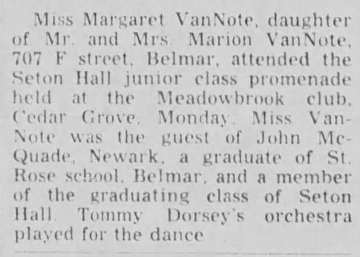
New York World's Fair, Fountain Lake Bandshell (August 19 - August 31) Harry James and His Orchestra with Frank Sinatra
(August 19 - August 31)
Band Chirps
Harry James
Early Band
James and his new orchestra debuted in February
1939 at the Benjamin Franklin Hotel in
Philadelphia. Bernice Byres served as its first female vocalist.[2] Byres remained with the band until at least early April, with Connie Haines having taken over by June. James had heard Haines rehearsing at a music publishing office and hired her. He soon became dissatisfied with Haines, however, and she was gone by September, replaced by Marie Carroll, who herself was gone by the end of that month. note: Connie Haines told Pete Levinson she left the band in mid-August.
Connie claimed the band wasn't making any money and just started falling apart. Marie
Carroll replaced her according to two sources I found. She did not travel with the band after the
World's Fair closed on 9-1-39 ( same day W.W. II got underway ). Here is an excerpt from an article written by James, in early September, for the 10-15-39 issue of DOWNBEAT.
"Swell Morale in Band"
Vocalists? This young Frank Sinatra handles the ballads. We think he is doing a fine job. Jack
Palmer, the trumpeter, steps down to handle the comedy and novelty stuff. We do not use a girl singer because everyone we've had yet has been unsatisfactory and until we can find one who stacks up as strong as the band, we won't worry.
Sinatra and Palmer, with Kent helping occasionally, can carry the load okay in our opinion.
The Billboard review of the James band at the Panther Room of the Sherman Hotel, in Chicago,10-7-39, only mentions Frank Sinatra as vocalist.
Frank claimed that a woman named Marge, from
Newark, sang with the band at the Fountain Lake
Bandshell and that all the performances took place in the afternoon.
--Ed
August 25, 1939
Radio
New York World's Fair, Fountain Lake Bandshell
Harry James and HIs Orchestra with Frank Sinatra
10:45PM-11:00PM
Concerts
New York World's Fair, Fountain Lake Bandshell (August 19 - August 31) Harry James and HIs Orchestra with Frank Sinatra
August 26, 1939
Radio
New York World's Fair, Fountain Lake Bandshell
Harry James and HIs Orchestra with Frank Sinatra
10:30PM-11:00PM
Concerts
New York World's Fair, Fountain Lake Bandshell (August 19 - August 31) Harry James and His Orchestra with Frank Sinatra
August 27, 1939
Concerts
New York World's Fair, Fountain Lake Bandshell (August 19 - August 31) Harry James and His Orchestra with Frank Sinatra
August 28, 1939
Radio
New York World's Fair, Fountain Lake Bandshell
Harry James and His Orchestra with Frank Sinatra
11:15PM-11:30PM
Concerts
New York World's Fair, Fountain Lake Bandshell (August 19 - August 31) Harry James and His Orchestra with Frank Sinatra
August 29, 1939
Radio
New York World's Fair, Fountain Lake Bandshell
Harry James and His Orchestra with Frank Sinatra
KMOX 10:50 PM (25 minutes)
Concerts
New York World's Fair, Fountain Lake Bandshell (August 19 - August 31) Harry James and His Orchestra with Frank Sinatra
Tuesday Evening
Band did a jam session in the Fountain Lake Bandshell
7:30 p.m. to 12:30 a.m.
Harry James & His Orchestra
Harry on lead trumpet, Jack Schaeffer, Claude
Brown, Jack Palmer (trumpets), Russell Brown,
Truett Jones, Dalton Rizzotto (trombone),Dave
Matthews, Claude Lakey (alto sax), Bill Luther,
Drew Page (tenor/baritone sax),Jack Gardner
(piano),Red Kent (guitar),Thurman Teague (bass),
Mickey Scrima (drums), Connie Haines, Frank Sinatra (vocals)
August 30, 1939
Radio
Live Remote From Radio Building, New York World's Fair
Monday Evening
CBS Network - WABC New York City
12:00 a.m - 12:30: a.m.
Harry James & His Orchestra
Harry on lead trumpet Jack Schaeffer, Claude Brown, Jack Palmer (trumpets),Russell Brown, Truett Jones, Dalton Rizzotto (trombone), Dave Matthews, Claude Lakey (alto sax), Bill Luther, Drew Page (tenor/baritone sax), Jack Gardner (piano), Red Kent (guitar), Thurman Teague (bass), Mickey Scrima (drums), Connie Haines, Frank Sinatra (vocals)
Concerts
New York World's Fair, Fountain Lake Bandshell (August 19 - August 31) Harry James and His Orchestra with Frank Sinatra
August 31, 1939
Studio
New York City
B25285 Here Comes The Night
(F. Loesser/H. Edelstein/C. Hohengarten)
Arranged by Andy Gibson
-1 (2:48) CD: CK66377 Harry James & Orch. Fet.FS: Complete Recordings
-1 LP: CL-2739
-1 78: 35227
B25288 All Or Nothing At All
(J. Lawrence/A. Altman)
Arranged by Andy Gibson
-1 (2:57) CD: CK66377 Harry James & Orch. Fet.FS: Complete Recordings
-2(2:55) CD: CK66377 Harry James & Orch. Fet.FS: Complete Recordings
-2 LP: Time Life STBB04 (alt take)
-1 LP: CL-1130
-1 78: 35587
Trumpets: Harry James, Claude Bowen, Tom Gonsoulin, Jack Palmer, Claude
Lakey, Jack Schaeffer; Trombones: Russell Brown, Truett Jones, Dalton Rizzotto, Bruce Squires; Alto Sax: Dave Matherws, Claude Lakey; Tenor
Sax: Claude Lakey, Bill Luther, Drew Page; Baritone Sax: Bill Luther
Page, Drew Page; Piano: Jack Gardner; Guitar: Brian "Red" Kent;
Bass: Thurman Teague; Drums: Ralpn Hawkins, Mickey Scrima; Vocals: Frank
Sinatra
Ed O'Brien:
Frank's first great signature song. He would sing it on radio, TV and in concerts for the
next 55 years. There would be a special recording done for Columbia Pictures in April of 1945.
Three recordings were done at Reprise: a stunning ballad version in November of 1961, with
Don Costa; a swingin' Riddle chart, backed Frank for a May 1966 recording, and a disco version
was laid down in February of 1977. He would reunite with Harry James for versions in August,
Radio
Live Remote: Radio Building, New York World's Fair
Tuesday Evening
CBS Network - WABC New York City
12:30 a.m. -12:55 a.m.
Harry James & His Orchestra
Harry on lead trumpet, Jack Schaeffer, Claude Brown, Jack Palmer (trumpets), Russell Brown, Truett Jones, Dalton Rizzotto (trombone), Dave Matthews, Claude Lakey (alto sax), Bill Luther, Drew Page (tenor/baritone sax), Jack Gardner (piano), Red Kent (guitar), Thurman Teague (bass), Mickey Scrima (drums), Connie Haines, Frank Sinatra (vocals)
1. Avalon
2. Frank: Here Comes The Night
3. Big Jim
4. Frank: All Or Nothing At All
5. Sheik Of Araby
Ed O'Brien:
Martin Scorsese's great fight film "Raging Bull"
has Frank singing "All Or Nothing At All" from
Concerts
New York World's Fair, Fountain Lake Bandshell (August 19 - August 31) Harry James and his Orchestra w/Frank Sinatra
Tuesday Evening
Jam Session
9:30 p.m. -12:30 a.m.
Partial Setlist:
1. Avalon
2. Frank: Here Comes The Night
3. Big Jim
4. Frank: All Or Nothing At All
5. Sheik Of Araby
New York City
B25285 Here Comes The Night
B25288 All Or Nothing At All
October 1939 Variety:
Ed O'Brien:
I believe this is the first review from a major trade of a Sinatra recording. note: The accepted date of release of the original record has been June of 1940.
In doing research this summer, I discovered the actual release took place in
August 1940.
Here is the Billboard Review from 8-31-40
"All or Nothing at All"
"All or Nothing at All," recorded at Sinatra's third session with Harry James, became the pair's biggest hit -- though not immediately: it sold modestly on first release in 1939 and only became a sensation after being reissued in 1943, boosted by the recording ban that made vocal-only records more prominent.
Source: Charles L. Granata, "Sessions with Sinatra: Frank Sinatra and the Art of Recording" (1999/2003).
[Recording "All or Nothing At All"]
On Thursday, August 31, 1939 — the day before Germany invaded Poland — the James band recorded Frank Loesser's 'Here Comes the Night' and two takes of 'All or Nothing At All' at their third New York session; Kaplan calls Sinatra's vocal on the latter a landmark performance despite some minor technical flaws.
Source: James Kaplan, "Frank: The Voice" (2010).
[All or Nothing at All -- critical commentary]
Bill Miller: Bill Miller recalled driving back from the 1940 World's Fair with a date when the radio played 'All or Nothing at All'; his companion said it sounded like Dick Haymes, and Miller insisted it wasn't, though he didn't know who it actually was. When the announcer identified it as Frank Sinatra, Miller said, 'That was the first time I was aware of his talent. I thought he was great.'
This song/context matches multiple dated entries in the chronology; the specific date Friedwald is referring to could not be determined with confidence.
Source: Will Friedwald, "Sinatra! The Song Is You: A Singer's Art" (2018 revised edition), Ch. 1, "Night and Day" (Sinatra style overview)
[All or Nothing at All -- critical commentary]
Jack Lawrence: Songwriter Jack Lawrence recalled being struck by young Sinatra's breath control and phrasing on the earliest recording of "All or Nothing at All," saying he still preferred that version to Sinatra's later remakes.
This song/context matches multiple dated entries in the chronology, or lacked a sufficiently precise date; the specific date could not be determined with confidence.
Source: Charles L. Granata, "Sessions with Sinatra: Frank Sinatra and the Art of Recording" (1999/2003), Part I: The Big Band Years, 1937-1942
[All or Nothing at All / Stardust -- critical commentary]
Sinatra / Friedwald: Inspired by this initial success, Sinatra later said, "I began to work harder than ever. The audience reaction meant they liked me. I didn’t know what was causing the reaction exactly. I was experimenting with singing and different forms of phrasing and picking songs better." The first ambition, however, was to bring the Sinatra-Dorsey partnership up to the level of the best of the Sinatra-James sides—the live version of "All or Nothing at All" (from the 1939 World’s Fair) was a hard one to beat, as was the "Stardust" from Roseland in July.
This song/context matches multiple dated entries in the chronology; the specific date Friedwald is referring to could not be determined with confidence.
Source: Will Friedwald, "Sinatra! The Song Is You: A Singer's Art" (2018 revised edition), Ch. 3, "With Tommy Dorsey" (1940-1942)
September 1939
[reception/review -- critical commentary]
George T. Simon: Music critic George T. Simon gave Sinatra his first major review in the September 1939 issue of Metronome, praising his "pleasing vocals" and calling his phrasing "especially commendable."
Source: Charles L. Granata, "Sessions with Sinatra: Frank Sinatra and the Art of Recording" (1999/2003), Part I: The Big Band Years, 1937-1942
September 1, 1939
Concerts
Sylvan Beach, New York (One Nighter)
Harry James and His Orchestra with Jack Palmer, Connie Hayes, and Frank Sinatra
September 2, 1939
Concerts
The Casino, Bemus Point, N.Y. (One Nighter)
Harry James and His Orchestra with Connie Hayes, Jack Palmer, Frank Sinatra
The Casino, Bemus Point, N.Y. (One Nighter)
Harry James and His Orchestra with Connie Hayes, Jack Palmer, Frank Sinatra
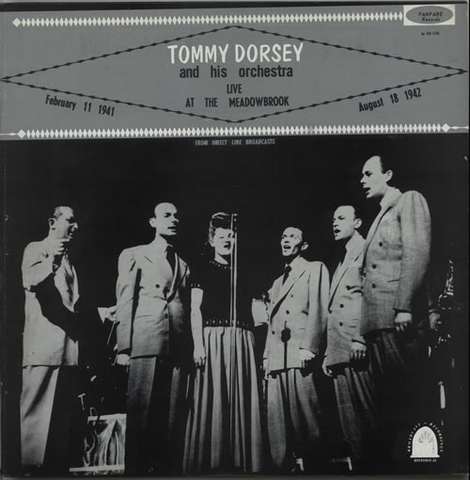
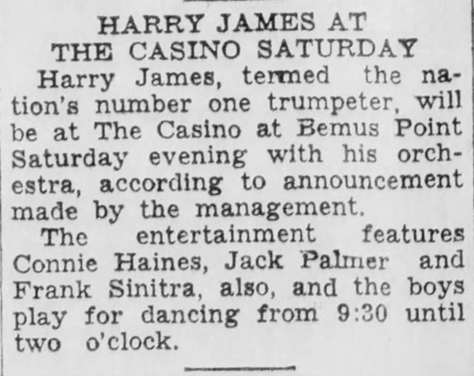
September 3, 1939
Radio
Harry James Orchestra
WGN 11:00 PM
Concerts
Olcott Beach, Buffalo, New York
Harry James and his Orchestra w/Frank Sinatra
Olcott Beach, Buffalo, New York
Harry James and his Orchestra w/Frank Sinatra
September 4, 1939
Concerts
Rocky Glen Park, Moosic, Pennsylvania
Harry James and His Orchestra w/Frank Sinatra
Note: Thanks to Richard Cook for above listing
Rocky Glen Park, Moosic, Pennsylvania
Harry James and His Orchestra w/Frank Sinatra
September 6, 1939
Concerts
WCHS Auditorium, Charleston, West Virginia
Harry James and His Orchestra with Frank Sinatra
WCHS Auditorium, Charleston, West Virginia
September 7, 1939
Concerts
State Armory, Monessen, Pennsylvania
Harry James and his Orchestra w/Frank Sinatra
State Armory, Monessen, Pennsylvania
Harry James and his Orchestra w/Frank Sinatra
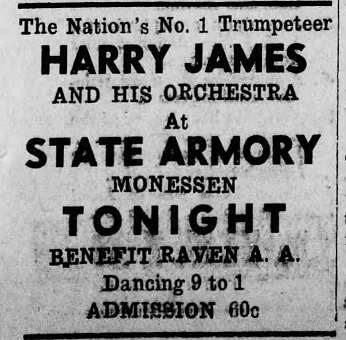
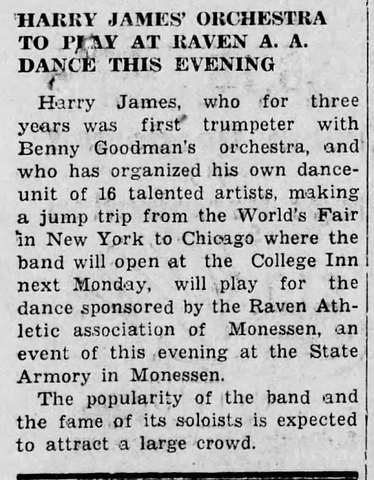
September 8, 1939
Radio
Live Remote: Panther Room, Hotel Sherman, Chicago, Illinois
Friday Evening
12:00 a.m. - 12:30 a.m.
CBS Network - WABC New York City
Harry James & His Orchestra
Harry on lead trumpet, Jack Schaeffer, Claude Brown, Jack Palmer (trumpets), Russell Brown, Truett Jones, Dalton Rizzotto (trombone), Dave Matthews, Claude Lakey (alto sax), Bill Luther, Drew Page (tenor/baritone sax), Jack Gardner (piano), Red Kent (guitar), Thurman Teague (bass), Mickey Scrima (drums), Connie Haines, Frank Sinatra (vocals) Ed O'Brien:
I have discovered in my research that the James band made numerous appearances on radio from the Panther Room. Chicago radio stations beamed out Harry, Frank and band night after night to sister stations throughout the country.. I am maintaining the traditional radio schedule that newspapers offered back then. The above performance really began at midnight on 9-9-39.
Concerts
Panther Room, Hotel Sherman, Chicago, Illinois (September 8 - November 3) Harry James and his Orchestra w/Frank Sinatra
Note: Gene Krupa followed James into the Panther Room on November 4)
Panther Room, Hotel Sherman, Chicago, Illinois (September 8 - November 3)
Harry James and his Orchestra w/Frank Sinatra
Billboard
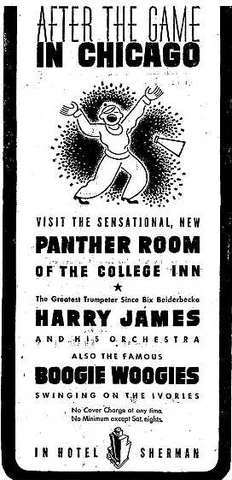
Panther Room, Hotel Sherman, Chicago, Illinois (September 8 - November 3) Harry James and his Orchestra w/Frank Sinatra
Billboard
9-30-39
(This Week's Cover Subject) HARRY JAMES, erstwhile Benny Goodman trumpeter now heading his own fast -rising swing crew, was born into show business March 15, 1916. His father was the Christy Bros.' Circus band director and his mother trouped with the same show. Harry's summers were spent with the circus and in winter he attended school in Beaumont, Tex., the family's home town. His father taught him the trumpet, which he played in school bands. James joined Joe Gill's Band in Galveston in 1932, remained with Gill for six months and then toured with Hogan Hancock's Ork. Then came Ligon Smith's crew, Herman Wald- man's Band and finally Ben Pollack, with whom Harry toured for a year. He joined Goodman early in 1937, and soon became one of the best known sidemen in the business. Harry started to rehearse his own band in January of this year, with his first date coming February 3 at the University of New Hampshire. A week later he went on his first location, the Ben Franklin Hotel, Philadelphia. He had a five -week run there and then opened at New York's Pennsylvania Hotel for several weeks. April 8 started him on one-nighters, taking him up to three June weeks at the New York Paramount and another theater date at the Hippodrome, Baltimore. He located this summer at Roseland Ballroom, New York, breaking his stand with three weeks at Atlantic City's Steel Pier, altho he was originally signed for only nine days, giving him the distinction of being the only name band to play Steel Pier for that length of time. September 9 he opened the fall season at Chicago's Hotel Sherman for an indefinite stay. James records under the new Columbia label, and was selected as the first band to start the new radio show sponsored by that disk firm September 16. The ork is managed by Gerard Barrett, formerly with Music Corp. of America. Harry's wife is Louise Tobin, who is now singing with his old boss, Goodman. note: The band was at the Steel Pier for three weeks. Research I've done credits Sinatra for the extended stay. You can also see Billboard gives 9/9 as opening night in Chicago. I have also found in numerous articles that the engagement ran four weeks. Kaplan, in his Sinatra bio, has the band leaving Chicago on 10-14-39. But other sources claim it was a 7 week run.Last but not least, Harry's band was on Columbia Records new radio show 9/16. I wonder how many appearances they made and does the LOC have copies ?
ADDING TO THE CONFUSION:
Frank Sinatra is said to have played Chicago as part of a Major Bowes Amateur Hour road show in the fall of 1935, but any evidence has long since been lost. His first confirmed appearance in the city was with the Harry James Orchestra, opening Friday, September 15, 1939, in the Panther Room of the Sherman House Hotel. For the next several weeks anyone willing to pay 75 cents could go to Clark and Randolph Streets and be present for the genesis. Nearly every hot swing band carried a "boy singer," and James had only eight weeks earlier picked up Sinatra while he was performing in the Rustic Cabin in Englewood Cliffs, NJ. Sinatra came to Chicago as one band singer among many; all were romantic, though Sinatra didn't yet look the part. But with only radio and records as the music media, sex appeal still resided in the voice and the imagination, not the eye. "This young Frank Sinatra handles the ballads," James told Chicago-based DownBeat magazine at the time. "We think he is doing a fine job."
Here is an excerpt of an article by Dan Morgenstern: Coverage of the early years of DOWNBEAT When Harry James brought his new band into the Panther Room of the Sherman House, Dexter, Pease, and Toll showed up, pens in hand. Pease cornered Jack Gardner, James' pianist, while Dexter and Toll chatted with James' new singer, Frank Sinatra. Sinatra was flattered to be sought out by no less than DownBeat. He told them he had done only one other interview in his life, with George Simon of Metronome. The Metronome piece beat DownBeat by a month, Dexter later wrote, but they were the first two raves Sinatra received in the national press. Ed
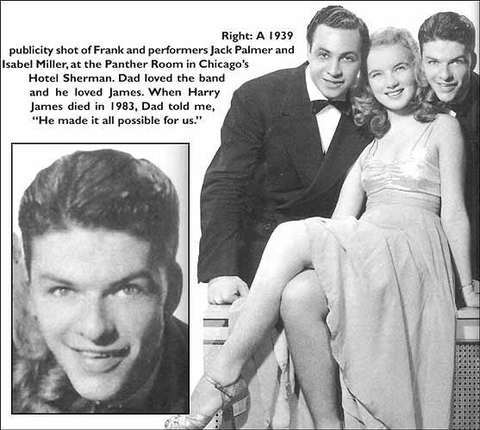
September 9, 1939
Radio
Live Remote: Panther Room, Hotel Sherman, Chicago, Illinois
Saturday Evening
1:30 a.m. - 2:00 a.m.
NBC Red Network
WEAF - New York City
Harry James & His Orchestra
Harry on lead trumpet, Jack Schaeffer, Claude Brown, Jack Palmer (trumpets), Russell Brown, Truett Jones, Dalton Rizzotto (trombone), Dave Matthews, Claude Lakey (alto sax)
Bill Luther, Drew Page (tenor/baritone sax), Jack Gardner (piano), Red Kent (guitar), Thurman Teague (bass), Mickey Scrima (drums), Connie Haines, Frank Sinatra (vocals)
Source discrepancy note: the Soundcraft 5004 CD ("Harry James Orchestra 1939 Broadcasts with Frank Sinatra") labels its September 9, 1939 broadcast as originating from the "New York World's Fair Pavilion," but this conflicts with the Hotel Sherman/Chicago location and personnel documented above; the project's existing World's Fair Fountain Lake Bandshell coverage runs only August 19-31, 1939, supporting the Hotel Sherman attribution over the bootleg's tray-card label.
Concerts
Panther Room, Hotel Sherman, Chicago, Illinois (September 8 - November 3)
Harry James and his Orchestra w/Frank Sinatra
September 10, 1939
Radio
Panther Room, Hotel Sherman, Chicago, Illinois
Harry James and his Orchestra w/Frank Sinatra
WGN(Mutual)
WMAQ(NBC)
11:00 P.M.-11:30 P.M.
Concerts
Panther Room, Hotel Sherman, Chicago, Illinois (September 8 - November 3) Harry James and his Orchestra w/Frank Sinatra
Ed O'Brien:
James band played a four week engagement at the Hotel Sherman. Harry landed a nice engagement at the Palomar Ballroom in L.A. The band laid down two songs at a Chicago session on 10-13 and then headed west. On the way they learned that the Palomar had burned to the ground. They had very little money and no work. But Harry pulled a rabbit out of his hat by getting a few weeks at Victor Hugo's on Sunset Blvd. The management and clientele were not happy with the "loud" band. The joint wouldn't pay them and one night, while Frank was singing "All Or Nothing At All," the manager fired them all. Frank would later remembered it as the happiest time in his life.
September 11, 1939
Concerts
Panther Room, Hotel Sherman, Chicago , Illinois (September 8 - October 12)
Harry James and his Orchestra w/Frank Sinatra
Panther Room, Hotel Sherman, Chicago , Illinois (September 8 - October 12)
Rare photo of Frank with James band in the
Panther Room of the Hotel Sherman. Harry is right over Frank's left shoulder blowing away on his trumpet.
September 12, 1939
Radio
Live Remote: Panther Room, Hotel Sherman, Chicago, Illinois
Tuesday Evening
1:30 a.m. - 2:30 a.m.
NBC Blue Network - WJZ New York City
Harry James & His Orchestra
Harry on lead trumpet, Jack Schaeffer, Claude Brown, Jack Palmer (trumpets), Russell Brown, Truett Jones, Dalton Rizzotto (trombone), Dave Matthews, Claude Lakey (alto sax), Bill Luther, Drew Page (tenor/baritone sax), Jack Gardner (piano), Red Kent (guitar), Thurman Teague (bass), Mickey Scrima (drums), Connie Haines, Frank Sinatra (vocals)
Concerts
Panther Room, Hotel Sherman, Chicago , Illinois (September 8 - October 12)
Harry James and his Orchestra w/Frank Sinatra
Panther Room, Hotel Sherman, Chicago , Illinois (September 8 - October 12) Harry James and his Orchestra w/Frank Sinatra
September 13, 1939
Radio
Live Remote: Panther Room, Hotel Sherman, Chicago, Illinois
Wednesday Evening
1:30 a.m. - 2:00 a.m.
NBC Blue Network - WJZ New York City
Harry James & His Orchestra
Harry on lead trumpet, Jack Schaeffer, Claude
Brown, Jack Palmer (trumpets), Russell Brown,
Truett Jones, Dalton Rizzotto (trombone), Dave
Matthews, Claude Lakey (alto sax), Bill Luther,
Drew Page (tenor/baritone sax), Jack Gardner
(piano), Red Kent (guitar), Thurman Teague
(bass), Mickey Scrima (drums), Connie Haines, Frank Sinatra (vocals)
Concerts
Panther Room, Hotel Sherman, Chicago , Illinois (September 8 - October 12)
Harry James and his Orchestra w/Frank Sinatra
Ed O'Brien:
A week or so into the Hotel Sherman engagement, word got around the city
that an exciting new male vocalist was breaking it up in the Panther Room. Betty
Grable coaxed the up and coming columnist James Bacon to take a look at him.
Here is what Bacon remembered from that September night in 1939:
"I’ll never forget, the minute Sinatra started singing, every girl left her partner on the
dance floor and crowded around the microphone on the bandstand," Bacon recalled later.
"He was so skinny, the microphone almost obscured him."
September 14, 1939
Radio
Live Remote: Panther Room, Hotel Sherman, Chicago, Illinois
Thursday Evening
12:00 a.m. -12:30 a.m.
NBC Blue Network - WJZ New York City
Harry James & His Orchestra
Harry on lead trumpet, Jack Schaeffer, Claude Brown, Jack Palmer (trumpets), Russell Brown, Truett Jones, Dalton Rizzotto (trombone), Dave Matthews, Claude Lakey (alto sax), Bill Luther, Drew Page (tenor/baritone sax), Jack Gardner (piano), Red Kent (guitar), Thurman Teague (bass), Mickey Scrima (drums), Marie Carroll, Frank Sinatra, Jack Palmer (vocals)
Concerts
Panther Room, Hotel Sherman, Chicago , Illinois (September 8 - October 12) Harry James and his Orchestra w/Frank Sinatra
September 15, 1939
Radio
Live Remote: Panther Room, Hotel Sherman, Chicago, Illinois
Friday Evening
12:00 a.m. -12:30 a.m.
NBC Red Network - WEAF New York City
Harry James & His Orchestra
Harry on lead trumpet, Jack Schaeffer, Claude Brown, Jack Palmer (trumpets), Russell Brown, Truett, Jones, Dalton Rizzotto (trombone),Dave Matthews, Claude Lakey (alto sax), Bill Luther, Drew Page (tenor/baritone sax), Jack Gardner (piano),Red Kent (guitar), Thurman Teague (bass), Mickey Scrima (drums), Marie Carroll, Frank Sinatra, Jack Palmer (vocals)
Live Remote: Panther Room, Hotel Sherman, Chicago, Illinois
Friday Evening
1:30 a.m. -2:00 a.m.
NBC Blue Network - WJZ New York City
Harry James & His Orchestra
Harry on lead trumpet, Jack Schaeffer, Claude Brown, Jack Palmer (trumpets), Russell Brown, Truett, Jones, Dalton Rizzotto (trombone), Dave Matthews, Claude Lakey (alto sax), Bill Luther, Drew Page (tenor/baritone sax), Jack Gardner (piano), Red Kent (guitar), Thurman Teague (bass), Mickey Scrima (drums), Marie Carroll, Frank Sinatra, Jack Palmer (vocals)
Concerts
Panther Room, Hotel Sherman, Chicago , Illinois (September 8 - November 3) Harry James and his Orchestra w/Frank Sinatra
September 16, 1939
Radio
Live Remote: Panther Room, Hotel Sherman, Chicago, Illinois
Saturday Evening
1:30 a.m. -2:00 a.m.
NBC Red Network - WEAF New York City
Harry James & His Orchestra
Harry on lead trumpet, Jack Schaeffer, Claude Brown, Jack Palmer (trumpets), Russell Brown, Truett Jones, Dalton Rizzotto (trombone), Dave Matthews, Claude Lakey (alto sax), Bill Luther, Drew Page (tenor/baritone sax), Jack Gardner (piano), Red Kent (guitar), Thurman Teague (bass), Mickey Scrima (drums), Marie Carroll, Frank Sinatra, Jack Palmer (vocals)
Live Remote: Panther Room, Hotel Sherman, Chicago, Illinois
Saturday Evening
11:00 p. m -11:30 p.m..
CBS
WMAQ Chicago
Harry James & His Orchestra
Harry on lead trumpet, Jack Schaeffer, Claude Brown, Jack Palmer (trumpets), Russell Brown, Truett Jones, Dalton Rizzotto (trombone), Dave Matthews, Claude Lakey (alto sax), Bill Luther, Drew Page (tenor/baritone sax), Jack Gardner (piano), Red Kent (guitar), Thurman Teague (bass), Mickey Scrima (drums), Marie Carroll, Frank Sinatra, Jack Palmer (vocals)
Concerts
Panther Room, Hotel Sherman, Chicago , Illinois (September 8 - October 12) Harry James and his Orchestra w/Frank Sinatra
September 17, 1939
Concerts
Panther Room, Hotel Sherman, Chicago , Illinois (September 9 - October 27) Harry James and his Orchestra w/Frank Sinatra
Panther Room, Hotel Sherman, Chicago , Illinois (September 9 - October 27)
Harry James and his Orchestra w/Frank Sinatra
I decided to do some additional research on this engagement after finding a brief bio
on James that contradicted the above dates. The band actually opened on 9/9 and it was for
an "indefinite stay." I combed through the September and October 39 Variety and Billboard
magazines. I found the first mention of Sinatra in a Billboard and discovered that the engage-
ment ran through 10/27. The Panther Room was also known as the College Inn. I found a re-
view in Billboard and a review of "Here Comes The Night" in Variety.'
Bio of James' band in the 9-23-39 Billboard:
Harry James and his orchestra number 17 people using instrumentation of seven brass, four
sax and four rhythm. Featured vocalists are Marie Carroll, Frank Sinatra and Jack Palmer, who
doubles on trumpet. Orchestra which is heard on Columbia Red Label records has been featured
at the Hotel Benjamin Franklin in Philadelphia; Roseland Ballroom in New York; the World's Fair
and currently at Sherman Hotel in Chicago. Band is managed by Music Corporation of America.
HARRY JAMES
REVIEWED AT PANTHER ROOM, SHERMAN HOTEL, CHICAGO
Hot swing is the order of the day when this
James boy and his band step up on the stage.
A grad from Goodman's first trumpet chair, James organized his new ork a few months ago, and
with his previous rep as an ace horn man, he has already put himself in the name class, stuff
handled by the outfit is mostly in the swingeroo groove plus a sprinkling of the slower, pop
torch ditties.
Six horns, besides James, four rhythm and four reed is the set-up. Brass section is the
powerhouse of the outfit and is even a little too strongly accentuated in some of the arrange-
ments. Of course, this is no fault when it comes to the swing addicts, because to them a
blast from the brass is as welcomed as a piece of raw meat to a tiger. On the whole, tho,
everything is solid and mellow and right up to snuff.
Essentially what makes this ork different from any one of the many present day
swing bands is James himself. The guy is really a master on that trumpet. He never
has to resort to hoke, mutes or derby hats to set them off. James' trumpet is the pure
unadulterated product and positively lyrical.
Vocalist Frank Sinatra handles the torchy ballads in a pleasing way in a good voice.
Only blemish is he touches the songs up with a little too much pash, which is not all con-
vincing. Trumpeter Jack Palmer handles the hi-de-hi numbers, piping 'em after the
style of the ebony boys from Harlem, and he knows all the angles. Entire crew stacks up
A-1 on appearance, and James on the trumpet is enough showmanship for any one band.
Humphrey
Billboard
Ed
Chicago Tribune, September 17, 1939
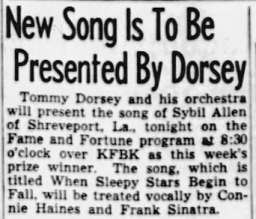
September 18, 1939
Concerts
Panther Room, Hotel Sherman, Chicago , Illinois (September 8 – November 3)
Harry James and his Orchestra w/Frank Sinatra
September 19, 1939
Radio
Live Remote: Panther Room, Hotel Sherman, Chicago, Illinois
Thursday Evening
1:30 a.m. -2:00 a.m.
NBC Blue Network - WJZ New York City
Harry James & His Orchestra
Harry on lead trumpet
Jack Schaeffer, Claude Brown, Jack Palmer (trumpets)
Russell Brown, Truett Jones, Dalton Rizzotto (trombone) Dave Matthews, Claude Lakey (alto sax)
Bill Luther, Drew Page (tenor/baritone sax)
Jack Gardner (piano)
Red Kent (guitar)
Thurman Teague (bass)
Mickey Scrima (drums)
Marie Carroll, Frank Sinatra, Jack Palmer (vocals)
Concerts
Panther Room, Hotel Sherman, Chicago , Illinois (September 8 – November 3) Harry James and his Orchestra w/Frank Sinatra
September 20, 1939
Concerts
Panther Room, Hotel Sherman, Chicago , Illinois (September 8 – November 3) Harry James and his Orchestra w/Frank Sinatra
September 21, 1939
Concerts
Panther Room, Hotel Sherman, Chicago , Illinois (September 9 November 3)
Harry James and his Orchestra w/Frank Sinatra
September 22, 1939
Radio
Live Remote: Panther Room, Hotel Sherman, Chicago,
Illinois
Friday Evening
11:15 p.m. - 11:30 p.m.
NBC Blue Network - WJZ New York City
Harry James & His Orchestra
Harry on lead trumpet
Jack Schaeffer, Claude Brown, Jack Palmer (trumpets)
Russell Brown, Truett Jones, Dalton Rizzotto (trombone) Dave Matthews, Claude Lakey (alto sax)
Bill Luther, Drew Page (tenor/baritone sax)
Jack Gardner (piano)
Red Kent (guitar)
Thurman Teague (bass)
Mickey Scrima (drums)
Marie Carroll, Frank Sinatra, Jack Palmer (vocals)
Live Remote: Panther Room, Hotel Sherman, Chicago, Illinois
Friday Evening
12:05 a.m. - 12:30 a.m.
NBC Red Network - WEAF New York City
Harry James & His Orchestra
Harry on lead trumpet
Jack Schaeffer, Claude Brown, Jack Palmer (trumpets)
Russell Brown, Truett Jones, Dalton Rizzotto (trombone) Dave Matthews, Claude Lakey (alto sax)
Bill Luther, Drew Page (tenor/baritone sax)
Jack Gardner (piano)
Red Kent (guitar)
Thurman Teague (bass)
Mickey Scrima (drums)
Marie Carroll, Frank Sinatra, Jack Palmer (vocals)
I know Billboard has Marie Carroll with James in Chicago. I believe it is a mistake. Connie Haines opened with the band and Isabelle Miller was the new distaff singer in early October ( Variety 10-4-39 ). And I have mentioned that the Variety Billing section had Haines there for the com- plete run. Absolutely wrong. Article Harry penned for DOWN- BEAT ( 10-15-39 ) states that he had given up on featuring a female vocalist. He was going with Frank and Jack Palmer.
The Billboard claim regarding Carroll was in a special issue, published 9-23-39. I would say the information was a good month behind. The regular weekly Billboard always was two weeks back.
--Ed
Concerts
Panther Room, Hotel Sherman, Chicago , Illinois (September 9 – November 3) Harry James and his Orchestra w/Frank Sinatra
Frank Sinatra is said to have played Chicago as part of a Major Bowes Amateur Hour road show in the fall of 1935, but any evidence has long since been lost. His first confirmed appearance in the city was with the Harry James Orchestra, opening Friday, September 8, 1939, in the Panther Room of the Sherman House Hotel. For the next several weeks anyone willing to pay 75 cents could go to Clark and Randolph Streets and be present for the genesis. Nearly every hot swing band carried a "boy singer," and James had only 10 weeks earlier picked up Sinatra while he was performing in the Rustic Cabin in Englewood Cliffs, NJ. Sinatra came to Chicago as one band singer among many; all were romantic, though Sinatra didn't yet look the part. But with only radio and records as the music media, sex appeal still resided in the voice and the imagination, not the eye. "This young Frank Sinatra handles the ballads," James told Chicago-based DownBeat magazine at the time. We think he is doing a fine job."
September 23, 1939
Radio
Live Remote: Panther Room, Hotel Sherman, Chicago, Illinois
Saturday Evening
1:30 a.m. - 1:55 a.m.
NBC Red Network - WEAF New York City
Harry James & His Orchestra
Harry on lead trumpet
Jack Schaeffer, Claude Brown, Jack Palmer (trumpets)
Russell Brown, Truett Jones, Dalton Rizzotto (trombone) Dave Matthews, Claude Lakey (alto sax)
Bill Luther, Drew Page (tenor/baritone sax)
Jack Gardner (piano)
Red Kent (guitar)
Thurman Teague (bass)
Mickey Scrima (drums)
Marie Carroll, Frank Sinatra, Jack Palmer (vocals)
Concerts
Panther Room, Hotel Sherman, Chicago, Illinois (September 9 - November 3) Harry James and his Orchestra w/Frank Sinatra
September 24, 1939
Concerts
Panther Room, Hotel Sherman, Chicago , Illinois (September 8 – November 3) Harry James and his Orchestra w/Frank Sinatra
September 25, 1939
Radio
Live Remote from Panther Room, Hotel Sherman, Chicago , Illinois Harry James and His Orchestra
CBS 11:30 PM
Concerts
Panther Room, Hotel Sherman, Chicago, Illinois (September 8 – November 3) Harry James and his Orchestra w/Frank Sinatra
September 26, 1939
Concerts
Panther Room, Hotel Sherman, Chicago, Illinois (September 8 – November 3) Harry James and his Orchestra w/Frank Sinatra
September 27, 1939
Radio
Live Remote from Panther Room, Hotel Sherman, Chicago, Illinois Harry James and His Orchestra with Frank Sinatra
11:00 PM
Concerts
Panther Room, Hotel Sherman, Chicago , Illinois (September 8 – November 3) Harry James and his Orchestra w/Frank Sinatra
September 28, 1939
Radio
Live Remote: Panther Room, Hotel Sherman,
Chicago, Illinois
Thursday Evening
12:00 a.m. - 12:30 a.m.
NBC Blue Network - WJZ New York City
Harry James & His Orchestra
Harry on lead trumpet, Jack Schaeffer, Claude Brown, Jack Palmer (trumpets), Russell Brown, Truett Jones, Dalton Rizzotto (trombone), Dave Matthews, Claude Lakey (alto sax), Bill Luther, Drew Page (tenor/baritone sax), Jack Gardner (piano), Red Kent (guitar), Thurman Teague (bass), Mickey Scrima (drums), Marie Carroll, Frank Sinatra, Jack Palmer (vocals)
Live Remote: Panther Room, Hotel Sherman, Chicago, Illinois
Thursday Evening
12:30 a.m. - 12:55 a.m.
NBC Red Network - WEAF New York City
Harry James & His Orchestra
Harry on lead trumpet, Jack Schaeffer, Claude Brown, Jack Palmer (trumpets), Russell Brown, Truett Jones, Dalton Rizzotto (trombone), Dave Matthews, Claude Lakey (alto sax) Bill Luther, Drew Page (tenor/baritone sax), Jack Gardner (piano), Red Kent (guitar), Thurman Teague (bass), Mickey Scrima (drums), Marie Carroll, Frank Sinatra, Jack Palmer (vocals)
Concerts
Panther Room, Hotel Sherman, Chicago , Illinois (September 8 - October 12) Harry James and his Orchestra w/Frank Sinatra
September 29, 1939
Concerts
Panther Room, Hotel Sherman, Chicago , Illinois (September 8 – November 3) Harry James and his Orchestra w/Frank Sinatra
September 30, 1939
Radio
Live Remote: Panther Room, Hotel Sherman, Chicago, Illinois
Saturday Afternoon
2:30 p.m. - 2:45 p.m.
NBC Blue Network - WJZ New York City
Harry James & His Orchestra
Harry on lead trumpet, Jack Schaeffer, Claude Brown, Jack Palmer (trumpets), Russell Brown, Truett Jones, Dalton Rizzotto (trombone), Dave Matthews, Claude Lakey (alto sax), Bill Luther, Drew Page (tenor/baritone sax), Jack Gardner (piano), Red Kent (guitar), Thurman Teague (bass), Mickey Scrima (drums), Marie Carroll, Frank Sinatra, Jack Palmer (vocals)
Concerts
Panther Room, Hotel Sherman, Chicago, Illinois (September 8 - November 3) Harry James and his Orchestra w/Frank Sinatra
October 1939
[Frank and pregnant Nancy drive west]
Kaplan: Rather than ride the band bus, Frank and Nancy drove west together in his green Chrysler convertible in October 1939; Nancy, newly pregnant with their first child, likely insisted on accompanying him after seeing how women reacted to him on the road.
Source: James Kaplan, "Frank: The Voice" (2010)
[Music Makers leave Chicago for California]
Kaplan: About ten days after the Palomar fire, Harry James's band bus pulled out of Chicago heading for California to find replacement work.
Source: James Kaplan, "Frank: The Voice" (2010)
October 1, 1939
Concerts
Panther Room, Hotel Sherman, Chicago, Illinois (September 8 - November 3) Harry James and his Orchestra w/Frank Sinatra
October 2, 1939
Concerts
Panther Room, Hotel Sherman, Chicago , Illinois (September 8 - November 3)
Harry James and his Orchestra w/Frank Sinatra
October 3, 1939
Concerts
Panther Room, Hotel Sherman, Chicago , Illinois (September 8 - November 3) Harry James and his Orchestra w/Frank Sinatra
October 4, 1939
Concerts
Panther Room, Hotel Sherman, Chicago , Illinois (September 8 – November 3) Harry James and his Orchestra w/Frank Sinatra
[Palomar Ballroom burns down]
On October 4, 1939, the famed Palomar Ballroom in Los Angeles — where Benny Goodman had ignited the Swing Era in 1935 — burned to the ground, costing the James band a major booking they had been counting on; bandleader Charlie Barnet lost all his orchestrations in the fire.
Source: James Kaplan, "Frank: The Voice" (2010).
October 5, 1939
Concerts
Panther Room, Hotel Sherman, Chicago, Illinois (September 8 – November 3)
Harry James and his Orchestra w/Frank Sinatra
October 6, 1939
Concerts
Panther Room, Hotel Sherman, Chicago, Illinois (September 8 – November 3) Harry James and his Orchestra w/Frank Sinatra
note: the following ad appeared in papers throughout the country on Friday, 10-6-39 the James release, with the Sinatra vocal being the A-side, is the first ad I have seen for a Sinatra recording. Obviously, Columbia thought it had some sales potential to include it in their weekly release ad.
Ed

October 7, 1939
Radio
Live Remote: Panther Room, Hotel Sherman, Chicago, Illinois
Saturday Afternoon
2:30 p.m. - 2:45 p.m.
NBC Blue & Red Networks -- WJZ & WEAF - New York City
Harry James & His Orchestra
Harry on lead trumpet, Jack Schaeffer, Claude Brown, Jack Palmer (trumpets), Russell Brown, Truett Jones, Dalton Rizzotto (trombone), Dave Matthews, Claude Lakey (alto sax), Bill Luther, Drew Page (tenor/baritone sax), Jack Gardner (piano), Red Kent (guitar), Thurman Teague (bass), Mickey Scrima (drums), Marie Carroll, Frank Sinatra, Jack Palmer (vocals)
Concerts
Panther Room, Hotel Sherman, Chicago, Illinois (September 8 - November 3) Harry James and his Orchestra w/Frank Sinatra
October 8, 1939
Concerts
Panther Room, Hotel Sherman, Chicago, Illinois (September 9 - November 3) Harry James and his Orchestra w/Frank Sinatra
October 9, 1939
Concerts
Panther Room, Hotel Sherman, Chicago , Illinois (September 9 - November 3) Harry James and his Orchestra w/Frank Sinatra
October 10, 1939
Concerts
Panther Room, Hotel Sherman, Chicago, Illinois (September 9 – November 3) Harry James and his Orchestra w/Frank Sinatra
October 11, 1939
Concerts
Panther Room, Hotel Sherman, Chicago, Illinois (September 9 – November 3) Harry James and his Orchestra w/Frank Sinatra
October 12, 1939
Concerts
Panther Room, Hotel Sherman, Chicago , Illinois (September 9 – November 3) Harry James and his Orchestra w/Frank Sinatra
October 13, 1939
Studio
WC2798 On A Little Street in Singapore
(P. DeRose/W.J. Hill)
Arranged by Andy Gibson
-A (2:48) CD: CK66377 Harry James & Orch. Fet.FS: Complete Recordings
-A LP: HL-7159
-A 78: 36700
-A 78: 35261
WC2799 Who Told You I Cared?
(G. Whiting/B. Reisfield)
(from Kid Nightingale)
Arranged by Andy Gibson
-A (2:37) CD: CK66377 Harry James & Orch. Fet.FS: Complete Recordings
-A LP: P2M 5267
-A 78: 35261
Trumpets: Harry James, Claude Bowen, Tom Gonsoulin, Jack Palmer, Claude
Lakey, Jack Schaeffer; Trombones: Russell Brown, Truett Jones, Dalton Rizzotto, Bruce Squires; Alto Sax: Dave Matherws, Claude Lakey; Tenor
Sax: Claude Lakey, Bill Luther, Drew Page; Baritone Sax: Bill Luther
Page, Drew Page; Piano: Jack Gardner; Guitar: Brian "Red" Kent;
Bass: Thurman Teague; Drums: Ralpn Hawkins, Mickey Scrima; Vocals: Frank
Sinatra
note: Recording session took place in Chicago
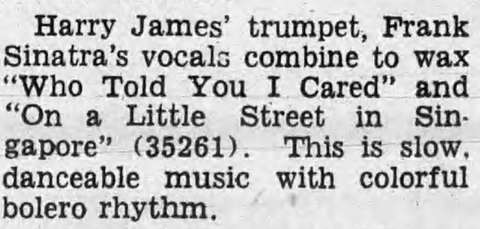
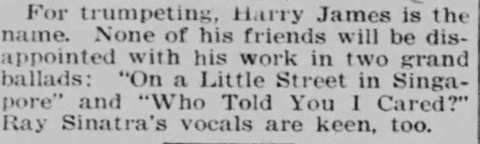
Concerts
Panther Room, Hotel Sherman, Chicago, Illinois (September 9 – November 3) Harry James and his Orchestra w/Frank Sinatra
October 14, 1939
Concerts
Panther Room, Hotel Sherman, Chicago, Illinois (September 9 – November 3) Harry James and his Orchestra w/Frank Sinatra
October 15, 1939
Concerts
Panther Room, Hotel Sherman, Chicago, Illinois (September 9 - November 3) Harry James and his Orchestra w/Frank Sinatra
October 16, 1939
Concerts
Panther Room, Hotel Sherman, Chicago, Illinois (September 9 – November 3) Harry James and his Orchestra w/Frank Sinatra
October 17, 1939
Concerts
Panther Room, Hotel Sherman, Chicago, Illinois (September 9 – November 3) Harry James and his Orchestra w/Frank Sinatra
October 18, 1939
Concerts
Panther Room, Hotel Sherman, Chicago, Illinois (September 9 – November 3)
Harry James and his Orchestra w/Frank Sinatra
October 19, 1939
Radio
Panther Room, Hotel Sherman, Chicago, Illinois
Harry James and his Orchestra w/Frank Sinatra
WMAQ(NBC)
11:00 P.M.-11:30 P.M.
Concerts
Panther Room, Hotel Sherman, Chicago, Illinois (September 9 – November 3)
Harry James and his Orchestra w/Frank Sinatra
October 20, 1939
Radio
Panther Room, Hotel Sherman, Chicago, Illinois
Harry James and his Orchestra w/Frank Sinatra
WMAQ(NBC)
11:00 P.M.-11:30 P.M.
Panther Room, Hotel Sherman, Chicago, Illinois
Harry James and his Orchestra w/Frank Sinatra
WMAQ(NBC)
12:30 A.M. no sign-off time given.
Concerts
Panther Room, Hotel Sherman, Chicago, Illinois (September 9 – November 3) Harry James and his Orchestra w/Frank Sinatra
October 21, 1939
Concerts
Panther Room, Hotel Sherman, Chicago, Illinois (September 9 - November 3) Harry James and his Orchestra w/Frank Sinatra
October 22, 1939
Radio
Panther Room, Hotel Sherman, Chicago, Illinois
WMAQ ( NBC )
Harry James and his Orchestra w/Frank Sinatra
11: P.M. - 11:30 P.M.
Panther Room, Hotel Sherman, Chicago, Illinois
WMAQ ( NBC )
Harry James and his Orchestra w/Frank Sinatra
12:30 A.M. no sign-off time is shown
Concerts
Panther Room, Hotel Sherman, Chicago, Illinois (September 9 - November 3) Harry James and his Orchestra w/Frank Sinatra
October 23, 1939
Concerts
Panther Room, Hotel Sherman, Chicago, Illinois (September 9 – November 3) Harry James and his Orchestra w/Frank Sinatra
October 24, 1939
Concerts
Panther Room, Hotel Sherman, Chicago, Illinois (September 9 – November 3) Harry James and his Orchestra w/Frank Sinatra
October 25, 1939
Concerts
Panther Room, Hotel Sherman, Chicago, Illinois (September 9 – November 3) Harry James and his Orchestra w/Frank Sinatra
October 26, 1939
Radio
Panther Room, Hotel Sherman, Chicago, Illinois
Harry James and his Orchestra w/Frank Sinatra
WMAQ(NBC)
11:00 P.M. - 11:30 P.M.
Concerts
Panther Room, Hotel Sherman, Chicago, Illinois (September 9 – November 3)
Harry James and his Orchestra w/Frank Sinatra
October 27, 1939
Radio
Panther Room, Hotel Sherman, Chicago, Illinois
Harry James and his Orchestra w/Frank Sinatra
WMAQ(NBC(
11:00 P.M. - 11:30 P.M.
WENR(NBC)
12:30 A. M. Till Sign'Off
Concerts
Panther Room, Hotel Sherman, Chicago, Illinois (September 9 – November 3) Harry James and his Orchestra w/Frank Sinatra
October 28, 1939
Radio
Panther Room, Hotel Sherman, Chicago, Illinois
Harry James and his Orchestra w/Frank Sinatra
WMAQ (NBC)
11:00 P.M. - 11:30 P.M.
WENR (NBC)
12:30 A.M. TILL SIGN-OFF
Concerts
Panther Room, Hotel Sherman, Chicago, Illinois (September 9 – November 3) Harry James and his Orchestra w/Frank Sinatra
October 29, 1939
Radio
Panther Room, Hotel Sherman, Chicago, Illinois
Harry James and his Orchestra w/Frank Sinatra
WMAQ (NBC)
11:00 P.M. - 11:30 P.M.
WMAQ (NBC)
12:30 A.M. TILL SIGN-OFF
Concerts
Panther Room, Hotel Sherman, Chicago, Illinois (September 9 – November 3) Harry James and his Orchestra w/Frank Sinatra
October 30, 1939
Concerts
Panther Room, Hotel Sherman, Chicago, Illinois (September 9 – November 3) Harry James and his Orchestra w/Frank Sinatra
October 31, 1939
Radio
Panther Room, Hotel Sherman, Chicago, Illinois
Harry James and his Orchestra w/Frank Sinatra
WMAQ(NBC)
11:00 P.M. - 11:30 P.M.
Concerts
Panther Room, Hotel Sherman, Chicago, Illinois (September 9 November 3) Harry James and his Orchestra w/Frank Sinatra
November 1939
[Buddy Rich joins Dorsey's band]
Kaplan: Drummer Buddy Rich, a temperamental 22-year-old who had clashed with Artie Shaw, accepted Dorsey's offer of $750 a week and joined the band at its engagement at the Palmer House in Chicago.
Source: James Kaplan, "Frank: The Voice" (2010)
[Nancy sent home pregnant by train]
Kaplan: With the band broke and Nancy pregnant, Frank sold his Chrysler and put her on the Super Chief train back east, giving her all the money they had left; both cried as the train pulled out of Union Station.
Source: James Kaplan, "Frank: The Voice" (2010)
[Tommy Dorsey turns thirty-four]
Kaplan: In November 1939, bandleader Tommy Dorsey, whom his musicians called 'the Old Man,' had just turned thirty-four.
Source: James Kaplan, "Frank: The Voice" (2010)
November 1, 1939
Radio
Panther Room, Hotel Sherman, Chicago, Illinois (September 9 – November 3) Harry James and his Orchestra w/Frank Sinatra
WMAQ(NBC)
11:00 P.M. - 12:30 A.M.
WENR(NBC)
12:30 A.M. TILL SIGN-OFF
Concerts
Panther Room, Hotel Sherman, Chicago, Illinois (September 9 – November 3) Harry James and his Orchestra w/Frank Sinatra
November 2, 1939
Concerts
Panther Room, Hotel Sherman, Chicago, Illinois (September 9 – November 3) Harry James and his Orchestra w/Frank Sinatra
November 3, 1939
Radio
Panther Room, Hotel Sherman, Chicago, Illinois (Closing Night) Harry James and his Orchestra w/Frank Sinatra
WMAQ(NBC)
11:00 P.M. - 11:30 P.M.
WENR(NBC)
12:30 A.M. - 1:00 P.M. note: During the band's eight week engagement at the
Sherman Hotel, there were 74 remotes broadcast on
NBC, CBS and Mutual. NBC aired almost all of them.
During that 56 day period, there were 11 days with no broadcast. Monday appears to have been the band's night off. Eight of the 11 days without a remote from the hotel were on Mondays. The running time each night varied from only a half-hour to over two hours.
Wednesday was the night Harry, Frank and Company received the most airtime.
I wonder how many of the shows survived and are sitting in a basement or safely ensconced in some sound library ?
Ed
Concerts
Panther Room, Hotel Sherman, Chicago, Illinois (September 9 November 3) (Closing Night) Harry James and his Orchestra w/Frank Sinatra
November 4, 1939
Concerts
Admiral Coontz Armory and Community Center, Hannibal, Missouri 9:00pm - 1:00am
Harry James and his Orchestra with Frank Sinatra
Dedication of the new Armory
Admiral Coontz Armory and Community Center, Hannibal, Missouri The Palmyra Spectator (Palmyra, Missouri) 1 Nov 1939
Sinatra is referred to as "Frank Sinotra"
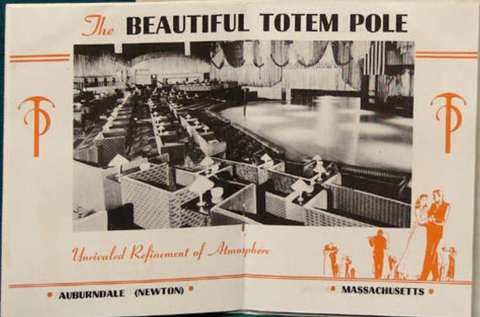
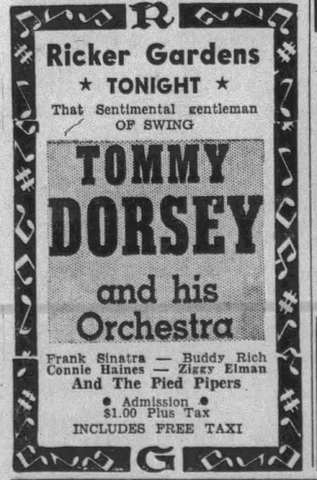
November 5, 1939
Radio
Casa-Loma Ballroom, St. Louis, MO
Live Remote
Harry James and His Orchestra with Frank Sinatra
Concerts
Casa-Loma Ballroom, St. Louis, MO
Harry James and His Orchestra with Frank Sinatra
Casa-Loma Ballroom, St. Louis, MO
Harry James and His Orchestra with Frank Sinatra
Although Harry James opened on November 5th at the Casa-Loma, he did a broadcast from there on November 4th:
The St. Louis Star and Times, St. Louis, Missouri, November 4, 1939
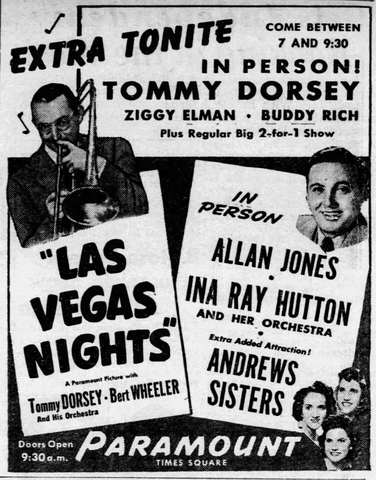
November 8, 1939
Studio
LA2047 Ciribiribin (They're So In Love)
(A. Pestalozza/R. Thaler)
Arranged by Andy Gibson
-A (2:22) CD: CK66377 Harry James & Orch. Fet.FS: Complete Recordings -A LP: CL-1130
-A 78: 37141
-A 78: 35316
Frank recorded his last two songs with the Harry James band for Columbia, "Ciribiribin" and "Every Day of My Life," as his time with James's outfit was drawing to a close.
Source: Nancy Sinatra, Frank Sinatra: An American Legend, 1995.
November 9, 1939
Radio
Harry James and His Orchestra
Live from Victor Hugo's
10:45pm - 11:00pm

Concerts
Victor Hugo's, Hollywood, California (9-15)
Harry James and his Orchestra w/Frank Sinatra
"On A Little Street In Singapore" - Frank Sinatra - (appears on "Masters of Jazz Volume 8" & "Harry James And His Orchestra , Featuring Frank Sinatra All Or Nothing At All, Hindsight Records HCD-263 "
Victor Hugo's, Hollywood, California (9-15)
Los Angeles Times
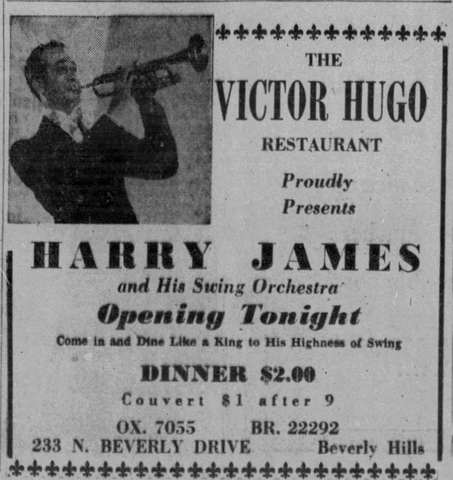
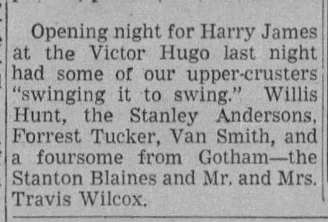
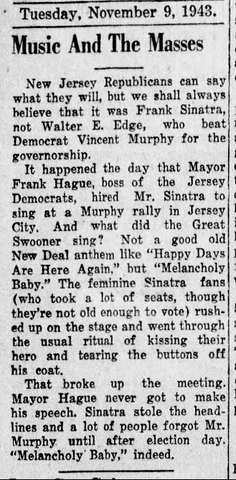
Los Angles Times
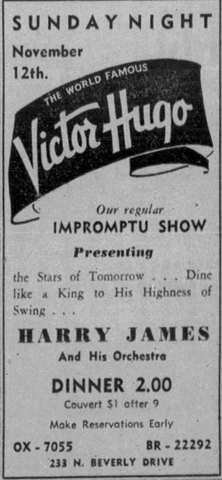
Los Angeles Times
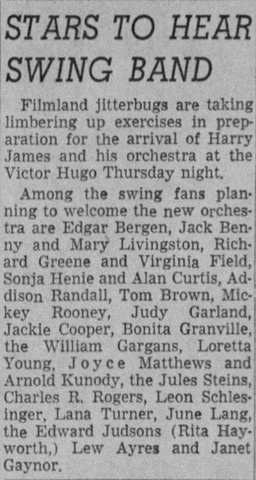
Frank would have very close relationships with Judy Garland, Lana Turner
and Jack Benny. I wonder if he met them that night at Victor Hugo's.
Jimmy Stewart and Marlene Dietrich stopped in one night and Norma Shearer
and George Raft were there one night that week.
Ed
Victor Hugo's, Hollywood, California (9-15)
EXCERPT
October 2010
The Night Sinatra Happened
By James Kaplan
September 20, 2010
"...Then, in September 1939, while the band played the Hotel Sherman, in Chicago, James finally got some good news: MCA, the band’s booking agency, had landed them a big gig at a big venue, the famed Palomar Ballroom, in Los Angeles, where Benny Goodman and his band had started the swing era overnight with a fabled performance in August 1935. There were smiles on the bandstand at last.
On October 2, 1939, the Palomar burned to the ground.
MCA snagged James’s band an alternative engagement, at a Beverly Hills dining-and-dancing establishment called Victor Hugo’s, run by a character named Hugo Aleidas. Unfortunately, the restaurant turned out to be a small, stuffy room, with canaries in gilt cages for decoration: the kind of place where dulcet society bands such as Guy Lombardo’s fit in just fine. Not only did Harry’s band play hot and sweet, it played loud. At first the management tried erecting a canopy over the bandstand to muffle the sound. When that proved insufficient, the horn players were asked to stuff handkerchiefs into the bells of their instruments. By the end of the week, customers were voting with their feetJames, Sinatra, and company were playing to half-full houses. Finally, even Sinatra’s ballads were to no avail: One night, while he was in the middle of “All or Nothing at All,” no lesshe would have a huge hit with it a few years laterAleidas ran out onto the dance floor, waving his arms and shouting, “Stop! No more! Enough!” To add insult to injury, and to underline Harry James’s perfectly bad business luck, the owner refused to pay the band.
....In the meantime, James and his band were limping home to New York. MCA had managed to get them a week at a Los Angeles movie theater and another week at the Golden Gate Theatre, in San Francisco, but then came the interminable drive over the Rockies and the Great Plains, the one-nighters in Denver and Des Moines and Dubuque. They lived on hot dogs and Cokes and candy bars, flirted halfheartedly with the local girls as they headed toward their next stand: a week at the Chicago Theatre, and a Christmas benefit thrown by the mayor of the Windy City, boss Edward J. Kelly. Riding, riding through the night. As the rest of the band played cards and laughed or told dirty jokes or slept and snored, Sinatra sat by himself in the back of the bus, his jacket folded over his eyes, with one thought in mind, over the Rockies, across the Great Plains, across the unendingly huge country that did not yet lie at his feet but would: On the bill at the Chicago Theatre would be Tommy Dorsey."
-Vanity Fair, October 2010
Peter Levinson gave me interviews and information he dug up for his bio on James.
According to Mickey Scrima( drummer), the band lasted exactly one week at Hugo's. which makes
the 15th fit perfectly. The club had always hired society bands and the James contingent was a
terrible mix. They were forced to put hankerchiefs into their horns, use mutes and cover the
bells on the horns with felt hats. To add insult to injury, the owner installed a canopy on top
of the stage to deadened the sound coming from the band. He finally lost it during Sinatra's
rendition of "All Or Nothing At All." Harry was enraged and quit. He got a response of "no,
you're fired." Here is what Harry had to say many years later:
"The owner kept telling us we were playing too loud," Harry recalls. "And so he wouldn't pay us.
We were struggling pretty good and nobody had any money, so Frank would invite us up to his place
and Nancy would cook spaghetti for everyone."
Harry was represented by MCA. He called and begged for help. They needed some gigs in California
because everyone was flat broke. It took a few days but they got the band a week at the Paramount in
L. A. and a week at the Golden Gate in San Francisco Variety labeled the latter so-so in business with
"That's Wrong" as the feature film. Band then headed back to Chicago, doing some one-nighter's
along the way. The Chicago Theatre was a shared billing with the Andrew Sisters. On opening day,
the theatre manager was aghast at the sight of the boy singer. He told Harry to " take that little
scarecrow out of the show." Harry, always loyal to his people, refused. And then Mr. Dorsey asked
to see that little scarecrow at his suite in the Palmer House. And here is an interesting retelling of
the Sinatra-James relationship: When Frank told Harry that Dorsey offered him a job, Harry felt
that he had no hold on him. There had been many weeks where no one in the band had gotten
paid. Harry felt their contract had been broken by his failure and that was that. Wow !
Forgot to mention that MCA also landed Shea Buffalo for New Year's Eve. Things were suddenly
looking up for the band and the boy singer.
--Ed
November 9, 1943
November 10, 1939
Concerts
Victor Hugo's, Hollywood, California (9-15)
Harry James and his Orchestra with Frank Sinatra
November 11, 1939
Concerts
Victor Hugo's, Hollywood, California (9-15)
Harry James and his Orchestra w/Frank Sinatra
Ed O'Brien notes:
After closing at the Panther Room of the Hotel Sherman in Chicago, the James band boarded a train and headed west. They were booked into the Palomar Ballroom in L.A. for a two week engagement. When the band reached Denver they learned the very popular nightspot had burned to the ground.
I have Frank recalling that time with the band in an essay he wrote for "Band Leaders' " in May of 1944. Titled "I Can't Forget," Frank tells of the difficulties he faced during that November in 1939. Nancy was traveling with the band and she was pregnant. Harry James wired ahead to L.A. and managed to land his group a gig at the Victor Hugo Restaurant for two weeks. Before opening there the band had a recording session in Hollywood on 11/8. This would prove to be Sinatra's last session with Harry James' band in 1939. In the article Frank claimed that Harry was slapped with a subpoena when they arrived in L.A. Seems a member of the Benny Goodman band had smashed up Harry's car the year before.and now there was a lawsuit.. Harry's earning were attached. To make matters worse the owner of Hugo's didn't like the loud sound the James band made in what was a rather sedate nightspot. Frank, Nancy and James's drummer and arranger moved into an apartment in Beverly Hills. But there was no money to buy food. Both Frank and Nancy were unwilling to write home and asked for help because they didn't want to upset their families. Frank remembered how the band members would round up a few dollars and he would run out and buy hamburger. Nancy would whip up a pasta dinner. and the band would eat what Frank called a rationed meal. To make matters worse they failed to complete the week at Hugo's. The manager actually fired them while Frank was singing "All Or Nothing At All." Frank would refer to that time in the article as a "period of panic."
The panic ended when James landed a week at the Paramount Theatre in Los Angeles later that month (23-to 29). From there they would move on to dates in Oakland, Colorado, St. Louis and then back to Chicago. In 1944, Sinatra remembered that month very fondly. He wrote that it was filled with happiness in spite of the hardships.It truly was a time he would never forget.
November 12, 1939
Concerts
Victor Hugo's, Hollywood, California (November 9-15)
Harry James and his Orchestra w/Frank Sinatra
November 13, 1939
Concerts
Victor Hugo's, Hollywood, California (November 9-15)
Harry James and his Orchestra w/Frank Sinatra
November 14, 1939
Concerts
Victor Hugo's, Hollywood, California (November 9-15)
Harry James and his Orchestra w/Frank Sinatra
November 15, 1939
Concerts
Victor Hugo's, Hollywood, California (November 9 - 15)
By the band's week-long stand at Victor Hugo's restaurant in Hollywood, business had gone mediocre nationwide and none of the James band's records were yet selling. According to Will Friedwald, their worst moment at the club came one evening in the middle of a performance of "All or Nothing at All," when the restaurant's owner, unimpressed with the turnout, decided on the spot that the band was going to be "nothing at all" -- and fired them right there, mid-song. The band soon returned east to play St. Louis and the Chicago Theatre, and it was around this time that Tommy Dorsey, needing a replacement for his departed singer Jack Leonard, moved to hire Sinatra away from James. Source: Will Friedwald, liner-note essay "Building a Foundation," Harry James and His Orchestra Featuring Frank Sinatra: The Complete Recordings 1939 (Columbia/Legacy).
November 23, 1939
Concerts
Paramount Theatre, Los Angeles, California (November 23-29) Harry James and His Orchestra with Frank Sinatra
(On Screen: "Rulers of the Sea" with Douglas Fairbanks Jr. & Margaret Lockwood)
Paramount Theatre, Los Angeles, California (November 23-29)
L.A. Daily News
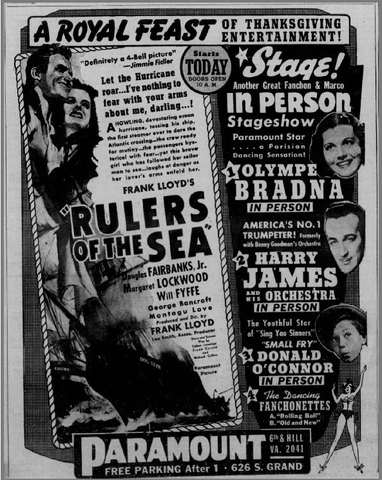
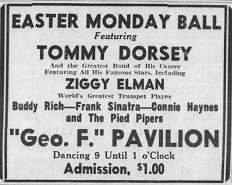

note: The Paramount decided to open a holiday
program on Thanksgiving Day. And it proved
to be a very wise business decision. The weekly
gross of $18,000 was easily the most successful
run in all of Los Angeles. Thanksgiving Day
the Paramount was packed for every show..
Donald O'Connor and Frank Sinatra on the
same bill in late November of 1939 when
they were still relatively unknown.
Ed
November 24, 1939
Concerts
Paramount Theatre, Los Angeles, California (November 23-29) Harry James and his Orchestra with Frank Sinatra
November 25, 1939
Concerts
Paramount Theatre, Los Angeles, California (November 23-29) Harry James & His Band with Frank Sinatra
November 26, 1939
Concerts
Paramount Theatre, Los Angeles, California (November 23-29) Harry James and his Orchestra with Frank Sinatra
November 27, 1939
Concerts
Paramount Theatre, Los Angeles, California (November 23-29) Harry James and his Orchestra with Frank Sinatra
November 28, 1939
Concerts
Paramount Theatre, Los Angeles, California (23-29)
Harry James and his Orchestra with Frank Sinatra
The band opened on Thanksgiving (23) and took in
$4,900. Variety estimated the gross for the week would be $18,500. The final take for the seven day run was
$18,000. Film playing that week was "Rulers Of The
Sea" with Douglas Fairbanks Jr. and Margaret
Lockwood.
Ed
November 29, 1939
Radio
note: I included an extended schedule after seeing that the Bob Chester band
was also broadcasting on a different station at the same time. Frank almost
went with Chester just before James offered him a job. Chester changed
his mind and one of his musicians doubled on vocals. Frank lucked out.
Chester band was not very successful.
Ed
Concerts
Paramount Theatre, Los Angeles, California (November 23-29) Harry James and his Orchestra with Frank Sinatra
November 30, 1939
Radio
Harry James and His Orchestra with Frank Sinatra
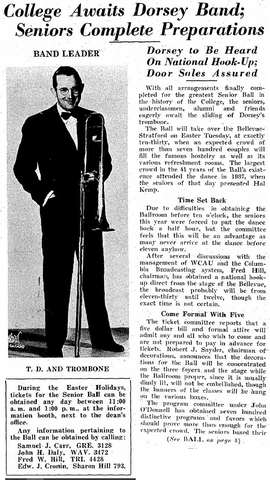
December 1939
[Christmas benefit at Chicago Theatre]
Kaplan: As the struggling Music Makers worked their way home across the country, they played a week at the Chicago Theatre that included a Christmas benefit hosted by Chicago mayor Edward J. Kelly, with Tommy Dorsey's band also on the bill — a meeting Sinatra anticipated intensely during the long overland drive.
Source: James Kaplan, "Frank: The Voice" (2010)
[Dorsey hears Sinatra on the radio]
Kaplan: Passing through the lobby of Chicago's Palmer House, Dorsey was stopped in his tracks by a radio playing Sinatra's 'All or Nothing at All,' and asked his clarinetist Johnny Mince to come listen.
Source: James Kaplan, "Frank: The Voice" (2010)
[Dorsey offers Sinatra $75 a week]
Kaplan: After the audition, Dorsey told Sinatra he wanted him in the band, offering just seventy-five dollars a week to start; Sinatra immediately phoned his wife Nancy from the hotel lobby with the news.
Source: James Kaplan, "Frank: The Voice" (2010)
[Dorsey rehires the Pied Pipers]
Kaplan: Around the same time he hired Sinatra, Dorsey phoned Jo Stafford at home in California and asked to bring back the Pied Pipers vocal group, now reduced from eight singers to four.
Source: James Kaplan, "Frank: The Voice" (2010)
[Dorsey scouts Sinatra at Mayor Kelly's party]
Kaplan: The night after hearing Sinatra on the radio, Dorsey sent his manager Bobby Burns to Mayor Kelly's Christmas party to hear Harry James's boy singer; Burns passed Sinatra a note, scrawled on a torn sandwich bag, giving Dorsey's suite number and a meeting time.
Source: James Kaplan, "Frank: The Voice" (2010)
[Pied Pipers join Dorsey band]
Kaplan: The Pied Pipers, including Jo Stafford, officially joined the Dorsey band in December 1939, while Sinatra was still finishing out his obligation to Harry James.
Source: James Kaplan, "Frank: The Voice" (2010)
[Sinatra auditions for Dorsey at the Palmer House]
Kaplan: At 2:00 p.m., Sinatra arrived at Dorsey's Palmer House suite for his audition, sang 'Marie' with the band in the ballroom, and won Dorsey's approval, who told him he wanted him to join if Harry James would release him.
Source: James Kaplan, "Frank: The Voice" (2010)
[Sinatra tells Harry James he is leaving]
Kaplan: Sinatra worked up the nerve to tell Harry James he wanted to leave for Dorsey's band; James, reading in his hotel room, released him graciously, joking that Sinatra should get him a spot too if things didn't work out.
Source: James Kaplan, "Frank: The Voice" (2010)
[Sinatra's final Harry James engagement]
Kaplan: Sinatra's last stint with Harry James's Music Makers was a two-week run at Shea's Theatre in Buffalo spanning late December into early January, sharing the bill with Red Skelton and a young acrobat named Burt Lancaster.
Source: James Kaplan, "Frank: The Voice" (2010)
December 1, 1939
Radio
Civic Auditorium, San Jose, CA
Harry James and His Orchestra
Mutual Network
10:45pm
Concerts
Civic Auditorium, San Jose, CA
Harry James and His Orchestra w/ Frank Sinatra
Civic Auditorium, San Jose, CA
Harry James and His Orchestra w/ Frank Sinatra
[image] .
[image referenced in source but could not be recovered]
[image referenced in source but could not be recovered]
[image referenced in source but could not be recovered]
December 2, 1939
Radio
Harry James Band, Sweets Nightclub, Sacramento, California 10:30 p.m. - 11:00 P.M.
MUTUAL BROADCAST
KFRC in San Francisco
[image referenced in source but could not be recovered]
Concerts
Sweet's Ballroom, Sacramento, California
Harry James and his Orchestra w/Frank Sinatra
Sweet's Ballroom, Sacramento, California
Harry James and his Orchestra w/Frank Sinatra
note: The Stockton and Oakland papers had Harry and His Band appearing at Sweets on 12-3-39. The Sacramento Bee had them their on 12-2.
I checked a number of papers and 12/2 is the correct date. You can see the radio broadcast of 12/2 has both the Orrin Tucker and James' Bands on from 10:30 to 11:00 P.M. PST. I checked numerous Calif. papers and there is nothing to support the 12/3 date.
Ed
--Harry James did appear at Sweet's Ballroom in Oakland, California on December 3. Sweet's Ballroom in Sacramento was on the 2nd. --Scott
[image referenced in source but could not be recovered]
[image referenced in source but could not be recovered]
[image referenced in source but could not be recovered]
[image referenced in source but could not be recovered]
[image referenced in source but could not be recovered]
December 3, 1939
Sacramento Union
12-3-39
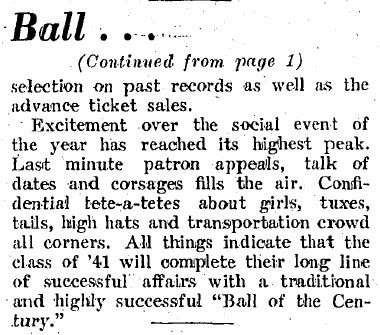
Sweet's Ballroom, Oakland, California
Harry James and his Orchestra w/Frank Sinatra
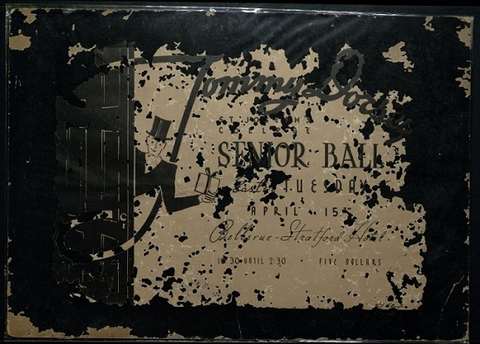
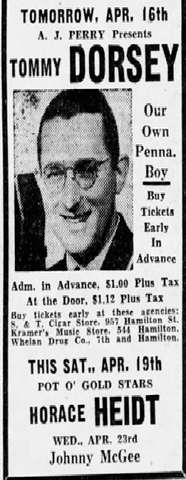
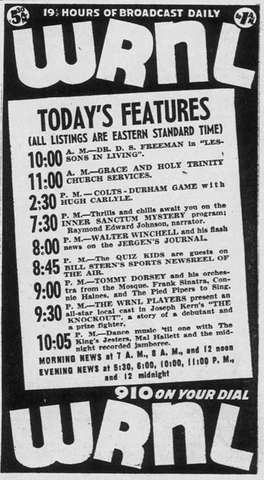
December 4, 1939
Radio
Harry James and His Orchestra
Mutual
KFRC ( San Francisco )
10:45 P.M. -11:05 P.M. PST
December 5, 1939
Radio
Harry James and His Orchestra
Mutual
10:45 P.M. -11:05 P.M.
KFRC( San Francisco )
[image referenced in source but could not be recovered]
December 6, 1939
Radio
Harry James and His Orchestra
Mutual
KDYL
Salt Lake City
11:00 P.M. -1:00 A.M.
Concerts
Jerry Jones’ Rainbow Randevu, Salt Lake City, Utah
Harry James and His Orchestra w/Frank Sinatra
Jerry Jones’ Rainbow Randevu, Salt Lake City, Utah
Harry James and His Orchestra w/Frank Sinatra
note: Harry and Frank grabbed the brass ring in Salt Lake City. Two hours on the local channel and beamed out across the nation.
An engineer, who lived in Chicago, told me he use to record Harry's shows using a crystal radio set and a recording device.
He got some fairly decent recordings.
Ed
December 6, 1947, Waldorf Hotel, New York
McCosker-Hershfield Cardiac Home Dinner
Sinatra was on the dais
Apparently there was a radio broadcast as well of the dinner. Not sure if Sinatra, who was on the dais, was also featured in the radio program
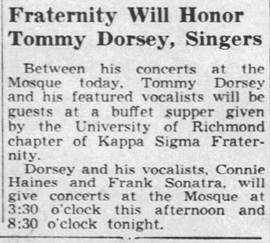

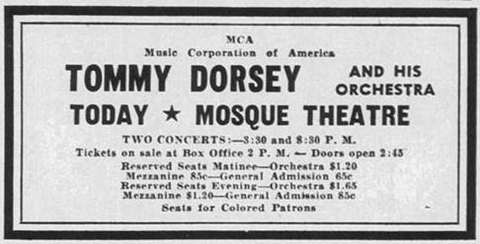
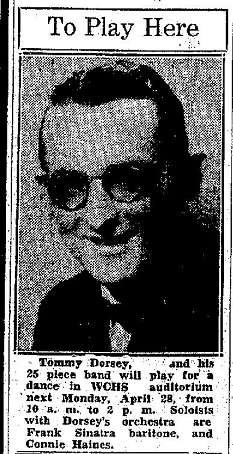
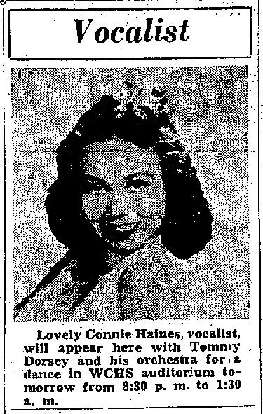
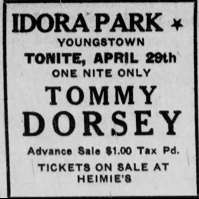
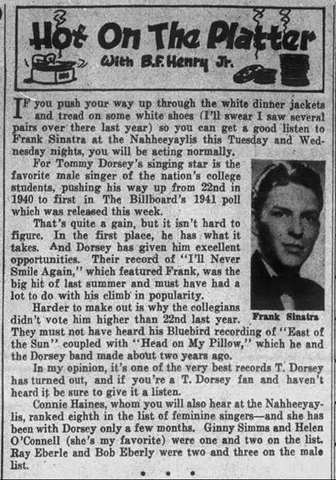
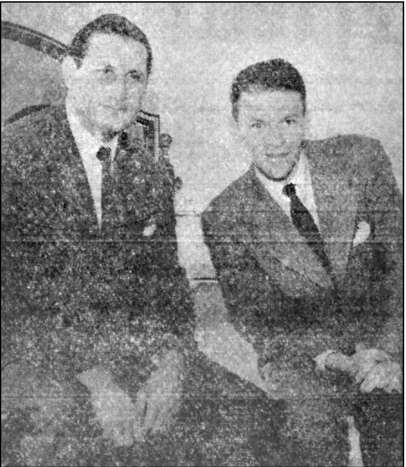
December 8, 1939
Radio
Harry James and His Orchestra
WENR 12:30 am
Concerts
Broadmoor Ballroom, Colorado Springs, Colorado
Harry James and His Orchestra with Frank Sinatra
Broadmoor Ballroom, Colorado Springs, Colorado
Harry James and His Orchestra with Frank Sinatra
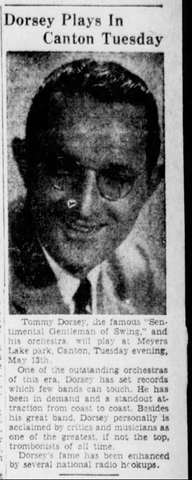
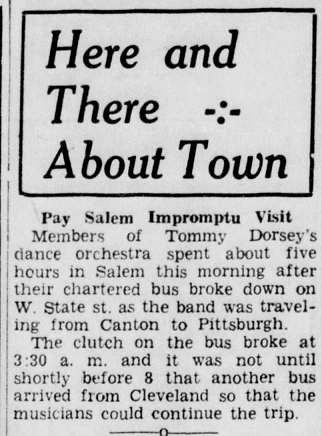
I was trying to run down the alleged College Dance Harry James did on Sunday July 30, 1939 when I came across another entry that we didn’t have. This time it’s from December 8, 1939. This fills in the gap for December concerts when Harry James was on his way back from the west coast. On December 6th they were at Jerry Jones’ Rainbow Randevu, Salt Lake City, Utah and on December 9th they were at The Rainbow, Denver, Colorado.
December 8, 1939, Broadmoor Ballroom, Colorado Springs, Colorado
Harry James and His Orchestra with Frank Sinatra
Apparently, it wasn’t all good news:
Scott
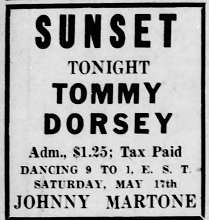
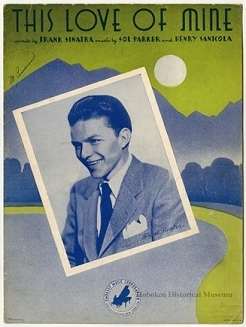
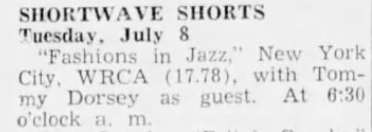
December 9, 1939
Radio
Harry James and His Orchestra
10:30 PM - 11PM
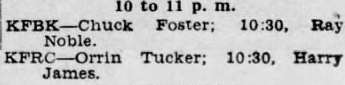
Concerts
The Rainbow, Denver, Colorado (One Nighter)
Harry James and his Orchestra w/ Frank Sinatra
The Rainbow, Denver, Colorado (One Nighter)
Harry James and his Orchestra w/ Frank Sinatra
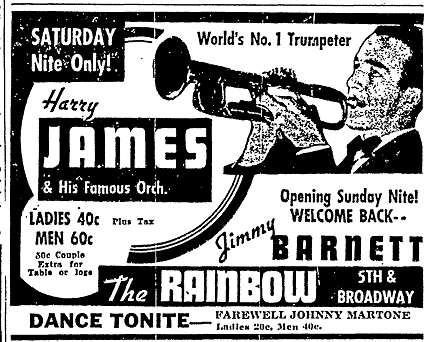
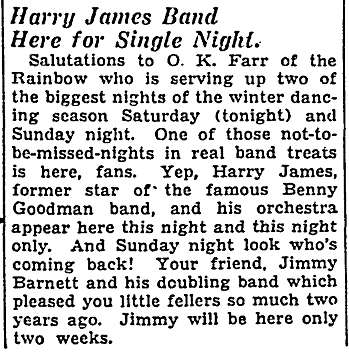
December 13, 1939
Radio
Harry James and His Orchestra
note: I found two stations in Minnesota broadcasting a half-hour of
Harry James. Makes sense that a stopover took place before
arriving in Chicago for the theater run, starting on 12/15.
--Ed
December 15, 1939
Concerts
Chicago Theatre, Chicago, Illinois (December 15-21)
Harry James and his Orchestra with Frank Sinatra
On Screen: “Daytime Wife” with Tyrone Power & Linda Darnell
The Andrews Sisters were also appearing during this run.
When Harry James & His Merrie Makers arrived in Chicago, they were a sorry group. Harry's new drummer, Mickey Scrima, would later remember what a struggle the band was having getting work. And they were about to lose their male vocalist. The Johnny Davis Orchestra had opened at the Chicago Theatre on 12/8 for a one week run with The Andrew Sisters. Variety reported a decent $37,000 for the run. The management had the James band coming in on the 15th but felt they needed more of a headliner. The Andrew Sisters had planned to head home for the holidays until the theatre manager prevailed upon them to add another week to their run. The manager ordered Harry to get rid of the "scarecrow" vocalist because his looks would frighten people. Harry refused. The week went smoothly and Variety showed a figure of $24,200 for the theatre. During the week, Chicago Mayor Ed Kelly, who had just been re-elected, gave his annual Christmas benefit party. All the major bands performing in Chicago made an appearance and entertained the gathering. After the James band completed their set, Tommy Dorsey's manager, Bobby Burns, handed Frank Sinatra a piece of paper torn from a sandwich bag. Tommy Dorsey, the man who fronted the General Motors of the band business, wanted to see him the following afternoon at his suite in the Palmer House, at 2 P.M. Don't be late. Frank would admit later that he was terrified. Dorsey greeted him with a firm handshake, told him how impressed he was with his singing and asked him to audition Down they went to the Palmer Ballroom where a few members of the band were waiting to back the singer. Tommy asked him to sing Jack Leonard's big hit from 1937 "Marie." What T.D. heard sold him immediately. A great musician always recognizes the best from other musicians. This kid had it in spades. Despite claims later on that Dorsey offered $125.00 a week, the truth was $75.00 with a promise to up it quickly if he worked out. Frank called Nancy from a phone booth in the hotel lobby. She was thrilled, but what about his contract with Harry? Frank found him in his dressing room backstage at the Chicago. He told a man he greatly admired about the offer. Harry rose from his chair, walked over to him, shook his hand and wished him good luck. It was that simple. He would not hold him to his contract. Harry had failed to pay him any number of weeks and felt that nullified any claim he might have had on his services. They would remain life long friends.
--Ed
Chicago Theatre, Chicago, Illinois (December 15-21)
Chicago Tribune, December 15, 1939
------------------------------------------------------------
The Cleveland Press Christmas Show, December 15, 1945
Thanks to Ed O'Brien and his anonymous friend for the above submission
Editor Louie Seltzer and Frank Sinatra at the annual Cleveland Press Christmas show 1945
From The Aviation Adventures of Harry Sievers ( https://www.pitcairnfield.org/people/ball_cl/) It was December 15, 1945 at the 11th annual Cleveland Press Christmas Show in Ohio that Frank Sinatra put on a show for all the folks at the Public Hall. Mr. Sinatra's appearance was made possible by Mr. Holliday, president of the Standard Oil Company of Ohio (Sohio), who contributed the airplane and the pilot to fly Mr. Sinatra to Richmond, Virginia after the show. Since I was Sohio's only pilot, I was responsible to fly Mr. Sinatra's party to Richmond, Virginia. After arriving Richmond, I went onto Washington D.C. to refuel the plane. I asked if there were any servicemen who wanted a free ride to Cleveland, Ohio. A sailor, Joseph Magyar from Akron, Ohio was having trouble getting home for Christmas, so he happily accepted the offer. He was the most grateful, excited fellow I ever saw. He had just been discharged and hadn't been home with his family for Christmas for three years. Instead of landing at Cleveland, I nosed the Sohio plane into the Akron airport, almost landing the sailor at his doorstep.
[image referenced in source but could not be recovered]
[image referenced in source but could not be recovered]
[image referenced in source but could not be recovered]
[image referenced in source but could not be recovered]
[image referenced in source but could not be recovered]
[image referenced in source but could not be recovered]
Source: CS 048 -- Flyright Records 217929, "Tommy Dorsey and His Orchestra: Not So Quiet Please" liner notes.
The liner notes trace Tommy Dorsey's first encounter with Sinatra to a Bob Chester band rehearsal in Manhattan in August 1939, recalled by Dorsey road manager Jack Egan in an August 24, 1948 Down Beat piece: Dorsey came by for dinner between rehearsals, heard Sinatra rehearsing with the new band, and was struck by him, though Harry James had already signed Sinatra roughly ten days earlier. According to the notes, both the James and Dorsey bands happened to be booked in Chicago in December 1939, and Dorsey arranged for Sinatra to audition, offering a contract at a weekly salary of $100 with a penalty clause that later became a point of contention when Sinatra left the band; James released him from his contract to take the Dorsey offer.
December 16, 1939
Concerts
Chicago Theatre, Chicago, Illinois (December 15-21)
Harry James and his Orchestra with Frank Sinatra
On Screen: “Daytime Wife” with Tyrone Power & Linda Darnell
The Andrews Sisters were also appearing during this run.
December 17, 1939
Concerts
Chicago Theatre, Chicago, Illinois (December 15-21)
Harry James and his Orchestra with Frank Sinatra
On Screen: “Daytime Wife” with Tyrone Power & Linda Darnell
The Andrews Sisters were also appearing during this run.
December 18, 1939
Concerts
Chicago Theatre, Chicago, Illinois (December 15-21)
Harry James and his Orchestra with Frank Sinatra
On Screen: “Daytime Wife” with Tyrone Power & Linda Darnell
The Andrews Sisters were also appearing during this run.
December 19, 1939
Concerts
Chicago Theatre, Chicago, Illinois (December 15-21)
Harry James and his Orchestra with Frank Sinatra
On Screen: “Daytime Wife” with Tyrone Power & Linda Darnell
The Andrews Sisters were also appearing during this run.
December 20, 1939
Concerts
Chicago Theatre, Chicago, Illinois (December 15-21)
Harry James and his Orchestra with Frank Sinatra
On Screen: “Daytime Wife” with Tyrone Power & Linda Darnell
The Andrews Sisters were also appearing during this run.
Mayor Ed Kelly’s “Night of Stars” Gala, Chicago Stadium.
Harry James and his Orchestra was one of several bands in a night of celebrities that lasted 7 hours. Tommy Dorsey and His Orchestra was also on the same bill (before Sinatra joined Dorsey)
Mayor Ed Kelly’s “Night of Stars” Gala, Chicago Stadium.
Harry James and his Orchestra was one of several bands in a night of celebrities that lasted 7 hours.
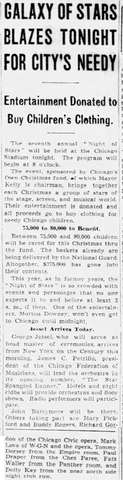
December 21, 1939
Concerts
Chicago Theatre, Chicago, Illinois (December 15-21)
Harry James and his Orchestra with Frank Sinatra
On Screen: Daytime Wife with Tyrone Power & Linda
Darnell
The Andrews Sisters were also appearing during this run.
December 24, 1939
Concerts
Trianon Ballroom, Cleveland, Ohio
Harry James and His Orchestra with Frank Sinatra
Note: This had previously been reported as December 26th
Trianon Ballroom, Cleveland, Ohio
Harry James and His Orchestra with Frank Sinatra
Note: This had previously been reported as December
26th
Heres the advertisement that ran in the Plain Dealer on December 24, 1939:
Cancelled:
December 24, 1948 Great Falls, Montanna
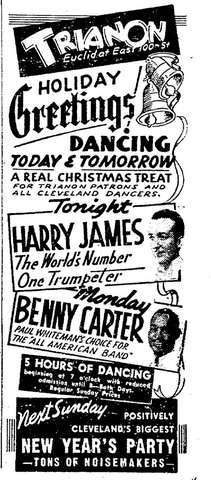
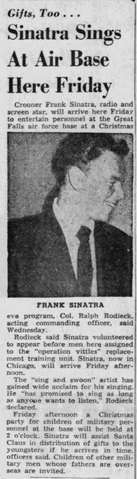
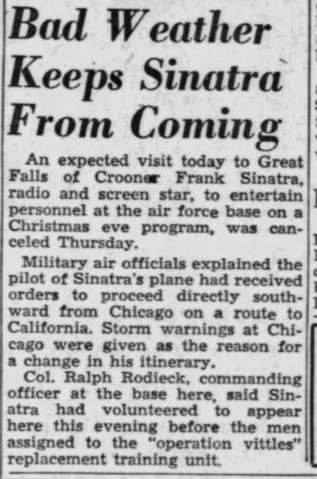
December 25, 1939
Concerts
Hotel Statler, Cleveland, Ohio
Annual dance of the Ching Tang Club
Harry James and his Orchestra w/ Frank Sinatra
Hotel Statler, Cleveland, Ohio
Annual dance of the Ching Tang Club
Harry James and his Orchestra w/ Frank Sinatra
December 27, 1939
Concerts
The Franklin Club, Franklin, Pennsylvania
Christmas Dance of the Venango Chapter Order of DeMolay Harry James and His Orchestra with Frank Sinatra
The Franklin Club, Franklin, Pennsylvania
Christmas Dance of the Venango Chapter Order of DeMolay Harry James and His Orchestra with Frank Sinatra
The News-Herald (Franklin, Pennsylvania) · 11 Dec 1939
Notice the misspelling of Sinatra's name as "Sinitra"
The News-Herald (Franklin, Pennsylvania) 28 Dec 1939
December 28, 1939
Concerts
Memorial Hall, Springfield, OH
Young Woman's Mission Charity Ball
Harry James and his Orchestra with Frank Sinatra
Memorial Hall, Springfield, OH
Young Woman's Mission Charity Ball
Harry James and his Orchestra with Frank Sinatra
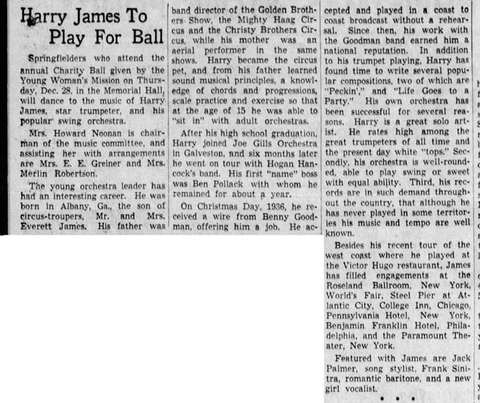
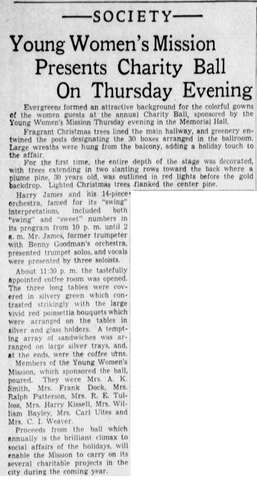
December 31, 1939
Concerts
Shea Theatre, Buffalo, New York (December 31/39 to January 11/40) Harry James with Frank Sinatra
Red Skelton, Erina Stillwell, Patricia Norman
Hudson Wonders, Frank Paris and His Marionettes
(On Screen: "Balalaika" starring Nelson Eddy & Ilona Massey) note: The James Band was added at the midnight show on New Year's Eve. It was strictly for that one day. Lo and behold, they had a following in Buffalo and the theater took in $3,500. An immediate extension was worked out and they were part of the show through the 11th of January. Variety predicted their 10 day run after New Year's would be in the range of $25,000. The actual gross came to $23,500. Billboard and Variety gave credit to "Balalaika," stating it was a strong draw and also credited the band.
Frank liked to tell how Buffalo had a big storm during the band's run. On the night they closed, Frank Sinatra stood on the top of a big mountain of snow and waved goodbye, with tears running down his face, as the band bus drove away. Frank would take two weeks off before joining the Tommy Dorsey band.
--Ed
Shea Theatre, Buffalo, New York (December 31/39 to January 11/40)
The Sun and the Erie County Independent (Hamburg, New
York) 28 Dec 1939
1940
[Birth of Daughter Nancy]
Sinatra's first child, Nancy, was born in New Jersey in 1940.
Source: Charles Pignone, "Frank Sinatra 100" (2015).
[Birth of Nancy Sandra Sinatra]
Sinatra's first child, Nancy Sandra, is born in Jersey City.
Source: Nancy Sinatra, "Frank Sinatra, My Father" (1985).
[First Appearance and Recording with Tommy Dorsey]
Sinatra joins Tommy Dorsey's band, making his first appearance with the orchestra and recording "The Sky Fell Down" with Dorsey and the Pied Pipers.
Source: Nancy Sinatra, "Frank Sinatra, My Father" (1985).
[First #1 Single, "I'll Never Smile Again"]
Sinatra scores his first #1 single with "I'll Never Smile Again," recorded with the Dorsey band.
Source: Nancy Sinatra, "Frank Sinatra, My Father" (1985).
[Final Night with the James Band]
Sinatra played his last engagement with Harry James's band at Buffalo's Shea Theatre, on a bill that also featured Red Skelton and Burt Lancaster with stunt partner Nick Cravat. He recalled crying in the snow as he watched the band's bus depart for its next date without him.
Source: Nancy Sinatra, "Frank Sinatra, My Father" (1985).
[How Sinatra Learned To "Play" His Voice Like An Instrument]
Nancy Sinatra: Frank said he developed his signature long, unbroken vocal phrasing by studying how Tommy Dorsey seemed to play his trombone without visibly breathing, eventually noticing Dorsey used a tiny "sneak pinhole" in the corner of his mouth to snatch quick breaths mid-phrase. Frank then began swimming laps underwater while mentally rehearsing lyrics to build his own breath control, stretching his phrasing from two or four bars at a time to six or eight.
Source: Nancy Sinatra, Frank Sinatra: An American Legend, 1995.
[Nancy Sr. Pregnant with Baby Nancy]
A 1940 photo of Frank and Nancy comes with Nancy Sinatra Sr.'s recollection that she was pregnant with their daughter at the time and held a hat in front of herself in the picture, describing it as a simple, happy period in their lives.
Source: Charles Pignone, "Frank Sinatra 100" (2015).
["Polka Dots and Moonbeams" recorded]
Kaplan: Van Heusen's "Polka Dots and Moonbeams," written with lyricist Johnny Burke, became one of Sinatra's loveliest early ballads during his Dorsey years.
Source: James Kaplan, "Sinatra: The Chairman" (2015)
['I'll Never Smile Again' reaches number one]
Kaplan: About five weeks after it was recorded, 'I'll Never Smile Again' shot to number one on the very first Billboard chart and stayed there for twelve weeks, making Sinatra a national star.
Source: James Kaplan, "Frank: The Voice" (2010)
[Bing Crosby visits the 'Las Vegas Nights' set]
Bing Crosby (via Kaplan): While shooting 'Road to Zanzibar' on the same Paramount lot, Bing Crosby stopped by to watch a take of Sinatra performing 'I'll Never Smile Again,' afterward telling Dorsey and then Sinatra directly, 'Real nice, Frank... You're going to go far.'
Source: James Kaplan, "Frank: The Voice" (2010)
[Dorsey band films 'Las Vegas Nights']
Kaplan: During the Palladium stand, the Dorsey band was hired to perform four numbers in the Paramount B musical 'Las Vegas Nights,' with band members working as $15-a-day extras -- Sinatra's first film appearance.
Source: James Kaplan, "Frank: The Voice" (2010)
[Dorsey band plays New Haven, pizza party at Sally's]
Consiglio: In fall 1940, Tommy Dorsey's band played the Musician's Ball at the Goffe Street Armory in New Haven. Afterward, the hungry band and singers -- Frank, Connie Haines, Jo Stafford, and the Pied Pipers, 22 people in all -- ate free pizza at Sally's until about 4:30 a.m., a night Frank never forgot.
Source: Tony Consiglio (as told to Franz Douskey), "Sinatra and Me: The Very Good Years" (2012)
[First live performance of "This Love of Mine"]
Consiglio: The night Sinatra first sang "This Love of Mine" was during a live network radio broadcast from the Astor Roof Garden with the Tommy Dorsey band. Since Frank hadn't had time to learn the lyrics, Consiglio stood in front of him holding a large card with the words written out by Hank Sanicola so Frank could read them while performing.
Source: Tony Consiglio (as told to Franz Douskey), "Sinatra and Me: The Very Good Years" (2012)
[Jimmy Van Heusen discovers Palm Springs]
Kaplan: Songwriter Jimmy Van Heusen discovered Palm Springs in the late summer of 1940 when he landed his plane there en route to Los Angeles to work with Johnny Burke for Bing Crosby, fell in love with the desert climate, and introduced the spot to friends including Sinatra.
Source: James Kaplan, "Frank: The Voice" (2010)
[Kessler family recalls the Sinatras in Jersey City]
Ed Kessler: Ed Kessler, twelve years old that summer, recalled his family living above Frank, Nancy, and baby Nancy in a three-room, third-floor walk-up at 12 Audubon Avenue in Jersey City; Kessler noted Sinatra's two-toned blue-and-cream Buick convertible and irregular hours, and once babysat for the family. He also recalled Tommy Dorsey visiting to see the baby.
Source: James Kaplan, "Frank: The Voice" (2010)
[Original 'All or Nothing at All' recording]
Kaplan: Sinatra's original recording of "All or Nothing at All" with Harry James's band, first released in June 1940, sold only about eight thousand copies at the time.
Source: James Kaplan, "Frank: The Voice" (2010)
[Sammy Cahn's marital advice to Sinatra]
Sammy Cahn: Sometime in 1940, Sinatra confided to songwriter Sammy Cahn that he was unhappy being married; Cahn advised him to adopt the 'George Raft syndrome' -- stay married but enjoy the road -- advice Sinatra seemed to take to heart.
Source: James Kaplan, "Frank: The Voice" (2010)
[Sinatra attends Heifetz concert at Carnegie Hall]
Sinatra (to Sidney Zion, via Kaplan): On a whim, Sinatra attended a Carnegie Hall classical concert featuring violinist Jascha Heifetz performing Brahms, Debussy, Rachmaninoff, and Ravel, and became fascinated with how Heifetz sustained a bow stroke without a break -- an idea he applied to his own breath control.
Source: James Kaplan, "Frank: The Voice" (2010)
[Sinatra begins affair with Alora Gooding]
Kaplan: During the Las Vegas Nights shoot, Sinatra began an affair with an extra billed as Alora Gooding (real name Dorothy Bonucelli), who moved into his room at the Hollywood Plaza Hotel and lived with him as his wife for the rest of the Los Angeles stay; the whole band, including Dorsey, knew.
Source: James Kaplan, "Frank: The Voice" (2010)
[Sinatra meets Hank Sanicola]
Consiglio: Frank Sinatra, still singing with Tommy Dorsey, met Hank Sanicola at the Hotel Astor when Sanicola pitched him a song he'd co-written, "This Love of Mine." Sinatra liked the lyrics and agreed to record it, but insisted his own name be added to the songwriting credit alongside Sanicola and Sol Parker, entitling him to a share of royalties despite not writing it.
Source: Tony Consiglio (as told to Franz Douskey), "Sinatra and Me: The Very Good Years" (2012)
[Tommy Dorsey hires Frank Sinatra]
Consiglio: Needing a male singer, Tommy Dorsey offered Frank $125 a week, outbidding the $75 Harry James was paying him. Frank joined Dorsey's band, and James -- recognizing the opportunity for Frank -- tore up his contract without asking for compensation.
Source: Tony Consiglio (as told to Franz Douskey), "Sinatra and Me: The Very Good Years" (2012)
[Van Heusen flies to Hollywood, discovers Palm Springs]
Kaplan: In summer 1940, lyricist Johnny Burke lured Van Heusen to Hollywood to write songs for Bing Crosby's films; flying his own plane, Van Heusen made a fuel stop in the then-tiny outpost of Palm Springs and fell in love with the desert, a passion he would later share with Sinatra.
Source: James Kaplan, "Sinatra: The Chairman" (2015)
[WWII backdrop, Jack Leonard leaves Dorsey]
Consiglio: By 1940, with WWII underway in Europe, Tommy Dorsey's lead male singer Jack Leonard left the band to try a solo career; he was later drafted and his solo career never took off, despite recording some well-regarded songs like "Marie."
Source: Tony Consiglio (as told to Franz Douskey), "Sinatra and Me: The Very Good Years" (2012)
[Frank's punitive 1940 contract with Dorsey via GAC]
When Sinatra signed with Tommy Dorsey in 1940 through the General Amusement Company, the deal included an advance of more than $15,000, giving Dorsey leverage over Frank's future earnings. That advance became central to the bitter contract dispute when Frank later tried to leave.
Source: Richard Havers, "Sinatra" (Dorling Kindersley, 2007).
[The Dorsey Band's "Memory Medley" Format]
On many of his radio broadcasts, Tommy Dorsey featured a recurring segment billed as "The Tommy Dorsey Memory Medley," built around three older standard songs performed in scripted, conversational fashion by Dorsey, Sinatra, and Jo Stafford. The format typically opened with a ballad from Sinatra, followed by a feature for Dorsey's own trombone playing, then closed with a number for Stafford. The medleys let Sinatra sing songs he otherwise never recorded with the band, including "Melancholy Baby" and "Learn to Croon." Dorsey largely set the format aside for about two years before reviving it as a major feature of his broadcasts in 1942, a shift tied partly to Sinatra's growing prominence in the band and partly to the wartime audience's taste for nostalgia.
Source: Will Friedwald, liner notes to "Learn to Croon" — Frank Sinatra & Tommy Dorsey and His Orchestra (Buddha Records, 1999).
[Birth of Nancy Sandra Sinatra, Tommy Dorsey as godfather -- critical commentary]
Sinatra / Friedwald: "Tommy became almost a father to me," Sinatra often said, and he selected TD as the godfather of his first child, Nancy Sandra Sinatra (born on June 8, 1940). Many of Sinatra’s friends claimed that the iron-fisted Mr. Dorsey supplied a stronger paternal image than the singer’s own father, the very passive Marty Sinatra.
Source: Will Friedwald, "Sinatra! The Song Is You: A Singer's Art" (2018 revised edition), Ch. 3, "With Tommy Dorsey" (1940-1942)
[Funny Little Pedro -- critical commentary]
It was inevitable that Dorsey would also try to repeat the triumph of "Smile Again." On June 5, the Sentimentalists returned to the studio with "Funny Little Pedro," another, far less successful song by Lowe, with vocal by the Pied Pipers.
Source: Will Friedwald, "Sinatra! The Song Is You: A Singer's Art" (2018 revised edition), Ch. 3, "With Tommy Dorsey" (1940-1942)
[Jo Stafford's first impression of Sinatra when he joined Dorsey, January 1940 -- critical commentary]
Jo Stafford: Jo Stafford, later a great pop-jazz hitmaker and a longtime Sinatra favorite, remembered distinctly that the first time she saw him, her reaction was more visual than musical. "I thought, ‘Hmmmm.. Kinda thin!’" But her opinion changed after he opened his mouth. "Tommy introduced him as the new boy singer. He walked out and started singing, and it didn’t take more than eight or ten bars to know that you were listening to something entirely unique and different. You know, nobody had ever sounded like that before. And it was something very, very good."
Source: Will Friedwald, "Sinatra! The Song Is You: A Singer's Art" (2018 revised edition), Ch. 3, "With Tommy Dorsey" (1940-1942)
[So What! -- critical commentary]
Some of the first extant Dorsey-Sinatra broadcasts are notable mainly because Sinatra does not steal the show from the rest of the band. The earliest documented shows originate from the Meadowbrook on February 21 and 24. Here, the first "voice" we notice is the trombone man himself, on nearly every song; Babe Russin also attracts attention with his lengthy clarinet solo on "So What!" (no connection with the Miles Davis number).
Source: Will Friedwald, "Sinatra! The Song Is You: A Singer's Art" (2018 revised edition), Ch. 3, "With Tommy Dorsey" (1940-1942)
[recording studio locations -- critical commentary]
The Dorsey-Sinatra Victor sessions were recorded at several company studios; the New York flagship, a converted livery stable at 155 W. 24th Street, had three rooms (Studios 1, 2, 3), with Studios 1 and 2 hosting most of the 1940-1942 New York Sinatra sessions, while Studio 3 was converted into an echo chamber in 1940.
Source: Charles L. Granata, "Sessions with Sinatra: Frank Sinatra and the Art of Recording" (1999/2003), Part I: The Big Band Years, 1937-1942
January 1940
[Dorsey Formally Hires Sinatra]
In January 1940, Tommy Dorsey officially hired Sinatra at $125 a week, a substantial raise over his pay with Harry James's band, giving him his first real taste of stardom as the orchestra's featured vocalist.
Source: Charles Pignone, "Frank Sinatra 100" (2015).
["I Ain't Never Gonna Make It": Leaving The James Band In The Snow]
Nancy Sinatra: After his last gig with the Harry James band in Buffalo, Frank stood in the snow watching the tour bus pull away without him, convinced in that lonely moment that he would never make it and would end up dying stranded in the cold, before catching a train to join Tommy Dorsey's band.
Source: Nancy Sinatra, Frank Sinatra: An American Legend, 1995.
[Joins Tommy Dorsey's Orchestra]
Sinatra formally joined the Tommy Dorsey Orchestra, traveling by train to meet the band in Rockford, Illinois; he found most of the band cold toward him at first, apart from a warm welcome from singer Jo Stafford.
Source: Nancy Sinatra, "Frank Sinatra, My Father" (1985).
[Sinatra joins Dorsey band on the road]
Kaplan: A few days after leaving Harry James, Sinatra joined the Dorsey band on tour, bringing along his friends Hank Sanicola (as rehearsal pianist) and Nick Sevano (as valet); accounts disagree on whether the city was Minneapolis, Sheboygan, Milwaukee, or Rockford, Illinois.
Source: James Kaplan, "Frank: The Voice" (2010)
[Sinatra signs three-year Dorsey contract]
Kaplan: Sinatra signed a three-year contract with Tommy Dorsey in January 1940.
Source: James Kaplan, "Frank: The Voice" (2010)
[Sinatra's first show with the Dorsey band]
Jo Stafford: Jo Stafford recalled that the first time she heard Sinatra sing with the Dorsey band, unannounced and without written charts, was on stage in Milwaukee, when Dorsey introduced him and he sang 'South of the Border.'
Source: James Kaplan, "Frank: The Voice" (2010)
[Frank's first gig with Tommy Dorsey's band]
After a tearful farewell to Harry James's band bus in the snow outside Buffalo, Frank traveled on his own to Rockford, Illinois, to join Tommy Dorsey's orchestra for his first performance with them.
Source: Richard Havers, "Sinatra" (Dorling Kindersley, 2007).
[Tommy Ryan hits No. 1 with 'Dream Valley']
Sammy Kaye vocalist Tommy Ryan reached No. 1 in January 1940 with 'Dream Valley,' though he was considered just one of several interchangeable singers fronting Kaye's 'Swing and Sway' outfit.
Source: Richard Havers, "Sinatra" (Dorling Kindersley, 2007).
January 1, 1940
Concerts
Shea Theatre, Buffalo, New York (December 31/39 to January 11/40) Harry James with Frank Sinatra
Red Skelton, Erina Stillwell, Patricia Norman
Hudson Wonders, Frank Paris and His Marionettes
January 2, 1940
Radio
Shea Theatre, Buffalo, New York (December 31/39 to January 11/40) Harry James with Frank Sinatra
Red Skelton, Erina Stillwell, Patricia Norman
Hudson Wonders, Frank Paris and His Marionettes
January 3, 1940
Concerts
Shea Theatre, Buffalo, New York (December 31/39 to January 11/40) Harry James with Frank Sinatra
Red Skelton, Erina Stillwell, Patricia Norman
Hudson Wonders, Frank Paris and His Marionettes
January 4, 1940
Concerts
Shea Theatre, Buffalo, New York (December 31/39 to January 11/40) Harry James with Frank Sinatra
Red Skelton, Erina Stillwell, Patricia Norman
Hudson Wonders, Frank Paris and His Marionettes
January 5, 1940
Concerts
Shea Theatre, Buffalo, New York (December 31/39 to January 11/40) Harry James with Frank Sinatra
Red Skelton, Erina Stillwell, Patricia Norman
Hudson Wonders, Frank Paris and His Marionettes
January 6, 1940
Radio
Live Remote from Shea Theatre, Buffalo, New York
Harry James and His Orchestra with Frank Sinatra
WBEN 7:30-8pm
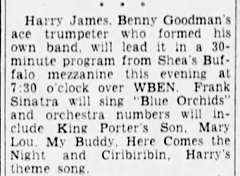
Concerts
Shea Theatre, Buffalo, New York (December 31, 1939 to January 11, 1940) Harry James with Frank Sinatra
Red Skelton, Erina Stillwell, Patricia Norman
Hudson Wonders, Frank Paris and His Marionettes
January 7, 1940
Concerts
Shea Theatre, Buffalo, New York (December 31/39 to January 10/40) Harry James with Frank Sinatra
Red Skelton, Erina Stillwell, Patricia Norman
Hudson Wonders, Frank Paris and His Marionettes
January 8, 1940
Concerts
Shea Theatre, Buffalo, New York (December 31/39 to January 10/40) Harry James with Frank Sinatra
Red Skelton, Erina Stillwell, Patricia Norman
Hudson Wonders, Frank Paris and His Marionettes
January 9, 1940
Concerts
Shea Theatre, Buffalo, New York (December 31/39 to January 10/40) Harry James with Frank Sinatra
Red Skelton, Erina Stillwell, Patricia Norman
Hudson Wonders, Frank Paris and His Marionettes
January 10, 1940
Concerts
Shea Theatre, Buffalo, New York (December 31/39 to January 10/40)
Harry James with Frank Sinatra
Red Skelton, Erina Stillwell, Patricia Norman
Hudson Wonders, Frank Paris and His Marionettes
January 26, 1940
Radio
NBC
Tommy Dorsey and His Orchestra
11:30pm
Concerts
Coronado Theater, Rockford, Illinois
First Date with Dorsey
1. My Prayer"
2. Marie - in Jack Leonards key,
3. South Of The Border
Ed notes:
Jo Stafford missed the afternoon rehearsal that day.
When Dorsey introduced Sinatra that evening for his first solo number, Jo knew right away he was going to be a great success. When I asked her why, Jo told me that all the male singers at the time were trying to emulate Crosby. Sinatra had his own sound and it was extraordinary.
The first song he did with the band was "South Of The
Border." Jo was mesmerized by every vocal inflection and Sinatra's demeanor. Sixty-five years later she still remembered in detail that moment in Rockford.
I checked it out. Billboard had an article in the 2-3-40 issue on Dorsey's week in Rockford. Band grossed $14,100 despite below zero temps. Allen DeWitt was still the band vocalist and they closed on 1/25. DOWNBEAT had an article in their 2-1-40 issue that Frank had joined the band on 1-26.
Billboard also had a fascinating article on the Dorsey band shortly before Frank joined them. Writer traveled around the midwest during a run of five one-nighters. The temp was often -10 or below. Dorsey band vehicle got stuck in a snowdrift. Tommy was the first one out and ready to push. Nothing was going to get in the way of that man making a buck. Jo Stafford told me how cold the bus was on those cold winter nights and the hotel rooms weren't much warmer. She did not have fond memories of those winter nights in the American heartland. No wonder Frank would later embrace the desert warmth in Palm Springs.
--Ed
Coronado Theater, Rockford , Illinois
---------------------------------------------------------------
January 26th, 1943, Jack Benny presents Frank Sinatra with the Downbeat and Metronome annual popularity awards.
--------------------------------------------------------------------
January 26, 1944 The Frank Sinatra Show
War Bond Benefit - From Shrine Auditorium, Hollywood, California
Frank Sinatra's CBS program for Vimms Vitamins originates from the 6,000 seat Los Angeles Shrine Auditorium with admission of one $25 War Bond. The house is sold out.
note: Frank's show that night sold over a million dollars in war bonds. Ann Sheridan was the "oomph" girl and a very hot property for Warner Brothers in January 1944. Sinatra wanted her on his big show at the Shrine Auditorium. Her appearance would guarantee a lot more war bonds being sold. WB was reluctant and so was she. After much negotiating Warners gave her the green light. She did a duet with Frankie and a funny skit. Although the place sold out, there were over 1,500 no-shows. The older generation supported Frank's patriotic gesture but had no interest in sitting with a large contingent of screaming bobby soxers.
[image referenced in source but could not be recovered]
[image referenced in source but could not be recovered]
[image referenced in source but could not be recovered]
[image referenced in source but could not be recovered]
[image referenced in source but could not be recovered]
[image referenced in source but could not be recovered]
[image referenced in source but could not be recovered]
[image referenced in source but could not be recovered]
[image referenced in source but could not be recovered]
[image referenced in source but could not be recovered]
Sinatra's own, later recollection placed his final night with the Harry James Orchestra in Buffalo, New York, not Rockford: "The bus pulled out with the rest of the guys after midnight. I'd said goodbye to them all and it was snowing. I remember there was no one around and I stood there with my suitcase in the snow and watched the taillights of the bus disappear. Then the tears started and I tried to run after the bus." James, despite Sinatra still being roughly halfway through a one-year contract, released him without objection and tore up the agreement so he could join Dorsey. Source: Michael Sheridan & David Harvey, Sinatra and the Jack Pack.
January 27, 1940
Concerts
Coliseum Ballroom, Davenport, Iowa
Tommy Dorsey & His Orchestra
Coliseum Ballroom, Davenport, Iowa
The Dispatch (Moline, Illinois) Thursday, January 25, 1940
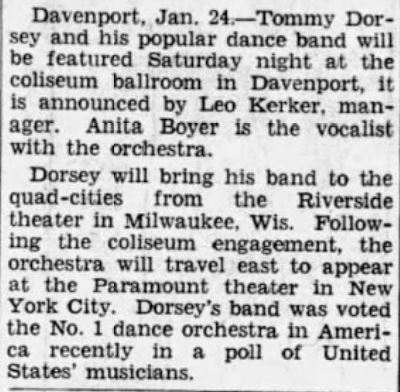
January 28, 1940
Concerts
Palais Royale, South Bend, Indiana
Tommy Dorsey & His Orchestra
January 29, 1940
Concerts
Shrine Mosque, Springfield, Missouri
Tommy Dorsey & His Orchestra with Frank Sinatra
[image not recovered — source caption: “XX”]
January 30, 1940
Radio
St Louis, Missouri, Live Remote from the Municipal Auditorium KXOX - 11:00pm
Concerts
Municipal Auditorium, St. Louis, Missouri
Semiannual Convention of the American Retailers Association Tommy Dorsey & His Orchestra
Municipal Auditorium, St. Louis, Missouri
Semiannual Convention of the American Retailers Association Tommy Dorsey & His Orchestra
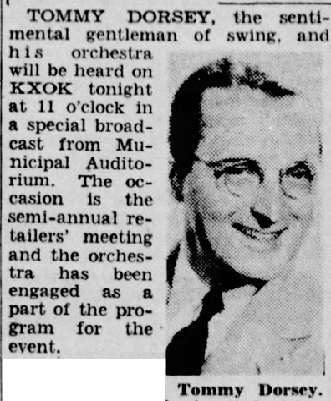
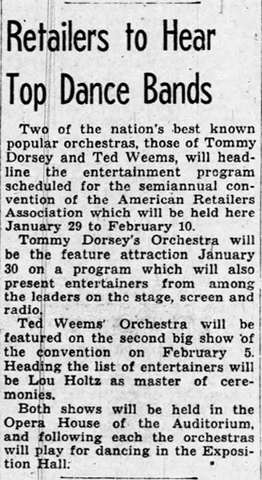
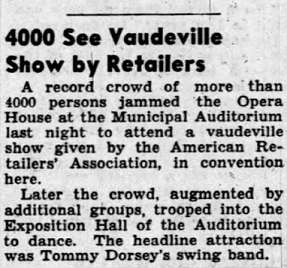
January 31, 1940
Concerts
Purdue Memorial Union, Lafayette, Indiana
Tommy Dorsey & His Orchestra
February 1940
[Dorsey band moves east to New York]
Kaplan: The Dorsey band came east from Chicago in February 1940 to begin a New York stand that would continue through the summer.
Source: James Kaplan, "Frank: The Voice" (2010)
February 1, 1940
Studio
Chicago
BS044680 The Sky Fell Down
(E. Heyman/L. Alter)
Warner Bros. Music (ASCAP)
Arranged by Axel Stordahl
-1 (3:12) CD: 07863 66353-2 "The Song Is You" 5CD set Vol 1.
CD: RCA 8324-2
LP: SD 1000
78: 26518
-2 N/R
BS044682 Too Romantic
(from the Paramount Picture The Road To Singapore)
(J. Burke/J.V. Monaco)
Paramount Music Corp. (ASCAP)
Arranged by Paul Weston
-1 (3:08) CD: 07863 66353-2 "The Song Is You" 5CD set Vol 1.
-2 (3:08) CD: 07863 66353-2 "The Song Is You" 5CD set Vol 4
-1 CD: RCA 8554-2-R
-2 LP: Time/Life STBB02
-1 LP: SD1000
-1 78: 26500
February 2, 1940
Radio
Lyric Theatre, Indianapolis, Indiana
Friday evening
Network: NBC
1. I'm Getting Sentimental Over You TD & Orch.
2. I Thought About You Jo Stafford & The Pied Pipers
3. My Prayer Frank Sinatra
4. Stomp It Off TD & Orch.
5. Careless Frank Sinatra
6. Dark Eyes
7. All The Things You Are Frank Sinatra
8. Losers Weepers TD & Orch.
9. South Of The Border Frank Sinatra
10. Marie Frank Sinatra, Jo Stafford & The Pied Pipers
Jack Eagan, Dorsey's road manager, recalled: "Tommy had planned for Frank to work on some new arrangements with Sy Oliver, who'd recently joined the band. But Jimmy Blake had taken sick, and Sy, who also played trumpet, had to sub for him. That left no time for him to write for Frank. So when Frank made his first appearance with the band he only had two songs. First he did a ballad - I forget what it was - it might have been 'My Prayer.' Then, of course, he did 'Marie', which was still our big number. Well, he broke it up completely. And that was tough to do, because a lot of the kids were big Jack Leonard fans. They kept yelling for more, but Frank had no encore prepared. So right on-stage he and Tommy went into a huddle and Frank suggested they fake "South of the Border." ť Well that broke it up even more, especially when Frank started slurring those notes. You know, right then and there, when he went into the slurring bit the kids started screaming, just the way they did at the Paramount. And there was nothing rigged about it either. I know, because I was the band's press agent. And I was also Jack Leonard's close friend, and I wasn't inclined to go all out for any other singer. No, those screams were for real!"
"The Big Bands" George T. Simon -- arguably the best of all the books on the big band era.
Concerts
Lyric Theatre, Indianapolis, Indiana (February 2-8)
Tommy Dorsey & His Orchestra with Frank Sinatra
12:54, 3:49, 6:44, 9:39
On Screen: "My Son Is Guilty" with Bruce Cabot & Jaqueline Wells.
are good dancers and comics.
Indianapolis Star
Lyric Theatre, Indianapolis, Indiana (February 2-8)
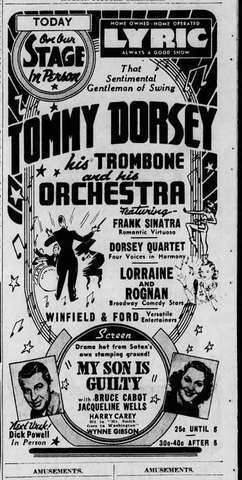
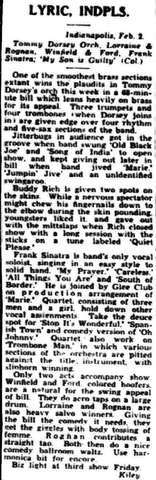
"South of the Border"
Mahlon Clark: Mahlon Clark, then a high school music student in Portsmouth (who would later become the star clarinetist of the Sinatra–Nelson Riddle sessions) attended the first night; he later remembered very vividly that Sinatra had arrived a day early and informally did a few numbers that night with the Hudson band. "Dean got up and made an announcement that we had in the audience the new singer with the Tommy Dorsey band, and it was Frank. He came up and sang ‘South of the Border.’ I remember it very well because it knocked us all out. We thought, ‘Who is this?’ It sounded beautiful." [Footnote:] Multiple observers remembered Sinatra doing "South of the Border" as his big number during the first few months with Tommy Dorsey—over a dozen years before the famous Capitol single; alas, no recordings or airchecks of that number are known to exist.
Source: Will Friedwald, "Sinatra! The Song Is You: A Singer's Art" (2018 revised edition).
February 3, 1940
Concerts
Lyric Theatre, Indianapolis, Indiana (2-8)
Tommy Dorsey & His Orchestra with Frank Sinatra
February 4, 1940
Concerts
Lyric Theatre, Indianapolis, Indiana (2-8)
Tommy Dorsey & His Orchestra with Frank Sinatra
Radio
Radio: Sinatra appeared as vocalist with Tommy Dorsey & His Orchestra on a commercial radio broadcast this date, singing "The Sky Fell Down," "The Fable Of The Rose," "A Lover Is Blue," "After All," "I've Got My Eyes On You," "East Of The Sun (And West Of The Moon)," "Deep Night," and "Polka Dots And Moonbeams." NBC broadcast from Meadowbrook Ballroom, Cedar Grove, New Jersey. Source: sinatradiscography.com, Radio Transcriptions Database.
February 5, 1940
Concerts
Lyric Theatre, Indianapolis, Indiana (2-8)
Tommy Dorsey & His Orchestra
February 6, 1940
Concerts
Lyric Theatre, Indianapolis, Indiana (2-8)
Tommy Dorsey & His Orchestra with Frank Sinatra
February 7, 1940
Concerts
Lyric Theatre, Indianapolis, Indiana (2-8)
Tommy Dorsey & His Orchestra with Frank Sinatra
Press Club February Stag Party, Indianapolis, IN
February 8, 1940
Concerts
Lyric Theatre, Indianapolis, Indiana (2-8)
Tommy Dorsey & His Orchestra with Frank Sinatra
February 9, 1940
Concerts
University Of Michigan, Ann Arbor, MI
Junior Hop
Tommy Dorsey & His Orchestra with Frank Sinatra
Note: Ted Fio Rio and his Orchestra also performed.
University Of Michigan, Ann Arbor, MI
Junior Hop
Tommy Dorsey & His Orchestra with Frank Sinatra
Note: Ted Fio Rio and his Orchestra also performed.
The Times Herald (Port Huron, Michigan) · 10 Feb 1940
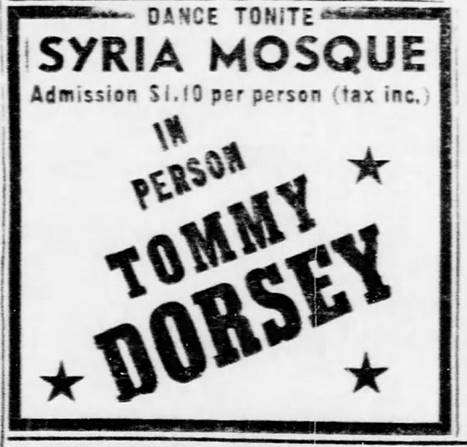
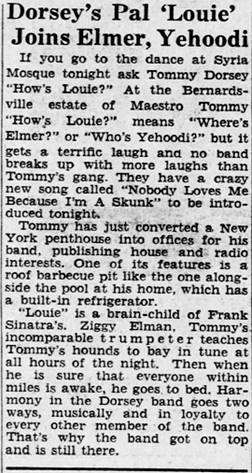
February 10, 1940
Concerts
Industrial Mutual Association Auditorium, Flint, Michigan Saturday Evening
Tommy Dorsey & Orch
Frank Sinatra, Connie Haines, Jo Stafford,
The Pied Pipers, Buddy Rich, Joe Bushkin,
Sy Oliver
Industrial Mutual Association Auditorium, Flint, Michigan Saturday Evening
Tommy Dorsey & Orch
Frank Sinatra, Connie Haines, Jo Stafford,
The Pied Pipers, Buddy Rich, Joe Bushkin,
Sy Oliver
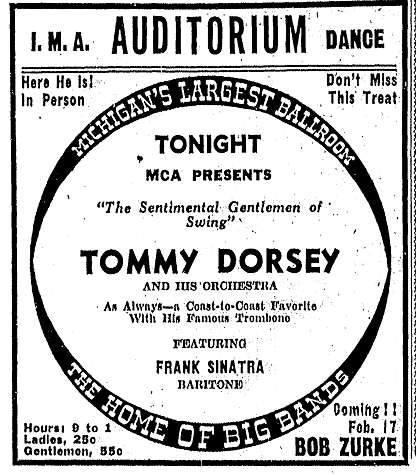
February 11, 1940
Concerts
Graystone Ballroom, Detroit, MI (one-nighter)
TD & Orchestra played
Graystone Ballroom, Detroit, MI (one-nighter)
TD & Orchestra played
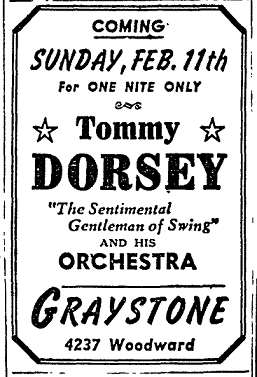
February 12, 1940
Concerts
The Elms Ballroom, Youngstown, Ohio
Tommy Dorsey & His Orchestra
The Elms Ballroom, Youngstown, Ohio
Tommy Dorsey & His Orchestra
Command Performance #106
30 minutes
Saturday afternoon aired on 3-5-44
Bob Hope emcee
Judy Garland
Frank Sinatra
Annc: Ken Carpenter
B. Hope opens with a topical comedy monologue
Sinatra and Hope do thin jokes and Crosby jokes
Frank sings "The Song Is You."
Hope introduces Judy Garland
She sings her latest recording "No Love, No Nothin'
Desert Island skit with Bob, Frank and Judy.
They sing parodies of many popular songs.
Frank does a little bit of "I've Got You Under My Skin."
Frank and Judy sing "Embraceable You."
The three of them say goodnight to the soldiers overseas.
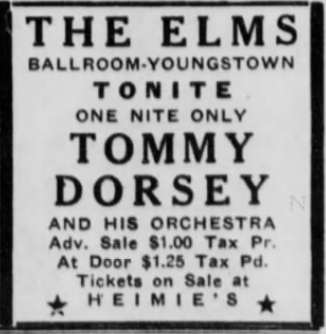
February 13, 1940
Concerts
Carmichael Auditorium, Clarksburg, West Virginia (One-Nighter) Tommy Dorsey & His Orchestra
February 14, 1940
Concerts
WCHS Auditorium, Charleston, West Virginia (One-Nighter) TD & Orch.
WCHS Auditorium, Charleston, West Virginia (One-Nighter)
TD & Orch.
The Scuttlebutt from 1942
Tommy Dorsey & His Orchestra will play a series of one-nighters
in the Chicago area in March. Sherman House wanted TD to fill
the Artie Shaw date but he couldn't get back in time so Gene
Krupa fill.
This Love Of Mine now out of the Top Ten. . . Glenn Miller has
five records in the Top Ten
Palladium Report on TD: . . . Dorsey name continues to be magic
for youngsters adding a 4,000 ticket sales for a B'nai B'rith benefit,
soared past $20,000. Band setting a record that won't be touched
for some to come
Variety
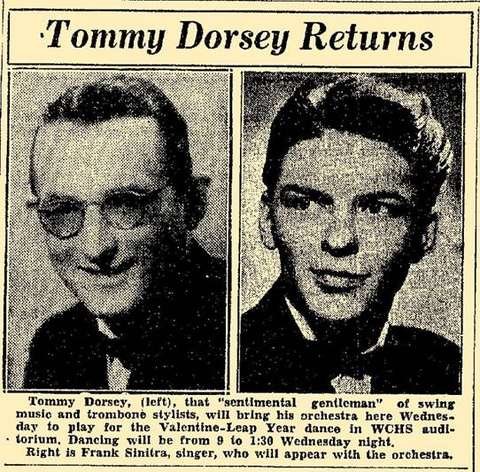
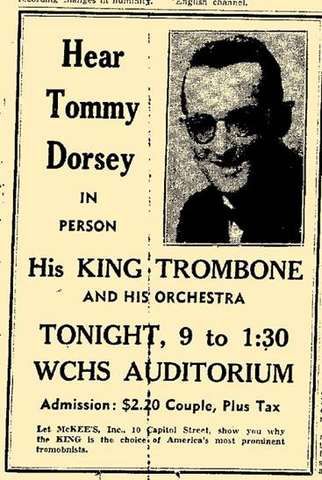
February 16, 1940
Concerts
Old Cabell Hall, University of Virginia, Charlottesville, Va.
Friday Evening
10:30 p. m. – 3:00 a. m..,
TD & Orchestra
College Dance
Old Cabell Hall Auditorium, University of Virginia, Charlottesville, Va.
Frank Sinatra & Connie Haynes singing with The Tommy Dorsey Orchestra at Old Cabell Hall Auditorium February 16th, 1940
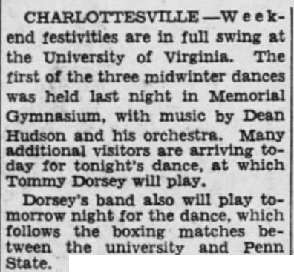
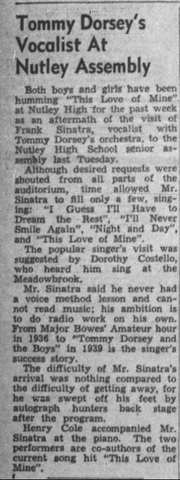
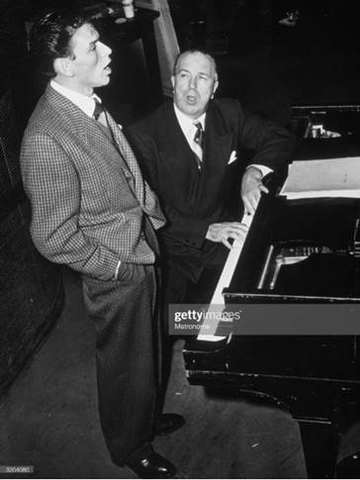
February 17, 1940
Concerts
University of Virginia, Charlottesville, Va.
Saturday Evening
TD & Orchestra
College Dance
February 20, 1940
Radio
Jazz Radio, Frank Daley's Meadowbrook, Cedar Grove, New Jersey (NBC) Opening Night
Tommy Dorsey and His Orchestra
Vocals: Frank Sinatra, The Pied Pipers, Jo Stafford
Musicians: Babe Russin
1. Careless
2. A Lover Is Blue
3. I've Got My Eyes On You
Note: TT: 30mins. Sound: Very Good+
Ed O'Brien: Although not broadcast on NBC that evening, Frank also sang "East Of The Sun" and "My Melancholy Baby."
Remote Broadcast From Frank Dailey's Meadowbrook Ballroom Tuesday Afternoon
Route 23 Cedar Grove, New Jersey, New York City
WJZ
New York City
4:55 - 5:15 p. m.
Tommy Dorsey & His Orchestra
Remote Broadcast From Frank Dailey's Meadowbrook Ballroom 11:30 p. m. - 12:a.m.
Tuesday Evening
Route 23 Cedar Grove, New Jersey, New York City
Mutual Network
WOR
Tommy Dorsey & His Orchestra
Ed O'Brien:
Dorsey band opened a three-week engagement at the
Meadowbrook. Tommy had worked a deal with both the
NBC and Mutual Networks for 13 remote broadcasts from the ballroom. This exposure for one of the hottest bands in the country was a brilliant coup by TD. And the networks were paying him for the privilege of airing the bands live performances.
Here is a picture of the Meadowbrook with the Dorsey banner prominently displayed.
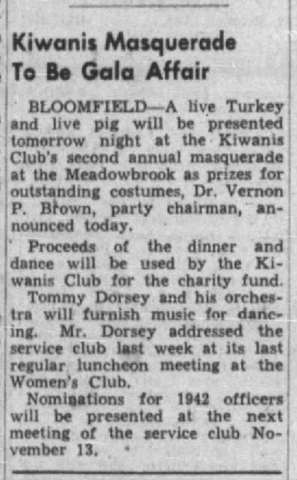
Concerts
Meadowbrook, Cedar Grove, New Jersey (February 20 - March 11) Tommy Dorsey & His Orchestra
Meadowbrook, Cedar Grove, New Jersey (February 20 - March 11)

Source: CS 048 -- Flyright Records 217929, "Tommy Dorsey and His Orchestra: Not So Quiet Please" liner notes.
Per the liner notes, this opening-night broadcast from Frank Dailey's Meadowbrook Country Club was not only Sinatra's first appearance there but also the Meadowbrook debut of drummer Buddy Rich and the Pied Pipers vocal group featuring Jo Stafford, who opened the broadcast with the only known band performance of the Mercer-Van Heusen standard "I Thought About You." Because staff arrangers Sy Oliver and Axel Stordahl had not yet had time to write new charts for Sinatra, the songs he sang that night were all arrangements previously recorded by predecessors Jack Leonard or Allan DeWitt; on "I've Got My Eyes On You," from the film Broadway Melody of 1940, he even received impromptu vocal support from young fans in the audience.
February 21, 1940
Radio
Meadowbrook Ballroom, Rte 23 ,Cedar Grove, New Jersey
Wednesday Evening
Mutual Network
WOR
New York City
8:00 -8:30 p.m.
Live Remote
Meadowbrook Ballroom, Rte 23 ,Cedar Grove, New Jersey
Wednesday Morning
12:30 - 1:00 a. m.
Live Remote
NBC Red Network
WEAF New York City
Announcer: Bill Abernathy
1. I'm Getting Sentimental Over You TD &
Orch
2. I Thought About
You
Pied Pipers
3. I've Got My Eyes On
You Frank Sinatra
4. Easy Does
It
TD & Orch
5.
Careless
Frank Sinatra
6. Blues No
More TD &
Orch
7. A Lover is Blue
Frank Sinatra
8. Darn That Dream Jo Stafford
9. So
What!
TD & Orch
10. Closing theme
TD & Orch
(Complete Broadcast is available on CD: "Not So Quiet
Please" Jazz Band EBCD-2179-2)
Meadowbrook Ballroom, Rte 23, Cedar Grove, New Jersey
Wednesday Evening
NBC Blue Network
WJZ New York City
11:30 p.m. - 12:00 a. m.
Live Remote
Announcer: Bill Abernathy
1. I'm Getting Sentimental Over You TD & Orch
2. I'd Love To Call You My Sweetheart Pied Pipers
3. After All Frank Sinatra
4. Easy Does It TD & Orch
5. A Lover Is Blue Frank Sinatra
6. Swing Low, Sweet Chariot TD & Orch
7. (What Can I Say Dear) After I Say I'm Sorry? Pied Pipers
8. Am I Proud? Jo Stafford
9. Closing Theme TD & Orch
Concerts
Meadowbrook, Cedar Grove, New Jersey (February 20 - March 11)
February 22, 1940
Concerts
Meadowbrook, Cedar Grove, New Jersey (February 20 - March 11) Tommy Dorsey & Orchestra
February 23, 1940
Radio
Meadowbrook Ballroom, Rte 23, Cedar Grove, New Jersey
Friday Morning
12:30 - 1:00 a. m.
Live Remote
Mutual Network
WOR)
New York City
Meadowbrook Ballroom, Rte 23, Cedar Grove, New Jersey
Tommy Dorsey & His Orchestra
Friday Morning
12:00 - 12:30 a. m.
Live Remote
NBC Red Network
WEAF
New York City
Announcer: Bill Abernathy
1 I'm Getting Sentimental Over You TD & Orch.
2.. Sweet Potato Piper Pied Pipers
3. A Lover Is Blue Frank Sinatra
4. Easy Does It TD & Orch
5. Indian Summer Frank Sinatra
6. Stomp It Off TD & Orch
7. The Sky Fell Down Frank Sinatra
8. I’m Coming Virginia Jo Stafford
9. Closing Theme TD & Orch note: Would love to hear Sinatra singing "Indian Summer" with Dorsey and band in early 1940
Meadowbrook Ballroom, Rte 23, Cedar Grove, New Jersey
Friday Evening
10:00 - 10:30 p. m.
Live Remote
NBC Red Network*
Announcer: Bill Abernathy
1. I'm Getting Sentimental Over You TD & Orch
2. Looking At The World (Thru Rose Colored Glasses) Pied Pipers
3. The Starlit Hour Frank Sinatra
4. Back Stage At The Ballet TD & Orch
5. A Lover Is Blue Frank Sinatra
6.. March Of The Toys TD & Orch
7. I‘ve Got My Eyes On You Frank Sinatra
8. Easy Does It, TD & Orch
9. Sweet Sue, Just You Frank Sinatra & Band Chorus
10 .Losers Weepers TD & Orch
11. Closing Theme TD & Orch
* Some sources have this broadcast on WJZ. That station carried the Lou Ambers- Al Davis fight, from Madison Square Garden, from 10 to 11 pm
Meadowbrook Ballroom, Rte 23, Cedar Grove, New Jersey
Friday Evening
11:25 p. m. - 12:00 a.m.
Live Remote
Mutual Network
WOR
New York City
Ed O'Brien:
Wow! Two hours and five minutes of Dorsey & Co live from the Meadowbrook. I have a private interview where Sinatra extols the brilliance of Dorsey's business acumen. What exposure and what a workload for the band.
Concerts
Meadowbrook, Cedar Grove, New Jersey (February 20 - March 11) Tommy Dorsey & Orchestra
February 24, 1940
Radio
Meadowbrook, Rte 23 Cedar Grove, New Jersey
NBC Red Network
5:00 -6:pm
Saturday Afternoon
WEAF
New York City
Live Remote -
Announcer: Bill Abernathy
Tommy Dorsey and His Orchestra
Vocals: Frank Sinatra, Jo Stafford, The Pied Pipers.
Musician(s): Babe Russin, Buddy Rich
1. IGSOY (open)
2. College Medley: Boola Boola (Yale), Fight Song (Lafayette), Hail to Pitt (Pitt), Yard By Yard (Williams) (PP)
3. A Lover Is Blue (FS)
4. Easy Does It
5. Sorority Medley: The Loyalty Song (Chi Omega), The Emblem Song (Delta-Delta-Delta) (PP), The Pi Phi Girl (Pi Beta Phi), The Kappa Sweetheart (Kappa Kappa Gamma)
6. March of the Toys
7. (What Can I Say) After I Say I’m Sorry? (PP)
8. I Know That You Know
9. Popular Songs Medley: Do I Love You? (TD solo), Careless (FS), Say “Si Si” (JS)
10. Losers Weepers
11. I've Got My Eyes On You (FS)
12. Fraternity Medley: Violets (Sigma Alpha Epsilon), Kappa Sigma Sweetheart (TD solo) (Kappa Sigma), The Song of Lamda Chi (Lamda Chi Alpha), The Songs We Love (PP) (Phi Delta Theta)
13. East of the Sun (and West of the Moon) (FS-Band)
14. Hit Songs of Yesterday Medley: My Melancholy Baby (FS), Time On My Hands (TD solo)
15. I Can't Give You Anything But Love (JS)
16. College Medley: Football Song (Princeton), White on Crimson and Gray St. Joseph), On the Line (PP) (Johns Hopkins), Hark the Sound (North Carolina)
18. IGSOY (close)
Note:TD's orch played eight college anthems and covered eight sorority tunes from major universities. A very busy hour.
(Sinatra's Songs appear on the CD: Jazz Archives & Masters Of Jazz Volume 3) and the Complete Broadcast is available on CD: Tommy Dorsey Plays Sweet and Hot -- Tax (Sweden) CD-3705))
The Complete Broadcast was also issued on the LP: Radiola MR-1164)
Note: This broadcast was the first of three solid hours of T.D.'s band from the Meadowbrook.on Saturday afternoon at 5:P.M. The show was sustaining. I have arranged Sinatra's songs in the order they were performed. Bill Abernathy mentions,as the show closes, that the band will be heard over the radio during the week.Glenn Miller would open at the Paramount, 3/28.. He would be rushed to the hospital before the opening show. Dorsey would come over from the Meadowbrook and conduct the Miller band.
He did four of the seven shows opening day, Thursday(29) TD conducted the first three shows, Friday three more and Saturday he did the first show. An amazing man. --Ed
Meadowbrook, Rte 23 Cedar Grove, New Jersey
Mutual Network
WOR
New York City
11:30 p.. m. - 12:00 a.m.
Live Remote
Concerts
Meadowbrook, Cedar Grove, New Jersey (February 20 - March 11) Tommy Dorsey and His Orchestra with Frank Sinatra
Meadowbrook, Rte 23 Cedar Grove, New Jersey
NBC Red Network
5:00 -6:pm
Saturday Afternoon
Radiola LP:
[image referenced in source but could not be recovered]
[image referenced in source but could not be recovered]
[image referenced in source but could not be recovered]
February 25, 1940
Radio
Meadowbrook Ballroom, Cedar Grove, New Jersey
(Sun) 4:00 - 4:30 p. m.,
(NBC Red) (WEAF) (Sustaining)
Tommy Dorsey & His Orchestra
Featuring Frank Sinatra, Jo Stafford, The Pied Pipers
Bill Abernathy, announcer
1. I'm Getting Sentimental Over You (open)
2. (What Can I Say) After I Say I’m Sorry? (PP)
3. A Lover Is Blue (FS)
4. Easy Does It
5. The Sky Fell Down (FS)
6. Hawaiian War Chant
7. I’ve Got My Eyes On You (FS)
8. Am I Proud (JS)
9. Bugle Call Rag
10. I'm Getting Sentimental Over You (close)
Concerts
Meadowbrook, Cedar Grove, New Jersey (February 20 - March 11) Tommy Dorsey & His Orchestra
February 26, 1940
Studio
New York City
BS047706 Shake Down The Stars
(E. DeLange/J. Van Heusen)
Van Heusen Music Corp./Scarsdale Music Corp. (ASCAP)
Arranged by Paul Weston
-1 (3:28) CD: 07863 66353-2 "The Song Is You" 5CD set Vol 1.
-2 (3:28) CD: 07863 66353-2 "The Song Is You" 5CD set Vol 4 -1 CD: RCA 9679-2-R
-1 LP: SD 1000
-1 78: 26525
BS047707 Moments In The Moonlight
(R. Himber/I. Gordon/A. Kaufman)
EMI Miller Catalog Inc./Gunston Music Inc. (ASCAP)
Arranged by Paul Weston
-1 (3:13) CD: 07863 66353-2 "The Song Is You" 5CD set Vol 1.
CD: RCA 9679-2-R
LP: SD 1000
78: 26525
BS047708 I'll Be Seeing You
(from The Royal Palm Revue)
(I. Kahal/S. Fain)
Williamson Music Co. (ASCAP)
-1 (3:00) CD: 07863 66353-2 "The Song Is You" 5CD set Vol ..
CD: RCA 8324-2-R
LP: SD 1000
78: 20-2508
78: 20-1574
78: 26539
Saxes: Les Robinson, Fred Stulce, Johnny Mince, Paul Mason, Babe Russin; Trumpet: Zeke Zarchy, Jimmy Blake, Ray Linn; Guitar: Benny Heller; Trombones: Ward Silloway, Lowell Martin; Piano: Bob Kitsis; Bass:
Gene Traxler; Drums: Buddy Rich
Concerts
Meadowbrook, Cedar Grove, New Jersey (February 20 - March 11)
"I'll Be Seeing You"
By extending the line, Sinatra could put over both the lyrical idea and the melody that much more convincingly. To do so meant developing the chops to hit high notes without blinking—even a toughie like the one that comes out of nowhere at the end of "I’ll Be Seeing You" (1940). But more important than hitting them, Sinatra managed to hold them, developing both the physical lung power and the dramatic ability to set up a line of lyrics so that it made sense.
Source: Will Friedwald, "Sinatra! The Song Is You: A Singer's Art" (2018 revised edition).
February 27, 1940
Concerts
Meadowbrook, Cedar Grove , New Jersey (February 20 - March 11) Tommy Dorsey & His Orchestra
February 28, 1940
Radio
Meadowbrook Ballroom, Cedar Grove, New Jersey
(Wed)
11:30 p. m. - Midnight
(NBC Red) WJZ( NBC Blue Network)
Bill Abernathy, announcer
1. I'm Getting Sentimental Over You (open)
2. I Thought About You (PP)
3. This Changing World (FS)
4. Back Stage At The Ballet
5. All The Things You Are
6. March Of The Toys
7. A Lover Is Blue (FS)
8. Darn That Dream (JS)
9. East Of The Sun (FS-Band)
10. Symphony In Riffs
11. I'm Getting Sentimental Over You (close)
Meadowbrook Ballroom, Cedar Grove, New Jersey
(Wed)
12:30 - 1:00 a. m.
(NBC Red) (WEAF) (Sustaining)
Bill Abernathy, announcer
1. I'm Getting Sentimental Over You (open)
2. Sweet Potato Piper (PP)
3. Too Romantic (FS)
4. Jump Time
5. Angel (FS)
6.. Dark Eyes
7. When You Wish Upon A Star (FS)
8. I'm Coming Virginia (JS)
9. Losers Weepers
10. I'm Getting Sentimental Over You (close).
Scott Henderson:
Between these two concerts on that date, Sinatra sang three songs that he never recorded and I don't believe he sang elsewhere: Angel, When You Wish Upon A Star, & This Changing World. I wish recordings of these shows would show up some day.
Concerts
Meadowbrook, Cedar Grove , New Jersey (February 20 - March 11)
February 29, 1940
Radio
Tommy Dorsey and His Orchestra
11:15 PM WOR
The Daily Report, Greenfield, Indiana, February 29, 1940
Television
None
Concerts
Meadowbrook, Cedar Grove, New Jersey
Thursday evening
Tommy Dorsey and His Orch
Connie Haines, Frank Sinatra, Jo Stafford, Pied Pipers, Buddy Rich, Bunny Berigan, Joe Bushkin, Sy Oliver
Frank was performing the following songs during this engagement:
I've Got My Eyes On You
Careless
A Lover Is Blue
East Of The Sun
My Melancholy Baby
March 1940
[Original 'Polka Dots and Moonbeams' recording]
Kaplan: Sinatra's original 1940 recording of 'Polka Dots and Moonbeams' with the Tommy Dorsey orchestra, made when he was twenty-four, is contrasted by Kaplan with the 1961 I Remember Tommy remake, which he judges technically superb but less emotionally resonant.
Source: James Kaplan, "Sinatra: The Chairman" (2015)
March 1, 1940
Radio
Meadowbrook Ballroom, Location: Rte 23 Cedar Grove, New Jersey New York City
Tommy Dorsey & Orchestra
Friday Evening
10:00 - 10:30 p.m.
NBC Blue Network
WJZ
Live Remote
Announcer: Bill Abernathy
1. I'm Getting Sentimental Over You TD & Orch
2. Sweet Lorraine Pied Pipers
3. Its A Blue World Frank Sinatra
4.. Another One Of Them Things TD & Orch
5. Too Romantic Frank Sinatra
6. Easy Does It TD & Orch
7. A Lover Is Blue Frank Sinatra
8 Am I Proud Jo Stafford 9 Old Man Harlem TD & Orch
10. Closing Theme TD & Orch
Meadowbrook Ballroom Rte 23 Cedar Grove, New Jersey
New York City
Tommy Dorsey & Orchestra
Friday Evening
10:45 - 11:00 p.m.
Mutual Network
WOR
New York City
Live Remote:
Concerts
Meadowbrook, Cedar Grove, New Jersey (February 20 - March 11)
March 2, 1940
Radio
Jazz Radio, Frank Daley's Meadowbrook, Cedar Grove, New Jersey (NBC)
Announcer: Bill Abernathy
Tommy Dorsey and His Orchestra
Vocals: Frank Sinatra, The Pied Pipers.
Musician(s): Buddy Rich , Johnny Mince
1. I'm Getting Sentimental Over You (open)
2. College Medley: On The Banks of the Old Raritan (Rutgers) The Victory Song Maryland) (PP), The Alumni Song (Georgetown), Hail to Lehigh
3. After All (FS)
4. Jump Time
5. Sorority Medley: Flower Song (Kappa Delta), Theta Lips (Kappa Alpha Theta) (PP less JS). Pride of Our Hearts (Zeta Tau Alpha) (TD solo), Like The Breath of Roses (Phi Mu)
6. Milenburg Joys
7. Sweet Potato Piper (PP)
8. Hawaiian War Chant (Ta-Hu-Wa-Hu-Wai)
9. Station Break
10. Medley of most played tunes of the week: Leanin’ on the Old Top Rail, Starlit Hour (TD solo), I’ve Got My Eyes On You (FS), Song of India
11. Polka Dots and Moonbeams (FS)
12. Fraternity Medley: Sweetheart of Sigma Chi (PP), White Star of Sigma Nu, Sweetheart of Alpha Tau Omega (TD solo), The Loving Cup (Beta Theta Pi)
13. Deep Night (FS-Band)
14. Medley of hit songs of yesterday: Whispering (FS less PP), Avalon (TD solo), Japanese Sandman
15. College Medley: Saltine Warrior (Syracuse), Far Above Cayuga’s Waters (Cornell) (PP), Roar Lion Roar (Columbia), The Orange and Blue (Florida)
16. I'm Getting Sentimental Over You (close)
Note: TT: 60mins.
The songs "After All", "Deep Night", "Polka Dots And Moonbeams" & "Whispering" appear on the CD: Frank Sinatra & Tommy Dorsey BLJ8019.
The songs "After All", "Deep Night" & "Polka Dots And Moonbeams" appear on the CD: Jazz Archives.
"I've Got My Eye On You" & "The Sky Fell Down" are on the CD: Sinatra: The Radio Years MTBS 001
("After All", "Deep Night", "I've Got My Eye on You", "Polka Dots and Moonbeams" & "Whispering" appear on Masters of Jazz Volume 3 )
("Polka Dots and Moonbeams" appears on Masters of Jazz Volume 9)
Meadowbrook Ballroom
Location: Rte 23 Cedar Grove, New Jersey
Tommy Dorsey & Orchestra
Saturday Evening
9:10- 9:30 p. m.
Mutual Network
WOR
New York City
Concerts
Meadowbrook, Cedar Grove, New Jersey (February 20 - March 11)
March 3, 1940
Radio
Meadowbrook Ballroom, Cedar Grove, New Jersey
(Sun) 4:15 - 4:30 p. m.
(NBC Red) (WEAF)
Bill Abernathy, announcer (Sustaining)
1. I'm Getting Sentimental Over You (open)
2. A Lover Is Blue (FS)
3. I’m Looking At The World Thru Rose Colored Glasses (PP)
4. East Of The Sun (And West of the Moon) (FS-Band)
5. Losers Weepers
6. I'm Getting Sentimental Over You (close)
Concerts
Meadowbrook, Cedar Grove, New Jersey (February 20 - March 11)
March 4, 1940
Studio
New York City
BS047746 Say It
(from the Paramount Picture Buck Benny Rides Again)
(F. Loesser/J. McHugh)
Famous Music Corp. (ASCAP)
Arranged by Axel Stordahl
-1 (3:22) CD: 07863 66353-2 "The Song Is You"ť 5CD set Vol 1.
CD: RCA 8324-2-R
LP: SD 1000
78: 26535
BS047747 Polka Dots And Moonbeams
(J. Burke/J. Van Heusen)
ABC Music Corp./Dorsey Brothers Music (ASCAP)
Arranged by Axel Stordahl
-1 (3:18) CD: 07863 66353-2 "The Song Is You"ť 5CD set Vol 1.
CD: RCA 8554-2-R
LP: SD 1000
78: 20-2538
78: 26539
Saxes: Hymie Shertzer, Fred Stulce, Johnny Mince, Paul Mason, Babe Russin; Trumpet: Zeke Zarchy, Ray
Linn, Jimmy Blake, Bunny Berigan; Piano: Bob Kitsis; Trombones: Dave Jacobs, Lowell Martin, George Arus; Guitar: Al Avola; Drums: Buddy Rich; Bass: Ray Leatherford
Concerts
Meadowbrook, Cedar Grove , New Jersey (February 20 - March 11)
"Say It (Over and Over Again)"
By his third Dorsey recording session, Sinatra's take on "Say It (Over and Over Again)" showed him settled into fluid, legato phrasing -- elongating phrase endings and reshaping tempo within each measure, with syllables melting seamlessly into one another.
Source: Charles L. Granata, "Sessions with Sinatra: Frank Sinatra and the Art of Recording" (1999/2003).
"Polka Dots and Moonbeams"
The second song from the same March 4, 1940 Dorsey session, "Polka Dots and Moonbeams," shows Sinatra's voice as still "almost virginal" but with growing confidence, closely mirroring Dorsey's instrumental melodic phrasing.
Source: Charles L. Granata, "Sessions with Sinatra: Frank Sinatra and the Art of Recording" (1999/2003).
[Sinatra records 'Polka Dots and Moonbeams']
Sinatra recorded the Burke-Van Heusen song 'Polka Dots and Moonbeams' on March 4, 1940, which became his first charting song.
Source: James Kaplan, "Frank: The Voice" (2010).
[Polka Dots and Moonbeams -- critical commentary]
In March 1940, the band recorded "Polka Dots and Moonbeams"; the record consists of a one-chorus trombone solo (here the bridge is played by tenor champ Irving "Babe" Russin), followed by Sinatra’s vocal, then coda. (But in a few live airchecks, some of which are as long as four minutes, there is a full third chorus by the band, featuring clarinetist Johnny Mince, that got truncated because of the playing time of a ten-inch 78 in 1940.)
This song/context matches multiple dated entries in the chronology; the specific date Friedwald is referring to could not be determined with confidence.
Source: Will Friedwald, "Sinatra! The Song Is You: A Singer's Art" (2018 revised edition), Ch. 3, "With Tommy Dorsey" (1940-1942)
[Say It -- critical commentary]
Granata includes 'Say It' among the fifty recordings he considers essential to understanding Sinatra's artistry (arranged by Tommy Dorsey, recorded 1940, Victor); the song was chosen for its musical/interpretive value rather than commercial popularity.
This song/context matches multiple dated entries in the chronology, or lacked a sufficiently precise date; the specific date could not be determined with confidence.
Source: Charles L. Granata, "Sessions with Sinatra: Frank Sinatra and the Art of Recording" (1999/2003), Afterword & Appendices A-D
March 5, 1940
Radio
Live Remote from Meadowbrook Ballroom, Route 23 Cedar Grove, New Jersey (Tue) 5:00 - 5:15 p. m.
(NBC Blue) (WJZ) (Sustaining)
Bill Abernathy, announcer
1. I'm Getting Sentimental Over You (open)
2. A Lover Is Blue (FS)
3. Easy Does It
4. Polka Dots And Moonbeams (FS)
5. Sweet Lorraine (PP) (to close)
Live Remote from Meadowbrook Ballroom, Route 23 Cedar Grove, New Jersey Tuesday Evening
Mutual Network - WOR New York City
11:15 p.m. - 12:00 a.m.
Tommy Dorsey & Orchestra
Concerts
Meadowbrook, Cedar Grove, New Jersey (February 20 - March 11) Tommy Dorsey and his Orchestra w/Frank Sinatra
March 6, 1940
Radio
Live Remote -- Meadowbrook Ballroom, Rte 23 Cedar Grove, New Jersey Wednesday Morning
NBC Red Network - WEAF New York City
12:30 - 1:00 a. m.
Tommy Dorsey & His Orchestra
Announcer: Bill Abernathy
1. I'm Getting Sentimental Over You TD & Orch
2. I Love To Call You My Sweetheart Pied Pipers
3. Starlight Hour Frank Sinatra
4. March Of The Toys TD & Orch
5. Shake Down The Stars Frank Sinatra
6. Blues No More TD & Orch
7. A Lover Is Blue Frank Sinatra
8. Darn That Dream Jo Stafford
9. East Of The Sun (And West Of The Moon) Frank Sinatra & Band Chorus
10. Closing Theme TD & Orch
Ed O'Brien:
The traditional date given by TV guides and major newspapers, even after midnight, has always encompassed the same day. A few of the Dorsey sites give the date after 12:00 a.m as the following day. The guides and papers have always reserved that designation as beginning at the 6:a.m. slot. I see Scott has opted for the Dorsey sites practice. I am not entirely comfortable with it. I think it is somewhat confusing. I have been doing it for the last week, but would like to go back to the tradit- ional method. But, at the same time, I am concerned it may create some confusion.
Live Remote -- Meadowbrook Ballroom, Rte 23 Cedar Grove, New Jersey Wednesday Evening
NBC Blue Network - WJZ New York City
11:30 p.m.- 12:00 a. m.
Tommy Dorsey & His Orchestra
Announcer: Bill Abernathy
1. I'm Getting Sentimental Over You T.D. & Orch
2. I''ve Got My Eyes On You Frank Sinatra
3. (What Can I Say) After I Say I'm Sorry? Pied Pipers
4. It Ain''t What You Think TD & Orch
5. A Lover Is Blue Frank Sinatra
6.. Hawaiian War Chant TD & Orch
7. The Sky Fell Down Frank Sinatra
8. East Of The Sun (And West Of The Moon) Frank Sinatra & Band Chorus
9. I Know That You Know (Sy Oliver arg.) TD & Orch
10. Closing Theme TD & Orch
Concerts
Meadowbrook, Cedar Grove , New Jersey (February 20 - March 11) Tommy Dorsey and his Orchestra w/Frank Sinatra
March 7, 1940
Radio
Live Remote - Meadowbrook Ballroom, Rte 23 Cedar Grove, New Jersey Thursday Afternoon
5:00 - 5:15 p.m.
NBC Blue Network - WJZ New York City
Tommy Dorsey & His Orchestra
Concerts
Meadowbrook, Cedar Grove, New Jersey (February 20 - March 11) Tommy Dorsey and his Orchestra w/Frank Sinatra
March 8, 1940
Concerts
Meadowbrook, Cedar Grove , New Jersey (February 20 - March 11) Tommy Dorsey and his Orchestra w/Frank Sinatra
March 9, 1940
Radio
Jazz Radio, Frank Daley's Meadowbrook, Cedar Grove, New Jersey Time 5:00p.m - 6:00 p.m
Announcer: Bill Abernathy
Tommy Dorsey and His Orchestra
Orchestra Conducted by: Tommy Dorsey
Vocals: Frank Sinatra, Jo Stafford , The Pied Pipers.
Musician(s): Johnny Mince, Buddy Rich, Bunny Berigan
1. The Sky Fell Down
2. The Fable Of The Rose
3. It's A Blue World
4. Marie
5. On The Isle Of May
6. I'll Get By
Note: TT: 60mins. The songs "Fable Of The Rose", "I'll Get By", It's A Blue World", "Marie", "On The Isle Of May"& "The Sky Fell Down" appear on the LP: Frank Sinatra & Tommy Dorsey BLJ 8019
These songs "The Sky Fell Down" & The Fable Of The Rose" appear on the CD: Jazz Archives. "I'll Get By" is on the Cd : On The Air. Sound: Very Good+
Concerts
Meadowbrook, Cedar Grove , New Jersey (February 20 - March 11) Tommy Dorsey and his Orchestra w/Frank Sinatra
March 10, 1940
Radio
Tommy Dorsey and His Orchestra with Frank Sinatra
The Mutual Network
10:45PM
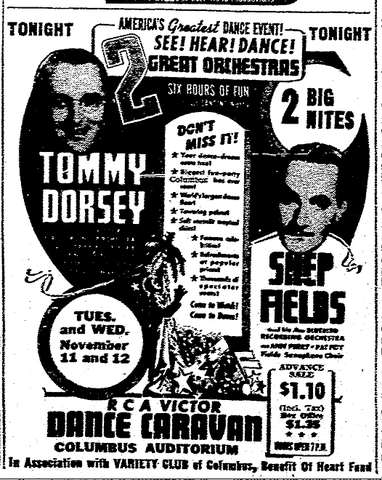
Concerts
Meadowbrook, Cedar Grove , New Jersey (February 20 - March 11) Tommy Dorsey and his Orchestra w/Frank Sinatra
March 11, 1940
Concerts
Ritz Theater, Newburgh, New York (One-nighter)
Tommy Dorsey and his Orchestra w/Frank Sinatra
Note: Thanks to Richard Cook for the above listing.
Ritz Theater, Newburgh, New York (One-nighter)
Tommy Dorsey and his Orchestra w/Frank Sinatra
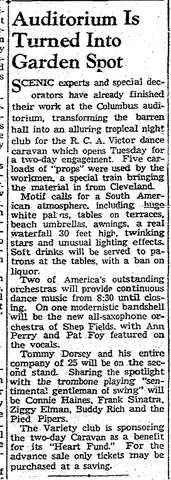
March 12, 1940
Studio
New York City
BS048129 The Fable Of The Rose
(B. Reichner/J. Myrow)
Warner Bros. Music/Malvern Music Co. (ASCAP)
Arranged by Axel Stordahl
-1 (2:49) CD: 07863 66353-2 "The Song Is You" 5CD set Vol 1.
CD: RCA 9679-2-R
LP: SD 1000
78: 26555
BS048130 This Is The Beginning Of The End
(from the 20th Century-Fox Film Johnny Apollo)
(Mack Gordon)
EMI Robbins Catalog Inc. (ASCAP)
-1 (3:11) CD: 07863 66353-2 "The Song Is You" 5CD set Vol 1.
CD: RCA 9679-2-R
LP: SD 1000
78: 26555
-2 N/R
4-18-40
May 19, 1940
March 13, 1940
Concerts
Paramount Theatre, New York City (March 13 - April 9)
PARAMOUNT - NEW YORK
Wednesday
Tommy Dorsey Orch(14)
Frank Sinatra, The Pied Pipers,
Red Skelton, Winfield & Ford pic: "Road To Singapore"
"Sinatra, in his first date here with the band, is sock all the way. He does an appealing job on each of his numbers, getting a different, easy interpretation into the lyrics of all.
He is sure of himself and it shows in his work. Leadoff is "My Prayer" with a stained church-glass effect on the drop behind. Follows with
"Careless," "All The Things You
Are," smash "South Of The Border," and then comes back to do "Marie" with the band chorus in the back.
Variety
3-20-40
Paramount Theatre, New York City (March 13 - April 9)
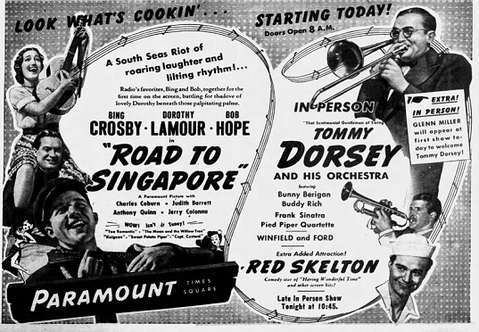
March 14, 1940
Concerts
Paramount Theatre, New York City (March 13 - April 9)
Tommy Dorsey and his Orchestra
Radio
Radio: Sinatra appeared as vocalist with Tommy Dorsey & His Orchestra on a commercial radio broadcast this date, singing "A Lover Is Blue." NBC broadcast from Meadowbrook Ballroom, Cedar Grove, New Jersey. Source: sinatradiscography.com, Radio Transcriptions Database.
March 15, 1940
Concerts
Paramount Theatre, New York City (March 13 - April 9)
Tommy Dorsey and his Orchestra
March 16, 1940
Concerts
Paramount Theatre, New York City (March 13 - April 9)
Tommy Dorsey and his Orchestra
March 17, 1940
Concerts
Paramount Theatre, New York City (March 13 - April 9)
Tommy Dorsey and his Orchestra with Frank Sinatra
March 18, 1940
Concerts
Paramount Theatre , New York City (March 13 - April 9)
Tommy Dorsey and his Orchestra w/Frank Sinatra
March 19, 1940
Radio
Celebrity Minstrels
Tuesday Evening
NBC Blue Network
WJZ
New York City
9:30-10:00 p. m.
J.C. Flippen, Ham Fisher,
James Montgomery Flagg,
Ray Perkins, Johnny Green,
Bill Stern & Tommy Dorsey
& His Orchestra
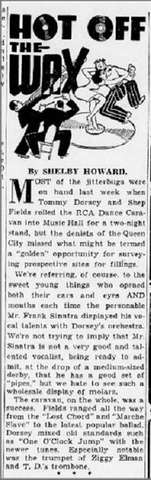
Concerts
Paramount Theatre , New York City (March 13 - April 9)
Tommy Dorsey and his Orchestra w/Frank Sinatra
Celebrity Minstrels
Tuesday Evening
NBC Blue Network
WJZ
New York City
9:30-10:00 p. m.
J.C. Flippen, Ham Fisher,
James Montgomery Flagg,
Ray Perkins, Johnny Green,
Bill Stern & Tommy Dorsey
& His Orchestra
from "The Blackface Minstrel Show in Mass Media: 20th Century Performances on Radio, Records, Film and Television" by Tim Brooks
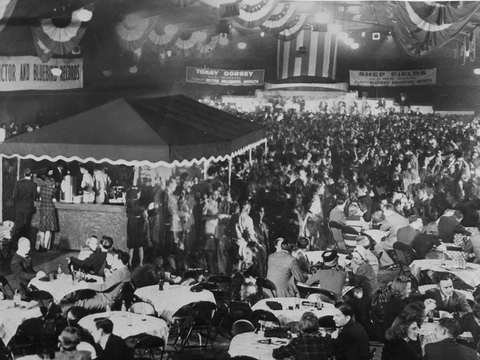
March 20, 1940
Concerts
Paramount Theatre, New York City (March 13 - April 9)
Tommy Dorsey and His Orchestra
March 21, 1940
Concerts
Paramount Theatre, New York City (March 13 - April 9)
Tommy Dorsey and his Orchestra w/Frank Sinatra
March 22, 1940
Concerts
Paramount Theatre, New York City (March 13 - April 9)
Tommy Dorsey and his Orchestra w/Frank Sinatra
March 23, 1940
Concerts
Paramount Theatre, New York City (March 13 - April 9)
Tommy Dorsey and his Orchestra w/Frank Sinatra
March 24, 1940
Concerts
Paramount Theatre, New York City (March 13 - April 9)
Tommy Dorsey and his Orchestra w/Frank Sinatra
March 25, 1940
Studio
New York City
BS048430 Imagination
(J. Van Heusen/J. Burke)
ABC Music Corp./Dorsey Brothers Music (ASCAP)Arranged by Axel Stordahl -1 N/R
-2 N/R
BS048431 Yours Is My Heart Alone
(F. Loehner/L. Herzer/F. Lehar)
Glocken Verlog Inc. (GEMA)
Arranged by Axel Stordahl
-1 N/R
-2 CD: (JAP) BVCJ 7042-46 Tommy Dorsey and His Orchestra
A run through of BS 048432 "Hear My Song Violetta" was done.
Saxes: Hymie Shertzer, Fred Stulce, Johnny Mince, Paul Mason, Don Lodice; Trumpets: Jimmy Blake, Bunny
Berigan, Bob Cusumas; Piano: Bob Kitsis; Guitar: Benny Heller; Trombones: Dave Jacobs, George Arus, Les Jenkins; Drums: Buddy Rich; Bass: Sid Weiss
Note: Imagination -1 & -2 and Yours Is My Heart Alone -1 have not been located in the RCA vaults.
note: Two Sinatra recordings from this evening would be redone on 4-10-40.
RCA did not preserve the Sinatra vocals from "Imagination" or the one
take done on "Hear My Song Violetta." The only released vocal is
take two of "Yours Is My Heart Alone." Take one of that song has never
been located.
The session ran from 11:00 P.M. till 1:30 A.M. The last song attempted at
this date would be the first song recorded on the 3-29-40 session. I think it is rather obvious that Frank was not having a good night.
Ed
Concerts
Paramount Theatre, New York City (March 13 - April 9)
Tommy Dorsey and his Orchestra w/Frank Sinatra
March 26, 1940
Concerts
Paramount Theatre, New York City (March 13 - April 9)
Tommy Dorsey and his Orchestra w/Frank Sinatra
March 27, 1940
Concerts
Paramount Theatre, New York City (March 13 - April 9)
Tommy Dorsey and his Orchestra w/Frank Sinatra
March 28, 1940
Concerts
Paramount Theatre, New York City (March 13 - April 9)
Tommy Dorsey and his Orchestra w/Frank Sinatra
March 29, 1940
Studio
New York City
BS048479 Hear My Song Violetta
(B. Bernier/R. Emmerlich/O. Klase/E. Carosio)
Chappell & Co., Inc. (ASCAP)
Arranged by Sy Oliver
-1 (2:55)Â CD: 07863 66353-2 The Song Is You 5CD set Vol 1.
-2 (2:55)Â CD: 07863 66353-2 The Song Is You 5CD set Vol 4
-2 CD: RCA 2269-2-R
-2 LP: SD 1000
-1 78: 26616
BS048480 Fools Rush In (Where Angels Fear To Tread)
(J. Mercer/R. Bloom)
Warner Bros. Music (ASCAP)
Arranged by Axel Stordahl
-1 (3:10) CD: 07863 66353-2 The Song Is You 5CD set Vol 1.
CD: RCA 8324-2-R
LP: SD 1000
78: 26593
BS048481 Devil May Care
(J. Burke/H. Warren)
Warner Bros. Music/Limerick Music Corp./Marke Music Publishing Co. Inc./
Raganesque Music (ASCAP)
-1 (3:06) CD: 07863 66353-2 The Song Is You 5CD set Vol 1.
CD: RCA 9679-2-R
LP: SD 1000
78: 26593
Saxes: Hymie Shertzer, Fred Stulce, Johnny Mince, Paul Mason, Don Lodice;
Trumpets: Jimmy Blake, Bunny
Berigan, Bob Cusumas; Piano: Bob Kitsis; Guitar: Benny Heller; Trombones: Dave Jacobs, George Arus, Les
Jenkins; Drums: Buddy Rich; Bass: Sid Weiss
Concerts
Paramount Theatre, New York City (March 13 - April 9)
Tommy Dorsey and his Orchestra w/Frank Sinatra
March 30, 1940
Concerts
Paramount Theatre, New York City (March 13 - April 9)
Tommy Dorsey and his Orchestra w/Frank Sinatra
March 31, 1940
Concerts
Paramount Theatre, New York City (March 13 - April 9)
Tommy Dorsey and his Orchestra w/Frank Sinatra
April 1940
[Dorsey band's Paramount run and recording streak]
Kaplan: The band was booked into the Paramount Theatre for four weeks in March and April 1940, and also began an intensive run of New York recording sessions lasting through August that produced nearly forty of the eighty-three studio sides Sinatra eventually cut with Dorsey.
Source: James Kaplan, "Frank: The Voice" (2010)
[Connie Haines joins Tommy Dorsey's band]
Tommy Dorsey offered singer Connie Haines a spot in his band; she turned down a $200-a-week offer from Glenn Miller to join Dorsey instead, feeling he was the bandleader most likely to make her a star.
Source: Richard Havers, "Sinatra" (Dorling Kindersley, 2007).
April 1, 1940
Radio
The Third Annual Greater New York Fund Appeal
Network: Mutual
Madison Square Garden (old)
M.C.: Fred Waring
The bands of Miller, Dorsey and Will Bradley
1. Moonlight Serenade - Miller Band
2. In The Mood - Miller Band
3. Hallelujah - Will Bradley Band
4. Getting Sentimental Over You - Dorsey Band
5. Marie - Dorsey Band, Sinatra vocal
Notes: TT: 10:47. Thanks to Scott Henderson and Ed O'Brien for this addition.
Scott Henderson:
The announcer mentions that Dorsey rushed over after his performance at the Paramount. Anyone else know anything about this?.
Ed O'Brien:
Through the years I have often been asked if Sinatra ever sang with the Glenn Miller band. I have an interview with Frank in which he tells of asking Miller for a job. Miller essentially told him, "Don't call us, we'll call you." And he was right. Sinatra's vocal style would not have been a good match with the Miller sound.
The Third Annual Greater New York Fund Appeal, on 4-1-40, took place at the old Madison Square Garden on the 50th Street side. Fred Waring was the master of ceremonies The bands of Miller, Dorsey and Will Bradley played together for the first time and probably the only time. The simultaneous play by all three started with a brief segment of Miller's "Moonlight Serenade" and then a terrific "In The Mood." Bradley's contingent offered "Hallelujah" and then Dorsey's great group performed a brief moment of "Getting Sentimental Over You and then "Marie," with vocal by Frank Sinatra and band chorus. The special Mutual broadcast ran for 10:47. We are missing a special number written especially for that evening's performance.
So, yes, Frank Sinatra, on that early spring afternoon in 1940, did sing with the Glenn Miller Orchestra.
Concerts
Paramount Theater (March 13 - April 9, 1940)
FILM: Road To Singapore w/ Crosby, Hope, Lamour
Tommy Dorsey and his Orchestra
Ed O'Brien:
TD & Co. played a four-week engagement at the Paramount.
The band grossed $39,000 for the third week and $27,000 during the closing week. Total take for the engagement $174,000.
Tommy Dorsey handed out candy to the band members on April Fools' Day. Candy was loaded with garlic.
The Third Annual Greater New York Fund Appeal
Madison Square Garden (old)
M.C.: Fred Waring
The bands of Glenn Miller, Tommy Dorsey and Will Bradley
1. Moonlight Serenade - Miller Band
2. In The Mood - Miller Band
3. Hallelujah - Will Bradley Band
4. Getting Sentimental Over You - Dorsey Band
5. Marie - Dorsey Band, Sinatra vocal
Paramount Theater (March 13 - April 9, 1940)
FILM: Road To Singapore w/ Crosby, Hope, Lamour
Tommy Dorsey and his Orchestra
From original paramount program
Ed
The Third Annual Greater New York Fund Appeal
Network: Mutual
Madison Square Garden (old)
M.C.: Fred Waring
The bands of Miller, Dorsey and Will Bradley
1. Moonlight Serenade - Miller Band
2. In The Mood - Miller Band
3. Hallelujah - Will Bradley Band
4. Getting Sentimental Over You - Dorsey Band
5. Marie - Dorsey Band, Sinatra vocal
Notes: TT: 10:47. Thanks to Scott Henderson and Ed O'Brien for this addition.
from "Chuck Schaden's Nostalgia Digest and Radio Guide" August/September 1997:

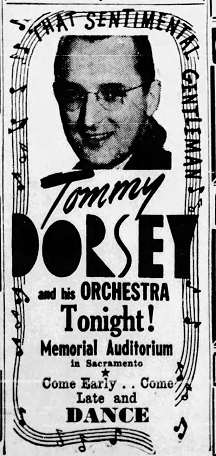
April 2, 1940
Concerts
Paramount Theater (March 13 - April 9, 1940)
FILM: Road To Singapore w/ Crosby, Hope, Lamour
Tommy Dorsey and His Orchestra with Frank Sinatra
April 3, 1940
Concerts
Paramount Theatre, New York City (March 13 - April 9)
Tommy Dorsey and his Orchestra w/Frank Sinatra
April 4, 1940
Concerts
Paramount Theatre, New York City (March 13 - April 9)
Tommy Dorsey and his Orchestra w/Frank Sinatra
April 5, 1940
Concerts
Paramount Theatre, New York City (March 13 - April 9)
Tommy Dorsey and his Orchestra w/Frank Sinatra
April 6, 1940
Concerts
Paramount Theatre, New York City (March 13 - April 9)
Tommy Dorsey and his Orchestra w/Frank Sinatra
April 7, 1940
Concerts
Paramount Theatre, New York City (March 13 - April 9)
Tommy Dorsey and his Orchestra w/Frank Sinatra
April 8, 1940
Concerts
Paramount Theatre, New York City (March 13 - April 9)
Tommy Dorsey and his Orchestra w/Frank Sinatra
April 9, 1940
Concerts
Paramount Theatre, New York City (March 13 - April 9)
Tommy Dorsey and his Orchestra w/Frank Sinatra
April 10, 1940
Studio
New York City
BS048758 April Played The Fiddle -1 (3:05)
(from Universal Picture If I Had My Way)
(J. Burke/J.V. Monaco )
Anne-Rachel Music (ASCAP)
Arranged by Deane Kincaide
78: RCA Victor 26606
LP: The Dorsey/Sinatra Sessions 1940-1942 RCA SD 1000
CD: Tommy Dorsey/Frank Sinatra – The Song Is You RCA 07863 66353
BS048762 I Haven't Time To Be A Millionaire -1 (3:03)
(from the Universal Picture If I Had My Way)
(J. Burke/J.V. Monaco )
Anne-Rachel Music (ASCAP)
Arranged by Deane Kincaide
78: RCA Victor 26606
LP: The Dorsey/Sinatra Sessions 1940-1942 RCA SD 1000
CD: Tommy Dorsey/Frank Sinatra – The Song Is You RCA 07863 66353
BS048430 Imagination -3 (3:13)
(J. Van Heusen/J. Burke)
ABC Music Corp./Dorsey Brothers Music (ASCAP)
Arranged by Axel Stordahl
78: RCA Victor 26581
LP: The Dorsey/Sinatra Sessions 1940-1942 RCA SD 1000
CD: Tommy Dorsey/Frank Sinatra – The Song Is You RCA 07863 66353
BS048431 Yours Is My Heart Alone -3 (2:52)
(F. Loehner/L. Herzer/F. Lehar)
Glocken Verlog Inc. (GEMA)
Arranged by Axel Stordahl
78: RCA Victor 26616
LP: The Dorsey/Sinatra Sessions 1940-1942 RCA SD 1000
CD: Tommy Dorsey/Frank Sinatra – The Song Is You RCA 07863 66353
Saxes: Fred Stulce, Johnny Mince, Hymie Shertzer, Paul Mason; Trumpet: Bunny Berigan, Ray Linn, John Dillard, Jimmy Blake; Piano: Joe Bushkin; Trombones: George Arus, Lowell Martin, Les Jenkins; Guitar: Clark Yocum; Bass: Sid Weiss; Drums: Buddy Rich
"April Played the Fiddle" / "I Haven't Time to Be a Millionaire"
In the three years of Sinatra’s tenure with the band, Victor assigned Dorsey the task of devising dance-band versions of songs from four Crosby movies, and the results of those assignments offer an accurate barometer of Sinatra’s progress. On April 10, 1940, Dorsey recorded the two "plug" songs from Crosby’s current release, If I Had My Way: "April Played the Fiddle" and "I Haven’t Time to Be a Millionaire."
Source: Will Friedwald, "Sinatra! The Song Is You: A Singer's Art" (2018 revised edition).
April 12, 1940
Concerts
Shea's Theatre, Buffalo, N. Y. (12-18)
Tommy Dorsey & His Orchestra w Frank Sinatra opening night of a week long engagement
Friday Evening
Stage Show
On screen: Star Dust" with Linda Durnell, John Payne, Roland Young, and Charlotte Greenwood
Shea's Theatre, Buffalo, N. Y. (12-18)
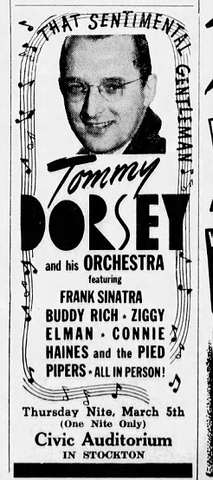
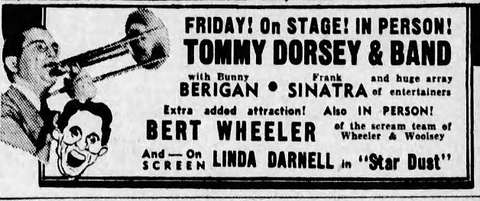
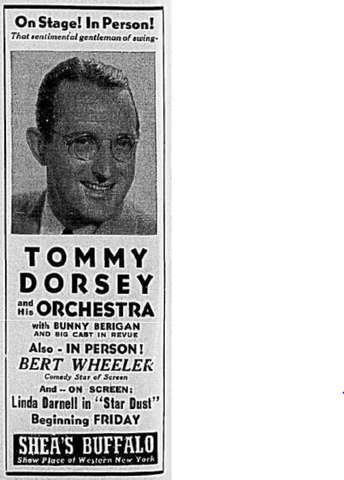
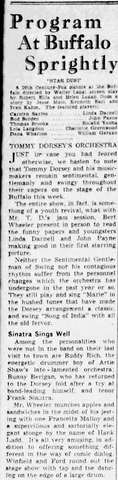
April 13, 1940
Concerts
Shea's Theatre, Buffalo, N. Y. (12-18)
Tommy Dorsey & His Orchestra w Frank Sinatra
Stage Show
On screen: Star Dust" with Linda Durnell, John Payne, Roland Young, and Charlotte Greenwood
April 14, 1940
Concerts
Shea's Theatre, Buffalo, N. Y. (12-18)
Tommy Dorsey and his Orchestra w/Frank Sinatra
Stage Show
On screen: Star Dust" with Linda Durnell, John Payne, Roland Young, and Charlotte Greenwood
April 15, 1940
Concerts
Shea's Theatre, Buffalo, N. Y. (12-18)
Tommy Dorsey & His Orchestra
Stage Show
On screen: Star Dust" with Linda Durnell, John Payne, Roland Young, and Charlotte Greenwood
April 16, 1940
Concerts
Shea's Theatre, Buffalo, N. Y. (12-18)
Tommy Dorsey & His Orchestra
Stage Show
On screen: Star Dust" with Linda Durnell, John Payne, Roland Young, and Charlotte Greenwood
April 17, 1940
Concerts
Shea's Theatre, Buffalo, N. Y. (12-18)
Tommy Dorsey & His Orchestra
Stage Show
On screen: Star Dust" with Linda Durnell, John Payne, Roland Young, and Charlotte Greenwood
April 18, 1940
Concerts
Shea's Theatre, Buffalo, N. Y. (12-18)
Tommy Dorsey & His Orchestra
Stage Show
On screen: Star Dust" with Linda Durnell, John Payne, Roland Young, and
Charlotte Greenwood
Ed O'Brien:
Bert Wheeler was on the bill with TD & Co.
Film was 20th Century Fox musical "Stardust," starring Linda Darnell, John Payne, Roland
Young and William Gargan.
TD band grossed a little under $21,000 for the week.
Wheeler would be the comic relief on a number of Broadway Bandbox shows with Frank and then be his sidekick on the Vimms show from 1-5-44 thru 3-15-44. Bert was offered a good gig on the west coast and Jerry Lester replaced him on the Vimms show, 3-29-44. Lester lasted thru the 6-14-44 show.
April 19, 1940
Concerts
The Empire Ballroom, Lehigh University, Bethlehem, Pennsylvania Spring House Party - Junior Promenade
Tommy Dorsey & Orchestra with Frank Sinatra
Friday Evening Dance
The Empire Ballroom, Lehigh University, Bethlehem, Pennsylvania Spring House Party - Junior Promenade
Tommy Dorsey & Orchestra with Frank Sinatra
Friday Evening Dance
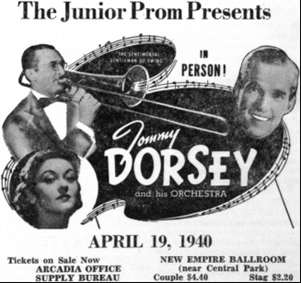
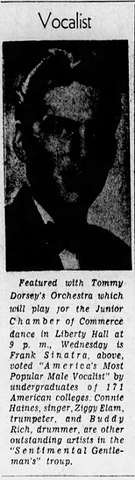
April 20, 1940
Concerts
Sunnybrook, Pottsdown, PA
Tommy Dorsey and his Orchestra w/Frank Sinatra
[image referenced in source but could not be recovered]
April 21, 1940
Concerts
Golden Gate Ballroom, Harlem, NY (One-Nighter)
Tommy Dorsey and his Orchestra with Frank Sinatra
Golden Gate Ballroom, Harlem, NY
Tommy Dorsey and his Orchestra with Frank Sinatra
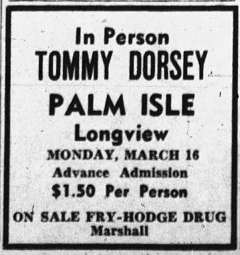
April 22, 1940
Concerts
Nutting's Dance Hall, Waltham, Mass
Tommy Dorsey and his Orchestra w/Frank Sinatra
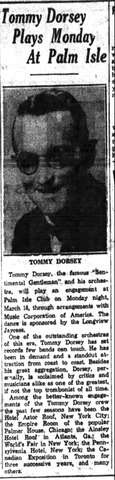
April 23, 1940
Studio
New York City
BS0048938 You're Lonely And I'm Lonely
(The Dorsey Sentimentalists)
(from the musical production Louisiana Purchase)
(Irving Berlin)
Irving Berlin Music Co. (ASCAP)
Arranged by Axel Stordahl
-1 (3:10) CD: 07863 66353-2 "The Song Is You" 5CD set Vol 1.
-3 (3:10) CD: 07863 66353-2 "The Song Is You" 5CD set Vol 4 -3 CD: RCA 2269-2-R
-1 LP: SD 1000
-1 78: 26596
-2 N/R
5-25-40
BS048939 East Of The Sun (And West Of The Moon)
(The Dorsey Sentimentalists) w/Band Chorus
(Brooks Bowman)
Anne-Rachel Music (ASCAP)
Arranged by Sy Oliver
-1 (3:15) CD: 07863 66353-2 "The Song Is You" 5CD set Vol 1.
CD: RCA 8554-2-R
LP: SD 1000
78: 20-3500
78: 10726
10-24-82
BS048940 Head On My Pillow
(The Dorsey Sentimentalists)
(B. Palmer/P. Norman)
MCA Music Publishing (ASCAP)
Arranged by Axel Stordahl
-1 (2:57) CD: 07863 66353-2 "The Song Is You" 5CD set Vol 1.
CD: RCA 9679-2-R
LP: SD 1000
78: 10726
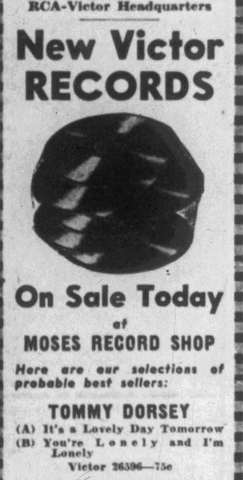
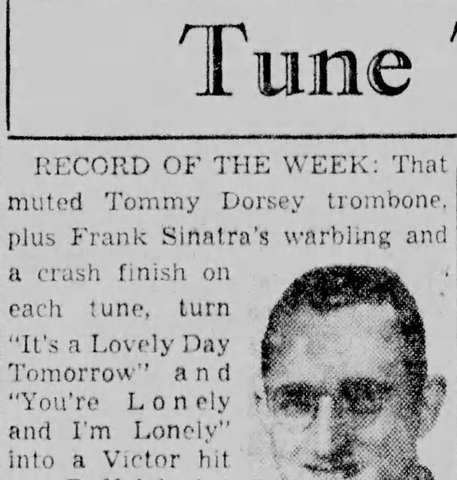
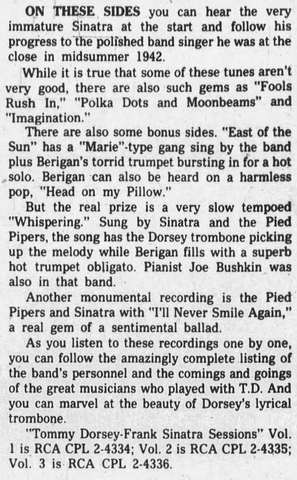
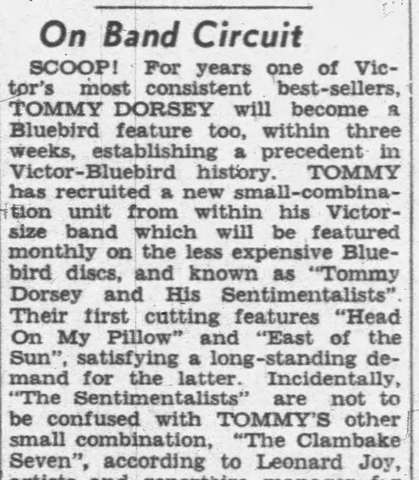
Radio
Martin Block's Make Believe Ballroom
WNEW, NYC
11:00AM
Tommy Dorsey Orchestra with Frank Sinatra
Martin Block's Make Believe Ballroom
WNEW, NYC
11:00AM
Tommy Dorsey Orchestra with Frank Sinatra
[image referenced in source but could not be recovered]
"I'll Never Smile Again"
Joe Bushkin / Sinatra: On April 23, 1940, Joe Bushkin remembers, "we were in the studio, and we had already done our sides. We still had about twenty minutes left, so Freddie said, ‘Well, I wrote that chart for that gal in Canada, and Tommy said, ‘Let’s give it a try.’ So we do a take, and it was kind of empty. Then, Frank sees a celesta in the studio and has them shove it over by me at the piano. He says, ‘Just fill it in.’ When they finally orchestrated it, my ad lib became part of the arrangement." Sinatra added, "We made the song with the Pied Pipers and myself, and it was not a very good record. So [a month later, on May 23] we remade it, we did it a second time, still with Tommy. It was strange that it had to be made three times [once by Glenn Miller and twice by Dorsey] before we got it right."
Source: Will Friedwald, "Sinatra! The Song Is You: A Singer's Art" (2018 revised edition).
[East of the Sun -- critical commentary]
Granata includes 'East of the Sun' among the fifty recordings he considers essential to understanding Sinatra's artistry (arranged by Tommy Dorsey, recorded 1940, Victor); the song was chosen for its musical/interpretive value rather than commercial popularity.
This song/context matches multiple dated entries in the chronology, or lacked a sufficiently precise date; the specific date could not be determined with confidence.
Source: Charles L. Granata, "Sessions with Sinatra: Frank Sinatra and the Art of Recording" (1999/2003), Afterword & Appendices A-D
April 24, 1940
Concerts
Farmer's Warehouse, Petersburg, Virginia
Rotary Club Dance
Tommy Dorsey & His Orchestra with Frank Sinatra
Farmer's Warehouse, Petersburg, Virginia
-----------------------------------------------------
1943 Promenade Ballroom, Manhattan Center, New York
Presented by Young Men's League of New York
A portion of Sinatra's salary from this engagement was donated to the American Red Cross
[image referenced in source but could not be recovered]
Farmer's Warehouse, Petersburg, Virginia
[image referenced in source but could not be recovered]
April 25, 1940
Radio
Live Remote from Azalea Ball, County Fair Building, Charleston, SC Tommy Dorsey & His Orchestra
WTMA Radio 10 PM
Concerts
Azalea Ball, County Fair Building, Charleston, SC
Tommy Dorsey & His Orchestra
Azalea Ball, County Fair Building, Charleston, SC
Tommy Dorsey & His Orchestra
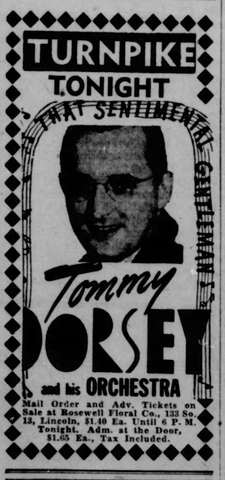
Live Remote from Azalea Ball, County Fair Building, Charleston, SC Tommy Dorsey & His Orchestra
WTMA Radio 10 PM
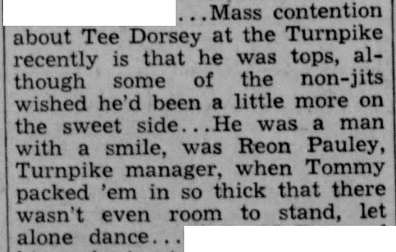
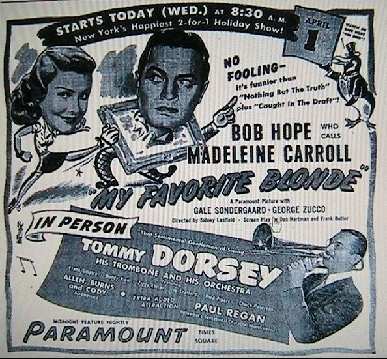
April 26, 1940
Concerts
University of North Carolina, Chapel Hill, N. C.
Tommy Dorsey & His Orchestra
Friday Evening
Dance
University of North Carolina, Chapel Hill, N. C.
The Daily Tar Heel (Chapel Hill, North Carolina) · 26 Apr 1940
April 27, 1940
Concerts
University of North Carolina, Chapel Hill, N. C.
Saturday Evening
Tommy Dorsey & His Orchestra
Dance note: TD & Co. played two consecutive nights at UNC.
University of North Carolina, Chapel Hill, N. C.
Saturday Evening
Tommy Dorsey & His Orchestra
Dance
From The Daily Tar Heel University of North Carolina April 27, 1940
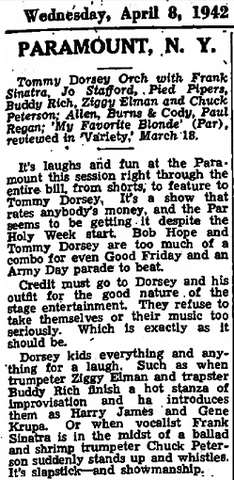
April 28, 1940
['Polka Dots and Moonbeams' hits the charts]
'Polka Dots and Moonbeams' reached number 18 on the Billboard chart for the week of April 28, 1940, Sinatra's first appearance on the chart.
Source: James Kaplan, "Frank: The Voice" (2010).
April 30, 1940
Concerts
Memorial Auditorium, Chattanooga, Tennessee
Tuesday Evening
8:45 p. m. 1:00 a. m.
Tommy Dorsey & Orchestra with Frank Sinatra
Concert/Dance
One-Nighter
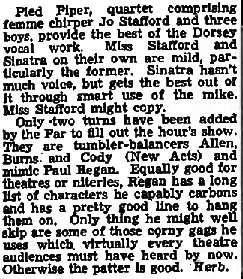
May 1, 1940
Concerts
University of Tennessee, Knoxville, Tennessee (May 1-2) Tommy Dorsey & His Orchestra with Frank Sinatra
University of Tennessee, Knoxville, Tennessee (May 1-2)
The Knoxville Journal (Knoxville, Tennessee) 2 May
1940
Frank Sinatra with Benny Goodman at CBS on “The Frank Sinatra Show” in 1940. Source: photo and caption from J. Randy Taraborrelli, Sinatra: Behind the Legend (mptvimages.com).
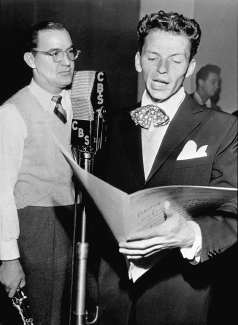
May 2, 1940
Concerts
University of Tennessee, Knoxville, Tennessee (May 1-2) Tommy Dorsey & His Orchestra with Frank Sinatra
University of Tennessee, Knoxville, Tennessee (May 1-2) Tommy Dorsey & His Orchestra with Frank Sinatra
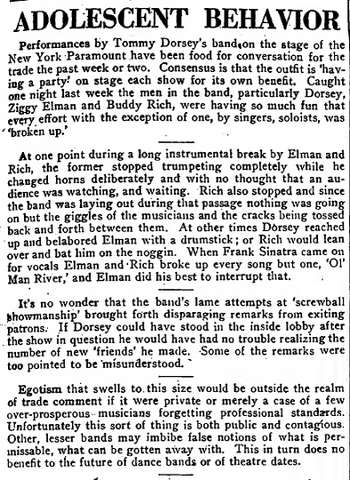
May 3, 1940
Radio
Woodruff Hall, University of Georgia, Athens, Georgia
Tommy Dorsey and His Orchestra with Frank Sinatra
Live Remote
Network: NBC Red Network
Time: 11:00PM - 11:30PM
Concerts
Woodruff Hall, University of Georgia, Athens, Georgia
Friday Evening
9:00 p. m. 1:00 a. m.
Little Commencement Dance
Woodruff Hall, University of Georgia, Athens, Georgia
Friday Evening
9:00 p. m. 1:00 a. m.
Little Commencement Dance
This comes from The Red and Black, the college paper of the University of Georgia, May 3, 1940.
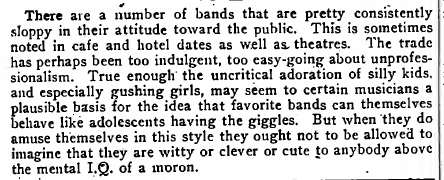
May 4, 1940
Radio
Live Remote From Woodruff Hall, University of Georgia, Athens, Georgia Tommy Dorsey & His Orchestra
Saturday Evening
11:00 – 11: 30 p. m.
NBC Red Network
WSB
Announcer: Bob Pollock note: Broadcast was aired in the south and midwest. Northeast NBC stations did not pick it up
Concerts
Woodruff Hall. University of Georgia, Athens, Georgia
Saturday Evening
9:00 p. m - 12:00 a.m. note: T.D. & Band at the universities' weekend spring commencement dances. Graduation took place on 5/31.
The band played on Friday night(5/3) and then made three more appearances on Saturday. The cost to attend all four dance/concert settings was $6.50. That was a lot of money for a student in 1940.
Woodruff Hall, University of Georgia, Athens, Georgia
5:00 p.m. – 7:00 p. m.
Saturday Evening
Dance
May 6, 1940
Concerts
Dorsey and Orchestra on vacation May 6-20
May 7, 1940
Concerts
Dorsey and Orchestra on vacation May 6-20
May 8, 1940
Concerts
Dorsey and the Orchestra remained on vacation from May 6 - May 20
May 9, 1940
Concerts
Dorsey and the Orchestra remained on vacation from May 6 - May 20
May 10, 1940
Concerts
Dorsey and the Orchestra remained on vacation from May 6 - May 20
May 11, 1940
Concerts
Dorsey and the Orchestra remained on vacation from May 6 - May 20
May 12, 1940
Concerts
Dorsey and the Orchestra remained on vacation from May 6 - May 20
May 13, 1940
Concerts
Dorsey and the Orchestra remained on vacation from May 6 - May 20
May 14, 1940
Concerts
Dorsey and the Orchestra remained on vacation from May 6 - May 20
May 15, 1940
Concerts
Dorsey and the Orchestra remained on vacation from May 6 - May 20
May 16, 1940
Concerts
National Biscuit Convention, Hotel Astor, New York
Tommy Dorsey and his Orchestra w/Frank Sinatra
Note: Thanks to Ed O'Brien for the above listing
May 17, 1940
Concerts
Dorsey and the Orchestra remained on vacation until May 20
May 18, 1940
Concerts
Dorsey and the Orchestra remained on vacation until May 20
May 19, 1940
Concerts
Dorsey and the Orchestra remained on vacation until May 20
May 20, 1940
Concerts
Dorsey and the Orchestra remained on vacation through May 20 and would open at the Hotel Astor on May 21.
May 21, 1940
Radio
Live Remote: Roof Of Hotel Astor, New York City
Tuesday Evening
11:30 p. m. - 12:00 a.m.
NBC Red Network
WEAF
Tommy Dorsey & His Orchestra
1. I'm Getting Sentimental Over You - TD & Orch.
2. Looking At The World Through Rose Colored Glasses - Connie Haines
3. You Taught Me To Love Again - Frank Sinatra
4.Easy Does It (Sy Oliver arg) - TD & Orch.
5.Charming Little Faker - Connie Haines
6.. Losers Weepers (Sy Oliver arg) - TD & Orch.
7. I'll Never Smile Again - Frank Sinatra & Pied Pipers
8. East Of The Sun - Frank Sinatra & Band Chorus
9. Old Man Harlem - TD & Orch
10.Closing Theme
Concerts
Hotel Astor, New York City, (May 21 - August 28)
Tommy Dorsey & Orch.
Connie Haines, Frank Sinatra, Jo Stafford,
The Pied Pipers, Bunny Berigan, Buddy Rich,
Joe Bushkin, Sy Oliver
note: 5-21 to 8-28, 14 week run, was the longest engagement ever for the Dorsey band
Ed O'Brien notes:
Frank was with Dorsey from January 1940 into
September of 1942. All three spring/summers saw the band and Frank at the Astor Hotel.
"I'll Never Smile Again" was a breakaway hit during the 1940 engagement and TD. & CO. played to capacity crowds every show. The great
Bunny Berigan was with the band that spring.
There were a number of radio broadcasts from
The Astor during this stay.
Carl Rasmussen asked:
I should like to know if there are any recordings available of "I can't get started", where Sinatra sings the words and Bunny Berigan plays the trumpet solo.
Ed O'Brien responded:
I do not believe so. Berigan died in early June of 1942.
I don't believe Frank was singing the song with TD.
WNEW had an extensive poll -- 300 greatest pop songs.
I believe it was around 1987. Millions of votes were cast and Bunny's version of "I Can't Get Started" topped the list. Sinatra easily had the most songs to place on the list..
Hotel Astor, New York City, (May 21 - August 28)
Tommy Dorsey & Orch.
Connie Haines, Frank Sinatra, Jo Stafford,
The Pied Pipers, Bunny Berigan, Buddy Rich,
Joe Bushkin, Sy Oliver
The ad that ran May 20, 1940, the day before Dorsey opened:
The ad that ran the night Dorsey opened on May 21, 1940:
Variety Review
May 29, 1940 of TD opening on 5-21-40
Hotel Astor, Astor Roof, New York Talent policy: Dance and show band, relief band, floor show.
Management: Robert Christenberry, managing director; Noel Meadow, publicity director.
Prices: Dinner from $2; cover. 75 cents week nights, $1 Saturdays and holidays.
Astor Roof is one of the most attractive oases in town, winter or summer, and its seasonal opening Tuesday (21) brought out not only the music regulars but a large number of night-clubbing New Yorkers who know from past seasons that the surroundings, entertainment, food and drink here are of the best. Opening musical chores are in the capable hands of Tommy Dorsey, and even if his present ork is far from the standard he himself has set in the past, his presence on a band stand ensures good business, and his super-fine tromboning and genial, personable attitude nicely complement the room's other excellent attributes. In addition to specialties from the bandBunny Berigann's trumpet; Frank Sinatra's and Connie Haines' ballads and rhythm ditties, respectively; Buddy Rich's drumnastics, and the Pied Pipers' quartet warblingopening floor show offerss the Callahan Sisters; Hibbert, Bird and Larue, and the Flying Top Hatters. Latter act leads off, boy and girl doing some expert but undistinguished roller skating to the accompaniment of some "hurry" music that hasn't been heard since the old silent movie days. Callahans display cuteness and personality in a brief tapping turn that winds up unoriginally with a Pat Rooney imitation. Two gals are all right in an unspectacular way. Hibbert, Bird and Lame are a knockabout burlesque dance trio, comedy stemming from Larue's "drunken" interruptions of a supposedly straight ballroom routine by the other two. The act has its share of laugh-getting moments. Relief rhythms are currently being supplied by Sande Williams, brought up from a winter session in the downstairs Orangerie Room. Hal Kemp follows Dorsey into the spot July 22. Daniel Richinan
Billboard
June 1, 1940 note: Hal Kemp did not follow Dorsey on 7/22. TD & Band was such a solid hit, the management kept extending their run until late August.
Ed
May 21, 1943
Frank Sinatra was riding a phenomenal wave of popularity in May of 1943. He had scored a tremendous success with his appearances at the Paramount Theater and then conquered the nightclub world with his sensational singing at the Riobamba Room. He was appearing weekly on two radio shows and was in great demand as a guest on other shows. Hollywood was interested in making him a major star. What more could Frank ask for at this juncture ? There was one major element missing and Frank knew it and craved for some way to get it: A HIT RECORD.
The musicians' strike had started in the summer of 42 and showed no sign of being resolved in the spring of 1943. RCA was releasing Sinatra recordings, done with Dorsey, and they were all big hits.
Record Executive Manie Sacks, who had courted Frank during his years at RCA and got him to sign with Columbia, listened to the recordings Frank had made with Harry James. And he found a gem: "All Or Nothing At All" had been recorded on 8-31-
39. Released in June of 1940, the singled had sold an unimpressive 16,000 copies.
But it was a Sinatra record more than one that belonged to the James band. Columbia reissued the song on May 21, 1943.
Here is the rest of the story:
ALL OR NOTHING AT ALL
FRANK SINATRA-HARRY JAMES
(Columbia 35587)
All or Nothing at All -FT; VC. Flash
-FT.
Columbia set off It firecracker when it went back to 1939 and came up with a combination of Frank Sinatra singing almost for the entire side as vocalist with
Harry James's orchestra. And It's a comb- ination that represents the hottest things in show business today. Plenty of diplomacy evidenced in the label's billing, providing for: "Harry James presents Frank Sinatra" singing All or
Nothing at All, accompanied by the
James orchestra, Both lads have gone a long way since the side. was originally cut. While Sinatra's singing is only a false echo of the style he later developed under Tommy Dorsey, the commercial appeal stamps it a best seller. If advance orders mean anything it promises to be the record of the year. Moreover, Leeds
Music Company, which will share the gravy with the waxwork, has plotted out a major revival campaign for the once familiar ballad. And that the opposition respects the possibilities of both the side and the song is seen in the fact that Decca is readying to bring back a
Jimmy Dorsey orginal of the song, and
Victor is applying fresh polish to a
Freddie Martin master. It's a cinch that the side will set off a cycle of song revivals, which should suit the waxworks fine as long as the Petrillo ban remains in force. And if this couplet sells as It promises to. it's a safe bet that Columbia will be bringing back the Sinatra-James combination for their earlier Everyday in
My Life, which follows the same pattern.
All or Nothing has Sinatra singing the opening stanza, taking It at a slow tempo; the band bringing upnthe last half of another chorus, with Sinatra taking the tag line to carry
It out. Flash. Is a James original, and as an instrumental makes for a flashy jump dish. Taken at the bright jump tempo. Jack Gardner's piano takes it right from the edge for the opening refrain.
Brasses against the sustained harmonies of the saxes, with James's trumpet on the bridge, carries a second stanza. Band ensemble, \ with Dave Mathhews's tenor sax on the bridge, keeps on building thruout a third chorus, and for the out chorus, band builds on James's starting trumpet riffs to ride out the side.
"All or Nothing at All" looks like a natural to be the No. I money-maker for the music boxes, and operators would do well to stack up on them. Moreover, plenty of coins will be attracted to the Jump Instrumental on the mated side.
Billboard
May 29, 1943
Variety
May 19, 1943
Note: Harry was Frankie's guardian angel.
Dorsey offered Sinatra a contract with arguably the best band in the nation. Problem was Frank was still contractually obligated to Harry for five more months. Harry wished Frank well and let him out of the contract. "All Or Nothing At All" was Harry's record. Again, he showed incredible generosity.
Frank thanked him privately and in the trades.
--Ed
[Astor Roof opening night; 'the night Frank Sinatra happened'] Joe Bushkin (via Kaplan): On opening night, Tuesday, May 21, 1940, Sinatra's solo on 'Begin the Beguine' brought down the house; during the encore pianist Joe Bushkin blanked on the chord changes to 'Smoke Gets in Your Eyes' and Sinatra finished the number a cappella in front of New York society. Bushkin later called it the night Sinatra 'happened.'
Source: James Kaplan, "Frank: The Voice" (2010).
May 22, 1940
Radio
Live Remote: Roof Astor Hotel, New York City
Wednesday Evening
11:30 p. m. - 12:45 a.m.*
NBC Blue Network
WJZ
Tommy Dorsey & His Orchestra
Announcer: Lyle Van
1. I'm Getting Sentimental Over You TD & Orch.
2. My! My! Pied Pipers
3. Shake Down The Stars Frank Sinatra
4. Back Stage At The Ballet ( Sy Oliver arg.) TD & Orch.
5.Too Romantic Frank Sinatra
6. Blues No More (Sy Oliver Arg) TD & Orch.
7. I'll Never Smile Again Frank Sinatra & Pied Pipers
8. Deep Night Frank Sinatra & Band Chorus
9. Bugle Call Rag TD & Orch.
10.Closing Theme TD & Orch. * WJZ went to news at midnight and then returned to the dance band remote
Concerts
Hotel Astor, New York City, (May 21 - August 28)
Tommy Dorsey & Orch.
Connie Haines, Frank Sinatra, Jo Stafford,
The Pied Pipers, Bunny Berigan, Buddy Rich,
Joe Bushkin, Sy Oliver note: 5-21 to 8-28, 14 week run, was the longest engagement ever for the Dorsey band
May 23, 1940
Studio
New York City
RCA STUDIO B
1:30 P.M.TO 5:15 P.M.
BS048942 I'll Never Smile Again w/The Pied Pipers
(R. Lowe)
MCA Music Publishing (ASCAP)
Arranged by Freddie Stulce
-4 (3:09) CD: 07863 66353-2 "The Song Is You" 5CD set Vol 1.
CD: RCA 8324-2-R
LP: SD 1000
78: 27521
78: 26628 (2nd pressing)
8-8-40
8-4-40
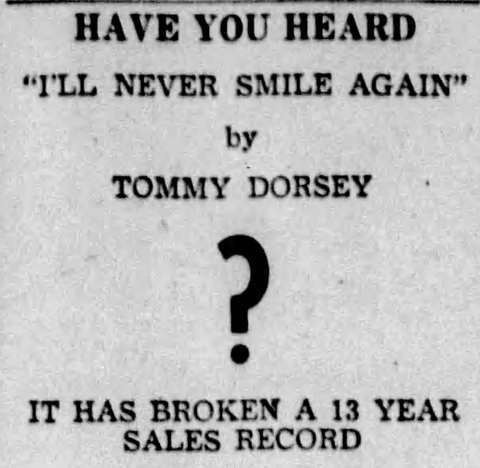
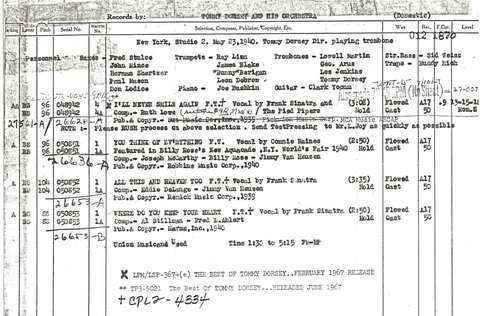
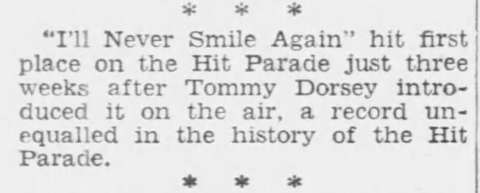
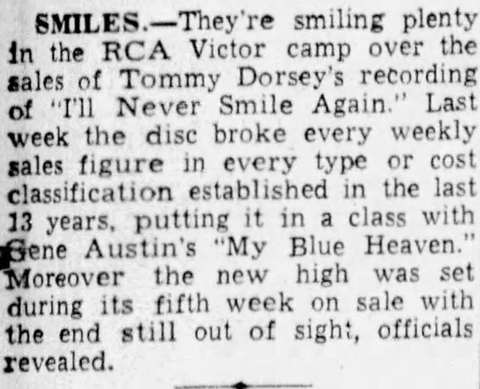
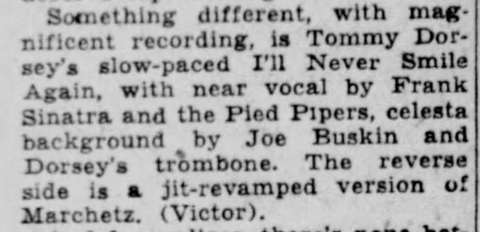
Concerts
Hotel Astor, New York City, (May 21 - August 28)
Tommy Dorsey & Orch.
Connie Haines, Frank Sinatra, Jo Stafford,
The Pied Pipers, Bunny Berigan, Buddy Rich,
Joe Bushkin, Sy Oliver note: 5-21 to 8-28, 14 week run, was the longest engagement ever for the Dorsey band
"I'll Never Smile Again"
"Smile Again" is heartbreakingly languid, some of the un-fastest popular music ever recorded, tepidly crawling through the super-slow tempos pioneered, again, by Billie Holiday. Sinatra and the Pied Pipers function as equals, neither side of the equation attracting more attention than the others. Sinatra only occasionally arises out of the ensemble to stress key lines in solo, including virtually all of the bridge, almost like the leader of the vocal group rather than a featured star. No less than Sinatra, the Pipers themselves had collectively absorbed much of Dorsey’s legato style, and all five voices harmonize exquisitely with Dorseysque extended notes that amplify the sense of loss in the narrative. Bushkin’s celesta provides the only instrumental sound we are conscious of behind the voices, although there’s a small and barely noticeable horn ensemble audible here and there. Dorsey himself plays an indescribably mournful eight bars of the main theme before Sinatra and the Pipers cap the piece with a brief outchorus.
Source: Will Friedwald, "Sinatra! The Song Is You: A Singer's Art" (2018 revised edition).
['I'll Never Smile Again' recorded]
Two days after the Astor Roof opening, Dorsey and a stripped-down group called the Sentimentalists recorded 'I'll Never Smile Again,' a ballad by Ruth Lowe written in memory of her late husband, with Sinatra and the Pied Pipers.
Source: James Kaplan, "Frank: The Voice" (2010).
May 24, 1940
Radio
Live Remote: Hotel Astor Roof, New York City
NBC Red Network
Friday Evening
12:00 - 12:30 a. m.
WEAF
Tommy Dorsey & His Orchestra
1.I'm Getting Sentimental Over You TD & Orch.
2.When You And I Were Young, Maggie (Sy Oliver arg) TD & Orch.
3. Say It Frank Sinatra
4. Make Me Know It (Sy Oliver arg) TD & Orch.
5. Imagination Frank Sinatra
6. Sweet Lorraine (Sy Oliver arg) Pied Pipers
7. I'll Never Smile Again Frank Sinatra, Connie Haines, Pied Pipers
8. Marie Frank Sinatra & Band Chorus
9. Lights Out, Hold Me Tight (Sy Oliver arg) Connie Haines
10.Devil's Holiday TD & Orch.
11.Closing Theme TD & Orch.
Concerts
Hotel Astor, New York City, (May 21 - August 28)
Tommy Dorsey & Orch.
Connie Haines, Frank Sinatra, Jo Stafford,
The Pied Pipers, Bunny Berigan, Buddy Rich,
Joe Bushkin, Sy Oliver note: 5-21 to 8-28, 14 week run, was the longest engagement ever for the Dorsey band
May 25, 1940
Radio
Saturday Afternoon Dorsey Hour
Saturday Afternoon
5:00 - 6:00 p. m.
NBC Red Network
WEAF
New York City
Tommy Dorsey & Orchestra
Frank Sinatra, Connie Haines, Jo Stafford, The
Pied Pipers, Buddy Rich, Sy Oliver, Joe Bushkin
Premiere of the Saturday Afternoon Dorsey Hour
Hotel Astor Roof
New York City
Live Remote
Lyle Van, announcer
George Mathus, remote engineer
1. I'm Getting Sentimental Over You TD & Orch.
2, Losers Weepers (Sy Oliver arg.) TD & Orch.
3. Polka Dots And Moonbeams Frank Sinatra
4. Song Of India TD & Orch.
5. (What Can I Say Dear) After I Say I'm Sorry Pied Pipers
6. Easy Does It (Sy Oliver arg) TD & Orch.
7. April Played The Fiddle Frank Sinatra
8. Boog It ( Sy Oliver arg.) Connie Haines
9. So What (Sy Oliver arg) TD & Orch.
10; Medley: a. Too Romantic Frank Sinatra b. Where Was I TD & Orch. c. Shake Down The Stars Frank Sinatra 11.. Make Me Know It (Sy Oliver arg.) TD & Orch.
12. All This And Heaven Too Frank Sinatra
13. When You And I Were Young, Maggie ( Sy Oliver arg.) Connie Haines
14. I'll Never Smile Again Frank Sinatra & Pied Pipers
15. Marie Frank Sinatra & Band Chorus
16. Dear Old Southland (Sy Oliver arg.) TD & Orch.
17. Closing Theme TD & Orch.
Live Remote:Hotel Astor, New York City
Saturday Morning
1:00 - 1:30 a. m.
NBC Red & Blue Network
WEAF & WJZ
Tommy Dorsey & Orchestra
Announcer: Ed Herlihy
1. I'm Getting Sentimental Over You TD & Orch.
2. You Think Of Everything Connie Haines
3. Say It Frank Sinatra
4.It Ain't What You Think (Sy Oliver arg) TD & Orch.
5. I'll Never Smile Again Frank Sinatra & Pied Pipers
6. Looking At The World Through Rose Colored Glasses Connie Haines
7. Imagination Frank Sinatra
8. Sweet Lorraine (Sy Oliver arg) Pied Pipers
9. Devil's Holiday TD & Orch.
10. Closing Theme TD & Orch.
Concerts
Hotel Astor, New York City, (May 21 - August 28)
Tommy Dorsey & Orch.
Connie Haines, Frank Sinatra, Jo Stafford,
The Pied Pipers, Bunny Berigan, Buddy Rich,
Joe Bushkin, Sy Oliver note: 5-21 to 8-28, 14 week run, was the longest engagement ever for the Dorsey band
"Begin the Beguine" / "Polka Dots and Moonbeams" / "All the Things You Are" / "Smoke Gets in Your Eyes"
Joe Bushkin / Bea Wain: Pianist Joe Bushkin, who had joined the band five or six weeks earlier, recalled that Sinatra’s first vocal on that premiere night called for him to sing with the Pied Pipers, while his second, "Begin the Beguine," was strictly a solo feature for him. As Bushkin told us in June 1992, "Beguine" (which unfortunately wasn’t preserved in either a live or a studio recording) marked the first Dorsey number to feature Sinatra throughout, with just a brief eight-bar instrumental interlude for the band. "He wound it up with a nice big finish," said Bushkin, "and the place went bananas!" ... Dorsey instructed the band to play "Polka Dots and Moonbeams," but because it wasn’t a vocal feature, he took the four-bar transitional passage that precedes the vocal and from there went right into Sinatra’s "middle" chorus. After "Polka Dots," "the people were still going nuts," Bushkin continued, so rather than force a dance number into a vocal feature, Dorsey told Sinatra, "Just sing whatever you want with Joe." The two began an impromptu voice and piano duo. Bushkin remembered that Sinatra’s confidence was unshakable. He simply went on singing to the wild delight of the crowd, now no longer dancing but just standing and listening. The twenty-three-year-old pianist, however, was completely taken aback. "As we were playing, I was trying to figure out his range," said Bushkin. "I was thinking quickly, ‘Where is his top note?’ If I can get to the top note, the bottom will take care of itself."
Three or four tunes (including ‘All the Things You Are”) later, a much ruffled Bushkin was still trying to follow Sinatra as best he could. "Then he turned around and said, ‘Smoke Gets in Your Eyes.’ Well, if you know that tune, man, you know that you can really get lost in the middle part [the bridge]. Unless you really know what you’re doing, that chord change will just lose you. I’m right out there without bread and water, man! The next thing I know, Frank was out there singing it all by himself. He was singing the bridge, a cappella. I was so embarrassed. I mean, Jesus, all the guys were looking at me, so I just turned around and walked away from the piano! I went to the side and then ran back to the piano and finished up the tune. And that was the last song we did. I thought Tommy was going to kill me, but he thought it was so funny! "And that," Bushkin concluded, "is the night that Frank Sinatra happened." Other attendees concurred. When announcer André Baruch and singer Bea Wain—known to history as radio’s leading couple—came down to dance to the band, Dorsey asked them what they thought of the new vocalist. Baruch was less than enthusiastic ("It’ll never happen!"), but Wain spoke for most of those present when she told TD, "He’s wonderful. He’s just electric!"
Source: Will Friedwald, "Sinatra! The Song Is You: A Singer's Art" (2018 revised edition).
May 26, 1940
Concerts
Hotel Astor, New York City, (May 21 - August 28)
Tommy Dorsey & Orch.
Connie Haines, Frank Sinatra, Jo Stafford,
The Pied Pipers, Bunny Berigan, Buddy Rich,
Joe Bushkin, Sy Oliver note: 5-21 to 8-28, 14 week run, was the longest engagement ever for the Dorsey band
May 27, 1940
Radio
Live Remote:Hotel Astor, New York City
Monday Evening
11:30 p. m. - 12:00 a.m.
NBC Red Network
WEAF
Tommy Dorsey & His Orchestra
Announcer: Alan Robinson
1.I'm Getting Sentimental Over You TD & Orch.
2.Lights Out, Hold Me Tight Connie Haines 3.The Sky Fell Down Frank Sinatra 4.Another One Of Them Things (Sy Oliver arg) TD & Orch 5.Say It Frank Sinatra 6.Make Me Know It (Sy Oliver arg) TD & Orch.
7. I'll Never Smile Again Frank Sinatra & Pied Pipers
8. East Of The Sun (And West Of The Moon) Frank Sinatra & Band Chorus
9.I Know That You Know (Sy Oliver arg) TD & Orch. 10.Closing Theme TD & Orch.
Concerts
Hotel Astor, New York City, (May 21 - August 28)
Tommy Dorsey & Orch.
Connie Haines, Frank Sinatra, Jo Stafford,
The Pied Pipers, Bunny Berigan, Buddy Rich,
Joe Bushkin, Sy Oliver note: 5-21 to 8-28, 14 week run, was the longest engagement ever for the Dorsey band
May 28, 1940
Radio
AMERICA DANCES PROGRAM
Tuesday afternoon
Transcribed at CBS Radio in N.Y.C. for trans-Atlantic broadcast on the
BBC in London
30 minutes
Tommy Dorsey & His Orchestra
Connie Haines, Frank Sinatra,
Jo Stafford & The Pied Pipers
18 piece band including Bunny
Berigan, Joe Bushkin, Buddy
Rich
Announcer: John Allen Wolfe
1. I'm Getting Sentimental Over You T.D. & Orch. opening theme
1. Losers Weepers Berigan very inventive on tpt.
2. Polka Dots & Moonbeams Frank Sinatra
( Announcer Wolfe introduction has Ray Sinatra
( Frank's cousin) singing the tune. He atones for his error after the number by explaining that the heavy rain in N.Y.C. has everyone looking for a "ray" of sunshine. )
3. Easy Does It Brilliant work by Berigan
4. I'll Never Smile Again Frank & The Pied Pipers
5. Blues No More Joe Bushkin does some nice work on piano
6. Boog It Connie Haines
7. East Of The Sun Frank & Band Chorus plus full band arrangement .Quite different from RCA recording
8. Old Man Harlem T. D. & Orchestra
9. I'm Getting Sentimental Over You closing theme
("Polka Dots & Moonbeams" appears on Masters of Jazz Volume 9)
(Complete Broadcast is available on LP: Fanfare FF 4-104 -- Tommy Dorsey and His Orchestra Featuring Bunny Berigan)
Live Remote: Hotel Astor, New York City
Tuesday Night
11:30 p. m. - 12:00 a.m.
NBC Red Network
WEAF
Tommy Dorsey & His Orchestra
Concerts
Hotel Astor, New York City, (May 21 - August 28)
Tommy Dorsey & Orch.
Connie Haines, Frank Sinatra, Jo Stafford,
The Pied Pipers, Bunny Berigan, Buddy Rich,
Joe Bushkin, Sy Oliver note: 5-21 to 8-28, 14 week run, was the longest engagement ever for the Dorsey band
AMERICA DANCES PROGRAM
Tuesday afternoon
Transcribed at CBS Radio in N.Y.C. for trans-Atlantic broadcast on the
BBC in London
30 minutes
Tommy Dorsey & His Orchestra
Connie Haines, Frank Sinatra,
Jo Stafford & The Pied Pipers
18 piece band including Bunny
Berigan, Joe Bushkin, Buddy Rich
(Complete Broadcast is available on LP: Fanfare FF 4-104 -- Tommy Dorsey and His Orchestra Featuring Bunny Berigan)
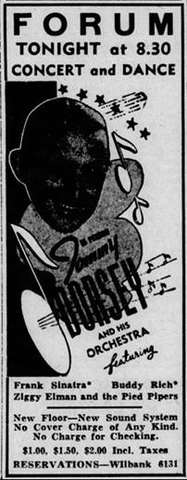
May 29, 1940
Radio
Live Remote: Roof of Hotel Astor, N.Y.C.
Wednesday Evening
11:30 p.m. to 12:00 a.m.
NBC Red and Blue Networks - WEAF and WJZ New York City Tommy Dorsey & His Orchestra
Frank Sinatra, Connie Haines, Bunny Berigan,
Buddy Rich, Joe Bushkin, Jo Stafford, The Pied Pipers
1. I'm Getting Sentimental Over You TD & Orch.
2. When I Grow Too Old To Dream TD & Orch.
3. I Haven’t Time To Be A Millionaire Frank Sinatra
4. I’ll Always Be In Love With You Connie Haines
5. Fools Rush In Frank Sinatra
6. I'll Never Smile Again Frank Sinatra & Pied Pipers
7. Who Frank Sinatra & Band Chorus
8. Hawaiian War Chant (Deane Kincaide arg.) TD & Orch.
9. Closing Theme TD & Orch..
Concerts
Hotel Astor, New York City, (May 21 - August 28)
Tommy Dorsey & Orch.
Connie Haines, Frank Sinatra, Jo Stafford,
The Pied Pipers, Bunny Berigan, Buddy Rich,
Joe Bushkin, Sy Oliver note: 5-21 to 8-28, 14 week run, was the longest engagement ever for the Dorsey band
May 30, 1940
Concerts
Hotel Astor, New York City, (May 21 - August 28)
Tommy Dorsey & Orch.
Connie Haines, Frank Sinatra, Jo Stafford,
The Pied Pipers, Bunny Berigan, Buddy Rich,
Joe Bushkin, Sy Oliver note: 5-21 to 8-28, 14 week run, was the longest engagement ever for the Dorsey band
May 31, 1940
Radio
Live Remote: Astor Hotel, New York City
Friday Evening
12:15 - 12:30 a. m.
NBC Red Network
WEAF
Tommy Dorsey & His Orchestra
1 .I'm Getting Sentimental Over You TD & Orch.
2. Buds Won't Bud Connie Haines
3. Yours Is My Heart Alone Frank Sinatra
4. Blues No More (Sy Oliver arg) TD & Orch.
5. I'll Never Smile Again Frank Sinatra & Pied Pipers
6. Closing Theme TD & Orch.
Concerts
Hotel Astor, New York City, (May 21 - August 28)
Tommy Dorsey & Orch.
Connie Haines, Frank Sinatra, Jo Stafford,
The Pied Pipers, Bunny Berigan, Buddy Rich,
Joe Bushkin, Sy Oliver note: 5-21 to 8-28, 14 week run, was the longest engagement ever for the Dorsey band
June 1940
[The Coke-Bottle Sandwich Story]
While pregnant with their first child and short on money, Nancy craved a ham-and-cheese sandwich; Frank collected empty Coke bottles to redeem for cash so he could buy it for her, insisting the treat was reserved for the baby.
Source: Tina Sinatra, "My Father's Daughter: A Memoir" (2000).
[NBC broadcast of 'I'll Never Smile Again']
Kaplan: Four nights after his daughter's birth, Sinatra sang 'I'll Never Smile Again' on an NBC radio broadcast from the Astor Roof, adding a small breathy vocal catch before the word 'heart' that differed from the studio recording.
Source: James Kaplan, "Frank: The Voice" (2010)
[Tommy Dorsey named Nancy's godfather]
Kaplan: Frank and his wife Nancy named Tommy Dorsey as godfather to their newborn daughter, Nancy Sandra -- reportedly Frank's idea.
Source: James Kaplan, "Frank: The Voice" (2010)
[Bushkin's comment on the Nature's Remedy laxative sponsorship of Dorsey's radio program, spring 1940 -- critical commentary]
Joe Bushkin: Joe Bushkin, expressing the sentiments of the sidemen as a whole, says, "That was a great idea for an advertiser: to take a band that appeals to young people and have them try and sell a laxative! It was pretty stupid."
Source: Will Friedwald, "Sinatra! The Song Is You: A Singer's Art" (2018 revised edition), Ch. 3, "With Tommy Dorsey" (1940-1942)
June 1, 1940
Radio
Live Remote: Hotel Astor, New York City
Saturday Evening
1:00 - 1:30 a. m.
NBC Red Network
WEAF
Tommy Dorsey And His Orchestra
Announcer: Ed Herlihy
1. I'm Getting Sentimental Over You TD & Orch.
2. Lights Out, Hold Me Tight Connie Haines
3.. Hear My Song, Violetta Frank Sinatra
4. I'll Never Smile Again Frank Sinatra & Pied Pipers
5. March Of The Toys (Deane Kincaide arg) TD & Orch.
6.This Is The Beginning Of The End Frank Sinatra 7.How Am I To Know Frank Sinatra & Band Chorus 8.Losers Weepers (Sy Oliver arg) TD & Orch.
9.Take Off (Sy Oliver arg) TD & Orch. 10.Closing Theme TD & Orch.
Live Remote: Hotel Astor, New York City
5:00 - 6:00 p. m.
(NBC Red) (WEAF) (Sustaining)
"The Dorsey Hour"
Lyle Van, announcer
George Mathus, remote engineer
Ruth Lowe, composer of I’ll Never Smile Again., guest
1. I'm Getting Sentimental Over You (open)
2. I'm Coming Virginia (SO arr)
3. The Fable Of The Rose (FS)
4. Sweet Lorraine (PP)
5. Lonesome Road (BF arr)
6. I'm Nobodyss Baby (CH)
7. Medley of most played tunes of the week: It's A Wonderful World (CH), Believing (TD solo), Shake Down The Stars (FS)
8. Hawaiian War Chant (DK arr)
9. I'm Getting Sentimental Over You (Bushkin piano solo) to Station break
10. I'll Never Smile Again (FS-PP)
11. Tommy Dorsey and Lyle Van interview Ruth Lowe
12. Funny Little Pedro (PP)
13. Boogie Woogie (DK arr)
14. Medley: Dancing In The Dark, Dancing On The Ceiling (TD solo), I Kiss Your Hand, Madame
15. East Of The Sun (And West of the Moon) (FS-Band)
16. Hallelujah (SO arr)
17. I'm Getting Sentimental Over You (close)
Note: --It's A Wonderful World Medley appears on CD: Buddha 74465 999601-2 "Learn To Croon",
--East of the Sun (And West of the Moon) appears on the CD: Soundcraft SC-5012 "TOMMY DORSEY: March/June 1940 Broadcasts To S America"
Concerts
Hotel Astor, New York City, (May 21 - August 28)
Tommy Dorsey & Orch.
Connie Haines, Frank Sinatra, Jo Stafford,
The Pied Pipers, Bunny Berigan, Buddy Rich,
Joe Bushkin, Sy Oliver note: 5-21 to 8-28, 14 week run, was the longest engagement ever for the Dorsey band
Tommy Dorsey's daughter Nancy was born this month, and Dorsey invited Sinatra to be her godfather -- a sign of how far the relationship between bandleader and singer had grown beyond the professional, despite the two men being only about ten years apart in age. Source: Michael Sheridan & David Harvey, Sinatra and the Jack Pack.
June 2, 1940
Concerts
Hotel Astor, New York City, (May 21 - August 28)
Tommy Dorsey & Orch.
Connie Haines, Frank Sinatra, Jo Stafford,
The Pied Pipers, Bunny Berigan, Buddy Rich,
Joe Bushkin, Sy Oliver note: 5-21 to 8-28, 14 week run, was the longest engagement ever for the Dorsey band
June 3, 1940
Radio
Live Remote:Hotel Astor, New York City
Monday Evening
11:30 p. m. - 12:00 a.m.
NBC Red Network
WEAF
Tommy Dorsey And His Orchestra
1. I'm Getting Sentimental Over You TD & Orch.
2. You Think Of Everything Connie Haines
3. I Haven't Time To Be A Millionaire Frank Sinatra
4. Back Stage At The Ballet (Sy Oliver arg.) TD & Orch.
5. Fools Rush In Frank Sinatra
6.. Easy Does It (Sy Oliver arg.) TD & Orch.
7. I'll Never Smile Again Frank Sinatra & Pied Pipers
8. Deep Night Frank Sinatra & Band Chorus
9. Symphony In Riff TD & Orch.
10.Closing Theme TD & Orch.
Concerts
Hotel Astor, New York City, (May 21 - August 28)
Tommy Dorsey & Orch.
Connie Haines, Frank Sinatra, Jo Stafford,
The Pied Pipers, Bunny Berigan, Buddy Rich,
Joe Bushkin, Sy Oliver note: 5-21 to 8-28, 14 week run, was the longest engagement ever for the Dorsey band
June 4, 1940
Radio
Live Remote: Hotel Astor, New York City
Tuesday Evening
11:30 p. m. - 12:00 a.m.
NBC Red Network
WEAF
Tommy Dorsey And His Orchestra
Concerts
Hotel Astor, New York City, (May 21 - August 28)
Tommy Dorsey & Orch.
Connie Haines, Frank Sinatra, Jo Stafford,
The Pied Pipers, Bunny Berigan, Buddy Rich,
Joe Bushkin, Sy Oliver note: 5-21 to 8-28, 14 week run, was the longest engagement ever for the Dorsey band
June 5, 1940
Radio
CARNIVAL DE BROADWAY SPANISH SPEAKING BROADCAST
Live Remote Location: Hotel Astor
Network: NBC White Network
Time: 10:15 to 10:45 p.m.
Wednesday evening
Tommy Dorsey & His Orch
Connie Haines, Frank Sinatra, Jo Stafford, Pied Pipers,Buddy Rich, Bunny Berigan
Announcer: Alfredo Barrett
1. I'm Getting Sentimental Over You T.D. & Orch.
2. Sweet Lorraine P.P.
3. Imagination F.S.
4. Easy Does It T.D. & Orch. Sy Oliver arg.
5. Whispering F.S. J.S. P.P.
6. Buds Won't Bud C.H.
7. East Of The Sun F.S. & Band Chorus + Bunny Berigan
8. Devil's Holiday T.D. & Orch.
9. I'm Getting Sentimental Over You T.D. & Orch.
10. Sign-off
("Whispering” & “East of the Sun" appear on the CD: Soundcraft SC-5012 "TOMMY DORSEY: March/June 1940 Broadcasts To S America")
("East of The Sun" appears on the CD: Young Blue Eyes - Birth Of The Crooner [20 tracks] Bluebird 82876 60283 2)
Live Remote:Hotel Astor, New York City
Wednesday
Time: 11:41 p. m. - 12:00 a.m.
NBC Blue Network (WJZ)
Announcer: Lyle Van
Tommy Dorsey And His Orchestra
1. I'm Getting Sentimental Over You TD & Orch.
2. I'm Nobody's Baby Connie Haines
3. Too Romantic Frank Sinatra
4. Another One Of Them Things (Sy Oliver arg.) TD & Orch.
5. I'll Never Smile Again Frank Sinatra & Pied Pipers
6. Losers Weepers (Sy Olliver Arg.) TD & Orch.
7. Closing Theme TD & Orch.
Ed O'Brien:
NBC broadcast the light heavyweight championship fight from 10:30 to 11:30. The contest between Gus Lesnevich and Billy Conn was held in Detroit. Conn was the heavy favorite, but Lesenvich dominated the early rounds. Conn made a furious rally and the decision was very much in doubt at the final bell. The referee and two judges took longer than usual to tote up the score. Conn won by a whisker. And the broadcast ran until 11:40. The remote from N.Y.C. got underway less than a minute after the fight went off the air.
Concerts
Hotel Astor, New York City, (May 21 - August 28)
Tommy Dorsey & Orch.
Connie Haines, Frank Sinatra, Jo Stafford,
The Pied Pipers, Bunny Berigan, Buddy Rich,
Joe Bushkin, Sy Oliver note: 5-21 to 8-28, 14 week run, was the longest engagement ever for the Dorsey band
June 6, 1940
Radio
Live Remote:Hotel Astor, New York City
Thursday Evening
12:10 - 12:30 a. m.
NBC Red Network
WEAF
Tommy Dorsey And His Orchestra
1. I'm Getting Sentimental Over You TD & Orch.
2. Song Of India TD & Orch
3. Low Cotton (Sy Oliver arg.) TD & Orch.
4. I'll Never Smile Again Frank Sinatra & Pied Pipers
5. So What (Sy Oliver arg.) TD & Orch.
6. Closing Theme TD & Orch.
Concerts
Hotel Astor, New York City, (May 21 - August 28)
Tommy Dorsey & Orch.
Connie Haines, Frank Sinatra, Jo Stafford,
The Pied Pipers, Bunny Berigan, Buddy Rich,
Joe Bushkin, Sy Oliver note: 5-21 to 8-28, 14 week run, was the longest engagement ever for the Dorsey band
June 7, 1940
Concerts
Hotel Astor, New York City, (May 21 - August 28)
Tommy Dorsey & Orch.
Connie Haines, Frank Sinatra, Jo Stafford,
The Pied Pipers, Bunny Berigan, Buddy Rich,
Joe Bushkin, Sy Oliver note: 5-21 to 8-28, 14 week run, was the longest engagement ever for the Dorsey band
June 8, 1940
Radio
Astor Hotel Roof, New York City
Network: NBC Red And Blue Network
WEAF & WJZ
New York City
Saturday
Time 1:00 a.m. - 1:30 a.m.
Tommy Dorsey & Orch.
Connie Haines, Frank Sinatra, Jo Stafford, Pied Pipers,Buddy Rich, Bunny Berigan
1. I'm Getting Sentimental Over You T.D. & Orch.
2. My My P.P.
3.. You're Lonely And I'm Lonely F.S.
4. Make Me Know It T.D. & Orch.
5. Boog It C.H.
6. It Ain't What You Think T.D. & Orch.
7. I'll Never Smile Again F.S J.S. P.P.
8. Deep River ( Sy Oliver arg.) T.D. & Orch.
9. How Am I To Know F.S.
10. Dear Old Southland TD & Orch.
11. I'm Getting Sentimental Over You T.D. & Orch.
Ed: I added a few additional songs performed on this show.
I checked an excellent discography and the BMG archives collection regarding this broadcast. It has always been dated 6-7-40, even though it was broadcast from 1:00 -1:30 a.m. on 6/8. I also added other pertinent data.
Here is the other 6/8 show:
Astor Hotel Roof, New York City
Saturday Afternoon
5:00 - 6:00 p.m.
NBC Red Network
WEAF
New York City
Live Remote:Hotel Astor
Announcer: Lyle Van,
Remote Engineer:George Mathus
Guests:Charles Carpenter, Henri Woode and Jimmy Mundy
1. I'm Getting Sentimental Over You TD & Orch.
2. Liebestraum TD & Orch.
3. You Taught Me To Love Again Frank Sinatra
4. Buds Won't Bud Connie Haines
5. Down By The Old Mill Stream TD & Orch.
6. I Can't Get Started Bunny Berigan
7. Medley : Most Popular Songs from 6/2 to 6/7,1940 a. Blue Lovebird Frank Sinatra b. Devil May Care Frank Sinatra c. Imagination Frank Sinatra d. It Ain't What You Think (Sy Oliver arg.) TD & Orch. e. When I Grow Too Old To Dream Connie Haines f. A Lover Is Blue( Jimmy Mundy arg.) Frank Sinatra g. Tuxedo Junction Pied Pipers
8. Medley: Popular Standards a. East Of The Sun Frank Sinatra & Band Chorus b. Solitude (TD solo) TD & Orch. c. Ain't Misbehavin' Connie Haines d. Deep Night Frank Sinatra & Band Chorus e. What Is This Strange New Thrill Frank Sinatra f. I Know That You Know (Sy Oliver arg.) TD & Orch.
9. Closing Theme note: Frank sang four tunes that he would never record.
Concerts
Hotel Astor, New York City, (May 21 - August 28)
Tommy Dorsey & Orch.
Connie Haines, Frank Sinatra, Jo Stafford,
The Pied Pipers, Bunny Berigan, Buddy Rich,
Joe Bushkin, Sy Oliver note: 5-21 to 8-28, 14 week run, was the longest engagement ever for the Dorsey band
Nancy Sinatra gave birth to the couple's first child, Nancy Sandra Sinatra, at Margaret Hague Maternity Hospital in Jersey City. Frank, on the road performing at the Hotel Astor in New York, was not present for the birth — the first of many family milestones he would miss while touring over the years. Tommy Dorsey, Frank's bandleader at the time, became the baby's godfather. Source: J. Randy Taraborrelli, Sinatra: Behind the Legend.
Frank’s young wife Nancy Barbato Sinatra, in 1940, pregnant with her first child, Nancy Jr. Frank and Nancy were married on February 4, 1939. Source: photo and caption from J. Randy Taraborrelli, Sinatra: Behind the Legend (mptvimages.com).
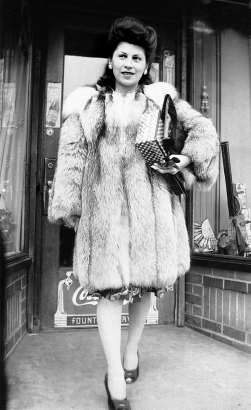
[Birth of Nancy Sandra Sinatra]
On a Saturday evening, June 8, 1940, Nancy Sandra Sinatra was born at the Margaret Hague Maternity Hospital in Jersey City while Frank was performing with the Dorsey band at the Hotel Astor, not in Hollywood as later claimed.
Source: James Kaplan, "Frank: The Voice" (2010).
June 9, 1940
Concerts
Hotel Astor, New York City, (May 21 - August 28)
Tommy Dorsey & Orch.
Connie Haines, Frank Sinatra, Jo Stafford,
The Pied Pipers, Bunny Berigan, Buddy Rich,
Joe Bushkin, Sy Oliver note: 5-21 to 8-28, 14 week run, was the longest engagement ever for the Dorsey band
June 10, 1940
Radio
Live Remote: Hotel Astor, New York City
Monday Evening
11:30 p. m. - 12;00 a.m.
NBC Red Network
WEAF
Announcer: George Hicks
Tommy Dorsey And His Orchestra
1. I'm Getting Sentimental Over You TD & Orch.
2. You Think Of Everything Connie Haines
3. The Breeze And I Frank Sinatra
4. Make Me Know It (Sy Oliver arg) TD & Orch.
5. I Can't Love You Anymore Than I Do Connie Haines
6. Easy Does It (Sy Oliver arg.) TD & Orch.
7. I'll Never Smile Again Frank Sinatra & Pied Pipers
8. Blue Moon Frank Sinatra & Band Chorus
9. Bugle Call Rag TD & Orch
10.Closing Theme TD & Orch.
Concerts
Hotel Astor, New York City, (May 21 - August 28)
Tommy Dorsey & Orch.
Connie Haines, Frank Sinatra, Jo Stafford,
The Pied Pipers, Bunny Berigan, Buddy Rich,
Joe Bushkin, Sy Oliver note: 5-21 to 8-28, 14 week run, was the longest engagement ever for the Dorsey band
June 11, 1940
Radio
Live Remote: Hotel Astor, New York City
Tuesday Evening
11:30 p. m. - 12:00 a.m.
NBC Red Network
WEAF
Tommy Dorsey & His Orchestra
Concerts
Hotel Astor, New York City, (May 21 - August 28)
Tommy Dorsey & Orch.
Connie Haines, Frank Sinatra, Jo Stafford,
The Pied Pipers, Bunny Berigan, Buddy Rich,
Joe Bushkin, Sy Oliver note: 5-21 to 8-28, 14 week run, was the longest engagement ever for the Dorsey band
June 12, 1940
Radio
Carnival of Broadway,
Astor Hotel Roof, New York City
Wednesday
Network: NBC
10:15 - 10:45 p.m.
Spanish broadcast
Tommy Dorsey & Orch.
Connie Haines, Frank Sinatra, Jo Stafford, Pied Pipers, Buddy Rich, Bunny Berigan
1. I'm Getting Sentimental Over You T.D. & Orch.
2. Song Of India Orch.
3. Say It F.S.
4. Easy Does It T.D. & Orch.
5. You Think Of Everything C.H.
6. Marie F.S. B.B. band chorus
7. Medley: I'm Nobody's Baby C.H. / The Nearness
Of You F.S. / I Can't Love You Anymore C.H.
8. I'll Never Smile Again F.S. J.S. P.P.
9. Losers Weepers T.D. & Orch.
10. I'm Getting Sentimental Over You T.D. & Orch. note: Show was aired on the NBC International White Network
("I'll Never Smile Again" appears on Masters of Jazz Volume 8)
("Marie" appears on CD: Buddha 74465 99901-2 " Frank Sinatra & Tommy Dorsey And His Orchestra – Learn To Croon";)
("Learn To Croon" & "I'll Never Smile Again" appears on Disk 5 of the RCA Box set 'The Song Is You')
("I'll Never Smile Again" & "Say It" appear on Disk 1 of "A Voice On Air" 1935-1955)
("Say It" appears on the CD: Young Blue Eyes - Birth Of The Crooner [20 tracks] Bluebird 82876 60283 2)
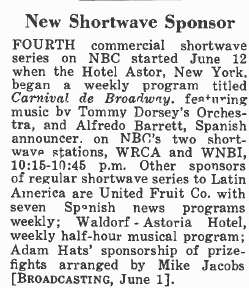
Live Remote: Hotel Astor, New York City
11:30 p. m. - 12:00 a.m.
NBC Blue Network
WJZ
1. I'm Getting Sentimental Over
You TD
& Orch.
2. My!
My!
Pied Pipers
3. Tomorrow Is A Lovely
Day Frank Sinatra
4 .Another One Of Them Things (Sy Oliver arg.) TD & Orch.
5. April Played The
Fiddle Frank
Sinatra
6. Easy Does It (Sy Oliver arg.) TD &
Orch.
7. I'll Never Smile
Again
Frank Sinatra & Pied Pipers
8. East Of The
Sun
Frank Sinatra & Band Chorus
9. Old Man
Harlem
TD & Orch.
10.Closing
Theme
TD & Orch.
Concerts
Hotel Astor, New York City, (May 21 - August 28)
Tommy Dorsey & Orch.
Connie Haines, Frank Sinatra, Jo Stafford,
The Pied Pipers, Bunny Berigan, Buddy Rich,
Joe Bushkin, Sy Oliver note: 5-21 to 8-28, 14 week run, was the longest engagement ever for the Dorsey band
June 13, 1940
Studio
New York City
BS051279 Whispering
w/The Pied Pipers
(J. Schonberger/ R. Coburn/V. Rose)
Fisher Music Corp./EMI Miller Catalog (ASCAP)
-1 (2:59) CD: 07863 66353-2 "The Song Is You" 5CD set Vol 2
CD: RCA 8554-2-R
LP: SD 1000
78: 20-1597
78: 10771
Saxes: Hymie Shertzer, Johnny Mince, Don Lodice, Paul Mason, Fred Stulce;
Trumpet: Jimmy Blake, Bunny Berigan; Guitar: Clark Yocum; Bass: Sid
Weiss; Piano: Joe Bushkin; Drums: Buddy Rich
TOMMY DORSEY (Victor) Whispering-FT; VC. Two in Love-FT; VC.
Still another evergreen seeking to bloom again, Whispering takes its cue from the screen
score of Greenwich Village. And if nothing else, it brings back an excellent Tommy Dorsey
disk along with the vocals of Frank Sinatra. Side was originally released on the Bluebird label,
then mated with Funny Little Pedro. The oldie is fashioned at a bright tempo with the rhythm
harmonies of the Pled Pipers joining Sinatra, The singers sandwich the sweet trombone slides
of the maestro for which Zlggy Elman tops with a hot trumpet chorus. Meredith Wilson's Two in Love,
another old favorite, originally a Victor Issue with Sinner Kissed an Angel, provides a moderately paced
rhythmic arrangement for the ballad with Dorsey and Sinatra sharing the side. Both sides, because of the
familiarity of the songs and the popularity of the singer, not. forgetting Tommy Dorsey's own juke box appeal,
are bound to produce a bumper crop of nickels.
Billboard
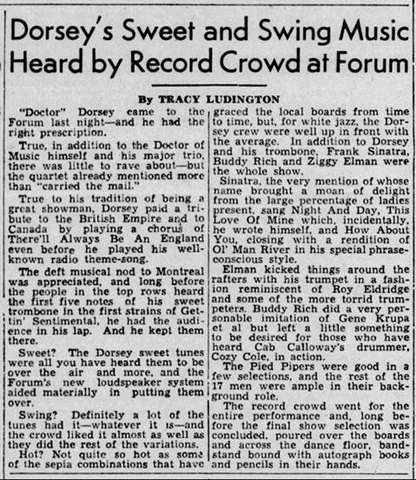
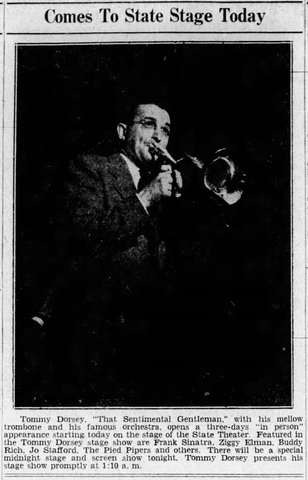
Concerts
Hotel Astor, New York City, (May 21 - August 28)
Tommy Dorsey & Orch.
Connie Haines, Frank Sinatra, Jo Stafford,
The Pied Pipers, Bunny Berigan, Buddy Rich,
Joe Bushkin, Sy Oliver note: 5-21 to 8-28, 14 week run, was the longest engagement ever for the Dorsey band
June 14, 1940
Radio
Live Remote: Hotel Astor, New York City
Friday Morning
12:15 -12:30 a. m.
NBC Red Network
WEAF
Tommy Dorsey And His Orchestra
Live Remote: Hotel Astor, New York City
Friday Morning
12:15 -12:30 a. m.
NBC Red Network
WEAF
Tommy Dorsey And His Orchestra
1. I'm Getting Sentimental Over Me TD & Orch.
2. (What Can I Say, Dear) After I Say I'm Sorry Pied Pipers
3. Yours Is My Heart Alone Frank Sinatra
4. I'll Never Smile Again Frank Sinatra & Pied Pipers
5. Losers Weepers TD & Orch.
6. Closing Theme TD & Orch.
Concerts
Hotel Astor, New York City, (May 21 - August 28)
Tommy Dorsey & Orch.
Connie Haines, Frank Sinatra, Jo Stafford,
The Pied Pipers, Bunny Berigan, Buddy Rich,
Joe Bushkin, Sy Oliver note: 5-21 to 8-28, 14 week run, was the longest engagement ever for the Dorsey band
June 15, 1940
Radio
Live Remote:Hotel Astor, New York City
Saturday Morning
1:00 - 1:30 a. m.
NBC Red & Blue Networks
WEAF & WJZ
Tommy Dorsey & His Orchestra
Announcer: Ed Herlihy
1. I'm Getting Sentimental Over
You
TD & Orch.
2. I'm Nobody's
Baby
Connie Haines
3. All This And Heaven
Too
Frank Sinatra
4. Blue
Moon
Frank Sinatra & Band Chorus
5. I'll Never Smile
Again
Frank Sinatra & Pied Pipers
6. Easy Does It (SO arr),
TD & Orch.
7. Polka Dots And
Moonbeams
Frank Sinatra
8.
Marie
Frank Sinatra & Band Chorus
9. Devil's
Holiday
TD & Orch.
10.Closing
Theme
TD & Orch.
Live Remote:Hotel Astor, New York City
Saturday Afternoon
5:00 - 6:00 p. m.
NBC Red Network
WEAF
Remote Engineer: George Mathus
Announcer: Lyle Van
Lyle Van, announcer
Tommy Dorsey & His Orchestra
Guests: Eddie DeLange and Jimmy Van Heusen
1. I'm Getting Sentimental Over
You
TD & Orch.
2. Dark
Eyes
TD & Orch.
3. Shake Down The
Stars
Frank Sinatra
4. You Think Of
Everything
Connie Haines
5. Medley of Eddie De Lange songs:
Moon Glow; Solitude; My!
My!
Pied Pipers
6. Symphony In
Riffs
TD & Orch.
7. I'll Never Smile
Again
Frank Sinatra & Pied Pipers
8. Medley of Jimmy Van Heusen tunes:
Polka Dots And
Moonbeams
Frank Sinatra
Imagination
Frank Sinatra
Takeoff (Sy Oliver arg.)
TD & Orch.
9. Medley of DeLange and Van Heusen tunes:
Heaven Can
Wait
Frank Sinatra
All I Remember Is
You
TD & Orch.
Darn That
Dream
Jo Stafford
10.How Am I To
Know
Frank Sinatra & Band Chorus
11.All This And Heaven
Too
Frank Sinatra
12.Quiet Please (Sy Oliver arg.)
TD & Org.
11. Closing
Theme
TD & Org.
Concerts
Hotel Astor, New York City, (May 21 - August 28)
Tommy Dorsey & Orch.
Connie Haines, Frank Sinatra, Jo Stafford,
The Pied Pipers, Bunny Berigan, Buddy Rich,
Joe Bushkin, Sy Oliver note: 5-21 to 8-28, 14 week run, was the longest engagement ever for the Dorsey band
June 16, 1940
Concerts
Hotel Astor, New York City, (May 21 - August 28)
Tommy Dorsey & Orch.
Connie Haines, Frank Sinatra, Jo Stafford,
The Pied Pipers, Bunny Berigan, Buddy Rich,
Joe Bushkin, Sy Oliver note: 5-21 to 8-28, 14 week run, was the longest engagement ever for the Dorsey band
June 17, 1940
Concerts
Hotel Astor, New York City, (May 21 - August 28)
Tommy Dorsey & Orch.
Connie Haines, Frank Sinatra, Jo Stafford,
The Pied Pipers, Bunny Berigan, Buddy Rich,
Joe Bushkin, Sy Oliver note: 5-21 to 8-28, 14 week run, was the longest engagement ever for the Dorsey band
June 18, 1940
Radio
Live Remote: Hotel Astor, New York City
Tuesday
12:30 a.m. -1:00 a. m.
NBC Blue Network
WJZ
Announcer: Kelvin Keech
Tommy Dorsey And Orchestra
1.I'm Getting Sentimental Over You TD & Orch.
2.You're Lonely And I'm Lonely Frank Sinatra
3. I Can't Love You Anymore Connie Haines
4. Sweet Lorraine Pied Pipers
5. Devil May Care Frank Sinatra
6. I'll Never Smile Again Frank Sinatra & Pied Pipers
7. East Of The Sun Frank Sinatra & Band Chorus
8. Dear Old Southland (Sy Oliver arg.) TD & Orch.
9. Closing Theme TD & Orch.
Live Remote: Hotel Astor, New York City
Tuesday Evening
11:30 p. m. - 12:00 a.m.
NBC Red Network
WEAF
Tommy Dorsey And Orchestra
Concerts
Hotel Astor, New York City, (May 21 - August 28)
Tommy Dorsey & Orch.
Connie Haines, Frank Sinatra, Jo Stafford,
The Pied Pipers, Bunny Berigan, Buddy Rich,
Joe Bushkin, Sy Oliver note: 5-21 to 8-28, 14 week run, was the longest engagement ever for the Dorsey band
June 19, 1940
Radio
CARNIVAL DE BROADWAY, Hotel Astor Roof, New York City
Wednesday evening
Network: NBC
Tommy Dorsey & Orch.
Connie Haines, Frank Sinatra, Jo Stafford, The Pied Pipers, Bunny Berigan, Buddy Rich
Special guest: Rudy Vallee
1. I'm Getting Sentimental Over You T.D. & Orch.
2. Dark Eyes T.D. & Orch
3. Polka Dots & Moonbeams F.S.
4. March Of The Toys T.D. & Orch.
5. I'll Never Smile Again F.S. J.S. P.P.
6. Nobody's Baby C.H.
7. Deep Night F.S & band chorus
8. Rudy Vallee speaks in Spanish
9. So What? T.D & Orch.
10. Getting Sentimental Over You T. D. & Orch.
("Deep Night" appears on the CD: Buddha 74465 999601-2 "Learn To Croon")
Concerts
Hotel Astor, New York City, (May 21 - August 28)
Tommy Dorsey & Orch.
Connie Haines, Frank Sinatra, Jo Stafford,
The Pied Pipers, Bunny Berigan, Buddy Rich,
Joe Bushkin, Sy Oliver note: 5-21 to 8-28, 14 week run, was the longest engagement ever for the Dorsey band
June 20, 1940
Concerts
Hotel Astor, New York City, (May 21 - August 28)
Tommy Dorsey & Orch.
Connie Haines, Frank Sinatra, Jo Stafford,
The Pied Pipers, Bunny Berigan, Buddy Rich,
Joe Bushkin, Sy Oliver note: 5-21 to 8-28, 14 week run, was the longest engagement ever for the Dorsey band
June 21, 1940
Radio
Live Remote:Hotel Astor, New York City
Friday Morning
12:10 - 12:30 a. m.
NBC Red Network
WEAF
Tommy Dorsey And His Orchestra
1. I'm Getting Sentimental Over You TD & Orch.
2. Where Do I Go From You Connie Haines
3. Halfway Down The Street Frank Sinatra
4. March Of The Toys TD & Orch.
5. Easy Does It TD & Orch.
6. I'll Never Smile Again Frank Sinatra & Pied Pipers
7. So What TD & Orch.
8. Closing Theme TD & Orch.
Concerts
Hotel Astor, New York City, (May 21 - August 28)
Tommy Dorsey & Orch.
Connie Haines, Frank Sinatra, Jo Stafford,
The Pied Pipers, Bunny Berigan, Buddy Rich,
Joe Bushkin, Sy Oliver note: 5-21 to 8-28, 14 week run, was the longest engagement ever for the Dorsey band
June 22, 1940
Studio
Roof of Hotel Astor, New York City
Saturday Afternoon
Network: NBC
Tommy Dorsey & Orch
Connie Haines, Frank Sinatra, Jo Stafford,
The Pied Pipers, Buddy Rich, Sy Oliver
1. I'm Getting Sentimental Over You T.D. & Orch.
2. Dark Eyes T.D. & Orch.
3. I'm Nobody's Baby Connie Haines
4. Sweet Lorraine P.P.
5. Symphony In Riffs T.D. & Orch.
6. Medley: Moonglow, P.P. Solitude, T.D. & Orch.
Midnight On the Trail F.S.
7. When I Go Dreamin' T.D. & Orch.
8. I Live The Life I Love F.S.
9. Devil May Care F.S.
10. Ya Got Me C.H.
11. There Is No Place Like Your Arms F.S.
12. Stop! It's Wonderful P.P.
13. When We're Alone * F.S.
14. Louise T.D. & Orch.
15. Learn To Croon F.S.
16. More Than You Know T.D. & Orch.
17. How Come You Do Me Like You Do ? C.H.
18. When You Say The Word F.S.
19. Honeysuckle Rose T.D. & Orch.
20. I'm Getting Sentimental Over You T.D. & Orch.
* Penthouse Serenade was called "When We're Alone" by T.D.
("When You Say The Word" appears on Masters of Jazz Volume 9 and on the CD: Jazz Hour JH-1052 Tommy Dorsey & His Orchestra: 1936/41 Broadcasts)
Hotel Astor Roof, New York
(Sat) 5:00 – 6:00 p. m.
(NBC Red) (WEAF) (Sustaining)
"The Dorsey Hour"
George Mathus, remote engineer
Lyle Van, announcer
Bickley Reichner and Clay A. Boland, guests
1. I'm Getting Sentimental Over You (open)
2. Dark Eyes
3. Lights Out
4. Hold Me Tight (CH)
5. Medley of Bickley Reichner tunes: Midnight on The Trail (FS), When I Go Dreamin'
6. I Live The Life I Love (FS)
7. The Eyes And Ears Of The World (Paramount on Parade)
8. Stop Beatin' Around The Mulberry Bush (CH)
9. Swing High
10. When You Say The Word (FS)
11. Medley of Bickley Reichner tunes: You Got Me (CH), There's No Place Like Your Arms (FS), Stop! It's Wonderful (PP)
12. Honeysuckle Rose
13. Medley of popular tunes: When We're Alone (FS), Louise, Can't We Be Friends
14. Blues No More
15. Tell Me At Midnight (FS)
16. Bugle Call Rag
17. I'm Getting Sentimental Over You (close)
Concerts
Hotel Astor, New York City, (May 21 - August 28)
Tommy Dorsey & Orch.
Connie Haines, Frank Sinatra, Jo Stafford,
The Pied Pipers, Bunny Berigan, Buddy Rich,
Joe Bushkin, Sy Oliver note: 5-21 to 8-28, 14 week run, was the longest engagement ever for the Dorsey band
June 23, 1940
Concerts
Hotel Astor, New York City, (May 21 - August 28)
Tommy Dorsey & Orch.
Connie Haines, Frank Sinatra, Jo Stafford,
The Pied Pipers, Bunny Berigan, Buddy Rich,
Joe Bushkin, Sy Oliver note: 5-21 to 8-28, 14 week run, was the longest engagement ever for the Dorsey band
June 24, 1940
Radio
Live Remote:Hotel Astor, New York City
Monday Evening
11:36 p m. - 12:00 a.m.
NBC Red Network
WEAF
Tommy Dorsey & His Orchestra
Announcer: Jack Costello
1 .I'm Getting Sentimental Over You TD & Orch.
2 .My, My! Pied Pipers
3. Halfway Down The Street Frank Sinatra
4. Easy Does It TD & Orch.
5. I'll Never Smile Again Frank Sinatra & Pied Pipers
6. Make Me Know It TD & Orch.
7. Devil's Holiday TD & Orch.
8. Closing Theme TD & Orch.
Concerts
Hotel Astor, New York City, (May 21 - August 28)
Tommy Dorsey & Orch.
Connie Haines, Frank Sinatra, Jo Stafford,
The Pied Pipers, Bunny Berigan, Buddy Rich,
Joe Bushkin, Sy Oliver note: 5-21 to 8-28, 14 week run, was the longest engagement ever for the Dorsey band
June 25, 1940
Radio
Pepsodent Summer Pastime
Tuesday Evening
10: p.m. - 10:30 p.m.
NBC Red Network - WEAF
New York City
Tommy Dorsey And His Orchestra
Connie Haines, Frank Sinatra, Bunny Berigan,
Joe Bushkin, Jo Stafford, Pied Pipers, Sy Oliver,
Buddy Rich and the Diller Family( comedy skit every week)
Announcer:: Ed Herlihy
1. I'm Getting Sentimental Over You TD & Orch.
2. Song Of India TD & Orch.
3. Moonlight And Roses TD & Orch.
4. Imagination Frank Sinatra
5. You Think Of Everything Connie Haines
6. Friendship (" Diller Family" ) : Bunny Berigan, Buddy Rich & Pied Pipers
7. Charming Little Faker Pied Pipers
8. What Are You Doing Now TD & Orch.
9. Medley: a. Dardanella b. Once In A While c. The Music Goes Round And Round
10. Hawaiian War Chant TD & Orch.
11. Closing Theme TD & Orch.
Notes: 13 Week Summer Replacement Series For Bob Hope
Concerts
Hotel Astor, New York City, (May 21 - August 28)
Tommy Dorsey & Orch.
Connie Haines, Frank Sinatra, Jo Stafford,
The Pied Pipers, Bunny Berigan, Buddy Rich,
Joe Bushkin, Sy Oliver note: 5-21 to 8-28, 14 week run, was the longest engagement ever for the Dorsey band
Pepsodent Summer Pastime
Tuesday Evening
10: p.m. - 10:30 p.m.
NBC Red Network - WEAF
New York City
Tommy Dorsey And His Orchestra
Connie Haines, Frank Sinatra, Bunny Berigan,
Joe Bushkin, Jo Stafford, Pied Pipers, Sy Oliver,
Buddy Rich and the Diller Family( comedy skit every week)
Announcer:: Ed Herlihy
Tommy Dorsey Reviewed Tuesday. 10-10:30 p.m. StyleVariety, Sponsor: Pepsodent Toothpaste -- AgencyLord & Thomas. Station: WEAF (NBC-Red Nelwork). Tommy Dorsey presides at a thoroughly enjoyable variety session which should make listeners Pepsodent conscious, Show is nicely paced with other talent including vocalists Frank Sinatra and Connie Haines, who get a single each In which to show off their nice pipes. Tommy makes an amiable emcee and is allotted a good script. In this department, however, he still has a few notches to go before he can compare with Bing Crosby. All in all he gives a creditable account of hlmself as a trombonist maestro and gabber. Guest was Jerry Lester, a fine comedian on a night club floor and who looks like star radio fodder, On thls program he was handicapped by poor material and bad tlming from the stooges. However, he was astute enough to capitalize on slips by proddlng his foil. Voice, dellvery and breezy style make hlm a definite possibility. Commercials are not too long and are nicely handled with short stretches of dialog. Cohen
Billboard
7-20-40
Variety
July 3, 1940
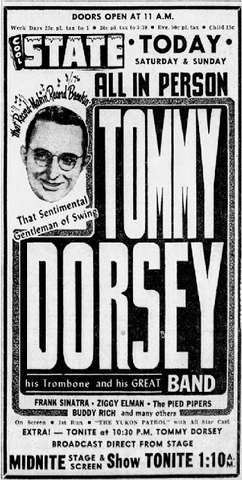
June 26, 1940
Radio
CARNIVAL DE BROADWAY, Roof Of Astor Hotel
Spanish broadcast
Wednesday
NBC
Tommy Dorsey & His Orch.
Connie Haines, Frank Sinatra, Jo Stafford, The
Pied Pipers, Buddy Rich, Sy Oliver
Clyde Hurley replaced Leon DeBrow on trumpet.
Clark Yokum, using the pseudonym Allan Storr, joined
The Pied Pipers
1. I'm Getting Sentimental Over You T.D. & Orch.
2. Irene T.D. & Orch.
3. Rhumba Boogie C.H.
4. East Of The Sun F.S. & Band Chorus
5. Symphony In Riffs T.D. & Orch.
Concerts
Hotel Astor, New York City, (May 21 - August 28)
Tommy Dorsey & Orch.
Connie Haines, Frank Sinatra, Jo Stafford,
The Pied Pipers, Bunny Berigan, Buddy Rich,
Joe Bushkin, Sy Oliver note: 5-21 to 8-28, 14 week run, was the longest engagement ever for the Dorsey band
June 27, 1940
Studio
New York City
BS051579 Trade Winds
(C. Friend/C. Tobias)
Warner Bros. Music/Ched Music Corp. (ASCAP)
-1 (2:59) CD: 07863 66353-2 "The Song Is You" 5 CD set Vol 2
CD: RCA 9679-2-R
LP: SD 1000
78: 26666
-2 N/R
BS051581 The One I Love (Belongs To Somebody Else) w/The Pied Pipers
(G. Kahn/I. Jones)
Bantam Music Publishing Co./Girlbert Keyes Music Co. (ASCAP) Arranged by Sy Oliver
-1 (3:30) CD: 07863 66353-2 "The Song Is You" 5 CD set Vol 2
CD: RCA 8554-2-R
LP: SD 1000
78: 20-2446
78: 26660
-2 N/R
Saxes: Fred Stulce, Johnny Mince, Hymie Shertzer, Paul Mason, Don Lodice; Trumpets: Ray Linn, Jimmy Blake, Bunny Berigan, Clyde Hurley; Piano: Joe Bushkin; Trombones: Lowell Martin, George Arus, Les Jenkins; Guitar: Clark Yocum; Bass: Sid Weiss; Drums: Buddy Rich
Note: Trade Winds -2 & The One I Love -2 have not been located in the RCA vaults
Concerts
Hotel Astor, New York City, (May 21 - August 28)
Tommy Dorsey & Orch.
Connie Haines, Frank Sinatra, Jo Stafford,
The Pied Pipers, Bunny Berigan, Buddy Rich,
Joe Bushkin, Sy Oliver note: 5-21 to 8-28, 14 week run, was the longest engagement ever for the Dorsey band
[Sinatra records 'Trade Winds' in New York]
Sinatra recorded 'Trade Winds' with Dorsey and orchestra in New York, featuring Bunny Berigan on trumpet, Joe Bushkin on piano, and Buddy Rich on drums -- four days before Bing Crosby recorded his own version.
Source: James Kaplan, "Frank: The Voice" (2010).
June 28, 1940
Concerts
Hotel Astor, New York City, (May 21 - August 28)
Tommy Dorsey & Orch.
Connie Haines, Frank Sinatra, Jo Stafford,
The Pied Pipers, Bunny Berigan, Buddy Rich,
Joe Bushkin, Sy Oliver note: 5-21 to 8-28, 14 week run, was the longest engagement ever for the Dorsey band
June 29, 1940
Concerts
Hotel Astor, New York City, (May 21 - August 28)
Tommy Dorsey & Orch.
Connie Haines, Frank Sinatra, Jo Stafford,
The Pied Pipers, Bunny Berigan, Buddy Rich,
Joe Bushkin, Sy Oliver note: 5-21 to 8-28, 14 week run, was the longest engagement ever for the Dorsey band
June 30, 1940
Concerts
Hotel Astor, New York City, (May 21 - August 28)
Tommy Dorsey & Orch.
Connie Haines, Frank Sinatra, Jo Stafford,
The Pied Pipers, Bunny Berigan, Buddy Rich,
Joe Bushkin, Sy Oliver note: 5-21 to 8-28, 14 week run, was the longest engagement ever for the Dorsey band
July 1, 1940
Concerts
Hotel Astor, New York City, (May 21 - August 28)
Tommy Dorsey & Orch.
Connie Haines, Frank Sinatra, Jo Stafford,
The Pied Pipers, Bunny Berigan, Buddy Rich,
Joe Bushkin, Sy Oliver note: 5-21 to 8-28, 14 week run, was the longest engagement ever for the Dorsey band
[Crosby records 'Trade Winds' in Los Angeles]
Bing Crosby recorded his version of 'Trade Winds' on Monday, July 1, 1940, in Los Angeles with Dick McIntire and His Harmony Hawaiians.
Source: James Kaplan, "Frank: The Voice" (2010).
July 2, 1940
Radio
"Pepsodent Summer Pastime"ť #2
Tuesday Evening
10:01 – 10:30 p.m. ;
NBC RED
WEAF
Radio City,
New York City
Lord & Thomas
Announcer: Ed Herlihy
1. I'm Getting Sentimental Over You TD & Orch
2. Marie Frank Sinatra & Band Chorus
3. I Can't Love You Anymore Than I Do ( Sy Oliver arg.) Connie Haines
4. Boogie Woogie TD & Orch
5. I'll Never Smile Again Frank Sinatra & Pied Pipers
6. Friendship ( Diller Family Skit) Organ Solo
7. What Are You Doing Now Medley a. Wabash Blues TD & Orch b. Will You Love Me In December c. Yes, We Have No Bananas The Pied Pipers
8. I Know That You Know TD & Orch
9. I'm Getting Sentimental Over You TD & Orch
Concerts
Hotel Astor, New York City, (May 21 - August 28)
Tommy Dorsey & Orch.
Connie Haines, Frank Sinatra, Jo Stafford,
The Pied Pipers, Bunny Berigan, Buddy Rich,
Joe Bushkin, Sy Oliver note: 5-21 to 8-28, 14 week run, was the longest engagement ever for the Dorsey band
July 3, 1940
Concerts
Hotel Astor, New York City, (May 21 - August 28)
Tommy Dorsey & Orch.
Connie Haines, Frank Sinatra, Jo Stafford,
The Pied Pipers, Bunny Berigan, Buddy Rich,
Joe Bushkin, Sy Oliver note: 5-21 to 8-28, 14 week run, was the longest engagement ever for the Dorsey band
July 4, 1940
Concerts
Hotel Astor, New York City, (May 21 - August 28)
Tommy Dorsey & Orch.
Connie Haines, Frank Sinatra, Jo Stafford,
The Pied Pipers, Bunny Berigan, Buddy Rich,
Joe Bushkin, Sy Oliver note: 5-21 to 8-28, 14 week run, was the longest engagement ever for the Dorsey band
July 5, 1940
Concerts
Hotel Astor, New York City, (May 21 - August 28)
Tommy Dorsey & Orch.
Connie Haines, Frank Sinatra, Jo Stafford,
The Pied Pipers, Bunny Berigan, Buddy Rich,
Joe Bushkin, Sy Oliver note: 5-21 to 8-28, 14 week run, was the longest engagement ever for the Dorsey band
July 6, 1940
Concerts
Hotel Astor, New York City, (May 21 - August 28)
Tommy Dorsey & Orch.
Connie Haines, Frank Sinatra, Jo Stafford,
The Pied Pipers, Bunny Berigan, Buddy Rich,
Joe Bushkin, Sy Oliver note: 5-21 to 8-28, 14 week run, was the longest engagement ever for the Dorsey band
July 7, 1940
Concerts
Hotel Astor, New York City, (May 21 - August 28)
Tommy Dorsey & Orch.
Connie Haines, Frank Sinatra, Jo Stafford,
The Pied Pipers, Bunny Berigan, Buddy Rich,
Joe Bushkin, Sy Oliver note: 5-21 to 8-28, 14 week run, was the longest engagement ever for the Dorsey band
July 8, 1940
Concerts
Hotel Astor, N.Y.C. (May 21 thru August 28)
Tommy Dorsey & Orch.
Connie Haines, Frank Sinatra, Jo Stafford,
The Pied Pipers, Bunny Berigan, Buddy Rich,
Joe Bushkin, Sy Oliver note: 5-21 to 8-28, 14 week run, was the longest engagement ever for the Dorsey band
July 9, 1940
Radio
Pepsodent Summer Pastime"
Location: Radio City, New York City
Tuesday Evening
10:01 10:30 p.m.&nbbsp;
NBC RED
WEAF
Lord & Thomas
Announcer: Ed Herlihy
1. I'm Getting Sentimental Over You TD & Orch
2. Dark Eyes TD & Orch
3. Fools Rush In Frank Sinatra
4. I'm Nobody's Baby Connie Haines
5. Losers, Weepers ( Sy Oliver arg.) TD & Orch
6. It Ain't What You Think ( Sy Oliver arg.) TD & Orch
7. Imagination Frank Sinatra
8. Friendship ( Diller Family skit) Organ Solo
9. What Are You Doing Now Medley Ensemble a. Happy Birthday To You b. You Took Advantage Of Me c. Hearts And Flowers d. You'd Be Surprised
10. Closing Theme
Concerts
Hotel Astor, N.Y.C. (May 21 thru August 28)
Tommy Dorsey & Orch.
Connie Haines, Frank Sinatra, Jo Stafford,
The Pied Pipers, Bunny Berigan, Buddy Rich,
Joe Bushkin, Sy Oliver note: 5-21 to 8-28, 14 week run, was the longest engagement ever for the Dorsey band
July 10, 1940
Concerts
Hotel Astor, N.Y.C. (May 21 thru August 28)
Tommy Dorsey & Orch.
Connie Haines, Frank Sinatra, Jo Stafford,
The Pied Pipers, Bunny Berigan, Buddy Rich,
Joe Bushkin, Sy Oliver note: 5-21 to 8-28, 14 week run, was the longest engagement ever for the Dorsey band
July 11, 1940
Radio
Live Remote: Hotel Astor, New York City
Thursday Evening
11:30 p. m. - 12:00 a.m.
NBC Blue Network
WJZ
Announcer: Lyle Van
Tommy Dorsey And His Orchestra
1. I'm Getting Sentimental Over You TD & Orch.
2. Sweet Lorraine Pied Pipers
3. Tell Me At Midnight Frank Sinatra
4. Lights Out, Hold Me Tight Connie Haines
5. Halfway Down The Street Frank Sinatra
6. Swing High (Sy Oliver arg.) TD & Orch.
7. I'll Never Smile Again Frank Sinatra & Pied Pipers
8. East Of The Sun (And West of the Moon) Frank Sinatra & Band Chorus
9. I Know That You Know TD & Orch.
10. Closing Theme TD & Orch.
Concerts
Hotel Astor, N.Y.C. (May 21 thru August 28)
Tommy Dorsey & Orch.
Connie Haines, Frank Sinatra, Jo Stafford,
The Pied Pipers, Bunny Berigan, Buddy Rich,
Joe Bushkin, Sy Oliver note: 5-21 to 8-28, 14 week run, was the longest engagement ever for the Dorsey band
July 12, 1940
Concerts
Hotel Astor, N.Y.C. (May 21 thru August 28)
Tommy Dorsey & Orch.
Connie Haines, Frank Sinatra, Jo Stafford,
The Pied Pipers, Bunny Berigan, Buddy Rich,
Joe Bushkin, Sy Oliver note: 5-21 to 8-28, 14 week run, was the longest engagement ever for the Dorsey band
July 13, 1940
Radio
"The Dorsey Hour" Hotel Astor Roof, New York City
Saturday
5:00-6:00 p. m.
NBC Red
WEAF
Sustaining
Announcer: Lyle Van,
Remote Engineer: George Mathus
1. I'm Getting Sentimental Over You TD & Orch
2. Night And Day TD & Orch
3. Polka Dots And Moonbeams Frank Sinatra
4. Swanee River ( Sy Oliver arg.) TD & Orch
5. The One I Love Belongs To Somebody Else Frank Sinatra & Pied Pipers
6. And So Do I Frank Sinatra
7. Losers Weepers TD & Orch
8. Medley Of Most Played Tunes Of The Week: a. Fools Rush In Frank Sinatra b. Sierra Sue TD & Orch c. I'm Stepping Out With A Memory Tonight Connie Haines
9. Funny Little Pedro Pied Pipers
10. Head On My Pillow Frank Sinatra
11 .Star Dust (Sy Oliver arg.) TD & Orch 12 .Milenburg Joys (Deane Kincaide arg.) TD & Orch
13. Medley: (Ensemble) a. For You; b .Sophisticated Lady; c. A Basket Of Love,
14. I'll See You In My Dreams Frank Sinatra & Band Chorus
15. Quiet Please (SyOliver arg) TD & Orch
16. Closing Theme
Ed O'Brien:
A year after Frank's first commercial recordings, he was the star male vocalist with the best of all the big bands. Dorsey was a harsh taskmaster who exhausted an ensemble of great musicians. Sinatra learned the discipline and hard work his craft demanded under the tutelage of Mr. Dorsey.
Concerts
(May 21 thru August 28)
Hotel Astor, N.Y.C.
Tommy Dorsey & Orch.
Connie Haines, Frank Sinatra, Jo Stafford,
The Pied Pipers, Bunny Berigan, Buddy Rich,
Joe Bushkin, Sy Oliver note: 5-21 to 8-28, 14 week run, was the longest engagement ever for the Dorsey band
July 14, 1940
Concerts
(May 21 thru August 28)
Hotel Astor, N.Y.C.
Tommy Dorsey & Orch.
Connie Haines, Frank Sinatra, Jo Stafford,
The Pied Pipers, Bunny Berigan, Buddy Rich,
Joe Bushkin, Sy Oliver note: 5-21 to 8-28, 14 week run, was the longest engagement ever for the Dorsey band
July 15, 1940
Concerts
Hotel Astor, New York, New York (May 21 thru August 28) Tommy Dorsey & Orch.
Connie Haines, Frank Sinatra, Jo Stafford,
The Pied Pipers, Bunny Berigan, Buddy Rich,
Joe Bushkin, Sy Oliver note: 5-21 to 8-28, 14 week run, was the longest engagement ever for the Dorsey band
July 16, 1940
Radio
Pepsodent Summer Pastime Show #4
Tuesday Evening
10:00 p.m. -10:30 p.m.
NBC Red Network
WEAF
New York City
Announcer: Ed Herlihy
Tommy Dorsey And His Orchestra
1. I'm Getting Sentimemtal Over You TD & Orch.
2. Where Do I Go From You Connie Haines
3. Commercial Pied Pipers Sing Parodies -- Somebody Loves Me ( Sy Oliver Arg.),
I'm Gettin' Sentimental Over You
5. I'll Never Smile Again Frank Sinatra & Pied Pipers
6. March Of The Toys Bunny Berigan & Orch.
7. Diller Family Skit (Friendship Parody) Bunny Berigan-Buddy Rich-Pied Pipers
8. I Can't Resist You Frank Sinatra
9. A telegram from Bob Hope ( TD was summer replacement in his NBC time slot )
10. Medley: It's A Sin To Tell A Lie, There's A Quaker Down in Quaker Town,
I'm Sorry I Made You Cry, TD & Orch.
11. Commercial
12. Old Black Joe (Deane Kincaide arg.) TD & Orch.
13. Closing Theme
Concerts
Hotel Astor, N.Y.C, (May 21 thru August 28)
Tommy Dorsey & Orch.
Connie Haines, Frank Sinatra, Jo Stafford,
The Pied Pipers, Bunny Berigan, Buddy Rich,
Joe Bushkin, Sy Oliver note: 5-21 to 8-28, 14 week run, was the longest engagement ever for the Dorsey band
July 17, 1940
Studio
New York City
BS051874 The Call Of The Canyon
(from the Paramount Picture Rhythm On The Range)
(Billy Hill)
Shapiro, Bernstein & Co. Inc. (ASCAP)
-1 (3:05) CD: 07863 66353-2 "The Song Is You" 5CD set Vol 2
CD: RCA 2269-2-R
LP: SD 1000
78: 26678
BS051875 Love Lies
(C. Sigman/R. Freed/J. Meyer)
EMI Feist Catalog, Inc. (ASCAP)
-1 (3:20) CD: 07863 66353-2 "The Song Is You" 5CD set Vol 2
LP: SD 1000
78: 26678
BS051876 I Could Make You Care
(from the Warner Bros. film Ladies Must Live)
(S. Cahn/S. Chaplin)
Warner Bros. Music Inc. (ASCAP)
-1 (3:06) CD: 07863 66353-2 "The Song Is You" 5CD set Vol 2
CD: RCA 8554-2-R
LP: SD 1000
78: 26717
BS051877 The World Is In My Arms
(from the musical Hold On To Your Hats)
( E.Y. Harburg/B. Lane )
Chappell & Co., Inc. (ASCAP)
-1 (3:10) CD: 07863 66353-2 "The Song Is You" 5CD set Vol 2
CD: RCA 2269-2-R
LP: SD 1000
78: 26717
Saxes: Fred Stulce, Johnny Mince, Hymie Shertzer, Paul Mason, Don Lodice;
Trumpets: Ray Linn, Jimmy
Blake, Bunny Berigan, Clyde Hurley; Piano: Joe Bushkin; Trombones: Lowell Martin, George Arus, Les
Jenkins; Guitar: Clark Yocum; Bass: Sid Weiss; Drums: Buddy Rich
Concerts
Hotel Astor, N.Y.C., (May 21 thru August 28)
Tommy Dorsey & Orch.
Connie Haines, Frank Sinatra, Jo Stafford,
The Pied Pipers, Bunny Berigan, Buddy Rich,
Joe Bushkin, Sy Oliver note: 5-21 to 8-28, 14 week run, was the longest engagement ever for the Dorsey band
July 18, 1940
Concerts
(May 21 thru August 28)
Hotel Astor, N.Y.C.
Tommy Dorsey & Orch.
Connie Haines, Frank Sinatra, Jo Stafford,
The Pied Pipers, Bunny Berigan, Buddy Rich,
Joe Bushkin, Sy Oliver note: 5-21 to 8-28, 14 week run, was the longest engagement ever for the Dorsey band
July 19, 1940
Concerts
(May 21 thru August 28)
Hotel Astor, N.Y.C.
Tommy Dorsey & Orch.
Connie Haines, Frank Sinatra, Jo Stafford,
The Pied Pipers, Bunny Berigan, Buddy Rich,
Joe Bushkin, Sy Oliver note: 5-21 to 8-28, 14 week run, was the longest engagement ever for the Dorsey band
July 20, 1940
Radio
Roof of the Hotel Astor in N.Y.C.
Saturday afternoon
Tommy Dorsey & Orch.
Connie Haines, Frank Sinatra, Jo Stafford,
Pied Pipers, The Sentimentalists, Bunny Berigan,
Buddy Rich, Sy Oliver, Johnny Mince
Annc: Lyle Van
NBC
"Yes sir, it's that sentimental gentleman of swing, ladies and gentlemen, Tommy Dorsey, his golden voiced trombone and his versatile orchestra with Connie Haines, Frank Sinatra and the Pied Piper Quartet, coming to you for a full-hour from the Roof Garden of the Hotel
Astor, in Times Square, in little old New York.
Here's that trombone right now -- the master's touch."
1. I'm Getting Sentimental Over You T.D & Orch.
2. Lights Out C.H.
3. Half Way Down The Street F.S.
4. Easy Does It (Sy Oliver arg.) T.D. & Orch.
5. Funny Little Pedro ( Ruth Lowe composition) J.S. P.P. & Sentimentalists
6. The World Is In My Arms (first time on air) F.S.
Three most played tunes of the week:
7. I'm Nobody's Baby C.H.
8. The Nearness Of You F.S.
9. I Can't Love You Anymore C.H. next week, amateur song contest will begin
10. Dear Old Southland T.D. & Orch.
11. Whispering F.S. J.S. P.P & Sentimentalists
12. The Lonesome Road T.D. & Orch.
13. Some Of Your Sweetness Got Into My Heart (first time on air) F.S.
14. Make Me Know It T.D. & Orch.
15. Medley: Learn To Croon F.S More Than You Know T.D. & Orch
How Come You Do Me Like You Do J.S.
16. East Of The Sun F.S. J.S. P.P. band chorus, Bunny Berigan & Sentimentalists
17. I Got Rhythm T.D. & Orch.
18. I'm Getting Sentimental Over You T.D. & Orch.
Notes: Ed O'Brien supplied the above radio show info.
("Half Way Down The Street", "The World Is In My Arms" and "Some Of Your Sweetness" appear on Masters ofJazz Volume 9)
("Half Way Down The Street", & "Some Of Your Sweetness Got Into My Heart" appear on disk 5 of Dorsey/Sinatra The Song Is You Box Set)
("The World Is In My Arms" & & "The Nearness of You" appear on the CD: BMG-60283 Young Blue Eyes-Birth of A Crooner)
(The "Learn To Croon" Medley" appear on the CD: Buddha 74465 999601-2 "Learn To Croon")
Your Hit Parade
Network: CBS
Program #273
Time: 9:00-9:45 P.M. (Rebroadcast July 21, 1940 12:00-12:45 A.M.)
Sponsor: Lucky Strike
1. commercial 1
2. I'm Stepping Out With A Memory Tonight (10) - Barry Wood
3. Where Was I (5) - Hit Paraders
4. Especially For You - Donnie Baker & Orrin Tucker
5. commercial 2
6. Sierra Sue (7) - Barry Wood & Hit Paraders
7. The Woodpecker Song (6) - Bea Wain & Hit Paraders
8. I'll Never Smile Again (9) - Tommy Dorsey w/Frank Sinatra & Pied Pipers
9. Top Hat - Orchestra
10. commercial 3
11. Playmates (4) - Donnie Baker & Orrin Tucker
12. Imagination (8) - Bea Wain
13. Let Yourself Go - Barry Wood & Hit Paraders
14. commercial 4
15. Make Believe Island (3) - Hit Paraders
16. The Breeze And I (2) - Bea Wain & Hit Paraders
17. Fools Rush In (1) - Barry Wood
Ed O'Brien:
Here is the conversation between TD and Barry Wood before the band performed on the show:
Dorsey Theme plays
B.W.: Yes folks, you've guessed it. It's that sentimental gentleman of swing . . Tommy Dorsey.
T.D. : Thanks everybody. Barry, I want you to know its a great thrill for the Dorseys, when Uncle Tom makes the Hit Parade.
To tell the truth, I really had to make it this time., A few Tuesdays back, when I was getting set for the Pepsodent, I made a prediction on the radio that the song I'd found, published, recorded and kept getting a lot of requests for . . .
B.W.: I think I remember, Tommy.
T.D.: Yeah, I went out on a limb, with a lot of people sending notes. I said there were times when you heard a song and just knew it was going to be a hit. And I guessed right cause making the Parade is making a big league. Barry, you know the tune I'm talking about.
B.W.: I'll say I do Tommy -- we all do. So with the help of Mark Warnow,
Frank Sinatra, The Pied Pipers, Tommy Dorsey introduces for the first time on the Hit Parade, Ruth Lowe's great tune "I'll Never Smile Again."
Number nine.
Variety article from 7-17-40
Tommy Dorsey, his vocalist Frank Sinatra, and quartet,
The Pied Pipers will make an unprecedented guest appearance on Lucky Strike Hit Parade this Saturday
(20) to play and sing Dorsey's hit tune, "I'll Never Smile Again." Quartet and Sinatra figure importantly in Dorsey's arrangement and his 16 bar solo as background also figures prominently. Leader owns the Sun Music
Company, which published the number. Broadcast is the first on which the tune rates Parade attention.
Ruth Lowe, the Toronto writer of the ditty, appeared on "We The People" B'cast last night(Tuesday) to relate how she came to write it.
Concerts
(May 21 thru August 28)
Hotel Astor, N.Y.C.
Tommy Dorsey & Orch.
Connie Haines, Frank Sinatra, Jo Stafford,
The Pied Pipers, Bunny Berigan, Buddy Rich,
Joe Bushkin, Sy Oliver note: 5-21 to 8-28, 14 week run, was the longest engagement ever for the Dorsey band
July 21, 1940
Concerts
Hotel Astor, N.Y.C (May 21 thru August 28), .
Tommy Dorsey & Orch.
Connie Haines, Frank Sinatra, Jo Stafford,
The Pied Pipers, Bunny Berigan, Buddy Rich,
Joe Bushkin, Sy Oliver note: 5-21 to 8-28, 14 week run, was the longest engagement ever for the Dorsey band
July 22, 1940
Concerts
(May 21 thru August 28)
Hotel Astor, N.Y.C.
Tommy Dorsey & Orch.
Connie Haines, Frank Sinatra, Jo Stafford,
The Pied Pipers, Bunny Berigan, Buddy Rich,
Joe Bushkin, Sy Oliver note: 5-21 to 8-28, 14 week run, was the longest engagement ever for the Dorsey band
July 23, 1940
Radio
"Pepsodent Summer Pastime" # 5
Tommy Dorsey & His Orchestra
Connie Haines, Frank Sinatra, The Pied Pipers
Tuesday
10:00 -10:30 p. m.
NBC Radio City,
New York
NBC Red
WEAF
Announcer: Ed Herlihy

Concerts
(May 21 thru August 28)
Hotel Astor, N.Y.C.
Tommy Dorsey & Orch.
Connie Haines, Frank Sinatra, Jo Stafford,
The Pied Pipers, Bunny Berigan, Buddy Rich,
Joe Bushkin, Sy Oliver note: 5-21 to 8-28, 14 week run, was the longest engagement ever for the Dorsey band
July 24, 1940
Radio
CARNIVAL DE BROADWAY
Spanish broadcast
Wednesday evening
NBC
Hotel Astor Roof
Tommy Dorsey & Orch.
Connie Haines, Frank Sinatra, Jo Stafford, Pied Pipers, Buddy Rich, Bunny Berigan, Sy Oliver
1. I'm Getting Sentimental Over You T.D. & Orch.
2. The One I Love Belongs To Somebody Else F.S. J.S. P.P.
3. Fools Rush In F.S.
4. Swing High T.D. & Orch
5. Medley: Alice Blue Gown F.S. Castle Of Dreams T.D. & Orch.
("Alice Blue Gown" appears on the CD: BMG Bluebird 60283-2 - Young Blue Eyes - Birth of A Crooner)
("Fools Rush In" appears on the CD: Young Blue Eyes: Birth Of The Crooner [22 Tracks, Costco Edition])
Concerts
Hotel Astor, N.Y.C. (May 21 thru August 28)
Tommy Dorsey & Orch.
Connie Haines, Frank Sinatra, Jo Stafford,
The Pied Pipers, Bunny Berigan, Buddy Rich,
Joe Bushkin, Sy Oliver note: 5-21 to 8-28, 14 week run, was the longest engagement ever for the Dorsey band
July 25, 1940
Radio
Hotel Astor Roof, New York City
Thursday
11:30 p. m. - Midnight
NBC Blue Network
WJZ
Sustaining
TOMMY DORSEY AND HIS ORCHESTRA
Trumpets: Bunny Berigan, Ray Linn, Jimmy Blake, Clyde Hurley; Trombones: TD,
Les
Jenkins, George Arus, Lowell Martin; Reeds: Johnny Mince (clt & as), Fred Stulce,
Hymie Schertzer (as), Don Lodice, Paul Mason (ts); Rhythm: Joe Bushkin (p), Clark
Yocum (g), Sid Weiss (b); Buddy Rich (d); Vocalists: Frank Sinatra, Connie Haines, the
Pied Pipers (Jo Stafford, Billy Wilson, Chuck Lowry and John Huddleston); Arrangers:
Deane Kincaide, Sy Oliver, Axel Stordahl, Fred Stulce.
1 I'm Getting Sentimental Over You TD & Och
2. I'll Always Be In Love With You The Pied Pipers
3. Halfway Down The Street Frank Sinatra
4. Head On My Pillow Frank Sinatra
5. The Eyes And Ears Of The World TD & Orch
6. Funny Little Pedro The Pied Pipers
7. And So Do I Frank Sinatra
8. East Of The Sun (And West of the Moon) Frank Sinatra & Band Chorus
9. Losers Weepers TD & Orch
10. Closing Theme TD & Orch
Television
NONE
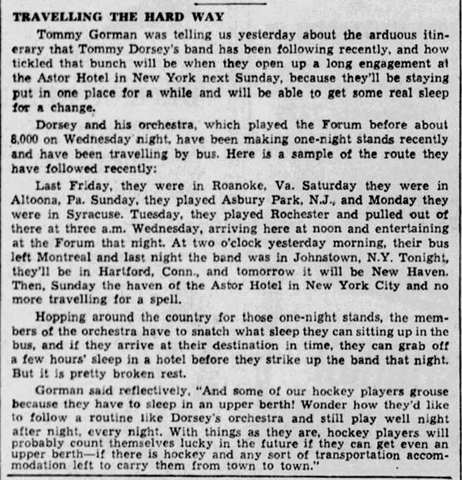
Concerts
The Astor Roof, Astor Hotel, New York, New York (May 21 thru August 28)
Tommy Dorsey & Orch.
Connie Haines, Frank Sinatra, Jo Stafford,
The Pied Pipers, Bunny Berigan, Buddy Rich,
Joe Bushkin, Sy Oliver note: 5-21 to 8-28, 14 week run, was the longest engagement ever for the Dorsey band
July 26, 1940
Concerts
The Astor Roof, Astor Hotel, New York, New York (May 21 thru August 28)
Tommy Dorsey & Orch.
Connie Haines, Frank Sinatra, Jo Stafford,
The Pied Pipers, Bunny Berigan, Buddy Rich,
Joe Bushkin, Sy Oliver note: 5-21 to 8-28, 14 week run, was the longest engagement ever for the Dorsey band
July 27, 1940
Radio
Roof of the Hotel Astor in N.Y..C.
Saturday afternoon
60 minute broadcast
Tommy Dorsey & Orch.
Connie Haines, Frank Sinatra, Jo Stafford,
Pied Pipers, The Sentimentalists, Joe Bushkin,
Buddy Rich, Sy Oliver, Johnny Mince
special guest: Sam Coslow ( songwriter)
Annc: Lyle Van
First broadcast of the Tommy Dorsey amateur song-
writing contest.
1. I'm Getting Sentimental Over You T.D. & Orch.
2. Swingtime Up In Harlem C.H. w/J. B. on piano
3. Tell Me At Midnight F.S.
4. March Of The Toys T.D. & Orch.
Three most played tunes of the week
in ascending order:
5. Nobody's Baby C.H.
6. Fools Rush In F.S.
7. I'll Never Smile Again F.S. J.S. P.P.
8. The One I Love Belongs To Somebody Else F.S.J.S. P.P. w/J. Mince
solo
Songs by Sam Coslow:
9. Was It A Dream Orch. with T.D. solo
10. Cocktails For Two T.D. & Orch
11. Just One More Chance J.S.
station break
12. I Was Just Dreaming Out Loud S.C. vocal & piano
13. I Was Just Dreaming Out Loud C.H.
14. Head On My Pillow F.S. & Sentimentalists
15. Once In A While F.S. J.S. P.P.
Three entries in songwriting contest:
$25.00 first prize - $15.00 second -$10.00 third
16. Why Am I Still Dreaming F.S.
17. You Move My Heart Around C.H.
18. You Cast A Spell Over Me F.S.
19. Marie F.S & band chorus
instructions on how to enter contest
20. Why Am I Still Dreaming F.S. (contest winner)
21. Put On Your Old Gray Bonnet T.D. & Orch.
22. I'm Getting Sentimental Over You. T.D. & Orch.
Note: Above info supplied by Ed O'Brien
Note: ("Once In A While" appears on Masters of Jazz
Volume 9 & in "The Song Is You" box set)
("The One I Love" appears on CD: BMG 60283 - Young Blue Eyes - Birth of A Crooner)
Television
NONE
Concerts
The Astor Roof, Astor Hotel, New York, New York (May 21 thru August 28) Tommy Dorsey & Orch.
Connie Haines, Frank Sinatra, Jo Stafford,
The Pied Pipers, Bunny Berigan, Buddy Rich,
Joe Bushkin, Sy Oliver note: 5-21 to 8-28, 14 week run, was the longest engagement ever for the Dorsey band
"I'll Never Smile Again"
Jo Stafford / Friedwald: Lowe’s song became more than a game-changer hit for all concerned: when Billboard magazine, already the "Bible" of the music industry, launched the first national hit records chart on July 27, 1940, the first number-one song on the new chart was "I’ll Never Smile Again." It remained in the number-one spot until October 12, and therefore can be considered the first blockbuster Billboard chart hit. Still, because the number was so unusual, and so difficult to perform, Dorsey rarely featured it in his live broadcasts. "There was practically no band," recalled Jo Stafford. "It was very, very sparse. It was a very tough idea. It was hard to hold the pitch because there was so little background from the band. You really had to mind your p’s and q’s keeping it in tune."
Source: Will Friedwald, "Sinatra! The Song Is You: A Singer's Art" (2018 revised edition).
July 28, 1940
Concerts
The Astor Roof, Astor Hotel, New York, New York (May 21 thru August 28) Tommy Dorsey & Orch.
Connie Haines, Frank Sinatra, Jo Stafford,
The Pied Pipers, Bunny Berigan, Buddy Rich,
Joe Bushkin, Sy Oliver note: 5-21 to 8-28, 14 week run, was the longest engagement ever for the Dorsey band
July 29, 1940
Concerts
(May 21 thru August 28)
Hotel Astor, N.Y.C.
Tommy Dorsey & Orch.
Connie Haines, Frank Sinatra, Jo Stafford,
The Pied Pipers, Bunny Berigan, Buddy Rich,
Joe Bushkin, Sy Oliver note: 5-21 to 8-28, 14 week run, was the longest engagement ever for the Dorsey band
July 30, 1940
Radio
Pepsodent Summer Pastime
Tuesday Evening
Location: Radio City, New Yoek
Network: NBC Red Network (WEAF)
Episode: 6
Time: 10:00 - 10:30 p. m.
Announcer: Ed Herlihy
Tommy Dorsey & Orch
Frank Sinatra, Connie Haines, The Pied Pipers
Concerts
(May 21 thru August 28)
Hotel Astor, N.Y.C.
Tommy Dorsey & Orch.
Connie Haines, Frank Sinatra, Jo Stafford,
The Pied Pipers, Bunny Berigan, Buddy Rich,
Joe Bushkin, Sy Oliver note: 5-21 to 8-28, 14 week run, was the longest engagement ever for the Dorsey band
July 31, 1940
Concerts
(May 21 thru August 28)
Hotel Astor, N.Y.C.
Tommy Dorsey & Orch.
Connie Haines, Frank Sinatra, Jo Stafford,
The Pied Pipers, Bunny Berigan, Buddy Rich,
Joe Bushkin, Sy Oliver note: 5-21 to 8-28, 14 week run, was the longest engagement ever for the Dorsey band
August 1940
[Sinatra and Buddy Rich brawl at the Astor]
Jo Stafford / Kaplan: One muggy August night backstage at the Astor, Buddy Rich called Sinatra a slur during a ballad; Sinatra hurled a pitcher of ice water at Rich's head (narrowly missing, shattering against the wall), and the two came to blows before bandmates separated them. Dorsey sent Sinatra home afterward, saying he could live without a singer but needed his drummer.
Source: James Kaplan, "Frank: The Voice" (2010)
[Sinatra's first Dorsey-era recording]
Kaplan: In a historic sequence of New York recording sessions with the Dorsey band between February and August 1940, the first song Sinatra recorded was Jimmy Van Heusen and Eddie De Lange's "Shake Down the Stars."
Source: James Kaplan, "Sinatra: The Chairman" (2015)
August 1, 1940
Radio
Hotel Astor Roof, New York City
Thursday Evening
11:30 p.m. - 12:a.m.
NBC Blue Network (WJZ)
1. I'm Getting Sentimental Over You TD & Orch
2. (What Can I Say, Dear) After I Say I'm Sorry The PIed
Pipers
3. Halfway Down The Street Frank
Sinatra
4. Song Of India
TD & Orch
5. All This And Heaven Too Frank
Sinatra
6. It Ain't What You Think ( Sy Oliver arg.) TD & Orch
7. I Can't Love You Anymore Than I Do (Sy Oliver arg.) Connie Haines
8. Head On My Pillow Frank
Sinatra
9.. Closing Theme TD & Orch
Concerts
(May 21 thru August 28)
Hotel Astor, N.Y.C.
Tommy Dorsey & Orch.
Connie Haines, Frank Sinatra, Jo Stafford,
The Pied Pipers, Bunny Berigan, Buddy Rich,
Joe Bushkin, Sy Oliver note: 5-21 to 8-28, 14 week run, was the longest engagement ever for the Dorsey band
August 2, 1940
Concerts
(May 21 thru August 28)
Hotel Astor, N.Y.C.
Tommy Dorsey & Orch.
Connie Haines, Frank Sinatra, Jo Stafford,
The Pied Pipers, Bunny Berigan, Buddy Rich,
Joe Bushkin, Sy Oliver note: 5-21 to 8-28, 14 week run was the longest engagement ever for the Dorsey band
August 3, 1940
Radio
Roof of the Hotel Astor in the heart of Times Square, N.Y.C.
Saturday afternoon
60 minute broadcast
NBC
Tommy Dorsey & His Orch.
Connie Haines, Frank Sinatra, Jo Stafford,
Pied Pipers, Joe Bushkin, Buddy Rich, Sy Oliver,
Johnny Mince
Annc: Lyle Van
1. I'm Getting Sentimental Over You T.D. & Orch.
2. The Eyes And Ears Of The World ( S.O. arg.) T.D. & Orch.
3. I Found A New Baby ( S.O. arg.) J.S. P.P. rules and regulations for amateur song writing contest
The Most Played Tunes Of The Week
4. All This And Heaven Too F.S. #1
5. Orchids For Rememberance T.D. & Orch. # 3
6. You Think Of Everything C.H. #2
7. So What ( S.O. arg.) T.D. & Orch. station break
8. Why Am I Still Dreaming F.S.
Three Amateur Songs For The Week
9. At Least A Little In Love F.S.
10. Memory Of You C.H.
11. It Came To Me F.S.
Audience votes and it is measured by Applausemeter
12. At Least A Little In Love (winner) F.S.
13. I Know That You Know (S.O. arg.) T.D. & Orch.
14.. I'm Getting Sentimental Over You T.D. & Orch.
Note: Thanks to Ed O'Brien for the above listing.
("At Least A Little In Love" & "It Came To Me" appear on Masters of Jazz Volume 9 & in "The Song Is You" box set )
("At Least A Little In Love" appears on CD:
Buddha 74465 999601-2 "Learn To Croon")
Your Hit Parade
Network: CBS
Program #275
Time: 9:00-9:45 P.M. (Rebroadcast August 4, 1940 12:00-12:45 A..M.)
Sponsor: Lucky Strike
1. commercial 1
2. Nobody's Baby (10) - Orchestra
3. Where Was I (8) - Hit Paraders
4. Make Believe Island (5) - Bea Wain
5. commercial 2
6. Ooh, What You Said - Donnie Baker & Orrin Tucker
7. Imagination (7) - Barry Wood
8. When The Swallows Come Back To Capistrano (9) - Bea Wain
9. I Double Dare You - Orchestra
10. commercial 3
11. Playmates (6) - Donnie Baker & Orrin Tucker
12. Fools Rush In (4) - Barry Wood
13. South American Way - Bea Wain & Hit Paraders
14. commercial 4.
15. Sierra Sue (3) - Barry Wood & Orchestra
16. The Breeze And I (2) - Bea Wain & Hit Paraders
17. I'll Never Smile Again (1) - Tommy Dorsey Orchestra w/Sinatra &
Pied Pipers
Ed O'Brien:
Here is the exchange between Barry Wood and Dorsey before the #1 tune is performed:
B.W.: The top of the heap! The number one song in America this week and a sensational performer. Two weeks ago Tommy
Dorsey came over here and gave it a send-off - - then it was in ninth place. Last week it jumped to second place and tonight
it breathes the rarified air of the stratosphere. Tommy -- what do you think?
T.D.: I don't know, Barry -- I'm just wowed. That's all. When I played the tune a few weeks back I went on record as thinking
it would do all right, but, brother - - never thought it would hit the jackpot on the Hit Parade in three short weeks.
B.W.: Well, that's what makes horse racing, Tommy. It's a real record, so let's celebrate the occasion -- Tommy Dorsey,
Frank Sinatra The Pied Pipers and Mark Warnow give us the number one song of the week -- Ruth Lowe's great hit 'I'll Never Smile
Again."
Television
NONE
Concerts
Hotel Astor, N.Y.C. (May 21 thru August 28)
Tommy Dorsey & Orch.
Connie Haines, Frank Sinatra, Jo Stafford,
The Pied Pipers, Bunny Berigan, Buddy Rich,
Joe Bushkin, Sy Oliver note: 5-21 to 8-28, 14 week run, was the longest engagement ever for the Dorsey band
August 4, 1940
Concerts
(May 21 thru August 28)
Hotel Astor, N.Y.C.
Tommy Dorsey & Orch.
Connie Haines, Frank Sinatra, Jo Stafford,
The Pied Pipers, Bunny Berigan, Buddy Rich,
Joe Bushkin, Sy Oliver note: 5-21 to 8-28, 14 week run, was the longest engagement ever for the Dorsey band
Dorsey band played a charity softball game in
Bernardsville
Here’s an image of Frank
Here’s the accompanying post-game article, for those of you who understand what those numbers mean! (Bernardsville News, August 8, 1940)
According to a pre-game article, this was the Dorsey team’s 8th game. So far from what I can gather, some of the others were
Before July 7 – Played Harry James, lost 9-8
July 10 – Jimmy Dorsey in Central Park – Tommy’s first win 12-10
July 17 – played Johnny Messner’s Mud Cats, Central Park
July 31 – re-match with Jimmy Dorsey in Central Park – won 7-5
August 18 – re-match with Bill Friars in Bernardsville. Dorsey again lost, 10-4
--Richard
-thanks to Richard Cook for above information and articles.
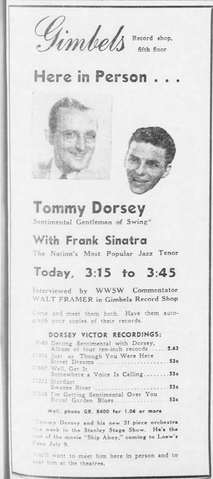
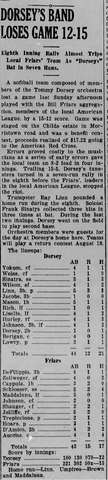
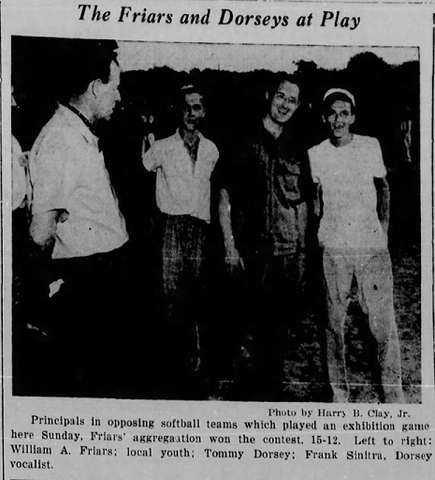
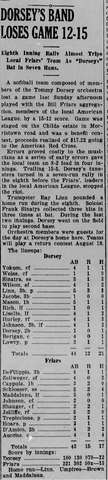
August 5, 1940
Concerts
(May 21 thru August 28)
Hotel Astor, N.Y.C.
Tommy Dorsey & Orch.
Connie Haines, Frank Sinatra, Jo Stafford,
The Pied Pipers, Bunny Berigan, Buddy Rich,
Joe Bushkin, Sy Oliver note: 5-21 to 8-28, 14 week run, was the longest engagement ever for the Dorsey band
note: Floria Vestoff, who is billed ahead of Sinatra, was a tap dancer. She came from a family of dancers and played nightclubs, Paramount, and was the dancing pack of Old Gold cigarettes in early TV ads.
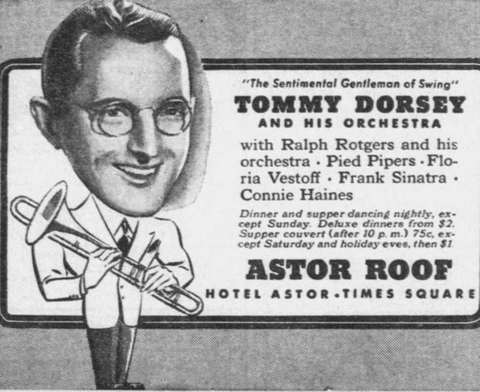
August 6, 1940
Radio
Pepsodent Summer Pastimeť # 7
Tuesday
10:00 - 10:30 p. m.
NBC
Radio City
New York
NBC
Red Network
WEAF
Announcer: Ed Herlihy
Concerts
Hotel Astor, N.Y.C., (May 21 thru August 28)
Tommy Dorsey & Orch.
Connie Haines, Frank Sinatra, Jo Stafford,
The Pied Pipers, Bunny Berigan, Buddy Rich,
Joe Bushkin, Sy Oliver note: 5-21 to 8-28, 14 week run, was the longest engagement ever for the Dorsey band
August 7, 1940
Concerts
(May 21 thru August 28)
Hotel Astor, N.Y.C.
Tommy Dorsey & Orch.
Connie Haines, Frank Sinatra, Jo Stafford,
The Pied Pipers, Bunny Berigan, Buddy Rich,
Joe Bushkin, Sy Oliver note: 5-21 to 8-28, 14 week run, was the longest engagement ever for the Dorsey band
August 8, 1940
Radio
Hotel Astor Roof, New York City
Thursday Evening
11:30 p.m. - 12:00 a.m.
NBC Blue Network - WJZ
Sustaining
Announcer: William â Billâ Spargrove
Tommy Dorsey sey & His Orchestra
Buddy Rich, Joe Bushkin, Bunny Berigan
Frank Sinatra, Connie Haines, The Pied Pipers
1. I'm Getting Sentimental Over
You TD & Orch
2. The One I Love Belongs To Somebody Else Frank
Sinatra & Pied Pipers
3. Swanee River (Sy Oliver arg.)
TD & Orch
4. Head On My
Pillow
Frank Sinatra
5. Dear Old Southland (Sy Oliver arg.) TD & Orch
6. I'll Never Smile
Again
Frank Sinatra & Pied Pipers
7. Lights Out, Hold Me
Tight
Connie Haines
8. You're Lonely And I'm
Lonely
Frank Sinatra
9. Bugle Call
Rag
TD & Orch
10. Closing
Theme
TD & Orch
Television
NONE
Concerts
Hotel Astor, N.Y.C. (May 21 thru August 28)
Tommy Dorsey & Orch.
Connie Haines, Frank Sinatra, Jo Stafford,
The Pied Pipers, Bunny Berigan, Buddy Rich,
Joe Bushkin, Sy Oliver note: 5-21 to 8-28, 14 week run, was the longest engagement ever for the Dorsey band
August 9, 1940
Concerts
Hotel Astor, N.Y.C. (May 21 thru August 28)
Tommy Dorsey & Orch.
Connie Haines, Frank Sinatra, Jo Stafford,
The Pied Pipers, Bunny Berigan, Buddy Rich,
Joe Bushkin, Sy Oliver note: 5-21 to 8-28, 14 week run, was the longest engagement ever for the Dorsey band
record reviews
Frank gets a rave on this one:
Now we know the shocking truth. Ray was the voice behind The Voice.
Ray bought the rights to "Be My Love" in 1949. Mario Lanza paid Ray
$500.00 for the song. Lanza then sold it to MGM for $15,000. Song
was sung by Mario is the film "The Toast Of New Orleans." Ray con-
ducted the session for Lanza's commercial recording of the song in 1950.
He was also the conductor/arranger on Lanza's 1951 radio shows.
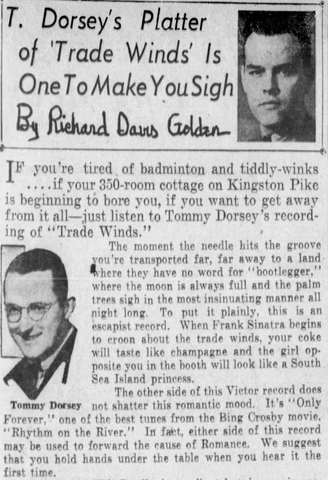
August 10, 1940
Radio
"The Dorsey Hour"
Saturday
Location: Hotel Astor Roof, New York City
5:00 - 6:00 p. m.
NBC Red Network - WEAF
Sustaining
Remote Engineer: George Mathus
Announcer: Lyle Van
Tommy Dorsey & His Orchestra
Bunny Berigan, Buddy Rich, Sy Oliver, Joe Bushkin
Frank Sinatra, Connie Haines, The Pied Pipers
1. I'm Getting Sentimental Over
You TD & Orch
2. Six Lessons From Madame La Zonga Connie Haines
3. Wishful
Thinking
Frank Sinatra
4. Back Stage At The Ballet (Sy Oliver arg) TD &
Orch
5. Medley:
a. Believe It Or Not
b Falling In Love
c. What's The
Difference
Frank Sinatra
6
.Whispering
Frank Sinatra & Pied Pipers
7. Without A
Song
Frank Sinatra
8. Honeysuckle Rose
Connie Haines
9.
Rhumboogie
Connie Haines
9. I'll Never Smile Again Frank
Sinatra & Pied Pipers
10.Swing High (Sy Oliver arg.) TD
& Orch
11.At Least A Little In Love Frank Sinatra
12. Funny Little
Pedro
Pied Pipers
13.You're Lonely And I'm Lonely Frank
Sinatra
14. Sierra
Sue
Frank Sinatra
15. I Got Rhythm (Sy Oliver arg.) TD &
Orch
16. Closing
Theme
TD & Orch
("Whispering" & "Without A Song" appear on
Masters of Jazz Volume 9)
note: This was the inaugural broadcast for the amateur
song contest. Frank did the honors for the winning
entry, singing "Falling
In Love." He did not sing the
other two entries.
Concerts
Hotel Astor, N.Y.C. (May 21 thru August 28)
Tommy Dorsey & Orch.
Connie Haines, Frank Sinatra, Jo Stafford,
The Pied Pipers, Bunny Berigan, Buddy Rich,
Joe Bushkin, Sy Oliver note: 5-21 to 8-28, 14 week run, was the longest engagement ever for the Dorsey band
"The Dorsey Hour"
Saturday
Location: Hotel Astor Roof, New York City
5:00 - 6:00 p. m.
NBC Red Network - WEAF
Sustaining
Remote Engineer: George Mathus
Announcer: Lyle Van
Tommy Dorsey & His Orchestra
Bunny Berigan, Buddy Rich, Sy Oliver, Joe Bushkin
Frank Sinatra, Connie Haines, The Pied Pipers
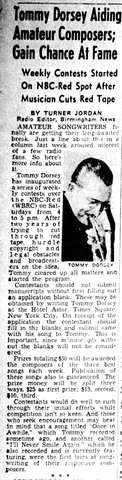
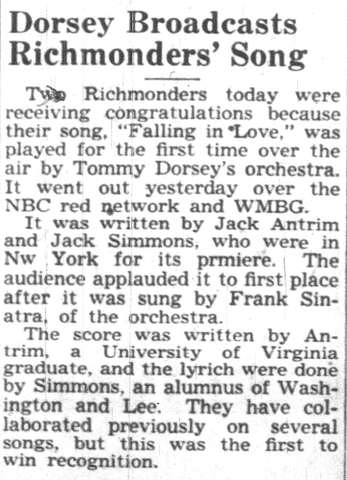
August 11, 1940
Concerts
Hotel Astor, N.Y.C. (May 21 thru August 28)
Tommy Dorsey & Orch.
Connie Haines, Frank Sinatra, Jo Stafford,
The Pied Pipers, Bunny Berigan, Buddy Rich,
Joe Bushkin, Sy Oliver note: 5-21 to 8-28, 14 week run, was the longest engagement ever for the Dorsey band
Mayer’s Tavern, Rumson, NJ
Frank Sinatra accompanied by Bert Gaul on the Hammond Novachord
Mayer’s Tavern, Rumson, NJ
Frank Sinatra accompanied by Bert Gaul on the Hammond Novachord
"I'll Never Smile Again" was # 1 on
8/3 and 8/10. It dropped to #2 on 8/17, but the article would have been written and printed by then. Furthermore, TD & band closed at The Astor on 8/28.Starting on 8/24, Ruth Lowe's song would be # 1 for another five consecutive weeks on the Hit Parade.
--Ed
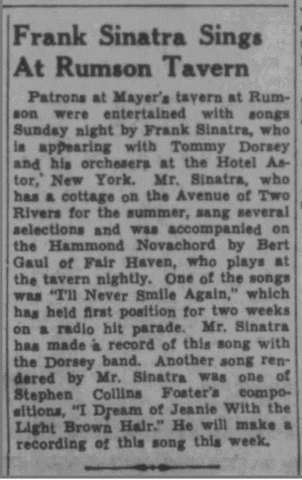
Mayer’s Tavern, Rumson, NJ
Frank Sinatra accompanied by Bert Gaul on the Hammond Novachord
note:I believe the correct date for this appearance is 8/18. The Daily Register was a local paper in Red Hook, N.J. Article isn't syn- dicated. This story was in the 8-22-40 edition. That was on a Thursday. Infor- mation offered is Sunday night. Would have been the 18th.Ed
August 12, 1940
Concerts
Hotel Astor, N.Y.C. (May 21 thru August 28)
Tommy Dorsey & Orch.
Connie Haines, Frank Sinatra, Jo Stafford,
The Pied Pipers, Bunny Berigan, Buddy Rich,
Joe Bushkin, Sy Oliver note: 5-21 to 8-28, 14 week run, was the longest engagement ever for the Dorsey band
August 13, 1940
Radio
"Pepsodent Summer Pastime" # 8
Tuesday
10:00 - 10:30 p. m.
Radio City
New York City
NBC Red Network
WEAF
Announcer: Ed Herlihy
Concerts
Hotel Astor, N.Y.C. (May 21 thru August 28)
Tommy Dorsey & Orch.
Connie Haines, Frank Sinatra, Jo Stafford,
The Pied Pipers, Bunny Berigan, Buddy Rich,
Joe Bushkin, Sy Oliver note: 5-21 to 8-28, 14 week run, was the longest engagement ever for the Dorsey band
"Pepsodent Summer Pastime" # 8
Tuesday
10:00 - 10:30 p. m.
Radio City
New York City
NBC Red Network
WEAF
Announcer: Ed Herlihy
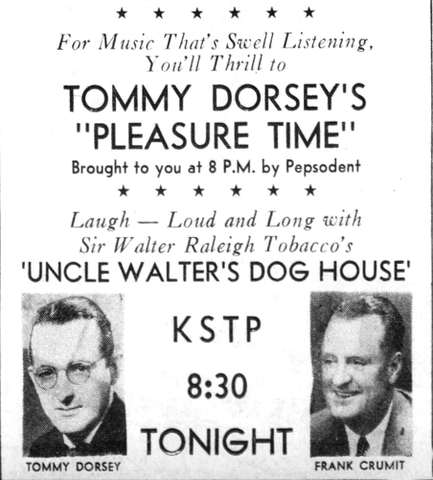
August 14, 1940
Radio
Roof Of Hotel Astor, N.Y.C.
Wednesday evening
Network: NBC (Blue Network)
Tommy Dorsey & His Orch.
Connie Haines, Frank Sinatra, Jo Stafford, Pied Pipers, Buddy Rich, Sy Oliver
1. I'm Getting Sentimental Over You T.D. & Orch.
2. The One I Love Belongs To Somebody Else F. S. J.S. P.P.
3. Fools Rush In F.S.
4. Swing High ( S.O. arg.) T.D. & Orch.
5. Medley Of Memory Tunes: Alice Blue Gown F.S. /Castle Of Dreams T.D. &
Orch./Irene J.S. P.P.
6. Rhumboogie C.H.
7. East Of The Sun (West Of The Moon) F.S. J.S. P.P.
8. Symphony In Riffs T.D. & Orch.
9. I'm Getting Sentimental Over You T.D. & Orch.
("East of the Sun" appears on the CD: The Essential Frank Sinatra with the Tommy Dorsey Orchestra, Bluebird / Legacy 82876-71167)
("The One I Love Belongs To Somebody Else" appears on disk 1 of "A Voice On Air")
("Alice Blue Gown" appears on the CD: BMG Bluebird 60283-2 - Young Blue Eyes - Birth of A Crooner)
Concerts
(May 21 thru August 28)
Hotel Astor, N.Y.C.
Tommy Dorsey & Orch.
Connie Haines, Frank Sinatra, Jo Stafford,
The Pied Pipers, Bunny Berigan, Buddy Rich,
Joe Bushkin, Sy Oliver note: 5-21 to 8-28, 14 week run, was the longest engagement ever for the Dorsey band
August 15, 1940
Radio
Hotel Astor Roof, New York City
Thursday Evening
11:30 p.m. - 12: a.m.
NBC Blue Network
WJZ
Sustaining
Announcer: William “Bill” Spargrove
Tommy Dorsey & His Orchestra
Bunny Berigan, Buddy Rich, Joe Bushkin, Sy Oliver
Frank Sinatra, Connie Haines, The Pied Pipers
1. I'm Getting Sentimental Over You TD &Orch
2. Sweet Lorraine Pied Pipers
3. All This And Heaven Too Frank Sinatra
4. That's For Me Connie Haines
5. Head On My Pillow Frank Sinatra
6. Losers Weepers TD & Orch
7. I’ll Never Smile Again Frank Sinatra & Pied Pipers
8. Take It (Sy Oliver arg) TD & Orch
9. East Of The Sun (And West of the Moon) Frank Sinatra & Band Chorus
10. Old Black Joe TD & Orch
11. Closing Theme TD & Orch
Concerts
Hotel Astor, N.Y.C., (May 21 thru August 28)
Tommy Dorsey & Orch.
Connie Haines, Frank Sinatra, Jo Stafford,
The Pied Pipers, Bunny Berigan, Buddy Rich,
Joe Bushkin, Sy Oliver note: 5-21 to 8-28, 14 week run, was the longest engagement ever for the Dorsey band
August 16, 1940
Concerts
Hotel Astor, N.Y.C., (May 21 thru August 28)
Tommy Dorsey & Orch.
Connie Haines, Frank Sinatra, Jo Stafford,
The Pied Pipers, Bunny Berigan, Buddy Rich,
Joe Bushkin, Sy Oliver note: 5-21 to 8-28, 14 week run, was the longest engagement ever for the Dorsey band
August 17, 1940
Radio
Live Remote: Hotel Astor, New York City
Saturday Afternoon
3:00 - 4:00 p. m.
NBC Red Network - WEAF New York City
Tommy Dorsey And His Orchestra
Buddy Rich, Bunny Berigan, Joe Bushkin, Sy Oliver,Connie Haines, Jo Stafford, The Pied Pipers, Romo Vincent
Engineer:George Mathus
Announcer:Lyle Van,
1. I'm Getting Sentimental Over
You
TD & Orch.
2. (What Can I Say, Dear) After I Say I'm
Sorry Frank Sinatra
3.Trade
Winds
Frank
Sinatra
4.Where Do I Go From
You
Frank Sinatra
5.The Moon Wonâ t t
Talk
Frank Sinatra
6.Half Of
Me
Romo Vincent (guest vocalist)
7.Devil's
Holiday
TD & Orch
8.Funny Little
Pedro
Pied Pipers
9.And So Do
I
Connie Haines
10.Swanee River (Sy Oliver arg.) TD
& Orch.
11.Falling In Love With
Love
Frank Sinatra
12.Campus
Swing
TD & Orch.
13.It's
You
Frank Sinatra
14.Often
Pied Pipers
15.Deep
Night
Frank Sinatra & Band Chorus
16.. So
What
TD & Orch.
17. Closing
Theme
TD & Orch.
Ed O'Brien:
Sinatra was fast becoming the star attraction for the band. TD gave
him the spotlight on seven songs during this hour broadcast. The
band was no longer the center piece anymore. Frank was changing
all that in a big way. By the summer of 1942, he would be the dominant
force every night. He would also be double-parked. Frank Sinatra no
longer needed the Dorsey band.
Concerts
Hotel Astor, N.Y.C., (May 21 thru August 28)
Tommy Dorsey & Orch.
Connie Haines, Frank Sinatra, Jo Stafford,
The Pied Pipers, Bunny Berigan, Buddy Rich,
Joe Bushkin, Sy Oliver note: 5-21 to 8-28, 14 week run, was the longest engagement ever for the Dorsey band
August 18, 1940
Concerts
Hotel Astor, N.Y.C. (May 21 thru August 28)
Tommy Dorsey & Orch.
Connie Haines, Frank Sinatra, Jo Stafford,
The Pied Pipers, Bunny Berigan, Buddy Rich,
Joe Bushkin, Sy Oliver note: 5-21 to 8-28, 14 week run, was the longest engagement ever for the Dorsey band
Mayer’s Tavern, Rumson, NJ
Frank Sinatra accompanied by Bert Gaul on the Hammond Novachord
(this had previous been reported as the 11th)
August 19, 1940
Concerts
Hotel Astor, N.Y.C., (May 21 thru August 28)
Tommy Dorsey & Orch.
Connie Haines, Frank Sinatra, Jo Stafford,
The Pied Pipers, Bunny Berigan, Buddy Rich,
Joe Bushkin, Sy Oliver note: 5-21 to 8-28, 14 week run, was the longest engagement ever for the Dorsey band
Ed O'Brien:
I've been doing some research on this extended engagement the Dorsey Band played at the Hotel Astor The room's capacity was 900 patrons. To see Dorsey's Band the cover was 75 cents during the week and $1.00 on weekends. The band averaged 2,250 to 2,400 covers per week. The final week of their 15 week run saw 2,250 paying customers. The grand total for the 15 weeks was 46,350 covers.
The band was earning as much as $3,000 in a good week at The Astor.. Rarely less than $2,500. This was tremendous money in 1940. There were over 46 million people in America's work force that year. Half of the men and two-thirds of the women were earning less than $1,000 a year. Only 48,000 workers made $2,500 or more a year. Dorsey was able to walk away with $1,000 for a one-nighter.
There really wasn't a middle class in 1940. There were workers and owners. The cost of living was very low, not that many people owned homes and living on credit was unheard of in 1940. Millions lived austere existences and paying a dime to see a movie was considered an expense. The patrons at The Astor were forced to shell out a whole dollar on the weekend. A real extravagance for most people .If they wanted a dinner included, it would cost another $2.00.
Frank and Jo and Connie were paid handsomely by the standards of the day.
August 20, 1940
Radio
Pepsodent Summer Pastime # 9
Tuesday Evening
10:00 - 10:30 p. m,
NBC Red Network
WEAF
Radio City
New York City
Announcer: Ed Herlihy note: Bunny Berigan was dismissed from the Dorsey band, following this broadcast
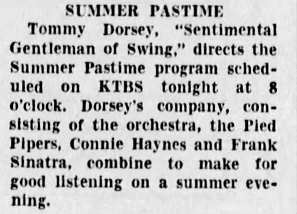
Concerts
Hotel Astor, N.Y.C., (May 21 thru August 28)
Tommy Dorsey & Orch.
Connie Haines, Frank Sinatra, Jo Stafford,
The Pied Pipers, Bunny Berigan, Buddy Rich,
Joe Bushkin, Sy Oliver note: 5-21 to 8-28, 14 week run, was the longest engagement ever for the Dorsey band
August 21, 1940
Concerts
Hotel Astor, N.Y.C. (May 21 thru August 28)
Tommy Dorsey & Orch.
Connie Haines, Frank Sinatra, Jo Stafford,
The Pied Pipers, Bunny Berigan, Buddy Rich,
Joe Bushkin, Sy Oliver note: 5-21 to 8-28, 14 week run, was the longest engagement ever for the Dorsey band
August 22, 1940
Radio
Live Remote: Hotel Astor, New York City
Thursday Evening
11:30 p.m.- 12:00 a.m.
NBC Blue Network - WJZ New York City
Tommy Dorsey And His Orchestra
Buddy Rich, Ziggy Elman, Joe Bushkin, Jo Stafford,
Pied Pipers, Frank Sinatra, Carol Kaye ( subbing for Connie Haines )
1. I'm Getting Sentimental Over You TD &
Orch.
2. The One I Love
Frank Sinatra
3. Half Way Down The Street Frank
Sinatra
4. Dreaming Out Loud
Carol Kaye
5. The Call Of The Canyon Frank
Sinatra
6. I'll Never Smile Again Frank
Sinatra & Pied Pipers
7. Swing Time Up In Harlem
Carol Kaye
8. Sweet Sue, So What TD
& Orch.
9. Closing Theme
TD & Orch.
Concerts
The Astor Roof, Astor Hotel, New York, New York (May 21 thru August 28)
Tommy Dorsey & Orch.
Connie Haines, Frank Sinatra, Jo Stafford,
The Pied Pipers, Bunny Berigan, Buddy Rich,
Joe Bushkin, Sy Oliver note: 5-21 to 8-28, 14 week run, was the longest engagement ever for the Dorsey band
August 23, 1940
Radio
Hotel Astor, New York
Tommy Dorsey & His Orchestra
NBC Red Network
5-6pm
Concerts
The Astor Roof, Astor Hotel, New York, New York (May 21 thru August 28)
Tommy Dorsey & Orch.
Connie Haines, Frank Sinatra, Jo Stafford,
The Pied Pipers, Bunny Berigan, Buddy Rich,
Joe Bushkin, Sy Oliver note: 5-21 to 8-28, 14 week run, was the longest engagement ever for the Dorsey band
August 24, 1940
Radio
“The Dorsey Hour”
Tommy Dorsey and His Orchestra
(Sat) 5:00 - 6:00 p. m.
Hotel Astor Roof, New York
(NBC Red) (WEAF)
George Mathus, remote engineer
Lyle Van, announcer
1. I'm Getting Sentimental Over You
(open)
2. That’s For Me (CH)
3. Tell Me At Midnight (FS)
4. The One I Love Belongs To Somebody Else
(FS-PP)
5. In My Dreams (FS)
6. Another One Of Them Things (SO arr),
7. Medley of the most played tunes of the week: Fools Rush In (FS), Sierra Sue
8. Love Lies (FS)
9. Dear Old Southland (SO arr)
10. Station break; I’ll Never Smile Again
(FS-PP)
11. Lights Out, Hold Me Tight (CH)
12. Often (PP)
13. Dreaming (CH)
14. Thoughtless Things I Do (FS),
15. Believe It Or Not, It’s True (PP)
16. East Of The Sun (And West of the Moon)
(FS-Band),
17. Quiet Please
18. I'm Getting Sentimental Over You
(close)
Concerts
The Astor Roof, Astor Hotel, New York, New York (May 21 thru August 28) Tommy Dorsey & Orch.
Connie Haines, Frank Sinatra, Jo Stafford,
The Pied Pipers, Bunny Berigan, Buddy Rich,
Joe Bushkin, Sy Oliver note: 5-21 to 8-28, 14 week run, was the longest engagement ever for the Dorsey band
August 25, 1940
Concerts
Steel Pier, Atlantic City , New Jersey (August 25 - One-nighter) Tommy Dorsey and his Orchestra w/Frank Sinatra
NOTE: Ed O'Brien sends us this explanation from the August 28 issue of Variety: "TD played one-nighter at the Steele Pier in Atlantic City , N.J.
Ziggy Elman in the band, having replaced Bunny Berigan some days before. Ziggy has not yet joined TD on a perm. Basis. Band on night off from Astor Roof in N.Y.C."
review
ZIG ELMAN'S JAM SESSION WITH T. DORSEY IN BUNNY BERIGAN'S CHAIR WOWS ATLANTIC CITY
Atlantic City, Aug. 26. When man beats son ("I'll Never Smile Again"), local boy makes good and prodigal son (Wasting only lung power) returns, that's triple news in music circles. Tommy Dorsey and his Orchestra, the organization responsible for the daily atmospheric inundation of "I'll Never Smile Again," played a one-nighter at the Steel Pier, Atlantic City, Sunday (25) sans the services of star trumpeter and former bandleader Bunny Berigan, for reasons (?). Ziggy Elman, local boy, who was discovered by Benny Goodman at this entertainment mecca, under similar circumstances, while playing in Alex Bartha's band a few years ago, took Bunny's chair for the engagement and history was made. At 10:45 the band appeared and the first number, "Swingtime Up In Harlem," suddenly roared to a screaming trumpet finish as Ziggy took the floor. Recognizing him, the crowd shook the Pier with their ovation. Showman Tommy got his Pied Pipers up to the microphone almost immediately afterward to deliver the nation's favorite song their number. But the climax was yet to come. A few minutes later, the band went into a free rendition of "Dear Old Southland." Tommy gave Ziggy's trumpet the spotlight in a jam session, which featured the maestro and Buddy Rich, former Artie Shaw drummer. Elman was superb and the crowd, realizing they were hearing one of the best spontaneous musical exhibitions in years, gave him full vocal credit. Playing with the Dorsey crew for the first time, Ziggy Elman's horn was silent for the most part of a subsequent broadcast in which special arrangements were used, but when ā Rhumboogie' and "Old Black k Joe"came along, he stopped his impatient fidgeting and gave the radio audience a surprise treat, holding the music in his left hand at first, but throwing it down to give forthwith perfect improvising as he felt the mood. He even joined the band's choral background in the former. After this, it was Elman's night. His screaming finish to a swingaroo started an unabating roar. Tommy had to change his plans and they went into "And The Angels Sing," a number Elman made famous with Goodman's band. The "Smile" reception was puny in comparison to the spontaneous outcry for Elman, which was reminiscent of the Republican Convention in Philadelphia. He soloed with the drums on his famous ā Bublitchki' and Dorsey y wisely featured him for the remainder of the evening, despite the fact that he had to improvise each ride, including the famous Marie' lick. Dorsey's band has been immortalized by his famous arrangements but it made history last night. An underrated musician peered at these numbers for the first time and then delivered his conceptions perfectly without the aid of written sheets. Tribute is necessary for this accidental milestone and I hope some credit will be given.
Herb Hendler.
Variety
August 28, 1940
Steel Pier, Atlantic City , New Jersey (August 25 - One-nighter) Tommy Dorsey and his Orchestra w/Frank Sinatra
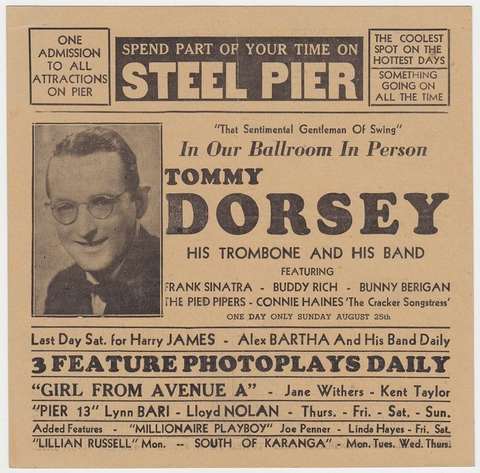
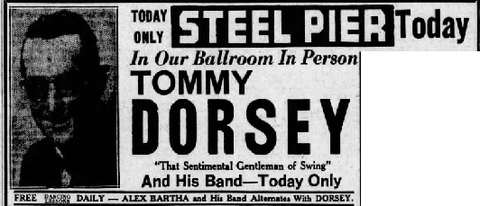
Radio
Radio: Sinatra appeared as vocalist with Tommy Dorsey & His Orchestra on a commercial radio broadcast this date, singing "Marie." NBC broadcast from Youngstown, Ohio. Source: sinatradiscography.com, Radio Transcriptions Database.
August 26, 1940
Radio
Live Remote from Hotel Astor, NY
Tommy Dorsey and His Orchestra
10:30-11:00PM
Concerts
The Astor Roof, Astor Hotel, New York, New York (May 21 thru August 28) Tommy Dorsey & Orch.
Connie Haines, Frank Sinatra, Jo Stafford,
The Pied Pipers, Bunny Berigan, Buddy Rich,
Joe Bushkin, Sy Oliver note: 5-21 to 8-28, 14 week run, was the longest engagement ever for the Dorsey band
August 27, 1940
Radio
"Pepsodent Summer Pastime" #10
Tuesday
10:00-10:30 PM
NBC Red Network
Radio City - New York City
WEAF
Tommy Dorsey & His Orch
Vocalist: Connie Haines, Frank Sinatra,The Pied Pipers
Guest Star:Jerry Lester
Announcer: Ed Herlihy
Concerts
The Astor Roof, Astor Hotel, New York, New York (May 21 thru August 28)
Tommy Dorsey & Orch.
Connie Haines, Frank Sinatra, Jo Stafford,
The Pied Pipers, Bunny Berigan, Buddy Rich,
Joe Bushkin, Sy Oliver note: 5-21 to 8-28, 14 week run, was the longest engagement ever for the Dorsey band
August 28, 1940
Radio
Hotel Astor, New York
Tommy Dorsey and His Orchestra with Frank Sinatra
9:45PM – 10:00PM
NBC Blue
Concerts
The Astor Roof, Astor Hotel, New York, New York (May 21 thru August 28) Tommy Dorsey & Orch.
Connie Haines, Frank Sinatra, Jo Stafford,
The Pied Pipers, Bunny Berigan, Buddy Rich,
Joe Bushkin, Sy Oliver note: 5-21 to 8-28, 14 week run, was the longest engagement ever for the Dorsey band
Ed O'Brien:
Final tally for the 14 week run added up to $46,350.00. Astor capacity was 900 patrons and price of admission was 75 cents during the week and $1.00 on the weekend. For another $2.00 the hotel offered a delicious dinner.
Hotel Astor Roof, New York Talent policy: Floorshow and dance band; shows at 8 and 12 p.m.. Following one of the most successful stands ever chalked up by a name band in a location, Tommy Dorsey pulled out of the Astor Roof August 30, leaving the podium to Ina Ray Hutton and her new all -male aggregation. Billboard
-14-40 note: Dorsey's record engagement was actually two days longer than previously reported. Ed
The Astor Roof, Astor Hotel, New York, New York (May 21 thru August 30) Tommy Dorsey & Orch.
Connie Haines, Frank Sinatra, Jo Stafford,
The Pied Pipers, Bunny Berigan, Buddy Rich,
Joe Bushkin, Sy Oliver
an autographed poster Hotel Astor
Closing night 8-30-1940
Signed program: Sinatra-Dorsey-Jo Stafford & Pied Pipers-
Connie Haines and Tommy Dorsey
August 29, 1940
Studio
New York City
BS055543 Our Love Affair
(from the MGM film Strike Up The Band)
(A. Freed/R. Edens)
EMI Feist Catalog, Inc. (ASCAP)
Arranged by Axel Stordahl
-1 (2:59) CD: 07863 66353-2 "The Song Is You" 5CD set Vol 2
-2 (2:59) CD: 07863 66353-2 "The Song Is You" 5CD set Vol 4
-1 CD: RCA 8324-2-R
-1 LP: SD 1000
-1 78: 26736 (first pressing)
-2 78: 26736 (second pressing)
BS055563 Looking For Yesterday
(E. DeLange/J. Van Heusen)
Scarsdale Music Corp./Van Heusen Music Corp. (ASCAP)
-1 (3:09) CD: 07863 66353-2 "The Song Is You" 5CD set Vol 2
CD: RCA 9679-2-R
LP: SD 1000
78: 26738
BS055564 Tell Me At Midnight
(adapted from "A Mezzanotte" by Anepata)
(B. Reichner/C. Boland)
Malvern Music Co. (ASCAP)
-1 (2:50) CD: 07863 66353-2 "The Song Is You" 5CD set Vol 2
LP: SD 1000
78: 26747
BS055565 We Three (My Echo, My Shadow And Me)
(D. Robertson/N. Cagane/S. Mysels)
Edwin H. Morris & Co./William M.. Hellman,
adm. of Sammy Mysels Estate/Penn Music Co. (ASCAP)
Arranged by Sy Oliver
Saxes: Fred Stulce, Johnny Mince, Hymie Shertzer, Don Lodice, Heinie
Beau; Trumpets: Clyde Hurley, Ziggy
Elman, Ray Linn, Jimmy Blake; Trombones: Les Jenkins, George Arus, Lowell Martin; Guitar: Clark Yocum;
Piano: Joe Bushkin; Bass: Sid Weiss; Drums: Buddy Rich
Television
August 30, 1940
Concerts
Canobie Lake Park, Salem, NH, (August 30 - one-nighter) Tommy Dorsey and his Orchestra w/Frank Sinatra
Canobie Lake Park, Salem, NH, (August 30 - one-nighter) Tommy Dorsey and his Orchestra w/Frank Sinatra
Canobie Lake Park Dance Pavilion circa 1940s
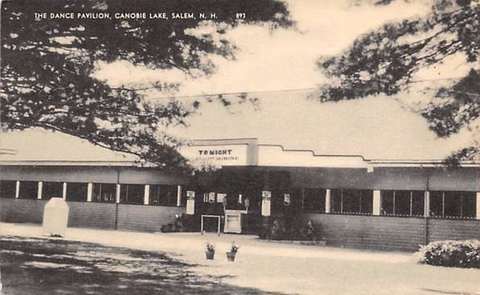

August 31, 1940
Radio
Portland, Maine
Saturday Afternoon
5:00 p.m - 6:00 p. m.
NBC Red Network - WCSH - WEAF New York City
Tommy Dorsey And His Orchestra
Frank Sinatra, Connie Haines, Jo Stafford, Pied Pipers, Joe Bushkin, Ziggy Elman, Buddy Rich, Sy Oliver
1. I'm Getting Sentimental Over You TD & Orch.
2. Rhumboogie Connie Haines
3.Only Forever Frank Sinatra 4.Take It (Sy Oliver arg.) TD & Orch.
5. So Deep Is The
Night Frank Sinatra
6. Sweet Lorraine Pied Pipers
7.Medley of film tunes: a. I Only Have Eyes For You Frank Sinatra b. When Day Is Done TD & Orch. c.You Oughta Be In Pictures Connie Haines d. I Know That You Know (Sy Oliver arg.) TD & Orch.
8. I'll Never Smile
Again Frank Sinatra & Pied Pipers
9. I'm Nobody's Baby Connie Haines
10. Easy Does It TD & Orch.
11. Thoughtless Things I Do Frank Sinatra
12. Summer Evening Frank Sinatra
13. And So Your Love TD & Orch.
14. Swing Your Blues Away Pied Pipers
15. Marie Frank Sinatra & Band Chorus
16. Hawaiian War Chant TD & Orch.
17. Closing Theme TD & Orch.
Concerts
Ocean Pier Casino, Old Orchard Beach, Maine
Dance
Saturday
7:00 p. m. - 1:00 a. m.
Ocean Pier Casino, Old Orchard Beach, Maine
Excerpts from two articles about Sinatra's October 11, 1979 appearance in Portland. It references the the August 31st, 1940 Orchard Beach appearance and the radio broadcast.
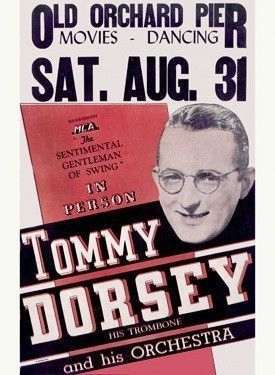
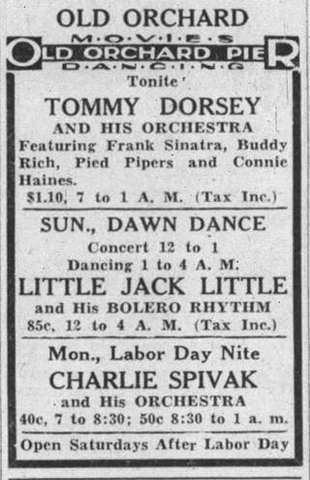
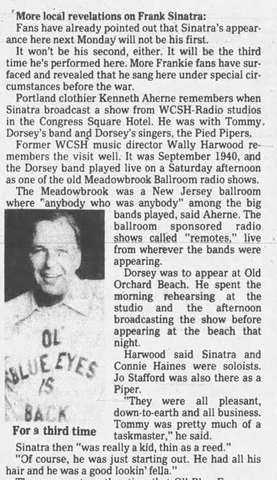
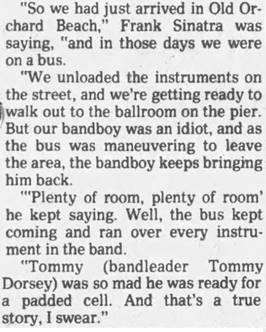
September 1940
[Photo of Frank, Ziggy Elman, Consiglio in Hartford]
Consiglio: A surviving photograph shows Frank, trumpeter Ziggy Elman, and Consiglio at the State Theater in Hartford in September 1940; Consiglio, not Frank, is wearing a bow tie in the photo -- he says Frank later picked up the bow-tie habit from him.
Source: Tony Consiglio (as told to Franz Douskey), "Sinatra and Me: The Very Good Years" (2012)
[discography/label history -- critical commentary]
Between late 1939 and September 1940, CBS phased out the Brunswick imprint; the four subsequent James-Sinatra singles were issued on the newly revived red-and-gold Columbia label instead.
Source: Charles L. Granata, "Sessions with Sinatra: Frank Sinatra and the Art of Recording" (1999/2003), Part I: The Big Band Years, 1937-1942
September 1, 1940
Concerts
Plymouth Town Hall, Plymouth, Massachusetts (One Nighter) Midnight September 1
Tommy Dorsey and His Orchestra with Frank Sinatra
Kimball’s Starlight Ballroom, Lynnfield, Massachusetts
(One Nighter)
Sunday evening
One-nighter
Tommy Dorsey and Orchestra
Frank Sinatra, Jo Stafford, Pied Pipers,
Connie Haines, Buddy Rich, Ziggy Elman,
Joe Bushkin, Sy Oliver
Ed O'Bien:
Through the years Sinatra would work with all
the performers listed above, with Connie Haines
being the one exception.
Note: There are two listings on this date for Dorsey.
Plymouth was at midnight September 1st, 1940 and Linnfield was possibly the evening of September 1st.
Plymouth Town Hall, Plymouth, Massachusetts
Midnight September 1st
Tommy Dorsey and His Orchestra with Frank Sinatra
From the Patriot Ledger, Quincy, Massachusetts (August 28, 1940) Thanks to Richard Cook for Plymouth listing.
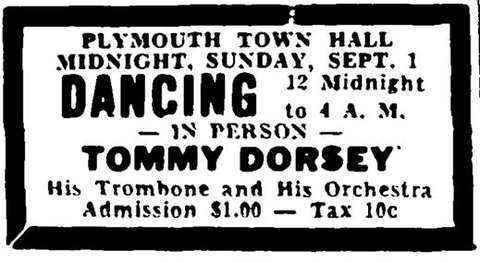
[Down Beat reports Buddy Rich beating]
The front page of Down Beat on September 1, 1940 reported that Buddy Rich's face had been badly beaten while he sat behind the drums with Dorsey's band at the Astor Hotel, with some band members suggesting Rich had 'asked for it.'
Source: James Kaplan, "Frank: The Voice" (2010).
September 2, 1940
Concerts
Sholes Riverview Ballroom, Neponset, Massachusetts (September 2nd one-nighter) Tommy Dorsey and his Orchestra w/Frank Sinatra
Ed o'Brien:
After this performance, Dorsey and the entire band flew to Toronto for the Canadian Expostion engagement, playing there from the 4th thru the 7th. Dorsey also worked out an agreement between NBC and CBC so he could broadcast during the engagement. The Saturday show (9-7-40) from the Exhibition was aired 5 to 6 PM EDT.
Sinatra's swing through New England is documented with the Dorseys in late August through early September: "[He was in] Salem, New Hampshire, for a one-nighter with the Dorsey band on August 30, 1940. (On subsequent nights, they performed in Lynnfield, Mass.; Old Orchard Beach, Maine; and Neponset, Mass.)," writes George Lyons of Malden, Massachusetts. "My Auntie Florence, 16 at the time, got her FS autograph at the 1940 Neponset gig."
September 3, 1940
Radio
“Pepsodent Summer Pastime” 11
(Tue) 10:00 - 10:30 p. m.
Tommy Dorsey and His Orchestra with Frank Sinatra
NBC Radio City, New York
(NBC Red) (WEAF)
Ed Herlihy, announcer
Jerry Lester, comedian, guest
September 4, 1940
Concerts
Canadian National Exhibition, Toronto , Canada (September 4 - September 7)
Tommy Dorsey and his Orchestra w/Frank Sinatra
Canadian National Exhibition, Toronto , Canada (September 4 - September 7) Tommy Dorsey and his Orchestra w/Frank Sinatra
(CNE DANCE TENT/PAVILION, 1940)
Note: Eddie Duchin played the week before Dorsey from August 29-31st, followed by Sammy Kaye September 2-3, and then Dorsey.
The above photo shows the CNE Dance Tent as it appeared during Eddie Duchin's appearance in August of 1940
The 1940 appearance of Dorsey at the Canadian National Exhibition (CNE) would represent Sinatra’s first time singing in Toronto. Sinatra and Dorsey would return to the CNE again in 1941 and Sinatra would make solo appearances in Toronto in 1949, 1975, 1976, 1984, 1989 and 1991.
September 5, 1940
Radio
Canadian National Exhibition, Toronto, Ontario
(Thu) 11:30 p. m. - Midnight
(NBC Red) (CBL) (Sustaining)
Hugh Bartlett, announcer
1. I’ll Never Smile Again (FS-PP)
2. Swing Time Up In Harlem (CH)
3. East Of The Sun (And West of the Moon) (FS-Band)
4. So What
5. I'm Getting Sentimental Over You (close)
(Also broadcast over the Canadian Broadcasting Corporation (CBC)
Note: RCA issued this on a 16" transcription record RCA MT 1031 (Part 2).
Concerts
Canadian National Exhibition, Toronto , Canada (September 4 - September 7) Tommy Dorsey and his Orchestra w/Frank Sinatra
Canadian National Exhibition, Toronto , Canada (September 4 - September 7) Tommy Dorsey and his Orchestra w/Frank Sinatra
September 6, 1940
Concerts
Canadian National Exhibition, Toronto, Canada (September 4 - September 7) Tommy Dorsey and his Orchestra w/Frank Sinatra
September 7, 1940
Radio
CBL Studios, Toronto, Ontario, Canada
Saturday Afternoon
5:00 p. m.- 6:00 p. m.
NBC Red Network - WEAF New York City
Announcer: Hugh Bartlett
Tommy Dorsey And His Orchestra
Frank Sinatra, Connie Haines, Jo Stafford, Pied Pipers,
Joe Bushkin, Ziggy Elman, Buddy Rich, Sy Oliver
1. I'm Getting Sentimental Over
You
TD & Orch.
2. Six Lessons From Madame La
Zonga
Connie Haines
3. All This And Heaven
Too
Frank Sinatra
4. Make Me Know It (Sy Oliver arg.)
TD & Orch.
5. I'll Never Smile
Again
Frank Sinatra & Pied Pipers
6. My Next
Romance
Frank Sinatra
7. Medley of old favorites:
a. Until The Real Thing Comes
Along
Frank Sinatra
b. Lost In A
Fog
TD & Orch.
c. Snuggled On Your
Shoulder
Connie Haines
d. Devil's
Holiday
TD & Orch.
8. Funny Little
Pedro
Pied Pipers
9. And So Do
I
Connie Haines
10.The Eyes And Ears Of The World (Paramount on Parade)
11 .Swing Your Blues
Away
Pied Pipers
12 .Make Up Your Mind About
Me
Connie Haines
13. Lead On, My Heart Will
Follow
Frank Sinatra
14. The Pied Piper Of
Harlem
Pied Pipers
15. Blue
Moon
Frank Sinatra & Band Chorus
16. The Pied Piper Of
Harlem(reprise)
Pied Pipers
17. Old Black
Joe
TD & Orch.
18. Closing
Theme
TD & Orch.
Scott: I've always wanted to hear the broadcast from CBL Studios in Toronto. I'm hoping a transcription
will show up somewhere. Sinatra singing a really early version of "Until The Real Thing Comes
Along" would be fantastic. At least a copy of the radio script is available:
https://www.colorado.edu/amrc/sites/default/files/attached-files/gma_3_3.01_scripts.pdf
Note: There is a tape from that weekend. Ruth Lowe is a special guest. There is a discussion of
how she presented "I'll Never Smile Again" to TD exactly one year ago. Frank and The Pied Pipers
sing the song and later in the show Frank does "East Of The Sun."--ED
Concerts
Canadian National Exhibition, Toronto , Canada (September 4 - September 7) Tommy Dorsey and his Orchestra w/Frank Sinatra
September 8, 1940
Concerts
Lake Compounce, Bristol, Connecticut (September 8 - one-nighter) Tommy Dorsey and his Orchestra w/Frank Sinatra
Lake Compounce, Bristol, Connecticut (September 8 - one-nighter) Tommy Dorsey and his Orchestra w/Frank Sinatra
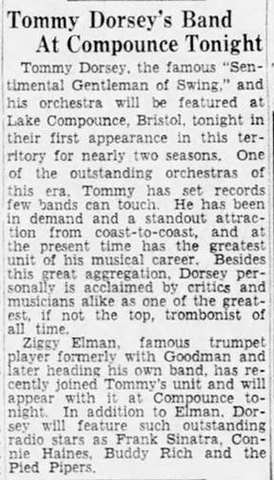
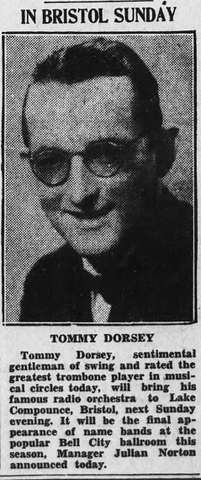
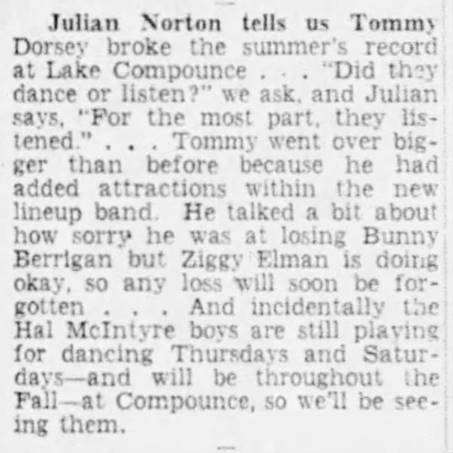
September 9, 1940
Studio
New York City
BS055960 When You Awake
(Henry Nemo)
Indano Music Co. (ASCAP)
Arranged by Deane Kincaide
-1 (3:10) CD: 07863 66353-2 "The Song Is You" 5CD set Vol 2 -2 LP: SD 1000
-1 78: 26764 (first pressing)
-2 78: 26764 (second pressing)
BS055961 Anything
(P. Napoleon/F.. Signorelli/E. DeLange)
Southern Music Publishing Co. Inc./Scarsdale Music Corp. (ASCAP) Arranged by Deane Kincaide
-1 (3:04) CD: 07863 66353-2 "The Song Is You" 5CD set Vol 2
LP: SD 1000
78: 27208
Saxes: Fred Stulce, Johnny Mince, Paul Mason, Don Lodice, Heinie Beau; Trumpets: Clyde Hurley, Ziggy
Elman, Ray Linn, Chuck Peterson; Trombones: Les Jenkins, George Arus, Lowell Martin; Guitar: Clark Yocum; Piano: Joe Bushkin; Bass: Sid Weiss; Drums: Buddy Rich
Note: When You Awake -2 has not been located in the RCA vaults
September 10, 1940
Radio
Pepsodent Summer Pastime
Location: Radio City, New York City
Episode: 12
Tuesday
10:00 - 10:30 p. m.
NBC Red Network (WEAF)
Tommy Dorsey & His Orchestra featuring Frank Sinatra, Connie Haines, The Pied Pipers, Buddy Rich, Ziggy Elman, Joe Bushkin and Sy Oliver
Announcer: Ed Herlihy,
Guest: Jerry Lester
September 11, 1940
Concerts
Carrolltown, Pennsylvania (September 11 - one-nighter) Tommy Dorsey and his Orchestra w/Frank Sinatra
Carrolltown, Pennsylvania (September 11 - one-nighter) Tommy Dorsey and his Orchestra w/Frank Sinatra
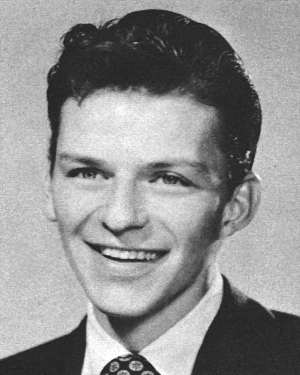
September 12, 1940
Concerts
Detroit, Michigan -- "Edsel Ford Private Party" one-nighter Tommy Dorsey and his Orchestra w/Frank Sinatra
September 13, 1940
Radio
Live Remote: Idora Park, Youngstown, OH
Tommy Dorsey & His Orchestra
Frank Sinatra, Connie Haines, the Pied Pipers
9:45pm – 10:15pm
WFMJ
Concerts
Idora Park, Youngstown, Ohio (September 13 - one-nighter) Tommy Dorsey and his Orchestra w/Frank Sinatra
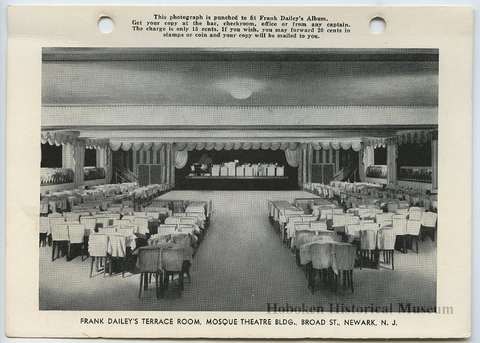
Idora Park, Youngstown, Ohio (September 13 - one-nighter)
Tommy Dorsey and his Orchestra w/Frank Sinatra
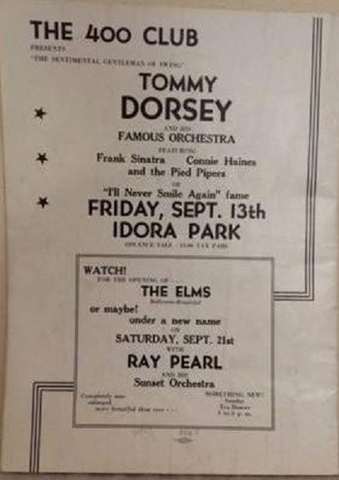
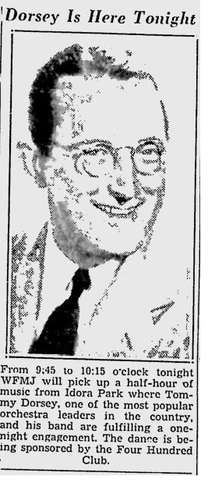
September 14, 1940
Radio
Junior Ballroom of the Neil House, Columbus, Ohio
Saturday
4:00 - 5:00 p. m.
WCOL Studios
Columbus, Ohio
NBC Red Network
The Dorsey Hour
John Feld, announcer
1. I'm Getting Sentimental Over You
2. Swing Time Up In Harlem - Connie Haines
3. Talk - Connie & TD
4. Love Lies - Frank Sinatra
5. Talk - Sinatra & TD
6. The One I Love - Sinatra & Pied Pipers
7. Talk - Joe Stafford & TD
8. Trade Winds - Frank Sinatra
9. March Of Toys - Instrumental
10. Contest Information
11. Medley: If It's The Last Thing I Do (FS) / I Live The Life
/ You're A Sweetheart (CH)
12. Losers Weepers - Instrumental
13. Station Break
14. I'll Never Smile Again - Sinatra & Pied Pipers
15. Blues No More - Instrumental
16. Pied Piper Of Harlem - Instrumental
17. Contest Information
18. Love Is All That Bothers Me - Connie Haines
19. How Could We Know - Sinatra
20. What Did I Say To You - Pied Pipers
21. Audience Votes
22. East of The Sun - Sinatra & Pied Pipers
23. How Could We Know - Sinatra
24. Contest Talk
25. So What - Instrumental
26. Closing Theme
NOTE: Sinatra Scholar Ed O'Brien says this is the best of the Dorsey band broadcasts from the 1940s.
An outstanding hour of music with seven songs by Sinatra. There is a marvelous mix of standards and songs about to become stand3ards.
Note: The Broadcast was not from the Valley Dale Ballroom but from the Junior Ballroom of the Neil House. Dorsey would perform at Valley Dale in the evening.
Concerts
Valley Dale, Ballroom, Columbus , Ohio (September 14 - one-nighter) Tommy Dorsey and his Orchestra w/Frank Sinatra
Junior Ballroom of the Neil House, Columbus, Ohio
Saturday
4:00 - 5:00 p. m.
WCOL Studios
Columbus, Ohio
NBC Red Network
The Dorsey Hour
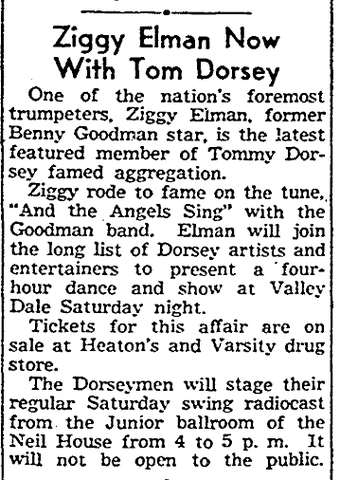
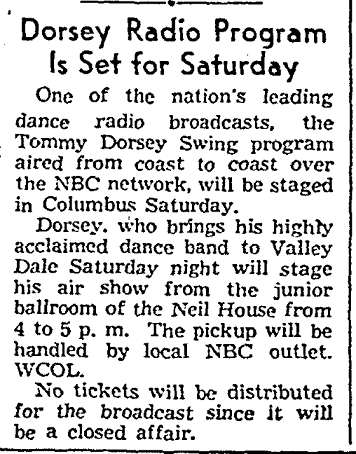
Valley Dale, Ballroom, Columbus , Ohio (September 14 - one-nighter) Tommy Dorsey and his Orchestra w/Frank Sinatra
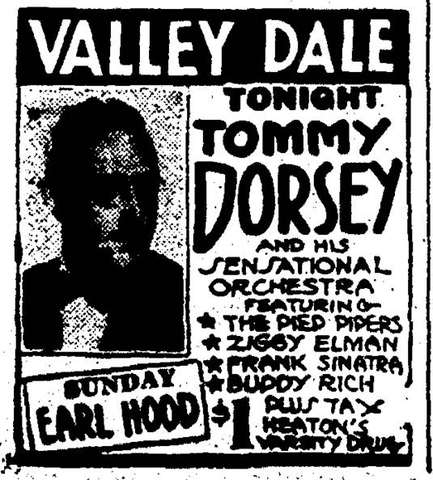
September 15, 1940
Radio
Trianon Ballroom, Cleveland, Ohio
Sunday
11:30 - 11:57 p. m.
NBC Red Network (WTAM)
Tommy Dorsey & His Orchestra
Ziggy Elman, Joe Bushkin, Sy Oliver, Buddy Rich
Frank Sinatra, Connie Haines, The Pied Pipers
1. I'm Getting Sentimental Over You - TD & Orch
2. Six Lessons From Madame La Zonga - Connie Haines
3. Head On My Pillow - Frank Sinatra
4. Make Me Know It - TD & Orch
5. Half Way Down The Street - Frank Sinatra
6. Symphony In Riffs - TD & Orch
7. I'll Never Smile Again - Frank Sinatra & Pied Pipers
8. I Know That You Know - TD & Orch
9. Closing Theme - TD & Orch
Concerts
Trianon Ballroom, Cleveland, Ohio (September 15 – one-nighter) Tommy Dorsey and his Orchestra w/Frank Sinatra
NOTE: Ed O'Brien sends along an item from the September 25, 1940 issue of Variety:
"At $1.25 per – TD drew 3,000 dancers into the Trianon Ballroom on a one-nighter and took out $1,700 as his share."
Trianon Ballroom, Cleveland, Ohio (September 15 – one-nighter)
Tommy Dorsey and his Orchestra w/Frank Sinatra
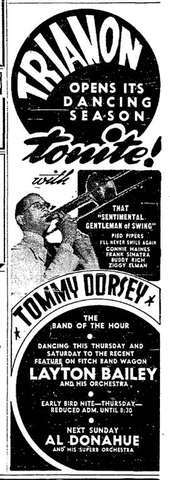
September 16, 1940
Concerts
Rainbow Garden, Waldameer Park, Erie, Pennsylvania
(One Nighter)
T. Dorsey Great With 2,700
Erie, Pa. Sept. 21.-Tommy Dorsey. opening the fall and winter cabaret style of dancing at Rainbow Gardens in Waldameer Park here Monday (16). packed in 2,700 persona at $1.00 a head plus tax.
Billboard
9-28-40
Rainbow Garden, Waldameer Park, Erie, Pennsylvania
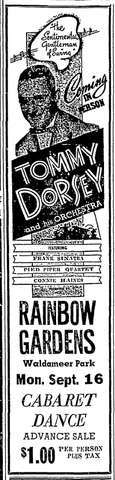
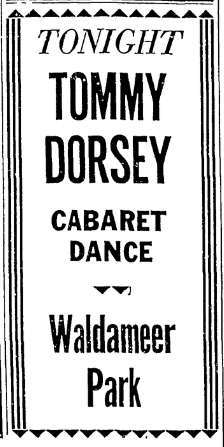
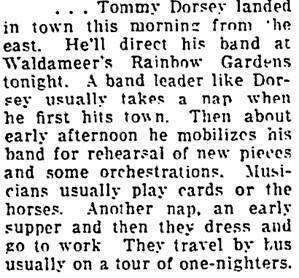
September 17, 1940
Studio
BS056131 Shadows In The Sand
(S Adams/W. Grosz)
Warner Bros. Music (ASCAP)
Arranged by Freddie Stulce
-1 (2:37) CD: 07863 66353-2 "The Song Is You" 5CD set Vol 2
CD: RCA 9679-2-R
LP: SD 1000
78: 26761
BS056133 You're Breaking My Heart All Over Again
(J. Cavanaugh/J. Redmond/A. Altman)
Warner Bros. Music (ASCAP)
Arranged by Deane Kincaide
-2 (3:01) CD: 07863 66353-2 "The Song Is You" 5CD set Vol 2
CD: RCA 2269-2-R
LP: SD 1000
78: 26761
BS056135 I'd Know You Anywhere
(from the RKO picture You'll Find Out)
(J. Mercer/J. McHugh)
Warner Bros. Music (ASCAP)
Arranged by Deane Kincaide
-1 (2:51) CD: 07863 66353-2 "The Song Is You" 5CD set Vol 2
CD: RCA 9679-2-R
LP: SD 1000
78: 26770
Saxes: Fred Stulce, Johnny Mince, Paul Mason,
Heinie Beau, Don Lodice; Trumpets: Ziggy Elman,
Ray Linn, Chuck Peterson; Piano: Joe Bushkin;
Trombones: Les Jenkins, George Arus, Lowell
Martin; Guitar: Clark Yocum; Bass: Sid Weiss; Drums: Buddy Rich
Radio
Pepsodent Summer Pastime
Tommy Dorsey and His Orchestra with Frank Sinatra
Last radio broadcast of the Pepsodent shows with
Tommy Dorsey and his Orchestra w/Frank Sinatra.
Bob Hope returns to the air next week with Jerry Colonna.
10:00 " 10:30 p.m.
September 18, 1940
Concerts
Columbus Civic Center, Rochester, New York (September 18 – one-nighter)
Tommy Dorsey and his Orchestra w/Frank Sinatra
NOTE: Ed O'Brien sends along a couple of interesting items from this one-nighter.
"Ziggy Elman can be heard on NBC airchecks playing the Bunny Berigan solos on "Marie" and "Song of India ."
Available on RCA Victor LPT-6003.
And from Downbeat: TOMMY D AND ZIGGY TRADE HORNS; BOTH SOLID
"The citizens got their kicks right when Tommy Dorsey traded places and instruments with Ziggy Elman on the band's one-nighter here recently. Tommy played fine jazz trumpet sitting back in the section while Elman fronted with Tommy's sliphorn and poured out some real gut from it. Dorsey played clarinet on the band's jazzy rendition of "Friendship" behind the Pied Pipers vocal.
"About 450 persons had jammed the Lewis Music Store when Tommy, Frank Sinatra and Connie Haines were interviewed over WSAY from the balcony of the store. Tommy and the gang were met at the station by a sheriff escort and rushed up late to be officially greeted by Mayor Samuel Dicker. The band had been up all night making records in New York .
Columbus Civic Center, Rochester, New York (September 18 – one-nighter)
Democrat and Chronicle (Rochester, New York) 19 Sep
1940
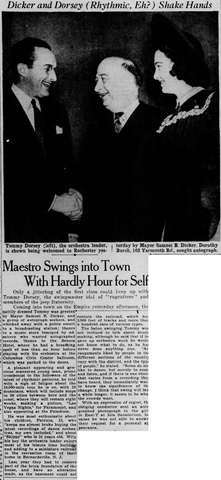
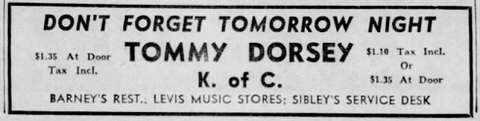
September 19, 1940
Concerts
Zembo Mosque, Harrisburg, Pennsylvania (September 19 - one-nighter) Young Republican's Ball
Tommy Dorsey and his Orchestra w/Frank Sinatra
Zembo Mosque, Harrisburg, Pennsylvania (September 19 - one-nighter) Young Republican's Ball
Tommy Dorsey and his Orchestra w/Frank Sinatra
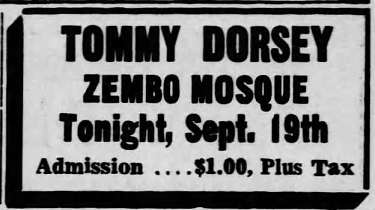
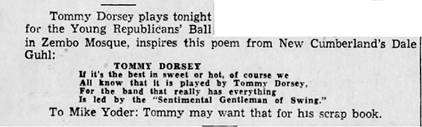
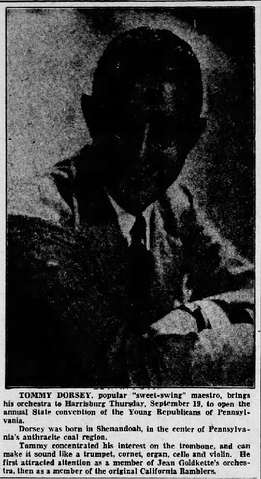
September 20, 1940
Radio
Roseland Ballroom, New York, (Fri)
11:30 - 11:59:40 p. m.
(NBC Red) (WEAF)
Tommy Dorsey and His Orchestra
Robert “Bob” Waldrop, announcer
1. I'm Getting Sentimental Over You (open)
2. (What Can I Say, Dear) After I Say I’m Sorry (PP)
3. When You Awake (FS)
4. I’m Nobody’s Baby (CH)
5. I’ll Never Smile Again (FS-PP)
6. Easy Does It
7. And So Do I (CH)
8. Marie (FS –Band)
9. Losers Weepers
10. I'm Getting Sentimental Over You (close)
Concerts
Roseland Ballroom , New York , New York (One Nighter)
Tommy Dorsey and his Orchestra w/Frank Sinatra
Roseland Ballroom , New York , New York
Tommy Dorsey and his Orchestra w/Frank Sinatra
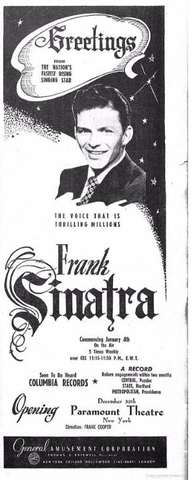
September 21, 1940
Radio
The Dorsey Hour
Saturday Afternoon
5:00 p.m. - 6:00 p. m.
NBC Red Network - WEAF New York City
Radio City Station( NBC Building)
Tommy Dorsey and His Orchestra
1. I'm Getting Sentimental Over
You
TD & Orch.
2.Lights Out, Hold Me Tight ( Sy Oliver arg.) Connie Haines
3.I Could Make You
Care
Frank Sinatra
4. Another One Of Them
Things
TD & Orch.
5. We Three( My Echo, My Shadow And Me) Frank
Sinatra
6.
Maybe
Connie Haines
7.Looking For
Yesterday
Frank Sinatra
8. Old Man
Harlem
TD & Orch.
9. Funny Little
Pedro
Pied Pipers
10.That's For
Me
Connie Haines
11.Boogie
Woogie
TD & Orch.
12.How Could We
Know
Frank Sinatra
13.Amateur Contest
a. My Heart Tells Me
It's
So
Frank Sinatra
b. Too
Late
Connie Haines
c. Introduction To A
Savage
TD & Orch.
14.Deep
Night
Frank Sinatra & Band Chorus
15.Quiet,
Please
TD & Orch.
16.Closing
Theme
TD & Orch.
Concerts
Sunnybrook Ballroom, Pottstown, Pennsylvania (September 21 - one-nighter) Tommy Dorsey and his Orchestra w/Frank Sinatra
Sunnybrook Ballroom
Pottstown, Pennsylvania (September 21 - one-nighter)
Tommy Dorsey and his Orchestra w/Frank Sinatra
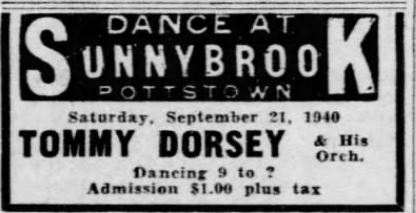
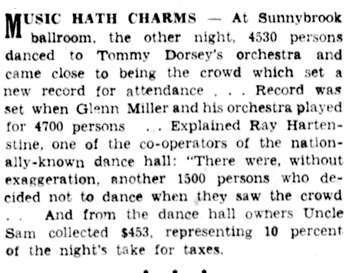
September 22, 1940
Concerts
Savoy Ballroom, New York , New York (September 22 - one-nighter) Tommy Dorsey and his Orchestra w/Frank Sinatra
(The New York Age, NY, September 21, 1940)
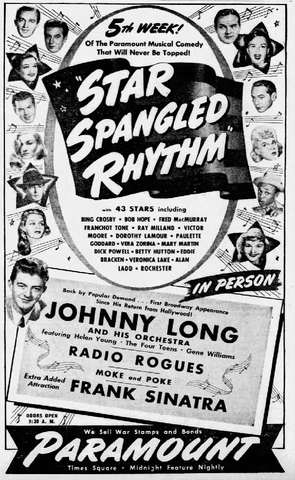
September 23, 1940
Concerts
State Theater, Hartford, Connecticut (September 23-24)
Tommy Dorsey and his Orchestra w/Frank Sinatra
State Theater, Hartford, Connecticut
Tommy Dorsey and his Orchestra w/Frank Sinatra
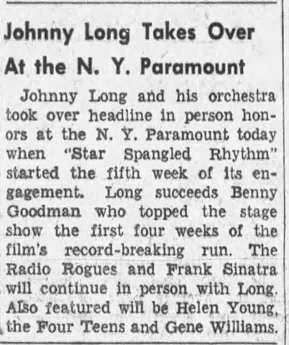
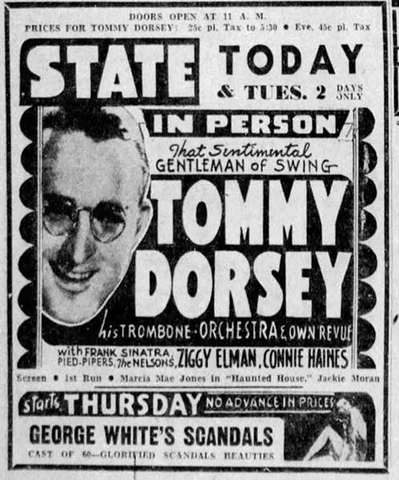
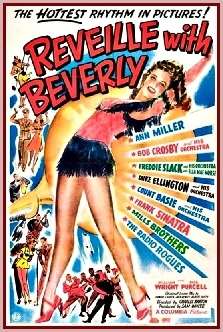
September 24, 1940
Concerts
State Theater, Hartford, Connecticut (September 23 - September 24) Tommy Dorsey and his Orchestra w/Frank Sinatra
September 25, 1940
Radio
American Legion Ball, Boston, Massachusetts (September 25 - one-nighter) Tommy Dorsey and his Orchestra w/Frank Sinatra
"Cavalcade of Stars"
The show was broadcast over WBZ in Boston.
Air time live was 10:00 to 11:00 P.M.
Ben Bernie was the emcee. TD Orch was featured plus Shep Field, Bill Robinson and others.
Thanks to Ed O'Brien for the above listing
Concerts
American Legion Ball, Boston Gardens, Boston , Massachusetts (September 25 - one-nighter) Tommy Dorsey and his Orchestra w/Frank Sinatra
Boston Braves Field, Boston, Massachusetts
Wednesday Afternoon
"Cavalcade of Stars"
American Legion Ball, Boston , Massachusetts (September 25 - one-nighter) Tommy Dorsey and his Orchestra w/Frank Sinatra
The big show at the Boston Braves ballpark was rained out. A last minute furious effort by the organizers saved the day by quickly moving everything into the Boston Garden. The change of venue created a controlled chaos that was finally rewarded when the Garden opened its doors at 5:p.m. The show was quite long with Bill Robinson getting the most applause from the many thousands in attendance. Sophie Tucker was a no-show due to the inclement weather. Dorsey Band was a huge hit and took part in the local WBZ radio broadcast from 10 to 11 p.m.
Skitch Henderson told me that TD was always looking to pick up extra money in whatever town the band happened to be at a particular moment. One has to wonder if the American Legion dance was one of those fortuitous moments that Dorsey so loved to grab from the locals. Ed
"I'll Never Smile Again" drops to #3 in sheet music sales.
-- Variety
9-25-40
Cancelled Event
1977 Ahmanson Theatre, Los Angeles, California
Benefit
Orchestra Conducted By: Bill Miller
---Ed O'Brien:
Frank canceled this show due to illness.
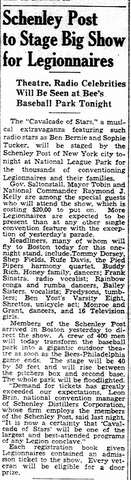
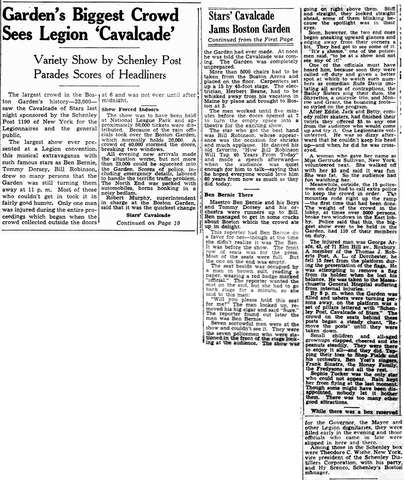
September 26, 1940
Concerts
Astor Hotel , New York, New York (Private Party) - (September 26 - one-nighter) Tommy Dorsey and his Orchestra w/Frank Sinatra
September 27, 1940
Concerts
Geo. F. Johnson Pavilion, Johnson City, New York (September 27 one-nighter) Tommy Dorsey and his Orchestra w/Frank Sinatra
Geo. F. Johnson Pavilion, Johnson City , New York (September 27 one-nighter)
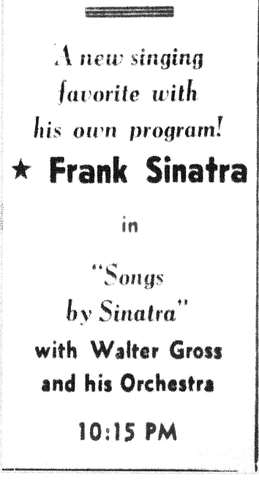
September 28, 1940
Radio
“The Dorsey Hour”
Saturday Afternoon
5:48 p.m. - 6:25 p .m.
NBC Red Network
WEAF
New York City
Tommy Dorsey And His Orchestra
Connie Haines, Buddy Rich, Jo Stafford, Frank Sinatra, Pied Pipers, Joe Bushkin, Ziggy Elman
1. I'm Getting Sentimental Over
You
TD & Orch.
2. The One I Love Belongs To Somebody
Else
Frank Sinatra & Pied
Pipers
3. Some Of Your
Sweetness
Frank Sinatra
4. I'll Never Smile
Again
Frank Sinatra & Pied Pipers
5. The Eyes And Ears Of The
World
TD & Orch.
6. Too
Late
Connie Haines
9. Amateur Song Contest:
a. Let Me Walk Beside
You
Frank Sinatra
b. Don't Turn Me
Away
Connie Haines
c. I Knew It Was
Love
Pied Pipers
10. Sweet
Sue
Frank Sinatra & Band Chorus
11. Dear Old
Southland
TD & Orch.
12. Closing
Theme
TD & Orch.
Ed O'Brien:
Show was originally scheduled for a 5:30 to 6:30 broadcast. The college football game
between Ohio State and Pittsburgh ran over, necessitating a truncated version of the
Dorsey hour.
Note: The Dorsey Hour" was broadcast from WSPD in Toledo, Ohio.
Actual air time was 5:48 P.M. to
6:24 P.M.
Note: (“I Knew It Was Love” was the winning tune)
Concerts
Trianon Ballroom, Toledo, OH (One-nighter)
Tommy Dorsey and his Orchestra w/Frank Sinatra
Trianon Ballroom, Toledo, OH (One-nighter)
Tommy Dorsey and his Orchestra w/Frank Sinatra
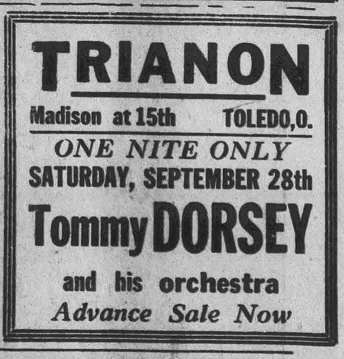
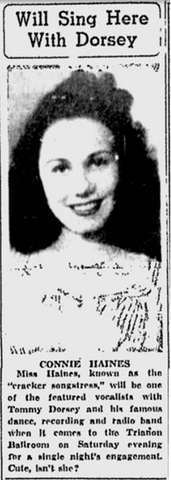
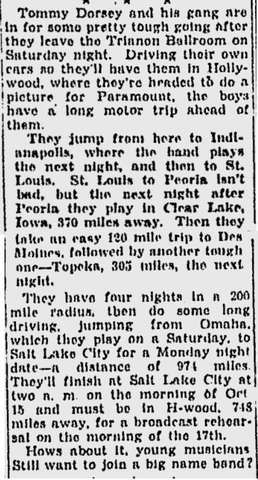
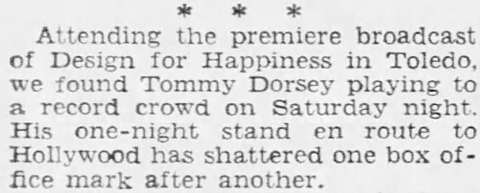
September 29, 1940
Concerts
Indiana Roof Ballroom, Indianapolis (One Nighter)
Tommy Dorsey and His Orchestra with Frank Sinatra
September 30, 1940
Concerts
Horse Show Arena, St. Louis National Horse Show, St. Louis, Missouri (September 30 - October 5) Matinee
Tommy Dorsey and his Orchestra w/Frank Sinatra
"B" Building, St. Louis National Horse Show, St. Louis, Missouri (September 30 - October 5) Evening performance 11:30pm - 1am
Tommy Dorsey and his Orchestra w/Frank Sinatra
"Tommy Dorsey and his widely known swing band will furnish the music at each of the performances as well as at a dance following each session of the St. Louis National Horse Show...Dorsey will play during the horse show performances and for 15 minutes he and his famous band will entertain, with them taking the spotlight. Dorsey will give a trombone solo and his two featured singers, Frank Sinatra, a baritone, and Connie Haynes, popular vocalist, will be given a chance to sing. So will the six Pied Pipers...The dance each night will last from 11:30 to 1 o'clock in the "B" building on the arena grounds...This is the first time in the history of local horse shows that "name band has been brought in to furnish the music." ---St. Louis Globe-Democrat (St. Louis, Missouri) September 29, 1940
Live remotes of Dorsey would be heard over KSD, St. Louis October 1st-5th, 1940
Horse Show Arena, St. Louis National Horse Show, St. Louis, Missouri (September 30 - October 5)
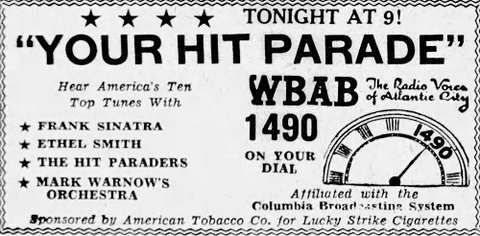
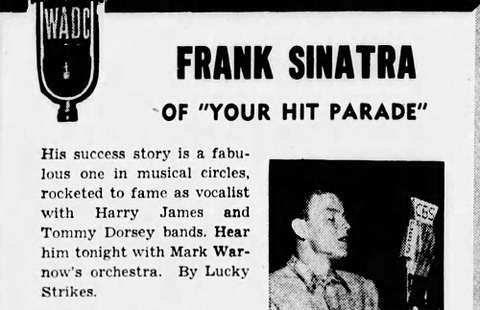
October 1, 1940
Radio
Horse Show Arena, St. Louis National Horse Show, St. Louis, Missouri 11:45pm-12:00am (KSD) -- Tommy Dorsey's Orchestra playing in St. Louis
Concerts
Horse Show Arena, St. Louis National Horse Show, St. Louis, Missouri (September 30 - October 5) Matinee
Tommy Dorsey and his Orchestra w/Frank Sinatra
"B" Building, St. Louis National Horse Show, St. Louis, Missouri (September 30 - October 5) Evening performance 11:30pm - 1am
Tommy Dorsey and his Orchestra w/Frank Sinatra
Paramount has just signed Tommy Dorsey and his band to appear in the new movie "Las Vegas Nights" which will go into production shortly after the band opens October 15th at the Palladium. Stars of the picture will be Allan Jones and Bert Wheeler. DOWNBEAT
10-1-40
note: TD signed a contract to play a two week engagement at the Paramount Theatre in Los Angeles, beginning on 10/15. The Palladium grand opening was 10/31.Louis Brecker and other owners of the Palladium threatened to break a very lucrative contract with Dorsey, if he did not cancel the Paramount contract. Dorsey caved and the inaugural run at the Palladium was a success for every one involved. Allan Jones, father of Jack, dropped out of the project and was replaced by Phil Regan. Frank was designated "boy singer, " on the film work sheets. The band worked at the Palladium in the evening and made a movie in the daylight hours.
October 2, 1940
Radio
St. Louis National Horse Show, St. Louis, Missouri
11:45pm-12:00am (KSD) -- Tommy Dorsey's Orchestra playing in St. Louis
Concerts
Horse Show Arena, St. Louis National Horse Show, St. Louis, Missouri (September 30 - October 5)
Matinee
Tommy Dorsey and his Orchestra w/Frank Sinatra
"B" Building, St. Louis National Horse Show, St. Louis, Missouri (September 30 - October 5)
Evening performance 11:30pm - 1am
Tommy Dorsey and his Orchestra w/Frank Sinatra
October 3, 1940
Radio
Horse Show Arena, St. Louis National Horse Show, St. Louis, Missouri 11:45pm-12:00am (KSD) -- Tommy Dorsey's Orchestra playing in St. Louis
Concerts
Horse Show Arena, St. Louis National Horse Show, St. Louis, Missouri (September 30 - October 5) Matinee
Tommy Dorsey and his Orchestra w/Frank Sinatra
"B" Building, St. Louis National Horse Show, St. Louis, Missouri (September 30 - October 5) Evening performance 11:30pm - 1am
Tommy Dorsey and his Orchestra w/Frank Sinatra
Western Military Academy, Alton, Illinois
Tommy Dorsey with Frank Sinatra and the Pied Pipers
Afternoon performance.
Note: Dorsey was playing Horse Show Arena, St. Louis National Horse Show, St. Louis, Missouri from September 30 – October 5, 1940 so this might have been an afternoon off or an afternoon performance before an evening performance in St. Louis. The article in the EXTRAS section indicates Dorsey played a few private schools in the St. Louis area as well during their St. Louis run. No indication what schools they were.
Western Military Academy, Alton, Illinois
Tommy Dorsey with Frank Sinatra and the Pied Pipers
Afternoon performance.
Here’s another one I’m trying to run down:
St. Louis University dance with Dorsey obviously while he was there during the first week of October 1940. This article was published October 15, 1940. --Scott
[image referenced in source but could not be recovered]
[image referenced in source but could not be recovered]
I came across this which should be listed for October 3, 1940:
October 3, 1940, Western Military Academy, Alton, Illinois
Tommy Dorsey with Frank Sinatra and the Pied Pipers
Afternoon performance.
Note: Dorsey was playing Horse Show Arena, St. Louis National
Horse Show, St. Louis, Missouri from September 30 October 5, 1940 so this might have been an afternoon off or an afternoon performance before an evening performance in St. Louis. The article also indicates Dorsey played a few private schools in the St. Louis area as well during their St. Louis run. No indication what schools they were.
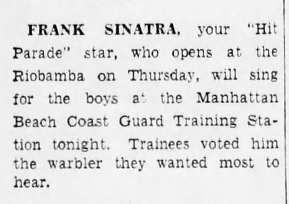
October 4, 1940
Radio
Horse Show Arena, St. Louis National Horse Show, St. Louis, Missouri 11:45pm-12:00am (KSD) -- Tommy Dorsey's Orchestra playing in St. Louis
Concerts
Horse Show Arena, St. Louis National Horse Show, St. Louis, Missouri (September 30 - October 5) Matinee
Tommy Dorsey and his Orchestra w/Frank Sinatra
"B" Building, St. Louis National Horse Show, St. Louis, Missouri (September 30 - October 5) Evening performance 11:30pm - 1am
Tommy Dorsey and his Orchestra w/Frank Sinatra
October 5, 1940
Radio
St. Louis, Missouri
Saturday Afternoon
Network: NBC
4:00 - 4:55 p. m. (KSD ), 5:00 - 6:00 p.m. (WEAF)
Tommy Dorsey and his Orchestra
Buddy Rich, Ziggy Elman, Joe Bushkin, Sy Oliver
Frank Sinatra, Connie Haines, The Pied Pipers
1.I'm Getting Sentimental Over You TD & Orch
2.That's For Me Connie Haines 3.Only Forever Frank Sinatra 4.Dark Eyes (featuring Dorsey solo) Orch.
5.Head On My Pillow Frank Sinatra 6.Whispering Frank Sinatra & Pied Pipers 7.When You Awake Frank Sinatra 8.Blues No More TD & Orch 9.Funny Little Pedro Pied Pipers 10.I Wouldn't Take A Million Connie Haines
11. Make Me Know It TD & Orch
12. I Knew It Was Love Pied Pipers
13. Amateur Song Contest: a.. Why Can't We Connie Haines b. Midnight On The Trail Frank Sinatra c. Dreamin', Just Dreamin' Pied Pipers
14.East Of The Sun (And West of the Moon) Frank Sinatra & Band Chorus
15. I Know That You Know TD & Orch
16. Closing Theme
KXOX, WEW, WMAQ 4pm - 4:15 Tommy Dorsey's Orchestra playing in St. Louis
11:45pm-12:00am KSD Tommy Dorsey's Orchestra playing in St. Louis
Concerts
Horse Show Arena, St. Louis National Horse Show, St. Louis, Missouri (September 30 - October 5) Matinee
Tommy Dorsey and his Orchestra w/Frank Sinatra
"B" Building, St. Louis National Horse Show, St. Louis, Missouri (September 30 - October 5)
Evening performance 11:30pm - 1am
Tommy Dorsey and his Orchestra w/Frank Sinatra
Horse Show Arena, St. Louis National Horse Show, St. Louis, Missouri (September 30 - October 5) Matinee
Tommy Dorsey and his Orchestra w/Frank Sinatra
"B" Building, St. Louis National Horse Show, St. Louis, Missouri (September 30 - October 5) Evening performance 11:30pm - 1am
Tommy Dorsey and his Orchestra w/Frank Sinatra
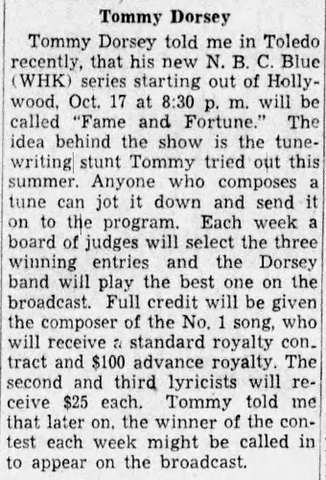
October 6, 1940
Concerts
Inglaterra Ballroom, Peoria, Illinois (One-Nighter)
Tommy Dorsey and his Orchestra w/Frank Sinatra
Note: Thanks to Richard Cook for this listing
Inglaterra Ballroom, Peoria, Illinois (One-Nighter)
Tommy Dorsey and his Orchestra w/Frank Sinatra
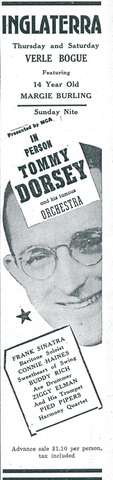
October 7, 1940
Concerts
Surf Ballroom, Clear Lake, Iowa (One Nighter)
If you haven't heard of the Surf Ballroom then you're missing out on a part of history. Buddy Holly, Ritchie Valens, and J. P. "The Big Bopper" Richardson gave their last performances at the Surf on February 2, 1959 as part of the "Winter Dance Party Tour". Holly, Valens and Richardson left The Surf immediately after the show, going to the nearby Mason City airport and chartering a small plane to take them to Fargo, North Dakota to prepare for their next show at the Moorhead Armory in Moorhead, Minnesota. The plane took off at 12:55 AM Central Time on Tuesday February 3, 1959. Shortly after takeoff, the plane crashed, killing everyone aboard.
A concrete monument was erected outside The Surf, and the ballroom is adorned with large pictures of the three musicians. A street flanking the facility's east property line is named Buddy Holly Place in his honor.
Surf Ballroom, Clear Lake, Iowa (One Nighter)
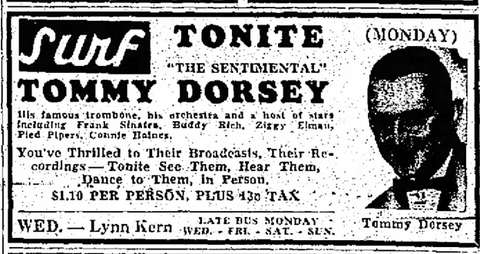
October 8, 1940
Concerts
Tromar Ballroom, Des Moines, IA (October 8 - one-nighter) Tommy Dorsey and his Orchestra w/Frank Sinatra
(previous postings erroneously had Dorsey in Lawrence, Kansas on this date)
Tromar Ballroom, Des Moines, IA
Both notices from
The Des Moines Register (Des Moines, Iowa) · 6 Oct 1940:
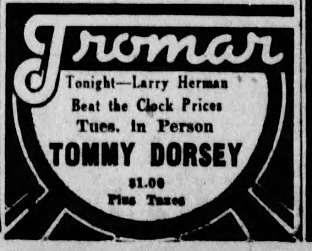
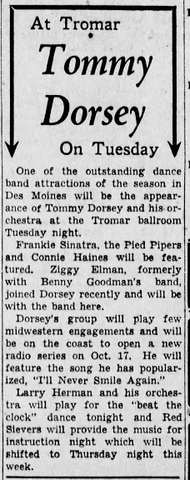
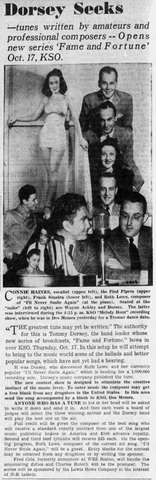
October 9, 1940
Concerts
Meadow Acres Ballroom, Topeka, Kansas, (October 9 - one-nighter) Tommy Dorsey and his Orchestra w/Frank Sinatra
Note: previous entries had Dorsey in Omaha, Nebraska but he didn't play Omaha until the 12th.
--The Morning Chronicle (Manhattan, Kansas) · 10 Oct 1940
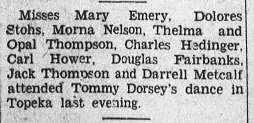
October 10, 1940
Radio
The Dorsey Hour
Saturday
4:30 – 5:20 p. m.
WOW Studios
Omaha, Nebraska
NBC Red (WOW)
Sustaining
Announcer: Russ . . .
It's that Sentimental Gentleman of Swing, Tommy Dorsey, his golden voiced trombone and his versatile orchestra - with Connie Haines, Frank Sinatra and the Pied Pipers - coming to you from the studios of Station WOW in Omaha, Nebraska. Once more we bring you three tunes selected to be played today in the "Tommy Dorsey Amateur Songwriting Contest"ť and our studio audience here will vote its choice on our Applause Meter.
1. I'm Getting Sentimental Over You TD & Orch
2. Lights Out, Hold Me Tight Connie Haines
3. The World Is In My Arms Frank Sinatra
4. Take It TD & Orch
5. Head On My Pillow Frank Sinatra
6. You Got Me This Way The Pied Pipers
7. I Could Make You Care Frank Sinatra
8. Old Black Joe ( Ziggy Elman solo) TD & Orch
9. Funny Little Pedro The Pied Pipers
10. And So Do I Connie Haines
11. Swanee River TD & Orch
12. Dreamin' Just Dreamin' ( last week's contest winner) The Pied Pipers
Amateur Song Contest
13. Lovely Is The Word For You Connie Haines
14. Garden Of Roses Frank Sinatra
15. What Am I To Do The Pied Pipers
16. Who Frank Sinatra w/ Band Chorus
17. What Am I To Do -winning song reprised The Pied Pipers
18. So What! TD & Orch
19. Closing theme
Ed O'Brien:
Before TD introduced "So What!," there was this announcement: All right, Russ, and here, folks, is our big news about the SENSATIONAL NEW program starting next Thursday night!! Over another network – YOUR program -- FAME AND FORTUNE will be on the air! We'll all be on hand – the orchestra, Frank Sinatra, Connie Hainess, the Pied Pipers and A SPECIAL SURPRISE GUEST! But most important! The songs YOU send in will be reviewed, judged and winners declared! To the FIRST PLACE WINNER each week will go a publishing and royalties contract - and an advance royalty check!!!! And the second and the third song to be picked will ALSO receive a large CASH award. Think of it! YOUR song PUBLISHED! A board of famous orchestra leaders will act as judges! It's REALLY your chance for FAME AND FORTUNE! So don't miss the program! Remember, it's Thursday night, OCTOBER 17 over another network.
Concerts
Pla-Mor Ballroom, Kansas City, Missouri (October 10 - one-nighter) Tommy Dorsey and his Orchestra w/Frank Sinatra
Kansas City, Oct. 15 – -- The first sizable band of the fall season was the Thursday (10) night stand of the Tommy Dorsey crew at the Pla-Mor Ballroom. The band drew over 3,000 customers at a gate admission of $1.30 per head and an advance fee of $1.15. A total of $3,250 is big money for this spot, but the mid-week date held down the take. Dorsey and the band made a string of one-nighters between a date in St. Louis and its opening at the Palladium Ballroom, Hollywood, where the orchestra will play while working in Paramount's "Las Vegas Nights,' Dorsey's first film venture. Lawrence, Kansas, Omaha and Ogden were stops on the one-nighter route. Manager Will Wittig of the Pla-Mor officially inaugurated the fall season in his newly decorated hall with the Dorsey engagement.
Variety
10-16-40
Pla-Mor Ballroom, Kansas City, Missouri (October 10 - one-nighter) Tommy Dorsey and his Orchestra w/Frank Sinatra
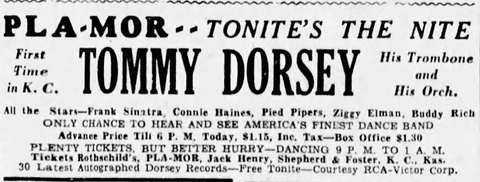
October 11, 1940
Concerts
Kansas University, Freshman Frolic, Lawrence, Kansas, (Friday Evening, One-Nighter) Tommy Dorsey And His Orchestra
Frank Sinatra, Jo Stafford, The Pied Pipers,Connie Haines, Ziggy Elman, Joe Bushkin, Buddy Rich, Sy Oliver
Tommy Dorsey packed 1,400 persons into a student dance hall at K.U. many roommates purchasing a ticket on shares and dancing half the numbers each. --Council Grove, Republican (Council Grove, Kansas), October 14, 1940
Kansas University, Freshman Frolic, Lawrence, Kansas, (Friday Evening, One-Nighter) Tommy Dorsey And His Orchestra
Frank Sinatra, Jo Stafford, The Pied Pipers,Connie Haines, Ziggy Elman, Joe Bushkin, Buddy Rich, Sy Oliver
1,500 students pack the Kansas Union Ballroom to dance to the Tommy Dorsey Band at the Freshman Frolic. Members of the band included Tommy Dorsey, Buddy Rich, Connie Haines, the Pied Pipers, and Frank Sinatra (above, middle).
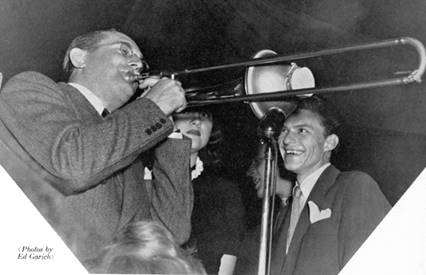
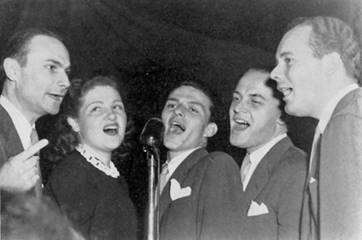
October 12, 1940
Radio
Saturday Afternoon
NBC Red Network
4:30 - 5:20 p. m
WOW Studios - Omaha, Nebraska
Tommy Dorsey And His Orchestra
Connie Haines, Frank Sinatra, Jo. Stafford, Pied Pipers, Buddy Rich,. Joe Bushkin, Ziggy Elman, Sy Oliver It's that Sentimental Gentleman of Swing, Tommy Dorsey, his golden voiced trombone and his versatile orchestra - with Connie Haines, Frank Sinatra and the Pied Pipers - coming to you from the studios of Station WOW in Omaha, Nebraska. Once more we bring you three tunes selected to be played today in the "Tommy Dorsey Amateur Songwriting Contest" and our studio audience here will vote its choice on our Applause Meter.
1. I'm Getting Sentimental Over You TD & Orch
2. Lights Out, Hold Me Tight Connie Haines
3. The World Is In My Arms Frank Sinatra
4. Take It TD & Orch
5. Head On My Pillow Frank Sinatra
6. You Got Me This Way The Pied Pipers
7. I Could Make You Care Frank Sinatra
8. Old Black Joe ( Ziggy Elman solo) TD & Orch
9. Funny Little Pedro The Pied Pipers
10. And So Do I Connie Haines
11. Swanee River TD & Orch
12. Dreamin' Just Dreamin' ( last week's contest winner) The Pied Pipers
Amateur Song Contest
13. Lovely Is The Word For You Connie Haines
14. Garden Of Roses Frank Sinatra
15. What Am I To Do The Pied Pipers
16. Who Frank Sinatra w/ Band Chorus
17. What Am I To Do -winning song reprised The Pied Pipers
18. So What! TD & Orch
19. Closing theme TD & Orch.
Ed O'Brien:
Before TD introduced "So What!," there was this announcement: All right, Russ, and here, folks, is our big news about the SENSATIONAL NEW program starting next Thursday night!! Over another network – YOUR program -- FAME AND FORTUNE will be on the air! We'll all be on hand – the orchestra, Frank Sinatra, Connie Haines, the Pied Pipers and A SPECIAL SURPRISE GUEST! But most important! The songs YOU send in will be reviewed, judged and winners declared! To the FIRST PLACE WINNER each week will go a publishing and royalties contract - and an advance royalty check!!!! And the second and the third song to be picked will ALSO receive a large CASH award. Think of it! YOUR song PUBLISHED! A board of famous orchestra leaders will act as judges! It's REALLY your chance for FAME AND FORTUNE! So don't miss the program! Remember, it's Thursday night, OCTOBER 17 over another network.
Concerts
Chermot Ballroom, Omaha, Nebraska, Saturday Evening, One-Nighter Tommy Dorsey And His Orchestra
Chermot Ballroom, Omaha, Nebraska, Saturday Evening, One-Nighter Tommy Dorsey And His Orchestra
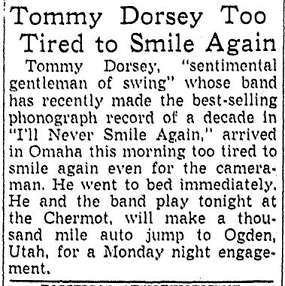
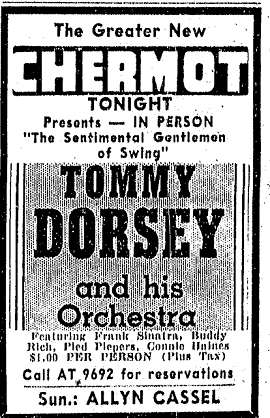
October 1940
While in Los Angeles with the Tommy Dorsey band — filming a cameo in Las Vegas Nights and appearing at the Palladium, about four months after the birth of his daughter — Frank Sinatra began an affair with Alora Gooding, an actress and casino cocktail waitress whose real name was Dorothy Bonucelli. She moved into his suite at the Hollywood Plaza within a week, and for a time Frank told friends he wanted out of his marriage to be with her; Nancy refused to accept it, and Frank eventually told her he'd ended the affair. Decades later the family learned the relationship hadn't actually stopped — Dorothy Bonucelli had a daughter, Julie, by Frank. Source: J. Randy Taraborrelli, Sinatra: Behind the Legend.
[Dorsey band heads west to open the Palladium]
Kaplan: In October 1940 the Dorsey band traveled to Hollywood to open the new Palladium Ballroom, a lavish pink-and-chrome venue that had risen on the site of the burned Palomar.
Source: James Kaplan, "Frank: The Voice" (2010)
October 14, 1940
Concerts
White City Ballroom, Ogden, Utah (October 14, 1940 - One Nighter)
Key Performers: Frank Sinatra, Connie Haines, Buddy Rich, Ziggy Elman, Pied Pipers
Tommy Dorsey and his "Screenland Dance Orchestra"
White City Ballroom, Ogden, Utah
Morgan County News (Morgan, Utah) · 11 Oct 1940:
[image referenced in source but could not be recovered]
[image referenced in source but could not be recovered]
October 16, 1940
Studio
Hollywood
PBS055110 Do You Know Why?
(from Paramount Picture Love Thy Neighbor)
(J. Burke/J. Van Heusen)
Famous Music Co. (ASCAP)
Arranged by Deane Kincaide
-1 (3:10) CD: 07863 66353-2 "The Song Is You" 5CD set Vol 2
CD: RCA 9679-2-R
LP: SD 1000
78: 26798
Saxes: Fred Stulce, Johnny Mince, Paul Mason, Heinie Beau, Don Lodice; Trumpets: Ziggy Elman, Ray Linn, Chuck Peterson; Piano: Joe Bushkin; Trombones: Les Jenkins, George Arus, Lowell Martin; Guitar: Clark Yocum; Bass: Sid Weiss; Drums: Buddy Rich
"Do You Know Why?"
Burke and Van Heusen’s very hip and subtle "Do You Know Why?" also calls for some extremely accurate pinpointings of attitude. At twenty-five, Sinatra can already hit these very precise and distinct emotional targets with astonishing accuracy. It’s hard to imagine anybody else who was singing with a band in 1940–42 or even later doing this—not Ray Eberle, or Herb Jeffries, or Dick Haymes, or Johnny Desmond, or Cab Calloway, or Ella Fitzgerald, or Helen Humes, or Jack Leonard, or anybody. Only Bing Crosby or Billie Holiday could have come close.
Source: Will Friedwald, "Sinatra! The Song Is You: A Singer's Art" (2018 revised edition).
October 17, 1940
Radio
Tommy Dorsey's new radio series debuted:
FAME AND FORTUNE w/Connie Haines and Frank Sinatra
Sponsor: Nature's Remedy
WJZ & NBC Blue Network
Thursday 8:30 - 9:00 P.M.
1. I'm Getting Sentimental Over You T.D. & Orch.
2. I'm Nobody's Baby C.H.
3. Only Forever F.S.
4. Song Of India T.D. & Orch.
5. Marie F.S.
Dorsey introduces Ruth Lowe & Horace Heidt
Lowe tells how "I'll Never Smile Again" came to be
6. I'll Never Smile Again F.S. J.S. P.P.
7. Old Black Joe J.S.
8. I've Got A Restless Spell( first song to win amateur contest)
F.S. C.H. J.S. P.P.
9. I'm Getting Sentimental Over You T.D. & Orch.
("Marie" appears on Masters of Jazz Volume 4 & "Only Forever" & "Marie" appear on Masters of Jazz Volume 9 & in the RCA Box Set "The Song Is You")
(Medley: Song Of India & Marie appear on the RCA CD: Tommy Dorsey & His Orchestra - That Sentimental Gentleman Of Swing (1940-1944)
("Marie", Ruth Lowe Interview & "I'll Never Smile Again" appear on CD 1 of "A Voice On Air)
NOTE: Sinatra Scholar Ed O'Brien provides some details drawn from the October 23, 1940 issue of Variety:
This program represents NBC's first letdown of the bars it put up against new laxative accounts five years before, so whatever results that Nature's Remedy gets out of the half-hour should be regarded by the account, Lewis-Howe, as so much velvet.
The Tommy Dorsey session also serves as another one of Lewis-Howe's devices a la Pot O' Gold for giving away money. Giveaway appeal on Dorsey's show involves amateur songwriters. Its avowed purpose is to "help" these neophytes up the ladder of fame and fortune. Fortunately for the listeners the program includes only one sample of this solicited stuff. Stunt's sales bluster is greater than its bite, since the amateur entry is but one of seven numbers played.
For the debut occasion, the program offered a crowning example of a first song success in the case history of Ruth Lowe. Heidt also appeared long enough at this mike to assist someone impersonating Miss Lowe in repeating her story, heard before on the air, as to how she came to write "I'll Never Smile Again."
Dorsey, publisher of this tune, vouchsafed at the tail end of the interview that "Never Smile" has sold over 400,000 sheet copies and 500,000 phonograph records. With such inspiration before them the toll of dime-store clerks and busboys suddenly turning to songwriting should be terrific.
Before an amateur can submit his manuscript an entry blank must be obtained from a neighborhood drugstore or from Lewis-Howe direct. No manuscipts are returned. Dorsey explained that he and two other orchestra leaders (not named) are the sole judges of a manuscript's worthiness for the weekly prizes, namely, $100 for the song actually performed on the program and $50 each to the two runnersup. The song performed on the opening program was tagged "I've Got a Restless Spell.." Dorsey gave it , as he usually does all his numbers, a craftmanlike arrangement and good vocal backing via Connie Haines and Frank Sinatra.
In line with the network's campaign to wean listeners away from ASCAP music, Dorsey played "Old Black Joe" The advertising copy on Nature's Remedy was heavy but inoffensively phrased. The product, it was pointed out, was not being offered as a cure-all but merely as a laxative help. Also included in the sales argument was a money-back offer and the reliability angle: viz. Nature's Remedy has been on the market for 50 years.
"Marie"
Sinatra did not commercially record "Marie" with the band, but RCA subsequently issued several live performances of the song, one from the Hollywood Palladium on October 17, 1940 (issued in the 1950s on the That Sentimental Gentleman double album), and another, done at the Hotel Astor a few months earlier on June 12 (issued much later on RCA’s subsidiary Buddah Records), that spotlighted a "mother" (as Sinatra would say) of a spectacular tenor sax solo by Don Lodice that brings the piece up to over four minutes—and makes this the "Marie" to end all "Maries."
Source: Will Friedwald, "Sinatra! The Song Is You: A Singer's Art" (2018 revised edition).
October 18, 1940
Concerts
Paramount Theater, Los Angeles, CA (October 18 - 30)
Tommy Dorsey and his Orchestra w/Frank Sinatra
(On screen was "Moon Over Burma" with Dorothy Lamour, Robert Preston and Preston Foster)
Great find here. I posted an article some years ago, claiming Dorsey canceled the two-week engagement, after the Palladium obtained an injunction and threatened to cancel Dorsey's six-week engagement at their new theater. Obviously, Dorsey was willing to gamble. He did and won.
His two week engagement at the Paramount grossed $24,000, the first week, and $17,500 the second week. Almost $42,000 playing a few miles away from the Palladium. Dorsey was betting that his very popular band could open at the Palladium the day after closing at the Paramount. And the inaugural engagement would draw big. Did it ever. The capacity at the Palladium was 5,000. Opening night, 10/31,TD & Co. drew 6,500. And that was just the beginning. Night after night the crowds were there throughout the band's run. Frank had a difficult relationship with TD, but he was in awe of the man's business skills and toughness.
--Ed
Paramount Theater, Los Angeles, CA (October 18 -30)
The Los Angeles Times (Los Angeles, California) · 18 Oct 1940, Sat
The Los Angeles Times (Los Angeles, California) · 19 Oct 1940, Sat
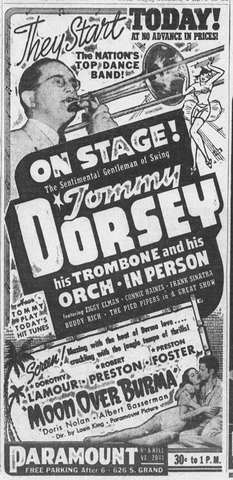
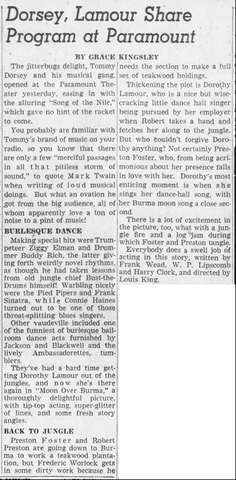
October 19, 1940
Radio
Hollywood
Saturday Afternoon
5:00 pm - 6:00 pm (EST)
Hollywood.
NBC Red Network
KFI Los Angeles
WEAF New York City
Sustaining Show
Tommy Dorsey & His Orchestra
Buddy Rich, Joe Bushkin, Ziggy Elman, Sy Oliver
Frank Sinatra, Connie Haines, The Pied Pipers
1. I'm Getting Sentimental Over
You
TD & Orch.
2. The One I Love(Belongs To Somebody Else) Frank
Sinatra & Pied Pipers
3. Head On My
Pillow
Frank
Sinatra
4. Another One Of Them
Things
TD & Orch.
5 .Funny Little
Pedro
Pied Pipers
6.
Rhumboogie
Connie Haines
7. Trade
Winds
Frank Sinatra
8. Losers
Weepers
TD & Orch.
9. I Could Make You
Care
Frank Sinatra
10. And So Do
I
Connie Haines
11.When You
Awake
Frank Sinatra
12.The Eyes And Ears Of The
World
TD & Orch.
13. I've Got A Restless
Spell
Frank Sinatra, Connie Haines, Pied Pipers
14.Marie
Frank Sinatra & Band Chorus
15.Quiet
Please
TD & Orch.
16.Closing
Theme
TD & Orch.
note: Dorsey and gang were getting ready to be the inaugural act at the Palladium
Ballroom Café (name soon changed to Hollywood Palladium) on 10/31 and
Paramount had them signed to appear in "Las Vegas Nights," shooting to get underway in late November
--Ed
Concerts
Paramount Theater, Los Angeles, CA (October 18 - 30)
Tommy Dorsey and his Orchestra w/Frank Sinatra
(On screen was "Moon Over Burma" with Dorothy Lamour, Robert Preston and Preston Foster)
October 20, 1940
Concerts
Paramount Theater, Los Angeles, CA (October 18 - 30)
Tommy Dorsey and his Orchestra w/Frank Sinatra
(On screen was "Moon Over Burma" with Dorothy Lamour, Robert Preston and Preston Foster)
October 21, 1940
Concerts
Paramount Theater, Los Angeles, CA (October 18 - 30)
Tommy Dorsey and his Orchestra w/Frank Sinatra
(On screen was "Moon Over Burma" with Dorothy
Lamour, Robert Preston and Preston Foster)
Paramount Theater, Los Angeles, CA (October 18 - 30)
Tommy Dorsey and his Orchestra w/Frank Sinatra
(On screen was "Moon Over Burma" with Dorothy
Lamour, Robert Preston and Preston Foster)
Daily News, Los Angeles, CA October 21, 1941
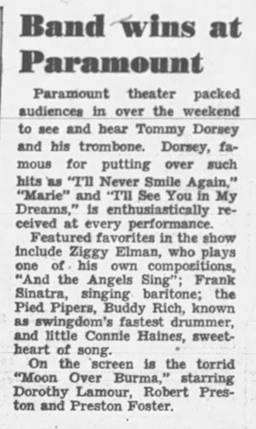
October 22, 1940
Concerts
Paramount Theater, Los Angeles, CA (October 18 - 30)
Tommy Dorsey and his Orchestra w/Frank Sinatra
(On screen was "Moon Over Burma" with Dorothy Lamour, Robert Preston and Preston Foster)
October 23, 1940
Concerts
Paramount Theater, Los Angeles, CA (October 18 - 30)
Tommy Dorsey and his Orchestra w/Frank Sinatra
(On screen was "Moon Over Burma" with Dorothy Lamour, Robert Preston and Preston Foster)
October 24, 1940
Radio
Fame And Fortune - Tommy Dorsey Orchestra
Network: NBC - Blue Network
Location: Hollywood
Show #2
Sponsor: Nature's Remedy
Time: 8:30PM - 9:00PM (EST) Thursdays
Orchestra Conducted By: Tommy Dorsey
Arrangements By: Axel Stordahl (Sinatra)
Announcer: Fred B. Cole
Musicians: Chuck Peterson, Ray Linn, Clyde Hurley, Ziggy Elman (trumpet);
Tommy Dorsey, George Arus, Les Jenkins, Lowell Martin (trombone); Fred Stulce, Paul Mason (alto sax); Don Lodice, Heinie Beau (tenor sax); Johnny Mince (clarinet & alto sax); Clark Yocum (guitar); Sid Weiss (bass); Joe Bushkin (piano); Buddy Rich (drums).
Vocals: Frank Sinatra, Connie Haines, Pied Pipers
1. opening theme: Getting Sentimental Over You - TD & Orchestra
2. Dark Eyes - Orchestra
3. Trade Winds - Frank Sinatra
4. That's For Me - Connie Haines
5. Who? - Frank Sinatra
6. Margie - Pied Pipers
7. I Know That You Know - Orchestra
8. Oh! Look At Me Now - Frank Sinatra, Connie Haines & Pied Pipers
9. closing theme: Getting Sentimental Over You - TD & Orchestra
Notes: Confirmed airing on WJZ.
("Who" appears in the box set Tommy Dorsey Frank Sinatra - The Song Is You)
("Oh! Look at Me Now" appears on the CD "It's All So New")
Ed O'Brien:
The melody for "Oh! Look At Me Now" was written by Joe Bushkin.
He was a ringer in the amateur contest. John DeVries submitted the lyrics the previous week. The set-up at the time involved a panel of experts who listened to the entries the previous Saturday(19) and chose the top three songs. On the 10-24 show, the intro to the winning tune was a brief orchestral version of "There I Go." note: Joe Bushkin was a guest on Frank's CBS-TV show, 12-9-50. Joe and Frank did a duet of "Oh! Look At Me Now" Before Bushkin started the piano intro, Frank teased him about the "amateur" songwriter on the long ago Fame & Fortune broadcast.
Ed
Concerts
Paramount Theater, Los Angeles, CA (October 18 - 30)
Tommy Dorsey and his Orchestra w/Frank Sinatra
(On screen was "Moon Over Burma" with Dorothy Lamour, Robert Preston and Preston Foster)
October 25, 1940
Concerts
Paramount Theater, Los Angeles, CA (October 18 - 30)
Tommy Dorsey and his Orchestra w/Frank Sinatra
(On screen was "Moon Over Burma" with Dorothy Lamour, Robert Preston and Preston Foster)
October 26, 1940
Radio
Saturday
5:38 p.m.-6 p.m.
Hollywood
NBC Red Network
WEAF
New York City
Tommy Dorsey & His Orchestra
Buddy Rich, Joe Bushkin, Ziggy Elman, Sy Oliver
Frank Sinatra, Connie Haines, The Pied Pipers
1. I'm Getting Sentimental Over You TD & Orch.
2. Maybe TD & Orch.
3. Looking For Yesterday Frank Sinatra
4. Six Lessons From Madame La Zonga TD & Orch.
5. Oh! Look At Me Now (Sy Oliver arg.) Frank Sinatra, Connie Haines, Pied Pipers
6. East Of The Sun (And West of the Moon) Frank Sinatra & Band Chorus
7.Old Black Joe TD & Orch.
8. Closing Theme TD & Orch
Ed O'Brien:
College football got Dorsey again. The scheduled hour show ran 22 minutes because the Notre Dame-Illinois game, at Champagne, Illinois, ran over its allotted time. The Fighting Irish liked playing on Saturday, the 26th, so they shutout Illinois 26-0, KFI, in L.A,, provided the feed for the Dorsey broadcast. TD and Co. were about to be the inaugural act at the Hollywood Palladium.The Dorsey band would also appear in their first film. The Paramount production was titled "Las Vegas Nights." Shooting would get underway in early November. Jo Stafford told me it was murder playing the Palladium into the wee hours and then being on the movie lot at 6:a.m. sharp. She always fell asleep while the make up people worked on her. She told me Frank was fascinated by the excitement and glamour of Hollywood. He stayed very busy during the bands extended stay out west.
Concerts
Paramount Theater, Los Angeles, CA (October 18 - 30)
Tommy Dorsey and his Orchestra w/Frank Sinatra
(On screen was "Moon Over Burma" with Dorothy Lamour, Robert Preston and Preston Foster)
October 27, 1940
Concerts
Paramount Theater, Los Angeles, CA (October 18 - 30)
Tommy Dorsey and his Orchestra w/Frank Sinatra
(On screen was "Moon Over Burma" with Dorothy Lamour, Robert Preston and Preston Foster)
October 28, 1940
Concerts
Paramount Theater, Los Angeles, CA (October 18 - 30)
Tommy Dorsey and his Orchestra w/Frank Sinatra
(On screen was "Moon Over Burma" with Dorothy Lamour, Robert Preston and Preston Foster)
October 29, 1940
Concerts
Paramount Theater, Los Angeles, CA (October 18 - 30)
Tommy Dorsey and his Orchestra w/Frank Sinatra
(On screen was "Moon Over Burma" with Dorothy Lamour, Robert Preston and Preston Foster)
October 30, 1940
Concerts
Paramount Theater, Los Angeles, CA (October 18 - 30)
Tommy Dorsey and his Orchestra w/Frank Sinatra
(On screen was "Moon Over Burma" with Dorothy Lamour, Robert Preston and Preston Foster)
October 31, 1940
Radio
Fame And Fortune - Tommy Dorsey Orchestra
Network: NBC - Blue Network
Location: Hollywood
Show #3
Sponsor: Nature's Remedy
Time: 8:30PM - 9:00PM (EST) Thursdays
Orchestra Conducted By: Tommy Dorsey
Arrangements By: Axel Stordahl (Sinatra)
Announcer: Fred B. Cole
Musicians: Chuck Peterson, Ray Linn, Clyde Hurley, Ziggy Elman (trumpet); Tommy Dorsey, George Arus, Les Jenkins, Lowell Martin (trombone); Fred Stulce, Paul Mason (alto sax); Don Lodice, Heinie Beau (tenor sax); Johnny Mince (clarinet & alto sax); Clark Yocum (guitar); Sid Weiss (bass); Joe Bushkin (piano); Buddy Rich (drums).
Vocals: Frank Sinatra, Connie Haines, Pied Pipers
Partial Set List:
1. opening theme: Getting Sentimental Over You - TD & Orchestra
2. Liebestraume - Orchestra
3. I Could Make You Care - Frank Sinatra
4. I Wouldn't Take A Million - Connie Haines
5. I'll See You In My Dreams - Frank Sinatra
6. You Might Have Belonged To Another - F. Sinatra, C. Haines & P. P.
7. closing theme: Getting Sentimental Over You - TD & Orchestra
Notes: Confirmed airing on WJZ.
("I Could Make You Care" appears on CD: The Sentimental Gentleman Of Swing: Centennial Collection Bluebird/Legacy 8287 6 71167)
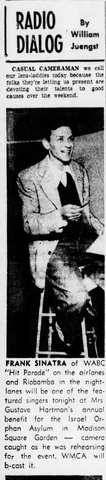
Tommy Dorsey And His Orchestra (October 31, 1940)
Palladium Ballroom (Grand Opening)
Hollywood, California
Thursday Evening
NBC Red Network
KFI
Los Angeles, California
Live Remote
1. I'm Getting Sentimental Over You TD & Orch.
2. One I Love Belongs To Somebody Else Frank Sinatra & Pied Pipers
3. Trade Winds Frank Sinatra
4. Make Me Know It(Sy Oliver arg.) TD & Orch.
5. Head On My Pillow Frank Sinatra
Concerts
Hollywood Palladium, Hollywood, California (October 31 - December 12) Tommy Dorsey and his Orchestra w/Frank Sinatra
A sensational opening night. A who's who of celebrities flocked to the New Palladium Ballroom Cafe( name changed to Hollywood Palladium within a few weeks) that Halloween evening. Dorothy Lamour cut the ribbon to inaugurate the exciting new night spot. The lead up to the opening was not without controversy. Dorsey had signed a contract to play a two week engagement at the Paramount Theatre, prior to the Palladium opening. The management of the new club filed a lawsuit and was granted an injunction to stop the engagement at the Paramount . Dorsey claimed he had been assured him that the Palladium had no objections regarding the agreement. He immediately, upon learning of the Paramount's dastardly deed, backed out of his earlier agreement. The NBC Red Network broadcast a half-hour of Tommy and Co from the Palladium that evening, from 11:30 to 12:00 over KFI radio from Los Angeles. The show was heard throughout the western half of the country. TD and His Band would be heard every day for the rest of the month. KFI would broadcast, on most nights, a half-hour from 11:30 to midnight. Fame and Fortune would be heard every Thursday at 8:30 pm for 30 minutes(EST). Saturday the Tommy Dorsey show would be aired from 5 to 6:pm and starting on 11/19 a half-hour Dorsey show would be broadcast nationwide starting at 8:pm. What a schedule. And we must remember the band was also making their first movie at the Paramount Studios( "Las Vegas Nights") and there were also recording sessions to do. Frank Sinatra was working very hard and learning his craft from a true master. --Ed
NOTE: Ed O'Brien sends this item from the November 6, 1940 issue of VARIETY:
"LOS ANGELES PALLADIUM IN FLASHY OPENING." 6,500 PACK IN FOR TOM DORSEY.- Palladium, town's newest dancery, knee deep in the cinema colony, had its flash opening last Thursday night (October 31) to a capacity attendance of 6,500.Гѓ Reserved space for ddiners brought $5 a head.Гѓ Tommy Dorsey led off the parade of name bands booked into the hoofery for six-week stands. Artiie Shaw follows, with Glenn Miller, Gene Krupa, and Larry Clinton among the futures.
Tommy Dorsey And His Orchestra (October 31, 1940)
Palladium Ballroom (Grand Opening)
From the Archives: 1940 opening of the Hollywood Palladium
Oct. 31, 1940: Opening of the Hollywood Palladium.
(Gordon Wallace / Los Angeles Times)
BY SCOTT HARRISON
MARCH 16, 2017 1 AM PT
The Art Deco Hollywood Palladium opened on Halloween night, 1940. Built by film-producer Maurice Cohen, the building occupied the site of the original Paramount lot.
The dance hall was designed by architect Gordon Kaufmann, who also designed the Los Angeles Times building. Los Angeles Times publisher Norman Chandler provided $1.6 million to fund the Palladium’s construction.
A story in the Nov. 1, 1940, Los Angeles Times reported:
Tables were turned on Hollywood last night when the Palladium, newest of the glamour city’s night spots, opened its doors for the first time on Halloween.
The million-dollar ballroom-cafe, which can accommodate comfortably 7500 persons, was literally packed to the rafters with Band Leader Tommy Dorsey blew the first blast from his trombone and his orchestra let loose with some jive and swing music.
There were many motion-picture actors and executives to welcome the new adventure of Maury Cohen and his associated but what the crowd really wanted was dancing.
So it was at 8:30 p.m. that the music began promptly. At 9:15 p.m., Dorothy Lamour, film actress, walked to the rostrum. There, standing beside Dorsey, she used a pair of scissors to cut a ribbon draped with orchids. This marked the only dedicatory ceremony.
Truly Hollywood gazed in its newest home for entertainment. Searchlights threw their arcs into the skies and Mr. and Mrs. John Public walked into the new building.
While the Palladium accommodates 7500, with 3000 couples being able to dance at one time, it was estimated that more than 10,000 were present last night. This did not include the many hundreds who stood in front to watch the arrival of celebrities.
In 2008, the building underwent a major renovation. In 2016, the Hollywood Palladium was listed on the National Register of Historic Places. The Tommy Dorsey band’s vocalist was Frank Sinatra.
Oct. 31, 1940: A large crowd watches ceremonies on-stage in front of the Tommy Dorsey band at the opening of the Hollywood Palladium. Gordon Wallace / Los Angeles Times)
The ceremonial ribbon-cutting was performed by Tommy Dorsey and Dorothy Lamour. LAPL.
Tommy Dorsey and Dorothy Lamour perform the ceremonial ribbon-cutting.
Tommy Dorsey, with his vocalists Connie Haines, Frank Sinatra and the Pied Pipers, was in Hollywood broadcasting his new amateur songwriting contest radio show, Fame and Fortune, which had debuted on NBC October 17. He was also filming Las Vegas Nights at Paramount. After the opening night, he continued to perform several nights a week at the Palladium through December 11. The broadcasts could be heard locally over KFI or KECA.
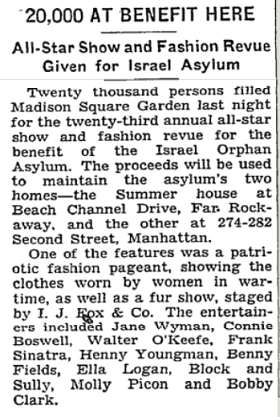
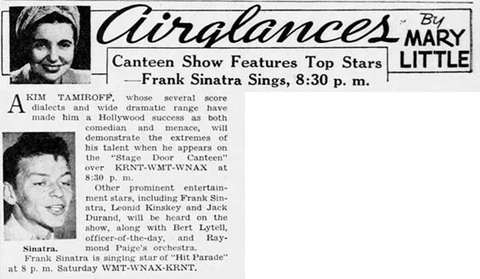
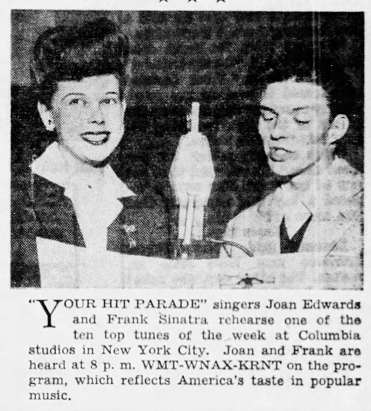
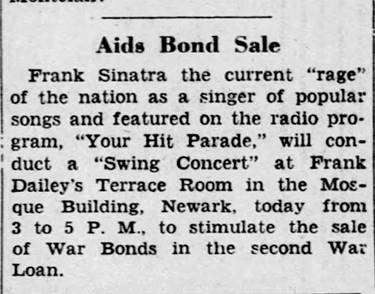
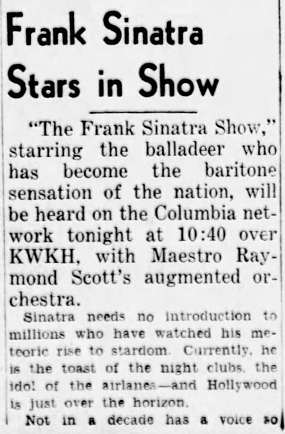
November 1, 1940
Radio
Hollywood Palladium
Friday
11:30 pm to 12:am (PST)
NBC Red Network)
KFI Los Angeles
Tommy Dorsey & His Orchestra note: West Coast broadcast only
Concerts
Hollywood Palladium, Hollywood, California (October 31 - December 12) Tommy Dorsey and his Orchestra w/Frank Sinatra
November 2, 1940
Radio
Hollywood Paladium
Saturday
5 to 5:55 pm (EST)
NBC Red Network
WEAF
New York City
Tommy Dorsey & His Orchestra
Buddy Rich, Sy Oliver, Axel Stordahl, Joe Bushkin, Ziggy Elman Connie Haines, Frank Sinatra, The Pied Pipers
1 .I'm Getting Sentimental Over You TD & Orch.
2. Margie ( Sy Oliver arg.) Pied Pipers
3. Shadows On The Sand Frank Sinatra
4. Take It ( Sy Oliver arg.) TD solo featured TD & Orch.
5. Lights Out, Hold Me Tight Connie Haines
6. Without A Song Frank Sinatra
7. Dear Old Southland TD & Orch.
8. Funny Little Pedro Pied Pipers
9. Dreaming Out Loud Connie Haines
10.We Three Frank Sinatra 11.Swing High TD & Orch.
12.You Might Have Belonged To Another Frank Sinatra, Connie Haines, Pied Pipers 13.I'll See You In My Dreams Frank Sinatra & Band Chorus 14.So What TD & Orch.
15.Closing Theme TD & Orch.
Hollywood Palladium
11:30 pm to 12:am( PST)
NBC Red Network
KFI Los Angeles
Tommy Dorsey & Orch.
( West Coast only)
Concerts
Hollywood Palladium, Hollywood, California (October 31 - November 12) Tommy Dorsey and his Orchestra w/Frank Sinatra
November 3, 1940
Radio
Hollywood Palladium
Sunday Evening
11:30 pm - 12:00 am
NBC Red Network
KFI Los Angeles
Tommy Dorsey & His Orch
Frank Sinatra, Connie Haines & The Pied Pipers
Buddy Rich, Ziggy Elman, Sy Oliver, Joe Bushkin note: West Coast broadcast.
Concerts
Hollywood Palladium, Hollywood, California (October 31 - December 11) Tommy Dorsey and his Orchestra w/Frank Sinatra
November 4, 1940
Radio
Hollywood Palladium
Monday Evening
11:30 pm - 12:00 am
NBC Red Network
KFI Los Angeles
Tommy Dorsey & His Orch
Frank Sinatra, Connie Haines & The Pied Pipers
Buddy Rich, Ziggy Elman, Sy Oliver, Joe Bushkin note: West Coast broadcast
Concerts
Hollywood Palladium, Hollywood, California (October 31 - December 11) Tommy Dorsey and his Orchestra w/Frank Sinatra
November 5, 1940
Radio
Hollywood Palladium
Tuesday Evening
11:30 pm - 12:00 am
NBC Red Network
KFI Los Angeles
Tommy Dorsey & His Orch
Frank Sinatra, Connie Haines & The Pied Pipers
Buddy Rich, Ziggy Elman, Sy Oliver, Joe Bushkin note: West Coast broadcast
Concerts
Hollywood Palladium, Hollywood, California (October 31 - December 11) Tommy Dorsey and his Orchestra w/Frank Sinatra
November 6, 1940
Radio
Hollywood Palladium
Wednesday Evening
11:30 pm - 12:00 am
NBC Red Network
KFI Los Angeles
Tommy Dorsey & His Orch
Frank Sinatra, Connie Haines & The Pied Pipers
Buddy Rich, Ziggy Elman, Sy Oliver, Joe Bushkin note: West Coast broadcast
Concerts
Hollywood Palladium, Hollywood, California (October 31 - December 11) Tommy Dorsey and his Orchestra w/Frank Sinatra
NOTE: Ed O'Brien sends along a brief from the November 6 issue of VARIETY; "PALLADIUM'S 30G WEEK "
Palladium cashed heavily on two big nights in its opening week and ran up a gross of around $30,000. Inaugural turnout accounted for better than $10,000 and Election Night added another $7,500. Dancery with 6,500 capacity, operates at around $15,000 weekly. Of this amount Tommy Dorsey cuts in for $3,750.
November 7, 1940
Radio
Fame And Fortune - Tommy Dorsey Orchestra
Network: NBC - Blue Network
Location: Hollywood
Show #4
Sponsor: Nature's Remedy
Time: 8:30PM - 9:00PM (EST) Thursdays
Orchestra Conducted By: Tommy Dorsey
Arrangements By: Axel Stordahl (Sinatra)
Announcer: Fred B. Cole
Musicians: Chuck Peterson, Ray Linn, Clyde Hurley, Ziggy Elman (trumpet); Tommy Dorsey, George Arus, Les Jenkins, Lowell Martin (trombone); Fred Stulce, Paul Mason (alto sax); Don Lodice, Heinie Beau (tenor sax); Johnny Mince (clarinet & alto sax); Clark Yocum (guitar); Sid Weiss (bass); Joe Bushkin (piano); Buddy Rich (drums).
Vocals: Frank Sinatra, Connie Haines, Pied Pipers
1. I'm Getting Sentimental Over You T.D. & Orch.
2. Goin' Home T.D. & Orch.
3. Our Love Affair F.S.
N.R. commercial
4. Two Dreams Met C.H.
5. And The Angels Sing Z.E. & Orch.(Elman' s hit tune from 1939)
N. R. commercial
Behind the scene of Amateur contest and how Sunrise Over Taxco was conceived. Songwriters were young working girl and automobile dealer, who sold cars for over 20 years.
6. Yearning F.S & band chorus
7. Sunrise Over Taxco F.S .
Winners: Georgias Elliot & Ted Pardu of St Louis, Missouri
N.R. commercial
8. Sunrise Over Taxco T.D. & Orch.
9. I'm Getting Sentimental Over You T.D. & Orch.
Notes: Confirmed airing on WJZ .
("Yearning" appears on Masters of Jazz Volume 4 & in the Tommy Dorsey Frank Sinatra - The Song Is You (CD box)
("Our Love Affair" appears on CD: The Sentimental Gentleman Of Swing: Centennial Collection Bluebird/Legacy 8287 6 71167)
("Sunrise Over Taxco" appears on the Buddha CD: Frank Sinatra & Tommy Dorsey And His Orchestra – It's All So New!)
Concerts
Hollywood Palladium, Hollywood, California (October 31 - December 11) Tommy Dorsey and his Orchestra w/Frank Sinatra
November 8, 1940
Radio
Hollywood Palladium
Friday Evening
11:30 pm - 12:00 am
NBC Red Network
KFI Los Angeles
Tommy Dorsey & His Orch
Frank Sinatra, Connie Haines & The Pied Pipers
Buddy Rich, Ziggy Elman, Sy Oliver, Joe Bushkin note: West Coast broadcast
Concerts
Hollywood Palladium, Hollywood, California (October 31 - December 11) Tommy Dorsey and his Orchestra w/Frank Sinatra
November 9, 1940
Radio
Hollywood Palladium
Saturday
5:30 -5:55 pm 5:55-6;00pm football scores 6:00 pm - 6:25pm
NBC Red Network
WEAF
New York City
Tommy Dorsey & His Orchestra
Buddy Rich, Ziggy Elman, Joe Bushkin
Frank Sinatra, Connie Haines, The Pied Pipers
1. I'm Getting Sentimental Over You TD & Orch.
2. The One I Love Frank Sinatra & Band Chorus
3. You're Breaking My Heart All Over Again Frank Sinatra
4. Make Me Know It TD & Orch.
5. Practice Makes Perfect Pied Pipers
6. I'll Never Smile Again Frank Sinatra & Pied Pipers
7. I'm Nobody's Baby Connie Haines
8. When You Awake Frank Sinatra
9. Old Man Harlem TD & Orch.
10. Funny Little Pedro Pied Pipers
11. Serenade To The Spot TD & Orch.
12. Some Of Your Sweetness Got Into My Heart Frank Sinatra
13. Swing Time Up In Harlem Connie Haines
14. Sunrise Over Taxco Frank Sinatra & Pied Pipers
15. Yearning Frank Sinatra & Band Chorus
16. So What TD & Orch.
17. Closing Theme TD & Orch
Hollywood Palladium
Saturday Evening
11:30 pm -12:00 am
NBC Red Network
KFI Los Angeles
Tommy Dorsey & His Orch
Frank Sinatra, Connie Haines & The Pied Pipers
Buddy Rich, Ziggy Elman, Sy Oliver, Joe Bushkin
1. I'm Getting Sentimental Over You TD & Orch
2. Whatcha Know Joe? Jo Stafford & Band Chorus
3. Everything Happens To Me Frank Sinatra
4. Old Man Harlem TD & Orch.
5. Closing TD & Orch note: West Coast broadcast
Concerts
Hollywood Palladium, Hollywood, California (October 31 - December 11) Tommy Dorsey and his Orchestra w/Frank Sinatra
"I'll Never Smile Again"
The Dorsey period afforded Sinatra ample opportunity to study Crosby: both on screen, when the Dorsey band played the same bill at the New York Paramount with that premier Road picture in March 1940; and, unexpectedly, in person when the Dorsey band arrived in Hollywood in November 1940. While Dorsey was making his first feature film appearance in Paramount’s Las Vegas Nights (Sinatra sings "I’ll Never Smile Again" with the Pied Pipers), musical director Victor Young also used some of Dorsey’s sidemen, including Joe Bushkin and Buddy Rich, to record some music for the second Hope-Crosby caper, Road to Zanzibar.
Source: Will Friedwald, "Sinatra! The Song Is You: A Singer's Art" (2018 revised edition).
"Will You Still Be Mine?" / "Let's Get Away from It All" / "Everything Happens to Me"
Matt Dennis: "Tom [Adair] came in one night to hear me play and sing some of my things," Dennis remembered, "and he said to me, ‘I’d like to write a song with you.’ And I said, ‘Let me see what you have.” And the first thing he showed me was the lyric to ‘Will You Still Be Mine?’ It was a hell of a lyric, you know. That kind of thrilled me, so I wrote the music to that very shortly. And a few days later, working over the phone, we wrote ‘Let’s Get Away from It All’ in one afternoon, and then we did ‘Everything Happens to Me’ a couple of days after that. All in all, it was a hell of a week."
Source: Will Friedwald, "Sinatra! The Song Is You: A Singer's Art" (2018 revised edition).
November 10, 1940
Radio
Live Remote: Hollywood Palladium
Sunday Evening
NBC Red Network - KFI Los Angeles
11:30 p. m. - 12:00 a.m.
Tommy Dorsey And Orchestra
Concerts
Hollywood Palladium, Hollywood, California (October 31 - November 12) Tommy Dorsey and his Orchestra w/Frank Sinatra
November 11, 1940
Studio
Hollywood
PBS055157 Not So Long Ago
(from the film High As A Kite)
(C. Boland/B. Reicher)
Malvern Music Co. (ASCAP)
Arranged by Deane Kincaide
-1 (3:00) CD: 07863 66353-2 "The Song Is You" 5CD set Vol 2
LP: SD 1000
78: 27219
PBS055158 Stardust w/The Pied Pipers
(H. Carmichael/M. Parrish)
Mills Music Inc. (ASCAP)
Arranged by Sy Oliver
-1 (3:10) CD: 07863 66353-2 "The Song Is You" 5CD set Vol 2
CD: RCA 8554-2-R
LP: SD 1000
78: 27520
78: 27233
Radio
Hollywood Palladium
Monday Evening
9:30 pm - 10:pm
NBC Red Network
Tommy Dorsey & His Orch
Frank Sinatra, Connie Haines & The Pied Pipers
Buddy Rich, Ziggy Elman, Sy Oliver, Joe Bushkin
1. I'm Getting Sentimental Over You TD & Orch
2. That's For Me Connie Haines
3. Call Of The Canyon Frank Sinatra
4. Take It TD & Orch.
5. Sunrise Over Taxco Frank Sinatra
6. Blues No More TD & Orch.
7. Funny Little Pedro Pied Pipers
8. I'd Know You Anywhere Frank Sinatra
9. Losers Weepers TD & Orch.
10. Closing Theme
Hollywood Palladium
Monday Evening
11:30 pm - 12: am
NBC Red Network
KFI
Los Angeles
Western Feed Only
Tommy Dorsey & His Orch
Frank Sinatra, Connie Haines & The Pied Pipers
Buddy Rich, Ziggy Elman, Sy Oliver, Joe Bushkin
Concerts
Hollywood Palladium, Hollywood , California (October 31 - December 11) Tommy Dorsey and his Orchestra w/Frank Sinatra
November 12, 1940
Radio
Hollywood Palladium
Tuesday Evening
8:01 pm - 8:15 pm
NBC Red Network
Tommy Dorsey & His Orch
Frank Sinatra, Connie Haines & The Pied Pipers
Buddy Rich, Ziggy Elman, Sy Oliver, Joe Bushkin
1. I'm Getting Sentimental Over You TD & Orch.
2 ..Rhumboogie Connie Haines
3 .Only Forever Frank Sinatra
4. Swanee River TD & Orch.
5. Closing Theme TD & Orch.
Hollywood Palladium
Tuesday Evening
11:30 pm - 12: am
NBC Red Network
KFI
Los Angeles
Western Feed Only
Tommy Dorsey & His Orch
Frank Sinatra, Connie Haines & The Pied Pipers
Buddy Rich, Ziggy Elman, Sy Oliver, Joe Bushkin
Concerts
Hollywood Palladium, Hollywood , California (October 31 - December 11) Tommy Dorsey and his Orchestra w/Frank Sinatra
November 13, 1940
Radio
Hollywood Palladium
Wednesday Evening
11:30 pm - 12:am
NBC Red Network
KFI
Los Angeles
Western Feed Only
Tommy Dorsey & His Orch
Frank Sinatra, Connie Haines & The Pied Pipers
Buddy Rich, Ziggy Elman, Sy Oliver, Joe Bushkin
Concerts
Hollywood Palladium, Hollywood , California (October 31 - December 11) Tommy Dorsey and his Orchestra w/Frank Sinatra
November 14, 1940
Radio
Fame And Fortune - Tommy Dorsey Orchestra
Network: NBC - Blue Network
Location: Hollywood
Show #5
Sponsor: Nature's Remedy
Time: 8:30PM - 9:00PM (EST) Thursdays
Orchestra Conducted By: Tommy Dorsey
Arrangements By: Axel Stordahl (Sinatra)
Announcer: Fred B. Cole
Musicians: Chuck Peterson, Ray Linn, Clyde Hurley, Ziggy Elman (trumpet); Tommy Dorsey, George Arus, Les Jenkins, Lowell Martin (trombone); Fred Stulce, Paul Mason (alto sax); Don Lodice, Heinie Beau (tenor sax); Johnny Mince (clarinet & alto sax); Clark Yocum (guitar); Sid Weiss (bass); Joe Bushkin (piano); Buddy Rich (drums).
Vocals: Frank Sinatra, Connie Haines, Pied Pipers
1. Opening remarks
2. Night & Day TD & Orch
3. We Three F.S..
4. Isn't That Just Like Love C.H.
5. Once In A While F.S & P.P.
6. Tale behind week's winning amateur song
Fade-out
Notes: Confirmed airing on WJZ. Show runs 17 minutes
Hollywood Palladium
Friday Evening
11:30 pm - 12:am
NBC Red Network - KFI Los Angeles
Western Feed Only
Tommy Dorsey & His Orch
Frank Sinatra, Connie Haines & The Pied Pipers
Buddy Rich, Ziggy Elman, Sy Oliver, Joe Bushkin
November 15, 1940
Concerts
Hollywood Palladium, Hollywood , California (October 31 - December 11) Tommy Dorsey and his Orchestra w/Frank Sinatra
November 16, 1940
Radio
Hollywood Palladium
Saturday
5:00 pm - 5:30 pm
5:30 PM -5:35 pm ((Football Scores)
5:35 pm -6:00 pm
NBC Red Network - WJZ New York City
Tommy Dorsey & His Orch
Frank Sinatra, Connie Haines & The Pied Pipers Buddy Rich, Ziggy Elman, Joe Bushkin, Heinie Beau
Hollywood Palladium
Saturday Evening
11:30 pm - 12:am
NBC Red Network - KFI Los Angeles
Western Feed Only
Tommy Dorsey & His Orch
Frank Sinatra, Connie Haines & The Pied Pipers, Ziggy Elman, Joe Bushkin, Sy Oliver, Buddy Rich
Concerts
Hollywood Palladium, Hollywood California (October 31 - December 11) Tommy Dorsey and his Orchestra w/Frank Sinatra
November 17, 1940
Radio
Hollywood Palladium
Sunday Evening
11:30 pm - 12:am
NBC Red Network
KFI
Los Angeles
Western Feed Only
Tommy Dorsey & His Orch
Frank Sinatra, Connie Haines & The Pied Pipers
Ziggy Elman, Joe Bushkin, Sy Oliver, Buddy Rich
Concerts
Hollywood Palladium, Hollywood , California (October 31 - December 11) Tommy Dorsey and his Orchestra w/Frank Sinatra
November 18, 1940
Radio
Hollywood Palladium
Monday Evening
9:30 pm - 10.00 p. m.
NBC Red Network
Tommy Dorsey & His Orch
Frank Sinatra, Connie Haines, The Pied Pipers
Buddy Rich, Ziggy Elman, Joe Bushkin, Heinie Beau
1. I'm Getting Sentimental Over You TD & Orch.
2. I Wouldn't Take A Million Connie Haines
3. Looking For Yesterday Frank Sinatra
4. Make Me Know It TD & Orch.
5. Shadows On The Sand Frank Sinatra
6. Hawaiian War Chant (Ta-Hu-Wa-Hu-Wai) TD & Orch.
7.Funny Little Pedro Pied Pipers
8.Don't Need The Moon Connie Haines & Pied Pipers
9.Old Black Joe TD & Orch.
10. Closing Theme TD & Orch.
Hollywood Palladium
Monday Evening
11:30 pm - 12:00 am
NBC Red Network
KFI
Los Angeles
Western Feed Only
Tommy Dorsey & His Orch
Frank Sinatra, Connie Haines, The Pied Pipers
Ziggy Elman, Joe Bushkin, Sy Oliver, Buddy Rich
Concerts
Hollywood Palladium, Hollywood , California (October 31 - December 11) Tommy Dorsey and his Orchestra w/Frank Sinatra
November 19, 1940
Radio
The Hollywood Palladium
Tuesday evening
Network: NBC
Time: 8:30 - 9:00 pm
Tommy Dorsey and His Orchestra
Vocal(s): Connie Haines, Frank Sinatra, The Pied Pipers, Musician(s): Buddy Rich, Don Lotus
1. I'm Getting Sentimental Over You T.D. & Orch.
2. Isn't It Just Like Love C.H.
3. When You Awake F.S. ( first radio performance)
4. Jump Time T.D. & Orch.
5. Hymn To The Sun T.D. & Orch.
6. Rum Boogie C.H.
7. Stardust F.S. & P.P.
8. Sweet Lorraine J.S.
9. Funny Little Pedro P.P.
10. Sy's Job T.D. & Orch
11. Wake Up And Break Up A Dream P.P.
12. You're Breaking My Heart All Again F.S.
13. So What T.D. & Orch.
14. I'm Getting Sentimental Over You T.D. & Orch.
Note: TT: 36mins. Sound: Excellent
(Complete broadcast issued on CD: Collector’s Choice CCM-1010 Tommy Dorsey And His Orchestra: At The Hollywood Palladium)
Hollywood Palladium
Tuesday Evening
11:30 pm - 12:00 am
NBC Red Network
KFI
Los Angeles
Western Feed Only
Tommy Dorsey & His Orch
Frank Sinatra, Connie Haines, The Pied Pipers
Ziggy Elman, Joe Bushkin, Sy Oliver, Buddy Rich
Concerts
Hollywood Palladium, Hollywood , California (October 31 - December 11) Tommy Dorsey and his Orchestra w/Frank Sinatra
The Hollywood Palladium
Tuesday evening
Network: NBC
Time: 8:30 - 9:00 pm
Tommy Dorsey and His Orchestra
Vocal(s): Connie Haines, Frank Sinatra, The Pied Pipers, Musician(s): Buddy Rich, Don Lotus
(Complete broadcast issued on CD: Collector’s Choice CCM-1010 Tommy Dorsey And His Orchestra: At The Hollywood Palladium)
[image referenced in source but could not be recovered]
[image referenced in source but could not be recovered]
November 20, 1940
Radio
Hollywood Palladium
Wednesday Evening
11:30 pm - 12:00 am
NBC Red Network
KFI
Los Angeles
Western Feed Only
Tommy Dorsey & His Orch
Frank Sinatra, Connie Haines, The Pied Pipers
Ziggy Elman, Joe Bushkin, Sy Oliver, Buddy Rich
Concerts
Hollywood Palladium, Hollywood , California (October 31 - December 11) Tommy Dorsey and his Orchestra w/Frank Sinatra
November 21, 1940
Radio
Fame And Fortune - Tommy Dorsey Orchestra
Network: NBC - Blue Network
Location: Hollywood
Show #6
Sponsor: Nature's Remedy
Time: 8:30PM - 9:00PM (EST) Thursdays
Orchestra Conducted By: Tommy Dorsey
Arrangements By: Axel Stordahl (Sinatra)
Announcer: Fred B. Cole
Musicians: Chuck Peterson, Ray Linn, Clyde Hurley, Ziggy Elman (trumpet); Tommy Dorsey, George Arus, Les Jenkins, Lowell Martin (trombone); Fred Stulce, Paul Mason (alto sax); Don Lodice, Heinie Beau (tenor sax); Johnny Mince (clarinet & alto sax); Clark Yocum (guitar); Sid Weiss (bass); Joe Bushkin (piano); Buddy Rich (drums).
Vocals: Frank Sinatra, Connie Haines, Pied Pipers
1. I'm Getting Sentimental Over You TD & Orchestra
2. Hymn To The Sun TD & Orch.
3. Looking For Yesterday Frank Sinatra
4. Rhumboogie Connie Haines
5. Stardust** Frank Sinatra
6..Blue Moon* Frank Sinatra & Band Chorus 7..That's How It Goes Frank Sinatra, Connie Haines & Pied Pipers
8. That's How It Goes ( reprise ) TD & Orch
9. Closing Theme TD & Orch
* "Blue Moon" is available on "Learn To Croon" Buddha Label **Star Dust" is in the box set "Tommy Dorsey – The Sentimental Gentleman Of Swing Legacy" 82876-71167
Notes: Confirmed airing on WJZ.
Concerts
Hollywood Palladium, Hollywood, California (October 31 - December 11) Tommy Dorsey and his Orchestra w/Frank Sinatra
November 22, 1940
Concerts
Hollywood Palladium, Hollywood, California (October 31 - December 11) Tommy Dorsey and his Orchestra w/Frank Sinatra
November 23, 1940
Radio
Hollywood Palladium
Saturday
5:00 pm - 5:30 pm
5:30 PM -5:35 pm ((Football Scores)
5:35 pm -6:00 pm
NBC Red Network
WJZ
New York City
Tommy Dorsey & His Orch
Frank Sinatra, Connie Haines & The Pied Pipers
Buddy Rich, Ziggy Elman, Joe Bushkin, Heinie Beau
Hollywood Palladium
Saturday Evening
11:30 pm - 12:am
NBC Red Network
KFI
Los Angeles
Western Feed Only
Tommy Dorsey & His Orch
Frank Sinatra, Connie Haines & The Pied Pipers
Ziggy Elman, Joe Bushkin, Sy Oliver, Buddy Rich
Concerts
Hollywood Palladium, Hollywood , California (October 31 - December 11) Tommy Dorsey and his Orchestra w/Frank Sinatra
November 24, 1940
Concerts
Hollywood Palladium, Hollywood , California (October 31 - December 11)
Tommy Dorsey and his Orchestra w/Frank Sinatra
November 25, 1940
Radio
Hollywood Palladium
Monday Evening
11:30 pm - 12:am
NBC Red Network
KFI
Los Angeles
Western Feed Only
Tommy Dorsey & His Orch
Frank Sinatra, Connie Haines & The Pied Pipers
Ziggy Elman, Joe Bushkin, Sy Oliver, Buddy Rich
1. I'm Getting Sentimental Over You TD & Orch.
2. Swing Time Up In Harlem Connie Haines
3. Only Forever Frank Sinatra
4. Swanee River TD & Orch.
5. Trade Winds Frank Sinatra
6. Swing High TD & Orch.
7.Funny Little Pedro Pied Pipers 8.That's How It Goes Frank Sinatra, Connie Haines, Pied Pipers 9.East Of The Sun (And West of he Moon) Frank Sinatra & Band Chorus 10.I Know That You Know TD & Orch.
11..Closing Theme TD & Orch.
Concerts
Hollywood Palladium, Hollywood , California (October 31 - December 11) Tommy Dorsey and his Orchestra w/Frank Sinatra
November 26, 1940
Radio
Hollywood Palladium
Tuesday Evening
NBC Blue Network
WJZ
New York City
11:00 pm - 11:30 pm
Tommy Dorsey & His Orchestra
Ziggy Elman, Ray Linn, Charles Peterson, Clyde Hurley,
Lowell Martin, Les Jenkins, George Arus, Fred Stulce,
Johnny Mince, Hymie Schertzer, Don Lodice, Heinie
Beau, Joe Bushkin, Clark Yokum, Sid Weiss, Buddy
Rich
Frank Sinatra, Connie Haines, The Pied Pipers
1. I'm Getting Sentimental Over You TD & Orch.
2. The One I Love (Belongs To Somebody Else) Frank Sinatra & Pied Pipers
3. Our Love Affair Frank Sinatra
4. Make Me Know It ( Sy Oliver arg.) TD & Orch.
5. Shadows On The Sand Frank Sinatra
6. Hawaiian War Chant (Ta-Hu-Wa-Hu-Wai) ( featuring Buddy Rich) TD & Orch.
7. Funny Little Pedro Pied Pipers
8. That s How It It Goes Frank Sinatra, Connie Haines, Pied Pipers
9 Losers Weepers TD & Orch. 10.Closing Theme TD & Orch.
NOTE: Ed O'Brien says that during his interview with Jo Stafford, Stafford remembered this engagement.
Dorsey's band had a feature role in the Paramount film "Las Vegas Nights." The band had to be on the lot at 5 a.m. This wasn't easy because the final show each evening at the Palladium ended around 2:30 a.m. Jo recalled falling asleep every morning during makeup at the studio.
("The One I Love" & "That's How It Goes" appear on Masters of Jazz Volume 4 & "Our Love Affair" & "Shadows On The Sand" appear on Masters of Jazz Volume 9)
(Complete Broadcast is available on CD: Jazz Hour JH-1035)
note: This is the first Dorsey radio show I heard. Has to be more than 50 years ago. What a revelation it was. A great band, wonderful songs, talented arrangers Sinatra, Stafford, Haines and the Pied Pipers. I was hooked from thereon in. Terrifically listenable radio entertainment presented so attractively from 80 years ago.
Ed
Hollywood Palladium
Tuesday Evening
11:30 pm - 12:am
NBC Red Network
KFI
Los Angeles
Western Feed Only
Tommy Dorsey & His Orch
Frank Sinatra, Connie Haines & The Pied Pipers
Ziggy Elman, Joe Bushkin, Sy Oliver, Buddy Rich
Ed O'Brien:
Tommy Dorsey died on November 26, 1956 at his home in Greenwich, Connecticut. No other artist had more of an influence on Frank Sinatra.
Mail Call
Network: AFRS
Show: #274
Host: Chili Williams
Guests: The Pied Pipers, Tito Guizar, Doris Day, Frank Sinatra
Announcer: Frank Nelson
Sinatra Arrangements by: Axel Stordahl
The Armed Forces Radio Service Orchestra Conducted By: Mishel Perrier
1. Stella By Starlight
2. Tea For Two w/Doris
Notes: Alternate date - September 1, 1947. TT: 30mins. Audio condition: Very good. Complete. note: Show was taped on 9-1-47 and aired on 11-26-47. First time Frank and Doris worked together.
--Ed
Concerts
Hollywood Palladium, Hollywood, California (October 31 - December 11) Tommy Dorsey and his Orchestra w/Frank Sinatra
November 27, 1940
Radio
Hollywood Palladium
Wednesday Evening
11:30 pm - 12:am
NBC Red Network
KFI
Los Angeles
Western Feed Only
Tommy Dorsey & His Orch
Frank Sinatra, Connie Haines & The Pied Pipers
Ziggy Elman, Joe Bushkin, Sy Oliver, Buddy Rich
Concerts
Hollywood Palladium, Hollywood , California (October 31 - December 11) Tommy Dorsey and his Orchestra w/Frank Sinatra
November 28, 1940
Radio
Fame And Fortune - Tommy Dorsey Orchestra
Network: NBC - Blue Network
Location: Hollywood
Show #7
Sponsor: Nature's Remedy
Time: 8:30PM - 9:00PM (EST) Thursdays
Orchestra Conducted By: Tommy Dorsey
Arrangements By: Axel Stordahl (Sinatra)
Announcer: Fred B. Cole
Musicians: Chuck Peterson, Ray Linn, Clyde Hurley, Ziggy Elman (trumpet); Tommy Dorsey, George Arus, Les Jenkins, Lowell Martin (trombone); Fred Stulce, Paul Mason (alto sax); Don Lodice, Heinie Beau (tenor sax); Johnny Mince (clarinet & alto sax); Clark Yocum (guitar); Sid Weiss (bass); Joe Bushkin (piano); Buddy Rich (drums).
Vocals: Frank Sinatra, Connie Haines, Pied Pipers
Partial Setlist:
1. opening theme: Getting Sentimental Over You - TD & Orchestra
2. Do You Know Why - Frank Sinatra
3. And So Do I - Connie Haines
4. How Am I To Know? - Frank Sinatra
5. Is There A Chance For Me - Frank Sinatra, Connie Haines & P. Pipers (Fame & Fortune winner)
6. closing theme: Getting Sentimental Over You - TD & Orchestra note: there is a reprise of "Is There A Chance For Me."
("How Am I To Know?" appears on Masters of Jazz Volume 4 & the RCA "The Song Is You" Box Set)
("Is There A Chance For Me" appears on the CD: Buddha 74465 999600-2 'It's All So New!')
Concerts
Hollywood Palladium, Hollywood, California (October 31 - December 11) Tommy Dorsey and his Orchestra w/Frank Sinatra
Fame And Fortune - Tommy Dorsey Orchestra
Network: NBC - Blue Network
Location: Hollywood
Show #7
Sponsor: Nature's Remedy
Time: 8:30PM - 9:00PM (EST) Thursdays
Orchestra Conducted By: Tommy Dorsey
Arrangements By: Axel Stordahl (Sinatra)
Announcer: Fred B. Cole
Musicians: Chuck Peterson, Ray Linn, Clyde Hurley, Ziggy Elman (trumpet); Tommy Dorsey, George Arus, Les Jenkins, Lowell Martin (trombone); Fred Stulce, Paul Mason (alto sax); Don Lodice, Heinie Beau (tenor sax); Johnny Mince (clarinet & alto sax); Clark Yocum (guitar); Sid Weiss (bass); Joe Bushkin (piano); Buddy Rich (drums).
Vocals: Frank Sinatra, Connie Haines, Pied Pipers

Frank was still in Los Angeles at the time of Roosevelt's re-election to an unprecedented third term, remaining on the West Coast at least through late November 1940. (Source: Richard Havers, "Sinatra" (Dorling Kindersley, 2007).)
November 29, 1940
Radio
Hollywood Palladium
Friday Evening
11:30 pm - 12:am
NBC Red Network
KFI
Los Angeles
Western Feed Only
Tommy Dorsey & His Orch
Frank Sinatra, Connie Haines & The Pied Pipers
Ziggy Elman, Joe Bushkin, Sy Oliver, Buddy Rich
Concerts
Hollywood Palladium, Hollywood , California (October 31 - December 11) Tommy Dorsey and his Orchestra w/Frank Sinatra
November 30, 1940
Radio
Hollywood Palladium
Saturday
5:00 pm - 5:30 pm
5:30 PM -5:35 pm ((Football Scores) Army vs Navy ( game of the week)
5:35 pm -6:00 pm
NBC Red Network
WJZ
New York City
Tommy Dorsey & His Orch
Frank Sinatra, Connie Haines & The Pied Pipers
Buddy Rich, Ziggy Elman, Joe Bushkin, Heinie Beau
Hollywood Palladium
Saturday Evening
11:30 pm - 12:am
NBC Red Network
KFI
Los Angeles
Western Feed Only
Tommy Dorsey & His Orch
Frank Sinatra, Connie Haines & The Pied Pipers
Ziggy Elman, Joe Bushkin, Sy Oliver, Buddy Rich
Concerts
Hollywood Palladium, Hollywood , California (October 31 - December 11) Tommy Dorsey and his Orchestra w/Frank Sinatra
December 1940
[Christmas during second Paramount stand]
Kaplan: At Christmas 1940, with the Dorsey band in the midst of its second big engagement at the Paramount, Sinatra tried to make up to his wife Nancy for having to work through much of the holiday week.
Source: James Kaplan, "Frank: The Voice" (2010)
[Sinatra registers for the draft]
Kaplan: Sinatra first registered for the draft in December 1940 along with sixteen million other American men, and was granted an exemption as a new father.
Source: James Kaplan, "Frank: The Voice" (2010)
December 1, 1940
Radio
Hollywood Palladium
Sunday Evening
11:30 pm - 12:am
NBC Red Network
KFI
Los Angeles
Western Feed Only
Tommy Dorsey & His Orch
Frank Sinatra, Connie Haines & The Pied Pipers
Ziggy Elman, Joe Bushkin, Sy Oliver, Buddy Rich
Concerts
Hollywood Palladium, Hollywood , California (October 31 - December 11) Tommy Dorsey and his Orchestra w/Frank Sinatra
Ed O'Brien notes:
Tommy Dorsey's Band was playing at the new Hollywood Palladium in Los Angeles. They did five shows a night from 8:PM to 2:AM. At the same time, they were filming "Las Vegas Nights" from 8:AM to 6:PM at the Paramount Studio. They had to be in make-up before 6:AM. Jo Stafford told me "you had to be young." I have the Billboard review of the Palladium and an article from DOWNBEAT on how difficult it was for the band members to stay awake during the filming. Jo told me she fell asleep numerous times during breaks in the shooting of the movie.
December 2, 1940
Concerts
Hollywood Palladium, Hollywood, California (October 31 - December 11) Tommy Dorsey and his Orchestra w/Frank Sinatra
December 4, 1940
Radio
Hollywood Palladium
Wednesday Evening
11:30 pm - 12:am
NBC Red Network
KFI
Los Angeles
Western Feed Only
Tommy Dorsey & His Orch
Frank Sinatra, Connie Haines & The Pied Pipers
Ziggy Elman, Joe Bushkin, Sy Oliver, Buddy Rich
Concerts
Hollywood Palladium, Hollywood, California (October 31 - December 11) Tommy Dorsey and his Orchestra w/Frank Sinatra
December 5, 1940
Radio
Fame And Fortune - Tommy Dorsey Orchestra
Network: NBC - Blue Network
Location: Hollywood
Show #8
Sponsor: Nature's Remedy
Time: 8:30PM - 9:00PM (EST) Thursdays
Orchestra Conducted By: Tommy Dorsey
Arrangements By: Axel Stordahl (Sinatra)
Announcer: Fred B. Cole
Musicians: Chuck Peterson, Ray Linn, Clyde Hurley, Ziggy Elman (trumpet); Tommy Dorsey, George Arus, Les Jenkins, Lowell Martin (trombone); Fred Stulce, Paul Mason
(alto sax); Don Lodice, Heinie Beau (tenor sax); Johnny Mince (clarinet & alto sax); Clark Yocum (guitar); Sid Weiss (bass); Joe Bushkin (piano); Buddy Rich (drums).
Vocals: Frank Sinatra, Connie Haines, Pied Pipers
Partial Setlist:
1. I'm Getting Sentimental Over You T.D. & Orch.
2. Sweet Lorraine Jo Stafford
3. You're Breaking My Heart All Over Again Frank Sinatra
4. You Say The Sweetest Things, Baby Connie Haines
5. Honeysuckle Rose T.D. & Orch.
T.D chats with guest Warren Hull (The Green Hornet)
6. Deep Night Frank Sinatra & band chorus
7. You Really Fill The Bill (Amateur song winner) Frank Sinatra, Connie Haines, Pied Pipers
8. You Really Fill The Bill (reprise) T.D.. & Orch.
9. I'm Getting Sentimental Over You T.D. & Orch..
Notes: Confirmed airing on WJZ.
("You Really Fill The Bill" appears on the CD: Buddha 74321 69172-2 'It's All So New!')
("Deep Night" appears on Disk 1 of "A Voice on Air")
Concerts
Hollywood Palladium, Hollywood, California (October 31 - December 11) Tommy Dorsey and his Orchestra w/Frank Sinatra
Fame And Fortune - Tommy Dorsey Orchestra
Network: NBC - Blue Network
Location: Hollywood
Show #8
Sponsor: Nature's Remedy
Time: 8:30PM - 9:00PM (EST) Thursdays
Orchestra Conducted By: Tommy Dorsey
Arrangements By: Axel Stordahl (Sinatra)
Announcer: Fred B. Cole
Musicians: Chuck Peterson, Ray Linn, Clyde Hurley, Ziggy Elman (trumpet); Tommy Dorsey, George Arus, Les Jenkins, Lowell Martin (trombone); Fred Stulce, Paul Mason
(alto sax); Don Lodice, Heinie Beau (tenor sax); Johnny Mince (clarinet & alto sax); Clark Yocum (guitar); Sid Weiss (bass); Joe Bushkin (piano); Buddy Rich (drums).
Vocals: Frank Sinatra, Connie Haines, Pied Pipers
[image referenced in source but could not be recovered]
December 6, 1940
Radio
Hollywood Palladium
Friday Evening
11:30 pm - 12:am
NBC Red Network
KFI
Los Angeles
Western Feed Only
Tommy Dorsey & His Orch
Frank Sinatra, Connie Haines & The Pied Pipers
Ziggy Elman, Joe Bushkin, Sy Oliver, Buddy Rich
Concerts
Hollywood Palladium, Hollywood, California (October 31 - December 11) Tommy Dorsey and his Orchestra w/Frank Sinatra
December 7, 1940
Radio
Hollywood Palladium
Saturday Evening
11:30 pm - 12:am
NBC Red Network
KFI
Los Angeles
Western Feed Only
Tommy Dorsey & His Orch
Frank Sinatra, Connie Haines & The Pied Pipers
Ziggy Elman, Joe Bushkin, Sy Oliver, Buddy Rich
Concerts
Hollywood Palladium, Hollywood, California (October 31 - December 11) Tommy Dorsey and his Orchestra w/Frank Sinatra
December 8, 1940
Radio
Hollywood Palladium
Sunday Evening
11:30 pm - 12:am
NBC Red Network
KFI
Los Angeles
Western Feed Only
Tommy Dorsey & His Orch
Frank Sinatra, Connie Haines & The Pied Pipers
Ziggy Elman, Joe Bushkin, Sy Oliver, Buddy Rich
Concerts
Hollywood Palladium, Hollywood, California (October 31 - December 11) Tommy Dorsey and his Orchestra w/Frank Sinatra
December 9, 1940
Radio
Hollywood Palladium
Monday Evening
7:30 - 8:00 p. m.
NBC Red Network
Tommy Dorsey & His Orch
Frank Sinatra, Connie Haines & The Pied Pipers
Ziggy Elman, Joe Bushkin, Sy Oliver, Buddy Rich
1.I'm Getting Sentimental Over You TD & Orch
2.Practice Makes Perfect Pied Pipers
3.Shadows In The Sand Frank Sinatra
4.Swanee River TD & Orch
5.Trade Winds Frank Sinatra 6.Blues No More TD & Orch
7.Two Dreams Met Connie Haines 8.You Really Fill The Bill Frank Sinatra, Connie Haines, Pied Pipers
9. Another One Of Them Things TD & Orch
10.Closing Theme TD & Orch
Hollywood Palladium
Monday Evening
11:30 pm - 12:am
NBC Red Network
KFI
Los Angeles
Western Feed Only
Concerts
Hollywood Palladium, Hollywood, California (October 31 - December 11) Tommy Dorsey and his Orchestra w/Frank Sinatra
December 10, 1940
Radio
Hollywood Palladium
Tuesday Evening
7:30 - 8:00 p. m.
NBC Red Network
Tommy Dorsey & His Orch
Frank Sinatra, Connie Haines & The Pied Pipers
Ziggy Elman, Joe Bushkin, Sy Oliver, Buddy Rich
1. I'm Getting Sentimental Over You TD & Orch
2. The One I Love Belongs To Somebody Else Frank Sinatra & Band Chorus
3. I'd Know You Anywhere Frank Sinatra
4. Swing Time Up In Harlem TD & Orch
5. You're Breaking My Heart Frank Sinatra
6. Old Black Joe TD & Orch
7. Funny Little Pedro Pied Pipers
8. You Really Fill The Bill Connie Haines,
9. Losers Weepers TD & Orch
10. Closing Theme TD & Orch
Hollywood Palladium
Tuesday Evening
11:30 pm - 12:am
NBC Red Network
KFI
Los Angeles
Western Feed Only
Tommy Dorsey & His Orch
Frank Sinatra, Connie Haines & The Pied Pipers
Ziggy Elman, Joe Bushkin, Sy Oliver, Buddy Rich
Concerts
Hollywood Palladium, Hollywood, California (October 31 - December 11) Tommy Dorsey and his Orchestra w/Frank Sinatra
December 11, 1940
Concerts
Hollywood Palladium, Hollywood, California (October 31 - December 11) Tommy Dorsey and his Orchestra w/Frank Sinatra
note: Closing night. A complete triumph for the Dorsey band.
They were SRO almost every night and during the day the band made their film debut in "Las Vegas Nights."
December 12, 1940
Radio
Fame And Fortune - Tommy Dorsey Orchestra
Network: NBC - Blue Network
Location: Hollywood
Show #9
Sponsor: Nature's Remedy
Time: 8:30PM - 9:00PM (EST) Thursdays
Orchestra Conducted By: Tommy Dorsey
Arrangements By: Axel Stordahl (Sinatra)
Announcer: Fred B. Cole
Musicians: Chuck Peterson, Ray Linn, Clyde Hurley, Ziggy Elman (trumpet); Tommy Dorsey, George Arus, Les Jenkins, Lowell Martin (trombone); Fred Stulce, Paul Mason (alto sax); Don Lodice, Heinie Beau (tenor sax); Johnny Mince (clarinet & alto sax); Clark Yocum (guitar); Sid Weiss (bass); Joe Bushkin (piano); Buddy Rich (drums).
Vocals: Frank Sinatra, Connie Haines, Pied Pipers
1. opening theme: Getting Sentimental Over You - TD & Orchestra
2. I'm Nobody's Baby - Connie Haines
3. When You Awake - Frank Sinatra
4. You Got Me This Way - Pied Pipers
5. Alexander's Rag Time Band - orchestra
6. East Of The Sun - Frank Sinatra & Pied Pipers
7. I Saw Your Face In A Cloud - Frank Sinatra, Connie Haines & P.Pipers
8. closing theme: Getting Sentimental Over You - TD & Orchestra
Notes: Confirmed airing on WJZ.
("I Saw Your Face In A Cloud" appears on CD: Buddha 74465 999601-2 "Learn To Croon")
("East Of The Sun (And West of the Moon)" appears on disk 1 of "A Voice On Air")
Concerts
Mission Beach Ballroom, San Diego, California (One Nighter) Tommy Dorsey and his Orchestra with Frank Sinatra
ED O'Brien:
Dorsey's band closed at the Palladium on 12/11.
TD jumped at a chance to play a one-nighter up in San Diego the next night before flying on to New York.. After the show, the band flew out of the San Diego airport at 3 A.M. Friday morning
(13). They were scheduled to arrive in New York that afternoon. They didn't get into New York till late Monday night. Plane they were on was grounded by bad weather in El Paso and band was transferred to the rails. At
Fort Worth and St.Louis they were scheduled to go back in the air, but poor flying conditions prevailed. T.D and band came all the way by train. Dorsey left the train in Pittsburgh due to a bad tooth. He joined the band the following day. On Wednesday the band opened an extended engagement at the Paramount Theatre (12/18),
Times-Advocate (Escondido, California) December 13, 1940
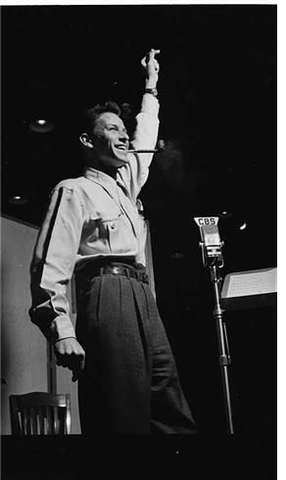
Mission Beach Ballroom, San Diego, California (One Nighter) Tommy Dorsey and his Orchestra with Frank Sinatra
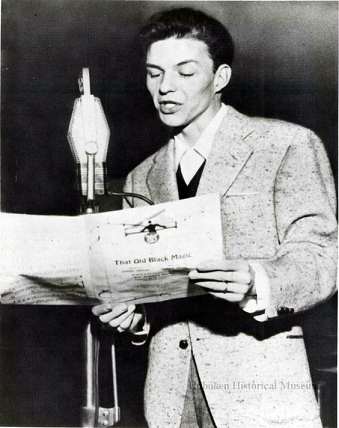
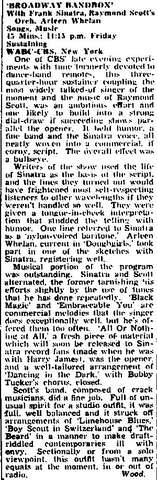
December 17, 1940
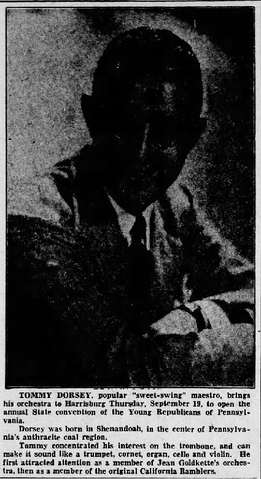
[Photograph: Frank completes his Selective Service Questionnaire. From Richard Havers, "Sinatra" (Dorling Kindersley, 2007), p.59.]
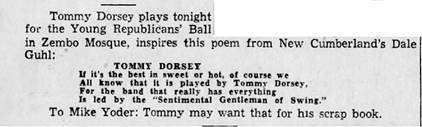
[Photograph: Frank completes his Selective Service Questionnaire. From Richard Havers, "Sinatra" (Dorling Kindersley, 2007), p.58.]
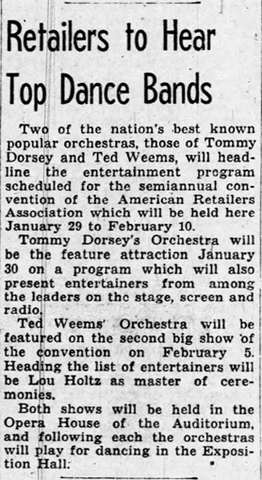
[Photograph: Frank completes his Selective Service Questionnaire. From Richard Havers, "Sinatra" (Dorling Kindersley, 2007), p.58.]
Concerts
Paramount, Theatre, New York
Tommy Dorsey and his Orchestra opened a four-week engagement at the Paramount Theatre, New York. The film was “Love Thy Neighbor (Paramount). In addition to the band, the Nicholas Brothers appeared as part of the stage show
Paramount, Theatre, New York.
Tommy Dorsey and his Orchestra opened a four-week engagement at the Paramount Theatre, New York. The film was “Love Thy Neighbor (Paramount). In addition to the band, the Nicholas Brothers appeared as part of the stage show
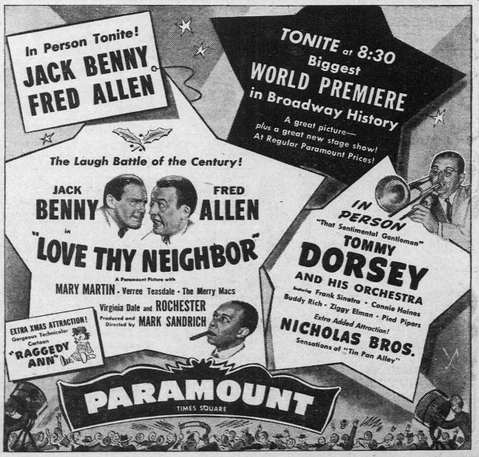
Back home in Hoboken, Frank filled out his Draft Board's Selective Service Questionnaire, writing that he had no known physical or mental defects. The document would later become the subject of an FBI investigation into his fitness for military service. (Source: Richard Havers, "Sinatra" (Dorling Kindersley, 2007).)
December 18, 1940
Concerts
Paramount Theatre, New York City (Dec. 17 - Jan. 14)
Tommy Dorsey and his Orchestra with Frank Sinatra
Paramount Theatre, New York City (Dec. 17 - Jan. 14)
Tommy Dorsey and his Orchestra with Frank Sinatra
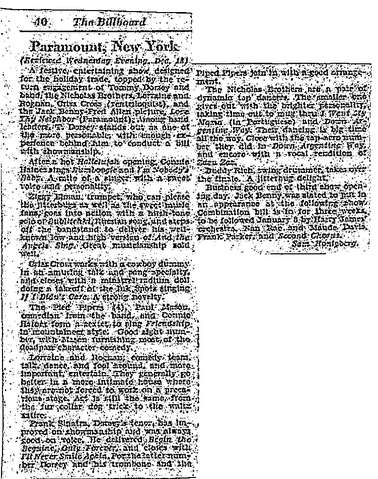
December 19, 1940
Radio
Fame And Fortune - Tommy Dorsey Orchestra
Network: NBC - Blue Network
Location: New York City
Show #10
Sponsor: Nature's Remedy
Time: 8:30PM - 9:00PM (EST) Thursdays
Orchestra Conducted By: Tommy Dorsey
Arrangements By: Axel Stordahl (Sinatra)
Announcer: Fred B. Cole
Musicians: Ziggy Elman, Bob Alexy, Lee Castle (trumpet); Les Jenkins, Tommy Dorsey, George Arus, Dave Jacobs (trombone); Johnny Mince (clarinet & alto sax); Fred Stulce, Bill Shine (alto sax); Don Lodice, Paul Mason (tenor sax); Clark Yocum (guitar); Sid Weiss (bass); Joe Bushkin (piano); Buddy Rich (drums).
Vocals: Frank Sinatra, Connie Haines, Pied Pipers
1. opening theme: Getting Sentimental Over You - TD & Orchestra
2. Isn't It Just Like Love - Connie Haines
3. I'd Know You Anywhere - Frank Sinatra
4. commercial
5. Hallelujah - Tommy Dorsey & orchestra
6. Funny Little Pedro - Jo Stafford & The Pied Pipers
7. commercial
8. Marie - Frank Sinatra & The Ensemble
9. Blues No More - orchestra
10. commercial
11. Wake Up And Break Up A Dream - Connie Haines & Pied Pipers
12. closing theme: Getting Sentimental Over You - TD & Orchestra
Notes: Confirmed airing on WJZ
("Marie" appears on the CD: Buddha 74321 69172-2 'It's All So New!')
Concerts
Paramount Theatre, New York City (December 17 - January 14) Tommy Dorsey and his Orchestra with Frank Sinatra
December 20, 1940
Concerts
Paramount Theatre, New York City (Dec. 18 - Jan. 14)
Tommy Dorsey and his Orchestra with Frank Sinatra
December 21, 1940
Concerts
Paramount Theatre, New York City (Dec. 17 - Jan. 14)
Tommy Dorsey and his Orchestra with Frank Sinatra
December 22, 1940
Concerts
Paramount Theatre, New York City (December 17 - January 14)
December 23, 1940
Concerts
Detroit, Michigan
Monday Evening
Percival Dodge (Private Party and Dance)
Ed O'Brien:
Percival Dodge was the managing director of the Community Fund & Council of Social Agencies of Metropolitan Detroit. He threw a Christmas Party and wanted the Dorsey Band to entertain his guests.
TD accepted the offer and the band flew up to Detroit for the Monday night gig. The Charlie Barnet Orchestra subbed for TD at the Paramount.
Detroit, Michigan
Monday Evening
Tommy Dorsey and Orchestra played at a Private Party and Dance held by Mr. and Mrs Allan Shelden
December 24, 1940
Concerts
Paramount Theatre , New York City (December 18 - January 14) Tommy Dorsey and His Orchestra with Frank Sinatra
December 25, 1940
Concerts
Paramount Theatre , New York City (December 18 - January 14)
Note: Most likely there was no show on this date.
December 26, 1940
Radio
Fame And Fortune - Tommy Dorsey Orchestra
Network: NBC - Blue Network
Location: New York City
Show #11
Sponsor: Nature's Remedy
Time: 8:30PM - 9:00PM (EST) Thursdays
Orchestra Conducted By: Tommy Dorsey
Arrangements By: Axel Stordahl (Sinatra)
Announcer: Fred B. Cole
Musicans: Ziggy Elman, Bob Alexy, Lee Castle (trumpet); Les Jenkins,
Tommy Dorsey, George Arus, Dave Jacobs (trombone); Johnny Mince (clarinet & alto sax); Fred Stulce, Bill Shine (alto sax); Don Lodice, Paul Mason (tenor sax); Clark Yocum (guitar); Sid Weiss (bass); Joe Bushkin (piano); Buddy Rich (drums).
Vocals: Frank Sinatra, Connie Haines, Pied Pipers
1. opening theme: Getting Sentimental Over You - TD & Orchestra
2. Swing Time Up In Harlem - Connie Haines
3. I've Got A Restless Spell - Frank Sinatra, Connie Haines & Pied
Pipers
4. Friendship - Connie Haines, Jo Stafford & Pied Pipers
5. Stardust - Frank Sinatra, Jo Stafford & Pied Pipers
6. Song Of India - orchestra
7. Goin' Home - Tommy Dorsey & orchestra
8. Here's To Love - Frank Sinatra, Connie Haines, Jo Stafford & P.
Pipers
9. closing theme: Getting Sentimental Over You - TD & Orchestra
Notes: Confirmed airing on WJZ
("I’ve Got A Restless Spell & "Here's To Love" appear on the CD: Buddha 74321 69172-2 'It's All So New!')
("Star Dust" appears on the CD: The Essential Frank
Sinatra with the Tommy Dorsey Orchestra, Bluebird / Legacy 82876-71167 & Young Blue Eyes - Birth Of The Crooner Bluebird 82876 60283 2)
Concerts
Paramount Theatre , New York City (December 18 - January 14) Tommy Dorsey and His Orchestra with Frank Sinatra
December 27, 1940
Concerts
Paramount Theatre, New York City (December 18 - January 14) Tommy Dorsey and His Orchestra with Frank Sinatra
December 28, 1940
Concerts
Paramount Theatre, New York City (December 18 - January 14)
December 29, 1940
Radio
Fitch Bandwagon
#22
Sunday Evening
7:30 p.m. 8:00 p.m.
NBC Red Network
Radio City
New York City
WEAF
Announcer: Jack Costello
Host: Tobe Reed
Sponsor: F.W.Fitch Company (shampoo)
Guests: Tommy Dorsey & His Orchestra
Ziggy Elman, Buddy Rich, Sy Oliver, Joe Bushkin
Frank Sinatra, Connie Haines, The Pied Pipers
1. I'm Getting Sentimental Over You TD & Orch.
2. Swingtime Up In Harlem Connie Haines
3. The Moon Won't Talk Frank Sinatra
4. Deep River TD & Orch.
5. Swanee River TD & Orch.
6. Oh, Look At Me Now Frank
Sinatra, Connie Haines, Pied Pipers
7. Old Black Joe TD & Orch.
8. Quiet Please TD & Orch.
Concerts
Paramount Theatre , New York City (December 18 - January 14) Tommy Dorsey and His Orchestra with Frank Sinatra
December 30, 1940
Concerts
Paramount Theatre, New York City (December 18 - January 14) Tommy Dorsey and Orchestra with Frank Sinatra
December 31, 1940
Concerts
Paramount Theatre, New York City (December 18 - January 14) Tommy Dorsey Orchestra with Frank Sinatra
1941
[Frank's Love Letter from San Francisco]
While touring, Frank wrote Nancy an earnest letter vowing his devotion and admitting his past behavior gave her reason to doubt him, promising to do his best to change.
Source: Tina Sinatra, "My Father's Daughter: A Memoir" (2000).
[Film Debut in "Las Vegas Nights"]
Sinatra appears in the film "Las Vegas Nights," singing "I'll Never Smile Again" as the male vocalist with Dorsey's band.
Source: Nancy Sinatra, "Frank Sinatra, My Father" (1985).
[Named Top Band Vocalist by Billboard]
A Billboard poll named Sinatra the Most Outstanding Male Band Vocalist in the United States, reflecting his rapidly growing fame.
Source: Nancy Sinatra, "Frank Sinatra, My Father" (1985).
[Named Outstanding Male Vocalist]
Sinatra is named Outstanding Male Vocalist by both Billboard and Downbeat magazines.
Source: Nancy Sinatra, "Frank Sinatra, My Father" (1985).
[Sinatra and Baby Nancy at the Beach]
A summer 1941 photograph shows Sinatra on the beach with his infant daughter, Nancy.
Source: Charles Pignone, "Frank Sinatra 100" (2015).
[Publicist Paul Keyes Gets Thrown Out, Then Rescued By Sinatra]
Nancy Sinatra: A 17-year-old autograph seeker named Paul Keyes, later a presidential speechwriter, was physically ejected from a restaurant section Tommy Dorsey had reserved for band members only. Frank found him afterward, brought him back in personally, introduced him around to the whole band, and even got Dorsey himself to sign the boy's book.
Source: Nancy Sinatra, Frank Sinatra: An American Legend, 1995.
['Ship Ahoy' title changed after fall of Manila]
Kaplan: The MGM musical's original title, 'I'll Take Manila,' was hastily changed to 'Ship Ahoy' after Manila fell to the Japanese roughly two months after filming.
Source: James Kaplan, "Frank: The Voice" (2010)
[Bobby-soxers grab Sinatra's bow tie at the Paramount]
Connie Haines: During the Paramount's second Sinatra-driven run in 1941, a couple of bobby-soxers grabbed Sinatra's bow tie as the theater's moving stage began to sink into the pit, leaving him dangling until Connie Haines and Tommy Dorsey rushed over and freed him.
Source: James Kaplan, "Frank: The Voice" (2010)
[Davis and Sinatra's first meeting in Detroit]
Kaplan: Sammy Davis Jr. first met Sinatra backstage at Detroit's Michigan Theater in 1941, when the Will Mastin Trio filled in for Tommy Dorsey's regular warm-up act; the sixteen-year-old Davis got a brief handshake from his idol.
Source: James Kaplan, "Frank: The Voice" (2010)
[DiMaggio's 56-game hitting streak]
Consiglio: Consiglio recounts that Joe DiMaggio played for the Yankees from 1936 to 1951 (minus three wartime years) and in 1941 set the still-standing record of hitting safely in 56 consecutive games.
Source: Tony Consiglio (as told to Franz Douskey), "Sinatra and Me: The Very Good Years" (2012)
[Dorsey's wife leaves him]
Kaplan: In the spring of 1941, Tommy Dorsey's wife Toots walked out on him after discovering him with his redheaded singer Edythe Wright at their Bernardsville, New Jersey home.
Source: James Kaplan, "Frank: The Voice" (2010)
[Down Beat names Sinatra Male Vocalist of the Year]
Kaplan: Two days after meeting Manie Sacks, Sinatra was named Male Vocalist of the Year in Down Beat's annual poll, unseating Bing Crosby, who had won the honor six years running.
Source: James Kaplan, "Frank: The Voice" (2010)
[Sinatra meets Ava Gardner]
Kaplan: Walking between soundstages in Culver City during the 'Ship Ahoy' shoot, Sinatra was introduced by pianist Lyle 'Skitch' Henderson to a young MGM contract player named Ava Gardner, not yet nineteen; the two shared a lingering handshake and a charged look.
Source: James Kaplan, "Frank: The Voice" (2010)
[Sinatra meets Manie Sacks at the Palladium]
Kaplan: During the Palladium run, Sinatra ran into Emanuel 'Manie' Sacks, a former talent agent now manager of popular repertoire at Columbia Records; Sinatra boldly asked if Sacks would record him as a solo artist, and Sacks said he would like nothing better, despite Sinatra still being under contract via Dorsey to RCA.
Source: James Kaplan, "Frank: The Voice" (2010)
[Sinatra's first film appearance]
Kaplan: Sinatra made his first film appearance as an uncredited singing extra with Tommy Dorsey's band in Paramount's "Las Vegas Nights" (1941).
Source: James Kaplan, "Frank: The Voice" (2010)
[Ava Gardner marries Mickey Rooney]
Ava Gardner married Mickey Rooney, one of Hollywood's biggest stars, in 1941 after meeting him on the MGM lot; the marriage lasted just 17 months.
Source: Richard Havers, "Sinatra" (Dorling Kindersley, 2007).
[Ava Gardner signs with MGM at 17]
Spotted via a photograph in a New York studio window taken by her brother-in-law, Ava Gardner signed with MGM in 1941 for $50 a week and remained under contract for the next 17 years.
Source: Richard Havers, "Sinatra" (Dorling Kindersley, 2007).
[Frank co-writes 'Tips on Popular Singing']
Sometime in 1941 Sinatra and his vocal coach John Quinlan wrote a 32-page instructional booklet, Tips on Popular Singing, published by Tommy Dorsey's company at the end of the year and sold for 75 cents. Tommy Dorsey contributed a laudatory introduction praising Frank as an 'unusually talented, conscientious artist.'
Source: Richard Havers, "Sinatra" (Dorling Kindersley, 2007).
[Frank compares Big Band singing to weightlifting]
Reflecting on his years with the Big Bands, Frank later compared the experience to lifting weights, saying it was a form of conditioning for a singer.
Source: Richard Havers, "Sinatra" (Dorling Kindersley, 2007).
[Frank gives inconsistent birth details on an MGM police form]
Filling out a police form while at MGM Studios, Frank stated that his mother was born in Hoboken rather than arriving as a young immigrant child, and claimed he himself was born in 1917 -- two years off from his actual 1915 birth certificate.
Source: Richard Havers, "Sinatra" (Dorling Kindersley, 2007).
[Frank tops Billboard band-vocalist poll, dethroning Eberle]
In Billboard's 1941 poll of the most popular male band vocalists, Sinatra jumped from No. 22 all the way to No. 1, unseating Ray Eberle of the Glenn Miller band. The list also included Bob Eberly (Ray's brother, with Jimmy Dorsey), Harry Babbitt, and Kenny Sargent, names largely forgotten today.
Source: Richard Havers, "Sinatra" (Dorling Kindersley, 2007).
[Sinatra first meets a teenage Sammy Davis Jr on tour]
While singing with Tommy Dorsey's band, Frank met a 16-year-old Sammy Davis Jr and made a point of coming over to shake his hand, a small gesture Sammy never forgot.
Source: Richard Havers, "Sinatra" (Dorling Kindersley, 2007).
[Sinatras move to Hasbrouck Heights house]
Sometime in 1941, Frank and Nancy Sinatra moved from a two-bedroom Garfield Avenue apartment to a larger $25,000, seven-room house at 220 Lawrence Avenue in Hasbrouck Heights, New Jersey. Their neighbors, family doctor Joseph Latona and his wife, later described fans constantly blocking the intersection outside.
Source: Richard Havers, "Sinatra" (Dorling Kindersley, 2007).
["Tips On Popular Singing" Published]
Sinatra co-authored a short instructional booklet, Tips On Popular Singing, with his vocal coach John Quinlan, published by Embassy Music Corporation and priced at 75 cents. The book offered breathing and vocal-placement exercises for aspiring popular singers, and carried a commendatory foreword by Sinatra's bandleader Tommy Dorsey, who praised Sinatra as an unusually talented and conscientious artist and endorsed the book for singers starting out in the field.
Source: Frank Sinatra and John Quinlan, Tips On Popular Singing (New York: Embassy Music Corporation, 1941).
[technique/engineering history -- critical commentary]
As an early precedent for overdubbing, jazz musician Sidney Bechet made an ambitiously multi-tracked 1941 Victor recording playing six instruments himself (tenor and soprano sax, clarinet, bass, drums, piano), though clarity degraded with each successive overdub generation.
Source: Charles L. Granata, "Sessions with Sinatra: Frank Sinatra and the Art of Recording" (1999/2003), Part II: The Columbia Years, 1943-1952
January 1941
[Dorsey and Frank record Fame and Fortune winners]
Tommy Dorsey and Frank recorded two winning songs from the Fame and Fortune amateur songwriting contest, 'Oh Look At Me Now' and 'You Might Have Belonged to Another'; the former reached No. 2 on the charts.
Source: Richard Havers, "Sinatra" (Dorling Kindersley, 2007).
[Frank's 'Stardust' recording charts]
Frank's recording of 'Stardust' with the Pied Pipers, cut while the Dorsey band was in Hollywood, reached No. 7 on the charts in January 1941, adding to the song's status as one of the most-recorded tunes ever.
Source: Richard Havers, "Sinatra" (Dorling Kindersley, 2007).
January 1, 1941
Concerts
Paramount Theatre, New York City (December 18 /40- January 14/41) Tommy Dorsey Orchestra with Frank Sinatra
January 2, 1941
Radio
Fame And Fortune
Tommy Dorsey and His Orchestra
1. I'm Getting Sentimental Over You
2. Piped Pipers Of Harlem - The Pied Pipers
3. I Tried -- Frank Sinatra
4. Make Me Know
5. Oh! Look At Me Now - Frank Sinatra, Connie Haines, Jo Stafford, The Pied Pipers
6. Swing High
7. Bedelia
8. You're Part Of My Heart -- Frank Sinatra, Connie Haines, The Pied Pipers
9. Closing
("You're Part of My Heart" appears on Masters of Jazz Volume 9 & the RCA Box Set: The Song Is You)
("I Tried" appears on the CD: Buddha 74321 69172-2 'It's All So New!')
Ed O'Brien:
Frank sang "I Tried" after doing a hokey (his words) intro.
He told Dorsey it was a brand new tune. Next up for Frank was the amateur contest winner of 10-24-40, "Oh! Look At Me Now." Joining F.S. were Connie Haines, Jo Stafford and The Pied Pipers. The same group sang the amateur contest winner for the week "You're Part Of My Heart." The winning entry was from Virginia Sloan of Montpelier, Vermont. She received a $100.00 check for her efforts. I keep forgetting to mention that Connie Haines received top billing in the introductions every week. Frank followed and then The Pipers. Fred B. Cole, was the announcer each week.
Paramount Theatre, New York City (December 18 /40- January 14/41) Tommy Dorsey Orchestra with Frank Sinatra
January 3, 1941
Concerts
Paramount Theatre, New York City (December 18 /40- January 14/41) Tommy Dorsey Orchestra with Frank Sinatra
January 4, 1941
Concerts
Paramount Theatre, New York City (December 18 /40- January 14/41) Tommy Dorsey Orchestra with Frank Sinatra
January 5, 1941
Concerts
Paramount Theatre, New York City (December 18 /40- January 14/41) Tommy Dorsey Orchestra with Frank Sinatra
January 6, 1941
Studio
New York City
BS058760 Oh! Look At Me Now w/The Pied Pipers & Connie Haines
(J. DeVries/J. Bushkin)
Hampshire House Publishing Co. (ASCAP)
Arranged by Sy Oliver
-1 (3:13) CD: 07863 66353-2 "The Song Is You" 5CD set Vol 2
CD: 8324-2-R
LP: SD 1000
78: 20-1578
78: 27274
Ed O'Brien noted: Song won the second amateur Fame & Fortune on 10-24-40.
I think it is safe to say that Joe Bushkin was a bit of a ringer. I don't believe any of the other winning songs by true amateurs had any lasting success..
Sinatraphile Rich Rosenberg says that this is one of his favorite songs from the Dorsey years. The 1956 recording is also terrific and if O'Brien's book, SINATRA 101, had been called SINATRA 101 +, the 1956 would have been included, he understands.
BS058761 You Might Have Belonged To Another w/The Pied Pipers & Connie Haines
(P. West/L. Harmon)
Screen Gems-EMI Music Inc (BMI)
Arranged by Axel Stordahl
-1 (2:45) CD: 07863 66353-2 "The Song Is You" 5CD set Vol 2
LP: SD 1000
78: 27274
Saxes: Fred Stulce, Johnny Mince, Paul Mason, Bill Shine, Don Lodice; Trumpets:
Ziggy Elman, Bob Alexy, Lee Castle, Jimmy Blake; Piano: Joe Bushkin; Trombones: Les Jenkins, George Arus, David Jacobs; Guitar: Clark Yocum; Bass: Sid Weiss;
Drums: Buddy Rich
Here is the Billboard review of Vic 27274.
Tommy Dorsey (Victor 27274)
Oh! Look At Me Now - FT; VC You Might Have
Belonged To Another - FT; VC
Dorsey's biggest success was scored with a song by an unknown, Ruth Lowe's l Never Smile Again," which understandably enough prompted Tommy to search out other unknowns with other potential smash hits.. This disc contains two results of the organized search Dorsey has been conducting through his radio shows, and in each case Tommy has selected wisely.
Neither ditty may be another "Smile Again," but all things being equal, they both have more than an even chance to hit the heights. Dorsey, apparently feeling that Frank Sinatra and the Pied Pipers did so much for the Lowe number with their vocal work, has laid it on a bit thick on both sides here, adding
Connie Haines to Sinatra and the Pipers for two of the most elaborate vocals on a dance disk in some time.
The galaxy of singers works well together, aided by forthright arrangements, and outside of the slightly obvious straining to repeat a successful formula by making it bigger and bigger, this is a highly listenable platter.
Billboard 2-1-41
Ed O'Brien:
"You Might Have Belonged To Another" won the amateur contest on Fame & Fortune,10-31- 40..
Released in late February of 1941, it was a one week wonder, reaching #14 on 3-22-41.
"Oh! Look At Me Now" won the contest on
10-24-40. Released in February of 41, the tune was #2 on the Billboard chart for six consecutive weeks and stayed around for 14 weeks.
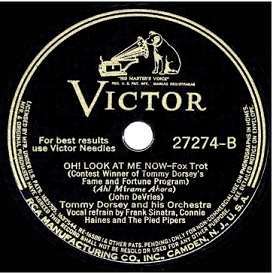
Concerts
Paramount Theatre, New York City (December 18, 1940- January 14, 1941) Tommy Dorsey Orchestra with Frank Sinatra
January 7, 1941
Concerts
Paramount Theatre, New York City (December 18 /40- January 14/41) Tommy Dorsey Orchestra with Frank Sinatra
January 8, 1941
Concerts
Paramount Theatre, New York City (December 18 /40- January 14/41) Tommy Dorsey Orchestra with Frank Sinatra
January 9, 1941
Radio
Fame And Fortune - Tommy Dorsey Orchestra
Network: NBC - Blue Network
Location: New York City
Show #13
Sponsor: Nature's Remedy
Time: 8:30PM - 9:00PM (EST) Thursdays
Orchestra Conducted By: Tommy Dorsey
Arrangements By: Axel Stordahl (Sinatra)
Announcer: Fred B. Cole
Musicians: Ziggy Elman, Bob Alexy, Lee Castle (trumpet); Les Jenkins, Tommy Dorsey, George Arus, Dave Jacobs (trombone); Johnny Mince (clarinet & alto sax); Heinie Beau (alto sax); Don Lodice, Paul Mason (tenor sax); Clark Yocum (guitar); Sid Weiss (bass); Joe Bushkin (piano); Buddy Rich (drums).
Vocals: Frank Sinatra, Connie Haines, Pied Pipers.
1. opening theme: Getting Sentimental Over You - TD & Orchestra
2. So You Are The One - Pied Pipers
3. There I Go - Frank Sinatra, Connie Haines, Pied Pipers
4. Ay, Ay, Ay - orchestra
5. You Might Have Belong To Another - Sinatra, Haines, & P. Pipers
6. Swing Low - orchestra
7. Andante - Tommy Dorsey & orchestra
8. Your Stepping On My Toes - Frank Sinatra & Pied Pipers
9. closing theme: Getting Sentimental Over You - TD & Orchestra
("There I Go" & "You Might Have Belonged To Another" appear on the CD: Buddha 74321 69172-2 'It's All So New!')
("You're Stepping On My Toes" appears on Masters of Jazz Volume 9 & the RCA Box Set: The Song Is You)
Notes: Confirmed airing on WJZ.
Notes: Dick Bellach pointed out that the broadcast was on WEAF in New York City . That station was owned by the National Broadcasting Company (NBC) and later became WNBC in NYC. Many years later, NBC left the radio business and the station became and still is WFAN.
Ed O'Brien notes The broadcast took place on Thursday from 8:30 to 9:PM EST. Frank sang the amateur song-writing winner "You're Stepping On My Toes." Downbeat had published its reader's poll results for 1940 as the year got underway. Male Singer:
1. Bing Crosby 2,210
2. Bob Eberly 2,095
3. Frank Sinatra 1,435
Billboard released its listing of the top songs from 1940.
1. In The Mood Glenn Miller & Orch 21 weeks
2. I'll Never Smile Again Tommy Dorsey & Orch 16 weeks
Concerts
Paramount Theatre, New York City (December 18 /40- January 14/41) Tommy Dorsey Orchestra with Frank Sinatra
January 10, 1941
Concerts
Paramount Theatre, New York City (December 18 /40- January 14/41) Tommy Dorsey Orchestra with Frank Sinatra
January 11, 1941
Concerts
Paramount Theatre, New York City (December 18 /40- January 14/41) Tommy Dorsey Orchestra with Frank Sinatra
Columbia Hall, Jersey City, NJ
Dance for the Selmod Athletic Club
Frank Sinatra
Jersey Journal – January 10, 1941
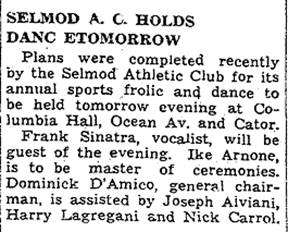
January 12, 1941
Concerts
Paramount Theatre, New York City (December 18 /40- January 14/41) Tommy Dorsey Orchestra with Frank Sinatra
January 13, 1941
Concerts
Paramount Theatre, New York City (December 18 - January 14) Tommy Dorsey Orchestra with Frank Sinatra
PARAMOUNT, N.Y.
HOUSE REVIEW
Tommy Dorsey Orch with Frank Sinatra,
Connie Haines, Buddy Rich, Ziggy Elman,
Nicholas Brothers, Chris Cross, Lorraine
& Rognan
Film:Love Thy Neighbor(Paramount) w/ Jack
Benny, Fred Allen & Mary Martin
Playing its umpteenth return engagement at the Paramount, Tommy Dorsey's crew is given strong support by a well-rounded trio of acts to provide a highly entertaining hour. The three turns booked independently of the band, as a matter of fact, pretty much steal the show away from the 'sentimental gentleman.' While, of course, okay instru- mentally, Dorsey's crew when caught exhibited some weak sisters - - and brothers - - in the vocalizing department.
House provides a neat intro for Dorsey as his outfit comes up on the elevator stage. Colored film of him is projected on the full outer curtain, coming in from the right side, first showing the trombone and then gradually the maestro. As it moves across the curtain, the name comes rippling out of the horn, Dorsey in person meanwhile playing his theme. Drummer boy Rich is spotlighted throughout the show and exhibits plenty of reason why with his torrid stick work. Buildup culminates in his appearance with the Nicholas team. Ziggy Elman gets the second instrumental break. His trumpeting of his original "And The Angels Sing" -- particularly with a few interpolated military bugle notes for comedy - - is tops. On the vocal end, diminutive Connie Haines shows the only merit. With plenty of personality and a nice sense of showmanship, she registers well with 'Rhumboggie' and other tunes. Frank Sinatra's warbling when caught appeared tired and hoarse, which may have been explainable at midnight Saturday, the day's sixth show. Pied Pipers, two boys and a gal who are aided by various members of the crew, also appeared limp, but, added to that, were definitely flat and sour. Did best on 'Friendship. ' Dorsey as ever, of course, is the accomplished and good-natured m.c., doing everything possible to aid and point up the other acts. He goes light on his tromboning in the current appearance.
Herb
Variety
12-25-41
January 14, 1941
Concerts
Paramount Theatre, New York City (December 18 - January 14) Tommy Dorsey Orchestra with Frank Sinatra
January 15, 1941
Studio
BS058877 You Lucky People You
(from the Paramount Picture The Road To Zanzibar)
(J. Van Heusen/J. Burke)
Anne-Rachel Music (ASCAP)
Arranged by Sy Oliver
-1 (2:35) CD: 07863 66353-2 "The Song Is You" 5CD set Vol 2
CD: RCA 2269-2-R
LP: SD 1000
78: 27350
BS058879 It's Always You
(from the Paramount Picture The Road To Zanzibar)
(J. Van Heusen/J. Burke)
Famous Music Corp. (BMI)
-1 (3:14) CD: 07863 66353-2 "The Song Is You" 5CD set Vol 2
CD: RCA 8554-2-R
LP: SD 1000
78: 20-1530
78: 27345
Saxes: Fred Stulce, Johnny Mince, Paul Mason, Heinie Beau, Don Lodice;
Trumpets: Ziggy Elman, Jimmy Blake, Ray Linn, Cluck Peterson; Piano: Joe
Bushkin; Trombones: Les Jenkins, George Arus, Lowell Martin; Guitar: Clark Yocum; Bass: Sid Weiss; Drums: Buddy Rich
The Dorsey band recorded four songs at this session including two featuring Frank Sinatra.
Here is the Variety review of the first single to come out of the session.
Tommy Dorsey "Birds Of A Feather" - "It's Always You
(Victor 27345)
Neither side will help Dorsey or the tunes, which are from a Bing Crosby new film.
"Feather" is poorly arranged and played. Connie Haines vocals.
Backing isn't much
better, split isn't much better split by subnormal Frank Sinatra vocal.
Variety 3-12-41
note: The reviewer was correct regarding the sales potential of both sides.
Neither side charted. But Frank's recording of "It's Always You"
was re-released in June of 1943, during the musician's strike. The song
reached #3 in Billboard and charted for 13 weeks. The song was from
the Hope-Crosby film "Road To Zanzibar."
"You Lucky People, You" / "It's Always You" / "Birds of a Feather" / "You're Dangerous" / "Be Careful, It's My Heart" Several months after "Too Romantic," Sinatra pulled off the real thing in Dorsey’s January 1941 versions of the songs from Road to Zanzibar. That second Road show opened with Crosby’s rapturous baritone bouncing through one of Burke’s all-time greatest moonbeams-and-metaphors opuses, "You Lucky People, You," over the main titles. Dorsey similarly commenced his version of "You Lucky People, You" with Sinatra singing, making it one of the earliest Dorsey sides to start with Sinatra in the first chorus rather than the second, and also giving the singer an extra outchorus at the end. Sinatra more than justified the temporary promotion, coming on with such contagious cockiness and charisma that he vividly brings Burke’s wraparound skies and green velvet landscapes to life. He did just as well with the romantic, yet not too romantic, "It’s Always You" (later revived, like many other early Sinatra numbers, by Chet Baker) and made one wish that Dorsey had given the other two Zanzibar songs, "Birds of a Feather" and "You’re Dangerous," to Sinatra instead of Connie Haines, good as she was in this period. By the time of his next reworking of a Crosby song, Irving Berlin’s "Be Careful, It’s My Heart" from the final season of his Dorsey tenure, in June 1942, Sinatra hadn’t exactly caught up with Crosby, but he had considerably narrowed the gap between them.
Source: Will Friedwald, "Sinatra! The Song Is You: A Singer's Art" (2018 revised edition).
January 16, 1941
Radio
Fame And Fortune - Tommy Dorsey Orchestra
Network: NBC - Blue Network
Location: New York City
Show #14
Sponsor: Nature's Remedy
Time: 8:30PM - 9:00PM (EST) Thursdays
Orchestra Conducted By: Tommy Dorsey
Arrangements By: Axel Stordahl (Sinatra)
Announcer: Fred Utial
Musicians: Ziggy Elman, Chuck Peterson, Ray Linn, (trumpet); Les Jenkins, Tommy Dorsey, George Arus, Dave Jacobs (trombone); Johnny Mince (clarinet & alto sax); Fred Stulce, Heine Beau (alto sax); Don Lodice, Paul Mason (tenor sax); Clark Yocum (guitar); Sid Weiss (bass); Joe Bushkin (piano); Buddy Rich (drums).
Vocals: Frank Sinatra, Connie Haines, Pied Pipers
1. Opening theme: Getting Sentimental Over You - TD & Orchestra
2. Whatcha Know, Joe (PP)
3. Backstage At The Ballet (TD & Orchestra)
4. Little Brown Jug (CH),
5. Sunrise over Taxco (FS-PP),
6. Allegra Conga (TD & Orchestra)
7. Songs My Mother Taught Me (TD solo),
8. You Got the Best of Me (FS-CH-PP),
9. You Got the Best of Me (reprise),
10. Variation of I'm Gettin' Sentimental (close) .
Notes: Confirmed airing on WJZ.
This song listing may not be correct but is based on the above article from The Birmingham News (Birmingham, Alabama) · 16 Jan 1941
("You Got The Best Of Me" appears on Masters of Jazz Volume 9 & the RCA Box Set: The Song Is You)
Ed O'Brien: TD & Co.. closed at the Paramount on 1-14 and would do a few one-nighters before opening at the Meadowbrook on 1/21.
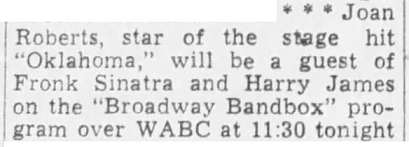
January 17, 1941
Concerts
Masonic Temple, Scranton, Pennsylvania (One-nighter)
Tommy Dorsey & His Orchestra with Frank Sinatra
Masonic Temple, Scranton, Pennsylvania
Tommy Dorsey & His Orchestra with Frank Sinatra
The Times-Tribune (Scranton, Pennsylvania) · 15 Jan 1941, Wed
The Times-Tribune (Scranton, Pennsylvania) · 15 Jan 1941, Wed
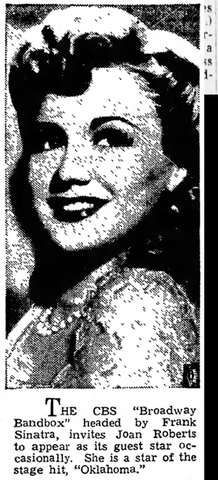
January 18, 1941
Radio
Your Hit Parade
Network: CBS
Program #297
Time: 9:00-9:45 P.M. (Rebroadcast January 19, 1941 12:00-12:45 A.M.)
Sponsor: Lucky Strike
1. commercial 1
2. So You're The One (5) - Barry Wood
3. Perfidia (10) - orchestra
4. You Walk By (6) - Bea Wain
5. commercial 2
6. Ay Ay Ay - Tommy Dorsey Orchestra
7. It All Comes Back To Me Know (9) - Barry Wood
8. The Same Old Story (7) - Hit Paraders
9. commercial 3
10. May I Never Love Again (8) - Bea Wain
11. I Give You My Word (4) - Frank Sinatra w/TD Orchestra
12. Polly Wolly Doodle & Little Brown Jug - Orchestra
13. Wise Old Owl - Barry Wood & Hit Paraders
14. commercial 4
Notes: Tommy Dorsey Orchestra from Quantico, Virginia. Last part of the script is missing for sponsor archives.
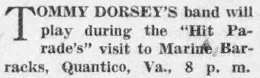
Concerts
U.S. Marine Barracks, Quantico, Virginia
Tommy Dorsey and his band - one-nighter
Saturday evening
Here is the Variety review of the Hit Parade appearance
when it was rebroadcast on 1-19-41:
Tommy Dorsey was the guestee on last Saturday's (18)
installment of the Lucky Strike Hit Parade (CBS). He was
cut in twice from the U.S. Marine Barracks at Quantico, Va.,
where he was appearing with Luckies' touring camp unit.
Dorsey did one number on each of the occasions. After the
hullabaloo -- the shouting of trainees -- which accompanied
each of the cut-ins -- had blown away and Dorsey had performed
his stint, the thing didn't seem to match in impressiveness
the advance publicity that the cig manufacturer had put out.
The two numbers, which had been assigned to Dorsey for the
cut-ins, weren't of particular aid in heightening the affect of
his inclusion. They were "It All Comes Back To Me Now"
and "The Same Old Story." Jerry Lester, m.c.. of the traveling
unit, did the introducing of Dorsey.
* Interesting little mystery here:
I have another article indicating that Sinatra sang
"It All Comes Back To Me Now." The official record of
the show credits Sinatra singing "I Give You My Word."
Maybe he did both.
Here is an excerpt from the show:
"Hello again, this is Jerry Lester. We are still kickin'
that gong around, and the order of the day is for Mr.
T. Dorsey to come out of his corner and punch away
on his sliding trombone. What's it going to be, Tommy?
Hello, Jerry. It's going to be Frank Sinatra doing the vocal,
and the rest of us throwing some breaks and fill-ins around
the number four song on the Parade this week: 'I Give You
My Word.' "
It All Comes Back To Me Now" was sung by Barry Wood. The transcript shows who did what. TD & Co. did the
two songs you have listed. The guy from Variety wasn't paying attention 75 years ago.
--Ed
U.S. Marine Barracks, Quantico, Virginia
Tommy Dorsey and his band - one-nighter
Saturday evening
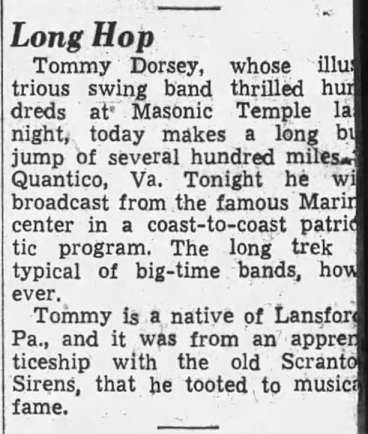
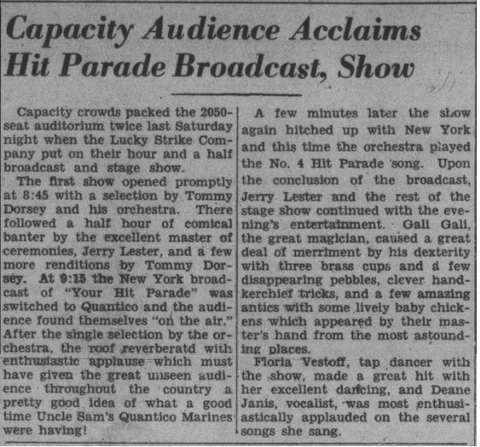
January 19, 1941
Concerts
Dorsey Band at Westchester Country Center, White Plains, N.Y.
They did two shows day/night
Grossed $8,500 in profits. Biggest draw of the 11 Sunday series Out drew Benny Goodman who took in $6,800
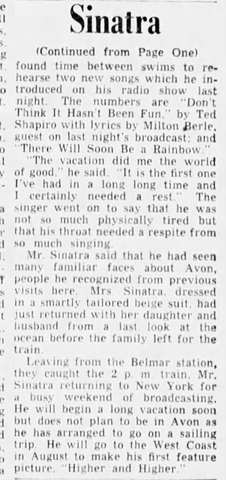
Dorsey Band at Westchester Country Center, White Plains, N.Y.
They did two shows day/night
Grossed $8,500 in profits. Biggest draw of the 11 Sunday series Out drew Benny Goodman who took in $6,800
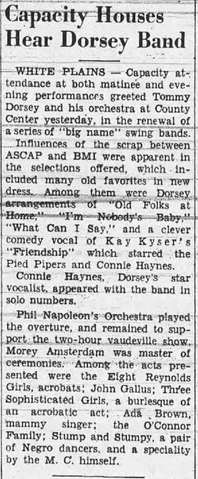
January 20, 1941
Studio
New York City
BS060346 I Tried
(C. Nutter/P. Hand/C. Dennis)
Music Sales Corp. (ASCAP)
Arranged by Axel Stordahl
-1 (3:01) CD: 07863 66353-2 "The Song Is You" 5CD set Vol 2
CD: RCA 9679-2-R
LP: SD 1000
78: 27317
BS060347 Dolores w/The Pied Pipers
(from the Paramount Picture Las Vegas Nights)
(F. Loesser/L. Alter)
Paramount Music Corp. (ASCAP)
Arranged by Sy Oliver
-1 (2:55) CD: 07863 66353-2 "The Song Is You" 5CD set Vol 3
CD: RCA 8554-2-R
LP: SD 1000
78: 27317
CS060349 Without A Song
(W. Rose/E. Eliscu/V. Youmans)
EMI Miller Catalog Inc./Anne-Rachel Music (ASCAP)
Arranged by Sy Oliver
-2 (4:25) CD: 07863 66353-2 "The Song Is You" 5CD set Vol 3
CD: RCA 8324-2-R
LP: SD 1000
78: 36396 (12 inch)
-1 N/R
Saxes: Fred Stulce, Johnny Mince, Paul Mason, Heinie Beau, Don Lodice; Trumpets: Ziggy Elman, Jimmy Blake, Ray Linn, Cluck Peterson; Piano: Joe Bushkin; Trombones: Les Jenkins, George Arus, Lowell Martin; Guitar: Clark Yocum; Bass: Sid Weiss; Drums: Buddy Rich
Note: Without A Song -1 has not been located in the RCA vaults
"Without a Song"
Friedwald identifies Sinatra's 1941 Dorsey/Sy Oliver treatment of Vincent Youmans's "Without a Song" as his first attempt at an extended 'concert' number, a leftover of Paul Whiteman-style concert-band tradition. Oliver's six-minute chart opens with a full first chorus of Dorsey trombone (unusually long for that era) before Sinatra sings the full refrain over Joe Bushkin celeste, a sound close to "I'll Never Smile Again." The song, from the 1929 show Great Day, contained a dialect lyric about a 'darkie... no good nohow, without a song'; Sinatra dropped the line as soon as he could. The Columbia issue filled a full twelve-inch 78 side; an aircheck version runs even longer with an added Don Lodice tenor chorus and a Lunceford-style Oliver cadenza.
Source: Will Friedwald, "Sinatra! The Song Is You: A Singer's Art" (2018 revised edition).
January 21, 1941
Concerts
Frank Dailey's Meadowbrook, Cedar Grove, N.J. (Jan 21 - Feb 16) Tommy Dorsey & His Orch.
Tuesday evening
Ed O'Brien:
Band now had 23 members including seven vocalists There were 26 if you counted Dorsey, manager Bobby Burns, public announcer and instrument truck driver Jack Egan. Marie Frye, soprano, was the latest addition to join them for the four week engagement at the Paramount.
Horrific accident occurred right outside the night club during this engagement. Happened in early February..
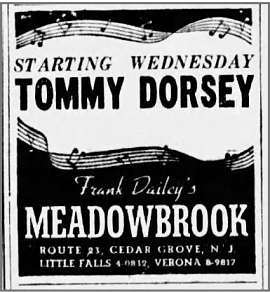
January 22, 1941
Concerts
Frank Dailey's Meadowbrook, Cedar Grove, N.J. (Jan 21 - Feb 16) Tommy Dorsey & His Orch.
Tuesday evening
January 23, 1941
Radio
Fame And Fortune - Tommy Dorsey Orchestra
Network: NBC - Blue Network
Location: New York City
Show #17
Sponsor: Nature's Remedy
Time: 8:30PM - 9:00PM (EST) Thursdays
Orchestra Conducted By: Tommy Dorsey
Arrangements By: Axel Stordahl (Sinatra)
Announcer: Fred LaTell
Musicians: Ziggy Elman, Chuck Peterson, Ray Linn, (trumpet); Les Jenkins, Tommy Dorsey, George Arus, Dave Jacobs (trombone); Johnny Mince (clarinet & alto sax); Fred Stulce, Heine Beau (alto sax); Don Lodice, Paul Mason (tenor sax); Clark Yocum (guitar); Sid Weiss (bass); Joe Bushkin (piano); Buddy Rich (drums).
Vocals: Frank Sinatra, Connie Haines, Pied Pipers
1. opening theme: Getting Sentimental Over You - TD & Orchestra
2. Practice Makes Perfect - Pied Pipers
3. I Give You My Word - Frank Sinatra
4. Little Brown Jug - Connie Haines
5. Sunrise Over Taxco - Frank Sinatra, Jo Stafford & Pied Pipers
6. Frenesi - Frank Sinatra, Jo Stafford & Pied Pipers
7. Killarney - Tommy Dorsey & orchestra
8. It's All So New To Me - Frank Sinatra, Jo Stafford & Pied Pipers
9. closing theme: Getting Sentimental Over You - TD & Orchestra
Notes: Sinatra's first "Fame And Fortune" where he receives top vocal billing. Confirmed airing on WJZ
Notes: ("I Give You My Word" appears on Masters of Jazz Volume 9)
("I Give You My Word" & "It's All So New" appear on CD: Buddha 74321 69172-2 'It's All So New!')
("Frenesi" appears on CD: Buddha 74321 69172-2 'It's All So New!' & "Tommy Dorsey: His Greatest Hits And Finest Performances" -- Reader’s Digest RC7-007)
Concerts
Frank Dailey's Meadowbrook, Cedar Grove, N.J. (Jan 21 - Feb 16) Tommy Dorsey & His Orch.
Rutherford High School, Rutherford, New Jersey
Bergen County Scholastic Press Conference
Connie Haines and Frank Sinatra were guests
-------------------------------------------------
This Day in History- January 23, 1943
Ellington’s Carnegie Hall Debut
On January 23, 1943, Duke Ellington made his first of many performances at Carnegie Hall.
The jazz legend was born Edward Kennedy Ellington on April 29, 1899, in Washington, D.C. His mother surrounded him with dignified women and taught him proper manners and how to live elegantly. Ellington’s friends thought, “his casual, offhand manner, his easy grace, and his dapper dress gave him the bearing of a young nobleman” and nicknamed him “Duke.”
Duke began playing piano at seven, but didn’t take it seriously until age 14, when he snuck into a local pool hall and was moved by the piano music he witnessed. He soon formed a band and performed around the D.C. and Virginia areas, to both African-American and white audiences - which was rare at the time. Soon, Ellington and his band were performing on weekly radio shows and getting national attention. Ellington made his first big screen appearance in Black and Tan in 1929. As music styles evolved, Ellington adapted, but always stayed true to the music he wanted to create.
By the 1940s, Ellington was a star and had performed at most of America’s great jazz venues and had a long-standing residency at Harlem’s Cotton Club. Then, in January 1943, he was invited to perform at New York City’s legendary Carnegie Hall. Ellington had grand plans for the performance that some had hoped would close the gaps between jazz and classical, as well as black and white. He also wanted to be musically innovative. At the time, most jazz standards were around three minutes long. But Ellington wanted to produce long-form compositions to tell full stories.
The big night came on January 23, 1943, and drew an unusually mixed crowd for Carnegie Hall. Among the notable attendants were Eleanor Roosevelt, Leopold Stokowski, Count Basie, and Frank Sinatra. Ellington opened the show with “Star-Spangled Banner,” perhaps to rouse patriotism as it was also a benefit for Russian war relief. The show’s centerpiece, advertised as “Ellington’s first symphony” was “Black, Brown, and Beige.” The three-movement, 45-minute song told the story of African Americans from slavery onward. Each section represented a different era. While “Black” was about slavery, “Brown” centered on Emancipation and service in American wars. Finally, “Beige” covered the most recent area, particularly life in Harlem.
Ellington had labored over the piece, putting in hours of extensive research and producing multiple drafts. He was even working on it up until the night before the performance. While the packed audience thoroughly enjoyed the show, it was panned by some critics, who found it unrecognizable as jazz and formless as classical. As one Ellington biographer noted, however, since it was such a new concept, it shouldn’t have been judged by pre-existing standards.
Discouraged by its poor reviews, Ellington only ever performed the entire 45-minute piece one more time, and played and recorded shortened, reworked sections instead. Yet he wasn’t discouraged from writing longer pieces, though they were often suites tied together by an inclusive theme. Additionally, Ellington continued to perform at Carnegie Hall, putting on annual concerts where he continued to premiere new songs. These included “New World A-Comin,’” “Liberian Suite,” “Perfume Suite,” and “A Tonal Group.” In all, he performed at Carnegie more than 20 times over the course of 30 years. His last performance there came on July 8, 1972, just two years before his death.
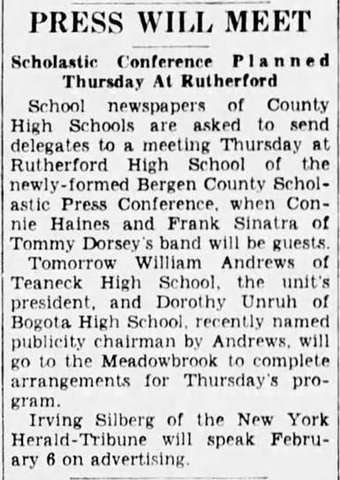
January 24, 1941
Radio
Meadowbrook, New York
Friday
Network: Mutual (WOR)
Time: 12:00 - 12:30 AM (EST)
TD & Co show
Concerts
Frank Dailey's Meadowbrook, Cedar Grove, N.J. (Jan 21 - Feb 16) Tommy Dorsey & His Orch.
January 25, 1941
Radio
Meadowbrook
Network: WABC
Time: 12:15 - 12:55 AM (EST)
Tommy Dorsey, Frank Sinatra, Connie Haines,
Jo Stafford, Pied Pipers, Ziggy Elman, Buddy Rich,
Joe Bushkin.
Concerts
Frank Dailey's Meadowbrook, Cedar Grove, N.J. (Jan 21 - Feb 16) Tommy Dorsey & His Orch.
Meadowbrook
Network: WABC
Time: 12:15 - 12:55 AM (EST)
Tommy Dorsey, Frank Sinatra, Connie Haines,
Jo Stafford, Pied Pipers, Ziggy Elman, Buddy Rich,
Joe Bushkin.
----------------------------------------
1945 Command Performance
Program #159.
Frank Morgan emcee
Guests: Frank Sinatra, Nelson Eddy,
Andrew Sisters, Foy Willing &
Riders Of The Purple Sage, Meredith
Wilson, Blanche Stewart and Elvia Allman
Ken Carpenter announcer
1. Morgan & Carpenter comedy sketch
2. Andrew Sisters "One Meatball"
3. Sinatra & Morgan chat
4. Frank Sinatra "Saturday Night Is The Loneliest Night Of The Week"
5. Blanche Stewart and Elvia Allman appear as Brenda and Cobina
6. Foy Willing & Riders Of The Purple Sage "Cool Water"
7 Nelson Eddy " The Captain Of My Song"
9.Comedy Sketch with Sinatra, Eddy, Morgan, Andrew Sisters, Carpenter
10. Sign-Off
Note: The show appears on the officially released CD set: 60 Greaest Old Time Radio Show "Frank Sinatra & Friends Show was taped on 1-25-45. AFRS aired it on 3-11-45
[image referenced in source but could not be recovered]
January 26, 1941
Concerts
Frank Dailey's Meadowbrook, Cedar Grove, N.J. (Jan 21 - Feb 16) Tommy Dorsey & His Orch.
January 27, 1941
Concerts
Frank Dailey's Meadowbrook, Cedar Grove, New Jersey (Jan 21, 1941 - Feb. 17, 1941) Tommy Dorsey & His Orchestra
January 28, 1941
Concerts
Frank Dailey's Meadowbrook, Cedar Grove, New Jersey (Jan 21, 1941 - Feb. 17, 1941) Tommy Dorsey & His Orchestra
January 29, 1941
Concerts
Frank Dailey's Meadowbrook, Cedar Grove, New Jersey (Jan 21, 1941 - Feb. 17, 1941) Tommy Dorsey & His Orchestra with Frank Sinatra
January 30, 1941
Radio
Fame And Fortune - Tommy Dorsey Orchestra
Network: NBC - Blue Network
Location: New York City
Show #18
Sponsor: Nature's Remedy
Time: 8:30PM - 9:00PM (EST) Thursdays
Orchestra Conducted By: Tommy Dorsey
Arrangements By: Axel Stordahl (Sinatra)
Announcer: Fred Beutel
Musicians: Ziggy Elman, Bob Alexy, Lee Castle, Jimmy Blake (trumpet); George Arus, Les Jenkins, Dave Jacobs (trombone); Johnny Mince (clarinet, alto sax); Fred Stulce, Heinie Beau (alto sax); Don Lodice, Paul Mason (tenor sax); Joe Bushkin (piano); Clark Youcum (guitar); Sid Weiss (bass); Buddy Rich (drums).
Vocals: Frank Sinatra, Connie Haines, Pied Pipers
1. opening theme: Anything - TD & Orchestra
2. There'll Be Some Changes Made - Connie Haines
3. I Hear A Rhapsody - Frank Sinatra
4. That's Gratitude For Ya - The Pied Pipers
5. Swanee River - Tommy Dorsey & orchestra
6. That's How It Goes - Frank Sinatra, Connie Haines & Pied Pipers
7. The Skater's Waltz - Tommy Dorsey & orchestra
8. Poem - Tommy Dorsey
9. When Daylight Dawns - Frank Sinatra, Jo Stafford & Pied Pipers
10. closing theme: Anything - TD & Orchestra
Notes: Confirmed airing on WJZ
("That's How It Goes" & "When Daylight Dawns” appear on Masters of Jazz Volume 9)
("I Hear A Rhapsody", "That’s How It Goes", "When Daylight Dawns" appear on the RCA CD Box Set "The Song Is You")
Concerts
Frank Dailey's Meadowbrook, Cedar Grove, New Jersey (Jan 21, 1941 - Feb. 17, 1941) Tommy Dorsey & His Orchestra
January 31, 1941
Concerts
Frank Dailey's Meadowbrook, Cedar Grove, New Jersey (Jan 21, 1941 - Feb. 17, 1941) Tommy Dorsey & His Orchestra
February 1, 1941
Radio
Frank Daley's Meadowbrook, Cedar Grove, New Jersey
CBS broadcast
Tommy Dorsey and His Orchestra.
Vocal(s): Frank Sinatra, Connie Haines, Jo Stafford & The Pied Pipers.
Saturday evening
1. I'm Getting Sentimental Over You TD & Orch
2. Swing Low Sweet Chariot TD & Orch
3. Everything Happens To Me F.S.
4. Swanee River TD & Orch.
5. Oh! Look At Me Now FS, C.H., J.S. & P.P.
6. Skater's Waltz TD & Orch.
7. Let's Get Away From It All FS, C.H., J.S. & P.P.
8. The Moon Won't Talk F.S.
9. So What! TD & Orch
10. Closing Theme TD & Orch.
note: TD and band were heard in the afternoon on both the CBS and
Mutual networks. The hour broadcast was the first of two from
the Meadowbrook that Saturday Mutual broadcast a half-hour
from 11:00 to 11:30 P.M. EST
Concerts
Frank Dailey's Meadowbrook, Cedar Grove, New Jersey (Jan 21, 1941 - Feb. 17, 1941)
Tommy Dorsey & His Orchestra
February 2, 1941
Concerts
Frank Dailey's Meadowbrook, Cedar Grove, New Jersey (Jan 21, 1941 - Feb. 17, 1941) Tommy Dorsey & His Orchestra with Frank Sinatra
February 3, 1941
Radio
Martin Block's Big Band Party
Monday Afternoon
Location: New York City
Network: WNEW 1130
BLOCK'S PARTY
Glenn Miller, Tommy Dorsey, Jimmy Dorsey, Sammy Kaye Play for Turnout in N. Y. Sixth anniversary party of Marti Block's WNEW, New York, Make-Believe Ballroom record show at the Ambassador Hotel Monday (3) drew 500-600 well wishers to listen to the music of Glenn Miller, Tommy Dorsey, Jimmy Dorsey and Sammy Kaye, who brought their bands to give a demonstration of why they finished high in Block's semi-annual popularity poll. Miller and the two Dorseys finished one-two-three. Kaye was first in the sweet division. Each band was given an inscribed trophy. First 20 outfits in the poll ran as follows: Miller, T. Dorsey, J. Dorsey, Artie Shaw, Will Bradley, Benny Goodman, S. Kaye, Charlie Barnet, Vaughn Monroe, Gene Krupa, Woody Herman, Kay Kyser, Eddy Duchin, Count Basie, Jimmie Lunceford, Harry James, Guy Lombardo, Duke Ellington, Bobby Byrne and Larry Clinton.
Variety
2-5-41
Concerts
Syracuse University Senior Prom, Hotel Syracuse, Syracuse, New York Tommy Dorsey & His Orchestra with Frank Sinatra
Ed O'Brien notes:
There were 1,160 in attendance and Dorsey sold out ($2,750). This was reported in Variety on 2-12-41.
Skitch Henderson told me that Frank was always looking for a gig on his night off when they played clubs in N.Y. and other big cities. And Vinnie
Falcone was told by Frank that no one influenced him more than Mr. Dorsey.
February 4, 1941
Radio
Live Remote: Meadowbrook Ballroom, Cedar Grove, New Jersey
Tuesday Evening
CBS-Radio - WABC New York City
11:30 p.m. - 12:00 a.m.
Tommy Dorsey & Co.
Concerts
Frank Dailey's Meadowbrook, Cedar Grove, New Jersey (Jan 21, 1941 - Feb. 17, 1941) Tommy Dorsey & His Orchestra with Frank Sinatra
February 5, 1941
Concerts
Frank Dailey's Meadowbrook, Cedar Grove, New Jersey (Jan 21, 1941 - Feb. 17, 1941) Tommy Dorsey & His Orchestra
February 6, 1941
Radio
Fame And Fortune - Tommy Dorsey Orchestra
Network: NBC - Blue Network
Location: New York City
Show #19
Sponsor: Nature's Remedy
Time: 8:30PM - 9:00PM (EST) Thursdays
Orchestra Conducted By: Tommy Dorsey
Arrangements By: Axel Stordahl (Sinatra)
Announcer: Fred Beutel
Musicians: Ziggy Elman, Bob Alexy, Lee Castle, Jimmy Blake (trumpet); George Arus, Les Jenkins, Dave Jacobs (trombone); Johnny Mince (clarinet, alto sax); Fred Stulce, Heinie Beau (alto sax); Don Lodice, Paul Mason (tenor sax); Joe Bushkin (piano); Clark Youcum (guitar); Sid Weiss (bass); Buddy Rich (drums).
Vocals: Frank Sinatra, Connie Haines, Pied Pipers
1. opening theme: Anything - TD & Orchestra
2. Ida, Sweet As Apple Cider - Frank Sinatra
3. May I Never Love Again - Connie Haines
4. commercial
5. I Love It So - Jo Stafford & Pied Pipers
6. Oh, Look At Me Now - Frank Sinatra, Connie Haines & Pied Pipers
7. commercial
8. Old Black Joe - Tommy Dorsey & orchestra
9. Believe Me If All Those Endearing Young Charms - Tommy Dorsey
10. commercial
11. If You Would Only Change Your Mind - Jo Stafford
12. closing theme: Anything - TD & Orchestra
Notes: Confirmed airing on WJZ
("Ida, Sweet As Apple Cider" appears on CD: Buddha 74321 69173 2 'Learn To Croon')
Concerts
Frank Dailey's Meadowbrook, Cedar Grove, New Jersey (Jan 21, 1941 - Feb. 17, 1941) Tommy Dorsey & His Orchestra with Frank Sinatra
February 7, 1941
Studio
New York City
BS060626 Do I Worry? w/The Pied Pipers
(S. Cawan/B. Worth)
Melody Lane Publications Inc. (BMI)/ Leonard-Worth Songs (ASCAP) Arranged by Axel Stordahl
-1 (3:07) CD: 07863 66353-2 "The Song Is You" 5CD set Vol 3
CD: RCA 9679-2-R
LP: SD 1000
78: 27338
BS060628 Everything Happens To Me
(T. Adair/M. Dennis)
Dorsey Brothers Music (ASCAP)
Arranged by Axel Stordahl
-1 (3:10) CD: 07863 66353-2 "The Song Is You" 5CD set Vol 3
CD: RCA 8554-2-R
LP: SD 1000
78: 20-1577
78: 27359
Saxes: Fred Stulce, Johnny Mince, Paul Mason, Heinie Beau, Don Lodice; Trumpets: Ziggy Elman, Jimmy Blake, Ray Linn, Cluck Peterson; Piano: Joe Bushkin; Trombones: Les Jenkins, George Arus, Lowell Martin; Guitar: Clark Yocum; Bass: Sid Weiss; Drums: Buddy Rich
Radio
Frank Dailey's Meadowbrook, Cedar Grove, New Jersey
Tommy Dorsey & His Orchestra with Frank Sinatra
CBS had Dorsey from the Meadowbrook for a half-hour, starting at 11:30 and Mutual did a pick-up from 1:00 to 1:30 A.M.
Schedule is from Baltimore Sun, 2-7-41
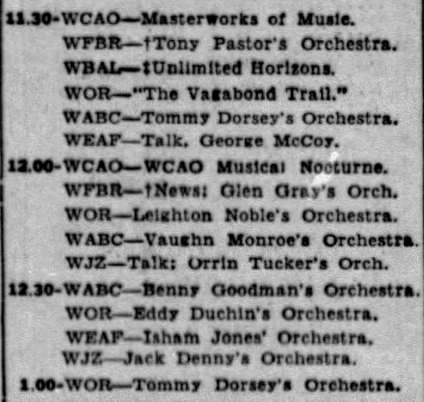
Concerts
Frank Dailey's Meadowbrook, Cedar Grove, New Jersey (Jan 21, 1941 - Feb. 17, 1941) Tommy Dorsey & His Orchestra with Frank Sinatra
"Do I Worry?"
"Do I Worry?" also comes very close tempo-wise, although it’s by the full band with Sinatra solo, sans Pipers. A hit for the Ink Spots, "Worry" might have been better off left to them, what with Sinatra trying to suggest one of the Spots’ signature musical monologues generally delivered by the talking basso, Hoppy Jones.
Source: Will Friedwald, "Sinatra! The Song Is You: A Singer's Art" (2018 revised edition).
February 8, 1941
Radio
Saturday afternoon
4-5:PM
WABC, NYC
Tommy Dorsey & Orch.
Appears TD & Co. were also on 2-15 & 2-22.
Note: Thanks to Ed O'Brien for the above radio listing.
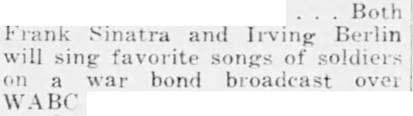
Concerts
Frank Dailey's Meadowbrook, Cedar Grove, New Jersey (Jan 21, 1941 - Feb. 17, 1941) Tommy Dorsey & His Orchestra with Frank Sinatra
February 9, 1941
Radio
Tommy Dorsey & His Orchestra with Sinatra
WOR(MUTUAL) broadcast TD and Co. from 4:30 to 5 P.M. and another half-hour from 12:00 A.M to 12:30 A.M. I checked and Mutual offered these broadcast throughout the country. --Ed
Concerts
Frank Dailey's Meadowbrook, Cedar Grove, New Jersey (Jan 21, 1941 - Feb. 17, 1941) Tommy Dorsey & His Orchestra with Frank Sinatra
Note: Ed O'Brien supplied the following articles and noted that all three appeared on the same page of that week's Variety.
THIEF IN RUNAWAY CAR, CRASHES INTO DANCERS OUTSIDE MEADOWBROOK Two young girls were killed and two youths injured early Sunday(9) morning when they were hit by a stolen car being driven by a Newark, N.J. thief past Frank Dailey's Meadowbrook, Cedar Grove, N.J. Four were in a party of 10 leaving the spot and crossing Route 23 to get into parked cars. Speeding car was being chased by a cop and after hitting the four crashed into a parked auto Its driver escaped , but was nabbed later when he returned to the scene of the accident in a taxicab.
In order to keep crowd of dancers who were at Meadowbrook that night, inside and away from the accident and bodies, Tommy Dorsey's band remained on the bandstand and kept playing until 3:30 a.m.
ASLEEP AT THE WHEEL
Jimmy Van Heusen, songwriter, and Juggy Gayles, contact man for Berlin Music, woke up with a bang in Manlius, N.Y., early Saturday(8) morning to find that Gayles had driven Van Heusen's car into a marble square. Neither was hurt but the car was badly damaged.
Pair were on their way to Syracuse, Van Heusen's home.
TOMMY DORSEY TO NEV. FOR "LAS VEGAS" PREEM
Contingent upon the fulfillment of tentative plans to give "Las Vegas Nights" at Las Vegas, Nevada, late March, arrangements have been made with Tommy Dorsey by Paramount under which he would fly out to play for the preem.
Dorsey, now at the Meadowbrook Country club, Cedar Grove, N.J.,is willing to fly his band out, using two planes, and has so informed William LeBaron at the Par studio from which all negotiations and premiere plans have emanated. Understood that Par would pay all expenses. Dorsey otherwise appearing for free. He and his band are in the film.
Variety
February 12, 1941
February 10, 1941
Radio
Meadowbrook Ballroom, Cedar Grove, New Jersey
New York City
Monday Evening
10:45 -11:00 p.m.
WOR
Tommy Dorsey & Orch note: This CBS broadcast was from 11 to
11:30 P.M. Depending on what the affiliate opted for, you might get the the first 15 mins or the last 15, or the complete show.
Concerts
Frank Dailey's Meadowbrook, Cedar Grove, New Jersey (Jan 21, 1941 - Feb. 17, 1941) Tommy Dorsey & His Orchestra with Frank Sinatra

February 11, 1941
Radio
Frank Dailey's Meadowbrook, Cedar Grove, New Jersey
Tuesday evening
CBS
WABC in N.Y.C.
11:30 p.m - 12:00 a..m.
30 minutes
Tommy Dorsey & His Orch.
Frank Sinatra, Connie Haines, Jo Stafford, The Pied Pipers, Ziggy Elman, Buddy Rich, Joe Bushkin, Sy Oliver
Annc: John Allenmore
1. Anything T.D & Orch
2. Swing Low Sweet Chariot T.D. & Orch.
3. Everything Happens To Me F.S. arg. by Axel Stordahl
4. Swanee River T.D. & Orch..
5. Oh! Look At Me Now F.S. C.H. J.S. P.P.
6. The Skater's Waltz T.D. & Orch.
7. Let's Get Away From It All F.S C.H. J.S. P.P.
8. The Moon Won't Talk F.S.
9. So What T.D. & Orch.
10. Anything T.D. & Orch.
Note: Thank to Ed O'Brien for the above radio listing
("Everything Happens To Me", "Oh! Look At Me Now","Let's Get Away From It All", & "The Moon Won't Talk" appear on Masters of Jazz Volume 5)
(The Complete Broadcast is available on LP: Fanfare 29-129 Tommy Dorsey and His Orchestra Live At The Meadowbrook)
Concerts
Frank Dailey's Meadowbrook, Cedar Grove, New Jersey (Jan 21, 1941 - Feb. 17, 1941) Tommy Dorsey & His Orchestra
Frank Dailey's Meadowbrook, Cedar Grove, New Jersey
Tommy Dorsey & His Orch.
Frank Sinatra, Connie Haines, Jo Stafford, The Pied Pipers,
(The Complete Broadcast is available on LP: Fanfare 29-129 Tommy Dorsey and His Orchestra Live At The Meadowbrook)
Review, Fanfare 29-129, by William Esposito
"The arguments will continue, until the last note is played for all of us, as to which big band was the best of the big band era. There were a veritable ton of bands and for each, ten ton of supporters. Today, long after the rising stage of the New York Paramount dropped into oblivion, the discussions, heated and unheated, go on. If you want to avoid a possible shot in the chops, don't go for the big band era but for the era of a big band. Case in Point: The Tommy Dorsey band of 1940-42, give or take a few months. Pound for inch, it may well have been the greatest of them all on any or many given nights for those days. Just enjoy TD and his lads on one of their sand-blaster arrangements. "Swing Low, Sweet Chariot' as a broadcast from Frank Dailey's Meadowbrook comes out of this LP, recreating the date of February 11th, 1941. The old gospel favorite jumps, pivots, cuts across the airwaves with a definitive swing. Ziggy Elman's trumpet and Heine Beau's reed work - that alto solo is something you didn't hear too much on Dorsey arrangements - blend in on schedule and you have a standby of the swing solstice. And, in the accepted manner of those days, after a flag-waver opener, the leader would quiet things down a bit by â introducing our vocalistâ ť who, ho, in this case, was a callow youth named Frank Sinatra just into the big time after a hitch with the Harry James' band. Francis Albert warbles about everything happening to him and does his usual classy job but go a bit further here... The flip side has the Dorsey band some 18 months later, in August of 1942 at the Capitol Theatre in Washington and give a listen to how much Frank had polished his already enormous talent in that short time. There is a striking difference, which should delight Sinatra-fans but not surprise them. Frank has improved every day and is still doing it when most men his age are considering the pipe and slippers and the social security check in the mail. Typical Dorsey dance delivery can be found down by the Swanee River and another stamp of those salad days teams up Sinatra with the pert Connie Haynes on Oh, Look At Me Now, one of the band's big record sellers. And it wasn't just the Bob Crosby band which featured Skater's Waltz, for the Dorsey version here rolls along in a plain and simple showcase for Elman's horn and the tenor sax of Don Lodice, a Dorsey clean up hitter and tenor man all too often passed over by those jazz archivists who delve into a history of the tenor sax. Another of the up-tempo tunes which bordered on far-out fantasy (all right, did you ever take a kayak to Quincy or Nyack? Have you ever been to Nyack?) gives the leader himself a chance to shine after Joe Bushkin's does his major league job on piano. Permit an opinion Joe Bushhkin could play from the yellow pages of the Calcutta phone book and make it swing. And, for the closer at the Meadowbrook on what was most likely a chilly February night in that memorable year of 19 and 41, the question is asked, So What? So great, that's all, But why so short?"
note: The Dorsey orchestra was very popular in the era of the big band. In the late 1930s, Artie Shaw was the winner of most polls with TD & Co. placing second and during the Sinatra Years, Glenn Miller's contingent was more popular. But the best band wasn't that much of an argument. Dorsey had employed the best of the best: Buddy Rich, Joe Bushkin, Ziggy Elman, Heine Beau, Sy Oliver, Jo Stafford and Frank Sinatra. Eliminate Sinatra and the group is still an astonishing array of marvelous musicians. A great joy is listening to a one-nighter or a weekly radio show with the amazing sound offered by Dorsey, who was arguably the most talented in the group, and his great ensemble.
Ed
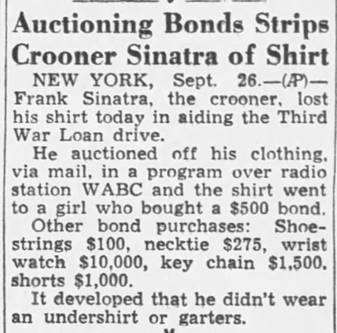
February 12, 1941
Concerts
Frank Dailey's Meadowbrook, Cedar Grove, New Jersey (Jan 21, 1941 - Feb. 17, 1941) Tommy Dorsey & His Orchestra
February 13, 1941
Radio
Fame And Fortune - Tommy Dorsey Orchestra
Network: NBC - Blue Network
Location: Meadowbrook, Cedar Grove, New Jersey
Show #20
Sponsor: Nature's Remedy
Time: 8:30PM - 9:00PM (EST) Thursdays
Orchestra Conducted By: Tommy Dorsey
Arrangements By: Axel Stordahl (Sinatra)
Announcer Fred Beutel
Musicans: Ziggy Elman, Bob Alexy, Lee Castle, Jimmy Blake (trumpet); George Arus, Les Jenkins,
Dave Jacobs (trombone); Johnny Mince (clarinet, alto sax); Fred Stulce, Heinie Beau (alto sax); Don Lodice, Paul Mason (tenor sax); Joe Bushkin (piano); Clark Youcum (guitar); Sid Weiss (bass); Buddy Rich (drums).
Vocals: Frank Sinatra, Connie Haines, Pied Pipers
1. opening theme: Anything - TD & Orchestra
2. You Can Depend On Me - Jo Stafford
3. You Betcha My Life - Connie Haines
4. Estrellita - Tommy Dorsey & orchestra
5. It All Comes Back To Me Now - Frank Sinatra
6. Tavern In The Town - Pied Pipers
7. You Might Have Belonged To Another - Sinatra, Haines & P. Pipers
8. The Man Who Writes The Lyrics - Connie Haines & Pied Pipers
9. Prairie Night - Frank Sinatra, Jo Stafford & Pied Pipers
10. closing theme: Anything - TD & Orchestra
Notes: Confirmed airing on WJZ.
("It All Comes Back To Me Now" appears on CD: Buddha 74321 69172-2 'It's All So New!')
("Prairie Night" appears on CD: BMG Bluebird 60283-2 - Young Blue Eyes - Birth Of The Crooner)
Concerts
Frank Dailey's Meadowbrook, Cedar Grove, New Jersey (Jan 21, 1941 - Feb. 17, 1941) Tommy Dorsey & His Orchestra
February 14, 1941
Radio
Frank Dailey's Meadowbrook, Cedar Grove, New Jersey
Tommy Dorsey & His Orchestra
Mutual broadcast T.D Orch from 10:45 to 11: P.M.
CBS followed from 11:30 P.M to midnight
Concerts
Frank Dailey's Meadowbrook, Cedar Grove, New Jersey (Jan 21, 1941 - Feb. 17, 1941) Tommy Dorsey & His Orchestra
February 15, 1941
Radio
Live Remote: Meadowbrook Ballroom, Cedar Grove, New Jersey
Saturday Afternoon
4:00 - 5:00 p.m.
CBS - WABC New York City
Tommy Dorsey & His Orchestra
Frank Sinatra, Connie Haines, Jo Stafford,
The Pied Pipers, Buddy Rich, Joe Bushkin
Guest: Jimmy Dorsey
1. I'm Getting Sentimental Over You TD & Orch.
2. Let's Get Away From It All F.S. C.H. P.P.
3. Trumpet contest: Tommy Dorsey ("Mac" ) & Jimmy Dorsey ("Lad")*
4. Whatcha Know Joe P.P.
5. I Tried F.S.
6. Do I Worry F..S.. P.P.
Skater's Waltz T.D. & Orch * Trumpet contest was declared a draw
(Incomplete version of "Do I Worry" appears on Masters of Jazz Volume 5)
("Let’s Get Away From It All" appears on the CD: Voice VCD 1103 - This One's For Tommy")
Concerts
Frank Dailey's Meadowbrook, Cedar Grove, New Jersey (Jan 21, 1941 - Feb. 17, 1941) Tommy Dorsey & His Orchestra
Frank Dailey's Meadowbrook, Cedar Grove, New Jersey (Jan 21, 1941 - Feb. 17, 1941) Tommy Dorsey & His Orchestra
Meadowbrook February 1941
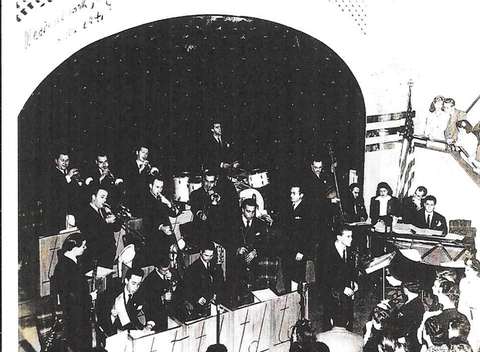
Live Remote: Meadowbrook Ballroom, Cedar Grove, New Jersey
Saturday Afternoon
4:00 - 5:00 p.m.
CBS - WABC New York City
Tommy Dorsey & His Orchestra
Frank Sinatra, Connie Haines, Jo Stafford,
The Pied Pipers, Buddy Rich, Joe Bushkin
Guest: Jimmy Dorsey
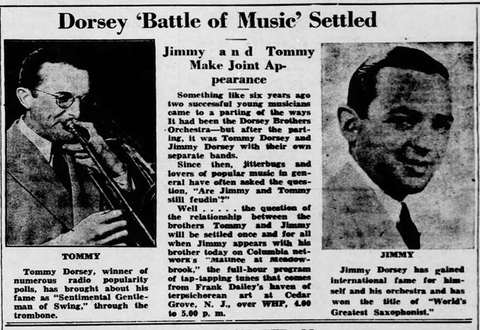
February 16, 1941
Radio
– 12:30pm – Frank is the guest on WAAT’s “Star Dust”
He sang “Blue Moon”, “We Three” and “Everything Happens to Me”
Live Remote: Meadowbrook Ballroom, Cedar Grove, N.J. *(see concert section)
Sunday Afternoon
British Relief Concert
WOR Mutual Network
4:00 p.m. - 4:30 p.m.
TD & Orch.
Concerts
Meadowbrook Ballroom, Cedar Grove, New Jersey
Sunday Evening
Wrap Party - closing night
*BRITISH RELIEF CONCERT IN FRANK DAILEY'S CAFE WITH TOMMY DORSEY ORCH
The British War Relief Society, Frank Dailey and Tommy Dorsey's orchestra are cooperating on
a three hour band concert to be played Sunday (16) at Dailey's Meadowbrook, Cedar Grove, N. j.
Proceeds will go to purchase either an ambulance or canteen (field kitchen), depending on
how much cash is taken in. Admission of $1 has been requested. With large dance floor covered with
seats it's possible to cram 3,000- 3,500 into Meadowbrook.. All leaders; singers and outstanding
instrumentalists in the New York area are expected to show up. Concert is being exploited in
northern New Jersey by the BRS itself, which has an ambulance circulating through that territory
advertising the date. WOR, New York, will broadcast locally.
Variety
– 12:30pm – Frank is the guest on WAAT’s “Star Dust”
He sang “Blue Moon”, “We Three” and “Everything Happens to Me”
(Jersey Journal, February 17, 1941)
Thanks to Richard Cook for above listing
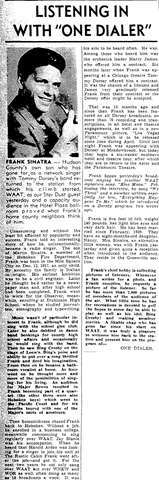
Meadowbrook Ballroom, Cedar Grove, New Jersey
Sunday Evening
British War Relief
Review posted by Ed O'Brien
REVIEW:VIMMS SHOW 2-16-44
FRANK SINATRA
FRANK PANKY
VIMMS.
CBS,FEBRUARY 16, 9 PM EWT
GUESTS: IDA LUPINO-BERT WHEELER
This show, seventh of the Swooner's new radio series for Vimms, demonstrated beyond question, I think, that Signor Sinatra is a capable ballad singer, but no great shakes as a comedian.
The program was nicely routined, threading some threadbare comedy between four samples of the
Voice.The personalities of Ida Lupino and Bert Wheeler, also given some free play on this show, were attractive enough. Frank said his lines of introduction well enough.
But he halted over his comedy and then, when he and the others finally got there the joke was either missing or horribly unfunny.
Frank was at his best in "Dancing in the Dark" and "My Shining Hour" and "This Is A Lovely Way To Spend An Evening," with brilliant assists from Axel Stordahl, doubling as arranger and conductor of the orchestra. The strings sounded full, in Axel's scores, and pretty. In the "Brahms Lullaby," Frank was acceptable; he didn't subject the light classic to his stylisms.
If the producers of this show will worry less about Frank's uncertain abilities as a comic and more about presenting him as a knowing master of musical ceremonies they will have, I think, an altogether successful Sinatra show. It's tough enough to have to supply Wheeler and guests with amusing lines without struggling over humor for a man who has already made it quite clear he has a sizable following in another field.
Ulanov
Metronome
March 1944
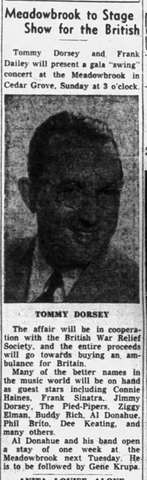
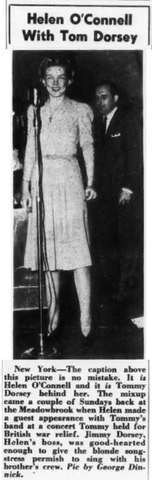
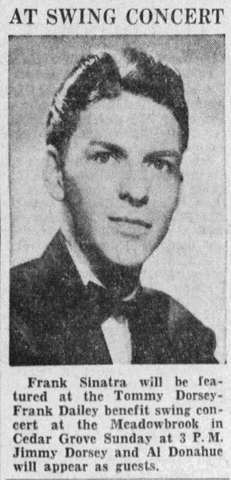
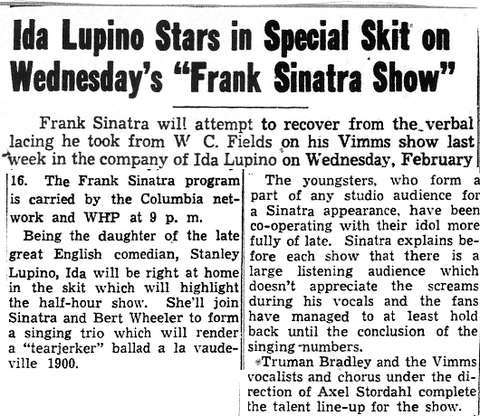
February 17, 1941
Studio
New York City
BS060902 Let's Get Away From It All (Part I) w/The Pied Pipers & Connie Haines
(T. Adair/M. Dennis)
Dorsey Brothers Music (ASCAP)
Arranged by Sy Oliver
-1 (5:11) CD: 07863 66353-2 "The Song Is You" 5CD set Vol 3
CD: RCA 8324-2-R
LP: SD 1000
78: 27377
BS060902 Let's Get Away From It All (Part II) w/The Pied Pipers & Connie Haines
(T. Adair/m. Dennis)
Dorsey Brothers Music (ASCAP)
Arranged by Sy Oliver
-1 CD: 07863 66353-2 "The Song Is You" 5CD set Vol 3
CD: RCA 8324-2-R
LP: SD 1000
78: 27377
Saxes: Fred Stulce, Johnny Mince, Paul Mason, Heinie Beau, Don Lodice; Trumpets: Ziggy Elman, Jimmy Blake, Ray Linn, Cluck Peterson; Piano: Joe Bushkin; Trombones: Les Jenkins, George Arus, Lowell Martin; Guitar: Clark Yocum; Bass: Sid Weiss; Drums: Buddy Rich
Note: Time is for complete recording
note: Session was a two parter. It took place in N.Y.C., at RCA, in Studio One. First session ran from 1:30 to 3:30 P.M. Above song was recorded during that timeframe. Part one featured the vocal work of the Pied Pipers. Running time was 2:45. Part two added the vocals of Frank and Connie Haines with the backing of the Pipers. Running time was 2:20.
Found a review that ranks the song #1 of the 83 Frank recorded with Dorsey.
1. "Let's Get Away from it All" (February 17, 1941) This extravaganza is ranked number 1 for many reasons. Dorsey shot the works here making this extra long (for it's time) track two sides of a 78RPM and utilizing all seven of his singers; Frank and Connie Haines trading playful lyrics and Jo Stafford and the Pied Pipers providing breezy support taking verses themselves. Throw in some outstanding solos from TD and others and you've got a really fun travelogue. Listen close for some of the hippest vocalizing of the big band era ("off to Niagara – solid!".
Ed
Concerts
Frank Dailey's Meadowbrook, Cedar Grove, New Jersey (Jan 21, 1941 - Feb. 17, 1941) Tommy Dorsey & His Orchestra
February 19, 1941
Concerts
John Hopkins University, Baltimore, Maryland
Wednesday afternoon performance
Tommy Dorsey & Orch.
Frank Sinatra, Connie Haines, Jo Stafford,
Pied Pipers, Buddy Rich, Ziggy Elman, Joe Bushkin,Sy Oliver
Alcazar Ballroom, Baltimore, Maryland
Wednesday evening performance
Tommy Dorsey Orchestra led by Ziggy Elman
Frank Sinatra, Connie Haines, Jo Stafford,
Pied Pipers, Buddy Rich, Ziggy Elman, Joe Bushkin,Sy Oliver
Here is the information from the 2-26-41 Variety.
[image referenced in source but could not be recovered]
Alcazar Ballroom, Baltimore, Maryland
Wednesday evening performance
Tommy Dorsey Orchestra led by Ziggy Elman
Frank Sinatra, Connie Haines, Jo Stafford,
Pied Pipers, Buddy Rich, Ziggy Elman, Joe Bushkin,Sy Oliver
[image referenced in source but could not be recovered]
[image referenced in source but could not be recovered]
February 20, 1941
Radio
Fame And Fortune - Tommy Dorsey Orchestra
Network: NBC - Blue Network
Location: Meadowbrook, Cedar Grove, New Jersey
Show #21
Sponsor: Nature's Remedy
Time: 8:30PM - 9:00PM (EST) Thursdays
Orchestra Conducted By: Tommy Dorsey
Arrangements By: Axel Stordahl (Sinatra)
Announcer: Fred Beutel
Musicians: Ziggy Elman, Bob Alexy, Lee Castle, Jimmy Blake (trumpet); George Arus, Les Jenkins, Dave Jacobs (trombone); Johnny Mince (clarinet, alto sax);
Fred Stulce, Heinie Beau (alto sax); Don Lodice, Paul Mason (tenor sax); Joe Bushkin (piano); Clark Youcum (guitar); Sid Weiss (bass); Buddy Rich (drums).
Vocals: Frank Sinatra, Connie Haines, Pied Pipers
Partial Setlist:
1. opening theme: Anything - TD & Orchestra
2. Perfidia - orchestra
3. Traumerei - Tommy Dorsey
4. My First Edition - Frank Sinatra, Connie Haines & Pied Pipers
5. closing theme: Anything - TD & Orchestra
Notes: Confirmed airing on WJZ
("My First Edition" appears on CD: Buddha 74321 69172-2 'It's All So New!')
Note: Incomplete listing.
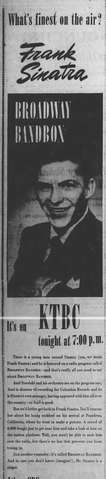
Fame And Fortune - Tommy Dorsey Orchestra
Network: NBC - Blue Network
Location: Meadowbrook, Cedar Grove, New Jersey
Show #21
---------------------------------------
1944 Earl Carroll Theatre, Los Angeles, CA
Fifteenth Annual Charity Ball of the Junior Auxiliary of the Home for the Aged Sinatra, Ginny Simms, Edger Bergen, Spike Jones, Chico Marx and others
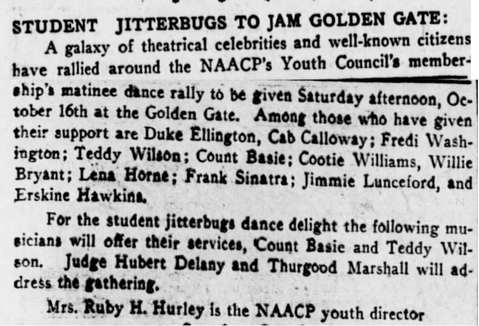
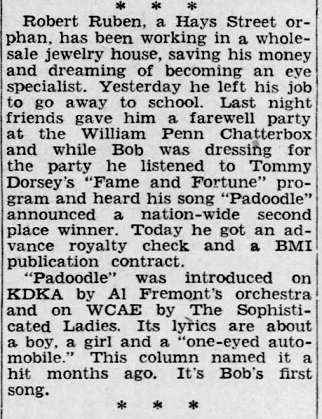
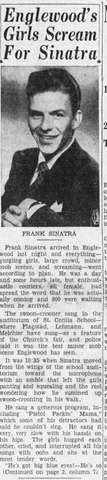
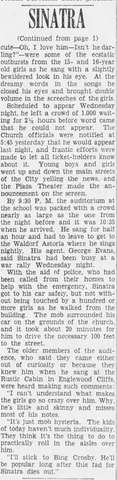
February 21, 1941
Concerts
Castle Gardens in Dorney Park, Allentown, Pennsylvania Friday Evening
Muhlenberg College - Junior Prom School Dance
Castle Gardens in Dorney Park, Allentown, Pennsylvania
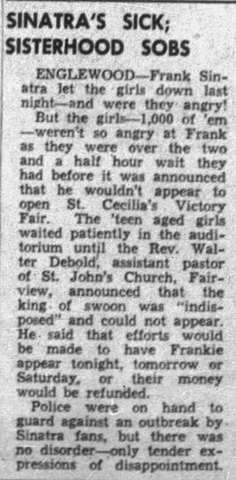
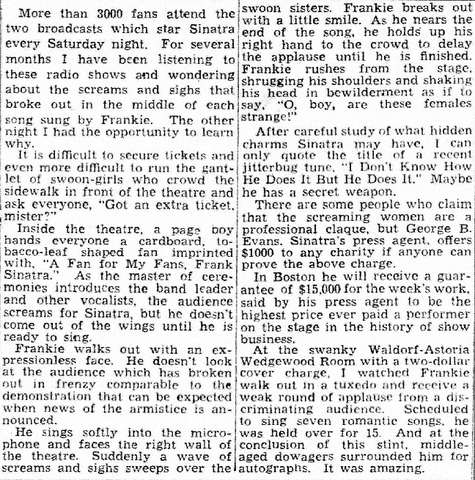
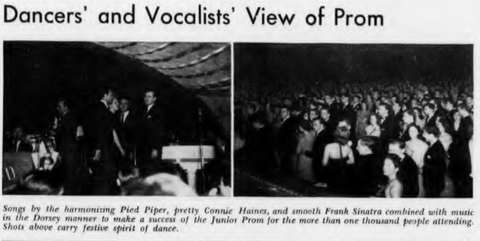
February 22, 1941
Concerts
Sunnybrook Ballroom, Pottstown, Pennsylvania (one-nighter) Saturday evening
Tommy Dorsey & Orchestra
Frank Sinatra, Connie Haines, Jo Stafford,
Ziggy Elman, Joe Bushkin, Sy Oliver, Buddy
Rich, Pied Pipers
Sunnybrook Ballroom, Pottstown, Pennsylvania (one-nighter) Saturday evening
Tommy Dorsey & Orchestra
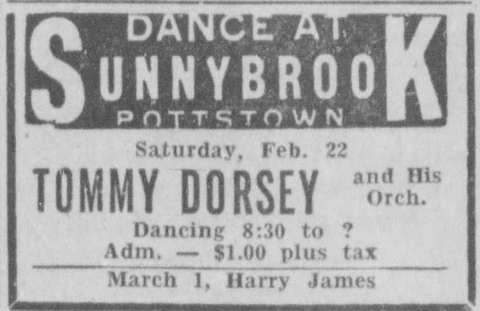
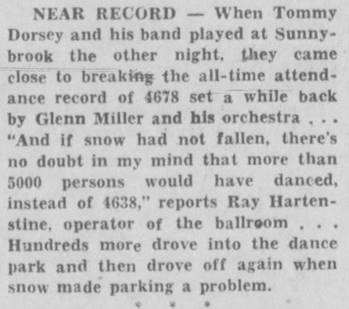
February 23, 1941
Concerts
State Theatre, Hartford Connecticut (23-25)
Sunday thru Tuesday
Tommy Dorsey & Orchestra
F. Sinatra, C. Haines, J. Stafford, B. Rich,
Z. Elman, J.. Bushkin, Pied Pipers, S. Oliver
FRANK SINATRA JAILED;NEARLY MISSES A SHOW
HARTFORD, CONN.
Frank Sinatra, the singer with Tommy Dorsey,was arrested and jailed here two weeks ago while the band was playing the State Theatre. Sinatra was walking across a street near the theater-jay- walking at that-when a cop yelled at him asking him to wait for the light. "I'm already half across now," Sinatra yelled back. The cop didn't care. He walked over, nabbed Sinatra, and took him to jail. Sinatra explained he was a "figure of national import- ance" and was due on the stage any minute. Police told Frank to get another "figure of national importance" to help him. Finally, with Dorsey's manager Bobby Burns on hand, Sinatra was freed after paying $10 for a ticket to a police benefit. He made the show in time.
DOWNBEAT
CHICAGO
MARCH 15, 1941
State Theatre, Hartford Connecticut (23-25)
[image referenced in source but could not be recovered]
[image referenced in source but could not be recovered]
[image referenced in source but could not be recovered]
February 24, 1941
Concerts
State Theatre, Hartford Connecticut (23-25)
Tommy Dorsey and His Orchestra with Frank Sinatra
Sunday thru Tuesday
T.D. & Orch
F. Sinatra, C. Haines, J. Stafford, B. Rich,
Z. Elman, J.. Bushkin, Pied Pipers, S. Oliver
February 25, 1941
Concerts
State Theatre, Hartford, Connecticut (February 23 - 25) Tommy Dorsey & His Orchestra
February 26, 1941
Concerts
Old Mill Inn, Bernardsville, NJ.
British War Relief Benefit
Tommy Dorsey & His Orchestra
Wednesday Evening
Old Mill Inn, Bernardsville, NJ.
British War Relief Benefit
Tommy Dorsey & His Orchestra
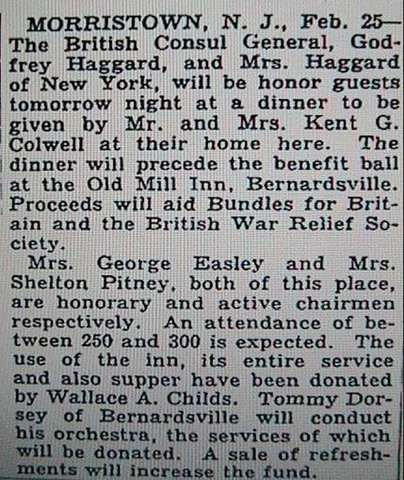
February 27, 1941
Radio
Fame And Fortune - Tommy Dorsey Orchestra
Network: NBC - Blue Network
Location: New York City
Show #22
Sponsor: Nature's Remedy
Time: 8:30PM - 9:00PM (EST) Thursdays
Orchestra Conducted By: Tommy Dorsey
Arrangements By: Axel Stordahl (Sinatra)
Announcer: Fred Beutel
Musicians: Ziggy Elman, Bob Alexy, Lee Castle, Jimmy Blake (trumpet); George Arus, Les Jenkins, Dave Jacobs (trombone); Johnny Mince (clarinet, alto sax); Fred Stulce, Heinie Beau (alto sax); Don Lodice, Paul Mason (tenor sax); Joe Bushkin (piano); Clark Youcum (guitar); Sid Weiss (bass); Buddy Rich (drums).
Vocals: Frank Sinatra, Connie Haines, Pied Pipers
1. opening theme: Anything - TD & Orchestra
2. So You're The One - Pied Pipers
3. Everything Happens To Me - Frank Sinatra
4. commercial
5. Chinese Rye - Pied Pipers
6. I Saw Your Face In A Cloud - Sinatra, Connie Haines & P. Pipers
7. commercial
8. I Love You So - Pied Pipers
9.. Evening Star - Tommy Dorsey & orchestra
10. commercial
11. When Sleepy Stars Begin To Fall - Sinatra, Connie Haines & Pipers
12. closing theme: Anything - TD & Orchestra
Notes: Confirmed airing on WJZ
("When Sleepy Stars Begin To Fall" appears on Masters of Jazz Volume 10 & the RCA CD Box Set - The Song Is You)
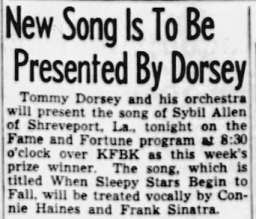
February 28, 1941
Concerts
Penn State, State College, Pa. (One-Nighter)
Tommy Dorsey & Orch.
Frank Sinatra, Jo Stafford, Connie Haines,
Buddy Rich, Joe Bushkin, Ziggy Elman, Sy Oliver
Penn State, State College, Pa. (One-Nihgter)
Tommy Dorsey & Orch.
Frank Sinatra, Jo Stafford, Connie Haines,
Buddy Rich, Joe Bushkin, Ziggy Elman, Sy Oliver
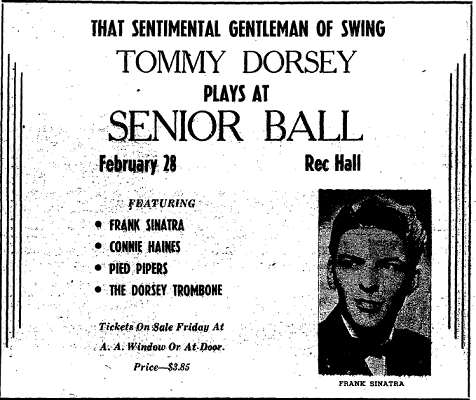
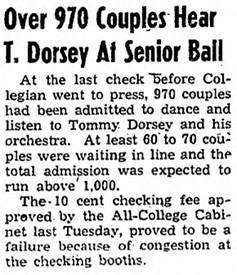
March 1, 1941
Concerts
Royal Windsor Hotel, New York City (one-nighter)
Tommy Dorsey & His Orch note: An SRO appearance by TD & Co.
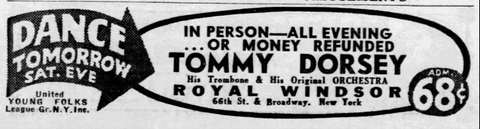
March 2, 1941
Concerts
Lyric Theatre, Bridgeport, Connecticut
Sunday
Tommy Dorsey & Orchestra
Frank Sinatra, Connie Haines, Jo Stafford,
Pied Pipers, Buddy Rich, Joe Bushkin, Ziggy Elman
Ed O'Brien:
Dorsey played to a packed house; set record with
8,900 admissions at 55 cents tops; forced to play seven shows. . . . Gross $4,185.
Variety March 5, 1941
A Penny For His Thoughts
BRIDGEPORT, Conn, - March 2
Tommy Dorsey, playing a one-day engagement at the
Loew-Fols-Lyric Theater here last Sunday (2) got real riled when a rabid fan pitched a penny onto the stage from the balcony, narrowly missing Connie Haines, who was singing at the time. Dorsey bounced over to the mike and announced the fellow who threw the penny was a bum and four-letter word meaning jerk, and if it wasn't that he could "take it," he would have his band pack up and leave the stage. Amidst vociferous applause, Dorsey then went on with the show.
Lyric Theatre, Bridgeport, Connecticut
Sunday
Tommy Dorsey & Orchestra
Frank Sinatra, Connie Haines, Jo Stafford,
Pied Pipers, Buddy Rich, Joe Bushkin, Ziggy Elman
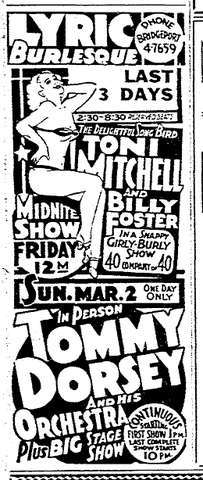
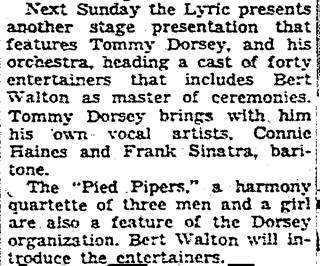
March 3, 1941
Concerts
Municipal Auditorium, Worcester, Massachusetts
Monday
Tommy Dorsey & Orchestra
Frank Sinatra, Connie Haines, Jo Stafford,
Pied Pipers, Buddy Rich, Joe Bushkin, Ziggy Elman
Note: Ed O'Brien contributed the above concert listing and the following Variety blurb.
Dorsey into Mechanics Hall in Worcester, Mass.
Fair draw of 1,900 at $1.00
Variety March 5, 1941
Note: Dorsey was supposed to play Mechanics Hall in Worcester but according to Variety, he switched to the Municipal Auditorium:
--Scott
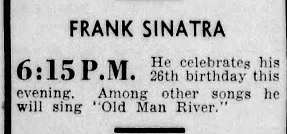
March 4, 1941
Concerts
The Auditorium, Lowell, Massachusetts
Tommy Dorsey and his Orchestra w/Frank Sinatra
The Auditorium, Lowell, Massachusetts
Tommy Dorsey and his Orchestra w/Frank Sinatra
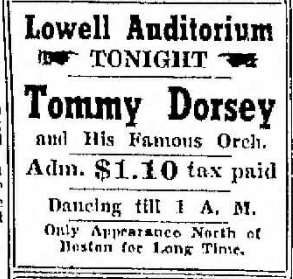
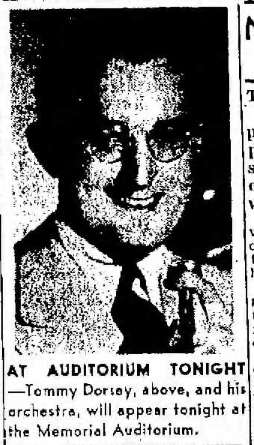
March 5, 1941
Concerts
Totem Pole Ballroom, Auburndale, Massachusetts
Tommy Dorsey and his Orchestra w/Frank Sinatra
NOTE: Ed O'Brien says that Dorsey cracked all midweek records here with capacity 3.200 admissions at $1.10 each.
Leader took out $1,919 as his end. Usual tariff is $1.35 per couple, but it was increased for the Dorsey band, according to Variety, March 12, 1941.
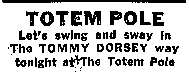
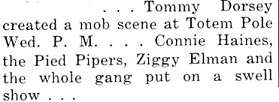
Totem Pole Ballroom, Auburndale, Massachusetts
Tommy Dorsey and his Orchestra w/Frank Sinatra
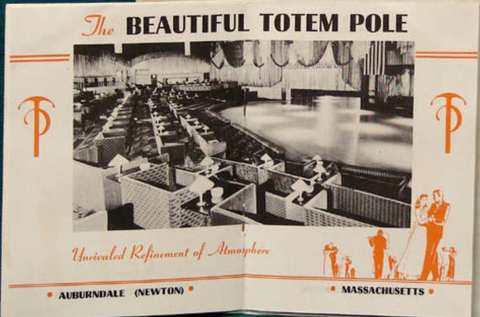
March 6, 1941
Radio
Fame And Fortune - Tommy Dorsey Orchestra
Network: NBC - Blue Network
Location: New York City
Show #23
Sponsor: Nature's Remedy
Time: 8:30PM - 9:00PM (EST) Thursdays
Orchestra Conducted By: Tommy Dorsey
Arrangements By: Axel Stordahl (Sinatra)
Announcer: Fred Beutel
Musicians: Ziggy Elman, Bob Alexy, Lee Castle, Jimmy Blake (trumpet); George Arus, Les Jenkins, Dave Jacobs (trombone); Johnny Mince (clarinet, alto sax); Fred Stulce, Heinie Beau (alto sax); Don Lodice, Paul Mason (tenor sax); Joe Bushkin (piano); Clark Youcum (guitar); Sid Weiss (bass); Buddy Rich (drums).
Vocals: Frank Sinatra, Connie Haines, Pied Pipers, Paul Mason
1. opening theme: Anything
March Winds - TD & Orchestra
2. Georgia On My Mind - Connie Haines
3. You Walk By - Frank Sinatra
4. Bicycle Built For Two - Paul Mason & Pied Pipers
5. Swing Low Sweet Chariot - orchestra
6. Frensi - Frank Sinatra & Pied Pipers
7. Intermezzo - Tommy Dorsey
8. My Memoirs - Frank Sinatra, Connie Haines & Pied Pipers
9. closing theme: Anything - TD & Orchestra
Notes: Confirmed airing on WJZ
("You Walk By" appears on Masters of Jazz Volume 9 & CD: BMG Bluebird 60283-2 - Young Blue Eyes - Birth of A Crooner)
("Frenesi" appears on Masters of Jazz Volume 10)
("My Memoirs" appears on CD: Buddha 74321 69172-2 'It's All So New!')
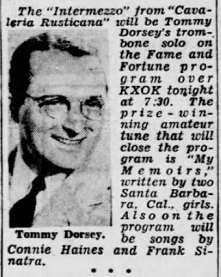
March 7, 1941
Concerts
Hippodrome Theatre, Baltimore, Maryland (March 7 – March 13)
Tommy Dorsey and his Orchestra w/Frank Sinatra
NOTE: Ed O'Brien quotes Variety was saying TD played the Hippo on a contract that was a year old.
He was on a guarantee against 50% of the gross from the first dollar. "Saint in Palm Springs" (RKO)
was on screen. Film is strictly a programmer, so the bangup $19,000 hinges entirely on Dorsey.
Although Saturday's snowstorm slowed the town to a walk, a house record was established at the spot the next day (Sunday).
Hippodrome Theatre, Baltimore , Maryland (March 7-13)
Tommy Dorsey and his Orchestra w/Frank Sinatra
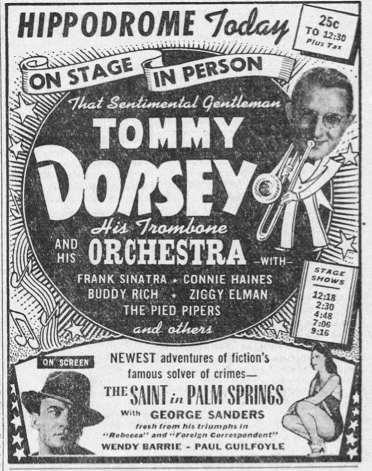
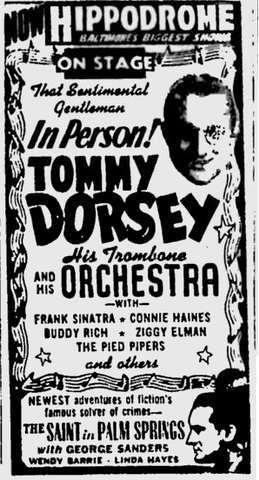
March 8, 1941
Concerts
Hippodrome Theatre, Baltimore, Maryland (March 7 - March 13)
Tommy Dorsey and his Orchestra w/Frank Sinatra
March 9, 1941
Concerts
Hippodrome Theatre, Baltimore, Maryland (March 7 March 13) Tommy Dorsey and his Orchestra w/Frank Sinatra
March 10, 1941
Concerts
Hippodrome Theatre, Baltimore, Maryland (March 7 – March 13) Tommy Dorsey and his Orchestra w/Frank Sinatra
Picture "The Saint In Palm Springs"--Variety dismissed it as not a factor at the b.o. Strictly TD & Co.
Ed O'Brien:
Dorsey band opened on 3/7. There was a massive snowstorm on the 8th( Saturday), theatre was less than half-filled. Sunday was a dramatic turnaround. The gross was the highest single day in the history of the Hippodrome. For the week the band drew $19,000.
Dorsey was guaranteed 50% of the gross, starting with the first dollar
March 11, 1941
Concerts
Hippodrome Theatre, Baltimore, Maryland (March 7 – March 13) Tommy Dorsey and his Orchestra w/Frank Sinatra
Picture "The Saint In Palm Springs"ť (RKO).--Variety dismissed it as not a factor at the b.o. Strictly TD & Co.
March 12, 1941
Concerts
Hippodrome Theatre, Baltimore, Maryland (March 7 – March 13)
Tommy Dorsey and his Orchestra w/Frank Sinatra
Picture "The Saint In Palm Springs" (RKO).--Variety dismissed it as
not a factor at the b.o. Strictly TD & Co.
March 13, 1941
Radio
Fame And Fortune - Tommy Dorsey Orchestra
Network: NBC - Blue Network
Location: Hippodrome, Baltimore, MD
Show #24
Sponsor: Nature's Remedy
Time: 8:30PM - 9:00PM (EST) Thursdays
Orchestra Conducted By: Tommy Dorsey
Arrangements By: Axel Stordahl (Sinatra)
Announcer: Fred Utall
Musicians: Ziggy Elman, Bob Alexy, Lee Castle, Jimmy Blake (trumpet); George Arus, Les Jenkins, Dave Jacobs (trombone); Johnny Mince (clarinet, alto sax); Fred Stulce, Heinie Beau (alto sax); Don Lodice, Paul Mason (tenor sax); Joe Bushkin (piano); Clark Youcum (guitar); Sid Weiss (bass); Buddy Rich (drums).
Vocals: Frank Sinatra, Connie Haines, Pied Pipers
Partial Setlist:
1. opening theme: Anything - TD & Orchestra
2. Rockin' Chair - Tommy Dorsey & Orchestra
3. Little Man With The Candy Cigar - Jo Staford
4. The Kerry Dance - Pied Pipers
4. Deep River - Tommy Dorsey & orchestra
5. Oh! Look At Me Now - F. Sinatra, C. Haines & Pipers
6. Killarney ( Dorsey solo ) closing theme: Anything - TD & Orchestra
7. The Man Who Wrote The Lyrics - Paul Mason, C. Haines - Pied Pipers
8. The Man Who Wrote The Lyrics ( reprise )
9. Closing theme Anything -- actually a variation of "Getting Sentimental Over You "
Notes: Washington Post noted in advertising this show: "He's getting nearer and nearer to Washington, bugs. This weeks "Tommy Dorsey's Band" airs from Baltimore, but he'll be on F street soon." Confirmed airing on WJZ.
[image referenced in source but could not be recovered]
Concerts
Hippodrome Theatre, Baltimore, Maryland (March 7 – March 13) Tommy Dorsey and his Orchestra w/Frank Sinatra
Tommy's Fame & Fortune show for March 13, 1941 would be broadcast from the Hippodrome
Hippodrome Theatre, Baltimore, Maryland (March 7 – March 13) Tommy Dorsey and his Orchestra w/Frank Sinatra
Tommy's Fame & Fortune show for March 13, 1941 would be broadcast from the Hippodrome
Variety
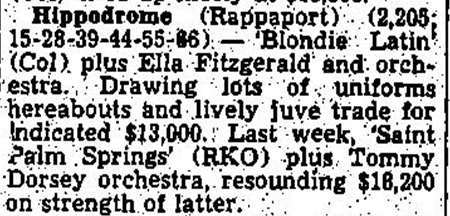
March 14, 1941
Concerts
Adams Theatre, Newark, New Jersey (14-16)
Friday/Saturday/ Sunday
Tommy Dorsey Orchestra
Frank Sinatra, Connie Haines, Jo Stafford, Pied Pipers, Ziggy Elman, Joe Bushkin, Buddy Rich, Sy Oliver
note: TD & Co. grossed $10,600 during this three day engagement. Theatre seating capacity was 2,000
Note: Sinatra was out sick during the Newark performances. Bob Allen subbed for him.
Adams Theatre, Newark, New Jersey (14-16)
Friday/Saturday/ Sunday
Tommy Dorsey Orchestra
Frank Sinatra, Connie Haines, Jo Stafford, Pied Pipers, Ziggy Elman, Joe Bushkin, Buddy Rich, Sy Oliver
Note: Sinatra was out sick during the Newark performances. Bob Allen subbed for him:
Dorsey appeared from Friday March 14 to Sunday March 16th in Newark
It even got a write up the following month in Billboard:
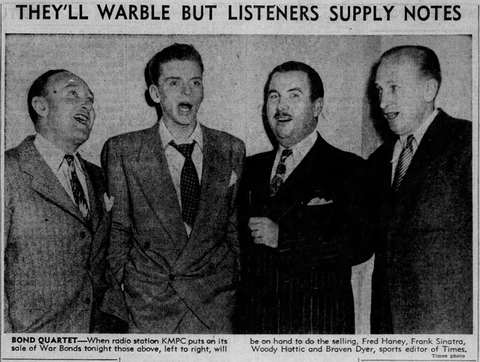
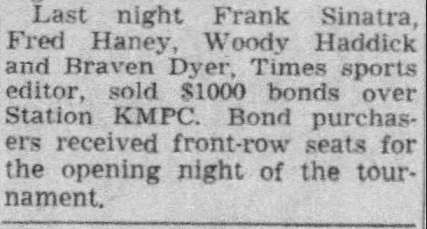
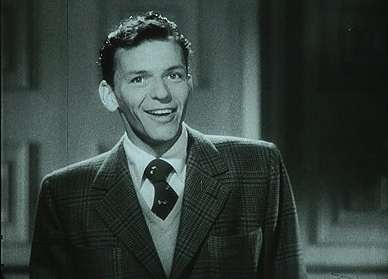
March 15, 1941
Concerts
Adams Theatre, Newark, New Jersey (March 14 - March 16) Tommy Dorsey and his Orchestra
Friday/Saturday/ Sunday
Frank Sinatra, Connie Haines, Jo Stafford, Pied Pipers, Ziggy Elman, Joe Bushkin, Buddy Rich, Sy Oliver
NOTE: Sinatra Scholar Ed O'Brien provides us with this early 40s information and sends us a quote from Variety:
"With indie screen fare of little consequence, Dorsey piled up outstanding $10.600 in three weekend days. Prices were 40 to 66 cents."
March 16, 1941
Concerts
Adams Theatre, Newark, New Jersey (March 14 - March 16) Tommy Dorsey and his Orchestra
Friday/Saturday/ Sunday
Frank Sinatra, Connie Haines, Jo Stafford, Pied Pipers, Ziggy Elman, Joe Bushkin, Buddy Rich, Sy Oliver
NOTE: Sinatra Scholar Ed O'Brien provides us with this early 40s information and sends us a quote from Variety:
"With indie screen fare of little consequence, Dorsey piled up outstanding $10.600 in three weekend days. Prices were 40 to 66 cents."
March 18, 1941
Concerts
Ricker Garden, Portland, Maine
Tommy Dorsey and his Orchestra w/Frank Sinatra
NOTE: Sinatra Scholar Ed O'Brien provides us with this early 40s information and gives us a quote from Variety:
"After gig, TD flew into New York for opening of picture "Las Vegas Nights" at Paramount and hopped another plan to Boston to open Wednesday at Totem Pole."
Ricker Gardens, Portland, Maine
Tommy Dorsey and his Orchestra w/Frank Sinatra
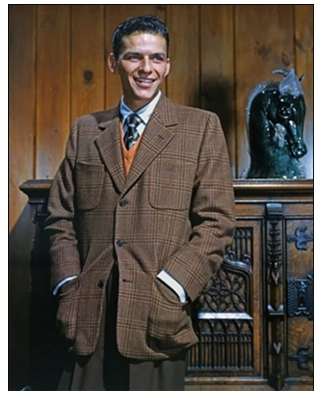
March 19, 1941
Film
"Las Vegas Nights" (New York City Premiere March 19, 1941)
Starring: Phil Regan, Bert Wheeler, Constance Moore, Virginia Dale, Lillian Cornell, Betty Brewer, Hank Ladd, Tommy Dorsey and His Orchestra with Frank Sinatra
Produced by: William LeBaron
Directed by: Ralph Murphy
A vaudeville act inherits an old, beat-up building and decides to try to turn it into a hip new nightclub. Tommy Dorsey and his Orchestra appear in nightclub scene. Sinatra sings "Dolores" & "I'll Never Smile Again" .
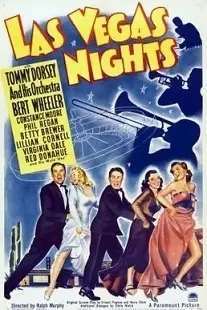
Concerts
Totem Pole, Auburndale, Massachusetts (March 19)
Tommy Dorsey and his Orchestra w/Frank Sinatra
NOTE: Sinatra Scholar Ed O'Brien provided us with this early 40's information and left us this quote from Variety:
Dorsey cracked the 3.200 admission here two weeks ago. Brought back band, drew the limit 3,000 admissions at $1.35 per couple. Manager Roy Gill now stops ticket sales at 3,000. Gross $2.025.
"Las Vegas Nights" (New York City Premiere March 19, 1941)
LAS VEGAS NIGHTS -- THE LAST FRONTIER TOWN
According to a HR news item, Richard Connell and
Gladys Lehman were slated to write the original screenplay for this film, which was to star Allan
Jones and Bert Wheeler. This film marked Tommy
Dorsey's first appearance in a feature film, as well as the first screen appearance of Frank Sinatra, who was the featured singer with Dorsey's band at the time.
News items also report that Esther Fernández, Teddy
Hart and Ellen Drew were considered for roles in the film, and that a party scene was filmed on location in
Las Vegas, NV. According to copyright records, Red
Donahue and his mule started in vaudeville in 1912.
The song "Dolores" was nominated for an Academy Award.
note: Paramount session sheets refer to Frank as "boy singer."
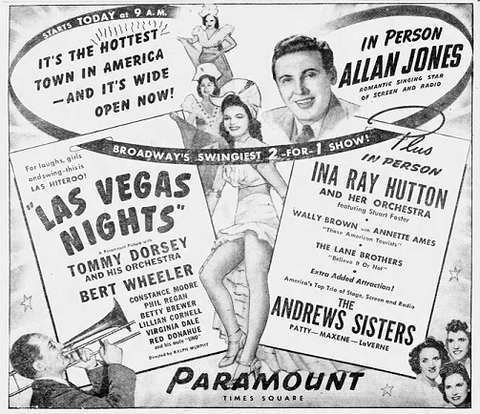
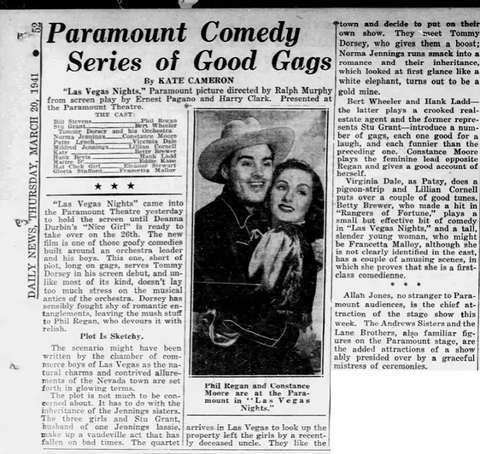
"Las Vegas Nights"
Sinatra returned to Hollywood in 1941 when Tommy Dorsey's band was signed for a starring role in Paramount's Las Vegas Nights, directed by Ralph Murphy. He again went unbilled, paid a flat $15/day; Santopietro calls it an A-list studio setting wasted on a C-list picture.
Source: Tom Santopietro, "Sinatra in Hollywood" (2008).
"Las Vegas Nights"
Santopietro mocks the film's absurdly sanitized depiction of Las Vegas as an 'oasis of immaculate streets' where singing cowboys ride horses straight up to the hotel bar, dismissing the picture itself as the real problem despite its A-list studio pedigree.
Source: Tom Santopietro, "Sinatra in Hollywood" (2008).
"Las Vegas Nights"
Santopietro flags the film's casual racial insensitivity typical of the era: a grinning African-American waiter during a nostalgic 'old South' number, and a stereotyped Asian houseboy whose speech is played for laughs.
Source: Tom Santopietro, "Sinatra in Hollywood" (2008).
"Las Vegas Nights"
Sinatra's entire on-screen contribution to Las Vegas Nights amounted to roughly sixty seconds, singing 'I'll Never Smile Again.' He was also filmed performing 'Dolores' (Frank Loesser/Louis Alter) for the film, but that number was cut before release.
Source: Tom Santopietro, "Sinatra in Hollywood" (2008).
"Las Vegas Nights"
Santopietro notes that Sinatra's brief numbers in the film ('Song of India' and 'I'll Never Smile Again') offer the clearest early on-screen evidence of Tommy Dorsey's influence on his seamless vocal phrasing, though the appearance passes too quickly to get a real sense of him as a performer.
Source: Tom Santopietro, "Sinatra in Hollywood" (2008).
"Las Vegas Nights"
George Simon (quoted by Santopietro): Sinatra's first-ever film review came from George Simon in Metronome, who wrote of his single number that he 'sings prettily in an unphotogenic manner' -- a verdict Santopietro dryly notes got only the first three words right.
Source: Tom Santopietro, "Sinatra in Hollywood" (2008).
"Las Vegas Nights"
Santopietro grades this a C, noting Frank appears as himself in a specialty number, singing one song.
Source: Tom Santopietro, "Sinatra in Hollywood" (2008).
"Las Vegas Nights"
Santopietro (Filmography): Paramount Pictures. Produced by William LeBaron, directed by Ralph Murphy, written by Harry Clork, Ernest Pagano and Eddie Welch. Starring Phil Regan, Bert Wheeler and Tommy Dorsey, with Frank Sinatra appearing as himself as vocalist with the Tommy Dorsey Band, singing the solo 'I'll Never Smile Again.'
Source: Tom Santopietro, "Sinatra in Hollywood" (2008).
March 20, 1941
Radio
Fame And Fortune - Tommy Dorsey Orchestra
Network: NBC - Blue Network
Location: New York City
Show #25
Sponsor: Nature's Remedy
Time: 8:30PM - 9:00PM (EST) Thursdays
Orchestra Conducted By: Tommy Dorsey
Arrangements By: Axel Stordahl (Sinatra)
Announcer: Fred Beutel
Musicians: Ziggy Elman, Bob Alexy, Lee Castle, Jimmy Blake (trumpet); George Arus, Les Jenkins, Dave Jacobs (trombone); Johnny Mince (clarinet, alto sax); Fred Stulce, Heinie Beau (alto sax); Don Lodice, Paul Mason (tenor sax); Joe Bushkin (piano); Clark Youcum (guitar); Sid Weiss (bass); Buddy Rich (drums).
Vocals: Frank Sinatra, Connie Haines, Pied Pipers
Partial Setlist:
1. opening theme: Anything - TD & Orchestra
2. Oh, Look At Me Now - Frank Sinatra, Connie Haines & Pied Pipers
3. Whatcha Know Joe - Joe Staford & Pied Pipers
4. Goodbye, Lover, Goodbye - Frank Sinatra
5. That's Gratitude For You Tommy Dorsey & Orchestra
6. Peridia - Tommy Dorsey & Orchestra
7. Swanee River - Tommy Dorsey & Orchestra
8. When Love Comes Again - Frank Sinatra, Connie Haines & Pied Pipers
9. When Love Comes Again - Tommy Dorsey & Orchestra
10. closing theme: Anything - TD & Orchestra
Notes: Confirmed airing on WJZ. "Goodbye, Lover, Goodbye" was arranged by Roy Ringwald.
("Goodbye, Lover, Goodbye" appears on Masters of Jazz Volume 10 & on the RCA Box Set - The Song Is You)
("When Love Comes Again" appears on CD: Buddha 74321 69172-2 'It's All So New!')
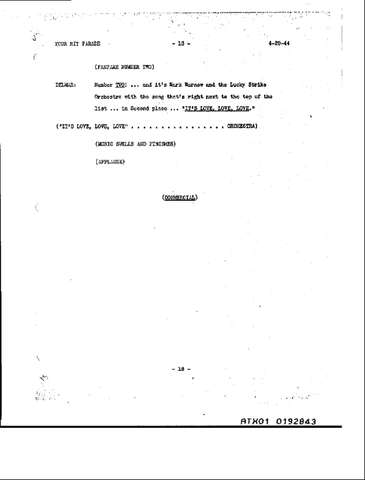
Concerts
Paramount Theatre, New York City
Tommy Dorsey and His Orchestra
On Screen: "Las Vegas Nights" with Tommy Dorsey
Paramount Theatre, New York City
Tommy Dorsey and His Orchestra
On Screen: Las Vegas Nights with Tommy Dorsey
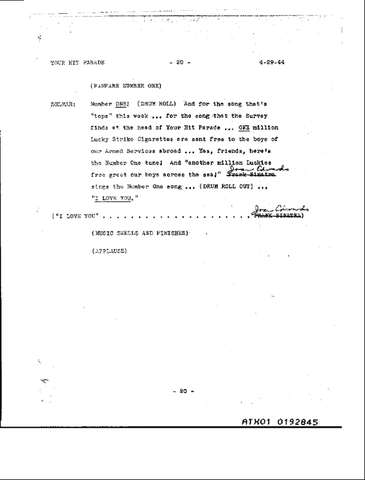
March 21, 1941
Concerts
Metropolitan Theatre, Providence, Rhode Island (March 21 - March 24) Tommy Dorsey and his Orchestra w/Frank Sinatra
On Screen: "I Met A Murderer" with James Mason & Pamela Kellino
NOTE: Sinatra Scholar Ed O'Brien provided us with this early 40s information and left us with this quote from Variety "TD band finished a stint at Metropolitan Theatre on March 21 at 10:30 p.m., boarded a plane and flew to New Haven, where the outfit played a benefit for the New Haven musicians local."
Metropolitan Theatre, Providence, Rhode Island (March 21 - March 24) Tommy Dorsey and his Orchestra w/Frank Sinatra
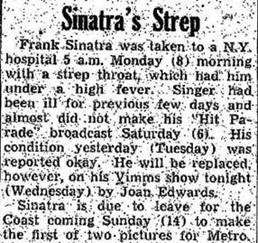
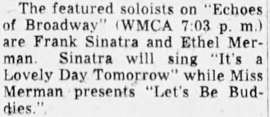
March 22, 1941
Concerts
Metropolitan Theatre, Providence, Rhode Island (March 21 - March 24) Tommy Dorsey and his Orchestra w/Frank Sinatra
On Screen: "I Met A Murderer" with James Mason & Pamela Kellino
March 23, 1941
Concerts
Metropolitan Theatre, Providence, Rhode Island (March 21 - March 24) Tommy Dorsey and his Orchestra w/Frank Sinatra
March 24, 1941
Concerts
Metropolitan Theatre, Providence, Rhode Island (March 21 - March 24) Tommy Dorsey and his Orchestra w/Frank Sinatra
March 26, 1941
Concerts
The Coliseum, Baltimore, Maryland (One Night only)
Tommy Dorsey and his Orchestra w/Frank Sinatra
The Coliseum, Baltimore, Maryland (One Night only)
Tommy Dorsey and his Orchestra w/Frank Sinatra
Note: Tommy Dorsey opened the new Coliseum in Baltimore on May 3, 1939:
March 27, 1941
Radio
Fame And Fortune - Tommy Dorsey Orchestra
Network: NBC - Blue Network
Location: New York City
Show #26
Sponsor: Nature's Remedy
Time: 8:30PM - 9:00PM (EST) Thursdays
Orchestra Conducted By: Tommy Dorsey
Arrangements By: Axel Stordahl (Sinatra)
Announcer: Fred Beutel
Musicians: Ziggy Elman, Bob Alexy, Lee Castle, Jimmy Blake (trumpet); George Arus, Les Jenkins, Dave Jacobs (trombone); Johnny Mince (clarinet, alto sax); Fred Stulce, Heinie Beau (alto sax); Don Lodice, Paul Mason (tenor sax); Joe Bushkin (piano); Clark Youcum (guitar); Sid Weiss (bass); Buddy Rich (drums).
Vocals: Frank Sinatra, Connie Haines, Pied Pipers
1. opening theme: Anything -- TD & Orchestra
2. Let's Get Away From It All -- FS CH JS & PP
3. Blue Denim Dig -- TD & Orch.
4. There'll Be Some Changes Made -- CH
5. One I Love -- FS JS & PP
6. The Moon Won't Talk -- FS
7. My Heart At Thy Sweet Voice -- TD & Orch
8. One Red Rose -- FS CH JS PP5. closing theme: Anything - TD & Orchestra
Notes: Confirmed airing on WJZ. Thanks to Ed, We now have the full listing.
("One Red Rose" appears on Masters of Jazz Volume 10 & on the RCA Box Set - The Song Is You)
("The Moon Won't Talk" appears on the CD: Young Blue Eyes - Birth Of The Crooner Bluebird 82876 60283 2)
Fame And Fortune - Tommy Dorsey Orchestra
[image referenced in source but could not be recovered]
March 28, 1941
Concerts
Bucknell University, Lewisburgh, Pennsylvania (March 28)
Tommy Dorsey and his Orchestra w/Frank Sinatra
NOTE: Ed O'Brien did the research and gave us these reports on early
1940s appearances. He also gives us a quote from the April 2, 1941 i
ssue of Variety on the Bucknell appearance: "Dorsey pulled $2.500 through the gate with 493 pairs of dancers at $5 and $5.50 a couple."
Bucknell University, Lewisburgh, Pennsylvania (March 28)
Tommy Dorsey and his Orchestra w/Frank Sinatra
March 29, 1941
Radio
North Carolina State University, Raleigh, North Carolina 500 - 5:30 PM
WPTF & southern hookup of NBC
Concerts
North Carolina State University, Raleigh, North Carolina (One-Nighter) Tommy Dorsey and his Orchestra w/Frank Sinatra
North Carolina State University, Raleigh, North Carolina (One-Nighter)
Tommy Dorsey and his Orchestra w/Frank Sinatra
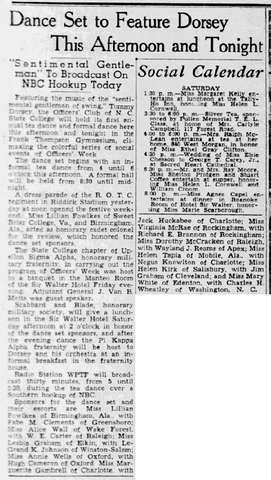
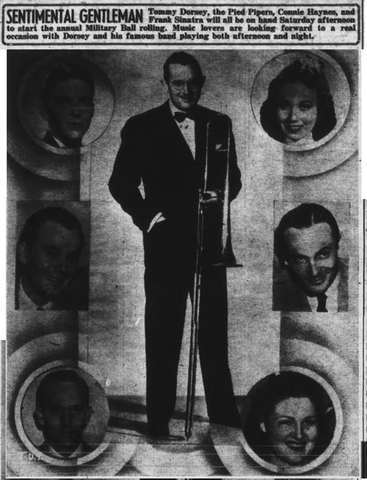
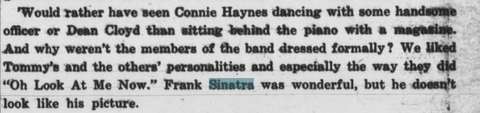
April 3, 1941
Radio
Fame And Fortune - Tommy Dorsey Orchestra
Network: NBC - Blue Network
Location:
Show #27
Sponsor: Nature's Remedy
Time: 8:30PM - 9:00PM (EST) Thursdays
Orchestra Conducted By: Tommy Dorsey
Arrangements By: Axel Stordahl (Sinatra)
Announcer: Fred Beutel
Musicians: Ziggy Elman, Bob Alexy, Lee Castle, Jimmy Blake (trumpet); George Arus, Les Jenkins, Dave Jacobs (trombone); Johnny Mince (clarinet, alto sax); Fred Stulce, Heinie Beau (alto sax); Don Lodice, Paul Mason (tenor sax); Joe Bushkin (piano); Clark Youcum (guitar); Sid Weiss (bass); Buddy Rich (drums).
Vocals: Frank Sinatra, Connie Haines, Pied Pipers
Show came from Washington, D.C.
Dorsey and Band were playing the Capitol Theatre
1. Anything (theme)
2. You Betcha My Life Connie Haines
3. Everything Happens To Me Frank Sinatra
4. On A Bicycle Built For Two Pied Pipers
5. Say Si Si Orchestra w/ Band Chorus
6. Anything (theme)
Notes: Confirmed airing on WJZ.
Note: This is only a partial listing. I recently found my master list from BMG Records.
They have all of the surviving shows from the F&F series. A complete show had a minimum of 10 entries including the theme song.
---Ed
I found this article that mentions a few more songs: --Scott
When You're With Me - ?
You Betcha My Life - CH
Everything Happens To Me - FS
None But The Lonely Heart - TD Trombone Solo
And The Band Played On - Paul Mason and the Pied Pipers Para Vigo Me Voy (also known as Say Si Si)
note: Show was broadcast from the Cotton Hotel in Washington, D.C. Fred Uttal ( pronounced Ut -tall ) was the announcer
Dorsey faced tough competition that week with Martha Raye headlining at the Earle Theatre. Despite missing two days due to illness, TD & Co. out grossed Martha by a hefty $6,000. The management at The Capitol deducted two-fifths of the band's salary due to Dorsey's absence. He was furious and refused their check. Variety predicted dispute would be resolved by the American Federation of Musicians. TD considered the reduction in pay to be arbitrary. --Ed
[image referenced in source but could not be recovered]
Concerts
Loew’s Capitol Theatre, Washington, D. C. (April 3 - 9) Tommy Dorsey and his Orchestra w/Frank Sinatra
On screen: "The Penalty" with Edward Arnold, Lionel Barrymore, Marsha Hunt
Ed O'Brien:
The band opened on 4/3(Thurs) and closed 4/9( Wed).
TD & Co grossed a whopping $24,000.
Film: Penalty with Edward Arnold, Lionel Barrymore, Marsha Hunt
Dorsey missed two days of the engagement. The theater owners deducted $5,000 from the bands salary. TD refused their check and filed an appeal with the AFM.
Marsha Hunt passed away on September 7, 2022 at the age of 104. Jane Powell passed away September 16, 2021 at the age of 92.
[image referenced in source but could not be recovered]
Loew’s Capitol Theatre, Washington, D. C. (April 3 - 9) Tommy Dorsey and his Orchestra w/Frank Sinatra
On screen: "The Penalty" with Edward Arnold, Lionel Barrymore, Marsha Hunt
[image referenced in source but could not be recovered]
[image referenced in source but could not be recovered]
April 4, 1941
Concerts
Capitol Theatre, Washington, D. C. (April 3 - 9)
Tommy Dorsey and his Orchestra w/Frank Sinatra
April 5, 1941
Concerts
Capitol Theatre, Washington, D. C. (April 3 - 9)
Tommy Dorsey and his Orchestra w/Frank Sinatra
NOTE: We owe Sinatra Scholar Ed O'Brien many thanks for providing us with this early 40s information. He also sends us a quote from the April 5, 1941 issue of VARIETY: "The street was filled with rumors this past week concerning Frank Sinatra and his possible departure from the Tommy Dorsey fold. The only ones who hadn't heard anything about Sinatra's leaving, or claimed they hadn't, were those most closely connected with Dorsey."
April 6, 1941
Concerts
Capitol Theatre, Washington, D. C. (April 3 - 9)
Tommy Dorsey and his Orchestra w/Frank Sinatra
April 7, 1941
Concerts
Capitol Theatre, Washington, D. C. (April 2 - 9)
Tommy Dorsey and his Orchestra w/Frank Sinatra
April 8, 1941
Concerts
Capitol Theatre, Washington, D. C. (April 2 - 9)
Tommy Dorsey and his Orchestra w/Frank Sinatra
April 9, 1941
Concerts
Capitol Theatre, Washington, D. C. (April 2 - 9)
Tommy Dorsey and his Orchestra w/Frank Sinatra
April 10, 1941
Radio
Fame And Fortune - Tommy Dorsey Orchestra
Network: NBC - Blue Network
Location: New York City
Show #28
Sponsor: Nature's Remedy
Time: 8:30PM - 9:00PM (EST) Thursdays
Orchestra Conducted By: Tommy Dorsey
Arrangements By: Axel Stordahl (Sinatra)
Announcer: Fred Beutel
Musicians: Ziggy Elman, Bob Alexy, Lee Castle, Jimmy Blake (trumpet); George Arus, Les Jenkins, Dave Jacobs (trombone); Johnny Mince (clarinet, alto sax); Fred Stulce, Heinie Beau (alto sax); Don Lodice, Paul Mason (tenor sax); Joe Bushkin (piano); Clark Youcum (guitar); Sid Weiss (bass); Buddy Rich (drums).
Vocals: Frank Sinatra, Connie Haines, Pied Pipers
Partial Setlist:
1. opening theme: Anything - TD & Orchestra
2. You Can Depend On Me - C. Haines
3. Sunrise Over Taxco F. Sinatra
4. The Man Who Writes The Lyrics J.. Stafford & Pied Pipers
5. Estrellita T.D & Orchestra
6. Oh! Look At Me Now F.S. C. H. J.S. P.P.
7. Ave Maria ( Schubert) T.D. & Orchestra great solo by Dorsey Easter tribute
8. I've Lost My Heart Again F.S., C.H., J.S., P.P.
9. I've Lost My Heart Again ( reprise) T.D. & Orch.
10.closing theme Anything T.D. & Orchestra
Notes: Last show of series. Confirmed airing on WJZ. April 17, 1941 in this time slot WJZ & WMAL aired "NBC Concert Orchestra" in this time slot.
("Oh! Look At Me Now" appears on CD: The Sentimental Gentleman Of Swing: Centennial Collection Bluebird/Legacy 8287 6 71167 2)
("I've Lost My Heart Again" appears on CD: Buddha 74321 69172-2 'It's All So New!')
April 12, 1941
Concerts
Valencia Ballroom, York, Pennsylvania
Saturday evening
Tommy Dorsey & His Orch.
Frank Sinatra, Connie Haines, Jo Stafford,The Pied Pipers, Ziggy Elman, Buddy Rich, Joe Bushkin, Heinie Beau
Ed provided the above Dorsey listing and sent along this blurb from the April 16, 1941 Variety: TD band at Valencia Ballroom, York, Pa.
TD cracked Kay Kyser's attendance record with approx. 3,750 admissions at $1.00. . . but Kyser had a higher fee and rain.
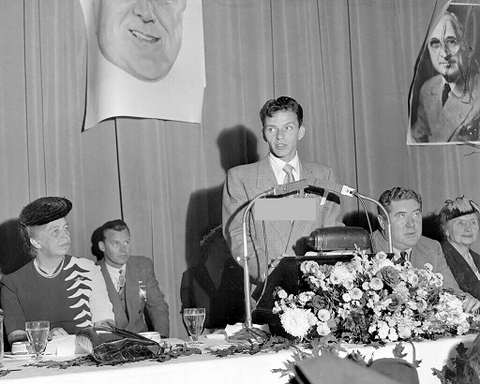
Valencia Ballroom, York, Pennsylvania
Saturday evening
Tommy Dorsey & His Orch.
Frank Sinatra, Connie Haines, Jo Stafford,The Pied Pipers, Ziggy Elman, Buddy Rich, Joe Bushkin, Heinie Beau
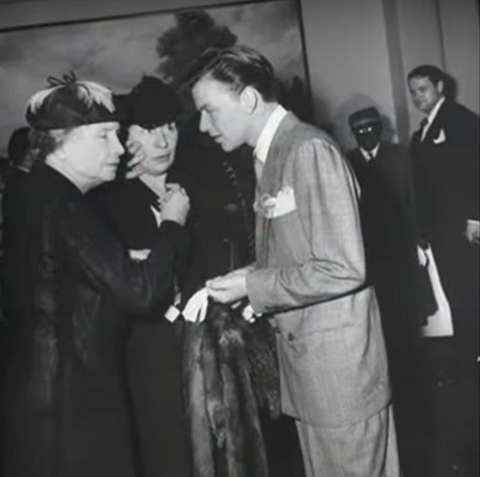
April 13, 1941
Concerts
Steel Pier, Atlantic City, New Jersey (April 13)
Tommy Dorsey and his Orchestra w/Frank Sinatra
Ed O'Brien:
Easter Sunday 1941. Steel Pier had a special afternoon dance to celebrate the day and get the locals to parade around in their best finery.
TD was offered more to make an appearance than was his usual fee. The ballroom was filled to capacity.
Steel Pier, Atlantic City, New Jersey (April 13)
Tommy Dorsey and his Orchestra w/Frank Sinatra
-----------------------------------------------------------
Frank Sinatra sings at Ebbets Field for Red Cross Fund Drive, 4-13-44. Dodgers played the Phillies
Frank Sinatra sings at the Red Cross War Fund baseball game between the Brooklyn Dodgers and Philadelphia Phillies at Ebbets Field in Brooklyn, N.Y., April 13, 1944. He is joined in harmony by Dodgers coach Charley Dresser, left, Dodgers outfielder Dixie Walker, second from right, and Phillies manager Freddie Fitzsimmons. At the far right, is John "Deacon" Donahue, who grew up in Chicago and pitched for the Phillies from 1943-1944.
Frank Sinatra At Red Cross War Fund
(Original Caption) 4/13/1944-New York, NY: The bobby sox brigade was out in full force today to sneak a look at its crooning idol, Frank Sinatra as he sang at Ebbets Field during baseball's benefit for the 1944 Red Cross War Fund. The luckiest, the ones who got close enough to snare an autograph, keep "The Voice's" hand busy.
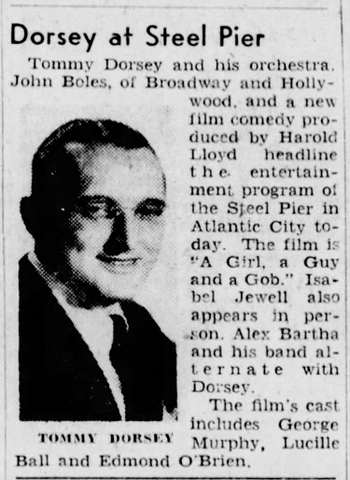
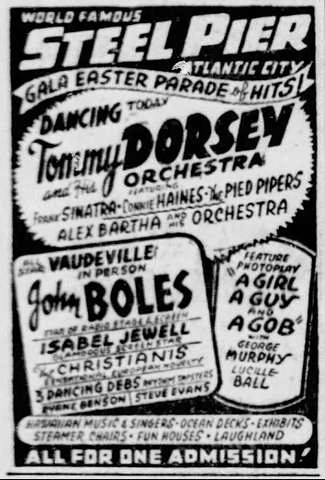
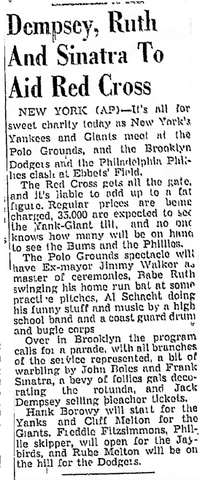
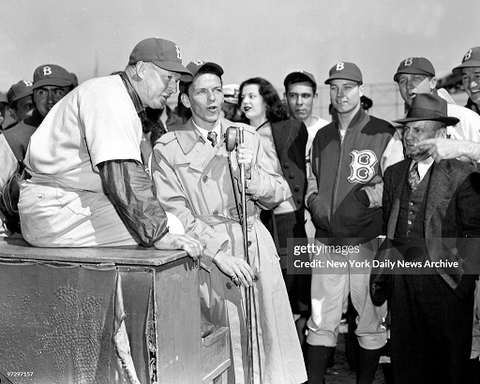
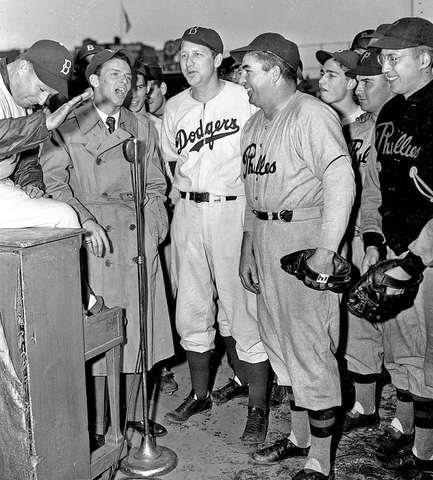
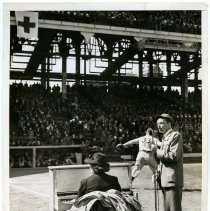
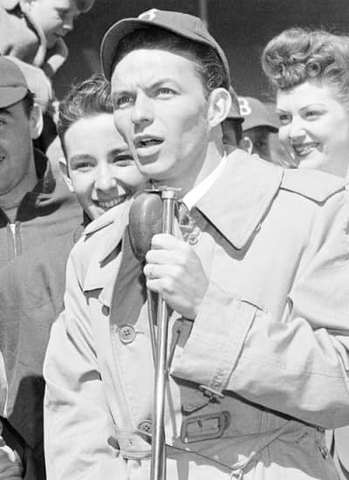
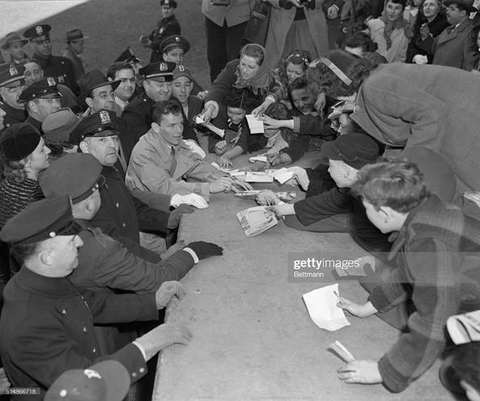
April 14, 1941
Concerts
George F. Pavalion, Johnson City, New York (April 14)
Tommy Dorsey and his Orchestra w/Frank Sinatra
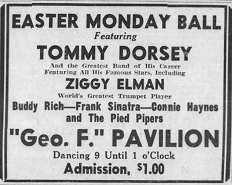
April 15, 1941
Radio
St, Joseph's College, Philadelphia, Pennsylvania
Tommy Dorsey and His Orchestra with Frank Sinatra
Live Remote
WCAU with CBS national hookup

Concerts
St, Joseph's College, Philadelphia, Pennsylvania (April 15) Tommy Dorsey and his Orchestra w/Frank Sinatra
New York . . . Along with his other activities of the past month, TD took time out from domestic and personnel troubles to hire Grover Cleveland Alexander, vet baseball pitcher, now down and out and ill, to "coach" Tommy's softball team this summer. The is made up of members of the Dorsey band..
The move smelled of publicity but apparently wasn't just a stunt. For not a single NY newspaper printed the fact that Dorsey hired old Alex.
Downbeat
4-15-41
St, Joseph's College, Philadelphia, Pennsylvania (April 15) Tommy Dorsey and his Orchestra w/Frank Sinatra
A bronze and black colored broadside or poster promoting "Tommy Dorsey/ Saint Joseph's College/ Senior Ball/ East Tuesday/ April 15th/ Bellevue-Stratford Hotel/ 10:30 until 2:30 Five Dollars."
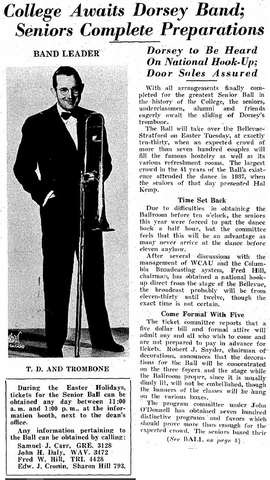
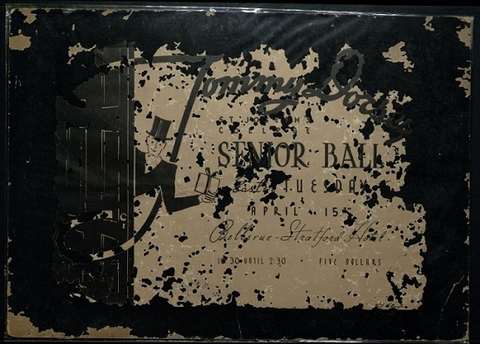
April 16, 1941
Concerts
Empire Ballroom, Allentown, Pennsylvania (April 16)
Tommy Dorsey and his Orchestra w/Frank Sinatra
Empire Ballroom, Allentown, Pennsylvania (April 16)
Tommy Dorsey and his Orchestra w/Frank Sinatra
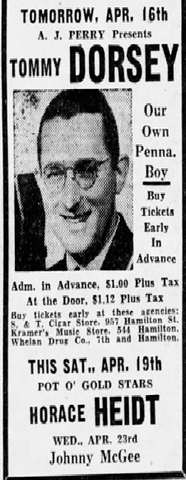
April 18, 1941
Concerts
Press Club Ball, Bellevue-Stratford Hotel, Philadelphia, Pennsylvania
Tommy Dorsey and his Orchestra w/Frank Sinatra
Tommy Dorsey, at Benjamin Franklin Hotel, Philly, Press Photographers Ball. . . ..
took in $5,150 for 2,060 entrants at $2.50 a head.
Variety
Press Club Ball, Bellevue-Stratford Hotel, Philadelphia, Pennsylvania
Souvenir Program from the Press Club Ball:
April 19, 1941
Concerts
Cabell Hall, University of Virginia, Charlottesville, Virginia Tommy Dorsey and his Orchestra
Saturday Afternoon
5:00 – 6:15 p.m.
75 Minute Concert
$1.00 a person, $1.50 a couple.
Memorial Gymnasium, University of Virginia, Charlottesville, Virginia Tommy Dorsey and his Orchestra
Saturday Evening
Dance
$2.20 per couple
Ed O'Brien Notes:
April 19, 1941 issue of Billboard:
"Tommy Dorsey was out of the show for two days last week at the Capitol Theater, Washington. D.C. Illness over took the sentimental gentleman, but he is okay now. The rumor that Frank Sinatra was leaving the vocal chores in the Dorsey band apparently started when Sinatra was out sick for a couple of days and Bob Allen took over."
April 20, 1941
Concerts
The Arena, New Haven, Connecticut (April 20)
Tommy Dorsey and his Orchestra w/Frank Sinatra
NOTE: Ed O'Brien provided this early 1940s quote from the April 23, 1941 issue of
Variety: "Arena, New Haven, Conn Dorsey did best biz of series to date. With vaude band grabbed healthy $4.500 gross from 9,500 matinee and night at 45 cents - $1.10."
The Arena, New Haven, Connecticut (April 20)
Tommy Dorsey and his Orchestra w/Frank Sinatra
[image referenced in source but could not be recovered]
[image referenced in source but could not be recovered]
[image referenced in source but could not be recovered]
April 24, 1941
note: The last first run "Fame and Fortune" was broadcast on 4-10-41. But I
found broadcasts continued on NBC, Thursday evenings, into at least
May of 41.
Ed
April 25, 1941
Concerts
Cocke Hall, Virginia Military Institute, Lexington, Virginia Tommy Dorsey & Orchestra
Friday Evening
10:00 p.m. - 2:00 a.m.
Dance
Cocke Hall, Virginia Military Institute, Lexington, Virginia Tommy Dorsey & Orchestra
Friday Evening
10:00 p.m. - 2:00 a.m.
Dance
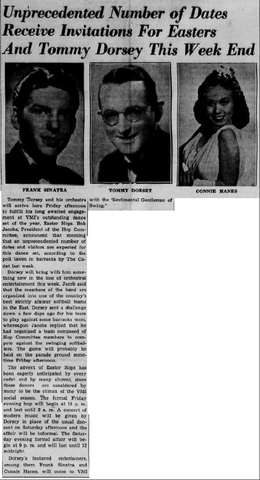
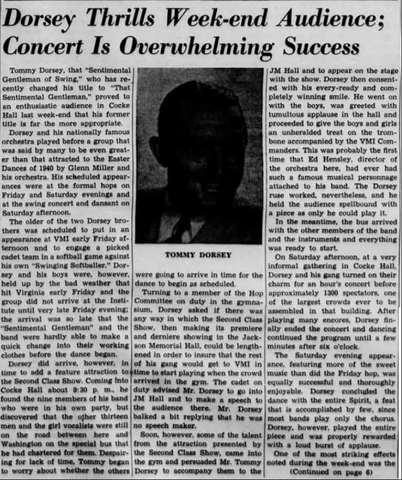
April 26, 1941
Concerts
Cocke Hall, Virginia Military Institute, Lexington,
Virginia (Sat) Afternoon
(Sat) 9:00 pm - Midnight
"Saturday Evening Hop"
Tommy Dorsey & His Orchestra
Cocke Hall, Virginia Military Institute, Lexington, Virginia (Sat) Afternoon
Tommy Dorsey & His Orchestra
"Concert of Modern Music"
April 27, 1941
Radio
Tommy Dorsey and His Orchestra with Frank Sinatra
9:00 - 9:30
Live from the Mosque
WRNL, Richmond, Virginia
Concerts
The Mosque, Richmond, Virginia
Tommy Dorsey & His Orchestra with Frank Sinatra
Two Shows: 3:30 & 8:30
Tommy Dorsey and His Orchestra with Frank Sinatra
9:00 - 9:30
Live from the Mosque
WRNL, Richmond, Virginia
The Times Dispatch (Richmond, Virginia) 28 Apr 1941
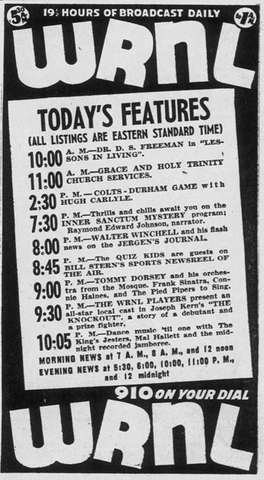
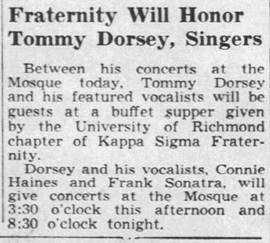

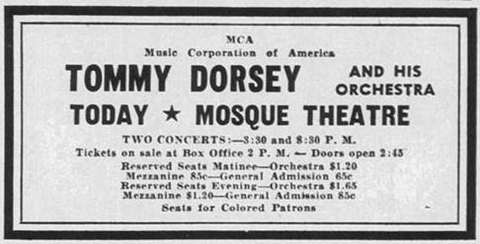
April 28, 1941
Radio
Tommy Dorsey & His Orchestra
Monday Evening
Broadcast from Charleston, WV
WGKV (ABC Affiliate)
8:30-8:55 PM
Concerts
WCHS Auditorium, Charleston, West Virginia
Monday Evening
Tommy Dorsey & His Orchestra with Frank Sinatra
One-nighter (SRO)
WCHS Auditorium, Charleston, West Virginia
Monday Evening
Tommy Dorsey & His Orchestra with Frank Sinatra
One-nighter (SRO)
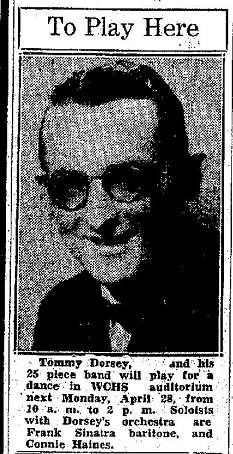
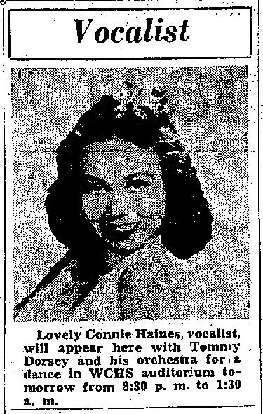
April 29, 1941
Concerts
Idora Park, Youngstown, OH
Tommy Dorsey & His Orchestra with Frank Sinatra
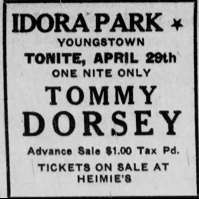
April 30, 1941
Concerts
Chippewa Lake Park, Medina, Ohio
Wednesday Evening
Tommy Dorsey & Orchestra with Frank Sinatra
Opening Dance of the Season
One-Nighter
Chippewa Lake Park, Medina, Ohio
Wednesday Evening
Tommy Dorsey & Orchestra with Frank Sinatra
Opening Dance of the Season
One-Nighter
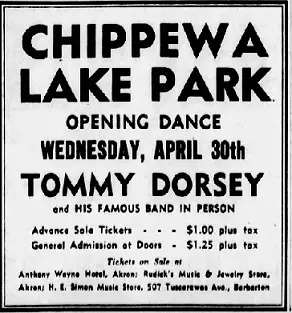
May 1941
[Billboard names Sinatra Male Vocalist of the Year]
Kaplan: In May 1941, Billboard magazine named Sinatra Male Vocalist of the Year, ranking him over Bing Crosby.
Source: James Kaplan, "Frank: The Voice" (2010)
May 1, 1941
Concerts
Carnegie Tech, Pittsburgh, Pennsylvania.
Thursday evening
Tommy Dorsey & His Orch.
Frank Sinatra, Connie Haines, Jo Stafford,
The Pied Pipers, Ziggy Elman, Buddy Rich,
Joe Bushkin, Sy Oliver
One-Nighter
Carnegie Tech, Pittsburgh, Pennsylvania.
Thursday evening
Tommy Dorsey & His Orch.
Frank Sinatra, Connie Haines, Jo Stafford,
The Pied Pipers, Ziggy Elman, Buddy Rich,
Joe Bushkin, Sy Oliver
One-Nighter
This month Sinatra was named top band vocalist by Billboard magazine; by the end of 1941 he had also overtaken Bing Crosby atop the Down Beat poll, ending his early idol's six-year run at number one. Source: Michael Sheridan & David Harvey, Sinatra and the Jack Pack.
May 2, 1941
Concerts
University of North Carolina, Chapel Hill, N.C. (May 2 - 3) Tommy Dorsey and his Orchestra w/Frank Sinatra
University of North Carolina, Chapel Hill, N.C. (May 2 - 3) Tommy Dorsey and his Orchestra w/Frank Sinatra
The Daily Tar Heel May 2, 1941
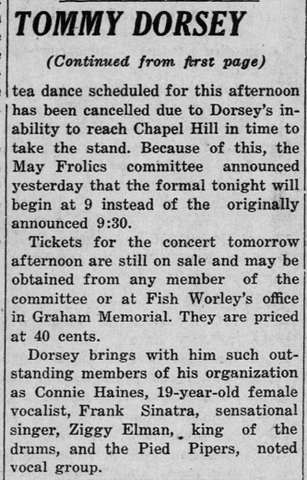
May 3, 1941
Concerts
University of North Carolina, Chapel Hill, North
Carolina
Saturday Afternoon
4:00 6:00 p.m.
Dance For Graduating Seniors
University of North Carolina, Chapel Hill, North Carolina
Saturday Afternoon
2:00 - 3:30 p.m.
Memorial Hall
note: Concert was open to the public admission was 40 cents
The Tin Can, University of North Carolina, Chapel Hill, North Carolina 9:00 p.m. Midnight note: TD & Co. spent two days on campus( 2nd & 3rd)
They offered both a concert performance and supplied the music for three dance parties.
University of North Carolina, Chapel Hill, North Carolina Tommy Dorsey and His Orchestra with Frank Sinatra
The Daily Tar Heel, University of North Carolina, Chapel Hill, North Carolina:
Here's a great photo I came across of Sinatra and Dorsey taken at the Tin Can May 3, 1941:
Tommy Dorsey and the "Pied Pipers" performing during the 1941 UNC-Chapel Hill "May Frolics" dance at the Tin Can. Dorsey is on trombone, with Chuck Lowry, Jo Stafford, and Frank Sinatra at right, and Buddy Rich on drums in the background.
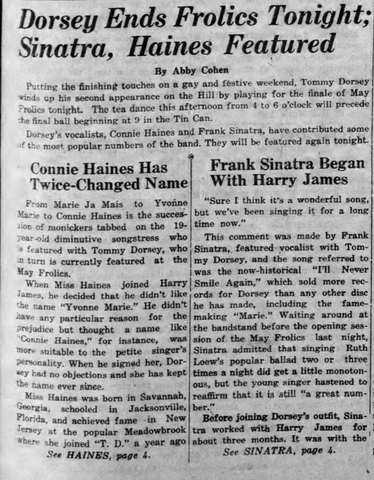
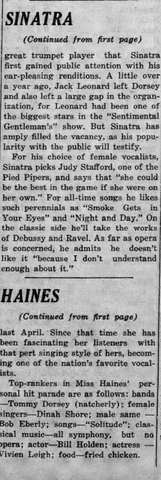
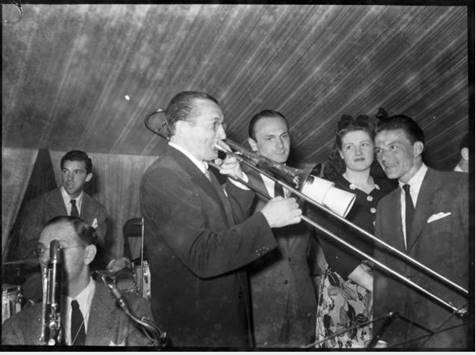
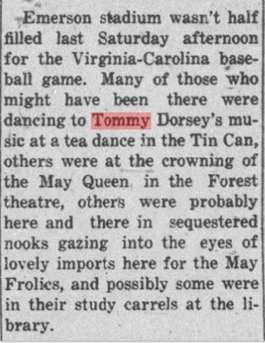
May 4, 1941
Concerts
Uline-Ice-Arena, Washington D.C.
Tommy Dorsey and His Orchestra with Frank Sinatra
Uline-Ice-Arena, Washington D.C.
Tommy Dorsey and His Orchestra with Frank Sinatra
[image referenced in source but could not be recovered]
May 5, 1941
Concerts
The Armory, High Point, North Carolina
Duck Club Dance
Tommy Dorsey & Orchestra with Frank Sinatra
One-Nighter
The Armory, High Point, North Carolina
Duck Club Dance
Tommy Dorsey & Orchestra with Frank Sinatra
One-Nighter
--------------------------------------
May 5, 1942 (Tue) 9:00 - 9:15 pm
Loew's Theater
Rochester, New York
It sounds like Sinatra might have made an appearance on the stage of Loew's with Dorsey and the Pied Pipers. They were only there for 15 minutes and it was supposed to be an interview and was broadcast over WSAY: --Scott
[image referenced in source but could not be recovered]
[image referenced in source but could not be recovered]
[image referenced in source but could not be recovered]
May 6, 1941
Concerts
University of Tennessee, Knoxville, Tennessee (May 6 – 7) Tommy Dorsey and his Orchestra w/Frank Sinatra
University of Tennessee , Knoxville , Tennessee (May 6 – 7) Tommy Dorsey and his Orchestra w/Frank Sinatra
The Knoxville News-Sentinel (Knoxville, Tennessee)
Note: In the 1940 college poll, Frank received exactly 5 votes. Amazing how "I'll Never Smile
Again" put him in line to become the most popular male vocalist on college campuses thee following year.
--Ed
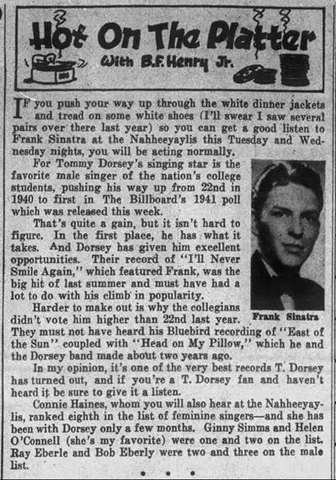
May 7, 1941
Concerts
University of Tennessee, Knoxville, Tennessee (May 6 - 7) Tommy Dorsey and his Orchestra w/Frank Sinatra
University of Tennessee, Knoxville, Tennessee (May 6 - 7) Tommy Dorsey and his Orchestra w/Frank Sinatra
[image referenced in source but could not be recovered]
[image referenced in source but could not be recovered]
May 8, 1941
Radio
Live Remote from the Consolidated Bus Lines Terminal, Bluefield, West Virginia Tommy Dorsey and His Orchestra with Frank Sinatra
WHIS 10:30 PM to 11PM
Concerts
Consolidated Bus Lines Terminal, Bluefield, West Virginia Tommy Dorsey and His Orchestra with Frank Sinatra
Consolidated Bus Lines Terminal, Bluefield, West Virginia Tommy Dorsey and His Orchestra with Frank Sinatra
The following Photo and text comes from the book "Bluefield in the 1940s":
TWO TO CROON. Frank Sinatra (right)and trumpet great Ziggy Elman posed for this publicity photograph by J.Vincent Lewis of Nunnaly’s Studio at 408 Raleigh Street prior to a concert by the Tommy Dorsey Orchestra on May 8, 1941. The concert was held at Jack Craft’s Consolidated Bus Terminal at 2100 Princeton Avenue. (Courtesy of Bluefield Daily Telegraph archives.)
Apparently it was also broadcast:
Here’s a review:
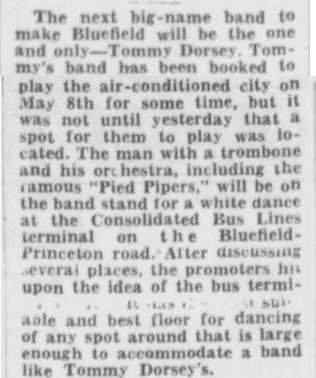
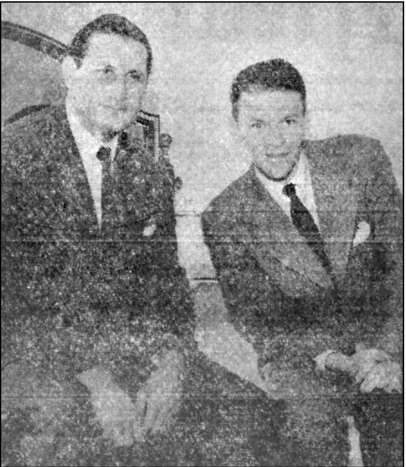
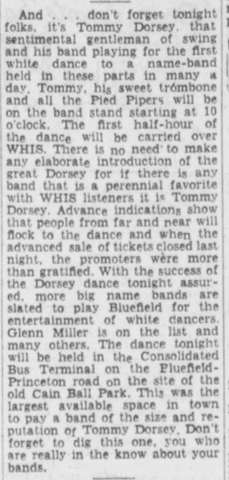
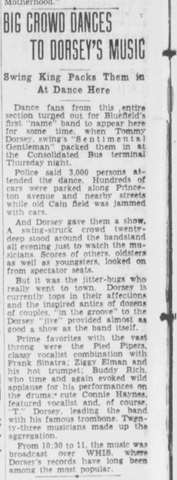
May 9, 1941
Concerts
Virginia Polytechnic Institute, Blacksburg, Virginia (May 9- 10) Tommy Dorsey and his Orchestra w/Frank Sinatra
Virginia Polytechnic Institute, Blacksburg, Virginia (May 9- 10) Tommy Dorsey and his Orchestra w/Frank Sinatra
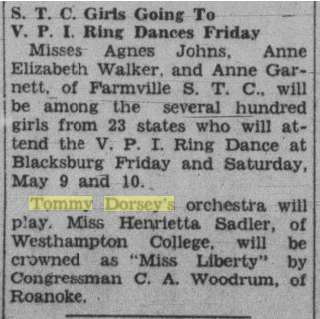
May 10, 1941
Concerts
Virginia Polytechnic Institute, Blacksburg, Virginia (May 9 - 10)
Tommy Dorsey and his Orchestra w/Frank Sinatra
Virginia Polytechnic Institute, Blacksburg , Virginia (May 9 - 10)
Tommy Dorsey and his Orchestra w/Frank Sinatra
May 11, 1941
Concerts
Moonlite Gardens, Coney Island, Cincinnati, Ohio
Tommy Dorsey and his Orchestra w/Frank Sinatra
Sunday Evening
One-Nighter
Moonlite Gardens, Coney Island, Cincinnati, Ohio
Tommy Dorsey and his Orchestra w/Frank Sinatra
Moonlite Gardens Bandstand 1941
-----------------------------------------------------
This article ran in the Dayton Daily News (Dayton, Ohio) May 11, 1943:
----------------------------------------------------
Taping 1988 Carnegie Hall, New York City
Irving Berlin Tribute - two songs
Orchestra Conducted By: Frank Sinatra, jr.
1. Always (Take 1)
2. Always (Take 2)
3. When I Lost You (Take 1)
4. When I Lost You (Take 2)
Ed O'Brien notes: One take of each song was used in the TV special After the first run-through of the two Berlin songs,
Ed O'Brien reports, some poor soul was assigned the task of telling Sinatra they needed another go at the two songs. The exchange between the singer and the poor messenger is priceless. Torrie Zito did the arrangements.
IRVING BERLIN'S 100TH BIRTHDAY CELEBRATION
A two-hour presentation taped at Carnegie Hall in New York on May 11, 1988, featuring celebrities from all forms of American entertainment and the performing arts in a tribute to America's legendary songwriter, Irving Berlin, in honor of his one-hundredth birthday. A highlight of the broadcast was the appearance of Frank Sinatra performing Berlin tunes. This program won two primetime Emmy's.
Bea Arthur
Tony Bennett
Barry Bostwick
Nell Carter
Ray Charles
Rosemary Clooney
Natalie Cole
Walter Conkrite
Billy Eckstine
Michael Feinstein
Morton Gould
Bob Hope
Marilyn Horne
Madeline Kahn
Garrison Keillor
Shirley MacLaine
Maureen McGovern
Willie Nelson
Jerry Orbach
Maryann Plunkett
Diane Schuur
Frank Sinatra
Isaac Stern
Tommy Tune
Joe Williams
Irving Berlin, Absent, Is Much the Star of Carnegie Tribute
By Stephen Holden
Gathered from the four corners of show business, more than two dozen stellar performers assembled at Carnegie Hall last night to salute Irving Berlin on his 100th birthday. From Frank Sinatra to Willie Nelson, from Ray Charles to Marilyn Horne, they represented an array of American musical styles as rich and varied as the songs of the man they were honoring - songs that have become so embedded in the texture of American life that they seem inextricably woven into the country's history.
''What makes an Irving Berlin song special?'' Frank Sinatra said in a telephone interview the other day. ''The answer is quite simple: Irving Berlin. And that's 'not for just an hour, not for just a day, not for just a year, but always.' In a world where many make sausages, Irving made beauty.''
At last night's concert, Mr. Sinatra sang ''Always'' and another classic Berlin waltz, ''When I Lost You,'' with a hard-edged declarative eloquence, carefully rounding out each syllable. It was one of many strong, individualistic performances on a roster of distinctive voices that ranged from the low-key country twang of Willie Nelson singing ''Blue Skies'' to Ray Charles's quiet, almost tearful ''How Deep Is the Ocean,'' which he ended in plaintive, quavering falsetto.
Rosemary Clooney, an old friend of the Berlin family, called the words of ''Always'' ''just about the strongest statement you can make in a lyric.'' Miss Clooney sang ''Count Your Blessings (Instead of Sheep)'' and ''White Christmas.'' Concert Taped for TV
Mr. Berlin and his wife, Ellen, did not attend the concert, which was taped by CBS for a television broadcast on May 27. Originally, the composer was to have watched the show in his Manhattan apartment through an electronic transmission from Carnegie Hall, but a few days ago he vetoed the plan. Instead, he will watch the show with the rest of the country when it is shown two weeks from now.
Sign up for the Theater Update Newsletter Every week, stay on top of the top-grossing Broadway shows, recent reviews, Criticsâ Picks and more. Get it sent to your ur inbox. Last evening's salute, which will benefit the American Society of Composers Authors and Publishers and Carnegie Hall, was the only public celebration officially recognized by Mr. Berlin, who exercised a strong guiding hand over the proceedings. Along with Victor Herbert and John Philip Sousa, he was one of the founders in 1914 of Ascap, the organization established to protect the copyrighted material of writers and publishers.
Plans for last night's gala were set in motion last fall when the reclusive composer, who has maintained a professional silence since the early 1960's, granted Ascap permission to stage the celebration.
Morton Gould, who became the president of Ascap nearly three years ago, said that when he approached the composer last year with the idea of a 100th-birthday celebration, Mr. Berlin's response was, ''What's the hurry?'' Last fall, the composer finally assented to the idea and sent Mr. Gould a letter saying he would like Ascap and Carnegie Hall to do a birthday concert as a joint venture.
Mr. Berlin also submitted a list of performers. Among those on his original list were Mr. Sinatra, Miss Clooney, Tony Bennett, Mr. Bernstein and Shirley MacLaine. Don Mischer, the producer of the Tony Awards and the Kennedy Center Honors ceremonies, was chosen as the executive producer of the event and given a relatively free hand. Ribbons and Bows
For the gala, the stage at Carnegie Hall was decorated with giant gold and silver piano keys arranged in ribbons and bows. The show began with a peppy ''Let Me Sing and I'm Happy'' from Ms. MacLaine, and took on a statesmanlike tone when Walter Cronkite took the stage and spoke of the composer's legacy to the nation.
''Irving Berlin helped write the story of this country by capturing the best of who we are and the dreams that shape our lives,'' Mr. Cronkite said. ''Since 1906, Irving Berlin has written over 1,500 songs, and it is there we find our history, our holidays, our homes and our hearts.''
Mr. Berlin's output has been so enormous and varied that Mr. Mischer and his team divided the evening into segments devoted to Americana, swing, Broadway and Hollywood. The swing segment brought together Joe Williams, Diane Schuur and Billy Eckstine. Maryann Plunkett, Barry Bostwick and Bea Arthur performed the theater songs, with Miss Arthur singing tunes associated with Ethel Merman. Natalie Cole and Madeline Kahn also sang.
Maureen McGovern, Jerry Orbach, Michael Feinstein, and Nell Carter -four singers as different from each other as one could imagine - offered Berlin gems. Miss Carter, swathed in a purple boa, sang a sassy ''Alexander's Ragtime Band.'' Can't Read Music
When the song that launched Mr. Berlin's career in 1909 was over, the battered old upright piano on which it was composed was wheeled onto the stage, and Isaac Stern, the president of Carnegie Hall, reflected on the fact that Mr. Berlin had never taken a music lesson and could not read or write music. ''He played only the black keys,'' Mr Stern said.
But, he added, ''Talent is what a man possesses, and genius is what possesses a man, and Irving Berlin is a genius.''
Later in the evening, Garrison Keillor evoked the songwriter's intuitive genius.
''He took our American talk and made it into poetry - not fancy, not highbrow, but simple and graceful,'' Mr. Keillor said. And to demonstrate, he recited the words of ''All Alone,'' which he called ''a poem of 81 words without one unnecessary one.''
The evening's most amusing moment came when Leonard Bernstein made what he called his ''Carnegie Hall singing debut,'' playing the piano and growling out the early Berlin song ''Russian Lullaby.'' He then sang his own whimsical modernist variation on it, ''My Twelve-Tone Lullaby,'' punctuating the phrases with apologies to Mr. Berlin. Tapping and Strutting
In a relatively serious evening, the closest thing to a show-stopper was a segment with Tommy Tune. Attired in white tie and tails and backed by a chorus of eight male dancers, Mr. Tune tapped and strutted through a razzle-dazzle performance of ''Puttin' On the Ritz.''
As the evening drew to a close, music gave way to pageantry. Walter Cronkite introduced the members of the U.S. Army Chorus, who paraded down the aisles singing ''This Is the Army.'' They were followed by troops of Boy Scouts and Girl Scouts singing ''This Is a Great Country,'' from Mr. Berlin's last Broadway show, ''Mr. President.'' Finally, Marilyn Horne sang ''God Bless America,'' the country's unofficial national anthem, with troops and scouts joining in.
Miss MacLaine then returned to deliver a final message.
''How does one sing 'Happy Birthday' to Irving Berlin?'' she asked. ''It's one of the few songs he didn't write.'' Her question was answered with a rousing full-cast rendition of Mr. Berlin's other unofficial anthem, ''There's No Business Like Show Business.''
NYT
5-12-88
© 1997-2026 The Sinatra Archive
This calendar, or any parts thereof, may not be reproduced in any fashion whatsoever without the prior written permission of the publisher (The Sinatra Archive)
[image referenced in source but could not be recovered]
[image referenced in source but could not be recovered]
[image referenced in source but could not be recovered]
[image referenced in source but could not be recovered]
[image referenced in source but could not be recovered]
[image referenced in source but could not be recovered]
May 13, 1941
Concerts
Meyers Lake Park, Canton, Ohio (One-Nighter)
Tommy Dorsey & Orchestra with Frank Sinatra
Tuesday Evening
Meyers Lake Park, Canton, Ohio (One-Nighter)
Here's what happened after the concert :
The Salem News (Salem, Ohio) 14 May 1941, Wed
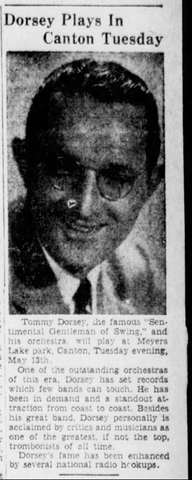
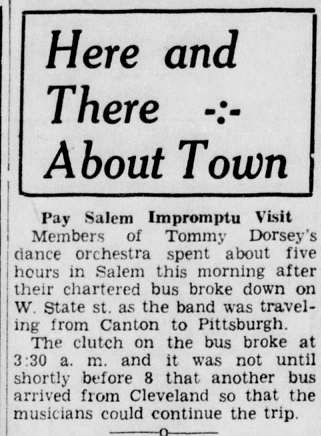
May 14, 1941
Concerts
Sunset Ballroom, Route 219, Carrolltown, Pennsylvania
Wednesday Evening
Tommy Dorsey & Orchestra
One-Nighter
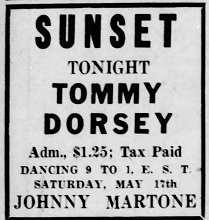
May 15, 1941
Concerts
Lakewood Park, Pottsville, Pennsylvania
Tommy Dorsey and his Orchestra with Frank Sinatra
Lakewood Park, Pottsville, Pennsylvania
May 16, 1941
Concerts
University of Pennsylvania, Philadelphia , Pennsylvania Tommy Dorsey and his Orchestra w/Frank Sinatra
Woody Herman and the Herman Herd
The Ivy Ball at the Benjamin Franklin Hotel
NOTE: From Variety, May 21, 1941: "Dorsey and Herman lured capacity of 2,000 at $2.50 a head for $5,000 gross.
Hop is top social event, limited to 1,000 couples. The following night Herman drew $1,695 at Valencia Ballroom in York, Pa. at $1.10 per."
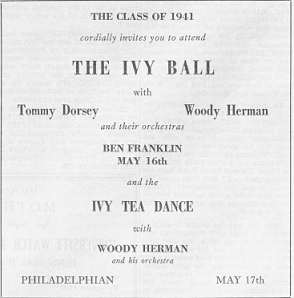
University of Pennsylvania, Philadelphia , Pennsylvania Tommy Dorsey and his Orchestra w/Frank Sinatra
Woody Herman and the Herman Herd
The Ivy Ball at the Benjamin Franklin Hotel
The Daily Pennsylvanian April 30, 1941
Note some of the mistakes in the article. Sinatra was not born in 1917 and when he joined Dorsey was not in Milwaukee but at the Coronado Theatre in Rockford, Illinois, January 26, 1940
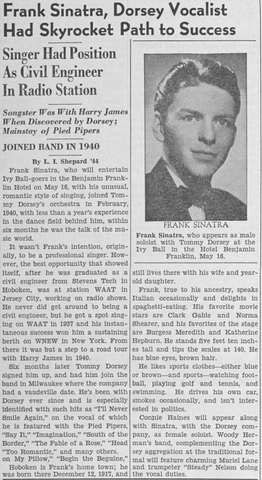
May 17, 1941
Radio
Live remote 8th Annual Interfraternity Ball
Cutler Union, University of Rochester, Rochester, N.Y.
Tommy Dorsey and His Orchestra
CBS
Note: About half way through the second half of the concert, a direct feed of the dance was broadcast nation-wide over the Columbia Broadcasting System. The dance ran from 10PM to 3AM.
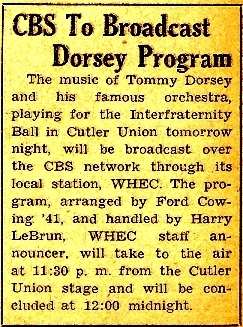
Concerts
Cutler Union, University of Rochester, Rochester, N.Y.
8th Annual Interfraternity Ball
Saturday night
Tommy Dorsey & Orch.
Frank Sinatra, Connie Haines, Jo Stafford, The Pied
Pipers, Buddy Rich, Ziggy Elman, Joe Bushkin,
Sy Oliver, Heinie Beau et al.
Cutler Unton, University of Rochester, Rochester, N.Y.
8th Annual Interfraternity Ball
Saturday night
Tommy Dorsey & Orch.
Big Bands Visited Rochester by Susan Nurse for her mother Marjorie Van Ryne Fisher
People may recognize the names of Tommy Dorsey, Glenn Miller and Fred Waring as leaders of big bands that traveled the country in the 20s, 30s, and 40s,bringing their music to a wide audience. The tours were sponsored by Cigarette companies (Chesterfield brought Fred Waring and Glenn Miller for instance). To reach an even bigger audience, radio feeds were set up to broadcast part of the show over the radio.
It may come as a surprise to find out that all that music also took place in Rochester, specifically at the University of Rochester. My mother, Marjorie Van Ryne Fisher and her fiance Don Fisher, my dad, greatly enjoyed these big bashes, and danced the night away many times during her time at the UR (1937-1941).
One particular dance was very memorable. The weekends were called Inter-Fraternity Weekends and were billed as the "last period of rest and relaxation before the final pre-examination grind". The weekend of May 15th - 17th 1941 began on campus with the hit play "You Can't Take It With You" by the UR Stagers in Strong Auditorium. But the big night was Saturday- May 17th with Tommy Dorsey's band and special guests entertaining from the stage at Cutler Union on the Women's Campus on Prince Street. Dorsey was bringing the quartet the "Pied Pipers" and singer Connie Haines. An unknown singer was being introduced - Frank Sinatra! The paper even mis-spelled his name as Sonatra! My mother remembers the disappointment in not knowing who this guy was. They really liked his singing that night, but commented on how skinny he was. At the band's break, my mom & dad went up on stage and chatted with him. He didn't seem much older than they were!
About half way through the second half of the concert, a direct feed of the dance was broadcast nation-wide over the Columbia Broadcasting System. The dance ran from 10PM to 3AM.
Each dance had it's own theme and the girls were all issued small "dance cards" some just folded paper, some very elaborate with attached charms, keys, pencils, and even hammered copper covers!
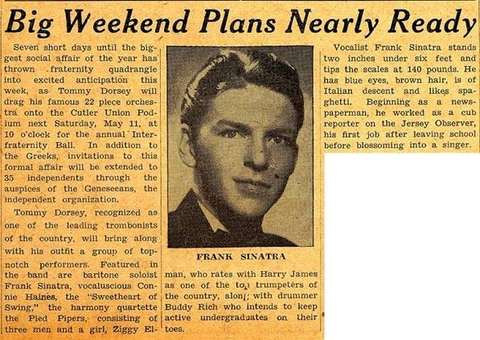
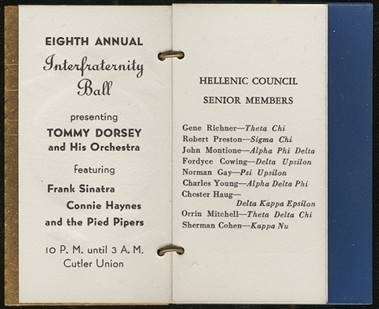
May 18, 1941
Concerts
Fernbrook, Dallas, PA,
Tommy Dorsey and his Orchestra with Frank Sinatra
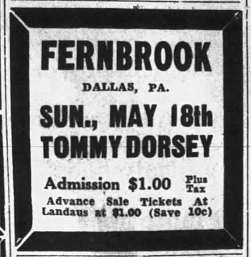

May 20, 1941
Radio
Astor Roof, Astor Hotel, New York, New York (Opening
Night)
Tommy Dorsey and his Orchestra
Tommy Dorsey sewed up a sweetheart deal with the Mutual Network
(WOR in NYC) for five network broadcasts per week during his run
at the Hotel Astor. Engagement ran eight weeks( closing 7/15). And
the 40 shows did not take into account TD's many live remotes on
the NBC network (WJZ Blue) every week during his stay at the hotel.
Concerts
Astor Roof, Astor Hotel, New York, New York (Opening Night) Tommy Dorsey and his Orchestra
NOTE: On this opening night at the Astor Roof,
Frank Sinatra was not on the bill, according to
Sinatra Scholar Ed O'Brien. Sinatra did join the band during the engagement, however. Buddy Rich,
Ziggy Elman, Connie Haines, and the Pied Pipers got top billing on opening night. Dinner and dancing nightly (except Sunday). Deluxe dinner from $2. Supper cover charge (after 10 p.m.), except Saturday and holidays: 75 cents! On
Saturday and holidays: $1. There was a floor show, but the Band was the major draw. 4,875 covers the first week of the engagement.
Astor Roof, Astor Hotel, New York, New York (Opening
Night)
The Dorsey Band opened at the Roof Garden of Hotel
Astor, Times Square, N. Y., with performances Monday through Saturday (Sundays off). There were broadcasts five times a week. Each ran a half-hour (sustaining) over the Mutual network during their engagement. '
Hotel Astor, Astor Roof, New York
Talent Policy: Dance and relief bands.
Management: R. E. Christenberry,
managing director: Hy Gardner, publicity director.
Astors luxurious Roof this season drops summer floor shows.
Management apparently felt that the high riding Tommy Dorsey
outfit was capable of carrying the entire entertainment burden, and
we agree with It. Dorsey did sensational business here last summer.
Sole attractions now therefore are Dorsey. his trombone. orchestra, and
festive soloists. Juanita Dios and her reed rumba crew, and the lovely physical
surroundings. This roof is one of the most beautiful spots In town. tasteful. cool.
and smart, and still with an Informal grace and charm, despite Its block long length.
No local eatery offers more pleasant decor. Altho this time Dorsey has no Iâll Never
Smile Again to pull them in droves as of last year, he nevertheless has started off with
a bang. First week's business having been excellent. Band sounds good. if a little too loud
at times, And the roster of vocal talent that Includes Frank Sinatra, Connie Haines, and the
Pied Pipers quartet is responsible for a good part of the enjoyment It provides. Tommyâs
trombone and Ziggy Elman's hot trumpet are Its two standout features musically .
Miss Rios heads a small rumba -conga - samba group that knows how to disseminate the
proper south of the border rhythms, but It's too loud. Gal makes a torrid front for the crew;
so much so that its to be wondered if perhaps all relief orks should be seen and not heard.
Band's work Is conventional, except for Miss Rios' warbling and hip shaking. Service. and food,
and drinks remain uniformly good.
Daniel Richman
Billboard
May 31, 1941
Ed O'Brien:
Sinatra is not listed in the ad that ran on 5-20-41
The engagement ran until July 14.
note: Mystery solved --Failure of New York newspaper ads to carry FRANK SINATRA'S name in the billing for Tommy Dorsey
return to the Astor Roof last week gave rise to recurrent rumors that Sinatra was either leaving or had left the band ... truth of the matter,
however, is that a slip-up caused the omission, and Frank is not only still singing
but has a year to go on his contract with it.
First week on the blue network from The Astor( 5 broadcasts a week) saw another slip-up. The programmer for
NBC did not see a clearance for Sinatra's vocal of "This Love Of Mine" and blocked that segment of the broad-
cast.
Billboard
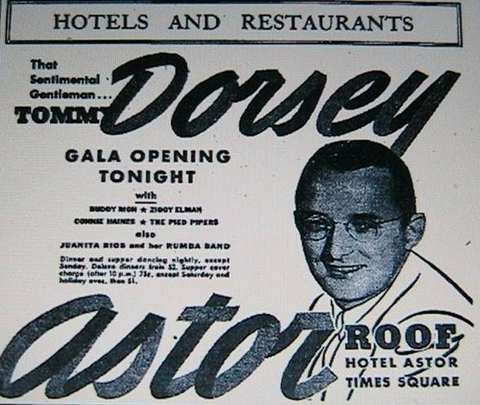
Ed
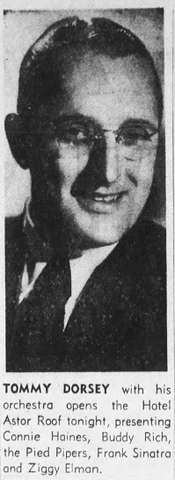
May 21, 1941
Concerts
The Astor Roof, Astor Hotel, New York, New York (May 20 - July 15) Tommy Dorsey and his Orchestra w/Frank Sinatra
May 22, 1941
Radio
Live Remote:Roof Hotel Astor, New York City
NBC Blue Network
WJZ
Thursday Evening
9:00 - 9:30 p.m.
Tommy Dorsey & His Orchestra
Live Remote: Roof Hotel Astor, New York City
Mutual Network
WOR
Thursday Evening
11:15 - 11:30 p.m.
Tommy Dorsey & His Orchestra note: WOR broadcast numerous remotes during the Dorsey run at the Astor. Some were 15 minutes and others ran for a half-hour.
Concerts
The Astor Roof, Astor Hotel, New York, New York (May 20 - July 15) Tommy Dorsey and his Orchestra w/Frank Sinatra
May 23, 1941
Concerts
The Astor Roof, Astor Hotel, New York, New York (May 20 - July 15) Tommy Dorsey and his Orchestra w/Frank Sinatra
May 24, 1941
Radio
Live Remote: Hotel Astor, New York City
Tommy Dorsey & Orchestra
Saturday Afternoon
5:00 - 6:00 p.m.
NBC Blue Network
WJZ
Tommy Dorsey & His Orchestra
Concerts
The Astor Roof, Astor Hotel, New York, New York (May 20 - July 15) Tommy Dorsey and his Orchestra w/Frank Sinatra
May 25, 1941
Concerts
The Astor Roof, Astor Hotel, New York, New York (May 20 - July 15) Tommy Dorsey and his Orchestra w/Frank Sinatra
May 26, 1941
Concerts
The Astor Roof, Astor Hotel, New York, New York (May 20 - July 15) Tommy Dorsey and his Orchestra w/Frank Sinatra
May 27, 1941
Radio
Live Remote:Hotel Astor, New York City
Tuesday Evening
11:15 - 11:30 p.m.
Mutual Network
WOR
Tommy Dorsey & His Orchestra
1. Free For All
2. Closing Theme (I'm Getting Sentimental Over You)
("Free For All" appears on Masters of Jazz Volume 5)
("Free For All" & "Closing Theme (I'm Getting Sentimental Over You)" appear on Masters of Jazz Volume 10) note: One of many Mutual broadcasts during this engagement
Concerts
The Astor Roof, Astor Hotel, New York, New York (May 20 - July 15) Tommy Dorsey and his Orchestra w/Frank Sinatra
May 28, 1941
Studio
New York City
BS065913 I'll Never Let A Day Pass By
(from the Paramount Picture Kiss The Boys Goodbye)
(f. Loesser/V. Schertzinger)
Famous Music Corp. (ASCAP)
-1 (3:14) CD: 07863 66353-2 "The Song Is You" 5CD set Vol 3
CD: RCA 2269-2-R
LP: SD 1000
78: 27461
BS065915 Love Me As I Am
(from the Paramount Picture Caught In The Draft)
(F. Loesser/L. Alter)
Paramount Music Corp. (ASCAP)
Arranged by Axel Stordahl
-1 (3:07) CD: 07863 66353-2 "The Song Is You" 5CD set Vol 3
CD: RCA 2269-2-R
LP: SD 1000
78: 27483
BS065916 Free For All (N/R) w/The Pied Pipers
(T. Adair/M. Dennis)
Embassy Music Corp. (BMI)
Arranged by Sy Oliver
BS065917 This Love Of Mine
(H. Sanicola/S. Parker/F. Sinatra)
Embassy Music Corp. (BMI)
Arranged by Axel Stordahl
-1 (3:39) CD: 07863 66353-2 "The Song Is You" 5CD set Vol 3
CD: RCA 8554-2-R
LP: SD 1000
78: 20-2848
78: 27508
Saxes: Paul Mason, Heinie Beau, Don Lodice, Hymie Shertzer, Manny Gershman; Trumpets: Ziggy Elman, Jimmy Blake, Chuck Peterson, Shorty Sherock; Trombones: George Arus, Lowell Martin, Walter Mercurio; Piano & Celeste: Joe Bushkin; Guitar: Clark Yocum; Drums: Buddy Rich; Bass: Jack Kelleher
NOTE: Sinatra Scholar Ed O'Brien points out that "This Love of Mine" was the first of Sinatra's seven efforts as a songwriter. His first was certainly the most successful effort from a commercial standpoint. Released in August of 1941, the 78 rpm record was on the charts for 24 weeks. O'Brien challenges Sinatraphiles to identify the one other FS/TD song which would be on the charts for a longer duration. Sinatraphile Richard Ware identified that song as "There Are Such Things," which was #1 for six weeks and on the charts for 26 weeks. Interestingly, Ware points out that the song didn't chart until November 1942, two months after Sinatra left the Dorsey band. RCA was not going to miss an opportunity to take advantage of Sinatra's popularity. As late as July 1943, a Sinatra/Dorsey song charted and peaked at #1. That song was recorded on June 17, 1942. It's title? "In the Blue of Evening."
Ed O'Brien:
Tis' a mystery why "Free For All" has never seen a commercial release from RCA. The re-recording done on 6-27-41 features The Pied Pipers singing most of the verse with Frank jumping in near the end. The earlier recording has Frank doing the complete verse. A significant difference, I would say.
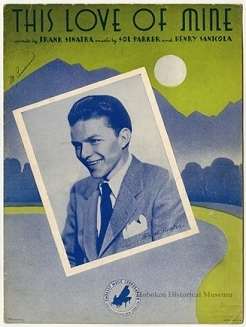
Concerts
The Astor Roof, Astor Hotel, New York, New York (May 20 - July 15) Tommy Dorsey and his Orchestra w/Frank Sinatra
May 29, 1941
Concerts
The Astor Roof, Astor Hotel, New York, New York (May 20 - July 15) Tommy Dorsey and his Orchestra w/Frank Sinatra
May 30, 1941
Concerts
The Astor Roof, Astor Hotel, New York, New York (May 20 - July 15) Tommy Dorsey and his Orchestra w/Frank Sinatra
May 31, 1941
Concerts
The Astor Roof, Astor Hotel, New York, New York (May 20 - July 15) Tommy Dorsey and his Orchestra w/Frank Sinatra
June 1941
[I Guess I'll Have to Dream the Rest -- critical commentary]
"I Guess I’ll Have to Dream the Rest," from June 1941, again follows the same path as "Smile Again," but with the full orchestra and Sinatra securely in the spotlight. The lyric has more of a sense of humor than "Smile Again," and the melody merits a livelier bounce.
Source: Will Friedwald, "Sinatra! The Song Is You: A Singer's Art" (2018 revised edition), Ch. 3, "With Tommy Dorsey" (1940-1942)
June 1, 1941
Concerts
Pleasure Beach, Bridgeport, Connecticut
Sunday evening
One-nighter
Tommy Dorsey & His Band
Ed O'Brien added this Variety blurb and comments below: TD - - day off from Astor played Pleasure Beach, Bridgeport, Ct on June 1st - - $2.250 for that many ticket holders at $1 per. TD had his MCA attractions. He is at Astor Hotel until mid-July.
Variety 6-4-41
note: Imagine working for Mr. Dorsey back then. The band played three or four shows a night, six days a week at the Astor, plus numerous radio appearances and recordings.
On Sundays the man sought additional work and usually found it. Skitch Henderson told me Frank had the same work ethic. When playing the Riobamba or Copa, Sundays were always filled with one-nighters somewhere on the east coast. Jo Stafford remembered the pace and summed it up by saying, 'You had to be young."
P.S. Pleasure Beach was a municipally operated amusement park.
Pleasure Beach, Bridgeport, Connecticut
Sunday evening
One-nighter
Tommy Dorsey & His Band
Autographed Program:
[image referenced in source but could not be recovered]
[image referenced in source but could not be recovered]
[image referenced in source but could not be recovered]
[image referenced in source but could not be recovered]
June 2, 1941
Concerts
afternoon - Tommy Dorsey and Ben Bernie volunteered their services for the commission of the New York Naval Air Station (previously the Floyd Bennett Airport, Brooklyn). At the reception, Dorsey played in Hanger 5, Ben Bernie in Hanger 1.
The Astor Roof, Astor Hotel, New York, New York (May 20 - July 15) Tommy Dorsey and his Orchestra w/Frank Sinatra
afternoon - Tommy Dorsey and Ben Bernie volunteered their services for the commission of the New York Naval Air Station (previously the Floyd Bennett Airport, Brooklyn). At the reception, Dorsey played in Hanger 5, Ben Bernie in Hanger 1.
[image referenced in source but could not be recovered]
[image referenced in source but could not be recovered]
June 3, 1941
Radio
Live Remote: Hotel Astor, New York City
Tuesday Evening
11:00 p.m. - 11:30 p.m.
Mutual Network
WOR
Tommy Dorsey And His Orchestra
Concerts
The Astor Roof, Astor Hotel, New York, New York (May 20 - July 15) Tommy Dorsey and his Orchestra w/Frank Sinatra
June 4, 1941
Concerts
The Astor Roof, Astor Hotel, New York, New York (May 20 - July 15) Tommy Dorsey and his Orchestra w/Frank Sinatra
June 5, 1941
Concerts
The Astor Roof, Astor Hotel, New York, New York (May 20 - July 15) Tommy Dorsey and his Orchestra w/Frank Sinatra
June 6, 1941
Concerts
The Astor Roof, Astor Hotel, New York, New York (May 20 - July 15) Tommy Dorsey and his Orchestra w/Frank Sinatra
June 7, 1941
Radio
Live Remote: Hotel Astor, New York City
Saturday Evening
5:00 - 6:00 p.m.
NBC Blue Network
WJZ
Tommy Dorsey And His Orchestra
Announcer: Bill Abernathy
1. Variation of I’m Getting Sentimental Over You (open)
2. You Betcha My Life (CH)
3. Everything Happens To Me (FS)
4. Make Me Know It (SO arr)
5. Little Man With The Candy Cigar (JS)
6. Swanee River (SO arr)
7. Oh Look At Me Now (FS-CH-PP)
8. This Love Of Mine (FS)
9. Free For All (FS-PP)
10. Nine Old Men (PP)
11. Will You Still Be Mine (CH)
12. So What (SO arr)
13. I Tried (FS)
14. Yes Indeed (CP-JS)
15. Let’s Get Away From It All (PP)
16. Swing High (SO arr)
17. Taps
18. Variation of I’m Getting Sentimental Over You (close)
Live Remote: Hotel Astor, New York City
Saturday Evening
11:00 - 11:30 p.m.
Mutual Network
WOR
Tommy Dorsey And His Orchestra
Concerts
The Astor Roof, Astor Hotel, New York, New York (May 20 - July 15) Tommy Dorsey and his Orchestra w/Frank Sinatra
NOTE: Ed O'Brien supplies this note from the June 7, 1941 issue of Billboard:
"Tommy Dorsey and his orchestra will take a month off starting on July 27, with the maestro going to a hospital to have his tonsils removed. On August 27th, the band steps into the New York Paramount."
June 8, 1941
Concerts
The Astor Roof, Astor Hotel, New York, New York (May 20 - July 15) Tommy Dorsey and his Orchestra w/Frank Sinatra
June 8, 1941
Harry James band played a softball game against Tommy Dorsey's at the latter's Bernardsville Estate in New Jersey. James band carried the day. Variety
June 11, 1941
--Ed
June 9, 1941
Radio
Live Remote: Astor Hotel, New York City
Monday Evening
11:00 - 11:30 p.m.
NBC Blue Network
WJZ
Tommy Dorsey And Orchestra
1. I'm Getting Sentimental Over You TD & Orch.
2. You Betcha My Life Connie Haines
3. Everything Happens To Me Frank Sinatra
4. Make Me Know It (Sy Oliver arg.) TD & Orch.
5. Little Man With The Candy Cigar Jo Stafford
6. Free For All Frank Sinatra & Pied Pipers
7. This Love Of Mine Frank Sinatra
8. Swing High (Sy Oliver arg.) TD & Orch.
9. Closing Theme TD & Orch.
Concerts
The Astor Roof, Astor Hotel, New York, New York (May 20 - July 15) Tommy Dorsey and his Orchestra w/Frank Sinatra
June 10, 1941
Radio
Live Remote:Hotel Astor, New York City
Tuesday Evening
11:00 - 11:30 p.m.
Mutual Network
WOR
Tommy Dorsey And His Orchestra
Concerts
The Astor Roof, Astor Hotel, New York, New York (May 20 - July 15) Tommy Dorsey and his Orchestra w/Frank Sinatra
June 11, 1941
Concerts
The Astor Roof, Astor Hotel, New York, New York (May 20 - July 15) Tommy Dorsey and his Orchestra w/Frank Sinatra
June 12, 1941
Radio
Astor Hotel Roof, New York City
Thursday
Network: NBC Blue Network
Time: 9:00 - 9:30 PM EST
Tommy Dorsey & Orch.
Frank Sinatra, Jo Stafford, Connie Haines, Sy Oliver, Pied Pipers, Ziggy Elman
1. I'm Getting Sentimental Over You T.D. & Orch.
2. So This Is Love T.D. & Orch.
3. This Love Of Mine F.S.
4. Serenade To The Spot T.D. & Orch.
5. Do I Worry F.S. J.S. P.P.
6. Free For All F.S. J.S. P.P.
7. The Things I Love F.S.
8. Let's Get Away From It All J.S. P.P. C.H. F.S.
9. Another One Of Them Things (S. O. arg.) T.D. & Orch.
10. I'm Getting Sentimental Over You T.D. & Orch.
("The Things I Love" appears on Masters of Jazz Volume 10 & on the RCA Box Set - The Song Is You)
("Do I Worry" appears on CD: The Essential Frank Sinatra with the Tommy Dorsey Orchestra, Bluebird / Legacy 82876-71167)
("Let's Get Away From It All" CD: BMG Bluebird 60283-2 - Young Blue Eyes - Birth Of The Crooner)
Ed O'Brien:
A few additions
Show was broadcast on the NBC Blue Network. It did not have a sponsor. Bill Abernathy was the announcer. "Easy Does It" was not performed. In lieu of that tune, TD & band did a marvelous big band number titled "Serenade To The Spot." Sy Oliver was the composer of "Another One Of Them Things." Theme song at beginning and end is neither "Getting Sentimental" nor "Anything." Melody is closer to "Sentimental", but is a different tune. TD obviously had his people do this in an effort to not break the musicians' strike and at the same time imitate that great theme opening. Here is Abernathy's intro to Frank's first number:
"Here is a brand new romantic ballad to be sung for you by Frank Sinatra. Incidentally, we might call this national sing a song Sinatra day, because he not only will sing the song for you, he wrote it, super- vised the arrangement, and it's all Sinatra. The title: 'This Love Of Mine.' " At the conclusion Abernathy said, "Very nicely done, Frankie. Very nice, indeed."
Later on Abernathy mentions that Frankie will again sing "The Things I Love." Describes it as a big hit of the day.
Live Remote: Hotel Astor, New York City
Thursday Evening
11:15 - 11:30 p.m.
Mutual Network
WOR
Ed O'Brien:
WOR broadcast five Dorsey remotes a week from the Astor.
Unfortunately many of the radio listings only show "Dance Music." I am almost certain almost all were TD & Co. Almost is the key word here.
Concerts
The Astor Roof, Astor Hotel, New York, New York (May 20 - July 15) Tommy Dorsey and his Orchestra w/Frank Sinatra
June 13, 1941
Radio
Hotel Astor Roof, New York City
Friday evening
Network: NBC
Tommy Dorsey & Orch.
Frank Sinatra, Connie Haines, Jo Stafford,Ziggy Elman, Buddy Rich, Pied Pipers, Sy Oliver
1. I'm Getting Sentimental Over You T.D. & Orch.
2. Blues No More ( S.O. arg.) T.D. & Orch.
3. I Guess I'll Have To Dream The Rest F.S J.S. P.P.
4. Swing High T.D. & Orch.
5. Free For All F.S. J.S. P.P.
6. This Love Of Mine F.S.
7. Oh, Look At Me Now F.S. C.H. J.S. P.P.
8. I'm Getting Sentimental Over You T.D. & Orch..
("This Love Of Mine" appears on the CD: Young Blue Eyes: Birth Of The Crooner [20 Tracks])
("Free For All" appears on the CD: Young Blue Eyes: Birth Of The Crooner [22 Tracks, Costco Edition])
Concerts
The Astor Roof, Astor Hotel, New York, New York (May 20 - July 15) Tommy Dorsey and his Orchestra w/Frank Sinatra
June 14, 1941
Radio
Live Remote from Hotel Astor, New York City
NBC Blue Network - WJZ
5-6:00 PM
1. I'm Getting Sentimental Over You TD & Orch.
2. Free For All Pied Pipers
3. The Things I Love Frank Sinatra
4. Serenade To The Spot ( Sy Oliver arg.) TD & Orch.
5. I'll Guess I'll Have To Dream The Rest Frank Sinatra
6. There'll Be Some Changes Made Connie Haines
7. Estrellita TD & Orch.
8. This Love Of Mine Frank Sinatra
9. Deep River (Sy Oliver arg.) TD & Orch.
10. Anything TD & Orch.
11. Swing Time Up In Harlem(Sy Oliver arg.) Connie Haines
12. High On A Windy Hill Frank Sinatra
13. Little Man With The Candy Cigar Jo Stafford
14. For Trumpets Only TD & Orch.
15. Do I Worry Frank Sinatra
16. Quiet Please (Sy Oliver arg.) TD & Orch.
17. Free For All Frank Sinatra & Pied Pipers
18. Taps TD & Orch.
19. Closing Theme TD & Orch.
Concerts
The Astor Roof, Astor Hotel, New York, New York (May 20 - July 15) Tommy Dorsey and his Orchestra w/Frank Sinatra
June 15, 1941
Concerts
The Astor Roof, Astor Hotel, New York, New York (May 20 - July 15) Tommy Dorsey an his Orchestra w/Frank Sinatra
June 15, 1941 issue of DOWNBEAT:
DORSEY BREAKS ASTOR RECORD
TD band has broken all records at the Hotel Astor and is doing the most sensational business of any band in the greater New York area, according to Bob Christenberry, manager of the Astor. While Gene Krupa fared poorly at the Penn with local business seriously off, Dorsey's terrific draw has kept the ropes up every night without a single miss since he opened in late May. Tommy is pretty much satisfied with his lineup now, although he has been seeking a clarinetists to fill the chair left empty when Johnny Mince pulled out two months ago. Will Bradley's crew will follow Dorsey at the Astor.
June 16, 1941
Concerts
The Astor Roof, Astor Hotel, New York, New York (May 20 - July 15) Tommy Dorsey an his Orchestra w/Frank Sinatra
June 17, 1941
Concerts
The Astor Roof, Astor Hotel, New York, New York (May 20 - July 15) Tommy Dorsey an his Orchestra w/Frank Sinatra
June 18, 1941
Concerts
The Astor Roof, Astor Hotel, New York, New York (May 20 - July 15) Tommy Dorsey an his Orchestra w/Frank Sinatra
June 19, 1941
Radio
Hotel Astor, N.Y.C.
Thursday evening
NBC Blue Network
30 minutes
Tommy Dorsey & His Orch.
Frank Sinatra, Connie Haines, Jo Stafford,
Pied Pipers, Buddy Rich, Ziggy Elman, Joe
Bushkin, Sy Oliver, Axel Stordahl, Heinie Beau
Annc: Bob Abernathy
1. Theme T.D. & Orch.
2. Will You Still Be Mine C.H.
3. I Tried F.S.
4. Blues No More T.D. & Orch.
5. I Guess I'll Have To Dream The Rest F.S. & P.P.
6. Free For All F.S. & P..P.
7. This Love Of Mine F.S.
8. Oh! Look At Me Now F.S. C.H. J.S. P.P.
9. Closing theme T.D. & Orch.
("I Tried" appears on CD: CD: Buddha 74465 999601-2 "Learn To Croon")
("This Love of Mine" appears CD: BMG Bluebird 60283-2 - "Young Blue Eyes - Birth Of The Crooner")
Morton Gould Orchestra
Network: CBS
Time: 9:00PM - 10:00PM (EST)
Morton Gould Orchestra
Performers: Frank Sinatra, Baritone; Carla Thompson songs
Notes: Confirmed aired on WABC.
Also aired on WBBM in at 8:00PM - 9:00PM (CTR) Chicago against "Tommy Dorsey Orchestra" on WENR!
Note: Frank had a tough week. He was fairly well known by June of 1941.
His name is not mentioned in this review. Adding insult to injury, he had another problem at about the same time during a broadcast from the Hotel Astor. There was a blackout in effect and all songs done on the program had to be cleared with NBC. A stenographer omitted "This Love Of Mine" from the sheet. Bill Abernathy introduced Frank and the song. Eight bars in the network went black. The sound came back on in a few minutes and Dorsey was playing a classical piece.
--Ed
[image referenced in source but could not be recovered]
[image referenced in source but could not be recovered]
Concerts
The Astor Roof, Astor Hotel, New York, New York (May 20 - July 15) Tommy Dorsey an his Orchestra w/Frank Sinatra
June 20, 1941
Concerts
The Astor Roof, Astor Hotel, New York, New York (May 20 - July 15) Tommy Dorsey and his Orchestra w/Frank Sinatra
June 21, 1941
Radio
Live Remote:Hotel Astor, New York City
Saturday
5:00 - 6:00 p.m.
NBC Blue Network
WJZ
Tommy Dorsey And His Orchestra
Announcer:Bill Abernathy
1. I'm Getting Sentimental Over You TD & Orch.
2. It's So Peaceful In The Country Frank Sinatra
3. Swing Low, Sweet Chariot ( Deane Kincaide arg.) TD & Orch.
4. Little Man With The Candy Cigar Jo Stafford
5. Jump Time (Sy Oliver arg.) TD & Orch.
6. This Love Of Mine Frank Sinatra
7. Losers Weepers (SO arg.) TD & Orch.
8. Nine Old Men Pied Pipers
9. Neiani Frank Sinatra & Pied Pipers
10. Blues No More (Sy Oliver arg.) TD & Orch.
11. Swing A Love Song Connie Haines
12. Swingin' On Nothing (Sy Oliver arg.) Jo Stafford
13. Another One Of Them Things (Sy Oliver arg.) TD & Orch.
14. Free For All Frank Sinatra & Pied Pipers
15. Taps TD & Orch.
16. Closing Theme TD & Orch.
Concerts
The Astor Roof, Astor Hotel, New York, New York (May 20 - July 15) Tommy Dorsey an his Orchestra w/Frank Sinatra
June 22, 1941
Studio
Matinee With Lytell, Frank Sinatra, guest 1:30[pm]
Concerts
Block party for soldiers, thrown by a group of housewives from Laurelton in Queens, NY. June 22nd was a Sunday, so the band was not at the Astor Tommy Dorsey & His Orchestra w/Frank Sinatra
Block party for soldiers, thrown by a group of housewives from Laurelton in Queens. June 22nd was a Sunday, so the band weren't at the Astor Tommy Dorsey & His Orchestra w/Frank Sinatra
Here's some photos the New York Daily News ran a few weeks later in July
Thanks to Richard Cook for above entry
Hi Richard,
I found a long article in the 6-23 edition of The New York Times. After the dinner and movie at the local theater, the young ladies in the neighborhood began picking out their dance partners in anticipation of the arrival of Dorsey and his band. Japanese style lanterns were used to light up the street for the 64 families involved and the 500 men from Mitchell Field and Fort Totten plus 25 sailors from the U.S.S. Seattle. The dance continued until after 11: P.M. and concluded with the lanterns going out, 64 ice boxes emptied, a conga chain and all the residents, military personnel and band singing "The Star Spangled Banner." Times called it "a thoroughly patriotic occasion." As the band played, the young people jitterbugged on the avenue. I'll bet Frank never forgot that very special evening.
Ed
[image referenced in source but could not be recovered]
[image referenced in source but could not be recovered]
June 23, 1941
Concerts
The Astor Roof, Astor Hotel, New York, New York (May 20 - July 15) Tommy Dorsey an his Orchestra w/Frank Sinatra
June 24, 1941
Radio
Live Remote: Hotel Astor, New York City
Tuesday Morning
12:30 a.m. - 1:00 a.m.
NBC Blue Network
WJZ
Tommy Dorsey & His Orchestra
1. I'm Getting Sentimental Over You TD & Orch.
2. So This Then Is Love Connie Haines & Pied Pipers
3. This Love Of Mine Frank Sinatra
4. Swanee River (Sy Oliver arg.) TD & Orch.
5. Yes Indeed (Sy Oliver arg.) Jo Stafford & Chuck Peterson
6. Free For All Frank Sinatra & Pied Pipers
7. Everything Happens To Me Frank Sinatra
8. Deep River (Sy Oliver arg.) TD & Orch.
9. Closing Theme TD & Orch.
Concerts
The Astor Roof, Astor Hotel, New York, New York (May 20 - July 15) Tommy Dorsey an his Orchestra w/Frank Sinatra
June 25, 1941
Concerts
The Astor Roof, Astor Hotel, New York, New York (May 20 - July 15) Tommy Dorsey an his Orchestra w/Frank Sinatra
NOTE: Ed O'Brien sends along an interesting item from the June 25, 1941 issue of Variety:
"SOFTBALL - Harry James band beat TD last week 12-7; first game won by James also, 15-12. Bruce Synder, two days out of U. of North Carolina, hopped into the TD band on baritone sax."
June 26, 1941
Radio
Live Remote: Hotel Astor, New York City
Thursday Evening
9:00 p.m.- 9:30 p.m.
NBC Blue Network
WJZ
Announcer: Bill Abernathy
Tommy Dorsey and Orchestra
Concerts
The Astor Roof, Astor Hotel, New York, New York (May 20 - July 15) Tommy Dorsey an his Orchestra w/Frank Sinatra
June 27, 1941
Studio
New York City
BS066430 I Guess I'll Have To Dream The Rest w/The Pied Pipers
(M. Stoner/M. Black/H. Green)
TV Music (ASCAP)
Arranged by Axel Stordahl
-1 (3:29) CD: 07863 66353-2 "The Song Is You" 5 CD set Vol 3
CD: RCA 8554-2-R
LP: SD1000
78: 27526
BS065916 Free For All w/The Pied Pipers
(T. Adair/M. Dennis)
Embassy Music Corp. (BMI)
Arranged by Sy Oliver
-2 (2:19) CD: 07863 66353-2 "The Song Is You" 5 CD set Vol 3
LP: SD 1000
78: 27532
BS066431 You And I
(Meredith Wilson)
Bourne Co. (ASCAP)
Arranged by Sy Oliver
-1 (2:44) CD: 07863 66353-2 "The Song Is You" 5 CD set Vol 3
CD: RCA 9679-2-R
LP: SD 1000
78: 27532
BS066432 Neiani w/The Pied Pipers
(A. Stordahl/S. Oliver)
Embassy Music Corp. (BMI)
Arranged by Axel Stordahl
-1 (3:16) CD: 07863 66353-2 "The Song Is You" 5 CD set Vol 3
LP: SD 1000
78: 27508
Saxes: Heinie Beau, Don Lodice, Manny Gershman, Bruce Snyder, Fred Stulce; Trumpets: Ziggy Elman, Jimmy Blake, Chuck Peterson, Shorty Sherock; Trombones: George Arus, Lowell Martin, Dave Jacobs; Piano: Joe Buskin; Guitar: Clark Yocum; Drums: Buddy Rich; Bass: Sid Weiss
Concerts
The Astor Roof, Astor Hotel, New York, New York (May 20 - July 15) Tommy Dorsey and his Orchestra w/Frank Sinatra
June 28, 1941
Concerts
The Astor Roof, Astor Hotel, New York, New York (May 20 - July 15) Tommy Dorsey and his Orchestra w/Frank Sinatra
June 29, 1941
Concerts
The Astor Roof, Astor Hotel, New York, New York (May 20 - July 15) Tommy Dorsey and his Orchestra w/Frank Sinatra
June 30, 1941
Radio
Live Remote: Hotel Astor, New York City
Monday Evening
11:00 p.m. - 11:30 p.m.
NBC Blue Network
WJZ
Tommy Dorsey And His Orchestra
Concerts
The Astor Roof, Astor Hotel, New York, New York (May 20 - July 15) Tommy Dorsey and his Orchestra w/Frank Sinatra
July 1, 1941
Concerts
The Astor Roof, Astor Hotel, New York, New York (May 20 - July 15) Tommy Dorsey an his Orchestra w/Frank Sinatra
July 2, 1941
Concerts
The Astor Roof, Astor Hotel, New York, New York (May 20 - July 15) Tommy Dorsey and his Orchestra w/Frank Sinatra
July 3, 1941
Concerts
The Astor Roof, Astor Hotel, New York, New York (May 20 - July 15) Tommy Dorsey and his Orchestra w/Frank Sinatra
July 4, 1941
Concerts
The Astor Roof, Astor Hotel, New York, New York (May 20 - July 15) Tommy Dorsey and his Orchestra w/Frank Sinatra
July 5, 1941
Radio
An Hour With T. Dorsey
NBC Blue
Live remote from Hotel Astor
Concerts
The Astor Roof, Astor Hotel, New York, New York (May 20 - July 15) Tommy Dorsey and his Orchestra w/Frank Sinatra
An Hour With T. Dorsey
NBC Blue
Live remote from Hotel Astor

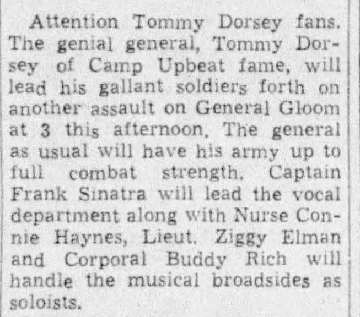
July 6, 1941
Concerts
The Astor Roof, Astor Hotel, New York, New York (May 20 - July 15) Tommy Dorsey and his Orchestra w/Frank Sinatra
July 7, 1941
Radio
Live Remote: Hotel Astor, New York City
Monday Evening
11:00 p.m. - 11:30 p.m.
NBC Blue Network
WJZ
Tommy Dorsey And His Orchestra
Concerts
The Astor Roof, Astor Hotel, New York, New York (May 20 - July 15) Tommy Dorsey and his Orchestra w/Frank Sinatra
July 8, 1941
Radio
Fashions In Jazz
Network: NBC
Time: 10:30 a.m.-11:00 a.m.
Tommy Dorsey and his orchestra;
Vocal(s): Frank Sinatra, Pied Pipers; Connie Haines; Jo Stafford.
1. Opening remarks by Geary. Orchestra plays "My Bonnie Lies Over The Ocean."
2. Swing Time Up In Harlem Connie Haines
3. Do I Worry Frank Sinatra & The Pied Pipers
4. Oh, Look At Me Now Sinatra, Haines, Jo Stafford & Pied Pipers
5. Dorsey Interview
6. Yes, Indeed Jo Stafford & Sy Oliver
Oliver would be a guest on Frank's Max Factor Show, 4-11-45.
They would sing "Yes, Indeed." using Sy's arrangement.
7. Swing High T.D. & Orchestra
8. Sign-off includes offer for a souvenir photo of Dorsey. Address was
NBC, Radio City in New York. Jazz riff closes show.
Note: Show was obviously intended for the American soldiers overseas. TT: 30mins.
Ed O'Brien:
Fashions In Jazz was an NBC International Division show broadcast on shortwave. The announcer was Arthur Geary and Bill Hoffman was the host.
Tommy Dorsey was their guest on the 7-8-41 show. TD tells Hoffman he had worked last night at the Hotel Astor and before coming over to NBC had conducted a rehearsal at RCA. Sy Oliver had written an exciting new arrangement for Irving Berlin's "Blue Skies." Sinatra would record the song on 7-15-41 using Sy's chart. Geary tells the radio listeners that Dorsey is smashing all the attendance records at the Astor. Hoffman does an interview with Tommy. Dorsey tells of his early years in the music business. TD brought along some RCA platters. Each one is given a proper introduction and Dorsey has some comments concerning the vocalists. He refers to his boy singer as the "very popular Frank Sinatra.." Tells Hoffman that Sy Oliver does most of the arrangements for the band.
Concerts
The Astor Roof, Astor Hotel, New York, New York (May 20 - July 15) Tommy Dorsey and his Orchestra w/Frank Sinatra
July 9, 1941
Concerts
The Astor Roof, Astor Hotel, New York, New York (May 20 - July 15) Tommy Dorsey and his Orchestra w/Frank Sinatra
July 10, 1941
Radio
Steve Ellis' Music Makers
WPAT 3-5pm
Guests: Tommy Dorsey, Connie Haines and Frank Sinatra
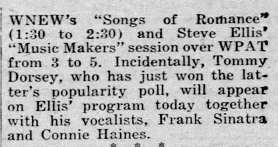
Concerts
The Astor Roof, Astor Hotel, New York, New York (May 20 - July 15) Tommy Dorsey and his Orchestra w/Frank Sinatra
July 11, 1941
Concerts
The Astor Roof, Astor Hotel, New York, New York (May 20 - July 15) Tommy Dorsey and his Orchestra w/Frank Sinatra
July 12, 1941
Concerts
The Astor Roof, Astor Hotel, New York, New York (May 20 - July 15) Tommy Dorsey and his Orchestra w/Frank Sinatra
July 13, 1941
Concerts
The Astor Roof, Astor Hotel, New York, New York (May 20 - July 15) Tommy Dorsey and his Orchestra w/Frank Sinatra
July 14, 1941
Radio
Live Remote: Hotel Astor, New York City
Monday Evening
11:00 - 11:30 p.m.
NBC Blue Network
WJZ
Tommy Dorsey And His Orchestra
Concerts
The Astor Roof, Astor Hotel, New York, New York (May 20 - July 15) Tommy Dorsey and his Orchestra w/Frank Sinatra
July 15, 1941
Studio
New York City
BS066923 Blue Skies
w/Band Chorus
(Irving Berlin)
Irving Berlin Music Co. (ASCAP)
Arranged bu Sy Oliver
-1 (3:15) CD: 07863 66353-2 "The Song Is You" 5CD set Vol 3
CD: RCA 8324-2-R
LP: SD 1000
78: 27566
Tommy Dorsey, Trombone and conductor.
Saxes: Heinie Beau, Don Lodice, Manny Gershman, Bruce Snyder, Fred
Stulce; Trumpets: Ziggy Elman, Jimmy Blake, Chuck Peterson, Al Stearns;
Trombones: George Arus, Lowell Martin, Dave Jacobs; Piano: Joe Buskin;
Guitar: Clark Yocum; Drums: Buddy Rich; Bass: Sid Weiss
NOTE: Sinatra Scholar Ed O'Brien points out that Sinatra recorded the
Berlin song three times with three different arrangements. The July 15, 1941 arrangement, listed above, was done with Tommy Dorsey[s band (16 musicians) and a Sy Oliver chart.
The recording done on the MGM soundstage, December 18, 1941, was for the film I’ll Take Manila," later retitled, for obvious reasons, "Ship Ahoy" has a Paul Weston arrangement and another 16-piece Dorsey group.
The Columbia effort of July 30, 1946 had a 34-piece orchestra and Alex Stordahl received credit for the arrangement, though there is a darn good chance that it was either Oliver or Siravo. Sinatra loved the song and sang it in concert and on the radio throughout the 1940s.
Sinatraphile Eugene Lo Curto writes that "Blue Skies" is one of his all-time favorite Sinatra recordings. It's impossible not to feel good when listening to this track. He much prefers it to the Columbia version. It definitely sounds like the 40s, yet it remains as fresh and vibrant today as it was 68 years ago.
Concerts
The Astor Roof, Astor Hotel, New York, New York (May 20 - July 15) Tommy Dorsey and his Orchestra w/Frank Sinatra
Note: Dorsey's 8-week run at the Hotel Astor, drew 37.350 patron at 75 cents and $1.00
--Ed
The Astor Roof, Astor Hotel, New York, New York (May 20 - July 15)
Tommy Dorsey and his Orchestra w/Frank Sinatra
DORSEY BREAKS ASTOR RECORD
“New York - Tommy Dorsey’s band has broken all records at the Hotel Astor and is doing the
most sensational business of any band in the greater New York area, according to Bob
Christenberry, manager of the Astor. While Gene Krupa fared poorly at the Penn, and with hotel
business, generally speaking, seriously off, Dorsey’s terrific draw has kept the ropes up every
night without a single miss since he opened late in May. Tommy is pretty well satisfied with his
lineup now, although he has been seeking a clarinetist to fill the chair he left empty when
Johnny Mince pulled out two months ago. Will Bradley’s crew will follow Tommy’s at the Astor in
July.”
TD Receives An Amusing Telegram At The Hotel Astor.
--thanks to Carl R for above photo and information.
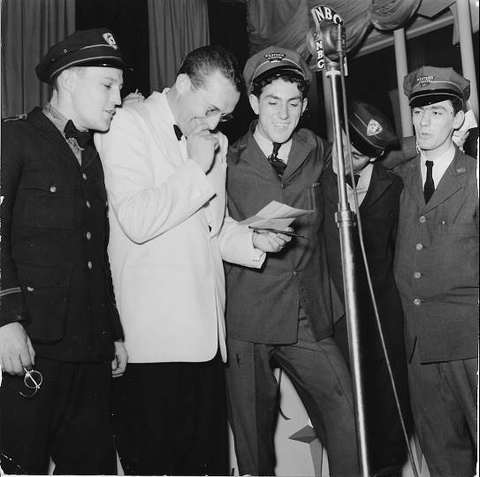
July 16, 1941
Concerts
Dance Hall, Route 22, Dover Plains, New York
Wednesday Evening
9 p.m. to 1 a.m.
One-Nighter
Tommy Dorsey And His Orchestra
Dance Hall, Route 22, Dover Plains, New York
Wednesday Evening
9 p.m. to 1 a.m.
One-Nighter
Tommy Dorsey And His Orchestra
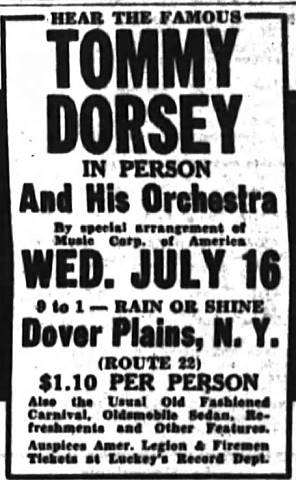
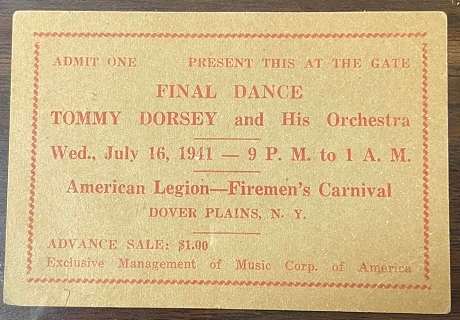
July 17, 1941
Concerts
Russell's Danceland, Sylvan Beach, NY (One-Nighter)
Tommy Dorsey & Orch.
Connie Haines, Frank Sinatra,
Russell's Danceland, Sylvan Beach, NY (One-Nighter)
Tommy Dorsey & Orch.
Connie Haines, Frank Sinatra, The Pied Pipers
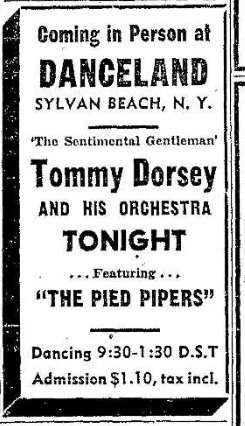
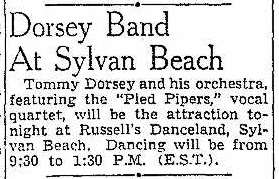
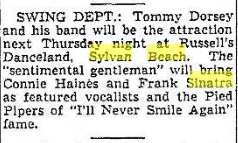
July 18, 1941
Concerts
George F. Pavilion, Johnson City, New York
Friday Evening
One-Nighter
Admittance: $1.10 per person
Tommy Dorsey And His Band
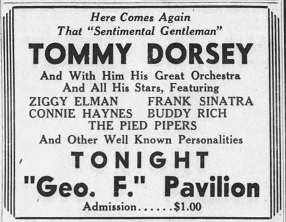
July 19, 1941
Concerts
Steel Pier, Atlantic City, New Jersey (July 19-20)
Tommy Dorsey And His Orchestra
Steel Pier, Atlantic City, New Jersey
Saturday
Tommy Dorsey And His Orchestra
postcard showing 1941 venue
News Item from the July 19, 1941 issue of Billboard:
NAME ORKS TAKE FIVE
"Tommy Dorsey is set for a four-week siesta beginning July 28. The sliphorn artist will have his tonsils plucked first, then cruise off the New England coast on a friend's yacht. A month off by a band of the Dorsey caliber cuts a heavy slice out of the leader's yearly income, and neither is it hay to Music Corporation of America, which handles Dorsey's bookings."
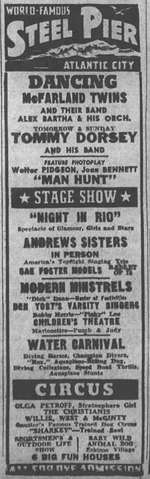
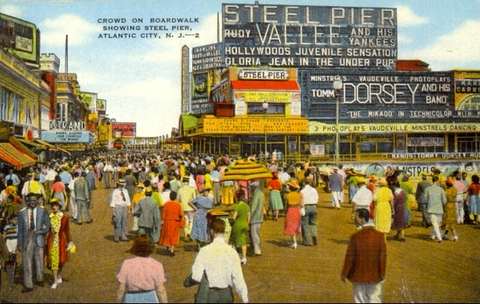
July 20, 1941
Concerts
Steel Pier, Atlantic City (July 19-20)
Sunday
Tommy Dorsey and his Orchestra with Frank Sinatra
July 21, 1941
Radio
Live Remote from the Cavalier Beach Club, Cavalier Hotel, Virginia Beach, Virginia Tommy Dorsey & His Orchestra with Frank Sinatra
WTAR 11:30pm
Note: Dorsey would broadcast from the Cavalier Beach Club on July 21st and July 23rd.
[image referenced in source but could not be recovered]
Concerts
Cavalier Beach Club, Cavalier Hotel, Virginia Beach, Virginia (21-27) Monday to Sunday
One week engagement.
Tommy Dorsey and his Orchestra w/Frank Sinatra
Cavalier Beach Club, Cavalier Hotel , Virginia Beach, Virginia (21-27)
Tommy Dorsey and his Orchestra w/Frank Sinatra
An unforgettable moment from the summer of 1941
I will never forget the summer of 1941, I was in boot camp at the Norfolk Naval Training Station when Glenn Miller was playing at the Surf Club and Tommy Dorsey at the Beach Club.
Dorsey was nice enough to come out to the Naval Station and perform a concert for us at the ball diamond on a Sunday afternoon. At the close, Sinatra went out to sing the final tune from the pitcher's mound. As he finished, he said he was sorry to leave, but the band had to get back to the Beach Club for the Tea Dance. Being a Beach boy, that was hard to take.
note: Sunday show at Naval Station was 7-27-41
--Ed
Ed O'Brien:
Imagine dancing to the music of Tommy Dorsey and listening to Frank, Jo, Connie and The Pied Pipers. Cavalier offered a great experience on a summer night.
This undated photo shows dancers outside the Cavalier Beach Club in Virginia Beach
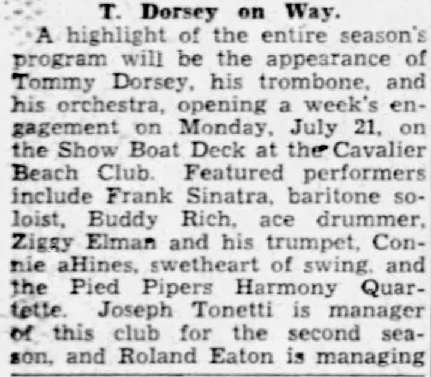
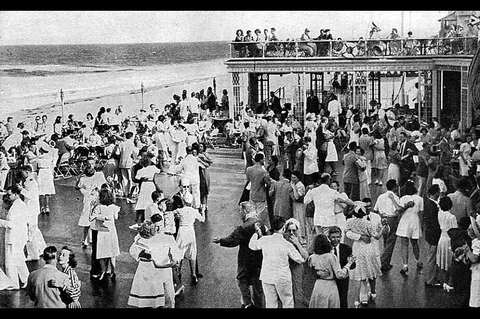
Cavalier Beach Club, Cavalier Hotel , Virginia Beach, Virginia (21-27)
Tommy Dorsey and his Orchestra w/Frank Sinatra
Norfolk Virginian-Pilot, Sunday, July 27, 1941:
Dorsey Would Choose Again to Be Band Leader
Dance Tune Dispenser in Philosophical Mood for Interview
If Tommy Dorsey had his life to live over, he would be a band leader. That's what the "sentimental gentleman" who wields the baton for one of the nation's top the orches: tras said last night at lier Beach Club, where he has been playing each afternoon and night. "I can't imagine doing anything r like better than what I'm doing right now. It's a lot of fun. meet a lot of people. I see a lot of places. When leading a band ceases to be a lot of fun, I'm going to quit it." And thus one of the country's foremost musical figures sized up his own profession--as the best. Contrary to most other people, Tommy has no secret longing to be something else. Little Other Chance To tell the truth, though, Tommy readily admits it, he and his brother, Jimmy, who also ranks right up at the top of U. S. band leaders, never really had a chance to be anything but musicians. Their dad, who had a military band of his own in a tiny Pennsylvania town, Shenandoah, brought up his boys, not on milk, but on music. They hardly had another thought. Dorsey's several years in a musical career have taught him one outstanding thing to respect the musical tastes of the public. And he'll tell anyone that the Americen public definitely educated in music. They know a good band from a bad one, they know a good saxophonist from a bad one, a good trumpet player from a bad one, that is. even the kids. "You can't toss off just any song on them,' Tommy said. By this way, he accounts for the present dearth of patriotic tunes in contrast to wealth of such songs during the World War' era. Kid Appeal Needed "We have a lot of partiotic songs,' Tommy pointed out, but the people just don't seem to go for them.' He hastened to add, however, this doesn't necessarily indicate Americans are less patriotic than other people, although he does beelieve that music ordinarily reflects the mood of a nation. "What, then, does a song have to have to become popular?" Tommy was asked. "Kid appeal." The words were almost dramatic and somewhat stunning. To think that it didn't make a whole lot of difference what adults thought about a song was somewhat surprising. But that's, Tommy's opinion and he's sticking to it. "No, sir," said Tommy, "it's the kids you've got to please, not their parents. It's the kids who buy the music and the records, who travel miles to hear a band. So they're the ones a song has to please. If song lacks 'kid appeal' it just doesn't reach the top." In keeping with his youthful ideas the trombone virtuoso favors college bands as the best training grounds for young musicians, although he and a good many of the members of his orchestra did not attend college. "That's where the talent is, though," he claimed. "Why, some of the college bands today are really as good and can almost take their stand with any orchestra." People were thronging around the leader asking for autographs. One young boy, his eyes open wide, told Tommy he had heard him often, but never expected to see him. Somewhat embarrassed, Tommy thanked him. The reporter left then.
July 22, 1941
Concerts
Cavalier Beach Club, Cavalier Hotel , Virginia Beach, Virginia (21-27) Monday to Sunday
One week engagement.
Tommy Dorsey and his Orchestra w/Frank Sinatra
ad & note
Ed O'Brien:
Management at Hotel Astor announced a six-week extension of Dorsey's engagement. Here is the ad that ran in New York papers on 7/22. Notice Sinatra had supplanted Connie Haines as the lead vocalist in the band.
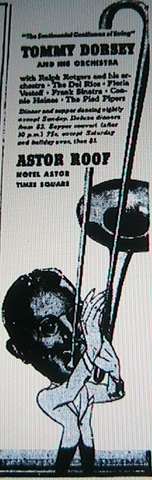
July 23, 1941
Concerts
Cavalier Beach Club, Cavalier Hotel , Virginia Beach, Virginia (21-27) Monday to Sunday
One week engagement.
Tommy Dorsey and his Orchestra w/Frank Sinatra
July 24, 1941
Concerts
Cavalier Beach Club, Cavalier Hotel , Virginia Beach, Virginia (21-27) Monday to Sunday
One week engagement.
Tommy Dorsey and his Orchestra w/Frank Sinatra
July 25, 1941
Concerts
Cavalier Beach Club, Cavalier Hotel , Virginia Beach, Virginia (21-27) Monday to Sunday
One week engagement.
Tommy Dorsey and his Orchestra w/Frank Sinatra
July 26, 1941
Concerts
Cavalier Beach Club, Cavalier Hotel , Virginia Beach, Virginia (21-27) Monday to Sunday
One week engagement.
Tommy Dorsey and his Orchestra w/Frank Sinatra
July 27, 1941
Concerts
Cavalier Beach Club, Cavalier Hotel, Virginia Beach, Virginia (21-27) Monday to Sunday
One week engagement.
Tommy Dorsey and his Orchestra w/Frank Sinatra
July 28, 1941
Concerts
Tommy Dorsey and Orchestra and Frank Sinatra on holidays
August 1941
[Ava Gardner arrives in Hollywood]
Kaplan: Ava Gardner arrived in Hollywood in August 1941 with her sister Bappie, after MGM's New York office took interest in photographs of her; she was living in a small apartment on Selma Avenue and taking studio lessons in walking, talking, and acting.
Source: James Kaplan, "Frank: The Voice" (2010)
[Second Paramount run sells out on Sinatra alone]
Kaplan: In late August 1941 the Dorsey band began a three-week engagement at the Paramount that sold out strictly on the strength of Sinatra's popularity, unlike the previous year's run.
Source: James Kaplan, "Frank: The Voice" (2010)
August 2, 1941
Radio
Tommy Dorsey Orchestra
Frank Sinatra, Connie Haines, Pied Pipers
NBC
11:30 P.M. to 12: A.M.
Note: T.D. was in the hospital having his tonsils removed and the band was on vacation for the first two weeks of August. Was the show pre-recorded or a rebroadcast?
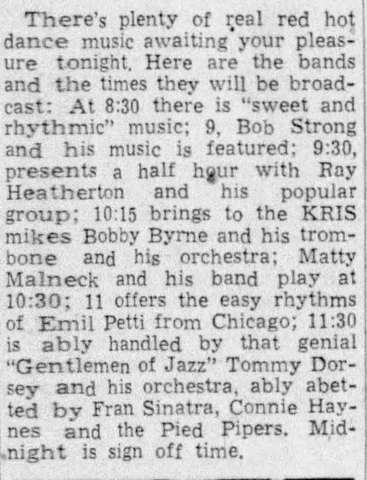
August 3, 1941
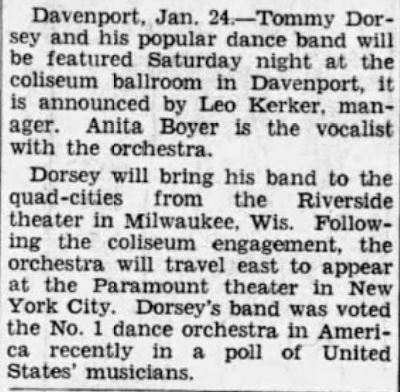
The Baltimore Sun, August 3, 1941.
August 4, 1941
Results of Big Band Popularity Poll
NOTE: Ed O'Brien sends us an excerpt from Jack
Egan's column in the August 1, 1941 issue of Downbeat:
"Tommy Dorsey, Glenn Miller and Jimmy Dorsey finished in that order in the Martin Block semi-annual WNEW popularity poll. Total of 219,000 votes were cast. Tommy won by over 3,000 votes. 4th to 10th were
Vaughn Monroe, Benny Goodman, Sammy Kaye, Artie
Shaw, Harry James, Gene Krupa, and Alvino Rey.
August 11, 1941
From the August 13, 1941 issue of Variety:
It took Tommy Dorsey almost six hours last week to go through an operation for the removal of his tonsils at John Hopkins Hospital,
Baltimore. Leader resisted the effects of anesthetic for almost an hour, and after the cutting was finished, was unconscious for almost five hours. He left the hospital on Monday,
August 11th. After taking a couple of weeks to recuperate, Dorsey and his band begins a stand at the Paramount Theatre in New York on August
27, [He and the band, however, filled several engagements, which will be noted here on THIS DATE, before they hit New York.
August 19, 1941
Studio
New York City
BS067651 Two In Love
(Meredith Wilson)
Shapiro, Bernstein & Co. (ASCAP)
-1 (2:53) CD: 07863 66353-2 "The Song Is You" 5CD set Vol 3
CD: RCA 9679-2-R
LP: SD 1000
78: 20-1597
78: 27611
August 20, 1941
Concerts
Hershey Ballroom, Hershey, Pennsylvania
Wednesday evening
Tommy Dorsey and his orchestra
Frank Sinatra, Jo Stafford, Pied Pipers, Joe Bushkin,
Buddy Rich, Ziggy Elman
Tommy Dorsey grossed $2,845.20 at Hershey Ballroom, Wednesday (20), when he drew 2,990 at $1.10 for dancers and 55 cents for spectators. Billboard
September 6, 1941
Hershey Ballroom, Hershey, Pennsylvania
Wednesday evening
Tommy Dorsey and his orchestra
August 21, 1941
Concerts
Celoron Park, Jamestown, New York (One nighter)
Tommy Dorsey and his Orchestra w/Frank Sinatra
Celoron Park, Jamestown, New York Aug 21
Best buz of 1941 season. T.D. with 2,241 at
$2.50 and $3.00 a couple advance and gate
Variety
8-27-41
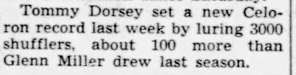
Celoron Park, Jamestown, New York (One nighter)
Tommy Dorsey and his Orchestra w/Frank Sinatra
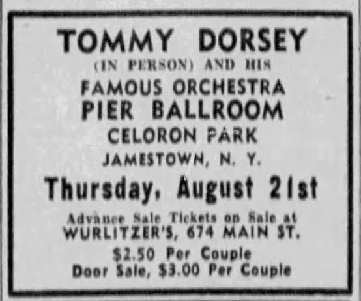
August 22, 1941
Radio
Live Remote from the Canadian National Exhibition, Toronto, Canada
4-5PM CJRC
Tommy Dorsey with Frank Sinatra
Concerts
Canadian National Exhibition, Toronto, Canada (August 22 - August 23) Tommy Dorsey and his Orchestra w/Frank Sinatra
Toronto Exposition, Toronto, Canada (August 22 - August 23) Tommy Dorsey and his Orchestra w/Frank Sinatra
(CNE DANCE PAVILION IN THE 40s)
August 23, 1941
Radio
Live Remote Canadian National Exhibition, Toronto, Canada
Tommy Dorsey & His Orchestra
5:45pm – 6:15pm
CHML
Concerts
Canadian National Exhibition, Toronto, Canada (August 22 - August 23) Tommy Dorsey and his Orchestra w/Frank Sinatra
August 24, 1941
Concerts
Lake Compounce, Bristol, Connecticut (August 24)
Tommy Dorsey and his Orchestra w/Frank Sinatra
NOTE: Ed O'Brien sends us a pertinent item from the August 27, 1941 issue of Variety:
"Celeron Park , Jamestown , New York , August 21.
Best biz of the season with 2,241 at $2.50 and $3 a couple advance and gate. At Lake Compounce , Bristol . Conn. Sunday
(August 24), Dorsey cracked his own mark by 700 with approx. 4,500 at $1.10. At Hershey Park , Hershey , Pa. band got okay
2,990 admissions, grossing $2,845."
Lake Compounce, Bristol, Connecticut (August 24)
Tommy Dorsey and his Orchestra w/Frank Sinatra
Tommy Dorsey and his Orchestra August 24, 1941, Lake Compounce, Bristol, Connecticut
(thanks to Carl R)
Connie Haines, Lake Compounce, Bristol, Connecticut, August 24, 1941 (thanks to Carl R)
Frank Sinatra, Lake Compounce, Bristol, Connecticut, August 24, 1941 (Lake Compounce Photos Courtesy of Rob Ronzello
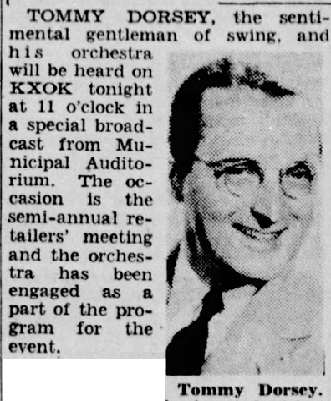
Daily News, August 24, 1941.
August 26, 1941
Concerts
Bardavon Theater, Poughkeepsie, New York
Tommy Dorsey and his Orchestra w/Frank Sinatra
Bardavon Theater, Poughkeepsie, New York
Tommy Dorsey and his Orchestra w/Frank Sinatra
August 27, 1941
Concerts
Paramount Theatre, New York City (August 27 - September 16) Tommy Dorsey
Frank Sinatra, Ziggy Elman, Buddy Rich, Connie Haines, Pied Pipers."
TD & Band set a new Labor Day Week B.O. record, taking in what
Variety described as a sensational $73,000. Movie on the bill, "Aloma Of The South Seas," with Dorothy Lamour and Jon Hall, was not con- sidered much of a draw. Dorsey and Co. was the main attraction.
Paramount Theatre, New York City (August 27 - September 16) Tommy Dorsey
Frank Sinatra, Ziggy Elman, Buddy Rich, Connie Haines, Pied Pipers."
Variety
9-3-41
Paramount, New York
(Reviewed Wednesday Evening, Aug. 27)
House management will have no problem this week figuring what is the draw for what promises to be a socko b. o. gross. Without sarongs, Tommy Dorsey and his ork, Jack Gilford and the Condos Brothers pitch in to make one of the most well knit stage bills seen here in a long while. With a fresh sarong in every scene (count 'em), Dorothy Lamour in Paramount's Aloma in the South Seas fails utterly to cope with one of the stupidest stories ( ?) to come out of Hollywood, ever. From the time the pit is buzzed and to The Star -Spangled Banner at the finale, the T. Dorsey gang handles one of the sweetest band shows ever staged. Pacing, library choice and general all-around showmanship comes off as "old hand" stuff to this group. A hunk of stomperoo Jive opens up proceedings, then the nifty Dorsey arrangement of "Yes, Indeed" is poured out, with Jo Stafford and trumpeter Chuck Peterson singing a chorus. Miss Stafford's pipings are a delight hereand later in the show. Condos Brothers knock off their now standard hoofing. Boys are tops at the precision tap work, and of course the individual flashes for the double wing stuff. Buddy Rich, Dorsey's diminutive drum- beater, is coaxed from his perch for a round of comedy tap bits with the Condos duo. Crowd lapped it up. TD's featured femme thrush, Connie Haines, sang "Kiss the Boys Goodbye" and a honey of an arrangement of the oldie, "I Can't Give You Anything But Love." Gal puts it all over most of her competition.
Ziggy Elman and his horn solo "Eli Eli" and his own number, And the Angels Sing. All of the old Elman push was back of both, and so were his fans. Ork's next number featured drummer Rich doing a weird original titled "Not So Quiet, Please." His tub-thumping is tops, but suffers from the fact all orks playing along the Stem now feature their side men, and with the evening audiences the idea is wearing thin.
Jack Gilford makes his first Paramount appearance, coming by way of the legit musical, "Meet the People," and Cafe Society nitery. He will soon have to think about grabbing some new material, but his stuff was sock here, anyway. Did his slow- motion mimicry, movie monolog satire and finished with the garbleroo piping of "Empty Saddles." All good comedy and well received. Frank Sinatra and the Pied Pipers were featured in the ork's next set. Sinatra singled for "Without a Song" and "This Love of Mine," latter backed with Dorsey's and three of the other slip- horners. Sinatra's dramatically pashy vocalizing is exceptionally saccharine; goes over with a bang. "I Guess I'll Have To Dream the Rest" was sung by Sinatra and the Pipers, then Sinatra closed with a burlesque arrangement and lyrical parody of "South of the Border," which was good and just the right touch at this point. Entire ork sang a sweet rendition of Dorsey's theme "I'm Getting Sentimental Over You," then closed with the Pipers, Sinatra and Miss Haines chirping a patriotic ditty, "Free for All." This is TD's seventh Paramount date, and house was packed last show opening day. Mitchell Ayres ork, Bob Evans and the new musical quartet, the Tune Toppers, will make up the next attraction.
USO ork. took up a coin collection at each show.
Harold Humphrey.
Billboard
9-6-41
A second contemporary trade review of the same engagement -- headed "Paramount, N.Y." and datelined to Variety, August 27 -- called it the band's seventh stand at the house within three years and its best showing yet, praising Dorsey's showmanship and the bill's pacing; it singled out Chuck Peterson's trumpet work and Jo Stafford's vocal on "Yes, Indeed," the Condos Brothers' tap routines, Jack Gilford's mimicry, and the orchestra's interpretation of "So Rare" (misprinted in some tellings as "Si Oliver"), closing with "I'm Getting Sentimental Over You" and, in deference to the house's policy, "The Star Spangled Banner." Source: Variety, August 27, 1941 (byline "Odec").
August 28, 1941
Concerts
Paramount Theatre, New York City (August 27 - September 16) Tommy Dorsey
Frank Sinatra, Ziggy Elman, Buddy Rich, Connie Haines, Pied Pipers."
Movie on the bill, "Aloma Of The South Seas," with Dorothy Lamour and Jon Hall
August 29, 1941
Concerts
Paramount Theatre, New York City (August 27 - September 16) Tommy Dorsey and His Orchestra with Frank Sinatra
August 30, 1941
Concerts
Paramount Theatre , New York City (August 27 - September 16) Tommy Dorsey and his Orchestra w/Frank Sinatra
August 31, 1941
Concerts
Paramount Theatre, New York City (August 27 - September 16) Tommy Dorsey and his Orchestra w/Frank Sinatra
September 1941
[Sinatra giving Dorsey one year's notice, September 1941 -- critical commentary]
Sinatra: "I thought, if I don’t make a move out of this band and try to do it on my own soon, one of those guys will do it, and I’ll have to fight all three of them to get a position. So I took a shot and I gave Mr. Dorsey one year’s notice. It was in September [1941]. I told him, ‘Tom, I’m gonna leave the band one year from today.’ Beyond that year I had another six months in the contract. [That contract was probably from January 1940 to January 1943.] Tommy said, ‘Sure.’ That’s all."
Source: Will Friedwald, "Sinatra! The Song Is You: A Singer's Art" (2018 revised edition), Ch. 3, "With Tommy Dorsey" (1940-1942)
September 1, 1941
Concerts
Paramount Theatre, New York City (August 27 - September 16) Tommy Dorsey and Orchestra with Frank Sinatra'
September 2, 1941
Concerts
Paramount Theatre , New York City (August 27 - September 16) Tommy Dorsey and his Orchestra w/Frank Sinatra
September 3, 1941
Concerts
Paramount Theatre , New York City (August 27 - September 16) Tommy Dorsey and his Orchestra w/Frank Sinatra
September 4, 1941
Concerts
Paramount Theatre , New York City (August 27 - September 16) Tommy Dorsey and his Orchestra w/Frank Sinatra
September 5, 1941
Concerts
Paramount Theatre, New York City (August 23 - September 5) Tommy Dorsey and his Orchestra w/Frank Sinatra
September 6, 1941
Concerts
Paramount Theatre , New York City (August 27 - September 16) Tommy Dorsey and his Orchestra w/Frank Sinatra
Steel Pier. Atlantic City, New Jersey (Never Happened)
Saturday Afternoon
Dance
Some sources list Tommy Dorsey as being at the Steel Pier on September 6, 1941. He was not there. The following advertisement from the September 6, 1941 Philadelphia Inquirer shows that Artie Shaw was there:
September 7, 1941
Concerts
Paramount Theatre , New York City (August 27 - September 16) Tommy Dorsey and his Orchestra w/Frank Sinatra
September 8, 1941
Concerts
Paramount Theatre , New York City (August 27 - September 16) Tommy Dorsey and his Orchestra w/Frank Sinatra
September 9, 1941
Concerts
Paramount Theatre , New York City (August 27 - September 16) Tommy Dorsey and his Orchestra w/Frank Sinatra
September 10, 1941
Concerts
Paramount Theatre , New York City (August 27 - September 16)
September 11, 1941
Concerts
Paramount Theatre , New York City (August 27 - September 16) Tommy Dorsey and his Orchestra w/Frank Sinatra
September 12, 1941
Concerts
Paramount Theatre , New York City (August 27 - September 16) Tommy Dorsey and his Orchestra w/Frank Sinatra
September 13, 1941
Concerts
Paramount Theatre , New York City (August 27 - September 16) Tommy Dorsey and his Orchestra w/Frank Sinatra
September 14, 1941
Concerts
Paramount Theatre , New York City (August 27 - September 16) Tommy Dorsey and his Orchestra w/Frank Sinatra
September 15, 1941
Concerts
Paramount Theatre, New York City (August 27 - September 16)
September 16, 1941
Concerts
Paramount Theatre , New York City (August 27 - September 16) Tommy Dorsey and his Orchestra w/Frank Sinatra
Ed O'Brien:
Dorsey opened with a first week run of $72,500, second week, following Labor Day, saw a drop off to $50,000 and the final week came in with a tally of $35,000. Grand total for the three-week run was $157,500.
September 17, 1941
Concerts
Fists Fly at September 17, 1941 Dorsey Party in New York City
NOTE: Ed O'Brien sends us this item from the
October 1, 1941 issue of Downbeat magazine:
One of the rarest fistic brawls ever to hit the stem splattered the gore of a number of prominent
New York characters all over the Brill Building
(on September 17th). The boys of the trade had gathered to celebrate the gala opening of Tommy
Dorsey's Brill penthouse, the entire top floor, which will be offices of his three new music publishing companies, Embassy, Mohawk, and Seneca.
Festivities got under way at 4:30 in the afternoon, and along about dusk, somebody unwittingly made an unsavory racial crack. Harry
Goodman, bassist brother of Benny and manager of the latter's Regent Music house, was within earshot.
Word passed between Harry and Gerald Griffin, one of the Griffin Brothers, who control the New York
Sunday Enquirer, which contains "the sheet," an important element in determining "hit" tunes. The words between Goodman and Griffin broadened into more and soon pokes were being traded, with Harry reportedly doing all right.
Then Joe Griffin, another Enquirer Griffin , got interested.
At this point, Frank Sinatra, Dorsey's vocalist, became irritated. More fists followed. It was alleged that Sinatra took care of himself and one or two other guys nobly, in fact, so well that
Sinatra and Hank Sanicola (Witmark man going with
TD) had to carry one of the victims out and down the street.
But no sooner had Frankie brushed his hands and straightened his tie than he was trailed by his victim, who resumed his orneriness, whereupon
Tommy Dorsey himself had to polish the gentlemen off. Jack Bregman of Bregman, Vocco and Conn was among the more casually interested celebrants.
December 1941
[War Breaks Out; Blackout Nights On Bergen Avenue]
With the family living on Bergen Avenue in Jersey City and Sinatra away on the road, the United States entered World War II in December 1941. Nancy's clearest memory of the following year was sitting with her mother in blacked-out rooms, curtains drawn and lights off.
Source: Nancy Sinatra, "Frank Sinatra, My Father" (1985).
December 22, 1941
With the country now at war, Frank kept working, cutting a recording session on 22 December 1941 sandwiched around the holiday. (Source: Richard Havers, "Sinatra" (Dorling Kindersley, 2007).)
September 18, 1941
Studio
New York City
BS067914 How Do You Do Without Me?
(J. DeVries/J. Bushkin)
Embassy Music Corp. (BMI)
Arranged by Paul Weston
-1 (3:09) CD: 07863 66353-2 "The Song Is You" 5CD set Vol 3
CD: RCA 9679-2-R
LP: SD 1000
78: 27710
The Atlanta Constitution
Radio
Make Believe Ballroom
WNEW 6PM
Tommy Dorsey and His Orchestra with Frank Sinatra
A Sinner Kissed An Angel
Make Believe Ballroom
WNEW 6PM
Tommy Dorsey and His Orchestra with Frank Sinatra
Thanks to Richard Cook for the above.
Hi Richard,
You inspired me to check the schedule for the Dorsey band on 9-18-41. Wow ! Jo Stafford nailed it when she told me "you had to be young."
There were morning and afternoon sessions at
RCA Studio 2 in N.Y.C. The band recorded six songs.
--ED
Then the WNEW appearance 6: P.M. followed by a huge all night party that turned into a brawl.
After the ball was over, the band may have slept for a few hours before heading out to Buffalo for a week's run at the Shea's
Buffalo ( 19th thru the 25th ) They would do seven shows per day. Dorsey worked and played hard. Frank told Vinnie Falcone that TD was a tremendous influence and he learned so much from the man.
--Ed
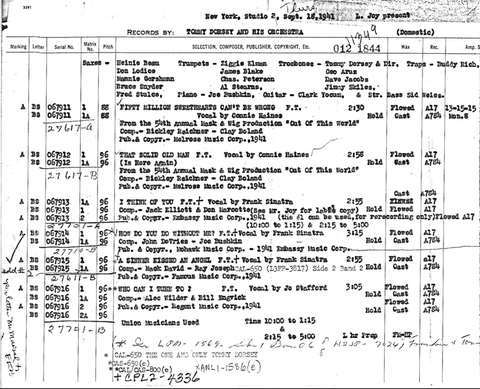
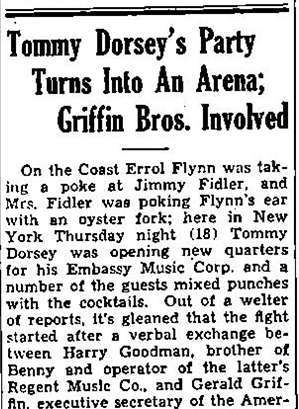
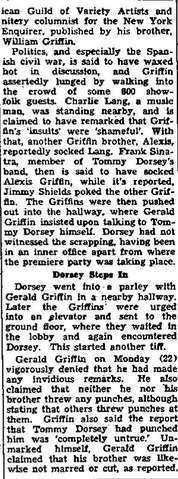
New York City
BS067913 I Think Of You
(Based on Rachmaninov Piano Concerto No. 2)
(J. Elliott/D. Marcotte)
Embassy Music Corp. (BMI)
Arranged by Paul Weston
-1 (2:53) CD: 07863 66353-2 "The Song Is You" 5CD set Vol 3
LP: SD 1000
78: 27701
Chattnooga Times
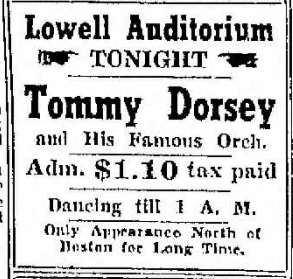
BS067914 How Do You Do Without Me?
(J. DeVries/J. Bushkin)
Embassy Music Corp. (BMI)
Arranged by Paul Weston
-1 (3:09) CD: 07863 66353-2 "The Song Is You" 5CD set Vol 3
CD: RCA 9679-2-R
LP: SD 1000
78: 27710
Altoona Tribune
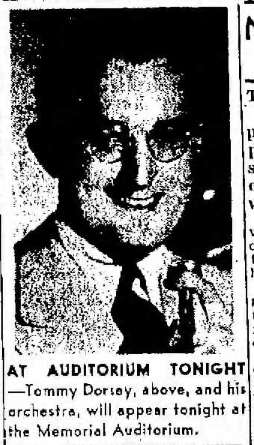
Bonne Terre Bulletin
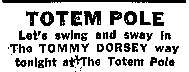
The Evening Sun
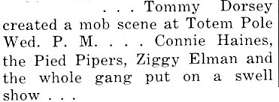
Indianapolis Star
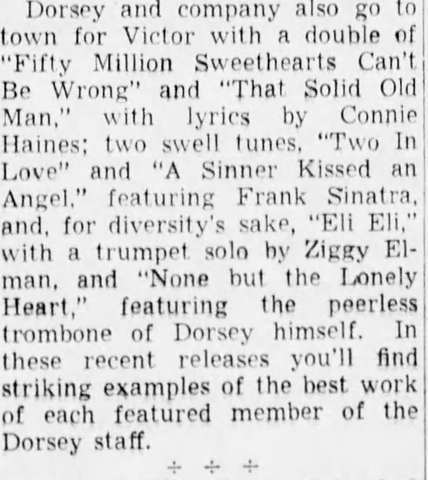
Saxes: Heinie Beau, Don Lodice, Manny Gershman, Bruce Snyder, Fred Stulce; Trumpets: Ziggy Elman, Jimmy Blake, Chuck Peterson, Al Stearns; Piano: Joe Bushkin; Trombones: George Arus, Dave Jacobs, Jimmy Skiles; Guitar: Clark Yocum; Bass: Sid Weiss; Drums: Buddy Rich
Note: I Think Of You -2 has not been located in the RCA vaults
The Indiana Countian

September 19, 1941
Concerts
Shea's Theatre, Buffalo , New York (September 19 - September 25) Tommy Dorsey and his Orchestra w/Frank Sinatra
Shea's Theatre, Buffalo , New York (September 19 - September 25)
Frank Sinatra on University at Buffalo Campus 1941
On September 22, 1941, the Tommy Dorsey Orchestra perform in Norton Hall for Pep Week. Dorsey's entourage included a young Frank Sinatra and drummer Buddy Rich.
The event was apparently well attended but received little coverage in the Bee Student newspaper.
Tommy Dorsey, the "sentimental gentleman"ť and his orchestra were in Buffalo, N.Y. for a week long engagement at Shea's Buffalo starting on Friday, September 19th. (see "Comes Tommy Dorsey"ť Buffalo Courier-Express, 19 September 1941)
It's interesting to note that Sinatra, only in his mid-20's at the time, was just a "featured"ť performer and not the main attraction.
Added entertainers for the Shea's shows included Paul Winchell, "world's greatest ventriloquist,"ť and the Condos Brothers, dancing stars.
Both Tommy Dorsey and Frank Sinatra made good use of their time in Buffalo, N.Y. as both made in-store appearances at Rab's Record Store, located at 1672 Main St, meeting their fans and signing autographs.
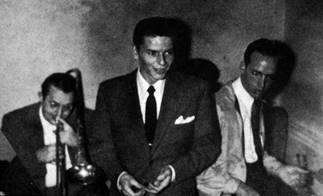
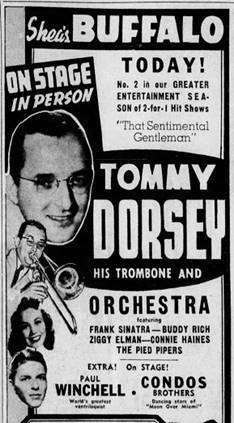
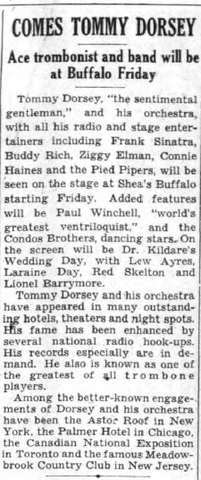
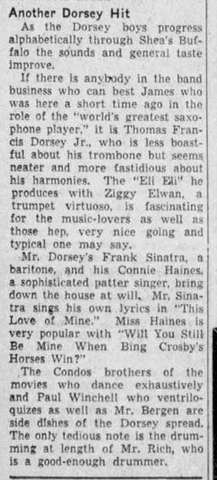
September 20, 1941
Concerts
Shea's Theatre, Buffalo , New York (September 19 - September 25) Tommy Dorsey and his Orchestra w/Frank Sinatra
September 21, 1941
Concerts
Shea's Theatre, Buffalo, New York (September 19 - September 25) Tommy Dorsey and his Orchestra w/Frank Sinatra
September 22, 1941
Concerts
Shea's Theatre, Buffalo , New York (September 19 - September 25) Tommy Dorsey and his Orchestra w/Frank Sinatra
Norton Union, University at Buffalo, Buffalo, New York
Tommy Dorsey and his Orchestra w/Frank Sinatra
Note: evening, after Shea's Theatre shows.
Norton Union, University at Buffalo, Buffalo, New York
Tommy Dorsey and his Orchestra w/Frank Sinatra
Note: evening, after Shea's Theatre shows.
Sinatra & Dorsey taken at the Norton Union, University at Buffalo, Buffalo, New York, September 22, 1940:
September 22, 1945, Hollywood Bowl, Los Angeles, CA
Music For The Wounded
Frank Sinatra, Dinah Shore, Bette Davis, Bing Crosby, Leopold Stokowski, Bob Hope, Bob Burns, Jack Haley, Artur Rubinstein
Popular Singers Frank Sinatra, Dinah Shore and Bing Crosby backstage at the Hollywood Bowl during a rehearsal of "Music for the Wounded" September 1945
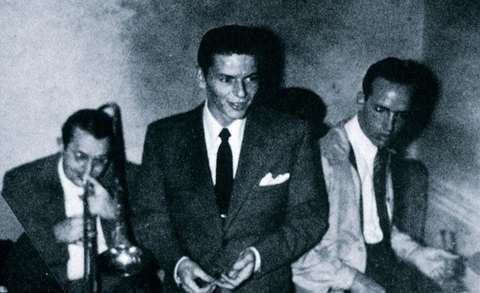
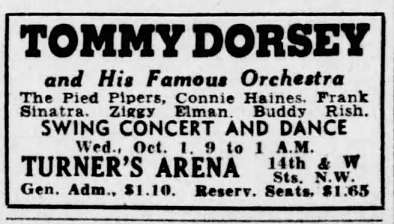
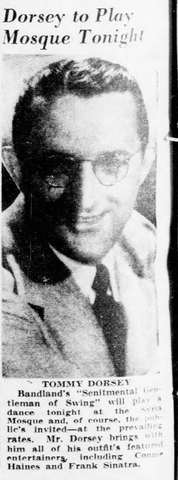
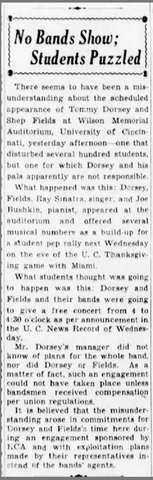
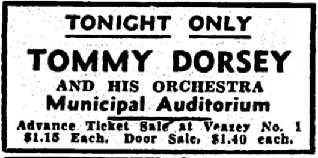
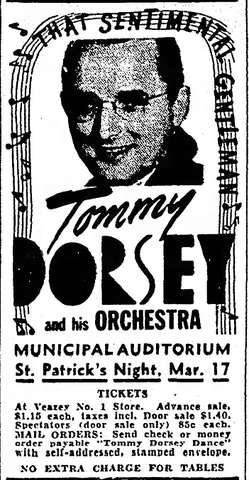
September 23, 1941
Concerts
Shea's Theatre, Buffalo , New York (September 19 September 25) Tommy Dorsey and his Orchestra w/Frank Sinatra
Shea's Theatre, Buffalo , New York (September 19 September 25) Tommy Dorsey and his Orchestra w/Frank Sinatra
Extra appearance:
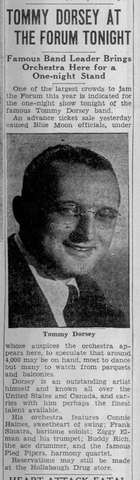
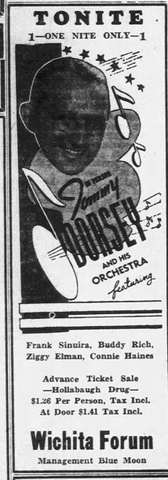
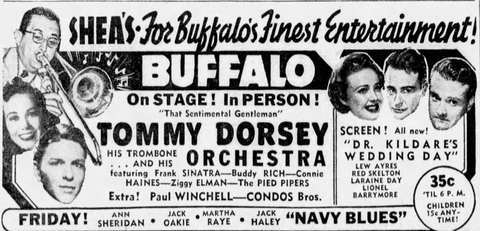
September 24, 1941
Concerts
Shea's Theatre, Buffalo , New York (September 19 - September 25) Tommy Dorsey and his Orchestra w/Frank Sinatra
Paired with Kildare's "Wedding Day"(MGM) Chief credit for sockeroo figures goes to Dorsey on stage. Rip- roaring $25,000 is up there with the best, where this outfit belongs. Variety
9-24-41
note: TD & Band took in an additional $3,000 for final two days of the seven day run. Made a grand total of
$28,000 for the week
--Ed
September 25, 1941
Concerts
Shea's Theatre, Buffalo , New York (September 19 - September 25) Tommy Dorsey and his Orchestra w/Frank Sinatra
NOTE: Ed O'Brien sends an item from the September 24, 1941 issue of Variety relating to the Shea's Theatre engagement:
"Tommy Dorsey paired with "Kildare's Wedding Day" (MGM). Chief credit for sockeroo figures (3,500 35-55) goes to Dorsey onstage. Rip-roaring $25,000 is up there with the best, where this outfit belongs."
September 26, 1941
Studio
New York City
BS067652 Violets For Your Furs
(T. Adair/M. Dennis)
Dorsey Brothers Music (ASCAP)
Arranged by Heinie Beau
-3 (3:02) CD: 07863 66353-2 "The Song Is You" 5CD set Vol 3
CD: RCA 8554-R-2
LP: SD 1000
78: 27690
BS067653 The Sunshine Of Your Smile
(L. Cooke/L. Ray)
Copyright Control
Arranged by Sy Oliver
-2 (2:29) CD: 07863 66353-2 "The Song Is You" 5CD set Vol 3
CD: RCA 2269-2-R
LP: SD 1000
78: 27638
Saxes: Heinie Beau, Don Lodice, Manny Gershman, Bruce Snyder, Fred Stulce; Trumpets: Ziggy Elman, Jimmy Blake, Chuck Peterson, Al Stearns; Piano: Joe Bushkin; Trombones: George Arus, Dave Jacobs, Jimmy Skiles; Guitar: Clark Yocum; Bass: Sid Weiss; Drums: Buddy Rich
Concerts
Rosemont Ballroom, Brooklyn , New York (September 26 - one-nighter) Tommy Dorsey and his Orchestra w/Frank Sinatra
Dorsey didn't do as well as expected here. About 2,000 at regular prices. Variety 10-1-41
--Ed
September 27, 1941
Concerts
Sunnybrook Ballroom, Pottstown, Pennsylvania (September 27 one-nighter)) Tommy Dorsey and his Orchestra w/Frank Sinatra
NOTE: Ed O'Brien sends this item along from the October 1, 1941 issue of Variety: "Rosemont B. Brooklyn, Sept. 26th . . . Dorsey didn't do as well as expected here; about 2,000 at regular prices. Next night (27th) at Sunnybrook B., Pottstown , Pa , however, band upped its record with a near-capacity 5,150, at $1. Sunday (28) at Arena, New Haven , crew pulled 8,500 matinee and evening at 45 cents to $1.10."
September 28, 1941
Concerts
Arena, New Haven, Connecticut (September 28 - one-nighter)
Tommy Dorsey and his Orchestra w/Frank Sinatra
Tommy Dorsey and his Orchestra w/Frank Sinatra
Sunday (28) at Arena, New Haven, Conn., crew pulled 8,500 matinee
and evening at 45 cents and $1.10
Variety
Arena, New Haven, Connecticut - (September 28 - one-nighter) Tommy Dorsey and his Orchestra w/Frank Sinatra
September 28, 1944 Sinatra visits the White House
September 28, 1944 Sinatra visits the White House
Identifying with marginal Americans, Sinatra supported Franklin Delano Roosevelt's New Deal: actively campaigning for the president in 1944 at considerable risk to his high-flying career. The President took Sinatra (with or without sugar?) to tea on September 28, 1944 at the White House. Invited along with saloon-keeper, Toots Shor and comedian Rags Ragland at the suggestion Democratic National Committee Chair, Bob Hannegan, the crooner sang Roosevelt's praise: "The greatest guy alive." Bantering with reporters upon leaving, he endorsed Roosevelt for reelection and joined the campaign. He spoke at rallies and on radio. When he put his money, $5000 near his mouth so to speak, the kid from Hoboken elicited condemnation from right-wing journalists like Lee Mortimer and Westbrook Pegler. This acrimonious exchange marked the end of Sinatra's honeymoon with the press and the beginning of a long feud with the fourth estate. The singer resented the double standard imposed on him. When Ginger Rogers and George Murphy (later elected to the U.S. senate from California) campaigned for Republican candidate, Tom Dewey, no adverse commentary surfaced. To his critics, Sinatra shot back: "My first real criticism came from the press when I campaigned for President Roosevelt in 1944. A few columnists took me to task insisting that entertainers should stick to entertaining. They also realize it is bad public relations to indulge in politics because you may lose fans who don't agree with you. However, I feel it is the duty of every American citizen to help elect the candidate of his choice."
note: Toots Shor idolized FDR as much if not more than Frankie.
Democratic National Committee chairman, Robert Hannegan, was a regular at Toots restaurant in New York. Knowing the affection Toots had for the President, Hannegan invited him to The White House for tea. Toots asked if he could bring his friends Frank and Rags. The three of them flew down from La Guardia the next day.
They entered the White House Red Room at exactly 3:00 P.M.
And there sat the great man. Frank was terrified. Roosevelt smiled and asked Frank to sit down. Little did Sinatra know that his idol would be dead in less than seven months. On his Max Factor show, 4-18-45, Sinatra would give a detailed account of the meeting and his conver- sation with the President.
Here is a photo of Rags, Frank and Toots after the meeting
The former First Lady, Eleanor Roosevelt ,presents Frank with a figurine, bearing a likeness of her late husband in Los Angeles, June 15, 1947
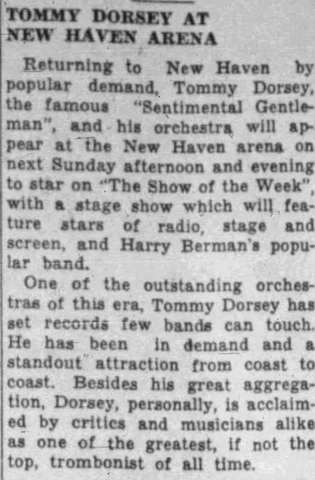
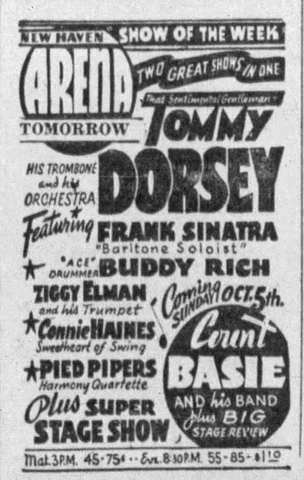
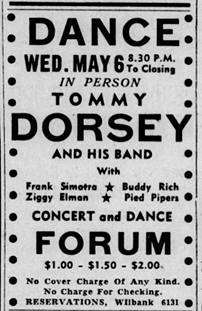
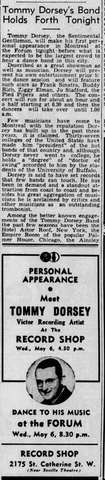
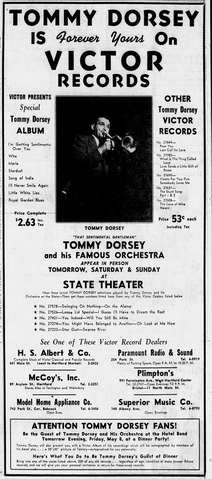
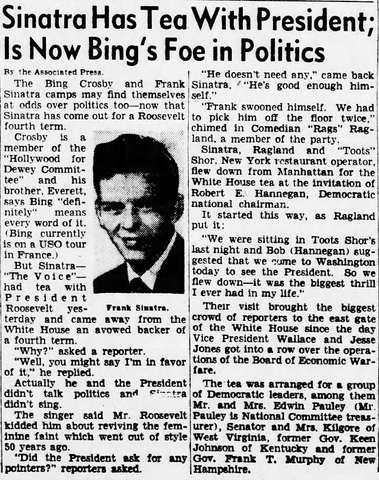
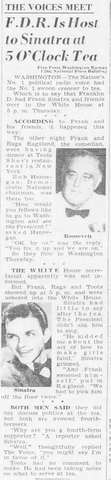
September 29, 1941
Concerts
Tantilla Gardens , Richmond, Virginia (September 29 - one-nighter) Tommy Dorsey and his Orchestra w/Frank Sinatra
NOTE: Ed O'Brien sent a pertinent item from the
October 11, 1941 issue of Billboard: "TD ork drew
$1,900 at Richmond's Tantilla Gardens last
Tuesday (30) pulling over 1,700 patrons at $1.10.
Nitery removed all tables from floor and ran strictly ballroom for this attraction. Name one-nighters usually play $1.65 at this spot and this was an experiment to draw the dancers and not the table sitters.
Note: Billboard had it wrong. Tantilla Gardens concert was on September 29, 1941 and it was a Monday.
Tantilla Gardens , Richmond, Virginia (September 29 - one-nighter) Tommy Dorsey and his Orchestra w/Frank Sinatra
The above advertisement appeared on September 27th. Note the misspelling of Sinatra's name
Here's the ad that ran on September 29th:
September 30, 1941
Concerts
Portsmouth Stadium, Portsmouth, Virginia
Tommy Dorsey and His Orchestra with Frank Sinatra
T. D. Tops for Portsmouth
PORTSMOUTH, Va., Oct. 11.--Despite threatening weather a crowd of 1,700 turned out for Tommy Dorsey and the last outdoor dance of the season, sponsored by the Gridiron Club at the local stadium. At $1.10 a head, the gross was $1,700 and the attendance was the largest ever at a local dance, indoor or outdoor. Billboard
10-18-41
Portsmouth, Virginia
Tommy Dorsey and His Orchestra with Frank Sinatra
Hard to read but here goes:
A Western Union messenger boy suddenly found himself the soloist with Tommy Dorsey’s band here last week. Buddy Rich, the band’s drummer, received a singing telegram on the occasion of his birthday the same night the band played a Gridiron Club date at the new stadium here. The messenger delivered the telegram during the dance and had to stand on the platform and sing Happy Birthday to You with the band accompanying him
Note: Billboard had twice cited Dorsey in Portsmouth, VA on October 11th. The above article references Buddy Rich's birthday which was September 30th. Buddy Rich was born September 30th, 1917.
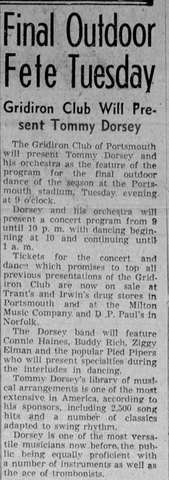
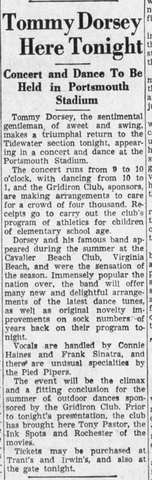
October 1, 1941
Concerts
Turner's Arena , Washington, D. C. (October 1 – one-nighter) Tommy Dorsey and his Orchestra w/Frank Sinatra
Note: This had erroneously been listed as the Uline Arena
Turner's Arena , Washington, D. C. (October 1 – one-nighter) Tommy Dorsey and his Orchestra w/Frank Sinatra
Note: This had erroneously been listed as the Uline Arena
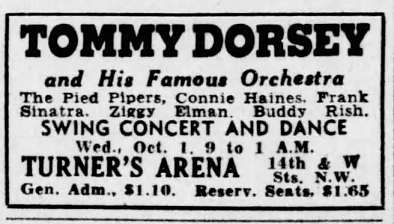
October 2, 1941
Concerts
Brookline Country Club, Philadelphia, Pennsylvania
Thursday Evening
One-Nighter
Tommy Dorsey And His Orchestra
Buddy Rich, Ziggy Elman, Joe Bushkin
Jo Stafford, Pied Pipers, Connie Haines
TD played his first public dance here in years, last
Thursday(2) at Brookline Country Club, for Jimmy
Martin, proved terrific despite competish from Shep
Fields and Tommy Reynolds the same night. With
400 dancers buying their ducats in advance at $1 plus tax, and 1,550 paying the upper gate fee of
$1.35 plus tax at the door. Dorsey gross a big $2,400.
Altho attendance was several hundred under Artie
Shaw, season first dance promotion, Dorsey's gross was the highest yet..
Billboard
10-18-41
Variety of 10-8-41 had different ticket prices and stated that Dorsey was almost capacity.
Tickets, according to them were $1.00, purchased in advance and $1.25 at the door.
Headline reads "Shaw, Tommy Dorsey hit capacity,
New Haven good to Basie, Fitzgerald.
Ed
TD still holds the dollar record for Brookline Country
Club, Phila, for his October 2nd(41) gig.
Billboard
3-21-42
Brookline Country Club, Philadelphia, Pennsylvania
Thursday Evening
One-Nighter
Tommy Dorsey And His Orchestra
Buddy Rich, Ziggy Elman, Joe Bushkin
Jo Stafford, Pied Pipers, Connie Haines
October 3, 1941
Concerts
Savoy Ballroom, New York City (one-nighter)
Friday evening
T.D. & Orch.
Savoy Ballroom, New York City (one-nighter)
Friday evening
T.D. & Orch.
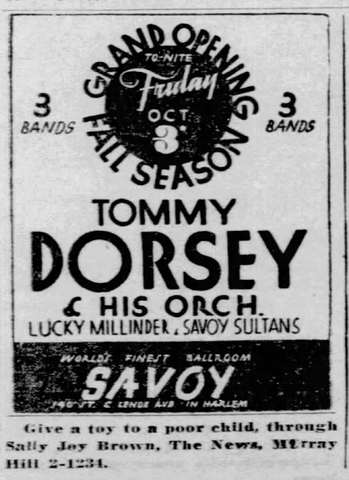
October 4, 1941
Concerts
Armory, Teaneck, New Jersey (October 4 - one-nighter)
Tommy Dorsey and his Orchestra w/Frank Sinatra
NOTE: Ed O'Brien sends along this item from the October 1, 1941 issue of Downbeat:
SINATRA CUTS 4 DISCS: MAY DO A SINGLE
New York - Frank Sinatra is making four sides for the Bluebird label, accompanied by a string ensemble, and if the discs sell well, he'll probably go out on his own as a solo act early in 1942. Sinatra recently signed a personal management contract with Tommy Dorsey's "Personal Management, Inc." headed by Leonard Vannerson. When he and Tommy feel the time is right, Frank will leave the Dorsey band, with Dorsey's agency continuing to handle his bookings. Dorsey has a similar contract with Connie Haines and the Pied Pipers, who also sing with his band now.
Armory, Teaneck, New Jersey (October 4 - one-nighter)
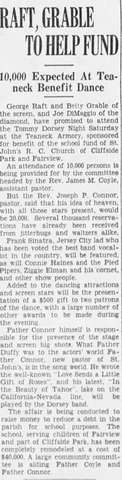
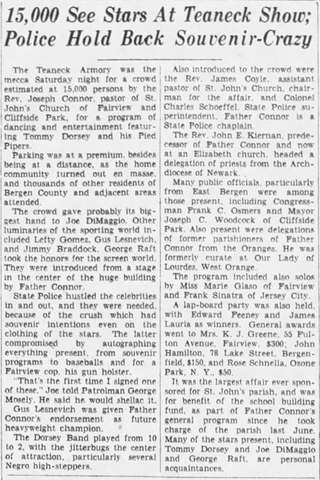
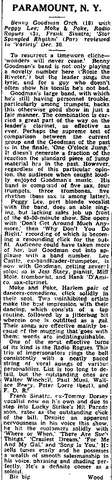
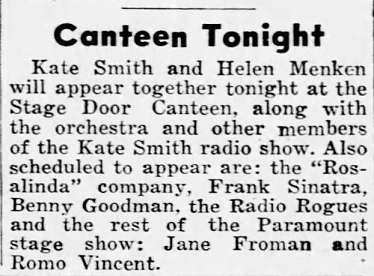
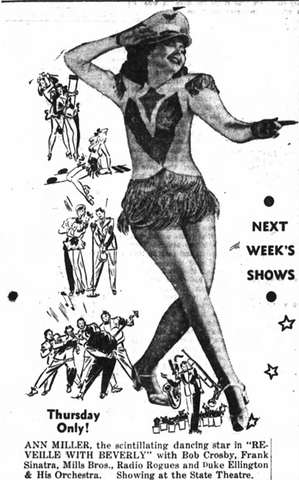
October 5, 1941
Concerts
Arena, Trenton, N.J. (one nighter)
Sunday evening
T.D. & Orch.
Tommy Dorsey( Arena, Trenton, N.J. Oct 5)
Dorsey hit solid $4,000 with about 5,000 attendance in three shows. Scale, 55 cents to $1.10.
Variety 10-8-41
T. D. Good at Trenton, B. C. TRENTON, N. J., Oct It -Tommy Dorsey, ushering a Sunday series.
at the Arena Sunday (5), proved big at the box office for promoter Jimmy Evans. No dancing, policy
being two afternoon and one evening shows, with standard acts supporting. Attendance hit approximately,
4,200 with gate scaled at 35 cents for matInees and 55 cents In the evening. reserved seats 75 cents and
$1. making gross about $2.700. Bobby Byrne heads the bill tomorrow, subbing for Count Basie, who was
pulled out by Local 802 last week.
Billboard
Arena, Trenton, N.J. (one nighter)
Sunday evening
T.D. & Orch.
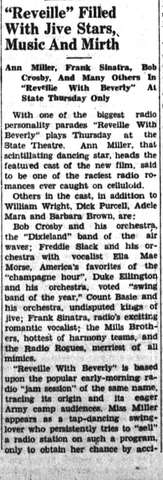
October 6, 1941
Concerts
Syria Mosque, Pittsburgh, Pennsylvania (October 6 - one-nighter) Tommy Dorsey and his Orchestra w/Frank Sinatra
"If there was any question of Tommy Dorsey's popularity in this district it has been dispelled with last night's turnout at Syria Mosque. The "Sentimental Gentleman" played a "one-nighter" for the Units Club of Syria Temple and more than 220 bought tickets and spent the very warm evening dancing to the Dorsey rhythms." --The Pittsburgh Press (Pittsburgh, Pennsylvania), October 7, 1941
Syria Mosque, Pittsburgh, Pennsylvania (October 6 - one-nighter):
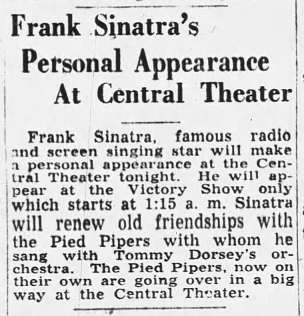
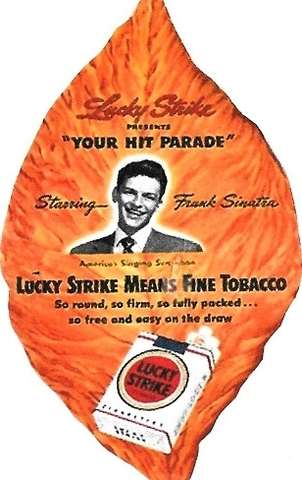
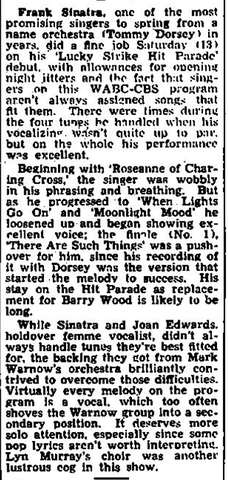
October 7, 1941
Concerts
Hamilton-Butler Sesqui-Centennial Celebration, Fairgrounds, Hamilton, Ohio (One-Nighter) Tommy Dorsey and his Orchestra w/Frank Sinatra
Hamilton-Butler Sesqui-Centennial Celebration, Fairgrounds, Hamilton, Ohio (one-nighter)
Aug. 24, 1992 - Dorsey, Sinatra and Rich helped Hamilton swing:
Journal-News, Monday, Aug. 24, 1992
Dorsey, Sinatra, Rich helped Hamilton swing during sesquicentennial in 1941
By Jim Blount
Ask anyone who was in town for Hamilton's 150th birthday celebration in 1941 what was the most memorable event and there's a good chance the answer will be the six nights of big band music and dancing held at the Butler County Fairgrounds.
A "Garden Under the Stars" was created for the five-band event, which was headlined by the talents of Tommy Dorsey, Frank Sinatra, Connie Haines, Buddy Rich and Ziggy Elman all in one night.
Dorsey, whose "I'm Getting Sentimental Over You" earned him the sobriquet "the sentimental gentleman" was billed as "the greatest swing trombonist in the country" whose music would appeal to Hamilton-area "hep cats and jive enthusiasts." Vocalist Connie Haines was called "the sweetheart of swing."
The "Garden Under the Stars" featured a sheltered, hardwood dance floor measuring 149 by 30.5 feet which could accommodate more than 2,000 people and tables and chairs. A 10-foot high white picket fence surrounded the area.
"The entire garden and the floor are illuminated by myriads of gaily-colored electric lights and sesquicentennial banners and buntings in attractive decorative arrangements," noted Frances Eberling, a Journal-News reporter."
Fred M. Stitsinger was chairman of the big-band committee and, according to the newspaper, "the one who conceived the idea of a Garden Under the Stars."
The series started Monday night, Oct. 4, 1941, with the Raymond Scott band; followed Tuesday by Tommy Dorsey; Wednesday by Henry King; Thursday by Leighton Noble; and Friday and Saturday by Frankie Masters.
Dorsey was the top draw, attracting "more than 4,000 swing-conscious Butler Countians and their sesquicentennial celebration guests" for a four-hour show, reported Bill Moeller.
"Dorsey played under severe handicap," Moeller said, because "he suffered a sprained back Sunday while playing tennis in Pittsburgh and was advised by his doctor to take it easy for several days."
Instead, Dorsey was on the Hamilton bandstand Tuesday night "for three hours without a break until intermission" and "had to be assisted from the stand."
The most requested songs were "Quiet Please," featuring drummer Buddy Rich, "And the Angels Sing," starring trumpeter Ziggy Elman; "I'll Never Smile Again" with Frank Sinatra and the Pied Pipers; and "Marie" and "Song of India" by the band.
Dorsey's "I'll Never Smile Again" had been the top tune of 1940 and would rank in the top 10 for the 1940-1949 decade.
Sinatra known for making teenage bobby-soxers scream and swoon was 23 years old and in the final year of his three-year stint with the Dorsey band.
Of his Hamilton audience, Dorsey said "it is one of the most enthusiastic crowds I've ever seen and one of the largest packed into a place this size."
Bill Moeller wrote that "several times the crowd had to be warned against shoving" because "jam-fans in the distant rows sought to get a better look at the Dorsey musicians."
"Although the music was not scheduled to start until 9 o'clock, many jive devotees were at the garden as early as 7 o'clock. A line started to form around the band stand shortly before 8 o'clock and the early birds still were in their original positions when the music stopped at 1 o'clock, " Moeller reported.
Attendance for the six nights of big-band music was about 9,000, including Thursday night when rain and cold limited the dance crowd to about 300 and caused cancellation of some other sesquicentennial programs. Total attendance for all events was about 100,000, according to 1941 newspaper reports.
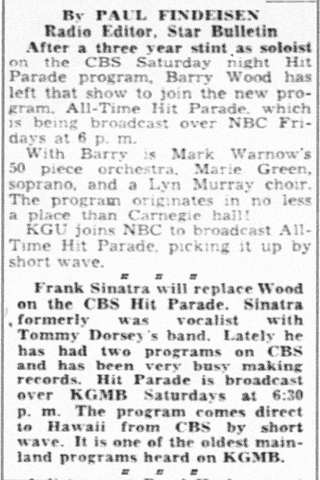
October 8, 1941
Concerts
Meyers Lake, Canton , Ohio (October 8 - one-nighter)
Tommy Dorsey and his Orchestra w/Frank Sinatra
Meyers Lake, Canton , Ohio (October 8 - one-nighter)
The Akron Beacon Journal (Akron, Ohio) · 8 Oct 1941
When I was working on my 1992 book, RCA gave me all of the session sheets from 1940 thru 1942. They also included some interesting odds and ends. Here is a copy of the contract Dorsey signed for his appearance in Canton, Ohio, 10-8-41.
Ed
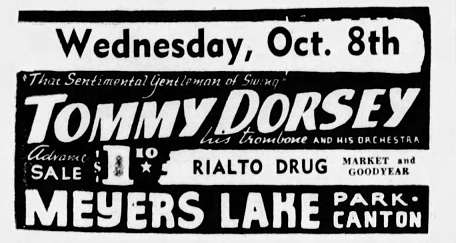
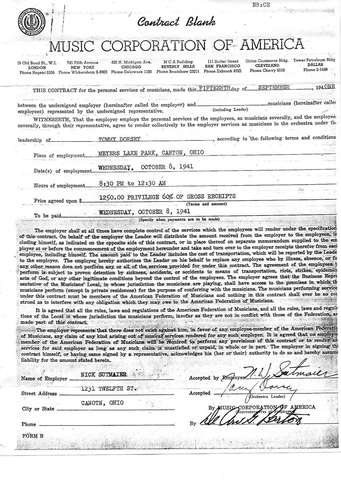
October 9, 1941
Concerts
Meadowbrook, Cedar Grove ,New Jersey (October 9 - October 28) Tommy Dorsey and his Orchestra w/Frank Sinatra
Thursday evening
Ed O'Brien:
T.D. & Orch open at Frank Dailey's Meadowbrook Ballroom until the 28th of the month. A number of radio shows would be broadcast from there during the band's two and a half week engagement. There are airchecks of Sinatra singing "Blue Skies," "I Guess I'll Have To Dream The Rest," "Violets For Your Furs" and "I Think Of You." .
Meadowbrook, Cedar Grove, New Jersey (October 9 - November 1) The Record (Hackensack, New Jersey) · 6 Oct 1941:
-----------------------------------------
October 9, 1946
Sinatra Wins Most Popular Screen Star Award
American singer and actor Frank Sinatra (1915 - 1998) (C) poses with Russian born studio executive Louis B. Mayer (1885 - 1957) and Albert Delacorte, the publisher of 'Modern Screen' magazine after winning the magazine's most popular screen star of 1946, October 9, 1946. The award was a bust of Sinatra. (Photo by CBS/Getty Images
Published in the Modern Screen issue dated January 1947, though note that the copyright notice in the issue is dated 1946, so it was actually published in late 1946.:
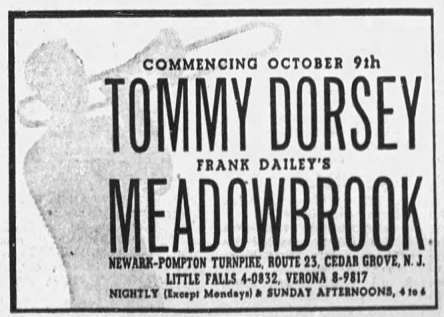
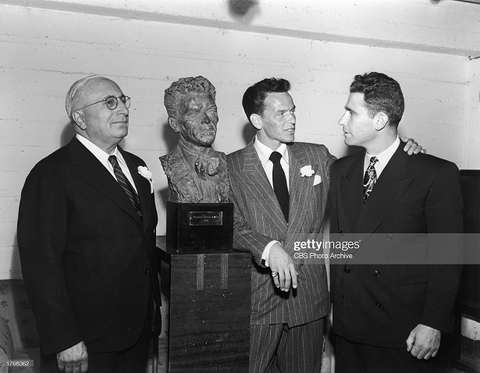
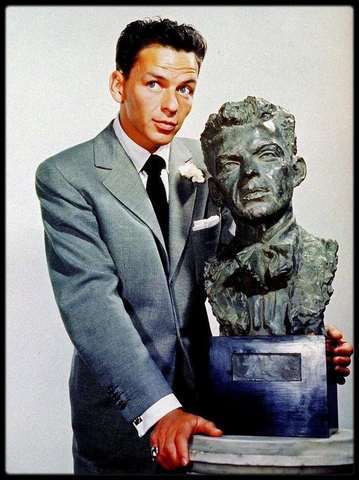
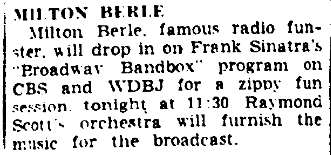
October 10, 1941
Radio
Live Remote: Meadowbrook, Cedar Grove, New Jersey
Friday Evening
Mutual Network - WOR New York City
Tommy Dorsey And His Orchestra
Frank Sinatra, Connie Haines, Jo Stafford, Pied Pipers, Sy Oliver, Ziggy Elman, Joe Bushkin, Heinie Beau
1. I'm Getting Sentimental Over You TD & Orch.
2. Swing High( Sy Oliver arg.) TD & Orch.
3. Violets For Your Furs( Heinie Beau arg.) Frank Sinatra
4. Somebody Loves Me Pied Pipers
5.Yes, Indeed ( Sy Oliver arg.) Jo Stafford & Chuck Peterson 6 .Blue Skies( Sy Oliver arg.) Frank Sinatra & Band Chorus 7.I Think Of You( Paul Weston arg.) Frank Sinatra 8.The Skunk Song Tommy Dorsey, Chuck Peterson, Pied Pipers 9.Hallelujah (Sy Oliver arg.) TD & Orch
10. Closing Theme TD & Orch.
Concerts
Meadowbrook, Cedar Grove ,New Jersey (October 9 - October 28) Tommy Dorsey and his Orchestra w/Frank Sinatra
October 11, 1941
Radio
Matinee at Meadowbrook
Meadowbrook, Cedar Grove , New Jersey
Tommy Dorsey and His Orchestra with Frank Sinatra
Concerts
Meadowbrook, Cedar Grove, New Jersey (October 9 - October 28) Tommy Dorsey and his Orchestra w/Frank Sinatra
Matinee at Meadowbrook
Meadowbrook, Cedar Grove , New Jersey
Tommy Dorsey and His Orchestra with Frank Sinatra
note: A second run of Saturday matinee shows directly from the Meadowbrook. When Dorsey opened at the nightclub on
[image referenced in source but could not be recovered]
[image referenced in source but could not be recovered]
CBS aired a 55 minute live show, starting at 5: p.m. The following week it was on from 4 P.M. to 5. All four weeks
featured the Saturday matinee show. The same schedule was repeated in October, beginning with the 10-11 broadcast. The
10-18, 10-25 and 11-1 were all presented over CBS on Saturday afternoon.
Mel Allen was the play-by-play announcer for the New York Yankees baseball team from 1940 to 1964. Mel was consid-
ered the "Voice of the Yankees." But 1941 was a tough year for him. Believe it or not, the Yanks were unable to find a
sponsor. And that was the year Joe DiMaggio had his 56 game hitting streak. Allen took any announcing job he
could find. And one of them turned out to be the announcer of college football scores during a live big band broadcast in
October of 1941. I wonder if he ever interrupted a Sinatra vocal with the score of the Notre Dame-Army game?
Ed
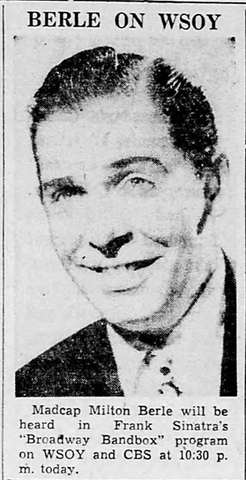
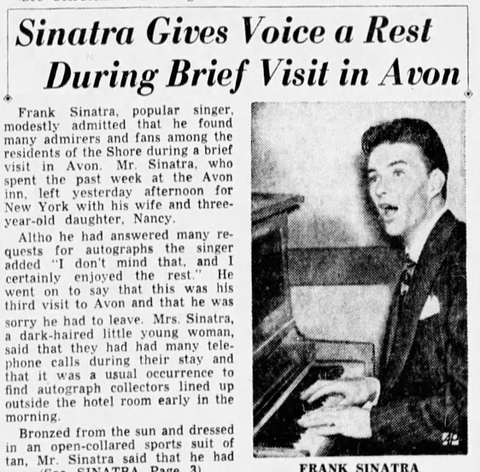
October 12, 1941
Radio
Live Remote: Meadowbrook, Cedar Grove, New Jersey
Sunday Evening
1:00 - 1:30 a.m.
Mutual Network - WOR New York City
Tommy Dorsey And His Orchestra
1. I'm Getting Sentimental Over You TD & Orch.
2. Swing High( Sy Oliver arg.) TD & Orch.
3. Violets For Your Furs Frank Sinatra
4. Yes Indeed( Sy Oliver arg.) Jo Stafford & Chuck Peterson
5. Deep River( Sy Oliver arg.) TD & Orch.
Fitch Bandwagon
Show: 163
Sunday
7:30 p.m. – 8:000 p.m.
NBC Red Network
Radio City
New York City
WEAF
Announcer: Jack Costello
Host: Tobe Reed
Sponsor: F.W.Fitch Company (shampoo)
Guests: Tommy Dorsey & His Orchestra
1. I'm Getting Sentimental Over You TD & Orch.
2. Will You Still Be Mine Connie Haines
3. This Love Of Mine Frank Sinatra
4. Yes, Indeed ( Sy Oliver arg.) TD & Orch..
5. None But The Lonely Heart TD & Orch.
6. Swing High TD & Orch.
7. Closing Theme TD & Orch.
Concerts
Meadowbrook, Cedar Grove, New Jersey (October 9 - November 1) Tommy Dorsey and his Orchestra w/Frank Sinatra
Fitch Bandwagon
Show: 163
Sunday
7:30 p.m. – 8:000 p.m.
October 13, 1941
Concerts
Hoboken Columbus Day Celebrations, Hoboken, NJ
Sinatra sang two songs plus National Anthem
Meadowbrook, Cedar Grove, New Jersey (October 9 - November 1) Tommy Dorsey and his Orchestra w/Frank Sinatra
Hoboken Columbus Day Celebrations, Hoboken, NJ
Sinatra sang two songs plus National Anthem
Thanks to Richard Cook for above listing and article.
October 14, 1941
Concerts
Meadowbrook, Cedar Grove, New Jersey (October 9 - November 1) Tommy Dorsey and his Orchestra w/Frank Sinatra
October 15, 1941
Concerts
Meadowbrook, Cedar Grove, New Jersey (October 9 - November 1) Tommy Dorsey and his Orchestra w/Frank Sinatra
October 16, 1941
Concerts
Meadowbrook, Cedar Grove, New Jersey (October 9 - November 1) Tommy Dorsey and his Orchestra w/Frank Sinatra
October 17, 1941
Radio
Live Remote: Meadowbrook, Cedar Grove, New Jersey
Friday Evening
CBS Network - WABC New York City
Tommy Dorsey And His Orchestra
11:30 p.m. - 12:00 a.m.
Concerts
Meadowbrook, Cedar Grove, New Jersey (October 9 - November 1) Tommy Dorsey and his Orchestra w/Frank Sinatra
Belleville High School, Belleville, NJ
Sinatra sang at least 3 songs accompanied by Frank Buchin(?) --This Love Of Mine
--My Melancholy Baby
--How Can You Get Along Without Me
Belleville High School, Belleville, NJ
Sinatra sang at least 3 songs accompanied by Frank Buchin(?)
Link to an interesting blog trying to confirm this event:
https://digg.com/cant-get-much-higher/link/did-frank-sinatra-really-perform-at-my-grandmas-high-school
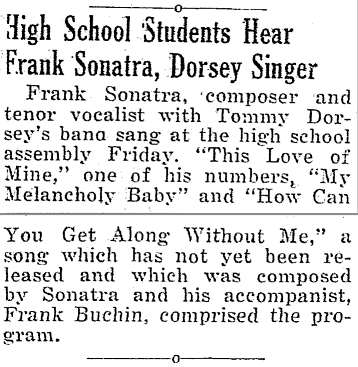
October 18, 1941
Radio
Live Remote: Frank Dailey's Meadowbrook Ballroom, Cedar Grove, NJ.
Tommy Dorsey & Orchestra
October 18, 1941
Saturday Evening
1:00 a.m. - 1:30 a.m.
Mutual Network
WOR
New York City
Concerts
Meadowbrook, Cedar Grove, New Jersey (October 9 - November 1)
Tommy Dorsey and his Orchestra w/Frank Sinatra
October 19, 1941
Radio
Live Remote: Frank Dailey's Meadowbrook Ballroom, Cedar Grove, NJ.
Tommy Dorsey and his Orchestra
Sunday Evening
11:30 p.m. - 12:00 a.m.
CBS Network
WABC
New York City
Announcer: Ed Fleming
1. I'm Getting Sentimental Over You TD & Orch
2. Swanee River ( Sy Oliver arg.) TD & Orch.
3. Who Can I Turn To? Jo Stafford
4. I Guess I'll Have To Dream The Rest Frank Sinatra & Pied Pipers
5. Swing High (Sy Oliver arg. + Buddy Rich & Ziggy Elman solos) TD & Orch,
("I Guess I'll Have To Dream The Rest" appears on Masters of Jazz Volume 10)
Concerts
Meadowbrook, Cedar Grove, New Jersey (October 9 - November 1)
Tommy Dorsey and his Orchestra w/Frank Sinatra
October 20, 1941
Concerts
Meadowbrook, Cedar Grove , New Jersey (October 9 - November 1) Tommy Dorsey and his Orchestra w/Frank Sinatra
Meadowbrook, Cedar Grove, New Jersey (October 9 - November 1) Tommy Dorsey and his Orchestra w/Frank Sinatra
A Monday so no Meadowbrook. Frank flew down to Monroe, North Carolina to sing at Bruce Snyder's wedding
(The Charlotte News - October 22, 1941)
(The Daily Tar Heel - October 31, 1941)
Thanks to Richard Cook for above listing.
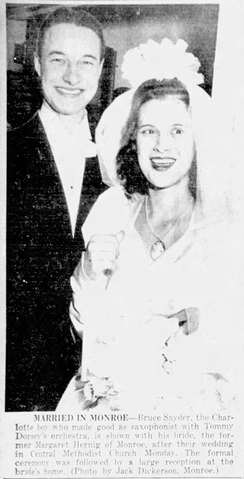
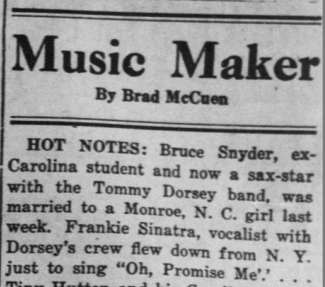
October 21, 1941
Concerts
Meadowbrook, Cedar Grove, New Jersey (October 9 – November 1) Tommy Dorsey and his Orchestra w/Frank Sinatra
October 22, 1941
Concerts
Meadowbook, Cedar Grove, New Jersey (October 9 - November 1) Tommy Dorsey and his Orchestra w/Frank Sinatra
October 23, 1941
Concerts
Meadowbrook, Cedar Grove , New Jersey (October 9 - November 1) Tommy Dorsey and his Orchestra w/Frank Sinatra
October 24, 1941
Concerts
Meadowbrook, Cedar Grove , New Jersey (October 9 - November 1) Tommy Dorsey and his Orchestra w/Frank Sinatra
October 25, 1941
Radio
Saturday
5:30 -5:55 PM
WABC AM NYC
T.D. Orch.
Ed O'Brien:
This was Dorsey's first Saturday show in the fall of 1941. It was set to be the usual "Dorsey Hour," but NBC was broadcasting the college football game between Minnesota and Michigan at Ann Arbor. The game ran over and TD's show was an abbreviated half-hour. Upside was the avoidance of a head-to- head battle with the Glenn Miller band, which was aired on another network from 5 to 5:30.
Live Remote: Meadowbrook Ballroom, Cedar Grove, New Jersey
Saturday Evening
CBS -Radio
WABC
New York City
1:00 - 1:30 a.m.
Tommy Dorsey And His Orchestra
Frank Sinatra, The Pied Pipers, Jo Stafford, Connie Haines, Buddy Rich, Ziggy Elman, Joe Bushkin
Concerts
Meadowbrook, Cedar Grove, New Jersey (October 9 - November 1)
Tommy Dorsey and his Orchestra w/Frank Sinatra
October 26, 1941
Radio
Live Remote: Meadowbrook Ballroom, Cedar Grove, New
Jersey
Sunday Evening
10:00 p.m.- 10:30 p.m.
Mutual Network - WOR New York City
Tommy Dorsey and His Orchestra.
Vocal(s): Frank Sinatra
Live Remote: Meadowbrook Ballroom, Cedar Grove, New Jersey
Sunday Evening
11:30 p.m.- 12:00 a.m.
CBS Network
WABC
New York City
Tommy Dorsey and His Orchestra.
Vocal(s): Frank Sinatra.
Concerts
Meadowbrook, Cedar Grove , New Jersey (October 9 - November 1) Tommy Dorsey and his Orchestra w/Frank Sinatra
October 27, 1941
Concerts
Pittsburgh, Pa. (one-nighter)
Dorsey & band
Monday Evening
Meadowbrook was dark.
Show was broadcast on Pittsburgh radio station.
This one has always bugged me. I can find no reference to Dorsey playing in Pittsburgh on October 27, 1941. I have checked Pittsburgh papers for that week and there was nothing about Tommy Dorsey and his Orchestra playing there that week. He had played the Syria Mosque in Pittsburgh on October 6th and there had been good press. I find it odd that there would be no press for the October 27th engagement. It could have been a private function or a University/College dance. I checked the student newspaper "The Pitt" archives for the University of Pittsburgh for that week but none of the editions mention Dorsey being in town. --Scott
I'm wondering if the confusion on this date comes from several ads regarding the Dean Hudson appearance in Pottsville, PA on October 27, 1941. Many of the ads, like the one below, had Tommy Dorsey's name appearing prominently but only as presenting Dean Hudson. -- Scott
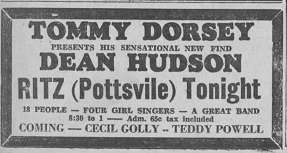
October 28, 1941
Radio
Live Remote: Meadowbrook Ballroom, Cedar Grove, New Jersey closing night
Tuesday Evening
CBS Radio - WABC New York City
Tommy Dorsey And His Orchestra
Connie Haines, Frank Sinatra, Buddy. Rich, Ziggy Elman, Pied Pipers, Jo. Stafford, Sy Oliver, Chuck Peterson --I Think Of You Frank Sinatra --Swingin' On Nothin'( Sy Oliver arg.) Jo Stafford, Chuck Peterson & Band Chorus --Blue Skies (Sy Oliver arg) Frank Sinatra & Band Chorus
("Blue Skies" appears on Masters of Jazz Volume 10 & CD: Voice VCD 1103 - "This One's For Tommy")
Concerts
Nutley High School, Passaic, New Jersey (Tuesday, October 28, 1941 solo performance) Accompanied by Henry Cole on Piano
Setlist:
--I Guess I'll Have To Dream The Rest
--I'll Never Smile Again,
--Night And Day
--This Love Of Mine
(See Article Below)
Meadowbrook, Cedar Grove , New Jersey (October 10 - November 1) Tommy Dorsey and his Orchestra w/Frank Sinatra
Nutley High School, Passaic, New Jersey (Tuesday, October 28, 1941 solo performance) The Herald-News (Passaic, New Jersey) · 4 Nov 1941:
This was a great find. But - - - I must correct a claim Frank made here. He most certainly had vocal training. John Quinlan was his teacher, beginning in 1937. Quinlan had sung at the Metro- politan Opera. He taught Frank the rudimentary skills of singing. Frank would admit later on Quinlan got the Hoboken sound out out of his voice. The vocal exercise he assigned Frank, going up and down the scales, was "Let Us Wander By The Bay." Al Viola told me Frank was still practicing that 40 years later. During an interview in Australia, in January 1955, Frank mentions Quinlan and speaks of his regret that John had passed away the previous year. Quinlan was from Australia and had always hoped of returning someday. Frank had planned to bring him along. Frank certainly had voice method lessons.
--ED
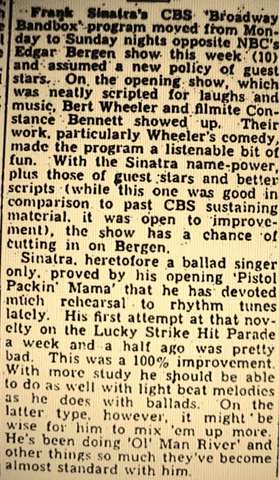
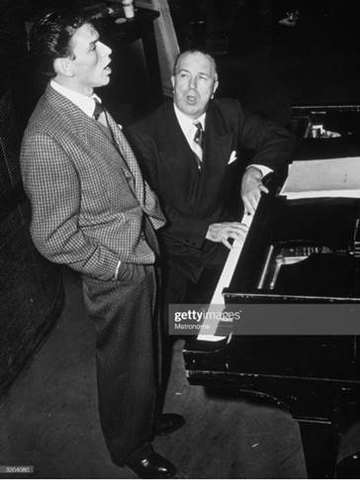
October 29, 1941
Concerts
Meadowbrook, Cedar Grove, New Jersey (October 10 - November 1) Tommy Dorsey and his Orchestra w/Frank Sinatra
October 30, 1941
Concerts
Meadowbrook, Cedar Grove , New Jersey (October 10 - November 1st) Tommy Dorsey and his Orchestra w/Frank Sinatra
Meadowbrook, Cedar Grove , New Jersey (October 10 - November 1st) Tommy Dorsey and his Orchestra w/Frank Sinatra
The Herald-News, Passaic, New Jersey, Oct 29th, 1941 for an event on October 30th
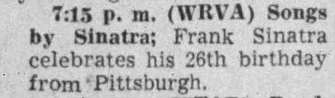
October 31, 1941
Radio
Tommy Dorsey & Orch., October 31, 1941
Friday Evening
CBS Radio
WABC
New York City
Live Remote
Concerts
Meadowbrook, Cedar Grove , New Jersey (October 10 - November 1st) Tommy Dorsey and his Orchestra w/Frank Sinatra
November 1941
[Manie Sacks Agrees To Record Frank As A Soloist]
Nancy Sinatra: While still touring with Dorsey's band, Frank asked Columbia Records executive Manie Sacks if he would record him as a solo act. Sacks agreed on the spot, though Frank's contract with Dorsey meant Columbia had to wait to make good on it.
Source: Nancy Sinatra, Frank Sinatra: An American Legend, 1995.
[Dorsey band returns to LA for Palladium and 'Ship Ahoy']
Kaplan: In November 1941 the Dorsey band headed back to Los Angeles for a return Palladium engagement and to film the MGM musical 'Ship Ahoy,' in which Sinatra sang three numbers in close-up, including 'Poor You' alongside Red Skelton.
Source: James Kaplan, "Frank: The Voice" (2010)
November 1, 1941
Radio
Tommy Dorsey And Orchestra
Saturday Afternoon
CBS Radio
WABC
New York City
5:00 p.m. - 5:55 p.m.
Concerts
Meadowbrook, Cedar Grove , New Jersey (October 10 - November 1st) Tommy Dorsey and his Orchestra w/Frank Sinatra
November 2, 1941
Radio
Live Remote: Chicago, Illinois
Sunday Evening
10:45 p.m. - 11:00 p.m.
CBS - Radio - WBBM
One-Nighter
November 3, 1941
Concerts
State Fair Grounds, Detroit, Michigan (November 3 & 4, 1941) Monday & Tuesday evenings
Tommy Dorsey & His Orchestra
Frank Sinatra, Jo Stafford, Connie Haines,
Pied Pipers, Buddy Rich, Sy Oliver, Joe Bushkin
Ed O'Brien: beginning of RCA Caravan Tour with Shep Fields and Dorsey orchestras. Billboard dubbed it "a tremendous record promotion." Bands played to SRO houses Operators and dealers were admitted free. Public paid $1.10 admission.
Note: Previous listings had this event at the Masonic Temple, Detroit
State Fair Grounds, Detroit, Michigan
Detroit Free Press (Detroit, Michigan) 2 Nov 1941
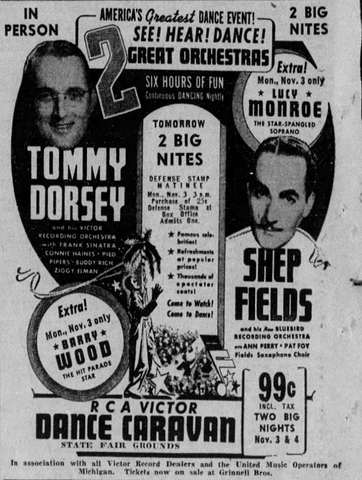
November 4, 1941
Concerts
State Fair Grounds, Detroit, Michigan (November 3 & 4, 1941) Tuesday Evening
Tommy Dorsey & His Orchestra
Frank Sinatra, Jo Stafford, Connie Haines,
Pied Pipers, Buddy Rich, Sy Oliver, Joe Bushkin
Note: Previous listings had this event at the Masonic Temple, Detroit
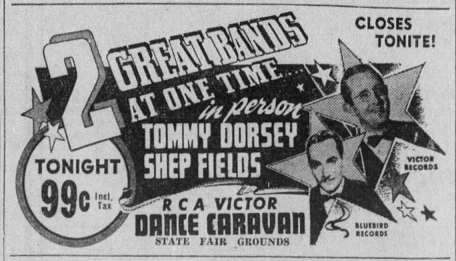
State Fair Grounds, Detroit, Michigan (November 3 & 4, 1941) Tuesday Evening
Tommy Dorsey & His Orchestra
Frank Sinatra, Jo Stafford, Connie Haines,
Pied Pipers, Buddy Rich, Sy Oliver, Joe Bushkin
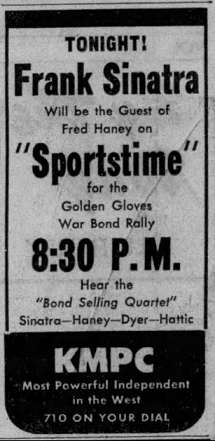
November 5, 1941
Concerts
Cleveland Auditorium, Cleveland, Ohio (5-9)
Wednesday through Sunday
Tommy Dorsey & His Orchestra
Frank Sinatra, Jo Stafford, Connie Haines,
Pied Pipers, Buddy Rich, Sy Oliver, Joe Bushkin
Ed O'Brien:
RCA Caravan continued
Caravan drew 7,629 (Friday), 5,806 (Saturday), 5,377 (Sunday)
The Cleveland Press, in cooperation with RCA, ran a few contests during the five day engagement. 1. To choose a couple of girl warblers to sing with the band during their stay. 2. Public attempted to predict the recordings the band would perform during the performances
Cleveland Auditorium, Cleveland, Ohio (5-9)
Wednesday thru Sunday
Tommy Dorsey & His Orchestra
Frank Sinatra, Jo Stafford, Connie Haines,
Pied Pipers, Buddy Rich, Sy Oliver, Joe Bushkin
Today! For 5 big nights. In person, that sentimental gentleman, Tommy Dorsey and his Victor
recording orchestra with Frank Sinatra, Connie Haines, Pied Pipers, Buddy Rich, Ziggy Elman,
and at the same time, Shep Fields and his Bluebird recording orchestra with Ann Perry, Pat Foy,
Fields Saxophone Choir. Extra added attractions! Wed. Nov. 5th - Lucy Monroe, Star-Spangled
soprano. Thurs. Nov. 6 - Barry Wood, Hit Parade star. Hear RCA Victor Cleveland Press song
queen winners, 2 local girls will sing with two great bands. RCA Victor Dance Caravan, Public
Auditorium Nov. 5th to 9th. 65 cents including tax, Sat. Nite $1.00. Doors open 7 p.m.
Cleveland Plain Dealer
November 5, 1941
BALLROOM OPS SQUAWK TO MCA THAT COMPETITION SET UP BY RCA VICTOR S DORSEY-FIELDS CARAVAN HURT THEIR BIZ
Cleveland, Nov. 18 - Dance promoters in the area touched by the RCA-Victor Dance Caravan squawked last week that the opposition set up by the combination, which used Tommy Dorsey and Shep Field's bands, had put a sizeable dent in their business. Lloyd Meyers, operator of the Aragon Ballroom, Cleveland, for one, said that the four-day stand of the Caravan at Cleveland ruined his take all that week. It played Cleveland Aud., Nov. 5-9. Most of the squawks were directed at MCA's Cleveland office, which booked Dorsey and Fields and also services promotions in that area. Beefs were based on the Caravan's low admission (65 cents) for Dorsey and Fields, plus the flooding with paper of each town the Caravan touched, given to Record distributors, dealers, etc. Dance men complained that Dorsey, who is a high-powered draw on the road, wasn't available to them often and on this trip through their territory was in opposition to them, hence the complaints to MCA, which books him. Often the booking of a name like Dorsey by a ballroom spells the difference between a profit and loss during a season. RCA, however, made every' effort in booking the Caravan to avoid injuring any regular promoters. They were taken into consideration at each opportunity. In one instance the Caravan played the spot of an established promoter, at Lakeside Park, Dayton. Caravan drew 7,629 Friday (7) at Cleveland Auditorium, 5,806 next night and 5,300 Sunday, its last date of 'Cleveland, all at 65 cents. Next night (10) 3,682 crowded Lakeside Park, Dayton, O. at $1.10. At Columbus Auditorium, next stand, it drew 3,245 and 3,987 at $1.10 advance/$1.35 door; Thursday at Music Hall, Cincinnati, it played to 2,337 and Friday, at same spot, pulled 4,329. Saturday at Indiana Roof, Indianapolis, there were 4,200 at $1.10 and $1.35, Final show at Armory, Louisville, Ky., Sunday, drew 4,788.
Variety
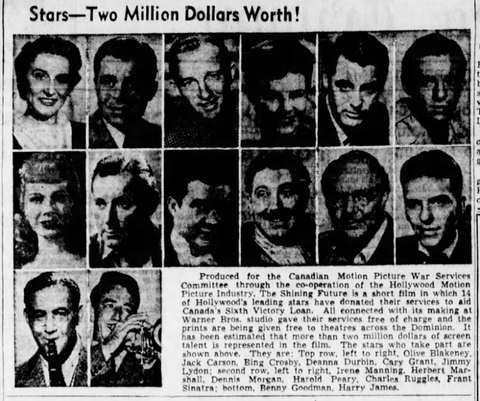
November 5, 1943, Sinatra visits Tami Mauriello at Madison Square Gardens, New York
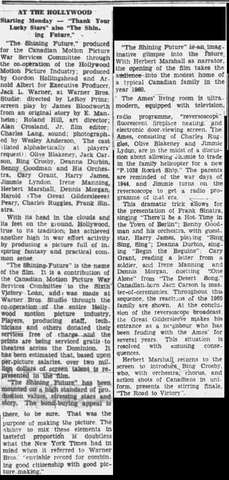
November 6, 1941
Concerts
Cleveland Auditorium, Cleveland, Ohio (5-9)
Wednesday thru Sunday
Tommy Dorsey & His Orchestra
Frank Sinatra, Jo Stafford, Connie Haines,
Pied Pipers, Buddy Rich, Sy Oliver, Joe Bushkin
Cleveland Auditorium, Cleveland, Ohio (5-9)
Variety 11-12-41
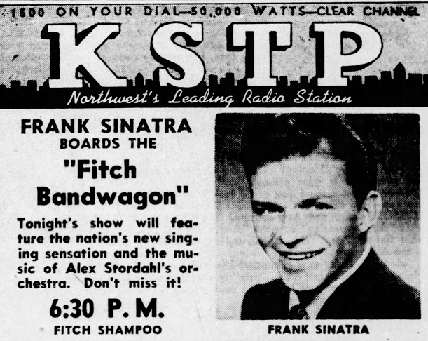
November 7, 1941
Concerts
Cleveland Auditorium, Cleveland, Ohio (5-9)
Wednesday thru Sunday
Tommy Dorsey & His Orchestra
Frank Sinatra, Jo Stafford, Connie Haines,
Pied Pipers, Buddy Rich, Sy Oliver, Joe Bushkin
November 8, 1941
Concerts
Cleveland Auditorium, Cleveland, Ohio (5-9)
Wednesday thru Sunday
Tommy Dorsey & His Orchestra
Frank Sinatra, Jo Stafford, Connie Haines,
Pied Pipers, Buddy Rich, Sy Oliver, Joe Bushkin
November 9, 1941
Concerts
Cleveland Auditorium, Cleveland, Ohio (5-9)
Wednesday thru Sunday
Tommy Dorsey & His Orchestra
Frank Sinatra, Jo Stafford, Connie Haines,
Pied Pipers, Buddy Rich, Sy Oliver, Joe Bushkin
November 10, 1941
Radio
Live Remote: Lakeside Ballroom, Dayton, Ohio
Monday Evening
CBS Network
WHIO
Dayton, Ohio
11:30 p.m.- 12:00 a.m.
Tommy Dorsey And Orchestra
1. I'm Getting Sentimental Over You TD & Orch.
2. On The Alamo TD & Orch.
3. I Think Of You Frank Sinatra
4. I May Be Wrong TD & Orch.
5. Embraceable You Jo Stafford & Pied Pipers
6. Hallelujah (Sy Oliver arg.) TD & Orch.
Dorsey's stint was in the usual T.D manner. Arrangements absolute tops for listening, programming absolute masterful and talent display on the terrific side.
What we have said about jive not bearing other transmission didn't apply in this instance, largely because Dorsey's jive is of a shrewd sort and not permitted to get out of control. Some wild swing was heard all right, but there was an excuse for it and it was not allowed to become unintelligible to the radio listener.
The Pied Pipers, paced by fem Jo Stafford, carried off vocal laurels with their beautiful harmonizing. Trumpeter Chuck Peterson also scored with his nutmeg-grater larynx on "Skunk Song." Frank Sinatra handled ballads well, and Connie Haines was cute in her Dixie-accented chirpings.
Announcer was of a type that was unable to inform public of next number's name without throwing in some unnecessary lingo.
ON THE AIR WITH DICK CARTER
BILLBOARD
11-22-41
Concerts
Lakeside Park, Dayton, Ohio
Monday evening
Tommy Dorsey & Orch.
Frank Sinatra, Connie Haines, Jo Stafford,
Pied Pipers, Joe Bushkin, Buddy Rich,
Sy Oliver
Attendance 3,682 at $1.10 per admittance
The Dayton Herald (Dayton, Ohio) · 11 Nov 1941
Lakeside Park, Dayton, Ohio
Dayton Daily News (Dayton, Ohio) · 10 Nov 1941:
November 11, 1941
Radio
Columbus Auditorium, Columbus, Ohio
RCA Dance Caravan Tour w/Tommy Dorsey Orchestra
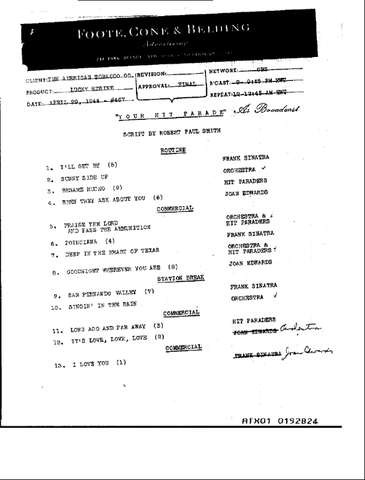
Concerts
Columbus Auditorium, Columbus, Ohio (11-12)
RCA Dance Caravan Tour
Tuesday and Wednesday evenings w/Tommy Dorsey Orchestra
Note: Ed O'Brien provided this listing and the following details. Attendance was 3,245 (11) and 3,987 (12) at $1.10 in advance and $1.35 at the door.
Columbus Auditorium, Columbus, Ohio (11-12)
RCA Dance Caravan Tour
Tuesday and Wednesday evenings w/Tommy Dorsey Orchestra
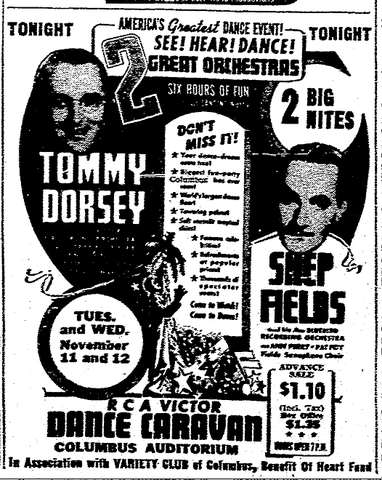
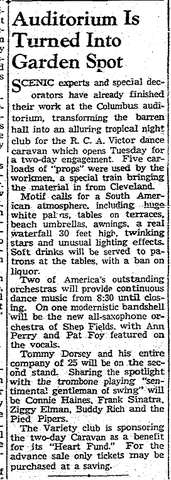
November 12, 1941
Radio
Live Remote: Columbus Auditorium, Columbus, Ohio
Wednesday Evening
Mutual Network - WHKC Columbus, Ohio
10:00 - 10:30 p.m.
Tommy Dorsey And His Orchestra
Concerts
Columbus Auditorium, Columbus, Ohio (11-12)
RCA Dance Caravan Tour
Wednesday evening
Tommy Dorsey & Orchestra
Frank Sinatra, Connie Haines, Jo Stafford, The Pied
Pipers, Buddy Rich, Joe Bushkin, Ziggy Elman
Attendance: 3,987 at $1.10 in advance and $1.35 at the door.
November 13, 1941
Concerts
Music Hall, Cincinnati, Ohio (13-14)
Thursday Evening
Dorsey, F.S & Co. crowd of 2,337 Thursday, Friday 4,329
RCA Caravan Pulls 6,666 in Cincy; UC Cats Nettled
CINCINNATI, Nov. 15 -RCA-Victor Dance Caravan. highlighting the Tommy Dorsey and Shep Fields orchestras, attracted 2,337 dancers, at $1..10 a head, to Topper Ballroom in Music Hall here Thursday night. Friday night, with prices the same, nearly doubled Thursday's take, when 4,329 marched through the turnstiles. The two day event got good promotion and advance publicity in tie-ups with The Cincinnati Times Star and station WKRC. A free swing concert by the Dorsey and Fields orks, in Wilson Auditorium on the Cincinnati University campus which failed to come off yesterday afternoon as scheduled, riled the pin feathers of some 1,200 college rug-cutters. Both leaders put In an appearance, but, college cats wanted their orks, too. Local RCA-Victor officials blamed the mix-up on the Cavalcade advance brigade, which had promised the college kids too much. University authorities had tough time getting the disappointed jive fans to leave the hall peacefully. The Caravan did well on its five days in Public Auditorium, Cleveland. Opening night (5) pulled 5,997 at 65 cents.. Thursday. (6) was better, with 6,382 laying It on the line. Friday (7) saw the biggest biz with 7.628 at 55 cents admissions. Saturday, with admissions upped to $1.00, saw 5,806 dancers In the hall, despite inclement weather. Getaway night (8) attracted 5,377 at 65 cents. At Lakeside Park. Dayton, O., Monday (10), the Caravan played to 3,682 dancers at $1.10. Tuesday, at the Auditorium. Columbus, 0., the Dorsey-Fields orchestra pulled 3,245, with ducats marked at $1.1O, in advance, and $1.35 at the door. At the same prices 3.987 dancers crowded the Columbus Hall Wednesday. The Caravan Is set tonight and tomorrow night at the Indiana Roof Ballroom, Indianapolis. This afternoon the Tommy Dorsey and Shep Fields musicians entertained RCA employees from the Indianapolis and Bloomington, Ind. plants at a special matinee performance at the Indiana Roof. Billboard
11-22-41
Music Hall, Cincinnati, Ohio
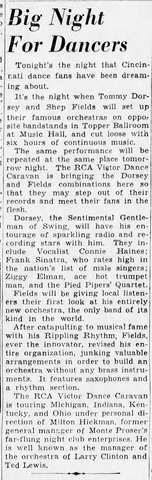
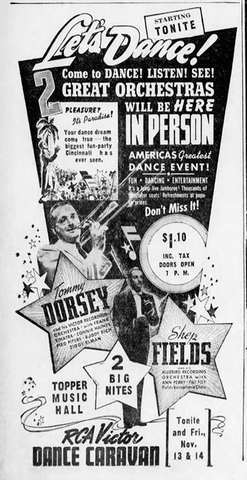
November 14, 1941
Concerts
Wilson Memorial Auditorium, University of Cincinnati, Cincinnati, Ohio Tommy Dorsey, Shep Fields, Joe Bushkin, Frank Sinatra
Music Hall, Cincinnati, Ohio (13-14)
Dorsey, F.S & Co. crowd of 2,337 Thursday, Friday 4,329
Wilson Memorial Auditorium, University of Cincinnati, Cincinnati, Ohio Tommy Dorsey, Shep Fields, Joe Bushkin, Frank Sinatra
The Cincinnati Enquirer (Cincinnati, Ohio) · 15 Nov 1941 (Frank Sinatra is misidentified as Ray Sinatra):
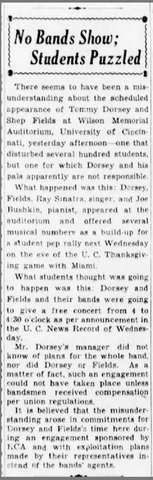
Music Hall, Cincinnati, Ohio (13-14)
Dorsey, F.S & Co. crowd of 2,337 Thursday, Friday 4,329
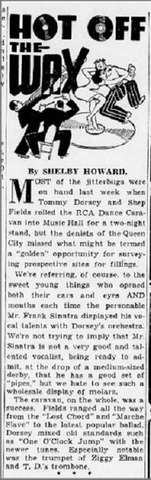
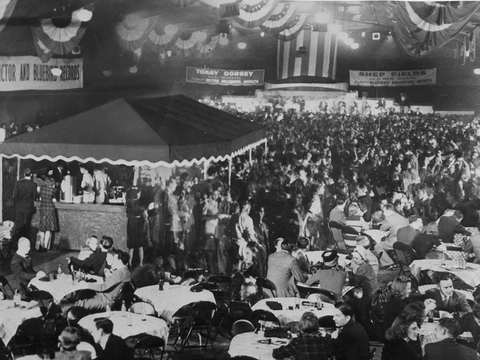
November 15, 1941
Concerts
Indiana Roof, Indianapolis, Indiana
Monday evening
TD & Orch.
Attendance 4,200
$1.10 and $1.35 per person
Indiana Roof, Indianapolis, Indiana
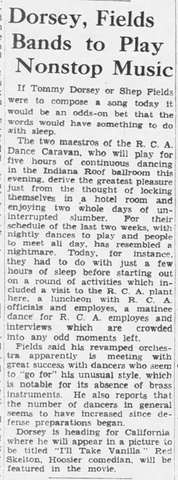
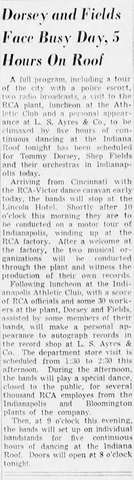
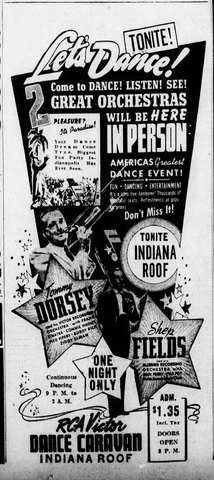
November 16, 1941
Radio
Armory, Louisville, Kentucky
T.D, F.S. & Orch.
9:30 pm - 10pm
Concerts
The Armory, Louisville, Kentucky
Sunday evening
T.D, F.S. & Orch. final show of RCA Caravan series
Attendance 4,788 at $1.20 per head.
DATELINE: Louisville, Ky . . .Ballroom operators squawk to MCA that competition set up by RCA Victor's Dorsey-Fields Caravan hurt their biz.
T.D./S. Fields bands in Louisville with RCA Carnival and TD playing Ziggy Elman's horn; as Ziggy has split lip (for 6 weeks). T.D. & Orch left for Hollywood after Caravan series.
Variety 11-19-41
RCA Dance Caravan Tour
Sunday Evening
The Armory
Louisville, Kentucky
Tommy Dorsey And His Orchestra
Ed O'Brien:
Ziggy Elman had split his lip during the tour.
Tommy Dorsey, a consummate musician, took up the slack by playing Ziggy's horn. Reports from the trade magazine were more than favor- able. Dorsey's horn solos thrilled the audiences.
Here is a nice photo of Tommy and Frank at the
Louisville Armory.
If you look closely, you'll see the men are in uniform. The show was at the Louisville Armory. Probably a number of military personnel were in attendance. Frank had the girls squealing when he started with Harry James. By mid-1940 he had become the star of Dorsey's band. TD recognized his value and gave him the lion's share of the vocals from there on out. That evening in Louisville, the band drew 4,788 people at $1.20 a head. Dorsey played Ziggy's trumpet on a number of songs and the audience loved it.
The next documented appearance is an appearance at the Palace Theater, South Bend, Indiana for 4 appearances on November 19th.
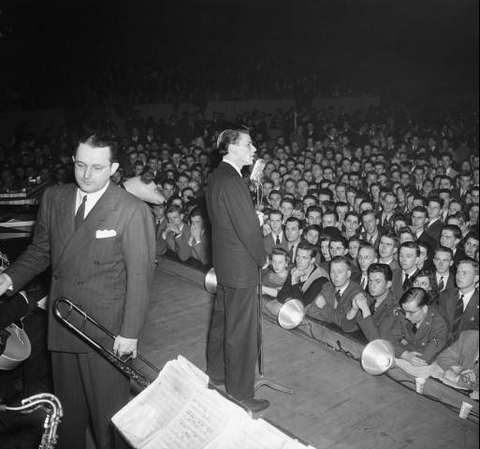
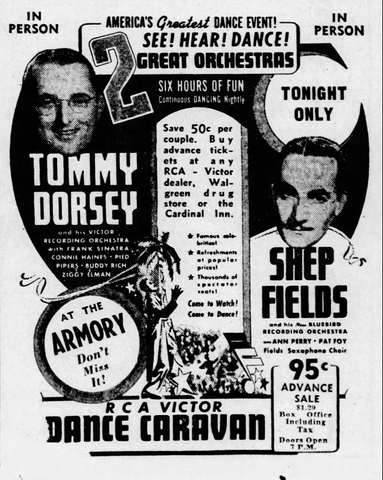
November 18, 1941
Concerts
Trianon, Toledo, OH
Tommy Dorsey and his Orchestra w/Frank Sinatra
November 19, 1941
Concerts
Palace Theater, South Bend, Indiana
One Day Only with 4 performances: 2:20, 4:35, 7, 9:25
On Screen: "The Secrets of the Lone Wolf"
South Bend, Ind. – Tommy Dorsey's band staged a mutiny here recently when the band played a one-nighter at the Palace Theatre. It happened on the third show but TD was the guy who carried off the bounty. After the old familiar theme song Tommy gave out with the down beat for the next tune but Ziggy Elman was in there pitching ahead of him and the band blasted into "Happy Birthday" for a surprise that left even the great TD flustered. From then on the show was a mad house that ended only when Frank Sinatra made the presentation of a $500 defense bond from the entire personnel of the band.
Downbeat
12-15-41
(Thanks to Ed for the Downbeat article)
[image referenced in source but could not be recovered]
Palace Theater, South Bend, Indiana
The South Bend Tribune (South Bend, Indiana) 16 Nov 1941:
[image referenced in source but could not be recovered]
[image referenced in source but could not be recovered]
November 20, 1941
Concerts
Palace Theater, Akron, Ohio (November 20-23)
Thursday
Tommy Dorsey And His Orchestra
Notes: TD & Co. Drew Over 33,000 Fans During This Stint
5 Show: 1:00, 3:15, 5:30, 7:45, 10:00
November 21, 1941
Concerts
Palace Theater, Akron, Ohio (20-23)
Tommy Dorsey And His Orchestra
Notes: TD & Co. Drew Over 33,000 Fans During This Stint
5 Shows: 1:30, 3:40, 5:50, 8:00, 10:10
November 22, 1941
Concerts
Palace Theater, Akron, Ohio (20-23)
Thursday
Tommy Dorsey And His Orchestra
Notes: TD & Co. Drew Over 33,000 Fans During This Stint
5 Show: 1:00, 3:15, 5:30, 7:45, 10:00
November 23, 1941
Concerts
Palace Theater, Akron, Ohio (20-23)
Thursday Evening
Tommy Dorsey And His Orchestra
Notes: TD & Co. Drew Over 33,000 Fans During This Stint
November 24, 1941
Concerts
Palace Theater, Youngstown, OH (24-27)
Tommy Dorsey And His Orchestra
The band went from the Palace to the Palace to the Palace. First up was a one-nighter on Tommy's birthday at the Palace in South Bend, Indiana (19th)Then four days at the Palace in Akron, 11/20 to 23 and then Youngstown the 24th thru the 26th. A few days later they headed west to begin filming "I'll Take Manila" at MGM. --Ed
Palace Theater, Youngstown, OH (24-27)
Tommy Dorsey And His Orchestra
Note: This second ad sent along by Richard Cook states the band were there for four days, November 24-27, not just November 24-26.
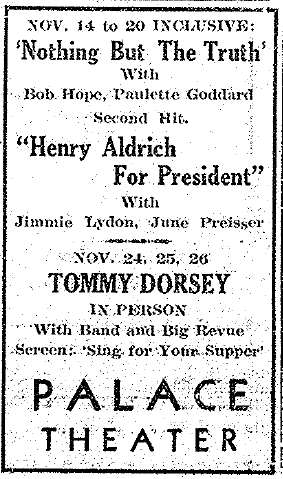
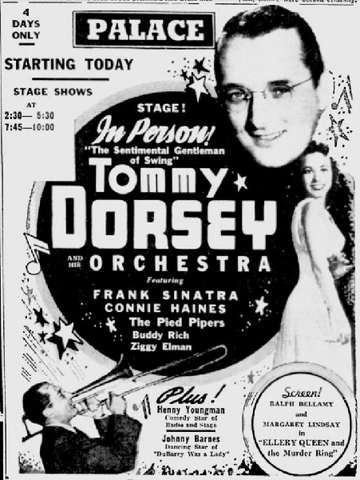
November 25, 1941
Concerts
Palace Theatre, Youngstown, Ohio (November 24-27)
Tommy Dorsey & His Orchestra
On Screen: Sing For Your Supper
November 26, 1941
Concerts
Palace Theatre, Youngstown, Ohio (November 24-27)
Tommy Dorsey & His Orchestra
On Screen: Sing For Your Supper
November 27, 1941
Concerts
Palace Theatre, Youngstown, Ohio (November 24-27)
Tommy Dorsey & His Orchestra
On Screen: Sing For Your Supper
December 1, 1941
Monday
T.D & band began filming "I'll Take Manila" ("Ship Ahoy") at MGM IN Hollywood.
[Photo: Sinatra, Dorsey, and Connie Haines]
A photo caption notes Frank performing with Tommy Dorsey and the orchestra on December 1, 1941, with Connie Haines jitterbugging in the front row.
Source: James Kaplan, "Frank: The Voice" (2010).
December 6, 1941
[Palladium closing party at Lana Turner's]
After a Saturday night playing the Palladium, a select crew from the Dorsey band -- including Tommy Dorsey, Buddy Rich, and Frank Sinatra -- drove to twenty-year-old Lana Turner's Tudor house in Brentwood for an after-hours party with heavy drinking and marijuana (Joey Bushkin played dirty songs on Turner's white grand piano). Buddy Rich believed Turner was interested in him and ended up in her bed, though too drunk to do anything.
Source: James Kaplan, "Frank: The Voice" (2010).
December 7, 1941
[Lana Turner's mother brings war news]
The morning after the Brentwood party, Lana Turner's mother Mildred let herself into the house with her own key and found musicians passed out everywhere. She had come to tell everyone that the country was now at war (Pearl Harbor).
Source: James Kaplan, "Frank: The Voice" (2010).
[Pearl Harbor attack]
Consiglio: Consiglio notes that America entered WWII after the Japanese attacked Pearl Harbor on December 7, 1941, framing the wartime backdrop of Frank's rise with the Dorsey band.
Source: Tony Consiglio (as told to Franz Douskey), "Sinatra and Me: The Very Good Years" (2012).
[Pearl Harbor bombing, wartime context]
Consiglio: Consiglio recalls the Japanese bombing of Pearl Harbor on December 7, 1941, killing more than seventeen hundred Americans, as the backdrop against which Frank's early wartime stardom and love-song repertoire took off.
Source: Tony Consiglio (as told to Franz Douskey), "Sinatra and Me: The Very Good Years" (2012).
After Pearl Harbor, Frank was drafted almost immediately but was classified 4-F and rejected because of a punctured eardrum from his difficult birth; he tried unsuccessfully to enlist for several more years.
Source: Nancy Sinatra, Frank Sinatra: An American Legend, 1995.
December 16, 1941
Studio
MGM, Los Angeles
Tuesday afternoon
I'LL TAKE MANILA {RETITLED SHIP AHOY}
Orchestra conducted by Tommy Dorsey
Arrangements by Axel Stordahl
Poor You
10 takes takes 2, 4, 6, 8 & 10 were mastered all had a running time of 1:12
The Last Call For Love with The Pied Pipers
14 takes take 1(2:29), 4(2:25), 5(2:22), 7(2:25), 11(2:23) and 14(2:20) were mastered
Note: Session info provided by Ed O'Brien
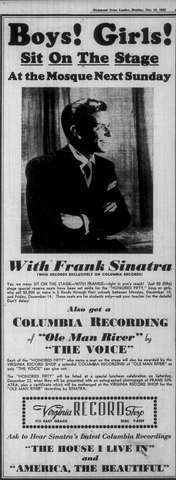
December 18, 1941
Studio
MGM Hollywood
I'LL TAKE MANILA (RETITLED SHIP AHOY)
Thursday
Orchestra conducted by Georgie Stoll
Arrangement by Sy Oliver
Blue Skies
with the Tommy Dorsey Orchestra
Take 3(2:52), 4(2:50) and 5(2:52) were mastered
Ed O'Brien notes:
Frank's concern regarding the cutting room
floor were certainly well founded. "I'll Take Tallulah" and
the Berlin classic were both deleted from the film.
Throughout the forties into the early fifties, Frank
sang the song on radio, in concerts, and then on his
TV shows. A couple of memorable performances were
a Jubilee show for 9-6-45 and the Philly Convention
Hall from 11-2-45. The former had Louis Armstrong
backing Sinatra with his great trumpet playing and the
latter captured the teenage craze for Frank in the mid
forties.
The MGM recording was finally issued in 1997.
December 20, 1941
Radio
Spotlight Champion Of Champions, A Coca Cola Spotlight Band Red, White and Blue Program
Network: WOR (NYC) Syndicated
Time: 10:15 - 10:45 PM (EST)
Sponsored: Coca Cola Company
Performers: Tommy Dorsey Orchestra, Frank Sinatra, Jo Stafford, Connie Haines
Announcer: Gil Newson
1. opening spot
2. Free For All - Frank Sinatra
3. Embraceable You - Jo Stafford
4. Solid Old Man - Connie Haines
5. The Sunshine Of Your Smile - Frank Sinatra
6. Yes Indeed - Jo Stafford
7. Swing High - Tommy Dorsey solo
8. This Love Of Mine - Frank Sinatra
9. closing spot
TT 30mins.
Ed O'Brien noted:
The December 20, 1941 Coca-Cola Spotlight show from Hollywood had a much talked about slip from the announcer. He introduced Tommy as Jimmy Dorsey. Consequently, Variety wrote "trade got a big bowl out of the slip." The Dorsey band cut 62 titles in 1941 and Sinatra was featured on 29 of them.
December 21, 1941
Radio
Spotlight Champion Of Champions, A Coca Cola Spotlight Band Red, White and Blue Program
Network: Syndicated
Sponsored: Coca Cola Company
Performers: Tommy Dorsey Orchestra, Frank Sinatra, Jo Stafford, Connie
Haines
Announcer: Gil Newson
TT 30mins.
December 22, 1941
Studio
Hollywood
PBS061991 How About You?
(from the MGM Film Babes On Broadway)
(R. Freed/B. Lane)
EMI Feist Catalog Inc. (ASCAP)
Arranged by Paul Weston
-1 (2:52) CD: 07863 66353-2 "The Song Is You" 5CD set Vol 3
CD: RCA 8554-2-R
LP: SD 1000
78: 27749
Saxes: Heinie Beau, Don Lodice, Manny Gershman, Bruce Snyder, Fred
Stulce; Trumpets: Ziggy Elman, Jimmy Blake, Chuck Peterson, Al Stearns;
Piano: Joe Bushkin; Trombones: George Arus, Dave Jacobs, Jimmy Skiles;
Guitar: Clark Yocum; Bass: George Boehm; Drums: Buddy Rich
note: Session ran from 8:30 to 11:30 P.M.
There were three songs recorded:
1. What Is This Thing Called Love ? vocal Connie Haines
2. Winter
Weather vocal
Pied Pipers
3. How About
You vocal
Frank Sinatra
It has been claimed that Sinatra also recorded "Blues In
The Night" and "Tell It To A Star." I have the session sheet
and there is no indication of any additional recordings.
Bernadette Moore was the archivist when I was working
on the 1992 discography. She checked all the files at
RCA and all of the record vaults throughout the country.
There was nothing to be found. I have copies of all the
recording dates with Sinatra at RCA. Nothing. But
the claim has been made in both Dorsey and Sinatra
discographies. One last thing: Songs were recorded
and scrapped throughout Frank's years with the band,
but the information was always available on the record-
ing sheets.
Ed
note: Burton Lane told me that Yip Harburg and he were thrilled by Sinatra's vocal on "Poor You" and "The Last Call For
Love"
at MGM for "I'll Take Manila." And when Lane heard Frank's vocal on "How About You?," he was doubly thrilled. Lane told me
that everyone knew Sinatra was going to make it big.
Ed
Radio
Spotlight Champion Of Champions, A Coca Cola Spotlight Band Red, White and Blue Program
Network: Syndicated
Sponsored: Coca Cola Company
Performers: Tommy Dorsey Orchestra, Frank Sinatra, Jo Stafford, Connie
Haines
Announcer: Gil Newson
TT 30mins.
Spotlight Champion Of Champions, A Coca Cola Spotlight Band Red, White and Blue Program
Network: Syndicated
Sponsored: Coca Cola Company
Performers: Tommy Dorsey Orchestra, Frank Sinatra, Jo Stafford, Connie
Haines
Announcer: Gil Newson
TT 30mins.
Variety
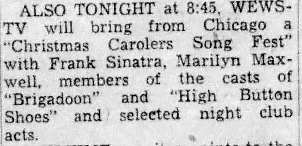
December 25, 1941 (Thu) Le Claire Hotel, Moline, Illinois
Unscheduled
Christmas Day Dinner TEE DORSEY GROUNDED at Davenport, Iowa
Tommy Dorsey and gang dropped in to pay the Tri-Cities an unexpected visit Christmas Day.
The famous Dorsey crew, enroute from Hollywood to Fremont, Ohio aboard a chartered United
Air Lines plane, was forced down by bad weather at Moline, Illinois airport. The Fremont engage-
ment had to be canceled. After Christmas dinner at the Le Claire Hotel, Tommy and his gang board
a bus for Cincinnati, their next night's session.
DOWNBEAT
December 25, 1941
Concerts
Fremont, Ohio (Cancelled)
Ed O'Brien:
Here is an amazing story concerning Mr. Dorsey, Sinatra and the band. T.D. & Co. was filming "I'll Take Manila" ( "Ship Ahoy") in Hollywood, in December of 1941. They would open at the Hollywood Palladium on 12/30. Well, TD got an offer for three one-nighters back in the midwest, starting on Christmas day. They flew out of L.A. on Christmas morning. The weather became quite dicey and the United Airlines chartered plane made an emergency landing in Davenport, Iowa.The band then took off for Fremont, Ohio but had to make another emergency landing. This time in Moline, Illinois. The Fremont, Ill. concert, scheduled for that evening, was cancelled. But TD was a resourceful fellow. He doubled up the one-nighters. They played Fremont the next afternoon, flew over to Cincinnati that evening and entertained at a private party. The following evening they played a one-nighter in Flint, Michigan. Shortly after that gig, the band flew back to Hollywood On the after- noon of the 29th the band did a session for the film on the sound stage at MGM. Jo Stafford was right, "You had to be young."
Note: The Fremont, OH date was cancelled altogether and was not made up on the 26th.
I've found a few articles (below) that suggest that the only date on the 26th was for the Debutante Party in Cincinnati. At least one article suggest the plane was in an accident and there were injuries.
--Scott
Fremont, Ohio (Cancelled)
Notice the misspelling of "Fremont"
I found this article in the 12-31-41 issue of Variety. Confirms what you found in newspapers. It also gives us an even better
understanding of what an adventure band members had working with TD.
Ed
December 26, 1941
Concerts
Cincinnati, OH
Tommy Dorsey and His Orchestra performed at a private party for Miss Elizabeth Stephenson, Debutante.
The Cincinnati Enquirer (Cincinnati, Ohio), December 31, 1941
Note: See article below.
Cincinnati
Tommy Dorsey and His Orchestra performed at a private party for Miss Elizabeth Stephenson, Debutante.

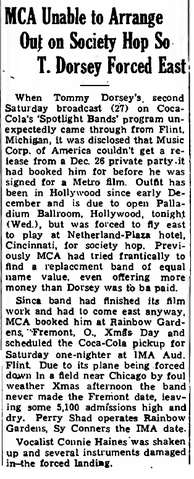
December 27, 1941
Radio
Spotlight Champion Of Champions, A Coca Cola
Spotlight Band Red, White and Blue Program
Network: Syndicated
Sponsored: Coca Cola Company
Performers: Tommy Dorsey Orchestra, Frank Sinatra, Jo Stafford, Connie Haines
Announcer: Gil Newson
TT: 30mins.
Concerts
IMA Auditorium, Flint, MI
Tommy Dorsey and His Orchestra with Frank Sinatra
Spotlight Champion Of Champions, A Coca Cola Spotlight Band Red, White and Blue Program
Network: Syndicated
Sponsored: Coca Cola Company
Performers: Tommy Dorsey Orchestra, Frank Sinatra, Jo Stafford, Connie Haines
Announcer: Gil Newson
TT: 30mins.
December 29, 1941
Studio
MGM
I'LL TAKE MANILA (RETITLED SHIP AHOY)
Orchestra conducted by Georgie Stoll
Arranged by Sy Oliver
Moonlight Bay w/T.D. orchestra, Jo Stafford & The Pied Pipers & Mixed Chorus
Takes 3 and 4 were mastered
December 30, 1941
Concerts
Hollywood Palladium, California (12-30-41 thru 2-23-42) Tuesday evening
Tommy Dorsey and Orchestra opened an extended run at the Palladium
Ed O'Brien:
Sinatra was singing the exciting new Arlen/Mercer tune "Blues In The Night" plus his huge hit "This Love Of Mine" and many others.
Billboard article from 1-10-42
JAPS CRAMP T.D.
Hollywood, Jan 3rd -- Defense regulations prohibiting use of spotlights cheated Tommy Dorsey and his orchestra out of a real Hollywood opening at the Palladium Tuesday night December 30. Spots in front of ballroom were conspicuous by their absence.
Dorsey set a record for Tuesday night openings, with 4,800 passing thru the turnstiles. Complimentaries were dropped and doormen honored only press passes. Spot charges 65 cents per person.
note: America had entered World War II only three weeks before T.D.'s big opening at the Palladium. Truly a desperate hour in our history, and yet; the war did not dampen the enthusiasm for big entertainment events, especially the sounds of the big bands. This would continue unabated throughout the war years.
Hollywood Palladium, California (12-30-41 thru 2-23-42) Tuesday evening
Tommy Dorsey and Orchestra opened an extended run at the Palladium
[image referenced in source but could not be recovered]
[image referenced in source but could not be recovered]
December 31, 1941
Radio
Hollywood Palladium New Year's Eve show
Wednesday evening
Network: NBC
Tommy Dorsey & His Orch
1. I'm Getting Sentimental Over You
2. What Is This Thing Called Love Jo Stafford
3. Somebody Loves Me Connie Haines
4. Blues In The Night Frank Sinatra
5. Lana Turner speaks for the USO
6. Swing High tape incomplete
Concerts
Hollywood Palladium, California (12-30-41 thru 2-23-42) Tommy Dorsey Orchestra with Frank Sinatra
note: Frank Sinatra was now the star of Dorsey's great band. During this engagement, TD and Co. would average 25,000 plus per week. The Palladium was asking 65 cents during the week and $1.00 on weekends. As you can see from the ad on
New Year's Eve the prices were increased considerably.
A table cost $5.00 and general admission was
$2.50 . Dorsey's Tuesday opening (12/30) set a new record for that night despite anticipated blackouts.By the end of the engagement, TD had broken every conceivable house record.
Ed
Hollywood Palladium New Year's Eve show
Wednesday evening
December 31, 1946
December 31, 1947, Phil Silvers & Sinatra New Years Eve party.
-- Thanks to Carl R.
New Year's Eve in 1954
Smile for the camera: Frank Sinatra and New York socialite Gloria
Vanderbilt pictured at the now defunct Ambassador Hotel on New Year's Eve in 1954 - the couple appear to be dressed for a ball
Carl R sent along the following addition:
What a fancy band he has on the rim of his hat.
Here is another photo of the two, but without any extra info:
Noël Coward's 1955 New Year's Eve party at Sinatra's
Noël Coward attended a New Year's Eve party at Sinatra's home on December 31, 1955. The party was attended by many notable people, including Lucille Ball, Mike Todd, and the Danny Kayes and Romanoffs. Coward described the party as enjoyable but chaotic, with a bongo drum band in the living room.
From Noël Coward's journal:
Noël Coward: It is enjoyable, but not the acme of peace on account of people of all shapes and sizes swirling through this very small house like the relentless waves of the sea. Their swirling is accompanied by a bongo drum band in the living room
The Danny Kayes, the [Charles] Vidors, the Romanoffs, the Goldwyns, Lucille Ball, Mike Todd, etc., are all in and out and the noise is considerable. Bogey pushed Irving Lazar into the pool and Irving Lazar pushed Bogey into the pool and other indications that the new year will be no less bawdy than the old one. The prevailing chaos is curiously dominated by Frankie, who contrived, apparently without effort, to be cheerful and unflagging and, at the same time, sees that everyone has drinks and is looked after. He is a remarkable personality - tough, vulnerable and somehow touching. He is also immeasurably kind."
1942
[Alleged 1942 Incident Sparks a Later Confrontation]
Years afterward, a man tracked Frank Jr. down at a Long Island motel, claiming Sinatra Sr. had taken his girlfriend from him back in 1942 and demanding compensation; when the man forced his way into the room, Frankie struck him with an ashtray, fracturing his skull.
Source: Nancy Sinatra, "Frank Sinatra, My Father" (1985).
[First Solo Appearance, Paramount Theatre]
Sinatra makes his first solo appearance, performing with Benny Goodman's orchestra at the Paramount Theatre in New York, and scores a #1 hit with "There Are Such Things."
Source: Nancy Sinatra, "Frank Sinatra, My Father" (1985).
[First Radio Show, "Reflections"]
Sinatra's first radio show, "Reflections," debuts on CBS; he also appears in the film "Ship Ahoy."
Source: Nancy Sinatra, "Frank Sinatra, My Father" (1985).
[Final Recording Session with Dorsey]
Sinatra records his last session with Tommy Dorsey, capping two years in which he recorded eighty-three songs with the band.
Source: Nancy Sinatra, "Frank Sinatra, My Father" (1985).
[Kidnapping Threat Against Two-Year-Old Nancy]
When Nancy was about two years old, there was a threat to kidnap her; FBI agent Peter Pitchess posed as the family's gardener in order to protect her.
Source: Nancy Sinatra, "Frank Sinatra, My Father" (1985).
[Sinatra Cuts His First Solo Sides While Still With Dorsey]
Although still a member of Tommy Dorsey's band, Sinatra recorded his first songs as a soloist in 1942, with Axel Stordahl arranging and conducting, as his ambitions to go out on his own grew.
Source: Nancy Sinatra, "Frank Sinatra, My Father" (1985).
[Sinatra Leaves the Dorsey Band]
Sinatra departed Tommy Dorsey's band in 1942 to launch his solo career, a decision he later described as driven by faith in his own path.
Source: Charles Pignone, "Frank Sinatra 100" (2015).
[Sinatra Becomes a National Phenomenon]
Between 1942 and 1946, Sinatra's popularity in radio, film, and live performance reached unprecedented heights; the author describes it as a period when he seemingly could do no wrong.
Source: Charles Pignone, "Frank Sinatra 100" (2015).
[Sinatra Tells Dorsey He's Leaving, A Year Ahead]
By Sinatra's own account, he went into Tommy Dorsey's dressing room in Washington, D.C. one September and announced he intended to go solo, giving Dorsey a full year's notice. Dorsey was cool to the idea and stopped speaking to him for months afterward.
Source: Nancy Sinatra, "Frank Sinatra, My Father" (1985).
[Artie Shaw enlists, gives strings to Dorsey]
Kaplan: Artie Shaw enlisted in the Coast Guard in early 1942 and passed his eight-piece string section to Tommy Dorsey's band, delighting string-loving Sinatra (and disgusting drummer Buddy Rich).
Source: James Kaplan, "Frank: The Voice" (2010)
[Chaos and screaming crowds at the Paramount]
Consiglio: During Frank's Paramount engagement, the screaming from girls in the audience was so loud that his singing was barely audible even to Consiglio, who knew every song in his set. Girls sobbed, fainted, and stayed in the theater from the 11 a.m. show until the 11 p.m. show rather than give up their seats.
Source: Tony Consiglio (as told to Franz Douskey), "Sinatra and Me: The Very Good Years" (2012)
[Consiglio becomes Frank's road companion]
Consiglio: When Frank left Dorsey's band in fall 1942, Consiglio began traveling with him unpaid, starting with Frank's first engagement as a featured "added attraction" with Tony Pastor's band in Providence, Rhode Island.
Source: Tony Consiglio (as told to Franz Douskey), "Sinatra and Me: The Very Good Years" (2012)
[Consiglio forges Frank's autograph]
Consiglio: Facing roughly a thousand autograph requests a day during the Paramount run, Consiglio practiced Frank's signature until it was nearly indistinguishable and began signing photos and papers for fans himself to save Frank's time; Frank later joked that Consiglio should stay away from his checkbook.
Source: Tony Consiglio (as told to Franz Douskey), "Sinatra and Me: The Very Good Years" (2012)
[Cooper lands Sinatra a film bit and radio spot]
Kaplan: Agent Frank Cooper secured Sinatra a small singing role ("Night and Day") in Columbia's B picture "Reveille with Beverly," and Manie Sacks got him a spot on a CBS radio show in New York -- his only bookings for months as a newly solo act.
Source: James Kaplan, "Frank: The Voice" (2010)
[Dolly Sinatra mobbed backstage at the Paramount]
Consiglio: Frank's mother Dolly tried to surprise him backstage at the Paramount but was mobbed by fans in Times Square, emerging with her coat torn and hat destroyed; Frank promised to buy her a new hat and had a limousine take her home to Hoboken.
Source: Tony Consiglio (as told to Franz Douskey), "Sinatra and Me: The Very Good Years" (2012)
[Dorsey's daughter recalls a threatening phone call]
Kaplan (via Peter Levinson): According to biographer Peter Levinson, Dorsey's daughter recalled her father receiving a threatening dinnertime phone call early in the Sinatra dispute implying harm to his children if he didn't release Sinatra; Dorsey responded by installing barbed wire, searchlights, and an electric fence around his property.
Source: James Kaplan, "Frank: The Voice" (2010)
[Dorsey's drunken fistfight with his brother]
Kaplan: Drinking heavily that summer amid the Sinatra dispute and tax troubles, Tommy Dorsey opened the Astor roof engagement by getting into a boozy backstage fistfight with his brother, bandleader Jimmy Dorsey.
Source: James Kaplan, "Frank: The Voice" (2010)
[Fans line up overnight outside the Paramount]
Consiglio: Fans began lining up outside the Paramount as early as 4:30 a.m., six abreast around the block by 5 a.m.; by mid-morning hundreds of police, mounted officers, and ambulances were on hand because girls kept fainting from cold and exhaustion. Roughly only twenty or thirty of every five thousand people in line were men.
Source: Tony Consiglio (as told to Franz Douskey), "Sinatra and Me: The Very Good Years" (2012)
[Flood of fan mail at the Paramount]
Consiglio: Within weeks of the Paramount opening, sacks of fan mail arrived daily -- the post office made up to four deliveries -- overwhelming the small staff at Barton Music Company (publisher of "This Love of Mine"), which served as Frank's informal office at the time.
Source: Tony Consiglio (as told to Franz Douskey), "Sinatra and Me: The Very Good Years" (2012)
[Frank hires Gloria Lovell]
Consiglio: In 1942, Frank hired Gloria Lovell and set up an office in Beverly Hills to manage his overwhelming volume of personal correspondence, since he had no secretary of his own at the time.
Source: Tony Consiglio (as told to Franz Douskey), "Sinatra and Me: The Very Good Years" (2012)
[Frank performs for war bonds and wounded GIs]
Consiglio: During WWII, Hank Sanicola arranged for Frank -- exempt from military service due to a punctured eardrum -- to perform for free at war bond drives and to visit wounded GIs in hospitals; Frank was, per Consiglio, the only major male singer of the era not in the service.
Source: Tony Consiglio (as told to Franz Douskey), "Sinatra and Me: The Very Good Years" (2012)
[Frank's many radio programs]
Consiglio: During this period Frank hosted or guested on numerous radio programs -- Broadway Bandbox, Vimms Vitamins Presents The Frank Sinatra Program, Old Gold, Your Hit Parade, and Max Factor Presents The Frank Sinatra Show among them -- reflecting his inability to turn down bookings before he had a manager to coordinate his schedule.
Source: Tony Consiglio (as told to Franz Douskey), "Sinatra and Me: The Very Good Years" (2012)
[Joey D'Orazio's account of Sanicola's thugs]
Joey D'Orazio (via Kaplan): Hoboken friend Joey D'Orazio claimed Hank Sanicola sent two intimidating (but not truly mob-connected) men to threaten Dorsey into releasing Sinatra; Dorsey reportedly laughed them off, though he ultimately agreed to sign the release papers anyway, saying he was sick of Sinatra.
Source: James Kaplan, "Frank: The Voice" (2010)
[Manie Sacks agrees to sign Sinatra to Columbia]
Kaplan: Manie Sacks of Columbia Records formally agreed to sign Sinatra as soon as he was legally free of his Dorsey and RCA obligations, becoming a key part of Sinatra's solo master plan.
Source: James Kaplan, "Frank: The Voice" (2010)
[Marty Sinatra's one visit to the Paramount]
Consiglio: Frank's father Marty came to the Paramount only once during the run -- not to watch Frank perform, but to ask him to obtain a hard-to-find radio tube through his connections; Marty still doubted whether Frank had made the right career choice.
Source: Tony Consiglio (as told to Franz Douskey), "Sinatra and Me: The Very Good Years" (2012)
[Musicians' strike begins]
Consiglio: In 1942, American Federation of Musicians president Jimmy Petrillo called a musicians' strike, fearing that radio's growing reliance on recorded music over live remote broadcasts would put professional musicians out of work.
Source: Tony Consiglio (as told to Franz Douskey), "Sinatra and Me: The Very Good Years" (2012)
[Nancy Jr. remembers wartime blackouts]
Nancy Sinatra Jr.: Nancy Sinatra Jr. later recalled the 1942 civil-defense blackouts -- sitting with her mother in the dark -- and said her father was mostly absent then, known to her chiefly as a voice on the radio or a photo in the newspaper.
Source: James Kaplan, "Frank: The Voice" (2010)
[Peter Lawford in A Yank at Eton]
Kaplan: Before meeting Sinatra, Peter Lawford had appeared in the 1942 film A Yank at Eton playing a bullying young snob opposite Mickey Rooney, Ava Gardner's then-husband.
Source: James Kaplan, "Frank: The Voice" (2010)
[Police protection for Frank at the Paramount]
Consiglio: As crowds grew unmanageable, mobs of teenage girls tried to tear at Frank's clothes outside the Paramount. After fans scratched Consiglio's neck bloody while he shielded Frank, theater manager Bob Weitman began providing a limousine and police escorts between the Waldorf-Astoria (where they'd relocated from the Hotel Astor) and the theater.
Source: Tony Consiglio (as told to Franz Douskey), "Sinatra and Me: The Very Good Years" (2012)
[Sammy Cahn affirms Sinatra's ambition]
Sammy Cahn: Lyricist Sammy Cahn recalled Sinatra telling him, "I'm going to be the world's greatest singer," and Cahn assuring him he already was -- a mix of genuine friendship and self-interested flattery, since Cahn's own career stood to benefit from Sinatra's rise.
Source: James Kaplan, "Frank: The Voice" (2010)
[Sinatra buys his first house]
Kaplan: Using part of his Dorsey advance, Sinatra put a down payment on his first house, a wood-frame Cape Cod with a front porch in Hasbrouck Heights, New Jersey.
Source: James Kaplan, "Frank: The Voice" (2010)
[Sinatra hires publicist Milt Rubin]
Kaplan: On Walter Winchell's recommendation, Sinatra hired Times Square publicist Milt Rubin shortly after leaving Dorsey, but quickly regretted it; when Nancy (who wrote the checks) stopped paying his $50-a-week fee, Rubin sued his client.
Source: James Kaplan, "Frank: The Voice" (2010)
[Sinatra leaves Dorsey to go solo]
Kaplan: Sinatra left Tommy Dorsey's band in 1942 to launch his solo career, departing on acrimonious terms amid lawsuits and threats from Dorsey and reportedly from Sinatra's New Jersey mob patron Willie Moretti.
Source: James Kaplan, "Sinatra: The Chairman" (2015)
[Sinatra poaches arranger Axel Stordahl]
Kaplan: Sinatra lured arranger Axel Stordahl away from Dorsey's band with an offer of $650 a month -- five times what Dorsey paid him -- money Sinatra didn't yet have but knew would pay off; Dorsey was furious but powerless to stop it.
Source: James Kaplan, "Frank: The Voice" (2010)
[Sinatra visits Jersey City home]
Kaplan: That spring, Sinatra occasionally visited his new rented home on Bergen Avenue in Jersey City to see two-year-old daughter Nancy and wife Nancy Sr., though he never stayed long before heading back out on the road.
Source: James Kaplan, "Frank: The Voice" (2010)
[Sinatra's Paramount Theatre debut referenced]
Consiglio: Consiglio recalls helping Frank get ready for shows "the same way I did... in 1942 at the State Theater in Hartford and the Paramount Theatre in New York City," marking the start of their decades-long working relationship.
Source: Tony Consiglio (as told to Franz Douskey), "Sinatra and Me: The Very Good Years" (2012)
[Sinatra's Paramount breakthrough]
Consiglio: After Sinatra's big breakthrough at the Paramount Theatre in 1942, Consiglio never again saw him carrying small bills - from then on Frank carried only fifties and hundreds.
Source: Tony Consiglio (as told to Franz Douskey), "Sinatra and Me: The Very Good Years" (2012)
[Sinatra's punitive severance contract with Dorsey]
Kaplan: To secure his release plus a $17,000 advance (about $225,000 today) to launch his solo career, Sinatra signed a contract making Dorsey his manager, entitled to roughly a third of Sinatra's future gross earnings, with agent Leonard Vannerson taking another 10 percent -- terms reportedly running for up to ten years or in perpetuity.
Source: James Kaplan, "Frank: The Voice" (2010)
[Sinatra's second film appearance]
Kaplan: Sinatra again appeared as a Dorsey band vocalist, uncredited, in MGM's "Ship Ahoy" (1942).
Source: James Kaplan, "Frank: The Voice" (2010)
[Sinatra-Dorsey contract dispute]
Consiglio: After leaving Dorsey, Frank and Dorsey sued each other over Frank's restrictive contract, which entitled Dorsey to roughly a third of Frank's earnings for life. Consiglio says he personally witnessed Frank's uncle pull a gun on Dorsey in Room 215 of the Hotel Astor, though the eventual settlement (around $30,000, financed via a Columbia Records advance) resulted mainly from industry pressure over a possible fan boycott of Dorsey's records.
Source: Tony Consiglio (as told to Franz Douskey), "Sinatra and Me: The Very Good Years" (2012)
[Songs by Sinatra CBS broadcasts]
Consiglio: During the Paramount run, after each night's final show, Frank and Consiglio drove to CBS Studios on West 57th Street to broadcast the live fifteen-minute radio program Songs by Sinatra, featuring just Frank and pianist Milton Gross, since there was no audiotape to fall back on if they were late.
Source: Tony Consiglio (as told to Franz Douskey), "Sinatra and Me: The Very Good Years" (2012)
[Walnut prank during 'One For My Baby']
Consiglio: During the Paramount run, Consiglio once swapped the cigarette Frank kept in his jacket pocket for a walnut before he went on to sing "One For My Baby"; Frank discovered it mid-song, flipped it to Consiglio in the wings, and promised to get him back later.
Source: Tony Consiglio (as told to Franz Douskey), "Sinatra and Me: The Very Good Years" (2012)
[Willie Moretti's alleged role in the Dorsey release]
Willie Moretti (via Peter Levinson): Sinatra's Hasbrouck Heights neighbor Willie Moretti, the North Jersey mob boss, reportedly took a shine to Sinatra during the Dorsey dispute; asked years later whether he'd personally interceded, Moretti allegedly smiled and said, "Let's just say we took very good care of Sinatra."
Source: James Kaplan, "Frank: The Voice" (2010)
[Dick Haymes follows Sinatra into Tommy Dorsey's band]
After his own band floundered, Dick Haymes joined Tommy Dorsey's orchestra in late 1942, following in Frank's footsteps for the second time.
Source: Richard Havers, "Sinatra" (Dorling Kindersley, 2007).
[Dick Haymes leaves to form his own band]
Dick Haymes left Harry James in early 1942 to start his own band, already twice married by age 26; his own venture struggled as members were drafted for the war.
Source: Richard Havers, "Sinatra" (Dorling Kindersley, 2007).
[Glenn Miller fires (or is quit by) Ray Eberle]
Glenn Miller dismissed vocalist Ray Eberle in late 1942, reportedly for showing up late to rehearsal, though Eberle always maintained he quit over pay after learning the band earned more than he did. Eberle's career, further hurt by wartime Army service, never fully recovered after 1945.
Source: Richard Havers, "Sinatra" (Dorling Kindersley, 2007).
[Gordon Jenkins scores early Top 20 hit for young Capitol label]
Gordon Jenkins signed to Capitol Records in 1942 and reached the Top 20 with the label's sixth-ever release, 'He Wears a Pair of Silver Wings.'
Source: Richard Havers, "Sinatra" (Dorling Kindersley, 2007).
[Tommy Dorsey fires the Pied Pipers]
The vocal group the Pied Pipers, including Jo Stafford, remained with Tommy Dorsey's band until Thanksgiving Day 1942, when Dorsey, known for his temper, fired them in one of his rages.
Source: Richard Havers, "Sinatra" (Dorling Kindersley, 2007).
[George Evans Becomes Sinatra's Publicist]
Press agent George Evans became Sinatra's publicist shortly after Sinatra left the Tommy Dorsey band.
Source: George Carpozi Jr., Frank Sinatra: Is This Man Mafia? (New York: Manor Books, 1979).
[Bob Weitman booking Sinatra for the New York Paramount, opening December 31, 1942 -- critical commentary]
Sinatra (to Sidney Zion): As Sinatra told Sidney Zion, “One day they told me that Bob . . . whom I knew, was coming in to catch the last show. This was on my birthday, December 12. He came in and caught the show, but I didn’t see him. I went home, and he rang me at the house and said—it was a famous phrase—‘What are you doing New Year’s Eve?’ I said, ‘Not a thing. I can’t even get booked anywhere. I can’t find anywhere to work.’ He said, ‘I mean the morning of December 31 and for a couple of weeks after that?’ I said nothing. He said, ‘I’d like you to open at the joint.’ He used to call the Paramount ‘the joint.’ I said, ‘You mean on New Year’s Eve?’ He said, ‘That’s right. That morning. You got Benny Goodman’s orchestra and a Crosby picture.’ And I fell right on my butt! I couldn’t believe what he said to me, to be put in a position like that. In those days they called you an extra added attraction. I went to rehearsal at 7:30 in the morning. I looked at the marquee on Broadway, and it said, ‘Extra Added Attraction: Frank Sinatra,’ and I said, ‘Wow!’”
Source: Will Friedwald, "Sinatra! The Song Is You: A Singer's Art" (2018 revised edition), Ch. 4, "With Axel Stordahl" (1943-1948)
[Opening night at the Paramount Theatre, New Year's Eve engagement with Benny Goodman's orchestra -- critical commentary]
Yank Lawson / Sammy Cahn / Sinatra: Opening night at the Paramount, New Year’s Eve, 1942. This was the engagement that could make or break him... His tension was unexpectedly broken by Goodman himself. According to Yank Lawson, trumpet soloist in this particularly Olympian BG band, “Benny didn’t know who Sinatra was.” Goodman, with his characteristic combination of absentmindedness and total tact, took one look at the shaking, sweating crooner (who weighed about 120 pounds soaking wet—twenty pounds of which was hair, as he later quipped), heard the deafening ovation from the audience, and demanded, “What the heck was that?” (And no, according to eyewitnesses, “heck” was not the word that Goodman actually used.) ... By the next day, January 1, 1943, Sinatra was the hottest act in the country. Not only were trade magazines like Down Beat, Metronome, and Variety heralding his supremacy, but, more important, lines of kids, mostly girls, stretched around the block. “I was very confused. I had never seen it. . . . Nobody had ever heard that kind of reaction before,” Sinatra said later. As Lawson remembered, “Frank stopped the show every time. The lines were four-deep clear around the block with people trying to get in the theater.” He also recalled that the overworked BG bandsmen ... found Sinatra and the initial reaction to his music exhilarating: “The applause was so great, and all those kids were dancing in the aisles. We thought it was great!” “What he was doing at the Paramount was by itself beyond belief, and he was doing it for six shows a day,” remembered Sammy Cahn. ‘And the bobby-soxers, the screaming and the hysteria—it was not to be believed!” Sinatra added, “I was also confused because it was very difficult working in the theaters in those days. If I moved, everybody would scream or squeal . . . and I was afraid to move after a while.”
Source: Will Friedwald, "Sinatra! The Song Is You: A Singer's Art" (2018 revised edition), Ch. 4, "With Axel Stordahl" (1943-1948)
[Reveille with Beverly (Columbia Pictures) - Sinatra's first post-Dorsey film vocal -- critical commentary]
Friedwald / Sinatra: The first significant payoff from the Hollywood relocation was, as Sinatra put it, “I got a little role in a movie at Columbia Pictures”; this was Reveille with Beverly, Sinatra’s first post-Dorsey cinematic appearance. (Sinatra’s vocal was recorded on September 17, only a week after his last appearance with Dorsey.) The musical lineup of the picture shows how ahead of his time Sinatra was: all the other acts are big bands, Sinatra is the sole star singer; the only other vocal act is those old favorites, the Mills Brothers.
Source: Will Friedwald, "Sinatra! The Song Is You: A Singer's Art" (2018 revised edition), Ch. 4, "With Axel Stordahl" (1943-1948)
[Sinatra conducted the band and hosted radio when Dorsey missed a broadcast to attend his father's funeral -- critical commentary]
He had also risen in Dorsey’s trust and became, with Ziggy Elman and Bunny Berigan, that rare deputy Dorsey trusted to conduct the band at rehearsals; when Dorsey missed a broadcast on July 13, 1942, to attend his father’s funeral, Sinatra conducted and also took over the leader’s role as radio host.
Source: Will Friedwald, "Sinatra! The Song Is You: A Singer's Art" (2018 revised edition), Ch. 3, "With Tommy Dorsey" (1940-1942)
[anecdote -- critical commentary]
Skitch Henderson: Pianist and friend Skitch Henderson recalled the night Sinatra decided to leave Dorsey's band: a phone call in which Sinatra said Dorsey had 'goosed me with his trombone for the last time' and announced he was leaving, while they were playing the Circle Theater.
Source: Charles L. Granata, "Sessions with Sinatra: Frank Sinatra and the Art of Recording" (1999/2003), Part II: The Columbia Years, 1943-1952
[recording/wax mastering process -- critical commentary]
Until late 1942, records were made by etching grooves into a carnauba-wax disc ("waxing a record"), then creating a metal-plated master from that soft impression; because the original wax was destroyed in plating, the resulting metal "parts" -- not the eventual 78 rpm shellac discs -- are the truest surviving sound sources used today for digital restoration of these early recordings.
Source: Charles L. Granata, "Sessions with Sinatra: Frank Sinatra and the Art of Recording" (1999/2003), Part I: The Big Band Years, 1937-1942
January 1942
[Sinatra And Stordahl Record Intimate Bluebird Sides]
While still with Dorsey, Sinatra and arranger Axel Stordahl cut a set of RCA Bluebird recordings using strings and woodwinds instead of brass, producing a softer sound on songs including "Night and Day" and "The Song Is You."
Source: Nancy Sinatra, "Frank Sinatra, My Father" (1985).
[Stordahl and Sinatra hear the playback]
Axel Stordahl: A few days after the January 19 session, Sinatra and Axel Stordahl spent a sunny afternoon in Sinatra's room at the Hollywood Plaza listening to the four new recordings over and over on a portable record player. Stordahl later said Sinatra was so excited "you almost believed he had never recorded before," and called it a turning point in Sinatra's career.
Source: James Kaplan, "Frank: The Voice" (2010)
[Embryonic Sinatra-Stordahl sound first heard at a Bluebird recording date, prior to full development on 1943-44 radio -- critical commentary]
Sinatra and Stordahl had introduced an embryonic version of their “sound” at the January 1942 Bluebird date, and perfected their approach over the singer’s consistent and fairly constant radio appearances throughout 1943 and 1944: Broadway Bandbox, Songs by Sinatra, and, later in 1944, Sinatra’s first starring half-hour series, Frank Sinatra in Person, sponsored by Vimms Vitamins through 1944 and then by Max Factor in the spring of 1945.
Source: Will Friedwald, "Sinatra! The Song Is You: A Singer's Art" (2018 revised edition), Ch. 4, "With Axel Stordahl" (1943-1948)
[Sinatra's Bluebird solo session — RCA's first dates of a band vocalist without the band; Connie Haines and Skitch Henderson recollections -- critical commentary]
Connie Haines / Skitch Henderson: Sinatra, ambitious, talented, and already a major asset for the label through his work with Dorsey, was a natural for the project; given the opportunity, he was determined to "make good," in the parlance. Even his rival Connie Haines gave him props for his commitment: "Frank rehearsed day and night for that project." ... Henderson recalled that although Dorsey knew Sinatra was going to do a solo session, the participants were careful not to throw this fact in the boss’s face: "When I had become part of that fraternity with Axel and everything, they [only] talked undercover about how they were going to do this record. It was said that we should keep our mouths shut about the date because the Old Man, as we called him, wasn’t too happy about it." Far from being nervous at this critical first solo session, Sinatra, Henderson added, "was always very confident of his skill."
Source: Will Friedwald, "Sinatra! The Song Is You: A Singer's Art" (2018 revised edition), Ch. 3, "With Tommy Dorsey" (1940-1942)
January 1, 1942
Concerts
Hollywood Palladium, California (12-30-41 thru 2-23-42) Tommy Dorsey Orchestra with Frank Sinatra
Hollywood Palladium, California (12-30-41 thru 2-23-42)
Tommy Dorsey Orchestra with Frank Sinatra
"It was the most wonderful place to go," the late actress Lana Turner recalled in the Los Angeles Times in 1987. "I would go to the Palladium four or five times a week. It was the place to go after dinner or after a movie. We young ladies could walk in alone and know we weren't going to . . . you know, be picked up."
Palladium 1-1-42
note: Dorsey band played to SRO crowds throughout their engagement.
January 2, 1942
Radio
Hollywood Palladium, California (12-30-41 thru 2-23-42) Tommy Dorsey Orchestra with Frank Sinatra
Ed O'Brien:
Sinatra was singing the exciting new Arlen/Mercer tune "Blues In The Night" plus his huge hit "This Love Of Mine" and many others.
Billboard article from 1-10-42:
JAPS CRAMP T.D.
Hollywood, Jan 3rd -- Defense regulations prohibiting use of spotlights cheated Tommy Dorsey and his orchestra out of a real Hollywood opening at the Palladium Tuesday night December 30. Spots in front of ballroom were conspicuous by their absence. Dorsey set a record for Tuesday night openings, with 4,800 passing thru the turnstiles. Complimentaries were dropped and doormen honored only press passes. Spot charges 65 cents per person.
note: America had entered World War II only three weeks before T.D.'s big opening at the Palladium.Truly a desperate hour in our history,and yet; the war did not dampen the enthusiasm for big entertainment events, especially the sounds of the big bands. This would continue unabated throughout the war years.
Ed O'Brien (2016):
Dorsey signed to play a four-week engagement at the Palladium. The huge crowds convinced the manage- ment to extend the band's stay an additional four-weeks. TD continued to break b.o. records until mid-way through the final week.The constant threat of blackouts cut into the attendance. Claude Thornhill & Orchestra opened on 2-24-42 to a capacity crowd but the blackout problem hurt him throughout his run at the Palladium.
January 3, 1942
Concerts
Hollywood Palladium, California (12-30-41 thru 2-23-42) Tommy Dorsey Orchestra with Frank Sinatra
January 4, 1942
Concerts
Hollywood Palladium, California (12-30-41 thru 2-23-42) Tommy Dorsey Orchestra with Frank Sinatra
January 5, 1942
Concerts
Hollywood Palladium, California (12-30-41 thru 2-23-42) Tommy Dorsey Orchestra with Frank Sinatra
January 6, 1942
Concerts
Hollywood Palladium, California (December 30, 1941 - February 23, 1942) Tommy Dorsey Orchestra with Frank Sinatra
January 7, 1942
Concerts
Hollywood Palladium, California (December 30/41 - February 23/42) Tommy Dorsey Orchestra with Frank Sinatra
January 8, 1942
Concerts
Hollywood Palladium, California (12-30-41 thru 2-23-42) Tommy Dorsey Orchestra with Frank Sinatra
January 8, 1942 (Thu) 7:15 – 7:45 pm
“Coca Cola Spotlight Bands”
(MBS)
KHJ Studios, Hollywood
January 8, 1942
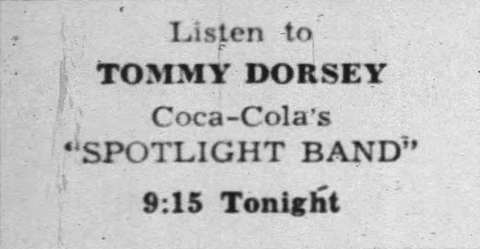
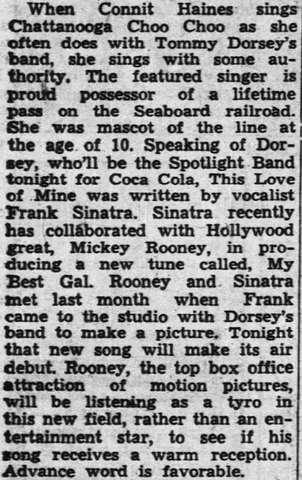
January 9, 1942
Concerts
Hollywood Palladium, California (12-30-41 thru 2-23-42) Tommy Dorsey Orchestra with Frank Sinatra
January 10, 1942
Concerts
Hollywood Palladium, California (12-30-41 thru 2-23-42) Tommy Dorsey Orchestra with Frank Sinatra
January 11, 1942
Concerts
Hollywood Palladium, California (12-30-41 thru 2-23-42) Tommy Dorsey Orchestra with Frank Sinatra
January 12, 1942
Concerts
Hollywood Palladium, California (12-30-41 thru 2-23-42) Tommy Dorsey Orchestra with Frank Sinatra
January 13, 1942
Concerts
Hollywood Palladium, California (12-30-41 thru 2-23-42) Tommy Dorsey Orchestra with Frank Sinatra
January 14, 1942
Concerts
Hollywood Palladium, California (12-30-41 thru 2-23-42) Tommy Dorsey Orchestra with Frank Sinatra
January 15, 1942
Concerts
Hollywood Palladium, California (12-30-41 thru 2-23-42) Tommy Dorsey Orchestra with Frank Sinatra
January 16, 1942
Concerts
Hollywood Palladium, California (12-30-41 thru 2-23-42) Tommy Dorsey Orchestra with Frank Sinatra
January 17, 1942
Radio
Spotlight On The Bands
NBC
Saturday
30 Minute Broadcast
Sponsor: Coca-Cola
Tommy Dorsey & Orch.
Frank Sinatra, Jo Stafford, Pied Pipers, Ziggy Elman,
Connie Haines, Joe Bushkin, Buddy Rich
Annc: Ken Niles
1. Hallelujah T.D. & Orch.
2. Blues In The Night F.S.
3. None But The Lonely Heart T.D. & Orch..
4. Free For All F.S J.S. P.P
Coke ad
5. I'll Get By T.D. & Orch.
6. Not So Quiet Please T.D. & Orch.
7. This Love Of Mine F.S. ( # 3 song that week in Billboard)
("Blues In The Night" appears on Masters of Jazz Volume 6)
Ed O'Brien:
The Spotlight Band Series had T.D & Orch on a number of times..
There are tapes from November, December 41 and January, February 42.
Concerts
Hollywood Palladium (12-30-41 - 2-23-42)
Tuesday evening
Tommy Dorsey and Orchestra opened an extended run at the Palladium
January 18, 1942
Concerts
Hollywood Palladium (12-30-41 - 2-23-42)
Tuesday evening
Tommy Dorsey and Orchestra opened an extended run at the Palladium
January 19, 1942
Studio
Hollywood
PBS072042 The Night We Called It A Day
(M. Dennis/T. Adair)
Dorsey Brothers Music (ASCAP)
Arranged & Conducted by Axel Stordahl
-1 (3:16) CD: 07863 66353-2 "The Song Is You" 5CD set Vol 4
CD: RCA 2269-2-R
LP: LPM 1632
78: 11463
PBS072043 The Lamplighter's Serenade
(P. Webster/H. Carmichael)
Frank Music Corp./Webster Music Co. (ASCAP)
Arranged & Conducted by Axel Stordahl
-1 (2:50) CD: 07863 66353-2 "The Song Is You" 5CD set Vol 4
CD: RCA 2269-2-R
LP: LPM 1632
78: 20-1589
78: 11515
PBS072044 The Song Is You
(from the Broadway Musical Music In The Air)
(J. Kern/O. Hammerstein II)
Polygrams International Publishing Co. Inc., (ASCAP)
Arranged & Conducted by Axel Stordahl
-1 (3:17) CD: 07863 66353-2 "The Song Is You" 5CD set Vol 4
CD: RCA 2269-2-R
LP: LPM 1632
78: 11515
PBS072045 Night And Day
(Cole Porter)
Warner Bros. Music (ASCAP)
Arranged & Conducted by Axel Stordahl
-1 (3:00) CD: 07863 66353-2 "The Song Is You" 5CD set Vol 4
CD: RCA 2269-2-R
LP: LPM 1632
78: 20-1589
78: 11463
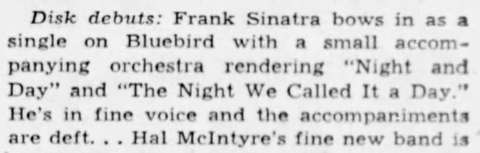
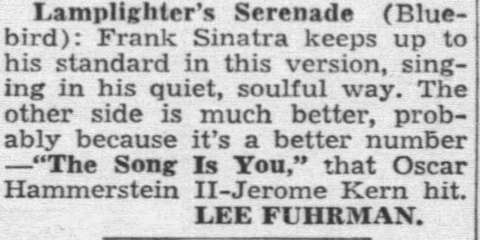
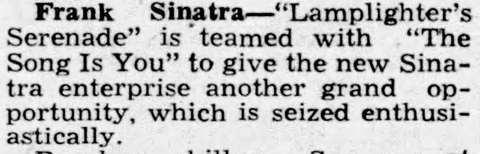
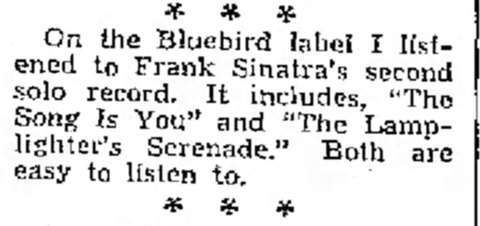
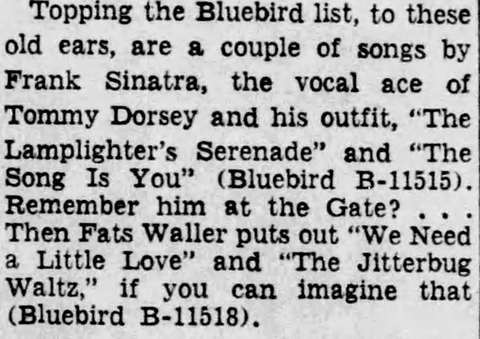
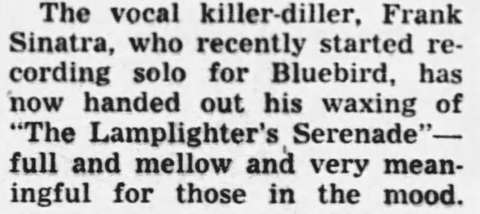
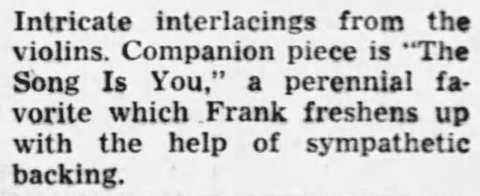
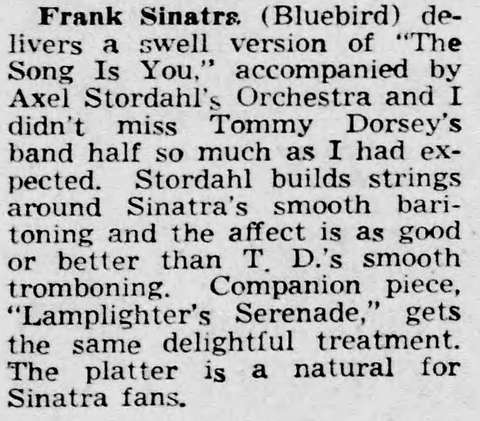
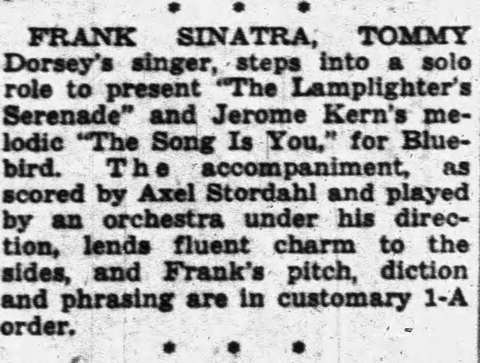
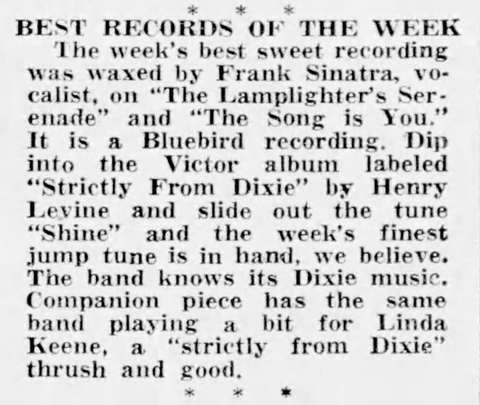
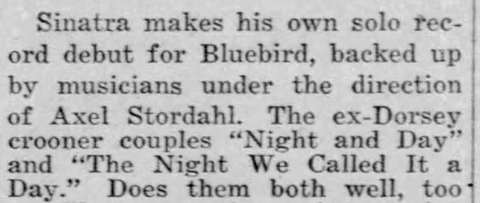
Concerts
Hollywood Palladium (12-30-41 - 2-23-42)
Tuesday evening
Tommy Dorsey and Orchestra opened an extended run at the Palladium
Herald Sun
7-16-44
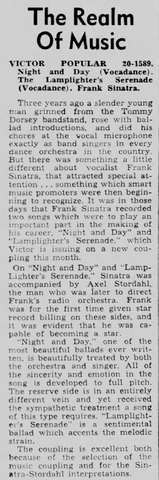
"The Night We Called It a Day"
Milt Bernhart: Milt Bernhart said this 1942 Bluebird 78 was one of his all-time favorite Sinatra records -- his future wife bought it while they were dating and it became 'their song.' When Bernhart told Sinatra this at a 1957 party, expecting him to be pleased, Sinatra's face instead darkened; he pulled out a test pressing of the still-unreleased Where Are You? remake and played it for Bernhart instead. Friedwald uses this to illustrate that, per Duke Ellington's dictum, 'the new baby is always the favorite' -- Sinatra had little sentimental attachment to his older recordings once finished.
Source: Will Friedwald, "Sinatra! The Song Is You: A Singer's Art" (2018 revised edition).
"The Song Is You"
The final document of the Dorsey-Sinatra relationship is “The Song Is You” (a major mantra of Sinatra’s career), performed live on the radio as part of Sinatra’s farewell appearance with the band on September 3, 1942. The Jerome Kern love song had marked the most striking performance of Sinatra’s first session under his own billing (and without Dorsey), done on January 14 of that year. Eight months later he reprised it on the air with the Dorsey orchestra itself for his final broadcast with the band. The amazing growth between the two versions, the confidence and cool assurance of the September version as measured against the tenuousness of the January reading, is impossible to miss. It could serve as a microcosm of Sinatra’s remarkable artistic development during his three years with Dorsey.
Source: Will Friedwald, "Sinatra! The Song Is You: A Singer's Art" (2018 revised edition).
"The Song Is You"
Stordahl has his act together no less than Sinatra at this point; one can see the basic evolution from these fairly concrete sketches to the masterpiece Stordahl Sinatra charts of the mid-to-late-1940s. In fact, this orchestration of "The Song Is You" has only a few additional strings between it and the classic "Song Is You" of 1944 and ’45 airchecks and the definitive Columbia 1947 version.
Source: Will Friedwald, "Sinatra! The Song Is You: A Singer's Art" (2018 revised edition).
"The Night We Called It a Day"
Though the 1942 "Night We Called It a Day" lacks the vocal majesty of the Capitol remake, the original rings truer. Dorsey had intended to record the song, another of his own publications, with Sinatra and the Pied Pipers, and asked composer Matt Dennis to prepare an arrangement similar to "I’ll Never Smile Again." When Sinatra cut the song without Dorsey, the leader retaliated by recording it with Jo Stafford, but Victor didn’t issue the Dorsey-Stafford version for several seasons. Stordahl’s string arrangement of "The Night We Called It a Day" thereby became the property of Dorsey and Sinatra simultaneously.
Source: Will Friedwald, "Sinatra! The Song Is You: A Singer's Art" (2018 revised edition).
"The Lamplighter's Serenade"
One song that shouldn’t be overlooked is the one Sinatra never remade and no one else ever bothered with after 1942, "The Lamplighter’s Serenade." One of many obscure minor gems by the brilliant Hoagy Carmichael, the tune was also done by Bing Crosby, whose well-established paternal identity it suits better. Reflecting Carmichael’s and Crosby’s compatible backgrounds, the melody has a Bingish device written right into it, a trill on the last word of the line "he sprinkles their hearts with his ma-agic" that Sinatra was duty-bound to honor.
Source: Will Friedwald, "Sinatra! The Song Is You: A Singer's Art" (2018 revised edition).
"The Song Is You" / "Night and Day" / "The Night We Called It a Day" / "The Lamplighter's Serenade" The results of the Bluebird session were conclusive: three masterpieces ("The Song is You," "Night and Day," and "The Night We Called It a Day") and a lesser-known delight ("The Lamplighter’s Serenade"). There was no avoiding the conclusion that the good ship Sinatra was ready to sail forth.
Source: Will Friedwald, "Sinatra! The Song Is You: A Singer's Art" (2018 revised edition).
"The Night We Called It a Day" / "The Lamplighter's Serenade" / "The Song Is You" / "Night and Day" Sinatra's first solo recordings were made at RCA Victor's Hollywood studio, yielding four sides, supervised by Victor A&R man Harry Meyerson. Because Sinatra was still contractually tied to Tommy Dorsey, Dorsey refused approval for release on the main Victor label, forcing issue on the cheaper Bluebird subsidiary.
Source: Charles L. Granata, "Sessions with Sinatra: Frank Sinatra and the Art of Recording" (1999/2003).
The Bluebird session band relied mostly on Dorsey band members augmented by four violins, a cello, an oboe, and a harp, with no percussion; rhythm was kept by bass, piano, and guitar alone. Sinatra was reportedly mesmerized by the results and spent hours listening to test pressings; three of the four songs became lifelong favorites he re-recorded repeatedly.
Source: Charles L. Granata, "Sessions with Sinatra: Frank Sinatra and the Art of Recording" (1999/2003).
[Photo: Sinatra records without Dorsey in LA]
A photo caption describes a Los Angeles recording session on January 19, 1942 with Dorsey's musicians but pointedly without Dorsey himself -- captioned 'Hey, Bing, old man. Move over. Here I come,' with Frank as the featured star.
Source: James Kaplan, "Frank: The Voice" (2010).
[First solo RCA recording session]
On a Monday afternoon at RCA's Los Angeles studio, Sinatra recorded four solo sides (still billed as "Frank Sinatra with Tommy Dorsey and His Orchestra" on the discount Bluebird label): "The Night We Called It a Day," "The Lamplighter's Serenade," "The Song Is You," and "Night and Day." Axel Stordahl conducted fourteen players including strings but no drummer; Dorsey did not attend. Sinatra had been a nervous wreck beforehand -- Nick Sevano said he was "almost tubercular" and talked constantly about dying -- but Victor A&R man Harry Meyerson remembered him walking in "self-assured, slugging."
Source: James Kaplan, "Frank: The Voice" (2010).
[Night and Day -- critical commentary]
Frank Sinatra: Sinatra recounted (in a 1986 Yale seminar with Sidney Zion and a 1986 concert) that around 1937-38, while singing with a septet at the Rustic Cabin, trumpeter Johnny Bucini alerted him that Cole Porter was in the small audience. Sinatra dedicated 'Night and Day' to Porter and introduced him, but forgot the lyrics after four bars and repeated 'Night and day, night and day' for fifteen bars straight. Nearly two decades later, while filming High Society (1956), Porter told Sinatra he remembered the evening as 'about the worst performance I ever heard,' and the two laughed about it.
This song/context matches multiple dated entries in the chronology; the specific date Friedwald is referring to could not be determined with confidence.
Source: Will Friedwald, "Sinatra! The Song Is You: A Singer's Art" (2018 revised edition), Ch. 1, "Night and Day" (Sinatra style overview)
[Night and Day -- critical commentary]
Will Friedwald: Sinatra's solo recording debut session included this ten-year-old Cole Porter standard, unusual for RCA Victor to have permitted; the arrangement (in E-flat) introduced Stordahl's classic five-note countermelody. Friedwald details period trademarks already present -- long eight-to-sixteen-bar phrasing, breathless romanticism, grace-note word-painting on 'way down inside of me' -- and Sinatra's alteration of Porter's original same-note ending into a descending three-note pattern (D-flat, B, B-flat), a change he'd keep until the 1956 Riddle arrangement. Released as part of RCA's dance-oriented 'Vocadance' series.
This song/context matches multiple dated entries in the chronology; the specific date Friedwald is referring to could not be determined with confidence.
Source: Will Friedwald, "Sinatra! The Song Is You: A Singer's Art" (2018 revised edition), Ch. 1, "Night and Day" (Sinatra style overview)
[Night and Day -- critical commentary]
Will Friedwald: Sinatra prerecorded and filmed 'Night and Day' for this B-movie musical spotlighting big-band leaders (Ellington, Basie, Bob Crosby, Freddie Slack), recording the vocal track two weeks after leaving Tommy Dorsey's band. Friedwald describes the staging as absurd -- Sinatra in 'three sleeves' surrounded by actresses miming pianos and violins -- with the visual clutter compromising an otherwise fine rendition of Stordahl's chart.
This song/context matches multiple dated entries in the chronology; the specific date Friedwald is referring to could not be determined with confidence.
Source: Will Friedwald, "Sinatra! The Song Is You: A Singer's Art" (2018 revised edition), Ch. 1, "Night and Day" (Sinatra style overview)
[Night and Day -- critical commentary]
Will Friedwald: Sinatra used 'Night and Day' as his opening theme for both seasons of Old Gold Presents Songs by Sinatra (1945-46 and 1946-47), typically singing the first two lines a cappella. When he moved to Light-Up Time in 1949-50, the show's lack of strings forced a rescoring with trumpet obbligato replacing Stordahl's violin countermelody, heard only very briefly after the sponsor's jingle.
This song/context matches multiple dated entries in the chronology; the specific date Friedwald is referring to could not be determined with confidence.
Source: Will Friedwald, "Sinatra! The Song Is You: A Singer's Art" (2018 revised edition), Ch. 1, "Night and Day" (Sinatra style overview)
[Night and Day -- critical commentary]
Alvin Stoller: Drummer Alvin Stoller, describing Sinatra's 1945 New York Capitol Theatre stage-show appearances (his first time working with the singer), recalled: 'The orchestra would play his theme song, "Night and Day," the stage would come up and the orchestra would rise, and he'd be standing on top of the piano, with everything lit from underneath. Frank was the act, he was it, he was the whole show.' Stoller added that Sammy Davis Jr. and the Will Mastin Trio only opened for about ten minutes; 'the whole rest of the show was Frank... Every show was a Sinatra concert.'
This song/context matches multiple dated entries in the chronology; the specific date Friedwald is referring to could not be determined with confidence.
Source: Will Friedwald, "Sinatra! The Song Is You: A Singer's Art" (2018 revised edition), Ch. 10, "Concert Years" (1973-1994)
[Night and Day -- critical commentary]
Sinatra's fascination with Cole Porter's "Night and Day" bordered on obsession: he chose it for his first solo recording session in 1942 and last officially recorded it in 1977, cutting five distinct studio versions (ballad, swing, disco) across those decades plus at least two additional live arrangements.
This song/context matches multiple dated entries in the chronology, or lacked a sufficiently precise date; the specific date could not be determined with confidence.
Source: Charles L. Granata, "Sessions with Sinatra: Frank Sinatra and the Art of Recording" (1999/2003), Part I: The Big Band Years, 1937-1942
[Night and Day -- critical commentary]
Granata includes 'Night and Day' among the fifty recordings he considers essential to understanding Sinatra's artistry (arranged by Axel Stordahl, recorded 1942, Victor Bluebird); the song was chosen for its musical/interpretive value rather than commercial popularity.
This song/context matches multiple dated entries in the chronology, or lacked a sufficiently precise date; the specific date could not be determined with confidence.
Source: Charles L. Granata, "Sessions with Sinatra: Frank Sinatra and the Art of Recording" (1999/2003), Afterword & Appendices A-D
[The Song Is You / I'll Be Seeing You -- critical commentary]
On several summer 1944 radio performances of “The Song Is You” and “I’ll Be Seeing You,” he chooses to fade away by going up through the roof into a stratospheric falsetto note that dissolves into the ether. By the time the ban ended that fall, he seems to have decided that this device focused too much attention on the medium itself (ie, the singer himself) and distracted from the message. He therefore switched to ending most numbers on his usual, more unobtrusive low note, which is the way he ends his 1946 commercial recording of “The Song Is You.”
This song/context matches multiple dated entries in the chronology; the specific date Friedwald is referring to could not be determined with confidence.
Source: Will Friedwald, "Sinatra! The Song Is You: A Singer's Art" (2018 revised edition), Ch. 4, "With Axel Stordahl" (1943-1948)
January 20, 1942
Concerts
Hollywood Palladium (12-30-41 - 2-23-42)
Tuesday evening
Tommy Dorsey and Orchestra opened an extended run at the Palladium
January 21, 1942
Concerts
Hollywood Palladium (Dec. 30, 1941 - Feb 23, 1942)
Tommy Dorsey & Orch.
DATELINE: 1-17-42 Los Angeles
TD doing great biz at Palladium. High gross record of 18,000 for the weekend. To bring total up to 25,300 for the week. Spot charges 65 cents, $1.00 on Saturdays TD set an opening nite Tuesday record despite anticipated blackouts.
Billboard 1-24-42
T.D.'s "This Love Of Mine" is still No. 3 nationally.
Billboard 1-24-42
January 22, 1942
Concerts
Hollywood Palladium (Dec. 30, 1941 - Feb 23, 1942)
Tommy Dorsey & Orch.
January 23, 1942
Concerts
Hollywood Palladium (Dec. 30, 1941 - Feb 23, 1942)
Tommy Dorsey & Orch.
January 24, 1942
Radio
Your Hit Parade
Network: CBS
Program #350
Time: 9:00-9:45 P.M. (Rebroadcast January 25, 1942 12:00-12:45 A.M.)
Sponsor: Lucky Strike
1. commercial 1
2. Rose O'Day (5) - Barry Wood & Hit Paraders
3. I Got It Bad And That Ain't Good (9) - Joan Edwards
4. Yes, Indeed - Tommy Dorsey Orchestra w/Jo Stafford
5. commercial 2
6. This Love Of Mine (4) - Orchestra
7. This Is No Laughing Matter (10) - Joan Edwards
8. Shepherd's Serenade - Barry Wood & Hit Paraders
9. The Sunshine Of Your Smile - Tommy Dorsey w/Frank Sinatra
10. Everything I Love (6) - Hit Paraders & Orchestra
11. The Shine Of ST. Cecilia (7) - Barry Wood
12. Somebody Loves Me - Tommy Dorsey Orchestra
13. commercial 3
14. Chattanooga Choo Choo (3) - Barry Wood & Hit Paraders
15. Elmer's Tune (2) - Joan Edwards
16. There'll Be Bluebirds Over The White Cliffs Of Dover - Hit Paraders
Note: Tommy Dorsey Orchestra from the Palladium in Hollywood, CA.
Here is the segment with F.S. from the NBC transcript:
Anchors Aweigh being played as Barry Wood begins:
'Time to weigh anchor for a salute to the Navy. Our second song salute dedicated to the men in every branch of our Navy.. . . a-ship and ashore. Tommy Dorsey and the band are ready to break out a full dress tune tribute, so Your Hit Parade heads west. '
Dorsey:
'Hi, Navy this is Tommy Dorsey and his gang sending you thanks for giving us this chance to play for you and passing along special air delivery our very best for whatever you under- take. Frank Sinatra sings for the boys in blue on ship or ashore "The Sunshine Of Your Smile." '
Wood:
'Thanks, Tommy Dorsey. Stand by to salute the United States Marines. Right now it's on with Your Hit Parade and the ratings of the big ten tunes.'
note: interesting that the #4 song was a big Dorsey hit with lyrics by Mr. Sinatra.
Concerts
Hollywood Palladium (Dec. 30, 1941 - Feb 23, 1942)
Tommy Dorsey & Orch.
Burbank Elks Hall, Burbank, California
1am to 5am
Defense Workers' Dance
Tommy Dorsey and His Orchestra
Excerpt from "Swing Dancing" by Tamara Stevens
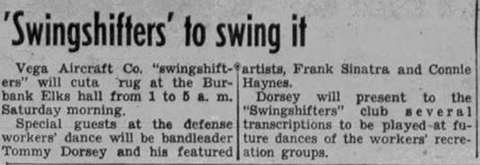
January 25, 1942
Concerts
Hollywood Palladium (Dec. 30, 1941 - Feb 23, 1942)
Tommy Dorsey & Orch.
January 26, 1942
Concerts
Hollywood Palladium (Dec. 30, 1941 - Feb 23, 1942)
Tommy Dorsey & Orch.
January 27, 1942
Concerts
Hollywood Palladium, California (Dec. 30, 1941 - Feb. 23, 1942) Tommy Dorsey & His Orchestra
January 28, 1942
Concerts
Hollywood Palladium, California (Dec. 30, 1941 - Feb. 23, 1942) Tommy Dorsey & His Orchestra
January 29, 1942
Concerts
Hollywood Palladium, California (Dec. 30, 1941 - Feb. 23, 1942) Tommy Dorsey & His Orchestra with Frank Sinatra
January 30, 1942
Concerts
Hollywood Palladium, California (Dec. 30, 1941 - Feb. 23, 1942) Tommy Dorsey & His Orchestra
January 31, 1942
Radio
NBC Blue
Tommy Dorsey & His Orchestra with Frank Sinatra
All West Coast Broadcasts from 10:30 to 11:00 PM
Concerts
Hollywood Palladium, California (Dec. 30, 1941 - Feb. 23, 1942) Tommy Dorsey & His Orchestra
February 1942
[Art Linkletter interviews furious Dorsey]
Tommy Dorsey (via Art Linkletter): Young reporter Art Linkletter went backstage at San Francisco's Golden Gate Theatre after Sinatra gave notice and found an unhappy Tommy Dorsey venting that Sinatra was "such a damn fool" for thinking a singer could make it without a band.
Source: James Kaplan, "Frank: The Voice" (2010)
[Sinatra gives Dorsey notice]
Kaplan: Despite Sinatra's later claim (in a 1986 Yale Law School talk with Sidney Zion) that he gave Dorsey a simple year's notice that was met with an easy "Sure," Kaplan establishes that Sinatra actually gave notice in February 1942, with about ten months left on his three-year contract; he would go on performing with the band for another seven months.
Source: James Kaplan, "Frank: The Voice" (2010)
[Sinatra's decision to leave Dorsey, motivated by wanting to emulate Crosby -- critical commentary]
Sinatra (to Sidney Zion): But Sinatra, visionary that he was, had no way of knowing that in February 1942 as he listened to his test pressings from the January 1942 Bluebird date and planned his next move. "The reason I wanted to leave Tommy’s band was that Crosby was number-one, way up on top of the pile," as Sinatra recollected for Sidney Zion. His goal was never to challenge Crosby, but rather simply to stand on his own.
Source: Will Friedwald, "Sinatra! The Song Is You: A Singer's Art" (2018 revised edition), Ch. 3, "With Tommy Dorsey" (1940-1942)
February 1, 1942
Radio
The Hollywood Palladium, California
Tommy Dorsey and His Orchestra with Frank Sinatra
NBC Blue
All West Coast Broadcasts from 10:30 to 11:00 PM
Sunday Evening At Tommy Dorsey's
Network: Blue Network
Location:
Time: 8:00PM - 8:30PM (EST)
Show #1 (pending)
Sponsor: (sustaining or unknown)
Personnel (probable): Tommy Dorsey, George Arus, Dave Jacobs, Jimmy Skiles (trombone); Jimmy Blake, Ziggy Elman, Chuck Peterson, Jimmy Zito, Danni Vanelli (trumpet); Fred Stulce, Harry Schuchman (clarinet, alto sax); Heinie Beau (clarinet, tenor sax); Bruce Snyder, Don Lodice (tenor sax); Bernard Tinterow, Seymour Miroff, William Ehrenkrantz, Leonard Posner, Paul Poliakine (violin); Sam Ross, Leonard Atkins (viola); Harold Bemko (cello); Ruth Hill (harp); Clark Yocum (guitar); Phil Stevens (bass); Milt Raskin (piano); Buddy Rich (drums).
Vocals: Frank Sinatra, The Pied Pipers, Jo Stafford,
Orchestra Conducted By: Tommy Dorsey
Announcer:
Premiere episode of the series
Concerts
Hollywood Palladium, California (Dec. 30, 1941 - Feb. 23, 1942) Tommy Dorsey & His Orchestra
Sunday Evening At Tommy Dorsey's
Here is the Billboard review of the first show:
February 2, 1942
Radio
NBC Blue
Tommy Dorsey & His Orchestra with Frank Sinatra
All West Coast Broadcasts from 10:30 to 11:00 PM
Concerts
Hollywood Palladium, California (Dec. 30, 1941 - Feb. 23, 1942) Tommy Dorsey & His Orchestra with Frank Sinatra
February 3, 1942
Concerts
Hollywood Palladium, California (Dec. 30, 1941 - Feb. 23, 1942) Tommy Dorsey & His Orchestra with Frank Sinatra
February 4, 1942
Radio
NBC Blue
Tommy Dorsey & Co.
All West Coast Broadcasts from 10:30 to 11:00 PM
Concerts
Hollywood Palladium, California (Dec. 30, 1941 - Feb. 23, 1942) Tommy Dorsey & His Orchestra with Frank Sinatra
TD - - Palladium -- Dorsey setting new records 65 cents to $1.00. In the chips all the way and another 16,000 ( week) to help him toward dancery's highest mark for the stand. Extended another four weeks. Claude Thornhill to follow.
Variety
February 4, 1942
February 5, 1942
Concerts
Hollywood Palladium, California (Dec. 30, 1941 - Feb. 23, 1942) Tommy Dorsey & His Orchestra
February 6, 1942
Concerts
Hollywood Palladium, California (Dec. 30, 1941 - Feb. 23, 1942) Tommy Dorsey & His Orchestra with Frank Sinatra
February 7, 1942
Radio
Hollywood Palladium
Saturday
9:30 - 10:00 pm PST
NBC BLUE
KECA in L.A.
TD and Band
Concerts
Hollywood Palladium, California (Dec. 30, 1941 - Feb. 23, 1942) Tommy Dorsey & His Orchestra with Frank Sinatra
February 8, 1942
Radio
Sunday Evening At Tommy Dorsey's
Network: Blue Network
Location:
Time: 8:00PM - 8:30PM (EST)
Show #2
Sponsor: (sustaining or unknown)
Personnel (probable): Tommy Dorsey, George Arus, Dave Jacobs, Jimmy Skiles (trombone); Jimmy Blake, Ziggy Elman, Chuck Peterson, Jimmy Zito, Danni Vanelli (trumpet); Fred Stulce, Harry Schuchman (clarinet, alto sax); Heinie Beau (clarinet, tenor sax); Bruce Snyder, Don Lodice (tenor sax); Bernard Tinterow, Seymour Miroff, William Ehrenkrantz, Leonard Posner, Paul Poliakine (violin); Sam Ross, Leonard Atkins (viola); Harold Bemko (cello); Ruth Hill (harp); Clark Yocum (guitar); Phil Stevens (bass); Milt Raskin (piano); Buddy Rich (drums).
Vocals: Frank Sinatra, The Pied Pipers, Jo Stafford,
Orchestra Conducted By: Tommy Dorsey
Announcer:
Hollywood Palladium
Sunday Evening
9:30 - 10:00 pm PST
NBC BLUE
KECA in L.A.
TD and Band
Concerts
Hollywood Palladium, California (Dec. 30, 1941 - Feb. 23, 1942) Tommy Dorsey & His Orchestra with Frank Sinatra
February 9, 1942
Radio
Hollywood Palladium
TD Band
Monday Evening
10:30 - 11:00 pm PWT
NBC Blue Network
KECA L.A.
Concerts
Hollywood Palladium, California (Dec. 30, 1941 - Feb. 23, 1942) Tommy Dorsey & His Orchestra with Frank Sinatra
February 10, 1942
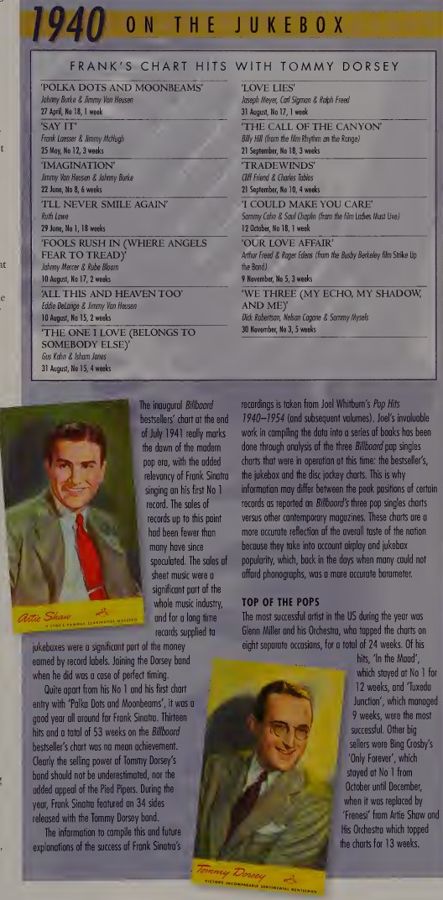
[Photograph: Glenn Miller receives the first Gold Disc. From Richard Havers, "Sinatra" (Dorling Kindersley, 2007), p.61.]
Radio
Spotlight On The Bands
WOR
New York City
Tuesday evening
30 minutes
9:30 P.M.-10:00 P.M. EWT
Sponsor: Coca-Cola
Tommy Dorsey & Orch
Frank Sinatra, Connie Haines, Jo Stafford,
The Pied Pipers, Ziggy Elman, Buddy Rich,
Joe Bushkin, Sy Oliver
Hollywood Palladium
TD Band
Tuesday Evening
10:30 - 11:00 pm PWT
NBC Blue Network
KECA L.A.

Concerts
Hollywood Palladium, California (Dec. 30, 1941 - Feb. 23, 1942) Tommy Dorsey & His Orchestra with Frank Sinatra
On a Chesterfield cigarettes radio broadcast, Glenn Miller was awarded the first-ever Gold Disc for a recording selling over a million copies, for 'Chattanooga Choo Choo,' which had sold 1.2 million copies on the same Bluebird label Frank would soon record for as a soloist. (Source: Richard Havers, "Sinatra" (Dorling Kindersley, 2007).)
February 11, 1942
Radio
Hollywood Palladium
TD Band
Wednesday Evening
10:30 - 11:00 pm PWT
NBC Blue Network
KECA L.A.
Concerts
Hollywood Palladium, California (Dec. 30, 1941 - Feb. 23, 1942) Tommy Dorsey & His Orchestra with Frank Sinatra
February 12, 1942
Concerts
Hollywood Palladium, California (Dec. 30, 1941 - Feb. 23, 1942) Tommy Dorsey & His Orchestra
February 13, 1942
Concerts
Hollywood Palladium, California (Dec. 30, 1941 - Feb. 23, 1942) Tommy Dorsey & His Orchestra
February 14, 1942
Concerts
Hollywood Palladium, California (Dec. 30, 1941 - Feb. 23, 1942) Tommy Dorsey & His Orchestra
Note: above two "Extra's supplied by Ed O'Brien.
February 15, 1942
Radio
Sunday Evening At Tommy Dorsey's
Network: Blue Network
Location:
Time: 8:00PM - 8:30PM (EST)
Show #3
Sponsor: (sustaining or unknown)
Personnel (probable): Tommy Dorsey, George Arus, Dave Jacobs, Jimmy Skiles (trombone); Jimmy Blake, Ziggy Elman, Chuck Peterson, Jimmy Zito, Danni Vanelli (trumpet); Fred Stulce, Harry Schuchman (clarinet, alto sax); Heinie Beau (clarinet, tenor sax); Bruce Snyder, Don Lodice (tenor sax); Bernard Tinterow, Seymour Miroff, William Ehrenkrantz, Leonard Posner, Paul Poliakine (violin); Sam Ross, Leonard Atkins (viola); Harold Bemko (cello); Ruth Hill (harp); Clark Yocum (guitar); Phil Stevens (bass); Milt Raskin (piano); Buddy Rich (drums).
Vocals: Frank Sinatra, The Pied Pipers, Jo Stafford,
Orchestra Conducted By: Tommy Dorsey
Announcer:
Notes: Confirmed airing on WJZ & WMAL. No show on February 22, 1942.
WMAL & WJZ both aired: "8:00PM - 8:30PM Labor and Payroll Savings Plan - William Green, President, A.F.L.; Secretary Of The Treasury"
Concerts
Hollywood Palladium, California (Dec. 30, 1941 - Feb. 23, 1942) Tommy Dorsey & His Orchestra
February 16, 1942
Radio
Hollywood Palladium, California
Monday Evening
NBC Blue Network
10:30 - 11:00 pm (PWT)
KECA Los Angeles
Tommy Dorsey & His Orchestra
Concerts
Hollywood Palladium, California (Dec. 30, 1941 - Feb. 23, 1942) Tommy Dorsey & His Orchestra
February 17, 1942
Radio
Hollywood Palladium
Tuesday Evening
NBC Blue Network
10:30 - 11:00 pm (PWT)
KECA Los Angeles
Tommy Dorsey & His Orchestra
Concerts
Hollywood Palladium, California (Dec. 30, 1941 - Feb. 23, 1942) Tommy Dorsey & His Orchestra
February 18, 1942
Radio
Hollywood Palladium
Wednesday Evening
NBC Blue Network
10:30 - 11:00 pm (PWT)
KECA Los Angeles
Tommy Dorsey & His Orchestra
Concerts
Hollywood Palladium, California (Dec. 30, 1941 - Feb. 23, 1942) Tommy Dorsey & His Orchestra
PALLADIUM REPORT ON T.D.
Dorsey name continues to be magic for youngsters adding a 4,000 ticket sales for a B'nai B'rith benefit, soared past 20,000. Claude Thornhill comes in on
February 24th.
Variety
February 18, 1942
Hi everybody,
The sound quality on this album is great also. It was recorded on 35mm magnetic film and can be heard in all of its brilliance on the CD that was issued in 2012. Before that all of the LP/CD releases had been from reel-to-reel tape which were several generations removed from the original.
Guy
> On Feb 18, 2026, at 9:08 AM, scott@falseducks.com wrote: >
>
> Studio
>
> 1963 Hollywood
>
> 1820 Lost In The Stars
> (Maxwell Anderson/Kurt Weill)
> Hampshire House Publishing Corp./Chappell & Co. Inc.. (ASCAP) > Arranged & Conducted by Nelson Riddle
> (4:06) CD: 46013-2 The Complete Reprise Studio Recordings Disc 5 > CD: 1015-2My Kind Of Broadway
> CD: 1009-2The Concert Sinatra
> LP: FS1009The Concert Sinatra
>
>
> 1821 My Heart Stood Still
> (Richard Rodgers/Lorenz Hart)
> Harms Inc./Willianson Music Co. Inc. (ASCAP)
> Arranged & Conducted by Nelson Riddle
> (3:01) CD: 46013-2 The Complete Reprise Studio Recordings Disc 5 > CD: 1009-2The Concert Sinatra
> LP: FS1009The Concert Sinatra
>
>
> 1822 Ol' Man River
> (Jerome Kern/Oscar Hammerstein II)
> PolyGram International Publishing Co. Inc.. (ASCAP)
> Arranged & Conducted by Nelson Riddle
> (4:24) CD: 46013-2 The Complete Reprise Studio Recordings Disc 5 > CD: 1009-2The Concert Sinatra
> LP: FS1009The Concert Sinatra
>
> NOTE: Sinatraphile Rich Rosenberg says he'll never forget the first time he heard this. It was the mid-70s and I was a teenage rock fan and I was browsing in a stereo store. I was looking at some expensive speakers and, all of a sudden, this came out of them. I almost fell down. I enjoy some of the live versions, but this may still be the granddaddy of them all. It's interesting to follow this song through its live incarnations. >
> To Rich's comments, Sinatra Scholar Ed O'Brien responds: George Roberts and Vince DeRosa told me that this was not easy for Sinatra. He struggled mightily to get it right. They told me he was exhausted at the session's end. There are some stunning versions of this tune from Sinatra through the years. We have him singing it at the Hollywood Bowl in 1943 with that angelic voice and he still could do an electrifying renditions in the early 90s. The Bowl version has him singing the line about the "darkies." A few months later he decided it was offensive and never sang the song again using that word. I love the one from "A Man & His Music + Ella + Jobim" in 1967. >
>
> <5dec3ea7.png>
> Frank Sinatra: The Concert Sinatra
> – BY CHRISTOPHER LOUDON
> In late 1960, with the launch of his Reprise label, Frank Sinatra began the most prolific period of his entire recording career. By the time he got to The Concert Sinatra in early '63, he'd delivered eight Reprise albums (and had already sold up shop to Warner Bros). Despite such steady output, The Concert Sinatra remains the crown jewel of the Chairman's early- to mid-'60s work. > Remarkably, it was Sinatra's first full-length Reprise session with arranger and conductor Nelson Riddle, and Riddle is in superlative form, working with the largest orchestra ever assembled for a Sinatra album, yet masterfully avoiding the lure of grandiosity. To achieve unprecedented richness, the eight tracks were recorded on a movie soundstage, the audio captured on 35mm film. This reissue marks the first time since the release of the original LP nearly a half-century ago that the original sound mix has been employed.. >
> Befitting such majestic settings, Sinatra shapes a playlist of eight Broadway masterpieces (six from the Richard Rodgers songbook). All, including seismic treatments of "Ol' Man River" and the Carousel showstopper "Soliloquy," are magnificently rendered, with slight hints of encroaching vocal rust only adding to their luster. But Kurt Weill's enchanting "Lost in the Stars," an awed Sinatra traversing Riddle's cosmos of strings, is the album's magnum opus, ranking alongside "In the Wee Small Hours of the Morning," "I've Got You Under My Skin" and "One for My Baby" at the apex of the entire Sinatra-Riddle canon. >
> Note: Nelson Riddle told me that Sinatra worked harder on this project than on any of the other great concept LPs they did together. > Frank would sing seven of the eight songs in concert settings through the years. The above session features 57 musicians backing > the singer. Album would peak at # 6 on Billboard and chart for 35 weeks. > Ed
>
>
> FRANK SINATRA: The Concert Sinatra.
> Frank Sinatra (vocals); orchestra, Nelson Riddle cond.
> Lost in the Stars; Bewitched; Ol' Man River; and five others.
> REPRISE R 91009 $5.98, R 1009* $4.98.
> Interest: Broadway's best
> Performance: Tries hard
> Recording: A bit cloudy
> Stereo Quality: All right
> The trouble with hearing Frank Sinatra in concert is that he does > not have a concert voice. As a pop singer, he is unquestionably > one of the best, but when called upon to project the full meaning > of these songs, most of them by Rodgers and/or Hammerstein, > he does not have the vocal resources to do them full justice. This > fact is painfully accentuated by the seventy-three-piece orchestra > that seems to inhibit the singer's natural exuberance and forces him > to strain. Most successful are My Heart Stood Still and Bewitched; > least excusable is Ol' Man River, in which Mr. Sinatra holds the note > on "jail" for so long that it sounds as if he did it on a bet. S. G. > STEREO REVIEW
> OCTOBER 1963
>
>
>
>
> 1969 Hollywood
>
> M7180 All My Tomorrows
> (Sammy Cahn/Jimmy Van Heusen)
> Maraville Music Corp. (ASCAP)
> Arranged & Conducted By Don Costa
> (4:37) CD: 46013-2 The Complete Reprise Studio Recordings Disc 14 > CD: 1029-2My Way
> LP: FS1029My Way
>
> M7181 Didn't We?
> (Jimmy Webb)
> Jobete Music Co. Inc. (ASCAP)
> Arranged & Conducted By Don Costa
> (2:55) CD: 46013-2 The Complete Reprise Studio Recordings Disc 14 > CD: 1029-2My Way
> LP: FS1029My Way
>
>
>
> Radio
>
> 1942 Hollywood Palladium
> Wednesday Evening
> NBC Blue Network
> 10:30 - 11:00 pm (PWT)
> KECA Los Angeles
> Tommy Dorsey & His Orchestra
>
>
> 1943 Songs By Sinatra
> Network: CBS
> Location: NewYork City
> Time: 10:45PM - 11:00PM Thursday
> Show #27
> Sponsor: none (sustaining)
> Musicians: Axel Stordahl, Raymond Scott, CBS Orchestra > Arrangements By: Axel Stordahl
> Notes: Confirmed aired on WABC.
>
>
> 1951 Meet Frank Sinatra
> Show #17
> Network: CBS
> Script: January 31, 1951
> Sponsor: Tintair, Ludens
> Time: 5:00PM - 5:45PM (EST), Sunday
> Producers: Mark Goodson, Bill Todman
> Musicans: Graham Forbes and His Quartet
> Announcer: Hal Sims
> Writers: Harry Crane
> Guest: Perry Como
> Notes: Confirmed aired on WCBS
> <552559a6.png>
>
>
> 1955 The Frank Sinatra Show
> Network: NBC
> Show Number: 50
> Time 8:15 p.m. - 8:30 p.m.
> Sponsor: Bobbi Home Permanet, White Rain Shampoo, Deep Magic Face lotion > Host: Frank Sinatra
> Writers: Norm Sickel
> Announcer: Maurice Hart
> Producer: Andrew C.. Love
>
>
>
>
> Television
>
> None
>
>
>
> Concerts
>
> 1942 Hollywood Palladium, California (Dec. 30, 1941 - Feb. 23, 1942) > Tommy Dorsey & His Orchestra
>
> PALLADIUM REPORT ON T.D.
> Dorsey name continues to be magic for youngsters
> adding a 4,000 ticket sales for a B'nai B'rith benefit, > soared past 20,000. Claude Thornhill comes in on
> February 24th.
> Variety
> February 18, 1942
>
>
> 1943 Paramount Theatre, New York City (Jan. 27 - Feb 20) > w/Johnny Long & Orchestra
>
>
> 1945 Earl Carroll Theatre, Los Angeles, CA
> Sixteenth Annual Charity Ball of the Junior Auxiliary of the Home for the Aged > Frank Sinatra, Bob Hope, Danny Kaye, Mary Pickford, Jimmy Durante and others >
>
> 1965 Sands, Las Vegas, Nevada ( February 17 - March 2) > w/Joe E. Lewis
>
>
> 1967 Fontainebleau, Miami Beach, Florida (February 16 - March 1) >
>
> 1976 Latin Casino, Cherry Hill, New Jersey
> Key Musicians: Al Viola (guitar), Irv Cottler (drums), Gene Cherico (bass), Charles Turner (trumpet), Bill Miller (piano). > Orchestra Conducted By: Bill Miller
> 1. I've Got You Under My Skin
> 2. Where Or When
> 3. Bad, Bad Leroy Brown
> 4. The Lady Is A Tramp
> 5. What's New?
> 6. Didn't We?
> 7. Empty Tables
> 8. Here's That Rainy Day
> 9. Witchcraft
> 10. My Way
> 11. monologue
> 12. I Sing The Songs
> 13. Let Me Try Again
> 14. If
> 15. Send In The Clowns
> 16. My Kind Of Town
> Notes: TT 60mins.
>
>
> 1979 Arie Crown Theater, Chicago, Illinois
> Orchestra Conducted By: Vincent Falcone, jr.
> 1. Night And Day
> 2. At Long Last Love
> 3. The Lady Is A Tramp
> 4.. Someone To Watch Over Me
> 5. This Is All I Ask
> 6. There's Something About You
> 7. medley: The Gal That Got Away / It Never Entered My Mind > 8. monologue
> 9. Where Or When
> 10. It Was A Very Good Year
> 11. I've Got The World On A String
> 12. You And Me
> 13. My Way
> 14. My Kind Of Town
> Notes: TT 66mins.
>
> Note; This was a last minute engagement.
> Frank opened on the 13th and closed on
> the 18th. There were eight shows in all.
> Alternates: Chicago, Remember, My
> Funny Valentine and You Make Me
> Feel So Young
> --Ed
>
>
> 1981 Caesars, Lake Tahoe , Nevada
> Key Musicians: Vincent Falcone Jr. (piano), Gene Cherico (bass), Irv Cottler (drums), Tony Mattola (guitar), Charles Tunner (trumpet), Bobby Sann (trombone) > Orchestra Conducted By: Vincent Falcone, jr.
> 1. I've Got The World On A String
> 2. Pennies From Heaven
> 3. You And Me
> 4. The Best Is Yet To Come
> 5. Here's That Rainy Day
> 6. Fly Me To The Moon
> 7. Angel Eyes
> 8. Luck Be A Lady
> 9. Send In The Clowns
> 10. I Get A Kick Out Of You
> 11. Where Or When
> 12. I've Got You Under My Skin
> 13. As Time Goes By
> 14. Summer Me, Winter Me
> 15. New York, New York
> Notes: TT 61mins.
>
>
> ------------------------------------------------------- >
> Extra
>
> 1945 Earl Carroll Theatre, Los Angeles, CA
> Sixteenth Annual Charity Ball of the Junior Auxiliary of the Home for the Aged > Frank Sinatra, Bob Hope, Danny Kaye, Mary Pickford, Jimmy Durante and others >
> Sinatra receives the Home's annual award for outstanding service >
> <75641ff1.png>
>
> <d9461370.png>
>
> <adc0501e.png>
>
> -----------------------------------
>
> 1951 Meet Frank Sinatra
> Show #17
> Network: CBS
> Script: January 31, 1951
> Sponsor: Tintair, Ludens
> Time: 5:00PM - 5:45PM (EST), Sunday
> Producers: Mark Goodson, Bill Todman
> Musicans: Graham Forbes and His Quartet
> Announcer: Hal Sims
> Writers: Harry Crane
> Guest: Perry Como
> Notes: Confirmed aired on WCBS
>
> <2c171bb6.png>
>
> <c9a31d46.png>
>
> ---------------------------------------
>
> 1963 Hollywood
>
> 1820 Lost In The Stars
>
> 1821 My Heart Stood Still
>
> 1822 Ol' Man River
>
> <cba93d65.png>
> <9bfb0675.png>
>
>
> --------------------------------------------
>
> 1965 Sands, Las Vegas, Nevada ( February 17 - March 2) > w/Joe E. Lewis
>
>
> <6e86913f.png>
>
> The Call
> 2-22-65
>
> note: I am assuming Joe E. Lewis got the night off > Or he opened for Sammy.
> Ed
>
> ------------------------------------------------
>
> 1969 Hollywood
>
> M7180 All My Tomorrows
>
>
> M7181 Didn't We?
>
> <abd2e917.png>
>
> ----------------------------------------
>
> 1976 Latin Casino, Cherry Hill, New Jersey
> Key Musicians: Al Viola (guitar), Irv Cottler (drums), Gene Cherico (bass), Charles Turner (trumpet), Bill Miller (piano). > Orchestra Conducted By: Bill Miller
>
> <577fc59c.png>
>
> <eacf952d.png>
>
>
>
> ---------------------------------------
>
> 1982
> Pat Henry, 58, Comedian; Was Opening Act for Sinatra
> LAS VEGAS, Nev.
>
> Pat Henry, the comedian who was the opening act for Frank Sinatra for more than two decades, was found dead Thursday in his suite in Caesars Palace Hotel. He was 58 years old. > Mr. Henry, who closed an engagement with Mr. Sinatra at Caesars Wednesday night, apparently died in his sleep of natural causes, according to hotel officials. > Mr. Henry's real name was Patrick Henry Scarnato. He first appeared with Mr. Sinatra in 1958, at the 500 Club in Atlantic City, and regularly performed with the singer, doing a 30-minute opening monologue with one-line jokes and anecdotes, often about Mr. Sinatra. In 1968 he appeared in the mystery thriller movie ''Lady in Cement,'' which starred Mr. Sinatra. > Mr. Henry is survived by his wife, Susan, and a daughter, Tina Wrigley, both of Bellmore, L.I.; a stepson, Dr. Gary Robinson, and a grandson. >
> --I remember two very funny lines Henry used:
> As he was wrapping up his 20 minutes on stage, he would tell the audience not to leave because there was another act. > In Saratoga, he told the audience if they hated Paris, they were going to love Albany. > -Ed
>
>
> © 1997-2026 The Sinatra Archive
> This calendar, or any parts thereof, may not be reproduced in any fashion > whatsoever without the prior written permission of the publisher (The > Sinatra Archive)
>
>
>
>
>
> --
>
February 19, 1942
Studio
Hollywood
PBS072107 Snootie Little Cutie w/The Pied Pipers & Connie Haines
(Bob Troup)
Music Sales Corp. (ASCAP)
Arranged by Sy Oliver
-1 (3:19) CD: 07863 66353-2 "The Song Is You" 5CD set Vol 3
CD: RCA 9679-2-R
LP: SD 1000
78: 20-20116
78: 27876
PBS072108 Poor You
(from the MGM Film Ship Ahoy)
(E.Y. Harburg/B. Lane)
EMI Feist Catalog Inc. (ASCAP)
Arranged by Axel Stordahl
-1 (2:45) CD: 07863 66353-2 "The Song Is You" 5CD set Vol 4
CD: RCA 2269-2-R
LP: SD 1000
78: 27849
PBS072109 I'll Take Tallulah w/The Pied Pipers, Jo Stafford & Tommy Dorsey
(from the MGM Film Ship Ahoy)
(E.Y. Harburg/B. Lane)
EMI Feist Catalog Inc. (ASCAP)
Arranged by Sy Oliver
-1 (3:12) CD: 07863 66353-2 "The Song Is You" 5CD set Vol 4
LP: SD 1000
78: 27869
Hartford Courant
Concerts
Hollywood Palladium, California (Dec. 30, 1941 - Feb. 23, 1942) Tommy Dorsey & His Orchestra
Hollywood
PBS072107 Snootie Little Cutie
PBS072109 I'll Take Tallulah
PBS072110 The Last Call For Love
RCA SESSION SHEET
[image referenced in source but could not be recovered]
February 20, 1942
Concerts
Hollywood Palladium, California (Dec. 30, 1941 - Feb. 23, 1942) Tommy Dorsey & His Orchestra
February 21, 1942
Radio
Hollywood Palladium, Los Angeles
KECA
West Coast Broadcast
Tommy Dorsey & His Orchestra
Saturday Evening
10:30 - 11:00 pm (PWT)
NBC Blue Network
Concerts
Hollywood Palladium, California (Dec. 30, 1941 - Feb. 23, 1942) Tommy Dorsey & His Orchestra
February 22, 1942
Radio
Program about AFL's contribution to the Treasury Department's Defense Payroll Savings Plan 5pm (L.A. time); 8pm (NY time)
Tommy Dorsey and His Orchestra
(Los Angeles Evening Citizen News, February 21, 1942)
Concerts
Hollywood Palladium, California (Dec. 30, 1941 - Feb. 23, 1942) Tommy Dorsey & His Orchestra
February 23, 1942
Radio
Hollywood Palladium, Los Angeles
Monday Evening
10:30 - 11:00 pm PWT
Live Remote -
NBC Blue Network
KECA
Ed O'Brien:
Closing night of a record breaking eight week engagement.
Variety cited the incredible attendance figures and the huge grosses week after week. Claude Thornhill opened on 2/24 and was SRO. Unfortunately, the blackout hurt him badly for the rest of his run.
Concerts
Hollywood Palladium, California (Dec. 30, 1941 - Feb. 23, 1942) Tommy Dorsey & His Orchestra
note: The Palladium was a four week engagement. TD and Co were setting all time attendance records and the manage- ment extended their stay for an additional four weeks. The band attracted over 130,000 dancers at a price of 65 cents to $1.00. Variety predicted the new b.o. record would stand for a very long time. During this run, Dorsey let RCA know that he was in contact with Columbia Records and was close to signing a long term deal. RCA responded by offering Dorsey a guaranteed $2,500 per record. This was unheard of in the record industry at that time. A band received that amount only when a record reached 100,000 in sales. And no band was able to average such sales on a regular basis. T.D. immediately inked a new deal with Nipper's label. A few days before closing, the band went over to March Field to give a big sendoff to Joe Bushkin, who was now in the army. Joe was assigned to a band, but not as a piano player. The military needed a trumpet player. --Ed
February 24, 1942
Concerts
Civic Auditorium, San Jose, CA
Tommy Dorsey and His Orchestra with Frank Sinatra
Civic Auditorium, San Jose, CA
Tommy Dorsey and His Orchestra with Frank Sinatra
[image referenced in source but could not be recovered]
[image referenced in source but could not be recovered]
February 25, 1942
Concerts
Golden Gate Theatre, San Francisco, California (Feb. 25 - Mar. 3) Tommy Dorsey & His Orchestra
Sold Out One Week Engagement
Feature Film: Date With A Falcon
George Sanders, Wendy Barrie, James Gleason, Allen Jenkins Dir. Irving Reis
Dick, Don & Dinah
Tommy Dorsey & His Orch.
Frank Sinatra, Jo Stafford, Chuck Peterson,
The Pied Pipers
Connie Haines was on hiatus due to a nervous disorder
1. I'm Getting Sentimental Over You T.D. & Orch.
2. Hallelujah T.D. & Orch.
3. When It Hits You J.S. & C.P.
4. Song Of India T. D. & Orch.
5. Embraceable You P.P.
6. When Angels Sing T.D. & Orch.
7. Hawaiian War Chant T.D. & Orch.
8. Without A Song F.S.
9. Begin The Beguine F.S.
10. I'll Never Smile Again F.S. J.. P.P.
11. South Of The Border F.S.
GOLDEN GATE THEATRE , San Francisco, California
Golden Gate,
San Francisco
(Reviewed Wednesday Evening. Feb. 25)
Hepcats and Jive-Jennies are flocking
to the Golden Gate to watch Tommy Dorsey's
organized swing dispensary go into action. For
most local swing addicts, it was their first glimpse
of the bespectacled trombonist-maestro, as it
was his first visit to San Francisco.
Dorsey's regular troupe was with him - Fred Sinatra,
baritone flash; Buddy Rich, drummer; Ziggy Elman, one of
swingdom's top trumpeters; Jo Stafford, standing In nicely
for the ailing Connie Haines, and the Pied Pipers, harmony
quartet.
Elman contributes the major solo work, applying his trumpet
to such novelties as "The Angels Sing" and "Hawaiian
War
Chant."
Show was stolen, however, by vocalist Sinatra, whose light
but sustained baritone style worked out on such smoothies
as "This Love of Mine,". "Begin the Beguine" and a funny
pokerfaced satire of of "South of the Border." Dorsey's own
famous trombone turns up only here and there.
Buddy Rich, Dorsey's drummer. is heard in a solo called "Quiet
Please,"a series of meaningless percussion patterns, but afford-
ing a show of virtuosity.
A single non-Dorsey act, and it is sensational..
is the trio of two boys and a girl, Dick, Don and Dinah, acrobatic
clowns, who arrived in time to stir up the show again after some
slow sessions by the Pled Pipers. They presented a whole barrel
of new stuff, and they didn't try too hard for laughs..
A Date With. the Falcon is on the screen.
Edward Murphy
Billboard
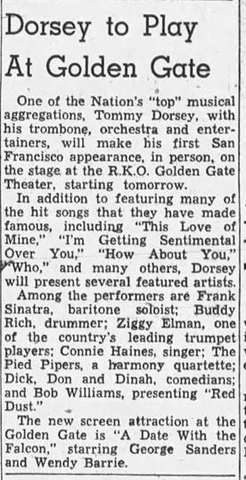
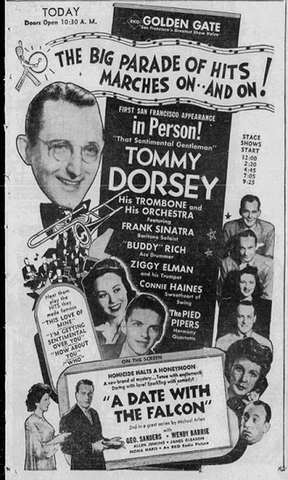
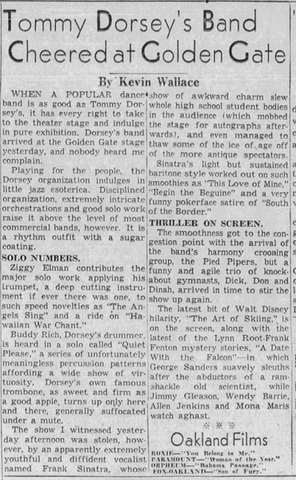
note: Good old Fred Sinatra. I wonder what became of him ?.
Engagement set B.O. records
GOLDEN GATE, S.F.
San Francisco, Feb.. 25
Tommy Dorsey Orch (16) with
Frank Sinatra; Pied Pipers (4);
Buddy Rich; Ziggy Elman; Dick,
Don and Dinah -- Feature Film:
"Date with a Falcon" (RKO).
Tommy Dorsey is playing his
first Frisco date this week and
will leave with a flock of new
friends. With jivey juves hanging
from chandeliers, mere mention
of Dorsey's name in a screen
trailer started a demonstration
at the opener. As curtains parted
with the leader tromboning the
theme, hepsters split the joint
wide open. Dorsey took it with
quiet dignity.
Orch goes from theme right
into a hot "Hallelujah" plus
"When It Hits You" with hot
breaks and vocal stuff by Jo
Stafford and Chuck Peterson.
Ziggy Elman trumpet solos
along the route for returns
second only to Dorsey.
"Song of India," as per a
past Dorsey recording, winds
up the first set. Only outside
specialty, Dick, Don and Dinah,
move in next. Two boys and a
looker do screwball knockabout
that's new here and successfully
sustains the pace.
Pied Pipers resume with "Em-
braceable You," after which Elman
takes over on "When Angels Sing."
Lad figuratively blows his brains out..
Elman and drummer Buddy Rich then
monopolize "Hawaiian War Chant"
with their duet interlude. For no
particular reason Elman then takes
the sticks while Rich does a tap
routine which gets by only because
he can do no wrong.
Frank Sinatra then baritones "Without
A Song" for smash returns. During his
second, "This Love of Mine," the Dorsey
trombone quartet moves in for some nice
stuff. Following "Beguine," Dorsey's trom-
bone works again in "Never Smile Again"
together with Sinatra and the Pipers. Sinatra
finishes his stint with a deadpan version of
"South of the Border" which pleased the mob
although corny.
Biz excellent.
Wern.
VARIETY
MARCH 4, 1942
Note: Engagement ran from 2-25 to 3-3-42
Here is a fun factoid from the late winter of 1942:
Decca's new 50 cent Black label series annonced they
were releasing a Bing Crosby-Mary Martin single. Crosby's
singles usually sold for 35 cents but the double cost of
talent forced Decca to increase the price. This policy
would continue when Crosby worked with The Andrew
Sisters and others.
Variety article
February 25, 1945 Shrine Auditorium, Los Angeles, CA
Sinatra receives recognition on his work on intolerance
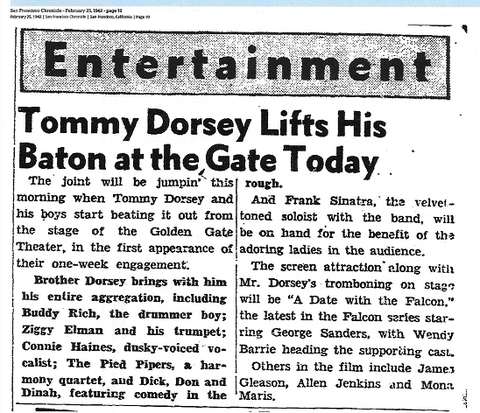
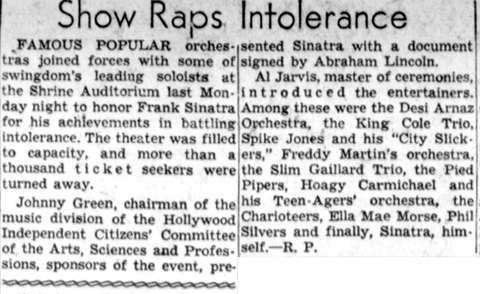
February 26, 1942
Concerts
Golden Gate Theatre, San Francisco, California (Feb. 25 - Mar. 3) Tommy Dorsey & His Orchestra
Sold Out One Week Engagement
February 27, 1942
Concerts
Golden Gate Theatre, San Francisco, California (Feb. 25 - Mar. 3) Tommy Dorsey & His Orchestra
Sold Out One Week Engagement
February 28, 1942
Concerts
Golden Gate Theatre, San Francisco, California (Feb. 25 - Mar. 3) Tommy Dorsey & His Orchestra
Sold Out One Week Engagement
March 1942
['Night and Day' released]
Frank's Bluebird recording of Cole Porter's 'Night and Day,' originally a No. 1 hit from the 1932 Broadway musical The Gay Divorce, was released to the public.
Source: Richard Havers, "Sinatra" (Dorling Kindersley, 2007).
March 1, 1942
Radio
Sunday Evening At Tommy Dorsey's
Network: Blue Network
Location:
Time: 8:00PM - 8:30PM (EST)
Show #4
Sponsor: (sustaining or unknown)
Personnel (probable): Tommy Dorsey, George Arus, Dave Jacobs, Jimmy Skiles (trombone); Jimmy Blake, Ziggy Elman, Chuck Peterson, Jimmy Zito, Danni Vanelli (trumpet); Fred Stulce, Harry Schuchman (clarinet, alto sax); Heinie Beau (clarinet, tenor sax); Bruce Snyder, Don Lodice (tenor sax); Bernard Tinterow, Seymour Miroff, William Ehrenkrantz, Leonard Posner, Paul Poliakine (violin); Sam Ross, Leonard Atkins (viola); Harold Bemko (cello); Ruth Hill (harp); Clark Yocum (guitar); Phil Stevens (bass); Milt Raskin (piano); Buddy Rich (drums).
Vocals: Frank Sinatra, The Pied Pipers, Jo Stafford,
Orchestra Conducted By: Tommy Dorsey
Announcer:
Notes: Confirmed airing on WJZ & WMAL.
Concerts
Golden Gate Theatre, San Francisco, California (Feb. 25 - Mar. 3) Tommy Dorsey & His Orchestra
Sold Out One Week Engagement
March 2, 1942
Concerts
Golden Gate Theatre, San Francisco, California (Feb. 25 - Mar. 3) Tommy Dorsey & His Orchestra
Sold Out One Week Engagement
March 3, 1942
Concerts
Golden Gate Theatre, San Francisco, California (Feb. 25 - Mar. 3) Tommy Dorsey & His Orchestra
Sold Out One Week Engagement
March 4, 1942
[Photograph: Variety reviews Dorsey band's West Coast opener. From Richard Havers, "Sinatra" (Dorling Kindersley, 2007), p.62.]
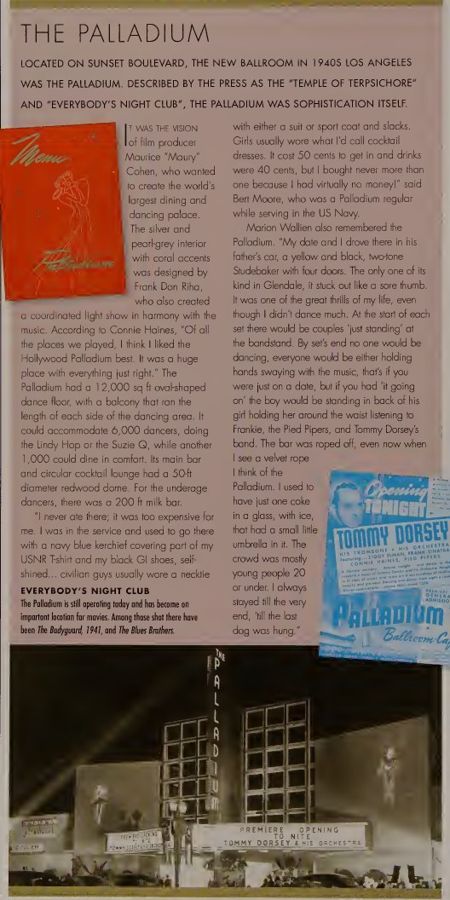
[Photograph: Variety reviews Dorsey band's West Coast opener. From Richard Havers, "Sinatra" (Dorling Kindersley, 2007), p.62.]
Concerts
Memorial Auditorium, Sacramento, CA
Tommy Dorsey and his Orchestra w/Frank Sinatra
Memorial Auditorium, Sacramento, CA
Tommy Dorsey and his Orchestra w/Frank Sinatra
Thanks to Richard Cook for above listing
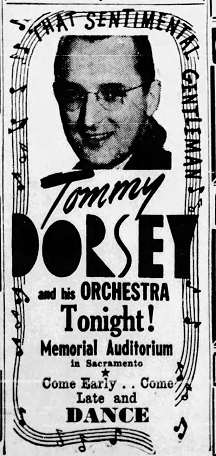
A Variety review described the Dorsey band's frenzied opening-night reception from 'jivey juvies,' with Sinatra baritoning 'Without a Song' and 'This Love of Mine' to strong response, and closing his set with 'South of the Border.' The reviewer summed up business as simply excellent. (Source: Richard Havers, "Sinatra" (Dorling Kindersley, 2007).)
March 5, 1942
Concerts
Civic Auditorium, Stockton, California
Tommy Dorsey and His Orchestra with Frank Sinatra
Civic Auditorium, Stockton, California
Tommy Dorsey and His Orchestra with Frank Sinatra
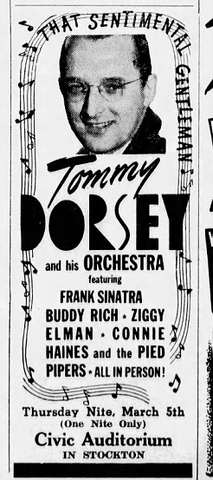
March 6, 1942
Radio
Oakland, California
NBC Blue Network - WJZ New York City
7:30 - 8:00 pm
KGO NBC Blue Affiliate Beamed this broadcast
Tommy Dorsey & His Orchestra
Concerts
Sweet's Ballroom, Oakland, California,
Tommy Dorsey and his Orchestra
Sweet's Ballroom, Oakland, California,
Tommy Dorsey and his Orchestra
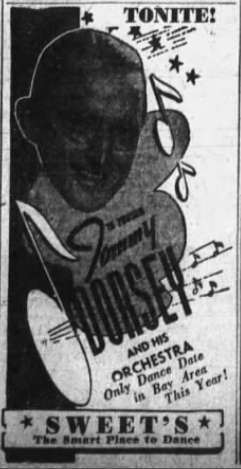
March 7, 1942
Concerts
Long Beach Municipal Auditorium, Long Beach, CA
Tommy Dorsey and his Orchestra w/Frank Sinatra
Long Beach Municipal Auditorium, Long Beach, CA
Tommy Dorsey and his Orchestra w/Frank Sinatra
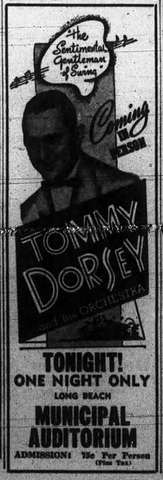
March 8, 1942
Radio
Sunday Evening At Tommy Dorsey's
Network: Blue Network
Location:
Time: 8:00PM - 8:30PM (EST)
Show #5
Sponsor: (sustaining or unknown)
Personnel (probabal): Tommy Dorsey, George Arus, Dave Jacobs, Jimmy Skiles (trombone); Jimmy Blake, Ziggy Elman, Chuck Peterson, Jimmy Zito, Danni Vanelli (trumpet); Fred Stulce, Harry Schuchman (clarinet, alto sax); Heinie Beau (clarinet, tenor sax); Bruce Snyder, Don Lodice (tenor sax); Bernard Tinterow, Seymour Miroff, William Ehrenkrantz, Leonard Posner, Paul Poliakine (violin); Sam Ross, Leonard Atkins (viola); Harold Bemko (cello); Ruth Hill (harp); Clark Yocum (guitar); Phil Stevens (bass); Milt Raskin (piano); Buddy Rich (drums).
Vocals: Frank Sinatra, The Pied Pipers, Jo Stafford,
Orchestra Conducted By: Tommy Dorsey
Announcer:
Notes: Confirmed airing on WJZ & WMAL.
Concerts
Pacific Square, San Diego, CA (One Nighter)
Tommy Dorsey and his Orchestra w/Frank Sinatra
.
Pacific Square, San Diego, CA
Tommy Dorsey and his Orchestra w/Frank Sinatra
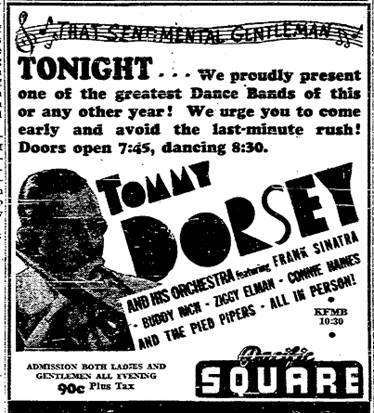
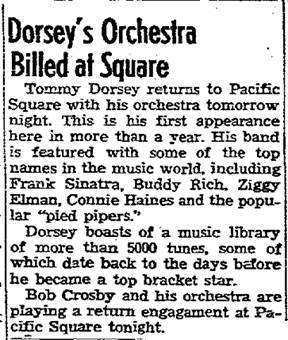
March 9, 1942
Studio
Hollywood
PBS072171 Somewhere A Voice Is Calling
(E. Newton/A.F. Tate)
Warner Bros. Music (ASCAP)
Arranged by Sy Oliver
-1 (3:05) CD: 07863 66353-2 "The Song Is You" 5CD set Vol 4
CD: RCA 9679-2-R
LP: SD 1000
78: 20-2006
78: 27887
Piano: Milt Raskin; Bass: Phil Stevens; Drums: Buddy Rich; Guitar: Clark Yocum; Saxes: Don Lodice, Heinie Beau, Fred Stulce, Manny Gershman, Bruce Snyder; Trumpets: Ziggy Elman, Jimmy Blake, Chuck Peterson, Al Stearns, Mannie Klein; Trombones: George Arus, Jimmy Skiles, David Jacobs
Concerts
Shrine Ballroom, Los Angeles, CA
Dancing For Victory Benefit
Numerous dance bands including Tommy Dorsey and His Orchestra
Shrine Ballroom, Los Angeles, CA
Dancing For Victory Benefit
The Los Angeles Times (Los Angeles, California) 9 Mar 1942
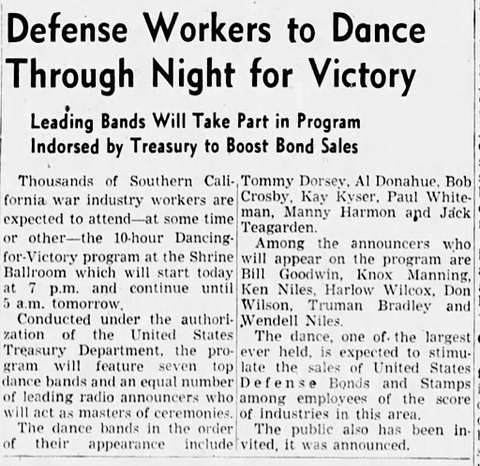
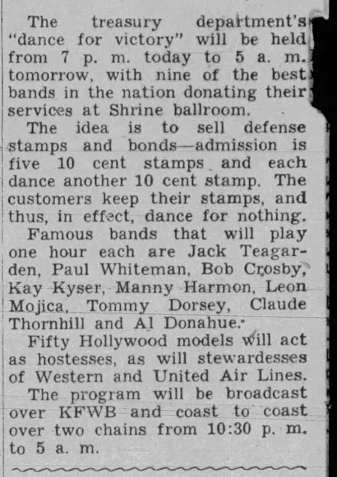
March 10, 1942
Concerts
University of Arizona, Tucson, Arizona
Tommy Dorsey and his Orchestra w/Frank Sinatra
Arizona Daily Star (Tucson, Arizona) - 10 Mar 1942,
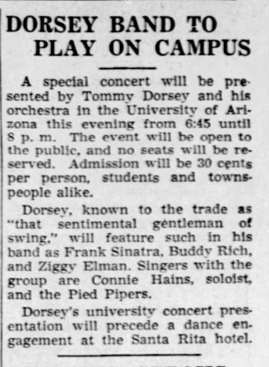
Santa Rita Hotel, Tucson, Arizona
Tommy Dorsey and his Orchestra w/Frank Sinatra
Santa Rita Hotel, Tucson, Arizona
Tommy Dorsey and his Orchestra w/Frank Sinatra
From: sinatraphiles-bounce@freelists.org [mailto:sinatraphiles-bounce@freelists.org] On Behalf Of Ed O'Brien ("eob101")
Sent: March 5, 2024 3:52 PM
To: Sinatra Fan
Subject: [sinatraphiles] Re: March 10 - THIS DATE IN SINATRA HISTORY
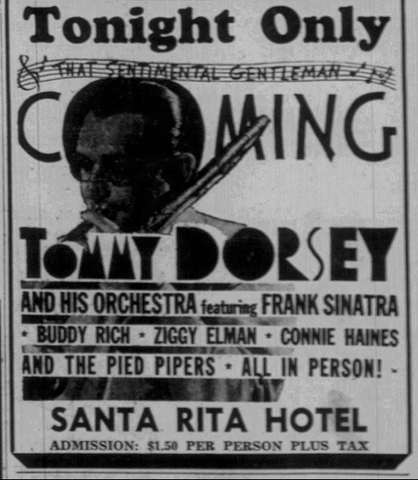
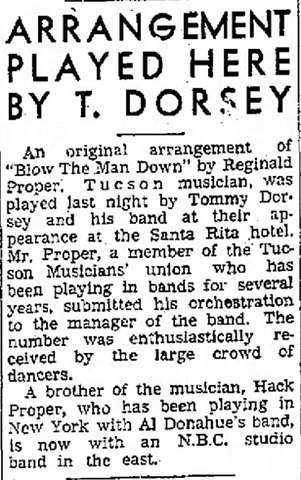
University of Arizona, Tucson, Arizona
Tommy Dorsey and his Orchestra w/Frank Sinatra
Arizona Daily Star (Tucson, Arizona) - 10 Mar 1942,
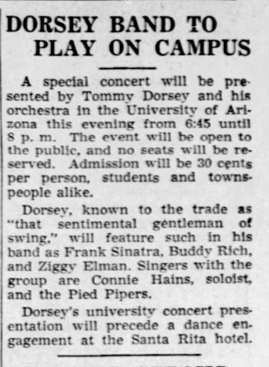
Santa Rita Hotel, Tucson, Arizona
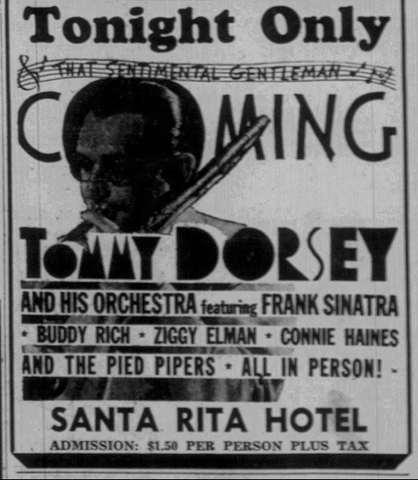
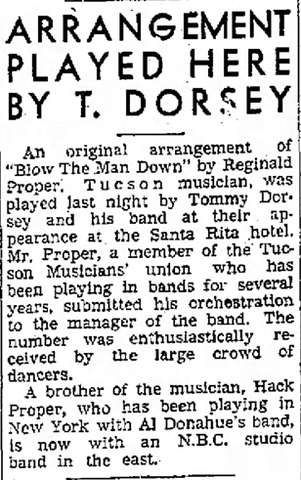
Santa Rita Hotel, Tucson, Arizona
Tommy Dorsey and his Orchestra w/Frank Sinatra
Hi Scott,
Tucson paper 3-11-42 had this article.
I discovered that the NBC Blue Network was broadcasting Dorsey at 11;30 or 12 from wherever
the band was appearing in March of 42. The show from Stockton, 3/5 was broadcast. And there were others
Found that listing in both a Des Moines and a Dayton paper.
[image referenced in source but could not be recovered]
March 11, 1942
Concerts
Liberty Hall, El Paso, Texas
Junior Chamber of Commerce Dance
Tommy Dorsey and his Orchestra with Frank Sinatra
Liberty Hall, El Paso, Texas
Junior Chamber of Commerce Dance
Tommy Dorsey and his Orchestra with Frank Sinatra
El Paso Times (El Paso, Texas) · 11 Mar 1942, Wed · Page 7
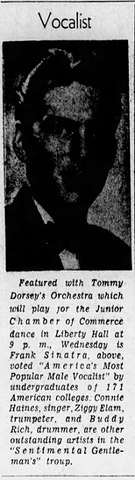
March 13, 1942
Concerts
Gregory Gymnasium, University of Texas, Austin, Texas (one-nighter) Friday Evening
9:00 p.m. -- 1:00 a.m.
Tommy Dorsey & His Orchestra
Gregory Gymnasium, University of Texas , Austin, Texas (one-nighter) Friday Evening
9:00 p.m. -- 1:00 a.m.
Tommy Dorsey & His Orchestra
Austin American-Statesman (Austin, Texas) · 16 Mar 1942, Mon · Page 10
*Daily Texan* (March 13, 1942 )
When Frank Sinatra Visited the Forty Acres
Before he was a world-famous crooner, Frank Sinatra was a backup singer in Gregory Gym.
Along with legendary jazz musician Tommy Dorsey and a group of more than 20 other entertainers, Sinatra performed during a Saturday night dance for students in March of 1942. At the time, the “All University Dances” were held in Gregory Gym each Saturday night during the academic year.
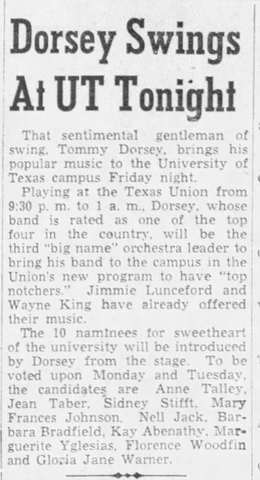
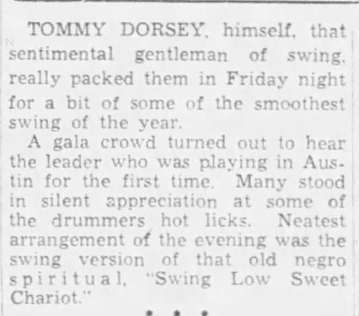
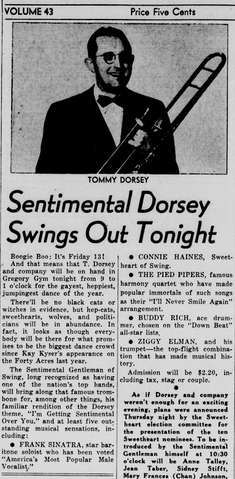
March 14, 1942
Concerts
Sam Houston Coliseum, Houston, Texas (Dance)
Tommy Dorsey and his Orchestra
I found the DOWNBEAT article from 4-15-42. The magazine ran about a month behind on dates, After the one-nighter in Houston, TD, Ziggy Elman and Buddy Rich dropped by the Plantation to hear George Wald play. TD and Co. then did a warm up session before challenging the Mighty Peck. After helping the very popular Wald close the doors, there was a jam session featuring Dorsey, Wald, Elman, Peck and Rich. DOWNBEAT described it as the grooviest session ever heard in this neck of the woods. --Ed
Sam Houston Coliseum, Houston, Texas (Dance)
Tommy Dorsey and his Orchestra
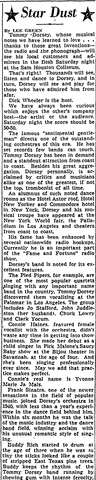
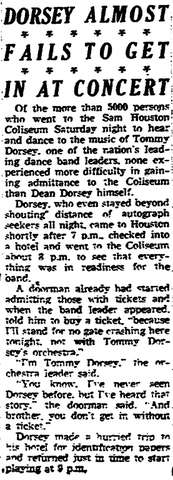
March 15, 1942
Radio
Sunday Evening At Tommy Dorsey's
Network: Blue Network
Location: Lake Worth Casino, Fort Worth, Texas
Time: 8:00PM - 8:30PM (EST)
Show #6
Sponsor: (sustaining or unknown)
Personnel (probable): Tommy Dorsey, George Arus, Dave Jacobs, Jimmy Skiles (trombone); Jimmy Blake, Ziggy Elman, Chuck Peterson, Jimmy Zito, Danni Vanelli (trumpet); Fred Stulce, Harry Schuchman (clarinet, alto sax); Heinie Beau (clarinet, tenor sax); Bruce Snyder, Don Lodice (tenor sax); Bernard Tinterow, Seymour Miroff, William Ehrenkrantz, Leonard Posner, Paul Poliakine (violin); Sam Ross, Leonard Atkins (viola); Harold Bemko (cello); Ruth Hill (harp); Clark Yocum (guitar); Phil Stevens (bass); Milt Raskin (piano); Buddy Rich (drums).
Vocals: Frank Sinatra, The Pied Pipers, Jo Stafford,
Orchestra Conducted By: Tommy Dorsey
Announcer:
Notes: Confirmed airing on WJZ & WMAL.
Concerts
Lake Worth Casino, Fort Worth, Texas
Sunday Evening
Dance
Tommy Dorsey and his Orchestra
TOMMY DORSEY HAS $5,400 GATE IN
ONE-NIGHTER
Tommy Dorsey's one-night stand at Lake Worth Casino, Sunday,
15,attracted 3,600 persons, 600 more than Kay Kyser drew at same spot last spring.
Admission was $1.50 per person. Band's broadcast on a national radio hook-up at 7
p.m. CWT was given for an audience of soldiers exclusively. Tickets were distributed
thru headquarters in Fort Worth and free buses transported the 350 men to the
broadcast.
Billboard
March 28, 1942
Lake Worth Casino, Fort Worth, Texas
Sunday Evening
Dance
Tommy Dorsey and his Orchestra
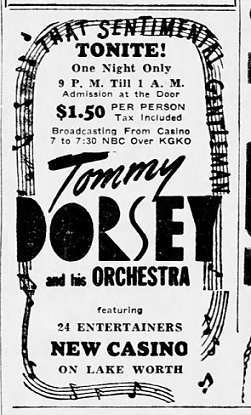
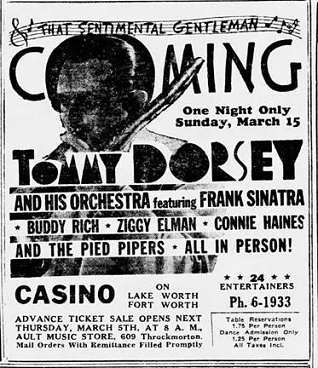
March 16, 1942
Concerts
Palm Isle Club, Longview, Texas Monday evening (one-nighter) Tommy Dorsey & Orch.
Note: Previous listings had Dorsey in Houston on this night. Didn't happen. He was at the Palm Isle Club in Longview, Texas
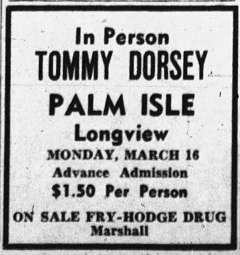
Palm Isle Club, Longvew, Texas
Monday evening
Tommy Dorsey and His Orchestra
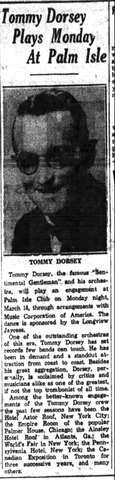
March 17, 1942
Concerts
Municipal Auditorium, Oklahoma City, Oklahoma (One Night Only) Tommy Dorsey and his Orchestra with Frank Sinatra
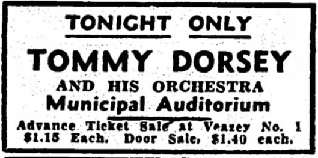
Municipal Auditorium, Oklahoma City, Oklahoma (One Night Only)
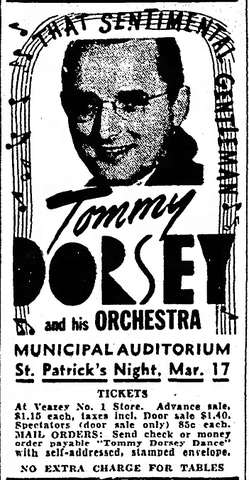
March 18, 1942
Concerts
Wichita Forum, Wichita, Kansas
Tommy Dorsey and his Orchestra w/Frank Sinatra
Wichita Forum, Wichita, Kansas
Tommy Dorsey and his Orchestra w/Frank Sinatra
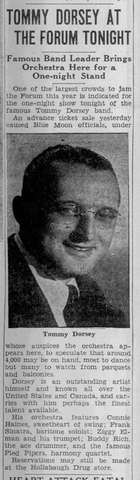
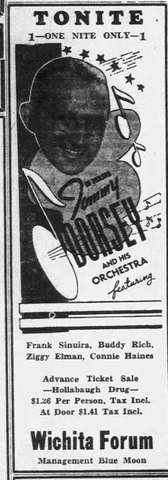
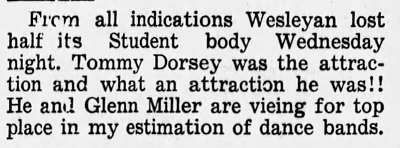
March 19, 1942
Concerts
Play-Mor Ballroom, Kansas City, Missouri (one-nighter)
Tuesday evening
Tommy Dorsey & His Orch.
Frank Sinatra, Jo Stafford, Buddy Rich, Sy Oliver,
Milt Raskin, Pied Pipers
Ed O'Brien:
TD & Band pulled in 3,750. Admission was $1.10 advance - $1.25 at the door. After closing at the Golden Gate, San Francisco, 3-3-42, the band played three-one nighters: Sacramento, Sweet B's, in Oakland( 5,423 admissions, besting the old record, set by Glenn Miller, by 1,250), San Diego, Pacific Square B( 5,810 draw, besting Kay Kyser by over a 1,000). Then on the 17th, there was a one-nighter in Houston, Texas. The hot club at the time was The Shamrock with the Emerald Room. Band probably played there.
Note: The 17th was the Municipal Auditorium, Oklahoma City. Houston was on March 14th at the Sam Houston Coliseum.
Play-Mor Ballroom, Kansas City, Missouri
Tuesday evening
Tommy Dorsey & His Orch.
Frank Sinatra, Jo Stafford, Buddy Rich, Sy Oliver,
Milt Raskin, Pied Pipers one-nighter
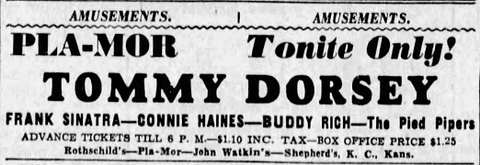
March 20, 1942
Concerts
Turnpike Casino, Lincoln, Nebraska
Tommy Dorsey and His Orchestra
Turnpike Casino, Lincoln, Nebraska
Tommy Dorsey and His Orchestra
The Lincoln Star (Lincoln, Nebraska) · 29 Mar 1942, Sun
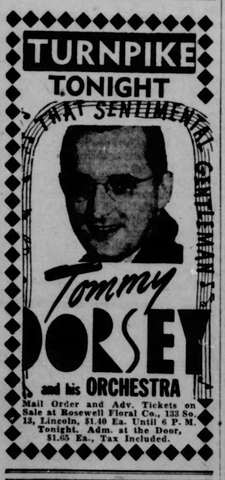
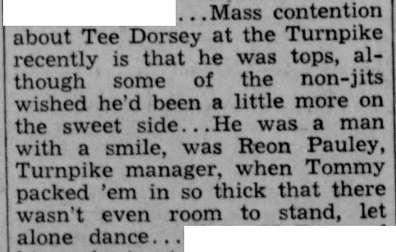
March 21, 1942
Concerts
Tromar Ballroom, Des Moines, Iowa (one-nighter)
Thursday evening
Tommy Dorsey & His Orch.
Frank Sinatra, Jo Stafford, Buddy Rich, Sy Oliver,
Milt Raskin, Pied Pipers
Tommy Dorsey pulled in a total gross of over $10,000 while
jumping from the West to the East coast. Playing the Tromar
here Saturday (21) Dorsey broke his own record with 3,600
dancers. Four years ago Dorsey established the previous
house record with 2,900, which stood until his present stop.
New record was remarkable in that four years ago Dorsey
broadcast from the Tromar, while this time there was no
radio program. Jumping to the Chermot, Omaha. Sunday
night, Dorsey pulled in 3,200. which beat anything previous
by any other band. On a Monday night at the Arkota, Sioux
Falls, S. D., Dorsey had 2,400 dancers, which beat the pre-
vious record set by Horace Heidt. Admission at all three stops
was $1 plus taxes.
Billboard
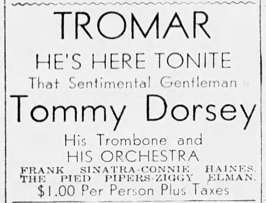
March 22, 1942
Radio
Sunday Evening At Tommy Dorsey's
Network: Blue Network
Location: Chermot Room, Omaha, Nebraska
Time: 8:00PM - 8:30PM (EST)
Show #7
Sponsor: (sustaining or unknown)
Personnel (probable): Tommy Dorsey, George Arus, Dave Jacobs, Jimmy Skiles (trombone); Jimmy Blake, Ziggy Elman, Chuck Peterson, Jimmy Zito, Danni Vanelli (trumpet); Fred Stulce, Harry Schuchman (clarinet, alto sax); Heinie Beau (clarinet, tenor sax); Bruce Snyder, Don Lodice (tenor sax); Bernard Tinterow, Seymour Miroff, William Ehrenkrantz, Leonard Posner, Paul Poliakine (violin); Sam Ross, Leonard Atkins (viola); Harold Bemko (cello); Ruth Hill (harp); Clark Yocum (guitar); Phil Stevens (bass); Milt Raskin (piano); Buddy Rich (drums).
Vocals: Frank Sinatra, The Pied Pipers, Jo Stafford,
Orchestra Conducted By: Tommy Dorsey
Announcer:
Notes: Confirmed airing on WJZ & WMAL.
Concerts
Chermot Room, Omaha, Nebraska (March 22)
Tommy Dorsey and his Orchestra w/Frank Sinatra
Billboard April 4, 1942
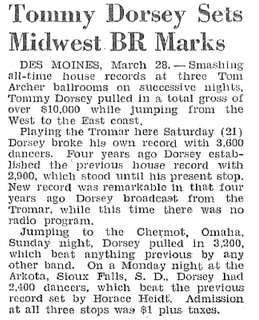
Chermot Room, Omaha, Nebraska (March 22)
Tommy Dorsey and his Orchestra w/Frank Sinatra
/1942 Sunday Evening At Tommy Dorsey's
Network: Blue Network
Location: Chermot Room, Omaha, Nebraska
Time: 8:00PM - 8:30PM (EST)
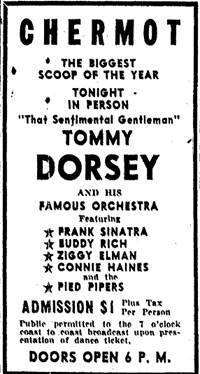
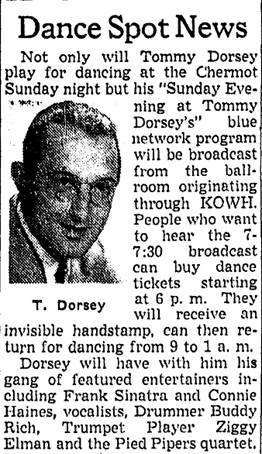
March 23, 1942
Concerts
Arkota Ballroom, Sioux Falls, South Dakota (March 23)
Tommy Dorsey and his Orchestra w/Frank Sinatra
Arkota Ballroom, Sioux Falls, South Dakota (March 23)
Tommy Dorsey and his Orchestra w/Frank Sinatra
TD ARTICLE IN BILLBOARD 4-4-42.
[image referenced in source but could not be recovered]
[image referenced in source but could not be recovered]
[image referenced in source but could not be recovered]
[image referenced in source but could not be recovered]
March 24, 1942
Concerts
Terp Ballroom, Austin, Minnesota (March 24)
Tommy Dorsey and his Orchestra w/Frank Sinatra
Sinatraphile Dave Paulson notes:
My mother attended this concert when she was 17. She says that Frank sang This Love of Mine, her favorite, and she got Frank's autograph. Austin is near the Iowa border, about thirty miles south of Owatonna, where she still lives.
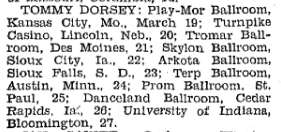
March 25, 1942
Concerts
Prom Ballroom, St. Paul, Minnesota (March 25)
Tommy Dorsey and his Orchestra w/Frank Sinatra
NOTE: Thank Ed O'Brien for this early 1940s information. He also gives a quote from the April
18, 1942 edition of Billboard magazine: "Tommy
Dorsey drew 4,000 people in a one-nighter in St.
Paul on his way east, a few weeks ago."
March 26, 1942
Concerts
Danceland Ballroom, Cedar Rapids, Iowa (March 26)
Tommy Dorsey and his Orchestra w/Frank Sinatra
Danceland Ballroom, Cedar Rapids, Iowa (March 26)
Tommy Dorsey and his Orchestra w/Frank Sinatra
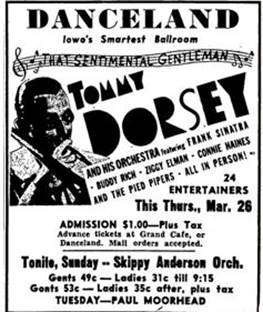
March 27, 1942
Radio
Live Remote From Indiana University, Bloomington, Indiana Tommy Dorsey & His Orchestra
NBC Blue Network
WJZ
New York City
7:30 - 8:00 P.M. EWT
Monday Evening
Spotlight On The Bands
Live Remote - From Indiana University Bloomington, Indiana Tommy Dorsey & His Orchestra
Sponsor: Coke-Cola
Mutual Network
WOR
New York City
9:30 - 9:45 P.M. EWT
Monday Evening
Concerts
University of Indiana, Bloomington, Indiana (March 27)
Tommy Dorsey and his Orchestra w/Frank Sinatra
NOTE: Again, we owe Ed O'Brien much gratitude for researching out and providing Sinatraphiles with this information from the early 1940s. In addition, Ed gives us a quote from an April 4, 1942 report from Billboard magazine on this 1942 set of one-night stands:
Playing the Tromar here Saturday (21), Dorsey broke his own house record with 3.600 dancers. Four years ago Dorsey established the previous house record with 2,900 which stood until his present stop. New record was remarkable in that four years ago Dorsey broadcast from the Tromar, while this time there was no radio program.
Jumping to the Chermot, Omaha, Sunday night, Dorsey pulled in 3,200 which beat anything previous by any other band. On a Monday night at the Arkota, Sioux Falls, S.D., Dorsey had 2.400 dancers, which beat the previous record set by Horace Heidt. Admission at all three stops was $1 plus taxes.
Des Moines, March 28th, smashing all-time house records at three Tom Archers ballrooms on successive nights, Tommy Dorsey pulled in a total gross of over $10,000 while jumping from West Coast to East Coast.
Spotlight On The Bands
Ed O'Brien:
Dorsey and Band were making their eighth appearance on Spotlight On The Bands. Miller had only made two appearance. You had to have the #1 song to qualify. Dave Paulson mentioned his mother saw Frank at the Terp Ball Room in
Austin, Minnesota, 3-24-42. She remembered that Frank sang "This Love Of Mine." He did it again on the Spotlight show because the song was #1.
[image referenced in source but could not be recovered]
Live Remote From Indiana University, Bloomington, Indiana Tommy Dorsey & His Orchestra
NBC Blue Network
WJZ
[image referenced in source but could not be recovered]
University of Indiana, Bloomington, Indiana (March 27)
Tommy Dorsey and his Orchestra w/Frank Sinatra
[image referenced in source but could not be recovered]
March 28, 1942
Radio
Purdue University, West Lafayette, Indiana
Tommy Dorsey & His Orchestra
Saturday Evening
WBBA - University Radio Station
9:00 - 9:30 P.M.
Live Remote from Memorial Union Building note: WBBA is still broadcasting, 79 years after this concert was aired.
Concerts
Hall of Music, Purdue University, West Lafayette, Indiana Tommy Dorsey & His Orchestra
Saturday Evening
6:00 -7:30 P.M.
90 Minute Concert
Ed O'Brien:
TD & Co. played to more than 6,000 of the students and faculty of Purdue Univerity.
The concert raise more than $3,000 in Defense Savings Stamps.
Memorial Union Building, Purdue University. West Lafayette, Indiana
Tommy Dorsey & His Orchestra
Saturday Evening
8:00 - 10:00 P.M.
Two-Hour Dance
Ed O'Brien:
TD & Co. played to a record SRO crowd of more than 4,500 dancers.
A bottle of coke at the dance, cost five cents.
Here is a review, from March 1942, of a Dorsey 78 release. Neither song
made the charts.
Tommy Dorsey's newest features those two vocalists that have been
climbing even higher in record. fame this year. Who are they? None
other than Frank Sinatra and Jo Stafford, of course. This time Frank
handles a swingy number called "How Do You Do Without Me?" while
Jo takes to a slower mood on "It Isn't A Dream Any More." Both are as
good as they usually are and the times are equally so, although the
second side will be played oftener.
Indianapolis Star
Hall of Music, Purdue University, West Lafayette, Indiana
Tommy Dorsey & His Orchestra
March 29, 1942
Radio
Sunday Evening At Tommy Dorsey's
Network: Blue Network
Location: Rainbow Garden, Fremont, Ohio
Time: 8:00PM - 8:30PM (EST)
Show #8
Sponsor: (sustaining or unknown)
Personnel (probable): Tommy Dorsey, George Arus, Dave Jacobs, Jimmy Skiles (trombone); Jimmy Blake, Ziggy Elman, Chuck Peterson, Jimmy Zito, Danni Vanelli (trumpet); Fred Stulce, Harry Schuchman (clarinet, alto sax); Heinie Beau (clarinet, tenor sax); Bruce Snyder, Don Lodice (tenor sax); Bernard Tinterow, Seymour Miroff, William Ehrenkrantz, Leonard Posner, Paul Poliakine (violin); Sam Ross, Leonard Atkins (viola); Harold Bemko (cello); Ruth Hill (harp); Clark Yocum (guitar); Phil Stevens (bass); Milt Raskin (piano); Buddy Rich (drums).
Vocals: Frank Sinatra, The Pied Pipers, Jo Stafford,
Orchestra Conducted By: Tommy Dorsey
Announcer:
Notes: Confirmed airing on WJZ & WMAL.
Concerts
Rainbow Garden, Fremont, Ohio (One-Nighter)
Tommy Dorsey and his Orchestra w/Frank Sinatra
NOTE: We owe Sinatra Scholar Ed O'Brien for doing the research and sharing with us this information on early 1940s appearances. He also leaves us a clip from the April 1, 1942 issue of Variety:TD band played at Rainbow Garden, Fremont, Ohio . . . a date that was owed that promoter since last December. Band then flew into New York Monday afternoon (March 30) to start rehearsals for its opening at the Paramount Theatre, there today (April 1).
O'Brien leaves us with the results of a poll of student bodies, conducted by the International Musician publication in the Spring of 1942, of the various colleges in the United States. The ten most popular are:
1. Glenn Miller
2. Tommy Dorsey
3. Harry James
4. Benny Goodman
5. Jimmy Dorsey
6. Vaughn Monroe
7. Sammy Kaye
8. Kay Kyser
9. Charlie Spivak
10. Woody Herman
Rainbow Garden, Fremont, Ohio (One-Nighter)
Tommy Dorsey and his Orchestra w/Frank Sinatra
*Emacs!
Rainbow Garden, Fremont, Ohio (One-Nighter)
Tommy Dorsey and his Orchestra w/Frank Sinatra
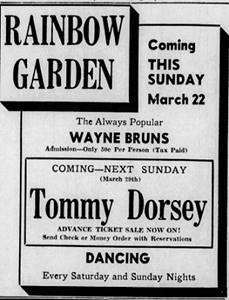
March 30, 1942
Dorsey and group make unexpected stop in Buffalo
[image referenced in source but could not be recovered]
April 1, 1942
Concerts
Paramount Theatre, New York City (1-28)
Note: Ed O'Brien added the following:
Dorsey's four week engagement at the Paramount received extensive coverage in the trade papers and Frank Sinatra was now the most popular vocalist on college campuses. But he was not on the bill when the band opened the engagement
Here is some of the coverage:
"TD-Paramount, N.Y. (3,664 35-55-85-90)
With "My Favorite Blonde"(Par) on screen.
Combo of the Dorsey band, here for the eighth time, and the picture is accounting for smash business; on the first week ending last night(Tues) $80,000 was drawn. Theatre pushed its top scale to $1.10 on Saturday and
Sunday (4-5).
Variety April 8, 1942
"TD/Paramount, NYC, was a socko $73,000 2nd week . . close behind first week's $79,000. Show in for a total of 4 weeks."
Variety April 15, 1942
"TD-Paramount $53,000 3rd week. 4th week starts tomorrow and may stay a 5th."
Variety April 22, 1942
"TD - Paramount 4th and final week . . $44,000."
Variety April 29, 1942
"TD pulled in $44,000 in final week at the Paramount.
A previous commitment prevented a fifth week. First week was $80,00, 2nd at $73,000, 3rd at $54,000. It adds up to one of the best four week sessions in Paramount's history."
Billboard May 9, 1942
HEADLINE: Tommy Dorsey Reconciled To Victor . .
Tommy Dorsey continues on RCA 50 cent label.
This is finis on a drawn out argument with the company. Dorsey signed and mailed to Victor the contract he's been carrying around for several months. It called for a guarantee of
$1,250 a side for 96 sides(24 records a year), or $120,000 minimum over two-year run of the agreement. This is against royalty."
Variety April 1, 1942
Paramount Theatre, New York City (1-28)
PARAMOUNT, NEW YORK
( Reviewed Wednesday Evening, April 1)
When the Tommy Dorsey crew moves in here (this is the maestro's eighth Paramount booking) it is like Joe Louis stepping into the ring after the audience has seen nothing but the elementals displayed in the prelims.
The polish and fine showmanship in a T.D. performance give all the other orks something to shoot at. Entire show library, from the rifferoos to the sweet ballad backings for the vocal department, is played with the ease and style that spring from experienced talent in all sections.
Dorsey gives his members plenty of space to display their wares. Highlights,such as Jo
Stafford's rich piping of "What Is This Thing
Called Love?", Ziggy Elman's and Buddy
Rich's hot horn and hide work with "Hawaiian
War Chant," and the maestro pumping out
"Sleepy Lagoon" on the sliphorn, turn out as real musical productions.
Frank Sinatra's vocal romanticizing is a top item. Solos four times to include expert handling of "Night and Day" and "Begin the
Beguine," then combine with the Pied Pipers
( foursome including Miss Stafford ) on "It's the Last Call for Love" and "I'll Take Tallulah" from Dorsey's coming film "Ship Ahoy." All sock song work and done without that you'd- better-take-us-seriously air. In fact, a couple of passionate gasps from the sidemen, kidding
Sinatra's heartrending piping of "This Love of
Mine," does a lot for it.
The beat and drive developed by the seven brass ( besides T. D. ), five reed and four rhythm on the straight instrumental numbers played round out the versatility and balance. Dorsey fronts it all with elan, quipping now and then and generally holding all the reins.
Bill is topped off with a couple of fresh acts for Broadway. Allen, Burns and Cody, young male tumbling and acro artists, rip thru a fast routine sprinkled with difficult handstands, three-high turns and an assortment of cartwheels with the three lads entwined around each other. Boys netted more applause at show caught than has ever been heard in this house by this reviewer.
It was their fresh approach that did it, and the
Dorsey ork's snappy musical backing didn't hurt any.
Paul Regan, character impressionist, makes his first trip east with this engagement, booked into the Para on a personal recommendation from
Dorsey. His repertoire is almost endless and grows stronger as it unfolds. Could cut many of his earlier impersonations, because his best work is mimicry of Boyer, Colman, FDR, Kaltenborn and Hugh Herbert.
In these his stuff resembles a caricature rather than an impersonation, and the gag material is good comedy. Well received..
House packed last show of opening day. Film
"My Favorite Blonde," Claude Thornhill and Larry
Adler will follow this bill in three or four weeks.
Harold Humphrey
Billboard
April 11, 1942
Ed O'Brien:
During an interview in the late fall of 1963,
Sinatra set the record straight regarding the teenage hysteria that took place at the Paramount in early 1943. Frank took great pains to explain that this peculiar phenomenon had been there during the Dorsey years. The young women would approach the bandstand and swoon while Frankie sang a soft, romantic ballad. Connie Haines remem- bered it happening when Frank sang with Harry James.
Dorsey's run at the Paramount was extended through a fourth week ( 4/1 thru 4/29). The four-week gross exceeded $250.000. Variety called it the most successful four-week run in the history of the Paramount.
The Bob Hope film "My Favorite Blonde," that ran during the engagement was one of the top grossing movies of
1942 and certainly helped the overall attendance.
The Billboard reviewer, Mr. Humphrey, also reviewed the opening night at the Hotel Astor on 5/19. A very swank New York crown was in attendance and Frank, Jo, Buddy,
Ziggy and T.D. all received excellent notices. But the high- light of the evening was the appearance of Jimmy Dorsey.
Tommy and he had been at odds over Jimmy's manager.
There were harsh words exchanged and Tommy proceeded to deck his brother with a couple of left hooks. And we thought the rockers were first ones to exhibit bad behavior on stage.
During the Paramount engagement Frank also sang
"South Of The Border," "Ol' Man River," "I'll Never Smile Again" and "The One I Love Belongs To Somebody Else."
Variety 4-8-42
Ed O'Brien:
Hasn't much voice? What was this reviewer hearing is the the question.
Variety April 29, 1942
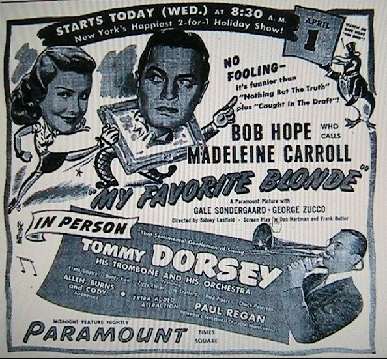
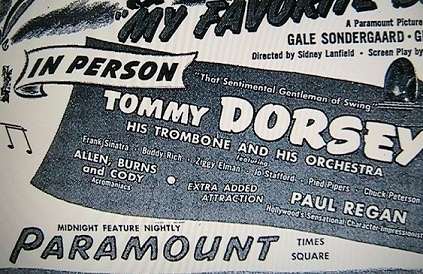
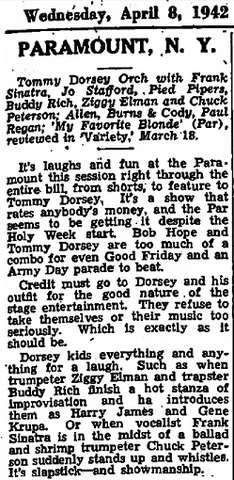
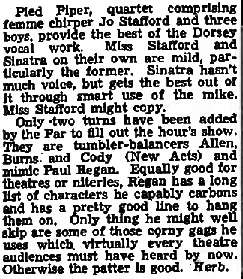
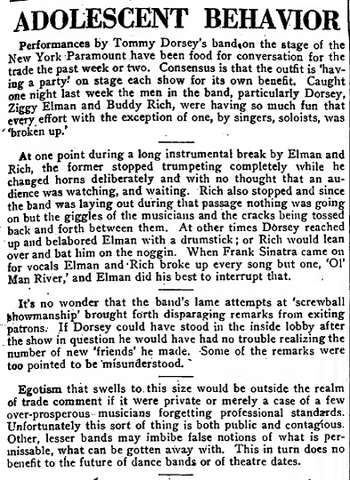
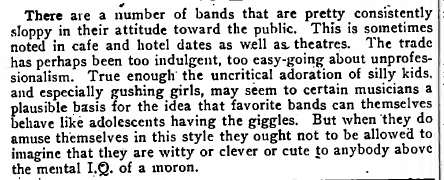
[Dorsey band opens Paramount run]
The Dorsey band, one-nighting its way east from California, opened a month-long stand at the New York Paramount on April Fools' Day 1942, with Dorsey working Sinatra hard to extract maximum value before the split.
Source: James Kaplan, "Frank: The Voice" (2010).
April 2, 1942
Concerts
Paramount Theatre, New York City (1-28)
Tommy Dorsey and His Orchestra with Frank Sinatra
April 3, 1942
Concerts
Paramount Theatre, New York City (1-28)
Tommy Dorsey and his Orchestra w/Frank Sinatra
April 4, 1942
Concerts
Paramount Theatre, New York City (1-28)
Tommy Dorsey and his Orchestra w/Frank Sinatra
April 5, 1942
Concerts
Paramount Theatre, New York City (1-28)
Tommy Dorsey and his Orchestra w/Frank Sinatra
April 6, 1942
Concerts
Paramount Theatre, New York City (1-28)
April 7, 1942
Concerts
Paramount Theatre , New York City (April 1-28)
Tommy Dorsey and his Orchestra w/Frank Sinatra
April 8, 1942
Concerts
Paramount Theatre, New York City (1-28)
April 9, 1942
Concerts
Paramount Theatre, New York City (1-28)
April 10, 1942
Radio
Live Remote From Paramount Theater, New York City
Tommy Dorsey & Orchestra
Friday Evening
NBC Red Network
WEAF
7:30 p.m. - 8:00 p.m.
Concerts
Paramount Theatre, New York City (1-28)
Tommy Dorsey and his Orchestra w/ Frank Sinatra
April 11, 1942
Radio
Live Remote From The Paramount, New York City
Tommy Dorsey & His Orchestra
NBC Blue Network
WJZ
5:00 - 5:30 p.m. EWT
Concerts
Paramount Theatre, New York City (1-28)
Tommy Dorsey and his Orchestra with Frank Sinatra
April 12, 1942
Concerts
Paramount Theatre, New York City (1-28)
Tommy Dorsey & His Orchestra w Frank Sinatra
April 13, 1942
Concerts
Paramount Theatre, New York City (1-28)
Tommy Dorsey and his Orchestra w/Frank Sinatra
Ed Notes:
The feature film on the bill with the Dorsey band was "My Favorite Blonde" with Bob Hope and Madeleine Caroll.
The theatre opened at 9:30 A.M. and ran right through a "midnight feature nightly." Edith Werner of the Daily Mirror wrote that Dorsey's band was "wowing fans with torrid jive."
Variey called it "one of the best four week sessions in Paramount history." Theatre requested a fifth week but
Dorsey had previous commitmemts.
Dorsey's group placed second in the annual Billboard poll behind Glenn Miller. A familiar spot for the band.
They had finished second four of the last five years.
April 14, 1942
Concerts
Paramount Theatre, New York City (1-28)
Tommy Dorsey and his Orchestra w/Frank Sinatra
April 15, 1942
Concerts
Paramount Theatre, New York City (1-28)
Tommy Dorsey and his Orchestra w/Frank Sinatra
Ed Notes: A quote from the April 15, 1942 issue of Variety: "TD/Paramount, NYC, was a socko $73,000 2nd week
. . .. close behind first week's $79,000. Show is for a total of 4 weeks."
April 16, 1942
Concerts
Paramount Theatre, New York City (1-28)
Tommy Dorsey and his Orchestra w/Frank Sinatra
April 17, 1942
Radio
Live Remote From Paramount, New York City
Tommy Dorsey & His Orchestra
NBC Blue Network
WJZ
7:30 - 8:00 p.m. EWT
Concerts
Paramount Theatre, New York City (1-28)
Tommy Dorsey and his Orchestra w/Frank Sinatra
April 18, 1942
Radio
Live Remote From Paramount, New York City
Tommy Dorsey & Orchestra
NBC Blue Network
WJZ
Saturday Afternoon
5:00 - 5:30 pm EWT
Concerts
Paramount Theatre, New York City (1-28)
Tommy Dorsey and his Orchestra w/Frank Sinatra
April 19, 1942
Concerts
Paramount Theatre, New York City (1-28)
Tommy Dorsey and his Orchestra
April 20, 1942
Concerts
Paramount Theatre, New York City (1-28)
Tommy Dorsey and his Orchestra
Paramount Theatre, New York City (1-28)
Tommy Dorsey and his Orchestra
Seems the band also stepped out to Times Square (well Duffy Square) to play Hitler's Mock Birthday Party, a war bond rally. A brief mention in this largely political column.
Here's a photo from the event
A 15 minute segment was also broadcast over some stations, including WAAB in Boston.
Thanks to Richard Cook for above.
[image referenced in source but could not be recovered]
[image referenced in source but could not be recovered]
[image referenced in source but could not be recovered]
[image referenced in source but could not be recovered]
April 21, 1942
Concerts
Paramount Theatre, New York City (1-28)
Tommy Dorsey and his Orchestra with Frank Sinatra
April 22, 1942
Concerts
Paramount Theatre, New York City (1-28)
Tommy Dorsey and his Orchestra w/Frank Sinatra
NOTE: Special thanks once again go to Ed O'Brien for supplying us with the early 1940s information.
He sends along as well a quote from the April 22, 1942 issue of Variety: "TD-Paramount $53,000 3rd week. 4th week starts tomorrow and may stay a 5th."
April 23, 1942
Concerts
Paramount Theatre, New York City (1-28)
April 24, 1942
Concerts
Paramount Theatre, New York City (1-28)
Tommy Dorsey & His Orchestra with Frank Sinatra
April 25, 1942
Radio
Live Remote From Paramount, New York City
Saturday Afternoon
5:00 -5:30 p.m. EWT
NBC Blue Network
WJZ
Tommy Dorsey & Orchestra
Concerts
Paramount Theatre, New York City (1-28)
Tommy Dorsey & His Orchestra with Frank Sinatra
April 26, 1942
Concerts
Paramount Theatre, New York City (1-28)
Tommy Dorsey and his Orchestra with Frank Sinatra
April 27, 1942
Concerts
Paramount Theatre, New York City (1-28)
Tommy Dorsey & His Orchestra
Film My Favorite Blonde Bob Hope and Madeleine Carroll Gross
Week 1 $80,000
Week 2 $73,000
Week 3 $53,000
Week 4 $44,000
Total: $250,000
April 28, 1942
Concerts
Paramount Theatre, New York City (1-28)
Tommy Dorsey & His Orchestra with Frank Sinatra
Film My Favorite Blonde Bob Hope and Madeleine Carroll Gross
Week 1 $80,000
Week 2 $73,000
Week 3 $53,000
Week 4 $44,000
Total: $250,000
1943 RioBamba Club, New York City ( March 11, 1943 - May 11)
April 29, 1942
Film
"Ship Ahoy" (U.S. Release: April 29, 1942)
Starring: Eleanor Powell, Red Skelton, Bert Lahr, Virginia O'Brien, Tommy Dorsey and His Orchestra with Frank Sinatra
Produced by: Jack Cummings
Directed by: Edward Buzzell
"Writer Merton K. Kibble (Red Skelton), on the verge of a nervous breakdown, decides to take a cruise. His Man Friday, Skip (Bert Lahr), gets the tickets, picking Puerto Rico because that's the destination of a troupe of pretty girls. Hypochondriac Merton is shaken out of his doldrums when he meets Tallulah Winters (Eleanor Powell), star of the dance troupe. She has little time for Merton, as she is carrying a government secret. Or at least thinks she is. Actually she is the dupe of spies and is delivering a magnetic mine to the enemy agents. She slips it into Merton's suitcase and recovers it ashore. At a show on the ship, Tallulah realizes she has been duped. While trying to reach U.S. agents, the spies have cornered them." Tommy Dorsey and his Orchestra appear. Sinatra sings “Moonlight Bay", "Poor You", "The Last Call For Love." (DVD Release date: 2011-11-01)
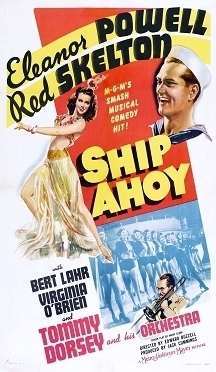
Concerts
Town Hall, Philadelphia, Pennsylvania
Wednesday Evening
9:00 pm - 2:00 am
One-Nighter
Tommy Dorsey & His Orchestra with Frank Sinatra
Concert & Dance
"Packed them to the rafters"
"Ship Ahoy" (U.S. Release: April 29, 1942)
Note: Eleanor Powell was very impressed by the young boy singer during the filming of "Ship Ahoy" Frank lost all his money in dice games while waiting to shoot his scenes with the Dorsey band. Powell was worried about such a skinny man missing any meals.. So she took him to lunch at the MGM commissary during Frank's days on the set. She would later on admit to being his biggest fan.
I interviewed Burton Lane - mainly for any information he could give me on the animated s/t of "Finian's Rainbow" -- but we did discuss the songs Sinatra recorded for the film, written by Lane and Yip Harburg. He told me that both of them recognized that Sinatra was going to be a huge star. They watched him very carefully on the set. I asked him if they realized how big he would become. Lane laughed and told me no one could have possibly have known that in 1941.
Ed
HISTORY
The film's working title was I'll Take Manila. According to HR news items, the title was changed "in view of the situation in the Pacific which deflates the value of this pun." The film started production before the United States' entry into World War II. By the time of the film's release, in May 1942, the Philippines had fallen to the Japanese and the destination of the ship in the film was changed from Manila to Puerto Rico. One of the film's songs, "I'll Take Tallulah," was also changed from its original title, "I'll Take Manila." According to various news items in HR, director of photography Robert Planck shot the dance numbers that were added to the film in late Dec 1941. Retakes were shot by Clyde DeVinna, according to HR, which also noted that because both Bert Lahr and Virginia O'Brien were ill, stand-ins had to be used for some insert shots. According to various HR news items, the film was originally to co-star Eleanor Powell and Robert Young. In mid-Jul 1941, it was announced that Desi Arnaz was being borrowed from RKO for a role in the film. In Sep 1941, HR stated that Tony Martin was set for a "singing lead" with Powell and Red Skelton. It is possible that the role intended for either Arnaz or Martin was removed from the script, or changed for Frank Sinatra. Although Sinatra sings in the film, he has no dialogue. Another HR news item included Donald McBride in the cast, but he was not in the released film. Ship Ahoy was Sinatra's first film at M-G-M, the studio at which he was under contract for much of the 1940s, following a brief period of being under contract to RKO. One number shot but not used for the film, "I Fell in Love (With the Leader of the Band)," by Jule Styne and Herb Magidson, was included in M-G-M's 1945 film The Great Morgan
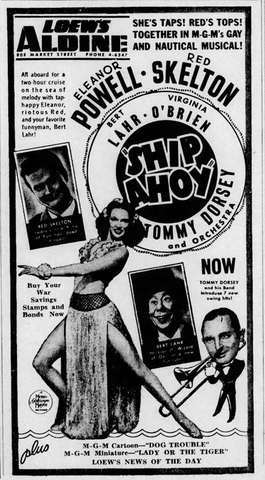
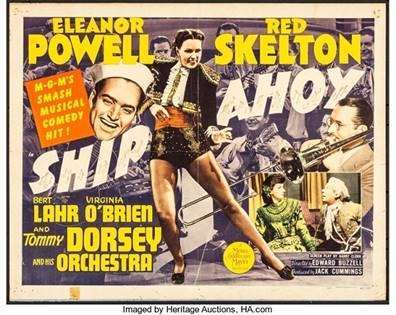
"Ship Ahoy"
Ship Ahoy, an MGM black-and-white musical starring Eleanor Powell and Red Skelton and directed by Edward Buzzell, was shot in November-December 1941. Production was underway when Pearl Harbor was attacked on December 7, which Santopietro suggests may have prompted the screenwriters to include a stereotypical Japanese villain among the film's Axis saboteurs.
Source: Tom Santopietro, "Sinatra in Hollywood" (2008).
"Ship Ahoy"
Still viewed by Hollywood as just one of Dorsey's band members, Sinatra received no solo screen credit in Ship Ahoy; the credits listed only 'Tommy Dorsey and his Orchestra.'
Source: Tom Santopietro, "Sinatra in Hollywood" (2008).
"Ship Ahoy"
Sinatra doesn't appear until about thirty minutes into Ship Ahoy, singing 'The Last Call for Love.' He also recorded 'Blue Skies' for the picture, but that scene was cut. His later reprise of 'Last Call for Love' is heard only as background vocal under dialogue, without him appearing on screen.
Source: Tom Santopietro, "Sinatra in Hollywood" (2008).
"Ship Ahoy"
Santopietro singles out Sinatra's number 'Poor You' in Ship Ahoy as a wasted opportunity: his vocal is undercut when it segues directly into Red Skelton's comic serenade of Eleanor Powell, robbing viewers of a chance to hear young Sinatra at his vocal peak.
Source: Tom Santopietro, "Sinatra in Hollywood" (2008).
"Ship Ahoy"
Variety (quoted by Santopietro): Ship Ahoy earned Sinatra his first notice in Variety; while panning the film overall, the trade praised Sinatra's singing -- noting he handled about 90% of the vocalizing and did it well -- as a standout alongside Dorsey's trombone and Buddy Rich's drumming.
Source: Tom Santopietro, "Sinatra in Hollywood" (2008).
"Ship Ahoy"
Santopietro grades this a C: "FS as himself; nutty—two songs."
Source: Tom Santopietro, "Sinatra in Hollywood" (2008).
"Ship Ahoy"
Santopietro (Filmography): Metro-Goldwyn-Mayer. Produced by Jack Cummings, directed by Edward N. Buzzell, written by Harry Clork, Irving Brecher and Harry Kurnitz. Starring Eleanor Powell, Red Skelton and Bert Lahr, with Sinatra again appearing as himself, vocalist with the Tommy Dorsey Band, performing the solos 'The Last Call for Love' and 'Poor You.'
Source: Tom Santopietro, "Sinatra in Hollywood" (2008).
Studio
"Ship Ahoy" (U.S. Release: April 29, 1942)
Starring: Eleanor Powell, Red Skelton, Bert Lahr, Virginia O'Brien, Tommy Dorsey and His Orchestra with Frank Sinatra
Produced by: Jack Cummings
Directed by: Edward Buzzell
Excerpt from Variety review
Source: sinatraphiles digest (date extracted from item text; originally routed to appendix for review).
April 30, 1942
Concerts
Zembo Mosque, Harrisburg, Pennsylvania
Big Ladies Night Party of the Zembo Luncheon Club
Thursday Evening
Dorsey & Orchestra with Frank Sinatra
One-Nighter
Zembo Mosque, Harrisburg, Pennsylvania
Big Ladies Night Party of the Zembo Luncheon Club
Thursday Evening
Dorsey & Orchestra with Frank Sinatra
One-Nighter
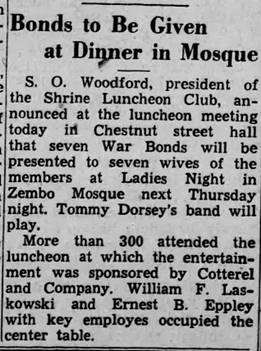
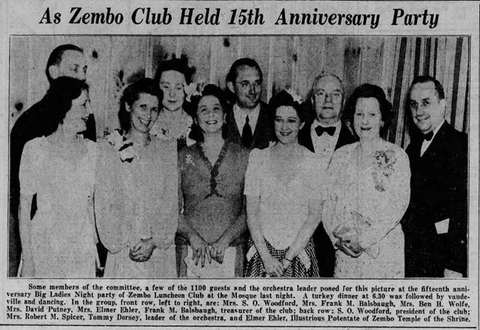
May 1942
[Sinatra Commissions Interfaith Medallions]
Nancy Sinatra: Disturbed by reports of Nazi atrocities against Jews filtering back from Europe, Frank had 100 medallions made bearing a St. Christopher medal on one side and a Star of David on the other. He wore one himself and gave the rest to friends as a personal statement against religious and ethnic discrimination.
Source: Nancy Sinatra, Frank Sinatra: An American Legend, 1995.
May 1, 1942
Radio
Live Remote, New York City
Friday Evening
NBC Blue Network
WJZ
7:30- 8:00 p.m.
Tommy Dorsey & Orchestra
Concerts
Penn State College, State College, Pennsylvania
Friday Evening
10:00 pm - 2:00 am
One-Nighter
Tommy Dorsey & His Orch
Frank Sinatra, Connie Haines, Jo Stfford, The Pied Pipers, Ziggy Elman, Buddy Rich
Penn State College, State College, Pennsylvania
Friday Evening
10:00 pm - 2:00 am
One-Nighter
Tommy Dorsey & His Orch
The Daily Collegian, May 1, 1942, Penn State
May 2, 1942
Radio
"Leo Is On The Air"
Saturday evening
15 minute radio promo for "Ship Ahoy
Dorsey band plays overture from the film
Hollywood radio reporter coming to you from the Little Theatre at Metro Goldwyn Mayer bringing you MGM's #1 comedy star Red Skelton, with Eleanor Powell, the Queen of Taps, and Tommy
Dorsey & His Orchestra playing the hit tunes from the picture "Ship Ahoy."
1. I'm Getting Sentimental Over You T.D. & Orch
2. Poor You Red Skelton, Virginia O'Brien, T.D. & Orch.
3. On Moonlight Bay Frank Sinatra and The Pied Pipers
4. The Last Call For Love Frank Sinatra and The Pied Pipers
5. Poor You T.D. & Orch.
Plea for war bonds & stamps
6. The Last Call For Love The Pied Pipers, Mixed Chorus
T.D. & Orch.
Concerts
Sunnybrook Ballroom, Pottstown,* Pennsylvania
Saturday evening
Tommy Dorsey & Orch.
Frank Sinatra, Connie Haines,
Jo Stafford, The Pied Pipers,
Ziggy Elman, Buddy Rich
* probably the night Frank remembered at Valley Forge in March of 1979. He told the story of two miners watching the band.
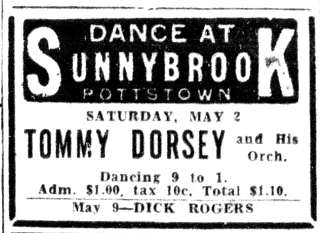
May 3, 1942
Radio
Sunday Evening At Tommy Dorsey's
Network: Blue Network
Location: Astor Hotel, New York City
Time: 8:00PM - 8:30PM (EST)
Show #8
Sponsor: (sustaining or unknown)
Personnel (probabal): Tommy Dorsey, George Arus, Dave Jacobs, Jimmy Skiles (trombone); Jimmy Blake, Ziggy Elman, Chuck Peterson, Jimmy Zito, Danni Vanelli (trumpet); Fred Stulce, Harry Schuchman (clarinet, alto sax); Heinie Beau (clarinet, tenor sax); Bruce Snyder, Don Lodice (tenor sax); Bernard Tinterow, Seymour Miroff, William Ehrenkrantz, Leonard Posner, Paul Poliakine (violin); Sam Ross, Leonard Atkins (viola); Harold Bemko (cello); Ruth Hill (harp); Clark Yocum (guitar); Phil Stevens (bass); Milt Raskin (piano); Buddy Rich (drums).
Vocals: Frank Sinatra, The Pied Pipers, Jo Stafford,
Orchestra Conducted By: Tommy Dorsey
Announcer:
1. Getting Sentimental Over You T.D. & Orch.
2. Dig Down Deep F.S, J.S. P.P.
3. The Last Call For Love F.S. , J.S. P.P.
4. I'll Take Tallulah F.S. , J.S. P.P.
5. Just As Though You Were Here F.S. , J.S. P.P.
Notes: Confirmed airing on WJZ & WMAL. This song appears on the album Dorsey/Sinatra Radio Years RCA AFL1 4741
Ed O'Brien notes:
Dorsey's new nine piece string section had its radio debut with this broadcast.
Show was first to be broadcast from Tommy's farm in Bernardsville, N.J.
A wonderful picture of Frank, Ziggy Elman and the band boy was taken on the lawn of Tommy's farm, one Sunday afternoon that summer.
Concerts
Convention Hall, Asbury Park, New Jersey (Concert)
Tommy Dorsey & His Orchestra with Frank Sinatra
Note: Previous listings had this as County Center, White Plains, New York but the advertisement in EXTRAS section shows Dorsey was in New Jersey.
NOTE: Ed O'Brien passed along this interesting bit from the May 3, 1941 issue of Billboard:
COLLEGE TOP CHIRPERS, FRANK SINATRA AND GINNY SIMMS CAPTURE CAMPUS CROON CROWNS
Sinatra's snaring of the masculine crooning crown, pulling an impressive 183 points, is perhaps the most exciting circumstance in this year's top selections. In Billboard's college music survey of last year, Sinatra managed to eke out only one first-place nomination, giving him a scant three points, and making him a poor 22nd out of 40 names listed. Frank was with Dorsey at that time, but that was before the now immortal "I'll Never Smile Again," which burst upon a highly receptive record buying public a couple of months after 1940's college poll.
It can safely be said that Sinatra's work on "Smile Again" was the thing that started his upward climbing in young America's opinion, to the point where 80 schools ouf of 171, taking in territory covering 46 states, named him as either first, second, or third choice among 35 male band vocalists. What cemented Sinatra's No. 1 selection was a series of fine recordings with Dorsey after the Ruth Lowe smash hit, and personable radio and in-person appearances.
Convention Hall, Asbury Park, New Jersey (Concert)
Tommy Dorsey & His Orchestra with Frank Sinatra
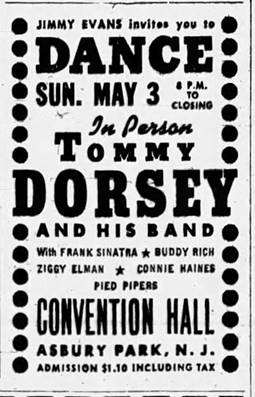
May 4, 1942
Concerts
Sunset Ballroom, Carrolltown, Pennsylvania (May 4)
Tommy Dorsey and his Orchestra w/Frank Sinatra
[image referenced in source but could not be recovered]
Sunset Ballroom, Carrolltown, Pennsylvania (May 4)
Tommy Dorsey and his Orchestra w/Frank Sinatra
[image referenced in source but could not be recovered]
May 5, 1942
Concerts
Cutler Hall, University of Rochester, Rochester, New York (May 5) 10:00 pm - 2:30 am
Interfraternity Ball
Tommy Dorsey and his Orchestra w/Frank Sinatra
Cutler Hall, University of Rochester, Rochester, New York (May 5)
[image referenced in source but could not be recovered]
May 6, 1942
Concerts
The Forum, Montreal , Canada (May 6)
Tommy Dorsey and his Orchestra w/Frank Sinatra
Sinatra songs:
--Night And Day
--This Love Of Mine
--How About You?
--Ol' Man River
NOTE: Variety of May 13 reports that TD pulled 8,500 into 9,600 capacity Forum for a new one-night record. Band unveiled new masonite floor of 5.000 square feet.
Billboard reported a gross profit of $7,488. TD was guaranteed 50% of the gate. He walked away with $3,744 --Ed
Frank Sinatra would perform at The Forum in Montreal a total of five times. His first appearance in the city with Tommy Dorsey in 1942 would see Sinatra’s name in the local press. Sinatra would next perform at The Forum in 1944 and then again in 1975, 1976, and 1979.
--Scott
The Forum, Montreal , Canada (May 6)
Tommy Dorsey and his Orchestra w/Frank Sinatra
The Gazette (Montreal, Quebec) · May 7th, 1942
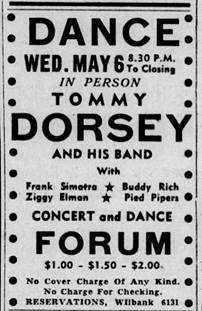
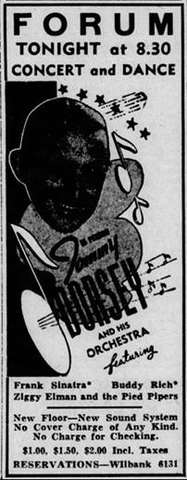
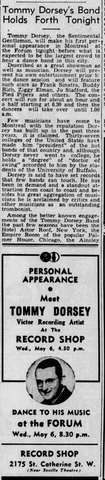
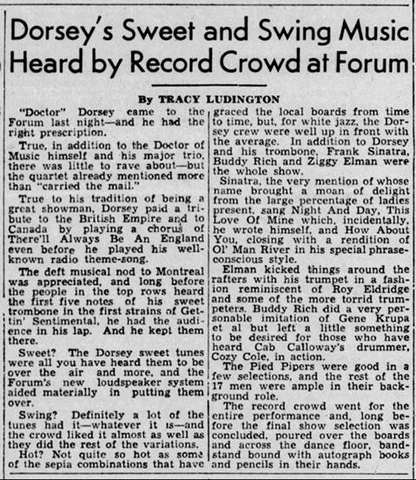
May 7, 1942
Concerts
George F. Johnson Pavilion, Johnson City, New York
Tommy Dorsey and his Orchestra w/Frank Sinatra
Thursday Evening
9:00 pm - 2:00 am
One-Nighter
Note: Pavilion was erected in 1926. The big bands of the 1930s & 40s played to sold out crowds through- out the spring, summer and early fall.
[image referenced in source but could not be recovered]
May 8, 1942
Radio
Sign Up For Victory
Location: The State Theatre, Hartford, Connecticut.
Network: The Radio Stations Of Connecticut
Narrators: Keyes Perrin, Bernard Mullins
Performers: Tommy Dorsey and His Orchestra, Frank Sinatra, Gene Carroll, Glenn Rowell, Phillip Hughes, J. Joseph Smith, Morris Sterling, Ed Begley, Glen Wilson, Bob Tirol.
Writers: Tom McRae
Producer: George Bowes
1. Blue Skies - Frank Sinatra
Note: TT: 30mins. Audio condition: Very good. Complete.
Notes: On May 8th, 1942, George Bowe gave a cue and the WTIC cast swung into action. “Sign Up For Victory” originated from the stage of the State Theater, featuring the Tommy Dorsey Orchestra and the singing of “skinny kid from Hoboken”, Frank Sinatra; the Orpheus and ___ Club from Yale, and Gene and Glenn. The program was presented by the radio stations of Connecticut in behalf of the Pledge Campaign of the United States Treasury. Sinatra sang “Blue Skies,” and Gene and Glenn contributed their own brand of humor. As the band hit the downbeat of “Song of India,” the audience dug deep into their pockets and came up with dollars for Victory Bonds.
Concerts
State Theater, Hartford, Connecticut (May 8 - 10)
Tommy Dorsey and his Orchestra w/Frank Sinatra
Note: Dorsey's show would not start until 1:10am making his first appearance on May 9 officially and not May 8th.
--Scott
State Theater, Hartford, Connecticut (May 8 - 10)
Tommy Dorsey and his Orchestra w/Frank Sinatra
Note: In both ads it is stated that Dorsey and his orchestra doesn't perform until 1:10am making the first show May 9th.
Here's another interesting ad that mentions Dorsey's appearance at the State Theater and an opportunity to attend a dinner party with Dorsey and the Orchestra before the first show:
Note: In order to be a guest at the Dinner someone would have to turn in 200 78rpm records! Imagine the weight of 200 records! I wonder if anyone had 200 records to give away or if the article was a misprint and they would have taken 20?
The following article ran in The Gazette (Montreal, Quebec, Quebec, Canada) on May 8, 1942 and mentioned all the travelling and one night shows that Dorsey would perform leading up to the State Theater performance:
Note: There are several inconsistencies in the article. The article states :
"Last Friday, they were in Roanoke, Va. Saturday they were in Altoona, Pa. Sunday, they played Asbury Park, N.J. and Monday they were in Syracuse. Tuesday, they played Rochester and pulled out of there at three a.m. Wednesday, arriving here at noon and entertaining at the Forum that night. At two o'clock yesterday morning, their bus left Montreal and last night the band was in Johnstown, N.Y. Tonight, they'll be in Hartford, Conn, and tomorrow it will be New Haven. Then, Sunday the haven of the Astor Hotel in New York City and no more travelling for a spell."
In fact, the previous Friday, being May 1, 1942, Dorsey was at Penn State College, State College, Pennsylvania. On Saturday the 2nd he was at the Sunnybrook Ballroom, Pottstown, Pennsylvania. On Sunday the 3rd Dorsey was at the Convention Hall, Asbury Park, New Jersey as the article states . On Monday the 4th Dorsey was at the Sunset Ballroom, Carrolltown, Pennsylvania. On Tuesday May 5th Dorsey was indeed in Rochester and did play The Forum in Montreal on May 6th and followed that up with the George F. Johnson Pavilion, Johnson City, New York on May 7. The article is correct that on the 8th he was in Hartford, Conn at the State Theater but he was there for 3 nights and did not play New Haven. --Scott
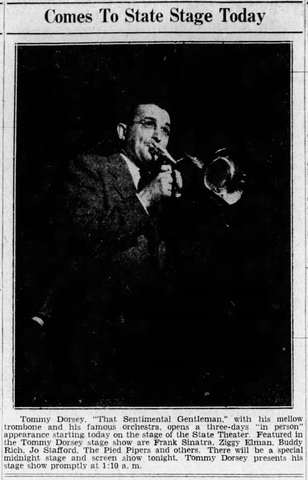
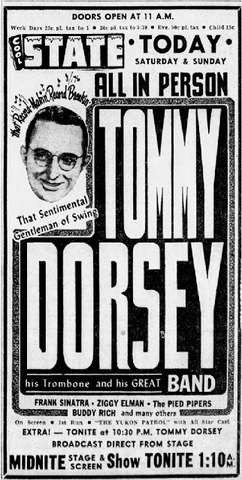
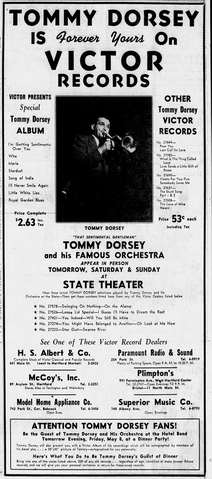
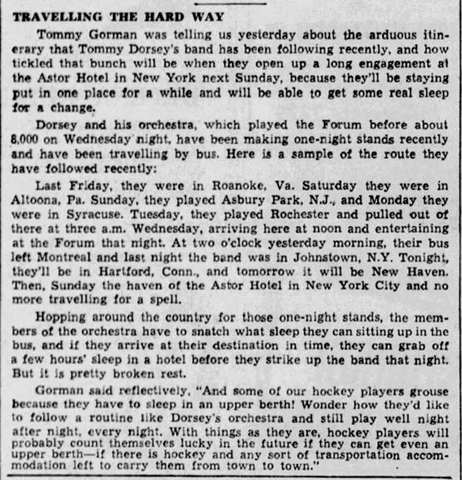
May 9, 1942
Concerts
State Theatre, Hartford, Connecticut
Tommy Dorsey and his Orchestra w/Frank Sinatra
State Theatre, Hartford, Connecticut
Tommy Dorsey and his Orchestra w/Frank Sinatra
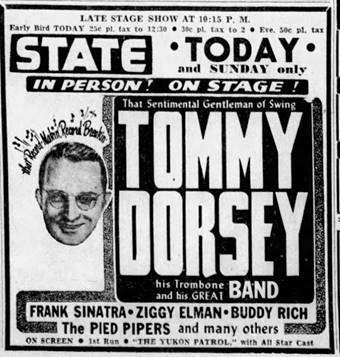
May 10, 1942
Radio
Sunday Evening At Tommy Dorsey's
Network: Blue Network
Location:
Time: 8:00PM - 8:30PM (EST)
Show #9
Sponsor: (sustaining or unknown)
Personnel (probable): Tommy Dorsey, George Arus, Dave Jacobs, Jimmy Skiles (trombone); Jimmy Blake, Ziggy Elman, Chuck Peterson, Jimmy Zito, Danni Vanelli (trumpet); Fred Stulce, Harry Schuchman (clarinet, alto sax); Heinie Beau (clarinet, tenor sax); Bruce Snyder, Don Lodice (tenor sax); Bernard Tinterow, Seymour Miroff, William Ehrenkrantz, Leonard Posner, Paul Poliakine (violin); Sam Ross, Leonard Atkins (viola); Harold Bemko (cello); Ruth Hill (harp); Clark Yocum (guitar); Phil Stevens (bass); Milt Raskin (piano); Buddy Rich (drums).
Vocals: Frank Sinatra, The Pied Pipers, Jo Stafford,
Orchestra Conducted By: Tommy Dorsey
Announcer:
Concerts
State Theatre, Hartford , Connecticut (May 8 - 10)
Tommy Dorsey and his Orchestra w/Frank Sinatra
May 11, 1942
Concerts
Dorsey and the Orchestra remained on vacation from May 11 - 16
May 13, 1942
Concerts
Dorsey and the Orchestra remained on vacation from May 11 - May 16
May 14, 1942
Concerts
Dorsey and the Orchestra remained on vacation from May 11 - May 16
May 15, 1942
Concerts
Dorsey and the Orchestra remained on vacation from May 11 - May 16
May 16, 1942
Concerts
Dorsey and the Orchestra remained on vacation from May 11 - May 16
May 17, 1942
Radio
Sunday Evening At Tommy Dorsey's
Network: Blue Network
Location: Dorsey Farm, Bernardsville, New Jersey
Time: 8:00PM - 8:30PM (EST)
Show #10
Sponsor: Treasury Department
Personnel (probable): Tommy Dorsey, George Arus, Dave Jacobs, Jimmy Skiles (trombone); Jimmy Blake, Ziggy Elman, Chuck Peterson, Jimmy Zito, Danni Vanelli (trumpet); Fred Stulce, Harry Schuchman (clarinet, alto sax); Heinie Beau (clarinet, tenor sax); Bruce Snyder, Don Lodice (tenor sax); Bernard Tinterow, Seymour Miroff, William Ehrenkrantz, Leonard Posner, Paul Poliakine (violin); Sam Ross, Leonard Atkins (viola); Harold Bemko (cello); Ruth Hill (harp); Clark Yocum (guitar); Phil Stevens (bass); Milt Raskin (piano); Buddy Rich (drums).
Vocals: Frank Sinatra, The Pied Pipers, Jo Stafford,
Orchestra Conducted By: Tommy Dorsey
Announcer:
1. opening theme: Getting Sentimental Over You - TD & Orchestra
2. Dig Down Deep - Frank Sinatra & Pied Pipers
3. King Porter Stomp - orchestra
4. The Last Call For Love - Frank Sinatra & Pied Pipers
5. I'll Take Tallulah - Frank Sinatra, Jo Stafford & Pied Pipers
6. Just As Though You Were Here - Frank Sinatra & Pied Pipers
7. closing theme: Getting Sentimental Over You - TD & Orchestra
Notes: Confirmed airing on WJZ & WMAL. ""Sunday Evening at Tommy Dorsey's will be just that beginning May 17th when the old "sentimental gentleman" with the trombone moves band. baggage and a WJZ microphone into the Dorsey domicile at Bernardsville, N.J., for his weekly Sunday broadcasts at 8:00 p.m."
May 18, 1942
Studio
New York City
BS075204 Just As Though You Were Here w/The Pied Pipers
(E. DeLange/J.B. Brooks)
Dorsey Brothers Music/Scarsdale Music Corp. (ASCAP)
Arranged by Axel Stordahl
-1 (3:12) CD: 07863 66353-2 "The Song Is You" 5CD set Vol 4
CD: RCA 8554-2-R
LP: SD 1000
78: 27903
BS075205 Street Of Dreams w/The Pied Pipers
(S.M. Lewis/V. Young)
EMI Miller Catalog Inc. (ASCAP)
Arranged by Axel Stordahl
-1 (2:39) CD: 07863 66353-2 "The Song Is You" 5CD set Vol 4
CD: RCA 8324-2-R
LP: SD 1000
78: 27903
Violins: Irving Raymond, Berard Tinterow, Leonard Pasner, William Ehrenkrantz, Alex Beller; Viola: Sam Ross, Leonard Atkins; Cello: Harold Benko; Harp: Ruth Hill; Trombones: George Arus, Jimmy Skiles, David Jacobs; Saxes: Bruce Snyder, Heinie Beau, Harry Schuchman, Don Lodice, Fred Stulce; Trumpets: Ziggy Elman, Chuck Peterson, Jimmy Blake, Jimmy Zito; Guitar: Clark Yocum; Bass: Phil Stevens; Piano: Milt Raskin; Drums: Buddy Rich
Ed O'Brien:
The 25 musicians making up the orchestra included an eight piece violin section. This was a first for the Dorsey band. T.D. added the strings at the behest of Mr. Sinatra, Frankie thought the strings augmented his ballad singing which gave him a big edge both onstage and in the recording studio.
May 19, 1942
Radio
Live Remote: Hotel Astor Roof, New York City
Tuesday Evening
NBC Blue Network
WJZ
10:00 - 10:30 pm
Ed O'Brien:
I have been researching Sinatra's Dorsey years of late. I have found a lot of undocumented information and photos. That said, I have also come to realize it is nearly impossible to verify every remote done by TD & Co. during the early 1940s. Mutual and NBC aired a great many remotes but often the radio listing only shows "dance music." It may be listed at 10: p.m. or midnight. It may be Dorsey or one of the other great bands of that era. NBC also broadcast many shows with the same vague newspaper information. I do have a lead with the Mutual shows--- almost all were a half-hour or less.
Concerts
Hotel Astor, New York, New York (Opening night)
Tommy Dorsey and his Orchestra w/Frank Sinatra
NOTE: Ed O'Brien sent along the texts of several news media advertisements and accounts of Tommy Dorsey's opening night at New York City's Hotel Astor. Sinatra received top billing and Dorsey added nine strings to please his star vocalist. The band, including the vocalists, was 30 strong plus TD himself. The band was SRO every night.
Downbeat's story, in its June 1, 1942 edition, covered the opening in this manner: "Tommy Dorsey opened at the Astor on the 19th not only with the Artie Shaw string section but also harpist Ruth Hill, from the Music Hall Symphony. It's her first band job, though she had plenty of four-beat experience with Mark Warnow and other air shows. Connie Haines vocals were done, as predicted by Jo Stafford stepping up from the Pied Pipers for featured billing. There were rumors that Tommy might bring in another gal to take wee Connie's place, but that seems unlikely now. The 31-piece band cut two sides on Victor on May 18th."
Hotel Astor, New York, New York (Opening night)
Emacs!
Ad In New York Papers, 5-19-42
May 20, 1942
Concerts
Astor Roof, Astor Hotel, New York, New York
Tommy Dorsey and his Orchestra w/Frank Sinatra
May 21, 1942
Concerts
The Astor Roof, Astor Hotel, New York, New York (May 19 - July 2) Tommy Dorsey and his Orchestra w/Frank Sinatra
May 22, 1942
Concerts
The Astor Roof, Astor Hotel, New York, New York (May 19 - July 2) Tommy Dorsey and his Orchestra w/Frank Sinatra
May 23, 1942
Concerts
The Astor Roof, Astor Hotel, New York, New York (May 19 - July 2) Tommy Dorsey and his Orchestra w/Frank Sinatra
May 24, 1942
Radio
Sunday Evening At Tommy Dorsey's
Network: Blue Network
Location: Dorsey Farm, Bornardsville, New Jersey
Time: 8:00PM - 8:30PM (EST)
Show #11
Sponsor: Treasury Department
Personnel (probable): Tommy Dorsey, George Arus, Dave Jacobs, Jimmy Skiles (trombone); Jimmy Blake, Ziggy Elman, Chuck Peterson, Jimmy Zito, Danni Vanelli (trumpet); Fred Stulce, Harry Schuchman (clarinet, alto sax); Heinie Beau (clarinet, tenor sax); Bruce Snyder, Don Lodice (tenor sax); Bernard Tinterow, Seymour Miroff, William Ehrenkrantz, Leonard Posner, Paul Poliakine (violin); Sam Ross, Leonard Atkins (viola); Harold Bemko (cello); Ruth Hill (harp); Clark Yocum (guitar); Phil Stevens (bass); Milt Raskin (piano); Buddy Rich (drums).
Vocals: Frank Sinatra, The Pied Pipers, Jo Stafford,
Orchestra Conducted By: Tommy Dorsey
Announcer:
Notes: Confirmed airing on WJZ & WMAL.
Concerts
The Astor Roof, Astor Hotel, New York, New York (May 19 - July 2) Tommy Dorsey and his Orchestra w/Frank Sinatra
May 25, 1942
Concerts
The Astor Roof, Astor Hotel, New York, New York (May 19 - July 2) Tommy Dorsey and his Orchestra w/Frank Sinatra
May 26, 1942
Radio
Live Remote:Hotel Astor, New York City
Tuesday Evening
10:00 - 10:30 pm
NBC Blue Network
WJZ
Tommy Dorsey & Orchestra
Concerts
The Astor Roof, Astor Hotel, New York, New York (May 19 - July 2) Tommy Dorsey and his Orchestra w/Frank Sinatra
May 27, 1942
Concerts
The Astor Roof, Astor Hotel, New York, New York (May 19 - July 2) Tommy Dorsey and his Orchestra w/Frank Sinatra
May 28, 1942
Concerts
The Astor Roof, Astor Hotel, New York, New York (May 19 - July 2) Tommy Dorsey and his Orchestra w/Frank Sinatra
May 29, 1942
Concerts
The Astor Roof, Astor Hotel, New York, New York (May 19 - July 2) Tommy Dorsey and his Orchestra w/Frank Sinatra
May 30, 1942
Radio
Live Remote: Astor Hotel, New York City
Saturday Evening
NBC Blue Network
WJZ
7:30 - 8:00 p.m. EWT
Tommy Dorsey And His Orchestra
Concerts
The Astor Roof, Astor Hotel, New York, New York (May 19 - July 2) Tommy Dorsey and his Orchestra w/Frank Sinatra
May 31, 1942
Radio
Sunday Evening At Tommy Dorsey's
Network: Blue Network
Location: Dorsey Farm, Bernardsville, New Jersey
Time: 8:00PM - 8:30PM (EST)
Show #12
Sponsor: Treasury Department
Personnel (probable): Tommy Dorsey, George Arus, Dave Jacobs, Jimmy Skiles (trombone); Jimmy Blake, Ziggy Elman, Chuck Peterson, Jimmy Zito, Danni Vanelli (trumpet); Fred Stulce, Harry Schuchman (clarinet, alto sax); Heinie Beau (clarinet, tenor sax); Bruce Snyder, Don Lodice (tenor sax); Bernard Tinterow, Seymour Miroff, William Ehrenkrantz, Leonard Posner, Paul Poliakine (violin); Sam Ross, Leonard Atkins (viola); Harold Bemko (cello); Ruth Hill (harp); Clark Yocum (guitar); Phil Stevens (bass); Milt Raskin (piano); Buddy Rich (drums).
Vocals: Frank Sinatra, The Pied Pipers, Jo Stafford,
Orchestra Conducted By: Tommy Dorsey
Announcer:
1. Getting Sentimental Over You T.D. & Orch.
2. Dig Down Deep F.S, J.S. P.P.
3. The Last Call For Love F.S. , J.S. P.P.
4. I'll Take Tallulah F.S. , J.S. P.P.
5. Just As Though You Were Here F.S. , J.S. P.P.
Note: ("The Last Call for Love & "I’ll Take Tallulah" & "Just As Though You Were Here" appear on the CD: BMG Bluebird 60283-2 - Young Blue Eyes - Birth Of The Crooner)
Dorsey's new nine piece string section had its radio debut with this broadcast. Show was first to be broadcast from Tommy's farm in Bernardsville, N.J. A wonderful picture of Frank, Ziggy Elman and the band boy was taken on the lawn of Tommy's farm, one Sunday afternoon that summer.
Notes: Confirmed airing on WJZ & WMAL. Ed O'Brien: "On the Treasury War Bond Show of 5-31-42, Sinatra tells Dorsey that he is worried about their picture. Frank tells TD that he saw his face all over the cutting room floor. Jo Stafford then says, "Now don't you fret Frankie. When the folks dig you in that "I'll Take Tallulah" number, they'll think you are a solid sensation." TD then pipes in with, "Jo Stafford is right Frankie. Just to prove it, let's do "I'll Take Tallulah" right now." It is quite obvious the number was done for the film but was deleted. Sy Oliver did the chart. There is no history of it in the MGM files. "Blue Skies" was recorded on 12-18-41 by FS and not used in the film. I have the MGM session sheet."
Concerts
The Steel Pier, Atlantic City, NJ (One Nighter)
Tommy Dorsey and his Orchestra w/Frank Sinatra
The Steel Pier, Atlantic City, NJ
Tommy Dorsey and his Orchestra w/Frank Sinatra
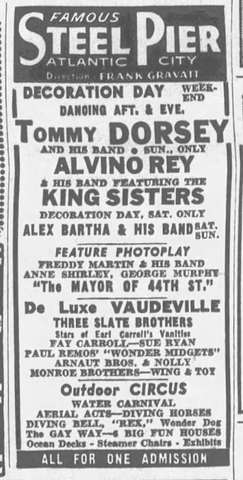
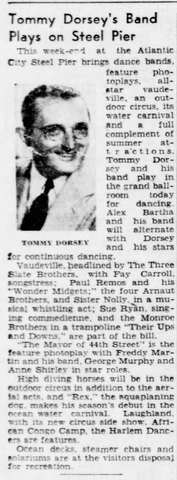
June 1942
[Astor roof engagement]
Kaplan: The Dorsey band played an eight-week engagement at the Hotel Astor roof in New York during May and June 1942, drawing crowds of prom-age girls.
Source: James Kaplan, "Frank: The Voice" (2010)
June 1, 1942
Concerts
The Astor Roof, Astor Hotel, New York, New York (May 19 - July 2) Tommy Dorsey and his Orchestra w/Frank Sinatra
Ed O'Brien:
Dorsey band opened at the Hotel Astor on 5-19-42 for a run of six weeks. They closed on 7-1-42.
Sinatra was now the big star in the band.
Variety reported that Dorsey got a big break because the Astor was less than 15 stories tall. Above 15 you had to dim-out the lights.
The band was now 31 strong including the complete Artie Shaw nine piece string section.
TD did this to please Mr. Sinatra. Harpist, Ruth
Hill, from the Music Hall Symphony, joined the band for the Astor engagement. Connie Haines was no longer with Dorsey and as Variety predicted,
Jo Stafford was now the distaff vocalist.
Variety June 1, 1942.
Dorsey drew 5,150 patrons the first week at The Astor, at 75 cents and a $1..00 and 5,200 the second week. Band was pulling in over $10,000 a week. Dorsey band was ahead of its 1941 figures at the hotel.
Variety 5-27-42 and 6-3-42
June 2, 1942
Radio
Live Remote: Hotel Astor, New York City
Tuesday Evening
10:00 - 10:30 pm EWT
NBC Blue Network
WJZ
Tommy Dorsey And Orchestra
1. I'm Getting Sentimental Over You TD & Orch.
2. Loose Lid Special TD & Orch.
3. Just As Though You Were Here Frank Sinatra & Pied Pipers
4. Marie* Frank Sinatra & Band Chorus
5. Closing Theme
Ed O'Brien:
Bunny Berigan,the great jazz trumpeter, had died earlier in the day. His marvelous collaboration of "Marie," with Dorsey, was one of the most admired recordings of that era. Sinatra's heartfelt rendition is a fitting tribute to a very tragic figure. Bunny was only 31 at the time. Four decades later Sinatra would sometimes mention Berigan during his introductory remarks for "I Can't Get Started." You could hear both respect and deep admiration in Frank's remarks.
Concerts
The Astor Roof, Astor Hotel, New York, New York (May 19 - July 2) Tommy Dorsey and his Orchestra w/Frank Sinatra
June 3, 1942
Concerts
The Astor Roof, Astor Hotel, New York, New York (May 19 - July 2) Tommy Dorsey and his Orchestra w/Frank Sinatra
June 4, 1942
Concerts
The Astor Roof, Astor Hotel, New York, New York (May 19 - July 2) Tommy Dorsey and his Orchestra w/Frank Sinatra
June 5, 1942
Concerts
The Astor Roof, Astor Hotel, New York, New York (May 19 - July 2) Tommy Dorsey and his Orchestra w/Frank Sinatra
June 6, 1942
Radio
Live Remote: Hotel Astor, New York City
Saturday Evening
7:30 - 8:00 p.m. EWT
NBC Blue Network
WJZ
Concerts
The Astor Roof, Astor Hotel, New York, New York (May 19 - July 2) Tommy Dorsey and his Orchestra w/Frank Sinatra
June 7, 1942
Radio
Tall Oaks Estate, New York City
Sunday Evening
8:00 - 8:30 pm EWT
“Sunday Evening with Tommy Dorsey”
Treasury Department Program 6
NBC Blue Network
WJZ
Tommy Dorsey And His Orchestra
Bernardsville, New Jersey
1. I’m Getting Sentimental Over You (open) (TD & Orhestra)
2. You Can Depend On Me (JS)
3. Just As Though You Were Here (FS-PP),
4. March of the Toys (TD & Orhestra)
5. TD dialogue, message from the Bernardsville Fire Chief appointing TD fire marshal
6. I Threw a Kiss in the Ocean (JS)
7. War Bond Message
8. Be Careful It’s My Heart (FS)
9. The Sheik of Araby, (TD & Orhestra)
10. Medley: My Silent Love (FS), I’ll See You In My Dreams (TD solo), After You’ve Gone (JS)
11. I’m Getting Sentimental Over You (close) (TD & Orhestra)
("Just As Though You Were Here" appears on CD: BMG Bluebird 60283-2 - Young Blue Eyes - Birth Of The Crooner)
("Medley: My Silent Love, I’ll See You In My Dreams, After You’ve Gone" appear on CD: Buddha 74465 999601-2 Learn To Croon)
("War Bond Appeal" & "Be Careful It’s My Heart" appear CD: Buddha 74465 999600-2 - 'It's All So New')
Concerts
The Astor Roof, Astor Hotel, New York, New York (May 19 - July 2) Tommy Dorsey and his Orchestra w/Frank Sinatra
June 8, 1942
Concerts
The Astor Roof, Astor Hotel, New York, New York (May 19 - July 2) Tommy Dorsey and his Orchestra w/Frank Sinatra
June 9, 1942
Studio
New York City
BS075264 Take Me
(M. David/R. Bloom)
WB Music Corp./Polygram International Publishing Inc. (ASCAP) Arranged by Axel Stordahl
-1 (2:59) CD: 07863 66353-2 "The Song Is You" 5CD set Vol 4
CD: RCA 8324-2-R
LP: SD 1000
78: 27923
BS075265 Be Careful It's My Heart
(from the Paramount Picture Holiday Inn)
(Irving Berlin)
Irving Berlin Music Co. (ASCAP)
Arranged by Axel Stordahl
-1 (2:47) CD: 07863 66353-2 "The Song Is You" 5CD set Vol 4
CD: RCA 8324-2-R
LP: SD 1000
78: 27923
Violins: Seymour Miroff, Paul Poliakine, Berard Tinterow, Leonard Pasner, William Ehrenkrantz, Alex Beller; Viola: Sam Ross, Leonard Atkins; Cello: Harold Benko; Harp: Ruth Hill; Trombones: George Arus, Jimmy Skiles, David Jacobs; Saxes: Bruce Snyder, Heinie Beau, Harry Schuchman, Don Lodice, Fred Stulce; Trumpets: Ziggy Elman, Chuck Peterson, Jimmy Blake, Jimmy Zito; Guitar: Clark Yocum; Bass: Phil Stevens; Piano: Milt Raskin; Drums: Buddy Rich
NOTE: Sinatra Scholar Ed O'Brien tells us that he loves this recording with the Tommy Dorsey aggregation. The recording has the greatest sound of that era and the "Ring a Ding Ding" material, over 19 years later, is also a marvellous recording, albeit dramatically different in approach and sound.
Radio
Live Remote: Roof Of:Hotel Astor, New York City
Tuesday Evening
10:00 p.m. - 10:30 p.m. EWT
NBC Radio Blue Network - WJZ New York City
Tommy Dorsey & His Orchestra
Frank Sinatra, Jo Stafford, Buddy
Rich, Pied Pipers, Ziggy Elman
Concerts
The Astor Roof, Astor Hotel, New York, New York (May 19 - July 2) Tommy Dorsey and his Orchestra w/Frank Sinatra
New York City
BS075264 Take Me
(M. David/R. Bloom)
WB Music Corp./Polygram International Publishing Inc. (ASCAP) Arranged by Axel Stordahl
-1 (2:59) CD: 07863 66353-2 "The Song Is You" 5CD set Vol 4
CD: RCA 8324-2-R
LP: SD 1000
78: 27923
BS075265 Be Careful It's My Heart
(from the Paramount Picture Holiday Inn)
(Irving Berlin)
Irving Berlin Music Co. (ASCAP)
Arranged by Axel Stordahl
-1 (2:47) CD: 07863 66353-2 "The Song Is You" 5CD set Vol 4
CD: RCA 8324-2-R
LP: SD 1000
78: 27923
27 piece orchestra and vocalist
7-12-42
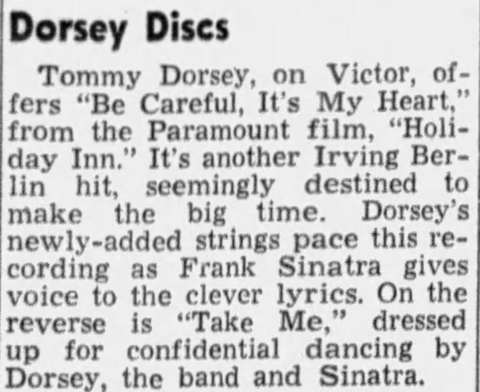
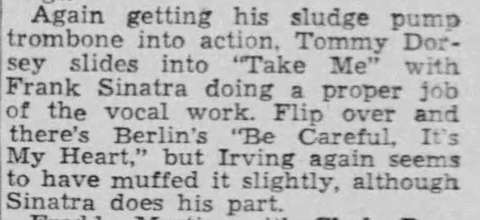
7-31-42
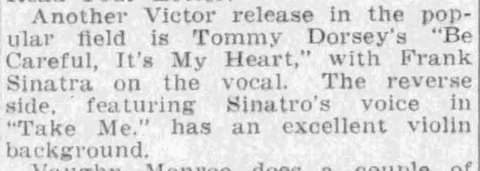
June 10, 1942
Concerts
The Astor Roof, Astor Hotel, New York, New York (May 19 - July 2) Tommy Dorsey and his Orchestra w/Frank Sinatra
June 11, 1942
Concerts
The Astor Roof, Astor Hotel, New York, New York (May 19 - July 2) Tommy Dorsey and his Orchestra w/Frank Sinatra
June 12, 1942
Concerts
The Astor Roof, Astor Hotel, New York, New York (May 19 - July 2) Tommy Dorsey and his Orchestra w/Frank Sinatra
June 13, 1942
Radio
Live Remote:Hotel Astor, New York City
Saturday Evening
7:40 - 8:00 pm
NBC Blue Network
WJZ
Tommy Dorsey & His Orchestra'
Labor For Victory (War Bond Drive)
New York City
Saturday Evening
10:15 - 10:30 p.m. EWT
NBC Red Network
WEAF
Tommy Dorsey & His Orchestra'
1. Any Bonds Today Tommy Dorsey Orchestra from Hotel Astor
2. Speech by Melvin Douglas
3. Douglas introduces business leaders who talk about what their companies are doing to support war effort
4. Dig Down Deep Frank Sinatra & Pied Pipers from Hotel Astor
5. Closing remarks
Concerts
The Astor Roof, Astor Hotel, New York, New York (May 19 - July 2) Tommy Dorsey and his Orchestra w/Frank Sinatra
June 14, 1942
Radio
Sunday Evening At Tommy Dorsey's
Network: Blue Network
Location: Palace Theatre, Stubenville, Ohio
Time: 8:00PM - 8:30PM (EST)
Show #14
Sponsor: Treasury Department
Personnel (probable): Tommy Dorsey, George Arus, Dave Jacobs, Jimmy Skiles (trombone); Jimmy Blake, Ziggy Elman, Chuck Peterson, Jimmy Zito, Danni Vanelli (trumpet); Fred Stulce, Harry Schuchman (clarinet, alto sax); Heinie Beau (clarinet, tenor sax); Bruce Snyder, Don Lodice (tenor sax); Bernard Tinterow, Seymour Miroff, William Ehrenkrantz, Leonard Posner, Paul Poliakine (violin); Sam Ross, Leonard Atkins (viola); Harold Bemko (cello); Ruth Hill (harp); Clark Yocum (guitar); Phil Stevens (bass); Milt Raskin (piano); Buddy Rich (drums).
Vocals: Frank Sinatra, The Pied Pipers, Jo Stafford,
Orchestra Conducted By: Tommy Dorsey
Announcer:
Notes: Confirmed airing on WJZ & WMAL.
Concerts
Palace Theatre, Steubenville, Ohio one-nighter
Tommy Dorsey and his Orchestra w/Frank Sinatra
Ed O'Brien:
Last week I mentioned how aggressive Dorsey was in pursuing one-nighters when the band had a day off. Here is a perfect example.
The Astor Hotel engagement was in full swing in June of 1942. Sunday the band rested. Or at least thought they would. On 6-14-42, TD & Co. flew out to Steubenville, Ohio to play a Sunday one-nighter at the Palace Theatre. They even managed to fit in a Treasury Bond Show from the stage of the theatre from 8 to 8:30.They had done radio shows from the Astor the previous week and would do more that week, plus there were recording sessions on 6/9,17(2 sessions) and 7/1. Sinatra once said you learned your trade with Dorsey. Very true.
June 15, 1942
Concerts
The Astor Roof, Astor Hotel, New York, New York (May 19 - July 2) Tommy Dorsey and his Orchestra w/Frank Sinatra
June 16, 1942
Radio
Tommy Dorsey Show
Location:
Network: NBC (Red)
Time: 10:30PM - 11:00PM Tuesday
Show: #1
Sponsor: Raleigh Cigarettes
Personnel (probable): Jimmy Zito, Ray Linn, Jimmy Black, Ziggy Elman (trumpets), Dave Jacobs, George Arun, Jimmy Skiles (trombones), Fred Stulce (clarinet & alto Sax), Heinie Beau, (clarinet & tenor sax), Don Lodice (tenor sax), Milt Raskin (piano), Clark Yocum (guitar), Phil Stevens (bass), Buddy Rich (drums), Si Miroff, Bernie Tinterow, Lenny Posner, Bill Ehrenkrantz, Alex Beller, Raoul Poliakiane (violins), Lenny Atkins, Sam Ross (violas), George Ricci or Harold Bemke (cello), Ruth Hill (harp)
Vocals: Frank Sinatra, Jo Stafford, The Pied Pipers (Jo Stafford, Clark Yocum, Chuck Lowry, John Huddleston)
Arrangements By: Noni Bernardi, Axel Stordahl, Sy Oliver
Orchestra Conducted By: Tommy Dorsey
Announcer: Cleveland Conway
Guests: Johnnie Mince
1. I'm Getting Sentimental Over You TD & Orch.
2. Song Of India TD & Orch.
3. Commercial
4. For You TD & Orch.
5. Yes, Indeed! Jo Stafford & Chuck Peterson
6. The Last Call For Love Frank Sinatra & Pied Pipers
7. Say "Si, Si" TD & Orch.
8. I Know That You Know TD & Orch.
9. "Hero of the Week"ť: Sleepy Lagoon (dedicated to General James Doolittle, US Army Air Forces) TD & Orch.
10. Commercial
11. You're In The Army Now TD & Orch.
12. "Star in Uniform"ť segment: Marie( Johnnie Mince clarinet solo) Frank Sinatra & Band Chorus
13. Hawaiian War Chant TD & Orch.
14. Closing Theme
Notes: Guest is Johnnie Mince, clarinetist, who is now in the army.
Washington Post writes: "Tommy Dorsey, idol of the hep cats, takes over the Red Skelton spot for the summer."
Confirmed aired on WRC & WEAF 10:30PM - 11:00PM (EST), WMAQ 9:30PM - 10:00PM (CTR) (Premiere), KFI 7:30PM - 8:00PM (PST).
Concerts
The Astor Roof, Astor Hotel, New York, New York (May 19 - July 2) Tommy Dorsey and his Orchestra w/Frank Sinatra
radio review
TOMMY DORSEY SHOW
Reviewed Tuesday, 10:30 - 11 p.m
Style --Musical. Sponsor -- Brown
& Williamson. Agency -- Russel M.
Seeds, Chicago --WEAF ( New York,
NBC )
Stepping into Red Skelton's boots while the titian-topped comic takes summer leave, maestro Tommy Dorsey mixes up straight music, two War Bond giveaways and a slushpump salute to
"America's hero of the week" to make a potent sponsor cocktail.
Program opens with "Song Of India," a Dorsey-fan familiar that pleases for trumpet and trombone sweetness. Next comes an invitation for listeners to send in 50-words-or-less letters asking TD to play the favorite song of their favorite person.
Plea of a woman whose soldier son loves
"Yes, Indeed" was read off as a sample. TD complies, Jo Stafford, Chuck Peterson and the Pied Pipers chirping the lyrics. Is it good?
Yes, indeed. Time out is taken again to explain that $100 War Bonds will be sent each week to the author of the best missive and his blessed one. Then the band runs thru "Last Call For Love" and "I Know That You Know," finally arriving at
"Sleepy Lagoon," which is dedicated to General
Jimmy Dolittle as the week's hero. As expected,
Dorsey turns in a flawless sliphorn solo on this one, but the high spot of the number is reached by his newly acquired string-and-harp ensemble.
Showmanship enters again when Johnny
Mann, former clarinetist with the Dorsey crew, is presented as the week's "Star In Uniform." Mann is quite a man on the licorice stick and proves it via a hot-lick chorus of "Marie."
Single disappointing note on this half-hour shot is contributed by vocalist Frank Sinatra.
Turning on the croon with "Last Call For Love,"
Sinatra never rose above a listless and unimag- inative plane.
J. R. C.
Billboard
June 27, 1942
Note: The Dorsey summer replacement series ran from June 16 ( show reviewed above ) thru
September 8, 1942. The 13-week series offered a Sinatra who had learned his craft during his apprenticeship with the great TD band, and who was eager to go out on his own. Frank sang many of the best songs of the day during the summer series, including "Be Careful It's My Heart," "In The
Blue Of Evening," "It Started All Over Again," Day- break," Just As Though You Were Here" and "Take
Me." According to a Dorsey discography, the latter two were sung on the 6-23-42 show. The 8-18 and 8-25 shows are in circulation among collectors. The Dorsey band also appeared on the Treasury War Bond show
( Thursday evening on NBC } and Sunday Evenings w/
Tommy Dorsey from his Bernardsville, N.J. home.
Ed
June 17, 1942
Studio
New York City
BS075282 In The Blue Of Evening
(T. Adair/A. D'Artega)
Shapiro, Berstein & Co. (ASCAP)
Arranged by Axel Stordahl
-1 (2:54) CD: 07863 66353-2 "The Song Is You" 5CD set Vol 4
CD: RCA 8554-2-R
LP: SD 1000
78: 20-1530
78: 27947
Ed O'Brien notes:
I believe this is Sinatra's finest recording with the
Dorsey band. Listening to the early efforts with the band and then hearing this magnificent effort is truly a revelation. The apprenticeship with T.D. taught Sinatra the intricacies of pure vocalizing and he was an apt student from the start. The phrasing, intonation, breath control that are so apparent on "In the Blue of Evening" would give
Sinatra all the tools he needed when he ventured out on his own a few months later.
VANCE ADAIR added:
Yes, very persuasive. The song is delivered with real gusto. Incidentally, Tom Adair would come to feature in an unexpectedly high number of footlights acknowledgements by FS in the coming years. And deservedly so.
BS075285 Dig Down Deep w/The Pied Pipers
(W. Hirsch/G. Marks/S. Marco)
Embassy Music Corp. (BMI)
Arranged by Axel Stordahl
-1 (2:06) CD: 07863 66353-2 "The Song Is You" 5CD set Vol 4
LP: SD 1000
78: 20-1539
Violins: Seymour Miroff, Paul Poliakine, Berard Tinterow, Leonard Pasner, William Ehrenkrantz, Alex Beller; Viola: Sam Ross, Leonard Atkins; Cello: Harold Benko; Harp: Ruth Hill; Trombones: George Arus, Jimmy Skiles, David Jacobs; Saxes: Bruce Snyder, Heinie Beau, Harry Schuchman, Don Lodice, Fred Stulce; Trumpets: Ziggy Elman, Chuck Peterson, Jimmy Blake, Jimmy Zito; Guitar: Clark Yocum; Bass: Phil Stevens; Piano: Milt Raskin; Drums: Buddy Rich
[image referenced in source but could not be recovered]
Concerts
The Astor Roof, Astor Hotel, New York, New York (May 19 - July 2) Tommy Dorsey and his Orchestra w/Frank Sinatra
Ed O'Brien supplied this quote from the June 17, 1942 issue of Variety: "TD 'Astor' Third week 6,100 - $22,450."
June 18, 1942
Concerts
The Astor Roof, Astor Hotel, New York, New York (May 19 - July 2) Tommy Dorsey and his Orchestra w/Frank Sinatra
June 19, 1942
Concerts
The Astor Roof, Astor Hotel, New York, New York (May 19 - July 2) Tommy Dorsey and his Orchestra w/Frank Sinatra
June 20, 1942
Radio
Live Remote:Hotel Astor, New York City
Saturday Evening
7:30 - 8:00 pm EWT
NBC Blue Network
WJZ
Tommy Dorsey And His Orchestra
Concerts
The Astor Roof, Astor Hotel, New York, New York (May 19 - July 2) Tommy Dorsey and his Orchestra w/Frank Sinatra
Ed O'Brien supplied this quote from the June 17, 1942 issue of Variety: "TD 'Astor' Third week 6,100 - $22,450."
June 21, 1942
Radio
Sunday Evening At Tommy Dorsey's
Network: Blue Network
Location:
Time: 8:00PM - 8:30PM (EST)
Show #15
Sponsor: Treasury Department
Personnel (probable): Tommy Dorsey, George Arus, Dave Jacobs, Jimmy Skiles (trombone); Jimmy Blake, Ziggy Elman, Chuck Peterson, Jimmy Zito, Danni Vanelli (trumpet); Fred Stulce, Harry Schuchman (clarinet, alto sax); Heinie Beau (clarinet, tenor sax); Bruce Snyder, Don Lodice (tenor sax); Bernard Tinterow, Seymour Miroff, William Ehrenkrantz, Leonard Posner, Paul Poliakine (violin); Sam Ross, Leonard Atkins (viola); Harold Bemko (cello); Ruth Hill (harp); Clark Yocum (guitar); Phil Stevens (bass); Milt Raskin (piano); Buddy Rich (drums).
Vocals: Frank Sinatra, The Pied Pipers, Jo Stafford,
Orchestra Conducted By: Tommy Dorsey
Announcer:
Notes: Confirmed airing on WJZ & WMAL.
Concerts
The Astor Roof, Astor Hotel, New York, New York (May 19 - July 2) Tommy Dorsey and his Orchestra w/Frank Sinatra
June 22, 1942
Concerts
The Astor Roof, Astor Hotel, New York, New York (May 19 - July 2) Tommy Dorsey and his Orchestra w/Frank Sinatra
June 23, 1942
Radio
"The Tommy Dorsey Raleigh-Kool Show"
Location:
Network: NBC (Red)
Time: 10:30PM - 11:00PM Tuesday
Show: #2
Sponsor: Raleigh Cigarettes
Personnel (probable): Jimmy Zito, Ray Linn, Jimmy Black, Ziggy Elman (trumpets), Dave Jacobs, George Arun, Jimmy Skiles (trombones), Fred Stulce (clarinet & alto Sax), Heinie Beau, (clarinet & tenor sax), Don Lodice (tenor sax), Milt Raskin (piano), Clark Yocum (guitar), Phil Stevens (bass), Buddy Rich (drums), Si Miroff, Bernie Tinterow, Lenny Posner, Bill Ehrenkrantz, Alex Beller, Raoul Poliakiane (violins), Lenny Atkins, Sam Ross (violas), George Ricci or Harold Bemke (cello), Ruth Hill (harp)
Vocals: Frank Sinatra, Jo Stafford, The Pied Pipers (Jo Stafford, Clark Yocum, Chuck Lowry, John Huddleston)
Arrangements By: Noni Bernardi, Axel Stordahl, Sy Oliver
Orchestra Conducted By: Tommy Dorsey
Announcer: Cleveland Conway
Guests: Pvt. Paul F. Donovan
1. I'm Getting Sentimental Over You – opening theme&nbssp;
2. March of the Toys
3. For You – Jo Staffoord, vocal
4. Yours - Frank Sinatra and the Pied Pipers, vocal
5. Melody in "A" Major
6. You're in the Army Now (fanfare)
7. Soldier's Song Johnny Doughboy
8. Found a Rose In Ireland –“ Sgt. Paul Donovan, vocal
9. ll Take Tallulah – Frank Sinatra, Jo Stafford, Tommy Dorsey and the Pied Pipers, voccal
10. I'm Getting Sentimental Over You – closing theme
The "Star in Uniform" segment featured Sgt. Paul Donovan (vocalist). Donovan was stationed at Camp Edwards, Massachusetts
Concerts
The Astor Roof, Astor Hotel, New York, New York (May 19 - July 2) Tommy Dorsey and his Orchestra w/Frank Sinatra
June 24, 1942
Concerts
The Astor Roof, Astor Hotel, New York, New York (May 19 - July 2) Tommy Dorsey and his Orchestra w/Frank Sinatra
NOTE: Ed O'Brien gives us this brief entry from the June 24, 1942 issue of Variety: "TD Astor Fifth Week 6,450 - $28.900."
June 25, 1942
Concerts
The Astor Roof, Astor Hotel, New York, New York (May 19 - July 2) Tommy Dorsey and his Orchestra w/Frank Sinatra
June 26, 1942
Concerts
The Astor Roof, Astor Hotel, New York, New York (May 19 - July 2) Tommy Dorsey and his Orchestra w/Frank Sinatra
June 27, 1942
Radio
Hotel Astor
Saturday
Somebody Loves Me The Pied Pipers
Take Me Frank Sinatra
Swanee River TD & Orch Sy Oliver chart
Just As Though You Were Here Frank Sinatra & Pied Pipers
Concerts
The Astor Roof, Astor Hotel, New York, New York (May 19 - July 2) Tommy Dorsey and his Orchestra w/Frank Sinatra
June 28, 1942
Radio
Sunday Evening At Tommy Dorsey's
Network: Blue Network
Location:
Time: 8:00PM - 8:30PM (EST)
Show #16
Sponsor: Treasury Department
Personnel (probable): Tommy Dorsey, George Arus, Dave Jacobs, Jimmy Skiles (trombone); Jimmy Blake, Ziggy Elman, Chuck Peterson, Jimmy Zito, Danni Vanelli (trumpet); Fred Stulce, Harry Schuchman (clarinet, alto sax); Heinie Beau (clarinet, tenor sax); Bruce Snyder, Don Lodice (tenor sax); Bernard Tinterow, Seymour Miroff, William Ehrenkrantz, Leonard Posner, Paul Poliakine (violin); Sam Ross, Leonard Atkins (viola); Harold Bemko (cello); Ruth Hill (harp); Clark Yocum (guitar); Phil Stevens (bass); Milt Raskin (piano); Buddy Rich (drums).
Vocals: Frank Sinatra, The Pied Pipers, Jo Stafford,
Orchestra Conducted By: Tommy Dorsey
Announcer:
1. I'm Getting Sentimental Over You D. & Orch.
2. Dig Down Deep J.S. P.P.
3. My Beloved Is Rugged J.S.
4. Be Careful It's My Heart "Let's bask in the brilliant baritoning of Frank Sinatra as he sings Irving Berlin's "Be Careful It's My Heart." T.D.
5. Sleepy Lagoon T.D. & Orch. "That's Frank Sinatra's baby who is heckling over there" T.D. (You can hear a baby crying)
6. Just As Though You Were Here F.S.. J.S. P.P.
7. I Threw A Kiss In The Ocean J.S.
War Bond message
8. The Sheik Of Araby T.D. & Orch
F.S. reads a letter from a G.I. requesting a song from him during memory melody
9. Memory Melody: My Silent Love F.S./ I'll See You In My Dreams T.D. & Orch./ After You've Gone - J.S.
War Bond message from T.D.
10. Dig Down Deep (reprise) F.S. J.S. P.P.
11. I'm Getting Sentimental Over You T.D. & Orch.
Notes: Confirmed airing on WJZ & WMAL.
("Memory Melody: My Silent Love - F.S./ I'll See You In My Dreams T.D. & Orch./ After You've Gone J.S." appear on CD: Buddha 74321 69173-2 - Learn To Croon)
Concerts
The Astor Roof, Astor Hotel, New York, New York (May 19 - July 2) Tommy Dorsey and his Orchestra w/Frank Sinatra
June 29, 1942
Concerts
The Astor Roof, Astor Hotel, New York, New York (May 19 - July 2) Tommy Dorsey and his Orchestra w/Frank Sinatra
June 30, 1942
Radio
Tommy Dorsey Show
Location:
Network: NBC (Red)
Time: 10:30PM - 11:00PM Tuesday
Show: #3
Sponsor: Raleigh Cigarettes
Personnel (probable): Jimmy Zito, Ray Linn, Jimmy Black, Ziggy Elman (trumpets), Dave Jacobs, George Arun, Jimmy Skiles (trombones), Fred Stulce (clarinet & alto Sax), Heinie Beau, (clarinet & tenor sax), Don Lodice (tenor sax), Milt Raskin (piano), Clark Yocum (guitar), Phil Stevens (bass), Buddy Rich (drums), Si Miroff, Bernie Tinterow, Lenny Posner, Bill Ehrenkrantz, Alex Beller, Raoul Poliakiane (violins), Lenny Atkins, Sam Ross (violas), George Ricci or Harold Bemke (cello), Ruth Hill (harp)
Vocals: Frank Sinatra, Jo Stafford, The Pied Pipers (Jo Stafford, Clark Yocum, Chuck Lowry, John Huddleston)
Arrangements By: Noni Bernardi, Axel Stordahl, Sy Oliver
Orchestra Conducted By: Tommy Dorsey
Announcer: Cleveland Conway
Guests: Pvt. Buddy Boylan (singer)
1. I'm Getting Sentimental Over You TD & Orch
2. Jersey Bounce
3. For You
4. Miss You
5. Losers Weepers
6.. Just As Though You Were Here
7. You're In The Army Now
8. Star In Uniform Segment
9. Not Mine
10. Not So Quiet Please
11. Intermezzo -
12. Closing Theme
Notes: Confirmed airing on WEAF.
Television
None
Concerts
The Astor Roof, Astor Hotel, New York, New York (May 19 - July 2) Tommy Dorsey and his Orchestra w/Frank Sinatra
Tommy Dorsey Show
Location:
Network: NBC (Red)
Time: 10:30PM - 11:00PM Tuesday
Show: #3
Sponsor: Raleigh Cigarettes
-----------------------------------------------
© 1997-2026 The Sinatra Archive
This calendar, or any parts thereof, may not be reproduced in any fashion whatsoever without the prior written permission of the publisher (The Sinatra Archive)
[image referenced in source but could not be recovered]
July 1942
[Sinatra suggests Dick Haymes as his replacement]
Kaplan: While the band was in Chicago in July 1942, Sinatra -- despite having already given notice -- offered to help Dorsey find a new singer, suggesting Dick Haymes (who had himself replaced Sinatra in Harry James's band). Dorsey balked, insisting Sinatra wasn't leaving so easily.
Source: James Kaplan, "Frank: The Voice" (2010)
July 1, 1942
Studio
New York City
BS075400 There Are Such Things w/The Pied Pipers
(S. Adams/A. Baer/G.W. Meyer)
Dorsey Brothers Music (ASCAP)
Arranged by Axel Stordahl
-1 (2:41) CD: 07863 66353-2 "The Song Is You" 5CD set Vol 4
CD: RCA 8324-2-R
LP: SD 1000
78: 27974
BS075402 Daybreak
(Based on the theme of Mardi Gras from Mississippi Suite) (H. Adamson/F. Grafe)
EMI Feist Catalog Inc. (ASCAP)
Arranged by Axel Stordahl
-1 (3:10) CD: 07863 66353-2 "The Song Is You" 5CD set Vol 4
CD: RCA 2269-2-R
LP: SD 1000
78: 27974
BS075403 It Started All Over Again w/The Pied Pipers
(B. Carey/C. Fischer)
Embassy Music Corp. (BMI)/Terry Fischer Music Co. (ASCAP) Arranged by Axel Stordahl
-1 (2:53) CD: 07863 66353-2 "The Song Is You" 5CD set Vol 4
CD: RCA 2269-2-R
LP: SD 1000
78: 20-1522
Violins: Seymour Miroff, Paul Poliakine, Berard Tinterow, Leonard Pasner, William Ehrenkrantz, Alex Beller;
Viola: Sam Ross, Leonard Atkins; Cello: Harold Benko; Harp: Ruth Hill; Trombones: George Arus, Jimmy
Skiles, David Jacobs; Saxes: Bruce Snyder, Heinie Beau, Harry Schuchman, Don Lodice, Fred Stulce;
Trumpets: Ziggy Elman, Chuck Peterson, Jimmy Blake, Jimmy Zito; Guitar: Clark Yocum; Bass: Phil Stevens;
Piano: Milt Raskin; Drums: Buddy Rich
NOTE: Sinatra Scholar Ed O'Brien reports that there were two sessions on this day in New York. The first started at 10:00 a.m. and ran until 2:30 p..m.
This included an extended rehearsal of all three songs. Sinatra recorded "There Are Such Things" at that session.
The second session ran from 3:30 p.m. to 6:30 p.m. and the other two songs were laid down.
All three songs would become Top 10 Billboard hits and "There Are Such Things" would reach #1 and stay there for six weeks. It would also chart for 26 weeks.
When Sinatra and Sy Oliver recorded the Dorsey tribute album in May of 1961, they re-did the three songs from this 1942 session. Sy employed 37 musicians. "Daybreak" and "It Started All Over Again" came easily for Sinatra and required five and six takes, respectively.
"There Are Such Things" was a different story, however. After Take 11, Sinatra announced there would only be 11 songs on the album. He wasn't able to extend the long passages with the seamless sound that had become his trademark. Oliver, however, figured a way to hide the taking of a breath between an instrument and Take 16 became the record. Sinatra laughed at Oliver's clever deception. He wanted the song on the LP and was willing to do whatever was necessary to get it there.
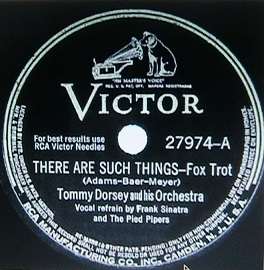
Concerts
The Astor Roof, Astor Hotel, New York, New York (May 19 - July 2) Tommy Dorsey and his Orchestra w/Frank Sinatra
NOTE: Ed O'Brien adds that in this 1942 Hotel Astor engagement, the Dorsey band grossed over $130,000.
That was big money in 1942 when Big Bands were at their zenith. Variety magazine of July 1, 1942 carried this item: "TD Astor Fifth week 6,850 - $33,750."
[Daybreak -- critical commentary]
It was almost time for Sinatra to "graduate" from the Dorsey orchestra into a solo career of his own. He was still experimenting with various formats. If the full Dorsey orchestra, plus strings, plus Sinatra, was kind of overwhelming (as on "Daybreak"), he and Stordahl would have to find a way to tone that down a bit, and come up with an accompanying sound that would empower Sinatra to go off on his own. On January 19, 1942, he found it.
This song/context matches multiple dated entries in the chronology; the specific date Friedwald is referring to could not be determined with confidence.
Source: Will Friedwald, "Sinatra! The Song Is You: A Singer's Art" (2018 revised edition), Ch. 3, "With Tommy Dorsey" (1940-1942)
July 2, 1942
Studio
New York City
BS075407 Light A Candle In The Chapel
(H. Pease/E.G. Nelson/D. Leonard)
Mills Music Inc./Fisher Music Corp. (ASCAP)
Arranged by Axel Stordahl
-1 (3:02) CD: 07863 66353-2 "The Song Is You" 5CD set Vol 4
CD: RCA 8324-2-R
LP: SD 1000
78: 20-1522
78: 27941
Violins: Seymour Miroff, Paul Poliakine, Berard Tinterow, Leonard Pasner, William Ehrenkrantz, Alex Beller;
Viola: Sam Ross, Leonard Atkins; Cello: Harold Benko; Harp: Ruth Hill; Trombones: George Arus, Jimmy
Skiles, David Jacobs; Saxes: Bruce Snyder, Heinie Beau, Harry Schuchman, Don Lodice, Fred Stulce;
Trumpets: Ziggy Elman, Danny Vanelli, Jimmy Blake, Jimmy Zito; Guitar: Clark Yocum; Bass: Phil Stevens;
Piano: Milt Raskin; Drums: Buddy Rich
Ed O'Brien:
Although Frank would be with Dorsey for another two months, this would be his last recording with the band. The song would be the B side of a single released in early August of 1942. Billboard devoted most of its review to the A side recording of "He's My Guy" by Jo Stafford.
"Plattermate follows the same orchestral pattern and establishes the same restful musical mood, altho the band manages to cut thru with more of a rhythmic beat to keep the ballad moving along in brisk fashion in face of the slow tempo. Song’s story ties in with the times. Frank Sinatra taking the opening chorus, suggesting that a candle be lit in the chapel "for the one you love going away." Dorsey opens a second stanza and, jumping the bridge passages, Sinatra steps in for the last half to sing it out.
Billboard
August 1, 1942
The song would chart for one week in Billboard, at # 21, 8-22-42
Ed O'Brien (2016):
TD and band would not make another studio recording until November of 1944. I mention this because the musicians strike would be even more devastating to Sinatra. One can only imagine how many hits he would have had if studio recordings with a full orchestra had occurred in 1943-44.
Concerts
The Astor Roof, Astor Hotel, New York, New York (May 19 - July 2) Tommy Dorsey and his Orchestra w/Frank Sinatra
Ed O'Brien:
TD & Co. drew more than 36,000 at The Astor during their six-week stay up on the roof. Weekdays the price of admission was 75 cents and the weekends, with added shows, cost $1.00 to get in for dancing. The band grossed over $30,000 - average of $5,000 per week.
July 3, 1942
Radio
Stargazer Show, Pittsburgh
8:15-8:30 WCAE Pittsburgh
Tommy Dorsey's Orchestra were guests
[image referenced in source but could not be recovered]
Concerts
Stanley Theater, Pittsburgh, PA (July 3-9)
Tommy Dorsey and his Orchestra w/Frank Sinatra
On Screen: "A Gentleman After Dark" with Brian Donlevy & Miriam Hopkins
Roosevelt Hotel, Pittsburgh
Tommy Dorsey and his Orchestra
[image referenced in source but could not be recovered]
Stanley Theater, Pittsburgh, PA (July 3-9)
Tommy Dorsey and his Orchestra w/Frank Sinatra
On Screen: "A Gentleman After Dark" with Brian Donlevy & Miriam Hopkins
Variety, July 8, 1942
note: TD & Co closed at the Hotel Astor on 7/2 and opened the following day in Pittsburgh. The week's run grossed over $32,000. The band played a one-nighter,
Sunday (5), at the Capitol Theatre in Steubenville,
Ohio.The theatre got all of the Stanley's engagements on Sunday because of the Pennsylvania blue laws.
"Sunday Evening w/Tommy Dorsey" was broadcast live from the Capitol Theatre from 8 to 8:30 P. M.over the NBC Blue Network. WWVA, Wheeling, West Virginia, was the affiliate providing the transmission.
Ed
© 1997-2026 The Sinatra Archive
This calendar, or any parts thereof, may not be reproduced in any fashion whatsoever without the prior written permission of the publisher (The Sinatra Archive)
[image referenced in source but could not be recovered]
[image referenced in source but could not be recovered]
[image referenced in source but could not be recovered]
[image referenced in source but could not be recovered]
July 4, 1942
Concerts
Stanley Theater, Pittsburgh, PA (July 3-9)
Tommy Dorsey and his Orchestra w/Frank Sinatra
On Screen: "A Gentleman After Dark" with Brian Donlevy & Miriam Hopkins
From Billboard of July 11, but with a July 4 dateline:
SINATRA ALMOST SET TO LEAVE TOMMY DORSEY
Frank Sinatra will not be with the Tommy Dorsey band following its return from the coast next winter, according to present plans. Sinatra is about to sign a Columbia recording contract and is also in line for a juicy spot on a network commercial show. Sinatra-Dorsey parting of the ways has been rumored for months, and figures to be a completely amicable one, with the singer continuing under the management of Leonard Vannerson, Dorsey's pilot.. Sinatra will appear in the MGM pix to be made by the Dorsey band this Fall, and may also continue with T.D. thru his run at the Hollywood Palladium, providing the job doesn't interfere too greatly with his activities as a single. Sinatra's contract with Dorsey expires in September and it is assumed his Columbia disking will commence then unless another film comes along with a more attractive bid in the meantime.
July 5, 1942
Radio
Sunday Evening At Tommy Dorsey's
Network: Blue Network
Location: Capitol Theatre, Steubenville, Ohio
Time: 8:00PM - 8:30PM (EST)
Show #17
Sponsor: Treasury Department
Personnel (probabal): Tommy Dorsey, George Arus, Dave Jacobs, Jimmy Skiles (trombone); Jimmy Blake, Ziggy Elman, Chuck Peterson, Jimmy Zito, Danni Vanelli (trumpet); Fred Stulce, Harry Schuchman (clarinet, alto sax); Heinie Beau (clarinet, tenor sax); Bruce Snyder, Don Lodice (tenor sax); Bernard Tinterow, Seymour Miroff, William Ehrenkrantz, Leonard Posner, Paul Poliakine (violin); Sam Ross, Leonard Atkins (viola); Harold Bemko (cello); Ruth Hill (harp); Clark Yocum (guitar); Phil Stevens (bass); Milt Raskin (piano); Buddy Rich (drums).
Vocals: Frank Sinatra, The Pied Pipers, Jo Stafford,
Orchestra Conducted By: Tommy Dorsey
Announcer:
Notes: Confirmed airing on WJZ & WMAL. There should have been no Dorsey broadcast on July 12, 1942. Time slot was cut to 15mins. and was confirmed by Radio listings. Perry Martin, songs was in the slot. It should be noted that WMAL still listed it as "WMAL 8:15PM - 8:30PM Sunday At Tommy Dorsey's."
Ed O'Brien notes:
NBC Blue Network Station WWVA, Wheeling, West Virginia, broadcast the Dorsey show directly from the stage of the Capitol Theatre in Steubenville, Ohio.
.
Concerts
Capitol Theatre, Steubenville, Ohio
(Including a radio broadcast from the theatre's stage)
Tommy Dorsey and his Orchestra w/Frank Sinatra
(including a radio broadcast from the theatre's stage)
Note: Capitol Theatre featured the acts appearing at the Stanley, in Pittsburgh, every Sunday. Pennsylvania had blue laws forbidding the showing of flesh on Sundays.
Honest. I'm not making it up.
--Ed
July 6, 1942
Radio
Gimbels Record Shop, Pittsburgh, PA
WWSW
3:15 - 3:45
Tommy Dorsey & Frank Sinatra were interviewed by WWSW Commentator Walt Framer
Concerts
Stanley Theatre, Pittsburgh, Pennsylvania (July 3 - July 9) Tommy Dorsey and his Orchestra w/Frank Sinatra
Gimbels Record Shop, Pittsburgh, PA
WWSW
3:15 - 3:45
Tommy Dorsey & Frank Sinatra were interviewed by WWSW Commentator Walt Framer
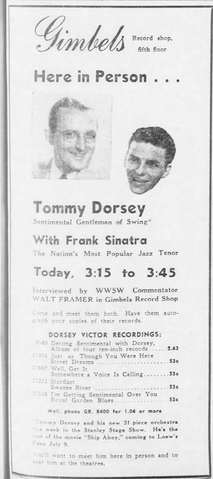
July 7, 1942
Radio
Tommy Dorsey Show
Location:Stanley Theatre, Pittsburgh, PA
Network: NBC Red Network
KDKA
Pittsburgh
Tuesday Evening
10:30 p.m. - 11:00 p.m. EWT
Show: #4
Sponsor: Raleigh Cigarettes
Personnel (probable): Jimmy Zito, Ray Linn, Jimmy Black, Ziggy Elman (trumpets), Dave Jacobs, George Arun, Jimmy Skiles (trombones), Fred Stulce (clarinet & alto Sax), Heinie Beau, (clarinet & tenor sax), Don Lodice (tenor sax), Milt Raskin (piano), Clark Yocum (guitar), Phil Stevens (bass), Buddy Rich (drums), Si Miroff, Bernie Tinterow, Lenny Posner, Bill Ehrenkrantz, Alex Beller, Raoul Poliakiane (violins), Lenny Atkins, Sam Ross (violas), George Ricci or Harold Bemke (cello), Ruth Hill (harp)
Vocals: Frank Sinatra, Jo Stafford, The Pied Pipers (Jo Stafford, Clark Yocum, Chuck Lowry, John Huddleston)
Arrangements By: Noni Bernardi, Axel Stordahl, Sy Oliver
Orchestra Conducted By: Tommy Dorsey
Announcer: Cleveland Conway
Guests: three stars in uniform: Sgt. Richard Kidder ( trumpet ),Pvt. Albert King ( guitar ), Pvt. Max Cohen ( vocal )
1. I'm Getting Sentimental Over You TD & Orch.
2.Dark Eyes TD & Orch.
3.Skylark Frank Sinatra 4.One Dozen Roses TD & Orch.
5. Breathless Jo Stafford & Pied Pipers
6. Chi Liu(Chinese Military Song) TD & Orch.
7. A Chinese Lullaby (TD solo) TD & Orch.
8. Jingle Jangle Jingle ("Stars in Uniform" segment) Kidder, King & Cohen
9. Sheik Of Araby TD & Orch.
10. Closing Theme TD & Orch.
Notes: Confirmed aired on WEAF.
Note: Show was performed after the last stage at the Stanley
-- Ed
Television
NONE
Concerts
Stanley Theatre, Pittsburgh, Pennsylvania (July 3 - July 9) Tommy Dorsey and his Orchestra w/Frank Sinatra
July 8, 1942
Concerts
Stanley Theatre, Pittsburgh, Pennsylvania (July 3 - July 9) Tommy Dorsey and his Orchestra w/Frank Sinatra
July 9, 1942
Concerts
Stanley Theatre, Pittsburgh, Pennsylvania (July 3 - July 9) Tommy Dorsey and his Orchestra w/Frank Sinatra
TD MISSES PITT MARK BY 1G
Pittsburgh -- Tommy Dorsey & orchestra, doing five shows a day instead of the four usually presented by Standard bills, except on Saturdays and holidays, grossed a near-record $35,000 at the Stanley last week. Only stanza to surpass the Dorsey show in the theater's history was the layout headed by Mickey Rooney two years ago. It took $36,000.
Paul Regan and Lane and Ward supplemented the Dorsey's specialists crew of Frank Sinatra, Jo Stafford, the Pied Pipers, Ziggy Elman and Buddy Rich. Network commercial broadcast from the stage Tuesday night was a help. but reckoned detrimental to the gate were the Army War Show at Pitt Stadium, which drew 292,000 fans, who played $161,000, a benefit baseball game between the Pirates and the Phils for Army-Navy Relief, several outdoor musical concerts, and holiday excursions by thousands of Pittsburghers over the Fourth. Pic, " A Gentleman After Dark," was no asset. The band got rave notices from the newspaper crix. Dorsey staged a party for 100 coin machine operators, after the last show opening night, at the Roosevelt Hotel.
Billboard
July 18, 1942
Ed O'Brien:
The last two months of Frank's years with Dorsey would see an even greater popularity for the band. They packed them in at the Capitol Theatre in Washington, Earle Theatre in Philadelphia, Chicago Theatre, Palace in Cleveland, Michigan Theatre in Detroit and a host of other venues throughout the summer. T.D. and Co. would shatter B.O. records in towns throughout the east and mid west of the country. The film at the Stanley is a long forgotten melodrama that starred Brian Donlevy, Miriam Hopkins and Preston Foster. I wonder why duds like this beauty were booked for an engagement by big bands of real stature and tremendous popularity? They certainly didn't help the B.O.
July 10, 1942
Concerts
Michigan Theatre, Detroit, Michigan (July 10 - July 16) Tommy Dorsey and his Orchestra w/Frank Sinatra
On Screen: "This Gun For Hire" with Alan Ladd & Veronica Lake
Note: Variety mentions that the film is very popular but declares
Dorsey band the draw with a take of $47,000 for the week.
Boffo.
--Ed
Michigan Theatre, Detroit, Michigan (July 10 - July 16) Tommy Dorsey and his Orchestra w/Frank Sinatra
On Screen: "This Gun For Hire" with Alan Ladd & Veronica Lake
Detroit Evening News
July 11, 1942
Concerts
Michigan Theatre, Detroit , Michigan (July 10 - July 16) Tommy Dorsey and his Orchestra w/Frank Sinatra
On screen: "This Gun For Hire" with Alan Ladd & Veronica Lake
July 12, 1942
Radio
Live Remote: Fox Theater, Detroit
Sunday Evening
8:00 p.m. - 8:30 p.m.
NBC Blue Network - WXYZ
Tommy Dorsey And His Orchestra
Concerts
Michigan Theatre, Detroit , Michigan (July 10 - July 16) Tommy Dorsey and his Orchestra w/Frank Sinatra
On screen: "This Gun For Hire" with Alan Ladd & Veronica Lake
NOTE: Sinatra Scholar Ed O'Brien writes that Tommy Dorsey, Sr. died at age 70.
Both Tommy Dorsey and Jimmy Dorsey left their respective bands and attended the funeral in Shenendoah, Pennsylvania. DOWNBEAT ran a long article indicating that the long estrangement between the brothers ended with the death of their father. Both men rejoined their bands on July 16, 1942.
July 13, 1942
Concerts
Michigan Theatre, Detroit , Michigan (July 10 - July 16) Tommy Dorsey and his Orchestra w/Frank Sinatra
July 14, 1942
Radio
Tommy Dorsey Show
Tuesday Evening
Fox Theater
Detroit, Michigan
10:30 p.m.- 11:00 p.m.
'NBC Red Network
WWJ
Detroit
Show: #5
Sponsor: Raleigh Cigarettes
Announcer: Cleve Conway
Personnel (probable): Jimmy Zito, Ray Linn, Jimmy Black, Ziggy Elman (trumpets), Dave Jacobs, George Arun, Jimmy Skiles (trombones), Fred Stulce (clarinet & alto Sax), Heinie Beau, (clarinet & tenor sax), Don Lodice (tenor sax), Milt Raskin (piano), Clark Yocum (guitar), Phil Stevens (bass), Buddy Rich (drums), Si Miroff, Bernie Tinterow, Lenny Posner, Bill Ehrenkrantz, Alex Beller, Raoul Poliakiane (violins), Lenny Atkins, Sam Ross (violas), George Ricci or Harold Bemke (cello), Ruth Hill (harp)
Vocals: Frank Sinatra, Jo Stafford, The Pied Pipers (Jo Stafford, Clark Yocum, Chuck Lowry, John Huddleston)
Arrangements By: Noni Bernardi, Axel Stordahl, Sy Oliver
Orchestra Conducted By: Ziggy Elman
Guests: Star In Unikform: Corp. David C. Schulze, Selfridge Field, trumpeter
1. I'm Getting Sentimental Over You Ziggy Elman & Orch.
2. The Minor Goes Muggin' Ziggy Elman & Orch
3. I Dood It Ziggy Elman & Orch.
4. Back Home Again In Indiana Pied Pipers
5. Take Me Frank Sinatra
6.Eli Eli Elman Trumpet Solo + Orch.
7. My Buddy Unknown ( may have been Star in Uniform segment)
8. Blue Blazes Elman & Orch.
9. Closing Theme Elman & Orch.
Notes: Confirmed aired on WEAF.
Ed O'Brien:
Tommy Francis Dorsey Sr., father of Jimmy and Tommy, died at Friends Hospital, Philadelphia, Pa., 7-12-42. Jimmy rushed home from Wash. D.C. and Tommy from Detroit.. Both men attended the wake and burial in Shenandoah, Pa, on the 14th and 15th respectively. Dorsey Sr. was a bandmaster and music teacher. He taught in various schools in the Philadelphia area. His death, at age 70, ended the long feud between his sons. They both returned to their bands on the 16th. Frank Sinatra took over the broadcast on the 14th, conversing with the announcer, Cleve Conway, and introducing the musical numbers. Ziggy Elman conducted and played the trumpet.
Some of this information I obtained from the 8-1-42 DOWNBEAT.
Television
NONE
Concerts
Michigan Theatre, Detroit , Michigan (July 10 - July 14) Tommy Dorsey and his Orchestra w/Frank Sinatra
NOTE: Sinatra Scholar Ed O'Brien reports that the Dorsey band closed at the Hotel Astor Roof on July 14, 1941. Variety reported on July 16 that the week saw Dorsey take in $3,575 at 75 cents to $1.00 per person and drawing capacity crowd of 1.000. Total for the eight weeks was a record gross of $37,350.
Dorsey was involved in two lawsuits that month and he became a business manager. Frank Sinatra was finishing his book "Tips on Popular Singing."
July 15, 1942
Concerts
Michigan Theatre, Detroit , Michigan (July 10 - July 16) Tommy Dorsey and his Orchestra w/Frank Sinatra
July 16, 1942
Concerts
Michigan Theatre, Detroit, Michigan (July 10 - July 16) Tommy Dorsey and his Orchestra w/Frank Sinatra
NOTE: Ed O'Brien reports that the International Musicians magazine of August 1942 indicates that Dorsey took in $47,000 for the week at the Michigan Theatre in Detroit.
Here is Billboard's report on the Dorsey's band gross that week.
Detroit: Tommy Dorsey at the Michigan Theatre(4,000; house average $18,000) grossed an estimated $32,000 last week.
Dorsey was absent part of the week, due to his father's death. Excessively hot weather was a handicap.
Billboard/July 25, 1942
July 17, 1942
Concerts
Chicago Theater, Chicago, Illinois
Tommy Dorsey Orchestra
Key Performers: Frank Sinatra, Ziggy Elman, Buddy Rich, Pied Pipers w/Jo
Stafford
Opening Acts: Lane and Ward (acrobats), Paul Regan (comedian)
Movie Shown: "The Great Man's Lady."
Afternoon show songs:
1. Song Of India
2. I'll Never Smile Again
3. Tallulah - Frank Sinatra
4. Embraceble You- Pied Pippers
5. Sleepy Lagoon
NOTE: Ed O'Brien provides us with some insight by a quote from the
July 25, 1942 issue of Billboard: "Summer heat is here [ Chicago ] in full force and, strangely enough, it both helps and hurts business. During the week the air-conditioning units are big getters, but over the weekend too many prospective patrons decide to take to the country and the beaches. Chicago Theatre (4,000 seats, $32,000 average) has a good bill opening on July 17 with Tommy Dorsey and orchestra plus Barbara Stanwyck in "The Great Man's Lady." Should be good for $40,000 thanks primarily to Tommy's drawing power."
O'Brien also sent a lengthy review of the Chicago Theatre engagement from the July 25, 1942 issue of Billboard written by Sam Honigberg. It begins with this summary:
'Tommy Dorsey brings his augmented 31-piece band, with Its several star performers,
into the Chicago theatre for a smooth, pleasant and highly entertaining 70-minute show.
Band opens with the familiar theme, 'I'm Getting Sentimental Over You,' goes into a lusty
version of 'Hallelujah,' then offers 'Jersey Bounce' In fast, rhythmic style for a spirited
show opening. Bobby Lee and Edna Ware are cuckoo acrobatic' dancers. They do a
couple of cute novelties, disputing the possession of a Sunday comic section in dance
time and dancing without their shoes. Jo Stafford and the Pied Pipers, a better than
average quartet, sing George Gershwin's 'Embraceable You' and follow it with a patriotic
medley. Genuinely attractive novelty is the band's concert arrangement of ‘Sleepy
Lagoon,' featuring the violin section of the orchestra. This is followed by 'Hawaiian War
Chant,' which shows off Elman's great trumpeting and the maniacal drummer boy antics
of Buddy Rich. Imitations, which seem to have become a standard part of most stage
shows these days, are well presented by Paul Regan. Poised and nonchalant, with a
definite appeal to the ladies, Frank Sinatra sings 'Skylark,' 'This Love of Mine' and, as
soloist with the Pied Pipers, 'I'll Never Smile Again,' 'South of the Border,' 'Poor You,'
'Last Call for Love,' ending up with 'I'll Take Tallulah' for a smash finish. Not a vacant
seat in this big house at the opening show Friday (17)
Variety
July 22, 1942
Chicago Theater, Chicago, Illinois
Tommy Dorsey Orchestra
Key Performers: Frank Sinatra, Ziggy Elman, Buddy Rich, Pied Pipers w/Jo Stafford
Opening Acts: Lane and Ward (acrobats), Paul Regan (comedian)
Chicago, (Reviewed Friday Afternoon, July 17) Tommy Dorsey is here on his annual visit, this time exhibiting a 10-piece string section (including a girl harpist) in addition to his regular money-making group, featuring Frank Sinatra and his ballads, Ziggy Elman and his trumpet, Buddy Rich and his drums, the Pied Pipers (three men and sexy Jo Stafford) and their vocal harmony, plus the maestro's famous sweet slide horn. Plenty of talent here and only two outside acts are used to round out the bill-Lane and Ward and Paul Regan. In all, a tightly packed package of up- to-date entertainment. The boys dish out oldies, new hits as well as Dorsey trademarks (Song of India, I'll Never Smile Again), all placed In proper spots and delivered in the usual Dorsey standard. A definite highlight, and doubling in the role of sub leader, is Ziggy Elman, the boy with the hot trumpet who is a familiar name to the jitterbugs judging by the applause greeting him. He takes a featured part in several numbers, delighting his followers. Frank Sinatra is another band natural, possessing a strong tenor voice that treats ballads with more than normal polish. From the standpoint of appearance, however, he could use a few extra pounds and ( the blue spot doesn't flatter him either) stays on for several numbers and remains for the closing tune, Tallulah. Most of his numbers are embellished with rhythmical support from the Pled Pipers, who work In fine harmony. On their own, earlier In the bill, they score with Embraceable You and a military melody. The string section gets its inning in the melodic arrangement of Sleepy Lagoon, Otherwise, it plays a minor second to the brass and reeds. Lane and Ward are a cute acro team with idea numbers. First it's a bit that starts off to loud music and tapers off to please a customer supposedly asleep in the audience (different), and finally their well-known Reading the Comics dance, which consists of cute bits of business thruout. For an encore Bobby Lane and a couple of socko tricks In which he comes down straight on his head to a few inches from the floor before landing feet first. Paul Regan, Impersonator with a sense of humor, has never had a better act. The material is good and the characters move along with the speed of a Milton Berle routine. Went strong, On screen, The Great Man's Lady. Biz big end of first show opening day despite a blazing heat. Sam Honigberg.
Billboard
July 25, 1942
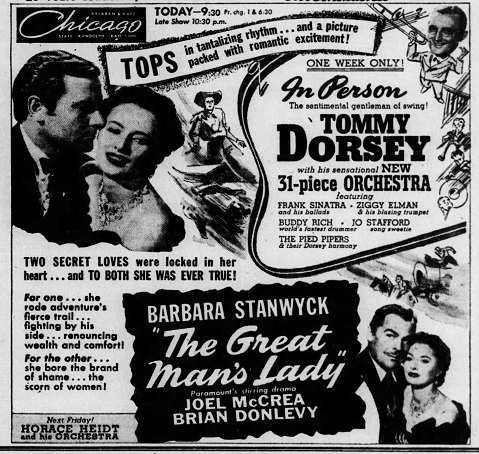
July 18, 1942
Concerts
Chicago Theatre, Chicago, Illinois (July 17 - July 23)
Tommy Dorsey Orchestra
Key Performers: Frank Sinatra, Ziggy Elman, Buddy Rich, Pied Pipers w/Jo Stafford
Opening Acts: Lane and Ward (acrobats), Paul Regan (comedian)
Movie Shown: "The Great Man's Lady."
July 19, 1942
Radio
Sunday Evening At Tommy Dorsey's
Network: Blue Network
Location: Chicago, Illinois
Time: 7:00PM - 7:30PM (EST)
Show #18
Sponsor: Treasury Department
Personnel (probable): Tommy Dorsey, George Arus, Dave Jacobs, Jimmy Skiles (trombone); Jimmy Blake, Ziggy Elman, Chuck Peterson, Jimmy Zito, Danni Vanelli (trumpet); Fred Stulce, Harry Schuchman (clarinet, alto sax); Heinie Beau (clarinet, tenor sax); Bruce Snyder, Don Lodice (tenor sax); Bernard Tinterow, Seymour Miroff, William Ehrenkrantz, Leonard Posner, Paul Poliakine (violin); Sam Ross, Leonard Atkins (viola); Harold Bemko (cello); Ruth Hill (harp); Clark Yocum (guitar); Phil Stevens (bass); Milt Raskin (piano); Buddy Rich (drums).
Vocals: Frank Sinatra, The Pied Pipers, Jo Stafford,
Orchestra Conducted By: Tommy Dorsey
Announcer:
1. I'm Getting Sentimental Over You T.D. & Orch.
2. The Remarkable Mr. Crow J.S.
3. In The Blue Of Evening F.S ( first time on radio)
4. Jersey Bounce T.D. & Orch.
5. Just As Though You Were Here F.S. J.S. P.P.
6. Hallelujah T.D. & Orch.
7. Medley: Who (F.S.) / My Heart Stood Still (T.D. & Orch.) / Three Little Words (J.S.)
8. Dig Down Deep F.S. J.S. P.P.
9. I'm Getting Sentimental Over You T.D. & Orch.
Notes: Confirmed airing on WJZ & WMAL. Also WCFL Tommy Dorsey's Orchestra 6:00PM - 6:30PM (Chicago) & KECA T. Dorsey Orchestra 4:00PM - 4:30PM (L.A).
("Just As Though You Were Here", "Who" & "Dig Down Deep" appear on Masters of Jazz Volume 7)
("In The Blue of Evening", "Who" & "Just As Though You Were Here" appear on Masters of Jazz Volume 10)
("In The Blue of Evening" appears on CD: BMG-66353 - The Song Is You)
("Just As Though You Were Here", "Hallelujah", "Medley: Who (FS), My Heart Stood Still, Three Little Words"; Saving Bonds appeal by Tommy Dorsey, Dig Down Deep, IGSOY (close) appear on the CD: Tommy Dorsey, 1942 War Bond Broadcast, Jazz Hour JH-1013)
Ed O'Brien:
Gave this one a listen earlier today. At the outset Dorsey thanks announcer Ralph Camargo for the introduction and Minuteman Horace Heidt for stepping in last week at the last moment and subbing for the band ( 7-12 ). Show is live from the NBC Blue Network in Chicago. The first number is "Dig Down Deep" with Frank and The Pied Pipers. T.D. then does a Treasury Department spot. He tells how tens of millions of Americans have enrolled in the Payroll Savings Plan. Every pay day 10% of a workers earnings are invested in War Bonds. When the worker accumulates $18.75, he or she receives a $25.00 bond. T.D. explains that the millions being collected will build planes, tanks and ships that will overwhelm the Axis powers. Jo Stafford and The Pipers then sing "The Fabulous Mr Crow." Dorsey chats with Jo about the party they are planning. It is a coming out party for a new song: "Mr Frank Sinatra providing a vocal escort; we proudly present a brand new ballad, ' In the Blue of Evening." T.D. then tells "the kids" that the band has toured half way across the continent. This leads to a geography lesson. The Pied Pipers are it. They tell that maple syrup comes from Vermont and ham is a Virginia product. Jo Stafford tells T.D. that New Jersey is famous for the "Jersey Bounce." The band then offers 64 bars of that bounce. Tommy then reminds the audience of a song the band had introduced some Sundays ago, "Just As Though You Were Here" with Frank Sinatra and The Pipers. After that number the band plays the Sy Oliver arranged "Hallelujah." " Memory Medley" is next up. A soldier had requested "My Heart Stood Still," following Sinatra's rendition of "Who," Dorsey does a superb trombone solo on the Rodgers and Hart gem, and Jo Stafford closes the medley with "Three Little Words." T.D. offers another bond sales pitch and "Dig Down Deep" is reprised by Frank and The Pipers. Tommy closes the show with his theme song and tells the audience that the band's Chicago visit is almost over. Next Sunday the show will originate from Cleveland, Ohio. T.D. also reminds the radio listener that the money spent on War Bonds is the fuel that will cook Hitler's goose.
Brian Chearno:
Thanks for checking that Ed. It confirms no July 12th show. Stations had to know before the last minute, because only one newspaper listed T.D. for the slot that I checked. Networks must have had the option to carry Heidt or opt for other programing since no one had him listed. Perry Small had the time slot in some papers.
Concerts
Chicago Theatre, Chicago, Illinois (July 17 - July 23)
Tommy Dorsey Orchestra
Key Performers: Frank Sinatra, Ziggy Elman, Buddy Rich, Pied Pipers w/Jo Stafford
Opening Acts: Lane and Ward (acrobats), Paul Regan (comedian)
Movie Shown: "The Great Man's Lady."
July 20, 1942
Concerts
Chicago Theatre, Chicago, Illinois (July 17 - July 23)
Tommy Dorsey Orchestra
Key Performers: Frank Sinatra, Ziggy Elman, Buddy Rich, Pied Pipers w/Jo Stafford
Opening Acts: Lane and Ward (acrobats), Paul Regan (comedian)
Movie Shown: "The Great Man's Lady."
July 21, 1942
Radio
Tommy Dorsey Show
Location:
Network: NBC (Red)
Time: 10:30PM - 11:00PM Tuesday
Show: #6
Sponsor: Raleigh Cigarettes
Personnel (probable): Jimmy Zito, Ray Linn, Jimmy Black, Ziggy Elman (trumpets), Dave Jacobs, George Arun, Jimmy Skiles (trombones), Fred Stulce (clarinet & alto Sax), Heinie Beau, (clarinet & tenor sax), Don Lodice (tenor sax), Milt Raskin (piano), Clark Yocum (guitar), Phil Stevens (bass), Buddy Rich (drums), Si Miroff, Bernie Tinterow, Lenny Posner, Bill Ehrenkrantz, Alex Beller, Raoul Poliakiane (violins), Lenny Atkins, Sam Ross (violas), George Ricci or Harold Bemke (cello), Ruth Hill (harp)
Vocals: Frank Sinatra, Jo Stafford, The Pied Pipers (Jo Stafford, Clark Yocum, Chuck Lowry, John Huddleston)
Arrangements By: Noni Bernardi, Axel Stordahl, Sy Oliver
Orchestra Conducted By: Tommy Dorsey
Announcer: Cleveland Conway
Guests: Don Jacoby, second class musican
1. opening: I'm Getting Sentimental Over You TD & Orch
2. Mandy, Make Up Your Mind - Tommy Dorsey & orchestra
3. Just As Though You Were Here Frank Sinatra & Pied PipersSomebody Loves Me - Pied Pipers
4. I Threw A Kiss In The Ocean Jo Stafford
5. Somebody Loves Me Pied Pipers
6. Tribute To FBI Director J. Edgar Hoover
7.. Swing High - - Tommy Dorsey & orchestra
8. closing: I'm Getting Sentimental Over You TD & Orch
Notes: Confirmed aired on WEAF. Above is a partial program listing.
Television
NONE
Concerts
Chicago Theatre, Chicago, Illinois (July 17 - July 23)
Tommy Dorsey Orchestra
Key Performers: Frank Sinatra, Ziggy Elman, Buddy Rich, Pied Pipers w/Jo Stafford
Opening Acts: Lane and Ward (acrobats), Paul Regan (comedian)
Movie Shown: "The Great Man's Lady."
July 22, 1942
Concerts
Chicago Theatre, Chicago , Illinois (July 17 - July 23) Tommy Dorsey Orchestra
Key Performers: Frank Sinatra, Ziggy Elman, Buddy Rich, Pied Pipers w/Jo Stafford
Opening Acts: Lane and Ward (acrobats), Paul Regan (comedian)
Movie Shown: "The Great Man's Lady."
NOTE: Ed O'Brien sends an item from the July 22. 1942 issue of Variety: "TD at the Chicago Theatre, Chicago , Illinois . . . (4,000) (35-55-75) with "Great Man's Lady" ( Paramount ), with the band the real draw, is getting a nifty $45,000."
July 23, 1942
Concerts
Chicago Theatre, Chicago, Illinois (July 17 - July 23)
Tommy Dorsey Orchestra
Key Performers: Frank Sinatra, Ziggy Elman, Buddy
Rich, Pied Pipers w/Jo Stafford
Opening Acts: Lane and Ward (acrobats), Paul Regan (comedian)
Movie Shown: "The Great Man's Lady."
Week of July 17 Tommy Dorsey and band, plus A
Great Man's Lady on screen, wound up with a terrific $50,500. Tommy is getting all the credit, and he did 42 shows to draw that money. Band was i in on a $10,000 guarantee, with a split, and was reported collecting some $13,000 for its end.
Billboard
8-1-42
Chicago Theatre, Chicago , Illinois (July 17 - July 23) Tommy Dorsey Orchestra
Key Performers: Frank Sinatra, Ziggy Elman, Buddy Rich, Pied Pipers w/Jo Stafford
Opening Acts: Lane and Ward (acrobats), Paul Regan (comedian)
Movie Shown: "The Great Man's Lady."
Thanks to Carl R for sending above photo
Hi Carl,
Never saw this one before. It took me a minute to locate Jo Stafford. She was no longer just a piper. With Connie Haines no longer with the band, Jo was now the star female vocalist. Looks like Milt Raskin on piano. Love these old photos. Ed
July 23, 1958 Judy Garland opens at Cocoanut Grove nightclub, part of the Ambassador Hotel in Los Angeles.
Frank Sinatra and Jerry Lewis at Judy Garland’s opening night at Coconut Grove, 1958.
American singer and actor Frank Sinatra (1915-1998) hugs American singer and actress Judy Garland (1922-1969) after Garland had performed her opening night at the Cocoanut Grove.
Italian nobility Afdera Franchetti and American singer and actor Frank Sinatra (1915-1998) at the Cocoanut Grove nightclub, Los Angeles, California, 23rd July 1958. Franchetti. the wife of Henry Fonda, and Sinatra are attending the opening night of Judy Garland's two-week residency at the Los Angeles nightclub.
July 24, 1942
Concerts
Palace Theatre, Cleveland, Ohio (July 24 - July 30)
Tommy Dorsey and his Orchestra w/Frank Sinatra
Palace Theatre, Cleveland, Ohio (July 24 - July 30)
Tommy Dorsey and his Orchestra w/Frank Sinatra
note: A very misleading ad for "Moontide." Lupino plays is more of waif than a tough cookie.. Fritz Lang was the director at the outset, but their was a clash of personalities. between him and Jean Gabin, who was THE French film idol back then. Gabin was trying to make it in Hollywood. He would not succeed due to a variety of reasons. Archie Mayo replaced Lang.
Lynnie and I have watched this film many rimes. A very underrated movie. The filming was just underway when Japan attacked Pearl Harbor.
TD & Co would do five shows a day. Here is the schedule from theCleveland Plain Dealer.
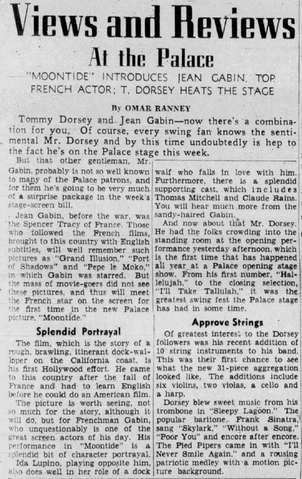
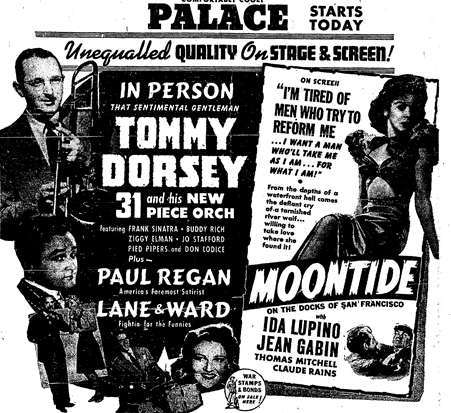
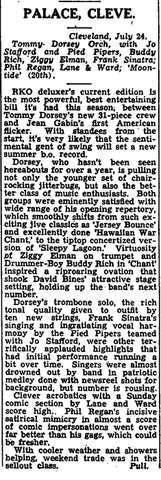
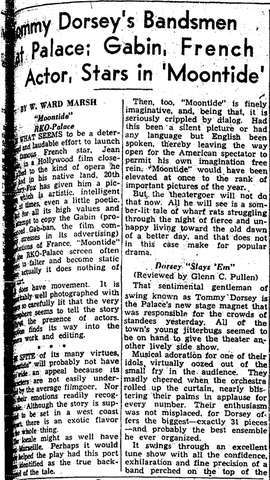

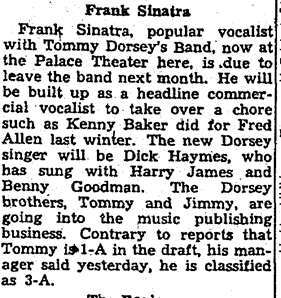
Palace Theatre, Cleveland, Ohio (July 24 - July 30)
Tommy Dorsey and his Orchestra w/Frank Sinatra
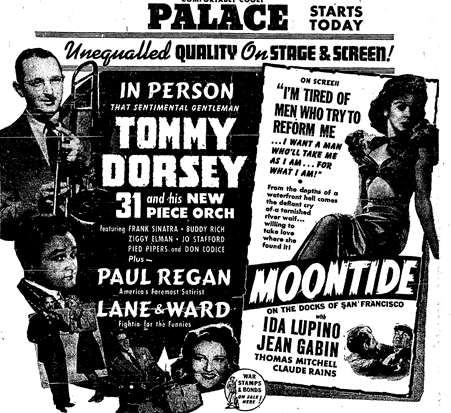
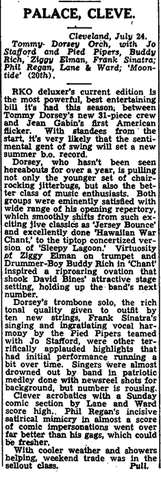
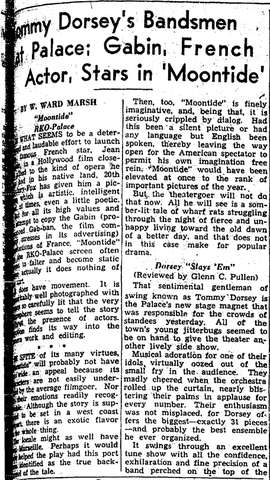

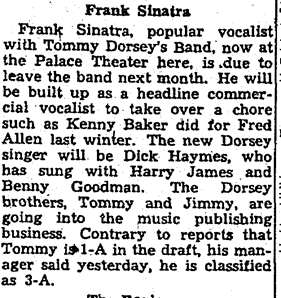
Palace Theatre, Cleveland, Ohio (July 24 - July 30)
Tommy Dorsey and his Orchestra w/Frank Sinatra
note: Dorsey usually got stuck with a forgettable B film on the bill.
This engagement was a rare exception. " Moontide" is an outstanding
work. Gabin only made two films in America, but he was something
to see. A great star in France, who dominated the screen. He is out-
standing and Ida Lupino is wonderful thoughout. Rains and Mitchell
were both great character actors. They have one scene that was way
over the top and I still marval that the it got by the Hays code.
Ed
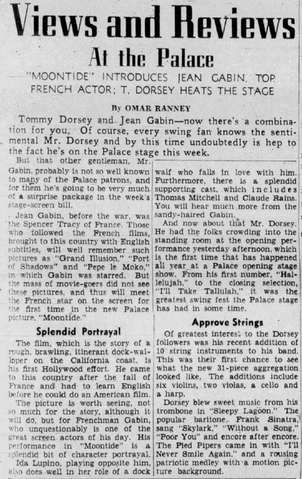
July 25, 1942
Concerts
Palace Theatre, Cleveland, Ohio (July 24 - July 30)
Tommy Dorsey and his Orchestra w/Frank Sinatra
Palace Theatre, Cleveland , Ohio (July 24 - July 30)
Tommy Dorsey and his Orchestra w/Frank Sinatra
note: Film is a gem. Unusual for a Dorsey Theatre engagement.
They usually ran a very poor B film.
Gabin was a huge star in France. When he agreed to go Hollywood with this film, Gabin asked
for and got Fritz Lang as the director. But it was not to be. Filming began on 12-6-41and
Lang was replaced on 12/9. Artistic differences were cited. There is a dream sequence
that features five sketches and three paintings that Salvador Dali did for the film. Lynne is a
great admirer of Ida Lupino. This week we watched a number of her films including "Moontide."
Mitchell and Rains are also outstanding. Archie Mayo replaced Lang. Film was released on
.
Ed
July 26, 1942
Radio
Live Remote: Palace Theatre, Cleveland, Ohio
Sunday Evening
7:00 - 7:30 pm
NBC Blue Network - WJW Cleveland, Ohio, WJZ - New York City Treasury Department #13
Tommy Dorsey And His Orchestra
Concerts
Palace Theatre, Cleveland, Ohio (July 24 - July 30)
Tommy Dorsey and his Orchestra w/Frank Sinatra
July 27, 1942
Concerts
Palace Theatre, Cleveland, Ohio (July 24 - July 30)
Tommy Dorsey and his Orchestra w/Frank Sinatra
July 28, 1942
Radio
Tommy Dorsey Show
Location: Palace Theatre, Cleveland, Ohio
Network: NBC (Red)
Time: 10:30PM - 11:00PM Tuesday
Show: #7
Sponsor: Raleigh Cigarettes
Personnel (probable): Jimmy Zito, Ray Linn, Jimmy Black, Ziggy Elman (trumpets), Dave Jacobs, George Arun, Jimmy Skiles (trombones), Fred Stulce (clarinet & alto Sax), Heinie Beau, (clarinet & tenor sax), Don Lodice (tenor sax), Milt Raskin (piano), Clark Yocum (guitar), Phil Stevens (bass), Buddy Rich (drums), Si Miroff, Bernie Tinterow, Lenny Posner, Bill Ehrenkrantz, Alex Beller, Raoul Poliakiane (violins), Lenny Atkins, Sam Ross (violas), George Ricci or Harold Bemke (cello), Ruth Hill (harp)
Vocals: Frank Sinatra, Jo Stafford, The Pied Pipers (Jo Stafford, Clark Yocum, Chuck Lowry, John Huddleston)
Arrangements By: Noni Bernardi, Axel Stordahl, Sy Oliver
Orchestra Conducted By: Tommy Dorsey
Announcer: Cleveland Conway
Guests: Corp. Florian ZaBach, Chicago violinist from Camp Grant
1. opening: I'm Getting Sentimental Over You TD & Orch
2. Deep River
3. Swing Low, Sweet Chariot
4. Linger Away
5. Allah's Holiday - Tommy Dorsey & orchestra
6. closing: I'm Getting Sentimental Over You TD & Orch
Notes: Confirmed aired on WEAF. Add Dorsey article from Wall Street Journal. Above is a partial program listing.
Ed O'Brien:
This show also featured "Manhattan Serenade" ( Jo Stafford ) and "Trees." The Palace Theatre engagement saw the Dorsey band grow to 27 musicians.
Notes: Newspaper listings also have Sinatra singing “Street Of Dreams”
--Scott
Concerts
Palace Theatre, Cleveland, Ohio (July 24 - July 30)
Tommy Dorsey and his Orchestra w/Frank Sinatra
Review of July 24th Show
"Tommy Dorsey Orch, with Jo Stafford and Pied
Pipers, Buddy Rich, Ziggy Elman, Frank
Sinatra; Phil Regan, Lane & Ward;
Film: "Moontide" 20th Century Fox -- Ida Lupino,
Jean Gabin, Claude Rains, Thomas Mitchell
RKO deluxer's current edition Is the most powerful, best entertaining bill It's had this season between Tommy Dorsey's new 31-piece crew and Jean Gabin's flrst American flicker. With standees from the start, it's very likely that the sentimental gent of swing will set a new summer b..o. record. Dorsey, who hasn't been seen hereabouts for over a year, is pulling not only the younger set of chair rocking jitterbugs, but also the better class of music enthusiasts. Both groups were eminently satisfied with wide range of his opening repertory, which smoothly shifts from such exciting jive classics as 'Jersey
Bounce' and excellently done 'Hawaiian War Chant' to the tiptop concertized version of
'Sleepy Lagoon.' Virtuosity of Ziggy Elman on trumpet and Drummer-Boy Buddy Rich in
'Chant' inspired a rip roaring ovation that shook
David Bines' attractive stage setting, holding up the band's next number. Dorsey's trombone solo, the rich tonal quality given to outfit by ten new strings, Frank Sinatra's singing and ingratiating vocal harmony by the
Pied Pipers teamed with Jo Stafford, were other terrifically applauded highlights that had initial performance running a bit over time.
Singers were almost drowned out by band in patriotic medley done with newsreel shots for background, but number is rousing. Clever acrobatics with a Sunday comic section by Lane and Ward score high. Phil Regan's incisive satirical mimicry in almost a score of comic impersonations went over far better than his gags, which could be fresher. With cooler weather and showers helping, weekend trade was in the sellout class.
Pull
Variety
July 29, 1942
Ed O'Brien:
The additional strings were added at Mr..
Sinatra's request. Frankie was now the star attraction of the band. What he asked for he got ASAP. And the man loved strings.
Tommy Dorsey Show
Location: Palace Theatre, Cleveland, Ohio
Network: NBC (Red)
Time: 10:30PM - 11:00PM Tuesday
Show: #7
Sponsor: Raleigh Cigarettes
© 1997-2024 The Sinatra Archive
This calendar, or any parts thereof, may not be reproduced in any fashion
whatsoever without the prior written permission of the publisher (The
Sinatra Archive)
__._,_.___
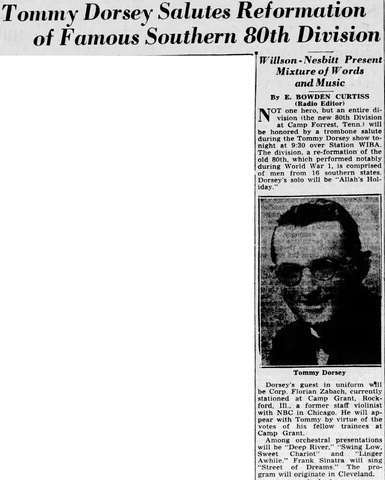
Tommy Dorsey Show
Location: Palace Theatre, Cleveland, Ohio
Network: NBC (Red)
Time: 10:30PM - 11:00PM Tuesday
Show: #7
Sponsor: Raleigh Cigarettes
----------------------------------------
July 28, 1944, Hotel Roosevelt, Hollywood, CA
Sinatra, Cary Grant, Irene Manning received plaques for their War Bond work.
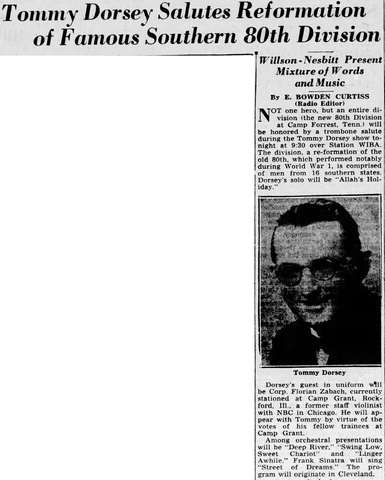
July 29, 1942
Concerts
Palace Theatre, Cleveland, Ohio (July 24 - July 30)
Tommy Dorsey and his Orchestra w/Frank Sinatra
NOTE: Sinatra Scholar Ed O'Brien sends this brief from the August 15, 1942 issue of Downbeat: TD STABS 'EM IN CLEVELAND THEATRE DATE Tommy Dorsey's recent week at the Palace Theatre was one of the top weeks of all time for this theatre, as his new 27 piece band proved a torrid draw for the local jitterbugs as the weather was hot. Band grossed $28,000.
And from the July 29, 1942 issue of Downbeat: "SUNNYBROOK BALLROOM, Pottstown, Pa. stopped operations; first victim of gas rationing . . . last nite was 18th using a local band . . . 95% of its dancers come by auto.
July 30, 1942
Radio
Sunday Evening At Tommy Dorsey's
Network: Blue Network
Location:
Time: 10:15PM - 10:45PM (EST)
Show #1
Sponsor: Treasury Department
Personnel (probable): Tommy Dorsey, George Arus, Dave Jacobs, Jimmy Skiles (trombone); Jimmy Blake, Ziggy Elman, Chuck Peterson, Jimmy Zito, Danni Vanelli (trumpet); Fred Stulce, Harry Schuchman (clarinet, alto sax); Heinie Beau (clarinet, tenor sax); Bruce Snyder, Don Lodice (tenor sax); Bernard Tinterow, Seymour Miroff, William Ehrenkrantz, Leonard Posner, Paul Poliakine (violin); Sam Ross, Leonard Atkins (viola); Harold Bemko (cello); Ruth Hill (harp); Clark Yocum (guitar); Phil Stevens (bass); Milt Raskin (piano); Buddy Rich (drums).
Vocals: Frank Sinatra, The Pied Pipers, Jo Stafford,
Orchestra Conducted By: Tommy Dorsey
Announcer:
1. opening theme: Getting Sentimental Over You - TD & orchestra
2. I'll Take Tallulah - Frank Sinatra, Jo Stafford & Pied Pipers
3. Out Of Nowhere - Frank Sinatra
4. How Deep Is The Ocean - Tommy Dorsey & orchestra
5. These Foolish Things - Jo Stafford
6. Dig Down Deep - Frank Sinatra & Piped Pipers
7. closing theme: Getting Sentimental Over You - TD & orchestra
Notes: Confirmed airing on WJZ & WMAL.
("I'll Take Tallulah" appears on Masters of Jazz Volume 7, That Sentimental Gentleman RCA-BMG 74321 36401 2 (Germany), That Sentimental Gentleman Collectables/BMG COLCD 2813 & Buddha 74465 999601-2 - Learn To Croon)
("Out of Nowhere" appears on the CD: Buddha 74465 999601-2 - Learn To Croon)
Concerts
Palace Theatre, Cleveland, Ohio (July 24 - July 30)
Tommy Dorsey and his Orchestra w/Frank Sinatra
Palace Theatre, Cleveland, Ohio (July 24 - July 30)
Tommy Dorsey and his Orchestra w/Frank Sinatra
note: TD & CO. pulled in $28,000 for their week's work at the Palace in Cleveland. Variety congratulated them for "batting out such a great score." Usually a band of stature got stuck with a third rate feature film. "Moontide<" with Jean Gabin, Ida Lupino and Thomas Mitchell, proved to be an exception. A fine film co-directed by Fritz Lang and Archie Mayo with a John O'Hara screenplay.
Here is the house review of opening night from Variety
Tommy Dorsey Orch, with Jo Stafford and Pied Pipers, Buddy Rich, Ziggy Elman, Frank
Sinatra; Phil Regan, Lane & Ward; 'Moontide' (20th) â RKO deluxer's current edition Is the most t powerful, best entertaining bill It's had this season between Tommy Dorsey's new 31-piece crew and Jean Gabin's flrst American flicker. With standees from the start, it's very likely that the sentimental gent of swing will set a new summer b. o. record. Dorsey, who hasn't been seen hereabouts for over a year, is pulling not only the younger set of chair rocking jitterbugs, but also the better class of music enthusiasts. Both groups were eminently satisfied with wide range of his opening repertory, which smoothly shifts from such exciting jive classics as 'Jersey
Bounce' and excellently done 'Hawaiian War Chant' to the tiptop concertized version of
'Sleepy Lagoon.' Virtuosity of Ziggy Elman on trumpet and Drummer-Boy Buddy Rich in
'Chant' inspired a rip roaring ovation that shook David Bines' attractive stage setting, holding up the band's next number. Dorsey's trombone solo, the rich tonal quality given to outfit by ten new strings, Frank Sinatra's singing and ingratiating vocal harmony by the
Pied Pipers teamed with Jo Stafford, were other terrifically applauded highlights that had initial performance running a bit over time. Singers were almost drowned out by band in patriotic medley done with newsreel shots for background, but number is rousing. Clever acrobatics with a Sunday comic section by Lane and Ward score high.. Phil Regan's incisive satirical mimicry in almost a score of comic impersonations went over far better than his gags, which could be fresher. With cooler weather and showers helping, weekend trade was in the sellout class. (Pull)
Variety
July 29, 1942
July 31, 1942
Concerts
Earle Theatre, Philadelphia , Pennsylvania (July 31 - August 6) Tommy Dorsey and his Orchestra w/Frank Sinatra
TD Tops 46G To Set Philly Earle Record
PHILADELPHIA. -Earle Theater (seating capacity, 3,000; house average for straight picture booking. $14,000) made history for the week ended Thursday (6). And it was Tommy Dorsey making the history. Coming here for the first time in four years with the avowed intention to break the house record of $37,800 chalked up by brother
Jimmy Dorsey less than two months ago, Tommy actually did the impossible. With the only advantage that the house raised night prices with Dorsey's engagement from a 69 to a 75-cent top, Dorsey exceeded even his own expectations with an almost impossible $46,700 gross for the six days. No stage shows here on Sundays. Played , six and seven shows a dayand 88,000 cash customers jammed the house all week. Dorsey's gross sets a high for the house since Its first opening, topping even the high figures of a generation ago when Eddie Cantor and Mary
Pickford made their personal appearances here. Bobby Lena and Edna Ward and Paul Regan made for the surrounding acts with the band pitching in with Frank Sinatra, the Pled Pipers, Jo Stafford, Buddy Rich and Ziggy Elman.
"Dr. Broadway" on the screen strictly a filler
BILLBOARD
8-15-42
Earle Theatre, Philadelphia , Pennsylvania (July 31 - August 6) Tommy Dorsey and his Orchestra w/Frank Sinatra
August 1942
[AFM recording strike begins]
Kaplan: The American Federation of Musicians' strike against the record companies began in August 1942 and was still in effect when Sinatra signed as a solo artist with Columbia Records.
Source: James Kaplan, "Frank: The Voice" (2010)
[Dorsey accepts Sinatra's departure]
Tommy Dorsey: Dorsey stopped speaking to Sinatra after the Chicago blowup but relented by the end of August 1942 once it was clear the singer would leave regardless, reportedly shrugging, "Let him go. Might be the best thing for me."
Source: James Kaplan, "Frank: The Voice" (2010)
[Snooty Little Cutie -- critical commentary]
"Snooty" sounds better, however, on an August 1942 aircheck with (in addition to a second half-chorus of Dorsey trombone) Stafford replacing the departed Haines.
Source: Will Friedwald, "Sinatra! The Song Is You: A Singer's Art" (2018 revised edition), Ch. 3, "With Tommy Dorsey" (1940-1942)
August 1, 1942
Concerts
Earle Theatre, Philadelphia , Pennsylvania (July 31 - August 6) Tommy Dorsey and his Orchestra w/Frank Sinatra
Ed O'Brien:
The Dorsey gang shattered the previous Earle record for a one-week standing, taking in $46,700. They did this despite having no help from a B movie. "Dr. Broadway" was a very early directorial effort by Anthony Mann. The film was a MacDonald Carey vehicle. Frank was five-weeks away from his departure and the beginning of a solo career.
Earle Theatre, Philadelphia , Pennsylvania (July 31 - August 6) Tommy Dorsey and his Orchestra w/Frank Sinatra
EARLE, PHILLY
Philadelphia, Aug. 1
Tommy Dorsey Orch (28) with Ziggy Elman, Buddy
Rich, Frank Sinatra, Jo Stafford,
Pied Pipers, Bobby Lane & Edna Ward, Paul Regan; 'Dr. Broadway' (Par) Tommy Dorsey's band is riding the crest of the wave in Philly these days in the juke box hit parade and this is evidenced by the terrific mobs of the Quakertown's younger set heading for the Earle. But the kids must be a mite disappointed in their idol. Maybe it was because the boys were playing their seventh show when caught or maybe it was the heat but Dorsey and his boys were inclined to cut up too much onstage, spoiling what might- have been a topnotch show. The clowning of the footers, headed by Ziggy
Elman and Buddy Rich, became contagious with the audience becoming unruly. Result was that the vocalists and other performers were heckled and the thing was well on its way to becoming a clambake before the curtain came down. But among his fans, the king could do no wrong. Every number was greeted with solid applause and whistling, and when it was over the ovation was deafening.
Making his first appearance here in more than three years, and the "first time since he's added the string section. Dorsey and his lads tee off with their theme, 'Getting
Sentimental Over You.' From then it's a mixture of Dorsey specials and top kickers on the hit parade: 'Jersey Bounce,' 'Sleepy
Lagoon,' 'Hawaiian War Chant,' 'Song of India,'
'Get It' and a stirring patriotic medley played behind a scrim on which the Army, Navy,
Marines and Air Corps do their stuff while the band plays the anthems of each arm of the service. Frank Sinatra's melodious voice nets him plenty of kudos, but the guy had a tough time bucking the opposition of the kibitzers down front and on the bandstand,
Sinatra is solid with â Without a Song,'
'This Love of Mine,' 'Skylark,' ' 'Poor You' and teams with the Pied Pipers for a couple including 'I'll Take Tallulah,' 'Never Smile
Again,' 'Last Call for Love.' Rounding out the show are a couple of' clever acts. Paul Regan, mimic, has plenty of talent and lots of material. He could, however, improve his stint by cutting out some of the cornier stuff and keeping only his best bits, which are really, clever. He has a super-abundance of material, and his act is a bit over-long. Dancers
Lane and Ward have an entertaining and novel acrobatic turn. They were lined up In the' lobby when caught (Saturday night).
Variety
August 5, 1942
August 2, 1942
Concerts
Stanley Theatre, Camden, NJ
Tommy Dorsey and his Orchestra w/Frank Sinatra
Note: Dorsey and company were playing the Earle
Theatre, Philadelphia, Pennsylvania from July 31
- August 6 but Blue laws meant the band spent the Sunday in Camden
Stanley Theatre, Camden, NJ
Tommy Dorsey and his Orchestra w/Frank Sinatra
Note: Dorsey and company were playing the Earle Theatre,
Philadelphia, Pennsylvania from July 31 - August 6 but Blue laws meant the band spent the Sunday in Camden
Thanks to Richard Cook for above listing
August 3, 1942
Concerts
Earle Theatre, Philadelphia , Pennsylvania (July 31 – August 6)
Tommy Dorsey and his Orchestra w/Frank Sinatra
TD TOPS 46G TO SET PHILLY EARLE REC'D
PHILADELPHIA -- Earle Theater ( seating capacity, 3,000,
house average for straight picture booking, $14.000 ) made
history for the week ended Thursday ( 6 ). And it was Tommy
Dorsey making the history. Coming here for the first time in
four years with the avowed intention to break the house
record of $37,800 chalked up by his brother Jimmy Dorsey
less than two months ago. Tommy actually did the imposs-
sible. With the only advantage that the house raised night
prices with Dorsey's engagement from a 69 to a 75-cent top.
Dorsey exceeded even his own expectations with an almost
impossible $46,700 gross for the six days. No stage shows
here on Sundays Played six and seven shows a day and
88,000 cash customers jammed the house all week. Dorsey's
gross set a high for the house since its first opening, topp-
ing even the high figures of a generation ago when Eddie
Cantor and Mary Pickford made their personal appear-
ances here. Bobby Lane and Edna Ward made for the
surrounding acts with the band pitching in with Frank
Sinatra, the Pied Pipers, Jo Stafford, Buddy Rich and
Ziggy Elman. "Dr. Broadway" on the screen strictly a filler.
Billboard
August 15, 1942
note: "Dr Broadway" was a Paramount film; directed
by Anthony Mann, and featuring MacDonald Carey, Jean
Phillips, J. Carrol Nash. It was a B film with a running
time of 75 minutes.
August 4, 1942
Radio
Tommy Dorsey Show
Location: Earle Theater, Philadelphia, Pa.
NBC Red Network
KYW
Philadelphia
Time: 10:30PM - 11:00PM
Tuesday Evening
Show: #8
Sponsor: Raleigh Cigarettes
Personnel (probable): Jimmy Zito, Ray Linn, Jimmy
Black, Ziggy Elman (trumpets), Dave Jacobs,
George Arun, Jimmy Skiles (trombones), Fred
Stulce (clarinet & alto Sax), Heinie Beau,
(clarinet & tenor sax), Don Lodice (tenor sax),
Milt Raskin (piano), Clark Yocum (guitar), Phil
Stevens (bass), Buddy Rich (drums), Si Miroff,
Bernie Tinterow, Lenny Posner, Bill Ehrenkrantz,
Alex Beller, Raoul Poliakiane (violins), Lenny
Atkins, Sam Ross (violas), George Ricci or Harold
Bemke (cello), Ruth Hill (harp)
Vocals: Frank Sinatra, Jo Stafford, The Pied
Pipers (Jo Stafford, Clark Yocum, Chuck Lowry, John Huddleston)
Arrangements By: Noni Bernardi, Axel Stordahl, Sy Oliver
Orchestra Conducted By: Tommy Dorsey
Announcer: Cleve Conway
Guests: Alfred Arthur Skelly
1. I'm Getting Sentimental Over
You TD & Orch
2.
Liebestraum
TD & Orch.
3.
Daybreak
Frank Sinatra
4.
Marie
Frank Sinatra & Band Chorus
5. Semper Paratus(Coast Guard Song) TD & Orch
6. Somebody Else Is Taking My Place TD & Orch
7. Evening Star
8. Not So Quiet Please
9. Old Black Joe
10. closing: I'm Getting Sentimental Over You TD & Orch
Notes: Confirmed aired on WEAF. Above is a partial program listing.
Concerts
Earle Theatre, Philadelphia, Pennsylvania (July 31 - August 6) Tommy Dorsey and his Orchestra w/Frank Sinatra
NOTE: Ed O'Brien sends us an item carried in the
August 1, 1942 issue of Downbeat: "Frank Sinatra, singer with Tommy Dorsey, will not return from the coast next winter. This split has been rumored for some time. Sinatra will continue with
Leonard Vannerson, Dorsey's manager, as his handler. The singer has a Columbia recording contract in view and is set for a good spot on a commercial radio show. Plans are for him to appear in the two MGM pictures the band is scheduled to make, possibly staying through TD's run at the Hollywood Palladium and then go out on his own."
Tommy Dorsey Show
Location: Earle Theater, Philadelphia, Pa.
NBC Red Network
KYW
Philadelphia
Time: 10:30PM - 11:00PM
August 5, 1942
Concerts
Earle Theatre, Philadelphia , Pennsylvania (July 31 - August 6) Tommy Dorsey and his Orchestra w/Frank Sinatra
FRANK SINATRA ALONE
"Frank Sinatra, vocalist with Tommy Dorsey's orchestra, has signed a management contract with General Amusement Corp. He is leaving Dorsey Sept. 3 to go into radio, theatre work, etc., as a soloist. He is to be replaced by Dick Haymes, who has already left' Benny Goodman. Another vocalist change last week put Ray Eberle, who recently parted with Glenn Miller, with Gene Krupa's band in place of Johnny Desmond." Variety
August 5, 1942
Frank gets a mention.
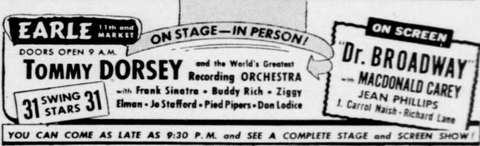
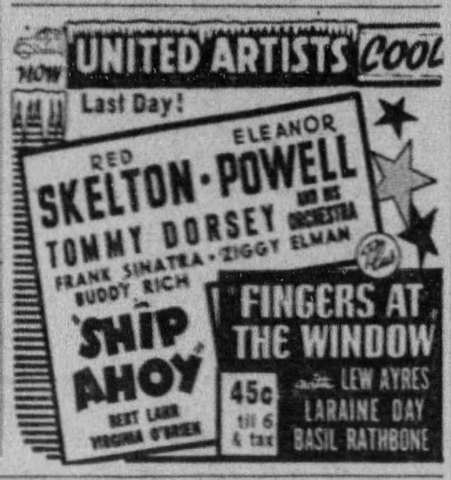
August 6, 1942
Radio
Sunday Evening At Tommy Dorsey's
Network: Blue Network
Location: Earle Theatre, Philadelphia, PA
Time: 10:15PM - 10:45PM (EST)
Show #2
Sponsor: Treasury Department
Personnel (probable): Tommy Dorsey, George Arus,
Dave Jacobs, Jimmy Skiles (trombone); Jimmy
Blake, Ziggy Elman, Chuck Peterson, Jimmy Zito,
Danni Vanelli (trumpet); Fred Stulce, Harry
Schuchman (clarinet, alto sax); Heinie Beau
(clarinet, tenor sax); Bruce Snyder, Don Lodice
(tenor sax); Bernard Tinterow, Seymour Miroff,
William Ehrenkrantz, Leonard Posner, Paul
Poliakine (violin); Sam Ross, Leonard Atkins
(viola); Harold Bemko (cello); Ruth Hill (harp);
Clark Yocum (guitar); Phil Stevens (bass); Milt
Raskin (piano); Buddy Rich (drums).
Vocals: Frank Sinatra, The Pied Pipers, Jo Stafford,
Orchestra Conducted By: Tommy Dorsey
Announcer: Joe Novison
1. opening theme: Getting Sentimental Over You - TD & Orchestra
2. Dig Down Deep - Frank Sinatra & Pied Pipers
3. Somebody Loves Me - Pied Pipers
4. Just As Though You Were Here - Frank Sinatra & Pied Pipers
5. A Pretty Girl Is Like A Melody - Frank Sinatra
6. Melody In A - Tommy Dorsey
7. He's My Guy - Jo Stafford
8. Minus Goes Muggin - orchestra
9. A Pretty Girl Is Like A Melody - Frank Sinatra
10. Temptation - orchestra
11. I Don't Know Why - Jo Stafford
12. closing theme: Getting Sentimental Over You - TD & Orchestra
Show Notes: next week show will come from Capitol
Theatre in Washington D.C. T.D. pays tribute to announcer Joe Novison, who will join the Air
Corp the following day down in San Antonio,
Texas. T.D. tells audience to buy bonds and stamps because "these are the two steps that will save you from goose steps."
Notes: Confirmed airing on WJZ & WMAL. Ed noted,
"Billboard carried an item that this Thursday radio show would continue until September 24, 1942."
("Just As Though You Were Here" appears on the
RCA Box Set CD: RCA 07863-66353-2/5 - The Song Is You)
("Medley: A Pretty Girl Is Like A Melody,
Temptation, I Don't Know Why" appears on CD: BMG
Bluebird 60283-2 - Young Blue Eyes - Birth Of The Crooner)
Television
NONE
Concerts
Earle Theatre, Philadelphia , Pennsylvania (July 31 - August 6) Tommy Dorsey and his Orchestra w/Frank Sinatra
Sinatra Scholar Ed O'Brien sends along a couple of interesting items from the August 15, 1942 issue of Billboard:
TD TOPS 46G TO SET PHILLY EARLE REC'D
"Earle Theatre (seating capacity, 3,000; house average for straight picture booking, $14,000) made history for the week ended Thursday, August
6. And it was Tommy Dorsey making the history.
Coming here for the first time in four years with the avowed intention to break the house record of
$37.000 chalked up by brother Jimmy Dorsey less than two months ago. Tommy Dorsey actually did the impossible. With the only advantage that the house raised prices with Dorsey's engagement from a 60 to a 75 cent top. Dorsey exceeded even his own expectations with an almost impossible $46,700 gross for the six days.
No stage shows here on Sundays. Played six and seven shows a day and 88,000 cash customers jammed the house all week. Dorsey's gross set a high for the house since its first opening, topping even the high figures of a generation ago when Eddie Cantor and Mary Pickford made their personal appearances here. Bobby Lane and Edna
Ward and Paul Regan made for the surrounding acts with the band pitching in with Frank Sinatra, the
Pied Pipers, Jo Stafford, Buddy Ric and Ziggy
Elman. "Dr. Broadway" on the screen was strictly a filler.
LATEST TD BULLETIN:
Tommy Dorsey, in town for a record breaking week at the Earle Theatre, ended Thursday, is taking his large string section seriously. With Buddy
Rich ready to leave his drumming seat to join the
Marines and trumpeter Ziggy Elman also getting ready for a uniform, Dorsey said he is thru breaking in any more hot men only to lose them.
But by the time Rich and Elman go away, Dorsey said he will have developed a new style with his eight fiddles and harp.
Frank Sinatra is also skedded to step out of the band to carry on as a vocal single. Altho he has made several sides for Victor's Bluebird label,
Sinatra is set for a recording builder-upper on the Columbia label. He'll be replaced by Dick Haymes.
August 7, 1942
Concerts
Hippodrome Theatre, Baltimore , Maryland (August 7 - August 12) Tommy Dorsey and his Orchestra w/Frank Sinatra
Ed O'Brien:
According to Variety, Dorsey had a record setting six-day socko gross of $22,800. Film at the Hippodrome was a so-so B feature, titled "Enemy Ellery Queen," starring William Gargan and Margaret Lindsay. The previous week Orson Welles' "Magnificent Ambersons" was at the top of the bill. TD & Co would surely have had an even more successful engagement with such a great film at the theatre.
Tommy Dorsey's orchestra, in for a six-clay stand ended August 12, opened to standing room only and grossed a fine $22,000. Dorsey made personal appearances at Walker's Music Store and Hochschild, Kohn & Company department store record and radio shop. Screen had Enemy Agents Meet Ellery Queen.
BILLBOARD
8-22-42
Hippodrome Theatre, Baltimore , Maryland (August 7 - August 12)
Tommy Dorsey and his Orchestra w/Frank Sinatra
August 8, 1942
Concerts
Hippodrome Theatre, Baltimore , Maryland (August 7 - August 12) Tommy Dorsey and his Orchestra w/Frank Sinatra
August 9, 1942
Concerts
Hippodrome Theatre, Baltimore , Maryland (August 7 - August 12) Tommy Dorsey and his Orchestra w/Frank Sinatra
August 10, 1942
Concerts
Hippodrome Theatre, Baltimore, Maryland (August 7 - August 12) Tommy Dorsey and his Orchestra w/Frank Sinatra
August 11, 1942
Radio
Tommy Dorsey Raleigh Kool Show
Location: Hippodrome Theater, Baltimore, Maryland
NBC Red Network - WBAL Baltimore
Tuesday Evening
Time: 10:30PM - 11:00PM
Show: #9
Sponsor: Raleigh Cigarettes
Personnel (probabal): Jimmy Zito, Ray Linn, Jimmy
Black, Ziggy Elman (trumpets), Dave Jacobs,
George Arun, Jimmy Skiles (trombones), Fred
Stulce (clarinet & alto Sax), Heinie Beau,
(clarinet & tenor sax), Don Lodice (tenor sax),
Milt Raskin (piano), Clark Yocum (guitar), Phil
Stevens (bass), Buddy Rich (drums), Si Miroff,
Bernie Tinterow, Lenny Posner, Bill Ehrenkrantz,
Alex Beller, Raoul Poliakiane (violins), Lenny
Atkins, Sam Ross (violas), George Ricci or Harold
Bemke (cello), Ruth Hill (harp)
Vocals: Frank Sinatra, Jo Stafford, The Pied
Pipers (Jo Stafford, Clark Yocum, Chuck Lowry, John Huddleston)
Arrangements By: Noni Bernardi, Axel Stordahl, Sy Oliver
Orchestra Conducted By: Tommy Dorsey
Announcer: Cleve Conway
Guests: Pvt. Kelly Rande of Fort Slocum, New York, baritone
1. I'm Getting Sentimental Over You TD & Orch.
2. Will Git
It TD & Orch.
3. Be Careful It's My Heart Frank Sinatra
4. Somebody Else Is Taking My Place Jo Stafford
5. Dig Down
Deep
Frank Sinatra & Pied Pipers
6. "Hero Of The Week Song" Songs My Mother Taught Me - TD & Orch.
9. This Is Worth Fighting For Pied Pipers
10.Hawaiian War Chant ( Buddy Rich solo) TD & Orch.
11. Closing: Theme TD & Orch
Notes: Confirmed aired on WEAF. Above is a partial program listing.
Television
NONE
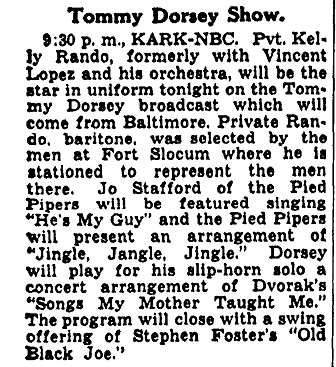
Concerts
Hippodrome Theatre, Baltimore , Maryland (August 7 - August 12) Tommy Dorsey and his Orchestra w/Frank Sinatra
August 12, 1942
Concerts
Hippodrome Theatre, Baltimore , Maryland (August 7 - August 12) Tommy Dorsey and his Orchestra w/Frank Sinatra
NOTE: Ed O'Brien sends this item from the August 12, 1942 issue of
Variety:
TD - Baltimore, Hippodrome: 2,240 (17-25-28-38- 44-55-66) with "Enemy Agents Meet Ellery Queen ( Columbia )." Carrying the whole load and banging out socko $23,000 for six days, a record for the house, which previously had a high set by Andrews Sisters with slightly better than $22,000 in seven days.
August 13, 1942
Radio
Sunday Evening At Tommy Dorsey's
Network: Blue Network
Location: Capitol Theatre, Washing D.C.
Time: 10:15PM - 10:45PM (EST)
Show #3
Sponsor: Treasury Department
Personnel (probabal): Tommy Dorsey, George Arus, Dave Jacobs, Jimmy Skiles (trombone); Jimmy Blake, Ziggy Elman, Chuck Peterson, Jimmy Zito, Danni Vanelli (trumpet); Fred Stulce, Harry Schuchman (clarinet, alto sax); Heinie Beau (clarinet, tenor sax); Bruce Snyder, Don Lodice (tenor sax); Bernard Tinterow, Seymour Miroff, William Ehrenkrantz, Leonard Posner, Paul Poliakine (violin); Sam Ross, Leonard Atkins (viola); Harold Bemko (cello); Ruth Hill (harp); Clark Yocum (guitar); Phil Stevens (bass); Milt Raskin (piano); Buddy Rich (drums).
Vocals: Dick Haymes, The Pied Pipers, Jo Stafford,
Orchestra Conducted By: Tommy Dorsey
Announcer:
1. opening theme: Getting Sentimental Over You - TD & Orchestra
2. Somebody's Wrong End Only - Jo Stafford
3. Take Me - Dick Hymes
4. Swanee River - Orchestra
5. closing theme: Getting Sentimental Over You - TD & Orchestra
Notes: No Sinatra on show, Dick Haymes replaces him due to supposed
(laryngitis) illness. Confirmed airing on WJZ & WMAL.
Concerts
Capitol Theatre, Washing D.C. (13-19)
Tommy Dorsey and His Orchestra with Frank Sinatra
Ed O'Brien:
T.D and band opened here on 8-13-42. engagement ran until 8/19.
Frank missed some shows at the previous engagement, Hippodrome in Baltimore and at the Capitol. He had tonsillitis. Don't know exactly how many shows were missed. Jo Stafford took over Frank's part of the show. She received rave reviews. Dorsey's new string section was a big hit. Band was able to tear the roof off with swing numbers and also offer lovely ballads for the dancers.
Capitol Theatre, Washing D.C.
Tommy Dorsey and His Orchestra with Frank Sinatra
No Sinatra on opening night, Dick Haymes replaces him due to supposed (laryngitis) illness
Ed O'Brien supplied this review of opening night 1942:
CAPITOL, WASH.
Washington August 13, 1942
Tommy Dorsey's Orch with Frank Sinatra, Buddy Rich, Ziggy Elman, Jo Stafford, Pied Pipers, Archie Robbins, Lane & Ward; "Calling Dr. Gillespie" (M - G)
There is a new Tommy Dorsey setup on the stage this week.
Instead of the heavy accent on brasses and reeds, the maestro introduces a battery of fiddles, bass viol and concert harp in a string section for softer precision melody. Yet the demonstrative hepcats in the audience control the program, serving noisy applause for the blare and rhythm and demanding an over- flowing portion of jive.
There is some condescension to those who like their music sweet and low with melody and strings, but the opening-day audience really poured it on when Ziggy Elman was melting his blistering trumpet and for Buddy Rich's acrobatic gyrations with the drumsticks. The Dorsey=2
0trombone also came in for shrieking approval and noisy palm-beating.
Routine was considerably upset when Frank Sinatra checked in opening day with a bad case of tonsillitis. This necessitated a quick change for Sinatra closes the show with a budget of pop tunes. Jitterbugs took the indisposition announcement with a chorus of groans, indicating that Sinatra, were he present, could have had the nomination by acclamation.
Specialties include the clever softshoe stepping of Bobby Lane and Edna Ward, climaxed by smart acrobatic routine. Jo Stafford leads the Pied Pipers in "Embraceable You" and other gems from the George Gershwin melody album. Scrim comes down for a lively patriotic number with some rabble-rousing films of the Army and Navy in action.
String section contributes its best effort to a slick arrange- ment of "Sleepy Lagoon." Archie Robbins, a fast worker, slips over a few Joe Millers in a staccato monolog punctuated with some comedy lyrics. His encore brings out Stan Ross for some double feature impersonations, one doing the voice, the other expressions and character acting. Scored solidly.
Jo Stafford, doing a single for the first time, as pinch hitter for Sinatra, punches over "Blues In The Night" in a special arrangement and "Man I Love." Band does its best brass- blasting , with spotlighted soloists, on "Hawaiian War Chant,"
"Tallulah" and "Jersey Bounce." In all, 48 minutes of good Tommy Dorseyian a, interspersed with whistling and cheers from constituents, who all sway and swing the jazz way.
Attendance at first show - capacity, with solid lockout jamming the lobby
Arke
Variety
Wednesday
August 19, 1942
--------------------------------------
August 13, 1947, Friars Roast of Al Jolson, Los Angeles Frank Sinatra, Jack Benny, Bob Hope, Edgar Bergen, George Burns, Irving Berlin and Others
Billboard February 1948
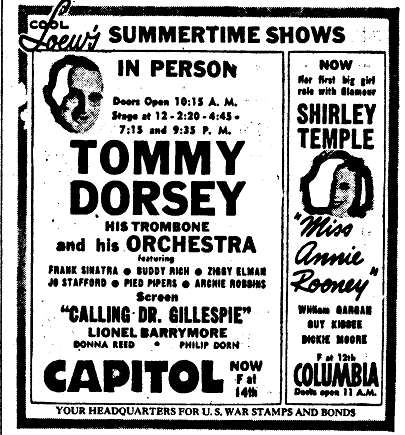
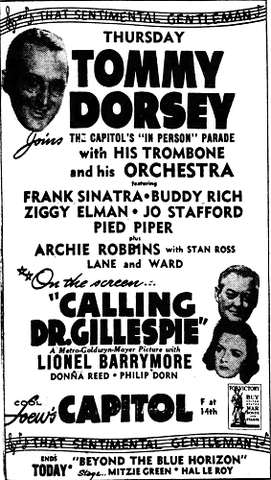
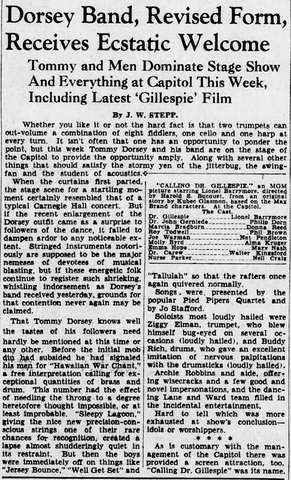
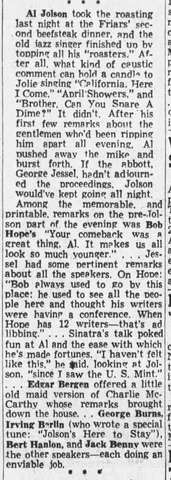
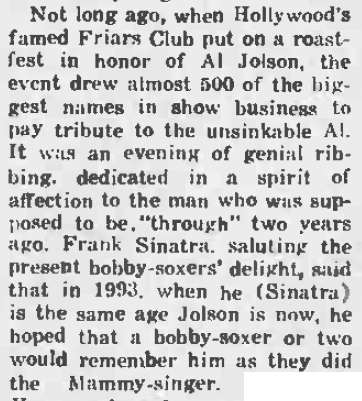
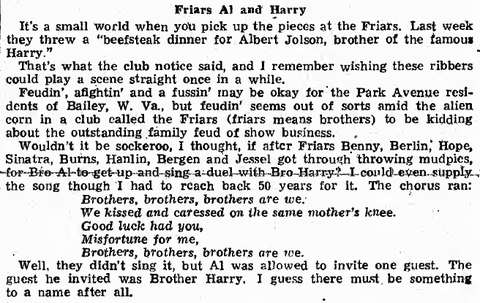
August 14, 1942
Concerts
Capitol Theatre , Washington , D. C. (August 14 - August 20) Tommy Dorsey and his Orchestra w/Frank Sinatra
August 15, 1942
Concerts
Capitol Theatre , Washington , D. C. (August 14 - August 20) Tommy Dorsey and his Orchestra w/Frank Sinatra
August 16, 1942
Concerts
Capitol Theatre , Washington , D. C. (August 14 - August 20) Tommy Dorsey and his Orchestra w/Frank Sinatra
NOTE: Ed O'Brien sends an interesting item from the August 5, 1942 issue of
Variety and it is headlined FRANK SINATRA ALONE:
"Frank Sinatra, vocalist with Tommy Dorsey's orchestra, has signed a management contract with General Amusement Corp. He is leaving Dorsey September 3 to go into radio, theatre work, etc. as a soloist. He is to be replaced by Dick Haymes, who has already left Benny Goodman."
August 17, 1942
Concerts
Capitol Theatre , Washington , D. C. (August 14 - August 20) Tommy Dorsey and his Orchestra w/Frank Sinatra
August 18, 1942
Radio
Tommy Dorsey Show
Location: Capitol Theatre, Washington DC
Network: NBC (Red)
Time: 10:30PM - 11:00PM Tuesday
Show: #10
Sponsor: Raleigh Cigarettes
Personnel (probable): Jimmy Zito, Ray Linn, Jimmy Black, Ziggy Elman (trumpets), Dave Jacobs, George Arun, Jimmy Skiles (trombones), Fred Stulce (clarinet & alto Sax), Heinie Beau, (clarinet & tenor sax), Don Lodice (tenor sax), Milt Raskin (piano), Clark Yocum (guitar), Phil Stevens (bass), Buddy Rich (drums), Si Miroff, Bernie Tinterow, Lenny Posner, Bill Ehrenkrantz, Alex Beller, Raoul Poliakiane (violins), Lenny Atkins, Sam Ross (violas), George Ricci or Harold Bemke (cello), Ruth Hill (harp)
Vocals: Frank Sinatra, Jo Stafford, The Pied Pipers (Jo Stafford, Clark Yocum, Chuck Lowry, John Huddleston)
Arrangements By: Noni Bernardi, Axel Stordahl, Sy Oliver
Orchestra Conducted By: Tommy Dorsey
Announcer: Cleveland Conway
Guests: The Five Tones (Pvt. Edward Hardshaw, Pvt. Larry Broom, Pvt. Julien F. Barnes, Pvt. James L. Buchanan, Cpl. Green May, Jr.)
1. opening theme: "I'm Getting Sentimental Over You - TD & orchestra
2. Back Stage At The Ballet - orchestra
3. commercial
4. Just As Though You Were Here - Frank Sinatra & Pied Pipers
5. For You - orchestra
6. "ask Tommy Dorsey spot" - Tommy Dorsey & Cleveland Conway
7. Always In My Heart - orchestra
8. Snootie Little Cutie - Frank Sinatra, Jo Stafford & Pied Pipers
9. None But The Lonely Heart - orchestra
10. commercial
11. "stars in uniform spot" - introducing The Five Tones
12. Shout Brother Shout - The Five Tones
13. Not So Quiet Please - orchestra
14. commercial
15. closing theme "I'm Getting Sentimental Over You" TD & orchestra
Notes: Confirmed aired on WEAF. 30mins. Audio condition: Excellent. Complete.
("Just As Though You Were Here" and "Snootie Little Cutie" appear on Masters of Jazz Volume 7)
("Snootie Little Cutie" is available on Young Blue Eyes - Birth Of The Crooner - Bluebird 82876 60283 2)
(Complete Broadcast is available on CD: Jazz Band (E) EBCD 2179-2 - "Not So Quiet Please")
Concerts
Capitol Theatre , Washington , D. C. (August 14 - August 20) Tommy Dorsey and his Orchestra w/Frank Sinatra
Tommy Dorsey Show
Location: Capitol Theatre, Washington DC
Network: NBC (Red)
Time: 10:30PM - 11:00PM Tuesday
Show: #10
Sponsor: Raleigh Cigarettes
Personnel (probable): Jimmy Zito, Ray Linn, Jimmy Black, Ziggy Elman (trumpets), Dave Jacobs, George Arun, Jimmy Skiles (trombones), Fred Stulce (clarinet & alto Sax), Heinie Beau, (clarinet & tenor sax), Don Lodice (tenor sax), Milt Raskin (piano), Clark Yocum (guitar), Phil Stevens (bass), Buddy Rich (drums), Si Miroff, Bernie Tinterow, Lenny Posner, Bill Ehrenkrantz, Alex Beller, Raoul Poliakiane (violins), Lenny Atkins, Sam Ross (violas), George Ricci or Harold Bemke (cello), Ruth Hill (harp)
Vocals: Frank Sinatra, Jo Stafford, The Pied Pipers (Jo Stafford, Clark Yocum, Chuck Lowry, John Huddleston)
Arrangements By: Noni Bernardi, Axel Stordahl, Sy Oliver
Orchestra Conducted By: Tommy Dorsey
Announcer: Cleveland Conway
Guests: The Five Tones (Pvt. Edward Hardshaw, Pvt. Larry Broom, Pvt. Julien F. Barnes, Pvt. James L. Buchanan, Cpl. Green May, Jr.)
Note: Sinatra did not sing “Light A Candle In The Chapel” on this program
Note: Despite the front cover saying the remotes were from the Meadowbrook, the rear cover credits August 18, 1942 as Capitol Theatre, Washington DC
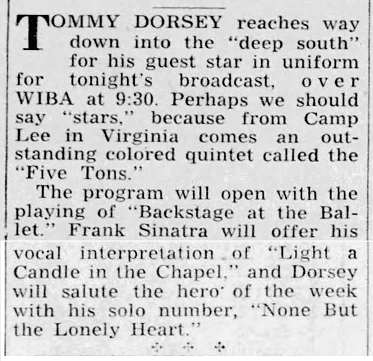
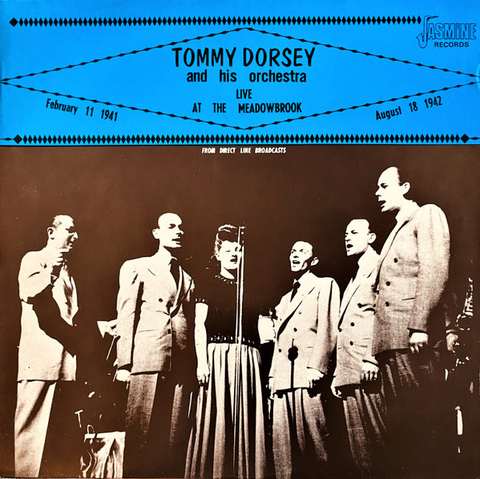
August 19, 1942
Concerts
Capitol Theatre , Washington , D. C. (August 14 - August 20) Tommy Dorsey and his Orchestra w/Frank Sinatra
August 20, 1942
Radio
WAR BOND RALLY
Location: from the steps of the District Building, Washington,D. C.
Thursday afternoon
Network: NBC
Tommy Dorsey & Orch
Frank Sinatra, Jo Stafford,Pied Pipers, Buddy Rich, Ziggy Elman
Annc: Bill Hirshen
1. I'm Getting Sentimental Over You - T.D. & Orch
2. Any Bonds Today - T.D. & Orch
3. Bond appeal from Sinatra
4. Be Careful It's My Heart - F.S.
5. Jersey Bounce - T.D. & Orch.
6. He's My Guy - J.S.
Ed O'Brien:
Show was aired at noon and again at 4:PM
The 15 minute war bond campaign was broadcast on the NBC Blue Network. WJZ carried it in New York City
Sunday Evening At Tommy Dorsey's
Network: Blue Network
Location: Capitol Theatre, Washington D.C.
Time: 10:15PM - 10:45PM (EST)
Show #4
Sponsor: Treasury Department
Personnel (probable): Tommy Dorsey, George Arus, Dave Jacobs, Jimmy Skiles (trombone); Jimmy Blake, Ziggy Elman, Chuck Peterson, Jimmy Zito, Danni Vanelli (trumpet); Fred Stulce, Harry Schuchman (clarinet, alto sax); Heinie Beau (clarinet, tenor sax); Bruce Snyder, Don Lodice (tenor sax); Bernard Tinterow, Seymour Miroff, William Ehrenkrantz, Leonard Posner, Paul Poliakine (violin); Sam Ross, Leonard Atkins (viola); Harold Bemko (cello); Ruth Hill (harp); Clark Yocum (guitar); Phil Stevens (bass); Milt Raskin (piano); Buddy Rich (drums).
Vocals: Frank Sinatra, The Pied Pipers, Jo Stafford,
Orchestra Conducted By: Tommy Dorsey
Announcer:
1. opening theme: Getting Sentimental Over You - TD & Orchestra
2. Be Careful It's My Heart - Frank Sinatra
3. Jersey Bounce - orchestra
4. He's My Guy - Jo Stafford
5. Manhattan Serenade - Jo Stafford
6. The Sheik Of Araby - orchestra
7. I'm In The Mood For Love - Frank Sinatra
8. April In Paris - Tommy Dorsey & orchestra
9. Say It Isn't So - Jo Stafford
10. closing theme: Getting Sentimental Over You - TD & Orchestra
Notes: Confirmed airing on WJZ & WMAL.
("I'm In The Mood For Love" is available on the CD: Buddha 74321 69173-2 - Learn To Croon)
Concerts
Capitol Theatre , Washington , D. C. (August 14 - August 20) Tommy Dorsey and his Orchestra w/Frank Sinatra
NOTE: Ed O'Brien who provided the early 1940s information, the September
1942 issue of the International Musician: "TD sets record at Capitol, grossing $32,000 for week."
August 21, 1942
Concerts
Palace Theatre, Akron, Ohio (August 21 - August 24)
Tommy Dorsey and his Orchestra w/Frank Sinatra
Palace Theatre, Akron, Ohio (August 21 - August 24)
Tommy Dorsey and his Orchestra w/Frank Sinatra
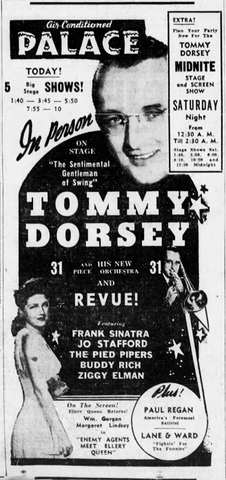

August 22, 1942
Radio
Live Remote from the Palace Theatre, Akron , Ohio (August 21--August 24)
NBC Mutual Network
10:15- 10:45
Tommy Dorsey and his Orchestra w/Frank Sinatra
Concerts
Palace Theatre, Akron , Ohio (August 21--August 24)
Tommy Dorsey and his Orchestra w/Frank Sinatra
August 23, 1942
Concerts
Palace Theatre, Akron , Ohio (August 21 - August 24)
Tommy Dorsey and his Orchestra w/Frank Sinatra
August 24, 1942
Concerts
Palace Theatre, Akron , Ohio (August 21 - August 24)
Tommy Dorsey and his Orchestra w/Frank Sinatra
Ed O'Brien:
Ohio tour was a split week.
Dorsey opened at the Palace Theatre in Akron from 8/21 thru 8-24. moved to Palace Theatre in Youngstown 8/25 thru 8/27
August 25, 1942
Radio
Tommy Dorsey Show
Location: Palace Theatre, Youngstown, Ohio
Network: NBC (Red)
Time: 10:30PM - 11:00PM Tuesday
Show: #11
Sponsor: Raleigh Cigarettes
Personnel (probable): Jimmy Zito, Ray Linn, Jimmy Black, Ziggy Elman (trumpets), Dave Jacobs, George Arun, Jimmy Skiles (trombones), Fred Stulce (clarinet & alto Sax), Heinie Beau, (clarinet & tenor sax), Don Lodice (tenor sax), Milt Raskin (piano), Clark Yocum (guitar), Phil Stevens (bass), Buddy Rich (drums), Si Miroff, Bernie Tinterow, Lenny Posner, Bill Ehrenkrantz, Alex Beller, Raoul Poliakiane (violins), Lenny Atkins, Sam Ross (violas), George Ricci or Harold Bemke (cello), Ruth Hill (harp)
Vocals: Frank Sinatra, Jo Stafford, The Pied Pipers (Jo Stafford, Clark Yocum, Chuck Lowry, John Huddleston)
Arrangements By: Noni Bernardi, Axel Stordahl, Sy Oliver
Orchestra Conducted By: Tommy Dorsey
Announcer: Cleveland Conway
Guests: Pvt. Carl V. Cirillo
1. I'm Getting Sentimental Over You TD. & Orch.
2. Margie P.P.
3. A Boy In Khaki, A Girl In Lace J.S.
Raleigh Ad
4. Honeysuckle Rose T.D. & Orch.
5. Only Forever F.S. ( Sinatra was to have recorded this song on 6-27-40. The RCA sheet indicates he did the vocal, but it was actually done by the Pied Piper Clark Yokum, using the pseudonym
Allan Storr. Frank sang it a number of times. A fine song and he his vocal was always outstanding. )
6. Swing Low, Sweet Chariot T.D. & Orch..
7. Intermezzo T.D. & Orch.
8. Back Beat Boogie C.S.
9. Say Si Si T.D. & Orch.
10. I'm Getting Sentimental Over You T.D. & Orch.
Notes: Confirmed aired on WEAF. WMAQ lists it as Tommy Dorsey Show with Frank Sinatra singing "Just As Tho You Were Here." Guest: Pvt. Carl V. Cirillo. Sinatra did not sing this song..
Washington Post: "10:30PM WRC Tommy Dorsey. that "Sentimental Gentleman" will honor Fort Custer, Mich, on his program this week."
Television
NONE
Concerts
Palace Theatre, Youngstown, Ohio (August 24 - August 27) Tommy Dorsey and his Orchestra w/Frank Sinatra
Brian Chearno notes: While Sinatra was rumored to be leaving Dorsey, Youngstown was the first official public announcement.
They made it on stage during one of the shows. This has been confirmed by several in attendance.
Several Sinatraphiles had comments on the prices of admission for these 1940s appearances. For example, Jack Tomsky writes: "Only $1.10 to see Dorsey? I paid about $45 to see Sinatra in the 1980s and we didn't get a free record or autograph."
Ed O'Brien responds: "And you didn't get to hear Tommy (Dorsey), Bunny (Berigan), Ziggy (Elman), Buddy (Rich), Jo ( Stafford ), Connie (Haines) and that entire band. I have hundreds of Variety, Metronome, and Billboard reports on the grosses being made by the big bands. Dorsey would break box office records pulling in $5,000 for one night. Sinatra in the post retirement years would sometimes make a million for a one nighter."
Sinatraphile BellDick gives us as a frame of reference, the average American's annual income in 1941 was $1,492; in 1942, because of higher paying jobs during WWII, the average income jumped to $1,778. $1.10 was a lot of money for many people.
O'Brien then adds that on the AMC "Mad Men" series, the average salary for an advt. worker in 1961-62 was $75.00 per week. A friend worked for Irving Trust in NYC back in the early 60s and he made less than $100 a week right in Manhattan. The $28.69 a week average in 41-42 hasn't really improved all that much 20 years down the road. The new Woody Allen film that opened on August 15 has grossed about six million dollars so far. In 1960, that would have made it the fourth highest grossing film for the entire year. "Ocean's 11" took in $4,900,000. How different it all was back then."
Sinatraphile Ed Speigel adds further information: "Prices? Inflation? I have a copy of LIFE magazine of November 23, 1936. Full page car ads: new 1937 Nash Lafayette, $595, 1937 Hudson Six, $695, V-8, $770. As a kid in the 50s, I was a big time comic book fan, 52 pages for 10 cents. I've looked at some recent comic books 32 page for $2.99. Price of that first LIFE magazine, by the way, was 10 cents. There's an ad for the new Ford V8, too, but no price listed.
Tommy Dorsey Show
Location: Palace Theatre, Youngstown, Ohio
Network: NBC (Red)
Time: 10:30PM - 11:00PM Tuesday
Show: #11
Sponsor: Raleigh Cigarettes
Personnel (probable): Jimmy Zito, Ray Linn, Jimmy Black, Ziggy Elman (trumpets), Dave Jacobs, George Arun, Jimmy Skiles (trombones), Fred Stulce (clarinet & alto Sax), Heinie Beau, (clarinet & tenor sax), Don Lodice (tenor sax), Milt Raskin (piano), Clark Yocum (guitar), Phil Stevens (bass), Buddy Rich (drums), Si Miroff, Bernie Tinterow, Lenny Posner, Bill Ehrenkrantz, Alex Beller, Raoul Poliakiane (violins), Lenny Atkins, Sam Ross (violas), George Ricci or Harold Bemke (cello), Ruth Hill (harp)
Vocals: Frank Sinatra, Jo Stafford, The Pied Pipers (Jo Stafford, Clark Yocum, Chuck Lowry, John Huddleston)
Arrangements By: Noni Bernardi, Axel Stordahl, Sy Oliver
Orchestra Conducted By: Tommy Dorsey
Announcer: Cleveland Conway
Guests: Pvt. Carl V. Cirillo
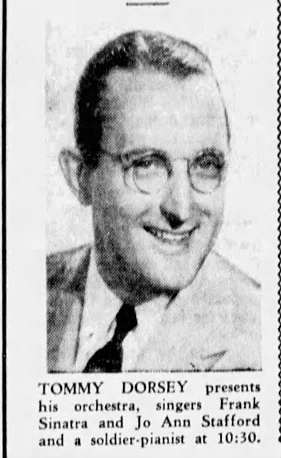
August 26, 1942
Radio
Live Remote from Palace Theatre, Youngstown , OH
Tommy Dorsey and his Orchestra
10:15-10:45PM Blue Network
Concerts
Palace Theatre, Youngstown , Ohio (August 24 - August 27) Tommy Dorsey and his Orchestra w/Frank Sinatra
August 27, 1942
Radio
Tommy Dorsey Treasury Show
Network: Blue Network
Location: Palace Theatre, Youngstown, Ohio
Time: 10:15PM - 10:45PM (EST)
Show #5
Sponsor: Treasury Department
Personnel (probabal): Tommy Dorsey, George Arus, Dave Jacobs, Jimmy Skiles (trombone); Jimmy Blake, Ziggy Elman, Chuck Peterson, Jimmy Zito, Danni Vanelli (trumpet); Fred Stulce, Harry Schuchman (clarinet, alto sax); Heinie Beau (clarinet, tenor sax); Bruce Snyder, Don Lodice (tenor sax); Bernard Tinterow, Seymour Miroff, William Ehrenkrantz, Leonard Posner, Paul Poliakine (violin); Sam Ross, Leonard Atkins (viola); Harold Bemko (cello); Ruth Hill (harp); Clark Yocum (guitar); Phil Stevens (bass); Milt Raskin (piano); Buddy Rich (drums).
Vocals: Frank Sinatra, The Pied Pipers, Jo Stafford,
Orchestra Conducted By: Tommy Dorsey
Announcer:
1. opening theme: Getting Sentimental Over You - TD & Orchestra
2.. Dig Down Deep - Frank Sinatra & Pied Pipers
3. Armed Forces Medley (Pied Pipers) : Caissons Go Rolling Along /
Anchors Aweigh/ Marine's Corps Hymn / Stars And Stripes Forever
4. Every Night About This Time - Jo Stafford
5. Moonlight On The Ganges - orchestra
6. In The Blue Of Evening - Frank Sinatra
7. Deep River - orchestra
8. The Very Thought Of You - Frank Sinatra
9. Stormy Weather - Tommy Dorsey & orchestra
10. Let's Fall In Love - Jo Stafford
11. closing theme: Getting Sentimental Over You - TD & Orchestra
Notes: Confirmed airing on WJZ & WMAL. Ed O'Brien transcribed the following from this broadcast: "T.D.: "It looks like we're heading for a gale for sure. At least that's the way it appears from the bridge, what with stormy weather slated for tonight's memory medley." F.S.: "Well Skipper before we sail out too far into that storm, suppose I smooth things down with a peaceful light ballad called "The Very Thought Of You?"T.D.: "That's smart sailing first mate Sinatra." Later in his career, Sinatra would make memorable recordings of four tunes from this show.
("Medley, The Very Thought Of You, Stormy Weather, Let’s Fall In Love" appear on the CD: Buddha 74465 999601-2 - Learn To Croon)
Television
NONE
Concerts
Palace Theatre, Youngstown, Ohio (August 24 - August 27) Tommy Dorsey and his Orchestra w/Frank Sinatra
August 28, 1942
Radio
Circle Theatre, Indianapolis, Indiana
Tommy Dorsey and His Orchestra with Frank Sinatra
11:00PM-11:15PM
NBC
Concerts
Circle Theatre, Indianapolis, Indiana
Tommy Dorsey and His Orchestra with Frank Sinatra
Sinatra announces his departure from the band.
NOTE: Sinatra Scholar Ed O'Brien sends a brief from August 28, 1942 issue of
Variety:
"I'll Never Smile Again" (published by TD's Sun Publishing Company) has already sold 160,000 copies of sheet music. Weekly sales around 20,000. Record sales of that tune over 500,000 with Victor record version for 200,000 of that."
Ed O'Brien:
Dorsey Band opened on 8/28 for a week's engage- ment, closing on September 3rd. Film playing was
20th Century Fox's "The Postman Didn't Ring" with Richard Travis, Brenda Spencer and Spenser Charters. It was most definitely a B film. According to Variety, the band took in $26,000 for the week. Top ticket price was $1.10. A lot of money for a younger audience in 1942. Sinatra was near the end of his tenure with T.D. and Dick Haymes was with the band at the Circle Theatre..
Circle Theatre, Indianapolis, Indiana
Tommy Dorsey and His Orchestra with Frank Sinatra
The Indianapolis News
August 27 and 29, 1942 note: I noticed a couple of interesting changes in late August of 1942. In the ads for clubs and theatres, The great Miss Stafford was now Jo Ann. . .The radio schedules read "Tommy Dorsey with Frank Sinatra." I think TD might have switched the order of the names if Frank had agreed to stay on board.
Ed
August 29, 1942
Radio
Big War Bond Show
Blue Network
7 Hours of Stars and Bands for the benefit of War Bond Sales Including Tommy Dorsey and His Orchestra
Television
NONE
Concerts
Circle Theater, Indianapolis, Indiana (Aug. 28 - Sept. 3) Tommy Dorsey and His Orchestra
Frank Sinatra, Jo Stafford, Pied Pipers, Ziggy Elman, Milt Raskin, Buddy Rich
Big War Bond Show
Blue Network
7 Hours of Stars and Bands for the benefit of War Bond Sales Including Tommy Dorsey and His Orchestra
(Camden Post - August 28, 1942)
Above supplied by Richard Cook and he notes "by my math, this article puts Dorsey as having the
1am-1:15am slot (New York time)"
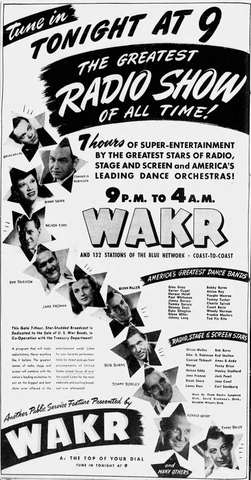
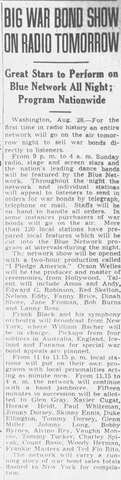
August 30, 1942
Concerts
Circle Theater, Indianapolis, Indiana (Aug. 28 - Sept. 3) Tommy Dorsey and His Orchestra
Frank Sinatra, Jo Stafford, Pied Pipers, Ziggy Elman, Milt Raskin, Buddy Rich
August 31, 1942
Concerts
Circle Theater, Indianapolis, Indiana (Aug. 28 - Sept. 3) Tommy Dorsey and His Orchestra
Frank Sinatra, Jo Stafford, Pied Pipers, Ziggy Elman, Milt Raskin, Buddy Rich
September 1942
[Sinatra Officially Splits From Tommy Dorsey]
Sinatra made his formal break from the Dorsey band in September 1942, following months of tension after he'd given notice. He had been contemplating the move since experiencing overwhelming fan reaction at an earlier Paramount engagement with the band.
Source: Nancy Sinatra, "Frank Sinatra, My Father" (1985).
[Skitch Henderson's account of hearing about Sinatra's departure from Dorsey via phone call from Indianapolis -- critical commentary]
Skitch Henderson (relaying Sinatra's words): Skitch Henderson wasn’t actually there, but he remembered it well. He was hanging out with Jimmy Van Heusen one night, and the phone rang with a long-distance call from Indianapolis. "It was Frank saying, ‘I’m leaving the band. The Old Man goosed me with his trombone for the last time.’"
Source: Will Friedwald, "Sinatra! The Song Is You: A Singer's Art" (2018 revised edition), Ch. 3, "With Tommy Dorsey" (1940-1942)
[career/personnel -- critical commentary]
Sinatra secured a verbal commitment from Manie Sacks, Columbia's head of A&R (who he'd befriended after his 1939 Harry James recordings), formally left Dorsey in September 1942, and on December 30, 1942 appeared billed as 'Special Added Attraction' alongside Benny Goodman at New York's Paramount Theater, the show credited with launching Sinatra as a teen-idol sensation.
Source: Charles L. Granata, "Sessions with Sinatra: Frank Sinatra and the Art of Recording" (1999/2003), Part II: The Columbia Years, 1943-1952
September 1, 1942
Radio
Tommy Dorsey Show
Location: Indianapolis
Network: NBC (Red)
Time: 10:30PM - 11:00PM Tuesday
Show: #12
Sponsor: Raleigh Cigarettes
Personnel (probable): Jimmy Zito, Ray Linn, Jimmy Black, Ziggy Elman (trumpets), Dave Jacobs, George Arun, Jimmy Skiles (trombones), Fred Stulce (clarinet & alto Sax), Heinie Beau, (clarinet & tenor sax), Don Lodice (tenor sax), Milt Raskin (piano), Clark Yocum (guitar), Phil Stevens (bass), Buddy Rich (drums), Si Miroff, Bernie Tinterow, Lenny Posner, Bill Ehrenkrantz, Alex Beller, Raoul Poliakiane (violins), Lenny Atkins, Sam Ross (violas), George Ricci or Harold Bemke (cello), Ruth Hill (harp)
Vocals: Frank Sinatra, Jo Stafford, The Pied Pipers (Jo Stafford, Clark
Yocum, Chuck Lowry, John Huddleston)
Arrangements By: Noni Bernardi, Axel Stordahl, Sy Oliver
Orchestra Conducted By: Tommy Dorsey
Announcer: Cleveland Conway
Guests: Pvt. Carl L. Flanery Jr., drummer
1. I'm Getting Sentimental Over
You
TD & Orch.
2. What Is This Thing Called
Love
Jo Stafford
3. Light A Candle In The
Chapel
Frank Sinatra
4. All The Things You
Are
TD & Orch.
5. Anchors
Aweigh
TD & Orch.
6. Free For
All
Frank Sinatra & Pied Pipers
7. Melody In
'A
TD & Orch.
8. I Got
Rhythm
TD & Orch.
9.
Hallelujah
TD & Orch.
10. Closing
Theme
TD & Orch.
Notes: Confirmed aired on WEAF. Washington Post: "10:30PM WRC Tommy
Dorsey and his Orchestra swing out from Indianapolis."
Concerts
Circle Theater, Indianapolis, Indiana (Aug. 28 - Sept. 3) Tommy Dorsey and His Orchestra
Frank Sinatra, Jo Stafford, Pied Pipers, Ziggy Elman, Milt Raskin, Buddy Rich
Tommy Dorsey Show
Location: Indianapolis
Network: NBC (Red)
Time: 10:30PM - 11:00PM Tuesday
Show: #12
Sponsor: Raleigh Cigarettes
Personnel (probable): Jimmy Zito, Ray Linn, Jimmy
Black, Ziggy Elman (trumpets), Dave Jacobs,
George Arun, Jimmy Skiles (trombones), Fred
Stulce (clarinet & alto Sax), Heinie Beau,
(clarinet & tenor sax), Don Lodice (tenor sax),
Milt Raskin (piano), Clark Yocum (guitar), Phil
Stevens (bass), Buddy Rich (drums), Si Miroff,
Bernie Tinterow, Lenny Posner, Bill Ehrenkrantz,
Alex Beller, Raoul Poliakiane (violins), Lenny
Atkins, Sam Ross (violas), George Ricci or Harold
Bemke (cello), Ruth Hill (harp)
Vocals: Frank Sinatra, Jo Stafford, The Pied
Pipers (Jo Stafford, Clark Yocum, Chuck Lowry, John Huddleston)
Arrangements By: Noni Bernardi, Axel Stordahl, Sy Oliver
Orchestra Conducted By: Tommy Dorsey
Announcer: Cleveland Conway
Guests: Pvt. Carl L. Flanery Jr., drummer
September 1st, 1943 :
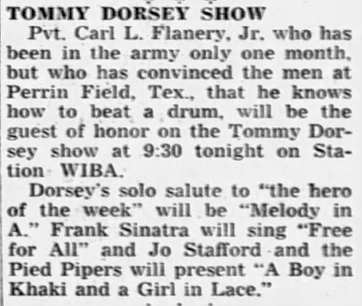
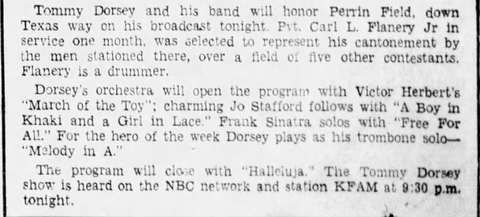
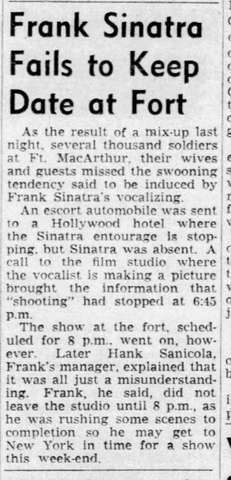
September 2, 1942
Concerts
Circle Theater, Indianapolis, Indiana (Aug. 28 - Sept. 3) Tommy Dorsey and His Orchestra
Frank Sinatra, Jo Stafford, Pied Pipers, Ziggy Elman, Milt Raskin, Buddy Rich
September 3, 1942
Radio
Treasury War Bond Show
(Thu) 10:15 - 10:45 pm
Treasury Department Program 18
Circle Theater, Indianapolis, Indiana
RCA MT 498 (1), RCA MT 497 (2)
(BLUE) (WISH)
Bill Frosch, announcer
BLUE-44, SSRH-121-1
1. I’m Getting Sentimental Over You (open)
2. Dig Down Deep (FS-PP)
3. TD War Bond Plug
4. Idaho (PP)
5. Just As Though You Were Here (FS-PP)
6. Loose Lid Special
7. farewell announcement for Frank Sinatra (Tommy Dorsey, Frank Sinatra and Dick Haymes)
8. The Song Is You (FS)
9. Losers Weepers
10. Memory Medley: June In January (FS), Clouds (TD solo), You’re A Sweetheart (JS)
11. War Bond Plug
12. Dig Down Deep (FS-PP)
13. I’m Getting Sentimental Over You (close)
("The Song Is You" appears on Masters of Jazz Volume 7)
("Farewell announcement for Frank Sinatra (Edited), The Song Is You" appear on That Sentimental Gentleman RCA-BMG 74321 36401 2 (Germany) & That Sentimental Gentleman Collectables/BMG COLCD 2813& in the RCA Box Set - The Song Is You)
("Medley: June In January, Clouds, You’re A Sweetheart" appear on the CD: BMG Bluebird 60283-2 Young Blue Eyes - Birth Of The Crooner)
Ed O'Brien:
This was Frank's last appearance with the band.
TD & Co headed out to Hollywood the next morning to begin filming "DuBarry Was A Lady." Filming got underway on 9-7 and the next radio broadcast was 9-8. Dick Haymes did the vocals for the film and the broadcast.
note: Eight-two years ago tonight, Frank made his farewell appearance with the Tommy Dorsey band. Dorsey had been telling anyone who would listen that Frankie was a damn fool. He recognized Sinatra's great ability as a singer, but was also certain that no one could make it without a band. T.D. tried to reach an agreement with Frank that would keep him in the Dorsey camp one way or another. Frank wasn't interested. He wanted to go solo. The atmosphere grew more acrimonious as it became certain that Frank was leaving. Skitch Henderson was rooming with Jimmy Van Heusen out in Hollywood. He told me that after the 9/3 broadcast, Frank gave them a call. Skitch told me Frank was jubilant and had some very harsh comments about his now former boss. --Ed
Concerts
Circle Theater, Indianapolis, Indiana (Aug. 28 - Sept. 3) Tommy Dorsey and His Orchestra
Frank Sinatra, Jo Stafford, Pied Pipers, Ziggy Elman, Milt Raskin, Buddy Rich
NOTE: Sinatra Scholar Ed O'Brien reports that the announcement of the departure of Frank Sinatra from the Dorsey band was broadcast from the Circle Theatre on this date. (See Radio section above.)
Sinatra actually left the band on September 10, 1942. There were three or four farewell shows, but this September 3rd show is the only audio history we have of the farewells. note: This was the accepted story for many years. I did more research and discovered that Frank definitely left the band after the 9/3 date. Skitch Henderson was staying with Jimmy Van Heusen at the time. Frank called them from Indianapolis and announced his departure in very colorful language. Skitch still remembered that night 50 years later.
--Ed
Variety, in its September 2 edition, predicted that Dorsey would gross close to $30,000 for the week in Indianapolis . The movie accompanying the Dorsey stage show was "Postman Didn't Ring" (20th Century Fox). International Musician, in its October 1942 issue, revealed a gross of $26,000 for the Circle Theatre engagement.
Frank Sinatra performed his final concert as Tommy Dorsey's band vocalist at the Circle Theater in Indianapolis, introducing his replacement, Dick Haymes, that evening. Haymes would stay with Dorsey only about six months before launching his own solo career, much as Sinatra was about to do. Source: J. Randy Taraborrelli, Sinatra: Behind the Legend.
"The Song Is You"
Fast forward to a few months later. It is now September 3, 1942, at the Circle Theater in Indianapolis, and the occasion is the "final" radio appearance by Sinatra with the Tommy Dorsey orchestra. Dick Haymes has already filled in for Sinatra on at least one previous Dorsey broadcast (a few weeks earlier, August 13, 1942, when Sinatra supposedly had come down with laryngitis) and Dorsey has made the rather obvious move of hiring him as Sinatra’s permanent replacement—once again, Haymes was stepping into Sinatra’s immaculately-buffed shoes. On the show, Sinatra and Dorsey banter warmly, with no trace of the acrimony that was to follow; they introduce Haymes, who even then was hardly a new name to Dorsey’s listeners, and then, just as quickly drop him so fast you’d think he had fallen through a trap door. Sinatra then performs an absolutely riveting run-through of the Stordahl arrangement of "The Song Is You." As great as the orchestration sounded in January on the Bluebird session, it sounds even better here as played by the Dorsey band proper. Sinatra himself has never sounded more enraptured. Sinatra is still only twenty-six, and this is already one of the major moments of his career, a perfect time capsule that captures the past, present, and future of his art. [Footnote:] "The Song Is You" and the banter between Sinatra, Dorsey, and Haymes was later issued by RCA (originally on the 1957 double-LP package That Sentimental Gentleman) as "the last broadcast." However, Sinatra stayed on the bus for a few more days, and he may be on the broadcast of September 8, which is not known to have survived.
Source: Will Friedwald, "Sinatra! The Song Is You: A Singer's Art" (2018 revised edition).
[Sinatra leaves Dorsey; confronts Rich about the beating]
Mel Torme / Kaplan: Just before Sinatra departed the Dorsey band on September 3, 1942, Buddy Rich quietly asked him whether he had arranged the 1940 beating Rich suffered from two men after a bandstand fight; Sinatra admitted he had asked Hoboken friends for the favor, and Rich shook his hand and wished him luck.
Source: James Kaplan, "Frank: The Voice" (2010).
[Sinatra's last Dorsey radio broadcast]
Sinatra made his final radio broadcast with the Dorsey band from the Circle Theater in Indianapolis, on air introducing his successor Dick Haymes to the audience before closing out with "The Song Is You," his voice audibly emotional.
Source: James Kaplan, "Frank: The Voice" (2010).
[Dorsey's parting words to Sinatra]
Tommy Dorsey: Backstage after the final broadcast, a drinking Dorsey responded to a tearful, anxious Sinatra with just seven words: "I hope you fall on your ass."
Source: James Kaplan, "Frank: The Voice" (2010).
[Frank's farewell concert with Tommy Dorsey]
Consiglio: At his farewell performance with the Tommy Dorsey Orchestra on September 3, 1942, Frank introduced Dick Haymes as his replacement, praising him warmly on stage. Sax player Don Lodice later told Consiglio that offstage, Dorsey said he hoped Frank "falls on his ass." Haymes lasted only about six months with the band.
Source: Tony Consiglio (as told to Franz Douskey), "Sinatra and Me: The Very Good Years" (2012).
September 8, 1942
Frank finally left the Tommy Dorsey band for good after a bitter contract dispute; Dorsey had refused to release him from an agreement entitling him to a large share of Frank's future earnings, requiring lawyers to negotiate a buyout.
Frank Sinatra (quoted): "I hope you fall on your ass."
Source: Nancy Sinatra, Frank Sinatra: An American Legend, 1995.
September 10, 1942
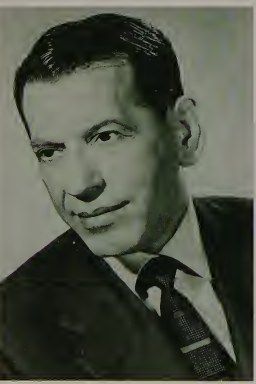
[Photograph: Frank's final live show with Tommy Dorsey. From Richard Havers, "Sinatra" (Dorling Kindersley, 2007), p.68.]
[Photograph: Frank's final live show with Tommy Dorsey. From Richard Havers, "Sinatra" (Dorling Kindersley, 2007), p.66.]
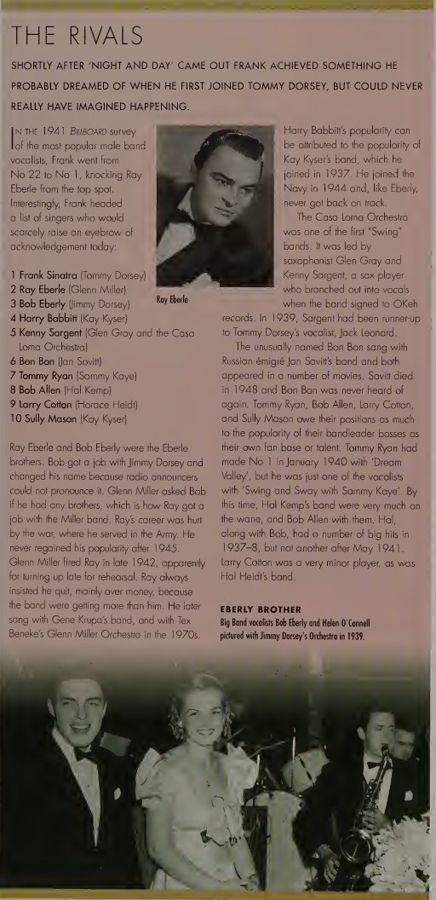
[Photograph: Frank's final live show with Tommy Dorsey. From Richard Havers, "Sinatra" (Dorling Kindersley, 2007), p.66.]
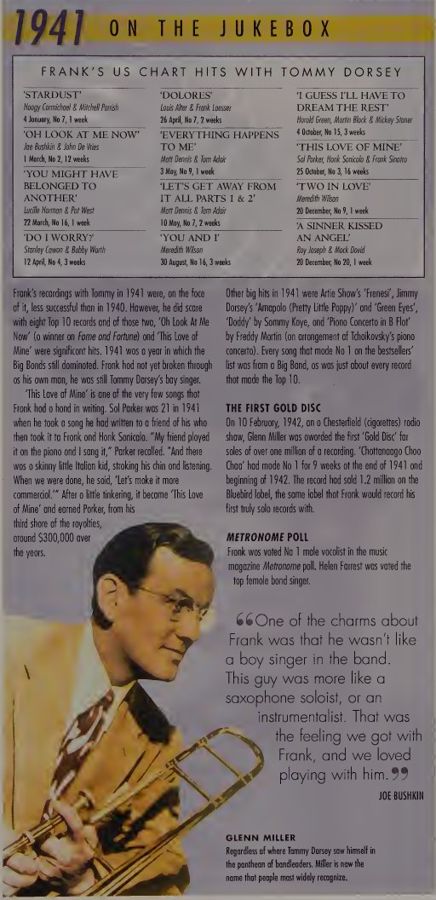
[Photograph: Frank's final live show with Tommy Dorsey. From Richard Havers, "Sinatra" (Dorling Kindersley, 2007), p.65.]
Per the book, Sinatra's last live show with Dorsey took place at the Circle Theatre in Indianapolis on 10 September 1942, timed with the chart entry of their Irving Berlin recording 'Be Careful, It's My Heart.'. (Source: Richard Havers, "Sinatra" (Dorling Kindersley, 2007).)
Note on a source discrepancy: the Masters of Jazz CD series discography (Volume 7, "Frank Sinatra 1942") places this same final Dorsey engagement in Minneapolis rather than Indianapolis, without further detail. The Havers account above, with its specific venue name and the tie-in to the "Be Careful, It's My Heart" chart entry, is treated as the more reliable of the two for this chronology.
September 14, 1942
Radio
Direct From The Hollywood Tropics
KJH 1110
11:00 PM
Paul Neighbors Orchestra & Dick Thomas & Frank Sinatra
Direct From The Hollywood Tropics
KJH 1110
11:00 PM
Paul Neighbors Orchestra & Dick Thomas & Frank Sinatra
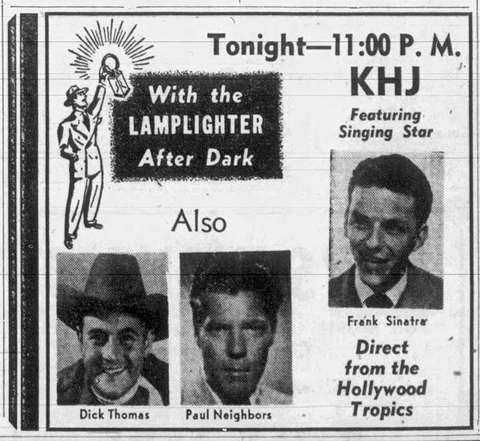
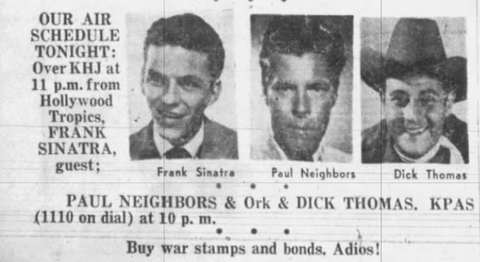
September 17, 1942
Studio
Columbia Pictures Sound Studio Los Angeles , California Sound Recording for "Reveille for Beverly," a Columbia Motion Picture Orchestra conducted by Morris Stoloff
"Night and Day" Frank Sinatra
Co-arranged by Axel Stordahl and Morris Stoloff
NOTE: Sinatra Scholar Ed O'Brien who supplied this information along with the soundtrack information from "It Happened in Brooklyn "
(below) says 15 string instruments and three pianos plus a full orchestra were used in this sound recording.
This was Sinatra's first recording session after leaving the Tommy Dorsey band. The Columbia worksheet shows that Stoloff was paid $37.50 for the session.
September 18, 1942
The Commercial Appeal
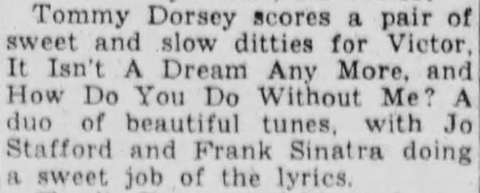
BS067915 A Sinner Kissed An Angel
(M. David/R. Joseph)
Polygram International Publishing Inc./Larry Shayne Enterprises (ASCAP) -1 (2:52) CD: 07863 66353-2 "The Song Is You" 5CD set Vol 3
CD: RCA 8554-2-R
LP: SD 1000
78: 27611
The Montreal Star
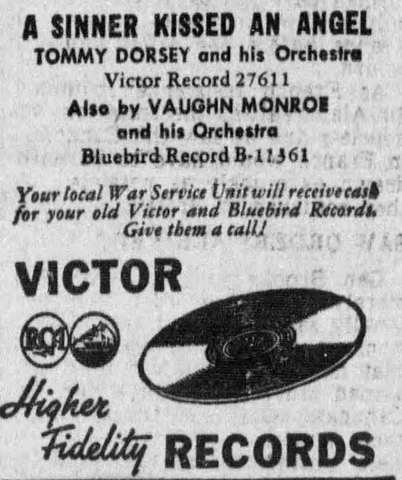
The Life
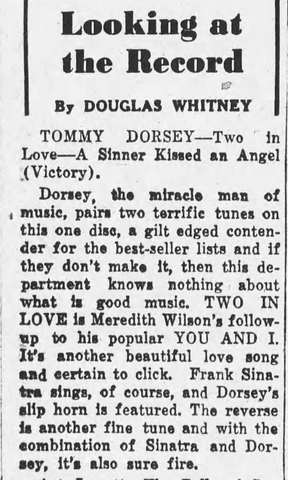
October 1942
[Sinatra Launches His Own WABC Radio Show]
In October 1942, shortly after leaving Dorsey, Sinatra began his own radio program on WABC, "Frank Sinatra Sings," which ran for about four months.
Source: Nancy Sinatra, "Frank Sinatra, My Father" (1985).
[Frank's two big breaks at Hartford]
Consiglio: While appearing with Ziggy Elman's band at the State Theatre in Hartford in October 1942, Frank received two major offers: a regular spot on the radio show Your Hit Parade (sponsored by Lucky Strike), and a contract to headline the Paramount Theatre in New York.
Source: Tony Consiglio (as told to Franz Douskey), "Sinatra and Me: The Very Good Years" (2012)
[Photo at Capitol Theater, Hartford]
Consiglio: A photo caption shows Sinatra, Consiglio, and Ziggy Elman at the stage door of the Capitol Theater in Hartford, Connecticut, in October 1942, only a few weeks after Sinatra had left Tommy Dorsey's band.
Source: Tony Consiglio (as told to Franz Douskey), "Sinatra and Me: The Very Good Years" (2012)
[A Touch of Texas -- critical commentary]
Also in October, Sinatra, passing through Chicago, sang a guest appearance on a show called Your Broadway and Mine, with CBS’s house conductor, Walter Gross (the future composer of “Tenderly”). (His sole number was “A Touch of Texas,” of all unlikely song choices.)
Source: Will Friedwald, "Sinatra! The Song Is You: A Singer's Art" (2018 revised edition), Ch. 4, "With Axel Stordahl" (1943-1948)
October 1, 1942
Radio
Reflections
Network: CBS
Location: New York City - CBS Playhouse #3
Show #1
Sponsor: none (substaining)
Time: 8:00PM - 8:30PM (EST)
Musicians: Raymond Scott Orchestra augmented by a string section
Arrangements By: Axel Stordahl
Notes: First airing on October 1st can be confirmed. Of note, the main station carrying the show simply lists it as Variety Musicale, Frank Sinatra, Songs WABC 7:30PM-8:00PM. WISV lists the show as Reflections 8:00PM - 8:30PM but nothing about Sinatra is mentioned. WABC listing is currently thought to be a typo. Any network listings after this date never mentioned Sinatra or any other details. Some discographies list the time slot as 10:45PM-11:00PM. This is incorrect. "Mary Small, songs" had this time slot.
Ed O'Brien:
New York Times has Frank on from 7:30 to 8 on 10-1-42. There was a musical program from Honolulu from 8 to 8:30. Frank was backed by Walter Gross & Orchestra and the Bobby Tucker Voices, before the name was changed to "Singers." "Reflections" would be broadcast at 8 to 8:30 beginning on 10-8. A review of the program is in the Extras section below.
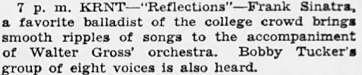
Reflections
Network: CBS
Location: New York City - CBS Playhouse #3
Show #1
Sponsor: none (substaining)
Time: 8:00PM - 8:30PM (EST)
Musicians: Raymond Scott Orchestra augmented by a string section
Arrangements By: Axel Stordahl
"REFLECTIONS"
Reviewed Thursday, 8-8:30 Style -- Musical
Sustaining on WABC (New York).
Admirers of Frank Sinatra's romantic crooning can now hear him for a solid half- hour Thursday nights with Walter Gross's orchestra and Bobby Tucker's Voices. The show is of the close-your-eyes-and-dream variety, overflowing with soft, sentimental music and wistful thoughts. Dreamy mood is kept up pretty well by a mellow-voiced announcer commenting upon the glories of the moon and the night and the music, to the accompaniment of rippling piano chords..
Susceptible females can swoon without shame after hearing Sinatra's listlessly ro- mantic rendition of such tidbits as "My Blue Heaven," "When The Lights Go On Again," "I Get A Kick Out Of You" and "With A Song In My Heart." The chorus came in smoothly on several of his numbers and sounded good on it own number "Our Love Is Here To Stay." Walter Gross's band, heavy in the string section, offered a soothing background for the chirping, but its interpretation of "Vilia" was a little over-drawn. It's all calculated to take you into a rosy world of dreams -- and if you don't watch out you'll be up there before the half-hour is up. M.R.
Billboard
11-14-42
Ed O'Brien:
Oh my! This changes so much of what wethought Sinatra was doing in the fall of 1942. Bill- board would review new shows every week andthere was always a gap of at least 7 to 9 days. Raymond Scott is nowhere to be found. Frank is singing with the Bobby Tucker Singers long before the a capella sessions at Columbia, inJune of 43.
The review also reveals that Frankie had the girls swooning before the famous Paramount opening on 12-30-42. Connie Haines, in 1970, told KNEW in San Francisco, that the girls were screaming at Frankie even before they knew his name. Sinatra told NBC Monitor, in December of 1963, that it had started when he was with Dorsey. The young women would gather around the bandstand, mewing and sighing. Speaking of the Paramount: Sinatra would claim that he was offered the extra billing on his birthday that year. That is not accurate. Here is an article from the Billboard of 11-21-42: "A 10 week show is in prospect at the Paramount after' the current run of Woody Herman, which will last seven weeks. Benny Goodman has been signed for only two weeks and two more on options starting December 30, but Frank Sinatra, ex-Tommy Dorsey singer, is penciled in for two weeks and eight weeks of options."
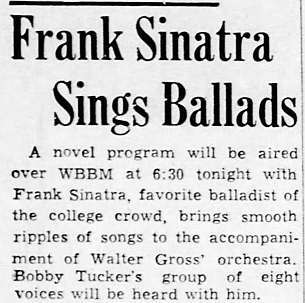
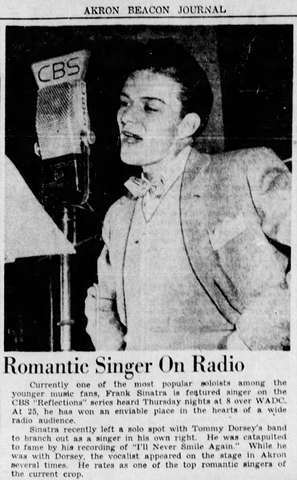
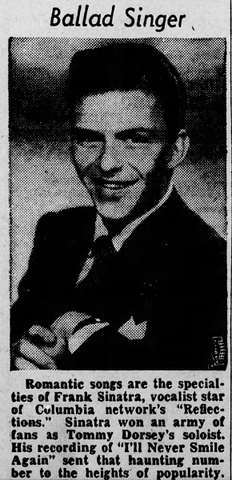
October 6, 1942
Radio
Songs By Sinatra
Network: CBS
Location: New York City
Time: 6:30PM - 6:45PM Tuesday
Show #1
Sponsor: none (sustaining)
Musicians: Axel Stordahl, Raymond Scott, CBS Orchestra
Arrangements By: Axel Stordahl
Notes: Confirmed aired on WABC.
October 8, 1942
Radio
Reflections
Network: CBS
Location: New York City - CBS Playhouse #3
Show #2
Sponsor: none (substaining)
Time: 8:00PM - 8:30PM (EST)
Musicians: Walter Gross's orchestra, Bobby Tucker's Voices
Arrangements By: Axel Stordahl
Notes: Confirmed airing as Reflections on WISV / Listed as Variety Musical on WABC
Asheville Citizen Times
Concerts
Central Theatre, Passaic, New Jersey (October 8-14)
On Screen: "Foreign Agent"
Central Theatre, Passaic, New Jersey (October 8-14, 1942) note: Frank had left Dorsey in early September of 1942. He sang a musical number in the Columbia Pictures film "Reveille With Beverly" and was able to secure two sustaining radio programs that got underway in early October. But he was very nervous. There were no club bookings and he had just bought his first house in Hasbrouck Heights, New Jersey. Actually, Frankie was scared it might not go the way he had planned. Desperate, he had heard about the vaudeville shows at the Central Theatre in Passaic, N.J. He dropped in one day and asked the manager for a job. He planned to ask for just four days to prove himself, but the manager knew who Frank Sinatra was and gave him a week. Word of mouth got scouts coming over from the major theatres in New York City. Frankie was a hit and that led to more local bookings. And this led to the Paramount Theatre on 12-30-42. The Central asked Frank to do an encore performance in December. Even though he had the Big Apple booking, Frank was grateful and immediately agreed to be part of the pre- Christmas show.
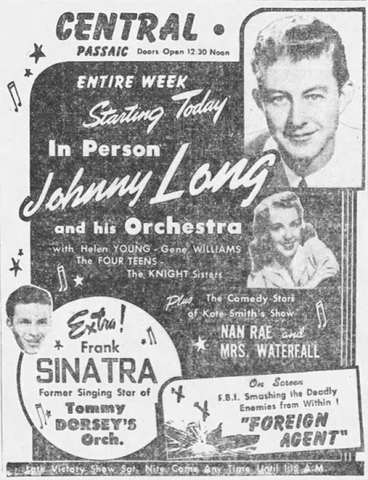
Reflections
Network: CBS
Location: New York City - CBS Playhouse #3
Show #2
Sponsor: none (substaining)
Time: 8:00PM - 8:30PM (EST)
Musicians: Walter Gross's orchestra, Bobby Tucker's Voices
Arrangements By: Axel Stordahl
Notes: Confirmed airing as Reflections on WISV / Listed as Variety Musical on WABC
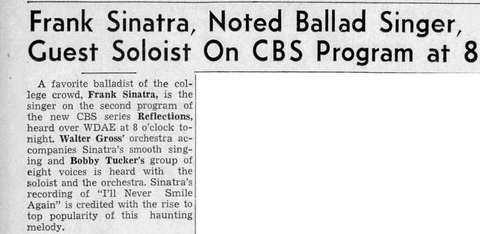
October 9, 1942
Concerts
Central Theatre, Passaic, New Jersey (October 8-14, 1942)
On Screen: "Foreign Agent"
October 10, 1942
Concerts
Central Theatre, Passaic, New Jersey (October 8-14, 1942)
On Screen: "Foreign Agent"
October 11, 1942
Concerts
Central Theatre, Passaic, New Jersey (October 8-14, 1942)
On Screen: "Foreign Agent"
October 12, 1942
Concerts
Central Theatre, Passaic, New Jersey
On Screen: "Foreign Agent"
October 13, 1942
Radio
Songs By Sinatra
Network: CBS
Location: New York City
Time: 6:30PM - 6:45PM Tuesday
Show #2
Sponsor: none (sustaining)
Musicians: Axel Stordahl, Raymond Scott, CBS Orchestra
Arrangements By: Axel Stordahl
Notes: Confirmed aired on WABC
Concerts
Central Theatre, Passaic, New Jersey (October 8-14)
On Screen: "Foreign Agent"
October 14, 1942
Concerts
Central Theatre, Passaic, New Jersey
On Screen: "Foreign Agent"
Central Theatre, Passaic, New Jersey
On Screen: "Foreign Agent"
Last day at the Central Passaic theatre
Also a war bond benefit at the Ritz Ballroom in town
[image referenced in source but could not be recovered]
[image referenced in source but could not be recovered]
October 15, 1942
Radio
Reflections
Network: CBS
Location: New York City - CBS Playhouse #3
Show #3
Sponsor: none (substaining)
Time: 8:00PM - 8:30PM (EST)
Musicians: Walter Gross's Orchestra, Bobby Tucker's Voices
Arrangements By: Axel Stordahl
Notes: Confirmed airing as Reflections on WISV / Listed as Variety Musical on WABC
[image referenced in source but could not be recovered]
October 20, 1942
Radio
Songs By Sinatra
Network: CBS
Location: New York City
Time: 10:45PM - 11:00PM Tuesday
Show #3
Sponsor: none (sustaining)
Musicians: Axel Stordahl, Raymond Scott, CBS Orchestra
Arrangements By: Axel Stordahl
Notes: New 10:45PM time slot. Mary Small aired on WABC 6:30PM - 6:45PM. Confirmed aired on WABC.
October 21, 1942
Concerts
Lions Club Dinner, Hoboken, NJ
Frank Sinatra performs
Lions Club Dinner, Hoboken, NJ
Frank Sinatra performs
Emacs!
Sinatra was also a guest at a dinner for the
Moore League on the same day in Hoboken:
Emacs!
Thanks to Richard Cook for the above 2 listings.
Meyers Hotel, Hoboken, NJ
Annual Banquet of the Hoboken Lions Club
Frank Sinatra accompanied by Doris Estelle Beck
Note that Miss Beck and Mr. Sinatra also appeared at the luncheon of the Kiwanis Club of Hoboken at the Union Club on Friday October 30th.
Sinatra was also a guest at a dinner for the Moore League on the same day in Hoboken:
Thanks to Richard Cook for the above 2 listings.
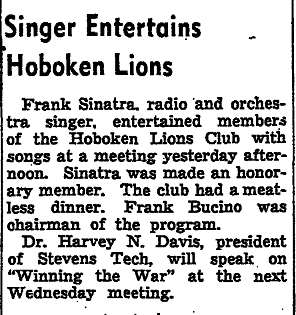
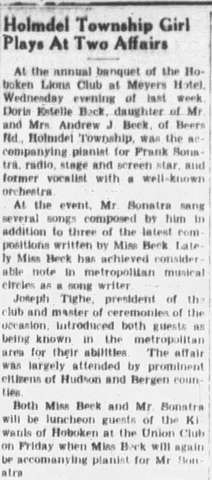
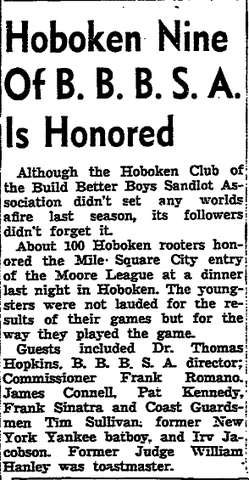
October 22, 1942
Radio
Refelections, Frank Sinatra with Bobby Tucker's Chorus
8pm

October 23, 1942
Concerts
Metropolitan Theatre in Providence, R.I. (October 23-25) Tony Pastor Orchestra, The Stroud Twins and Sylvia and Clemence were also on the bill. Billboard, 1942-11-07
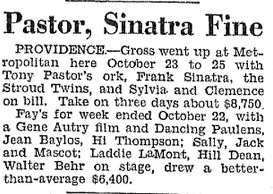
Metropolitan Theatre in Providence, R.I. (October 23-25) Tony Pastor Orchestra, The Stroud Twins and Sylvia and Clemence were also on the bill.
Variety
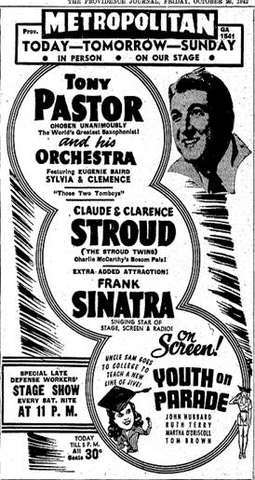
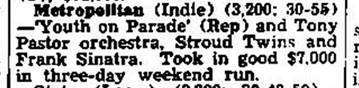
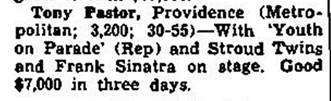
Metropolitan Theatre in Providence, R.I. (October 23-25) Tony Pastor Orchestra, The Stroud Twins and Sylvia and Clemence were also on the bill.
Variety
10-28-42 note: Billboard attributed the higher gross to an added show the Metropolitan started called "War Workers." This additional vaude show was run at 11 P.M. on Saturday nights. Ed
October 24, 1942
Concerts
Metropolitan Theatre in Providence, R.I. (October 23-25) Tony Pastor Orchestra, The Stroud Twins and Sylvia and Clemence were also on the bill.
October 25, 1942
Concerts
Metropolitan Theatre in Providence, R.I. (October 23-25) Tony Pastor Orchestra, The Stroud Twins and Sylvia and Clemence were also on the bill.
October 27, 1942
Radio
Songs By Sinatra
Network: CBS
Location: New York City
Time: 10:45PM - 11:00PM Tuesday
Show #4
Sponsor: none (sustaining)
Musicians: Axel Stordahl, Raymond Scott, CBS Orchestra
Arrangements By: Axel Stordahl
Notes: Confirmed aired on WABC. There was no show on November 3, 1942. WABC aired election returns from 10:00PM - 11:00PM.
Sinatra did a concert at the Mosque Theatre in Newark, New Jersey on this night.
(I'm not sure where above listing regarding the Mosque Theatre came from...I can find no reference for it. --Scott)
Kenny Lucas:
Are any of the 1942 SBS in circulation?
Ed O'Brien:
No. Just a few songs have circulated. LOC has the discs.
But they have not been catalogued.
October 29, 1942
Radio
Radio: An episode of Sinatra's own commercial radio series Reflections was broadcast this date, with the Raymond Scott Orchestra. Source: sinatradiscography.com, Radio Transcriptions Database.
October 30, 1942
Concerts
Union Club, Hoboken, NJ
Frank Sinatra accompanied by Doris Estelle Beck appeared at the luncheon of the Kiwanis Club of Hoboken
Union Club, Hoboken, NJ
Frank Sinatra accompanied by Doris Estelle Beck appeared at the luncheon of the Kiwanis Club of Hoboken
The above article appeared Thursday, October 29th regarding a previous event on October 21st and mentions the Kiwanis appearance for the Friday, October 30th.
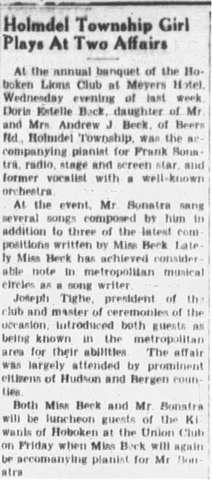
October 31, 1942
note: Exactly two months to the day when Frank left Dorsey, this ad has
him appearing at the Memorial Auditorium in Sacramento. I checked
the 11/3 paper. There is another ad that only shows Dorsey with no
mention of Sinatra or any other band member. Haines had left the
band in April of 1942. A real screw up by someone.
Ed
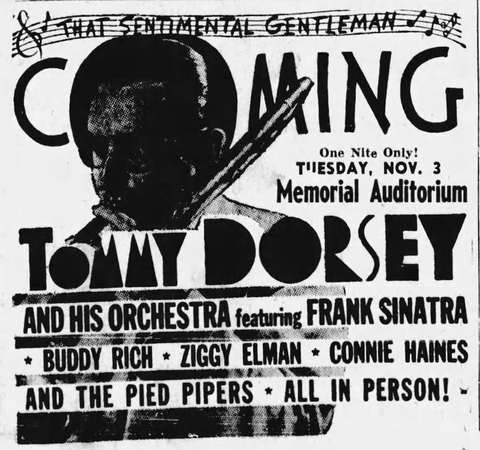
November 1942
[Unrecognized at State Theater, Hartford]
Consiglio: Sinatra and Consiglio played the State Theater in Hartford, Connecticut, two months after Frank left Tommy Dorsey's band and about six weeks before his major opening at the Paramount Theatre. Between shows, still in stage makeup, Sinatra walked through the crowded G. Fox & Co. department store completely unrecognized -- illustrating how unknown he still was just before his breakthrough.
Source: Tony Consiglio (as told to Franz Douskey), "Sinatra and Me: The Very Good Years" (2012)
November 1, 1942
Radio
Treasury Star Parade #93
1. Please Think Of Me
2. There Will Never Be Another You
Note: This song appears on the CD: In The Blue Of Evening NI-4007
November 2, 1942
Radio
Personal Album
Network: AFRS
Show: #31
Performers: Frank Sinatra
1. opening: "This Love Of Mine" - Frank Sinatra
2. Velvet Moon - Frank Sinatra
3. Just As Though You Were Here - Frank Sinatra
4. Everything I Have Is Yours - Frank Sinatra
5. Can't Get Out Of This Mood - Frank Sinatra
Note: All the above except "This Love Of Mine" appear on the CD: "The Rarest Sinatra" Decade Records 103.‚
"Everything I Have Is Yours" & "Can't Get Out Of This Mood" are on the CD: The Unheard Frank Sinatra 1. “Velvet Moon" also appears on the CD Frank Sinatra Live 1942-46 15mins. TT.
Ed O'Brien Notes:
This show is a real gem. Frank was less than two months removed from the Dorsey era. He displays an air of supreme confidence and sings like an angel. Three of the songs would never be recorded by him. Jo Stafford told me he was a great student during the Dorsey years. The student learned his craft well.
November 5, 1942
Radio
Reflections
Network: CBS
Location: New York City - CBS Playhouse #3
Show #5
Sponsor: none (sustaining)
Time: 8:00PM - 8:30PM (EST)
Musicians: Walter Gross's Orchestra, Bobby Tucker's Voices
Arrangements By: Axel Stordahl
Notes: Confirmed airing as Reflections on WISV / Listed as Variety Musical on WABC.
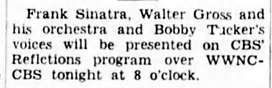
November 7, 1942
Concerts
Mecca Temple, New York City, NY (One Night Only)
Admission: 59 cents. 2068 persons attended.
Mecca Temple, New York City, NY (One Night Only)
November 7, 1944
CBS NewsNEW YORK - NOVEMBER 7: CBS reports the 1944 United States presidential election results. Tuesday, November 7, 1944. New York, NY. Visiting the set at left is Frank Sinatra
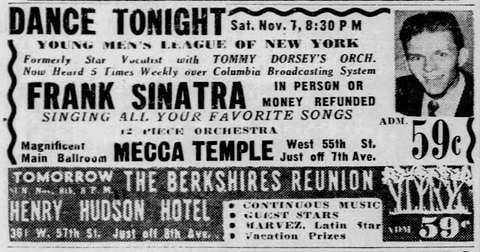
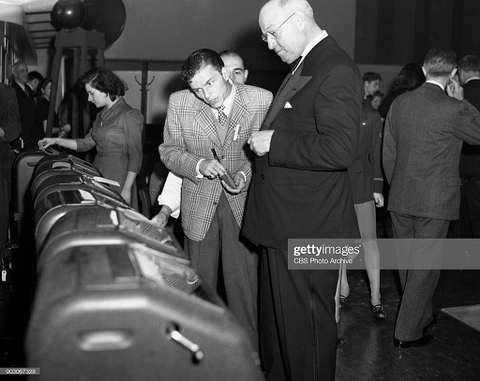
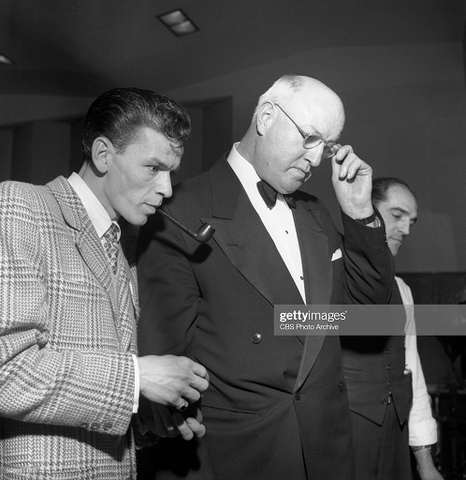
November 10, 1942
Radio
Songs By Sinatra
Network: CBS
Location: NewYork City
Time: 10:45PM - 11:00PM Tuesday
Show #5
Sponsor: none (sustaining)
Musicians: Axel Stordahl, Raymond Scott, CBS Orchestra
Arrangements By: Axel Stordahl
November 12, 1942
Radio
Reflections
Network: CBS
Location: New York City - CBS Playhouse #3
Show #6
Sponsor: none (sustaining)
Musicians: Walter Gross's Orchestra, Bobby Tucker's Voices
Arrangements By: Axel Stordahl
Time: 8:00PM - 8:30PM (EST)
1. My Blue Heaven
2. When The Lights Go On Again
3. Vilia Walter Gross Orch.
4. I Get A Kick Out Of You w/Bobby Tucker Voices
5. Love Is Here To Stay Bobby Tucker Voices
6. With A Song In My Heart w/Bobby Turker Voices
Notes: Confirmed airing as Reflections on WISV / Listed as Variety Musical on WABC.
"Reflections"
Reviewed Thursday, 8-8:30. Style
-Musical. Sustaining on WAB'C (New
York).
Admirers of Frank Sinatra's romantic crooning can now hear him for a solid half hour Thursday nights with Walter
Gross's orchestra and Bobby Tucker's
Voices. The show is of the close -your - eyes -and -dream variety, overflowing with soft, sentimental music and wistful thoughts. Dreamy mood is kept up pretty well by a mellow voiced announcer com- menting upon the glories of the moon and the night and the music, to the accompan iment of rippling piano chords.
Susceptible females can swoon without shame after hearing Sinatra's listlessly romantic rendition of suèh tidbits as My Blue
Heaven, When the Lights Go On Again, I Get
A Kick Out of You and With. a Song in My Heart.
The chorus came in smoothly on several of, his numbers and sounded good on its own number,
Our Love Is Here To Stay. Walter Gross's band, heavy in the string section, offered a soothing background for the chirping, but its interpretation of Villa was a little overdrawn. It's all calculated to take you into a rosy world of dreams-and if you don't watch out you'll be there before the half hour is up. M. R.
Billboard
11-14-42
November 17, 1942
Radio
Songs By Sinatra
Network: CBS
Location: New York City
Time: 10:45PM - 11:00PM Tuesday
Show #6
Sponsor: none (sustaining)
Musicians: Axel Stordahl, Raymond Scott, CBS Orchestra
Arrangements By: Axel Stordahl
Notes: Confirmed aired on WABC.
November 19, 1942
Radio
Reflections
Network: CBS
Location: New York City - CBS Playhouse #3
Show #7
Sponsor: none (sustaining)
Time: 8:00PM - 8:30PM (EST)
Musicians: Walter Gross's Orchestra, Bobby Tucker's Voices
Arrangements By: Axel Stordahl
Notes: Confirmed airing as Reflections on WISV / Listed as Variety Musical on WABC.
No show on 11-26-1942. Airing in it time slot WISV 8:00PM - 8:30PM We Give Thanks / WABC Play: A Time To Reap, With Henry Hull, Narrator.
Concerts
Mosque Theatre, Newark, New Jersey (November 19-December 2)
Mosque Theatre, Newark, New Jersey (November 19-December 2)
Mosque, Newark, Tries 2 -a -Day; Good Show, But Prices Too High NEWARK, Nov, 21. - The 8,400 -seat Mosque Theater, long unable to find a suitable policy, is making another stage - show try with two -a -day vaude. The opening attraction Thursday was the A. B. Marcus unit, augmented by Frank Sinatra, Senor Wences, Murtah Sisters and Harry Savoy. This show is scheduled for 10 days, with the Marcus unit holding over another week with a change of principals. Despite the generally satisfying nature of the show, the management seems to have erred in the price policy, which calls for 65 cents to $2.20 evenings and a matinee top of $1.65. More good will from the townspeople was obtained by advertising a $1.50 maximum in the local papers.. It is problematical if the local citizens will go for that 'kind of nick. even if the town is enjoying prosperity because of war orders. Even with the major emphasis on vaude, the house is still taking other attractions, the opera, Rigoletto, being scheduled for Sunday (22) and Marion Anderson booked for a recital. Thursday's evening show constituted little more than a dress rehearsal, as the rough spots were fairly evident, Major offenders were the ork and light and sound crews, all of which missed cues, which upset the performers and ruined some of the gags and bits. In fact, Wences had to stop his act momentarily to signal the backstage crew to rid the mike of a disconcerting hum, and Harry Savoy was as mad as any performer could be because of the fumbling ork miscues when he wound up the second part of his turn. The routining could he improved, with Sinatra taking next to closing. Savoy switching to Sinatra's spot, and a little less of the line work of 10 ponies and six showies, which slowed up the show considerably. The routines were corny, using hackneyed Tahitian, Indian and Oriental motifs. Sinatra was responsible for a major part of the draw, which was evident from the reception he got. The former Tommy Dorsey vocalist drew three encore. and could have stayed on indefinitely. Wences impressed with the smoothness of his clever turn, despite the aforementioned difficulties. The Murtah Sisters were a strong click with their songs and comedy. Savoy got the house where he wanted it with his double-talk and comedy during the first part of his turn, but failed to get similar response during the second act because of the miscues, The Marcus milt, despite the antiquated routines, carries a strong set of acts, topped by the Beehee Rubyiat troupe, as fast an Arab act as there is, Harold Boyd and Company (3), in sailor garb, present it laugh -getting knockabout stint. Latasha and Laurence got over some fine acro-ballroom routines. Leon Miller gets across with his comedy dance impressions. Rosemarie Farrow does a tasteful bit of ballet, The Libonattls (3) play xylophones and get over come okay taps. Kirk and Clayton are another tap team that impressed. Mary Agnes Mayer does a picturesque butterfly impression with yards of drape extended from her arms, Grace Doro mimes various types of pianists, Unit singers, Bob White, Ruth Durrell and Norma Jean Beck are below the standard of the other acts. Entire show runs three hours, Including a 15 -minute intermission. There are no films on the bill. House was about three-quarters full, Joe Cohen,
Billboard
11-28-42
[image referenced in source but could not be recovered]
[image referenced in source but could not be recovered]
[image referenced in source but could not be recovered]
November 20, 1942
Concerts
Mosque Theatre, Newark, New Jersey (November 19-December 2)
Mosque Theatre, Newark, New Jersey (November 19-December 2)
Montclair Times, 11-24-42
note: this add indicates a run through 12-2-42. --ED
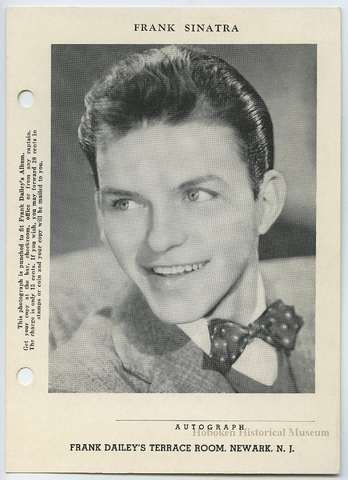
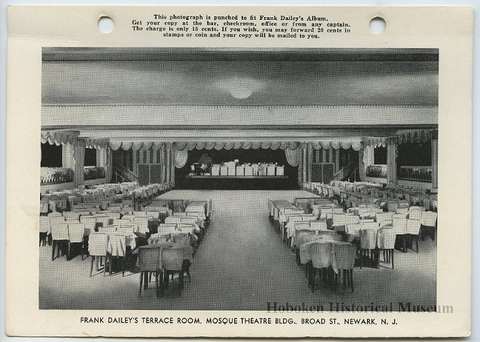
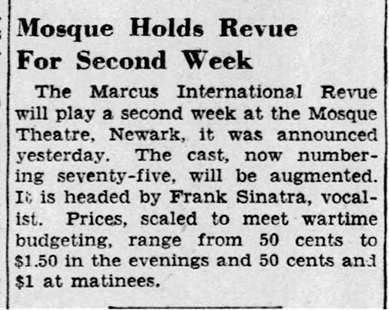
November 21, 1942
Concerts
Mosque Theatre, Newark, New Jersey (November 19-December 2)
November 22, 1942
Concerts
Mosque Theatre, Newark, New Jersey (November 19-December 2)
November 23, 1942
Concerts
Mosque Theatre, Newark, New Jersey (November 19-December 2)
November 24, 1942
Radio
Songs By Sinatra
Network: CBS
Location: New York City
Time: 10:45PM - 11:00PM Tuesday
Show #7
Sponsor: none (sustaining)
Musicians: Axel Stordahl, Raymond Scott, CBS Orchestra
Arrangements By: Axel Stordahl
Notes: Confirmed aired on WABC.
United Hospital Fund
WABC 11:15pm to midnight
Madeleine Carroll, Ed Gardner, George Jessel, Kate Smith, Frank Sinatra, Jack Miller and His band
Concerts
Mosque Theatre, Newark, New Jersey (November 19-December 2)
United Hospital Fund
WABC 11:15pm to midnight
Madeleine Carroll, Ed Gardner, George Jessel, Kate Smith, Frank Sinatra, Jack Miller and His band
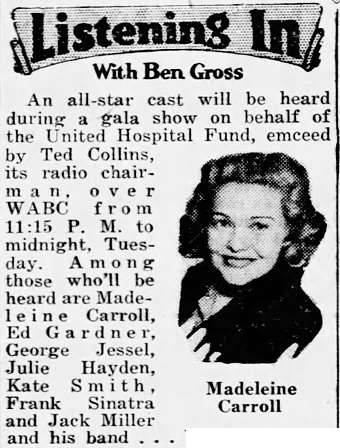
November 25, 1942
Concerts
Mosque Theatre, Newark, New Jersey (November 19-28)
Mosque Theatre, Newark, New Jersey (November 19-28)
Thanks to Michel M for sending on the above image.
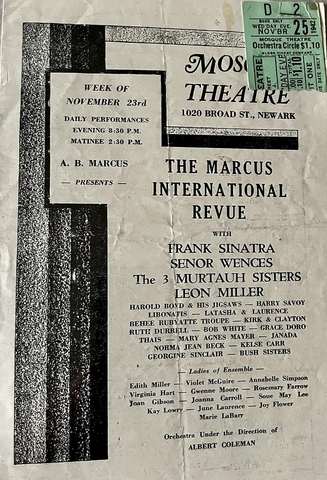
November 26, 1942
Concerts
Mosque Theatre, Newark, New Jersey (November 19-December 2)
Radio
Radio: An episode of Sinatra's own commercial radio series Reflections was broadcast this date, with the Raymond Scott Orchestra. Source: sinatradiscography.com, Radio Transcriptions Database.
November 27, 1942
Concerts
Mosque Theatre, Newark, New Jersey (November 19-December 2)
Mosque Theatre, Newark, New Jersey (November 19-28)
photo used for Mosque Theatre
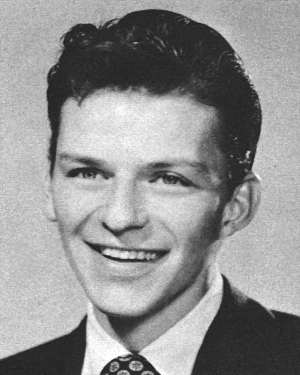
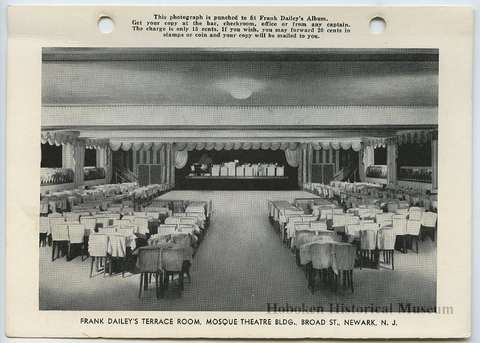
November 28, 1942
Concerts
Mosque Theatre, Newark, New Jersey (November 19-28)
November 30, 1942
Concerts
Mosque Theatre, Newark, New Jersey (November 19-December 2)
December 1942
[Press Agent Coins 'Bobby-Soxers' And 'Swooners']
During the four-week Paramount engagement that followed his debut, Sinatra hired press agent George B. Evans, who helped popularize the nicknames given to his young, ankle-socked, fainting fans.
Source: Nancy Sinatra, "Frank Sinatra, My Father" (1985).
[Breathing training with boxing trainer Al Sylvani]
Consiglio: While Frank played an extended engagement at the Paramount Theatre from December 1942 to March 1943, boxer Tami Mauriello's trainer Al Sylvani secretly coached Frank on breath control roughly every other day in a fourth-floor room, using a massage table and stopwatch to build the lung capacity that shaped Frank's famous phrasing. Frank later got Sylvani small film roles, including a corner-man part in The Joker Is Wild, in gratitude.
Source: Tony Consiglio (as told to Franz Douskey), "Sinatra and Me: The Very Good Years" (2012)
[Setup at Mosque Theatre wins over Weitman]
Kaplan: Agents Cooper and Romm arranged for skeptical Paramount manager Bob Weitman to see Sinatra perform at the Mosque Theatre in Newark -- Sinatra's hometown turf -- a rigged show designed to prove he could draw a crowd on his own.
Source: James Kaplan, "Frank: The Voice" (2010)
[Sinatra's Paramount debut and Jack Benny's intro]
Kaplan: At Sinatra's Paramount debut, billed as "extra added attraction" beneath Benny Goodman's orchestra, emcee Jack Benny -- who had never heard of Sinatra -- gave an enthusiastic introduction anyway; the ensuing eruption of screaming girls stunned the room, with Goodman reportedly turning and asking, "What the fuck was that?"
Source: James Kaplan, "Frank: The Voice" (2010)
December 1, 1942
Radio
Songs By Sinatra
Network: CBS
Location: NewYork City
Time: 10:45PM - 11:00PM Tuesday
Show #8
Sponsor: none (sustaining)
Musicians: Axel Stordahl, Raymond Scott, CBS Orchestra
Arrangements By: Axel Stordahl
Notes: Confirmed aired on WABC.
Concerts
Mosque Theatre, Newark, New Jersey (November 19-December 2)
December 2, 1942
Concerts
Mosque Theatre, Newark, New Jersey (November 19-December 2)
December 3, 1942
Radio
Reflections
Network: CBS
Location: New York City - CBS Playhouse #3
Show #8
Sponsor: none (substaining)
Time: 8:00PM - 8:30PM (EST)
Musicans: Walter Gross's orchestra and Bobby Tucker's Voices
Arrangements By: Axel Stordahl
Notes: Confirmed airing as Reflections on WISV / Listed as Variety Musical on WABC. No Show 12-10-42. Airing in it's place December 10, 1942 WISV 8:00PM - 8:30PM Italians For Freedom / WABC Italians For Freedom Play.
Sinatra did do a show 12-10-42 at 10:45-11PM on this night. It was not "Reflections" as far as I can tell and was not carried by any other stations but WABC. So it was a local NYC show, like SBS 42'. Has the same format listed as a Songs By Sinatra of that time period.
note: I checked radio listings in Boston and the 10:45 to 11:P.M. was a Treasury Song Parade on the Mutual Network. Might have been Frank.
Ed
Per the Masters of Jazz CD series discography (Volume 10, "Frank Sinatra 1941-1942"), on this same date Sinatra also appeared as a guest performer on a radio broadcast reuniting bandleaders Jimmy and Tommy Dorsey, singing "Weep No More My Lady" -- by this point he was no longer a regular member of the Tommy Dorsey Orchestra, having departed the band roughly two months earlier, so the appearance is noted in the discography as a one-off "guest star" spot rather than a regular band broadcast.
December 8, 1942
Radio
Songs By Sinatra
Network: CBS
Location: New York City
Time: 10:45PM - 11:00PM Tuesday
Show #9
Sponsor: none (sustaining)
Musicians: Axel Stordahl, Raymond Scott, CBS Orchestra
Arrangements By: Axel Stordahl
Notes: Confirmed aired on WABC.
December 10, 1942
Radio
Songs By Sinatra
Network: CBS
Location: NewYork City
Time: 10:45PM - 11:00PM Thursday
Show #10
Sponsor: none (sustaining)
Musicians: Axel Stordahl, Raymond Scott, CBS Orchestra
Arrangements By: Axel Stordahl
Notes: Extra show this week. Possibly a fill in or a test for the launch of two nights a week starting in January. Confirmed aired on WABC.
December 11, 1942
Concerts
State Theatre, Hartford, Connecticut (11-13)
Friday thru Sunday
All Star Stage Revue and Frank Sinatra. with Duke Ellington
In Terry Teachout's acclaimed biography,
"Duke: A Life of Duke Ellington" he writes that Ellington began writing his masterpiece, the "Black, Brown and Beige" suite, in 1942, backstage at the State Theater where his band was sharing the bill with Frank Sinatra.
note: Sinatra claimed that the manager of the
Paramount Theater, Bob Weitman, called him at home, on the evening of December 12th, and asked him did he want to play the Paramount with Benny Goodman. Frank jumped at the chance and told Weitman he hadn't been able to get booked anywhere.
If you have been reading This Date In History, Frank was a busy fellow in the fall of 1942. And the booking at the Paramount was a done deal weeks before he appear- ed as the extra-added attraction. And he was working on his birthday at the State in Hartford.
Ed
Ed O'Brien:
Ellington Band was on the bill with Frank.
A few years down the road, he wrote an essay about his years leading up to the
Paramount(12-30-42). Frank told of being in awe of The Duke and his band. Twenty- five years to the day, after opening night in Hartford, Frank Sinatra did the first of two sessions with the legendary Ellington band.
State Theatre, Hartford, Connecticut (11-13)
Friday thru Sunday
All Star Stage Revue and Frank Sinatra.
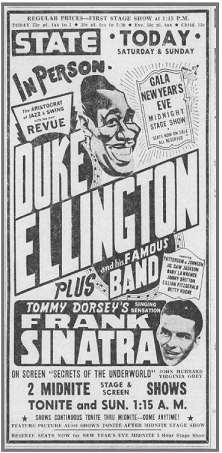
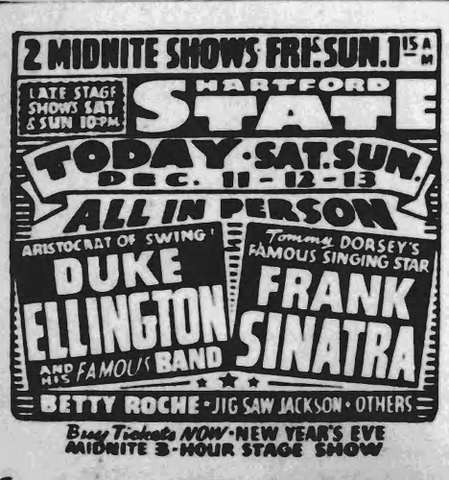
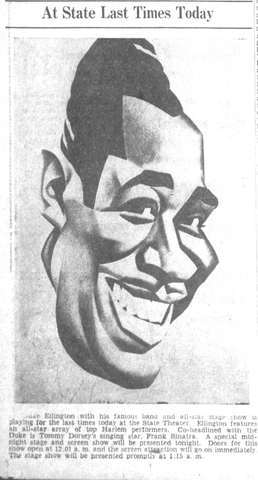
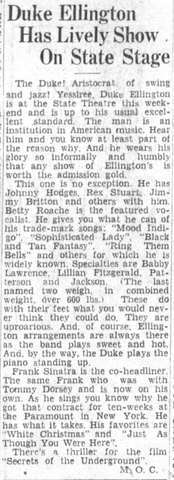

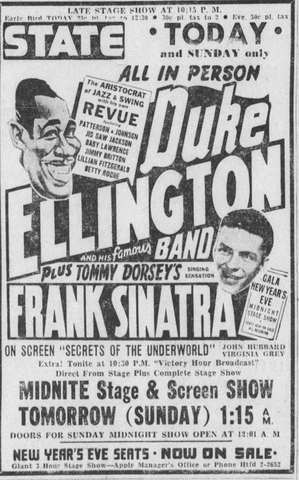
December 12, 1942
Concerts
State Theatre, Hartford, Connecticut (11-13)
Friday thru Sunday
All Star Stage Revue and Frank Sinatra.
On his twenty-seventh birthday, Frank Sinatra performed at the Mosque Theatre in Newark. Paramount Theatre manager Bob Weitman happened to catch the show and was impressed enough to ask bandleader Benny Goodman whether he'd mind sharing a bill with Sinatra at the Paramount later that month — the booking that would trigger “Sinatra-mania” at the end of December. Goodman's reported response: “Who the hell is Frank Sinatra?” Source: J. Randy Taraborrelli, Sinatra: Behind the Legend.
[Sinatra's 27th birthday and Weitman's offer]
On his 27th birthday, Weitman phoned Sinatra at home and offered him a spot opening at the Paramount Theatre for New Year's, alongside Benny Goodman's orchestra and the film "Star Spangled Rhythm."
Source: James Kaplan, "Frank: The Voice" (2010).
December 13, 1942
Concerts
State Theatre, Hartford, Connecticut (11-13)
Friday thru Sunday
All Star Stage Revue and Frank Sinatra.
December 14, 1942
Concerts
State Theatre, Hartford, Connecticut (11-13)
Friday thru Sunday
All Star Stage Revue and Frank Sinatra.
December 15, 1942
Radio
Songs By Sinatra
Network: CBS
Location: NewYork City
Time: 10:45PM - 11:00PM Tuesday
Show #11
Sponsor: none (sustaining)
Musicians: Axel Stordahl, Raymond Scott, CBS Orchestra
Arrangements By: Axel Stordahl
Notes: Confirmed aired on WABC.
December 17, 1942
Radio
Reflections
Network: CBS
Location: New York City - CBS Playhouse #3
Show #9
Sponsor: none (substaining)
Time: 8:00PM - 8:30PM (EST)
Musicians: Walter Gross's orchestra and Bobby Tucker's Voices
Arrangements By: Axel Stordahl
Notes: Confirmed airing as Reflections on WISV / Listed as Variety Musical on WABC.
No show on 12-24-42. Airing in it's place December 24, 1942 WISV 8:00PM - 8:30PM Plot To Overthrow Christmas / WABC Plot To Overthrow Christmas.
Concerts
Central Theatre, Passaic, New Jersey (December 17-23)
(On Screen: Prisoner of Japan)
Songs Included:
This Love Of Mine
There Are Such Things
White Christmas
Night and Day
The Song Is You
Notes: Frank Sinatra certainly didn't have a problem getting bookings in the fall of 1942. And the critics certainly liked what they saw in the various theaters in which he performed. I don't understand how the biographers missed all of the engagements from when he left Dorsey until the night at the Paramount. They directed a lot of questions my way but never touched upon this aspect of Frank's rise to fame. Sad.
Ed
Central Theatre, Passaic, New Jersey (December 17-23)
The News (Paterson, New Jersey) · 19 Dec 1942
Notes: A great find. Wow! Frank singing "White Christmas" in December of 1942. The song had become a sensation
that Christmas season. Billboard and Variety both reported,with much detail the incredible sales of Crosby's great recording.
Today it remains the biggest selling single of all time( Bing also has the third biggest seller with "Silent Night"). At the end of
W.W. II, the American G.I. voted Crosby the most important and most inspirational of all the entertainers they heard during
the conflict. "White Christmas" was cited as a major part of Crosby's contribution.
Frank did a lovely rendition with the Bobby Tucker Singers on his 12-19-43 radio show from Philadelphia. From 1944
thru 1946, Frank's first Columbia recording of Berlin's song would be a Top 10 hit and eventually sell over a million copies.
In 1988, I was working with Columbia when they released the "Christmas Dreaming" compilation on CD, LP, 8 Track and
cassette (an aside here: the cassette did not contain any information regarding the history of the recordings. A genius at the
label saw a savings of one penny per tape minus the notes).
I made sure they released the obscure late 1947 recording Frank did of the song. His third effort was done at MGM on
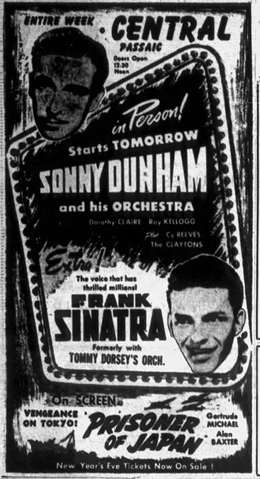
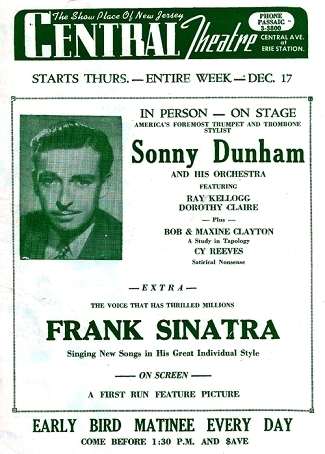
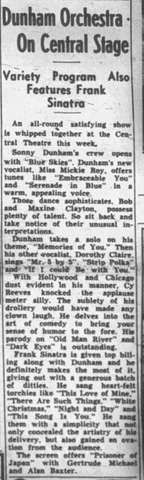
December 18, 1942
Concerts
Central Theatre, Passaic, New Jersey (December 17-23)
(On Screen: Prisoner of Japan)
Central Theatre, Passaic, New Jersey (December 17-23)
(On Screen: Prisoner of Japan)
© 1997-2025 The Sinatra Archive
This calendar, or any parts thereof, may not be reproduced in any fashion
whatsoever without the prior written permission of the publisher (The
Sinatra Archive)
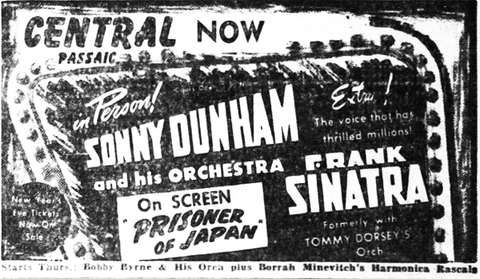
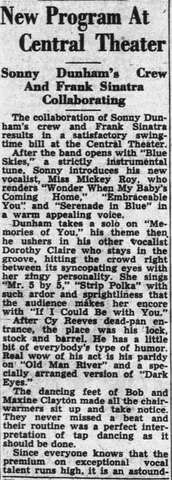
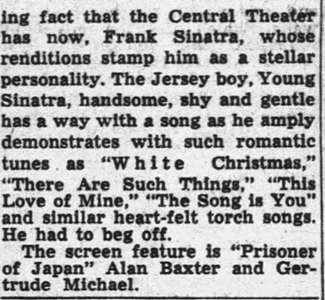
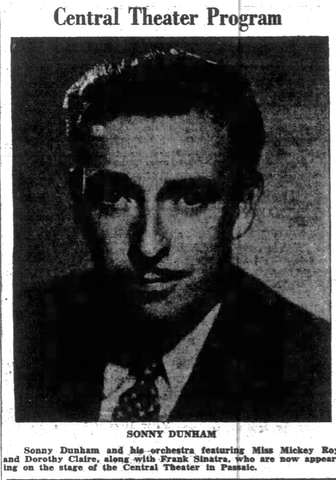
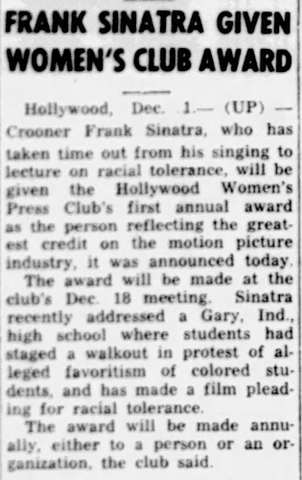
Central Theatre, Passaic, New Jersey (December 17-23)
(On Screen: Prisoner of Japan)
© 1997-2025 The Sinatra Archive
This calendar, or any parts thereof, may not be reproduced in any fashion
whatsoever without the prior written permission of the publisher (The
Sinatra Archive)
December 19, 1942
Concerts
Central Theatre, Passaic, New Jersey (December 17-23)
(On Screen: Prisoner of Japan)
Radio
Radio: Command Performance USA!, the Armed Forces Radio Service variety program, broadcast an episode featuring Sinatra this date, who sang "She's Funny That Way." Source: sinatradiscography.com, Radio Transcriptions Database.
December 20, 1942
Concerts
Central Theatre, Passaic, New Jersey (December 17-23)
(On Screen: Prisoner of Japan)
Smokes For Soldiers, Christmas Victory Party, Infantry Armory, Paterson, New Jersey (1:30-5pm) Sinatra was part of a program that also featured the bands of Cab Calloway, Vaughan Monroe, Sonny Dunham, The Korn Koblers as well as The Hill Billies, The Four Ginger Snaps, and Sidney Bechet
(see article below)
Smokes For Soldiers, Christmas Victory Party
The News (Paterson, New Jersey) · 17 Dec 1942
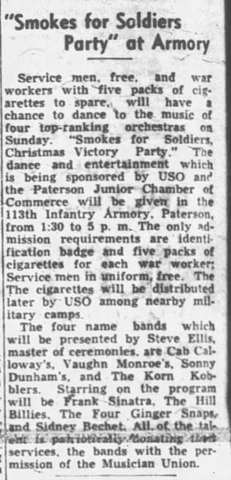
December 21, 1942
Concerts
Central Theatre, Passaic, New Jersey (December 17-23)
(On Screen: Prisoner of Japan)
December 22, 1942
Radio
Songs By Sinatra
Network: CBS
Location: New York City
Time: 10:45PM - 11:00PM Tuesday
Show #12
Sponsor: none (sustaining)
Musicains: Axel Stordahl, Raymond Scott, CBS Orchestra
Arrangements By: Axel Stordahl
Notes: Confirmed aired on WABC.
Concerts
Central Theatre, Passaic, New Jersey (December 17-23)
(On Screen: Prisoner of Japan)
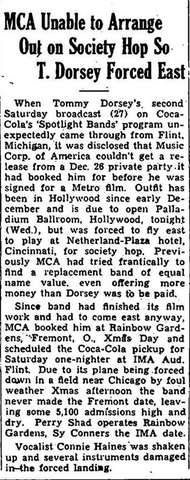
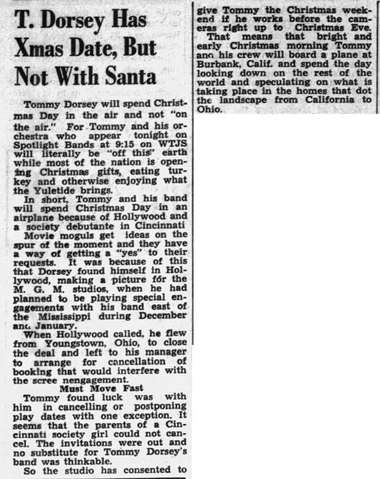
December 23, 1942
Concerts
Central Theatre, Passaic, New Jersey (December 17-23)
(On Screen: Prisoner of Japan)
December 29, 1942
Radio
Songs By Sinatra
Network: CBS
Location: NewYork City
Time: 10:45PM - 11:00PM Tuesday
Show #13
Sponsor: none (sustaining)
Musicans: Walter Gross's orchestra and Bobby Tucker's Voices
Arrangements By: Axel Stordahl
Notes: Confirmed aired on WABC
December 30, 1942
Concerts
Paramount Theatre, New York City ( December 30, 1942 - January 26, 1943) w/Benny Goodman & Orchestra
(On Screen: "Star Spangled Rhythm")
Ed O'Brien notes:
December 30,1942
Wednesday evening
The night Frank Sinatra became FRANKIE "THE VOICE"
His years with Dorsey had offered him invaluable training and the opportunity to sing some of the best songs of the era. Sinatra was no stranger to the Paramount stage , having played a number of engagements with Dorsey.
The New York Times ran a large ad that day featuring
The Benny Goodman Orchestra with Peggy Lee plus extra added attraction Frank Sinatra. "Star Spangled
Rhythm" was the film offered by the management. A typical Paramount extravaganza with Crosby, Hope, Alan Ladd,
Betty Hutton, Victor Moore and a host of other major stars.
Robert Weitman, the theatre manager, had asked his good pal Jack Benny to introduce the young crooner. The reaction from the teenage girls was unprecedented in the history of popular American entertainment. The "King Of Swing" uttered an expletive, Benny was stunned and Sinatra froze in his tracks.
There was mass hysteria as Frankie began to sing "For Me And My Gal." Bedlam reigned as the singer tried to soar above the din. "That Old Black Magic: (sung by Vera Zorina in "S. S. Rhythm"), "She's Funny That Way," "Where Or When," "Paradise" were rendered to an adoring audience of young teenage girls. Sinatra was 27 years old. For the next two months the bobbysoxers would squeal and squeal through hundreds of shows and Sinatra would become a cultural phenomenon. Psychologists would warn parents about his mesmerizing powers over the young, sociologists would struggle to understand why this skinny man had become the object of such worship from millions of girls throughout the country, musicologists were evenly divided concerning his singing ability, and the first real teenage idol was in a stratosphere very few performers would ever know. Over the next three years he would rake in over $11 million, sell a ton of records, become a major radio personality and a genuine movie star. And it all started that night at the Paramount 67 years ago.
[image referenced in source but could not be recovered]
Paramount Theatre, New York City ( December 30, 1942 - January 26, 1943)
AD IN NEW YORK TIMES
DECEMBER 29, 1942:
The Brooklyn Daily Eagle (Brooklyn, New York) 31 Dec 1942
Benny Goodman Jack Benny Frank Sinatra 12-30-42 BILLBOARD
January 9, 1943
NIGHT CLUBS-VAUDEVILLE
VAUDEVILLE REVIEWS
PARAMOUNT, NEW YORK
(Reviewed Wednesday Evening, December 30, 1942)
Benny Goodman will be here for four weeks, only part of the run skedded for Para's super-dooper flicker "Star- Spangled Rhythm," and he'll be missed when he checks out with his entourage, which includes the beauteous
Peggy Lee, Outside acts, Frank Sinatra and Radio
Rogues(Moke and Poke, colored hoofers, were cut from last show because it ran late), are socko on their own.
Frank Sinatra is in for the full 10-week run of the film, and from his showing opening night, he is ready for that Lucky Strike commercial he takes over shortly.
Sinatra shows how he has profited from his experiences as a band vocalist and a singing single: meaning he's got the rhythm that comes from swinging out with a top ork and the flexibility that comes from soloing.
Retaining the singing habits from his band days he gets the customers directly by socking right into the choruses of all the tunes. Did one of "Where Or When," another of "There Are Such Things," and a medley of three more,
"Craziest Dream," She's Funny That Way" and "For Me
And My Gal." Slight throat huskiness didn't prevent him from whamming every one over. Encored with Kern's
"I Hear Music." Boyish appearance and mannerisms all catnip for the ladies.
House virtually full for last p.m. show.
Elliott Grennard
December 30, 1945
The following picture appeared in the New York Sunday News, December 30, 1945
Frank Sinatra's opening night at the Paramount Theatre, on a bill with Benny Goodman's orchestra, produced an explosion of fan hysteria that caught everyone — Sinatra included — by surprise: when Jack Benny introduced him, teenage girls in the audience began screaming and would barely let the show proceed. The press dubbed the phenomenon “Sinatra-mania.” The engagement, originally booked for two weeks, was extended for two months. In the aftermath, Sinatra hired press agent George Evans, whose stunts to keep the frenzy going reportedly included paying a small number of girls to scream and swoon on cue — though biographer J. Randy Taraborrelli notes the genuine audience reaction quickly made the paid plants unnecessary. Source: J. Randy Taraborrelli, Sinatra: Behind the Legend.
[Frank opens twelve-week Paramount run]
Consiglio: Frank opened what became a twelve-week engagement at the Paramount Theatre on December 30, 1942 (originally booked for just one month), backed by a rotating lineup of bands changing every two weeks, including Benny Goodman, Dolly Dawn and her Dawn Patrol, Raymond Paige, Tommy Dorsey, and Jimmy Dorsey (playing without his singer Bob Eberle).
Source: Tony Consiglio (as told to Franz Douskey), "Sinatra and Me: The Very Good Years" (2012).
[Benny Goodman's reaction to screaming fans]
Consiglio: On opening night at the Paramount, bandleader Benny Goodman -- unfamiliar with the reaction Frank drew -- turned around startled at the girls' screaming as Frank walked onstage and blurted out a shocked exclamation, breaking the tension and making both Frank and the musicians laugh.
Source: Tony Consiglio (as told to Franz Douskey), "Sinatra and Me: The Very Good Years" (2012).
December 31, 1942
Radio
Reflections
Network: CBS
Location: New York City - CBS Playhouse #3
Show #10
Sponsor: none (substaining)
Time: 8:00PM - 8:30PM (EST)
Musicians: Raymond Scott Orchestra augmented by a string section
Arrangements By: Axel Stordahl
Notes: Last show. Confirmed airing as Reflections on WISV / Listed as Variety Musical on WABC.
Airing in the time slot the following week
January 7, 1943 WISV 8:00PM - 8:30PM Meet Corliss
Archer / WABC Meet Corliss Archer.
Concerts
Paramount Theatre , New York City (December 30 - January 26) w/Benny Goodman & Orchestra
1943
[A 12-Year-Old Fan's Ice Cream With Sinatra]
Nancy Sinatra: Leaving a Manhattan broadcast studio, Frank noticed a 12-year-old girl grow so overexcited at seeing him that she caught her hand in a door. He sent his friend Hank Sanicola back to check on her, and once she proved unhurt, treated her to ice cream at the Hotel Astor's restaurant.
Source: Nancy Sinatra, Frank Sinatra: An American Legend, 1995.
[Advertisement for the Riobamba Revusical]
A 1943 advertisement promotes Sinatra's engagement in the Riobamba Revusical nightclub show, billing him as "The Voice That's Thrilling Millions."
Source: Charles Pignone, "Frank Sinatra 100" (2015).
["All or Nothing At All" reissued]
Consiglio: With the musicians' strike halting new recordings, Columbia's Manie Sachs dug up an old 1940 Sinatra recording made during his time with Harry James, "All or Nothing At All," and reissued it in 1943; it became a hit and kept Sinatra's name active during the recording ban.
Source: Tony Consiglio (as told to Franz Douskey), "Sinatra and Me: The Very Good Years" (2012)
[Columbia Signs Sinatra Amid A Recording Ban]
Columbia Records finally signed Sinatra in 1943 and wanted him to rerecord "All or Nothing at All," but a musicians' union strike led by James Petrillo forced the label to simply rerelease his older 1939 Harry James version instead.
Source: Nancy Sinatra, "Frank Sinatra, My Father" (1985).
[First Solo West Coast Concert, Hollywood Bowl]
Sinatra gives his first solo concert on the West Coast at the Hollywood Bowl, and also makes his first appearance in the Wedgwood Room of New York's Waldorf-Astoria.
Source: Nancy Sinatra, "Frank Sinatra, My Father" (1985).
[Declared 4-F by the Army]
Sinatra is declared 4-F (unfit for military service) by the Army; he also appears in the films "Higher and Higher" and "Reveille with Beverly" this year.
Source: Nancy Sinatra, "Frank Sinatra, My Father" (1985).
[First Solo Club Date at the Riobamba]
Sinatra recalled his nervous 1943 solo nightclub debut at the Riobamba in New York, opening the show by walking among the tables with no stage to perform on; headliner Walter O'Keefe closed that night's show by telling the crowd they had just watched a star be born.
Source: Charles Pignone, "Frank Sinatra 100" (2015).
[FBI Surveillance Files on Sinatra]
Sinatra's declassified FBI files span five decades, from 1943 to 1985, reflecting both threats of extortion against him and the bureau's long interest in his contacts with organized-crime and Communist Party-linked figures.
Source: Charles Pignone, "Frank Sinatra 100" (2015).
[Fans' Extreme Devotion To Sinatra]
Nancy Sinatra: At the height of Sinatramania, besotted fans reportedly bribed hotel chambermaids to let them lie in Frank's empty hotel bed, finish his leftover breakfast cornflakes, and fish a cigarette butt from his ashtray. Others wore club buttons or wrote his name across their clothing; one claimed to keep a Sinatra hangnail in a locket.
Source: Nancy Sinatra, Frank Sinatra: An American Legend, 1995.
[Marjorie Diven Takes Charge Of The Fan Clubs]
In 1943 Marjorie Diven was appointed to coordinate correspondence with Sinatra's fan clubs, and she later described the archetypal fan as a lonely fourteen-year-old writing hopeful letters from a small town.
Source: Nancy Sinatra, "Frank Sinatra, My Father" (1985).
[Photographed with Johnny Mercer]
A 1943 photo shows Sinatra with songwriter and Capitol Records founder Johnny Mercer, who praised Sinatra's quiet generosity, saying he gave money away as fast as he earned it once he began making real money.
Source: Charles Pignone, "Frank Sinatra 100" (2015).
[Sinatra Joins Your Hit Parade]
In 1943 Sinatra became a regular vocalist on the popular radio countdown show "Your Hit Parade," appearing alongside Eileen Barton and Beryl Davis.
Source: Nancy Sinatra, "Frank Sinatra, My Father" (1985).
[Sinatra Debuts His Nightclub Act At The Rio Bomba]
Also in 1943, Sinatra launched a nightclub act, opening at New York's Rio Bomba Club and giving the society and supper-club crowd their first look at his solo stage show.
Source: Nancy Sinatra, "Frank Sinatra, My Father" (1985).
[Sinatra Arrives in Pasadena]
A 1943 photograph shows Sinatra arriving in Pasadena, California, amid his rising fame.
Source: Charles Pignone, "Frank Sinatra 100" (2015).
[Signs with Columbia Records]
In 1943, Sinatra signed with Columbia Records, formally beginning his career as a solo recording artist.
Source: Charles Pignone, "Frank Sinatra 100" (2015).
[The Buffalo Bill-Mates All Become Stars]
By this year, nearly everyone who had shared the January 1940 Buffalo bill with Sinatra -- including Red Skelton and Harry James -- had gone on to become a major star.
Source: Nancy Sinatra, "Frank Sinatra, My Father" (1985).
[500 Café opens in Atlantic City]
Kaplan: In 1943, Skinny D'Amato and partner Irvin Wolf bought the 500 Café on South Missouri Avenue, a nightclub with an off-the-books casino in back that became an Atlantic City institution; it was renamed the 500 Club in 1946.
Source: James Kaplan, "Sinatra: The Chairman" (2015)
[Alec Wilder arranges the Bobby Tucker sessions]
Kaplan: Because arranging voices for a small vocal chorus was a specialized problem, Manie Sacks brought in composer Alec Wilder, a 36-year-old eccentric who lived at the Algonquin Hotel, to arrange and conduct Sinatra's Bobby Tucker Singers sessions; Sinatra nicknamed him "the Professor."
Source: James Kaplan, "Frank: The Voice" (2010)
[Draft induction notices]
Consiglio: While Sinatra and Consiglio were playing the RKO Theater in Boston, both received notices to report for military induction. Frank was examined in Islip, New York and rejected for a punctured eardrum; Consiglio was examined in New Haven and rejected for a duodenal ulcer. They had agreed beforehand to try to meet up in Pittsburgh or Philadelphia if both were free to continue touring.
Source: Tony Consiglio (as told to Franz Douskey), "Sinatra and Me: The Very Good Years" (2012)
[Evans engineers the bobby-soxer hysteria]
Jerry Lewis (via Kaplan): Evans systematically organized the Paramount screaming: auditioning girls for how loud they could scream, paying them $5 to attend at least five shows, spacing them through the theater's seven sections, and coaching them (and Sinatra) on exact cues for screams, moans, and fainting; he also hired an ambulance to stand by outside.
Source: James Kaplan, "Frank: The Voice" (2010)
[Evans grooms Nancy Sinatra's image]
Kaplan: As part of managing Sinatra's family-man image amid his affairs, George Evans took Nancy Sinatra to Bonwit Teller for dresses, to Helena Rubinstein for hair and makeup, and to a Park Avenue dentist to have her teeth capped, even suggesting a nose job, which she declined.
Source: James Kaplan, "Frank: The Voice" (2010)
[FDR invites Sinatra to White House]
Consiglio: Franklin Delano Roosevelt invited Sinatra to the White House in 1943; Sinatra later had Eleanor Roosevelt appear on his radio and television shows.
Source: Tony Consiglio (as told to Franz Douskey), "Sinatra and Me: The Very Good Years" (2012)
[Formation of Sinatra's entourage, 'the Varsity']
Kaplan: Riding his Riobamba triumph, Sinatra became the center of a swaggering entourage nicknamed "the Varsity," including Hank Sanicola, Nick Sevano, Sammy Cahn, Jimmy Van Heusen, Manie Sacks, publishing partner Ben Barton, and two boxer-bodyguards, Al Silvani and Tami Mauriello -- a pattern of hangers-on that lasted until his fourth marriage decades later.
Source: James Kaplan, "Frank: The Voice" (2010)
[Frank buys parents a house in Fort Lee]
Consiglio: Not long after the March 1943 Patsy's dinner, Frank bought his parents a house in Fort Lee, New Jersey.
Source: Tony Consiglio (as told to Franz Douskey), "Sinatra and Me: The Very Good Years" (2012)
[Frank gives Consiglio painting from Paramount]
Consiglio: During Frank's first Paramount Theatre engagement in 1943, someone gave him a painting of himself, which he told Consiglio to hang in the pizza restaurant. Frank inscribed it "To Tony, in all sincerity, Frank Sinatra" on the necktie of the painted figure, after asking Peggy Lee how to spell "sincerity."
Source: Tony Consiglio (as told to Franz Douskey), "Sinatra and Me: The Very Good Years" (2012)
[Frank on Your Hit Parade]
Consiglio: Frank performed regularly on the NBC radio show Your Hit Parade from 1943 until 1945, when he was replaced by operatic tenor Lawrence Tibbett.
Source: Tony Consiglio (as told to Franz Douskey), "Sinatra and Me: The Very Good Years" (2012)
[George Evans becomes Sinatra's publicist]
Kaplan: Initially skeptical that a mere singer without a band was worth representing, top publicist George Evans was won over after Nick Sevano brought him to witness the hysteria of a Paramount show firsthand; he agreed on the spot to represent Sinatra, replacing Milt Rubin.
Source: James Kaplan, "Frank: The Voice" (2010)
[MCA brokers Dorsey's payoff]
Kaplan: MCA brokered Sinatra's final release from his onerous Dorsey severance contract by arranging a $60,000 payment to Dorsey ($35,000 advanced by MCA itself, $25,000 by Columbia Records), ending the dispute through paperwork rather than the mob intimidation later mythologized in "The Godfather."
Source: James Kaplan, "Frank: The Voice" (2010)
[Metronome/Billboard name Frank Best Male Vocalist]
Consiglio: Metronome and Billboard magazines named Frank the Best Male Vocalist in 1943; publishing the address of his California office in their coverage caused a further surge in fan mail.
Source: Tony Consiglio (as told to Franz Douskey), "Sinatra and Me: The Very Good Years" (2012)
[Music at War / Upbeat in Music]
Sinatra's RKO contract terms forced deletion of his 1943 cameo (singing 'The Song Is You', filmed at Hunter College in New York for a group of Waves) from the March of Time film Music at War. RKO sued to block distribution, a court granted an injunction, and the shortened film was retitled Upbeat in Music and released without Sinatra in December 1943.
No corresponding dated entry could be identified in the chronology for this film/context.
Source: Tom Santopietro, "Sinatra in Hollywood" (2008), The Boy Next Door / A Paesano Onscreen
[Onyx Club incident and false headline]
Consiglio: While Sinatra was singing at the Paramount, he, Consiglio, and Hank Sanicola went to see a show at the Onyx Club. When two men blocked their view and one insulted Sinatra, Hank Sanicola knocked the man out before Frank could throw a punch. The next day the Daily Mirror ran the headline "Sinatra Flattens Two at the Onyx Club," crediting Frank though he never threw a punch -- an early example of press exaggeration that soured Sinatra on reporters.
Source: Tony Consiglio (as told to Franz Douskey), "Sinatra and Me: The Very Good Years" (2012)
[RKO contract, first film]
Consiglio: Frank signed with RKO Pictures in 1943 to make his first movie, Higher and Higher. At that point Frank and Consiglio moved to Hollywood together.
Source: Tony Consiglio (as told to Franz Douskey), "Sinatra and Me: The Very Good Years" (2012)
[Reunion in Pittsburgh]
Consiglio: After both men were rejected from military service, Consiglio took a train to Pittsburgh to reunite with Sinatra. While there, Edythe Wright, formerly the girl singer with Tommy Dorsey's band, visited backstage and brought Frank, Tony, and the musicians a pot of spaghetti and meatballs.
Source: Tony Consiglio (as told to Franz Douskey), "Sinatra and Me: The Very Good Years" (2012)
[Reveille with Beverly release]
Kaplan: Earlier in 1943, Sinatra was featured (though only for one number, "Night and Day," accompanied by six female pianists) in Columbia's musical "Reveille with Beverly."
Source: James Kaplan, "Frank: The Voice" (2010)
[Sinatra begins performing 'Ol' Man River']
Kaplan / Todd Decker: Sinatra began singing "Ol' Man River" at age 27 in 1943, and over nearly two decades made the Jerome Kern/Oscar Hammerstein standard -- famously associated with Paul Robeson -- distinctly his own, using it to prove his range as a serious vocal interpreter.
Source: James Kaplan, "Sinatra: The Chairman" (2015)
[Sinatra moves to California]
Kaplan: After leaving Tommy Dorsey's band in 1942, Sinatra moved to California in 1943 and began making movies, aided by his 4-F draft status during World War II.
Source: James Kaplan, "Sinatra: The Chairman" (2015)
[Sinatra nicknamed 'the Monster']
Mitch Miller: During his rapid rise, Sinatra's circle took to calling him "the Monster" behind his back because of his volatile temper; producer Mitch Miller recalled Jimmy Van Heusen once canceling dinner plans by saying he had to eat with "the Monster."
Source: James Kaplan, "Frank: The Voice" (2010)
[Sinatra performs with major philharmonics]
Kaplan: During 1943, Sinatra sang concerts with the Cleveland, Philadelphia, and Los Angeles Philharmonic orchestras.
Source: James Kaplan, "Frank: The Voice" (2010)
[Sinatra rents Garden of Allah bungalow]
Kaplan: While filming in Hollywood, Sinatra rented a bungalow at the party-heavy Garden of Allah complex and took informal vocal coaching from his neighbor there, singer Kay Thompson, while commuting to Culver City to shoot "Higher and Higher."
Source: James Kaplan, "Frank: The Voice" (2010)
[Sinatra signs seven-year RKO movie contract]
Kaplan: Sinatra signed a seven-year film contract with RKO Radio Pictures, which hoped he could help offset financial losses from Orson Welles's "Citizen Kane" and "The Magnificent Ambersons," despite having no real acting track record.
Source: James Kaplan, "Frank: The Voice" (2010)
[Sinatra visits President Roosevelt]
Kaplan: Sinatra paid a call on President Franklin Delano Roosevelt, his idol, who asked him to reveal in advance the winning song on that week's "Your Hit Parade."
Source: James Kaplan, "Frank: The Voice" (2010)
[Sinatra's two Your Hit Parade tenures]
Kaplan: Sinatra hosted Lucky Strike's "Your Hit Parade" radio show in two stints, 1943-44 and 1947-49, performing the week's top songs alongside co-star Joan Edwards, sandwiched between cigarette commercials.
Source: James Kaplan, "Frank: The Voice" (2010)
[Touring circuit after Pittsburgh]
Consiglio: After reuniting in Pittsburgh, Sinatra and Consiglio toured hard, playing the Earle Theatre in Philadelphia, the Chez Paree, the Meadowbrook, and finally the 500 Club in Atlantic City.
Source: Tony Consiglio (as told to Franz Douskey), "Sinatra and Me: The Very Good Years" (2012)
[contract]
After the success of Sinatra's appearance in Reveille with Beverly, his agents at General Artists Corporation negotiated a seven-year contract with RKO guaranteeing $25,000 for his first movie, a 100 percent cumulative pay raise for each subsequent picture, and an out clause letting him make one film per year at another studio.
No corresponding dated entry could be identified in the chronology for this film/context.
Source: Tom Santopietro, "Sinatra in Hollywood" (2008), The Boy Next Door / A Paesano Onscreen
[personal life / draft controversy]
Sinatra was classified 4-F when he appeared before the Judson County, New Jersey draft board on December 11, 1943, due to a punctured eardrum from a difficult birth. He said publicly, "I feel badly about being turned down. I'd told my friends I preferred to get in." The 1998 release of the 1944 FBI inquiry showed doctors also cited psychiatric concerns (fear of crowds, nervousness) but used the eardrum as the official reason to avoid a psychoneurosis diagnosis on record.
No corresponding dated entry could be identified in the chronology for this film/context.
Source: Tom Santopietro, "Sinatra in Hollywood" (2008), The Boy Next Door / A Paesano Onscreen
[Frank later reveals his real early solo earnings]
Twenty years afterward, Frank told writer Robin Douglas-Home that his actual income was less spectacular than publicist George Evans's hype suggested: about $650,000 his first year solo (1943), $840,000 the second, and $1.4 million the third.
Source: Richard Havers, "Sinatra" (Dorling Kindersley, 2007).
[Harry James marries Betty Grable]
Harry James met film star and pin-up icon Betty Grable at Chicago's College Inn shortly after Frank had left his band, and the two married in 1943, staying together over twenty years.
Source: Richard Havers, "Sinatra" (Dorling Kindersley, 2007).
[Jo Stafford launches her solo career]
Jo Stafford left the Pied Pipers to go solo with the newly formed Capitol Records in early 1943, scoring her first hit the following January.
Source: Richard Havers, "Sinatra" (Dorling Kindersley, 2007).
[Peggy Lee shares the stage at Frank's first Paramount gig]
In early 1943, Peggy Lee, then singing with Benny Goodman's band, shared the stage with Goodman at Frank Sinatra's first Paramount Theatre engagement, giving her a close-up view of the emerging "Frankie phenomenon."
Source: Richard Havers, "Sinatra" (Dorling Kindersley, 2007).
[RKO signs Frank to escalating seven-picture film deal]
Agent Harry Kilby negotiated a deal with RKO in 1943 paying Sinatra $25,000 for his first film, Higher and Higher, with his fee doubling for each subsequent picture across a seven-film contract. Had it run its course, his seventh film alone would have paid him $1.6 million.
Source: Richard Havers, "Sinatra" (Dorling Kindersley, 2007).
[RKO Three-Picture Deal]
Sinatra signed a three-picture deal with RKO worth a total of $175,000.
Source: George Carpozi Jr., Frank Sinatra: Is This Man Mafia? (New York: Manor Books, 1979).
[Christmas After Higher and Higher Wrap]
Filming wrapped on RKO's "Higher and Higher," after which Sinatra returned to New Jersey for Christmas with Nancy and their daughter.
Source: George Carpozi Jr., Frank Sinatra: Is This Man Mafia? (New York: Manor Books, 1979).
[Sinatra's Account of First Meeting Willie Moretti]
By Sinatra's own account, he first encountered Mafia figure Willie Moretti not long after moving into his Hasbrouck Heights house: Moretti phoned to invite him and Nancy to dinner, which Sinatra declined, then introduced himself in person at a restaurant. Sinatra said he saw Moretti only five or six times over the following years, always at restaurants or nightclubs.
Source: George Carpozi Jr., Frank Sinatra: Is This Man Mafia? (New York: Manor Books, 1979).
[Sinatra Funds Buddy Rich's Own Band]
When Buddy Rich mentioned he was thinking of starting his own band, Sinatra immediately offered to put up the money, despite their earlier falling-out.
Source: Rough Guide to Frank Sinatra (Rough guide 7.pdf), chapter "The Inner Circle."
["Music for the Movies" concert series - Lewisohn Stadium (NY Philharmonic) and Hollywood Bowl (LA Philharmonic) concerts -- critical commentary]
The most notable stops on the tour were at Lewisohn Stadium in New York, with Max Steiner and the New York Philharmonic (August 3), and the Hollywood Bowl with Vladimir Bakaleinikoff, Morris Stoloff, and the Los Angeles Philharmonic (August 14). Both the classical critics and the popular press resoundingly disapproved; there was one surprisingly sneery write-up in Life magazine, which deemed it deplorable that Sinatra actually had the temerity to inform these great classical musicians what tempo he wanted to sing in. Sinatra’s uneasiness can be detected at the Hollywood Bowl (the only one of the four concerts known to have been recorded); he stayed fairly conservative for most of his eleven numbers, avoiding dramatic high notes. Still, there’s little doubt that the concerts represented a big step for Sinatra personally and a giant leap forward for the respectability of popular music.
Source: Will Friedwald, "Sinatra! The Song Is You: A Singer's Art" (2018 revised edition), Ch. 4, "With Axel Stordahl" (1943-1948)
[Broadway Bandbox radio series debut; Raymond Scott replaced by Axel Stordahl as conductor for Sinatra's segments -- critical commentary]
Artie Baker / Tony Mottola: “The show was a combination,” reedman Artie Baker explained. “We would do a Raymond Scott thing, and then when it was time for Frankie to sing, Axel took over because Axel was writing for him all the time.” Guitarist Tony Mottola recalled that initially Scott was expected to conduct the entire program. The producers soon saw the wisdom of bringing in Stordahl to conduct on Sinatra’s numbers. “Quite frankly,” Mottola elaborated, “in those days Raymond didn’t much care for anything but his band. He wasn’t too enthralled with being an accompanist for a singer or anything like that, so there wasn’t much rapport between Frank and Raymond. That didn’t last long, because, in a couple of weeks, Axel was brought in.”
Source: Will Friedwald, "Sinatra! The Song Is You: A Singer's Art" (2018 revised edition), Ch. 4, "With Axel Stordahl" (1943-1948)
[Budd Granoff on Sinatra fan-club picketing of Dorsey's Earle Theatre engagement, part of pressure to release Sinatra from his contract -- critical commentary]
Budd Granoff: Publicizing the situation encouraged Sinatra’s young fans to start a mail campaign against Dorsey—this was apparently the WWII equivalent of social media. After George Evans started handling Sinatra’s public relations in early 1943, the press agent organized Sinatra’s fan club in Philadelphia into picketing Dorsey’s opening at the Earle Theatre. Evans’s assistant, Budd Granoff, later told me, "They picketed the theater with signs like ‘Dorsey unfair to our boy Frankie!’ and ‘Dorsey cutting up Frankie!’ And George got pictures of this all over the Philly papers. I think that made Tommy change his mind more than anything."
Source: Will Friedwald, "Sinatra! The Song Is You: A Singer's Art" (2018 revised edition), Ch. 3, "With Tommy Dorsey" (1940-1942)
[Your Hit Parade earliest extant Sinatra vocal (rehearsal, not broadcast) -- critical commentary]
Sinatra began on the series in February 1943, and one of the earliest extant Sinatra vocals from Your Hit Parade (which actually comes from a rehearsal, not a broadcast), dates from the twenty-seventh of that month. Again, the notion of the solo singer seems so alien that even after the uproar at the Paramount, Sinatra was hardly treated as a “star” but was still singing a brief thirty-two-bar vocal refrain, big band–style (there’s even a vaguely Dorseyesque trombone passage near the end). The audience seems to resent the three-chorus formality and applauds after the vocal, effectively drowning out the third chorus.
Source: Will Friedwald, "Sinatra! The Song Is You: A Singer's Art" (2018 revised edition), Ch. 4, "With Axel Stordahl" (1943-1948)
[album history -- critical commentary]
Sinatra's first 'album' was actually an empty photo-cover album set issued by Columbia in 1943 for fans to store their growing collection of his singles -- not a collection of new recordings.
Source: Charles L. Granata, "Sessions with Sinatra: Frank Sinatra and the Art of Recording" (1999/2003), Part II: The Columbia Years, 1943-1952
[basic collection: The Best of the Columbia Years, 1943-1952 (Columbia/Legacy C4K 64681) -- critical commentary]
Granata calls this ninety-four-song, well-balanced collection an encapsulation of Sinatra's Columbia years, including early a cappella recordings, romantic standards, and songs from the controversial later Mitch Miller period.
Source: Charles L. Granata, "Sessions with Sinatra: Frank Sinatra and the Art of Recording" (1999/2003), Afterword & Appendices A-D
[basic collection: complete multi-disc anthologies -- critical commentary]
Granata advises that only after exploring the seven basic-collection packages and the individual Capitol/Reprise concept albums should a listener tackle the two major complete multi-disc sets: The Columbia Years/The Complete Recordings 1943-1952 (Columbia/Legacy CXK 48673, 12 CDs) and The Complete Reprise Studio Recordings (Warner/Reprise 46013, 20 CDs).
Source: Charles L. Granata, "Sessions with Sinatra: Frank Sinatra and the Art of Recording" (1999/2003), Afterword & Appendices A-D
[industry background -- critical commentary]
Ted Wallerstein / Howard Scott: Columbia executive Ted Wallerstein, anticipating a workable LP, insisted the company's recording setup be built around cutting everything at 33 1/3 rpm on 16-inch blanks from as early as 1943, and required two lacquer discs be cut at every session -- one for immediate 78rpm release and one archival safety copy -- giving Columbia a decade's head start of clean masters when the LP launched, which directly benefited the sound quality of later Sinatra reissues.
Source: Charles L. Granata, "Sessions with Sinatra: Frank Sinatra and the Art of Recording" (1999/2003), Part II: The Columbia Years, 1943-1952
[musicianship/anecdote -- critical commentary]
John Garvey: Violinist John Garvey, who backed Sinatra on live dates in 1943, told journalist Henry Pleasants that musicians were initially skeptical of Sinatra until a rehearsal where, after just three run-throughs of a new Axel Stordahl chart he had never seen, Sinatra took full command of the song, convincing the orchestra of his intuitive musicianship.
Source: Charles L. Granata, "Sessions with Sinatra: Frank Sinatra and the Art of Recording" (1999/2003), Part II: The Columbia Years, 1943-1952
[studio -- critical commentary]
Bill Savory: Sinatra did the bulk of his New York recording between 1943 and 1949 at Liederkranz Hall and Columbia's penthouse studios at 799 Seventh Avenue (Studio B specifically), per retired engineer Bill Savory.
Source: Charles L. Granata, "Sessions with Sinatra: Frank Sinatra and the Art of Recording" (1999/2003), Part II: The Columbia Years, 1943-1952
[technique/engineering -- critical commentary]
Sinatra's Columbia master recordings from 1943 onward were cut on optically flat 16-inch aluminum lacquer discs at 33 1/3 rpm rather than wax, offering a quieter surface; during WWII aluminum rationing, glass substrate discs were used temporarily, though engineers considered them noisier and more fragile.
Source: Charles L. Granata, "Sessions with Sinatra: Frank Sinatra and the Art of Recording" (1999/2003), Part II: The Columbia Years, 1943-1952
January 1943
[A Second Solo Paramount Engagement, With Johnny Long]
Sinatra returned to the Paramount for a second solo engagement in January 1943, this time appearing with Johnny Long's orchestra.
Source: Nancy Sinatra, "Frank Sinatra, My Father" (1985).
['There Are Such Things' tops the chart]
Kaplan: RCA Victor's release of the stockpiled Dorsey-Sinatra recording "There Are Such Things" hit number 2 on the Billboard chart in early January 1943, then rose to number 1 by mid-month, displacing Bing Crosby's "White Christmas."
Source: James Kaplan, "Frank: The Voice" (2010)
[Paramount billing and new slogan]
Kaplan: In January 1943 the Paramount marquee billed Sinatra fourth, under Goodman's orchestra, a comedy trio called the Radio Rogues, and a duo called Moke and Poke, with the new slogan "The Voice That Has Thrilled Millions," coined by agent Harry Kilby and placed by publicist Milt Rubin.
Source: James Kaplan, "Frank: The Voice" (2010)
[Paramount hysteria peaks]
Kaplan: In the first two weeks of 1943, hysteria at the Paramount built until thirty girls keeled over at a single show, with overnight ticket lines stretching around the block for the 8:45 a.m. show.
Source: James Kaplan, "Frank: The Voice" (2010)
[Paramount run extended, Your Hit Parade offer]
Kaplan: On the strength of the hit record and the Paramount crowds, the theater held Sinatra over for another four-week run (previously achieved only by Rudy Vallée), and CBS named him star of Lucky Strike's radio show "Your Hit Parade."
Source: James Kaplan, "Frank: The Voice" (2010)
[Frank hits No. 1 with Dorsey after leaving the band]
Ironically, four months after departing, Sinatra was back at No. 1 in the second week of January 1943 with Tommy Dorsey and the Pied Pipers on 'There Are Such Things,' a pre-strike recording released under Dorsey's name.
Source: Richard Havers, "Sinatra" (Dorling Kindersley, 2007).
January 1, 1943
Concerts
Paramount Theatre, New York City (December 30, 1942 - January 26, 43) w/Benny Goodman & Orchestra
January 2, 1943
Radio
Paramount Theatre, New York City (December 30, 1942 - January 26, 43) w/Benny Goodman & Orchestra
Ad with the announcements for the Paramount and the radio show beginning on 1-3-43.
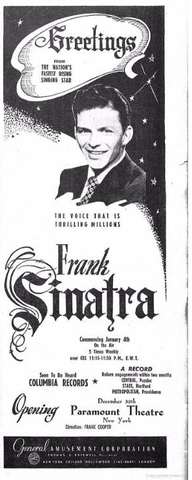
January 3, 1943
Concerts
Paramount Theatre, New York City (December 30, 1942 - January 26) w/Benny Goodman & Orchestra
Ed O'Brien:
Frank was set for a two-week engagement when he walked out on the stage, 12-30-42. The management extended his appearances an additional eight-weeks. He closed on 3-9-43. By then Goodman's band was long gone and "The Voice" was the feature attraction.
January 4, 1943
Radio
Songs By Sinatra
CBS
Monday evening
11:15 - 11:30 P.M EWT sustaining
Ed O'Brien:
The beginning of a new "Songs By Sinatra" series.
Show was on Monday thru Friday. There would be a "SBYS" show beginning October 20, 1942 thru December
26, 1943. The show would be shuttled around on both a daily and weekly basis throughout its run. There are only four shows in circulation.
note: Despite what the Billboard ad proclaimed in the 1-2-43 issue, Frank's new sustaining 15 minute show was never broadcast five nights a week. George Washington Hill, head of American Tobacco, put his foot down. George declared that it was unacceptable for the crooner to be singing on a commercial show (YHP) while appearing Monday through
Friday on a sustaining show. So "Songs By Sinatra" was cut back to Tuesday and Thursday from 10:45 p.m. to 11:00 p.m
The first show was aired on 1-5-43( Tuesday). There would be 15 shows in all with the final broadcast on Tuesday, 2-23-43.
Show was aired on WABC in N.Y.C.
Frank would comeback with this same format in the fall, beginning on 10-24-43. Show would be broadcast once a week on Sunday evening. In all there would be 10 broadcast through 12-26-43.
Ed
Concerts
Paramount Theatre, New York City (December 30, 1942 - January 26) w/Benny Goodman & Orchestra
Songs By Sinatra
Emacs!
The Daily Clintonian (Clinton, Indiana) 4 Jan 1943
Emacs!
The Knoxville News-Sentinel (Knoxville, Tennessee) 4 Jan 1943
January 5, 1943
Radio
Songs By Sinatra
Network: CBS
Location: New York City
Time: 10:45PM - 11:00PM Tuesday
Show #14
Sponsor: none (sustaining)
Musicians: Axel Stordahl, Raymond Scott, CBS Orchestra
Arrangements By: Axel Stordahl
Notes: Confirmed aired on WABC.
Concerts
Paramount Theatre, New York City (December 30, 1942 - January 26) w/Benny Goodman & Orchestra
January 6, 1943
Concerts
Paramount Theatre, New York City (December 30, 1942 - January 26, 1943) w/Benny Goodman & Orchestra
Paramount Theatre, New York City (December 30, 1942 - January 26, 1943) w/Benny Goodman & Orchestra
Variety
1-6-43
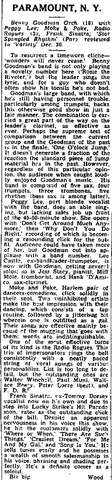
January 7, 1943
Concerts
Paramount Theatre, New York City (December 30, 42 - January 26/43) w/Benny Goodman & Orchestra
January 8, 1943
Concerts
Paramount Theatre, New York City (December 30, 1942 - January 26/43) w/Benny Goodman & Orchestra
Stage Door Canteen, New York City
Sinatra, Benny Goodman, Kate Smith, and others
Stage Door Canteen, New York City
Sinatra, Benny Goodman, Kate Smith, and others
New York Daily News, January 8, 1943
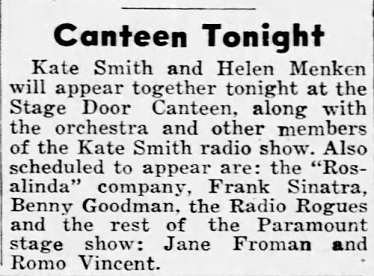
January 9, 1943
Concerts
Paramount Theatre, New York City (December 30, 1942 - January 26/43) w/Benny Goodman & Orchestra
January 10, 1943
Concerts
Paramount Theatre, New York City (December 30, 1942 - January 26/43) w/Benny Goodman & Orchestra
Radio
"Sunday Evening at Tommy Dorsey's," the Treasury Department-sponsored Blue Network broadcast, aired with Sinatra, the Pied Pipers, and Jo Stafford among the vocalists. Archivist Ed Burke notes that a Sinatra-Dorsey number recorded on this broadcast is not listed in any commercial discography; a splice combining the surviving acetates of this show and the January 17 broadcast (the January 10 disc runs short of the full length, the January 17 disc missing its first few bars) was later issued commercially. A related take from around this same period, logged for March 9, 1943 with a Jo Stafford vocal, was never released. Source: liner notes by Ed Burke, Jazz Hour JH-1013, "Tommy Dorsey and His Orchestra: 1942 War Bond Broadcast."
January 11, 1943
Concerts
Paramount Theatre, New York City (December 30, 1942 - January 26/43) w/Benny Goodman & Orchestra
January 12, 1943
Radio
Songs By Sinatra
Network: CBS
Location: New York City
Time: 10:45PM - 11:00PM Tuesday
Show #16
Sponsor: none (sustaining)
Musicians: Axel Stordahl, Raymond Scott, CBS Orchestra
Arrangements By: Axel Stordahl
Notes: Confirmed aired on WABC.
Concerts
Paramount Theatre, New York City (December 30, 1942 - January 26/43) w/Benny Goodman & Orchestra
January 13, 1943
Concerts
Paramount Theatre, New York City (December 30, 1942 - January 26/43) w/Benny Goodman & Orchestra
January 14, 1943
Radio
Songs By Sinatra
Network: CBS
Location: New York City
Time: 10:45PM - 11:00PM Thursday
Show #17
Sponsor: none (sustaining)
Musicians: Axel Stordahl, Raymond Scott, CBS Orchestra
Arrangements By: Axel Stordahl
Notes: Confirmed aired on WABC.
Concerts
Times Square, New York
United Nations Week Rally
Paramount Theatre, New York City (December 30, 1942 - January 26/43) w/Benny Goodman & Orchestra
January 15, 1943
Concerts
Paramount Theatre, New York City (December 30, 1942 - January 26/43) w/Benny Goodman & Orchestra
January 16, 1943
Concerts
Paramount Theatre, New York City (December 30, 1942 - January 26/43) w/Benny Goodman & Orchestra
January 17, 1943
Concerts
Paramount Theatre, New York City (December 30, 1942 - January 26) w/Benny Goodman & Orchestra
MGM film version featured Alice Barton and Harry Norton.
Porter dusted it off, wrote new lyrics to fit the "High Society" story.
The original was a much longer effort.
Ed
Radio
"Sunday Evening at Tommy Dorsey's" aired again on the Blue Network under Treasury Department sponsorship. This broadcast's surviving acetate is missing its opening bars; archivist Ed Burke spliced it together with the January 10 broadcast to reconstruct a fuller recording for later commercial release, since the disc ran out before the performance was complete. Source: liner notes by Ed Burke, Jazz Hour JH-1013, "Tommy Dorsey and His Orchestra: 1942 War Bond Broadcast."
January 18, 1943
Concerts
Paramount Theatre, New York City (December 30, 1942 - January 26) w/Benny Goodman & Orchestra
January 19, 1943
Radio
Songs By Sinatra
Network: CBS
Location: NewYork City
Time: 10:45PM - 11:00PM Tuesday
Show
Sponsor: none (sustaining)
Musicians: Axel Stordahl, Raymond Scott, CBS Orchestra
Arrangements By: Axel Stordahl
Notes: Confirmed aired on WABC.
Note:
The Hy Zaret collection of The Great American Songbook Foundation has the following lacquer disc:
“That's My Affair”, by Frank Sinatra, WABC, Rockhill Recording, 1/19/1943, 10:45pm. --Richard
Concerts
Paramount Theatre, New York City (December 30, 1942 - January 26) w/Benny Goodman & Orchestra
January 20, 1943
Concerts
Paramount Theatre, New York City (December 30, 1942 - January 26) w/Benny Goodman & Orchestra
January 21, 1943
Radio
Songs By Sinatra
Network: CBS
Location: NewYork City
Time: 10:45PM - 11:00PM Thursday
Show #
Sponsor: none (sustaining)
Musicians: Axel Stordahl, Raymond Scott, CBS Orchestra
Arrangements By: Axel Stordahl
Notes: Confirmed aired on WABC.
Concerts
Paramount Theatre, New York City (December 30, 1942 - January 26) w/Benny Goodman & Orchestra
January 22, 1943
Concerts
Paramount Theatre, New York City (December 30, 1942 - January 26) w/Benny Goodman & Orchestra
January 23, 1943
Concerts
Paramount Theatre, New York City (December 30, 1942 - January 26) w/Benny Goodman & Orchestra
January 24, 1943
Concerts
Paramount Theatre, New York City (December 30, 1942 - January 26) w/Benny Goodman & Orchestra
Frank Sinatra, Danny Kayes, Ray Bolber, Georgie Jessel, Gypsy Rose Lee, Vivian Vance, Clifton Webb and others
Shubert Theatre, New York City
61st Annual Benefit for The Actors' Fund of America
Frank Sinatra, Danny Kaye, Ray Bolger, Georgie Jessel, Gypsy Rose Lee, Vivian Vance, Clifton Webb and others
Shubert Theatre, New York City
61st Annual Benefit for The Actors' Fund of America
Frank Sinatra, Danny Kaye, Ray Bolger, Georgie Jessel, Gypsy Rose Lee, Vivian Vance, Clifton Webb and others
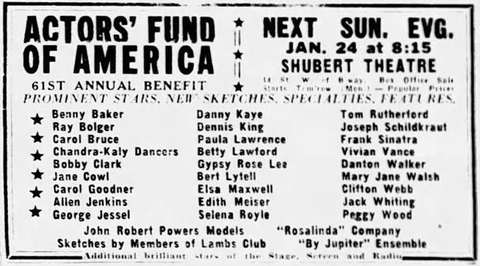
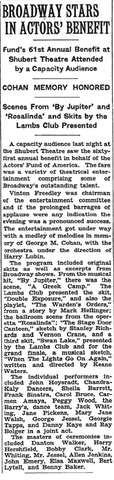
January 25, 1943
Concerts
Paramount Theatre , New York City (December 30, 1942 - January 26) w/Benny Goodman & Orchestra
January 26, 1943
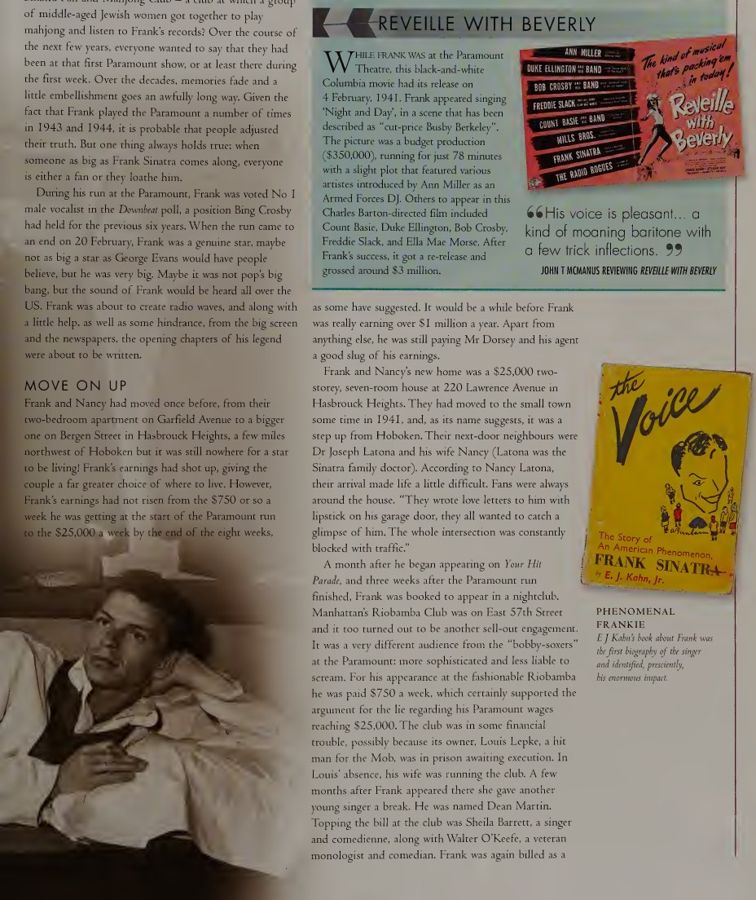
[Photograph: Frank's first solo No. 1 hit of 1943. From Richard Havers, "Sinatra" (Dorling Kindersley, 2007), p.81.]
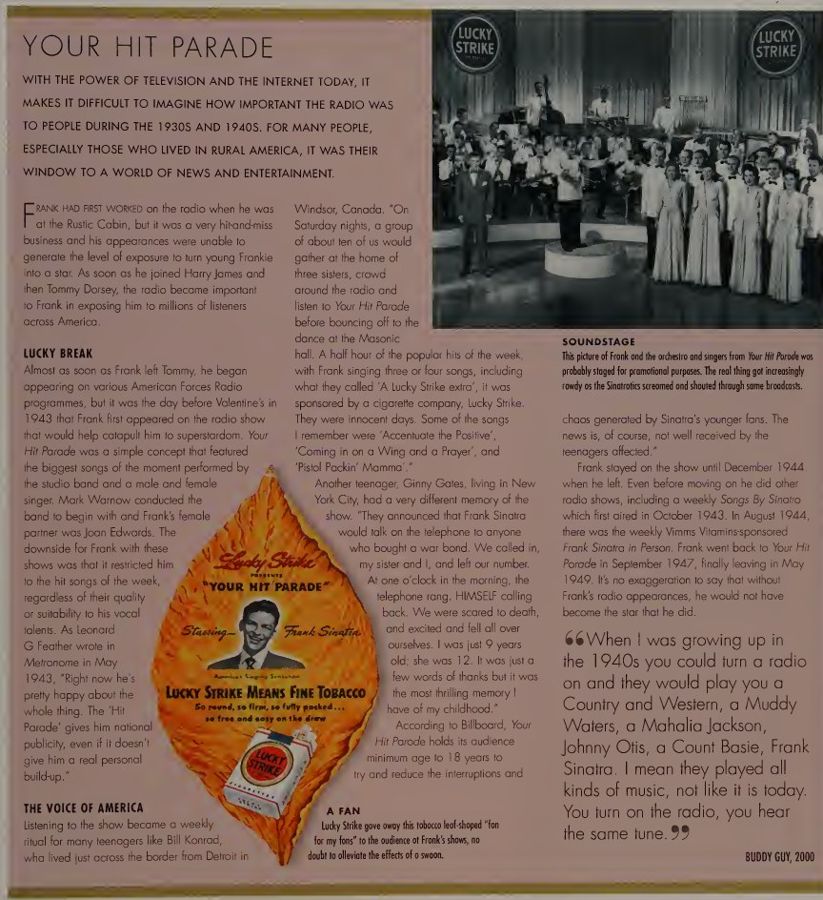
[Photograph: Frank's first solo No. 1 hit of 1943. From Richard Havers, "Sinatra" (Dorling Kindersley, 2007), p.79.]
Radio
Songs By Sinatra
Network: CBS
Location: New York City
Time: 10:45PM - 11:00PM Tuesday
Show #20
Sponsor: none (sustaining)
Musicians: Axel Stordahl, Raymond Scott, CBS Orchestra
Arrangements By: Axel Stordahl
Notes: Confirmed aired on WABC.
Concerts
Paramount Theatre , New York City (December 30, 1942 - January 26) w/Benny Goodman & Orchestra
Sinatra's Tommy Dorsey recording of 'There Are Such Things' knocked Bing Crosby's 'White Christmas' off the top of Billboard's bestseller's list on 26 January 1943, having been released back in November 1942. (Source: Richard Havers, "Sinatra" (Dorling Kindersley, 2007).)
January 27, 1943
Concerts
Paramount Theatre, New York City (Jan. 27 - Feb 20) w/Johnny Long & Orchestra
Paramount Theatre, New York City (Jan. 27 - Feb 20) w/Johnny Long & Orchestra
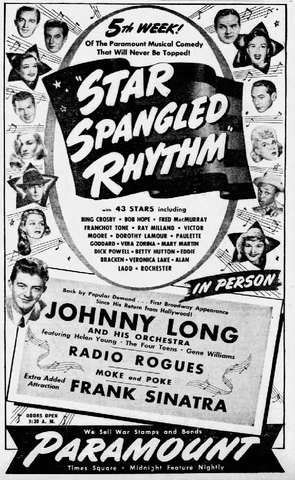
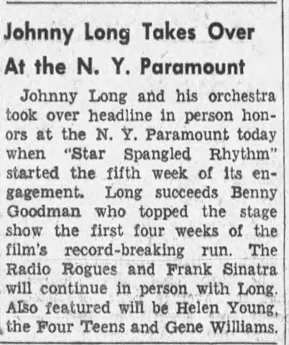
January 28, 1943
Radio
Songs By Sinatra
Network: CBS
Location: NewYork City
Time: 10:45PM - 11:00PM Thursday
Show #21
Sponsor: none (sustaining)
Musicians: Axel Stordahl, Raymond Scott, CBS Orchestra
Arrangements By: Axel Stordahl
Notes: Confirmed aired on WABC.
Concerts
Paramount Theatre, New York City (Jan. 27 - Feb 20) w/Johnny Long & Orchestra
January 29, 1943
Concerts
Paramount Theatre, New York City (Jan. 27 - Feb 20) w/Johnny Long & Orchestra
Radio
Radio: Sinatra appeared as a guest on America Salutes The President's Birthday, a commercial radio broadcast, this date, singing "Night And Day." CBS broadcast with Sammy Kaye and His Orchestra. Source: sinatradiscography.com, Radio Transcriptions Database.
January 30, 1943
Radio
America Salutes The President's Birthday
Time: 11:15 pm - 12:15
Pool Feed, NBC
Sponsor: March Of Dimes Fund Appeal
Location-Parts from: Waldorf Astoria (New York City), Great Lakes Training Station, Luke Field Arizona, Fort Des Moines, Hollywood CA, Peral Harbor Hawaii,
Performers: Basil O'Conner, The Great Lakes Band, Gene Autry, Captain Christie Mathewson, WAAC Band, Fibber McGee & Molly, Artie Shaw & Orchestra, Bing Crosby, Dick Powell, Billie Williams, Eleanor Roosevelt, Tommy Ryan, Marian Jordan, Perry Botkin (guitar), Charles Dant and His Orchestra,, Florence George, , Sammy Kaye and His Orchestra.
Announcer: Warren Cunningham
Host: Clifton Fadiman (New York)
Writers: Irving Berlin (song written for occasion), Norman Corwin, Bernard Herrmann (composer),
Arranged by Axel Stordahl (Sinatra)
1. Night And Day
note: Variety did an extensive coverage of this show. Reviewer faulted Frank for singing an over-arranged "Night And Day."
Ed
Concerts
Paramount Theatre, New York City (Jan. 27 - Feb 20) w/Johnny Long & Orchestra
America Salutes The President's Birthday
Time: 11:15 pm - 12:15
Pool Feed, NBC
Sponsor: March Of Dimes Fund Appeal
Location-Parts from: Waldorf Astoria (New York City), Great Lakes Training Station, Luke Field Arizona, Fort Des Moines, Hollywood CA, Peral Harbor Hawaii,
Performers: Basil O'Conner, The Great Lakes Band, Gene Autry, Captain Christie Mathewson, WAAC Band, Fibber McGee & Molly, Artie Shaw & Orchestra, Bing Crosby, Dick Powell, Billie Williams, Eleanor Roosevelt, Tommy Ryan, Marian Jordan, Perry Botkin (guitar), Charles Dant and His Orchestra,, Florence George, , Sammy Kaye and His Orchestra.
Announcer: Warren Cunningham
Host: Clifton Fadiman (New York)
Writers: Irving Berlin (song written for occasion), Norman Corwin, Bernard Herrmann (composer),
Arranged by Axel Stordahl (Sinatra)
1. Night And Day
note: Frank was an active supporter of the March of Dimes in 1944
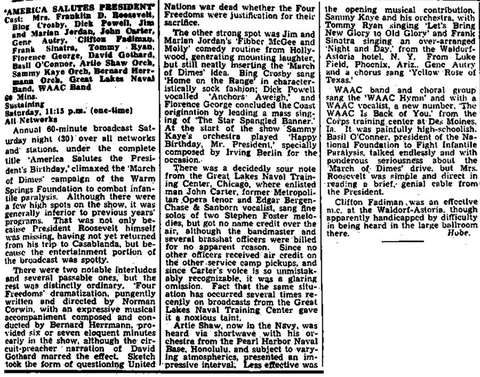
America Salutes The President's Birthday
Time: 11:15 pm - 12:15
Pool Feed, NBC
Sponsor: March Of Dimes Fund Appeal
Sinatra sings "Night And Day"
Variety
2-3-43 note: Show contains the only live Sinatra from the Waldorf in the bobbysoxer era.
January 31, 1943
Concerts
Paramount Theatre, New York City (Jan. 27 - Feb 20) w/Johnny Long & Orchestra
February 1943
[Copacabana rejects Sinatra]
Kaplan: In February 1943, Sinatra's management tried to book him into the mob-linked Copacabana nightclub, but club boss Jules Podell flatly refused, insisting Sinatra couldn't draw the way Sophie Tucker or Jimmy Durante did.
Source: James Kaplan, "Frank: The Voice" (2010)
[Riobamba billing flips in Sinatra's favor]
Kaplan: Within a week of his Riobamba opening, Sheila Barrett quit rather than be billed under Sinatra, and Walter O'Keefe soon followed, publicly ceding the marquee and calling Sinatra "the rightful star"; Sinatra's pay was doubled and his engagement extended.
Source: James Kaplan, "Frank: The Voice" (2010)
[Riobamba opening night triumph]
Earl Wilson: Terrified on opening night at the intimate Riobamba, Sinatra appeared in a tuxedo (instead of his Paramount suit) and, though visibly shaking, won over the sophisticated crowd with "She's Funny That Way" and "Night and Day," per columnist Earl Wilson's account for the New York Post.
Source: James Kaplan, "Frank: The Voice" (2010)
[Sinatra opens at the Riobamba]
Kaplan: Unable to land the Copacabana, Sinatra's team booked him into the smaller, financially struggling Riobamba club on East 57th Street for a cut-rate $750 a week, billed as "Specially Added" beneath comedian Walter O'Keefe and singer Sheila Barrett.
Source: James Kaplan, "Frank: The Voice" (2010)
February 1, 1943
Concerts
Paramount Theatre, New York City (Jan. 27 - Feb 20) w/Johnny Long & Orchestra
February 2, 1943
Radio
Songs By Sinatra
Network: CBS
Location: New York City
Time: 10:45PM - 11:00PM Tuesday
Show
Sponsor: none (sustaining)
Musicians: Axel Stordahl, Raymond Scott, CBS Orchestra
Arrangements By: Axel Stordahl
Notes: Confirmed aired on WABC.
Concerts
Paramount Theatre, New York City (Jan. 27 - Feb 20) w/Johnny Long & Orchestra
February 3, 1943
Concerts
Paramount Theatre, New York City (Jan. 27 - Feb 20) w/Johnny Long & Orchestra
February 4, 1943
Radio
Songs By Sinatra
Network: CBS
Location: New York City
Time: 10:45PM - 11:00PM Thursday
Show
Sponsor: none (sustaining)
Musicians: Axel Stordahl, Raymond Scott, CBS Orchestra
Arrangements By: Axel Stordahl
Notes: Confirmed aired on WABC.
Film
"Reveille with Beverly" (US Film Release: February 4, 1943)
Starring: Ann Miller, William Wright, Dick Purcell, Franklin Pangborn, Tim Ryan
The film featured a number of notable guest appearances by such important big band era musicians as Duke Ellington, Count Basie, Frank Sinatra, The Mills Brothers, Bob Crosby, Freddie Slack, and Ella Mae Morse. Produced by Sam White and Directed by Charles Barton
Ann Miller plays Beverly Ross who wants to be a radio personality, but has to run the switchboard at a local station. The blustery station owner Mr. Kennedy (Tim Ryan) wants no part of programming the "jive that she loves", preferring the classics. She sends the pompous early-morning personality Vernon Lewis (Franklin Pangborn) away for a vacation, so she can transform his dull classical-music program into a jive session. She invites suggestions and requests, and is swamped by mail from soldiers. She now devotes her show to the military, and the program becomes a success as "Reveille with Beverly."
Note: Sinatra appears in black tux with white tie and gloves with an all-female orchestra and sings "Night and Day"
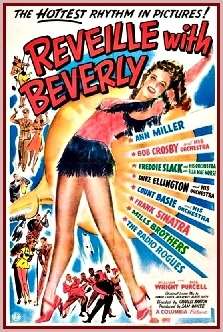
Concerts
Paramount Theatre, New York City (Jan. 27 - Feb 20) w/Johnny Long & Orchestra
"Reveille with Beverly" (US Film Release: February 4, 1943)
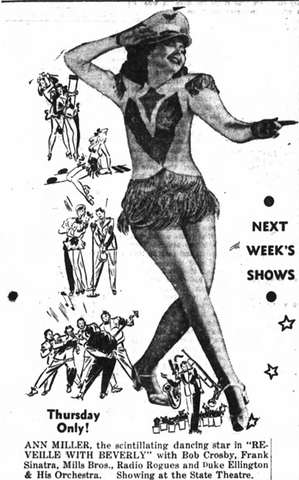
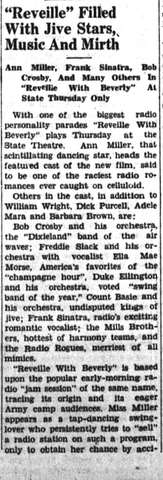
"Reveille with Beverly"
After finally winning his release from Dorsey, Sinatra tried to land a solo singing job on NBC radio in Hollywood. When that fell through, he settled for a cameo in the low-budget Columbia musical Reveille with Beverly, accepting the small role partly because a recording-industry strike had shut down the studios anyway.
Source: Tom Santopietro, "Sinatra in Hollywood" (2008).
"Reveille with Beverly"
Sinatra's cameo in Reveille with Beverly initially drew little notice, but after his sensational solo debut at the Paramount Theater in New York City on December 30, 1942 sparked nationwide 'Sinatramania,' the film was rereleased and became a box-office smash, eventually grossing about $3 million.
Source: Tom Santopietro, "Sinatra in Hollywood" (2008).
"Reveille with Beverly"
Santopietro (citing Rosemary Clooney): Santopietro notes that future singer Rosemary Clooney, then a Sinatra-obsessed teenager, later admitted to seeing Reveille with Beverly at least seventeen times.
Source: Tom Santopietro, "Sinatra in Hollywood" (2008).
"Reveille with Beverly"
Sinatra was paid just $1,000 for his one-song cameo in the 78-minute Reveille with Beverly, a film whose entire production budget totaled only about $330,000.
Source: Tom Santopietro, "Sinatra in Hollywood" (2008).
"Reveille with Beverly"
The film's billing reveals its true priorities: bandleaders like the top-billed Bob Crosby, plus Duke Ellington and Count Basie, received screen credit ahead of any of the film's actual actors.
Source: Tom Santopietro, "Sinatra in Hollywood" (2008).
"Reveille with Beverly"
About halfway through Reveille with Beverly, Sinatra appears in top hat and tails to sing Cole Porter's 'Night and Day' amid an all-female orchestra. Santopietro compares the romantic effect to Fred Astaire 'making love' to Ginger Rogers through dance, arguing Sinatra achieved the same seductive effect purely through song.
Source: Tom Santopietro, "Sinatra in Hollywood" (2008).
"Reveille with Beverly" unnamed contemporary reviewer (quoted by Santopietro): Most contemporary critics dismissed Reveille with Beverly outright and barely covered Sinatra's contribution. One exception offered what Santopietro calls a wrongheaded review, describing Sinatra as a 'slight young man' given to 'zombie mannerisms' and a 'moaning baritone,' while noting his teenage fans went into a frenzy at his slightest gesture.
Source: Tom Santopietro, "Sinatra in Hollywood" (2008).
"Reveille with Beverly"
Santopietro grades this a C: "FS as himself; wacky, one song."
Source: Tom Santopietro, "Sinatra in Hollywood" (2008).
"Reveille with Beverly"
Santopietro (Filmography): Columbia Pictures. Produced by Sam White, directed by Charles Barton, written by Albert Duffy, Howard J. Green and Jack Henley. Sinatra appeared as himself alongside Ann Miller, Count Basie and Duke Ellington, performing 'Night and Day.'
Source: Tom Santopietro, "Sinatra in Hollywood" (2008).
February 5, 1943
Concerts
Paramount Theatre, New York City (Jan. 27 - Feb 20) w/Johnny Long & Orchestra
February 6, 1943
Concerts
Paramount Theatre, New York City (Jan. 27 - Feb 20) w/Johnny Long & Orchestra
February 7, 1943
Concerts
Paramount Theatre, New York City (Jan. 27 - Feb 20) w/Johnny Long & Orchestra
February 8, 1943
Concerts
Paramount Theatre, New York City (Jan. 27 - Feb 20) w/Johnny Long & Orchestra
February 9, 1943
Radio
Songs By Sinatra
Network: CBS
Location: New York City
Time: 10:45PM - 11:00PM Tuesday
Show #24
Sponsor: none (sustaining)
Musicians: Axel Stordahl, Raymond Scott, CBS Orchestra
Arrangements By: Axel Stordahl
Notes: Confirmed aired on WABC.
Concerts
Paramount Theatre, New York City (Jan. 27 - Feb 20) w/Johnny Long & Orchestra
February 10, 1943
Concerts
Paramount Theatre, New York City (Jan. 27 - Feb 20) w/Johnny Long & Orchestra
February 11, 1943
Radio
Songs By Sinatra
Network: CBS
Location: New York City
Time: 10:45PM - 11:00PM Thursday
Show #25
Sponsor: none (sustaining)
Musicians: Axel Stordahl, CBS Orchestra
Arrangements By: Axel Stordahl
Notes: Confirmed aired on WABC.
note: Raymond Scott was not involved with this show. I checked a number of bios and tributes. Scott backed Frank on "Broadway Bandbox." There isn't a lot known about "Songs By Sinatra" from 1942 into early 1943. Axel Stordahl was the arranger/conductor for the fall version of the show in 1943. I think he was also the leader of the earlier shows and the Bobby Tucker Singers were probably on board. They were on the half-hour "Reflections" series in the fall of 42 with Frank. Walter Gross oversaw the orchestral chores on that show. They were all sustaining broad- casts.
Ed
Concerts
Paramount Theatre, New York City (Jan. 27 - Feb 20) w/Johnny Long & Orchestra
Songs By Sinatra
Network: CBS
Location: New York City
Time: 10:45PM - 11:00PM Thursday
Show #25
Sponsor: none (sustaining)
Musicians: Axel Stordahl, CBS Orchestra
Arrangements By: Axel Stordahl
Notes: Confirmed aired on WABC.
note: There is very little known about "Songs By Sinatra" from the fall of 1942 into late February of 43. I have posted infor- mation on the "Reflection" series but until now I have been unable to find a thing on "SBS." Well, "seek and ye shall find."
Walter Gross and orch. backed Frank on both series. There is no mention of the Bobby Tucker Singers on "SBS." I found a full page ad and two articles confirming the orch.
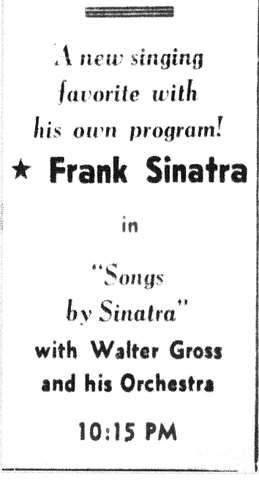
February 12, 1943
Concerts
Paramount Theatre, New York City (Jan. 27 - Feb 20) w/Johnny Long & Orchestra
February 13, 1943
Radio
Your Hit Parade
Network: CBS
Program #404
Time: 9:00-9:45 P.M. (Rebroadcast February 14, 1943 12:00-12:45 A.M.)
Sponsor: Lucky Strike
1. Dearly Beloved (10) - orchestra
2. Rose Ann Of Charing Cross (6) - Sinatra
3. Why Don't You Fall In Love With Me (5) - Edwards
4. Tico Tico - Ethel Smith
5. commercial
6. You'd Be So Nice To Come Home To (4) - Hit Paraders
7. When The Lights Go On Again (7) - Sinatra
8. Parade Of The Wooden Soldiers - Ethel Smith
9. Brazil (8) - Edwards & Hit Paraders
10. Moonlight Mood (9) - Sinatra
11. station break
12. Anything Goes - Ethel Smith
13. commercial
14. Moonlight Becomes You (3) - Hit Paraders
15. I Had The Craziest Dream (2) - Edwards
16. There Are Such Things (1) – Sinatra
Notes: This is Sinatra first solo appearance on Your Hit Parade. This document shows the announcement made by Barry Wood on February 6, 1943 show announcing Sinatra as the new regular male vocalist starting February 13, 1943
Ed notes: Would love to hear Frank singing "When The Lights Go On Again."
Concerts
Paramount Theatre, New York City (Jan. 27 - Feb 20) w/Johnny Long & Orchestra
Extra: Frank Sinatra appeared on the state of the Central Theater in Patterson, New Jersey in a Victory Show with the Pied Pipers. The show started at 1:15 a.m. which would have made the show February 14, 1943
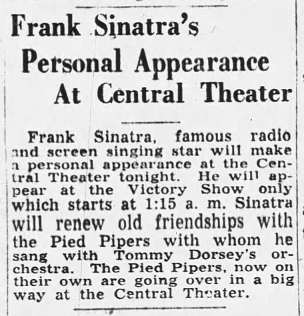
Your Hit Parade
Network: CBS
Program #404
Time: 9:00-9:45 P.M. (Rebroadcast February 14, 1943 12:00-12:45 A.M.)
Sponsor: Lucky Strike
Variety
2-17-43
Honolulu Star Bulletin
2-13-43
note: There was very little coverage of Frank's first solo appearance on YHP. Quite a few papers still listed Barry Wood, a few had Frank, but most did not any one.
Ed
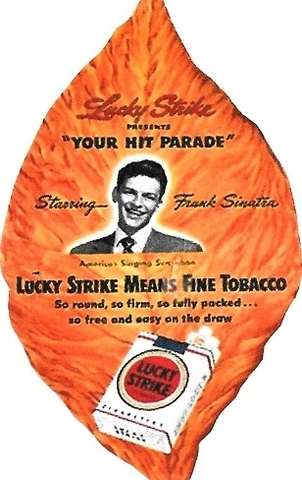
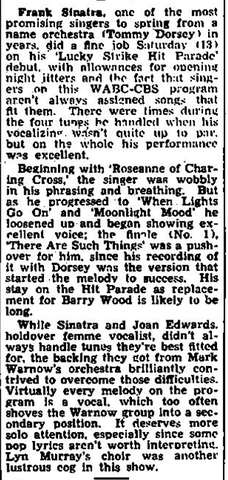
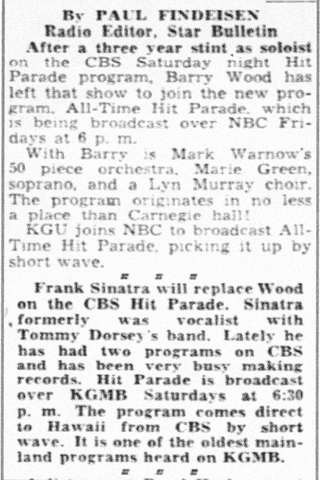
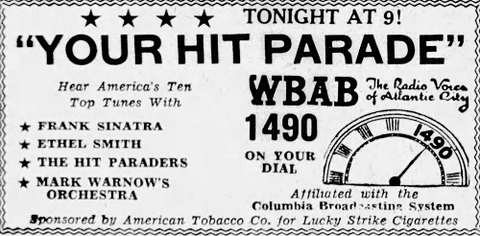
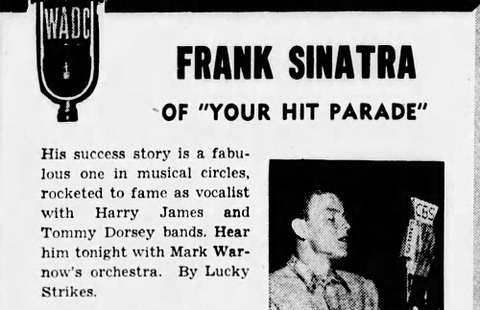
February 14, 1943
Concerts
Paramount Theatre, New York City (Jan. 27 - Feb 20) w/Johnny Long & Orchestra
February 15, 1943
Concerts
Paramount Theatre, New York City (Jan. 27 - Feb 20) w/Johnny Long & Orchestra
February 16, 1943
Radio
Songs By Sinatra
Network: CBS
Location: NewYork City
Time: 10:45PM - 11:00PM Tuesday
Show #26
Sponsor: none (sustaining)
Musicians: Axel Stordahl, CBS Orchestra
Arrangements By: Axel Stordahl
Notes: Confirmed aired on WABC. note: The ads show Walter Gross and his orchestra
Stordahl did the series in the fall of 1943.
Ed
Concerts
Paramount Theatre, New York City (Jan. 27 - Feb 20) w/Johnny Long & Orchestra
February 17, 1943
Concerts
Paramount Theatre, New York City (Jan. 27 - Feb 20) w/Johnny Long & Orchestra
February 18, 1943
Radio
Songs By Sinatra
Network: CBS
Location: NewYork City
Time: 10:45PM - 11:00PM Thursday
Show #27
Sponsor: none (sustaining)
Musicians: Axel Stordahl, Raymond Scott, CBS Orchestra
Arrangements By: Axel Stordahl
Notes: Confirmed aired on WABC.
Concerts
Paramount Theatre, New York City (Jan. 27 - Feb 20) w/Johnny Long & Orchestra
February 19, 1943
Concerts
Paramount Theatre, New York City (Jan. 27 - Feb 20) w/Johnny Long & Orchestra
February 20, 1943
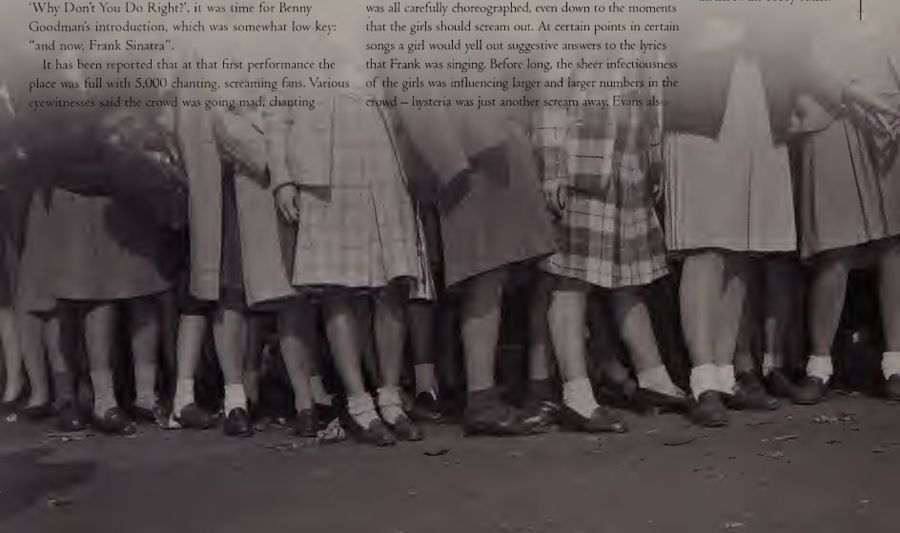
[Photograph: Extended Paramount run ends; Frank crowned Downbeat's top vocalist. From Richard Havers, "Sinatra" (Dorling Kindersley, 2007), p.77.]
Radio
Your Hit Parade
Network: CBS
Program #405
Time: 9:00-9:45 P.M. (Rebroadcast February 21, 1943 12:00-12:45 A.M.)
Sponsor: Lucky Strike
1. Why Don't You Fall In Love With Me (5) - Edwards
2. I've Heard That Song Before (4) - Sinatra
3. Moonlight Becomes You (6) - Hit Paraders
4. Liza - Ethel Smith
5. commercial
6. Rose Ann Of Charing Cross (9) - Sinatra
7. I Had The Craziest Dream (7) - Edwards
8. Praoaleden Eleven - Ethel Smith
9. For Me And My Gal (10) - Hit Paraders
10. When The Light Go On Again (8) - Sinatra
11. station break
12. Why - Ethel Smith
13. commercial
14. You'd Be So Nice To Come Home To (3) - Hit Paraders
15. Brazil (2) - Edwards & Hit Paraders
16. There Are Such Things (1) - Sinatra
Concerts
Paramount Theatre, New York City (Jan. 27 - Feb 20) w/Johnny Long & Orchestra
Sinatra's originally four-week Paramount run, extended to eight weeks after Benny Goodman moved on to another booking, ended on 20 February 1943. During the run Frank was voted No. 1 male vocalist in the Downbeat poll, a title Bing Crosby had held for six straight years. (Source: Richard Havers, "Sinatra" (Dorling Kindersley, 2007).)
February 21, 1943
Radio
News From Home
1. There Are Such Things
Notes: An Office of War Information recording labelled Feb. 21, 1943, LOC has 10-inch sound reel TT:30mins.
note: I thought, at first, this was probably the recording done with Dorsey. The song was released in early November of 1942 and charted for 26 weeks. It was #1 for 8 consecutive weeks. But then I did some research on the AFRS series "News From Home." The half-hour program featured live performances by actors and singers and also offered the latest news from the states. A very good chance Frank made an appearance.
Here is the LOC entry. Library has 516 broadcasts of News From Home. Ed
Date
Recording : 02/21/1943
Medium
Radio recording, not necessarily broadcast
Broadcast Series
Yes
Recording Note
An Office of War Information recording labeled Feb. 21, 1943.
Summary
Includes Frank Sinatra singing "There Are Such Things."
Genre(s)
News--Radio
Name(s)
Sinatra, Frank, 1915-. (performer)
Physical Item
LWO 5554 GR19 2A7-B1. 1 sound reel : 7.5ips, double-track ; 10-inch, 1/4-inch
February 23, 1943
Radio
Songs By Sinatra
Network: CBS
Location: New York City
Time: 10:45PM - 11:00PM Tuesday
Show #28
Sponsor: none (sustaining)
Musicians: Axel Stordahl, CBS Orchestra
Arrangements By: Axel Stordahl
Notes: Confirmed aired on WABC.
February 25, 1943
Radio
Songs By Sinatra
Network: CBS
Location: New York City
Time: 10:45PM - 11:00PM Thursday
Show #29
Sponsor: none (sustaining)
Musicians: Axel Stordahl, CBS Orchestra
Arrangements By: Axel Stordahl
Notes: Last show of series. Mary Small, Songs take over time slot for both nights following week.. Confirmed aired on WABC.
Show was most likely syndicated as listings on various station show up as late as mid March 43'
February 27, 1943
Radio
Your Hit Parade
Network: CBS
Program #406
Time: 9:00-9:45 P.M. (Rebroadcast February 21, 1943 12:00-12:45 A.M.)
Sponsor: Lucky Strike
Arranged by: Axel Stordahl
Conducted by: Mark Warnow
1. Why Don't You Fall In Love With Me (8) - Hit Paraders
2. Moonlight Becomes You (4) - Sinatra
3. Brazil (6) - Edwards & Hit Paraders
4. Just One Of Those Things - Ethel Smith
5. commercial
6. For Me And My Gal (7) - Sinatra
7. Moonlight Mood (6) Edwards
8. Begin The Beguine - Ethel Smith
9. I Had The Craziest Dream (9) - Hit Paraders
10. Black Magic (10) - Sinatra
11. station break
12. Medley: Somebody Loves Me / S'Wonderful /
Embraceable You - Ethel Smith
13. commercial
14. I've Heard That Song Before (3) - Sinatra
15. You'd Be So Nice To Come Home To (2) - Hit Paraders
16. There Are Such Things (1) - Edwards
Ed O'Brien notes:
Somewhere along the way Sinatra sang every song listed above except "Why Don't You Fall In Love With
Me."
"Begin the Beguine"
Sinatra attempted Cole Porter's imposing 108-bar "Begin the Beguine" as early as late 1943 on radio in a four-and-a-half-minute arrangement that drags; by summer 1944 he had a near-perfect radio reading, romantic and swinging at once. The 1946 Columbia studio version is judged inferior because the label, unwilling to press another twelve-inch disc, forced Stordahl and Sinatra to speed the tempo to fit a ten-inch 78 -- it still charted and became a recurring radio-years signature.
Source: Will Friedwald, "Sinatra! The Song Is You: A Singer's Art" (2018 revised edition).
March 1943
[Frank's party at Patsy's; Dolly's 'bum' remark]
Consiglio: Near the end of his Paramount run in March 1943, Frank threw a celebratory dinner for friends and family at Patsy's Restaurant, where his mother Dolly teased Consiglio for wanting to sit beside Frank, calling them both "bums." Frank comforted a hurt Consiglio afterward, telling him not to take her seriously and that "every knock is a boost."
Source: Tony Consiglio (as told to Franz Douskey), "Sinatra and Me: The Very Good Years" (2012)
March 6, 1943
Radio
Your Hit Parade
Network: CBS
Program #407
Time: 9:00-9:45 P.M. (Rebroadcast March 7, 1943 12:00-12:45 A.M.)
Sponsor: Lucky Strike
1. I Had The Craziest Dream (6) - Hit Paraders
2. There Are Such Things (4) - Sinatra
3. Moonlight Mood (8) - Edwards
4. Hallelujah - Ethel Smith
5. commercial
6. Taking A Chance On Love (10) - Edwards
7. Moonlight Becomes You (5) - Sinatra
8. In An 18th Century Drawing Room - Ethel Smith
9. Why Don't You Fall In Love With Me (9) - Hit Paraders
10. That Old Black Magic (7) - Sinatra & Hit Paraders
11. station break
12. Siboney - Ethel Smith
13. commercial
14. You'd Be So Nice To Come Home To (3) Hit Paraders
15. I've Heard That Song Before (2) - Sinatra
16. Brazil (1) - Edwards & Hit Paraders
Notes: Sinatra was to have sung "Taking A Chance On Love" with the Hit Paraders but switched to "Moonlight Becomes You."
The Hit Paraders were then added with Sinatra on "That Old Black Magic."
March 8, 1943
Radio
Four To Go
Location: New York City
Network: CBS
Time: 7:00PM - 7:15PM (EST)
Cross & Dunn; Frank Sinatra, Herb Shriner, Josephine Tumania
Notes: Confirmed aired on WABC. Listed as a variety program.
Concerts
Four To Go
Location: New York City
Network: CBS
Time: 7:00PM - 7:15PM (EST)
Cross & Dunn; Frank Sinatra, Herb Shriner, Josephine Tumania
Notes: Confirmed aired on WABC. Listed as a variety program.
I could not find a review of the episode with Sinatra but did find the following article about Four To Go program:
[image referenced in source but could not be recovered]
Four To Go
Location: New York City
Network: CBS
Time: 7:00PM - 7:15PM (EST)
Cross & Dunn; Frank Sinatra, Herb Shriner, Josephine Tumania
Notes: Confirmed aired on WABC. Listed as a variety program.
I could not find a review of the episode with Sinatra but did find the following article about Four To Go program:
March 9, 1943
Concerts
Manhattan Beach Coast Guard Training Station, New York
The Brooklyn Daily Eagle (Brooklyn, New York) - March 9, 1943
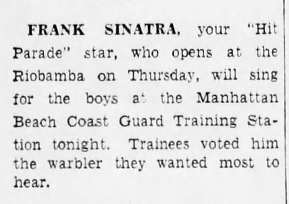
March 11, 1943
Concerts
Rio Bamba Club, New York City (March 11-April 6)
Nat Brandwynne's Orchestra
Also appearing:
Walter O'Keefe
Sheila Barrett
The Cerney Twins
Russell Patterson Magazine Girls
Rio Bamba Club, New York City (March 11-April 6)
AT THE RIOBAMBA FRANK SINATRA. WITH HAIR MUSSED AND SHIRTFRONT BULGING, SINGS "AS TIME GOES BY" INTO THE MICROPHONE. IT IS HIS MOST POPULAR NUMBER
NIGHT CLUB REVIEW
RIOBAMBA
SHEILA BARRETT, WALTER O'KEEFE,
FRANK SINATRA, MAGAZIINE CAREER
GIRLS, CERNEY TWINS, NAT BRAND-
WYNNE'S ORCHESTRA, CHAVEZ RHUMBA
BAND.
PRODUCED BY RUSSELL PATTERSON
DANCE NUMBERS BY DOROTHY FOX
MUSIC BY IRVING GRAHAM
COVER $2.50
The new show at this classiest site marks the
entry into a new field for Frank Sinatra, ex-orch-
estra vocalist, now also on the Lucky Strike Hit
Parade, CBS sustaining, doubling into theatres,
etc. Since Sinatra severed relations with Tommy
Dorsey's band, his rise has been swift. The recept-
ion accorded his opening night here unquestionably
makes it clear that what he has to offer is as strong
for Park Avenue as it is among the Tenth Avenue
dime lunchtime set.
Sinatra was suffering from a bad case of jitters open-
night. His first tune, "Where Or When," made it appar-
ent, but, as usual, he began hitting on all eight the
second and third numbers and wound up doing some
seven tunes, a lot of solo melody anywhere. He uses
to advantage the same tunes which click on theatre dates
including "She's Funny That Way," "The Song Is You,"
"There Are Such Things," etc., and kept the room com-
pletely stilled. In view of his progress the last couple of
months, it is hardly necessary to point out that this guy
is going places fast. He's got the equipment.
Nat Brandywynne's orchestra does a capable job behind
the show and for dancing. And Chavez rhumba combination
smoothly changes the terp pace.
Wood
Variety
March 17, 1943
note:Sinatra received third spot on the billing.He had graduated
to the big leagues.and knew this was his moment. The New York
jet set crowd was a tough audience. Scribes, who covered opening
night, observed the singer's lips actually trembling as he entered
the room. The stars of the show, Sheila Barrett and Walter O'Keefe,
didn't know what hit them. The midnight show, opening night, had
a line three deep waiting to get in to see "The Voice." The first week-
end the demand far exceeded the capacity of the room. Only the
three headliners were able to perform. There was not enough room
for the others performers to do their acts. Frank had dreamed of
playing a major nightclub in the Big Apple. His first choice was the
Copa, but there was little interest from that legendary nightspot.
The Riobamba took a chance that the phenomenon of the bobby-
soxer idol would translate to an older, more sophisticated and much
wealthier clientele. They signed Frank to a two week contract at
$750.00 a week. Sheila Barrett left the show after the first week.
She had been a club headliner for a while and wasn't about to play
second banana. Walter O'Keefe stayed around a little longer, but
he also graciously bowed out, citing the star power and overwhelm-
ing demand for Mr. Sinatra. Frank would be rewarded by the club
with sizable salary increases throughout his almost eight-week
run at the club. The last month of his run he was paid $1,500.00
per week. The SRO demand never waned throughout his stay.
Bea Wain, later the distaff vocalist on the Hit Parade, opened
on the fifth of May. Frank was now brimming with confidence
and the offers to play theatres and clubs, in major cities, were
far more than any singer could possibly fulfill.
--Ed
Billboard
March 27, 1943
© 1997-2026 The Sinatra Archive
This calendar, or any parts thereof, may not be reproduced in any fashion
whatsoever without the prior written permission of the publisher (The
Sinatra Archive)
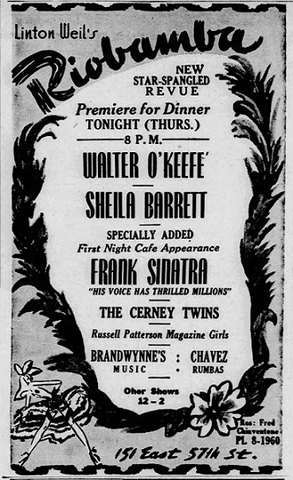
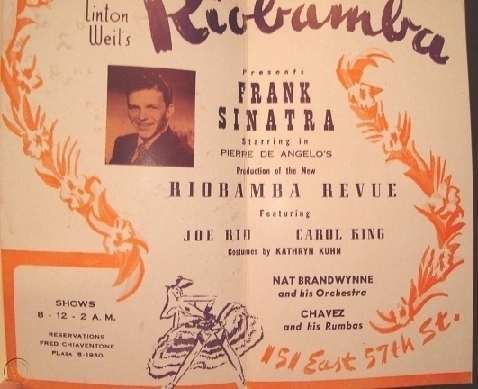
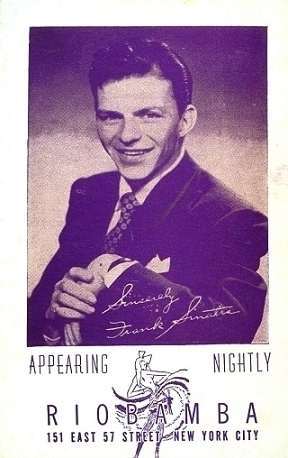
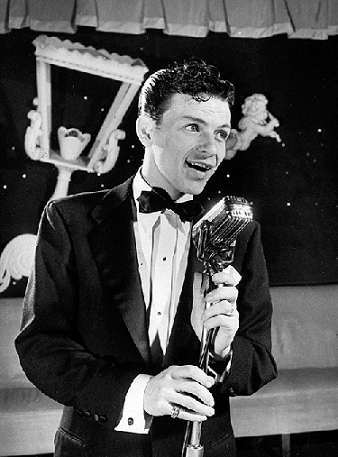
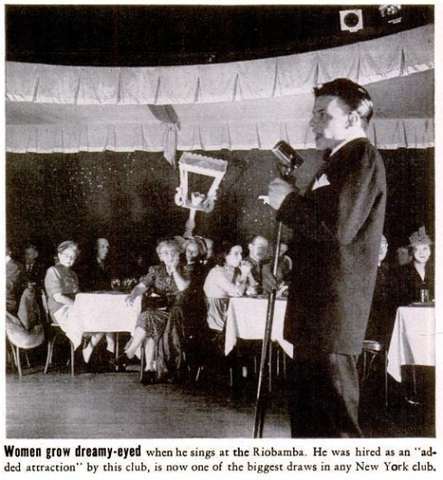
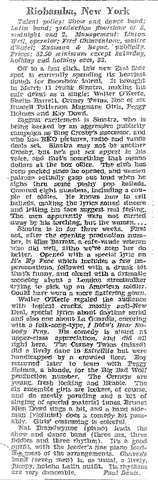
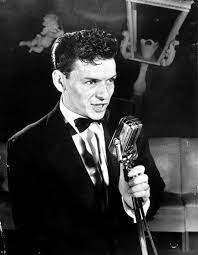
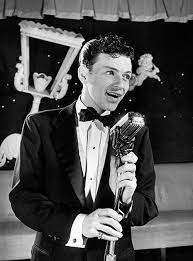
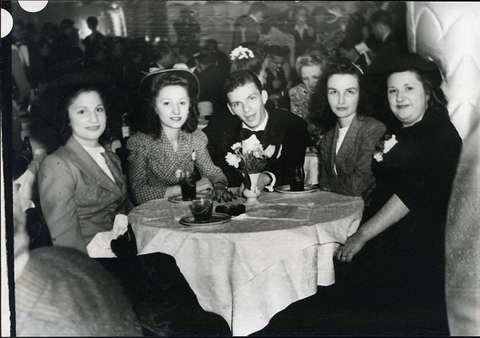
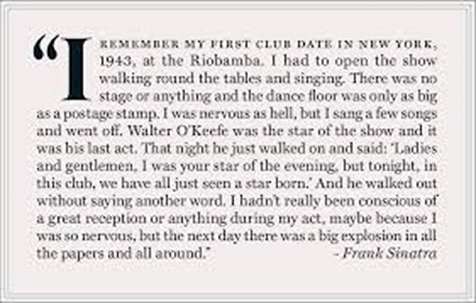
Frank Sinatra opened at the Riobamba, a Manhattan supper club, after the more prestigious Copacabana passed on booking him, its manager unconvinced he could draw an adult crowd beyond his teenage fan base. Despite being billed only as an “Extra Added Attraction” at a club reportedly close to failing, the engagement was a turning point: songwriter Sammy Cahn recalled the sophisticated, late-night Riobamba crowd — not bobby-soxers — responding to Sinatra just as strongly, proof his appeal wasn't limited to screaming teenagers. Source: J. Randy Taraborrelli, Sinatra: Behind the Legend.
March 12, 1943
Radio
Mauriello vs. Blivins For Heavyweigh 10-Rounder
Location: Madison Square Garden, New York City
Performers: Frank Sinatra, Mayor Walker (speech), Barney Ross (receives Neil Award)
1. The Marine's Corps Hymn "Halls of Montezuma"
2. National Anthem
Notes: LOC has 10-inch sound reel 15mins. One part missing.
NOTE: Ed O'Brien explains it was a 10 rounder and Blivins won the decision. Frank owned a piece of Mauriello.
Mauriello was a good fighter but his opponent, Jimmy Bivins, from Cleveland, was a near great. Bivens fought the best light heavyweights of his time, often beating them. He scored wins over Archie Moore( 6th round ko), Ezzard Charles and Joey Maxim. All three would go on to be champions. Mauriello lost twice to Bivins. Frank singing the Marine Hymn and the Star Spangled Banner was the real highlight of that radio broadcast.
Concerts
Rio Bamba Club, New York City (March 11-May 4)
Nat Brandwynne's Orchestra
Also appearing: Walter O'Keefe, Sheila Barrett,
The Cerney Twins, Russell Patterson Magazine Girls
Mauriello vs. Blivins For Heavyweigh 10-Rounder
Location: Madison Square Garden, New York City
Performers: Frank Sinatra, Mayor Walker (speech), Barney Ross (receives Neil Award)
Note at the bottom: "Frank Sinatra, noted radio singer, will sing the National Anthem on tonight's program."
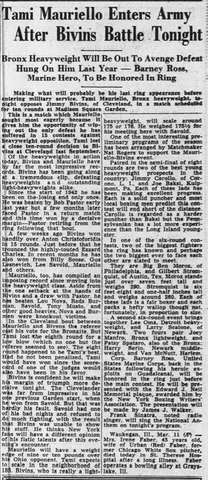
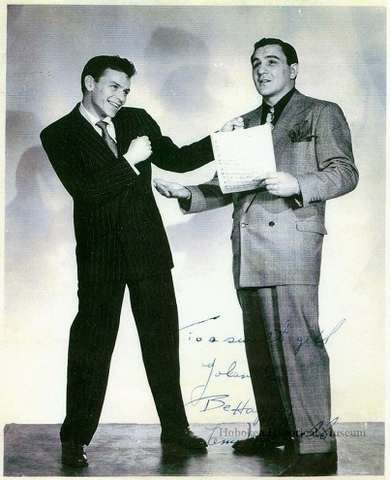
March 13, 1943
Radio
Your Hit Parade
Network: CBS
Program #408
Time: 9:00-9:45 P.M. (Rebroadcast March 14, 1943 12:00-12:45 A.M.)
Sponsor: Lucky Strike
Script (third revision & final as Broadcast version)
1, Why Don't You Fall In Love With Me (10) - Hit Paraders
2. Moonlight Becomes You (6) - Sinatra
3. Taking A Chance On Love (8) - Edwards
4. Limehouse Blues - Ethel Smith
5. commercial
6. There Are Such Things (4) - Sinatra
7. For Me And My Gal (9) - Hit Paraders
8. Medley: Bim Bam Bim / My Shawl - Ethel Smith
9. I Had The Craziest Dream (7) - Edwards
10. The Old Black Magic (5) - Sinatra & Hit Paraders
11. station break
12. Rosalie - Ethel Smith
13. commercial
14. You'd Be So Nice To Come Home To (3) - Hit Paraders
15. I've Heard That Song Before (2) - Sinatra
16. Brazil (1) - Edwards & Hit Paraders
Concerts
Rio Bamba Club, New York City (March 11-May 4)
Nat Brandwynne's Orchestra
Also appearing: Walter O'Keefe, Sheila Barrett,
The Cerney Twins, Russell Patterson Magazine Girls
March 14, 1943
Concerts
Rio Bamba Club, New York City (March 11-May 4)
Nat Brandwynne's Orchestra
Also appearing: Walter O'Keefe, Sheila Barrett,
The Cerney Twins, Russell Patterson Magazine Girls
March 15, 1943
Concerts
Rio Bamba Club, New York City (March 11-May 4)
Nat Brandwynne's Orchestra
Also appearing: Walter O'Keefe, Sheila Barrett,
The Cerney Twins, Russell Patterson Magazine Girls
March 16, 1943
Concerts
Riobamba Club, New York City (March 11 - May 4)
10 week engagment
3 shows a night
Nat Brandwynne's Orchestra
Also appearing: Walter O'Keefe, Sheila Barrett,
The Cerney Twins, Russell Patterson Magazine Girls
Songs sang during the engagement:
You'd Be So Nice to Come Home To
That Old Black Magic
Night and Day
Where or When
Embraceable You
I Only Have Eyes For You
The Song Is You
As Time Goes By
Imagination (not verified)
Riobamba Club, New York City (March 11 - May 12)
10 week engagement
3 shows a night
Nat Brandwynne's Orchestra
Billboard March 27, 1943
Riobamba, New York
Talent policy: Show and dance band;
Latin band; production. floorshow at 8, midnight and 2. Management: Linton
Weil, operator; Fred Chlaventone, maitre d'hotel; Zussman & Bayne, publicity..
Prices: $2.50 minimum except Saturday, holiday and holiday eves, $3.
Off to a fast click, this new East Side spot is currently spending its heaviest dough for floorshow talent. It brought in March 11 Frank Sinatra, making his cafe debut as a single: Walter O'Keefe,
Sheila Barrett, Carney Twins, line of six
Russell Patterson Magazine Girls, Peggy
Holmes and Ray Dowd.
Biggest excitement is Sinatra, who is being backed by an aggressive publicity campaign as Bing Crosby's successor, and who has RK0 pictures, radio and vehicle deals set. Sinatra may not be another
Crosby, but he's got sex appeal In his voice, and that's something that means dollars at the box office. The club has been packed since he opened, and women patrons actually gasp out loud when he sighs thru some pushy pop ballads.
Crooned eight numbers, including a couple of oldies.
He knows how to sell ballads, making the lyrics sound sincere and letting his face suggest real feeling.
The men apparently were not carried away by his torching, but the women. . ..
Sinatra is in for three weeks. .
Nat Brandwynne (piano) leads the show and dance band (three sax, three fiddles and three rhythm). It's a good ---,outfit, with the leader's tine piano leadilng most of the arrangements.
Chavez's band" (seven men) is, as usual, a lively, jumpy; hotcha Latin outfit. Its rhythms are very danceable.
--Paul Denis.
March 17, 1943
Concerts
Riobamba Club, New York City (March 11 - May 4)
10 week engagment
3 shows a night
Nat Brandwynne's Orchestra
Also appearing: Walter O'Keefe, Sheila Barrett,
The Cerney Twins, Russell Patterson Magazine Girls
Songs sang during the engagement:
You'd Be So Nice to Come Home To
That Old Black Magic
Night and Day
Where or When
Embraceable You
I Only Have Eyes For You
The Song Is You
As Time Goes By
Imagination (not verified)
Ed O'Brien noted:
I have Frank discussing this engagement in 1959.
He wanted very much to play to an adult audience so he accepted a meager, for him at the time, $800.00 per week. He told the interviewer he didn't like the way the room was laid out. The audience on both sides of the stage were too blocked from his view.
He made it a habit to always sing to the room and felt frustrated by his inability to make eye contact with many of the customers..
Riobamba Club, New York City (March 11 - May 12)
10 week engagment
3 shows a night
Nat Brandwynne's Orchestra
REVIEW FROM VARIETY
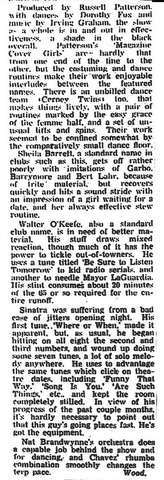
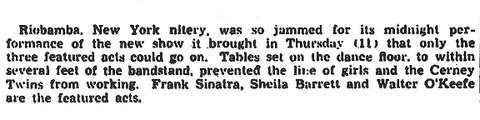
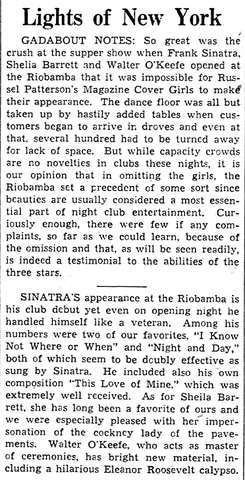
RIOBAMBA, N.Y.
Sheila Barrett, Walter O'Keefe, Frank Sinatra, Russell Patterson,
Magazine Cover Girls, Nat Brandwynne Ork. and Chavez Rhumba
Orch. minimum $2.50
The new show at this class east side spot marks the entry into a new
field for Frank Sinatra, ex-orchestra vocalist, now also on Lucky Strike
Hit Parade, CBS sustaining, doubling into theatres, etc. Since Sinatra
severed relations with Tommy Dorsey's band, his rise has been swift.
The reception accorded him opening night here unquestionably make
it clear that what he has to offer is as strong for Park Avenue as it is
among the Tenth Avenue coin machine set.
Variety
note: The first paragraph would not have been
legible on the list. I typed it out and inserted
the rest of the review.
Ed
Here are two reviews of Frank from March of 1943,
including one from the esteemed jazz critic Leonard Feather.
HE CAN'T READ A NOTE BUT HE IS DETHRONING BING,
AND FRANK SINATRA IS "WUNNERFUL" TO THE GALS
From the ladies who sigh through five shows a day at
the Paramount to the pugs and characters over at Still-
man's muscle emporium on Eighth Avenue --- Sinatra
is terrific. This viewpoint is also shared by a growing
number of other solid citizens. For two years Frank
Sinatra has won both the Downbeat and Metronome
polls as the best popular vocalist, taking away a crown
that everybody considered Bing Crosby's permanent
acquisition.
Sinatra also recently finished an eight-week run at the
Paramount Theater in New York City, the first time any one
performer has stayed there that long since Rudy Vallee was
the nation's vagabond lover in 1929. This summer he will
make a picture for RKO. When the Petrillo ban is lifted(if ever)
he will start making records for Columbia. On Saturday nights
he is featured on the Lucky Strike Hit Parade. Last week he
made his debut as a Manhattan nightclub entertainer at
the Riobamba, where he will stay for three weeks.
"O-o-o-o-o-oh, " breathed 17-year-old Blanche Karo,
who was present at the opening. "This is the most wunnerful
thing that has ever happened to me. Crosby's not in it with
him. I'll never get to school tomorrow." Miss Karo is pres-
ident of a Frank Sinatra fan club.
Sinatra's vocal style is way over on the sweet side --
vaguely reminiscent of a Crosby attack with the b-b-b-boos
left out.He is at his best in numbers like "You'd Be So
Nice to Come Home To," "That Old Black Magic" or "Night
and Day." His Victor records of two such ballads -- "I'll
Never Smile Again" and "This Love of Mine" ---- made while
he was a featured soloist with Tommy Dorsey, were impor-
tant beginnings of the current Sinatra boom.
When Sinatra( now 25) left the Dorsey band last Sep-
tember to start on his own, the first thing he did was to
take a vacation to get reacquainted with his wife and
2 1/2-year old daughter, for he had been touring and
playing for most of three and a half years. The son of a
Hoboken, N.J. fireman, he decided on a singing career
when he heard Bing Crosby. It looked so easy. He still
can't read a note of music and has never had a voice
lesson.
Outside of his family and his new house in Hasbrouck
Heights, N.J., Sinatra's favorite passion is prizefighting.
His two greatest friends are Tami Mauriello, the heavy-
weight contender, and Al Silvani, his trainer. Tami gave
him a gold bracelet and Al put 10 pounds on the half-
pint Sinatra frame. He's always boxed since the early
days with the Hoboken back-alley gang. "If I didn't know
how," he recalls, "that was the end. Somebody else always
did."
Newsweek
March 22, 1943
FRANKLY SPEAKING
by Leonard G. Feather
"Shut up, will you? Sinatra is singing!"
The beautiful and bejeweled young lady
turned away from her escort, nose in the
air, as a respectful hush settled over the
Riobamba. A smart, over-sophisticated
night club crowd fixed its attention on
the thin young man with the progressive
ears, who had just stepped to the micro-
phone.
You can hardly be surprised at the young
lady's reluctance to let her escort talk while
Sinatra was working. For Sinatra, my children,
is the new idol-the man who, in a few months,
has stepped from the role of band singer into
a solo spot on a major network show, top billing
in one of New York's fashionable night clubs,
and a publicity build-up which now has him
out on a limb as the biggest thing since Crosby.
I sat watching Sinatra as he weaved his head
around in that gentle, persuasive manner while he
sang "As Time Goes By" and "Embraceable You."
I observed the way he leaned back, swayed slightly
and gave the general impression that he was in a reverie.
This, I reflected, must be what gets the women. A
good voice, plus a sexy delivery. Freud would see it all
clearly.
I liked Frank's frankness when , after the show, he
answered my questions about the report that a woman
had fainted while he was singing. "She was simply over-
come by the heat. One of the columnists picked up the
story and twisted it around...."
Whether or not he can make women faint, Sinatra
today is undoubtedly a subject worthy of study. Unable
to read or write music, with no musical training or voice
study to his credit, he might never have become a singer
if he hadn't gone to a Bing movie one night and decided
that was the career for him.
Born Dec.12, 1917[sic], in Hoboken, N.J., he is an only child.
At Demarest High School in Hoboken he sang with the school
band and helped form the glee club, but he achieved more
prominence as a swimmer, track man and basketball participant.
His parents wanted him to go in for civil engineering, but after
school hours he worked on a news truck of the Jersey Observer,
throwing the papers off the truck to corner newsstands, and
through this he became a copy boy with the paper after graduation.
Later he became a college sports reporter for the paper, after a
study of shorthand and journalism at Drake Institute.
TOURS WITH MAJOR BOWES
"Then came Major Bowes," he recalls. "I sang "Night and Day" on
the amateur hour, and it's been my favorite song ever since. It got me
a tour with a Bowes unit, headed for the coast. But I got homesick after
three months and came back home to do some sustaining radio work."
"Boy, was that a routine.. It sustained everybody but me. I was on
four local stations and sometimes had it planned so I'd be on the air
somewhere or other every three hours all through the day. But the
only money I got out of the whole thing was 70 cents carfare from
Jersey to the Mutual studios. On top of the 18 sustainers a week I
landed a paying job at the Rustic Cabin and earned myself a three-
day honeymoon with Nancy."
Then came the curious era when he was dividing his time between
three jobs and wound up with a fourth, better than any of them. Still
working at the Rustic Cabin, in May, 1939, he went into New York
every morning to rehearse with Bob Chester's band. Around 2:30
he would excuse himself and slip off to another studio where
another band was rehearsing. All of which triple-life routine turned
out to mean very little, since Harry James offered him a job a couple
of weeks later !
Frank enjoyed those six months he spent with the early James band.
Connie Haines was also with Harry when he joined. The band was still
recording on Brunswick, switching to Columbia later that year, and Frank
waxed a number of sides with Harry, most of which are obscure and hard
to get nowadays. They included "From the Bottom of My Heart," Melancholy
Mood," "My Buddy," "Street in Singapore," "It's Funny to Everyone But
Me, "Who Told You I Cared," "Every Day of My Life," the vocal version of
"Ciribiribin," and the song which Frank has lately revived, "All or Nothing At
All."
While he was in Chicago with James, Sinatra took an offer from Tommy
Dorsey. Then came the lush era of "I'll Never Smile Again," " Night and
Day" and "Stardust," of the Sinatra-Pied Pipers alliance, of the
public's realization that a brilliant new baritone was in bloom.
Frank was dubious when I asked him which was his own favorite recording..
"Don't know whether I have a favorite myself, but Nancy prefers "This
Love of Mine"- because as well as singing it, I wrote the number in
collaboration with Joe Bushkin. Only song hit I ever had."
"Well, I left Tommy September 10, 1942, in Indianapolis, and went to
L.A. for a vacation. I did a bit part in "Reveille with Beverly" at
Columbia. No, that wasn't my first movie; I'd done "Las Vegas Nights" and "Ship Ahoy" with
Tommy."
Frank came East to go on sustaining at CBS, where he stayed from October
to February. He put in a record eight-week stint at the Paramount and
will return there on May 19. "Gene Krupa's band will be there, so I'm adding
five strings of my own. I'm crazy about strings for a vocal background. Tell
you the truth, if James had had strings at the time I was with the band,
maybe I'd never have left."
He goes back West June 15 to do a big part in RKO's "Higher and Higher,"
a title that sounds symbolical of his own career at the moment. He has a
daughter, Nancy-Sandra, 2 1/2., so he'll be around awhile yet.
Despite his lack of technical knowledge, Frank is a discerning music
lover.
Out at the country house near Passaic, N.J., which he bought in
January, he has a fine collection of records; about 250 classical albums and 1,000
jazz discs.
His number one band? "The Duke, of course. I did three day at Hartford
when he was there, and believe me, it was one of the biggest kicks of my
life. And from a singer's standpoint, I'd say Tommy has "the" band. There's a
guy, now, who was a real education for me, in music, in business, every possible
way.
I learned about dynamics and phrasing and style from the way he played
his horn; and I enjoyed my work because he always sees to it that a singer
is given the perfect setting."
FAVORITE SINGERS
Bob Eberly is his favorite singer, after Bing; as for the girls, he
describes Jo Stafford as "the unfound star," adding:-"Catch her on the Jolson
show...She'll knock you out."
He hates loud drummers[speaking from bitter experience, he says] and
loud clothes. He prefers night club work to theatres, because he likes
to be close to an audience. An exception to this rule is the Paramount,
where you're "right on top of em."
Right now he's pretty happy about the whole thing. "The "Hit Parade"
gives him national publicity, even if it doesn't give him a real
personal build-up. The Riobamba gives him the audience and atmosphere he wants.
The movie contract gives him something important to look forward to. And
when recording starts again he will make solo waxings that are sure to
increase the gravity of the shellac shortage situation.
All of which adds up to a pretty bright picture for someone who only
recently completed his first quarter-century on earth. The only question
that's still hotly debated is:-"Do you think Sinatra will ever replace
the Bing?" Time will tell.
Leonard Feather
DOWNBEAT
May 1943
RIOBAMBA, N.Y.
Sheila Barrett, Walter O'Keefe, Frank Sinatra, Russell Patterson,
Magazine Cover Girls, Nat Brandwynne Ork. and Chavez Rhumba
Orch. minimum $2.50
AP
March 43
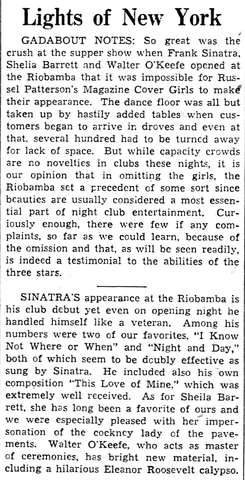
"Night and Day"
Friedwald / Joel Herron / Sammy Cahn: Joel Herron, who occasionally played piano there, described the joint: “This management wanted whatever the Copacabana had, with an imitation Copa (chorus) line and imitation of the whole Copa idea.” It was a gamble for Sinatra... as Sammy Cahn (who was in attendance on opening night) recalled, “the audience was not [a bunch of] bobby-soxers. This was an adult, mature, sophisticated, two-o’clock-in-the-morning Manhattan audience.” Herron remembered that Sinatra was, again rather nervous on opening night, but this had the effect of actually quieting the audience. Before he could get any words out of his mouth, he began to back up slowly into the curve of bandleader Nat Brandwynne’s piano. As soon as Sinatra emitted the first notes of “Night and Day,” he heard feminine sighs and knew that he was in the right place. Long before the first set was even over, press agent George Evans had phoned the news of Sinatra’s latest triumph to every columnist who wasn’t already present.
Source: Will Friedwald, "Sinatra! The Song Is You: A Singer's Art" (2018 revised edition).
March 18, 1943
Concerts
Riobamba Club, New York City (March 11 - May 4)
10 week engagment
3 shows a night
Nat Brandwynne's Orchestra
Also appearing: Walter O'Keefe, Sheila Barrett,
The Cerney Twins, Russell Patterson Magazine Girls
Songs sang during the engagement:
You'd Be So Nice to Come Home To
That Old Black Magic
Night and Day
Where or When
Embraceable You
I Only Have Eyes For You
The Song Is You
As Time Goes By
Imagination (not verified)
Ed O'Brien noted:
I have Frank discussing this engagement in 1959.
He wanted very much to play to an adult audience so he accepted a meager, for him at the time, $800.00 per week. He told the interviewer he didn't like the way the room was laid out. The audience on both sides of the stage were too blocked from his view.
He made it a habit to always sing to the room and felt frustrated by his inability to make eye contact with many of the customers..
March 19, 1943
Concerts
Riobamba Club, New York City (March 11 - May 4)
Location: 57th Steeet
10 week engagment
3 shows a night
Nat Brandywynne & His Orchestra
Songs sang during the engagement:
You'd Be So Nice to Come Home To
That Old Black Magic
Night and Day
Where or When
Embraceable You
I Only Have Eyes For You
The Song Is You
As Time Goes By
Imagination (not verified)
It Had To Be You
She's Funny That Way
March 20, 1943
Radio
Your Hit Parade
Network: CBS
Program #409
Time: 9:00-9:45 P.M. (Rebroadcast March21, 1943 12:00-12:45 A.M.)
Sponsor: Lucky Strike
Script (First & Final As Broadcast)
1, For Me And My Gal (10) - Hit Paraders
2. There Are Such Things (5) - Sinatra
3. I Had The Craziest Dream (8) - Edwards
4. Hora Staccato - Ethel Smith
5. Moonlight Becomes You (7) - Sinatra
6. Brazil (4) - Edwards & Hit Paraders
7. Medley: Indian Summer / Waters Of The Minnetonka - Ethel Smith
8. commercial
9. As Time Goes By (6) - Sinatra
10. It Can't Be Wrong (9) - Edwards
11. station break
12. You're The Top - Ethel Smith
13. That Old Black Magic (3) - Sinatra
14. You'd Be So Nice To Come Home To (2) - Hit Paraders
15. I've Heard That Song Before (1) - Edwards
Ed O'Brien:
Frank would eventually sing every song from this show except "Hora Staccato."
Concerts
Riobamba Club, New York City (March 11 - May 4)
Location: 57th Steeet
10 week engagment
3 shows a night
Nat Brandywynne & His Orchestra
Songs sang during the engagement:
You'd Be So Nice to Come Home To
That Old Black Magic
Night and Day
Where or When
Embraceable You
I Only Have Eyes For You
The Song Is You
As Time Goes By
Imagination (not verified)
It Had To Be You
She's Funny That Way
Madison Square Gardens, New York, NY
Benefit for Israel Orphan Asylum
Madison Square Gardens, New York, NY
Benefit for Israel Orphan Asylum
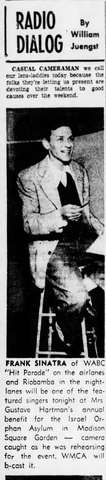
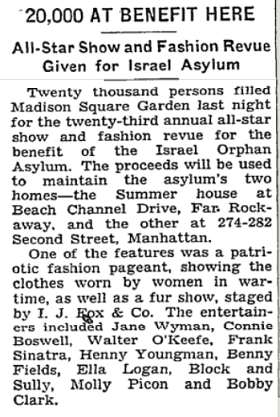
March 21, 1943
Concerts
Riobamba Club, New York City (March 11 - May 4)
Location: 57th Steeet
10 week engagment
3 shows a night
Nat Brandywynne & His Orchestra
Songs sang during the engagement:
You'd Be So Nice to Come Home To
That Old Black Magic
Night and Day
Where or When
Embraceable You
I Only Have Eyes For You
The Song Is You
As Time Goes By
Imagination (not verified)
It Had To Be You
She's Funny That Way
March 22, 1943
Concerts
Riobamba Club, New York City (March 11 - May 4)
Location: 57th Steeet
10 week engagment
3 shows a night
Nat Brandywynne & His Orchestra
Songs sang during the engagement:
You'd Be So Nice to Come Home To
That Old Black Magic
Night and Day
Where or When
Embraceable You
I Only Have Eyes For You
The Song Is You
As Time Goes By
Imagination (not verified)
It Had To Be You
She's Funny That Way
March 23, 1943
Concerts
Riobamba Club, New York City (March 11 - May 4)
Location: 57th Steeet
10 week engagement
3 shows a night
Nat Brandywynne & His Orchestra
Songs sang during the engagement:
You'd Be So Nice to Come Home To
That Old Black Magic
Night and Day
Where or When
Embraceable You
I Only Have Eyes For You
The Song Is You
As Time Goes By
Imagination (not verified)
It Had To Be You
She's Funny That Way
March 24, 1943
Concerts
Riobamba Club, New York City (March 11 - May 4)
Location: 57th Steeet
10 week engagment
3 shows a night
Nat Brandywynne & His Orchestra
Songs sang during the engagement:
You'd Be So Nice to Come Home To
That Old Black Magic
Night and Day
Where or When
Embraceable You
I Only Have Eyes For You
The Song Is You
As Time Goes By
Imagination (not verified)
It Had To Be You
She's Funny That Way
March 25, 1943
Radio
Fight Night
WJW 8:15 PM
James J. Braddock and Frank Sinatra
Concerts
Riobamba Club, New York City (March 11 - May 4)
Location: 57th Steeet
10 week engagment
3 shows a night
Nat Brandywynne & His Orchestra
Songs sang during the engagement:
You'd Be So Nice to Come Home To
That Old Black Magic
Night and Day
Where or When
Embraceable You
I Only Have Eyes For You
The Song Is You
As Time Goes By
Imagination (not verified)
It Had To Be You
She's Funny That Way
March 26, 1943
Concerts
Riobamba Club, New York City (March 11 - May 4)
Location: 57th Steeet
10 week engagment
3 shows a night
Nat Brandywynne & His Orchestra
Songs sang during the engagement:
You'd Be So Nice to Come Home To
That Old Black Magic
Night and Day
Where or When
Embraceable You
I Only Have Eyes For You
The Song Is You
As Time Goes By
Imagination (not verified)
It Had To Be You
She's Funny That Way
March 27, 1943
Radio
Your Hit Parade
Network: CBS
Program #410
Time: 9:00-9:45 P.M. (Rebroadcast March 28, 1943 12:00-12:45 A.M.)
Sponsor: Lucky Strike
1. Taking A Chance On Love (10) - Edwards
2. Moonlight Becomes You (8) - Sinatra
3. For Me And My Gal (9) - Hit Paraders
4. You - Ethel Smith
5. There Are Such Things (6) - Sinatra
6. Don't Get Around Much Any More (7) - Edwards
7. Waltz In Swingtime - Ethel Smith
8. commercial
9. You'd Be So Nice To Come Home To (4) - Sinatra
10. Brazil (5) - Edwards & Hit Paraders
11. station break
12. Tico Tico - Ethel Smith
13. As Time Goes By (3) - Hit Paraders
14. That Old Black Magic (2) Sinatra & Hit Paraders
15. I've Heard That Song Before (1) - Edwards
Ed O'Brien:
When this show was broadcast Sinatra had committed to record just one song (There Are Such Things).
He more than made up for it by laying down six of them during the Capitol years and one at Reprise. The music America was listening to during the war years was of a very high order, indeed.
Concerts
Riobamba Club, New York City (March 11 - May 4)
Location: 57th Steeet
10 week engagment
3 shows a night
Nat Brandywynne & His Orchestra
Songs sang during the engagement:
You'd Be So Nice to Come Home To
That Old Black Magic
Night and Day
Where or When
Embraceable You
I Only Have Eyes For You
The Song Is You
As Time Goes By
Imagination (not verified)
It Had To Be You
She's Funny That Way
March 28, 1943
Concerts
Riobamba Club, New York City (March 11 - May 4)
Location: 57th Steeet
10 week engagment
3 shows a night
Nat Brandywynne & His Orchestra
Songs sang during the engagement:
You'd Be So Nice to Come Home To
That Old Black Magic
Night and Day
Where or When
Embraceable You
I Only Have Eyes For You
The Song Is You
As Time Goes By
Imagination (not verified)
It Had To Be You
She's Funny That Way
March 29, 1943
Concerts
Riobamba Club, New York City (March 11 - May 4)
Location: 57th Steeet
10 week engagment
3 shows a night
Nat Brandywynne & His Orchestra
Songs sang during the engagement:
You'd Be So Nice to Come Home To
That Old Black Magic
Night and Day
Where or When
Embraceable You
I Only Have Eyes For You
The Song Is You
As Time Goes By
Imagination (not verified)
It Had To Be You
She's Funny That Way
March 30, 1943
Concerts
Riobamba Club, New York City (March 11 - May 4)
Location: 57th Steeet
10 week engagment
3 shows a night
Nat Brandywynne & His Orchestra
Songs sang during the engagement:
You'd Be So Nice to Come Home To
That Old Black Magic
Night and Day
Where or When
Embraceable You
I Only Have Eyes For You
The Song Is You
As Time Goes By
Imagination (not verified)
It Had To Be You
She's Funny That Way
March 31, 1943
Concerts
Riobamba Club, New York City (March 11 - May 4)
Location: 57th Steeet
10 week engagment
3 shows a night
Nat Brandywynne & His Orchestra
Songs sang during the engagement:
You'd Be So Nice to Come Home To
That Old Black Magic
Night and Day
Where or When
Embraceable You
I Only Have Eyes For You
The Song Is You
As Time Goes By
Imagination (not verified)
It Had To Be You
She's Funny That Way
The landmark musical Oklahoma! opened on Broadway at the St. James Theatre on 31 March 1943, starring Celeste Holm, who later appeared alongside Sinatra in the film High Society. The show's songs, including 'People Will Say We're in Love,' became two of Frank's final hits of the year. (Source: Richard Havers, "Sinatra" (Dorling Kindersley, 2007).)
April 1943
['Warm Valley' sign at Hasbrouck Heights]
Kaplan: A photo from April 1943 shows Frank posting a hand-made sign reading "Warm Valley" on the front lawn of the Hasbrouck Heights house, with Nancy and their daughter looking on.
Source: James Kaplan, "Frank: The Voice" (2010)
[Frank and Nancy reconcile, second pregnancy]
Kaplan: In early April 1943, newly glamorized by Evans's makeover, Nancy caught Frank's eye again; he took her dancing at El Morocco and to dinner at Le Pavillon, and a month later she was pregnant again (with Frank Sinatra Jr.).
Source: James Kaplan, "Frank: The Voice" (2010)
[New Columbia Recording Contract]
Sinatra signed a new recording contract with Columbia Records during a lull between Paramount Theater engagements.
Source: George Carpozi Jr., Frank Sinatra: Is This Man Mafia? (New York: Manor Books, 1979).
April 1, 1943
Concerts
Riobamba Club, New York City (March 11 - May 4)
Location: 57th Steeet
10 week engagment
3 shows a night
Nat Brandywynne & His Orchestra
Songs sang during the engagement:
You'd Be So Nice to Come Home To
That Old Black Magic
Night and Day
Where or When
Embraceable You
I Only Have Eyes For You
The Song Is You
As Time Goes By
Imagination (not verified)
It Had To Be You
She's Funny That Way
April 2, 1943
Concerts
Riobamba Club, New York City (March 11 - May 4)
Location: 57th Steeet
10 week engagment
3 shows a night
Nat Brandywynne & His Orchestra
Songs sang during the engagement:
You'd Be So Nice to Come Home To
That Old Black Magic
Night and Day
Where or When
Embraceable You
I Only Have Eyes For You
The Song Is You
As Time Goes By
Imagination (not verified)
It Had To Be You
She's Funny That Way
April 3, 1943
Radio
Your Hit Parade
Network: CBS
Program #411
Time: 9:00-9:45 P.M. (Rebroadcast April 4, 1943 12:00-12:45 A.M.)
Sponsor: Lucky Strike
Script (Fourth Revision & Final As Broadcast)
1. For Me And My Gal (10) - Hit Paraders
2. Don't Get Around Much Any More (8) - Edwards
3. You'd Be So Nice To Come Home To (4) - Sinatra
4. La Cumparsita - Ethel Smith
5. Taking A Chance On Love (6) - Edwards
6. Moonlight Becomes You (9) - Sinatra
7. commercial
8. All Timer Medley: When Day Is Done / Dinah / There's A Great Day Coming Manana - Orchestra & Company
9. There Are Such Things (7) - Sinatra
10. Brazil (5) - Edwards & Hit Paraders
11. station break
12. The Luliaby Of Broadway - Ethel Smith
13. As Time Goes By (3) - Hit Paraders
14. That Old Black Magic (2) Sinatra & Hit Paraders
15. I've Heard That Song Before (1) - Edwards
Concerts
Bobby Lake Service Mans Dance, Chester Place, New York City/Bronx Saturday
East 177th Street and Boston Road-Bronx.
FRANK SINATRA with music by Jimmy Frazier.
Ladies and Gents-75cents.Service Men Free.
Note: Thanks to Fred Wadsworth for the listing above.
Riobamba Club, New York City (March 11 - May 4)
Location: 57th Steeet
10 week engagment
3 shows a night
Nat Brandywynne & His Orchestra
Songs sang during the engagement:
You'd Be So Nice to Come Home To
That Old Black Magic
Night and Day
Where or When
Embraceable You
I Only Have Eyes For You
The Song Is You
As Time Goes By
Imagination (not verified)
It Had To Be You
She's Funny That Way
April 4, 1943
Concerts
RioBamba Club, New York City (March 11 - May 4)
Ed O'Brien:
Frank went into the Riobamba for a three-week engagement. He wound up staying for almost two-months, closing on 5/4/43. The club took in an average of $25,000 per week. Frank was paid $2,500 per week. He opened at the Paramount, 5/19, for four weeks. He played eight-weeks at the Paramount, starting on 12-30-42, then nine- weeks at the Riobamba and four more at the Paramount. His early bobby-sox fame was very much a New York City phenomenon.
RioBamba Club, New York City ( March 11 - May 4)
review
3/27/43.
NIGHT CLUB REVIEWS
RIOBAMBA, NEW YORK
Talent policy:Show & dance band;
Latin band; production floorshow at
8, midnight and 2. Management:
Linton Weil, operator; Fred Chiaventoue, maitre d'hotel; Zussman & Bayne, publicity.
Prices: $2.50 minimum except Saturday, holiday and holiday eves, $3.
Off to a fast click, this new East Side spot is currently spending its heaviest dough for floorshow talent. It brought in
March 11 Frank Sinatra, making his cafe debut as a single.
Biggest excitement is Sinatra, who is being backed by an aggressive publicity campaign as Bing Crosby's successor, and who has RKO pictures, radio and vaude deals set. Sinatra may not be another Crosby, but he's got sex appeal in his voice, and that's something that means dollars at the box office. The club has been packed since he opened, and women patrons actually gasp out loud when he sighs through some pashy pop ballads. Crooned eight numbers, including a couple of oldies. He knows how to sell ballads, making the lyrics sound sincere and letting his face suggest real feeling.
The men apparently were not carried away by his torching, but the women . . .
Sinatra is in for three weeks.
Nat Brandywynne ( piano) leads the show and dance band (three sax, three fiddles and three rhythm). It's a good outfit, with the leader's fine piano lead- ing most of the arrangements. Chavez's band (seven men) is, as usual, a lively, jumpy, hotcha Latin outfit. Its rhythms are very danceable.
The Billboard
March 27, 1943
Paul Denis
April 5, 1943
Concerts
Riobamba Club, New York City (March 11 - May 4)
Location: 57th Street
10 week engagement
3 shows a night
Nat Brandywynne & His Orchestra
Songs sang during the engagement:
You'd Be So Nice to Come Home To
That Old Black Magic
Night and Day
Where or When
Embraceable You
I Only Have Eyes For You
The Song Is You
As Time Goes By
Imagination (not verified)
It Had To Be You
She's Funny That Way
The Red Cross Show, Madison Square Garden, New York
Sinatra appeared along with dozens of other performers including: Fred Allen, Tallulah Bankhead, Milton Berle, Charles Boyer, Jimmy Durante, Jimmy Dorsey & Orchestra, Duke Ellington & Orchestra, Jeanette MacDonald, Frederic March, Ethel Merman, Ray Milland, Ozzie Nelson, Dick Powell, Ritz Brothers, Red Skelton, Kate Smith, Ethel Waters, Clifton Webb
The Red Cross Show, Madison Square Garden, New York
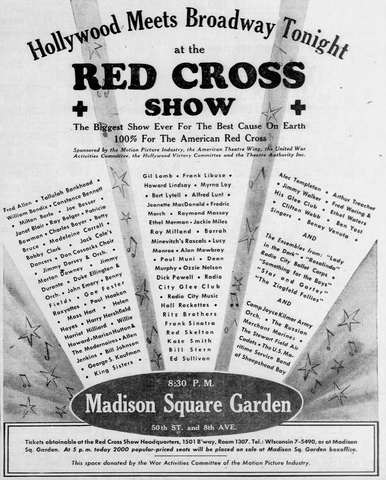
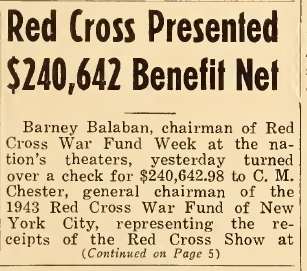
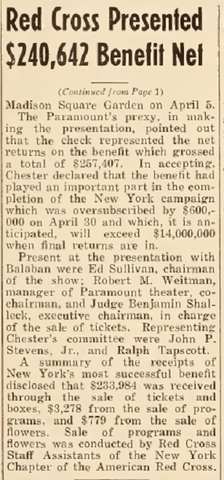
April 6, 1943
Concerts
Riobamba Club, New York City (March 11 - May 4)
Location: 57th Steeet
10 week engagment
3 shows a night
Nat Brandywynne & His Orchestra
Songs sang during the engagement:
You'd Be So Nice to Come Home To
That Old Black Magic
Night and Day
Where or When
Embraceable You
I Only Have Eyes For You
The Song Is You
As Time Goes By
Imagination (not verified)
It Had To Be You
She's Funny That Way
April 7, 1943
Concerts
Riobamba Club, New York City (March 11 - May 4)
Location: 57th Steeet
10 week engagment
3 shows a night
Nat Brandywynne & His Orchestra
Songs sang during the engagement:
You'd Be So Nice to Come Home To
That Old Black Magic
Night and Day
Where or When
Embraceable You
I Only Have Eyes For You
The Song Is You
As Time Goes By
Imagination (not verified)
It Had To Be You
She's Funny That Way
April 8, 1943
Concerts
Riobamba Club, New York City (March 11 - May 12)
Location: 57th Steeet
10 week engagment
3 shows a night
Nat Brandywynne & His Orchestra
Songs sang during the engagement:
You'd Be So Nice to Come Home To
That Old Black Magic
Night and Day
Where or When
Embraceable You
I Only Have Eyes For You
The Song Is You
As Time Goes By
Imagination (not verified)
It Had To Be You
She's Funny That Way
April 9, 1943
Concerts
Riobamba Club, New York City (March 11 - May 4)
Location: 57th Steeet
10 week engagment
3 shows a night
Nat Brandywynne & His Orchestra
Songs sang during the engagement:
You'd Be So Nice to Come Home To
That Old Black Magic
Night and Day
Where or When
Embraceable You
I Only Have Eyes For You
The Song Is You
As Time Goes By
Imagination (not verified)
It Had To Be You
She's Funny That Way
April 10, 1943
Radio
Your Hit Parade
Network: CBS
Program #412
Time: 9:00-9:45 P.M. (Rebroadcast April 11, 1943 12:00-12:45 A.M.)
Sponsor: Lucky Strike
Arranged by: Axel Stordahl
Conducted by: Mark Warnow
1. For Me And My Gal (8) - Hit Paraders
2. It Can't Be Wrong (9) - Edwards
3. As Time Goes By (4) - Sinatra
4. Bem Ti Vi Atrevido - Ethel Smith
5. There's A Harbor Of Dreamboats (10) - Hit Paraders
6. Taking A Chance On Love (7) - Edwards
7. commercial
8. All Timer Medley: Old Man River / Carolina In
The Morning / Great Day - Orchestra & Company
9. station break
10. You'd Be So Nice To Come Home To (5) - Sinatra
11. Don't Get Around Much Any More (6) - Edwards
12. I Won't Dance - Ethel Smith
13. That Old Black Magic (3) - Sinatra & Hit Paraders
14. I've Heard That Song Before (2) - Hit Paraders
15. Brazil (1) - Edwards & Hit Paraders
Dress Rehearsal (Sinatra Songs):
1. As Time Goes By (4)
2. That Old Black Magic (3)
3. You'd Be So Nice To Come Home To (5)
Concerts
Riobamba Club, New York City (March 11 - May 4)
Location: 57th Steeet
10 week engagment
3 shows a night
Nat Brandywynne & His Orchestra
Songs sang during the engagement:
You'd Be So Nice to Come Home To
That Old Black Magic
Night and Day
Where or When
Embraceable You
I Only Have Eyes For You
The Song Is You
As Time Goes By
Imagination (not verified)
It Had To Be You
She's Funny That Way
Hotel Douglas, Newark, NJ
Junior Press Conference
Frank Sinatra was special guest
Also broadcast on WAAT
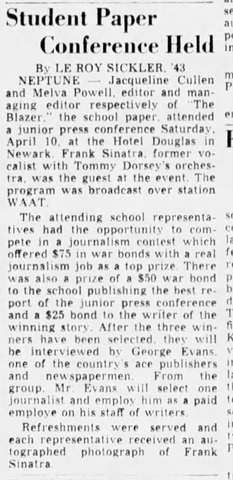
April 11, 1943
Concerts
Riobamba Club, New York City (March 11 - May 12)
Location: 57th Steeet
10 week engagment
3 shows a night
Nat Brandywynne & His Orchestra
Songs sang during the engagement:
You'd Be So Nice to Come Home To
That Old Black Magic
Night and Day
Where or When
Embraceable You
I Only Have Eyes For You
The Song Is You
As Time Goes By
Imagination (not verified)
It Had To Be You
She's Funny That Way
April 12, 1943
Radio
Treasury Star Parade
Program #180
Treasury Department syndication
Sponsor: Second War Loan
Announcer: Larry Elliott
Performers: Frank Sinatra, David Broekman and The Treasury Orchestra
Writers: Thelma Ritter
1. Close To You
2. That Old Black Magic
Notes: "Close To You" appears on The V-discs Vol.1.
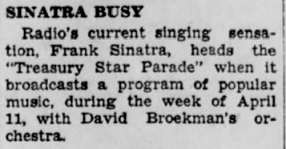
Concerts
Stanley Theatre, Jersey City, NJ
Million Dollar Bond Rally
Riobamba Club, New York City (March 11 - May 4)
Location: 57th Steeet
10 week engagment
3 shows a night
Nat Brandywynne & His Orchestra
Songs sang during the engagement:
You'd Be So Nice to Come Home To
That Old Black Magic
Night and Day
Where or When
Embraceable You
I Only Have Eyes For You
The Song Is You
As Time Goes By
Imagination (not verified)
It Had To Be You
She's Funny That Way
Stanley Theatre, Jersey City, NJ
Million Dollar Bond Rally
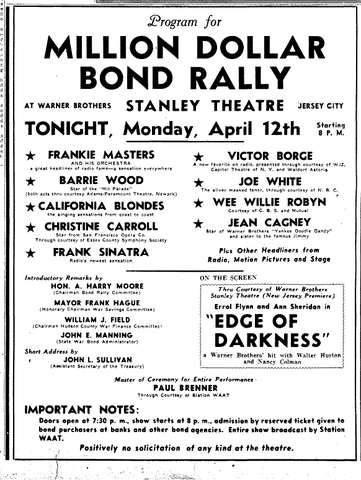
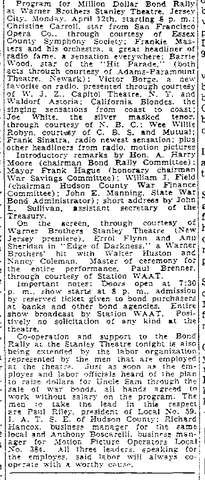
April 13, 1943
Concerts
Riobamba Club, New York City (March 11 - May 4)
Location: 57th Steeet
10 week engagment
3 shows a night
Nat Brandywynne & His Orchestra
Songs sang during the engagement:
You'd Be So Nice to Come Home To
That Old Black Magic
Night and Day
Where or When
Embraceable You
I Only Have Eyes For You
The Song Is You
As Time Goes By
Imagination (not verified)
It Had To Be You
She's Funny That Way
April 14, 1943
Concerts
Riobamba Club, New York City (March 11 - May 4)
Location: 57th Steeet
10 week engagment
3 shows a night
Nat Brandywynne & His Orchestra
Songs sang April 14, 1943
1. Embraceable You
2. You'd Be So Nice To Come Home To
3. I Only Have Eyes For You
4. That Old Black Magic
5. Imagination
6. The Song Is You
7. As Time Goes By
Note: Confirmed by Sinatra fan in attendance. Info written on April 14, 1943.
April 15, 1943
Concerts
Riobamba Club, New York City (March 11 - May 4)
Location: 57th Steeet
10 week engagment
3 shows a night
Nat Brandywynne & His Orchestra
Songs sang during the engagement:
You'd Be So Nice to Come Home To
That Old Black Magic
Night and Day
Where or When
Embraceable You
I Only Have Eyes For You
The Song Is You
As Time Goes By
Imagination (not verified)
It Had To Be You
She's Funny That Way
April 16, 1943
Concerts
Riobamba Club, New York City (March 11 - May 4)
Location: 57th Steeet
10 week engagment
3 shows a night
Nat Brandywynne & His Orchestra
Songs sang during the engagement:
You'd Be So Nice to Come Home To
That Old Black Magic
Night and Day
Where or When
Embraceable You
I Only Have Eyes For You
The Song Is You
As Time Goes By
Imagination (not verified)
It Had To Be You
She's Funny That Way
April 17, 1943
Radio
Your Hit Parade
Network: CBS
Program #413
Time: 9:00-9:45 P.M. (Rebroadcast April 18, 1943 12:00-12:45 A.M.)
Sponsor: Lucky Strike
1. There's A Harbor Of Dreamboats (9) - Hit Paraders
2. Taking A Chance On Love (10) - Edwards
3. You'd Be So Nice To Come Home To (6) - Sinatra
4. Lady In Red - Ethel Smith
5. For Me And My Gal (8) - Hit Paraders
6. Don't Get Around Much Any More (4) - Edwards
7. commercial
8. All Time Medley: Goodnight Sweetheart / Roses Of Picardy / Over There - Orchestra & Company
9. station break
10. It Can't Be Wrong (7) - Sinatra
11. Brazil (5) - Edwards & Hit Paraders
12. Fine And Dandy - Ethel Smith
13. That Old Black Magic (3) - Sinatra & Hit Paraders
14. As Time Goes By (2) - Hit Paraders
15. I've Heard That Song Before (1) - Edwards
Concerts
Riobamba Club, New York City (March 11 - May 4)
Location: 57th Steeet
10 week engagment
3 shows a night
Nat Brandywynne & His Orchestra
Songs sang during the engagement:
You'd Be So Nice to Come Home To
That Old Black Magic
Night and Day
Where or When
Embraceable You
I Only Have Eyes For You
The Song Is You
As Time Goes By
Imagination (not verified)
It Had To Be You
She's Funny That Way
April 18, 1943
Concerts
Riobamba Club, New York City (March 11 - May 4)
Location: 57th Steeet
10 week engagment
3 shows a night
Nat Brandywynne & His Orchestra
Songs sang during the engagement:
You'd Be So Nice to Come Home To
That Old Black Magic
Night and Day
Where or When
Embraceable You
I Only Have Eyes For You
The Song Is You
As Time Goes By
Imagination (not verified)
It Had To Be You
She's Funny That Way
April 19, 1943
Concerts
Riobamba Club, New York City (March 11 - May 4)
Location: 57th Steeet
10 week engagment
3 shows a night
Nat Brandywynne & His Orchestra
Songs sang during the engagement:
You'd Be So Nice to Come Home To
That Old Black Magic
Night and Day
Where or When
Embraceable You
I Only Have Eyes For You
The Song Is You
As Time Goes By
Imagination (not verified)
It Had To Be You
She's Funny That Way
April 20, 1943
Concerts
Riobamba Club, New York City (March 11 - May 4)
Location: 57th Steeet
10 week engagment
3 shows a night
Nat Brandywynne & His Orchestra
Songs sang during the engagement:
You'd Be So Nice to Come Home To
That Old Black Magic
Night and Day
Where or When
Embraceable You
I Only Have Eyes For You
The Song Is You
As Time Goes By
Imagination (not verified)
It Had To Be You
She's Funny That Way
April 21, 1943
Concerts
Riobamba Club, New York City (March 11 - May 4)
Location: 57th Steeet
10 week engagment
3 shows a night
Nat Brandywynne & His Orchestra
Songs sang during the engagement:
You'd Be So Nice to Come Home To
That Old Black Magic
Night and Day
Where or When
Embraceable You
I Only Have Eyes For You
The Song Is You
As Time Goes By
Imagination (not verified)
It Had To Be You
She's Funny That Way
April 22, 1943
Concerts
Riobamba Club, New York City (March 11 - May 4)
Location: 57th Steeet
10 week engagment
3 shows a night
Nat Brandywynne & His Orchestra
Songs sang during the engagement:
You'd Be So Nice to Come Home To
That Old Black Magic
Night and Day
Where or When
Embraceable You
I Only Have Eyes For You
The Song Is You
As Time Goes By
Imagination (not verified)
It Had To Be You
She's Funny That Way
April 23, 1943
Concerts
Riobamba Club, New York City (March 11 - May 4)
Location: 57th Steeet
10 week engagment
3 shows a night
Nat Brandywynne & His Orchestra
Songs sang during the engagement:
You'd Be So Nice to Come Home To
That Old Black Magic
Night and Day
Where or When
Embraceable You
I Only Have Eyes For You
The Song Is You
As Time Goes By
Imagination (not verified)
It Had To Be You
She's Funny That Way
April 24, 1943
Radio
Your Hit Parade
Network: CBS
Program #414
Time: 9:00-9:45 P.M. (Rebroadcast April 18, 1943 12:00-12:45 A.M.)
Sponsor: Lucky Strike
Script (First & Final As Broadcast)
1. Taking A Chance On Love (10) - Hit Paraders
2. What's The Good Word, Mr. Bluebird (8) - Edwards
3. You'd Be So Nice To Come Home To (5) - Sinatra
4. Night And Day - Ethel Smith
5. I've Heard That Song Before (4) - Hit Paraders
6. Brazil (7) - Edwards & Hit Paraders
7. commercial
8. All Time Medley: Rio Rita / With A Song In My
Heart / Riff Song - Orchestra & Company
9. station break
10. Don't Cry (9) - Sinatra
11. It Can't Be Wrong (6) - Hit Paraders
12. Easter Parade - Ethel Smith
13. Don't Get Around Much Any More (3) - Edwards
14. That Old Black Magic (2) - Sinatra & Hit Paraders
15. As Time Goes By (1) - Edwards
Concerts
Promenade Ballroom, Manhattan Center, New York
Presented by Young Men's League of New York
A portion of Sinatra's salary from this engagement was donated to the American Red Cross
[image referenced in source but could not be recovered]
Riobamba Club, New York City (March 11 - May 4)
Location: 57th Steeet
10 week engagment
3 shows a night
Nat Brandywynne & His Orchestra
Songs sang during the engagement:
You'd Be So Nice to Come Home To
That Old Black Magic
Night and Day
Where or When
Embraceable You
I Only Have Eyes For You
The Song Is You
As Time Goes By
Imagination (not verified)
It Had To Be You
She's Funny That Way
Promenade Ballroom, Manhattan Center, New York
Presented by Young Men's League of New York
A portion of Sinatra's salary from this engagement was donated to the American Red Cross
[image referenced in source but could not be recovered]
[image referenced in source but could not be recovered]
[image referenced in source but could not be recovered]
[image referenced in source but could not be recovered]
[image referenced in source but could not be recovered]
[image referenced in source but could not be recovered]
[image referenced in source but could not be recovered]
[image referenced in source but could not be recovered]
[image referenced in source but could not be recovered]
[image referenced in source but could not be recovered]
April 25, 1943
Concerts
Riobamba Club, New York City (March 11 - May 4)
Location: 57th Steeet
10 week engagment
3 shows a night
Nat Brandywynne & His Orchestra
Songs sang during the engagement:
You'd Be So Nice to Come Home To
That Old Black Magic
Night and Day
Where or When
Embraceable You
I Only Have Eyes For You
The Song Is You
As Time Goes By
Imagination (not verified)
It Had To Be You
She's Funny That Way
The Music Box Theatre, New York City, NY
First anniversary benefit for the Father Duffy Canteen
Sinatra appeared along with Milton Berle, Ed Sullivan, Jimmy Durante, Ethel Waters, Hildegarde, and many others.
The Music Box Theatre, New York City, NY
First anniversary benefit for the Father Duffy Canteen
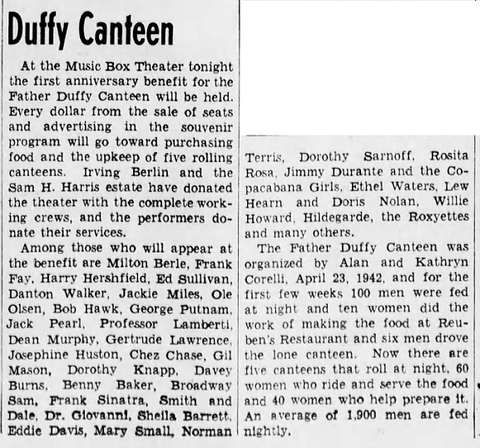
April 26, 1943
Concerts
Riobamba Club, New York City (March 11 - May 12)
Location: 57th Steeet
10 week engagment
3 shows a night
Nat Brandywynne & His Orchestra
Songs sang during the engagement:
You'd Be So Nice to Come Home To
That Old Black Magic
Night and Day
Where or When
Embraceable You
I Only Have Eyes For You
The Song Is You
As Time Goes By
Imagination (not verified)
It Had To Be You
She's Funny That Way
April 27, 1943
Concerts
Riobamba Club, New York City (March 11 - May 4)
Location: 57th Steeet
10 week engagment
3 shows a night
Nat Brandywynne & His Orchestra
Songs sang during the engagement:
You'd Be So Nice to Come Home To
That Old Black Magic
Night and Day
Where or When
Embraceable You
I Only Have Eyes For You
The Song Is You
As Time Goes By
Imagination (not verified)
It Had To Be You
She's Funny That Way
April 28, 1943
Concerts
Riobamba Club, New York City (March 11 - May 4)
Location: 57th Steeet
10 week engagment
3 shows a night
Nat Brandywynne & His Orchestra
Songs sang during the engagement:
You'd Be So Nice to Come Home To
That Old Black Magic
Night and Day
Where or When
Embraceable You
I Only Have Eyes For You
The Song Is You
As Time Goes By
Imagination (not verified)
It Had To Be You
She's Funny That Way
April 29, 1943
Concerts
Riobamba Club, New York City (March 11 - May 4)
Location: 57th Steeet
10 week engagment
3 shows a night
Nat Brandywynne & His Orchestra
Songs sang during the engagement:
You'd Be So Nice to Come Home To
That Old Black Magic
Night and Day
Where or When
Embraceable You
I Only Have Eyes For You
The Song Is You
As Time Goes By
Imagination (not verified)
It Had To Be You
She's Funny That Way
April 30, 1943
Concerts
Riobamba Club, New York City (March 11 - May 4)
Location: 57th Steeet
10 week engagment
3 shows a night
Nat Brandywynne & His Orchestra
Songs sang during the engagement:
You'd Be So Nice to Come Home To
That Old Black Magic
Night and Day
Where or When
Embraceable You
I Only Have Eyes For You
The Song Is You
As Time Goes By
Imagination (not verified)
It Had To Be You
She's Funny That Way
Riobamba Club, New York City (March 11 - May 4)
Location: 57th Steeet
10 week engagment
3 shows a night
Nat Brandywynne & His Orchestra
An original, Frank Sinatra autograph on the inside of a Club Riobamba photo folder + original photo of Sinatra sitting with patrons. Photo folder measures 8 ½” x 7 ½”. Signed in fountain pen ink by a young 27-year-old Frank Sinatra on the inside cover of the folder opposite the photo “To Pat Thank you for asking me Frank -”. Autograph ph and photo from April 30, 1943, when Frank Sinatra performed at this swanky New York City club!
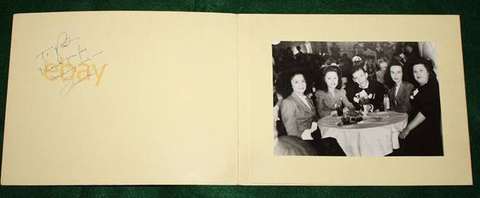
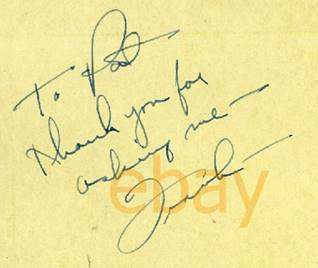
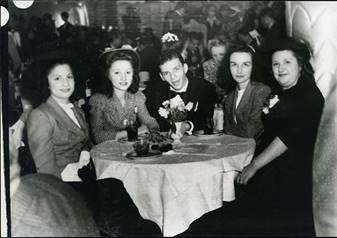
Hotel Astor, New York, NY
Frank Sinatra is awarded the Page One Award by the Newspaper Guild of New York
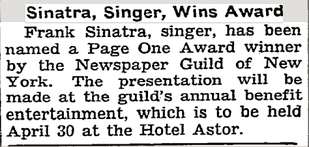
May 1943
[Sinatra Plays The Paramount Again]
Sinatra returned to the Paramount Theatre once more in May 1943.
Source: Nancy Sinatra, "Frank Sinatra, My Father" (1985).
[Nancy's Second Pregnancy]
Nancy told Frank she was pregnant with their second child.
Source: George Carpozi Jr., Frank Sinatra: Is This Man Mafia? (New York: Manor Books, 1979).
[Riobamba, later weeks - Sinatra's growing confidence and stage presence -- critical commentary]
Sammy Cahn: “A voice would announce, ‘And now, brrr . . . the Riobamba prrroudly presents, Frank Sinatra!’” Sammy Cahn recalled, miming a drum roll.. “Instead of coming out from behind the band, he came walking through the tables. And when he got to the center of the club, he had to do his number. And I say to you again, he was thinner than my finger. And he had them in the grip of his hand. One of my vivid memories is, while he was singing, some gorilla coughed. A giant guy, like 250 pounds. He turned and looked at this guy, and the guy didn’t know what to do with himself. Do you understand what I’m trying to say? Frank had power, menace! It was an incredible experience.”
Source: Will Friedwald, "Sinatra! The Song Is You: A Singer's Art" (2018 revised edition), Ch. 4, "With Axel Stordahl" (1943-1948)
May 1, 1943
Radio
Your Hit Parade
Network: CBS
Program #415
Time: 9:00-9:45 P.M. (Rebroadcast May 2, 1943 12:00-12:45 A.M.)
Sponsor: Lucky Strike
1. For Me And My Gal (8) - Hit Paraders
2. I've Heard That Song Before (6) - Edwards
3. That Old Black Magic (7) - Sinatra & Hit Paraders
4. Three Little Words - Ethel Smith
5. You'd Be So Nice To Come Home To (5) - Hit Paraders
6. Taking A Chance On Love (9) - Edwards
7. commercial
8. All Time Medley: April Showers / Keep Your Sunny Side Up / Sing You
Sinners - Orchestra & Company
9. station break
10. Brazil (4) - Edwards & Hit Paraders
11. Let's Get Lost (10) - Sinatra
12. I Know That You Know - Ethel Smith
13. It Can't Be Wrong (3) - Hit Paraders
14. As Time Goes By (2) - Sinatra
15. Don't Get Around Much Any More (1) - Edwards
Concerts
Riobamba Club, New York City (March 11 - May 4)
Location: 57th Steeet
10 week engagment
3 shows a night
Nat Brandywynne & His Orchestra
Songs sang during the engagement:
You'd Be So Nice to Come Home To
That Old Black Magic
Night and Day
Where or When
Embraceable You
I Only Have Eyes For You
The Song Is You
As Time Goes By
Imagination (not verified)
It Had To Be You
She's Funny That Way
Riobamba Club, New York City (March 11 - May 12)
BILLBOARD 5-1-43
Your Hit Parade
Network: CBS
Program #415
Time: 9:00-9:45 P.M. (Rebroadcast May 2, 1943 12:00-12:45 A.M.)
Sponsor: Lucky Strike
Variety
note: The song Frank attempted to sing was
"I Know That You Know." I knew a collector
who had the show. He never got around to
sending it my way. His widow contacted me.
She still has the reel tape. The lady is having
a hard time after his passing. Still hoping for
a copy.
--Ed
May 2, 1943
Concerts
Riobamba Club, New York City (March 11 - May 4)
Location: 57th Steeet
10 week engagment
3 shows a night
Nat Brandywynne & His Orchestra
Songs sang during the engagement:
You'd Be So Nice to Come Home To
That Old Black Magic
Night and Day
Where or When
Embraceable You
I Only Have Eyes For You
The Song Is You
As Time Goes By
Imagination (not verified)
It Had To Be You
She's Funny That Way
May 3, 1943
Concerts
Riobamba Club, New York City (March 11 - May 4)
Location: 57th Steeet
10 week engagment
3 shows a night
Nat Brandywynne & His Orchestra
Songs sang during the engagement:
You'd Be So Nice to Come Home To
That Old Black Magic
Night and Day
Where or When
Embraceable You
I Only Have Eyes For You
The Song Is You
As Time Goes By
Imagination (not verified)
It Had To Be You
She's Funny That Way
May 4, 1943
Concerts
Riobamba Club, New York City (March 11 - May 4)
Location: 57th Steeet
10 week engagment
3 shows a night
Nat Brandywynne & His Orchestra
Songs sang during the engagement:
You'd Be So Nice to Come Home To
That Old Black Magic
Night and Day
Where or When
Embraceable You
I Only Have Eyes For You
The Song Is You
As Time Goes By
Imagination (not verified)
It Had To Be You
She's Funny That Way
May 5, 1943
Concerts
Frank Dailey's Terrace Room, Newark, N.J. (May 5 to 25) with Gracie Barrie & Her Orchestra
Frank Dailey's Terrace Room, Newark, N.J. (May 5 to 25) with Gracie Barrie & Her Orchestra
From Souvenir Program Handed Out At The Terrace Room
Note: Frank closed at the Riobamba on 5/4. He would open again at the Paramount on 5/26. He had agreed to appear at Dailey's Club prior to his tremendous run at the Paramount. The three week engagement featured Frank and the Gracie Barrie Orch. There were some complications along the way. Harry James was having some problems at the Paramount and he asked Frank, Xavier Cugat and Buddy Moreno ( Harry's vocalist at the time) to sub for him. Frank came over from Jersey during the weekend of the 15-16 and did some shows. Tommy Dorsey went to court just as Frank was opening at the Terrace Room. He obtained one-third of Frank's salary for the three weeks. Frank arranged a meeting with Tommy in Chicago. He skipped three days at Frank Dailey's, missed his Broadway Bandbox(21) and struck out with TD. The Riobamba had a new show debut on 5/5. The main acts would later work with Sinatra: Bea Wain and Jerry Lester. The bill was rounded out with Dr. Giovanni, Ensemble 5 and the Roy Fox Orch.
--Ed
[image].
Variety
5-12-43
Variety
5-26-43
Ed
P.S. Frank Dailey was also the owner of the Meadowbrook. It was no longer open in May 1943.
------------------------------------------
Downbeat May 5, 1954:
------------------------------------------
Taping Sinatra Part Of "Cinderella At The Palace" TV special May 5, 1978 Caesars Palace Concert
1. All Of Me
2. Maybe This Time
3. The Lady Is A Tramp
4. Didn't We
5. Someone To Watch Over Me
6. Something
7. Baubles, Bangles And Beads
8. medley: The Gal That Got Away - It Never Entered My Mind
9. My Kind Of Town
10. Send In The Clowns
11. Don't Worry 'bout Me
12. My Way
13. America The Beautiful
Notes: Four songs were used in the special, with a slightly different camera edit.
Ed O'Brien calls this "the quintessential nightclub performance" by Sinatra, who is in great voice and whose frequent asides are classic Sinatracisms. One of the great videos of Sinatra, O'Brien writes.
Brian Chearno adds: I consider this to be Sinatra finest latter-day performance available on video. Sinatra is loose and swingin'. Others think Carnegie 1980, but if you compare the two, Sinatra is in much better voice here. He's not playing to high society and I'm thankful for it.
Ed O'Brien:
Frank was set to open at Caesars on 5/4 and run through the 10th. But he was asked to jump ahead of schedule and open on the 3rd, which he did. The engagement still ran through the 10th. He was dark on Monday(8). There was one show nightly at 10 o'clock except for Friday and Saturday ( 5 & 6 ). Shows were at 9 and 12:30. Marlene Ricci and Jackie Gayle were the opening acts. Bill Miller conducted the orchestra. You need to add Caesars to the 3rd and 4th. The long time leader of the "house band" at Caesars, Nat Brandwynne, died on 3-7-78. He had a long association with Frank, leading the band at the Riobamba, when Frank opened there in 1943.
[image referenced in source but could not be recovered]
[image referenced in source but could not be recovered]
[image referenced in source but could not be recovered]
[image referenced in source but could not be recovered]
May 6, 1943
Radio
Stage Door Canteen
Location: New York City
Network: WABC
Time: 9:30PM - 10:00PM (EST)
Performers: Bert Lytell, Jack Durand, Helen Menken. Frank Sinatra, Nan Ray and Mrs. Waterfall
Notes: Confirmed aired on WABC.
Concerts
Frank Dailey's Terrace Room, Newark, N.J. (May 5 to 25) with Gracie Barrie & Her Orchestra
Stage Door Canteen
Location: New York City
Network: WABC
Time: 9:30PM - 10:00PM (EST)
Performers: Bert Lytell, Jack Durand, Helen Menken. Frank Sinatra, Nan Ray and Mrs. Waterfall
Notes: Confirmed aired on WABC.
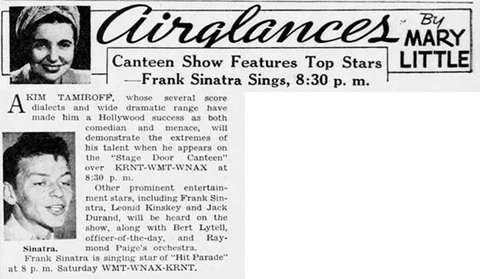
May 7, 1943
Concerts
Frank Dailey's Terrace Room, Newark, N.J. (May 5 to 25) with Gracie Barrie & Her Orchestra
Frank Dailey's Terrace Room, Newark, N.J. (May 5 to 25) with Gracie Barrie & Her Orchestra
Boston Globe
May 29, 1943
note: There was not a lot of coverage of Frank's engagement at the Terrace Room. The last entry here is four days after Frank closed at Dailey's place and opened at the Paramount on 5/26. WCOP was a radio station in Boston. Today its call letters are WZLX. The 29th was a Saturday and the show was as half-hour in length.
Ed
[image referenced in source but could not be recovered]
[image referenced in source but could not be recovered]
[image not recovered — source caption: “XX”]
May 8, 1943
Radio
Your Hit Parade
Network: CBS
Program #416
Time: 9:00-9:45 P.M. (Rebroadcast May 9, 1943 12:00-12:45 A.M.)
Sponsor: Lucky Strike
1. There's A Harbor Of Dream Boats (8) - Hit Paraders
2. Taking A Chance On Love (6) - Edwards
3. It Can't Be Wrong (5) - Sinatra
4. Medley: Falling In Love With Love / Lover - Ethel Smith
5. Brazil (7) - Edwards & Hit Paraders
6. You'll Never Know (9) - Sinatra
7. commercial
8. All Time Medley: Moanin' Low / Darktown Strutter's Ball / Liza - Orchestra & Company
9. station break
10. I've Heard That Song Before (4) - Edwards
11. Comin' In On A Wing And A Prayer (10) - Hit Paraders
12. Alabamy Bound - Ethel Smith
13. That Old Black Magic (3) - Sinatra & Hit Paraders
14. Don't Get Around Much Any More (2) - Hit Paraders
15. As Time Goes By (1) - Edwards
Concerts
Frank Dailey's Terrace Room, Newark, N.J. (May 5 to 25) with Gracie Barrie & Her Orchestra
Your Hit Parade
Network: CBS
Program #416
Time: 9:00-9:45 P.M. (Rebroadcast May 9, 1943 12:00-12:45 A.M.)
Sponsor: Lucky Strike
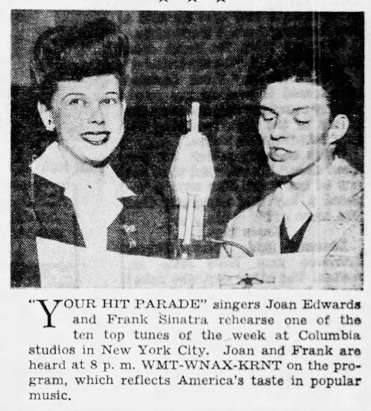
May 9, 1943
Concerts
Frank Dailey's Terrace Room, Newark, N.J. (May 5 to 25) with Gracie Barrie & Her Orchestra
Paramount, New York, NY
Sinatra subbed for Harry James on this date
Paramount, New York, NY
Sinatra subbed for Harry James on this date
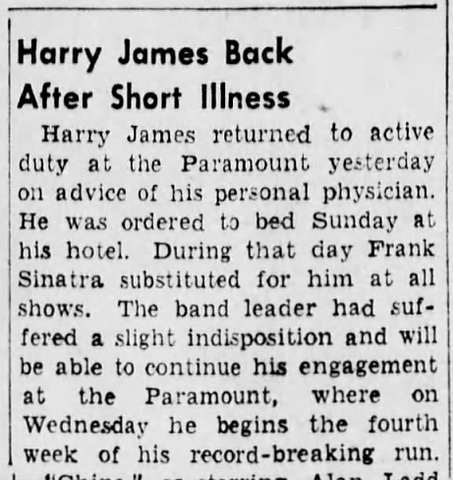
May 10, 1943
Concerts
Frank Dailey's Terrace Room, Newark, N.J. (May 5 to 25) with Gracie Barrie & Her Orchestra
May 11, 1943
Concerts
Frank Dailey's Terrace Room, Newark, N.J. (May 5 to 25) with Gracie Barrie & Her Orchestra
May 12, 1943
Concerts
Frank Dailey's Terrace Room, Newark, N.J. (May 5 to 25) with Gracie Barrie & Her Orchestra
May 13, 1943
Concerts
Frank Dailey's Terrace Room, Newark, N.J. (May 5 to 25) with Gracie Barrie & Her Orchestra
Frank Dailey's Terrace Room, Newark, NJ
Sinatra conducts a "Swing Concert"
The Montclair Times (Montclair, New Jersey) · 13 May 1943
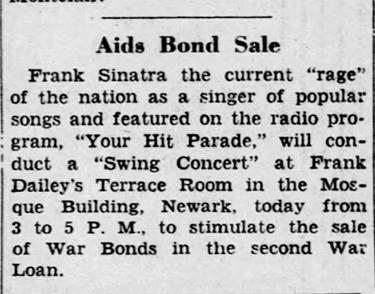
May 14, 1943
Radio
Broadway Bandbox
Network: CBS
Location: New York City, CBS Playhouse #3
Time: 11:15PM - 12:00AM (EST) Fridays
Show #1
Sponsor: none (substaining)
Host: Frank Sinatra
Musicians: Raymond Scott Orchestra augmented by a string section, Bobby Tucker Singers
Arranged and Conducted By: Axel Stordahl (Sinatra portions)
Announcer: Maurice Hart
Guests: Arlene Whelen, Joey Faye
1. All Or Nothing At All
2. Embraceable You
3. That Old Black Magic
4. Dancing In The Dark w/ Bobby Tucker Singers
Notes: First Sinatra Broadway Bandbox. Confirmed airing on WABC. May 7th on WABC had 11:15PM-12:00PM Gordon MacRae, songs followed by Allen Orchestra at 11:30PM-12:00PM. No show on May 21, 1943. Ed O'Brien: "On the 5-28-43 show, Sinatra mentions that it is the second Broadway Bandbox to be broadcast." Brian adds: Looking through historical records I can find no event that would have postponed the broadcast. Only historical item is the Fastest nine inning AL baseball game (89 mins), White Sox beat Senators. The scheduled guests for the May 21st broadcast do appear on the 28th.
Ed O'Brien:
Frank did a three week engagement at Frank Dailey's Terrace Room, located in the Mosque Theatre Building, Broad Street, Newark, N.J.. in May 1943. Originally Frank was set to play two weeks with Gracie Barrie's Orchestra in early May and then two weeks with Stan Kenton's in early June. The latter engagement fell through due to scheduling conflicts. His three weeks with Barrie and her band opened on 5-5-43. Frank was given a guaranteed salary plus a percentage. There was a $2.00 minimum. Harry James was playing at The Paramount at the same time. On 5/9 he collapsed from nervous exhaustion. His doctor insisted on bed rest and Harry asked Frank to sub for him. Sunday and Monday (May 9 & 10), Frank played the Paramount during the day and at night commuted between the two venues - timing the film run at the Paramount perfectly. Frank sang with Harry's band. Harry, well rested, returned for the first show on Tuesday morning.
Frank missed shows on 19, 20, 21, so he could fly out to Chicago for a meeting with Tommy Dorsey and Leonard Vannerson. Dorsey owned one-third of Frank's earnings and Vannerson, TD's manager, own 10%. Frank was paying his own agent another 10%. He wanted a much better deal. Unfortunately the talks went nowhere. Due to inclement weather, Frank's return flight on Friday was grounded. This caused him to miss his 5/21 Broadway Bandbox show on CBS. Raymond Scott did the show that evening. Frank's scheduled guests Elena Miramova & Teddy Hart were bumped ahead to the following week (28).
I am happy to say that the mystery of the Bandbox show on 5/21 is now solved. All the New York papers had the show scheduled with Frank and guests announced
Concerts
Frank Dailey's Terrace Room, Newark, N.J. (May 5 to 25) with Gracie Barrie & Her Orchestra
Broadway Bandbox
Network: CBS
Variety
5-19-43
note: Raymond Scott collected the "Bandbox" shows on silver discs. Not realizing how fragile they were, Scott put them in a rather flimsy box. Years later, he discovered that most of them had deteriorated so much that they were no longer playable.
Ric Ross told me this sad story.
Ed
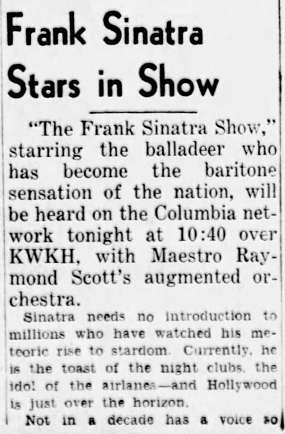

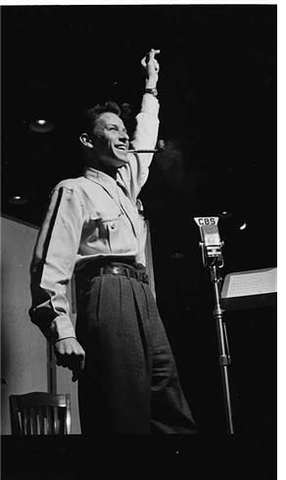
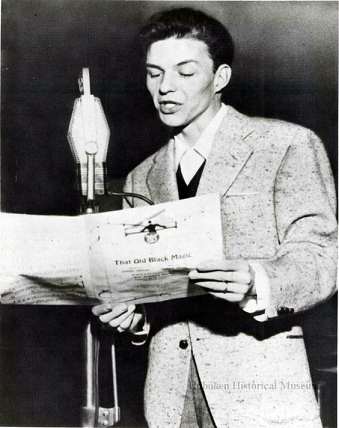
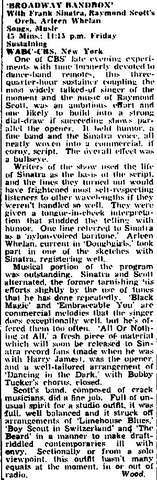
"All or Nothing at All"
As we have seen, Columbia, following the suggestion of publisher Lou Levy, came up with the lucrative idea of reissuing the Harry James–Sinatra disc of “All or Nothing at All” from 1939, which, fortunately, so heavily featured the boy singer that it was easily passed off as a genuine Sinatra record. The four-year-old master climbed to the top of the Billboard best-selling record charts and was treated like a contemporary Sinatra hit. Sinatra commissioned a new arrangement of the song from Stordahl, which he introduced on the premiere episode of the Broadway Bandbox show. The 1939 version was advanced enough for its day, but it was significantly updated for 1943, using strings and ending on a soft and subtle long note instead of the belting, dramatic closer of the 1939 chart. “All or Nothing at All” became the first of his own hits that Sinatra would sing on Your Hit Parade.
Source: Will Friedwald, "Sinatra! The Song Is You: A Singer's Art" (2018 revised edition).
May 15, 1943
Radio
Your Hit Parade
Network: CBS
Program #417
Time: 9:00-9:45 P.M. (Rebroadcast 1943 12:00-12:45 A.M.)
Sponsor: Lucky Strike
Script (First & Final As Broadcast)
1. I've Heard That Song Before (6) - Hit Paraders
2. Don't Get Around Much Any More (4) - Edwards
3. You'll Never Know (9) - Sinatra
4. Liza - Ethel Smith
5. Coming In On A Wing And A Prayer (7) - Hit Paraders
6. It's Always You (8) - Edwards
7. commercial
8. Taking A Chance On Love (5) - Edwards
9. station break
10. In The Blue of Evening (10) - Sinatra
11. Alla En El Rancho Grande - Ethel Smith
12. It Can't Be Wrong (3) - Hit Paraders
13. That Old Black Magic (2) Sinatra & Hit Paraders
14. As Time Goes By (1) - Edwards
Notes: All Time Medley was to be performed by the orchestra and entire company but was cut from show.
Song would have been "Sometimes I'm Happy", "Louisiana Hay Ride" and "Hallelujah." Script has the correct date but the wrong number. Listing is #416, when it should read #417.
Concerts
Frank Dailey's Terrace Room, Newark, N.J. (May 5 to 25) with Gracie Barrie & Her Orchestra
May 16, 1943
Radio
"I'm An American Day"
Location: Live from Central Park, New York City
Network: NBC
MC: Mayor Fiorello La Guardia
Guests: Vice President Wallace
Performers: Marjorie Lawrence, Frank Sinatra, Lawrence Tibbett.
1. God Bless America - Frank Sinatra w/Chorus
Note: The song "God Bless America" appears on the CD: The Rarest Sinatra Dacade CD103.
LOC has NBC10-inch sound reel,. TT over 120mins.
Texaco Star Theater
Network: CBS
Sponsor: Texaco
Host: Fred Allen
Guest: Frank Sinatra
Performers: Portland Hoffa, John Brown, Minerva Pious, Charlie Cantor, Alan Reed, Hi Lo Jack and The Dame
Announcer: Jimmy Wallington
Orchestra Conducted By: Al Goodman
1. She's Funny That Way
Note: TT 30mins. The show appears on the officially released CD set: 60 Greatest Old Time Radio Show "Frank Sinatra & Friends"
Ed notes: This was the Fred Allen show. At the time, Allen's show was one of the highest rated on radio. His wife, Portland Hoffa (Ohhhhhh... Portia), was a regular, along with John Brown, playing the acerbic John Doe. Al Goodman and His Orchestra provided the music. Allen was an urbane, extremely witty fellow who deflated much of the nonsense that passed for current events at the time. Sinatra and he swapped guest appearances many times. Frankie was a great audience for Fred's wry humor. His cutting remarks never failed to get a howl from The Voice.
Concerts
Frank Dailey's Terrace Room, Newark, N.J. (May 5 to 25) with Gracie Barrie & Her Orchestra
$2.00 minimum.
Note: Frank missed shows on 19, 20, 21,
"I'm An American Day"
Location: Live from Central Park, New York City
Network: NBC
MC: Mayor Fiorello La Guardia
Guests: Vice President Wallace
Performers: Marjorie Lawrence, Frank Sinatra, Lawrence Tibbett.
1. God Bless America - Frank Sinatra w/Chorus
Note: The song "God Bless America" appears on the CD: The
Rarest Sinatra Dacade CD103.
LOC has NBC10-inch sound reel,. TT over 120mins.
Excerpt from New York Times coverage of Central Park gathering.

Texaco Star Theater
Network: CBS
Sponsor: Texaco
Host: Fred Allen
Guest: Frank Sinatra
Performers: Portland Hoffa, John Brown, Minerva Pious, Charlie Cantor, Alan Reed, Hi Lo Jack and The Dame
Announcer: Jimmy Wallington
Orchestra Conducted By: Al Goodman
1. She's Funny That Way
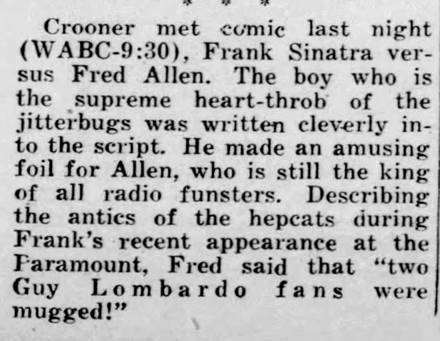
May 17, 1943
Concerts
Frank Dailey's Terrace Room, Newark, N.J. (May 5 to 25) with Gracie Barrie & Her Orchestra
$2.00 minimum.
Note: Frank missed shows on 19, 20, 21,
May 18, 1943
Concerts
Madison Square Garden, New York City
Greek War Relief Benefit
Note: A portion of the benefit was broadcast over WINS in New York City
Frank Dailey's Terrace Room, Mosque Theatre Building, Broad Street, Newark, N.J. (5-25) Three Week Engagement
Gracie Barrie's Orchestra
$2.00 minimum.
Note: Frank missed shows on 19, 20, 21,
Madison Square Garden, New York City
Greek War Relief Benefit
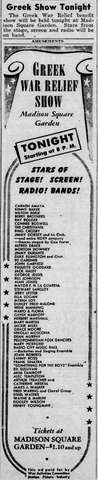
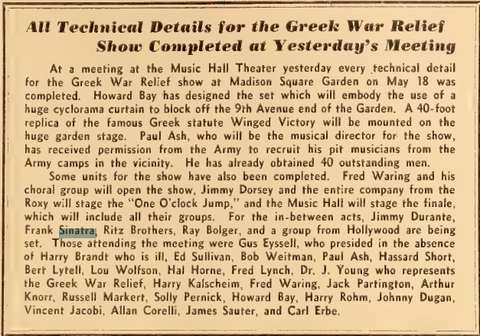
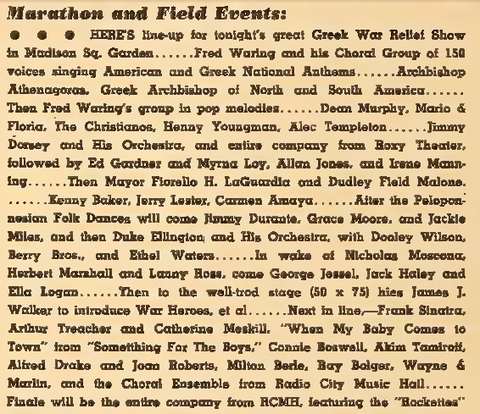
May 22, 1943
Radio
Your Hit Parade
Network: CBS
Program #418
Time: 9:00-9:45 P.M. (Rebroadcast May 23, 1943 12:00-12:45 A.M.)
Sponsor: Lucky Strike
Arranged by: Axel Stordahl
Conducted by: Mark Warnow
Script (Final As Broadcast)
1. It Can't Be Wrong (4) - Hit Paraders
2. Taking A Chance On Love (10) - Edwards
3. That Old Black Magic (7) - Sinatra & Hit Paraders
4. Why - Ethel Smith
5. I've Heard That Song Before (8) - Edwards
6. Let's Get Lost (6) - Sinatra
7.. commercial
8. Brazil (9) - Edwards & Hit Paraders
9. station break
10.. You'll Never Know (5) - Sinatra
11. (unknown) - Ethel Smith
12. Coming In On A Wing And A Prayer (3) - Hit Paraders
13. Don't Get Around Much Any More (2) - Edwards
14. As Time Goes By (1) - Sinatra
Dress Rehearsal (Sinatra Songs):
1. As Time Goes By
2. Let's Get Lost
Notes: Script lists as #419. This is #418. Ethel Smith was to have played "The Breeze And I" but it was changed to "(unknown)"
Ed O'Brien:
Somewhere along the way Frank would sing all of the songs performed here except "Why."
Concerts
Frank Dailey's Terrace Room, Mosque Theatre Building, Broad Street, Newark, N.J. (5-25) Three Week Engagement
Gracie Barrie's Orchestra
$2.00 minimum.
Note: Frank missed shows on 19, 20, 21,
May 23, 1943
Concerts
Frank Dailey's Terrace Room, Mosque Theatre Building, Broad Street, Newark, N.J. (5-25) Three Week Engagement
Gracie Barrie's Orchestra
$2.00 minimum.
May 24, 1943
Radio
95 Minutes To Broadway
Variety Show
CBS
Monday Evening
12:05 -1:00 a.m.
WCAU-AM
Philadelphia
Guest: Frank Sinatra
Johnny Warrington & His Orchestra
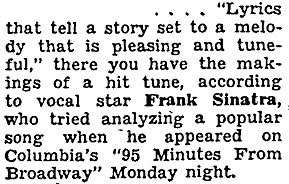
Concerts
"Frank Sinatra Day" Weyburn Plaza, Philadelphia
Giant Bond Rally
Songs Included:
1. Black Magic
2. As Time Goes By
Frank Dailey's Terrace Room, Mosque Theatre Building, Broad Street, Newark, N.J. (5-25) Three Week Engagement
Gracie Barrie's Orchestra
$2.00 minimum.
"Frank Sinatra Day" in Philadelphia
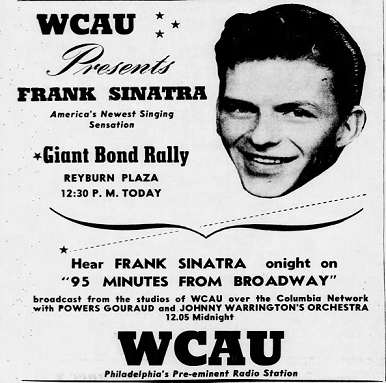
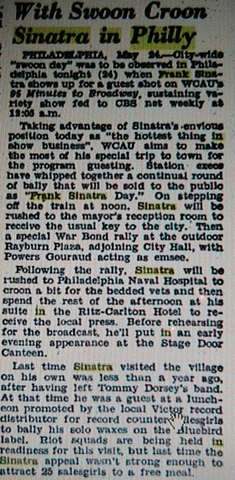
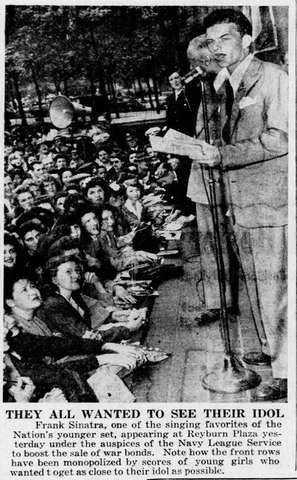
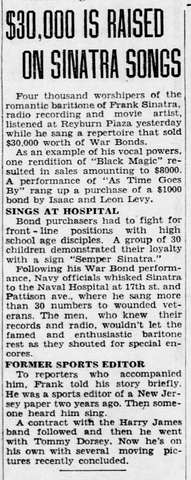
95 Minutes To Broadway
Variety Show
CBS
Monday Evening
12:05 -1:00 a.m.
WCAU-AM
Philadelphia
Guest: Frank Sinatra
Johnny Warrington & His Orchestra
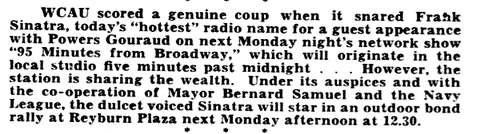
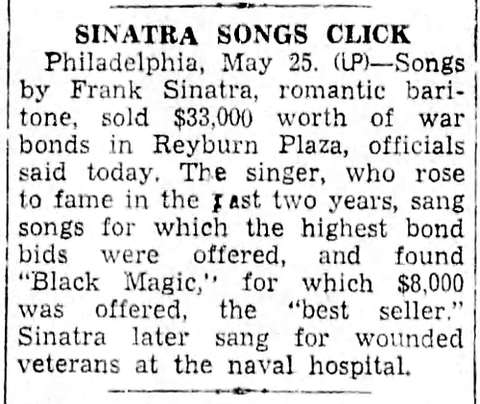
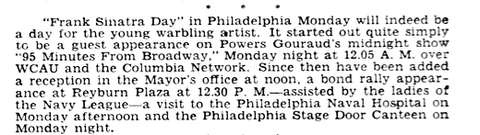
May 25, 1943
Concerts
Frank Dailey's Terrace Room, Mosque Theatre Building, Broad Street, Newark, N.J. (5-25) Three Week Engagement
Gracie Barrie's Orchestra
$2.00 minimum.
May 26, 1943
Concerts
Paramount Theatre, New York City (May 26 - June 22)
Gracie Barrie's Orchestra
Ed O'Brien:
Here is a list of some of the songs
Sinatra was singing at the Paramount during the spring/summer engagement of 1943. Most shows ran around 40 minutes
As Time Goes By
You'll Never Know
In The Blue Of Evening
Close To You
Night And Day
That Old Black Magic
I Only Have Eyes For You
All Or Nothing At All
It Can't Be Wrong
The Song Is You
Let's Get Lost
Dancing In The Dark
Paramount Theatre, New York City (May 26 - June 26)
Gracie Barrie's Orchestra
Newspaper ad, 5-26-43.
A very good Billy Wilder film didn't hurt bobbysox idol.
Variety
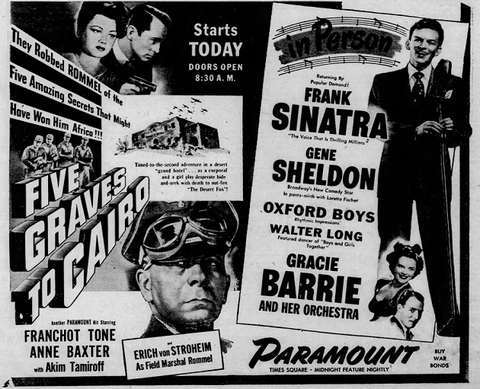
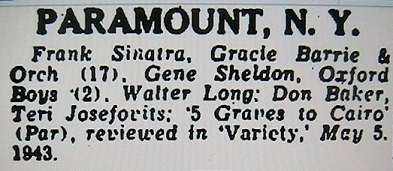
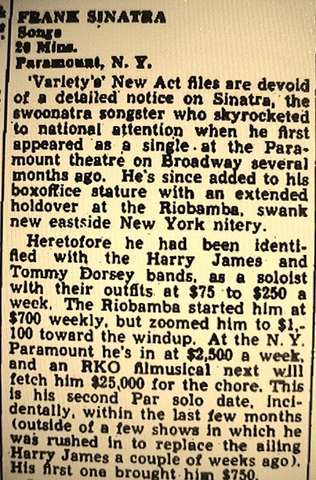
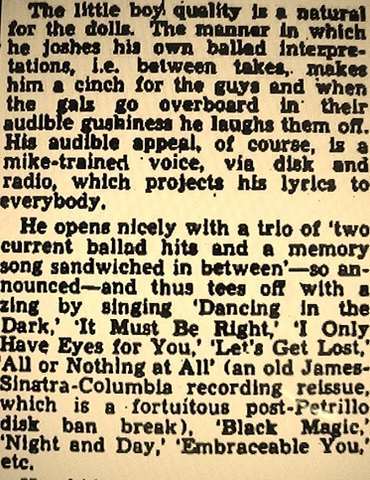
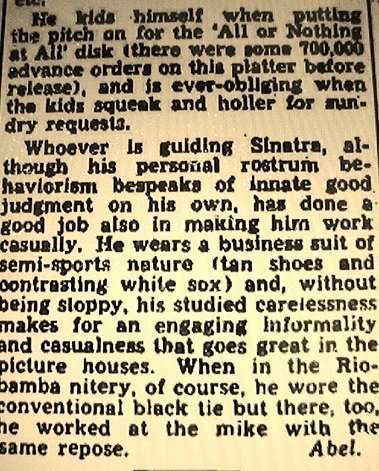
Paramount, New York (Reviewed Wednesday Evening, May 26) Current show is far from being a smash, but it has Frank Sinatra, who brought the paying customers out in throngs opening night. Gracie Barrie orchestra is the only other name on the bill, the Gene Sheldon's panto antics contributed heavily to the entertainment. Sinatra, who had a 10-week run here six months ago and pinch -hit for Harry James a couple of times within the past two weeks, can stay from now on if the fillies who felled the first rows and sat out four performances at a stretch are the last word. Sinatra really had his hands full with them. The anklesocked girls whistled at him in embarrassing fashion and broke in on his song patter with shouted remarks. With the exception of a few kidding answers tossed at them, Sinatra stuck to the business of singing, and each of his six songs proved devastating as usual. He's lucky to have a new recording on the market, something he once did with Harry James, and the torchy ballad, All or Nothing at All, served handily as his first encore. He bowed off with Embraceable You.
Miss Barrie, a fine singer in her own right, had to lay off ballads in deference to Sinatra but overcame the handicap, scoring with .special material.
Opened with a short sentimental piece called Taking Over While My Man's Away and the applause it. got acknowledged Dick Stabile's departure for service with the coast guard. A parody on Gilbert and Sullivan's Tit-Willow that gave whatfor to Adolf, Benito and Tojo won her a heavy response, as did the Got To Get Hot ditty she did originally in one of George White's Scandals. She looks charming in front of her band garbed in a sexy lace-bodiced gown, and handled the leading chores with ease, but the one only rated so-so with this band-wise audience. The boys had two numbers to themselves, getting a man-by-man intro by Miss Barrie on Take It and Git. Gene Sheldon, with Loretta Fischer as his mouthpiece, got howl after howl with his pantomimic shenanigans. The baggy-pantsed comic has wonderful comedy sense and whether he is having Mock trouble playing his banjo or making his legs come out the same size, he knows how to produce laughs. He closed with the make-believe finger-threading stunt and had to beg off. The Oxford Boys produced assorted sounds and noises, with the emphasis on simulated musical instruments. Somewhat old hat but liked moderately well. Walter Long tapped his way thru two routines
In smooth if unexciting style. Five Graves to Cairo. House jam-packed with waiting in the lobby.
Elliott Grennard.
Billboard
June 5, 1943
Ed O'Brien:
Frank's third solo appearance at the Paramount.
His star would continue to rise over the next 18 months, reaching an apex with the Columbus Day riots in 1944.
By the end of 1943, he was able to ask and get $15,000 a week. Again, his four-week engagement, in May/June of 43, was SRO every show.
Paramount Theatre, New York City (May 26 - June 26)
Gracie Barrie's Orchestra
Newspaper ad, 5-26-43.
A very good Billy Wilder film didn't hurt bobbysox idol.
Variety
6-2-43
Paramount, New York (Reviewed Wednesday Evening, May 26) Current show is far from being a smash, but it has Frank Sinatra, who brought the paying customers out in throngs opening night. Gracie Barrie orchestra is the only other name on the bill, the Gene Sheldon's panto antics contributed heavily to the entertainment. Sinatra, who had a 10-week run here six months ago and pinch -hit for Harry James a couple of times within the past two weeks, can stay from now on if the fillies who felled the first rows and sat out four performances at a stretch are the last word. Sinatra really had his hands full with them. The anklesocked girls whistled at him in embarrassing fashion and broke in on his song patter with shouted remarks. With the exception of a few kidding answers tossed at them, Sinatra stuck to the business of singing, and each of his six songs proved devastating as usual. He's lucky to have a new recording on the market, something he once did with Harry James, and the torchy ballad, All or Nothing at All, served handily as his first encore. He bowed off with Embraceable You.
Miss Barrie, a fine singer in her own right, had to lay off ballads in deference to Sinatra but overcame the handicap, scoring with .special material. Opened with a short sentimental piece called Taking Over While My Man's Away and the applause it. got acknowledged Dick Stabile's departure for service with the coast guard. A parody on Gilbert and Sullivan's Tit-Willow that gave whatfor to Adolf, Benito and Tojo won her a heavy response, as did the Got To Get Hot ditty she did originally in one of George White's Scandals. She looks charming in front of her band garbed in a sexy lace-bodiced gown, and handled the leading chores with ease, but the one only rated so-so with this band-wise audience. The boys had two numbers to themselves, getting a man-by-man intro by Miss Barrie on Take It and Git. Gene Sheldon, with Loretta Fischer as his mouthpiece, got howl after howl with his pantomimic shenanigans. The baggy-pantsed comic has wonderful comedy sense and whether he is having Mock trouble playing his banjo or making his legs come out the same size, he knows how to produce laughs. He closed with the make-believe finger-threading stunt and had to beg off. The Oxford Boys produced assorted sounds and noises, with the emphasis on simulated musical instruments. Somewhat old hat but liked moderately well. Walter Long tapped his way thru two routines In smooth if unexciting style. Five Graves to Cairo. House jam-packed with waiting in the lobby. Elliott Grennard.
Billboard
June 5, 1943
Ed O'Brien:
Frank's third solo appearance at the Paramount.
His star would continue to rise over the next 18 months, reaching an apex with the Columbus Day riots in 1944.
By the end of 1943, he was able to ask and get $15,000 a week. Again, his four-week engagement, in May/June of 43, was SRO every show.
[image referenced in source but could not be recovered]
[image referenced in source but could not be recovered]
[image referenced in source but could not be recovered]
[image referenced in source but could not be recovered]
[image referenced in source but could not be recovered]
May 27, 1943
Concerts
Paramount Theatre, New York City (May 26 - June 22)
Gracie Barrie's Orchestra
Ed O'Brien:
Here is a list of some of the songs
Sinatra was singing at the Paramount during the spring/summer engagement of 1943. Most shows ran around 40 minutes
As Time Goes By
You'll Never Know
In The Blue Of Evening
Close To You
Night And Day
That Old Black Magic
I Only Have Eyes For You
All Or Nothing At All
It Can't Be Wrong
The Song Is You
Let's Get Lost
Dancing In The Dark
May 28, 1943
Radio
Broadway Bandbox
Network: CBS
Location: New York City, CBS Playhouse #3
Time: 11:30PM - 12:00AM (EST) Fridays
Show #2
Sponsor: none (sustaining)
Host: Frank Sinatra
Musicians: Raymond Scott Orchestra augmented by a string section, Bobby Tucker Singers
Arranged and Conducted By: Axel Stordahl (Sinatra portions)
Announcer: Maurice Hart
Guests: Teddy Hart, Elena Miranova
1. This Love Of Mine
2. It Can't Be Wrong
3. Close To You
4. My Heart Stood Still - w/Bobby Tucker Singers
5. Put Your Dreams Away
Notes: Show is now 30mins and starts at 11:30PM. Confirmed airing on WABC.
Concerts
Paramount Theatre, New York City (May 26 - June 22)
Gracie Barrie's Orchestra
Ed O'Brien:
Here is a list of some of the songs
Sinatra was singing at the Paramount during the spring/summer engagement of 1943. Most shows ran around 40 minutes
As Time Goes By
You'll Never Know
In The Blue Of Evening
Close To You
Night And Day
That Old Black Magic
I Only Have Eyes For You
All Or Nothing At All
It Can't Be Wrong
The Song Is You
Let's Get Lost
Dancing In The Dark
Broadway Bandbox
Network: CBS
Location: New York City, CBS Playhouse #3
Time: 11:30PM - 12:00AM (EST) Fridays
Show #2
Sponsor: none (sustaining)
Host: Frank Sinatra
Variety
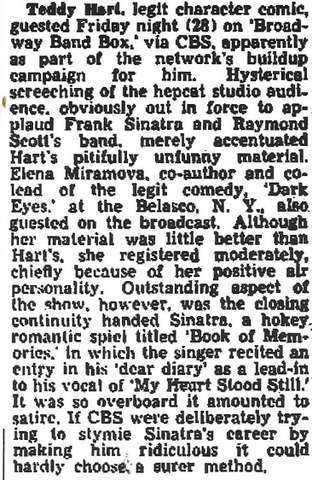
note: Frank tells the listeners that this is the second "Broadway Bandbox." His singing is wonderful throughout. His treatment of Rodgers & Hart's "My
Heart Stood Still" is especially memorable.
The Bobby Tucker Singers joined him and he sings Hart's wonderful verse in the middle of the song.
--Ed
May 29, 1943
Radio
Your Hit Parade
Network: CBS
Program #419
Time: 9:00-9:45 P.M.. (Rebroadcast May 30, 1943 12:00-12:45 A.M.)
Sponsor: Lucky Strike
Script (First & Final As Broadcast)
1. Let's Get Lost (8) - Sinatra
2. I've Heard That Song Before (7) - Edwards
3. In The Blue Of Evening (10) - Hit Paraders
4. You'll Never Know (5) - Sinatra
5. commercial
6. Puttin' On The Ritz - Ethel Smith
7. It Can't Be Wrong (4) - Edwards
8. Taking A Chance On Love (9) - Orchestra
9. station break
10. That Old Black Magic (6) - Sinatra & Hit Paraders
11. Jingle Jangle Jingle - Ethel Smith
12. commercial
13. Comin' In On A Wing And A Prayer (3) - Hit Paraders
14. As Time Goes By (2) - Sinatra
15. Don't Get Around Much Anymore (1) - Edwards
Ed Notes:
This show was broadcast from Richmond, Virginia.
CBS was becoming concerned with the bobbysoxers. The network was getting numerous complaints from listeners who couldn't hear Sinatra over the incessant screaming.
Buddy Bregman told me they solved it to a degree by having Frank backstage until he was set to do a song. Buddy's Uncle Jule (Styne that is . . .) took him to see the broadcasts in Hollywood. He remembered how frantic the teenagers were and how much they annoyed the audience and the show’s producers. Frank, on the other hand, laughed a great deal at their antics.
Concerts
Paramount Theatre, New York City (May 26 - June 22)
Gracie Barrie's Orchestra
Ed O'Brien:
Here is a list of some of the songs
Sinatra was singing at the Paramount during the spring/summer engagement of 1943. Most shows ran around 40 minutes
As Time Goes By
You'll Never Know
In The Blue Of Evening
Close To You
Night And Day
That Old Black Magic
I Only Have Eyes For You
All Or Nothing At All
It Can't Be Wrong
The Song Is You
Let's Get Lost
Dancing In The Dark
Columbia Park, North Bergen, NJ
USO Benefit Dance
Frank Sinatra, Harry James, Helen Forrest
Columbia Park, North Bergen, NJ
USO Benefit Dance
Frank Sinatra, Harry James, Helen Forrest
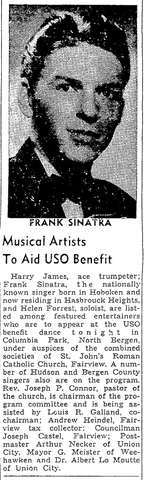
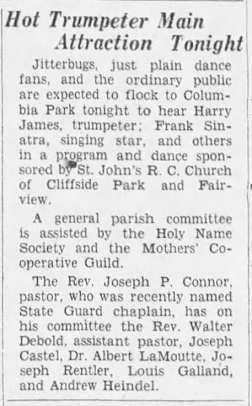
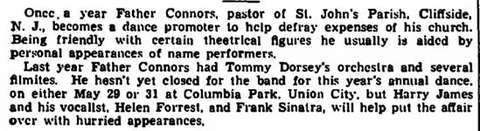
Columbia Park, North Bergen, NJ
USO Benefit Dance
Frank Sinatra, Harry James, Helen Forrest
It’s interesting to note that the above article mentions that Tommy Dorsey’s Orchestra played this event the year previous, being 1942. I wonder if Sinatra was at that one as well? I have not found a date for the 1942 event.
Scott
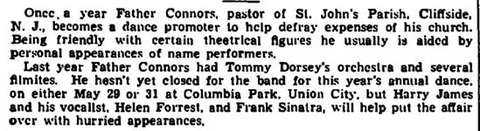
May 30, 1943
Concerts
Paramount Theatre, New York City (May 26 - June 22)
Gracie Barrie's Orchestra
Ed O'Brien:
Here is a list of some of the songs
Sinatra was singing at the Paramount during the spring/summer engagement of 1943. Most shows ran around 40 minutes
As Time Goes By
You'll Never Know
In The Blue Of Evening
Close To You
Night And Day
That Old Black Magic
I Only Have Eyes For You
All Or Nothing At All
It Can't Be Wrong
The Song Is You
Let's Get Lost
Dancing In The Dark
May 31, 1943
Concerts
Paramount Theatre, New York City (May 26 - June 22)
Gracie Barrie's Orchestra
Ed O'Brien:
Here is a list of some of the songs
Sinatra was singing at the Paramount during the spring/summer engagement of 1943. Most shows ran around 40 minutes
As Time Goes By
You'll Never Know
In The Blue Of Evening
Close To You
Night And Day
That Old Black Magic
I Only Have Eyes For You
All Or Nothing At All
It Can't Be Wrong
The Song Is You
Let's Get Lost
Dancing In The Dark
June 1943
[recording session/technique -- critical commentary]
Because of the Petrillo musicians' union recording ban, Sinatra began his Columbia career with a cappella recordings (with the Bobby Tucker Singers and Alec Wilder) at Liederkranz Hall, unable to record with a full orchestra for another year and a half. During this window he engaged Axel Stordahl as music director and asked him to design soft, lush string arrangements distinct from a dance-band sound.
Source: Charles L. Granata, "Sessions with Sinatra: Frank Sinatra and the Art of Recording" (1999/2003), Part II: The Columbia Years, 1943-1952
June 1, 1943
Concerts
Paramount Theatre, New York City (May 26 - June 26)
Gracie Barrie's Orchestra
June 2, 1943
Concerts
Paramount Theatre, New York City (May 26 - June 26)
Gracie Barrie's Orchestra
June 3, 1943
Radio
Four Freedoms War Bond Show
Harry Sosnik and his band, Joan Edwards, Frank Sinatra
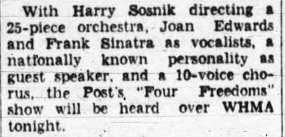
Gracie Barrie Orchestra with songs by Frank Sinatra
WCOP Boston 10-10:30pm

Concerts
Paramount Theatre, New York City (May 26 - June 22)
Gracie Barrie's Orchestra
Four Freedoms War Bond Show
Harry Sosnik and his band, Joan Edwards, Frank Sinatra
Ed O'Brien:
On this day in 1944(Saturday evening), Command Performances # 122 &123 were taped. The broadcast date for 122 was 6-25-44 and 123 was broadcast on 7-2-44.
Command Performance #122
30 minutes
Host: Bob Hope
Guests: Bing Crosby, Frank Sinatra and Judy Garland
Annc: Ken Carpenter
Orch. conducted by Meredith Wilson
Frank sang "All The Things You Are," did
comedy sketches with the others and Bing
joined him in a very entertaining medley,
parodying a number of great songs including
"You're The Top" and "You Are My Sunshine."
Command Performance #123
30 minutes
Host & Annc: Ken Carpenter
Guests: Connie Haines, Lena Horne, Shirley
Ross, Francis Langford, Lotte Lehman, Frank
Sinatra, Bing Crosby and Bob Hope
Orchestra conducted by Meredith Wilson
Frank, Bing and Bob performed "If I Had My Way" about
half-way through the show and then reprised
it as the show came to an end.
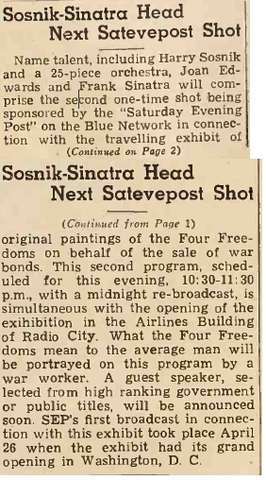
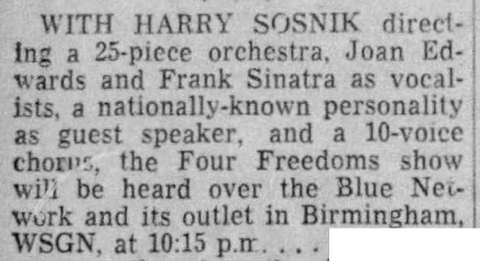
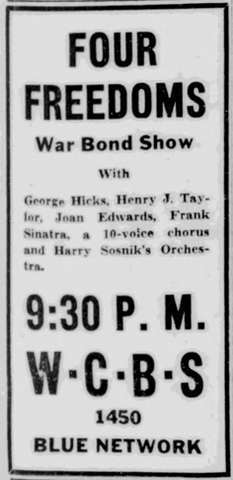
June 4, 1943
Radio
Broadway Bandbox
Network: CBS
Location: New York City, CBS Playhouse #3
Time: 11:30PM - 12:00AM (EST) Fridays
Show #3
Sponsor: none (substaining)
Host: Frank Sinatra
Musicans: Raymond Scott Orchestra augmented by a string section, Bobby Tucker Singers
Arranged and Conducted By: Axel Stordahl (Sinatra portions)
Announcer: Maurice Hart
Guests: Joan Roberts, Harry James
Notes: Confirmed airing on WABC
Concerts
Paramount Theatre, New York City (May 26 - June 26)
Gracie Barrie's Orchestra
Broadway Bandbox
Network: CBS
Location: New York City, CBS Playhouse #3
Time: 11:30PM - 12:00AM (EST) Fridays
Show #3
Sponsor: none (substaining)
Host: Frank Sinatra
Musicans: Raymond Scott Orchestra augmented by a string section, Bobby Tucker Singers
Arranged and Conducted By: Axel Stordahl (Sinatra portions)
Announcer: Maurice Hart
Guests: Joan Roberts, Harry James
Daily News (New York, New York) · June 4, 1943
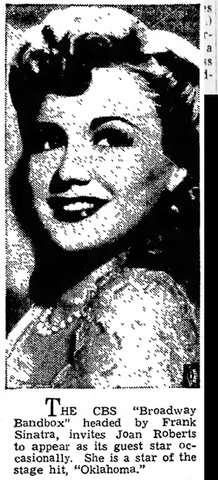
June 5, 1943
Radio
Your Hit Parade
Network: CBS
Program #420
Time: 9:00-9:45 P.M. (Rebroadcast June 6, 1943 12:00-12:45 A.M.)
Sponsor: Lucky Strike
Script (First & Final As Broadcast)
1. That Old Black Magic (8) - Sinatra & Hit Paraders
2. Taking A Chance On Love (7) - Edwards
3. In The Blue Of Evening (9) - Hit Paraders
4. Canhoto - Ethel Smith
5. commercial
6. What's The Good Word, Mr. Bluebird (10) - Orchestra
7. Let's Get Lost (5) - Sinatra
8. It Can't Be Wrong (4) - Edwards
9. station break
10. As Time Goes By (6) - Sinatra
11. The Sheik Of Araby - Ethel Smith
12. commercial
13. Comin' In On A Wing And A Prayer (3) - Hit Paraders
14. You'll Never Know (2) - Sinatra
15. Don't Get Around Much Any More (1) - Edwards
Concerts
Paramount Theatre, New York City (May 26 - June 22)
Gracie Barrie's Orchestra
June 6, 1943
Concerts
Paramount Theatre, New York City (May 26 - June 26)
Gracie Barrie's Orchestra
June 7, 1943
Studio
New York City
CO33249 Close To You w/The Bobby Tucker Singers
(A.Hoffman/J. Livingston/C. G. Lampl)
Barton Music Corp. (ASCAP) 1943
Arrangement & Conducted by Alec Wilder
-1 (3:17) CD: Columbia Years 43-52 Vol. 1
LP: CL-2739 The Essential Frank Sinatra Vol. 1
LP: C6X-40343 The Voice-Columbia Years 43-52 (6-LP Set)
78: 36678
CO33250 People Will Say We're In Love (n/r) w/The Bobby Tucker Singers
(R. Rodgers/O. Hammerstein II)
(from Oklahoma!)
Williamson Music, Inc. (ASCAP) 1943
Arrangement & Conducted by Alec Wilder
CO33251 You'll Never Know w/The Bobby Tucker Singers
(M. Gordon/H. Warren )
(from Hello, Frisco, Hello)
Bergman, Vocco & Conn (ASCAP) 1943
Arrangement & Conducted by Alec Wilder
-1 (3:00) CD: Columbia Years 43-52 Vol. 1
LP: C2L-6 Frank Sinatra Story In Music (2-LP Set)
LP: C2X-40897 Hello Young Lovers (2-LP Set)
78: 36678
Bobby Tucker Singers: James Ballister, Dick Byron, Ray Charles, Edward Constantine, Fay Devlin, Ruth Doring, Marshall Hall, John Hubert, Frank Raye, Mary Jane Watkins, Rea Whitney
NOTE: Sinatra Scholar Ed O'Brien reports that Ray Charles was on this session and had strong reservations regarding the acapella singing done by Sinatra, Perry Como, and others during the musicians strike. He told O'Brien that a vocalist needs the backing of musical instruments to effectively support the song being sung. He remembered Alec Wilder being at the sessions and arranging the charts while Stordahl conducted. Sinatra would do "People Will Say We're in Love" at three session with the Bobby Tucker singers. By the way, Ray Charles also told O'Brien that there wasn't a set group to the Tucker organization. It varied from session to session, depending upon who was available. "Close to You" was presented to Sinatra backstage and Barton convinced him to form a music publishing company. They did and it was quite successful.
note: I have a lot of session information from the studios Frank recorded for through the years. Yesterday, I remembered having a sheet that shows the dates for some of the a cappella recordings and the release dates of the 78 singles. --Ed
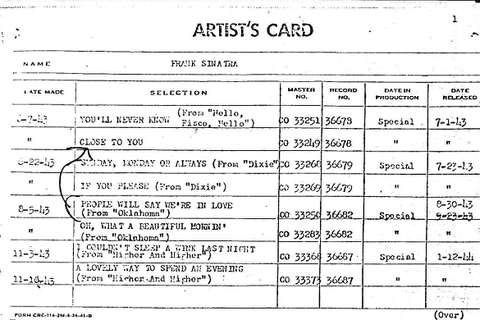
Concerts
Paramount Theatre, New York City (May 26 - June 26)
Gracie Barrie's Orchestra
[First solo Columbia recording session]
On Monday, June 7, 1943, at Liederkranz Hall in New York, Sinatra recorded his first sides as a solo Columbia artist entirely a cappella (due to the musicians' strike), backed only by the eight-voice Bobby Tucker Singers, beginning with "Close to You." It was his first recording session in eleven months.
Source: James Kaplan, "Frank: The Voice" (2010).
June 8, 1943
Concerts
Paramount Theatre, New York City (May 26 - June 26)
Gracie Barrie's Orchestra
Sinatra in 1943. “I think it had a lot to do with the time period,” Sinatra would say of his success at the time with bobby-soxers. “It was important for people to have someone to root for during the war years. In their mind, I was one of the kids from their neighborhood who made good.” Source: photo and caption from J. Randy Taraborrelli, Sinatra: Behind the Legend (mptvimages.com).
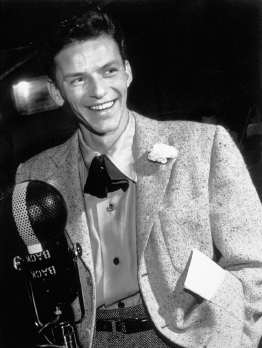
June 9, 1943
Concerts
Paramount Theatre, New York City (May 26 - June 22)
Gracie Barrie's Orchestra
June 10, 1943
Concerts
Paramount Theatre, New York City (May 26 - June 26)
Gracie Barrie's Orchestra
June 11, 1943
Radio
Broadway Bandbox
Network: CBS
Location: New York City, CBS Playhouse #3
Time: 11:30PM - 12:00AM (EST) Fridays
Show #4
Sponsor: none (substaining)
Host: Frank Sinatra
Musicians: Raymond Scott Orchestra augmented by a string section, Bobby Tucker Singers
Arranged and Conducted By: Axel Stordahl (Sinatra portions)
Announcer: Maurice Hart
Guests: Harry James, Leonore Lanegan
1. This Love Of Mine
2. Close To You
3. It's Always You
4. Lover Come Back To Me
5. Put Your Dreams Away
Notes: Confirmed airing on WABC
[image referenced in source but could not be recovered]
Concerts
Paramount Theatre, New York City (May 26 - June 22)
Gracie Barrie's Orchestra
Broadway Bandbox
Network: CBS
Show #4
Host: Frank Sinatra
Guests: Harry James, Leonore Lanegan
[image referenced in source but could not be recovered]
review of Broadway Bandbox
Ed O'Brien note: before the show, the bobbysoxers were warned not to scream during Frank's vocals.
If they did not behave, the management would reconsider the seating of younger people for the show, or, the audience might not be part of future Sinatra radio performances. The adult listeners had lodged numerous complaints with CBS. Far more serious were the dismal ratings the show was registering week-after-week.
June 12, 1943
Radio
Your Hit Parade
Network: CBS
Program #421
Time: 9:00-9:45 P.M. (Rebroadcast June 13, 1943 12:00-12:45 A.M.)
Sponsor: Lucky Strike
Script (Final As Broadcast)
1. It Can't Be Wrong (6) - Sinatra
2. Don't Get Around Much Any More (4) - Edwards
3. You Rhyme With Everything That's Beautiful (9) - Hit Paraders
4. I Got Rhythm - Ethel Smith
5. commercial
6. Taking A Chance On Love (10) - Orchestra
7. As Time Goes By (5) - Sinatra
8. I Never Mention Your name (8) - Edwards
9. station break
10. It's Always You (7) - Sinatra
11. Who - Ethel Smith
12. commercial
13. You'll Never Know (3) - Edwards
14. Comin' In On A Wing And A Prayer (2) - Hit Paraders
15. Let's Get Lost (1) - Sinatra
Concerts
Paramount Theatre, New York City (May 26 - June 22)
Gracie Barrie's Orchestra
June 13, 1943
Radio
Chamber Music Society of Lower Basin Street
Network: WENR
Time: 8:15PM-8:30PM (CTR)
Guest: Frank Sinatra
1. Black Magic
2. Somebody Loves Me
Note: Confirmed aired on WENR.
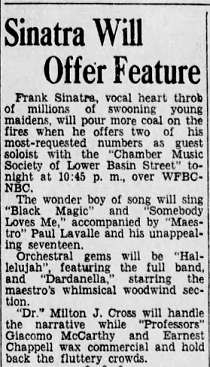
Concerts
Paramount Theatre, New York City (May 26 - June 22)
Gracie Barrie's Orchestra
Chamber Music Society of Lower Basin Street
Network: WENR
Time: 8:15PM-8:30PM (CTR)
Guest: Frank Sinatra
1. Black Magic
2. Somebody Loves Me
Note: Confirmed aired on WENR.
June 13, 1945 Frank Sinatra at Santa Maria and Lajes Base the Azores,
On June 14, 1945, the biggest headline in the newspaper “A Pátria” belonged to Frank Sinatra, the “idol of American women”, who, the night before, had sung at the Lajes Base, his first performance on European soil. It was a major event, after all, the man with the “most sought-after autograph in Hollywood” had visited Angra do HeroÃsmo and performed his “stunning and delirious songs” on the island. João Moreira dos Santos and António Rubio point out, in their book “Jazz na Terceira: 80 anos de História”, that this was the most “important and unusual” concert that took place in Lajes at the time. War II had already ended in Europe.
Pianist Saul Chaplin, acrobatic dancer Betty Yeaton, and singer and actress Fay McKenzie also arrived in the Azores. After a short performance in Santa Maria, Sinatra and the other artists landed in Lajes, transported by a C-47. “The singer made jokes about himself throughout the show and had the audience on his side the whole time,” described The New York Times about the tour, quoted by Pedro Barros Costa, in the 2018 article ‘When Sinatra performed in the Azores’. The Angrajazz Festival set aside a moment in this year’s edition to remember Sinatra’s performance in Lajes.
June 13th, 1950:
The San Francisco Examiner
San Francisco, California
14 Jun 1950
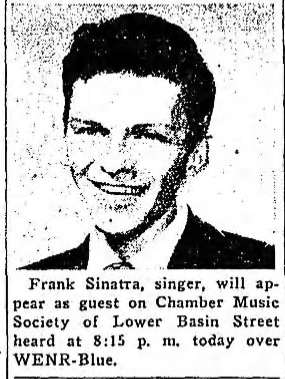
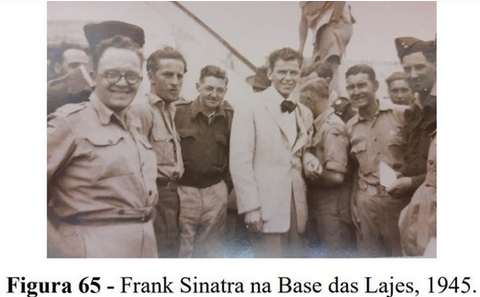
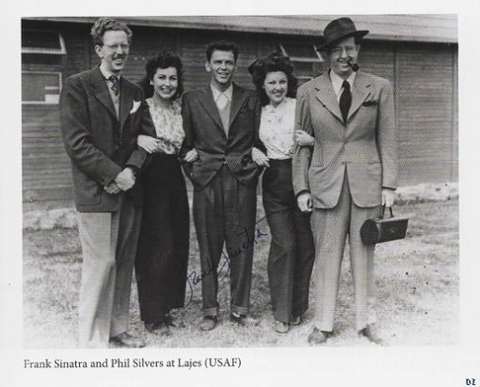
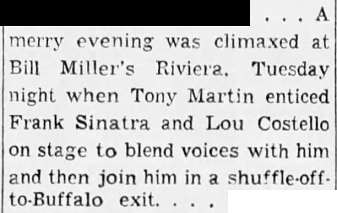
June 14, 1943
Concerts
Paramount Theatre, New York City (May 26 - June 22)
Gracie Barrie's Orchestra
June 15, 1943
Concerts
Paramount Theatre, New York City (May 26 - June 22)
Gracie Barrie's Orchestra
June 16, 1943
Concerts
Paramount Theatre, New York City (May 26 - June 22)
Gracie Barrie's Orchestra
June 17, 1943
Radio
Stage Door Canteen
Location: New York City, Astor Roof
Network: CBS
Time: 9:30PM - 10:00PM (EST)
Sponsor: Corn Products Refining Co.
Performers: Bert Lytell, Vera Zorina, Frank Sinatra, Monty Woolley, High Low Jack and Dame
Announcers: Bud Collyer and David Rose
Music: Raymond Paige & Orch.
Note: Frank sang "Close To You" with a full orchestral backing from the Raymond Paige band.
Ten days earlier Frank had recorded the song a cappella at Columbia Records with a choral backing by the Bobby Tucker Singers. It was Frank's first solo recording for Columbia. --Ed
note: Frank's performance is available from Columbia's "A Voice On The Air." Track 22 , Disc 1.
Ed
Concerts
Paramount Theatre, New York City (May 26 - June 22)
Gracie Barrie's Orchestra
Stage Door Canteen
Frank Sinatra at the stage door canteen
[image referenced in source but could not be recovered]
June 18, 1943
Radio
Broadway Bandbox
Network: CBS
Location: New York City, CBS Playhouse #3
Time: 11:30PM - 12:00AM (EST) Fridays
Show #5
Sponsor: none (substaining)
Host: Frank Sinatra
Musicians: Raymond Scott Orchestra augmented by a string section, Bobby Tucker Singers
Arranged and Conducted By: Axel Stordahl (Sinatra portions)
Announcer: Maurice Hart
Guests: Dean Murphy
1. All Or Nothing At All
2. By The Waters Of The Minnetonka
Notes: Confirmed airing on WABC.
Concerts
Paramount Theatre, New York City (May 26 - June 22)
Gracie Barrie's Orchestra
Broadway Bandbox
Network: CBS
Location: New York City, CBS Playhouse #3
Time: 11:30PM - 12:00AM (EST) Fridays
Show #5
Sponsor: none (substaining)
Host: Frank Sinatra
[image referenced in source but could not be recovered]
[image referenced in source but could not be recovered]
[image referenced in source but could not be recovered]
June 19, 1943
Radio
Your Hit Parade
Network: CBS
Program #422
Time: 9:00-9:45 P.M. (Rebroadcast June 20, 1943 12:00-12:45 A.M.)
Sponsor: Lucky Strike
Script (Final As Broadcast)
1. As Time Goes By (4) - Sinatra
2. Taking A Chance On Love (9) - Edwards
3. It's Always You (7) - Hit Paraders
4. Just One Of Those Things - Ethel Smith
5. commercial
6. It Can't Be Wrong (8) - Sinatra
7. Don't Get Around Much Any More (6) - Orchestra
8. People Will Say We're In Love (10) - Edwards
9. station break
10. In The Blue Of Evening (5) - Sinatra
11. The Lullaby Of Broadway - Ethel Smith
12. commercial
13. Let's Get Lost (3) - Edwards
14. You'll Never Know (2) - Sinatra
15. Comin' In On A Wing And A Prayer (1) - Hit Paraders
Ed O'Brien notes:
Sinatra would not get around to recording "As Time Goes By" until September of 1961. He would never do a studio recording of "It Can't Be Wrong." "In The Blue Of Evening" was a huge Sinatra hit although it would only reach # 3 on the H.P. The recording by him would hit #1 on Billboard and chart for 17 weeks. Frankie had recorded "You'll Never Know" nine days prior to this broadcast. The Columbia recording was a-capella with only The Bobby Tucker Singers lending vocal support. The Harry Warren - Mack Gordon song would stay on the H.P. for 23 weeks and be the number one tune for nine weeks. The Sinatra record would reach # 2 in Billboard and chart for 13 weeks. Frankie ruled. Through the years, he would eventually sing all the songs done that night .
Concerts
Paramount Theatre, New York City (May 26 - June 22)
Gracie Barrie's Orchestra
['All or Nothing at All' reissued, hits big]
Manie Sacks reissued Sinatra's old Harry James recording of "All or Nothing at All" on June 19, 1943; this time it sold a million copies, far outselling the new a cappella Columbia sides.
Source: James Kaplan, "Frank: The Voice" (2010).
June 20, 1943
Concerts
Paramount Theatre, New York City (May 26 - June 22)
Gracie Barrie's Orchestra
June 21, 1943
Concerts
Paramount Theatre, New York City (May 26 - June 22)
Gracie Barrie's Orchestra
June 22, 1943
Studio
New York City
CO33268 Sunday, Monday Or Always w/The Bobby Tucker Singers
(J. Burke/J. Van Heusen)
(from Dixie)
Burke-Van Heusen, Inc. (ASCAP) 1943
Arrangement & Conducted by Alec Wilder
-1 (3:15) CD: Columbia Years 43-52 Vol. 1
CD: 09274 Greatest Hits, The Early Years, Vol 1 (alt.take)
LP: CL-2474 Greatest Hits, The Early Years, Vol 1 (alt.take)
LP: C2X-40897 Hello Young Lovers (2-LP Set) (alt. take)
78: 36679
CO33269 If You Please w/The Bobby Tucker Singers
(J. Burke/J. Van Heusen)
(from Dixie)
Famous Music Corp. (ASCAP) 1943
Arrangement & Conducted by Alec Wilder
-1 (2:51) Columbia Years 43-52 Vol. 1
78: 36679
CO33250 People Will Say We're In Love w/The Bobby Tucker Singers
(R. Rodgers/O. Hammerstein II)
(from Oklahoma!)
Williamson Music, Inc. (ASCAP) 1943
Arrangement & Conducted by Alec Wilder
CD: 09372 Greatest Hits-The Early Years, Vol 2
LP: CL- 2572 Greatest Hits-The Early Years, Vol 2
EP: B2515 Hall Of Fame Series
Bobby Tucker Singers: James Ballister, Dick Byron, Ray Charles, Edward Constantine, Fay Devlin, Ruth Doring, John Hubert. Bob Lyon, Frank Raye, Mary Jane Watkins, Rae Whitney
Concerts
Paramount Theatre, New York City (May 26 - June 22)
Gracie Barrie's Orchestra
Ed O'Brien:
Here is a list of some of the songs
Sinatra was singing at the Paramount during the spring/summer engagement of 1943. Most shows ran around 40 minutes
As Time Goes By
You'll Never Know
In The Blue Of Evening
Close To You
Night And Day
That Old Black Magic
I Only Have Eyes For You
All Or Nothing At All
It Can't Be Wrong
The Song Is You
Let's Get Lost
Dancing In The Dark
Note: I looked at a 100 year calendar and the dates here didn't look right to me. I checked the trades, NYT and a few articles from that engagement. Now, I have the correct dates for the four week run. Frank opened on May 26 (Wednesday) and the film was Billy Wilder's "Five Graves To Cairo." He closed on Tuesday, 6-22. The Andrew Sisters with the Mitchell Ayres Orchestra opened the next day. Frank's first week took in $70,000, second saw a drop off to $51,000, slight jump to $52,000 for the third week and a closing week of $44,000. Total for the four weeks amounted to $217,000. Excessive heat wave kept patrons away during the middle of Frank's run. Andrew Sisters matched Frank's opening week with a take of $70,000.
--Ed
June 25, 1943
Radio
Broadway Bandbox
Network: CBS
Location: New York City, CBS Playhouse #3
Time: 11:30PM - 12:00AM (EST) Fridays
Show #6
Sponsor: none (substaining)
Host: Frank Sinatra
Musicians: Raymond Scott Orchestra augmented by a string section, Bobby Tucker Singers
Arranged and Conducted By: Axel Stordahl (Sinatra portions)
Announcer: Maurice Hart
Guests: Duke Ellington
1. Paper Doll
Notes: Confirmed airing on WABC
June 26, 1943
Radio
Your Hit Parade
Network: CBS
Program #423
Time: 9:00-9:45 P.M. (Rebroadcast June 27, 1943 12:00-12:45 A.M.)
Sponsor: Lucky Strike
Script (Final As Broadcast)
1. Let's Get Lost (4) - Sinatra
2. Don't Get Around Much Any More (6) - Edwards
3. Johnny Zero (10) - Hit Paraders
4. Siboney - Ethel Smith
5. commercial
6. Taking A Chance On Love (7) - Orchestra
7. It Can't Be Wrong (9) - Sinatra
8. It's Always You (8) - Edwards
9.. station break
10. In The Blue Of Evening (5) - Sinatra
11. The Parade Of The Wooden Soldiers - Ethel Smith
12. commercial
13. As Time Goes By (3) - Edwards
14. You'll Never Know (2) - Sinatra
15. Comin' In On A Wing And A Prayer (1) - Hit Paraders
June 27, 1943
A crowd of autograph-seeking fans swarmed Sinatra during a public appearance, momentarily overwhelming "The Voice" as kissing admirers pressed in for signatures.
Source: Andrew Howick, Sinatra: The Photographs (New York: Abrams, 2015).
July 1943
[Frankfare Fan Club Newsletter]
The July 1943 issue of Frankfare, Sinatra's official fan-club newsletter, featured a home-visit article describing the Sinatra household and an interview with singer Eileen Barton, along with sentimental verse about Frank's wedding ring and courtship of Nancy -- reflecting the fan base's fixation on his married life.
Source: Charles Pignone, "Frank Sinatra 100" (2015).
[Dick Haymes scores his first No. 1 hit]
Dick Haymes had his first major hit in July 1943 with an a cappella version of 'You'll Never Know,' recorded with the Song Spinners, reaching No. 1.
Source: Richard Havers, "Sinatra" (Dorling Kindersley, 2007).
July 2, 1943
Radio
Broadway Bandbox
Network: CBS
Location: New York City, CBS Playhouse #3
Time: 11:30PM - 12:00AM (EST) Fridays
Show #7
Sponsor: none (sustaining)
Host: Frank Sinatra
Musicians: Raymond Scott Orchestra augmented by a string section, Bobby Tucker Singers
Arranged and Conducted By: Axel Stordahl (Sinatra portions)
Announcer: Maurice Hart
Guests: Milton Berle
1. It's Delovely - Frank & Milton Berle
2. Don't Think It Hasn't Been Fun (written by Berle)
3. There Will Soon Be A Rainbow
Note: "It's Delovely" is available on "A Voice On Air" 4 CD set
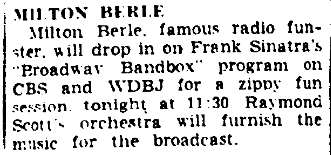
Broadway Bandbox
Network: CBS
Location: New York City, CBS Playhouse #3
Time: 11:30PM - 12:00AM (EST) Fridays
Show #7
Sponsor: none (sustaining)
Host: Frank Sinatra
Musicians: Raymond Scott Orchestra augmented by a string section, Bobby Tucker Singers
Arranged and Conducted By: Axel Stordahl (Sinatra portions)
Announcer: Maurice Hart
Guests: Milton Berle
Asbury Park Press (Asbury Park, New Jersey) July 3, 1943
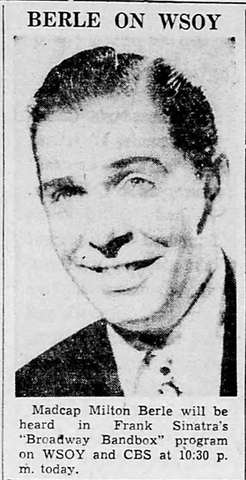
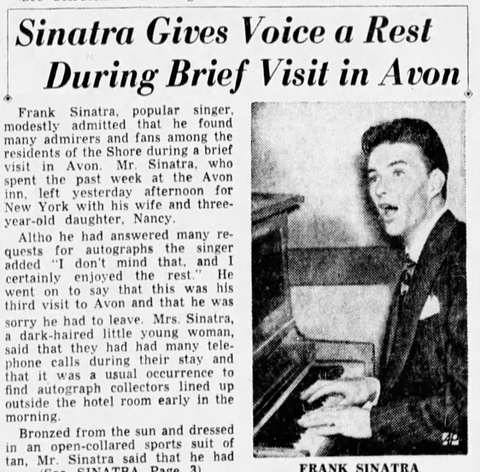
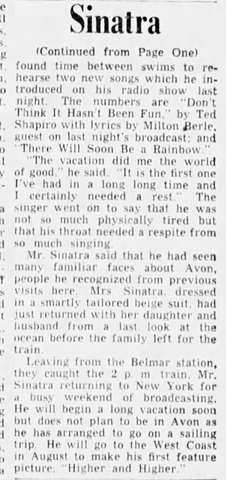
July 3, 1943
Radio
Records For Fighting Men
Frank Sinatra, Oscar Levant, Rise Stevens, Kate Smith
4:00PM WNYC New York
[image referenced in source but could not be recovered]
Concerts
Records For Fighting Men, Central Park, New York City
Frank Sinatra, Oscar Levant, Rise Stevens, Kate Smith
Records For Fighting Men
Frank Sinatra, Oscar Levant, Rise Stevens, Kate Smith
Thanks to Carl R for information and photos below:
Little Girl Gives Frank Sinatra a Record Album(Original Caption) 7/3/1943-New York, NY: Little Ellen Shertzer, aged two, whose father (Hymie) plays in Benny Goodman's band, turns over a record to Frank Sinatra, who collected music discs, broken and otherwise, from his many fans today at a block dance in Central Park. Goodman, Sinatra and the Andrews Sisters provided music for the dance which featured the second annual drive of "Records for our Fighting Men."
Frank Sinatra Crooning Into Microphone(Original Caption) 7/3/1943- New York City, NY: Sinatra slays his slaves. Waxing mellow and romantic, Frank Sinatra croons a sweet melody for the hundreds of Sinatra-mad women who thronged to Central Park Mall today (July 3rd) to hear their idol sing. The "Frank Swoonatra Slaves" came out in droves when their "golden voiced dream boy" made in the second annual "Records For our fighting men." drive's block party in the park--and Frank slayed 'em.
I've seen these before and they are great shots. Frank had closed at the Paramount on 6/22 and was gearing up for appearances with philharmonic orchestras in Cleveland(7/14) and N.Y.C.(8/3). The 12,000 seats in Cleveland were gone within an hour. They went on sale (7/12). Top ticket price was $1..40. He was also doing his weekly appearances on the Hit Parade and Broadway Bandbox. And he was making numerous personal appearances in an effort to sell war bonds.. --Ed
[image referenced in source but could not be recovered]
[image referenced in source but could not be recovered]
[image referenced in source but could not be recovered]
July 9, 1943
Radio
Broadway Bandbox
Network: CBS
Location: New York City, CBS Playhouse #3
Time: 11:30PM - 12:00AM (EST) Fridays
Show #8
Sponsor: none (sustaining)
Host: Frank Sinatra
Musicians: Raymond Scott Orchestra augmented by a string section, Bobby Tucker Singers
Arranged and Conducted By: Axel Stordahl (Sinatra portions)
Announcer: Maurice Hart
Guests: Sue Ryan
1. This Love Of Mine
2. The Right Kind Of Love
3. It's Always You
4. I Get A Kick Out Of You - w/Bobby Tucker Singers
5. Put Your Dreams Away
Notes: Last Show on Fridays. Moved to Mondays and started on the 19th. The July 16, 1943 old time slot went to
Raymond Scott Show: Jack Smith Songs: others 11:30 - 12:00 WABC same on 23rd, 30th Confirmed airing on WABC.
Broadway Bandbox
Network: CBS
Location: New York City, CBS Playhouse #3
Time: 11:30PM - 12:00AM (EST) Fridays
Show #8
Sponsor: none (sustaining)
Host: Frank Sinatra
Musicians: Raymond Scott Orchestra augmented by a string section, Bobby Tucker Singers
Arranged and Conducted By: Axel Stordahl (Sinatra portions)
Announcer: Maurice Hart
Guests: Sue Ryan
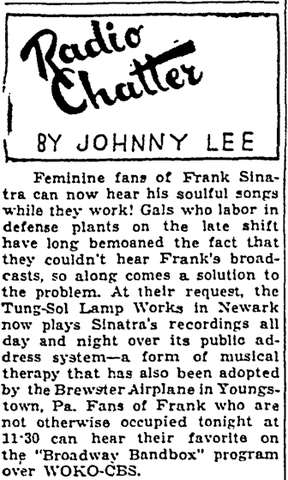
July 10, 1943
Radio
Your Hit Parade
Network: CBS
Program #425
Time: 9:00-9:45 P.M. (Rebroadcast July 11, 1943 12:00-12:45 A.M.)
Sponsor: Lucky Strike
Script (First & Final As Broadcast)
1. It Can't Be Wrong (10) - Sinatra
2. Johnny Zero (9) - Edwards
3. As Time Goes By (4) - Hit Paraders
4. Tico Tico - Ethel Smith
5. commercial
6. Don't Get Around Much Any More (5) - Orchestra & Hit Paraders
7. Let's Get Lost (6) - Sinatra
8. Taking A Chance On Love (7) - Edwards
9. station break
10. All Or Nothing At All (8) - Sinatra & Hit Paraders
11. Medley: Indian Summer / By The Waters Of The Minnetonka - Ethel Smith
12. commercial
13. In The Blue Of Evening (3) - Edwards
14. Comin' In On A Wing And A Prayer (2) - Orchestra
15. You'll Never Know (1) - Sinatra
Lincolnshire Echo
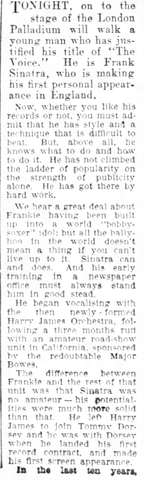
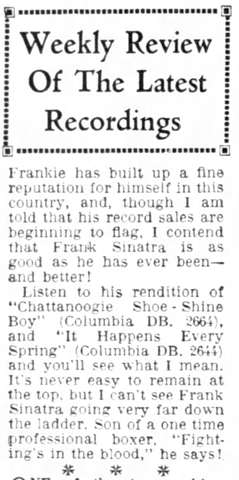
July 14, 1943
Concerts
Public Hall, Cleveland, Ohio
Cleveland Symphony Orchestra
Conducted by Rudolph Ringwall
1. Dancing In The Dark
2. It's Always You
3. Ol' Man River
4. Night And Day
5. Close To You
6. The Song Is You
7. You'll Never Know ( first encore )
8. Embraceable You ( second encore )
Note: Original disc of this concert was sold on eBay a few years ago.
Winning bidder paid $1,000.00.
Public Hall, Cleveland, Ohio
Cleveland Symphony Orchestra
Conducted by Rudolph Ringwall
Sinatra Packs Cleve. Aud Pop; 9,142 No Swoon
CLEVELAND, July 17.-Mass hysteria or even minor symptoms of it were lacking
Wednesday night (14) as crooner Frank Sinatra made Cleveland pop concert
history by drawing a capacity and record-shattering crowd to Public Hall for the
conclusion of the most successful season since the concerts originated five
years ago. To say that Sinatra's impact on his audience of 41,142, some 90 per
cent of whom were girls and women, was anything short of terrific, however,
would be to understate the case. Measured by the applause, from his initial
appearance on the concert stage to the last number he sang, the response
of the audience, was probably more sustained and spontaneous than ever
accorded a popular singer here. The crowd was surprisingly orderly and
well behaved for all its enthusiasm. The only genuinely noisy outburst occurred
as Sinatra was leaving the auditorium to enter an automobile and proceed to the
Stage Door Canteen at the finish of the concert. Women and high school girls in
ankle socks and saddle shoes had hurried from the hall after his last number and
massed from the entrance all the way across the street despite the fact that police
had taken precautions to double the ordinary, traffic detail for the concert. Scattered
screams from some of the femme admirers of the thin-faced, wiry-built youngster,
whose voice, with its touch of rich-huskiness, seems to be the most compelling one
in the current crooning scene and has earned him a fortune, could be heard for blocks
away. Sinatra sang eight songs. He wound up his scheduled program of six numbers
with The Song Is You, but when the audience, applauding wildly, called for more, he gave
two encores. His first appearance on the stage was greeted by a long sigh from the packed
tables, balconies and galleries, followed by an immense hum of low conversation and
comment, evidently a comparison of reactions to his aspect and presence. Opening number
was Dancing in the Dark, which he followed with It's Always You and Old Man River.. From the
moment Sinatra emitted the first words of his first song, excellent popular music as it was, his
singing furnished merely pale background for him so far as the audience was concerned. In the
intermission backstage when he finished his first group of songs, many musicians from the
symphony ork clustered about him seeking his autograph. He signed his pictures and wrote his
name steadily almost up to the moment he sang his final numbers and encores. In this group,
which seemed to move the audience even more than the first three numbers, were Night and Day,
Close to You and The Song Is You. His encores were You'll Never Know and Embraceable You.
Sinatra was escorted from Hotel Statler to the auditorium by Cleveland detectives.. Within the
auditorium the usual detail of one or two policemen for a pop concert was augmented by four
patrolmen who concentrated near the stage and the doors leading backstage to prevent autograph
seekers or others from trying to reach the star. . After his final encore, Sinatra graciously thanked
his audience, Rudolph Ringwall for his conducting and the summer symphony for its fine accompaniment.
Top price was $1.40, with Sinatra on guarantee and p. c.
BILLBOARD
July 24, 1943
Note: Original disc of this concert was sold on eBay a few years ago.
Winning bidder paid $1,000.00.
VINTAGE 16" RADIO TRANSCRIPTION "FRANK SINATRA LIVE
CONCERT AT CLEVELAND'S PUBLIC HALL IN CLEVELAND OHIO RECORDED JULY 14, 1943 WITH THE CLEVELAND ORCHESTRA. HIS FIRST PERFOMANCE WITH A CLASSICAL ORCHESTRA. EXTREMELY RARE!!! ONE OF-A-KIND. LISTEN TO A VERY YOUNG FRANK SINATRA (AGE 28) LIVE TALK AND SING WITH THE CLEVELAND ORCHESTRA. THIS CONCERT WAS RECORDED ON (2) ORIGINAL ALUMINUM BASED 16"
TRANSCRIPTIONS (4 SIDES TOTAL). A MUST FOR ANY FRANK SINATRA COLLECTOR . THIS RECORD IS FROM A RETIRED RADIO ENGINEER'S COLLECTION
At 05:38 PM 5/25/2025, you wrote:
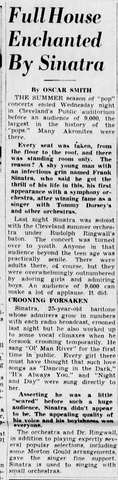
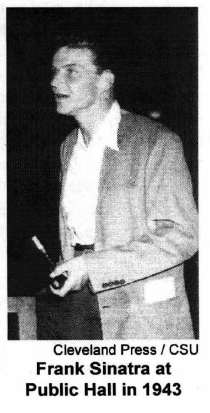
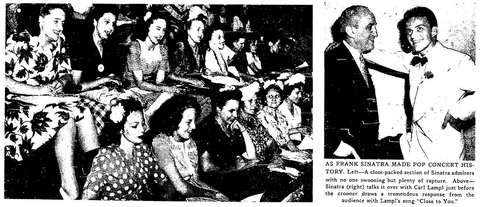
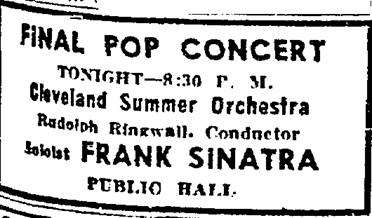
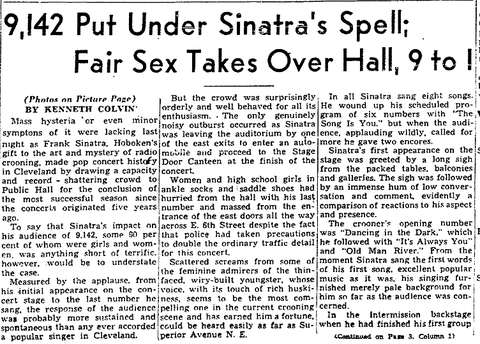
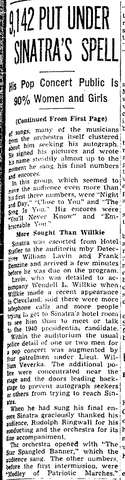
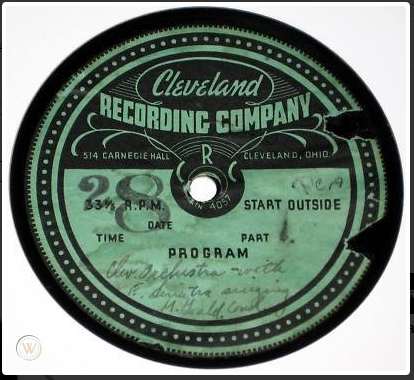
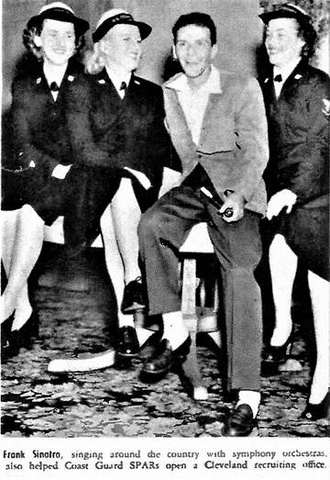
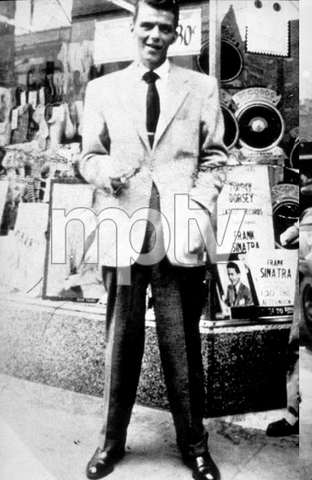
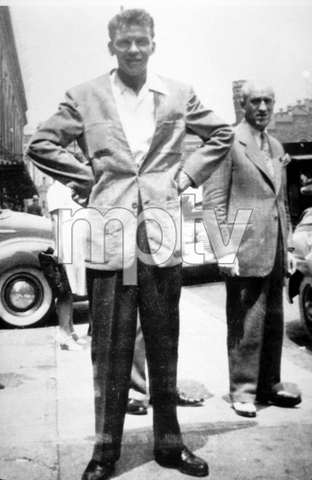
July 17, 1943
Radio
Your Hit Parade
Network: CBS
Program #426
Time: 9:00-9:45 P.M. (Rebroadcast July 18, 1943 12:00-12:45 A.M.)
Sponsor: Lucky Strike
Script (Final As Broadcast)
1. Let's Get Lost (7) - Sinatra
2. In My Arms (8) - Hit Paraders (Male Group)
3. People Will Say We're In Love (10) - Edwards
4. Bem-Te-Vi-Atrevideo - Ethel Smith
5. commercial
6. All Or Nothing At All (5) - Sinatra & Hit Paraders
7. Johnny Zero (9) - Edwards
8. As Time Goes By (6) - Orchestra
9. station break
10. It Can't Be Wrong (4) - Hit Paraders
11. Sweet Grorgia Brown - Ethel Smith
12. commercial
13. In The Blue Of Evening (3) - Sinatra
14. You'll Never Know (2) - Edwards
15. Comin' In On A Wing And A Prayer (1) - Sinatra
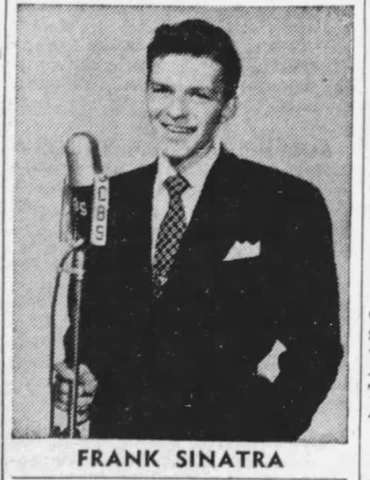
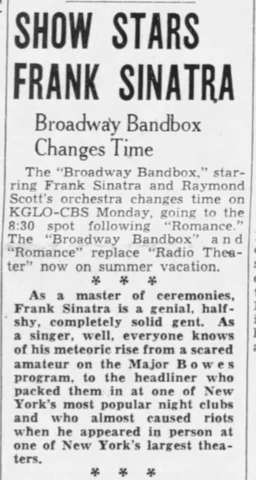
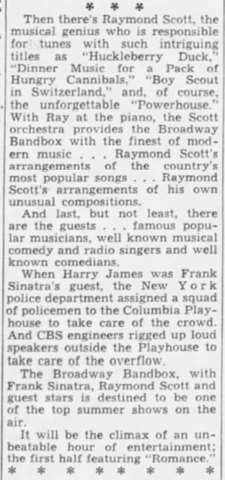
July 19, 1943
Radio
Broadway Bandbox
Network: CBS
Location: New York City, CBS Playhouse #3
Time: 9:30PM - 10:00PM (EST) Monday
Show #9
Sponsor: none (substaining)
Host: Frank Sinatra
Musicians: Raymond Scott Orchestra augmented by a string section, Bobby
Tucker Singers
Arranged and Conducted By: Axel Stordahl (Sinatra portions)
Announcer: Maurice Hart
Guests: Benny Goodman, Virginia Weilder, Golden Gate Quartet
1. This Love Of Mine - Frank Sinatra
2. Comin' in On A Wing And A Prayer - Sinatra & Bobby Tucker
Singers
3. two songs - Benny Goodman
4. What do you thing I Am - Virginia Weilder
5. All Or Nothing At All - Frank Sinatra
6. Hit The Road To Dreamland - Golden Gate Quartet
7. Huckleberry Duck - Ray Scott Orchestra
8. Close to You Frank - Frank Sinatra w/chorus
9. Put Your Dreams Away - Frank Sinatra
Notes: New Time Slot. Ed O'Brien: "I mentioned last week the incredible number of fabulous radio performances
Sinatra did of songs he never recorded. "Comin' in On A Wing and A Prayer" is a great example.
He did a simply sensational vocal on the Broadway Bandbox of 7-19-43." Confirmed airing on WABC
Ed O'Brien:
After introducing Benny Goodman, Frank
mentioned that he had caught Benny and his group
at the Hotel Astor earlier in the week. During a skit
with Virginia Weidler ( Hepburn's sister in "Philadelphia
Story"),she asked his age. Frank claimed to be 25. "All Or
Nothing At All" thrilled the studio audience. It was
#5 that week on the Hit Parade. "Close To You"
sung with a full orchestra and Bobby Tucker Singers
was far more satisfying than the a capella Col. record-
ing. Frank' announced that Eileen Farrell and Carole
Landis would be his guests the following week.
Television
NONE
Broadway Bandbox
Network: CBS
Location: New York City, CBS Playhouse #3
Time: 9:30PM - 10:00PM (EST) Monday
Show #9
Sponsor: none (substaining)
Host: Frank Sinatra
Musicians: Raymond Scott Orchestra augmented by a string section, Bobby Tucker Singers
Arranged and Conducted By: Axel Stordahl (Sinatra portions)
Announcer: Maurice Hart
Guests: Benny Goodman, Virginia Weilder, Golden Gate Quartet

July 20, 1943
Radio
Army Air Force Salute
Network: WMCA
Time: 10:03PM - 10:30PM (EST)
Frank Sinatra, Maxie Rosenbloom, Golden Gate Quartet
Sears Orchestra
Confirmed aired on WMCA.
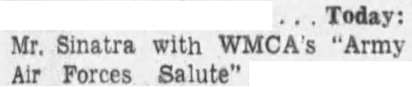
July 24, 1943
Radio
Your Hit Parade
Network: CBS
Program #427
Time: 9:00-9:45 P.M. (Rebroadcast July 25, 1943 12:00-12:45 A.M.)
Sponsor: Lucky Strike
Script (Final As Broadcast)
1. It Can't Be Wrong (4) - Sinatra
2. Johnny Zero (8) - Edwards
3. As Time Goes By (7) - Hit Paraders
4. Blow Gabriel Blow - Ethel Smith
5. commercial
6. Let's Get Lost (5) - Sinatra
7. Put Your Arms Around Me Honey (9) - Hit Paraders
8. People Will Say We're In Love (6) - Edwards
9. I Got Plenty Of Nothin' - Orchestra
10. station break
11. It's Always You (10) - Sinatra
12. Let's Do It - Ethel Smith
13. commercial
14. Comin' In On A Wing And A Prayer (3) - Sinatra & Group
15. In The Blue Of Evening (2) - Edwards
16. You'll Never Know (1) - Sinatra
July 25, 1943
Concerts
Potomac Water Gate, Washington, DC
With National Symphony Orchestra
Potomac Water Gate, Washington, DC
With National Symphony Orchestra
.
The Evening Star, Washington, July 26, 1943
Times Herald
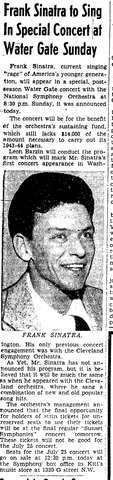
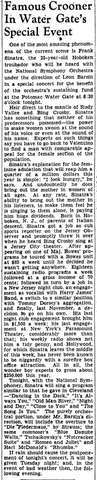
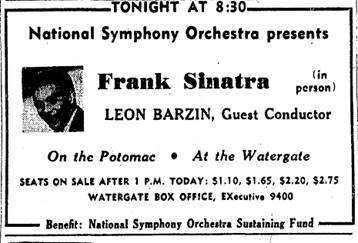
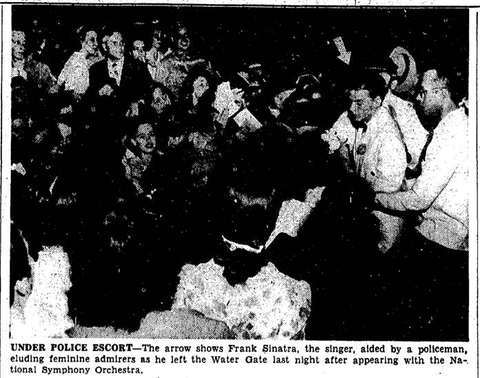
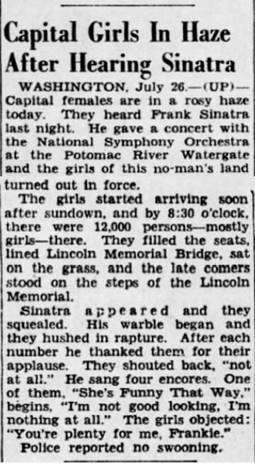

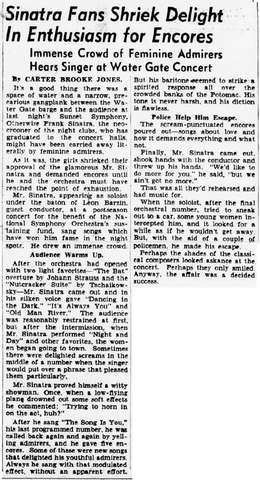
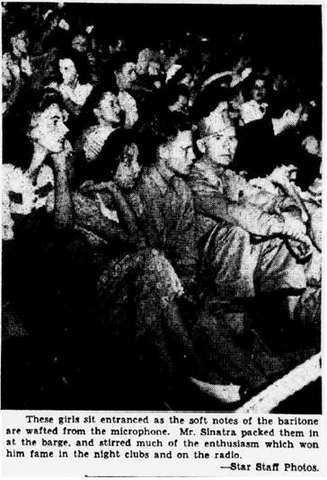
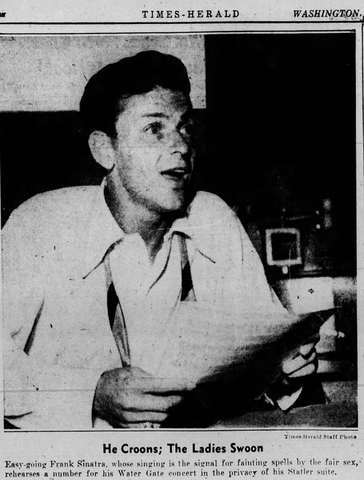
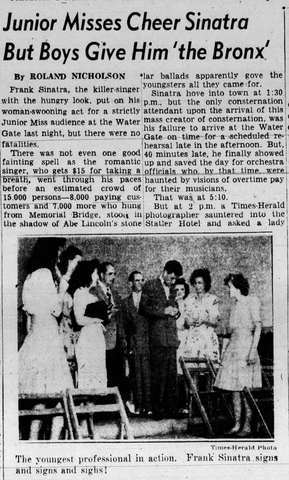
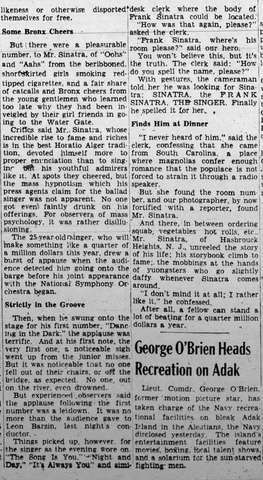
note: I was not able to come up with the complete list of songs performed.
I did find a number of reviews, including the Washington Post. Some
claimed he did five encores and others had only four. Frank did six
songs before leaving the stage and then returning for the encores. I
have only eight songs accounted for that night.
Ed
July 25th, 1950, Idlewild Airport
Thanks to Carl R for the above.
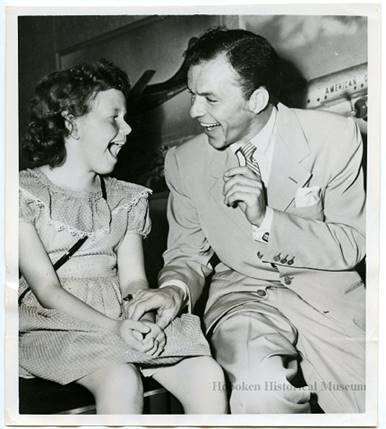
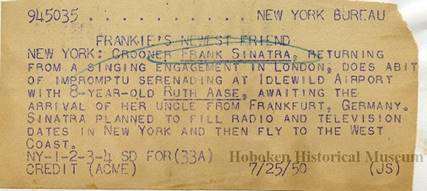
Potomac Water Gate, Washington, DC
With National Symphony Orchestra
.
The Evening Star, Washington, July 26, 1943
-----------------------------------------------
July 25th, 1950, Idlewild Airport
Thanks to Carl R for the above.
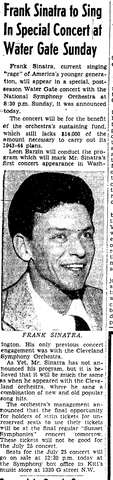
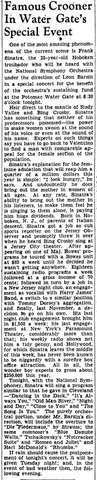
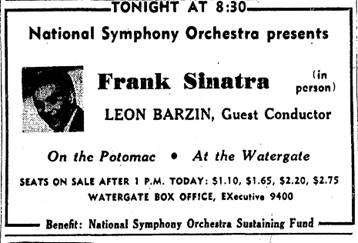
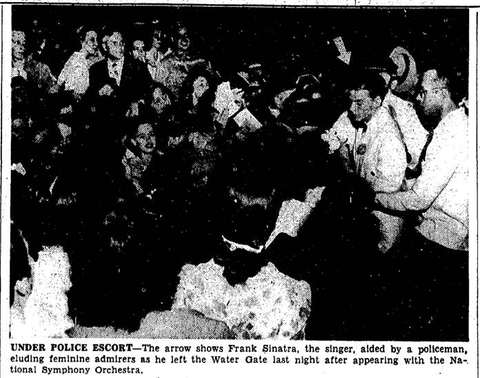
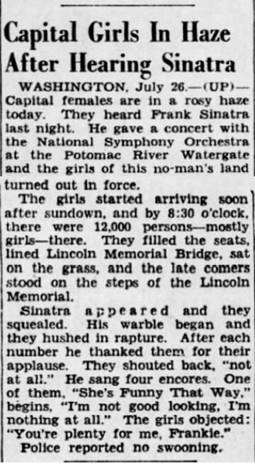

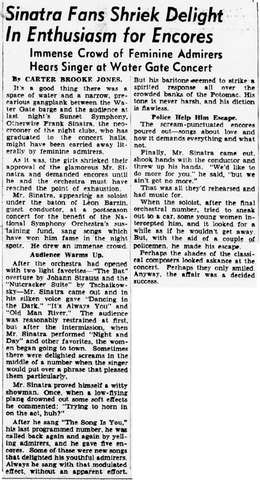
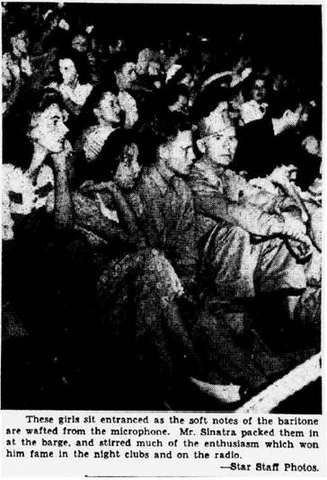
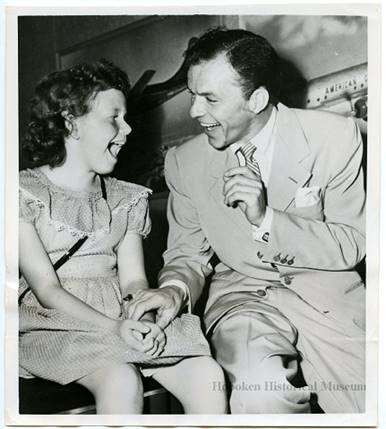
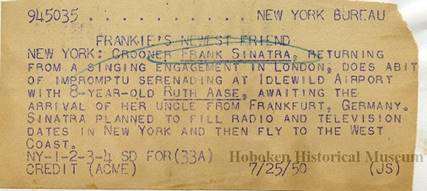
July 26, 1943
Radio
Broadway Bandbox
Host: Frank Sinatra
Guests: Cab Calloway, Carol Landis, and Eileen Farrell
Raymond Scott and his Orchestra
1. This Love of Mine
2. Let's Get Lost - Frank Sinatra
3. We the Cat Shall Hep You Cab - Calloway
4. If Loveliness were Music - Frank Sinatra
5. The Waiter, the Porter, and the Upstairs Maid - Sinatra, Calloway,
Landis and chorus
6. People Will Say We're in Love - Sinatra and Eileen Farrrell
7. Put Your Dreams Away
NOTE: We are indebted to Sinatra Scholar Ed O'Brien for the above program.
O'Brien points out that Sinatra did a brief treatment of "This Love of Mine" at the outset of the show and "Put Your Dreams Away" closing the show.
Television
NONE

Broadway Bandbox
CBS
9:30 P.M. -10:00 P,M, EWT
Host: Frank Sinatra
Guests: Cab Calloway, Carol Landis, and Eileen Farrell
Raymond Scott and his Orchestra
1. This Love of Mine
2. Let's Get Lost - Frank Sinatra
3. We the Cat Shall Hep You Cab - Calloway
4. If Loveliness were Music - Frank Sinatra
5. The Waiter, the Porter, and the Upstairs Maid - Sinatra, Calloway, Landis and chorus
6. People Will Say We're in Love - Sinatra and Eileen Farrrell
7. Put Your Dreams Away
TIME IS PWT
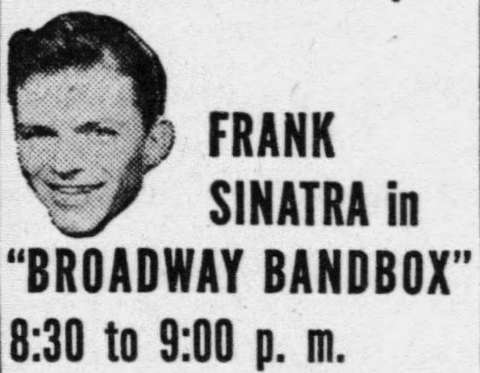
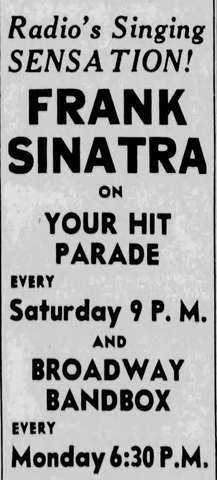
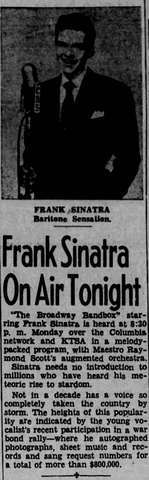
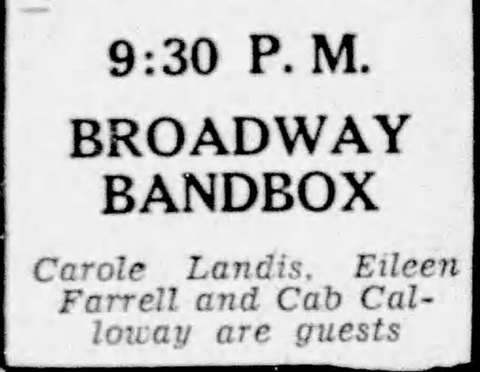
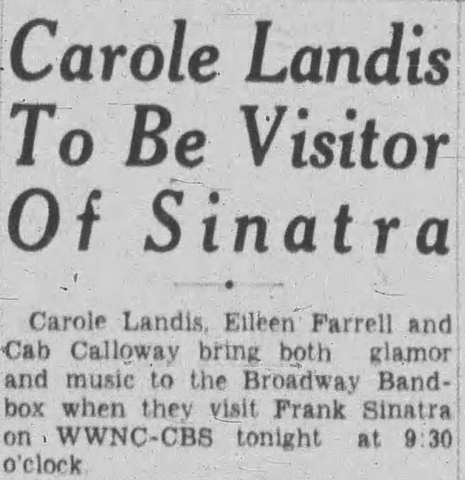
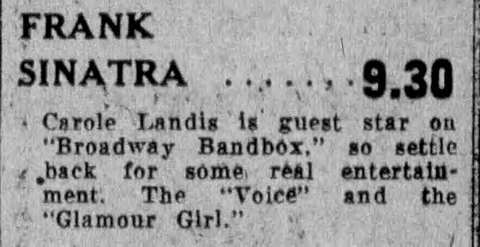
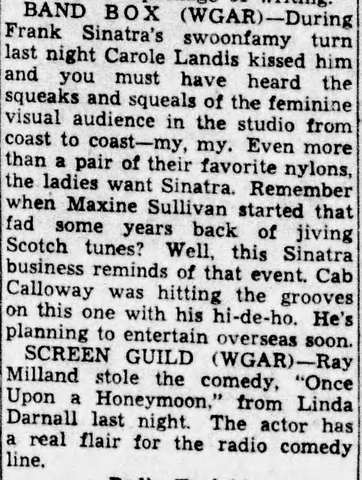
July 30, 1943
Radio
Liberty Party
Show #14
Broadcast Series from the Office of War Information
Performers: Andrews Sisters, Harry James and Frank Sinatra, Bing Crosby, Glenn Miller, Modernaires.
Note: Andrews Sisters on Here comes the Navy; Harry James and Frank Sinatra on All or nothing at all, I've got the world on a string; Bing Crosby on Ain't got a dime to my name; Glenn Miller and Modernaires on Sweet Eloise; and more. LOC listing. Not clear if selection are live or recordings. LOC has 10-inch sound reel. TT:30mins.
From Billboard 1943 Yearbook. It is likely then that the Harry James and Frank Sinatra on “All or Nothing At All” was on record.
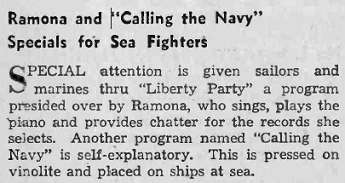
July 31, 1943
Radio
Your Hit Parade
Network: CBS
Program #428
Time: 9:00-9:45 P.M. (Rebroadcast August 1, 1943 12:00-12:45 A.M.)
Sponsor: Lucky Strike
Script (Final As Broadcast)
1. Let's Get Lost (5) - Sinatra
2. Johnny Zero (10) - Hit Paraders
3. As Time Goes By (7) - Bea Wain
4. Honeysuckle Rose - Ethel Smith
5 . commercial
6. All Or Nothing At All (4) - Sinatra & Group
7. In My Arms (6) - Hit Paraders
8. People Will Say Were In Love (8) - Bea Wain
9. Shortnin' Bread - Orchestra
10. station break
11. It Can't Be Wrong (9) - Sinatra
12. Zing Went The Strings Of My Heart - Ethel Smith
13. commercial
14. In The Blue Of Evening (3) - Bea Wain
15. Comin' In On A Wing And A Prayer (2) - Sinatra & Group
16. You'll Never Know (1) - Sinatra
Platterbrains, WMCA 7:03PM
Hosted by jazz critic Leonard Feather, Platterbrains consisted of artists listening to a recording, without knowledge of the performer and then offering an opinion, this process often resulting in surprising results.
August 1943
With help from his new friend Manie Sacks at Columbia Records and attorney Henry Jaffe, Frank Sinatra negotiated his way out of the notoriously lopsided management contract he'd signed with Tommy Dorsey in 1940 — one entitling Dorsey to a third of Sinatra's earnings for life, plus another 10 percent for Dorsey's agent. MCA paid Dorsey $60,000 to release Frank (Frank himself borrowed $25,000 of it from Sacks) in exchange for representing him going forward. Persistent rumors later claimed that mobster Willie Moretti had strong-armed Dorsey into releasing Sinatra — one version of the story that would later inspire a famous scene in The Godfather — though Sinatra always maintained his lawyers alone got the deal done; biographer J. Randy Taraborrelli notes conflicting secondhand accounts of some kind of intimidation attempt, of uncertain effect, involving acquaintances of Frank's associate Hank Sanicola. Source: J. Randy Taraborrelli, Sinatra: Behind the Legend.
Kitty Kelley's His Way lays out the financial mechanics of the split from Dorsey in more detail: Frank's lawyer Henry Jaffe flew to Los Angeles to negotiate with Dorsey's lawyer N. Joseph Ross, and MCA -- the agency courting Sinatra -- ultimately paid Dorsey $60,000 to release him, $35,000 from the agency and $25,000 from Sinatra himself, borrowed from Manie Sacks against future Columbia royalties. Sinatra always denied any mob involvement ("No gangster called on anyone"), while Dorsey himself later claimed otherwise in an interview: "I was visited by Willie Moretti and a couple of his guys. Willie fingered a gun and told me he was glad to hear I was letting Frank out of my deal. I took the hint." Source: Michael Sheridan & David Harvey, Sinatra and the Jack Pack.
A third account of the Dorsey buyout gives different figures: MCA head Jules Stein negotiated Sinatra's release from Tommy Dorsey's punitive management contract with a deal involving lucrative future bookings for Dorsey and a $75,000 buyout -- MCA paying $50,000 and Sinatra himself chipping in the rest. Dorsey's parting words to Sinatra were: "I hope you fall on your ass." Source: Rough Guide to Frank Sinatra (Rough guide 2.pdf).
[Fans Mob Sinatra in Pasadena]
Crowds of fans sought Sinatra's autograph in Pasadena, California in August 1943, part of the growing frenzy surrounding his rising fame.
Source: Charles Pignone, "Frank Sinatra 100" (2015).
[Sinatra Packs The Hollywood Bowl]
With conductor Morris Stoloff, Sinatra drew a huge live crowd to the Hollywood Bowl in August 1943; fans swarmed his car so thickly it was nearly lifted off the ground.
Source: Nancy Sinatra, "Frank Sinatra, My Father" (1985).
[Critic Isabel Morse Jones charmed by Sinatra]
Isabel Morse Jones: LA Times classical-music critic Isabel Morse Jones, who had publicly objected to Sinatra playing the Hollywood Bowl, met him in Pasadena and was won over; he told her he owned 500 albums of symphonies and picked songs for their lyrics, and she wrote admiringly that he was "naturally sensitive" and made "no pretensions at all."
Source: James Kaplan, "Frank: The Voice" (2010)
[LA Times front-page story on Sinatra's arrival]
Kaplan: The Los Angeles Times ran a front-page story on Sinatra's Pasadena arrival headlined "Secret of Lure Told by Crooner -- It's Love," reporting both his new film contract and his planned concert with the Los Angeles Philharmonic at the Hollywood Bowl, which had drawn objections from classical-music purists.
Source: James Kaplan, "Frank: The Voice" (2010)
[Louella Parsons wins over]
Louella Parsons: A few days after his Pasadena arrival, Sinatra also charmed powerful Hearst columnist Louella Parsons, who was struck by his apparent humility and became a booster of his for years afterward.
Source: James Kaplan, "Frank: The Voice" (2010)
[Parsons and Sinatra at Hollywood Canteen]
Kaplan: A photograph shows Louella Parsons and Sinatra signing autographs for servicemen at the Hollywood Canteen in August 1943.
Source: James Kaplan, "Frank: The Voice" (2010)
[Sinatra-Dorsey contract dispute settled for $60,000]
After lawyer Henry Jaffe threatened to disrupt Dorsey's broadcasts and Sinatra fans picketed Dorsey's theater appearances, the dispute over Frank's exit contract was settled in August 1943 with Frank agreeing to pay Tommy $60,000. Frank couldn't cover it himself and relied on advances from his new agency MCA and from Columbia Records against future earnings.
Source: Richard Havers, "Sinatra" (Dorling Kindersley, 2007).
August 2, 1943
Radio
Broadway Bandbox
CBS
8:30 P.M. to 9:00 P.M.

August 3, 1943
Concerts
Lewisohn Stadium, New York City, NY
New York Philharmonic-Symphony
Conducted By: Max Steiner
Sinatra Portion of concert:
1. It Can't Be Wrong
2. Night and Day
3. Close to You
4. The Song Is You
5. Dancing in the Dark
6. It's Always You
7. Ol' Man River
8. Embraceable You
9. You'll Never Know
10. She's Funny That Way
Lewisohn Stadium, New York City, NY
New York Philharmonic-Symphony
Conducted By: Max Steiner
Sinatra Portion of concert
NOTE: Sinatra Scholar Ed O'Brien supplies us with the following review of the concert taken from LIFE magazine, August 23, 1943, headlined
SWOONER-CROONER: SATELLITES SIGH AND SCREAM AS SINGING SENSATION SINATRA
SOLOS WITH SYMPHONY:
"To help balance their budgets several symphony orchestra recently invited Frank Sinatra, the swooner-crooner who makes every song sound just like every other song, to appear as a soloist. In New York, on August 3, the New York Philharmonic counted on the ferocious fanaticism of Sinatra's fans to fill their concert. But the crush of Sinatraffic was not even up to Pons.
While coloratura Lily Pons drew 12,000, the provocative Frank pulled only 5,000. Although the idol of the jump-for-joy juveniles was plenty upstage and obnoxious at rehearsal. [At rehearsal with the New York Philharmonic, Sinatra sings facing the orchestra, leading them like a three-piece band. Max Steiner frowns as he conduct. "More tempo!" says Singer Sinatra to the Philharmonic. "Who the hell does he think he is?" one of the musicians asked audibly.
The concert was not even close to a sell-out, but teenage Sinatra fans turned out in full frenzy to wiggle rapturously to the teasing tones of their idol as he swayed sideways in perfect synchronization with the microphone.]
Sinatra got under the skin of the orchestra even more at the concert. After concluding his popular numbers [rendered, according to one critic, in proper uniform Sinatra tempo – LARGGO ALA MARCIA FUNEBRE], the ssoloist thanked his under-age followers for showing up on behalf of himself and "the boys in the band."
To prevent a similar fiasco, Los Angeles music critics campaigned militantly against a scheduled swoon-fest with the Los Angeles Philharmonic on August 14. The swooner-crooner was referred to as "a kind of musical drug, an opium of emotionalism."
LIFE magazine, back in 1943, sold for 10 cents a copy!
Author Richard Havers then supplies us with additional material from other reviews of the August 3 Lewisohn Stadium concert. These other reviews also pointed out that Sinatra got under the skin of the orchestra at rehearsals.
The NEW YORK SUN noted the voice was "rather nondescript." The HERALD TRIBUNE was a little less harsh – "pleasant voice, satisfactory projjection, excellent diction." But Sinatra's mind was, after all, on other things for he was off to Hollywood for a shot at a real career in the movies rather than the cameo roles he had so far experienced.
The NEW YORK TIMES of August 4, 1943 reported that "Mr. Sinatra's baritone had little real volume and little carrying power beyond what the amplifier gave it, and it was utterly inadequate in "Ol' Man River," but the singing was definitely unique in the matter of style, and the singer's pleasant and friendly and somewhat dreamy personality matched it."
Ed O'Brien then provides us with DOWNBEAT's defense of Sinatra. It was written by Mike Levin and published in the September 13, 1943 issue of the magazine. It is headlined MIX TAKES UP CUDGEL FOR SINATRA:
"It is my personal, prejudiced, and profane opinion that when it comes to music, the press of this country registers like Casey on the third strike – the desparate lunge, the anguished eexpression, and the complete missing of the point at hand. Three weeks ago, LIFE magazine came out with a sharp jitterbug cover and a story of Frank Sinatra's concert at Lewisohn Stadium. Henry Luce's weekly has been unfair to many people in the past, but seldom have I seen it scuff up the muck as thoroughly as it did with this so-called report on Sinatra's singing with the New York Philharmonic a month ago.
"˜Understand me, I am frankly amazed at the Sinatra boom, and the wave of feminine yapping that has gone with it.. The average male has always admired a shapely feminine bosom; and, if it sings well in addition, wonderful, wonderful, wonderful! But none of the reigning beauties of the moment have ever undergone the rather trying fan club acts that Sinatra has.
CALL HIM THE MOO-ER
"˜I am by no means a fan of Sinatra's – but there are unquestionaably times, with all his microphone mannerisms, that he sings his brand of ballad very palatably – and gets a great deal of what we quaintly caall "moo" for doing it. As a matter of fact, if Bing is the "Groaner," then we should call Franklin "The
Moo-er.." The other appellations such as "Loverboy," I look upon as the coinings of jealous minds.
"For all of his tendency to sing at uniform tempo and to make every song the same, Sinatra is a few gridirons ahead of some of our more recent idols. Listen to any of the Dick Powell records or that atrocious relic, "As Time Goes By," non-fleetingly sung by Rudy Vallee, circa 1933, reissued without much of an apology by RCA Victor a few months back. Which will you take, the Powells, the Vallees, the Downeys, or our boy Frank?
SINATRA CAN SING
"Sinatra at least can sing on key, very often shows good taste in phrasing and manages a certain color of tone which can be extremely effective. I never get anything from others but agitated tonsils. No matter how much you may dislike Sinatra's singing, there can be no question that musically speaking he is head and shoulders above a lot of his predecessors – excluding thatt well-known horse racer and drummmer, B. Crosby.
"Now, as to this light jive that LIFE was flinging around. First, they report that Pons drew 12,000 palm-slappers, while the "Sinatraffic" [who says VARIETY has all the bad coinage?] was only 5,000. LIFE, of course, neglected to report that the weather was bum, that it was the day after the Harlem Riots [which provoked uneasiness at traveling at night] and that Sinatra had previously given enough concerts around New York to kill anybody's draw for a little while, no matter how "hot" he may be.
"LIFE, the weekly pic pamphlet, went on to say that "the idol of the jump-for-joy set was plenty upstage and obnoxious at rehearsal. At rehearsal with the New York Philharmonic, Sinatra sang facing the orchestra, leading them like a three-piece band..
MUGGING IS GENUINE
"To this delightful bouquet was appended a cut showing Sinatra leaning back, with his eyes shut, his arms spread, and his pan in that beatific state of bliss that used to kill the Tommy Dorsey ringside fans.
"I see nothing obnoxious about Sinatra's mugging and posturing. He has made a hunk of dough doing it – plus the fact these are genuine mannerisms during his singing. Have you ever seen a Wagnerian soprano waggle her chest as she gets ready for a high one? Have you even seen pictures of any good musician engrossed in his playing? Either looks half-asleep or as though he were out to scare Boris Karloff.
"As far as "˜his leading the band," Sinatra knows too much about classical music and the theory of the concerto to try anything as stupid as that. What LIFE evidently mistook for leading was merely the gestures that any danceband singer trains himself to make to add something to the scene besides tonsils.
FRANK NEVER " UPSTAGE"
"˜Sinatra may have been "˜upstage" "â“ I wasn't at the rehearsal of which the mag speaks. But, if he was, it was contrary to every thing I've known him to do in the past. Sinatra may have gone "big hat" in the last few weeks, but until that time, he was a decent guy for my dough, maybe a little shirty at times, but if he doesn't have a right to spray a little ego around now and then, then, who does? He's young, healthy, happy, and on top – but not
"upstage" or anything approaching it.
"LIFE quotes Sinatra as saying to Max Steiner, the conductor, "More tempo!" I could beat out the tempo, why can't you."
First of all, I question the accuracy of LIFE's quotes. Also, its grammar. Secondly, I suspect Sinatra may have something there. Steiner is one of Hollywood 's leading virtuoso-arranger- conductors, contracting most of his output, I believe, to that well-known emporium Warner Brothers.
"He recently had a "symphonies" recorded by Werner Jenssen and the Los Angeles Symphony. Me, I'll take Sinatra. Of all the overscored, bloated hunks of symphonic balderdash that have been recorded, this was really outstanding for its lack of simplicity, its incessant pounding on one bad theme, and its muddled scoring. Since Conductor Steiner is very successful in the movies, let's say he is good – but when it comes to conducting a ballad, II'm almost sure that SSinatra would do a better than he would. Those great Hollywood musicians are too often tangled in their English horn section for my dough.
ORCHESTRA DOESN'T KNOW
"LIFE also quotes Sinatra as saying "More slowly," and one of the musicians replying, "Who the hell does he think he is." That's an easy one Рhe's Frank Sinatra, he̢'s a poop singer, he's singing pop songs with an orchestra that doesn't know how to play them Рso much so that it made haash out of the ballad section of JJerome Kern's " Mark Twain Portrait."
"Therefore, who picks the tempo – Steiner, used to scoring for movies at his dancetime best behind lush singing dames? The orchestra composed of Viennese tottlers, French fiddlers, and plain ordinary longhairs – who wouldn't know a good dance beat if they heard it? OOr Sinatra, who's made his living for some years singing pop ballads and setting the tempos at which they sound best to him?
"LIFE owes Sinatra an apology – and, indireectly, the music business. The process of labeling all adherents of any phase of the dance business as "cretins," budding criminals, or what have you, is becoming almost as tiring to us as Sinatra is to LIFE."
PHOTOS FROM THE REHEARSAL:
FROM THE PERFORMANCE:
.Luckies Kinder to Sinatra's Throat Than Open-Air Stadium --But Fans Swoon From Memory
Harlem Riot Blamed for Low Gate of 7,000 By ELLIOTT GRENNARD NEW YORK,
Aug. 7.-Frank (Loverboy) Sinatra is better off at the Paramount than at Lewisohn Stadium. His b.o. is more
potent in the theater, his voice sounds better, the kids with little to spend can get closer to their idol, and the
band behind him is sure to have a better beat than the Philharmonic. A 7.000 attendance figure for the Stadium
isn't good for a name like Beethoven and Is plain lousy for Sinatra. Rioting the day before in Harlem Is said to
have hurt the attendance, with mothers fearfully locking their little darlings in at home. Those that escaped made
their presence known with vociferous swooning. This "swoon" is not a sigh but a shriek that punctuates Sinatra's
ballads at prescribed passages; perhaps only once per chorus, sometimes twice, but when "Loverboy" croons "I
got a baby . . ca -racy for me . . ." the fans catch the cue and give. Tuesday night they were swooning from memory.
They have his recordings down cold and when his more subtle gurglings failed to reach the 25-cent section-even with
the aid of the powerful amplifying system-the kids ignored the lapses and dreamt the rest..
Some Debit, Mostly Credit The harsh truth of it is Sinatra's vocal equipment is no match for the demands of a huge
open-air bowl. While the gallery heard hardly anything, those up front heard too much; meaning a fuzzy overtone when
Sinatra sang full-voiced and an almost constant sharpness of pitch due to his forcing the tones. Definitely on the credit
side was a crystal clear articulation of lyrics with every syllable distinct; an informal stance that included the characteristic
clutching of the mike for the Intimate suggestion, arms akimbo for the forthright statement, and a complete lack of phoni-
ness. Sinatra made it clear he was not there selling a blind package. Popular songs, as Sinatra stated at one point, are
his best weapon, and when he gave out with Old Man River, he acknowledged that it was offered as an appeasing gesture
to the sacrosanct atmosphere of the concert hall. As a result, he elicited hysterical swoons or amused laughter, depending
on the individual auditor, but not an iota of hostility. For them -as- likes -it, he gave plenty; a total of 10 songs In all, including
his and everyone else's faves, Night and Day, Embraceable You, You'll Never Know and She's Funny That Way.
Hollywood's Tone Poems Max Steiner, vet of the RkO, Selznick and Warner Bros.Lots, conducted the Philharmonic in a
program of film scores composed by Alfred Newman, Victor Young and mostly himself. The strictly teen-aged audience found
the stuff as distantly removed from the Cole Porters, George Gershwins and Harry Warrens as It Is from the Bachs and Brahms.
but with titles like Gone With the Wind. Now Voyager, etc., the least they could be Is polite Max Steiner, to put it crassly, ain't
much shucks as a conductor.. He waved and sawed with his arms and generally knocked himself out. To little avail.The
Philharmonic boys responded with well behaved indifference. They played the right notes, observed the correct bowing, blew
loud at the double "fs" and wondered when the hell they could go home. As symphonic pieces, movie scores are just not there.
What provides admirable counterpoint to celluloidal words and action, emerges as thin pallid stuff when deprived of the acting
accompaniments. At no time did the compositions make the symphonic ork sound like more than a 26- piece pit band, all
playing melody. Steiner got a nice hand . especially when it learned from Sinatra, that the man with the stick had written It Can't
Be Wrong..
BILLBOARD
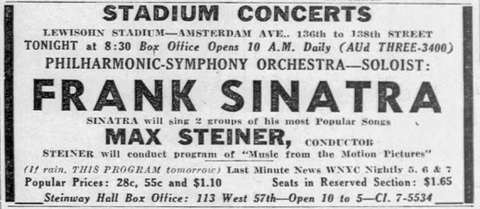
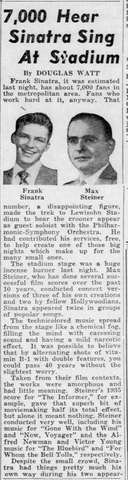
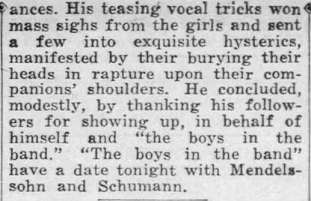
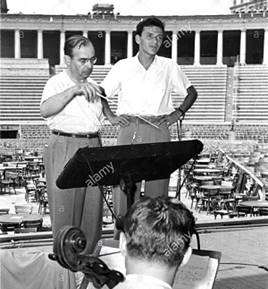
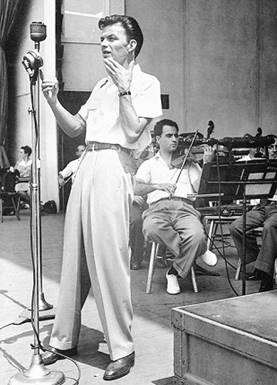
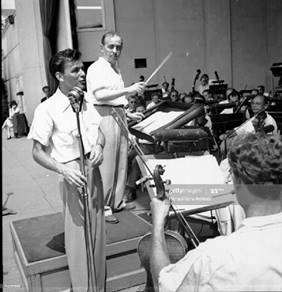
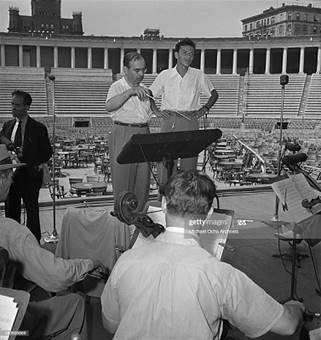
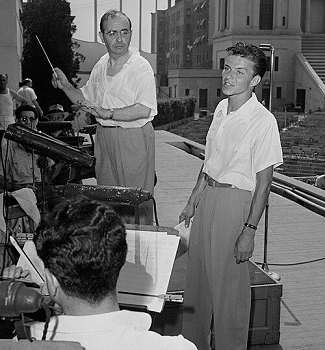
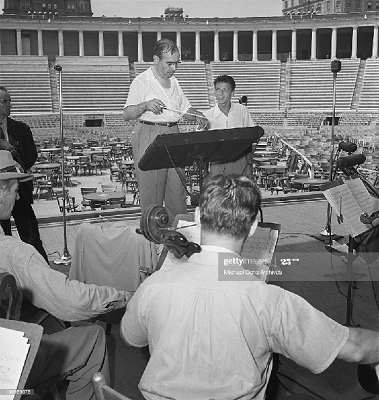
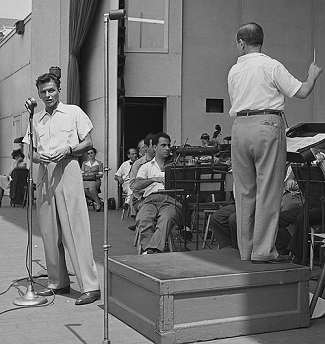
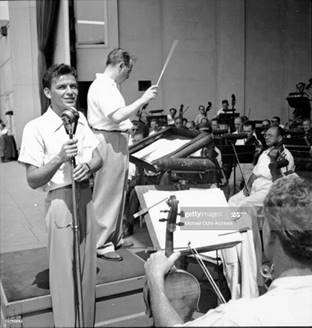
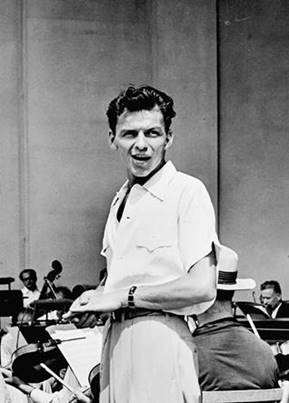
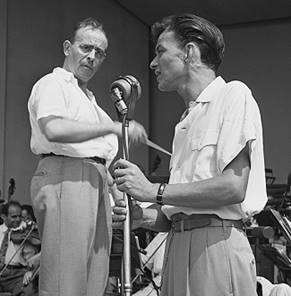
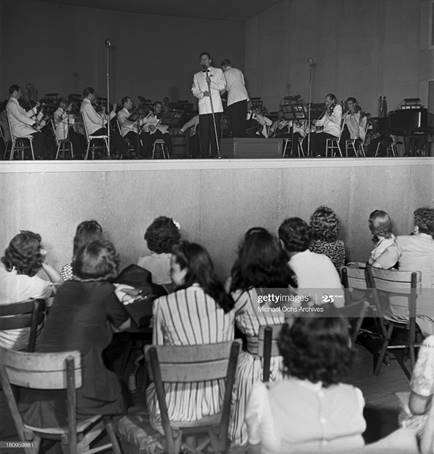
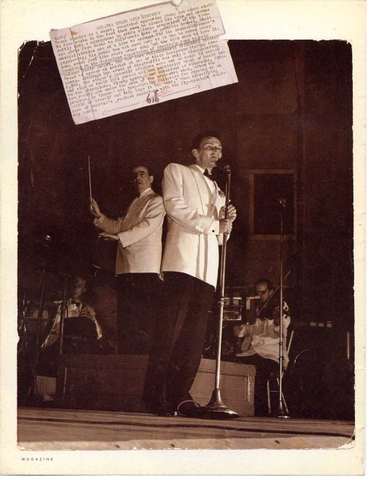
Variety
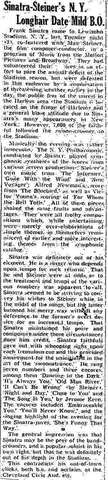
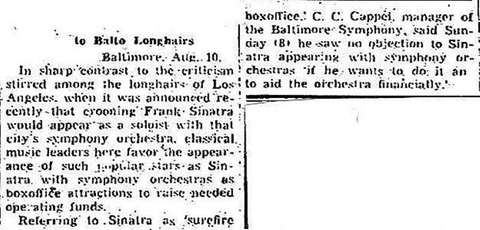
On August 3, 1947, the studios of 20th Century Fox sent several of their young starlets, including Marilyn Monroe, to participate as a "caddy" carrying a golf club, at the annual charity tournament organized by actor and director Frank Borzage and sponsored by Fox Studios, the "Motion Picture Golf Tournament" held at the California Country Club in Cheviot Hills.
The profits collected are donated to the cancer research foundation, the "Damon Runyon Cancer Research" founded by Walter Winchell after the death of his writer friend Damon Runyon from throat cancer in 1946.
Many stars participate: Bing Crosby, Bob Hope, Clark Gable, Red Skelton,
Adolphe Menjou, Frank Sinatra, Jack Benny, Monte Hall.
Marilyn Monroe accompanies, noting scores and carrying his golf club, actor and singer John Carroll who is married to Lucille Ryman, talent scout at MGM. Marilyn sympathizes with the couple who will take care of her and will take care of her career by also providing moral and financial support.
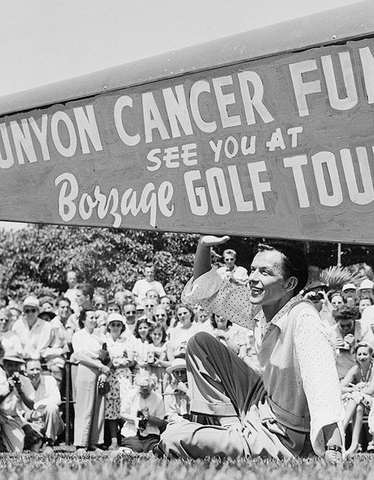
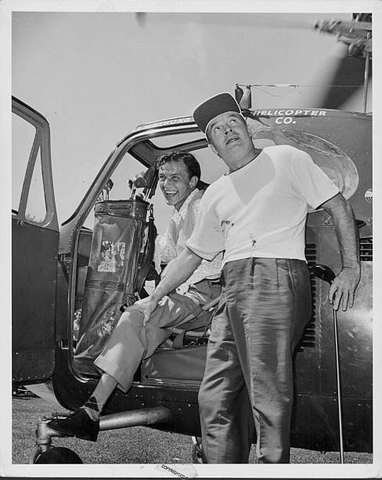
August 4, 1943
[Performs with Philadelphia Philharmonic]
Sinatra appeared with the Philadelphia Philharmonic Symphony Orchestra; bobbysoxers loved it, but music critics were unimpressed, particularly objecting to his calling the orchestra's musicians 'the boys in the band.'
Source: James Kaplan, "Frank: The Voice" (2010).
August 5, 1943
Studio
New York City
CO33250 People Will Say We're In Love w/The Bobby Tucker Singers
(R. Rodgers/O. Hammerstein II)
(from Oklahoma!)
Williamson Music, Inc. (ASCAP) 1943
Arrangement & Conducted by Alec Wilder
-6 (3:19) CD: Columbia Years 43-52 Vol. 1
EP: B-1608 Sings Hits From South Pacific and Oklahoma
78: 36682
CO33283 Oh What A Beautiful Morning w/The Bobby Tucker Singers
(R. Rodgers/O. Hammerstein II)
(from Oklahoma!)
Williamson Music, Inc. (ASCAP) 1943
Arrangement & Conducted by Alec Wilder
-1 (2:55) CD: Columbia Years 43-52 Vol. 1
LP: C6X-40343 The Voice-Columbia Years 43-52 (6-LP Set)
EP: B-2515 Hall Of Fame Series
78: 36682
Bobby Tucker Singers: Ray Charles, Edward Constantine, Fay Devlin, Ruth Doring, Thomas Foster, Norman Horn, George Kirk, Robert Miller, Frank Raye, Gary Rosenblatt, Kenneth Schon, Mary Jane Watkins, Rae Whitney
The Richmond News
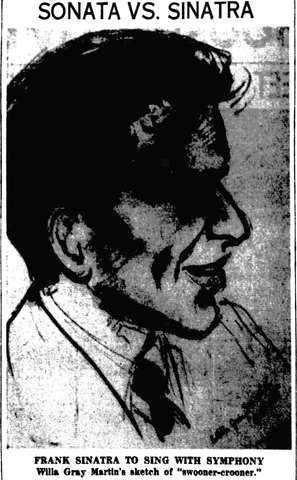
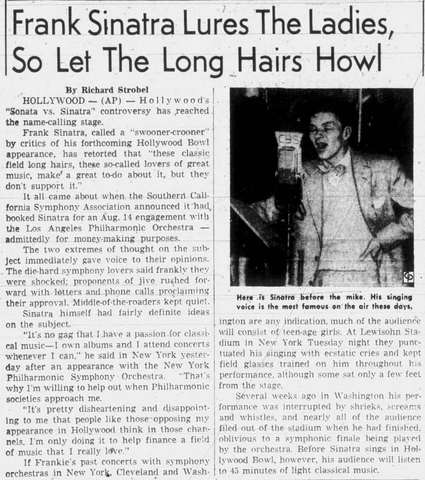
August 7, 1943
Radio
Your Hit Parade
Network: CBS
Program #429
Time: 9:00-9:45 P.M. (Rebroadcast August 8, 1943 12:00-12:45 A.M.)
Sponsor: Lucky Strike
Script (Final As Broadcast)
1. It Can't Be Wrong (8) - Sinatra
2. In My Arms (10) - Hit Paraders
3. People Will Say We're In Love (5) - Bea Wain
4. I Can't Give You Anything But Love - Ethel Smith
5. commercial
6. Comin' In On A Wing And A Prayer (4) - Hit Paraders
7. As Time Goes By (9) - Sinatra
8. It's Always You (7) - Bea Wain
9. That's A Plenty - Orchestra
10. station break
11. Let's Get Lost (6) - Hit Paraders
12. Diga Diga Do -- Ethel Smith
13. commercial
14. All Or Nothing At All (3) - Sinatra & Groups
15. In The Blue Of Evening (2) - Bea Wain
16. You'll Never Know (1) - Sinatra
Ed O'Brien:
Frank sang "Comin' In On A Wing and A Prayer,"
"It Can't Be Wrong" and "Let's Get Lost" in concerts and on the radio. All three were always done in a splendid manner by "The Voice." Excellent example of three fine songs from the war years that Sinatra never recorded.
August 9, 1943
Radio
Broadway Bandbox
Network: CBS
Location: New York City, CBS Playhouse #3
Time: 9:30PM - 10:00PM (EST) Monday
Show #12
Sponsor: none (sustaining)
Host: Frank Sinatra
Musicians: Raymond Scott Orchestra augmented by a string section, Bobby
Tucker Singers
Arranged and Conducted By: Axel Stordahl (Sinatra portions)
Announcer: Maurice Hart
Guests: Jerry Colonna
Notes: Confirmed airing on WABC. Sinatra not on show.
Herb Polesie, producer of the "Broadway Bandbox- CBSinatra-la and the Jersey Lark will leave New York City for the Pacific Coast Thursday,
whence that program will emanate from: five weeks starting Aug. 16.... meanwhile next Monday, the "Bandbox" will be emceed by Connee Boswell....
Daily Radio
August 4, 1943
note: Frank was travelling out to Hollywood when this show was aired.
I have the listing of all the shows in the series. Knew Frank was a no-show,
but couldn't recall my source. Did a little digging and found the above entry.
Ed
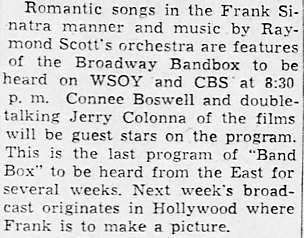
August 11, 1943
Pasadena, California
It does not appear that Sinatra performed in Pasadena. It was a stop only on his way to Hollywood. The article below explains:
Pasadena Post, August, 12, 1943
From the L.A. Times Archives: Frank Sinatra’s in town
Aug. 11, 1943: Frank Sinatra retreats to a ladder for refuge as autograph hounds besiege him following his arrival by train in Pasadena. Sinatra was in town for a performance at the Hollywood Bowl and for work on an RKO movie. This photo appeared in the Aug. 12, 1943, Los Angeles Times. (Los Angeles Times)
By Scott Harrison
Aug. 9, 2019
5 AM
In 1941, singer Frank Sinatra’s popularity soared, especially with teenage girls. On Aug. 11, 1943, “Sinatramania” arrived in Los Angeles.
Sinatra came to Southern California for a performance at the Hollywood Bowl and an appearance in an RKO movie.
Aug. 11, 1943: Frank Sinatra arrives by train in Pasadena.
(Los Angeles Times)
Aug. 11, 1943: Frank Sinatra with unidentified friends arrives by train in Pasadena. This photo was not published, but The Times reported on Aug. 12, 1943, that RKO Pictures had provided starlets to pose with Sinatra at the train station. (Los Angeles Times)
[Sinatra's staged Pasadena arrival]
On Wednesday, August 11, 1943, Sinatra arrived by the Super Chief train not in Los Angeles but Pasadena; a crowd of a few hundred fans, orchestrated in advance by the Evans publicity office (via Los Angeles rep Margaret Divan) together with RKO's publicity department, greeted him at the small Mission-style depot.
Source: James Kaplan, "Frank: The Voice" (2010).
Traveling to Los Angeles by train, Frank tried to dodge crowds by getting off early in Pasadena, but a huge mob of bobby-soxers still swarmed the station and nearly overturned the car he was in before police got him to safety.
Source: Nancy Sinatra, Frank Sinatra: An American Legend, 1995.
August 12, 1943
Frank Sinatra and his entourage — including Hank Sanicola and arranger Axel Stordahl — arrived by train in Pasadena, California, where hysterical fans nearly caused a riot at the station. He was in town to make his first credited film acting role, in Higher and Higher, and to appear in a series of concerts at the Hollywood Bowl. Source: J. Randy Taraborrelli, Sinatra: Behind the Legend.
August 13, 1943
[Paranoid letter launches Sinatra's FBI file]
Two days after Sinatra's Pasadena arrival, a San Jose radio listener sent the FBI a letter warning that the manufactured hysteria around Sinatra used the same crowd-psychology tactics that had produced Hitler in Germany -- the opening document in what would grow into a 1,275-page FBI dossier on Sinatra.
Source: James Kaplan, "Frank: The Voice" (2010).
August 14, 1943
Radio
Your Hit Parade
Network: CBS
Program #430
Time: 9:00-9:45 P.M. (Rebroadcast August 15, 1943 12:00-12:45 A.M.)
Sponsor: Lucky Strike
Script (Final As Broadcast)
1. All Or Nothing At All (5) - Sinatra
2. Everything I've Got - Orchestra
3. It's Always You (6) - Bea Wain
4. Comin' In On A Wing And A Prayer (4) - Hit Paraders
5.. commercial
6. California Here I Come - Orchestra
7. Sunday, Monday Or Always (7) - Sinatra
8. It Can't Be Wrong (8) - Bea Wain
9. Dark Eyes - Orchestra
10, station break
11. I Heard You Cried Last Night (9) - Sinatra
12. I Got Rhythm - Orchestra
13. commercial
14. People Will Say We're In Love (3) - Hit Paraders
15. In The Blue Of Evening (2) - Sinatra
16. You'll Never Know (1) - Bea Wain
NOTE: Sinatra Scholar Ed O'Brien points out that Sinatra had major hits with all three songs performed that evening on the Your Hit Parade radio show. "In the Blue of Evening" was #1. "All or Nothing at All" reached #2 and "Sunday, Monday or Always" peaked at #9.
Concerts
Hollywood Bowl, Los Angeles, California
Saturday evening
Frank Sinatra with the Los Angeles Philharmonic Orchestra Arrangements by Axel Stordahl
Conducted by Morris Stoloff
1. Dancing In The Dark
2. It's Always You
3. Ol' Man River
4. Night And Day
5. You'll Never Know
6. The Song Is You (considered by many to be Frank's finest performance of the Kern-Hammerstein song.)
7. Embraceable You
8. She's Funny That Way
9. All Or Nothing At All
Ed O'Brien comments:
After his performance, Sinatra addressed the audience.
He discussed the controversy surrounding his appearance, thanked the 18,000 plus in attendance, lauded the L.A. orchestra and expressed his gratitude for Mr. Stoloff's efforts on his behalf. Frank stated that all kinds of music should be heard at any bowl or any public auditorium and that music is universal
Whether you hear a concert singer with a philharmonic orchestra or a crooner with a jazz band, it doesn't make any difference.
Ed O'Brien also reports that Sinatra opens the verse singing "Darkies all work along the Mississippi while the white man plays." A few months later he refused to sing those lyrics and demanded that they be changed. O'Brien says he can think of two other songs where Sinatra sang, both before the August 14, 1943 concert, "darkie:" "On Moonlight Bay" from "Ship Ahoy" and "Without a Song."
Hollywood Bowl, Los Angeles, California
Saturday evening
Frank Sinatra with the Los Angeles Philharmonic Orchestra Arrangements by Axel Stordahl
Conducted by Morris Stoloff
Ed O'Brien:
Sinatra had experienced some rough treatment by the critics prior to his solo debut at the Hollywood Bowl. Music critics in New York, Cleveland and Washington had dismissed his attempts to sing with a full philharmonic orchestra. He turned to the multi-talented Kay Thompson for help. Kay helped Frank rehearse for the Bowl appearance. Teaching him how to project his voice in such a spacious arena. She also helped him prepare for his first starring role in "Higher And Higher." Working with him on the five songs he would sing in the film. These coaching sessions proved quite successful and Kay became his vocal guru at RKO and later on at MGM.
SINATRA CROONS, BOWL SWOONS
STADIA BUGABOO DOGS FRANKIE
HOLLYWOOD, Aug. 14 --- Frank
Sinatra's date tonight at the Hollywood
Bowl proved that you can't make love to 15,000 people in the same place at the same time. And since the swoon king's style is ideally and exclusively suited to creating a feeling of intimacy with the individual listener, his bowl appearance -- fourth in a series of long-hair engagements -- he pre- viously sang with the Cleveland
Symphony Ork, the New York
Philharmonic Symphony Ork and the National Symphony in Wash- ington, was not an unqualified success.
The take for the Southern
California Symphony Association org running the Bowl, and for Sinatra, was definitely on the terrific. side..
Capacity for this huge natural amphi- theater is 22,500, but a Western
Defense Command recommendation in this territory suggests that places of entertainment hold their ticket sales to 10,000. A Bowl spokesman told this reporter that the attendance had been held to 10,000 with thousands of turnaways, but a fast check-up of the turnout on the spot indicated at least 15,000 present.
From a performance standpoint it was another story. In the first place,
John Wood, emcee for the Bowl, made an entrance after the long 15-minute intermission preceding which the Los
Angeles Philharmonic, without Sinatra, had done its half of the program.. The house expected a Sinatra intro, but
Wood gave out with a schedule of coming Bowl events. Wood then walked off and there was a dull lull. After a time without an introduction or fanfare of any kind Sinatra walked on. The Bowl could have done a lot better by the idol of slick chicks. With this unhappy start Sinatra went into "Dancing in the Dark." His voice was lost in the hugeness of the Bowl. News- paper lensmen were laying all over the foot lights before him and he was obviously nervous. He finished his opener to a few definitely loyal shrieks from his devoted lassies and laughs, cracks and guffaws from the rest of the house. With "It's
Always You," he faired little better -- the size of the Bowl together with his quite natural nervousness was just too much for him at this point. In introducing the next number, a deviation from the pops with which he is identified, but which he did at Lewisohn in New York, Sinatra made the kind of a crack which is doing him no good. The number was "Ol'
Man River,' and that they had undoubtedly heard others, like Paul Robeson, do it before and that he wasn't in their class.
Graciousness and a proper sense of humility has always been one of Frankie's strong points and he is making a big mistake and one that may hurt him in adopting an over-confident, somewhat swaggering attitude, particularly when it comes to refer- ence and comparisons to the Robesons,
Crosbys, etc.
At the conclusion of "Ol' Man River,' the house was no more sold on Sinatra than they had been all evening. Next number, Cole
Porter's "Night and Day,' started to warm them up and following this he exhibited a rare touch of smart showmanship. Instead of doing the programmed "The Song Is You,," he did "You'll Never Know," No. 1 on the Hit
Parade, and a top tune in every rating chart, including The Billboard's music pop chart.
This one really got them and by the time the kids, who swoon at the sight of Sinatra, were really in the groove, and the Philharmonic's new baritone soloist began to take over.
Followed with "The Song Is You" to shrieks from the dyed-in-the-wool Sinatraites and respectful applause from the rest of the house. He encored in sock fashion with
"Embraceable You," "She's Funny That Way" and "All or Nothing at All." To the young swoonmaster's everlasting credit, let it be said that he finished a great deal stronger than he opened, and let it be said that he was working under extremely tough circumstances.
For one thing, George Evans, Sinatra's p.a., stormed into this ballyhoo capital and really showed them a few things about the art of ballyhoo. Sinatra's arrival at Pasadena
Wednesday (11) thru Evan's p.a..-ing won front page pix and stories in every paper in town and all the papers carried follow-up stories right up to the night of the Bowl date.
The sensational ballyhoo job got not only the kids but the Hollywood sophisticates over to the Bowl. Hence the 15,000 turnout..
And where a tight and hep theater or Riobamba crowd is a pushover for Sinatra, this mob of semi- longhairs and semi sophisticates was really tough to win..
For another thing, as The Billboard pointed out in a news review of Sinatra's Lewisohn date, August
14 issue, his voice and style just isn't suited for these vast spots. This reviewer caught the Sultan of
Swoon on his Hit Parade stint from CBS's KNK just before Sinatra was police-escorted over to the Bowl and he was more terrific than he's ever been before. He did "All or Nothing at All,"
"Sunday, Monday or Always" and "I Heard You
Cried Last Night" on the ciggie show and every number was solid sock. At the Bowl he didn't sound like the same singer at all.
Billboard
August 21, 1943
note: Asked during a private interview in 1959, if there was anything he would avoid doing in his career, Sinatra said the one thing he definitely wouldn't do was play the Hollywood
Bowl as a single act, or other venues similar to the Bowl. He stated that vast sites like that were made for the Bob Merrills, not pop singers like him. He felt it was overreaching on his part to attempt such an endeavor.
The official attendance at the Bowl on 8-14-43 was later revealed to be over 18,000.
From the Archives: Frank Sinatra at the Hollywood Bowl
Aug. 14, 1943: Frank Sinatra performing at the Hollywood Bowl.
(Los Angeles Times)
Aug. 13, 2019
5 AM
On Aug. 14, 1943, Frank Sinatra performed at the Hollywood Bowl before a sold-out crowd of 10,000. The opening act by the Los Angeles Philharmonic included selections “Bumble Bee” and “Night on Bald Mountain” from the Disney movie “Fantasia.”
Then at 10 p.m., Sinatra appeared onstage. His selections included “Dancing in the Dark,” You’ll Never Know” and “The Song Is You.”
Los Angeles Times writer Marvin Miles explains what happened:
From the moon-bathed tiers of venerable Hollywood Bowl, last night came the inconceivable – hysterical screams, pleading, sighs, whistles, endearments, gasps, agonized cries ….
Sinatra was singing!
Here!
At last!
“You’ll never know just how much I miss you,” the magic voice whispered. “You’ll never know just how much I care …"
Frankie was sending, but solid, for 10,000 slick chicks who almost mobbed his automobile after the performance.
Tenderly caressing the mike, the down-beat dandy cooed softly – and oh, so intimately – to the breathless babies in bobby socks .….
Some listened dreamily with eyes closed; some squirmed, others were completely ecstatic, entranced; still others were demonstrative, ringing [sic] their hands and moaning softly in obvious bids for attention.
But all had one emotion in common – their feverish devotion to the little juke box johnnie, best expressed in the screams and cries and whistles that welled up from the amphitheater when Frankie finished each number….
All in all it was a big night, best expressed by one breathless babe. “He sends me – and he leaves me there.”
The accompanying photo gallery includes images of Sinatra onstage that were not published the next day. The Times did print the closeup of Sinatra singing backstage.
What’s missing are images of the bobby-socks crowd. A couple of crowd pictures appeared in print after Sinatra’s concert. Neither the photographs nor the negatives have been located.
These images were scanned from original 4-inch-by-5-inch negatives. The photographer is unknown.
August 15, 1943
Radio
We, The People
Broadcast Series
Network: CBS
Time: 7:30 - 8:00 PM EST
Performers: Frank Sinatra
1. You'll Never Know - with a lovely piano backing.
Notes: LOC has10-inch,sound reel. TT: 30mins.
note: The show was sponsored by Gulf Oil and originated in New York. The 43 year old woman, with 11 sons, is interviewed in Chicago. She married at age 13 and had triplets the following year. She also had three sets of twins along the way. Her last son was born when she was 39. The solo birth dis- appointed her. Sinatra is the only guest from the entertainment world. He interviews the young lady who joins him in the segment from Hollywood. His reading of "You'll Never
Know" is lovely, with a beautiful piano dominating the orchestral backing. Bob Hope will be the guest the following week. "We The People" will pick up his segment from Algiers.
Ed
We, The People
Broadcast Series
Network: CBS
Time: 7:30 - 8:00 PM EST
Performers: Frank Sinatra
note: Louella Parsons was a powerful figure in Hollywood, in 1943.
This love letter to Frank must have thrilled both George Evans
and Sinatra. A woman whose wrath was feared in Tinseltown
had become a big fan of "The Voice."
August 15, 1943 issue of Down Beat features Sinatra on the cover
August 15, 1948, Don McGuire married Karen X. Gaylord at Frank Sinatra’s home and Sinatra was best man:
Don McGuire would direct Sinatra in “Johnny Concho”
--Scott
August 16, 1943
Radio
Broadway Bandbox
Network: CBS
Location: New York City, CBS Playhouse #3
Time: 9:30PM - 10:00PM (EST) Monday
Show #13
Sponsor: none (substaining)
Host: Frank Sinatra
Musicians: Raymond Scott Orchestra augmented by a string section, Bobby
Tucker Singers
Arranged and Conducted By: Axel Stordahl (Sinatra portions)
Announcer: Maurice Hart
Guests: Orson Welles
Notes: Confirmed airing on WABC.
Concerts
Hollywood Canteen, Los Angeles, CA
Frank Sinatra with Harry James Orchestra
Broadway Bandbox
Network: CBS
Location: New York City, CBS Playhouse #3
Time: 9:30PM - 10:00PM (EST) Monday
Show #13
Sponsor: none (substaining)
Host: Frank Sinatra
Musicians: Raymond Scott Orchestra augmented by a string section, Bobby
Tucker Singers
Arranged and Conducted By: Axel Stordahl (Sinatra portions)
Announcer: Maurice Hart
Guests: Orson Welles
Frank and Orson 8-16-43
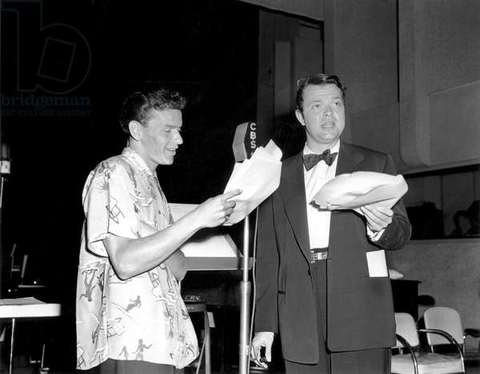
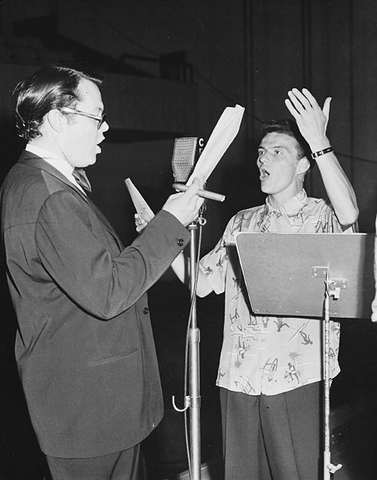
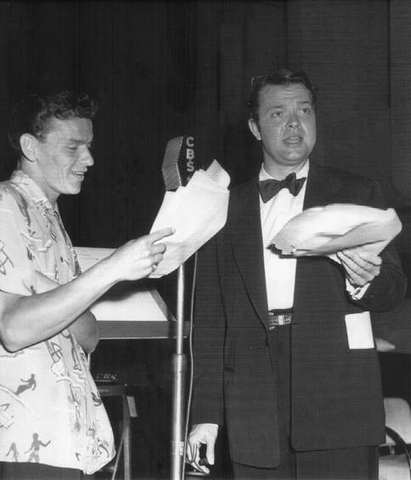
Hollywood Canteen, Los Angeles, CA
Frank Sinatra with Harry James Orchestra
Columbia release card for the above photo:
Tune In magazine November 1943
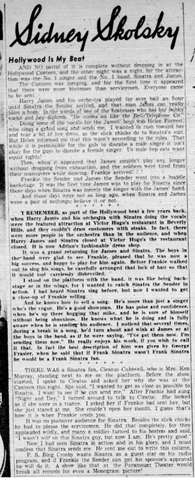
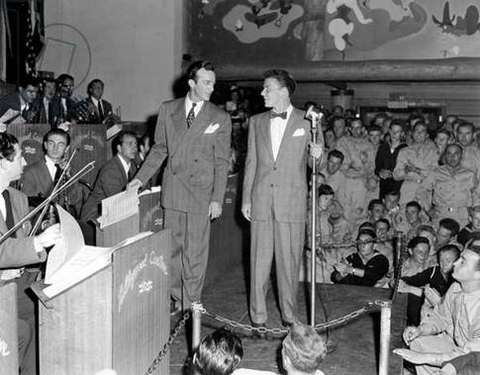
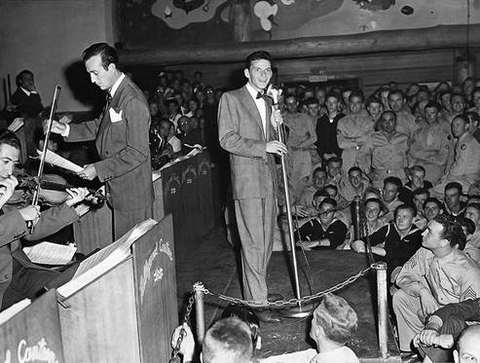
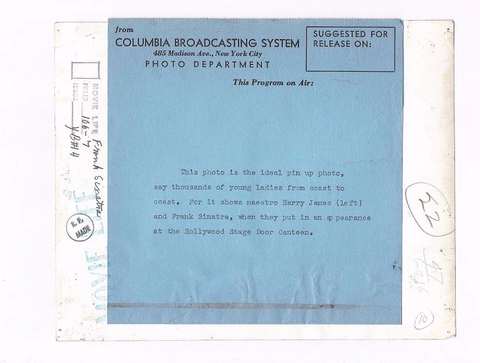
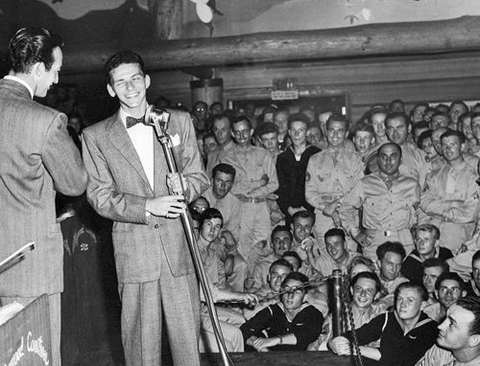
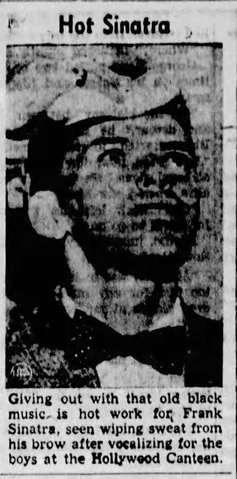
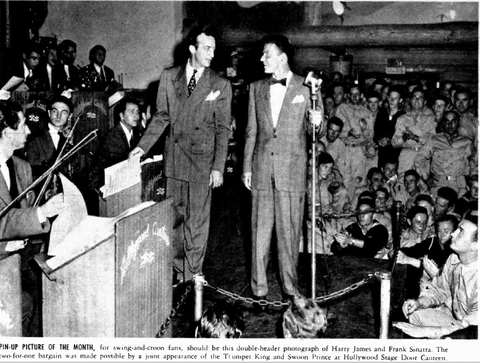
August 21, 1943
Radio
Your Hit Parade
Network: CBS
Program #431
Time: 9:00-9:45 P.M. (Rebroadcast August 22, 1943 12:00-12:45 A.M.)
Sponsor: Lucky Strike
Script (Final As Broadcast)
1. Sunday, Monday Or Always (8) - Sinatra
2. There's A Great Day Coming Manana - Orchestra & Hit Paraders
3. Put Your Arms Around Me Honey (9) - Bea Wain
4. In My Arms (6) - Hit Paraders
5. commercial
6. Alexander's Rag Time Band - Orchestra
7. People Will Say We're In Love (4) - Sinatra
8. Comin' In On A Wing And A Prayer (5) - Bea Wain
9. The Toy Trumpet - Orchestra
10. station break
11. It's Always You (7) - Sinatra
12. Runnin' Wild - Orchestra
13. commercial
14. All Or Nothing At All (3) - Hit Paraders
15. In The Blue Of Evening - Sinatra
16. You'll Never Know (1) - Bea Wain
Command Performance
Program #80.
AFRS
Frank Sinatra, Alice Faye, Ginger Rogers, and Ed Gardner
1. Embraceable You
2. Night and Day
NOTE: Ed O'Brien reports that Sinatra also did a Duffy's Tavern skit.
Concerts
Frank Sinatra sang at the RKO Dinner Dance
Filming was about to get under way on "Higher and
Higher." The front office wanted to introduce
"The Voice" to all the people he would be working with over the six weeks.
Command Performance
Program #80.
AFRS
Frank Sinatra, Alice Faye, Ginger Rogers, and Ed Gardner
The date above is when the show was recorded. "Command Performance USA brings you the greatest entertainers in America as requested by the fighting men of the United States Armed Forces throughout the world." Announcer Ken Carpenter introduces Ginger Rogers as the commanding officer. She opens the show by reading some troops letters and requests. Ginger then introduces Frank Sinatra who sings, "Embraceable You." Arthur Q. Bryan, as cartoon character Elmer Fudd, and Mel Blanc as Bugs Bunny do a comedy skit. . Alice Faye sings "They Always, Always Pick On Me." Ed Gardner, a.k.a Archie, asks Sinatra to be the vocalist at Duffy's Tavern. Frank reads some letters from servicemen overseas and then sings "Night and Day." Alice comes back on to sing Irving Berlin's "Alexander's Ragtime Band." Ginger offers a heartfelt goodnight to all the brave fighting men. Terrific show.--ED
Alice Faye Frank Sinatra Ginger Rogers
.
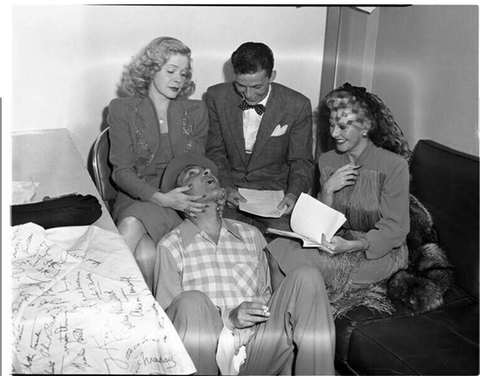
August 23, 1943
Radio
Broadway Bandbox
Network: CBS
Location: New York City, CBS Playhouse #3
Time: 9:30PM - 10:00PM (EST) Monday
Show #14
Sponsor: none (substaining)
Host: Frank Sinatra
Musicans: Raymond Scott Orchestra augmented by a string section, Bobby
Tucker Singers
Arranged and Conducted By: Axel Stordahl (Sinatra portions)
Announcer: Maurice Hart
Guests: no guests listed
Notes: Confirmed airing on WABC
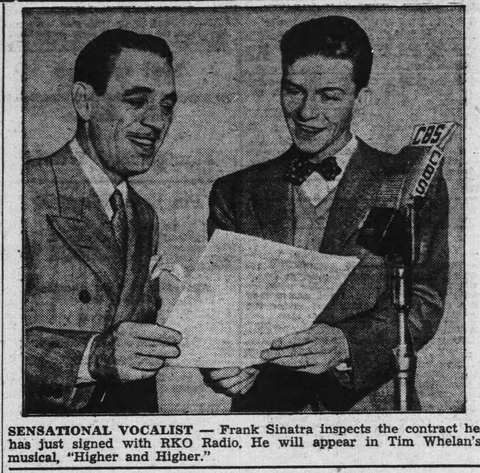
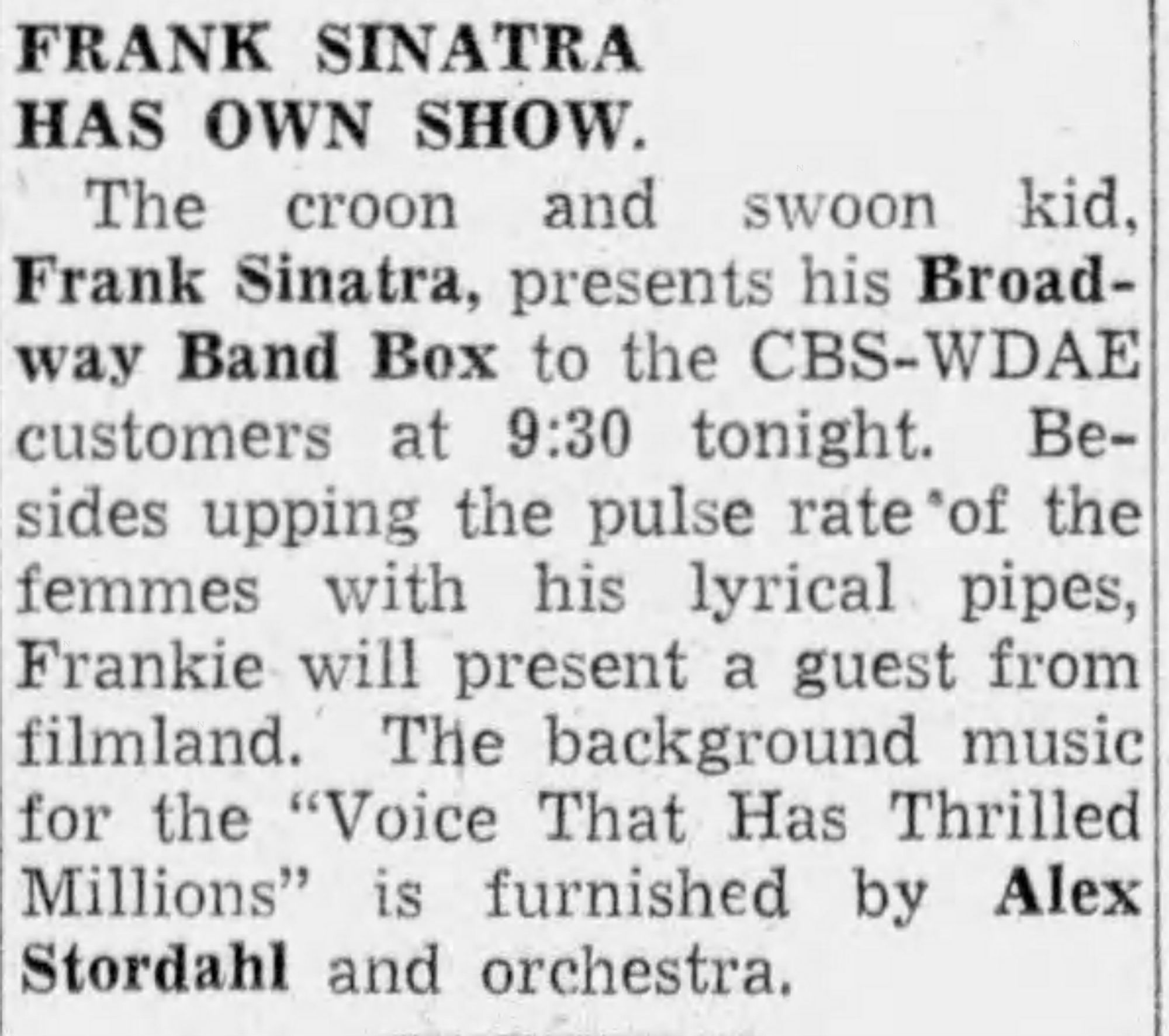
The Tampa Times, August 23, 1943.
August 24, 1943
Studio
Hollywood
RKO Studios Soundstage
Orchestra conducted by Constantin Bakaleinikoff
Frank Sinatra - three tracks for RKO movie "Higher and
Higher"
You're On Your Own
(Arranged by Alex Stordahl)
I Saw You First - with Marcy McGuire
(Arranged by Gene Rose)
You're On Your Own - with Dooley Wilson, Mel Torme, Marcy McGuire, Michelle Morgan, Victor Borger, and cast
(Arranged by Gene Rose and Axel Stordahl)
NOTE: We are indebted to Sinatra Scholar Ed O'Brien and Sinatraphile
Guy Steele for this recording studio information.
August 28, 1943
Radio
Your Hit Parade
Network: CBS
Program #432
Time: 9:00-9:45 P.M. (Rebroadcast August 29, 1943 12:00-12:45 A.M.)
Sponsor: Lucky Strike
Script (Final As Broadcast)
1. I Heard You Cried Last Night (9) - Sinatra
2. Some Of These Day - Orchestra
3. In My Arms (5) - Hit Paraders
4. Put Your Arms Around Me Honey (7) - Bea Wain
5. commercial
6. Lullaby Of Broadway - Orchestra & Chorus
7. All Or nothing At All (4) - Sinatra
8. Comin' In On A Wing And A Prayer (8) - Bea Wain
9. Say It With Music - Orchestra & Hit Paraders
10. station break
11. People Will Say We're In Love (6) - Sinatra
12. Swanee - Orchestra
13. commercial
14. Sunday, Monday, Or Always (3) - Hit Paraders
15. In The Blue Of Evening (2) - Bea Wain
16. You'll Never Know (1) - Sinatra
Notes: Audio only Good.
Billboard issue of 8-28-43
TOP THREE SONGS
1. In The Blue Of Evening TD Orch w/Frank Sinatra
2. You'll Never Know Frank Sinatra
3. All Or Nothing At All Frank Sinatra
August 29, 1943
Concerts
Mocambo, Los Angeles, CA
Benefit for Hollywood Guild
Frank Sinatra, Phil Silvers, Rags Ragland
Mocambo, Los Angeles, CA
Benefit for Hollywood Guild
Frank Sinatra, Phil Silvers, Rags Ragland
How prophetic the last line was in 1943: "he's going to be a top star"
Nice photo of Sinatra, Silvers, and Ragland. Not sure if it was from this event.
August 29, 1955 Time Magazine Cover
The original painting by Aaron Bohrod, as used by the 8/29/1955 TIME Magazine cover. The painting is now in the Portrait Gallery of the Smithsonian Institute.
--John Larrabee
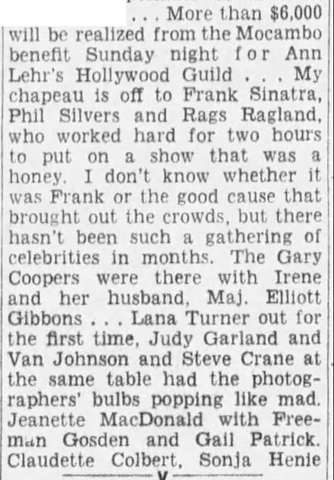
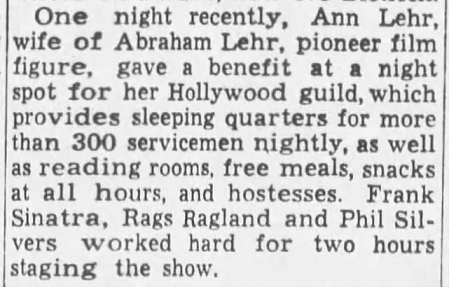
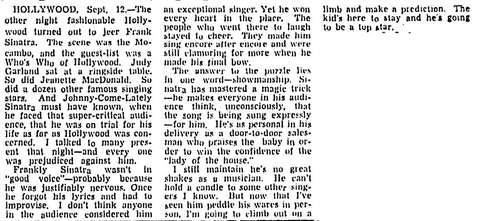
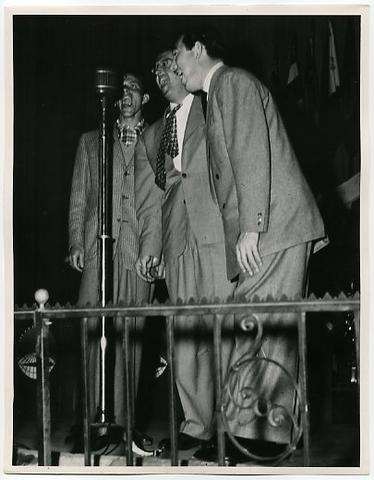
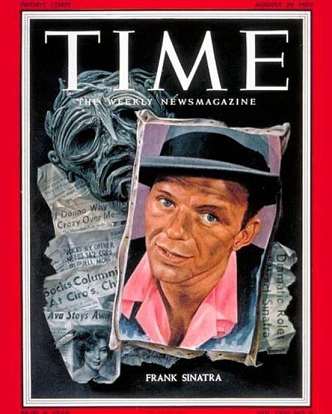
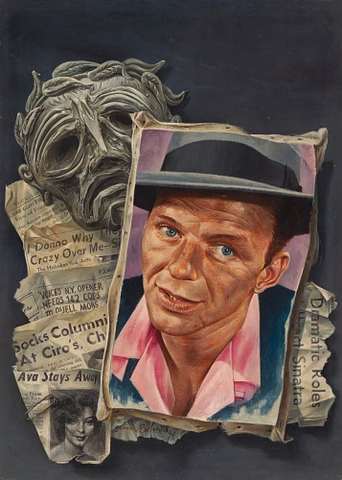
August 30, 1943
Radio
Broadway Bandbox
Network: CBS
Location: Hollywood, RKO Sound Stage
Time: 9:30PM - 10:00PM (EST) Monday
Show #15
Sponsor: none (sustaining)
Host: Frank Sinatra
Musicians: Raymond Scott Orchestra augmented by a string section, Bobby
Tucker Singers
Arranged and Conducted By: Axel Stordahl (Sinatra portions)
Announcer: Maurice Hart
Guests: Michelle Morgan, Jack Haley, Leon Errol
Notes: Confirmed airing on WABC
Broadway Bandbox
Network: CBS
Location: Hollywood, RKO Sound Stage
Time: 9:30PM - 10:00PM (EST) Monday
Show #15
Sponsor: none (sustaining)
Host: Frank Sinatra
Musicians: Raymond Scott Orchestra augmented by a string section, Bobby
Tucker Singers
Arranged and Conducted By: Axel Stordahl (Sinatra portions)
Announcer: Maurice Hart
Guests: Michelle Morgan, Jack Haley, Barbara Hale, Leon Errol
Jack
Haley
Frank
Barbara Hale
Variety
August 31, 1943
Radio
The Burns and Allen Show
Network: CBS
Sponsor: Swan Soap, Vimms
Show: #1 of the 1943-44 Season
Time:
Guest: Frank Sinatra
Performers: George Burns, Gracie Allen, The Swantet, Elvia Allman.
Felix Mills and His Orchestra
Announcer: Bill Goodwin
Note: Confirmed aired on WABC August 31, 1943 9:00PM - 9:30PM.
George wants to be a crooner. The show appears on the officially released CD set: 60 Greatest Old
Time Radio Show "Frank Sinatra & Friends."
Script won award for "Most Outstanding Script" from Radio Life Magazine.
TT: 30mins. Audio Condition: Very Good to Excellent note: Frank sang "She's Funny That Way" and
"Sunday, Monday Or Always." He was in great form..
--Ed
The Burns and Allen Show
Frank Sinatra to Open
With George And Gracie
Gracie Allen will brazenly try to prove to a Frank
Sinatra-conscious nation that her mate, George Burns, has a far greater appeal to the bobby socks continent of America when Sinatra appears as guest star on the opening Burns and Allen broadcast of the season Tuesday over KGLO-CBS at 8 p. m.
* * *
When George and Gracie return to Hollywood after a tour of western service camps they will find the cinema capital ablaze over the popular baritone and Gracie will promptly arrange a vocal contest between Frank and her spouse.
* * *
It will bother Gracie not a whit that she has never heard Frank sing and she will inveigle him into the contest because he has never had the doubtful pleasure of hearing George's singing voice. The winnerguess whowill be selected by by the studio audience.
Instrumental embellishment will be supplied by an orchestra under the baton of Felix Mills, who will make his debut as music director of the comedy series. Bill Goodwin will announce and be number 1 foil, and other fun makers in he line up will be Elvia Allman as Tootsie Sagwell, "The Happy Postman" as played by Mel Blanc and Clarence Nash as "Herman the Duck."
[image referenced in source but could not be recovered]
[image referenced in source but could not be recovered]
Mason City Globe-Gazette
With complete indifference to public opinion and the dangers involved, Gracie Allen stages a contest to prove that George Burns is a better singer than Frank Sinatra--when the popular American baritone is guest on the opening Burns and Allen Show of the season, Tuesday, on KGLO-CBS at 8 p.m. Returning to Hollywood after a tour of western service camps, George and Gracie found the cinema capital in an hysterical state over Sinatra, and Gracie decided that this adulation should be showered on her spouse. The contest resulted from Gracie's typically hapless approach to world events. Mulling the accounts of Sinatra's wild receptions at the terminals, Gracie, confusing Frank with his cousin Ray, the bandleader, turned to her maid and ordered: "Why, George can out-sing that Sinatra anytime. Make arrangemetns for a contest at once." There is every prospect that Gracie will be disillusioned when the audience picks the winner.
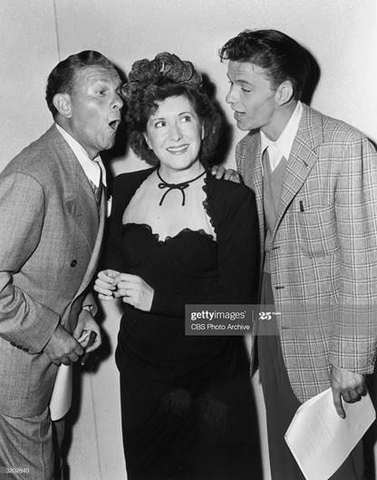
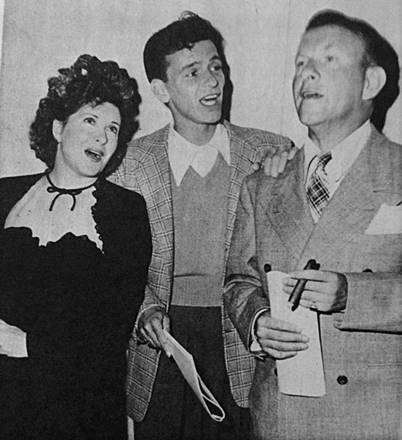
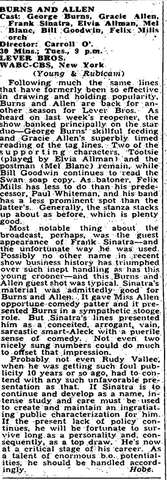
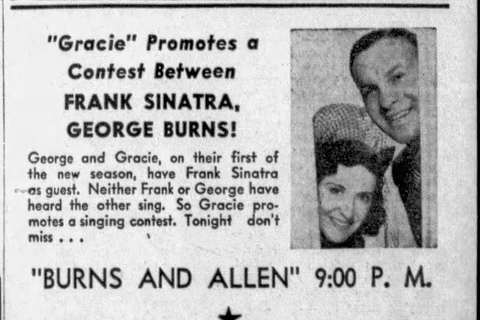
September 1943
[Sinatra Comforts A Dying Fan By Phone And Record]
When radio star Freeman Gosden's twelve-year-old daughter Virginia fell gravely ill in September 1943, Sinatra rushed to her bedside within twenty minutes of being asked, then cut her a private record of encouragement and a song a few hours later; she survived her surgery.
Source: Nancy Sinatra, "Frank Sinatra, My Father" (1985).
September 1, 1943
Studio
RKO
"Higher And Higher"
Wednesday
Orchestra conducted by Constantin Bakaleinikoff
First session 10:AM to Noon featuring 24 musicians
The Music Stopped arg. by Axel Stordahl
Second session 1:30 PM to 5:45PM
Orchestra conducted by Constanin Bakeleinikoff arg. by Axel Stordahl featuring 24 musicians
The Music Stopped (finale) w/ chorus
Ed notes: Sinatra would record the McHugh/Adamson song six times in the forties including a V-Disc version.
November/December,1968; February ,1976 and for his 40th Anniversary Party, June, 1979
He would still be performing the song in November of 1994. After a while he would claim it was
the first song he did with Harry James. The release in 1939 sold, according to Billboard, 16,000
copies. Reissued during the musician's strike in 1943, the song would top the charts and become
Frank's first solo million seller. A tune recorded five times and performed countless times through
the years. And what a great title to sum up what Frank was shooting for in August of 1939.
Ed O'Brien (2014):
Seventy-five years ago. Wow! Frank laid down this track on the day before the start of World War II.
Germany marched into Poland on September 1, 1939. The world would be at war for the next six years.
During those years Frank Sinatra would become the first teenage idol and the ads would read "The Voice
That Thrilled Millions." The recording done on this date in 1939 would be the one to define him throughout
his career: All Or Nothing At All.
Source: sinatraphiles digest (date extracted from item text; originally routed to appendix for review).
September 4, 1943
Radio
Your Hit Parade
Network: CBS
Time: 9:00-9:45 P.M.
Sponsor: Lucky Strike
1. All Or Nothing At All # 5- Frank Sinatra
2. Blow, Gabriel, Blow
3. In My Arms - The Hit Paraders
4. Put Your Arms Around Me, Honey - Bea Wain
5. Dardanella - Orchestra
6. People Will Say We’re In Love # 4 - Frank Sinatra
7. Comin’ In On A Wing And A Prayer - Bea Wain
8. St. Louis Blues - Orchestra
9. I Heard You Cried Last Night #6 - Frank Sinatra
10. After You've Gone - Orchestra
11. In The Blue Of Evening - The Hit Paraders
12. Sunday, Monday Or Always # 2- Frank Sinatra
13. You’ll Never Know - Bea Wain
NOTE: Ed O'Brien, who supplied the program information, says Sinatra was "hot." He had Top 10 hits with three of the four songs. He probably would have had four if "I Heard You Cried Last Night" had not been removed.
Concerts
Party For Frank Sinatra
Hosted by Ronald Reagan and Jane Wyman
Other performers: Ann Sherian, Dinah Shore, George Murphy, Dinah Shore
Party For Frank Sinatra
Hosted by Ronald Reagan and Jane Wyman
Other performers: Ann Sherian, Dinah Shore, George Murphy, Dinah Shore
September 6, 1943
Radio
Broadway Bandbox (CBS)
9:00 P.M. to 10: 00 PM.(Monday)
Salute To "Womanpower In The War"
Frank Sinatra w/Axel Stordahl & His Orchestra in Hollywood Jerry Lester w/Raymond Scott & His Orchestra in N.Y.C.
Bobby Tucker Singers,, Paul Baron & His Orchestra
Guests: Eileen Farrell, Jerry Lester, Colonel Stoopnagle
Jerry Sullivan, Golden Gate Quartet, Three Sisters, Herbert Marshall, Joan Brooks, Doris Dudley
1. Victory Polka
2. All Or Nothing At All
3. Ol' Man River
4. Close To You
Broadway Bandbox (CBS)
9:00 P.M. to 10: 00 PM.(Monday)
Salute To "Womanpower In The War"
Frank Sinatra w/Axel Stordahl & His Orchestra in Hollywood
Variety
September 8, 1943
Studio
RKO Soundstage - Los Angeles , California
Recording for the RKO film "Higher and Higher"
40-piece Orchestra conducted by Constantin Bakaleinokoff Arrangements by Alex Stordahl
I Couldn't Sleep a Wink Last Night - Frank Sinatra with Stanley Wright on piano
A Lovely Way to Spend an Evening - Frank Sinatra w/Stanley Wright on piano
A Lovely Way to Spend an Evening - Orchestra
I Couldn't Sleep a Wink Last Night - Orchestra
A Lovely Way to Spend an Evening - Finale
NOTE: Sinatra Scholar Ed O'Brien supplied the above information (along with that immediately below) and points out that Pianist Stanley Wrightman worked from 12:30 to 4:15 p.m. and was paid a grand total of $37.50. Eudice Shapiro, violinist, was there for the same duration and received $75.00.
September 9, 1943
Radio
Sealtest Village Store
NBC
Time 9:30 p.m.
Performers: Joan Davis; Jack Haley; Frank Sinatra.
1. Close To You
2. The Song Is You
Note: The show appears on the officially released CD set: 60 Greatest Old
Time Radio Show "Frank Sinatra & Friends"
Concerts
Carnegie Hall, New York, NY
Sinatra's appearance was part of the Third War Loan Drive
Note: First documented appearance of Sinatra at Carnegie Hall
Carnegie Hall, New York, NY
Sinatra's appearance was part of the Third War Loan Drive
Note: First documented appearance of Sinatra at Carnegie Hall
Carl Rasmussen sent this photo to me on 8-21 of 2021. He had a question mark because the official Carnegie Hall site has Frank's first appearance at the hallow hall on 10-24-44. I searched for an answer but was unable to find a date in September 43 for this event. I kept the post and a few days ago decided to try again. This time I went looking for Mike Mansfield -- son of Austin, who sang with the Mitchell Choir. And I found him. Mike sent me a copy of the letter his father received from the War Finance Committee. Letter was dated, 9-10-43, thanking Austin for his contribution at Carnegie Hall on 9-9-43. Frank's appearance was part of the Third War Loan Drive that started in early September of 43. The CBS airing took place from 9:30 to 10:00 P.M.
Music and memories
“During World War II, my father, Austin Mansfield, was a sergeant in the Army Air Corps stationed at Mitchel Field in Long Island, New York, as a liaison pilot. He belonged to the Mitchel Field choir, which performed with Frank Sinatra at Carnegie Hall in September 1943 as part of the kickoff for the Third War Loan Campaign. The program was broadcast on CBS Radio,” says Mike Mansfield of Deltona, Florida.
---------------------------------------------------
September 9, 1944
Elsa Maxwell threw a Victory Party to celebrate the liberation of France Sinatra sang "Night and Day"
I read Elsa Maxwell's comments on Frank in Photoplay earlier this week. It appeared in the January 1945 issue. I wasn't sure how much interest there would be so I passed.
Frank arrived at Elsa's party after his stint on the Hit Parade. He sang a number of songs including the top tune that week "I'll Be Seeing You." I was told Frank included the verse because of the Paris theme that night.
Elsa's column was a series of predictions regarding the careers of major stars in 1945. I also have some photos including one of Frank and Walter Pidgeon. The doctor Loretta Young married lived in Troy, N.Y. Tom Lewis and she would sail up the Hudson River every summer. They would dock in the north of the city and spend weeks with his family. Loretta was out and about every day. She was very friendly and became quite popular in the neighborhood.
--Ed
September 11, 1943
Radio
Your Hit Parade
Network: CBS
Program #434
Time: 9:00-9:45 P.M. (Rebroadcast September 12, 1943 12:00-12:45 A.M.)
Sponsor: Lucky Strike
Script (Final As Broadcast)
1. In The Blue Of Evening (4) - Sinatra
2. Frenesi - Mark Warnow
3. In My Arms (6) - Hit Paraders
4. Put Your Arms Around Me, Honey (8) - Bea Wain
5. commercial
6. Crazy Rhythm - Mark Warnow
7. I Heard You Cried Last Night (9) - Sinatra
8. People Will Say We're In Love (5) - Bea Wain
9. A Pretty Girl Is Like A Melody - Mark Warnow & Hit Paraders
10. station break
11. Paper Doll (7) - Frank Sinatra
12. Between The Devil And The Deep Blue Sea - Mark Warnow, Bea Wain & Hit
Paraders
13. commercial
14. All Or Nothing At All (3) - Hit Paraders
15. You'll Never Know (2) - Bea Wain
16. Sunday, Monday Or Always (1) - Sinatra
September 12, 1943
Frank signed a seven-year movie contract with RKO Radio Pictures as he began pursuing a film career alongside his music.
Source: Nancy Sinatra, Frank Sinatra: An American Legend, 1995.
September 18, 1943
Radio
Your Hit Parade
Network: CBS
Program #435
Time: 9:00-9:45 P.M. (Rebroadcast April 18, 1943 12:00-12:45 A.M.)
Sponsor: Lucky Strike
Script (Final As Broadcast)
1. You'll Never Know (6) - Jerry Wayne
2. Just One Of Those Things - Orchestra
3. I Heard You Cried Last Night (4) - Bea Wain
4. Put Your Arms Around Me, Honey (7) - Hit Paraders
5. commercial
6. Flying Down To Rio - Orchestra
7. Paper Doll (9) - Jerry Wayne
8. In My Arms (8) - Hit Paraders
9. The Lady In Red - Orchestra & Bea Wain
10. station break
11. In The Blue Of Evening (5) - Jerry Wayne
12. Honeysuckle Rose - Orchestra
13. commercial
14. All Or Nothing At All (3) - Hit Paraders
15. People Will Say We're In Love (2) - Bea Wain
16. Sunday, Monday, Or Always - Jerry Wayne
Notes: No Sinatra on this show. He was returning to New York from Hollywood. Check script for more details.
September 23, 1943
New York
SEPTEMBER 23, 1943: Frank Sinatra, gets a great big welcome from his 3-year-old daughter, Nancy, and his wife Nancy as he arrives at Grand Central
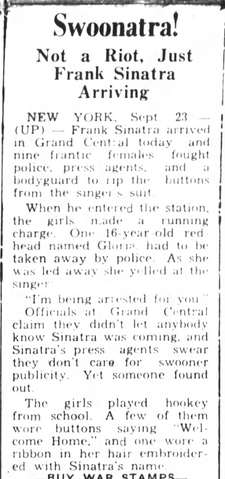
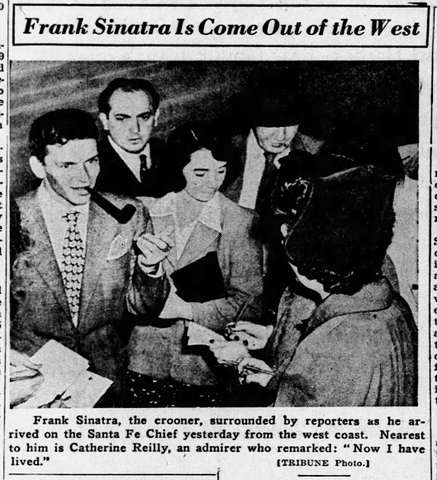
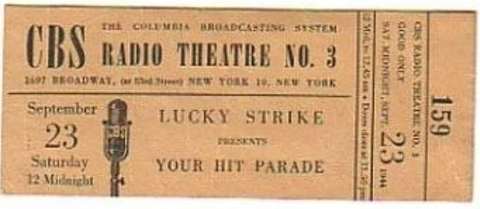
New York
The previous day, September 22, 1943, Sinatra changed trains in Chicago:
A ticket for the September 23, 1944 Your Hit Parade Show:
September 25, 1943
Radio
Your Hit Parade
Network: CBS
Program #436
Time: 9:00-9:45 P.M. (Rebroadcast September 26, 1943 12:00-12:45 A.M.)
Sponsor: Lucky Strike
Script (Final As Broadcast)
1. In The Blue Of Evening (6) - Sinatra
2. Some Of These Days - Orchestra
3. How Sweet You Are (9) - Hit Paraders
4. Put Your Arms Around Me, Honey (8) - Bea Wain
5. commercial
6. Varsity Rag - Orchestra
7. You'll Never Know (4) - Sinatra
8. I Heard You Cried Last Night (7) - Bea Wain
9. I've Got Sixpence - Orchestra & Chorus
10. station break
11. Sunday, Monday, Or Always (5) - Sinatra
12. Why - Orchestra
13. commercial
14. People Will Say We're In Love (3) - Hit Paraders
15. Paper Doll (2) - Hit Paraders (Male Group)
16. All Or Nothing At All (1) - Sinatra & Hit Paraders
Sinatra Scholar Ed O'Brien considers this show to be an embarrassment of riches. Sinatra had big hits with all four of these tunes. "All of Nothing at All" and "In the Blue of Evening" both reached #1 on the Billboard charts. "You'll Never Know" reached #2 and " Sunday, Monday or Always" peaked at #9.
September 26, 1943
Radio
War Loan Drive
WABC
3rd War Loan Drive
Frank Sinatra, Irving Berlin, Bing Crosby

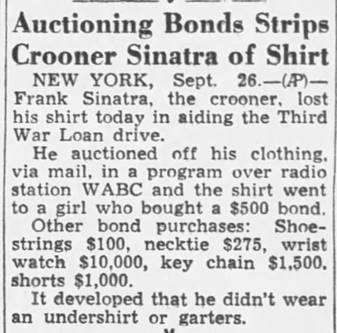
September 30, 1943
Radio
United Nations Night
11:30PM
Frank Sinatra, Perry Como, Rudy Vallee, Walter Pidgeon, Lana Turner, Bea Wain, and others
October 1943
[Draft board examines Sinatra, classifies 1-A]
Kaplan: At the end of October 1943, with fatherhood deferments about to be abolished, Sinatra was examined by local draft board physician Dr. Povalski in Jersey City, who declared him fit for service and classified him 1-A.
Source: James Kaplan, "Frank: The Voice" (2010)
[Draft board induction papers]
Kaplan: Sinatra signed his induction papers at local draft board No. 19-160 in Jersey City and was classified 1-A for military service.
Source: James Kaplan, "Frank: The Voice" (2010)
[Sinatra plays the Waldorf's Wedgwood Room]
Kaplan: In October 1943, Sinatra played the high-toned Wedgwood Room at the Waldorf-Astoria; Cole Porter came down from his suite upstairs to see the show.
Source: James Kaplan, "Frank: The Voice" (2010)
October 1, 1943
Concerts
Wedgwood Room, Waldorf Astoria, New York City (October 1 - November 30)
WEDGEWOOD ROOM, WALDORF-ASTORIA
HOTEL, NEW YORK
Talent policy: Dance and relief bands; floorshows at 8:30, 12:30 and 2. Management: Lucius Boomer, managing director; Ted Saucier, publicity. Prices: Weekday cover charge, $1; Fridays, Saturdays and holidays, $2.
For the opening of the ultra-smart Wedgewood Room. Lucius Boomer has obtained two attract- ions representing the height of popular appeal to contrast with a tasty item, with a major appeal to the swank set. As it is both acts go over with an accolade rarely evident among the usually restrain- ed Park Avenue clientele. Frank Sinatra and a dance pair from the Ballet Russe, Volkoff and Milada, give the room one of the smartest shows in the hotel sector.
Sinatra, with this engagement, proves that the social register is as susceptible as the Paramount Theater audience when there is swooning to be done. His effect on the femmes is equally as devastating. He ran the gamut of the current swoon numbers, including "Sunday, Monday,Or Always,;" "All or Nothing At All," a medley from "Oklahoma," and two sets of encores. He made a graceful bow-off speech that further ingratiated him with the audience.
Leo Reisman, who moved down from the Starlight Roof, continues to provide the showbacking and dance numbers. For Sinatra's turn, he uses a femme harpist, mainly for atmospheric reasons. Mischa Borr does the relief work.
--Billboard
J.C.
October 9, 1943
Capitol Theatre, New York
War Bond Show
Frank Sinatra, Bert Lahr, Jerry Lester, Milton Berle, Henny Youngman, Charlie Barnet Orchestra, Morton Gould Orchestra
Wedgwood Room, Waldorf Astoria, New York City (October 1 - November 30) Frank Sinatra with the Leo Reisman orchestra, 1943. Photo by Constantin Joffe/Vogue/Condé Nast. Thanks to Carl R for sending along above photo.
Variety
10-6-43
--ED
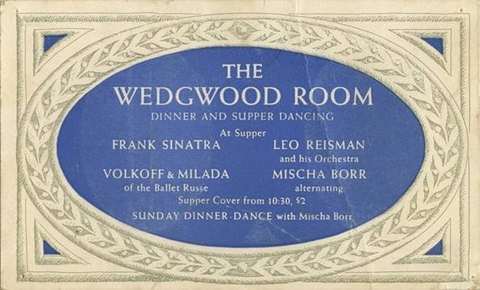
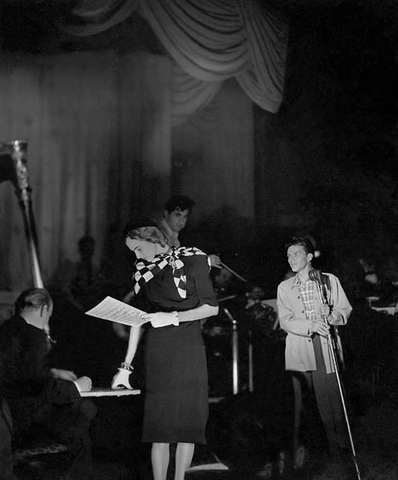
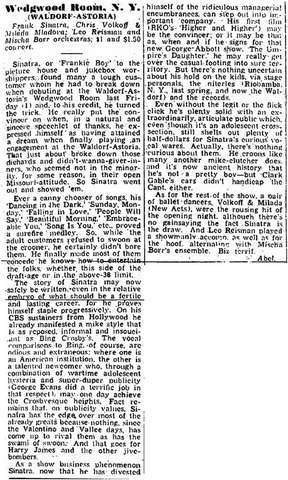
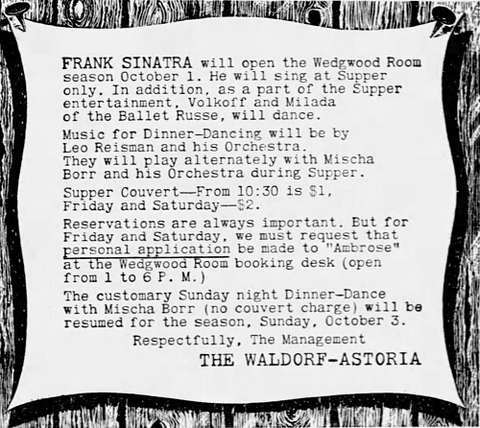
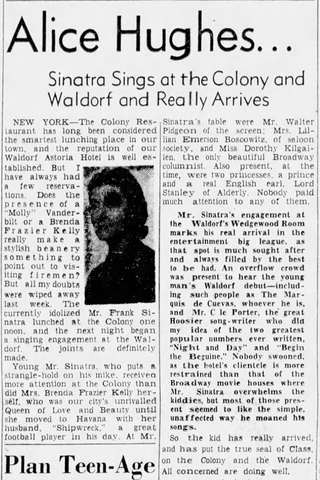
Capitol Theatre, New York
War Bond Show
Frank Sinatra, Bert Lahr, Jerry Lester, Milton Berle, Henny Youngman, Charlie Barnet Orchestra, Morton Gould Orchestra
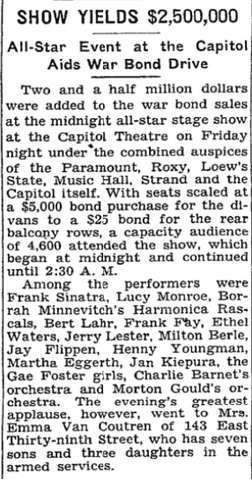
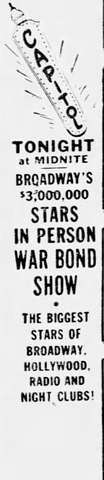
October 2, 1943
Radio
Your Hit Parade
Network: CBS
Program #437
Time: 9:00-9:45 P.M. (Rebroadcast October 3, 1943 12:00-12:45 A.M.)
Sponsor: Lucky Strike
Script (Final As Broadcast)
1. All Or Nothing At All (6) - Sinatra
2. Clap Your Hands - Orchestra
3. In My Arms (8) - Hit Paraders
4. Put Your Arms Around Me, Honey (4) - Bea Wain
5. commercial
6. That's A Plenty - Orchestra
7. Paper Doll (7) - Sinatra
8. Anything Goes - Orchestra
9. You'll Never Know (5) - Bea Wain & Group
10.. station break
11. Pistol Packin' Mama (9) - Sinatra
12. This Is The Army, Mr. Jones - Orchestra & Hit Paraders
13. commercial
14. I Heard You Cried Last Night (3) - Bea Wain
15. People Will Say We're In Love (2) - Hit Paraders
16. Sunday, Monday, Or Always (1) - Sinatra
Concerts
Wedgwood Room, Waldorf Astoria, New York City (October 1 - November 30)
October 3, 1943
Concerts
Wedgwood Room, Waldorf Astoria , New York City (October 1 - November 30) with the Leo Reisman orchestra
October 4, 1943
Concerts
Wedgwood Room, Waldorf Astoria, New York City (October 1 - November 30)
October 5, 1943
Concerts
Wedgwood Room, Waldorf Astoria, New York City (October 1 - November 30)
October 6, 1943
Concerts
Wedgwood Room, Waldorf Astoria, New York City (October 1 - November 30)
October 7, 1943
Concerts
Wedgwood Room, Waldorf Astoria , New York City (October 1 - November 30)
October 8, 1943
Concerts
Wedgwood Room, Waldorf Astoria , New York City (October 1 - November 30)
October 9, 1943
Radio
Your Hit Parade
Network: CBS
Program #438
Time: 9:00-9:45 P.M. (Rebroadcast October 10, 1943 12:00-12:45 A.M.)
Sponsor: Lucky Strike
Script (Final As Broadcast)
1. Paper Doll (4) - Sinatra
2. Everything I've Got Belongs To You - Orchestra
3. In My Arms (9) - Hit Paraders
4. Put Your Arms Around Me Honey (6) - Bea Wain
5. commercial
6. Tico Tico - Orchestra
7. Pistol Packin' Mama (5) - Sinatra
8. You'll Never Know (7) - Bea Wain
9. You're A Grand Old Flag - Orchestra & Hit Paraders
10. station break
11. If You Please (8) - Sinatra
12. Somebody Stole My Gal - Orchestra
13. commercial
14. I Heard Youu Cried Last Night (3) - Hit Paraders
15. People Will Say We're In Love (2) - Bea Wain
16. Sunday, Monday Or Always (1) - Sinatra
Concerts
Wedgwood Room, Waldorf Astoria, New York City (October 1 - November 30)
October 10, 1943
Radio
Broadway Bandbox
Network: CBS
Location: New York City, CBS Playhouse #3
Time: 8:00PM - 8:30AM (EST) Sundays
Show #17
Sponsor: none (sustaining)
Host: Frank Sinatra
Musicians: Raymond Scott Orchestra, Charlie Spivak and His Orchestra (music fills), Bobby Tucker Singers
Arranged and Conducted By: Axel Stordahl (Sinatra portions)
Announcer: Maurice Hart
Guests: Burt Wheeler, Constance Bennett
1. Pistol Packin' Mama - Frank Sinatra
2. From Taps Till Reveille - Frank Sinatra & Burt Wheeler
3. skit: "English Drawing Room" - Frank & Bennett
4. Ol' Man River - Frank Sinatra
5. Close To You - Frank Sinatra
6. Where Or When - Frank Sinatra
Notes: Confirmed airing on WABC and WTOP
Concerts
Wedgwood Room, Waldorf Astoria, New York City (October 1 - November 30)
WEDGEWOOD ROOM, WALDORF-ASTORIA
HOTEL, NEW YORK
Talent policy: Dance and relief bands; floorshows at 8:30, 12:30 and 2. Management: Lucius Boomer, managing director; Ted Saucier, publicity. Prices:
Weekday cover charge, $1; Fridays, Saturdays and holidays, $2.
For the opening of the ultra-smart Wedgewood
Room. Lucius Boomer has obtained two attract- ions representing the height of popular appeal to contrast with a tasty item, with a major appeal to the swank set. As it is both acts go over with an accolade rarely evident among the usually restrain- ed Park Avenue clientele. Frank Sinatra and a dance pair from the Ballet Russe, Volkoff and Milada, give the room one of the smartest shows in the hotel sector.
Sinatra, with this engagement, proves that the social register is as susceptible as the Paramount
Theater audience when there is swooning to be done. His effect on the femmes is equally as devast- ating. He ran the gamut of the current swoon numbers, including "Sunday, Monday,Or Always,;" "All or Nothing
At All," a medley from "Oklahoma," and two sets of encores. He made a graceful bow-off speech that further ingratiated him with the audience.
Leo Reisman, who moved down from the Starlight
Roof, continues to provide the showbacking and dance numbers. For Sinatra's turn, he uses a femme harpist, mainly for atmospheric reasons.
Mischa Borr does the relief work.
Billboard
J.C.
October 9, 1943
note: Frank opened on 10-1-43 and the engagement ran through 11-30-43
Broadway Bandbox
Network: CBS
Location: New York City, CBS Playhouse #3
Time: 8:00PM - 8:30AM (EST) Sundays
Show #17
Sponsor: none (sustaining)
Host: Frank Sinatra
Musicians: Raymond Scott Orchestra, Charlie Spivak and His Orchestra (music fills), Bobby Tucker Singers
Arranged and Conducted By: Axel Stordahl (Sinatra portions)
Announcer: Maurice Hart
Guests: Burt Wheeler, Constance Bennett
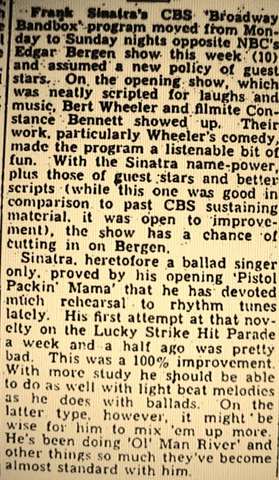
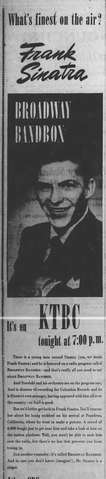
October 11, 1943
Concerts
Wedgwood Room, Waldorf Astoria , New York City (October 1 - November 30)
Lincoln High School Auditorium, Jersey City, NJ
Rally for Vincent J. Murphy, Democratic Candidate for Governor Sinatra sang 4 songs
Lincoln High School Auditorium, Jersey City, NJ
Rally for Vincent J. Murphy, Democratic Candidate for Governor Sinatra sang 4 songs
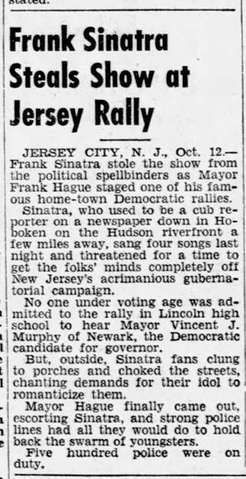
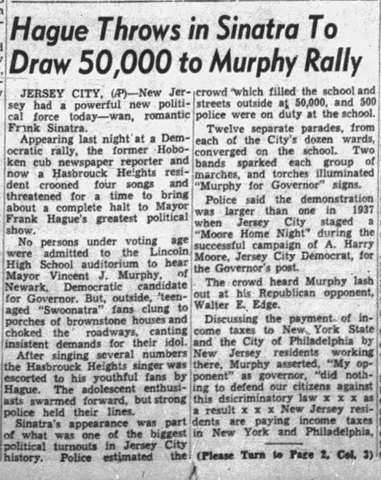
October 12, 1943
Concerts
Wedgwood Room, Waldorf Astoria, New York City (October 1 - November 30)
October 13, 1943
Concerts
Wedgwood Room, Waldorf Astoria, New York City (October 1 - November 30)
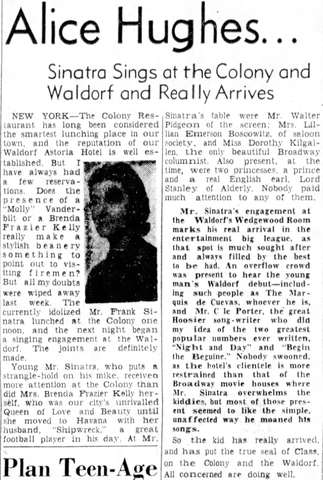
October 14, 1943
Concerts
Wedgwood Room, Waldorf Astoria, New York City (October 1 - November 30)
October 15, 1943
Concerts
Wedgwood Room, Waldorf Astoria, New York City (October 1 - November 30)
October 16, 1943
Radio
Your Hit Parade
Network: CBS
Program #439
Time: 9:00-9:45 P.M.. (Rebroadcast October 17, 1943 12:00-12:45 A.M.)
Sponsor: Lucky Strike
Script (Final As Broadcast)
1. All Or Nothing At All (7) - Sinatra
2. Everybody Step - Orchesta
3. You'll Never Know (8) - Hit Paraders
4. Put Your Arms Around Me, Honey (6) - Bea Wain
5. commercial
6. El Rancho Grande - Orchestra & Hit Paraders
7. I Heard You Cried Last Night (4) - Sinatra
8. They're Either Too Young Or Too Old (9) - Bea Wain
9. Forty-Second Street - Orchestra
10. station break
11. Pistol Packin' Mama (5) - Sinatra
12. For Me And My Gal - Orchestra & Hit Paraders
13. commercial
14. Paper Doll (3) - Hit Paraders
15. People Will Say We're In Love (2) - Bea Wain
16. Sunday, Monday Or Always (1) - Sinatra
Concerts
Wedgwood Room, Waldorf Astoria , New York City (October 1 - November 30)
Golden Gate Ballroom, Harlem, New York
NAACP Youth Council Matinee Dance
Sinatra, Duke Ellington, Count Basie, Lena Horne, Cab Calloway, and others
Golden Gate Ballroom, Harlem, New York
NAACP Youth Council Matinee Dance
Sinatra, Duke Ellington, Count Basie, Lena Horne, Cab Calloway, and others
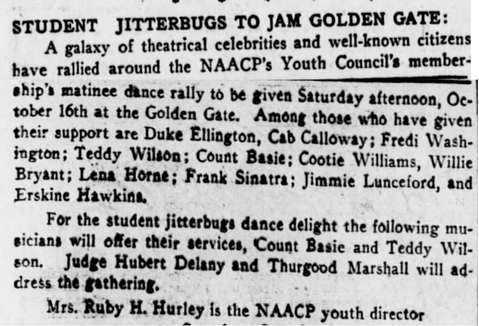
October 17, 1943
Radio
Broadway Bandbox
Network: CBS
Location: New York City, CBS Playhouse #3
Time: 11:30PM - 12:00AM (EST) Fridays
Show #18
Sponsor: none (sustaining)
Host: Frank Sinatra
Musicians: Raymond Scott Orchestra augmented by a string section, Bobby Tucker Singers
Arranged and Conducted By: Axel Stordahl (Sinatra portions)
Announcer: Maurice Hart
Guests: Milton Berle
1. Falling In Love With Love
2. skit - Frank & Milton Berle
3. If You Please
4. Are We From Dixie w/Milton Berle
5. There'll Be A Hot Time In The Town Of Berlin
6. I Only Have Eyes For You
7. That Old Black Magic
Ed O'Brien:
I checked a number of sources and this is what I discovered: FS was in L.A. in June of 43 and Miltion Berle was a guest on the 7-2 show in the Big Apple. But the chat between them shows it had to be in Oct. FS mentions he had Sunday dinner. Has to be Oct. Show. The Bandbox. was on Fri. and then Mon. until Oct. I checked all of the Sunday N.Y.C. listings for Sept and Oct. No Miltie. The 10/17 has Bert Wheeler listed. But, I think Berle was also on that show. Nothing else makes any sense. We have tapes of the 10-3 and 10-10.So,"It's Delovely" is from the July show on the 4 CD set released in the fall of 2015. And the show always credited as 7/2 is actually 10/17.
Guy Steele is a man who listens very carefully to the Sinatra patter on the radio shows. He picked up the disparity regarding the location. I thank him and credit him for his scholar- ship.

Concerts
Wedgwood Room, Waldorf Astoria, New York City (October 1 - November 30)
October 18, 1943
Concerts
Wedgwood Room, Waldorf Astoria , New York City (October 1 - November 30)
Walton Auditorium, WAVES Boot Camp, Bronx, NY
Sinatra sang 9 songs before an audience of 1600 WAVES
Songs included:
--The Song Is You
--Pistol Packin' Mama
--Where Or When
Walton Auditorium, WAVES Boot Camp, Bronx, NY
Sinatra sang 9 songs before an audience of 1600 WAVES
Songs included:
--The Song Is You
--Pistol Packin' Mama
--Where Or When
Mama Was a W.A.V.E. by Muriel Mahall
https://www.rosiecentral.com/post/real-stories-women-in-ww2
So it was a big adventure when in September, 1943, boot camp took her to New York City’s Hunter College. A month later, she was marching down Fifth Avenue in the Navy Day Parade. Hers was the first group of WAVES to take part in this event.
“Many tailors worked day and night to finish hundreds of uniforms. We came from the Bronx on the above-ground train, some of us in uniform for the first time. Probably a thousand of us lined up inside the Armory building.
She continued...
“Such a proud day. As we marched out into the sunlight, I smiled and my heart pounded with excitement. I can still hear the crowd cheering as the Navy band played ‘Anchors Aweigh.’
“That was our only liberty in New York City. We had time for a little sightseeing. Two friends and I took a cab, visited the Little Church Around the Corner, and ended up in a horse-drawn carriage riding through Central Park.
“That same night Frank Sinatra came to perform for the troops.”
Frank Sinatra -- Entertained the MilitaryI asked,
“Did you get goose bumps? Was your heart all aflutter?”
Mama laughed.
“Not really. We were excited to see him, especially when he sang ‘People Will Say We’re in Love.’ We applauded until our hands hurt. Just imagine. Frank Sinatra, in person. But before the concert, we had our orders: ‘No swooning.’ I wasn't exactly the swooning type anyway."
© 1997-2025 The Sinatra Archive
This calendar, or any parts thereof, may not be reproduced in any fashion
whatsoever without the prior written permission of the publisher (The
Sinatra Archive)
Version 5.3
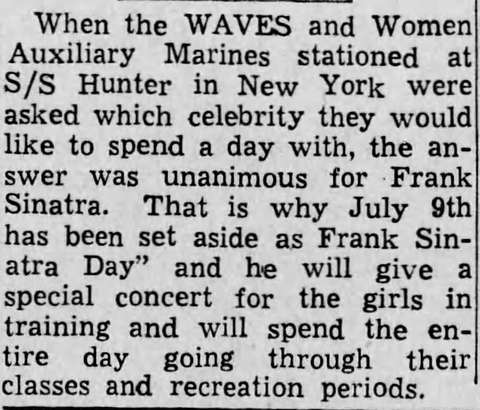
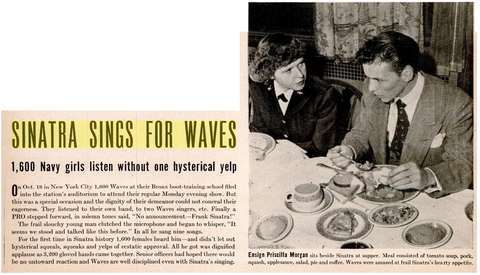
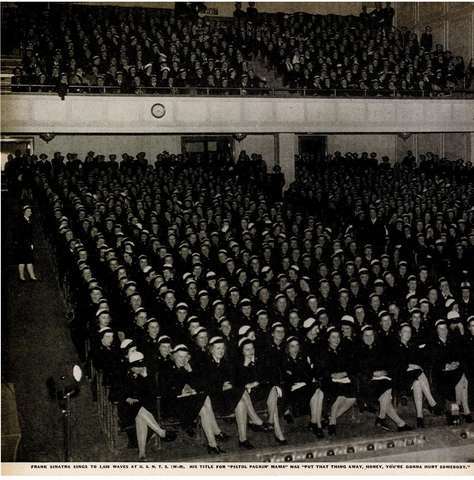
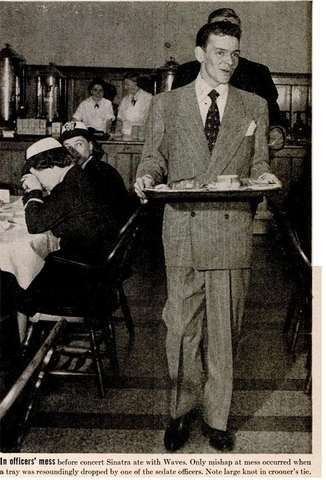
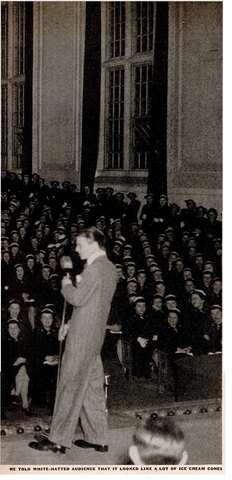
. And that is the date I put in the book. Later on I acquired a raw copy of segments from the appearance at Walton Auditorium. I knew immediately the July date was erroneous. The WAVES were wearing top coats. After much searching, I found a mention of Frank's performance in Variety. Article stated the performance had been done in October of 1943. Scott and Carl both put up the Life Magazine article showing the October 18 date. So it was settled. But it wasn't definitive when I found the above newsclip last summer. Maybe, Frank had made two appearances. I did some more checking online and all of the available sources had the July date. I called Hunter College. They did not have the WAVES activities for the summer of 1943. They did have access to the librarian at Lehman College, who did have all that information. I contacted her post haste. She initially sent me a copy of the Life piece and then informed me that Frank Sinatra had not made an appearance on
.
I was very pleased and decided to wait until the 10/18 date to share what I had learned.
Ed
P.S. RKO would not allow "Music At War" to use the Sinatra segment in their bond raising film.
https://youtu.be/2wNAfUSVlGc
A bit late.
I am behind in reading the emails!
Van: Ed O'Brien
Verzonden: donderdag 19 oktober 2023 19:11
Aan: Sinatra Fan
Onderwerp: [sinatraphiles] FwWalton High School Auditorium 10-18-43
Performance note: Sinatra appeared at the auditorium in Walton High School.
He sang nine songs with Morris Stoloff conducting. Frank also did two throughs of "The Song Is You" for the "Music At War" film that was shown in theaters. Unfortunately his segment was deleted after RKO filed a complaint. He was under contract to that studio and already had a film completed. RKO wanted him exclusively.
The correct date is 10-18-43.
Ed
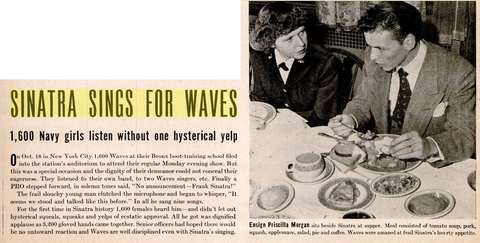
Walton Auditorium, WAVES Boot Camp, Bronx, NY
Sinatra sang 9 songs before an audience of 1600 WAVES
Songs included:
--The Song Is You
--Pistol Packin' Mama
--Where Or When
- People Will Say We're In Love
note: Thirty-four years ago I was working on a Sinatra book that would be
published in 1992. I was determined to ferret out all of the "lost" projects Sinatra
had done through the years. The first one was "Music At War" from 1943. Frank
sang "The Song Is You" to the WAVES stationed at Hunter College. I called the
New York City Library. They told me Sinatra's appearance occurred on July 9,
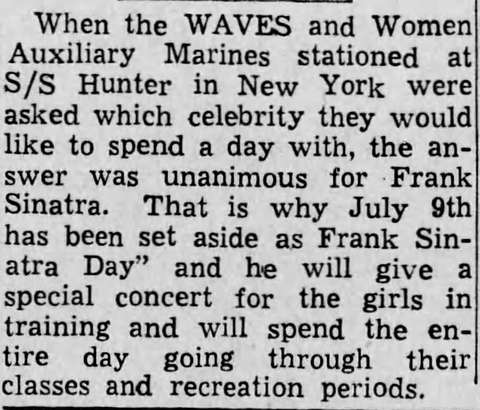
October 19, 1943
Concerts
Wedgwood Room, Waldorf Astoria, New York City (October 1 - November 30)
October 20, 1943
Concerts
Wedgwood Room, Waldorf Astoria, New York City (October 1 - November 30)
October 21, 1943
Concerts
Wedgwood Room, Waldorf Astoria, New York
Banshees Luncheon
Frank Sinatra performed
Wedgwood Room, Waldorf Astoria, New York City (October 1 - November 30)
Wedgwood Room, Waldorf Astoria, New York
Banshees Luncheon
Frank Sinatra performed
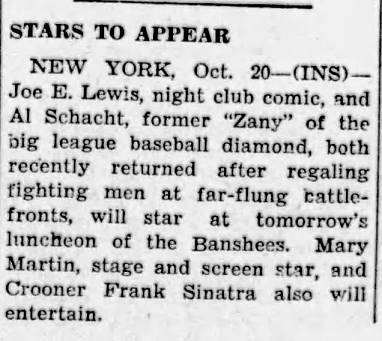

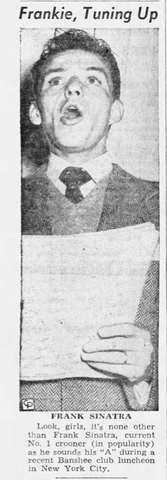
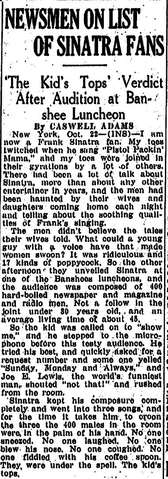
October 22, 1943
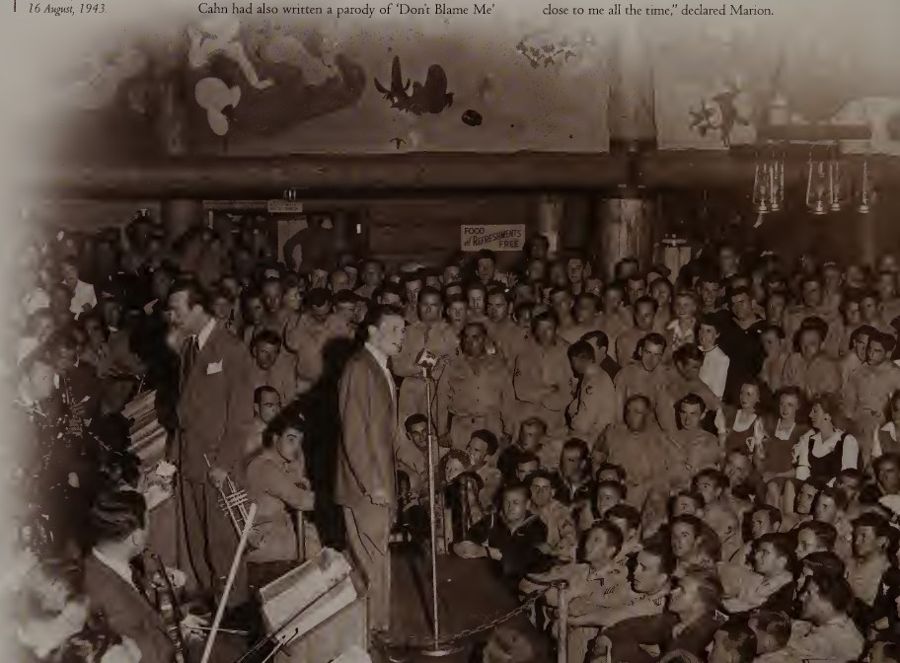
[Photograph: Frank examined by Jersey City draft board. From Richard Havers, "Sinatra" (Dorling Kindersley, 2007), p.88.]
Concerts
Wedgwood Room, Waldorf Astoria, New York City (October 1 - November 30)
Frank underwent his physical examination for the draft in Jersey City. At this point he was still considered fit for service, setting up a strange reversal in the weeks that followed. (Source: Richard Havers, "Sinatra" (Dorling Kindersley, 2007).)
October 23, 1943
Radio
Your Hit Parade
Network: CBS
Program #440
Time: 9:00-9:45 P.M. (Rebroadcast October 24, 1943 12:00-12:45 A.M.)
Sponsor: Lucky Strike
Script (Final As Broadcast)
1. If You Please (6) - Frank Sinatra
2. Somebody Loves Me - Orchestra
3. I Heard You Cried Last Night (5) - Bea Wain
4. Put Your Arms Around Me, Honey (9) - Hit Paraders
5. commercial
6. Rise And Shine - Orchestra
7. All Or Nothing At All (8) - Frank Sinatra
8. They're Either Too Young Or Too Old (7) - Bea Wain
9. Praise The Lord And Pass The Ammunition - Orchestra & Hit Paraders
10, station break
11. Pistol Packin' Mama (4) - Frank Sinatra
12. Louisiana Hayride - Orchestra
13. commercial
14. Paper Doll (3) - Hit Paraders
15. People Will Say We're In Love (2) - Bea Wain
16. Sunday, Monday, Or Always (1) - Frank Sinatra
Concerts
Wedgwood Room, Waldorf Astoria, New York City (October 1 - November 30)
October 24, 1943
Radio
Songs By Sinatra
Network: CBS
Time: 7:15-7:30PM Sunday
Show #1
Sponsor: none (sustaining)
Producer: Herb Polesie
Orchestra conducted by: Axel Stordahl
Musicians: The Bobby Tucker Singers
Arrangements By: Axel Stordahl
1. Paper Doll
2. Lover Come Back To Me
3. Put Your Dreams Away
Note: Frank also sang "Kiss Me Again" and "If Loveliness Were Music."
Announcer was Everett Clark.
Love the ballad reading of "Paper Doll." Show opens with a short segment of " This Love Of Mine."
Notes: Confirmed aired on WABC, WTOP & KNX among others. Sinatra takes over the Jerry Lester Show time slot, which aired the week before on WABC 7:00PM - 7:30PM.
Ed O'Brien:
Stephen Holden, NYT art critic, told me his favorite Sinatra was the bobbysox singer from 1943-47.
"Lover Come Back To Me," from Frank's first "Songs By Sinatra," in the fall of 1943, is a perfect example of what he was so attracted to from those years. Frankie had such a remarkable voice.
There is an angelic sound to every note and virtuoso singing of a very high order.
Note: The full show opens disc 2 of "A Voice on Air".
Concerts
Wedgwood Room, Waldorf Astoria, New York City (October 1 - November 30)
Songs By Sinatra
Network: CBS
Time: 7:15-7:30PM Sunday
Show #1
Sponsor: none (sustaining)
Producer: Herb Polesie
Orchestra conducted by: Axel Stordahl
Musicians: The Bobby Tucker Singers
Arrangements By: Axel Stordahl
SONGS BY SINATRA
Reviewed Sunday 7:15 -7:30 p.m.Style – Vocal Sustaining Over Station WABC (New York) and CBS When word gets around that the swoon swami can be heard, unaccompanied by the squeals and giggles of his bobby-sock fans, older folks may tune in to this airing and possibly succumb to the lure of Sinatra's Iarynx. This 15 -minute spot, replacing the much more elaborate Band Wagon, gives Sinatra a chance to peddle his pipes in a relax -and -get -comfortable atmosphere. The spot Is enough to let him get in four songs-one new, three oldies-and to present each with a build-up which he delivers with easy naturalness. Altho these intros, here and there, show signs of a straining to be folksy, Sinatra manages to overcome these hurdles. The result is easy to take, If you like Sinatra's slow tempo. Axel Stordahl's ork and the Bobby Tucker Singers take the musical background and do a nice job, If other airings maintain the style and pace of this initial program it shouldn't be long before a sponsor lays cash on the line, particularly if this quarter hour garners a more mature listening audience.
Frank Gill
Billboard
11-6-43
---------------------------------
Tuesday, October 24, 1944 at 8 PM
Carnegie Hall
Main Hall
Meeting: Young Americans for Roosevelt
Presenter : Young Americans for Roosevelt
Frank Sinatra, speaker
Jonathan Worth Daniels, speaker
Leonard Bernstein, speaker
Orson Welles, speaker
Political Dignitaries, speeches
note: Sinatra's first appearance at Carnegie Hall
October 25, 1943
Concerts
Wedgwood Room, Waldorf Astoria, New York City (October 1 - November 30)
Songs By Sinatra
Network: CBS
Time: 7:15-7:30PM Sunday
Show #1
Sponsor: none (sustaining)
Producer: Herb Polesie
Orchestra conducted by: Axel Stordahl
Musicians: The Bobby Tucker Singers
Arrangements By: Axel Stordahl
SONGS BY SINATRA
Reviewed Sunday 7:15 -7:30 p.m.Style – Vocal Sustaining Over Station WABC (New York) and CBS When word gets around that the swoon swami can be heard, unaccompanied by the squeals and giggles of his bobby-sock fans, older folks may tune in to this airing and possibly succumb to the lure of Sinatra's Iarynx. This 15 -minute spot, replacing the much more elaborate Band Wagon, gives Sinatra a chance to peddle his pipes in a relax -and -get -comfortable atmosphere. The spot Is enough to let him get in four songs-one new, three oldies-and to present each with a build-up which he delivers with easy naturalness. Altho these intros, here and there, show signs of a straining to be folksy, Sinatra manages to overcome these hurdles. The result is easy to take, If you like Sinatra's slow tempo. Axel Stordahl's ork and the Bobby Tucker Singers take the musical background and do a nice job, If other airings maintain the style and pace of this initial program it shouldn't be long before a sponsor lays cash on the line, particularly if this quarter hour garners a more mature listening audience.
Frank Gill
Billboard
11-6-43
Tuesday, October 24, 1944 at 8 PM
Carnegie Hall
Main Hall
Meeting: Young Americans for Roosevelt
Presenter : Young Americans for Roosevelt
Frank Sinatra, speaker
Jonathan Worth Daniels, speaker
Leonard Bernstein, speaker
Orson Welles, speaker
Political Dignitaries, speeches note: Sinatra's first appearance at Carnegie Hall
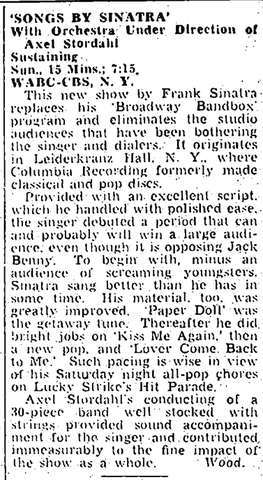
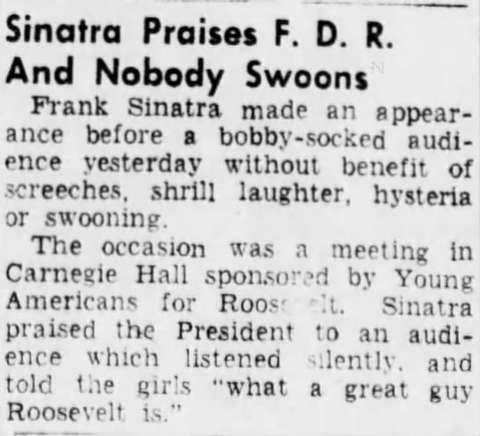
October 26, 1943
Concerts
Wedgwood Room, Waldorf Astoria , New York City (October 1 - November 30)
October 27, 1943
Concerts
Wedgwood Room, Waldorf Astoria , New York City (October 1 - November 30)
Wedgwood Room, Waldorf Astoria , New York City :
Variety
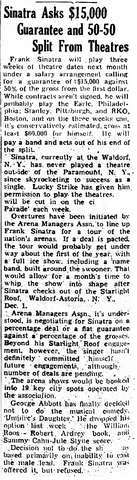
note: The Voice was now asking and getting big money for theater appearances. The arena shows set for January were sunk when the local authorities in Pittsburgh and Philly cracked down on the truant bobby-soxers.
The RKO in Boston was an unqualified success, but the truancy and new theater policies -- one show and out for the ticket- buyers -- in Pittsburgh and Philly did serious damage at the box office. The promoters got cold feet and the planned arena tour was shelved.
Ed
Wedgwood Room, Waldorf Astoria , New York City :
Variety
10-27-43 note: The Voice was now asking and getting big money for theater appearances. The arena shows set for January were sunk when the local authorities in Pittsburgh and Philly cracked down on the truant bobby-soxers.
The RKO in Boston was an unqualified success, but the truancy and new theater policies -- one show and out for the ticket- buyers -- in Pittsburgh and Philly did serious damage at the box office. The promoters got cold feet and the planned arena tour was shelved.
Ed
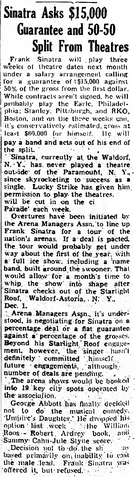
October 28, 1943
Concerts
Wedgwood Room, Waldorf Astoria, New York City (October 1 - November 30)
Auditorium of St. Cecilia School, Englewood, New Jersey (One Night Only)
Auditorium of St. Cecilia School, Englewood, New Jersey
Note: Sinatra was supposed to appear on October 27th but was indisposed:
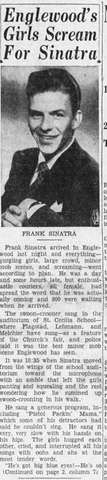
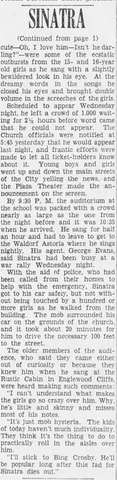
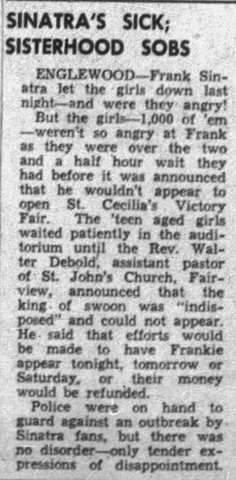
October 29, 1943
Concerts
Wedgwood Room, Waldorf Astoria, New York City (October 1 - November 30)
October 30, 1943
Radio
Your Hit Parade
Network: CBS
Program #441
Time: 9:00-9:45 P.M. (Rebroadcast October 31, 1943 12:00-12:45 A.M.)
Sponsor: Lucky Strike
Script (Final As Broadcast)
1. Paper Doll (4) - Frank Sinatra
2. Goody Goody - Orchestra
3. For The First Time (9) - Hit Paraders
4. Put Your Arms Around Me, Honey (6) - Bea Wain
5. commercial
6. The Carioca - Orchestra
7. I Heard You Cried Last Night (8) - Frank Sinatra
8. They're Either Too Young Or Too Old (7) - Bea Wain
9. Jingle Jangle Jingle - Orchestra & Hit Paraders
10. station break
11. If You Please (5) - Frank Sinatra
12. Strike Up The Band - Orchestra
13. commercial
14. Sunday, Monday Or Always (3) - Bea Wain
15. Pistol Packin' Mama (2) - Orchestra & Hit Paraders
16. People Will Say We're In Love (1) - Frank Sinatra
Concerts
Wedgwood Room, Waldorf Astoria , New York City (October 1 - November 30)
October 31, 1943
Radio
Songs By Sinatra
Network: CBS
Time: 7:15-7:30PM Sunday
Show #2
Producer: Herb Polesie
Orchestra conducted by: Axel Stordahl
Musicians: The Bobby Tucker Singers
Arrangements By: Axel Stordahl
Notes: Confirmed aired on WABC
Concerts
Wedgwood Room, Waldorf Astoria , New York City (October 1 - November 30)
November 1943
[Nine a cappella singles recorded]
Kaplan: Between June and November 1943, Sinatra recorded nine instrument-less singles backed by the Bobby Tucker Singers, arranged by eccentric composer Alec Wilder; five of the nine reached the Billboard best-sellers chart.
Source: James Kaplan, "Frank: The Voice" (2010)
[1943 a cappella Columbia sessions with the Bobby Tucker Singers (AFM recording ban workaround) -- critical commentary]
Ray Charles (choral singer, "The Other Ray Charles"): Jack Kapp, Sachs’s equivalent at Decca Records, forced Sinatra to change his mind. In May and July 1943, Decca had produced a capella sessions with Dick Haymes. The newly liberated Haymes posed a potential threat to Sachs’s own star attraction, so “in desperation,” as Mitch Miller put it, Sachs turned to Alec Wilder for a cappella arrangements for Sinatra and the Bobby Tucker Singers (Sinatra’s radio backup choir), nine of which would be recorded between June and November 1943. As choral singer Ray Charles (who would later bill himself as “The Other Ray Charles”) remembered, Axel Stordahl contributed several of these all-vocal charts, although as a member of the AFM he could not be credited at that time. “It was like a vocal orchestra,” Charles explained. “You wrote it the way that you would for a band: the bass voices would keep time like a bass would, and you would write sections on top of that. The girls could be the equivalent of either the trumpets or strings, depending on what your orchestration was.” Charles made the comparison to Ray Conniff’s early choral recordings. “He doubles everything the orchestra does in the voices. Only [in 1943] there wasn’t a band. You don’t have a drum sound and you don’t have a guitar sound, but it’s written so that you have an equivalent of a rhythm section. Then you have what the brass would play, what the strings would play, what the saxes would play.” Despite how some charts had to be tried and retried on session after session, Charles maintained that recording them “wasn’t at all difficult.” He added, however, “When I listen to them now, I think they’re terribly out of tune.”
Source: Will Friedwald, "Sinatra! The Song Is You: A Singer's Art" (2018 revised edition), Ch. 4, "With Axel Stordahl" (1943-1948)
November 1, 1943
Concerts
Wedgwood Room, Waldorf Astoria, New York City (Oct 1 - Nov. 30)
November 2, 1943
Concerts
Wedgwood Room, Waldorf Astoria, New York City (Oct. 1 - Nov. 30)
November 3, 1943
Studio
New York City
CO33368 I Couldn't Sleep A Wink Last Night
w/The Bobby Tucker Singers
(J. McHugh/H. Adamson)
(from Higher And Higher)
T.B. Harms, Inc. (ASCAP) 1943
Arrangement & Conducted by Alec Wilder
-1 (2:52) CD: Columbia Years 43-52 Vol. 1
CD: 09372 Greatest Hits-The Early Years, Vol. 2
LP: CL-2572 Greatest Hits, The Early Years, Vol. 2
LP: CL-2913 Frank Sinatra in Hollywood
LP: C6X-40343 The Voice-Columbia Years 43-52 (6-LP Set)
78: 36687
note: Many record reviewers did not think much of Sinatra in 1943-44. As a matter
of fact, they were openly hostile. He couldn't hold a candle to the great Crosby,
and his mewings were nothing but aural horrors.
Ed
Concerts
Wedgwood Room, Waldorf Astoria, New York City (Oct. 1 - Nov. 30)
New York City
CO33368 I Couldn't Sleep A Wink Last Night w/The Bobby Tucker Singers
CO33369 The Music Stopped w/The Bobby Tucker Singers
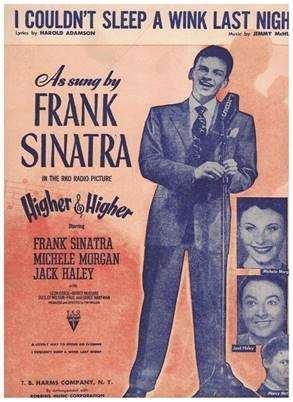
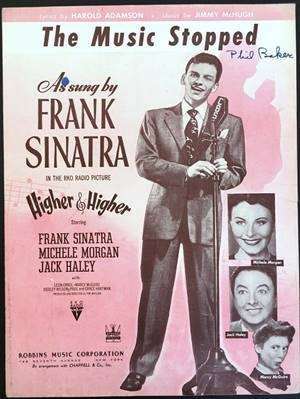
November 4, 1943
Concerts
Wedgwood Room, Waldorf Astoria, New York City (Oct. 1 - Nov. 30)
November 5, 1943
Concerts
Wedgwood Room, Waldorf Astoria , New York City (Oct. 1 - Nov. 30)
November 6, 1943
Radio
Your Hit Parade
Network: CBS
Program #442
Time: 9:00-9:45 P.M. (Rebroadcast November 7, 1943 12:00-12:45 A.M.)
Sponsor: Lucky Strike
Script (Final As Broadcast)
1. Heard You Cried Last Night (7) - Frank Sinatra
2. I Got Plenty Of Nothin' - Orchestra
3. For The First Time (8) - Hit Paraders
4. Put Your Arms Around Me, Honey (6) - Bea Wain
5. commercial
6. Say Si Si - Orchestra
7. If You Please (9) - Frank Sinatra
8. They're Either Too Young Or Too Old (5) - Bea Wain
9. The Marine Hymn - Orchestra & Hit Paraders
10. station break
11. Sunday, Monday, Or Always (4) - Frank Sinatra
12. Keep Your Sunny Side Up - Orchestra
13. commercial
14. Pistol Packin' Mama (3) - Hit Paraders
15. People Will Say We're In Love (2) - Bea Wain
16. Paper Doll (1) - Frank Sinatra
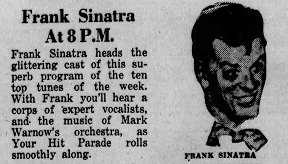
Concerts
Wedgwood Room, Waldorf Astoria, New York City (Oct. 1 - Nov. 30)
November 7, 1943
Radio
Songs By Sinatra
Network: CBS
Time: 7:15-7:30PM Sunday
Show #3
Sponsor: none (sustaining)
Producer: Herb Polesie
Orchestra conducted by: Axel Stordahl
Musicians: The Bobby Tucker Singers
Arrangements By: Axel Stordahl
Notes: Confirmed aired on WABC
Concerts
Wedgwood Room, Waldorf Astoria, New York City (Oct. 1 - Nov. 30)
November 8, 1943
Radio
Ed Sullivan Entertains
Network: WABC CBS Affiliate
Monday Evening
7:15 to 7:30 pm
Guests: Frank Sinatra, Burt Wheeler
Note: Frank Sinatra was not the co-star of Bert Wheeler in "Laugh Time", that was Frank Fay.
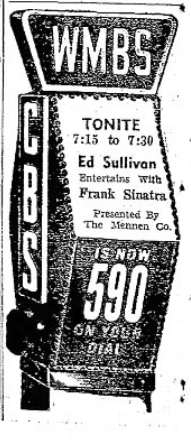
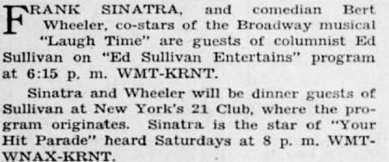
Concerts
Wedgwood Room, Waldorf Astoria, New York City (Oct. 1 - Nov. 30)
Ed Sullivan Entertains
Network: WABC CBS Affiliate
Monday Evening
7:15 to 7:30 pm
Guests: Frank Sinatra, Burt Wheeler
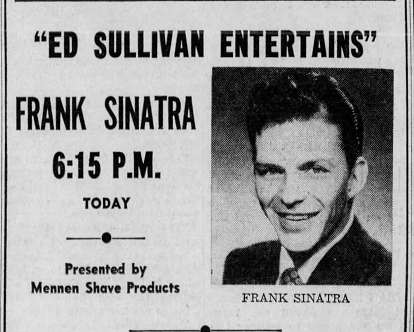
November 9, 1943
Concerts
Wedgwood Room, Waldorf Astoria, New York City (October 1 - November 30)
November 10, 1943
Studio
New York City
CO33373 A Lovely Way To Spend An Evening w/The Bobby Tucker Singers
(J. McHugh/H. Adamson)
(from Higher And Higher)
T.B. Harms, Inc (ASCAP) 1943
Arrangement & Counducted by Alec Wilder
-3 (3:13) CD: Columbia Years 43-52 Vol. 1
LP: CL-2913 Frank Sinatra In Hollywood (alt. take)
EP: B-2515 Hall Of Fame Series
78: 36687
CO33374 The Music Stopped w/The Bobby Tucker Singers
(J. McHugh/H. Adamson)
(from Higher And Higher)
Robbins Music Corp. (ASCAP) 1943
Arrangement & Counducted by Alec Wilder
-1 (2:59) CD: Columbia Years 43-52 Vol. 1
LP: HL-7405 Romantic Scenes From The Early Years (First Pressing)
Bobby Tucker Singers: Ernest Anderson, Jewel Bowman, Harold Branch, Kathleen
Carnes, Elwin Carter, Fay Devlin, Ruth Doring, Pauline Dugart, Thomas Foster, Ed Hayes, Travis Johnson, Jack Lathrop, Norman Luboff, Kathleen Mullen, Mary Margaret Mullen, Rae Whitney
Frank would redo the a capella sessions in early February of 1944. Still not satisfied, he announced there would be no more recordings until the musicians strike was settled. Did Columbia release the Nov.43 or the Feb 44 recordings ?There is no information from Columbia on the later efforts. Variety did document the 44 recordings.
--Ed
Concerts
Wedgwood Room, Waldorf Astoria, New York City (October 1 - November 30)
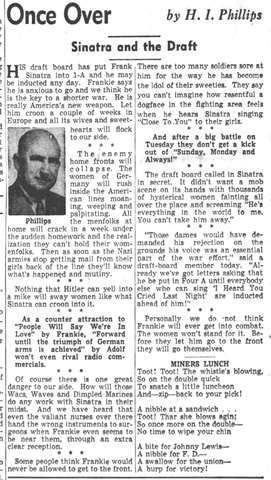
November 11, 1943
Concerts
Wedgwood Room, Waldorf Astoria, New York City (October 1 - November 30)
November 12, 1943
Concerts
Wedgwood Room, Waldorf Astoria, New York City (October 1 - November 30)
November 13, 1943
Radio
Your Hit Parade
Network: CBS
Program #443
Time: 9:00-9:45 P.M. (Rebroadcast November 14, 1943 12:00-12:45 A.M.)
Sponsor: Lucky Strike
Script (Final As Broadcast)
1. Sunday, Monday Or Always (5) - Frank Sinatra
2. Chicago - Orchestra
3. I Heard You Cried Last Night (8) - Bea Wain
4. Put Your Arms Around Me, Honey (4) - Hit Paraders
5. commercial
6. I Got Rhythm - Orchestra
7. My Heart Tells Me (7) - Frank Sinatra
8. They're Either Too Young Or Too Old (6) - Bea Wain
9. I've Got Rings On My Fingers - Orchestra & Hit Paraders
10. station break
11. How Sweet You Are (9) - Frank Sinatra
12. The Best Things In Life Are Free - Orchestra
13. commercial
14. Pistol Packin' Mama (3) - Hit Paraders
15. People Will Say We're In Love (2) - Bea Wain
16. Paper Doll (1) - Frank Sinatra
Concerts
Wedgwood Room, Waldorf Astoria, New York City (October 1 - November 30)
November 14, 1943
Radio
Songs By Sinatra
Network: CBS
Time: 7:15-7:30PM Sunday
Show #4
Sponsor: none (sustaining)
Producer: Herb Polesie
Orchestra conducted by: Axel Stordahl
Musicians: The Bobby Tucker Singers
Arrangements By: Axel Stordahl
Dress Reheasal:
1. The Music Stopped
2. I Couldn't Sleep A Wink Last Night
3. The Way You Look Tonight
4. I'll Be Around
Notes: Confirmed aired on WABC, CD: The V-discs 1 (Columbia CK 66135)
Concerts
Wedgwood Room, Waldorf Astoria, New York City (October 1 - November 30)
November 15, 1943
Concerts
Wedgwood Room, Waldorf Astoria, New York City (October 1 - November 30)
November 16, 1943
Radio
Night of Stars, Madison Square Gardens, New York, NY
10:45 P.M. WMCA

Concerts
Wedgwood Room, Waldorf Astoria , New York City (October 1 - November 30)
Night of Stars, Madison Square Gardens, New York, NY
Benefit for United Jewish Appeal for Refugees, Overseas Needs and Palestine Frank Sinatra, Kate Smith, Danny Kaye, Ted Lewis, Ethel Merman, Mary Martin, Ethel Waters, Paul Robeson, Benny Goodman, Bill Robinson and others
Night of Stars, Madison Square Gardens, New York, NY
Benefit for United Jewish Appeal for Refugees, Overseas Needs and Palestine Frank Sinatra, Kate Smith, Danny Kaye, Ted Lewis, Ethel Merman, Mary Martin, Ethel Waters, Paul Robeson, Benny Goodman, Bill Robinson and others
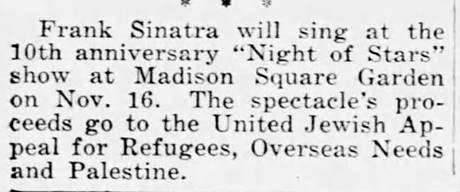

November 17, 1943
Concerts
Wedgwood Room, Waldorf Astoria, New York City (October 1 - November 30)
November 18, 1943
Concerts
Wedgwood Room, Waldorf Astoria, New York City (October 1 - November 30)
November 19, 1943
Concerts
Wedgwood Room, Waldorf Astoria, New York City (October 1 - November 30)
November 20, 1943
Radio
Your Hit Parade
Network: CBS
Program #444
Time: 9:00-9:45 P.M.
Sponsor: Lucky Strike
Script (First & Final As Broadcast)
1. My Heart Tells Me (7) - Frank Sinatra
2. Jeepers Creepers - Orchestra
3. Sunday, Monday Or Always (4) - Hit Paraders
4. Put Your Arms Around Me, Honey (8) - Bea Wain
5. commercial
6. Nobody's Sweetheart - Orchestra
7. Oh, What A Beautiful Morning (9) - Frank Sinatra
8. If You Please (6) - Bea Wain
9. Who - Orchestra & Hit Paraders
10. station break
11. Pistol Packin' Mama (5) - Frank Sinatra
12. In An 18th Century Drawing Room - Orchestra
13. commercial
14. They're Either Too Young Or Too Old (3) - Bea Wain
15. Paper Doll (2) - Hit Paraders
16. commercial
17. People Will Say We're In Love (1) - Frank Sinatra
Concerts
Wedgwood Room, Waldorf Astoria, New York City (October 1 - November 30)
November 21, 1943
Radio
Songs By Sinatra
Network: CBS
Time: 7:15-7:30PM Sunday
Show #5
Sponsor: none (sustaining)
Producer: Herb Polesie
Orchestra conducted by: Axel Stordahl
Musicians: The Bobby Tucker Singers
Arrangements By: Axel Stordahl
Dress Rehearsal:
1. You've Got A Hold On Me
2. A Lovely Way To Spend An Evening
3. She's Funny That Way
Notes: Confirmed aired on WABC, CD: The V-discs 1 (Columbia CK 66135)
Concerts
Wedgwood Room, Waldorf Astoria, New York City (October 1 - November 30)
November 22, 1943
Concerts
Wedgwood Room, Waldorf Astoria, New York City (October 1 - November 30)
Wedgwood Room, Waldorf Astoria, New York City (October 1 - November 30)
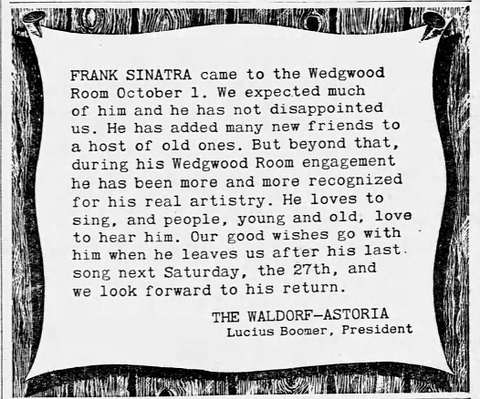
November 23, 1943
Concerts
Wedgwood Room, Waldorf Astoria, New York City (October 1 - November 30)
November 24, 1943
Concerts
Wedgwood Room, Waldorf Astoria, New York City (October 1 - November 30)
November 25, 1943
Concerts
Wedgwood Room, Waldorf Astoria, New York City (October 1 - November 30)
November 26, 1943
Concerts
Wedgwood Room, Waldorf Astoria, New York City (October 1 - November 30)
November 27, 1943
Radio
Your Hit Parade
Network: CBS
Program #445
Time: 9:00-9:45 P.M. (Rebroadcast November 28, 1943 12:00-12:45 A.M.)
Sponsor: Lucky Strike
Script (Final As Broadcast)
1. My Heart Tells Me (4) - Frank Sinatra
2. When My Baby Smiles At Me - Orchestra
3. Sunday, Monday Or Always (6) - Hit Paraders
4. Put Your Arms Around Me, Honey (9) - Joan Edwards
5. commercial
6. Of Thee I Sing - Orchestra & Hit Paraders
7. Little Did I Know (8) - Frank Sinatra
8. People Will Say We're In Love (5) - Joan Edwards
9. Lady Of Spain - Orchestra & Hit Paraders
10. station break
11. Oh, What A Beautiful Morning (7) - Frank Sinatra & Group
12. Swamp Fire - Orchestra
13. commercial
14. Pistol Packin' Mama (3) - Hit Paraders
15. They're Either Too Young Or Too Old (2) - Joan Edwards
16. commercial
17. Paper Doll (1) - Frank Sinatra
Ed O'Brien says he really likes "Little Did I Know." Frank gave it his all.
Concerts
Wedgwood Room, Waldorf Astoria, New York City (October 1 - November 30)
Your Hit Parade
Network: CBS
Program #445
Time: 9:00-9:45 P.M. (Rebroadcast November 28, 1943 12:00-12:45 A.M.)
Sponsor: Lucky Strike
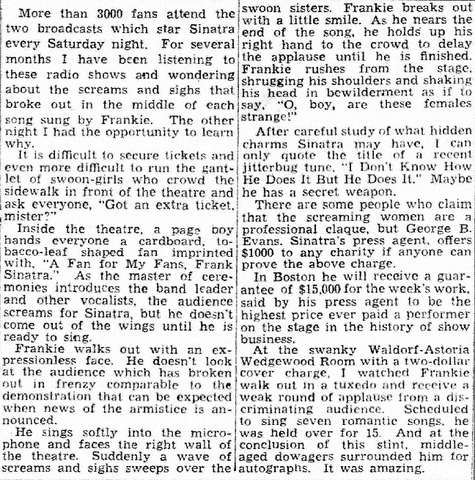
November 28, 1943
Radio
Songs By Sinatra
Network: CBS
Time: 7:15-7:30PM Sunday
Show #6
Sponsor: none (sustaining)
Producer: Herb Polesie
Orchestra conducted by: Axel Stordahl
Musicians: The Bobby Tucker Singers
Arrangements By: Axel Stordahl
1. Just One Of Those Things
2. I Couldn't Sleep A Wink Last Night
3. My Heart Tells Me
4. My Heart Stood Still w/The Bobby Tucker Singers
Notes: Confirmed aired on WABC.
Ed O'Brien:
Frank does a terrific intro before singing the great Rodgers and Hart tune "My Heart
Stood Still.
Jim White then added:
Forty plus years later he was still singing it.
Ed responded:
"My Heart Stood Still," another R&H gem, would also be sung throughout his career. It was almost always done as a very serious ballad except for the swingin' Riddle chart on the 2-15-60 Timex show on ABC-TV. He was still doing some very credible versions of the Riddle ballad arg. in the 1990s.
Vance Adair added:
FS delivered some beautiful versions of this Riddle arrangement in the late 80s. The old man loved to surprise his audiences with that last big sustaining note. They always cheered to the heavens. And rightly so.
Concerts
Wedgwood Room, Waldorf Astoria, New York City (October 1 - November 30)
November 29, 1943
Concerts
Wedgwood Room, Waldorf Astoria, New York City (October 1 - November 30)
November 30, 1943
Concerts
Wedgwood Room, Waldorf Astoria, New York City (October 1 - November 30)
December 1943
[Anonymous letter alleges Sinatra bribed draft doctors]
Kaplan: Later that December, an anonymous letter reached Walter Winchell alleging Sinatra had paid Newark examining doctors $40,000 (via his business manager) to secure his 4-F classification. Winchell forwarded it to J. Edgar Hoover; the FBI investigated, uncovered Sinatra's two dismissed sex-related arrests along the way, but ultimately closed the case, finding no evidence of impropriety.
Source: James Kaplan, "Frank: The Voice" (2010)
[Army reclassifies Sinatra 4-F]
Kaplan: In early December 1943, Captain Joseph Weintrob re-examined Sinatra in Newark and declared him 4-F, citing a chronic perforated left eardrum and chronic mastoiditis; his form also noted he was underweight at 119 pounds (five foot seven and a half) and disqualified further due to emotional instability.
Source: James Kaplan, "Frank: The Voice" (2010)
[Reclassified 4-F, exempted]
Kaplan: Two months after his 1-A classification, Sinatra was reexamined and exempted from service, officially for a perforated eardrum and diagnosed emotional instability. The 4-F status triggered widespread 'draft dodger' accusations from servicemen and columnists, despite his protestations that he was crushed not to serve.
Source: James Kaplan, "Frank: The Voice" (2010)
December 1, 1943
Pittsburgh
In anticipation of Sinatra’s December 9-15th appearance at the Stanley Theatre in Pittsburgh, Pennsylvania, the theatre starting looking for ushers and usherettes:
Both articles from Pittsburgh Press, December 1, 1943
[image referenced in source but could not be recovered]
[image referenced in source but could not be recovered]
December 2, 1943
Concerts
(2-8) RKO-BOSTON, Boston, Massachusetts
(Thursday thru Wednesday) w/Jan Savitt & His Orchestra w/seven piece string section
Buddy Welcome, The Three Welles and Marty May.
Film: "Falcon and the Co-Eds"
Tom Conway as The Falcon
NIGHT CLUB REVIEWS
RKO-BOSTON, BOSTON
(Reviewed Thursday Afternoon, Dec. 2)
Well, it's happened. Frank Sinatra came to town and the girls nearly swooned away with the expected ecstatic rapture. While they swayed in their seats, the boys wondered. Some came to find out. Others came to boo, but they were pretty sheepish about it. The skeptics came to be shown. The hard guys, newspaper folk, et. al. came to scoff and scorn. But they all went away cheering.
"The "Voice" does that to you. Whether you like the voice or can't stand it; whether you can take only a little or whether you like it in big lugubrious doses, the "Voice" in person, has the biggest audience appeal there is today, or has been perhaps in any day.
You can't blame all this on one of the cleverest, high-pressure publicity campaigns in history. That is no more a tenable theory than the one that the "Voice" rises the crest of a wave of another great American fad, like miniature golf and handies. The "Voice" has something of nearly universal appeal, and the week's engagement at the RKO-Boston ( first of a three-week theatre tour) and the coming RKO picture may tell us whether the "Voice" has staying powers. From the look of things here, it seems safe to predict just that. The things that put the "Voice" across visually and vocally, are a unique combination of the most affecting things in showmanship. Only one other crooner has better vocal equipment, Crosby, of course. But he's taken years learning. "The "Voice" is soundly placed , actually and skillfully controlled. Command of every graduation of tone quality and quantity is there. Quality itself is sometimes a trifle flabby, but firmness will come. Like Crosby, the "Voice's" greatest asset is complete relaxation in singing. It's a price- less thing. Control is evinced in the sureness and flexibility with which the voice rises from a soft caressing tone to powerful fortissimo. In the process the voice never becomes hard, never loses its soothing quality.
The employment of protamento ( sometimes painfully overdone) and the use of the appoggiatura (delaying the entrance of a principal on the preceding tone) are the particular mannerisms of the "Voice."
And these are what make the girls squeal until you think they will pass out with ecstasy. Combined with these affecting vocal tricks and mannerisms are the dreamy, breathless quality imparted to every song (they're all slow ones), and the soulful, forlorn gestures which altogether are popular art and showmanship.
This is Sinatra, whose engagement here has generated more excitement and newspaper copy than any theatrical event in memory. Songs offered are the usual ones, each whispered at first with familiar bedroom intimacy and then developed to a minor dramatic climax. In order they run" "Dancing in the Dark," medley of "Paper Doll," "She's Funny That Way" and "All or Nothing at All,' then "The Song Is You," another medley of "People Will Say" and "Oh, What a Beautiful Morning," then "Embraceable You" and finally "Pistol Packin' Mama," sung as tho he hated the piece.
At the opening show Sinatra got only fair support from Jan Savitt's boys. They seemed not a little awed by the "Voice," but after a time they were right in there pitching with some pretty good accompaniments. The Savitt band is ideally suited to Sinatra, as the strings (7) and harp flatter his voice. Arrangements are mediocre.
Show starts off with a "Carmen" band number and jumps right into Buddy Welcome's fancy version of "Shoo-Shoo Baby" and "Short, Fat and 4F," a dull piece. The Three Welles turn out some routine acrobatics. Marty May's familiar act, impersonating singers, gets wild laughs. But it's Sinatra the kids came to hear. And they squeal and cheer until you think the theater will tumble down in a heap of dust.
Pic was "Falcon and the Co-Eds. Biz at opening not quite capacity. Billboard
Bill Riley
December 11, 1943
Ed O'Brien:
Boston was the first leg of a three-week, theatre tour. He opened on 12/2 and closed on 12/8. The next stop was the Stanley Theatre in
Pittsburgh ( 12-9 to 12-15) and finally the Earle
Theatre in Philadelphia ( 12-17 to 12-23). Sinatra did seven shows a day, approximately 150 for the tour. His gross in Boston set a record. The school boards in Pittsburgh hurt the box office by actively pursuing the teen-age girls, skipping school, with an army of truant officers. Frank's people oversold him in Philly and resorted to tricks. This hurt him with the faithful. The management at the Earle didn't help. They insisted the bobby soxers stay for only one show. This effort to increase the paying attend- ance backfired. Many of the devoted stay away due to the intimidation.. The Stanley management couldn't wait to see The Voice move on to Philly. Although they liked Sinatre, the hassle of hiring bodyguards, police officers, a waiting ambulance and the chaos that occurred every show, was not worth it.
This is just about the best review I have read on what was happening during the initial bobby soxer craze in 1943. The reviewer captures the intense hysteria and also delves into the quality and technique employed by The Voice. This is not your usual superficial review. The writer shows true appreciation and under- standing of what Sinatra was all about. He was always a great singer and mesmerizing on stage performer.
RKO-BOSTON, BOSTON
The Boston Globe (Boston, Massachusetts) · 2 Dec 1943,
(Reviewed Thursday Afternoon, Dec. 2)
Variety
12-8-43
December 2, 1944 These Are Our Men
Ed O'Brien:
The half-hour show was broadcast on the NBC Red Network(WEAF) in N.Y.C. It aired on Saturday afternoon from 2: pm to 2:30 pm. Frankie loved FDR and did many benefits for him and supported the March of Dimes by appearing on their broadcasts.
Variety
12-6-44
© 1997-2025 The Sinatra Archive
This calendar, or any parts thereof, may not be reproduced in any fashion whatsoever without the prior written permission of the publisher (The Sinatra Archive)
[image referenced in source but could not be recovered]
[image referenced in source but could not be recovered]
[image referenced in source but could not be recovered]
[image referenced in source but could not be recovered]
[image referenced in source but could not be recovered]
[image referenced in source but could not be recovered]
[image referenced in source but could not be recovered]
[image referenced in source but could not be recovered]
December 4, 1943
Radio
Your Hit Parade
Network: CBS
Program #446
Time: 9:00-9:45 P.M. (Rebroadcast December 5, 1943 12:00-12:45 A.M.)
Sponsor: Lucky Strike
1. Sunday, Monday Or Always (7) - Frank Sinatra
2. After You've Gone - Orchestra
3. For The First Time (9) - Hit Paraders
4. Shoo Shoo Baby (8) - Joan Edwards
5. commercial
6. Smile Darn Ya Smile - Orchestra
7. Oh What A Beautiful Morning (6) - Frank Sinatra
8. How Sweet You Are (5) - Joan Edwards
9. There Is A Tavern In The Town - Hit Paraders
10. station break
11. Pistol Packin' Mama (4) - Frank Sinatra
12. Stompin' At The Savoy - Orchestra
13. commercial
14. My Heart Tells Me (3) - Joan Edwards
15. Paper Doll (2) - Hit Paraders
16. commercial
17. People Will Say We're In Love (1) - Frank Sinatra
Notes: Sinatra portion from Boston.
Concerts
RKO-BOSTON, Boston, Massachusetts (2-8)
(Thursday thru Wednesday) w/Jan Savitt & His Orchestra w/seven piece string section
Buddy Welcome, The Three
Welles and Marty May.
Film: "Falcon and the Co-Eds"
Tom Conway as The Falcon
December 5, 1943
Radio
Songs By Sinatra
Network: CBS
Time: 7:15-7:30PM Sunday
Show #7
Sponsor: none (sustaining)
Producer: Herb Polesie
Orchestra conducted by: Axel Stordahl
Musicians: The Bobby Tucker Singers
Arrangements By: Axel Stordahl
Dress Rehearsal:
1. Speak Low
Notes: Confirmed aired on WABC, CD: The V-discs 1 (Columbia CK 66135)
Concerts
RKO-BOSTON, Boston, Massachusetts (2-8)
(Thursday thru Wednesday) w/Jan Savitt & His Orchestra w/seven piece string section
Buddy Welcome, The Three
Welles and Marty May.
Film: "Falcon and the Co-Eds"
Tom Conway as The Falcon
December 6, 1943
Concerts
RKO-BOSTON, Boston, Massachusetts (2-8)
(Thursday thru Wednesday) w/Jan Savitt & His Orchestra w/seven piece string section
Buddy Welcome, The Three
Welles and Marty May.
Film: "Falcon and the Co-Eds"
Tom Conway as The Falcon
December 7, 1943
Concerts
RKO-BOSTON, Boston, Massachusetts (2-8)
(Thursday thru Wednesday) w/Jan Savitt & His Orchestra w/seven piece string section
Buddy Welcome, The Three
Welles and Marty May.
Film: "Falcon and the Co-Eds"
Tom Conway as The Falcon
December 8, 1943
Concerts
RKO-BOSTON, Boston, Massachusetts (2-8)
(Thursday thru Wednesday) w/Jan Savitt & His Orchestra w/seven piece string section
Buddy Welcome, The Three
Welles and Marty May.
Film: "Falcon and the Co-Eds"
Tom Conway as The Falcon
RKO-BOSTON, Boston, Massachusetts (2-8)
I've been saving this one for closing night at the RKO in Boston. Frank was very accessible to
the newspapers upon his arrival in Boston. I find his comments in this article to be most
interesting. Later on he would claim that the girls were responding to him well before
the Paramount on 12-30-42. The claim of playing the Metropolitan Theatre in 41 may
not be accurate. I did a search in the Boston Globe and found nothing. Frank may have
had the Providence theatre, of the same name., confused with Boston. TD & Co did play there
from 2-18 to 2-20-41. Totem Pole saw Dorsey play two one-nighters on 3-5-41 and 3-19-41.
I cannot find any mention of the Christmas basket show at the Boston Garden in 41..
--Ed
NIGHT CLUB REVIEWS
RKO-BOSTON, BOSTON
(Reviewed Thursday Afternoon, Dec. 2)
Well, it's happened. Frank Sinatra came to town and the girls nearly swooned away
with the expected ecstatic rapture.. While they swayed in their seats, the boys wondered.
Some came to find out. Others came to boo, but they were pretty sheepish about it. The
skeptics came to be shown. The hard guys, newspaper folk, et. al. came to scoff and
scorn. But they all went away cheering. "The "Voice" does that to you. Whether
you like the voice or can't stand it; whether you can take only a little or whether you
like it in big lugubrious doses, the "Voice" in person, has the biggest audience appeal
there is today, or has been perhaps in any day.
You can't blame all this on one of the cleverest, high-pressure publicity campaigns in
history. That is no more a tenable theory than the one that the "Voice" rises the crest of a wave
of another great American fad, like miniature golf and handies. The "Voice" has something
of nearly universal appeal, and the week's engagement at the RKO-Boston ( first of a
three-week theatre tour) and the coming RKO picture may tell us whether the "Voice" has
staying powers. From the look of things here, it seems safe to predict just that.
The things that put the "Voice" across visually and vocally, are a unique combination of the most
affecting things in showmanship. Only one other crooner has better
vocal equipment, Crosby, of course. But he's taken years learning. "The "Voice" is soundly
placed , actually and skillfully controlled.
Command of every graduation of tone quality and quantity is there. Quality itself is some-
times a trifle flabby, but firmness will come. Like Crosby, the "Voice's" greatest asset
is complete relaxation in singing. It's a priceless thing. Control is evinced in the sure-
ness and flexibility with which the voice rises from a soft caressing tone to
powerful fortissimo. In the process the voice never becomes hard, never loses its soothing
quality.
The employment of protamento ( sometimes painfully overdone) and the use of
the appoggiatura (delaying the entrance of a principal on the preceding tone) are
the particular mannerisms of the "Voice."
And these are what make the girls squeal until you think they will pass out with ecstasy.
Combined with these affecting vocal tricks and mannerisms are the dreamy, breathless
quality imparted to every song (they're all slow ones), and the soulful, forlorn gestures
which altogether are popular art and showmanship.
This is Sinatra, whose engagement here has generated more excitement and newspaper
copy than any theatrical event in memory. Songs offered are the usual ones, each whispered at
first with familiar bedroom intimacy and then developed to a minor dramatic climax. In
order they run" "Dancing in the Dark," medley of "Paper Doll," "She's Funny That Way" and
"All or Nothing at All,' then "The Song Is You," another medley of "People Will Say" and "Oh,
What a Beautiful Morning," then "Embraceable You" and finally "Pistol Packin' Mama," sung as
tho he hated the piece.
At the opening show Sinatra got only fair support from Jan Savitt's boys. They seemed
not a little awed by the "Voice," but after a time they were right in there pitching with some
pretty good accompaniments. The Savitt band is ideally suited to Sinatra, as the strings (7)
and harp flatter his voice. Arrangements are mediocre.
Show starts off with a "Carmen" band number and jumps right into Buddy Welcome's fancy
version of "Shoo-Shoo Baby" and "Short, Fat and 4F," a dull piece. The Three Welles turn
out some routine acrobatics. Marty May's familiar act, impersonating singers, gets
wild laughs. But it's Sinatra the kids came to hear. And they squeal and cheer until
you think the theater will tumble down in a heap of dust.
Pic was "Falcon and the Co-Eds. Biz at opening not quite capacity.
Billboard
Bill Riley
December 11, 1943
Ed O'Brien:
Boston was the first leg of a three-week,
theatre tour. He opened on 12/2 and closed
on 12/8. The next stop was the Stanley Theatre in
Pittsburgh ( 12-9 to 12-15) and finally the Earle
Theatre in Philadelphia ( 12-17 to 12-23). Sinatra
did seven shows a day, approximately 150 for the
tour. His gross in Boston set a record. The school
boards in Pittsburgh hurt the box office by actively
pursuing the teen-age girls, skipping school, with
an army of truant officers. Frank's people oversold
him in Philly and resorted to tricks. This hurt him
with the faithful. The management at the Earle didn't
help. They insisted the bobby soxers stay for only
one show. This effort to increase the paying attend-
ance backfired. Many of the devoted stay away due
to the intimidation. The Stanley management couldn't
wait to see The Voice move on to Philly. Although
they liked Sinatre, the hassle of hiring bodyguards,
police officers, a waiting ambulance and the chaos
that occurred every show, was not worth it.
This is just about the best review I have read on
what was happening during the initial bobby soxer
craze in 1943. The reviewer captures the intense
hysteria and also delves into the quality and technique
employed by The Voice. This is not your usual superficial
review. The writer shows true appreciation and under-
standing of what Sinatra was all about. He was always
a great singer and mesmerizing on stage performer.
----------------------------------------------------
Sinatra And Gardner December 8th, 1951:
Sinatra And Gardner 8th December 1951: American singer Frank Sinatra (1915 - 1998) and his new wife, actress Ava Gardner (1922 - 1990), arrive in London from New York to take part in a midnight Variety Show at the Coliseum, in aid of charity. (Photo by Reg Birkett/Keystone/Getty Images)
Frank Sinatra in London with his bride of a month US actress Ava Gardner forming a piano and vocal duet at Washington Hotel, London, on 8th December 1951.
--Carl
Frank Sinatra Jr. was kidnapped at the age of 19 on December 8, 1963
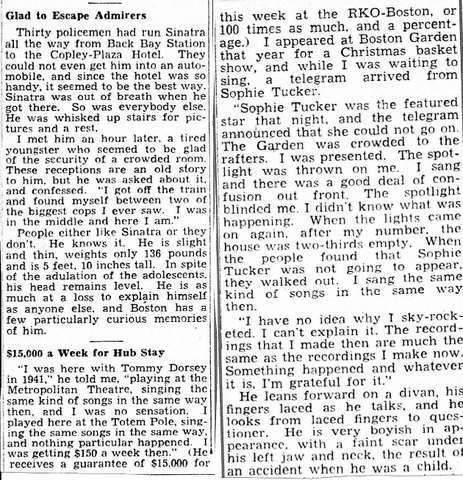
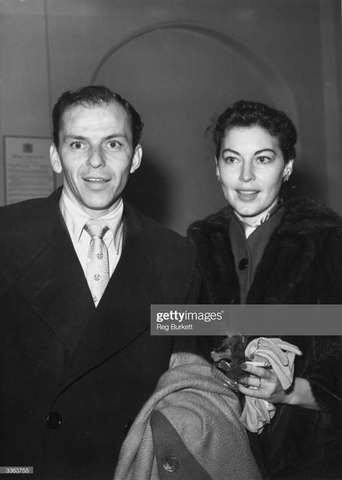
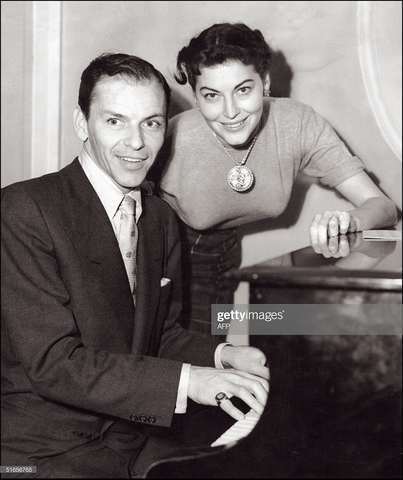
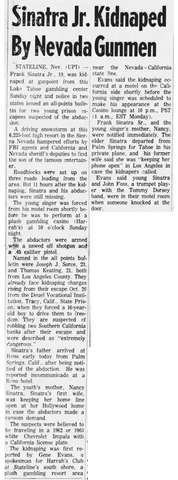
December 9, 1943
Concerts
Stanley Theatre, Pittsburgh, Pennsylvania (9-15)
Jan Savitt and His Orchestra.
Program:
Dancing In The Dark
Paper Doll
She's Funny That Way
All Or Nothing At All
The Song Is You
People Will Say We're In Love
Oh, What A Beautiful Mornin'
Embraceable You
Pistol Packin' Mama
Stanley Theatre, Pittsburgh, Pennsylvania (9-15)
Jan Savitt and His Orchestra.
Variety
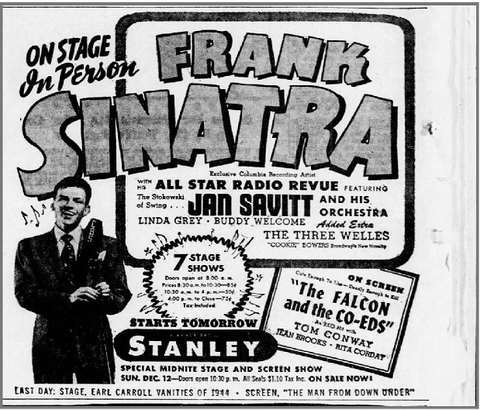
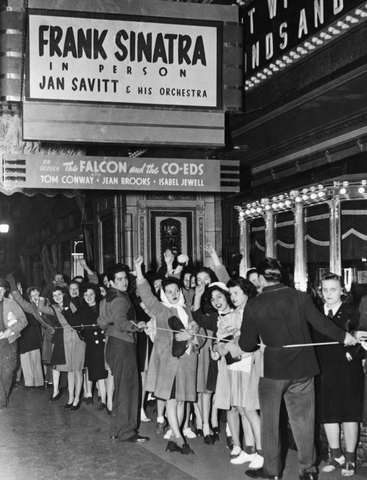
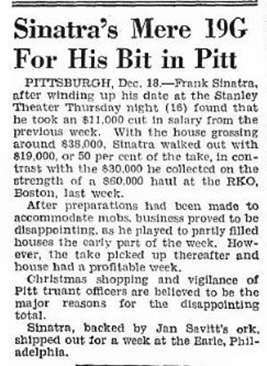
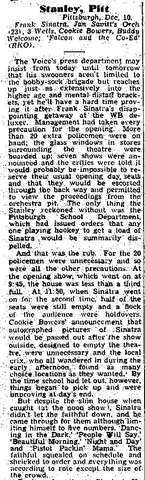
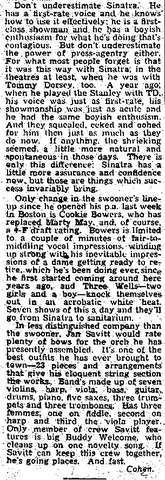
Stanley Theatre, Pittsburgh, Pennsylvania (9-15)
Jan Savitt and His Orchestra.
Variety
12-15-43
------------------------------
© 1997-2025 The Sinatra Archive
This calendar, or any parts thereof, may not be reproduced in any fashion whatsoever without the prior written permission of the publisher (The Sinatra Archive)
December 10, 1943
Concerts
Stanley Theatre, Pittsburgh, Pennsylvania (9-15)
Jan Savitt and His Orchestra.
Program:
Dancing In The Dark
Paper Doll
She's Funny That Way
All Or Nothing At All
The Song Is You
People Will Say We're In Love
Oh, What A Beautiful Mornin'
Embraceable You
Pistol Packin' Mama
December 11, 1943
Radio
Your Hit Parade
Network: CBS
Program #447
Time: 9:00-9:45 P.M. (Rebroadcast December 12, 1943 12:00-12:45 A.M.)
Sponsor: Lucky Strike
1. Paper Doll (4) - Frank Sinatra
2. I Double Dare You - Orchestra
3. For The First Time (9) - Hit Paraders
4. Shoo Shoo Baby (7) - Joan Edwards
5. commercial
6. Everything I've Got Belongs To You - Orchestra
7. Oh What A Beautiful Morning (6) - Frank Sinatra
8. Sunday, Monday Or Always (8) - Joan Edwards
9. Ma Blushin' Rosie - Hit Paraders
10. station break
11. Pistol Packin' Mama (5) - Frank Sinatra
12. Rio Rita - Orchestra
13. commercial
14. People Will Say We're In Love (3) - Hit Paraders
15. They're Either Too Young Or Too Old (2) - Joan Edwards
16. commercial
17. My Heart Tells Me (1) - Frank Sinatra
Notes: Sinatra portion from Pittsburgh, PA
Concerts
Stanley Theatre, Pittsburgh, Pennsylvania (9-15)
Jan Savitt and His Orchestra.
Program:
Dancing In The Dark
Paper Doll
She's Funny That Way
All Or Nothing At All
The Song Is You
People Will Say We're In Love
Oh, What A Beautiful Mornin'
Embraceable You
Pistol Packin' Mama
On this date Sinatra was officially classified 4-F (“registrant not acceptable for military service”) by his draft board, ostensibly because of a perforated left eardrum. Army files, however, recorded the actual reason as “not acceptable material from a psychiatric viewpoint,” with his emotional instability kept confidential to avoid “undue unpleasantness for both the selectee and the induction service.” Columnist Walter Winchell later reported rumors that Sinatra had paid $40,000 to avoid service, but the FBI found the claim to be without merit. Source: Wikipedia, “Frank Sinatra.”
December 12, 1943
Radio
Songs By Sinatra
Network: CBS
Time: 7:15-7:30PM Sunday
Show #8
Sponsor: none (sustaining)
Producer: Herb Polesie
Orchestra conducted by: Axel Stordahl
Musicians: The Bobby Tucker Singers
Arrangements By: Axel Stordahl
Notes: Confirmed aired on WABC
Note: Frank would celebrate his 28th birthday not 26th
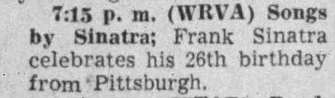
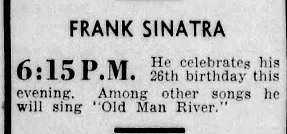
Concerts
Stanley Theatre, Pittsburgh, Pennsylvania (9-15)
Jan Savitt and His Orchestra.
Program:
Dancing In The Dark
Paper Doll
She's Funny That Way
All Or Nothing At All
The Song Is You
People Will Say We're In Love
Oh, What A Beautiful Mornin'
Embraceable You
Pistol Packin' Mama
December 13, 1943
Concerts
Stanley Theatre, Pittsburgh, Pennsylvania (9-15)
Jan Savitt and His Orchestra.
Program:
Dancing In The Dark
Paper Doll
She's Funny That Way
All Or Nothing At All
The Song Is You
People Will Say We're In Love
Oh, What A Beautiful Mornin'
Embraceable You
Pistol Packin' Mama
December 14, 1943
Concerts
Stanley Theatre, Pittsburgh, Pennsylvania (9-15)
Jan Savitt and His Orchestra.
Program:
Dancing In The Dark
Paper Doll
She's Funny That Way
All Or Nothing At All
The Song Is You
People Will Say We're In Love
Oh, What A Beautiful Mornin'
Embraceable You
Pistol Packin' Mama
December 15, 1943
Concerts
Stanley Theatre, Pittsburgh, Pennsylvania (9-15)
Jan Savitt and His Orchestra.
Closing Night
Program:
Dancing In The Dark
Paper Doll
She's Funny That Way
All Or Nothing At All
The Song Is You
People Will Say We're In Love
Oh, What A Beautiful Mornin'
Embraceable You
Pistol Packin' Mama
Prediction, before he came in, was a minimum gross of $50,000. Variety noted that he was a big disappointment and would only pull in $32,000. Frankie closed strong and the week's take was $38,000. Variety called that sensational. Charlie Barnet Orch followed Sinatra and took in $12,000 for week run.
Ed
December 17, 1943
Radio
Treasury Star Parade
Friday
Time:11:35 - 11:50 PM (EST)
Program #307
Treasury Department Syndication
Sponsor: Second War Loan
Announcer: Larry Elliott
Performers: Frank Sinatra
Treasury Orchestra Conducted By: David Broekman
Arrangements By: Axel Strodahl
Writers: Thelma Ritter
1. There'll Be A Hot Time In The Town Of Berlin
2. If Loveliness Was Music
3. I've Had This Feeling Before
Notes: Condition: Excellent. Complete. 15mins
Concerts
Earle Theatre, Philadelphia, Pennsylvania (17 - 23)
Friday to Thursday seven shows Friday thru Sunday five shows Monday thru Thursday
Jan Savitt & His orchestra
Program:
Dancing In The Dark
Paper Doll
She's Funny That Way
All Or Nothing At All
The Song Is You
People Will Say We're In Love
Oh, What A Beautiful Mornin'
Embraceable You
Pistol Packin' Mama
Ed O'Brien:
Frank sang Al Dexter's song "Pistol Packin' Mama" eight times during its 14 week run on YHP. The song never reached #1 but was a top five entry for 11 straight shows. Dexter's recording was #1 in Billboard for eight consecutive weeks and charted for 34. Crosby's recording with The Andrew Sisters was #2 for four consecutive weeks but only charted for 11. Sinatra did an excellent vocal on the Broadway Bandbox of 10-10-43. A rather unusual song for "The Voice" in 1943. Frank's people oversold him in Philly and resorted to tricks. This hurt him with the faithful. The management at the Earle didn't help. They insisted the bobby soxers stay for only one show. This effort to increase the paying attendance backfired. Many of the devoted stay away due to the intimidation.
Earle Theatre, Philadelphia, Pennsylvania (17 - 23)
Variety
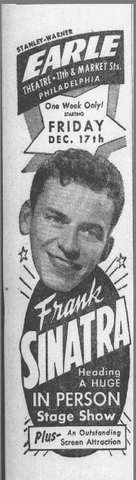
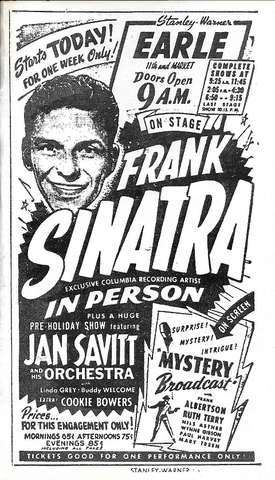
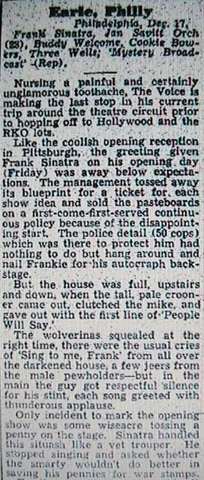
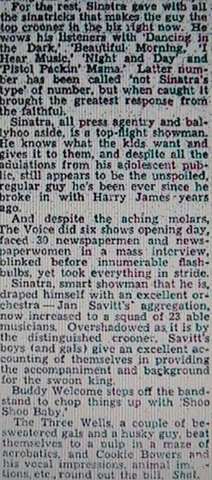
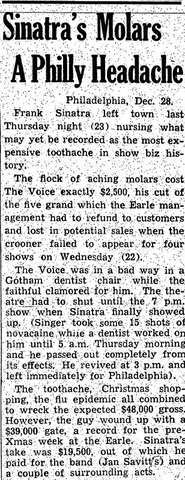
Treasury Star Parade
Friday
Time:11:35 - 11:50 PM (EST)
Program #307
Treasury Department Syndication
Sponsor: Second War Loan
Announcer: Larry Elliott
Performers: Frank Sinatra
Treasury Orchestra Conducted By: David Broekman
Arrangements By: Axel Strodahl
Writers: Thelma Ritter
1. There'll Be A Hot Time In The Town Of Berlin
2. If Loveliness Was Music
3. I've Had This Feeling Before
Notes: Condition: Excellent. Complete. 15mins
© 1997-2025 The Sinatra Archive
This calendar, or any parts thereof, may not be reproduced in any fashion
whatsoever without the prior written permission of the publisher (The
Sinatra Archive)
__._,_.___
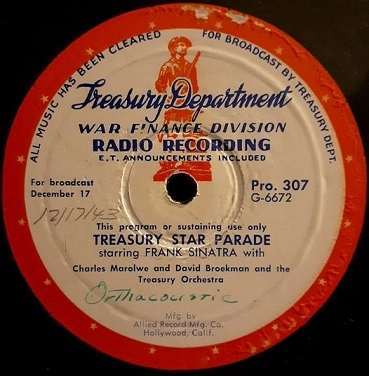
<8d7dfc2.jpeg>
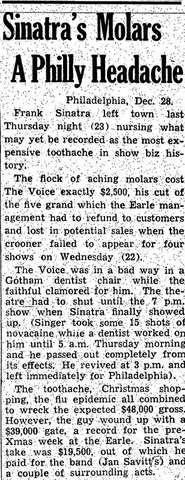
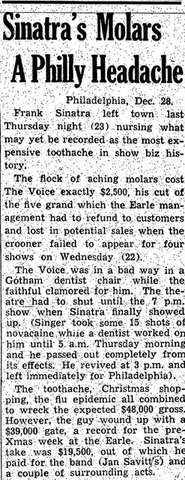
December 18, 1943
Radio
Your Hit Parade
Network: CBS
Program #448
Time: 9:00-9:45 P.M. (Rebroadcast December 19, 1943 12:00-12:45 A.M.)
Sponsor: Lucky Strike
1. Pistol Packin' Mama (5) - Frank Sinatra
2. Clap Your Hands - Orchestra
3. For The First Time (7) - Hit Paraders
4. They're Either Too Young Or Too Old (6) - Joan Edwards
5. commercials
6. Say It With Music - Orchestra & Hit Paraders
7. My Ideal (9) - Frank Sinatra
8. People Will Say We're In Love (4) - Joan Edwards
9. The Toy Trumpet - Orchestra
10. station break
11. Speak Low (8) - Frank Sinatra
12. Singin' In The Rain - Joan Edwards & Hit Paraders
13. commercial
14. Paper Doll (3) - Hit Paraders
15. Oh What A beautiful Morning (2) - Joan Edwards
16. commercial
17. My Heart Tells Me (1) - Frank Sinatra
Notes: Sinatra portion from Philadelphia.
Concerts
Earle Theatre, Philadelphia, Pennsylvania (17 - 23)
Friday to Thursday seven shows Friday thru Sunday five shows Monday thru Thursday
Jan Savitt & His orchestra
Program:
Dancing In The Dark
Paper Doll
She's Funny That Way
All Or Nothing At All
The Song Is You
People Will Say We're In Love
Oh, What A Beautiful Mornin'
Embraceable You
Pistol Packin' Mama
Frank appeared in his first substantial film role, playing himself in RKO's Higher and Higher opposite Michele Morgan and Jack Haley, singing five songs including the Oscar-nominated "I Couldn't Sleep a Wink Last Night."
Source: Nancy Sinatra, Frank Sinatra: An American Legend, 1995.
December 19, 1943
Radio
Songs By Sinatra
Network: CBS
Time: 7:15-7:30PM Sunday
Show #9
Sponsor: none (sustaining)
Producer: Herb Polesie
Orchestra conducted by: Axel Stordahl
Musicians: The Bobby Tucker Singers
Arrangements By: Axel Stordahl
1. opening
2. My Ideal - Frank Sinatra
3. I Couldn't Sleep A Wink Last Night - Frank Sinatra
4. Night And Day - Frank Sinatra
5. White Christmas - Frank Sinatra
6. Put Your Dreams Away - closing
Notes: Confirmed aired on WABC. Complete show.
Note: "My Ideal," has been commercially released on the 4 CD " A Voice On Air" set.
Bill Miller remembered Frank recording that song for a lady friend during the latter stages of the Capitol Years.
Ed
Note: A great show for the bobbysox idol, Ed O'Brien remarks. Sinatra opens with "My Ideal" (he never did a commercial recording of it) and then tells about his friend Joe serving overseas..
O'Brien says he often wondered if this was based on a real character or merely a radio invention. He believes it is the former based on Sinatra's comments before singing "Night and Day." He tells the audience how Joe backed him with harmonica, one time, at his house and how much both of them admired the song.
"White Christmas" would not be recorded by Sinatra until November 1944, O'Brien observes. Here was have a marvelous reading, with a Stordahl chart and the backing off the Bobby Tucker Singers. The Irving Berlin song would be one of the two million sellers Sinatra had at Columbia . The recording would be a Top Ten hit for him in 1944, 1945, and 1946.
Ruth Lowe's song told O'Brien that she wrote "Put Your Dreams Away" for Frank at the eleventh hour. He desperately needed a theme song and commissioned her to do it just prior to the Columbia session. Well, this show, and othrs from 1943, reveal that he was singing long before the 1945 recording, O'Brien points out.
Sinatraphile Vance Adair thanks O'Brien for his gloss on the history of "Put Your Dreams Away." He them observes: "Even having listened, ad nauseum, to the bombast of "My Way" and the Kander and Ebb successor, I still consider this tune to be the most enduring of Sinatra"s signature songs."
O'Brien then recalls that Frank sang "I Couldn't Sleep a Wink Last Night" right after he sang "My Ideal." That song was written for the film "Higher and Higher," which was released on December 18, 1943.
Frank's Columbia recording with the Bobby Tucker Singers was sung a capella, so the radio and film versions were the only way to hear the tune done with a full orchestra and Stordahl's chart. The song would be nominated for an Oscar in 1944, O'Brien reports, but it lost to Bing Crosby's big hit "Swinging on a Star" from "Going My Way."
[image referenced in source but could not be recovered]
Concerts
Earle Theatre, Philadelphia, Pennsylvania (17 - 23)
Friday to Thursday seven shows Friday thru Sunday five shows Monday thru Thursday
Jan Savitt & His orchestra
Program:
Dancing In The Dark
Paper Doll
She's Funny That Way
All Or Nothing At All
The Song Is You
People Will Say We're In Love
Oh, What A Beautiful Mornin'
Embraceable You
Pistol Packin' Mama
December 20, 1943
Concerts
Earle Theatre, Philadelphia, Pennsylvania (17 - 23)
Friday to Thursday seven shows Friday thru Sunday five shows Monday thru Thursday
Jan Savitt & His orchestra
Program:
Dancing In The Dark
Paper Doll
She's Funny That Way
All Or Nothing At All
The Song Is You
People Will Say We're In Love
Oh, What A Beautiful Mornin'
Embraceable You
Pistol Packin' Mama
December 21, 1943
Concerts
Earle Theatre, Philadelphia, Pennsylvania (17 - 23)
Friday to Thursday seven shows Friday thru Sunday five shows Monday thru Thursday
Jan Savitt & His orchestra
Program:
Dancing In The Dark
Paper Doll
She's Funny That Way
All Or Nothing At All
The Song Is You
People Will Say We're In Love
Oh, What A Beautiful Mornin'
Embraceable You
Pistol Packin' Mama
December 22, 1943
Concerts
Earle Theatre, Philadelphia, Pennsylvania (17 - 23)
Friday to Thursday seven shows Friday thru Sunday five shows Monday thru Thursday
Jan Savitt & His orchestra
Program:
Dancing In The Dark
Paper Doll
She's Funny That Way
All Or Nothing At All
The Song Is You
People Will Say We're In Love
Oh, What A Beautiful Mornin'
Embraceable You
Pistol Packin' Mama
December 23, 1943
Concerts
Earle Theatre, Philadelphia, Pennsylvania (17 - 23)
Friday to Thursday seven shows Friday thru Sunday five shows Monday thru Thursday
Jan Savitt & His orchestra
Program:
Dancing In The Dark
Paper Doll
She's Funny That Way
All Or Nothing At All
The Song Is You
People Will Say We're In Love
Oh, What A Beautiful Mornin'
Embraceable You
Pistol Packin' Mama
PHILDELPHIA INQUIRER 12-18-43
Richmond Times Dispatch 12-20-43
Earle Theatre, Philadelphia, Pennsylvania (17 - 23)
AD FOR EARLE THEATER
Ed O'Brien:
Above ad ran in the Philly papers on opening day of Frank's weekly run at the Earle Theater. Frank was at the zenith of his popularity with the bobby soxers in December of 1943. He played Boston and Pittsburgh before Philadelphia. There were seven shows a day.
He closed at the Earle on 12-23-43. The notice at the bottom of the poster, indicating a ticket was only good for one performance, hurt the box office badly. The teen- age girls had a habit of staying for four or five shows, some were there from 9:am until the theater closed around 11:30:pm.
Here is the basic song list Frank did during the month: "Dancing in the Dark," medley of "Paper Doll," "She's Funny That Way" and
"All or Nothing at All,'
"The Song Is You," medley of "People Will Say" and "Oh,
What a Beautiful Morning,"
"Embraceable You"
"Pistol Packin' Mama,"
He only did about 30 minutes per show. There was a solid bill of other performers and a film. Quite often the movie was a B film. Management didn't need a top flight vehicle with Frank's name on the marquee.
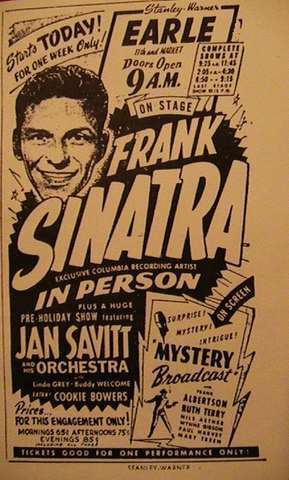
December 25, 1943
Radio
Your Hit Parade
Network: CBS
Program #449
Time: 9:00-9:45 P.M. (Rebroadcast December 25, 1943 12:00-12:45 A.M.)
Sponsor: Lucky Strike
1. People Will Say We're In Love (5) - Frank Sinatra
2. Good News - Orchestra
3. For The First Time (6) - Hit Paraders
4. They're Either Too Young Or Too Old (7) - Joan Edwards
5. commercial
6. Great Day - Orchestra
7. Oh What A Beautiful Morning (4) - Frank Sinatra & Hit Paraders
8. Pistol Packin' Mama (8) - Joan Edwards
9. Blue Skies - Orchestra
10.. station break
11. Shoo Shoo Baby (9) - Frank Sinatra
12. Sing, It's Good For You - Hit Paraders
13. commercial
14. White Christmas (3) - Joan Edwards
15. Paper Doll (2) - Hit Parade
16. commercial
17. My Heart Tells Me (1) - Frank Sinatra
NOTE: Listening to this show, you would never guess that America was locked in a titanic struggle involving 16 million soldiers at the time of this broadcast, Sinatra Scholar Ed
O'Brien observes. The only war song that charted was "Either They're Too Young or Too Old."
Emacs!
© 1997-2023 The Sinatra Archive
This calendar, or any parts thereof, may not be reproduced in any fashion whatsoever without the prior written permission of the publisher (The Sinatra Archive)
© 1997-2024 The Sinatra Archive
This calendar, or any parts thereof, may not be reproduced in any fashion
whatsoever without the prior written permission of the publisher (The
Sinatra Archive)
© 1997-2024 The Sinatra Archive
This calendar, or any parts thereof, may not be reproduced in any fashion
whatsoever without the prior written permission of the publisher (The
Sinatra Archive)
December 26, 1943
Radio
Songs By Sinatra
Network: CBS
Time: 7:15-7:30PM Sunday
Show #10
Sponsor: none (sustaining)
Producer: Herb Polesie
Orchestra conducted by: Axel Stordahl
Musicians: The Bobby Tucker Singers
Arrangements By: Axel Stordahl
Dress Rehearsal:
1. Close To You w/The Bobby Tucker Singers
Broadcast:
1. opening
2. You'll Never Know - Frank Sinatra
3. As Time Goes By - Frank Sinatra
4. Close To You - Frank Sinatra
5. That Old Black Magic - Frank Sinatra
6. Put Your Dreams Away / closing
Notes: Sinatra's last show of series. Confirmed aired on WABC. On January 2, 1944 Perry Como is listed in the time slot on WABC 7:15PM - 7:30PM. Ed O'Brien:"Frank's last 15 minute show for CBS. After opening with "You'll Never Know," he called the show "Sinatra's last stand.." The accent that evening was on the hit songs of 1943. Frank talked about his little family in the studio and kiddingly suggested the need for a crying towel because the man with the divorce papers was waiting outside to break them up. Frank fondly recalled the evenings in Liederkranz Hall (Columbia broadcast the show from there) He spoke of how thankful he was to be with CBS and for his listening audience.He reminded his listeners that the new year would bring a lot of changes. He then said, "My top wish is for some new guy, that's just around the corner, with a swell voice, and a great yen to sing and to have the breaks and kindnesses that came my way this past year. I can't name everyone I'd like to here tonight, But they can know that I'm grateful and always will be." He continued to be very sentimental, calling the show "the final curtain." After "That Old Black Magic," he mentioned how Axel, Bobby Tucker and all the kids in the choir joined him in saying goodnight and wished everyone " the best for the new year," and then before singing "Put Your Dreams Away," he said, So until 1944..." The Vimms Vitamin thirty minute show would have its debut on 1-5-44. Certainly 1943 was a very good year for Frank Sinatra."
Complete show. Needs re-edited. "Close To You" from the dress rehearsal appears on the CD: The V-discs 1 (Columbia 66135)
December 27, 1943
Radio
Treasury Star Parade
Program #311
Treasury Department Syndication
Sponsor: Second War Loan
Announcer: Larry Elliott
Performers: Frank Sinatra
Treasury Orchestra Conducted By: David Broekman
Arrangements By: Axel Strodahl
Writers: Thelma Ritter
1. Falling In Love With Love
2. The Music Stopped
3. I Couldn't Sleep A Wink Last Night
Notes: Condition: Excellent. Complete. 15mins.
Treasury Star Parade
Program #311
Treasury Department Syndication
Sponsor: Second War Loan
Announcer: Larry Elliott
Performers: Frank Sinatra
Rita Stearns, 17, of Washington, D.C., is a lucky and exclusive audience member at a radio broadcast featuring Frank Sinatra in New York on Dec. 27, 1943. Sinatra reads the winning letter sent by Stearns in a contest held by CBS. She described the voice as 'If lonesome, he reminds you of the guy away from your arms. If waiting for a dream prince, his thrilling voice sings for you alone.' Write your own lyrics, folks.”
December 28, 1943
One That Never Happened:
December 30, 1943
[Anonymous letter to Winchell sparks draft investigation]
An anonymous, typed letter to columnist Walter Winchell -- dated three weeks after Sinatra's 4-F classification -- alleged the FBI was investigating a report that Sinatra had paid $40,000 to Newark doctors for his eardrum-based draft exemption, and that "mothers around this section who have sons in the service" were planning to petition FDR for a re-examination. In fact the FBI had not been investigating Sinatra's draft record at all; the letter, forwarded to headquarters, became a self-fulfilling prophecy and triggered the Bureau's first formal inquiry into the case the following February.
Source: Tom Kuntz and Phil Kuntz, eds., The Sinatra Files: The Secret FBI Dossier (New York: Three Rivers Press, 2000), ch. 1.
1944
[Birth of Frank Jr.]
Sinatra's only son, Frank Sinatra Jr., was born in 1944; a few months later the entire family relocated to California.
Source: Charles Pignone, "Frank Sinatra 100" (2015).
[Birth of Franklin Wayne Emanuel Sinatra; Move to California]
Sinatra's second child, Franklin Wayne Emanuel, is born in Jersey City, and the Sinatra family relocates to California.
Source: Nancy Sinatra, "Frank Sinatra, My Father" (1985).
[Franklin Wayne Emanuel Sinatra Is Born]
The year after meeting President Roosevelt, Sinatra and his wife had a son, Franklin Wayne Emanuel Sinatra, a nine-pound baby named for the president and for Manie Sacks.
Source: Nancy Sinatra, "Frank Sinatra, My Father" (1985).
[Gene Kelly Recalls Casting Sinatra]
Gene Kelly recalled that in 1944 MGM paired him with the then slightly built, little-known Sinatra for Anchors Aweigh, and that the studio's solution to making him a believable leading man was to cast him as a shy, unassuming Navy sailor.
Source: Charles Pignone, "Frank Sinatra 100" (2015).
[Frank Insists On Sammy Cahn For Anchors Aweigh]
Nancy Sinatra: When a producer asked Frank's advice on who should write the score for Anchors Aweigh, Frank casually named the little-known Sammy Cahn, triggering studio resistance. When an MCA executive urged Cahn to bow out for Frank's sake, Frank instead told Cahn, "If you're not there Monday I'm not there Monday," and Cahn got the job.
Source: Nancy Sinatra, Frank Sinatra: An American Legend, 1995.
[Lee Mortimer's Feud With Sinatra Begins Over A Bad Song]
Nancy Sinatra: According to Frank, his long-running feud with Hearst columnist Lee Mortimer began after Mortimer sent him a song he had written, hoping Frank would record it. When Frank bluntly told him the song was no good, Mortimer responded with a sustained campaign of gossip and innuendo against him.
Source: Nancy Sinatra, Frank Sinatra: An American Legend, 1995.
[Sinatra Insists On Sammy Cahn For Anchors Aweigh]
While "Anchors Aweigh" was in production, Sinatra pushed MGM to hire his friend Sammy Cahn as songwriter over more established names, threatening to walk off the picture until the studio relented.
Source: Nancy Sinatra, "Frank Sinatra, My Father" (1985).
[Sinatra Campaigns Hard For FDR's Reelection]
During the 1944 presidential campaign, unlike other stars who stayed publicly neutral, Sinatra toured the country making speeches and singing on Roosevelt's behalf, unconcerned about alienating fans who disagreed with him politically.
Source: Nancy Sinatra, "Frank Sinatra, My Father" (1985).
[Sinatra Joins Hillcrest Country Club Over A Discriminatory Rival]
Nancy Sinatra: After learning that the Lakeside Country Club near his new home barred Jewish members, Frank became the second gentile member ever admitted to Hollywood's Hillcrest Country Club, the first being Darryl Zanuck.
Source: Nancy Sinatra, Frank Sinatra: An American Legend, 1995.
[Step Lively Gives Sinatra His First Screen Kiss]
Sinatra's 1944 film "Step Lively," a musical spin on the play "Room Service," featured his first on-screen kiss along with the song "As Long as There's Music."
Source: Nancy Sinatra, "Frank Sinatra, My Father" (1985).
[The Family Moves West To Toluca Lake]
In spring 1944 Nancy, her mother, and baby brother Frankie took the train west to join Sinatra in a new house he'd bought at 10051 Valley Spring Lane on Toluca Lake in the San Fernando Valley.
Source: Nancy Sinatra, "Frank Sinatra, My Father" (1985).
[The Sinatras Move Into A House That Once Belonged To Mary Astor]
Nancy Sinatra: Determined to keep the family together despite his fame, Frank moved them into a Mediterranean-style, pink stucco house with a red tile roof in the San Fernando Valley that had once belonged to actress Mary Astor, complete with a kayak, sailboat and raft on a nearby lake, choosing this time a house with a wall for privacy.
Source: Nancy Sinatra, Frank Sinatra: An American Legend, 1995.
['Pictures stink' outburst to reporter]
Frank Sinatra: During a hot day on the Anchors Aweigh set, a United Press reporter interviewing pianist Jose Iturbi caught a frustrated Sinatra declaring that pictures and most people in them 'stink' and that Hollywood would soon find out he meant it about quitting. His manager Al Levy downplayed the remark as heat-induced fatigue, and publicist Jack Keller quickly issued a softened statement in Sinatra's name.
Source: James Kaplan, "Frank: The Voice" (2010)
['San Fernando Valley' on Vimms show]
Kaplan: That spring Sinatra sang Gordon Jenkins' upbeat new hit 'San Fernando Valley' on the Vimms radio show; Bing Crosby recorded his own version around the same time, though Kaplan judges Sinatra's lighter, more youthful reading superior.
Source: James Kaplan, "Frank: The Voice" (2010)
[Affair with Lana Turner begins]
Kaplan: During the Anchors Aweigh shoot, Sinatra wandered onto the set of Lana Turner's picture Keep Your Powder Dry; she was in the process of leaving her second husband and had been seeing Peter Lawford, Bob Stack, and Turhan Bey, but her reaction to Sinatra signaled the start of their own involvement.
Source: James Kaplan, "Frank: The Voice" (2010)
[Buys Toluca Lake house sight unseen]
Kaplan: Sinatra bought a large pink Mediterranean-style house at 1051 Valley Spring Lane on Toluca Lake, sight unseen, near Bob and Dolores Hope and not far from Bing Crosby. He and Nancy again named the house Warm Valley.
Source: James Kaplan, "Frank: The Voice" (2010)
[Cahn recalls Wasserman's plea]
Sammy Cahn: Sammy Cahn later wrote that MCA's Lew Wasserman begged him to back off the songwriting job to avoid Sinatra losing the picture, and Cahn tried to bow out, but Sinatra told him flatly that if Cahn wasn't there Monday, neither was he -- and both showed up.
Source: James Kaplan, "Frank: The Voice" (2010)
[Donen's commissary round-table prank]
Stanley Donen: Choreographer Stanley Donen later recalled that he and Kelly needled Sinatra by suggesting a round lunch table at the MGM commissary would be nicer than the standard square ones; Sinatra angrily insisted he'd get them one, then threw a fit and threatened to quit when told to drop it -- all engineered as a joke at his expense.
Source: James Kaplan, "Frank: The Voice" (2010)
[DownBeat and Metronome Best Singer awards]
Consiglio: Frank won Best Singer plaques from DownBeat and Metronome magazines for 1944, 1945, and 1946, giving several of the awards to Consiglio, along with a signed brown corduroy jacket he wore in Higher and Higher.
Source: Tony Consiglio (as told to Franz Douskey), "Sinatra and Me: The Very Good Years" (2012)
[Earns nickname 'One-Take Charlie']
Kaplan: During Anchors Aweigh, Sinatra's impatience and dislike of repeating scenes earned him the nickname 'One-Take Charlie' on the MGM lot.
Source: James Kaplan, "Frank: The Voice" (2010)
[Evans wins Billboard promotion award]
George Evans: In early 1944, Billboard magazine honored George Evans with an award for "Most Effective Promotion of a Single Personality"; Evans boasted to a wire service that it was he who had recognized the potential of "organized and regimented moaning."
Source: James Kaplan, "Frank: The Voice" (2010)
[Gene Kelly mentors Sinatra in dance]
Kaplan: During Anchors Aweigh production, Gene Kelly -- who was both starring and directing the dance sequences -- chose to mentor rather than compete with the inexperienced Sinatra, patiently teaching him to dance over roughly eight weeks of daily rehearsal per routine.
Source: James Kaplan, "Frank: The Voice" (2010)
[Jimmy Van Heusen's secret Lockheed job]
Kaplan: That spring, songwriter Jimmy Van Heusen was secretly moonlighting three days a week as a test pilot at Lockheed's Burbank plant under the alias Edward Chester Babcock, flying P-38s and C-60s, while writing movie songs at Paramount under his real professional name the other four days. He never told Sinatra how dangerous the flying was.
Source: James Kaplan, "Frank: The Voice" (2010)
[Kilgallen's earlier fan-magazine piece]
Kaplan: In 1944 Dorothy Kilgallen had written a fan-magazine article titled 'The Stars I'd Like to Be Married to,' with Sinatra topping her list, before later adopting the more critical Hearst company line toward him.
Source: James Kaplan, "Sinatra: The Chairman" (2015)
[Nelson Riddle joins Dorsey band]
Kaplan: Nelson Riddle joined Tommy Dorsey's band as third trombonist at age 23, later absorbing lessons from Dorsey's great arranger Sy Oliver (whom Dorsey had poached from Jimmie Lunceford's band in 1939), which shaped his own approach to arranging.
Source: James Kaplan, "Frank: The Voice" (2010)
[Pays out of pocket for West Coast broadcasts]
Kaplan: Lucky Strike let Sinatra broadcast his Your Hit Parade segments from the West Coast that summer only if he personally covered studio rental, Stordahl's orchestra, and the AT&T phone feed to New York -- a total of $4,800 per show, $2,000 more than his weekly salary for the program.
Source: James Kaplan, "Frank: The Voice" (2010)
[Pegler escalates anti-Sinatra campaign]
Kaplan: After the Waldorf incident, Pegler intensified his attacks, linking Sinatra to CIO political action chair Sidney Hillman to imply Communist and 'Jew-lover' associations. Sinatra retaliated by barring Pegler from a Wedgwood Room performance; Pegler responded by publicizing Sinatra's 1938 Bergen County morals arrest, prompting a failed conciliation attempt by George Evans.
Source: James Kaplan, "Frank: The Voice" (2010)
[Rushes screening dispute with Pasternak]
Kaplan: Early in the Anchors Aweigh shoot, Sinatra demanded to see his dailies against studio policy; producer Joe Pasternak relented but insisted he come alone. Sinatra showed up with his entourage anyway, Pasternak exploded, and Sinatra walked off the picture -- returning the next day rather than test his own expendability.
Source: James Kaplan, "Frank: The Voice" (2010)
[Shift from one-nighters to residencies]
Consiglio: By 1944, the grind of constant one-night stands was wearing Sinatra out, prompting him to shift toward longer engagements at clubs and hotels such as the Fontainebleau and the Wedgwood Room at the Waldorf-Astoria, where he could stay in one place for a week or more.
Source: Tony Consiglio (as told to Franz Douskey), "Sinatra and Me: The Very Good Years" (2012)
[Sinatra's self-estimated annual earnings]
Kaplan: By Sinatra's own later estimate, he earned $840,000 in 1944 -- equivalent to more than $10 million in today's dollars -- making him arguably the highest-paid entertainer in the world following his MGM signing.
Source: James Kaplan, "Frank: The Voice" (2010)
[The Road to Victory]
Santopietro grades this a B: "FS as himself; one song" (a wartime short).
No corresponding dated entry could be identified in the chronology for this film/context.
Source: Tom Santopietro, "Sinatra in Hollywood" (2008), Career Scorecard
[USO tour, adopted six war orphans in Italy]
Consiglio: Late in the war, Frank toured Europe with Phil Silvers entertaining troops camp to camp. While in Italy he adopted six war orphans and paid for their care and education until they finished school; Consiglio did not go overseas because he did not want the required vaccinations.
Source: Tony Consiglio (as told to Franz Douskey), "Sinatra and Me: The Very Good Years" (2012)
[personal life]
Sinatra began calling California home starting in 1944, as he increasingly devoted time and passion to building a film career alongside his recording work.
No corresponding dated entry could be identified in the chronology for this film/context.
Source: Tom Santopietro, "Sinatra in Hollywood" (2008), March 25, 1954 / Well Did You Evah / Hoboken
[personal life / career milestone]
Sinatra's engagement at the Paramount Theater in New York beginning October 11, 1944, triggered the so-called "Columbus Day riots": roughly 10,000 fans outside the theater and an estimated 20,000 more teenagers in Times Square. Santopietro frames this as the forerunner of Beatlemania and the first mass eruption of teenage cultural power, cementing Sinatra as a national phenomenon just before his move to MGM.
No corresponding dated entry could be identified in the chronology for this film/context.
Source: Tom Santopietro, "Sinatra in Hollywood" (2008), The Boy Next Door / A Paesano Onscreen
[Columbia mines Frank's old James-era recordings]
Capitalizing on Frank's now-established stardom, Columbia released three more of his old recordings with Harry James's band, 'On a Little Street in Singapore,' 'Every Day of My Life,' and 'It's Funny to Everyone But Me,' all becoming minor hits.
Source: Richard Havers, "Sinatra" (Dorling Kindersley, 2007).
[Golden Gate Quartet's earlier version of the title song]
Before Sinatra recorded it, the black gospel group the Golden Gate Quartet had already performed "The House I Live In" on screen, in the 1944 film Follow the Boys, making Frank's version a re-use of an existing song rather than an original commission.
Source: Richard Havers, "Sinatra" (Dorling Kindersley, 2007).
[Peter Lawford meets Frank Sinatra]
Peter Lawford first met Frank at a party in 1944 and later appeared with him in It Happened in Brooklyn, one of several films the two made together in the 1940s and early 1950s.
Source: Richard Havers, "Sinatra" (Dorling Kindersley, 2007).
["Young America for Roosevelt" Rally]
At a "Young America for Roosevelt" campaign rally, Sinatra told the crowd about meeting FDR at the White House, joking that the president "knows about everything, even my racket."
Source: George Carpozi Jr., Frank Sinatra: Is This Man Mafia? (New York: Manor Books, 1979).
[Sunday, Monday, or Always -- critical commentary]
On a 1944 For the Record radio show, Sinatra sang a parody of his hit “Sunday, Monday, or Always” with special lyrics depicting his competition with “Dick Todd, Dick Haymes, and Como,” which concludes with the aside, “There’s just one Crosby.” In a 1949 Looney Tunes cartoon, Curtain Razor, the trio of competing crooners is identified as “Bingo, Frankie, and Al,” the latter being the recently resurrected Jolson.
Source: Will Friedwald, "Sinatra! The Song Is You: A Singer's Art" (2018 revised edition), Ch. 4, "With Axel Stordahl" (1943-1948)
[recording media history -- critical commentary]
Union Carbide's 1930s vinyl resin "vinylite" eventually replaced brittle shellac for records; the U.S. government used a lightweight plastic called "formvar" for wartime V-Discs starting in 1943, and RCA Victor issued some Red Seal classical 78s on cherry-red vinyl beginning in 1944.
Source: Charles L. Granata, "Sessions with Sinatra: Frank Sinatra and the Art of Recording" (1999/2003), Part I: The Big Band Years, 1937-1942
January 1944
[Louis B. Mayer Rewrites A Lyric And Falls For Sinatra]
Nancy Sinatra: At a benefit for The Jewish Home for the Aged, Frank performed Ol' Man River but altered a racially demeaning lyric to a more inclusive one. The rendition moved MGM chief Louis B. Mayer to tears, and Mayer reportedly turned to an aide afterward and said simply, "I want that boy."
Source: Nancy Sinatra, Frank Sinatra: An American Legend, 1995.
[Sinatra's Troop Tour Sends Servicemen Wild]
Nancy Sinatra: Touring with Bob Hope, Bing Crosby and Ginger Rogers to entertain troops, Frank's turn on stage at the Hollywood Canteen reportedly drew such prolonged ovations that servicemen rushed the stage, lifted him onto their shoulders and paraded him through the venue, their cheering audible for blocks.
Source: Nancy Sinatra, Frank Sinatra: An American Legend, 1995.
[Benefit for Jewish Home for the Aged]
Kaplan: Just days after his son's birth, Sinatra performed at a benefit for the Jewish Home for the Aged at the Roosevelt Hotel, singing 'Ol' Man River' with an altered lyric replacing Oscar Hammerstein's racial slur. Louis B. Mayer was reportedly moved to tears and told an aide, 'I want that boy.'
Source: James Kaplan, "Frank: The Voice" (2010)
[Frank Jr. born]
Consiglio: While Consiglio and Sinatra were on the road in Boston with Jan Savitt's Top Hatters at the RKO Theater, Frank Jr. was born in New Jersey. Consiglio took the call backstage during Frank's first show and told him after he came offstage; Frank was so excited he performed his next show in double time.
Source: Tony Consiglio (as told to Franz Douskey), "Sinatra and Me: The Very Good Years" (2012)
[Higher and Higher opens in US cinemas]
Frank's RKO film Higher and Higher opened nationwide, though audiences had to sit through 25 minutes of runtime before hearing his first line. Reviews split by coast, with the LA Times more charitable than New York papers.
Source: Richard Havers, "Sinatra" (Dorling Kindersley, 2007).
January 1, 1944
Radio
Your Hit Parade
Network: CBS
Program #450
Sponsor: Lucky Strike
1. Paper Doll - Frank Sinatra
2. We're In The Money - Orchestra
3. For The First Time - The Hit Paraders
4. Pistol Packin Mama - Joan Edwards
5. Limehouse Blues - Orchestra
6. Oh, What A Beautiful Morning! - Frank Sinatra
7. People Will Say Were In Love - Joan Edwards
8. When The Red, Red Robin Comes Bob,Bob Bobbin' Along - The Hit Paraders
9. Shoo-Shoo Baby - Frank Sinatra
10. Zing! Went The Strings Of My Heart - Orchestra
11. Ill Be Home For Christmas - The Hit Paraders
12. White Christmas - Joan Edwards
13. My Heart Tells Me - Frank Sinatra
[The Cinematic Legacy of Frank Sinatra — Higher and Higher (1943)]
David Wills's 2015 photo history The Cinematic Legacy of Frank Sinatra devotes a section to Higher and Higher (1943), illustrated with 4 behind-the-scenes and publicity photographs (posters, lobby cards, and on-set/on-location shots) filed here.
Source: David Wills, The Cinematic Legacy of Frank Sinatra (St. Martin's Press, 2015), pp. 32–35.
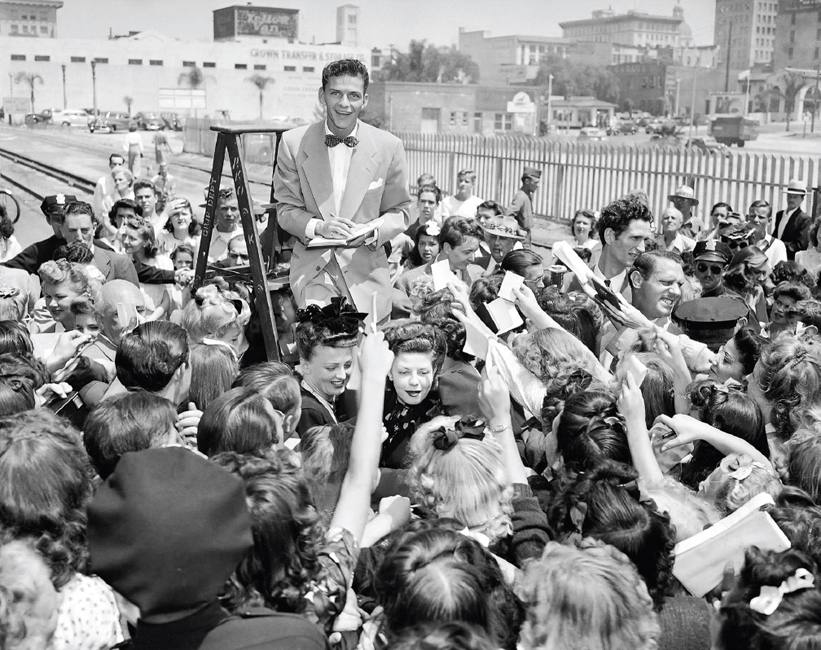
Signing autographs for the fans, Los Angeles, 1943. Photo by Gene Lester. (Photo: The Cinematic Legacy of Frank Sinatra, David Wills, 2015.)
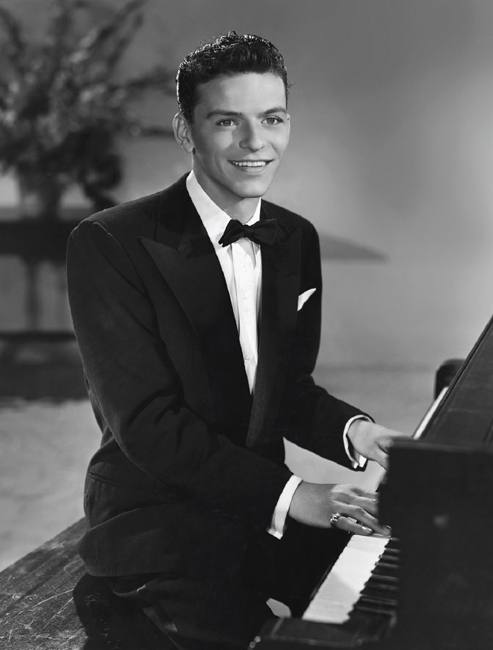
Higher and Higher, 1943. (Photo: The Cinematic Legacy of Frank Sinatra, David Wills, 2015.)
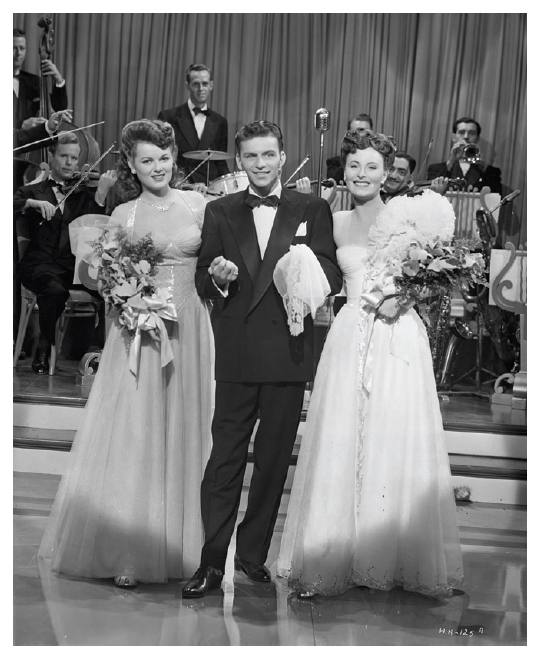
With costars Marcy McGuire (left) and Michèle Morgan. / “The crooner certainly doesn't fulfill the / cinema's traditional ideal of a romantic figure, / which may be a break for him eventually. He … / appears more at ease than we expected, and (Photo: The Cinematic Legacy of Frank Sinatra, David Wills, 2015.)
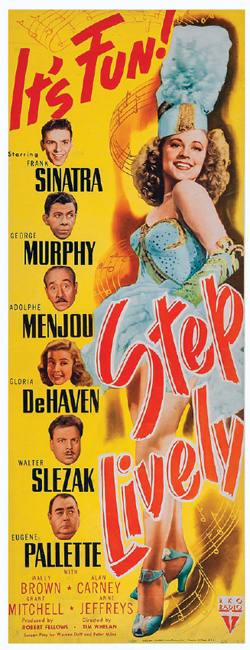
should find a place as a film personality with / careful choice of subjects. Crosby did it, didn't / he?” / 1943) (Photo: The Cinematic Legacy of Frank Sinatra, David Wills, 2015.)
Film
"Higher and Higher" (US Film
Release: January 1st, 1944)
Starring: Michèle Morgan, Jack Haley, Frank Sinatra, Leon Errol,
Marcy McGuire, and Mel Tormé
Produced and Directed by Tim Whelan
With their employer bankrupt, servants scheme to marry maid Millie (Morgan) to a rich husband. But Frank Sinatra lives across the street...
DVD Release date: 2008-05-13)
Note: "Higher and Higher" was shown at the RKO Manhattan theater on 12-1-43.
This special preview was attended by Frank and other cast members. Variety reviewed the film. Their critic gave Frank a decent write up for his first major role as a fictionalized version of himself. The critic did feel that Frank was a little
stiff and not as photogenic as could be desired. Hollywood Reporter and Daily both gave him a rave. Bosley Crowther, NYT reviewer, was less enthusiastic..He wrote that Frank "was no Gable or
Barrymore."
Now here is where it gets interesting. I'll let Variety tell you what happened: "An unusual experiment was the showing on Friday(12/31), for one day only, of "Higher and Higher" in 50 neighborhood theaters of the RKO circuit at $1.10 to
$1.65 scale. Picture was thrown into houses in N.Y., Brooklyn, Queens, Westchester County and Newark for grinding to as late as business justified."
RKO had rolled the dice by showing it throughout all the major American cities on New Year's Eve at exactly 5 in the afternoon. And it worked even better than they had hoped for. The film took in a gross of $2 million dollars. The film was then released slowly throughout cities and towns all through January. The official N.Y.C. release took place at the RKO Palace on 1-21-44. "Higher and "Higher" would net RKO a profit of almost $800,000. The film received two Academy Award nominations for best musical scoring and best song, "I Couldn't Sleep A Wink Last Night." Frank cast his vote for "I'll Walk Alone."
Sinatra was paid $25,000 for his work on the eight week shoot that began in Hollywood, in August 1943. He had signed a seven year contract with RKO. They would double his salary for each additional film and he would be allowed to do one film a year for another studio. All that would change when MGM offered him a major contract a few months down the road.
DeMille Productions and Lux Radio Theater wanted Frank to star in a live broadcast on 1-3-44 -- two days before his debut on the Vimms show. The difficulty of getting everyone together in time nixed the radio broadcast.
--Ed
"Higher and Higher" (US Film
Release: January 1st, 1944)
A Variety Ad for Higher and Higher
"Higher and Higher"
With major male stars off at war, Sinatra saw an opening for movie stardom. After four cameo appearances, Higher and Higher (released December 1943) became his first major role, playing himself. Santopietro notes Sinatra pursued film stardom partly for the lump-sum payday it offered compared to record royalties, and cites Bing Crosby's own screen debut playing himself in 1929's The Big Broadcast as a precedent.
Source: Tom Santopietro, "Sinatra in Hollywood" (2008).
"Higher and Higher"
Filming on Higher and Higher began in August 1943, released that December. Sinatra was billed third, after Michele Morgan and Jack Haley. Directed and produced by Tim Whelan, screenplay by Jay Dratler and Ralph Spence; musical arranger Axel Stordahl (with Gene Rose) handled the music.
Source: Tom Santopietro, "Sinatra in Hollywood" (2008).
"Higher and Higher"
The film discarded almost the entire original Broadway Rodgers and Hart score, replacing it with songs by Jimmy McHugh and Harold Adamson; only the number "Disgustingly Rich" survived while the standard "It Never Entered My Mind" was cut. Santopietro compares this to MGM later dropping much of Leonard Bernstein's On the Town score for lesser Roger Edens tunes.
Source: Tom Santopietro, "Sinatra in Hollywood" (2008).
"Higher and Higher"
The opening number features a very young, skinny Mel Torme shining shoes in the Drake household set.
Source: Tom Santopietro, "Sinatra in Hollywood" (2008).
"Higher and Higher"
In Sinatra's first-ever film scene, he sings "I Couldn't Sleep a Wink Last Night" (an Academy Award Best Song nominee) to Michele Morgan, accompanied by Dooley Wilson (Sam from Casablanca) on piano. Director Whelan shot it in a single unbroken long take, and Santopietro argues Sinatra instinctively understood how to use close-ups and underplay the vocal for maximum screen impact, despite it being his first sizable film role.
Source: Tom Santopietro, "Sinatra in Hollywood" (2008).
"Higher and Higher"
Santopietro describes Sinatra's screen-ready face (protruding ears, high cheekbones, piercing blue eyes) and notes he stood 5'7.5" though studio press releases listed him at 5'10"; he was very thin at the time, and the camera's tendency to add weight worked in his favor.
Source: Tom Santopietro, "Sinatra in Hollywood" (2008).
"Higher and Higher"
Santopietro argues that while Sinatra's line-reading acting skills were undeveloped and he appeared physically awkward/stiff in non-singing scenes (fidgeting with his hands), his instinctive command of the camera while singing was already close to perfect.
Source: Tom Santopietro, "Sinatra in Hollywood" (2008).
"Higher and Higher"
James Agee: The film's closing image (Sinatra singing atop spiraling clouds) prompted critic James Agee to call it "an effect which can only be described in terms of an erotic dream." Despite third billing, Sinatra's face dominated the posters, which were headlined "THE SINATRA SHOW."
Source: Tom Santopietro, "Sinatra in Hollywood" (2008).
"Higher and Higher"
Bosley Crowther: Bosley Crowther of The New York Times panned the film (dubbing it "Lower and Lower"), writing that "Frankie is no Gable or Barrymore" and calling the film a slapdash showcase for the Voice's overly unctuous singing.
Source: Tom Santopietro, "Sinatra in Hollywood" (2008).
"Higher and Higher"
John L. Scott: John L. Scott's Los Angeles Times review was more favorable, noting Sinatra didn't fit the traditional romantic-lead mold but seemed at ease and could find a place as a film personality "with careful choice of subjects," comparing his prospects to Crosby's.
Source: Tom Santopietro, "Sinatra in Hollywood" (2008).
"Higher and Higher"
Son Franklin Wayne Emmanuel Sinatra (Frank Sinatra Jr.) was born January 10, 1944, right as Higher and Higher was hitting screens. Around the same time Sinatra moved his wife Nancy and children to California, buying a home on Toluca Lake previously owned by movie star Mary Astor, signaling his commitment to a Hollywood career.
Source: Tom Santopietro, "Sinatra in Hollywood" (2008).
"Higher and Higher"
Santopietro grades this a B, calling it "FS as himself; his real debut."
Source: Tom Santopietro, "Sinatra in Hollywood" (2008).
"Higher and Higher"
Santopietro (Filmography): RKO Radio Pictures. Produced and directed by Tim Whelan, screenplay by Jay Dratler and Ralph Spence based on the play by Josh Logan and Ralph Spence, score by Jimmy McHugh and Harold Adamson. Sinatra played himself opposite Michele Morgan and Jack Haley, with Leon Errol, Marcy McGuire, Mary Wickes and Mel Torme in support; his songs included 'I Couldn't Sleep a Wink Last Night,' 'The Music Stopped,' 'You're on Your Own,' 'A Lovely Way to Spend an Evening' and 'I Saw You First.'
Source: Tom Santopietro, "Sinatra in Hollywood" (2008).
[Becomes California resident]
Sinatra legally became a California resident on January 1, 1944, a status he maintained for the rest of his life.
Source: James Kaplan, "Frank: The Voice" (2010).
January 5, 1944
Radio
The Frank Sinatra Show
Network: CBS
Show #1 (Premiere)
Sponsor: VIMMS Vitamins
Time: 9:00PM - 9:30PM (EST) Wednesday
Orchestra Conducted By: Axel Stordahl
Arrangements By: Axel Stordahl
Announcer: Truman Bradley
Performers: Bert Wheeler, Minerva Pious
Guest: Ginger Rogers
1. Speak Low
2. Kiss Me Again
3. RKO excerpt of songs from Higher & Higher
4. Stormy Weather w/ Vimms Vocalists
Notes: Listed as Premier. Aired on major stations WABC, WBBM, KNX,
WTOP among others.
FRANK SINATRA SHOW
Reviewed Wednesday, 9-9:30 p.m.
Style -- Variety. Sponsor - Lever
Bros. (Vimms) Agency -- J. Walter
Thompson. Station -- WABC (New
York) and CBS.
The Pied Piper of the platter bugs has a new setting in which
to air his tonsils.; and it's a mite crowded with talent. This new
spot, piped from the Coast, put Frankie in fast comic company
with Bert Wheeler, Minerva Pious and Ginger Rogers ( a
visiting guest star), but the glissando groaner comes through
as a singer, emcee and straight man.
Once a smooth balance has been achieved between music,
comedy and plugs on this program, there's going to be
sufficient to satisfy more than the bobby socks brigade, who
sent a token force to the opener to squeal at the right moments.
Frankie put forth with the opening "Speak Low," which he deliver-
ed nicely with a smooth ork background and followed later with "Kiss
Me Again" and finished with a new song from his current pic called "This
Is a Lovely Way To Spend an Evening."
In between he cut up comic touches with Bert Wheeler and played a slick
stooge to Wheeler's oldie gag story. Minerva Pious, peddling her chopped
liver dialect, appeared as a Sinatra fan from Brooklyn and provided quite a few
chucklesome minutes. This is one of the longest stretches she has had on
the air in quite a time.
The Ginger Rogers' skit could have been meatier, but La Rogers film fame
plus the Sinatra allure and Wheeler's brief wanderings in and out of scenes,
were sufficient to garner laughs, even if what they did was pretty amateurish.
Again Frankie handled his end of this chore with skill.
The airing closed with a slick vocal scoring from the Vimms Chorus of
"Stormy Weather" and a reiteration of the anti-black market pledge by
Sinatra.
Several times in the program Truman Bradley purred at the audience
about Vimms in too long and too involved plugs with the same unctuousness which
he used to sell Henry Ford's Sunday Evening Hours in the good old days before the war.
F.G.
Billboard
January 5, 1944:
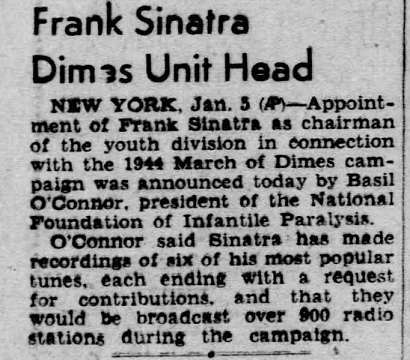
[The Frank Sinatra Program debuts]
Sinatra launched a new CBS radio program, The Frank Sinatra Program, a thirty-minute weekly star vehicle broadcast Wednesday nights and sponsored by Vimms Vitamins, with Axel Stordahl conducting and the Bobby Tucker Singers as the Vimms Vocalists. Per Sinatra's demands it was broadcast from Hollywood.
Source: James Kaplan, "Frank: The Voice" (2010).
January 8, 1944
Radio
Your Hit Parade
Network: CBS
Program #451
Sponsor: Lucky Strike
1. Oh, What A Beautiful Morning! - Frank Sinatra
2. New Sun In The Sky - Orchestra
3. I'll Be Home For Christmas - The Hit Paraders
4. They're Either Too Young Or Too Old - Joan Edwards
5. The Girl Friend - Orchestra
6. No Love, No Nothin’ - Frank Sinatra
7. White Christmas - Joan Edwards
8. Let Yourself Go - The Hit Paraders
9. Shoo-Shoo Baby - Frank Sinatra
10. Drums In My Heart - Orchestra
11. People Will Say We're In Love - Joan Edwards
12. Paper Doll
13. My Heart Tells Me - Frank Sinatra
January 10, 1944
Nancy Sinatra gave birth to the couple's second child, a son, at Margaret Hague Maternity Hospital in Jersey City. Frank, in Los Angeles filming Step Lively and on the air during a radio broadcast at the moment of the birth, was again unable to be present. The baby was named Francis Wayne Sinatra — Wayne after Frank's close friend Manie Sacks — and would become known as Frank Sinatra Jr. Source: J. Randy Taraborrelli, Sinatra: Behind the Legend.
[Birth of Frank Sinatra Jr.]
At 5:50 p.m., Nancy Sinatra gave birth to Franklin Wayne Emanuel Sinatra at Margaret Hague Maternity Hospital in Jersey City. Frank was in Hollywood at the time, not attending a radio broadcast as his daughter Nancy later claimed, since neither of his shows aired that day; he was simply absent.
Source: James Kaplan, "Frank: The Voice" (2010).
[Manie Sachs as godfather]
Rough Guide to Frank Sinatra: Columbia A&R chief Manie Sachs, already one of Sinatra's closest advocates, became godfather to the newborn Franklin Wayne Emanuel Sinatra -- whose middle name honored Sachs (born Emanuel Sachs).
Source: Rough Guide to Frank Sinatra (Rough guide 8.pdf), chapter "The Inner Circle."
January 11, 1944
[Staged hospital photo op]
Publicist George Evans arrived at Margaret Hague Maternity the morning after the birth to stage a major photo op, having Nancy made up and coiffed and instructing her exactly how to pose with the baby and a photo of Frank for the assembled press.
Source: James Kaplan, "Frank: The Voice" (2010).
January 12, 1944
Radio
The Frank Sinatra Show
Network: CBS
Show #2
Sponsor: VIMMS Vitamins
Time: 9:00PM - 9:30PM (EST) Wednesday
Orchestra Conducted By: Axel Stordahl
Arrangements By: Axel Stordahl
Announcer: Truman Bradley
Performers: Bert Wheeler, Minerva Pious
Guest: Merle Oberon
1. My Shining Hour
Notes: Confirmed aired on WABC. CD: The V-discs 1(Columbia CK 66135)
Note: Sinatraphiler Richard Warwick states that according to the Where or When data base, "My Shining Hour"on the V-discs set is not from Vimms on 1-12-44 but from YHP of 1-22-44. Ed O'Brien responded that "I only have a segment of the Vimms. Just compare the H.P. recording with the V-Disc. The guy who did the V-Discs told me it was from Vimms. show."
Scott Henderson stated that the problem is that I don't have the January 12, 1944 Vimms show. I do have the VDisc set and the YHP of 1-22-44. I was able to take the track from the VDisc set and the one from YHP 1-22-44 and put them into the audio program Audacity. I was able to set one track on the top and one on the bottom and visually the wave forms were identical. When I played them at the same time they matched together as well in speed, length and tempo. If I were to make an educated guess then I'd say that the VDisc set and the YHP of 1-22-44 are the same. Of course, in fairness, I don't have the Vimms show but I can't imagine that orchestrally and vocally the song would be the same from Vimms to YHP.
The Frank Sinatra Show
Network: CBS
Show #2
Sponsor: VIMMS Vitamins
Time: 9:00PM - 9:30PM (EST) Wednesday
Orchestra Conducted By: Axel Stordahl
Arrangements By: Axel Stordahl
Announcer: Truman Bradley
Performers: Bert Wheeler, Minerva Pious
Guest: Merle Oberon
Variety
1-26-44
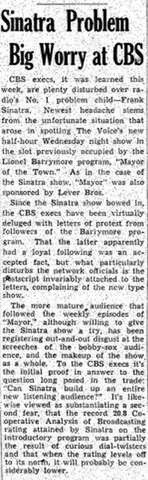
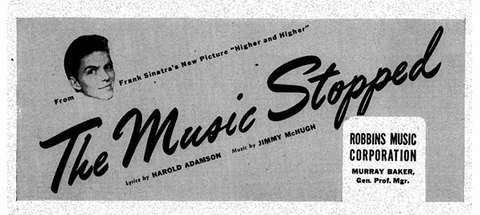
[Vimms show venue standoff]
For the second Vimms broadcast, over a thousand fans queued outside the 350-seat CBS Radio Playhouse. Sinatra demanded the show be moved to the larger Vine Street Playhouse, but the local AFRA chief threatened to bar him from the union's jurisdiction if he didn't broadcast from CBS as scheduled; Sinatra backed down. During the show he sang his theme song 'This Love of Mine' to his newborn son over the air, with Nancy holding the phone/radio at the hospital.
Source: James Kaplan, "Frank: The Voice" (2010).
January 14, 1944
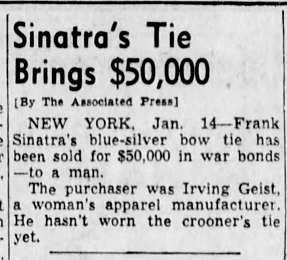
January 15, 1944
Radio
Sound Off
Network: AFRS
1. I Couldn't Sleep A Wink Last Night
Your Hit Parade
Network: CBS
Program #452
Sponsor: Lucky Strike
1. People Will Say We’re In Love - Frank Sinatra
2. Get Happy - Orchestra
3. For The First Time - The Hit Paraders
4. They’re Either Too Young Or Too Old - Joan Edwards
5. I Love Louisa - Orchestra
6. Oh, What A Beautiful Morning! - Frank Sinatra
7. Star Eyes - Joan Edwards
8. Speak Low - Frank Sinatra
9. There'll Be Some Changes Made - Orchestra
10. Paper Doll - The Hit Paraders
11. Shoo-Shoo Baby - Joan Edwards
12. My Heart Tells Me - Frank Sinatra
Your Hit Parade
Network: CBS
Program #452
Sponsor: Lucky Strike
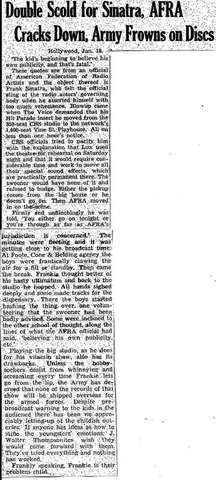
January 19, 1944
Radio
The Frank Sinatra Show
Network: CBS
Show #3
Sponsor: VIMMS Vitamins
Time: 9:00PM - 9:30PM (EST) Wednesday
Orchestra Conducted By: Axel Stordahl
Arrangements By: Axel Stordahl
Announcer: Truman Bradley
Performers: Bert Wheeler, Minerva Pious
Guest: Joan Bennett
Notes: Confirmed aired on WABC
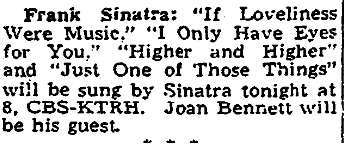
The Frank Sinatra Show
Network: CBS
Show #3
Sponsor: VIMMS Vitamins
Time: 9:00PM - 9:30PM (EST) Wednesday
Orchestra Conducted By: Axel Stordahl
Arrangements By: Axel Stordahl
Announcer: Truman Bradley
Performers: Bert Wheeler, Minerva Pious
Guest: Joan Bennett
note: We have the same similar ad for the three other Vimms shows in
January of 44. Thought it would be nice to have this one, too.
Ed
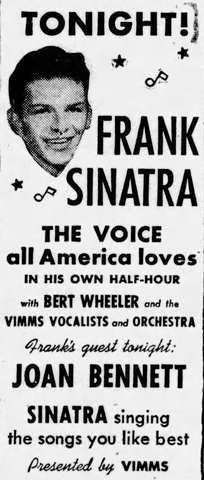
January 22, 1944
Radio
Your Hit Parade
Network: CBS
Program #453
Sponsor: Lucky Strike
1. Paper Doll - Frank Sinatra
2. For The First Time - The Hit Paraders
3. Oh, What A Beautiful Morning! - Joan Edwards
4. Broadway Melody - Orchestra
5. My Shining Hour - Frank Sinatra
6. People Will Say We’re In Love - Joan Edwards
7. Boo Hoo - The Hit Paraders
8. No Love, No Nothin’ - Frank Sinatra
9. My Ideal - The Hit Paraders
10. Shoo-Shoo Baby - Joan Edwards
11. My Heart Tells Me - Frank Sinatra
Notes: According to the Where or When data base, "My Shining Hour" is not from Vimms on 1-12-44 but from YHP of 1-22-44.
"I finally had some time to get back to this. The problem is that I don't have the January 12, 1944 Vimms show. I do have the VDisc set and the YHP of 1-22-44. I was able to take the track from the VDisc set and the one from YHP 1-22-44 and put them into the audio program Audacity. I was able to set one track on the top and one on the bottom and visually the wave forms were identical. When I played them at the same time they matched together as well in speed, length and tempo. If I were to make an educated guess then I'd say that the VDisc set and the YHP of 1-22-44 are the same. Of course, in fairness, I don't have the Vimms show but I can't imagine that orchestrally and vocally the song would be the same from Vimms to YHP.--Scott
Guy Steele has very sophisticated technology for matching up performances. I explained to him what you had done and asked if he would check the V-Disc with the H.P. They are a perfect match. Definitely not the Vimms show. Guy and I have found many inaccuracies with the material issued in the 1940s. We are often at a lost to understand how this happens. Arlen-Mercer wrote "My Shining Hour" for Fred Astaire's RKO film "The Sky's The Limit," released in 1943. The song received an Oscar nomination. But the other song for Fred, "One For My Baby" was not nominated. Frank sang "Shining Hour" on two Vimms and two H.P. shows. I'm sure he would have done more if the song had been a bigger hit. --Ed
Regarding Dean's 1964 engagement at the Sand's& Sinatra on his opening Night. I have been told that every Sinatra engagement at the Sand's was recorded. I know there is a Dean Martin boot CD from the Sand's in 1964. So, is it safe to assume that this performance is on tape somewhere.
On Thu, Jan 22, 2026, 11:01 AM <scott@falseducks.com> wrote:
>
>
>
> *Studio *
>
>
>
>
>
>
> *None Radio 1944 Your Hit Parade *Network: CBS
> Program #453
> Sponsor: Lucky Strike
> 1. Paper Doll - Frank Sinatra
> 2. For The First Time - The Hit Paraders
> 3. Oh, What A Beautiful Morning! - Joan Edwards
> 4. Broadway Melody - Orchestra
> 5. My Shining Hour - Frank Sinatra
> 6. People Will Say We’re In Love - Joan Edwards
> 7. Boo Hoo - The Hit Paraders
> 8. No Love, No Nothin’ - Frank Sinatra
> 9. My Ideal - The Hit Paraders
> 10. Shoo-Shoo Baby - Joan Edwards
> 11. My Heart Tells Me - Frank Sinatra
>
>
>
>
>
>
>
>
>
>
>
>
>
>
>
> *Notes: According to the Where or When data base, "My Shining Hour" is > not from Vimms on 1-12-44 but from YHP of 1-22-44. "I finally had some > time to get back to this. The problem is that I don't have the January 12, > 1944 Vimms show. I do have the VDisc set and the YHP of 1-22-44. I was > able to take the track from the VDisc set and the one from YHP 1-22-44 and > put them into the audio program Audacity. I was able to set one track on > the top and one on the bottom and visually the wave forms were identical. > When I played them at the same time they matched together as well in speed, > length and tempo. If I were to make an educated guess then I'd say that > the VDisc set and the YHP of 1-22-44 are the same. Of course, in fairness, > I don't have the Vimms show but I can't imagine that orchestrally and > vocally the song would be the same from Vimms to YHP.--Scott Guy Steele has > very sophisticated technology for matching up performances. I explained to > him what you had done and asked if he would check the V-Disc with the H.P. > They are a perfect match. Definitely not the Vimms show. Guy and I have > found many inaccuracies with the material issued in the 1940s. We are often > at a lost to understand how this happens. Arlen-Mercer wrote > "My Shining Hour" for Fred Astaire's RKO film "The Sky's The Limit," > released in 1943. The song received an Oscar nomination. But the other song > for Fred, "One For My Baby" was not nominated. Frank sang "Shining Hour" on > two Vimms and two H.P. shows. I'm sure he would have done more if the song > had been a bigger hit. --Ed *
> *1947 Songs By Sinatra (CBS) *Sponsor: Old Gold Cigarettes > Announcer: Marvin Miller
> Orchestra Conducted By: Axel Stordahl
> Performers: Frank Sinatra, The Pied Pipers, Jane Powell > 1. It's A Good Day
> 2. This Is The Night
> 3. When You're Away w/Jane Powell
> 4. The Best Man - Pied Pipers
> 5. Hush-A-Bye Island
> 6. La Golondrina - Jane Powell
> 7. She's Funny That Way
> 8. For Sentimental Reasons w. Pied Pipers
> 9. Put Your Dreams Away
> note: Frank Wilson was the writer for the show
> and Ted Sherdeman directed and produced.
> Show originated from Hollywood. Frank makes
> a joke about Nipper the famous RCA symbol on
> their label.
> --Ed
>
>
>
>
>
>
>
>
>
>
> *Ed O'Brien noted: Among the long list of songs Frank never recorded "I > Love You For Sentimental Reasons" is a real stand out. If he had recorded > the song before the King Cole Trio, I'm convinced it would have been a # 1 > hit for him. The Old Gold effort has him singing the tune with the Pied > Pipers and it has a marvellous romantic sound. *
> *1949 Your Hit Parade (NBC) *Program #711
> Time 9:00-9:30 pm (Rebroadcast: 9:00-9:30 PST)
> Sponsor: Lucky Strike
> 1. Commercial
> 2. Cuanto la Gusta (9) Frank Sinatra and Hit Paraders > 3. Galway Bay(10) Eileen Wilson
> 4. You Were Only Fooling (6) Orchestra
> 5. My Darling, My Darling (4) --Frank Sinatra
> 6. Lavender Blue (5) Hit Paraders
> 7. Commercial
> 8. I Got Rhythm - Orchestra
> 9. Far Away Places (7) Frank Sinatra and Hit Paraders > 10. Until (10) Ziggy Elman & Orchestra
> 11. On A Slow Boat to China (3) Frank Sinatra
> 12. A Little Bird Told Me (2) Eileen Wilson
> 13. Commercial
> 14. Buttons and Bows (1) Frank Sinatra and Hit Paraders >
>
>
>
>
>
>
>
>
>
>
> *Ed O'Brien noted: Frank performed nine of the top ten tunes shown here. > He never did "Lavender Blue." All nine were sung on Hit Parade shows and he > didn't record any of them. He did sing a few in concert including "My > Darling, My Darling" and "Slow Boat To China." He had a lot of fun with the > latter on H.P. shows, doing it in different tempos. There are some good > songs here that Frank passed on. *
> *1954 To Be Perfectly Frank *Network: NBC
> Show: 22
> Time: 8:15 p.m
> Host: Frank Sinatra
> Announcer: Edward King
> 1. I've Got My Love To Keep Me Warm - Frank Sinatra
> 2. Undecided - Ella Fitzgerald
> 3. This Love Of Mine - Tommy Dorsey Orchestra
> 4. From Here To Eternity - Frank Sinatra
>
>
>
>
>
> *Television *
> *1951 Perry Como Show *Network: CBS
> Sponsor: Chesterfield
> Time:
> 1. opening
> 2. Blue Skies - Frank Sinatra
> 3. commercial
> 4. Tennessee Waltz - Fontane Sisters
> 5. Sweet Potato Polka - Patato Bugs & Galina Talva
> 6. commercial
> 7. I Am Loved - Frank Sinatra
> 8. closing
> Note: Sinatra filled in for Perry Como. TT: 15mins.
>
>
>
> *1952 Frank Sinatra Show *Network: CBS
> Location: Studio A, Columbia Square Facility, Hollywood, California > Show: 52(in series), 2-16(in season)
> Tuesday 8:00 P.M.-9:00 P.M.
> Sponsor: sustaining
> Orchestra Conducted By: Axel Stordahl
> Announcer: Bob Lemond
> Producer: David Dare
> Executive Producer: Marlo Lewis
> Guests: George McManus, Beatrice Kay, Buster Keaton, Joe Laurie Jr., The > Bell Sisters, The Heathertones
> 1. Never Before - Frank Sinatra
> 2. When You Were Sweet Sixteen - Frank Sinatra & The Heathertones > 3. Bewitched - Frank Sinatra
> 4. Singin' In The Rain - Frank Sinatra
> 5. There's no Business Like Show Business - Sinatra & J. Laurie Jr. >
> Ed Notes: The Bell Sisters, Cynthia, 16, and
> Kay, 11, were making their TV debut. They
> had a Top 10 with "Bermuda" and performed it on the show.
>
>
>
> *1963 The Dick Powell Theatre *Tuesday Evening
> NBC-TV
> 9:30 p.m - 10:00 p.m.
> Guest Host: Frank Sinatra
> Episode Title: " Everybody Loves Sweeney"
> Writers : Berne Giler, Bill Manoff
> Stars: Mickey Rooney, Joanne Linville, Dennis James, Jack Albertson, Ross > Martin, David White, Mike Mazurki
>
>
>
>
>
>
>
>
> *Ed O'Brien: Dick Powell died on January 2, 1963. His TV series ran > through the remainder of its 1963 schedule with guest hosts. * >
> *Concerts *
> *1941 Frank Dailey's Meadowbrook, Cedar Grove, N.J. (Jan 21 - Feb 16) *Tommy > Dorsey & His Orch.
> Tuesday evening
>
>
>
> *1942 Hollywood Palladium (Dec. 30, 1941 - Feb 23, 1942) *Tommy Dorsey & > Orch.
>
>
>
> *1943 Paramount Theatre, New York City (December 30, 1942 - January 26) *w/Benny > Goodman & Orchestra
>
>
>
>
>
>
>
> *1953 Latin Quarter, Boston, Massachusetts (20-31) 1955 Sydney Stadium, > Sydney, Australia (January 21-22 & January 26-29) The Big Show * >
>
>
> *6pm & 8:45pm shows and Matinees 2:30pm Saturdays (January 22 & 29) * > *1957 Copacabana, New York City (January 10-23) *Staring: Frank Sinatra, > Joey Bishop, The Petticoats, Copa Girls, Ron Beattie, Dori Anne Gray, Bud > Spencer, Kathi Dean Michael Durso and Copacabana Orchestra Frank Marti and > Copa Samba Band
> Staged By: Douglas Coudy
> Music And Lyrics By: Micheal Durso, Mel Mitchell, Marvin Kahn > Orchestrations By: Deac Eberhard
> Jewelry By: Coro
> Colffures By: Larry Matthews
>
>
>
> *1959 Sands, Las Vegas (January 14-27) *Frank Sinatra, Betty Kean & > Lew Parker, Steve Rossi, Texas
> Copa Girls(13)
> Conductor: Nelson Riddle with The Antonio Morelli Orchestra (28) > Bill Miller at the piano
> Show created and staged by Jack Entratter
> Choreography: Bob Gilbert & Renne Stuart
> $3.00 minimum
>
>
>
> *1960 Sands, Las Vegas, Nevada (Jan. 20 - Feb. 16) *Frank, Dean, Sammy, > Joey and Peter.
>
>
>
> *1964 Sands, Las Vegas, Nevada *
>
>
>
>
>
>
>
> *Sinatra appeared with Dean Martin on Martin’s opening night through > January 25th Ken Lane on piano for Martin and Bill Miller on piano for > Sinatra Sinatra songs: I Only Have Eyes For You Tears Out To Dry Talk To Me > Baby Luck Be A Lady Guys and Dolls Medley with Dean * >
> * 1966 Sands, Las Vegas, Nevada (January 5 - February 1) *Count Basie > Orchestra
> Conducted by Quincy Jones
>
>
>
> *1975 Caesars Palace, Las Vegas, Nevada (16-22) *
> *First Show *Woody Herman Orchestra Conducted By: Bill Miller > 1. The Lady Is A Tramp
> 2. Bad, Bad Leroy Brown
> 3. Let Me Try Again
> 4. My Kind Of Town
> 5. medley: Last Night When We Were Young / Violets For Your Furs / > Hereā s That at Rainy Day
> 6. monologue
> 7. Something
> 8. You Are The Sunshine Of My Life
> 9. My Way
> 10. Send In The Clowns
> 11. Iā ve Got You Under My Skin
> Notes: TT TT 45mins.
>
>
> *1975 Caesars Palace, Las Vegas, Nevada (16-22) *
> *Second Show *Woody Herman Orchestra Conducted By: Bill Miller > 1. The Lady Is A Tramp
> 2. Bad, Bad Leroy Brown
> 3. Let Me Try Again
> 4. My Kind Of Town
> 5. medley: Last Night When We Were Young / Violets For Your Furs / > Here’s That Rainy Day
> 6. monologue
> 7. Something
> 8. You Are The Sunshine Of My Life
> 9. My Way
> 10. Send In The Clowns
> 11. I Have Dreamed
> 12. I’ve Got You Under My Skin
> Notes: TT 45mins.
>
>
>
> *1980 Rio Palace, Rio de Janeiro, Brazil *Orchestra conducted by: Vincent > Falcone Jr
> Key Musicians: Al Viola (guitar), Irv Cottler (drums), Gene Cherico > (bass), Charlie Turner (trumpet)
> 1. The Coffee Song
> 2. I've Got The World On A String
> 3. At Long Last Love
> 4. The Lady Is A Tramp
> 5. Someone To Watch Over Me
> 6.. The Best Is Yet To Come
> 7. Bewitched
> 8.. Where Or When
> 9. My Way
> 10. Strangers In The Night
> 11. Let Me Try Again
> 12. I've Got You Under My Skin
> 13.. It Never Entered My Mind
> 14. Something
> 15. Quiet Nights w/Al Viola
> 16. My Kind Of Town
> 17. April In Paris
> 18. New York, New York
>
>
>
>
>
>
>
>
>
> *Ed O'Brien noted: Vinnie Falcone gave me a great deal of information > about Frank's Rio tour 29 years ago. The nightclub performances were a > prelude to the famous Maracana Stadium on 1-26 in front of 175,000 > screaming fans. *
> *1994 Broward Center, FT. Lauderdale, Florida (20-23) *Orchestra > Conducted By: Frank Sinatra, Jr.
> 1. Come Fly With Me
> 2. You Make Me Feel So Young
> 3. Witchcraft
> 4. For Once In My Life
> 5. In The Still Of The Night
> 6. The Lady Is A Tramp
> 7. The House I Live In
> 8. Where Or When
> 9. Strangers In The Night
> 10. Fly Me To The Moon
> 11. Barbara
> 12. Summer Wind
> 13. Embraceable You
> 14. Mack The Knife
> 15. Angel Eyes
> 16. My Way
> 17. New York, New York
> Notes: TT 72mins.
>
> --------------------------------------------------
>
>
>
> *EXTRA: *
> *1951 Perry Como Show *Network: CBS
> Sponsor: Chesterfield
> Time:
> 1. opening
> 2. Blue Skies - Frank Sinatra
> 3. commercial
> 4. Tennessee Waltz - Fontane Sisters
> 5. Sweet Potato Polka - Patato Bugs & Galina Talva
> 6. commercial
> 7. I Am Loved - Frank Sinatra
> 8. closing
> Note: Sinatra filled in for Perry Como. TT: 15mins.
>
>
January 23, 1944
RECREATION HALL
NBC RADIO
SUNDAY NIGHT
8:00 P.M - 8:30 P.M.
Host: Carole Landis
Lud Gluskin Orchestra
Guests : Frank Sinatra,
Jack Benny, Minerva Pious
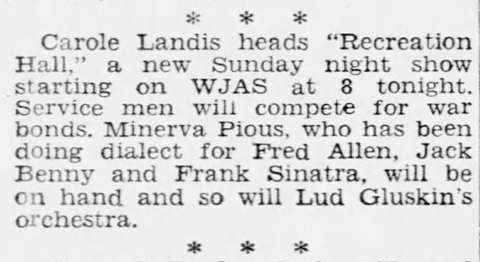
January 26, 1944
Radio
The Frank Sinatra Show
War Bond Benefit - From Shrine Auditorium, Hollywood, California
Network: CBS
Show #4
Sponsor: VIMMS Vitamins
Time: 9:00PM - 9:30PM (EST) Wednesday
Orchestra Conducted By: Axel Stordahl
Arrangements By: Axel Stordahl
Announcer: Truman Bradley
Performers: Bert Wheeler
Guest: Ann Sheridan
1. There'll Be A Hot Time In The Town Of Berlin
Notes: Confirmed aired on WABC. Incomplete recording circulates. running 14.50mins.
note: Earl Ebi was the producer of the first 22 Vimms shows (1-5-44 to 6-14-44 ). Harlow Wilcox was the announcer for the very early shows. Truman Bradley would replace him in early February. John Reed King would replace Bradley on 4-5-44. He would bow out after the 5/10 show and Bradley would finish the first half of the series run. Frank would close with a segment of "Put Your Dreams Away" on most of the broadcasts.
-- Ed
January 29, 1944
Radio
Tourney of the stars
Network: NBC
Time 3:45PM - 4:00PM (EST)
Notes: Golf Tournament. Bing Crosby, Bob Hope, Frank Sinatra, Dorothy Lamour and others gather in the clubhouse.
LOC has10-inch NBC sound reel. 15mins.
[image not recovered — source caption: “XX”]
America Salutes The President's Birthday
Location: Waldorf Astoria , New York City
Pool feed, CBS net aircheck
Sponsor: March Of Dimes fund appeal.
Host: Garry Moore
Narrator: Edward R. Murrow
Guests: Basil O'Connor, Bob Hope, Conrad Nagel, Dan Seymour, Dinah Shore, Eddie Cantor, Frances Langford, Frank Sinatra, Franklin Roosevelt, Georgia Gibbs, Jerry Colonna, Jimmy Durante, Lily Pons, Mary Pickford, Paul Whiteman and His Orchestra, The U.S. Marine Band.
1. Speak Low
Note: The show appears on the officially released CD set: 60 Greaest Old Time Radio Show "Frank Sinatra & Friends" TT: 60mins. Condition: Excellent. Complete.
Tourney of the stars
Network: NBC
Time 3:45PM - 4:00PM (EST)
Notes: Golf Tournament. Bing Crosby, Bob Hope, Frank Sinatra, Dorothy Lamour and others gather in the clubhouse.
[image referenced in source but could not be recovered]
[image referenced in source but could not be recovered]
January 31, 1944
Studio
Monday
4:30 to 8:15PM
STEP LIVELY RKO
(Original title "Manhattan Serenade")
Orchestra conducted by C. Bakaleinikoff
Arrangements by Axel Stordahl
32 piece orchestra
Come Out, Come Out Wherever You Are
As Long As There's Music
There was a rehearsal on 1-13-44 from 1:30 to 3:PM
Frank ran down the tunes with Ted Tillman(drums) and George Hackett(piano)
The two musicians were paid $15.00 each for their efforts.
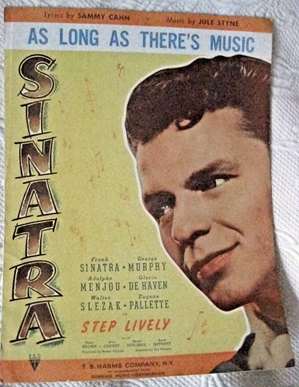
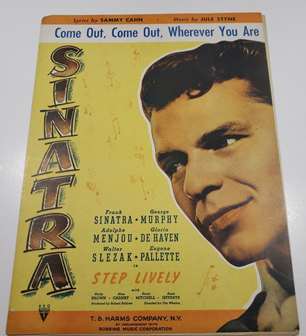
February 1944
[MGM contract negotiations begin]
Kaplan: As Step Lively wrapped, MCA agents Lew Wasserman and Harry Friedman began negotiating with MGM's lawyers, spending the next three months hammering out a five-year, $260,000-per-year contract that let Sinatra make one outside picture a year, do sixteen radio guest spots, retain publishing rights on every other MGM film's music, and enjoy a relaxed morals clause.
Source: James Kaplan, "Frank: The Voice" (2010)
February 1, 1944
Radio
Command Performance
Episode: #104
Taping
Tuesday
Air Date: February 20, 1944
Hostess: Dinah Shore
Guests: Bing Crosby, Frank Sinatra
Produced in Hollywood. Announced by Ken Carpenter. With John Scott Trotter Orchestra, Ticker Freeman, Frank Sinatra, Bing Crosby and Dinah Shore (m.c.)
1. Blues In The
Night
Dinah Shore
2. Speak
Low
Frank Sinatra
3. Candlelight &
Wine
Bing Crosby with John Scott Trotter (Piano)
4. Comedy Routine with Dinah, Frank, and Bing (Sinatra sings a little bit of “All Or Nothing At All”)
5. Medley Parodies: Little Sir Echo (Bing & Frank); This
Is The Guy (Sinatra); Was That The Human
Thing To Do? (Bing); The Last Round-Up (Sinatra); If I Had My Way (Bing);
Pony Boy (Sinatra); Falling In Love Again (Bing); I Wonder What’s Become
Of Crosby the Sinatra of 1909 (Sinatra); It Makes No Difference Now (Bing); I Heard You Cried
Last Night (Sinatra); The Daring Young Man On The Flying Trapeze (Sinatra);
Learn To Croon (Sinatra); Dinah (Bing); Stardust (Sinatra); Sunday, Monday Or
Always (Bing); Deep Purple (Sinatra)
6. People Will Say We’re In Love (Bing & Frank)
Command Performance
Episode: #104
Tuesday
Air Date: February 20, 1944
Hostess: Dinah Shore
Guests: Bing Crosby, Frank Sinatra
No. 104 1st February 1944
Produced in Hollywood. Announced by Ken Carpenter. With John Scott Trotter Orchestra, Ticker Freeman, Frank Sinatra, Bing Crosby and Dinah Shore (m.c.)
Blues In The
Night
Dinah Shore
Speak
Low
Frank Sinatra
Candlelight &
Wine
Bing Crosby with John Scott Trotter (Piano)
Medley
:
(
Little Sir Echo; This Is The Guy; Was That The
Human Bing Crosby, Frank Sinatra & J.S. Trotter
(piano)
Thing To Do?; The Last Round-Up; If I Had My
Way;
Pony Boy; Falling In Love Again; I Wonder What’s
Become
Of Sally; It Makes No Difference Now; I Heard You
Cried
Last Night; The Daring Young Man On The Flying Trapeze; Learn To Croon; Dinah; Stardust; Sunday, Monday Or
Always; Deep Purple
People Will Say We’re In
Love with Frank Sinatra
Titles in italics are by Frank Sinatra only.
Somebody wrote a script for the Bing Crosby - Frank Sinatra radio broadcast last night, but the two singers found the document valuable chiefly as something to deviate from as they rollicked through a 40-minute program and kept a capacity studio audience skittering from chuckles to chortles to forthright guffaws.
Vocalist Dinah Shore made some remark about Sinatra having plenty of backbone to get where he is.
“Sure,” said Bing, “far as I can see, the guy is all backbone” – which he wasn’t supposed to say at all. Then Frankie spoke unkindly about Bing’s stomach, which really isn’t very pronounced, and said he wished he had it full of war bonds, which wasn’t in the script either.
Most of the asides were drowned by studio laughter. But they were picked up by the microphone and will be heard by the troops overseas, for whom the broadcast was staged. It was a “command performance” program at CBS under sponsorship of the Armed Forces Radio Service and was not released for United States consumption.
Press agents had billed the encounter as a baritones’ battle of the century but if it was a fight, both Crosby and Sinatra seemed to have a lot of fun waging it.
Barring an impromptu duet on a local golf course last Sunday, inspired by their success in selling war bonds, it was the first appearance together of these two crooners, who have become close friends in the last few months.
After sparring around a while with Crosby singing excerpts from songs Frankie has popularized and Sinatra reciprocating, they joined in a duet of “People Will Say We’re In Love”.
Frankie who has taken a lot of kidding about his frail-looking physique, enjoyed a joke at his own expense. Maj. Meredith Willson, conducting an army orchestra, suggested that Frank elevate the microphone slightly.
“I’ll do it if I can lift it,” Frank responded, and Bing laughed and laughed.
(James Lindsley, writing in the Hollywood Citizen News, February 2, 1944)
In 1943 and 1944 and 1945, Bing and Frank made more benefit appearances, did more radio shows for soldier and sailor consumption than either has been able to remember or account for. A series of appearances on the most glamorous of the service shows, Command Performance, drew devastating laughter from studio audiences and similar response from the boys for whom they were intended. The fan mail received from camps and bases overseas was understandably heavy and enthusiastic. Take the second anniversary show of Command Performance.
Dinah Shore was mistress of ceremonies. She introduced Frank, seriously, decorously. He sang Speak Low. She introduced Bing with well-weighed words about his importance as a singer and a personality, as an institution. He sang Candlelight and Wine. Then came the talk, fast talk, much of it very funny, all of it beautifully timed by some of the most practiced entertainers in the business, by the three biggest singers of the time.
“You know, Bing,” Dinah said, “a singer like Frank Sinatra comes along only once in a lifetime.”
“Yeah.” Bing responded ruefully with the famous line that has been placed in a hundred other contexts and used several times by Bing himself and that actually originated in this fast ad lib interchange on Command Performance. “Yeah, and he has to come along in my lifetime!”
“No, no, Bing,” Dinah protested. “He’s quite a man, really.”
“I know.”
“He has a lot of backbone,” Dinah continued.
“He’s all backbone,” Bing commented.
“Well, how about your pot tummy, Dad?” Frank asked.
“It’s not so big,” said Bing.
“1’d like to have it full of war bonds,” said Frank.
Then the singers told each other how much each genuinely admired the other’s singing, with serious asides to Dinah to give their fulsome mutual praise conviction. To keep it from becoming maudlin, too lush or gushy, in spite of the honesty of their stated opinions, they launched a duet, singing a big song of the year, a wonderfully apposite song, People Will Say We’re in Love. Everybody in the audience and on the show, including Bing and Frank, broke up.
Followed a skit in Scottish dialect, in which they played Crooner McCrosby and Swooner MacSinatra, each vying for Dinah McShore’s hand. The forced moments and the poor dialect were quickly compensated for by the ensuing battle of songs between the two men. Sinatra sang I Wonder What’s Become of Crosby, the Sinatra of 1909. When Frank sang Stardust, Bing commented wryly, “That’s my song. I introduced it in 1904. It was very big for me in Des Moines.”
The loose, relaxed, informal nature of that show on February 1, 1944, was the proper carry-over from the open golf tournament and bond auction of the day before at Lakeside.
(Barry Ulanov, The Incredible Crosby, pages 226-227)