December 22, 1958
Studio
Capitol Studio A, Hollywood
E30876 Day In, Day Out
(Rube Bloom/Johnny Mercer)
Arranged & Conducted by Billy May
CD: CDP 7-48468-2 Come Dance With Me
LP: SW1069 Come Dance With Me
E30877 Baubles, Bangles And Beads
(Robert Wright/George Forrest)
Arranged & Conducted by Billy May
CD: CDP 7-48468-2 Come Dance With Me
LP: SW1069 Come Dance With Me
E30878 Dancing In The Dark
(Arthur Schwartz/Howard Dietz)
Arranged & Conducted by Billy May
CD: CDP 7-48468-2 Come Dance With Me
LP: SW1069 Come Dance With Me
E30879 Saturday Night (Is The Loneliest Night Of The Week) (Sammy Cahn/Jule Styne)
Arranged by Heinie Beau
Conducted by Billy May
-3 CD: C2-94777 The Capitol Years
CD: CDP 7-48468-2 Come Dance With Me
LP: SW1069 Come Dance With Me
E30880 Cheek To Cheek
(Irving Brlin)
Arranged & Conducted by Billy May
CD: CDP 7-48468-2 Come Dance With Me
LP: SW1069 Come Dance With Me
[Baubles, Bangles, and Beads / I Concentrate on You / Change Partners / The Girl from Ipanema / Dindi -- critical commentary]
Claus Ogerman (quoted) / Friedwald (analysis): Ogerman told Friedwald: 'Frank really liked these strong and famous songs by Jobim and wanted to do an album with them,' and explained that three American standards were added ('Baubles, Bangles, and Beads,' 'I Concentrate on You,' 'Change Partners') because 'At that time there were not enough Jobim songs with good English lyrics... It's very hard to translate Antônio's Portuguese into decent English. Unless you can get it into the hands of a master like Johnny Mercer, you're almost lost.' Ogerman also observed 'the tempos are locked in on the Jobim songs. You can't do them faster or slower' -- unlike Berlin or Porter songs, which can be freely rearranged. Sinatra's liner notes state, 'I haven't sung so soft since I had the laryngitis.' Friedwald calls 'Dindi' so supremely soft 'you almost have to listen twice to be sure that it's actually Sinatra,' and notes Sinatra's playful extra beat on 'I have heard' in 'Baubles, Bangles, and Beads' -- an early instance of his signature 'expanded contractions' device.
This song/context matches multiple dated entries in the chronology; the specific date Friedwald is referring to could not be determined with confidence.
Source: Will Friedwald, "Sinatra! The Song Is You: A Singer's Art" (2018 revised edition), Ch. 9, "Looking for the Hook" (1960-1971)
December 23, 1958
Studio
Capitol Studio A, Hollywood
E30887 Too Close For Comfort
(Back/Holofcener/Weiss)
Arranged by Heinie Beau
Conducted by Billy May
CD: CDP 7-48468-2 Come Dance With Me
LP: SW1069 Come Dance With Me
E30888 I Could Have Danced All Night
( Frederick Loewe/Alan Jay Lerner)
Arranged & Conducted by Billy May
CD: CDP 7-48468-2 Come Dance With Me
LP: SW1069 Come Dance With Me
E30889 Come Dance With Me
(Sammy Cahn/Jimmy Van Heusen)
Maraville Music Corp. (ASCAP)
Arranged & Conducted by Billy May
-10 (2:59) CD: C2-94777 The Capitol Years
CD: CDP 7-48468-2 Come Dance With Me
LP: SW1069 Come Dance With Me
E30890 The Last Dance
(Sammy Cahn/Jimmy Van Heusen)
Arranged by Heinie Beau
Conducted by Billy May
CD: CDP 7-48468-2 Come Dance With Me
LP: SW1069 Come Dance With Me
note: Billy May told me it was a miracle that this album came to be. Frank was making movies and involved in many projects. Billy was in great demand from TV studios plus working with other artists. He told me it just suddenly gelled at the right moment.
And the dates were open for both men. The final session employed an 18 piece orchestra. Amazing the sound
Billy created that night with those men. Album would win Grammies for Album of the Year, Best Male Vocal
Performance and Best Arrangements. I love that the last song recorded for the project, closes out the album.
Ed
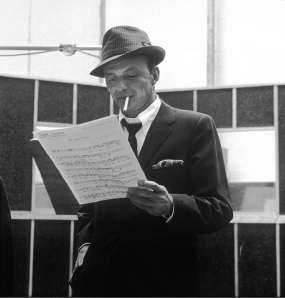
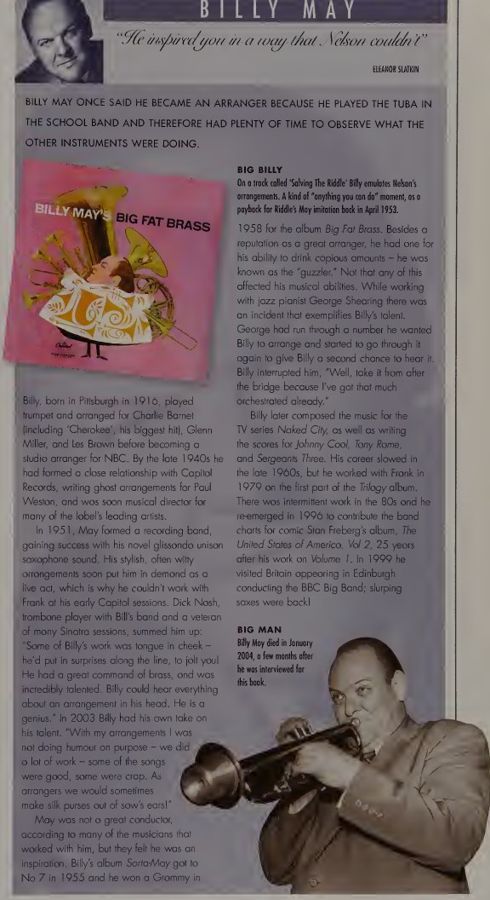
Frank in 1959, during the recording of his Come Dance with Me album at Capitol. Source: photo and caption from J. Randy Taraborrelli, Sinatra: Behind the Legend (mptvimages.com).
"The Last Dance"
Will Friedwald: Cited as an example of Sammy Cahn and Jimmy Van Heusen writing an original closing number tailored to fit an album title Sinatra had devised, deepening the 'concept' of his concept albums.
Source: Will Friedwald, "Sinatra! The Song Is You: A Singer's Art" (2018 revised edition).
"I Could Have Danced All Night"
Granata includes 'I Could Have Danced All Night' among the fifty recordings he considers essential to understanding Sinatra's artistry (arranged by Billy May, recorded 1958, Capitol); the song was chosen for its musical/interpretive value rather than commercial popularity.
Source: Charles L. Granata, "Sessions with Sinatra: Frank Sinatra and the Art of Recording" (1999/2003).
Liner Notes: COME DANCE WITH ME!
After the aching solitude of Only the Lonely, Sinatra swung hard back toward joy with Come Dance with Me!, reuniting with Billy May for a set of pure uptempo big-band swing that would become one of the most commercially and critically successful albums of his career. It won three Grammy Awards at the inaugural ceremony in 1959, including Album of the Year -- the first of Sinatra's records to be so honored.
May's arrangements here are at their most exuberant: brass sections that snap like a whip, tempos pushed right to the edge of the band's control, a rhythmic drive that makes the album's title feel less like marketing than description. "Something's Gotta Give," written for the album by Johnny Mercer, became one of Sinatra's signature uptempo numbers, and "Just in Time" and "Cheek to Cheek" swing with an ease that belies the precision underneath.
Come Dance with Me! is, in some ways, the purest distillation of the May-Sinatra partnership -- less thematically ambitious than Come Fly with Me, but arguably more purely enjoyable, a record built for exactly the activity its title promises.
Written by Claude (Anthropic), commissioned for this chronology, 2026.
[Come Dance with Me -- critical commentary]
Granata's discography entry: Come Dance with Me, arranged by Billy May, released January 1959.
This song/context matches multiple dated entries in the chronology, or lacked a sufficiently precise date; the specific date could not be determined with confidence.
Source: Charles L. Granata, "Sessions with Sinatra: Frank Sinatra and the Art of Recording" (1999/2003), Afterword & Appendices A-D
December 24, 1958
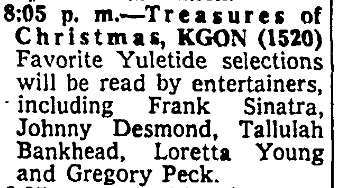
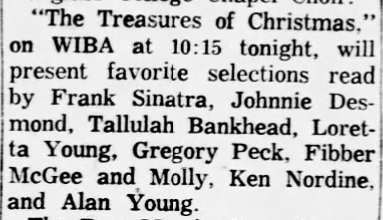
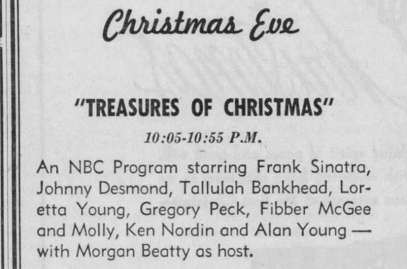
Treasures of Christmas
Yuletide readings by Frank Sinatra, Johnny Desmond,
Tallulah Bankhead, Loretta Young, Gregory Peck and others
© 1997-2024 The Sinatra Archive
This calendar, or any parts thereof, may not be reproduced in any fashion
whatsoever without the prior written permission of the publisher (The
Sinatra Archive)
__._,_.___
December 29, 1958
Studio
Capitol Studio A, Hollywood
E30893 The Moon Was Yellow
(F.E. Ahlert/E. Leslie)
Arranged & Conducted by Nelson Riddle
CD: CDP 724383595228 Sinatra 80th "All The Best"
CD: C2 724383808922 The Complete Capitol Singles
LP: ST1729 Sinatra Sings Of Love And Things
45: 4677
E30894 They Came To Cordura
(S. Cahn/J. Van Heusen)
Arranged & Conducted by Nelson Riddle
CD: C2 724383808922 The Complete Capitol Singles
LP: ST1729 Sinatra Sings Of Love And Things
45: 4284
Sinatraphile Rich Warwick asks if anyone knows if there is some history on why Sinatra recorded this song. He says that he recently saw the movie and it reminded him that the song is not included in the soundtrack nor do the lyrics of the song really match the plot of the movie. He pleads,
"Don't get me wrong. I think it is a good vocal performance by Sinatra, but I'm wondering if Cahn and Van Heusen wrote the song and Sinatra recorded it with the understanding that it would be included in the soundtrack."
Sinatraphile Ed Spiegel says that he wonders the same thing. He recently saw the movie on cable.
He thought it would include the song over the credits or at the end or somewhere. Obviously, he says, I was wrong, but it is an exceptional singing of an unexceptional song.
Sinatra Scholar Ed O'Brien then offers two theories at to why:
(1) It may have been intended for the film, similar to "Man With the Golden Arm," and then not used; and (2) Sammy Cahn and Jimmy Van Heusen were commissioned by the studio to write a title track for the movie. The studio changed their mind and
Frank recorded it, either because he liked it or as a favor or both. Jonathan Schwartz and O'Brien have had an ongoing argument about this song for years. Schwartz considers it one of Sinatra's greatest performances, but O'Brien that the song is second-rate, so the vocal, good or bad, is incidental when a composition offers so little merit.
O'Brien then recalls a list that came out about
25 years ago naming Sinatra's greatest performances. "Rain in My Heart" made it. When
O'Brien interviewed Teddy Randazzo, the opportunity presented itself to get his opinion.
He felt that the vocal was fantastic and told
O'Brien that Sinatra gave it 110%, but that he would never consider it one of his best because it really wasn't his kind of song.
E30895 All My Tomorrows
(J. Van Heusen/S. Cahn)
Arranged & Conducted by Nelson Riddle
CD: CDP 724383595228 Sinatra 80th "All The Best"
CD: C2 724383808922 The Complete Capitol Singles
CD: CDP 7-91150-2 All The Way
LP: SW1538 All The Way
45: 4214
Vance Adair noted:
A lovely song and a lovely vocal. However, I think that the '69 version is better. Costa's arrangement is beautifully conceived and the rather wistful interpretation by FS keeps it just the right side of cynicism.
Scott Henderson added:
I much prefer the 69 version as well but I remember listening to Sid Mark some years ago and he said that Cahn preferred the earlier version.
E30896 French Foreign Legion
(G. Wood/A.. Schroeder)
Barton Music Corp./Rachel's Own Music (ASCAP)
Arranged & Conducted by Nelson Riddle
-5 (2:01) CD: C2 724383808922 The Complete Capitol Singles
CD: C2-94777 The Capitol Years
CD: CDP 7-91150-2 All The Way
LP: SW1538 All The Way
45: 4155
Musicians - Reeds: Gene Cipriano, Harry Klee,
Joseph Kock, Ted Nash, Warren Webb; Trumpets:
Conrad Gozzo, Carroll Lewis, Clarence "Shorty"
Sherock; Trombones: Dale McNickle, Dick Noel,
Tommy Pederson, Jaun Tizol; Bass Trombone: George
Roberts; French Horn: John Cave, Vincent DeRosa;
Violins: Victor Bay, Alex Beller, David Frisina,
James Getzoff, Ben Gill, Murray Kellner, Nathan
Ross, Paul Shure, Felix Slatkin, Marshall Sosson;
Violas: Joseph DiFore, Alvin Dinkin, Paul Robyn;
Cellos: Elizabeth Greenschpoon, Kurt Reher,
Eleanor Slatkin; Piano: Bill Miller; Bass: Bill
Richmond; Guitar: Laurindo Almeida; Drums: Irv
Cottler; Guitar: Tony Rizzi, Al Viola, Laurindo
Almeida (on 30893 & 30894); Harp: Kathryn Julye
Session Producer: Dave Cavanaugh
December 31, 1958
At a private New Year's Eve party at Romanoff's in Beverly Hills, Sinatra invited the Lawfords, seated with him along with Natalie Wood and Robert Wagner, back to his house; when they declined he stormed out. The next morning his valet told a sheepish Lawford what happened after he got home near dawn: Frank had pulled all of the clothes the Lawfords kept in their regular guest room out of the closet, tried unsuccessfully to burn them, and, when the fire wouldn't catch, hurled them into the swimming pool instead. Frank never mentioned the incident again. Source: Michael Sheridan & David Harvey, Sinatra and the Jack Pack.
[New Year's Eve tantrum at Romanoff's]
Peter Lawford: Sinatra had New Year's Eve dinner at Romanoff's with the Lawfords and Robert Wagner and Natalie Wood, and proposed driving to Palm Springs; when the group demurred and Peter Lawford broke the news, Sinatra flew into a rage, smashed his drink on the floor, and stormed out.
Source: James Kaplan, "Sinatra: The Chairman" (2015).
January 1959
[Lansky flees Havana for Miami]
Kaplan: About a week after Castro's takeover, mobster Meyer Lansky flew back to Miami, still hoping Castro would reopen the casinos before it became clear the Mob's Cuban gambling empire was permanently finished -- a loss that ultimately benefited Las Vegas.
Source: James Kaplan, "Sinatra: The Chairman" (2015)
[Sammy Davis's Jack Eigen interview]
Sammy Davis Jr.: On a Friday night in mid-January, after opening at Chicago's Chez Paree, Sammy Davis Jr. gave a loose, drink-fueled interview to radio host Jack Eigen. Asked about Sinatra, Davis said Frank had been 'the kindest man in the world' to him after his car-accident eye loss, but that his bad manners toward people were inexcusable, and -- pressed further -- claimed he, not Sinatra, was the country's number one singer.
Source: James Kaplan, "Sinatra: The Chairman" (2015)
[Sinatra's fury over the Eigen tape]
Kaplan / Milt Ebbins / Peter Lawford: Once Sinatra got hold of a tape of Sammy Davis's Chicago radio remarks, he was enraged -- reportedly calling Davis a slur and cutting him from Never So Few, replacing him with the 28-year-old Steve McQueen. Milt Ebbins recalled Davis crying and unable to get Frank on the phone; Peter Lawford said Frank refused to speak to Sammy for the next two months despite his pleading.
Source: James Kaplan, "Sinatra: The Chairman" (2015)
January 1, 1959
[Sinatra destroys Lawfords' clothes]
George Jacobs: The morning after his New Year's Eve tantrum, Sinatra -- who hadn't gone to bed until 5 a.m. -- took clothes the Lawfords kept in his closet, ripped them to shreds, and threw them in the swimming pool, according to valet George Jacobs.
Source: James Kaplan, "Sinatra: The Chairman" (2015).
[Castro's forces enter Havana]
As 1958 turned to 1959, Fidel Castro's revolutionary forces entered Havana, ending Fulgencio Batista's Mob-friendly government and destroying syndicate-run casinos in hotels like the Capri, Plaza, and Riviera -- including releasing a truckload of pigs into the Riviera's lobby.
Source: James Kaplan, "Sinatra: The Chairman" (2015).
January 2, 1959
Frank conducted the Capitol Records orchestra for Dean Martin's new album Sleep Warm, recorded in an early full-dimensional stereo format.
Source: Nancy Sinatra, Frank Sinatra: An American Legend, 1995.
January 14, 1959
Concerts
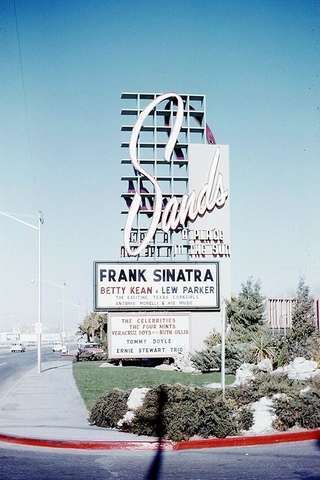
Sands, Las Vegas (January 14-27)
Frank Sinatra, Betty Kean &
Lew Parker, Steve Rossi, Texas
Copa Girls(13)
Conductor: Nelson Riddle with
The Antonio Morelli Orchestra (28)
Bill Miller at the piano
Show created and staged by Jack Entratter
Choreography: Bob Gilbert & Renne
Stuart
$3.00 minimum
Sands, Las Vegas (January 14-27)
Variety
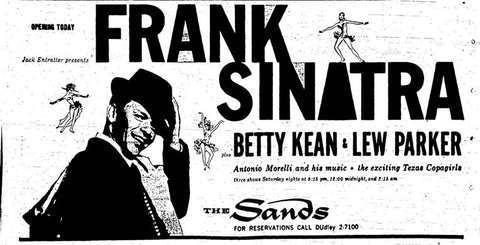
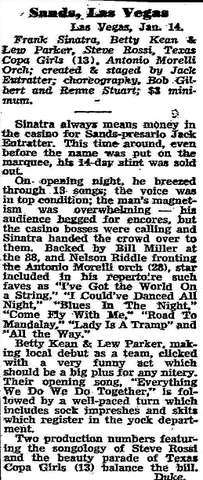
note: Imagine: Sinatra with Riddle
conducting, in 1959, and the minimum
was $3.00
--Ed
January 14, 1992, Desert Inn, Las Vegas, Nevada
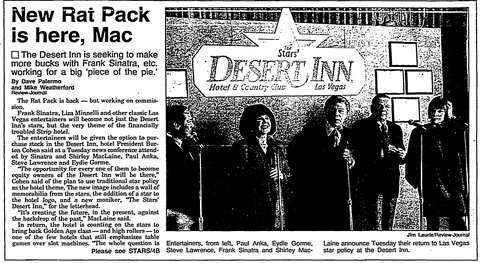
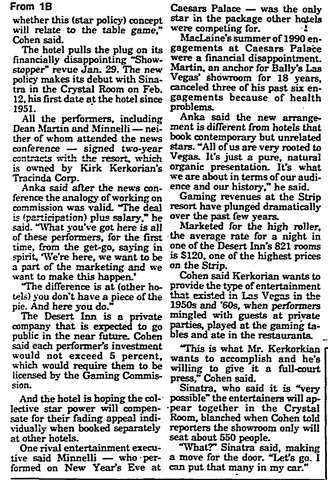
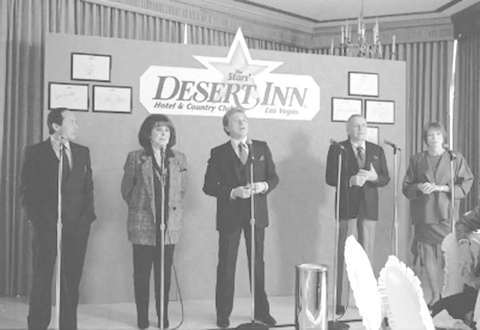
Sinatra, Paul Anka, Shirley MacLaine, Steve & Eydie attend a press conference for the Desert Inn
© 1997-2024 The Sinatra Archive
This calendar, or any parts thereof, may not be reproduced in any fashion
whatsoever without the prior written permission of the publisher (The
Sinatra Archive)
__._,_.___
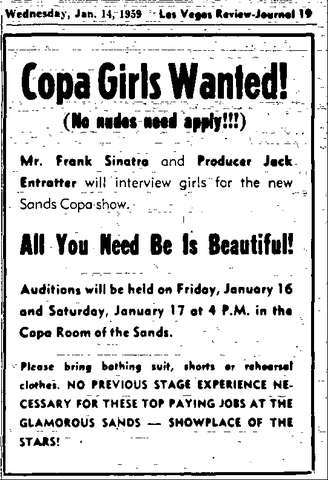
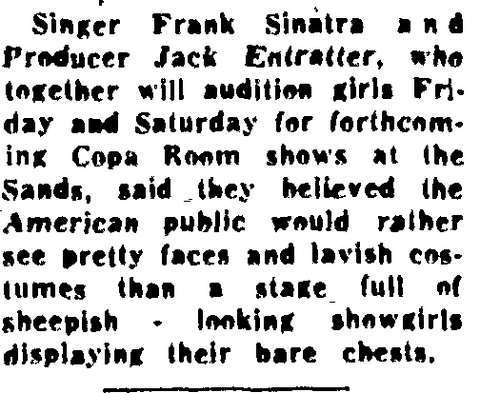
note: Imagine: Sinatra with Riddle
conducting, in 1959, and the minimum
was $3.00
--Ed
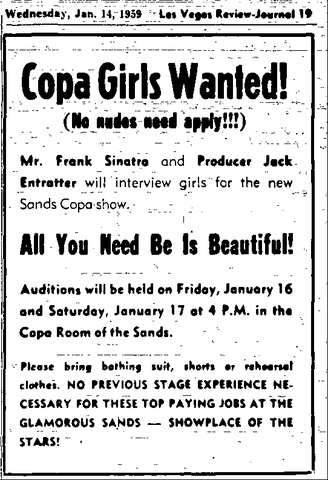
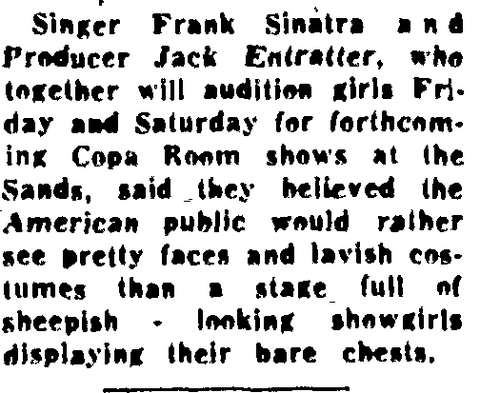
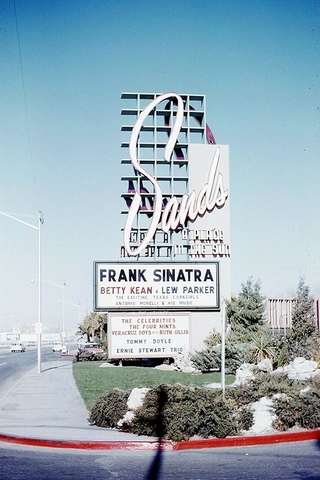
[Sands opening, voice worries]
Frank was set to open at the Sands on January 14, worried again about his fragile voice. Before leaving for Vegas he wired Dean Martin, 'Dear Dago, stand by,' and Dean wired back that he'd stand by, but urged Frank to at least open.
Source: James Kaplan, "Sinatra: The Chairman" (2015).
January 15, 1959
Concerts
Sands, Las Vegas (January 14-27)
Frank Sinatra, Betty Kean &
Lew Parker, Steve Rossi, Texas
Copa Girls(13)
Conductor: Nelson Riddle with
The Antonio Morelli Orchestra (28)
Bill Miller at the piano
Show created and staged by Jack Entratter
Choreography: Bob Gilbert & Renne
Stuart
$3.00 minimum
note: An engagement plagued by the singer's laryngitis.
Dean Martin introduced
Frank opening night. Frank asked
him to be ready to sub at a moment's notice. On 1/20
Frank sent an SOS to
Dean, who caught a plane and
did the midnight show.
Dean had a TV show to tape, so
Louie Prima and Keely
Smith subbed into the weekend.
I read that his vocal problem was on and off during the
two week run. Have no idea just how many shows were
missed.
Opening night Jack Benny and Mary Livingston were
invited to celebrate their 31st wedding anniversary. Benny
was so impressed by
Sinatra's performance, he insisted
on paying as a tribute to his friend. When Sinatra closed
on 1/27, he stayed for
Dean's opening,1/28, and did a
couple of shows with him that week.
Ed
January 16, 1959
Concerts
Sands, Las Vegas (January 14-27)
Frank Sinatra, Betty Kean &
Lew Parker, Steve Rossi, Texas
Copa Girls(13)
Conductor: Nelson Riddle with
The Antonio Morelli Orchestra (28)
Bill Miller at the piano
Show created and staged by Jack Entratter
Choreography: Bob Gilbert & Renne
Stuart
$3.00 minimum
January 17, 1959
Concerts
Sands, Las Vegas (January 14-27)
Frank Sinatra, Betty Kean &
Lew Parker, Steve Rossi, Texas
Copa Girls(13)
Conductor: Nelson Riddle with
The Antonio Morelli Orchestra (28)
Bill Miller at the piano
Show created and staged by Jack Entratter
Choreography: Bob Gilbert & Renne
Stuart
$3.00 minimum
January 18, 1959
Concerts
Sands, Las Vegas (January 14-27)
Frank Sinatra, Betty Kean &
Lew Parker, Steve Rossi, Texas
Copa Girls(13)
Conductor: Nelson Riddle with
The Antonio Morelli Orchestra (28)
Bill Miller at the piano
Show created and staged by Jack Entratter
Choreography: Bob Gilbert & Renne
Stuart
$3.00 minimum
January 19, 1959
Concerts
Sands, Las Vegas (January 14-27)
Frank Sinatra, Betty Kean &
Lew Parker, Steve Rossi, Texas
Copa Girls(13)
Conductor: Nelson Riddle with
The Antonio Morelli Orchestra (28)
Bill Miller at the piano
Show created and staged by Jack Entratter
Choreography: Bob Gilbert & Renne
Stuart
$3.00 minimum
January 20, 1959
Concerts
Sands, Las Vegas (January 14-27)
Frank Sinatra, Betty Kean &
Lew Parker, Steve Rossi, Texas
Copa Girls(13)
Conductor: Nelson Riddle with The Antonio Morelli Orchestra (28)
Bill Miller at the piano
Show created and staged by Jack Entratter
Choreography: Bob Gilbert & Renne Stuart
$3.00 minimum
[Dean Martin's overnight rescue run]
On Tuesday, January 20, a few days into his Sands run, Sinatra's voice gave out and he put in a distress call to Dean Martin, who was dining at his restaurant Dino's. Martin caught the 10:00 p.m. flight to Vegas, did a midnight show for Frank, flew back on the 4:00 a.m. plane, and reported to NBC Burbank at 9:00 a.m. to rehearse for a Phil Harris TV guest spot.
Source: James Kaplan, "Sinatra: The Chairman" (2015).
January 21, 1959
Concerts
Sands, Las Vegas (January 14-27)
Frank Sinatra, Betty Kean &
Lew Parker, Steve Rossi, Texas
Copa Girls(13)
Conductor: Nelson Riddle with The Antonio Morelli Orchestra (28)
Bill Miller at the piano
Show created and staged by Jack Entratter
Choreography: Bob Gilbert & Renne Stuart
$3.00 minimum
January 22, 1959
Concerts
Sands, Las Vegas (January 14-27)
Frank Sinatra, Betty Kean &
Lew Parker, Steve Rossi, Texas
Copa Girls(13)
Conductor: Nelson Riddle with The Antonio Morelli Orchestra (28)
Bill Miller at the piano
Show created and staged by Jack Entratter
Choreography: Bob Gilbert & Renne Stuart
$3.00 minimum
January 23, 1959
Concerts
Sands, Las Vegas (January 14-27)
Frank Sinatra, Betty Kean &
Lew Parker, Steve Rossi, Texas
Copa Girls(13)
Conductor: Nelson Riddle with The Antonio Morelli Orchestra (28)
Bill Miller at the piano
Show created and staged by Jack Entratter
Choreography: Bob Gilbert & Renne Stuart
$3.00 minimum
January 24, 1959
Concerts
Sands, Las Vegas (January 14-27)
Frank Sinatra, Betty Kean &
Lew Parker, Steve Rossi, Texas
Copa Girls(13)
Conductor: Nelson Riddle with The Antonio Morelli Orchestra (28)
Bill Miller at the piano
Show created and staged by Jack Entratter
Choreography: Bob Gilbert & Renne Stuart
$3.00 minimum
January 25, 1959
Concerts
Sands, Las Vegas (January 14-27)
Frank Sinatra, Betty Kean &
Lew Parker, Steve Rossi, Texas
Copa Girls(13)
Conductor: Nelson Riddle with The Antonio Morelli Orchestra (28)
Bill Miller at the piano
Show created and staged by Jack Entratter
Choreography: Bob Gilbert & Renne Stuart
$3.00 minimum
January 26, 1959
Concerts
Sands, Las Vegas (January 14-27)
Frank Sinatra, Betty Kean &
Lew Parker, Steve Rossi, Texas
Copa Girls(13)
Conductor: Nelson Riddle with The Antonio Morelli Orchestra (28)
Bill Miller at the piano
Show created and staged by Jack Entratter
Choreography: Bob Gilbert & Renne Stuart
$3.00 minimum
January 27, 1959
Concerts
Sands, Las Vegas (January 14-27)
Frank Sinatra, Betty Kean &
Lew Parker, Steve Rossi, Texas
Copa Girls(13)
Conductor: Nelson Riddle with The Antonio Morelli Orchestra (28)
Bill Miller at the piano
Show created and staged by Jack Entratter
Choreography: Bob Gilbert & Renne Stuart
$3.00 minimum
January 28, 1959
Concerts
Sands, Las Vegas, Nevada w/Dean
Sands, Las Vegas, Nevada
w/Dean
Variety
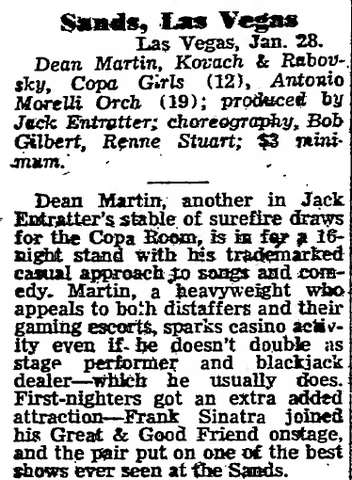
note: Frank called Dean prior to his 1/14
first night of a two-week engagement .
He told Dino that his voice was uncertain
and might need him to sub. Dean told him
he would but urged Frank to at least open.
The first few night's went well but then the
voice gave out. This would remain the
pattern throughout the two week stint. He
called Dean on 1/20 and asked him to do
the midnight show. Dean flew in and subbed
for Frank. Later that morning, Dean rehearsed
a guest spot on an upcoming Phil Harris
show at the NBC Studio in Burbank.
I have Bill Miller's list of Sinatra appearances
at the Sands. It shows Frank there from 1/25
through 1/28. I knew he closed on the 27th
and Dean came in the next day. How could
that be ? I did some checking. Through his
checkered January run, the hotel would have
a waiter walk out on stage holding a sign
announcing :"Sorry, folks, Frank Sinatra
will not appear tonight." That was done
before Martin took the stage on his opening
night. A collective groan passed through the
Copa Room. Then a sanitation worker came
out to clear the area' around the stage. It took
the audience a moment to realize it was Sinatra.
Dean immediately joined him. As you see from
the review, Variety called it "one of the best shows
ever seen at the Sands."
Frank would remain in Vegas until early February,
and he did a few more shows with Mr. Martin.
The Sands ruled in the late '50s and early '60s.
Ed
[Dean Martin's Sands opening prank]
Dean Martin opened his own 16-night Sands stand on January 28. The show began with a waiter carrying the sign the Sands used when Sinatra's voice was out ('Sorry, folks, Frank Sinatra will not appear tonight'); Frank then walked out wearing a Las Vegas Department of Sanitation jacket to a wild reaction, and the two put on one of the best shows the Sands had seen, per Variety.
Source: James Kaplan, "Sinatra: The Chairman" (2015).
January 30, 1959
[Note to Alec Wilder]
Sinatra (letter): From Las Vegas on January 30, Sinatra sent a brief handwritten pencil note on Sands stationery to composer Alec Wilder at New York's Algonquin Hotel, saying he was glad Wilder was well and that things were going well for him too -- he was 'at peace with the universe.'
Source: James Kaplan, "Sinatra: The Chairman" (2015).
February 1959
[Never So Few]
Sammy Davis Jr. (quoted); Santopietro's analysis: The supporting role of Corporal Bill Ringa was originally intended for Sammy Davis Jr. at Sinatra's insistence, meant to include an African-American soldier in the film. Davis was dropped after giving an interview to radio reporter Jack Eigen in February 1959 in which he said, 'Talent is not an excuse for bad manners. I love Frank, but there are many things he does that there are no excuses for... It does not give you the right to step on people and treat them rotten,' and also claimed he was now America's number-one singer. Sinatra had him removed from the film (costing Davis a $75,000 fee) and their friendship cooled temporarily. Davis later gave a different account in his autobiography Hollywood in a Suitcase, claiming the split was over character interpretation -- an explanation Santopietro doubts.
No corresponding dated entry could be identified in the chronology for this film/context.
Source: Tom Santopietro, "Sinatra in Hollywood" (2008), The Peak Years (pt. 3)
February 2, 1959
[Photograph: "The day the music died" falls during Frank's Sands run. From Richard Havers, "Sinatra" (Dorling Kindersley, 2007), p.245.]
While Frank, joined that year by Dean Martin, was mid-way through a Sands engagement, Buddy Holly, Ritchie Valens, and the Big Bopper were killed in a plane crash later immortalized in Don McLean's "American Pie.". (Source: Richard Havers, "Sinatra" (Dorling Kindersley, 2007).)
February 4, 1959
Some Came Running was released; though panned by critics, it drew large audiences, and Shirley MacLaine earned her first Academy Award nomination.
Source: Nancy Sinatra, Frank Sinatra: An American Legend, 1995.
February 9, 1959
Come Dance With Me, Frank's collaboration with Billy May, became the most commercially successful album of his career, spending over two and a half years on the Billboard chart and later winning three Grammys, including Album of the Year. (Source: Richard Havers, "Sinatra" (Dorling Kindersley, 2007).)
February 13, 1959
Studio
Los Angeles
A HOLE IN THE HEAD UNITED ARTISTS
Thursday & Friday
Arranged and conducted by Nelson Riddle
High Hopes w/Eddie Hodges
February 18, 1959
[Walter Chiari's Melbourne stunt upsets Ava]
Hedda Hopper: Columnist Hedda Hopper reported on February 18 that Walter Chiari, whom a lonely Ava Gardner had summoned to Australia, performed to a packed house of Italian emigrants and opened with 'Tenderly,' doing his best Sinatra impression; Ava, in attendance with Gregory Peck, Fred Astaire, and Anthony Perkins, reportedly gasped and fled.
Source: James Kaplan, "Sinatra: The Chairman" (2015).
February 20, 1959
Concerts
Shrine Auditorium, Los Angeles
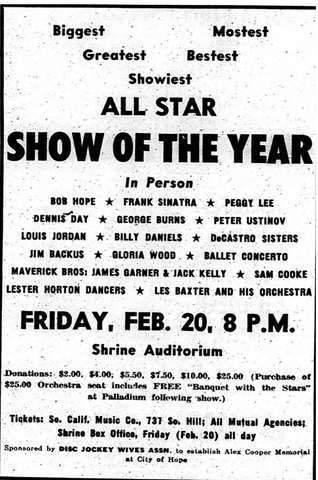
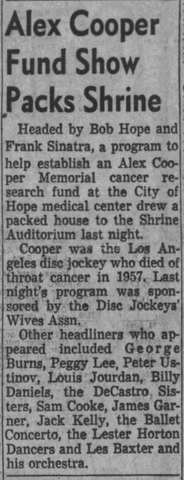
All Star Show Of The Year Benefit for City of Hope Medical Center Sinatra, Bob Hope, Peggy Lee, George Burns, Dennis Day, Peter Ustinov, and others
Shrine Auditorium, Los Angeles
All Star Show Of The Year Benefit for City of Hope Medical Center Sinatra, Bob Hope, Peggy Lee, George Burns, Dennis Day, Peter Ustinov, and others
[Sinatra-Norvo Quintet debut]
Around February 1959, Red Norvo's quintet (by then expanded from the trio Sinatra had first heard at the Sands lounge) spent about a week learning Sinatra's book and working out head arrangements based on his Capitol repertory, as charted by Nelson Riddle and Billy May; rehearsals took place mostly at Sinatra's house, with the star only occasionally joining in since he already knew the charts. This Shrine benefit marked the first time the seven men -- Sinatra, Norvo, Bill Miller, Jerry Dodgion, Jimmy Wyble, Red Wooten, and drummer -- performed together in public. “From now on,” Sinatra announced to the capacity crowd, “in our personal appearances we're going to work together.” The pairing had grown out of Norvo's Sands lounge engagement, which Sinatra (then a Sands Vice President) had booked in 1958, and which he began frequenting because, as Norvo put it, “Frank liked the band -- he listened to jazz all the time. And that's the kind of music he wanted in the lounge.”
Source: Will Friedwald, liner notes to "Frank Sinatra with the Red Norvo Quintet: Live in Australia, 1959" (Blue Note/Capitol CDP 7243 8 37513 2 7, 1997).
Around February 1959, Red Norvo's quintet (by then expanded from the trio Sinatra had first heard at the Sands lounge) spent about a week learning Sinatra's book and working out head arrangements based on his Capitol repertory, as charted by Nelson Riddle and Billy May; rehearsals took place mostly at Sinatra's house, with the star only occasionally joining in since he already knew the charts. This Shrine benefit marked the first time the seven men -- Sinatra, Norvo, Bill Miller, Jerry Dodgion, Jimmy Wyble, Red Wooten, and drummer -- performed together in public. "From now on," Sinatra announced to the capacity crowd, "in our personal appearances we're going to work together." The pairing had grown out of Norvo's Sands lounge engagement, which Sinatra (then a Sands Vice President) had booked in 1958, and which he began frequenting because, as Norvo put it, "Frank liked the band -- he listened to jazz all the time. And that's the kind of music he wanted in the lounge."
February 22, 1959
Television
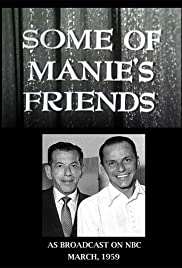
Some Of Manie's Friends (Taping)
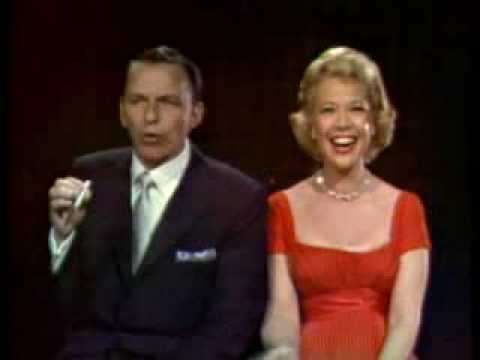
Guests: Frank Sinatra, Dinah Shore, Bob Hope, Nat King Cole.
1. This Love Of Mine
2. Medley w/Dinah Shore
Ed O'Brien:
The show "Some Of Manie's Friends" was taped on 2-22-59 and broadcast on NBC, 3-3-59.
There is an exquisite Sinatra moment. The camera pans in on Frank, on the bandstand, dancing couples in front of him, Riddle conducting the orchestra to Frank's left , and F.S. leans into the mike and starts to sings "This Love Of Mine."
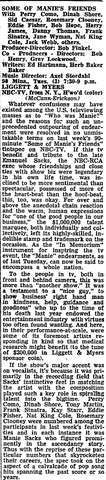
Here is Time's review and profile of Manie Sacks from 3-9-59
In show business, palship never reigns but it pours.
To a very few show folk: Al Jolson, Fanny Brice,
Irving Thalberg, Variety Founder Sime Silverman" has gone an uninterrupted outpouring of vocal, tearful affection. This week a new name was added to the roll of comradely love when a clutch of top entertainers, including Bob Hope, Sid Caesar,
Rosemary Clooney, Perry Como, Dinah Shore, Frank
Sinatra, Jack Webb and Betty Grable, performed at union minimum rates ($265 each) in a 90-minute NBC telecast in honor of the late Manie Sacks. The show's title: Some of Manie's Friends.
Who was Manie Sacks, a man scarcely known outside the trade, to have attracted so much high-powered devotion? Wiry, long-faced Manie (pronounced Manny) was a longtime recording executive for Columbia Records, later a vice president of both NBC and RCA, and he died last year of leukemia at 56. Says RCA Board Chairman
David Sarnoff: "He was the most selfless man I ever knew."
Frank Sinatra credits him with "a closetful of right arms."
Adds Variety Editor Abel Green in a bathetic burst: "His was the unashamed opening of the pores of human kindness."
After starting out in the dress business in Philadelphia, Sacks charged into radio and public relations. As A. & R. man (artists and repertory) beginning in 1940, he coralled Sinatra, Shore, Benny Goodman and Harry James for the
Columbia label. When he left for RCA ten years later, most of his stable followed him loyally. Later, his duties as NBC vice president in charge of TV programing and talent still consisted largely of coddling performers, listening to their troubles and shrewdly guiding their careers.
Legends of Manie's considerateness sprout all over show business. One night, the story goes, Bachelor Manie wanted to get away from a girl who had a yen for him, lied that he had to fly to Detroit. Smitten, the girl offered to ride out to the airport with him. Rather than hurt her feelings, Manie wearily went to La Guardia, boarded a plane and flew to Detroit. A little more than a year ago, goes another story, Comedian Danny Thomas went to him for help with a project to benefit leukemia victims; Manie plunged into the project without letting anyone know that he was dying of the disease himself. This week's TV show, which raised more than $200,000 for leukemia research and other work by the Emanuel Sacks medical foundation, was predictably sentimental, sincere and enthusiastic. Said Singer
Tony Martin of Manie: "He's beginning to sound like the Albert
Schweitzer of show business."
Some Of Manie's Friends (Taping)
Guests: Frank Sinatra, Dinah Shore, Bob Hope, Nat King Cole.
1. This Love Of Mine
2. Medley w/Dinah Shore
© 1997-2026 The Sinatra Archive
This calendar, or any parts thereof, may not be reproduced in any fashion
whatsoever without the prior written permission of the publisher (The
Sinatra Archive)
February 24, 1959
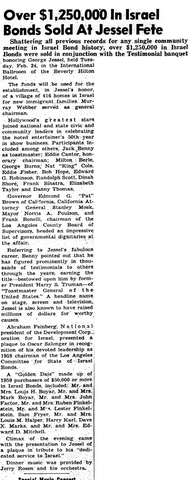
February 24, 1959, Beverly Hilton Hotel, Los Angeles
Testimonial Banquet Honoring George Jessel
February 26, 1959
[Archerd notes rival Miami engagements]
Army Archerd: In his February 26 Variety column, Army Archerd reported that Frank Sinatra was about to open at the Fontainebleau in Miami Beach while Sammy Davis Jr. would be next door at the Eden Roc, and speculated about a possible reconciliation between the two.
Source: James Kaplan, "Sinatra: The Chairman" (2015).
March 1959
[Giancana subpoenaed at the Desert Inn]
Kaplan: At the Desert Inn in March 1959, a process server subpoenaed Sam Giancana -- checked in under the alias 'Sam Flood' -- to appear before Senator John McClellan's Senate Rackets Committee, which had been hunting him for over a year.
Source: James Kaplan, "Sinatra: The Chairman" (2015)
[Sinatra refuses to reconcile with Davis in Miami]
Peter Lawford: Despite Sinatra and Davis both playing Miami hotels simultaneously, Frank still refused to speak to Sammy, per Peter Lawford, even leaving word with the doorman that Davis was barred from his shows -- payback for Davis having embarrassed him in front of Mob figures like the Fischetti brothers and Sam Giancana on Chicago radio.
Source: James Kaplan, "Sinatra: The Chairman" (2015)
[Sinatra's Fontainebleau stand breaks records]
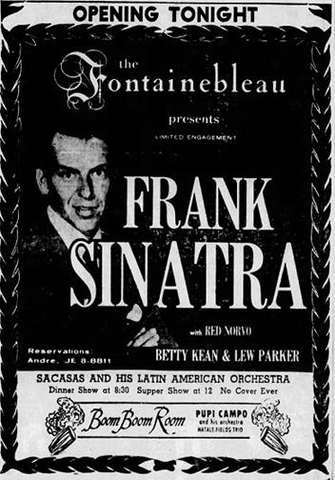
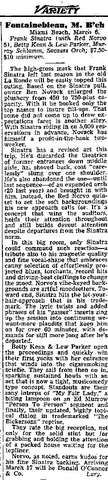
Kaplan / Variety: Sinatra's Fontainebleau engagement, following Judy Garland's soft second week, revived the room to sellout status: five thousand advance reservations, record-breaking first-week grosses over $22,000 a night. He debuted a stripped-down act backed by the Red Norvo Quintet instead of a full orchestra, discarding his old theatrical entrance.
Source: James Kaplan, "Sinatra: The Chairman" (2015)
March 3, 1959
Television
Some Of Manie's Friends
NBC-TV
Tuesday evening
9 to 10:30 PM
Color broadcast
Host: Perry Como
Guests: Frank Sinatra, Dinah Shore, Bob Hope, Nat King Cole,
Jane Wyman, Kay Starr, Tony Martin, Danny Thomas.Rosemary Clooney, Betty Grable, Jack Webb, Eddie Fisher, Harry James --Buttons And Bows - Dinah Shore
--With These Hands - Eddie Fisher
--You Started Something - Rosemary Clooney
--Rock 'n' Roll Waltz / Old Rocking Chair - Kay Starr
--Side By Side - Kay Starr & Jane Wyman + comedy routine --Wish You Were Here - Eddie Fisher
--There's No Tomorrow/Here In This Enchanted Place - Tony Martin --Mona Lisa - Nat King Cole
--Joke monologue - Bob Hope
--By The Sleepy Lagoon - Harry James
--This Love Of Mine - Frank Sinatra
--Frank Sinatra/Dinah Shore Medley :
You Make Me Feel So Young/Them There Eyes/
A Foggy Day/I've Got You Under My Skin/
Taking A Chance On Love/They Can't Take That Away/
From Me/All Of Me/Daddy/ I Can't Give You Anything But
Love,/You Must Have Been A Beautiful Baby ...
--Perry Como No Other Love
Recorded message from Manie
Some Of Manie's Friends" was taped on 2-22-59 and broadcast on NBC, 3-3-59. There is an exquisite Sinatra moment. The camera pans in on Frank, on the bandstand, dancing couples in front of him, Riddle conducting the orchestra to Frank's left, and F.S. leans into the mike and starts to sings "This Love Of Mine."
Here is Time's review and profile of Manie Sacks from 3-9-59 In show business, palship never reigns but it pours.
To a very few show folks: Al Jolson, Fanny Brice,
Irving Thalberg, Variety Founder Sime Silverman has gone an uninterrupted outpouring of vocal, tearful affection. This week a new name was added to the roll of comradely love when a clutch of top entertainers, including Bob Hope, Sid Caesar,
Rosemary Clooney, Perry Como, Dinah Shore, Frank
Sinatra, Jack Webb and Betty Grable, performed at union minimum rates ($265 each) in a 90-minute NBC telecast in honor of the late Manie Sacks. The show's title: Some of Manie's Friends.
Who was Manie Sacks, a man scarcely known outside the trade, to have attracted so much high-powered devotion? Wiry, long-faced Manie (pronounced Manny) was a longtime recording executive for Columbia Records, later a vice president of both NBC and RCA, and he died last year of leukemia at 56. Says RCA Board Chairman
David Sarnoff: "He was the most selfless man I ever knew."
Frank Sinatra credits him with "a closetful of right arms."
Adds Variety Editor Abel Green in a bathetic burst: "His was the unashamed opening of the pores of human kindness."
After starting out in the dress business in Philadelphia, Sacks charged into radio and public relations. As A. & R. man (artists and repertory) beginning in 1940, he coralled Sinatra, Shore, Benny Goodman and Harry James for the
Columbia label. When he left for RCA ten years later, most of his stable followed him loyally. Later, his duties as NBC vice president in charge of TV programing and talent still consisted largely of coddling performers, listening to their troubles and shrewdly guiding their careers.
Legends of Manie's considerateness sprout all over show business. One night, the story goes, Bachelor Manie wanted to get away from a girl who had a yen for him, lied that he had to fly to Detroit. Smitten, the girl offered to ride out to the airport with him. Rather than hurt her feelings, Manie wearily went to La Guardia, boarded a plane and flew to Detroit. A little more than a year ago, goes another story, Comedian Danny Thomas went to him for help with a project to benefit leukemia victims; Manie plunged into the project without letting anyone know that he was dying of the disease himself. This week's TV show, which raised more than $200,000 for leukemia research and other work by the Emanuel Sacks medical foundation, was predictably sentimental, sincere and enthusiastic. Said Singer
Tony Martin of Manie: "He's beginning to sound like the Albert
Schweitzer of show business."
Concerts
Fontainebleau, Miami, FL, (March 3-16)
O.A : Kean & Parker
Red Norvo Quintet: Red Norvo vibraphone, Jerry Dodgion flute & saxaphone
Jimmy Wyble guitar, Red Wooten bass, John Markham drums
Note: There are conflicting dates regarding this engagement. I did some checking and found an article, dated 3-10-59 in Variety, stating that Sinatra broke the all time house record for his first week at the hotel. So, it has to be
3/3 for opening night. There were 5,000 reser- vations to see Frank during his two week run.
The first week he took in $145,000 by drawing
1,600 patrons per night ( 2 shows). Opening night the Fontainbleau took in $22,000. A dinner cost $17.50 and the the price range for the liquor was $5, $7.50 and $10.00.
Judy Garland was in for two weeks prior to Frank. She did ok the first week, but played to less than half-a-house the second week. Frank dearly loved Judy and saw to it that her closing night was SRO with lots of celebs in attendance.
I also found a wonderful story of Frank visiting a hospital for TB patients on 3/16. He insisted it remain a secret. Frank did not want any press attending. I have an article describing the afternoon performance. Will post.
Ed
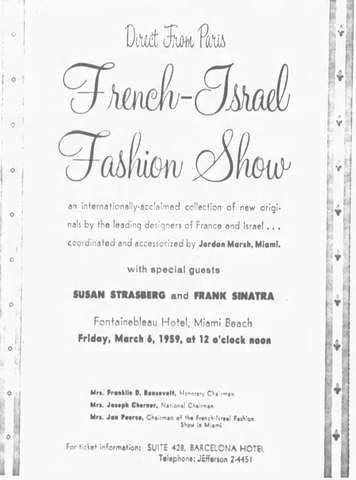
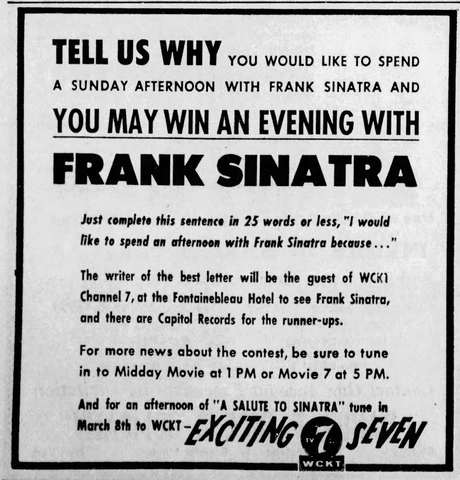
"I found the ad at the bottom that Sinatra started on March 3 and ran until March 16th. Donald O'Connor followed him on the 17th --Scott

Fontainebleau, Miami, FLa, (March 3-16)
The Miami Herald (Miami, Florida) 3 Mar 1959
FONTAINEBLEAU: FRANK SINATRA
BY
HERB KELLY
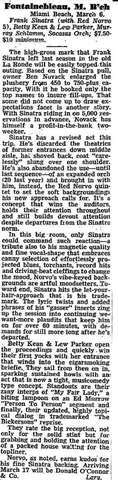
Maybe a professional head shrinker can explain how Frank Sinatra does it.
The Thin Man Dressed in jet black shirt and light pink tie walks onto the Fontainebleau's La Ronde stage. Hydraulic gadgets are set in motion and the platform starts to sink but stops before reaching sea level.
Sinatra lifts the skinny microphone from the stand and sings "I Could Have Danced All Night" in the beat of the blues.
HOLDS CROWD IN SPELL
And for a solid hour, by some mysterious magnetism, he held the audience in a spell.
Opening night crowds in a nightclub usually are impolite and noisy but Sinatra kept the packed room listening attentively and enjoy- ing every minute.
Frank is a subdued singer and has wonder- ful background music to fit the mood. Red Norvo heads a combo of six and keeps the strains soft.
Sinatra does the rest.
The program is made up of his standards like
"Just One Of Those Things," "I've Got You Under
My Skin," "The Lady Is A Tramp" and "Night And
Day." It is like listening to one of his albums.
ABOUT HALF WAY THROUGH he pauses and springs a few light lines. He kidded his movie, "A
Hole In The Head," much of which was filmed on
Miami Beach and probably will be shown privately here next week. He sips from a cup of tea and announces that in the next show " oolong is out of the act and Jack Daniels is in."
His Academy Award winner "All The Way" gets a thrilling treatment and he sings "To Love And Be
Loved," nominated for an Oscar this year. It is from his picture "Some Came Running."
HIS ACT IS A GASSER
Everything about the act is reserved and refined. To coin one of Sinatra's polite expressions, "It's a gasser."
BETTY KEAN AND LEW PARKER OPEN the show with their comedy. Betty puffs a cigar and gushes barrel- house humor. Parker, her husband, gets his share of laughs by playing it straight.
They have a parody on "My Fair Lady" which is a scream and their familiar skit about "the Bickersons," arguing in bed in the middle of the night, is still funny.
The Miami News
Wednesday
March 4, 1959
O.A : Kean & Parker
Red Norvo Quintet:
Red Norvo vibraphone
Jerry Dodgion flute & saxaphone
Jimmy Wyble guitar
Red Wooten bass
John Markham drums
plus Bill Miller on piano note: I interviewed Red in October 1977.
He gave me the background on how his quintet came to back Sinatra throughout
1959. They appeared with him in Australia, the 500 Club, Atlantic City, the Sands, Las
Vegas, Cal-Neva in Lake Tahoe and the Fontainbleau.
The quintet was hired by the Sands in Vegas during the previous year. They entertained in the lounge while Frank and other big stars played the Copa
Room. Often after his show Frank would sit in the lounge and listen to Red and the guys.. One night he suddenly jumped up on the stage. He asked
Red to play "Night and Day." Frank started singing and the lounge was suddenly mobbed with eager listeners. Frank loved working with the quintet and made a number of appearances in the lounge.
After he made the decision to hire them, a set of rehearsals were done at Frank's house in mid-February of 1959. Red told me Frank wasn't home when they arrived. The guys set up their instruments and started running down some of the charts. A few hours went by and Frank made his appearance with a gorgeous blonde on his arm.
They were told there was food in the frig and drinks available. All they had to do was ask Frank's people.
Frank and blonde went upstairs and did not reappear the rest of that day or the next. Finally the singer joined the group and ran down the charts once. There were no problems. He headed back up stairs
Red remembered the guys being in awe of Sinatra and eagerly anticipating the coming dates. Red remembered the Miami date as a sort of working out the kinks. Melbourne was a triumph and then the Sands in late April. The 500 Club in Atlantic City was done in mid July for eight days.. That was the one Red thought was the absolute best gig of the year with the "boy singer." He didn't remember much about Cal-Neva, but very much enjoyed taping the Timex special in December of 59.
When Frank was planning the World Tour in 1962, he wanted Red's Quintet to back him. Red was already committed to other projects and refused to back out of them. He told me Frank was not pleased. There were no further overtures after that incident. Nevertheless, the performances Sinatra did with Red and his gang back in 1959 are still a thrill to hear 54 years down the road Ed
Some Of Manie's Friends
REVIEWS
Top Disk Stars in Sacks Tribute
Liggett & Myers and NBC-TV combined resources Tuesday
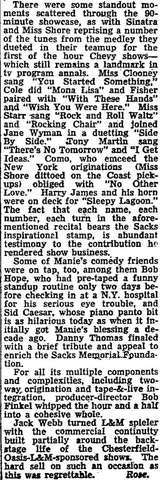
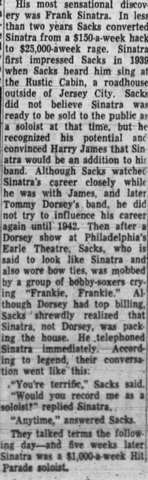
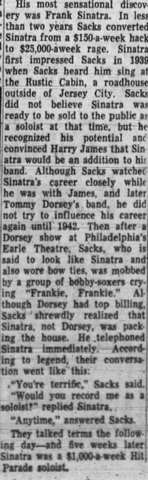
(3) to produce one of the truly outstanding TV outings of the season. Prepared is a tribute to the late Manie Sacks, who surely left his mark on the disk scene, the show was narrated in a loose conversational and highly effective style by Perry Como. Rarely has such a parade of talent been assembled for a single vehicle as that which followed Como's-opening remarks. Dinah Shore moved in to sing one of her great hits, a suggest of Manie Sacks, "Buttons and Bows." Then in a homey living room set complete with fireplace, Miss Shore introduced Eddie Fisher, who offered "With These Hands," another hit engineered by Sacks. Fisher was in the best vocal form he has shown in a consider- able spell. The parade continued with Rosemary Clooney, also in great voice, singing "You Started Something," also referring in a sense to Sacks development of the Clooney talent. Then via tape, Kay Starr did her famous "Rock and Roll Waltz," and then, with Jane Wyman as her second voice, she did another standout Starr hit, "Side by Side." Tony Martin, remarking that "Manie had no former friends," sang his hits "There's No Tomorrow" and "I Get Ideas." Nat Cole, who thanked Sacks again for his faith and help on the Cole TV show offered "Mona Lisa." Harry James then stepped into the batter's box. for a short chorus of "Sleepy Lagoon, followed by the telling of how Sacks found Frank Sinatra singing at the old Rustic Cabin in New Jersey some years back.Then followed one of the real high points of a show - which had many-with Sinatra joining Dinah Shore on a long medley of fine standards in the song-fest manner made famous in an earlier day of TV by Ethel Merman and MaryMartin.
It was an hour and a half of class entertainment by class talent-a seg which brought about in a viewer's mind an inevitable comparison of this group of yesterday's disk stars who are now stars in an even broader sense and the disk artists of today, who more often than not have little performing ability. Sid Caesar and Bob Hope also helped in the tribute to Sacks. Billboard
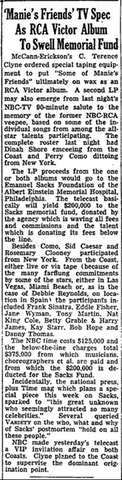
Ren Grevatt note: Variety had an article in the March 4, 59 issue, telling how the show was preserved with special taping equipment for an RCA album release titled "Some Of Manie's Friends." And there were plans for a Vol II.The proceeds would have gone to the Emanuel Sacks Foundation of the Albert Einstein Memorial Hospital in Phila- delphia. The telecast donated $200,000 to the hospital.
note: Variety article 3-4-59
One can only wonder what happened to this project.
--Ed
Variety
3-11-59
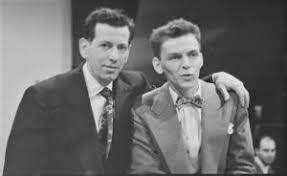
Frank and Manie through the years
. They appeared with him in Australia, the 500 Club, Atlantic City, the Sands, Las
Vegas, Cal-Neva in Lake Tahoe and the Fontainbleau.
The quintet was hired by the Sands in Vegas during the previous year. They entertained in the lounge while Frank and other big stars played the Copa
Room. Often after his show Frank would sit in the lounge and listen to Red and the guys.. One night he suddenly jumped up on the stage. He asked
Red to play "Night and Day." Frank started singing and the lounge was suddenly mobbed with eager listeners. Frank loved working with the quintet and made a number of appearances in the lounge.
After he made the decision to hire them, a set of rehearsals were done at Frank's house in mid-February of 1959. Red told me Frank wasn't home when they arrived. The guys set up their instruments and started running down some of the charts. A few hours went by and Frank made his appearance with a gorgeous blonde on his arm.
They were told there was food in the frig and drinks available. All they had to do was ask Frank's people.
Frank and blonde went upstairs and did not reappear the rest of that day or the next. Finally the singer joined the group and ran down the charts once. There were no problems. He headed back up stairs
Red remembered the guys being in awe of Sinatra and eagerly anticipating the coming dates. Red remembered the Miami date as a sort of working out the kinks. Melbourne was a triumph and then the Sands in late April. The 500 Club in Atlantic City was done in mid July for eight days.. That was the one Red thought was the absolute best gig of the year with the "boy singer." He didn't remember much about Cal-Neva, but very much enjoyed taping the Timex special in December of 59.
When Frank was planning the World Tour in 1962, he wanted Red's Quintet to back him. Red was already committed to other projects and refused to back out of them. He told me Frank was not pleased. There were no further overtures after that incident. Nevertheless, the performances Sinatra did with Red and his gang back in 1959 are still a thrill to hear 54 years down the road Ed
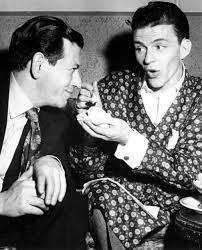
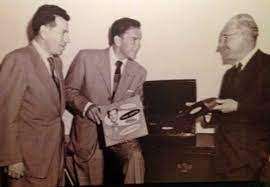
Frank and Manie through the years
March 4, 1959
Concerts
Fontainebleau, Miami, FL (March 3-16)
O.A : Kean & Parker
Red Norvo Quintet: Red Norvo vibraphone, Jerry Dodgion flute & saxaphone
Jimmy Wyble guitar, Red Wooten bass, John Markham drums
Frank was a no-show. In lieu of a check for $5,000 was delivered. A little early in the day for a public appearance.
Ed
On Sunday, March 3, 2024 at 10:48:58 PM EST, Ed O'Brien <dmarc-noreply@freelists.org> wrote:

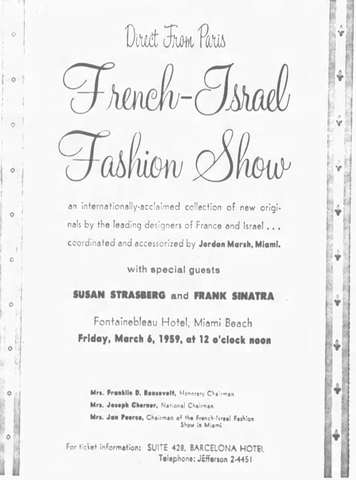

[Archerd on Sinatra-Davis and Ocean's 11 role]
Army Archerd: Army Archerd's March 4 Variety column noted both Sinatra and Davis attended Judy Garland's Fontainebleau finale, but that MGM hadn't heard of any reconciliation, and that Sugar Ray Robinson was rumored to be up for Davis's role in the planned Ocean's 11.
Source: James Kaplan, "Sinatra: The Chairman" (2015).
March 5, 1959
Concerts
Fontainebleau, Miami, FLa, (March 3-16)
O.A : Kean & Parker
Red Norvo Quintet: Red Norvo vibraphone, Jerry Dodgion flute & saxaphone
Jimmy Wyble guitar, Red Wooten bass, John Markham drums
March 6, 1959
Concerts
Fontainebleau, Miami, FLa, (March 3-16)
O.A : Kean & Parker
Red Norvo Quintet: Red Norvo vibraphone, Jerry Dodgion flute & saxaphone
Jimmy Wyble guitar, Red Wooten bass, John Markham drums
Fontainebleau, Miami, FLa, (March 3-16)
note: Frank and Sammy Davis attended
Judy Garland's closing night at the
Fontainbleau, 3/4. They were there to give her moral support. Judy was not able to fill up the 750 seat La Ronde
Room. Variety mentions that Sinatra was overflow for the two-week engage- ment and sometimes did a third show on the weekend. Would loved to have seen Frank with the Norvo Quintet in a club setting. Red told me that every club they played with Frank was filled with excitement every night.
--Ed
March 7, 1959
Concerts
Fontainebleau, Miami, FLa, (March 3-16)
O.A : Kean & Parker
Red Norvo Quintet: Red Norvo vibraphone, Jerry Dodgion flute & saxaphone
Jimmy Wyble guitar, Red Wooten bass, John Markham drums
March 8, 1959
Concerts
Fontainebleau, Miami, FLa, (March 3-16)
O.A : Kean & Parker
Red Norvo Quintet: Red Norvo vibraphone, Jerry Dodgion flute & saxaphone
Jimmy Wyble guitar, Red Wooten bass, John Markham drums
March 9, 1959
Concerts
Fontainebleau, Miami, FLa, (March 3-16)
O.A : Kean & Parker
Red Norvo Quintet: Red Norvo vibraphone, Jerry Dodgion flute & saxaphone
Jimmy Wyble guitar, Red Wooten bass, John Markham drums
March 10, 1959
Concerts
Fontainebleau, Miami, FLa, (March 3-16)
O.A : Kean & Parker
Red Norvo Quintet: Red Norvo vibraphone, Jerry Dodgion flute & saxaphone
Jimmy Wyble guitar, Red Wooten bass, John Markham drums
March 11, 1959
Concerts
Fontainebleau, Miami, FLa, (March 3-16)
O.A : Kean & Parker
Red Norvo Quintet: Red Norvo vibraphone, Jerry Dodgion flute & saxaphone
Jimmy Wyble guitar, Red Wooten bass, John Markham drums
March 12, 1959
Concerts
Fontainebleau, Miami, FLa, (March 3-16)
O.A : Kean & Parker
Red Norvo Quintet: Red Norvo vibraphone, Jerry Dodgion flute & saxaphone
Jimmy Wyble guitar, Red Wooten bass, John Markham drums
March 13, 1959
Concerts
Fontainebleau, Miami, FLa, (March 3-16)
O.A : Kean & Parker
Red Norvo Quintet: Red Norvo vibraphone, Jerry Dodgion flute & saxaphone
Jimmy Wyble guitar, Red Wooten bass, John Markham drums
March 14, 1959
Concerts
Fontainebleau, Miami, FLa, (March 3-16)
O.A : Kean & Parker
Red Norvo Quintet: Red Norvo vibraphone, Jerry Dodgion flute & saxaphone
Jimmy Wyble guitar, Red Wooten bass, John Markham drums
March 15, 1959
Concerts
Fontainebleau, Miami, FLa, (March 3-16)
O.A : Kean & Parker
Red Norvo Quintet: Red Norvo vibraphone, Jerry Dodgion flute & saxaphone
Jimmy Wyble guitar, Red Wooten bass, John Markham drums
March 16, 1959
Concerts
Southeast Florida State Tuberculosis Hospital, Lantana, FL
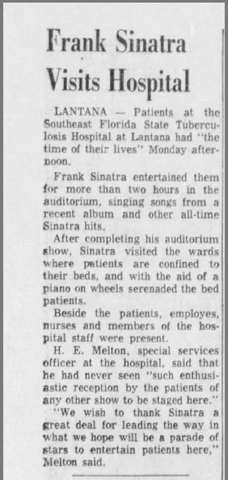
Note: "Frank Sinatra entertained them for more than two hours in the auditorium, singing songs from a recent album and other all-time Sinatra hits. After completing his auditorium show, Sinatra visited the wards where patients are confined to their beds, and with the aid of a piano on wheels serenaded the bed patients." --The Palm Beach Post (West Palm Beach, Florida) March 17, 1959
Fontainebleau, Miami, FLa, (March 3-16)
O.A : Kean & Parker
Red Norvo Quintet: Red Norvo vibraphone, Jerry Dodgion flute & saxaphone
Jimmy Wyble guitar, Red Wooten bass, John Markham drums
Southeast Florida State Tuberculosis Hospital, Lantana, FL The Palm Beach Post (West Palm Beach, Florida) March 17, 1959
The Miami Herald (Miami, Florida) · 18 Mar 1959
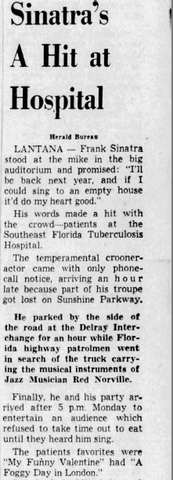
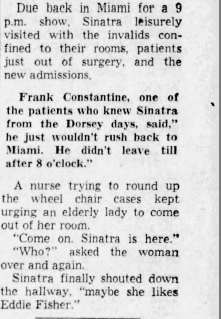
Frank Sinatra became a part of Florida’s musical history when he gave a secret concert at a hospital in Lantana.
By Larry Aydlette The Palm Beach Post
Posted Oct 14, 2019 at 3:20 PM
He was The Chairman. The Voice. A-Number One. King of The Hill.
So when Frank Sinatra arrived in Palm Beach County to give a concert 60 years ago, you’d think it would have been a big, fat, ring-a-ding deal. A lot of hype. Excited fans lining up for tickets.
But hardly anybody knew he was here.
At the time, Francis Albert Sinatra was the most famous singer in the world. And 1959 marked the close of a decade that had seen the release of some of his greatest concept albums -- “In The Wee Small Hours,” “Songs For Swingin’ Lovers,” “Come Fly With Me” and the towering “Frank Sinatra Sings For Only The Lonely.”
He was a major movie star, catnip to the ladies and a personality whose every move was fodder for gossip columnists.
So why did he come here under the radar?
Despite many stories of Mob connections and petty cruelties, Sinatra was just as famous among friends for his private generosities. And his appearance on March 16, 1959 at the Southeast Florida State Tuberculosis Hospital in Lantana definitely fits the profile of the Sinatra who would quietly help those in need.
You couldn’t buy a ticket. He didn’t do any interviews. Sinatra probably wanted it kept hush-hush. And who was going to cross Ol’ Blue Eyes?
The brief story of his appearance -- “Frank Sinatra Visits Hospital” -- was buried the next day in The Palm Beach Post on Page 13, dutifully reported by “Lake Worth News” correspondent Wilbur Royce.. It shared space with less flashy community headlines, such as “Water Pressure Temporarily Low.”
The six-paragraph story said the patients had “the time of their lives” when Sinatra spent more than two hours in the hospital auditorium, “singing songs from a recent album and other all-time Sinatra hits.”
But he didn’t just perform in the auditorium. “Sinatra visited the wards where patients are confined to their beds, and with the aid of a piano on wheels serenaded the bed patients,” the Post reported.
Needless to say, a hospital official said there had never been “such enthusiastic reception” for any show staged at the hospital. “We wish to thank Sinatra a great deal for leading the way in what we hope will be a parade of stars to entertain patients here,” said H.E. Melton, the hospital’s special services officer.
The patients certainly deserved a respite from their isolated suffering. Tuberculosis, primarily a lung disease , was a leading cause of death in the United States from the early 20th century through the 1950s. Sanitariums began popping up across the country, and the 500-bed Lantana hospital had opened only nine years before Sinatra appeared.
Longtime residents probably remember it as the A.G. Holley State Hospital, re-named in 1969 for a state tuberculosis board member. By the 1970s, it was the state’s only TB hospital, down to 150 patients. After numerous attempts to shut it down, the state finally succeeded in 2012, despite the fact that Florida had just experienced its worst TB outbreak in decades.
It’s unknown how Sinatra was recruited for the hospital show. He was a supporter of many charities, including the American Lung Association. And, perhaps most important, he was hanging out just down the road.
A few days before, he began a two-week stint at Miami Beach’s fabled Fontainebleau hotel. He had been a frequent visitor to Miami since the ’40s. He had recently filmed Frank Capra’s “A Hole In The Head” on South Beach, and would make his Tony Rome detective pictures there during the ’60s.
When he opened with the Red Norvo combo on March 3 at the hotel’s 750-seat La Ronde room, UPI reported that several hundred people were turned away. “It was our largest opening night of the season,” a hotel official told the news service.
As always, gossip trailed after him, this time reports of a feud with Sammy Davis, Jr. Sinatra wouldn’t talk about it. He stuck to his singing -- and hits from “Night and Day” to “All The Way.”
To get an idea of what Sinatra Prime must have been like at the Lantana hospital, consider what Herb Kelly of The Miami News said about his Fontainebleau show:
“Maybe a professional head shrinker can explain how Frank Sinatra does it. The thin man dressed in jet black suit, jet black shoes and light pink tie...lifts the skinny microphone from its stand and sings ‘I Could Have Danced All Night’ in the beat of the blues.
“And for a solid hour, by some mysterious magnetism, he held the audience in a spell...Everything about the act is reserved and refined. To coin one of Sinatra’s polite expressions, ‘It’s a gasser.’”
The French singer and film star Maurice Chevalier saw Sinatra’s last show at the Fontainebleau, and was impressed by his talent. But he also glimpsed the other side of Sinatra.
“He can turn on his audience in only a moment, and I must say it, he’s a little frightening when he does this,” Chevalier told the Miami News.
That shadow haunted Sinatra throughout his life and career. Palm Beach County would not get a chance at another Sinatra concert until 1993, when he was 77 and did a four-show run at the Kravis Center. In the September of his years, Sinatra’s vocals weren’t all there. Neither was his memory, but he still had plenty of that mysterious magnetism.
As for the tuberculosis hospital, the wrecking ball started knocking down the old A.G. Holley buildings in 2014. In its place is Lantana’s largest development, a long-gestating, mixed-use complex of retail and apartments known as Water Tower Commons.
Maybe one day, somebody will be walking through one of the complex’s shops and hear a voice -- The Voice, in fact. And a Sinatra song will once again serenade the area just like the man himself did 60 years ago.
This story was based on original reporting in The Palm Beach Post, the Miami News, the Fort Lauderdale News, and stories by Post reporter Jeff Ostrowski and former Palm Beach Post writers Michelle Quigley, Stacey Singer, Lauren Fisher and Charles Passy.
--Thanks to Ed O'Brien for posting the above story.
March 24, 1959
Studio
Capitol Studio A, Hollywood
E31391 A Ghost Of A Chance
(Young/Crosby/ Washington)
Arranged & Conducted by Gordon Jenkins
CD: CDP 7-94519-2 No One Cares
LP: SW1221 No One Cares
E31392 Why Try To Change Me Now?
(C. Coleman/J. McCarthy)
Arranged & Conducted by Gordon Jenkins
CDP 7-94519-2 No One Cares
LP: SW1221 No One Cares
E31393 None But The Lonely Heart
(Tschaikowsky)
Arranged & Conducted by Gordon Jenkins
CD: CDP 7-94519-2 No One Cares
LP: SW12221 No One Cares
E31394 Stormy Weather
(Harold Arlen/Ted Koehler)
Arranged & Conducted by Gordon Jenkins
CD: CDP 7-945519-2 No One Cares
LP: SW1221 No One Cares
Capitol Studio A, Hollywood
E31391 A Ghost Of A Chance
E31392 Why Try To Change Me Now?
E31393 None But The Lonely Heart
E31394 Stormy Weather note: For years there was an argument concerning the identity of the man behind Sinatra's right shoulder. Many people insisted it was Nelson Riddle. I was convinced it was not and went to the trouble of asking Riddle. Later on I learned it was the photographer Ed Thrasher. He took hundreds of shots of Sinatra during Reprise sessions. Scott Sayers and I obtained a terrific photo from him for "Sinatra Sessions" in 1980. We were quite surprised when it also became the cover photo on "She Shot Me Down." When "Sinatra: A Man & His Music" was ready for publication, in 1992, we attempted to purchase more photos from Ed. He turned us down because there was a coffee table book in the works of his Sinatra photos. It never happened. Wish it had. Ed was married to Linda Grey. A friend was doing liner notes for a Sinatra album at Reprise. Thrasher came in to take some candid shots of Frank. Linda was with him. All of the men in the studio were simply in awe of her incredible beauty. In the film "The Graduate," the famous scene of Bancroft's legs was misleading. Grey's legs were shown.
Ed
Gene Lees
High Fidelity
"Stormy Weather"
Friedwald calls the Sinatra-Stordahl "Stormy Weather" a beautiful miscalculation: its upbeat, major-key optimism (Harold Arlen's melody re-harmonized brightly by Stordahl) nullifies the song's blues foundation -- 'could be called Sunny Weather.' Sinatra performed the chart only once more, on a 1947 V-Disc, introducing it as 'a song that tells of the blues.' Only trumpeter Yank Lawson's muted solo captures genuine blue mood. Sinatra's later 1959 version with Gordon Jenkins (on No One Cares) is judged far more convincing at reaching darker colors.
Source: Will Friedwald, "Sinatra! The Song Is You: A Singer's Art" (2018 revised edition).
[First No One Cares session]
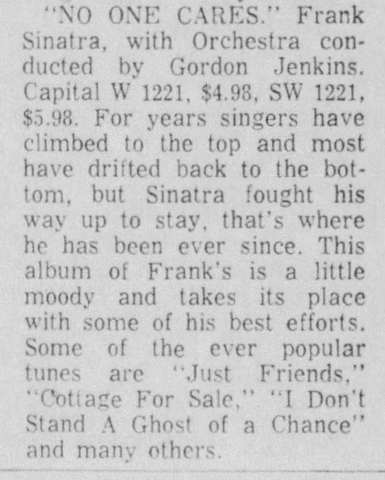
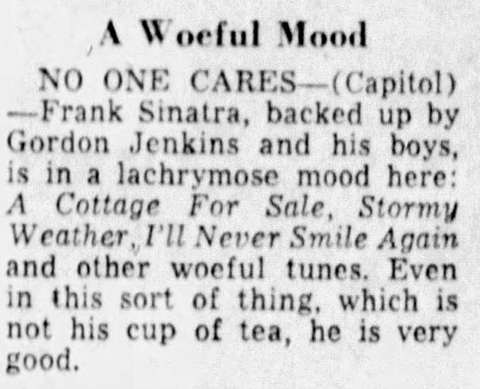
On the night of March 24, Sinatra joined arranger Gordon Jenkins and a 37-piece orchestra in Capitol Studio A to begin the album that became known as the 'Suicide Album,' No One Cares, recording 'I Don't Stand a Ghost of a Chance with You,' 'Why Try to Change Me Now?,' 'None but the Lonely Heart,' and 'Stormy Weather.'
Source: James Kaplan, "Sinatra: The Chairman" (2015).
March 25, 1959
Studio
Capitol Studio A, Hollywood
E31420 The One I Love (Belongs To Somebody Else)
(I. Jones/G. Kahn)
Bantam Music Publishing Co./Gus Kahn Music Company (ASCAP) Arranged & Conducted by Gordon Jenkins
-5 (3:03) CD: CDP 7-94519-2 (alt. take)
CD: C2-94777 The Capitol Years (alt. take)
LP: SYS5637 Sinatra Like Never Before
E31421 Here's That Rainy Day
(J. Burke/J. Van Heusen)
Bourne Co./Music Sales Corp. (ASCAP)
Arranged & Conducted by Gordon Jenkins
-21 (4:19) CD: CDP 7-94519-2 No One Cares
CD: C2-94777 The Capitol Years (unedited)
LP: SW1221 No One Cares
Capitol Studio A, Hollywood
E31420 The One I Love (Belongs To Somebody Else)
E31421 Here's That Rainy Day
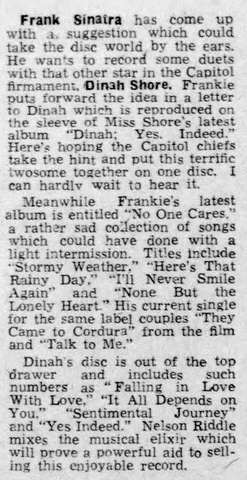
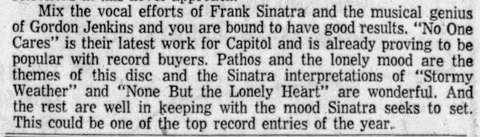
[Here's That Rainy Day -- critical commentary]
Granata includes 'Here's That Rainy Day' among the fifty recordings he considers essential to understanding Sinatra's artistry (arranged by Gordon Jenkins, recorded 1959, Capitol); the song was chosen for its musical/interpretive value rather than commercial popularity.
This song/context matches multiple dated entries in the chronology, or lacked a sufficiently precise date; the specific date could not be determined with confidence.
Source: Charles L. Granata, "Sessions with Sinatra: Frank Sinatra and the Art of Recording" (1999/2003), Afterword & Appendices A-D
March 26, 1959
Studio
Capitol Studio A, Hollywood
E31424 I Can't Get Started
(Vernon Duke/Ira Gershwin)
Arranged & Conducted by Gordon Jenkins
CD: CDP 7-94519-2 No One Cares
LP: SW1221 No One Cares
E31425 Where Do You Go?
(A. Wilder/A. Sundgaar)
Arranged & Conducted by Gordon Jenkins
CD: CDP 7-94519-2 No One Cares
LP: SW1221 No One Cares
E31426 A Cottage For Sale
(W. Robinson/L. Conley)
Arranged & Conducted by Gordon Jenkins
CD: CDP 7-94519-2 No One Cares
LP: SW1221 No One Cares
E31427 Just Friends
(J. Klenner/S. Lewis)
Arranged & Conducted by Gordon Jenkins
CD: CDP 7-94519-2 No One Cares
LP: SW1221 No One Cares
8-30-59
note: Riddle told me Capitol called him in to fix the Jenkins
chart on " Smile Again." They promised him a credit
for his efforts. They did not keep their word. Riddle was
not pleased but he put in one of his signature moments
while working on the arrangement.
Capitol Studio A, Hollywood
E31424 I Can't Get Started
E31425 Where Do You Go?
E31426 A Cottage For Sale
E31427 Just Friends
REVIEW
FRANK SINATRA
NO ONE CARES Capitol W1221
Personnel: Sinatra, vocals; Gordon
Jenkins, arranger-conductor
RATING ****
Nothing demonstrates the problem of assigning a specific "rating" to a work of art (be it major or minor art) as clearly as this record.
By the standards set by most other singers, this is a five or even six star record. By Sinatra's own standards, it is below par, and worth perhaps four stars. Gordon Jenkins' arrange- ments, which are routine and uninter- esting compared with those of Nelson
Riddle, further muddy the thinking.
Therefore, four stars is strictly an approximation.
There are some new tunes in this album, all of which tie into the theme of uncared for solitude that has marked several Sinatra albums of the last couple of years and lead one to wonder if he isn't in a poor-little- me frame of mind on a rather permanent basis. (Listening to
Sinatra and speculating "about" Sinatra are virtually inseparable processes.)
The performance is below Sinatra's par because there is a labored, studied sound in much of the singing, and an overclear articulation, which lead one to wonder whether he was (a) working too hard or
(b) miked too closely because of lack of power at the time this material was taped.
Mind you, to spot these defects, you have to be a member in good standing of the
Society for the Open-Mouthed Admiration of Frank Sinatra -- a loose-knit organization whose members comprise most jazz musicians, most music critics, and all singers; the pass- word is "Ye-e-ah, baby," and the motto is a low-throated "You ain't gonna get no better than that."
Perhaps the best track in the album is "Why
Try and Change Me Now ?," which is among the least-known of Sinatra classics. It was originally recorded for Columbia in the period when Sinatra's career was deteriorating badly. This recording of the Cy Coleman-Joseph A. McCarthy gem is no better than the original: but then, the original was pretty hard to cut, and this track alone makes
"No One Cares" well worth having.
G.Lees
Stereo Review
-------------------------------------------
© 1997-2026 The Sinatra Archive
This calendar, or any parts thereof, may not be reproduced in any fashion whatsoever without the prior written permission of the publisher (The Sinatra Archive)
Version 5.3
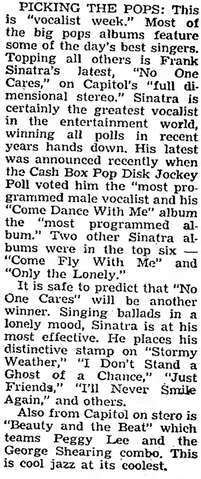
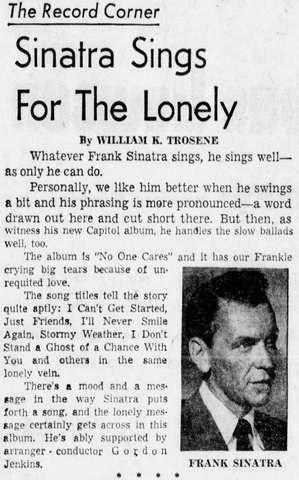
[I Can't Get Started -- critical commentary]
Will Friedwald: Friedwald recalls attending this 1984 concert (opening act Buddy Rich) and Sinatra dedicating his performance of 'I Can't Get Started' to Bunny Berigan, an old friend from the Tommy Dorsey band days -- part of Friedwald's broader point that Sinatra's music continually collapsed the distance between the past and the present moment.
This song/context matches multiple dated entries in the chronology; the specific date Friedwald is referring to could not be determined with confidence.
Source: Will Friedwald, "Sinatra! The Song Is You: A Singer's Art" (2018 revised edition), Ch. 1, "Night and Day" (Sinatra style overview)
[I Can't Get Started -- critical commentary]
Julie Wilson: When comedian Phil Silvers's partner Rags Ragland died suddenly about two weeks before their September 1946 Copacabana opening, Sinatra secretly flew from an MGM shoot to New York to surprise Silvers and serve as his stooge on opening night. Julie Wilson, then a Copa chorus singer, recalled being pulled into a trio performance: 'And Frank said, "C'mon Julie, we're going to do a song together, the three of us." It was Phil Silvers, Frank, and I was the girl singer. I still remember the song... "I've flown around the world in a plane... I can't get started with you."'
This song/context matches multiple dated entries in the chronology; the specific date Friedwald is referring to could not be determined with confidence.
Source: Will Friedwald, "Sinatra! The Song Is You: A Singer's Art" (2018 revised edition), Ch. 10, "Concert Years" (1973-1994)
March 31, 1959
Concerts
West Melbourne Stadium, Australia
(March 31st & April 1st - 2 Shows Each Night) w/Red Norvo
First Show
Key Musicians: Red Norvo (vibraphone) , Jerry Dodgion (flute, alto sax), Bill Miller (piano), Jimmy Wyble (guitar), Red Wooten (bass), John Markham (drums)
1. Norvo Track
2. Devil And The Deep Blue Sea: Red Norvo
3. I Could Have Danced All Night
4. Just One Of Those Things
5. I Get A Kick Out Of You
6. At Long Last Love
7. Willow Weep For Me
8. I've Got You Under My Skin
9. Moonlight In Vermont
10. The Lady Is A Tramp
11. One For My Baby
12. Come Fly With Me
13. All The Way
14. Dancing In The Dark
15. All Of Me
16. On The Road To Mandalay
17. Night And Day
Notes: Local orchestra added on tracks 15-17. TT: 57mins.
West Melbourne Stadium, Australia w/Red Norvo
Second Show
Key Musicians: Red Norvo (vibraphone) , Jerry Dodgion (flute, alto sax), Bill Miller (piano), Jimmy Wyble (guitar), Red Wooten (bass), John Markham (drums)
1. I Could Have Danced All Night
2. Just One Of Those Things
3. I Get A Kick Out Of You
4. At Long Last Love
5. Willow Weep For Me
6. I've Got You Under My Skin
7. Moonlight In Vermont
8. The Lady Is A Tramp
9. Monologue
10. One For My Baby
11. Come Fly With Me
12. All The Way
13. Dancing In The Dark
14. All Of Me
15. On The Road To Mandalay
16. Night And Day
Notes: This show is often mistaken for April 1, 1959. There were two shows March 31, 1959. This is the second show. Local orchestra added on tracks 14-16. TT: 60mins.
Ed O'Brien:
Sinatra with the Red Norvo Quintet and Bill Miller on piano. What a marriage. Among the hundreds of performances that circulate among collectors, Melbourne 59 has to rank very near the top. Frank is in splendid form throughout; the jazz charts compliment the voice perfectly, and the song selection is the best of the best Sinatra. This was a Sinatra the record buyer was unfamiliar with back then. A few days before Frank's trip Down Under, he had laid down 10 tracks at Capitol with Gordon Jenkins. The recordings were done with a 36 piece orchestra, 3-24-25, 26, for the "No One Cares" album. Red Norvo told me Capitol never considered either a live album or a studio set with his quintet. More's the pity. What a marvelous concept that would have been back then. I played the second show for Red in October of 1977. He had never heard a tape of the performances done Red was stunned by the singing he heard. When I asked him why Sinatra didn't let the public at large hear this side of his singing, Red was at a loss to explain it. He had heard that Sinatra felt more secure with the big orchestral backing , but it made no sense to Red. Frank and the quintet had worked the Fontainbleau, the Sands and the 500 Club, plus Australia and few other places along the way. According to him, Frank always sounded great with his group. Today we have these treasures available and probably take them for granted. There was a time when very few people were aware of the jazzier, lose singer who did some marvelous onstage work with a very small, but more than adequate orchestra backing him.
I wish someone would release the Melbourne shows in a proper manner. The Blue Note offering is really second-rate fidelity in comparison to the sound available from that night 55 years ago. A grave injustice has been perpetrated on the ears of so many avid Sinatraphiles. It is time for a truly awesome issue of these per- formances.
Sinatra would perform two shows in Melbourne on March 31st and two shows on April 1st at 6:15 & 8:45 pm. The brilliant satirist Stan Freberg was also on the bill. Sinatra would then perform at the Sydney Auditorium, Sydney, Australia April 2 (6:15 & 8:45), April 3 (6:15 & 8:45) and April 4 (2:30, 6:15, & 8:45) --Scott
The second show of 3/31 was discovered in a radio station around 1973. The quality was pristine and on a reel tape. The first show surfaced about a year later. It was found on another reel at the station. Quality is very good but not as perfect as the second show. Nothing ever surfaced from the second night. A friend knew Stan Freberg, who was Frank's opening act. Stan remembered the show and one particular incident very well. The Australian press was brutal and the photographers kept popping flash bulbs right near Frank's face. Freberg was set to go on when one of them came back stage with his camera at the ready. Stan was doing his act when he heard quite a bit of noise backstage. Frank came running on the stage as Stan was going off. He had a wicked smile on his face. Backstage the photographer was on the floor, camera smashed and the film destroyed. Red Norvo told me the press was simply brutal to Frank. They wanted to create an incident for the front page. Red felt Frank showed great self control considering the way the press goaded him. --Ed
West Melbourne Stadium, Australia
(March 31st & April 1st - 2 Shows Each Night) w/Red Norvo
First Show
Key Musicians: Red Norvo (vibraphone) , Jerry Dodgion (flute, alto sax), Bill Miller (piano), Jimmy Wyble (guitar), Red Wooten (bass), John Markham (drums)
West Melbourne Stadium, Australia
(March 31st & April 1st - 2 Shows Each Night)
The Age (Melbourne, Victoria, Australia) 1 Apr 1959, Wed
[image referenced in source but could not be recovered]
[image referenced in source but could not be recovered]
[image referenced in source but could not be recovered]
[Sinatra arrives in Sydney]
Frank, the Norvo Quintet, Bill Miller, and manager/bodyguard Hank Sanicola landed in Sydney on March 31, generating huge press attention -- both because of a soured earlier Australian tour attempt in 1957 and because of his reunion with Ava Gardner.
Source: James Kaplan, "Sinatra: The Chairman" (2015).
April 1, 1959
Concerts
West Melbourne Stadium, Australia
(2 Shows: 6:15 & 8:45) w/Red Norvo
Key Musicians: Red Norvo (vibraphone) , Jerry Dodgion (flute, alto sax), Bill Miller (piano), Jimmy Wyble (guitar), Red Wooten (bass), John Markham (drums)
[Legendary West Melbourne Stadium concert]
Kaplan / Red Norvo: On April 1 at West Melbourne Stadium, with Ava in the front row, Sinatra gave one of the greatest and strangest concerts of his life, backed by just Bill Miller and the Red Norvo Quintet. During 'I've Got You Under My Skin' he ad-libbed 'Get your hand off that broad!' at a screaming fan; Red Norvo later said he'd never heard Frank sing better.
Source: James Kaplan, "Sinatra: The Chairman" (2015).
[Chaos and reunion after the Melbourne show]
Kaplan / Lee Server: After the concert, Sinatra clashed furiously with pursuing photographers ('Take another picture and I'll ram that camera down your throat'), then rode with Ava in a high-speed limousine chase back to his hotel. That night, Sinatra and Gardner reunited romantically; they left Australia separately within days and would not see each other again for over a year.
Source: James Kaplan, "Sinatra: The Chairman" (2015).
April 2, 1959
Concerts
Sydney Auditorium, Sydney, Australia
April 2 (6:15 & 8:45), April 3 (6:15 & 8:45) and April 4 (2:30, 6:15, & 8:45)
Sydney Auditorium, Sydney, Australia
April 2 (6:15 & 8:45), April 3 (6:15 & 8:45) and April 4 (2:30, 6:15, & 8:45)
---------------------------------------------
© 1997-2026 The Sinatra Archive
This calendar, or any parts thereof, may not be reproduced in any fashion whatsoever without the prior written permission of the publisher (The Sinatra Archive)
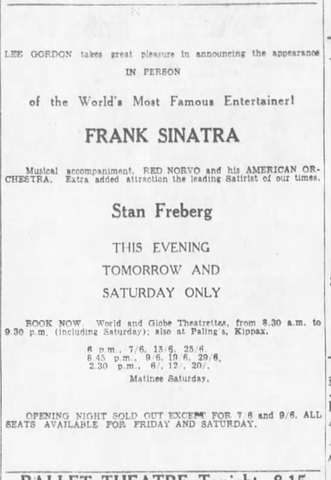
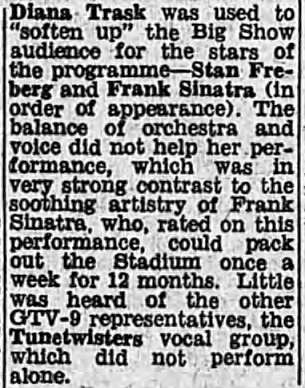
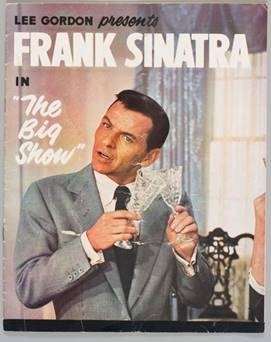
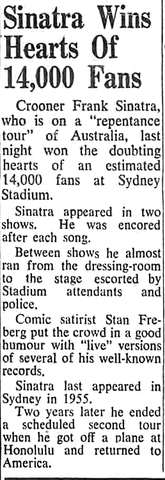
April 3, 1959
Concerts
Sydney Auditorium, Sydney, Australia
April 2 (6:15 & 8:45), April 3 (6:15 & 8:45) and April 4 (2:30, 6:15, & 8:45)
Sydney Auditorium, Sydney, Australia
The Sydney Morning Herald (Sydney, New South Wales, Australia) · 3 Apr 1959
--------------------------------------------
1986 Pacific Coliseum, Vancouver, British Columbia
Orchestra Conducted By: Bill Miller with Red Buttons
© 1997-2026 The Sinatra Archive
This calendar, or any parts thereof, may not be reproduced in any fashion whatsoever without the prior written permission of the publisher (The Sinatra Archive)
[image referenced in source but could not be recovered]
[image referenced in source but could not be recovered]
[image referenced in source but could not be recovered]
[image referenced in source but could not be recovered]
[image referenced in source but could not be recovered]
April 4, 1959
Concerts
Sydney Auditorium, Sydney, Australia
April 2 (6:15 & 8:45), April 3 (6:15 & 8:45) and April 4 (2:30, 6:15, & 8:45)
April 13, 1959
Concerts
Beverly Hilton Hotel, Los Angeles, CA
Dodgers "Kickoff" Banquet
Frank Sinatra, Dinah Shore, Art Linkletter
Beverly Hilton Hotel, Los Angeles, CA
Dodgers "Kickoff" Banquet
Frank Sinatra, Dinah Shore, Art Linkletter
A couple of nice pics from the event. Note Red Norvo in the background:
[image referenced in source but could not be recovered]
[image referenced in source but could not be recovered]
[image referenced in source but could not be recovered]
[image referenced in source but could not be recovered]
[image referenced in source but could not be recovered]
April 15, 1959
Concerts
Sands, Las Vegas, Nevada (April 15-28)
O.A. Joan Swift & Harry Nofal ( vocalists ) with The Copa Girls (11 ) choreography: Renne Stuart
Buddy Lester stand-up comic
Red Norvo Quintet featuring Red on vibraphone
Jerry Dodgion, flute , alto sax
Jimmy Wyble, guitar
Red Wooten, bass
John Markham, drums
17 piece orchestra conducted by Antonio Morelli plus Bill Miller on piano
$3.00 minimum
Song List:
1. I Could Have Danced All Night
2. Just One Of Those Things
3. I Get A Kick Out Of You
4. Come Dance With Me
5. Moonlight In Vermont
6. I've Got You Under My Skin
7. The Lady Is A Tramp monologue
8. Angel Eyes
9. Come Fly With Me
10. Day In, Day Out
11. On The Road To Mandalay
12. All Of Me
13. Night And Day alternates during the engagement:
All The Way
One For My Baby
Willow Weep For Me
At Long Last Love
Dancing In The Dark
Sands, Las Vegas, Nevada (April 15-28)
a Variety review of the sands 4-22-59
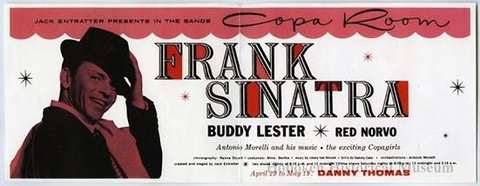
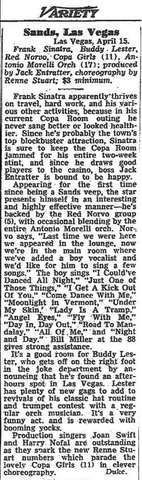
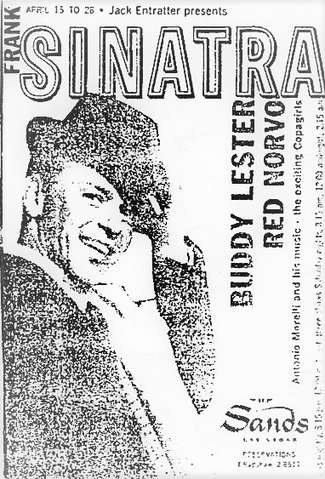
April 16, 1959
Concerts
Sands, Las Vegas, Nevada (April 15-28)
O.A. Joan Swift & Harry Nofal ( vocalists ) with The Copa Girls (11 ) choreography: Renne Stuart
Buddy Lester stand-up comic
Red Norvo Quintet featuring Red on vibraphone
Jerry Dodgion, flute , alto sax
Jimmy Wyble, guitar
Red Wooten, bass
John Markham, drums
17 piece orchestra conducted by Antonio Morelli plus Bill Miller on piano
$3.00 minimum
Song List:
1. I Could Have Danced All Night
2. Just One Of Those Things
3. I Get A Kick Out Of You
4. Come Dance With Me
5. Moonlight In Vermont
6. I've Got You Under My Skin
7. The Lady Is A Tramp monologue
8. Angel Eyes
9. Come Fly With Me
10. Day In, Day Out
11. On The Road To Mandalay
12. All Of Me
13. Night And Day alternates during the engagement:
All The Way
One For My Baby
Willow Weep For Me
At Long Last Love
Dancing In The Dark
April 17, 1959
Concerts
Sands, Las Vegas, Nevada (April 15-28)
O.A. Joan Swift & Harry Nofal ( vocalists ) with The Copa Girls (11 ) choreography: Renne Stuart
Buddy Lester stand-up comic
Red Norvo Quintet featuring Red on vibraphone
Jerry Dodgion, flute , alto sax
Jimmy Wyble, guitar
Red Wooten, bass
John Markham, drums
17 piece orchestra conducted by Antonio Morelli plus Bill Miller on piano
$3.00 minimum
Song List:
1. I Could Have Danced All Night
2. Just One Of Those Things
3. I Get A Kick Out Of You
4. Come Dance With Me
5. Moonlight In Vermont
6. I've Got You Under My Skin
7. The Lady Is A Tramp monologue
8. Angel Eyes
9. Come Fly With Me
10. Day In, Day Out
11. On The Road To Mandalay
12. All Of Me
13. Night And Day alternates during the engagement:
All The Way
One For My Baby
Willow Weep For Me
At Long Last Love
Dancing In The Dark
April 18, 1959
Concerts
Sands, Las Vegas, Nevada (April 15-28)
O.A. Joan Swift & Harry Nofal ( vocalists ) with The Copa Girls (11 ) choreography: Renne Stuart
Buddy Lester stand-up comic
Red Norvo Quintet featuring Red on vibraphone
Jerry Dodgion, flute , alto sax
Jimmy Wyble, guitar
Red Wooten, bass
John Markham, drums
17 piece orchestra conducted by Antonio Morelli plus Bill Miller on piano
$3.00 minimum
Song List:
1. I Could Have Danced All Night
2. Just One Of Those Things
3. I Get A Kick Out Of You
4. Come Dance With Me
5. Moonlight In Vermont
6. I've Got You Under My Skin
7. The Lady Is A Tramp monologue
8. Angel Eyes
9. Come Fly With Me
10. Day In, Day Out
11. On The Road To Mandalay
12. All Of Me
13. Night And Day alternates during the engagement:
All The Way
One For My Baby
Willow Weep For Me
At Long Last Love
Dancing In The Dark
April 19, 1959
Concerts
Sands, Las Vegas, Nevada (April 15-28)
O.A. Joan Swift & Harry Nofal ( vocalists ) with The Copa Girls (11 ) choreography: Renne Stuart
Buddy Lester stand-up comic
Red Norvo Quintet featuring Red on vibraphone
Jerry Dodgion, flute , alto sax
Jimmy Wyble, guitar
Red Wooten, bass
John Markham, drums
17 piece orchestra conducted by Antonio Morelli plus Bill Miller on piano
$3.00 minimum
Song List:
1. I Could Have Danced All Night
2. Just One Of Those Things
3. I Get A Kick Out Of You
4. Come Dance With Me
5. Moonlight In Vermont
6. I've Got You Under My Skin
7. The Lady Is A Tramp monologue
8. Angel Eyes
9. Come Fly With Me
10. Day In, Day Out
11. On The Road To Mandalay
12. All Of Me
13. Night And Day alternates during the engagement:
All The Way
One For My Baby
Willow Weep For Me
At Long Last Love
Dancing In The Dark
April 20, 1959
Concerts
Sands, Las Vegas, Nevada (April 15-28)
O.A. Joan Swift & Harry Nofal ( vocalists ) with The Copa Girls (11 ) choreography: Renne Stuart
Buddy Lester stand-up comic
Red Norvo Quintet featuring Red on vibraphone
Jerry Dodgion, flute , alto sax
Jimmy Wyble, guitar
Red Wooten, bass
John Markham, drums
17 piece orchestra conducted by Antonio Morelli plus Bill Miller on piano
$3.00 minimum
Song List:
1. I Could Have Danced All Night
2. Just One Of Those Things
3. I Get A Kick Out Of You
4. Come Dance With Me
5. Moonlight In Vermont
6. I've Got You Under My Skin
7. The Lady Is A Tramp monologue
8. Angel Eyes
9. Come Fly With Me
10. Day In, Day Out
11. On The Road To Mandalay
12. All Of Me
13. Night And Day alternates during the engagement:
All The Way
One For My Baby
Willow Weep For Me
At Long Last Love
Dancing In The Dark
The top-10 album Look to Your Heart was released, a compilation of earlier recordings.
Source: Nancy Sinatra, Frank Sinatra: An American Legend, 1995.
April 21, 1959
Concerts
Sands, Las Vegas, Nevada (April 15-28)
O.A. Joan Swift & Harry Nofal ( vocalists ) with The Copa Girls (11 ) choreography: Renne Stuart
Buddy Lester stand-up comic
Red Norvo Quintet featuring Red on vibraphone
Jerry Dodgion, flute , alto sax
Jimmy Wyble, guitar
Red Wooten, bass
John Markham, drums
17 piece orchestra conducted by Antonio Morelli plus Bill Miller on piano
$3.00 minimum
Song List:
1. I Could Have Danced All Night
2. Just One Of Those Things
3. I Get A Kick Out Of You
4. Come Dance With Me
5. Moonlight In Vermont
6. I've Got You Under My Skin
7. The Lady Is A Tramp monologue
8. Angel Eyes
9. Come Fly With Me
10. Day In, Day Out
11. On The Road To Mandalay
12. All Of Me
13. Night And Day alternates during the engagement:
All The Way
One For My Baby
Willow Weep For Me
At Long Last Love
Dancing In The Dark
April 22, 1959
Concerts
Sands, Las Vegas, Nevada (April 15-28)
O.A. Joan Swift & Harry Nofal ( vocalists ) with The Copa Girls (11 ) choreography: Renne Stuart
Buddy Lester stand-up comic
Red Norvo Quintet featuring Red on vibraphone
Jerry Dodgion, flute , alto sax
Jimmy Wyble, guitar
Red Wooten, bass
John Markham, drums
17 piece orchestra conducted by Antonio Morelli plus Bill Miller on piano
$3.00 minimum
Song List:
1. I Could Have Danced All Night
2. Just One Of Those Things
3. I Get A Kick Out Of You
4. Come Dance With Me
5. Moonlight In Vermont
6. I've Got You Under My Skin
7. The Lady Is A Tramp monologue
8. Angel Eyes
9. Come Fly With Me
10. Day In, Day Out
11. On The Road To Mandalay
12. All Of Me
13. Night And Day alternates during the engagement:
All The Way
One For My Baby
Willow Weep For Me
At Long Last Love
Dancing In The Dark
April 23, 1959
Concerts
Sands, Las Vegas, Nevada (April 15-28)
O.A. Joan Swift & Harry Nofal ( vocalists ) with The Copa Girls (11 ) choreography: Renne Stuart
Buddy Lester stand-up comic
Red Norvo Quintet featuring Red on vibraphone
Jerry Dodgion, flute , alto sax
Jimmy Wyble, guitar
Red Wooten, bass
John Markham, drums
17 piece orchestra conducted by Antonio Morelli plus Bill Miller on piano
$3.00 minimum
Song List:
1. I Could Have Danced All Night
2. Just One Of Those Things
3. I Get A Kick Out Of You
4. Come Dance With Me
5. Moonlight In Vermont
6. I've Got You Under My Skin
7. The Lady Is A Tramp monologue
8. Angel Eyes
9. Come Fly With Me
10. Day In, Day Out
11. On The Road To Mandalay
12. All Of Me
13. Night And Day alternates during the engagement:
All The Way
One For My Baby
Willow Weep For Me
At Long Last Love
Dancing In The Dark
April 24, 1959
Concerts
Sands, Las Vegas, Nevada (April 15-28)
O.A. Joan Swift & Harry Nofal ( vocalists ) with The Copa Girls (11 ) choreography: Renne Stuart
Buddy Lester stand-up comic
Red Norvo Quintet featuring Red on vibraphone
Jerry Dodgion, flute , alto sax
Jimmy Wyble, guitar
Red Wooten, bass
John Markham, drums
17 piece orchestra conducted by Antonio Morelli plus Bill Miller on piano
$3.00 minimum
Song List:
1. I Could Have Danced All Night
2. Just One Of Those Things
3. I Get A Kick Out Of You
4. Come Dance With Me
5. Moonlight In Vermont
6. I've Got You Under My Skin
7. The Lady Is A Tramp monologue
8. Angel Eyes
9. Come Fly With Me
10. Day In, Day Out
11. On The Road To Mandalay
12. All Of Me
13. Night And Day alternates during the engagement:
All The Way
One For My Baby
Willow Weep For Me
At Long Last Love
Dancing In The Dark
April 25, 1959
Concerts
Sands, Las Vegas, Nevada (April 15-28)
O.A. Joan Swift & Harry Nofal ( vocalists ) with The Copa Girls (11 ) choreography: Renne Stuart
Buddy Lester stand-up comic
Red Norvo Quintet featuring Red on vibraphone
Jerry Dodgion, flute , alto sax
Jimmy Wyble, guitar
Red Wooten, bass
John Markham, drums
17 piece orchestra conducted by Antonio Morelli plus Bill Miller on piano
$3.00 minimum
Song List:
1. I Could Have Danced All Night
2. Just One Of Those Things
3. I Get A Kick Out Of You
4. Come Dance With Me
5. Moonlight In Vermont
6. I've Got You Under My Skin
7. The Lady Is A Tramp monologue
8. Angel Eyes
9. Come Fly With Me
10. Day In, Day Out
11. On The Road To Mandalay
12. All Of Me
13. Night And Day alternates during the engagement:
All The Way
One For My Baby
Willow Weep For Me
At Long Last Love
Dancing In The Dark
April 26, 1959
Concerts
Sands, Las Vegas, Nevada (April 15-28)
O.A. Joan Swift & Harry Nofal ( vocalists ) with The Copa Girls (11 ) choreography: Renne Stuart
Buddy Lester stand-up comic
Red Norvo Quintet featuring Red on vibraphone
Jerry Dodgion, flute , alto sax
Jimmy Wyble, guitar
Red Wooten, bass
John Markham, drums
17 piece orchestra conducted by Antonio Morelli plus Bill Miller on piano
$3.00 minimum
April 27, 1959
Concerts
Sands, Las Vegas, Nevada (April 15-28)
O.A. Joan Swift & Harry Nofal ( vocalists ) with The Copa Girls (11 ) choreography: Renne Stuart
Buddy Lester stand-up comic
Red Norvo Quintet featuring Red on vibraphone
Jerry Dodgion, flute , alto sax
Jimmy Wyble, guitar
Red Wooten, bass
John Markham, drums
17 piece orchestra conducted by Antonio Morelli plus Bill Miller on piano
$3.00 minimum
April 28, 1959
Concerts
Sands, Las Vegas, Nevada (April 15-28)
O.A. Joan Swift & Harry Nofal ( vocalists ) with The Copa Girls (11 ) choreography: Renne Stuart
Buddy Lester stand-up comic
Red Norvo Quintet featuring Red on vibraphone
Jerry Dodgion, flute , alto sax
Jimmy Wyble, guitar
Red Wooten, bass
John Markham, drums
17 piece orchestra conducted by Antonio Morelli plus Bill Miller on piano
$3.00 minimum
May 1959
Following the racially motivated murder of Kelso Cochrane in London, Sinatra wrote an article titled “You Can't Hate and be Happy” for What the Stars Say, a publication of the Stars Campaign for Inter-Racial Friendship. Source: Wikipedia, “Frank Sinatra.”
[JFK becomes presumptive Democratic nominee]
Kaplan: By May 1959, Patricia Kennedy Lawford's brother Jack Kennedy had become the presumptive Democratic candidate for the presidency.
Source: James Kaplan, "Sinatra: The Chairman" (2015)
[SHARE Boomtown show and the Sinatra-Davis reconciliation]
Kaplan / Vernon Scott: At the SHARE Boomtown charity show at the Hollywood Moulin Rouge one night in May 1959, with Frank and Dean Martin emceeing, Sinatra publicly embraced Sammy Davis Jr. onstage as Davis performed 'Birth of the Blues,' ending their feud. Frank and Dean also sang duets and a comic Sammy Cahn parody referencing Frank's new Italian restaurant, Puccini, on South Beverly Drive.
Source: James Kaplan, "Sinatra: The Chairman" (2015)
[Sinatra walks out on Capitol]
Kaplan: After Capitol chief Glenn Wallichs rejected Sinatra's demand that his Essex Productions become a Capitol sub-label with expenses covered by Capitol and profits split fifty-fifty, Frank walked out and refused to record further until he got his way.
Source: James Kaplan, "Sinatra: The Chairman" (2015)
May 4, 1959
Grand Ballroom of the Beverly Hilton, Beverly Hills, CA In the beginning, there was heaven and earth and the 1st Annual GRAMMY AwardsÂmore or less in that order. On May 4, 1959, many of music’s eliteÂincluding Frank Sinatra, Sammy Davis Jr., Dean Martin, Gene Autry, Johnny Mercer, Henry Mancini and André PrevinÂgathered for a black-tie dinner and awards presentation inside the Grand Ballroom of the Beverly Hilton. At the same time, other new Academy members were gathering at a function held simultaneously in New York City. “The GRAMMY Awards were a formal event from the beginning and very much in keeping with the times,†says Christine Farnon, who was instrumental in organizing the first show and would go on to become The Academy’s Executive Vice President. “As I recall, no one objected to dressing black-tie back then, though like so much else, that would change eventually.†But this GRAMMY night, and several to follow, was held in hotel ballrooms on both coasts. The Los Angeles event was emceed by popular political comedian Mort Sahl and featured a musical sketch titled “How South Was My Pacific.†The night was by numerous accounts a significant success. BillboardÂthen actually still called The BillboardÂran its account of the first night of Music’s Biggest Night with a headline declaring that “Academy Smoothly Moves Into Orbit: First Awards Well-Organized Affair As Top Stars Go On Parade.†The trade magazine even favorably compared the GRAMMY’s debut to the far more established Oscars and Emmys: “It sharply contrasted similar affairs staged by the two older entertainment academies in its precision-like pace in handling the presentations.†As well organized as the night may have been, from the very start at the GRAMMYs, there would be surprises on GRAMMY night. While Sinatra led all nominees with a grand total of six nominations, he would not turn out to be the night’s biggest winner. Rather the very first Record of the Year and Song of the Year awards both went to “Nel Blu Dipinto Di Blu (Volare)†by Domenico Modugno, while Album of the Year went to The Music from Peter Gunn by Henry Mancini. As for Sinatra, he fortunately didn’t go home empty-handed. He won his first GRAMMY not for singing, but rather as art director for his Only the Lonely album that won Best Album Cover. And though only 28 categories were presented on this first GRAMMY nightÂthe least everÂthe first winners suggested the diversity that would come to mark the GRAMMY Awards, with winners that ranged from Ella Fitzgerald (Best Vocal Performance, Female, and Best Jazz Performance, Individual) to David Seville and the Chipmunks (Best Comedy Performance and Best Recording For Children, while Best Engineered RecordÂNon Classical went to Ted Keep for “The Chipmunk Song†), from the Kingston Trio’s “Tom Dooley†(Best County & Western Performance) to the Champ’s “Tequila†(Best Rhythm & Blues Performance). Much moreÂin every conceivable way, and some ways still inconceivableÂwas still to come. Grammy Award Winners 1959 (Categories in which Sinatra was nominated)
Best Album Cover
The nominees were:
Frank Sinatra - Only the Lonely
Frank Sinatra - Come Fly with Me
Ray Rennahan – For Whom the Bell Tolls
Ira Ironstrings – Music for Peopl with $3.98
Julie London – Julie
Winner: Frank Sinatra - Only the Lonely
Best Album Of The Year
The nominees were:
Henry Mancini – The Music from Peter Gunn
Ella Fitzgerald – Ella Fitzgerald Sings the Irving Berlin Songbbook Frank Sinatra – Only the Lonely
Frank Sinatra – Come Fly with Me
Van Cliburn – Tchaikovsky: Concerto No. 1 in B Flat Minor, Op. 23
Winner: Henry Mancini – The Music from Peter Gunn
Best Male Vocal Performance
The Nominees were:
Perry Como – 'Catch A Falling Star' – WINNER.
Andy Williams – 'Hawaiian Wedding Song'
Domenico Modugno – 'Nel Blu Dipinto Di Blu (Volare)'
Frank Sinatra – 'Come Fly With Me'
Frank Sinatra – 'Witchcraft'
Best Record Of The Year
The Nominees were:
Domenico Modugeno - Nel Blu Dipinto Di Blu (Volare)
David Seville - The Chipmunk Song
Frank Sinatra - Witchcraft Lyrics
Peggy Lee - Fever Lyrics
Perry Como - Catch A Falling Star Lyrics
Winner: Domenico Modugeno - Nel Blu Dipinto Di Blu (Volare)
Frank Sinatra accepting his award for the best album cover at the inaugural Grammy Awards on May 4, 1959
What an inauspicious beginning for the grammies. Sinatra had two great album that year and best album cover was his only win.
"OTL" is a timeless work of art and "CFWM" epitomized the beginning of rapid travel in the jet age. Riddle and May were never better. Riddle never won a Grammy for any arrangement he did for Sinatra
--Ed
[image referenced in source but could not be recovered]
[First Grammy Awards]
Kaplan / Sandra Giles: At the first Grammy Awards, held May 4 at the Beverly Hilton, Sinatra -- nominated six times across four categories, including Best Album for Come Fly with Me and Only the Lonely -- won only the Best Album Cover award, credited as art director for Only the Lonely's clown-themed sleeve. Bitterly disappointed, he began drinking heavily; back at his Coldwater Canyon house, his date Sandra Giles later recalled waking up naked next to him and being paid off with $100 the next day.
Source: James Kaplan, "Sinatra: The Chairman" (2015).
May 8, 1959
Studio
Capitol Studio A, Hollywood
E31632 High Hopes w/Eddie Hodges & "A Bunch Of Kids"
(from the film "A Hole In The Head"
(J. Van Heusen/S. Cahn)
Maraville Music Corp. (ASCAP)
Arranged & Conducted by Nelson Riddle
-5 (2:42) CD: CDP 724383595228 Sinatra 80th "All The Best"
CD: C2 724383808922 The Complete Capitol Singles
CD: C2-94777 The Capitol Years
CD: CDP 7-92160-2 Frank Sinatra Collector's Series
CD: CDP 91150-2 All The Way
LP: SW 1538 All The Way
45: 4214
E31633 Love Looks So Well On You
(Spence/Keith/ Bergman)
Arranged & Conducted by Nelson Riddle
CD: C2 724383808922 The Complete Capitol Singles
LP: ST1729 Sinatra Sings Of Love And Things
Musicians - Reeds: Buddy Collette, Jerome Kasper, Harry Klee, Ted Nash, Harry Schuchman; Trombones: Dick Noel, Tommy Pederson, James Priddy; Bass Trombones: George Roberts; French Horns: John Cave, Vincent DeRosa; Violins: Victor Bay, Alex Beller, David Frisina, Jacques Gasselin, Murray Kellner, Erno Neufeld, Nathan Ross, Paul Shure, Felix Slatkin, Gerald Vinci; Violas: Alvin Dinkin, Paul Robyn, Barbara Simon; Cellos: George Kiekrug, Edgar Lustgarten, Eleanor Slatkin; Piano: Bill Miller; Bass: Joe Comfort; Drums: Bill Richmond; Guitar: Al Viola; Percussion: Frank Flynn; Harp: Kathryn Julye
Children's Chorus (E31632 only) - Thomas Abbott, Candy Corkling, Jamie Corkling, August Johnson, Jeff Joyce, Jimmy Joyce, Jon Joyce, Diana Lee, Ricardo Macabeo, Kenneth Poe, Bill Reeves, Jr., Liza Rey, Carolyn Thomas
Session Producer: Dave Cavanaugh
Concerts
Moulin Rouge, Los Angeles, CA
Annual Boomtown Share Benefit
Frank Sinatra, Dean Martin, Sammy Davis Jr., Milton Berle, Tony Curtis, Jack Benny, Gary Cooper, Peter Lawford, Kirk Douglas, Robert Mitchum, Howard Keele, Spike Jones, and others
Moulin Rouge, Los Angeles, CA
Annual Boomtown Share Benefit
Frank Sinatra, Dean Martin, Sammy Davis Jr., Milton Berle, Tony Curtis, Jack Benny, Gary Cooper, Peter Lawford, Kirk Douglas, Robert Mitchum, Howard Keele, Spike Jones, and others
Singers and actors including Louis Prima, Kirk Douglas, Frank Sinatra, Tony Curtis, Dammy Davis Jr., Robert Mitchum and John Forsythe perform at the SHARE Boomtown benefit party in 1959 in Los Angeles, California.
Los Angeles Evening Citizen News May 9, 1959
Note: This event has erroneously been listed as May 14, and May 15. Article above proves the event was on May 8, 1959
May 8, 1965 Santa Monica Civic Auditorium, Santa Monica, CA Share Inc, Boomtown Party
Sinatra, Dean Martin, Joey Bishop, Joe. E. Lewis, and others
Sinatra, Joe E. Lewis, Dean Martin
Sinatra & Mia Farrow
Press Footage of the 1965 SHARE Inc. Boomtown Show:
https://www.facebook.com/watch/?v=10154728874304447
[image referenced in source but could not be recovered]
[image referenced in source but could not be recovered]
[image referenced in source but could not be recovered]
[image referenced in source but could not be recovered]
[image referenced in source but could not be recovered]
[image referenced in source but could not be recovered]
[image referenced in source but could not be recovered]
[image referenced in source but could not be recovered]
[image referenced in source but could not be recovered]
[image referenced in source but could not be recovered]
[image referenced in source but could not be recovered]
[image referenced in source but could not be recovered]
[image referenced in source but could not be recovered]
[image referenced in source but could not be recovered]
[High Hopes recording session]
The Friday after the Grammys, Sinatra joined Nelson Riddle and a 33-piece orchestra in Capitol Studio A to record 'High Hopes,' the theme from A Hole in the Head, sung with a children's choir billed as 'A Bunch of Kids,' plus the ballad 'Love Looks So Well on You.' 'High Hopes' became a massive hit.
Source: James Kaplan, "Sinatra: The Chairman" (2015).
May 14, 1959
Studio
Capitol Studio A, Hollywood
E31679 This Was My Love
(Jim Harbert)
Arranged & Conducted by Nelson Riddle
CD: C2 724383808922 The Complete Capitol Singles
CD: CDP 7-94519-2 No One Cares
CD: CDP 7-91150-2 All The Way
LP: SW1538 All The Way
45: 4408
E31682 Talk To Me
(Snyder/Kahan/ Vallee)
Arranged & Conducted by Nelson Riddle
CD: C2 724383808922 The Complete Capitol Singles
CD: CDP 7-94519-2 No One Cares
LP: SW1538 All The Way
45: 4284
note: Song required three takes.
Ed
E31680 When No One Cares
(Sammy Cahn/Jimmy Van Heusen)
Valley Entertainment Enterprises, Inc. (ASCAP)
Arranged by Gordon Jenkins
Conducted by Nelson Riddle
-10 (2:42) CD: CDP 7-94519-2 No One Cares
CD: C2-94777 The Capitol Years
LP: SW1221 No One Cares
E31681 I'll Never Smile Again
(Ruth Lowe)
Pickwick Music Company (ASCAP)
Arranged by Gordon Jenkins
Conducted by Nelson Riddle
-8 (3:43) CD: CDP 7-94519-2 No One Cares
CD: C2-94777 The Capitol Years
LP: SW1221 No One Cares
Notes re "This Was My Love"
Ed O'Brien:
Song required three takes.
Musicians - Reeds: Buddy Collette, Sal Franzella, Ronnie Lang, Ted Nash, Harry Schuchman, Willie Schwartz; French Horns: James Docker, Sinclair Loft, James McGee; Violins: Alex Beller, Arnold Belnick, Harry Bluestone, Jacques Gasselin, Henry Hill, Murray Kellner, Carl LaMagna, Dan Lube, Erno Neufeld, Nick Pisani, Nathan Ross, Mischa Russell, Paul Shure, Felix Slatkin, Joe Stepansky; Violas: Alvin Dinkin, Alex Neiman, Paul Robyn, David Sterkin; Cellos: James Arkatov, Victor Gottlieb; Piano: Bill Miller; Drums: Bill Richmond; Guitar: Al Viola; Harp: Kathryn Julye
Session Producer: Dave Cavanaugh
[Odd, imperfect I'll Never Smile Again session]
The following Thursday, May 14, Sinatra recorded 'This Was My Love' and 'Talk to Me' with Riddle, plus Gordon Jenkins arrangements of 'When No One Cares' and a reprise of his old Dorsey-era hit 'I'll Never Smile Again.' On this rerecording his pitch wavered noticeably and he mispronounced a lyric -- an unusual lapse Kaplan reads as a sign Sinatra's heart was no longer in his Capitol contract. He would not record at Capitol Studio A again for almost a year.
Source: James Kaplan, "Sinatra: The Chairman" (2015).
Liner Notes: NO ONE CARES
No One Cares is the third and final entry in what amounts to an informal loneliness trilogy with Gordon Jenkins, following Where Are You? and standing alongside Only the Lonely as one of the bleakest records Sinatra ever made. Where Jenkins's earlier collaboration leaned toward grandeur, this one turns inward -- the arrangements more spare, the mood closer to resignation than romantic longing.
"Cottage for Sale" and "Where Do You Go?" set the tone early, songs about the physical remnants of love that has already ended, sung with none of the theatrical wallowing that lesser interpreters might have brought to the material. Sinatra's reading is quiet, almost matter-of-fact, which makes it land harder -- grief here is presented not as spectacle but as simple, unglamorous fact.
Commercially, No One Cares never matched its more celebrated predecessors, and it has often been treated as the least essential of Sinatra's loneliness records. But taken on its own terms, it is a genuinely unflinching piece of work -- an album willing to sit with despair without offering the listener much in the way of comfort or release.
Written by Claude (Anthropic), commissioned for this chronology, 2026.
[I'll Never Smile Again -- critical commentary]
In 1940, two hit records appeared that pointed to the future of pop vocal orchestrations. The first was the Sinatra-Dorsey “I’ll Never Smile Again,” arranged by Fred Stulce and Axel Stordahl. While not typical of the mature Sinatra-Stordahl sound, it certainly signified a major step in the right direction. The second was “Flamingo” by Duke Ellington’s orchestra, sung by Herb Jeffries and arranged by Billy Strayhorn. Stordahl and Strayhorn here were trumpeting the news in tandem; vocal accompaniments no longer had to consist of a routine background of cycle-of-chords and choruses knocked out in cookie-cutter fashion.
This song/context matches multiple dated entries in the chronology; the specific date Friedwald is referring to could not be determined with confidence.
Source: Will Friedwald, "Sinatra! The Song Is You: A Singer's Art" (2018 revised edition), Ch. 4, "With Axel Stordahl" (1943-1948)
[I'll Never Smile Again / The One I Love / Stardust / It's Always You / Without a Song / East of the Sun / Violets for Your Furs / Street of Dreams / Daybreak / Too Romantic / Everything Happens to Me / I Think of You -- critical commentary]
Granata singles out these Sinatra-Dorsey recordings as exceptional beyond "Say It" and "Polka Dots and Moonbeams."
This song/context matches multiple dated entries in the chronology, or lacked a sufficiently precise date; the specific date could not be determined with confidence.
Source: Charles L. Granata, "Sessions with Sinatra: Frank Sinatra and the Art of Recording" (1999/2003), Part I: The Big Band Years, 1937-1942
May 25, 1959
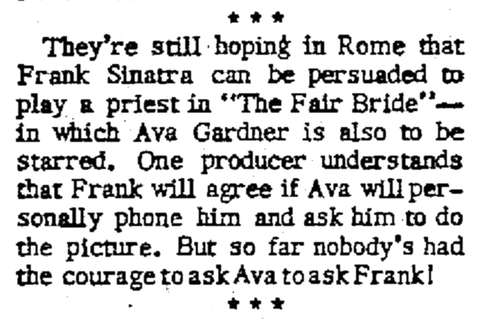
May 26, 1959
release of "Swing Easy/Songs For Young Lovers" on a 12
inch LP. Incredible studio performances of 16 marvelous songs.
Ed
On Monday, May 27, 2024 at 01:28:37 AM EDT, Vance Adair <dr.vanceadair@gmail.com> wrote:
There’s not much to disagree with here in either the analysis or the choice of albums. The difficult task is limiting the list to 10 recommendations so maybe it’s churlish to linger on the omission of strong contenders like Close To You and Watertown.
-Vance
On Sun, 26 May 2024 at 19:38, Ed O'Brien <dmarc-noreply@freelists.org> wrote:
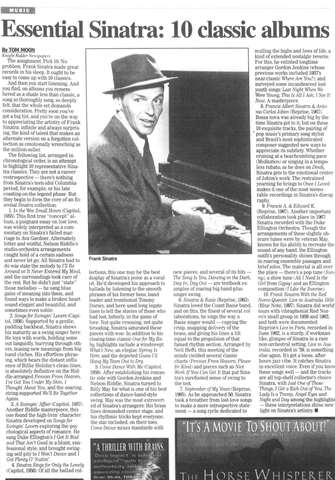
June 1959
[Dinner party for Governor Ribicoff]
Kaplan: One night in late June 1959, Sinatra threw a dinner party on Bowmont Drive for Connecticut Governor Abraham Ribicoff, an early JFK backer; guests included Dean Martin, Shirley MacLaine, Tony Curtis, Janet Leigh, and 19-year-old Nancy Sinatra.
Source: James Kaplan, "Sinatra: The Chairman" (2015)
June 9, 1959
[Giancana testifies before McClellan Committee]
Kaplan / UPI: Giancana arrived in Washington on June 9, 1959, to testify before the Senate Rackets Committee, taking the Fifth Amendment while laughing derisively at questions from committee counsel Robert F. Kennedy about Chicago gangland murders and his role in a jukebox racket. Kennedy needled him, 'I thought only little girls giggled, Mr. Giancana.'
Source: James Kaplan, "Sinatra: The Chairman" (2015).
July 1959
Sinatra and Dean Martin flew from the West Coast to Miami to attend the wedding of Sam Giancana's daughter, a trip later noted in FBI files as evidence of Sinatra's closeness to the Chicago Outfit boss. Source: Michael Sheridan & David Harvey, Sinatra and the Jack Pack.
[Billie Holiday's final illness and Sinatra's failed effort to help]
George Jacobs: Dying of cirrhosis in Harlem's Metropolitan Hospital and under arrest for a narcotics charge found in her purse, Billie Holiday reportedly begged Sinatra, out of earshot of her police guard, to get her dope. Per George Jacobs, Sinatra tried to obtain heroin for her through legitimate channels and then from a dealer, but couldn't get it past the police guarding her door.
Source: James Kaplan, "Sinatra: The Chairman" (2015)
[FBI account of a two-week Claridge party]
FBI report: A separate FBI report, based on an interview with an unnamed showgirl, described a roughly two-week party Sinatra threw at the Claridge Hotel in July 1959 during his 500 Club run, running nightly from about 8:00 p.m. to 4-5:00 a.m., attended by Natalie Wood, Robert Wagner, Rocco and Joseph Fischetti, John Formosa, and Skinny D'Amato; another report placed Joseph Bonanno there as well.
Source: James Kaplan, "Sinatra: The Chairman" (2015)
[Filming Never So Few at MGM]
Kaplan / Dean Jones: Through June and July 1959, Sinatra commuted to MGM's back lot to shoot Never So Few, fighting boredom by hosting the entire Milwaukee Braves roster (including Hank Aaron and Warren Spahn) for lunch and bringing Nelson Riddle's orchestra onto the soundstage to rehearse for a Capitol session. Co-star Dean Jones recalled a cherry-bomb prank with Steve McQueen and Frank's toupee falling off during a fight scene.
Source: James Kaplan, "Sinatra: The Chairman" (2015)
[Giancana daughter's wedding in Miami Beach]
Kaplan / UPI: In early July 1959, Frank and Dean flew to Miami Beach for the wedding of Sam Giancana's 19-year-old daughter Bonnie, held quietly at St. Patrick's Roman Catholic Church with a reception at the Fontainebleau; the hotel publicly denied any event was taking place while guarded reception rooms filled with well-dressed mobsters and their wives.
Source: James Kaplan, "Sinatra: The Chairman" (2015)
[Juliet Prowse joins Can-Can]
Vernon Scott / Kaplan: UPI's Vernon Scott profiled 22-year-old South African newcomer Juliet Prowse, discovered by choreographer Hermes Pan and signed to a seven-year Fox contract for a co-starring role in Can-Can, in early July 1959; Sinatra took immediate romantic notice of her.
Source: James Kaplan, "Sinatra: The Chairman" (2015)
[New York visit: Ralph Bunche and Billie Holiday]
Kaplan / Louella Parsons / George Jacobs: After Miami, Frank went to New York, where columnist Louella Parsons reported he got a personal UN tour from Nobel laureate Ralph Bunche; according to George Jacobs, Sinatra also spent time trying to help the dying Billie Holiday, whom he considered his greatest vocal influence.
Source: James Kaplan, "Sinatra: The Chairman" (2015)
[Richard Apt's 500 Club memory]
Richard Apt: Sinatra archivist Richard Apt recalled being taken to the packed, smoky 500 Club in July 1959 for his tenth birthday, where Sinatra, singing between 'High Hopes' and 'All the Way,' spotted him ringside and gave him a couple of exaggerated winks.
Source: James Kaplan, "Sinatra: The Chairman" (2015)
July 10, 1959
Lexington Herald
July 15, 1959
Film
"A Hole In The Head" (USA Release: July 15,
1959)
Starring: Frank Sinatra, Edward G. Robinson, Eleanor Parker,
Keenan Wynn, Carolyn Jones, Thelma Ritter, Dub Taylor, Ruby Dandridge, Joi Lansing, Eddie Hodges
Produced & Directed by: Frank Capra
Widower Tony (Sinatra) is trying to keep a small Miami hotel afloat while raising a 12-year-old son (Hodges). He's forced to ask his harried brother Mario (Robinson) for help,
but he'll only bail Tony out if he quits his bohemian lifestyle and marries a sensible woman (Eleanor Parker).
The film introduced the song "High Hopes" by Sammy
Cahn and Jimmy Van Heusen, a Sinatra standard used as a campaign song by John F. Kennedy during the presidential election the following year.
Wynn plays a wealthy former friend of Sinatra's character who expresses interest in his plan to build a Disneyland in Florida (the film predates Disney World)until he notices that Sinatra seems too desperate as he cheers for a dog upon which he'd bet heavily. The movie ends with Tony, Eloise and Ally singing "High Hopes" on the beach. Sinatra sings "All My Tomorrows," another Cahn/Van Heusen song, under the opening titles.
--DVD Release: 2001-09-18 - Blu-Ray Release:
2015-01-27
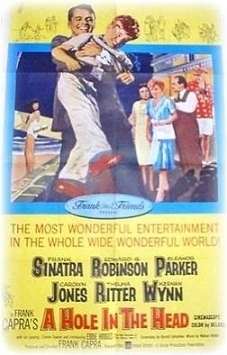
"A Hole in the Head"
A Hole in the Head marked Frank Capra's return to A-list filmmaking after an eight-year absence, and was made possible only because Sinatra's participation, not Capra's name, guaranteed financing. The two formed SinCap Productions with equal votes on all decisions and Abe Lastfogel (head of William Morris Agency) as tiebreaking arbiter; ownership was split with Capra receiving one-third and Sinatra's production company two-thirds.
Source: Tom Santopietro, "Sinatra in Hollywood" (2008).
"A Hole in the Head"
Bert Allenberg (quoted by Frank Capra): In his autobiography The Name Above the Title, Capra quotes agent Bert Allenberg telling him the new Hollywood reality: 'It's not the Hollywood we used to know. It's not a director's business, but an actor's business now. They pick their own stories and their own directors. So if you're thinking of making pictures again, you're gonna have to shack up with a star, or the banks won't lend you a quarter.'
Source: Tom Santopietro, "Sinatra in Hollywood" (2008).
"A Hole in the Head"
The film opened with an acclaimed title sequence (a dolphin leaping in unison with a swell of strings as a blimp pulls the credits across the sky, with Sinatra singing Van Heusen/Cahn's 'All My Tomorrows'), which Santopietro calls the best title sequence in Sinatra's filmography. Production got MGM-caliber support: Edith Head costumes, Nelson Riddle music, and William Daniels cinematography; Capra credited Daniels with helping bring the film in under schedule at a cost of $1,800,000.
Source: Tom Santopietro, "Sinatra in Hollywood" (2008).
"A Hole in the Head"
Sinatra played widowed hotelier Tony Manetta opposite Edward G. Robinson and Thelma Ritter as his brother and sister-in-law, and Eddie Hodges as his young son Ally; Eleanor Parker played the love interest Mrs. Rogers (Eloise).
Source: Tom Santopietro, "Sinatra in Hollywood" (2008).
"A Hole in the Head"
Frank Sinatra / Frank Capra: Capra's autobiography details friction between his two stars: Sinatra refused Robinson's requested extensive rehearsals, citing boredom and his belief that his first take was always best, telling Robinson, 'I don't believe in exhausting myself before the take. On the other hand, I read the script fifty times before I ever go to work. So you can't say I'm unprepared.' Capra's workaround was to keep rehearsals minimal for the whole cast (encouraging Keenan Wynn and Joi Lansing to ad-lib), which kept Sinatra engaged; Capra later felt he and Sinatra achieved a real if largely 'unspoken' rapport.
Source: Tom Santopietro, "Sinatra in Hollywood" (2008).
"A Hole in the Head"
The father-son duet 'High Hopes' (Cahn/Van Heusen), sung a cappella by Sinatra and young costar Eddie Hodges, won the Academy Award for Best Song and is singled out by Santopietro as the best moment in the film.
Source: Tom Santopietro, "Sinatra in Hollywood" (2008).
"A Hole in the Head"
Newsweek / Philip K. Scheuer: Newsweek judged the film 'a soap-opera plot, if there ever was one,' but praised Sinatra for arousing sympathy without sentimentality, noting Robinson 'almost steals the show from Sinatra. Not quite, of course.' The Los Angeles Times' Philip K. Scheuer found Capra hadn't performed a 'major miracle' but had dressed up a so-so stage comedy with laughs, human interest, and a bit of sex and sentiment.
Source: Tom Santopietro, "Sinatra in Hollywood" (2008).
"Some Like It Hot" / "A Hole in the Head"
Sinatra liked the script for Some Like It Hot but chose to make A Hole in the Head instead, forgoing Billy Wilder's proposed casting of himself alongside Tony Curtis and Marilyn Monroe. Santopietro notes the choice illustrates Sinatra's stature -- he was effectively choosing between two of Hollywood's greatest directors, Wilder and Capra.
Source: Tom Santopietro, "Sinatra in Hollywood" (2008).
"A Hole in the Head"
Santopietro grades this a B, calling it an uneven but worthy teaming with Frank Capra.
Source: Tom Santopietro, "Sinatra in Hollywood" (2008).
"A Hole in the Head"
Santopietro (Filmography): Sin Cap/United Artists. Produced and directed by Frank Capra, with Sinatra as executive producer, screenplay by Arnold Schulman based on his own Broadway play, score by Nelson Riddle, songs by Jimmy Van Heusen and Sammy Cahn. Sinatra played Tony Manetta opposite Edward G. Robinson and Thelma Ritter, singing 'All My Tomorrows' and the Oscar-winning 'High Hopes.'
Source: Tom Santopietro, "Sinatra in Hollywood" (2008).
July 16, 1959
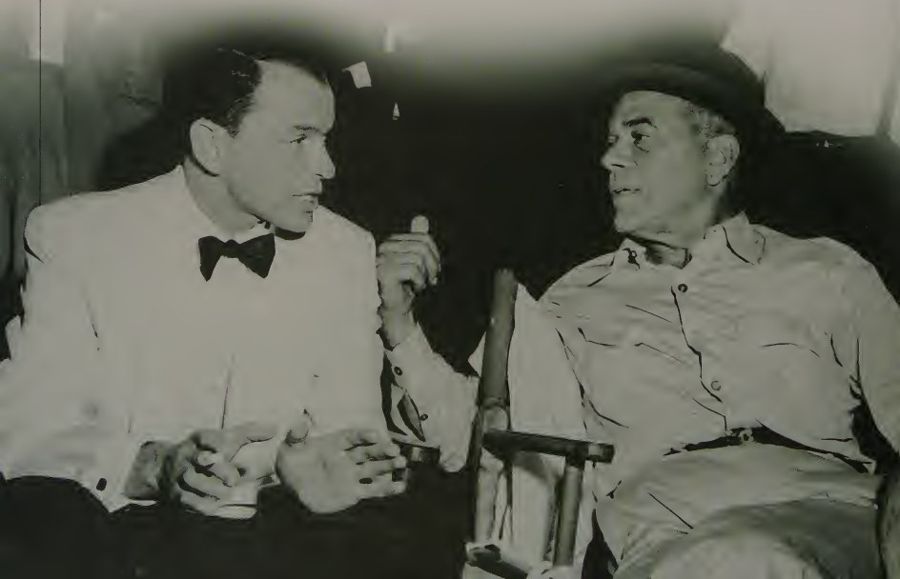
[Photograph: A Hole in the Head marks Frank Capra's post-1951 comeback. From Richard Havers, "Sinatra" (Dorling Kindersley, 2007), p.250.]
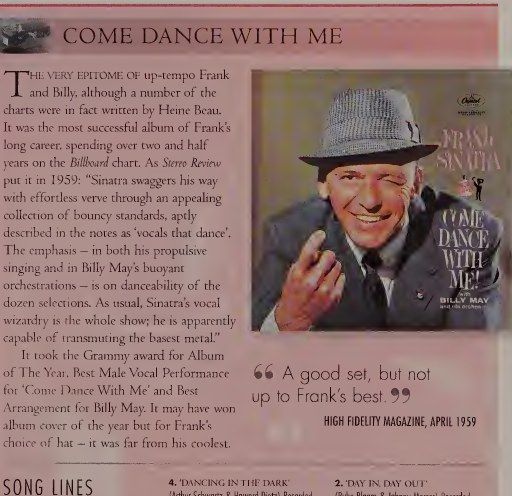
[Photograph: A Hole in the Head marks Frank Capra's post-1951 comeback. From Richard Havers, "Sinatra" (Dorling Kindersley, 2007), p.248.]
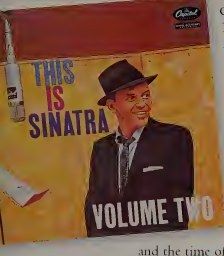
[Photograph: A Hole in the Head marks Frank Capra's post-1951 comeback. From Richard Havers, "Sinatra" (Dorling Kindersley, 2007), p.247.]
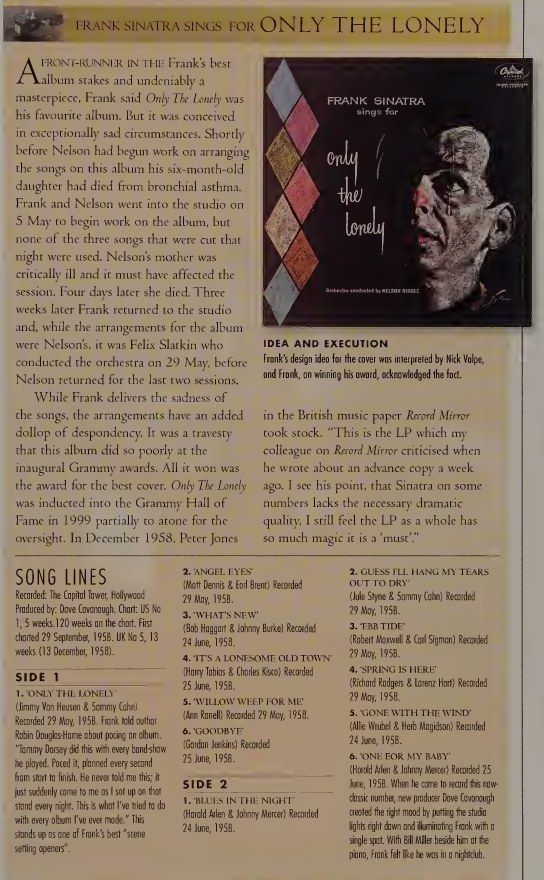
[Photograph: A Hole in the Head marks Frank Capra's post-1951 comeback. From Richard Havers, "Sinatra" (Dorling Kindersley, 2007), p.247.]
A Hole in the Head, director Frank Capra's first film since 1951, premiered in New York to strong reviews; Frank played a widowed Miami Beach hotelier trying to raise money for an amusement park, with Edward G. Robinson as his brother. (Source: Richard Havers, "Sinatra" (Dorling Kindersley, 2007).)
July 17, 1959
[Death of Billie Holiday]
Billie Holiday died on July 17, 1959. Sinatra was reportedly disconsolate and guilty, holing up drinking and replaying her records before leaving for Atlantic City four days later.
Source: James Kaplan, "Sinatra: The Chairman" (2015).
July 20, 1959
[Sinatra's last album before hiatus]
Sinatra recorded the album No One Cares, his last session before walking away from Capitol amid the contract dispute.
Source: James Kaplan, "Sinatra: The Chairman" (2015).
No One Cares, Frank's latest top-10 Capitol album, was released with liner notes by Jazz magazine editor Ralph Gleason calling him the greatest ballad singer of his generation.
Source: Nancy Sinatra, Frank Sinatra: An American Legend, 1995.
July 25, 1959
Concerts
500 Club, Atlantic City, New Jersey (July 25 - August 1) w/Red Norvo
1. I Could Have Danced All Night
2. Just One Of Those Things
3. I've Got You Under My Skin
4. It Happened In Monteray
5.. Moonlight In Vermont
6. The Lady Is A Tramp
7. One For My Baby
8. Come Fly With Me
9. monologue w/Jackie Leonard
10. I Get A Kick Out Of You
11. High Hopes
12. Day In, Day Out
13. All The Way
Press Of Atlantic City
500 Club, Atlantic City , New Jersey (July 25 - August 1) w/Red Norvo
Red Frank Bill Miller
Variety
7-29-59
------------------------------------------------------------
© 1997-2025 The Sinatra Archive
This calendar, or any parts thereof, may not be reproduced in any fashion whatsoever without the prior written permission of the publisher (The Sinatra Archive)
© 1997-2026 The Sinatra Archive
This calendar, or any parts thereof, may not be reproduced in any fashion whatsoever without the prior written permission of the publisher (The Sinatra Archive)
July 25, 1959
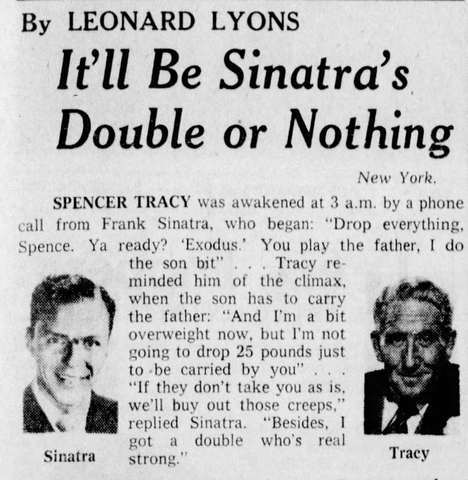
500 Club, Atlantic City , New Jersey (July 25 - August 1)
w/Red Norvo
Red
Frank
Bill Miller
Variety
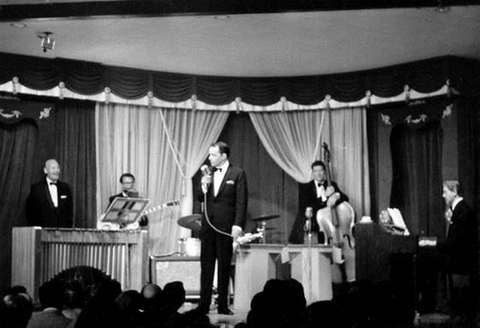
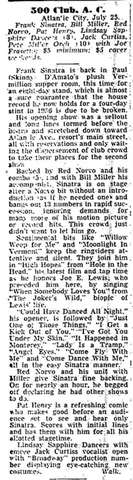
© 1997-2026 The Sinatra Archive
This calendar, or any parts thereof, may not be reproduced in any fashion
whatsoever without the prior written permission of the publisher (The
Sinatra Archive)
July 26, 1959
Concerts
500 Club, Atlantic City, New Jersey (July 25 - August 1)
w/Red Norvo
500 Club, Atlantic City, New Jersey (July 25 - August 1) w/Red Norvo
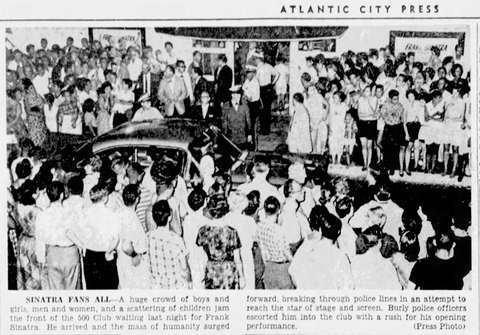
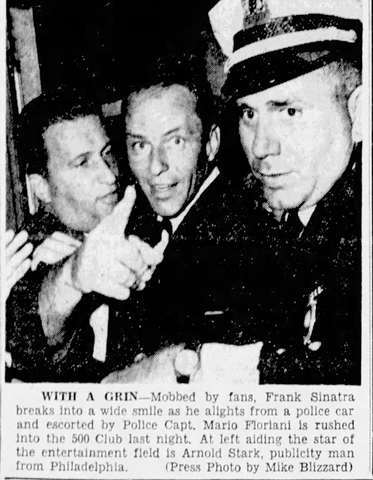
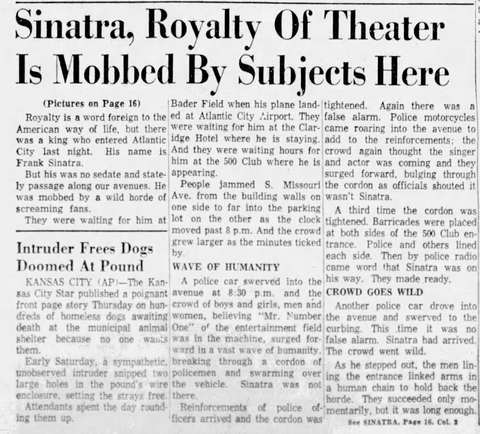
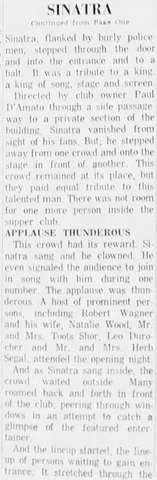

July 27, 1959
Concerts
500 Club, Atlantic City , New Jersey (July 25 - August 1) w/Red Norvo
July 28, 1959
Concerts
500 Club, Atlantic City , New Jersey (July 25 - August 1) w/Red Norvo
July 29, 1959
Concerts
500 Club, Atlantic City , New Jersey (July 25 - August 1) w/Red Norvo
July 30, 1959
Concerts
500 Club, Atlantic City, New Jersey (July 25 - August 1) w/Red Norvo
July 31, 1959
Concerts
500 Club, Atlantic City , New Jersey (July 25 - August 1) w/Red Norvo
August 1959
[Can-Can production begins]
Kaplan: In early August 1959, Sinatra began filming the musical Can-Can for 20th Century Fox -- the film he owed the studio after walking off Carousel in 1955 -- this time on hugely favorable terms: a $200,000 fee plus 25 percent of the picture's gross profits.
Source: James Kaplan, "Sinatra: The Chairman" (2015)
August 1, 1959
Concerts
500 Club, Atlantic City, New Jersey (July 25 - August 1) w/Red Norvo
[Sinatra's last single before hiatus]
Sinatra recorded the single Talk to Me, his final recording before a lengthy standoff with Capitol Records over control of his Essex Productions.
Source: James Kaplan, "Sinatra: The Chairman" (2015).
August 2, 1959
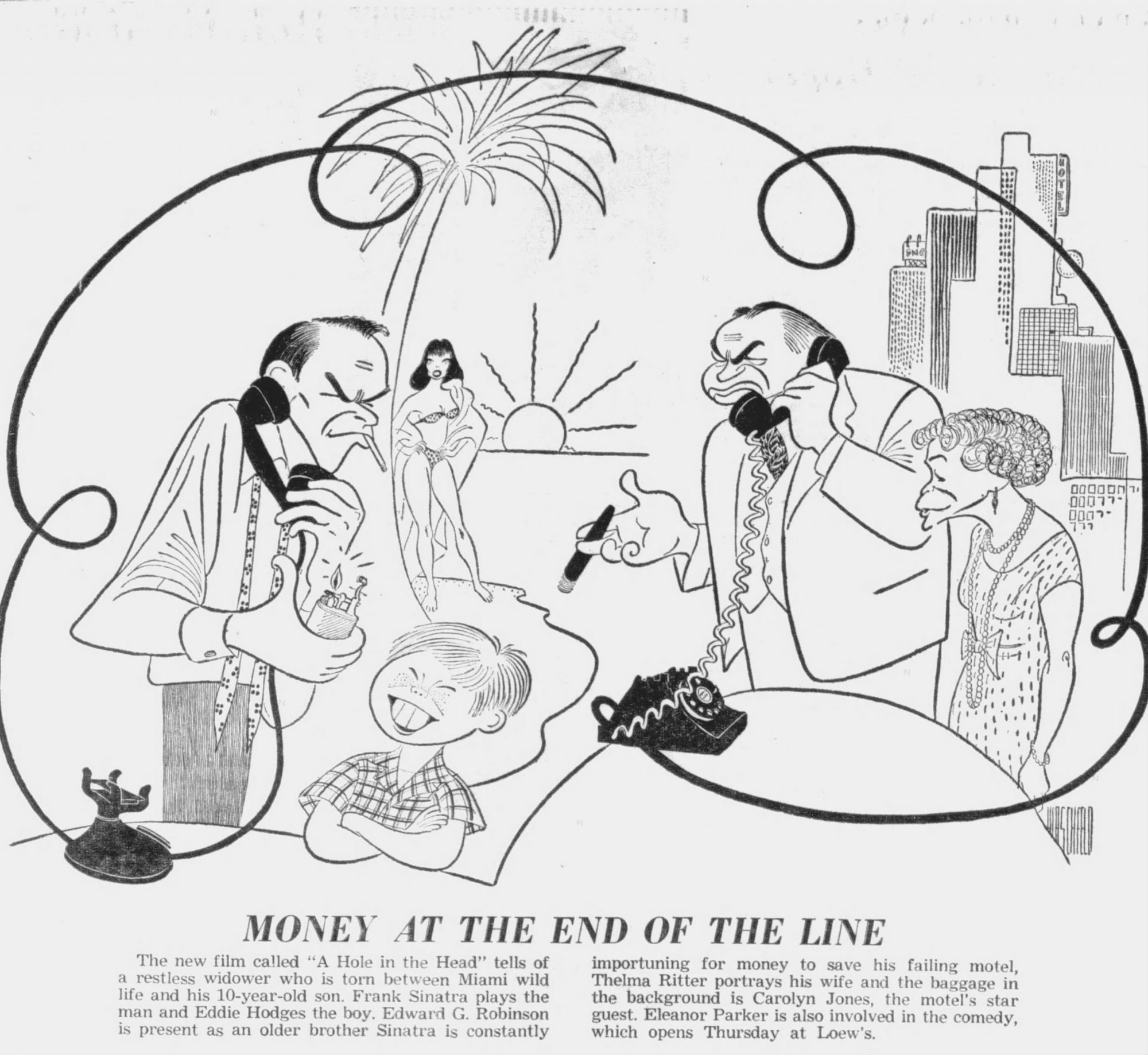
The Houston Post, August 2, 1959.
Summer 1959
Sinatra hosted a nine-day party at Atlantic City's Claridge Hotel attended by Chicago Outfit and East Coast Mob figures including Vito Genovese and Tommy Luchese, an event later detailed in Hoover's February 1961 memo to Bobby Kennedy as evidence of Sinatra's extensive organized-crime ties. Source: Michael Sheridan & David Harvey, Sinatra and the Jack Pack.
[Grammys for "Come Dance with Me"; Australian Tour]
The New York Post names Sinatra "Love Voice of the Century"; he tours Australia again and wins Grammy Awards for Album of the Year and Best Solo Vocal Performance for "Come Dance with Me." He appears in "A Hole in the Head" and "Never So Few."
Source: Nancy Sinatra, "Frank Sinatra, My Father" (1985).
["High Hopes" Becomes JFK's Campaign Theme Song]
The Oscar-winning song "High Hopes," which Sinatra performed with young co-star Eddie Hodges in "A Hole in the Head," goes on to become John F. Kennedy's presidential campaign theme song.
Source: Nancy Sinatra, "Frank Sinatra, My Father" (1985).
[Sinatra Rehearses 'High Hopes' for A Hole in the Head]
On the set of the 1959 film A Hole in the Head, Sinatra rehearsed 'High Hopes' with young co-star Eddie Hodges and songwriters Sammy Cahn and Jimmy Van Heusen; Van Heusen recalled the song was written for a father-son scene and went on to win the Academy Award, to his own surprise.
Source: Charles Pignone, "Frank Sinatra 100" (2015).
[Ava Gardner filming On the Beach in Australia]
Kaplan: While Frank dealt with his voice, Ava Gardner was in Australia shooting On the Beach, an adaptation of Nevil Shute's nuclear-war novel, for producer-director Stanley Kramer at $400,000. Melbourne's midsummer heat, biting flies, and mobbing fans (the city had never hosted a major film shoot before) made the location miserable for her.
Source: James Kaplan, "Sinatra: The Chairman" (2015)
[Ava Gardner's rootless summer, including Cuba]
Kaplan / Lee Server: After finishing On the Beach, Ava Gardner drifted through summer 1959 with no fixed plans, visiting San Francisco, Palm Springs, Florida, Haiti, and Cuba, where she had an audience with Fidel Castro and reportedly got into a drunken altercation, including a slap, with his translator-mistress Marita Lorenz in a Havana hotel lobby.
Source: James Kaplan, "Sinatra: The Chairman" (2015)
[Ava at Frank's Hampshire House, seeing Miles Davis]
Miles Davis (autobiography): While in New York, Ava Gardner stayed at Sinatra's Hampshire House pied-a-terre and became a regular at Birdland to see Miles Davis, whose Kind of Blue had just been released in August 1959; Davis later wrote in his autobiography that Pee Wee Marquette introduced her nightly from the bandstand and that the two had a flirtation but no affair.
Source: James Kaplan, "Sinatra: The Chairman" (2015)
[Barbara marries Zeppo Marx]
Richard Blackwell: After a three-year courtship, Zeppo Marx proposed and married Barbara Blakeley in 1959, giving her entry into the Palm Springs Racquet Club and Tamarisk Country Club and a friendship with Dinah Shore.
Source: James Kaplan, "Sinatra: The Chairman" (2015)
[Castro shuts down George Raft's Cuba casino]
Consiglio: Actor George Raft owned casinos in Europe and Cuba; when Fidel Castro came to power, he closed Raft's Cuban casino, around 1959 or 1960.
Source: Tony Consiglio (as told to Franz Douskey), "Sinatra and Me: The Very Good Years" (2012)
[Cost of dinner and a Sinatra show]
Ed Walters: Walters repeatedly cites the low cost of seeing Sinatra at the Sands as a measure of how different the era was -- he recalls dinner and the show costing $6.95 (in one retelling $6.75), a stark contrast to modern prices, underscoring how cheap entertainment was used to draw gamblers into the casino.
Source: Ed Walters, UNLV Table Games Management Oral History (2015)
[Early plans for British album]
Kaplan: The English music journal Melody Maker reported that Sinatra had 'big disc plans' to record an album in London, an idea that would not come to fruition for several more years.
Source: James Kaplan, "Sinatra: The Chairman" (2015)
[High rollers drawn to Sands by Sinatra, Martin]
Ed Walters: Walters describes categories of Sands customers during 1959-1966, including gamblers who came specifically because Frank Sinatra or Dean Martin were performing, arriving with cash and betting big by the standards of the day (around $400 a hand, which he equates to roughly $10,000 today).
Source: Ed Walters, UNLV Table Games Management Oral History (2015)
[Invitation to Monte Carlo]
Santopietro grades this a C, calling it just a "cameo in travelogue."
No corresponding dated entry could be identified in the chronology for this film/context.
Source: Tom Santopietro, "Sinatra in Hollywood" (2008), Career Scorecard
[Invitation to Monte Carlo]
Santopietro (Filmography): Cameo appearance in a short film. Valiant Films/Richmond Productions. Produced and directed by Euan Lloyd, screenplay by Lloyd and Jack Davies. Starred Germaine Damar, Gilda Emmanuelli and Katharine Page, with cameo appearances by Prince Rainier and Princess Grace of Monaco alongside Sinatra, all appearing as themselves.
No corresponding dated entry could be identified in the chronology for this film/context.
Source: Tom Santopietro, "Sinatra in Hollywood" (2008), Filmography
[Joe Kennedy seeks Mob backing via intermediaries]
Bill Bonanno, via Anthony Summers: According to Bill Bonanno (son of Mob boss Joe Bonanno), in the winter of 1959 Joseph P. Kennedy sent a representative to sound out organized-crime leaders, including Joe Profaci and Sam Giancana, about backing JFK's campaign; opinions among Mob bosses were divided, with Giancana reportedly favorable.
Source: James Kaplan, "Sinatra: The Chairman" (2015)
[Judith Campbell flies to Hawaii to join Sinatra]
Judith Campbell Exner (memoir): Judith Campbell took the midnight flight to Honolulu on November 9, 1959, arriving at 6:45 a.m. on November 10 and checking into the Surfrider Hotel's room 1509, joining Sinatra's penthouse party that included Peter and Pat Lawford, Dr. Leon 'Red' Krohn and his wife, and Al Hart, founder of City National Bank of Beverly Hills.
Source: James Kaplan, "Sinatra: The Chairman" (2015)
[Khrushchev visits Can-Can set]
Consiglio: In 1959, while Frank filmed Can-Can with Shirley MacLaine, Soviet premier Nikita Khrushchev visited the set already angry after being told he could not go to Disneyland. Studio heads chose Frank to greet him; instead of a formal welcome, Frank mocked Khrushchev's UN shoe-banging incident in a fake Russian accent, prompting Khrushchev to storm out.
Source: Tony Consiglio (as told to Franz Douskey), "Sinatra and Me: The Very Good Years" (2012)
[Meeting Larry O'Brien via JFK campaign]
Consiglio: Consiglio met Larry O'Brien through Sinatra during the early days of John F. Kennedy's 1959-60 presidential campaign, when the Rat Pack toured to help get Kennedy elected. O'Brien, campaign director, later became President Kennedy's Special Assistant for Congressional Relations alongside Chief of Staff Kenny O'Donnell.
Source: Tony Consiglio (as told to Franz Douskey), "Sinatra and Me: The Very Good Years" (2012)
[Never So Few]
Never So Few, directed by John Sturges and produced by Sinatra's own Canterbury Productions for MGM, was based on Tom T. Chamales's novel about Overseas Special Services combat in North Burma. Filmed fourteen years after the war ended, Santopietro credits that distance with allowing a more nuanced, less survival-focused treatment of the conflict, though the mix of war movie, romance, and moral inquiry never fully coheres.
No corresponding dated entry could be identified in the chronology for this film/context.
Source: Tom Santopietro, "Sinatra in Hollywood" (2008), The Peak Years (pt. 3)
[Never So Few]
Santopietro grades this a C: Frank's okay, but the movie's overstuffed. Quigley Top 10 Money Makers Poll: #7; Golden Laurel Award nomination: Top Male Star of the Year.
No corresponding dated entry could be identified in the chronology for this film/context.
Source: Tom Santopietro, "Sinatra in Hollywood" (2008), Career Scorecard
[Nine free nights at the 500 Club]
Kaplan: In 1959, now the biggest name in show business, Sinatra told Skinny D'Amato he would play his customary nine nights at the 500 Club for free, flying in the Red Norvo Quintet, Bill Miller, and a dozen Hollywood friends on a chartered plane; he had to travel Atlantic City's streets by police car amid mob scenes.
Source: James Kaplan, "Sinatra: The Chairman" (2015)
[Paul Anka first meets Sinatra]
Paul Anka: Paul Anka, then a teenager playing Vegas for the first time (too young to be let into the casino), first met Sinatra and the Rat Pack; he recalled the steam room at the Sands as a place where 'everything went on... that you could imagine.'
Source: James Kaplan, "Sinatra: The Chairman" (2015)
[Phone installed in the Sands steam room]
Ed Walters: Walters confirms the story that a phone was installed in the Sands steam room around 1959 because staff couldn't reach Sinatra there. After being tracked down repeatedly while trying to relax, Frank complained he needed one place to escape, but ironically began using the health club phone to make his own calls (arranging dates, etc., within earshot of other guests); soon after, Frank demanded Jack Entratter get a phone installed inside the steam room itself, overriding electrical safety concerns, telling him simply to do it.
Source: Ed Walters, pit boss reminiscences (compiled by Kraus, Sinatra mailing list)
[Remaining No One Cares sessions]
Kaplan: Over the following two nights Sinatra recorded the remaining six tracks for No One Cares with Gordon Jenkins, including a strikingly slow, dignified reading of 'I Can't Get Started' that opened with the tune's rarely heard verse.
Source: James Kaplan, "Sinatra: The Chairman" (2015)
[Sinatra on being nervous around Ella]
Frank Sinatra: In a 1959 interview, Sinatra admitted Ella Fitzgerald was the only performer who ever made him nervous, calling her the greatest popular singer in the world, "barring none -- male or female."
Source: James Kaplan, "Sinatra: The Chairman" (2015)
[Sinatra orders a phone installed in the steam room]
Ed Walters: Around 1959, after Sinatra got annoyed at being paged out of the Sands' steam room to take calls, he yelled at Jack Entratter to install a phone there instead: "Don't be calling me. I need one place to escape you bastards." Days later, frustrated at having to leave the steam room to make his own calls, Frank demanded a phone be installed inside it despite safety concerns about water and steam, telling Entratter simply "Do it," and it was done.
Source: Ed Walters, pit boss reminiscences (compiled by Kraus, Sinatra mailing list)
[Sinatra pushes for his own label]
Kaplan: Frustrated with Capitol, whose contract with him ran until November 1962, Sinatra pressed company president Glenn Wallichs to let him start his own label, Essex, under which he would own his masters and lease them to Capitol for a 50-50 profit split. Wallichs refused, fearing other artists like Nat Cole and Peggy Lee would demand the same deal; Frank threatened to stop recording for Capitol until he got his way.
Source: James Kaplan, "Sinatra: The Chairman" (2015)
[Sinatra-Davis rift over radio remarks]
Consiglio: In 1959, in a late-night radio interview with Jack Eigen, Sammy Davis Jr. said Sinatra was a great friend and entertainer but that he "liked to step on people." Sinatra was furious and felt betrayed, telling Consiglio he was never available if Davis called; the friendship took years to mend, and a cautious distance lingered afterward.
Source: Tony Consiglio (as told to Franz Douskey), "Sinatra and Me: The Very Good Years" (2012)
[The Best Is Yet to Come written for Sinatra]
Kaplan: Cy Coleman and Carolyn Leigh originally wrote "The Best Is Yet to Come" for Sinatra, but he sat on it for about a year without recording it, reportedly due to his growing disaffection with Capitol Records before Reprise began.
Source: James Kaplan, "Sinatra: The Chairman" (2015)
[The fabricated 'end of the world' quote]
Kaplan (attrib. Ava Gardner, fabricated): A Sydney Morning Herald reporter Ava Gardner had refused to speak to invented a quote for her calling Melbourne the right place to film a story about the end of the world. The line spread worldwide and instantly turned Melbourne opinion against her.
Source: James Kaplan, "Sinatra: The Chairman" (2015)
[Frank demands his own label, walks out on Capitol]
Returning Capitol chairman Alan Livingston recounted that Frank had demanded a rewritten contract giving him his own company on a 50/50 profit-share basis; when Livingston's predecessor Glenn Wallichs refused, Frank angrily quit recording altogether. When Livingston later phoned to smooth things over, Frank cursed him out and threatened to "tear down that round building" (Capitol Tower).
Source: Richard Havers, "Sinatra" (Dorling Kindersley, 2007).
[Frank plays week's booking at the 500 Club]
Frank opened a week-long engagement at Skinny D'Amato's 500 Club in Atlantic City, backed again by Red Norvo in a set nearly identical to his recent Australian shows but with 'High Hopes' added. His summer appearances there had become so routine that the club's marquee simply read "He's Here" on arrival and "He's Gone" once he left.
Source: Richard Havers, "Sinatra" (Dorling Kindersley, 2007).
[Frank's failed bid to buy Verve Records]
To launch his own label, Frank had lawyer Mickey Rudin quietly try to purchase the Verve label from founder Norman Granz, partly out of fondness for Verve artists Ella Fitzgerald and Count Basie. The deal collapsed when Granz sold Verve to MGM instead, though Rudin's contact with Verve accountant Mo Ostin led to Ostin later joining Reprise as head of administration.
Source: Richard Havers, "Sinatra" (Dorling Kindersley, 2007).
[Sammy Davis Jr.'s 1959 Radio Interview Fallout]
After Sammy Davis Jr. criticized Sinatra's treatment of others in a radio interview, saying talent was no excuse for bad manners, Sinatra cut him from the film Never So Few; the two reconciled a few months later, before shooting Ocean's 11.
Source: Rough Guide to Frank Sinatra (Rough guide 7.pdf), chapter "The Inner Circle."
[Failed attempt to buy Verve Records from Norman Granz before founding Reprise -- critical commentary]
Will Friedwald (narrative, citing biographers): Sinatra reportedly agreed a $2 million sale price with Granz for Verve, but MGM Records swooped in with a higher offer contingent on immediate sale without letting Sinatra counterbid; Sinatra said he'd have matched MGM's offer had he been given the chance. Friedwald notes a long-standing grudge between Sinatra and Granz may explain why Sinatra never made a dream album with Ella Fitzgerald (Granz was her producer/manager), despite three classic joint TV appearances (1958, 1960, 1967).
Source: Will Friedwald, "Sinatra! The Song Is You: A Singer's Art" (2018 revised edition), Ch. 9, "Looking for the Hook" (1960-1971)
[Mandalay -- critical commentary]
Frank Sinatra: Performing before an audience of mostly British descent in Melbourne in 1959, Sinatra explained that the UK pressing of Come Fly with Me substituted 'Chicago' for 'Road to Mandalay' due to the Kipling estate's objection, joking that 'Rudyard Kipling's sister [sic] was chicken not to let us put it on the record,' while praising the track as 'an unusual version...it's comedic, but it swings, it jumps.'
Source: Will Friedwald, "Sinatra! The Song Is You: A Singer's Art" (2018 revised edition), Ch. 7, "With Billy May" (1953-1979)
[No One Cares -- critical commentary]
Granata's discography entry: No One Cares, arranged by Gordon Jenkins, released July 1959.
Source: Charles L. Granata, "Sessions with Sinatra: Frank Sinatra and the Art of Recording" (1999/2003), Afterword & Appendices A-D
[Sinatra's fond reminiscing about Dorsey with musicians in later decades -- critical commentary]
Jerry Dodgion / Irv Cottler / Susan Reynolds: Saxophonist Jerry Dodgion has said that when he played Australia in 1959 with Red Norvo and Sinatra, the singer spent a lot of time with the musicians and that he "talked mainly about Tommy Dorsey." On Irv Cottler’s birthday (circa 1977), the drummer happened to mention that he had also spent some months with the Dorsey band, a fact that Sinatra had forgotten. "We stayed up talking from one AM to about seven in the morning," said Cottier, "all about Tommy. During the writing of this book, around 1990, I asked Sinatra’s press agent, Susan Reynolds, if the Old Man (yes, Sinatra was the "Old Man" by then) ever reminisced about the old days. "Yes, he does all the time," she responded. "He especially likes to talk about Tommy Dorsey."
Source: Will Friedwald, "Sinatra! The Song Is You: A Singer's Art" (2018 revised edition), Ch. 3, "With Tommy Dorsey" (1940-1942)
[The Best Is Yet to Come -- critical commentary]
Cy Coleman (quoted) / Friedwald (analysis): Composer Cy Coleman told Friedwald the song grew out of 'Playboy's Theme,' an instrumental he wrote for Hugh Hefner's Playboy's Penthouse TV show, to which Coleman and lyricist Carolyn Leigh later added words. Sinatra liked the song but wanted it longer, so Coleman and Leigh added an interlude ('Come the day you're mine...'). Sinatra then sat on the song for about a year; Tony Bennett asked Coleman for something like 'The Playboy Theme,' was offered 'The Best Is Yet to Come,' and recorded it the very next day (with Coleman finishing/conducting the half-done arrangement). Coleman told Friedwald 30 years later that even though Bennett had the hit, 'the Sinatra version is always important. No matter what... A Sinatra performance is a wonderful thing, it's a badge of honor.' Friedwald calls the Sinatra-Basie track second only to 'Fly Me to the Moon' as the album's most winning performance, describing Sinatra 'ecstatically wailing the lyrics against an antiphonal choir of muted brass' evoking Fats Waller-style vocal asides.
Source: Will Friedwald, "Sinatra! The Song Is You: A Singer's Art" (2018 revised edition), Ch. 9, "Looking for the Hook" (1960-1971)
August 17, 1959
Sinatra first met dancer Juliet Prowse in a casual studio introduction on the set of "Can-Can" at 20th Century-Fox.
Source: George Carpozi Jr., Frank Sinatra: Is This Man Mafia? (New York: Manor Books, 1979).
August 27, 1959
Studio
Capitol Studio A, Hollywood
E33339 It's All Right With Me
Arranged & Conducted by Nelson Riddle
CD: CDP 7-96611-2 Sings The Select Cole Porter
CD: CDP 7-91248-2 Can Can
LP: SW1301 Can Can
Sinatraphiles Vance Adair:
This is a beautiful recording. It would have been great to hear this ballad rendering a little more in live performance.
FS's return to the tune, in sub-jazz funk mode, nearly 25 years later is an altogether more dubious effort.
Ed O'Brien:
Sinatra sang the song at the Univ. Southern California Tribute to Porter, 2-12-67. In introducing the song, he told the gathering that it had always been sung uptempo, prior to the version done in the 1960 film adaptation of Porter's hit Broadway musical "Can- Can." Frank forgot he had sung the song on his 10-29-54 Bobbi show, with Bill Miller backing him on piano. A lovely ballad treatment.
E33340 C'est Magnifique
Arranged & Conducted by Nelson Riddle
CD: CDP 7-96611-2 Sings The Select Cole Porter
CD: CDP 7-91248-2 Can Can
LP: SW1301 Can Can
note: Session took place on a soundstage at 20th Century Fox.
Session ran from 6 to 9: P.M. Nelson Riddle conducted a 46 piece orchestra. Capitol assigned master numbers on 2-19-60 Ed
[Can-Can soundtrack session]
On August 27, 1959, Sinatra recorded for the first time in over three months -- but at 20th Century Fox rather than Capitol -- laying down the Can-Can soundtrack with Nelson Riddle, including 'C'est Magnifique' (into which he ad-libbed a 'ring-a-ding-ding-ding') and a tender 'It's All Right with Me.'
Source: James Kaplan, "Sinatra: The Chairman" (2015).
September 1959
[Sinatra Rehearses for The Bing Crosby Show]
Sinatra, Peggy Lee, and Bing Crosby rehearsed for The Bing Crosby Show in September 1959 with pianists Paul Smith, George Shearing, and Joe Bushkin.
Source: Charles Pignone, "Frank Sinatra 100" (2015).
[Guest spot on Bing Crosby's Oldsmobile Show]
Kaplan: At the end of September 1959, Sinatra guested on Bing Crosby's ABC Oldsmobile Show alongside Louis Armstrong and Peggy Lee, performing 'Willow Weep for Me' and duetting with Crosby on 'I Love a Piano'; their closing unscripted banter about Palm Springs drew mixed reviews from critics.
Source: James Kaplan, "Sinatra: The Chairman" (2015)
September 1, 1959
Studio
Capitol Studio A, Hollywood
E33349 Montmart
w/Maurice Chevalier & Chorus
Arranged & Conducted by Nelson Riddle
CD: CDP 7-91248-2 Can Can
LP: SW1301 Can Can
note: All the sessions for "Can-Can" were done on a sound stage at 20th Century Fox Studios.
The session of 9-1-60 was done from 6 to 9 P.M with a 49 piece orchestra and a choral group.
I called Capitol, back in 1991, and asked when the Capitol masters were assigned to the
recordings. The 9-1-59 was done on 2-20-60.
September 16, 1959
[FBI notes Giancana visiting Sinatra at the Claridge]
FBI report: An FBI informant report noted that on September 16, 1959, Sam Giancana visited Sinatra at the Claridge Hotel in Atlantic City, where two 'tough looking men' checked identification at the elevator and Joseph Fischetti, described as a 'well known hoodlum,' was present in Sinatra's suite.
Source: James Kaplan, "Sinatra: The Chairman" (2015).
September 17, 1959
[Ava's Miami airport stopover]
UPI: A wire-service item dated September 17, 1959, described Ava Gardner's chaotic Miami International Airport stopover en route to New York with a maid, secretary, two caged dogs, nineteen pieces of luggage, a hi-fi set, and a bongo drum, saying she was headed to New York to discuss a film called 'A Fair Bride' (which never materialized).
Source: James Kaplan, "Sinatra: The Chairman" (2015).
September 18, 1959
[Barbara's honeymoon night at the Sands includes Frank, Dean Martin, and Sammy Davis Jr.]
Barbara Blakeley married Zeppo Marx at the Riviera Hotel in Las Vegas, the place where the couple had met. The weeklong honeymoon that followed included a night at the Copa Room of the Sands, where Frank Sinatra, Dean Martin, and Sammy Davis Jr. were performing together; Barbara sat next to Mary Benny, Jack Benny's wife, and later recalled laughing at how the three men "fed off one" another onstage.
Source: Barbara Sinatra, Lady Blue Eyes: My Life with Frank Sinatra (New York: Crown Archetype, 2011).
September 19, 1959
[Khrushchev's Hollywood luncheon at Fox]
Kaplan / Murray Schumach: On the third Saturday of September 1959, Soviet premier Nikita Khrushchev lunched with 400 Hollywood figures, including Sinatra, at 20th Century Fox's Cafe de Paris commissary, seated near Bob Hope and Sinatra; Bing Crosby, Adolphe Menjou, Ronald Reagan, and Ward Bond declined to attend on political grounds. Khrushchev complained bitterly about being denied a visit to Disneyland for security reasons.
Source: James Kaplan, "Sinatra: The Chairman" (2015).
[Sinatra emcees Can-Can preview for Khrushchev]
After the Fox luncheon, Sinatra emceed a live Can-Can highlights performance on a soundstage for Khrushchev and his wife, introducing numbers and calling the cancan dancers 'my nieces.' Khrushchev applauded at the time but later publicly denounced the cancan number as 'lascivious, disgusting and immoral,' inadvertently boosting advance ticket sales.
Source: James Kaplan, "Sinatra: The Chairman" (2015).
Frank hosted a luncheon for Soviet Premier Nikita Khrushchev attended by more than 400 Hollywood stars; Khrushchev watched Can-Can being filmed but denounced the dance itself as decadent, and Frank later sat patiently with Mrs. Khrushchev looking at photos of her grandchildren after their planned Disneyland visit was vetoed by the Secret Service.
Source: Nancy Sinatra, Frank Sinatra: An American Legend, 1995.
September 22, 1959
Studio
Capitol Studio A, Hollywood
E33348 Let's Do It w/Shirley Maclaine
Arranged & Conducted by Nelson Riddle
CD: CDP 7-91248-2 Can Can
LP: SW1301 Can Can
note: Song was recorded on the 20th Century soundstage from 6 to 9 P.M. There was a 53 piece orchestra.
Nelson Riddle arranged and conducted.
Capitol assigned a master number on 2-20-60.
All five of the songs Frank recorded for the film can be found on disc 6 of "Sinatra In Hollywood."
Ed
September 27, 1959
Concerts
Beverly Hilton Hotel, Los Angeles
Eleanor Roosevelt Diamond Jubliee Tribute
Sinatra, Eddie, Cantor, Maurice Chevalier, Kirk Douglas, Jack Benny and others
Beverly Hilton Hotel, Los Angeles
Eleanor Roosevelt Diamond Jubliee Tribute
Sinatra, Eddie, Cantor, Maurice Chevalier, Kirk Douglas, Jack Benny and others
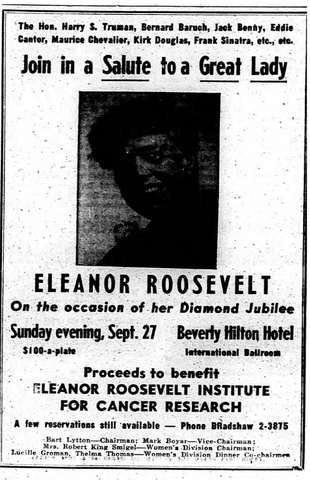
Missed putting this one in yesterday:
September 27, 1959, Beverly Hilton Hotel, Los Angeles
Eleanor Roosevelt Diamond Jubliee Tribute
Sinatra, Eddie, Cantor, Maurice Chevalier, Kirk Douglas, Jack Benny and others
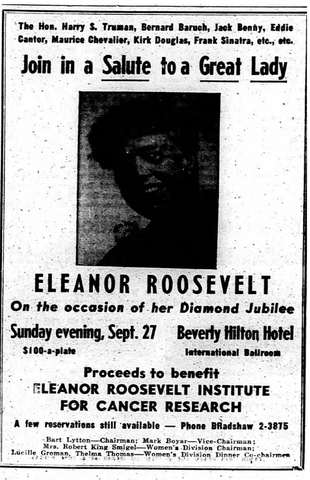
September 29, 1959
Television
Bing Crosby Oldsmobile Show
ABC-TV
Tuesday Evening
9:30 p.m. - 10:30 p.m.
Guests: Frank Sinatra, Peggy Lee, Louis Armstrong,
Joe Bushkin, George Shearing, Paul Smith
1. We're Glad We're Not Young
Anymore(parody) Bing, Frank, Peggy, Louis
2. Looking At The World Thru Rose Colored Glasses Bing
3. Willow Weep For Me Frank
4. Baubles, Bangles And Beads Peggy
5. I Love A Piano Frank, Bing, Peggy
6. Lullaby Of Birdland Peggy w/ George Shearing on piano
7. One I Love Belongs To Somebody Else Frank w/Paul Smith on piano
8. When The Blue Of The Night(uptempo) Bing w/ Joe Bushkin
9. Mack The Knife Louis
10. To Neat To Be A Beatnik Bing, Peggy
11. Basin Street Blues/Everybody Loves My Baby/Lazy Bones Bing, Louis
12. Them There Eyes Louis
13. Some Of These Days Peggy
14. If I Could Be With You Frank
15. Up A Lazy River Frank, Peggy
16. High Society Bing, Peggy
17. When It's Sleepy Time Down South Bing, Louis
18. Now You Has Jazz Bing, Frank, Peggy, Louis
Bing Crosby Oldsmobile Show
Philadelphia Inquirer 9-30-59
Ottawa Journal
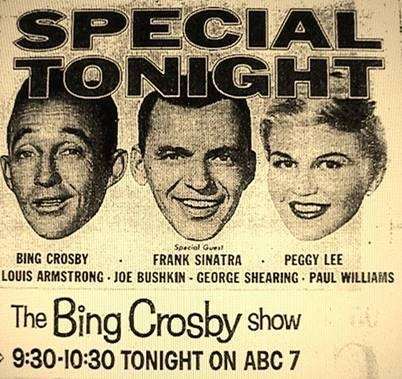
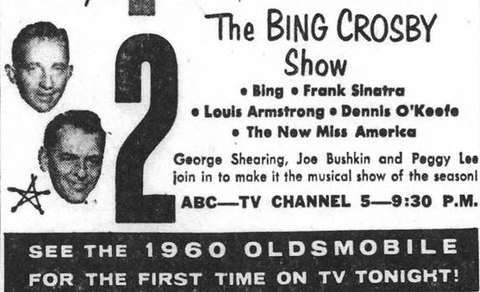
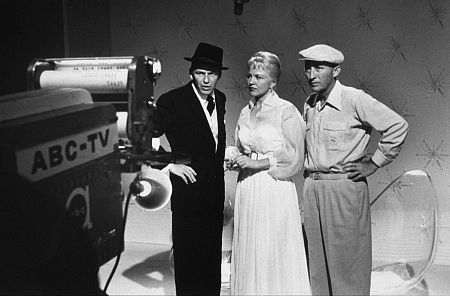
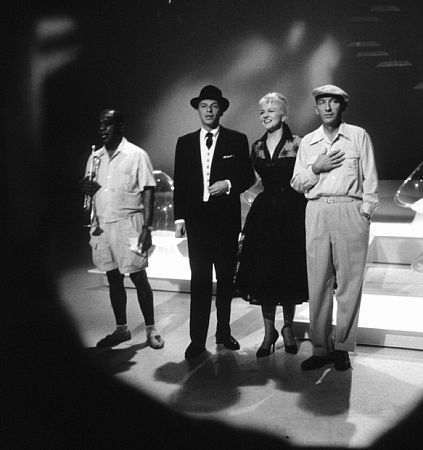
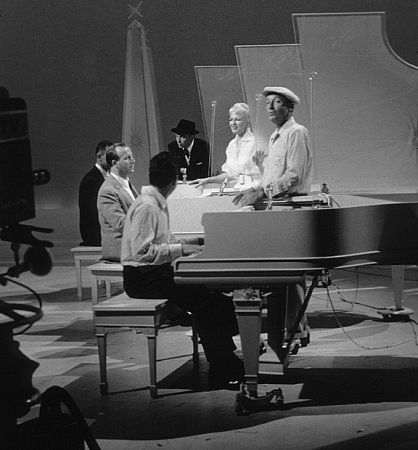
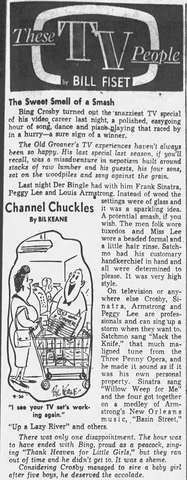
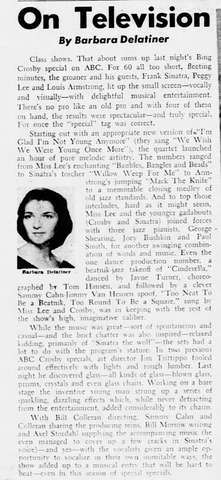
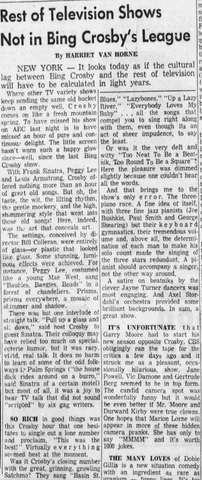
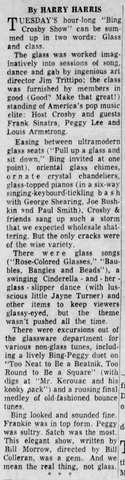
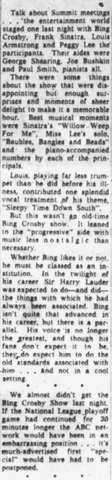
9-30-59
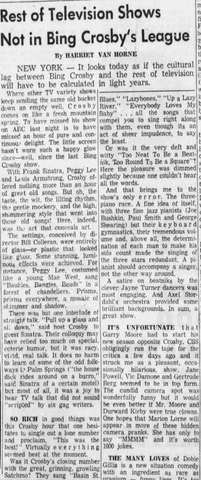
Bing Crosby Oldsmobile Show
Ed O'Brien:
Ad should read Paul Smith, not Williams
Paul told me his segment with Sinatra was a real highlight of his career.
Piano segment:
I Love A Piano Frank, Bing, Peggy
Lullaby Of Birdland Peggy w/ George Shearing on piano One I Love Belongs To Somebody Else Frank w/Paul Smith on piano Where The Blue Of The Night Bing w/Joe Bushkin on piano
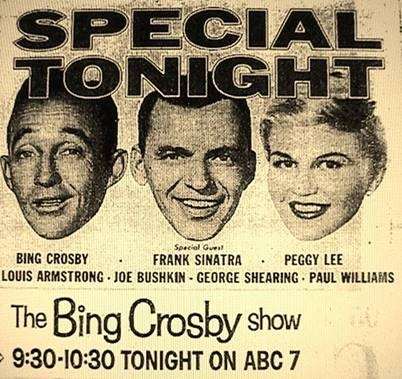
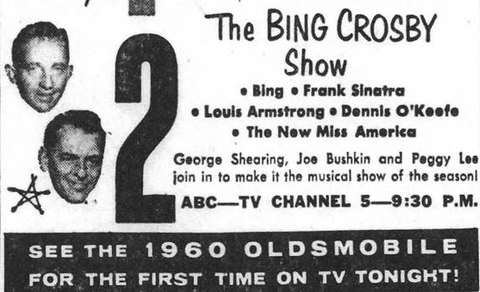
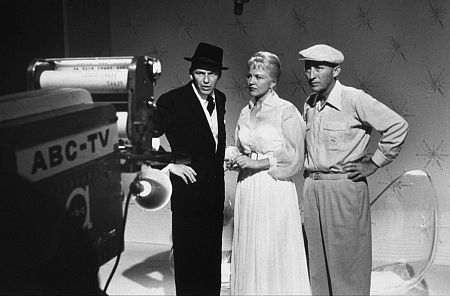
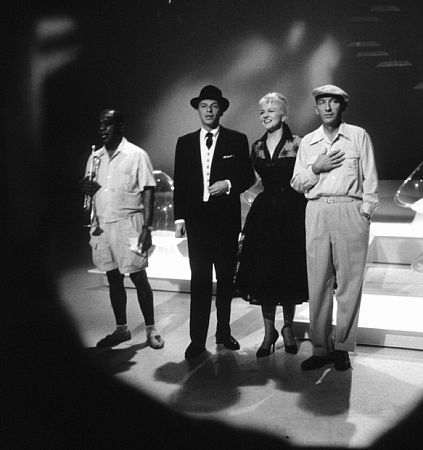
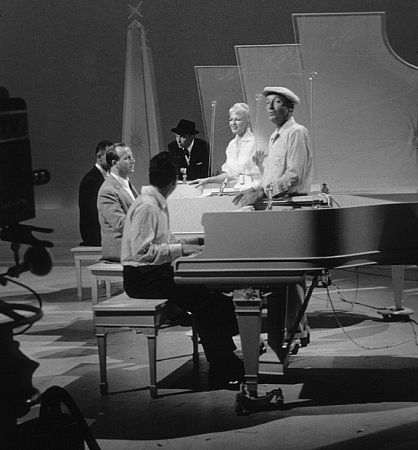
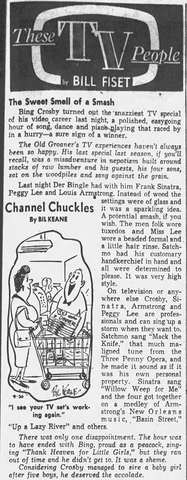
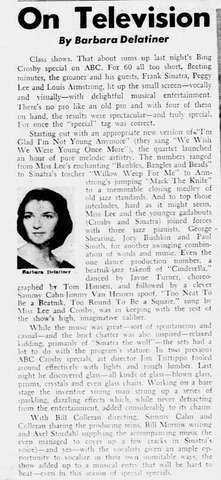
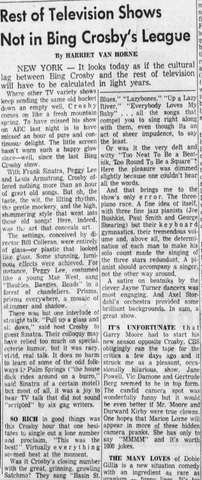
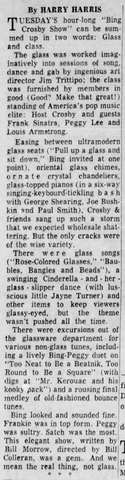
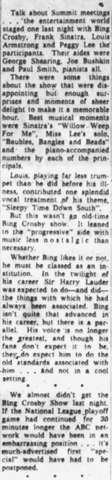
October 1959
[Deal made for Elvis's Timex appearance]
Kaplan: The previous October, Sinatra struck a deal with Colonel Tom Parker for Elvis Presley to appear on Sinatra's final ABC Timex special, marking Presley's discharge from the army; Parker secured Presley a $125,000 fee, more than Sinatra's own pay for the show.
Source: James Kaplan, "Sinatra: The Chairman" (2015)
[JFK's California campaign swing]
Kaplan / Relman Morin: At the end of October 1959, Jack Kennedy made a two-day campaign swing through Oakland, Fresno, Bakersfield, Santa Barbara, Santa Maria, San Diego, and Riverside to counter California Governor Pat Brown, visiting Disneyland and drawing large, enthusiastic crowds at UCLA and USC.
Source: James Kaplan, "Sinatra: The Chairman" (2015)
[Hawaii trip with Judith Campbell]
Not long after his last 1950s recording session, Frank took a trip to Hawaii with a young woman named Judith Campbell, joined by Peter Lawford and his wife Patricia Kennedy. The book notes this seemingly minor trip would carry far greater significance a few months on, once Campbell's connection to JFK developed.
Source: Richard Havers, "Sinatra" (Dorling Kindersley, 2007).
[World Series Absence from Can-Can Set]
Sinatra kept the "Can-Can" production waiting a full day, at a cost of about $10,000, so he could attend the first game of the World Series in Los Angeles with Bing Crosby and Dean Martin.
Source: George Carpozi Jr., Frank Sinatra: Is This Man Mafia? (New York: Manor Books, 1979).
October 9, 1959
One of Sinatra's Timex television specials paid tribute to Jimmy Durante, with Sinatra joined by Dean Martin, Bing Crosby, and Mitzi Gaynor for an energetic musical salute to the veteran entertainer.
Source: Frank Sinatra: The Man, the Music, the Legend, ed. Jeanne Fuchs and Ruth Prigozy (Rochester, NY: University of Rochester Press / Boydell & Brewer, 2007), essay "Sinatra Meets Television" by Ron Simon.
October 13, 1959
Studio
Capitol Studio A, Hollywood
E33341 I Love Paris
w/Maurice Chevalier
Arranged & Conducted by Nelson Riddle
CD: CDP 7-91248-2 Can Can
LP: SW1301 Can Can
Song was recorded on the 20th Century Fox soundstage.
There was a 57 piece orchestra and Nelson Riddle arranged
and conducted. Session ran from 3 to 6:45 p.m.
But it was
dropped from the final cut of the film. Capitol assigned a
master number on 2-19-60. Song was released on the
soundtrack album. I have seen two reviews of the album
that mention how foolish it was not to have the
Sinatra-
Chevalier duet in the film. The same fate befell
"I Like To
Lead When I Dance" from "Robin &
The 7 Hoods."
October 15, 1959
ABC TELEVISION CENTER-STUDIO E 4151 PROSPECT AVENUE HOLLYWOOD at 7:30pm FRANK SINATRA SHOW with MITZI, DEAN MARTIN and BING CROSBY is recorded.
Note: contributed Fred J Wadsworth
October 19, 1959
Television
The Frank Sinatra Timex Show (ABC)
Guests: Bing Crosby, Dean Martin, Mitzi Gaynor
1. High Hopes - Crosby, Martin, Gaynor
2. Day In, Day Out - Frank
3. Together - Sinatra, Crosby, Martin
4. Talk To Me - Frank
5. Cheek To Cheek - Crosby, Martin, Gaynor
6. Wrap Your Troubles In Dreams - Dean
7. Good Old Song - Medley Sinatra, Crosby, Martin
8. High Hopes - Frank
9. Just One Of Those Things - Frank
10. Angel Eyes - Frank
11. The Lady Is A Tramp - Frank
12. Jimmy Durante - Medley Sinatra, Martin, Crosby
Notes: 45 mins.
NOTE: Sinatra Scholar Ed O'Brien reports that Sinatra did four one-hour shows for ABC-TV during the 1959-60 season. This show was easily the best of the lot. Crosby, Martin, and Gaynor worked so well together. They did some terrific medleys that night. Durante was a surprise guest. (The three stars were set to star in the Durante film bio with Frank Capra directing.) But the best of the hour were the solo numbers done by Sinatra.
NOTE: Thanks to Ed O'Brien for providing the above song list.
The Frank Sinatra Timex Show (ABC)
NYT
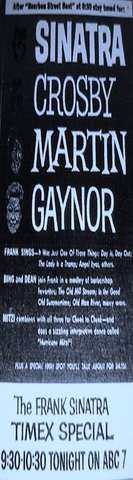
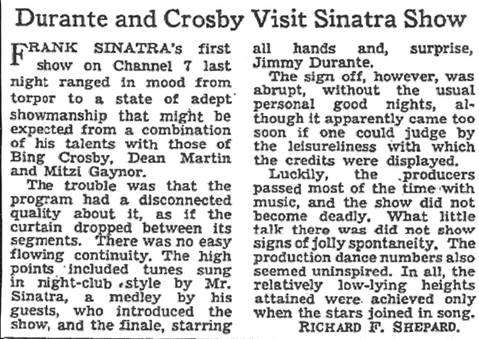
[The Frank Sinatra Timex Show premiere]
The Frank Sinatra Timex Show aired October 19, 1959 -- the first of four specials Sinatra owed ABC after his weekly series collapsed the year before -- co-starring Bing Crosby, Dean Martin, and Mitzi Gaynor, directed by Bill Colleran and produced by Sammy Cahn and Jimmy Van Heusen; reviews were largely ecstatic, praising its restraint compared to Frank's earlier series.
Source: James Kaplan, "Sinatra: The Chairman" (2015).
October 31, 1959
[JFK at the Ford party in Bel Air]
Hedda Hopper: Two nights before his November 2 Jefferson Jackson dinner speech, JFK attended a glittering party for Henry Ford II at Merle Oberon's Bel Air home; Hedda Hopper reported Sinatra was present 'in a gay mood,' with Kennedy arriving at midnight.
Source: James Kaplan, "Sinatra: The Chairman" (2015).
November 1959
Sinatra was Jack Kennedy's guest of honor at his private Mayflower Hotel suite in Washington, used to host dinner parties for favored supporters and celebrities, and the two spent time together during Kennedy's Western swings. In early November, Sinatra attended a Kennedy fundraiser in Los Angeles; afterward he and Kennedy ate at Puccini's, and Jack and aide Dave Powers stayed at Sinatra's Palm Springs home. Source: Michael Sheridan & David Harvey, Sinatra and the Jack Pack.
[Sinatra takes JFK to dinner at Puccini]
Nick Sevano, via Anthony Summers: Probably on Sunday, November 1, 1959, Sinatra took Jack Kennedy to dinner at Puccini, his Beverly Hills restaurant. Per Nick Sevano's account to biographer Anthony Summers, Frank and Kennedy took interest in two women at another table, Angie Dickinson and Judith Campbell, and Sevano brought them over to Frank's table at his request.
Source: James Kaplan, "Sinatra: The Chairman" (2015).
[JFK Stays At The Compound]
Sinatra hosted then-candidate Jack Kennedy for two nights at the Palm Springs Compound, and later made him an honorary Rat Pack member under a private nickname.
Source: Tina Sinatra, "My Father's Daughter: A Memoir" (2000).
[Judith Campbell Meets Sinatra At Puccini]
Nancy Sinatra: According to her later memoir, 25-year-old Judith Campbell met Sinatra at the Beverly Hills restaurant Puccini, and he invited her to join him, Peter Lawford and Lawford's wife Patricia Kennedy on a trip to Hawaii.
Source: Nancy Sinatra, Frank Sinatra: An American Legend, 1995.
[Campbell and Sinatra become lovers in Hawaii]
Judith Campbell Exner (memoir): During the Hawaii trip, Judith Campbell and Sinatra began a sexual relationship; she later described him as gentle, romantic, and attentive, while also reflecting on his reputation for toughness and physical insecurity about his height.
Source: James Kaplan, "Sinatra: The Chairman" (2015)
[JFK's clandestine Palm Springs stay]
Dave Powers: JFK's aide Dave Powers recalled staying with Sinatra in Palm Springs for what turned into several days in November 1959 after a Los Angeles fund-raiser; Powers said Sinatra filled the house with music each morning and, on departure, gave Powers (not Kennedy) a box of jewelry for his wife to make amends for the extended stay.
Source: James Kaplan, "Sinatra: The Chairman" (2015)
[Mort Sahl's telegram joke]
Mort Sahl: While Sinatra played the Sands, comedian Mort Sahl sent him a telegram joking that Albert Schweitzer's warning about nuclear tests' effect on world population was easily answered: everyone would end up in Ocean's 11.
Source: James Kaplan, "Sinatra: The Chairman" (2015)
[Sinatra and Rooney join Dean Martin's Ford Startime]
Kaplan / Fred Danzig: About two weeks after the Timex special, Frank Sinatra and Mickey Rooney joined Dean Martin's NBC hour Ford Startime; reviews were mixed, with UPI's Fred Danzig noting Martin's onstage 'drunk act' drew attention this time in a way it hadn't previously.
Source: James Kaplan, "Sinatra: The Chairman" (2015)
[Tension in the Hawaii penthouse]
Judith Campbell Exner (memoir): During the Hawaii idyll, Campbell recalled an incident in which two young Japanese women were brought to Sinatra's bedroom for a 'massage,' angering Pat Lawford; she also described Peter Lawford making a pass at her one night after Sinatra retired early, which she rebuffed -- after which Sinatra turned cold toward her and she cut the trip short.
Source: James Kaplan, "Sinatra: The Chairman" (2015)
November 2, 1959
Concerts
JEFFERSON-JACKSON DAY DINNER, LOS ANGELES, CA
NOVEMBER 2, 1959
Master of Ceremonies : Frank Sinatra
Entertainment: Sinatra and Mort Sahl
Dais: Gov. Pat Brown, Peter Lawford
Senator Clair Engle, John F. Kennedy
note: Sinatra opened with a monlogue and then sang some songs. Mort Sahl followed with a stand up act and then there were speeches -- ending with a rousing address by Kennedy.
A personal note: After listening to a tape of Kennedy's speech, I called the JFK Library in Boston. I wanted to get the correct date of the dinner. As an afterthought I asked the librarian if they had a tape of the speech. He looked and they did not. I sent them a copy.
Ed
[JFK's Jefferson Jackson Day speech]
John F. Kennedy: On Monday, November 2, 1959, Jack Kennedy delivered a tough speech at the Jefferson Jackson Day dinner at the Beverly Hilton, with Governor Pat Brown as honorary chairman, warning that America had 'gone soft -- physically, mentally and spiritually soft' and citing rising crime, divorce, and tranquilizer use.
Source: James Kaplan, "Sinatra: The Chairman" (2015).
November 3, 1959
Television
"Jubilee" Ford's Star Time
"Dean Martin Show"
Color Broadcast
9:30 -10:30 pm
Network: NBC
Season: 1, Episode: 5
Host: Dean Martin
Guests: Frank Sinatra, Mickey Rooney
1. It's Jubilee Time w/Dean & Mickey
2. Opening Medley w/Dean & Mickey
3. When You're Smiling w/Dean
4. I Can't Get Started With You
5. Rodgers & Hart Medley w/Dean
6. How About You w/Dean & Mickey,
NOTE: Sinatra Scholar Ed O'Brien calls this a terrific hour of entertainment. Sinatra sang "I Can't Get Started" from "No One Cares," released just a few months earlier. Rooney was the perfect song and dance man, making a delightful trio with Sinatra and Dino. The Rodgers and Hart medley is a memorable moment in an hour of memorable moments. Sinatra sang "Manhattan" and "Blue Room" with Mickey and Dean. There was a great deal of humor in the comedy skits, thanks in no small part to Rooney's impeccable timing. This is TV in its golden age!
Note: Audio of this program is in circulation but not video
Film
Guys and Dolls, (US Film Release: November 3, 1955)
Starring: Marlon Brando, Frank Sinatra, Jean Simmons, Vivian Blaine
Directed by Joseph L. Mankiewicz. Produced by Samuel Goldwyn.
Sinatra plays Nathan Detroit who runs a permanent floating crap game in New York. (1st DVD Release date: 2000-04-18 - BluRay Release date: 2012-11-06) Three new songs, written by Frank Loesser, were added to the film: "Pet Me Poppa"; "A Woman in Love"; and "Adelaide", which was written specifically for Sinatra.
World premiere of film was strictly for the press and VIPs on 11-3-55. There was only one showing
Note: "Guys and Dolls" was slowly released throughout the country in November and then had a nationwide release on 12-23-55. The first showing was at the Capitol Theater, in N.Y.C.,11/3, then Chicago, 11/10 and a major city release on 11/14. The film was the biggest grosser in 1956, taking in over $9,000,000. The final take would go over $13,000,000. Film was a big hit in England and Japan. Reviews were very mixed. Variety gave it a rave, but put most of the emphasis on the production values: choreography, musical numbers and the stylized sets. The actors all got mentioned in a few brief remarks except for Stubby Kaye who gets a rave for "Sit Down You're Rockin' The Boat." Frank Loesser wanted Sinatra to play Sky Masterson in the original Broadway production, back in 1950. He flew out to Hollywood and offered Frank the role. When the film was being cast, Frank let the studio know he wanted to play Sky. But he was never seriously considered for the part. Goldwyn would spend over $5,500,000 on the film. Sam wanted a proven b.o. star: Marlon Brando. Frank thought it was a terrible idea. Did not believe Brando was right for the role. Grace Kelly was the choice for Sister Sarah, but was unavailable. Goldwyn wanted Betty Grable to play Adelaide. The director, Joseph Mankiewicz, had his heart set on Vivian Blaine, who had been a terrific Adelaide on Broadway. Did Frank actively seek the role of Nathan Detroit ? In an interview, a few years later, he claimed that was not the case. The role was offered to him and he said no.. When told that it would be Samuel Goldwyn's swan song, Frank reluctantly got on board. Others, including the director, remembered Frank aggressively seeking the role. The film got underway in March of 55. The first day of shooting involved the famous cheesecake scene at Lindy's. Brando kept insisting on take after take as Frank and he ate slices of cheesecake. After take 42, Frank became sick and the scene was completed the next day in one take. Brando and Sinatra would not get along throughout the making of the movie. At one point Brando told the director that Sinatra was singing the songs as if he were a romantic lead, not a Runyonesque character. He wanted Mankiewicz to tell Frank how to sing the songs. The director refused. Sinatra was asked to help Brando with the musical numbers. After hearing Marlon warble, Frank refused. Brando did 135 takes on one scene. Sinatra, famous for one take and out, was enraged. Then Frank Loesser went after Sinatra. He did not like the way the songs were being sung by him. Frank suggested Loesser do something that is physically impossible. Sinatra often talked about the film in very negative terms. He considered it the worst cast film in the history of Hollywood. How could it work with "Mumbles Brando and an English Broad playing a Salvation Army worker." When "Luck Be A Lady" was recorded by Frank, in July of 1963, Billy May wrote an a la Broadway arrangement. Billy told me Frank rejected the concept. Told Billy he wanted a chart that sounded like Sinatra. The recording and many concerts performances are five plus minutes of incredible singing..
Variety and many other reviews expressed regret that "Guys and Dolls" lacked the gritty realism that an on-location film would have offered. It would be Sinatra's first stereo recordings. At one point there was almost an agreement to allow Capitol to release an album. A good film that kept Frank's streak of movie hits going and made him an attractive box office star for the rest of the 1950s. --Ed
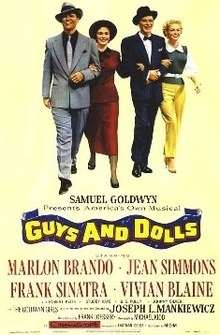
"Jubilee" Ford's Star Time
"Dean Martin Show"
Color Broadcast
(Thanks to Ed O'Brien for the following:)
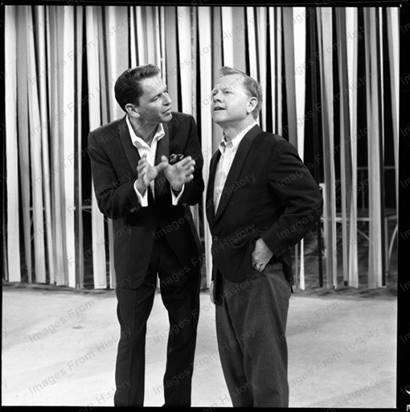
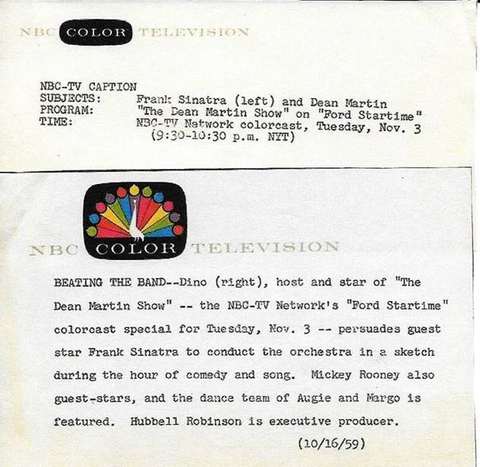
[Kennedy and Sinatra both go quiet]
Kaplan / AP: On November 3, 1959, the AP reported Nixon's public 'folksy stroll' around Beverly Hills while Kennedy had disappeared from view; Sinatra likewise vanished from the gossip columns that week, having quietly hosted JFK for a clandestine stay at his Palm Springs home.
Source: James Kaplan, "Sinatra: The Chairman" (2015).
November 4, 1959
[Variety announces Sands Summit show]
Variety: Variety reported that Frank Sinatra, Dean Martin, and Sammy Davis Jr. would appear simultaneously at the Sands Hotel starting January 20 for a four-week engagement operated by Jack Entratter -- billed as the wildest club act ever.
Source: James Kaplan, "Sinatra: The Chairman" (2015).
November 6, 1959
[Sinatra's sworn 1959 IRS testimony on Giancana]
Questioned under oath by IRS agents investigating possible mob skimming, Sinatra acknowledged first meeting Chicago boss Sam Giancana around March 11, 1958 at the Fontainebleau Hotel, calling the relationship "strictly social" and denying Giancana had ever approached him with a business proposition or attended any party Sinatra hosted. Asked how Giancana had obtained his unpublished home phone number, Sinatra answered simply, "I gave it to him." The FBI later concluded Sinatra had likely lied under oath: a professional dancer who attended Sinatra's July 25-August 2, 1959 party at the Claridge Hotel in Atlantic City told agents she had seen Giancana there on several occasions, along with Rocco and Joseph Fischetti, actress Natalie Wood, and actor Robert Wagner.
Source: Kuntz and Kuntz, The Sinatra Files, ch. 4.
November 8, 1959
Concerts
Dean Martin's Friars Dinner, Los Angeles
Sunday evening
Barry Mirkin
George Jessel M.C. for evening
Jimmy Durante
Joey Bishop
Tony Martin sings parody
George Burns
Dinah Shore parody "Dino-Vino"
Mort Sahl
Judy Garland "Rock-A-Bye Your Baby"( thrills audience)
Sammy Cahn parody
Danny Thomas
Sammy Davis, Jr. "I Want To Be Italian"
Bob Hope
Frank Sinatra parodies of "All The Way" and "But Beautiful."
Al Hart
Eugene Debs
Glenn Wallichs
Dean Martin "Mr Wonderful, That's Me"
Dean Martin's Friars Dinner, Los Angeles
Friars asked for a $25.00 donation for this collector's LP back in 1959
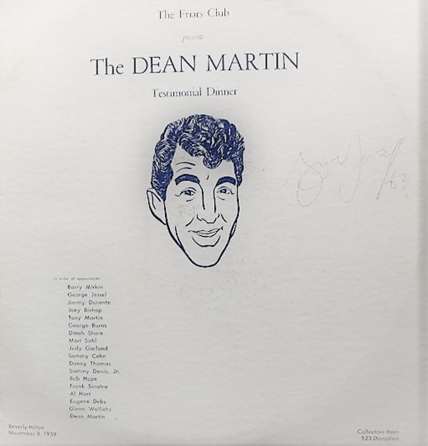
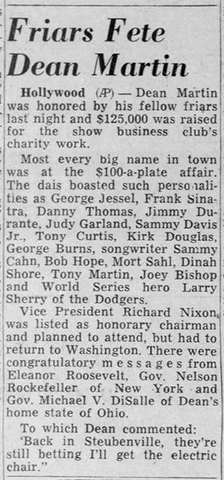
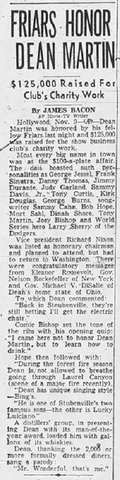
November 24, 1959
Concerts
Sands, Las Vegas, Nevada (November 24 to December 1)
O.A. Mel Young
Antonio Morelli & His Orchestra
Sands, Las Vegas, Nevada (November 24 to December 1)
O.A. Mel Young
Antonio Morelli & His Orchestra
"Frank Sinatra's big one-week stand
at the Sands is a hypo for business
all over town."
"The Sinatra stint was sold-out weeks
in advance, and there are still local
VIPs, with juice, who are trying in
vain to get into the show before
Tuesday's closing."
"Frank winged in from Honolulu
for this one -- he is rested and
never was in better voice."
Daily Variety
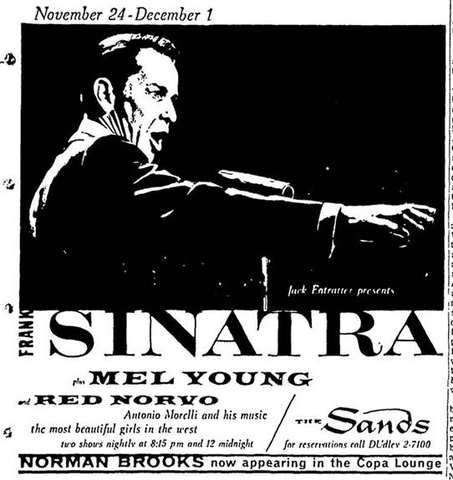
Frank Sinatra dealing baccarat in the Sands Casino, Las Vegas, November 1959
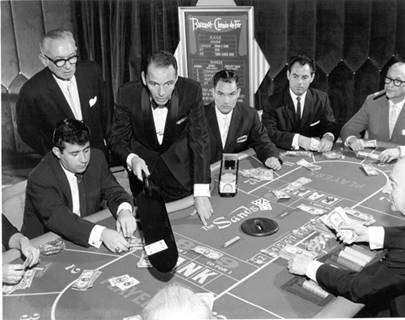
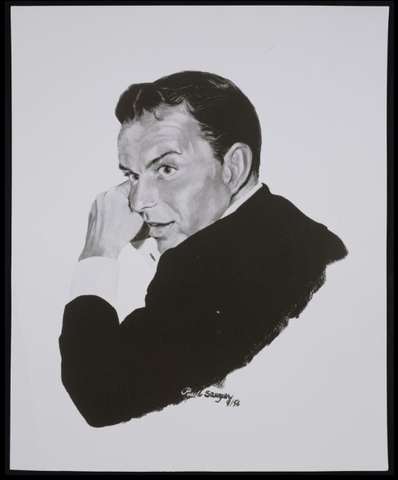
November 25, 1959
Concerts
Sands, Las Vegas, Nevada (November 24 to December 1)
O.A. Mel Young
Antonio Morelli & His Orchestra
November 26, 1959
Concerts
Sands, Las Vegas, Nevada (November 24 to December 1)
O.A. Mel Young
Antonio Morelli & His Orchestra
November 27, 1959
Concerts
Sands, Las Vegas, Nevada (November 24 to December 1)
O.A. Mel Young
Antonio Morelli & His Orchestra
November 28, 1959
Concerts
Sands, Las Vegas, Nevada (November 24 to December 1)
O.A. Mel Young
Antonio Morelli & His Orchestra
November 29, 1959
Concerts
Sands, Las Vegas, Nevada (November 24 to December 1)
O.A. Mel Young
Antonio Morelli & His Orchestra
November 30, 1959
Concerts
Sands, Las Vegas, Nevada (November 24 to December 1)
O.A. Mel Young
Antonio Morelli & His Orchestra
[Sinatra's triumphant Sands return]
Variety: Variety reported on November 30, 1959, that Sinatra's sold-out one-week Sands stand, following his return from Honolulu, was 'a hypo for business all over town,' noting he was rested and in excellent voice.
Source: James Kaplan, "Sinatra: The Chairman" (2015).
December 1959
[Joe Kennedy enlists Sinatra to approach Giancana]
Tina Sinatra, via Seymour Hersh: Per Tina Sinatra's account to Seymour Hersh, Joseph P. Kennedy summoned Frank to the family compound in Hyannis Port in mid-December 1959 and asked him to use his connections to help JFK with 'our friends' in West Virginia and Illinois -- understood as an appeal to organized-crime figures Kennedy himself couldn't approach directly.
Source: James Kaplan, "Sinatra: The Chairman" (2015)
[Never So Few]
Santopietro (Filmography): Canterbury/Metro-Goldwyn-Mayer. Produced by Edmund Grainger, directed by John Sturges, screenplay by Millard Kaufman based on the Tom T. Chamales novel. Sinatra played Tom Reynolds opposite Gina Lollobrigida, Peter Lawford, Steve McQueen and Charles Bronson.
No corresponding dated entry could be identified in the chronology for this film/context.
Source: Tom Santopietro, "Sinatra in Hollywood" (2008), Filmography
[Ocean's Eleven filming, Rat Pack shows begin]
Ed Walters: Walters says that in December 1959, while Ocean's 11 was being filmed at the Sands, he was present at the start of what the public later called the "Rat Pack" shows -- Sinatra, Dean Martin and the others performing together on one stage. He stresses that Sinatra himself never used the term "Rat Pack," nor did Walters.
Source: Ed Walters, UNLV Table Games Management Oral History (2015)
[Sinatra relays Kennedy's request to Giancana]
Kaplan / Tina Sinatra: Following Joe Kennedy's request, Sinatra reportedly met Sam Giancana on a golf course, away from FBI surveillance, and told him he believed in Kennedy as a future president and wanted Giancana's help.
Source: James Kaplan, "Sinatra: The Chairman" (2015)
December 1, 1959
Concerts
Sands, Las Vegas, Nevada (November 24 to December 1)
O.A. Mel Young
Antonio Morelli & His Orchestra
December 7, 1959
[Campbell visits Sinatra's Palm Springs house]
Judith Campbell Exner (memoir): After Sinatra reportedly apologized for his behavior in Hawaii and pursued her with calls, Judith Campbell met him at his Palm Springs house on Wonder Palms Road on December 7, 1959, finding it more modest than expected; also present were Pat and Peter Lawford, Jack Entratter, Jimmy Van Heusen, and Johnny Formosa, a Giancana associate whom Frank treated carefully.
Source: James Kaplan, "Sinatra: The Chairman" (2015).
December 8, 1959
[Dinner at Romanoff's and Frank's nomination bet]
Frank Sinatra, via Judith Campbell Exner: The next evening, December 8, 1959, Sinatra and Campbell dined with the Lawfords at Romanoff's-on-the-Rocks, where Pat Lawford held forth on JFK's primary chances; that night Sinatra told Campbell, 'I'll bet even money Jack gets the nomination.'
Source: James Kaplan, "Sinatra: The Chairman" (2015).
December 13, 1959
Television
Frank Sinatra Timex Show
Taped December 10, 1959
An Afternoon With Frank Sinatra
Network: ABC
Sponsor: Timex
Sunday Evening
8:30 p.m. - 9:30 p.m.
Guests: Ella Fitzgerald, Peter Lawford, Juliet Prowse, The Hi-Lo's,
Hermione Gingold.
1.. You're Invited To Spend The Afternoon
2. I've Got The World On A String
3. It's Alright With Me sung to Juliet Prowse
4. Too Marvelous For Words
5. Here's That Rainy Day
6. I'll Never Smile Again w/Hi-Lo's
7. Can't We Be Friends w/Ella
8. Love Is Here To Stay
9. Love Is Sweeping The Country - Entire Cast
Frank Sinatra Timex Show
Guests: Ella Fitzgerald, Peter Lawford, Juliet Prowse, The Hi-Lo's,
Hermione Gingold.
NYT Review: 12-14-59:
ELLA FITZGERALD;HERMIONE GINGOLD;JULIET PROWSE
Sinatra and the Hi-Los
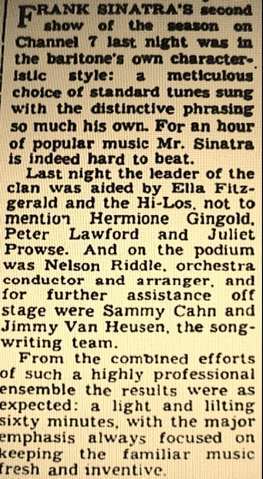
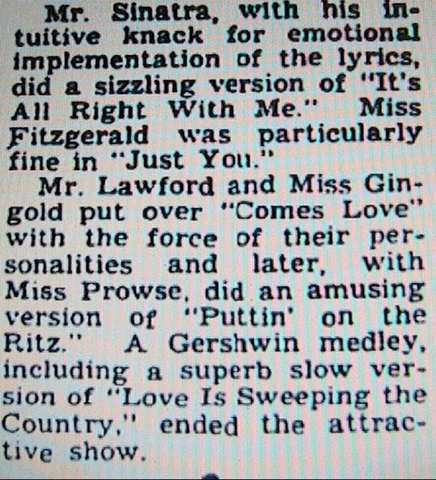
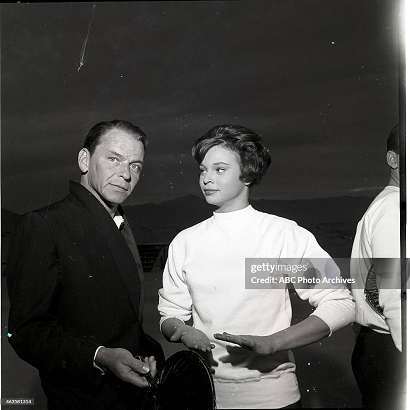
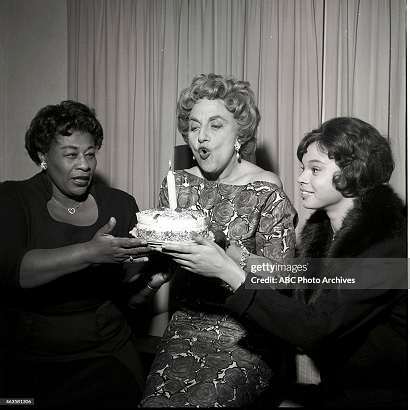
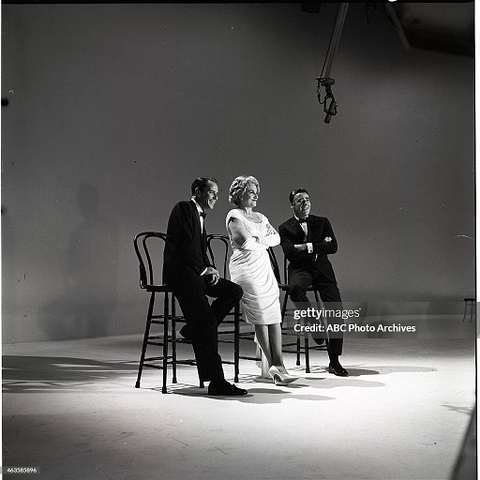
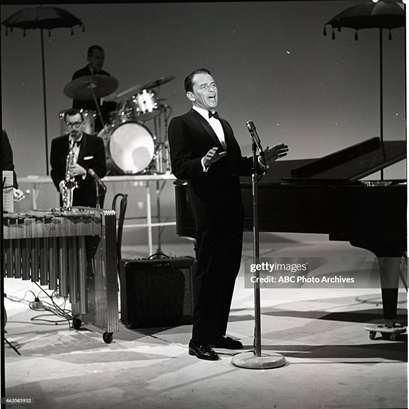
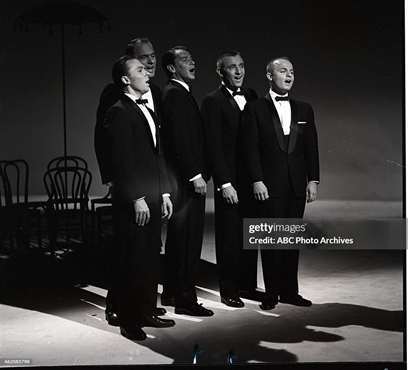
"Too Marvelous for Words" / "Here's That Rainy Day"
Will Friedwald (analysis): Friedwald singles out this special as documenting 'a sizzling interpretation of "Too Marvelous for Words" and a miraculously intimate "Here's That Rainy Day"' backed by the Norvo combo.
Source: Will Friedwald, "Sinatra! The Song Is You: A Singer's Art" (2018 revised edition).
1960
[Forms Reprise Records]
Sinatra is named Top Box Office Star of 1960 by Film Exhibitors of America, forms his own label, Reprise Records, and hosts a TV special welcoming Elvis Presley home from the Army; he appears in "Can-Can," "Ocean's Eleven," and "Pepe."
Source: Nancy Sinatra, "Frank Sinatra, My Father" (1985).
[Giancana Delivers For Kennedy]
Sinatra personally asked Giancana for help, and Kennedy went on to win the West Virginia primary over Hubert Humphrey and later the general election, aided by strong turnout in Chicago's mob-influenced wards.
Source: Tina Sinatra, "My Father's Daughter: A Memoir" (2000).
[Jack Kennedy Stays at the Palm Springs House]
Before the Palm Springs property expanded into the larger Compound, one of its guest rooms hosted Jack Kennedy as an overnight guest.
Source: Tina Sinatra, "My Father's Daughter: A Memoir" (2000).
[Joe Kennedy Recruits Sinatra For West Virginia]
Summoned to Hyannis Port, Joe Kennedy Sr. asked Sinatra to use his underworld contacts, chiefly Sam Giancana, to secure union support in the West Virginia primary, as a personal favor Sinatra could make that the Kennedys themselves could not.
Source: Tina Sinatra, "My Father's Daughter: A Memoir" (2000).
["John Fitzgerald Kennedy Slept Here" Plaque]
During the 1960 presidential campaign, John Kennedy stayed as a guest in the Sinatra family's Palm Springs home; afterward Frank had a gold plaque mounted on the guest room door commemorating the visit.
Source: Nancy Sinatra, "Frank Sinatra, My Father" (1985).
[Lawford and Sinatra at Key Women for Kennedy Rally]
Peter Lawford and Sinatra are shown speaking with Edward M. Kennedy at a Key Women for Kennedy rally in California in 1960.
Source: Charles Pignone, "Frank Sinatra 100" (2015).
[Marymount Classmate's Communist Question]
A fifth-grade classmate at Marymount asked Tina whether her father being called a communist made her one too, leaving Tina in tears; her father called to reassure her that neither of them was a communist and that he would handle it.
Source: Tina Sinatra, "My Father's Daughter: A Memoir" (2000).
[May Britt and Sammy Davis Jr. Marry in Las Vegas]
Actress May Britt married Sammy Davis Jr. in Las Vegas in 1960, with Frank Sinatra serving as best man and Shirley Rhodes, wife of Sammy's conductor George Rhodes, as matron of honor.
Source: Nancy Sinatra, "Frank Sinatra, My Father" (1985).
[Nancy Greets Elvis at Fort Dix]
When Elvis Presley was discharged from the Army in January 1960, Sinatra sent Nancy to Fort Dix to welcome him home with gifts, including tuxedo shirts, ahead of Elvis's planned appearance on Sinatra's TV special.
Source: Nancy Sinatra, "Frank Sinatra, My Father" (1985).
[Nancy And Tommy Sands Move To New York]
With President Kennedy newly inaugurated, Nancy Sinatra and husband Tommy Sands relocated to a one-room apartment on East 55th Street in New York, furnished by Marty and Dolly Sinatra. Sands enrolled in Lee Strasberg's classes at the Actors Studio.
Source: Nancy Sinatra, "Frank Sinatra, My Father" (1985).
[Sinatra Quietly Pays Off Maltz]
Though he had refused to bow to the Kennedys, Sinatra was moved by his daughter's distress and had his publicist pay Maltz his full contracted fee of $75,000 while stepping back from the project.
Source: Tina Sinatra, "My Father's Daughter: A Memoir" (2000).
[Senator Kennedy Joins the Summit at the Sands]
In 1960, then-Senator John Kennedy, already eyeing a higher summit of his own, came to the Rat Pack's Summit shows at the Sands in Las Vegas for the same laughter and relaxation everyone else sought there.
Source: Nancy Sinatra, "Frank Sinatra, My Father" (1985).
[Sinatra Launches Reprise Records]
After choosing not to renew with Capitol, Sinatra founded his own label, Reprise, in late 1960, pioneering a model in which artists owned and controlled their masters.
Source: Charles Pignone, "Frank Sinatra 100" (2015).
[Sinatra Hires Blacklisted Writer Albert Maltz, Then Backs Down]
Nancy Sinatra: Sinatra hired blacklisted screenwriter Albert Maltz to adapt The Execution of Private Slovik and stood firm through a firestorm of press attacks and threats from sponsors, but after Kennedy allies warned the hiring could hurt JFK's presidential chances, and after his own children faced harassment at school over it, Sinatra ultimately paid Maltz in full and dropped the project.
Source: Nancy Sinatra, Frank Sinatra: An American Legend, 1995.
[Sinatra's Peak Productivity]
In this five-year stretch, Sinatra worked at a furious pace, playing roughly two hundred club dates a year, releasing twenty-six albums, appearing in eleven films, launching his own label Reprise Records, and becoming part-owner of the Cal-Neva Lodge in Lake Tahoe.
Source: Tina Sinatra, "My Father's Daughter: A Memoir" (2000).
[The Private Slovik Controversy]
When Sinatra hired the blacklisted Maltz to adapt The Execution of Private Slovik while backing the Kennedy campaign, hostile columnists branded him a communist sympathizer, and both Joe and Bobby Kennedy pressed him to drop Maltz, which he initially refused to do.
Source: Tina Sinatra, "My Father's Daughter: A Memoir" (2000).
[The Scrapped Private Slovik Film]
Sinatra hired blacklisted writer Albert Maltz to adapt The Execution of Private Slovik for what would have been his first film production, drawing press attacks over Maltz's past refusal to cooperate with the House Un-American Activities Committee. Sinatra ultimately dropped the project, citing public and family reaction, though Nancy later understood his real concern was protecting his friendship with then-Senator John Kennedy.
Source: Nancy Sinatra, "Frank Sinatra, My Father" (1985).
[The Summit Films Ocean's 11 in Las Vegas]
Members of "The Summit" gathered in Las Vegas in 1960 during the filming of Ocean's 11, helping establish the city as a major tourist destination.
Source: Charles Pignone, "Frank Sinatra 100" (2015).
[1960 Democratic Convention performance]
Consiglio: At the 1960 Democratic National Convention, Sammy Davis Jr. sang the national anthem onstage with Sinatra, Joey Bishop, and Shirley MacLaine while Mississippi delegates heckled Davis over his presence. Joey Bishop publicly defended him, telling the crowd Davis was there to entertain, not to make a political statement.
Source: Tony Consiglio (as told to Franz Douskey), "Sinatra and Me: The Very Good Years" (2012)
[Ballad album sessions at Capitol]
Kaplan: Over three consecutive nights, Sinatra and Riddle recorded twelve standard ballads for a planned album originally titled The Nearness of You, reworking songs Frank had cut a decade or more earlier at Columbia, mostly predating his relationship with Ava Gardner.
Source: James Kaplan, "Sinatra: The Chairman" (2015)
[Brad Dexter's role in The Magnificent Seven]
Kaplan: Brad Dexter co-starred alongside Steve McQueen, James Coburn, Yul Brynner, Charles Bronson, Robert Vaughn, and Horst Buchholz in John Sturges's 1960 film The Magnificent Seven, though he was famously the one cast member audiences could never remember.
Source: James Kaplan, "Sinatra: The Chairman" (2015)
[Campaigning for JFK in Hawaii]
Consiglio: While campaigning for John F. Kennedy in 1960, Consiglio, Sinatra, and Peter Lawford stayed at Bobby Kennedy's house near Diamond Head in Hawaii. Sammy Davis Jr. flew in en route to a free fundraising concert in Sydney, Australia; Consiglio found roughly $30,000 in gaming chips that had spilled from Davis's unlocked suitcase and returned them all.
Source: Tony Consiglio (as told to Franz Douskey), "Sinatra and Me: The Very Good Years" (2012)
[Can-Can]
Santopietro; Nikita Khrushchev (quoted): The film's most famous moment had nothing to do with its content: then-Soviet Premier Nikita Khrushchev visited the Twentieth Century-Fox set during a lavish luncheon attended by many Hollywood stars, followed by a live musical presentation from Can-Can (with Sinatra as master of ceremonies). Khrushchev publicly professed shock, calling the can-can dance 'lascivious, disgusting and immoral.'
No corresponding dated entry could be identified in the chronology for this film/context.
Source: Tom Santopietro, "Sinatra in Hollywood" (2008), The Peak Years (pt. 3)
[Can-Can]
Can-Can was Sinatra's first musical since Pal Joey three years earlier, produced by Jack Cummings with Sinatra's own Suffolk Productions, directed by Walter Lang, and featured a Cole Porter score (from Porter's 1953 Broadway show), choreography by Hermes Pan, and music by Nelson Riddle. It costarred Maurice Chevalier, Shirley MacLaine, Louis Jourdan, and Juliet Prowse.
No corresponding dated entry could be identified in the chronology for this film/context.
Source: Tom Santopietro, "Sinatra in Hollywood" (2008), The Peak Years (pt. 3)
[Can-Can]
Santopietro grades this a C, calling it subpar but redeemed by "It's All Right with Me." Golden Laurel Award: Top Male Musical Performance; Golden Laurel Award nomination: Top Male Star of the Year; Quigley Top 10 Money Makers Poll: #8.
No corresponding dated entry could be identified in the chronology for this film/context.
Source: Tom Santopietro, "Sinatra in Hollywood" (2008), Career Scorecard
[Can-Can / Carousel]
Sinatra took the role in Can-Can partly to fulfill a settlement with Twentieth Century-Fox over having walked off Carousel five years earlier. Though not a favorite project, it proved lucrative: Sinatra received a $200,000 fee plus 25 percent of the gross profits.
No corresponding dated entry could be identified in the chronology for this film/context.
Source: Tom Santopietro, "Sinatra in Hollywood" (2008), The Peak Years (pt. 3)
[Chicago Crime Commission memo on Sinatra and D'Amato]
Virgil Peterson: A memo from Virgil Peterson of the Chicago Crime Commission to Nevada Gaming Control investigator Charles LaFrance described Sinatra as extremely close to Paul 'Skinny' D'Amato of the 500 Club, noting D'Amato's ties to major hoodlums and that the club stayed afloat largely because Sinatra performed there gratis.
Source: James Kaplan, "Sinatra: The Chairman" (2015)
[Consiglio drives Judith Campbell to White House]
Consiglio: Consiglio, a close friend of Judith Campbell (later Exner), drove her to the White House several times during her visits with President Kennedy.
Source: Tony Consiglio (as told to Franz Douskey), "Sinatra and Me: The Very Good Years" (2012)
[FBI and Hoover learn of CIA-Mafia deal]
Kaplan (citing Rappleye and Becker): The Balletti wiretap arrest led Las Vegas sheriff Butch Leypoldt to alert the FBI, which discovered Maheu's involvement and, through him, the CIA's use of Giancana, Rosselli, and Trafficante. J. Edgar Hoover was outraged to learn the mobsters his agents had long targeted were now working for the government, and once Bobby Kennedy became attorney general, Hoover made sure he knew about his brother's mob associations; Sinatra himself began appearing in FBI memos.
Source: James Kaplan, "Sinatra: The Chairman" (2015)
[Frank launches Reprise Records]
Consiglio: In 1960, Frank started his own record label, Reprise, bringing Dean Martin over from Capitol and Sammy Davis Jr. from Decca to record for it.
Source: Tony Consiglio (as told to Franz Douskey), "Sinatra and Me: The Very Good Years" (2012)
[Giancana pursues Phyllis McGuire]
Kaplan (citing Shawn Levy): Sam Giancana began courting singer Phyllis McGuire of the McGuire Sisters in early 1960, despite her engagement to comedian Dan Rowan, partly by having the Desert Inn forgive nearly $100,000 of her gambling debts.
Source: James Kaplan, "Sinatra: The Chairman" (2015)
[Granz sells Verve to MGM instead]
Mo Ostin (recollection): Impatient to cash out, Norman Granz, after a chance airport meeting with MGM president Arnold Maxin, sold Verve to MGM for $3.1 million rather than closing the stalled deal with Sinatra -- prompting Sinatra to feel betrayed, believing Granz had reneged on a handshake agreement.
Source: James Kaplan, "Sinatra: The Chairman" (2015)
[JFK's second Nevada visit, stays at Sands]
Blair Clark: Kennedy returned to Nevada, this time for personal reasons, staying two nights at the Sands as Sinatra's guest along with his brother Ted, and catching the Summit show on both visits. A CBS reporter traveling with him recalled there was no reason for stopping there except fun and games.
Source: James Kaplan, "Sinatra: The Chairman" (2015)
[Johnny Mandel recruited for Sinatra's new label]
Johnny Mandel (recollection): On the Devil at 4 O'Clock set, Sinatra's pianist Bill Miller brought in young arranger Johnny Mandel, whose hard-swinging club arrangements for Vic Damone had impressed Sinatra, to orchestrate the first album for his forthcoming label, Reprise. Neither Nelson Riddle nor Billy May could work on it due to their Capitol contracts.
Source: James Kaplan, "Sinatra: The Chairman" (2015)
[Lawford's 'liveliest art' quip]
Peter Lawford: Peter Lawford later told a reporter in 1960, of the Kennedys' interest in Sinatra, 'Let's just say that the Kennedys are interested in the lively arts, and that Sinatra is the liveliest art of all.'
Source: James Kaplan, "Sinatra: The Chairman" (2015)
[Mo Ostin's tense first meeting with Sinatra]
Mo Ostin (recollection): On the Devil at 4 O'Clock soundstage, Mickey Rudin brought Mo Ostin to meet Sinatra for approval to run the new label, arriving in the middle of Sinatra furiously arguing with director Mervyn LeRoy. After the outburst passed, Sinatra greeted Ostin in his dressing room with total warmth and enthusiasm about the new venture, describing his vision of a label giving artists real ownership and creative freedom.
Source: James Kaplan, "Sinatra: The Chairman" (2015)
[Moran sues Sinatra]
Kaplan: Parking attendant Edward Moran, treated for facial cuts and bruises after the SHARE benefit brawl, filed a $100,000 assault suit against Sinatra, which Sinatra settled out of court.
Source: James Kaplan, "Sinatra: The Chairman" (2015)
[Nancy Jr. marries Tommy Sands]
Consiglio: Before marrying choreographer Hugh Lambert, Nancy Jr. was married to singer Tommy Sands, who recorded for Capitol Records and had a hit with "Teenage Crush." The marriage was short-lived; Consiglio believed Sands wanted Nancy to leave show business, which she refused to do.
Source: Tony Consiglio (as told to Franz Douskey), "Sinatra and Me: The Very Good Years" (2012)
[Nevada Black Book first published]
Kaplan: The Nevada Gaming Control Board's "Black Book," the list of individuals barred from state gambling establishments, was first published in 1960 -- meaning Sam Giancana could still frequent Cal-Neva in 1958 without official restriction.
Source: James Kaplan, "Sinatra: The Chairman" (2015)
[Norman Granz decides to sell Verve]
Mo Ostin: By 1960, Norman Granz, more interested in his impresario work than the difficult economics of selling jazz records, decided he was finished with the record business and looked to sell Verve, which had grown profitable partly through comedy and pop records.
Source: James Kaplan, "Sinatra: The Chairman" (2015)
[Origin of the "Rat Pack" nickname]
Ed Walters: According to Walters, the "Rat Pack" name came from newspaper columnist Dorothy Kilgallen, who by the second week of the Ocean's 11 shoot wrote that Sinatra, Martin and the others were staying up drinking all night "like a bunch of rats." Walters says the group was actually far more disciplined than the press portrayed, and that Kilgallen kept using the phrase "rat pack" in subsequent columns, apparently borrowing the term from an old Humphrey Bogart-era group, though the connection was coincidental.
Source: Ed Walters, UNLV Table Games Management Oral History (2015)
[Origins of Nice 'n' Easy]
Kaplan: Hank Sanicola solicited a new title track for the album from several songwriters; Lew Spence and lyricists Alan and Marilyn Bergman, who'd already written Sleep Warm and Love Looks So Well on You for Sinatra, produced Nice 'n' Easy from a musical fragment Spence had been sitting on.
Source: James Kaplan, "Sinatra: The Chairman" (2015)
[Private Slovik]
Frank Sinatra: Facing press attacks, Sinatra took out ads in Daily Variety and The Hollywood Reporter on March 28, 1960, defending his right as producer/director to hire whomever he chose and asking the public to withhold judgment until the film was seen, while also stating bluntly that he did not ask JFK's advice on hiring and JFK did not ask his advice on Senate votes.
No corresponding dated entry could be identified in the chronology for this film/context.
Source: Tom Santopietro, "Sinatra in Hollywood" (2008), The Rat Pack (pt. 1)
[Private party in Sinatra's suite]
Blair Clark: After one of the Summit shows, a private party took place in Sinatra's suite with Kennedy, some of his entourage, and at least two women, one of them Judith Campbell. Reporters Blair Clark and Mary McGrory excused themselves, sensing what was about to happen.
Source: James Kaplan, "Sinatra: The Chairman" (2015)
[Rat Pack on the Kennedy campaign trail]
Consiglio: When Jack Kennedy ran for president in 1960, Frank brought Dean Martin and Sammy Davis Jr. along on campaign stops, including a show in Athens, Ohio, performing before Kennedy's speeches. In the campaign's early days Frank was the real draw, pulling crowds who came to see him rather than the little-known senator from Massachusetts.
Source: Tony Consiglio (as told to Franz Douskey), "Sinatra and Me: The Very Good Years" (2012)
[Reprise Records founded]
Kaplan: Reprise Records began operations in 1960 with a capitalization of $300,000 borrowed from City National Bank, run by Sinatra's friend and world-tour travel companion Al Hart.
Source: James Kaplan, "Sinatra: The Chairman" (2015)
[Reprise Records founded; first pressing to Ava]
Consiglio: When Sinatra started Reprise Records in 1960, the very first album off the press was sent to Ava Gardner, continuing a tradition of her always getting his newest record first.
Source: Tony Consiglio (as told to Franz Douskey), "Sinatra and Me: The Very Good Years" (2012)
[Rudin proposes starting a label from scratch]
Mo Ostin: After the Verve deal collapsed and left Sinatra permanently estranged from Granz, Mickey Rudin proposed that instead of buying an existing label, Sinatra start a new record company from scratch, suggesting Mo Ostin -- previously Granz's accountant -- to run it.
Source: James Kaplan, "Sinatra: The Chairman" (2015)
[Rudin stalls the Verve sale to Sinatra]
Will Friedwald (account): The Verve sale to Sinatra stalled amid strange delays, with someone in Sinatra's camp -- his lawyer Mickey Rudin, who also represented Granz -- repeatedly postponing signing appointments and re-examining the company's books, before Rudin finally admitted his conflict of interest and recused himself; Verve hired a new lawyer to handle the sale.
Source: James Kaplan, "Sinatra: The Chairman" (2015)
[Sinatra and Granz meet, shake hands on a deal]
Mo Ostin: According to Mo Ostin, Sinatra and Granz -- who never liked each other -- met and the encounter ended with a handshake, though Sinatra wanted Granz to keep running Verve while Granz wanted out of the business entirely to move to Europe.
Source: James Kaplan, "Sinatra: The Chairman" (2015)
[Sinatra and MacLaine clock convention applause]
Kaplan: Sinatra, Peter Lawford, and Shirley MacLaine carried stopwatches on the convention floor, timing the ovations for each presidential nominee; Adlai Stevenson drew the biggest applause of the sentimental favorites.
Source: James Kaplan, "Sinatra: The Chairman" (2015)
[Sinatra best man for Sammy Davis-May Britt wedding]
Consiglio: Sinatra warned Sammy Davis Jr. that marrying Swedish actress May Britt would hurt his career, but stood by him as best man anyway. The Kennedy family reportedly distanced itself once the interracial marriage became known, and Davis postponed the wedding until after the 1960 election and Kennedy's inauguration - one reason Davis was not invited to the inauguration.
Source: Tony Consiglio (as told to Franz Douskey), "Sinatra and Me: The Very Good Years" (2012)
[Sinatra calls Albert Maltz about Slovik film]
Kaplan: Planning to produce and, for the first time, direct a film based on William Bradford Huie's The Execution of Private Slovik, Sinatra telephoned blacklisted screenwriter Albert Maltz, then living in Mexico, to write the script.
Source: James Kaplan, "Sinatra: The Chairman" (2015)
[Sinatra campaigns for JFK]
Consiglio: Sinatra campaigned for John F. Kennedy's 1960 presidential run, though tensions with Bobby Kennedy later soured the relationship.
Source: Tony Consiglio (as told to Franz Douskey), "Sinatra and Me: The Very Good Years" (2012)
[Sinatra campaigns hard for Kennedy]
Kaplan / Rosalind Wyman: Sinatra threw himself into fundraising and organizing for Kennedy's campaign, phoning wealthy contacts for donations and rallying celebrities including Sammy Davis Jr., Nat King Cole, Ella Fitzgerald, Milton Berle, and Bobby Darin to campaign events across California.
Source: James Kaplan, "Sinatra: The Chairman" (2015)
[Sinatra grosses $400,000 at the 500 Club]
Kaplan: Over the nine nights at the 500 Club, Sinatra grossed $400,000, taking nothing for himself but leaving Skinny D'Amato deeply grateful.
Source: James Kaplan, "Sinatra: The Chairman" (2015)
[Sinatra introduces Kennedy to Judith Campbell]
Kaplan: A Mob informant first alerted the FBI to Judith Campbell in early 1960, soon after then-Senator John F. Kennedy was introduced to her by Frank Sinatra at the Sands in Las Vegas.
Source: James Kaplan, "Sinatra: The Chairman" (2015)
[Sinatra mocks Dorothy Kilgallen on stage]
Ed Walters: Walters says he witnessed Sinatra retaliate against columnist Dorothy Kilgallen for her "Rat Pack" coverage by ridiculing her from the stage -- joking about her appearance and calling her names (Walters recalls a line about her looks, e.g. "ugliest fuckin' woman") -- and that Sinatra kept up the routine for about three weeks.
Source: Ed Walters, UNLV Table Games Management Oral History (2015)
[Sinatra pays off George Raft's back taxes]
Consiglio: After losing his casino income, George Raft was stuck in England owing roughly $50,000 in back taxes to the U.S. government. Sinatra quietly paid the debt so Raft could return home; Raft later tried to repay him, but Frank waved it off with just a handshake, saying they were even.
Source: Tony Consiglio (as told to Franz Douskey), "Sinatra and Me: The Very Good Years" (2012)
[Sinatra picked Sammy for Ocean's Eleven]
Ed Walters: Walters told a documentary crew that Sinatra picked Sammy Davis Jr. for Ocean's Eleven because he wanted all his friends in the project. Filming happened during the day while the Rat Pack's Copa Room shows at the Sands continued every night without a single missed performance, two shows nightly at 8pm and midnight.
Source: Ed Walters, pit boss reminiscences (compiled by Kraus, Sinatra mailing list)
[Sinatra seeks to buy Verve Records]
Tad Hershorn / Norman Granz: Sinatra, a devoted fan of Verve's jazz roster, sought to buy the label from Granz. Both men shared attorney Mickey Rudin, a serious conflict of interest that Granz later acknowledged to biographer Tad Hershorn.
Source: James Kaplan, "Sinatra: The Chairman" (2015)
[Sinatra's Cal-Neva application approved; fronting for Giancana]
Kaplan: Sinatra's Cal-Neva ownership application was approved, along with Dean Martin's and Hank Sanicola's; Skinny D'Amato's was held up. In practice Sinatra was fronting for Sam Giancana, who came to effectively co-own Cal-Neva alongside Joseph P. Kennedy -- deepening Frank and Giancana's relationship from friendship into a business partnership.
Source: James Kaplan, "Sinatra: The Chairman" (2015)
[Sinatra's nine-night run at the 500 Club]
Bill Boggs: Sinatra played the 500 Club in Atlantic City for nine nights, four shows nightly (the last starting at 5:30 a.m.), packing the venue and disrupting traffic. Future talk-show host Bill Boggs, then eighteen, snuck into the 11 p.m. show dressed as a busboy and recalled being mesmerized by the raw energy and emotional intensity of the performance.
Source: James Kaplan, "Sinatra: The Chairman" (2015)
[Sinatra's staging of the Ocean's Eleven walk]
Ed Walters: Walters recalls watching the filming of the famous closing shot in Ocean's Eleven where the cast walks past the Sands marquee. He says Sinatra insisted on some visual space between the last cast member and Sammy Davis Jr., and had himself placed second or third in the line rather than first, with Sammy last as the closing performer singing the title song.
Source: Ed Walters, pit boss reminiscences (compiled by Kraus, Sinatra mailing list)
[Skinny D'Amato's role in West Virginia primary]
Kaplan: Rumor held that Mob money funneled from Joe Kennedy through Sinatra to Giancana to Skinny D'Amato helped swing West Virginia for JFK, with D'Amato leaning on sheriffs who frequented the 500 Club. An FBI wiretap caught D'Amato admitting to spending only about $50,000 in the state, claimed to be for office supplies for local politicians rather than direct bribes.
Source: James Kaplan, "Sinatra: The Chairman" (2015)
[Staging of Ocean's Eleven ending walk]
Ed Walters: Walters says he watched the filming of the famous closing marquee-walk scene in Ocean's Eleven and recalls Sinatra specifically wanted space between the last cast member and Sammy Davis Jr., and arranged for himself to walk second or third (not first) while Davis walked last, since Davis sang the closing title song.
Source: Ed Walters, pit boss reminiscences (compiled by Kraus, Sinatra mailing list)
[TV special welcoming Elvis home from the Army]
Consiglio: Consiglio was present in Florida when Sinatra taped a television special in 1960 welcoming Elvis Presley back from the Army, filmed while Sinatra was playing the Fontainebleau. Nancy Sinatra, Sammy Davis Jr., and Joey Bishop joined Frank to introduce Elvis; Frank sang a swing version of "Love Me Tender" and Elvis sang Sinatra's "Witchcraft." Before leaving, Colonel Tom Parker gave Sinatra a police-style bullhorn as a gift.
Source: Tony Consiglio (as told to Franz Douskey), "Sinatra and Me: The Very Good Years" (2012)
[Tony Consiglio at JFK campaign events]
Consiglio: Photo captions describe Consiglio greeting future U.S. Senator Ted Kennedy at a 1960 JFK campaign stop, and appearing with Pierre Salinger (soon to be JFK's press secretary) at a Las Vegas JFK campaign event in 1960.
Source: Tony Consiglio (as told to Franz Douskey), "Sinatra and Me: The Very Good Years" (2012)
[analysis]
Charles Granata (cited by Santopietro): Santopietro cites Sinatra commentator Charles Granata's observation that Sinatra's on- and offstage style spoke directly to the emerging postwar American middle class -- overbearing yet fundamentally confident and decent -- embodying the country's self-image before Vietnam and Watergate eroded it.
No corresponding dated entry could be identified in the chronology for this film/context.
Source: Tom Santopietro, "Sinatra in Hollywood" (2008), The Peak Years (pt. 3)
[career milestone]
Richard Gehman (quoted by Santopietro): Around this period Sinatra severed his relationship with Capitol Records to start his own label, Reprise, giving him unprecedented clout in the recording industry -- part of what magazine profiler Richard Gehman described as Sinatra becoming 'not merely an entertainer and a personality, but an immensely powerful force -- a law unto himself.'
No corresponding dated entry could be identified in the chronology for this film/context.
Source: Tom Santopietro, "Sinatra in Hollywood" (2008), The Peak Years (pt. 3)
[personal life]
Presidential candidate John F. Kennedy visited Las Vegas on February 7, 1960 to watch the Rat Pack's nightly Summit show at the Sands, generating enormous press coverage as Kennedy sought to harness Sinatra's Hollywood glamour for his campaign.
No corresponding dated entry could be identified in the chronology for this film/context.
Source: Tom Santopietro, "Sinatra in Hollywood" (2008), The Rat Pack (pt. 1)
[personal life]
Sinatra's word served as the go-between for an arrangement between Joseph P. Kennedy (on behalf of son JFK) and Chicago mob boss Sam Giancana. In early 1960 Sinatra also introduced Giancana to Judith Campbell, who was simultaneously JFK's mistress.
No corresponding dated entry could be identified in the chronology for this film/context.
Source: Tom Santopietro, "Sinatra in Hollywood" (2008), The Rat Pack (pt. 1)
[personal life]
At Joseph Kennedy Sr.'s request, Sinatra asked Sam Giancana to help deliver roughly 120,000 West Virginia primary votes for JFK, framing the favor as personal and not expecting repayment; the votes were delivered and Kennedy went on to win the primary, the nomination, and the general election.
No corresponding dated entry could be identified in the chronology for this film/context.
Source: Tom Santopietro, "Sinatra in Hollywood" (2008), The Rat Pack (pt. 1)
[Frank ranked No 6 on Hollywood's Top 10]
At the height of the Ocean's Eleven publicity, Fame magazine placed Frank at No 6 on its Hollywood Top 10 list, behind only Rock Hudson, Cary Grant, and James Stewart among male stars.
Source: Richard Havers, "Sinatra" (Dorling Kindersley, 2007).
[Frank re-records 'Mam'selle' with Nelson Riddle]
Frank revisited 'Mam'selle' in 1960 with Nelson Riddle, and Havers judges the new arrangement an improvement on Axel Stordahl's 1947 original.
Source: Richard Havers, "Sinatra" (Dorling Kindersley, 2007).
[Sammy Davis Jr's marriage to Mai Britt sparks controversy]
Sammy Davis Jr's 1960 marriage to blonde Swedish actress Mai Britt caused controversy in parts of the segregated United States, even as membership in the Rat Pack cemented his status as America's favorite black all-round entertainer.
Source: Richard Havers, "Sinatra" (Dorling Kindersley, 2007).
[Sinatra Best Man at Sammy Davis Jr.'s Wedding]
Sinatra served as best man at Sammy Davis Jr.'s wedding to Swedish actress Mai Britt, a mixed-race marriage that was controversial at the time; Davis called it a significant gesture of support.
Source: Rough Guide to Frank Sinatra (Rough guide 7.pdf), chapter "The Inner Circle."
[Sinatra's Swingin' Session!!! -- critical commentary]
On the 1960 album Sinatra's Swingin' Session!!!, the interplay of Joe Comfort's bass licks and Alvin Stoller's cymbal accents on song tails is especially audible, lending the arrangements a whimsical touch.
Source: Charles L. Granata, "Sessions with Sinatra: Frank Sinatra and the Art of Recording" (1999/2003), Part III: The Capitol Years, 1953-1962
[Sinatra's Swingin' Session!!! -- critical commentary]
Just before his self-imposed exile from Capitol, Sinatra recorded Sinatra's Swingin' Session!!! at breakneck tempos -- without run-throughs, he asked Riddle to speed up nearly every arrangement, an unusual approach that Granata says added electricity to the short (barely thirty-minute) album.
Source: Charles L. Granata, "Sessions with Sinatra: Frank Sinatra and the Art of Recording" (1999/2003), Part III: The Capitol Years, 1953-1962
[Undocumented ~1960 Capitol session (Nelson Riddle conducting, Sweets Edison soloing) illustrating rare Sinatra temper -- critical commentary]
Billy May: Billy May described Sinatra deliberately being 'petulant' and difficult over the microphone setup during a take-twenty-eight ordeal; after the take, Sweets Edison quipped in his squeaky voice, 'Shit, baby, you can't do it no better than that!' which broke Sinatra up and became an oft-repeated industry catchphrase for accepting a take as good enough.
Source: Will Friedwald, "Sinatra! The Song Is You: A Singer's Art" (2018 revised edition), Ch. 9, "Looking for the Hook" (1960-1971)
[basic collection: The Reprise Collection (Warner/Reprise 26340) -- critical commentary]
Granata describes this four-CD set as combining hits and rarities from the Reprise label spanning 1960 to 1986, including samples from the London session, dates with Billy May, Nelson Riddle, Don Costa, and Gordon Jenkins, and collaborations with Count Basie, Duke Ellington, and Antonio Carlos Jobim.
Source: Charles L. Granata, "Sessions with Sinatra: Frank Sinatra and the Art of Recording" (1999/2003), Afterword & Appendices A-D
[concept albums overview - Reprise Records -- critical commentary]
Granata contrasts the Reprise years with the Capitol years, arguing that if Sinatra's Capitol albums represent perfection, his Reprise albums represent versatility, showing him working in an unusually wide variety of musical settings.
Source: Charles L. Granata, "Sessions with Sinatra: Frank Sinatra and the Art of Recording" (1999/2003), Afterword & Appendices A-D
[personnel/label history -- critical commentary]
After leaving Capitol, Sinatra freed himself from the Riddle/May/Jenkins arranging triumvirate that had dominated his previous nine years of recording, and pursued a much more diverse array of Reprise projects between 1960 and 1967: full swing albums with Johnny Mandel and Sy Oliver, three albums with Count Basie (studio dates in 1962 and 1964 plus a 1966 Sands live album), ballad sessions with Jenkins, a Broadway-standards album with Riddle, several projects with Don Costa, the blues-rock-tinged That's Life with Ernie Freeman, pairings with Jobim and Ellington in 1967, and late-decade experiments with Charles Callello and Rod McKuen.
Source: Charles L. Granata, "Sessions with Sinatra: Frank Sinatra and the Art of Recording" (1999/2003), Part IV: The Reprise Years
January 1960
[Blizzard Strands Nancy on the New Jersey Turnpike]
A blizzard following the Fort Dix trip stranded Nancy and her father's staff on the New Jersey Turnpike for ten hours in January 1960; they arrived unannounced at her grandparents Marty and Dolly's Weehawken home, who had already prepared a full meal expecting them.
Source: Nancy Sinatra, "Frank Sinatra, My Father" (1985).
[Dean Martin's 'What's His Name' Joke About JFK]
Nancy Sinatra: Introducing an unnamed senator sitting in the crowd at the Sands one night, Dean Martin told the room he was running for president, played golf and fished with Dean, and then turned to Frank and asked what the man's name was, breaking up Senator John Kennedy with laughter.
Source: Nancy Sinatra, Frank Sinatra: An American Legend, 1995.
[Dean Martin interrupts Sinatra's set]
Ed Walters: The next night, Dean Martin walked out mid-show and jokingly told the crowd Frank had to go to bed, needling him about his songs being too long. The bit stunned the audience at first but became a sensation, and within a week Frank, Dean, and Sammy were routinely all onstage together regardless of who was billed.
Source: James Kaplan, "Sinatra: The Chairman" (2015)
[Entratter's Khrushchev telegram]
Kaplan: Sands entertainment director Jack Entratter is said to have wired the five performers a telegram signed Khrushchev, joking about meeting at his summit too -- a nod to the planned Eisenhower-Khrushchev summit that gave the informal shows their name, the Summit.
Source: James Kaplan, "Sinatra: The Chairman" (2015)
[Never So Few premieres]
Kaplan: Sinatra's war picture Never So Few premiered at Radio City Music Hall about three weeks into 1960. Critics panned it as claptrap and the public stayed away; Steve McQueen, replacing Sammy Davis, stole the show and made Sinatra look old by comparison.
Source: James Kaplan, "Sinatra: The Chairman" (2015)
[Ocean's Eleven begins filming]
Kaplan: Ocean's 11 began shooting on location in Las Vegas in January 1960, with Sinatra producing and starring as Danny Ocean alongside Dean Martin, Peter Lawford, Sammy Davis Jr., and Joey Bishop as the crew of former army buddies plotting to rob five Vegas casinos.
Source: James Kaplan, "Sinatra: The Chairman" (2015)
[Preminger breaks the blacklist with Trumbo]
Kaplan: Director Otto Preminger told the New York Times he had hired blacklisted writer Dalton Trumbo to script Exodus, striking one of the first major public blows against the Hollywood blacklist and reportedly influencing Sinatra's decision to hire Maltz.
Source: James Kaplan, "Sinatra: The Chairman" (2015)
[Sinatra ends Sammy Davis's show]
Ed Walters: On the third night of the Sands run, Sammy Davis Jr. ran long, so Sinatra came onstage, told him he had to go to bed since they were filming all day, and walked him off to applause -- the first instance of one headliner breaking into another's act.
Source: James Kaplan, "Sinatra: The Chairman" (2015)
January 20, 1960
Concerts
Sands, Las Vegas, Nevada (Jan. 20 - Feb. 16)
Frank, Dean, Sammy, Joey and Peter.
Sands, Las Vegas, Nevada (Jan. 20 - Feb. 16)
Frank, Dean, Sammy, Joey and Peter.
Peter Lawford Jack Entratter Frank Sammy
Peter Lawford, Frank Sinatra, Dean Martin, Sammy Davis, Jr., Joey Bishop, playing the Sands Hotel, Las Vegas, January 20, 1960
The Times
1-25-60 note: We now know Frank opened the first ever Summit show at the Sands He did nine songs including the ones mentioned above plus "I Love Vegas (parody of Porter's "I Love Paris" ) and "River Stay 'Way From The Door."
L.A. Mirror
1-30-60 note: Frank and Co. had a lot to do with
Rickles becoming a major star in nightclubs. The Summit was the biggest thing to ever hit Vegas,
Imagine being almost an unknown and Frank Sinatra asks you to join that group on stage.
© 1997-2026 The Sinatra Archive
This calendar, or any parts thereof, may not be reproduced in any fashion whatsoever without the prior written permission of the publisher (The Sinatra Archive)
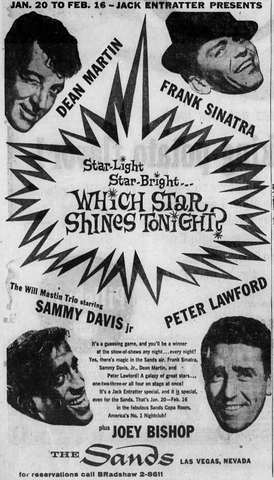
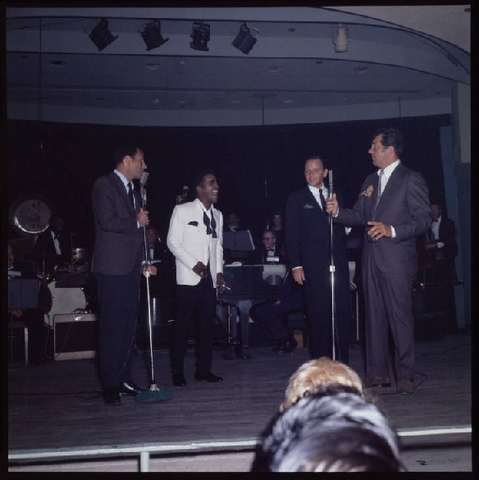
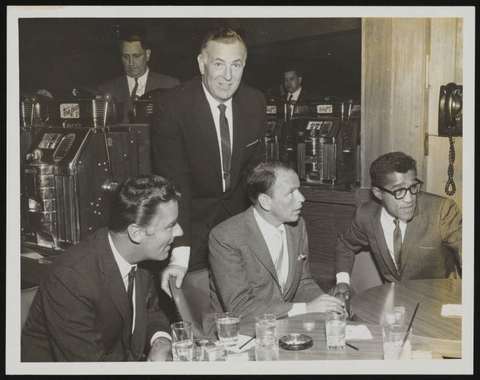
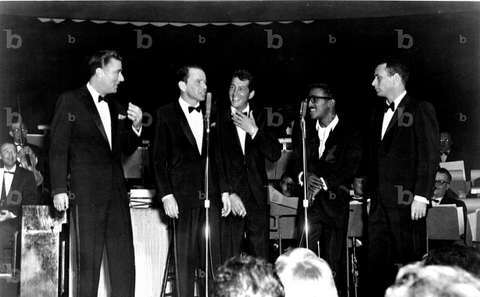
[Summit opens at the Sands]
Kaplan / Shawn Levy: The Sands Copa Room show later dubbed the Summit opened, with Frank, Dean, and Sammy originally scheduled to headline individually on successive nights while the cast filmed Ocean's Eleven during the day. No filming occurred at all on this first day.
Source: James Kaplan, "Sinatra: The Chairman" (2015).
[Frank opens the Summit smoothly]
Ed Walters: Sands pit boss Ed Walters recalled that Frank opened the first night without incident, and Dean Martin did both shows the following night.
Source: James Kaplan, "Sinatra: The Chairman" (2015).
CS 083 (Reprise "Live And Swingin': The Ultimate Rat Pack Collection," 2003 liner notes) adds engagement-wide personnel detail for this Sands Copa Room "Summit" run: Matty Malneck (composer of Sinatra's "Goody-Goody" opener) led the house orchestra, with Bill Miller, Ken Lane, and George Rhodes serving as the personal piano accompanists to Sinatra, Martin, and Davis respectively.
January 21, 1960
Concerts
Sands, Las Vegas, Nevada (Jan. 20 - Feb. 16)
Frank, Dean, Sammy, Joey and Peter.
January 22, 1960
Concerts
Sands, Las Vegas, Nevada (Jan. 20 - Feb. 16)
Frank, Dean, Sammy, Joey and Peter.
Frank's film Never So Few premiered at New York's Radio City Music Hall with Steve McQueen and Peter Lawford in attendance. Critics were unimpressed overall, though McQueen drew some praise; Frank himself skipped the premiere because he was already shooting his next picture. (Source: Richard Havers, "Sinatra" (Dorling Kindersley, 2007).)
January 23, 1960
Concerts
Sands, Las Vegas, Nevada (Jan. 20 - Feb. 16)
Frank, Dean, Sammy, Joey and Peter.
January 24, 1960
Concerts
Sands, Las Vegas, Nevada (Jan. 20 - Feb. 16)
Frank, Dean, Sammy, Joey and Peter.
January 25, 1960
Concerts
Sands, Las Vegas, Nevada (Jan. 20 - Feb. 16)
Frank, Dean, Sammy, Joey and Peter.
January 26, 1960
Concerts
Sands, Las Vegas, Nevada (Jan. 20 - Feb. 16)
Frank, Dean, Sammy, Joey and Peter.
Sands, Las Vegas, Nevada (Jan. 20 - Feb. 16)
Frank, Dean, Sammy, Joey and Peter.
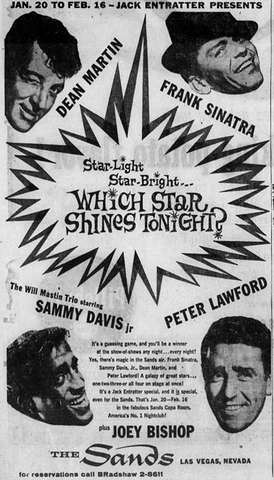
On this opening night of the Rat Pack's Sands engagement, Frank Sinatra and company — Dean Martin, Sammy Davis Jr., Peter Lawford, and Joey Bishop — would share a cigarette and a swig of Jack Daniel's in the wings before bounding onstage; Frank preferred to call the group “the Summit” rather than the press's “Rat Pack.” By day they filmed Ocean's 11 nearby, shooting from dawn after performing (and drinking) until near sunrise — the first of four films the group would make together. Actress Shirley MacLaine, considered the group's platonic mascot, later wrote of watching Frank and Dean dress for a night out: “What got me were their hats... I was certain their socks didn't smell.” Source: J. Randy Taraborrelli, Sinatra: Behind the Legend.
January 27, 1960
Concerts
Sands, Las Vegas, Nevada (Jan. 20 - Feb. 16)
Frank, Dean, Sammy, Joey and Peter.
January 28, 1960
Concerts
Sands, Las Vegas, Nevada (Jan. 20 - Feb. 16)
Frank, Dean, Sammy, Joey and Peter.
"High Hopes (with John Kennedy)
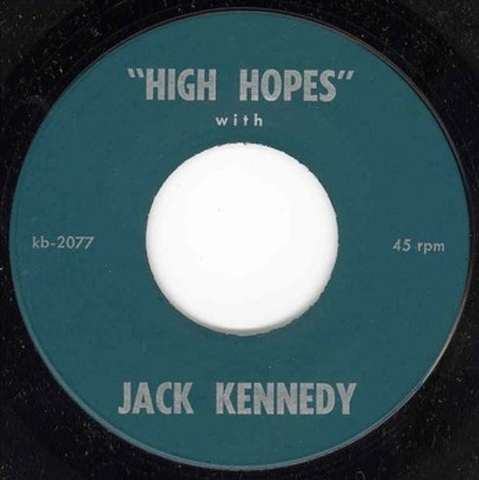
[Sinatra records Kennedy campaign song]
During the Ocean's Eleven shoot, Frank flew to Los Angeles to record High Hopes with Jack Kennedy, Sammy Cahn's campaign-lyric rewrite of High Hopes, backing the newly announced Democratic candidate.
Source: James Kaplan, "Sinatra: The Chairman" (2015).
January 29, 1960
Concerts
Sands, Las Vegas, Nevada (Jan. 20 - Feb. 16)
Frank, Dean, Sammy, Joey and Peter.
Ed notes:
The hottest ticket in the history of Vegas.
The shows were all SRO. Clan was shooting
"Ocean's 11" during the day and cavorting on stage at the Sands every night.
Friday evening
Joey Bishop introduces Sinatra
1. I Love Vegas (Parody)
2. Talk To Me (Dean, Lawford and Bishop talk to him)
3. On The Road To Mandalay
4. River Stay Away From My Door
Sammy comes on
1. The Lady Is A Tramp with the verse
2. Impressions: Nat Cole, Tony Bennett,
Billy Eckstine, Vaughn Monroe, Jimmy Cagney,
Marlon Brando, Louis Armstrong, Dean Martin
Peter is introduced
1. Shall We Dance w/ Sammy
2. Dance Number w/Sammy
Dean Martin
"Have I Been On Yet?"
1. It Takes A Worried Man (segment)
2. Almost Like Being In Love ( parody)
3. The Party's Over ( parody)
"Someone asked me if I ever have the DTs.
I had them when they first came out."
4. You Made Me Love You ( parody)
5. It Had To Be You
6. Nevertheless
Between numbers Dean sang a number of one-liners. They were by 1960 standards risque.
Frank and Dean do audience introductions:
Mary and Norman Kaye, Sonny King, Lewis Milestone,
Sen. John Kennedy
Frank's comments:
"The brightest man in the political world -- in this country or any other country today . . . Senator John Kennedy, from the great state of Massachusetts." Frank told the audience that one day he had the feeling he would be visiting him in "The House." It was in so many ways a remarkable engagement.
Milton Berle after introduction he joins them onstage and takes over the show.
Dean introduces Mrs. Milton Berle
"Birth Of The Blues" Frank, Dean, Sammy, Joey
Peter and Milton.
Joey says goodnight to the audience.
Sands, Las Vegas, Nevada (Jan. 20 - Feb. 16)
Frank, Dean, Sammy, Joey and Peter.
Once Upon a Ring-a-Ding-Ding
Rat Pack
On the 60th anniversary of Ocean's 11, the film that introduced Sin City's fizz to the world, a trip back in time
"The Sands was built in 1952, but 1960 was the year Las Vegas popped."
Would this fly today?
Dino sings the opening bars of "Did You Ever See a Dream Walking," the word "walking" pole-vaulting up several notes, per the beloved standard's melody. Sorta.
"Did you ever see a Jew JITSU? ..." Dino sings.
Frank's hand shoots up: "Well, I did!"
Enter faux-furious (and genuinely Jewish) Sammy, faux-restrained by Frank.
Sammy yells: "Be fair, that's all I ask! Would you like it if I came out here and said, " Did you ever see a Wap-SICLE? Well, I did!"
Frank attempts to croon an Al Jolson classic. "I'm Alabam-y-bound ..."
Sammy interrupts: "You'll go there by yourself! Leader or no leader, I ain't goin' wit'cha, baby! They gonna have to come up here to get me!"
When the world was younger than today with all the playful innocence that implies, blissfully unaware of the tortured social/cultural growing pains yet to come six words turned Las Vegas into Vegas, baby!: "The Rat Pack at the Sands."
Otherwise known as Frank Sinatra, Dean Martin, Sammy Davis Jr., Peter Lawford, and Joey Bishop at the Sands.
That was six decades ago. And that was their shtick Jewish, Italian, Black, and redneck jokes (plus a song snippet immortalized by a white-man-in-blackface superstar of his era) in about 90 seconds, just to start.
Audiences screamed (yes, in laughter).
In August 1960, their Rat Packedness (and the sights and sounds of classic Vegas) was immortalized with the release of Ocean's 11 the original that inspired four later films and became our global calling card. Crowds (including prez-to-be John F. Kennedy, Lawford's bro-in-law) streamed into the Sands' Copa Room every time the gang (or some combination of them) came to town.
With due respect to Elvis, Liberace, and countless other superstars, it was these guys who turned this town into THE TOWN. And when they arrived for the January/February 1960 filming of the Vegas portions of Ocean's 11 while simultaneously wowing the Copa crowds nightly they were elevated to legendary status in our collective memory.
Yes, they were of their time imagine Frank's "Swing, baby, wing!" ethos running smack into #MeToo today but they were magic. As we grapple now with poisoned politics, racial strife, demonstrations, and a pandemic that crippled America and the globe, including our vaunted Strip, we could use their bursting-at-the-seams spirit minus the cultural flaws and anachronisms to reignite our own Vegas Vibe, hopefully soon.
So, through the magic of time-trippin', we return you to the sunset of Eisenhower's America and the sunrise of JFK's Camelot that historical sweet spot that launched the Rat Pack rocket to fame.
Rat Pack reveled in Vegas; revered by the world
By Mary Manning
Thursday, May 15, 2008 | 3 a.m.
The Rat Pack
A postcard shows the Rat Pack (from left Frank Sinatra, Dean Martin, Sammy Davis Jr., Peter Lawford and Joey Bishop) posing in front of a Sands Hotel marquee bearing their names. Their performances at the Sands during the 60s marked the golden age of the group. “It's quarter to three, there's no one in the place Except you and me
So set 'em up Joe,
I've got a little story I think you should know
After the losing dice were tossed, a high roller sitting ringside and sipping a drink on the house could empathize with Frank Sinatra's song floating through the darkness of the Copa Room. The Man, the Chairman of the Board, and his music made magic, helping people forget their troubles. Those pangs of loss (lost cash or lost love) evaporated in an era when Frank, Dean, Sammy, Peter and Joey came to the Sands, "A Place in the Sun," on the Las Vegas Strip. As improbable as this elegant quintet's launch in the desert seems, the Rat Pack attracted an avalanche of followers around the world in the early 1960s. Although Las Vegas appeared on showbiz maps all over the country, the year 1960 vaulted the Rat Pack and Las Vegas into the spotlight as the Entertainment Capital of the World. Between booze and broads, the Rat Pack became a legend as the best entertainment American audiences had seen or heard in the post-World War II era. The women who hung out with the Rat Pack were legend: Lauren Bacall, Juliet Prowse, Angie Dickinson, Shirley MacLaine, Marilyn Monroe. The Rat Pack started out as a drinking club in Hollywood.
Crooner Frank Sinatra joined the Holmby Hills drinkers when Bogie Humphrey Bogart that is " ” led the group that included Bogart's wife, Lauren Bacall; singer Judy Garland and husband Sid Luft; Irving Lazar, who became the famous literary agent "Swifty" Lazar; David Niven; restaurateur Mike Romanoff; and other entertainment and literary luminaries. The pack was also known as The Summit, referring to a conference among world leaders: U.S. President Dwight Eisenhower, French President Charles de Gaulle and Soviet Union Premier Nikita Krushchev. As the Hollywood crowd boozed it up on a Los Angeles to Las Vegas train trip to catch Noel Coward's solo cabaret act on June 26, 1955, at the Desert Inn, the group's name popped out of Bacall's mouth: "You look like a goddamn rat pack." The name stuck.
But Sinatra didn't like "Rat Pack." So he changed it to the Clan, until Sammy Davis Jr. said he didn't like that term. Sensitive to ethnic slurs, Sinatra tried to return to The Summit, but to the world the group became the Rat Pack. Sinatra championed underdogs and civil rights from the beginning of his career. He won a special Academy Award for the 1945 film "The House I Live In," a 10-minute documentary in which he speaks of ethnic peace to a racially divisive street gang. When Bogart died on Jan. 14, 1957, after a stroke, the Hollywood rat pack's reign ended. Sinatra created and nurtured the kernel that became the Rat Pack in Las Vegas. The pack members as individuals entertained up and down the Strip: Sinatra at the Desert Inn, Sammy Davis at the Last Frontier, Dean Martin and Jerry Lewis at the Flamingo. Once those contracts expired, the stars moved to the Sands. With its soaring entrance and wood-paneled casino, the Sands seemed swank and elegant compared to Vegas glitz at other Strip hotels. Softer lighting and very private gambling rooms drew high rollers like a moth to the Strip's neon lights. In January 1960, Sinatra "” the Rat Pack's designated leader arrived to start fillming the original "Ocean's Eleven" movie. Joining him were Martin, Davis, Peter Lawford (married to Patricia Kennedy, John F. Kennedy's sister) and comedian Joey Bishop, who played straight man to the antics of the others. While filming in 1960, Rat Pack members did two shows in the Copa Room each evening, then spent the night partying. No one knew when the film might wrap, but one of the pack usually showed up on the set between 3 and 6 p.m. The original "Ocean's Eleven" was a fun, frothy caper on how to steal millions from casinos. In 2001 Steven Soderbergh and George Clooney teamed up to remake the casino heist movie, "Ocean's Eleven," followed by "Ocean's Twelve" in 2004 and "Ocean's Thirteen" in 2007, all in glorious color with more flair and high-tech gadgets for the thieves than the original. After the 1964 film "Robin and the Seven Hoods," the Las Vegas Rat Pack dissolved in the movie-going public's mind. Well that's how it goes, and Joe I know your gettin' anxious to close The Rat Pack in Las Vegas grew gradually.
It began innocently enough, as Frank, Dean or Sammy would start entertaining onstage alone, then one or another would join the fun. Soon Joey Bishop might introduce Dean, joining the others in the songs and schtick. From working in twos and threes, they soon became The Rat Pack. For years, Frank or Dean would cradle Sammy in their arms, offering him to the audience, and say, "I'd like to thank the NAACP (National Association for the Advancement of Colored People) for this award." It brought down the house. Enthusiastic tourists spread the word and the Rat Pack at the Sands drew worldwide attention. The gossip columnists wrote rave reviews after gobbling up press releases from Sands publicist Al Freeman. And the price of a ticket to see the Rat Pack at the Sands? Dinner and a minimum of two drinks: $5.95 per person. Sen. John F. Kennedy, before becoming president, came to Las Vegas on Feb. 7, 1960, just as the entire Rat Pack began an astonishing gig at the Sands during its heyday. Chairman of the Board Sinatra, whose mother, Dolly, became a Democratic Party operative in Hoboken, N.J., introduced JFK sitting ringside. Sinatra adapted and recorded the song, "High Hopes," as a campaign song for JFK's 1960 U.S. presidential campaign. The song came from Sinatra's 1959 film, "A Hole in the Head." The film's song won an Oscar for lyrics by Sammy Cahn and Jimmy Van Heusen. Both later worked on the original "Ocean's Eleven." The Rat Pack grabbed the spotlight at the Sands and a generation swooned at their antics on and off stage. For a magical few years in the 1960s they became the epitome of cool, clowning on stage, partying all night. When the pack cut through the Sands or any other casino, hotel or showroom, for that matter â"” they lit up the place. The others always followed Frank's lead. "I've never seen anyone else create so much excitement as Frank Sinatra did when he walked into a room," jazz saxophonist Jimmy Mulidore told the Sun. "Everybody who was anybody went to see Frank ... He walks into a room and it's like Joe DiMaggio hit a home run to win the World Series," Mulidore said. The fun and easy-going style of the Rat Pack often hid a darker side. Sinatra and Davis had a falling out, but patched up their differences. And Sinatra fell out of favor with the Kennedys when he asked Attorney General Bobby Kennedy to leave his "friend," mob boss Sam Giancana, alone in late 1961. A federal judge sitting on the bench in Las Vegas recalled how Sinatra once ordered a screwdriver while poolside at the Sands. When the then-fresh-faced 18-year-old lifeguard offered the tool instead of the drink, Sinatra leapt up and threw every chaise lounge into the pool. In Las Vegas the Rat Pack legend grew.
Make it one for my baby and one more for the road.
The Rat Pack at their zenith had money and power. But most of all, they had fun, according to authors Lawrence J. Quirk and William Schoell in their book, "The Rat Pack: Neon Nights With the Kings of Cool." All of them had talent, exuberance and energy to burn, Quirk and Schoell say. They had a blast until the late 1960s. Those five together made magic from jazz, honky tonk and blues before the rock 'n' rollers hit the scene. The America of the Rat Pack years learned how to swing, how to break sound barriers and ethnic barriers, and it brought an electricity to entertainment never equaled, author Shawn Levy says in his book "Rat Pack Confidential." Levy describes the Rat Pack and those heady years:
"It was the high point of their lives and a midlife crisis.
"It was the acme of the American century and a venal, rancid, ugly sham. "It was the Rat Pack.
"It was beautiful."
(Thanks to Harold Arlen and Johnny Mercer for the lyrics to One for My Baby).
---------------------------------------------
© 1997-2026 The Sinatra Archive
This calendar, or any parts thereof, may not be reproduced in any fashion whatsoever without the prior written permission of the publisher (The Sinatra Archive)
The legendary Rat Pack during filming of Ocean’s Eleven in 1960: (l-r) Sinatra, Dean Martin, Peter Lawford, and Sammy Davis Jr. Source: photo and caption from J. Randy Taraborrelli, Sinatra: Behind the Legend (mptvimages.com).
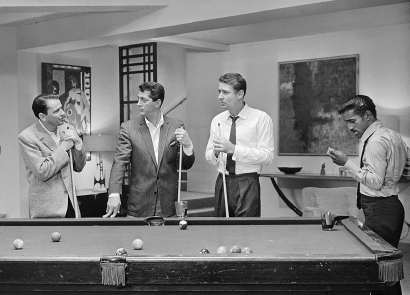
Sammy, Dean, Frank, and Joey Bishop during a playful moment in 1960. Source: photo and caption from J. Randy Taraborrelli, Sinatra: Behind the Legend (mptvimages.com).
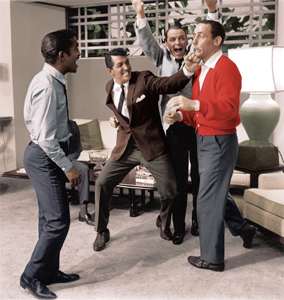
Frank, in the middle, taking a steam at the Sands Hotel in 1960, flanked by Peter Lawford and Al Hart (Sinatra’s banker), with Sammy Davis Jr. Source: photo and caption from J. Randy Taraborrelli, Sinatra: Behind the Legend (mptvimages.com).
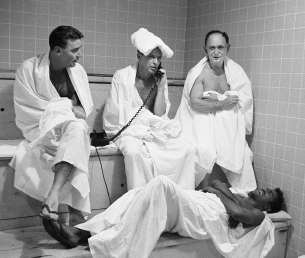
[Oxnard Press-Courier covers the Summit]
Oxnard (Calif.) Press-Courier: A California paper reported a Point Mugu couple's trip to Vegas to catch the new summit meeting nightclub act starring Sinatra, Martin, Davis, Lawford, and Joey Bishop at the Sands.
Source: James Kaplan, "Sinatra: The Chairman" (2015).
January 30, 1960
Concerts
Sands, Las Vegas, Nevada (Jan. 20 - Feb. 16)
Frank, Dean, Sammy, Joey and Peter.
January 31, 1960
Concerts
Sands, Las Vegas, Nevada (Jan. 20 - Feb. 16)
Frank, Dean, Sammy, Joey and Peter.
February 1, 1960
Concerts
Sands, Las Vegas, Nevada (January 20- February 16)
Frank, Dean, Sammy, Peter, and Joey appeared nightly
"Oceans Eleven" and "Pepe" were being filmed during their engagement.
[JFK's first Nevada campaign visit]
While barnstorming the primary states, Kennedy made a special trip to Nevada to meet with the state's Democratic governor, Grant Sawyer.
Source: James Kaplan, "Sinatra: The Chairman" (2015).
February 2, 1960
Concerts
Sands, Las Vegas, Nevada (January 20- February 16)
Frank, Dean, Sammy, Peter, and Joey appeared nightly
"Oceans Eleven" and "Pepe" were being filmed during their engagement.
February 3, 1960
Concerts
Sands, Las Vegas, Nevada (1-13)
Frank, Dean, Sammy, Peter, and Joey appeared nightly
"Oceans Eleven" and "Pepe" were being filmed during their engagement.
[Joey Bishop's birthday cake fight]
Hedda Hopper: On Joey Bishop's birthday, a cake-throwing fight broke out onstage during the Summit show; Bishop saw it coming, but Sinatra and Martin were hit in the face and chest.
Source: James Kaplan, "Sinatra: The Chairman" (2015).
February 4, 1960
Concerts
Sands, Las Vegas, Nevada (1-13)
Frank, Dean, Sammy, Peter, and Joey appeared nightly
"Oceans Eleven" and "Pepe" were being filmed during their engagement.
[Earl Wilson on Sinatra introducing JFK]
Earl Wilson: Wilson's syndicated column reported that Sinatra introduced Senator Kennedy at the Sands to wild cheering, after which Dean Martin stepped out and asked Sinatra, deadpan, What was his name?
Source: James Kaplan, "Sinatra: The Chairman" (2015).
February 5, 1960
Concerts
Sands, Las Vegas, Nevada (1-13)
Frank, Dean, Sammy, Peter, and Joey appeared nightly
"Oceans Eleven" and "Pepe" were being filmed during their engagement.
February 6, 1960
Concerts
Sands, Las Vegas, Nevada (Jan. 20 - Feb. 16)
Frank, Dean, Sammy, Peter, and Joey appeared nightly
"Oceans Eleven" and "Pepe" were being filmed during their engagement.
Frank filmed inside The Sands from 5am to 7.15 am for Oceans 11
Note: contributed by Fred Wadsworth
----------------------------------------------------------------- February 6, 1973, Palm Springs, CA
Frank Sinatra’s Day With The All-Americans
Frank Sinatra with Ken Venturi, Shecky Greene, and Alan Shepard at Frank Sinatra’s Day with the All-Americans, 1973. -------------------------------------------------
Taping Session As Archived
February 6 Taping Session
John Denver And Friend
Air date: March 29, 1976
Taped February 6-7, 1976
Location: ABC Television Center, Hollywood, California
Network: ABC
Sponsor: Timex
Guests: Frank Sinatra, Count Basie, Harry James & Orchestra, Tommy Dorsey Orchestra
Produced BY: George Schlatter
Directed By: Bill Davis
Written By: Digby Wolfe, George Schlatter
Musical Director: Nelson Riddle
Executive Producer: Jerry Weintraub
1. one o'clock jump - Harry James Orchestra
2. dialogue - John Denver
3. All Or Nothing At All - Frank Sinatra & Harry James Orchestra
4. dialogue - John Denver
5.. medley: I'll Smile Again / Let's Get Away From It All (Both) / Imagination / Polka Dot And Moonbeams (John Denver) / There Are Such Thing - Frank Sinatra
6. dialogue - Frank Sinatra & John Denver
7. medley: Saturday Is The Loneliest Night Of The Week / Five Minutes More (Denver) / Come Fly With Me / Nice And Easy (Denver) / Learnin' The Blues (both) / Strangers In The Night (Denver) / Witchcraft (both) / It Was A Very Good Year (Denver) / Young At Heart (Denver) / Nancy / This Is A Lovely Way To Spend An Evening (both) / The Tender Trap (both) / Love And Marriage (both) / High Hope (both) / All The Way - Frank Sinatra
8. intro: count Basie - John Denver
9. medley: All Of Me / My Kind Of Town / The Lady Is A Tramp / I Get A Kick Out Of You - Frank Sinatra, John Denver & Count Basie Orchestra
10. My Way (short segment) - Frank Sinatra
11. call for intercut
12. prep for intercut
13. dialogue - John Denver
14. medley: I'll Smile Again / Let's Get Away From It All (Both) / Imagination / Polka Dot And Moonbeams (John Denver) / There Are Such Thing - Frank Sinatra
15. dialogue "Thanks, Time To Go Home" - Frank Sinatra & John Denver
16. photo ops and exit
------------------------------------------------
1981 White House, Washington, DC
Sinatra attends birthday part of President Ronald Reagan
Frank Sinatra dances with First Lady Nancy Reagan in the East Room of the White House in Washington, DC on February 6, 1981 as United States President Ronald Reagan attempts to cut-in at the President's birthday party.
Frank Sinatra and his wife, Barbara, arrive at the White House in Washington on February 6, 1981 to attend President Ronald Reagan's 70th birthday party. --------------------------------------
February 6, 1990
Jimmy Van Heusen passed away.
January 26, 1913 – February 6, 1990
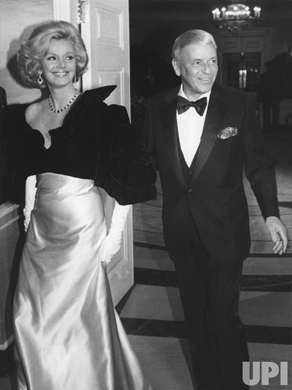
February 7, 1960
Concerts
Sands, Las Vegas, Nevada (Jan. 20 - Feb. 16)
Frank, Dean, Sammy, Peter, and Joey appeared nightly
"Oceans Eleven" and "Pepe" were being filmed during their engagement.
Convention Center, Las Vegas
Benefit for the Cathedral of the Four Chaplains
5PM
Frank, Dean, Sammy, Joey, and Peter
Senator John F. Kennedy, Peter Lawford's brother-in-law and an admirer of the Rat Pack, detoured his presidential campaign plane to catch the Summit's show at the Sands. Sinatra had already agreed, at Joe Kennedy's request during a Palm Beach visit the previous summer, to help raise campaign money and line up Hollywood support for JFK's run — including recording a reworked version of “High Hopes” as an unofficial campaign anthem. Source: J. Randy Taraborrelli, Sinatra: Behind the Legend.
[Judith Campbell claims first meeting JFK]
Judith Campbell Exner: In her memoir, Judith Campbell Exner said she first met JFK around 10 p.m. on Sunday, February 7, 1960, at Sinatra's table in the Sands lounge, later joining Kennedy, his brother Teddy, Peter Lawford, and Gloria Cahn for dinner.
Source: James Kaplan, "Sinatra: The Chairman" (2015).
February 8, 1960
Concerts
Sands, Las Vegas, Nevada (Jan. 20 - Feb. 16)
Frank, Dean, Sammy, Peter, and Joey appeared nightly
"Oceans Eleven" and "Pepe" were being filmed during their engagement.
February 9, 1960
Concerts
Sands, Las Vegas, Nevada (Jan. 20 - Feb. 16)
Frank, Dean, Sammy, Peter, and Joey appeared nightly
"Oceans Eleven" and "Pepe" were being filmed during their engagement.
February 10, 1960
Concerts
Sands, Las Vegas, Nevada (Jan. 20 - Feb. 16)
Frank, Dean, Sammy, Peter, and Joey appeared nightly
"Oceans Eleven" and "Pepe" were being filmed during their engagement.
February 11, 1960
Concerts
Sands, Las Vegas, Nevada (Jan. 20 - Feb. 16)
Frank, Dean, Sammy, Peter, and Joey appeared nightly
"Oceans Eleven" and "Pepe" were being filmed during their engagement.
[Hedda Hopper on the Summit's chaos]
Hedda Hopper: Hopper's column noted that although the five men were nominally taking turns headlining the Copa Room, save for one night when Dean was ill they had all been performing together for two shows a night, with the antics escalating each time.
Source: James Kaplan, "Sinatra: The Chairman" (2015).
February 12, 1960
Concerts
Sands, Las Vegas, Nevada (Jan. 20 - Feb. 16)
Frank, Dean, Sammy, Peter, and Joey appeared nightly
"Oceans Eleven" and "Pepe" were being filmed during their engagement.
February 13, 1960
Concerts
Sands, Las Vegas, Nevada (Jan. 20 - Feb. 16)
Frank, Dean, Sammy, Peter, and Joey appeared nightly
"Oceans Eleven" and "Pepe" were being filmed during their engagement.
February 14, 1960
Concerts
Sands, Las Vegas, Nevada (Jan. 20 - Feb. 16)
Frank, Dean, Sammy, Joey and Peter.
February 15, 1960
Television
The Frank Sinatra Timex Show
Title: Here's To The Ladies
Network: ABC
Sponsor: Timex
Frank Sinatra Timex special, featuring music and special guests, including Lena Horne, Juliet Prowse, Mary Costa, Barbara Heller and Eleanor Roosevelt. Orchestra arranged and conducted by Nelson Riddle
Song listing:
"Here's to the Ladies" – Frank Sinatra
"I've Got You Under My Skin" – Frank Sinatra
Timex Promotional Spot
"Ouvre ton coeur" (from Bizet's Vasco de Gama) – Mary Coosta "By Strauss" – Barbara Heller
"Ring the Bell" – Lena Horne
"Come Cha Cha Cha With Me" – Juliet Prowse
Timex Promotional Spot
"Lonely Town" – Frank Sinatra
"But Beautiful" – Lena Horne
"Here's To The Ladies" – Frank Sinatra
"From This Moment On" "“ Lena Horne
Harold Arlen Tribute Medley: "As Long as I Live" / "It's Only a Paper Moon" / "One for My Baby (And One For The Road)" / "Ac-Cent-Tchu-Ate the Positive" / "Stormy Weather" / "Get Happy" / "Between the Devil and the Deep Blue Sea" "“ Frank Sinatra and Lena Horne "My Heart Stood Still" – Frank Sinatra
"Your Voice" – Maryy Costa
"Afraid of Love" – Barbara Heller
"My Heart Belongs to Daddy" – Lena Horne
"My Funny Valentine" – Juliet Prowse
Timex Promotional Segment
"High Hopes" – Eleanor Roosevelt
"Here's To The Ladies" Frank Sinatra
Notes: 60 mins.
Ed O'Brien notes:
The Harold Arlen medley was sung with Lena.
Nelson Riddle wrote a driving swing chart for the Rodgers & Hart classic "My Heart Stood Still." Frank did a solo and looked angry while doing it. Only known swing performance of a song Frank sang hundreds of times through the years.
Concerts
Sands, Las Vegas, Nevada (Jan. 20 - Feb. 16)
Frank, Dean, Sammy, Joey and Peter.
The Frank Sinatra Timex Show
Title: Here's To The Ladies
Network: ABC
Sponsor: Timex
Frank Sinatra Timex special, featuring music and special guests, including Lena
Horne, Juliet Prowse, Mary Costa, Barbara Heller and Eleanor Roosevelt.
Orchestra arranged and conducted by Nelson Riddle
Frank and Mrs Roosevelt
Lena & Frank singing medley of Harold Arlen songs
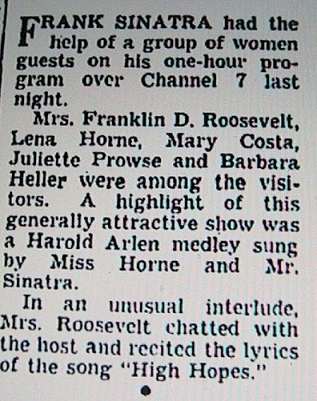
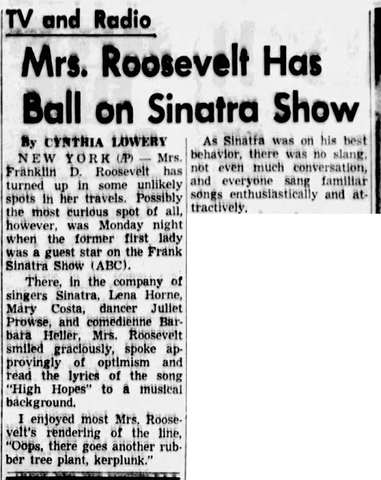
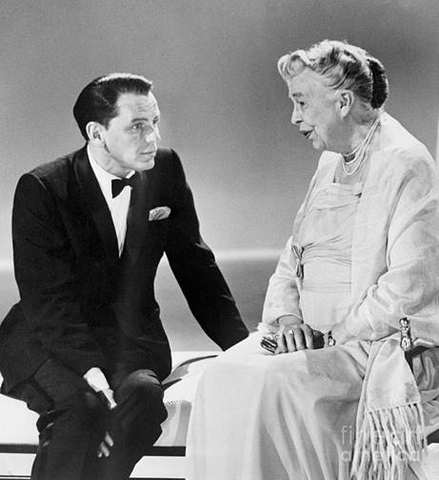
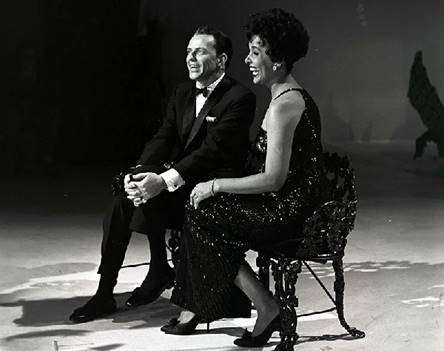
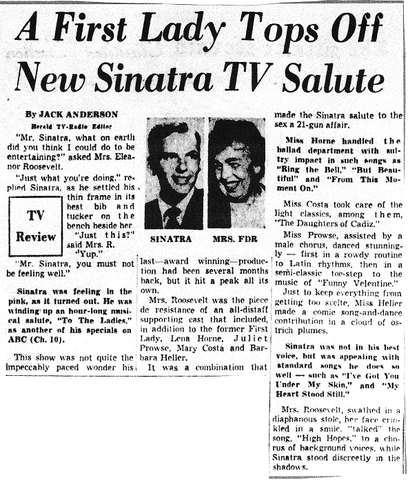
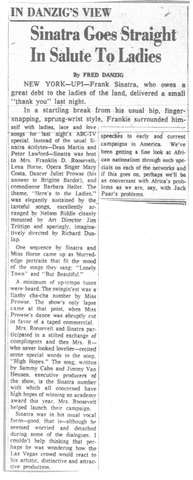
[Third Sinatra Timex special airs]
The third Frank Sinatra Timex Show, Here's to the Ladies, aired on ABC with guests Eleanor Roosevelt, Lena Horne, Juliet Prowse, Mary Costa, and Barbara Heller. Roosevelt, seated beside Sinatra, recited the lyrics to High Hopes over Nelson Riddle's orchestration.
Source: James Kaplan, "Sinatra: The Chairman" (2015).
February 16, 1960
Concerts
Sands, Las Vegas, Nevada (Jan. 20 - Feb. 16)
Frank, Dean, Sammy, Joey and Peter.
Tuesday evening
1. I Love Vegas
2. What Is This Thing Called Love
3. Talk To Me
4. River Stay Away From My Door
Ed O'Brien notes:
On this evening in February of 1960, "The Summit" with
Frank Sinatra, Dean Martin, Sammy Davis, Jr, Peter Lawford and Joey Bishop did their final show of a four week run at the Sands. They did not refer to themselves as "The Clan" or "The Rat Pack" during the engagement. It was officially "The Summit."
As the years passed, this engagement acquired a legendary status, not only in Vegas, but in the history of show business.
The Sands was the placed to be seen that January and February of 1960. A who's who of celebrities fought to be ringside at the shows.
The 500 seat room saw John Kennedy, Milton Berle, Bob Hope, Elizabeth Taylor, Sammy Cahn, Jimmy Van Heusen, Marilyn Monroe, Angie Dickinson, Jack Lemmon, Shirley Jones, Johnny Mathis, Rowan & Martin and many others watch the five men perform night after night.
Buddy Bregman did some of the arrangements and caught a number of shows. He told me it was sheer madness on and off the stage. The hotel simply could not cope with the demands for admission from thousands of adoring fans. The cavorting on stage was wild and often quite risque by the standards of the time. It was a rare occurrence when any one of the performers sang a song without interruption. Bregman fondly recalled the morning sauna sessions as the fivesome recovered from the previous night.
Ed O'Brien later added the following:
During this four week engagement, the big three,
Frank, Dino and Sammy, took turns opening the shows.
On closing night, Sammy opened, joined by Peter Lawford for a couple of dance skits, Frank followed and then Dean.
Joey Bishop was the M.C. The five of them finished the evening with skits, parodies and a few songs. Then they introduced a who's who of famous names before closing the show with "Birth Of The Blues" and a brief "High Hopes" parody.
With the Sands engagement wrapped, the Summit took a train to Los Angeles to finish filming Ocean's 11 — a comedy-heist plot about a gang of former Army buddies robbing five Las Vegas casinos simultaneously on New Year's Eve, produced through Sinatra's Dorchester Productions in association with Warner Bros. Source: J. Randy Taraborrelli, Sinatra: Behind the Legend.
February 19, 1960
Television
American Guild of Variety Artists (AGVA) Awards
(Note: Sinatra's acceptance was filmed while he was performing with Dean, Sammy, Joey, and Peter at the Sands in February 1960)
Source: sinatraphiles digest (date extracted from item text; originally routed to appendix for review).
Late February 1960
A week after introducing her to Jack Kennedy, Sinatra invited Judith Campbell to Miami, where he was performing at the Fontainebleau, and introduced her to "Sam Flood" -- an alias of Chicago Outfit boss Sam Giancana, whose true identity Sinatra did not disclose to her. Campbell began a parallel affair with Giancana, becoming for a time simultaneously involved with the presidential candidate and the mobster the Kennedy Justice Department would soon be targeting. Source: Michael Sheridan & David Harvey, Sinatra and the Jack Pack.
[Sinatra Enlists Sam Giancana To Help Deliver West Virginia For JFK]
Nancy Sinatra: At Joseph Kennedy's request, Sinatra approached his old acquaintance Sam Giancana as a personal favor, and Giancana reportedly dispatched Skinny D'Amato to secure roughly 120,000 votes from local sheriffs and coal-miners' unions to help John Kennedy win the crucial West Virginia primary.
Source: Nancy Sinatra, Frank Sinatra: An American Legend, 1995.
[Sammy Davis Jr. and the satchel of cash story]
Sammy Davis Jr. (via memoir); Ed Walters (denial): While JFK relaxed in Sinatra's suite at the Sands in February 1960, Peter Lawford reportedly showed Sammy Davis Jr. a brown leather satchel in a closet, calling it a million dollars in cash, a gift from the hotel owners for Kennedy's campaign. Sands pit boss Ed Walters later strongly denied such a gift was possible, given the casino owners' need for Teamster support, which was anti-Kennedy.
Source: James Kaplan, "Sinatra: The Chairman" (2015)
[Sands overwhelmed with reservations]
Kaplan: At the peak of the Summit's popularity, the Sands received eighteen thousand reservation requests for its two hundred rooms.
Source: James Kaplan, "Sinatra: The Chairman" (2015)
February 24, 1960
[Campbell visits Sinatra on Ocean's Eleven set]
Judith Campbell Exner: After the Ocean's Eleven shoot moved back to Los Angeles, Judith Campbell visited Sinatra on the Warner Bros. set with her sister; Sinatra mentioned his upcoming Fontainebleau engagement and invited her to attend the opening.
Source: James Kaplan, "Sinatra: The Chairman" (2015).
March 1, 1960
Studio
Capitol Studio A, Hollywood
E33350 You Go To My Head
(J. Fred Coots/Haven Gillespie)
Arranged & Conducted by Nelson Riddle
(4:28) CD: CDP 7-91149-2 Nice 'n' Easy
LP: SW1417 Nice 'n' Easy
E33351 Fools Rush In
(Rube Bloom/Johnny Mercer)
Arranged & Conducted by Nelson Riddle
(3:33) CD: CDP 7-91149-2 Nice 'n' Easy
LP: SW1417 Nice 'n' Easy
E33352 That Old Feeling
(Lew Brown/Sammy Fain)
Arranged & Conducted by Nelson Riddle
(3:33) CD: CDP 7-91149-2 Nice 'n' Easy
LP: SW1417 Nice 'n' Easy
E33353 Try A Little Tenderness
(Woods/Campbell/Connelly)
Arranged & Conducted by Nelson Riddle
(3:20) CD: CDP 7-91149-2 Nice 'n' Easy
LP: SW1417 Nice 'n' Easy
Capitol Studio A, Hollywood
E33350 You Go To My Head
E33351 Fools Rush In
E33352 That Old Feeling
E33353 Try A Little Tenderness
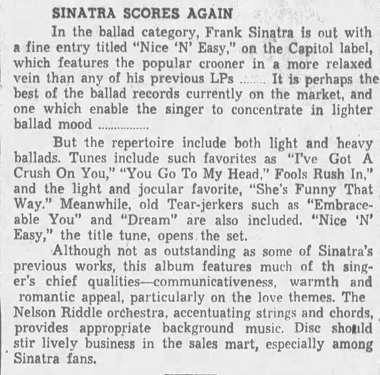
"Fools Rush In"
Frank Sinatra (to Arlene Francis); analysis by Will Friedwald: Extended technical analysis of Sinatra's 'long breath' technique, which he called his single most essential tool. Sinatra explained to Arlene Francis that the phrase 'Fools rush in where wise men never go / But wise men never fall in love / So how are they to know?' must be sung as one continuous breath to tell the story properly, rather than broken up as most singers do. Friedwald then dissects the 1960 recording bar by bar: Sinatra stretches the 'ooo' in 'fools,' rushes the word 'rush,' creates the illusion of a pitch drop on 'in' though the note is identical, and phrases the repeated words 'wise men never' differently each time (Johnny Mercer's lyric) so they sound like entirely different phrases -- making the lyric feel as if it's occurring to him in the moment. Actually divides the passage into two breaths, not one, per Friedwald's listening.
Source: Will Friedwald, "Sinatra! The Song Is You: A Singer's Art" (2018 revised edition).
[Sinatra returns to Capitol Studio A]
Under a deal in which Capitol got the Can-Can soundtrack in exchange for releasing Sinatra after five more albums, Frank began recording a new ballad LP at Capitol Studio A -- his first session there since the previous May -- with Nelson Riddle conducting.
Source: James Kaplan, "Sinatra: The Chairman" (2015).
March 2, 1960
Studio
Capitol Studio A, Hollywood
E33363 Dream N/R
(Johnny Mercer)
Arranged & Conducted by Nelson Riddle
note: Riddle always insisted if he had been at the 5-29-58 session, "Lush Life" would have been corrected and done at the next session. "Dream, " from this session, supports that contention.. Frank is uncomfortable at the outset and the first take is aborted with Frank saying, "Once more . . . Yeah, this is a high mother. . . for Clark Dennis." He gets about halfway through take two and suddenly yells, "Hold it ! Next tune."
Riddle would restructure the arrangement to Frank's liking and it would be the first tune done the following night.
Ed
E33364 She's Funny That Way
(Neil Moret/Richard A. Whiting)
Arranged & Conducted by Nelson Riddle
(3:54) CD: CDP 7-91149-2 Nice 'n' Easy
LP: SW1417 Nice 'n' Easy
E33365 The Nearness Of You
(Hoagy Carmichill/Ned Washington)
Arranged & Conducted by Nelson Riddle
CD: CDP 7-96827-2 Nice 'n' Easy
LP: 1729 Sings Of Love And Things
E33366 Nevertheless (I'm In Love With You)
(Bert Kalmar/Harry Ruby)
Arranged & Conducted by Nelson Riddle
CD: CDP 7-91149-2 Nice 'n' Easy
LP: SW1417 Nice 'n' Easy
Capitol Studio A, Hollywood
E33363 Dream N/R
E33364 She's Funny That Way
E33365 The Nearness Of You
E33366 Nevertheless (I'm In Love With You)
[image referenced in source but could not be recovered]
"The Nearness of You"
For The Nearness of You sessions, Riddle featured short instrumental solo spotlights for Sinatra's key musicians: Bill Miller (piano, 'I've Got a Crush on You'), Plas Johnson (tenor sax), Harry Klee (flute), George Roberts (bass trombone), Carroll Lewis (trumpet), and Felix Slatkin (violin).
Source: Charles L. Granata, "Sessions with Sinatra: Frank Sinatra and the Art of Recording" (1999/2003).
[John Crosby on Sinatra-Capitol standoff]
John Crosby: Columnist John Crosby noted that Sinatra, despite being the hottest act in show business, hadn't cut a single since August 1, 1959, or an album since July 20, 1959, due to an ongoing contract deadlock with Capitol.
Source: James Kaplan, "Sinatra: The Chairman" (2015).
[She's Funny That Way / The Way You Look Tonight / Speak Low / I'll Be Around -- critical commentary]
The Sinatra V-Discs were at last legally issued for commercial consumption in 1994; one thing they make clear is that the mature Sinatra-Stordahl style was completely perfected even by the fall of 1943. The classic early-Sinatra ballad sound is unmistakable in such early V-Disc–only arrangements (none recorded commercially) as “She’s Funny That Way,” “The Way You Look Tonight,” “Speak Low,” and Alec Wilder’s “I’ll Be Around.” The only thing that could have improved “The Way You Look” would have been to have Sinatra himself (rather than the background singers) fill in composer Jerome Kern’s very romantic, interstitial humming passages. Otherwise, no one else before or since could make a smile seem so warm or a cheek so soft. A big chunk of the credit for that sound has to go to Axel Stordahl—it’s impossible to overestimate his contribution.
This song/context matches multiple dated entries in the chronology; the specific date Friedwald is referring to could not be determined with confidence.
Source: Will Friedwald, "Sinatra! The Song Is You: A Singer's Art" (2018 revised edition), Ch. 4, "With Axel Stordahl" (1943-1948)
[The Nearness of You / Nice 'n Easy -- critical commentary]
In spring 1960, Sinatra and Riddle recorded a ballads album tentatively titled The Nearness of You, all re-recordings of songs Sinatra had first sung at Columbia; sessions were held over three nights in the first week of March 1960, four songs per night. The title track was later dropped and replaced a month later by the up-tempo 'Nice 'n Easy,' renaming the album.
This song/context matches multiple dated entries in the chronology, or lacked a sufficiently precise date; the specific date could not be determined with confidence.
Source: Charles L. Granata, "Sessions with Sinatra: Frank Sinatra and the Art of Recording" (1999/2003), Part III: The Capitol Years, 1953-1962
March 3, 1960
Studio
Capitol Studio A, Hollywood
E33363 Dream
(Johnny Mercer)
Arranged & Conducted by Nelson Riddle
(2:54) CD: CDP 7-91149-2 Nice 'n' Easy
LP: SW1417 Nice 'n' Easy
E33386 I've Got A Crush On You
(George Gershwin/Ira Gershwin)
WB Music Company (ASCAP)
Arranged & Conducted by Nelson Riddle
-7 (2:16) CD: C2-94777 The Capitol Years
CD: CDP 7-91149-2 Nice 'n' Easy
LP: SW1417 Nice 'n' Easy
E33387 Embraceable You
(George Gershwin/Ira Gershwin)
WB Music Corp. (ASCAP)
Arranged & Conducted by Nelson Riddle
-14 (3:23) CD: C2-94777 The Capitol Years
CD: CDP 7-91149-2 Nice 'n' Easy
LP: SW1417 Nice 'n' Easy
E33388 Mam'selle
(Edmund Goulding/Mack Gordon)
Arranged & Conducted by Nelson Riddle
(2:45) CD: CDP 7-91149-2 Nice 'n' Easy
LP: SW1417 Nice 'n' Easy
E33390 How Deep Is The Ocean?
(Irving Berlin)
Arranged & Conducted by Nelson Riddle
(3:15) CD: CDP 7-91149-2 Nice 'n' Easy
LP: SW1417 Nice 'n' Easy
Capitol Studio A, Hollywood
E33363 Dream
(Johnny Mercer)
Arranged & Conducted by Nelson Riddle
(2:54) CD: CDP 7-91149-2 Nice 'n' Easy
LP: SW1417 Nice 'n' Easy
E33386 I've Got A Crush On You
(George Gershwin/Ira Gershwin)
WB Music Company (ASCAP)
Arranged & Conducted by Nelson Riddle
-7 (2:16) CD: C2-94777 The Capitol Years
CD: CDP 7-91149-2 Nice 'n' Easy
LP: SW1417 Nice 'n' Easy
E33387 Embraceable You
(George Gershwin/Ira Gershwin)
WB Music Corp. (ASCAP)
Arranged & Conducted by Nelson Riddle
-14 (3:23) CD: C2-94777 The Capitol Years
CD: CDP 7-91149-2 Nice 'n' Easy
LP: SW1417 Nice 'n' Easy
E33388 Mam'selle
(Edmund Goulding/Mack Gordon)
Arranged & Conducted by Nelson Riddle
(2:45) CD: CDP 7-91149-2 Nice 'n' Easy
LP: SW1417 Nice 'n' Easy
E33390 How Deep Is The Ocean?
(Irving Berlin)
Arranged & Conducted by Nelson Riddle
(3:15) CD: CDP 7-91149-2 Nice 'n' Easy
LP: SW1417 Nice 'n' Easy
Philadelphia Daily News
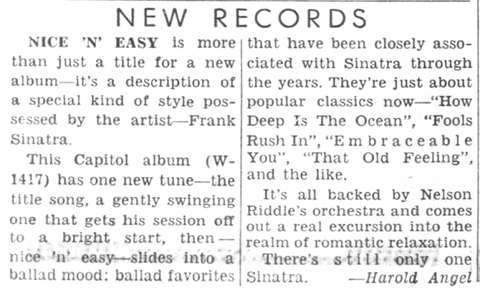
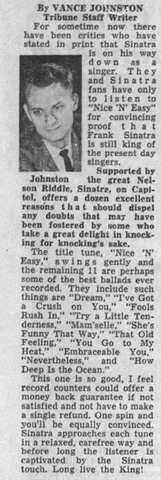
Capitol Studio A, Hollywood
E33363 Dream
E33386 I've Got A Crush On You
E33387 Embraceable You
E33388 Mam'selle
E33390 How Deep Is The Ocean?
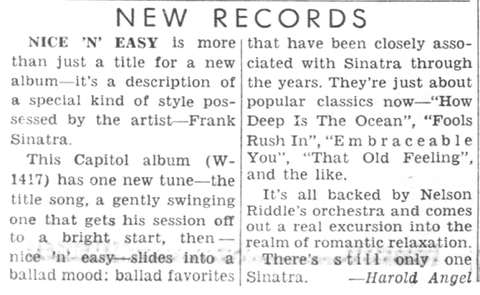
This session began work on Nice 'n' Easy, which would become one of Frank Sinatra's biggest Capitol albums — so eagerly anticipated that the label released it with only his face on the cover, no name required. Arranged by Nelson Riddle, the relaxed, easygoing collection shot straight to number one. Source: J. Randy Taraborrelli, Sinatra: Behind the Legend.
"Embraceable You"
Granata includes 'Embraceable You' among the fifty recordings he considers essential to understanding Sinatra's artistry (arranged by Nelson Riddle, recorded 1960, Capitol); the song was chosen for its musical/interpretive value rather than commercial popularity.
Source: Charles L. Granata, "Sessions with Sinatra: Frank Sinatra and the Art of Recording" (1999/2003).
[I've Got a Crush on You / For Once in My Life / Guess I'll Hang My Tears Out to Dry -- critical commentary]
Will Friedwald: At the November 11, 1993 Sands opening, Sinatra got lost in the out-of-tempo verse of 'I've Got a Crush on You'; a fan yelled 'Get Barbra, Frank!' (referencing his recorded duet with Barbra Streisand), and Sinatra, thinking the fan meant his wife Barbara, replied to himself, 'I wish she were here. We'd be havin' a drink right now,' apparently oblivious to the Streisand reference. Later that show his 'For Once in My Life' (a song he'd originally urged Tony Bennett to record in 1965) was, per Friedwald, practically his best-ever performance of it, and 'Guess I'll Hang My Tears Out to Dry' substituted for 'One for My Baby' as the evening's saloon song.
This song/context matches multiple dated entries in the chronology; the specific date Friedwald is referring to could not be determined with confidence.
Source: Will Friedwald, "Sinatra! The Song Is You: A Singer's Art" (2018 revised edition), Ch. 10, "Concert Years" (1973-1994)
March 7, 1960
[Campbell and JFK become lovers]
Judith Campbell Exner: Per Judith Campbell Exner's account, she and Kennedy arranged to meet and first slept together at the Plaza Hotel in New York on March 7, 1960.
Source: James Kaplan, "Sinatra: The Chairman" (2015).
March 8, 1960
Concerts
Fontainebleau, Miami, Fla, (March 8 to March 27)
Also appearing: The Duquaines & Sacacas and his Latin
America Orchestra
Note: Frank played at the Miami club for 19 days. He initially wanted to be dark on Mondays
but the demand was so great he relented and did almost three solid weeks. The only night he
was dark was for the taping of "Welcome Home Elvis," on Saturday, 3/26. The arrival of Elvis, by
train, created quite a stir and the rehearsals and taping of the TV show( aired on 5/12-60) was
an event in itself. The following night, 3/27, The Summit opened for the last four nights of
Frank's SRO engagement. Sammy missed one night. Dean, Joey, Peter and Frank were
more than enough for patrons willing to pay hundreds of dollars to see the five men perform
their act for the first time outside of Vegas. Frank had "Ocean's 11" in the can, "Nice 'N" Easy"
needed just the title track for completion, there was the upcoming TV special -- that was a ratings
blockbuster -- the Kennedy campaign was underway, and a new record company was in the
planning stages. A heady time, indeed, for Sinatra.
--Ed
Fontainbleau, Miami, Fla, (March 8 to March 27)
Sinatra Turns on Florida Charm
The Fontainebleau Hotel, Miami Beach, has practically made its La Ronde Room over for the current, third annual appearance of Frank Sinatra. With the normal dance floor area jammed with tables, they pack them in like sardines for Sinatra s two nightly shows with the dinner and show tab for two reportedly running to $60. At the end of the first show, they sweep the room clear to make way for the second wave of the mob, already queued up at the doorway. Entering to the tune of "High Hopes," from his pic, "A Hole in the Head," which had a Fontainebleau setting, Sinatra belts out "I Love Paris," and the fine old "I Thought About You." Then comes the soft, ''l've Got a Crush On You." with a subtle change in the lyric to "Sweetie Pie," for the benefit of the Miami audience. In contrast to other stints here, Sinatra is more talkative this time, charming the house with his running banter between songs, such as the story of the girl deejay to whom he once gave $20 in payola. "And she didn't even play the record," he commented. Other selections in the hour-long turn were a driving "Road to Mandalay" and "River Stay Away From My Door," a couple of single. hits, "All the Way"' and "High Hopes," ( "I wish the kids were here to help me," he observed) and a medley of "A Foggy Day," "I've Got You Under My Skin" and "Angel Eyes." The wind-up came with a rousing "Come Fly With Me." Sinatra pays a fitting compliment to his pianist. Bill Miller, and to the conductor of the 26 -piece ork, Morty Stevens ("borrowed him from Sammy Davis Jr., because he's not working now "). Ren Gresatt.
Variety
3-28-60
[image referenced in source but could not be recovered]
[image referenced in source but could not be recovered]
note: Interesting that Frank wanted to take lessons from Lee Strasberg at the Actor's Studio in N.Y.C. Jump forward to 1976: Frank had invited Jonathan Schwartz to a screening of "Missouri Breaks" with Brando and Jack Nicholson. Throughout the film and the discussion that ensued afterward, Frank was highly dismissive of "method" acting. Jonathan told me Frank called Brando "Mumbles" and felt the school of method acting was responsible.
Ed
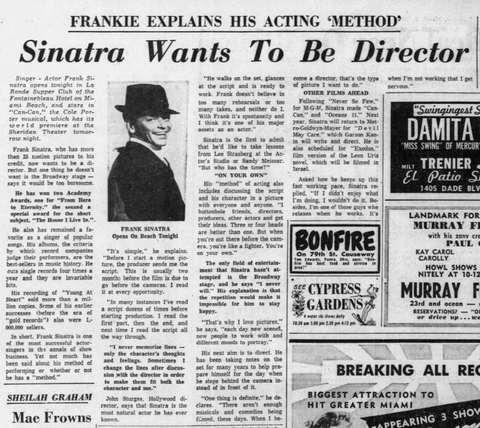
Fontainbleau, Miami, Fla, (March 8 to March 27)
Sinatra Turns on Florida Charm
The Fontainebleau Hotel, Miami Beach,
has practically made its La Ronde Room over for the current, third annual
appearance of Frank Sinatra. With the normal dance floor area jammed
with tables, they pack them in like sardines for Sinatra s two nightly shows
with the dinner and show tab for two reportedly running to $60. At the end
of the first show, they sweep the room clear to make way for the second
wave of the mob, already queued up at the doorway. Entering to the tune
of "High Hopes," from his pic, "A Hole in the Head," which had a Fontainebleau
setting, Sinatra belts out "I Love Paris," and the fine old "I Thought About You."
Then comes the soft, ''l've Got a Crush On You." with a subtle change in the lyric
to "Sweetie Pie," for the benefit of the Miami audience. In contrast to other stints
here, Sinatra is more talkative this time, charming the house with his running banter
between songs, such as the story of the girl deejay to whom he once gave $20 in
payola. "And she didn't even play the record," he commented.
Other selections in
the hour-long turn were a driving "Road to Mandalay" and "River Stay Away From
My Door," a couple of single. hits, "All the Way"' and
"High Hopes," ( "I wish the kids
were here to help me," he observed) and a medley of "A Foggy Day," "I've Got You
Under My Skin" and "Angel Eyes." The wind-up came with a rousing "Come Fly With
Me." Sinatra pays a fitting compliment to his pianist. Bill Miller, and to the conductor of
the 26 -piece ork, Morty Stevens ("borrowed him from Sammy Davis Jr., because he's
not working now "). Ren Gresatt.
Variety
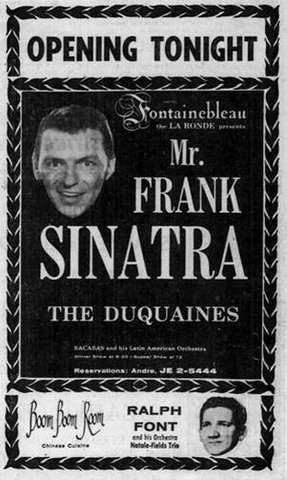
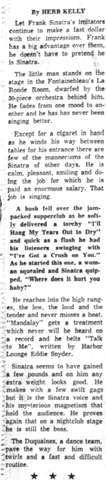
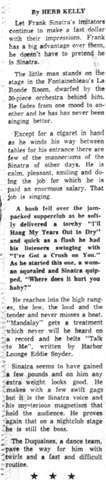
"Nice 'n Easy"
Alan Bergman: Lyricist Alan Bergman recalled that 'Nice 'n Easy' (written with Lew Spence and Marilyn Keith) was suggested by Sinatra's publisher as a needed title song for the ballads album, and that he and Keith were awestruck meeting Sinatra for the first time when he recorded it, sitting in the control room.
Source: Charles L. Granata, "Sessions with Sinatra: Frank Sinatra and the Art of Recording" (1999/2003).
"Nice 'n Easy"
Session outtakes for 'Nice 'n Easy' capture a playful, bawdy Sinatra joking with producer Dave Cavanaugh and the songwriters between takes, cursing after fumbling a line ('That quarter rest is murder!') and improvising several ribald alternate spoken tags that never made the final cut.
Source: Charles L. Granata, "Sessions with Sinatra: Frank Sinatra and the Art of Recording" (1999/2003).
"Nice 'n Easy"
Granata / Alan Bergman: It was Sinatra's idea to adapt the 'one more time/one more once' spoken reprise tag from Count Basie's recording of 'April in Paris' for the ending of 'Nice 'n Easy'; the released master combines the vocal from take eleven with the ending from take twelve after twelve total attempts.
Source: Charles L. Granata, "Sessions with Sinatra: Frank Sinatra and the Art of Recording" (1999/2003).
"Nice 'n Easy"
Granata singles out Nice 'n Easy's sonics as among the best of all Sinatra's records, citing its well-balanced stereo mix, deep clean bass, and warm string textures.
Source: Charles L. Granata, "Sessions with Sinatra: Frank Sinatra and the Art of Recording" (1999/2003).
"Nice 'n Easy"
Granata's discography entry: Nice 'n Easy, arranged by Nelson Riddle, released July 1960.
Source: Charles L. Granata, "Sessions with Sinatra: Frank Sinatra and the Art of Recording" (1999/2003).
[Kennedy wins New Hampshire primary]
Kennedy won the New Hampshire primary handily; Sinatra's lawyer Martin Gang had asked Maltz to delay the public announcement of his hiring until after this vote so as not to hurt Kennedy's chances.
Source: James Kaplan, "Sinatra: The Chairman" (2015).
[Sinatra opens at the Fontainebleau]
The night after Campbell and Kennedy's reported first tryst in New York, Frank opened his nineteen-night engagement at the Fontainebleau in Miami; Campbell later flew down to catch several of his shows.
Source: James Kaplan, "Sinatra: The Chairman" (2015).
March 9, 1960
Film
"Can Can" (U.S. Release: March 9, 1960)
Starring: Frank Sinatra, Shirley MacLaine, Maurice Chevalier, Louis Jourdan, Juliet Prowse
Produced by: Jack Cummings and Saul Chaplin
Directed by: Walter Lang
Montmartre, 1896: the Can-Can, the dance in which the women lift their skirts, is forbidden. Nevertheless Simone (MacLaine) has it performed every day in her nightclub. Her employees use their female charms to let the representatives of law enforcement look the other way - and even attend the shows. Then the young ambitious judge Philippe Forrestier (Jordan) decides to bring this to an end. Will Simone manage to twist him round her little finger, too? Her boyfriend Francois (Sinatra) certainly doesn't like to watch her trying. (DVD Release date: 2007-05-22)
"Can - Can" is very loosely based on the 1953 Broadway musical. Only eight of Porter's songs from the play were used in the film. Sinatra's character, Francois, was not in the Broadway production.
Frank owed 20th Century a film after dropping out of "Carousel" in August
1955. He negotiated a tremendous deal with the studio before agreeing to star in "Can-Can." Frank received up front $200,000 and 25% of the gross earnings. This was unheard of in 1959. A clever studio accountant could easily make a net profit disappear. But the gross was the gross. 20th Century wanted Marilyn Monroe to play Simon, but Frank insisted on Shirley MacLaine. Filming got underway in early September of 1959. The budget was $6,000,000. It became apparent very early in the filming that Frank and Shirley were badly miscast. Whereas the two Frenchmen , Maurice Chevalier and Louis Jordan, fit into the story splendidly. On 10-13-59, Sinatra and Chevalier recorded "I Love Paris." The recording is on the Capitol s/t album, but for some insane reason it was deleted from the final cut.
The film was a wrap in early November. An elaborate opening took place at the Rivoli Theatre, in N.Y.C, 3-9-60. There was one showing at 8:30 P.M and all seats were reserved. The nation-wide release took place two days later. The reviews were not good. Prior to the release, Variety estimated the movie would have a domestic gross of $10,000,000. The actual take was $4.2 million. Time has not been good to the film. On Rotten Tomatoes, "Can-Can" receives an audience score of 47%. Capitol Records released the soundtrack album on April 4, 1960. The big selling point at the time was Full Dimensional Stereo. A CD version from Capitol was issued in 1989. A more recent version is available on the Hallmark label. The quality of that release is definitely inferior to the Capitol original. The VHS was issued in April 1993 and the deluxe DVD in May of 2007. The latter is a two-disc offering that is the wide-screen version. 20th filmed it in TODD-AO and it is really the only way to watch it. The second disc offers a look at the famous Khrushev visit to the "Can-Can" set on 9-19-59. Sinatra, Maclaine, Chevalier, Jordan did numbers from the film. Nikita and Co were shocked at the very revealing outfits worn by the dancers and would later issue a statement condemning western decadence. A laser disc copy was issued in wide screen format in 1995. Excellent quality.
--Ed
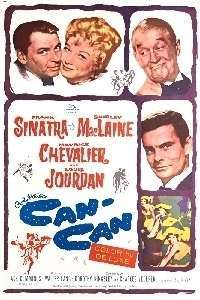
Concerts
Fontainbleau, Miami, Fla, (March 8 to March 27)
26 piece orchestra conducted by: Morty Stevens
Also appearing: The Duquaines & Sacacas and his Latin America Orchestra
"Can Can" (U.S. Release: March 9, 1960)
Starring: Frank Sinatra, Shirley MacLaine, Maurice Chevalier, Louis Jourdan, Juliet Prowse
Produced by: Jack Cummings and Saul Chaplin
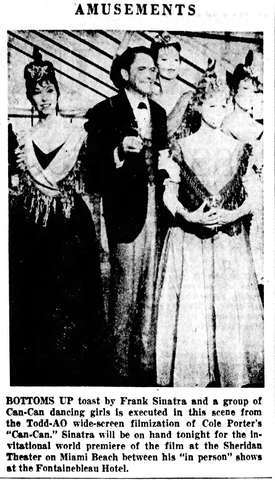
March 10, 1960
Concerts
Fontainbleau, Miami, Fla, (March 8 to March 27)
26 piece orchestra conducted by: Morty Stevens
Also appearing: The Duquaines & Sacacas and his Latin America Orchestra
Fontainbleau, Miami, Fla, (March 8 to March 27)
26 piece orchestra conducted by: Morty Stevens
Also appearing: The Duquaines & Sacacas and his Latin America Orchestra
© 1997-2026 The Sinatra Archive
This calendar, or any parts thereof, may not be reproduced in any fashion
whatsoever without the prior written permission of the publisher (The
Sinatra Archive)
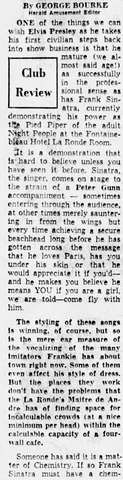
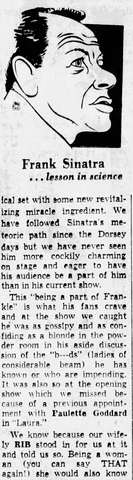
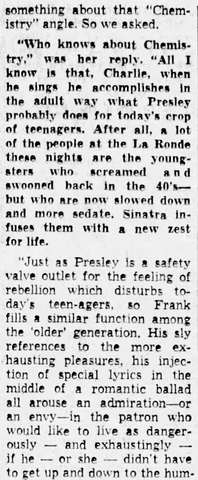
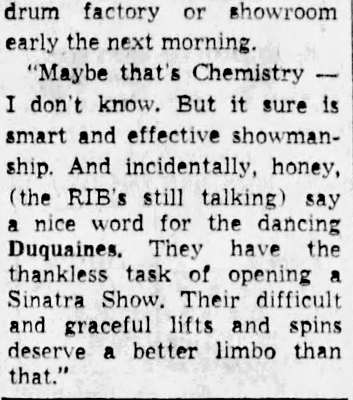
March 11, 1960
Concerts
Fontainbleau, Miami, Fla, (March 8 to March 27)
26 piece orchestra conducted by: Morty Stevens
Also appearing: The Duquaines & Sacacas and his Latin America
Orchestra
March 12, 1960
Concerts
La Ronde Room, Fontainebleau, Miami, Fla, (March 8 to March 27) 26 piece orchestra conducted by: Morty Stevens
Also appearing: The Duquaines & Sacacas and his Latin America Orchestra
The Grand Ballroom, Fontainebleau, Miami, Fla
Girls Town Ball
Frank Sinatra, Frances Langford, Eleanor Roosevelt, George Jessel
Note: The famous photo of Sinatra with Eleanor Roosevelt was taken at the Girls Town Ball in The Grand Ballroom on March 12, 1960 and not during Sinatra's performance in the La Ronde Room
The Grand Ballroom, Fontainebleau, Miami, Fla
Girls Town Ball
Emcee: Dean Murphy
Frank Sinatra, Frances Langford, Eleanor Roosevelt, George Jessel
Note: The famous photo of Sinatra with Eleanor Roosevelt was taken at the Girls Town Ball in The Grand Ballroom on March 12, 1960 and not during Sinatra's performance in the La Ronde Room
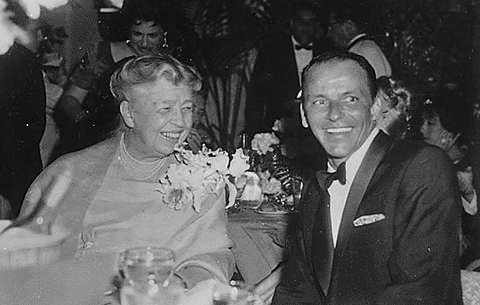
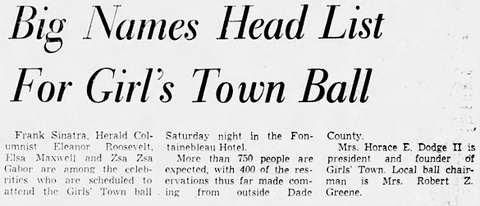
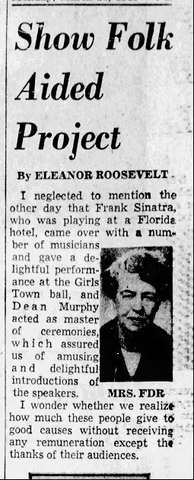
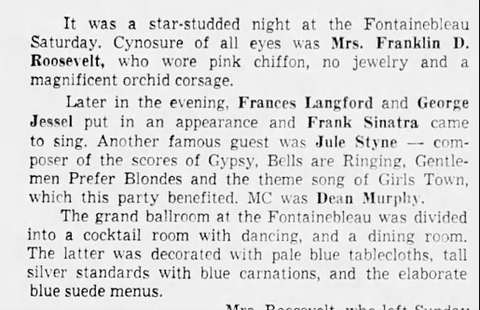
March 13, 1960
Concerts
Fontainbleau, Miami, Fla, (March 8 to March 27)
26 piece orchestra conducted by: Morty Stevens
Also appearing: The Duquaines & Sacacas and his Latin America Orchestra
March 14, 1960
Concerts
Fontainbleau, Miami, Fla, (March 8 to March 27)
26 piece orchestra conducted by: Morty Stevens
Also appearing: The Duquaines & Sacacas and his Latin America Orchestra
March 15, 1960
Concerts
Fontainbleau, Miami, Fla, (March 8 to March 27)
26 piece orchestra conducted by: Morty Stevens
Also appearing: The Duquaines & Sacacas and his Latin America Orchestra
Bill Miller (piano) among the songs:
I Love Paris
I Thought About You
I've Got A Crush On You
Road To Mandalay
River Stay Away From My Door
All The Way
High Hopes medley: A Foggy Day, I've Got You Under My Skin, Angel Eyes Come Fly With Me.
March 16, 1960
Concerts
Fontainbleau, Miami, Fla, (March 8 to March 27)
26 piece orchestra conducted by: Morty Stevens
Also appearing: The Duquaines & Sacacas and his Latin America Orchestra
Bill Miller (piano) among the songs:
I Love Paris
I Thought About You
I've Got A Crush On You
Road To Mandalay
River Stay Away From My Door
All The Way
High Hopes medley: A Foggy Day, I've Got You Under My Skin, Angel Eyes Come Fly With Me.
March 17, 1960
Concerts
Fontainbleau, Miami, Fla, (March 8 to March 27)
26 piece orchestra conducted by: Morty Stevens
Also appearing: The Duquaines & Sacacas and his Latin America Orchestra
Bill Miller (piano) among the songs:
I Love Paris
I Thought About You
I've Got A Crush On You
Road To Mandalay
River Stay Away From My Door
All The Way
High Hopes medley: A Foggy Day, I've Got You Under My Skin, Angel Eyes Come Fly With Me.
March 18, 1960
Concerts
Fontainbleau, Miami, Fla, (March 8 to March 27)
26 piece orchestra conducted by: Morty Stevens
Also appearing: The Duquaines & Sacacas and his Latin America Orchestra
Bill Miller (piano) among the songs:
I Love Paris
I Thought About You
I've Got A Crush On You
Road To Mandalay
River Stay Away From My Door
All The Way
High Hopes medley: A Foggy Day, I've Got You Under My Skin, Angel Eyes Come Fly With Me.
March 19, 1960
Concerts
Fontainbleau, Miami, Fla, (March 8 to March 27)
26 piece orchestra conducted by: Morty Stevens
Also appearing: The Duquaines & Sacacas and his Latin America Orchestra
Bill Miller (piano) among the songs:
I Love Paris
I Thought About You
I've Got A Crush On You
Road To Mandalay
River Stay Away From My Door
All The Way
High Hopes medley: A Foggy Day, I've Got You Under My Skin, Angel Eyes Come Fly With Me.
March 20, 1960
Concerts
Fontainebleau, Miami, Fla, (March 8 to March 27)
Also appearing: The Duquaines & Sacacas and his Latin America Orchestra
[Sinatra announces hiring Albert Maltz]
Murray Schumach: Speaking from Miami during his Fontainebleau engagement, Sinatra publicly announced he had hired blacklisted writer Albert Maltz to script The Execution of Private Slovik, with Steve McQueen set to star. The New York Times called it a historic defiance of the studio blacklist rule.
Source: James Kaplan, "Sinatra: The Chairman" (2015).
March 21, 1960
Concerts
Fontainebleau, Miami, Fla, (March 8 to March 27)
Also appearing: The Duquaines & Sacacas and his Latin America Orchestra
March 22, 1960
Concerts
Fontainebleau, Miami, Fla, (March 8 to March 27)
Also appearing: The Duquaines & Sacacas and his Latin America Orchestra
March 23, 1960
Concerts
Fontainebleau, Miami, Fla, (March 8 to March 27)
Also appearing: The Duquaines & Sacacas and his Latin America Orchestra
[Backlash to the Maltz hiring]
UPI / John Wayne: UPI reported that stars including John Wayne and Ward Bond publicly denounced Sinatra's hiring of Maltz as part of a hire the Commies trend; Wayne pointedly asked how Sinatra's friend Senator Kennedy felt about the decision.
Source: James Kaplan, "Sinatra: The Chairman" (2015).
[New Orleans FBI memo: Fischetti backing, Sands rumors]
The special agent in charge of the FBI's New Orleans office relayed an informant's claim that Miami hoodlum Joe Fischetti and other mobsters were "financially supporting and actively endeavoring to secure the nomination" for Senator John F. Kennedy, with Sinatra -- said by the informant to be "a nephew of Joe Fischetti" -- set to campaign for Kennedy only after clearance from Fischetti. The informant also passed on unverified gossip that Kennedy had been "compromised with a woman" while staying at the Sands Hotel in Las Vegas some six to eight weeks earlier during the filming of Ocean's Eleven, and that Kennedy's brother-in-law Peter Lawford held a small financial interest in the Sands.
Source: Kuntz and Kuntz, The Sinatra Files, ch. 5.
March 1960
Frank Sinatra hired blacklisted screenwriter Albert Maltz — one of the Hollywood Ten, and the writer of Sinatra's own Oscar-winning short The House I Live In — to script The Execution of Private Slovik, which Sinatra planned to produce and direct. The move, intended to help break the Hollywood blacklist, ignited a firestorm; John Wayne publicly wondered aloud how Sinatra's friend Senator John F. Kennedy felt about it, and Kennedy patriarch Joe Kennedy, warned by Catholic religious leaders that the controversy could hurt his son's campaign, telephoned Frank and told him to choose between Maltz and the Kennedys. Sinatra took out a full-page Variety ad defending his hiring decision as his own business, but ultimately paid Maltz his full $75,000 fee and dropped him from the project. The film was never made under Sinatra; it eventually reached television in 1974, starring Martin Sheen. Source: J. Randy Taraborrelli, Sinatra: Behind the Legend.
Sheridan and Harvey date the New York Times story breaking the Maltz hiring to March 21; the resulting controversy prompted FBI assistant director Clyde Tolson to order a summary report of the Bureau's full file on Sinatra, delivered to Alan Belmont on March 30. Among its contents: a note that Sinatra and Dean Martin had flown to Miami the previous July for the wedding of Sam Giancana's daughter, and a report that during a 1958 customs search of Giancana in Chicago, agents found a slip of paper reading "Sinatra Office 5-4977, Home Crestview 4-2368" -- Sinatra's own private Los Angeles telephone number -- among his effects. Source: Michael Sheridan & David Harvey, Sinatra and the Jack Pack.
[Can-Can]
Santopietro (Filmography): Suffolk-Cummings/Twentieth Century-Fox. Produced by Jack Cummings, directed by Walter Lang, screenplay by Dorothy Kingsley and Charles Lederer based on the Abe Burrows Broadway play, musical score by Nelson Riddle, songs by Cole Porter. Sinatra played Francois Durnais opposite Shirley MacLaine and Maurice Chevalier, singing 'I Love Paris,' 'C'est Magnifique' and 'It's All Right with Me.'
No corresponding dated entry could be identified in the chronology for this film/context.
Source: Tom Santopietro, "Sinatra in Hollywood" (2008), Filmography
[FBI report on Fischetti-Kennedy connection]
Kaplan (citing FBI report): An FBI informant report from March 1960 claimed Sinatra was being used to give mobster Joe Fischetti and other organized-crime figures an entree to Senator Kennedy's presidential campaign.
Source: James Kaplan, "Sinatra: The Chairman" (2015)
[GM threatens ad pullout over Maltz]
Nick Sevano: According to Nick Sevano, General Motors threatened to pull its advertising from upcoming Sinatra TV specials unless he dropped Maltz; Sinatra refused to budge, saying There will be other specials.
Source: James Kaplan, "Sinatra: The Chairman" (2015)
[Giancana targets Judith Campbell]
Sam Giancana and Chuck Giancana: According to Sam and Chuck Giancana's book Double Cross, mob boss Sam Giancana was delighted to learn that Kennedy was regularly sleeping with Judith Campbell, seeing an opportunity to cultivate her as a way to eventually manipulate the future president.
Source: James Kaplan, "Sinatra: The Chairman" (2015)
[Hedda Hopper campaigns against Sinatra]
Hedda Hopper: Hopper wrote that she had received over a hundred letters protesting the Maltz hiring and publicly urged Sinatra to abandon the project, warning it could damage his career, his family, and Kennedy's campaign.
Source: James Kaplan, "Sinatra: The Chairman" (2015)
[Judith Campbell on Sinatra's rotating women]
Judith Campbell Exner: Judith Campbell (later Exner) recalled being at the Fontainebleau Hotel in March 1960 alongside Juliet Prowse, observing that each woman in Frank's life got only a certain allotted amount of time -- except for Ava Gardner, who remained a constant presence in his emotional life.
Source: James Kaplan, "Sinatra: The Chairman" (2015)
[Kilgallen's item coins Rat Pack]
Dorothy Kilgallen: About a week after the Maltz story broke, Dorothy Kilgallen's column reported that Kennedy insiders were downplaying his closeness with Sinatra -- an item notable as the first print use of the term Rat Pack for the Summit group.
Source: James Kaplan, "Sinatra: The Chairman" (2015)
[Record Fontainebleau gross]
Variety: Variety's front page reported Sinatra grossed a record $400,000 for his nineteen-night Fontainebleau engagement, with the last three nights -- a Summit reprise -- packed beyond capacity.
Source: James Kaplan, "Sinatra: The Chairman" (2015)
[Sammy Cahn introduces Joe Kennedy to Fischetti]
Sammy Cahn: Sammy Cahn recalled Sinatra asking him to walk Joseph P. Kennedy down a hallway at the Fontainebleau to meet mobster Joe Fischetti, marveling that he was introducing the father of the likely Democratic nominee to one of the best-known criminals in the United States.
Source: James Kaplan, "Sinatra: The Chairman" (2015)
[Sinatra leaves William Morris Agency]
Variety: The same Variety front page reported Sinatra was quitting the William Morris Agency to form his own management company, headed by Hank Sanicola with Milt Ebbins and Nick Sevano, expected to represent Rat Pack members and other stars.
Source: James Kaplan, "Sinatra: The Chairman" (2015)
[Nice 'n' Easy (title song) -- critical commentary]
Lew Spence: Lew Spence discarded the melody at first, only demonstrating the fragment to Alan and Marilyn Bergman after finishing another song early; Alan Bergman came up with the title 'Nice 'n' Easy' on the spot, and the rest came quickly. Spence demoed it for Sinatra during an Ocean's 11 filming break, but Sinatra initially picked up the sheet music with his fingernails and dropped it like garbage. Hank Sanicola saved the song by playing it repeatedly until Sinatra asked, 'What is that cute little thing you keep playing?' Spence recalled: 'Hank told him it was my song and that he was recording it in a couple of weeks. Frank said, "Well, I better get Nelson and give him a key. I don't remember giving him a key on that one." Frank not only recorded it but decided that he would make it the title of an album.' Sinatra devised the classic coda (reprising the tag, echoing Basie's 'April in Paris' 'one more time') on the actual date.
Source: Will Friedwald, "Sinatra! The Song Is You: A Singer's Art" (2018 revised edition), Ch. 6, "With Nelson Riddle" (1953-1979)
March 26, 1960
Taping of "Welcome Home Elvis"
Show was rehearsed from 3/22 thru 3/26.
Taping at the Fontainebleau started at
6:15 P.M. on Saturday night ( 26 )
INVITATION TO FRANK'S TIMEX SHOW TAPING 3-26-60
------------------------------------------
"Sinatra's 3LP set "Trilogy" was released on 3-26-80.
Here are some reviews from back then:
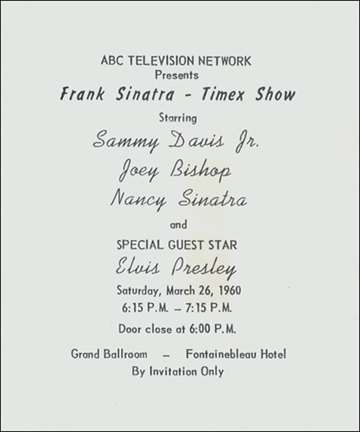
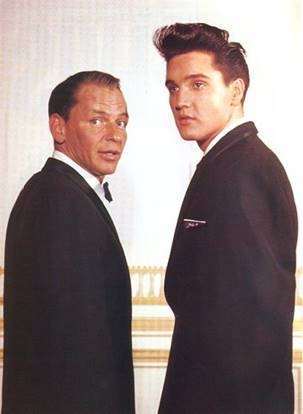
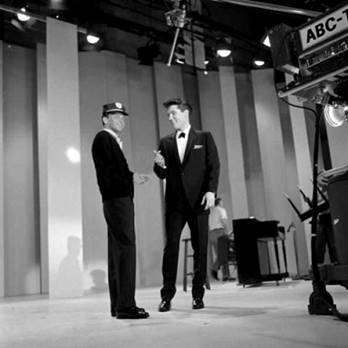
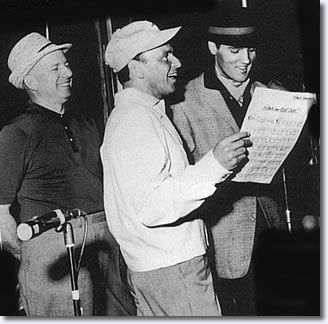
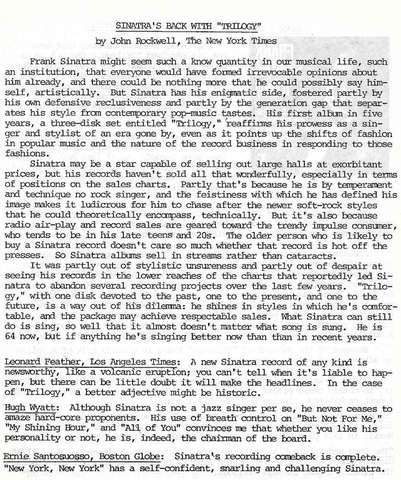
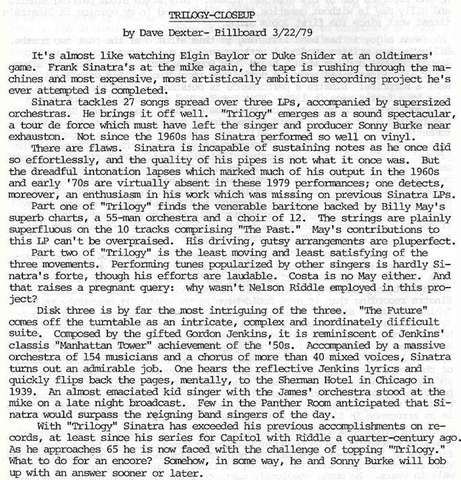
[Welcome Home Elvis special taped]
The Sinatra-Presley special It's Nice to Go Traveling; or, Welcome Home Elvis was taped at the Fontainebleau in front of an audience full of teenage girls, featuring Nancy Sinatra's professional TV debut and Sammy Davis Jr. and Joey Bishop in support.
Source: James Kaplan, "Sinatra: The Chairman" (2015).
[Sinatra-Presley duet on Welcome Home Elvis]
During the taping, Elvis performed Fame and Fortune and Stuck on You, then joined Sinatra for a much-anticipated duet trading verses of Love Me Tender and Witchcraft; Elvis's total screen time across the special was about seven and a half minutes.
Source: James Kaplan, "Sinatra: The Chairman" (2015).
March 29, 1960
[FBI memo on Confidential probe of Palm Springs party]
FBI memo: An FBI memo dated March 29, 1960, recorded that Confidential magazine had sent a reporter to investigate rumors of an 'indiscreet party' at Sinatra's Palm Springs home attended by Senator John Kennedy and Peter Lawford, and noted Kennedy had previously stayed at Sinatra's house during a California visit.
Source: James Kaplan, "Sinatra: The Chairman" (2015).
[FBI tracks fallout from the Sinatra-Maltz screenwriting deal]
The same March 29, 1960 memo already tracking rumors of an "indiscreet party" also detailed the FBI's monitoring of the fallout from Sinatra hiring blacklisted, formerly imprisoned screenwriter Albert Maltz for The Execution of Private Slovik, revealed nine days earlier by The New York Times. One source claimed Kennedy had asked Sinatra, through Peter Lawford, to delay confirming the Maltz deal until after the New Hampshire primary. A UPI item quoted Sinatra's public defense: "I make movies. I do not ask the advice of Senator Kennedy on whom I should hire. Senator Kennedy does not ask me how he should vote in the Senate." Joseph Kennedy reportedly later told Sinatra flatly, "It's either Maltz or us"; Sinatra fired Maltz but paid him the full $75,000 contract fee. A follow-up April 3, 1960 memo noted the American Legion Magazine was preparing a "hard-hitting" attack on Sinatra over the episode for its May issue, to reach four million members.
Source: Kuntz and Kuntz, The Sinatra Files, ch. 5 (memos of March 29 and April 3, 1960).
April 1960
[River, Stay 'Way From My Door -- critical commentary]
'River, Stay 'Way From My Door' (April 1960) is analyzed by Granata as a showcase of Riddle's tempo-arranging skill and Sinatra's syncopational improvisation: though the song appears to accelerate toward a wailing climax, the underlying 'heartbeat' tempo never actually changes -- an illusion created through Riddle's dynamic orchestration.
Source: Charles L. Granata, "Sessions with Sinatra: Frank Sinatra and the Art of Recording" (1999/2003), Part III: The Capitol Years, 1953-1962
April 4, 1960
Capitol released the Can-Can film soundtrack.
Source: Nancy Sinatra, Frank Sinatra: An American Legend, 1995.
April 13, 1960
Studio
Capitol Studio A, Hollywood
E33650 Nice 'N' Easy
(Spence/Keith/ Bergman)
Lew Spence Music/Threesome Music (EEG Music) (ASCAP)
Arranged & Conducted by Nelson Riddle
11/12 (2:45)
CD: CDP 724383595228 Sinatra 80th All The Best
CD: C2 724383808922 The Complete Capitol Singles
CD: C2-94777 The Capitol Years
CD: CDP 7-92160-2 Frank Sinatra Collector's Series
CD: CDP 7-91149-2 Nice 'n' Easy
LP: SW1417 Nice 'n' Easy
45: 440
Capitol Studio A, Hollywood
E33650 Nice 'N' Easy
E33651 River Stay 'Way From My Door
E33652 I Love Paris
(
E33653 It's Over, It's Over, It's Over
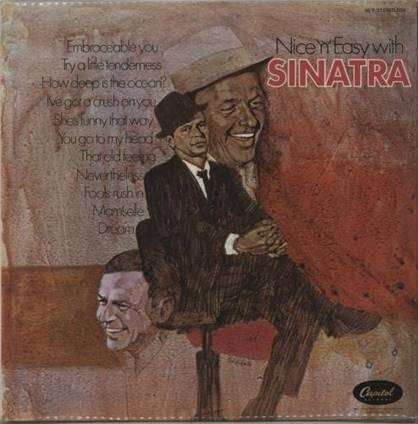
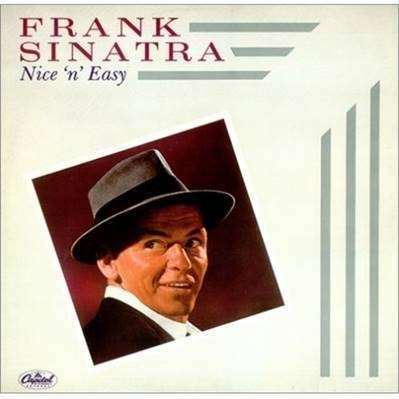
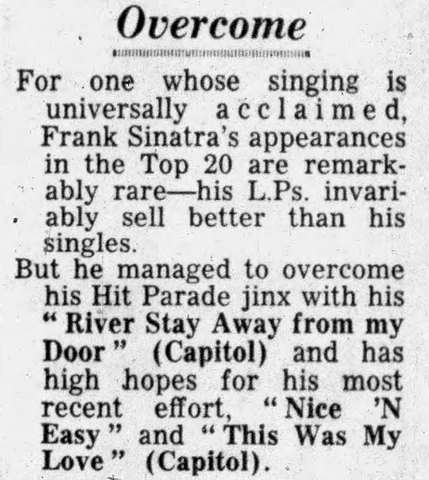
[Sinatra records Nice 'n' Easy]
Kaplan / Marilyn Bergman: Sinatra recorded Nice 'n' Easy at Capitol, inviting songwriters Alan and Marilyn Bergman to watch from the control booth -- an unusual concession, since he normally disliked writers at sessions. He needed twelve takes to master the unfamiliar song, joking irritably about interruptions along the way.
Source: James Kaplan, "Sinatra: The Chairman" (2015).
Liner Notes: NICE 'N' EASY
Nice 'n' Easy finds Sinatra and Nelson Riddle in a register they had not quite occupied before: not the propulsive swing of Songs for Swingin' Lovers!, not the desolation of Only the Lonely, but something gentler and more relaxed -- ballads taken at a slow, unhurried tempo, warm rather than wounded. It became Sinatra's first number-one album on the newly established Billboard 200 chart.
The title track, added late to the sessions and released as a single, gave the record its name and its governing idea: love songs delivered at a walking pace, arrangements built around soft brushed drums and gently voiced strings rather than the sharper accents of Riddle's uptempo work. "Embraceable You" and "That Old Feeling" exemplify the mood -- intimate without being desolate, romantic without being naive.
Nice 'n' Easy would also prove to be Sinatra's last album for Capitol recorded under the classic Riddle formula before the shift toward his own label, Reprise, later that year. It stands as a graceful, confident closing statement to the Capitol era -- proof that after seven years and a dozen landmark records, Sinatra and Riddle still had new colors to find together.
Written by Claude (Anthropic), commissioned for this chronology, 2026.
April 24, 1960
[Louella Parsons on Elvis's Hollywood return]
Louella Parsons: Parsons' column covered Elvis Presley starting production on GI Blues for Hal Wallis and noted Juliet Prowse's romance with Sinatra was cooling following her casting opposite Elvis.
Source: James Kaplan, "Sinatra: The Chairman" (2015).
May 1960
[Sinatra's bachelor trip to the Far East]
Frank Sinatra (quoted): With George Jacobs and Jimmy Van Heusen, Sinatra flew off on a bachelor jaunt to Japan and the Far East. Asked by a Stars and Stripes reporter for his impressions, he said he 'dug the sake and the kids' and made pointed remarks contrasting Japanese women with unnamed American women, ending 'If the boot fits -- c'est la vie.' He returned with a jade bracelet and pearls for Juliet Prowse.
Source: James Kaplan, "Sinatra: The Chairman" (2015)
May 10, 1960
[JFK wins West Virginia primary]
John F. Kennedy defeated Hubert Humphrey decisively in West Virginia's Democratic primary, despite the state being heavily Protestant. The win crushed Humphrey's hopes and proved a Catholic could be electable. Kaplan connects this to a prior golf-course conversation between Sinatra and Sam Giancana about turning out support for Kennedy.
Source: James Kaplan, "Sinatra: The Chairman" (2015).
May 12, 1960
Television
The Frank Sinatra Timex Show
Title: Welcome Home Elvis
Network: ABC
Sponsor: Timex
Location: Grand Ballroom, Fountainbleau Hotel
Taped: March 26, 1960 4:15 pm - 7:15 pm
Guests: Nancy Sinatra, Sammy Davis Jr., Peter Lawford, Joey Bishop, Elvis Presley
Taped in Miami
1. It's Nice To Go Travelling
2. Witchcraft
3. Gone With The Wind
4. Medley: Love Me Tender / Witchcraft w/Elvis Presley
5. You Make Me Feel So Young (Old) w/Nancy Sinatra
6. It's Nice To Go Travelling (Closing)
Note: Sinatra Scholar Ed O'Brien says this show was taped at the Fountainbleau on March 26, 1960.
He feels that the show is "a bit lame." The comedy skits are just dreadful. Presley was paid $125,000 for about 12 minutes. The other three Timex shows were much more entertaining, O'Brien assesses. 60 mins.
The Frank Sinatra Timex Show
Welcome Home Elvis
EXCERPTS FROM INTERVIEW WITH SAMMY CAHN
MAY 12, 1960
"We were sitting around one day wondering about the next show. Suddenly out of left field, Frank asked, 'what about Elvis Presley?' That's Sinatra. He wants to do what he wants to do. Next thing I know, we're paying $125,000 for Presley. You know what we get from the sponsor to pay all talent. For all of us we get $250,000. That means after we pay Presley, we got $125,000 to pay Sinatra,
Sammy Davis, Joey Bishop, Peter Lawford. And you don't pay Nelson Riddle and his 42 musicians with old song sheets. You should make in a year what Frank is losing on this show. But he wants to prove he can go big on television. He say to me: 'I want blockbusters.
The topper was one day when we're getting ready for our show on women. We're going over the list of the most admired women.and there is Eleanor Roosevelt on top of the list. Believe me, I would never dare to presume to call Mrs. Roosevelt. Not Frank Sinatra.
He gets on the phone. Next thing I know I'm writing her into the show."
Ed O'Brien notes: Cahn and Jimmy Van Heusen co-produced the
Times show of 5-12-60.
[image referenced in source but could not be recovered]
[image referenced in source but could not be recovered]
[image referenced in source but could not be recovered]
[image referenced in source but could not be recovered]
[image referenced in source but could not be recovered]
[image referenced in source but could not be recovered]
[image referenced in source but could not be recovered]
"Love Me Tender"
Will Friedwald: Costa's simple guitar-and-choir arrangement of 'Love Me Tender' on The Present is noted as the second time the song intersected with Sinatra: in 1960, on a TV special costarring Elvis Presley, Sinatra finger-snapped a swinging Riddle-style version of 'Love Me Tender' while Elvis gyrated a hillbilly version of Sinatra's 'Witchcraft,' both performed tongue-in-cheek.
Source: Will Friedwald, "Sinatra! The Song Is You: A Singer's Art" (2018 revised edition).
[Welcome Home Elvis broadcast]
Kaplan / Variety: The Sinatra-Presley Timex special aired on a Thursday and drew over 40 percent of the American television audience -- by far Sinatra's best-ever rating -- though Variety's review panned it as embarrassing self-idolatry with only occasional flashes of grace and talent.
Source: James Kaplan, "Sinatra: The Chairman" (2015).
May 13, 1960
[SHARE Boomtown benefit costume party]
At the annual SHARE Boomtown western-themed costume benefit for children with disabilities, held at the Hollywood Moulin Rouge, Sinatra came dressed as an Indian squaw with headband and feather; the evening, once again bibulous, would end in a public altercation.
Source: James Kaplan, "Sinatra: The Chairman" (2015).
May 14, 1960
[Sinatra confronts John Wayne in parking lot]
In the early hours after the SHARE benefit, Sinatra, still in his squaw costume, confronted John Wayne over Wayne's earlier public criticism of the Maltz hiring; a witness said the two shoved each other before friends separated them.
Source: James Kaplan, "Sinatra: The Chairman" (2015).
[Sinatra brawls with parking attendants]
Still agitated after the Wayne confrontation, Sinatra stepped into the path of a car driven by parking attendant Clarence English, then got into a physical fight with a second attendant, Edward Moran, who struck him; Sammy Davis's bodyguard Big John Hopkins then beat Moran while Sinatra, still in costume, shouted threats about suing.
Source: James Kaplan, "Sinatra: The Chairman" (2015).
May 29, 1960
Frank arrived in Tokyo for his first concerts in Japan.
Source: Nancy Sinatra, Frank Sinatra: An American Legend, 1995.
July 1960
[Sinatra and Lawford at the Democratic National Convention]
Sinatra and Peter Lawford appeared backstage at the Democratic National Convention, held in Los Angeles in July 1960.
Source: Charles Pignone, "Frank Sinatra 100" (2015).
[Columnist Inez Robb on Sinatra's endorsement]
Inez Robb: Leaving the convention, syndicated columnist Inez Robb wrote that Sinatra's endorsement of the Democratic Party was not necessarily an asset or a guarantee of victory in November.
Source: James Kaplan, "Sinatra: The Chairman" (2015)
[Drew Pearson reports Kennedy's discomfort with Sinatra]
Drew Pearson: In his convention wrap-up column, Drew Pearson reported that Kennedy, via brother-in-law Peter Lawford, asked Sinatra not to throw him a party in Los Angeles, worried about Sinatra's mob associations and his ownership of about 4 percent of the Sands casino; Kennedy welcomed the support but not the publicity.
Source: James Kaplan, "Sinatra: The Chairman" (2015)
[Nice 'n' Easy tops the charts]
Kaplan: Following its release in July 1960, the Nice 'n' Easy album spent nine weeks at number one on the Billboard chart and thirty-five weeks in the Top 40.
Source: James Kaplan, "Sinatra: The Chairman" (2015)
July 9, 1960
[Norman Mailer watches JFK arrive at the Biltmore]
Norman Mailer: On Saturday, July 9, 1960, Norman Mailer observed John Kennedy's arrival at the Biltmore Hotel ahead of the Democratic National Convention, describing his tan, magnetic presence and the crowd's reaction in his Esquire piece 'Superman Comes to the Supermarket.' Kaplan notes this was the man Sinatra had thrown in his lot with.
Source: James Kaplan, "Sinatra: The Chairman" (2015).
[Party for Eunice Shriver at the Lawfords']
On the night of July 9, a party was held for Jack Kennedy's sister Eunice Shriver at the Lawfords' Santa Monica beach house, attended by Senator and Mrs. Kennedy and by Frank Sinatra.
Source: James Kaplan, "Sinatra: The Chairman" (2015).
July 10, 1960
Concerts
Beverly Hills, CA
JFK Benefit ($100 a plate dinner) w/Judy Garland
Beverly Hills, CA
JFK Benefit ($100 a plate dinner) w/Judy Garland
US Senator (and future US President) John F Kennedy and entertainer Frank Sinatra attend a black tie, Democratic Committee Dinner at the Beverly Hilton Hotel, Los Angeles, California, July 10, 1960.

At this Beverly Hilton fundraiser the night before the Democratic National Convention opened, Frank Sinatra performed alongside Judy Garland, Sammy Davis Jr., and Mort Sahl across two packed ballrooms of twenty-eight hundred guests. Seated with candidates Stuart Symington, Adlai Stevenson, and Lyndon Johnson, Sinatra spent much of the evening leaning over to whisper jokes in John F. Kennedy's ear, the two men laughing together as photographers looked on. Source: J. Randy Taraborrelli, Sinatra: Behind the Legend.
Frank and his friend President John F. Kennedy, at a Democratic Party fundraising dinner at the Beverly Hilton Hotel on July 10, 1960. Sinatra supported Kennedy’s run for the presidency in 1960 and sang the campaign’s theme song, “High Hopes,” with refashioned lyrics touting Kennedy’s candidacy. Source: photo and caption from J. Randy Taraborrelli, Sinatra: Behind the Legend (mptvimages.com).
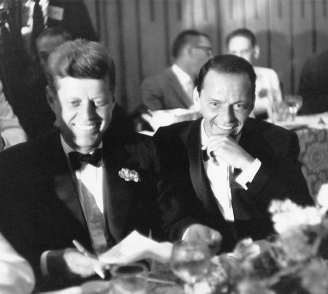
[$100-a-plate Democratic fundraiser at Beverly Hilton]
Kaplan / Los Angeles Times: A Sunday night Democratic fundraiser drew 2,800 of Hollywood's elite to the Beverly Hilton, including Tony Curtis, Janet Leigh, Sammy Davis Jr., Judy Garland, and others. Kennedy sat at the head table beside Garland; Sinatra sat with Johnson, Stevenson, and Symington. Harry Truman skipped the convention, saying he could not lend himself to what was happening; Eleanor Roosevelt made a surprise appearance wearing a Stevenson button and later sat near Sinatra. Lyndon Johnson gave a closing speech attacking Kennedy's readiness.
Source: James Kaplan, "Sinatra: The Chairman" (2015).
July 11, 1960
Frank Sinatra and the rest of the Rat Pack — unofficially rebranded the “Jack Pack” for the campaign — joined Janet Leigh and Tony Curtis in performing “The Star-Spangled Banner” to open the Democratic National Convention at the Los Angeles Memorial Sports Arena. John F. Kennedy's nomination was all but sealed later that day when Wyoming put him over the top; an elated Sinatra told Peter Lawford, “We're on our way to the White House, pallie. We're on our way.” Source: J. Randy Taraborrelli, Sinatra: Behind the Legend.
[Democratic National Convention opens in Los Angeles]
The 1960 Democratic National Convention opened at the new Memorial Sports Arena in Los Angeles, drawing 45,000 visitors including over 4,500 delegates. Sinatra was part of a star-studded chorale (with Nat King Cole, Tony Curtis, Sammy Davis Jr., Janet Leigh, and others) that sang the national anthem at the televised opening session.
Source: James Kaplan, "Sinatra: The Chairman" (2015).
[Sammy Davis Jr. booed by Mississippi delegation]
Frank Sinatra (quoted); Sammy Davis Jr.: When Sammy Davis Jr. was introduced at the convention's opening session, the Mississippi delegation booed loudly, reacting to his recently announced engagement to white Swedish actress May Britt. Sinatra whispered comfort to a stunned Davis: 'Those dirty sons of bitches! Don't let 'em get you, Charley.' Davis later told a reporter he couldn't blame anyone for how they felt.
Source: James Kaplan, "Sinatra: The Chairman" (2015).
[Sinatra and Dean Martin apply for Cal-Neva stake]
Ned Turner (Nevada Gaming Control Board), via wire dispatch: On the same day JFK received the presidential nomination, a wire-service item reported that Frank Sinatra and Dean Martin had applied to the Nevada Gaming Control Board to buy a majority (57 percent combined with associates) stake in the Cal-Neva Lodge at Crystal Bay -- Sinatra seeking 25 percent, Martin 3 percent, Hank Sanicola 16 percent, and Paul 'Skinny' D'Amato 13 percent.
Source: James Kaplan, "Sinatra: The Chairman" (2015).
July 12, 1960
[Booing returns during civil rights plank reading]
Merriman Smith (UPI): Booing recurred on the convention floor Tuesday night during the reading of the Democratic Party's civil rights plank. Sinatra made his entrance around the same time, signing autographs before the California delegation; UPI's Merriman Smith noted he wandered freely as Peter Lawford's guest, part of the celebrity 'Jack Pack' with floor access.
Source: James Kaplan, "Sinatra: The Chairman" (2015).
July 13, 1960
The evening Kennedy won the Democratic presidential nomination on the convention's first ballot, the Lawfords threw a victory party at their Santa Monica beach house; Sinatra and the campaign's Hollywood supporters, including Marilyn Monroe, raised champagne glasses to the nominee. Source: Michael Sheridan & David Harvey, Sinatra and the Jack Pack.
[JFK escapes reporters via fire escape]
Kaplan / Theodore H. White: On the morning of Wednesday, July 13, Kennedy addressed six caucuses to lock down first-ballot votes, then evaded reporters staked outside his rented Hancock Park apartment by climbing down the fire escape and over the back fence with aide Dave Powers, driving to Joe Kennedy's rented Beverly Hills mansion (formerly Marion Davies's).
Source: James Kaplan, "Sinatra: The Chairman" (2015).
[Sinatra tends bar at the Kennedy mansion]
At the Beverly Hills mansion where JFK watched convention proceedings, Frank Sinatra was found tending bar, surprising steelworkers' union president David McDonald, who was personally handed a beer by Sinatra.
Source: James Kaplan, "Sinatra: The Chairman" (2015).
[Stevenson demonstration at the convention]
Kaplan / Theodore H. White: That evening, Sinatra watched from backstage as Senator Eugene McCarthy placed Adlai Stevenson's name in nomination, triggering a five-minute floor chant of 'WE WANT STEVENSON!' Conductor Johnny Green struck up the band to quell it at Sinatra's 'cut' signal, but the demonstration continued regardless.
Source: James Kaplan, "Sinatra: The Chairman" (2015).
[Wyoming delegation puts Kennedy over the top]
Frank Sinatra (quoted): As the roll call reached the final state, Wyoming's committeeman Tracy McCraken cast all fifteen of the state's votes for Kennedy, clinching the nomination. Backstage, Sinatra and the Jack Pack celebrated jubilantly; Frank told Peter Lawford, 'We're on our way to the White House, buddy boy!'
Source: James Kaplan, "Sinatra: The Chairman" (2015).
[FBI's detailed Kennedy dossier, on the day of his nomination]
The same day Kennedy secured the Democratic presidential nomination, Hoover aide M. A. Jones sent a lengthy briefing memo cataloguing the Bureau's cordial relationship with the Kennedy family alongside unverified "allegations" concerning Kennedy's private conduct, including that he had been "'compromised' with a woman in Las Vegas" and that "Kennedy and Frank Sinatra have in the recent past been involved in parties in Palm Springs, Las Vegas and New York City," for which Confidential magazine was said to hold affidavits from "two mulatto prostitutes in New York." The memo also noted reports that Sinatra had cultivated Peter Lawford so that mobster Joe Fischetti "could have an entre to the Senator."
Source: Kuntz and Kuntz, The Sinatra Files, ch. 5.
July 20, 1960
[Sinatra arrives early in Atlantic City]
Frank arrived alone in Atlantic City two days ahead of his annual 500 Club engagement to discuss business with Skinny D'Amato, who -- under regulatory pressure -- had withdrawn his Cal-Neva ownership application but would still informally oversee the casino's gambling operations and entertainment.
Source: James Kaplan, "Sinatra: The Chairman" (2015).
July 22, 1960
Concerts
500 Club, Atlantic City, New Jersey (July 22-30)
Three shows each night
Bill Miller Sextet: Joe Comfort (bass), Al Viola (guitar), Emil Richards (vibraharp), Sol Gubin (drums) Paul Horn (sax and flute),
Bill Miller (piano and conductor)
Pete Miller Orch.
Emcee: Jack Curtis
O.A. Buddy Lester
1. Too Marvelous for Words
2. Day In, Day Out
3.Willow Weep For Me
4.It's Over, It's Over, It's Over
5. I Could Have Danced All Night
6. The Lady Is A Tramp
7. You Go To My Head
8. I Love Paris
9.River Stay Away From The Door
10. My Funny Valentine 1
11. Come Fly With Me
The Star Ledger
500 Club, Atlantic City, New Jersey (July 22-31)
Three shows each night
Bill Miller Sextet: Joe Comfort (bass), Al Viola (guitar), Emil Richards (vibraharp), Sol Gubin (drums) Paul Horn (sax and flute),
Bill Miller (piano and conductor)
Pete Miller Orch.
Emcee: Jack Curtis
O.A. Buddy Lester
500 CLUB AD FOR 10 DAY ENGAGEMENT
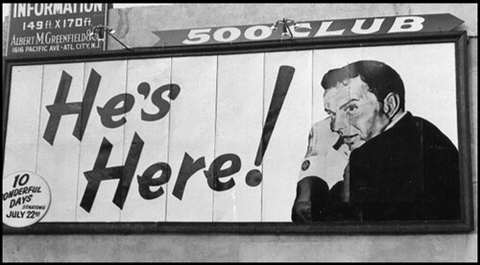
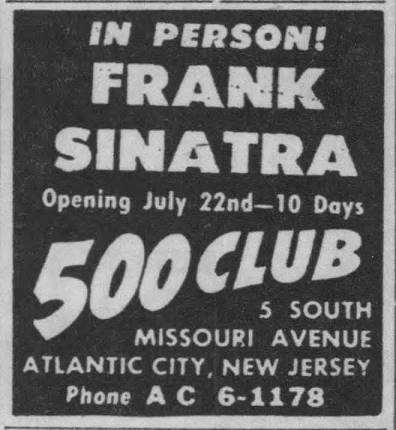
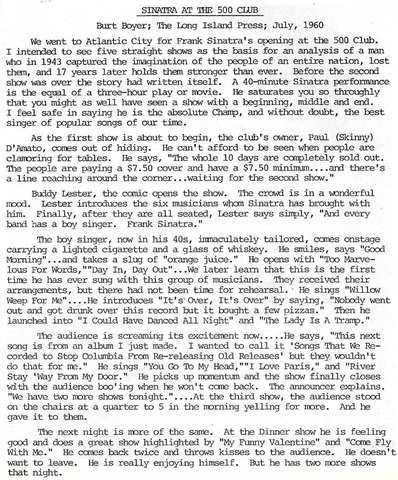
July 23, 1960
Concerts
500 Club, Atlantic City, New Jersey (July 22-31)
Two shows each night
Emcee: Jack Curtis
O.A. Buddy Lester, Lee Henderson Mannequins
Bill Miller Combo
Pete Miller Orchestra
500 Club, Atlantic City, New Jersey (July 22-31)
Two shows each night
Emcee: Jack Curtis
O.A. Buddy Lester, Lee Henderson Mannequins
Bill Miller Combo
Pete Miller Orchestra
© 1997-2026 The Sinatra Archive
This calendar, or any parts thereof, may not be reproduced in any fashion whatsoever without the prior written permission of the publisher (The Sinatra Archive)
Message 3 of 40
July 24, 1960
Concerts
500 Club, Atlantic City, New Jersey (July 22-31)
Two shows each night
500 Club, Atlantic City, New Jersey (July 22-31)
Two shows each night
500 Club July 1960
© 1997-2024 The Sinatra Archive
This calendar, or any parts thereof, may not be reproduced in any fashion whatsoever without the prior written permission of the publisher (The Sinatra Archive)
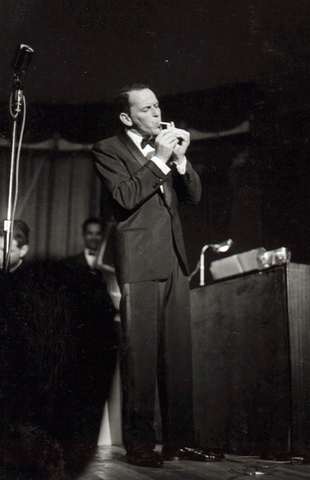
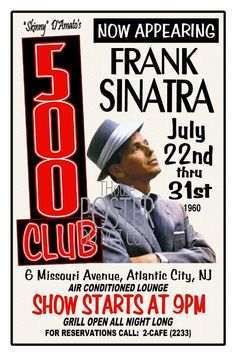
500 Club, Atlantic City, New Jersey (July 22-31)
Two shows each night
500 Club July 1960
[image referenced in source but could not be recovered]
[image referenced in source but could not be recovered]
500 Club, Atlantic City, New Jersey (July 22-31)
Two shows each night
500 Club July 1960
© 1997-2024 The Sinatra Archive
This calendar, or any parts thereof, may not be reproduced in any fashion whatsoever without the prior written permission of the publisher (The Sinatra Archive)
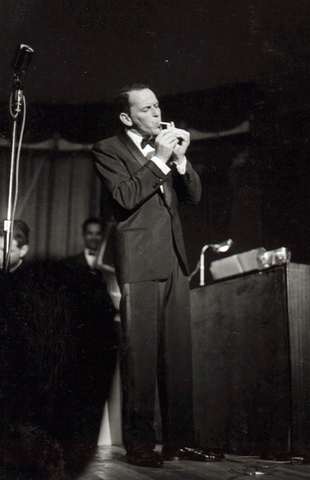
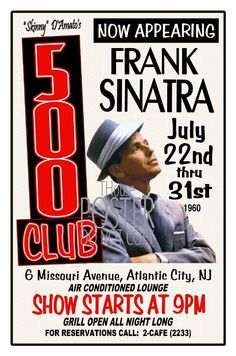
July 25, 1960
Concerts
500 Club, Atlantic City, New Jersey (July 22-31)
Two shows each night
July 26, 1960
Concerts
500 Club, Atlantic City, New Jersey (July 22-31)
Two shows each night
Emcee: Jack Curtis
O.A. Buddy Lester, Lee Henderson Mannequins
Bill Miller Combo
Pete Miller Orchestra
July 27, 1960
Concerts
500 Club, Atlantic City, New Jersey (July 22-31)
Three shows each night
Bill Miller Sextet: Joe Comfort (bass), Al Viola (guitar), Emil Richards (vibraharp), Sol Gubin (drums) Paul Horn (sax and flute),
Bill Miller (piano and conductor)
Pete Miller Orch.
Emcee: Jack Curtis
O.A. Buddy Lester
500 Club, Atlantic City, New Jersey (July 22-31)
Three shows each night
Bill Miller Sextet: Joe Comfort (bass), Al Viola (guitar), Emil Richards (vibraharp), Sol Gubin (drums) Paul Horn (sax and flute),
Bill Miller (piano and conductor)
Pete Miller Orch.
Emcee: Jack Curtis
O.A. Buddy Lester
Press Of Atlantic City

Frank was set for a 10 day run, but he dicided to get out of town
a day early. He added additional shows including a fourth on closing
night. He was there from 7/22 to 7/30.
July 28, 1960
Concerts
500 Club, Atlantic City, New Jersey (July 22-31)
Three shows each night
Bill Miller Sextet: Joe Comfort (bass), Al Viola
(guitar), Emil Richards (vibraharp), Sol Gubin
(drums) Paul Horn (sax and flute),
Bill Miller (piano and conductor)
Pete Miller Orch.
Emcee: Jack Curtis
O.A. Buddy Lester
500 Club, Atlantic City, New Jersey (July 22-31)
Three shows each night
Bill Miller Sextet: Joe Comfort (bass), Al Viola (guitar), Emil Richards
(vibraharp), Sol Gubin (drums) Paul Horn (sax and flute),
Bill Miller (piano and conductor)
Pete Miller Orch.
Emcee: Jack Curtis
O.A. Buddy Lester

July 29, 1960
Concerts
500 Club, Atlantic City, New Jersey (July 22-31)
Three shows each night
Bill Miller Sextet: Joe Comfort (bass), Al Viola (guitar), Emil Richards
(vibraharp), Sol Gubin (drums) Paul Horn (sax and flute), Bill Miller (piano and conductor)
Pete Miller Orch.
Emcee: Jack Curtis
O.A. Buddy Lester
July 30, 1960
Concerts
500 Club, Atlantic City, New Jersey (July 22-30)
Two shows each night
note: Here is an update on this engagement: The ads all showed Frank playing a 10-day run at the Vermillion Room from 7/22 thru 7/31. But he closed a day early (30) He opened on 7/22( Friday). There were three shows a night on the weekends and two per night during the week. In all, there were 21 shows. Skinny D'Amato, owner of the club, raised the admission to $7.50 on weekends and $5.00 during the week. There was also a minimum of $7.50 every night. Frank was SRO for all the shows. The club took in over $200,000 for the nine day run. According to Variety, more than 15,000 people saw Sinatra per- form in the 700 seat room. Frank stayed at the beach- front Claridge Hotel and received a police escort each night into his dressing room. He was not available for interviews throughout the engagement. Skinny took up the slack. He also closed the club up after Frank departed. He reopened with Dean Martin on 8/13.
Article was in the 8-3-60 issue of Variety.
Ed
500 Club, Atlantic City, New Jersey (July 22-30)
Two shows each night
Press of Atlantic City
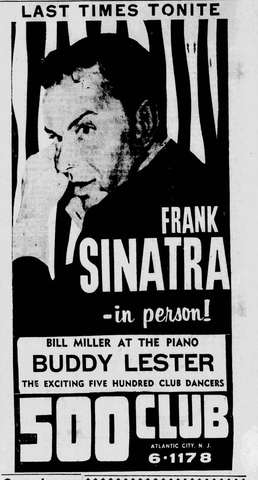
July 31, 1960
Concerts
500 Club, Atlantic City, New Jersey (July 22-31)
Two shows each night
August 1960
[Ocean's 11 Premieres in Las Vegas]
Ocean's 11 held its premiere in downtown Las Vegas in August 1960.
Source: Charles Pignone, "Frank Sinatra 100" (2015).
[CIA authorizes Castro assassination plan]
Kaplan: With President Eisenhower's tacit approval, the CIA began forming what became known as the Cuban Project, or Operation Mongoose, to assassinate Castro, enlisting organized crime figures who had lost money in the Cuban revolution to provide plausible deniability, via private detective Robert Maheu.
Source: James Kaplan, "Sinatra: The Chairman" (2015)
[New York Daily News profiles the 'Clan']
Warren Cowan (Sinatra press release): In mid-August the New York Daily News ran a two-page Sunday spread on the Hollywood 'gang' soon known as the Rat Pack (then usually called 'the Clan'), opening with a question about whether a candidate linked to the Clan could be elected president. Sinatra, angered, issued a press release through publicist Warren Cowan denying the group was any kind of organized clique.
Source: James Kaplan, "Sinatra: The Chairman" (2015)
[Variety reviews Ocean's 11]
Variety ('Tube'): Variety's reviewer ('Tube') called Ocean's Eleven likely to be a moneymaker despite its contrived script and cast of stars playing versions of themselves, saying the film never quite makes its point but 'romps along merrily.'
Source: James Kaplan, "Sinatra: The Chairman" (2015)
August 1, 1960
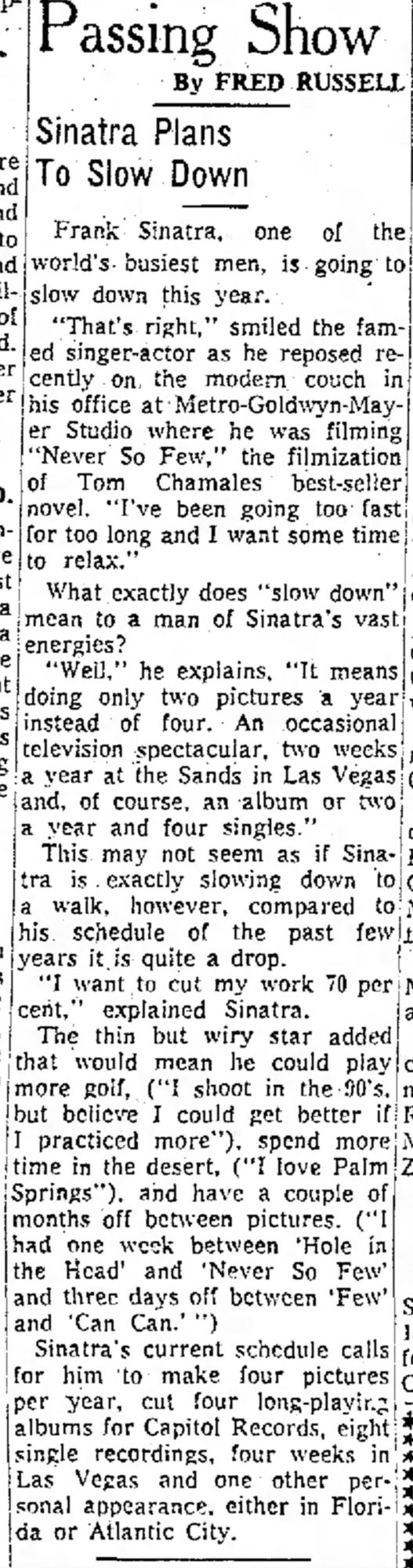
The Bridgeport Post, August 1, 1960.
August 3, 1960
Film
"Ocean's 11" (August 3, 1960 Las Vegas
Premiere)
Starring: Frank Sinatra, Dean Martin, Sammy Davis Jr., Peter
Lawford, Joey Bishop, Angie, Dickinson, Richard Conte, Henry Silva, Buddy Lester, Cesar Romero, Akim Tamiroff, Richard Benedict, Norman Fell, Clem Harvey
Cameos by Shirley MacLaine, George Raft, Red Skelton, Red Norvo
Produced & Directed by: Lewis Milestone
Danny Ocean (SinatraI gathers a group of his World War II compatriots (Dean Martin, Sammy Davis Jr., Peter Lawford, Joey Bishop, Richard Conte, Henry Silva, Buddy Lester, Richard Benedict, Norman Fell, Clem Harvey), from the 82nd airborne 15 years later to rob millions of dollars from five Las Vegas casinos. Unfortunately the gang's electrician, Tony Bergdorf (Richard Conte), drops dead of a heart attack in the middle of the Strip. This raises the suspicions of police, who wonder if there is any connection. Reformed mobster Duke Santos (Cesar Romero) offers to recover the casino bosses' money for a percentage. Santos eventually confronts the thieves, demanding half of their take. In desperation, they hide the money in Bergdorf's coffin, setting aside $10,000 for his widow. The group plans to take back the rest of the money, making no payoff to Santos, after the coffin is shipped to San Francisco. This plan backfires when the funeral director talks Bergdorf's widow into having the funeral in Las VegasÂwhere the body is cremated, along with all of the remaining money.
--DVD Release: 2001-11-20 - Blu-Ray Release:
2010-10-05
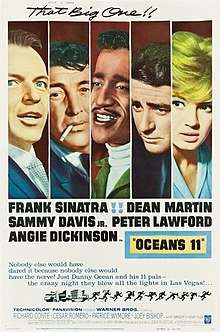
"Ocean's 11" (August 3, 1960 Las Vegas Premiere)
Starring: Frank Sinatra, Dean Martin, Sammy Davis Jr., Peter
Lawford, Joey Bishop, Angie, Dickinson, Richard Conte, Henry Silva, Buddy Lester, Cesar Romero, Akim Tamiroff, Richard Benedict, Norman Fell, Clem Harvey
Cameos by Shirley MacLaine, George Raft, Red Skelton, Red Norvo
Produced & Directed by: Lewis Milestone
Many contemporary sources refer to the film as Ocean's 11. After the opening credits, voice-over narration by Joey Bishop as "'Mushy'
O'Connors" sets the story at "Christmastime in Beverly Hills, California--a time when everyone thinks only kind, tolerant, generous thoughts." At the end of the film, as the ten men walk away from the mortuary, they are shown onscreen individually with their names and character names superimposed. Behind them a marquee advertises "In the Lounge Jonah Jones, Norman Brooks and Ann Brooks, Red Norvo and Ernie Stewart Trio." According to a Mar 1960 HR news item, Norvo "and his trio" appeared in the film performing backup for Dean Martin's song "Ain't That a Kick in the Head." Jonah Jones was a jazz trumpeter. After the final shot and ending credit of Sammy Davis, Jr., a second sign above the first lists the names of Frank Sinatra, Martin, Davis, Peter Lawford and Bishop.
The group of five, which was headed by Sinatra, came to be known in Hollywood as the "Rat Pack."
Shirley MacLaine, who, according to an Aug 1960 LAEx article, made an unbilled appearance in the film at her own request, was considered an "auxiliary" member of the group. Los Angeles restaurateur Nicky Blair, George E. Stone, Hoot Gibson, Red Barry and other friends of Sinatra, many of whom are old character actors, make brief appearances in the film.
The ten closing cast credits of
Ocean's Eleven differ in order from the opening credits and do not include some of the above-title names. In the opening credits, the cameo appearances of George Raft and Red Skelton are labeled as "guest stars." The character name "`Curly' Steffans" is spelled with an "a" onscreen, although the CBCS and reviews spell the name "Steffens." The character portrayed by actress Laura Cornell is called "Honeyface" in the film and
"Sugarface" in the CBCS.
In Apr 1956, a DV news item reported that director Gilbert L. Kay and producer Earl Colbert had signed jazz guitarist Barney Kessell to score Ocean's Eleven, which was to be the first picture produced by the newly formed Matador Productions. The news item reported that the authors of the original story, George Clayton Johnston and Jack Golden Russell, were co-partnered with Kay and Colbert. According to a Dec 1957 LAT news item, Lawford and Sinatra bought the screenplay, although, according to a 1957 NYT news item, neither planned to appear before the camera.
A Sep 1958 LAEx news item, mentioning that Sinatra and Lawford's friendship had "blossomed into a business deal," confirmed their plans to produce the film in the Las Vegas area, at "the famed magnesium plant in Henderson, Nev.," a few miles outside of the city, and at the Sands Hotel, of which Sinatra and Martin had part ownership. The news item reported that small cottages near the plant would be used in the story to advance the plot, which called for them to be set on fire, so that the story's "gangsters" could hold up six hotels on the Strip while the fire and police departments fought the blaze. The news item also reported that during production, Sinatra, Lawford, Martin and Davis would alternate performances at the Sands each night.
According to a Sep 1958 DV news item, the film would be co-produced by Sinatra's Dorchester Productions and Lawford's Kenlaw Productions companies, and Sinatra and Lawford would perform in the film with Davis, Martin and Buddy Lester. An Aug 1958 HR news item reported that production of the film, which was being written by Richard Breen , was being postponed until after Sinatra completed the film All My Tomorrows, which was the working title for the 1959 United Artists release A Hole in the Head (See Entry). According to Nov 1958 LAMirror-News and Oct 1958 DV news items, Lawford and Breen traveled to Las Vegas to work on the script, which they discussed with the Las Vegas police chief, R. K. Sheffer (misspelled Shefter in the DV news item). Breen was not credited onscreen and his contribution to the final film has not been confirmed.
An Aug 1958 HR news item, which erroneously referred to the film as Oceans of Loving, and an Oct 1958 LAT news item, reported that Sinatra was negotiating with Jackie Gleason, who did not appear in the final film. An unsourced but contemporary article at the AMPAS Library adds that Tony Curtis and Milton Berle had been signed for cameos in the picture, and that Daniel Fuchs had worked on the screenplay. Although their appearance in the film has not been confirmed, a HR production chart adds Cosmo Sardo to the cast and HR news items add Sandra Preston, Billy Snyder and Bob "Sarge" Allen. Modern sources add Charles Perry, John George, Jerry Velasco, Joe Gray, Mike Lally, Max Wagner, Harry Wilson and Nelson Leigh to the cast. Dick Benedict, who was credited onscreen as an assistant to the producer and portrayed `Curly' Steffans, also served as dialogue director for the film, according to a Jan 1960 HR news item.
According to an Aug 1960 LAEx article, producer-director Lewis Milestone had discarded most of the original melodramatic story, keeping only the basic idea of twelve ex-paratroopers robbing five Las Vegas casinos. Jan and Feb 1960 HR news items reported that portions of the film were shot at the Sands, Sahara and Riviera, three of the five hotel casinos mentioned in the story, as well as at the Warner Bros. studio. Although it was later refuted in a modern book about the Rat Pack, an Aug 1960 LAEx article reported that the cast and crew shot the casino sequences during the establishments' slowest times, between 1:00 a.m. and 5:00 am. A Mar 1960 LAMirror-News article stated that television-style cue cards were used to eliminate the need for the cast to memorize lines. As planned over a year in advance, the film's leads alternated performances in the Copa Room of the Sands Hotel at night. Several autobiographical sources and documentary footage describe the party atmosphere, the pranks and drinking during the making of the film, all in the Rat Pack's flamboyant style, which can be summed up by one of their signature phrases, "ring-a-ding-ding." The filming lured more than the usual number of tourists to the Strip, most notably Lawford's brother-in-law and future president John F. Kennedy, who was making pre-campaign tours and for whom the Rat Pack members later campaigned.
The Ocean's Eleven's Aug 1960 Las
Vegas premiere was themed as a New Year's Eve celebration set in the summer, and included the leads performing together at the Sands as part of the festivities. According to an Aug 1960 LAEx article, "The film is one of the few that typifies the de-moralization trend in film making today. There's no punishment for the crime." A 30 Aug 1960 LAT article, titled "Ocean's 11 Fails to Awe N.Y. Critics," quoted a reviewer as stating: "If this picture can be parlayed…intoo a great success, then they've gotten away with real murder. If not, and the public ignores one of the truly emptiest displays on record, maybe some of these many talents will be forced to go to work."
Despite the mixed reviews during its opening, Ocean's Eleven became the highest grossing motion picture of Sinatra's career, according to modern sources. The Rat Pack made other films, the first of which in which some members appeared together was the 1959 M-G-M picture Some Came Running, starring Sinatra, Martin and MacLaine (See Entry). Later films included the 1962 UA release Sergeants 3, the 1963 4 for Texas and the 1964 Robin and the 7 Hoods, the latter two for Warner Bros. (see AFI Catalog of Feature Films, 1961-70). However, Ocean's Eleven has been described by modern sources as "the quintessential Rat Pack film."
The Sands Hotel, as seen in the film, was demolished in Nov 1996 and rebuilt. Angie Dickinson and Henry Silva, who portrayed "Beatrice Ocean" and "Roger
Corneal" in the original film, made brief appearances in the 2001 Warner Bros. remake of Ocean's Eleven, which was directed by Steven Soderbergh and starred George Clooney and Brad Pitt. Clooney and Pitt reprised their respective roles, as did most of the same creative team, in the 2004 sequel, titled Ocean's Twelve
AFI Catalog.
FRANK with DINO and PETER, Attend The Las Vegas Premier of Oceans 11
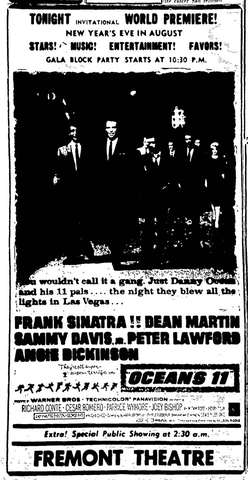
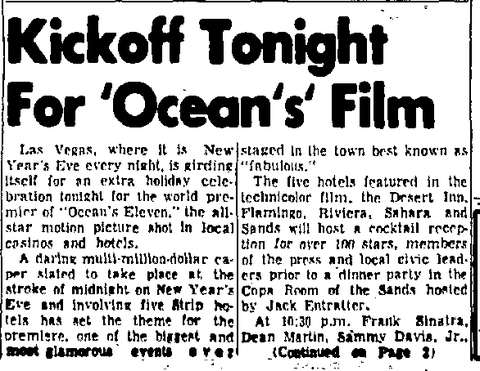
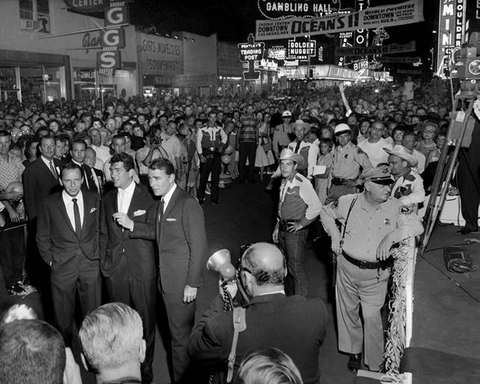
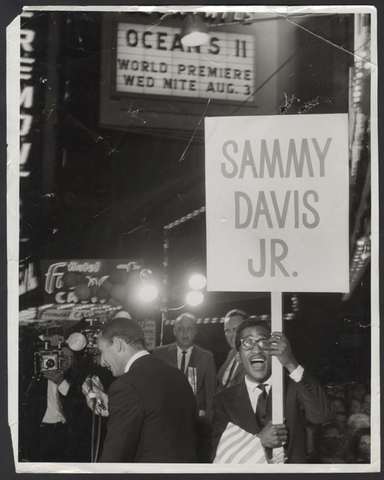
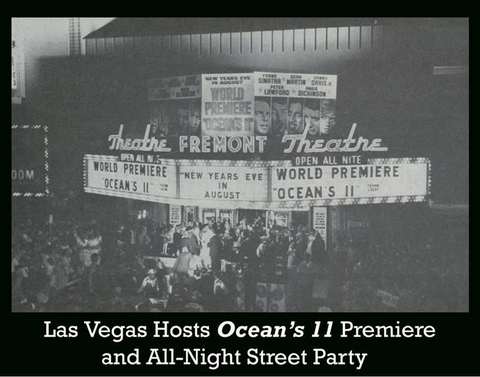
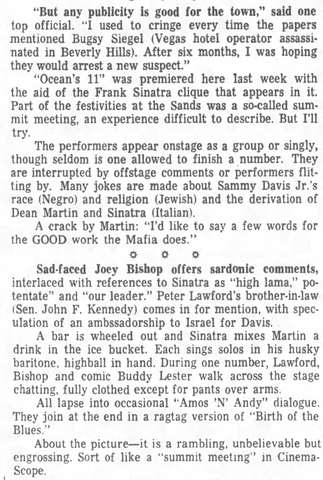
Copa Room, Sands Hotel, Las Vegas, NV
Frank, Sammy, Joey Bishop, Peter Lawford, and Buddy Lester joined Dean Martin on stage.
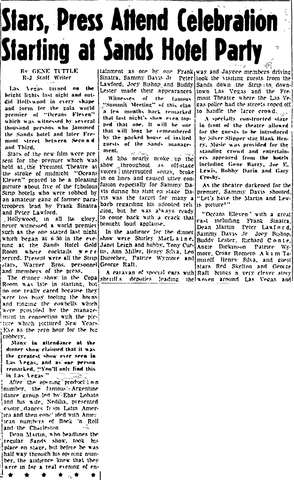
"Ocean's Eleven"
The author draws a knowing parallel between Sinatra's 1935 blackface short and a scene in the 1960 Rat Pack film Ocean's Eleven, in which Sinatra, Dean Martin, and Peter Lawford apply dark camouflage makeup after robbing Vegas casinos, prompting Sammy Davis Jr.'s character to joke that he knew that color would come in handy someday.
Source: Tom Santopietro, "Sinatra in Hollywood" (2008).
"Ocean's Eleven"
Frank Sinatra Jr. worked as his father's conductor and recorded dry-eyed DVD commentaries for films like Ocean's Eleven, but tellingly always referred to his father as "Sinatra" rather than Dad. Tina Sinatra produced the well-received 1992 TV miniseries Sinatra, working to balance a portrait of her father's talent with an honest look at his affairs and temper; her memoir My Father's Daughter is sharply critical of Sinatra's fourth wife Barbara Marx.
Source: Tom Santopietro, "Sinatra in Hollywood" (2008).
"Ocean's Eleven"
Santopietro frames Ocean's Eleven as Sinatra's first and best feature-film venture explicitly into Rat Pack territory, arriving as the public was already fascinated by stories of the Clan's Vegas exploits, giving audiences the choice of seeing the fun live at the Sands or on screen.
Source: Tom Santopietro, "Sinatra in Hollywood" (2008).
"Ocean's Eleven"
The idea for Ocean's Eleven originated with aspiring director Gilbert Kay, who pitched the concept of ex-servicemen robbing five Vegas casinos simultaneously to Peter Lawford. Lawford bought the rights for $10,000; the finished film gives Kay no credit at all.
Source: Tom Santopietro, "Sinatra in Hollywood" (2008).
"Ocean's Eleven"
Lawford had recently regained Sinatra's favor (helped by a decent role in Never So Few) partly because Sinatra knew Lawford's brother-in-law, JFK, might become president. Sinatra approved a $50,000 salary and one-sixth profit share for Lawford (less than the one-third Lawford wanted), but Lawford's original $10,000 investment eventually returned $300,000.
Source: Tom Santopietro, "Sinatra in Hollywood" (2008).
"Ocean's Eleven"
Lewis Milestone: Sinatra was unusually happy throughout the Ocean's Eleven shoot, partly because director Milestone shared his preference for a noon-to-seven shooting day. But Milestone, a liberal director previously targeted by HUAC, resented Sinatra's dominance on set, later bluntly calling Ocean's Eleven his least favorite film he ever made and describing how Sinatra would direct other actors from behind the camera even when not himself in the scene.
Source: Tom Santopietro, "Sinatra in Hollywood" (2008).
"Ocean's Eleven"
Sinatra treated Ocean's Eleven essentially as a paid vacation with his friends rather than a serious artistic undertaking, investing little passion in the work but valuing the money it made.
Source: Tom Santopietro, "Sinatra in Hollywood" (2008).
"Ocean's Eleven"
Frank Sinatra: Sinatra later acknowledged his films weren't great art but noted every movie made through his own production company had turned a profit, reflecting his bottom-line, show-business-not-show-art attitude honed during his contract years at RKO and MGM.
Source: Tom Santopietro, "Sinatra in Hollywood" (2008).
"Ocean's Eleven"
Frank Sinatra Jr.: Frank Sinatra Jr. recalled that the Sands turned away 18,000 requests for seats in its 800-seat Copa Room during the Rat Pack's nightly shows, illustrating the huge public demand generated by the film shoot and accompanying stage act.
Source: Tom Santopietro, "Sinatra in Hollywood" (2008).
"Ocean's Eleven"
James Wolcott: Critic James Wolcott memorably described the Rat Pack as "the Mount Rushmore of men having fun."
Source: Tom Santopietro, "Sinatra in Hollywood" (2008).
"Ocean's Eleven"
While Tina and Nancy Sinatra were largely absent during the Ocean's Eleven shoot, Frank Jr. was present on location and witnessed his 45-year-old father surviving on just three to four hours of sleep a night amid the nonstop partying and filming.
Source: Tom Santopietro, "Sinatra in Hollywood" (2008).
"Ocean's Eleven"
The seemingly spontaneous 'ad-libbed' jokes during the Rat Pack's nightly Sands shows during the Ocean's Eleven shoot were, in fact, mostly written in advance by Joey Bishop.
Source: Tom Santopietro, "Sinatra in Hollywood" (2008).
"Ocean's Eleven"
Footage of the Sands stage shows reveals Sinatra was less naturally gifted at improvisation than Dean Martin, whose effortless throwaway delivery contrasted with visible effort from Sinatra and near-desperation to please from Sammy Davis Jr. Despite this, Sinatra clearly ran the show.
Source: Tom Santopietro, "Sinatra in Hollywood" (2008).
"Ocean's Eleven"
Daniel O'Brien: Author Daniel O'Brien's chronology describes the Rat Pack's punishing schedule during Ocean's Eleven filming: two shows a night ending around 5 a.m., Sinatra waking mid-morning, tending business in the Sands steam room, filming from noon, then returning to the steam room around 7 p.m. before the first show. Only Joey Bishop, busy writing 'ad-libs,' escaped the nonstop partying.
Source: Tom Santopietro, "Sinatra in Hollywood" (2008).
"Ocean's Eleven"
Contrary to its fun-loving mythology, Ocean's Eleven is actually a surprisingly sober, businesslike film; top-billed Sinatra does not smile once in the entire runtime, and only Sammy Davis Jr. appears to be having fun onscreen.
Source: Tom Santopietro, "Sinatra in Hollywood" (2008).
"Ocean's Eleven"
The film opens with Saul Bass-designed titles spelling out credits in Vegas-style lightbulbs, underscored by a different arrangement of the Cahn/Van Heusen song "Eee-O-Eleven" for each star. During the heist, Nelson Riddle's score plays "Auld Lang Syne" in a different key for each of the five casinos being robbed.
Source: Tom Santopietro, "Sinatra in Hollywood" (2008).
"Ocean's Eleven"
Character breakdown: Peter Lawford plays spoiled rich mama's boy Jimmy Foster; Sammy Davis Jr. plays Josh Howard, a war medal-winner turned garbage truck driver; Joey Bishop plays ex-boxer Mushy O'Connor (an implausible fit for his mild demeanor); and Akim Tamiroff provides near-incomprehensible comic relief as 'idea man' Spyros Acebos.
Source: Tom Santopietro, "Sinatra in Hollywood" (2008).
"Ocean's Eleven"
Santopietro highlights the film as a time capsule of 1960 attitudes, citing Danny Ocean's dismissive line to two massage-parlor women ("Okay, girls, time for your nap—beat it") and the constant onscreen drinking and smoking as markers of the era's idea of instant sophistication.
Source: Tom Santopietro, "Sinatra in Hollywood" (2008).
"Ocean's Eleven"
Dean Martin's entrance as Sam Harmon introduces the film's first musical number, the Cahn/Van Heusen song "Ain't That a Kick in the Head," delivered with effortless authority.
Source: Tom Santopietro, "Sinatra in Hollywood" (2008).
"Ocean's Eleven"
Sammy Davis Jr. sings the Cahn/Van Heusen song "Eee-O-Eleven" in the unusual setting of a garbage truck garage; despite Dean and Sammy both singing well, Sinatra himself never sings a full vocal in the film — the closest is an instrumental horn version of "The Tender Trap" and background use of "Learnin' the Blues."
Source: Tom Santopietro, "Sinatra in Hollywood" (2008).
"Ocean's Eleven"
Angie Dickinson plays Beatrice, Danny Ocean's estranged wife, in a role that largely disappears after an early confrontation scene where she tells Danny the only thing he loves is danger. Santopietro suggests her ease with Sinatra onscreen likely stemmed from their real, ongoing decade-long affair.
Source: Tom Santopietro, "Sinatra in Hollywood" (2008).
"Ocean's Eleven"
Dean Martin's character casually jokes about repealing constitutional amendments to "turn women into slaves," which Santopietro cites as representative of the film's (and era's) blunt sexual politics privileging men.
Source: Tom Santopietro, "Sinatra in Hollywood" (2008).
"Ocean's Eleven"
The film's dialogue directly winks at real-world Hollywood/Vegas/Washington ties: Lawford's character jokes about buying votes to go into politics, and other characters refer to him as a future senator or ambassador — inside references to Sinatra, Sam Giancana, and the Kennedys.
Source: Tom Santopietro, "Sinatra in Hollywood" (2008).
"Ocean's Eleven"
Santopietro critiques Milestone's direction as too repetitive (laying out the same heist-preparation beats five times) and underusing the widescreen format, leaving character identities confusing until the full gang gathers (which happens only twice in the film).
Source: Tom Santopietro, "Sinatra in Hollywood" (2008).
"Ocean's Eleven"
Frank Sinatra: The film's original planned ending (per Production Code strictures against the crooks successfully getting away with $5 million) had all eleven men die in a plane crash. Director Milestone instead devised the twist of the stolen cash being accidentally cremated with a corpse, an idea he said came from having once witnessed exactly such an incident at a real funeral, as Sinatra later recounted on Johnny Carson's Tonight Show.
Source: Tom Santopietro, "Sinatra in Hollywood" (2008).
"Ocean's Eleven" / "Reservoir Dogs"
The film's downbeat closing shot of the gang walking away from the Vegas strip past the marquee bearing the stars' own names, as Sammy Davis Jr. reprises "Eee-O-Eleven" in voiceover, was later paid homage to by Quentin Tarantino in Reservoir Dogs.
Source: Tom Santopietro, "Sinatra in Hollywood" (2008).
"Ocean's Eleven"
At its original August 1960 release, critical reaction to Ocean's Eleven was mixed, often focused on discomfort that the film's protagonists were unpunished criminals; the Los Angeles Herald Examiner went so far as to call it something parents should keep children away from, despite its lack of sex or violence.
Source: Tom Santopietro, "Sinatra in Hollywood" (2008).
"Ocean's Eleven"
Frank Sinatra: Sinatra dismissed critical concerns about the film's morality with a pragmatic quip that the goal wasn't to make Hamlet but to hang out with friends, have fun, and make pictures audiences enjoy.
Source: Tom Santopietro, "Sinatra in Hollywood" (2008).
"Ocean's Eleven"
Variety (Tube): Variety's review (bylined "Tube") judged the film a somewhat contrived, uncertain production where the cast largely played themselves, but predicted correctly that it would be a moneymaker regardless.
Source: Tom Santopietro, "Sinatra in Hollywood" (2008).
"Ocean's Eleven"
Ocean's Eleven's popularity helped Sinatra land the number-six spot on the Film Exhibitors of America's annual list of top-ten box office attractions for 1960.
Source: Tom Santopietro, "Sinatra in Hollywood" (2008).
"Ocean's Eleven" / "Ocean's Twelve" / "Ocean's Thirteen"
The George Clooney-led 2001 Ocean's Eleven remake is judged crisper and more exciting than the original; the 2005 sequel Ocean's Twelve is dismissed as self-congratulatory; the 2007 Ocean's Thirteen paid the most direct homage to Sinatra, scoring scenes with "Strangers in the Night" and Sinatra's recording of "This Town," and treating having once shaken Sinatra's hand as proof of a character's integrity.
Source: Tom Santopietro, "Sinatra in Hollywood" (2008).
"Ocean's Eleven"
Santopietro grades this a B, calling it the best of the Rat Pack flicks.
Source: Tom Santopietro, "Sinatra in Hollywood" (2008).
"Ocean's Eleven"
Santopietro (Filmography): Dorchester/Warner Bros. Pictures. Produced and directed by Lewis Milestone, screenplay by Harry Brown and Charles Lederer, musical score by Nelson Riddle, original songs by Sammy Cahn and Jimmy Van Heusen. Sinatra played Danny Ocean, leading the Rat Pack ensemble of Dean Martin, Sammy Davis Jr., Peter Lawford, Angie Dickinson and Joey Bishop.
Source: Tom Santopietro, "Sinatra in Hollywood" (2008).
[World premiere of Ocean's 11 in Las Vegas]
Kaplan / Ralph Pearl / Bob Thomas: Ocean's 11 premiered at midnight in Las Vegas, capping a Rat Pack 'Summit' reunion weekend, and was televised on Jack Paar's Tonight Show. Frank, Peter, Sammy, and Joey joined Dean Martin (already appearing at the Copa Room) for a raucous, joke-filled stage show; Las Vegas Sun columnist Ralph Pearl complained the racial and religious humor had gotten out of hand, while columnist Bob Thomas described the freewheeling variety show in detail.
Source: James Kaplan, "Sinatra: The Chairman" (2015).
August 6, 1960
[Leonard Lyons column on Sinatra's vulnerability]
Leonard Lyons (quoting unnamed TV executive): In his August 6 column, Leonard Lyons recounted a dinner where a TV executive predicted Sinatra would be forced to stop campaigning for Kennedy, remarking that if they could make Joe Kennedy disappear from view, they could do the same to Sinatra.
Source: James Kaplan, "Sinatra: The Chairman" (2015).
August 7, 1960
Concerts
Copa Room, The Sands, Las Vegas
Sinatra subbed for Dean Martin
Copa Room, The Sands, Las Vegas
Sinatra subbed for Dean Martin
Dean had a bad cold and his two week engagement at the 500
Club, Atl. City, set to open on the 12th, was cancelled. Sammy
opened at Cal-Neva after Frank and then Dean closed out the
month there. Frank owned a sizable interest in Cal-Neva and
had big plans for the club.
--Ed
August 8, 1960
Concerts
Cal-Neva Lodge, Nevada (August 8 - 15)
Frank Sinatra Buddy Lester
Matty Malneck and His Orchestra
note: Not only extra show were added. The engagement was also extended
through the 17th of the month.
Ed
Cal-Neva Lodge, Nevada (August 8 - 15)
Frank Sinatra
Matty Malneck and His Orchestra
note: Not only extra show were added. The engagement was also extended
through the 17th of the month.
Ed
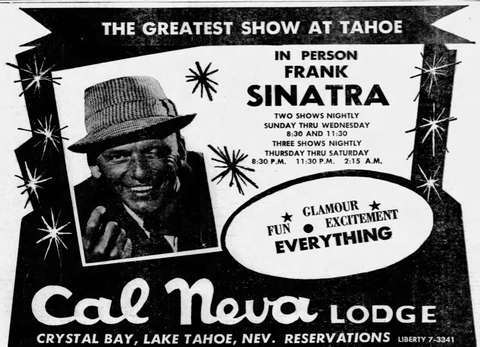
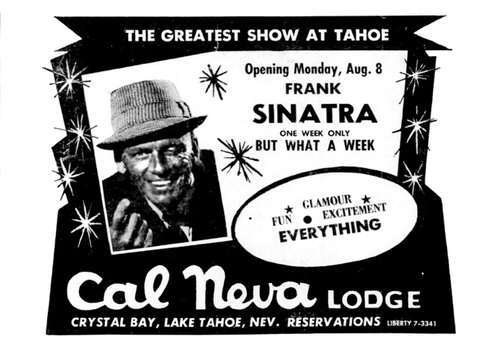
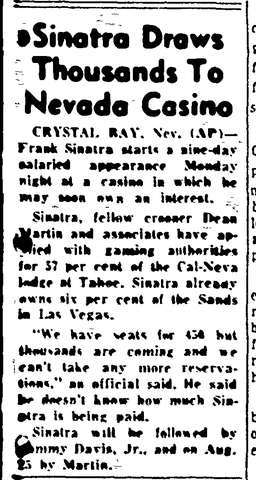
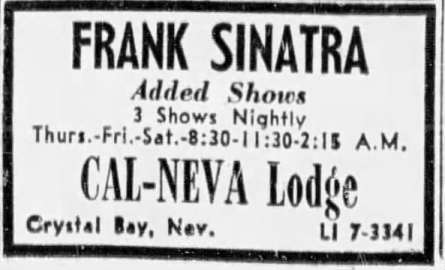
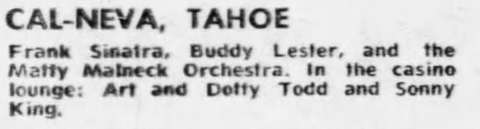
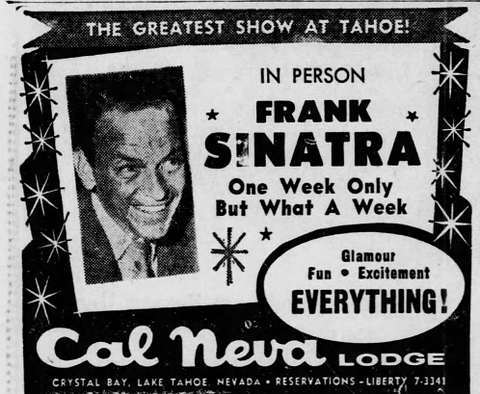
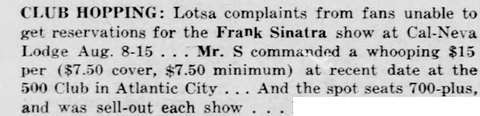
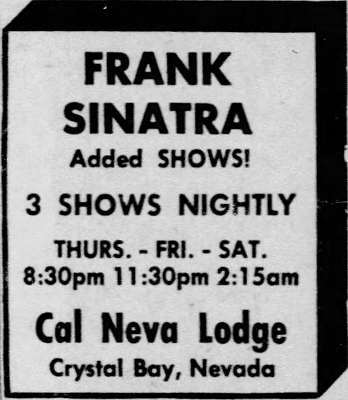
note: Ad verifies the closing date was the 17th.
Nevada State Journal
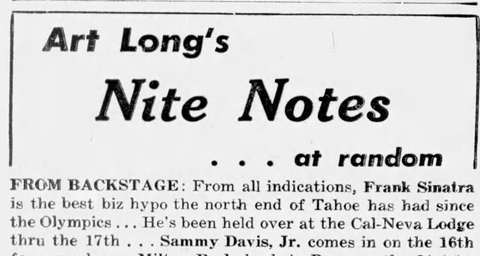
Nevada State Journal
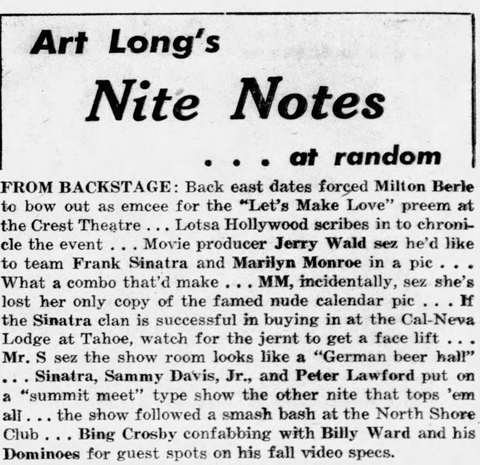
Reno Gazette Journal
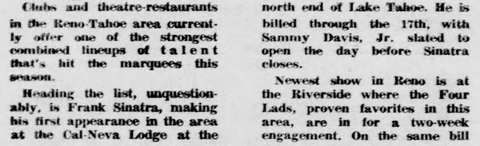
Redwood City Journal
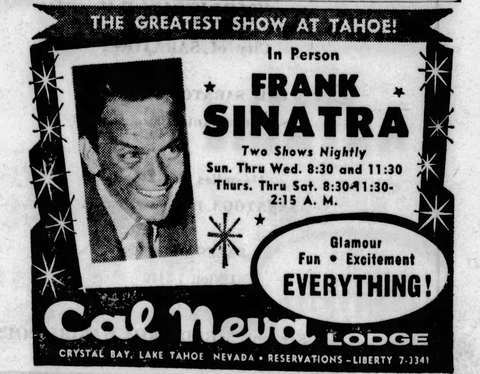
note: Schedule was changed: Frank closed on the 17th and Sammy opened. Lawford joined them.
Reno Gazette Journal
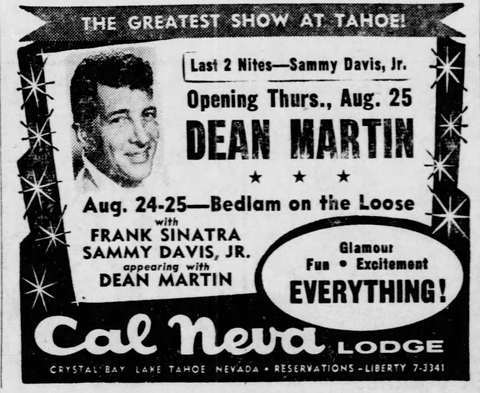
note: Dino, Frank and Sammy for two nights at Cal-Neva.
Nevada State Journal
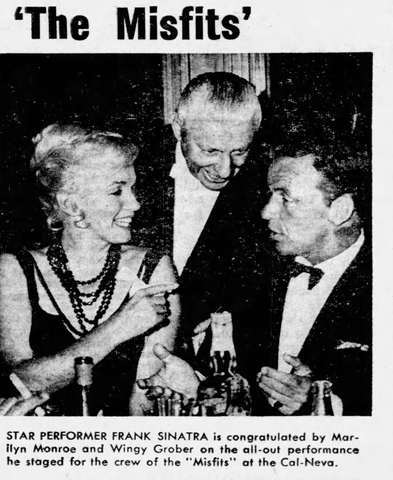
note: Sinatra flew the entire crew of "The Misfits" from Reno, where they were filming, for a weekend at Cal-Neva.
August 9, 1960
Concerts
Cal-Neva Lodge, Nevada (August 8 - 17)
Frank Sinatra, Matty Malneck and His Orchestra
O.A.: Buddy Lester
August 11, 1960
When Ocean's Eleven opened, the New York Times criticized its casual attitude toward crime on 11 August 1960, writing that "Frank should have a couple of his merit badges taken away." Despite the reviews, its Broadway opening at the Capitol Theatre broke the prior box-office record set by From Here to Eternity. (Source: Richard Havers, "Sinatra" (Dorling Kindersley, 2007).)
August 12, 1960
Concerts
Cal-Neva Lodge, Nevada (August 8 - 17)
Frank Sinatra, Matty Malneck and His Orchestra
O.A.: Buddy Lester
August 13, 1960
Concerts
Cal-Neva Lodge, Nevada (August 8 - 17)
Frank Sinatra, Matty Malneck and His Orchestra
O.A.: Buddy Lester
August 14, 1960
Concerts
Cal-Neva Lodge, Nevada (August 8 - 17)
Frank Sinatra, Matty Malneck and His Orchestra
O.A.: Buddy Lester
August 15, 1960
Concerts
Cal-Neva Lodge, Nevada (August 8 - 17)
Frank Sinatra, Matty Malneck and His Orchestra
O.A.: Buddy Lester
August 22, 1960
Studio
Capitol Studio A, Hollywood
E34373 When You're Smiling (The Whole World Smiles At You) (Shay/Fisher/ Goodwin)
Arranged & Conducted by Nelson Riddle
CD: CDP 7-46573-2 Sinatra's Swingin' Session
LP: SW1491 Sinatra's Swingin' Session
E34374 I Concentrate On You
(Cole Porter)
Arranged & Conducted by Nelson Riddle
CD: CDP 7-96611-2 Sings The Select Cole Porter
CD: CDP 7-46573-2 Sinatra's Swingin' Session
LP: SW1491 Sinatra's Swingin' Session
E34375 You Do Something To Me
(Cole Porter)
Arranged & Conducted by Nelson Riddle
CD: CDP 7-96611-2 Sings The Select Cole Porter
CD: CDP 7-46573-2 Sinatra's Swingin' Session
LP: SW1491 Sinatra's Swingin' Session
E34376 S'posin'
(P. Denniker/A. Razaf)
Arranged & Conducted by Nelson Riddle
CD: CDP 7-46573-2 Sinatra's Swingin' Session
LP: SW1491 Sinatra's Swingin' Session
E34381 Should I?
(N. Brown/A. Freed)
Arranged & Conducted by Nelson Riddle
CD: CDP 7-46573-2 Sinatra's Swingin' Session
LP: SW1491 Sinatra's Swingin' Session
"I Concentrate on You"
On Sinatra's Swingin' Session!!!, 'I Concentrate on You' is notable as one of the rare times Riddle used bongo drums in a Sinatra rhythm section, an instrument he otherwise used more often when arranging for Judy Garland.
Source: Charles L. Granata, "Sessions with Sinatra: Frank Sinatra and the Art of Recording" (1999/2003).
August 23, 1960
Studio
Capitol Studio A, Hollywood
E34386 My Blue Heaven
(W. Donaldson/G. Whiting)
Arranged & Conducted by Nelson Riddle
CD: CDP 7-46573-2 Sinatra's Swingin' Session
LP: SW1491 Sinatra's Swingin' Session
45: 4546
E34387 I Can't Believe That You're In Love With Me
(G. Gaskill/J. McHugh)
Mills Music, Inc. (ASCAP)
Arranged & Conducted by Nelson Riddle
-3 (2:25) CD: C2-94777 The Capitol Years
CD: CDP 7-46573-2 Sinatra's Swingin' Session
LP: SW1491 Sinatra's Swingin' Session
E34388 Always
(Irving Berlin)
Arranged & Conducted by Nelson Riddle
CD: CDP 7-46573-2 Sinatra's Swingin' Session
LP: SW1491 Sinatra's Swingin' Session
E34389 It All Depends On You
(DeSylva/Brown/ Henderson)
Arranged & Conducted by Nelson Riddle
CD: CDP 7-46573-2 Sinatra's Swingin' Session
LP: SW1491 Sinatra's Swingin' Session
Musicians - Reeds: Buddy Collette, Chuck Gentry, Plas Johnson, Harry
Klee, Ronnie Lang; Trumpets: Carroll Lewis, Vito â Mickeyâ Mangano, George rge Seaberg, Clarence â Shortyâ Sherock; Trombones: Tommy Pederson, Thomas Shepard; Violins: Victor Arno, Victor Bay, Alex Beller, Harold Dicterow, Ben Gill, Murray Kellner, Dan Lube, Felix Slatkin, Gerald Vinci; Violas: Paul Robyn, Barbara Simon; Cellos: Ossip Giskin, Edgar Lustgarten, Eleanor Slatkin; Piano: Bill Miller; Bass: Keith â Redâ Mitchell; Drums: Alvin vin Stoller; Guitar: Al Viola; Percussion: Frank Flynn; Harp: Kathryn Julye
Session Producer: Dave Cavanaugh
Annoyed by press references to his circle of friends as 'The Clan,' Frank issued a statement through his press agent denying that any such organized group existed.
Source: Nancy Sinatra, Frank Sinatra: An American Legend, 1995.
August 24, 1960
Concerts
Cal Neva Lodge, Lake Tahoe, Nevada (24-25)
Frank Sinatra - Dean Martin - Sammy Davis, Jr.
August 25, 1960
Concerts
Cal Neva Lodge, Lake Tahoe, Nevada (24-25)
Frank Sinatra - Dean Martin - Sammy Davis, Jr.
Cal Neva Lodge Lake Tahoe, NV ( 24-25 )
Frank Sinatra - Dean Martin - Sammy Davis, Jr
Ad ran in the San Francisco Examiner, Oakland Tribune, Reno Star Gazette
on 8-23 and 24.
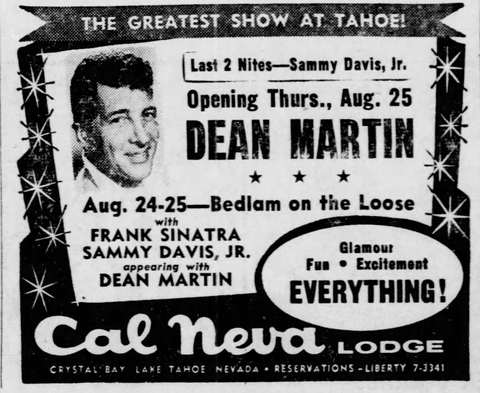
August 27, 1960
Concerts
Urban League Jazz Festival, Comiskey Park, Chicago, Illinois Sinatra songs include:
--Come Fly With Me
--I Can't Get Started
Urban League Jazz Festival, Comiskey Park, Chicago, Illinois
Excerpt from Down Beat magazine October 13, 1960
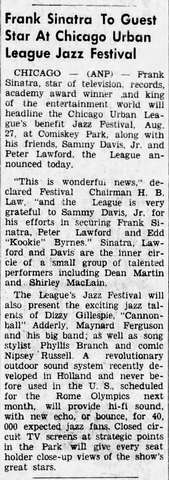
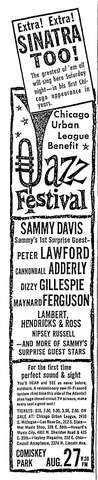
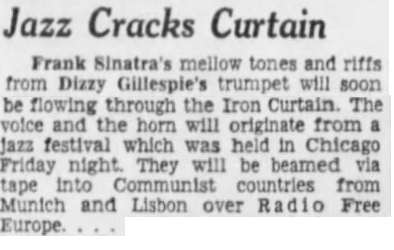
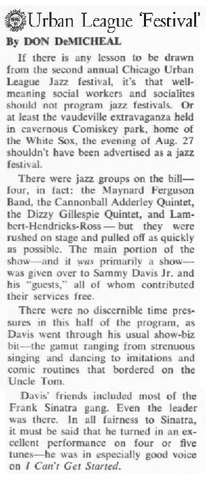
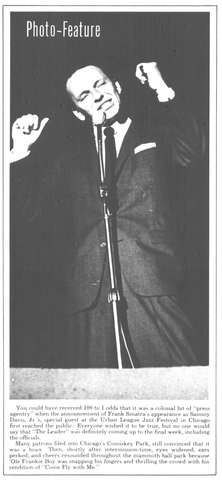
Down Beat's Don DeMicheal reviewed the show under the headline "Urban League 'Festival'": the second annual Chicago Urban League Jazz Festival, held at Comiskey Park (home of the White Sox), was in his view really a "vaudeville extravaganza" that shouldn't have been billed as a jazz festival. Four jazz acts -- the Maynard Ferguson band, the Cannonball Adderley Quintet, the Dizzy Gillespie Quintet, and Lambert, Hendricks & Ross -- were rushed on and off, while the bulk of the show was given over to Sammy Davis Jr. and the free-of-charge "surprise guests" he brought along, most of them from Sinatra's circle; DeMicheal wrote that Sinatra himself turned in "an excellent performance on four or five tunes," singling out an especially good-voiced "I Can't Get Started." Source: Don DeMicheal, Down Beat, October 13, 1960.
Newspaper promotion for the benefit -- staged by the Chicago Urban League as its second annual Jazz Festival -- billed Sammy Davis Jr.'s "first surprise guest" lineup as including Peter Lawford, Cannonball Adderley, Dizzy Gillespie, Maynard Ferguson, Lambert, Hendricks & Ross, and Nipsey Russell, promising "a revolutionary new Hi-Fi sound system" (the first of its kind used outdoors in the U.S.) and closed-circuit TV screens for the crowd; the Associated Negro Press reported League chairman H. B. Law crediting Davis with personally securing Sinatra, Lawford, and Edd "Kookie" Byrnes for the bill. A wire item afterward, "Jazz Cracks Curtain," noted that tape of Sinatra's and Dizzy Gillespie's performances from the festival was to be beamed into Communist countries via Radio Free Europe, relayed from transmitters in Munich and Lisbon. Source: Chicago-area newspaper clippings (Associated Negro Press wire item; untitled wire item "Jazz Cracks Curtain"), Sinatraphiles "This Date in Sinatra History" mailing, August 27 batch.
August 31, 1960
Studio
Capitol Studio A, Hollywood
E34409 It's Only A Paper Moon
(Arlen/Rose/ Harburg)
Arranged & Conducted by Nelson Riddle
CD: CDP 7-46573-2 Sinatra's Swingin' Session
LP: SW1491 Sinatra's Swingin' Session
E34410 September In The Rain
(H. Warren/A. Dubin)
Arranged & Conducted by Nelson Riddle
CD: CDP 7-46573-2 Sinatra's Swingin' Session
LP: SW1491 Sinatra's Swingin' Session
E34411 Hidden Persuasion
(Wainwright Churchill III)
Arranged & Conducted by Nelson Riddle
CD: C2 724383808922 The Complete Capitol Singles
CD: CDP 7-46573-2 Sinatra's Swingin' Session
LP: SW1729 Sings Of Love And Things
45: 4815
Musicians - Reeds: Buddy Collette, Chuck Gentry, William Green, Plas
Johnson, Willie Schartz; Trumpets: Carroll Lewis, Vito "Mickey"
Mangano, George Seaberg, Clarence "Shorty" Sherock; Trombones: George Arus, Tommy Pederson, Thomas Shepard; Bass Trombone: George Roberts; Violins: Victor Arno, Victor Bay, Alex Beller, Jacques Gasselin, Joseph Livoti, Nathan Ross, Mischa Russell, Paul Shure, Felix Slatkin, Gerald Vinci; Violas: Alvin Dinkin, Stanley Harris; Cellos: Ossip Giskin, Armand Karproff, Eleanor Slatkin; Piano: Bill Miller; Bass: Joe Comfort;
Drums: Irv Cottler; Guitar: Al Viola; Percussion: Frank Flynn; Harp:
Kathryn Julye
Session Producer: Dave Cavanaugh
September 1960
[Joe DiMaggio Jr. enrolls at Yale]
Consiglio: Joe DiMaggio Jr. started at Yale in September 1960; his father asked Consiglio to look in on him in New Haven. Consiglio found his dorm room bare and bought him furniture from Lincoln Furniture at State and Elm streets, paying for it himself.
Source: Tony Consiglio (as told to Franz Douskey), "Sinatra and Me: The Very Good Years" (2012)
September 1, 1960
Studio
Capitol Studio A, Hollywood
E34413 Sentimental Baby
(Keith/Spence/Bergman)
Arranged & Conducted by Nelson Riddle
CD: C2 724383808922 The Complete Capitol Singles
CD: CDP 7-46573-2 Sinatra's Swingin' Session
LP: SW1729 Sing Of Love And Things
45: 4546
E34414 Ol' MacDonald
(Keith/Spence/Bergman)
Arranged & Conducted by Nelson Riddle
CD: C2 724383808922 The Complete Capitol Singles
CD: CDP 7-91150-2 All The Way
CD: CDP 7-46573-2 Sinatra's Swingin' Session
LP: SW1538 All The Way
45: 4466
E34415 Blue Moon
(Richard Rodgers/Lorenz Hart)
Arranged & Conducted by Nelson Riddle
CD: CDP 7-46573-2 Sinatra's Swingin' Session
LP: SW1491 Sinatra's Swingin' Session
Musicians - Reeds: Buddy Collette, Chuck Gentry, William Green, Plas
Johnson, Willie Schwartz; Trumpets: Carroll Lewis, Vito â Mickeyâ Mangano, George rge Seaberg, Clarence â Shortyâ Sherock; Trombones: George Arus, Gil Martin, Tommy Pederson, Thomas Shepard; Violins: Victor Bay, Alex Beller, Kurt Dieterle, Jacques Gasselin, Louis Kaufman, Murray Kellner, Joseph Livoti, Mischa Russell, Gerald Vinci, William Weiss;
Violas: Alvin Dinkin, Stanley Harris; Cellos: Ossip Giskin, Armand
Kaproff, Eleanor Slatkin; Piano: Bill Miller; Bass: Joe Comfort; Drums: Irv Cottler; Guitar: Al Viola; Percussion: Emil Richards; Harp: Kathryn Julye
Session Producer: Dave Cavanaugh
NOTE: Author Ed O'Brien recalls that a few years ago he struck up a correspondence with Lew Spence. Sinatra recorded eight of Lew's songs during the Capitol Era including "Sentimental Baby" and Ol' MacDonald. Spence told O'Brien that he wrote the former song for Dean Martin. He thought that it was the perfect song for Dino, but Frank heard it, liked it, and took it. That was that! O'Brien mentioned to Spence that he loved the recording when it came out on a single way back then. Lew thanked him for being the one guy who bought it! Sinatra at the time decided to do a send-up of "Ol' MacDonald" and asked a number of his songwriter friends including Sammy Cahn to submit for audition rewrites of the folk classic. Lew got the nod from Frank and it became a top 25 hit. There is a terrific version from the Dino TV guest appearance of November 1, 1960. During the August 31, 1960 session someone suddenly realized that there were only 11 songs being recorded for Swingin' Session." Frank turned to Bill Miller and said, "You pick a song I should have recorded, Suntan." Miller went with the great Rodgers & Hart classic "Blue Moon."
Riddle did a chart later that evening and it was the last song done on the September 1st session.
Nottingham Evening News
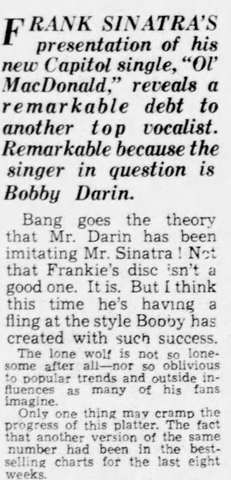
Los Angeles Mirror
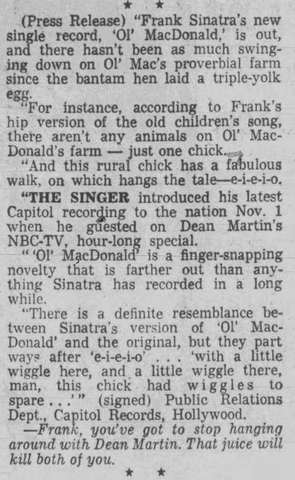
The Ottawa Citizen
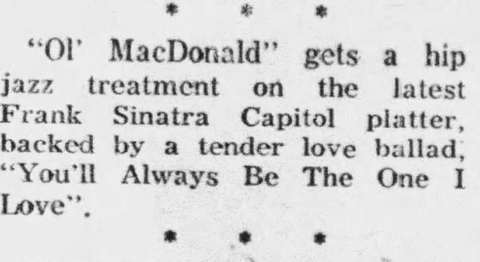
E34415 Blue Moon
(Richard Rodgers/Lorenz Hart)
Arranged & Conducted by Nelson Riddle
CD: CDP 7-46573-2 Sinatra's Swingin' Session
LP: SW1491 Sinatra's Swingin' Session
The Age
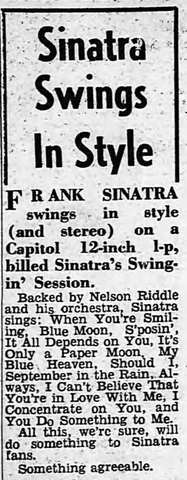
[Recording Sinatra's Swingin' Session!!!]
Nelson Riddle / Jonathan Schwartz: Over four nights (three at the end of August, one on September 1), Sinatra recorded the album Sinatra's Swingin' Session!!! at Capitol's studio tower, reprising songs from his first Columbia LP with new Nelson Riddle arrangements played at unusually fast tempos and short lengths -- the whole twelve-track album ran just over twenty-six minutes. Riddle later called the result 'a disaster'; Jonathan Schwartz suggested Sinatra sped everything up deliberately to spite Capitol as he prepared to leave the label.
Source: James Kaplan, "Sinatra: The Chairman" (2015).
September 7, 1960
At a "Key Women for Kennedy" event hosted by Tony Curtis and Janet Leigh, who had been active campaign supporters since the convention, a crowd of roughly two thousand turned out to hear speeches and, as a highlight, three songs from Sinatra, who was applauded from the audience by Ted Kennedy, then serving as his brother's Western campaign organizer. Source: Michael Sheridan & David Harvey, Sinatra and the Jack Pack.
[Key Women for Kennedy benefit at Curtis-Leigh house]
At a Key Women for Kennedy benefit at Tony Curtis and Janet Leigh's Beverly Hills home, 2,000 attendees paid $5 each to hear speeches and Sinatra sing poolside backed by the Red Norvo Quintet. Ted Kennedy, the campaign's western states coordinator, attended in place of his brothers; a Life photo captured him in earnest conversation with Sinatra.
Source: James Kaplan, "Sinatra: The Chairman" (2015).
September 10, 1960
[Frank hosts private dinner for JFK]
Dorothy Kilgallen: Sinatra hosted a small private dinner honoring Jack Kennedy as guest of honor, prompting columnist Dorothy Kilgallen to note the irony given Kennedy's earlier public distancing from Sinatra.
Source: James Kaplan, "Sinatra: The Chairman" (2015).
September 11, 1960
[Nancy Sinatra marries Tommy Sands]
Nancy Sinatra (recollection): On Sunday, September 11, Frank gave his daughter Nancy, twenty, in marriage to twenty-three-year-old singer Tommy Sands in a civil ceremony at the Emerald Room of the Sands hotel. The bride wore a Don Loper gown; the groom wore his Air Force uniform. Frank wept, gave Nancy diamond star earrings before the ceremony, and told her 'I love you, chicken.'
Source: James Kaplan, "Sinatra: The Chairman" (2015).
September 22, 1960
[Dorothy Kilgallen's column on Kennedy-Sinatra ties]
Dorothy Kilgallen: In her September 22 column, Dorothy Kilgallen pointed out that just months earlier Kennedy had complained about being linked to Sinatra and downplayed their acquaintance, yet had recently been guest of honor at a private dinner Sinatra threw for him.
Source: James Kaplan, "Sinatra: The Chairman" (2015).
September 30, 1960
Concerts
Hilo Civic Auditorium, Hilo, Hawaii
Fundraising Event for John F. Kennedy
Hilo Civic Auditorium, Hilo, Hawaii
Fundraising Event for John F. Kennedy
[image referenced in source but could not be recovered]
[image referenced in source but could not be recovered]
[image referenced in source but could not be recovered]
[image referenced in source but could not be recovered]
October 1960
[Filming The Devil at 4 O'Clock on Maui]
Spencer Tracy (quoted): Sinatra spent late September and all of October on Maui filming Columbia's The Devil at 4 O'Clock, directed by Mervyn LeRoy and co-starring Spencer Tracy as an alcoholic priest opposite Sinatra's convicted criminal. Sinatra ceded Tracy first billing out of admiration, though Tracy himself acknowledged 'Sinatra was the star.'
Source: James Kaplan, "Sinatra: The Chairman" (2015)
[Near-riot at New Jersey's Governor's Ball]
Associated Press: About two weeks after the Honolulu concert, Sinatra's appearance at New Jersey's Democratic Governor's Ball in Newark's Essex Armory sparked a near-riot, with an AP-estimated crowd of 25,000-40,000 outside and 14,000 inside; fifteen women fainted. Sinatra, introduced as 'the next ambassador to Italy,' sang seven songs though he could barely be heard over the crowd. JFK himself was not present.
Source: James Kaplan, "Sinatra: The Chairman" (2015)
October 1, 1960
Concerts
Wailuku Armory, Maui, Hawaii
Fund-raiser for John F. Kennedy
Wailuku Armory, Maui, Hawaii
Fund-raiser for John F. Kennedy
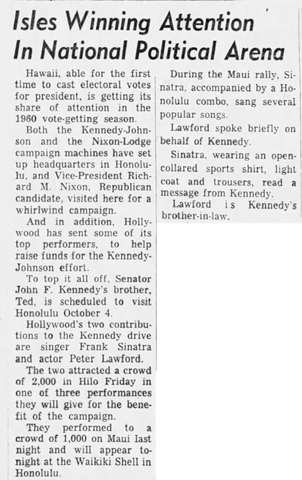
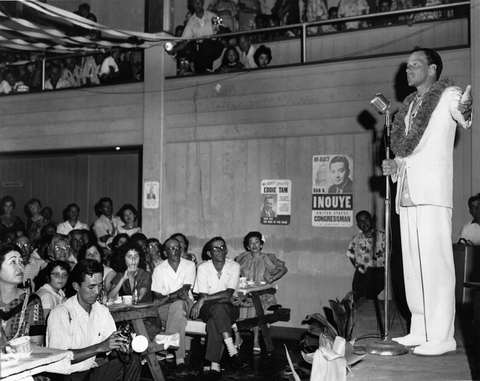
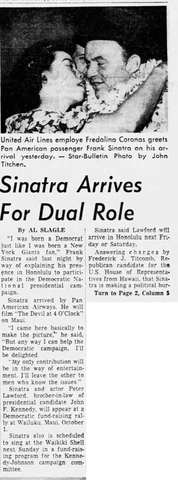
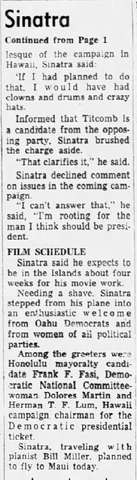
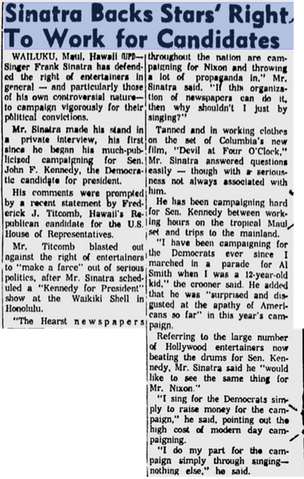
October 2, 1960
Concerts
Waikiki Shell, Honolulu, Hawaii
Koncert for Kennedy
Benefit for JFK Campaign
with Nelson Riddle
M.C. Peter Lawford
1. The Lady Is A Tramp
2. Day In, Day Out
3. You Go To My Head
4. I Could Have Danced All Night
5. Come Fly With Me
6. I Get A Kick Out Of You
7. Too Marvelous For Words
8. Angel Eyes
9. Willow Weep For Me
10. Nice 'N' Easy
monologue & band intros
11. I've Got You Under My Skin
12. Moonlight In Vermont
13. On The Road To Mandalay
14. River Stay Away From The Door
reads wire from JFK
Waikiki Shell, Honolulu, Hawaii
Koncert for Kennedy
Benefit for JFK Campaign with Nelson Riddle
M.C. Peter Lawford
Honolulu Star Bulletin
October 3, 1960 note: A wonderful concert. Nine of the 14 songs were arranged by Riddle and the other five by Billy
May. "Nice 'N' Easy" was at the top of the
Billboard chart and Frank was about to form his own record company.
Most of the songs were from
Frank's recent Capitol albums and he sang the hell out of them.
And election day was a mere five weeks away.
Ed
Waikiki Shell, Honolulu, Hawaii
Koncert for Kennedy
Benefit for JFK Campaign with Nelson Riddle
M.C. Peter Lawford
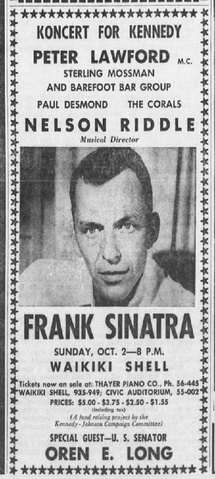
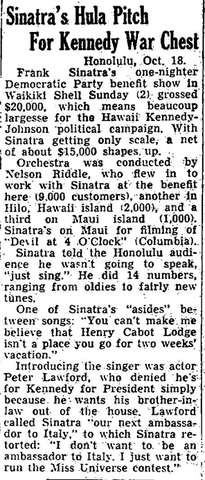
October 12, 1960
[Sinatra's Kennedy benefit concert in Honolulu]
Frank Sinatra (quoted): While filming in Hawaii, Sinatra gave a benefit concert for Kennedy at the Waikiki Shell in Honolulu, drawing nine thousand supporters. Hawaii Republican congressional candidate Frederick J. Titcomb accused entertainers of making politics into a farce; Sinatra fired back, comparing his singing for Kennedy to Hearst newspapers' pro-Nixon coverage.
Source: James Kaplan, "Sinatra: The Chairman" (2015).
While in Hawaii filming The Devil at Four O'Clock and performing at a Kennedy campaign event, Frank publicly defended entertainers' right to campaign for political candidates after a Republican critic accused show-business figures of trivializing politics.
Source: Nancy Sinatra, Frank Sinatra: An American Legend, 1995.
October 16, 1960
[Sammy Davis Jr.'s wedding originally scheduled]
Kaplan / George Jacobs: Sammy Davis Jr. and May Britt originally planned to marry on October 16, 1960, but postponed after Joseph Kennedy personally called Sinatra warning that the interracial wedding, if held before Election Day, could hurt JFK's chances; Sinatra relayed the request to Davis, who agreed to delay out of loyalty to Kennedy.
Source: James Kaplan, "Sinatra: The Chairman" (2015).
October 19, 1960
Frank appeared with Eleanor Roosevelt on a radio broadcast supporting JFK.
Source: Nancy Sinatra, Frank Sinatra: An American Legend, 1995.
October 31, 1960
[Wiretap arrest exposes CIA-Mafia plot]
Kaplan (citing Shawn Levy): Jealous over Phyllis McGuire, Giancana asked Robert Maheu to wiretap Dan Rowan's Riviera hotel room. Maheu's operative Arthur Balletti bungled the job, leaving recording equipment out in the open; a maid found it and called police, and Balletti was arrested when he returned from lunch. Rosselli arranged his $1,000 bail.
Source: James Kaplan, "Sinatra: The Chairman" (2015).
November 1, 1960
Television
Dean Martin Show
Tuesday Evening
NBC-TV
10:pm to 11:pm
Sponsor: Speidel Corporation
In Living Color On NBC
Guests: Frank Sinatra, Dorothy Provine, Don Knotts
Frank Sinatra Story
David Rose & His Orchestra
1. Where Or When - Dean
2. All Or Nothing At All - Dean
3. Roaring 20's - Dorothy
4. In The Cool, Cool, Cool Of Evening - Dean & Dorothy
5. Ol' MacDonald - Frank
6. Medley - Frank & Dean
NOTE: Sinatra Scholar Ed O'Brien says that Sinatra was in great form and he nails "Old MacDonald" and the medley of Sinatra's hits with Dino is simply terrific.
Sinatraphile Scott Henderson points out that he loves this show. He says he recently obtained a copy and it's brilliant. His favorite part is the introduction of Sinatra and he comes silhouetted down a staircase with hat on head and trench coat over the shoulder only to be revealed to be Don Knotts. The gag continues as Dean has Don do Sinatra's numbers as Sinatra is running late for the show. Don is great doing "Look at me Now" and his progressively drunk version of "One for my Baby" is hilarious. Dean, Dorothy, and Sinatra were in rare form as well but Don Knotts steals the show for me, Henderson declares.
note: Sinatra was in Hawaii filming "Devil At 4'O'Clock" when November got underway. The production was running behind schedule so Frank contacted Jack Donahue( producer-director of Dean's show) to let him know he was going to be a little late. That is where the idea to have Knotts stand-in for Frank came from. And sure enough, Frank arrived at NBC Burbank on the afternoon of 11/1. There was a very quick run through and then the show. I agree with Scott. A very entertaining hour and what a vocal on "Ol' MacDonald." Ed
Dean Martin Show
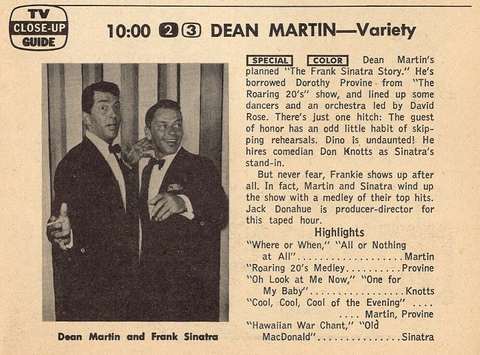
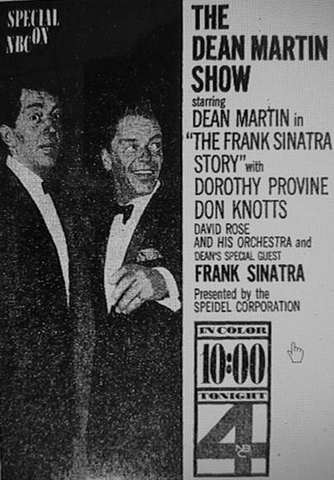
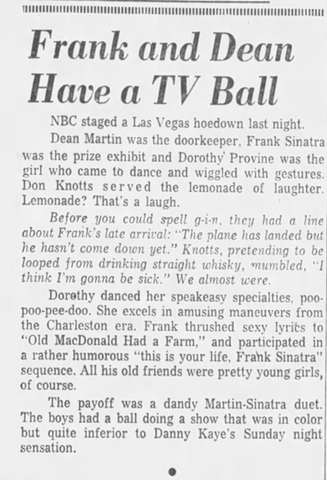
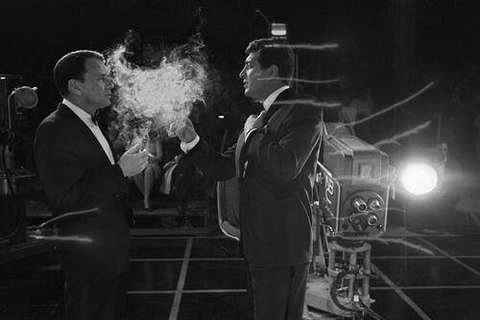
East Los Angeles College Stadium, Los Angeles, CA
Frank Sinatra attended a campaign event for Democratic presidential nominee John F. Kennedy on November 1, 1960.
Janet Leigh, Jo Stafford, and Milton Berle also were present. Some sources attribute photos to the event occurring in San Francisco
but newspaper accounts reference the location as East Los Angeles College Stadium, Los Angeles, CA
Janet Leigh, Jo Stafford, and Frank Sinatra
According to these two articles, Sinatra sang the “High Hopes” JFK Campaign Song.
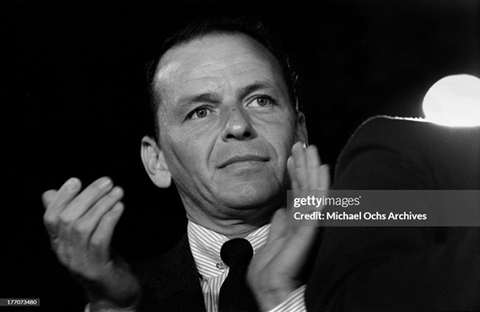
"All or Nothing at All"
Riddle and Sinatra devised a new, contemporary-pop-inflected version of Sinatra's earliest hit that stayed consistent with the classic Sinatra-Riddle sound -- rampaging trombones reminiscent of 'I've Got You Under My Skin,' with Artie Kane's organ solo central to a ferocious instrumental interlude. This was at least the fourth arrangement of the song Sinatra had performed, and the one he sang in concert for the rest of his life.
Source: Will Friedwald, "Sinatra! The Song Is You: A Singer's Art" (2018 revised edition).
[Sinatra appears on The Dean Martin Show]
Kaplan / Jack O'Brian: After a quick trip from location filming, Sinatra returned to Los Angeles to appear on The Dean Martin Show, which was dedicated entirely to him. The episode featured Don Knotts impersonating a late-arriving Sinatra, a 'This Is Your Life' parody segment, and an ad-libbed joke referencing Sinatra's assassin role in Suddenly, drawing laughs about Peter Lawford; critics called the show self-indulgent and overly 'inside.'
Source: James Kaplan, "Sinatra: The Chairman" (2015).
November 6, 1960
John F. Kennedy spent the weekend at Frank Sinatra's Palm Springs home following his campaign's final push against Richard Nixon. Afterward, a proud Sinatra had a plaque mounted on the door reading “John F. Kennedy Slept Here November 6th and 7th 1960.” Source: J. Randy Taraborrelli, Sinatra: Behind the Legend.
November 8, 1960
John F. Kennedy narrowly defeated Richard Nixon for the presidency, capping months of campaigning by Frank Sinatra on his behalf — concerts, fundraising, and, as one associate put it, “just being Frank.” Kennedy had even floated, half-seriously, the idea of naming Sinatra ambassador to Italy. Within weeks, however, the Kennedys — worried about fallout from Sinatra's friendship with Chicago mob boss Sam Giancana — began quietly distancing themselves from him, at one point having Bobby Kennedy's office ask Frank to turn over any photographs or negatives of JFK socializing with women; Sinatra refused, denying any such photos existed. Source: J. Randy Taraborrelli, Sinatra: Behind the Legend.
[Election Day: Sinatra monitors returns from his office] On Election Day, Sinatra set up at his Essex Productions office on Sunset Boulevard, where secretary Gloria Lovell kept an open phone line to Chicago; Democratic fixer Jake Arvey gave Sinatra updates every half hour on the Illinois returns as the race swung toward Nixon through the evening.
Source: James Kaplan, "Sinatra: The Chairman" (2015).
[Sinatra's drunken election-night vigil]
Frank Sinatra (quoted): As returns turned against Kennedy, Sinatra went to Tony Curtis and Janet Leigh's Beverly Hills house and drank heavily, anxiously phoning Giancana for reassurance and repeating 'It's gonna turn, it's gonna turn' to anyone who would listen.
Source: James Kaplan, "Sinatra: The Chairman" (2015).
[Consiglio at Kennedy compound on election night]
Consiglio: Consiglio was at the Kennedy family compound in Hyannis Port, Massachusetts, on the night John F. Kennedy was elected president, having traveled with Frank, Dean Martin, Peter Lawford, and Sammy Davis Jr. during the campaign; he later worked on Kennedy's inaugural celebration and attended his funeral three years later.
Source: Tony Consiglio (as told to Franz Douskey), "Sinatra and Me: The Very Good Years" (2012).
[Election night at Hyannis Port]
Consiglio: Consiglio drove through pouring rain to the Kennedy compound at Hyannis Port on election night. After being vouched for and waved through by the Secret Service, he spent the night at Ambassador Kennedy's house watching returns come in via teletype at Bobby Kennedy's house next door; the race stayed close until Illinois put Kennedy over the top against Nixon.
Source: Tony Consiglio (as told to Franz Douskey), "Sinatra and Me: The Very Good Years" (2012).
[Photo with Ambassador Kennedy]
Consiglio: After Jack Kennedy's election win was confirmed, Ambassador Joseph Kennedy, still in his pajamas and bathrobe, asked Consiglio to pose for a photo with him, which a Secret Service agent took. Consiglio slept at the compound until mid-afternoon before driving back to New Haven to avoid the swarm of press.
Source: Tony Consiglio (as told to Franz Douskey), "Sinatra and Me: The Very Good Years" (2012).
November 9, 1960
[Sinatra demands Nixon concede]
Janet Leigh (recollection) / Frank Sinatra (quoted): When Nixon gave an ambiguous non-concession statement at L.A.'s Ambassador Hotel around 3:10 a.m., a drunk and furious Sinatra yelled at the TV screen for Nixon to concede, then phoned the hotel demanding to be connected to Nixon's suite, shouting his identity when the operator refused, and left a message telling Nixon to concede.
Source: James Kaplan, "Sinatra: The Chairman" (2015).
[Nixon concedes; Kennedy claims victory]
George Jacobs (recollection) / Frank Sinatra (quoted): Nixon finally conceded and Kennedy claimed victory on the afternoon of November 9, after Illinois came through for Kennedy by a razor-thin 8,858 votes. George Jacobs recalled Sinatra's weary victory line: 'Ye assholes of little faith.'
Source: James Kaplan, "Sinatra: The Chairman" (2015).
November 13, 1960
Sammy Davis Jr. married Swedish actress May Britt in Las Vegas, with Frank Sinatra as best man. Joe Kennedy had pressured Sinatra to get the couple to postpone the wedding — interracial marriage was still illegal in thirty-one states, and Joe worried the union could hurt JFK just before the election — but Davis, not wanting to embarrass his friend, offered to delay the ceremony on his own before Sinatra even had to ask. At Davis's bachelor party, Sinatra quietly boosted his salary on the upcoming film Sergeants 3 to help support his new family, telling him, “You'll have a wife and kids to think about.” Source: J. Randy Taraborrelli, Sinatra: Behind the Legend.
[Sammy Davis Jr. marries May Britt]
Sammy Davis Jr. (recollection): On Sunday, November 13 -- five days after the election -- Sinatra served as best man when Sammy Davis Jr. married May Britt at Davis's Beverly Hills home. Davis recalled receiving racist hate mail over the engagement and worried aloud about the political risk his wedding coverage posed to Sinatra by association.
Source: James Kaplan, "Sinatra: The Chairman" (2015).
November 18, 1960
Hi Ed,
Weren’t most of the arrangements on “Songs For Young Lovers” written by George Siravo? I believe the only one Nelson wrote on the album was for “My Funny Valentine.” Guy
Sent from my iPad
On Apr 26, 2026, at 10:53 PM, 'Ed O'Brien' via Sinatraphiles <sinatraphiles@googlegroups.com> wrote:
<1777258250992blob.jpg>
I have a question for Ed O'Brien: regarding the song "Embraceable You " did he ever sing it with Dorsey? And, what is the earliest performance and the last concert performance. Thank you Ed.
On Mon, Apr 27, 2026, 1:51 PM 'GUY STEELE' via Sinatraphiles < sinatraphiles@googlegroups.com> wrote:
> Hi Ed,
>
> Weren’t most of the arrangements on “Songs For Young Lovers” written by > George Siravo? I believe the only one Nelson wrote on the album was for “My > Funny Valentine.”
>
> Guy
>
> Sent from my iPad
>
> On Apr 26, 2026, at 10:53 PM, 'Ed O'Brien' via Sinatraphiles < > sinatraphiles@googlegroups.com> wrote:
>
>
> <1777258250992blob.jpg>
>
>
> --
>
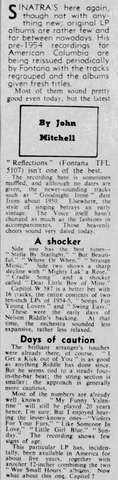
November 25, 1960
[Birth of John F. Kennedy Jr.]
John F. Kennedy Jr. was delivered by cesarean section the day after Thanksgiving, at a time when Jacqueline Kennedy remained in Palm Beach with three-year-old Caroline while her husband traveled for inaugural business.
Source: James Kaplan, "Sinatra: The Chairman" (2015).
November 30, 1960
Television
The Red Skelton Timex Special
Title: "Red Skelton's Hollywood Tour"
Wednesday Evening
CBS
8:30 -9:30 P.M.
Color Broadcast
Guests: Dinah Shore, Bobby Rydell, George Raft
Special Guest Star: Frank Sinatra
The Red Skelton Timex Special
Variety
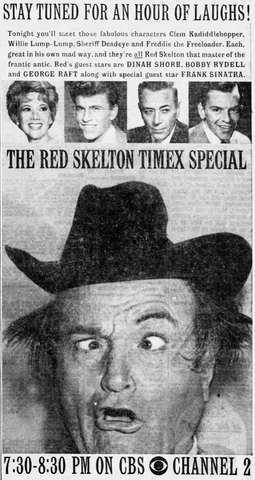
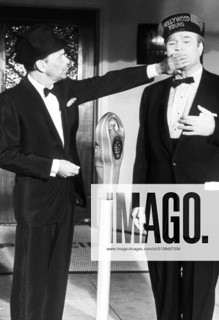
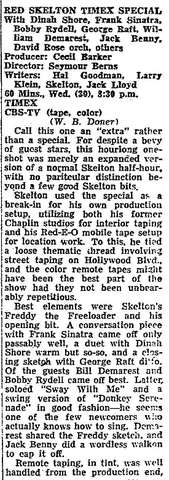
NYT
December 1960
[Frank Sinatra Jr. Attends Ring-a-Ding Ding! Session]
Frank Sinatra Jr. observed his father during a December 1960 recording session for the album Ring-a-Ding Ding! (1961), recalling that his father was a demanding perfectionist about getting things exactly right.
Source: Charles Pignone, "Frank Sinatra 100" (2015).
[The Kennedys Ask Sinatra To Keep Sammy Davis Jr. From The Inaugural Gala]
Nancy Sinatra: When Sinatra was producing JFK's inaugural gala, the Kennedy camp quietly signaled that Sammy Davis Jr., recently married to white Swedish actress Mai Britt, shouldn't be among the performers invited, reportedly out of concern about optics; Sinatra felt powerless to change it, and Davis chose not to make an issue of it.
Source: Nancy Sinatra, Frank Sinatra: An American Legend, 1995.
[Kennedy taps Sinatra for inaugural gala]
Kaplan: Joseph P. Kennedy asked Sinatra to produce, with Peter Lawford, and star in the Democratic inaugural gala at the National Guard Armory, a benefit meant to help pay off the party's $2 million campaign debt.
Source: James Kaplan, "Sinatra: The Chairman" (2015)
[Rickles and Sinatra's first meeting]
Ed Walters: While filming Ocean's Eleven at the Sands in December 1960, Sinatra and his group (including Peter Lawford, Sammy Davis Jr., Joey Bishop, Hank Henry, and Henry Silva) went to the Sahara lounge after their own last show to catch Don Rickles's 3am set. Rickles immediately began ribbing the group from the stage; the room was tense until Sinatra started laughing, breaking the ice and beginning their long comic rapport. Walters clarifies this happened in the Sahara lounge, not the main room, and that Rickles didn't move to a main room until the mid-1960s.
Source: Ed Walters, pit boss reminiscences (compiled by Kraus, Sinatra mailing list)
[Second Rickles-Sinatra Sahara meeting]
Ed Walters: A few nights after their first encounter, Sinatra's group returned to see Rickles' 2am Sahara show, and Walters was present this time. Rickles delivered an extended, pointed roast of Sinatra, Richard Conte, Shirley MacLaine, Sammy Davis, and Joey Bishop, then closed with a sincere, emotional tribute thanking Sinatra by name for coming back and not holding a grudge, drawing a long standing ovation before capping it with one more joke as the group left.
Source: Ed Walters, pit boss reminiscences (compiled by Kraus, Sinatra mailing list)
[Sinatra and Rickles' first Sahara lounge clash]
Ed Walters: In December 1960, while filming Ocean's Eleven at the Sands, Sinatra brought Peter Lawford, Sammy Davis Jr., Joey Bishop, Hank Henry, and Henry Silva to catch Don Rickles' late-night set at the Sahara lounge (not the main room, contrary to some published accounts). Rickles immediately began insulting the group on stage; after tense silence, Sinatra broke into laughter, defusing the room and marking the start of the famous Rickles-Sinatra routine.
Source: Ed Walters, pit boss reminiscences (compiled by Kraus, Sinatra mailing list)
[Founding of Reprise Records with Mo Ostin (from Verve) and producer Sonny Burke (from Decca) -- critical commentary]
Frank Sinatra; Bill Miller; Milt Gabler: Sinatra told Ostin, pointing at the Capitol Tower, 'I helped build that. Now let's build one of my own.' Bill Miller warned sidemen in fall 1960 that Sinatra was 'starting his own label.' Milt Gabler recalled that Decca's sale to MCA cost Sonny Burke his job, 'But then Frank grabbed Sonny right away' to be his personal Reprise producer until Burke's death in 1980. The name Reprise carried a double meaning: the slogan 'Records you'll want to play again and again,' and Sinatra's intent that masters would revert to artists.
Source: Will Friedwald, "Sinatra! The Song Is You: A Singer's Art" (2018 revised edition), Ch. 9, "Looking for the Hook" (1960-1971)
December 5, 1960
Billboard ran a piece on 5 December 1960 about Frank's forthcoming record label, though its name had not yet been revealed at that point. (Source: Richard Havers, "Sinatra" (Dorling Kindersley, 2007).)
December 10, 1960
Sinatra Telegram Thanks on this day in 1960 for a birthday card
December 12, 1960
While Sinatra was performing at the Sands, incoming press secretary Pierre Salinger called with a joke from the president-elect: "Bad news, Frank -- you're not going to make the Cabinet, but the President wants you to be his secretary of entertainment." Sinatra took the informal title seriously, soon taking charge of staging Kennedy's pre-inaugural gala. Source: Michael Sheridan & David Harvey, Sinatra and the Jack Pack.
Source: CS 050 -- Getzel #1, "Sinatra Unreleased" liner notes, which date this "Have You Met Miss Jones" take to a "Ring-A-Ding Ding!" session and describe it as an early attempt at the song that Sinatra would later re-record for the 1961 album "Sinatra Swings."
December 19, 1960
Studio
T.T.G., Inc, Sunset - Highland Recording Studios, Hollywood
Time: 7:00 P.M.
100 Ring-A-Ding- Ding
(Jimmy Van Heusen/Sammy Cahn)
Maraville Music Corp. (ASCAP)
Arranged & Conducted by Johnny Mandel
-12 (2:44) CD: 46013-2 The Complete Reprise Studio Recordings Disc 1
CD: 9-26723-2Sing The Song Of Van Huesen & Cahn
CD: 9-27017-2Ring- a-ding-ding
CD: 1016-2 A Man And His Music(Edited)
LP: FS1001Ring-a- ding-ding
101 Let's Fall In Love
(Harold Arlen/Ted Koehler)
Bourne Co. (ASCAP)
Arranged & Conducted by Johnny Mandel
-2 (2:11) CD: 46013-2 The Complete Reprise Studio Recordings Disc 1
CD: 9-27017-2Ring- a-ding-ding
CD: 9-26340-2 The Reprise Collection
LP: FS1001Ring-a- ding-ding
102 In The Still Of The Night
(Cole Porter)
Chappell & Co. Inc. (ASCAP)
Arranged & Conducted by Johnny Mandel
-6 (3:25) CD: 46013-2 The Complete Reprise Studio Recordings Disc 1
CD: 9-27017-2 Ring-a-ding- ding
LP: FS1001Ring-a- ding-ding
103 A Foggy Day
(George Gershwin/Ira Gershwin)
Chappell & Co. Inc../Gershwin Publishing Corp. (ASCAP)
Arranged & Conducted by Johnny Mandel
-3 (2:16) CD: 46013-2 The Complete Reprise Studio Recordings Disc 1
CD: 9-27017-2Ring- a-ding-ding
LP: FS1001Ring-a- ding-ding
Let's Face The Music And Dance
(Irving Berlin)
Williamson Music Co. (ASCAP)
Arranged & Conducted by Johnny Mandel
-8 (2:58) CD: 46013-2 The Complete Reprise Studio Recordings Disc 1
CD: 9-27017-2Ring- a-ding-ding
LP: FS1001Ring-a- ding-ding
**** Be Careful It's My Heart
(Irving Berlin)
Irving Berlin Music Corp. (ASCAP)
Arranged & Conducted by Johnny Mandel
-rh (run through - rejected)
The beginning of the Reprise era. Sinatra would record more songs for this label than any other and be associated with it for more than 30 years. He had tried to form his own label, Essex, as a off-shoot of Capitol. Frank's idea was a 50-50 share of the profits. Capitol's Glenn Wallichs felt it would set a dangerous precedent for the industry and rebuffed Sinatra's efforts. After a rather acrimonious period, in which the artist did not record for the label, an agreement was reached enabling Sinatra to form his own record company. In December of 1960, he was still under contact to Capitol and would complete two complete album projects for them in 1961. But the agreement also allowed him to begin recording for Reprise.
Bill Putnam was set to be the engineer on this album,. but he fell and split his head going into the studio on a very rainy night (12-19-60). Eddie Brackett was his emergency replacement and did the entire album. I have the notes Brackett jotted down while he was mastering the sessions.
Brackett's work sheets show the site of the 'RADD" project was at T.T.G., Inc, Sunset - Highland Recording Studios in Hollywood. Reprise is referred to on the sheets as "client."
The session got underway around 7 o'clock that Monday evening. Sinatra employed a 38 piece orchestra with Johnny Mandel as arranger-conductor. After considerable rehearsal time, Neal Hefti called out from the control booth, "M100 take 1." The title track on the album required 12 takes. Brackett's notes indicate his preference for take 7. The Arlen - Koehler tune "Let's Fall In Love" was next up and was done in 2 takes. Sinatra announced to the VIP crowd, "You've got yourself a record, daddy." The best track on the album Cole Porter's "In The Still Of The Night" was completed in 6 takes. After a break of a few minutes Sinatra laid down one of his favorite songs, The Gershwin's "A Foggy Day" in 3 takes. Irving Berlin's "Let's Face The Music And Dance" needed 8 takes, with some interesting word play on each take. Frank then ran down Mandel's chart for "Be Careful It's My Heart" and rejected it.
Five songs were completed in a little more than four hours of actual recording time. The album was released in April of 1961. It peaked at #6 and charted for 35 weeks.
Vance Adair added:
Thank you for providing this fascinating background to FS's inaugural record for Reprise. As I may have said once before on this list, I do wish that this disc was remastered. It is ironic indeed that such a milestone recording is still very much below par as far as fidelity goes. I also happen to think that 'In The Still of the Night' is one of the top 10 FS arrangements. It is quite magnificent. Anyone who thinks that Mandel is chiefly an arranger of strings should listen to this superbly crafted and dynamic work of art.
T.T.G., Inc, Sunset - Highland Recording Studios, Hollywood
Time: 7:00 P.M.
Ring-A-Ding- Ding
Let's Fall In Love
In The Still Of The Night
A Foggy Day
Let's Face The Music And Dance
**** Be Careful It's My Heart
note: Sixty-four years ago this evening, Reprise Records became a reality with the above session. Here is the sheet Eddie Brackett ( engineer at the session ) used and his comments as the evening progressed
[image referenced in source but could not be recovered]
[image referenced in source but could not be recovered]
[image referenced in source but could not be recovered]
[image referenced in source but could not be recovered]
[Sinatra begins recording Ring-a-Ding Ding]
On Monday night, December 19, 1960, at the newly built United Recording studio on Sunset Boulevard, Sinatra began recording his first Reprise album, Ring-a-Ding Ding, having just turned forty-five the week before and feeling reborn after leaving Capitol's troubled Studio A for Bill Putnam's state-of-the-art facility.
Source: James Kaplan, "Sinatra: The Chairman" (2015).
[Recording the title track 'Ring-a-Ding Ding']
Johnny Mandel (recollection): During the December 19 session, Sinatra and arranger Johnny Mandel recorded the title track after just one run-through; Mandel recalled Sinatra instantly identifying the correct tempo and even catching a wrong note from one of the trumpets by ear. The song took two rehearsals and twelve takes to complete to Sinatra's satisfaction.
Source: James Kaplan, "Sinatra: The Chairman" (2015).
[Sinatra's staged pause on 'Let's Fall in Love']
Johnny Mandel (recollection): At the same session, Sinatra recorded Harold Arlen and Ted Koehler's 'Let's Fall in Love,' a song he'd sung on radio in the early 1950s but never recorded. He devised on the spot a dramatic silent pause before the chorus, instructing the band to lay out for two bars after the line 'Why be shy' -- an effect Johnny Mandel called unforgettable, calling Sinatra the best musician he ever worked with.
Source: James Kaplan, "Sinatra: The Chairman" (2015).
[A Foggy Day -- critical commentary]
Will Friedwald (analysis): During the Paris concert Sinatra jokes about Helsinki before performing the Mandel arrangement of 'A Foggy Day' as a song about his favorite city (London), which Friedwald connects to the genesis of the subsequent all-British-authored Great Songs from Great Britain album.
This song/context matches multiple dated entries in the chronology; the specific date Friedwald is referring to could not be determined with confidence.
Source: Will Friedwald, "Sinatra! The Song Is You: A Singer's Art" (2018 revised edition), Ch. 9, "Looking for the Hook" (1960-1971)
[In the Still of the Night -- critical commentary]
Granata includes 'In the Still of the Night' among the fifty recordings he considers essential to understanding Sinatra's artistry (arranged by Johnny Mandel, recorded 1960, Reprise); the song was chosen for its musical/interpretive value rather than commercial popularity.
This song/context matches multiple dated entries in the chronology, or lacked a sufficiently precise date; the specific date could not be determined with confidence.
Source: Charles L. Granata, "Sessions with Sinatra: Frank Sinatra and the Art of Recording" (1999/2003), Afterword & Appendices A-D
[Ring-a-Ding-Ding -- critical commentary]
Granata's discography entry: Ring-a-Ding-Ding, arranged by Johnny Mandel, released March 1961.
This song/context matches multiple dated entries in the chronology, or lacked a sufficiently precise date; the specific date could not be determined with confidence.
Source: Charles L. Granata, "Sessions with Sinatra: Frank Sinatra and the Art of Recording" (1999/2003), Afterword & Appendices A-D
[Ring-a-Ding-Ding! -- critical commentary]
Johnny Mandel: Mandel recalled meeting Sinatra at the Columbia ranch (during filming of The Devil at 4 O'Clock) where Sinatra excitedly described plans for Reprise, including colored vinyl: 'I remember just watching his eyes as he was talking about the company, and they were sparkling... when he's telling you something, you see this great animation and conviction there.' Mandel got the gig after Sinatra heard his swinging arrangements for Vic Damone's Sands act and asked Damone who wrote them. The title phrase 'ring-a-ding-ding' was one of Sinatra's pet expressions (previously used as a substitute lyric in 'I Won't Dance' from A Swingin' Affair), brought to Sammy Cahn and Jimmy Van Heusen as a title song modeled structurally on their earlier hit 'The Tender Trap.'
No corresponding dated entry could be identified in the chronology for this song/context.
Source: Will Friedwald, "Sinatra! The Song Is You: A Singer's Art" (2018 revised edition), Ch. 9, "Looking for the Hook" (1960-1971)
[Ring-a-Ding-Ding! -- critical commentary]
Ring-a-Ding-Ding!, Sinatra's premiere Reprise album, was orchestrated by Johnny Mandel -- an unusual choice that produced what may be the jazziest of all commercial Sinatra albums, recorded in a loose, jovial atmosphere.
No corresponding dated entry could be identified in the chronology for this song/context.
Source: Charles L. Granata, "Sessions with Sinatra: Frank Sinatra and the Art of Recording" (1999/2003), Part IV: The Reprise Years
[Ring-a-Ding-Ding! -- critical commentary]
Since its original March 1961 release, Ring-a-Ding-Ding! has been known for a brittle, hissy, echoey sound, long assumed to reflect inferior original recordings. A study of rediscovered mono session tapes shows the opposite: the raw recordings are dry and clean with excellent separation, indicating the sonic problems were introduced during post-production mixing, not at the sessions.
No corresponding dated entry could be identified in the chronology for this song/context.
Source: Charles L. Granata, "Sessions with Sinatra: Frank Sinatra and the Art of Recording" (1999/2003), Part IV: The Reprise Years